
WORK IN PROGRESS
New York Fall Auctions 2025:
Anatomy of a High-End Market Rebound
The New York fall auctions of 2025 delivered the clearest, and most complex, signal since 2022 that the upper tier of the art market is not only alive, but capable of expanding dramatically under the right conditions. Over the course of a single week, Christie’s, Sotheby’s, and Phillips generated a combined USD 2.2 billion across 18 sales and more than 1,700 lots. This represents an increase of 75% as compared to November 2024 and marks the most robust season since the exuberance of early 2022.
Yet beneath the spectacle lies a highly structured rebound: one powered by masterpieces, fortified by financial guarantees, and contained by a market whose breadth remains cautious. The result is not a broad-based recovery, but a targeted, disciplined, and carefully engineered resurgence at the very top of the market.
This in-depth analysis breaks down what happened, why it matters, and how collectors and professionals should interpret this new phase.
A Market Energized by Scarcity and Pent-Up Demand
The defining feature of the 2025 New York season was the sudden reappearance of truly exceptional material, museum-caliber works that had been largely absent from auction catalogs for the past three years. Economic uncertainty, geopolitical tensions, and mismatched price expectations had kept many sellers on the sidelines. But this season, three factors converged:(1) Prestigious Estates reached the market; (2) Auction Houses tightened estimates to reality; and (3) Guarantee structures allowed sellers to proceed confidently.
The result was a perfect alignment of supply and demand at the highest level. 16 works sold for more than USD 20 million, compared to 9 last year. Although still below the 2022 and 2023 peaks, this indicates a return of genuine competition among top-level buyers: global, discreet, and highly motivated.
Christie’s: The Weis Collection Sets the Tone
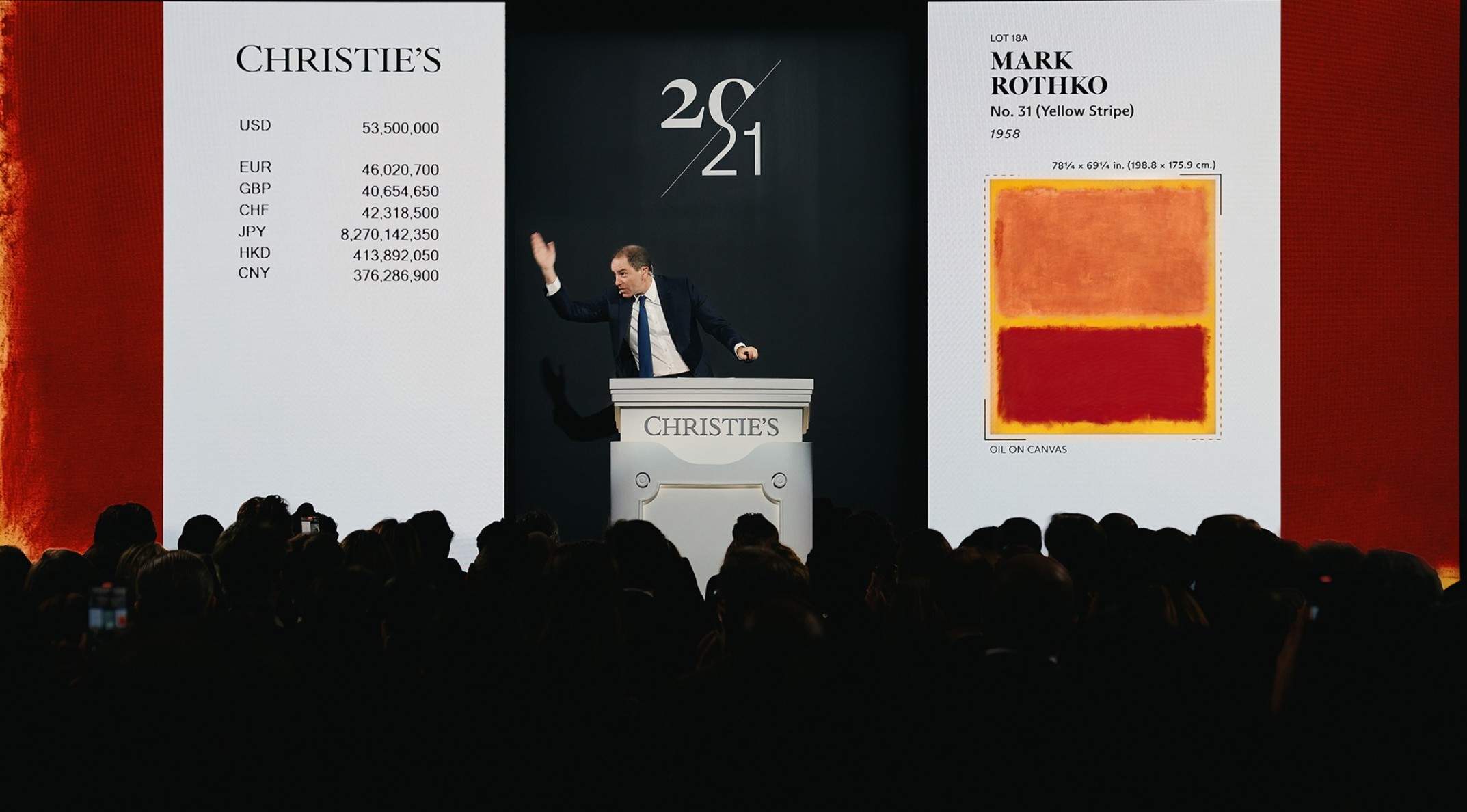
Christie’s opened the week with the Robert F. and Patricia G. Ross Weis Collection, an event that immediately reestablished confidence. The sale achieved $218 million, well ahead of its USD 180 million low estimate.
No. 31 (Yellow Stripe) achieves a strong result for a 1950s canvas of impeccable provenance. Bidding was measured but competitive, signaling sustained demand for top-tier Abstract Expressionism.
No. 31 (Yellow Stripe), 1958
The Collection of Robert F. and Patricia G. Ross Weis
Christie’s New-York: 17 November 2025
Estimate on Request
USD 62,160,000
MARK ROTHKO (1903-1970), No. 31 (Yellow Stripe) | Christie’s
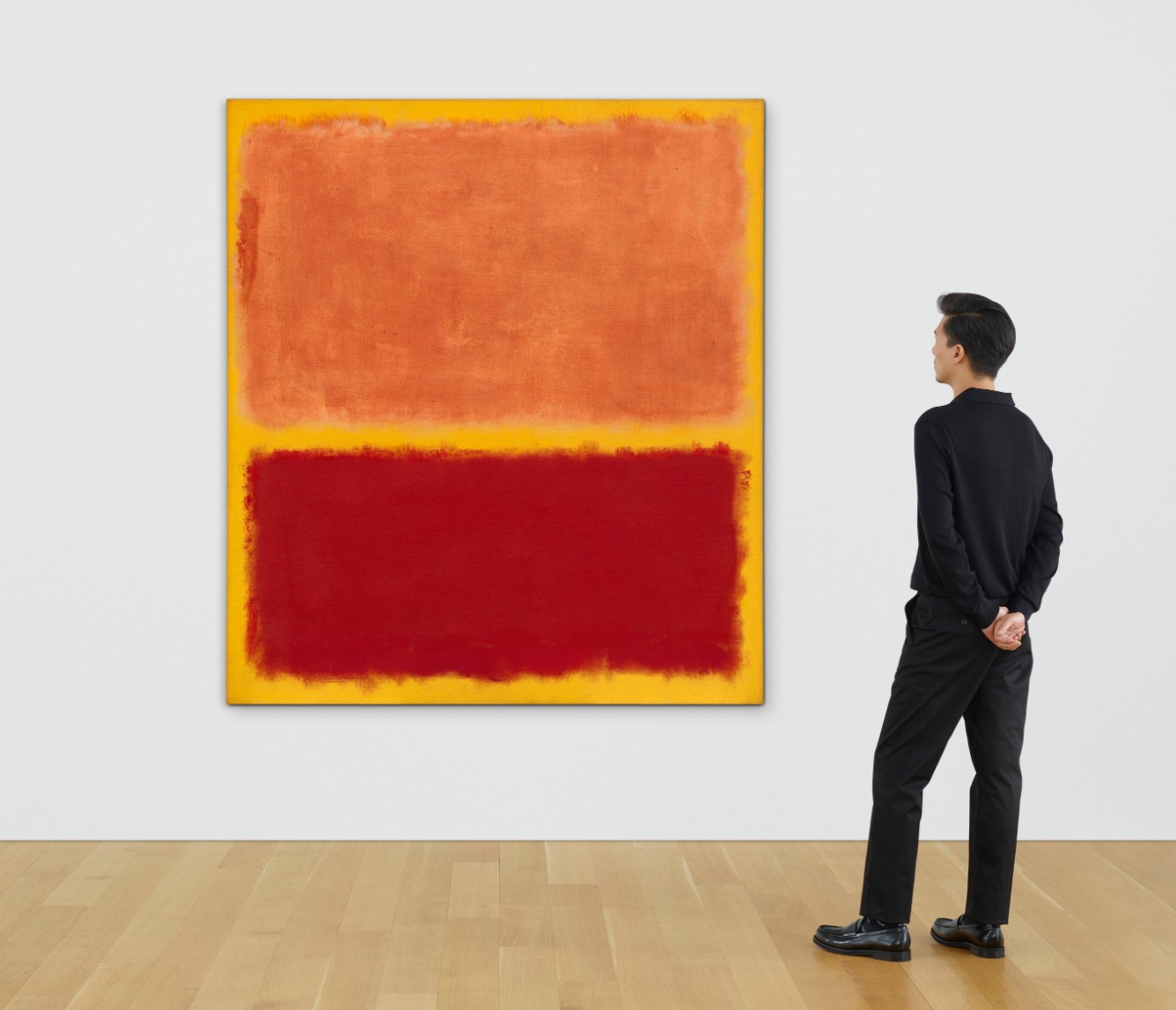
MARK ROTHKO (1903-1970)
No. 31 (Yellow Stripe), 1958
Oil on canvas
78 1/4 x 69 1/4 inches (198.8 x 175.9 cm)
Signed, partially titled and dated ‘MARK ROTHKO 1958 #31’ (on the reverse)
A major double portrait by David Hockney, sold with a guarantee. The result reflects recalibrated yet resilient demand for Hockney’s key works.
Christopher Isherwood and Don Bachardy, 1968
Property from a Distinguished Private European Collection
Christie’s New-York: 17 November 2025
Estimate on Request
USD 44,335,000
DAVID HOCKNEY (B. 1937), Christopher Isherwood and Don Bachardy | Christie’s
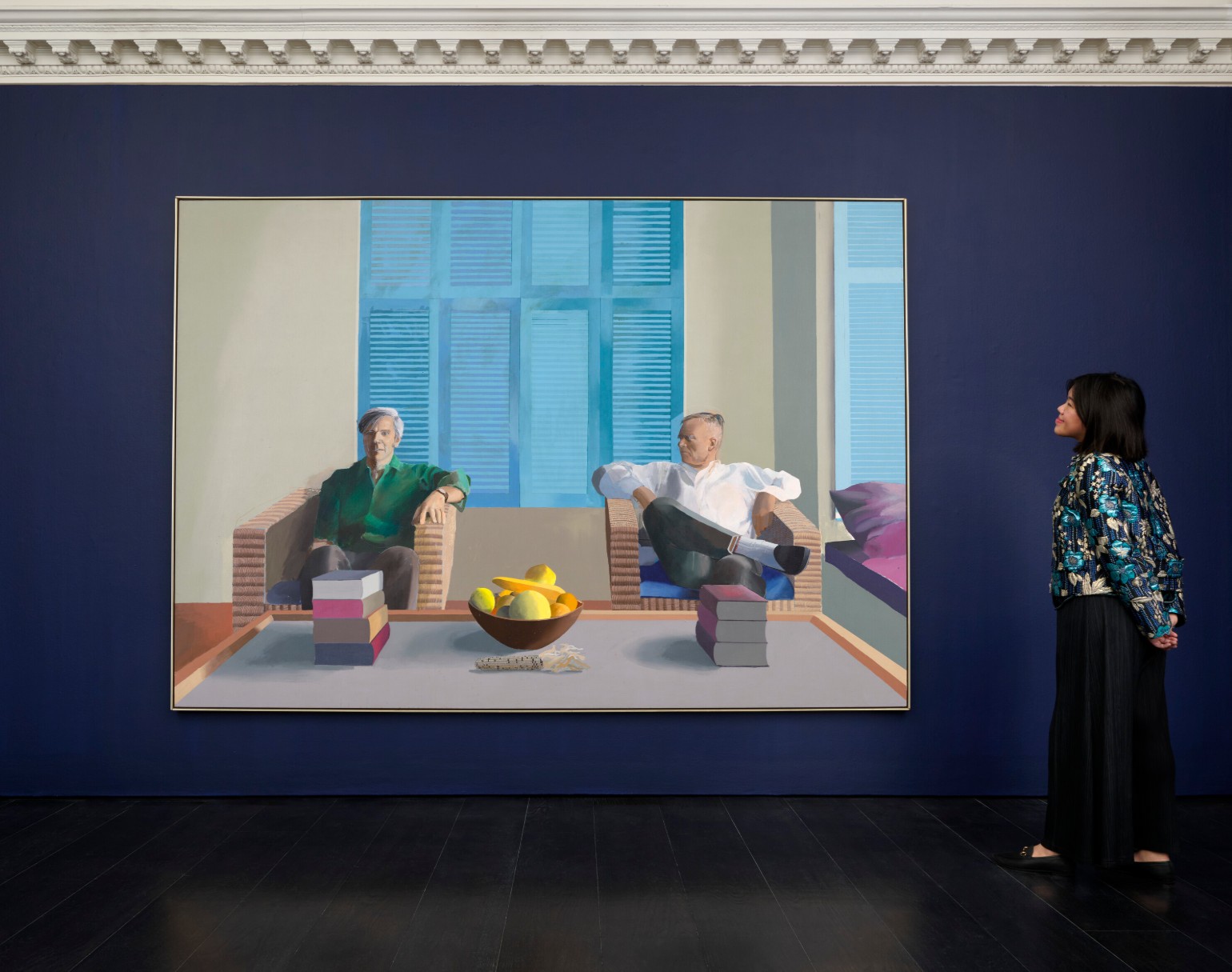
DAVID HOCKNEY (B. 1937)
Christopher Isherwood and Don Bachardy, 1968
Acrylic on canvas
83 1/2 x 119 1/2 inches (212 x 303.5 cm)
Christie’s showed that robust estate sales, with clean provenance and appropriately conservative estimates, remain one of the strongest engines of market liquidity.
Sotheby’s: A Historic Night Driven by the Lauder Collection
If Christie’s set the stage, Sotheby’s delivered the drama. The auction house inaugurated its new Breuer Building headquarters with a historic evening total of USD 706 million, the highest in its 281-year history.
At the center of this seismic performance was the Leonard A. Lauder Collection, whose combination of scholarly importance and market rarity created a once-in-a-generation event.
1. Gustav Klimt’s Triumph
Estimated at USD 150 million, the painting surged after a nearly 20-minute bidding battle among six contenders. The result is the second-highest auction price ever recorded and confirms Klimt’s position as one of the most powerful drivers of global mega-collecting. It also underscores how rarity and provenance now outweigh all other variables at the top of the market.
Bildnis Elisabeth Lederer, 1914-16
Leonard A. Lauder, Collector
Sotheby’s New-York: 18 November 2025
Estimates upon Request
USD 236,660,000
MOST EXPENSIVE MODERN WORK EVER SOLD AT AUCTION
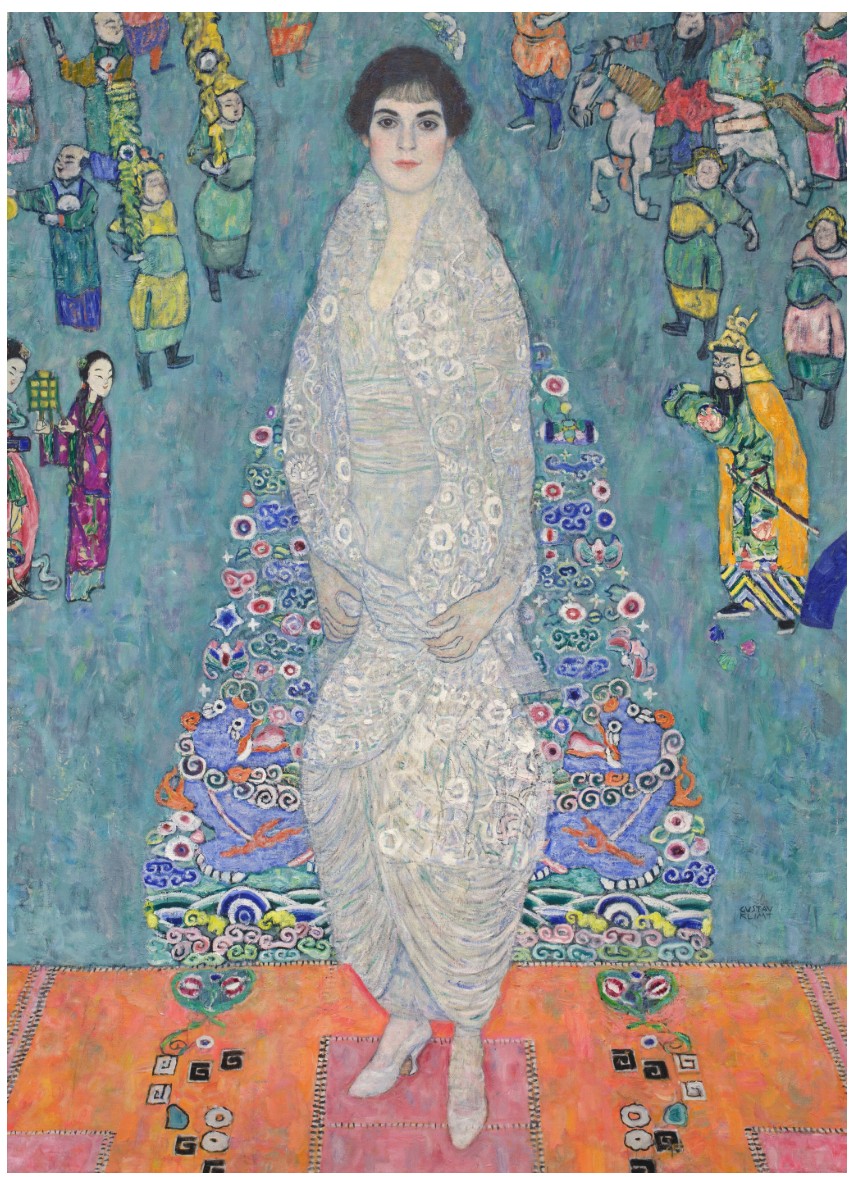
GUSTAV KLIMT (1862 – 1918)
Bildnis Elisabeth Lederer (Portrait of Elisabeth Lederer), 1914-16
Oil on canvas
180.4 x 130.5 cm (71 x 51 3/8 inches)
Signed Gustav Klimt (toward lower right)
2. The Surrealist Momentum: Kahlo Makes History
The Surrealist sale Exquisite Corpus totaled nearly USD 100 million, with Kahlo’s painting representing half the value. Her result sets a new auction record for a female artist and positions Kahlo alongside the few early 20th-century names capable of generating sustained top-tier demand. It also highlights the expanding appetite for works by historically under-recognized female masters.
El sueño (La cama), 1940
Exquisite Corpus: Surrealist Treasures from a Private Collection
Sotheby’s New-York: 20 November 2025
Estimated: USD 40,000,000 – 60,000,000
USD 54,660,000
El sueño (La cama) | Exquisite Corpus Evening Auction | 2025 | Sotheby’s
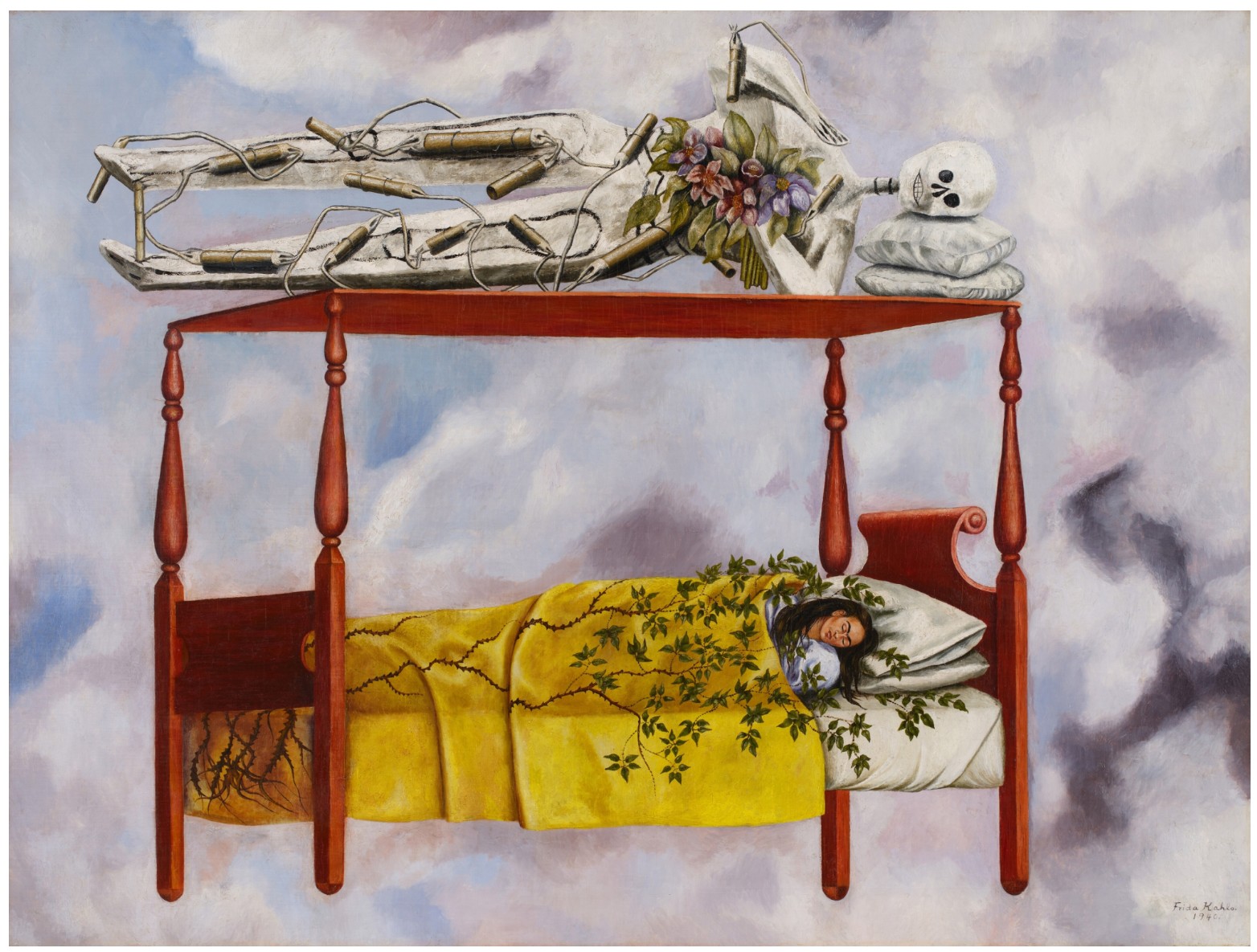
FRIDA KAHLO (1907 – 1954)
El sueño (La cama), 1940
Oil on canvas
74×98 cm (29 1/8 x 38 5/8 inches
Signed Frida Kahlo and dated 1940 (lower right)
3. The Pritzker Collection and a Revitalized Modern Segment
Fresh to market, vibrant, and in excellent condition, the Van Gogh canvas triggered intense bidding and exceeded its high estimate. Van Gogh’s enduring market power continues to anchor Modern art’s top tier.
Piles de romans parisiens et roses dans un verre, 1887
The Cindy and Jay Pritzker Collection
Sotheby’s New-York: 20 November 2025
Estimate upon Request
USD 62,710,000
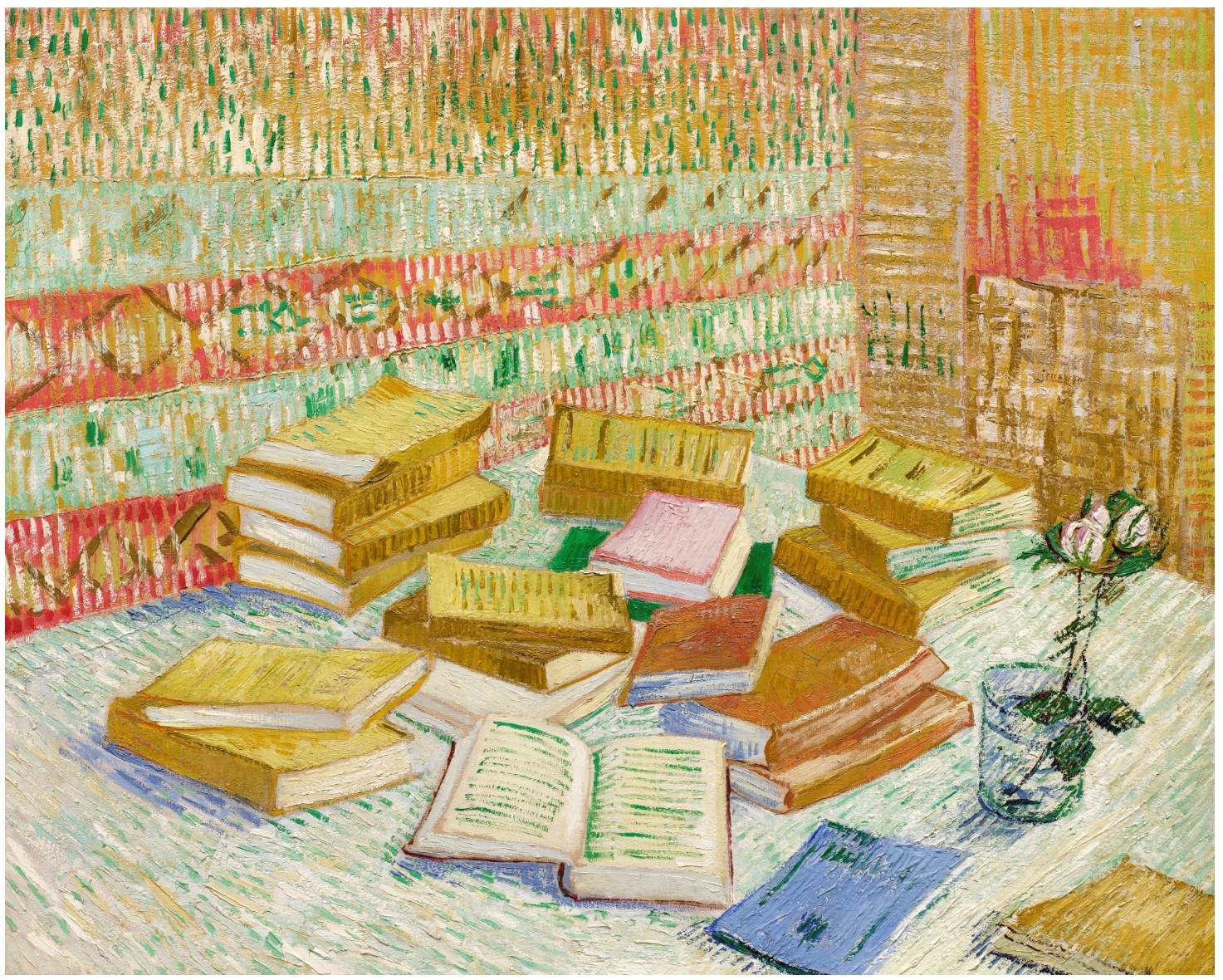
VINCENT VAN GOGH (1853 – 1890)
Piles de romans parisiens et roses dans un verre (Romans parisiens), 1887
Oil on canvas
73.3 x 92.1 cm (28 7/8 x 36 1/4 inches)
Executed in November-December 1887
4. The Cattelan Moment: Gold, Irony, and Market Theatre
The 100-kg solid-gold toilet, indexed to the daily gold price, captured media attention and reflected the season’s theatrical dimension. The sale underscored collectors’ willingness to pursue conceptual works with strong cultural narratives.
America, 2016
Sotheby’s New-York: 18 November 2025
Estimate upon Request
USD 12,110,000
America | The Now & Contemporary Evening Auction | 2025 | Sotheby’s
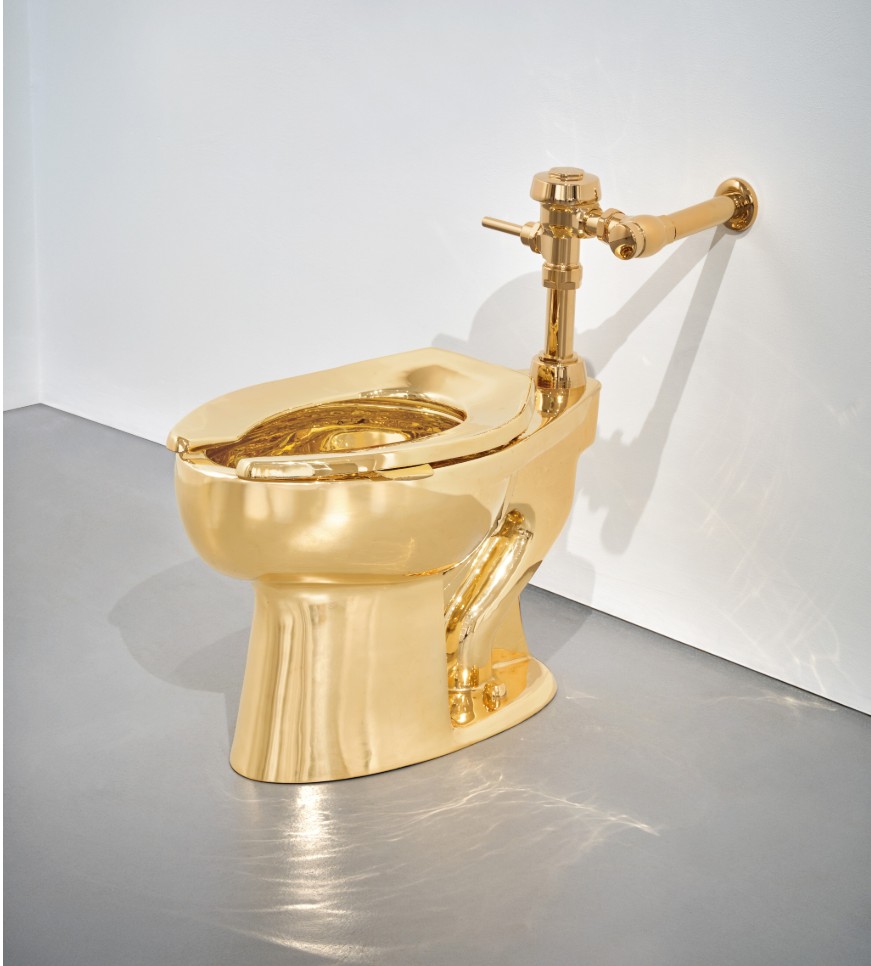
MAURIZIO CATTELAN (b. 1960)
America, 2016
101.2 kg of 18-karat gold
18 1/4 x 14 3/4 x 25 inches (46.4 x 37.5 x 63.5 cm)
This work is number 2 from an edition of 3 plus 2 artist’s proofs
Phillips: A Stable, Incremental Recovery
While less sensational, Phillips’ performance was meaningful. Its evening sale totaled USD 61.9 million (+14.6% year over year), supported by a compact but powerful Francis Bacon diptych sold for just over USD 16 million, and a strong Joan Mitchell sold for USD 14.3 million, marking a 59% increase since 2018. Phillips provided evidence that the upper mid-market is stabilizing, with quality and freshness driving results.
Study for Head of Isabel Rawsthorne and George Dyer, 1967
Phillips New-York: 19 November 2025
Estimated: USD 13,000,000 – 18,o00,000
USD 16,015,000
Francis Bacon Modern & Contemporary Art Evening Sale featuring Cera the Triceratops
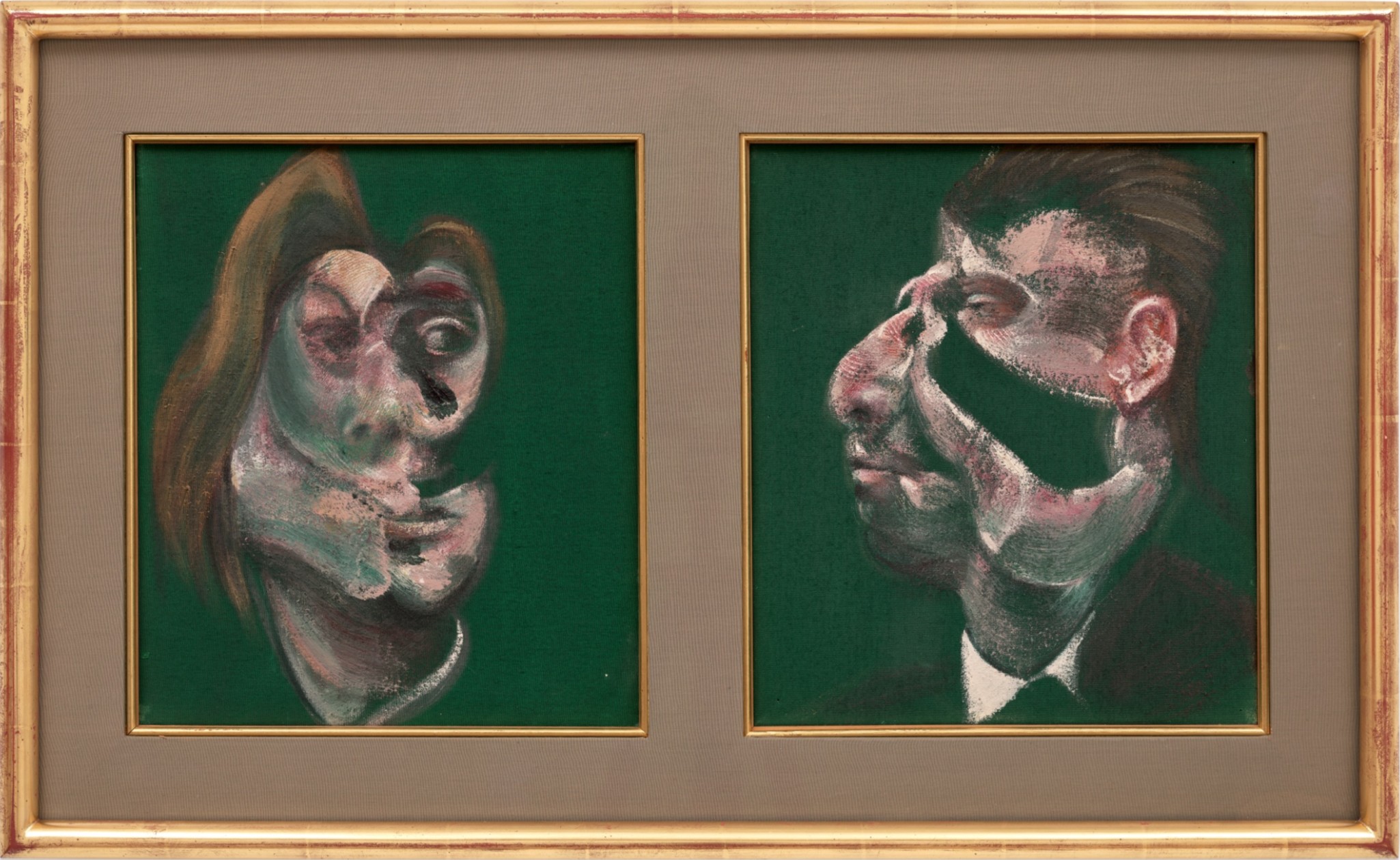
Oil on canvas, diptych
Each 14×12 inches (35.6 x 30.5 cm)
Titled and dated “Study for Head of Isabel Rawsthorne 1967.” on the reverse of the left canvas
Titled and dated “Study for Head of George Dyer 1967.” on the reverse of the right canvas
Untitled, 1957-1958
Estimated: USD 10,000,000 – 15,o00,000
USD 14,290,000
Estimated: USD 7,000,000 – 9,000,000
USD 9,087,500
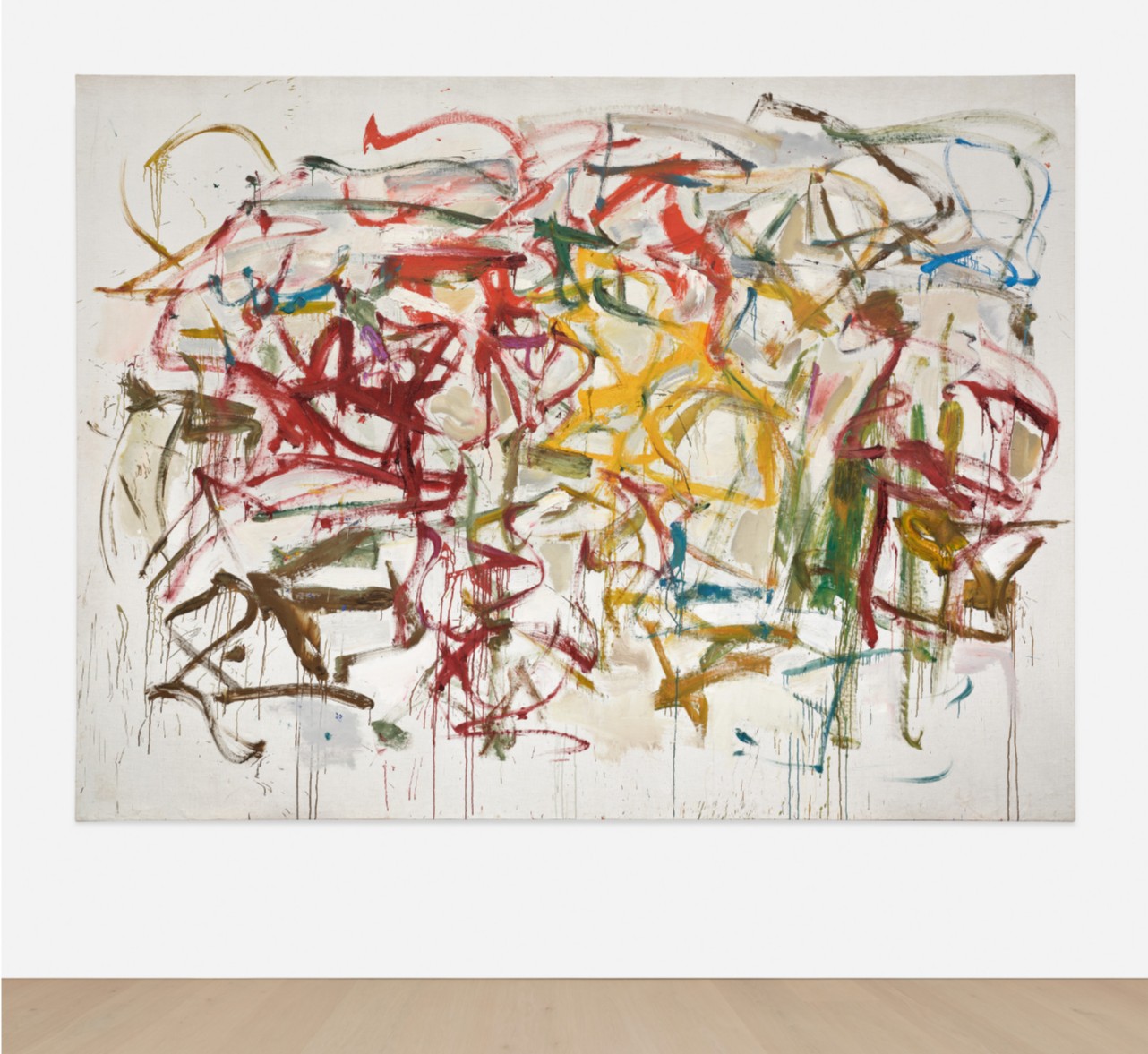
Untitled, 1957-1958
Oil on canvas
81 1/4 x 108 1/2 inched (206.4 x 275.6 cm)
A Market Rebound Built on Price Recalibration
One of the most important structural shifts this season was the acceptance, finally, of post-boom pricing realities. Many works achieved healthy results, but at substantially lower levels than in 2021–2022. The market is healthier today not because prices are rising, but because expectations have normalized. This recalibration is enabling liquidity and restoring depth to bidding.
For example, Richard Diebenkorn’s Ocean Park landscape sold for USD 17.6 million, well below the USD 27.3 million it sold for at Sotheby’s in New-York, on 12 May 2021. A meaningful but necessary correction.
Ocean Park #40, 1971
Elaine: The Collection of Elaine Wynn
Christie’s New-York: 17 November 2025
Estimated: USD 15,000,000 – 25,000,000
USD 17,655,000
RICHARD DIEBENKORN (1922-1993), Ocean Park #40 | Christie’s
REPEAT SALE
American Visionary: The Collection of Mrs. John L. Marion
Sotheby’s New-York: 12 May 2021
Estimated: USD 20,000,000 – 30,000,000
USD 27,265,500
Ocean Park #40 | American Visionary: The Collection of Mrs. John L. Marion | 2021 | Sotheby’s
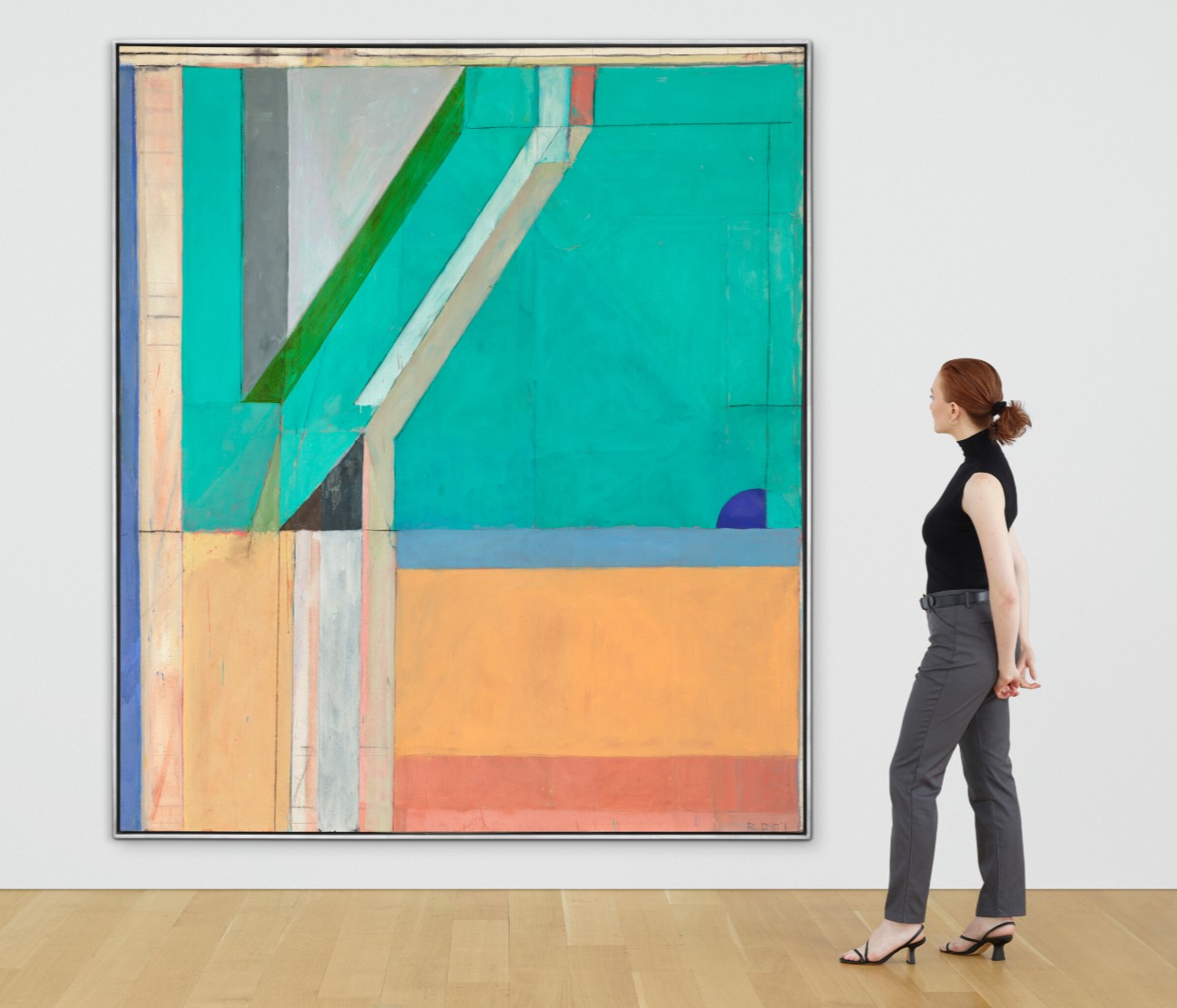
RICHARD DIEBENKORN (1922-1993)
Ocean Park #40, 1971
Oil and charcoal on canvas
93×81 inches (236.2 x 205.7 cm)
Signed with the artist’s initials and dated ‘RD 71’ (lower right)
Signed, titled and dated again ‘R. Diebenkorn 1971 OCEAN PARK #40’ (on the reverse)
Another example, Lucian Freud’s The Painter Surprised by a Naked Admirer sold for USD 14.4 million below its USD 15 million low estimate, and well below its high estimate of USD 25 million.
The Painter Surprised by a Naked Admirer, 2004-2005
Elaine: The Collection of Elaine Wynn
Christie’s New-York: 17 November 2025
Estimated: USD 15,000,000 – 25,000,000
USD 14,435,000
LUCIAN FREUD (1922-2011), The Painter Surprised by a Naked Admirer | Christie’s
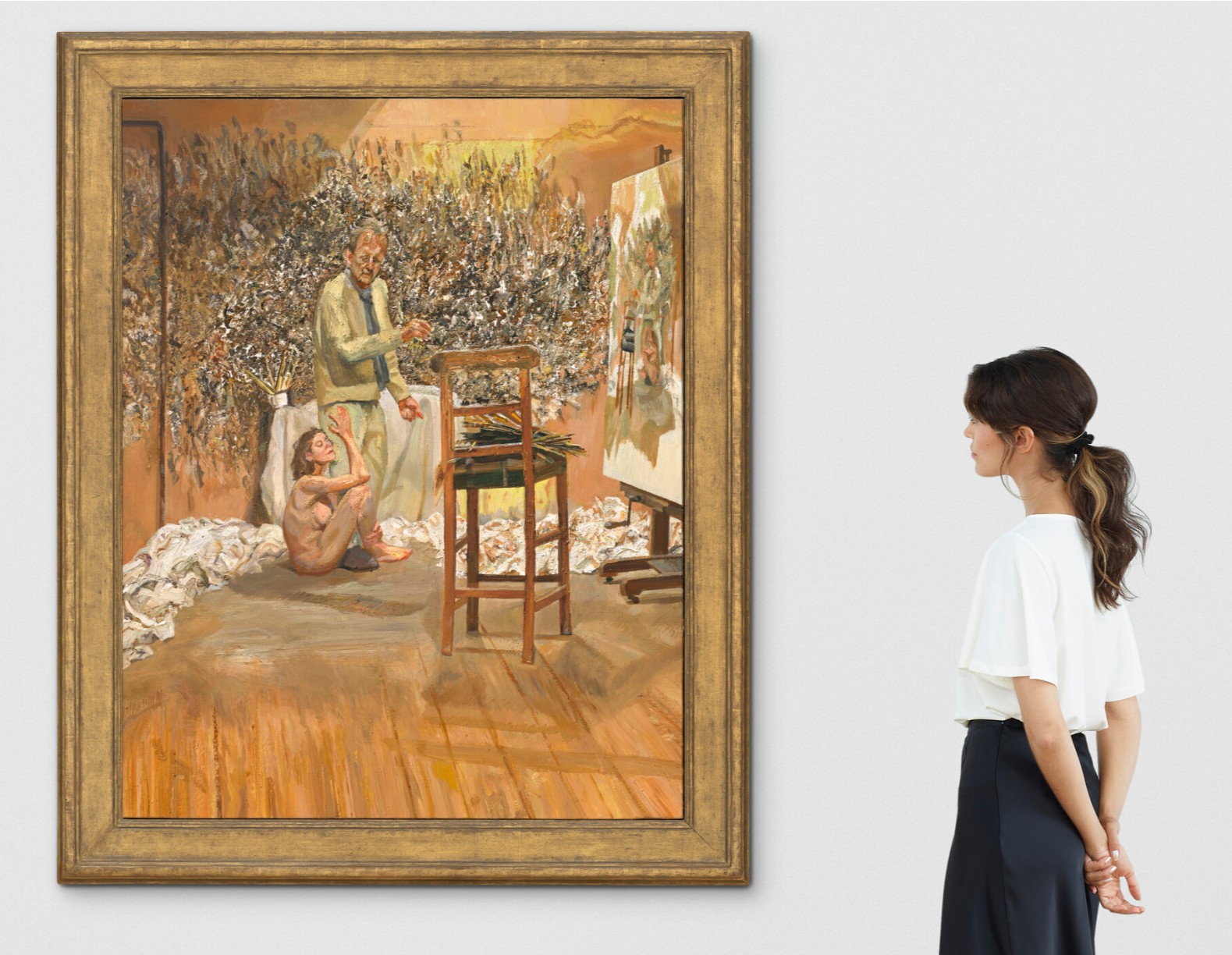
LUCIAN FREUD (1922-2011)
The Painter Surprised by a Naked Admirer, 2004-2005
Oil on canvas
54×42 inches (137.2 x 106.7 cm)
- David Hockney, major double portrait – $44.5 million
Solid, yet below the peak pair of double portraits from 2018–2019.
The Architecture Behind the Week:
Guarantees as the Central Engine
Nearly every major lot this season was underpinned by financial commitments. 15 of 18 lots from the Weis Collection were guaranteed by third parties. The Lauder Collection had more than 20 guaranteed lots. Overall, nearly 75% of major works carried house guarantees, third-party guarantees, or irrevocable bids.
These mechanisms: (1) reduced consignor risk; (2) secured trophy works that might otherwise remain off the market; (3) allowed auction houses to publish ambitious catalogs; (4) but also blurred the visibility of pure market-driven demand.
Guarantees have become the operating system of the high-end market. Understanding them is now indispensable for reading auction results.
Key Takeaways for Collectors and Professionals
1. The high-end market is functionally strong
Demand for top-tier material, rare, fresh, and historically important, is intense and deeply international.
2. The rebound is selective, not broad
Only the highest-quality works are thriving. Lower-quality or overestimated works continue to struggle.
3. Price corrections are now widely accepted
This is healthy: liquidity improves when expectations align with current reality.
4. Guarantees shape everything
Pricing, supply, bidding dynamics, and sale outcomes now depend heavily on guarantee architecture.
5. Estate sales remain the strongest engines of confidence
They offer clarity, provenance, and security, key elements in a cautious market.
Conclusion: A Controlled Yet Significant Reawakening
The 2025 New York auctions marked a turning point. Not a return to the exuberance of 2021–2022, but the emergence of a new equilibrium: one defined by discipline, engineering, and the irresistible appeal of masterpieces.
Klimt, Kahlo, Van Gogh, Rothko, and Matisse demonstrated that extraordinary works continue to command extraordinary results. Meanwhile, recalibrated expectations and sophisticated guarantee structures created the conditions necessary for the market to function at scale once again.
The high-end art market is back—but on its own terms: selective, strategic, and profoundly shaped by the invisible architecture behind the hammer.
Focus: Roy Lichtenstein
A Major Market Moment Anchored in Exceptional Provenance
One of the most significant yet understated events of the 2025 New York auctions was the appearance of works from the Dorothy and Roy Lichtenstein Collection. This was not just another consignment: it marked one of the most important releases of Lichtenstein material in recent years, with works coming directly from the artist’s own estate. Provenance of this caliber dramatically changes the market dynamic.
Unlike secondary or tertiary market sources, pieces coming from the Dorothy and Roy Lichtenstein Collection carry: (1) direct lineage to the artist; (2) unquestionable authenticity and conservation history; (3) a level of freshness that is rarely encountered; and (4) the prestige associated with a collection that shaped the stewardship of Lichtenstein’s legacy. This provenance alone positioned Lichtenstein as a key indicator of market confidence during the week.
1. A Landmark Release: Why This Collection Matters
Works originating from an artist’s estate or direct family collection occupy a special place in the Post-War market. For Lichtenstein, whose career evolved with remarkable conceptual and stylistic consistency, the estate’s holdings remain exceptionally important. Their release into the public market is rare, deliberate, and highly curated.
Collectors therefore responded not merely to the artworks themselves, but to the opportunity to acquire pieces with impeccable pedigree, Museum-level relevance, and historical weight within the artist’s corpus.
This significantly boosted confidence, bidding depth, and visibility for Lichtenstein amid a season dominated by Klimt, Kahlo, and Van Gogh.
2. Performance and Market Signals
The results reaffirmed the market’s selective strength:
-
Early examples and instantly recognizable Pop motifs attracted competitive bidding, with estate provenance amplifying demand.
-
Interior and late works—a category often evaluated with caution—performed more consistently than in recent seasons precisely because of their origin from the Lichtenstein Collection.
-
Works with detailed estate documentation and exhibition history saw the strongest appetite.
The collection’s presence clarified the stratification of the Lichtenstein market:
-
Tier 1: Early 1960s works and quintessential Pop imagery — premium demand.
-
Tier 2: Interiors, mirrors, entablatures — strong when tied to estate provenance.
-
Tier 3: Lesser-known forms — dependent on estimate discipline and context.
The immediate takeaway:
Provenance from the Dorothy and Roy Lichtenstein Collection elevated the category and stabilized bidding across multiple tiers of Lichtenstein’s market.
3. Lichtenstein Prints & Multiples: Estate Provenance Reinforces Value
Even in the print segment — historically one of the most active parts of Lichtenstein’s market — works from the collection were perceived as benchmark objects, not merely editions. Their freshness, documentation, and direct link to the artist’s stewardship heightened competition.
Series such as Reflections, Brushstrokes, Water Lilies, and Landscapes and Interiors performed firmly when condition and provenance aligned.
The message for collectors is unmistakable. Lichtenstein prints remain a cornerstone of the Post-War market, but provenance now acts as a decisive multiplier — especially when it comes from the artist’s own collection.
4. Positioning Lichtenstein Within the 2025 New York Narrative
The inclusion of the Dorothy and Roy Lichtenstein Collection transformed Lichtenstein’s presence in the season from a supporting role to a strategic pillar. It validated the cautious optimism circulating in the Post-War segment and acted as a bridge between the ultra-trophy lots (Klimt, Kahlo, Van Gogh) and the recalibrated results of Hockney, Diebenkorn, and Freud.
Lichtenstein’s market in 2025 shows renewed liquidity, disciplined pricing, and strong response to impeccable provenance. Collectors gravitated toward historically anchored examples rather than speculative ones.
He becomes a perfect embodiment of the season’s overarching lesson. The rebound is real, but it rewards excellence, rarity, and provenance — and it operates with far more discrimination than in previous cycles.
Agenda

The Collection of Robert F. and Patricia G. Ross Weis
Total: USD 218,066,600
16 Lots
Sell-Through Rate: 88.9%
20th Century Evening Sale
Total: USD 471,728,400
60 Lots
Sell-Through Rate: 98.4%
Impressionist & Modern Works on Paper Sale
Total: USD 10,112,375
62 Lots
Sell-Through Rate: 83.8%
Impressionist & Modern Art Day Sale
Total: USD 47,431,057
198 Lots
Sell-Through Rate: 88%
21st Century Evening Sale Featuring Works from the Edlis | Neeson Collection
Total: USD 123,585,950
44 Lots
Sell-Through Rate: 97.8%
Post-War & Contemporary Art Day Sale
Total: USD 88,779,332
221 Lots
Sell-Through Rate: 86.0%

Leonard A. Lauder, Collector | Evening Auction
Total: USD 527,457,600
24 Lots
Sell-Through Rate: 100%
The Now & Contemporary Evening Auction
Total: USD 178,114,000
43 Lots
Sell-Through Rate: 95.3%
Leonard A. Lauder, Collector | Day Auction
Total: USD 3,843,020
30 Lots
Sell-Through Rate: 100%
Contemporary Art Day Auction
Total: USD 101,359,398
253 Lots
Sell-Through Rate: 83.0%
The Cindy and Jay Pritzker Collection
Total: USD 109,526,900
13 Lots
Sell-Through Rate: 100%
Exquisite Corpus Evening Auction
Total: USD 98,097,200
24 Lots
Sell-Through Rate: 100%
Modern Evening Auction
Total: USD 96,967,300
29 Lots
Sell-Through Rate: 100%
Exquisite Corpus Day Auction
21 November 2025
Exquisite Corpus Day Auction | 2025 | Sotheby’s
Modern Day Auction
21 November 2025
Modern Day Auction | 2025 | Sotheby’s

Modern and Contemporary Art Evening Sale
Featuring Cera The Triceratops
Total: USD 67,307,850
31 Lots
Sell-Through Rate: 93.9%
Modern and Contemporary Art
Presents “Out of this World”
20 November 2025
Modern & Contemporary Art Presents ‘Out of this World’ Thursday, November 20, 2025
Modern and Contemporary Art Day Sale
Morning Session
Total: USD 11,966,556
105 Lots
Sell-Through Rate: 84%
Modern and Contemporary Art Day Sale
Afternoon Session
Total: USD 10,151,280
96 Lots
Sell-Through Rate: 86%
Auction Statistics
COMING SOON
Top Lots
#1. Bildnis Elisabeth Lederer, 1914-16
Leonard A. Lauder, Collector
Sotheby’s New-York: 18 November 2025
Estimates upon Request
USD 236,660,000
MOST EXPENSIVE MODERN WORK EVER SOLD AT AUCTION
GUSTAV KLIMT (1862 – 1918)
Bildnis Elisabeth Lederer (Portrait of Elisabeth Lederer), 1914-16
Oil on canvas
180.4 x 130.5 cm (71 x 51 3/8 inches)
Signed Gustav Klimt (toward lower right)
USD 200 million
#2. Blumenwiese, circa 1908
Leonard A. Lauder, Collector
Sotheby’s New-York: 18 November 2025
Estimates upon Request
USD 86,000,000
Blumenwiese (Blooming Meadow) | Leonard A. Lauder, Collector | Evening Auction | 2025 | Sotheby’s
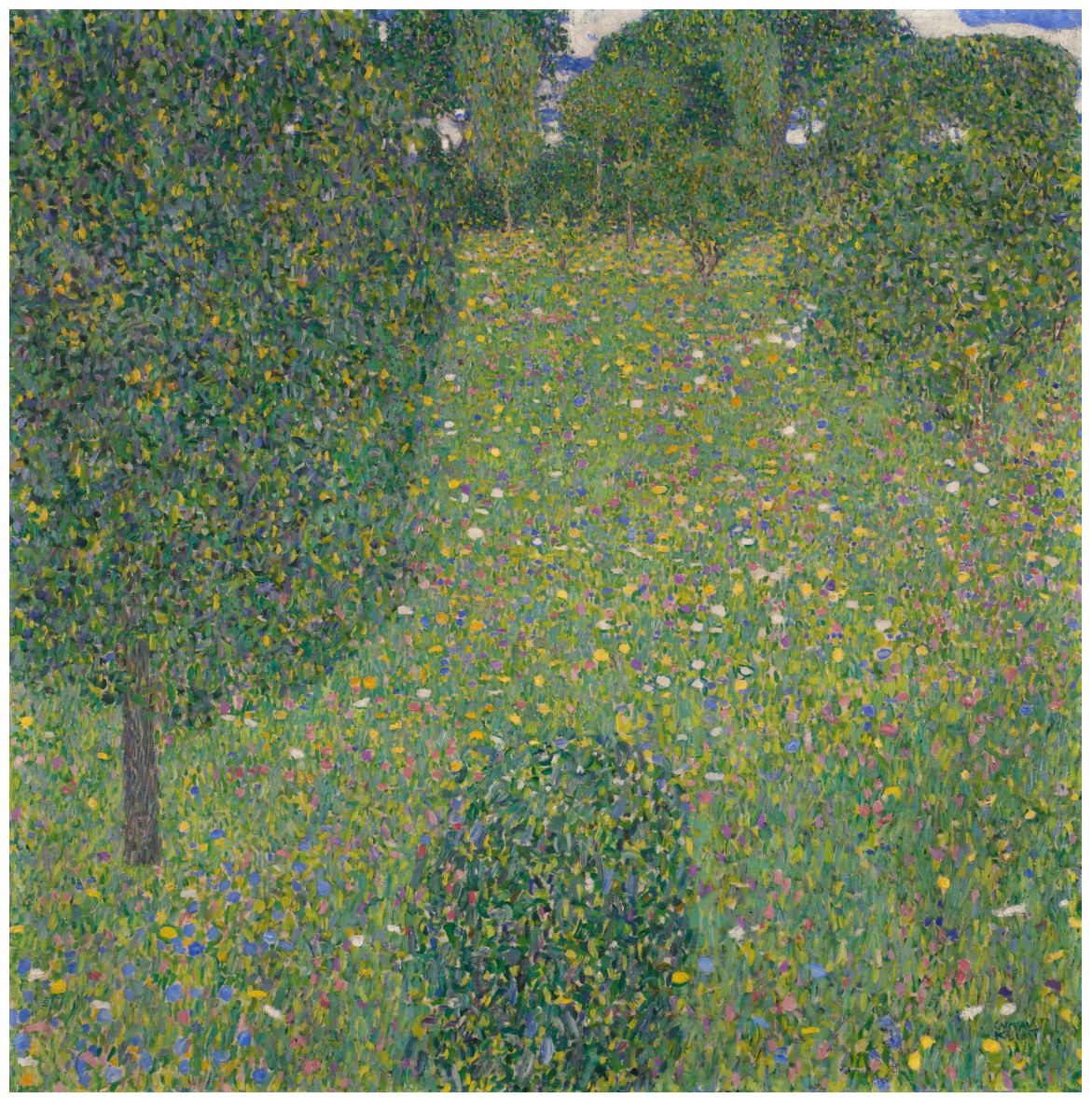
GUSTAV KLIMT (1862 – 1918)
Blumenwiese (Blooming Meadow), circa 1908
Oil on canvas
110×110 cm (43 1/4 x 43 1/4 inches)
Signed Gustav Klimt (lower right)
#3. Waldabhang bei Unterach am Attersee, 1916
Leonard A. Lauder, Collector
Sotheby’s New-York: 18 November 2025
Estimates upon Request
USD 68,320,000
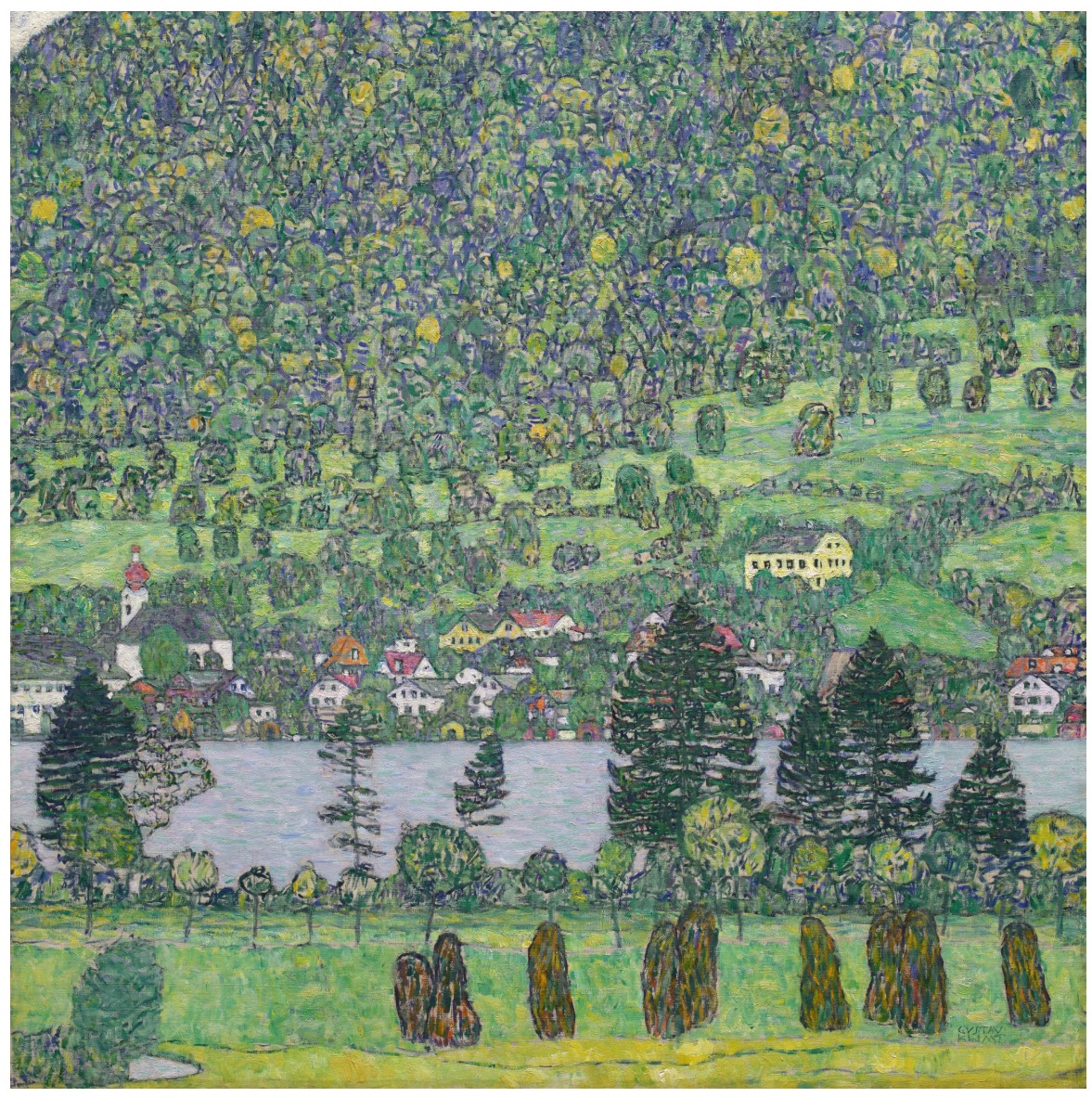
GUSTAV KLIMT (1862 – 1918)
Waldabhang bei Unterach am Attersee (Forest Slope in Unterach on the Attersee), 1916
Oil on canvas
110×110 cm (43 1/4 x 43 1/4 inches)
Signed Gustav Klimt (lower right)
#4. Piles de romans parisiens et roses dans un verre, 1887
The Cindy and Jay Pritzker Collection
Sotheby’s New-York: 20 November 2025
Estimate upon Request
USD 62,710,000
VINCENT VAN GOGH (1853 – 1890)
Piles de romans parisiens et roses dans un verre (Romans parisiens), 1887
Oil on canvas
73.3 x 92.1 cm (28 7/8 x 36 1/4 inches)
Executed in November-December 1887
#5. No. 31 (Yellow Stripe), 1958
The Collection of Robert F. and Patricia G. Ross Weis
Christie’s New-York: 17 November 2025
Estimate on Request
USD 62,160,000
MARK ROTHKO (1903-1970), No. 31 (Yellow Stripe) | Christie’s
MARK ROTHKO (1903-1970)
No. 31 (Yellow Stripe), 1958
Oil on canvas
78 1/4 x 69 1/4 inches (198.8 x 175.9 cm)
Signed, partially titled and dated ‘MARK ROTHKO 1958 #31’ (on the reverse)
#6. El sueño (La cama), 1940
Exquisite Corpus: Surrealist Treasures from a Private Collection
Sotheby’s New-York: 20 November 2025
Estimated: USD 40,000,000 – 60,000,000
USD 54,660,000
El sueño (La cama) | Exquisite Corpus Evening Auction | 2025 | Sotheby’s
FRIDA KAHLO (1907 – 1954)
El sueño (La cama), 1940
Oil on canvas
74×98 cm (29 1/8 x 38 5/8 inches
Signed Frida Kahlo and dated 1940 (lower right)
USD 50 million
#7. Crowns (Peso Neto), 1981
Basquiat Crowned | Property from a Distinguished European Collection
Sotheby’s New-York: 18 November 2025
Estimated: USD 35,o00,000 – 45,000,000
USD 48,335,000
Crowns (Peso Neto) | The Now & Contemporary Evening Auction | 2025 | Sotheby’s
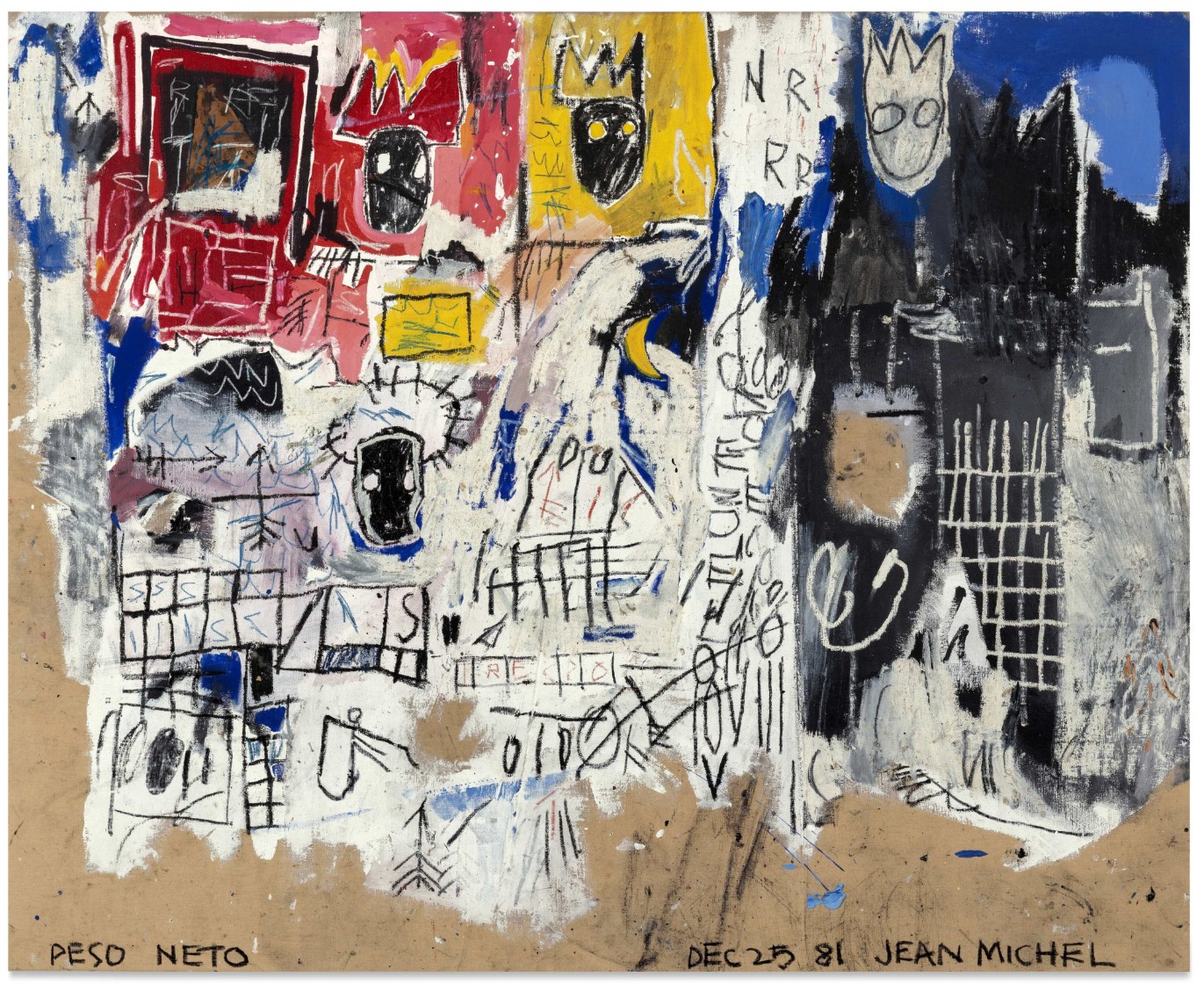
JEAN-MICHEL BASQUIAT (1960 – 1988)
Crowns (Peso Neto), 1981
Acrylic, oilstick and paper collage on canvas
76 1/4 x 94 1/4 inches (193.6 x 239.4 cm)
Signed, titled and dated DEC 25 81 (lower edge)
#8. La Lecture (Marie-Thérèse), 1932
The Collection of Robert F. and Patricia G. Ross Weis
Christie’s New-York: 17 November 2025
Estimate on Request
USD 45,485,000
PABLO PICASSO (1881-1973), La Lecture (Marie-Thérèse) | Christie’s
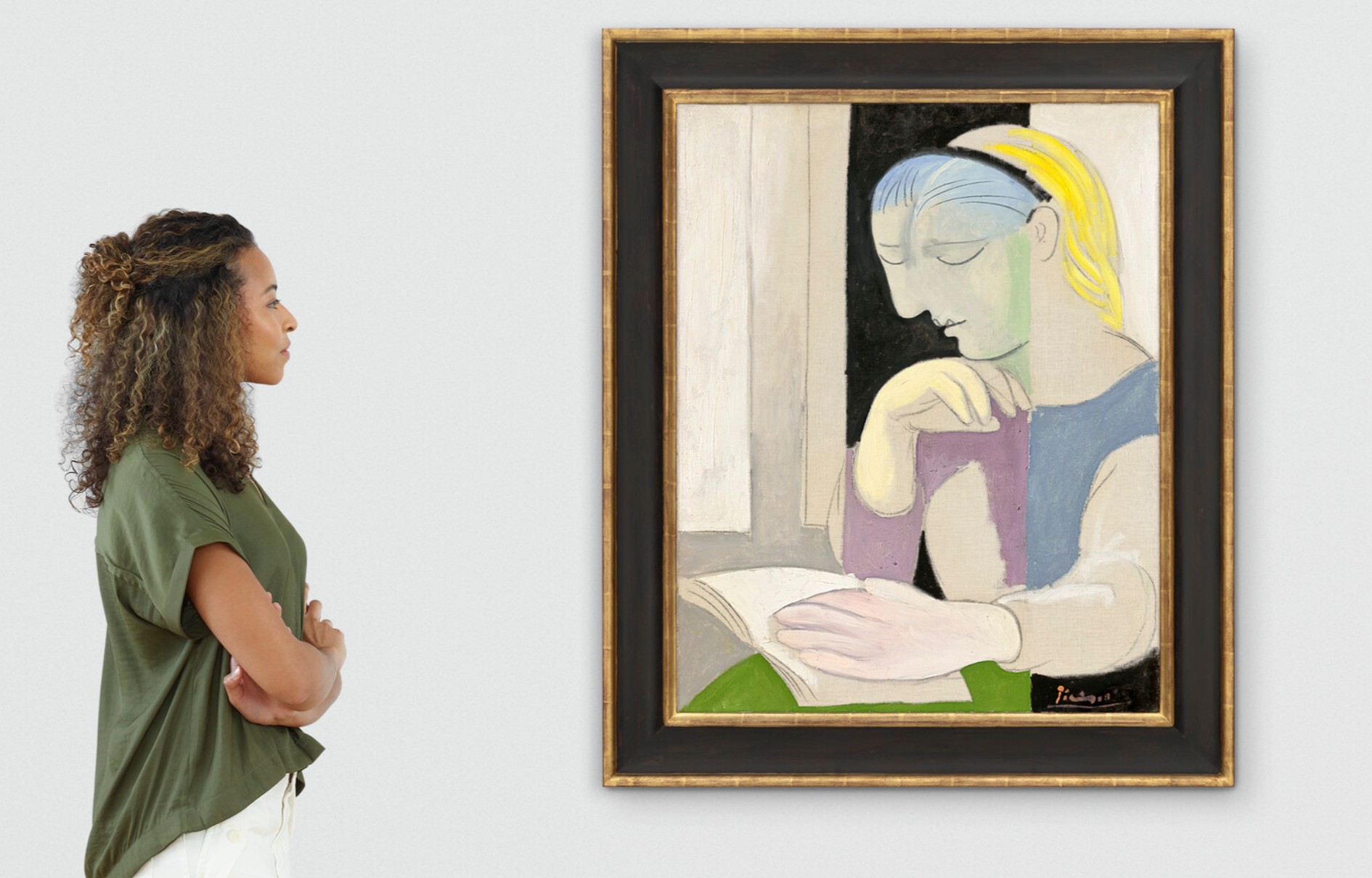
PABLO PICASSO (1881-1973)
La Lecture (Marie-Thérèse), 1932
Oil, Ripolin and charcoal on canvas
92.1 x 73 cm (36 1/4 x 28 3/4 inches)
Signed ‘Picasso’ (lower right)
Dated and inscribed ‘Boisgeloup 31 Août XXXII.’ (on the stretcher)
Painted in Boisgeloup on 31 August 1932
#9. Nymphéas, 1907
Property from the Kawamura Memorial DIC Museum of Art
Christie’s New-York: 17 November 2025
Estimated: USD 40,000,000 – 60,000,000
USD 45,485,000
CLAUDE MONET (1840-1926), Nymphéas | Christie’s
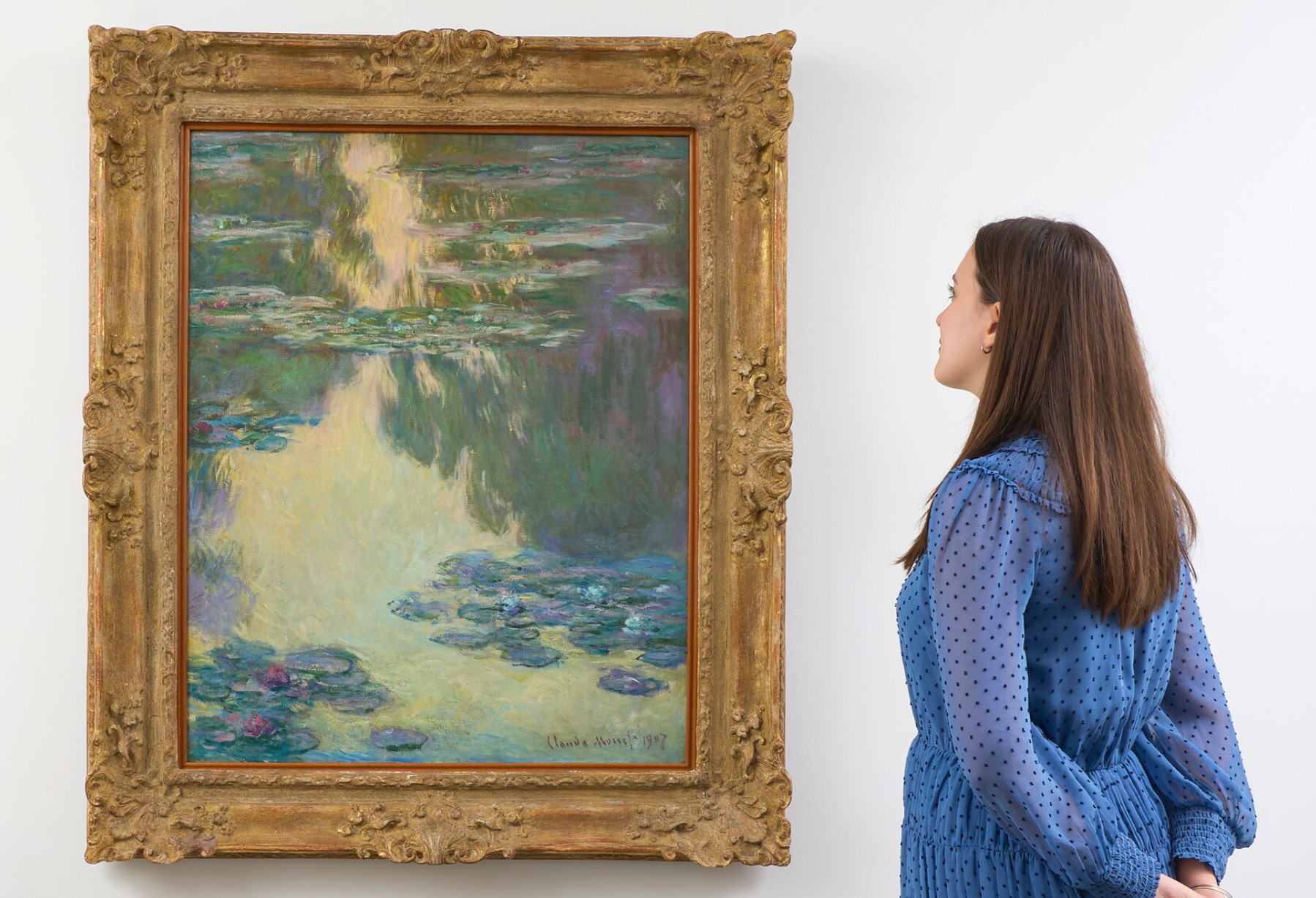
CLAUDE MONET (1840-1926)
Nymphéas, 1907
Oil on canvas
92 x 73.6 cm (36 1/4 x 29 inches)
Signed and dated ‘Claude Monet 1907’ (lower right)
#10. Christopher Isherwood and Don Bachardy, 1968
Property from a Distinguished Private European Collection
Christie’s New-York: 17 November 2025
Estimate on Request
USD 44,335,000
DAVID HOCKNEY (B. 1937), Christopher Isherwood and Don Bachardy | Christie’s
DAVID HOCKNEY (B. 1937)
Christopher Isherwood and Don Bachardy, 1968
Acrylic on canvas
83 1/2 x 119 1/2 inches (212 x 303.5 cm)
#11. Sankthansnatt (Midsummer Night), circa 1901-03
Leonard A. Lauder, Collector
Sotheby’s New-York: 18 November 2025
Estimated: USD 20,000,000 – 30,000,000
USD 35,110,000
Sankthansnatt (Midsummer Night) | Leonard A. Lauder, Collector | Evening Auction | 2025 | Sotheby’s
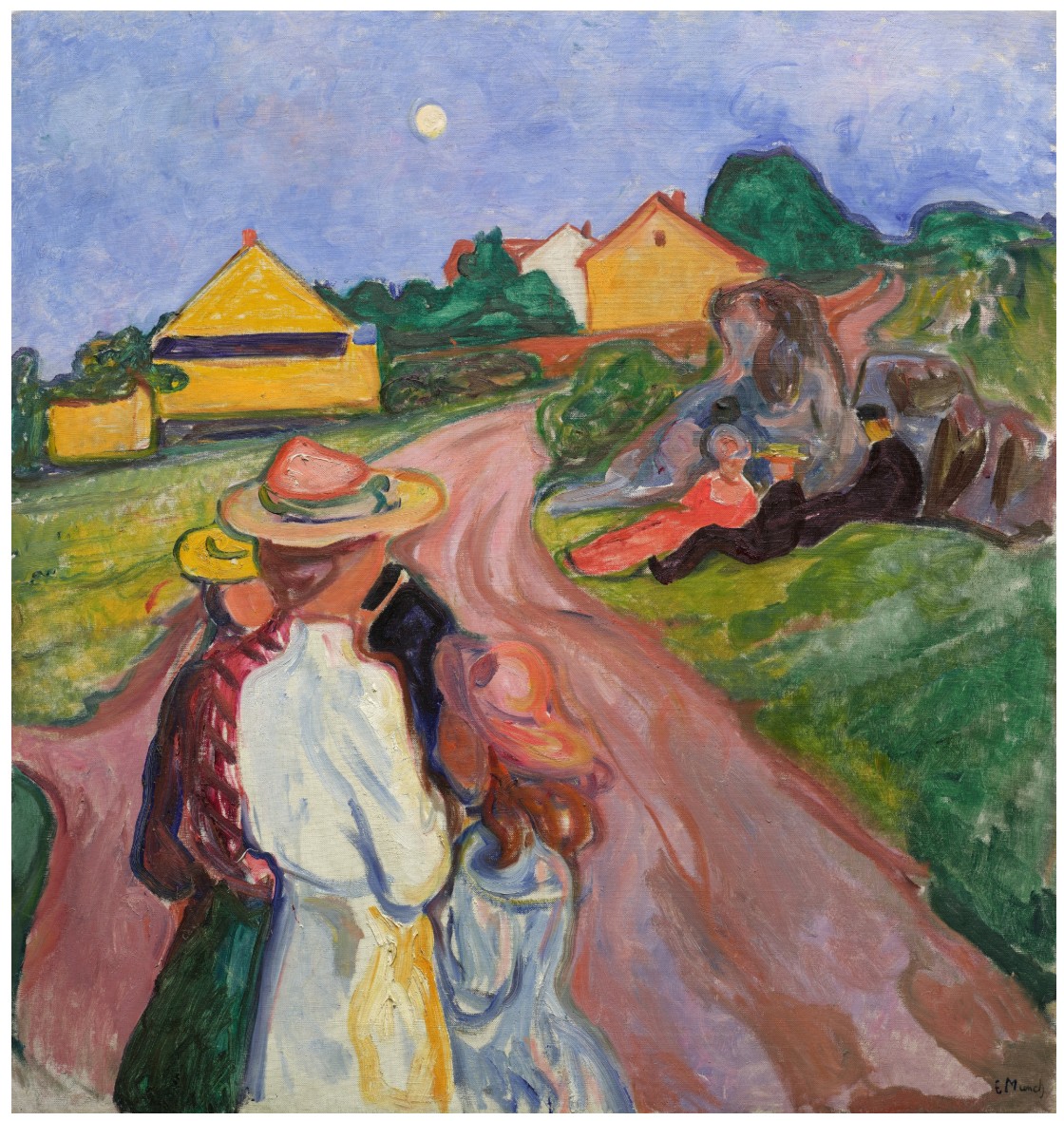
EDVARD MUNCH (1863 – 1944)
Sankthansnatt (Midsummer Night), circa 1901-03
Oil on canvas
41 3/8 x 39 1/4 inches (105 x 99.8 cm)
Signed E. Munch (lower right)
#12. Figure et bouquet (Tête ocre), 1937
The Collection of Robert F. and Patricia G. Ross Weis
Christie’s New-York: 17 November 2025
Estimated: USD 15,000,000 – 25,000,000
USD 32,260,000
HENRI MATISSE (1869-1954), Figure et bouquet (Tête ocre) | Christie’s
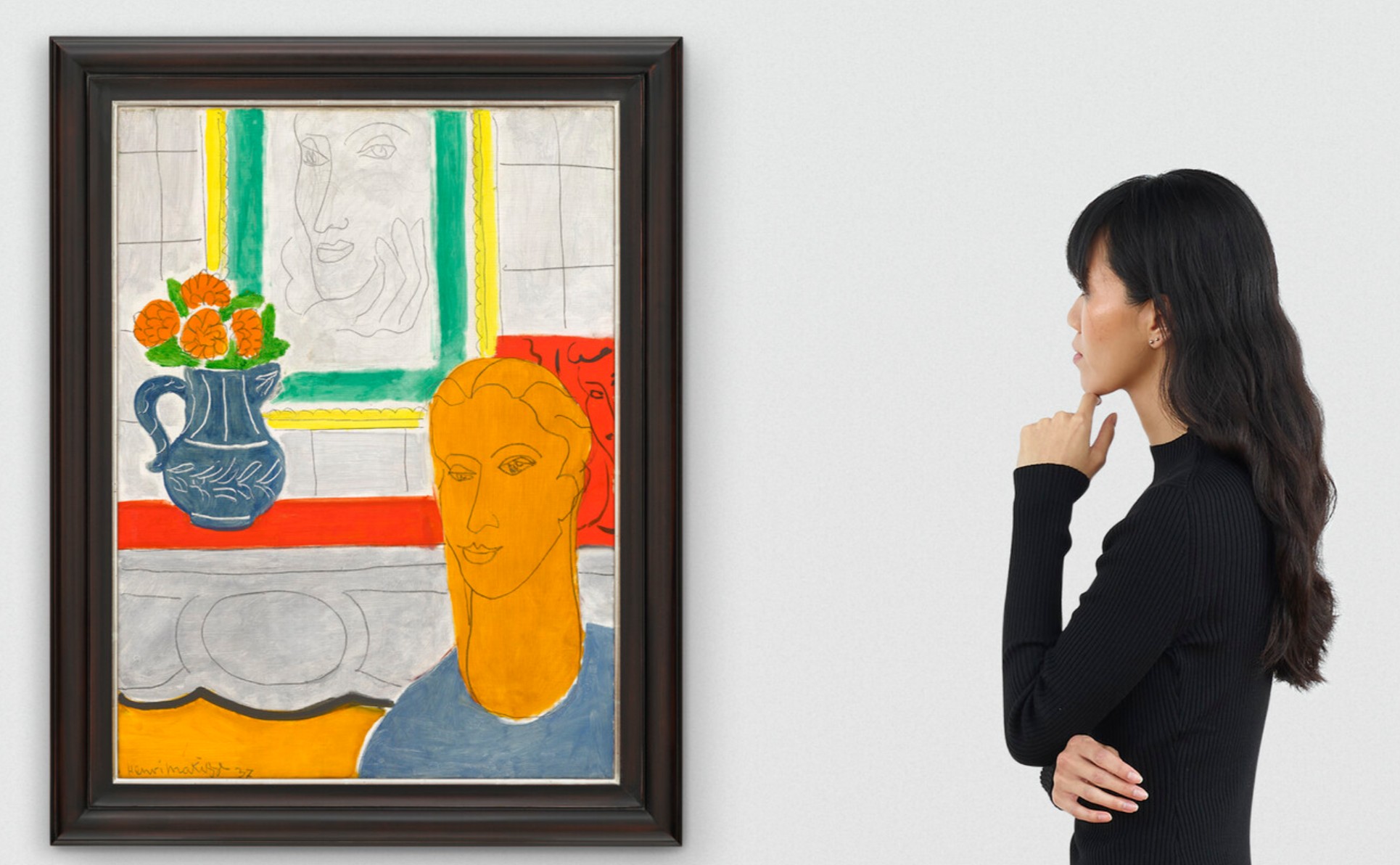
HENRI MATISSE (1869-1954)
Figure et bouquet (Tête ocre), 1937
Oil and Conté crayon on canvas
73.1 x 54 cm (28 3/4 x 21 1/4 inches)
Signed and dated ‘Henri Matisse 37’ (lower left)
Painted in Nice in February-March 1937
#13. Le songe du Roi David, 1966
Property from the Kawamura Memorial DIC Museum of Art
Christie’s New-York: 17 November 2025
Estimated: USD 8,000,000 – 12,000,000
USD 26,510,000
MARC CHAGALL (1887-1985), Le songe du Roi David | Christie’s
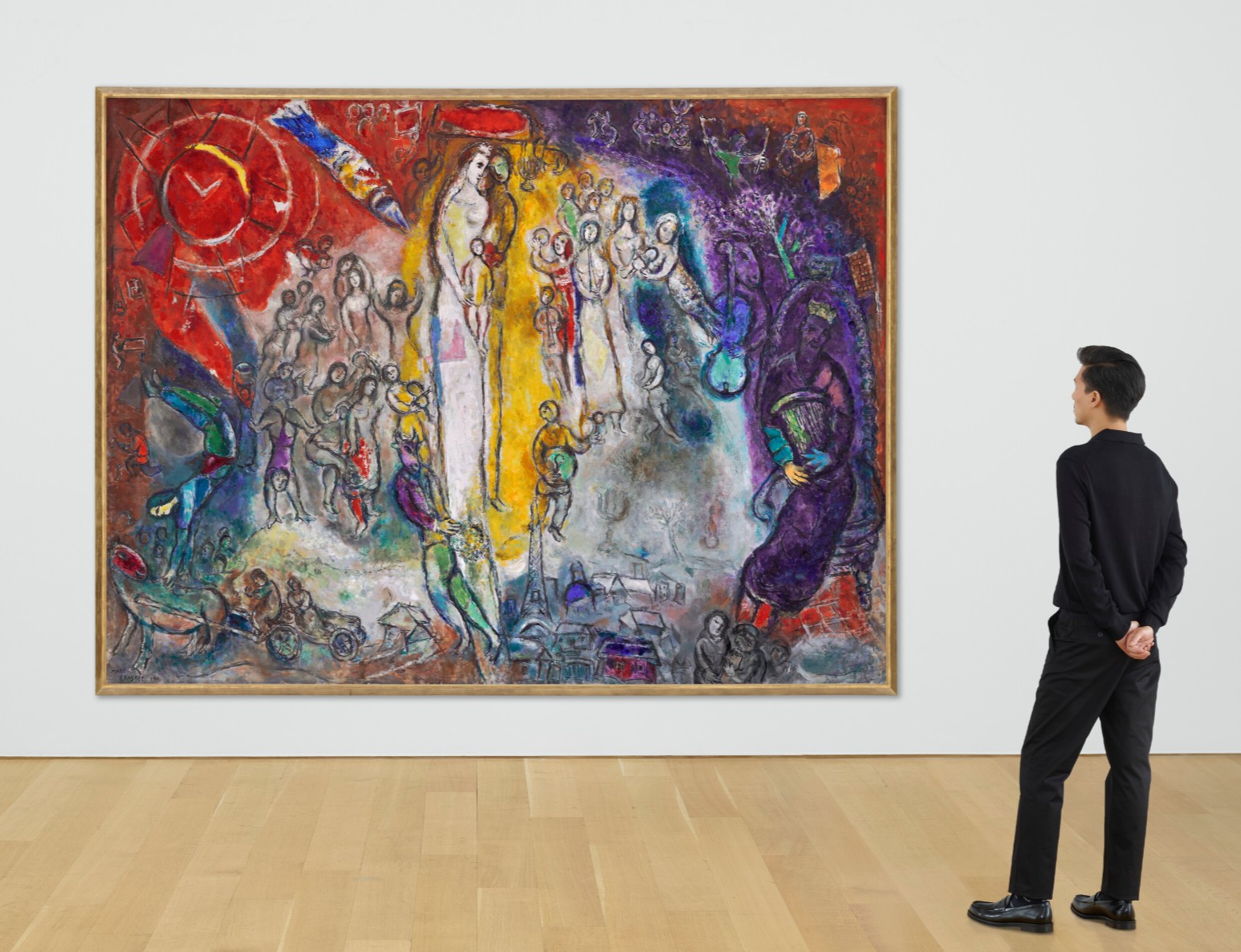
MARC CHAGALL (1887-1985)
Le songe du Roi David, 1966
Oil, tempera and sawdust on canvas
207.6 x 275.6 cm (81 3/4 x 108 1/2 inches)
Signed and dated ‘Marc Chagall 1966’ (lower left)
#14. Composition with Red and Blue, 1939-1941
The Collection of Robert F. and Patricia G. Ross Weis
Christie’s New-York: 17 November 2025
Estimated: USD 20,000,000 – 30,000,000
USD 23,060,000
PIET MONDRIAN (1872-1944), Composition with Red and Blue | Christie’s
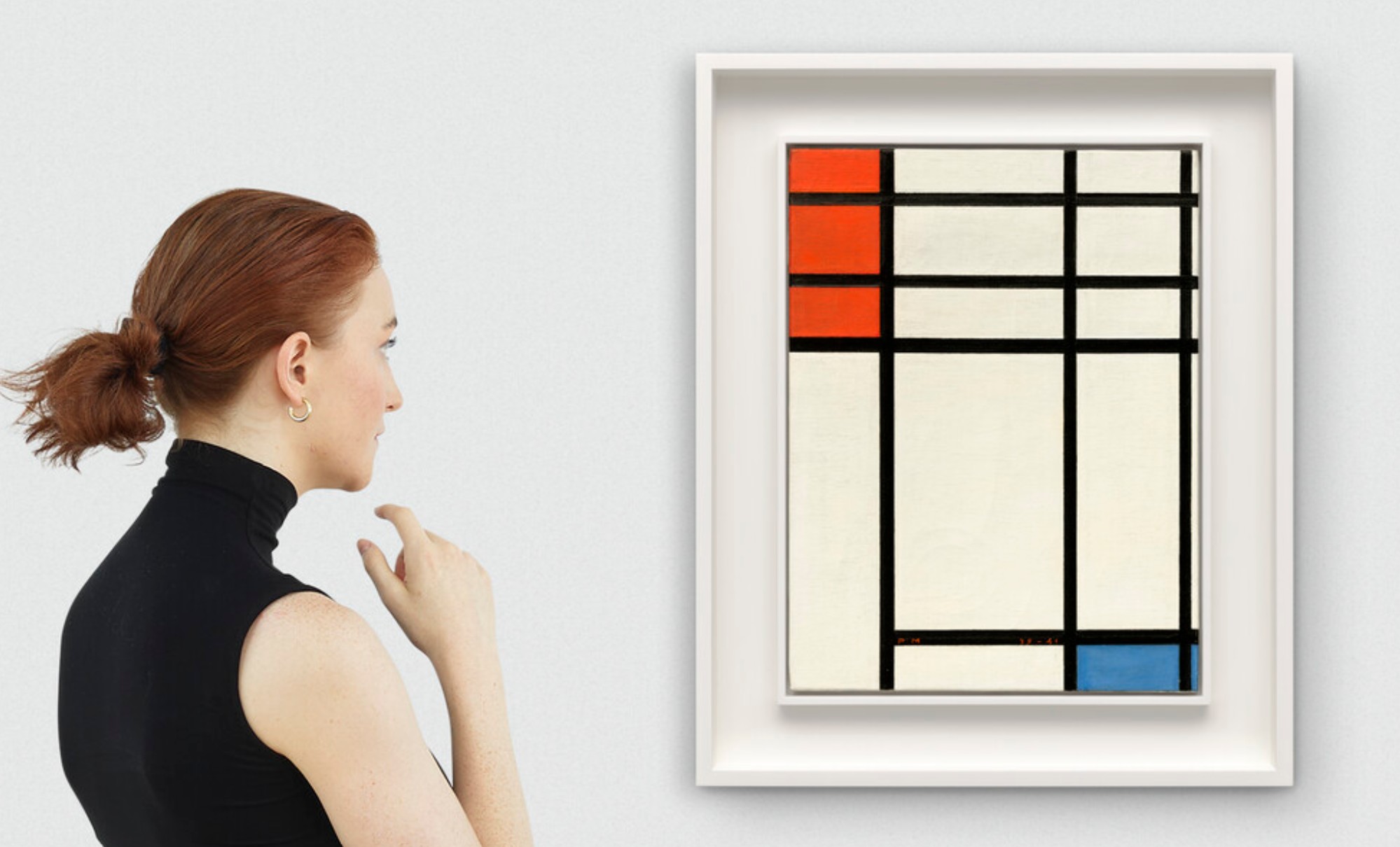
PIET MONDRIAN (1872-1944)
Composition with Red and Blue, 1939-1941
Oil on canvas
17 1/8 x 13 inches (43.5 x 33 cm)
Signed with initials and dated ‘PM 39-41’ (lower center)
Inscribed ‘of red, blue and white.’ (on the stretcher)
#15. Painted Wood, 1943
Property of Patricia Phelps de Cisneros
Christie’s New-York: 17 November 2025
Estimated: USD 15,000,000 – 20,000,000
USD 20,415,000
ALEXANDER CALDER (1898-1976), Painted Wood | Christie’s
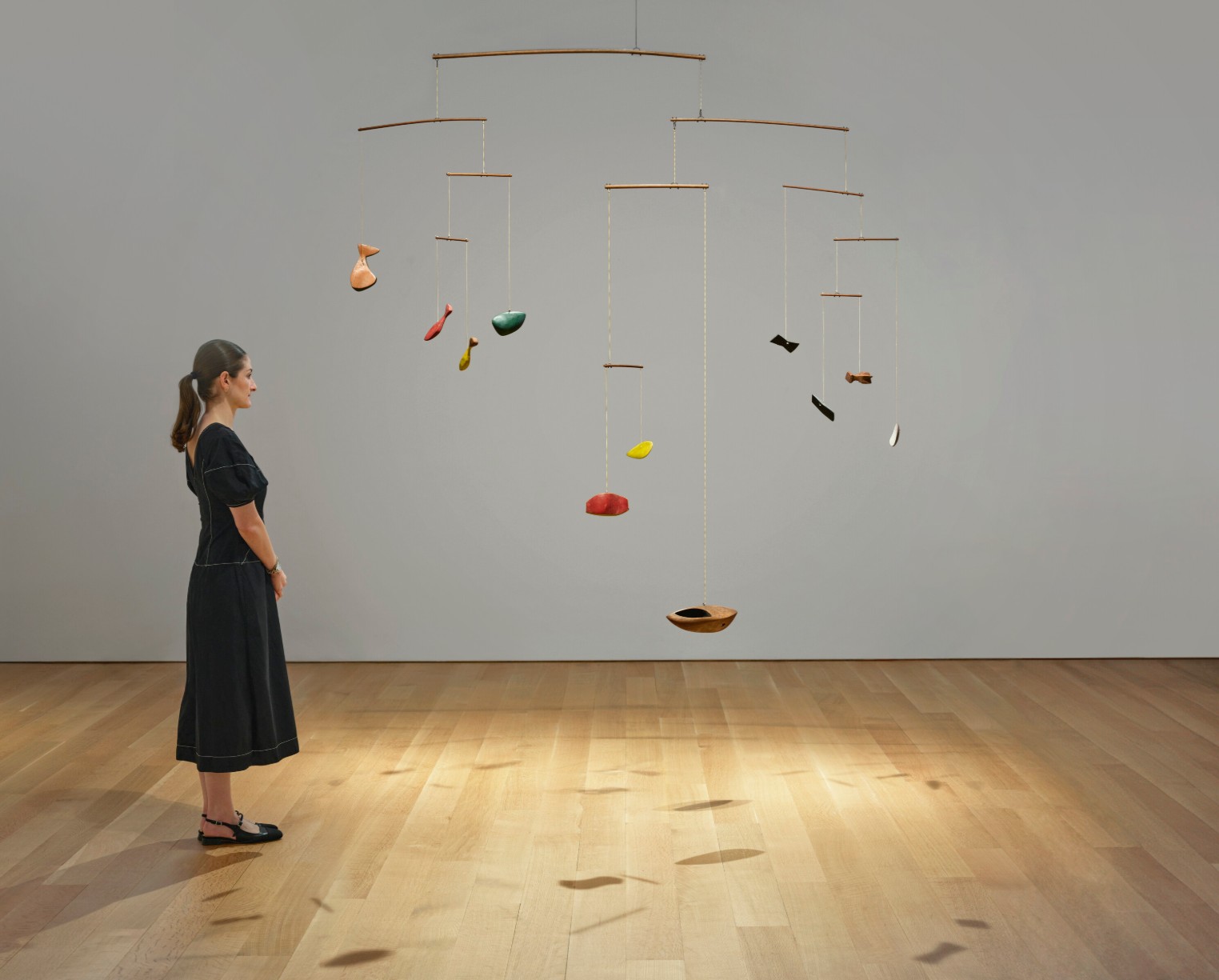
ALEXANDER CALDER (1898-1976)
Painted Wood, 1943
Hanging mobile—wood, string, wire and paint
198.1 x 189.2 x 11.5 cm (78 x 74 1/2 x 4 1/2 inches)
USD 20 million
#16. Untitled (RIOT), 1990
Christie’s New-York: 19 November 2025
Estimated: USD 15,000,000 – 20,000,000
USD 19,840,000
CHRISTOPHER WOOL (B. 1955), Untitled (RIOT) | Christie’s
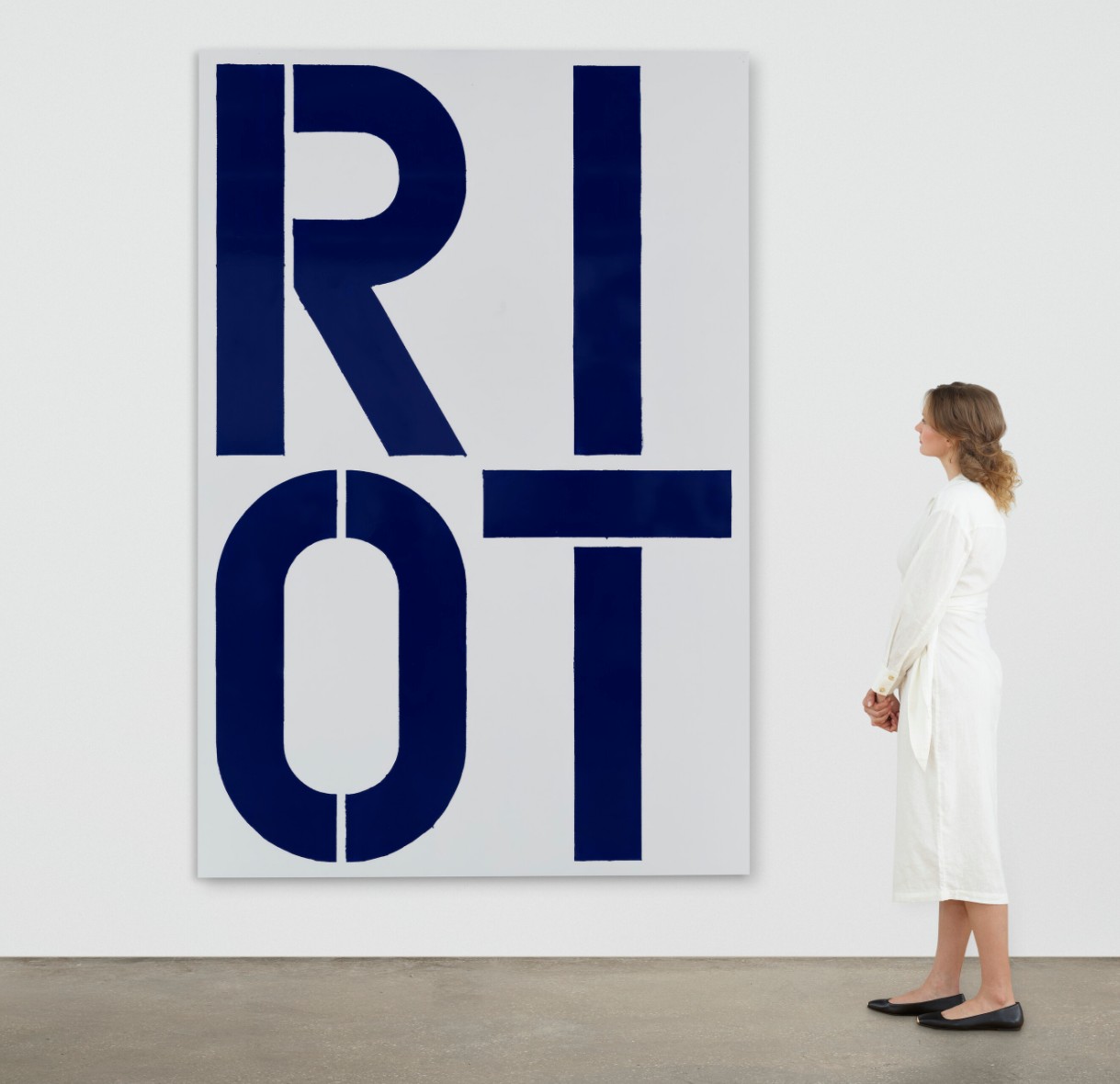
CHRISTOPHER WOOL (B. 1955)
Untitled (RIOT), 1990
Enamel on aluminum
108×72 inches (274.3 x 182.9 cm)
Signed, inscribed and dated ‘Wool 1990 (W16)’ (on the reverse)
#17. Composition (Nature morte), 1914
Birth of the Modern: The Arnold and Joan Saltzman Collection
Christie’s New-York: 17 November 2025
Estimated: USD 15,000,000 – 25,000,000
USD 19,610,000
FERNAND LEGER (1881-1955), Composition (Nature morte) | Christie’s
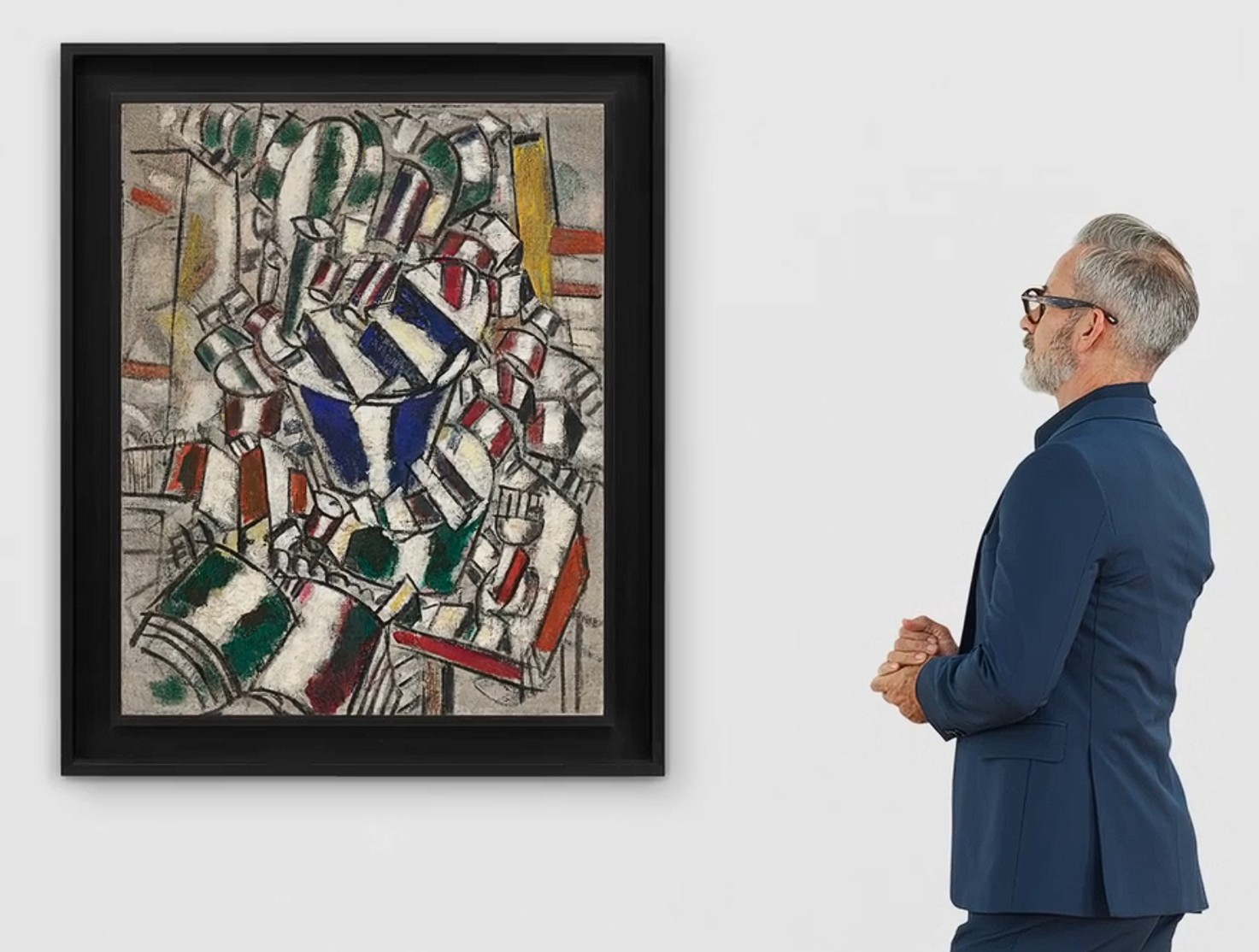
FERNAND LEGER (1881-1955)
Composition (Nature morte), 1914
Oil on canvas
92.9 x 73.2 cm (36 3/8 x 28 3/4 inches)
Signed, dated and titled ‘NATURE-MORTE F. LEGER 14’ (on the reverse)
#18. Sculpture éponge bleue sans titre (SE 167), circa 1959
Property from the Durand-Ruel Family Collection, Paris
Sotheby’s New-York: 18 November 2025
Estimated: USD 14,o00,000 – 18,000,000
USD 19,060,000
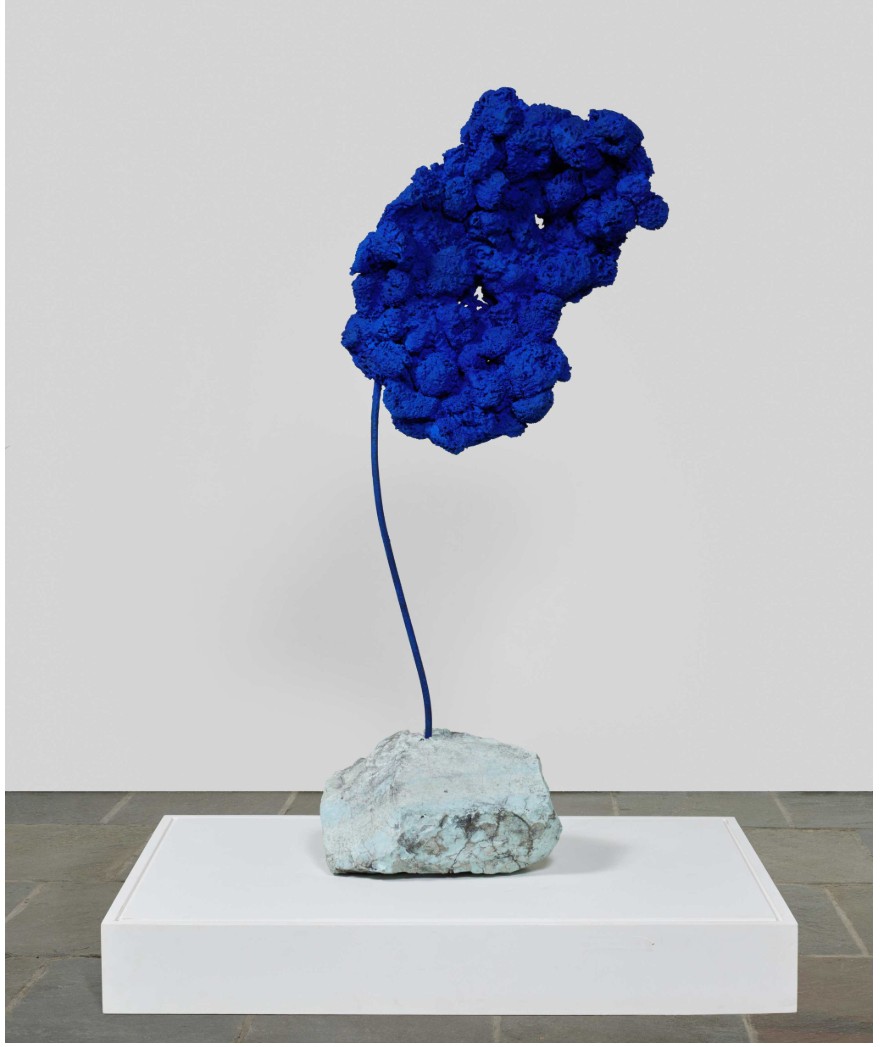
YVES KLEIN (1928 – 1962)
Sculpture éponge bleue sans titre (SE 167), circa 1959
Dry pigment and synthetic resin on natural sponge on a metal rod mounted on stone
138.4 x 69.9 x 54 cm (54 1/2 x 27 1/2 x 21 1/4 inches)
AUCTION RESULTS

The Collection of Robert F. and Patricia G. Ross Weis
17 November 2025
The Collection of Robert F. and Patricia G. Ross Weis
Auction Statistics
Total: USD 218,066,600
#Lots: 18 Lots
Withdrawn: 0 Lots
Unsold: 2 Lots
Sold: 16 Lots
Sell-Through Rate: 88.9%
Top Lot:
USD 62,160,000
Highlights
#1. No. 31 (Yellow Stripe), 1958
The Collection of Robert F. and Patricia G. Ross Weis
Christie’s New-York: 17 November 2025
Estimate on Request
USD 62,160,000
MARK ROTHKO (1903-1970), No. 31 (Yellow Stripe) | Christie’s
MARK ROTHKO (1903-1970)
No. 31 (Yellow Stripe), 1958
Oil on canvas
78 1/4 x 69 1/4 inches (198.8 x 175.9 cm)
Signed, partially titled and dated ‘MARK ROTHKO 1958 #31’ (on the reverse)
#2. La Lecture (Marie-Thérèse), 1932
The Collection of Robert F. and Patricia G. Ross Weis
Christie’s New-York: 17 November 2025
Estimate on Request
USD 45,485,000
PABLO PICASSO (1881-1973), La Lecture (Marie-Thérèse) | Christie’s
PABLO PICASSO (1881-1973)
La Lecture (Marie-Thérèse), 1932
Oil, Ripolin and charcoal on canvas
92.1 x 73 cm (36 1/4 x 28 3/4 inches)
Signed ‘Picasso’ (lower right)
Dated and inscribed ‘Boisgeloup 31 Août XXXII.’ (on the stretcher)
Painted in Boisgeloup on 31 August 1932
#3. Figure et bouquet (Tête ocre), 1937
The Collection of Robert F. and Patricia G. Ross Weis
Christie’s New-York: 17 November 2025
Estimated: USD 15,000,000 – 25,000,000
USD 32,260,000
HENRI MATISSE (1869-1954), Figure et bouquet (Tête ocre) | Christie’s
HENRI MATISSE (1869-1954)
Figure et bouquet (Tête ocre), 1937
Oil and Conté crayon on canvas
73.1 x 54 cm (28 3/4 x 21 1/4 inches)
Signed and dated ‘Henri Matisse 37’ (lower left)
Painted in Nice in February-March 1937
#4. Composition with Red and Blue, 1939-1941
The Collection of Robert F. and Patricia G. Ross Weis
Christie’s New-York: 17 November 2025
Estimated: USD 20,000,000 – 30,000,000
USD 23,060,000
PIET MONDRIAN (1872-1944), Composition with Red and Blue | Christie’s
PIET MONDRIAN (1872-1944)
Composition with Red and Blue, 1939-1941
Oil on canvas
17 1/8 x 13 inches (43.5 x 33 cm)
Signed with initials and dated ‘PM 39-41’ (lower center)
Inscribed ‘of red, blue and white.’ (on the stretcher)
XXXXXXXXXX
Peinture 161 x 200 cm, 14 novembre 1958
The Collection of Robert F. and Patricia G. Ross Weis
Christie’s New-York: 17 November 2025
Estimated: USD 5,000,000 – 7,000,000
USD 4,955,000
PIERRE SOULAGES (1919-2022), Peinture 161 x 200 cm, 14 novembre 1958 | Christie’s
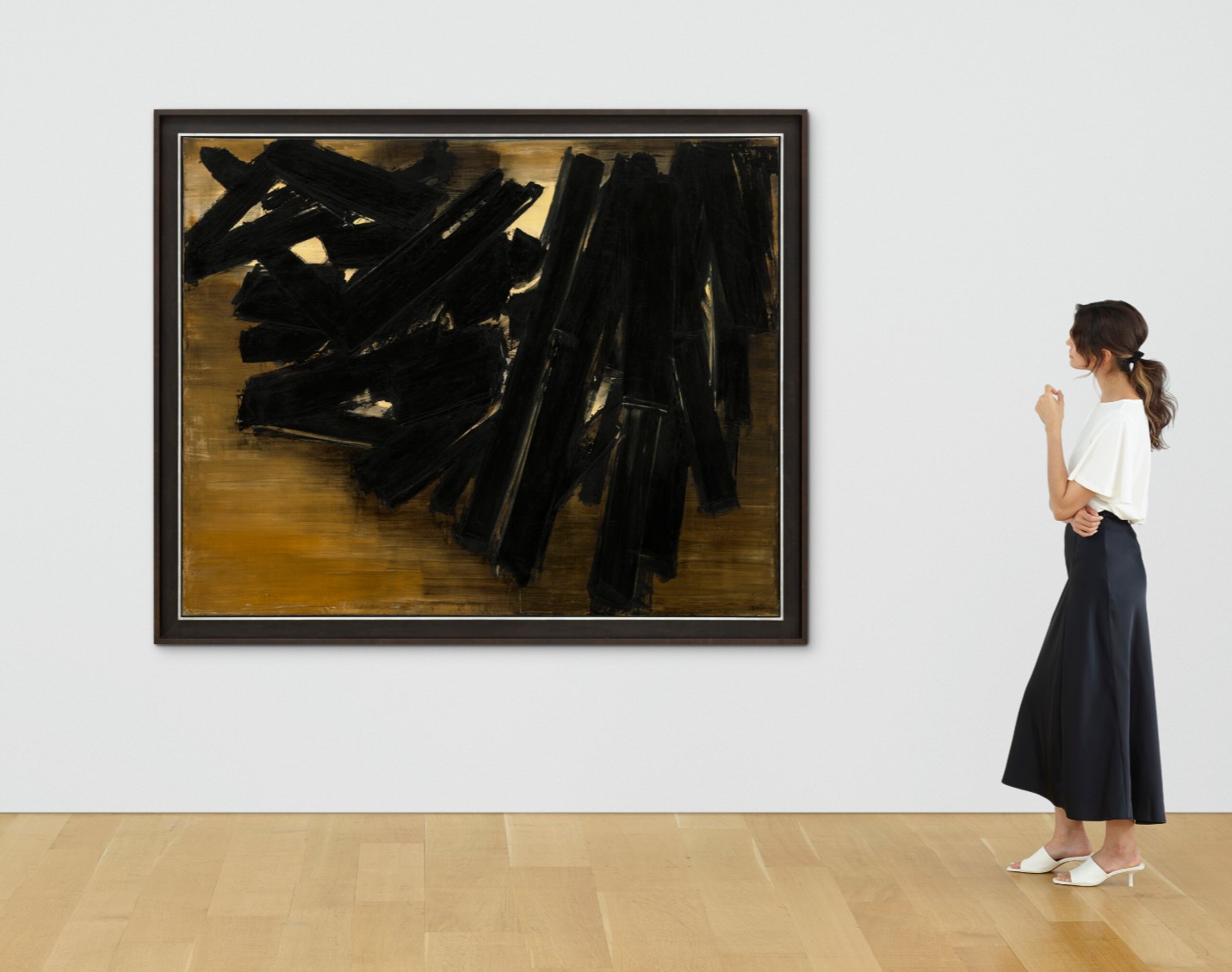
PIERRE SOULAGES (1919-2022)
Peinture 161 x 200 cm, 14 novembre 1958
Oil on canvas
161.9 x 201.6 cm (63 3/4 x 79 3/8 inches)
Signed ‘Soulages’ (lower right)
Signed again and dated ‘SOULAGES 58’ (on the reverse)
Signed thrice, partially titled and dated again ‘SOULAGES “Peinture” 14 nov 58’ (on the stretcher)
Painted in 1958
20th Century Evening Sale
17 November 2025
Auction Statistics
Total: USD 471,728,400
#Lots: 62 Lots
Withdrawn: 1 Lot
Unsold: 1 Lot
Sold: 60 Lots
Sell-Through Rate: 98.4%
Top Lot:
USD 45,485,000
Highlights
#1. Nymphéas, 1907
Property from the Kawamura Memorial DIC Museum of Art
Christie’s New-York: 17 November 2025
Estimated: USD 40,000,000 – 60,000,000
USD 45,485,000
CLAUDE MONET (1840-1926), Nymphéas | Christie’s
CLAUDE MONET (1840-1926)
Nymphéas, 1907
Oil on canvas
92 x 73.6 cm (36 1/4 x 29 inches)
Signed and dated ‘Claude Monet 1907’ (lower right)
#2. Christopher Isherwood and Don Bachardy, 1968
Property from a Distinguished Private European Collection
Christie’s New-York: 17 November 2025
Estimate on Request
USD 44,335,000
DAVID HOCKNEY (B. 1937), Christopher Isherwood and Don Bachardy | Christie’s
DAVID HOCKNEY (B. 1937)
Christopher Isherwood and Don Bachardy, 1968
Acrylic on canvas
83 1/2 x 119 1/2 inches (212 x 303.5 cm)
#3. Le songe du Roi David, 1966
Property from the Kawamura Memorial DIC Museum of Art
Christie’s New-York: 17 November 2025
Estimated: USD 8,000,000 – 12,000,000
USD 26,510,000
MARC CHAGALL (1887-1985), Le songe du Roi David | Christie’s
MARC CHAGALL (1887-1985)
Le songe du Roi David, 1966
Oil, tempera and sawdust on canvas
207.6 x 275.6 cm (81 3/4 x 108 1/2 inches)
Signed and dated ‘Marc Chagall 1966’ (lower left)
#4. Painted Wood, 1943
Property of Patricia Phelps de Cisneros
Christie’s New-York: 17 November 2025
Estimated: USD 15,000,000 – 20,000,000
USD 20,415,000
ALEXANDER CALDER (1898-1976), Painted Wood | Christie’s
ALEXANDER CALDER (1898-1976)
Painted Wood, 1943
Hanging mobile—wood, string, wire and paint
198.1 x 189.2 x 11.5 cm (78 x 74 1/2 x 4 1/2 inches)
USD 20 million
#5. Composition (Nature morte), 1914
Birth of the Modern: The Arnold and Joan Saltzman Collection
Christie’s New-York: 17 November 2025
Estimated: USD 15,000,000 – 25,000,000
USD 19,610,000
FERNAND LEGER (1881-1955), Composition (Nature morte) | Christie’s
FERNAND LEGER (1881-1955)
Composition (Nature morte), 1914
Oil on canvas
92.9 x 73.2 cm (36 3/8 x 28 3/4 inches)
Signed, dated and titled ‘NATURE-MORTE F. LEGER 14’ (on the reverse)
#6. Ocean Park #40, 1971
Elaine: The Collection of Elaine Wynn
Christie’s New-York: 17 November 2025
Estimated: USD 15,000,000 – 25,000,000
USD 17,655,000
RICHARD DIEBENKORN (1922-1993), Ocean Park #40 | Christie’s
REPEAT SALE
American Visionary: The Collection of Mrs. John L. Marion
Sotheby’s New-York: 12 May 2021
Estimated: USD 20,000,000 – 30,000,000
USD 27,265,500
Ocean Park #40 | American Visionary: The Collection of Mrs. John L. Marion | 2021 | Sotheby’s
RICHARD DIEBENKORN (1922-1993)
Ocean Park #40, 1971
Oil and charcoal on canvas
93×81 inches (236.2 x 205.7 cm)
Signed with the artist’s initials and dated ‘RD 71’ (lower right)
Signed, titled and dated again ‘R. Diebenkorn 1971 OCEAN PARK #40’ (on the reverse)
#7. Sunflower V, 1969
Elaine: The Collection of Elaine Wynn
Christie’s New-York: 17 November 2025
Estimated: USD 12,000,000 – 18,000,000
USD 16,735,000
JOAN MITCHELL (1925-1992), Sunflower V | Christie’s
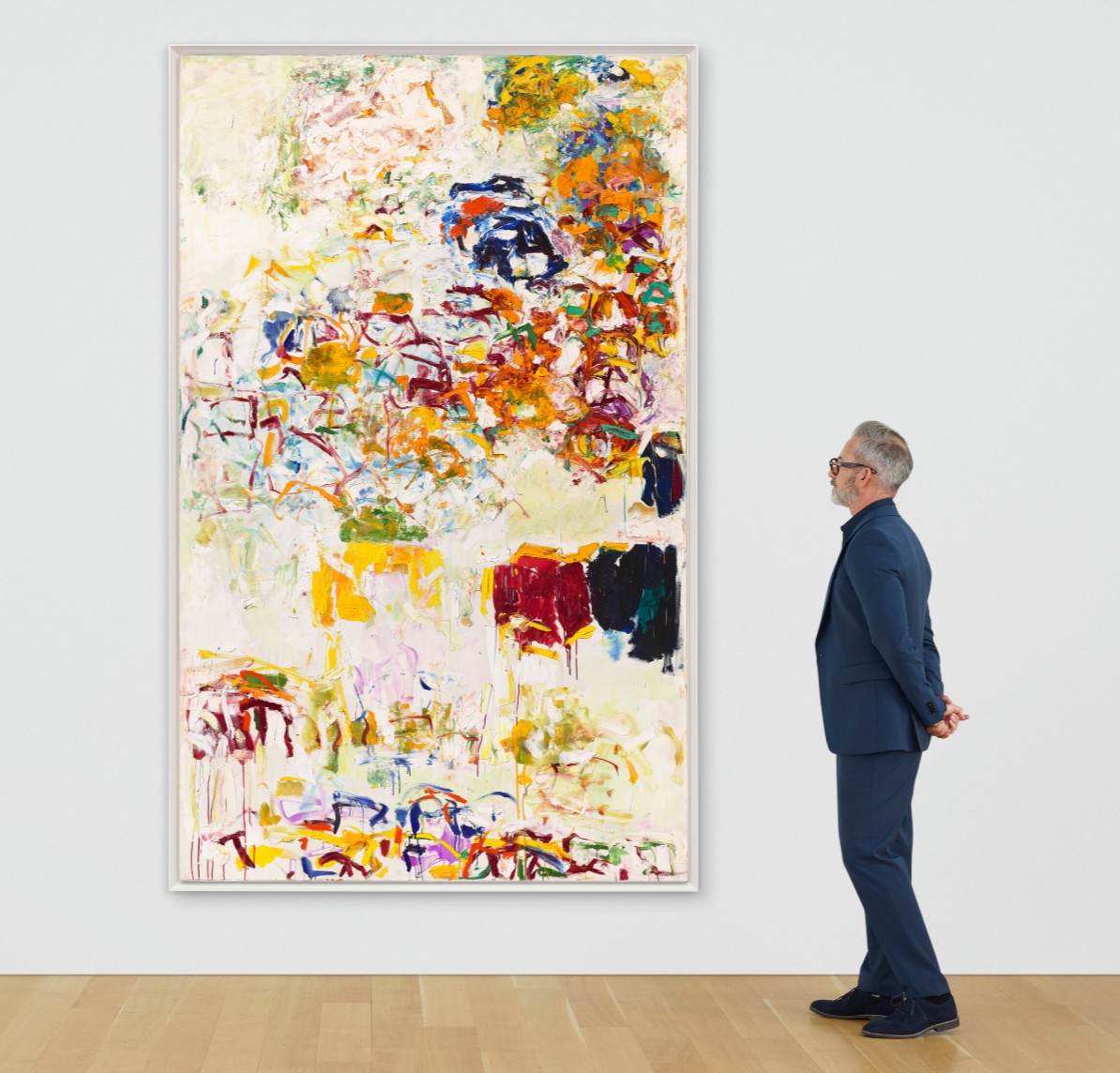
JOAN MITCHELL (1925-1992)
Sunflower V, 1969
Oil on canvas
102 1/2 x 63 inches (260.4 x 160 cm)
Signed ‘J. Mitchell’ (lower right)
#8. The Painter Surprised by a Naked Admirer, 2004-2005
Elaine: The Collection of Elaine Wynn
Christie’s New-York: 17 November 2025
Estimated: USD 15,000,000 – 25,000,000
USD 14,435,000
LUCIAN FREUD (1922-2011), The Painter Surprised by a Naked Admirer | Christie’s
LUCIAN FREUD (1922-2011)
The Painter Surprised by a Naked Admirer, 2004-2005
Oil on canvas
54×42 inches (137.2 x 106.7 cm)
USD 10 million
My Garden in Los Angeles, London, July 2000, 2000
Property from an Important Private Collection
Christie’s New-York: 17 November 2025
Estimated: USD 7,500,000 – 10,000,000
USD 9,469,000
DAVID HOCKNEY (B. 1937), My Garden in Los Angeles, London, July 2000 | Christie’s
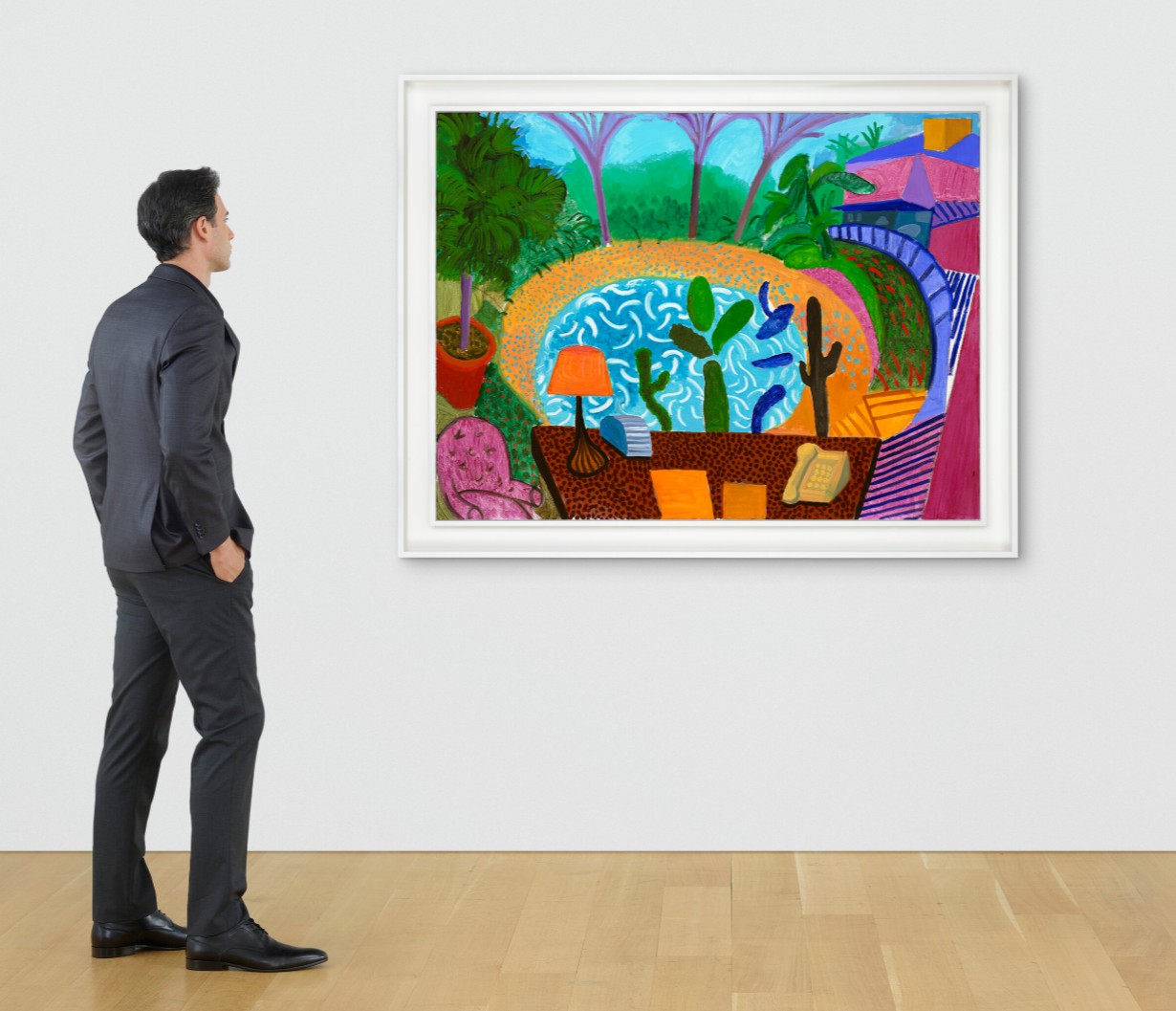
DAVID HOCKNEY (B. 1937)
My Garden in Los Angeles, London, July 2000, 2000
Oil on canvas
36×48 inches (91.4 x 121.9 cm)
Signed and dated ‘David Hockney ’00’ (on the reverse)
XXXXXXXXXX
Mère et enfant, 1965
Christie’s New-York: 17 November 2025
Estimated: USD 4,000,000 – 6,000,000
USD 5,077,000
PABLO PICASSO (1881-1973), Mère et enfant | Christie’s
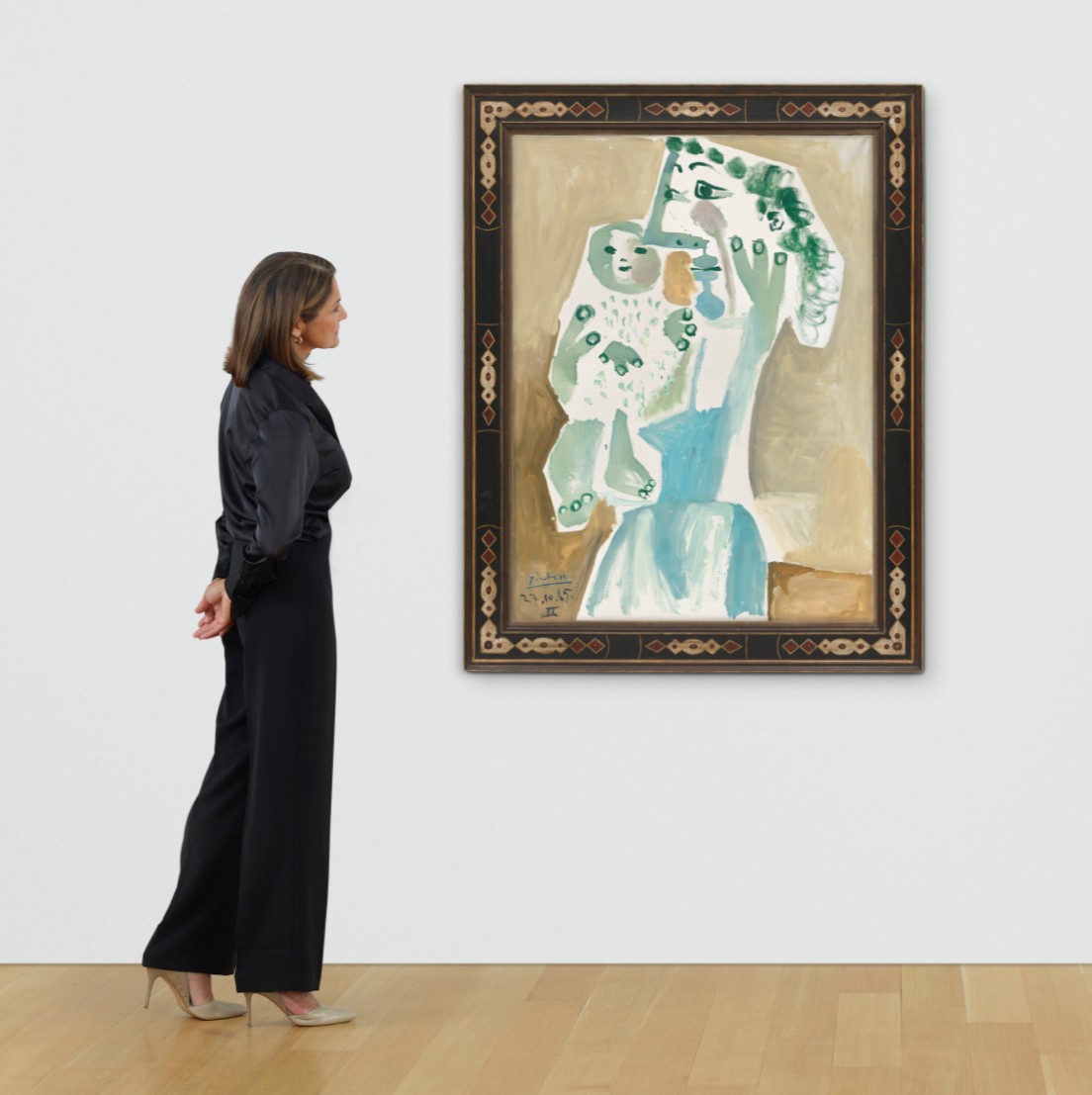
PABLO PICASSO (1881-1973)
Mère et enfant, 1965
Oil on canvas
130.2 x 97.2 cm (51 1/4 x 38 1/4 inches)
Signed, dated and numbered ‘Picasso 27.10. 65. II’ (lower left)
Painted in Mougins on 27 October 1965
Le Baigneur, 1957
Birth of the Modern: The Arnold and Joan Saltzman Collection
Christie’s New-York: 17 November 2025
Estimated: USD 3,500,000 – 5,500,000
USD 3,979,000
PABLO PICASSO (1881-1973), Le Baigneur | Christie’s
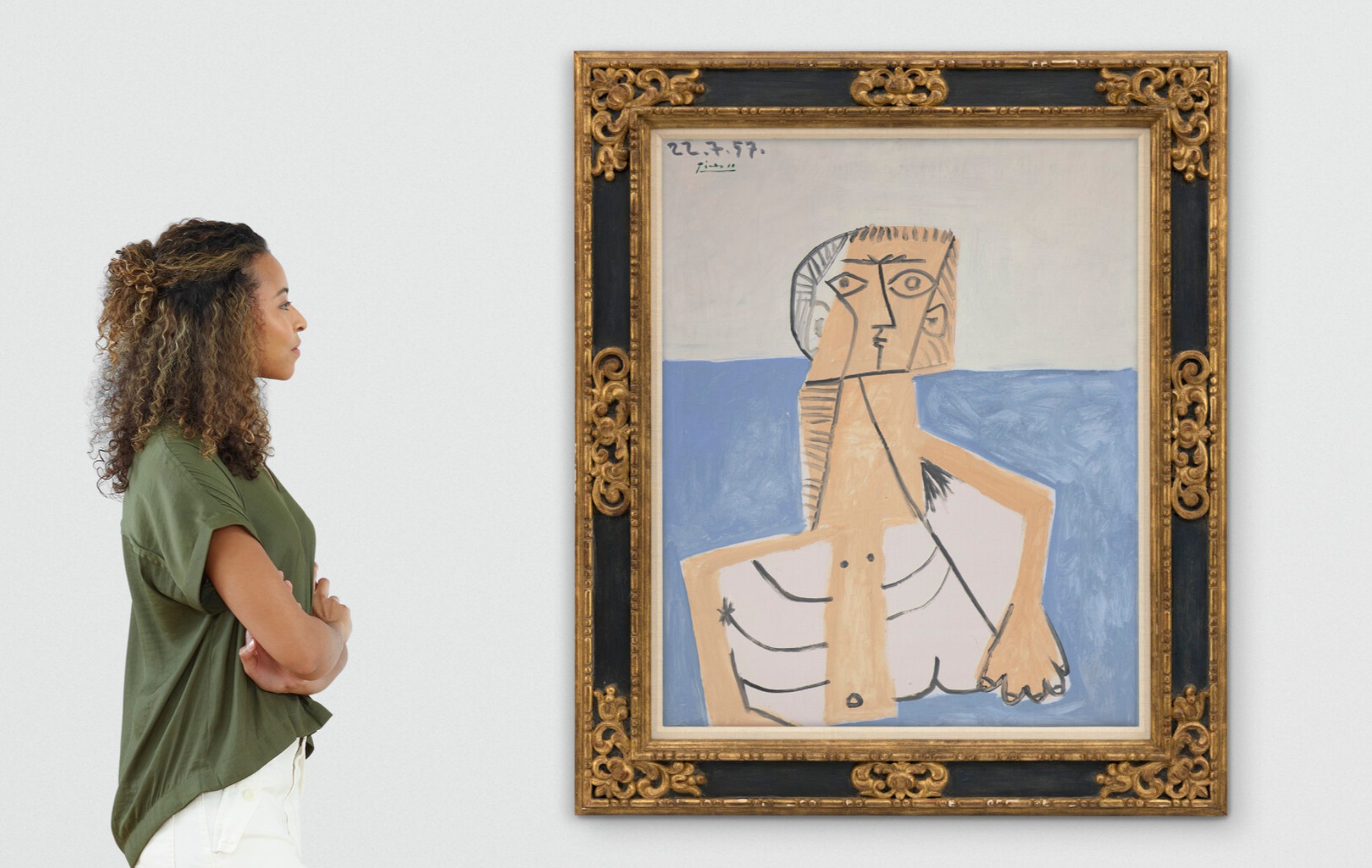
PABLO PICASSO (1881-1973)
Le Baigneur, 1957
Oil on canvas
100.5 x 81.4 cm (39 1/2 x 33 inches)
Signed and dated ‘Picasso 22.7.57.’ (upper left)
Mousquetaire, tête, 1967
The Art of Collecting: Property from a Distinguished Private Collector
Christie’s New-York: 17 November 2025
Estimated: USD 3,000,000 – 5,000,000
USD 4,101,000
PABLO PICASSO (1881-1973), Mousquetaire, tête | Christie’s
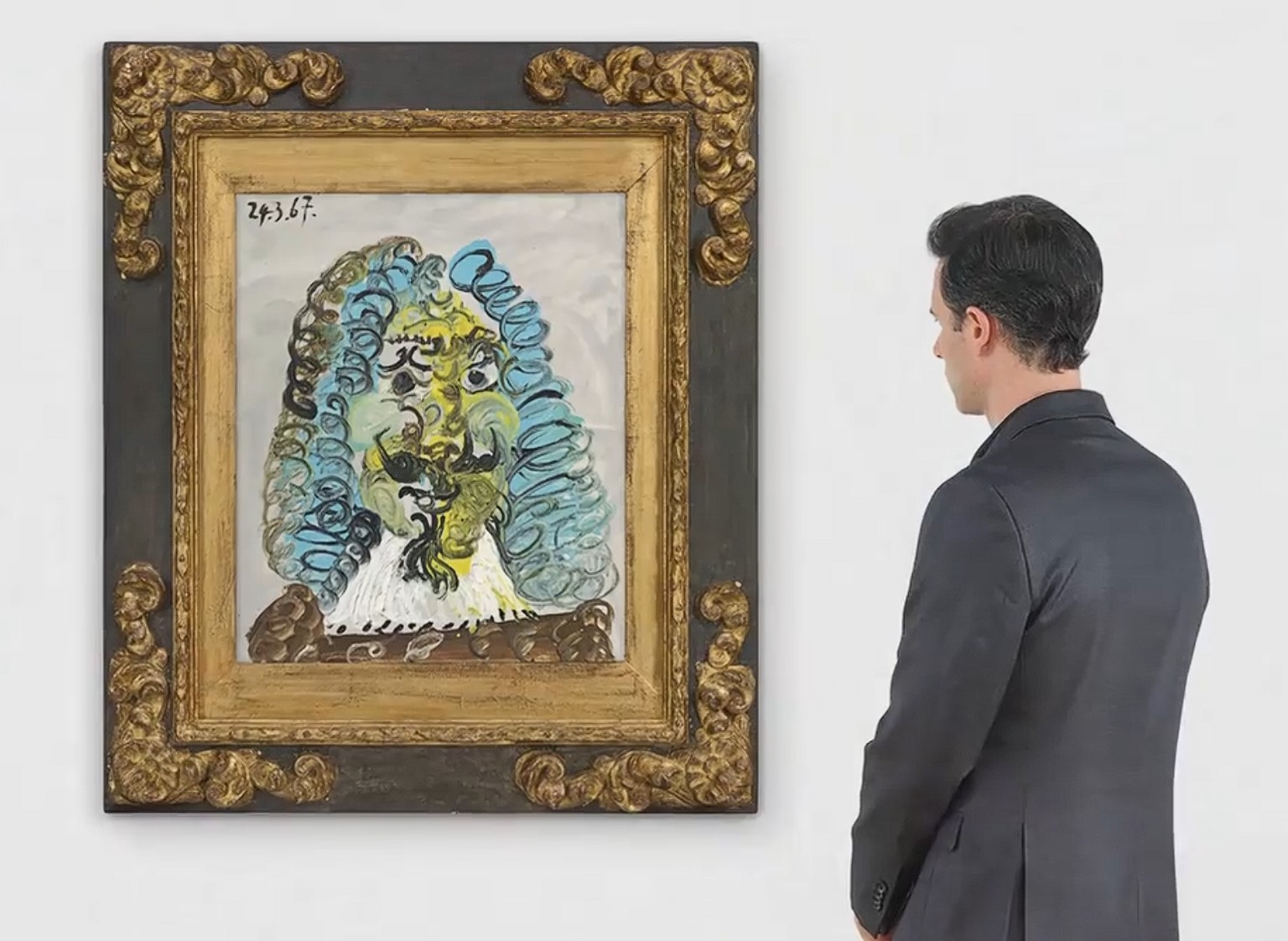
PABLO PICASSO (1881-1973)
Mousquetaire, tête, 1967
Oil on canvas
65×54 cm (25 5/8 x 21 1/4 inches)
Dated ‘24.3.67.’ (upper left)
Dated again and numbered ‘24.3.67. II’ (on the reverse)
Femme dans un fauteuil, 1946
Birth of the Modern: The Arnold and Joan Saltzman Collection
Christie’s New-York: 17 November 2025
Estimated: USD 3,000,000 – 5,000,000
USD 3,979,000
PABLO PICASSO (1881-1973), Femme dans un fauteuil | Christie’s
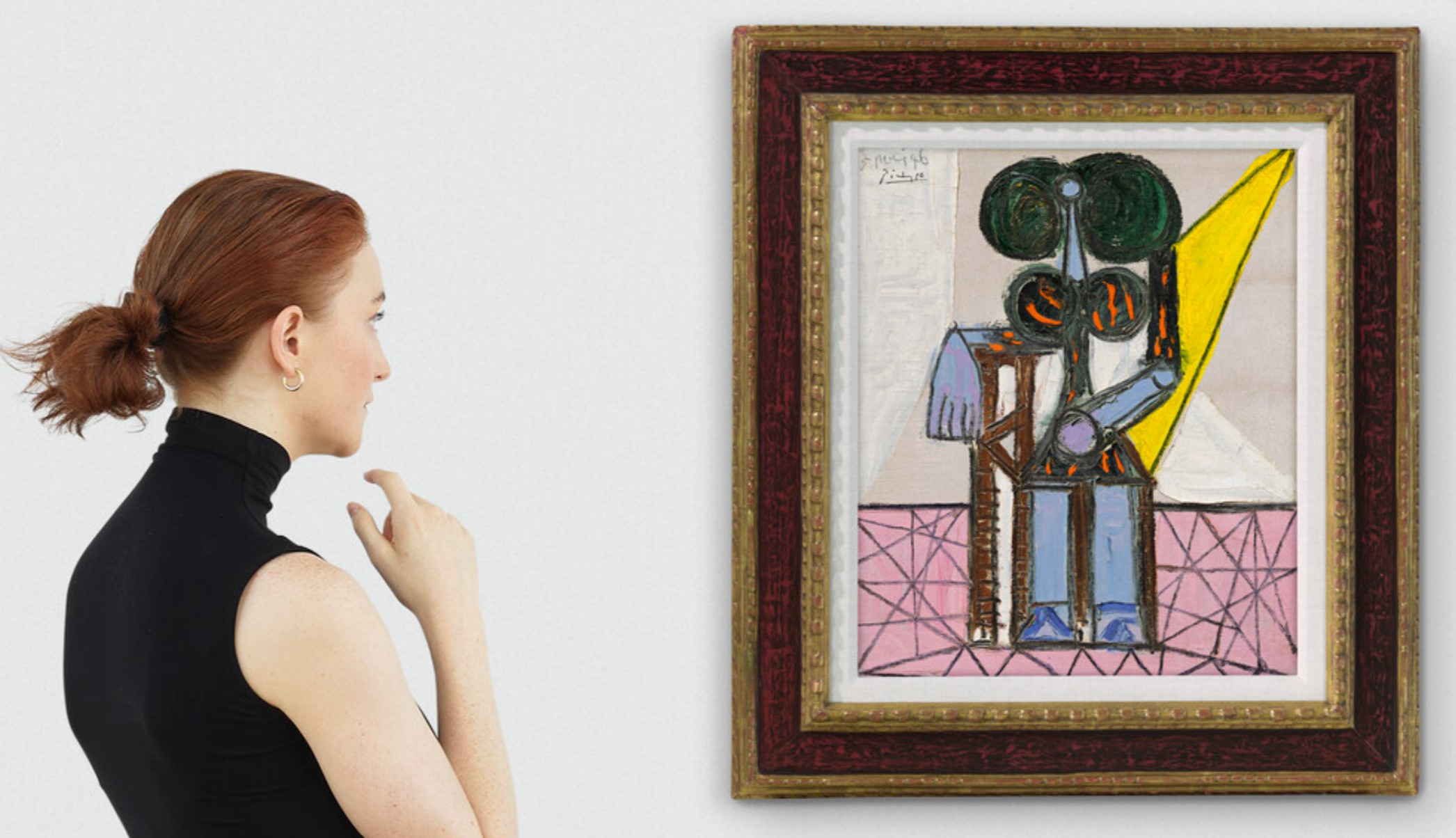
PABLO PICASSO (1881-1973)
Femme dans un fauteuil, 1946
Oil and charcoal on canvas
55.3 x 46.2 cm (21 5/8 x 18 1/8 inches)
Signed and dated ‘Picasso 5 mai 46’ (upper left)
Dated again ‘5 mai 46’ (on the reverse)
XXXXXXXXXX
Florero, 1970
Property from a Private European Collection
Christie’s New-York: 17 November 2025
Estimated: USD 1,200,000 – 1,800,000
USD 1,524,000
FERNANDO BOTERO (1932-2023), Florero | Christie’s
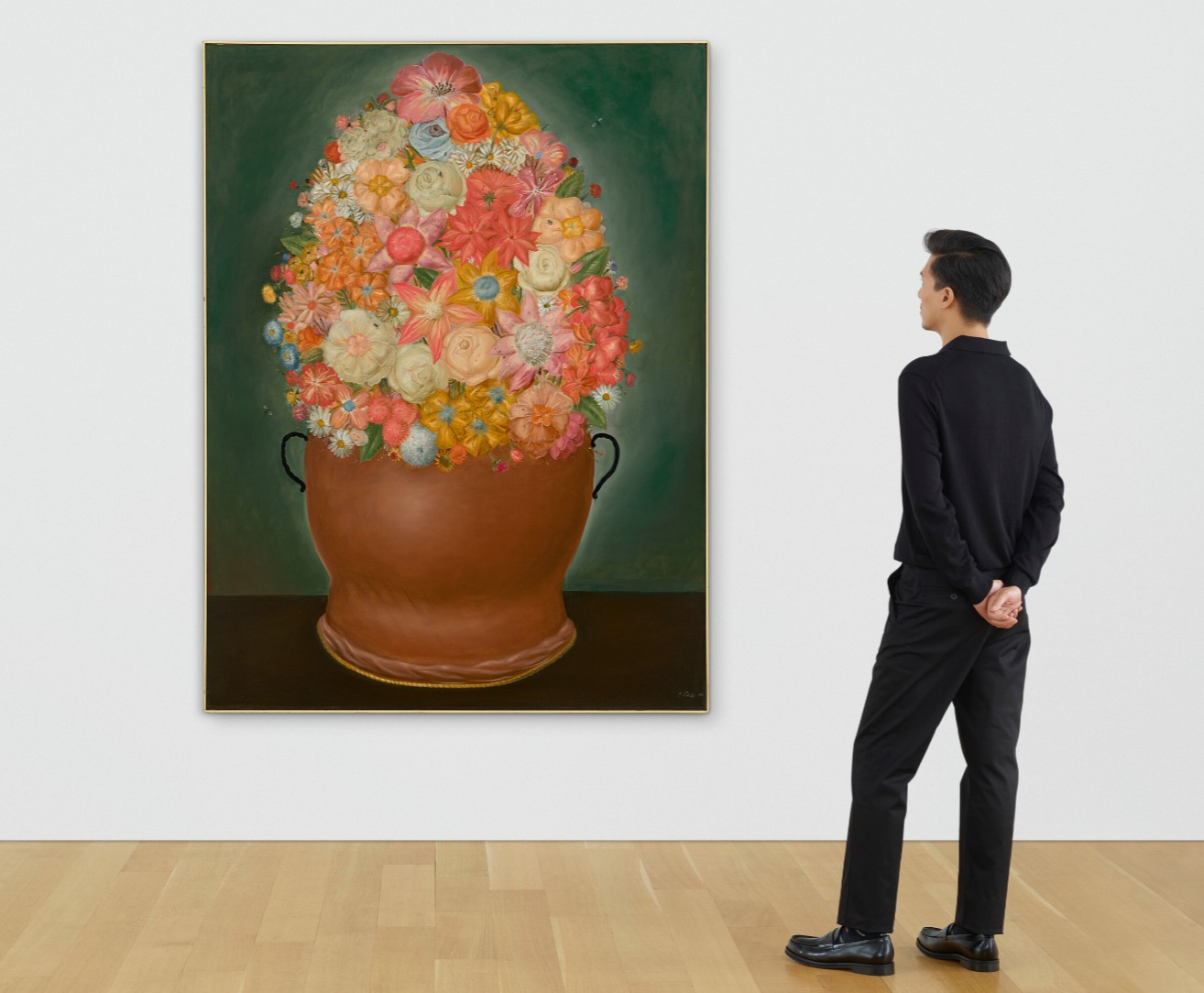
FERNANDO BOTERO (1932-2023)
Florero, 1970
Oil on canvas
193 x 144.8 cm (76×57 inches)
Signed and dated ‘Botero 70’ (lower right)
Signed, titled and dated twice ‘FLORERO Botero 70’ (on the reverse)
21st Century Evening Sale
Featuring Works from the Edlis | Neeson Collection
19 November 2025
21st Century Evening Sale Featuring Works from the Edlis | Neeson Collection
Auction Statistics
Total: USD 123,585,950
#Lots: 45 Lots
Withdrawn: 0 Lots
Unsold: 1 Lot
Sold: 44 Lots
Sell-Through Rate: 97.8%
Top Lot:
USD 19,840,000
Highlights
#1. Untitled (RIOT), 1990
Christie’s New-York: 19 November 2025
Estimated: USD 15,000,000 – 20,000,000
USD 19,840,000
CHRISTOPHER WOOL (B. 1955), Untitled (RIOT) | Christie’s
CHRISTOPHER WOOL (B. 1955)
Untitled (RIOT), 1990
Enamel on aluminum
108×72 inches (274.3 x 182.9 cm)
Signed, inscribed and dated ‘Wool 1990 (W16)’ (on the reverse)
USD 10 million
#2. The Last Supper, 1986
Edlis Neeson Collection
Christie’s New-York: 19 November 2025
Estimated: USD 6,000,000 – 8,000,000
USD 8,127,000
ANDY WARHOL (1928-1987), The Last Supper | Christie’s
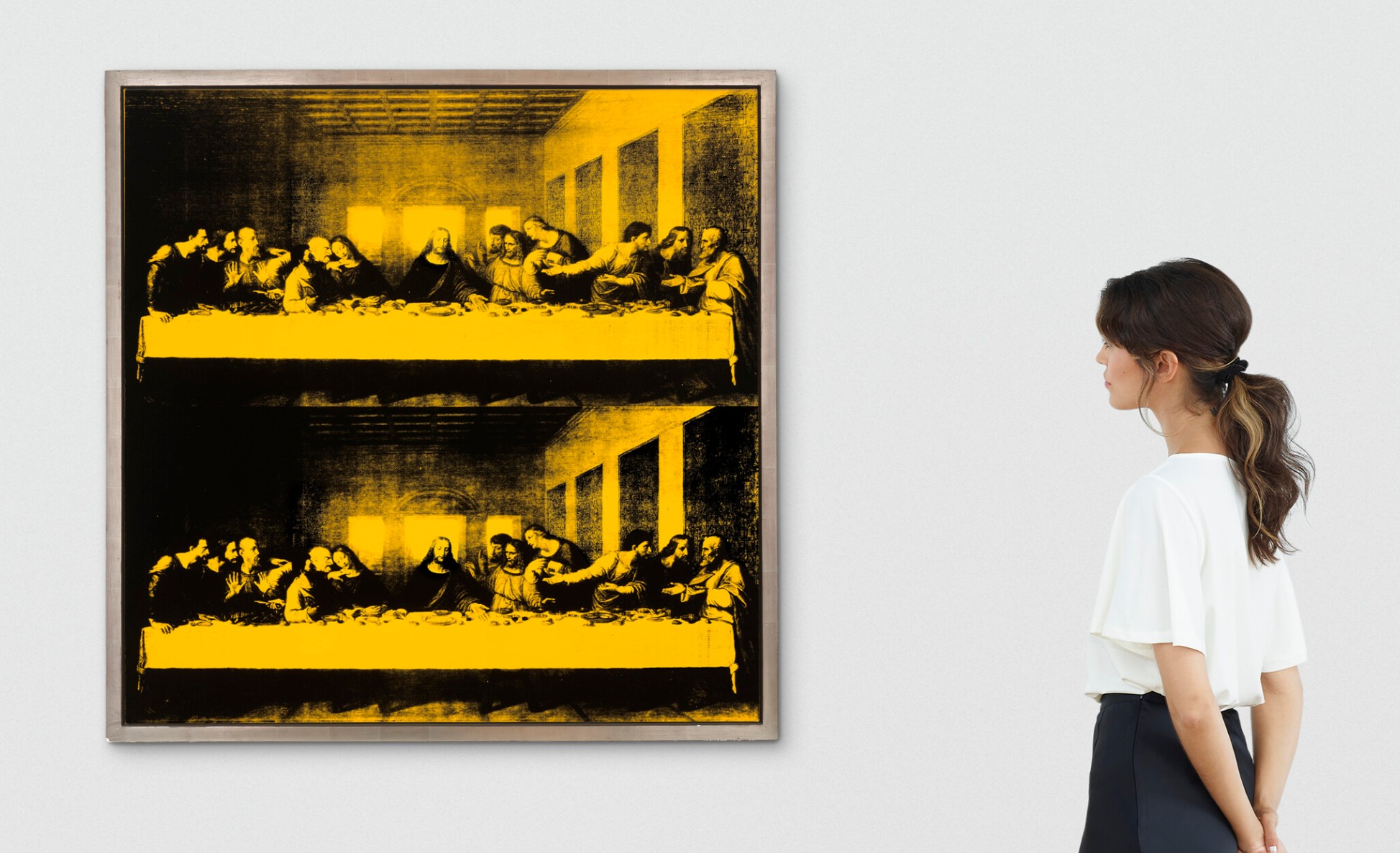
ANDY WARHOL (1928-1987)
The Last Supper, 1986
Acrylic and silkscreen ink on canvas
40×40 inches (101.6 x 101.6 cm)
Stamped with the artist’s signature ‘Andy Warhol ©’ (on the overlap)
Signed and inscribed by Frederick Hughes
‘I certify this to be an original painting by Andy Warhol completed by him in 1986 Frederick Hughes’
(on the overlap)
#3. Portrait of John Punch (Angry Black Man 1646), 2007
Property Sold to Benefit The Bailey Arts Foundation
Christie’s New-York: 19 November 2025
Estimated: USD 4,000,000 – 6,000,000
USD 7,151,000
KERRY JAMES MARSHALL (B. 1955), Portrait of John Punch (Angry Black Man 1646) | Christie’s
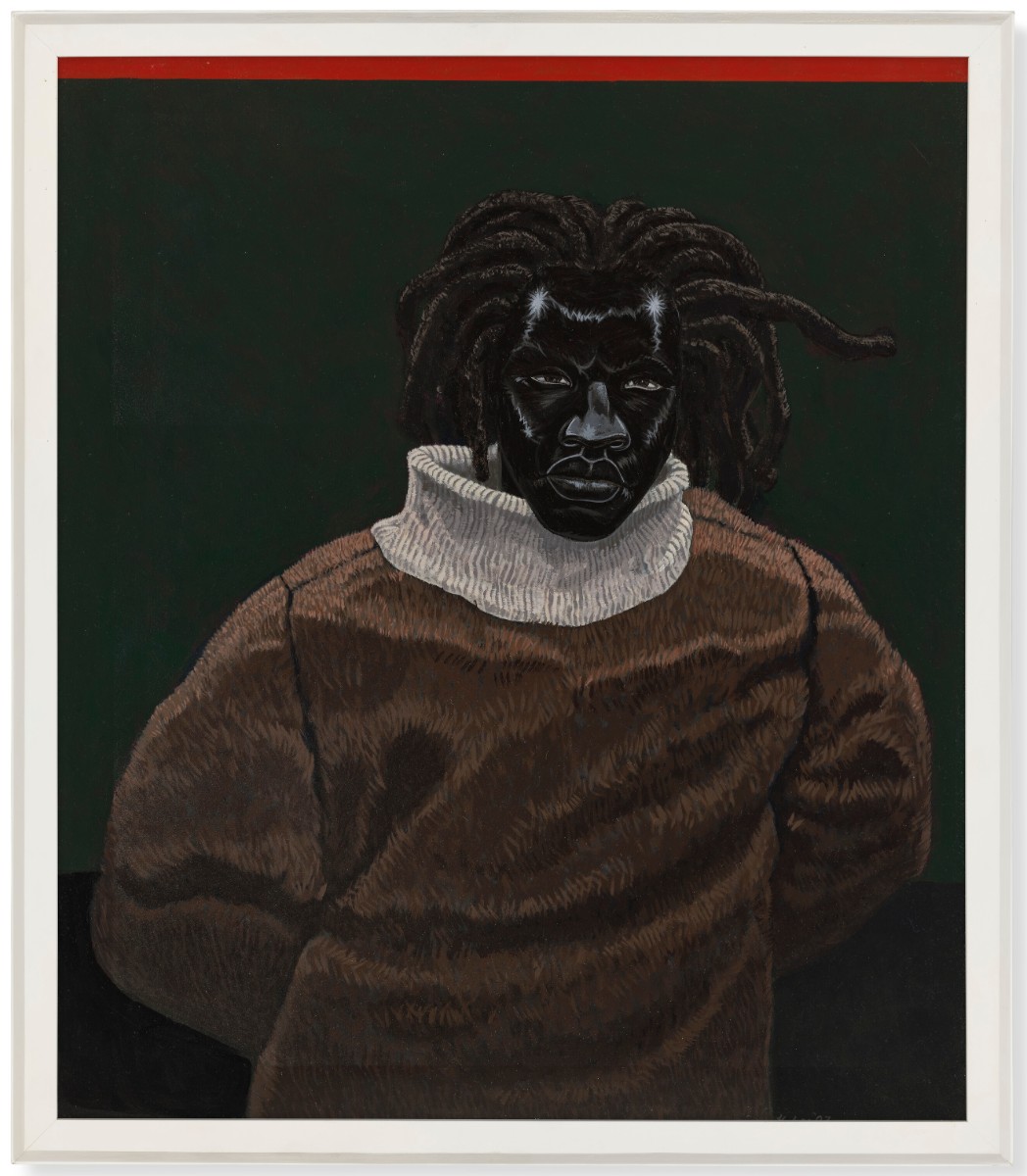
KERRY JAMES MARSHALL (B. 1955)
Portrait of John Punch (Angry Black Man 1646), 2007
Acrylic on PVC, in artist’s frame
30×26 inches (76.2 × 66 cm)
Signed with the artist’s initials and dated ‘K.J.M. ’07’ (lower right)
#4. How Do You Do?, 2003
Edlis Neeson Collection
Christie’s New-York: 19 November 2025
Estimated: USD 5,000,000 – 7,000,000
USD 6,785,000
ED RUSCHA (B. 1937), How Do You Do? | Christie’s
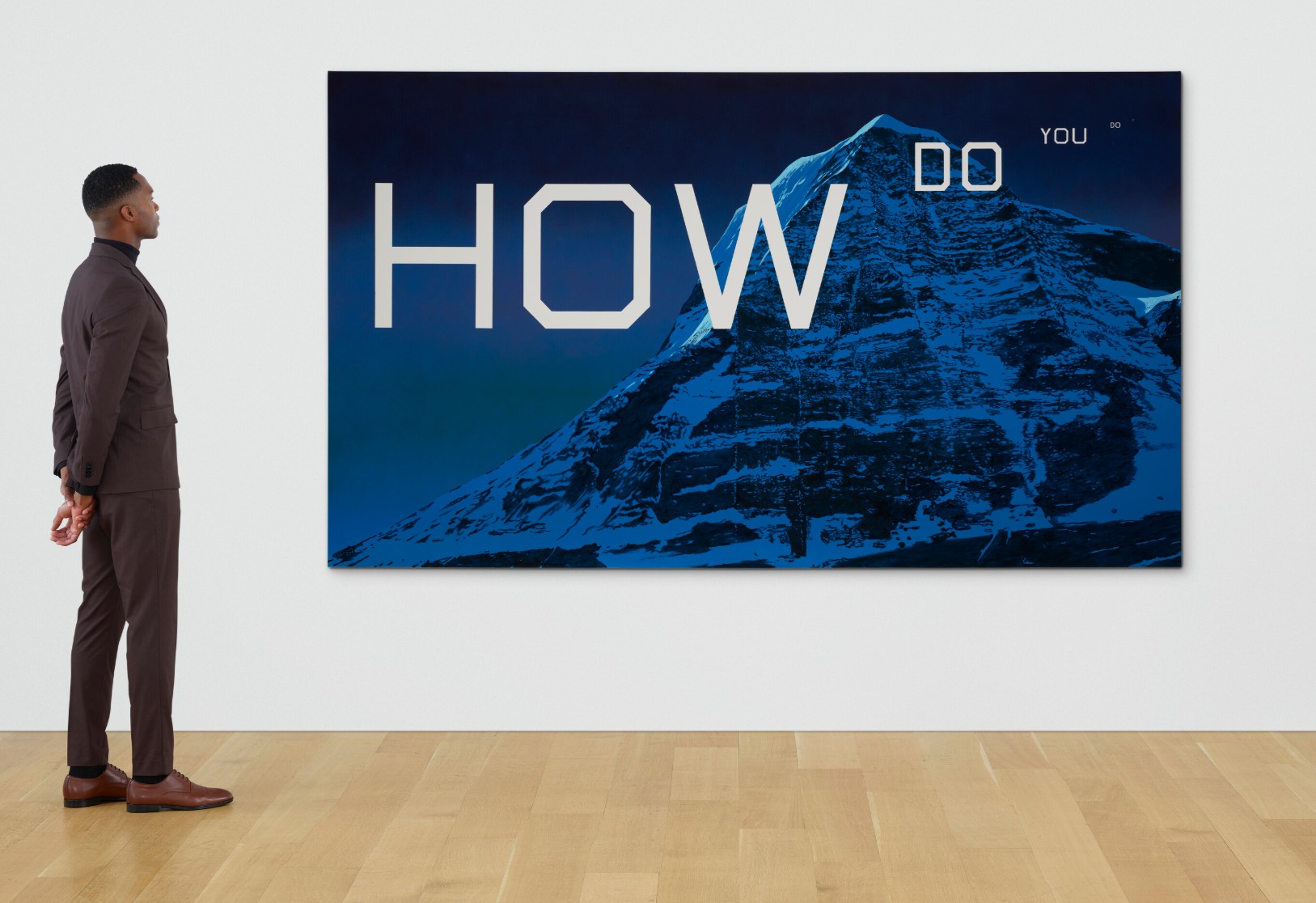
ED RUSCHA (B. 1937)
How Do You Do?, 2003
Oil on canvas
72×124 inches (182.9 x 315 cm)
Signed and dated twice ‘Ed Ruscha 2003’ (on the reverse)
#5. Untitled #12, 1989
Christie’s New-York: 19 November 2025
Estimated: USD 3,000,000 – 5,000,000
USD 6,053,000
AGNES MARTIN (1912-2004), Untitled #12 | Christie’s
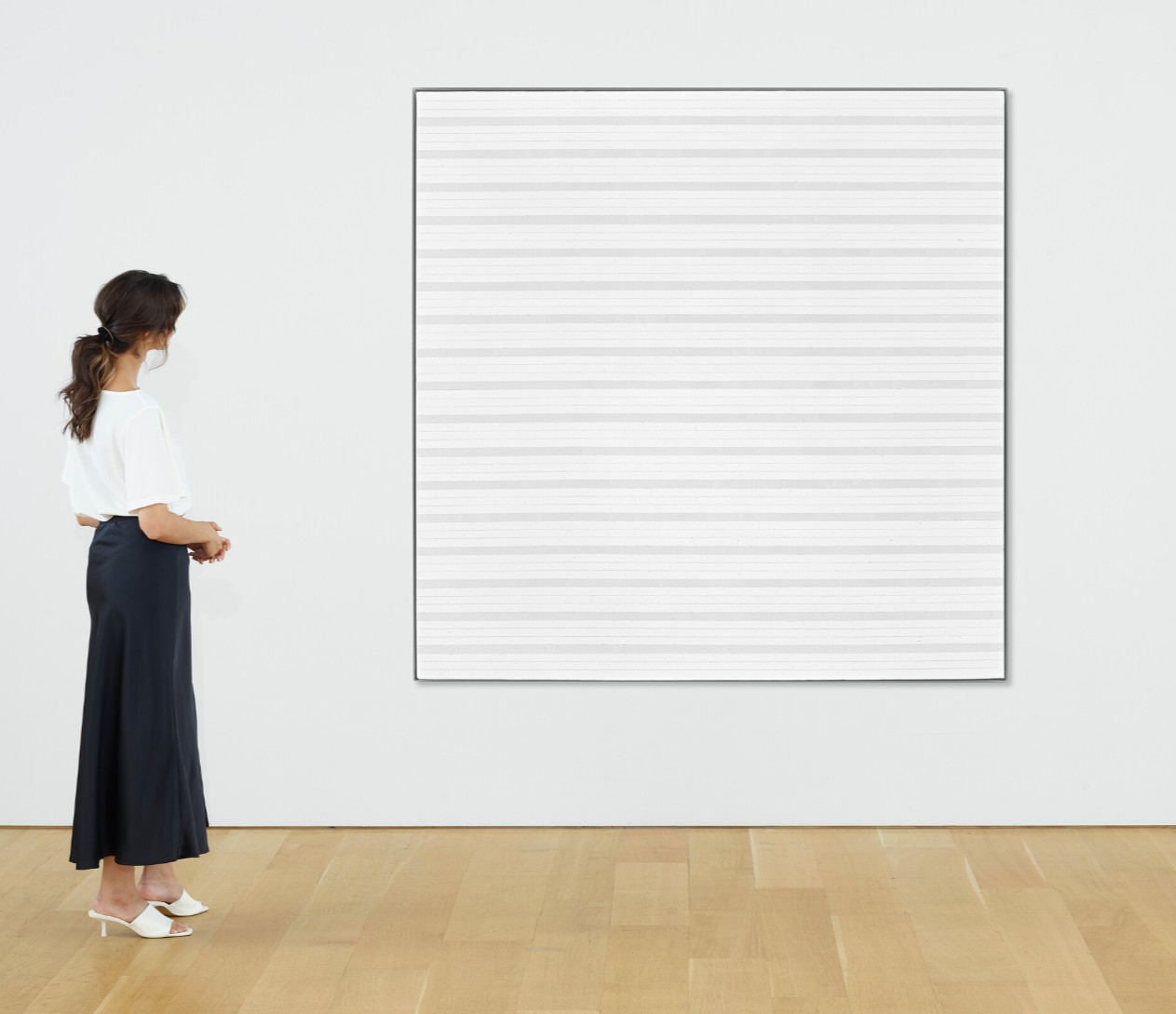
AGNES MARTIN (1912-2004)
Untitled #12, 1989
Acrylic and graphite on canvas
72×72 inches (182.9 x 182.9 cm)
Signed and dated ‘a. martin 1989’ (on the reverse)
USD 5 million
#9. Double Nurse, 2001
Edlis Neeson Collection
Christie’s New-York: 19 November 2025
Estimated: USD 3,000,000 – 5,000,000
USD 3,491,000
RICHARD PRINCE (B. 1949), Double Nurse | Christie’s
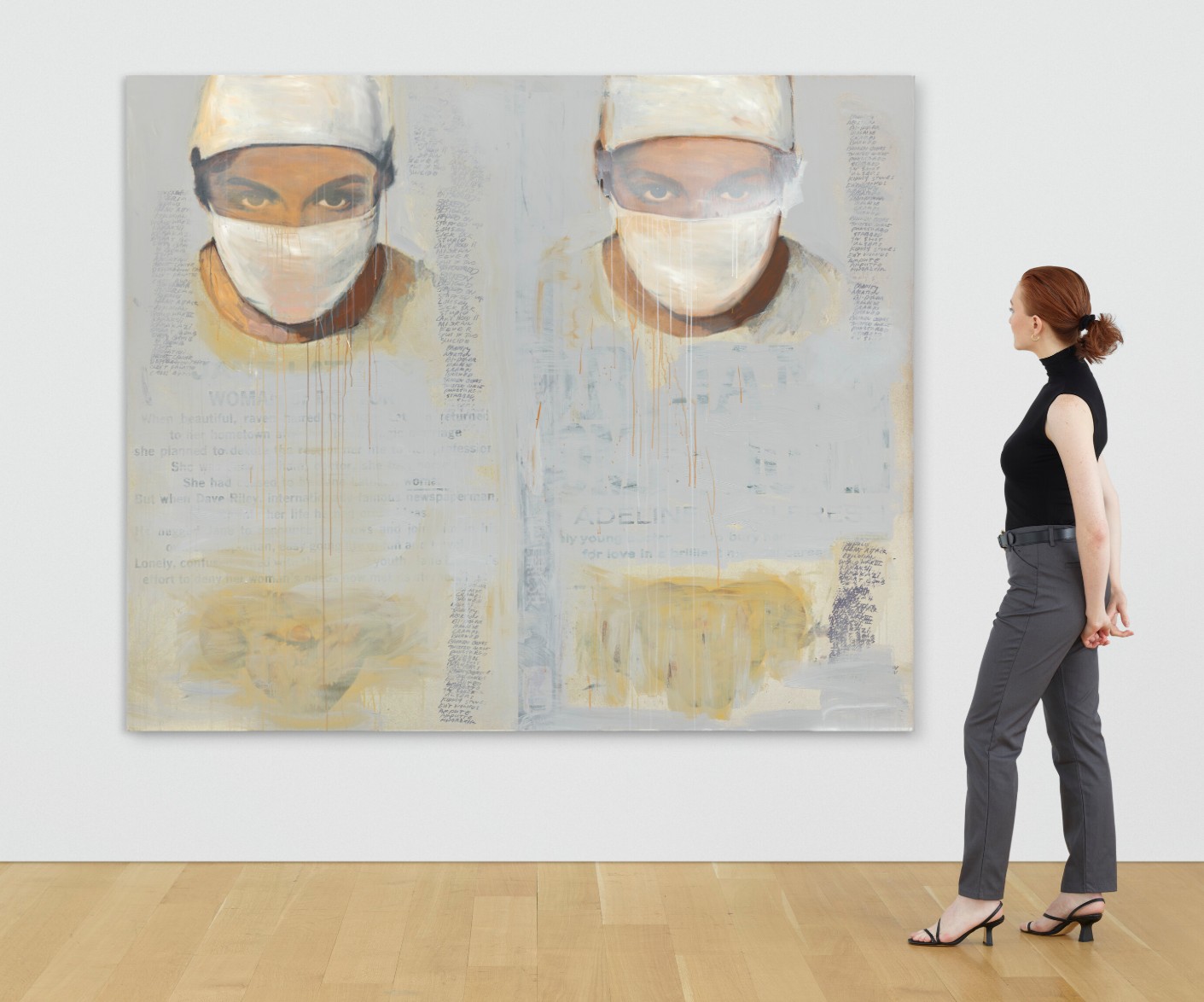
RICHARD PRINCE (B. 1949)
Double Nurse, 2001
Acrylic and inkjet on canvas
80×96 inches (203.2 x 243.8 cm)
Signed, titled and dated ‘Richard Prince, Double NURSE 2001’ (on the reverse)
#10. Abstract Conversation, 2010
Edlis Neeson Collection
Christie’s New-York: 19 November 2025
Estimated: USD 3,000,000 – 5,000,000
USD 3,491,000
GEORGE CONDO (B. 1957), Abstract Conversation | Christie’s
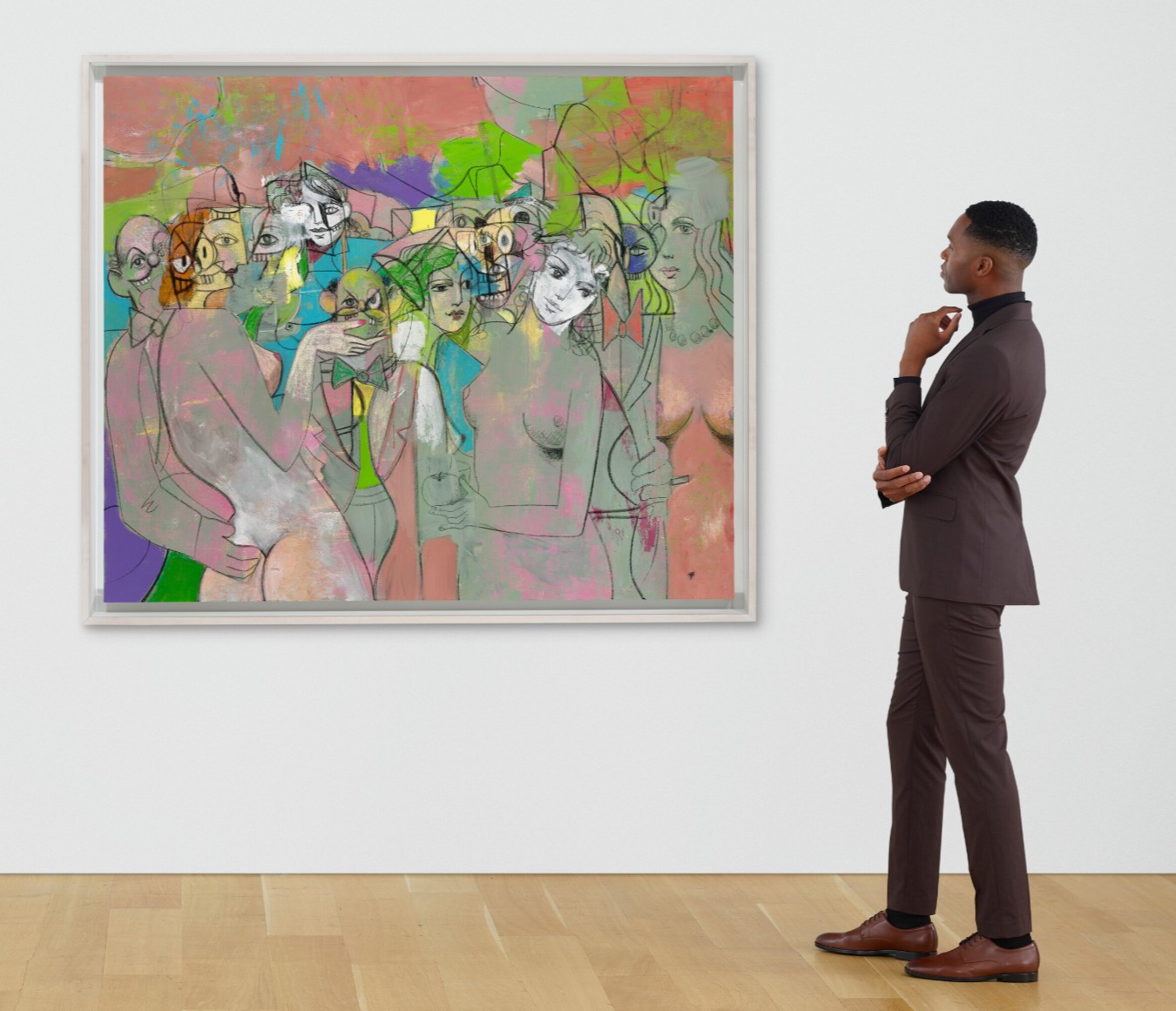
GEORGE CONDO (B. 1957)
Abstract Conversation, 2010
Acrylic, charcoal and pastel on linen
60×72 inches (152.4 x 182.9 cm)
Signed and dated ‘Condo 2010’ (upper left)
#11. Untitled (Cowboy), 2011-13
Edlis Neeson Collection
Christie’s New-York: 19 November 2025
Estimated: USD 2,000,000 – 3,000,000
USD 3,369,000
RICHARD PRINCE (B. 1949), Untitled (Cowboy) | Christie’s
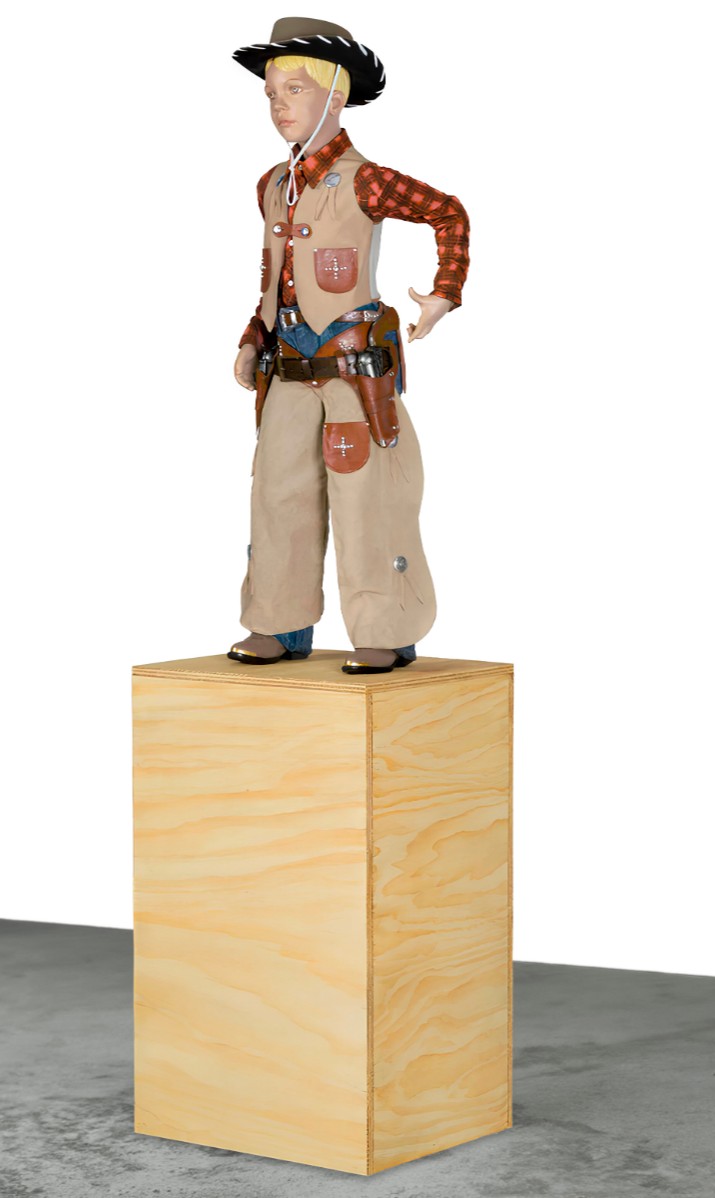
RICHARD PRINCE (B. 1949)
Untitled (Cowboy), 2011-13
Painted bronze
Figure: 47 1/2 x 19 x 11 1/4 inches (120.6 x 48.3 x 28.6 cm)
Overall: 83 1/2 x 22 x 19 inches (212.1 x 55.9 x 48.3 cm)
Incised with the artist’s signature, foundry mark, number and date ‘R Prince 2⁄3 2013’
(on the reverse of figure’s proper left leg)
This works is number two from an edition of three plus two artist’s proofs
Each a unique color variant
XXXXXXXXXXX
#15. Kurt, 1995
Property from an Esteemed Private Collection
Christie’s New-York: 19 November 2025
Estimated: USD 2,000,000 – 3,000,000
USD 2,881,000
ELIZABETH PEYTON (B. 1965), Kurt | Christie’s
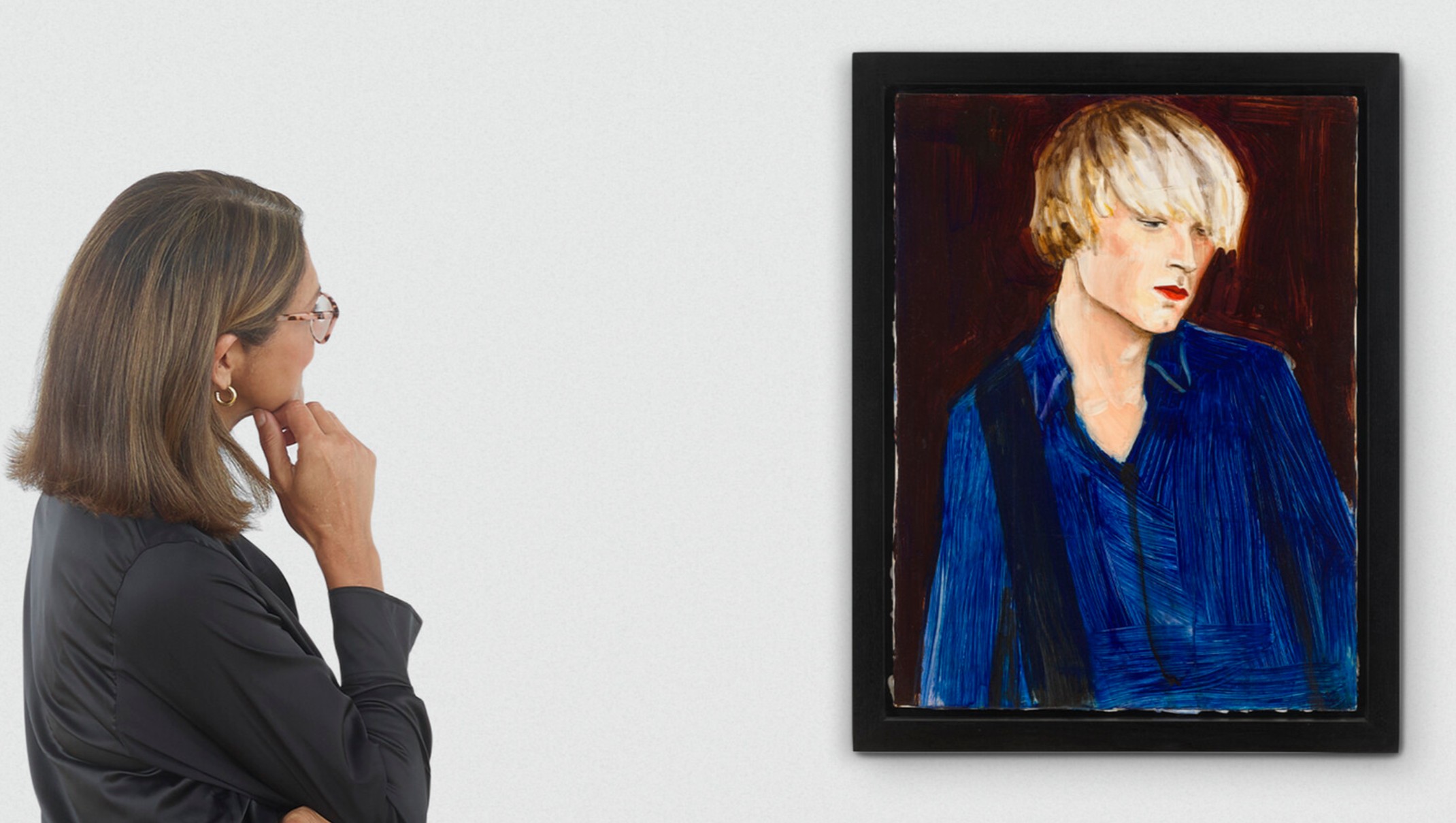
ELIZABETH PEYTON (B. 1965)
Kurt, 1995
Oil on canvas
24×19 inches (61 x 48.3 cm)
Signed, titled and dated ‘Kurt 1995 Elizabeth Peyton’ (on the reverse)
#16. Miss Ko² (Project Ko²), 1997
Christie’s New-York: 19 November 2025
Estimated: USD 1,800,000 – 2,500,000
USD 2,759,000
TAKASHI MURAKAMI (B. 1962), Miss Ko² (Project Ko²) | Christie’s
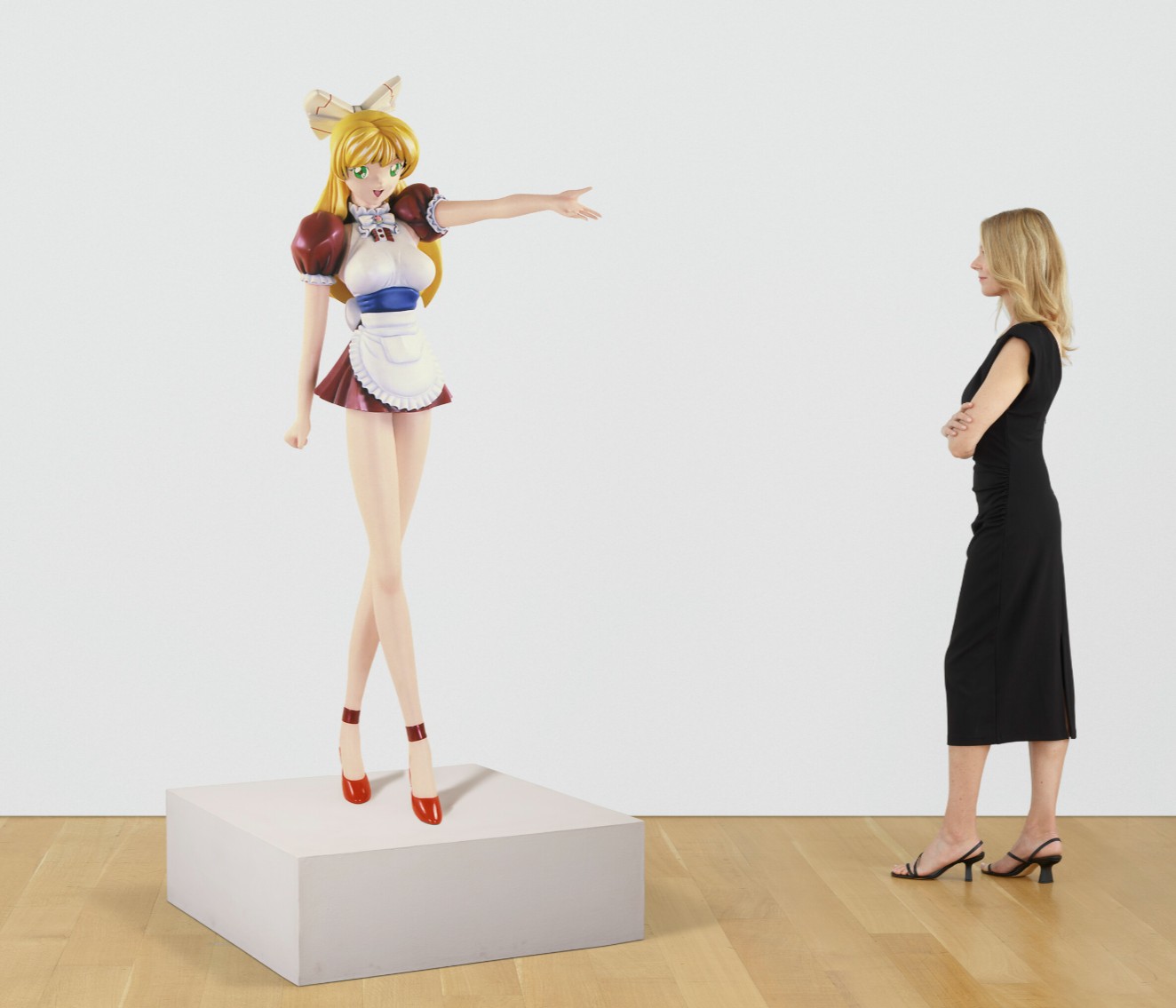
TAKASHI MURAKAMI (B. 1962)
Miss Ko² (Project Ko²), 1997
Fiberglass, iron, acrylic and oil paint
182.9 x 63.5 x 76.2 cm (72x25x30 inches)
This work is number one from an edition of three plus one artist’s proof
XXXXXXXXXXX
#18. Boogeyman, 2010
Elaine: The Collection of Elaine Wynn
Christie’s New-York: 19 November 2025
Estimated: USD 2,500,000 – 3,500,000
USD 2,637,000
ADRIAN GHENIE (B. 1977), Boogeyman | Christie’s
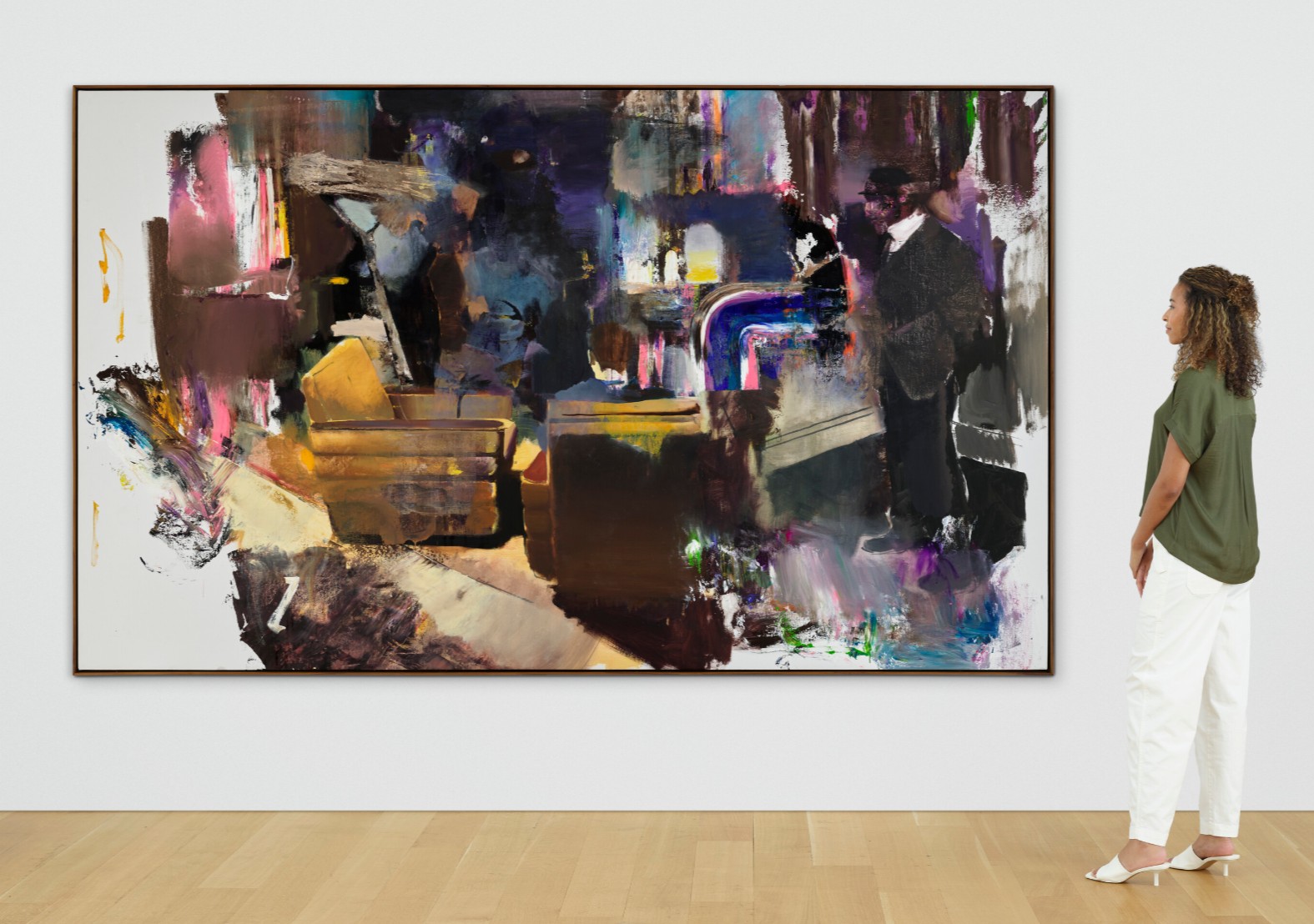
ADRIAN GHENIE (B. 1977)
Boogeyman, 2010
Oil on canvas
200×335 cm (79 3/4 x 131 7/8 inches)
Signed and dated ‘Ghenie 2010’ (on the reverse)
#19. Wall Relief with Bird, 1991
Christie’s New-York: 19 November 2025
Estimated: USD 2,000,000 – 3,000,000
USD 2,393,000
JEFF KOONS (B. 1955), Wall Relief with Bird | Christie’s
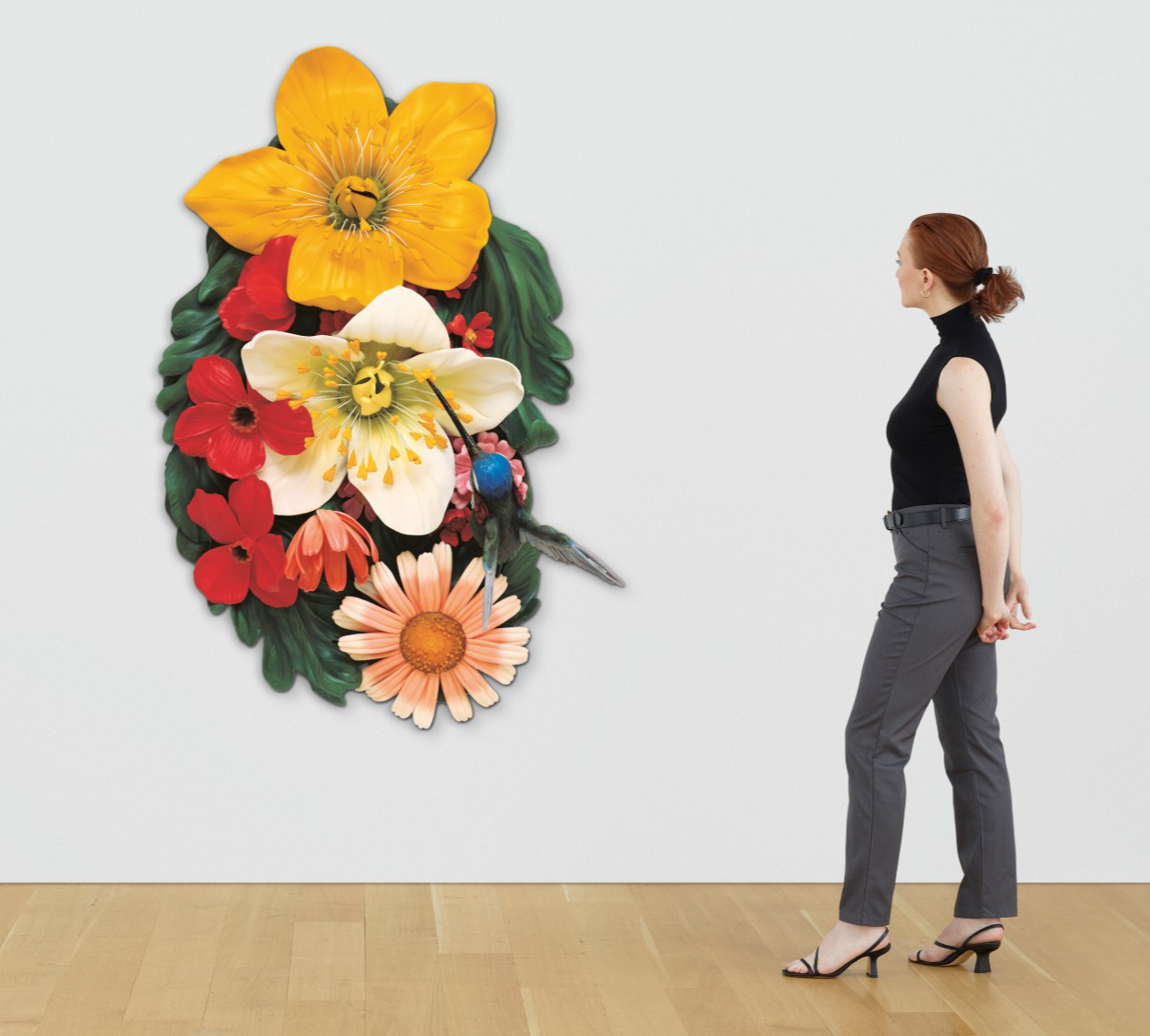
JEFF KOONS (B. 1955)
Wall Relief with Bird, 1991
Polychromed wood
72x50x27 inches (182.9 x 127 x 68.6 cm)
This work is number three from an edition of three plus one artist’s proof
XXXXXXXXXXX
#23. Skull, 1976
Edlis Neeson Collection
Christie’s New-York: 19 November 2025
Estimated: USD 800,000 – 1,200,000
USD 1,905,000
ANDY WARHOL (1928-1987), Skull | Christie’s
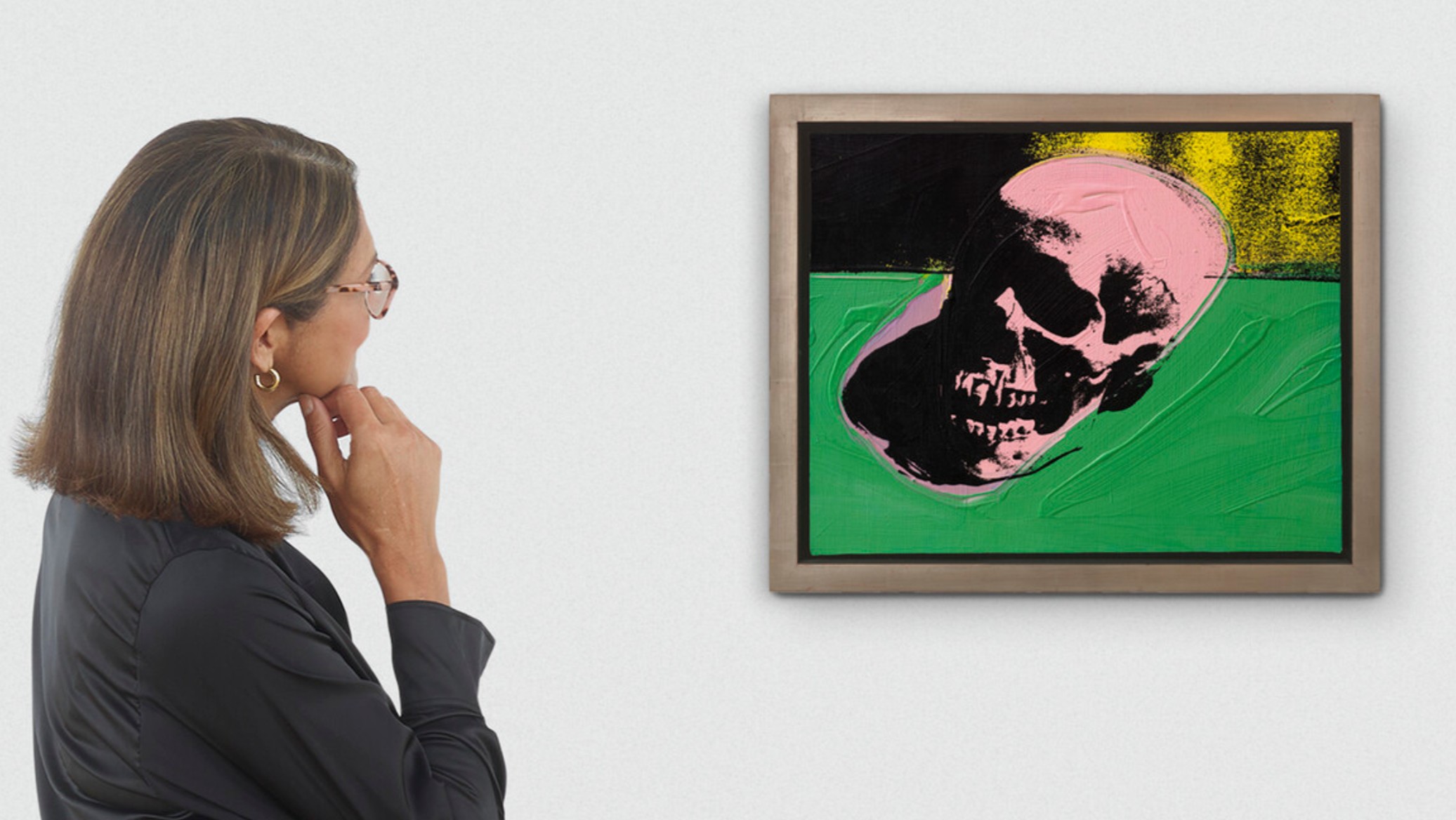
ANDY WARHOL (1928-1987)
Skull, 1976
Acrylic and silkscreen ink on canvas
15×19 inches (38.1 x 48.3 cm)
Stamped with the Andy Warhol Art Authentication Board, Inc. stamp and numbered ‘A108.025’ (on the overlap)
#24. Oxidation Painting (Diptych), 1978
Edlis Neeson Collection
Christie’s New-York: 19 November 2025
Estimated: USD 900,000 – 1,200,000
USD 1,714,500
ANDY WARHOL (1928-1987), Oxidation Painting (Diptych) | Christie’s
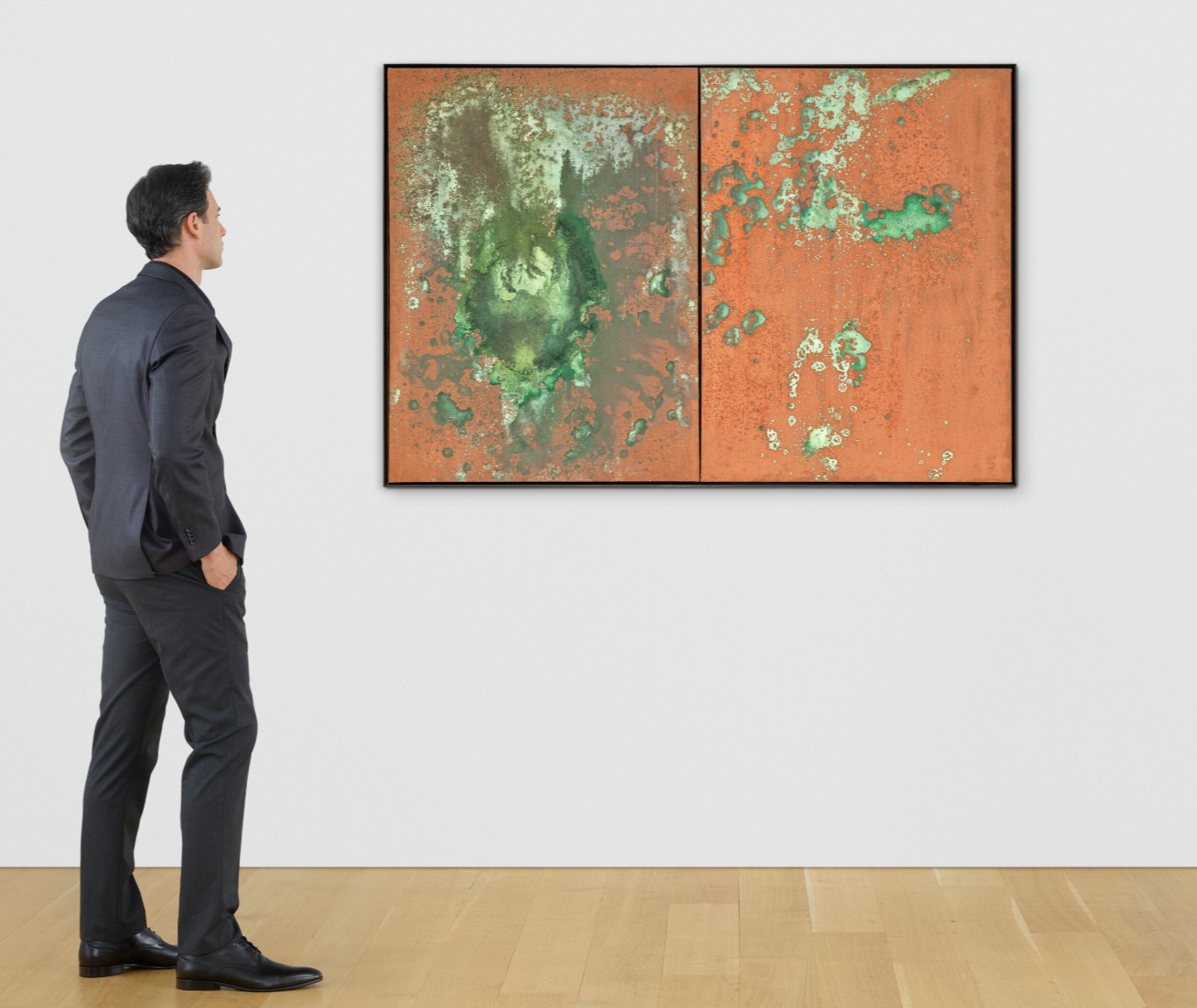
ANDY WARHOL (1928-1987)
Oxidation Painting (Diptych), 1978
Urine and copper paint on linen, in two parts
Each: 40×30 inches (101.6 x 76.2 cm)
Overall: 40×60 inches (101.6 x 152.4 cm)(2)
Signed, dedicated and dated
‘Pour la collection de Flavio Castillo Pontello Andy Warhol 1978’
(on the reverse of each canvas)
XXXXXXXXXXX
#26. Untitled, 2007
Property from the Irma and Norman Braman Art Foundation
Christie’s New-York: 19 November 2025
Estimated: USD 800,000 – 1,200,000
USD 1,587,500
MAURIZIO CATTELAN (B. 1960), Untitled | Christie’s
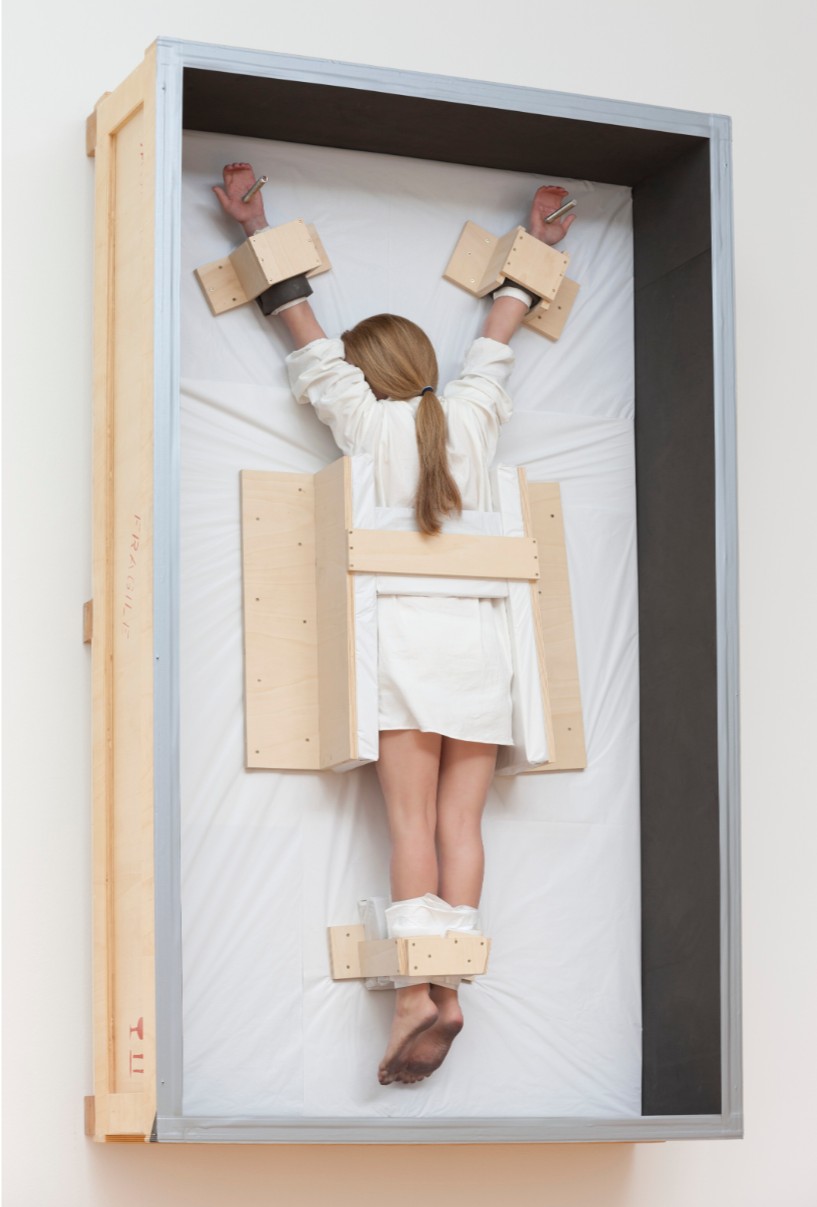
MAURIZIO CATTELAN (B. 1960)
Untitled, 2007
Resin, paint, human hair, clothing, packing tissue, wood and screws
92 3/8 x 54 3/8 x 20 7/8 inches (234.6 x 138.1 x 53 cm)
This work is number one from an edition of three plus two artist’s proofs
#27. The Wrong Joke, 1987
Christie’s New-York: 19 November 2025
Estimated: USD 1,500,000 – 2,000,000
USD 1,524,000
RICHARD PRINCE (B. 1949), The Wrong Joke | Christie’s
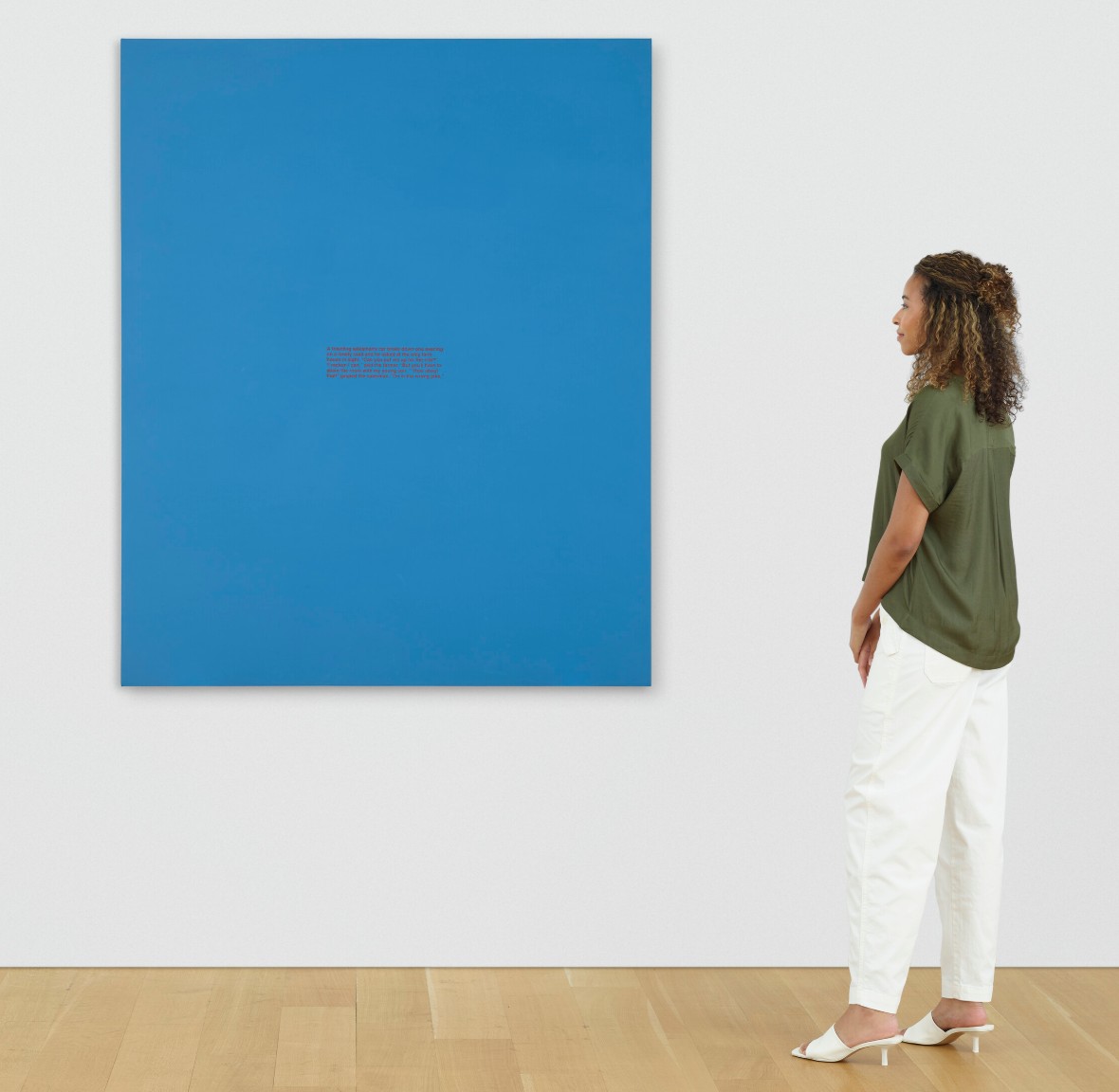
RICHARD PRINCE (B. 1949)
The Wrong Joke, 1987
Acrylic and silkscreen ink on canvas
66×54 inches (167.6 x 137.2 cm)
Signed and dated ‘R Prince 87’ (on the overlap)
#28. Untitled, 2014
Christie’s New-York: 19 November 2025
Estimated: USD 1,500,000 – 2,000,000
USD 1,397,000
CHRISTOPHER WOOL (B. 1955), Untitled | Christie’s
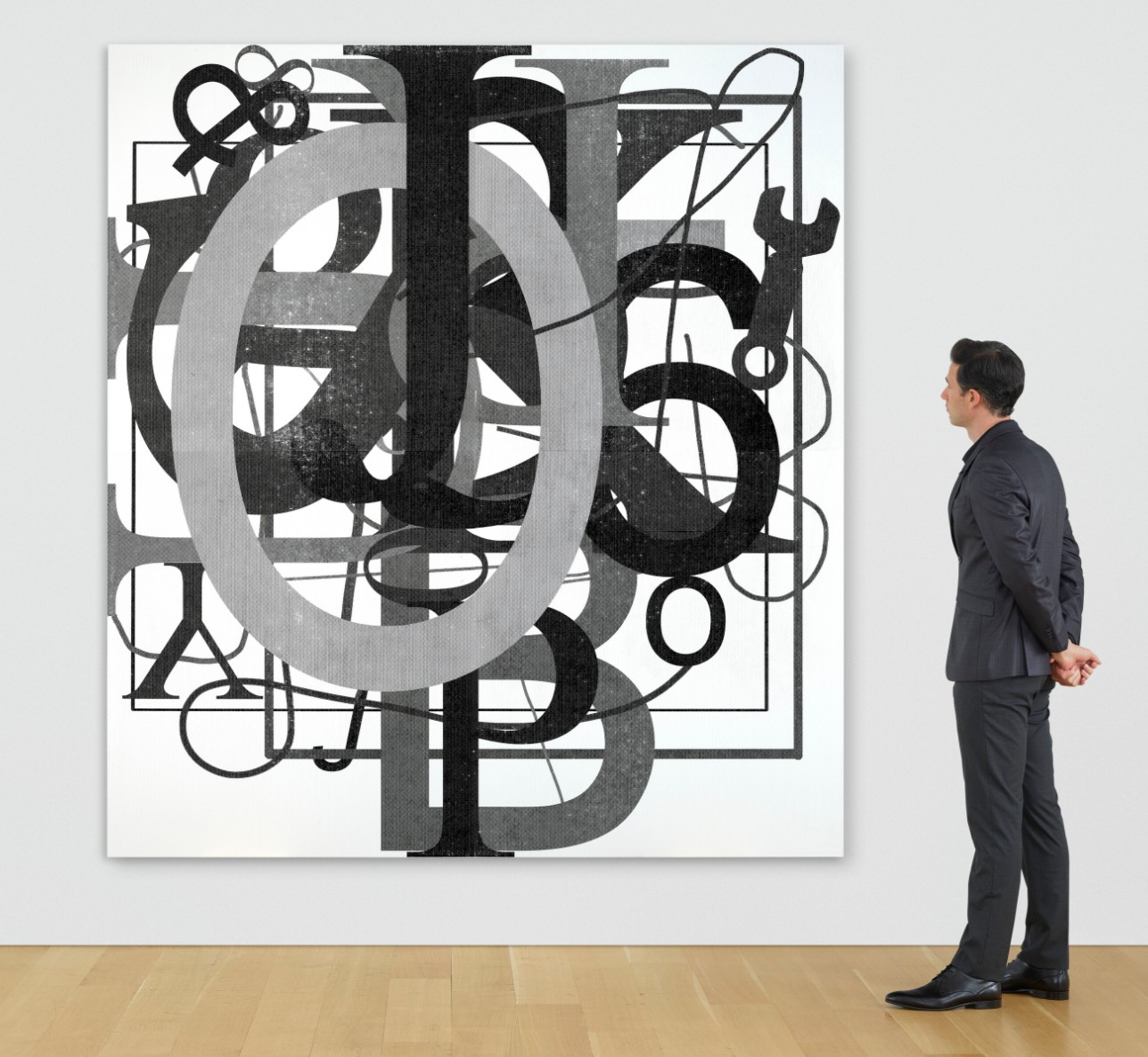
CHRISTOPHER WOOL (B. 1955)
Untitled, 2014
Silkscreen ink on linen mounted to wood
106×96 inches (269.2 x 243.8 cm)
Signed, titled and dated ‘Wool 2014 Untitled (P647)’ (on the reverse)
XXXXXXXXXXX
#34. Flowers, Lichtenstein, Parsifal, 2011
Christie’s New-York: 19 November 2025
Estimated: USD 500,000 – 700,000
USD 1,104,900
ELIZABETH PEYTON (B. 1965), Flowers, Lichtenstein, Parsifal | Christie’s
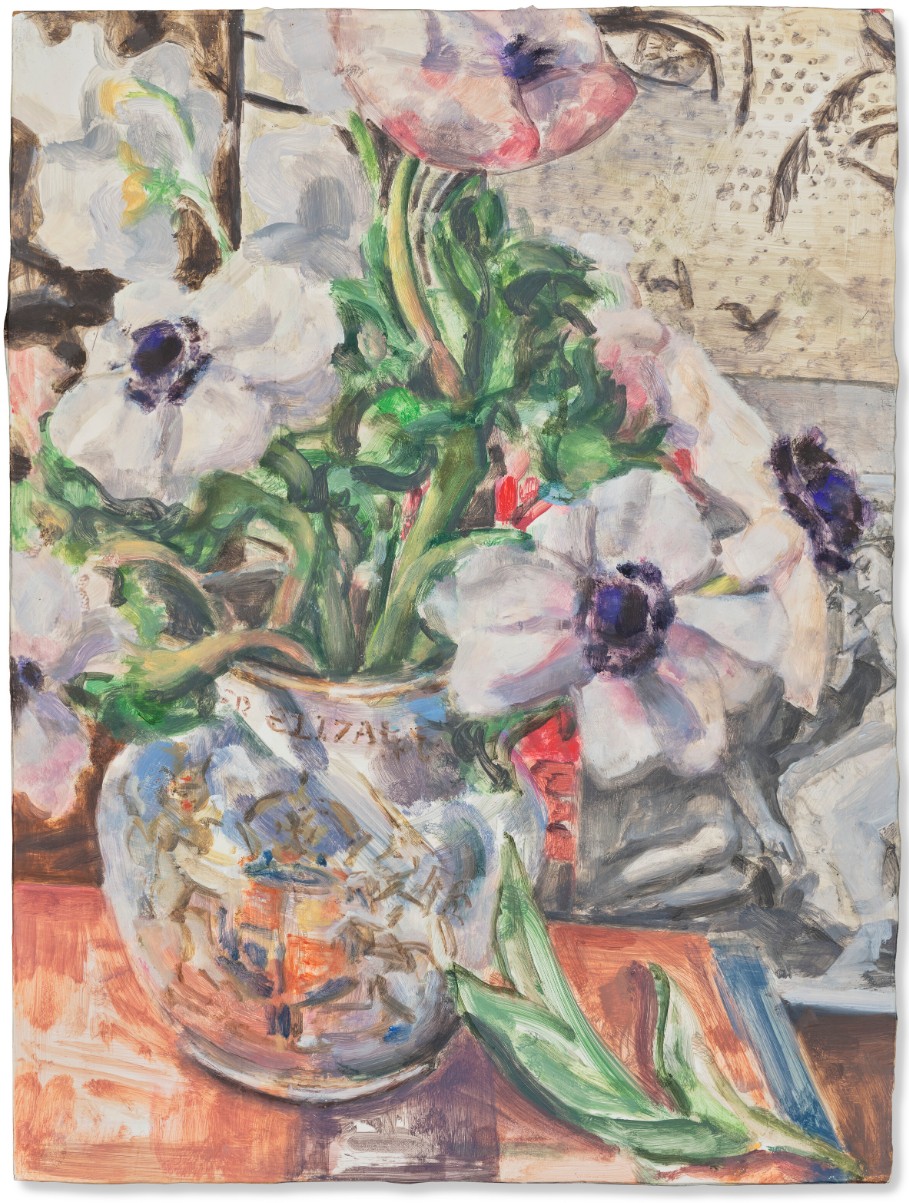
ELIZABETH PEYTON (B. 1965)
Flowers, Lichtenstein, Parsifal, 2011
Oil on panel
12 1/8 x 9 1/8 inches (30.5 x 23 cm)
XXXXXXXXXXX
#36. Popeye (Green), 2004-2009
Edlis Neeson Collection
Christie’s New-York: 19 November 2025
Estimated: USD 600,000 – 800,000
USD 762,000
JEFF KOONS (B. 1955), Popeye (Green) | Christie’s
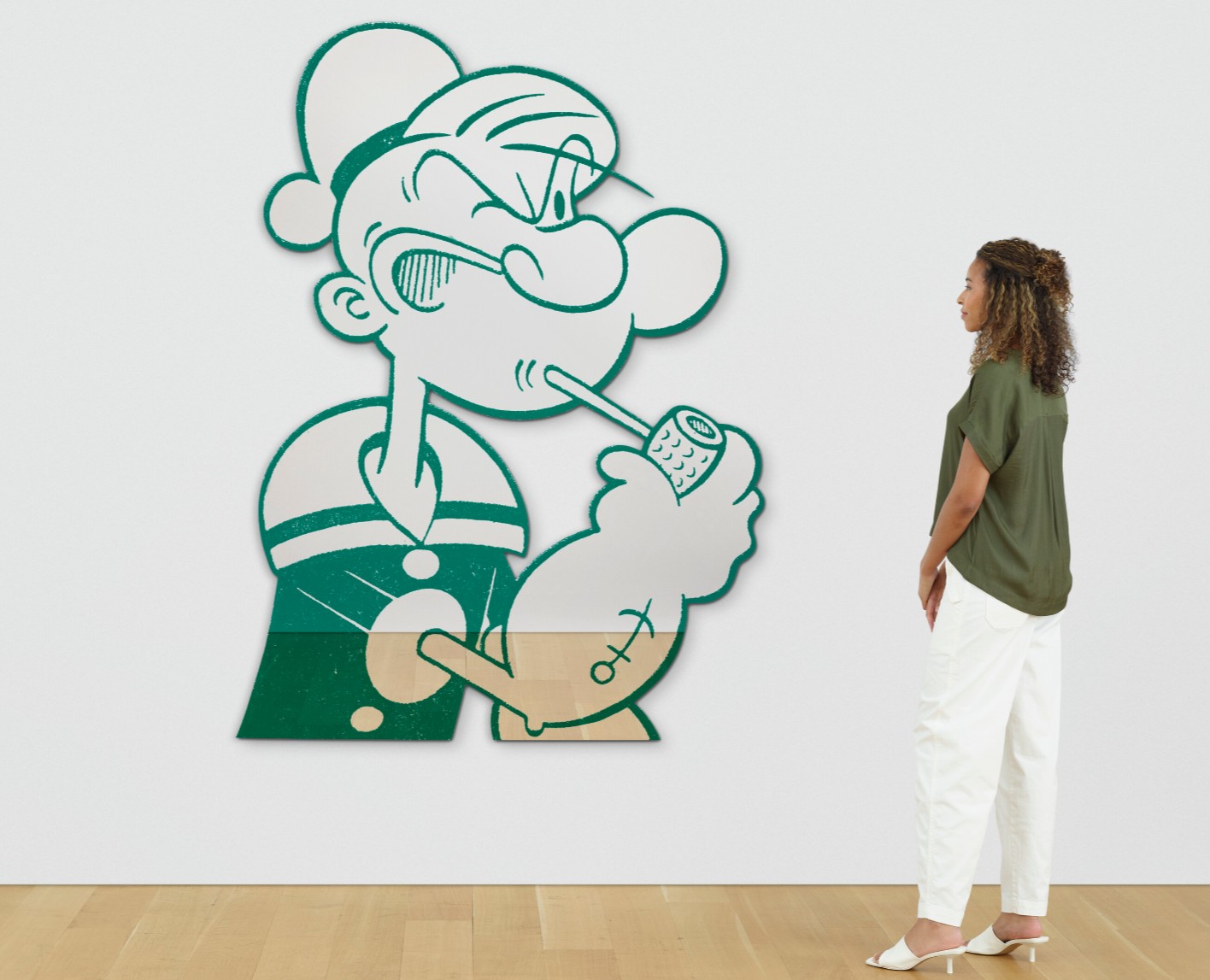
JEFF KOONS (B. 1955)
Popeye (Green), 2004-2009
Mirror-polished stainless steel with transparent color coating
80 x 59 1/2 x 1 1/4 inches (203.2 x 151.1 x 3.2 cm)
Signed and dated ‘Jeff Koons 2004-2009’ (on the reverse)
This work is one of five unique versions (Blue, Green, Orange, Red, Yellow)
XXXXXXXXXXX
#41. Gazing Ball (Courbet Sleep), 2014-2015
Edlis Neeson Collection
Christie’s New-York: 19 November 2025
Estimated: USD 600,000 – 800,000
USD 596,900
JEFF KOONS (B. 1955), Gazing Ball (Courbet Sleep) | Christie’s
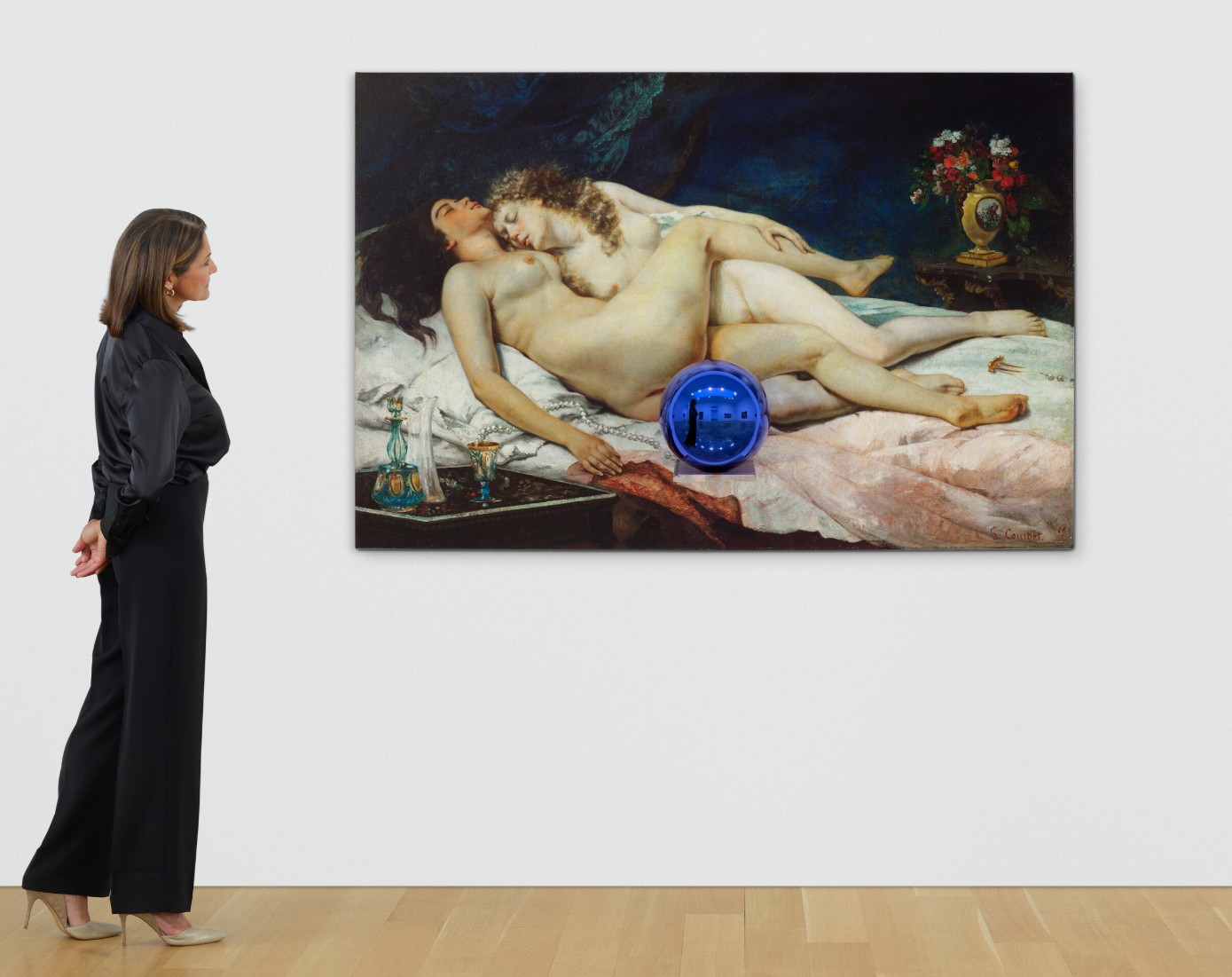
JEFF KOONS (B. 1955)
Gazing Ball (Courbet Sleep), 2014-2015
Oil on canvas, glass and aluminum
53 3/4 x 81 x 14 3/4 inches (136.5 x 205.7 x 37.5 cm)
Signed and dated ‘Jeff Koons 2014-2015’ (on the overlap)
Lots Passed
It’s not yesterday anymore, 2022
Property from a Prominent European Collection
Christie’s New-York: 19 November 2025
Estimated: USD 4,000,000 – 6,000,000
PASSED
CECILY BROWN (B. 1969), It’s not yesterday anymore | Christie’s
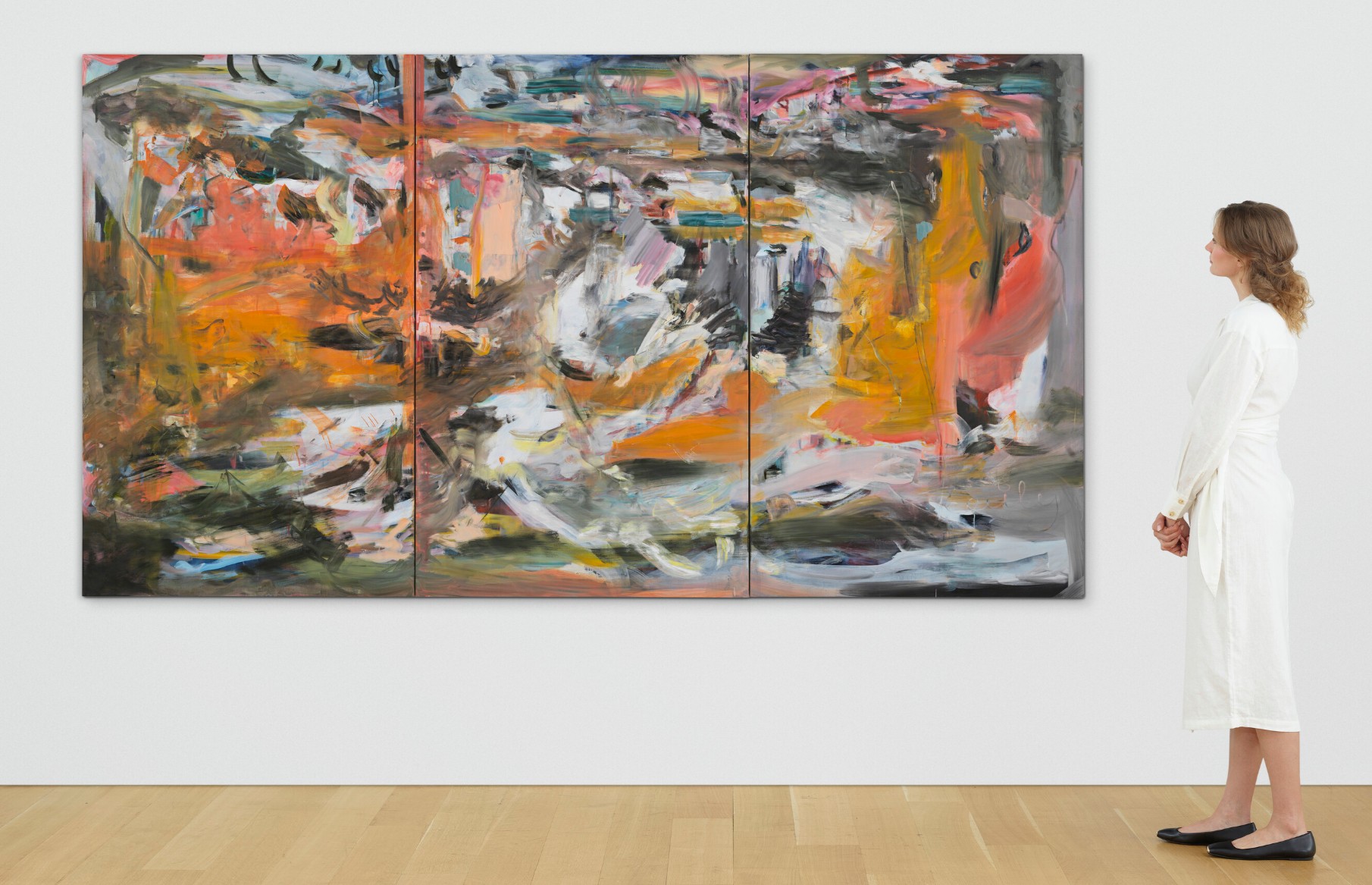
CECILY BROWN (B. 1969)
It’s not yesterday anymore, 2022
Oil on linen, in three parts
Overall: 67×123 inches (170.2 x 312.4 cm)
Signed ‘Cecily’ (lower right)
Signed and dated ‘Cecily Brown 2022’ (on the reverse)
Post-War & Contemporary Art Day Sale
20 November 2025
Post-War & Contemporary Art Day Sale
Auction Statistics
Total: USD 88,779,332
#Lots: 257 Lots
[Withdrawn: 0 Lot]
Unsold: 36 Lots
Sold: 221 Lots
Sell-Through Rate: 86.0%
Top Lot:
USD 2,759,000
Highlights
#1. Untitled, 1978-1979
American Visionaries: Property from an Important Private Collection
Christie’s New-York: 20 November 2025
Estimated: USD 2,000,000 – 3,000,000
USD 2,759,000
JOAN MITCHELL (1925-1992), Untitled | Christie’s
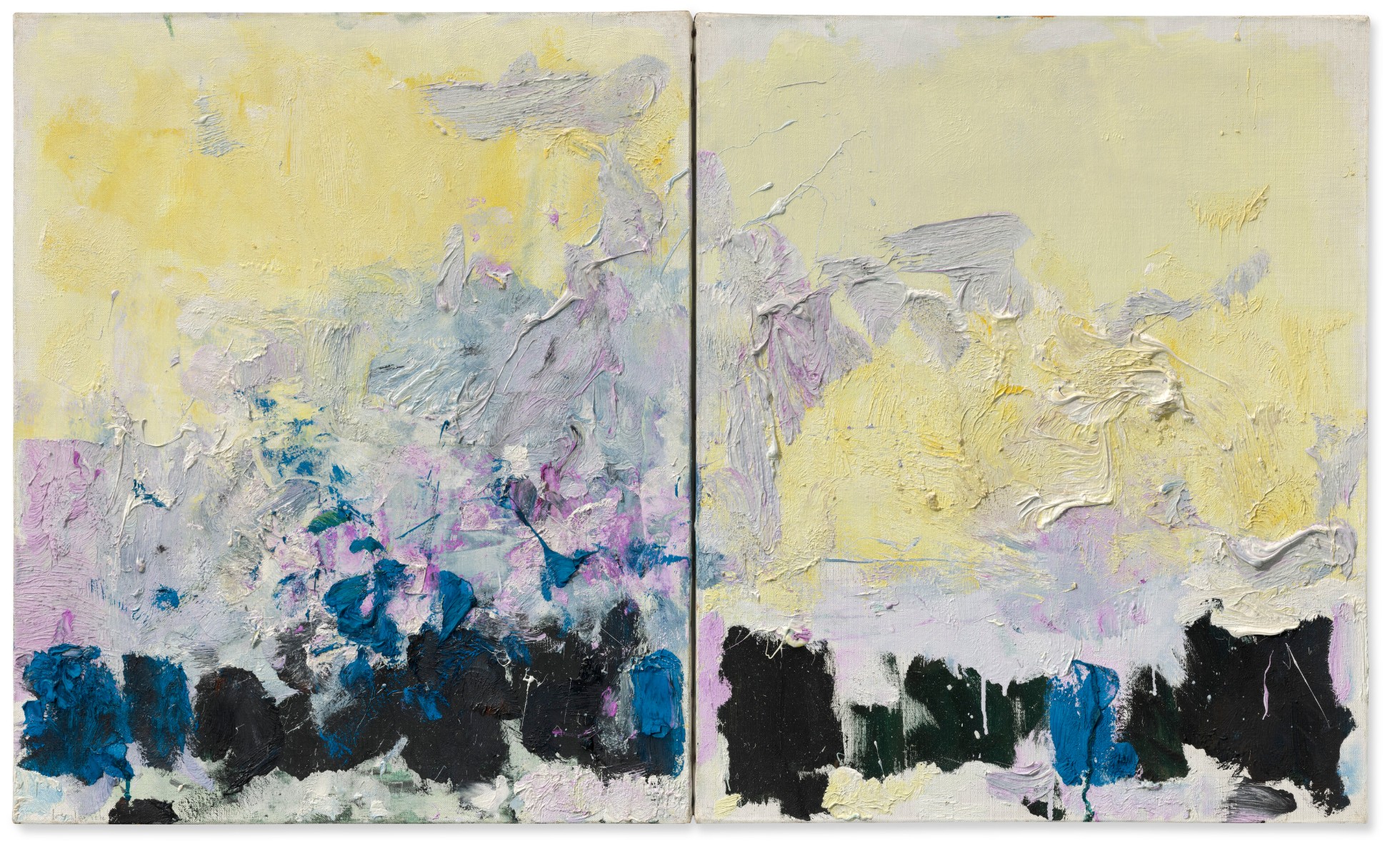
JOAN MITCHELL (1925-1992)
Untitled, 1978-1979
Diptych—oil on canvas
Overall: 25 5/8 x 42 7/8 inches (65.1 x 108.9 cm)(2)
Signed ‘Joan Mitchell’ (lower left)
Signed again twice and dedicated ‘Pour Philippe Piguet Joan Mitchell Joan Mitchell’ (on the stretcher)
Signed again ‘Mitchell’ (on the reverse)
#2. Abstraktes Bild, 2009
Christie’s New-York: 20 November 2025
Estimated: USD 1,800,000 – 2,500,000
USD 2,759,000
GERHARD RICHTER (B. 1932), Abstraktes Bild | Christie’s
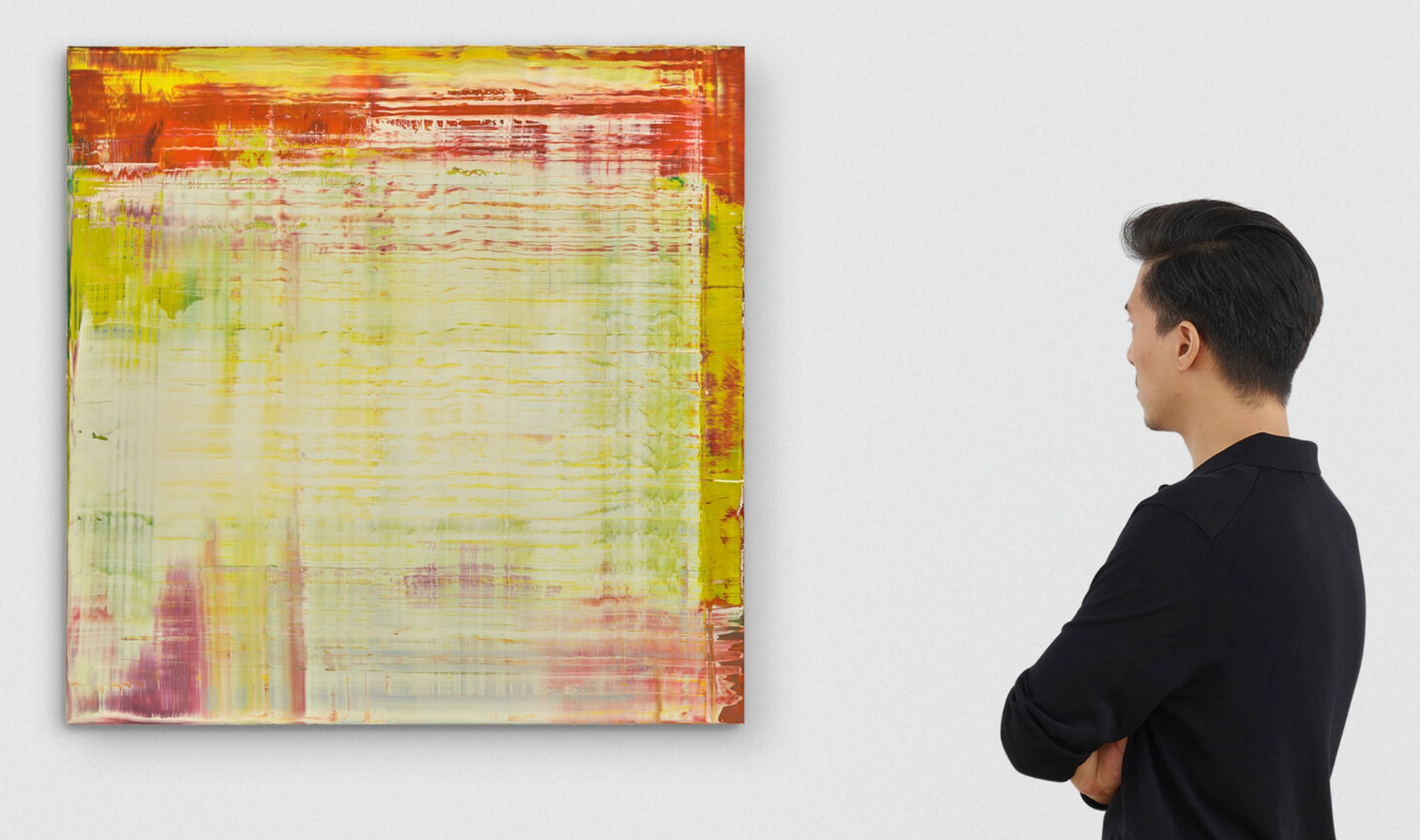
GERHARD RICHTER (B. 1932)
Abstraktes Bild, 2009
Oil on Alu-Dibond
83.8 x 83.8 cm (33×33 inches)
Signed, inscribed and dated ‘910-4 Richter 2009’ (on the reverse)
Bruise Painting “Stardust”, 2021
Christie’s New-York: 20 November 2025
Estimated: USD 800,000 – 1,200,000
USD 1,397,000
RASHID JOHNSON (B. 1977), Bruise Painting “Stardust” | Christie’s
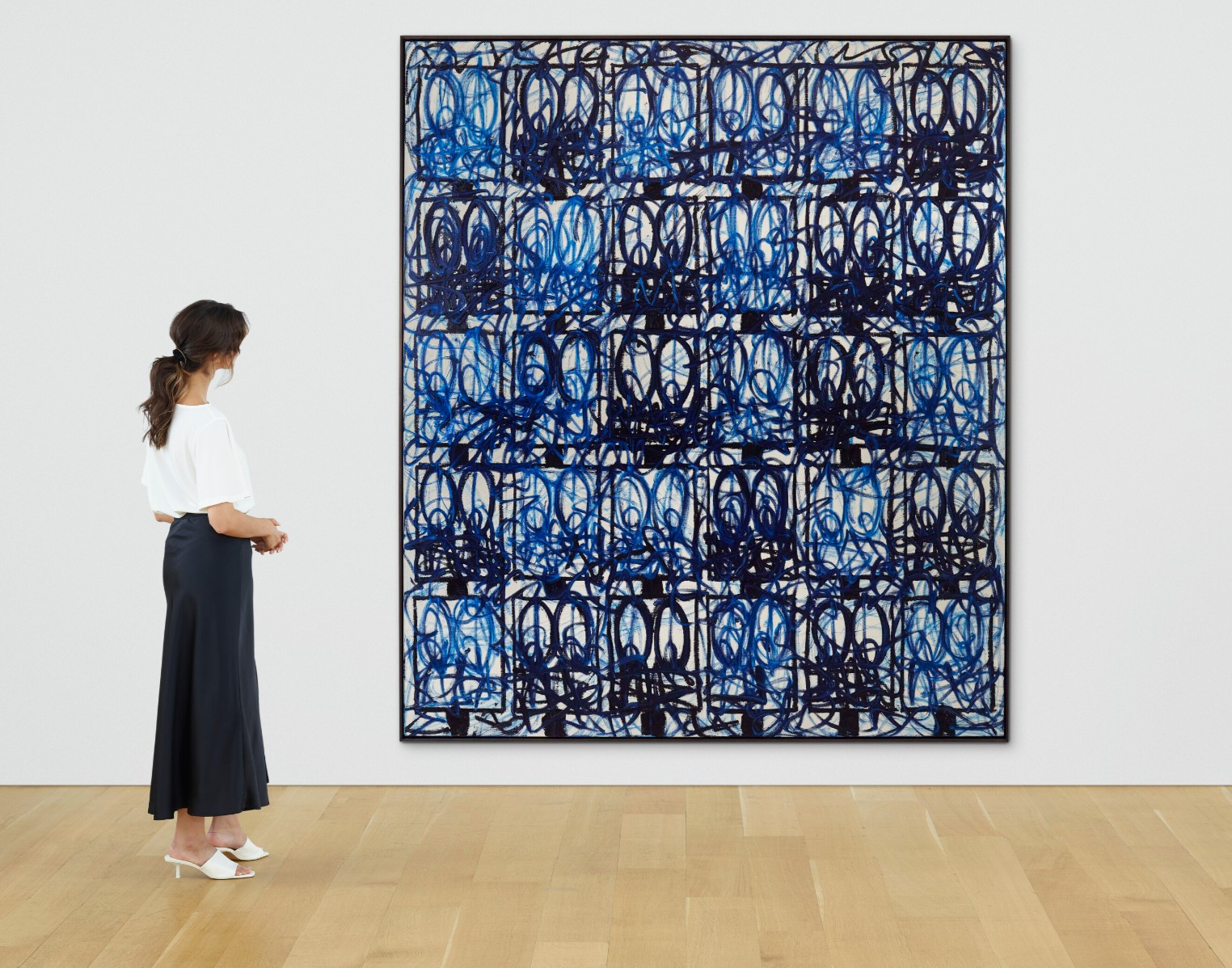
RASHID JOHNSON (B. 1977)
Bruise Painting “Stardust”, 2021
Oil on linen
97 7/8 x 85 3/4 inches (248.6 x 217.8 cm)
Water Lily Pond with Reflections, 1992
Property from the Estate of Joan and Kenneth Goldglit
Christie’s New-York: 20 November 2025
Estimated: USD 500,000 – 700,000
USD 1,397,000
ROY LICHTENSTEIN (1923-1997), Water Lily Pond with Reflections | Christie’s
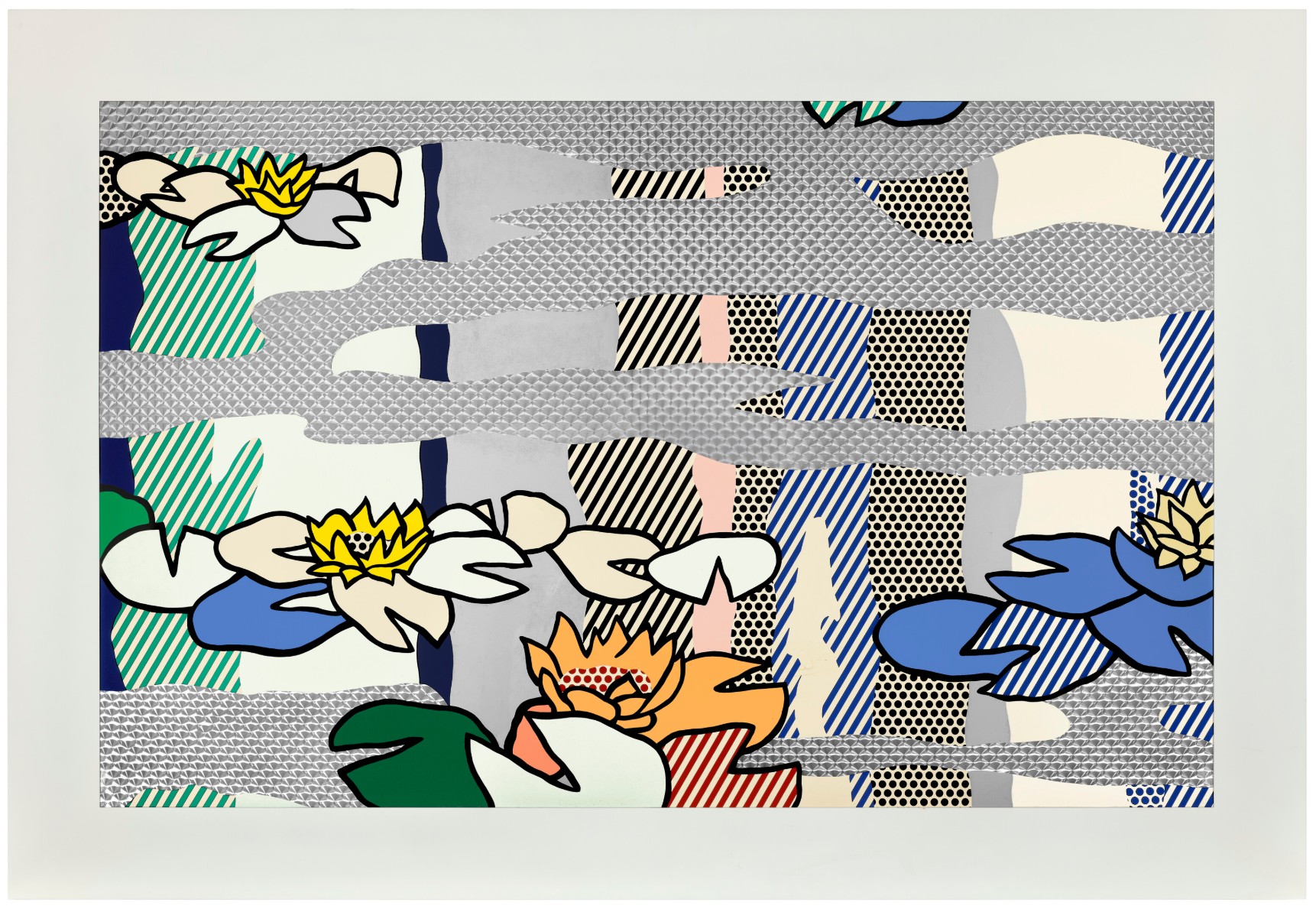
ROY LICHTENSTEIN (1923-1997)
Water Lily Pond with Reflections (Corlett 264, RLCR 4179), 1992
Screenprinted enamel on processed and swirled stainless steel, with painted aluminum frame
Signed, numbered and and dated ‘7⁄23 rf Lichtenstein ’92’ (on the reverse)
This work is number seven from an edition of 23 plus seven artist’s proofs
#11. Iblan, 2009
Christie’s New-York: 20 November 2025
Estimated: USD 800,000 – 1,200,000|
USD 1,270,000
GERHARD RICHTER (B. 1932), Iblan | Christie’s
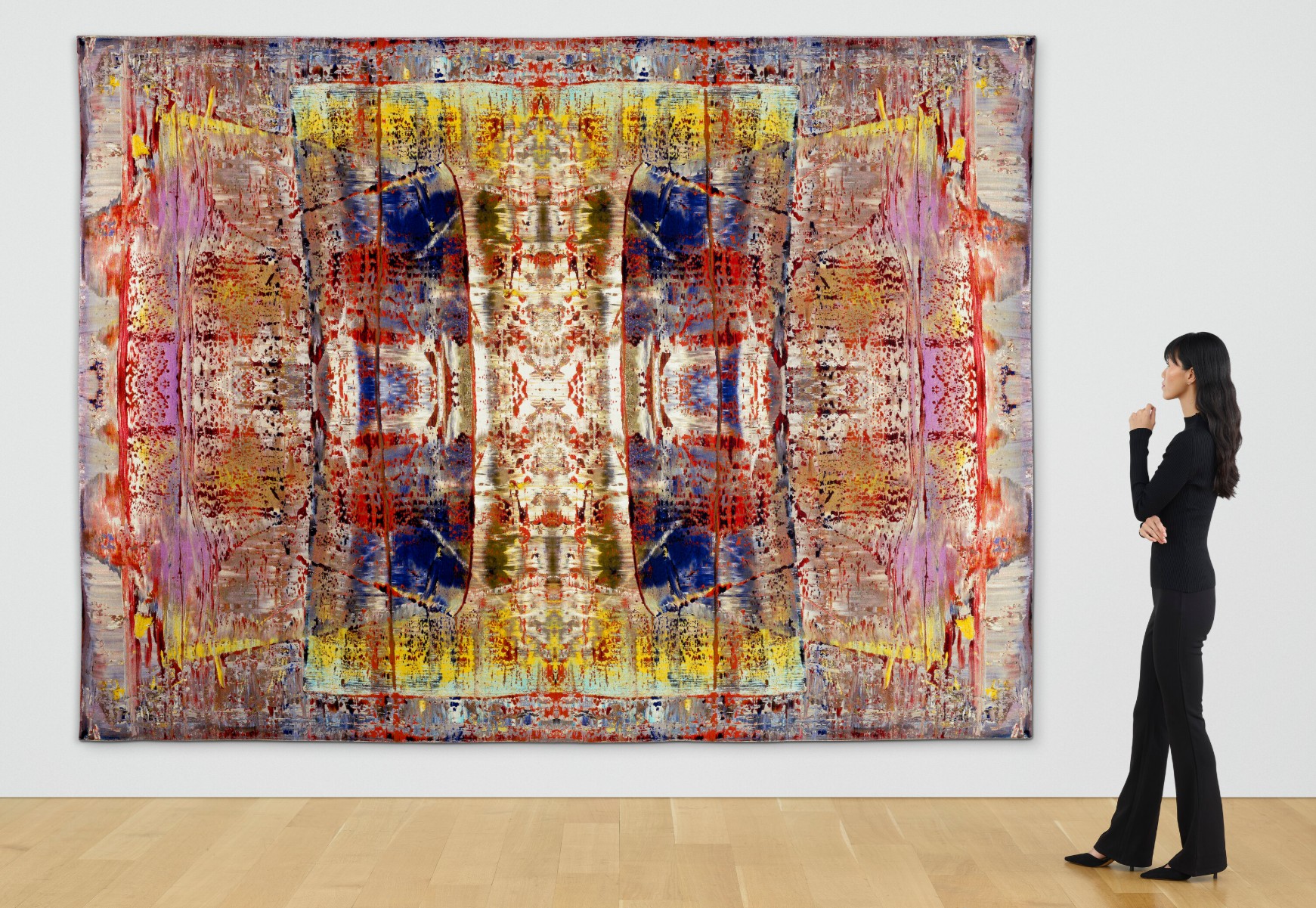
GERHARD RICHTER (B. 1932)
Iblan, 2009
Trevira CS, cotton, wool, silk and acrylic Jacquard-woven tapestry
271.8 x 368.3 cm (107×145 inches)
Signed and numbered ‘4⁄8 Richter’ (on a fabric label affixed to the reverse)
This work is number four from an edition of eight plus two artist’s proofs
Nude with Blue Hair, State I, 1994
Christie’s New-York: 20 November 2025
Estimated: USD 500,000 – 700,000
USD 1,079,500
ROY LICHTENSTEIN (1923-1997), Nude with Blue Hair, State I | Christie’s
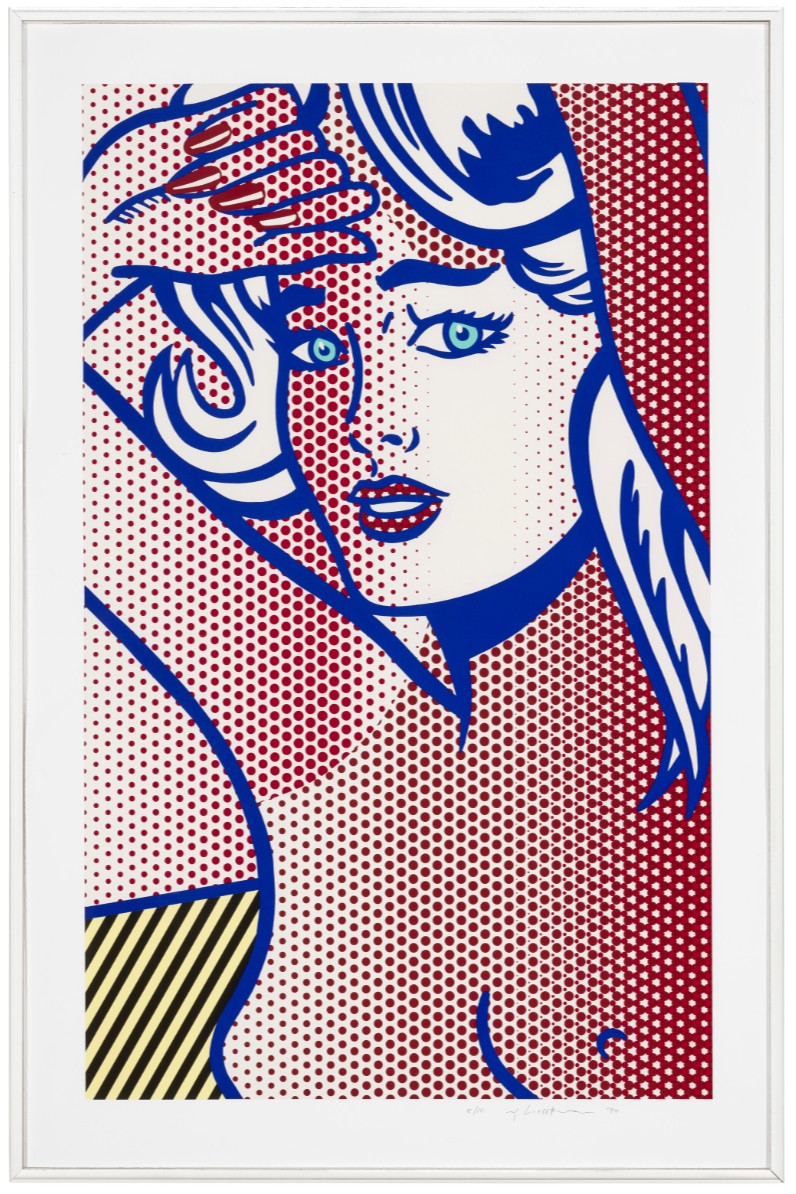
ROY LICHTENSTEIN (1923-1997)
Nude with Blue Hair, State I (Corlett 287, RLCR 4295), 1994
Relief print in colors on Rives BFK paper
Signed, numbered and dated ‘8⁄10 rf Lichtenstein ’94’ (lower right)
This work is number eight from an edition of ten plus six artist’s proofs
The Great Muses, 2013
Christie’s New-York: 20 November 2025
Estimated: USD 600,000 – 800,000
USD 1,047,750
AVERY SINGER (B. 1987), The Great Muses | Christie’s
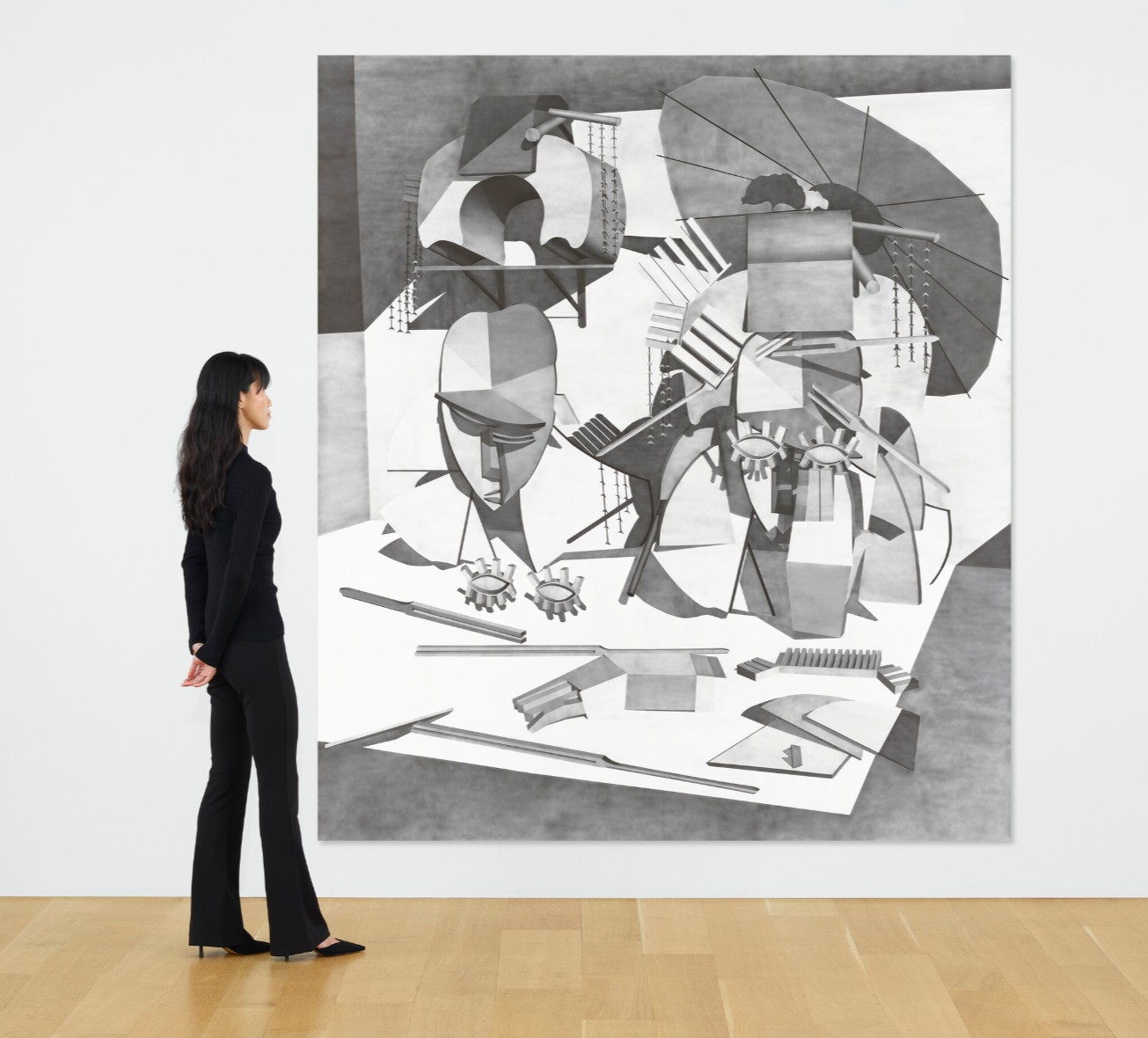
AVERY SINGER (B. 1987)
The Great Muses, 2013
Acrylic on canvas
86 5/8 x 77 1/8 inches (220×196 cm)
Signed and dated ‘Avery Singer 2013’ (on the stretcher)
Still Life with Portrait (Study), 1973
Property from the Estate of Joan and Kenneth Goldglit
Christie’s New-York: 20 November 2025
Estimated: USD 1,000,000 – 1,500,000
USD 1,016,000
ROY LICHTENSTEIN (1923-1997), Still Life with Portrait (Study) | Christie’s
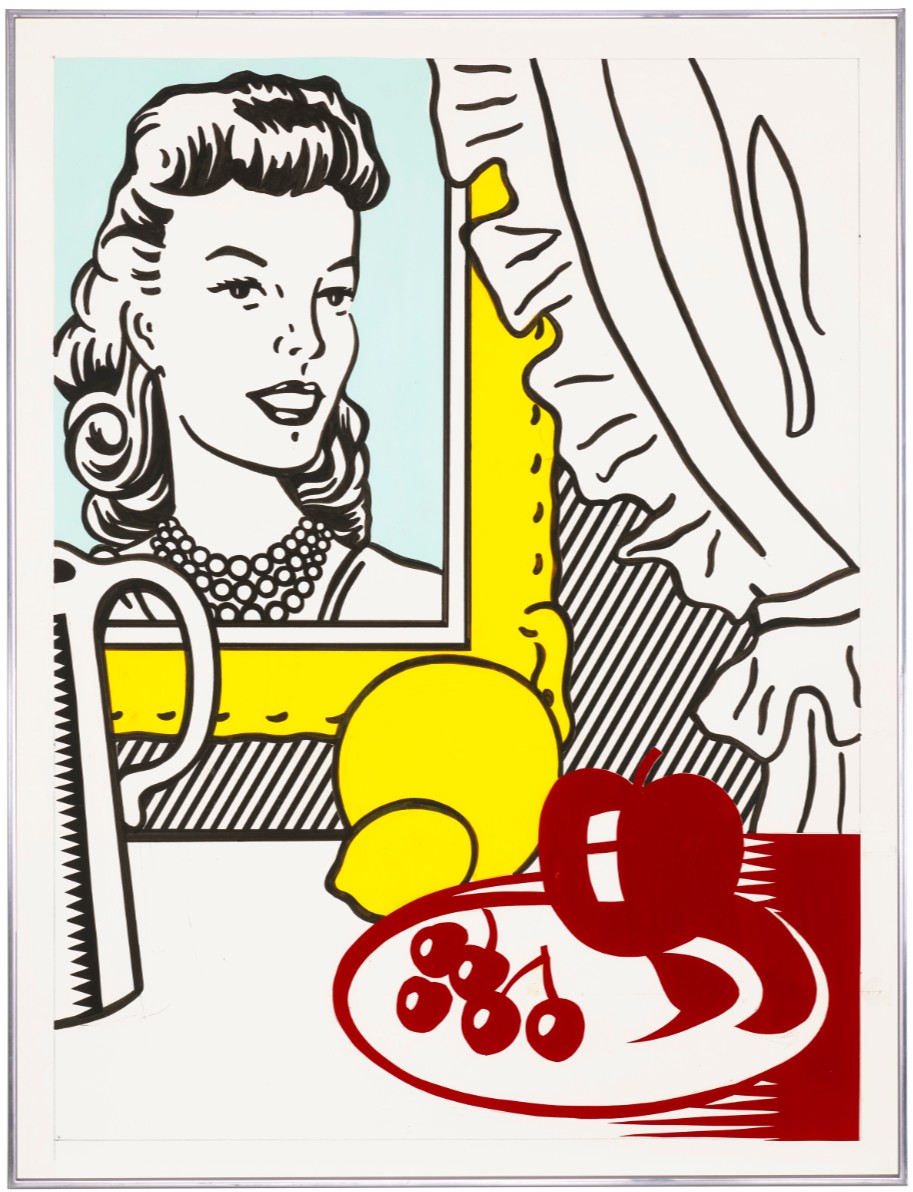
ROY LICHTENSTEIN (1923-1997)
Still Life with Portrait (Study), 1973
Printed paper collage, acrylic, felt-tip pen and graphite on paperboard
42×32 inches (106.7 x 81.3 cm)
Signed and dated ‘rf Lichtenstein ’73’ (on the reverse)
USD 1 million
Jonas Kaufmann, March 2013, NYC, 2013
Edlis Neeson Collection
Christie’s New-York: 20 November 2025
Estimated: USD 400,000 – 600,000
USD 952,500
ELIZABETH PEYTON (B. 1965), Jonas Kaufmann, March 2013, NYC | Christie’s
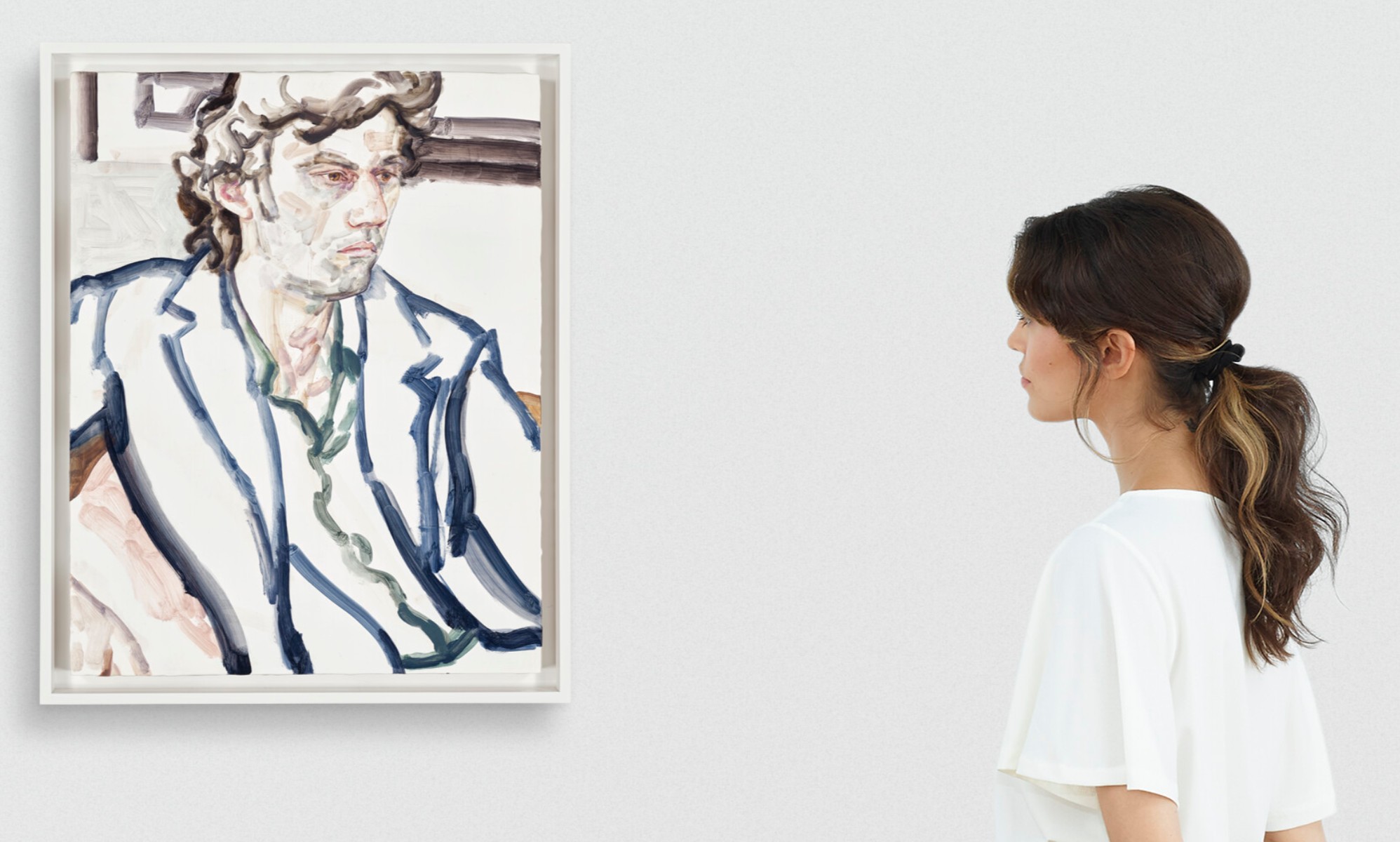
ELIZABETH PEYTON (B. 1965)
Jonas Kaufmann, March 2013, NYC, 2013
Oil on panel
23×18 inches (58.5 x 45.7 cm)
Signed, titled and dated ‘Jonas Kaufmann March 2013 NYC Elizabeth Peyton 2013’ (on the reverse)
INFINITY-NETS (ORUSB), 2014
Christie’s New-York: 20 November 2025
Estimated: USD 700,000 – 1,000,000
USD 889,000
YAYOI KUSAMA (B. 1929), INFINITY-NETS (ORUSB) | Christie’s
REPEAT SALE
Christie’s London: 9 October 2024
Estimated: GBP 600,000 – 900,000
GBP 781,200 / USD 1,023,372
YAYOI KUSAMA (B. 1929), INFINITY-NETS (ORUSB) | Christie’s (christies.com)
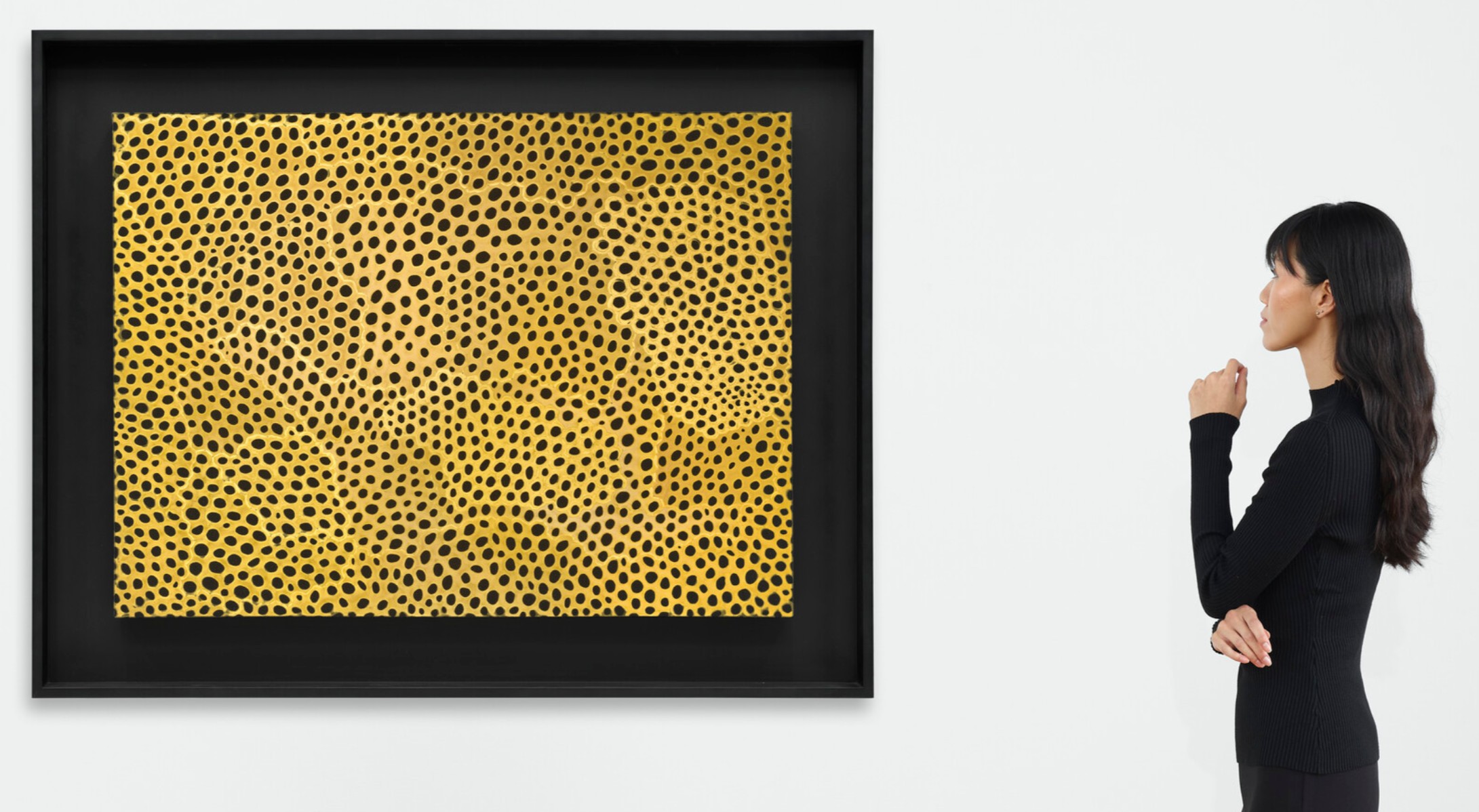
YAYOI KUSAMA (B. 1929)
INFINITY-NETS (ORUSB), 2014
Acrylic on canvas
97.2 x 130.5 cm (38 1/4 x 51 3/8 inches)
Signed, titled and dated ‘ORUSB INFINITY-NETS YAYOI KUSAMA 2014’ (on the reverse)
Untitled (Cowboy), 2001
Christie’s New-York: 20 November 2025
Estimated: USD 500,000 – 700,000
USD 889,000
RICHARD PRINCE (B. 1949), Untitled (Cowboy) | Christie’s
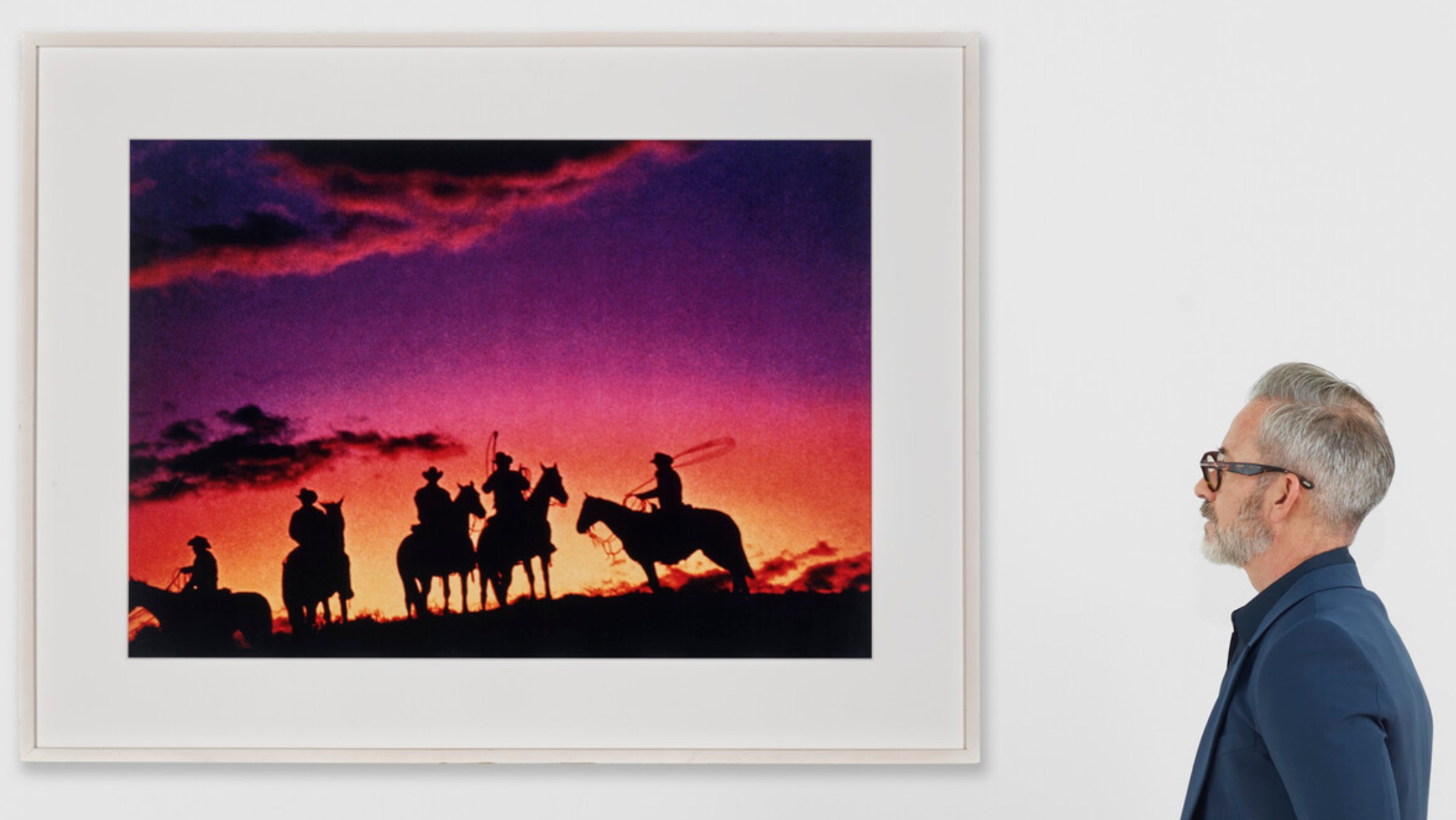
RICHARD PRINCE (B. 1949)
Untitled (Cowboy), 2001
Ektacolor print
28×40 inches (71.1 x 101.6 cm)
Signed, numbered and dated ‘R Prince 2000 1⁄2’ (lower right)
Signed again, numbered again and dated again ‘R Prince 2000 1⁄2’ (on the reverse)
This work is number one from an edition of two plus one artist’s proof
Thai Restaurant, 1980
Christie’s New-York: 20 November 2025
Estimated: USD 600,000 – 800,000
USD 850,900
ALEX KATZ (B. 1927), Thai Restaurant | Christie’s
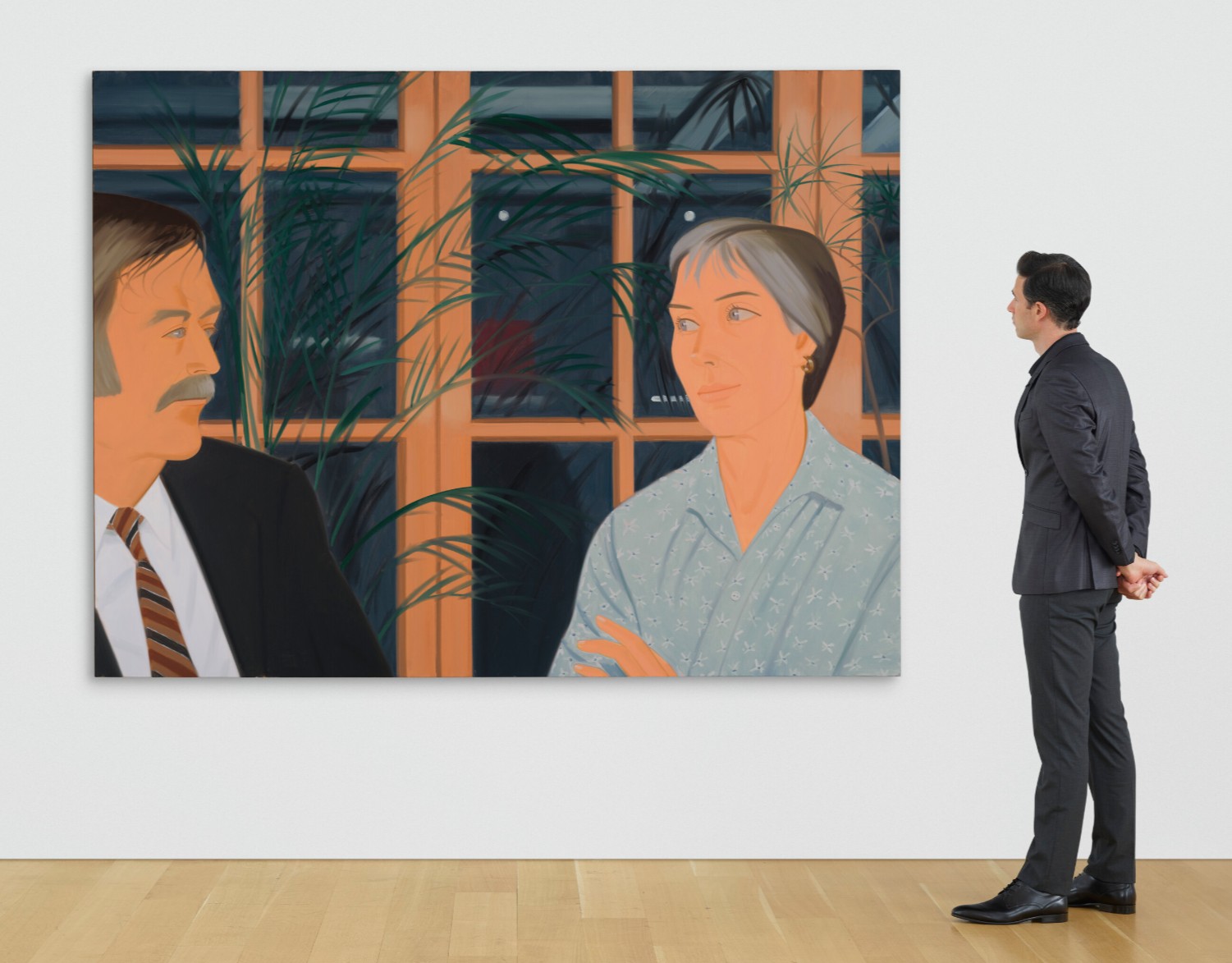
ALEX KATZ (B. 1927)
Thai Restaurant, 1980
Oil on linen
72×96 inches (182.9 x 243.8 cm)
Haystacks, 1969
Christie’s New-York: 20 November 2025
Estimated: USD 500,000 – 700,000
USD 787,400
ROY LICHTENSTEIN (1923-1997), Haystacks | Christie’s
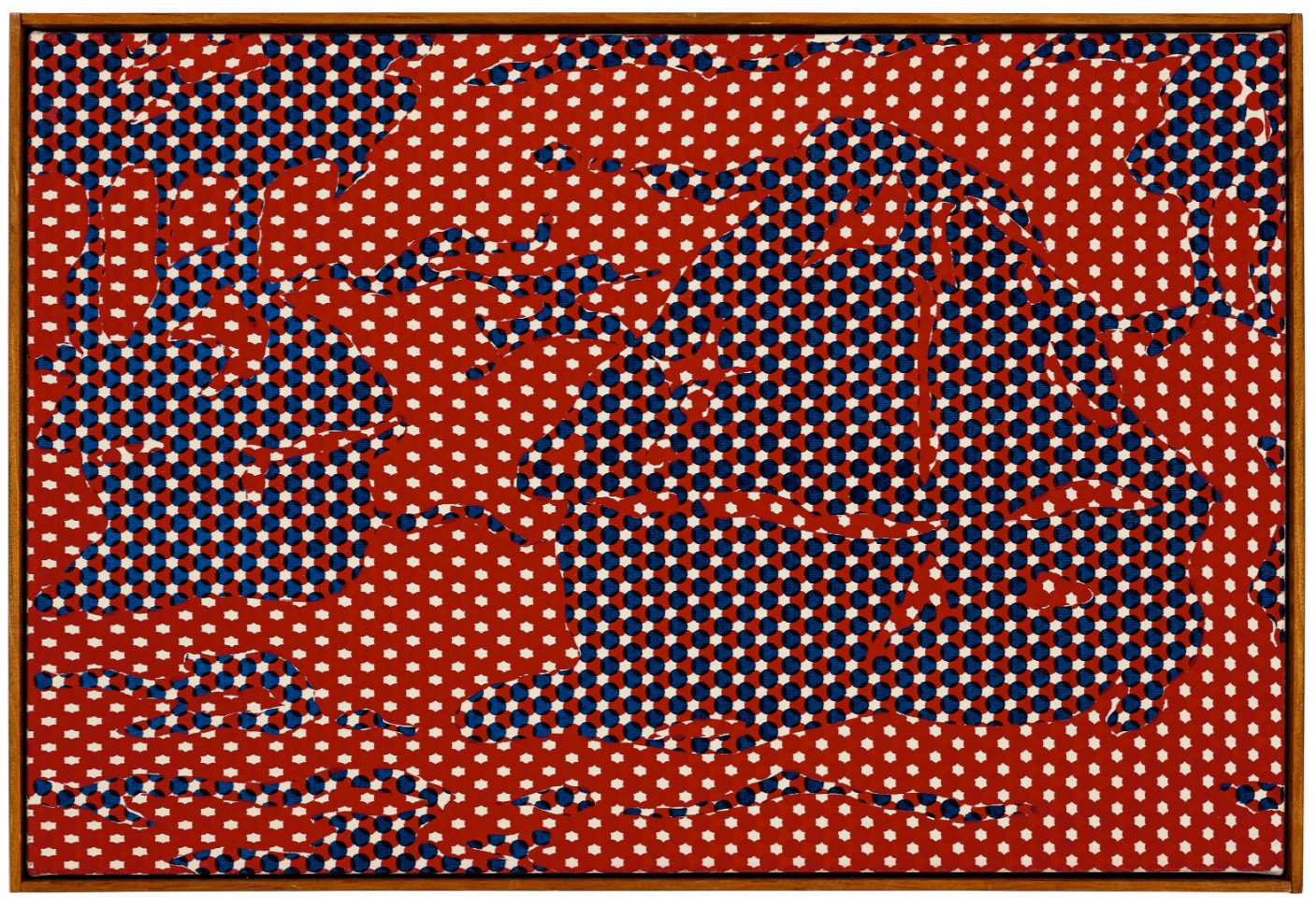
ROY LICHTENSTEIN (1923-1997)
Haystacks, 1969
Oil and acrylic on canvas
16×24 inches (40.6 x 61 cm)
Signed and dated ‘rf Lichtenstein ’69’ (on the reverse)
Untitled, 2007
Property from a Private New York Collection
Christie’s New-York: 20 November 2025
Estimated: USD 500,000 – 700,000
USD 787,400
GEORGE CONDO (B. 1957), Untitled | Christie’s
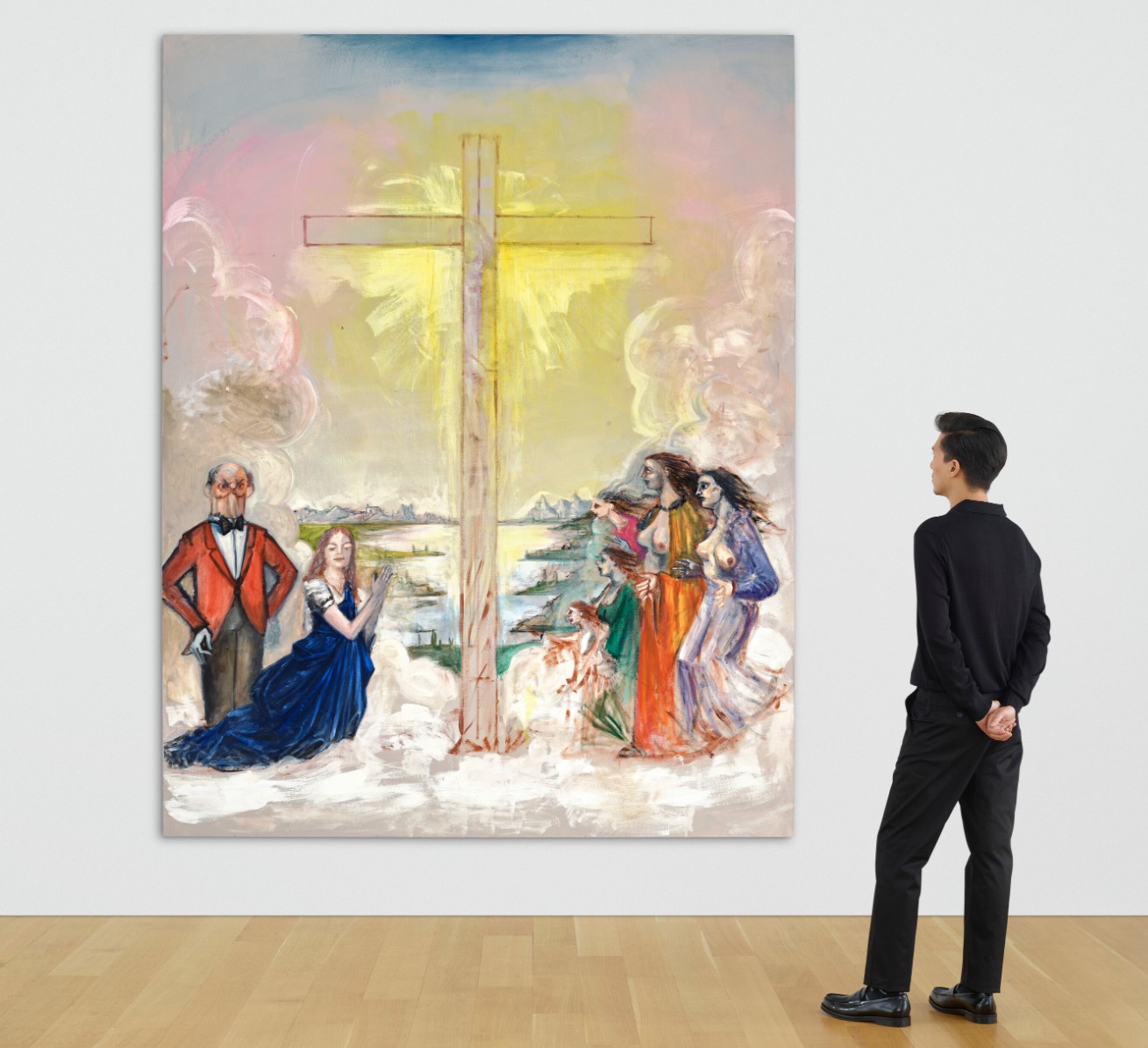
GEORGE CONDO (B. 1957)
Untitled, 2007
Acrylic and oil on canvas
108×85 inches (274.3 x 216 cm)
La siesta, 1986
Property from a Private European Collection
Christie’s New-York: 20 November 2025
Estimated: USD 500,000 – 700,000
USD 762,000
FERNANDO BOTERO (1932-2023), La siesta | Christie’s
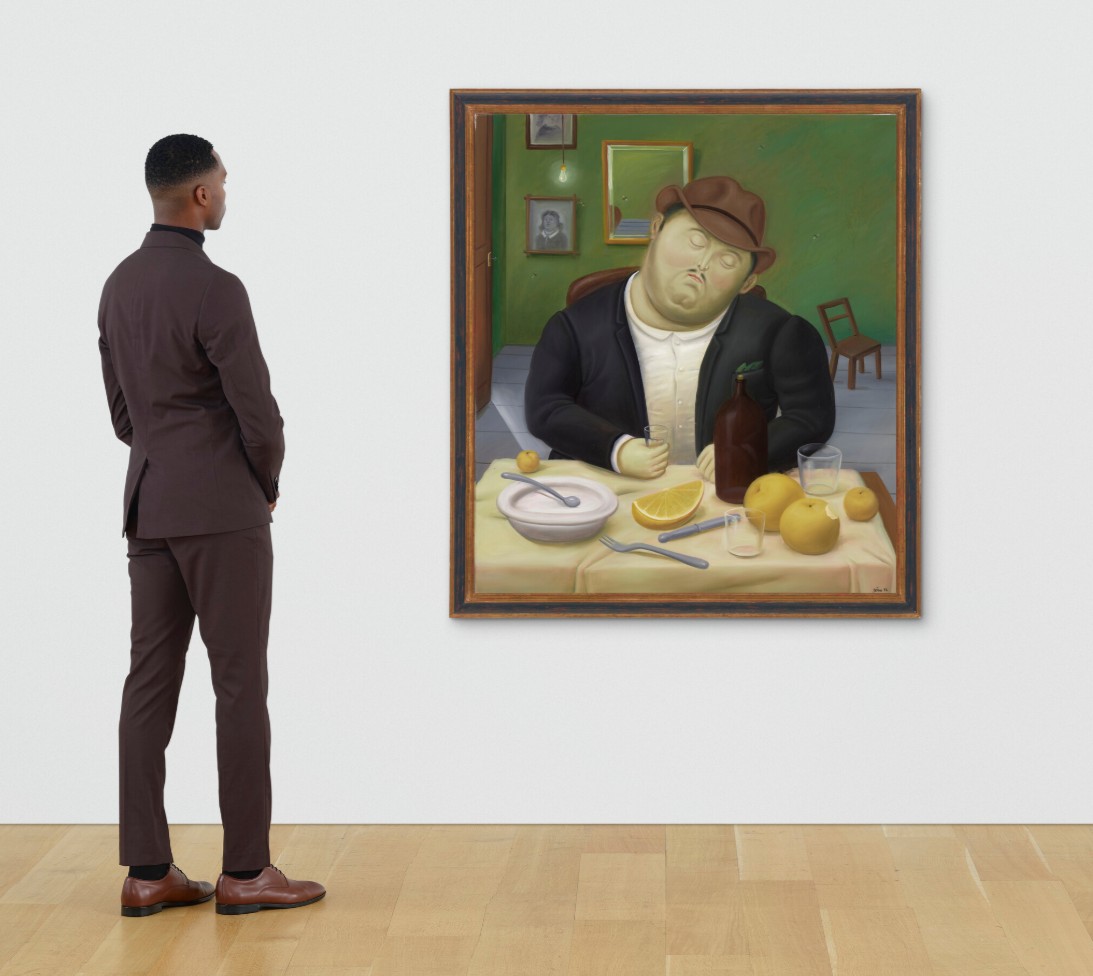
FERNANDO BOTERO (1932-2023)
La siesta, 1986
Oil on canvas
143.8 x 126.7 cm (56 5/8 x 49 7/8 inches)
Signed and dated ‘Botero 86’ (lower right)
DOTS-OBSESSION (2WZAB), 2006
Christie’s New-York: 20 November 2025
Estimated: USD 350,000 – 550,000
USD 736,600
YAYOI KUSAMA (B. 1929), DOTS-OBSESSION (2WZAB) | Christie’s
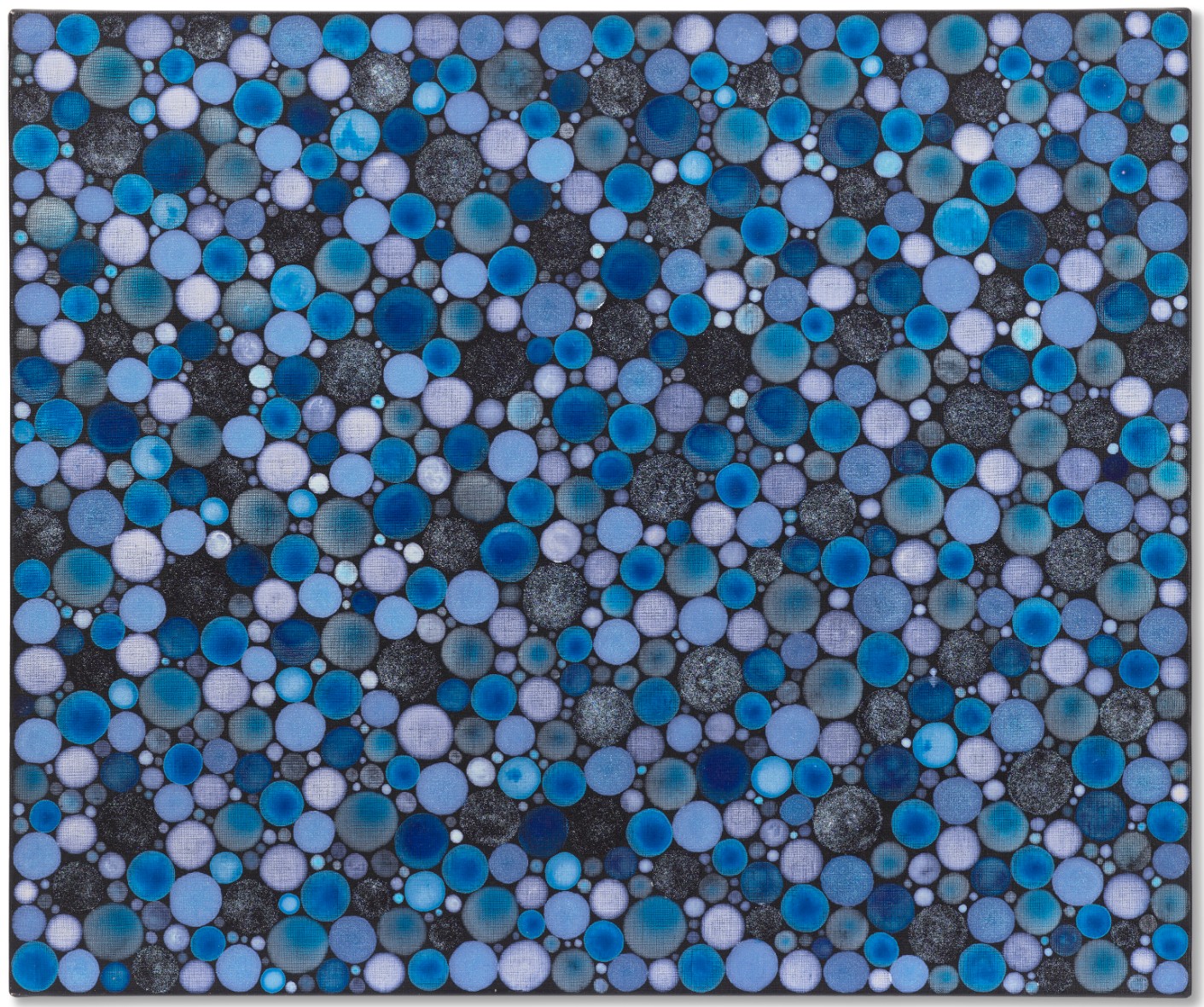
YAYOI KUSAMA (B. 1929)
DOTS-OBSESSION (2WZAB), 2006
Acrylic and glitter on canvas
60.6 x 72.7 cm (23 7/8 x 28 5/8 inches)
Signed, titled in English and Japanese and dated
‘Yayoi Kusama 2006 DOTS-OBSESSION (2WZAB)’
(on the reverse)
Untitled, 1983
Property from a Private New Jersey Collection
Christie’s New-York: 20 November 2025
Estimated: USD 200,000 – 300,000
USD 698,500
WORK ON PAPER
JOAN MITCHELL (1925-1992), Untitled | Christie’s
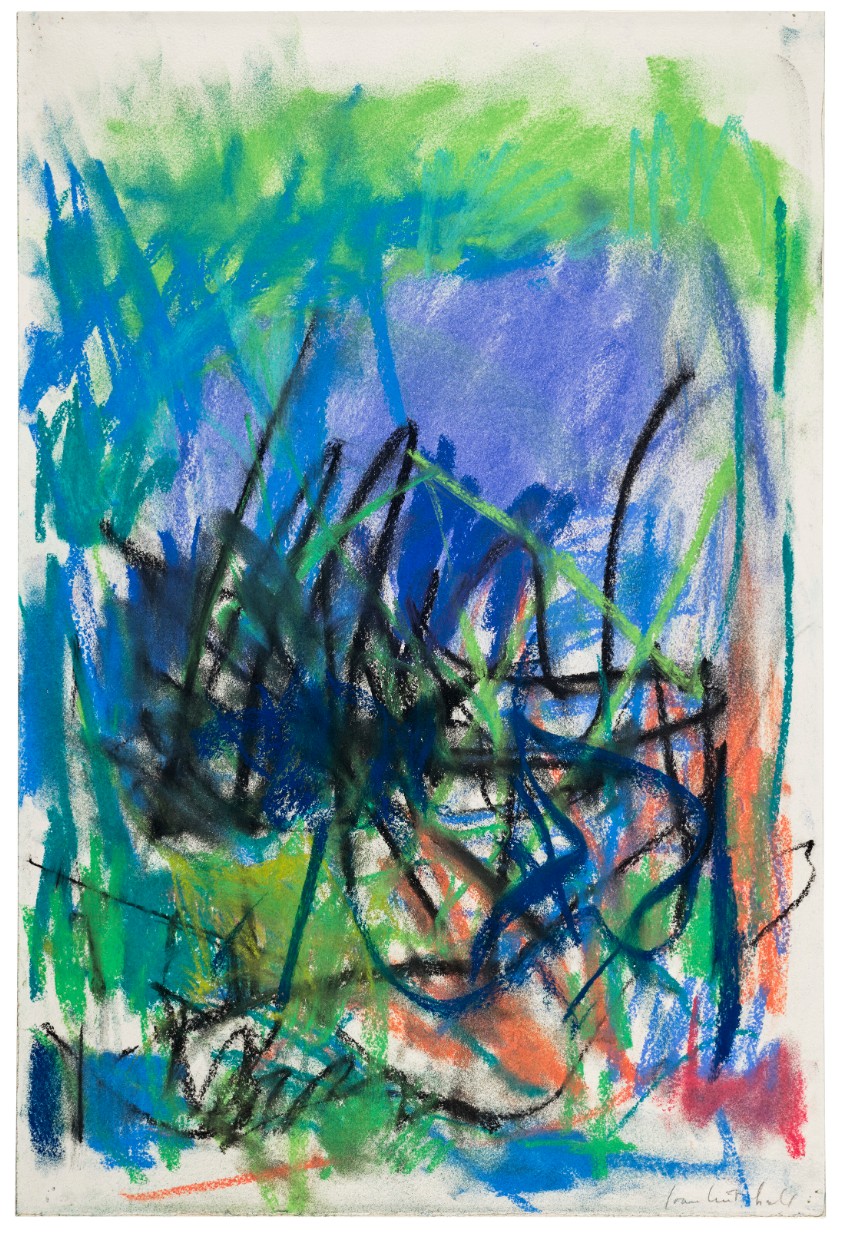
JOAN MITCHELL (1925-1992)
Untitled, 1983
Pastel on paper
22 3/4 x 15 1/4 inches (57.8 x 38.7 cm)
Signed ‘Joan Mitchell’ (lower right)
Periodical, 2006
Property from a Distinguished Danish Collection
Christie’s New-York: 20 November 2025
Estimated: USD 400,000 – 600,000
USD 673,100
LYNETTE YIADOM-BOAKYE (B. 1977), Periodical | Christie’s
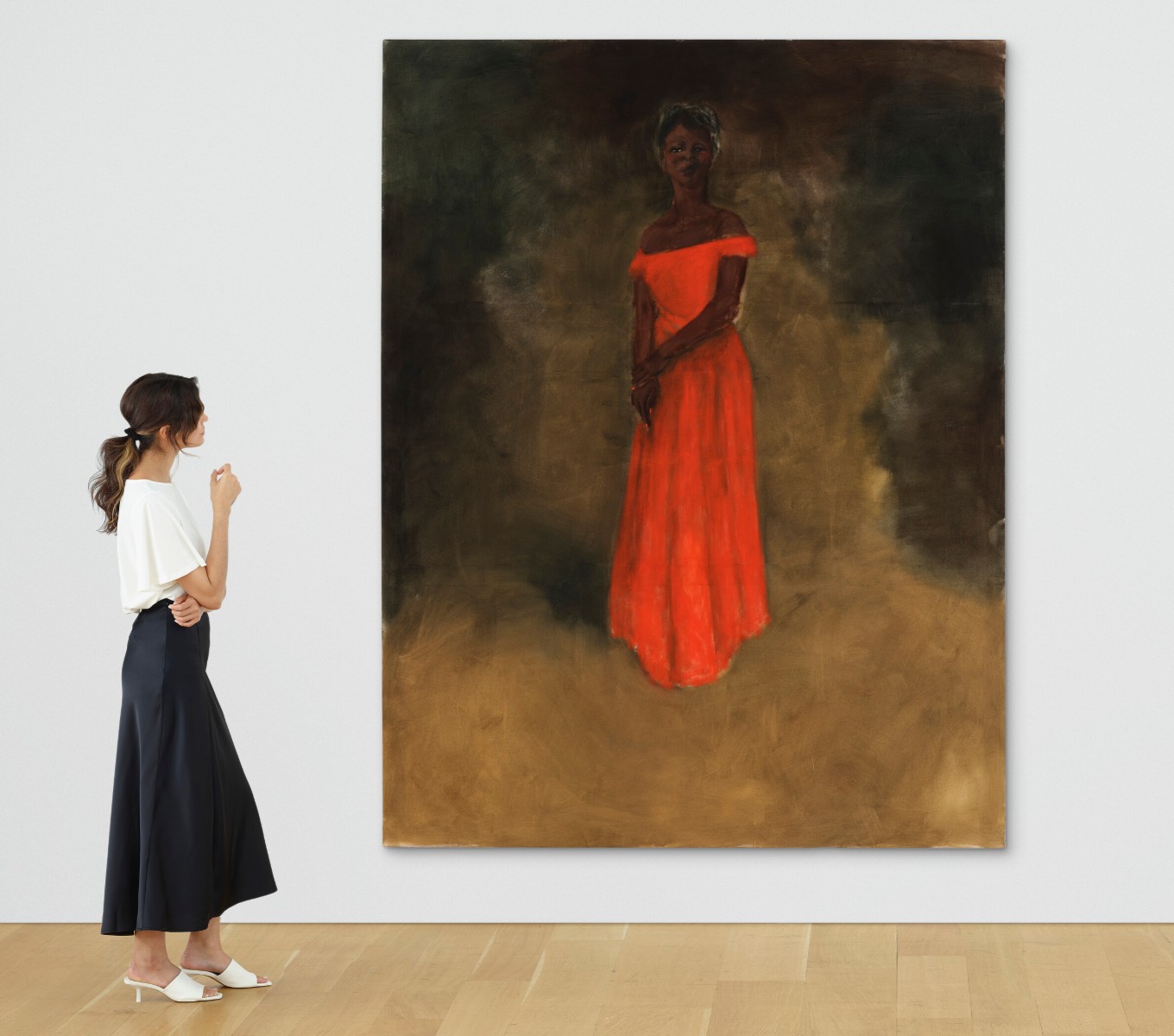
LYNETTE YIADOM-BOAKYE (B. 1977)
Periodical, 2006
Oil on canvas
96×74 inches (244×188 cm)
Signed and dated ‘Lynette Yiadom-Boakye 2006’ (on the reverse)
Gazing Ball (Ariadne), 2013
Christie’s New-York: 20 November 2025
Estimated: USD 600,000 – 800,000
USD 635,000
JEFF KOONS (B. 1955), Gazing Ball (Ariadne) | Christie’s
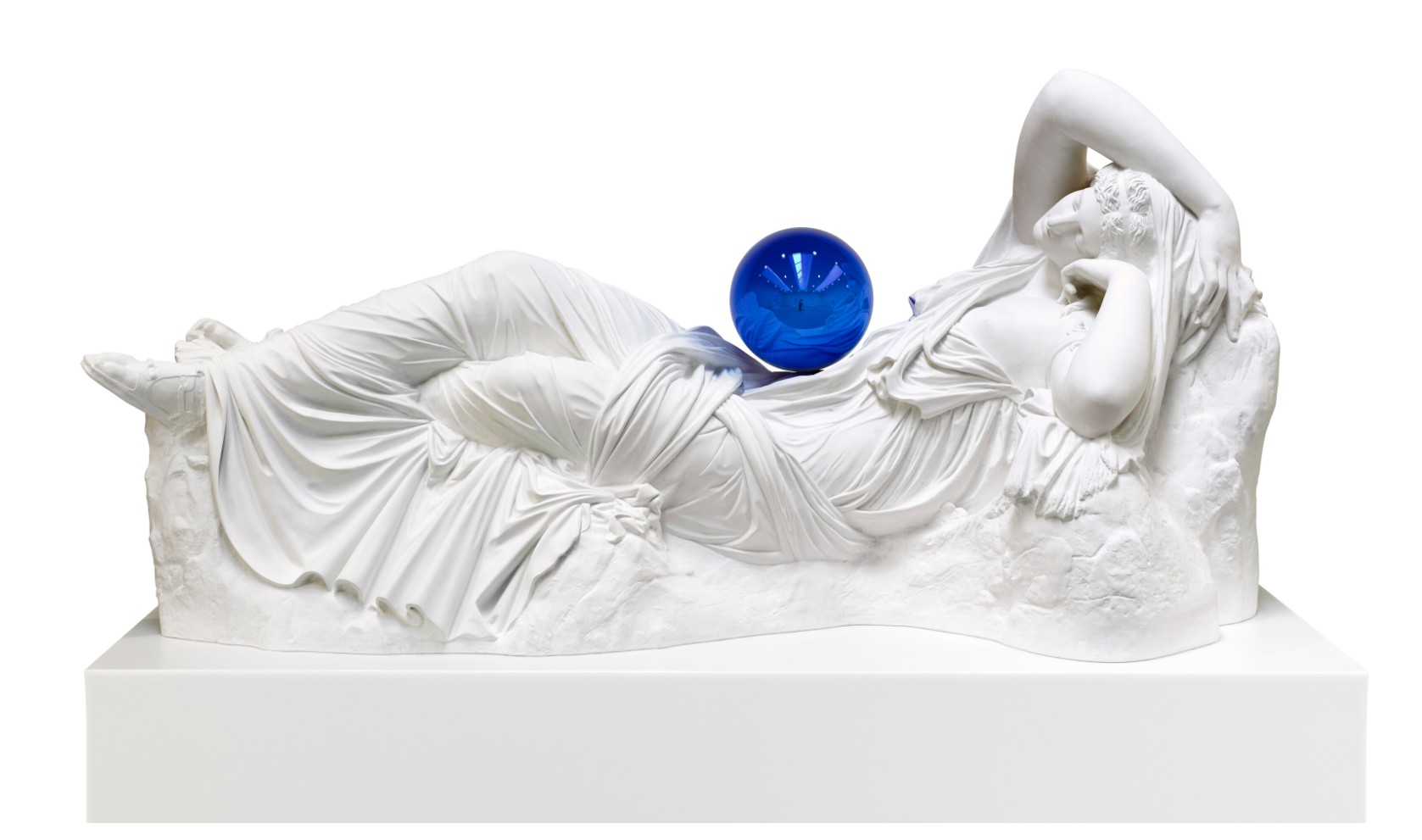
JEFF KOONS (B. 1955)
Gazing Ball (Ariadne), 2013
Plaster and glass
44 3/8 x 93 7/8 x 36 5/8 inches (112.7 x 238.4 x 93 cm)
This work is number one from an edition of three plus one artist’s proof
The Green Bar, 2018
Christie’s New-York: 20 November 2025
Estimated: USD 80,000 – 120,000
USD 520,700
SALMAN TOOR (B. 1983), The Green Bar | Christie’s
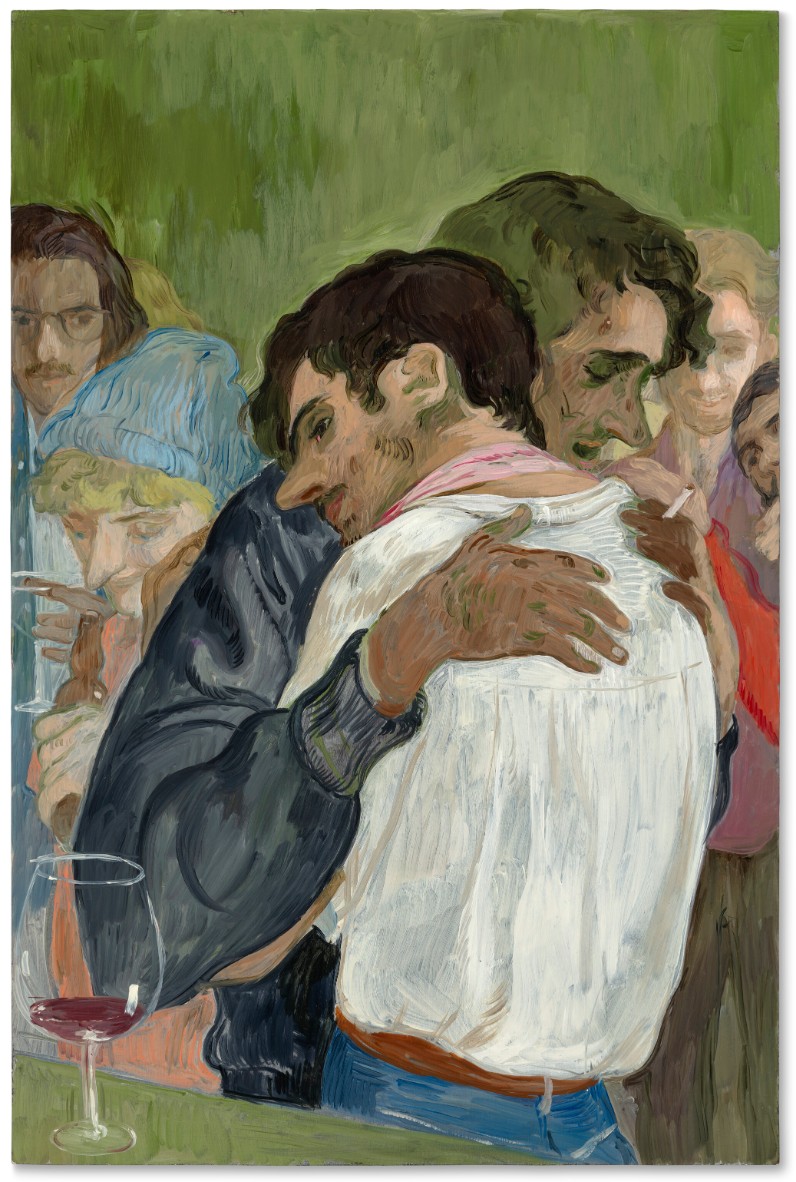
SALMAN TOOR (B. 1983)
The Green Bar, 2018
Oil on panel
18×12 inches (45.7 x 30.5 cm)
Untitled, 1991
Property from a Private New Jersey Collection
Christie’s New-York: 20 November 2025
Estimated: USD 400,000 – 600,000
USD 508,000
JOAN MITCHELL (1925-1992), Untitled | Christie’s
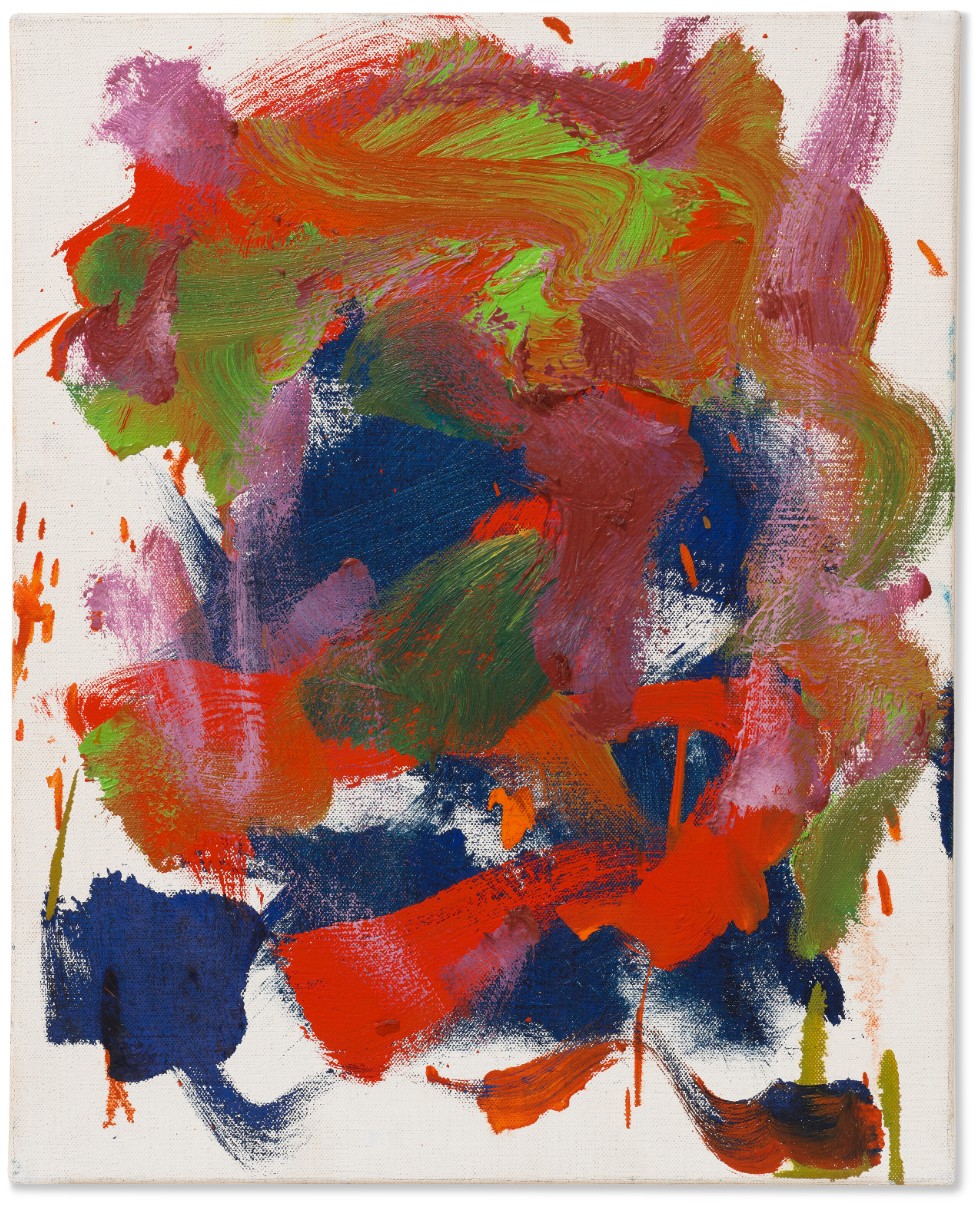
JOAN MITCHELL (1925-1992)
Untitled, 1991
Oil on canvas
16 1/4 x 13 1/8 inches (41.3 x 33.3 cm)
Untitled, 1992
Christie’s New-York: 20 November 2025
Estimated: USD 400,000 – 600,000
USD 444,500
CHRISTOPHER WOOL (B. 1955), Untitled | Christie’s
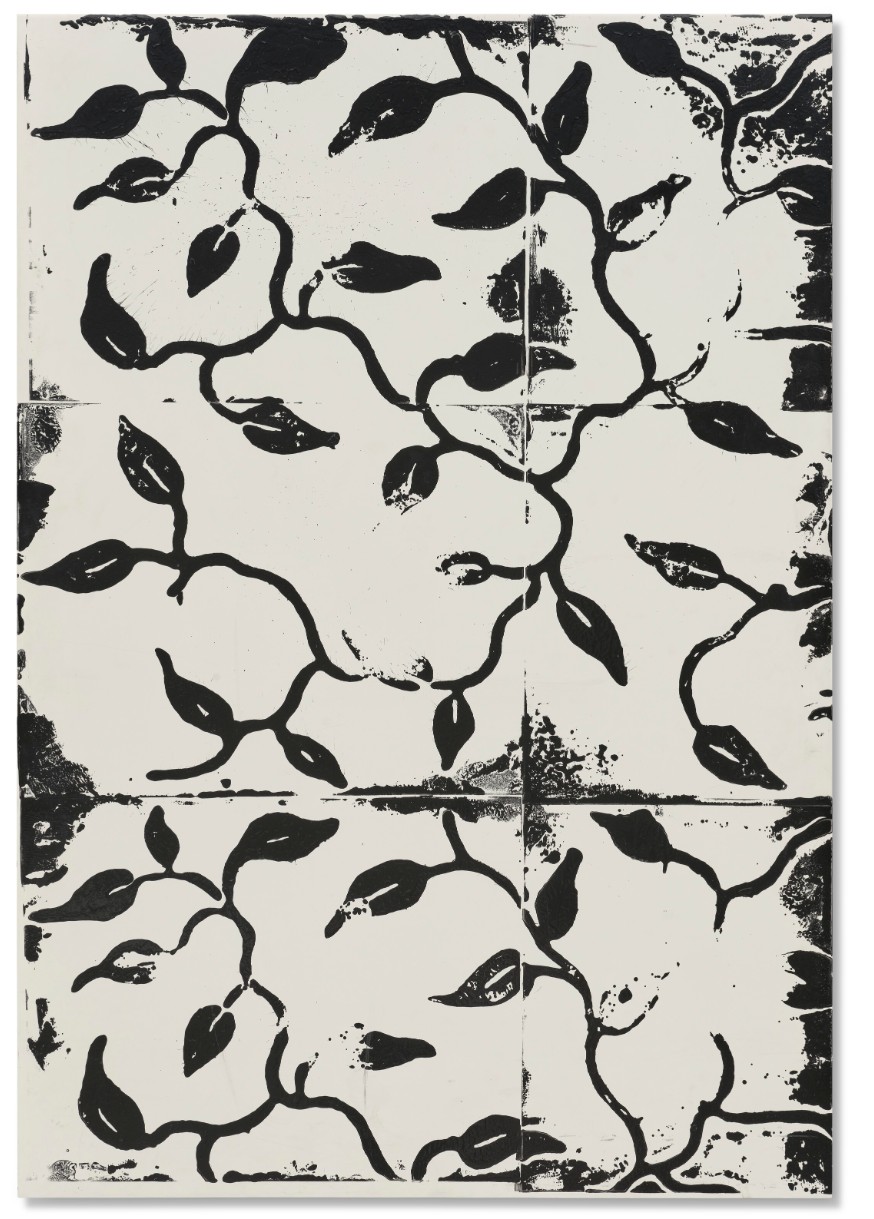
CHRISTOPHER WOOL (B. 1955)
Untitled, 1992
Enamel on aluminum
52 x 35 3/4 inches (132 x 90.8 cm)
Signed, inscribed and dated ‘WOOL 1992 (S114)’ (on the reverse)
Untitled, 1997
Edlis Neeson Collection
Christie’s New-York: 20 November 2025
Estimated: USD 400,000 – 600,000
USD 444,500
MAURIZIO CATTELAN (B. 1960), Untitled | Christie’s
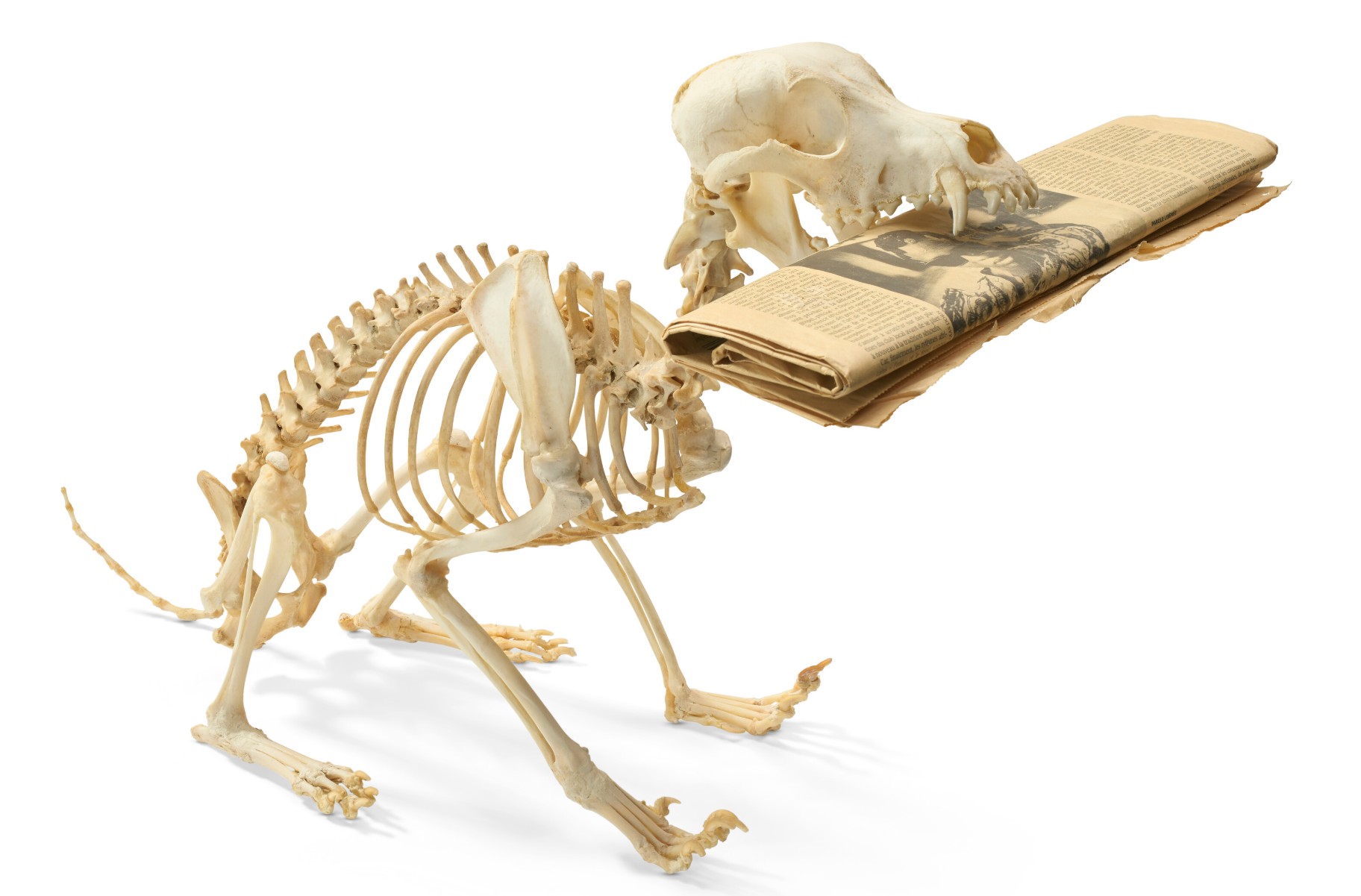
MAURIZIO CATTELAN (B. 1960)
Untitled, 1997
Dog skeleton and Le Monde newspaper
16 1/8 x 13 x 23 1/2 inches (40.9 x 33 x 58.7 cm)
This work is one of three unique variants
Brushstroke with Still Life II, 1996
Property from the Estate of Joan and Kenneth Goldglit
Christie’s New-York: 20 November 2025
Estimated: USD 300,000 – 500,000
USD 444,500
ROY LICHTENSTEIN (1923-1997), Brushstroke with Still Life II | Christie’s
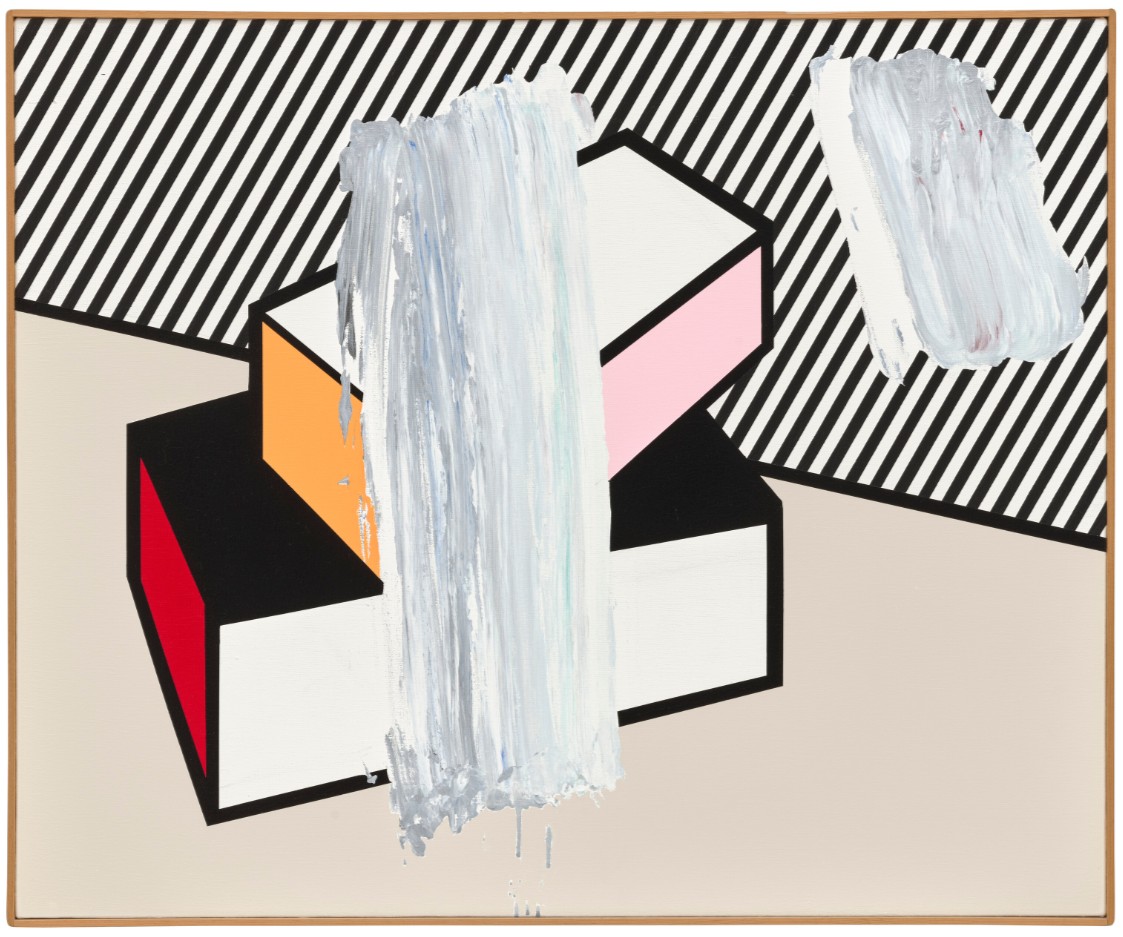
ROY LICHTENSTEIN (1923-1997)
Brushstroke with Still Life II, 1996
Acrylic, oil and graphite on canvas
28×34 inches (71.1 x 86.4 cm)
Signed and dated ‘rf Lichtenstein ’96’ (on the reverse)
Snorkel Vest, 1985
Property from an Important European Collection
Christie’s New-York: 20 November 2025
Estimated: USD 400,000 – 600,000
USD 431,800
JEFF KOONS (B. 1955), Snorkel Vest | Christie’s
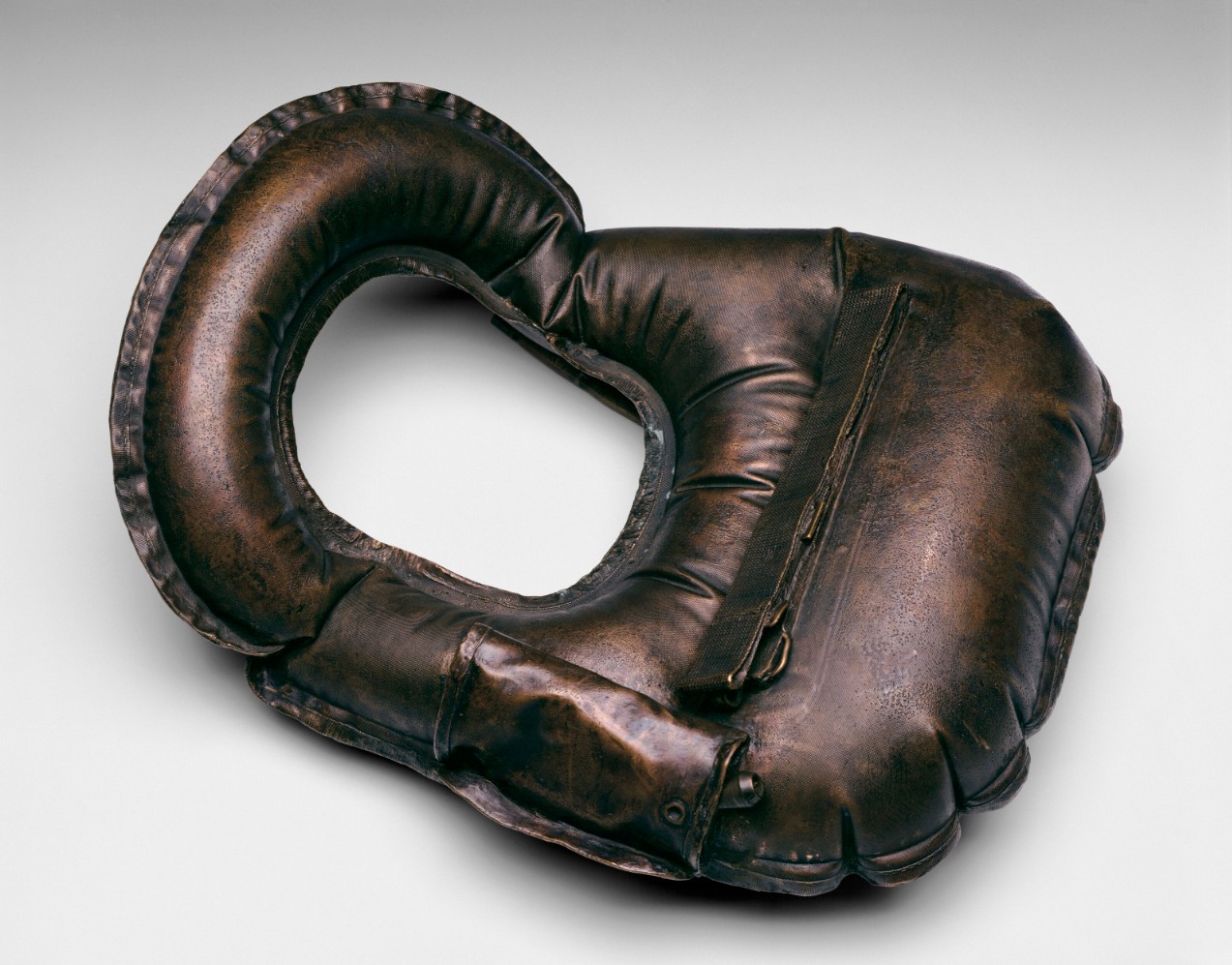
JEFF KOONS (B. 1955)
Snorkel Vest, 1985
Bronze
21x18x6 inches (53.3 x 45.7 x 15.2 cm)
This work is the artist’s proof from an edition of three plus one artist’s proof
Untitled, circa 1959
Christie’s New-York: 20 November 2025
Estimated: USD 350,000 – 450,000
USD 355,600
FERNANDO BOTERO (1932-2023), Untitled | Christie’s
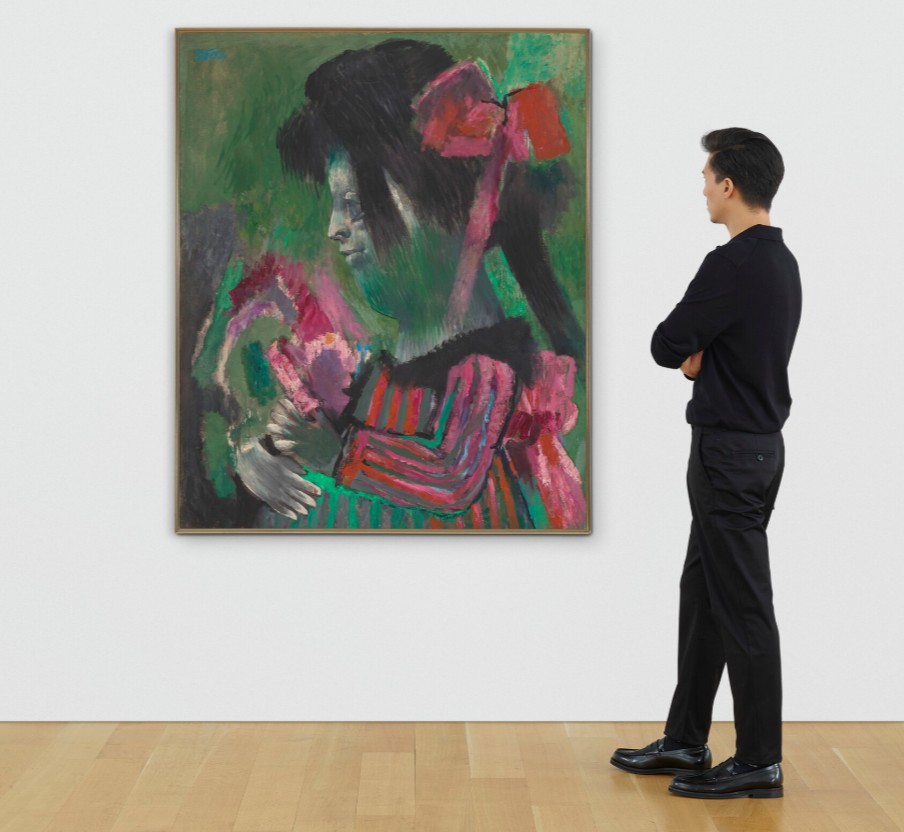
FERNANDO BOTERO (1932-2023)
Untitled, circa 1959
Oil on canvas
154.9 x 127 cm (61×50 inches)
Signed ‘Botero’ (upper left)
Adios with Olive, 1969
Art from Stone: The Collection of Donald and Maggie Kelley
Christie’s New-York: 20 November 2025
Estimated: USD 250,000 – 350,000
USD 355,600
ED RUSCHA (B. 1937), Adios with Olive | Christie’s
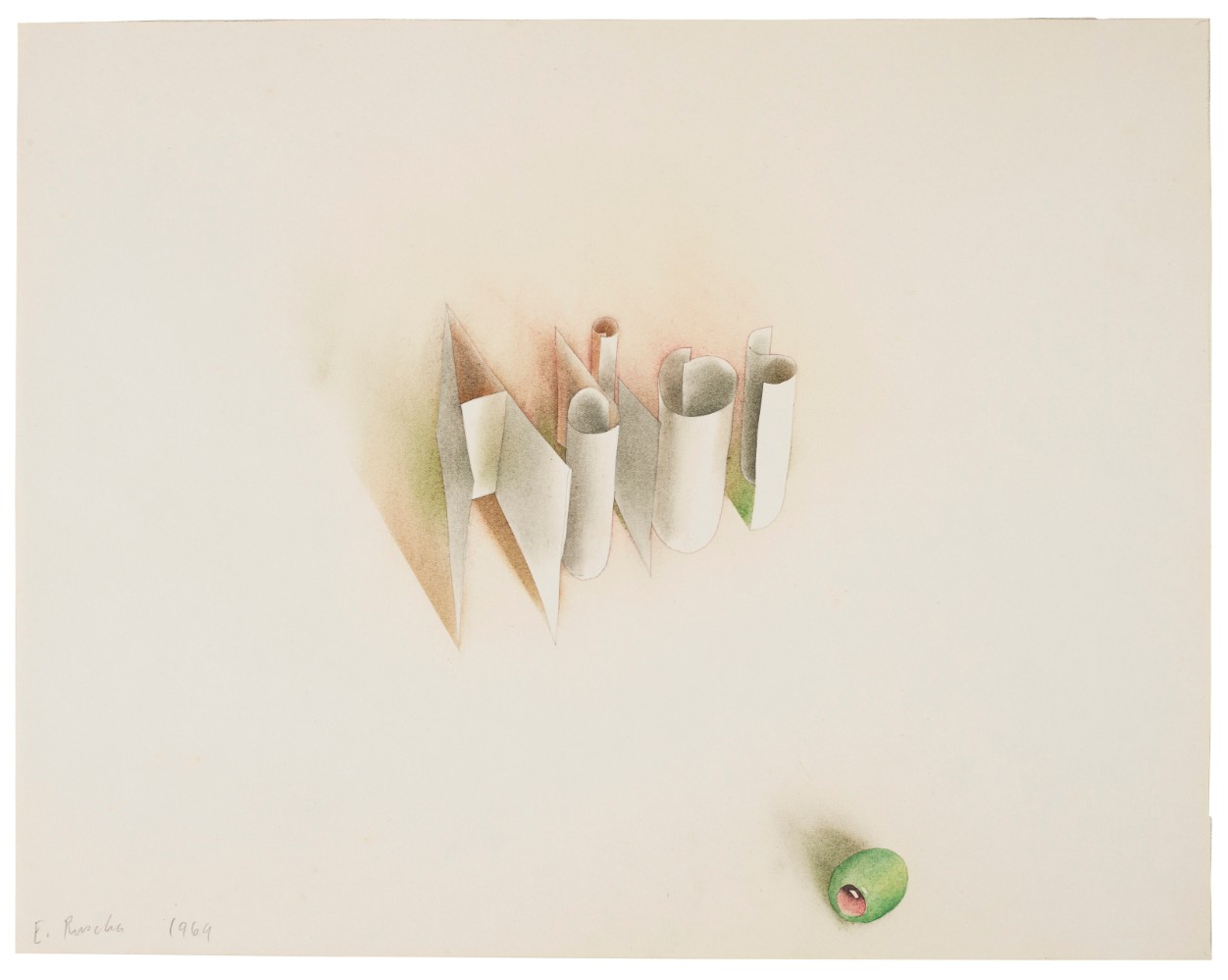
ED RUSCHA (B. 1937)
Adios with Olive, 1969
Pastel and graphite on paper
11 1/4 x 14 1/2 inches (28.2 x 36.8 cm)
Signed and dated ‘E. Ruscha 1969’ (lower left)
Untitled, 1981
Christie’s New-York: 20 November 2025
Estimated: USD 180,000 – 250,000
USD 317,500
JEAN-MICHEL BASQUIAT (1960-1988), Untitled | Christie’s
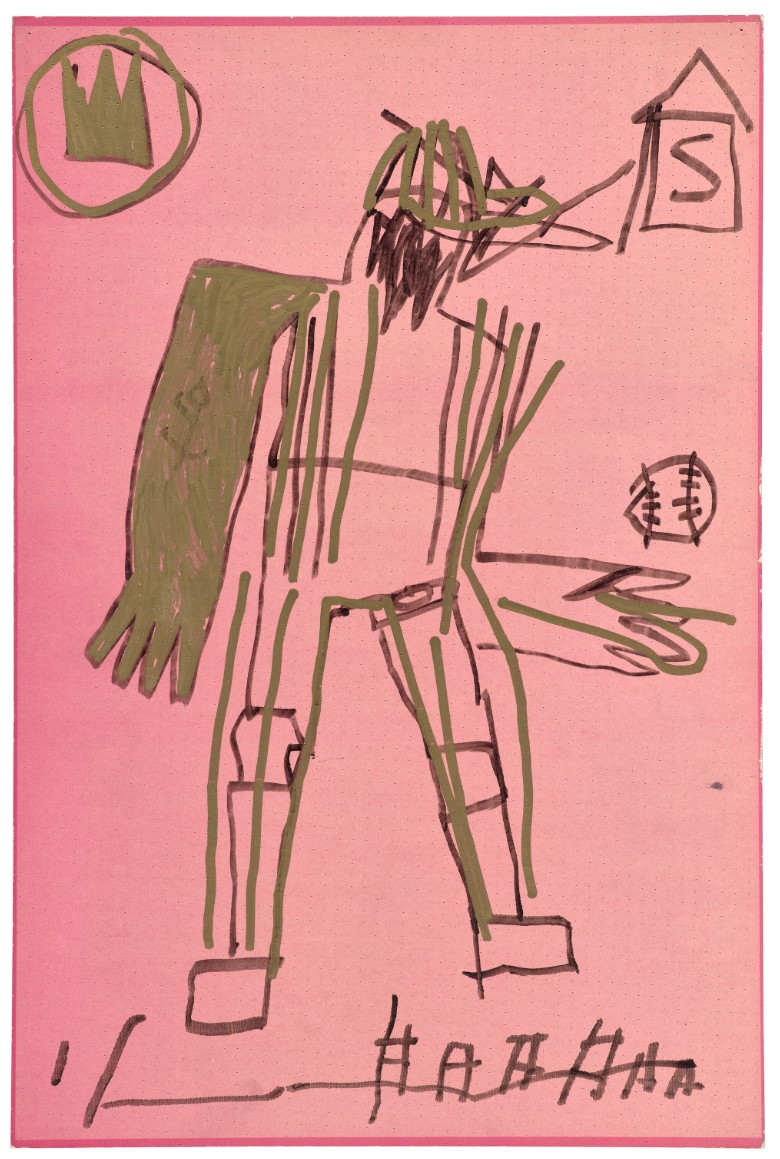
JEAN-MICHEL BASQUIAT (1960-1988)
Untitled, 1981
Paint pen and marker on colored illustration board
18 x 11 7/8 inches (45.7 x 30.2 cm)
Inscribed by Keith Haring (on the reverse)
Untitled Anxious Men, 2016
Christie’s New-York: 20 November 2025
Estimated: USD 250,000 – 350,000
USD 279,400
RASHID JOHNSON (B. 1977), Untitled Anxious Men | Christie’s
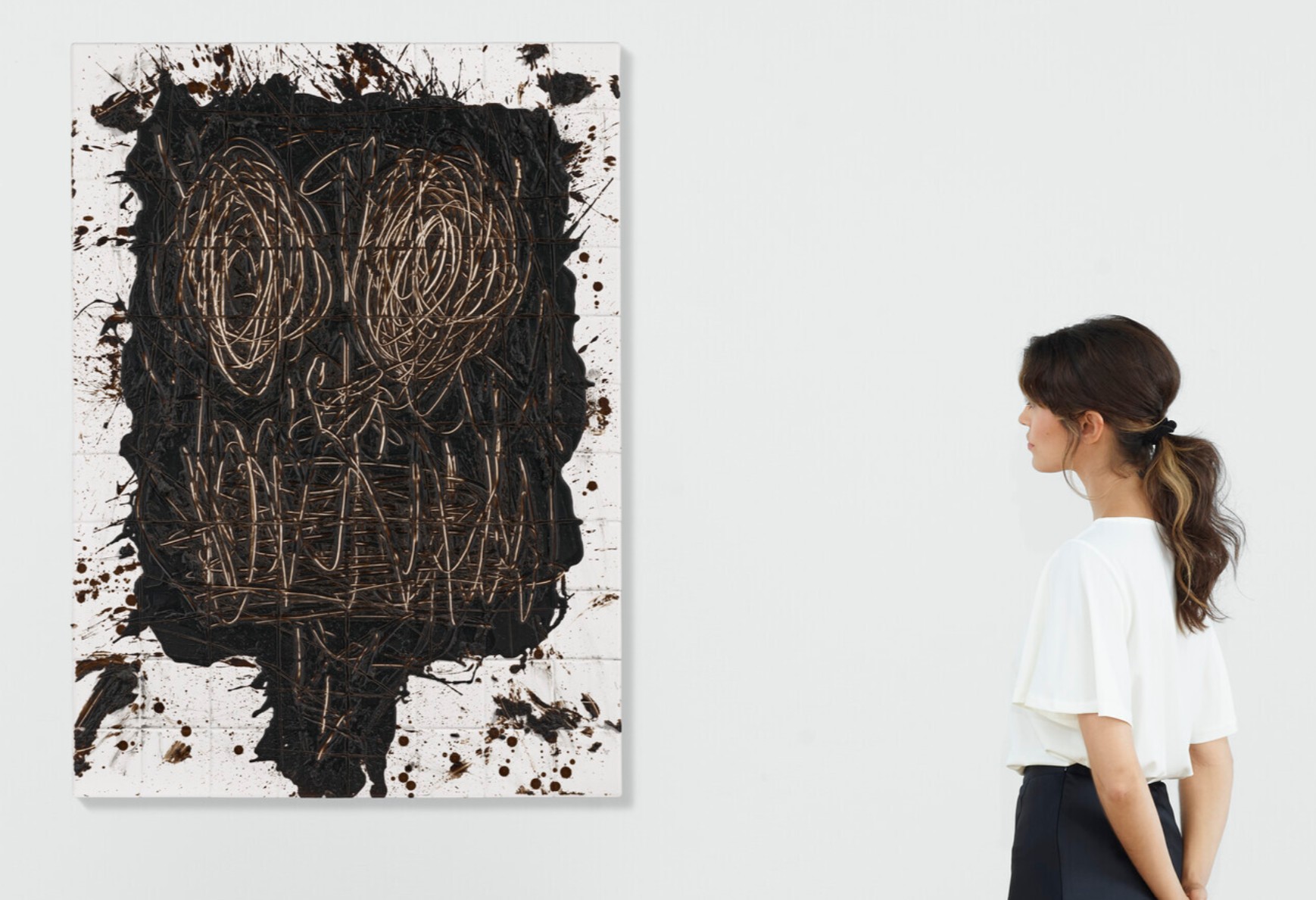
RASHID JOHNSON (B. 1977)
Untitled Anxious Men, 2016
Black soap and wax on ceramic tiles
47 1/8 x 34 1/4 inches (119.7 x 87 cm)
Untitled, 1989
Property from an Important Private Collection, Japan
Christie’s New-York: 20 November 2025
Estimated: USD 200,000 – 300,000
USD 254,000
CHRISTOPHER WOOL (B. 1955), Untitled | Christie’s
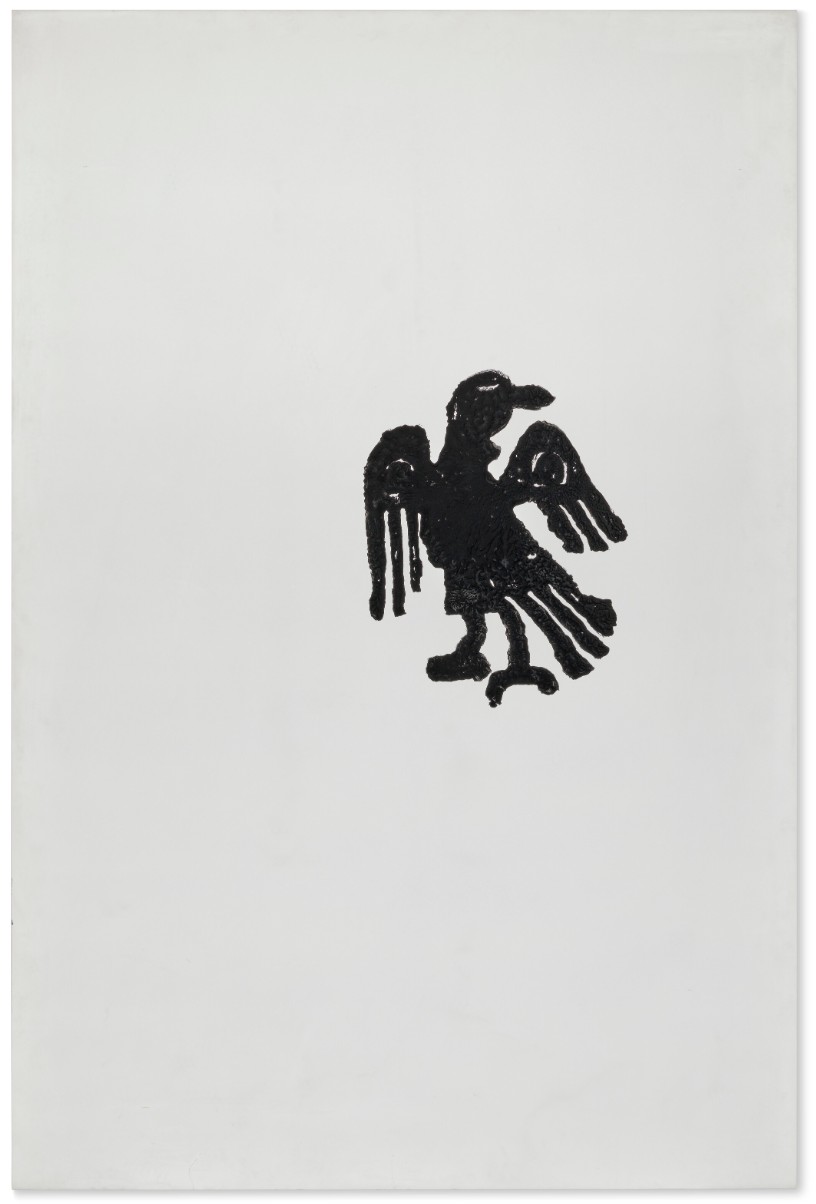
CHRISTOPHER WOOL (B. 1955)
Untitled, 1989
Enamel and acrylic on aluminum
72×48 inches (182.9 x 121.9 cm)
Signed and dated ‘Wool 1989’ (on the reverse)
2,3-Dibenzoyl-D-Tartaric Acid, 2002
Christie’s New-York: 20 November 2025
Estimated: USD 100,000 – 150,000
USD 215,900
DAMIEN HIRST (B. 1965), 2,3-Dibenzoyl-D-Tartaric Acid | Christie’s
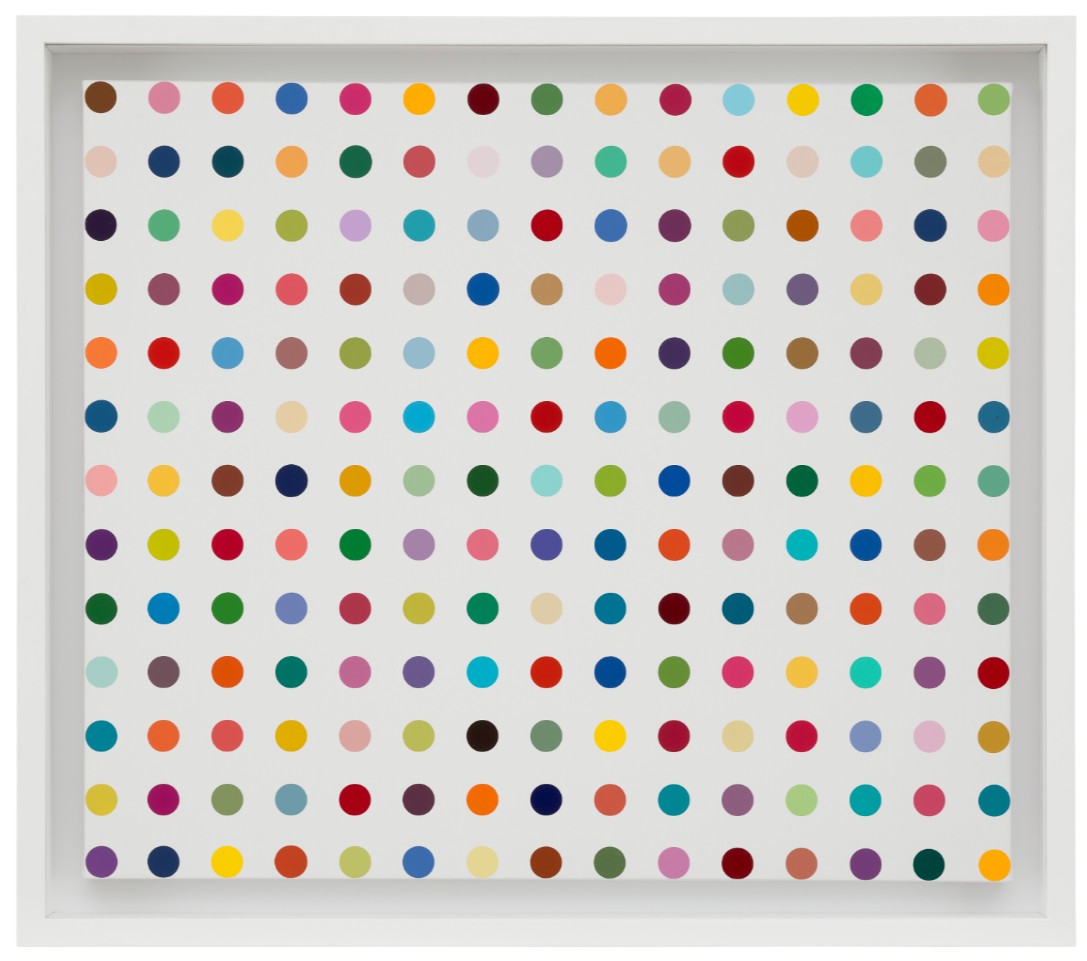
DAMIEN HIRST (B. 1965)
2,3-Dibenzoyl-D-Tartaric Acid, 2002
Household gloss on canvas
25×29 inches (63.5 x 73.7 cm)
Signed, titled and dated ‘2022 ‘2,3-Dibenzoyl-D-Tartaric Acid’ Damien Hirst’ (on the reverse)
Signed again ‘D. Hirst’ (on the stretcher)
The Hero Centaur, 2005
Christie’s New-York: 20 November 2025
Estimated: USD 80,000 – 120,000
USD 165,100
HERNAN BAS (B. 1978), The Hero Centaur | Christie’s
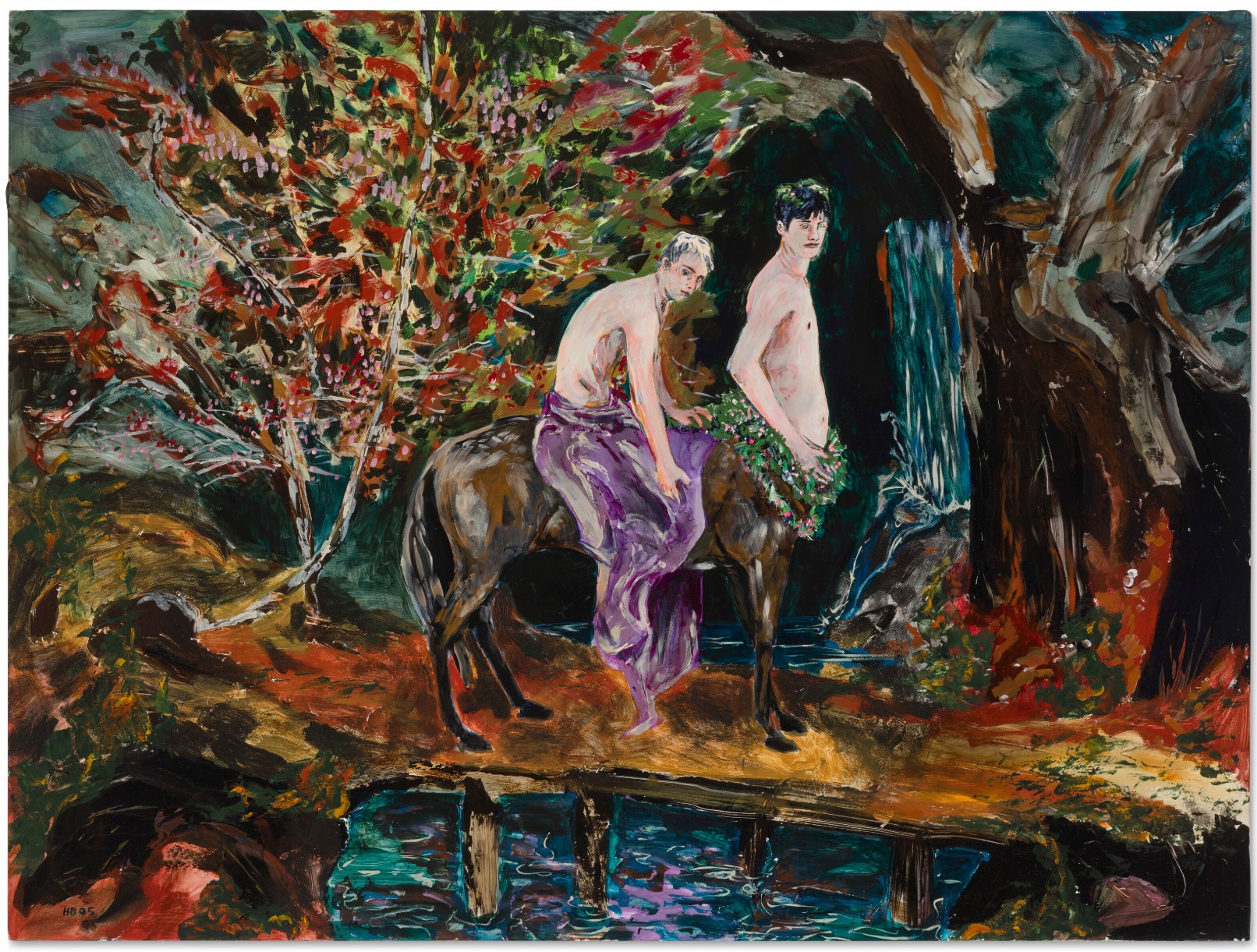
HERNAN BAS (B. 1978)
The Hero Centaur, 2005
Oil on panel
36×48 inches (91×122 cm)
Signed with the artist’s initials and dated “HB 05” (lower left)
Signed with the artist’s initials again
Titled and dated again “THE HERO CENTAUR HB 05” (on the reverse)
Saint Jude, 2004
Edlis Neeson Collection
Christie’s New-York: 20 November 2025
Estimated: USD 120,000 – 180,000
USD 139,700
DAMIEN HIRST (B. 1965), Saint Jude | Christie’s
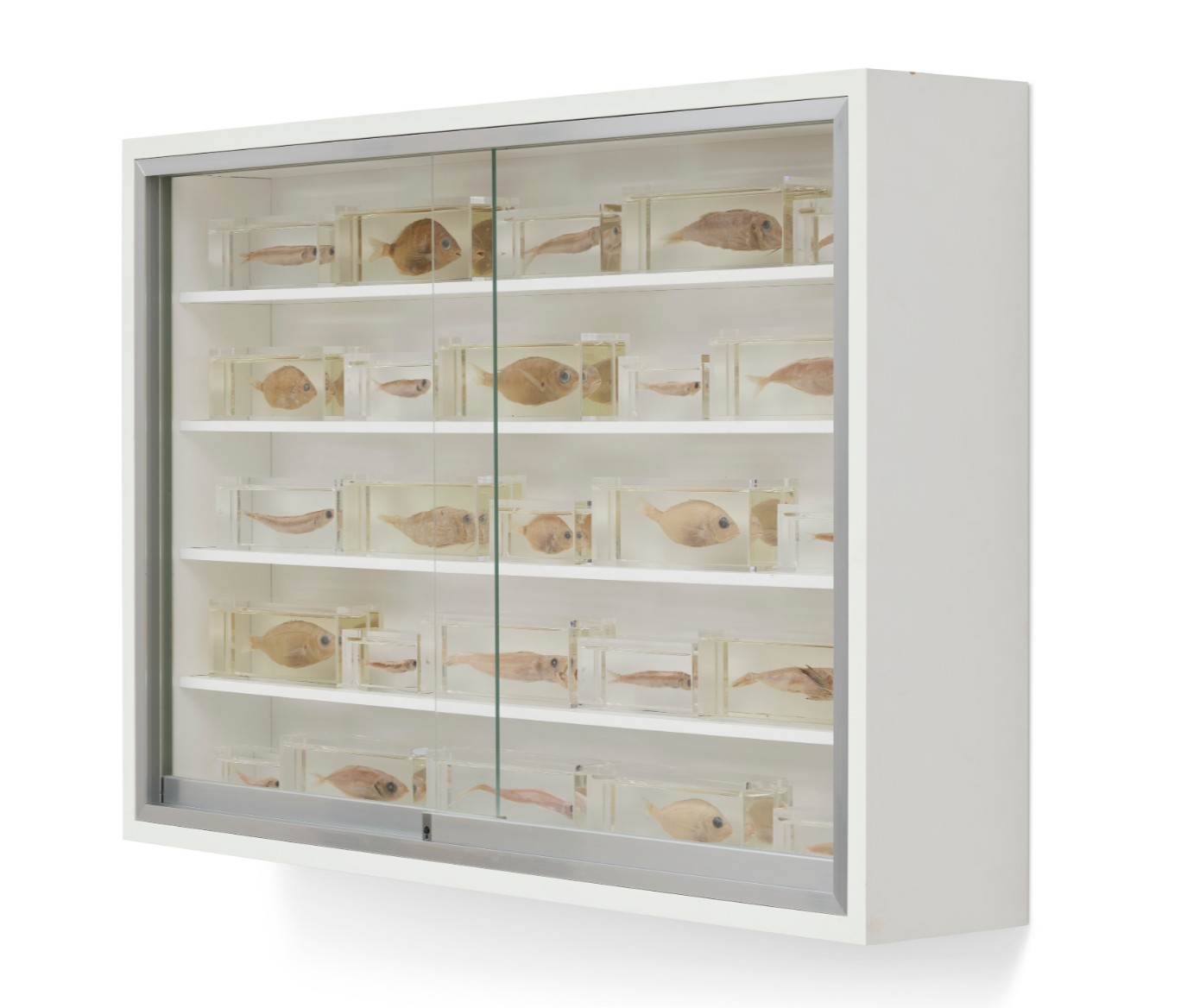
DAMIEN HIRST (B. 1965)
Saint Jude, 2004
Glass, painted MDF, aluminum, acrylic, fish and formaldehyde solution
24 x 36 x 6 1/2 inches (61 x 91.5 x 16.5 cm)
Lots Passed
Double Glass, 1979
Christie’s New-York: 20 November 2025
Estimated: USD 1,500,000 – 2,000,000
PASSED
ROY LICHTENSTEIN (1923-1997), Double Glass | Christie’s
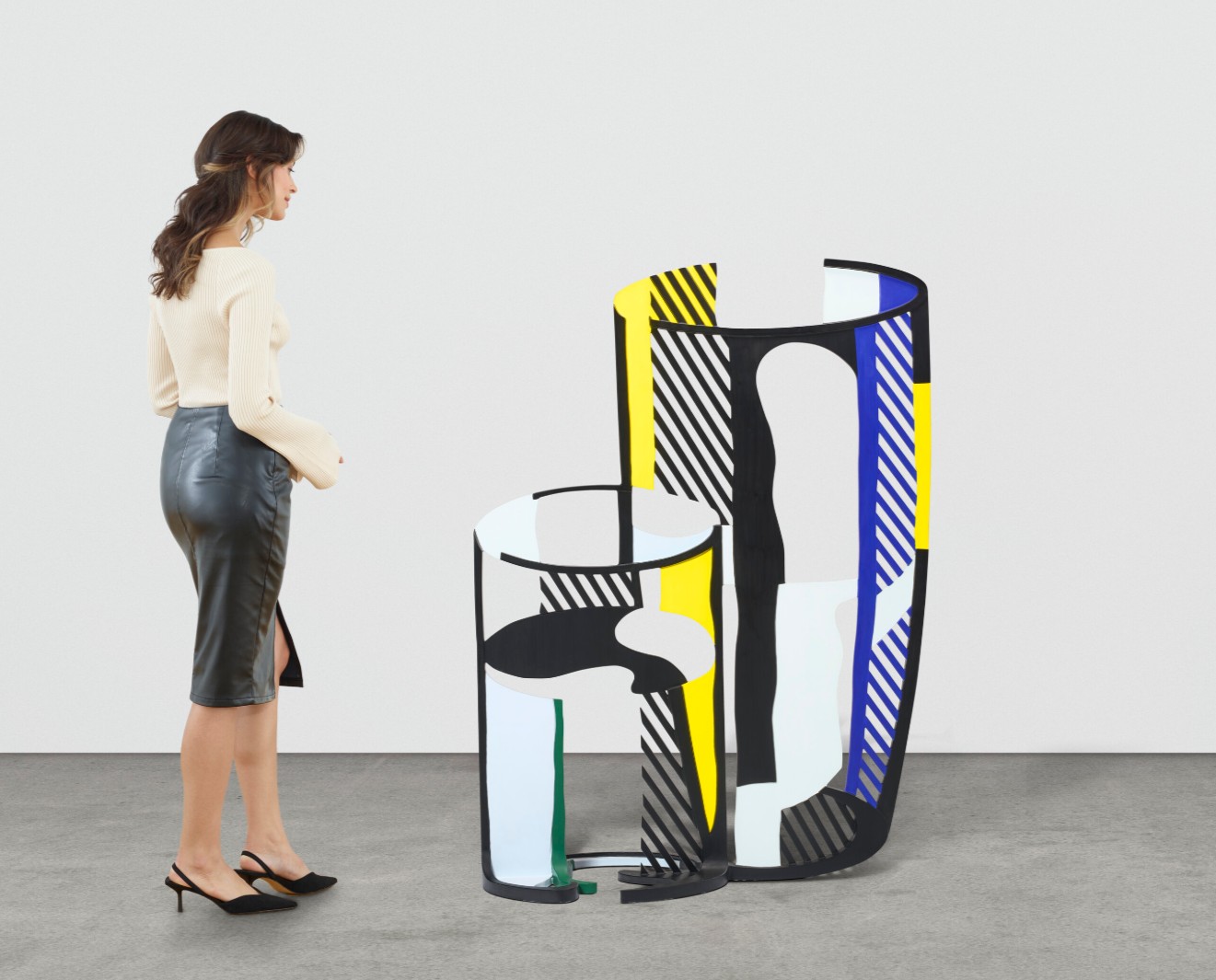
ROY LICHTENSTEIN (1923-1997)
Double Glass, 1979
Painted bronze
56x42x17 inches (142.2 x 106.7 x 43.2 cm)
Incised with the artist’s signature, number and date ‘3⁄3 rf Lichtenstein ’79’ (lower edge)
This work is number three from an edition of three
Abstraktes Bild, 1999
Christie’s New-York: 20 November 2025
Estimated: USD 700,000 – 1,000,000
PASSED
GERHARD RICHTER (B. 1932), Abstraktes Bild | Christie’s
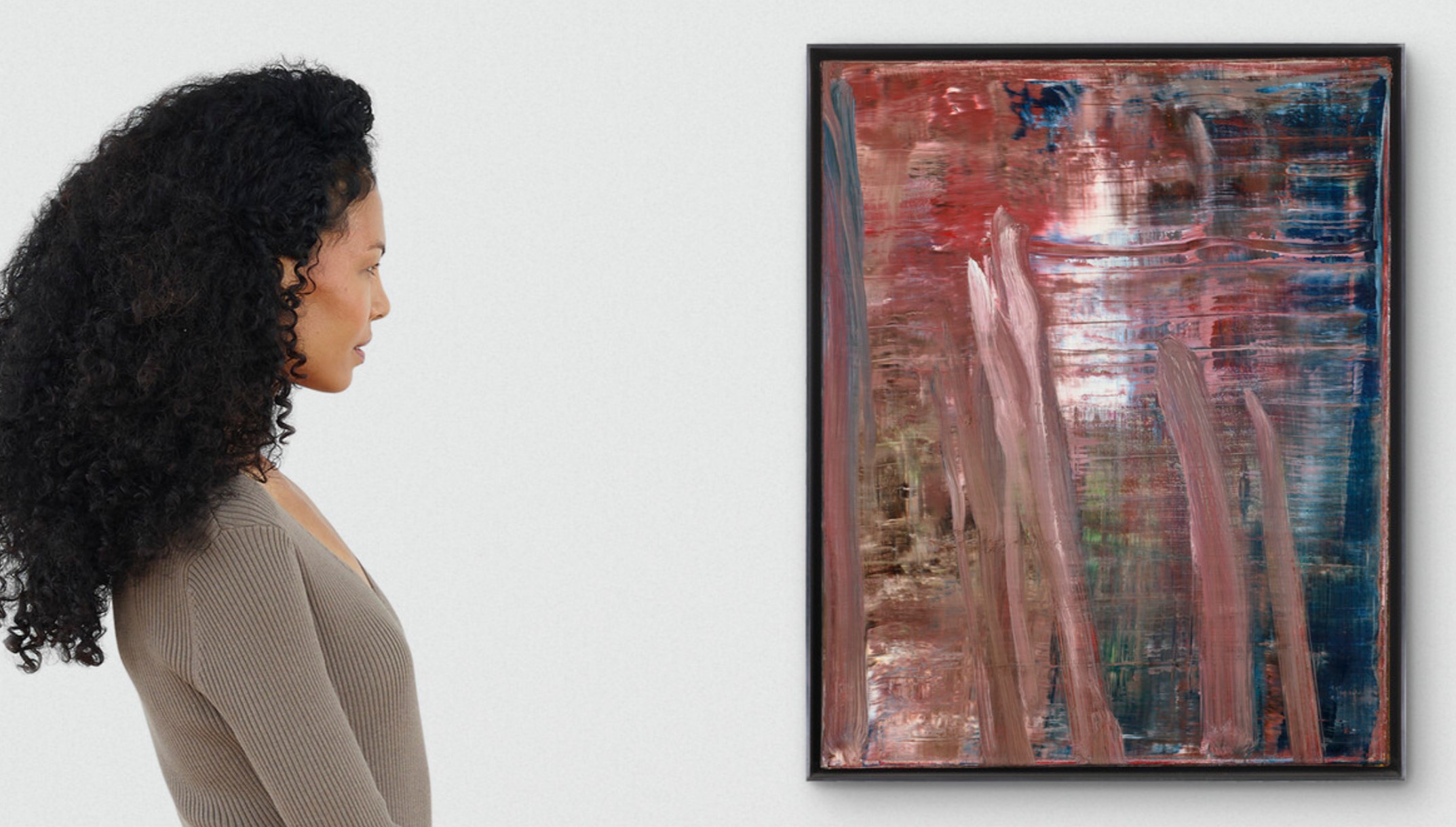
GERHARD RICHTER (B. 1932)
Abstraktes Bild, 1999
Oil on canvas
51×41 cm (20×16 inches)
Signed, inscribed and dated ‘862-1 Richter 1999’ (on the reverse)
Full of Love, 1998
Christie’s New-York: 20 November 2025
Estimated: USD 250,000 – 350,000
PASSED
DAMIEN HIRST (B. 1965), Full of Love | Christie’s
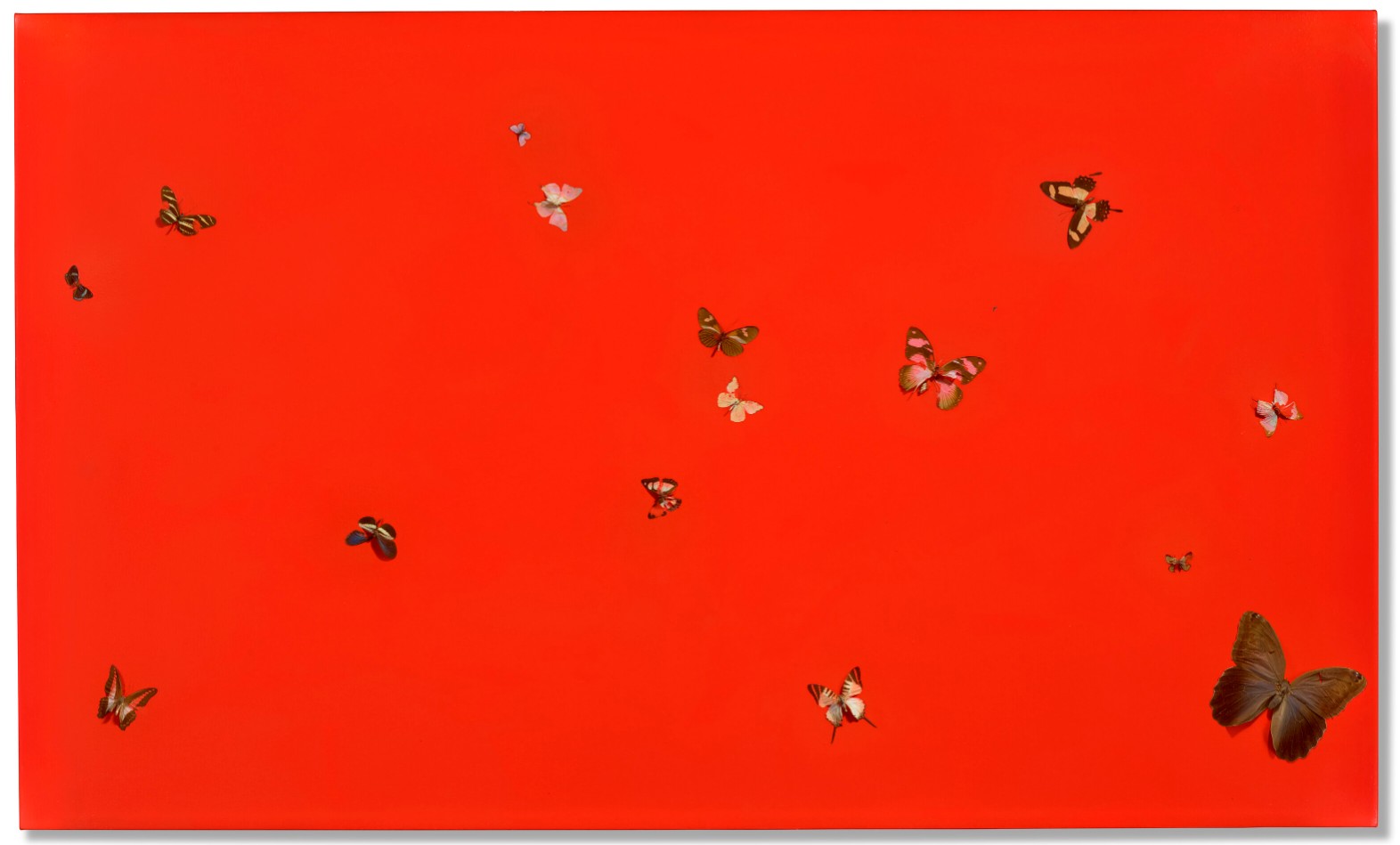
DAMIEN HIRST (B. 1965)
Full of Love, 1998
Butterflies and household gloss on canvas
36×60 inches (91.4 x 152.4 cm)
Signed, titled and dated twice ‘Full of Love. 98. Damien Hirst 98.’ (on the overlap)
Signed again ‘D Hirst’ (on the stretcher)

Leonard A. Lauder, Collector | Evening Auction
18 November 2025
Leonard A. Lauder, Collector | Evening Auction | 2025 | Sotheby’s
Auction Statistics
Total: USD 527,457,600
#Lots: 24 Lots
Withdrawn: 0 Lot
Unsold: 0 Lot
Sold: 24 Lots
Sell-Through Rate: 100%
WHITE GLOVE SALE
Top Lot:
USD 236,660,000
Highlights
#1. Bildnis Elisabeth Lederer, 1914-16
Leonard A. Lauder, Collector
Sotheby’s New-York: 18 November 2025
Estimates upon Request
USD 236,660,000
MOST EXPENSIVE WORK EVER SOLD AT AUCTION
GUSTAV KLIMT (1862 – 1918)
Bildnis Elisabeth Lederer (Portrait of Elisabeth Lederer), 1914-16
Oil on canvas
180.4 x 130.5 cm (71 x 51 3/8 inches)
Signed Gustav Klimt (toward lower right)
#2. Blumenwiese, circa 1908
Leonard A. Lauder, Collector
Sotheby’s New-York: 18 November 2025
Estimates upon Request
USD 86,000,000
Blumenwiese (Blooming Meadow) | Leonard A. Lauder, Collector | Evening Auction | 2025 | Sotheby’s
GUSTAV KLIMT (1862 – 1918)
Blumenwiese (Blooming Meadow), circa 1908
Oil on canvas
110×110 cm (43 1/4 x 43 1/4 inches)
Signed Gustav Klimt (lower right)
#3. Waldabhang bei Unterach am Attersee, 1916
Leonard A. Lauder, Collector
Sotheby’s New-York: 18 November 2025
Estimates upon Request
USD 68,320,000
GUSTAV KLIMT (1862 – 1918)
Waldabhang bei Unterach am Attersee (Forest Slope in Unterach on the Attersee), 1916
Oil on canvas
110×110 cm (43 1/4 x 43 1/4 inches)
Signed Gustav Klimt (lower right)
#4. Sankthansnatt (Midsummer Night), circa 1901-03
Leonard A. Lauder, Collector
Sotheby’s New-York: 18 November 2025
Estimated: USD 20,000,000 – 30,000,000
USD 35,110,000
Sankthansnatt (Midsummer Night) | Leonard A. Lauder, Collector | Evening Auction | 2025 | Sotheby’s
EDVARD MUNCH (1863 – 1944)
Sankthansnatt (Midsummer Night), circa 1901-03
Oil on canvas
41 3/8 x 39 1/4 inches (105 x 99.8 cm)
Signed E. Munch (lower right)

The Now & Contemporary Evening Auction
18 November 2025
The Now & Contemporary Evening Auction | 2025 | Sotheby’s
Auction Statistics
Total: USD 178,114,000
#Lots: 43 Lots
Withdrawn: 0 Lot
Unsold: 2 Lots
Sold: 41 Lots
Sell-Through Rate: 95.3%
Top Lot:
USD 48,335,000
27.1% of Total
Selected Highlights
#1. Crowns (Peso Neto), 1981
Basquiat Crowned | Property from a Distinguished European Collection
Sotheby’s New-York: 18 November 2025
Estimated: USD 35,o00,000 – 45,000,000
USD 48,335,000
Crowns (Peso Neto) | The Now & Contemporary Evening Auction | 2025 | Sotheby’s
JEAN-MICHEL BASQUIAT (1960 – 1988)
Crowns (Peso Neto), 1981
Acrylic, oilstick and paper collage on canvas
76 1/4 x 94 1/4 inches (193.6 x 239.4 cm)
Signed, titled and dated DEC 25 81 (lower edge)
#2. Sculpture éponge bleue sans titre (SE 167), circa 1959
Property from the Durand-Ruel Family Collection, Paris
Sotheby’s New-York: 18 November 2025
Estimated: USD 14,o00,000 – 18,000,000
USD 19,060,000
YVES KLEIN (1928 – 1962)
Sculpture éponge bleue sans titre (SE 167), circa 1959
Dry pigment and synthetic resin on natural sponge on a metal rod mounted on stone
138.4 x 69.9 x 54 cm (54 1/2 x 27 1/2 x 21 1/4 inches)
#3. America, 2016
Sotheby’s New-York: 18 November 2025
Estimate upon Request
USD 12,110,000
America | The Now & Contemporary Evening Auction | 2025 | Sotheby’s
MAURIZIO CATTELAN (b. 1960)
America, 2016
101.2 kg of 18-karat gold
18 1/4 x 14 3/4 x 25 inches (46.4 x 37.5 x 63.5 cm)
This work is number 2 from an edition of 3 plus 2 artist’s proofs
USD 10 million
#4. High Society, 1997-98
Property from a Prominent Private Collection
Sotheby’s New-York: 18 November 2025
Estimated: USD 4,o00,000 – 6,000,000
USD 9,810,000
High Society | The Now & Contemporary Evening Auction | 2025 | Sotheby’s
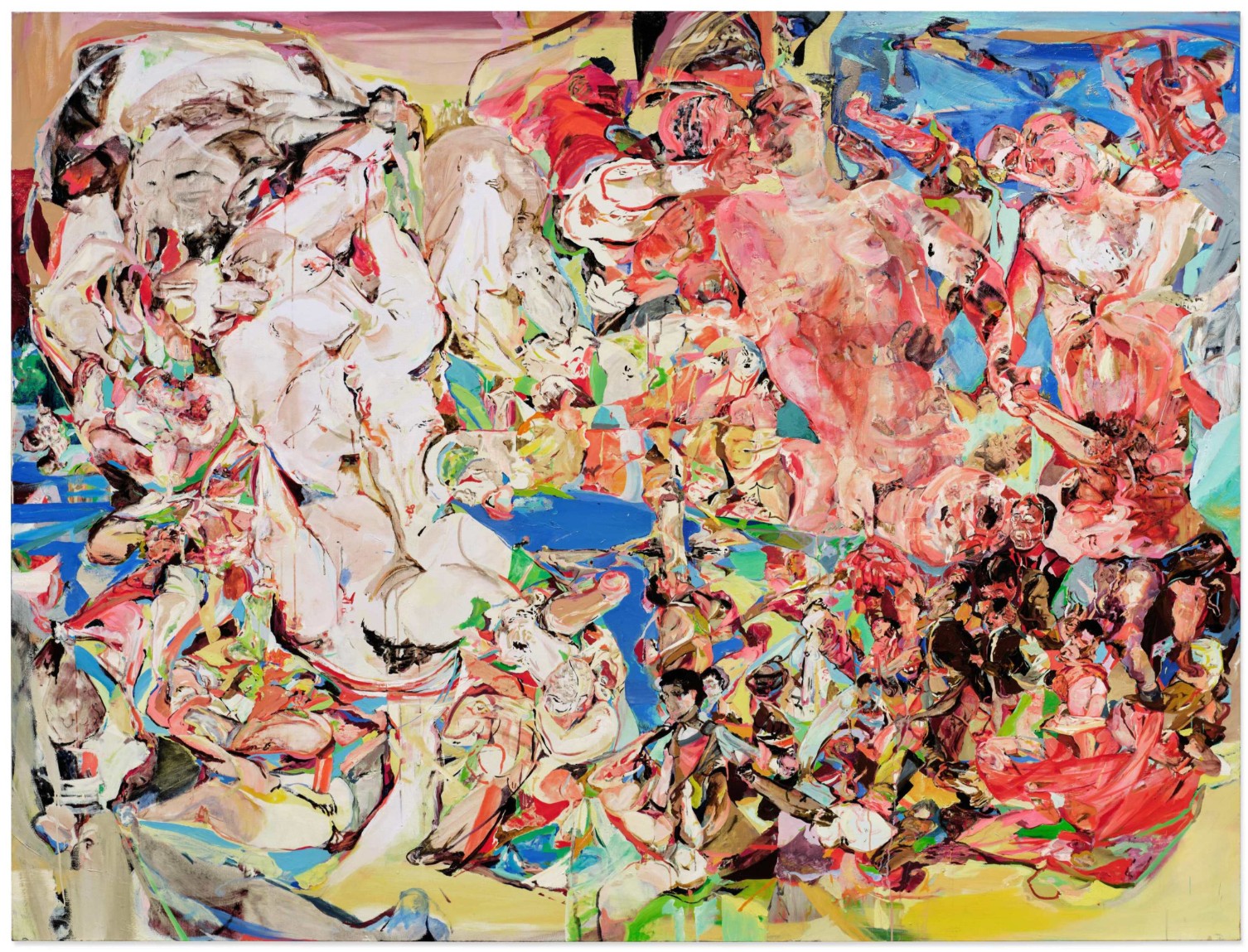
CECILY BROWN (b. 1969)
High Society, 1997-98
Oil on canvas
74 x 98 1/8 inches (188 x 249.2 cm)
Signed, titled and dated 97-98 (on the reverse)
Signed and dated ’97-98 (on the stretcher)
#5. Nature’s Ape, 1984
Property from a Distinguished International Collection
Sotheby’s New-York: 18 November 2025
Estimated: USD 4,o00,000 – 6,000,000
USD 5,174,000
Nature’s Ape | The Now & Contemporary Evening Auction | 2025 | Sotheby’s
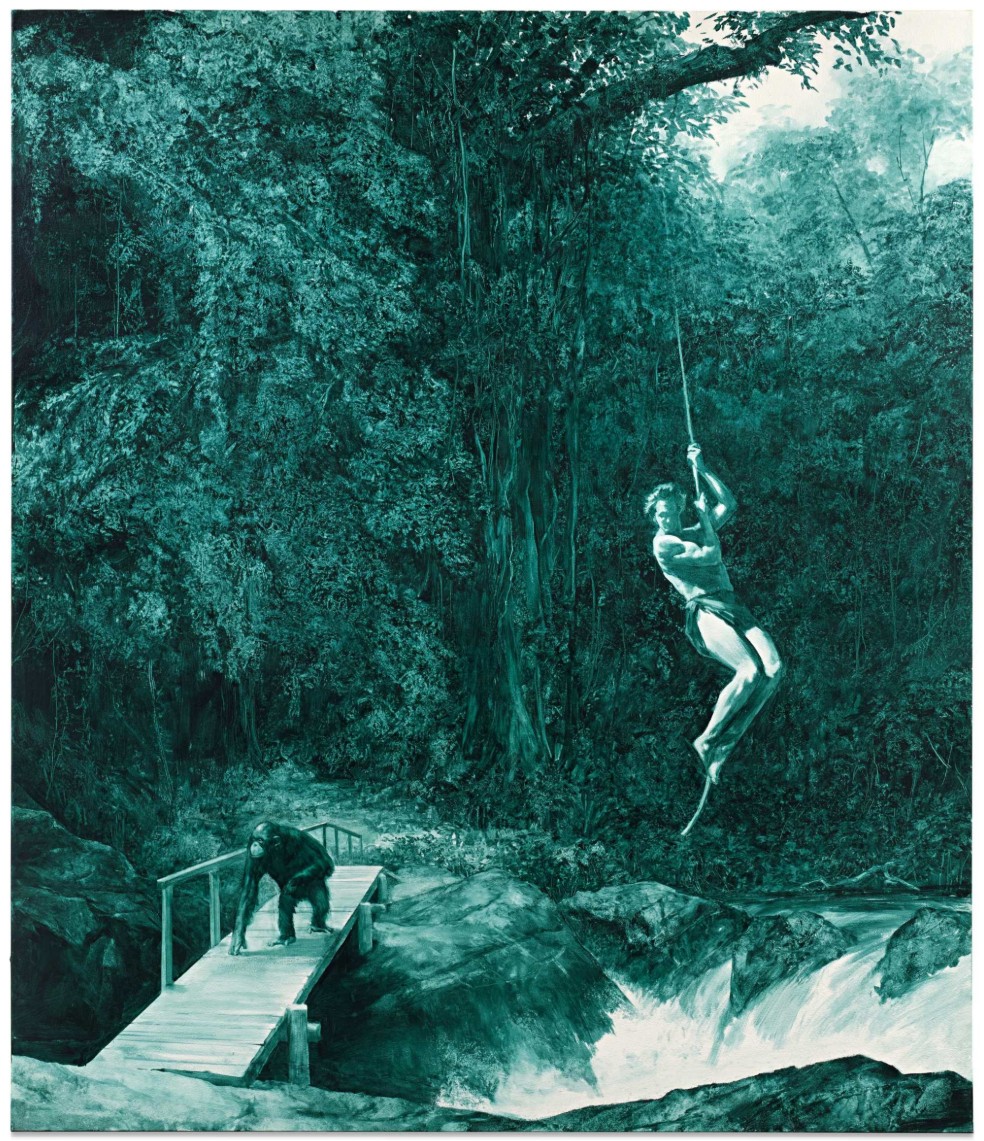
MARK TANSEY (b. 1949)
Nature’s Ape, 1984
Oil on canvas
77×66 inches (195.6 x 167.6 cm)
Signed, titled and dated 1984 (on the reverse)
#6. Untitled, 1989
Property from an Esteemed American Collection
Sotheby’s New-York: 18 November 2025
Estimated: USD 3,500,000 – 4,500,000
USD 4,808,000
Untitled | The Now & Contemporary Evening Auction | 2025 | Sotheby’s
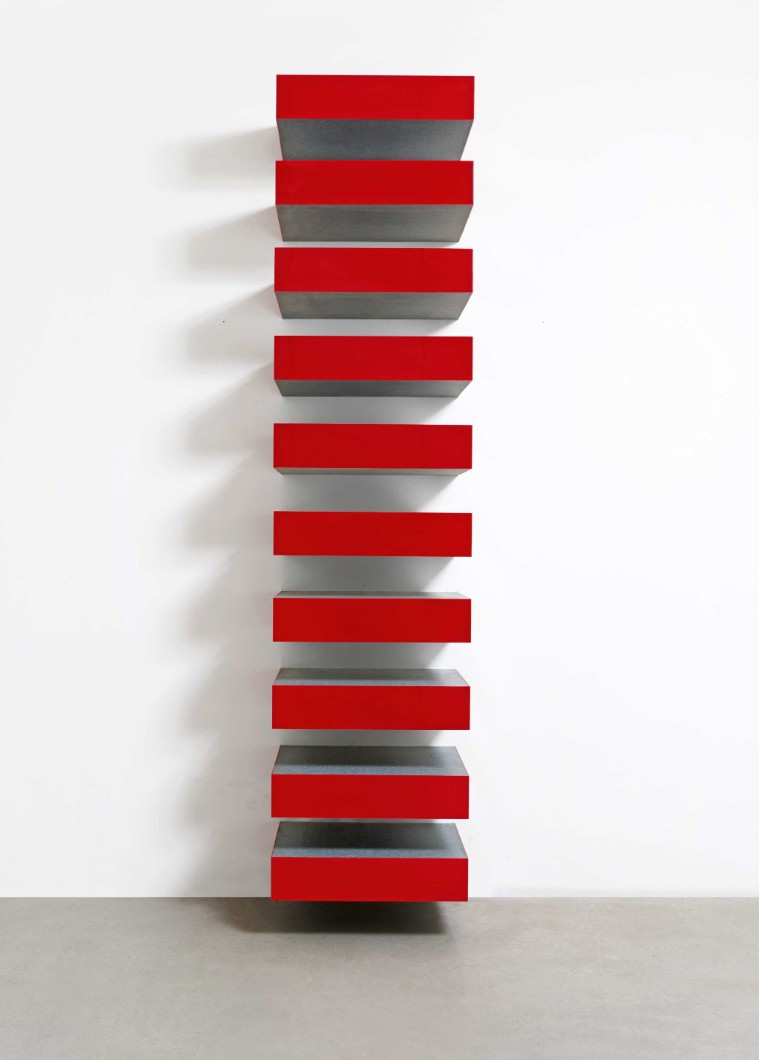
DONALD JUDD (1928 – 1994)
Untitled, 1989
Galvanized iron and red Plexiglas, in ten parts
Each: 6x27x24 inches (15.2 x 68.6 x 61 cm)
Overall: 120x27x24 inches (304.8 x 68.6 x 61 cm)
Stamped with the artist’s signature and Bernstein Bros. Inc. 89-18
(on the reverse of each unit)
XXXXXXXXXX
#9. Modern Painting Triptych II, 1967
A Legacy Reimagined: Works from the Collection of Dorothy and Roy Lichtenstein
Sotheby’s New-York: 18 November 2025
Estimated: USD 3,500,000 – 4,500,000
USD 4,442,000
Modern Painting Triptych II | The Now & Contemporary Evening Auction | 2025 | Sotheby’s
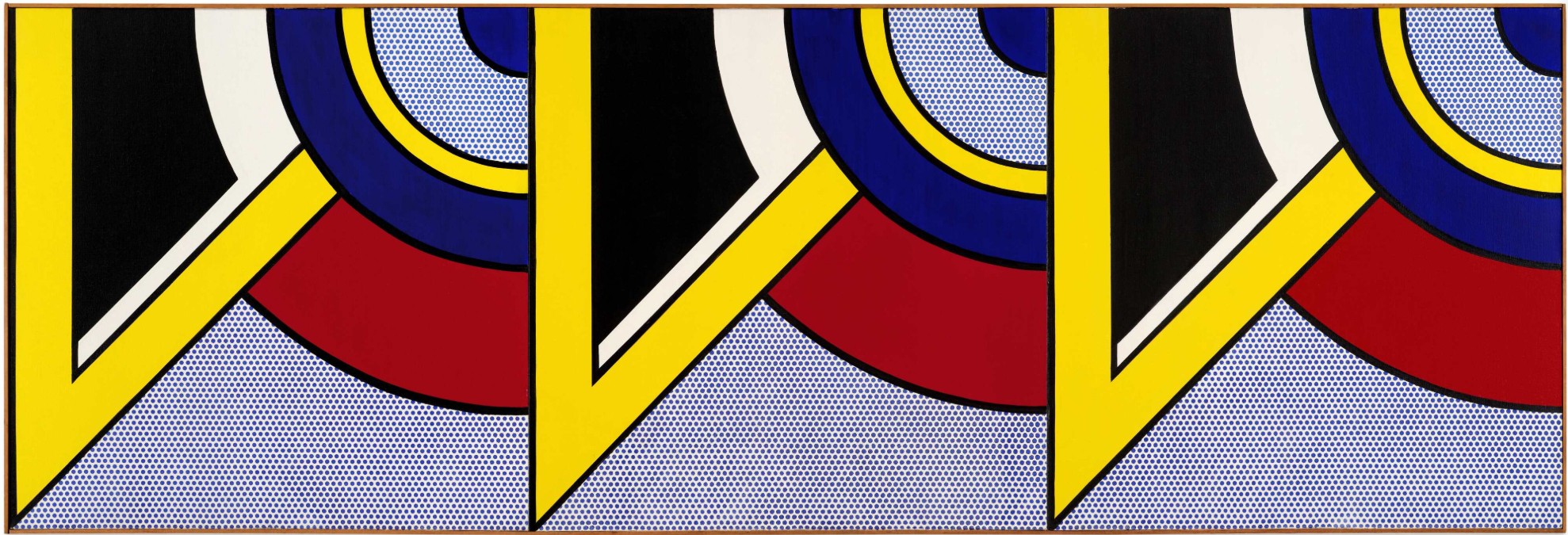
ROY LICHTENSTEIN (1923 – 1997)
Modern Painting Triptych II, 1967
Acrylic, oil and graphite on canvas, in three parts
Each: 36×36 inches (91.4 x 91.4 cm)
Overall: 36×108 inches (91.4 x 274.3 cm)
Signed and dated ‘67 (on the reverse)
#10. Hulk (Rock), 2004-13
Property from a Prestigious American Collection
Sotheby’s New-York: 18 November 2025
Estimated: USD 2,o00,000 – 3,000,000
USD 4,442,000
Hulk (Rock) | The Now & Contemporary Evening Auction | 2025 | Sotheby’s
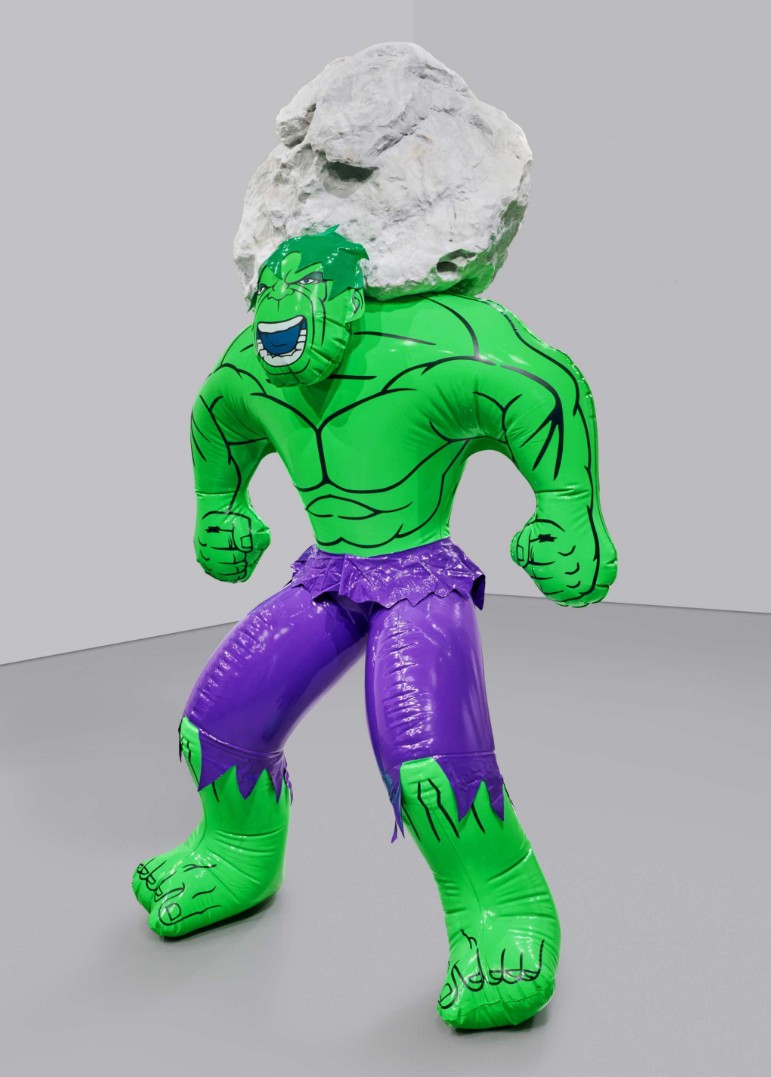
JEFF KOONS (b. 1955)
Hulk (Rock), 2004-13
Polychromed bronze and marble
87 3/8 x 48 3/4 x 28 1/8 inches (221.9 x 123.8 x 71.4 cm)
Signed, dated 2004-2013 and numbered 2/3 (on the interior of the purple element)
This work is number 2 from an edition of 3 plus 1 artist’s proof
XXXXXXXXXX
#12. The American Indian (Russell Means), 1977
Sotheby’s New-York: 18 November 2025
Estimated: USD 2,o00,000 – 3,000,000
USD 4,076,000
The American Indian (Russell Means) | The Now & Contemporary Evening Auction | 2025 | Sotheby’s
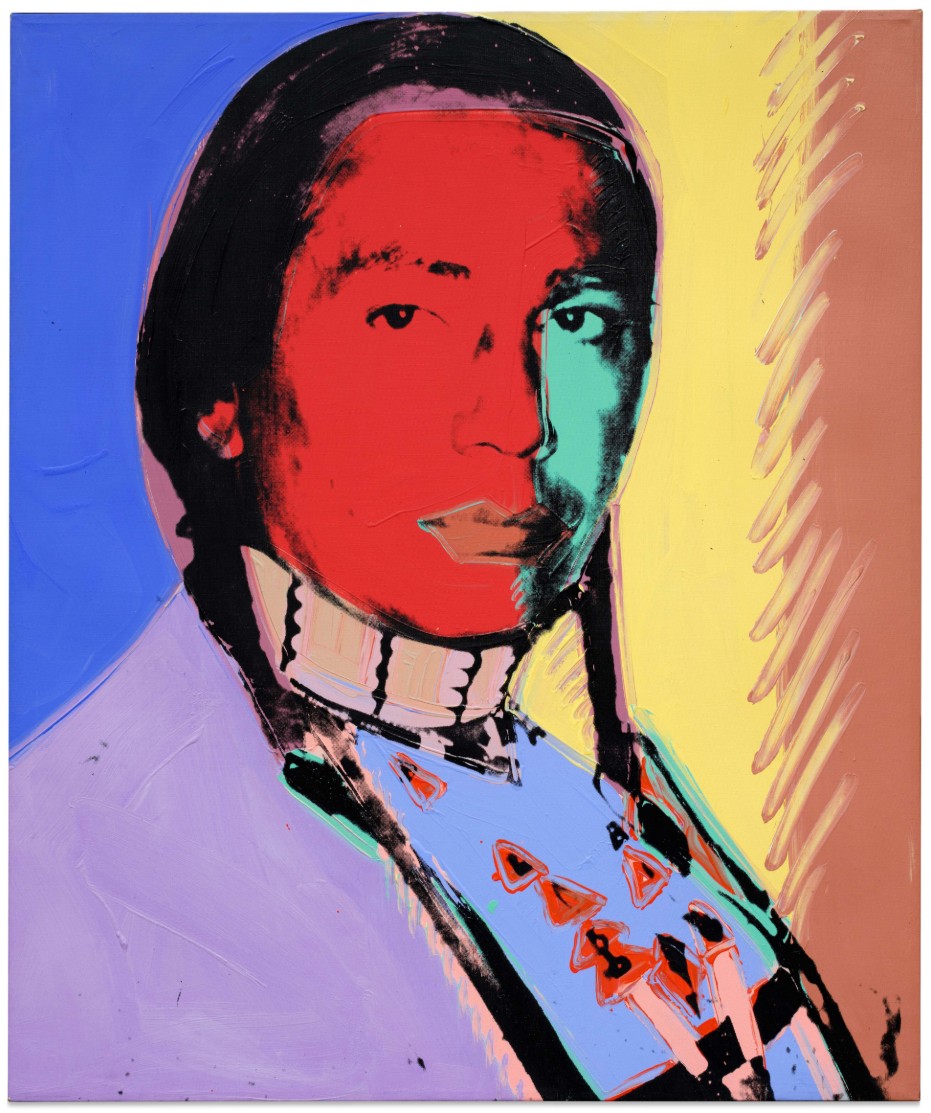
ANDY WARHOL (1928 – 1987)
The American Indian (Russell Means), 1977
Scrylic and silkscreen ink on canvas
50 1/8 x 42 inches (127 x 106.7 cm)
#13. Coup de Chapeau II, 1996
A Legacy Reimagined: Works from the Collection of Dorothy and Roy Lichtenstein
Sotheby’s New-York: 18 November 2025
Estimated: USD 1,500,000 – 2,000,000
USD 3,832,000
Coup de Chapeau II | The Now & Contemporary Evening Auction | 2025 | Sotheby’s
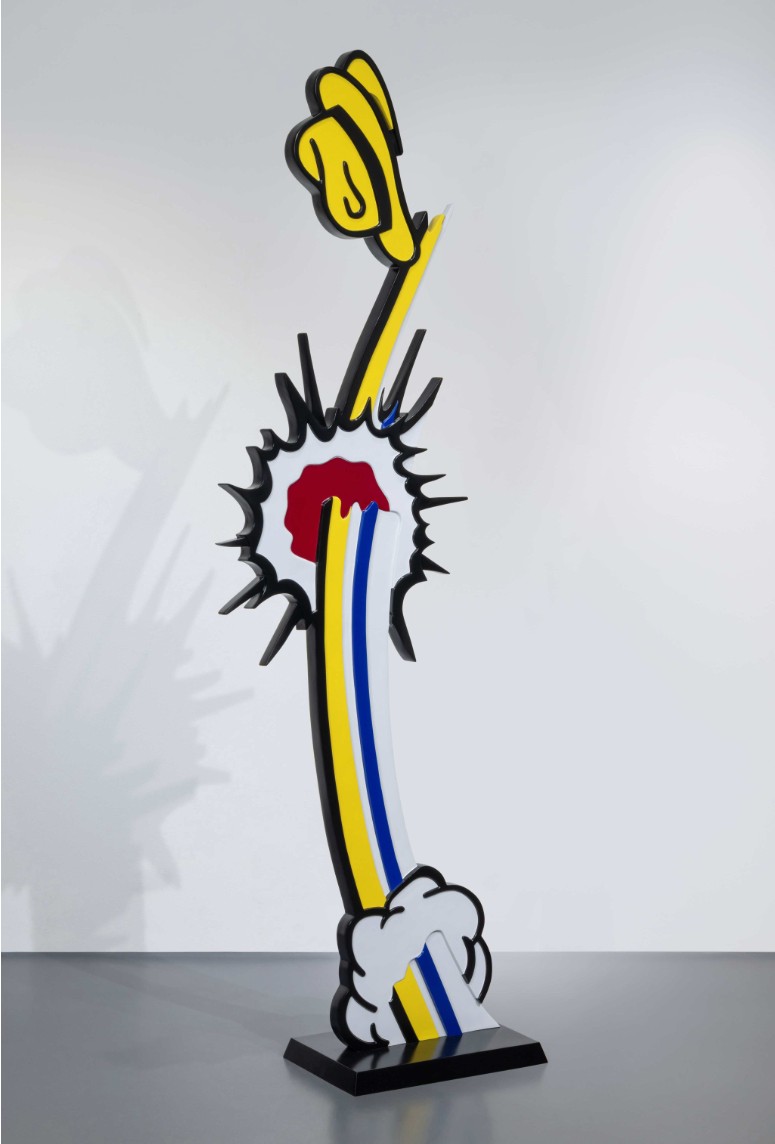
ROY LICHTENSTEIN (1923 – 1997)
Coup de Chapeau II, 1996
Painted bronze
89 x 32 x 13 1/8 inches (226.1 x 81.3 x 33.3 cm)
Incised with the artist’s signature, numbered 0/6 and dated ‘96 (lower edge)
This work is the artist’s cast from an edition of 6 plus 1 artist’s cast
#14. Brushstrokes, 1996-2001
A Legacy Reimagined: Works from the Collection of Dorothy and Roy Lichtenstein
Sotheby’s New-York: 18 November 2025
Estimated: USD 4,o00,000 – 6,000,000
USD 3,100,000
Brushstrokes | The Now & Contemporary Evening Auction | 2025 | Sotheby’s
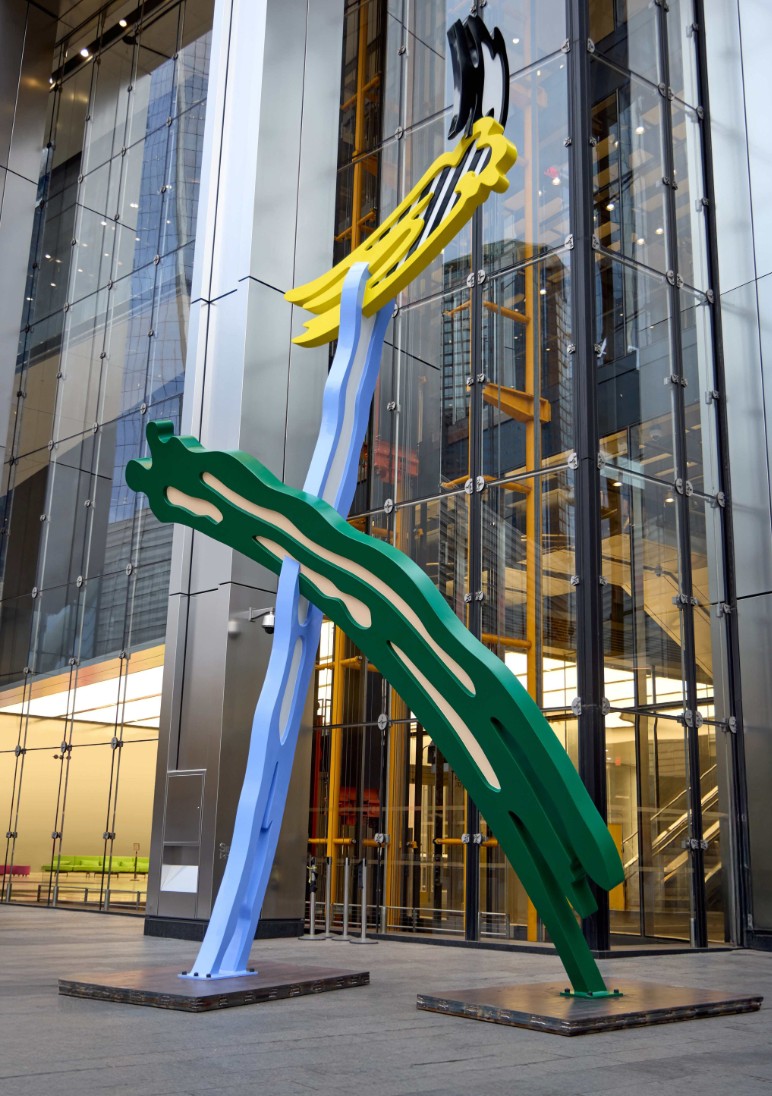
ROY LICHTENSTEIN (1923 – 1997)
Brushstrokes, 1996-2001
Painted aluminum
353 1/4 x 162 x 90 inches (897.3 x 411.5 x 228.6 cm)
Incised with the artist’s signature, dated ‘96 and numbered AP (lower edge)
Incised © Estate of Roy Lichtenstein and dated 2001 (lower edge)
Conceived in 1996 and cast in 2001, this work is the artist’s proof from an edition of 1 plus 1 artist’s proof
#15. Momentary Love Blossom, 2018
Property from the Laurence and Patrick Seguin Collection, Paris
Sotheby’s New-York: 18 November 2025
Estimated: USD 2,500,000 – 3,500,000
USD 3,040,000
Momentary Love Blossom | The Now & Contemporary Evening Auction | 2025 | Sotheby’s
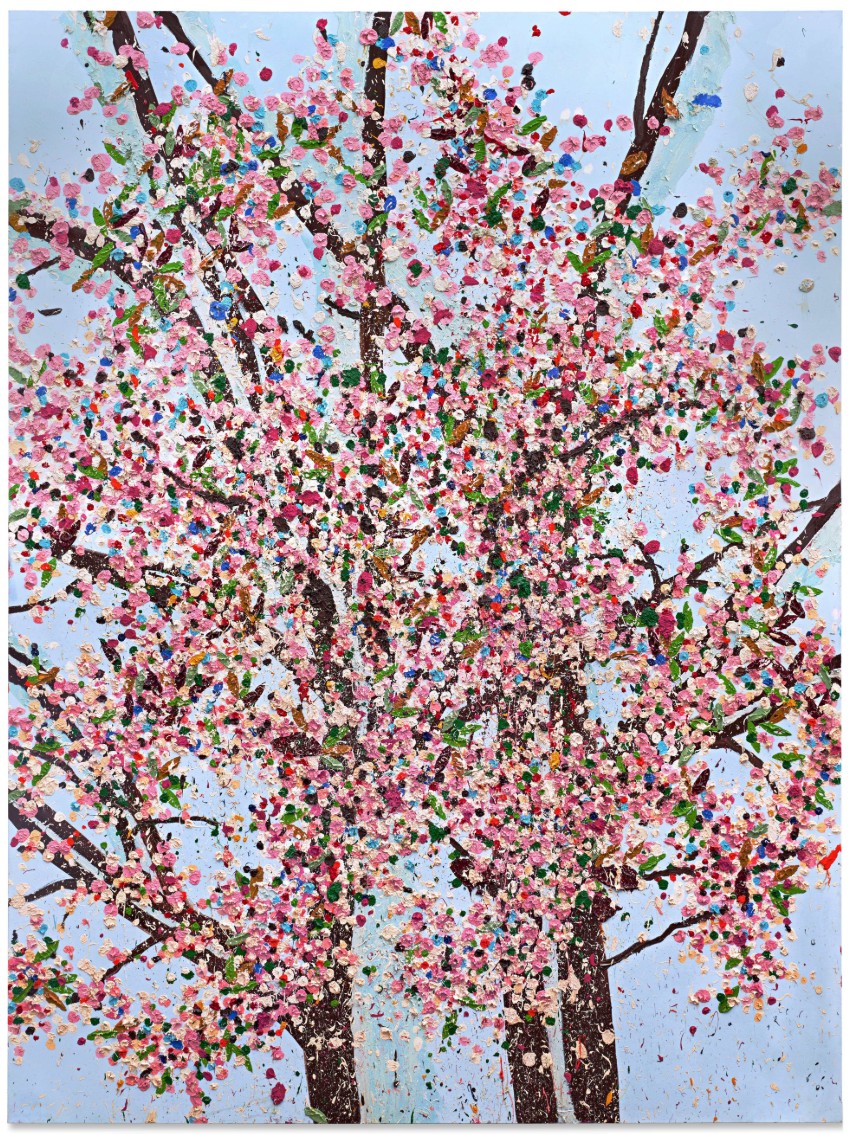
DAMIEN HIRST (b. 1965)
Momentary Love Blossom, 2018
Oil on canvas
144×108 inches (365.8 x 274.3 cm)
Signed, titled, dated 2018 and variously inscribed (on the reverse)
Signed (on the stretcher)
#16. Cubist Still Life with Vase and Flowers, 1973
A Legacy Reimagined: Works from the Collection of Dorothy and Roy Lichtenstein
Sotheby’s New-York: 18 November 2025
Estimated: USD 4,o00,000 – 6,000,000
USD 3,025,000
Cubist Still Life with Vase and Flowers | The Now & Contemporary Evening Auction | 2025 | Sotheby’s
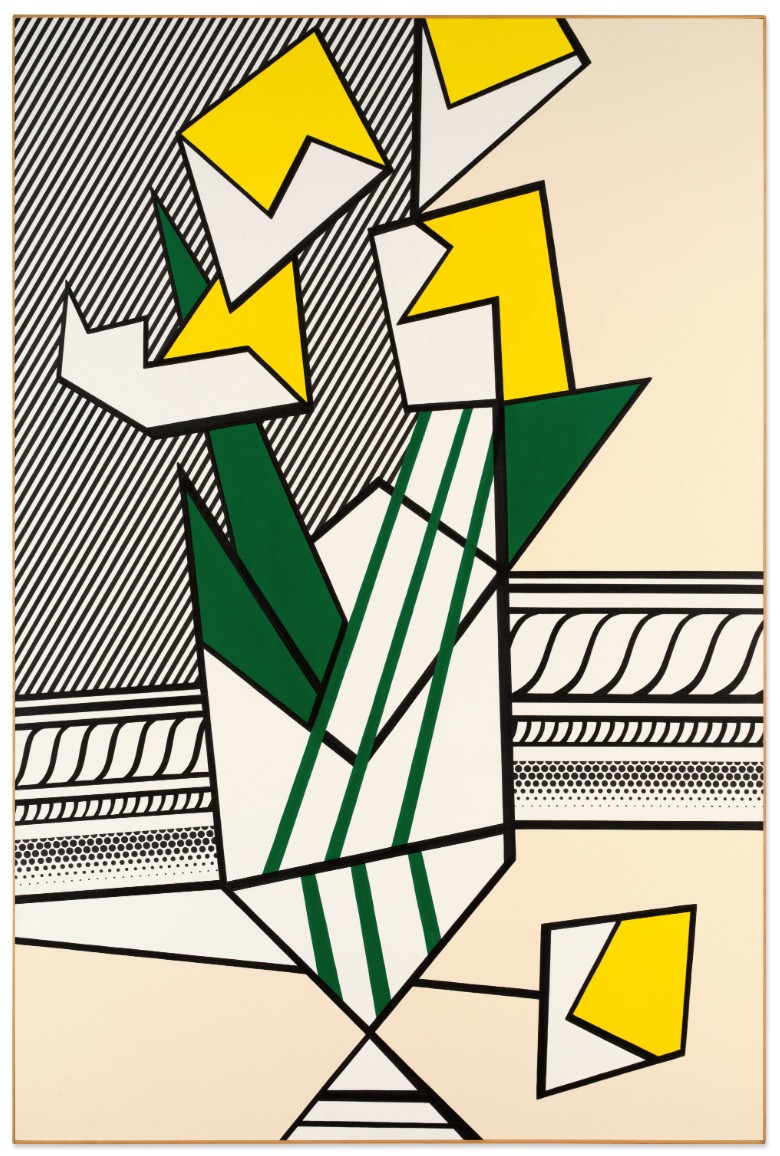
ROY LICHTENSTEIN (1923 – 1997)
Cubist Still Life with Vase and Flowers, 1973
Acrylic, oil and graphite on canvas
90 1/4 x 60 inches (229.2 x 152.4 cm)
Signed and dated ‘73 (on the reverse)
XXXXXXXXXX
#20. Woman: Sunlight, Moonlight (Study), 1995
A Legacy Reimagined: Works from the Collection of Dorothy and Roy Lichtenstein
Sotheby’s New-York: 18 November 2025
Estimated: USD 1,500,000 – 2,000,000
USD 2,734,000
Woman: Sunlight, Moonlight (Study) | The Now & Contemporary Evening Auction | 2025 | Sotheby’s
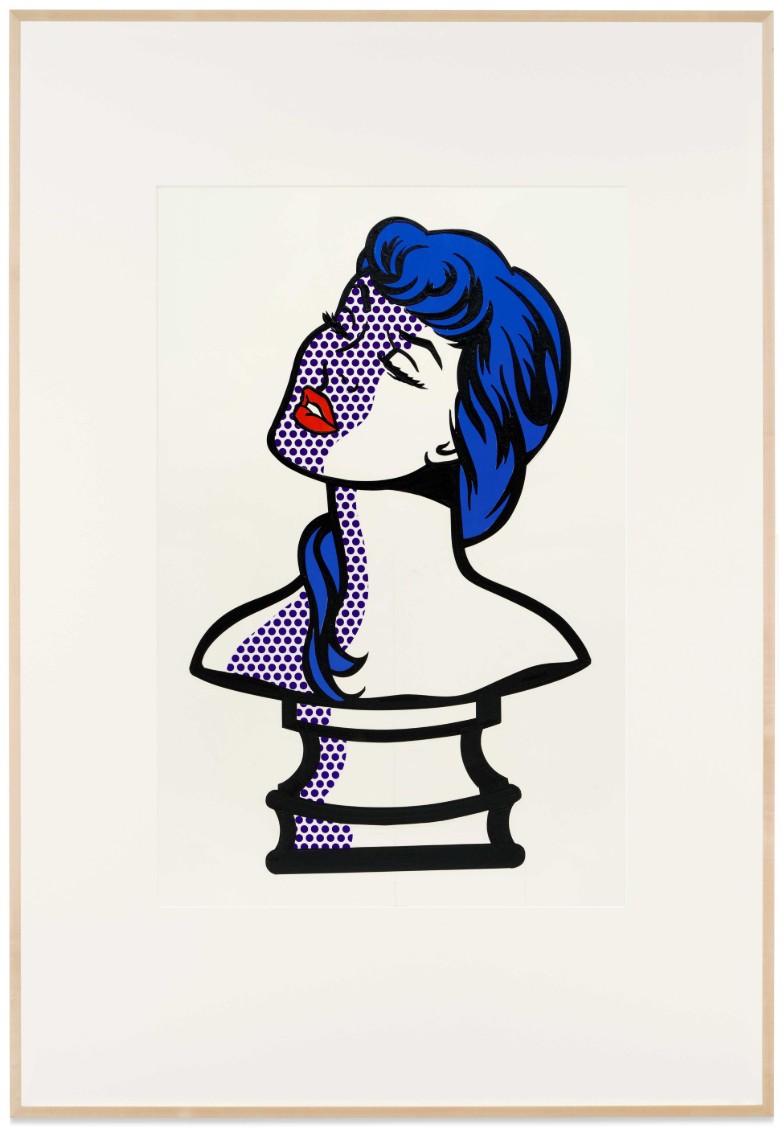
ROY LICHTENSTEIN (1923 – 1997)
Woman: Sunlight, Moonlight (Study), 1995
Tape, cut painted paper, cut printed paper and graphite on board
60×36 inches (152.4 x 91.4 cm)
Signed and dated ‘95 (on the reverse)
#21. The Gentle Sea, 2017
Sotheby’s New-York: 18 November 2025
Estimated: USD 1,200,000 – 1,800,000
USD 2,368,000
The Gentle Sea | The Now & Contemporary Evening Auction | 2025 | Sotheby’s
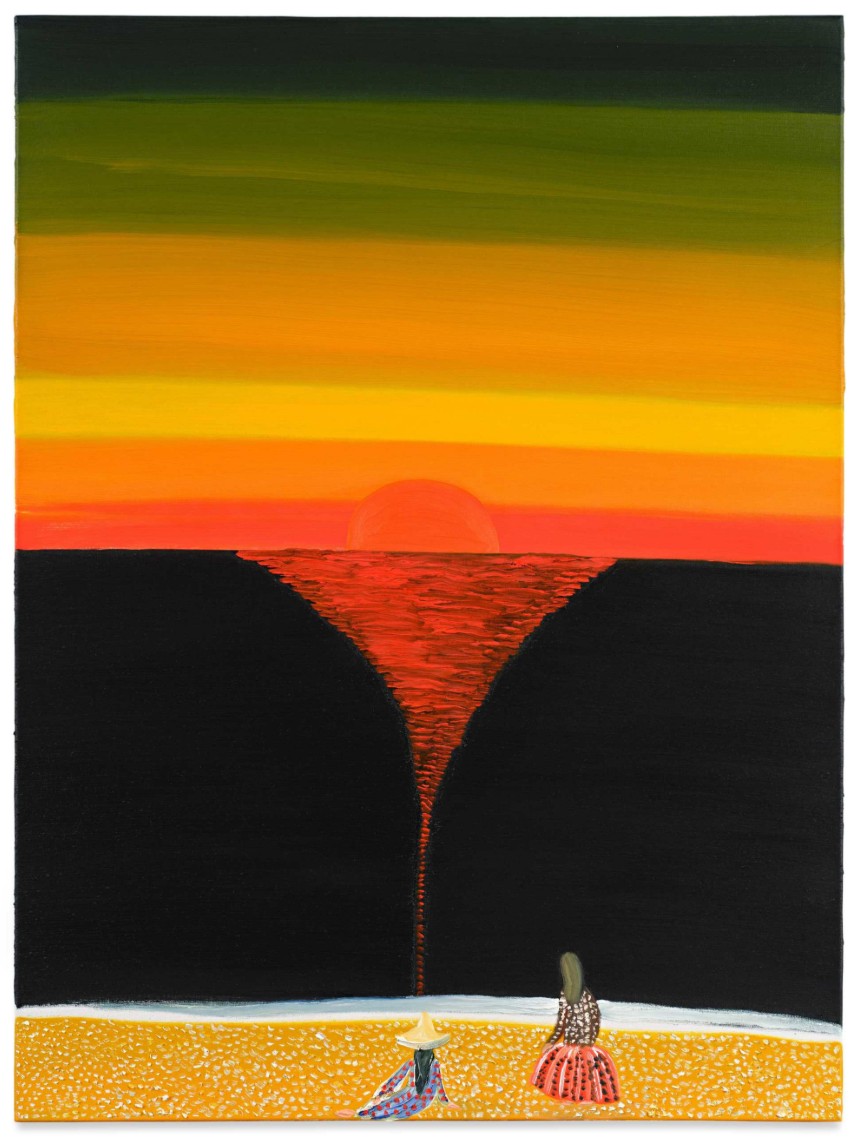
MATTHEW WONG (1984 – 2019)
The Gentle Sea, 2017
Oil on canvas
40×30 inches (101.6 x 76.2 cm)
Signed and dated 2017 in Chinese (on the reverse)
Titled (on the reverse)
XXXXXXXXXX
#27. Large Interior with Three Reflections (Mural Panel) (Study), 1993
A Legacy Reimagined: Works from the Collection of Dorothy and Roy Lichtenstein
Sotheby’s New-York: 18 November 2025
Estimated: USD 1,000,000 – 1,500,000
USD 1,575,000
WORK ON PAPER
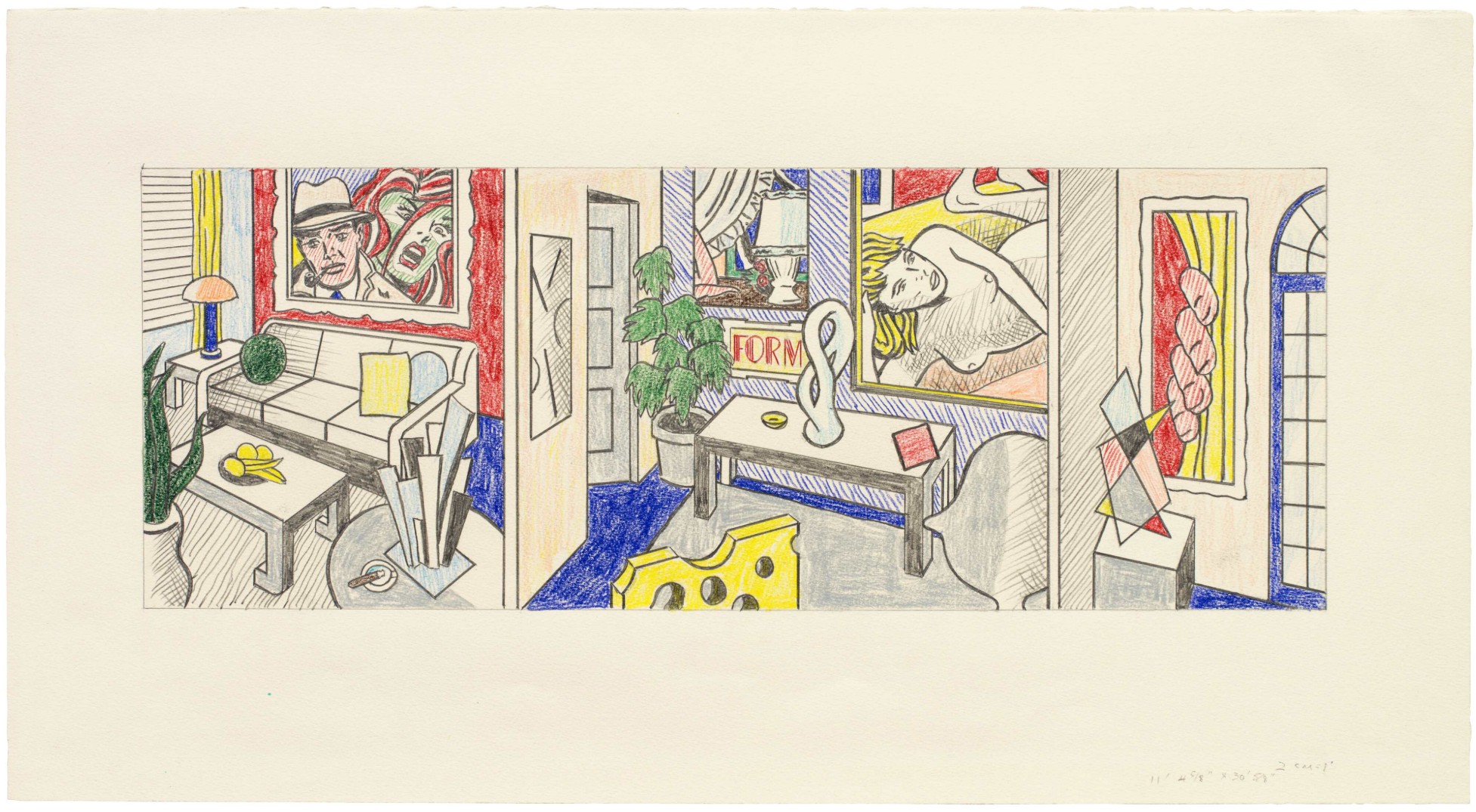
ROY LICHTENSTEIN (1923 – 1997)
Large Interior with Three Reflections (Mural Panel) (Study), 1993
Colored pencil and graphite on paper
Image: 9 1/8 x 24 1/4 inches (23 x 61.6 cm)
Sheet: 16 1/4 x 30 1/8 inches (41.3 x 76.4 cm)
#28. Untitled, 1982
Property from a Private European Collection
Sotheby’s New-York: 18 November 2025
Estimated: USD 800,000 – 1,200,000
USD 1,514,000
WORK ON PAPER
Untitled | The Now & Contemporary Evening Auction | 2025 | Sotheby’s
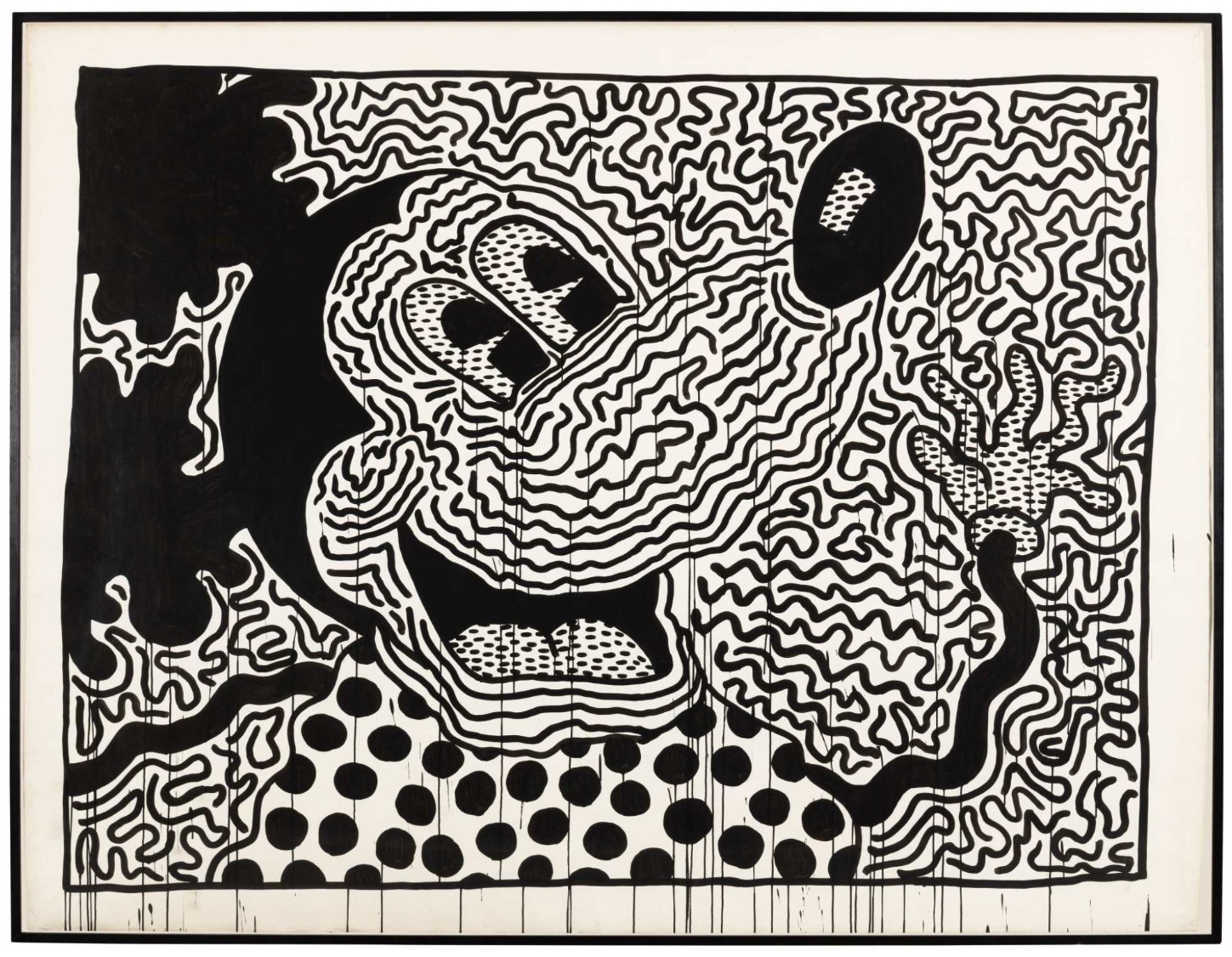
KEITH HARING (1958 – 1990)
Untitled, 1982
Ink on paper
71×94 inches (180.3 x 238.8 cm)
#29. Flower with Bamboo, 1996
A Legacy Reimagined: Works from the Collection of Dorothy and Roy Lichtenstein
Sotheby’s New-York: 18 November 2025
Estimated: USD 2,000,000 – 3,000,000
USD 1,514,000
Flower with Bamboo | The Now & Contemporary Evening Auction | 2025 | Sotheby’s
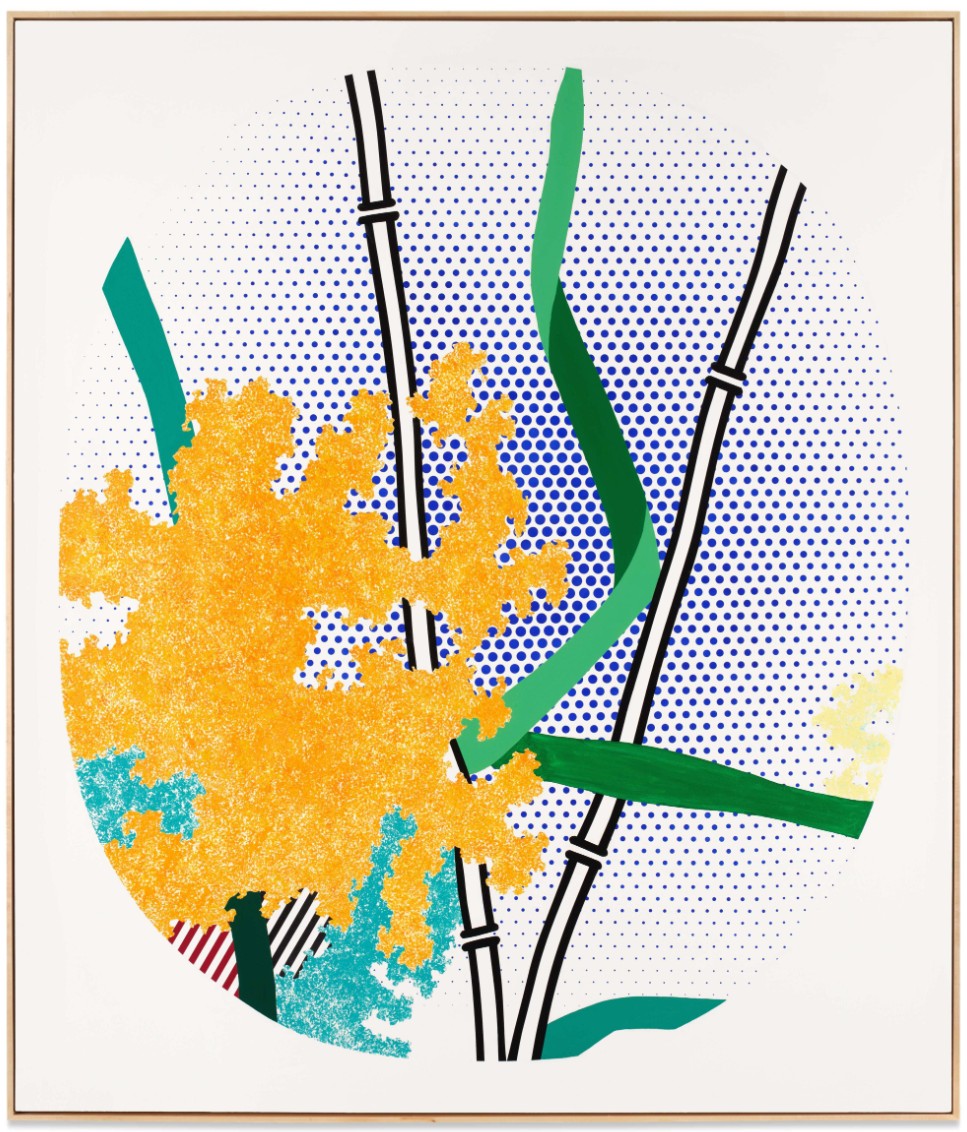
ROY LICHTENSTEIN (1923 – 1997)
Flower with Bamboo, 1996
Acrylic, oil and graphite on canvas
77 x 66 1/8 inches (195.6 x 168 cm)
Signed and dated ‘96 (on the reverse)
#30. Anxious Red Painting August 20th, 2020
Property from an Important European Collection
Sotheby’s New-York: 18 November 2025
Estimated: USD 1,o00,000 – 1,500,000
USD 1,244,600
Anxious Red Painting August 20th | The Now & Contemporary Evening Auction | 2025 | Sotheby’s
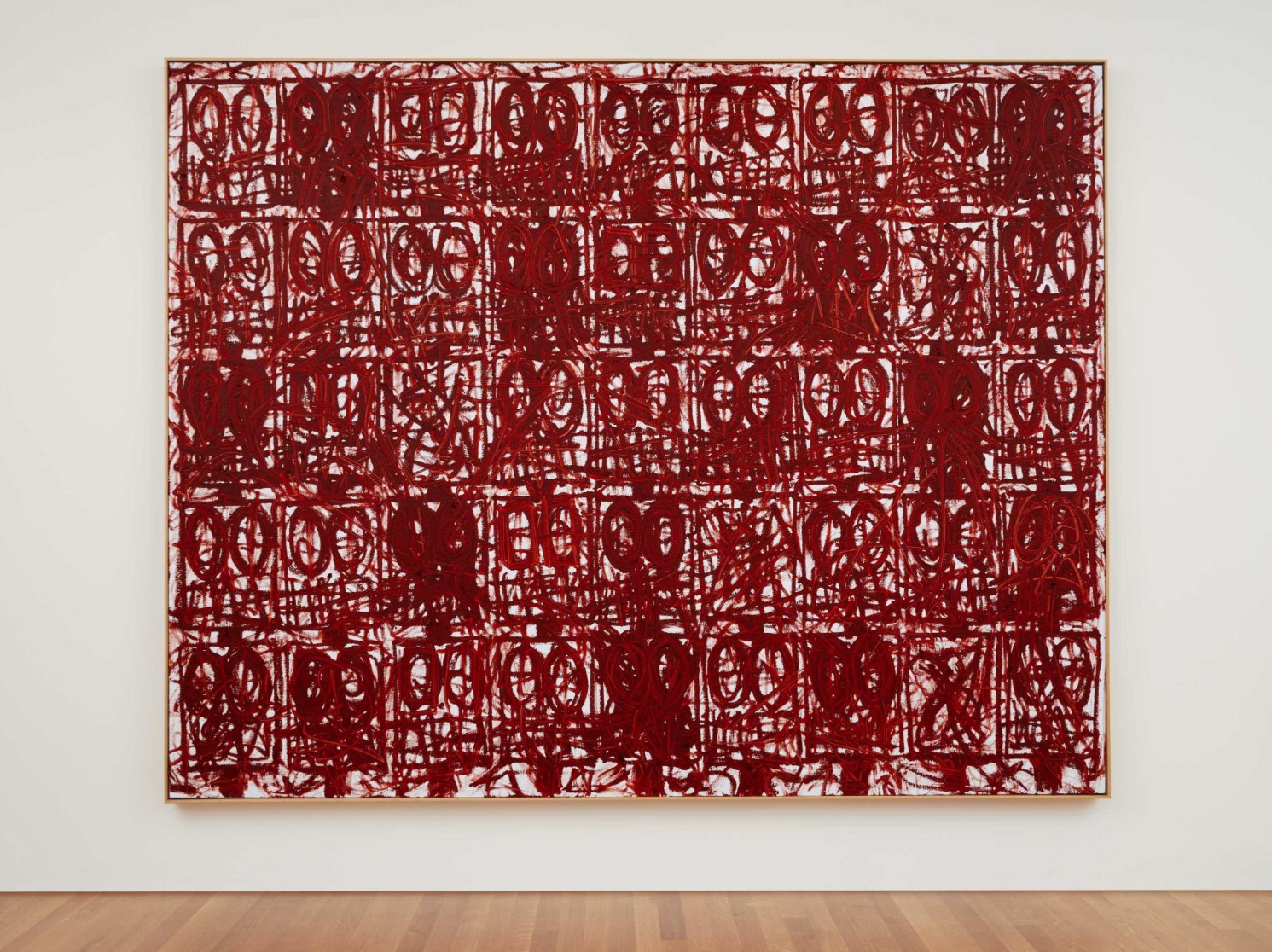
RASHID JOHNSON (b. 1977)
Anxious Red Painting August 20th, 2020
Oil on canvas
94 x 120 1/8 inches (238.8 x 305.1 cm)
Signed and dated 2020 (on the reverse)
XXXXXXXXXX
#40. Sound of Music (Study), circa 1963-64
A Legacy Reimagined: Works from the Collection of Dorothy and Roy Lichtenstein
Sotheby’s New-York: 19 November 2025
Estimated: USD 800,000 – 1,200,000
USD 508,000
WORK ON PAPER
Sound of Music (Study) | The Now & Contemporary Evening Auction | 2025 | Sotheby’s
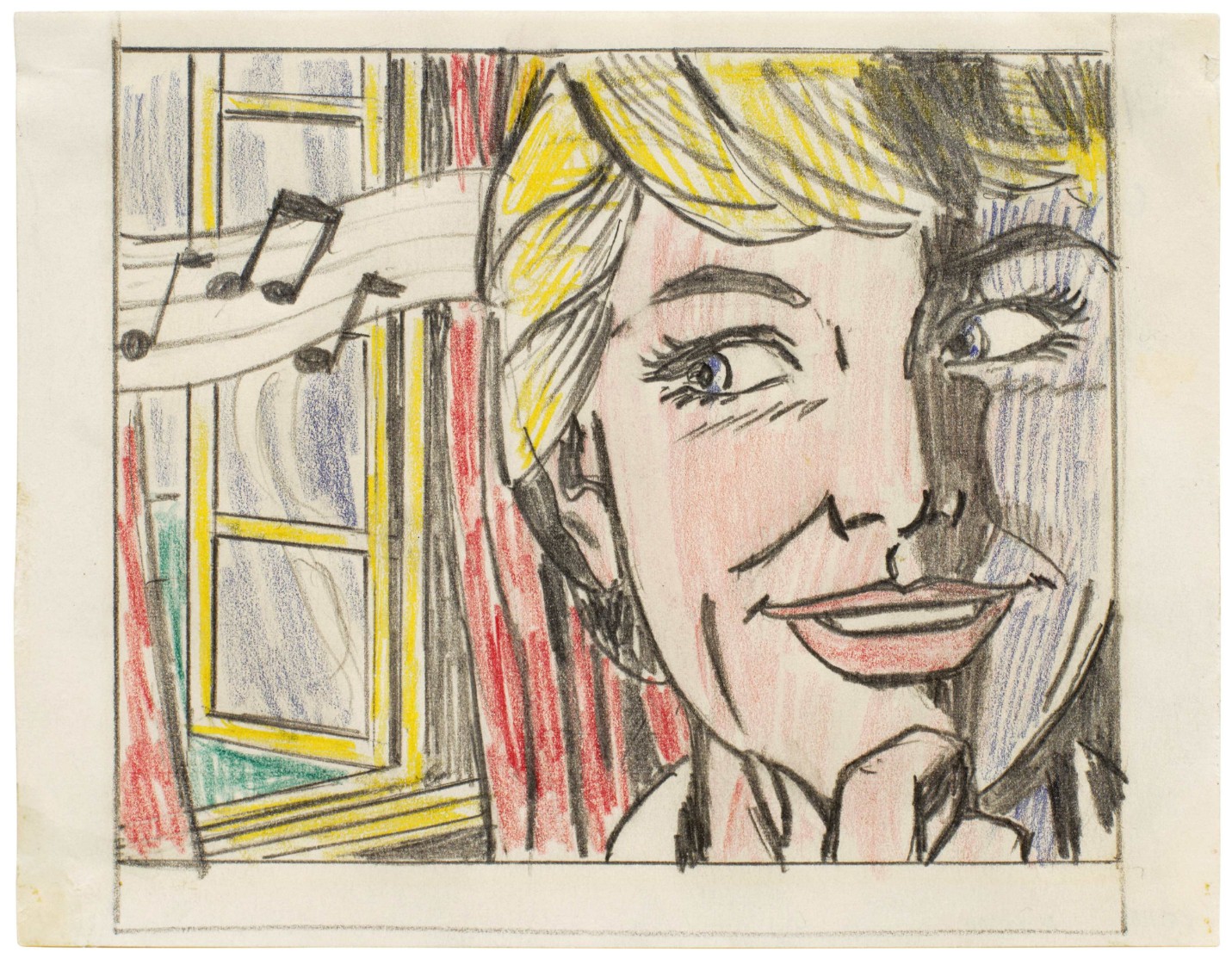
ROY LICHTENSTEIN (1923 – 1997)
Sound of Music (Study), circa 1963-64
Colored pencil and graphite on paper
Image: 4 x 4 3/4 inches (10.2 x 12.1 cm)
Sheet: 4 1/2 x 5 3/4 inches (11.4 x 14.6 cm)
The Cindy and Jay Pritzker Collection
20 November 2025
The Cindy and Jay Pritzker Collection | 2025 | Sotheby’s
Auction Statistics
Total: USD 109,526,900
#Lots: 13 Lots
Withdrawn: 0 Lot
Unsold: 0 Lot
Sold: 13 Lots
Sell-Through Rate: 100%
Top Lot:
USD 62,710,000
57.3% of Total
Selected Highlights
#1. Piles de romans parisiens et roses dans un verre, 1887
The Cindy and Jay Pritzker Collection
Sotheby’s New-York: 20 November 2025
Estimate upon Request
USD 62,710,000
VINCENT VAN GOGH (1853 – 1890)
Piles de romans parisiens et roses dans un verre (Romans parisiens), 1887
Oil on canvas
73.3 x 92.1 cm (28 7/8 x 36 1/4 inches)
Executed in November-December 1887
#2. Léda et le cygne, 1946
The Cindy and Jay Pritzker Collection
Sotheby’s New-York: 20 November 2025
Estimated: USD 7,000,000 – 10,000,000
USD 10,385,000
Léda et le cygne | The Cindy and Jay Pritzker Collection Evening Auction | 2025 | Sotheby’s
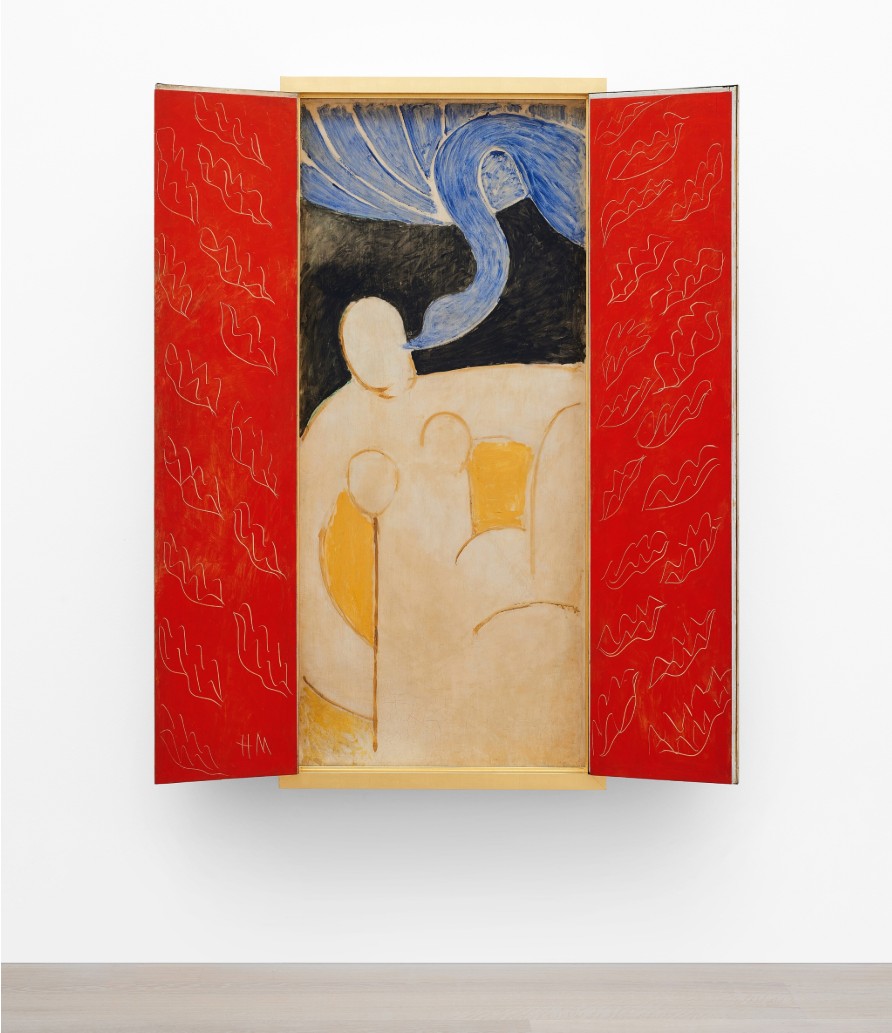
HENRI MATISSE (1869 – 1954)
Léda et le cygne, 1946
Oil and gold leaf on three wood panels
Overall: 193 x 157.5 cm (76×62 inches)
Signed with the initials HM (lower right of left panel)
Executed in June 1944-May 46
Exquisite Corpus Evening Auction
20 November 2025
Exquisite Corpus Evening Auction | 2025 | Sotheby’s
Auction Statistics
Total: USD 98,097,200
#Lots: 24 Lots
Withdrawn: 0 Lot
Unsold: 0 Lot
Sold: 24 Lots
Sell-Through Rate: 100%
Top Lot:
USD 54,660,000
55.7% of Total
Selected Highlights
#1. El sueño (La cama), 1940
Exquisite Corpus: Surrealist Treasures from a Private Collection
Sotheby’s New-York: 20 November 2025
Estimated: USD 40,000,000 – 60,000,000
USD 54,660,000
El sueño (La cama) | Exquisite Corpus Evening Auction | 2025 | Sotheby’s
FRIDA KAHLO (1907 – 1954)
El sueño (La cama), 1940
Oil on canvas
74×98 cm (29 1/8 x 38 5/8 inches
Signed Frida Kahlo and dated 1940 (lower right)
#2. Symbiose de la tête aux coquillages, 1931
Exquisite Corpus: Surrealist Treasures from a Private Collection
Sotheby’s New-York: 20 November 2025
Estimated: USD 2,000,000 – 3,000,000
USD 4,198,000
Symbiose de la tête aux coquillages | Exquisite Corpus Evening Auction | 2025 | Sotheby’s
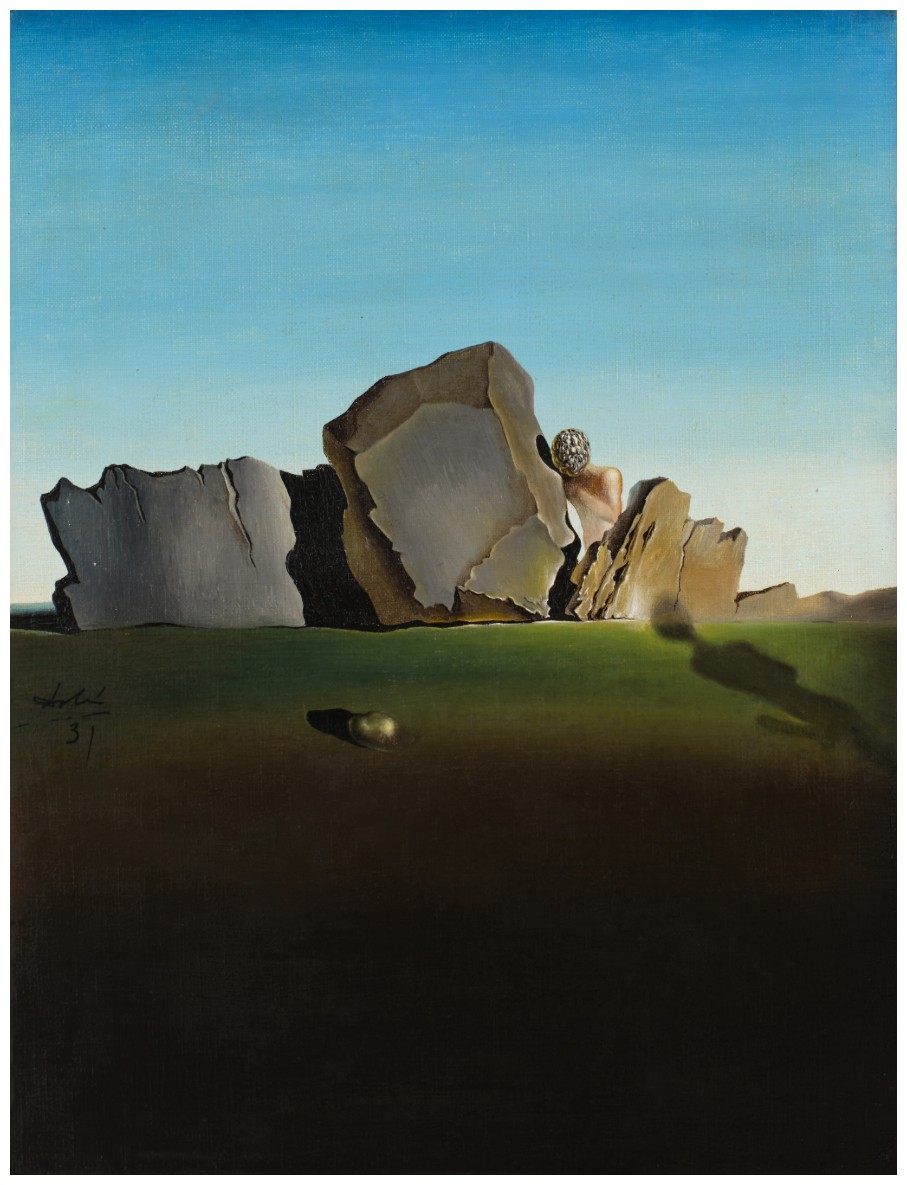
SALVADOR DALI (1904 – 1989)
Symbiose de la tête aux coquillages, 1931
Oil on canvas
35 x 27.4 cm (13 3/4 x 10 3/4 inches)
Signed Dalí and dated 31 (center left)
Signed and dated again (on the reverse)
#3. La Représentation, 1962
Exquisite Corpus: Surrealist Treasures from a Private Collection
Sotheby’s New-York: 20 November 2025
Estimated: USD 4,000,000 – 6,000,000
USD 3,710,000
La Représentation | Exquisite Corpus Evening Auction | 2025 | Sotheby’s
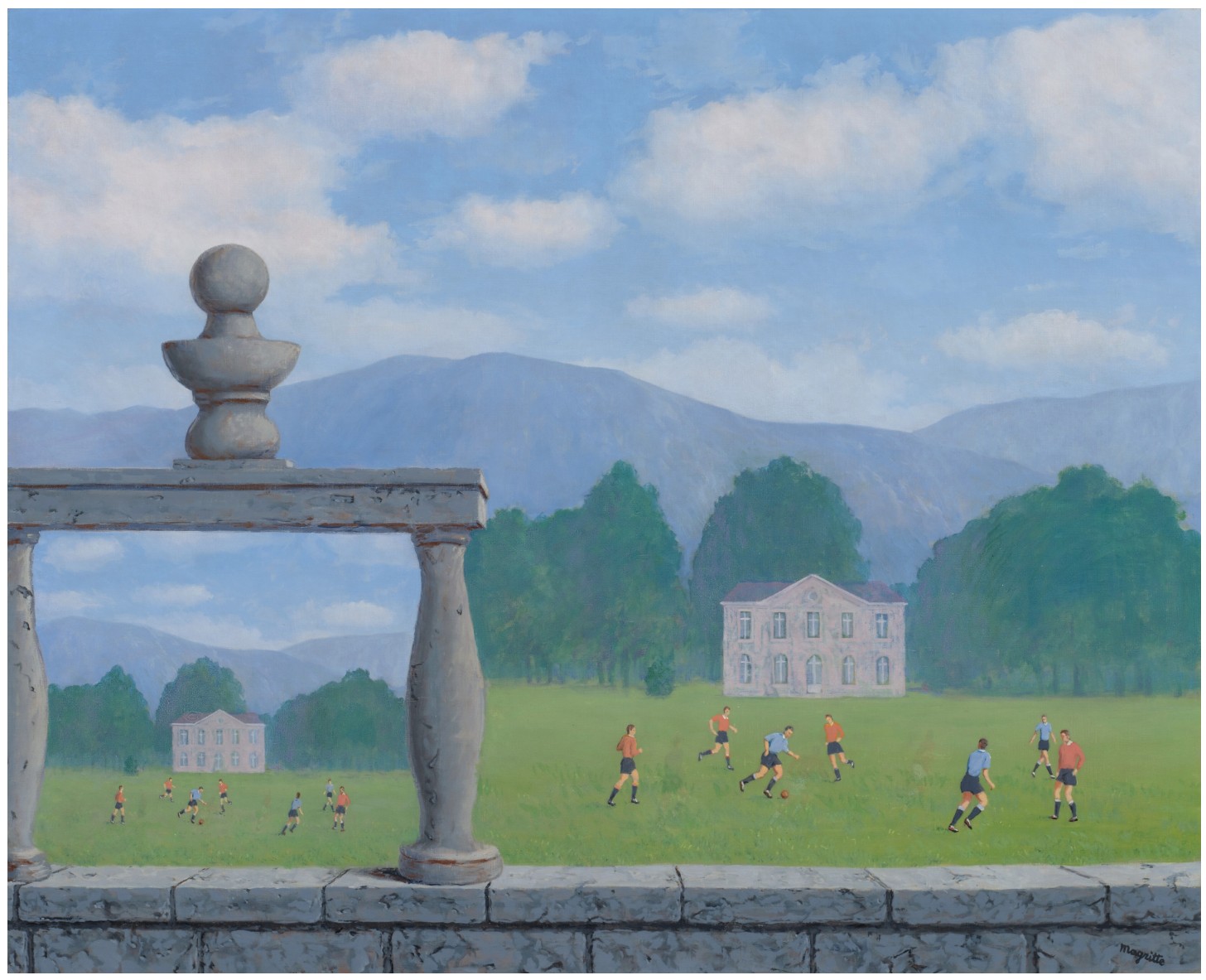
RENE MAGRITTE (1898 – 1967)
La Représentation, 1962
Oil on canvas
81×100 cm (31 7/8 x 39 3/8 inches)
Signed Magritte (lower right)
Signed again, titled and dated 1962 (on the reverse)
Modern Evening Auction
20 November 2025
Modern Evening Auction | 2025 | Sotheby’s
Auction Statistics
Total: USD 96,967,300
#Lots: 29 Lots
Withdrawn: 0 Lot
Unsold: 0 Lot
Sold: 29 Lots
Sell-Through Rate: 100%
Top Lot:
USD 12,340,000
12.7% of Total
Selected Highlights
#1. Le Jockey perdu, 1942
The Matthew and Carolyn Bucksbaum Collection
Sotheby’s New-York: 20 November 2025
Estimated: USD 9,000,000 – 12,000,000
USD 12,340,000
Le Jockey perdu | Modern Evening Auction | 2025 | Sotheby’s
RENE MAGRITTE (1898 – 1967)
Le Jockey perdu, 1942
Oil on canvas
60.3 x 72.4 cm (23 3/4 x 28 1/2 inches)
Signed Magritte (lower right)
USD 10 million
#2. Large Dark Red Leaves on White, 1927
Property from the Phillips Collection Sold to Benefit Future Acquisitions
Sotheby’s New-York: 20 November 2025
Estimated: USD 6,000,000 – 8,000,000
USD 7,858,000
Large Dark Red Leaves on White | Modern Evening Auction | 2025 | Sotheby’s
GIORGIA O’KEEFE (1887 – 1986)
Large Dark Red Leaves on White, 1927
Oil on canvas
32×21 inches (81.3 x 53.3 cm)
#3. Restaurant Rougeot II, 1961
The Matthew and Carolyn Bucksbaum Collection
Sotheby’s New-York: 20 November 2025
Estimated: USD 6,000,000 – 8,000,000
USD 7,492,000
Restaurant Rougeot II | Modern Evening Auction | 2025 | Sotheby’s
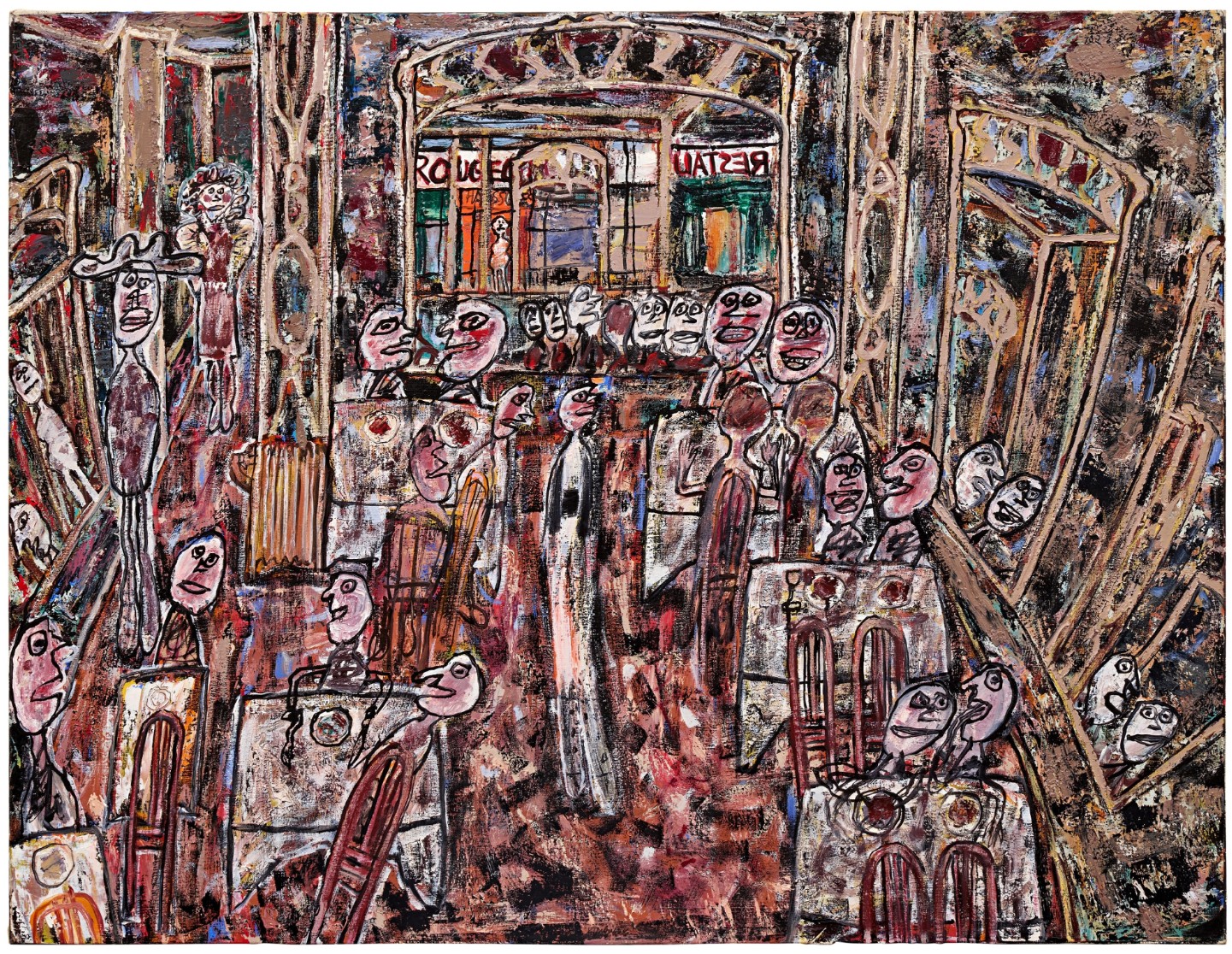
JEAN DUBUFFET (1901 – 1985)
Restaurant Rougeot II, 1961
Oil on canvas
90.5 by 116.2 cm (35 5/8 x 45 3/4 inches)
Signed J Dubuffet (lower center)
Signed again, titled and dated avril 61 (on the reverse)
Executed in March-April 1961
#4. Vue de Rouen depuis la côte Sainte-Catherine, circa 1892
Property from The Schlumberger Collection
Sotheby’s New-York: 20 November 2025
Estimated: USD 3,000,000 – 4,000,000
USD 7,370,000
Vue de Rouen depuis la côte Sainte-Catherine | Modern Evening Auction | 2025 | Sotheby’s
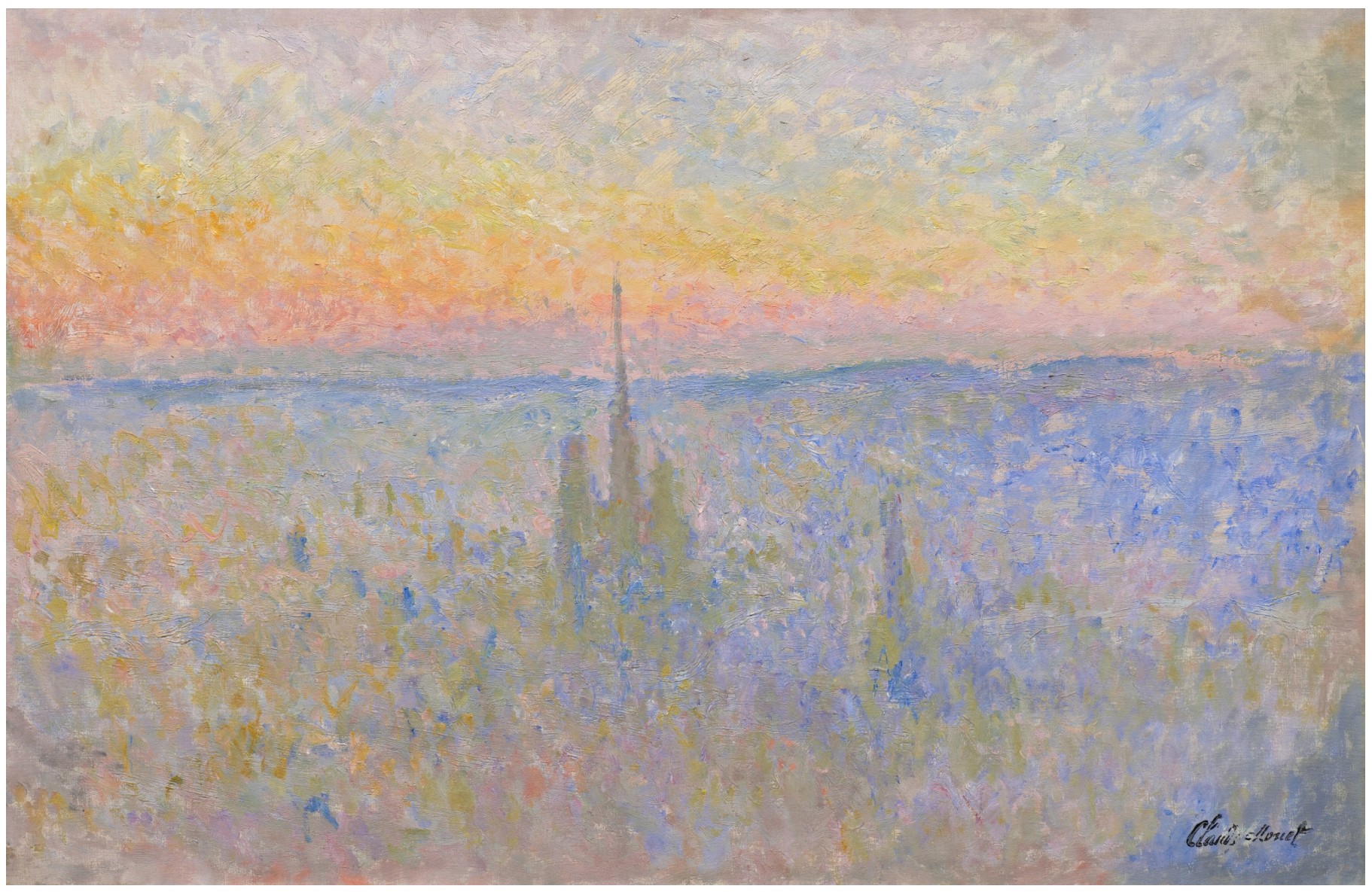
CLAUDE MONET (1840 – 1926)
Vue de Rouen depuis la côte Sainte-Catherine, circa 1892
Oil on canvas
65.3 x 100.2 cm (25 3/4 x 39 1/2 inches)
Stamped with the signature Claude Monet (lower right)
Stamped again (on the reverse)
XXXXXXXXXX
Untitled, 1967
The Geri Brawerman Collection: A Tribute to Los Angeles and A Legacy of Giving
Sotheby’s New-York: 20 November 2025
Estimated: USD 3,000,000 – 5,000,000
USD 3,466,000
WORK ON PAPER
Untitled | Modern Evening Auction | 2025 | Sotheby’s
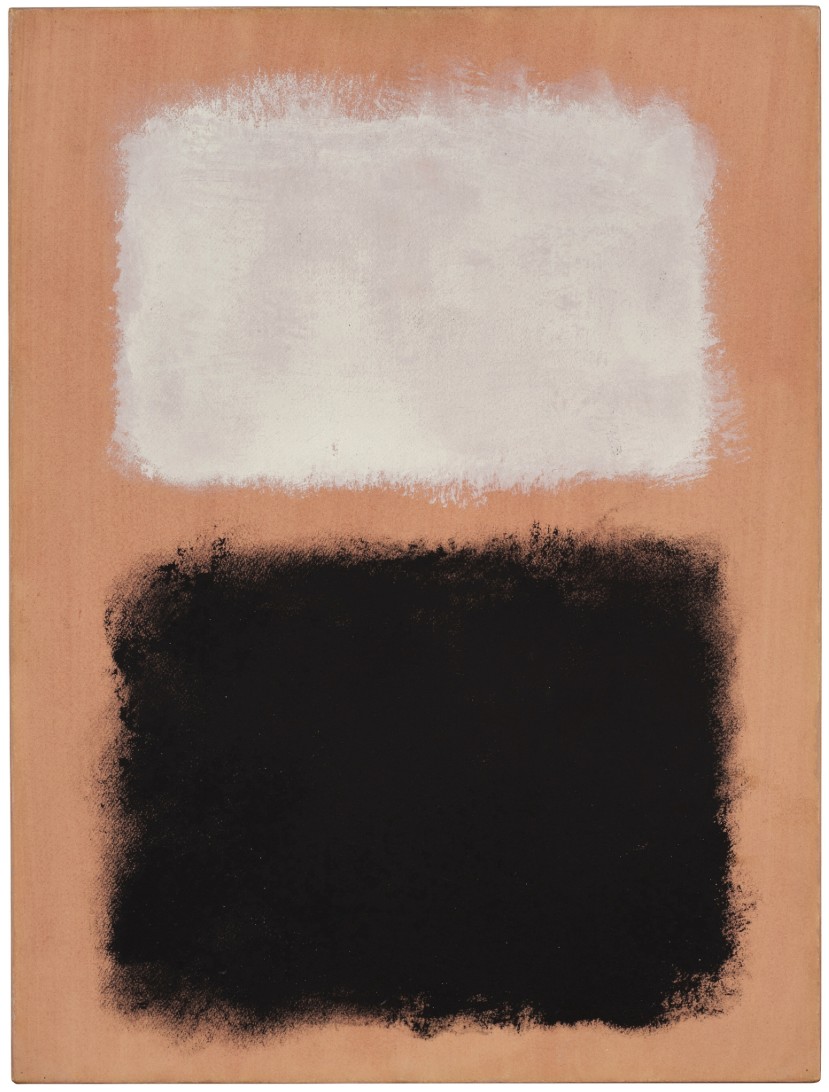
MARK ROTHKO (1903 – 1970)
Untitled, 1967
Oil on paper mounted on canvas
23 5/8 x 17 7/8 inches (60 x 45.4 cm)
Signed Mark Rothko (on the reverse)
Contemporary Art Day Auction
19 November 2025
Contemporary Day Auction | 2025 | Sotheby’s
Auction Statistics
Total: USD 101,359,398
#Lots: 305 Lots
[Withdrawn: x Lot]
Unsold: 52 Lots
Sold: 253 Lots
Sell-Through Rate: 83.0%
Top Lot:
USD 5,052,000
5.0% of Total
Highlights
#1. .125, 1956
Property from a Private Collection, Pennsylvania
Sotheby’s New-York: 19 November 2025
Estimated: USD 600,000 – 800,000
USD 5,052,000
.125 | Contemporary Day Auction | 2025 | Sotheby’s
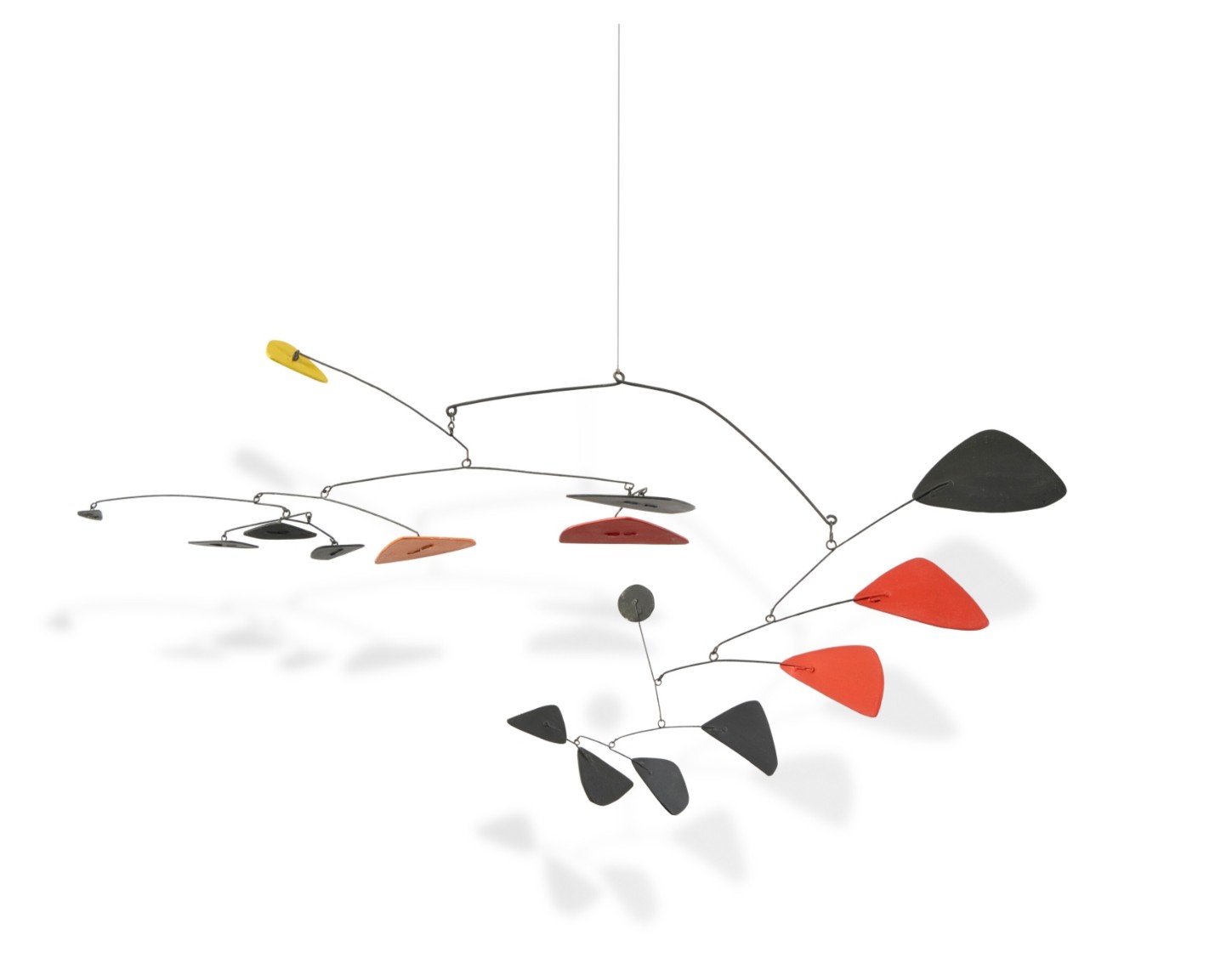 ALEXANDER CALDER (1898 – 1976)
.125, 1956
Sheet metal, wire and paint
7 1/2 x 18 x 7 inches (19.1 x 45.7 x 17.8 cm)
Incised with the artist’s monogram (on the largest red element)
Incised with a copyright symbol and Port Authority of New York 1957 (on the largest black element)
Registered in the archives of the Calder Foundation, New York, under application number A00402
#2. Four Sundaes, 1963
Property from a Distinguished Private Collection, Dallas
Sotheby’s New-York: 19 November 2025
Estimated: USD 1,500,000 – 2,000,000
USD 3,810,000
Four Sundaes | Contemporary Day Auction | 2025 | Sotheby’s
WAYNE THIEBAUD (1920 – 2021)
Four Sundaes, 1963
Oil on canvas
17×26 inches (43.2 x 66 cm)
Incised with the artist’s signature and date 1963 (lower left)
#3. Ads, 1985
Sotheby’s New-York: 19 November 2025
Estimated: USD 2,000,000 – 4,000,000
USD 2,978,000
Ads | Contemporary Day Auction | 2025 | Sotheby’s

ANDY WARHOL (1928 – 1987)
Ads, 1985
The complete set of ten screenprints in colors on Lenox Museum Board
Together with the original justification page
Each sheet: 38×38 inches (96.5 x 96.5 cm)
Signed and inscribed AP 22/30 (lower right or lower left of each)
This set is an artist’s proof set aside from the numbered edition of 190
Each with the blindstamps of the printer, Rupert Jasen Smith, and the publisher, Ronald Feldman Fine Arts, Inc.
#4. Sorry the Lifestyle You Ordered is Currently Out of Stock, 2003-13
Sotheby’s New-York: 19 November 2025
Estimated: USD 800,000 – 1,200,000
USD 2,856,000
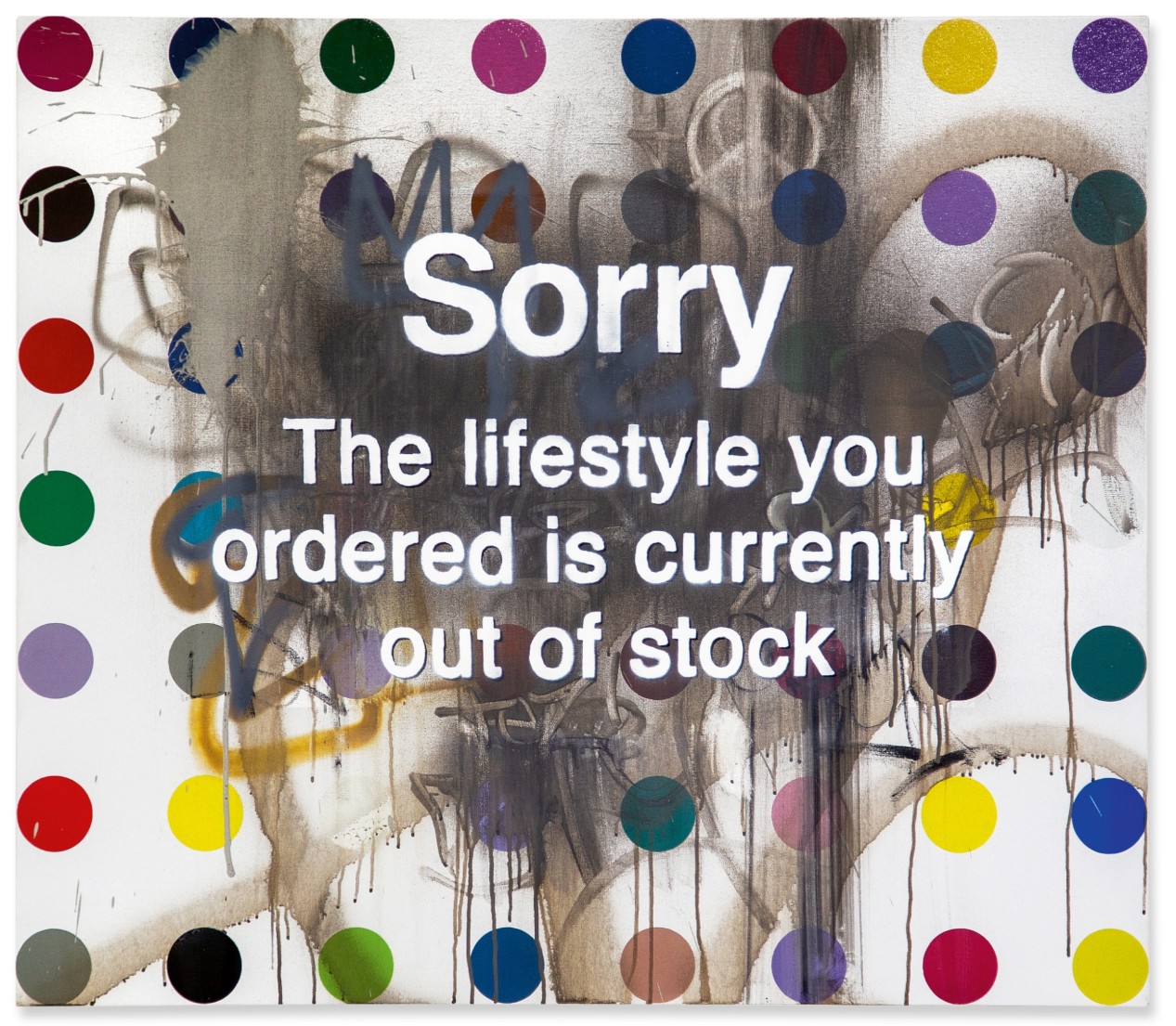
BANKSY (b. 1974) & DAMIEN HIRST
Sorry the Lifestyle You Ordered is Currently Out of Stock (Banksy defaced Hirst), 2003-13
Spray paint, emulsion and household gloss on canvas
99.1 x 114.3 cm (39×45 inches)
Signed by Banksy and Hirst and variously inscribed (on the reverse)
#5. Golden Still Life, 1987
The Geri Brawerman Collection: A Tribute to Los Angeles and A Legacy of Giving
Sotheby’s New-York: 19 November 2025
Estimated: USD 800,000 – 1,200,000
USD 2,734,000
Golden Still Life | Contemporary Day Auction | 2025 | Sotheby’s
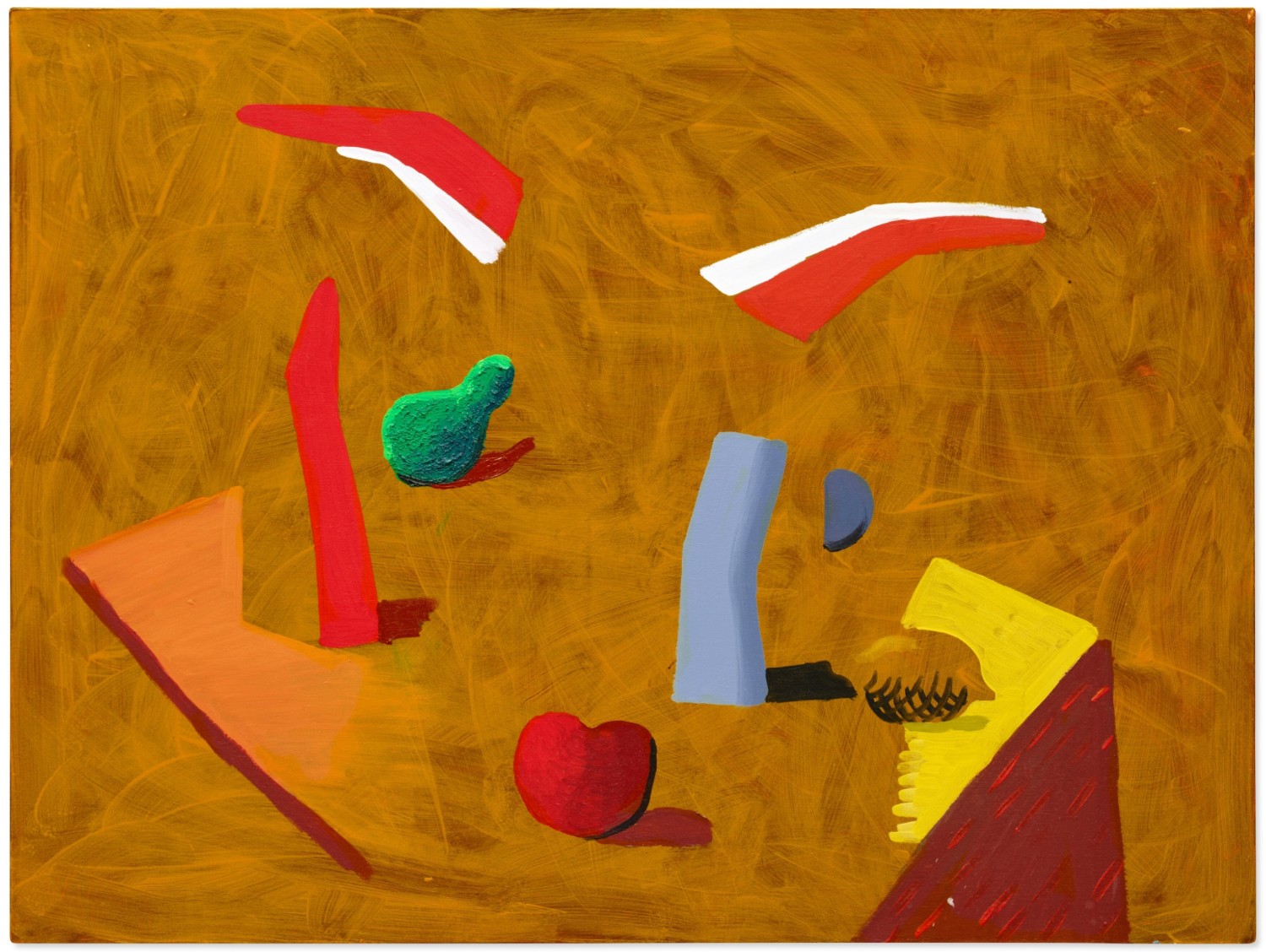
DAVID HOCKNEY (b. 1937)
Golden Still Life, 1987
Acrylic on canvas
36×48 inches (91.4 x 121.9 cm)
#7. Untitled, 1981
Works from the Collection of Kamran Diba
Sotheby’s New-York: 19 November 2025
Estimated: USD 2,200,000 – 3,200,000
USD 2,246,000
Untitled | Contemporary Day Auction | 2025 | Sotheby’s
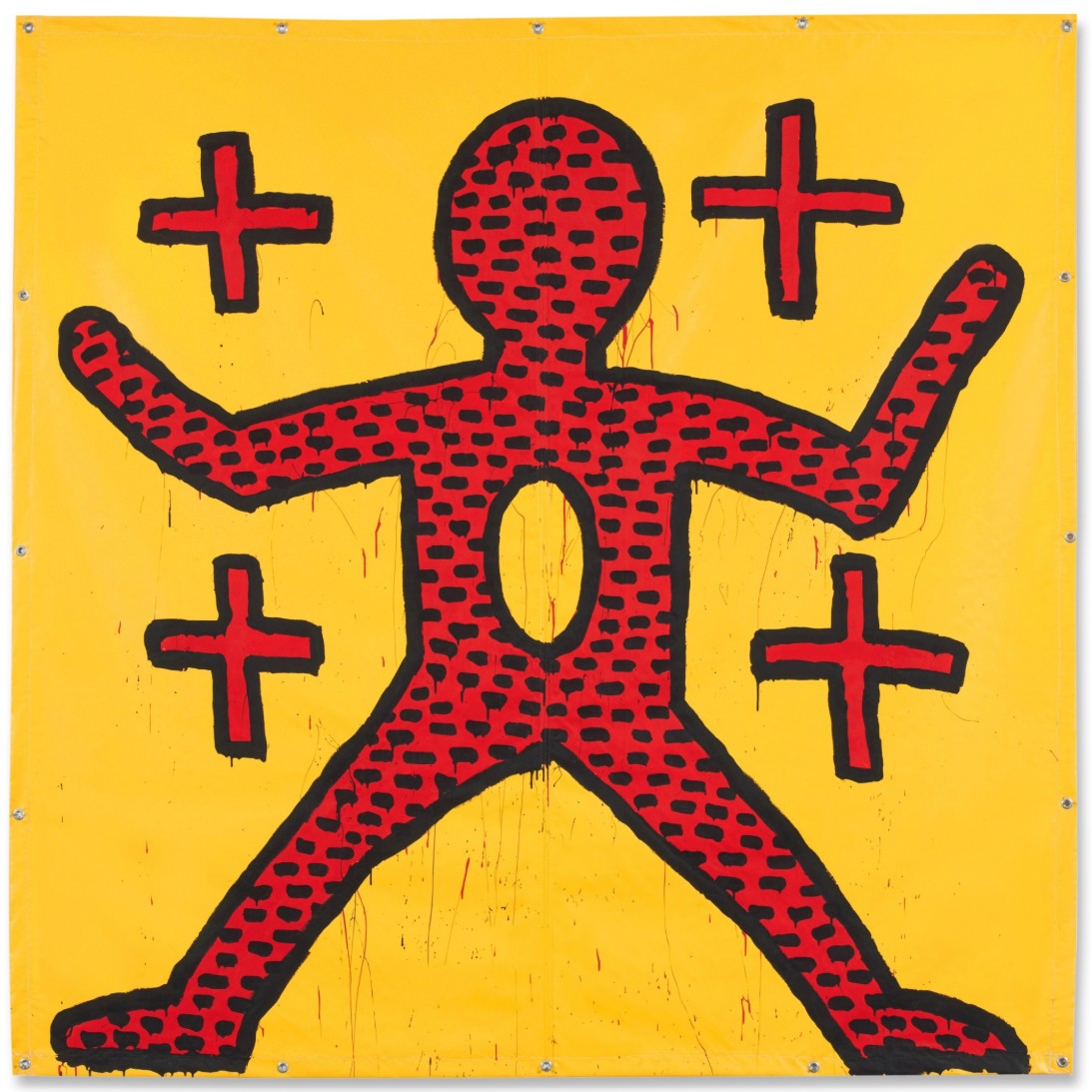
KEITH HARING (1958 – 1990)
Untitled, 1981
Acrylic on vinyl tarpaulin
97 1/4 x 96 1/2 inches (247 x 245.1 cm)
Signed and dated 1981 (on the reverse)
Reflections: Wimpy III, 1988
A Legacy Reimagined: Works from the Collection of Dorothy and Roy Lichtenstein
Sotheby’s New-York: 19 November 2025
Estimated: USD 1,000,000 – 1,500,000
USD 2,002,000
Reflections: Wimpy III | Contemporary Day Auction | 2025 | Sotheby’s
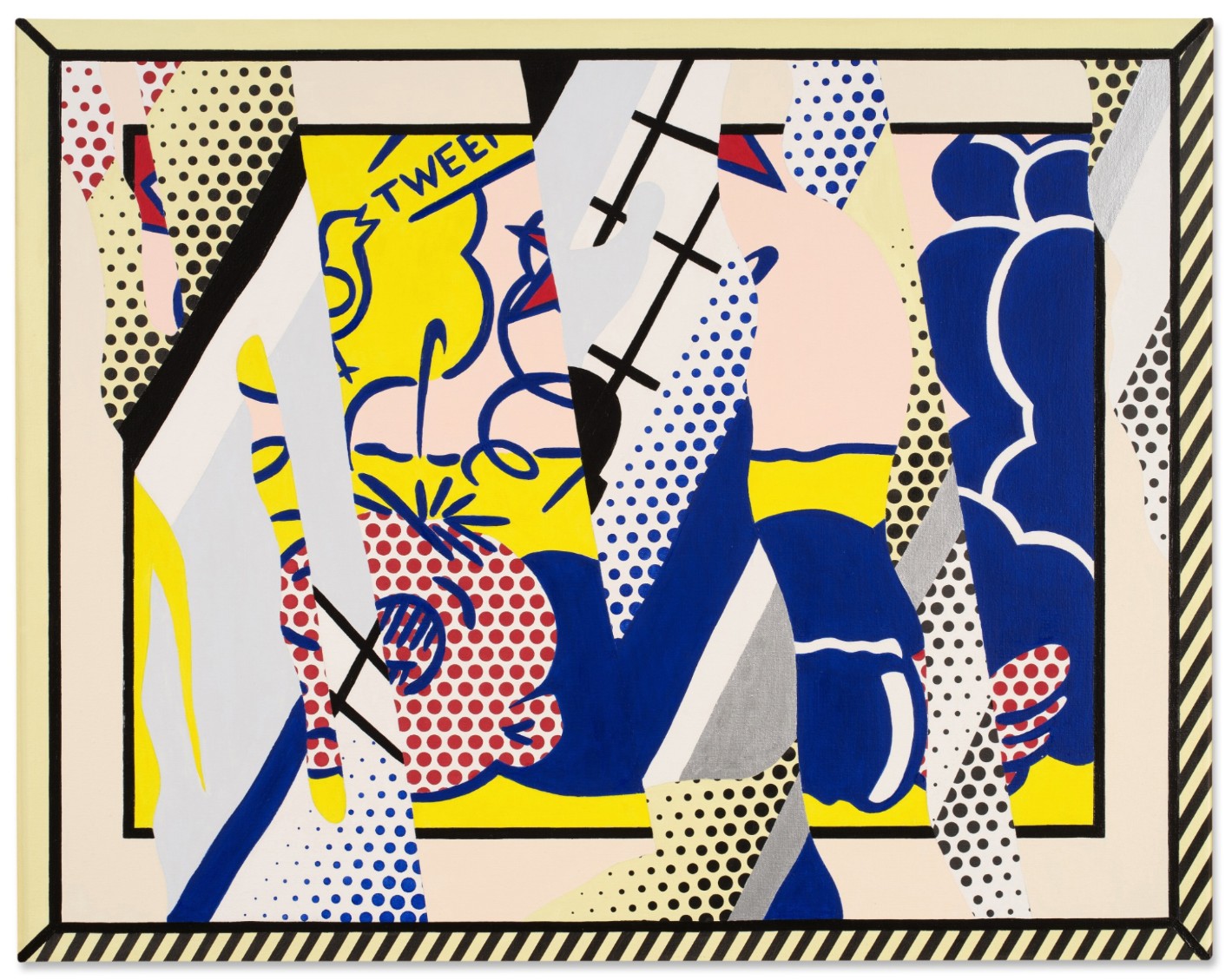
ROY LICHTENSTEIN (1923 – 1997)
Reflections: Wimpy III, 1988
Acrylic, oil and graphite on canvas
32×40 inches (81.3 x 101.6 cm)
Signed and dated ’88 (on the reverse)
USD 2 million
Your Comedies, 1982
Property from an Esteemed West Coast Collection
Sotheby’s New-York: 19 November 2025
Estimated: USD 600,000 – 800,000
USD 1,819,000
Your Comedies | Contemporary Day Auction | 2025 | Sotheby’s
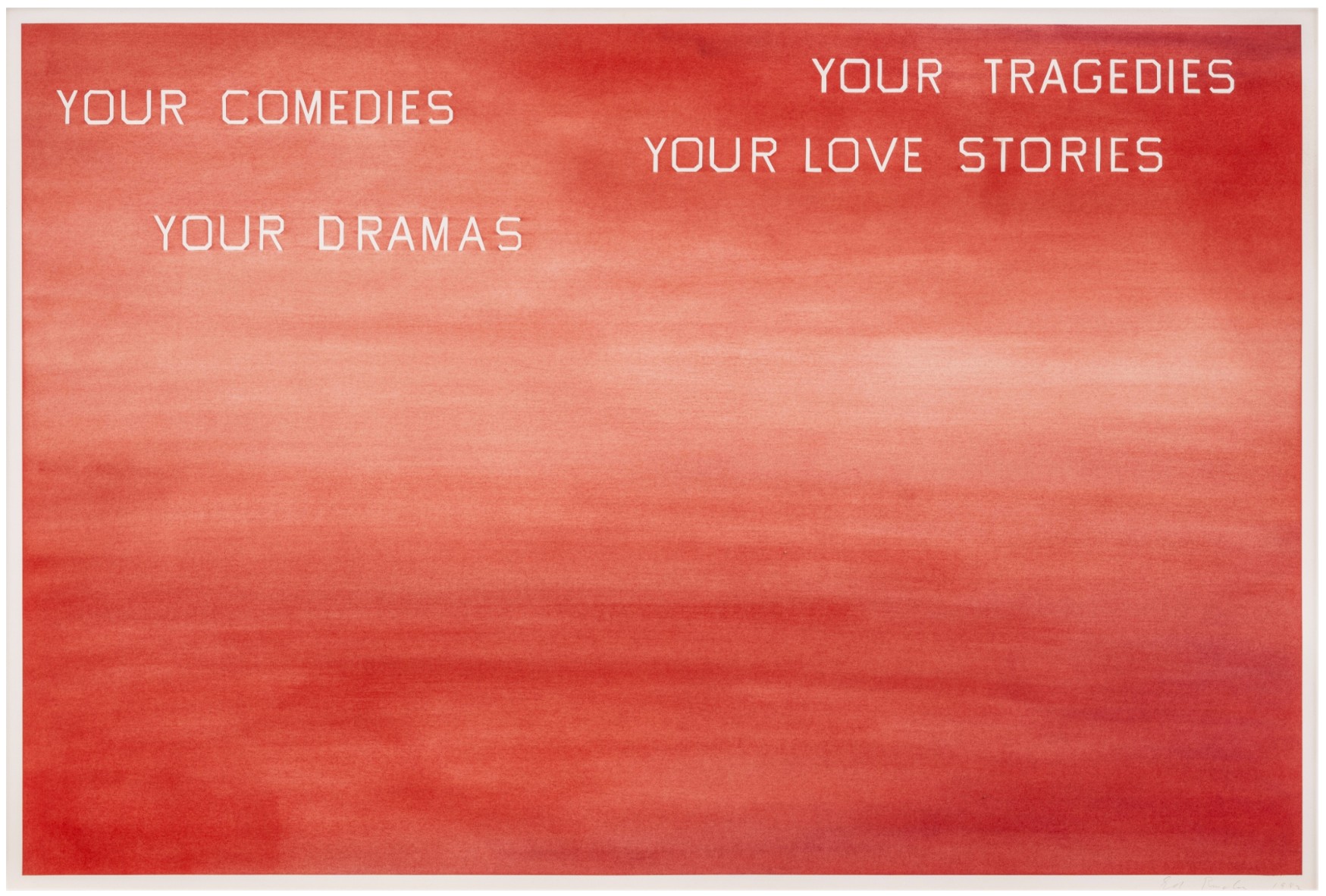
ED RUSCHA (b. 1937)
Your Comedies, 1982
Dry pigment on paper
40×60 inches (101.6 x 152.4 cm)
Signed and dated 1982 (lower right)
Pumpkin, 2019
Property from a Prestigious Private Collector
Sotheby’s New-York: 19 November 2025
Estimated: USD 1,700,000 – 2,500,000
USD 1,514,000
Pumpkin | Contemporary Day Auction | 2025 | Sotheby’s
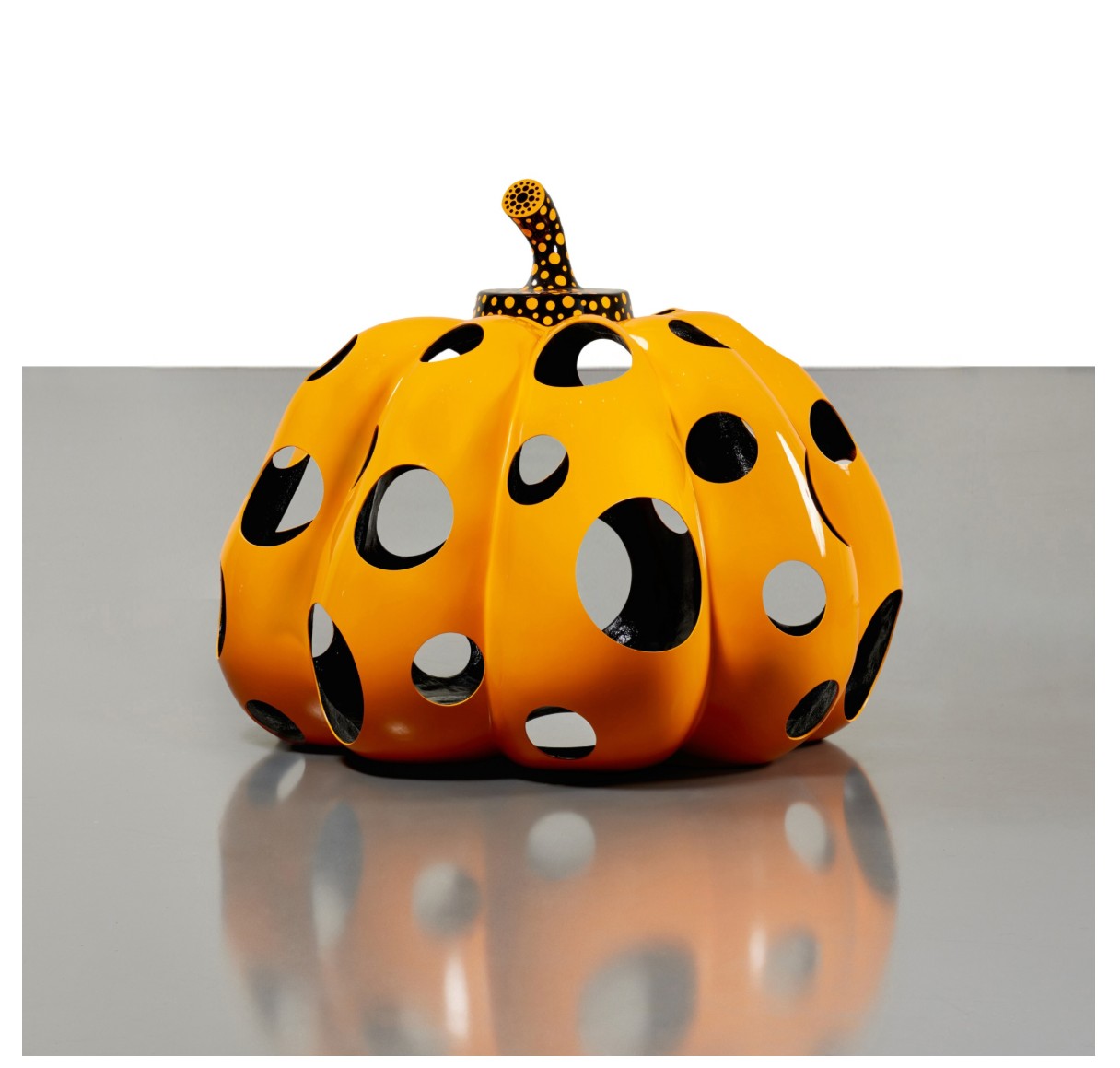
YAYOI KUSAMA (b. 1929)
Pumpkin, 2019
Fiberglass reinforced plastic, stainless steel, urethane paint and mirror
94 x 118.1 x 120.7 cm (37 x 46 1/2 x 47 1/2 inches)
Signed and dated 2019 (on the lower edge)
Abstraktes Bild, 1995
Sotheby’s New-York: 19 November 2025
Estimated: USD 1,200,000 – 1,800,000
USD 1,514,000
Abstraktes Bild | Contemporary Day Auction | 2025 | Sotheby’s
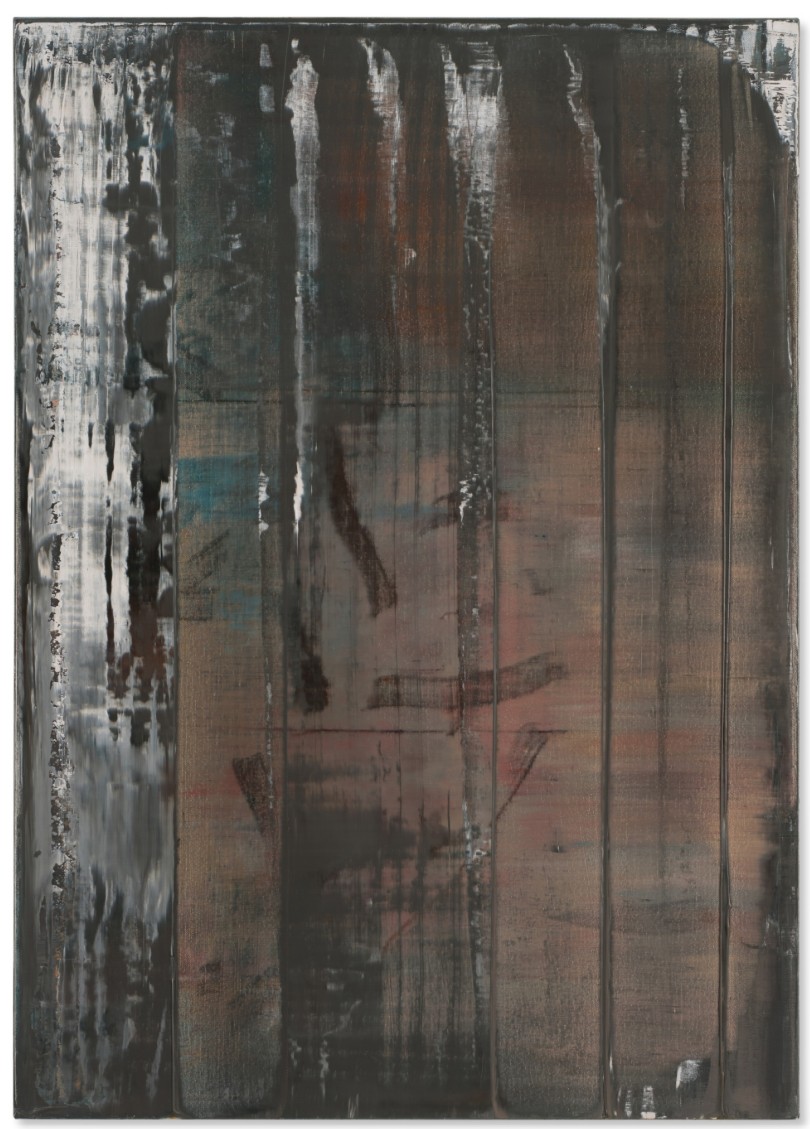
GERHARD RICHTER (b. 1932)
Abstraktes Bild, 1995
Oil on canvas
94 x 66.7 cm (37 x 26 1/4 inches)
Signed twice, dated 1995 and numbered 829-11 (on the reverse)
The Witch (from Myths), 1981
Sotheby’s New-York: 19 November 2025
Estimated: USD 1,200,000 – 1,800,000
USD 1,392,000
The Witch (from Myths) | Contemporary Day Auction | 2025 | Sotheby’s
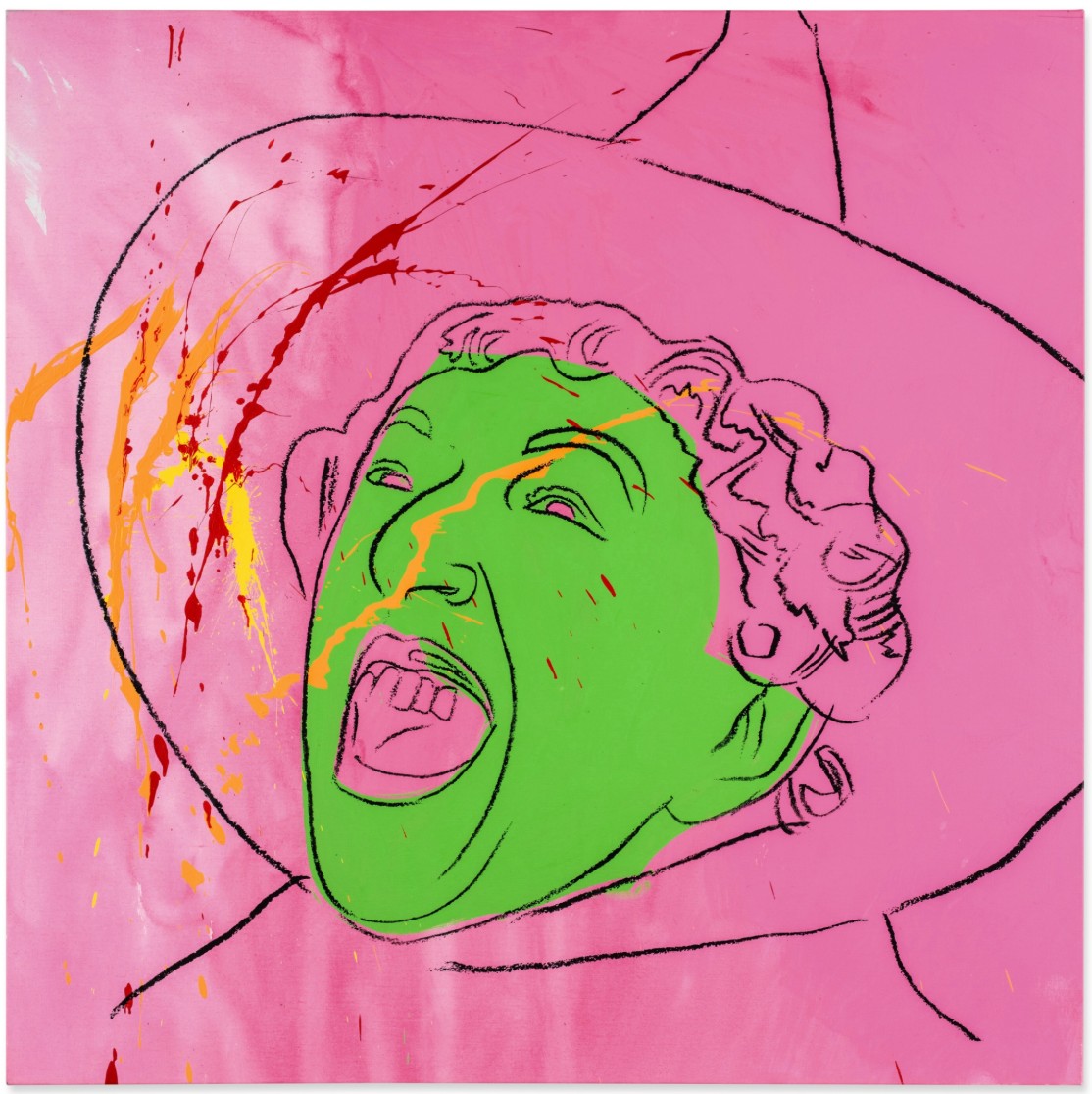
ANDY WARHOL (1928 – 1987)
The Witch (from Myths), 1981
Acrylic and silkscreen ink on canvas
60×60 inches (152.4 x 152.4 cm)
Signed and dated 1981 (on the overlap)
Stamped by the Estate of Andy Warhol and the Andy Warhol Foundation for the Visual Arts, Inc.
Numbered PA51.012 on the overlap and stretcher bar
Reflections on Brushstrokes, 1990
A Legacy Reimagined: Works from the Collection of Dorothy and Roy Lichtenstein
Sotheby’s New-York: 19 November 2025
Estimated: USD 1,200,000 – 1,800,000
USD 1,392,000
Reflections on Brushstrokes | Contemporary Day Auction | 2025 | Sotheby’s
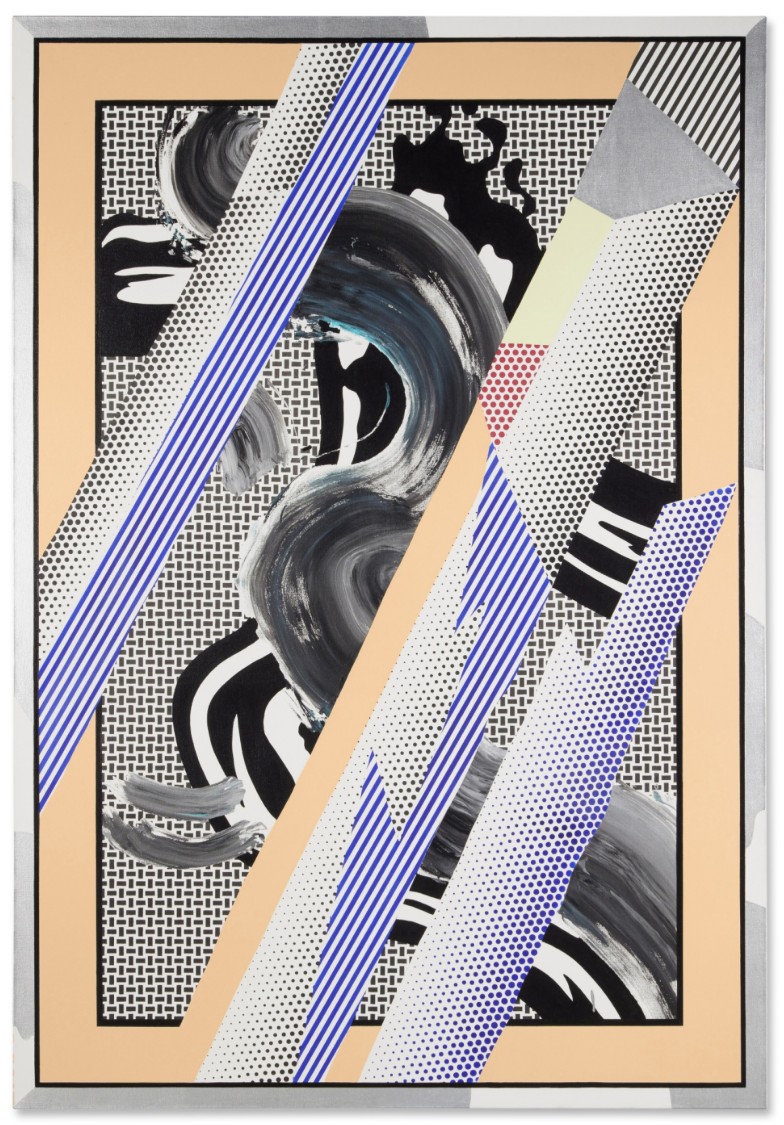
ROY LICHTENSTEIN (1923 – 1997)
Reflections on Brushstrokes, 1990
Acrylic, oil and graphite on canvas
87 1/4 x 60 inches (221.6 x 152.4 cm)
Signed and dated ‘90 (on the reverse)
Still Life with Two Grapefruits, 1994
A Legacy Reimagined: Works from the Collection of Dorothy and Roy Lichtenstein
Sotheby’s New-York: 19 November 2025
Estimated: USD 800,000 – 1,200,000
USD 1,270,000
Still Life with Two Grapefruits | Contemporary Day Auction | 2025 | Sotheby’s
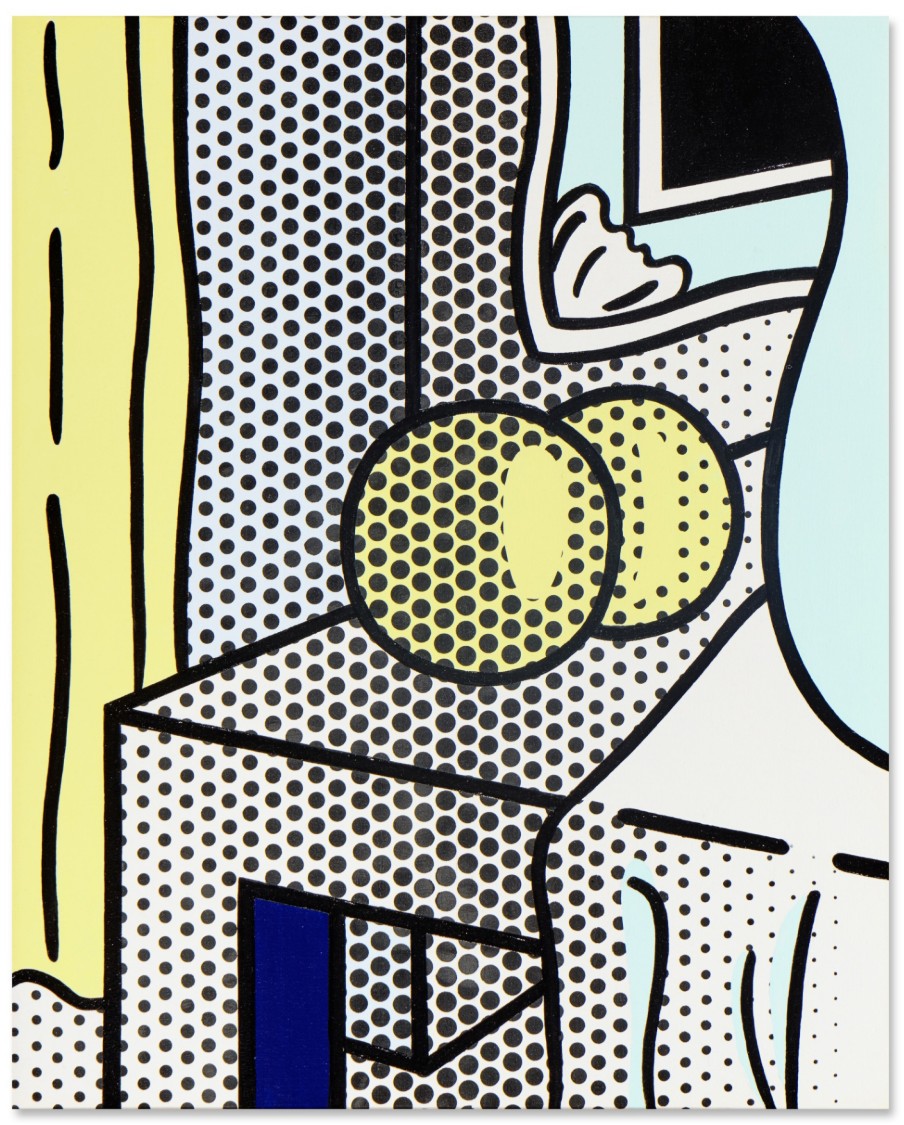
ROY LICHTENSTEIN (1923 – 1997)
Still Life with Two Grapefruits, 1994
Acrylic, oil and graphite on canvas
30 1/8 x 24 1/8 inches (76.5 x 61.2 cm)
Signed and dated ’94 (on the reverse)
Entablature, 1974
A Legacy Reimagined: Works from the Collection of Dorothy and Roy Lichtenstein
Sotheby’s New-York: 19 November 2025
Estimated: USD 800,000 – 1,200,000
USD 1,270,000
Entablature | Contemporary Day Auction | 2025 | Sotheby’s
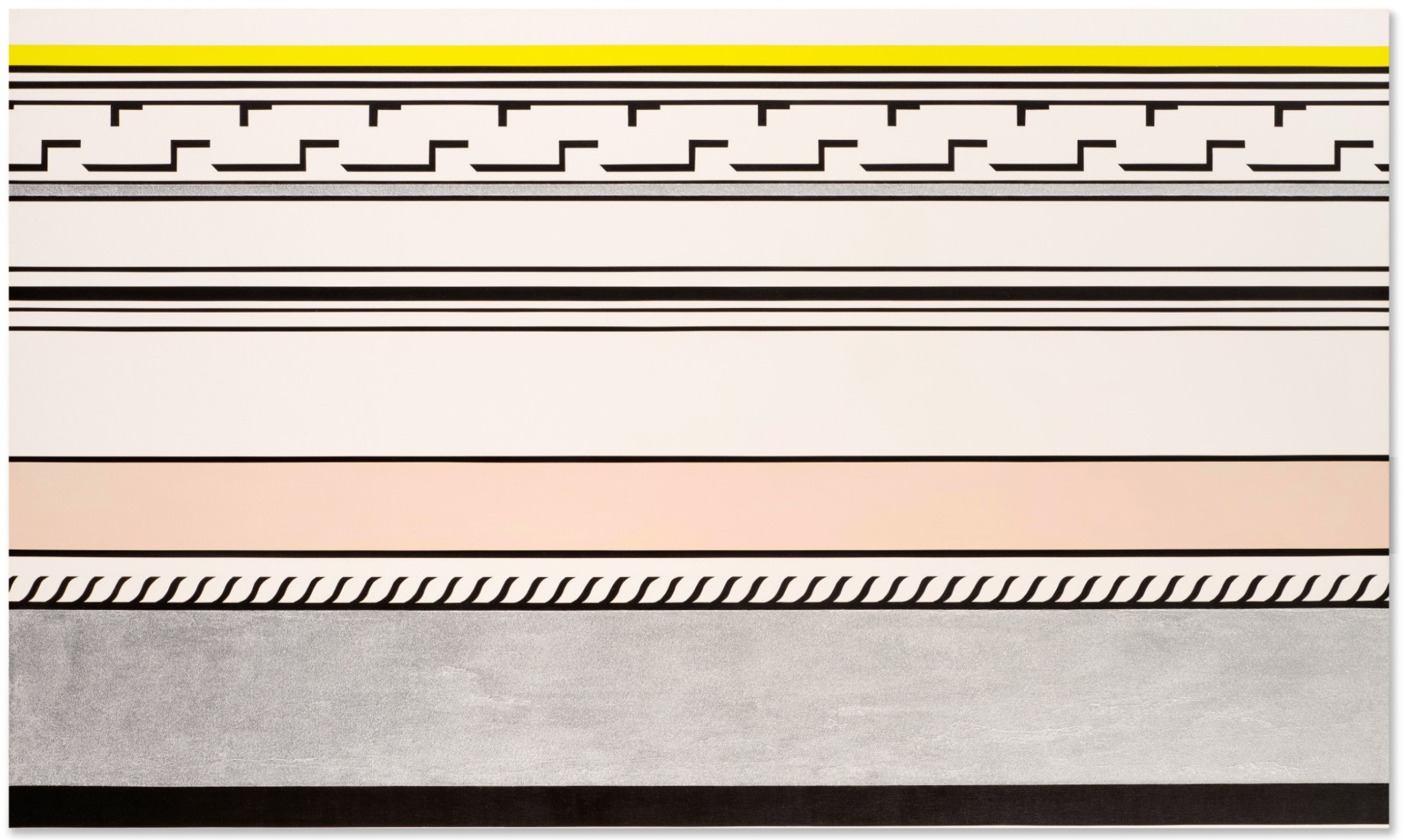
ROY LICHTENSTEIN (1923 – 1997)
Entablature, 1974
Acrylic, sand and graphite on canvas
60 x 100 1/8 inches (152.4 x 254.3 cm)
Signed and dated ‘74 (on the reverse)
Cover Image for Guggenheim Magazine (Study), 1993
A Legacy Reimagined: Works from the Collection of Dorothy and Roy Lichtenstein
Sotheby’s New-York: 19 November 2025
Estimated: USD 800,000 – 1,200,000
USD 1,255,000
Cover Image for Guggenheim Magazine (Study) | Contemporary Day Auction | 2025 | Sotheby’s
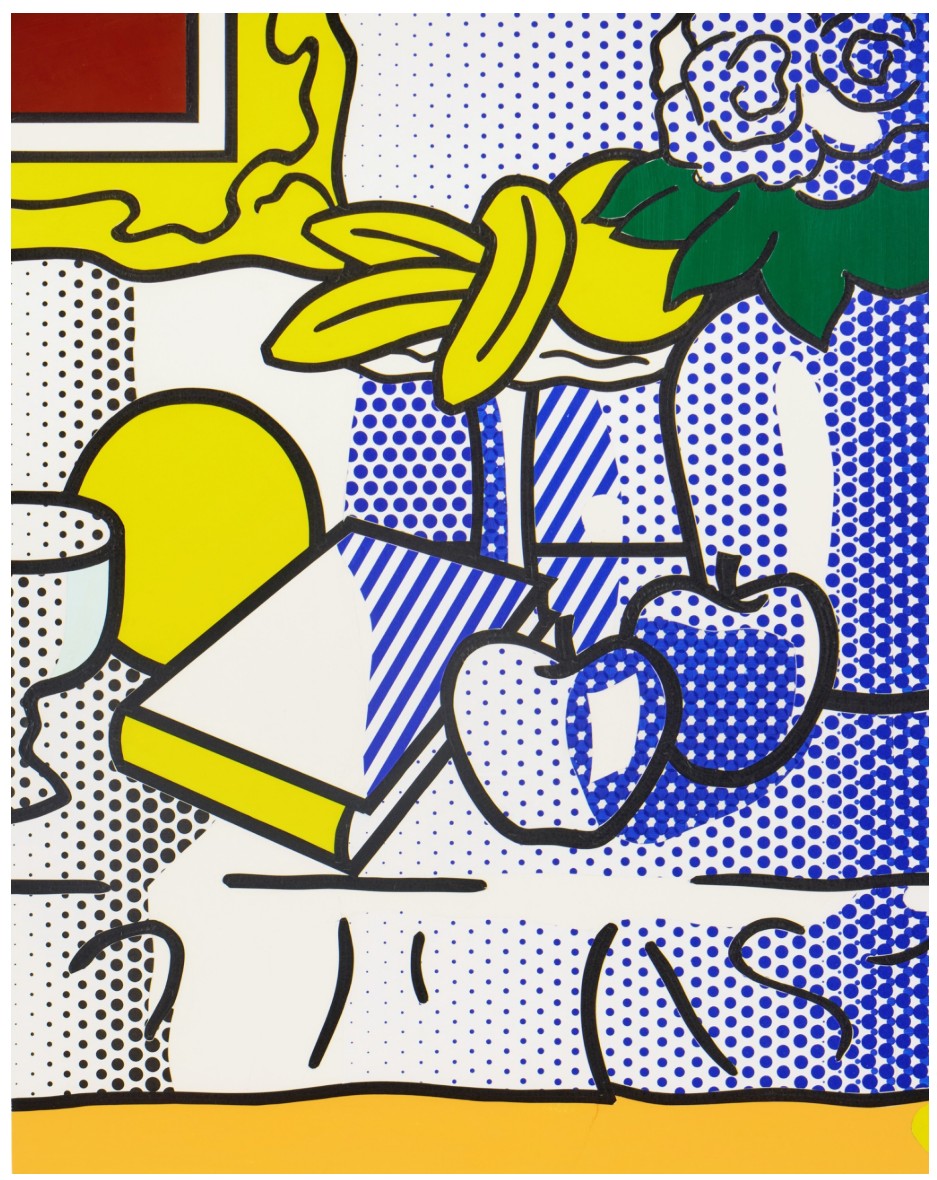
ROY LICHTENSTEIN (1923 – 1997)
Cover Image for Guggenheim Magazine (Study), 1993
Graphite, tape, cut painted and printed paper on board
Image: 40 1/2 x 31 7/8 inches (102.9 x 81 cm)
Board: 48 5/8 x 40 inches (123.5 x 101.6 cm)
Signed and dated ’93 (on the verso)
Net-Obsession, 1964
Sotheby’s New-York: 19 November 2025
Estimated: USD 700,000 – 1,000,000
USD 1,079,500
Net-Obsession | Contemporary Day Auction | 2025 | Sotheby’s
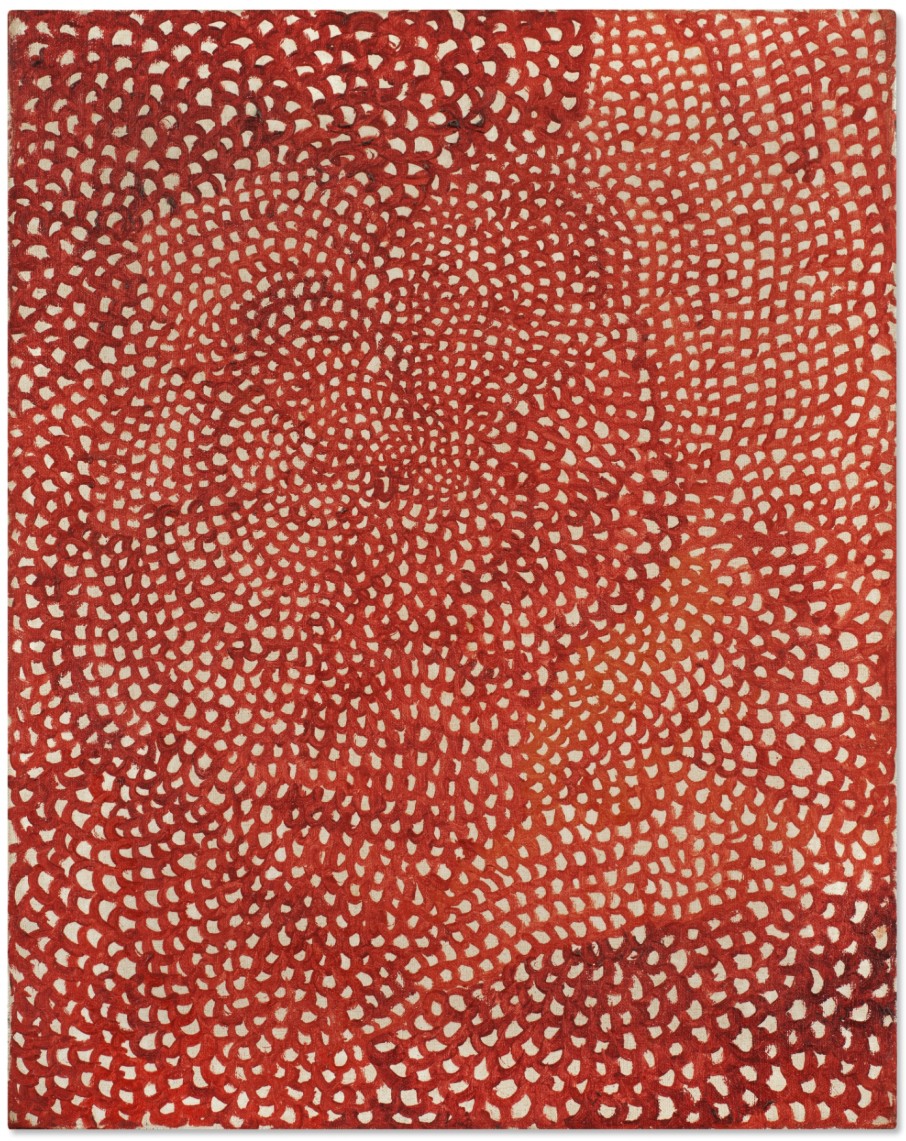
YAYOI KUSAMA (b. 1929)
Net-Obsession, 1964
Oil on canvas
50.8 x 40.6 cm (20×16 inches)
Signed, titled and dated 1964 twice (on the reverse)
Titled (on the stretcher)
USD 1 million
Bailarines, 2001
Sotheby’s New-York: 19 November 2025
Estimated: USD 800,000 – 1,200,000
USD 920,750
Bailarines | Contemporary Day Auction | 2025 | Sotheby’s
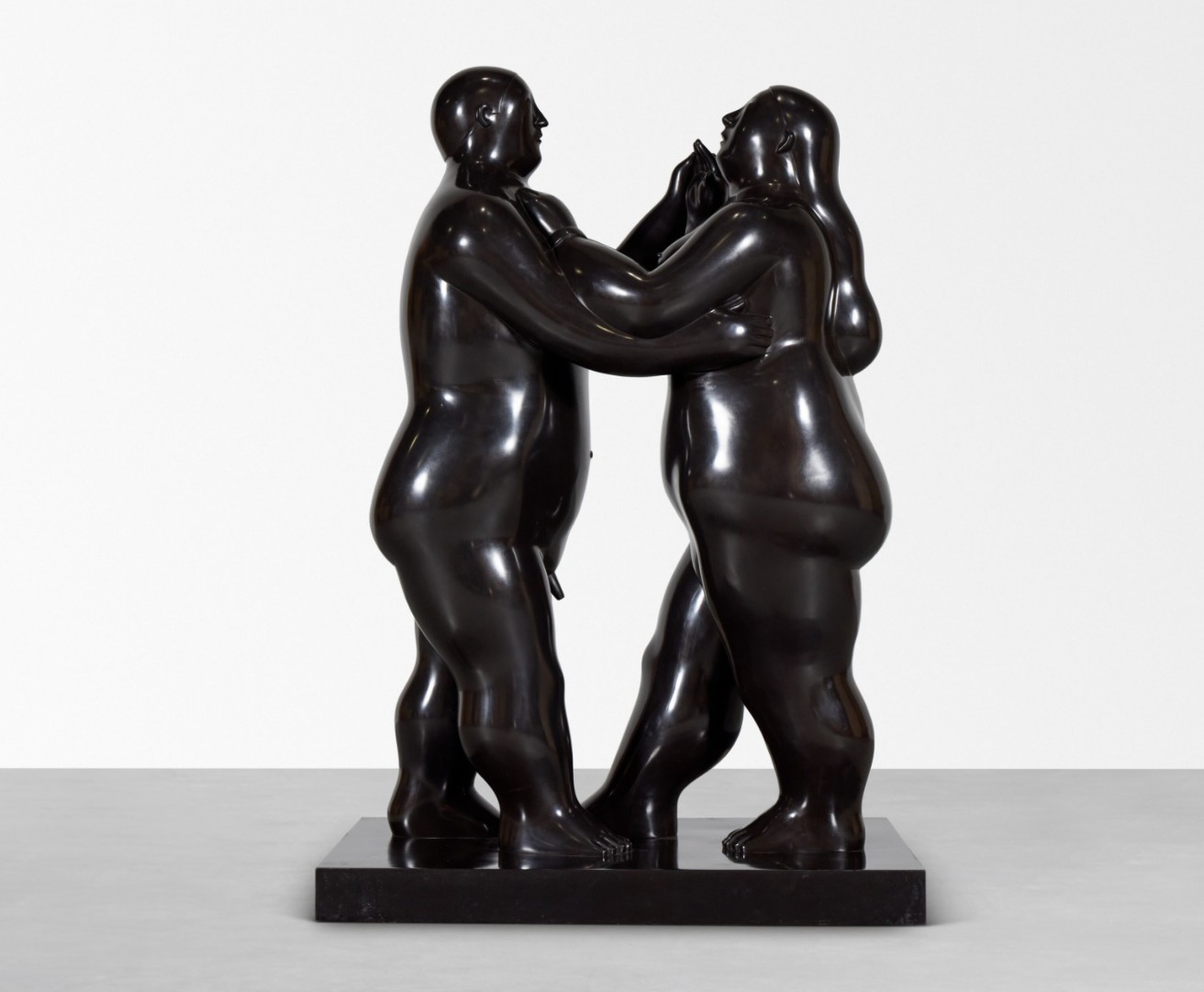
FERNANDO BOTERO (1932 – 2023)
Bailarines, 2001
Bronze
134.6 x 53.5 c 89.2 cm (53 x 21 1/8 x 35 1/8 inches)
Incised with the number PA 1/2 (lower edge)
This work is artist’s proof 2 from an edition of 6 plus 2 artist’s proofs
The Beach, 2006
Sotheby’s New-York: 19 November 2025
Estimated: USD 600,000 – 800,000
USD 857,250
The Beach | Contemporary Day Auction | 2025 | Sotheby’s
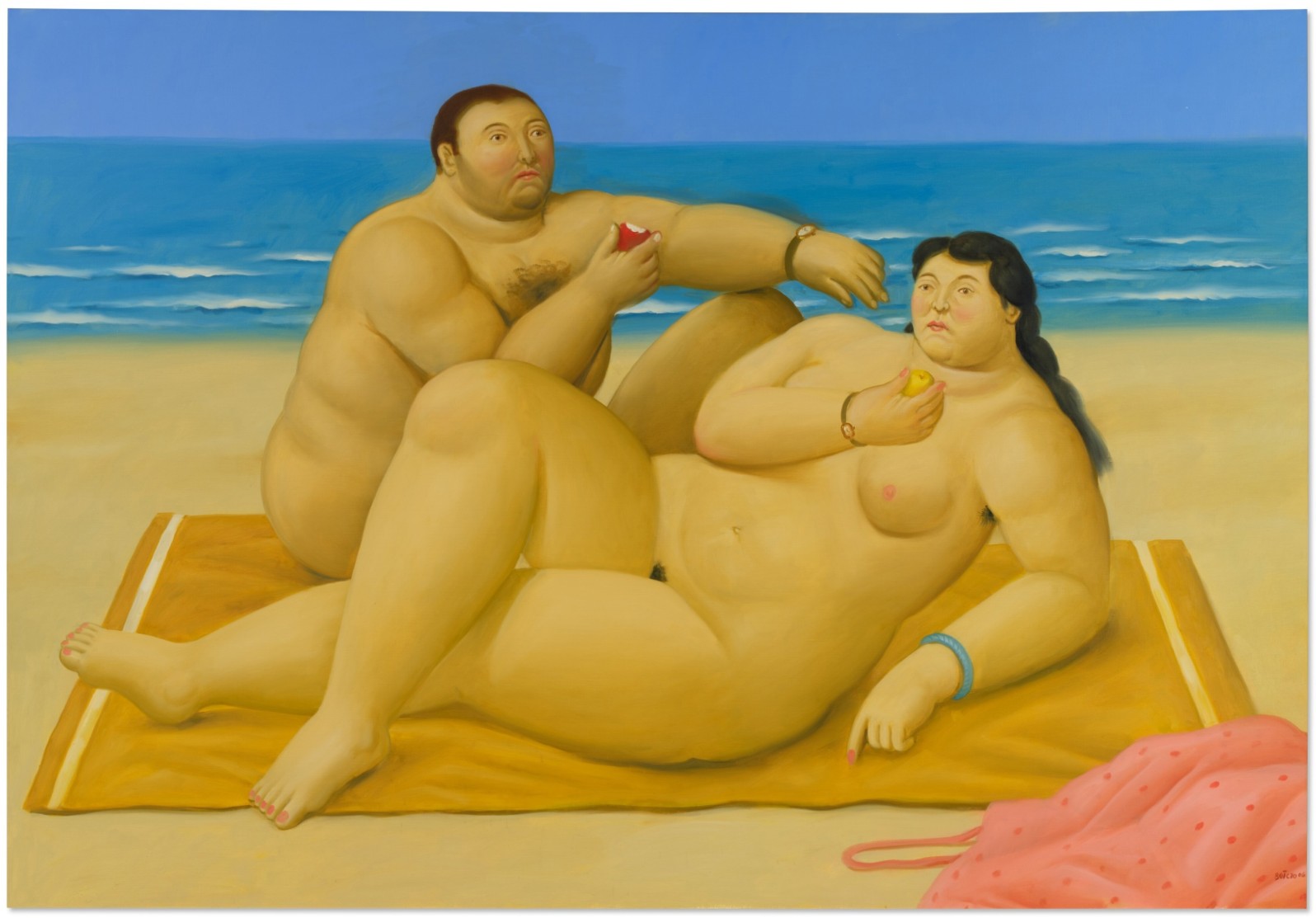 FERNANDO BOTERO (1932 – 2023)
The Beach, 2006
Oil on canvas
131.4 x 189.9 cm (51 3/4 x 74 3/4 inches)
Signed and dated 06 (lower right)
Tony Reading (Silver Tony), 1999
Works from the Collection of Byron R. Meyer with Partial Proceeds
to Benefit the San Francisco Museum of Modern Art
Sotheby’s New-York: 19 November 2025
Estimated: USD 500,000 – 700,000
USD 457,200
Tony Reading (Silver Tony) | Contemporary Day Auction | 2025 | Sotheby’s
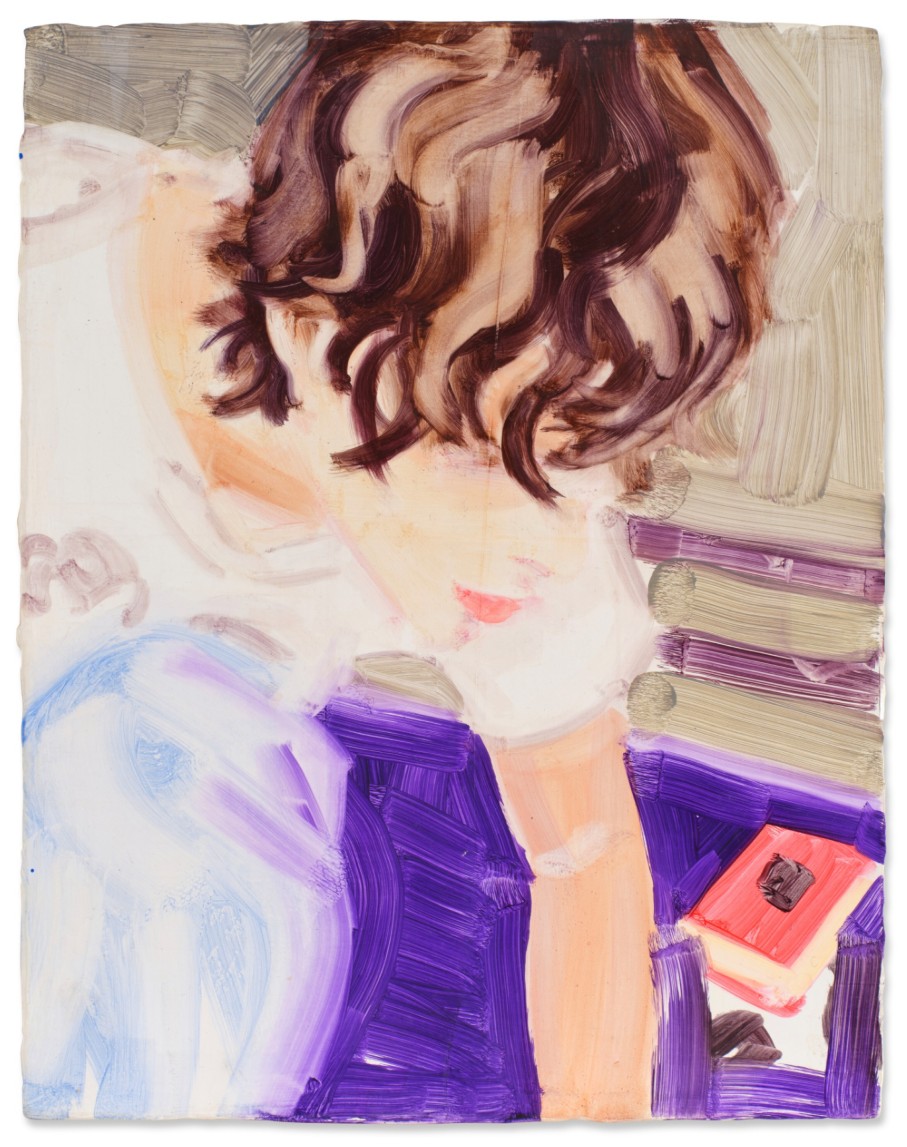
ELIZABETH PEYTON (b. 1965)
Tony Reading (Silver Tony), 1999
Oil on MDF
14 1/4 x 11 inches (36.2 x 27.9 cm)
Signed, titled, dated 1999 and inscribed Tony Just (age 30) (on the reverse)
Division of the Eternal, 1986
Works from the Collection of Byron R. Meyer with Partial Proceeds
to Benefit the San Francisco Museum of Modern Art
Sotheby’s New-York: 19 November 2025
Estimated: USD 400,000 – 600,000
USD 431,800
Division of the Eternal | Contemporary Day Auction | 2025 | Sotheby’s
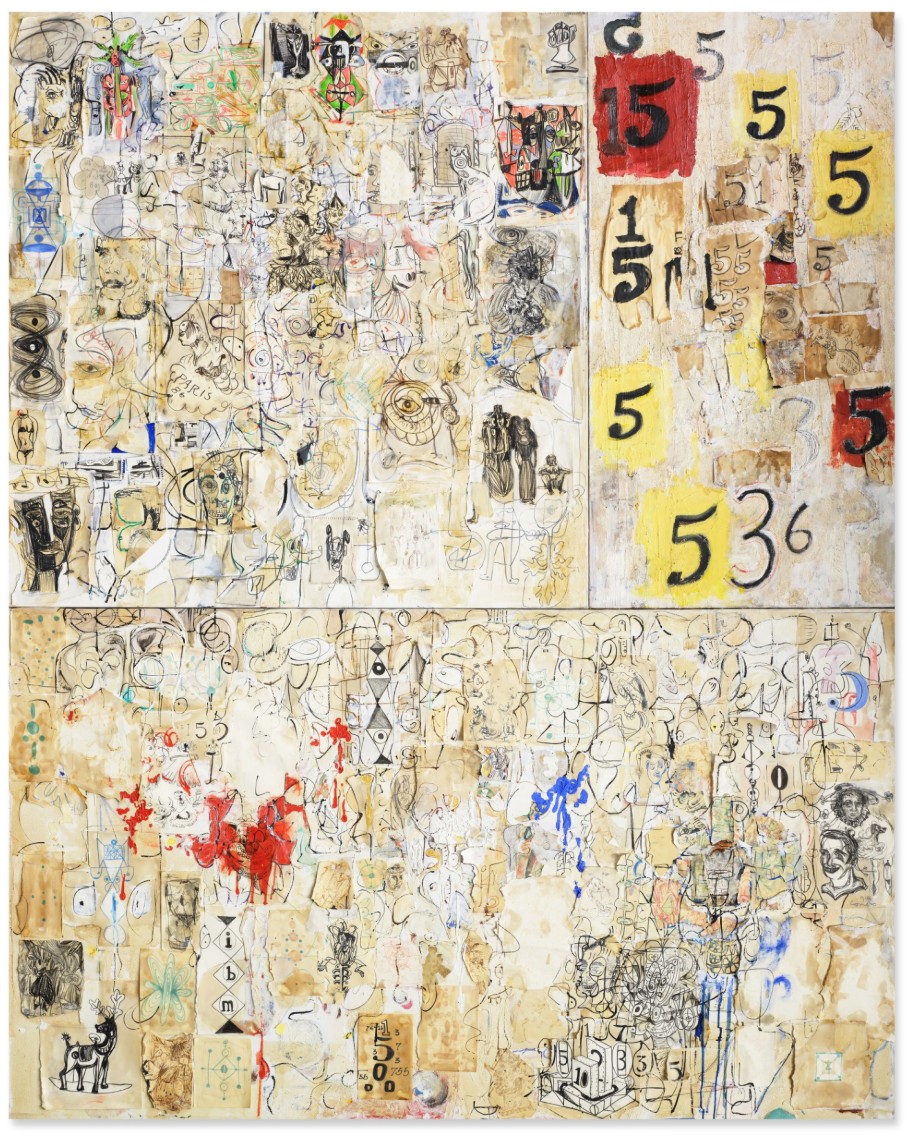
GEORGE CONDO (b. 1957)
Division of the Eternal, 1986
Oil, encaustic, ink, marker, graphite and paper collage on 3 joined canvases
107 x 85 1/2 inches (271.8 x 217.2 cm)
Signed and dated 9.86 (lower center right)
Dated Paris 86 (upper left)
Untitled (Cowboys), 1997
Sotheby’s New-York: 19 November 2025
Estimated: USD 600,000 – 800,000
USD 381,000
Untitled (Cowboys) | Contemporary Day Auction | 2025 | Sotheby’s
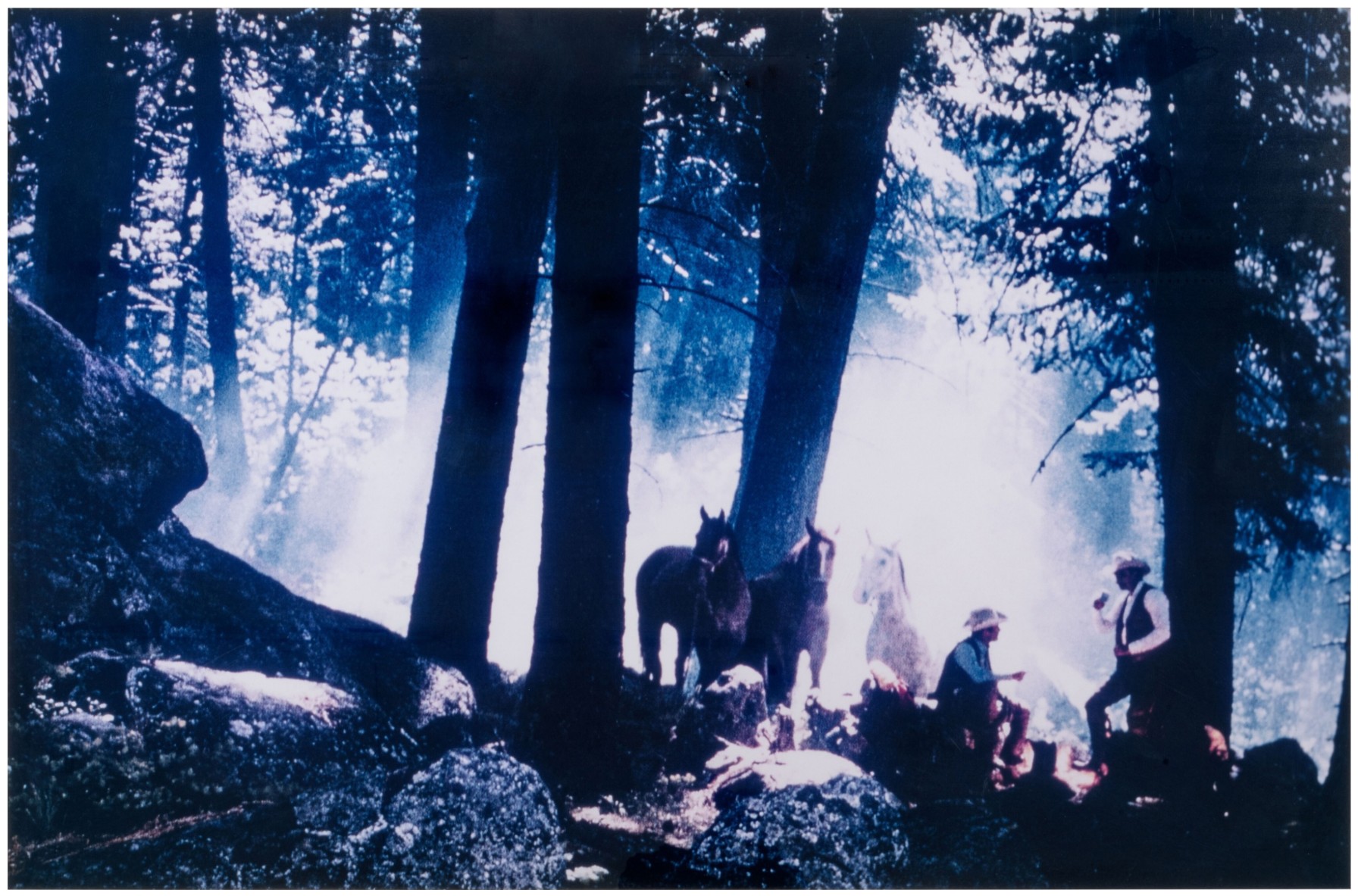
RICHARD PRINCE (b. 1949)
Untitled (Cowboys), 1997
Ektacolor print
48×72 inches (121.9 x 182.9 cm)
Signed, dated 1997 and numbered 2/2 (on a label affixed to the reverse of the frame)
This work is number 2 from an edition of 2
Untitled (Red), 2007
Sotheby’s New-York: 19 November 2025
Estimated: USD 350,000 -450,000
WORK ON PAPER
Untitled (Red) | Contemporary Day Auction | 2025 | Sotheby’s
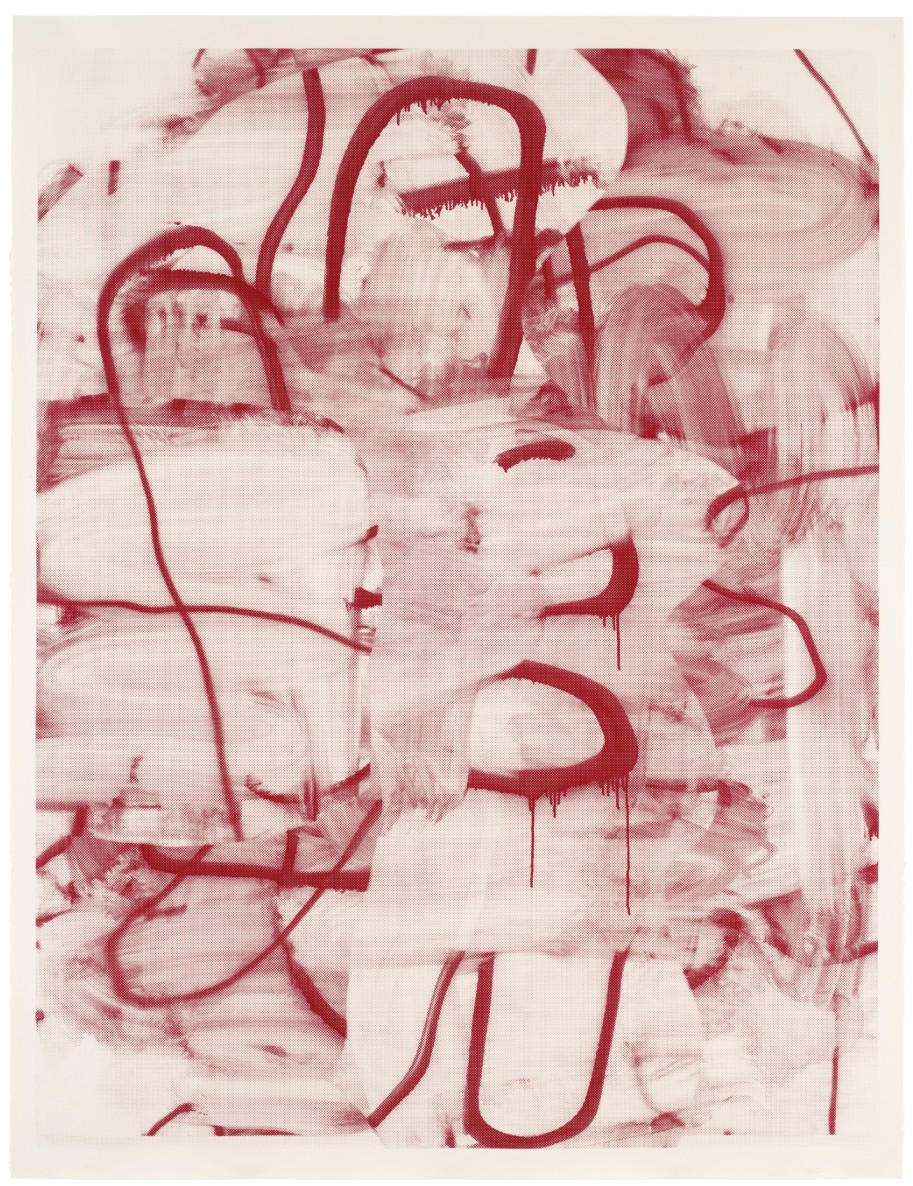
CHRISTOPHER WOOL (b. 1955)
Untitled (Red), 2007
Silkscreen ink on paper
72 x 55 1/4 inches (182.9 x 140.3 cm)
Signed and dated 2007 (lower right)
Woman from History, 1986
Sotheby’s New-York: 19 November 2025
Estimated: USD 250,000 – 350,000
WORK ON PAPER
Woman From History | Contemporary Day Auction | 2025 | Sotheby’s
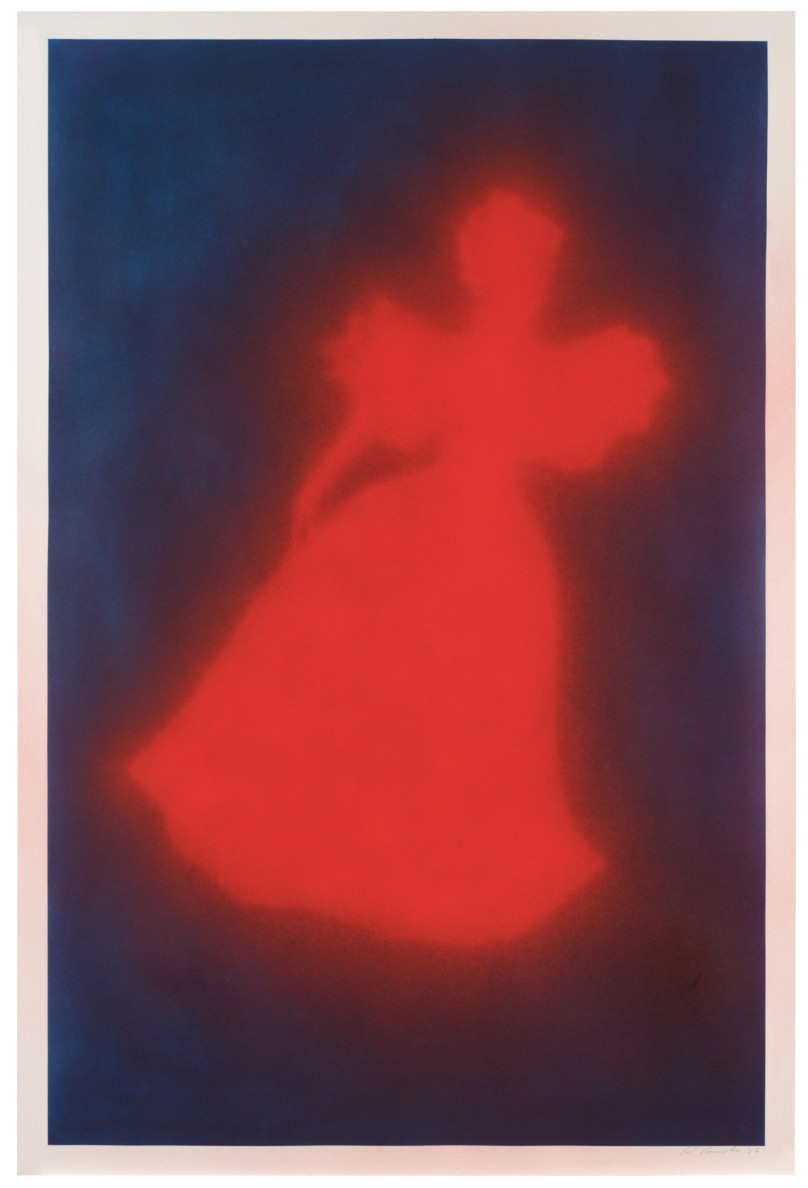
ED RUSCHA (b. 1937)
Woman from History, 1986
Dry pigment and acrylic on paper
60×40 inches (152.4 x 101.6 cm)
Signed and dated ’86 (lower right)
Europe, 1989
Property from a Distinguished American Collection
Sotheby’s New-York: 19 November 2025
Estimated: USD 200,000 – 300,000
WORK ON PAPER
Europe | Contemporary Day Auction | 2025 | Sotheby’s
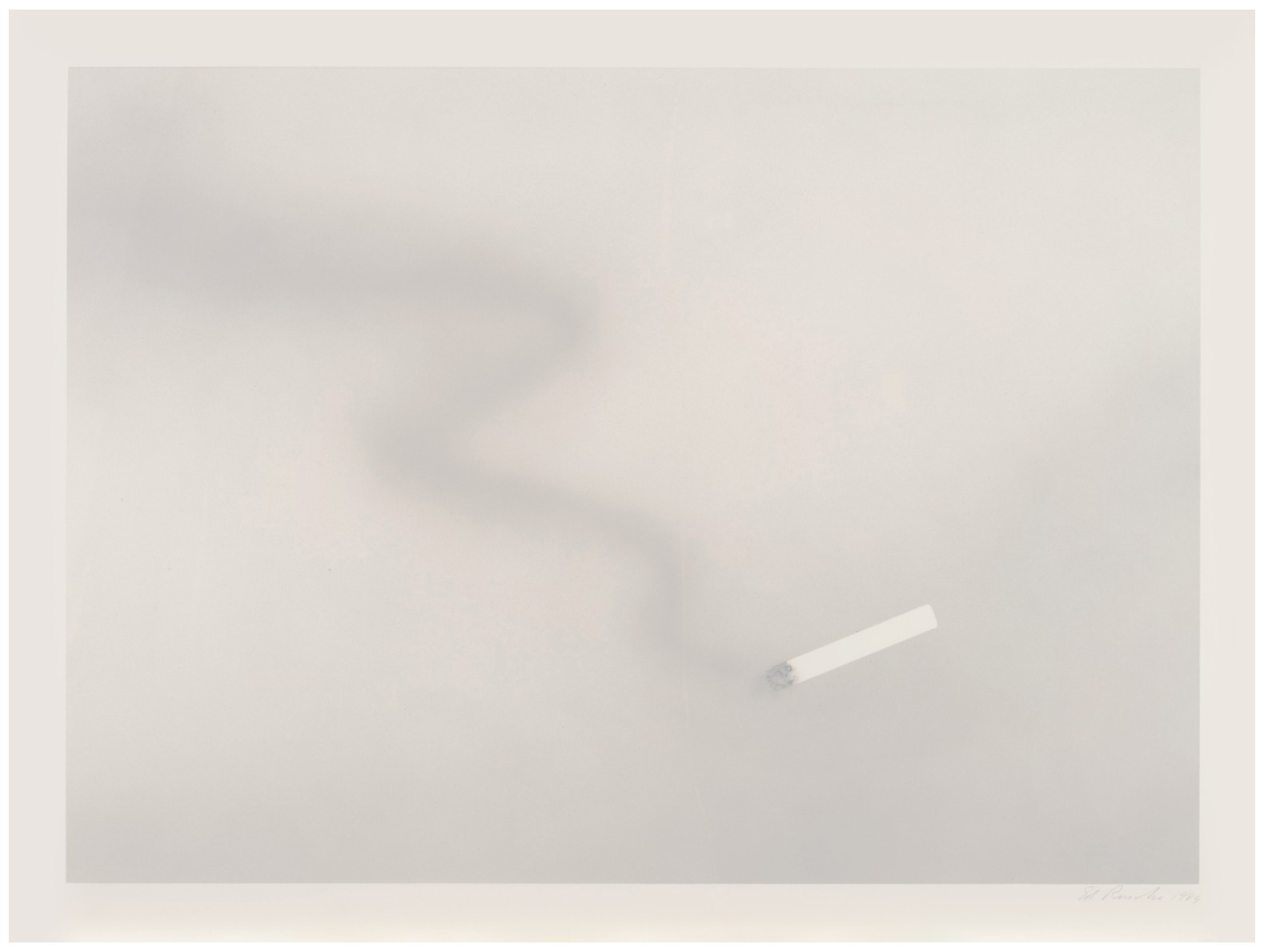
ED RUSCHA (b. 1937)
Europe, 1989
Acrylic and graphite on museum board
30 x 40 1/8 inches (76.2 x 101.9 cm)
Signed and dated 1989 (lower right)
Lots Passed
Cosmo, Selma, Vine, 2000
Sotheby’s New-York: 19 November 2025
Estimated: USD 1,500,000 – 2,000,000
PASSED
Cosmo, Selma, Vine | Contemporary Day Auction | 2025 | Sotheby’s
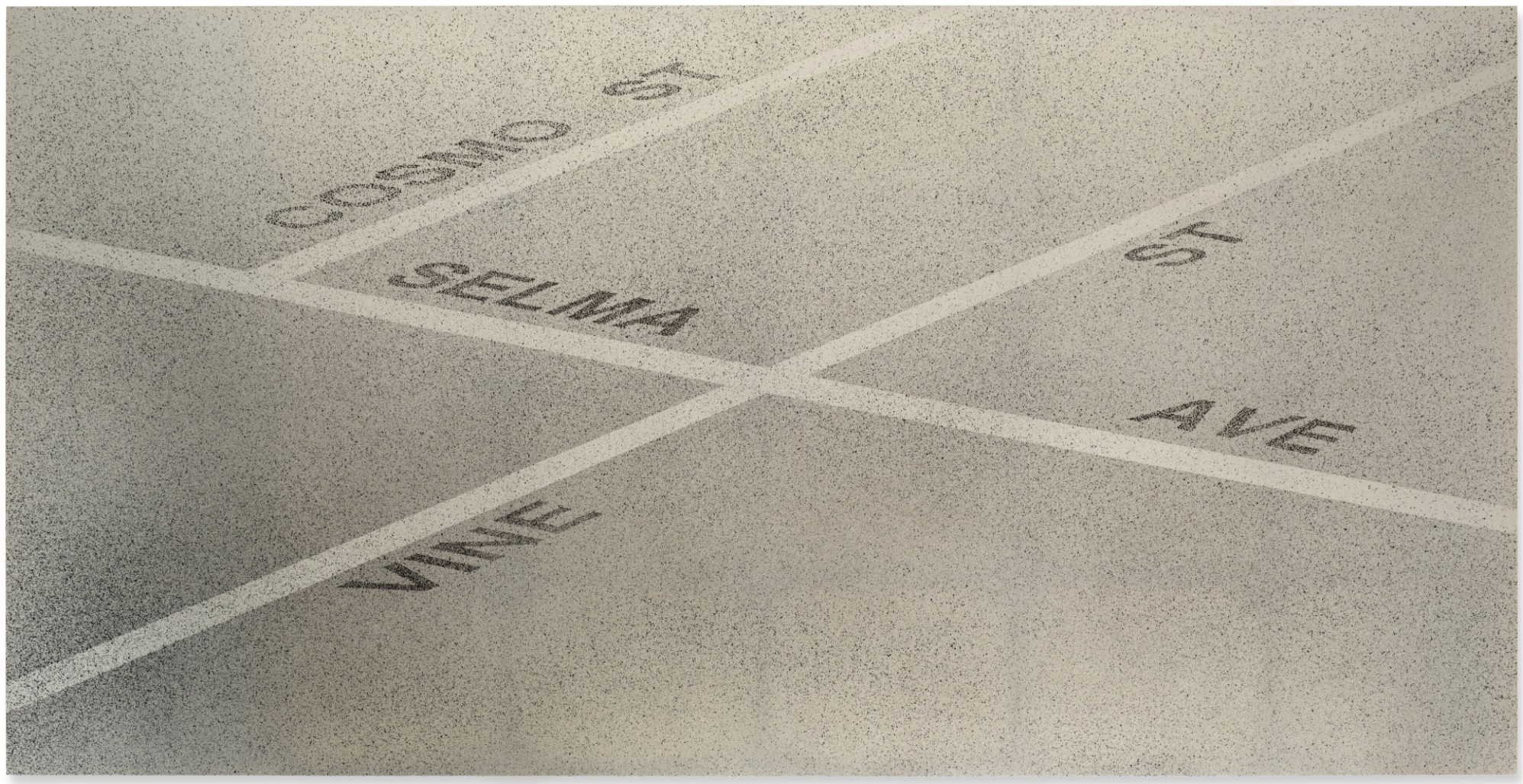
ED RUSCHA (b. 1937)
Cosmo, Selma, Vine, 2000
Acrylic on canvas
70 x 138 1/8 inches (177.8 x 350.8 cm)
Signed and dated 2000 (on the reverse)
Untitled, 1982
Sotheby’s New-York: 19 November 2025
Estimated: USD 700,000 – 1,000,000
PASSED
Untitled | Contemporary Day Auction | 2025 | Sotheby’s
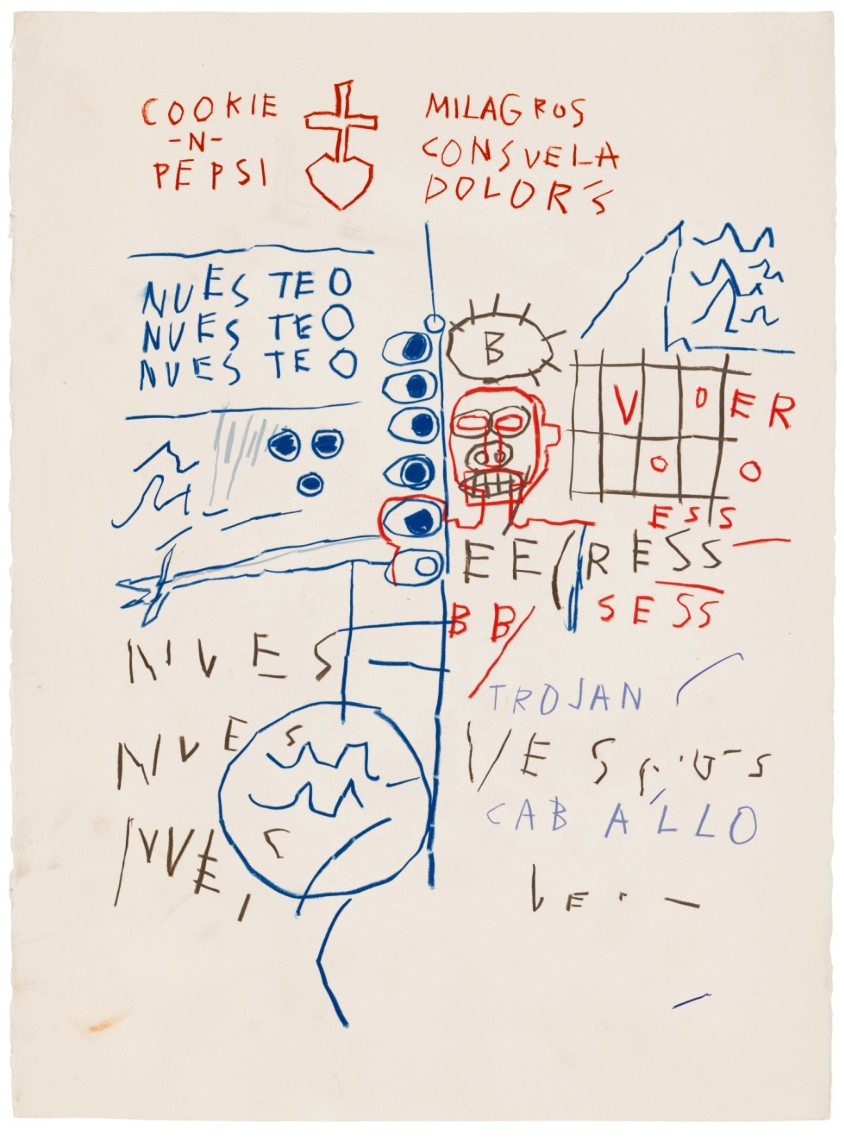
JEAN-MICHEL BASQUIAT (1960 – 1988)
Untitled, 1982
Oilstick and graphite on paper
30 x 22 1/2 inches (76.2 x 57.2 cm)
Signed (on the verso)
Rapture, 2003
Sotheby’s New-York: 19 November 2025
Estimated: USD 600,000 – 800,000
PASSED
Rapture | Contemporary Day Auction | 2025 | Sotheby’s
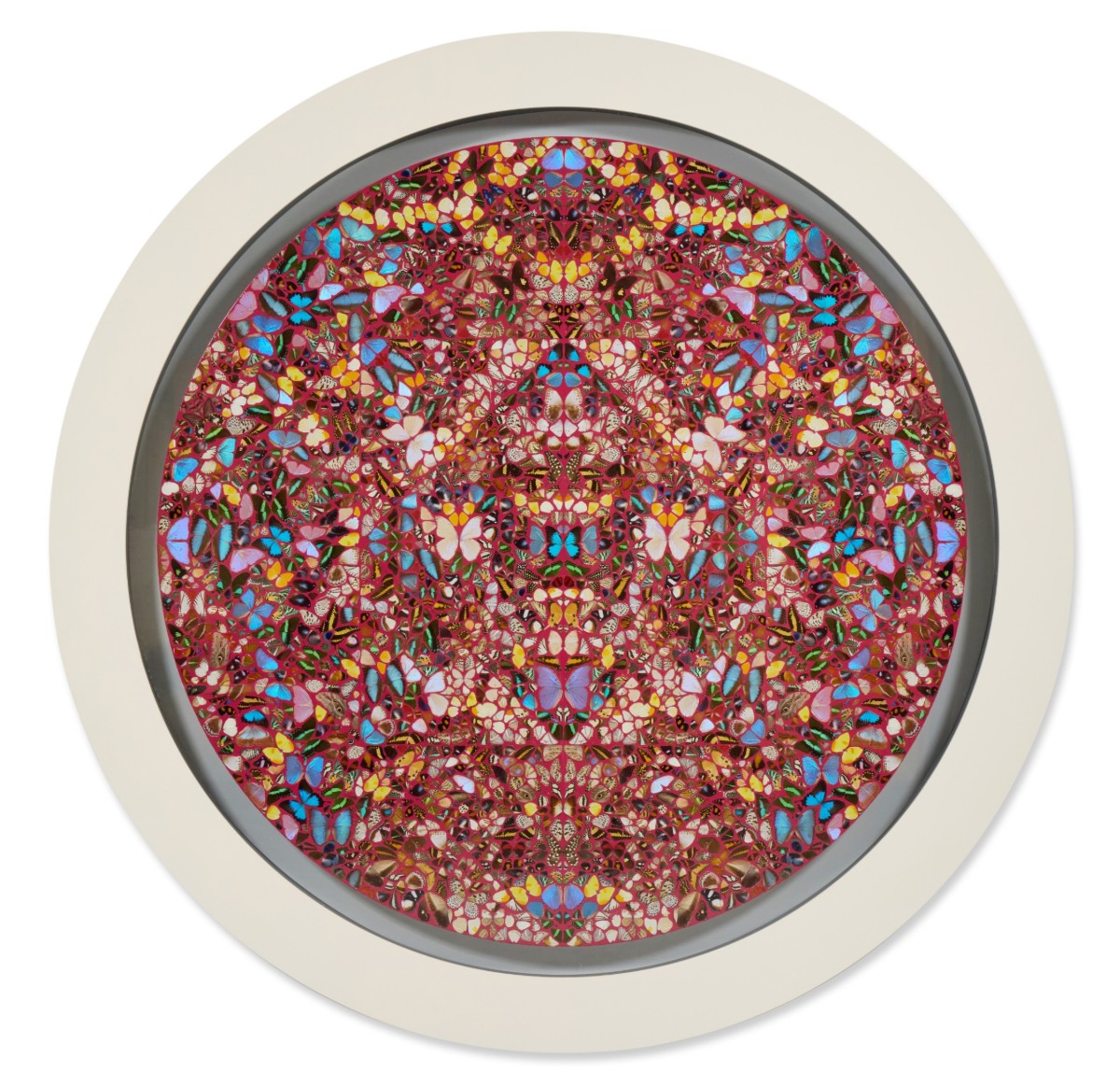
DAMIEN HIRST (b. 1965)
Rapture, 2003
Butterfly wings on household gloss on canvas in artist’s frame
Diameter: 105 3/4 inches (268.6 cm)
Obelisk, 2005
Sotheby’s New-York: 19 November 2025
Estimated: USD 600,000 – 800,000
PASSED
Obelisk | Contemporary Day Auction | 2025 | Sotheby’s
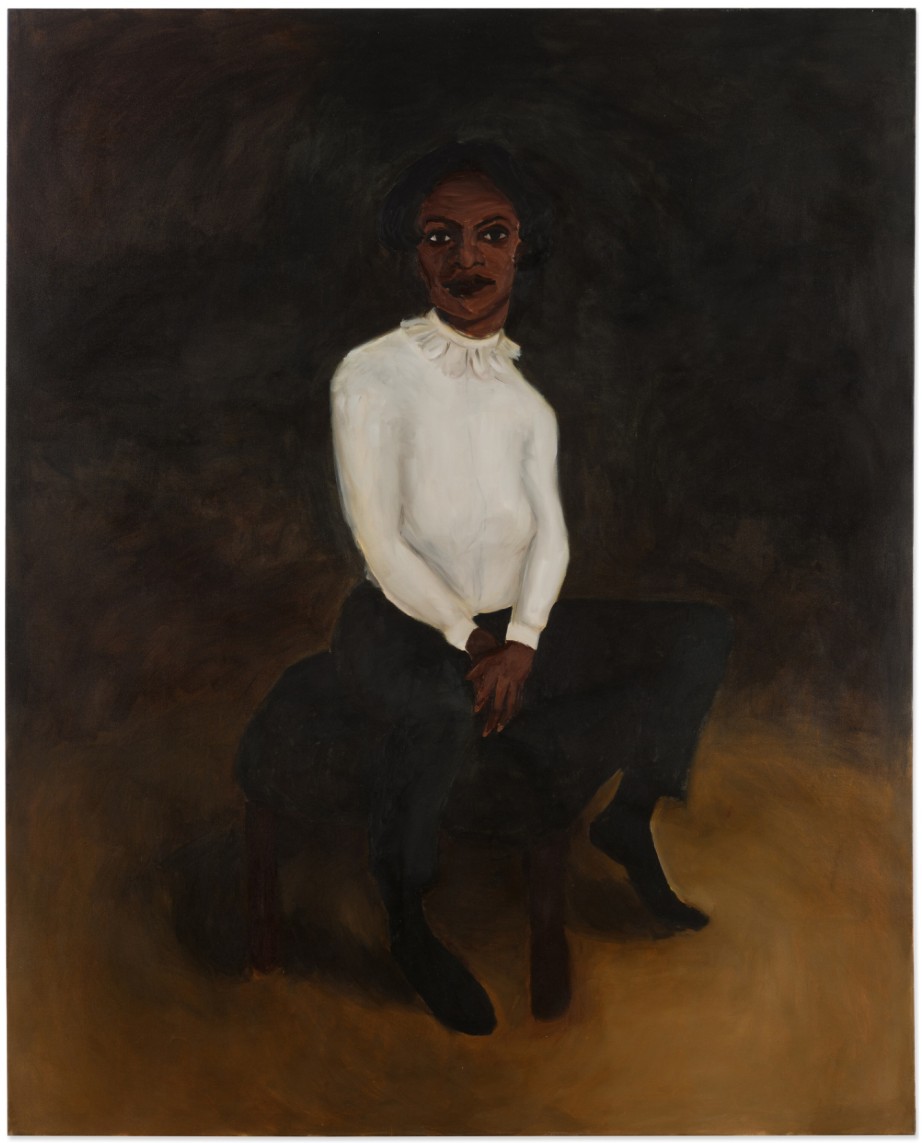
LYNETTE YIADOM-BOAKYE (b. 1977)
Obelisk, 2005
Oil on canvas
95 3/4 x 77 inches (243.3 x 195.5 cm)
Signed, titled and dated 2005 (on the reverse)
Signed (on the stretcher)
Sunset, 2020
Sotheby’s New-York: 19 November 2025
Estimated: USD 450,000 – 550,000
WORK ON PAPER
PASSED
Sunset | Contemporary Day Auction | 2025 | Sotheby’s
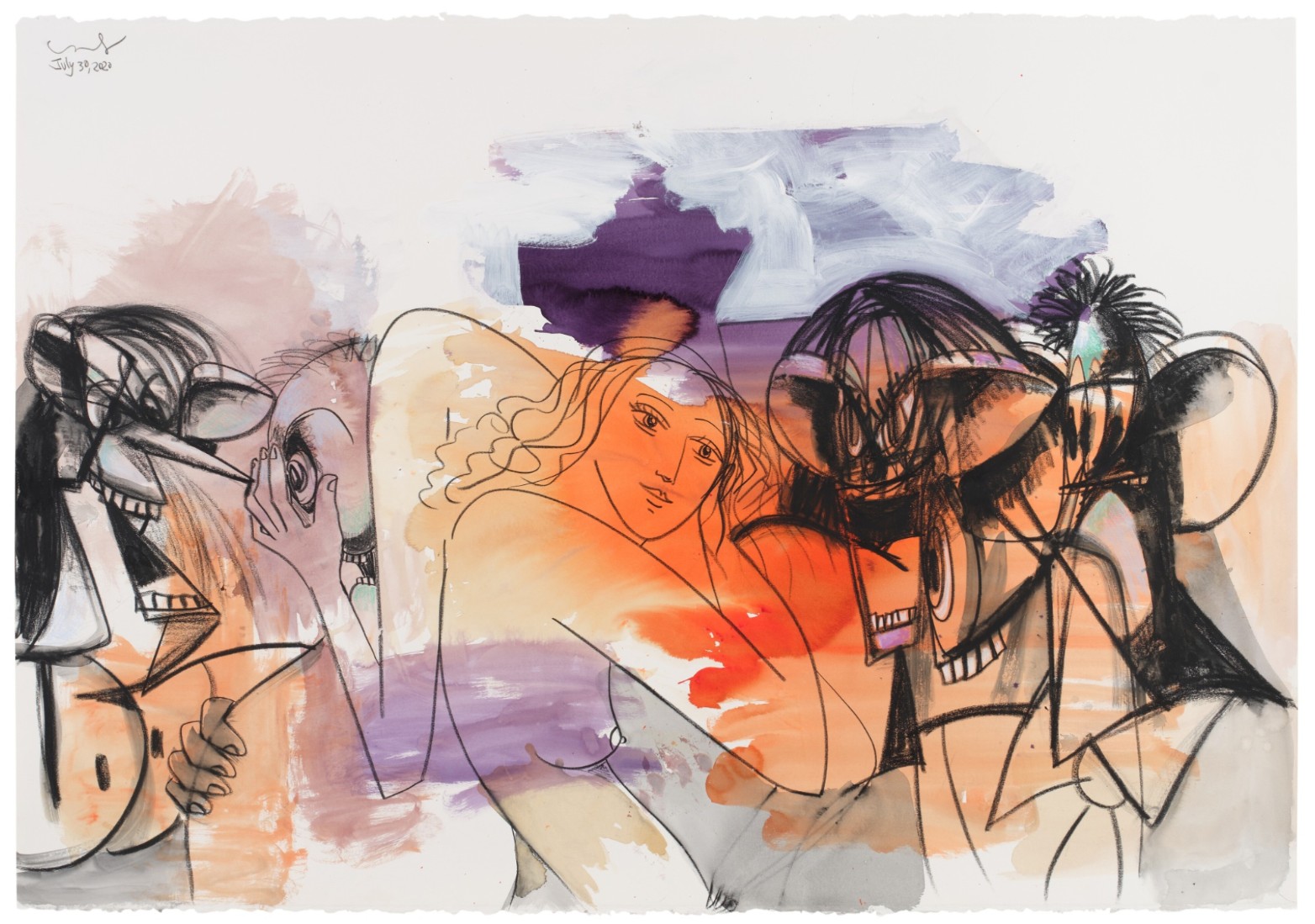
GEORGE CONDO (b. 1957)
Sunset, 2020
Ink, graphite, gesso and watercolor on paper
41 3/4 x 60 inches (106 x 152.4 cm)
Signed and dated July 30, 2020 (upper left)
Lots Withdrawn
Untitled, 1986
Sotheby’s New-York: 19 November 2025
Estimated: USD 600,000 – 800,000
WITHDRAWN
Untitled | Contemporary Day Auction | 2025 | Sotheby’s
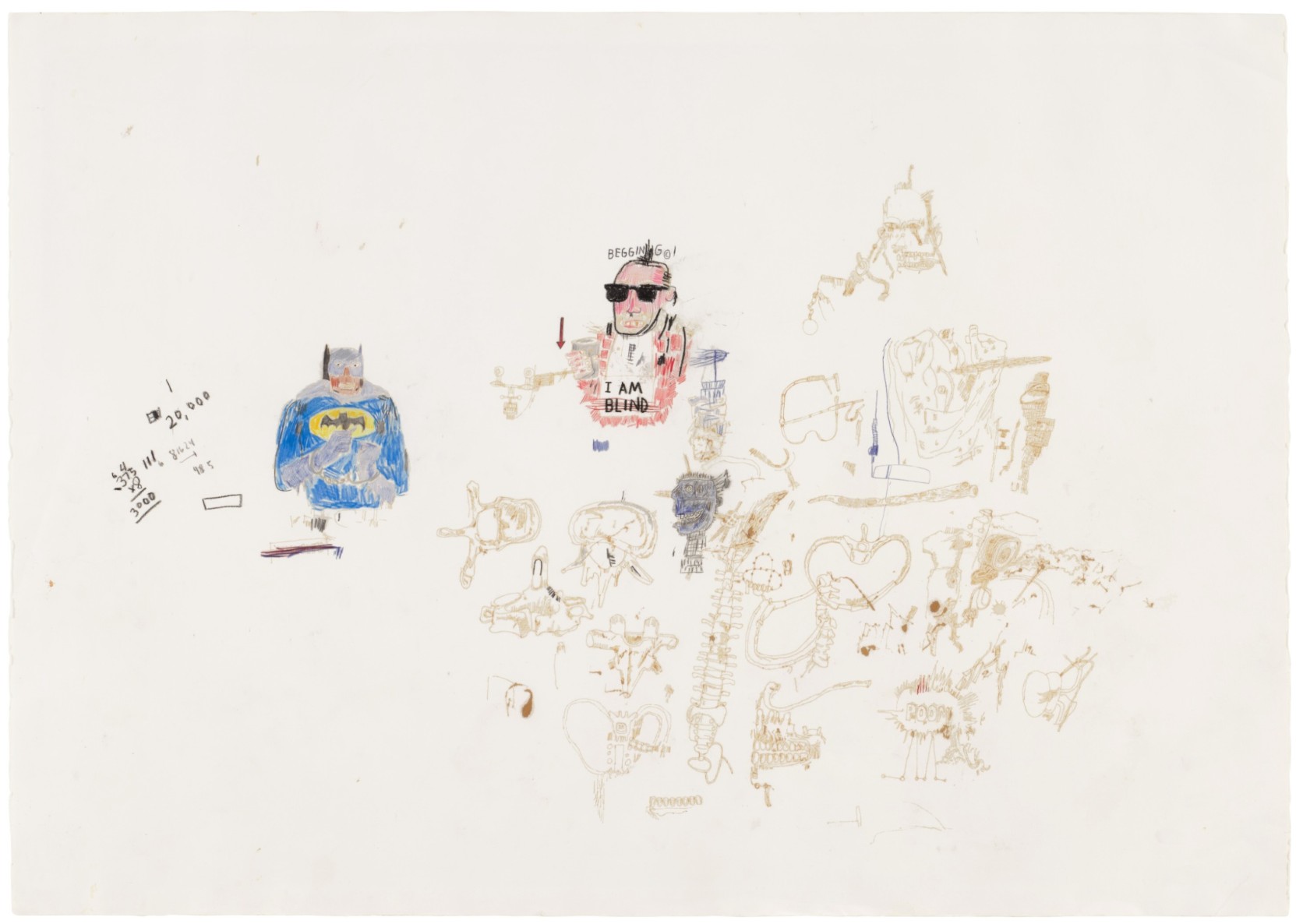
JEAN-MICHEL BASQUIAT (1960 – 1988)
Untitled, 1986
Colored pencil, graphite, ink and oilstick on paper
29 5/8 x 41 3/4 inches (75.2 x 106 cm)
Signed and dated 86 (on the verso)
Untitled (Nick), 1999
Sotheby’s New-York: 19 November 2025
Estimated: USD 600,000 – 800,000
WITHDRAWN
Untitled (Nick) | Contemporary Day Auction | 2025 | Sotheby’s
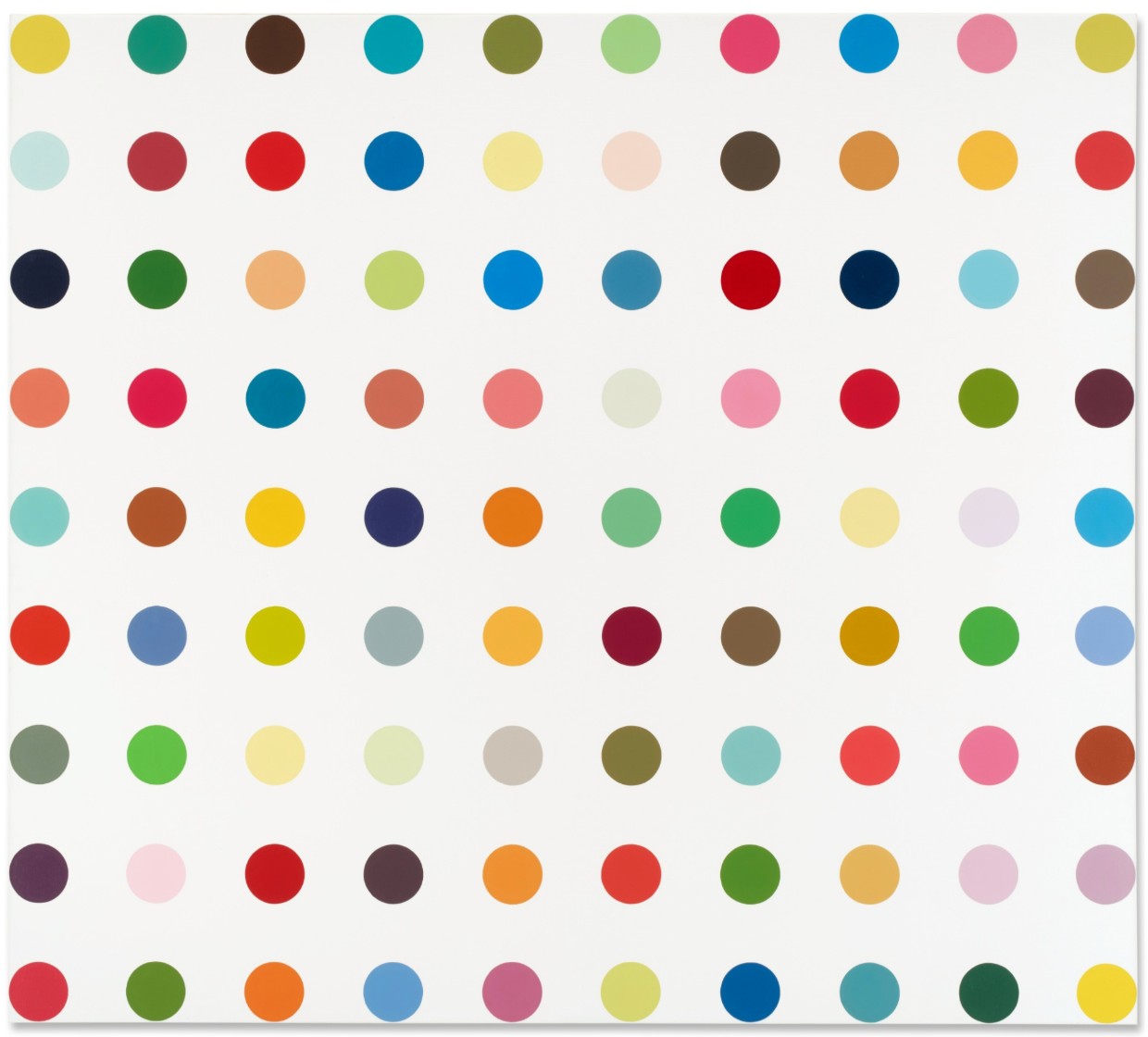
DAMIEN HIRST (b. 1965)
Untitled (Nick), 1999
Household gloss on canvas
68×76 inches (172.7 x 193 cm)
Signed, dedicated For Nick (etc.) and inscribed ♡ (on the reverse)

Modern and Contemporary Art Evening Sale
Featuring Cera The Triceratops
19 November 2025
Modern & Contemporary Art Evening Sale featuring Cera the Triceratops Wednesday, November 19, 2025
Auction Statistics
Total: USD 67,307,850
#Lots: 33 Lots
[Withdrawn: x Lot]
Unsold: 2 Lots
Sold: 31 Lots
Sell-Through Rate: 93.9%
Top Lot:
USD 16,015,000
Highlights
#1. Study for Head of Isabel Rawsthorne and George Dyer, 1967
Phillips New-York: 19 November 2025
Estimated: USD 13,000,000 – 18,o00,000
USD 16,015,000
Francis Bacon Modern & Contemporary Art Evening Sale featuring Cera the Triceratops
Oil on canvas, diptych
Each 14×12 inches (35.6 x 30.5 cm)
Titled and dated “Study for Head of Isabel Rawsthorne 1967.” on the reverse of the left canvas
Titled and dated “Study for Head of George Dyer 1967.” on the reverse of the right canvas
#2. Untitled, 1957-1958
Estimated: USD 10,000,000 – 15,o00,000
USD 14,290,000
Estimated: USD 7,000,000 – 9,000,000
USD 9,087,500
Untitled, 1957-1958
Oil on canvas
81 1/4 x 108 1/2 inched (206.4 x 275.6 cm)
#3. CERA, circa 66 Million Years Ago
Phillips New-York: 19 November 2025
Estimated: USD 2,500,000 – 3,500,000
USD 5,377,000
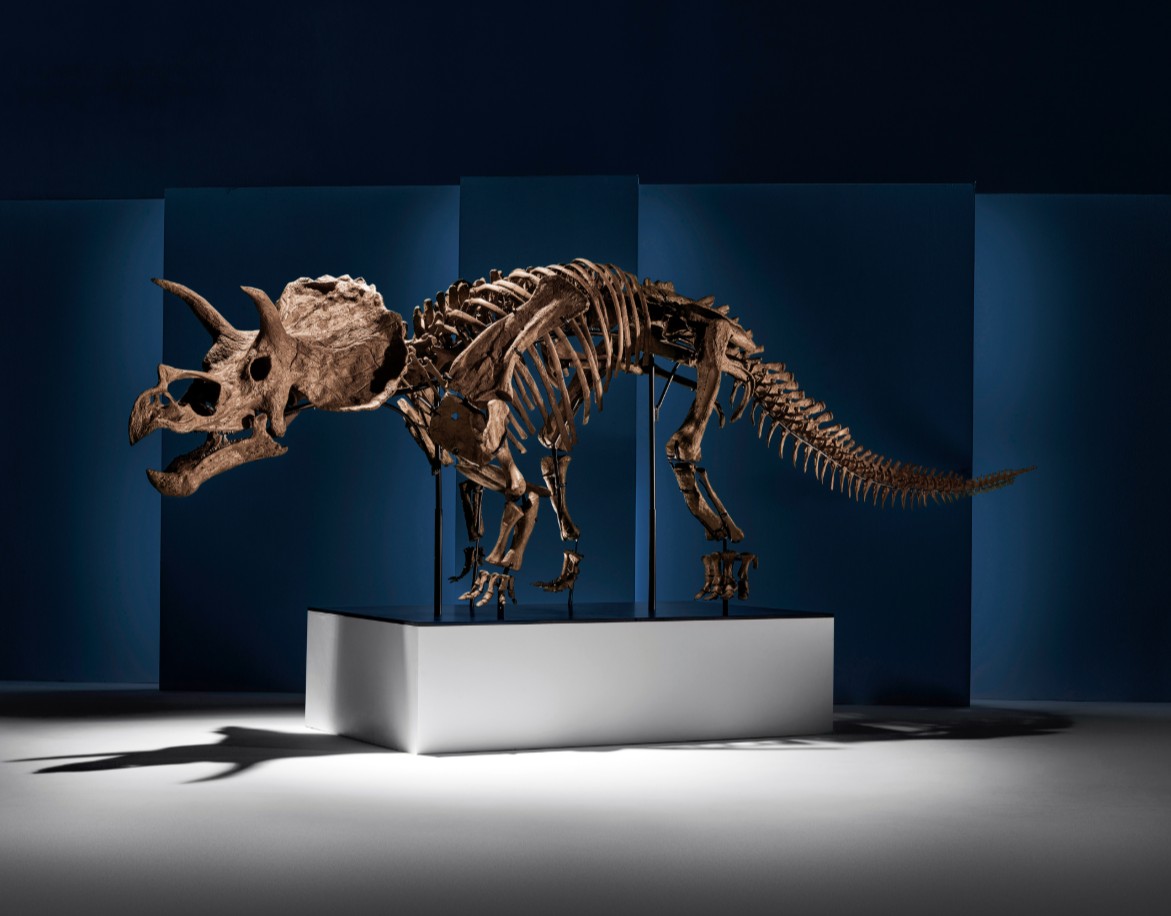
CERA
Juvenile Triceratops Skeleton
The Most Complete Juvenile Triceratops Skeleton Ever Unearthed
Late Cretaceous, circa 66 Million Years Ago
59 x 173 1/4 x 47 1/4 inches (149.9 x 440.1 x 120 cm)
Hell Creek Formation, a Late Maastrichtian deposit (≈66 Ma)
Perkins County, South Dakota
USD 5 million
Exercise, 1984
Phillips New-York: 19 November 2025
Estimated: USD 3,000,000 – 5,o00,000
USD 3,852,000
Jean-Michel Basquiat Modern & Contemporary Art Evening Sale featuring Cera the Triceratops
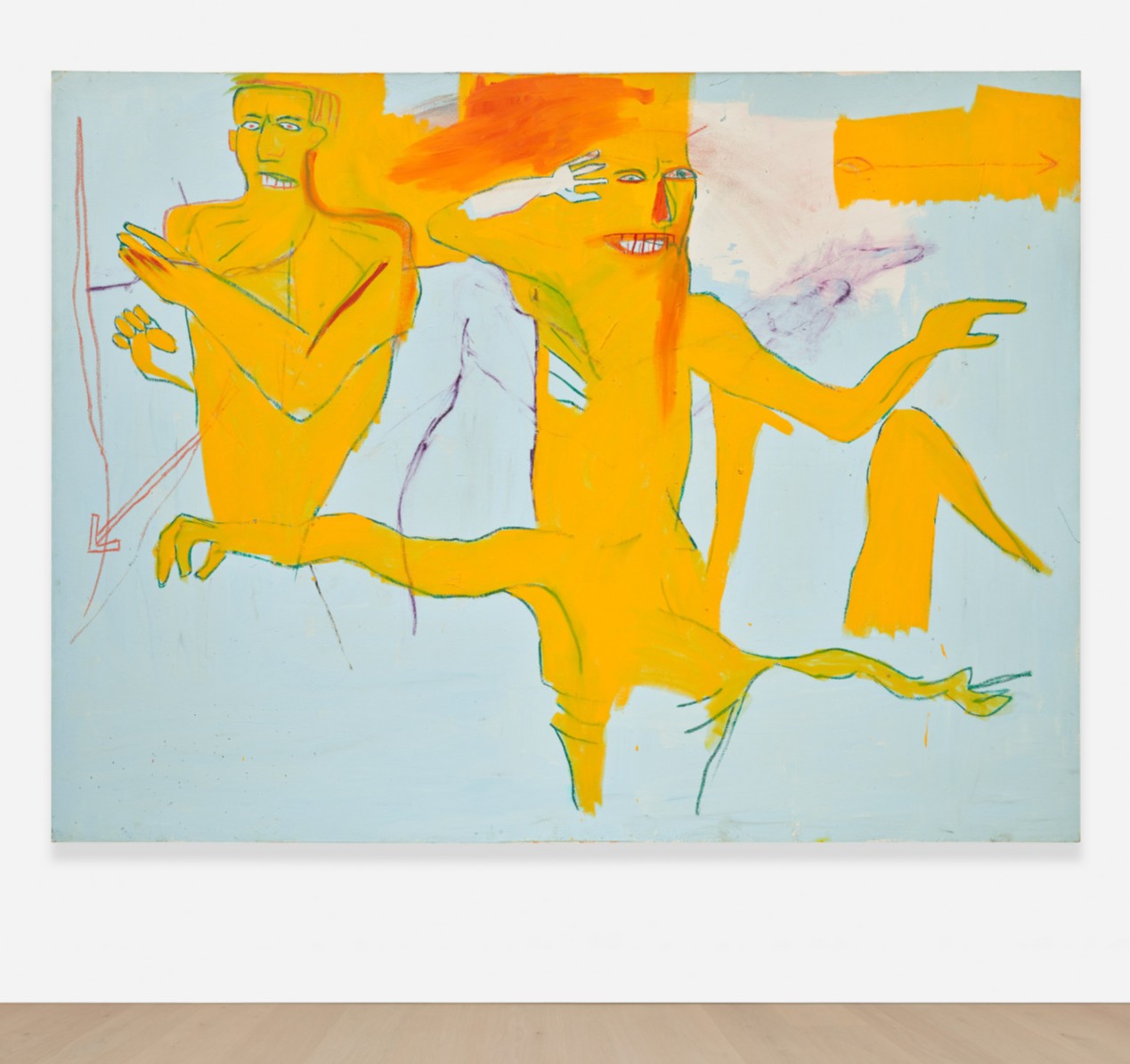
JEAN-MICHEL BASQUIAT
Exercise, 1984
Acrylic and crayon on canvas
72 1/8 x 96 1/8 inches (183.2 x 244.2 cm)
Signed, titled, inscribed and dated “Jean-Michel Basquiat “EXERCISE” 1984 KIPAHULU.” on the reverse
Untitled, 1982
Phillips New-York: 19 November 2025
Estimated: USD 800,000 – 1,200,000
USD 1,225,500
Jean-Michel Basquiat Modern & Contemporary Art Evening Sale featuring Cera the Triceratops
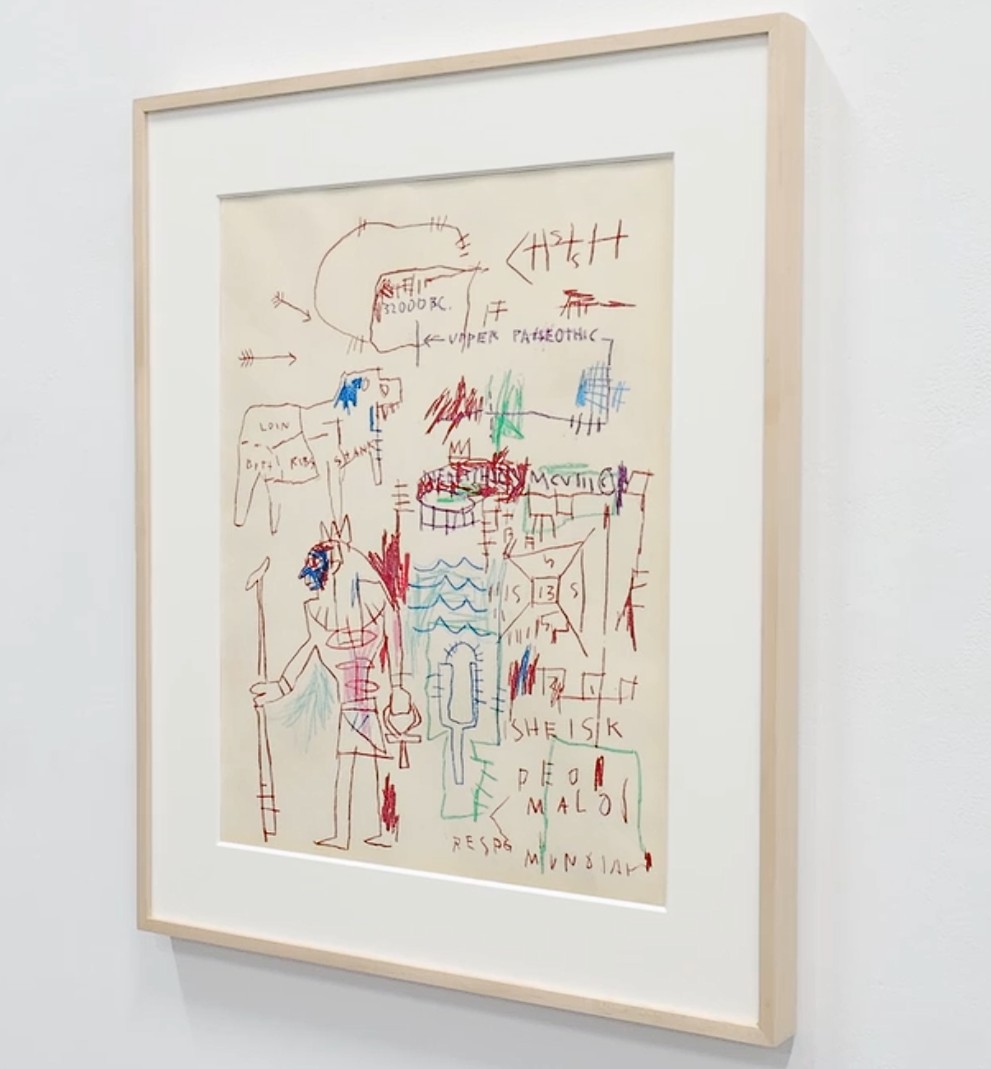
JEAN-MICHEL BASQUIAT
Untitled, 1982
Oilstick on paper
24 x 18 1/4 inches (61 x 46.4 cm)
Dogpool Ladder, 2007-2011
Estimated: USD 750,000 – 1,000,000
USD 967,500
Jeff Koons Modern & Contemporary Art Evening Sale featuring Cera the Triceratops
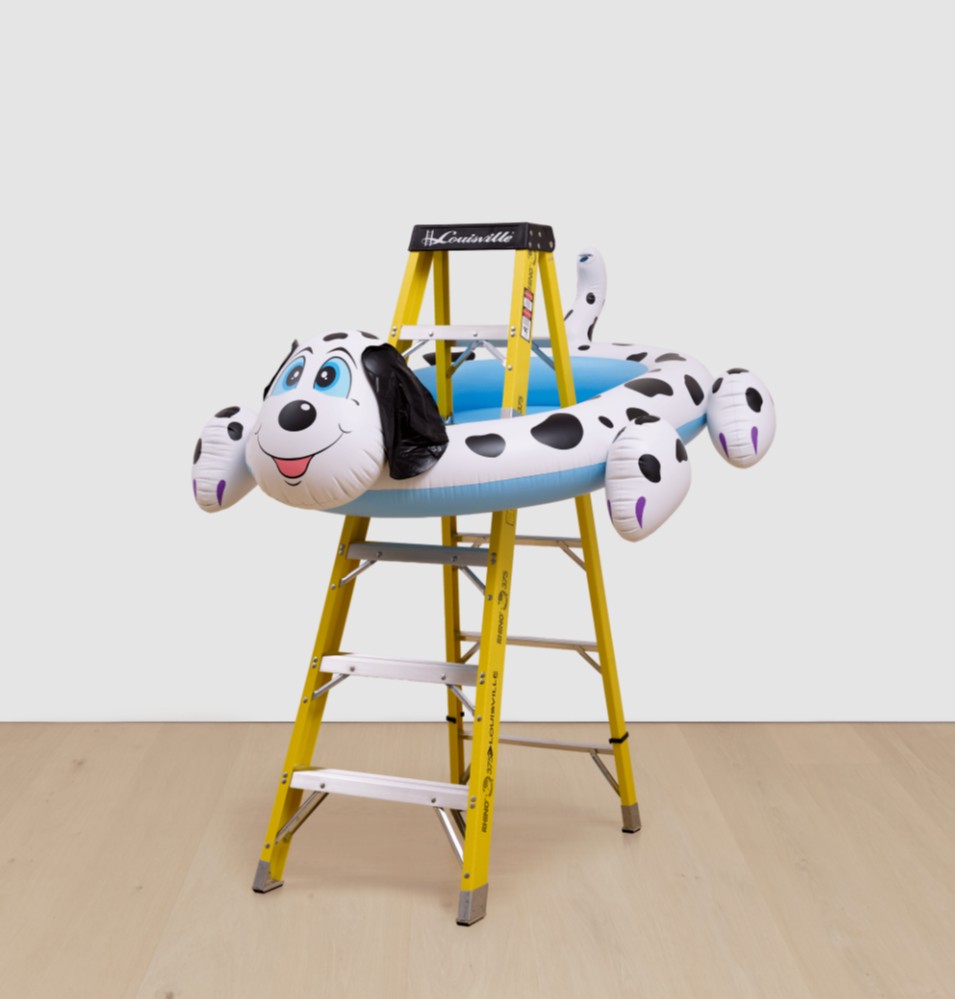
JEFF KOONS
Dogpool Ladder, 2007-2011
Polychromed aluminum and aluminum
68 x 59 1/4 x 63 3/4 inches (172.7 x 150.5 x 161.9 cm)
This work is number 2 from an edition of 3 plus 1 artist’s proof
Still Life in front of a Window, 1979
Property from an Important American Collection
Phillips New-York: 19 November 2025
Estimated: USD 700,000 – 900,000
USD 838,500
Fernando Botero Modern & Contemporary Art Evening Sale featuring Cera the Triceratops
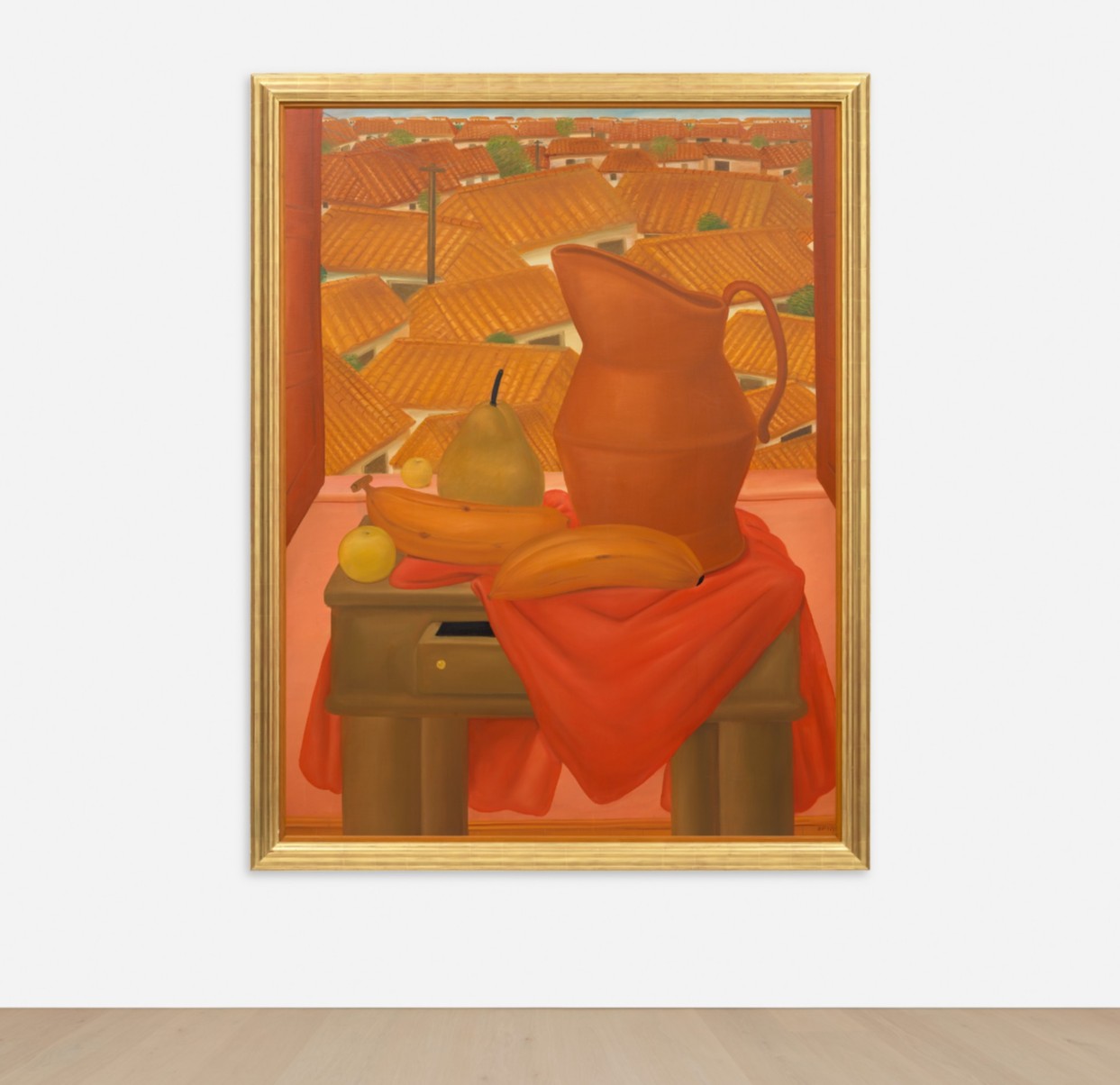
Oil on canvas
74 3/4 x 56 3/4 inches (189.9 x 144.1 cm)
Signed and dated “Botero 79” lower right
Sarah, 2005
Property from an Important European Collection
Phillips New-York: 19 November 2025
Estimated: USD 400,000 – 600,000
USD 709,500
Alex Katz Modern & Contemporary Art Evening Sale featuring Cera the Triceratops
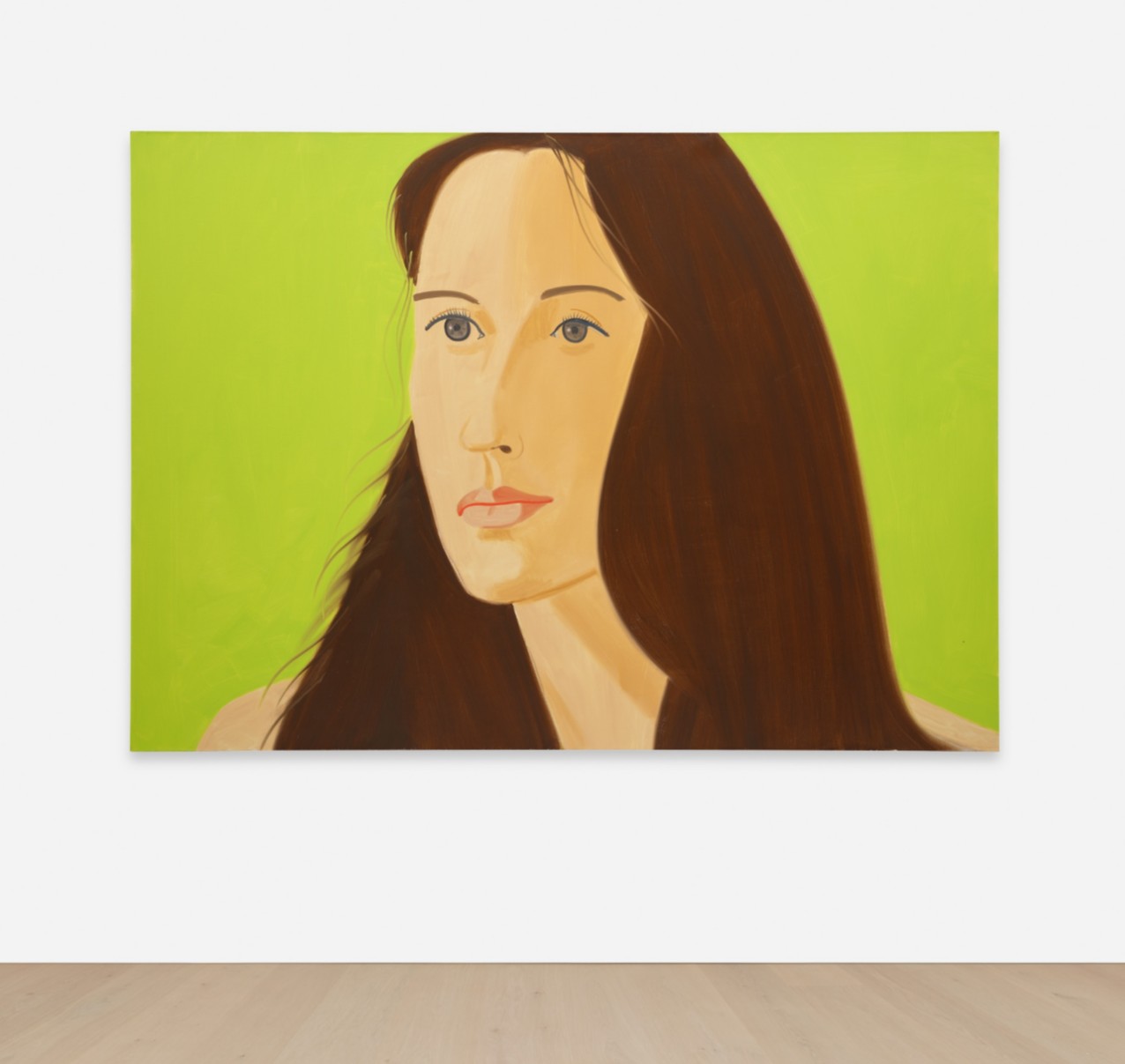
ALEX KATZ
Sarah, 2005
Oil on linen
60 1/8 x 84 1/8 inches (152.7 x 213.7 cm)
Signed and dated “Alex Katz 05” on the overlap
Light Rain, 2019
Phillips New-York: 19 November 2025
Estimated: USD 350,000 – 450,000
USD 490,200
Lucy Bull Modern & Contemporary Art Evening Sale featuring Cera the Triceratops
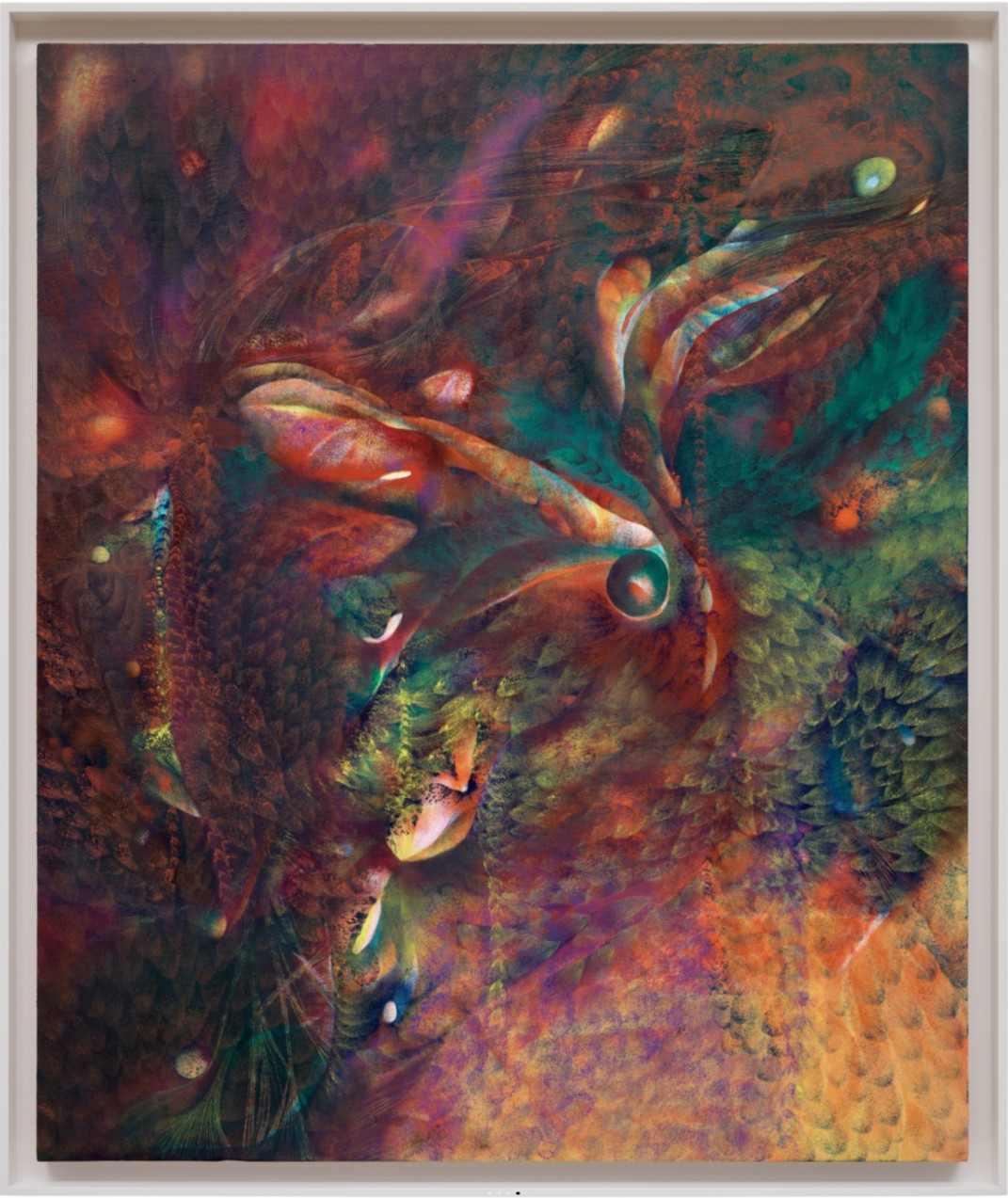
LUCY BULL
Light Rain, 2019
Oil on linen
60×50 inches (152.4 x 127 cm)
Signed with the artist’s initials, titled and dated “LB 2019 “Light Rain”” on the reverse
Lots Passed
Untitled, 2022
Phillips New-York: 19 November 2025
Estimated: USD 800,000 – 1,200,000
PASSED
Jadé Fadojutimi Modern & Contemporary Art Evening Sale featuring Cera the Triceratops
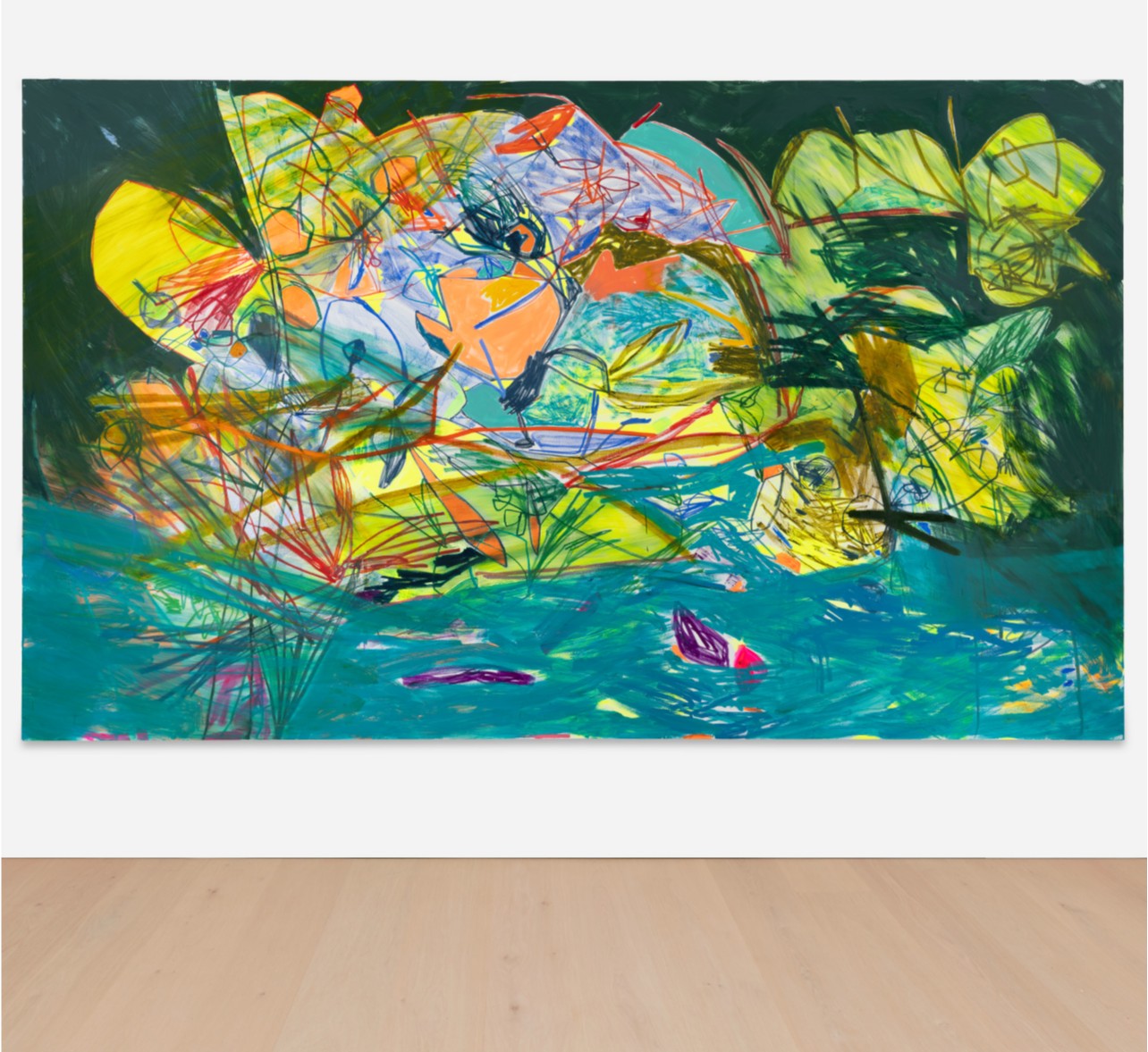
JADE FADOJUTIMI
Untitled, 2022
Acrylic, oil and oil pastel on canvas
300×500 cm (118 1/8 x 196 7/8 inches)
Signed and dated “Jadé Fadojutimi Oct ’22 Jadé Fadojutimi” on the reverse
Modern and Contemporary Art Day Sale
Morning Session
21 November 2025
Modern & Contemporary Art Day Sale, Morning Session Friday, November 21, 2025
Total: USD 11,966,556
# Lots: 125 Lots
# Lots sold: 105
Sell-Through Rate: 84%
Afternoon Session
21 November 2025
Modern & Contemporary Art Day Sale, Afternoon Session Friday, November 21, 2025
Total: USD 10,151,280
# Lots: 111 Lots
# Lots sold: 96
Sell-Through Rate: 86%
#1. Les bourgeois de Calais, deuxième maquette, 1885-1973
Phillips New-York: 21 November 2025
Estimated: USD 700,000 – 1,000,000
USD 903,000
Auguste Rodin Modern & Contemporary Art Day Sale, Morning Session
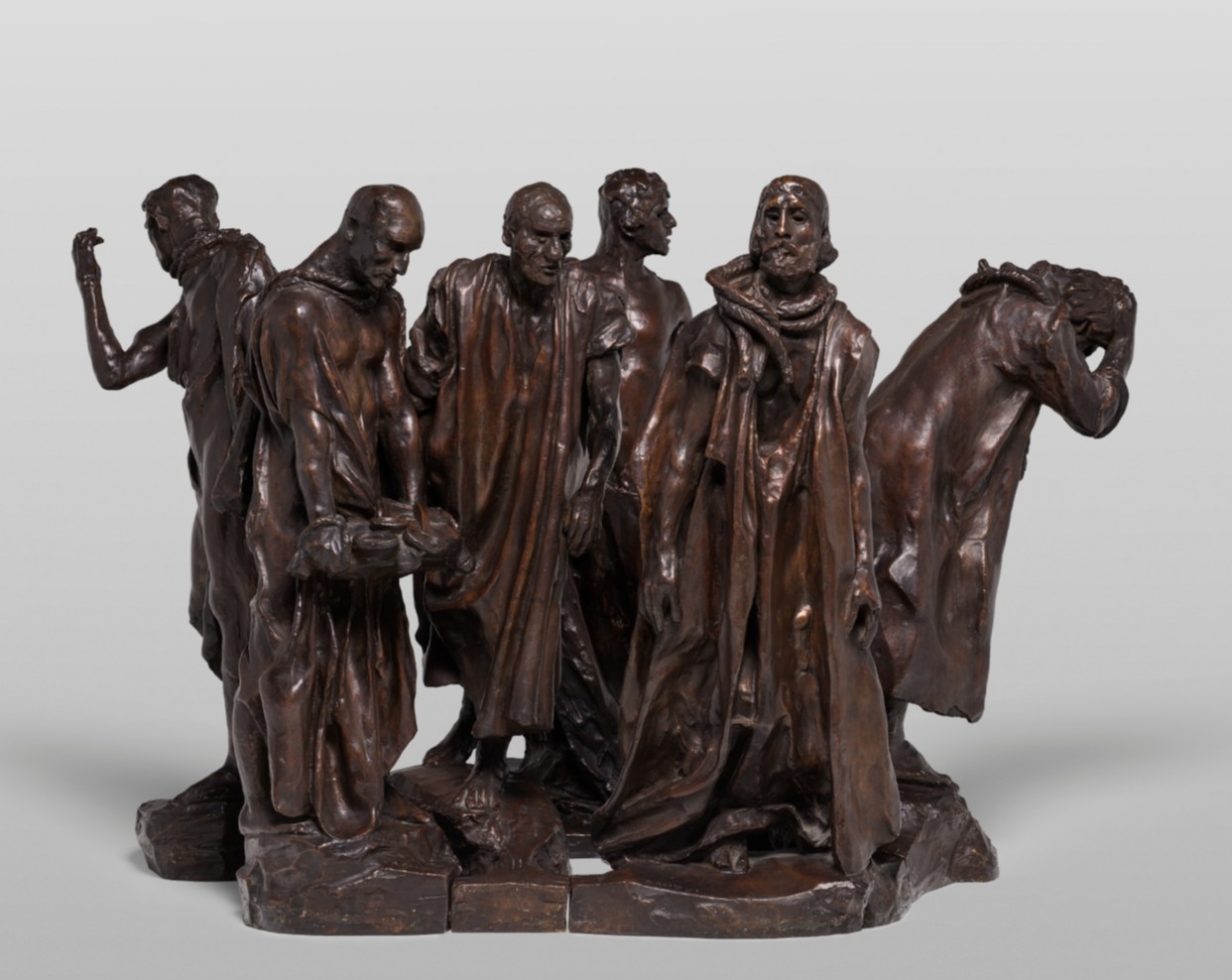
(i) Pierre de Wissant, vêtu; (ii) Jean d’Aire, vêtu; (iii) Jacques de Wissant, vêtu; (iv) Jean de Fiennes, torse nu; (v) Eustache de Saint-Pierre, vêtu; (vi) Andieu d’Andres, vêtu
Bronze with brown patina, in 6 parts
Varying dimensions
Largest: 71.8 x 48.6 x 44.1 cm (28 1/4 x 19 1/8 x 17 3/8 inches)
Each stamped with the artist’s signature and number “A.Rodin N°8” on the top of the base
Each stamped with the foundry mark and dated “© by MUSEE RODIN 1973 Susse Fondeur Paris” on the base
Conceived in 1885 and cast by Susse Fondeur in April 1973, in Paris
This work is number 8 from an edition of 12
Water Lilies with Japanese Bridge, 1992
Phillips New-York: 21 November 2025
Estimated: USD 400,000 – 600,000
USD 645,000
Roy Lichtenstein Modern & Contemporary Art Day Sale, Morning Session
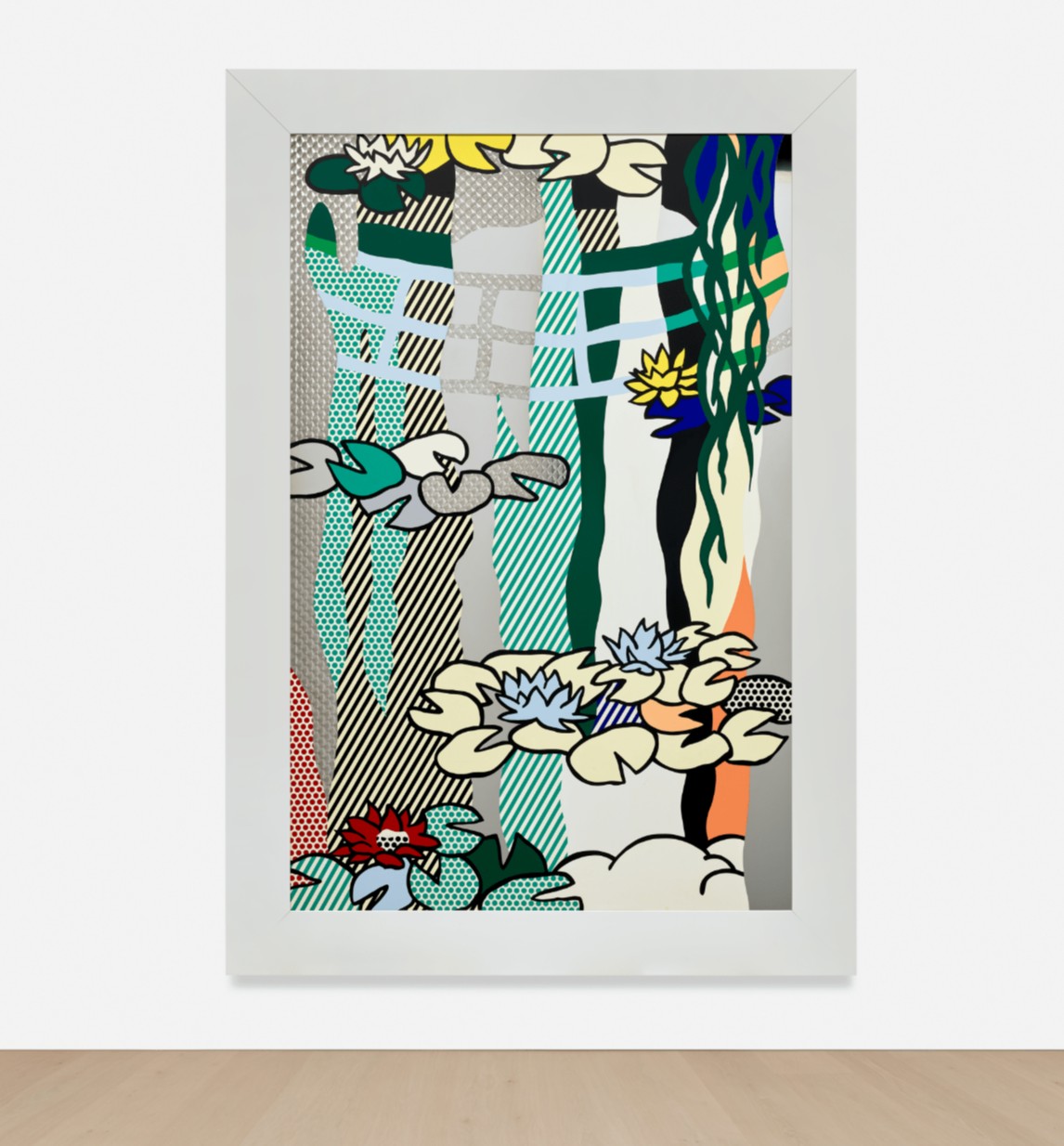
Screen-printed enamel on processed swirled stainless steel, with painted aluminum frame
83 1/8 x 58 in. (211.1 x 147.3 cm)
Stamped by Saff Tech Arts and inscribed with the workshop number “RL92-007” on the reverse
This work is number 6 from an edition of 23, plus 7 artist’s proofs, 1 Bon’a tirer, 4 Printer’s proofs, 2 Presentation proofs, 1 National Gallery of Art proof, and 2 Saff Tech Arts’ proofs
LOVE (Red Faces Violet Sides), 1966-2000
Phillips New-York: 21 November 2025
Estimated: USD 200,000 – 300,000
USD 541,800
Robert Indiana Modern & Contemporary Art Day Sale, Morning Session
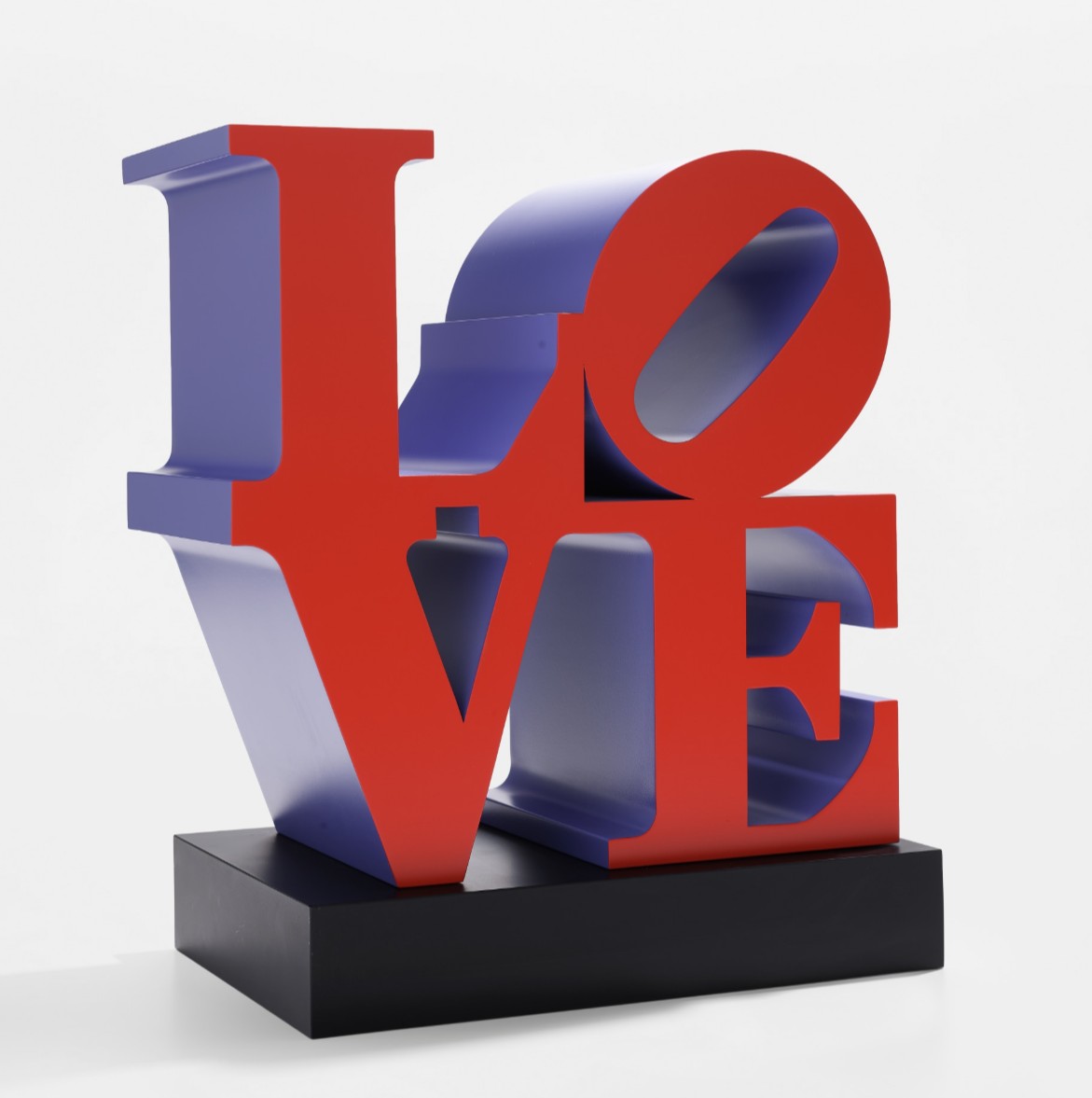
Polychromed aluminum
18x18x9 inches (45.7 x 45.7 x 22.9 cm)
Stamped with the artist’s name
Number and date “(c) 1966–2000 R INDIANA 8/8” on the lower interior edge of the “V”
Conceived in 1966 and fabricated in 2000, this work is number 8 from an edition of 8 plus 4 artist’s proofs
Pool, Pool, Pool, Pool, 1982
LA Standard: Works by Ed Ruscha from a Private West Coast Collection
Phillips New-York: 21 November 2025
Estimated: USD 200,000 – 300,000
USD 387,000
Ed Ruscha Modern & Contemporary Art Day Sale, Morning Session
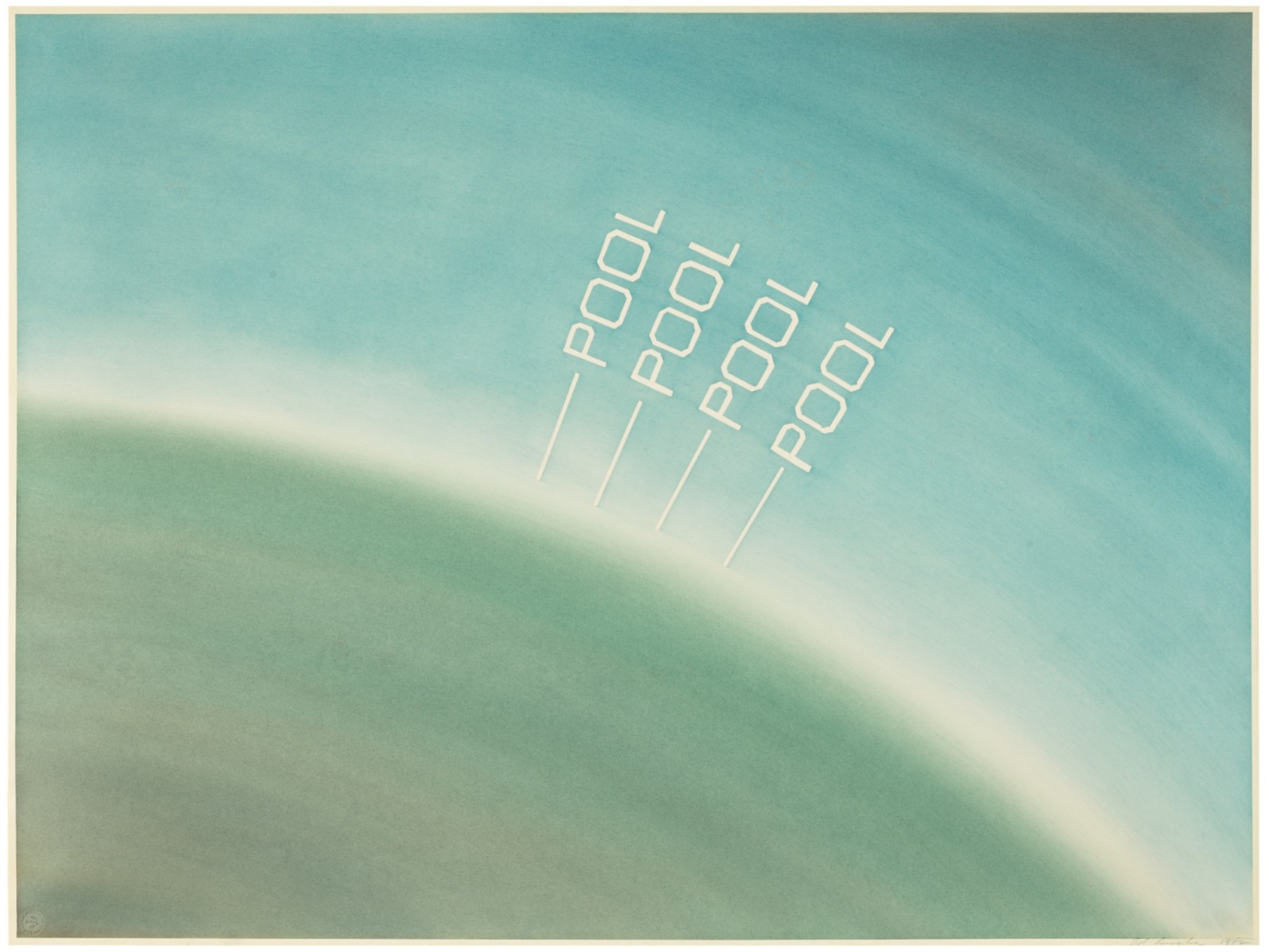
ED RUSCHA
Pool, Pool, Pool, Pool, 1982
Pastel on paper
30×40 inches (76.2 x 101.6 cm)
Signed and dated “Ed Ruscha 1982” lower right
Nets 38, 1998
Phillips New-York: 21 November 2025
Estimated: USD 250,000 – 350,000
USD 283,800
Yayoi Kusama Modern & Contemporary Art Day Sale, Morning Session
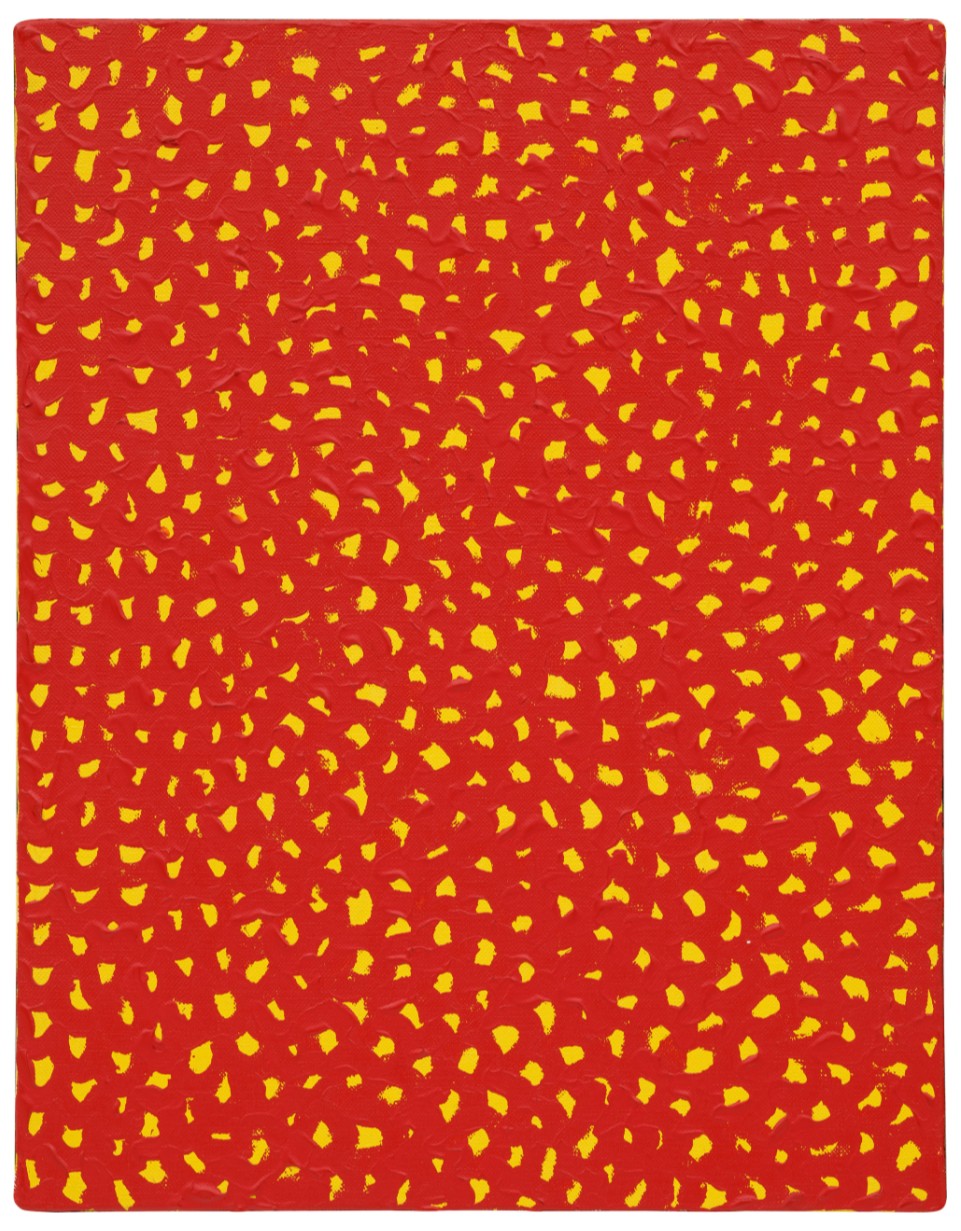
YAYOI KUSAMA
Nets 38, 1998
Acrylic on canvas
40.6 x 31.8 cm (16 x 12 1/2 inches)
Signed, titled and dated “Yayoi Kusama 1998 Nets 38” on the reverse
S for Spanish, 1988
LA Standard: Works by Ed Ruscha from a Private West Coast Collection
Phillips New-York: 21 November 2025
Estimated: USD 250,000 – 350,000
USD 283,800
WORK ON PAPER
Ed Ruscha Modern & Contemporary Art Day Sale, Morning Session
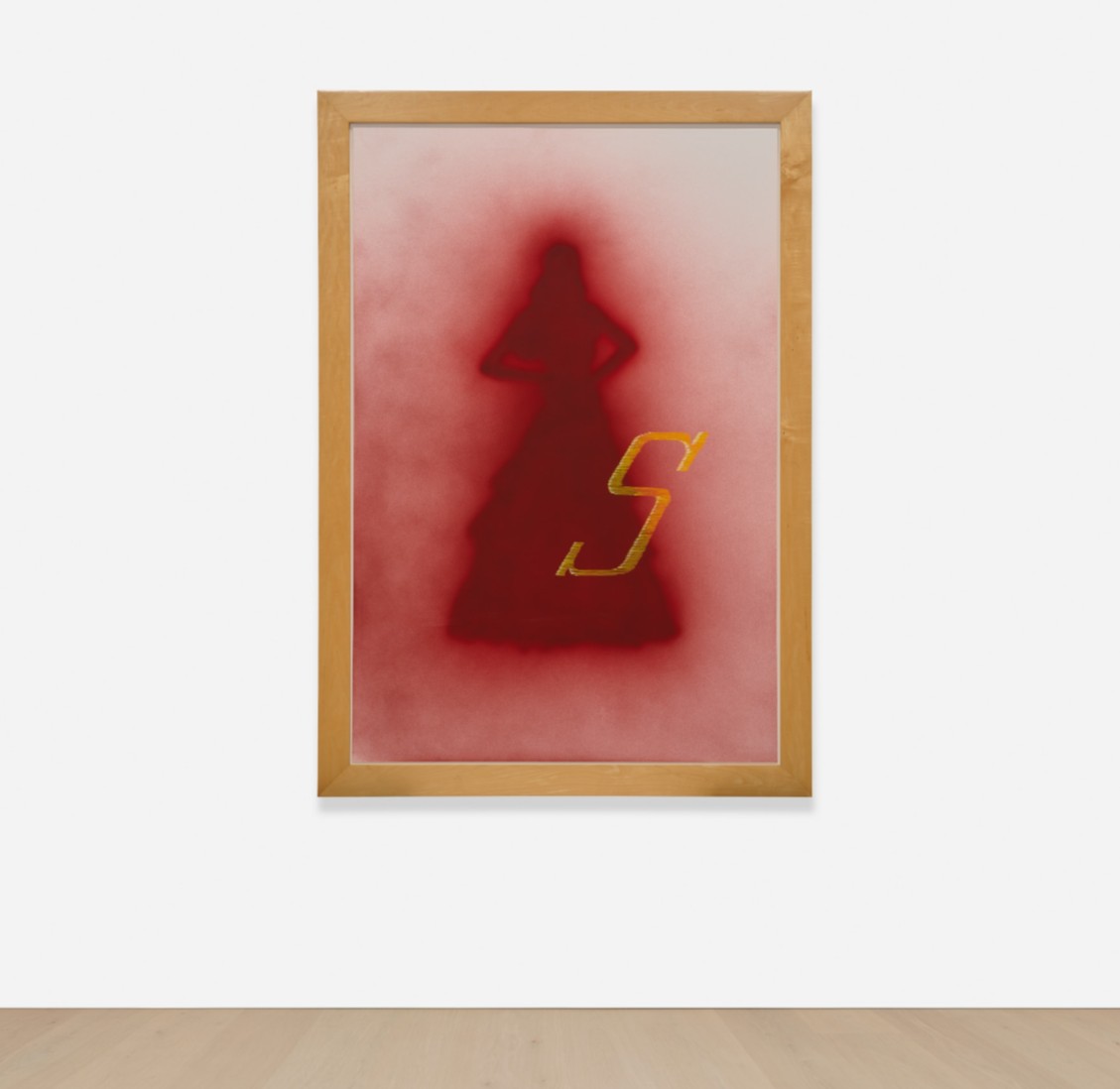
ED RUSCHA
S for Spanish, 1988
Acrylic on paper
60 1/8 x 40 1/4 inches (152.7 x 102.2 cm)
Signed and dated “Ed Ruscha ‘88” lower right
Signed, titled and dated “ED RUSCHA “S FOR SPANISH” 1988″ on the reverse
UNTITLED (MBFS8), 2015
Phillips New-York: 21 November 2025
Estimated: USD 150,000 – 200,000
USD 283,800
KAWS Modern & Contemporary Art Day Sale, Afternoon Session
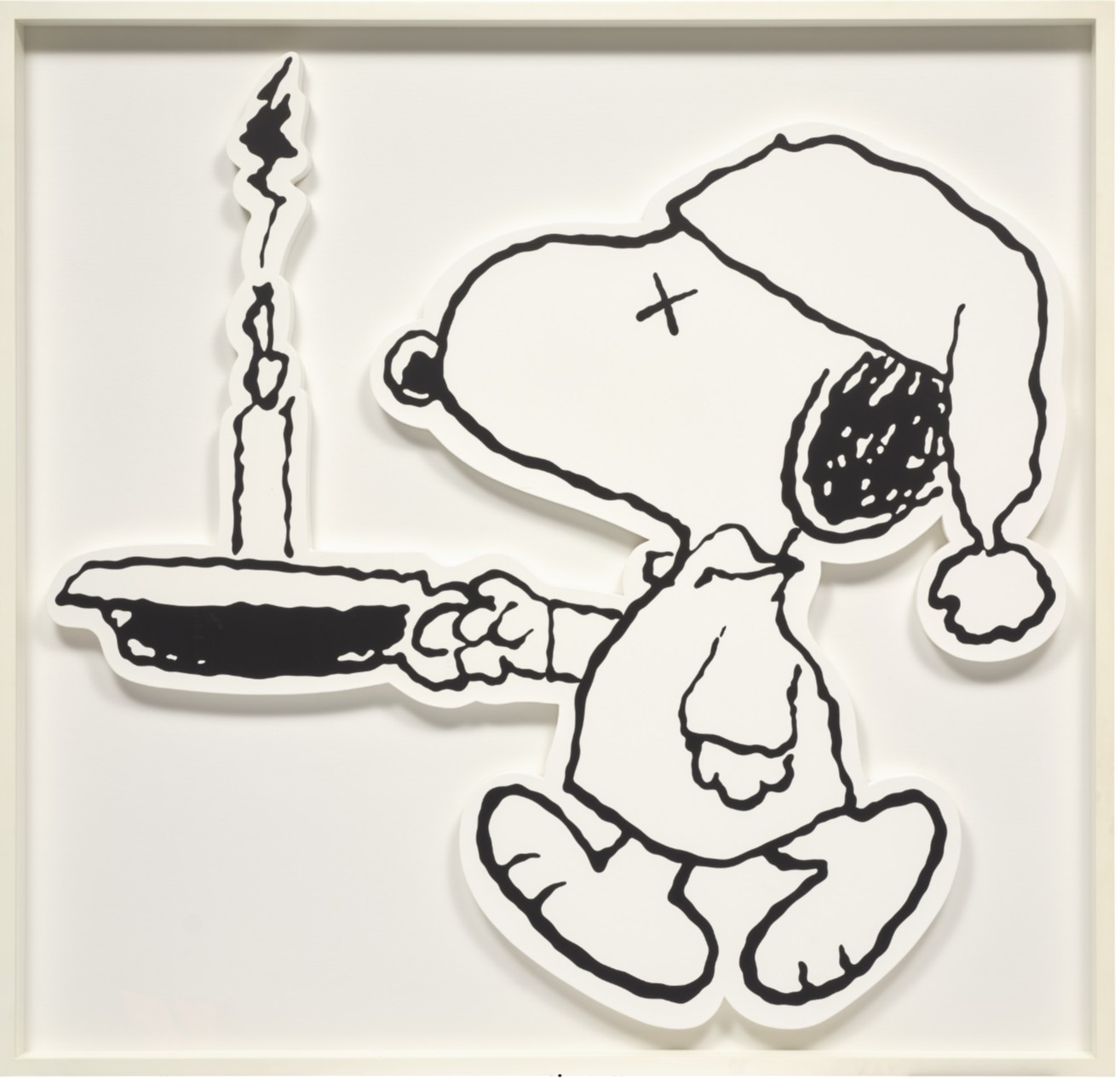
Acrylic on canvas
60×63 inches (152.4 x 160 cm)
Untitled, 1997-1998
Phillips New-York: 21 November 2025
Estimated: USD 250,000 – 350,000
USD 258,000
Richard Prince Modern & Contemporary Art Day Sale, Afternoon Session
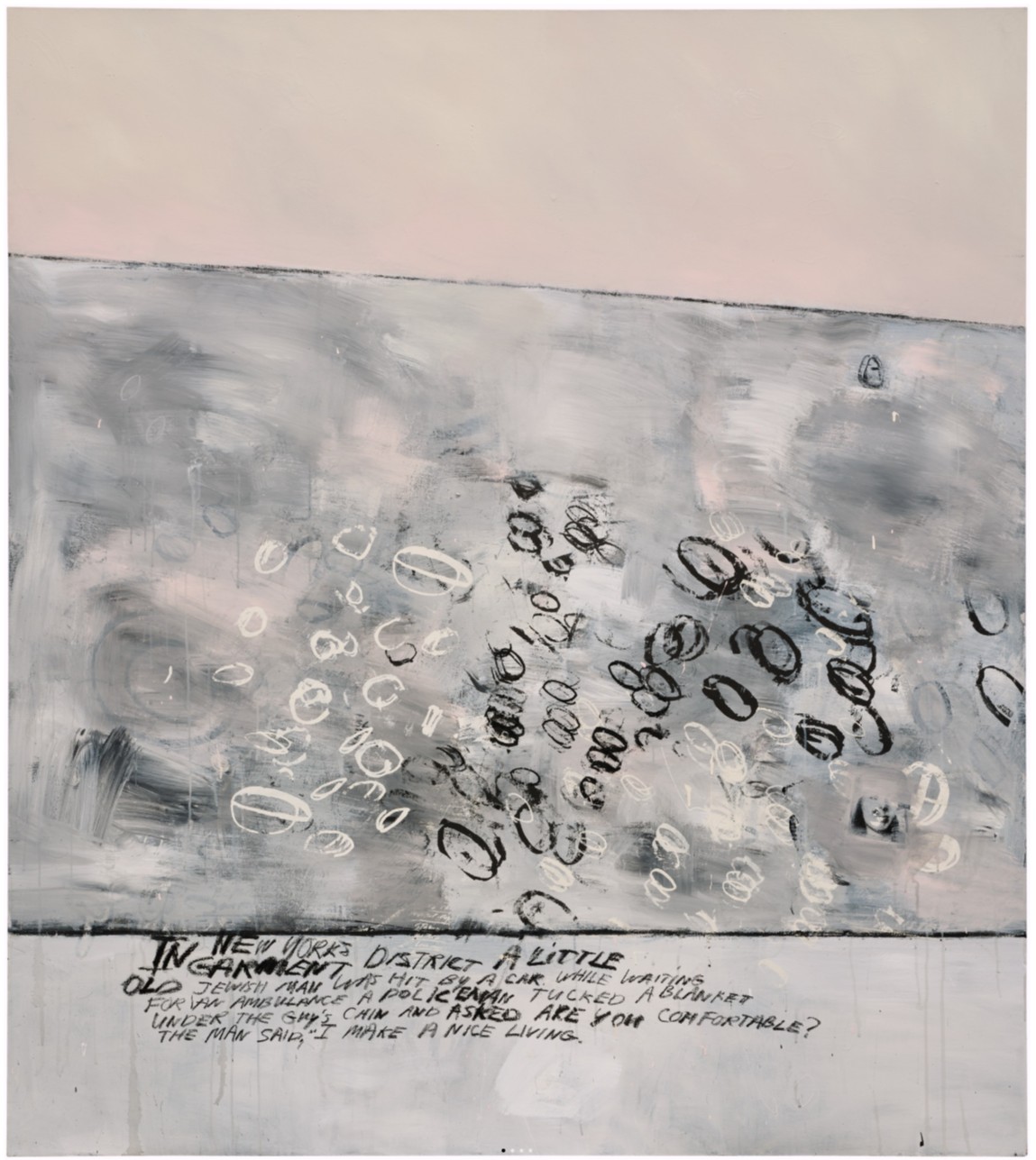
RICHARD PRINCE
Untitled, 1997-1998
Acrylic and silkscreen ink on canvas
72×64 inches (182.9 x 162.6 cm)
Signed and dated “R Prince 1997–98” on the reverse
Trees, 2020
Phillips New-York: 21 November 2025
Estimated: USD 40,000 – 60,000
USD 154,800
WORK ON PAPER
Nicolas Party Modern & Contemporary Art Day Sale, Afternoon Session
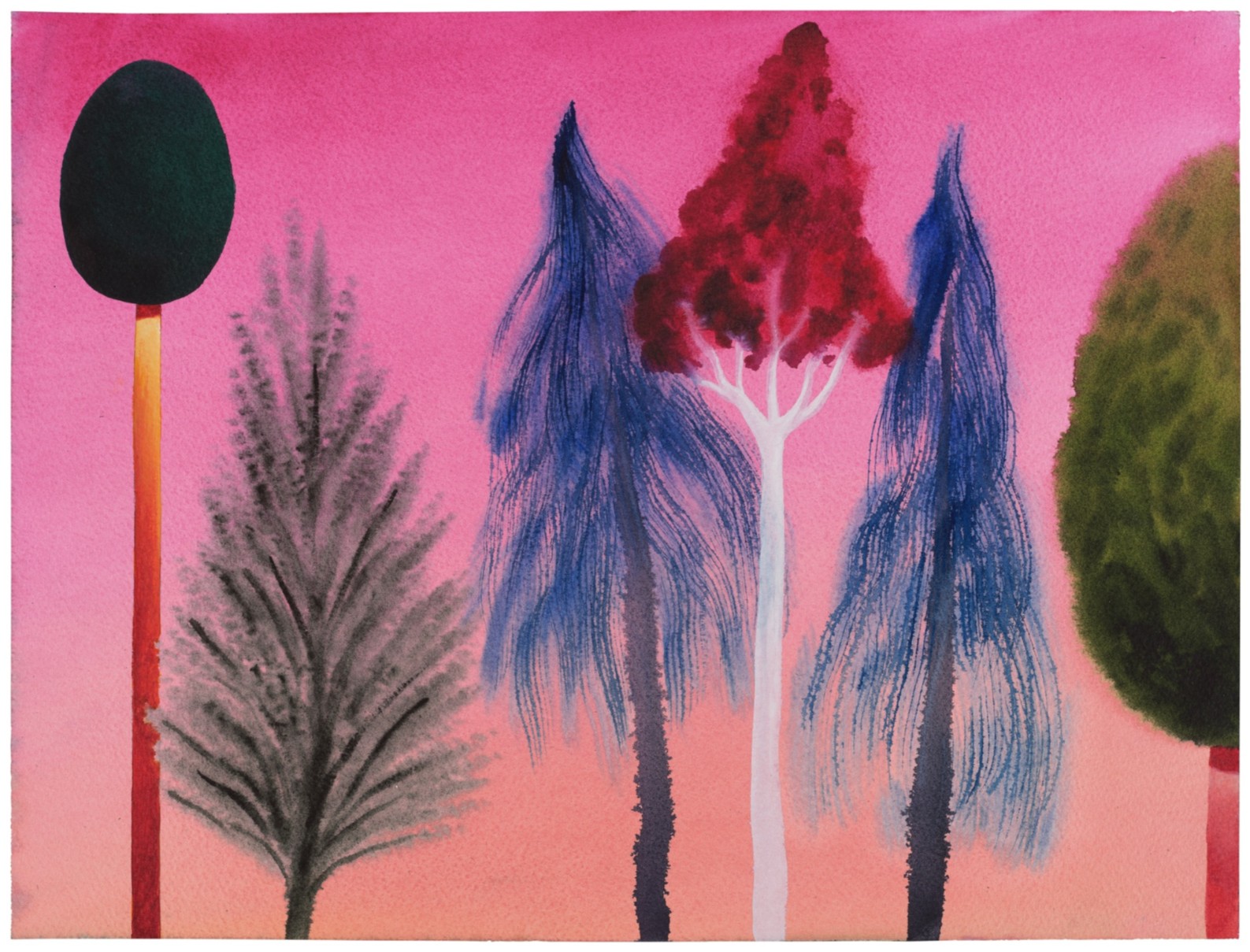
Watercolor on paper
31×41 cm (12 1/4 x 16 1/8 inches)
Signed and dated “Nicolas Party 2020” on the reverse
Still Life, 2014
Estimated: USD 50,000 – 70,000
USD 116,100
WORK ON PAPER
Pastel on paper
64.8 x 49.8 cm (25 1/2 x 19 5/8 inches)
Signed and dated “Nicolas Party 2014” on the reverse
Untitled, circa 1980
Phillips New-York: 21 November 2025
Estimated: USD 70,000 – 100,000
USD 103,200
Keith Haring Modern & Contemporary Art Day Sale, Morning Session
KEITH HARING
Untitled, circa 1980
Acrylic on plywood
30 1/2 x 27 1/4 inches (77.5 x 69.2 cm)
Cactus Blooms, 2017
Phillips New-York: 21 November 2025
Estimated: USD 40,000 – 60,000
USD 90,300
Hilary Pecis Modern & Contemporary Art Day Sale, Afternoon Session
Acrylic on canvas
20×16 inches (50.8 x 40.6 cm)
Signed, titled and dated “Hilary Pecis “Cactus Blooms” 2017″ on the reverse
That Path, So Scary, 2007
Phillips New-York: 21 November 2025
Estimated: USD 50,000 – 70,000
USD 49,020
Hernan Bas Modern & Contemporary Art Day Sale, Afternoon Session
Mixed media on canvas over panel
20×16 inches (50.8 x 40.6 cm)
Signed with the artist’s initials, titled and dated “that path, so scary HB 07” on the reverse
Lots Passed
RED-YELLOW-BLUE #21, 1987
Phillips New-York: 21 November 2025
Estimated: USD 120,000 – 180,000
PASSED
Keith Haring Modern & Contemporary Art Day Sale, Morning Session
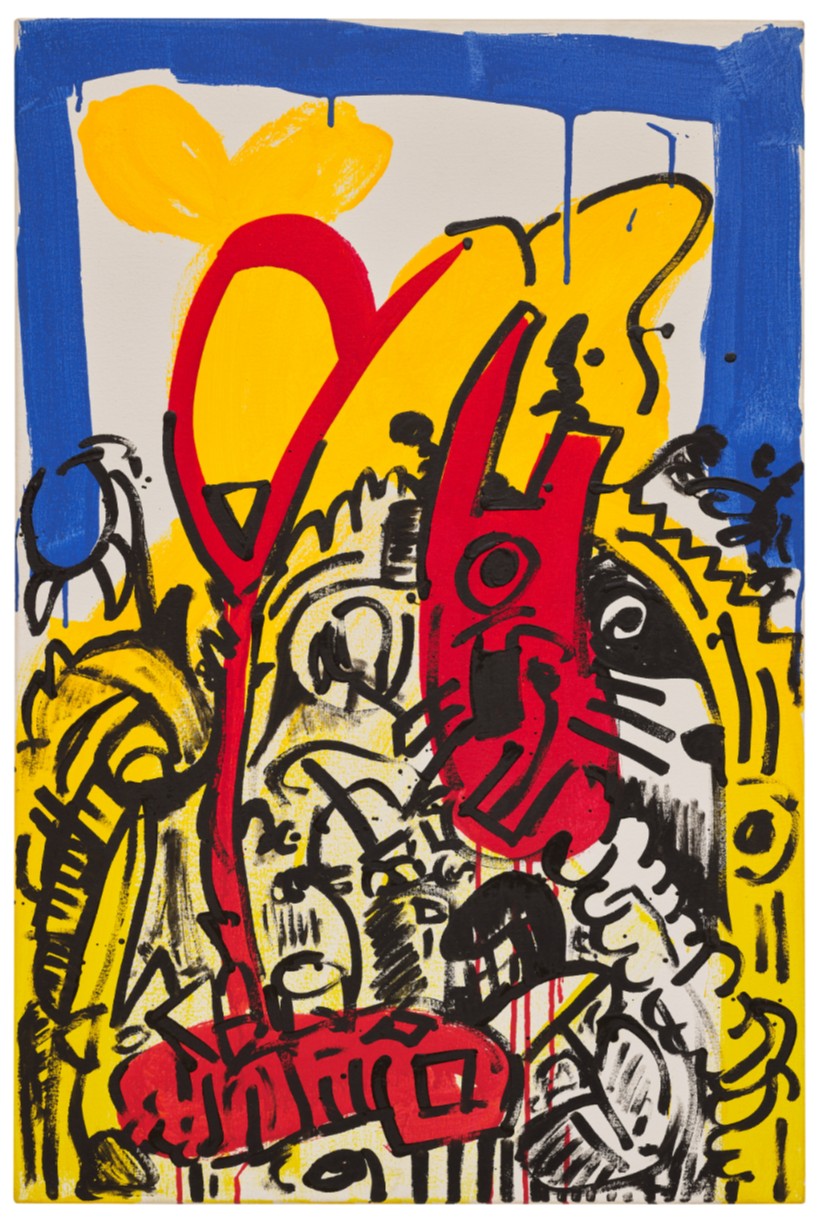
KEITH HARING (1958-1990)
RED-YELLOW-BLUE #21, 1987
Acrylic on canvas
36 1/8 x 24 1/8 inches (91.8 x 61.3 cm)
Signed, titled and dated “RED-YELLOW-BLUE #21 JAN 12 87 ©K. Haring ⨁” on the overlap
Painted on January 12, 1987
Beautiful Flidais Macropsia Painting
& Beautiful Labraid Introversion Painting, 2011
Phillips New-York: 21 November 2025
Estimated: USD 80,000 – 120,000
PASSED
Damien Hirst Modern & Contemporary Art Day Sale, Afternoon Session
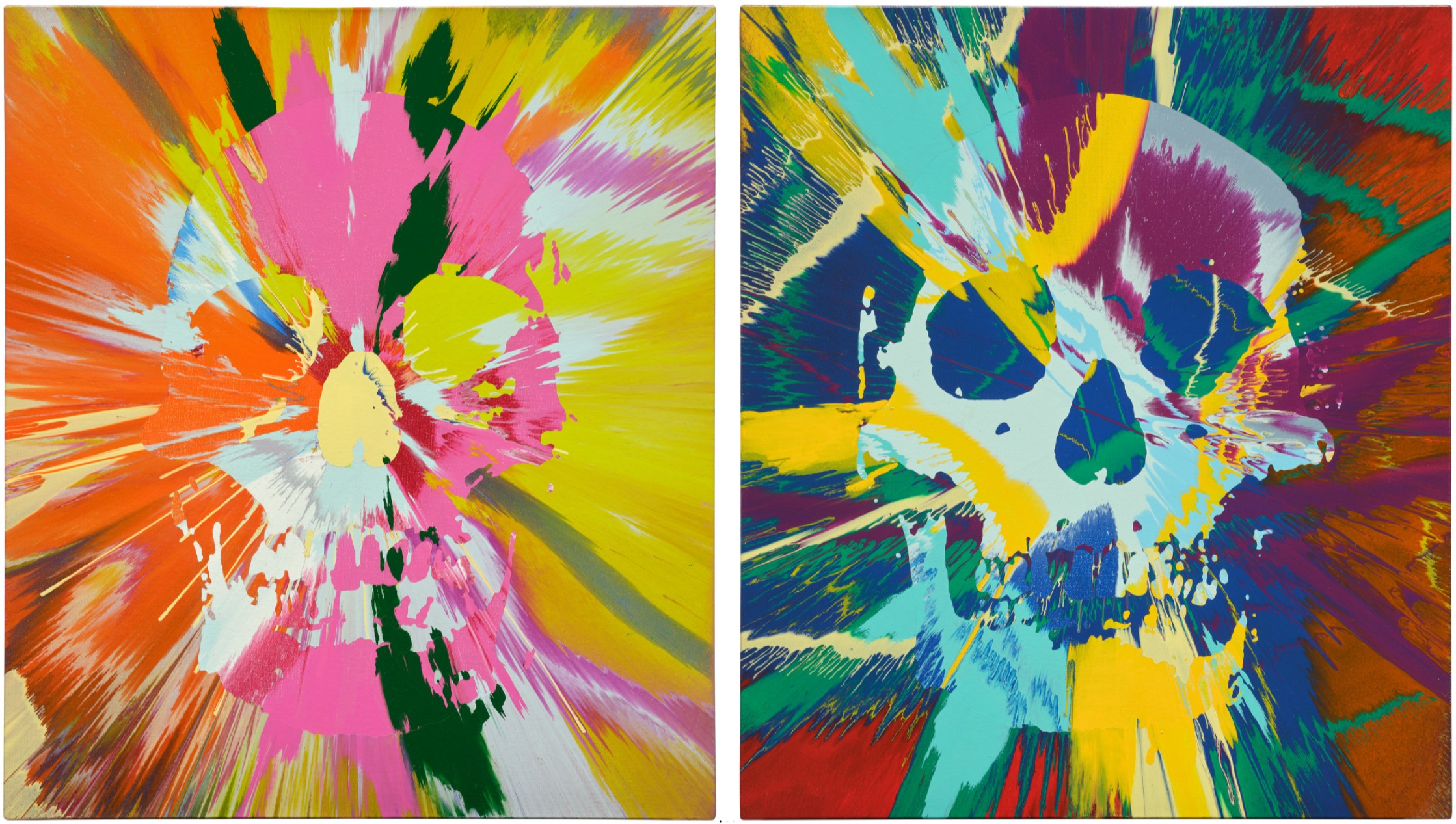
(i) Beautiful Flidais Macropsia Painting (ii) Beautiful Labraid Introversion Painting, 2011
Household gloss on canvas
Each: 24×21 inches (61.0 x 53.3 cm)
(i) Signed, dedicated, inscribed and dated “for Max Damien Hirst Happy Xmas 2011” on the reverse
Stamped with the artist’s stamp on the overlap
(ii) Signed, dedicated, inscribed and dated “for Jackson Happy Xmas Damien Hirst 2011” on the reverse
Stamped with the artist’s stamp on the overlap
Small Diamond Hexagon 6, 1966
Phillips New-York: 21 November 2025
Estimated: USD 300,000 – 500,000
PASSED
Robert Indiana Modern & Contemporary Art Day Sale, Morning Session
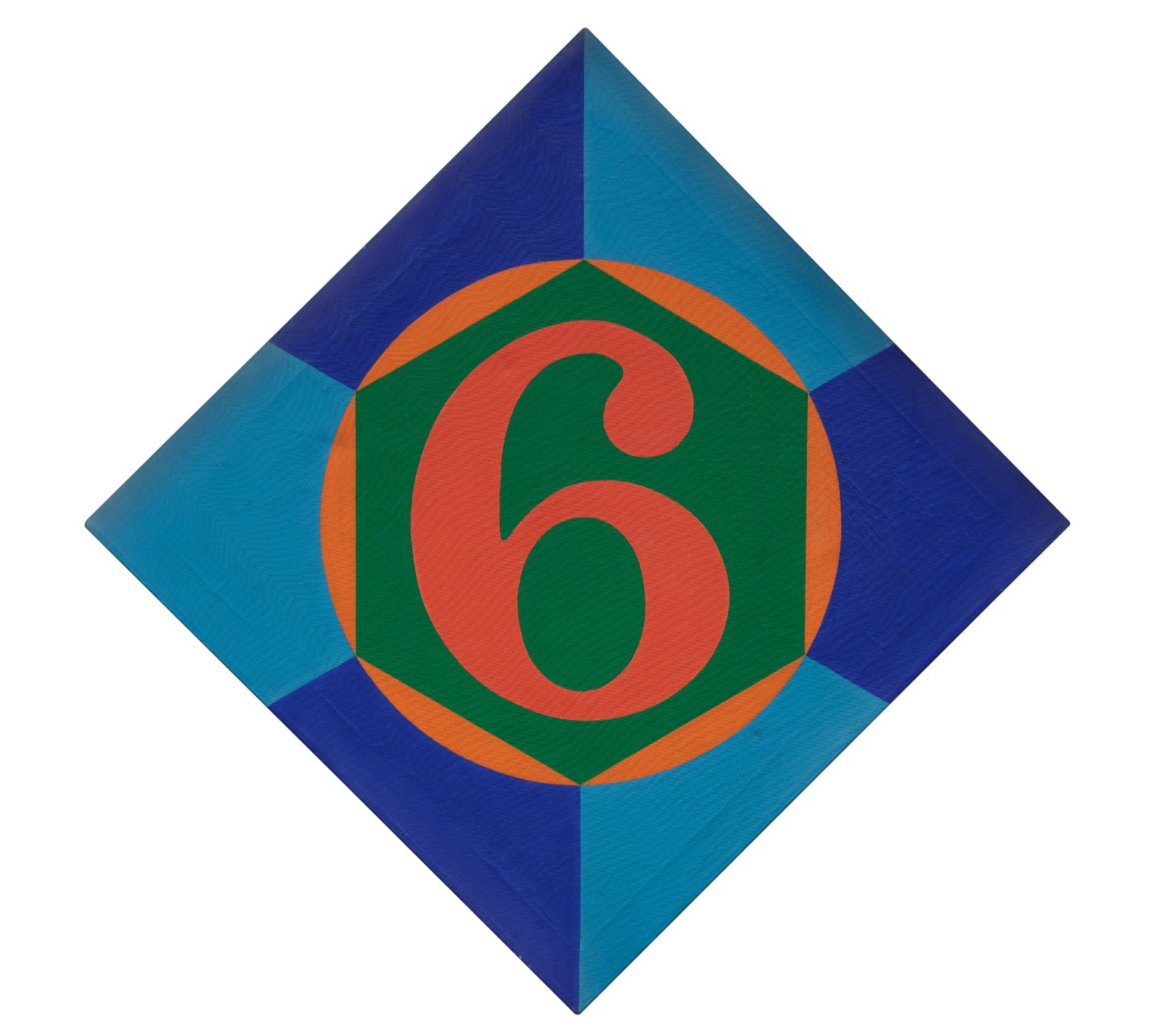
Oil on canvas
34×34 inches (86.4 x 86.4 cm)
Stenciled with the artist’s name, inscription and date “INDIANA 2 NEW YORK 66”
On the reverse
“Our lives are structured on numbers. Birthdays, age, addresses, money—everywhere you turn, there are numbers. Your shirt has six buttons. The room has four walls. Numbers surround us. It’s endless.”
Four, 1964
Phillips New-York: 21 November 2025
Estimated: USD 250,000 – 350,000
PASSED
Robert Indiana Modern & Contemporary Art Day Sale, Morning Session
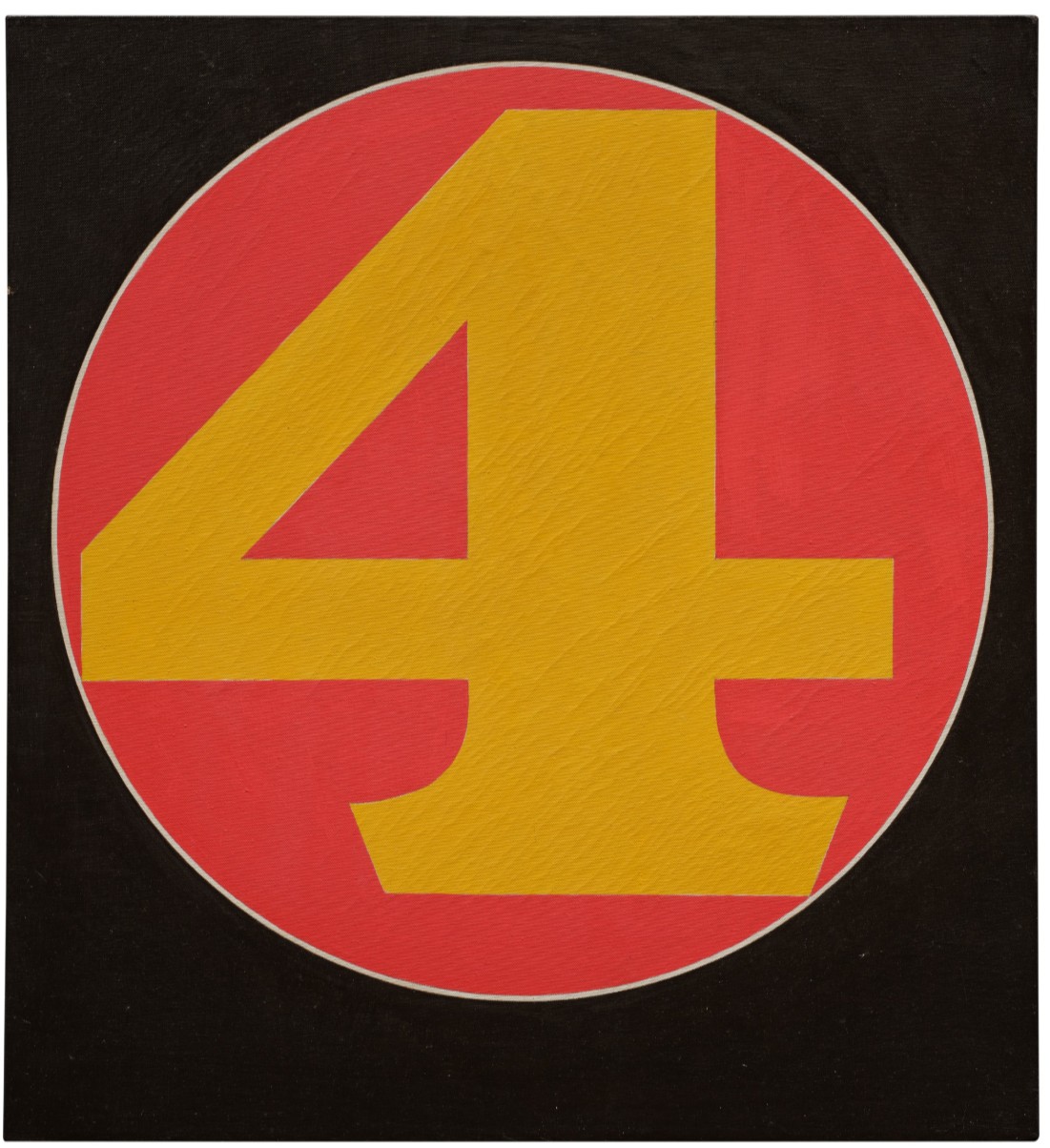
Oil on canvas
24 1/8 x 22 inches (61.3 x 55.9 cm)
Stenciled with the artist’s partial name, inscription and date “IND NYC 64” on the reverse
“I simply discovered the businessman’s calendar and thought that the numbers had a kind of robustness and a kind of, you know, crude vigor to them which I liked. And so all my numbers paintings are based on the numbers from the businessman’s calendar, a found object.”
Femme du Monde, 1974
Phillips New-York: 21 November 2025
Estimated: USD 350,000 – 450,000
WITHDRAWN
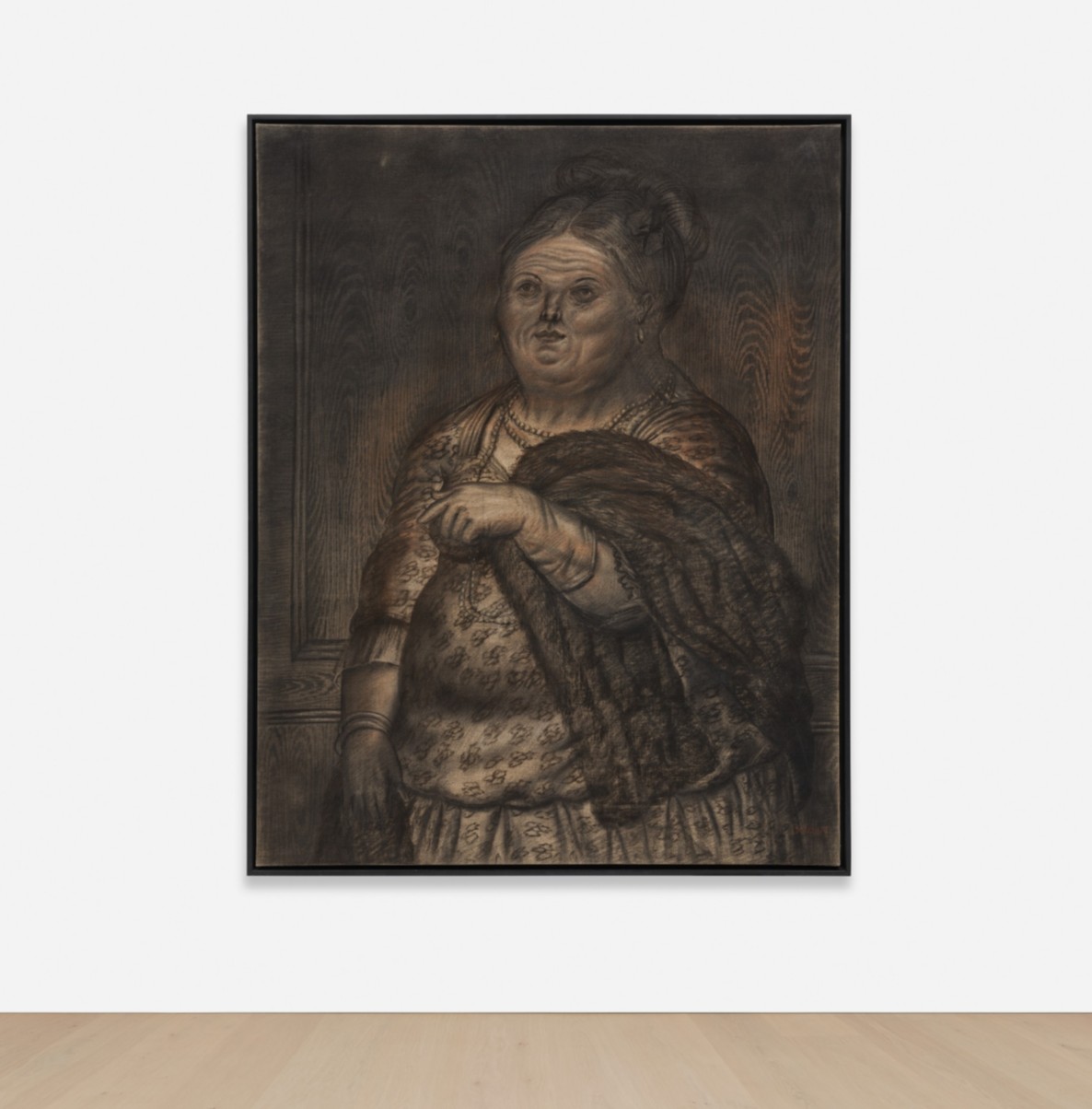
Charcoal and sanguine on canvas
179.1 x 141 cm (70 1/2 x 55 1/2 inches)
Signed and dated “Botero 74” lower right
ULTRA-CONTEMPORARY ART
Lucy Bull
PLEASE CLICK ON THE PICTURE BELOW TO ACCESS AUCTION MARKET OVERVIEW
Light Rain, 2019
Phillips New-York: 19 November 2025
Estimated: USD 350,000 – 450,000
USD 490,200
Lucy Bull Modern & Contemporary Art Evening Sale featuring Cera the Triceratops
LUCY BULL
Light Rain, 2019
Oil on linen
60×50 inches (152.4 x 127 cm)
Signed with the artist’s initials, titled and dated “LB 2019 “Light Rain”” on the reverse
Painted in 2019, Lucy Bull’s monumental Light Rain radiates a hallucinatory brilliance, its kaleidoscopic palette unfurling like a visual symphony. Hypnotic in both chromatic intensity and technical mastery, the painting speaks in a newly forged language of abstraction—one that redefines its grammar for the twenty-first century. Bull fuses disciplined craftsmanship with fearless experimentation, her choreographed gestures detonating into fields of pure pictorial energy.
“I hope to transport people. That’s all I want to do is be transported and I hope people can get lost in [the paintings] and take pleasure in looking at them… I hope that they are as enigmatic to others as they are to me.”
Rooted in the lineage of modern abstraction, Light Rain channels the emotional charge of Lyrical Abstraction, prioritizing sensation over strict figuration. Bull’s months-long process—“building chaos, then finding my way back”—mirrors Gerhard Richter’s radical squeegee method in its embrace of unpredictability. Through years of experimentation, Bull has developed a full-bodied brushstroke that allows her to dab, twist, and scrape paint across the surface, clarifying swirls of color into forms that threaten recognizability before dissolving into ordered chaos.
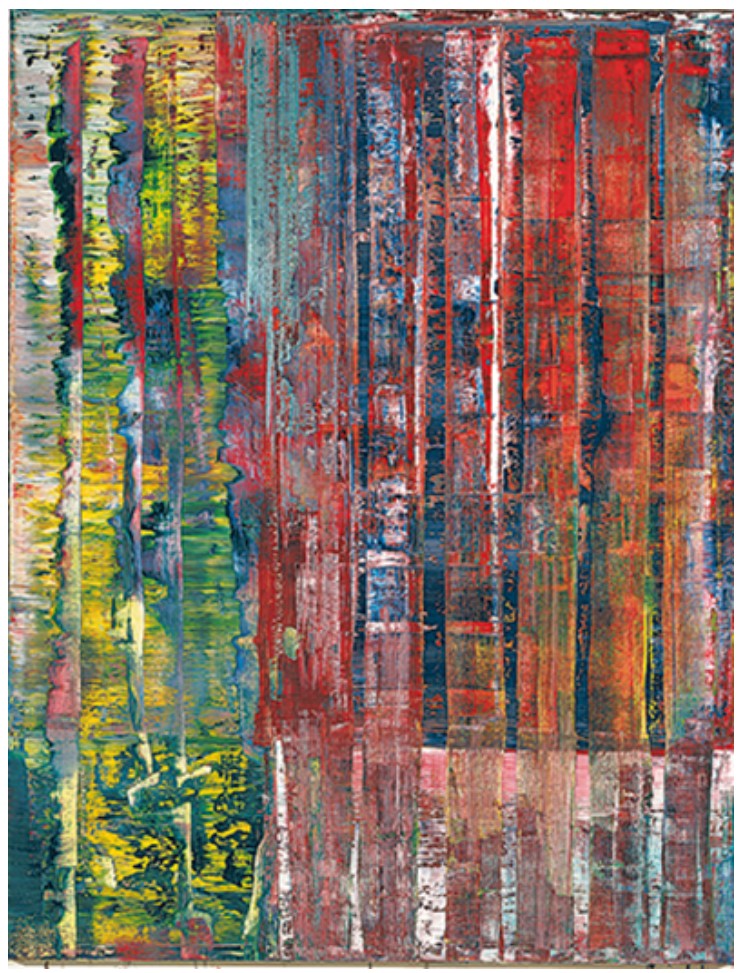
Gerhard Richter, Abstraktes Bild,1992. San Francisco Museum of Modern Art. Image/Artwork: © Gerhard Richter 2025 (0114)
In Light Rain, the natural world serves only as a suggestive touchstone: fleeting associations emerge and evaporate, leading the viewer into a psychological realm where accumulations of marks oscillate between optical overload and glimpses of deliberate structure, always returning us to the material facts of pigment and surface. Feather- and scale-like textures materialize across an eruptive field of pictorial activity. A spectral birdlike face emerges subtly from the swirling chromatic tide, recalling the hybrid flora-fauna apparitions of Max Ernst’s Surrealist landscapes. Like Ernst, Bull conjures an otherworldly ecology—part hallucination, part natural history—where the boundaries between the real and imagined are in constant flux. These moments of near-recognition, followed by dissolution, transform viewing into an active, shifting search.
“I am a representational painter, but not a painter of appearances. I paint representational pictures of emotional situations.”
Bull’s approach is rooted in total immersion. Working from her lofted home studio, she often paints late into the night, describing these hours as “time stolen from sleep… a magical period… an easier time to get lost.” She refuses to paint in the presence of others, believing her idiosyncratic style emerges only when she can “unhinge.” Works are finished, she says, “when I get lost, when I lose track of how I made them.”
[Left] Max Ernst, The Last Forest, 1960-1970. Centre Georges Pompidou, Paris. Image: Bridgeman Images, Artwork: © 2025 Artists Rights Society (ARS), New York / ADAGP, Paris
[Right] Detail of the present work.
Her method is as much excavation as accretion. Repeatedly painting over and scratching into the surface, she drags earlier marks into the foreground, collapsing distinctions between past and present. This process recalls Ernst’s frottage technique—in which paper is placed over textured surfaces and rubbed with pencil or crayon to transfer their patterns—an approach he used to draw out chance imagery from the subconscious. Bull’s work similarly embraces automatism and Ernst’s development of grattage (from the French gratter, “to scrape”), a method of transferring the grain of textured objects between layers of paint. “The scratching feels like excavation,” she notes. “I relate to how [Ernst] talks about being a spectator to the making of his own work. When things finally open up and click, it feels like magic.”
“It’s more about psychic energy than anything. I allow myself to get lost in the making of the paintings, which allows me time to enter this sort of fugue state… It can be so tempting to take it further… opening up new avenues of exploration.”
Suspended between Surrealist dreamscape and psychedelic reverie, Bull’s paintings court both conscious and subconscious perception. Her stated goal is to “titillate the senses… draw people closer,” cultivating the kind of prolonged looking that allows worlds to materialize and vanish. Ultimately, the power of Light Rain lies in its open-ended encounter. Bull resists prescribing a single reading: “I never want to short-circuit… by telling them what I see.”
BANKSY
Sorry the Lifestyle You Ordered is Currently Out of Stock, 2003-13
Sotheby’s New-York: 19 November 2025
Estimated: USD 800,000 – 1,200,000
USD 2,856,000
BANKSY (b. 1974) & DAMIEN HIRST
Sorry the Lifestyle You Ordered is Currently Out of Stock (Banksy defaced Hirst), 2003-13
Spray paint, emulsion and household gloss on canvas
99.1 x 114.3 cm (39×45 inches)
Signed by Banksy and Hirst and variously inscribed (on the reverse)
Executed in 2013, Sorry the Lifestyle You Ordered is Currently Out of Stock encapsulates Banksy’s unparalleled ability to fuse conceptual wit, social critique, and art-historical dialogue into a single image. A unique collaboration, or perhaps more precisely, a defacement, of one of Damien Hirst’s iconic Spot Paintings, the present work stands as a pointed meditation on consumer desire, authorship, and the commodification of contemporary art itself. Executed in 2013 and signed by both artists, this Defaced Hirst is among the most incisive statements in Banksy’s career-long exploration of the contradictions between rebellion and luxury, subversion and spectacle.
“If you want to survive as a graffiti writer when you go indoors your only option is to carry on painting over things that don’t belong to you there either”
In this composition, Banksy intervenes directly upon Hirst’s work, extending a tradition begun years prior in his Vandalised Oils series that saw the artist deface found paintings with his iconic text and symbols, in this case overlaying Hirst’s pristine rationalism with the slogan “Sorry the lifestyle you ordered is currently out of stock.” The juxtaposition is devastating in its simplicity, the witty text confronting the hollowness of consumer aspiration within the polished logic of Hirst’s aesthetic system. The result is both collaboration and critique, a wry dialogue between two of Britain’s most recognizable artists, each of whom has defined the intersection of art and commerce in the early twenty-first century.
Damien Hirst in front of one of his Spot Paintings, 2011.
Hirst’s ordered grid of colored dots, emblematic of an art market that celebrates perfection and repetition, becomes the backdrop for Banksy’s disillusioned aphorism. The phrase, drawn from the language of online retail, transforms the consumer apology into a cultural verdict: a society that equates fulfillment with consumption is bound to encounter emptiness. This gesture extends Banksy’s long-standing interrogation of late capitalism, echoing works such as Shop Until You Drop (2011) and Choose Your Weapon (2010), in which slogans and symbols expose the violence of branding and conformity. The present work represents a turning point in Banksy’s oeuvre, marking his evolution from street provocateur to institutional interlocutor. By subverting the work of an icon of the YBAs, Banksy both critiques and joins their lineage, positioning himself as the conscience of the art world he simultaneously inhabits and undermines. The mutual acknowledgment between Banksy and Hirst transforms this painting into a commentary on authorship and value. In the act of “defacement,” Banksy paradoxically increases the work’s cultural and economic worth, exposing the art market’s hunger for rebellion packaged as collectible rarity.
Left: Banksy mural, East India Rock Road, London, 2011.
Right: Sorry The Lifestyle You Ordered is Currently Out of Stock, 2012. Private Collection.
The phrase “Sorry The Lifestyle You Ordered is Currently Out of Stock” has recurred throughout Banksy’s oeuvre, including in a work of the same name painted in 2012 and, exemplifying Banksy’s dual status as a street and fine artist, on the side of an abandoned building in London’s East End in 2011. The 2011 work, the first instance of Banksy’s usage of the phrase, was a searing commentary on the British government’s aggressive financial policies that led to buildings like the one he painted on, believed to be a failed housing project, to sit idly during the recession. This tension between destruction and creation found its most spectacular expression in Love is in the Bin (2018), Banksy’s infamous self-destructing painting that sold at Sotheby’s London for £18.6 million in 2021, setting a record for the artist. That event, when Girl with Balloon shredded itself moments after the hammer fell, reframed notions of authenticity, spectacle, and artistic control. The Defaced Hirst works anticipate that gesture: they literalize the act of intervention, turning an existing artwork into a new, conceptually charged object. Both moments reveal Banksy’s mastery of theatrical critique, where subversion itself becomes the medium and the market’s reaction the performance.
Left: Marcel Duchamp, Mona Lisa (L.H.O.O.Q.), 1919. Philadelphia Museum of Art, Philadelphia.
Right: Robert Rauschenberg, Erased de Kooning, 1953. San Francisco Museum of Modern Art. Art © 2025 Robert Rauschenberg Foundation
The text-based subversion of corporate language recalls Ed Ruscha’s deadpan signage and Barbara Kruger’s declarative slogans, while the collaborative defacement aligns with Marcel Duchamp and Rauschenberg’s radical gesture of altering existing works, as in Duchamp’s L.H.O.O.Q. (1919) and Rauschenberg’s Erased de Kooning (1953), the latter of which serving as a key predecessor to the present work in its collaborative, sanctioned defacement. Like Duchamp’s readymade interventions, Banksy’s appropriation of Hirst’s minimalist order transforms an emblem of modern perfection into a critique of its own sanctity. Sorry the Lifestyle You Ordered is Currently Out of Stock epitomizes Banksy’s deft command of irony and precision. It is at once a visual joke and a profound statement, a mirror held up to the systems of art, commerce, and consumption that sustain its own existence. Like Love is in the Bin, it captures the paradox at the heart of Banksy’s genius: that the act of critique, performed with wit and elegance, becomes itself an object of desire.
Jadé Fadojutimi
PLEASE CLICK ON THE PICTURE BELOW TO ACCESS AUCTION MARKET OVERVIEW
Bark, 2016
Phillips New-York: 21 November 2025
Estimated: USD 75,000 – 100,000
USD 96,750
Jadé Fadojutimi Modern & Contemporary Art Day Sale, Afternoon Session
REPEAT SALE
Phillips London: 12 October 2023
Estimated: GBP 70,000 – 100,000
GBP 69,850 / USD 86,020
Jadé Fadojutimi 20th Century & Contemporary Art Day Sale
Oil and acrylic on canvas
40 1/8 x 30 1/8 inches (101.9 x 76.5 cm)
Signed, titled and dated “”Bark” Aug 2016 Jadé Fadojutimi Jadé Fadojutimi” on the reverse
Untitled, 2022
Phillips New-York: 19 November 2025
Estimated: USD 800,000 – 1,200,000
PASSED
Jadé Fadojutimi Modern & Contemporary Art Evening Sale featuring Cera the Triceratops
JADE FADOJUTIMI
Untitled, 2022
Acrylic, oil and oil pastel on canvas
300×500 cm (118 1/8 x 196 7/8 inches)
Signed and dated “Jadé Fadojutimi Oct ’22 Jadé Fadojutimi” on the reverse
Jadé Fadojutimi’s Untitled, painted in 2022, unfolds as a lush, immersive field of color and movement that hovers between abstraction and landscape. Swaths of deep green and turquoise conjure water and dense vegetation, while tangled gestures in red, orange, and violet surge across the canvas like currents or undergrowth. Transparent layers of acrylic and oil pastel interlace to create shifting zones of depth and translucency, inviting the eye to wander and recalibrate. The result is a dynamic, almost aquatic environment where emotion and perception flow together in constant motion. Fadojutimi transforms the canvas into a terrain that probes identity, self-knowledge, and states of unresolved feeling. Brimming with her characteristic vibrancy, Untitled embodies the rhythmic, visually charged compositions that define her celebrated “emotional landscapes,” in which color, space, and form become conduits for memory and introspection. One of the most compelling painters of her generation, Fadojutimi continues to expand the expressive possibilities of abstraction, her mark-making alive with energy and sensation.
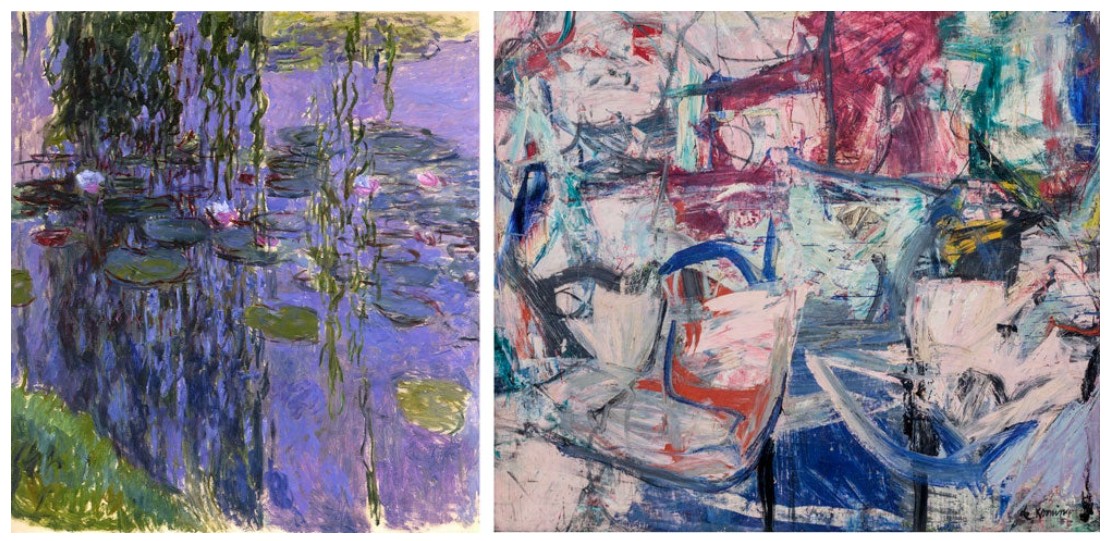
[Left] Claude Monet, Nymphéas, 1916-1919. Musée Marmottan Monet, Paris. Image: Artefact / Alamy Stock Photo
[Right] Willem de Kooning, Saturday Night, 1956. Mildred Lane Kemper Art Museum, Saint Louis. Artwork: © 2025 The Willem de Kooning Foundation/Artists Rights Society (ARS), New York
The dynamism of Untitled stems from Fadojutimi’s distinctive technique. She thins her paint with Liquin, a fast-drying medium that yields a glossy, reflective surface reminiscent of glass or water. In recent years, the artist has increasingly drawn directly onto her canvases with oil pastel—a crayon-like medium that accommodates the speed and spontaneity of her process. Its introduction marked a turning point in Fadojutimi’s relationship to drawing. Where just a year prior to making the present work she described drawing as “an appetizer for painting,” oil pastel enabled her to blur the boundaries between the two disciplines. Described by the artist as “environments,” compositions such as Untitled are built up in layered strata, the soaring and scribbled lines of pastel functioning as interruptions—passages of discontinuity that channel fluid emotion and the pursuit of self-knowledge.
“Some people write a diary, I guess I draw a diary—the burst of energy, thoughts, or colors that are in my mind. In the studio, I tend to fill my walls with the drawings. And rather than using a drawing directly to start and finish a painting, I might extract elements from the drawing and let them intertwine into many works.”
Untitled pulses with gesture and movement as loose, translucent washes collide with creamy, looping strokes of color. Fadojutimi builds thin layers of pigment through rhythmic caresses, then intuitively scrapes and scratches the surface to reveal a network of dancing grooves and sweeping arcs. The organic curvature of her lines recalls Julie Mehretu’s complex abstractions, while the painterly vigor of thick oils evokes the physicality of Action Painters such as Jackson Pollock, Joan Mitchell, and Willem de Kooning. Equally, the aqueous blue-green expanse along the lower register, punctuated by leaf-like notches and floating forms, summons Claude Monet’s late Water Lilies—their luxuriant color and luminous touch reimagined through a contemporary lens.
Wassily Kandinsky, Improvisation Klamm [Improvisation Ravine], 1914. Lenbachhaus, Munich. Image: Municipal Gallery in the Lenbachhaus and Kunstbau Munich, Gabriele Münter Foundation 1957
“My paintings recognize a lack of self caused by automatically thinking that my identity is already defined, and also a frustration that paint can accept these characteristics better than myself.”
The richly worked surface of Untitled thus becomes not only an exploration of light and form but also an intimate conversation about the self. Grounded in her environment and lived experience, each canvas encapsulates a facet of her evolving identity. Drawing from her upbringing in suburban London as a Black British woman of Nigerian heritage, Fadojutimi constructs layered pictorial worlds that mirror the complexity of personal growth. Instead, they emerge as “emotionally charged, psychological landscapes” that mirror both the artist’s inner world and our own. Symphonic and deceptively precise, Untitled embodies this balance, unfolding as a dense, all-encompassing meditation on psychological complexity.
“What I love about painting is that it’s a discussion with ourselves. When you see a work you’re drawn to, there’s always a moment where you want to leave but you can’t… I want my canvases to be spaces where people maybe recognize themselves and think, ‘I see this, and that’s okay, but why do I see this? And what does that mean to me?’”
Inspired by experience, memory, and emotion, Fadojutimi’s compositions vibrate with dream-like energy. Her visual language extends beyond Western art history to embrace a wide constellation of influences, with Japan a particularly vital source. Artists such as Makiko Kudo and Yoshitomo Nara, as well as Japanese animation, soundtracks, and video games, inform her interest in constructing parallel worlds—both familiar and otherworldly—defined by sensitivity to transition and an embrace of the ephemeral.
“While I’m painting, the harmonious unity of my senses becomes apparent. They muddle together, chitter-chattering about their newfound warmth as though it’s their first connection.”
Color, too, serves as a bridge between her multiple identities and lived experience. Fadojutimi’s engagement with color is shaped by a form of synesthesia. For her, color is not merely aesthetic but linguistic—a means of articulating emotions that defy words. In Untitled, each hue corresponds to a state of being, evoking what Wassily Kandinsky described as the “inner sound” of color. Through this chromatic symbiosis, Fadojutimi’s practice approaches the spiritual, translating emotion into rhythm and resonance. For Fadojutimi, color always comes first.
Rashid Johnson
PLEASE CLICK ON THE PICTURE BELOW TO ACCESS AUCTION MARKET OVERVIEW

#1. Bruise Painting “Stardust”, 2021
Christie’s New-York: 20 November 2025
Estimated: USD 800,000 – 1,200,000
USD 1,397,000
RASHID JOHNSON (B. 1977), Bruise Painting “Stardust” | Christie’s
RASHID JOHNSON (B. 1977)
Bruise Painting “Stardust”, 2021
Oil on linen
97 7/8 x 85 3/4 inches (248.6 x 217.8 cm)
Rashid Johnson has built a diverse and critically engaged body of work that explores the intersections of personal history, cultural identity, and collective experience. His groundbreaking exhibition Rashid Johnson: A Poem for Deep Thinkers, currently on view at the Solomon R. Guggenheim Museum, offers an immersive exploration of the artist’s celebrated visual language, tracing the evolution of his thirty-year career. As Vogue notes, “the show’s installation in Frank Lloyd Wright’s iconic rotunda offers a fascinating view into Johnson’s mind” (Sporne, Vogue, April 2025).
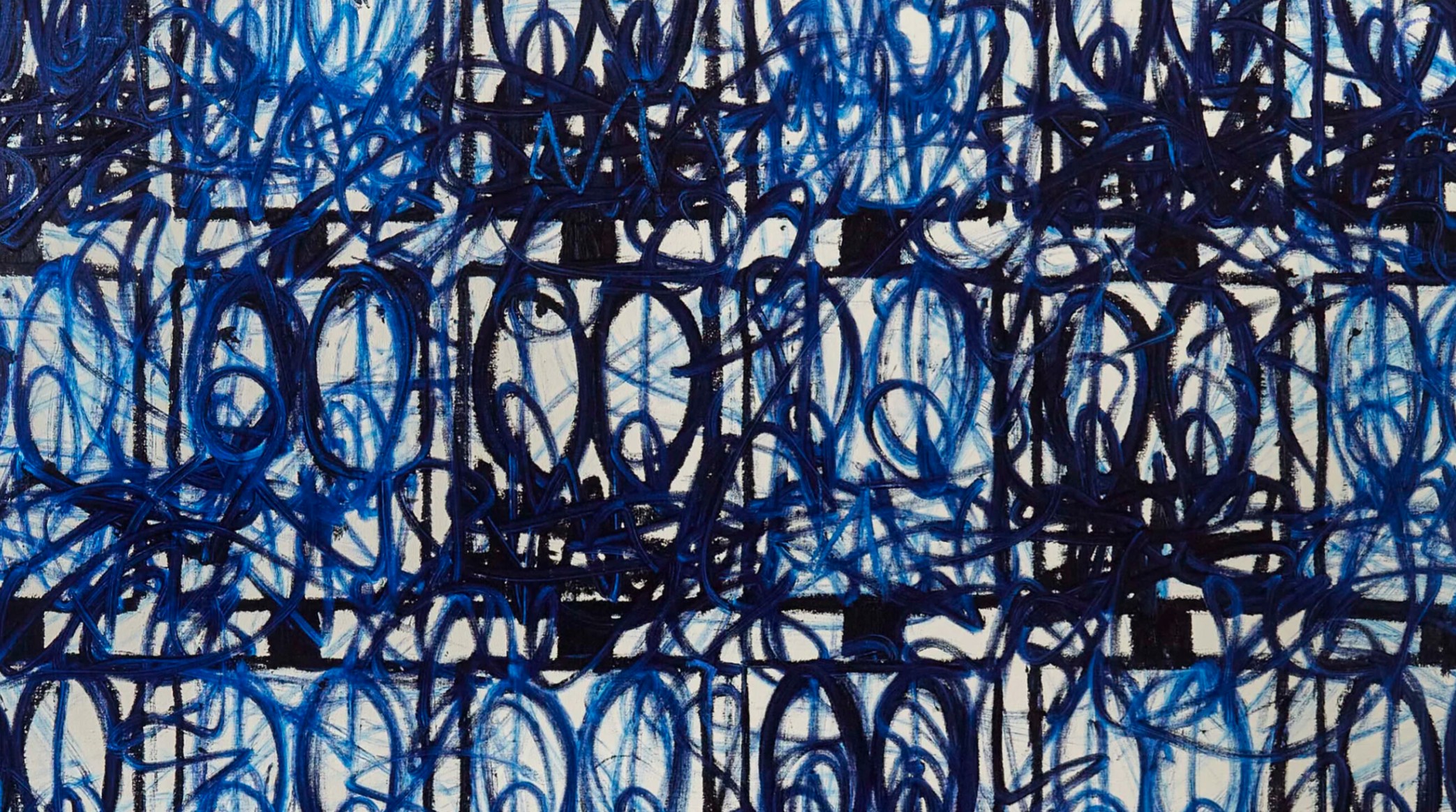
Johnson’s Bruise Painting “Stardust” (2021) exemplifies the expressive intensity and emotional depth of his Bruise Paintings series. Developed as a response to his earlier Anxious Men paintings—created during the pandemic to convey feelings of anxiety, isolation, and loss—this series offers a consoling and poetic counterpoint, evoking resilience and reflection in the face of uncertainty.
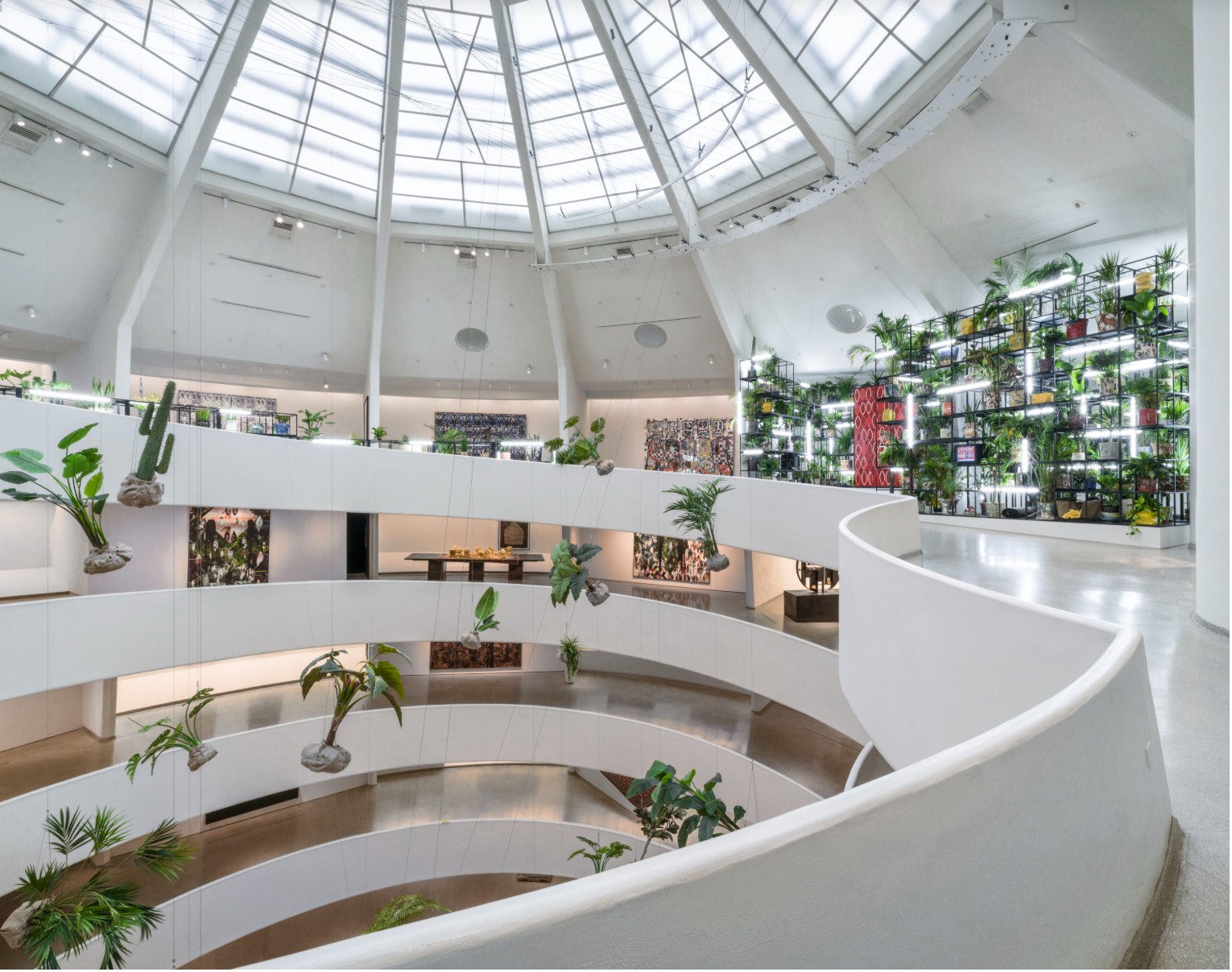
Installation view
Rashid Johnson: A Poem for Deep Thinkers, Solomon R. Guggenheim Museum, New York. Courtesy Solomon R. Guggenheim Museum.
Photo: David Heald. © Solomon R. Guggenheim Foundation. Artwork: © Rashid Johnson. Courtesy the artist and Hauser & Wirth.
Rendered in a lush spectrum of blacks and blues, Bruise Painting “Stardust” features an oil-coated linen surface structured around a loose grid, framing Twombly-like lines that evoke abstracted faces with scribbled eyes and bared teeth. The work recalls the instantly recognizable figuration of Jean-Michel Basquiat combined with the ordered restraint of Agnes Martin—two artists who, notably, have each had solo exhibitions at the Guggenheim during Johnson’s tenure on its Board of Trustees. Drawing inspiration from the soulful melancholy of Fats Waller’s jazz standard “(What Did I Do to Be So) Black and Blue”—popularized by Louis Armstrong and later invoked in Ralph Ellison’s Invisible Man—Johnson infuses the painting with layered references to Black cultural and intellectual history. Through its richly textured surface and resonant symbolism, Bruise Painting “Stardust” becomes both an act of healing and an affirmation of creative endurance in the wake of collective and personal trauma.
#2. Anxious Red Painting August 20th, 2020
Property from an Important European Collection
Sotheby’s New-York: 18 November 2025
Estimated: USD 1,o00,000 – 1,500,000
USD 1,244,600
Anxious Red Painting August 20th | The Now & Contemporary Evening Auction | 2025 | Sotheby’s
RASHID JOHNSON (b. 1977)
Anxious Red Painting August 20th, 2020
Oil on canvas
94 x 120 1/8 inches (238.8 x 305.1 cm)
Signed and dated 2020 (on the reverse)
The surface of Anxious Red Painting August 20th resonates with ferocious immediacy, its incendiary field of scarlet forming both barrier and wound: scratched, smeared, and scoured lines coalesce into an expanse of anxious figuration. Within its monochromatic vigor, crimson becomes both matter and metaphor, burning with the simultaneity of fear and vitality, rage and resilience.
Composed in a grid of feverishly rendered faces, the painting confronts the viewer with the collective roar of psychic unrest. Part of Rashid Johnson’s celebrated Anxious Red series, the present work extends his career-long investigation into collective anxiety and the personal trauma of the African American experience. Using red as a declaration of urgency, he evokes emotion through color, line and form: Johnson translates the tension between inner life and public crisis into gesture. Created during the initial months of 2020, the series evolved from his earlier Anxious Men works — transforming the black soap and wax of those mosaics into fields of searing pigment.
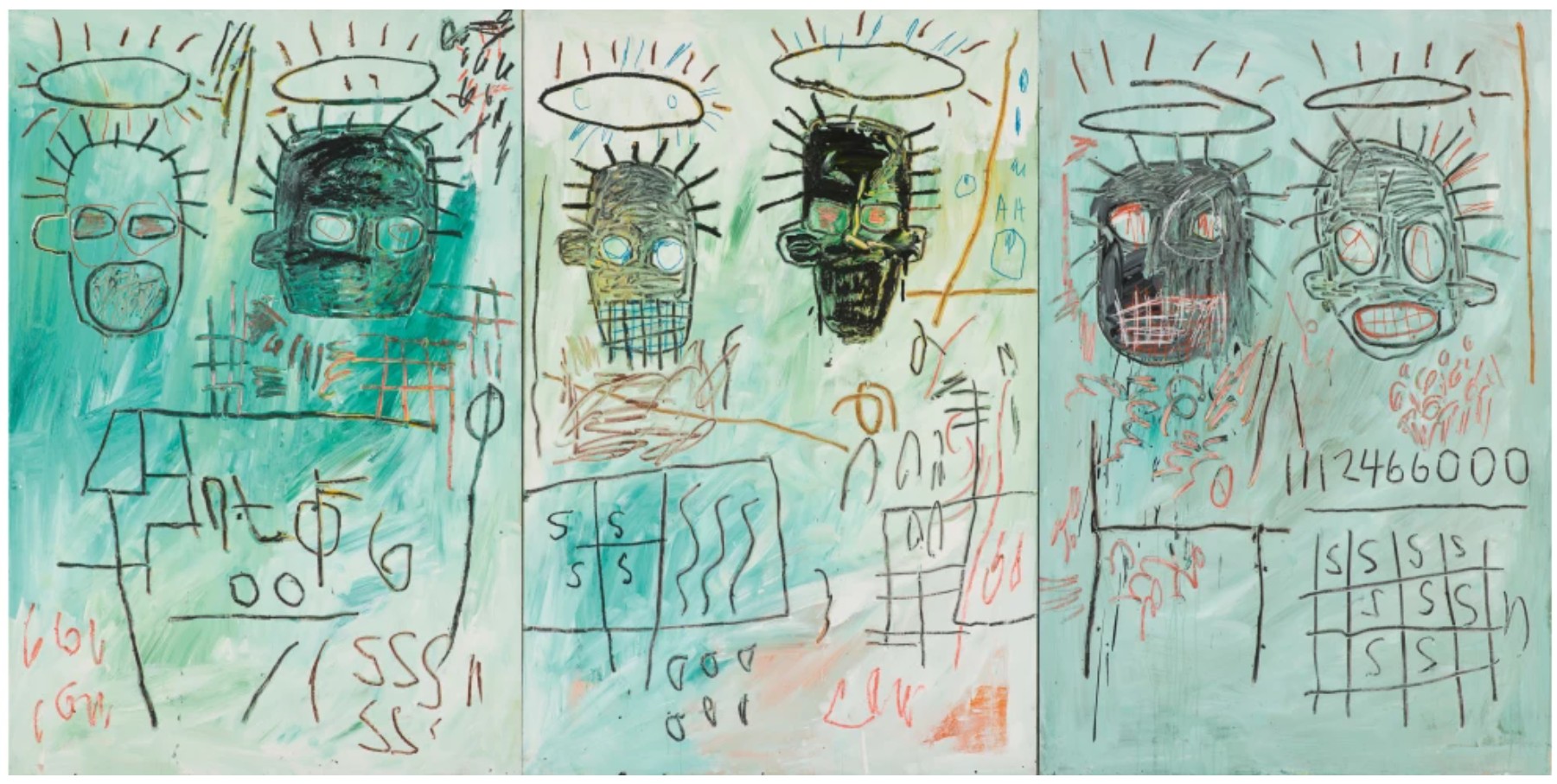
Jean-Michel Basquiat, Six Crimee, 1982. The Museum of Contemporary Art, Los Angeles.
Art © 2025 Estate of Jean-Michel Basquiat. Licensed by Artestar, New York
In Anxious Red Painting August 20th, Johnson distills the spirit of Anxious Men into a singular chromatic plane. The heads, once delineated against white tile grids, now dissolve into loops and slashes, subsumed by the fervor of mark-making. Johnson’s hand moves restlessly, his line trembling with psychic charge; each incision recalls both scar and script, a visceral record of endurance.
“The healing process starts with the negotiation of blunt force trauma…
It’s the story of recovery.”
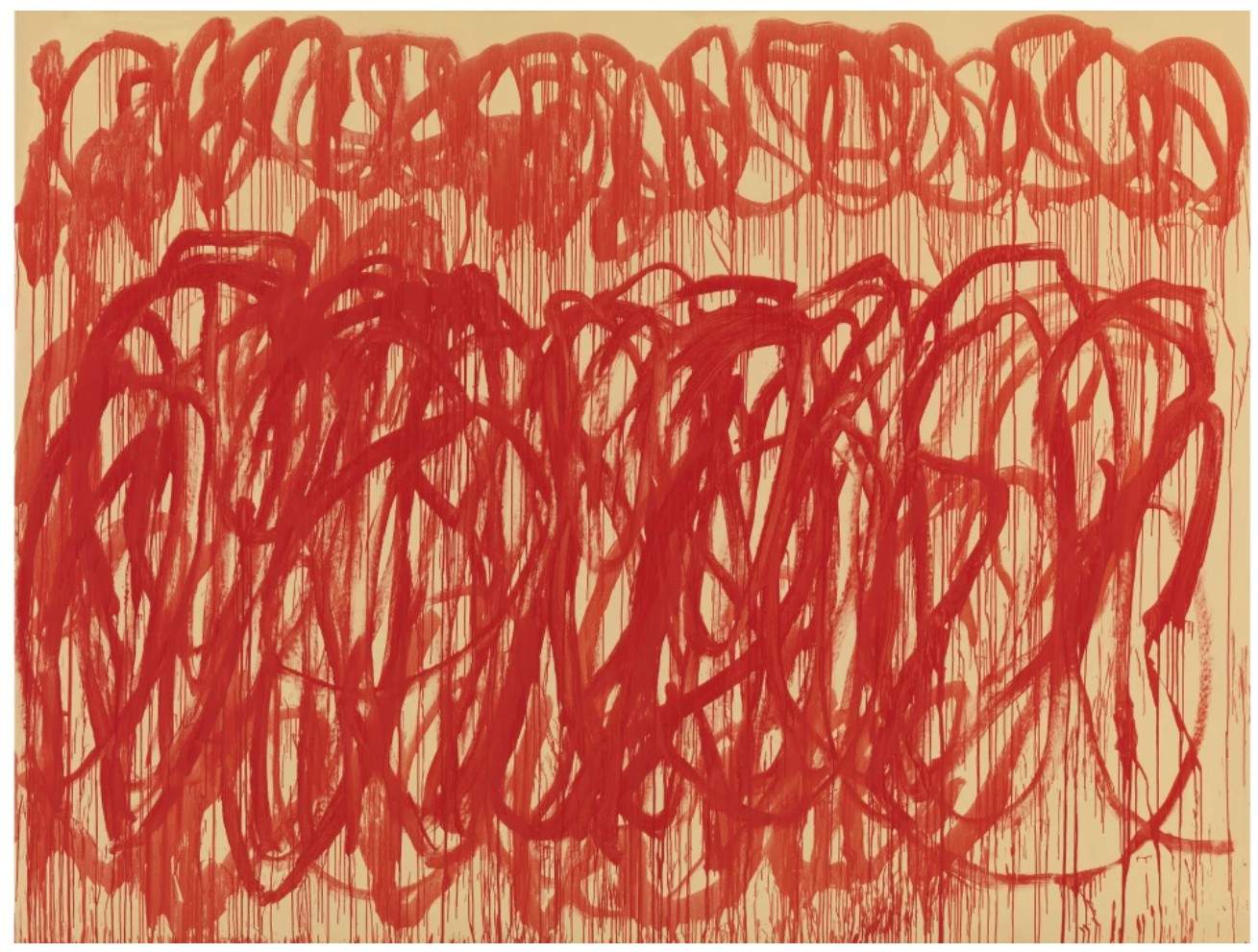
Cy Twombly, Untitled (Bacchus), 2005. Museum Brandhorst/Bayerische Staatsgemäldesammlungen, Munich.
Image © bpk Bildagentur / Art Resource, NY. Art © Cy Twombly Foundation
For Johnson, red is both warning and witness — an assertion of presence that refuses despair. The painting internalizes collective emotion within the intimacy of gesture; each scrawl and incision is a confrontation with immediacy, an attempt to register breath in a moment of suffocation. Anxiety here is not a transient mood but a sustained condition of existence.
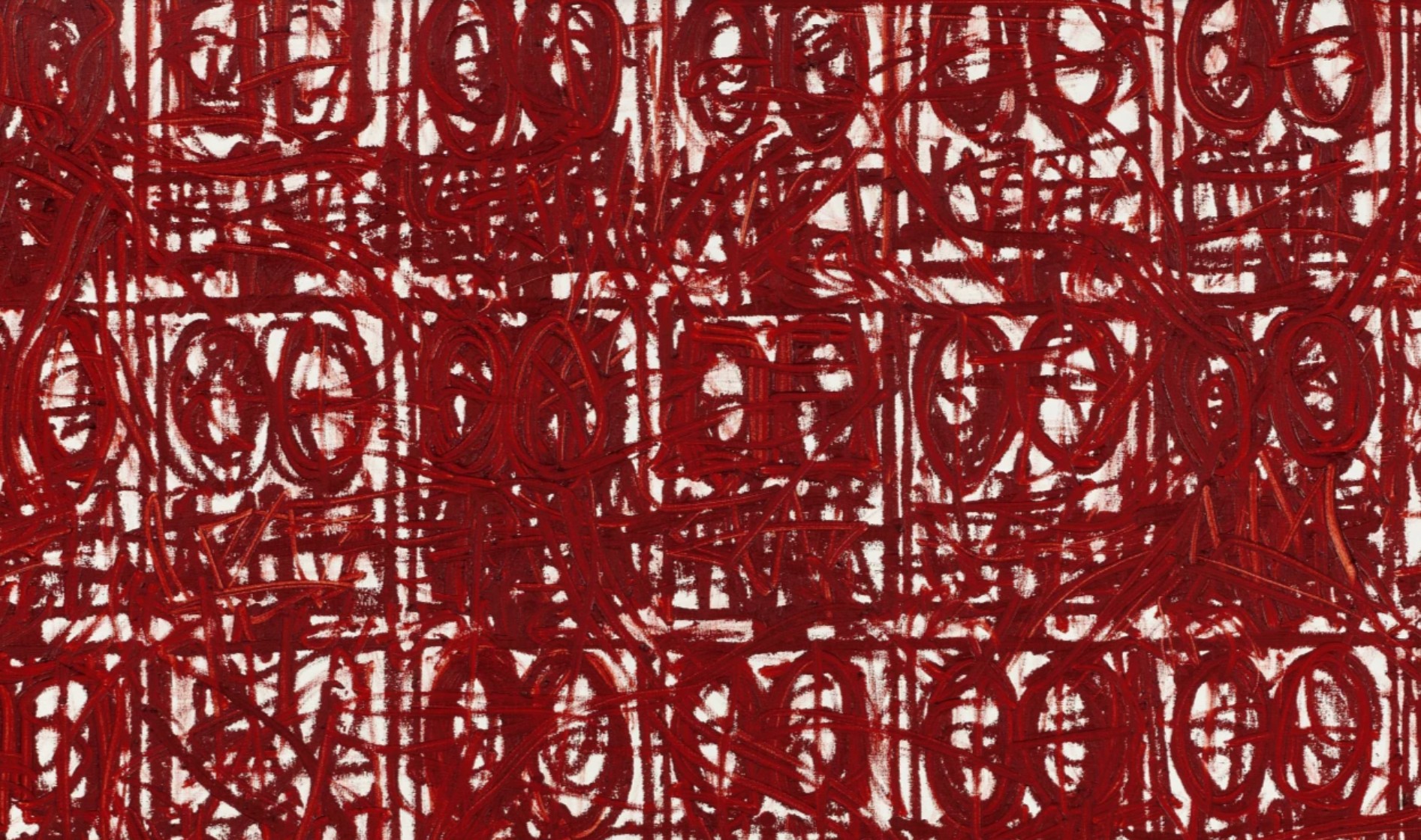
“How to tolerate and how to interpret and how to locate ourselves in this time, how to, in a sense, be both historians and illustrators.”
As in the tactile intensity of Jean Dubuffet’s art brut and the scrawled exuberance of Cy Twombly, Johnson’s hand oscillates between scripture and gestural mark making. Yet his language is wholly his own—a palimpsest of African diasporic memory and contemporary unease. Within this framework, Anxious Red Painting August 20th reads as both painting and performance—a ritualized act of making that fuses emotion, intellect, and physicality. The surface, smeared and scratched, evokes the immediacy of human touch, recalling the artist’s engagement with material as metaphor.
“I suffer from what Rosalind Krauss was calling the post-medium condition, where an artist employs several mediums to bring to life whatever specific ideas they have. For me, it’s always been that way.”
Jean Dubuffet, Etre Par, 1963. Private Collection.
Image © Heinrich Zinram Photography Archive / Bridgeman Images. Art © 2025 Artists Rights Society (ARS), New York / ADAGP, Paris
Each mark in Anxious Red Painting August 20th operates as both fissure and filament, fracture and thread; it acknowledges the pain of fragmentation while envisioning the beauty of recomposition. As the eye roams across the all-over field, it finds no sanctuary, only movement, the same restless agitation that defined the era of its making. The result is an image both monumental and intimate. The painting’s vast field confronts the viewer with unflinching directness, yet its every gesture feels deeply personal, drawn from the fraught intersection of selfhood and society. Its anxiety is communal, a chorus of voices compressed into pigment.
#3. Untitled Anxious Bruise Drawing, 2022
Sotheby’s New-York: 19 November 2025
Estimated: USD 250,000 – 350,000
USD 482,600
Untitled Anxious Bruise Drawing | Contemporary Day Auction | 2025 | Sotheby’s
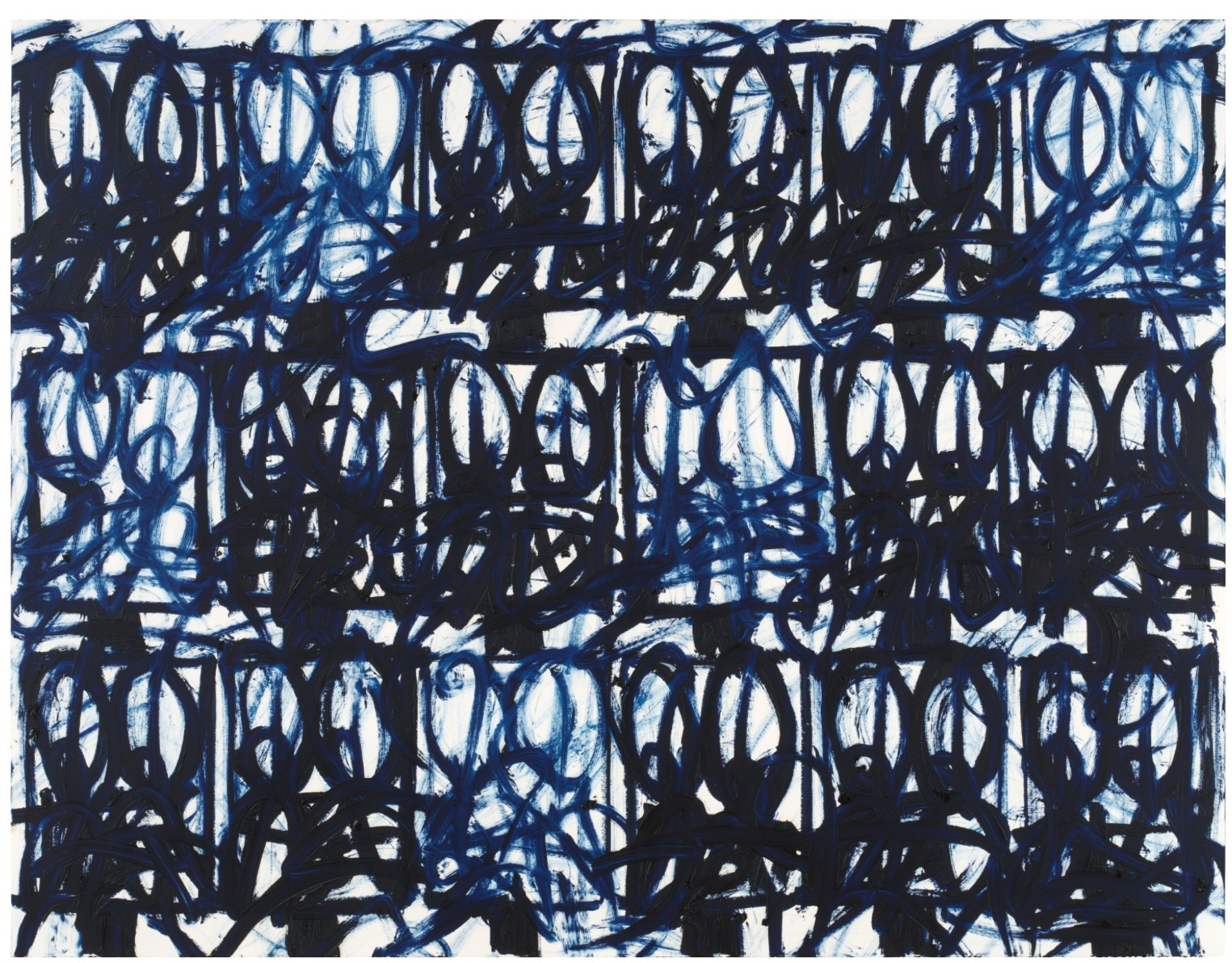
RASHID JOHNSON (b. 1977)
Untitled Anxious Bruise Drawing, 2022
Oil on cotton rag
38 1/4 x 50 inches (97.2 x 127 cm)
Signed (on the verso)
#4. Untitled Escape Collage, 2018
Sotheby’s New-York: 19 November 2025
Estimated: USD 350,000 – 450,000
USD 444,500
Untitled Escape Collage | Contemporary Day Auction | 2025 | Sotheby’s
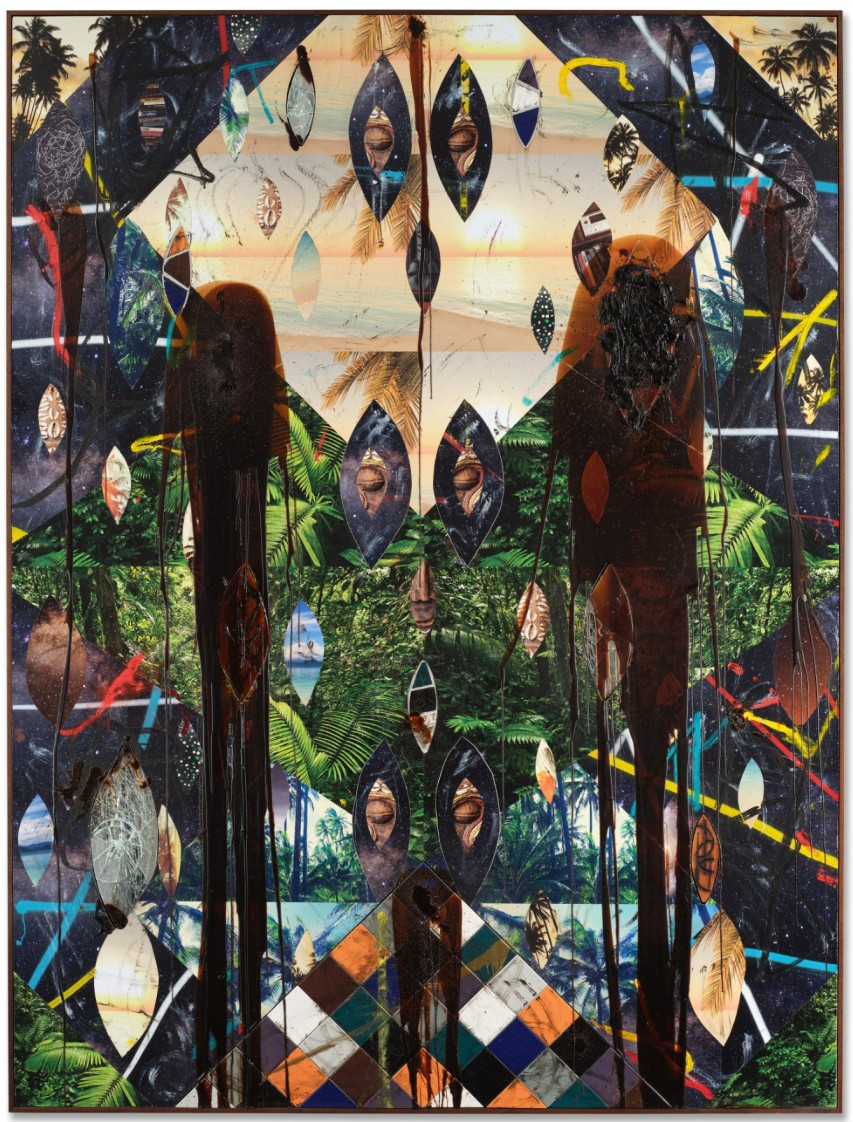
RASHID JOHNSON (b. 1977)
Untitled Escape Collage, 2018
Ceramic tile, mirror, branded red oak flooring, vinyl, spray enamel, oilstick, black soap and wax in artist’s frame
97 1/8 x 73 1/4 inches (246.7 x 186.1 cm)
Signed (on the reverse)
#5. Untitled Anxious Men, 2016
Christie’s New-York: 20 November 2025
Estimated: USD 250,000 – 350,000
USD 279,400
RASHID JOHNSON (B. 1977), Untitled Anxious Men | Christie’s
RASHID JOHNSON (B. 1977)
Untitled Anxious Men, 2016
Black soap and wax on ceramic tiles
47 1/8 x 34 1/4 inches (119.7 x 87 cm)
#6. The Clown, 2011
Sotheby’s New-York: 19 November 2025
Estimated: USD 80,000 – 120,000
USD 90,300
Rashid Johnson Modern & Contemporary Art Day Sale, Afternoon Session
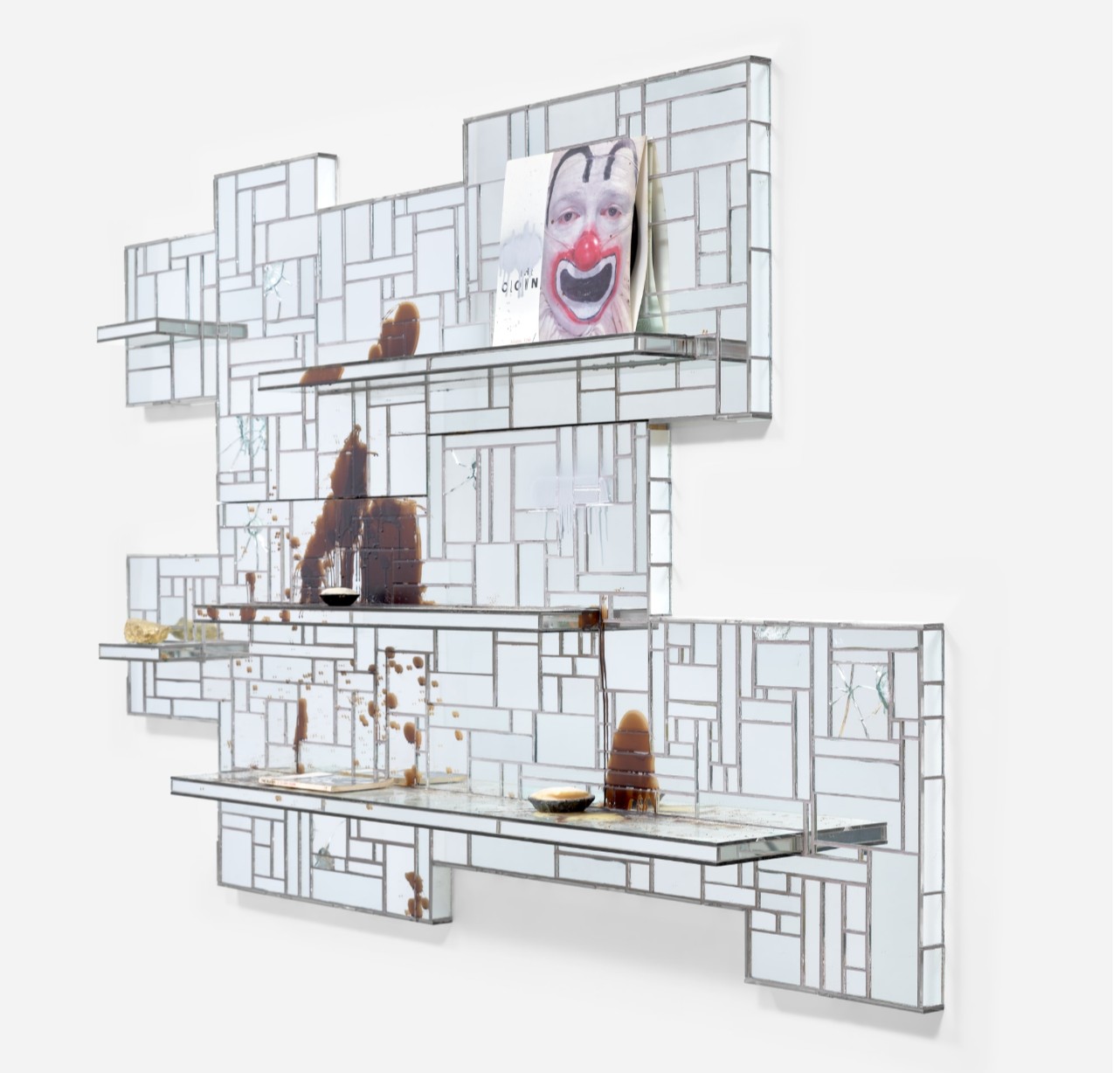
Mirrored tile, black soap, wax, vinyl, book, shea butter and space rock
52 1/2 x 76 1/2 x 9 inches (133.4 x 194.3 x 22.9 cm)
Large Anxious Red, 2021
Sotheby’s New-York: 19 November 2025
Estimated: USD 30,000 – 40,000
USD 76,200
EDITION PRINT
Large Anxious Red | Contemporary Day Auction | 2025 | Sotheby’s
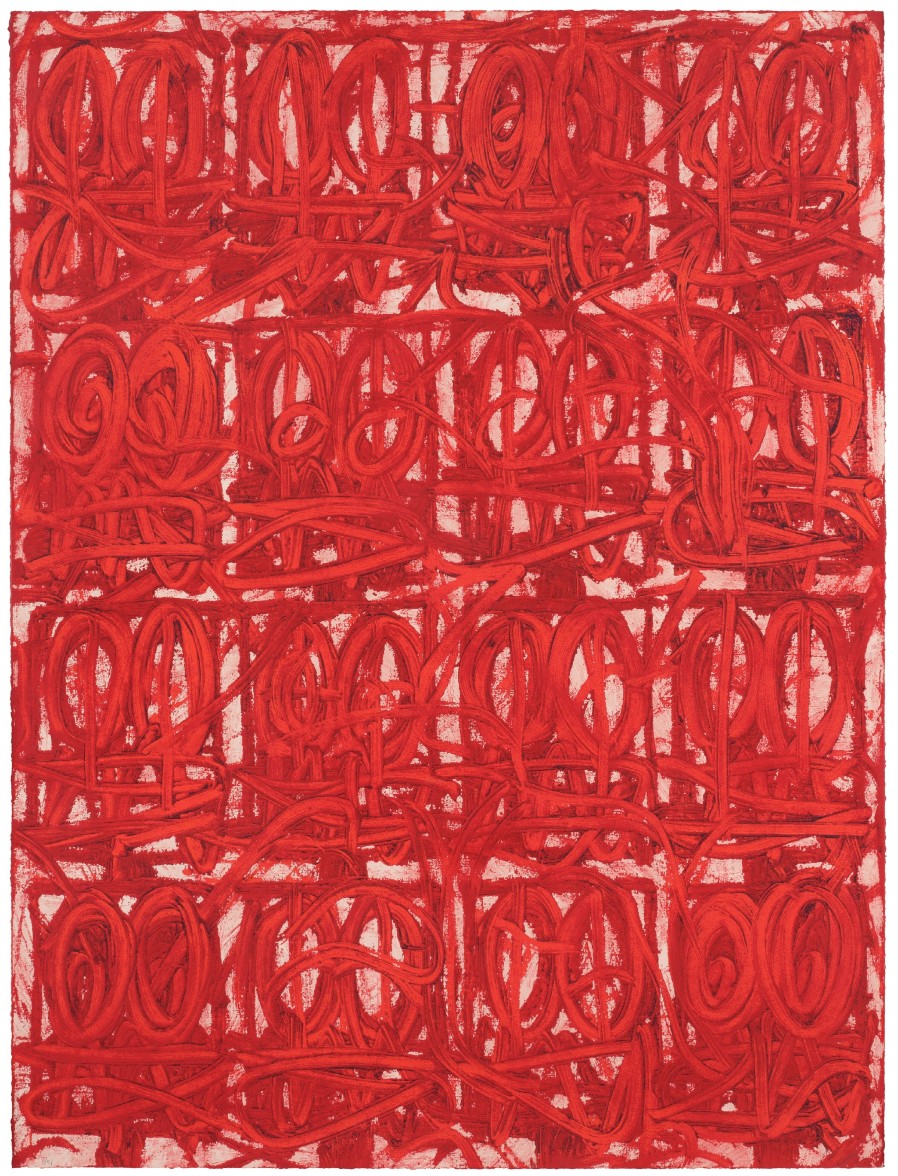
RASHID JOHNSON (b. 1977)
Large Anxious Red, 2021
Screenprint in red with hand applied resist
Sheet: 47 7/8 x 36 inches (121.6 x 91.4 cm)
Signed (lower right)
Numbered 8/51 (lower left)
This impression is number 8 from the edition of 51 plus 15 artist’s proofs
Adrian Ghenie
PLEASE CLICK ON THE PICTURE BELOW TO ACCESS AUCTION MARKET OVERVIEW

Boogeyman, 2010
Elaine: The Collection of Elaine Wynn
Christie’s New-York: 19 November 2025
Estimated: USD 2,500,000 – 3,500,000
USD 2,637,000
ADRIAN GHENIE (B. 1977), Boogeyman | Christie’s
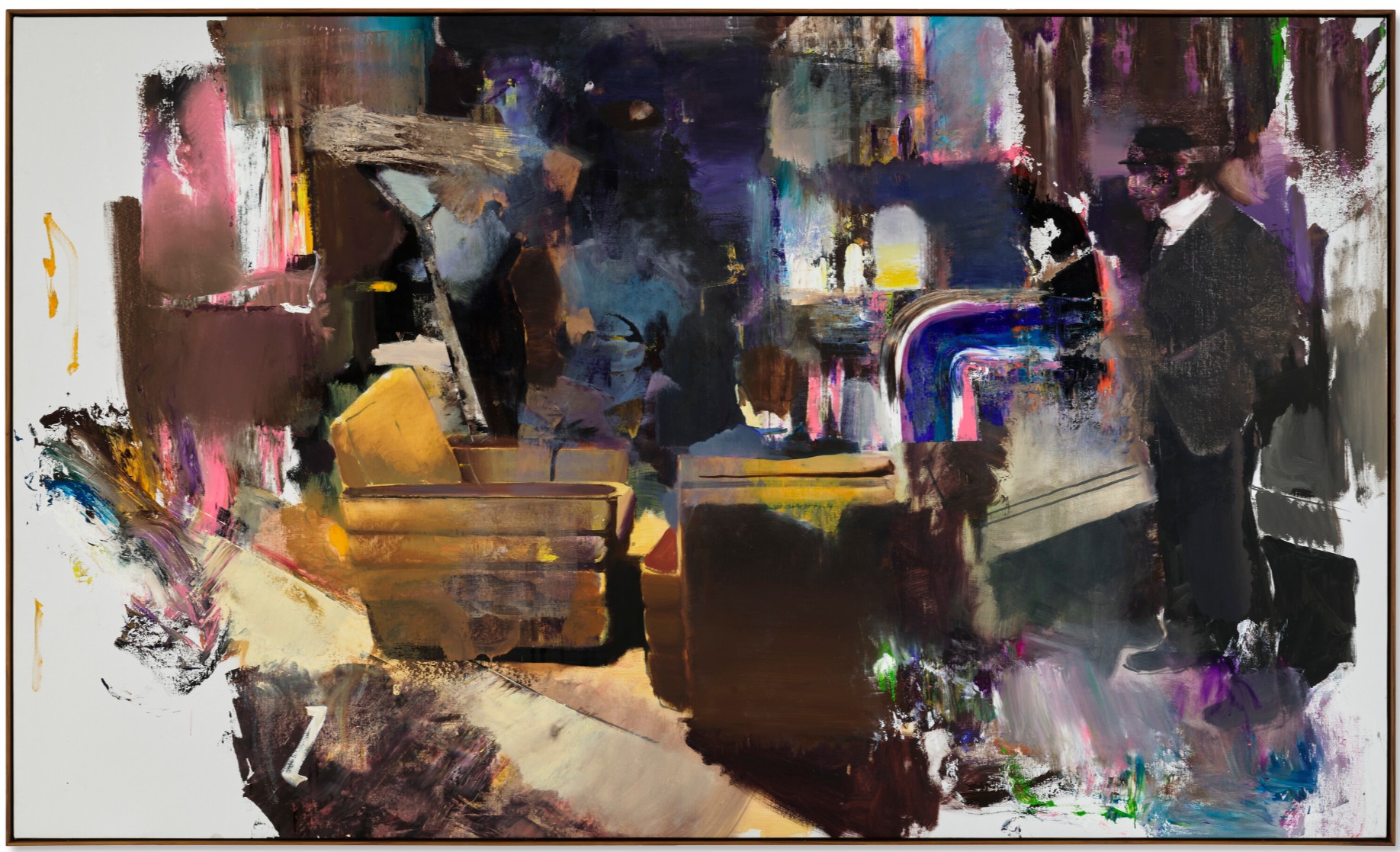
ADRIAN GHENIE (B. 1977)
Boogeyman, 2010
Oil on canvas
200×335 cm (79 3/4 x 131 7/8 inches)
Signed and dated ‘Ghenie 2010’ (on the reverse)
The protagonist of Adrian Ghenie’s Boogeyman (2010) hovers ominously at the edge of a monumental canvas more than three meters in width. From folklore to modern horror, the elusive, eldritch Boogeyman—muse of Goya’s Los Caprichos, villain of Stephen King’s short story and Ulli Lommel’s classic 1980 film—has long haunted art, literature and film. Ghenie transposes the mythical, spectral monster who preys on disobedient children into a Magritte-esque Everyman. His gaze is directed towards a second figure—a cipher for the artist—who sits in a large yellow armchair with his back to the viewer. The room emerges like a fragment of memory, as solid walls give way to abstract swathes and flicks of paint which don’t quite reach the edges of the vast canvas. Ghenie was born in Romania in 1977 and grew up under the regime of Nicolae Ceaușescu: an echo of that repression is felt in the sense of surveillance which shrouds the uncanny scene. Part of a cycle of works first exhibited collectively and titled The Visitation, the present work draws on both historical events and the history of art to evoke a rich intertextual tableau. Boogeyman dates to a seminal period in Ghenie’s career, executed the year following his first solo museum exhibition at the National Museum of Contemporary Art, Bucharest.
Ghenie painted The Visitation cycle shortly following his completion of The Dada Room, the first of his celebrated ‘room within a room’ installations, now held in the collection of Stedelijk Museum voor Actuele Kunst, Ghent. Mining the eerie annals of art history, The Dada Room looked to images of the First International Dada Fair, held in 1920 in the Berlin gallery of Dr. Otto Burchard. Ghenie, who lives and works in Berlin, conflated the exhibition space with that of the artist’s studio, sketching and daubing paint directly onto the walls in an effect reminiscent of Francis Bacon’s fabled, paint-encrusted studio. Like an artistic palimpsest, Boogeyman appears in conversation with The Dada Room, the latter’s hovering, uniformed mannequin—itself a reprisal of John Heartfield and Rudolf Schlichter’s Prussian Archangel, similarly suspended in the 1920 exhibition—transposed into the Boogeyman’s lurking, suited figure. Likewise, the two armchairs which furnished The Dada Room have been replaced by two matching yellow models, copied from a 1980s German furniture catalogue ordered by Ghenie’s mother. Layering found images and his own pictorial archive, in Boogeyman Ghenie engages with the history of representation to present a vital new visual idiom.
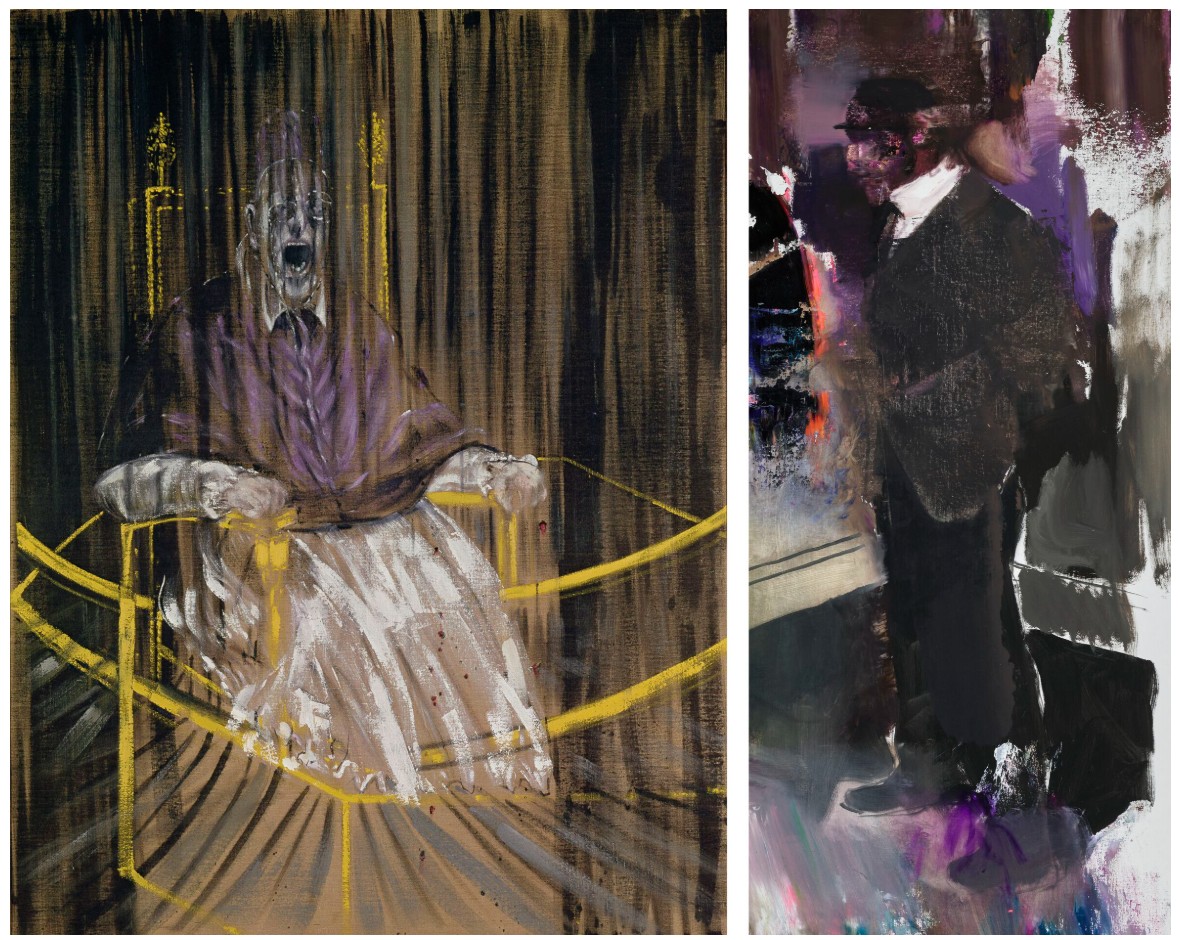
Left: Francis Bacon, Study after Velazquez’s Portrait of Pope Innocent X, 1953. Des Moines Art Center. © The Estate of Francis Bacon. All rights reserved / DACS, London / ARS, NY 2025.
Right: Present lot illustrated (detail).
The quivering surfaces of Ghenie’s paintings reveal his concern with the construction of images, and the aesthetic language of many of his works from this time is indebted to the use of preparatory collages. Boogeyman’s collage study both clarifies and distorts the details of the scene, revealing a nebulous figure who stands cloaked in darkness in front of the artist, the sheen of his suit emerging from the half-light. This is not the biblical visitation of good news but its shadowy opposite. In the painting, Ghenie maintained a collage-like sensibility, carefully layering form, color and texture to create a dynamic, mesmeric surface. In places, masking tape was used to layer paint on paint, later pulled back to reveal crisp edges, like those of cut paper. Like Gerhard Richter, Ghenie scraped paint across the canvas to create blurred distortions, interrupting and semi-veiling the surface of the image. These abstract passages flicker like the glitching, fragmented warp of a weak television signal, bursting across the canvas in electric, neon hues.
Rembrandt van Rijn, De Nachtwacht, 1642. Rijksmuseum, Amsterdam.
As a student at the art academy in his native Cluj, Ghenie’s teachers were abstract painters enamored with the gestural canvases of American Abstract Expressionism. Privately, Ghenie was drawn to a more traditional academic lineage, and worked from textbooks to make copies of paintings by Rembrandt and Titian. He was inspired by the latter’s building up of the picture plane through thin, semi-transparent layers, conscious of how an underlayer of one pigment could act like a lightbox, altering the color of the upper layer. Ghenie employed a similar technique in Boogeyman, whose shifting, layered images emerge and dissolve into abstraction as the eye roams the vast canvas. It bursts into numinous, Rothko-like pools of color, with deep, twilight tones of blue and purple giving way to brilliant flashes of pink, orange, and teal. Paint comes alive, spreading gesturally towards the edges of the canvas—which it cannot quite reach—and threatening to subsume the very illusion it has revealed.
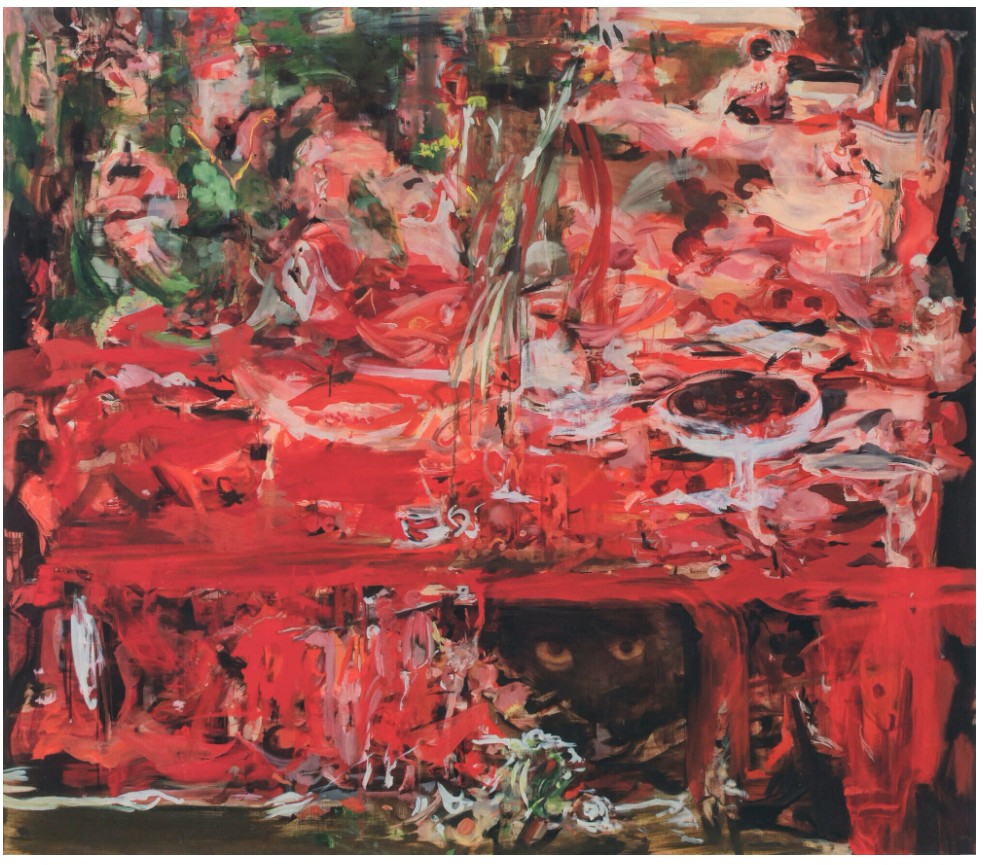
Cecily Brown, Lobsters, Oysters, Cherries, and Pearls, 2020. Private Collection. © Cecily Brown
In Ghenie’s painting, the extra wide format, dramatic play of light and shadow, and immersive, film-like perspective imparts a distinctly cinematic quality. Ghenie is particularly inspired by David Lynch, whose series Twin Peaks aired on Romanian television in the early 1990s and was formative for Ghenie’s later practice.
“I think consciously and unconsciously I want to master in painting what Lynch has done in cinema. It was with Lynch that I started to build the visual language of my paintings.”
Along with the scene itself, the head of the suited Boogeyman in Ghenie’s painting threatens to dissolve into abstraction, like the nightmarish, screaming heads of Francis Bacon. Drawing the viewer into a visual reverie, with Boogeyman the artist delights in the history and artifice of painting. Concerned above all with the “texture of history,” it was visceral works such as this which established Ghenie as one of the leading painters of his generation, revealing the dark currents which pulse through collective memory.
Matthew Wong
PLEASE CLICK ON THE PICTURE BELOW TO ACCESS AUCTION MARKET OVERVIEW

The Gentle Sea, 2017
Sotheby’s New-York: 18 November 2025
Estimated: USD 1,200,000 – 1,800,000
USD 2,368,000
The Gentle Sea | The Now & Contemporary Evening Auction | 2025 | Sotheby’s
MATTHEW WONG (1984 – 2019)
The Gentle Sea, 2017
Oil on canvas
40×30 inches (101.6 x 76.2 cm)
Signed and dated 2017 in Chinese (on the reverse)
Titled (on the reverse)
The sky, sand and obsidian oceanscape feel utterly interminable in The Gentle Sea by Matthew Wong, the vulnerable yet incendiary canvas in which dusk erupts in technicolor. His nocturne rhapsody unfolds in indulgent oils: jade green, marigold and vermilion descend into the laps of a shore-bound couple—a sweet departure from the unaccompanied figures that typically wander his resplendent forests, lakes and fields, which here find companionship. Stroke after obsessive stroke, the late artist painted through pain, constructing not only a canvas but a world of his own, one that could keep up with the speed of his genius.
Today, his paintings grace the collections of prestigious international institutions, including the Dallas Museum of Art, Texas; The Metropolitan Museum of Art, New York; Museum of Modern Art, New York; Solomon R. Guggenheim Museum, New York; and the Art Gallery of Ontario, and he was recently honored with a major retrospective exhibition in 2023-24 organized by the Museum of Fine Arts, Boston entitled The Realm of Appearances. For Wong, the clairvoyant voice of his generation, art was a lifeline, and in The Gentle Sea, the surface safeguards that irrepressible energy, palpable and forever alive.
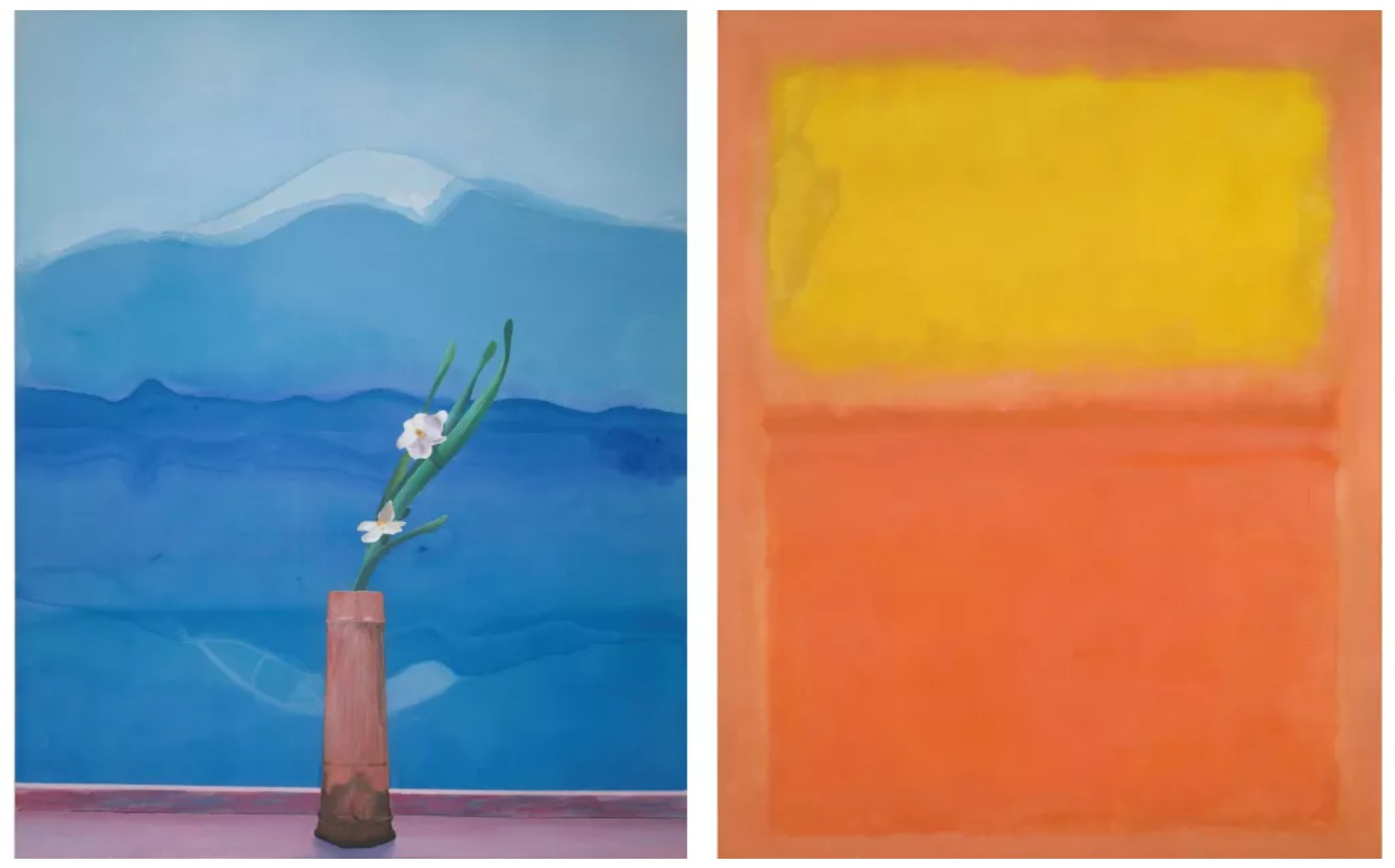
Left: David Hockney, Mount Fuji and Flowers, 1972. The Metropolitan Museum of Art, New York. Image © The Metropolitan Museum of Art. Art © 2025 David Hockney. Right: Mark Rothko, Orange and Yellow, 1956. Buffalo AKG Art Museum. Image © Buffalo AKG Art Museum / Art Resource, NY. Art © 1998 Kate Rothko Prizel & Christopher Rothko / Artists Rights Society (ARS), New York Image
The onlookers watch the sun sink into the horizon, their viewer left only to project onto their quiet admiration. Here, the pair enjoys not only Wong’s oasis but the extraordinary diversity of his facture. Rich, generous strokes comprise a resplendently saturated sunset, a nebulously planar sea and sand stippled with staggering precision. The weight and plasticity of paint lend the present work a sense of vertiginous tenuity: “Wong bent perspectival space to fit his own emotional coördinates, and he allowed discrete categories to dissolve into dream dialectics: what is inside might be outside, or the other way around. Trees take on the shape of leaves; forests take on the appearance of folkloric embroidery. But it is also possible to ignore the representational elements and receive the images as pure abstraction. He applied paint urgently, in divergent gestures—thick impasto beside mesmerizing pattern work, or even areas with no paint at all—that cohered in an unsteady harmony.” (Raffi Khatchadourian, “Matthew Wong’s Life in Light and Shadow,” The New Yorker, 9 May 2022 (online))

Such recognition and reappraisal of form and space suspend his canvases in a headier, galactic realm, allowing many miracles to take place on one surface: peace and chaos, solitude and camaraderie, psychology and psychedelia. Wong’s images make the eyes greedier and needier, desperate in the face of Wong’s painterly riches.
Vincent van Gogh, Wheatfield with Crows, 1890. Van Gogh Museum, Amsterdam. Image © Bridgeman Images
The Gentle Sea also boasts Wong’s incredible art historical literacy. He drops his viewer into the midst of an enigmatic narrative, summoning Peter Doig’s sparkling, chimerical dreamscapes, the patchwork brushwork of Gustav Klimt and the rattling dynamism of Vincent van Gogh. Wong was self-taught, and he proved himself an incredible teacher: the work is thoroughly informed, threading together Instagram and Facebook-culled influences with an inimitable instinct for invention. Wong’s love of art was nurtured by a love of John Coltrane’s free jazz, John Ashbery’s poetry, Ocean Vuong’s prose and William Eggleston’s photographs. Early exposure to Julian Schnabel, Christopher Wool and traditional Chinese ink drawings consumed with equal measures of fastidiousness and ferocity shaped the tenor of his artistic vernacular. Gallery:ectory of his career, however, changed when John Cheim, an early champion of his work, introduced him to Matthew Higgs of White Columns and Brendan Dugan, the founder of Karma Gallery; from there, his growth was astronomical. Living with autism, depression and Tourette’s, he largely nurtured his relationships online, and in paint he channeled his energy and reconciled his disparate ties to China, Hong Kong, New York and Toronto. Though he painted for only seven years before tragically taking his life in 2019, those seven years produced a vast and richly textured body of work—one that truly defended paint to be infallible.
Peter Doig, Daytime Astronomy (Grasshopper), 1998-99. Private Collection.
Sold at Sotheby’s London in June 2018 for £7.7 million. Art © 2025 Artists Rights Society (ARS), New York
“I do believe there is an inherent loneliness or melancholy to much of contemporary life, and on a broader level I feel my work speaks to this quality in addition to being a reflection of my thoughts, fascinations and impulses.”
The canvases that came from grappling with this observation reflect the late artist’s thoughtful menagerie of hope, peril and incomparable imagination, all anchored to and alloyed by the bittersweet reality of existence. In the face of The Gentle Sea, one makes peace with the known and unknown, encouraged, gently, to see and think in deeper and more sensitive ways.
Orange Twilight, 2018
Sotheby’s New-York: 19 November 2025
Estimated: USD 120,000 – 180,000
USD 228,600
WORK ON PAPER
Orange Twilight | Contemporary Day Auction | 2025 | Sotheby’s
MATTHEW WONG (1984 – 2019)
Orange Twilight, 2018
Gouache and watercolor on paper
18×24 inches (45.7 x 61 cm)
Signed and dated 2018 in Chinese (on the verso)
Titled (on the verso)
Hernan Bas
PLEASE CLICK ON THE PICTURE BELOW TO ACCESS AUCTION MARKET OVERVIEW
The Hero Centaur, 2005
Christie’s New-York: 20 November 2025
Estimated: USD 80,000 – 120,000
USD 165,100
HERNAN BAS (B. 1978), The Hero Centaur | Christie’s
HERNAN BAS (B. 1978)
The Hero Centaur, 2005
Oil on panel
36×48 inches (91×122 cm)
Signed with the artist’s initials and dated “HB 05” (lower left)
Signed with the artist’s initials again
Titled and dated again “THE HERO CENTAUR HB 05” (on the reverse)
That Path, So Scary, 2007
Phillips New-York: 21 November 2025
Estimated: USD 50,000 – 70,000
USD 49,020
Hernan Bas Modern & Contemporary Art Day Sale, Afternoon Session
Mixed media on canvas over panel
20×16 inches (50.8 x 40.6 cm)
Signed with the artist’s initials, titled and dated “that path, so scary HB 07” on the reverse
Lynette Yiadom-Boakye
PLEASE CLICK ON THE PICTURE BELOW TO ACCESS AUCTION MARKET OVERVIEW
#1. Periodical, 2006
Property from a Distinguished Danish Collection
Christie’s New-York: 20 November 2025
Estimated: USD 400,000 – 600,000
USD 673,100
LYNETTE YIADOM-BOAKYE (B. 1977), Periodical | Christie’s
LYNETTE YIADOM-BOAKYE (B. 1977)
Periodical, 2006
Oil on canvas
96×74 inches (244×188 cm)
Signed and dated ‘Lynette Yiadom-Boakye 2006’ (on the reverse)
“Yiadom-Boakye’s paintings feature an almost exclusively black pantheon of fictive figures that are in equal measure dark and luminous, rendered without disegno-that underlayer of drawing common to traditional paintings-so that they look, as one critic rightly recognized, improvised and effortless, even virtuoso.”
Elena Filipovic
(“A Sovereignty of Quiet,” in Lynette Yiadom-Boakye: Under-Song for a Cipher, New York 2017, p. 12).
John Singer Sargent, La Carmencita (Carmen Dauset Moreno), circa 1890
#2. Curlew, 2010
Phillips New-York: 21 November 2025
Estimated: USD 100,000 – 150,000
USD 167,100
Lynette Yiadom-Boakye Modern & Contemporary Art Day Sale, Afternoon Session
LYNETTE YIADOM-BOAKYE
Curlew, 2010
Oil on canvas
21 5/8 x 16 inches (54.9 x 40.6 cm)
Titled and dated “2010 Curlew” on the reverse
Obelisk, 2005
Sotheby’s New-York: 19 November 2025
Estimated: USD 600,000 – 800,000
PASSED
Obelisk | Contemporary Day Auction | 2025 | Sotheby’s
LYNETTE YIADOM-BOAKYE (b. 1977)
Obelisk, 2005
Oil on canvas
95 3/4 x 77 inches (243.3 x 195.5 cm)
Signed, titled and dated 2005 (on the reverse)
Signed (on the stretcher)
Monumental in its stillness and enigmatic in atmosphere, Obelisk from 2005 exemplifies Lynette Yiadom-Boakye’s gift for conjuring presence through painterly restraint. Towering at over two meters, the canvas commands attention not with spectacle but with silence, the figure emerging from shadow in muted earth tones, poised between monument and apparition. At once intimate and grand, the work demonstrates the artist’s singular ability to imbue invented subjects with a gravitas that feels both timeless and immediate. Executed in 2005, Obelisk belongs to a pivotal moment in Yiadom-Boakye’s trajectory, just after her graduation from the Royal Academy Schools in London. At this early stage she had already turned away from portraiture in the traditional sense, instead inventing her figures from memory and imagination. In Obelisk, this strategy manifests in a sitter who is neither an individual likeness nor a narrative character, but an emblem of interiority and endurance.
“I work from scrapbooks, I work from images I collect, I work from life a little bit, I seek out the imagery I need. I take photos. All of that is then composed on the canvas.”
JOHN SINGER SARGENT, MADAME X (MADAME PIERRE GAUTREAU), 1883-1884.
IMAGE © Metropolitan Museum of Art / BRIDGEMAN IMAGES
The chromatic register is subdued yet richly modulated. Deep umbers, blacks, and ochres saturate the surface, while subtle passages of light animate the figure into being. Brushwork is confident but unshowy, activating negative space so that surrounding darkness becomes charged with psychological weight. Obelisk captures this paradox with commanding force. Within Yiadom-Boakye’s oeuvre, Obelisk anticipates the compositional ambition and contemplative gravity of her later masterworks. It is a painting that achieves monumentality not through narrative or spectacle, but through the quiet assertion of presence. In its commanding scale, tonal richness, and enigmatic poise, Obelisk stands as one of the most compelling achievements of Yiadom-Boakye’s early career, a formative statement of the painterly voice that would soon propel her onto the international stage.
CONTEMPORARY ART
Maurizio Cattelan
America, 2016
Sotheby’s New-York: 18 November 2025
Estimate upon Request
America | The Now & Contemporary Evening Auction | 2025 | Sotheby’s
MAURIZIO CATTELAN (b. 1960)
America, 2016
101.2 kg of 18-karat gold
18 1/4 x 14 3/4 x 25 inches (46.4 x 37.5 x 63.5 cm)
This work is number 2 from an edition of 3 plus 2 artist’s proofs
If art is upheld, as it often is, as a mirror of our time, perhaps no artist has exposed the individual and collective truths of life today as ruthlessly as Maurizio Cattelan. Since the late 1980s, across sculpture, installation, performance—even disappearance—Cattelan has produced an oeuvre that trumps reality up to its absolute ceiling, nimbly darting between deadpan candor, morbid abjection and ironic vulnerability. In angling his way toward the essence of our humanity, Cattelan has proven provocation to be an artform unto itself, a spirit that reached its apex when he announced his early retirement in 2011.
The final estimate and starting bid will be determined by the sell price of gold from OANDA at 5:00PM EST on 18 November.
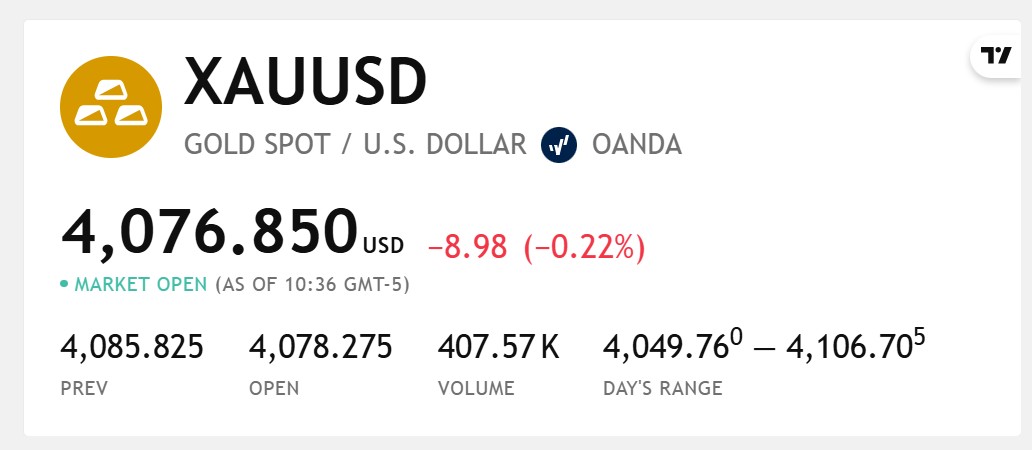
Yet it was five years after his self-abdication from the art world that Cattelan proffered his ultimate appraisal of the contemporary condition, one that handed the world its reflection in the beautiful, damning and uncompromising mirrored surface of an 18-karat toilet basin: America. Executed in 2016 in an edition of 3 plus 2 artist’s proofs, the work is welded from just over 100 kilograms of solid gold, first installed in a fully functioning single-stall bathroom in the Solomon R. Guggenheim Museum in New York, where over the course of a year more than 100,000 visitors waited, often for hours at a time, to make use of it.
“I actually think that reality is far more provocative than my art … I just take it; I’m always borrowing pieces—crumbs, really—of everyday reality.”
Then came the heist, in which an edition of America was torn from the walls of Blenheim Palace and prompted investigative pandemonium. At every juncture, America—much like its conceptual forefather, Marcel Duchamp’s Fountain—has been championed, scandalized and credited with fostering a revolutionary discourse on what art should mean and what that meaning is worth. Today, however, with the value of art scrutinized at every turn, America constitutes a kind of checkmate, opposing even Cattelan’s most caustic adversaries with the absolute objectivity of its value.
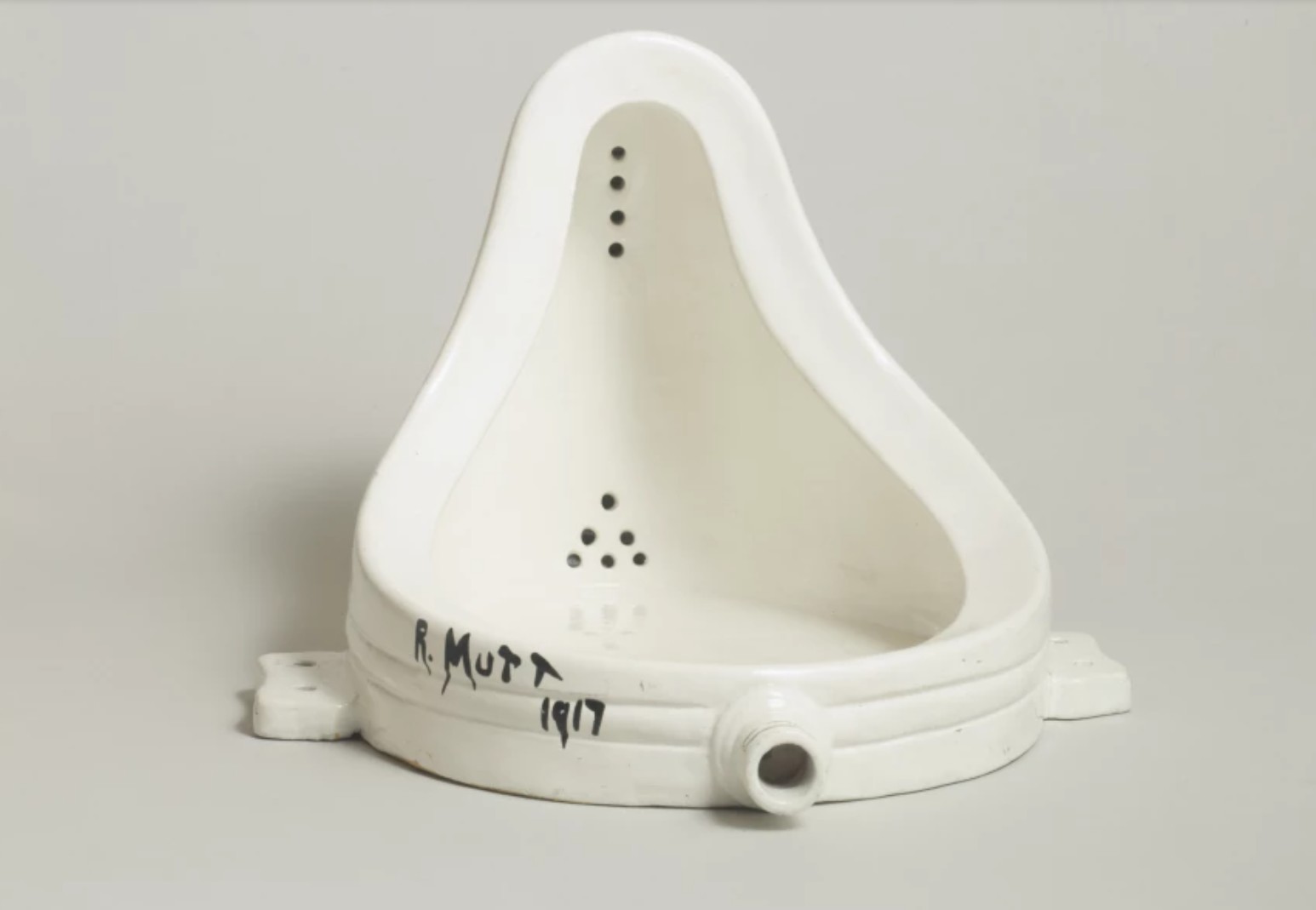
Marcel Duchamp, Fountain, 1950 (replica of 1917 original). Philadelphia Museum of Art. Image © Jerry L. Thompson / Art Resource, NY. Art © 2025 Artists Rights Society (ARS), New York / ADAGP, Paris / Estate of Marcel Duchamp
In 2011 Cattelan announced his exit from artmaking as the Guggenheim mounted Maurizio Cattelan: All, the artist’s infamous career retrospective that saw nearly every work he had created to that point hung from the museum’s rotunda. But just as his early conceptual work Torno Subito promised, Cattelan would, in fact, be back soon, and five years later, he crept out of retirement at the very site it began—with America in the Guggenheim’s fifth floor lavatory. Its debut was explosive; the queue alone was a spectacle in its own right, culminating in the utter intimacy of a guard-enforced, five minute-long conference with America. Following its viral yearlong installation, America was exhibited in Blenheim Palace in Oxfordshire, where it was fitted in Winston Churchill’s former restroom as part of a larger presentation of Cattelan’s work.
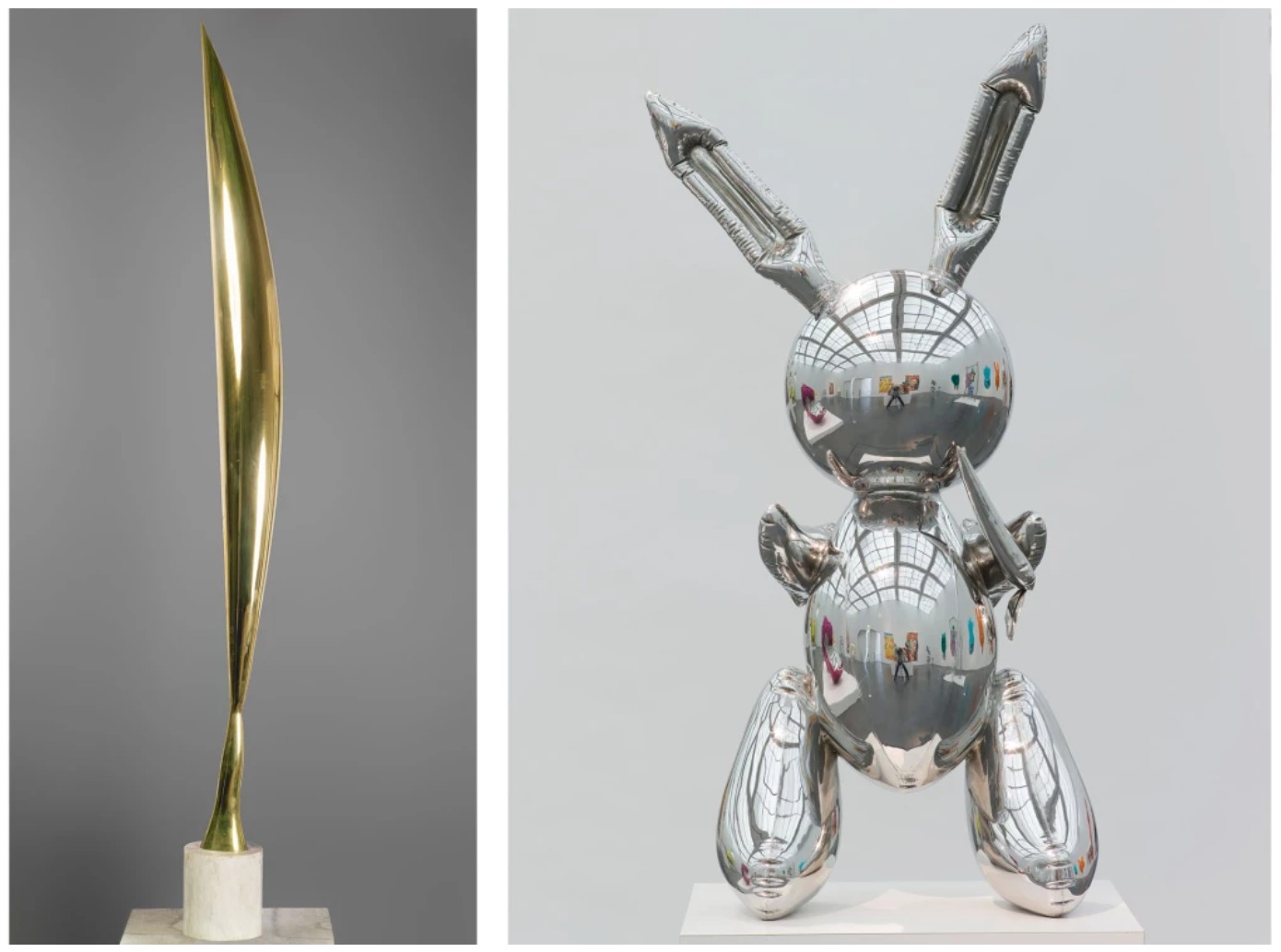
Left: Constantin Brâncuși, The Bird in Space, 1941. Musée National d’Art Moderne, Paris. Image © Bridgeman Images. Art © Succession Brâncuși- All rights reserved (ARS) 2025.
Right: Jeff Koons, Rabbit, 1986. Museum of Contemporary Art Chicago. Art © 2025 Jeff Koons
On 14 September 2019, however, five burglars broke in and ripped the work from its pipes. The theft prompted obsessive media coverage and continues to make headlines: earlier this year, the men involved were charged, but the piece itself has yet to be recovered—it is assumed to have been melted down. Ironically, in the exhibition catalogue for Maurizio Cattelan: All, produced prior to the robbery at Blenheim Palace, Nancy Spector observes: “as theft and escape go hand-in-hand, the two became the performative pillars of his early practice.” (Nancy Spector, “The Aesthetics of Failure,” in: Exh. Cat., Solomon R. Guggenheim Museum, Maurizio Cattelan: All, Ed. 2, 2016, p. 35) Thus, America’s fate further complicates what is already a loaded object: whether one interprets it as an act of divine comedy, or a Faustian bargain in which Cattelan’s return came at the karmic sacrifice of one of his own works.
Cattelan’s homecoming at the Guggenheim didn’t stand alone as an isolated stint. By staging his return in the bathroom of one of New York’s most respected museums, Cattelan continued a long personal tradition of institutional critique: from installing thousands of taxidermied pigeons in the atrium of the Venice Biennale’s Italian pavilion to exhibiting an artist’s stolen work as his own, Cattelan routinely accepts invitations into such vaunted galleries only to upset their standards of what is shown—and how. Here, he removes America from the walls that sanction its status as art, shuttering it in the only space one wouldn’t expect to encounter any art at all. Away from plinths and pedestals, vitrines and velvet rope, America infiltrates the sanctity of the museum, slipping through its side doors to wreak havoc from the inside. Taking his act of insubordination further still, America is left incomplete without activation: to be fully realized, it must be used, further disrupting our notion of how to “properly” engage with an art object. Cattelan’s installation thus suggests his art—and the perception of truth, history and value it contends with—are never where you expect.
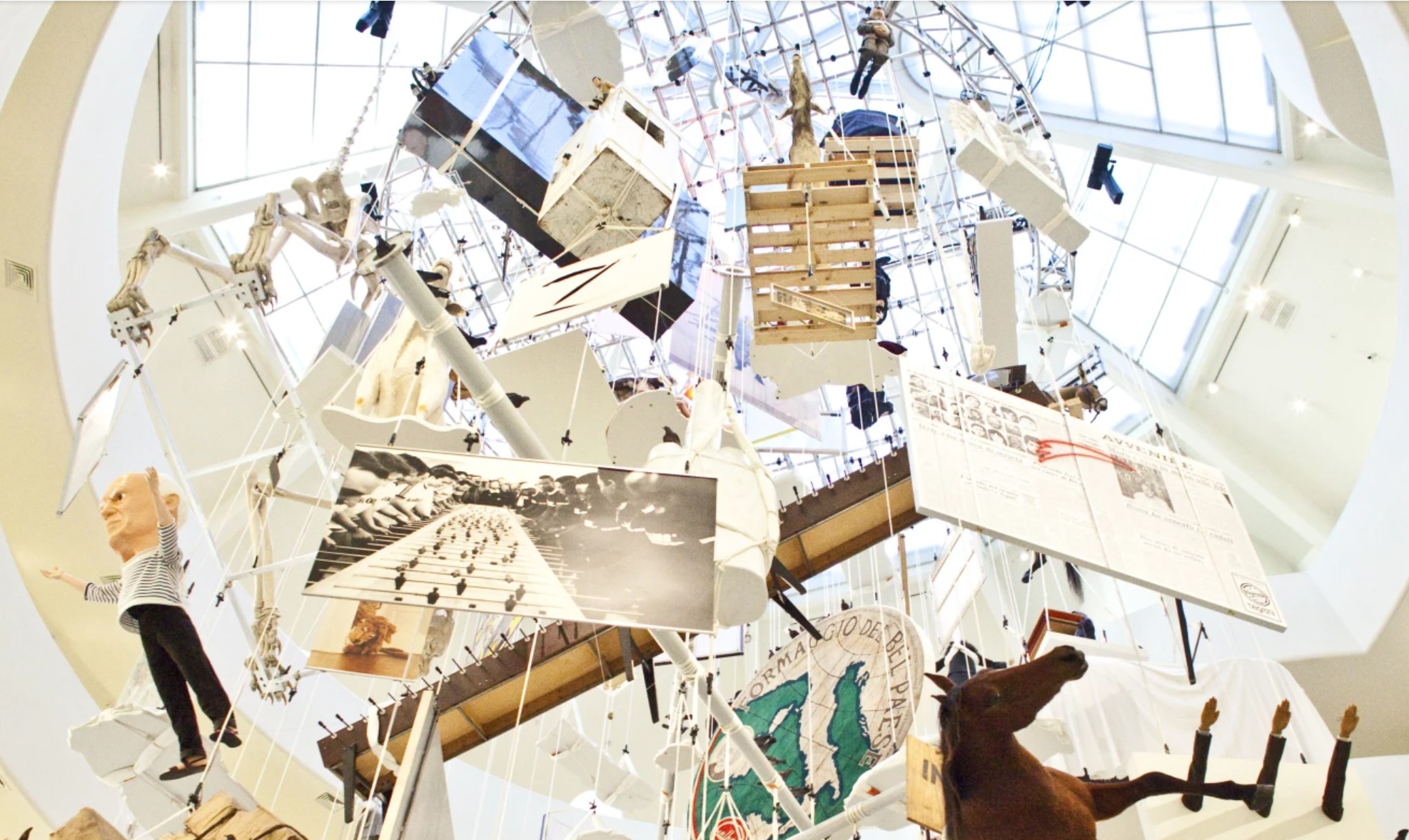
Installation view of Maurizio Cattelan: All at the Solomon R. Guggenheim Museum, New York, November 2011 – January 2012. Photo by Ramin Talaie/Corbis via Getty Images. Art © 2024 Maurizio Cattelan
For all his stunts of self-deprecation and iconoclastic spirit—”I am not an artist,” he said in conversation with Nancy Spector in 1999 (the artist quoted in: Francesco Bonami, Nancy Spector and Massimiliano Gioni, Maurizio Cattelan, 2003, p. 9)—Cattelan is a learned, impressive art historian. In form and concept, America plumbs the decades-long legacy of intellectual upheaval, from Marcel Duchamp’s readymade, Piero Manzoni’s parody of artistic creation, to Jeff Koons’s deification of the banal. America’s inherently participatory character recalls the spirit of the Fluxus movement, collapsing real and absurd, artwork and object, creator and user to the point of indistinction. Its medium—one that blatantly contradicts its function—also lends America a neo-Surrealist bent, in which appliance and expectation are unsettled. Like Meret Oppenheimer and her Object (Luncheon in Fur) or Magritte’s plain declaration of the deceit of painting in The Treachery of Images, Cattelan’s toilet stands as if to say, or, at the very least, prompt his viewer to think, “This is not a toilet.”
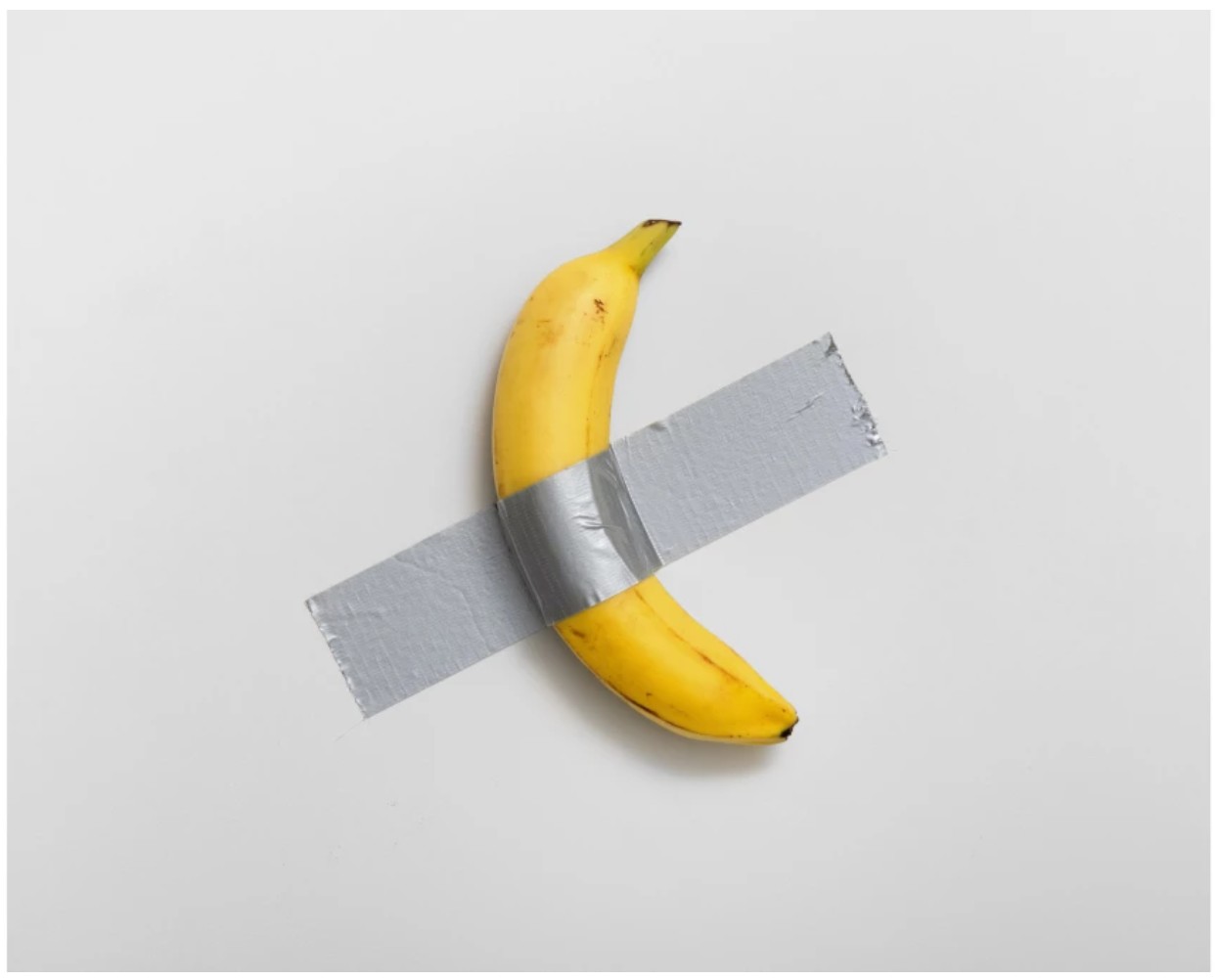
Maurizio Cattelan, Comedian, 2019. Private Collection.
Sold at Sotheby’s New York in November 2024 for $6.2 million. Art © 2025 Maurizio Cattelan
The two chief influences that dominate, however, are Duchamp’s urinal and Manzoni’s Merda d’artista, the latter of which were originally priced at their weight in gold. Nancy Spector interprets Manzoni’s piece as an “investigation of the artist’s relation to their own means of production and the collision between aesthetic value and exchange value. By ironically denying the separation between artist and artwork, Manzoni demystified the explicitly modernist belief that artistic labor is nonalienated labor. He recognized that the aesthetic object—and, by extension, the famous artist—became, like anything else in the postwar, capitalist economy, a reified commodity. With his golden toilet, Cattelan brings another element to the equation: the viewer.” (Nancy Spector, “Coda—Redux,” in: Exh. Cat., Solomon R. Guggenheim Museum, Maurizio Cattelan: All, Ed. 2, 2016, pp. 139-40)
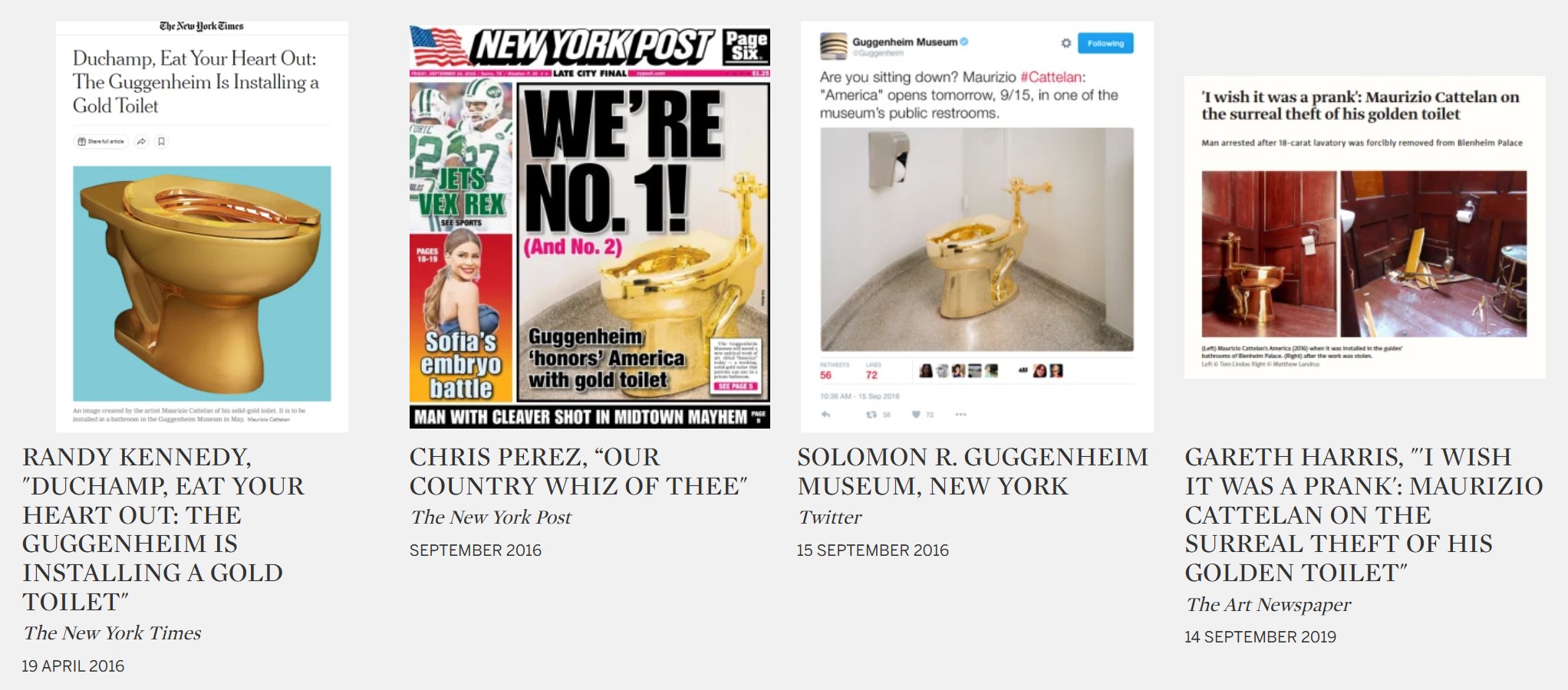
With his audience top of mind, Cattelan resurrects voices of the canonical past, pinching technical and theoretical devices to engineer weapons of mass disruption. He is acutely aware that the salon that immortalized Édouard Manet’s Olympia through its outrage is no longer, and that today’s jury is composed not only of academics, critics and philosophers but now the internet and market, too. With the readymade fully assimilated into the artistic norm and found objects readily welcomed as art, Cattelan, in a winking Duchampian gesture, subverts the foundations of Duchamp’s most radical artistic contribution, painstakingly fabricating a Kohler toilet in gold to create an artwork that is ready for use.
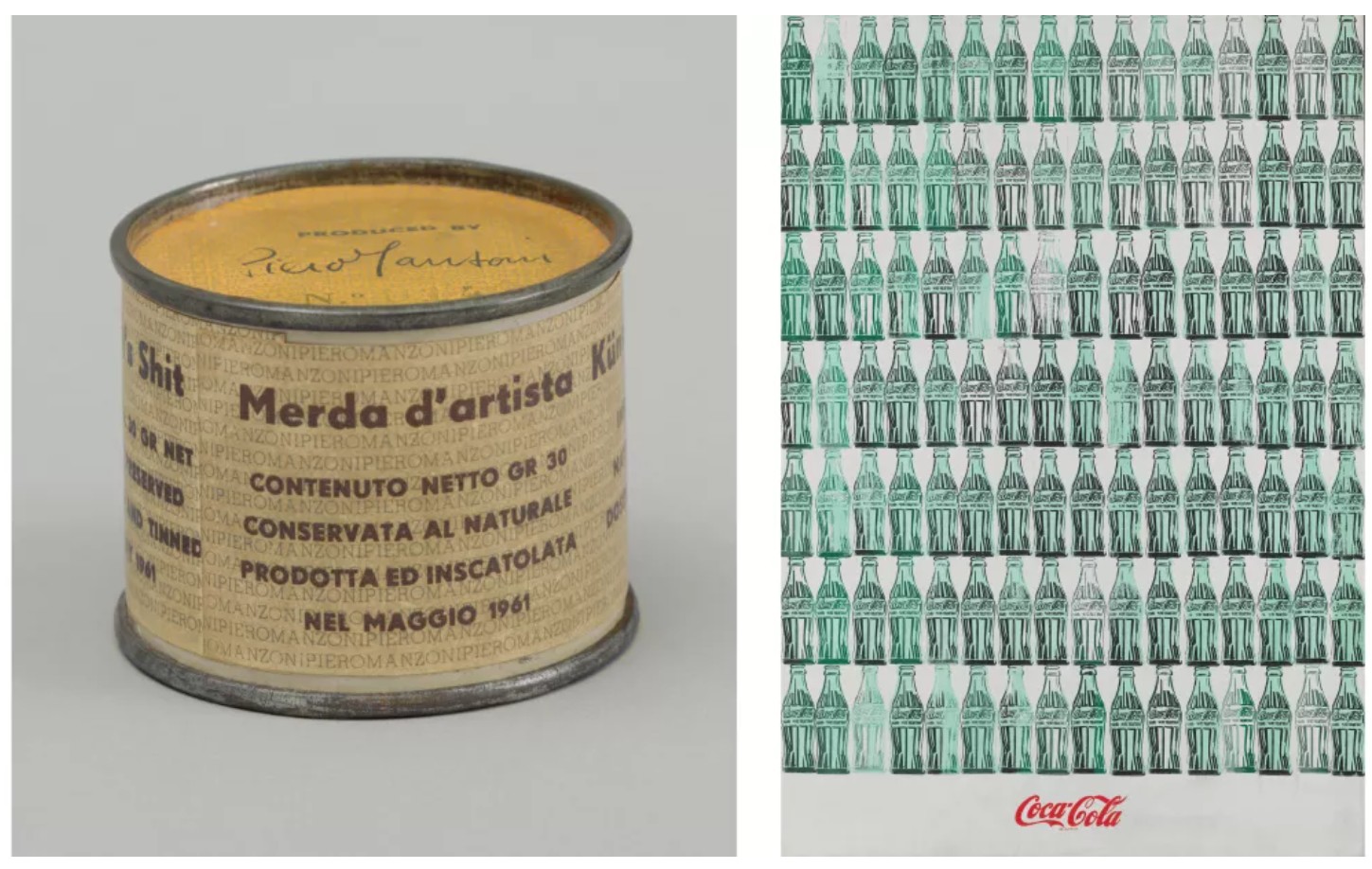
Left: Piero Manzoni, Artist’s Shit No. 014, 1961. Museum of Modern Art, New York. Image © The Museum of Modern Art / Licensed by SCALA / Art Resource, NY. Art © 2025 Artists Rights Society (ARS), New York / SIAE, Rome. Right: Andy Warhol, Green Coca-Cola Bottles, 1962. Whitney Museum of American Art, New York. Image © Whitney Museum of American Art / Licensed by SCALA / Art Resource, NY
Cattelan’s America is not only witty, incisive and unrelenting in its unraveling of artistic and conceptual paradigms: it is completely spellbinding in its uncanny beauty. From the unalloyed purity of its composition to the incandescence of its shimmering contours, Cattelan’s faithful reproduction of this familiar form transforms the toilet into treasure. Before America, one is transfixed in the face of such an astounding volume of solid, radiant gold and the dancing optical effects of its reflections around it. “The sculpture really looks its best when in use,” Randy Kennedy wrote following his visit to the Guggenheim, “sparkling so much it’s almost too bright to look at, especially during the flush, which may be a new postmodern sublime.” (Randy Kennedy, “An 18-Karat Throne Arrives at the Guggenheim. And Yes, It Works.” The New York Times, 15 September 2016 (online))
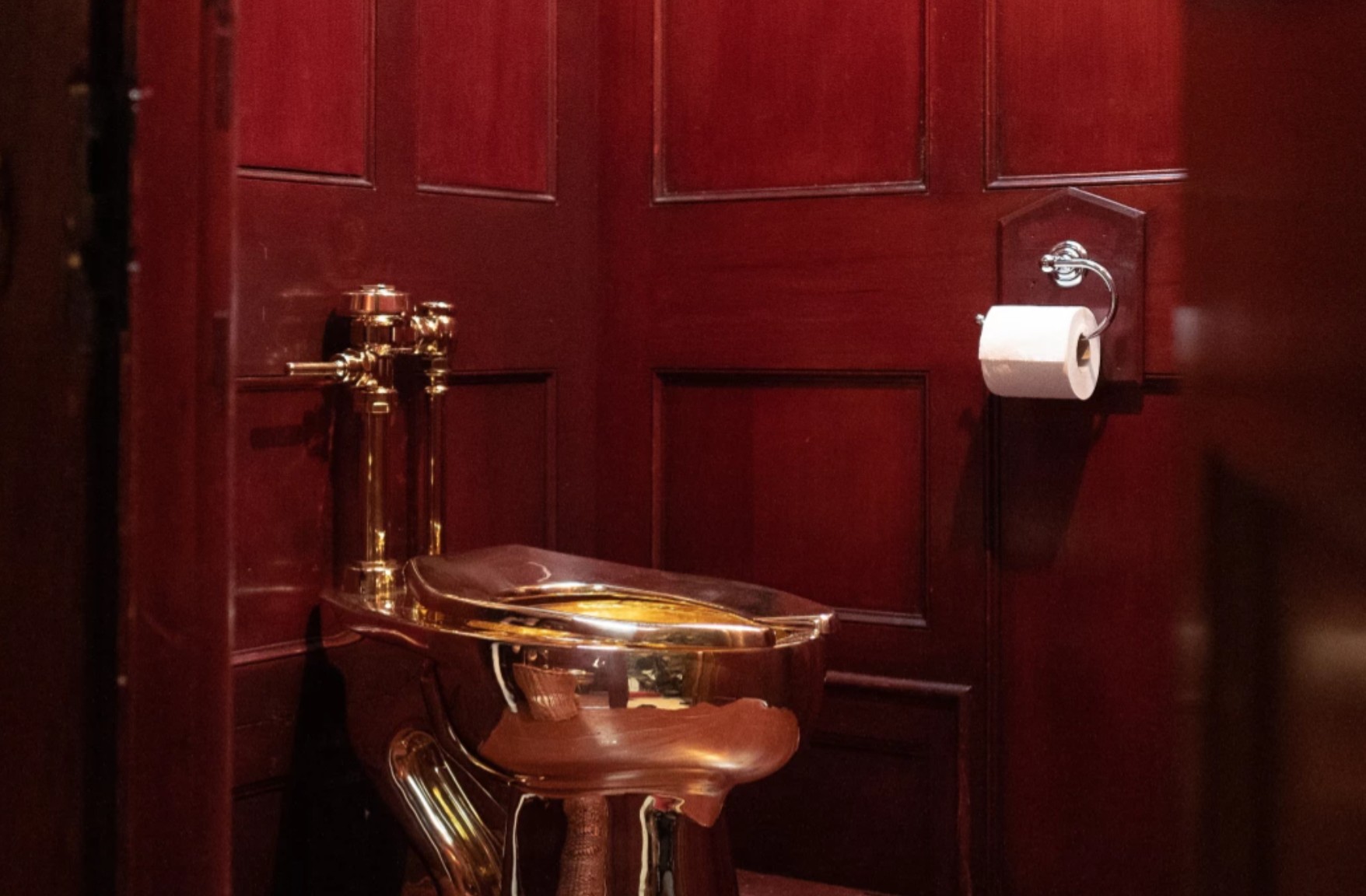
An edition of the present work installed at Blenheim Palace, the site of its theft, in 2019. Photo by Leon Neal / Getty Images. Art © 2025 Maurizio Cattelan
Cattelan’s ability to acutely choreograph this collision between banality and divinity is thanks to his complete technical mastery. Long fascinated with imitation and hyperreality, Cattelan renders each valve and pipe with thorough, exacting precision. The resulting form calls to mind the sleek Modernist clarity of Constantin Brancusi’s Bird in Space, as well as the polished rotundity of Jeff Koons’ Rabbit, the latter of which—like Cattelan’s America—idolizes the everyday object through its meticulous reimagination of it. Just as Koons obsessively captures the balloon animal’s every pucker and crease in the gleaming solidity of stainless steel, lending his unheroic subject a distinctly heroic character, so, too, does Cattelan repurpose this strategy for his own ends. Here, America’s conceptual heft is met by its own majesty.
Meret Oppenheim, Object, 1936. Museum of Modern Art, New York. Image © The Museum of Modern Art / Licensed by SCALA / Art Resource, NY. Art © 2025 Artists Rights Society (ARS), New York / Pro Litteris, Zurich
Of course, there is also the transparency of America’s concrete value. While gold’s intrinsic and infallible merits are heralded as the ultimate form of security, art, on the other hand, “is something sentimentally termed priceless,” Peter Schjedahl wrote after the $450 million dollar sale of Leonardo’s Salvator Mundi, “But anything is priceless until someone sells it. Then there may be a clatter of the tote board for related items, pegging numbers up or down. The purely subjective rating of art works, which are all but devoid of material value, encounters no rational financial limit in either direction.” (Peter Schjeldahl, “Market Value,” The New Yorker in: Peter Schjeldahl, Hot, Cold, Heavy, Light, 100 Art Writings, 1988–2018, New York 2019, p. 341) America, then, proves to be the exception: its value is literally as good as gold. If Comedian, Cattelan’s conceptual work comprised of a duct-taped banana, possesses no intrinsic value on account of its media, then America presents as its foil: a glittering, gluttonous mass of precious metal. Where Comedian is ephemeral, America is dense and physical; where Comedian is mundane, America is inconceivably opulent—yet together, the two works undermine the same question of how artistic value is determined and rewarded, destabilizing these assumptions from both ends.
René Magritte, The Treachery of Images, 1929. Los Angeles County Museum of Art. Image © Bridgeman Images. Art © 2025 C. Herscovici, Brussels / Artists Rights Society (ARS), New York
In America, Cattelan coronates gold’s historic venerative applications only to depose the roots of their original association. Egyptian sarcophagi, Medieval illuminated manuscripts and Renaissance altarpieces all invoke the use of gold to signal deference to the holy, royal and deceased, and public monuments are gilded to affirm our social contract with modern civilization. Cattelan’s solid gold toilet decisively breaks with such traditions, not only encouraging but necessitating its own bastardization by nature of its unapologetic utility. Glowing like an icon, retrofitted like a throne, America sardonically literalizes Vladimir Lenin’s proclamation for the proletariat: “When we are victorious on a world scale I think we shall use gold for the purpose of building public lavatories in the streets of some of the largest cities of the world.” (Vladimir Lenin quoted in: David Skvirskyx, ed., Lenin: Collected Works, Vol. 33, Moscow, 1973, p. 113) At the heart of America lies a democratic ideal—one simultaneously crude and equalizing—Cattelan having described it as ”one-percent art for the ninety-nine percent.” (the artist quoted in: Merrit Kennedy, “Behold The Throne: There’s A Golden Toilet At The Guggenheim,” NPR, 15 September 2016 (online)) Behind locked doors, America extends the opportunity to come close to an object of extraordinary decadence in the most intimate space of all, all the while satirizing the very excess of the art world that sustains its existence—a world that not only tolerates but delights in the possibility of a solid gold toilet to begin with.
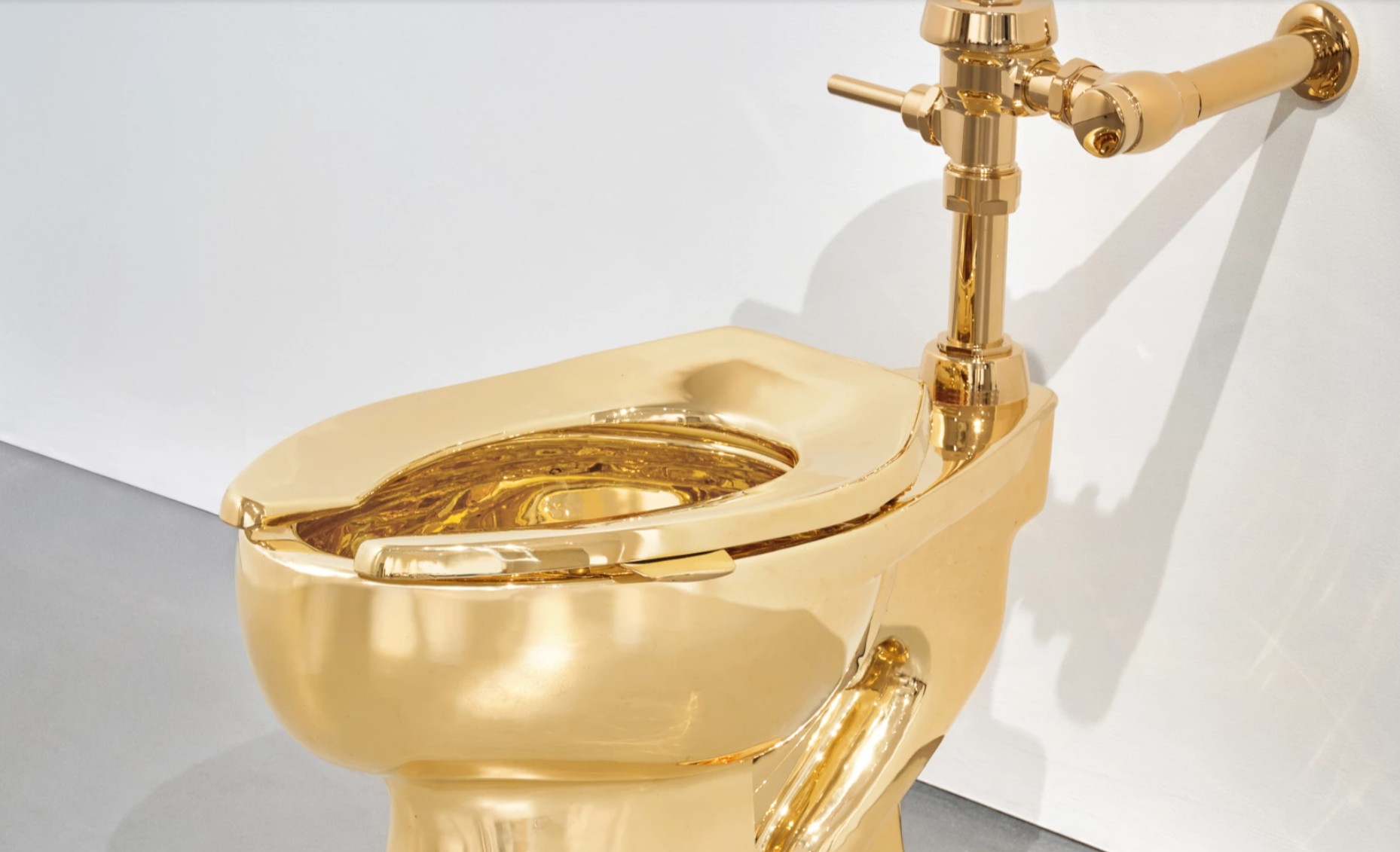
America wipes the slate of precedent, taste and decency clean, flushing the burdensome mess of artistic expectation down its sparkling drain. Playing the shrewd art world Robin Hood, Cattelan liberates art from the realm of the sacred to give it to secular ground. Almost exactly a century after Marcel Duchamp presented Fountain to the Society of Independent Artists, America proves there is still more truth to be found, hysteria to be instigated, corners of society and culture to be interrogated. Everything here is literal: the toilet is operational, the gold is solid and America is whatever you think it is, so long as you really mean it.
Untitled, 2007
Property from the Irma and Norman Braman Art Foundation
Christie’s New-York: 19 November 2025
Estimated: USD 800,000 – 1,200,000
MAURIZIO CATTELAN (B. 1960), Untitled | Christie’s
MAURIZIO CATTELAN (B. 1960)
Untitled, 2007
Resin, paint, human hair, clothing, packing tissue, wood and screws
92 3/8 x 54 3/8 x 20 7/8 inches (234.6 x 138.1 x 53 cm)
This work is number one from an edition of three plus two artist’s proofs
The emotive figure that is the subject of Maurizio Cattelan’s Untitled makes this work one of his most provocative. Infused with a conceptual depth that is typical of his best work, the artist’s composition offers up multiple readings. Suspended with her arms outstretched, the figure is reminiscent of a crucifixion, a staple of art history, yet dressed in a nightshirt and restrained by her hands and feet. One of the Cattelan’s most celebrated sculptures, the present work was exhibited at the Menil Collection in 2010, while others from the edition have been exhibited at the Solomon R. Guggenheim Museum in New York in 2011–2012; Kunsthaus Zurich 2012; and Warsaw, Center for Contemporary Art, 2012–2013.
Francesca Woodman, Untitled, Rome, 1977-1978. © 2025 Woodman Family Foundation / Artists Rights Society (ARS), New York.
The origins of the present work can be found in a photograph by the artist Francesca Woodman. In Untitled, Rome, Italy (1977-78), the artist pictures herself dressed in a similar loose-fitting nightshirt and hanging by her hands from a doorway. Cattelan was struck by the incongruous nature of the image and proceeded to produce a three-dimensional sculpture based on the image.
Installation view, Maurizio Cattelan, Synagoge Stommeln, Germany. February 2008 (present lot illustrated).
Photo: Rolf Vennenbernd via Alamy.
The Italian artist’s work was first exhibited as a free-hanging sculpture at the Kunsthaus Bregenz, however it underwent a radical transformation when the artist saw it lying face down in its packing case. Pinned down by the hands and feet with wooden restraints, the figure was ostentatiously protected from harm, yet also appeared to be tortuously imprisoned or even crucified. Cattelan, as ever open to playful innovation, decided to leave the work in this constrained, surreal state. The sculpture was first shown this more powerful form affixed to the side of a synagogue in Pulheim-Stommeln, Germany. In this sense, Cattelan presented her both as a packaged object and transfigured as a martyr.
Installation view, Maurizio Cattelan, Kunsthaus Bregenz, February 2008 (present lot illustrated). © Maurizio Cattelan.
“What interests me is some images’ inner power to stick in your mind permanently. This impact is inextricably linked to influence—the more impact you can create, the more influence you have. I’m fascinated by the ability to make things go viral: it feels like the closest we could get to having a human superpower.”
From his suspended horses (Novecento, 1997) and inverted police officers (Frank and Jamie, 2002) to La Nona Ora (1999), a sculpture of a meteor-struck Pope John Paul II, which was exhibited alongside the present work in Milan’s Palazzo Reale in 2010, his works have become immediately recognizable.
Left: Salvador Dali, Crucifixion (Corpus Hypercubus), 1954. Metropolitan Museum of Art, New York. © 2025 Salvador Dalí, Fundació Gala-Salvador Dalí / Artists Rights Society (ARS), New York.
Right: Ana Mendieta, Silueta Works in Mexico, 1973-1977. © 2025 The Estate of Ana Mendieta Collection, LLC. Courtesy Galerie Lelong & Co. / Licensed by Artists Rights Society (ARS), New York.
“I actually think that reality is far more provocative than my art. I just take it; I’m always borrowing pieces—crumbs really—of everyday reality. If you think my work is provocative, it means that reality is extremely provocative, and we just don’t react to it. Maybe we no longer pay attention to the way we live in the world….We are anesthetized.”
Yet, Cattelan has long refused the title of artist provocateur. Claiming only to hold up a mirror to society.
Untitled, 1997
Edlis Neeson Collection
Christie’s New-York: 20 November 2025
Estimated: USD 400,000 – 600,000
MAURIZIO CATTELAN (B. 1960), Untitled | Christie’s
MAURIZIO CATTELAN (B. 1960)
Untitled, 1997
Dog skeleton and Le Monde newspaper
16 1/8 x 13 x 23 1/2 inches (40.9 x 33 x 58.7 cm)
This work is one of three unique variants
Elizabeth Peyton
PLEASE CLICK ON THE PICTURE BELOW TO ACCESS AUCTION MARKET OVERVIEW
#1. Kurt, 1995
Property from an Esteemed Private Collection
Christie’s New-York: 19 November 2025
Estimated: USD 2,000,000 – 3,000,000
USD 2,881,000
ELIZABETH PEYTON (B. 1965), Kurt | Christie’s
ELIZABETH PEYTON (B. 1965)
Kurt, 1995
Oil on canvas
24×19 inches (61 x 48.3 cm)
Signed, titled and dated ‘Kurt 1995 Elizabeth Peyton’ (on the reverse)
Elizabeth Peyton’s Kurt belongs to a much-celebrated series of portraits of the singer Kurt Cobain, the lead vocalist, guitarist, and songwriter for Nirvana—whom the artist had painted the year following his passing in 1994, at the age of just 27. His sudden death affected an entire generation of young fans who felt a close personal connection both to his uniquely authentic brand of music and his struggles with mental health and addiction. One of those who resonated with the power of music was Peyton herself.
“There’s something in music that fascinates me, how it communicates emotion so immediately. That’s something I wanted in my paintings.”
Kurt Cobain of Nirvana during the taping of MTV Unplugged at Sony Studios in New York City, 11/18/93.
Photo by Frank Micelotta via Alamy.
Peyton’s portraits of Kurt Cobain are filled with both beauty and pathos. Wearing a shirt made out of loosely fitting blue fabric, the singer’s delicate features are formed using the skillful movement of the artist’s fluid brushstrokes. The characteristic tussles of the singer’s blond hair appears to glow against the dark ground, as Peyton infuses the tips of his locks with golden highlights. Finally, the deep pools of blue for his downcast eyes and the bright red ‘pop’ of Cobain’s cherry red lips completes the intense yet intimate composition.
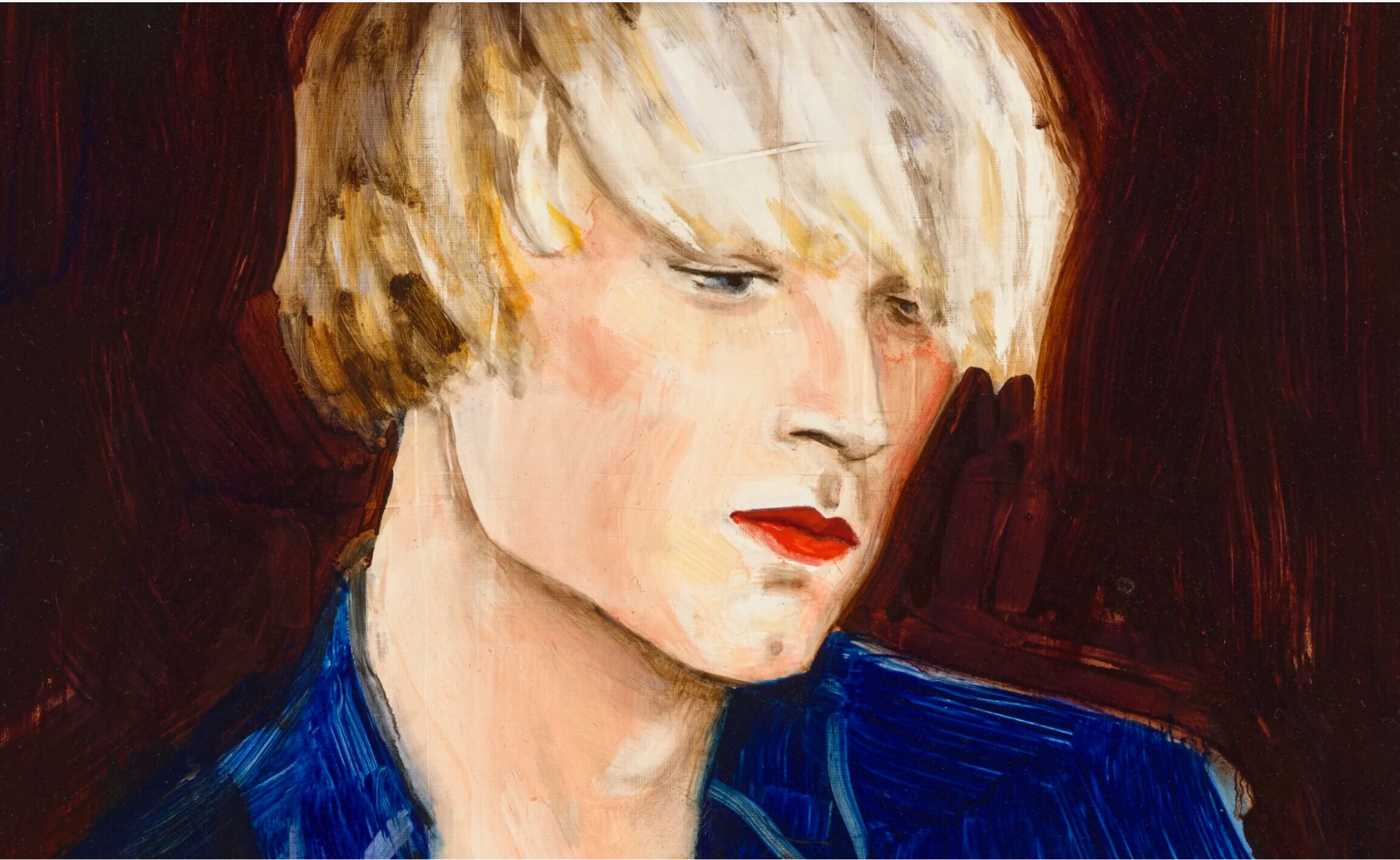
Human emotion and artistry have always been fundamental themes in Peyton’s work. Peyton produced Kurt ahead of her first solo exhibition at Gavin Brown’s enterprise. Within the intimate storefront space of the gallery, these expressions of emotional connection radiated intensely. This exhibition helped launch Peyton’s career and established the significance of her approach to figuration. Other paintings of the Nirvana lead singer included Zok’s Kurt, Alizerean Kurt, Blur Kurt, Kurt Sleeping, Kurt Smoking, and Blue Kurt. Created during a period when other artists rejected the painted portrait, Peyton’s work freshly rejuvenates the style. She employs the paint in a sensitive and expressive manner, not afraid to expose her painterly brush strokes. Her vibrant colors expose the underlying personal sentiments that exist between the artist and her subjects.
John Singer Sargent, Man Wearing Laurels, 1874-80. Los Angeles County Museum of Art.
Peyton’s rapidly applied, expressive brushstrokes that make up Cobain’s shirt evoke Willem de Kooning’s emotive abstract figures, while the degree of intimacy with which her figures are executed recalls the Renaissance portrait miniatures of Nicholas Hilliard. Furthermore, the angst and emotions that are apparent in Peyton’s work have drawn comparisons with the paintings of the Pre-Raphaelite Brotherhood.
Amadeo Modigliani, Jeanne Hébuterne with Yellow Sweater (Le sweater jaune), 1918-19, Guggenheim Museum, New York.
Elizabeth Peyton’s subjects find themselves inhabiting a magical space where many overlapping and divergent worlds coalesce. In her hands, the 90s-era aesthetic personified by the present work transcends time. Using heightened colors, intense and intimate detail and a votive-like approach to her subjects, Peyton has found a way to be both of her time and yet mystically of another time. Connected to an earlier, mythical and allegorical world, Kurt is infused with poetry and legend, and offers up a beautiful Romantic dream.
#2. Flowers, Lichtenstein, Parsifal, 2011
Christie’s New-York: 19 November 2025
Estimated: USD 500,000 – 700,000
USD 1,104,900
ELIZABETH PEYTON (B. 1965), Flowers, Lichtenstein, Parsifal | Christie’s
ELIZABETH PEYTON (B. 1965)
Flowers, Lichtenstein, Parsifal, 2011
Oil on panel
12 1/8 x 9 1/8 inches (30.5 x 23 cm)
Elizabeth Peyton has long explored the intersections between painting, music, and the emotional permanence that binds them.
“Making art is making something live forever. Painting and art is a way of holding onto things and making things go on through time.”
That enduring transmission of feeling is at the heart of Peyton’s practice, and nowhere is it more vividly expressed than in Flowers, Lichtenstein, Parsifal (2011). Here, the artist unites three central strands of her oeuvre—portraiture, still life, and art-historical homage—into a single, deeply resonant image.
Rachel Ruysch, Still Life with Rose Branch, Beetle, and Bee, 1741. Kunstmuseum, Basel.
Painted in preparation for her landmark 2011 exhibition at the Metropolitan Opera in New York, which coincided with their production of Wagner’s Ring Cycle, the work encapsulates Peyton’s fascination with the grand narratives and emotional intensity of opera. Immersing herself in Wagner’s music—what she describes as a “gigantic feat” of emotional storytelling—she sought to match its transcendence in paint.
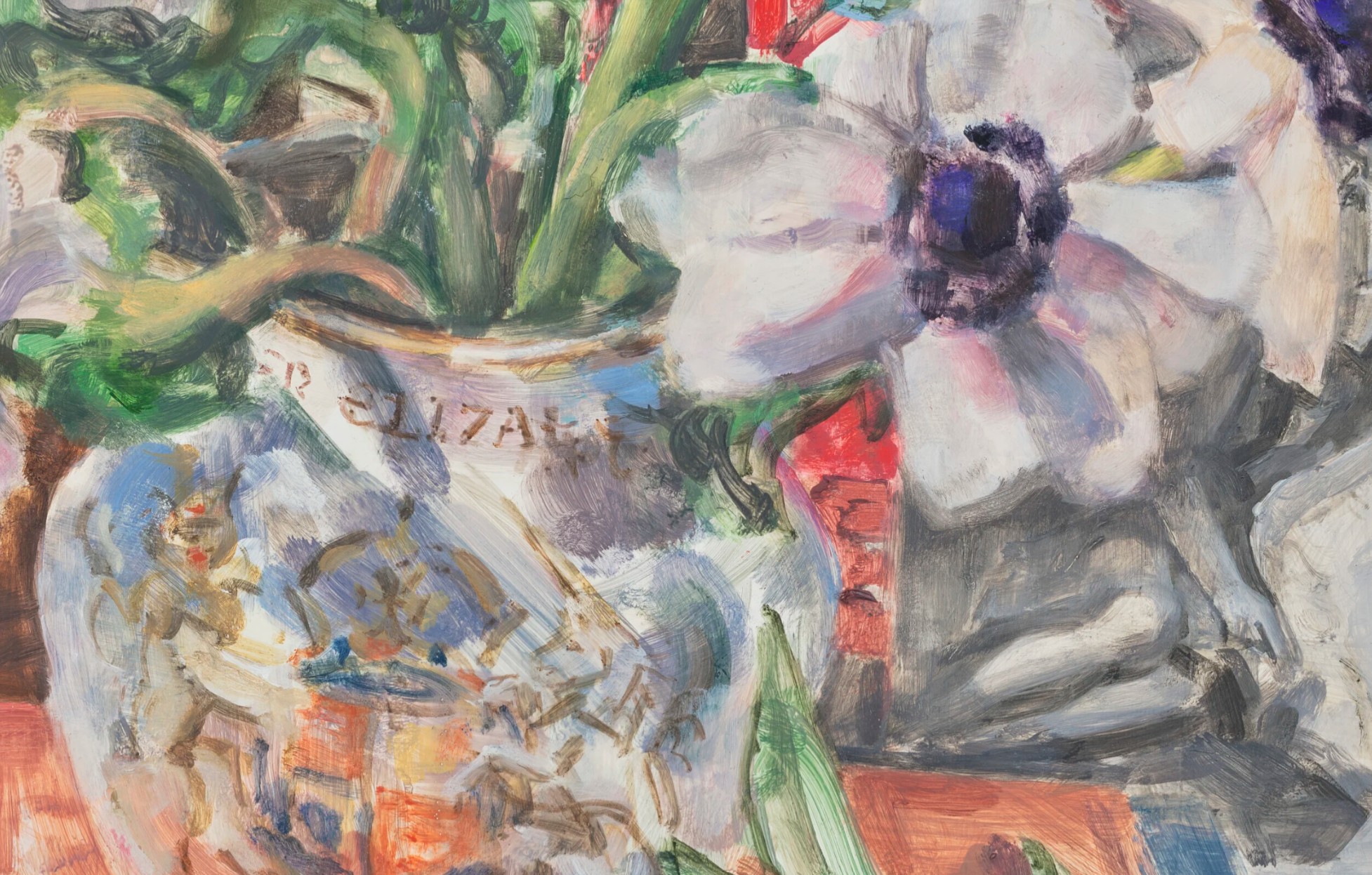
In this intimate composition, the program for Parsifal, Wagner’s final opera, stands behind a vase of lilac anemones, whose delicate petals evoke both the fleeting nature of beauty and the operatic themes of love and mortality. The vase itself bears the coat of arms of Queen Elizabeth II, a subtle nod to another of Peyton’s recurring subjects: royalty. Across her career, Peyton has portrayed monarchs and their family members with care and fascination. Here, only the word Elizabeth is visible—a wry, self-referential gesture that collapses the distance between artist and subject, painter and queen.
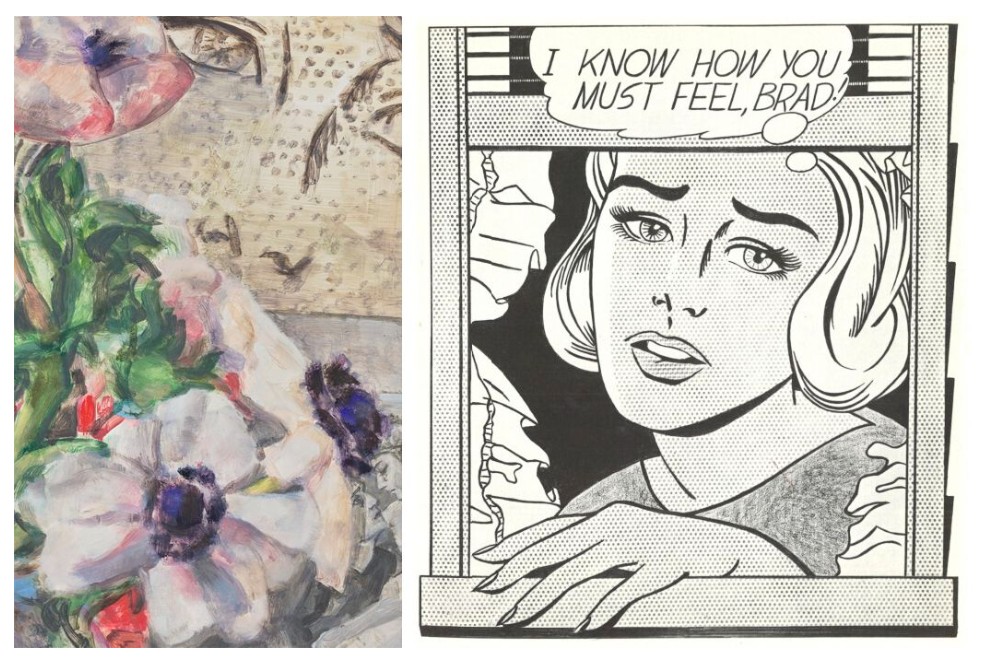
Left: Present lot illustrated (detail).
Right: Roy Lichtenstein, I KNOW HOW YOU MUST FEEL, BRAD!, 1963, Collection Mrs. Vera List, New York. © Estate of Roy Lichtenstein
Above, Peyton introduces a fragment of Roy Lichtenstein’s preparatory sketch for I Know How You Must Feel, Brad… (1964), its Ben-Day dots reimagined through her fluid, expressive hand. The Pop master’s graphic language, Wagner’s mythic narrative, and the lush vitality of the floral still life coexist within a single frame—a portrait of artistic inheritance and emotional communion. In Flowers, Lichtenstein, Parsifal, Peyton transcends genre and subject, creating a meditation on beauty, devotion, and the sustaining dialogue between art forms across time.
#3. Jonas Kaufmann, March 2013, NYC, 2013
Edlis Neeson Collection
Christie’s New-York: 20 November 2025
Estimated: USD 400,000 – 600,000
USD 952,500
ELIZABETH PEYTON (B. 1965), Jonas Kaufmann, March 2013, NYC | Christie’s
ELIZABETH PEYTON (B. 1965)
Jonas Kaufmann, March 2013, NYC, 2013
Oil on panel
23×18 inches (58.5 x 45.7 cm)
Signed, titled and dated ‘Jonas Kaufmann March 2013 NYC Elizabeth Peyton 2013’ (on the reverse)
Tony Reading (Silver Tony), 1999
Works from the Collection of Byron R. Meyer with Partial Proceeds
to Benefit the San Francisco Museum of Modern Art
Sotheby’s New-York: 19 November 2025
Estimated: USD 500,000 – 700,000
USD 457,200
Tony Reading (Silver Tony) | Contemporary Day Auction | 2025 | Sotheby’s
ELIZABETH PEYTON (b. 1965)
Tony Reading (Silver Tony), 1999
Oil on MDF
14 1/4 x 11 inches (36.2 x 27.9 cm)
Signed, titled, dated 1999 and inscribed Tony Just (age 30) (on the reverse)
Infused with luminous intimacy and painterly tenderness, Elizabeth Peyton’s Tony Reading (Silver Tony) from 1999 exemplifies the artist’s celebrated portraits of the late 1990s, a period that cemented her reputation as one of the most original figurative painters of her generation. Rendered in radiant oil on board, the work captures Tony Just—Peyton’s longtime muse and former partner—absorbed in the quiet act of reading. With its close-cropped composition, diaphanous brushwork, and jewel-like palette, the painting transforms an ordinary moment into a timeless meditation on beauty, presence, and the interiority of her sitters.
“Human beings are very avant-garde,
and are as worthy a contemporary subject as anything else.”
In Tony Reading (Silver Tony), Peyton depicts her subject in a downward pose, head bent and gaze directed toward the page. The angle denies full access to Tony’s features, yet his presence radiates through the curve of his hair, the tilt of his head, and the flush of red at his lips. Purple, silver, and pale lavender tones animate the composition, while quick strokes of white and brown catch the light across his clothing and hair. The book, rendered in flashes of crimson and cream, punctuates the canvas with vivid contrast, anchoring the sitter’s attention and ours. The entire scene hums with an atmosphere of reverie—an unguarded glimpse into a moment of thought and concentration, preserved with painterly delicacy.
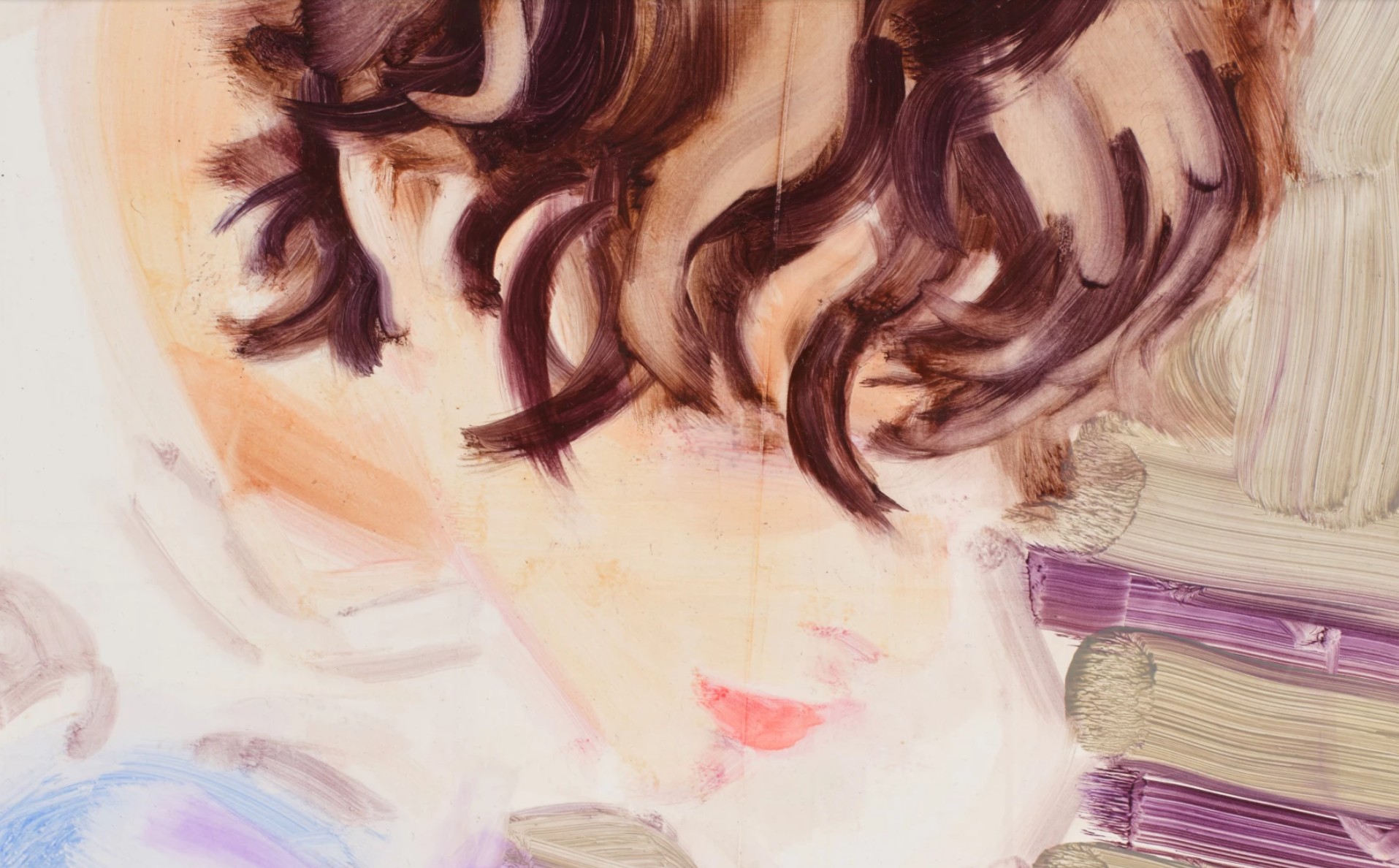
Tony was among Peyton’s most frequent subjects in the 1990s, appearing in multiple canvases that traced the intimacy of their friendship. Unlike her portraits of public figures such as Kurt Cobain, Jarvis Cocker, or Liam and Noel Gallagher, Peyton’s images of Tony feel distinctly personal, affirming her interest in portraying not only cultural icons but also those closest to her. In Tony Reading (Silver Tony), the sitter is not posed for spectacle but caught in a private moment. The absence of eye contact reinforces the sense of introspection, as if the viewer is quietly witnessing a fleeting instant of everyday life, elevated by the act of painting into permanence.
The painting reflects Peyton’s distinct approach to portraiture, in which likeness is less about verisimilitude than about emotional presence. Her brushwork is fluid, at times dissolving contours into washes of color, at others sharpening them into luminous accents. The result is a sense of lightness and immediacy: one feels the painting was executed in a single breath, even as its composition is carefully considered. Peyton’s technique owes as much to the lyricism of nineteenth-century painters like Édouard Manet and Édouard Vuillard as it does to the immediacy of contemporary photography and the affective charge of fan culture.
By the late 1990s, Peyton had achieved widespread recognition for her portraits of cultural figures—often musicians, writers, and artists—who represented not only celebrity but also the emotional texture of their era. Yet works such as Tony Reading (Silver Tony) reveal that at the core of her practice lies a fascination with intimacy and friendship. Whether depicting a rock star or a close companion, Peyton renders her sitters with the same tenderness, blurring the line between public and private, icon and individual.
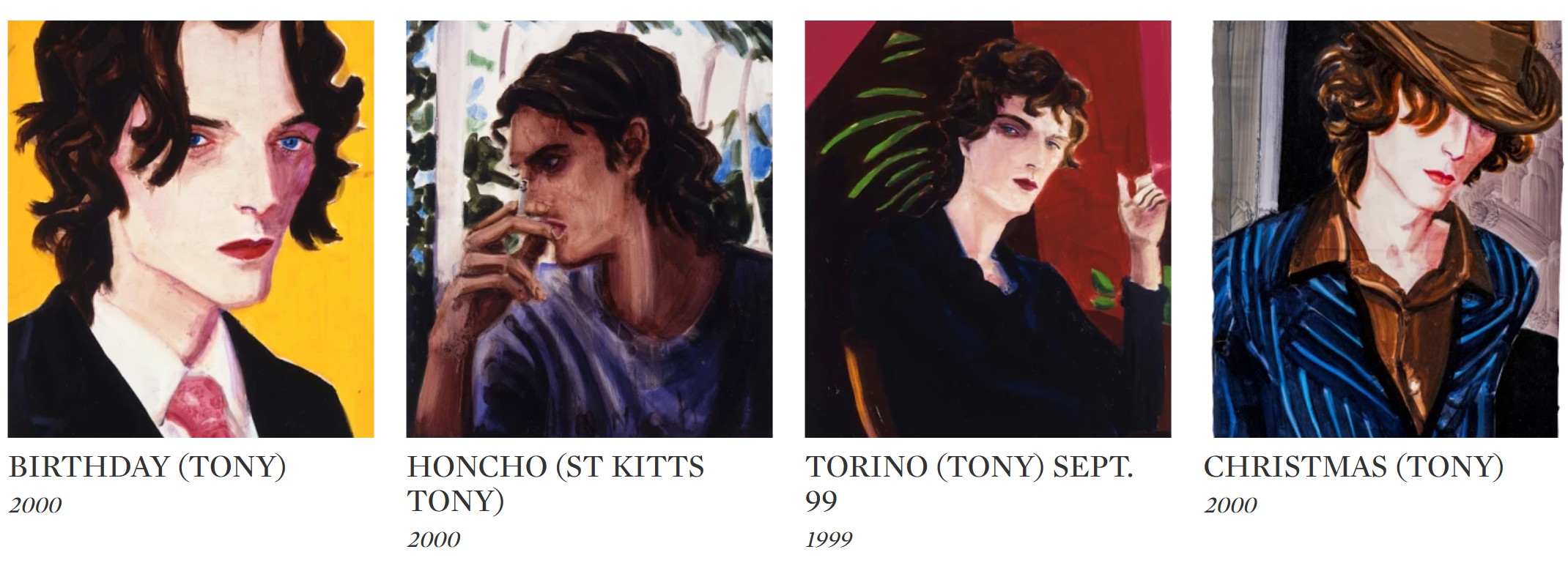
The choice of reading as subject further underscores Peyton’s interest in interiority. Books recur in her work as symbols of reflection and selfhood, marking moments of pause rather than performance. In Tony Reading (Silver Tony), the sitter’s absorption creates a sense of distance, but it is a distance filled with empathy. The painting is less a record of Tony’s likeness than of his state of being—attentive, contemplative, alive in a moment of solitude.
Egon Schiele, Self-Portrait with Chinese Lantern Plant, 1912, Leopold Museum, Vienna.
Painted in 1999, the work belongs to a pivotal moment in Peyton’s career. Having gained international attention through her early exhibitions in New York and London, she was increasingly recognized for her ability to merge the sensibility of Old Master portraiture with the visual culture of her own time. Tony Reading (Silver Tony) demonstrates this synthesis with particular clarity: its palette and brushwork echo the modernist intimism of Henri Matisse or Pierre Bonnard, while its subject and immediacy speak to a late-twentieth-century context of friendship, fandom, and personal connection. Ultimately, the power of Tony Reading (Silver Tony) lies in its ability to render the ordinary extraordinary. A simple act of reading becomes a subject of luminous attention, transfigured through Peyton’s brush into an emblem of beauty and presence. The painting affirms her singular place within contemporary portraiture: an artist who finds grandeur not in spectacle but in the fragile, fleeting moments of life, preserved forever in the charged surface of paint.
Jean-Michel Basquiat
PLEASE CLICK ON THE PICTURE BELOW TO ACCESS AUCTION MARKET OVERVIEW
1. Paintings
#1. Crowns (Peso Neto), 1981
Basquiat Crowned | Property from a Distinguished European Collection
Sotheby’s New-York: 18 November 2025
Estimated: USD 35,o00,000 – 45,000,000
USD 48,335,000
Crowns (Peso Neto) | The Now & Contemporary Evening Auction | 2025 | Sotheby’s
JEAN-MICHEL BASQUIAT (1960 – 1988)
Crowns (Peso Neto), 1981
Acrylic, oilstick and paper collage on canvas
76 1/4 x 94 1/4 inches (193.6 x 239.4 cm)
Signed, titled and dated DEC 25 81 (lower edge)
An intricate tapestry of spiritual, secular and symbolic allegory, Crowns (Peso Neto) is a defining masterwork that encapsulates Jean-Michel Basquiat’s unrivaled capacity for creative genius and introspection. Executed on Christmas Day in 1981, just three days after his 21st birthday, Crowns (Peso Neto) marks the culmination of an ascendant year in Basquiat’s brief yet meteoric career—one that would bring hitherto unprecedented public visibility, critical acclaim and commercial success to the artist, as he metamorphosed from vanguard street artist-provocateur to prodigy of New York’s cultural avant-garde. Rendered at a monumental scale in a medium that evokes the artist’s transition from street to studio, the present work interweaves secular and spiritual imagery to create a profoundly intimate portrait of Basquiat on the cusp of explosive stardom and reflects a poignant meditation on the sacrifices inherent to that success. Boasting an illustrious exhibition history, which includes the artist’s very first solo exhibition in America and, after his untimely passing, his first retrospective, the work has been a hallmark of the most critical showcases of Basquiat’s work. A triumph of artistic mythmaking, Crowns (Peso Neto) is an unrivaled manifesto of Basquiat as painter, celebrity and product; heir, rebel and prophet.
1981 was pivotal in Basquiat’s rising star, as a series of exhibitions and connections launched him toward undeniable stardom. The first of these was the February exhibition New York/New Wave, a survey of downtown New York’s intertwined art and music scenes. Basquiat’s prominent visibility within the exhibition attracted the attention of gallerists Emilio Mazzoli, who shortly thereafter offered Basquiat his first international solo presentation, and the legendary Annina Nosei. By September, Nosei became Basquiat’s primary dealer, providing him with his first dedicated studio space in the basement of her gallery at 100 Prince Street in New York’s SoHo neighborhood. In December, Artforum published the first extensive article on Basquiat and his work: “The Radiant Child,” an essay by Rene Ricard that surveyed emerging New York “graffiti” artists. This article and others that followed already sought to trace Basquiat’s artistic genealogy, drawing comparisons between the artist, his calligraphic graffiti style and art brut sensibilities to forebearers such as Cy Twombly and Jean Dubuffet.
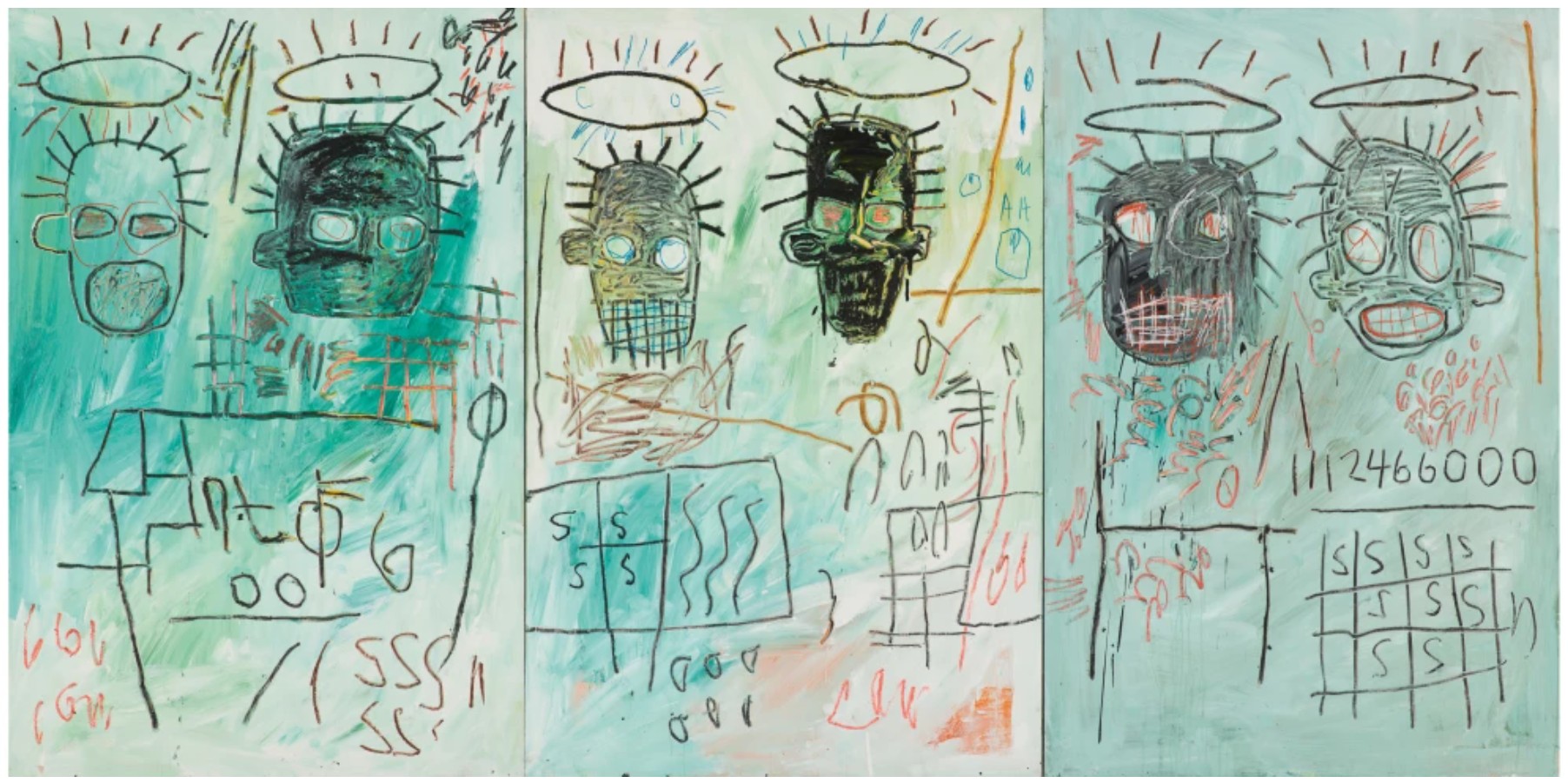
Jean-Michel Basquiat, Six Crimee, 1982. The Museum of Contemporary Art, Los Angeles.
Art © 2025 Estate of Jean-Michel Basquiat. Licensed by Artestar, New York
Emerging from the twilight of this transformative period, Crowns (Peso Neto) reads like an encyclopedia of the artist’s enigmatic yet indelible symbolic vernacular, developed during his days spray-painting the street and now crystallized on canvas. Here, Basquiat’s signature motif arrives at full force: four skeletal heads—hollow-eyed yet piercing—each crowned with the emblem that would come to define his art and legacy, an enduring icon of late-twentieth-century art. The artist had included the crown in his prior work as SAMO©—the pseudonym under which he had graffitied walls and found objects around New York’s SoHo and TriBeCa neighborhoods. Among the earliest debuts of the crown in his paintings, Crowns (Peso Neto) accordingly stands as one of Basquiat’s most important early masterworks, exemplifying a refinement in both medium and iconography of the artist’s practice. Dispersed throughout the work and especially concentrated in the left half within a dominant white plane are other hallmarks of Basquiat’s visual lexicon, such as letters, tally marks, feathered arrows, crescent moons and tic-tac-toe grids. Surrounding these more scrutable hieroglyphs are further slews of furious oil stick scrawls, many of which resemble the iconography that Basquiat appropriated from Henry Dreyfuss’ Symbol Sourcebook and transformed into personal hieroglyphs.
Left: Sandro Botticelli, Adoration of the Magi, c. 1475. Gallerie degli Uffizi, Florence. Image © Bridgeman Images. Right: Robert Rauschenberg, Collection, 1954-55. San Francisco Museum of Modern Art. Art © 2018 Robert Rauschenberg Foundation / Licensed by VAGA at Artists Rights Society
The refinement of Basquiat’s artistic practice palpable in the symbolism of Crowns (Peso Neto) equally characterizes the work’s medium. Curator and dealer Jeffrey Deitch described 1981 as “the year of transition between the street and the studio,” one that saw the artist evolve from graffitiing city walls, to painting objects discarded on the street and drawing on typing paper, to painting on canvas in his first studio. (Jeffrey Deitch, Jean-Michel Basquiat, 1981: The Studio of the Street, New York, 2006, p. 10) Crowns (Peso Neto), brilliantly captures the late stages of this transition: the canvas base and luminous, variegated fields of red, yellow and blue reflect Basquiat’s newfound access to premium artistic materials, but his incorporation of paper collage into the composition hearkens back to the Xeroxes he would hawk on the New York streets during his bygone days as SAMO©. Along the left and bottom edges of the work, the strokes of acrylic and oil stick fall away, revealing the dark tan of the raw canvas underneath—giving the work a cartographic quality, reinforcing its autobiographical valence as the expression of an artist whose practice was still in transition and evoking ancient art worn with the passage of millennia such as the ancient painted Roman or Egyptian frescoes Basquiat had first beheld during childhood visits to museums such as The Metropolitan Museum of Art, The Museum of Modern Art and the nearby Brooklyn Museum. This constructed erosion of painterly elements, coupled with the work’s aggregation of paper collage and street symbols, gives Crowns (Peso Neto) an almost mural-like appearance, transforming it into a palimpsest of the New York street. (Fretz, Jean-Michel Basquiat: A Biography, Greenwood, 2010, p. 89) Across the work’s bottom edge are written the words “PESO NETO” on the left and “DEC 25 81 JEAN MICHEL”—an unambiguous declaration of authorship, capping a critical year in Basquiat’s revision of his artistic self-identity, during which he began producing art under his own name instead of the SAMO© pseudonym under which he had first achieved notoriety.
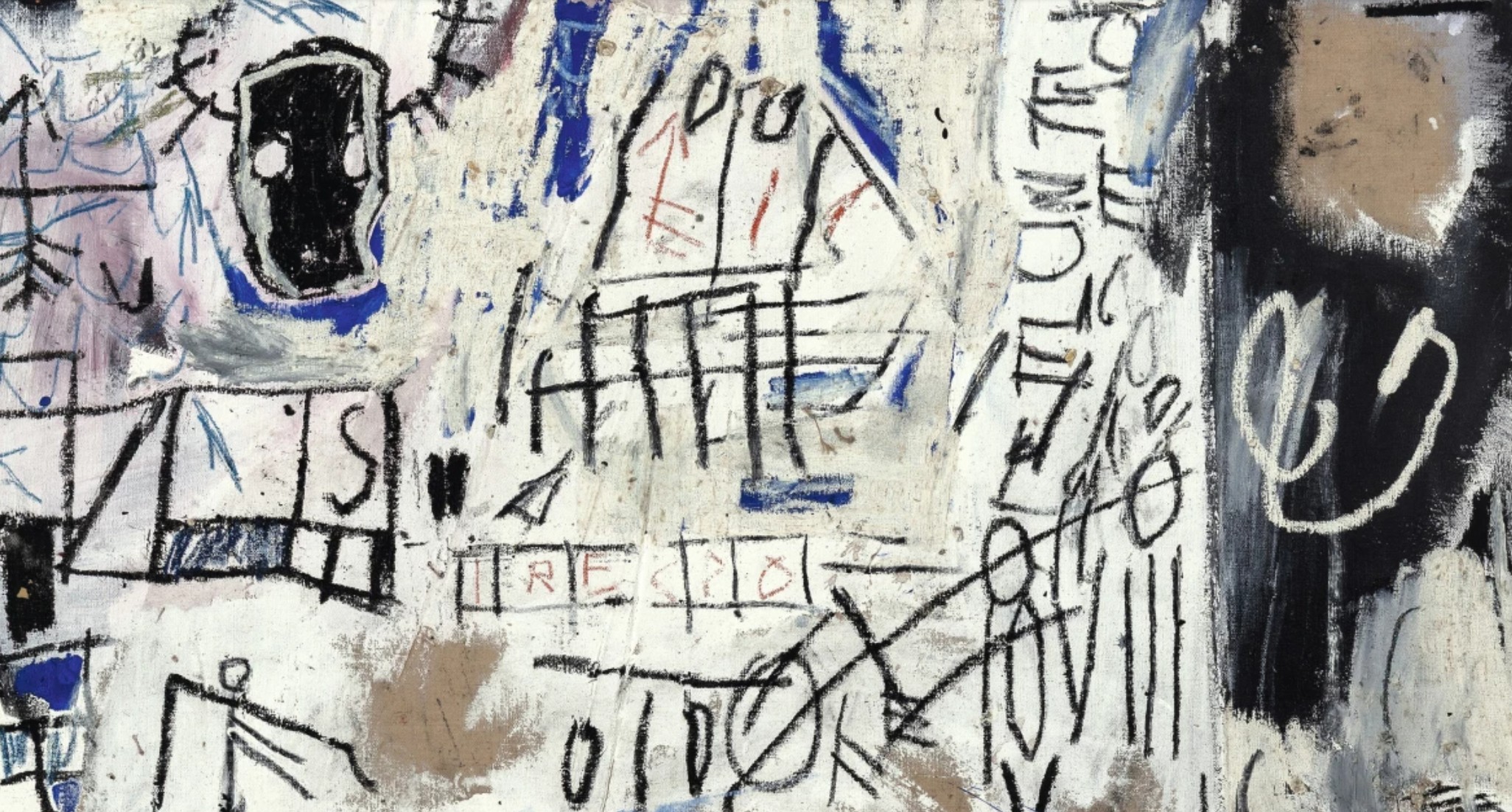
Rendered bare against the raw canvas backdrop, the words ‘PESO NETO’—the Spanish translation of ‘NET WEIGHT’—come into heightened focus as a cipher conveying Basquiat’s autobiographical multilingualism and Nuyorican identity. Since birth, Spanish language and culture had shaped Basquiat and intertwined with his artistry: the language was native to Basquiat, inherited from his Puerto Rican mother. Throughout his entire life, Basquiat would have encountered the phrases ‘PESO NETO’ and ‘NET WEIGHT’ constantly throughout the bombardment of commercial product advertisements and other street signage found in his native neighborhood of Brooklyn, his stomping grounds of the East Village and the Lower East Side as well as his newfound artistic home in SoHo. By December 1981, the artist was enjoying more commercial success than he had ever before—his art was now decidedly commercial. And in Crowns (Peso Neto), stamped with words describing attributes such as net weight, creator and date of creation, art becomes product; painting becomes commerce. This ongoing act of sacrifice—Basquiat’s exchange of personal freedom for fame and fortune—assumes heightened resonance on Christmas, the day marking both the birth of Christ and the creation of Crowns (Peso Neto). Several elements of the masterwork point to themes of Christianity, most notably the three crowned heads presiding over a fourth head, adorned with a crown of thorns, and the unambiguously articulated date of the work’s creation. Here, Basquiat reimagines the Adoration of the Magi, the traditional depiction of three wise men offering gifts to the newborn Jesus, as a darker, more foreboding scene. Archetypal renderings of the scene emphasize the three wise men’s adoration of the Child; Basquiat, however, depicts his three crowned figures as hollow-eyed, disembodied and menacing. Their supposed gifts—one perhaps a bar of gold, represented by a yellow rectangle—mask an undercurrent of entrapment and violence: the composition’s lone white figure, its crown seamlessly fused to its head, emanates a shadowy expanse that takes the rough shape of a body; contained within the left leg of this advancing shadow is a wall topped with barbed wire—an embodiment of the intense paranoia Basquiat often expressed in his interactions with members of the (mostly white) art world. And by aligning his name with the date of Christ’s birth at the bottom of the canvas, Basquiat confirms himself as the fourth figure: Christ, already crowned with thorns, toward whom this malevolence is directed.
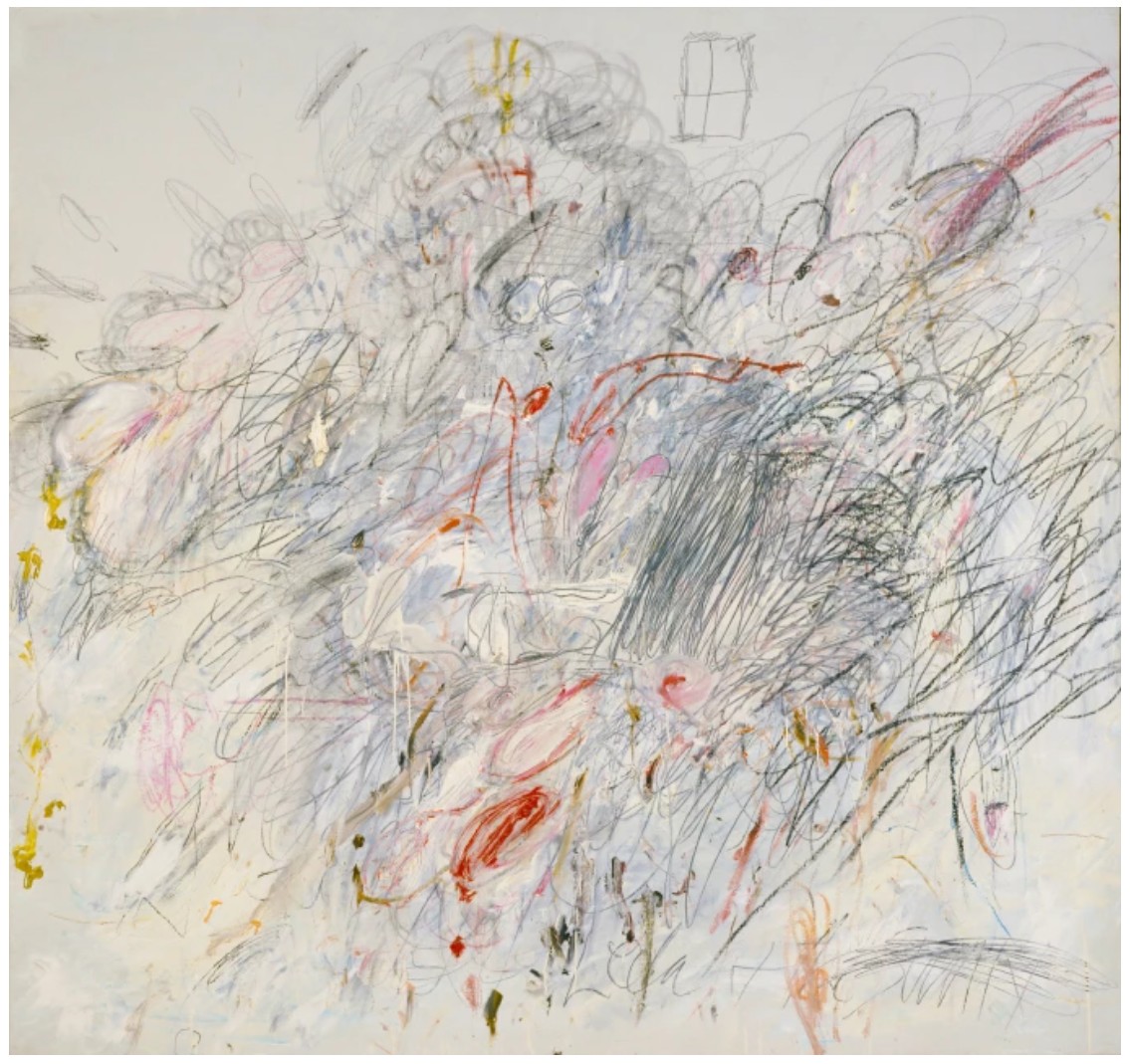
Cy Twombly, Leda and the Swan, 1962. The Museum of Modern Art, New York.
Image © The Museum of Modern Art / Licensed by SCALA / Art Resource, NY. Art © Cy Twombly Foundation
A testament to the work’s pivotal importance within Basquiat’s oeuvre, Crowns (Peso Neto) has been included in a number of monumental exhibitions: following its unveiling to the public in at Annina Nosei Gallery in 1982, Crowns (Peso Neto) was distinguished as one of just five paintings by the artist displayed at documenta 7 in Kassel, West Germany—where Basquiat became one of the youngest artists ever to be shown in the quinquennial exhibition. A decade later, following Basquiat’s untimely passing, Crowns (Peso Neto) featured in the artist’s landmark first retrospective at the Whitney Museum of American Art in New York, which subsequently traveled to The Menil Collection in Houston, Texas, Iowa’s Des Moines Art Center and Alabama’s Montgomery Museum of Fine Arts. In the decades that followed, the work would feature in additional landmark retrospectives: over the course of these exhibitions, Crowns (Peso Neto) has hung alongside dozens more of Basquiat’s most celebrated masterpieces, many of which now reside in the world’s foremost museum collections.
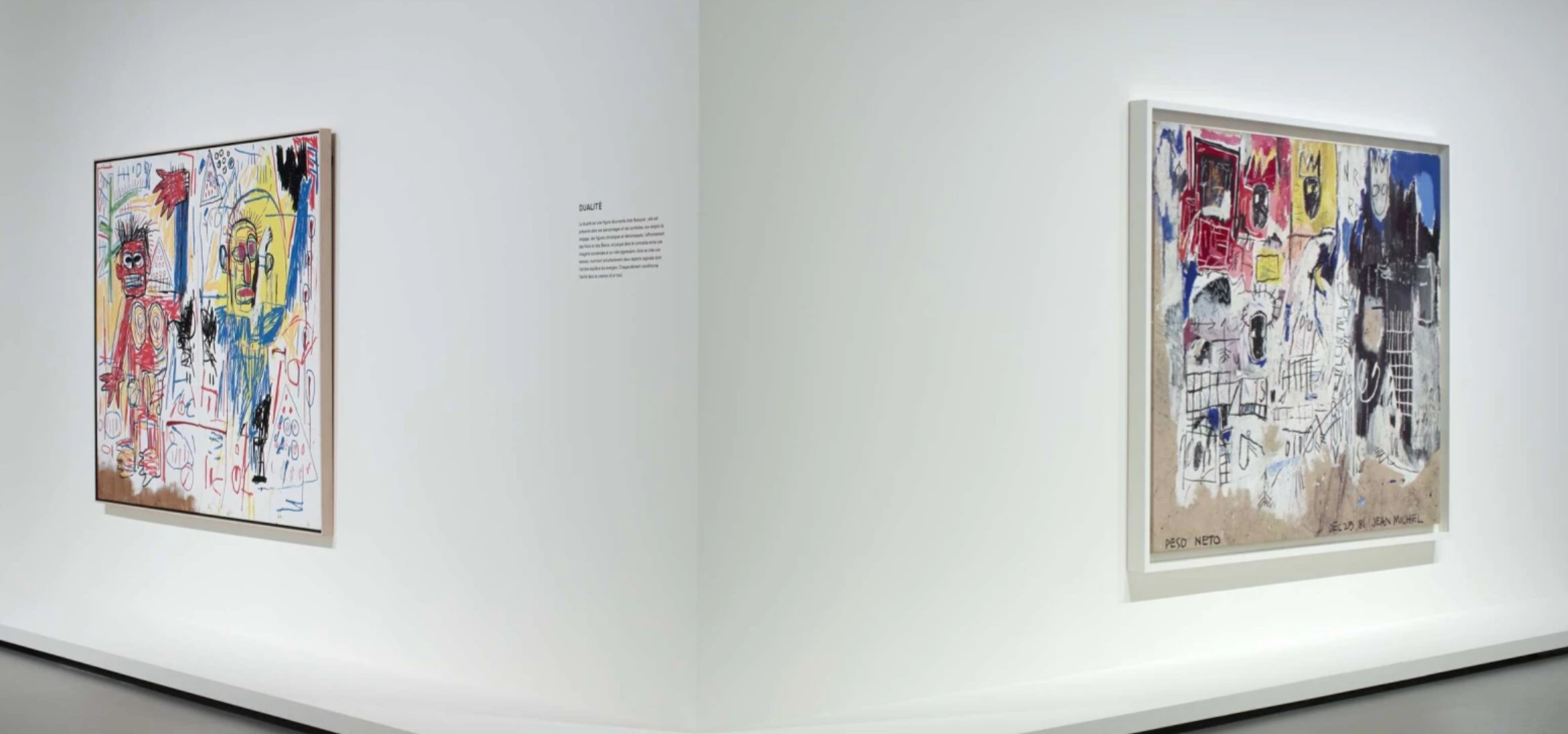
The present work installed in Jean-Michel Basquiat at the Fondation Louis Vuitton, Paris, October 2018 – January 2019. Image courtesy Fondation Louis Vuitton, Paris. Art © 2025 Estate of Jean-Michel Basquiat. Licensed by Artestar, New York
With all the power, urgency and unnerving foresight of an artist on the precipice of his own apotheosis, Crowns (Peso Neto) reads as both self-portrait and prophecy; an emblem of Jean-Michel Basquiat’s vaunting ambition and a cipher for the personal and artistic sacrifices it would demand. With the full potency of his now-iconic symbology, the artist positions himself as cultural bricoleur, weaving together his Puerto Rican heritage, immersion in New York’s chaotic advertising landscape, growing entanglement with the contemporary art world and self-aware dread that his desired heights of success would also be his undoing, “[inscribing] himself in a long line of dead kings like Jesus and John the Baptist (patron saint of derelicts) who have worn the crown of thorns in life, only to be fully appreciated after death.” (Frances Negrón-Muntaner, “The Writing on the Wall: The Life and Passion of Jean-Michel Basquiat,” in Boricua Pop: Puerto Ricans and the Latinization of American Culture, NYU Press, 2004, p. 143) More than just an early masterwork, Crowns (Peso Neto) is a magnum opus that fully showcases Basquiat’s fearless vision, marking his own self-coronation while offering an introspective meditation on the toll of sovereignty. On Christmas Day of 1981, Basquiat painted himself not merely as a rising star, but as a martyr of modernity; an artist ensconced in the pantheon of art history, yet already bearing the weight of the crown that would come to define, and ultimately outlive, him. And in the resultant work—Crowns (Peso Neto)—using the dehumanized language of commercial weight and measurement, Basquiat confronts himself with a brutally poetic calculation: what is the ultimate cost of being crowned king in a world that commodifies artistic genius as readily as it exalts it? When all its advantages and disadvantages are stacked, measured and netted—just how much does a crown really weigh?
#2. Exercise, 1984
Phillips New-York: 19 November 2025
Estimated: USD 3,000,000 – 5,o00,000
USD 3,852,000
Jean-Michel Basquiat Modern & Contemporary Art Evening Sale featuring Cera the Triceratops
JEAN-MICHEL BASQUIAT
Exercise, 1984
Acrylic and crayon on canvas
72 1/8 x 96 1/8 inches (183.2 x 244.2 cm)
Signed, titled, inscribed and dated “Jean-Michel Basquiat “EXERCISE” 1984 KIPAHULU.” on the reverse
Painted in 1984, Exercise captures Jean-Michel Basquiat at a moment of both creative intensity and personal retreat. The work opens a window onto another world—one that feels serene and distant from the raw energy of New York’s downtown art and club scenes that had defined his rise to fame. Marking the first of several extended stays in Hawaii between 1984 and 1988, the painting embodies a period of introspection and escape from the mounting pressures of his rapid ascent. Dated and inscribed “1984 KIPAHULU” on the reverse, it stands as a visual record of Basquiat’s first sojourn on Maui, where he rented a ranch in the remote town of Kīpahulu and worked with art supplies sent from Los Angeles.
Jean-Michel Basquiat and Andy Warhol, August 15, 1983.
Image: © 2025 The Andy Warhol Foundation for the Visual Arts, Inc. / Licensed by Artists Rights Society (ARS), New York
Exercise was acquired the year it was made by prominent collector Frederick R. Weisman and included in several major exhibitions from the Weisman Foundation, including an international tour through Tokyo, Seoul, and Hong Kong in 1986–1987. Last presented at auction in 1988, its reemergence nearly four decades later invites a rare glimpse into Basquiat’s practice at a pivotal moment, when artistic maturity converged with a longing for solitude and renewal.
By 1984, Basquiat had become a global phenomenon. His collaboration with Andy Warhol, described by Ronnie Cutrone as “some crazy art-world marriage,” gave Warhol “a rebellious image again,” while establishing Basquiat as a central voice of his generation. That spring, he joined New York dealer Mary Boone’s roster—home to artists such as Julian Schnabel and Eric Fischl—and mounted his first solo museum exhibition at the Fruitmarket Gallery in Edinburgh. His inaugural show with Boone in May drew critical acclaim. In Maui, Basquiat found respite from the pressures of sudden fame and the increasingly dangerous drug habit that accompanied it. During this stay, Basquiat produced at least three paintings—Rusting Red Car in Kuau, Cash Crop, and Exercise—each revealing a different facet of his thinking. Rusting Red Car in Kuau revisits the automobile motif often linked to his childhood car accident and Warhol’s car-crash series of the 1960s. Cash Crop critiques colonial exploitation through a black box labeled “sugar,” connecting the histories of Haiti and Hawaii. In contrast, Exercise offers an inward turn, locating struggle and renewal within the body itself. Here, the term “exercise” may refer not only to physical exertion but also to painting as a form of rehearsal and experiment. The elongated figures, caught mid-motion, stretch, twist, and reach across the canvas like sketches in movement studies.
Leonardo da Vinci, The Proportions of the Human Figure (after Vitruvius), c.1492.
Galleria dell’Accademia, Venice. Image: History & Art Collection / Alamy Stock Photo
Basquiat’s lifelong fascination with anatomy—rooted in the Gray’s Anatomy book given to him as a child while recovering from a car accident—finds renewed expression here. The figures’ skeletal limbs, jagged contours, and taut musculature suggest a study of internal structure rather than outward appearance. This recalls both Leonardo da Vinci’s anatomical drawings and medical diagrams, yet Basquiat’s treatment is instinctive and expressive, privileging vitality over precision.
“I start a picture and I finish it. I don’t think about art while I work.
I try to think about life.”
Willem de Kooning, Woman I, 1950-1952. Museum of Modern Art, New York. Image: © The Museum of Modern Art/Licensed by SCALA / Art Resource, NY, Artwork: © 2025 The Willem de Kooning Foundation/Artists Rights Society (ARS), New York
Executed in blazing cadmium yellow against a pale, sun-bleached blue, the composition distills Basquiat’s painterly intelligence into essential form and color. The raw brushwork, uneven fillings, and visible revisions make the process itself part of the image. In Exercise, the stark interplay between figure and ground gives the painting a blazing immediacy—simultaneously skeletal and monumental. The painting’s imagery bridges Basquiat’s fascination with both African and European iconography. The left-hand figure, seemingly wielding a bow and arrow, recalls his recurrent depictions of warriors—symbols of resistance and empowerment that channel both physical and cultural resilience. The central figure, arms outstretched in a cruciform “T” pose, evokes the duality of martyr and hero that runs throughout Basquiat’s practice. The resulting image fuses references to African rock art, Christian iconography, and modernist abstraction—connecting cave painting, graffiti, and expressionism into a single lineage.
Rock art at Wadi Abu Wasil, Eastern Desert of Egypt, prior to 3000 BC.
The influence of Burchard Brentjes’ 1969 text African Rock Art, a volume Basquiat kept in his studio, is palpable in the totemic composition and simplified anatomy. At the same time, the exposed teeth and mask-like eyes echo the faces of African sculptures and the primal vigor of Jean Dubuffet’s Art Brut. As Basquiat saw it, the eyes were “a passageway from exterior physical presence into the hidden realities of man’s psychological and mental realms.” In Exercise, their stark whiteness cuts through the saturated yellow, charging the scene with psychological tension.
By 1984, fame had rendered Basquiat both idolized and isolated. This painting may thus be read as an allegory of the artist himself—warrior and victim, saint and trickster, creator and creation. That same year, he produced Deaf, now in the collection of The Broad, Los Angeles, depicting a blind harpist inspired by an Egyptian tomb relief; together, the two works meditate on communication, perception, and the cost of genius. In Exercise, these ideas find their most direct expression, as gestures of covering the ear or playing unheard music become metaphors for inner dissonance, a creative voice struggling to be heard yet seeking refuge in silence.
2. Works on Paper
#1. Untitled, 1982
Phillips New-York: 19 November 2025
Estimated: USD 800,000 – 1,200,000
USD 1,225,500
Jean-Michel Basquiat Modern & Contemporary Art Evening Sale featuring Cera the Triceratops
JEAN-MICHEL BASQUIAT
Untitled, 1982
Oilstick on paper
24 x 18 1/4 inches (61 x 46.4 cm)
The feverish torrent of energy unleashed in Jean-Michel Basquiat’s Untitled, 1982, with its rapid-fire strokes and frenetic oilstick markings, captures an artist on the brink of greatness. Created during what is widely regarded as his golden year, when he broke into the New York art world to instant acclaim, Untitled distills the immediacy and raw energy of Basquiat’s mark-making. A street poet drawing from the syncopated rhythms and contradictions of city life as well as ancient visual languages, Basquiat fused the urban and the primeval in a manner recalling Jean Dubuffet’s celebration of raw expression and material immediacy. After four decades in private hands, Untitled returns to auction for the first time since 1985.
Jean Dubuffet, Wall with Inscriptions, April 1945. The Museum of Modern Art, New York. Image: © The Museum of Modern Art/Licensed by SCALA / Art Resource, NY, Artwork: © 2025 Artists Rights Society (ARS), New York / ADAGP, Paris
In Untitled, Basquiat conjures many of his signature motifs. The three-point crown hovers above a heroic figure rooted in ancient lineage, while a separate crown of thorns encircles a boxed date—“32000 BC”—beneath which fragments of words, equations, and his “©” symbol form a dense visual field. The central figure, a hybrid deity rendered in overlapping views, merges the anatomical clarity of medical illustrations with the hieroglyphic stylization of Egyptian art. With a mask-like face of bared teeth and hollow eyes, the figure radiates an unsettling power.
“I get my facts from books, stuff on atomizers, the blues, ethyl alcohol, geese in Egyptian glyphs …I don’t take credit for my facts. The facts exist without me.”
By 1982, Basquiat had become an overnight critical success. From sleeping on friends’ couches to preparing for shows across New York, Los Angeles, and Europe, his ascent was meteoric. Lacking mentors, he turned to groundbreaking athletes, musicians and writers—Dizzy Gillespie, Charlie Parker, Jackie Robinson, Langston Hughes—elevating them, and himself, into a pantheon of Black heroes. Saints, martyrs, kings, and gods became masks through which Basquiat negotiated fame and forged his own mythology.
Leonardo da Vinci, The skeleton (recto); The muscles of the face and arm, and the nerves and veins of the hand (verso), c.1510-11. The Royal Collection Trust, London. Image: Gravure Francaise / Alamy Stock Photo
Basquiat’s fascination with anatomy, sparked by a childhood gift of Gray’s Anatomy, is central to his work. Here, jagged red lines trace a skeletal form whose exposed ribs and musculature suggest both vitality and vulnerability. His interest in dissection—rendering the body open and diagrammatic—connects him to Leonardo da Vinci yet diverges in its expressive urgency. To the left, a segmented animal labeled “LOIN,” “RIBS,” and “SHANK,” pierced by arrows, evokes the commodification of life. The image becomes an allegory for systems of exploitation—human and animal alike—casting the Black body as historically subjected to the same logic of consumption. Across the surface, Basquiat maps a visual history of the African diaspora, from Ancient Egypt to contemporary America, reframing the Black figure as central to Western civilization’s narrative.
Facsimile of the painting on the inner back side of the sarcophagus of Aashyt, ca. 2051–2030 B.C. The Metropolitan Museum of Art, New York. Image: © The Metropolitan Museum of Art, New York, Rogers Fund, 1948, 48.105.31
During this period, Basquiat’s interest in African spiritualism and antiquity deepened. The pharaonic figure in Untitled—holding an ankh and staff—recalls Horus or Ra-Horakhty, deities symbolizing kingship and divine authority. Emerging from blue wave-like marks, it may allude to the Exodus story, a theme Basquiat builds on in the contemporaneous painting, now in the collection of the Guggenheim Museum Bilbao in Spain, Moses and the Egyptians, 1982, drawing parallels between biblical liberation and racial justice. His depictions of crowns, scepters, and hieroglyphic symbols challenge traditional art history by reimagining Black figures as royalty. Iterations of similar figures appear on the various funerary reliefs, stone tablets, and paintings found in the Ancient Egyptian wings of the museums Basquiat frequented, including an almost identical mirrored image of the figure in Untitled, as seen on an Illustrated Papyrus from 305-330 B.C.E in the Brooklyn Museum. Basquiat’s three-point crown, originating in his graffiti practice as SAMO©, became a declaration of authorship and resistance. In Untitled, the crown replaces the sun disk above the pharaoh’s head, emblematic of Basquiat’s own coronation within a predominantly white art world. That Basquiat was already attuned to the perils of visibility and success in 1982 is evident in another work from that year, Charles the First, where the prophetic warning “MOST YOUNG KINGS GET THEIR HEADS CUT OFF” is splashed across the painted surface.
[Left] Illustrated Papyrus, 305–30 B.C.E. Brooklyn Museum, New York.
[Right] Detail of the present work.
Basquiat’s raw, graphic line translates the immediacy of graffiti to paper, fusing street art with semiotic experimentation. The composition brims with fragmented words and coded imagery, their meanings spanning languages and centuries. His inscriptions in Untitled resist fixed interpretation. By crossing out, repeating, and juxtaposing words, Basquiat achieves what scholars have called a “calculated incoherence,” leaving meaning perpetually in flux. To the right of the central figure, he scrawls “RESPO MUNDIAL,” a hybrid Spanish phrase translating roughly to “Global Responsibility.” This cryptic statement encapsulates the artist’s worldview—his awareness of power, history, and the collective burden of representation.
#2. Untitled, 1982
Sotheby’s New-York: 19 November 2025
Estimated: USD 700,000 – 1,000,000
USD 889,000
Untitled | Contemporary Day Auction | 2025 | Sotheby’s
JEAN-MICHEL BASQUIAT (1960 – 1988)
Untitled, 1982
Oilstick and graphite on paper
30 x 22 1/2 inches (76.2 x 57.2 cm)
Signed (on the verso)
Composed of a striking network of words, symbols, and signs, Jean-Michel Basquiat’s Untitled from 1982 offers a vivid glimpse into the artist’s boundless imagination and inventive brilliance. Executed during the most celebrated year of his career, a period that witnessed his rapid ascent from downtown prodigy to international art-world icon, the present work stands as a testament to his singular visual language. Basquiat constructs an entire cosmology: a choreography of text and image that reveals the fusion of cultural, linguistic, and spiritual forces animating his practice. Jean-Michel Basquiat’s heritage, both his familial origins and his artistic beginnings, was always on display throughout his incandescent artistic career. Born to a Haitian father and Puerto Rican mother, Basquiat inherited a richly hybrid cultural identity that informed every work he created. He began his artistic journey as a graffiti artist in New York City, tagging cryptic phrases and symbolic codes across the facades of the Lower East Side. Language became his first canvas, and it remained the foundation of his art. In Untitled, this linguistic impulse finds profound expression: the artist fuses the sacred with the secular, the spiritual with the commercial, and the personal with the universal.
At the top of the composition, the words “COOKIE –N– PEPSI”, “MILAGROS”, and “CONSUELO DOLOR’S” appear in Basquiat’s unmistakable hand. Here, the sacred heart and cruciform icon coexist with corporate slogans, an audacious juxtaposition that collapses centuries of religious iconography into the consumerist vernacular of 1980s America. The Spanish inscriptions speak of pain, consolation, and miracles—evocations of Catholic devotion—while the crowned central figure, encircled by a halo of thorns, recalls a contemporary Christ figure. Yet Basquiat’s irreverence is never nihilistic. Rather, it is revelatory: a complex meditation on faith, commodification, and identity.
Across the page, repetitions of fractured words and phonetic distortions form a rhythmic refrain, as if language itself becomes an incantation. The text does not merely describe; it performs. It chants, interrupts, and provokes, mirroring the syncopated energy of jazz—a soundscape Basquiat often invoked in his paintings and drawings alike.
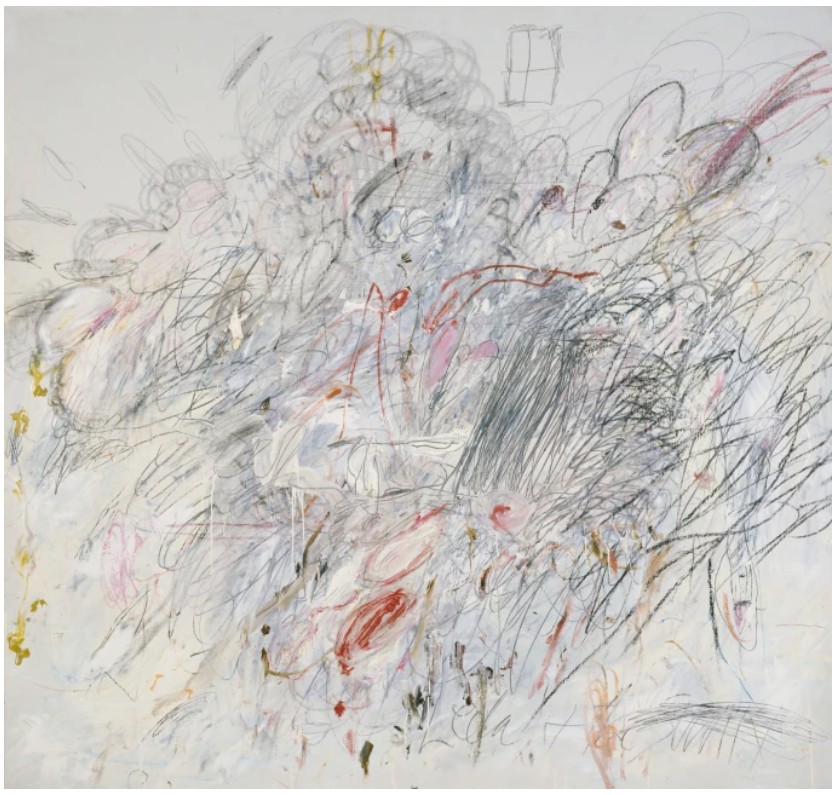
Cy Twombly, Leda and the Swan, 1962. The Museum of Modern Art, New York. Art © 2025 Cy Twombly Foundation
At the center, the schematic red head, part mask, part anatomical study, anchors the composition. Surrounded by gridlines and cryptic text, it invokes both spiritual icon and scientific diagram. In Basquiat’s world, these systems coexist: art history and anatomy, theology and street culture. The words “TROJAN” and “CABALLO” (Spanish for “horse”) inscribed near the bottom edge summon the legend of the Trojan Horse, a recurring metaphor in Basquiat’s lexicon. This ancient emblem of deception and infiltration becomes, in his hands, a symbol of cultural subversion—the artist as insurgent figure, smuggling new forms and narratives into the fortress of high art. Each reference doubles back upon itself, collapsing myth into history, irony into sincerity.
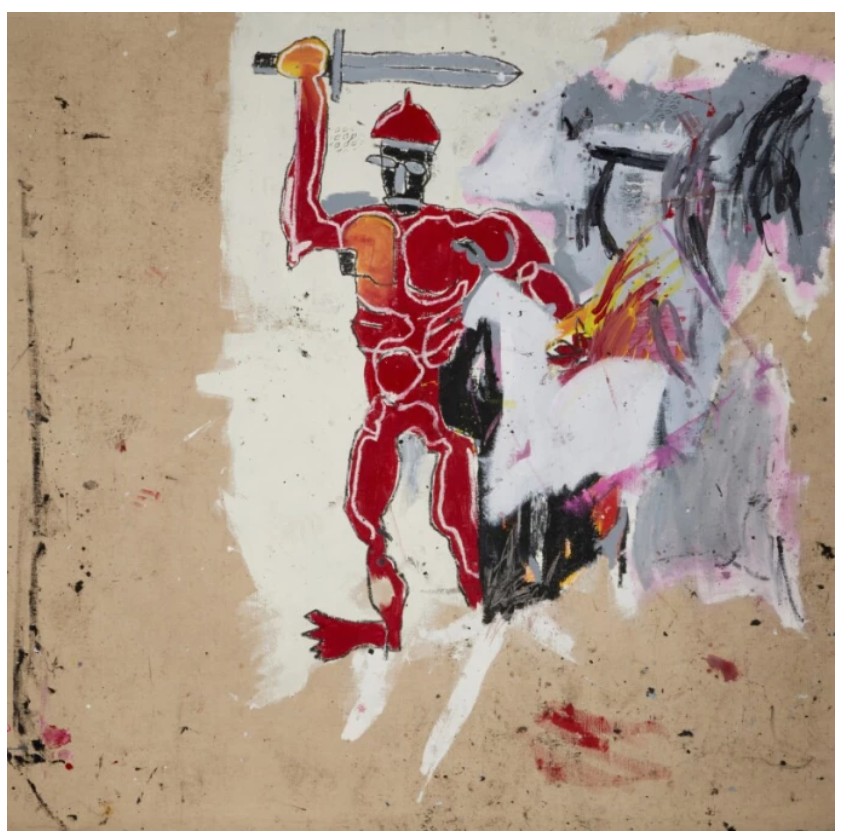
Jean-Michel Basquiat, Untitled (Red Warrior), 1982. Private Collection.
Art © 2025 Estate of Jean-Michel Basquiat. Licensed by Artestar, New York.
As an artist constantly on the move, Basquiat found in drawing the perfect medium for immediacy and reflection. Bending over sheets of paper that filled his studio floor, he treated drawing as both private meditation and public declaration. In this work, his stream of consciousness flows seamlessly between the poetic and the pictorial, the personal and the historical. Executed with the urgency of revelation, Untitled encapsulates Basquiat’s mastery of language and line, merging faith, heritage, and contemporary culture into a single dynamic field. The drawing reads as both confession and confrontation: a compact expression of the artist’s restless intellect and his unrelenting pursuit of truth. In its fusion of image and idea, it remains indelibly, unmistakably Basquiat: raw, radiant, and utterly alive.
#3. Untitled, 1981
Christie’s New-York: 20 November 2025
Estimated: USD 180,000 – 250,000
USD 317,500
JEAN-MICHEL BASQUIAT (1960-1988), Untitled | Christie’s
JEAN-MICHEL BASQUIAT (1960-1988)
Untitled, 1981
Paint pen and marker on colored illustration board
18 x 11 7/8 inches (45.7 x 30.2 cm)
Inscribed by Keith Haring (on the reverse)
The remarkable provenance of this Jean-Michel Basquiat deserves recognition. Originally given by Basquiat to Keith Haring, the drawing was subsequently gifted by Haring to his friend and biographer John Gruen. The history of the piece is memorialized by Haring in his unmistakable penmanship on the reverse of the illustration board.
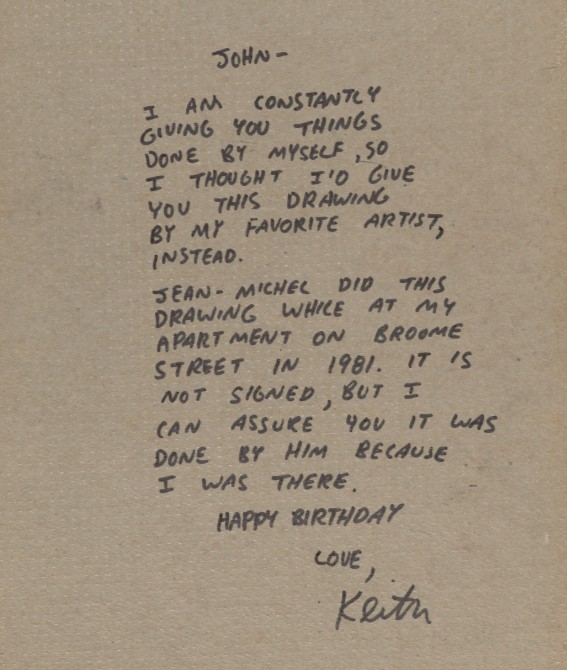
John Gruen was an important cultural critic, prolific writer, photographer and musician. He was also the author and editor of Keith Haring: The Authorized Biography, published in 1991, shortly after Haring’s death. The only ‘authorized’ Haring biography, it was compiled from long and intense interview sessions with Haring and his many friends and contemporaries in 1989 and 1990. The book stands as important and enduring oral biography of Haring and chronicles the time in which he lived. Basquiat is referenced in the book more than twenty times.
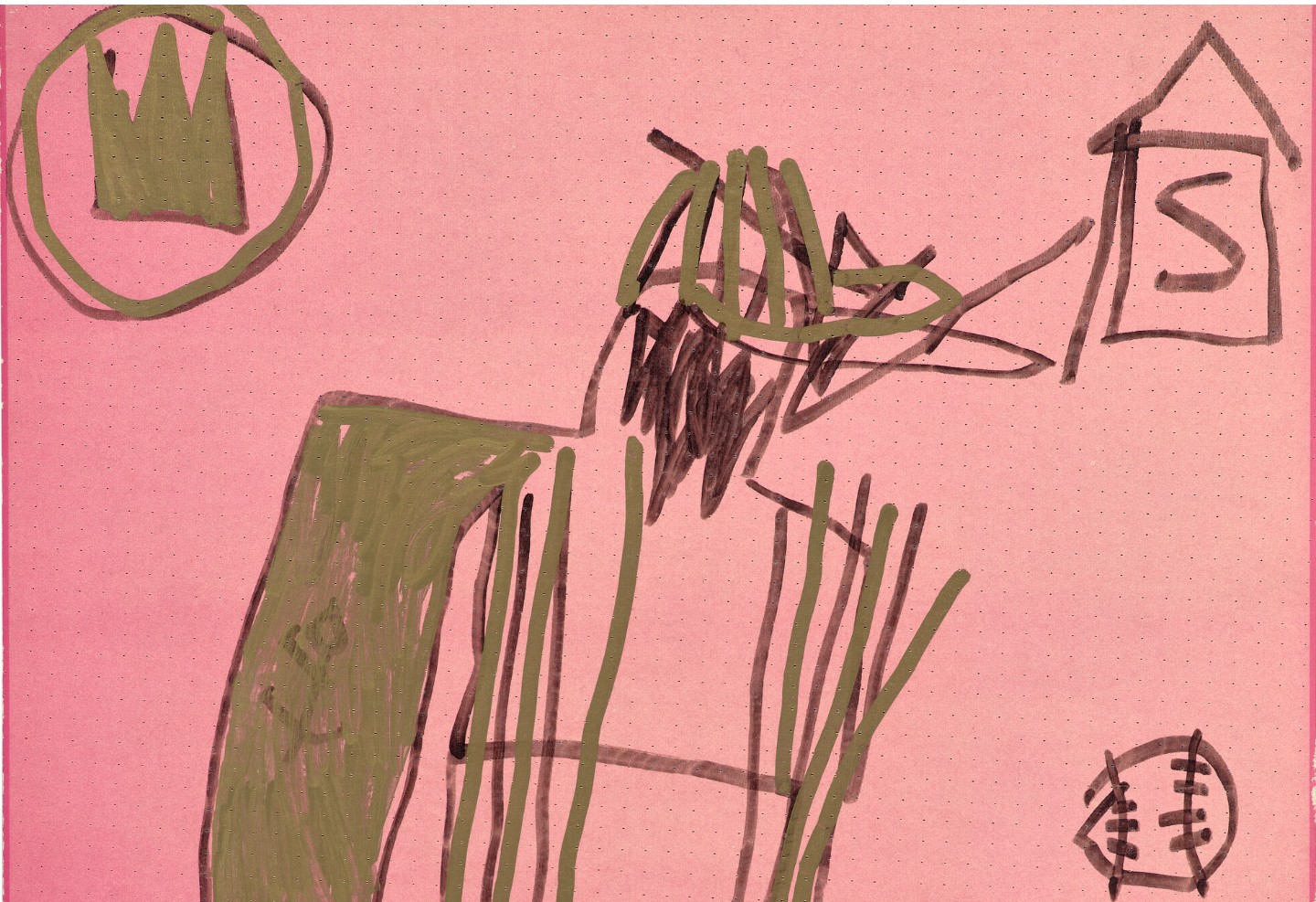
In the present drawing, Basquiat uses marker and a metallic paint pen to draw a baseball player, adorning the image with a crown and esoteric symbols that resemble the marks on a baseball scorecard. The image calls to mind famous baseball players such as Satchel Page and Hank Aaron. Aaron figures prominently in many of Basquiat’s works, and Basquiat’s frequent cryptic use of the letter ‘A’ and the name ‘Aaron’ are generally understood to be references to the famous ball player, who broke Babe Ruth’s all-time career home run record and received frequent death threats (due to his race) during his pursuit of the record.
Untitled, 1986
Sotheby’s New-York: 19 November 2025
Estimated: USD 600,000 – 800,000
WITHDRAWN
Untitled | Contemporary Day Auction | 2025 | Sotheby’s
JEAN-MICHEL BASQUIAT (1960 – 1988)
Untitled, 1986
Colored pencil, graphite, ink and oilstick on paper
29 5/8 x 41 3/4 inches (75.2 x 106 cm)
Signed and dated 86 (on the verso)
Keith Haring
PLEASE CLICK ON THE PICTURE BELOW TO ACCESS AUCTION MARKET OVERVIEW
#1. Untitled, 1981
Works from the Collection of Kamran Diba
Sotheby’s New-York: 19 November 2025
Estimated: USD 2,200,000 – 3,200,000
USD 2,246,000
Untitled | Contemporary Day Auction | 2025 | Sotheby’s
KEITH HARING (1958 – 1990)
Untitled, 1981
Acrylic on vinyl tarpaulin
97 1/4 x 96 1/2 inches (247 x 245.1 cm)
Signed and dated 1981 (on the reverse)
Painted in 1981, Untitled stands among the earliest and most historically significant of Keith Haring’s iconic tarpaulin works. Executed shortly after his move to New York in 1978 to study semiotics at the School of Visual Arts, Untitled represents Haring’s crystallization of his visual language in the subways and streets of downtown Manhattan. This work embodies this critical period of production for the artist, distinguished by Haring’s guerrilla-style artistic practice that transformed urban walls into sites of dialogue between the artist and his captive audience. Untitled captures this urgency and immediacy: a single and searing red figure, pulsating with energetic brushstrokes of dazzling red and black against a vibrant yellow ground. The figure’s open and punctuated center creates a void charged with symbolic power, dripping with pathos and an overwhelming sense of immediacy.
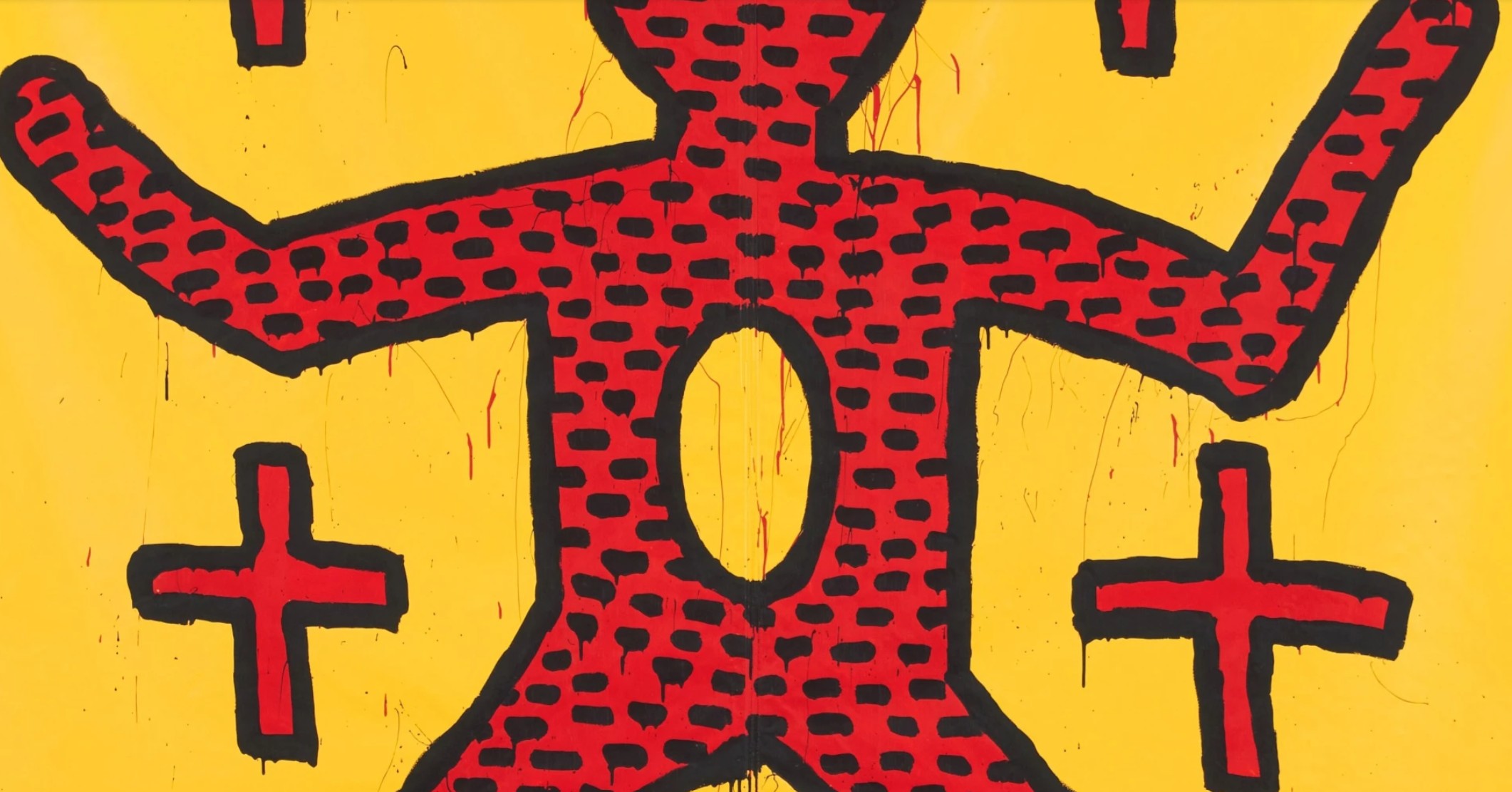
Haring’s choice of industrial tarpaulin was a groundbreaking and inventive move by the artist, who began transforming and engaging with found objects early within his artistic practice. By appropriating a material more commonly used for street signage, Haring collapsed the boundary between high art and the everyday, democratizing the very surface of painting. Untitled was among the first works Haring created on tarpaulin, signaling his radical approach to materiality and visual storytelling. The physicality of the medium evokes the grit and texture of the urban landscape while affirming Haring’s belief that art should be accessible, public and alive with social energy.
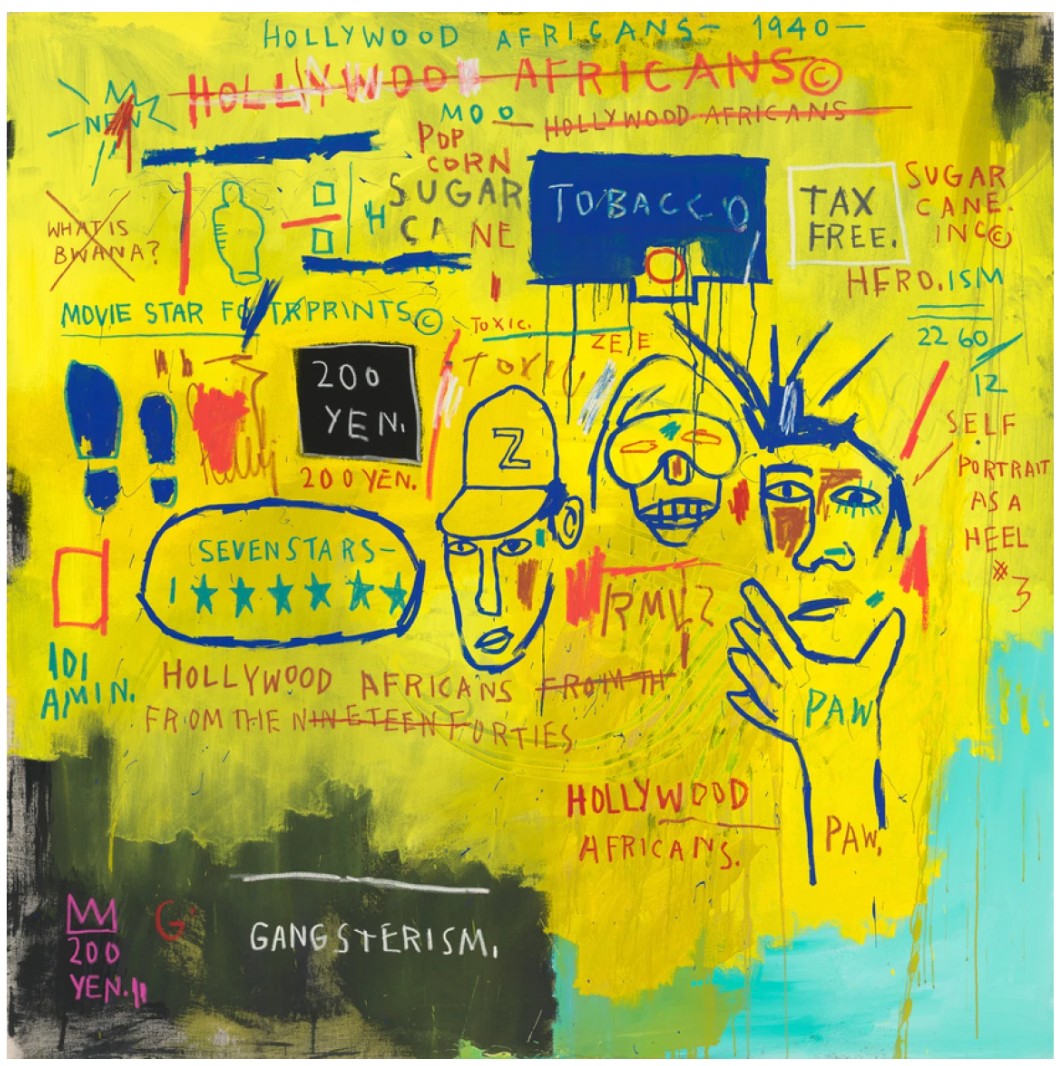
Jean-Michel Basquiat, Hollywood Africans, 1983. Whitney Museum of American Art, New York.
© The Estate of Jean-Michel Basquiat. Licensed by Artestar, New York
The composition of Untitled resonates deeply with the cultural and political climate of early 1980s New York. The figure’s hollowed torso and the surrounding crosses are charged symbols of both violence and transcendence. The present work channels the public anguish that followed the assassination of John Lennon, an event Haring learned about while at the Mudd Club. Haring translated the overwhelming collective grief into a universal form of language, as evidenced in only his most compelling artworks, a powerful visual language distills and captures the public conscience. In Untitled, the image of the hollowed torso came to Haring in a dream after Lennon’s assassination. Haunted by the profound loss of a celebrated creative and artistic icon, Haring utilized the public outcry to create this impassioned masterwork, that distills not only this distinctive moment in New York history, it typified Haring’s visual vernacular as a champion and conduit to his audience. The crosses, recurring motifs in his early iconography, suggest the burden of power structures that Haring sought to subvert throughout his storied career. The symbols that punctuate the surface of Untitled operate as signs through which Haring urged his generation to live freely and authentically in defiance of dogma and conformity.
Andy Warhol, John Lennon, 1985-86. Private Collection.
Art © The Andy Warhol Foundation for the Visual Arts, Inc. / Licensed by Artists Rights Society (ARS), New York
As one of the earliest manifestations of Haring’s signature vocabulary, Untitled encapsulates the artist’s transition from the streets to the studio. Having famously debuted his visual lexicon with subway drawings in the New York City subway, Haring transitioned to canvas and monumental scaled works designed for gallery and institutional contexts. In 1982, Haring was formally represented by Tony Shafrazi Gallery, which created a shift in his formal practice, by refining the balance between his street-born immediacy and the formal discipline required to produce artworks for exhibitions. The present work represents a critical point of artistic evolution retaining the raw energy of the streets while asserting the compositional rigor and symbolic depth that would define his mature practice.
That Untitled entered the collection of Kamran Diba, the visionary architect and founding director of the Tehran Museum of Contemporary Art, enriches its resonance. Diba’s pioneering vision – grounded in cultural dialogue between East and West and in the democratization of art through architecture – finds a natural kinship with Haring’s ethos of accessibility and universal communication. Diba’s affinity for artists whose work carries a social pulse and graphic immediacy is embodied in his acquisition of this painting. Both figures shared a conviction that art could transcend borders, whether geographical, social, or ideological. Diba’s own architectural legacy – particularly the Tehran Museum’s subterranean galleries inspired by Persian vernacular forms – reflects the same synthesis of tradition and modernity that animates Haring’s art.
Untitled has been widely exhibited internationally, including at the Castello di Rivoli in Turin, the Deichtorhallen in Hamburg, the Musée d’Art Moderne de Paris, and the de Young Museum in San Francisco. Bearing a robust exhibition history and its inclusion in major retrospectives such as Keith Haring: The Political Line (2013 – 15) and About Art (2017) underscores its status as an exceptional, early example within Haring’s oeuvre.
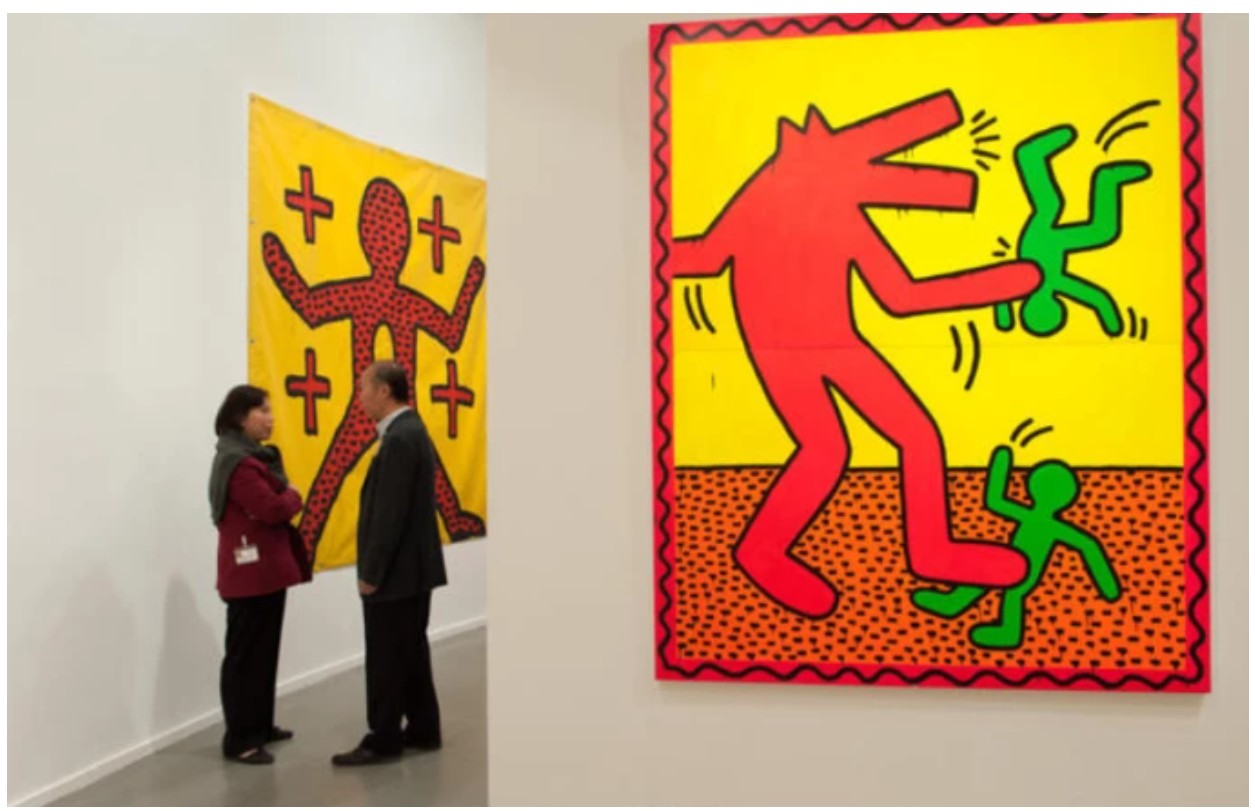
The present work installed in Keith Haring: The Political Line at the Musée d’Art Moderne de Paris, 2013.
As both an artifact of early 1980s New York and a timeless image of human resilience, Untitled embodies the intersection of art and social consciousness. Its union of formal simplicity, spiritual symbolism, and political immediacy situates it among the most compelling expressions of Haring’s belief that art could act as a conduit for empathy and transformation, bolsters his enduringly relevant legacy.
#2. Untitled, 1982
Property from a Private European Collection
Sotheby’s New-York: 18 November 2025
Estimated: USD 800,000 – 1,200,000
USD 1,514,000
WORK ON PAPER
Untitled | The Now & Contemporary Evening Auction | 2025 | Sotheby’s
KEITH HARING (1958 – 1990)
Untitled, 1982
Ink on paper
71×94 inches (180.3 x 238.8 cm)
Serpentine lines, polka dots and dashes coalesce in an utterly entrancing manifestation of a comic icon, Untitled is a vivacious testament of Keith Haring’s signature Pop vernacular and dialogue with contemporary visual symbols. A captivating tribute and reconstitution of Walt Disney’s legendary character, Mickey Mouse, Untitled explores an instantly recognizable symbol of mass media through Haring’s original lens.
“I was letting some of the cartoon stuff from my childhood come back into these drawings because I felt freed up and opened up that I could do that.
Some were just drawings of Mickey Mouse, which was something that I had drawn a lot when I was a kid.”
Keith Haring in April 1984. Photo by Jack Mitchell/Getty Images
Emerging from fluid lines of sumi ink, Disney’s central protagonist appears in perpetual movement, oscillating before the viewer’s eyes in a joyful dance. At over seven feet in width, Untitled is a prodigious exemplar of the labyrinthian compositional formations for which the artist is best known. Untitled made its exhibition premier at Haring’s iconic first solo exhibition, Keith Haring One Man Show, at Tony Shafrazi Gallery in the fall of 1982—a groundbreaking event in Haring’s career, crystallizing his place at the center of Contemporary art. In the two decades that followed, the present work appeared in the most important exhibitions of Haring’s work, including the 1997 retrospective at the Whitney Museum of American Art, New York (and traveling).
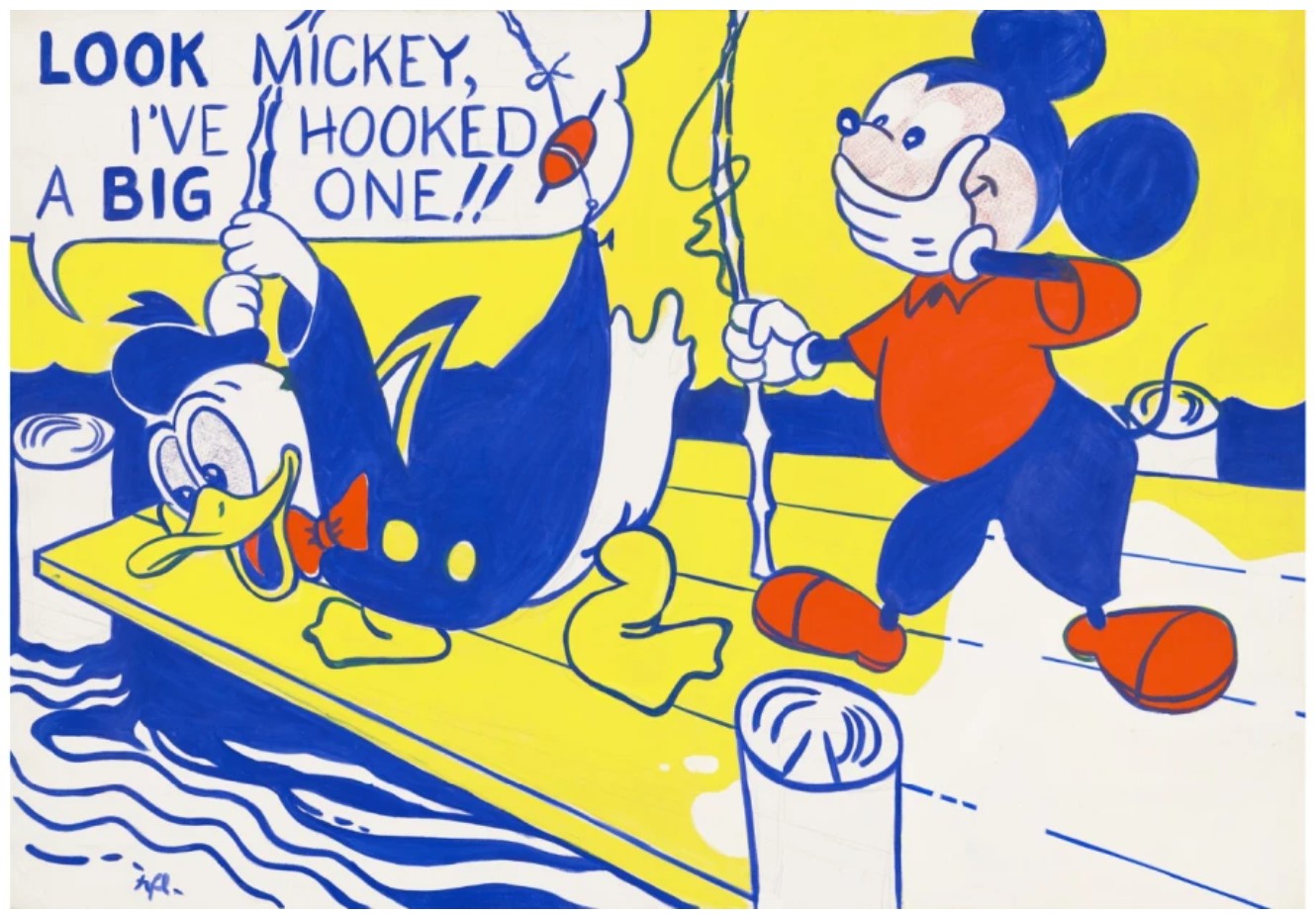
Roy Lichtenstein, Look Mickey, 1961. National Gallery of Art, Washington, D.C. Art © Board of Trustees, National Gallery of Art
Executed in 1982, Untitled is a pivotal early example of Haring’s distinct graphic language, which at its core was driven by the artist’s unrivaled skills as a draftsman. Dozens of idiosyncratic, densely packed black lines form a beguiling, maze-like composition—each element reverberating of another in a dazzling symphony. In scattered areas throughout the composition, pools of sumi ink stream down the surface to the edge of the sheet, revealing an element of the artist’s process that is often concealed. Haring’s graphic lines and dynamic, self-assured forms encapsulated the visceral creative energy and sense of possibility that emboldened the New York cultural scene at the beginning of the 1980s.
The present work installed in Keith Haring at the Whitney Museum of American Art, New York, June – September 1997.
Art © 2025 The Keith Haring Foundation
Arriving in New York City in 1978, Haring was immediately drawn to the urban music and graffiti scene, exploring the graphic potential of line as the central principle of his practice. After years of filling the city subways with his artworks, in 1982, Haring mounted his breakthrough solo exhibition at Tony Shafrazi Gallery. In his foreword for this seminal exhibition, Shafrazi wrote of his motivation to embark on the project: “It is this abundant creative force and the underlying mastery of drawing, as if each living line were finding its rightful place.” (Tony Shfrazi in: Exh. Cat., New York, Tony Shafrazi Gallery, Keith Haring One Man Show, 1982, p. 7)
Andy Warhol, Quadrant Mickey Mouse, 1981. Private Collection.
Art © 2025 Andy Warhol Foundation for the Visual Arts / Artists Rights Society (ARS), New York
Like his contemporaries, such as Jean-Michel Basquiat and Andy Warhol, Haring through his visual lexicon served as a narrator of the modern age. Appropriating and reinventing pervasive commercial iconography in his practice, Haring provided incisive commentary on Contemporary pop culture. Created in 1928, Mickey Mouse has long reigned at the center of American pop culture as the animated mascot of the Walt Disney Company and contemporary consumer culture more broadly. The curved ears and elongated nose of Disney’s ubiquitous character form an instantly recognizable silhouette, synonymous with the power and ubiquity of mass media. Decades prior, Mickey Mouse was the subject of Roy Lichtenstein’s iconic, Look Mickey (1961), an iconic example of the artist’s dismantling of the boundaries between high and low art. Here, two decades later, Haring has appropriated the same image yet transformed it through his own visual lexicon. Calligraphic, sinuous lines and swirling forms meet in a masterful and playful dialogue; figure of Mickey dissolves and materializes before the viewer, as if it perpetual motion.
Jean Dubuffet, La Vie de Familie (Family Life), 1963. Musée des Arts Décoratifs, Paris. Image © DeA Picture Library / Art Resource, NY.
Art © 2025 Artists Rights Society (ARS), New York / ADAGP, Paris
Exuding the gestural dynamism of Haring’s best works, Untitled epitomizes the artist’s inimitable aptitude to conveying pulsating energy through an economy of line and form. The expanse of serpentine lines in rich sumi ink is at once frenetic and balanced, untamed and exacting. Forgoing a pre-conceived composition, Haring renders his forms with confidence and spontaneity, amplifying the visceral power of his mark-making.
#3. Untitled, 1987
Sotheby’s New-York: 19 November 2025
Estimated: USD 400,000 – 600,000
USD 482,600
Untitled | Contemporary Day Auction | 2025 | Sotheby’s
KEITH HARING (1958 – 1990)
Untitled, 1987
Acrylic on canvas
84 x 48 1/8 inches (213.3 x 122.6 cm)
Signed, titled and dated Jan 11-1987 (on the overlap)
Executed in 1987, at the peak of Keith Haring’s international acclaim, Untitled exemplifies the artist’s command of form, color, and rhythm, translating the artist’s singular visual language into a dynamic, energetic composition. Across a deep black ground, flashes of yellow, red, and white carve the outline of a face, its features emerging from the interplay of positive and negative space. The figure’s gaze, composed of concentric circles and geometric arcs, seems to vibrate with an inner pulse. The black field recalls Haring’s early chalk drawings in the New York subway, where his imagery first took shape against dark panels of public space. Here, that same sense of immediacy and contrast transforms the surface into a stage for radiant, pulsating energy.
“[Art] is a product of a moment and a state of mind at that moment and a record of a state of being or a moment of living, a point in time in which all your energies and all your forces and the environment is coming together in that one action of making, of creating, of … usually in my case, a drawing. Even when I’m painting I’m usually, I’m drawing when I’m painting, really … When you’re drawing, it’s completely separate because drawing is making a mark and cutting into space and just finding something that didn’t exist before. It’s pure creation in its simplest form …”
The present work was included in Haring’s landmark 1987 exhibition titled Sculpture and Paintings at Tony Shafrazi Gallery in New York, which marked a turning point in his oeuvre. The artist’s vocabulary, once populated by bustling crowds of figures, had become more refined, as did his artistic practice. As shown by Untitled, he now centered his practice around the elemental language of line and symbol. In Untitled, the dynamic precision of red, yellow, and white segments evokes the visual clarity of street art that deeply interested Haring.
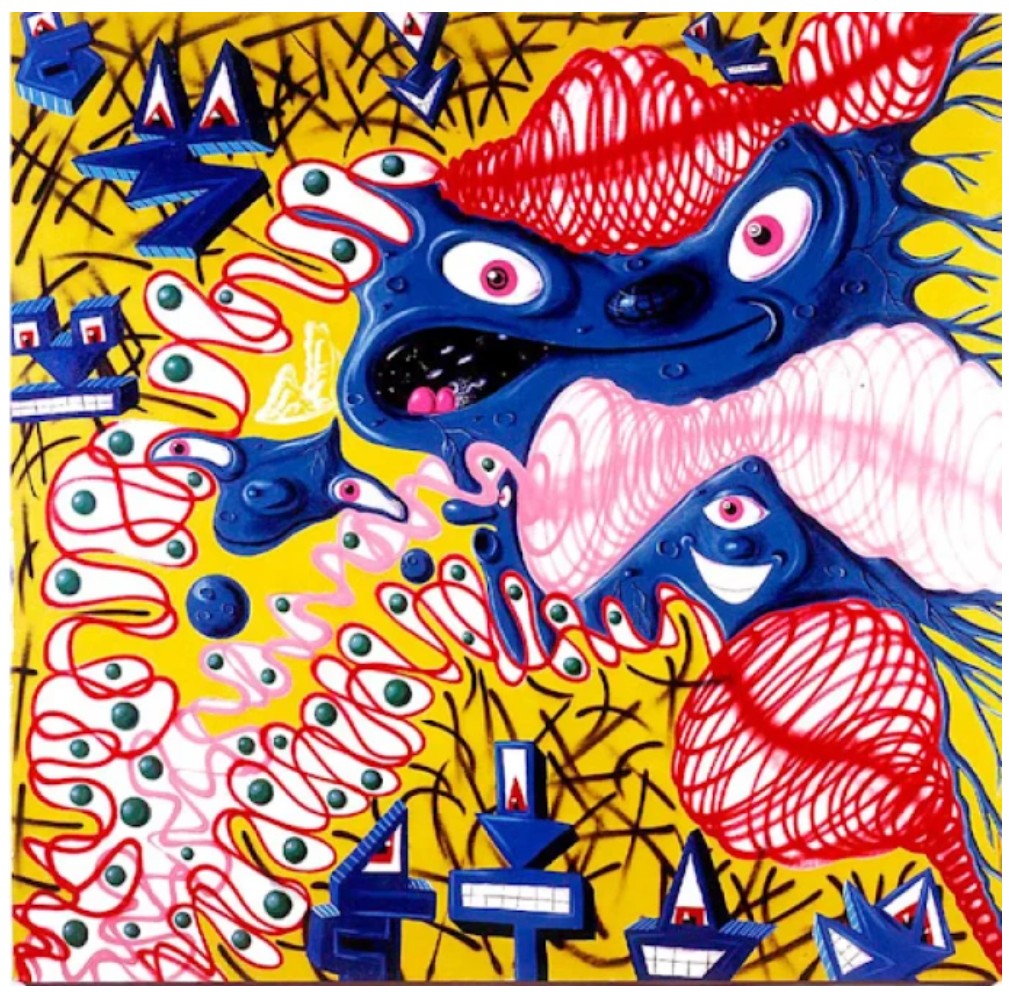
Kenny Scharf, Inside Out, 1984. The Broad, Los Angeles. Art © Kenny Scharf.
The composition’s formal restraint links it to the broader lineage of modern abstraction, while its urban immediacy remains unmistakably Haring’s own. Like Piet Mondrian or Joan Miró before him, he deploys primary color and rhythm to create movement across the surface. Yet, the energy is rooted in the beat of downtown New York. The lines seem to hum with the city’s pulse: graffiti, hip-hop, and club culture are translated into pure visual rhythm. Beneath Untitled’s graphic brilliance lies a poignant emotional register. By 1987, Haring was creating with increasing urgency, aware of the AIDS crisis that had already begun to devastate his community. The radiant color contrasts can be interpreted as conduits of life and vitality, while the black background lends the work a sense of gravity and introspection. With its commanding scale and refined composition, Untitled encapsulates the essence of Haring’s late style: bold, immediate, and profoundly human. This work stands as a testament to an artist who transformed the language of the street into a universal symbol of hope, defiance, and enduring creative spirit.
#4. Untitled, circa 1980
Phillips New-York: 21 November 2025
Estimated: USD 70,000 – 100,000
USD 103,200
Keith Haring Modern & Contemporary Art Day Sale, Morning Session
KEITH HARING
Untitled, circa 1980
Acrylic on plywood
30 1/2 x 27 1/4 inches (77.5 x 69.2 cm)
A time capsule of downtown New York’s vibrant creative scene, Keith Haring’s Untitled, circa 1980, captures an energy and spirit of The Mudd Club – one of the city’s legendary nightclubs. Operating from 1978 to 1983 in Tribeca, the club became a focal point of the Lower Manhattan arts scene, attracting figures such as Jean-Michel Basquiat, David Bowie, and Haring himself.
The verso of the present work, with an inscription by Steve Mass, founder of the Mudd Club.
The venue was the first of its kind that combined nightlife and contemporary art, featuring a gallery space on the 4th floor that Haring curated. Untitled is part of a composition painted directly onto a door from the club, adorned with the artist’s signature “radiant baby” and barking dog motifs on the front, with inscriptions by club owner Steve Mass and likely other staff members on the reverse. Acquired directly off the walls of The Mudd Club by the family of the present owners, Untitled is a rare and intimate relic of 1980s New York.
Untitled, 1981
Christie’s New-York: 20 November 2025
Estimated: USD 300,000 – 500,000
PASSED
KEITH HARING (1958-1990), Untitled | Christie’s
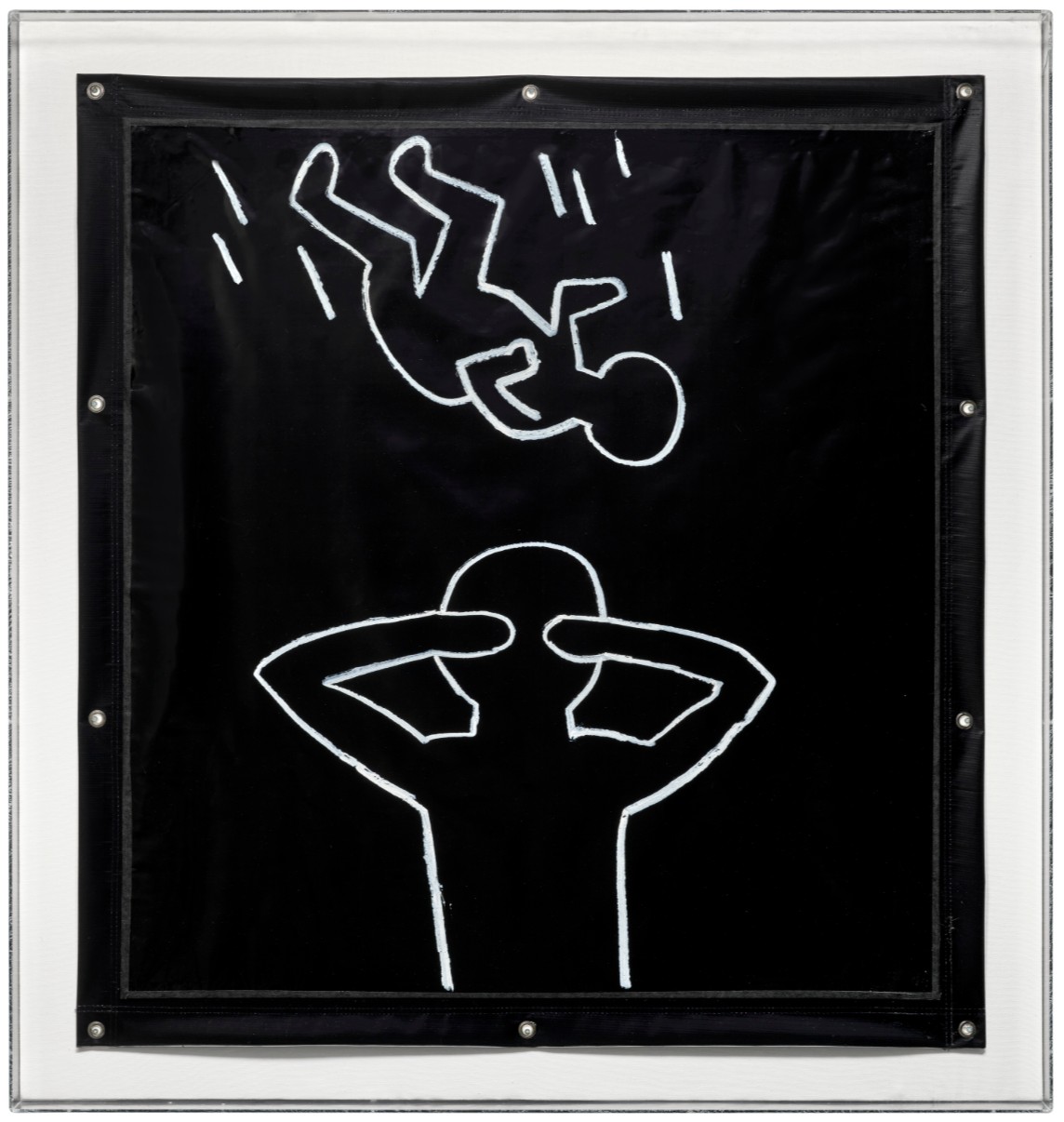
KEITH HARING (1958-1990)
Untitled, 1981
Acrylic on plastic laid down on tarp
41 x 38 1/4 inches (104.1 x 96.8 cm)
Signed and dated ‘K. Haring 1981’ (on the reverse)
RED-YELLOW-BLUE #21, 1987
Phillips New-York: 21 November 2025
Estimated: USD 120,000 – 180,000
PASSED
Keith Haring Modern & Contemporary Art Day Sale, Morning Session
KEITH HARING (1958-1990)
RED-YELLOW-BLUE #21, 1987
Acrylic on canvas
36 1/8 x 24 1/8 inches (91.8 x 61.3 cm)
Signed, titled and dated “RED-YELLOW-BLUE #21 JAN 12 87 ©K. Haring ⨁” on the overlap
Painted on January 12, 1987
Jeff Koons
PLEASE CLICK ON THE PICTURE BELOW TO ACCESS AUCTION MARKET OVERVIEW
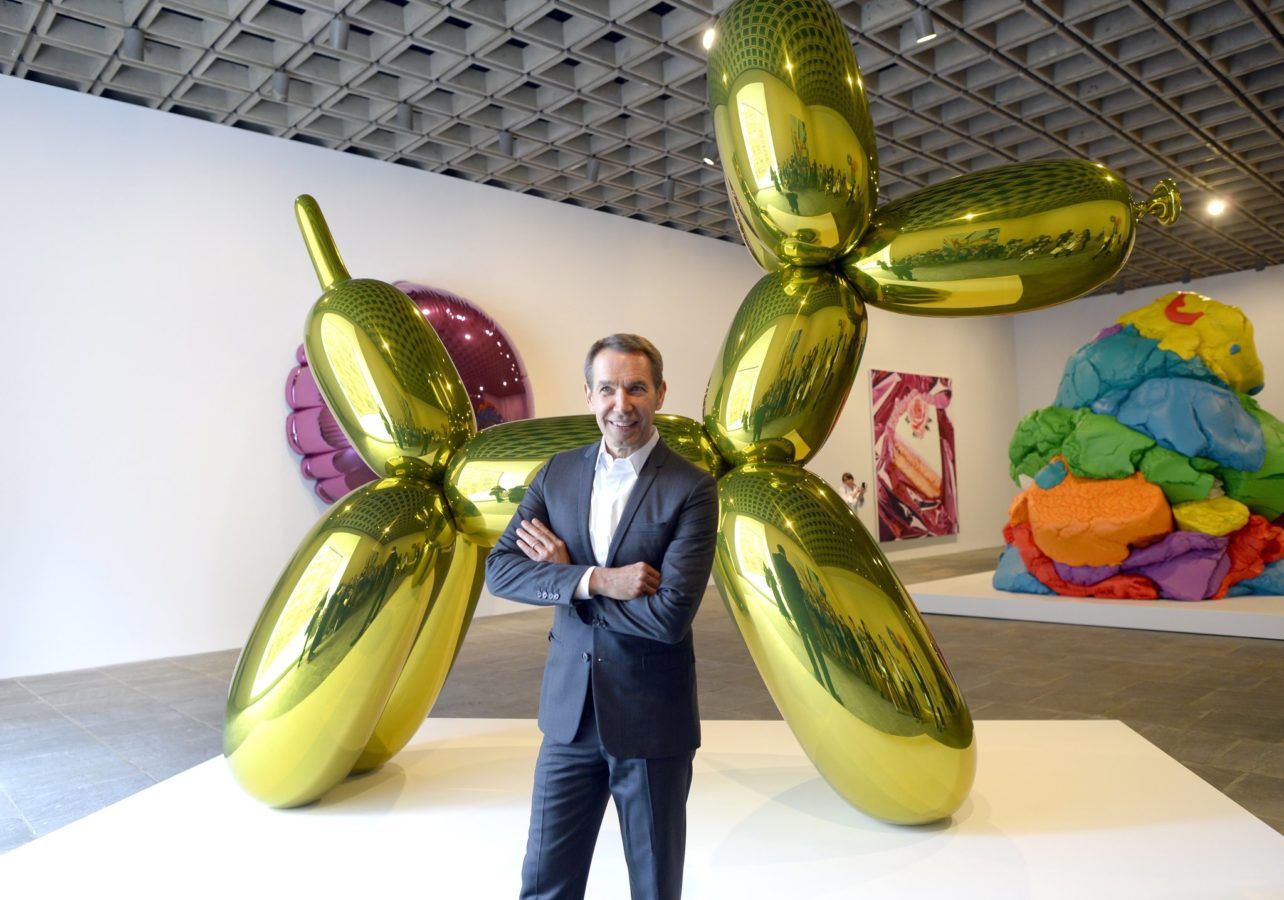
#1. Hulk (Rock), 2004-13
Property from a Prestigious American Collection
Sotheby’s New-York: 18 November 2025
Estimated: USD 2,o00,000 – 3,000,000
USD 4,442,000
Hulk (Rock) | The Now & Contemporary Evening Auction | 2025 | Sotheby’s
JEFF KOONS (b. 1955)
Hulk (Rock), 2004-13
Polychromed bronze and marble
87 3/8 x 48 3/4 x 28 1/8 inches (221.9 x 123.8 x 71.4 cm)
Signed, dated 2004-2013 and numbered 2/3 (on the interior of the purple element)
This work is number 2 from an edition of 3 plus 1 artist’s proof
Embodying the artist’s singular ability to transform the familiar into the extraordinary, Hulk (Rock) deftly typifies Jeff Koons’ celebrated artistic practice; his flawless fabrications become the means of upending expectation. At first glance, the sculpture appears to be a lightweight inflatable toy, contradictorily balancing the weight of a marble boulder upon its shoulders with a triumphant roar—an ephemeral inflatable toy stretched to the limit of its capacity. Yet upon closer inspection, the viewer discovers that the delicate surface is in fact cast in bronze, a material historically associated with permanence and steeped in art-historical convention. This seamless fabrication, polished to a degree of perfection that defies belief, illustrates Koons’ unparalleled mastery of surface and form while inviting us to reconsider the reliability of perception itself. Hulk (Rock) extends the lineage of Pop Art pioneered by Andy Warhol and Roy Lichtenstein, transforming mass-media icons into monumental reflections of contemporary desire and identity. Like Warhol’s Superman or Lichtenstein’s Popeye, Koons references the comic-book hero as a vehicle for examining strength, vulnerability, and the construction of myth through consumer culture.
“Everything has something to offer, and if you look at something at some level there’s something there that you can find of benefit. I really try to take life like a glass filled with water and put a sponge in there and try to get something out of everything.”
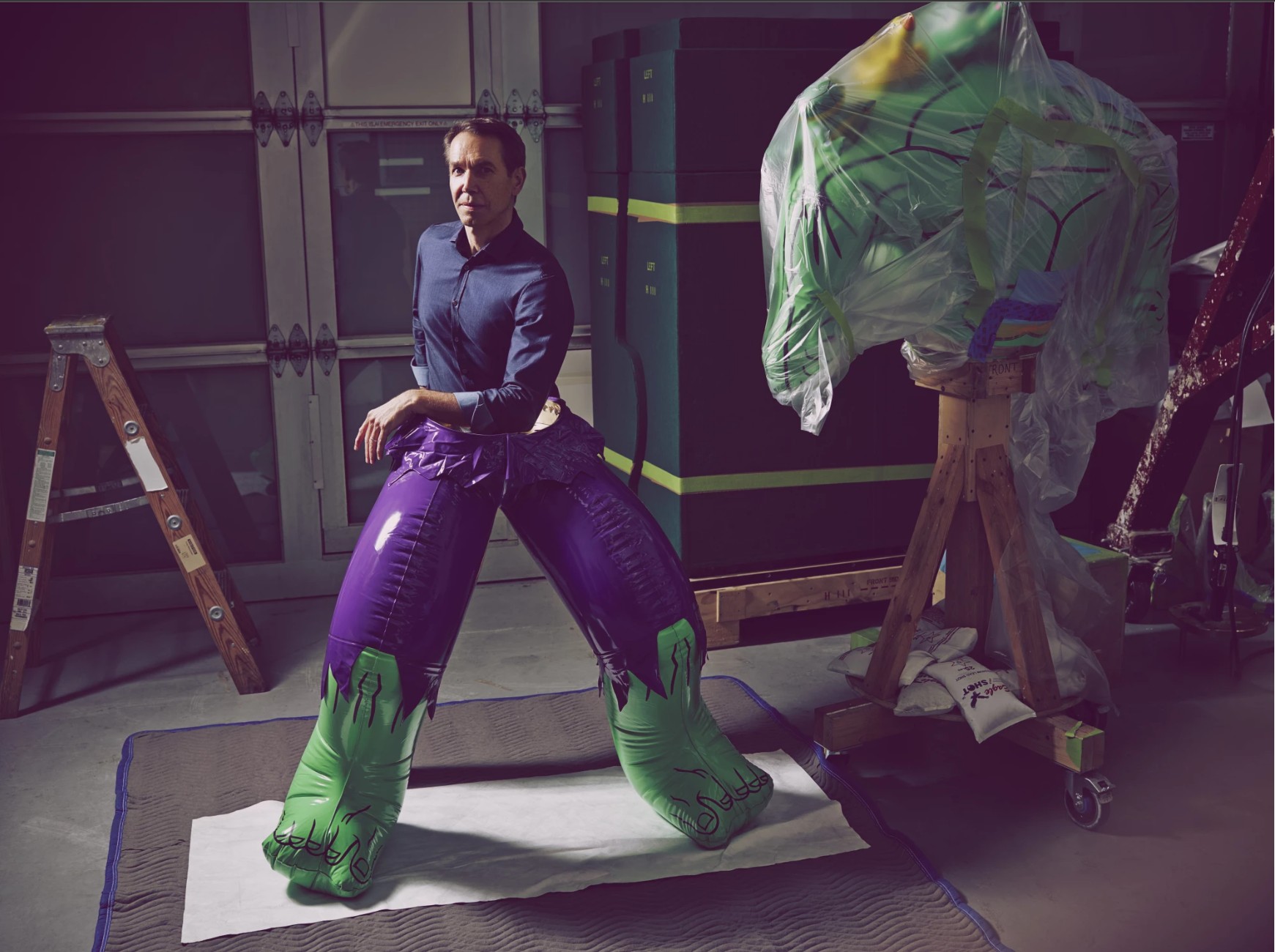
Jeff Koons in his studio. Image © Guy Aroch / Trunk Archive. Art © 2025 Jeff Koons Guy Aroch / trunkarchive.com
Koons’s Hulk series casts the Marvel superhero in various guises, each iteration balancing theatricality with conceptual rigor. The artist’s choice of subject is deeply resonant. First appearing in The Incredible Hulk in 1962, the character created by Stan Lee and Jack Kirby has long embodied the tension between vulnerability and power. Mild-mannered Dr. Bruce Banner, transformed by a blast of gamma radiation, becomes the Hulk when provoked by rage. Known for his vibrant green skin, exaggerated musculature, and purple pants stretched and torn by his rapid, anger-fueled growth, Hulk (Rock) toys with ideas of strength, power, and vulgarity.
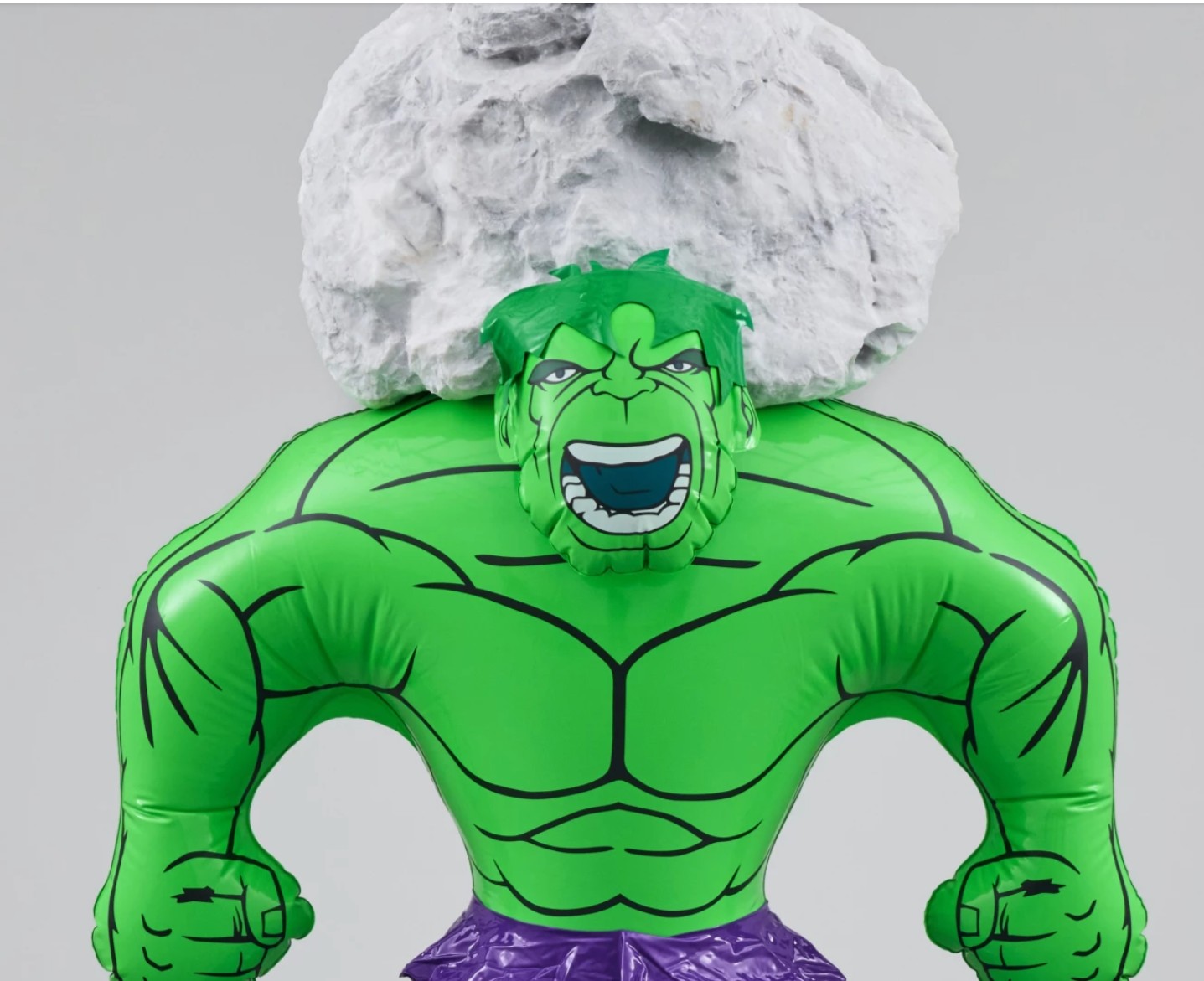
Born in an era riddled with fear of nuclear annihilation, the Hulk’s status as a superhero questions the concepts of righteous anger and justified violence. Occupying the margins of society due to his frightening appearance, the Hulk quickly became a leader in his own right within American counterculture, representing resistance to the traditional, handsome superhero archetype and creating space for the abject to stand on the side of the “good guys.” Unlike other superheroes, the Hulk embodies ambivalence: his strength is both a blessing and a curse, his appearance inspiring awe and fear in equal measure. The Hulk offered readers a parable of unchecked power and the destructive potential of modern science, while simultaneously serving as a figure of cathartic release—an avatar of justified anger in a world fraught with existential risk. This lineage situates Koons’ Hulk (Rock) within a broader cultural conversation—less about superheroes in the narrow sense and more about how societies project anxieties, desires, and ideals onto mass-market characters.
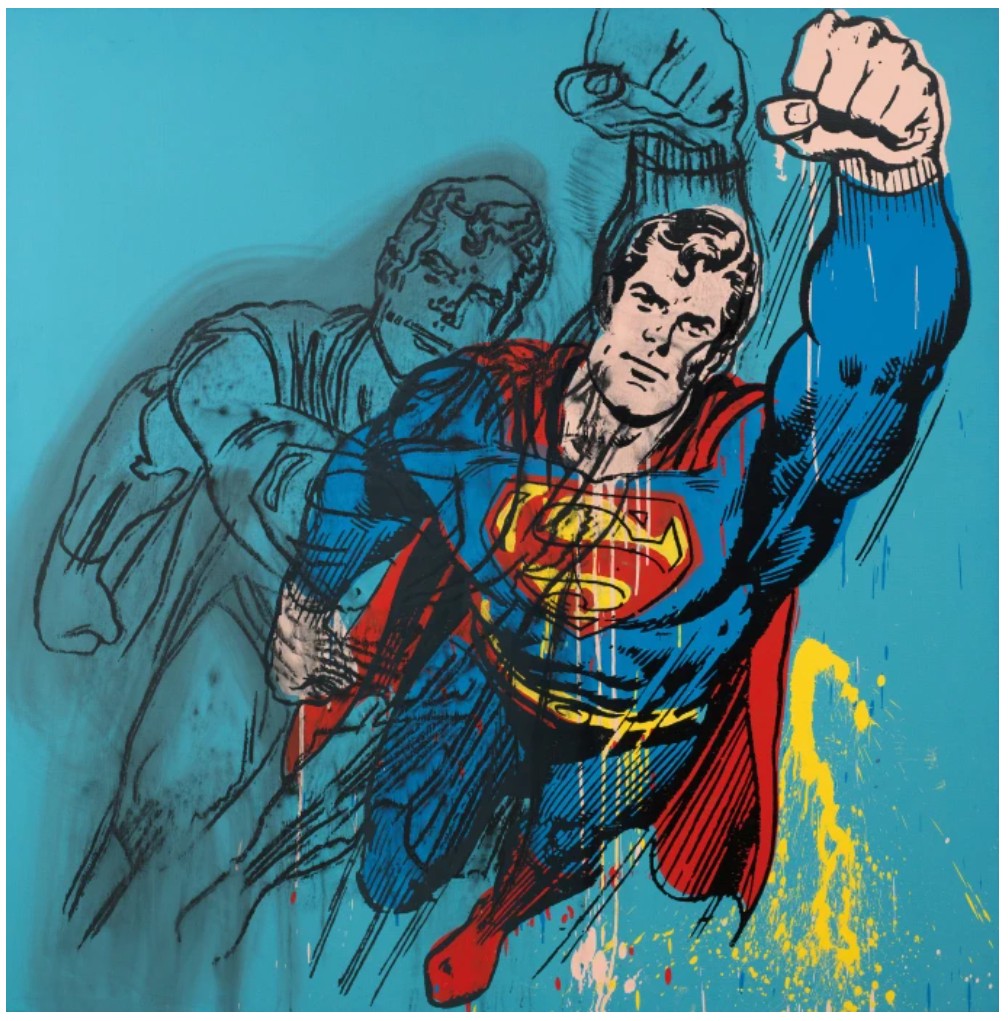
Andy Warhol, Superman, 1981. Private Collection. Sold at Sotheby’s New York in May 2015 for $14.4 million.
Art © 2025 Andy Warhol Foundation for the Visual Arts / Artists Rights Society (ARS), New York
Among his most accomplished works from the early 2000s, the Hulk sculptures—and their immediate precursor, the Popeye series—extend the artist’s enduring dialogue with the readymade and the iconography of American Pop culture. Jeff Koons is synonymous with the revival of Pop in the twentieth century, taking up the torch from Warhol, Lichtenstein, and Oldenburg with his iconic early Banality series, which recontextualized everyday, banal materials and images within a contemporary framework.
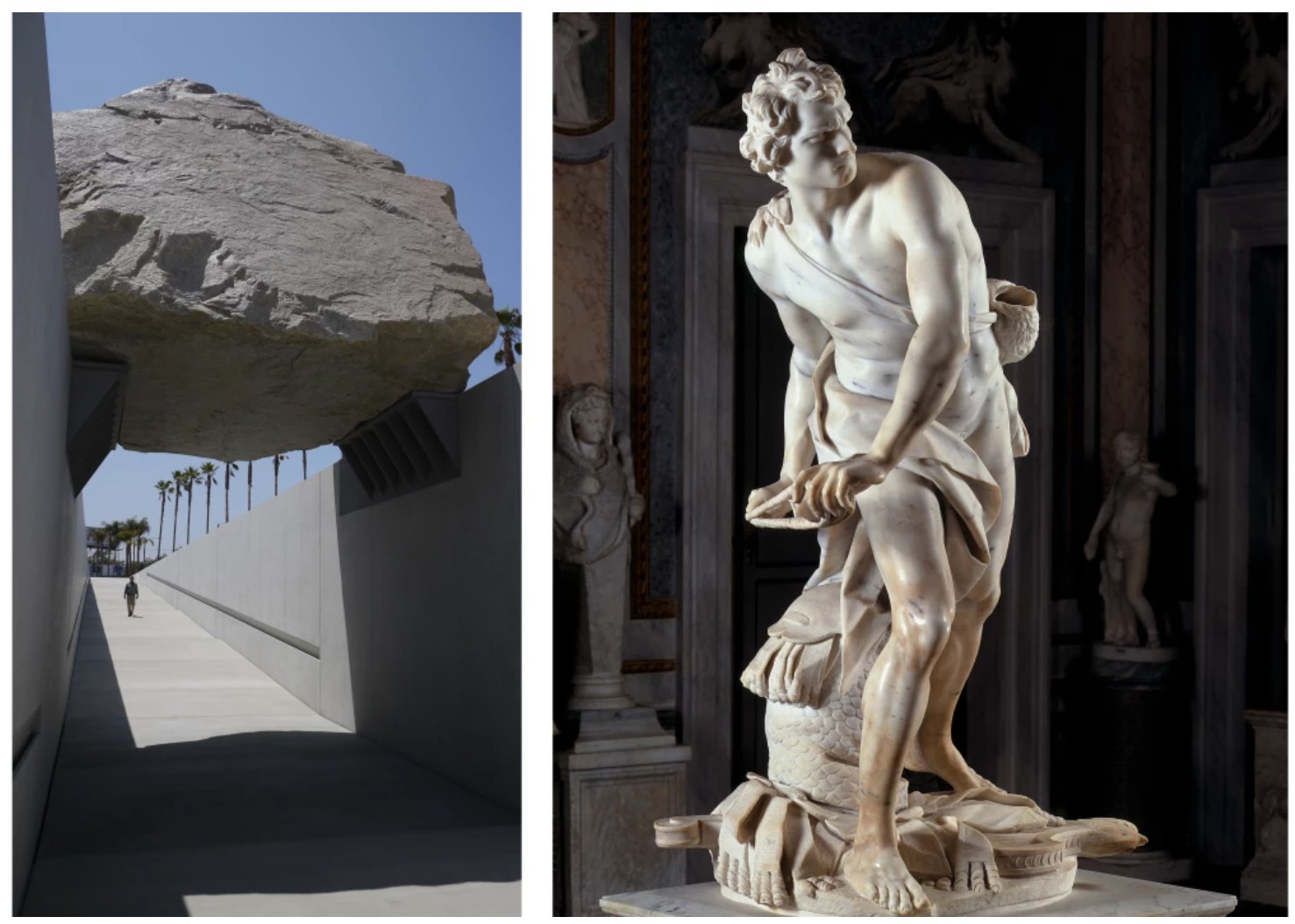
Left: Michael Heizer, Levitated Mass, 2012. Los Angeles County Museum of Art. Photo by Mary Shanahan. Art © Michael Heizer. Courtesy of the artist and Gagosian. Right: Gian Lorenzo Bernini, David, 1623-4. Galleria Borghese, Rome. Image © Andreo Jemolo / Scala / Art Resource, NY
Jeff Koons’ work is fundamentally about perception—how we see, what we value, and how meaning is constructed through surface, scale, and desire. Throughout his career, Koons has explored the boundary between the real and the artificial, the profound and the banal, inviting viewers to question not only the object before them but also their own reactions to it.
“They’re there as protectors…but at the same time they can become very, very violent… The Hulks are like that—they’re really high-testosterone symbols.”
The Hulk figure itself crystallizes these contradictions. As a pop-culture icon, the Hulk embodies both rage and protection, strength and vulnerability—qualities that Koons sees as reflections of the human condition. By monumentalizing this comic hero in the guise of a classical sculpture, Koons transforms mass-media imagery into an object of reverence, collapsing distinctions between high art and low art, myth and consumer fantasy. Its stance, firm and protectionary, evokes images of Japanese temple guardians while also referencing Andy Warhol’s images of Elvis Presley, fusing diverse sources of aesthetic and conceptual inspiration. In Koons’ universe, perception is faith, and the Hulk—both as a guardian from East Asian culture and an icon fixed in Western collective imagination—reflects the very essential and human desire for self-protection and self-preservation.
#2. Wall Relief with Bird, 1991
Christie’s New-York: 19 November 2025
Estimated: USD 2,000,000 – 3,000,000
USD 2,393,000
JEFF KOONS (B. 1955), Wall Relief with Bird | Christie’s
JEFF KOONS (B. 1955)
Wall Relief with Bird, 1991
Polychromed wood
72x50x27 inches (182.9 x 127 x 68.6 cm)
This work is number three from an edition of three plus one artist’s proof
A fertile bounty of lasciviously unfurling floral buds in full anthesis, Jeff Koons’s Wall Relief with Bird is an over life-size celebration of Edenic abundance. An important sculpture emerging from the artist’s notorious Made in Heaven series, the sculpture unifies motifs from Koons’s earliest sculptural works of 1979—his inflatable flowers and his wall-mounted appliances—to offer a vivid and tantalizing vision of his artistic universe.
“In Wall Relief with Bird there is a bird pollinating these large flowers. The imagery to me is about penetration. It’s also about fertility and pollination, and the eternal.”
One of Koons’s most quintessential masterpieces, the present edition has been exhibited in the artist’s seminal surveys and retrospectives including the Metropolitan Museum of Art and the Whitney Museum of American Art in New York as well as Tate Modern in London, while other editions of Wall Relief with Bird have been shown globally, from the Datar Museums in Doha, to Fondation Beyeler in Basel and the Louisiana Museum in Humlebæk.
Wall Relief with Bird is a high-relief polychrome wood sculpture with enticingly wrought veristic botanical and avian forms. Three voluptuous blossoming flowers align at the center of the composition—a yellow hibiscus at the top, followed by a white magnolia at the center with a delicate, pink daisy below. A blue hummingbird flutters around the central petal, its sharp beak just penetrating one of the flower’s anthers. Surrounding this central trio are several red and rose-colored flowers, all bound by grounding green leaves which surround the sculpture.
“I have always enjoyed flowers…
I always like the sense that a flower just displays itself.
The viewer always finds grace in a flower.
Flowers are a symbol that life goes forward.”
Rachel Ruysch, Flowers in a Glass Vase, 1704. Detroit Institute of Arts.
Wall Relief with Bird was first exhibited alongside the other works in the Made in Heaven series, where “panting little dogs were displayed alongside Murano glass figurines of the newlyweds in flagrante and sculptures of carved flowers with humanoid orifices, some in the midst of pollination by a hummingbird’s long bill” (S. Rothkopf, “No Limits,” in Jeff Koons: A Retrospective, exh. cat., Whitney Museum of American Art, New York, 2014, p. 25). This baroque spectacle functioned as a gesamtkunstwerk of painting and sculpture placing the viewer in the midst of an exuberant celebration of erotic passion between Koons and Ilona Staller, an Italian politician, model, and adult film star who married the artist the same year Made in Heaven was first exhibited.
Caravaggio, Bacchus, circa 1598. Uffizi Gallery, Florence.
The floral elements which dominate Wall Relief with Bird have had outsized significance as an enduring motif throughout Jeff Koons’s oeuvre, commencing with his first artworks, the Inflatables.
“I used to make inflatable flowers, back in 1979. They were store-bought inflatables. I inflated them, put them on glass mirrors, and just let them display themselves. When I was younger, seven, eight, nine, taking lessons, I drew flowers. But there’s a tension in flowers—and especially in the vases of flowers—about whether they’re domesticated or undomesticated. In a vase, the flowers are cut. Even though they’re a symbol, like the Garden of Eden, of life and sexuality and abundance, when you start to look at them in a philosophical way, there is actually no hope, no future”
Jean-Honore Fragonard, The Swing (Les Hasards heureux de L’Escarpolette), 1767. Wallace Collection, London.
While his floral motifs emphasize the work’s stated themes of penetration, offering alluring orifices for the hummingbird’s beak to enter, Koons’s medium explores the theme of the eternal made explicit by the artist. Koons has elaborated how “wood is a material that churches have used a lot, therefore it is associated with spirituality. It is considered a living material” (J. Koons, quoted in ibid., p. 151). Koons had first started working with wood for Banality, the series prior to Made in Heaven, creating secular figurative sculptures which align with the baroque tradition of polychrome religious statuary. Koons had begun to explore the way the Catholic church employed art in European churches, developing a fascination for the Baroque and the Rococo while studying how religious art operated in institutional structures as a constant negotiation between object and worshiper.
“The church has used wood a lot to communicate to people that there’s a sense of continuation to life. It’s considered a living material, but it’s a seductive material.
It has a certain sense of warmth.”
The work operates like a religious altarpiece, aligning with what Renaissance art historian Alexander Nagel has written about Koons’s art: “Jeff Koons consecrates not just living beings but also ordinary things, and that is why when I look at his work I am always checking against the Christian relic cult” (A. Nagel, “Objects That Are Only Boundaries,” in Jeff Koons: A Retrospective, op. cit., p. 243).
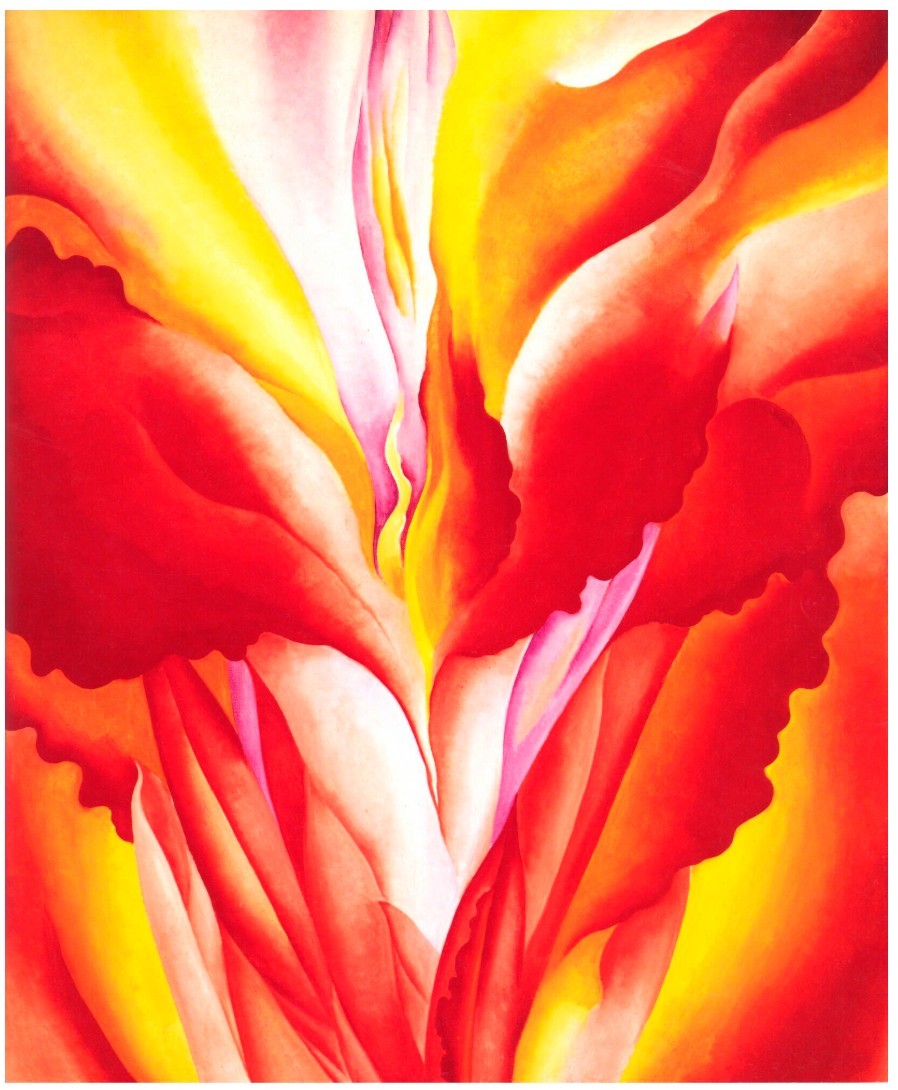
Georgia O’Keeffe, Red Canna, circa 1924. University of Arizona Museum of Art, Tucson.
Channeling the traditional usage of his medium in religious settings, Koons creates with Wall Relief with Bird a sensuous masterpiece communicating an almost spiritual sense of eternity, whilst simultaneously elaborating upon the penetrative, erotic aspects which pervade the broader Made in Heaven series. Jeff Koons is one of the most impactful artists alive today, his constantly reinventive creative world reinterprets Duchamp, Dada, Surrealism, and Pop art for the contemporary age. One of his most evocative and multifaceted works, Wall Relief with Bird insightfully provides an unvarnished look into the celebratory nature of procreation while rejoicing in the eternal.
#3. Dogpool Ladder, 2007-2011
Estimated: USD 750,000 – 1,o00,000
USD 967,500
Jeff Koons Modern & Contemporary Art Evening Sale featuring Cera the Triceratops
JEFF KOONS
Dogpool Ladder, 2007-2011
Polychromed aluminum and aluminum
68 x 59 1/4 x 63 3/4 inches (172.7 x 150.5 x 161.9 cm)
This work is number 2 from an edition of 3 plus 1 artist’s proof
Dogpool Ladder, executed between 2007 and 2011, is a striking example from Jeff Koons’ Popeye series, begun in 2002 and distinguished by its playful fusion of inflatables and everyday objects. A spotted dog-shaped pool float—meticulously cast in polychromed aluminum to mimic the matte-soft skin of printed vinyl—loops around a bright yellow step ladder, a mass-produced object incorporated by the artist in its unaltered form. At first glance, the familiar forms conjure nostalgia, evoking the carefree summers of suburban America, yet beneath this playful exterior the work reveals deeper tensions between innocence and entrapment, consumerism and transformation, illusion and reality.
“My work is a support system for people to feel good about themselves.”
Another example of the present work illustrated in the artist’s New York studio in a preliminary state.
Photography by Chris Fanning and Frances Janisch.
Image: © Chris Fanning, Artwork: © Jeff Koons
Koons’ engagement with inflatables dates back to the late 1970s, when he scoured discount shops on New York’s Lower East Side for vinyl toys to present alongside mirrors, “parodying the chaste rationality of minimalist sculptures.” His 1986 Rabbit—a stainless-steel replica of an inflatable bunny—extended this exploration and set the stage for the Celebration series of the 1990s, with its now iconic Balloon Dog. The Popeye sculptures continue this trajectory, but unlike their reflective predecessors, which implicate and affirm the viewer through mirrored surfaces, they recall the cast bronze lifeboats and snorkel vests of Koons’ 1985 Equilibrium series. Both bodies of work render flotation devices in improbably weighty materials, deploying surface as a means of heightening the cognitive dissonance between appearance and reality. In the Popeye works, feather-light pool toys—objects of play and transience—are transformed into meticulously painted aluminum forms that destabilize the line between illusion and fact.
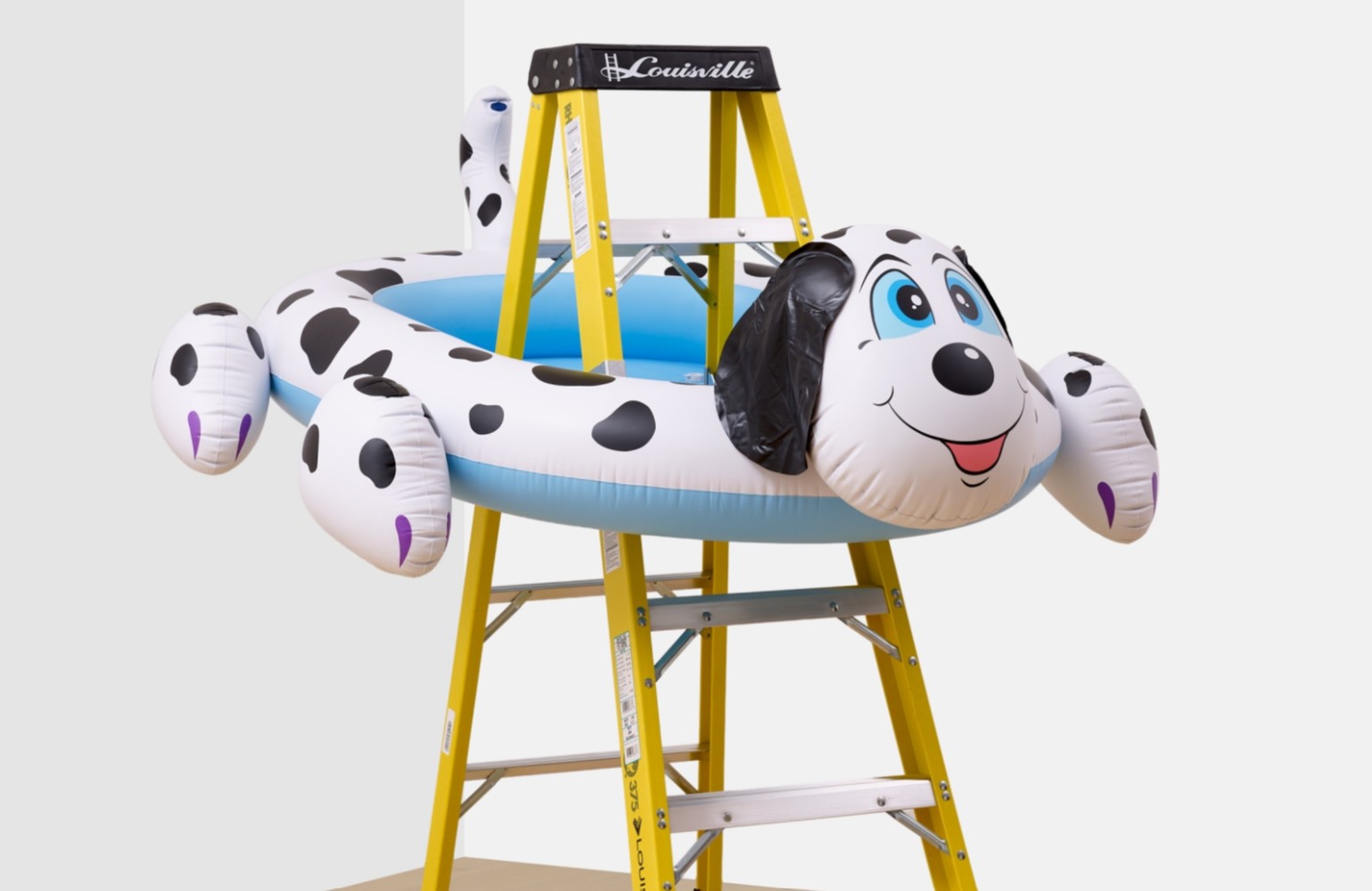
In Dogpool Ladder, Koons intensifies this deception. The plastic pool appears lightweight and pliable yet is in fact rigid cast metal. Every seam and ripple mimics the texture of vinyl, but its unyielding solidity flouts expectation. By contrast, the yellow step ladder remains unaltered—a utilitarian readymade that offsets the hyperreal falsity of the inflatable. This dynamic recalls Marcel Duchamp’s assisted readymades, in which familiar objects, decontextualized, acquire new meaning. Like Duchamp, Koons manipulates perception, forcing viewers to question what they see.
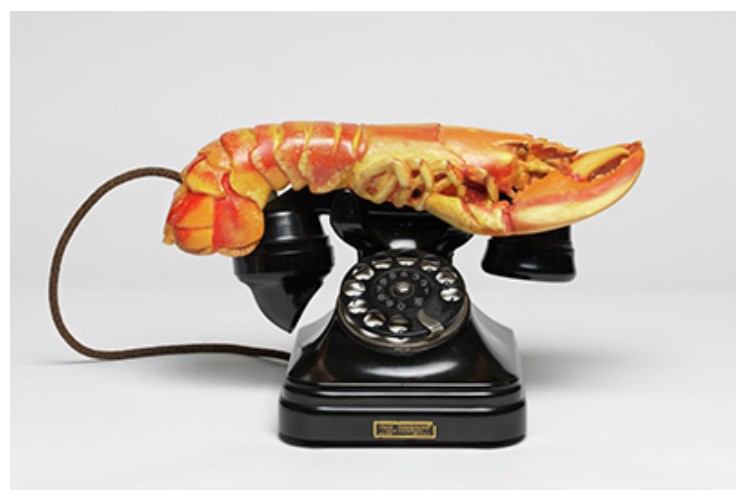
Salvador Dalí, Lobster Telephone, 1938. Tate, London. Image: © Tate, London / Art Resource, NY
Artwork: © 2025 Salvador Dalí, Gala-Salvador Dalí Foundation / Artists Rights Society (ARS), New York
The composite structure of the Popeye sculptures recalls Surrealist strategies of unlikely conjunction. Salvador Dalí’s Lobster Telephone, 1936, is a touchstone. Extending this lineage, Koons combines incongruous objects to generate new symbolic and psychological resonances, positioning Dogpool Ladder within the Surrealist embrace of the unexpected. Koons has long acknowledged the fetishistic dimension of inflatables.
“There is a huge sexual fetish thing on the Web for pool toys,
it would be a tragedy if they go soft due to a leak.”
Dogpool Ladder engages this charge directly: the original inflatable spouts water from the dog’s uplifted tail, a detail Koons carefully preserved in metal. With the ladder rising through the ring, the composition carries a latent phallic charge, while the encircling inflatable suggests containment or restraint. This play of soft and hard, freedom and restraint, echoes Dalí’s erotic absurdities, where the fetish object operates simultaneously as a consumer good and a sexual metaphor.

Jeff Koons, Dogpool (Logs), 2003-2008. Pinault Collection, Paris. Image/Artwork: © Jeff Koons
Though named after the cartoon character, Koons’ Popeye works often do not depict the sailor directly. Instead, they share a visual language of cartoon vitality, aquatic motifs, and retrospective image-making. Dogpool Ladder epitomizes these concerns—balancing innocence and sexuality, high and low humor and critique. The ladder functions both literally and symbolically, evoking aspiration, scaffolding, and slapstick pratfalls. For Koons, it is a means of addressing vulnerability, desire, and achievement.
“Popeye is about an image of, ‘I am what I am.’ Kind of a symbol of self-acceptance that you have to embrace who you are. Popeye has spinach. Spinach brings about his transcendence, and brings about his power. That’s what art [is]. Art is our spinach.”
At first glance, the work appears to celebrate the disposable, mass-produced objects of American suburban life. Yet beneath this cheerful surface lies a more cynical reading. The dog’s frozen grin may read as cheerful, but its painted expression of joy is curiously performative, verging on eerie. The ladder’s cold rungs, by contrast, imply confinement and exclusion. This tension between buoyancy and restriction reflects the contradictions of consumer culture, while also aligning Koons with Andy Warhol. Yet where Warhol iconized celebrity and commodities, Koons probes the promises and limits of suburban leisure. He himself has suggested that the Popeye works imply “an eye for Pop,” signaling his self-aware engagement with the imagery of mass culture.
“Pool toys are inflatable, just like people.
Inflatables really are metaphors for the continuation of life.”
For Koons, however, the work remains optimistic. This idea is reflected in the Popeye series’ namesake: a self-transforming cartoon hero who gains superhuman strength by consuming spinach. The plastic pup in this sculpture, seemingly stuck yet cheerfully grinning from its perch, embodies this same resilient optimism. Suspended at the halfway point, the sculpture suggests movement, as if the canine might yet reach the top of the ladder. In this sense, Dogpool Ladder is a metaphor for perseverance, a playful yet profound commentary on survival in a world of constraints.
#4. Popeye (Green), 2004-2009
Edlis Neeson Collection
Christie’s New-York: 19 November 2025
Estimated: USD 600,000 – 800,000
USD 762,000
JEFF KOONS (B. 1955), Popeye (Green) | Christie’s
JEFF KOONS (B. 1955)
Popeye (Green), 2004-2009
Mirror-polished stainless steel with transparent color coating
80 x 59 1/2 x 1 1/4 inches (203.2 x 151.1 x 3.2 cm)
Signed and dated ‘Jeff Koons 2004-2009’ (on the reverse)
This work is one of five unique versions (Blue, Green, Orange, Red, Yellow)
Jeff Koons’s Popeye (Green) compellingly incorporates two of the renowned American artist’s most memorable motifs—his iconic adaptation of the Popeye character and his fascination with reflective surfaces—into a potent recapitulation of his oeuvre. The mirrored surface of the work establishes a confrontational relationship between the artwork and the viewer, incorporating the observer into itself and merging their identity with that of Popeye. The mirroring effect, first seen in Koons’s celebrated Rabbit sculpture, is coupled with the Popeye motif, which first emerged as a sculptural series in 2002. Popeye (Green) expands upon these hermeneutics by simultaneously reflecting their concerns outward toward the viewer and enveloping the viewer within the work itself.
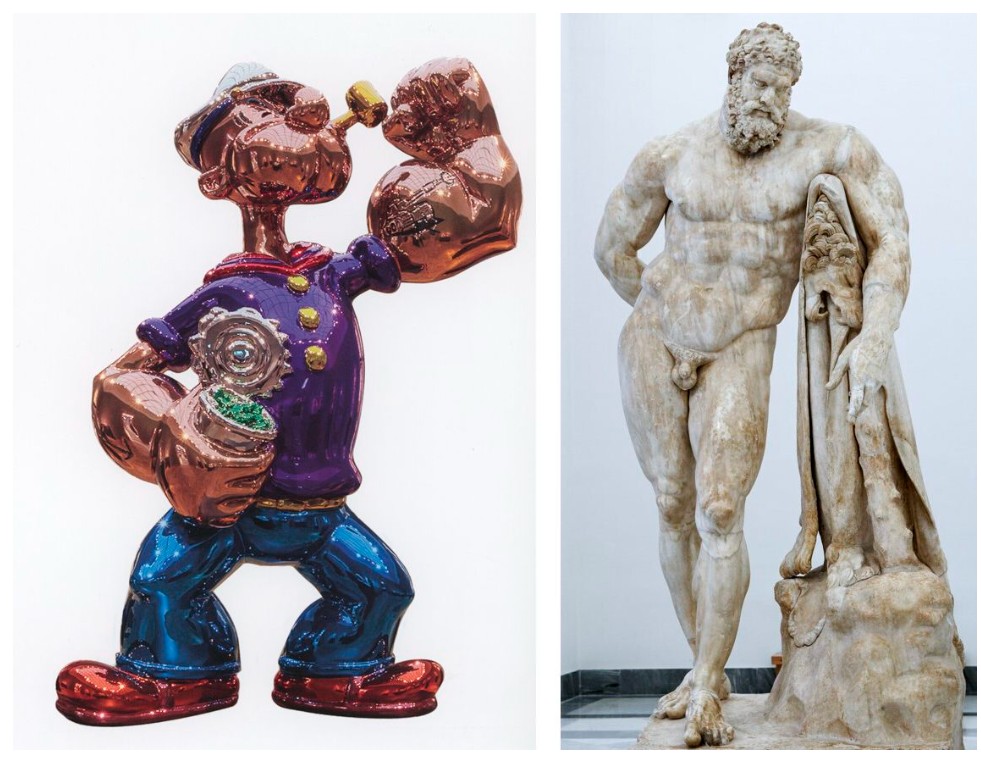
Left: Jeff Koons, Popeye, 2009-2011. Private Collection. © Jeff Koons.
Right: Glykon, reproduced from the original by Lysippos, Farnese Hercules, 216 AD. Naples National Archaeological Museum.
Popeye (Green) recreates Popeye’s instantly recognizable silhouette as a two-dimensional facsimile which lays flat against the wall. Flattening his imagery from his previous Popeye in the round sculptures heightens the cartoonish aspect of the artist’s source material while simultaneously retaining its discursive function—by bringing his work closer to his original referent, Koons strengthens the juxtapositions inherent in the work. Koons painted his series in five unique versions, utilizing either blue, green, orange, red, or yellow coloring. The green used here recalls the original pigmentation of the “Thimble Theatre” cartoon from 1925 as well as the title font color from the Popeye comic books. Another figure from this cartoon, Olive Oyl, another reflective wall artwork, is described by Koons as the present work’s pendant.
“Popeye is about an image of ‘I am what I am.’ Kind of a symbol of self-acceptance that you have to embrace who you are. Popeye has spinach. Spinach brings about his transcendence, and brings about his power. That’s what art [is]. Art is our spinach. Art can bring about this transcendence and this empowerment and our life can expand and we can have a vastness that is what we’re seeking.”
Koons’s optimistic account of transcendence and empowerment and the sense of an expansive vastness to life is further accentuated in the present work with his usage of the highly reflective surface.
“I used mirrors earlier in my work. I started back in 1977 and 1978 using store-bought mirrors… what I have always enjoyed about mirrors is both the recognition they give the viewer and their movement. The viewer is creating an abstraction by moving around and causing change. It is always affirming you, the viewer.”
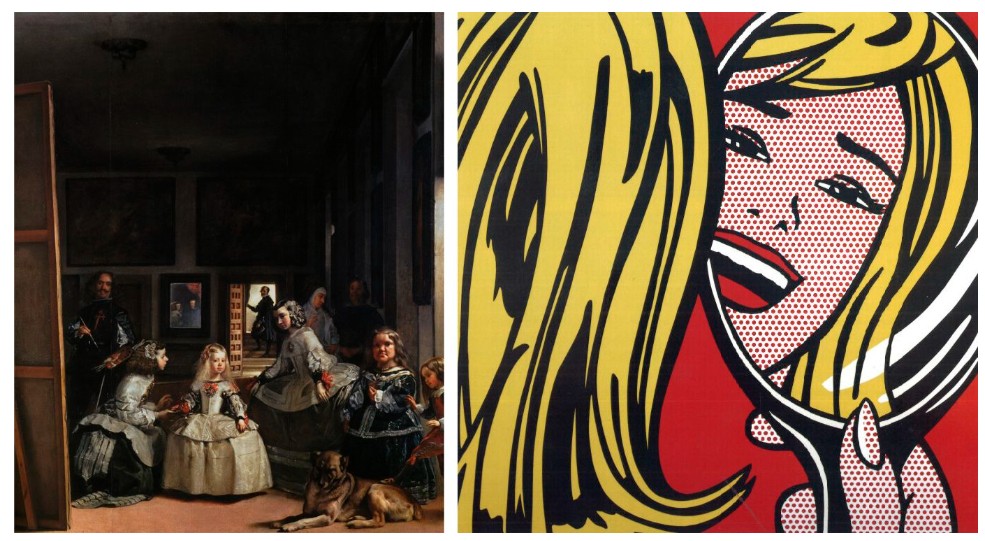
Left: Diego Velázquez, Las Meninas, 1656. Museo del Prado, Madrid.
Right: Roy Lichtenstein, Girl in Mirror, 1964. © Estate of Roy Lichtenstein.
Reflections pervade Koons’s oeuvre, from the mirrors used as bases for his early inflatable sculptures to the highly polished surfaces of his Statuary and Celebration series and the Gazing Ball works. Popeye (Green), however, is where the motif reaches its apotheosis, as its flat surface is pervasive, recapitulating the environment in which it is placed outward back toward the viewer. By integrating two of his most renowned and emphatic motifs together, Jeff Koons achieves a mesmeric and contemplative result in Popeye (Green). By inserting his own viewer’s reflection into the work, Koons literally incorporates his audience into the work’s themes of self-acceptance and empowerment.
#5. Gazing Ball (Ariadne), 2013
Christie’s New-York: 20 November 2025
Estimated: USD 600,000 – 800,000
USD 635,000
JEFF KOONS (B. 1955), Gazing Ball (Ariadne) | Christie’s
JEFF KOONS (B. 1955)
Gazing Ball (Ariadne), 2013
Plaster and glass
44 3/8 x 93 7/8 x 36 5/8 inches (112.7 x 238.4 x 93 cm)
This work is number one from an edition of three plus one artist’s proof
#6. Gazing Ball (Courbet Sleep), 2014-2015
Edlis Neeson Collection
Christie’s New-York: 19 November 2025
Estimated: USD 600,000 – 800,000
USD 596,900
JEFF KOONS (B. 1955), Gazing Ball (Courbet Sleep) | Christie’s
JEFF KOONS (B. 1955)
Gazing Ball (Courbet Sleep), 2014-2015
Oil on canvas, glass and aluminum
53 3/4 x 81 x 14 3/4 inches (136.5 x 205.7 x 37.5 cm)
Signed and dated ‘Jeff Koons 2014-2015’ (on the overlap)
Fusing the readymade with the art historical tradition, Jeff Koons’s Gazing Ball (Courbet Sleep) is an important example from the artist’s Gazing Ball Paintings series first exhibited in 2015. Koons first utilized his now-iconic gazing balls in a sculptural series where casts of casts of canonical works of European sculpture balanced blue gazing balls at key positions.
“With sculpture, you feel a constant polarity between the biological and Platonism. The sculpture also places an emphasis on form.
With the paintings, you have a more ancient dialogue.”
For his Gazing Ball paintings, Koons recalled the effect of painted three-dimensional surfaces, from the caves of Lascaux to the polychrome statues of Greek antiquity, and how two-dimensional and three-dimensional forms were brought together.
“The Gazing Ball sculptures have the same confrontation. There’s a dialogue taking place about the humanism of art and how important connectivity is in our lives. I wanted to make work that would add to the dialogue of the readymade and the concept of objective art.”
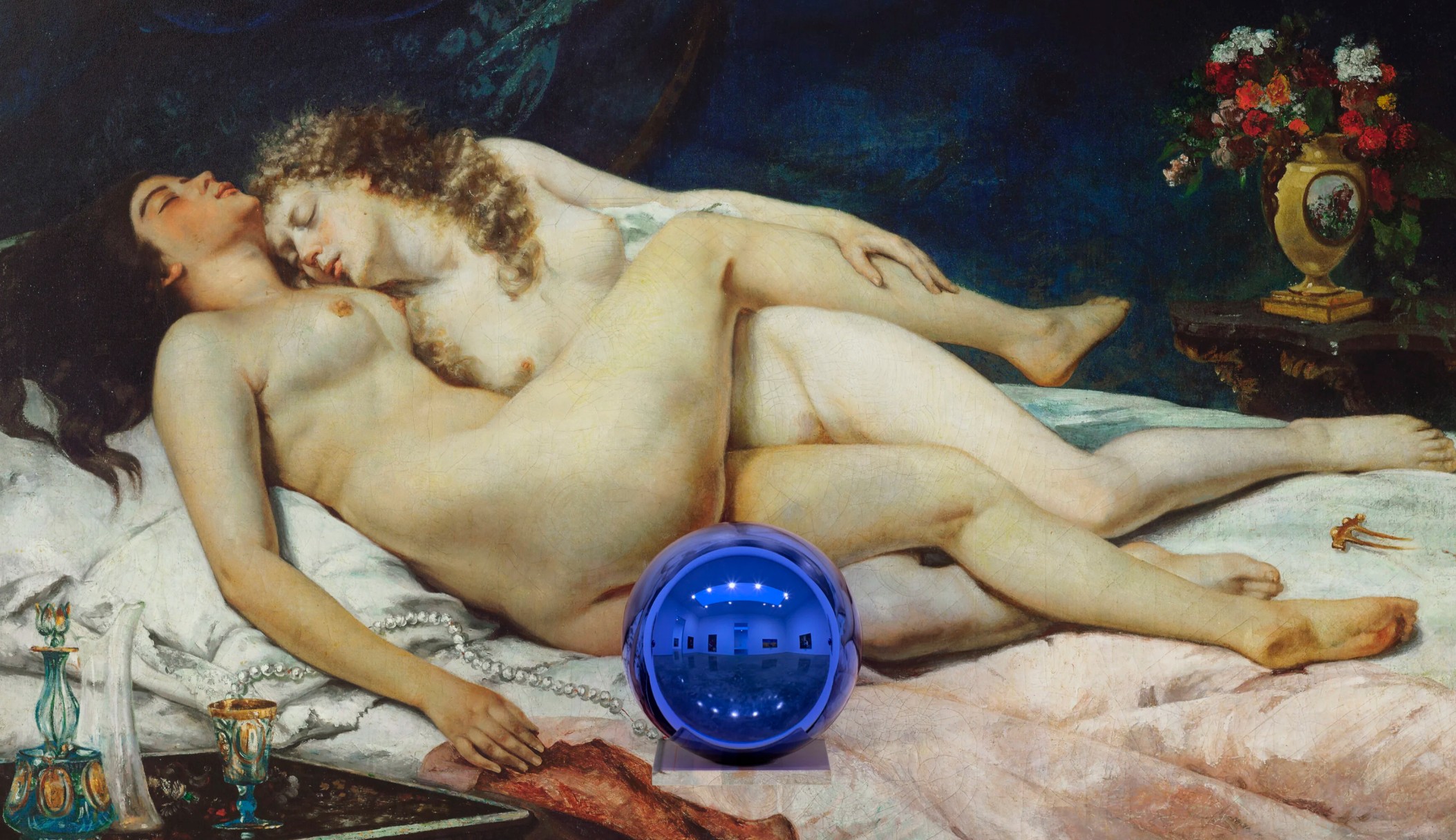
With Gazing Ball (Courbet Sleep), the artist creates a painted visual replica of the French artist’s infamous The Sleepers painting, now held at the Petit Palais, Paris. The painting, which depicts the then-scandalous scene of two nude recumbent women entwined together upon a bed and surrounded with Empire style decadence, appears to be an exact facsimile of the original, every detail hand-replicated including even a painted line for every crack on the original. Koons’s version is however is completely flat, omitting any painterly impasto used in the original. Koons’s most significant intervention is the placement of a reflective spherical blue gazing ball against the painted backdrop. Poised just below the centerline, the ball partially obscures the raised rear of one of the painted women whilst simultaneously reflecting this intimate region onto its surface.
“I want to participate, I always just wanted to be involved in a dialogue with the avant-garde. This is my family, these are the artists I have interest in, the joy that has enriched my life. I enjoy participating in the dialogue and I want to bring something to the table.”
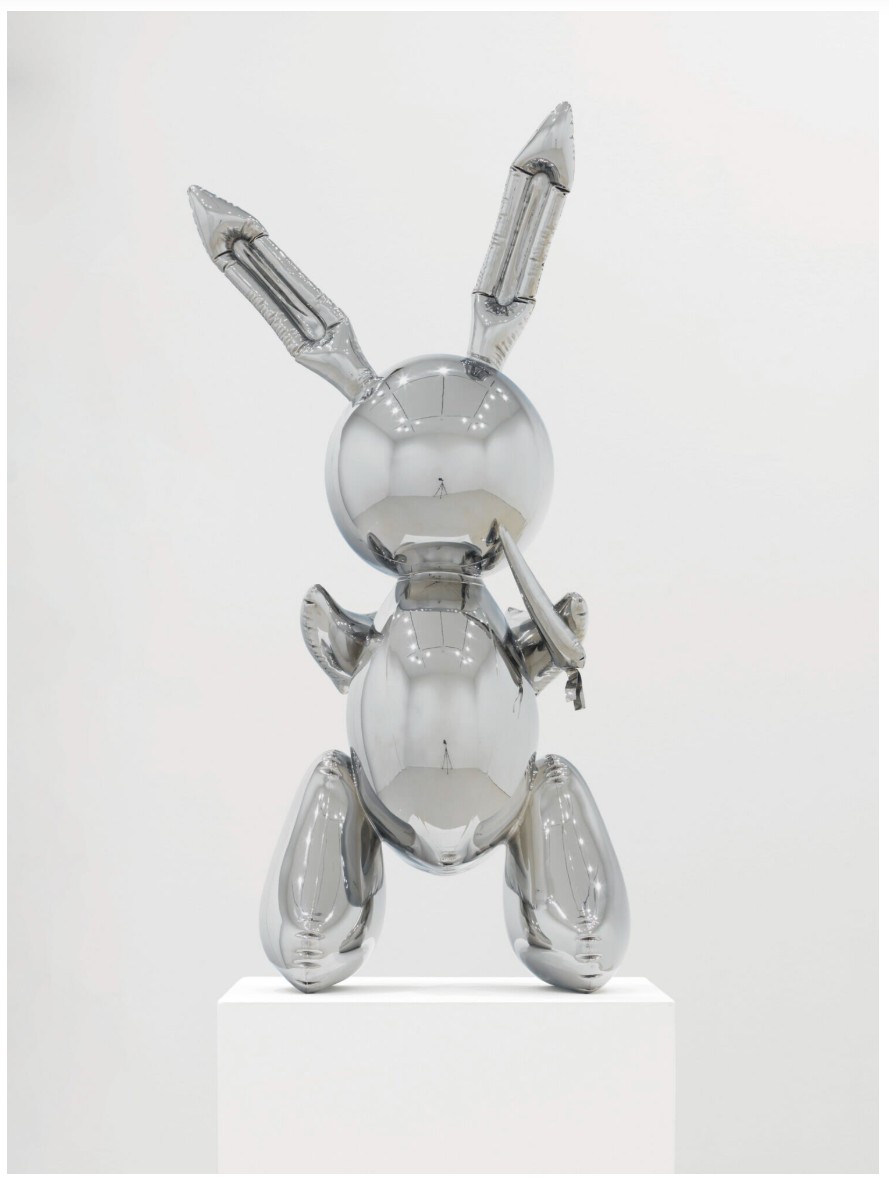
Jeff Koons, Rabbit, 1986. © Jeff Koons.
Koons identifies the head of his Rabbit, one of his most famous works, as the original gazing ball. He connects the use of the ball to Marcel Duchamp, the inventor of the readymade and a steadfast influence for Koons.
“The gazing ball is like Duchamp’s urinal in that it’s a confrontational object,
but it’s also very retinal.”
Used in the present work, the experience is about the viewer, forcing the audience to participate within and identify their own relationship with the image. In this participatory tone, the Gazing Ball paintings are also reminiscent of Andy Warhol’s Silver Clouds which float freely around their given spaces, reflecting everything around them and interacting with observers. While the gazing ball “represents the vastness of the universe and at the same time the intimacy of right here, right now,” the painting is not a mere visual reproduction of the visual experience of Courbet’s original, but a conceptual embodiment of the painting’s essence.
Jean Baptiste Siméon Chardin, Soap Bubbles, circa 1733-34. Metropolitan Museum of Art, New York.
Commissioned by Khalil Bey, the Ottoman envoy to France, Courbet’s The Sleepers was then a scandalous image, and joined two similarly controversial paintings also in Khalil-Bey’s collection—Courbet’s L’Origine du monde and Ingres’ The Turkish Bath. This trio created a boudoir salon exhibiting erotic female subjects, recalling Titian’s Poesie paintings from two centuries prior. Jeff Koons’s intervention in placing a reflective ball with the painting recreates the original dynamism of the commission, where the painting was meant to be in intimate dialogue with the onlooker and other paintings placed in its environs.
“The experience is about you, your desires, your participation,
your relationship with the image.”
Stephen Shore, Warhol with “Silver Clouds” in the Factory, circa 1965-1967.
Photo: © Stephen Shore. © 2025 The Andy Warhol Foundation for the Visual Arts, Inc. / Licensed by Artists Rights Society (ARS).
Gazing Ball (Courbet’s Sleep) provides a scintillating view into Jeff Koons’s deep art historical knowledge as he innovates upon the notion of the readymade, appropriating canonical subjects in the tradition of Duchamp while interpreting the experience of his viewer through cannily placed reflections.
#7. Snorkel Vest, 1985
Property from an Important European Collection
Christie’s New-York: 20 November 2025
Estimated: USD 400,000 – 600,000
USD 481,800
JEFF KOONS (B. 1955), Snorkel Vest | Christie’s
JEFF KOONS (B. 1955)
Snorkel Vest, 1985
Bronze
21x18x6 inches (53.3 x 45.7 x 15.2 cm)
This work is the artist’s proof from an edition of three plus one artist’s proof
Christopher Wool
PLEASE CLICK ON THE PICTURE BELOW TO ACCESS AUCTION MARKET OVERVIEW
#1. Untitled (RIOT), 1990
Christie’s New-York: 19 November 2025
Estimated: USD 15,000,000 – 20,000,000
USD 19,840,000
CHRISTOPHER WOOL (B. 1955), Untitled (RIOT) | Christie’s
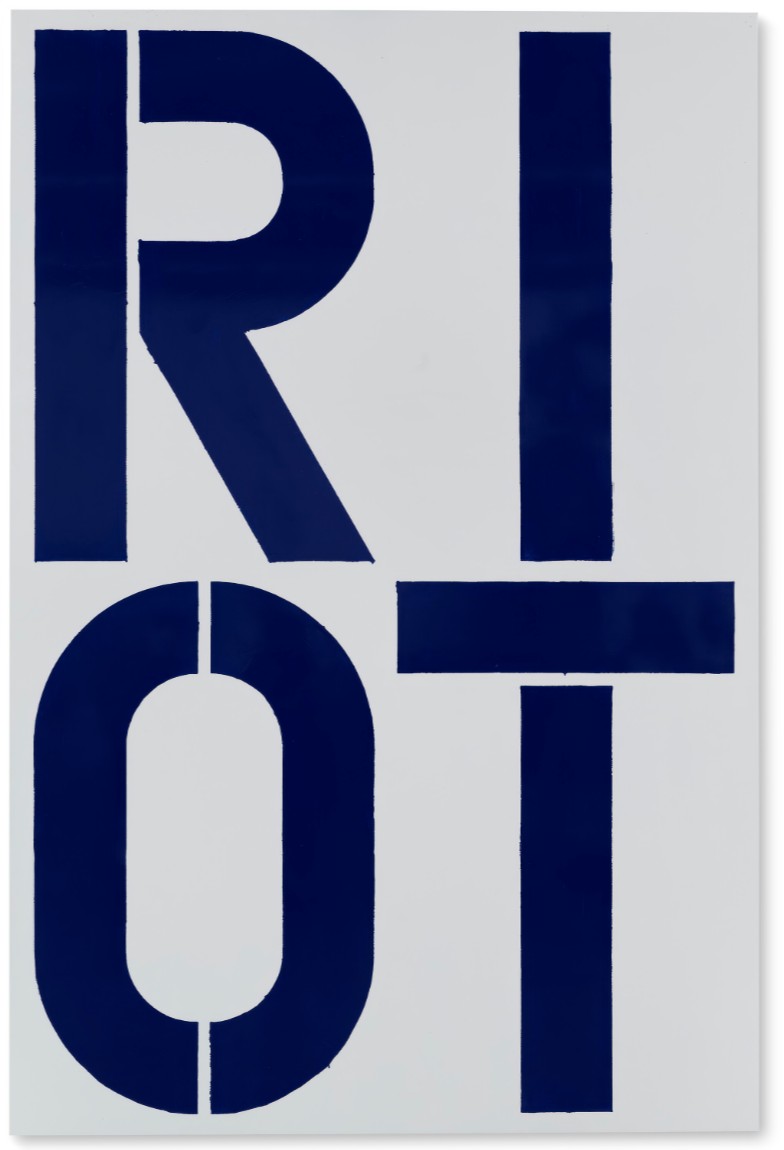
CHRISTOPHER WOOL (B. 1955)
Untitled (RIOT), 1990
Enamel on aluminum
108×72 inches (274.3 x 182.9 cm)
Signed, inscribed and dated ‘Wool 1990 (W16)’ (on the reverse)
R.I.O.T.
Four resolute capital letters, arranged methodically two by two, each within its own quadrant. These four letters, comprised of pooled blue enamel paint constrained by stencils dried thickly upon an imposing aluminum sheet primed with a velvety white ground, have become more than mere letters constituting a word, rising beyond text to serve as icons of Christopher Wool’s revolutionary artistic practice. Untitled (RIOT) is one of the artist’s most enigmatic and important works from his celebrated word paintings. RIOT. A single word, split in two. A headline, an announcement, a command, a demand, a threat, or a warning? This singular succinct word holds all and none of these meanings, or is maybe without meaning, evoking Wool’s eccentric enterprise examining the limitations of linguistics, the confounding of communication amid the explosion of text, and visual symbols in the era of mass media. Occupying a novel metaphysical space somewhere between language, image, speech, and act, Untitled (RIOT) conjures the best qualities of Wool’s radical reinvention of painting. The work demands to be looked at, stared into, deciphered, read, uttered aloud. But not understood.
Untitled (RIOT) is one of the very few from the approximately 75 word paintings to have blue rather than black enamel. Constrained by Wool’s stencils—which the artist fabricated himself in order to achieve his desired grand scale, nine by six feet across—the blue enamel hardened into a sumptuous dark ultramarine. Upon close inspection, the coloration in each letter oscillates slightly, the blues becoming deeper in areas where more paint pooled. This effect, coupled with the drips and painterly stutters observed around the nominally straight edges of each letter, is a deliberate and painstaking residual of Wool’s presence in the painting, revealing the materiality of the painting transcending its graphic effect and opening up myriad conceptual potentialities. Carefully planned, “they indict themselves, and, in the process indict the viewer,” explains the critic Jim Lewis. “YOU MAKE ME, yes, but it might just as well say ‘you unmake me,’ or even, ‘this isn’t made’” (J. Lewis, “Fail Better,” in Christopher Wool, ed. H. W. Holzwarth, Köln, 2012, p. 100).
Photograph of the new York City subway, 1985. Photo © Ferdinando Scianna/Magnum Photos.
Untitled (RIOT) is among Wool’s crowning achievements, signifying his subversive lure as a painter in an era when painting was dead. Made in 1990, Wool stood out in the midst of seismic historical and art historical junctures. The Berlin Wall had just toppled—the Soviet Union had not. History was still being made, its path uncertain—Francis Fukuyama only published The End of History in 1992. The first web server arrived in 1990, but its significance was yet to be acknowledged. Wool was straddling the nebulous temporality between two eras, creating in the midst of great uncertainty as the Cold War was coming to a close and the Internet Age was fast approaching. Christopher Wool’s importance arises from his almost prophetic ability to capture the zeitgeist not just of his era but our own; if anything, Untitled (RIOT) has amassed more poignance in the contemporary moment of artificial intelligence.
Christopher Wool began making his word paintings amid an ongoing crisis where painting’s dominance and relevance as a medium of artistic expression was under sustained attack. Wool emerged from the schismatic downtown New York art scene of the 1980s. Jean-Michel Basquiat and Julian Schnabel tried to arrest this seemingly inevitable historical pull away from painting with their Neo-Expressionist figuration. Wool’s contemporaries Cindy Sherman and Richard Prince went the opposite direction, inaugurating the Pictures generation. Wool’s middle way of earnest painterly invention, epitomized with his word paintings, was as radical as it was accretive. The word paintings amalgamate the raw energy of Abstract Expressionism with Pop Art’s deadpan cool, accommodating the Post-Minimalist emphasis on process within the strategies of replication and referential piracy. While concerned with and critiquing contemporary culture, Wool does not simply appropriate themes and images.
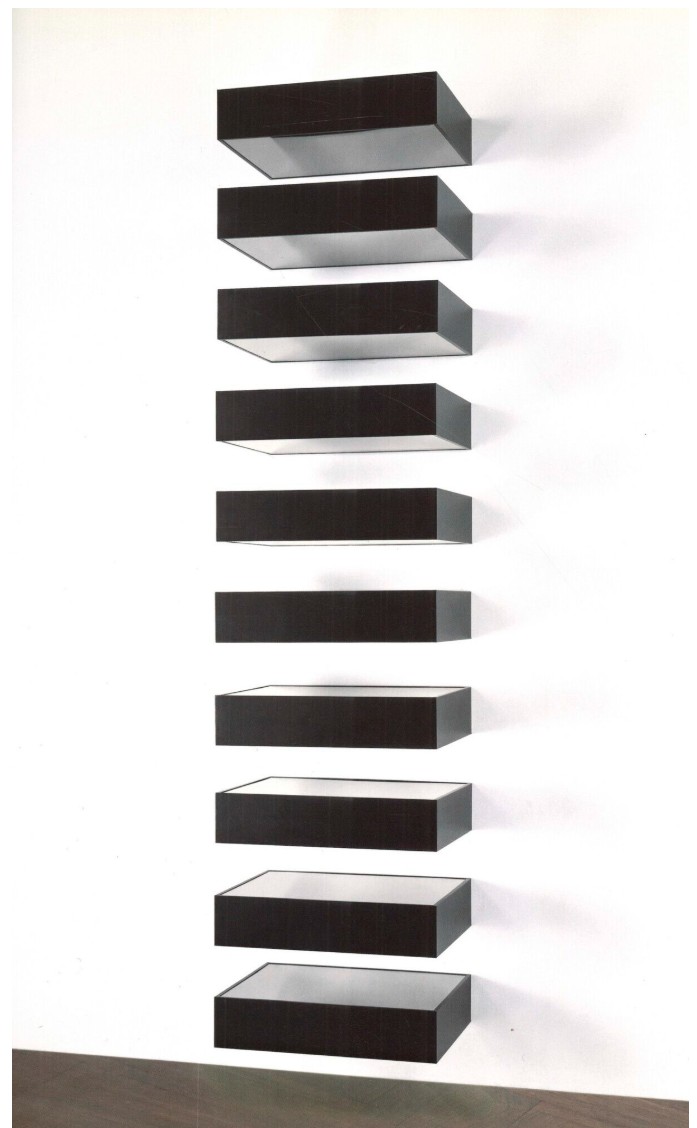
Donald Judd, Untitled, 1990. © 2025 Judd Foundation / Artists Rights Society (ARS), New York.
The origin of Wool’s word paintings has achieved a quasi-mythological tenor. On one of his many walks exploring and photographing the urban detritus of downtown Manhattan, Wool stumbled upon a gleaming white delivery van recently vandalized with black spray-painted graffiti: ‘SEX LUV,’ crudely rendered in crisp font. Utterly transfixed by the graphic and auratic power of this text, Wool set off at once to his studio in order to capture this raw energy in what would become his word paintings.
Wool’s textual explorations are abreast of a grand historical tradition in both literature and painting. His toying with the relationship vis-à-vis visual and verbal representation recalls the literary experiments of Stéphane Mallarmé and Guillaume Apollinaire. The Cubists’ inclusion of snatches of newspaper text in their still life constructions similarly stimulates the push and pull of recognition and illegibility. Ed Rucha’s portraits of words first called attention to how the brain is incapable of looking and reading at the same instant. Cy Twombly and Basquiat looked to words, scribbling them onto canvas, repeating them, crossing them out. Barbara Kruger and Jenny Holzer made language their medium too, while Glenn Ligon’s Door Paintings are contemporaneous.
Andy Warhol, Little Race Riot, 1964, The Art Institute of Chicago, Chicago.
© 2025 The Andy Warhol Foundation for the Visual Arts, Inc. / Licensed by Artists Rights Society (ARS).
Wool sourced the text for his word paintings from a vast mental archive he maintained of any words or phrases which arrested his attention. Textual spolia wrought from disparate sources, from obscure philosophical texts, Francis Ford Coppola films, Richard Prince jokes, or street graffiti, form the basis of each composition. RIOT is singular in its status among the series, its primal, almost guttural diction less spoliation and more an outpouring from the artist’s own inner psyche. Articulating an aura of anxiety also embedded in works like Apocalypse Now (1988, Private Collection), which commands SELL THE HOUSE SELL THE CAR SELL THE KIDS, or Untitled, depicting a series of paranoid statements paraphrasing the apocalyptic prose of Russian Philosopher Vasily Rozanov (1990-91, Private Collection). RIOT, however, appears to be among Wool’s most favored words, appearing as titles and texts to several other works.
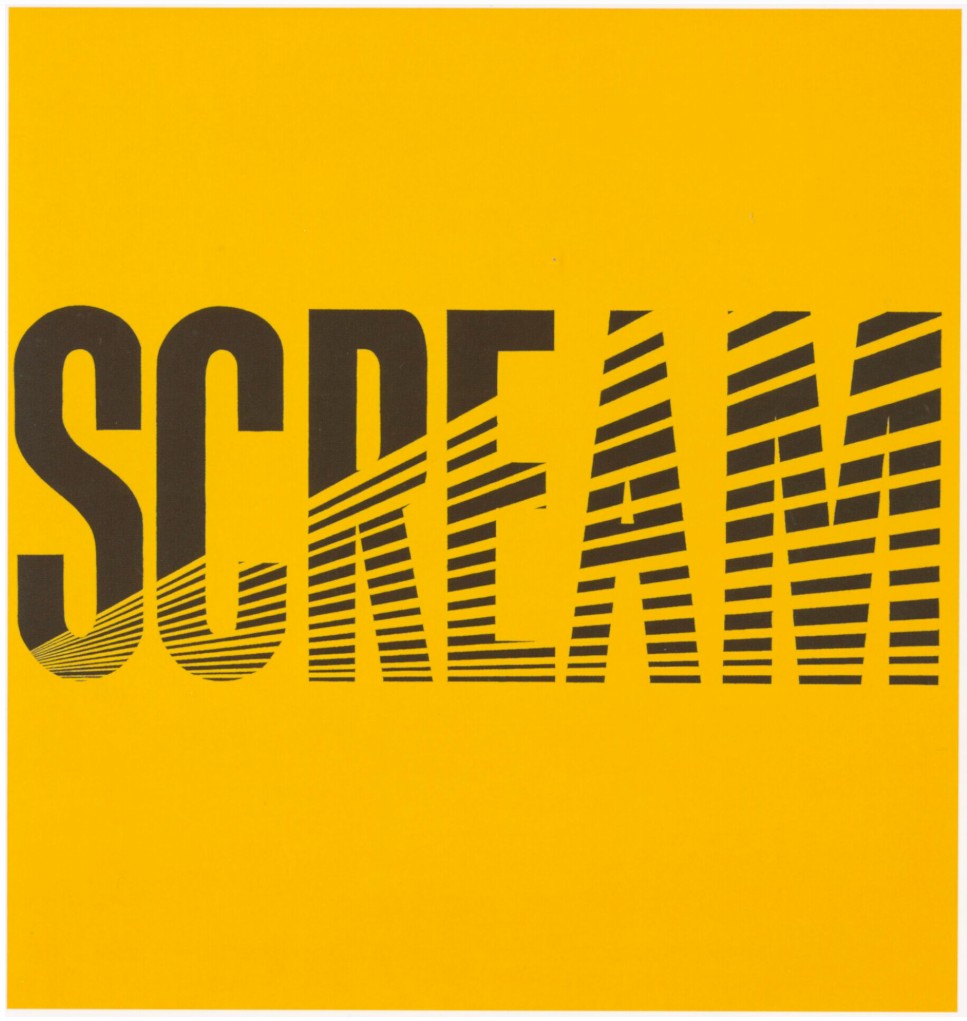
Ed Ruscha, Scream, 1964. Private Collection. © Ed Ruscha.
The present work thus achieves a poignancy lent by its intimate proximity to the artist’s imagination, accommodating the most important attributes exhibited in Wool’s best work, as identified by Jeff Koons for Wool’s first solo exhibition in 1986: “Wool’s work contains continued internal/external debate within itself. At one moment his work will display self-denial, at the next moment, solipsism. Shifting psychological states, false fronts, shadows of themselves, justify their own existence… Wool’s work locks itself in only to deftly escape through sleight of hand. The necessity to survive the moment at all costs, using its repertoire of false fronts and psychological stances is the work’s lifeblood.”
#2. Untitled, 2014
Christie’s New-York: 19 November 2025
Estimated: USD 1,500,000 – 2,000,000
USD 1,397,000
CHRISTOPHER WOOL (B. 1955), Untitled | Christie’s
CHRISTOPHER WOOL (B. 1955)
Untitled, 2014
Silkscreen ink on linen mounted to wood
106×96 inches (269.2 x 243.8 cm)
Signed, titled and dated ‘Wool 2014 Untitled (P647)’ (on the reverse)
Christopher Wool’s Untitled (2014) is a rare, monumental exemplar from his important series of jumbled letters and symbols strewn on canvas. Created just after the artist’s celebrated New York retrospective at the Solomon R. Guggenheim Museum, which then traveled to the Art Institute of Chicago, the work clarifies the elements which have come to be the most important to Wool’s practice—letters and words, black and white coloration, and the silkscreen process. This series recapitulates the artist’s oeuvre in a novel, extraordinary form. Wool here is reflecting upon his previous works, self-appropriating and reintegrating old motifs in new, revolutionary ways in order to rejuvenate his sense of artistic discovery. Untitled most significantly recalls Wool’s celebrated word paintings begun a quarter-century before. While this earlier series was notably ordered and followed ordinary semantic conventions to permit legibility, Untitled amasses a cacophony of letters of different sizes, fonts, tones, and orientations, overlaid against one another to prevent any sense of semiotic clarity. Of considerable importance to Wool’s artistic development after the Guggenheim retrospective, Untitled is the first of this rarefied series to come to auction, with similar examples held in prestigious institutional collections, including The Broad in Los Angeles and Fondation Louis Vuitton in Paris.
Cy Twombly, Untitled, 1967. © Cy Twombly Foundation.
Created with digital assistance, in Untitled Wool uses mechanical and digital replication as a means of self-appropriation, propelling old forms into new dialogues more suited for the digital era. While his earlier word paintings were created before the widespread adoption of the internet, Untitled came into being in an era of immediate digital reproduction, where text and image had become universally pervasive. The style seen in Untitled was first employed in Wool’s cover design for the 2013 Guggenheim catalogue. In Untitled, a large uppercase O is the most prominent icon in the assembly of greyscale letters and symbols, which also includes Js and Bs, a 6, an upside-down Y, and several sideways ampersands. A wrench form to the right of the canvas challenges distinctions between text and symbol. Two rectangular forms attempt in vain to frame the composition, instead becoming an underlayer upon which Wool adds more and more forms. Meandering, freeform lines weave across the canvas, echoing the organic forms of the artist’s contemporaneous wire and metal sculptures and linear etchings. Untitled is a palimpsest of Wool’s artistic practice, excavating then reburying myriad motifs from the artist’s past across the almost nine by eight-foot canvas.
Left: Charles Demuth, I Saw the Figure 5 in Gold, 1928. Metropolitan Museum of Art, New York.
Right: Jasper Johns, Alphabet, 1959. Art Institute of Chicago. © 2025 Jasper Johns / Licensed by VAGA at Artists Rights Society (ARS), NY.
“I define myself in my work by reducing the things I don’t want—it seems impossible to know when to say ‘yes,’ but I know what I can say ‘no’ to.”
Untitled presents Wool’s practice in its most considered and reduced form, reintegrating disparate earlier works into a cohesive composition, succinctly communicating his enduring message, critiquing contemporary culture and challenging conventional notions of text and meaning. Having earlier worked within the historical tradition exploring the pictorial possibilities of language, here Wool offers a decisive break, projecting his earlier work as shattered fragments of texts bound together in an undecipherable, wooly thicket of symbols. Bringing to the fore the abstracted tendencies latent in his previous work, Wool creates a vivid work replete with a potent visual presence and abounding in aesthetic subtleties.
#3. Untitled, 1992
Christie’s New-York: 20 November 2025
Estimated: USD 400,000 – 600,000
USD 444,500
CHRISTOPHER WOOL (B. 1955), Untitled | Christie’s
CHRISTOPHER WOOL (B. 1955)
Untitled, 1992
Enamel on aluminum
52 x 35 3/4 inches (132 x 90.8 cm)
Signed, inscribed and dated ‘WOOL 1992 (S114)’ (on the reverse)
#4. Untitled (Red), 2007
Sotheby’s New-York: 19 November 2025
Estimated: USD 350,000 -450,000
USD 444,500
WORK ON PAPER
Untitled (Red) | Contemporary Day Auction | 2025 | Sotheby’s
CHRISTOPHER WOOL (b. 1955)
Untitled (Red), 2007
Silkscreen ink on paper
72 x 55 1/4 inches (182.9 x 140.3 cm)
Signed and dated 2007 (lower right)
#5. Untitled, 1989
Property from an Important Private Collection, Japan
Christie’s New-York: 20 November 2025
Estimated: USD 200,000 – 300,000
USD 254,000
CHRISTOPHER WOOL (B. 1955), Untitled | Christie’s
CHRISTOPHER WOOL (B. 1955)
Untitled, 1989
Enamel and acrylic on aluminum
72×48 inches (182.9 x 121.9 cm)
Signed and dated ‘Wool 1989’ (on the reverse)
Untitled, 1988
Sotheby’s New-York: 19 November 2025
Estimated: USD 50,000 -70,000
PASSED
Untitled | Contemporary Day Auction | 2025 | Sotheby’s
CHRISTOPHER WOOL (b. 1955)
Untitled, 1988
Enamel and flashe on aluminum
12×12 inches (30.5 x 30.5 cm)
Signed, dated 1988 and inscribed T19 (on the reverse)
Richard Prince
PLEASE CLICK ON THE PICTURE BELOW TO ACCESS AUCTION MARKET OVERVIEW
#1. Double Nurse, 2001
Edlis Neeson Collection
Christie’s New-York: 19 November 2025
Estimated: USD 3,000,000 – 5,000,000
USD 3,491,000
NURSE PAINTING
RICHARD PRINCE (B. 1949), Double Nurse | Christie’s
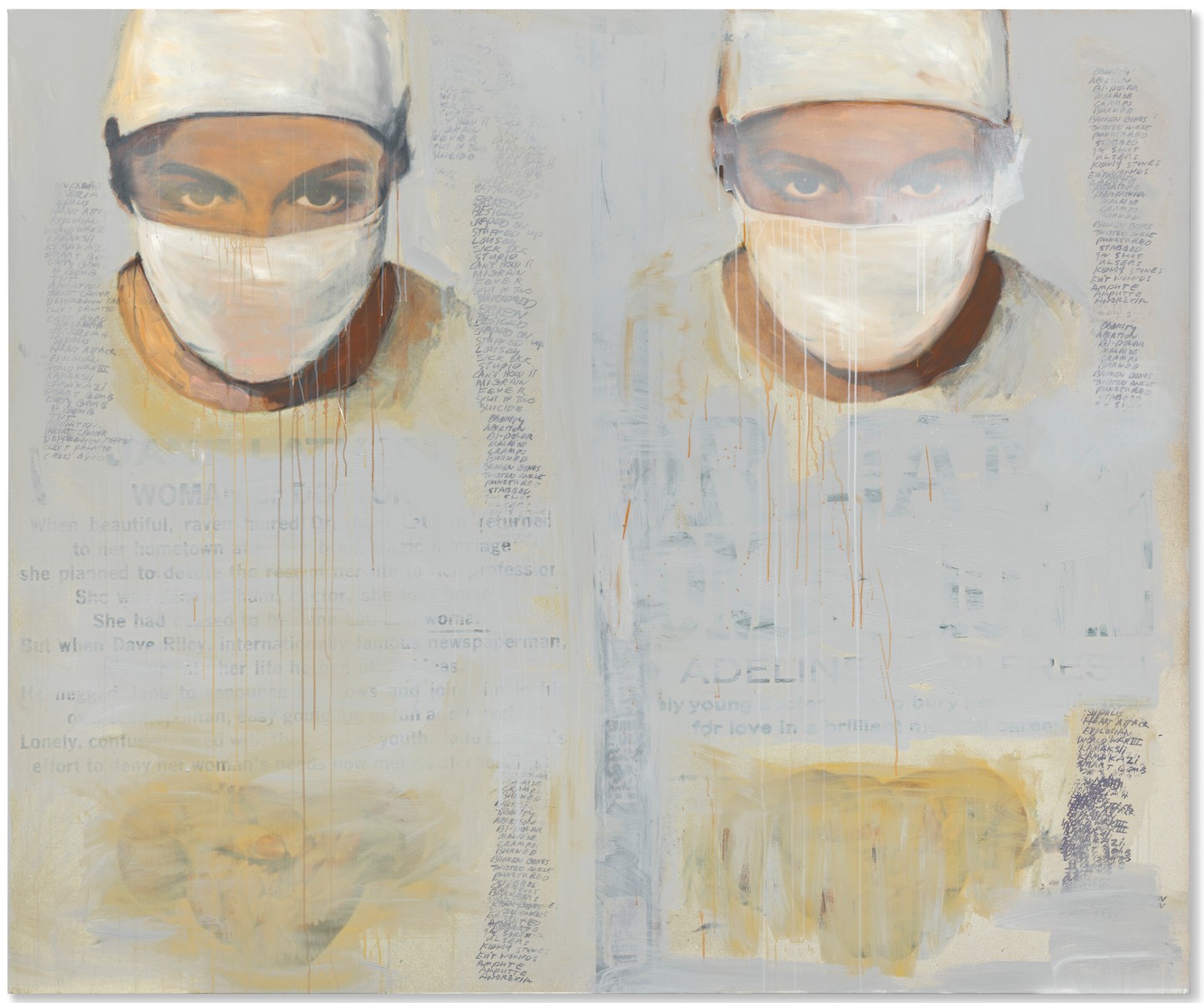
RICHARD PRINCE (B. 1949)
Double Nurse, 2001
Acrylic and inkjet on canvas
80×96 inches (203.2 x 243.8 cm)
Signed, titled and dated ‘Richard Prince, Double NURSE 2001’ (on the reverse)
Mesmeric and arresting, Double Nurse is a sui generis example which inaugurated Richard Prince’s acclaimed series of Nurse paintings. Painted in 2001, Double Nurse is utterly singular—it is the only work from the legendary series to feature two towering figures and is the largest example to come to auction. The work’s early execution date and unique iconography place the work as one of the earliest—if not the first—works in this foundational and massively influential series. Double Nurse’s iconography is plucked from the cover of a pulp romance novel; Prince uses the then-novel process of inkjet printing to reproduce his referent at epic scale across his canvas before bringing the image to life with his vivid painterly palette. Obscuring the cover’s original publishing text—the title, author, and blurb—Prince evacuates the image from its source, placing the dual nurse figures into an arresting new context which emphasizes their facial features and clasped hands. Prince surrounds the figures with repetitive lists of maladies scrawled in black paint which run down the composition in five segmented columns. Colliding several simultaneous symbolic signifiers for the nurse in literary and popular culture—as femme fatale or angel of mercy, as deviant or savior—Double Nurse serves as a poignant reflection on the dueling realities of turn-of-the-century America, bridled on the one hand with unmatched prosperity and uninhibited swagger while haunted by the specter of political violence. Summarizing the series, Nancy Spector describes the Nurses as “sinister hospital bandits, terrifying in their proximity to blood, bodily processes, and death,” who embody various sociosexual stereotypes: “Good Samaritan, naughty seductress, old battle-ax, and devil incarnate. He depicts each figure as both vamp and victim, undone by desire” (N. Spector, “Nowhere Man, in Richard Prince: Spiritual America, exh. cat., Solomon R. Guggenheim Museum, New York, 2007, pp. 52-53). Richard Prince’s mirrored nurses in Double Nurse allow these many contrasting guises to coexist as potentialities in paint, coalescing into an autobiographic tableau revealing the deeper layers of Prince’s psyche.
To create Double Nurse, Richard Prince reproduced the cover of Adeline McElfresh’s Dr. Jane Comes Home. Drawing on the legacy of appropriation which Prince developed alongside Cindy Sherman and Barbara Kruger in the 1980s, Prince here retains the facial features and hand details from his original image while covering the rest of the composition with vivid shades of white, obliterating most textual traces and covering up the book’s central spine. Prince uses thick brushstrokes of tans, creams, and pinks to vividly emphasize the nurses’ skin, allowing his paint to drip down the composition in a series of striking parallel linear paths. He similarly embellishes the nurses’ masks and scrub caps with layers of white paint, adding a compelling physicality to these elements and offsetting them against the white composition. The righthand nurse’s face is cloaked in a thin wash of white paint which acts as a diaphanous veil partially covering her eyes, which stare straight toward the viewer. The artist meanwhile makes the figures’ hands barely discernable with light washes of pigment, blurring the original pose into a vague organic form. This dueling process of veiling and enhancing would come to play a critical role throughout the Nurse series, and here one observes Prince working out with paint the methods and techniques which will populate later works in the series.
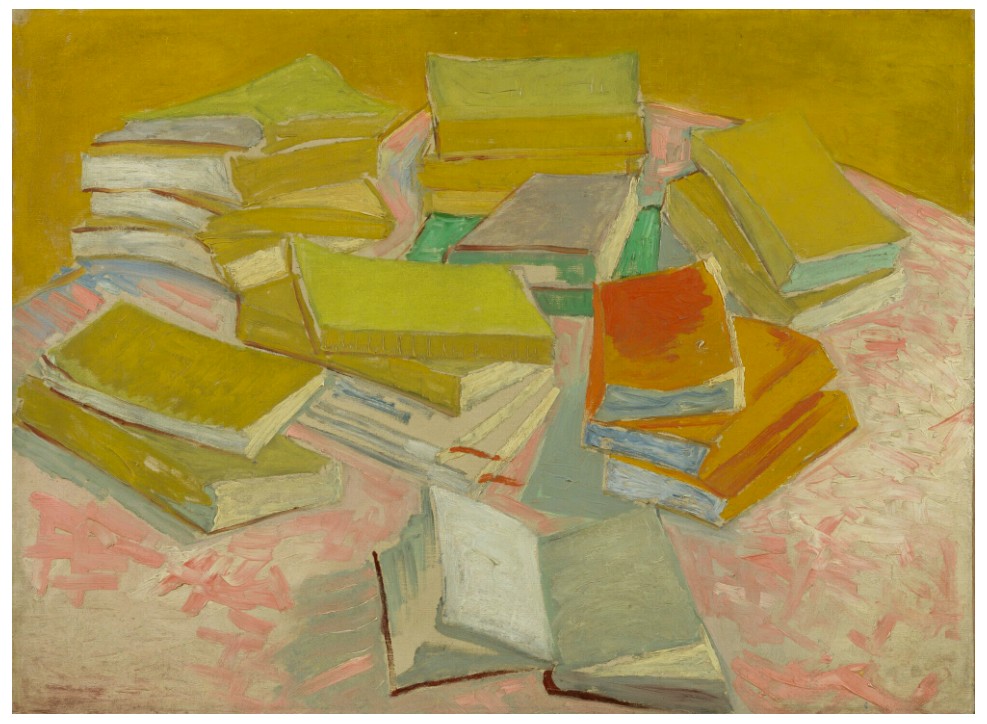
Vincent van Gogh, Piles of French Novels, October-November 1887. Van Gogh Museum, Amsterdam.
The artist gives a vivid recollection of how he conceived the nurse in Double Nurse. He had previously purchased a shoebox full of Nurse paperbacks at a flea market in the late 1990s—a noted bibliophile, Prince’s collecting of titles has become an integral part of his artistic process. In this sense Prince mirrors van Gogh, an avid reader who occasionally turned to the risqué ‘Yellow Books’ for compositional and subjective inspiration. Prince left his pulp fiction fallow until 2001, when “I brought them back out, I looked at them, and at the time what I was reading in the news was very disturbing, and the idea came into my head that everybody needed a nurse. And I remembered collecting these Nurse paperbacks” (R. Prince, quoted in “Deposition of Richard Prince” in Donald Graham V. Richard Prince, United States District Court, Southern District of New York, pp. 74-75). Having finally found a compelling subject for his moment, he tore the entire cover off of Dr. Jane Comes Home and inkjetted the image onto his canvas. Appraising the work, he decided to start painting. “The first Nurse paintings were done all in white. I was trying to quote the whiteness of the nurse—of an operating room and a nurse’s uniform” (ibid.). Unique to Double Nurse is the written text flowing down the composition. As Prince explains, “On the painting, I made a list of all the kinds of things that could happen to you in the world… whatever a nurse could, perhaps, help you with” (ibid.).
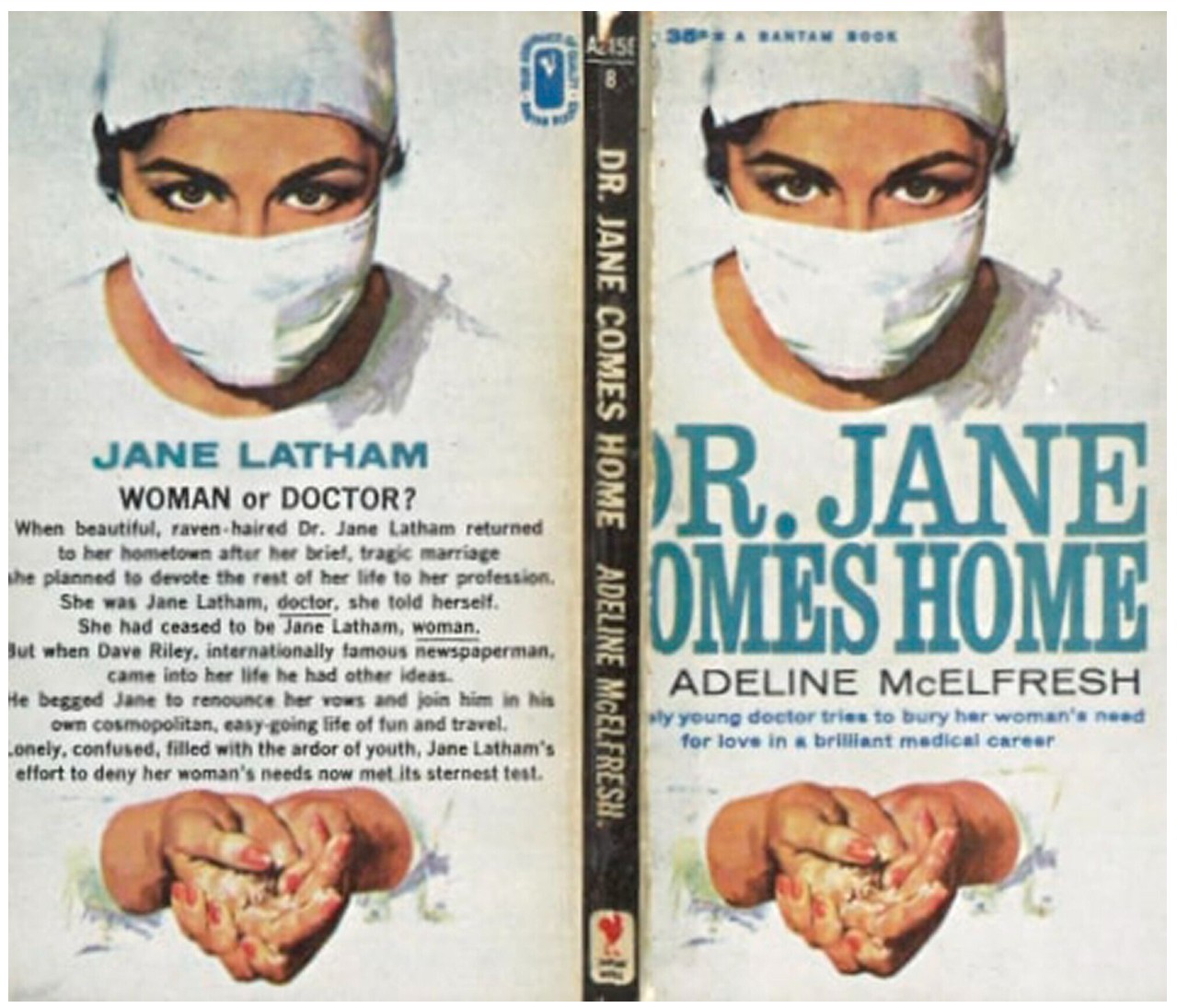
Adeline McElfresh, Front and back cover of a “nurse” paperback, 1959.
Prince’s didacticism in the face of global strife follows an important tradition of textual art from the twentieth century. Cy Twombly’s pairing of poetry, myth, and history wrought works like Apollo (1975, Cy Twombly Foundation) where names are scribbled in a similarly informal black script, a format which Joseph Beuys’ blackboard paintings also echo. Painted text reemerged in the work of Jean-Michel Basquiat, while Prince’s close friend and contemporary Christopher Wool also explored the function of black text on white. Another contemporary, Glenn Ligon, articulated a corresponding interest in repetition and obscuring with his “Door Paintings,” where the lower part of his stenciled compositions shows each white letter blending together into a cacophonic mass of illegible letters and symbols, similar to the text on the lower right register of the present work. The profusion of text, both residual from the reference image and added by the artist, creates a deeply affective, intimate vision of the artist.
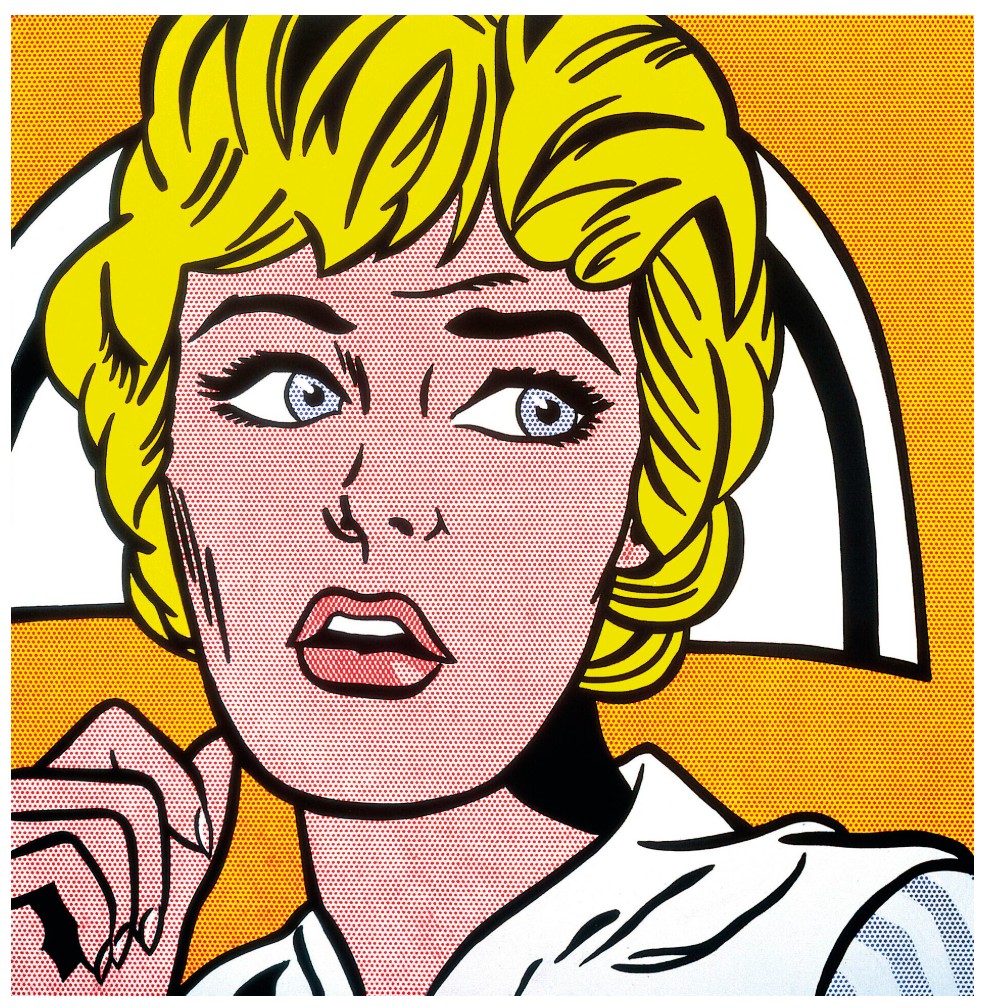
Roy Lichtenstein, Nurse, 1964. Private Collection. © Estate of Roy Lichtenstein.
In this vein, Double Nurse functions as a self-portrait, revealing Prince’s most profound worries as he grappled with the events occurring around him, leaning on the comforting yet complicated symbol of the nurse as a salve. Double Nurse offers an enticing point of origin for the later Nurse paintings which premiered in 2003 at Gladstone Gallery in New York. While his later Nurses embraced an erotic emphasis on the nurses, here they become both comforting sources of aid and ominous portents of hazard—where there are nurses, there is sickness. Double Nurse is a singular example out of Prince’s entire oeuvre which deconstructs the many masks, layers, and veils places around his artworks in order to provide a searing glimpse into the artist’s anxieties.
#2. Untitled (Cowboy), 2011-13
Edlis Neeson Collection
Christie’s New-York: 19 November 2025
Estimated: USD 2,000,000 – 3,000,000
USD 3,369,000
RICHARD PRINCE (B. 1949), Untitled (Cowboy) | Christie’s
RICHARD PRINCE (B. 1949)
Untitled (Cowboy), 2011-13
Painted bronze
Figure: 47 1/2 x 19 x 11 1/4 inches (120.6 x 48.3 x 28.6 cm)
Overall: 83 1/2 x 22 x 19 inches (212.1 x 55.9 x 48.3 cm)
Incised with the artist’s signature, foundry mark, number and date ‘R Prince 2⁄3 2013’
(on the reverse of figure’s proper left leg)
This works is number two from an edition of three plus two artist’s proofs
Each a unique color variant
A solitary, singular taciturn figure stands in slight contrapposto against the immense, horizonless space of the white-walled gallery. Lone and independent, Untitled (Cowboy) is the first fully figurative sculpture to emerge out of Richard Prince’s celebrated practice, standing alone in the midst of Prince’s renowned body of work as the most complete version of the cowboy figures which pervade the artist’s oeuvre and have profoundly influenced our society’s view of itself. Presenting as the culmination of a certain American mythology, deeply integrated into Prince’s previous practice, Untitled (Cowboy) reverberates with multi-latitudinal referents, articulating one of the most recognizable symbols of American mythology while simultaneously traversing a classicizing art historical tradition originating in the bronze Kouros statues of Greek antiquity and running through to Renaissance notions of individuality and republican liberty. Most profoundly, Untitled (Cowboy) is an autobiographical self-portrait, a deeply personal metamorphosis turning the artist into a manifestation of his own most important symbol.
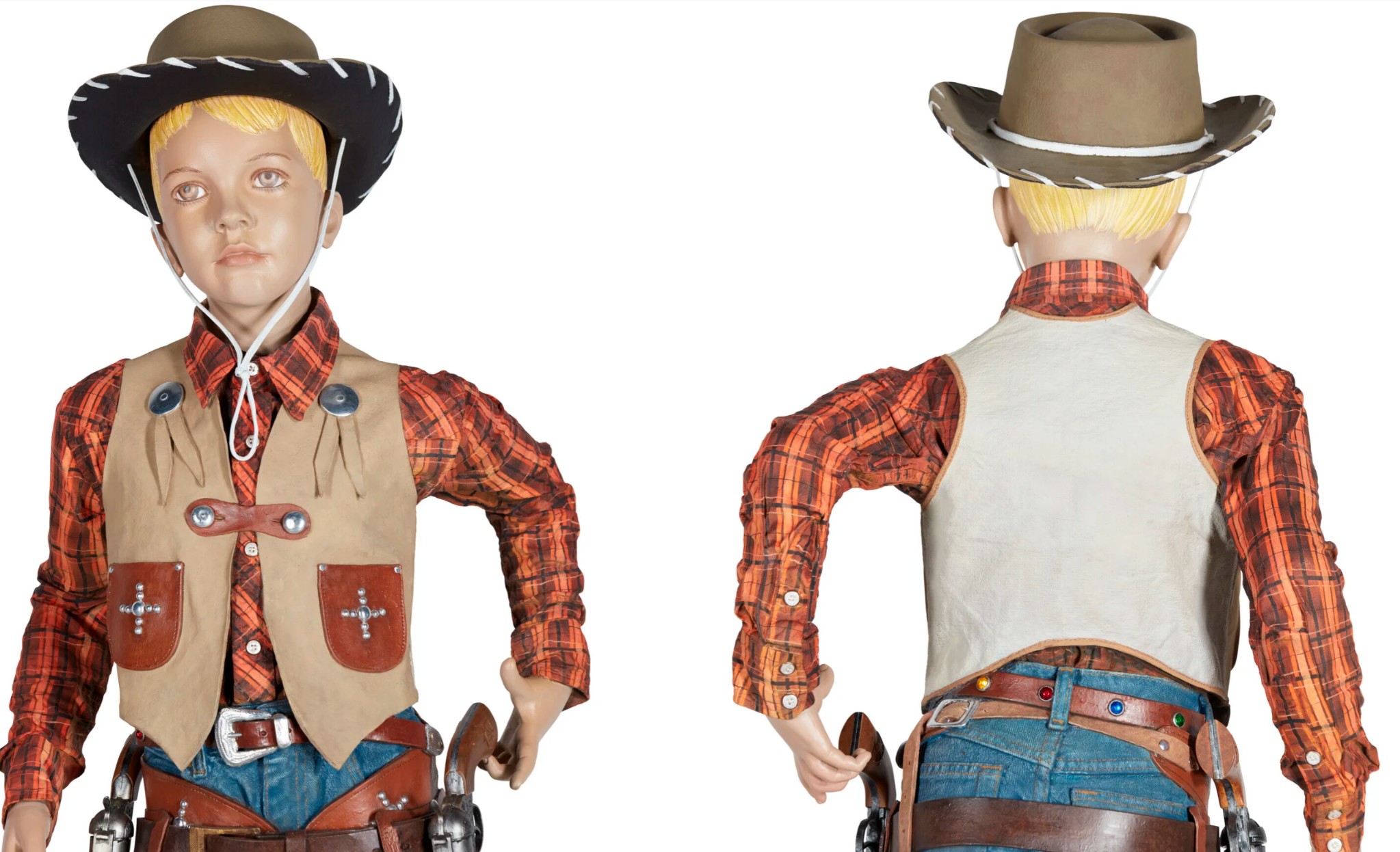
The story of Untitled (Cowboy)’s origin has a quasi-mythological tenor which matches the work’s sublime import. On the occasion of his sixty-second birthday, Noel Grunwaldt, Prince’s partner, gifted the artist a toy mannequin of a boy costumed in the guise of a cowboy.
“It surprised me at first,
made me physically move when I first walked in on it.”
The iconic symbolism deeply affected the artist, who spent the next two years making slight alterations to the mannequin. Slightly adjusting the boy’s posture and position, reshaping the placement of his arms, and replacing the little cowboy’s effects—a new hat, shining new boots, and a double holster with two guns—Prince slowly reworked this gift like Ovid’s Pygmalion into his ideal image.
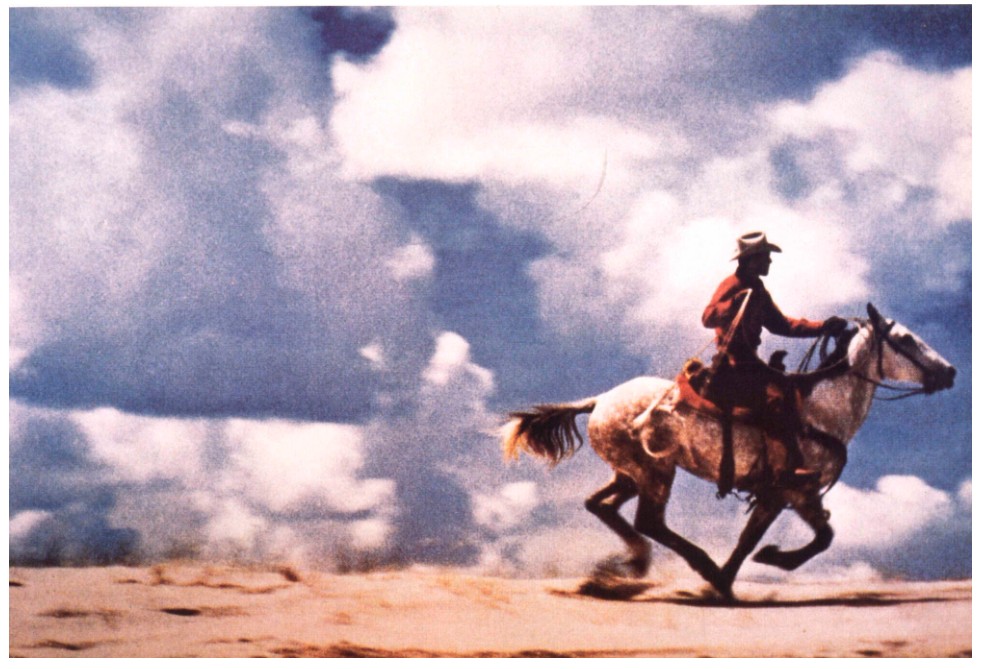
Richard Prince, Untitled (Cowboy), 1989. © Richard Prince.
Growing so attached to his new Galatea, Prince cast the mannequin in bronze in an edition of three with two artists proofs. Each of these five sculptures has a unique colorway expressed through the cowboy’s shirt – the present work being orange and the others blue, green, gray and red, the last of which one resides in Glenstone’s collection. Prince’s final intervention was the innovative construction of the work’s base. Prince first explored the possibilities of plywood in constructing the work’s pedestal.
“Plywood was the ticket. It took another second to think about casting the plywood and painting the cast to look like plywood. Bronze plywood. That did it.”
This final metamorphosis—of wood into bronze appropriating the image of wood—evokes the aesthetic of the Hollywood Western, appealing to the plywood set constructions built to render the desolate outposts of the Wild West. In the pedestal’s mimesis, appearing to be what it is not, the work even more fully ascribes to the conceptual conceit of a stage set as an appropriated vision of an ideal.
Auguste Rodin, Pygmalion and Galatea, modeled 1889, carved circa 1908-1909.
Metropolitan Museum of Art, New York.
While radically innovative in conceptual terms, Untitled (Cowboy) simultaneously evokes and emerges from the classical tradition of free-standing male sculptures. Michelangelo and Benvenuto Cellini revived the tradition of the heroic solitary male nude as a protective symbol of republican liberty. Untitled (Cowboy) stands at the precipice of action, immortally poised between potentiality and action as his left hand grazes the grip of his revolver while staring off with a determined yet detached look at whatever threat lies in his path. In this pose, the work recalls Michelangelo’s David, who is similarly engaged between action and inaction, his sling still slung over his shoulder. David, the patron saint of Florence and the symbol of its republican liberty, stands ready to protect that which he embodies. So too does Untitled (Cowboy) appear.
“Clad in the iconography of individualism, his claim to future adulthood is holstered but ready for the draw. He is America.”
Michelangelo, David, 1501-1504. Galleria dell’Accademia piazza della Signoria, Florence.
While he is America embodied, Untitled (Cowboy) is also Richard Prince. The cowboy was Prince’s earliest muse and first motif, encapsulating everything which his creative practice would come to achieve. Labeled by Time Magazine as one of the top 100 most influential images of all time, Prince’s cowboy represented an idealized figure of American masculinity, appropriated from the classic Marlboro Man advertisements. Prince’s return to this motif in three-dimensional form as a mature artist reenacts his initial self-exploration, rendering in bronze a portrait of both himself and American society. When the legendary gallerist Barbara Gladstone first laid eyes on Untitled (Cowboy), she was transfixed. She honored the work with a one-work exhibition at her gallery in 2015. The sculpture has become an integral fixture of Richard Prince in the public imagination, tying together in a compelling denouement all the strands of his previous practice to present a ravishing self-portrait which simultaneously reflects its American context.
#3. The Wrong Joke, 1987
Christie’s New-York: 19 November 2025
Estimated: USD 1,500,000 – 2,000,000
USD 1,524,000
JOKE PAINTING
RICHARD PRINCE (B. 1949), The Wrong Joke | Christie’s
RICHARD PRINCE (B. 1949)
The Wrong Joke, 1987
Acrylic and silkscreen ink on canvas
66×54 inches (167.6 x 137.2 cm)
Signed and dated ‘R Prince 87’ (on the overlap)
Richard Prince’s The Wrong Joke is an important early example of his Joke Paintings, the series that heralded the artist’s first reckoning with critical and popular success. Appropriating the Minimalist painting style then current in the 1980s, Prince painted found jokes revolving around the popular traveling salesman motif favored by Borscht Belt comics. The Joke Paintings mark a radical point of departure for both Prince and American contemporary art writ large.
“I mean, can you imagine in 1986, when I made my first Joke painting, nobody had ever [painted a joke]—I mean jokes were something that you heard…
What I did was I changed the hearing of a generic Borscht Belt joke, jokes that I grew up with… and I painted them.
I painted jokes, and I believe the Jokes are right up there with Rothko.”
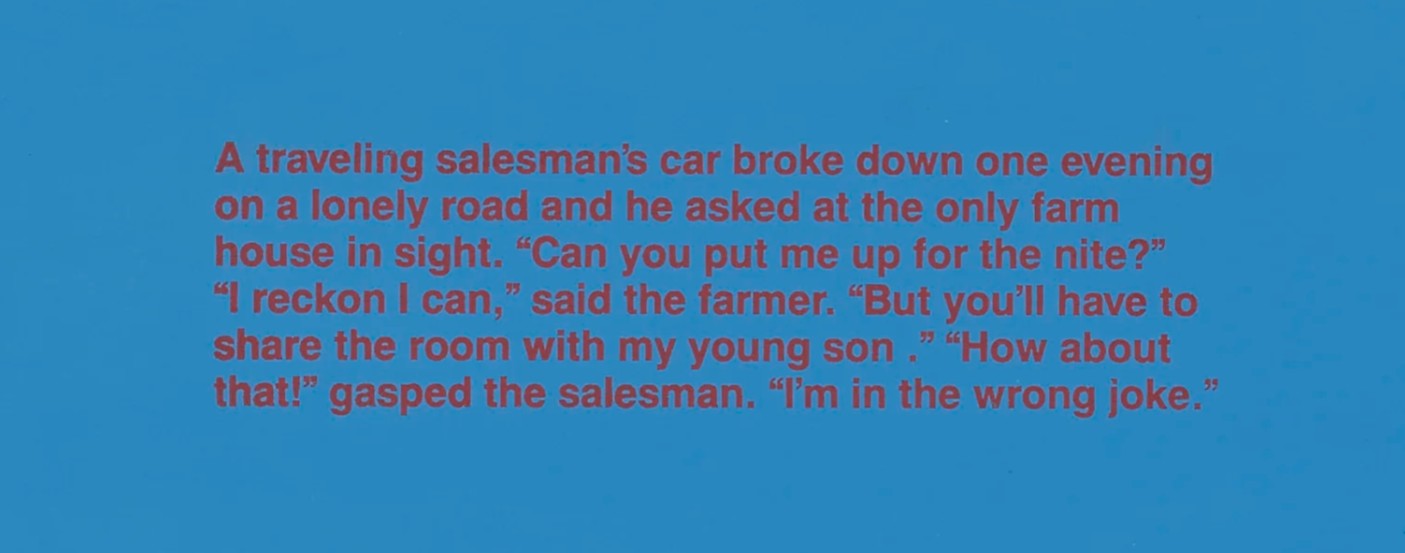
In The Wrong Joke, Prince silkscreens his red joke in six uniform lines at an intimate scale in the direct center of the blue-painted canvas. The discordant scale between text and support forces the viewer into close proximity with the painting in order for the work to be made legible. Prince first began experimenting with the joke format in 1984, when he started writing one-liners on paper with pen, selling them for $10 each. He explored copying cartoons with caption and image intact, as well as swapping images and texts, before finally landing on his monochrome painted format. This diametric change in practice away from the photographic method of the previous decade was critical to his formation as an artist, introducing a greater sense of the personal as well as a greater sense of the artist’s hand into his works, which had previously felt devoid of a creative presence.
“I’m not associated with the hand… beginning the jokes was like starting over.”
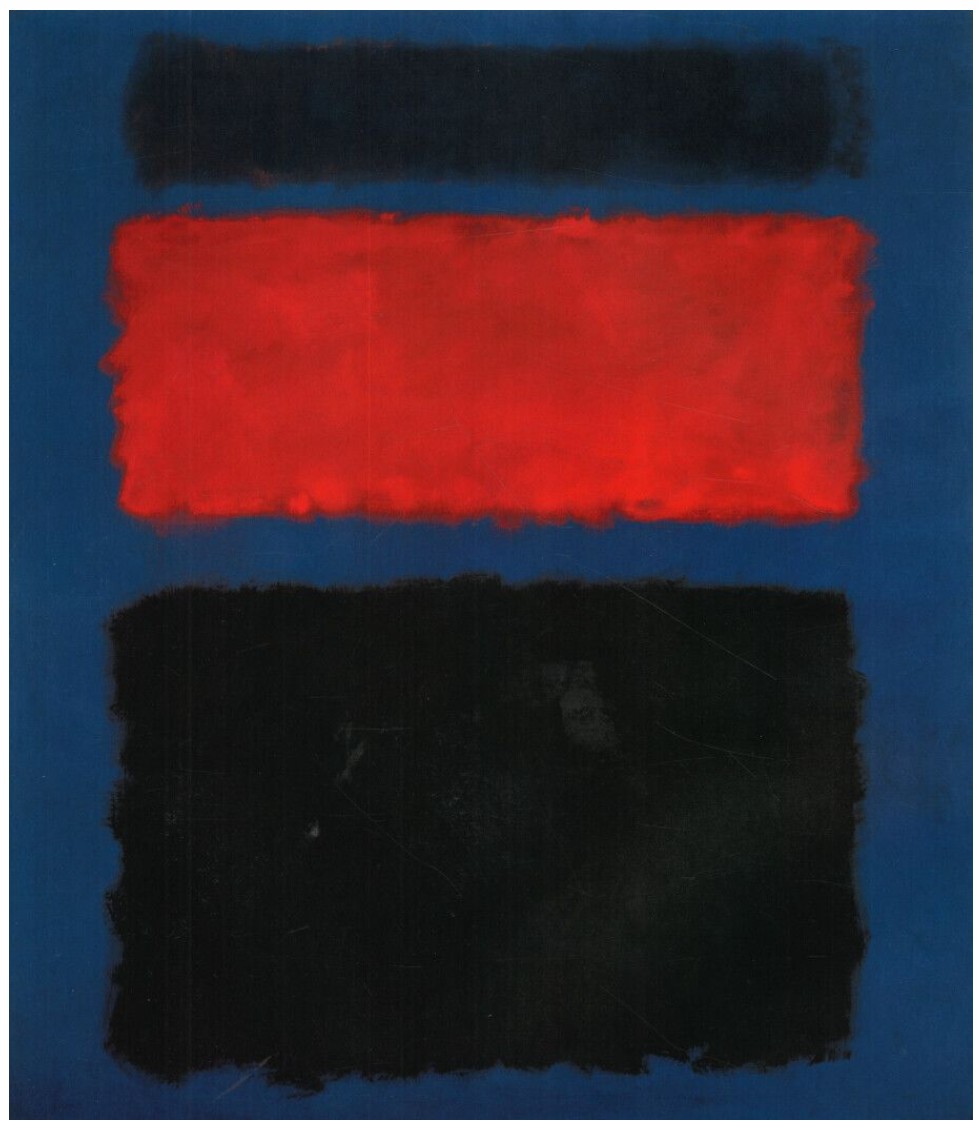
Mark Rothko, Untitled, 1960. Toledo Art Museum.
© 1998 Kate Rothko Prizel & Christopher Rothko / Artists Rights Society (ARS), New York.
The joke itself, culled from the thousands which Prince recorded for decades in a mental repertoire, is itself a metajoke, relying on the audience’s familiarity with archetypal traveling salesman jokes for its unexpected punchline, which operates on a surprising shift in gender dynamics. The salesman ends the line addressing not the farmer but the viewer, breaking the fourth wall with his announcement: “I’m in the wrong joke.” This ‘wrong joke’ appears to be among Prince’s favorite out of the dozens he has appropriated over his career. The joke appears in numerous other works, including several other monochromes, drawings, and The Salesman and the Farmer (1989, private collection). In December of 1987, the year the present work was made, Prince published the article “The Traveling Salesman” in Artforum, where he printed both the text of the present joke as well as a close variant. With the joke in The Wrong Joke, Prince leverages the subversion of his audience’s expectations, in tandem with his choice of an almost comical font size for his text, to expertly reach the intersection of the hysterical and the sublime.
“No one that I know had ever painted a joke in the art world. It was a very radical subject matter. And if you didn’t like the joke, maybe you liked the painting. And if you didn’t like the painting, maybe you liked the joke.”
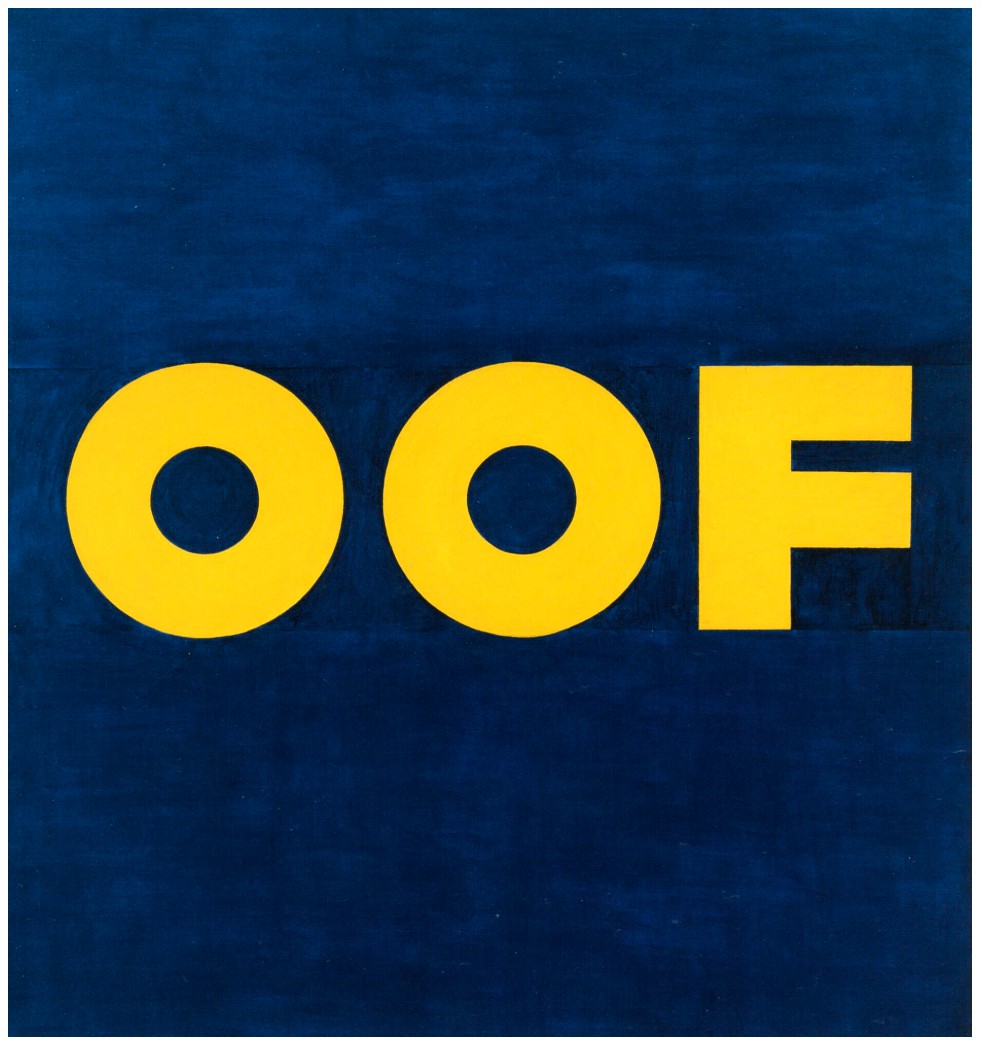
Ed Ruscha, OOF, 1962. Museum of Modern Art, New York. © Ed Ruscha.
1987 proved Prince’s pivotal year. In March, he was featured on the cover of Art in America, garnering the attention of Barbara Gladstone, who began representing him soon thereafter. This rapid rise allowed him to shift his attention to painting for the first time.
“Artists were casting sculptures in bronze, making huge paintings, talking about prices and clothes and cars and spending vast amounts of money.”
In contradiction to the prevailing atmosphere, Prince undertook a modest, mundane subject with his Joke series, simultaneously critiquing and overturning the dominance of Minimalist and Neo-Expressionist painting. Channeling the reductive aesthetic of Ellsworth Kelly or Brice Marden, The Wrong Joke adopts an antiheroic mentality observed throughout Prince’s practice. The work explores the darker side of existence by employing a sardonic form of humor until then unknown in the resolute, elaborate, and precipitous seriousness of the art world in the 1980s.
#4. Untitled (Cowboy), 2001
Christie’s New-York: 20 November 2025
Estimated: USD 500,000 – 700,000
USD 889,000
COWBOY PHOTOGRAPH
RICHARD PRINCE (B. 1949), Untitled (Cowboy) | Christie’s
RICHARD PRINCE (B. 1949)
Untitled (Cowboy), 2001
Ektacolor print
28×40 inches (71.1 x 101.6 cm)
Signed, numbered and dated ‘R Prince 2000 1⁄2’ (lower right)
Signed again, numbered again and dated again ‘R Prince 2000 1⁄2’ (on the reverse)
This work is number one from an edition of two plus one artist’s proof
#5. Untitled, 2017
Christie’s New-York: 20 November 2025
Estimated: USD 400,000 – 600,000
USD 508,000
HIGH TIMES
RICHARD PRINCE (B. 1949), Untitled | Christie’s
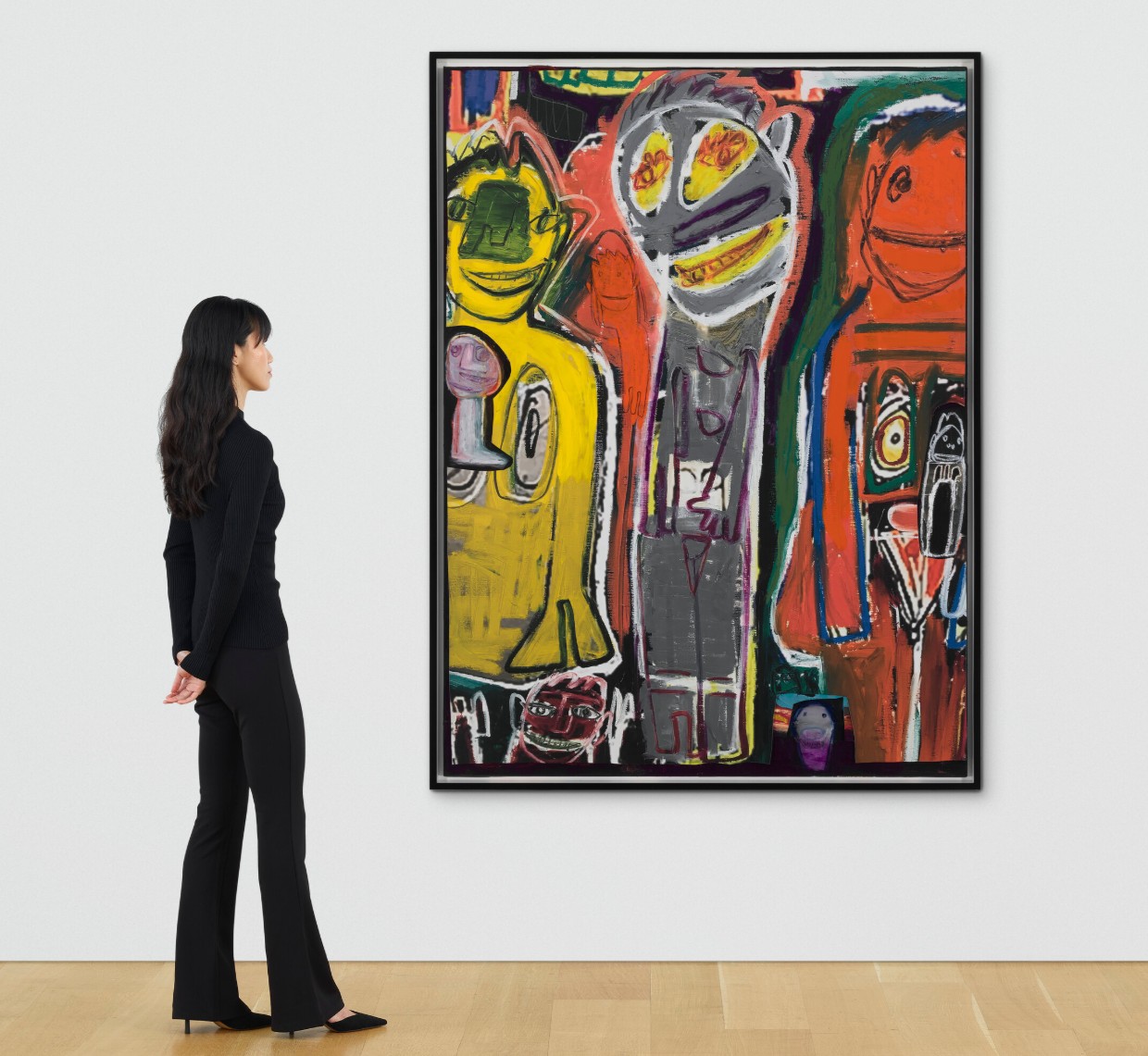
RICHARD PRINCE (B. 1949)
Untitled, 2017
Inkjet, acrylic, collage and oil stick on canvas
74 1/4 x 55 inches (188.6 x 139.7 cm)
#6. Untitled (Cowboys), 1997
Sotheby’s New-York: 19 November 2025
Estimated: USD 600,000 – 800,000
USD 381,000
COWBOY PHOTOGRAPH
Untitled (Cowboys) | Contemporary Day Auction | 2025 | Sotheby’s
RICHARD PRINCE (b. 1949)
Untitled (Cowboys), 1997
Ektacolor print
48×72 inches (121.9 x 182.9 cm)
Signed, dated 1997 and numbered 2/2 (on a label affixed to the reverse of the frame)
This work is number 2 from an edition of 2
Richard Prince’s Untitled (Cowboys) from 1997 belongs to one of the most significant and enduring series in late twentieth-century American art – a body of work that transformed the language of appropriation into a profound meditation on identity, desire, and the construction of myth. With this image, Prince continues his deconstruction of the Marlboro advertising campaign that began in the late 1970s, isolating and enlarging its archetypal vision of the American West to expose the seductive fiction at its core. At once cinematic and elegiac, the present photograph captures the luminous spectacle of a smoke-filled clearing, where cowboys and horses appear suspended between light and shadow – a dream of freedom poised on the edge of disappearance.

Prince first began rephotographing Marlboro advertisements in 1977 while working in the tear-sheet department at Time-Life, a setting that made him acutely aware of how images circulate and accrue meaning. By extracting these found photographs from their commercial context and re-presenting them as fine art, he pioneered a new mode of critique. The Cowboys series dismantles the romantic ideal of the American frontier – the rugged, solitary male as symbol of national virtue – and reveals it as a corporate construction of masculinity and power. Yet Prince’s engagement is never purely ironic. The aesthetic beauty of the images, suffused with atmosphere and longing, betrays a complex fascination with the myth they interrogate.
“You can’t just take the cowboy down; you have to love him first.”
The present Untitled (Cowboys) exemplifies the mature phase of this investigation. Executed in the late 1990s, it revisits and refines the earlier compositions of the 1980s through a heightened sense of cinematic scale and luminosity. The enlarged color print floods the viewer’s field of vision, transforming the advertisement into an immersive landscape of pure image. The haze of light filtering through the trees functions almost metaphysically – suggesting transcendence while simultaneously dematerializing the figures that embody it. The cowboys, dwarfed by the vast forest and haloed by smoke, seem to dissolve into their own mythology. The result is both intimate and monumental: a portrait not of a man, but of a cultural fantasy suspended in time.
Prince’s Cowboys stand at the intersection of Conceptual Art and Pop, their lineage extending from the readymades of Marcel Duchamp and the serial appropriations of Andy Warhol to the image strategies of Cindy Sherman and Sherrie Levine. Like Warhol’s silkscreened icons of American glamour, Prince’s cowboys operate through repetition and removal, revealing the mechanics of myth-making through their own seductive surfaces. Yet where Warhol’s subjects – Marilyn, Liz, Elvis – celebrated celebrity itself, Prince’s cowboys embody a collective national fiction, one inseparable from the intertwined narratives of gender, race, and capitalism. The frontier he photographs is not geographical but psychological: the landscape of American imagination.
While rooted in appropriation, Untitled (Cowboys) is ultimately an elegy – a meditation on the death of both the mythic West and the age of innocence in which such myths could thrive. The figures’ anonymity, their faces turned from view, transforms them into silhouettes of longing, projections of the viewer’s own nostalgia for authenticity. In the haze of light and smoke, Prince captures not the hero, but the ghost of a vanished ideal. The image endures as a mirror of contemporary culture: where the fantasy of freedom persists, even as its artifice is laid bare.
Through its seductive surface and conceptual precision, Untitled (Cowboys) exemplifies Prince’s lifelong inquiry into the power and peril of images. It is a photograph about looking, about the impossibility of separating desire from illusion. In re-presenting America’s most iconic dream, Prince turns the image back on itself – revealing, in the shimmer of light across the forest clearing, both the allure and the emptiness at the heart of the American myth.
#7. My Wife, 2006
Edlis Neeson Collection
Christie’s New-York: 20 November 2025
Estimated: USD 250,000 – 350,000
USD 317,500
JOKE PAINTING
RICHARD PRINCE (B. 1949), My Wife | Christie’s
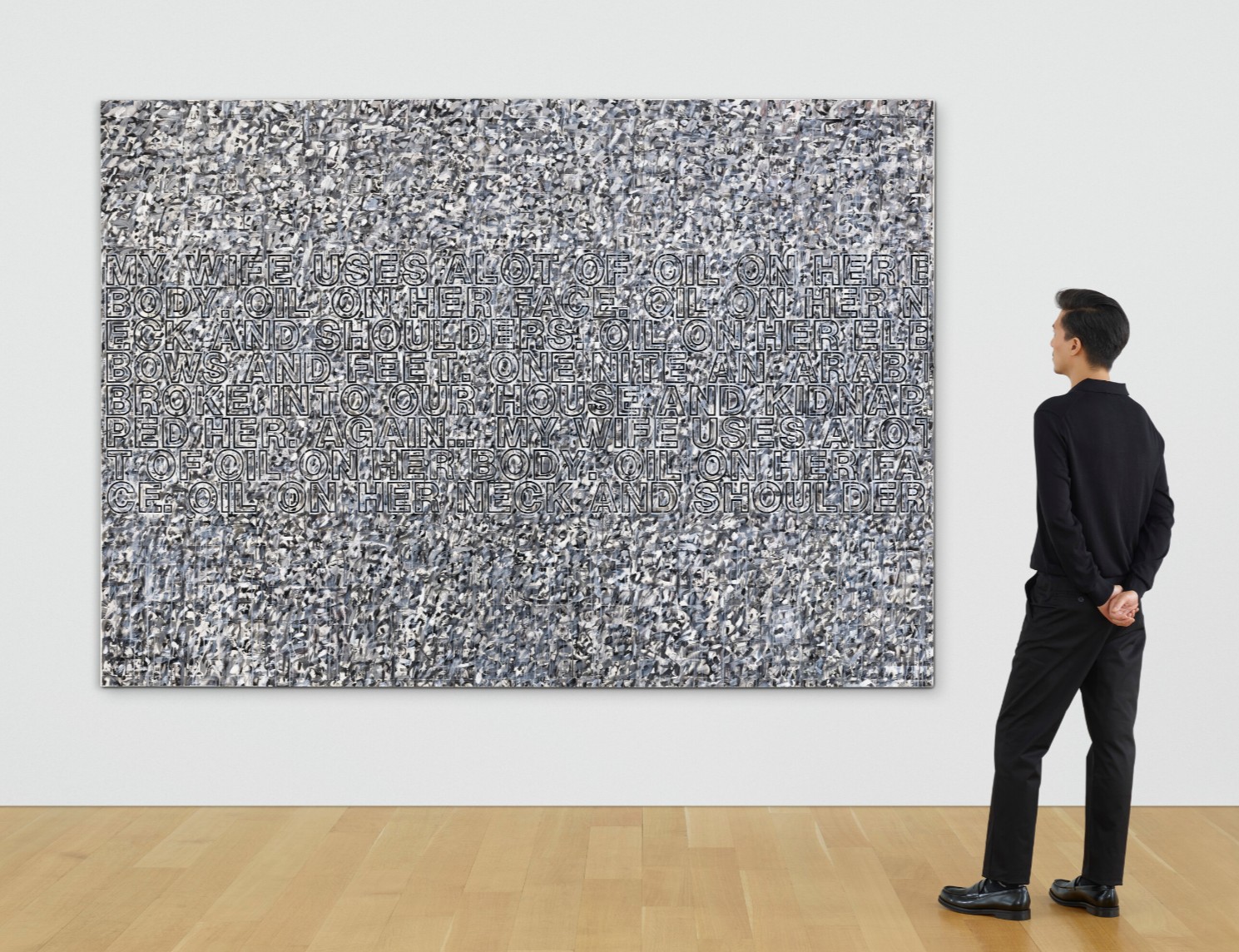
RICHARD PRINCE (B. 1949)
My Wife, 2006
Acrylic and printed paper collage on canvas
86×122 inches (218.5 x 310 cm)
Signed, titled and dated ‘Richard Prince 2006 “My Wife”‘ (on the reverse)
#8. Untitled, 1997-1998
Phillips New-York: 21 November 2025
Estimated: USD 250,000 – 350,000
USD 258,000
JOKE PAINTING
Richard Prince Modern & Contemporary Art Day Sale, Afternoon Session
RICHARD PRINCE
Untitled, 1997-1998
Acrylic and silkscreen ink on canvas
72×64 inches (182.9 x 162.6 cm)
Signed and dated “R Prince 1997–98” on the reverse
Richard Prince’s Untitled, belongs to a small body of paintings made from 1997–1998, in which his once-legible cartoons dissolve into abstract, smudged fields of gray interspersed by undefined black and white scribbles. The figural illustrations of the artist’s earlier paintings give way to an expressive tangle of gestures, as if a chalk board was haphazardly erased and then written over. This sense of erasure and rewriting creates a visual palimpsest that nods to Prince’s use of appropriated material, his own recurrent use of the same jokes within his oeuvre, and the legacy of mid-century American painting. Begun in 1985, Richard Prince’s “joke” paintings marked a pivotal turn in the artist’s exploration of appropriation and authorship. Inspired by the deadpan one-liners of mid-century Borscht Belt comedy, Prince began isolating these jokes as text, rendering them with cool detachment in monochrome type. Over time, the format evolved from the stark, text-only compositions of the late 1980s to the cartoon illustrated silkscreens of the 1990s.
In New York’s Garment District a little old Jewish man was hit by a car. While waiting for an ambulance a policeman tucked a blanket under the guy’s chin and asked, “Are you comfortable?” The man said, “I make a nice living.”
Prince’s monochrome joke paintings offered a tongue-in-cheek response to the color field paintings of Mark Rothko and Barnett Newman. The silkscreen text, and, later, his cartoon figures allude to the Pop canvases of Andy Warhol and Roy Lichtenstein. In Untitled, the handwritten scrawl and gestural abstraction nods to Cy Twombly, particularly his Blackboards canvases from the 1960s. Remixing styles, Prince fuses references both high and low. Typical of Prince’s humor, the joke walks a fine line between irreverence and affection—its punchline hinging on linguistic slippage, timing, and stereotype. The foremost contemporary artist blending humor and painting, Prince holds a mirror to American art history, popular culture and comic sensibility.
#9. Untitled (Question), 2005
Property from a Distinguished American Collection
Sotheby’s New-York: 19 November 2025
Estimated: USD 100,000 – 150,000
USD 101,600
Untitled (Question) | Contemporary Day Auction | 2025 | Sotheby’s
RICHARD PRINCE (b. 1949)
Untitled (Question), 2005
Acrylic and checks on Gatorboard
38 1/4 x 30 inches (97.2 x 76.2 cm)
Signed and dated 2005 (on the reverse)
“Jokes and cartoons are part of any mainstream magazine. Especially magazines like the New Yorker or Playboy. They’re right up there with the editorial and advertisements and table of contents and letters to the editors. They’re part of the layout, part of the “sights” and “gags.” Sometimes they’re political, sometimes they just make fun of everyday life. Once in a while they drive people to protest.”
#10. Untitled (can painting), 2011
Phillips New-York: 21 November 2025
Estimated: USD 20,000 – 30,000
USD 36,120
WORK ON PAPER
Richard Prince Modern & Contemporary Art Day Sale, Afternoon Session
RICHARD PRINCE
Untitled (can painting), 2011
Stickers, plastic, staples, glue and acrylic on mounted paper
25 1/2 x 20 inches (64.8 x 50.8 cm)
Signed and dated “Richard Prince 2011” on the reverse of the backing board
Cecily Brown
PLEASE CLICK ON THE PICTURE BELOW TO ACCESS AUCTION MARKET OVERVIEW
High Society, 1997-98
Property from a Prominent Private Collection
Sotheby’s New-York: 18 November 2025
Estimated: USD 4,o00,000 – 6,000,000
USD 9,810,000
High Society | The Now & Contemporary Evening Auction | 2025 | Sotheby’s
CECILY BROWN (b. 1969)
High Society, 1997-98
Oil on canvas
74 x 98 1/8 inches (188 x 249.2 cm)
Signed, titled and dated 97-98 (on the reverse)
Signed and dated ’97-98 (on the stretcher)
Executed in 1997-98, High Society is a sensational embodiment of the tantalizing tension between abstract and figurative modes that has distinguished Cecily Brown as among the greatest painters of our generation. Considered one of Cecily Brown’s first masterpieces, the present work was the centerpiece and titular work of her breakthrough exhibition at Deitch Projects in 1998, a presentation that catapulted her to international acclaim and firmly established her among the generation that redefined painting at the turn of the millennium.
“If I had to take an early painting that still has qualities that I’m really interested in, I think High Society would be it. High Society had something going on it that preoccupied me for many years to come.”
The artist in her studio, 2016. Photo © Kevin Trageser / Redux. Art © 2025 Cecily Brown
Earlier this year, High Society was further distinguished as a highlight of Brown’s major retrospective at the Dallas Museum of Art and Barnes Foundation. Spanning over eight feet, High Society captivates the viewer in its convulsing depths, belonging to the first body of work in which Brown expanded to this ambitious scale—doubling the size of her earlier canvases—and explored the human figure with unprecedented primacy. Resplendent with the familiar Renaissance palette of her early works: shades of cobalt, fleshy pinks, and golden yellows eddy and contort across the vast composition, coalescing into a maelstrom of pigment that exemplifies the artist’s prodigious command of painterly abstraction.
Drawing its title from a popular 1956 Hollywood musical starring Bing Crosby and Grace Kelly, High Society is deeply rooted in contemporary culture while also paying homage to its forbearers in a splendid confluence of art-historical references. High Society dates to the first group of paintings the artist ever titled.
“The very first time I titled paintings was for an exhibition in the late 90s, where I named all the paintings after movie musicals like High Society, The Pyjama Game, and Seven Brides for Seven Brothers. I liked the idea that they were gaudy and bawdy. It was really right for the body of work because they were very bright and chaotic… they had this sense of being too loud, with too much action – too theatrical – all things which I thought belonged in a painting. I liked the idea that a painting could contain all these things at once.”
Left: Pablo Picasso, Les Demoiselles d’Avignon, 1907. The Museum of Modern Art, New York. Image © The Museum of Modern Art / Licensed by SCALA / Art Resource, NY. Art © 2025 Estate of Pablo Picasso / Artists Rights Society (ARS), New York.
Right: Willem De Kooning, Untitled XXXIII, 1977. Private Collection. Sold at Sotheby’s New York in November 2021 for $24.4 million. Art © 2025 The Willem de Kooning Foundation / Artists Rights Society (ARS), New York
As she herself describes, this is the genius of Cecily Brown’s paintings: they are never one note. At once drama, comedy, and tragedy, they unfold like a grand theatrical stage upon which the full spectrum of humanity plays out. Here, Brown’s reference to the famous musical is characteristically ironic: drawing upon the opulent artifice of Broadway and Hollywood, where romance and passion are coded and veiled. Brown dismantles those conventions with unflinching physicality. Within the canvas, we see glimpses of men in tails and topcoats—harkening back to a bygone age of feigned innocence that’s incongruent with the decadent sensuality present in this painting.
Eugene Delacroix, The Death of Sardanapalus, 1827. Musée du Louvre, Paris. Image © Luisa Ricciarini / Bridgeman Images
Making reference to the titans of Western painting—from Piero della Francesca to Eugene Delacroix and Peter Paul Rubens—Cecily Brown’s references extended equally to literature, culture and society, breaking from the strictures of narrative to achieve an extraordinary aesthetic and thematic fluidity. Testament to Brown’s attestation that High Society has qualities that would preoccupy her for years to come, Brown revisited figures from this painting throughout her oeuvre: “for example, the semi-clad male that Brown places in each panel of Saboteur four times (2019) is derived from one seen removing his shirt in the background of Piero della Francesca’s Baptism of Christ.
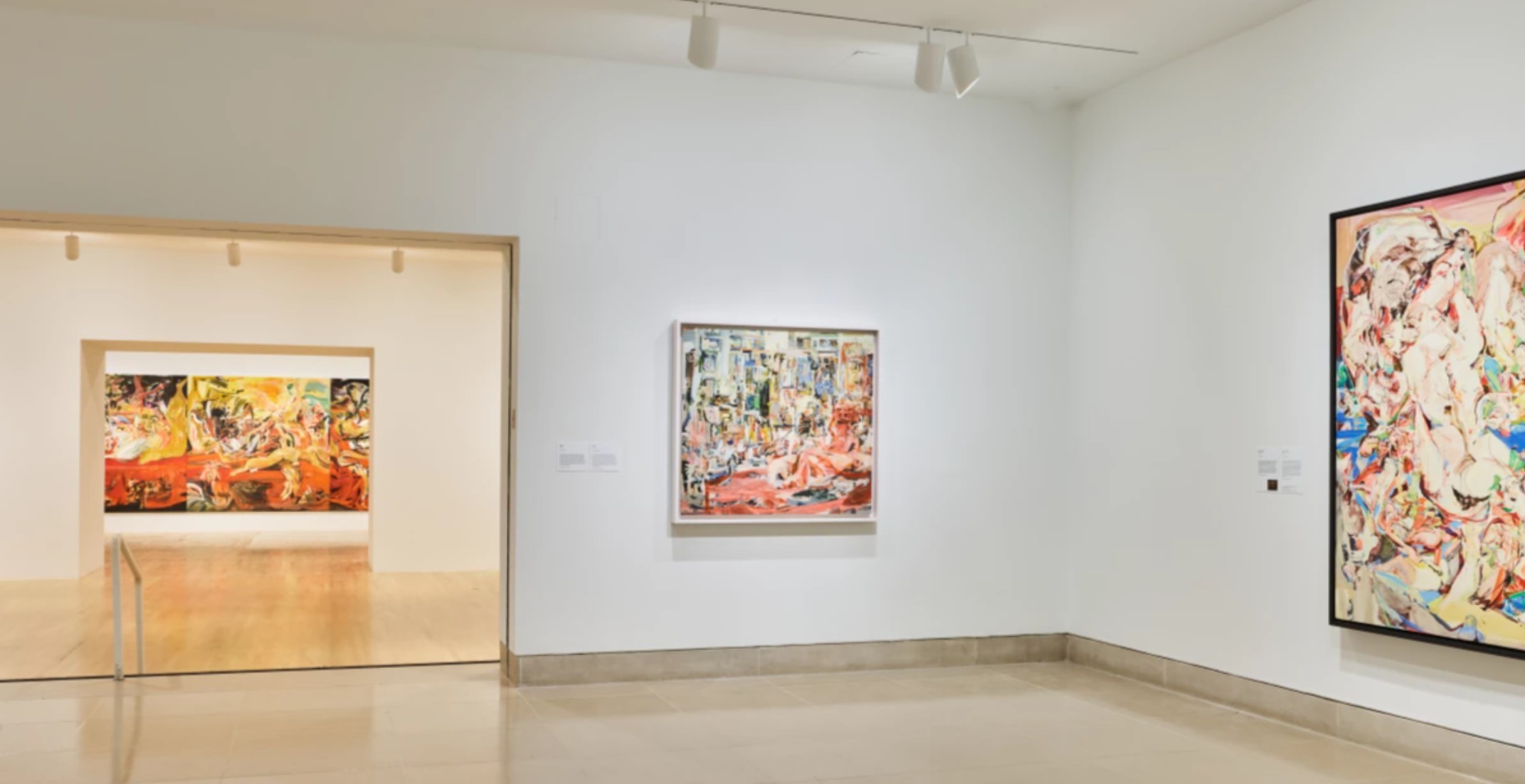
The present work installed in Cecily Brown: Themes and Variations at the Dallas Museum of Art, September 2024 – February 2025. Photo © Brad Flowers, courtesy Dallas Museum of Art. Art © 2025 Cecily Brown
It had already appeared some twenty years earlier in the upper right section of High Society (1998), its erotic imagery conveyed by a maelstrom of intense brushstrokes.” (Brown: Themes and Variations, September 2024 – May 2025, pl. 9, p. 39) Further evoking Paul Rubens’ The Judgement of Paris (c. 1606) and Delacroix’s The Death of Sardanapalus (1984), the present work overwhelms the viewer in a beautifully balanced and rich composition.
Hieronymus Bosch, The Garden of Earthly Delights, 1490-1500. Museo Nacional del Prado, Madrid. Image © Bridgeman Images
Perhaps most evidently, Brown’s visual language and handling of pigment and paint are informed by the gestural mark-making of American Abstract Expressionists. Indeed, Brown’s tenacious and tantalizing brushwork and sensual pinks are an affirmation of de Kooning’s famous mantra that “flesh was the reason oil paint was invented,” and Brown herself described the medium as “sensual, it moves, it catches the light, it’s great for skin and flesh and heft and meat … I wanted to make something that you couldn’t tear your eyes away from.” (The artist quoted in: Derek Peck, “New York Minute: Cecily Brown,” Another, September 14, 2012) Brown’s lush handling of paint and rich impasto that dominates the left side of the composition calls to mind both the carnal immediacy of Francis Bacon and the visceral quality of Willem de Kooning Woman I (1950-52).
“In a way, High Society is drawn into the center: the painting has a vanishing point, but it’s done with color as opposed to being done with lines and angles.”
Driven by an intense chromatic vibrancy, the kaleidoscopic composition of High Society motivates a sense of action and movement across the canvas: the eye is invited to wander, to read and reread the surface, as flesh becomes paint and paint becomes flesh in an exhilarating play of perception. A dazzling composition, Brown herself likened the piercing shafts of blue in this work to stained glass, lighting the composition from within.
“It’s funny though, how this painting actually does have some light and air… The bright blues make it look flatter and more like a stained-glass window.”
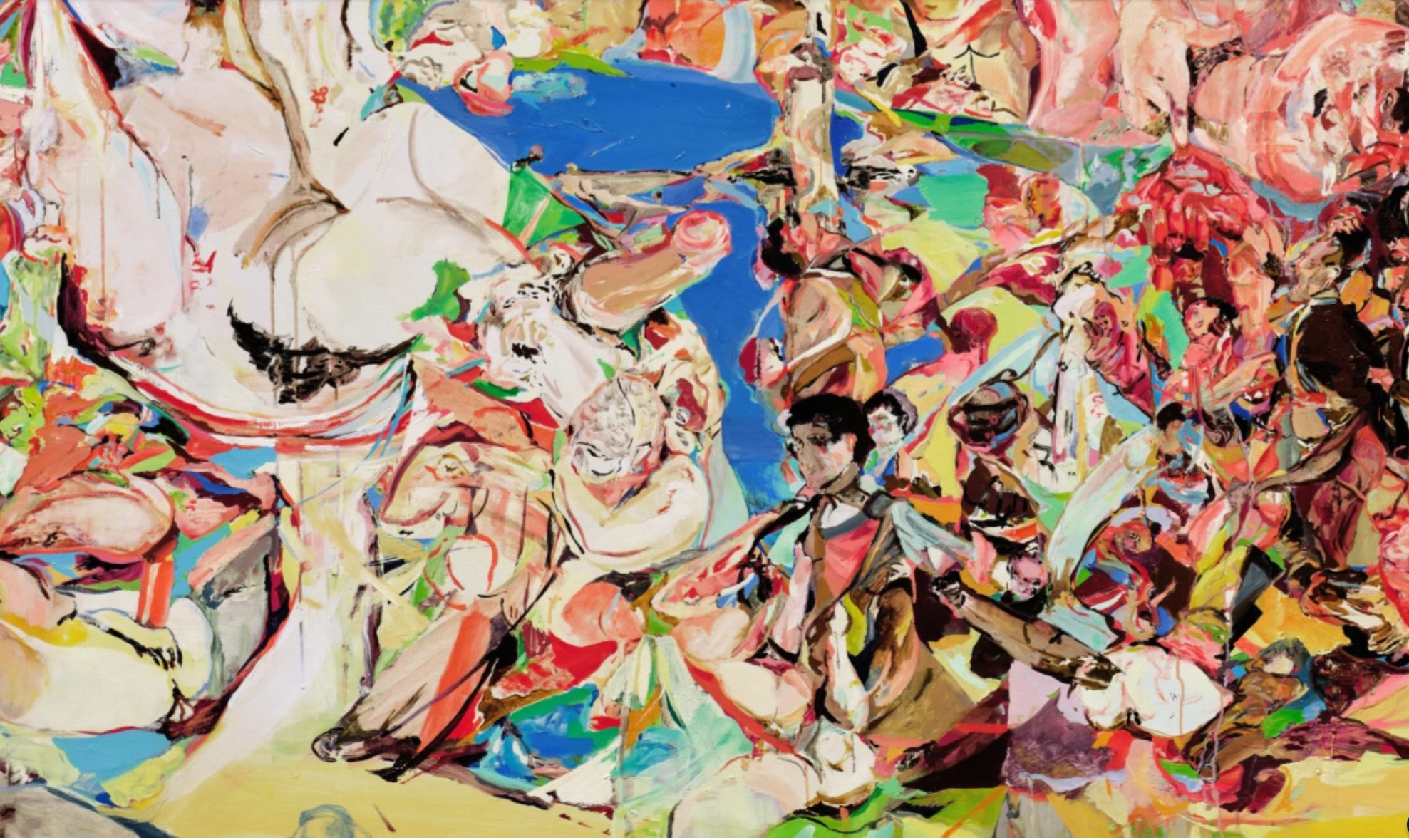
Born in London in 1969, Cecily Brown demonstrated from an early age an unwavering determination to become an artist. Finding her own brand of conceptual figuration at odds with the prevailing Conceptualism of the Young British Artists, Brown relocated from London to New York in 1995 in pursuit of greater artistic freedom. Just a few years later—on the cusp of the international recognition that would soon define her career—she created High Society. A pivotal and exceedingly rare early exemplar, High Society signals the crystallization of Brown’s mature voice. In this work, she playfully blurs the boundaries between abstraction and figuration, revealing the extraordinary capacity of paint to evoke the tangled interplay of perception, emotion, and desire that underpins human experience.
It’s not yesterday anymore, 2022
Property from a Prominent European Collection
Christie’s New-York: 19 November 2025
Estimated: USD 4,000,000 – 6,000,000
PASSED
CECILY BROWN (B. 1969), It’s not yesterday anymore | Christie’s
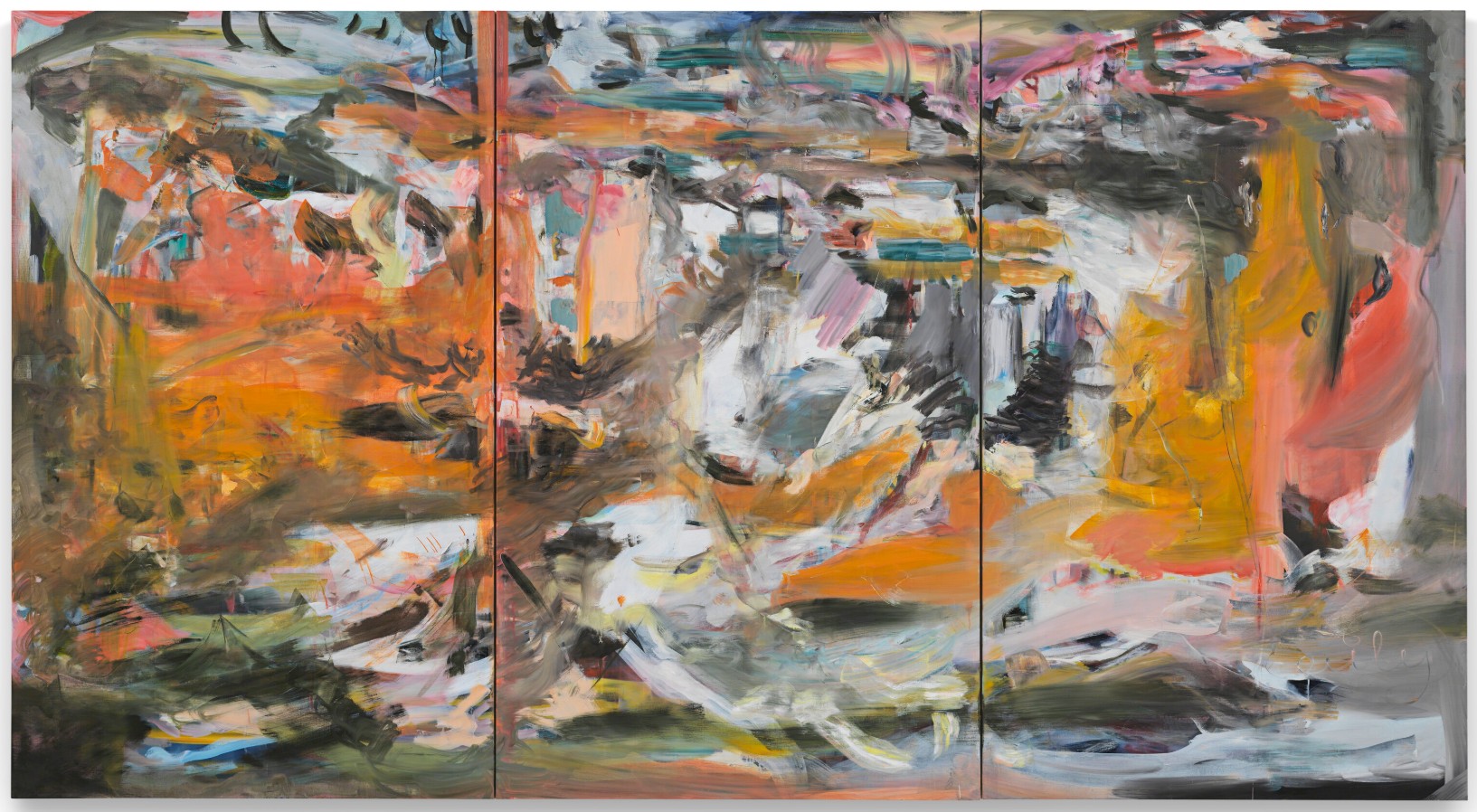
CECILY BROWN (B. 1969)
It’s not yesterday anymore, 2022
Oil on linen, in three parts
Overall: 67×123 inches (170.2 x 312.4 cm)
Signed ‘Cecily’ (lower right)
Signed and dated ‘Cecily Brown 2022’ (on the reverse)
Broad swathes of vibrant, richly hued pigment sweep across the grand expanse of Cecily Brown’s triptych It’s not yesterday anymore. Each stroke articulated with a lyrical bravura, Brown’s tripartite composition becomes a poetic reflection on abstraction, generating an enthralling dynamic energy in a flurry of forms while simultaneously refusing to resolve into figuration. “As is painting so is poetry, (ut pictura poesis)” decrees Horace in Ars Poetica, and writing in the exhibition catalogue for To Bend the Ear of the Outer World, where the present work was first exhibited, Brown concludes that “painting is the closest to poetry of all the arts.” The exhibition, curated by Gary Garrels, sought to explore the open-endedness of contemporary abstraction, reflecting on the many visual codes and interpretations which artists ranging from Mark Bradford, Jadé Fadojutimi, Brice Marden, Julie Mehretu, Laura Owens, Gerhard Richter, and Christopher Wool deploy in their abstract practices. It’s not yesterday anymore is Brown’s triumphant entry into this rich visual symposium, eloquently expressing her desire “to abolish the terms abstract and figurative.” One of her first truly abstract paintings, the present work is a poised meditation on the internalities of her painterly practice, exulting in her learned control of her oil medium, her masterful command over composition, and her expressive use of sumptuous pigment. Prominently positioned at the entry of Garrels’ exhibition, It’s not yesterday anymore has become the standard bearer for the present possibilities of abstraction.
Cecily Brown painted across all three panels of her triptych simultaneously, allowing her unrelenting rain of strokes to cross from one canvas into the next to establish a continuous sense of movement across planes. Highly attuned to tempo, Brown plays with altering themes and variations across the painting, varying the width and length of each brushstroke, ranging from wide swaths to darting, concise interventions, with each panel acting as if a different movement from a Schubert Piano Trio. The chromatic range achieved here is wider than the artist’s typical palette, ranging from the rich tenor of her favored peaches, oranges, and reds, to the soprano of her slate blue and electric pink, which parry her larger forms of warm color. Most exceptional is Brown’s scintillating use of black and white across her panels. The two diametrical oppositions dance across the composition in a pas de deux, each interjection of black given a corresponding riposte in white. Her brilliant incorporation of vibrant and dark colors into a unified tableau with such expressive force identifies Brown as the inheritor of the colorito tradition, passed down from Titian and Rubens through Willem de Kooning and Francis Bacon. It’s not yesterday anymore is a dialectical paragone reestablishing the dominance of color in the contemporary era.
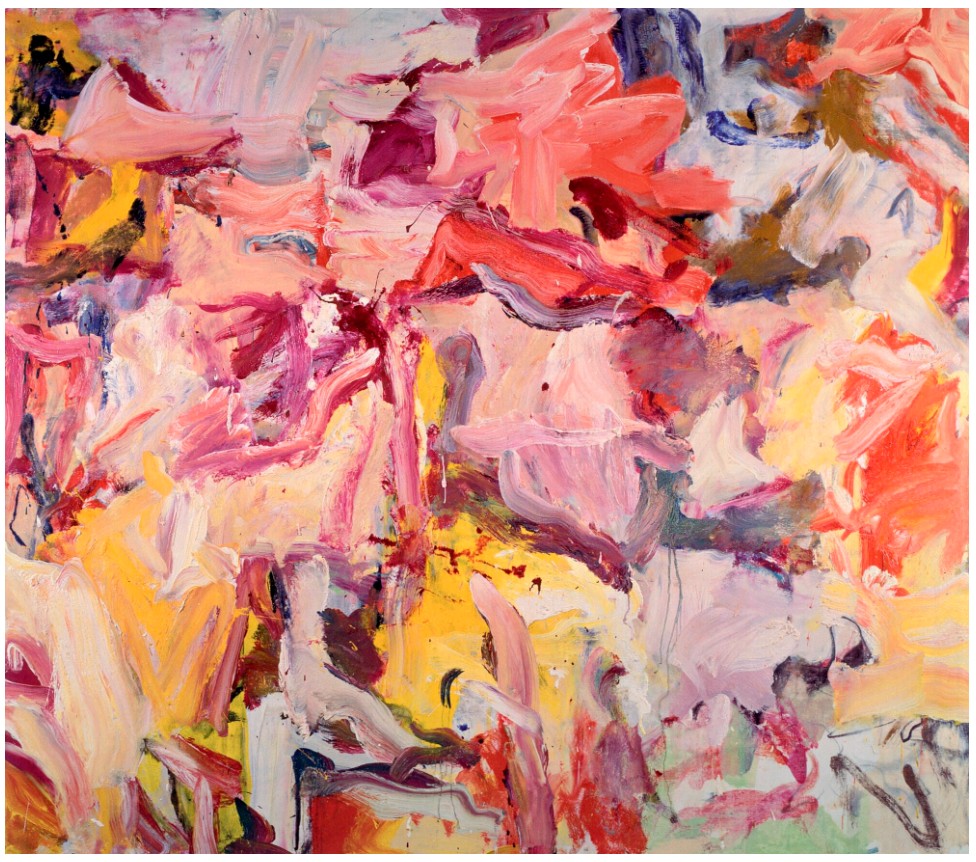
Willem de Kooning, Untitled I, 1977. © 2025 The Willem de Kooning Foundation / Artists Rights Society (ARS), New York.
Brown’s carefully arranged composition is similarly situated in a careful balance across her canvases. The artist inserts a bold jot of pure white at the exact center of her central panel. This insertion grounds the rest of the composition, immediately arresting the viewer’s attention, providing an alluring opening into the rest of the tableau. A similar dynamic is at play in Rosa Bonheur’s The Horse Fair (1852-55, Metropolitan Museum of Art). In an interview conducted the same year the present work was painted, Brown extolls Bonheur’s magnum opus:
“Speaking of openings—doesn’t your eye go immediately to Rosa Bonheur’s white horse, the one looking at you? It really is the eye of the storm… The way it’s put together is so virtuosic. Look at how she used white to tell the story. There’s a rush of movement across the center, and your eye bounces from the horse on the left to the horse in the middle.”
In It’s not yesterday anymore, Brown explores similar strategies, engaging her audience with her central display of white before allowing her rushes of movement to move the gaze across the varied terrains of the work. Brown especially favors her black tones in the periphery of her painting, utilizing the dark washes as a sort of fictive frame which contains her virtuoso strokes.
“I want to threaten to burst through the picture plane but not actually do it.”
Brown pursues a similar framing strategy with black paint in her earlier When this kiss is over from 2020, which reimagines the fleshy tones found in the works of Chaïm Soutine and Philip Guston against a dark, black void. Beyond similar compositional strategies, It’s not yesterday anymore and when this kiss is over share a further connection: both titles quote lyrics from the rock band Talking Heads—the first line of “New Feeling” (1977) for the present work, and the sixth verse in “Heaven” (1979) for the latter work.
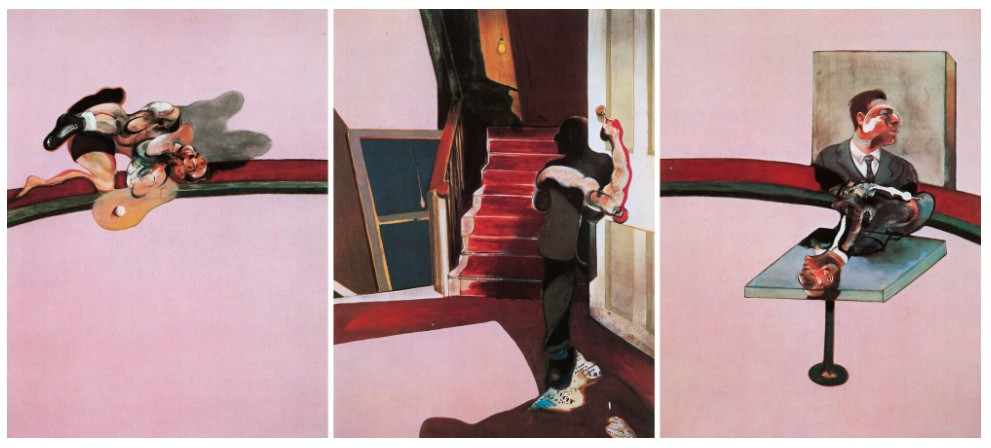
Francis Bacon, In Memory of George Dyer, 1971. Fondation Beyeler, Riehen.
© The Estate of Francis Bacon. All rights reserved / DACS, London / ARS, New York 2025.
The aesthetic hedonism of Cecily Brown’s chromatic choices resounds across the great expanse of her triptych, which itself is a mimesis of the theatrical stage. While embracing the anachronistic triptych format favored by medieval and Renaissance altarpiece painters, Brown similarly embraces the tradition of evoking a stage performance in her painting.
“In recent years, and especially on the larger scale, the canvas has become like a stage for the performance of painting. I like the idea that the stage is almost the same but the performance changes.”
The metaphor as her canvas as stage recalls the great theatrical tableaux of Veronese and Tintoretto, while her notion of painting as performance appropriates the assertive machismo of the Abstract Expressionists.
“With the very large paintings, when I am very physically involved with their making, they do become like a trace of a sort of performance. There are big, looping strokes, you’re going up and down ladders, going back and forth, using the whole surface all the time, really using your body. In the end, what the painting becomes is a record of your movements. It really is very close to dance.”
Eugène Delacroix, La Mort de Sardanapale, 1827, The Louvre Museum, Paris.
It’s not yesterday anymore was completed following a series of celebrated large-scale works. Brown’s Triumph of the Vanities I and Triumph of the Vanities II, spanning almost twenty-six feet in length, were commissioned for by the Metropolitan Opera House for their 2018-2019 season. Brown then painted her largest painting, the apocalyptic The Triumph of Death, in 2019. In four conjoined panels, the work was the highlight of exhibitions at Blenheim Palace in the United Kingdom and at the Museo e Real Bosco di Capodimonte. Another large triptych, Unmoored from her reflection (2021), crowns the famous staircase at the summit of the Courtauld Gallery in London. The grand scale of her recent works allows Brown the space to dynamically dance in paint across the tableau, unmoored from the restrictions of conventional dimensions. The lessons learnt across these works are recapitulated in it’s not yesterday anymore. A stage for the careful choreography of pigment and gesture, the triptych captures the full drama of Brown’s evolving practice, where each stroke records the pulse of performance. With its sweeping scale and virtuosic execution, the painting stands as a consummate expression of Brown’s painterly prowess, testifying to the enduring possibilities of abstraction.
George Condo
PLEASE CLICK ON THE PICTURE BELOW TO ACCESS AUCTION MARKET OVERVIEW
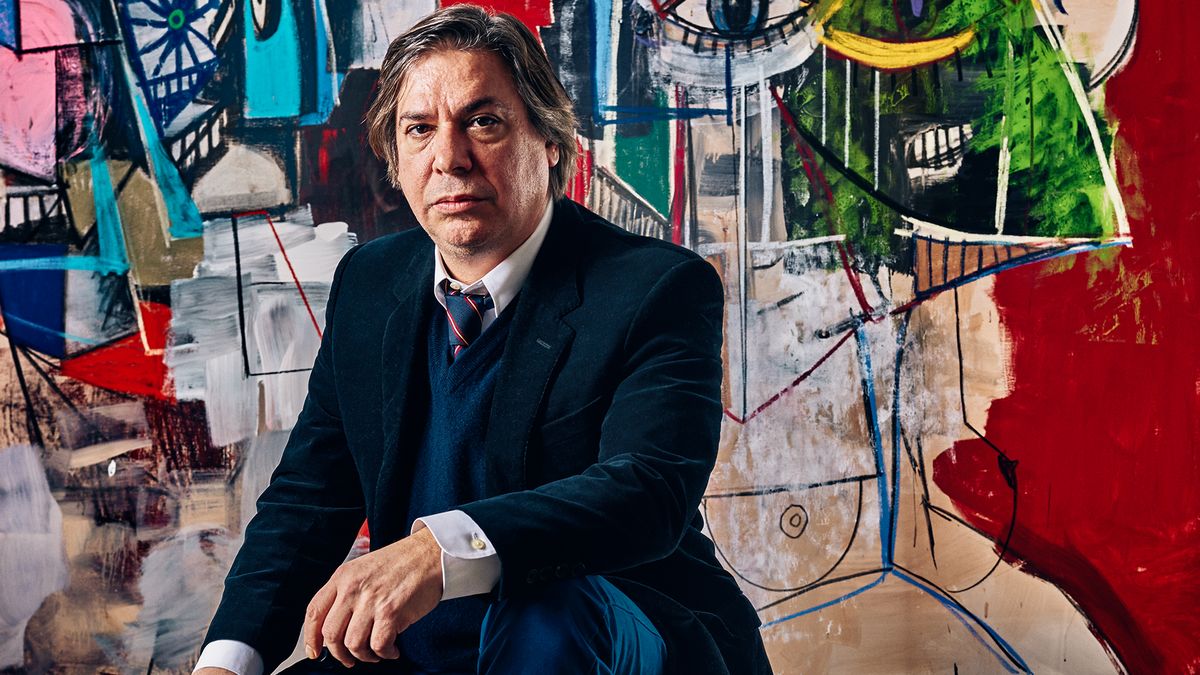
1. Paintings
#1. Abstract Conversation, 2010
Edlis Neeson Collection
Christie’s New-York: 19 November 2025
Estimated: USD 3,000,000 – 5,000,000
USD 3,491,000
GEORGE CONDO (B. 1957), Abstract Conversation | Christie’s
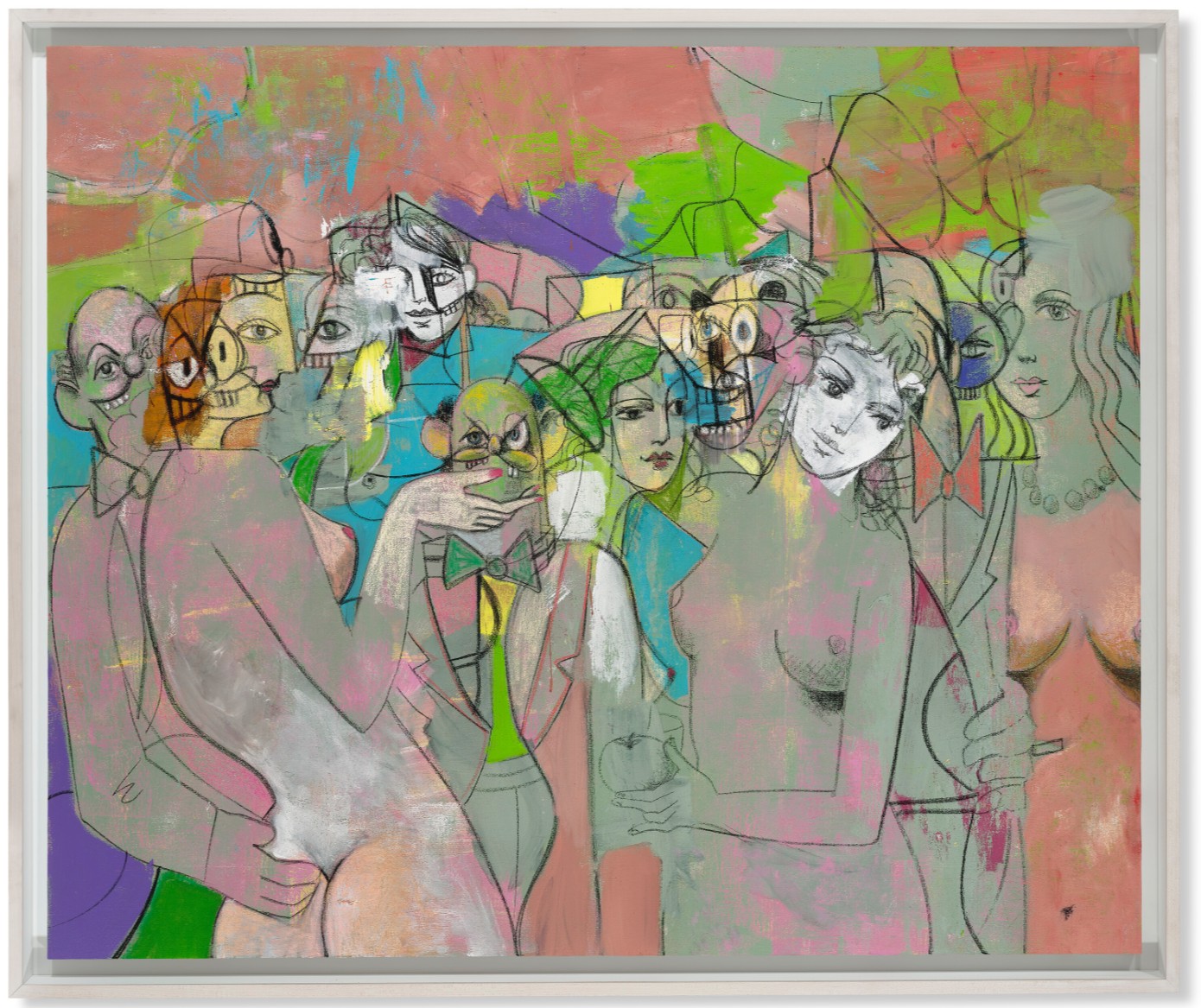
GEORGE CONDO (B. 1957)
Abstract Conversation, 2010
Acrylic, charcoal and pastel on linen
60×72 inches (152.4 x 182.9 cm)
Signed and dated ‘Condo 2010’ (upper left)
George Condo’s 2010 painting Abstract Conversation was painted during a prolific period for the artist, just months before his first major retrospective organized by New York’s New Museum in 2011. Acquired by the present owner the year it was painted, this multi-figure portrait is populated by a cast of mysterious characters; expertly rendered in acrylic paint, charcoal, and pastel, they populate a canvas at the confluence of contemporary figurative painting and art history. This particular crowd of figures characterizes the artist’s approach to portraiture, as by focusing only on what he considers to be the fundamental elements of the human body, he extracts a myriad of busy, introspective detail.
“My memory is made up of fragments that I want put in a state of continuity”
Corralled into the confines of Condo’s canvas is an array of distinctive and diverse characters. Some are fully realized portraits while others appear as snatched glimpses of faces in a crowd; some seem aware of the viewer’s presence, while others remain oblivious. Front and center is a curvaceous young woman holding an apple in the mode of Eve, her eyes downcast to avoid temptation. Next to her is placed one of Condo’s male protagonists, a balding man sporting a toothy grin and wearing a bow-tie—a common motif in many of Condo’s paintings. Beside them another couple appears more engaged with each other. They join a palimpsest of other overlapping figures—some well-defined, others suggested merely by rapid traces of the artist’s charcoal stick—the dynamic between all of them purposefully ambiguous.
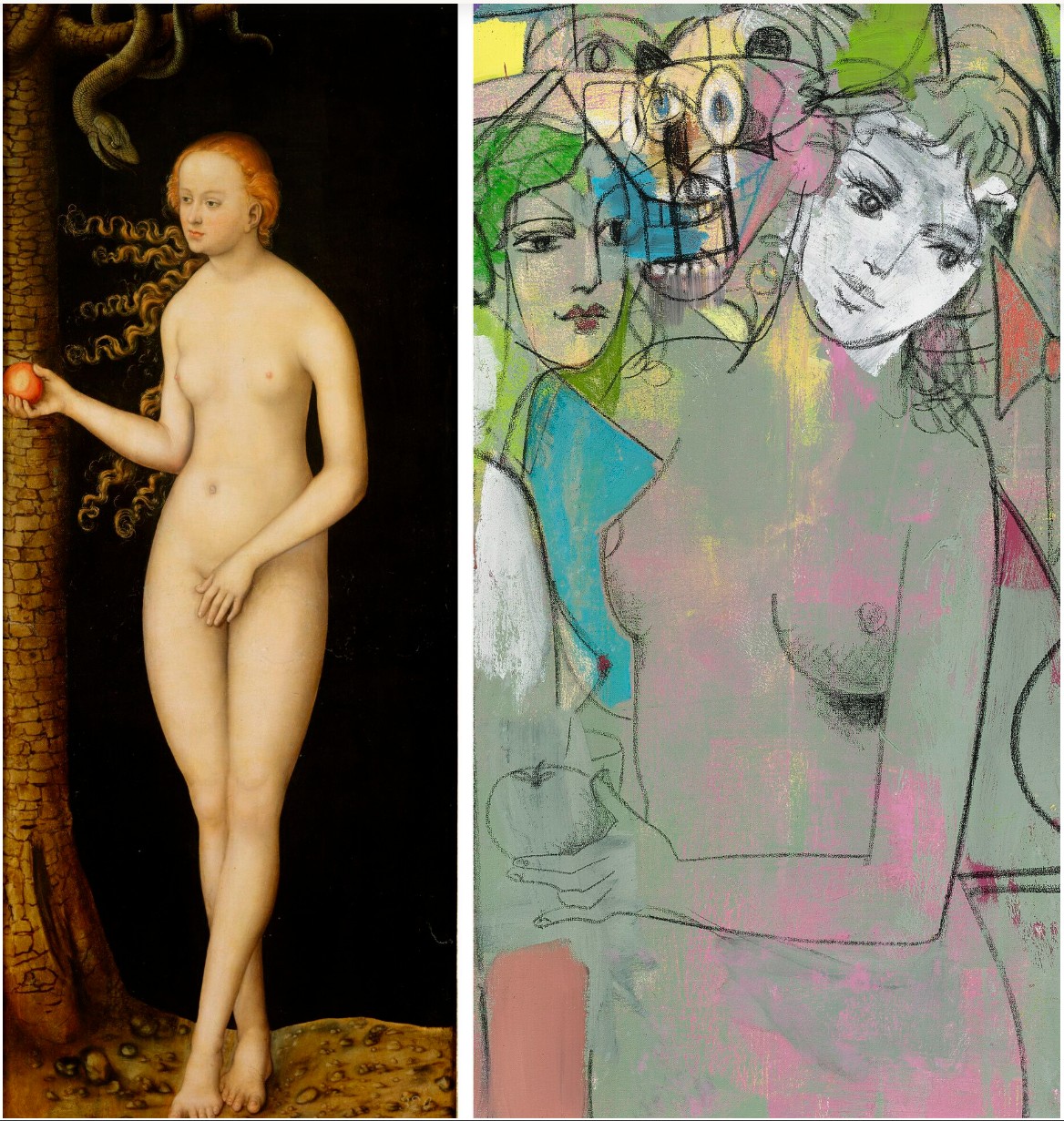
Left: Lucas Cranach the Elder, Eve, circa 1510/20. Kunsthistorisches Museum Wien, Gemäldegalerie.
Right: Present lot illustrated (detail).
With works such as Abstract Conversation, Condo enters into dialogue with a century of abstracted portraiture. Beginning with Pablo Picasso’s Les Demoiselles d’Avignon (1907, Museum of Modern Art, New York), artists have deconstructed the human figure only to rebuild them again, infused with new and interesting meanings. The are direct parallels between the present work and Picasso’s masterpiece—the positioning of the figures (particularly the figure on the left), and the preponderance of flesh-colored and blue tones.
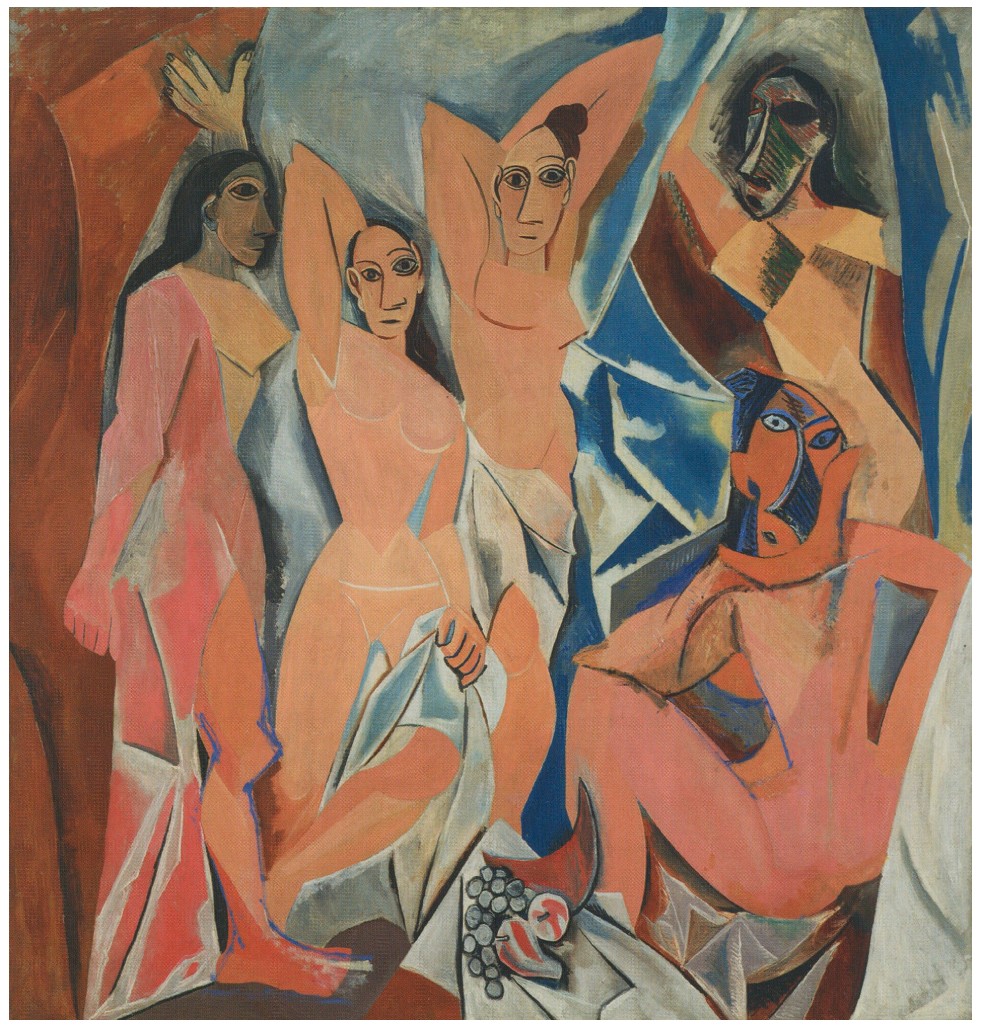
Pablo Picasso, Les Demoiselles d’Avignon, 1907. Museum of Modern Art, New York. © 2025 Estate of Pablo Picasso / Artists Rights Society (ARS), New York.
As Laura Hoptman points out, throughout his career Condo has displayed an encyclopedic ability to channel the pantheon of modern art history. Throughout his work he incorporates the language of modernist abstraction developed by the likes of Matisse, Klee, Tanguy, Gorky, de Kooning, Pollock and Picasso. He is, as Hoptman says, “…a philologist—a collector, admirer and lover of languages—in this case, languages of representation”. He sees himself, she continues, in the tradition of the masters who revised the motifs and techniques that had gone before and paid homage to them, “Just as Manet would emulate—and send up—Titian, and Picasso would furiously tackle the subjects of Velázquez and Manet, Condo re-imagines Picasso’s portraits and de Kooning’s human-scapes as a challenge” (L. Hoptman, “Abstraction as a State of Mind,” in R. Rugoff and L. Hoptman (eds.), George Condo: Mental States, op. cit., pp. 25-27).
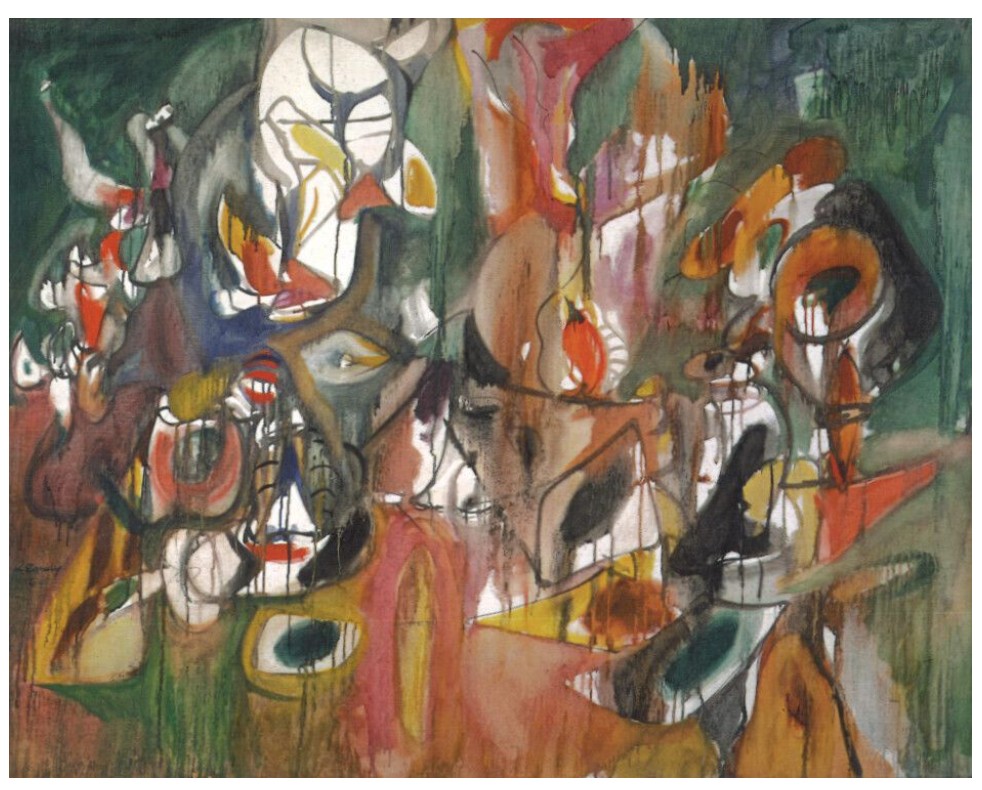
Arshile Gorky, One Year the Milweed, 1944. National Gallery of Art, Washington, D.C.
© 2025 The Arshile Gorky Foundation / Artists Rights Society (ARS), New York.
Born in New Hampshire in 1957, Condo moved to New York and spent the early 1980s working in Andy Warhol’s Factory in the silkscreen department. It was also during this time that he had the first exhibitions of his works that merged the styles of Old Masters with a fractured Pop sensibility. Expanding upon his interest in appropriating and finessing the extant imagery of art history, Condo began to work with some of the key elements of the New York School.
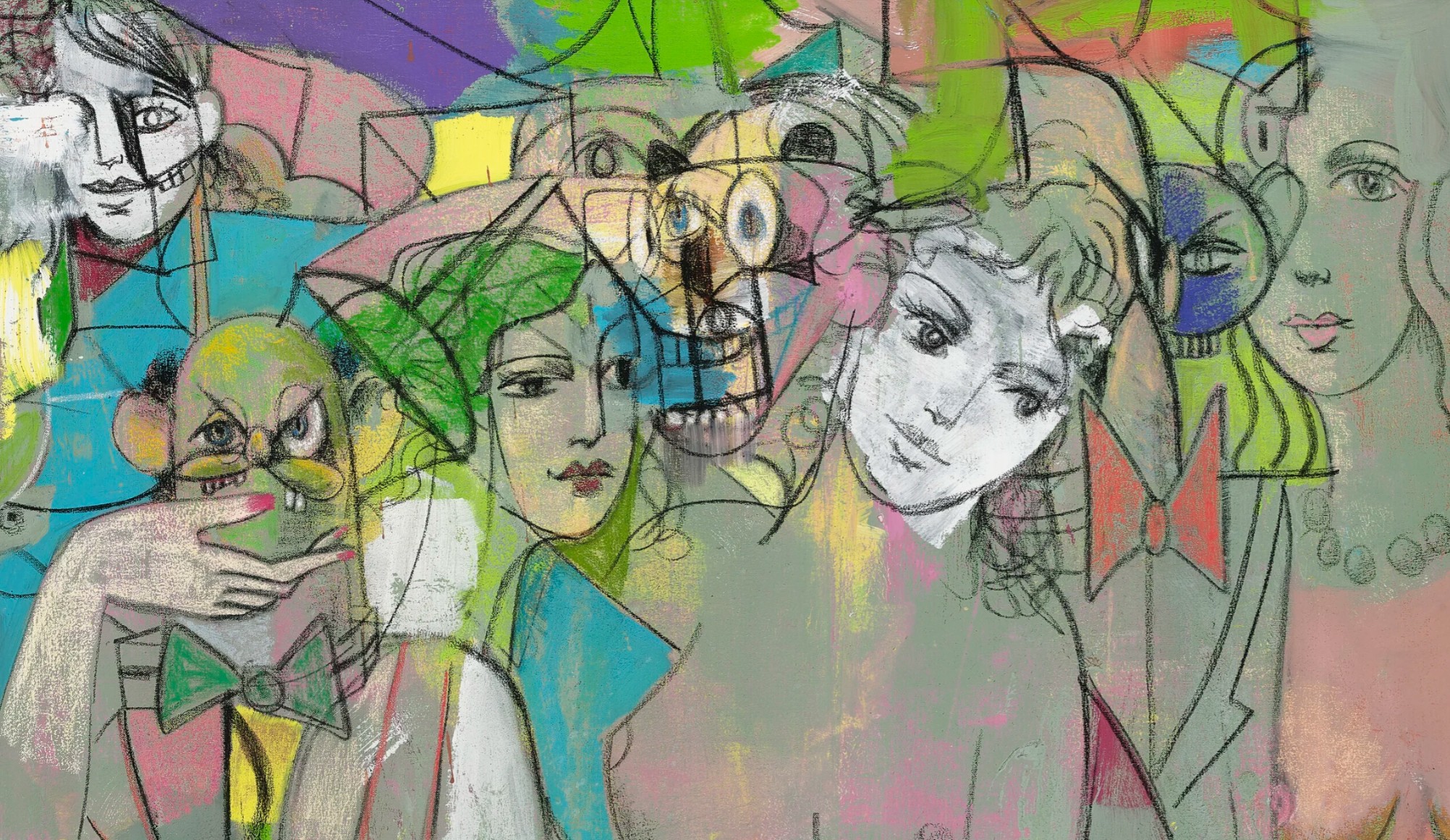
“Expressionism and Surrealism had already converged in Abstract Expressionism, particularly Willem de Kooning’s, but Condo’s integration of them produces even more absurdly (and comically) monstrous and menacing figures than de Kooning’s women. The snarling white teeth of Condo’s human grotesques seem to allude to those de Kooning’s sometimes also possess, but Condo’s seem more biting, and there are more of them” (D. Kuspit, op. cit.). Consistently pulling from every direction but always staying true to his unique vision, Condo creates work that is both recognizable and bizarre at the same time.
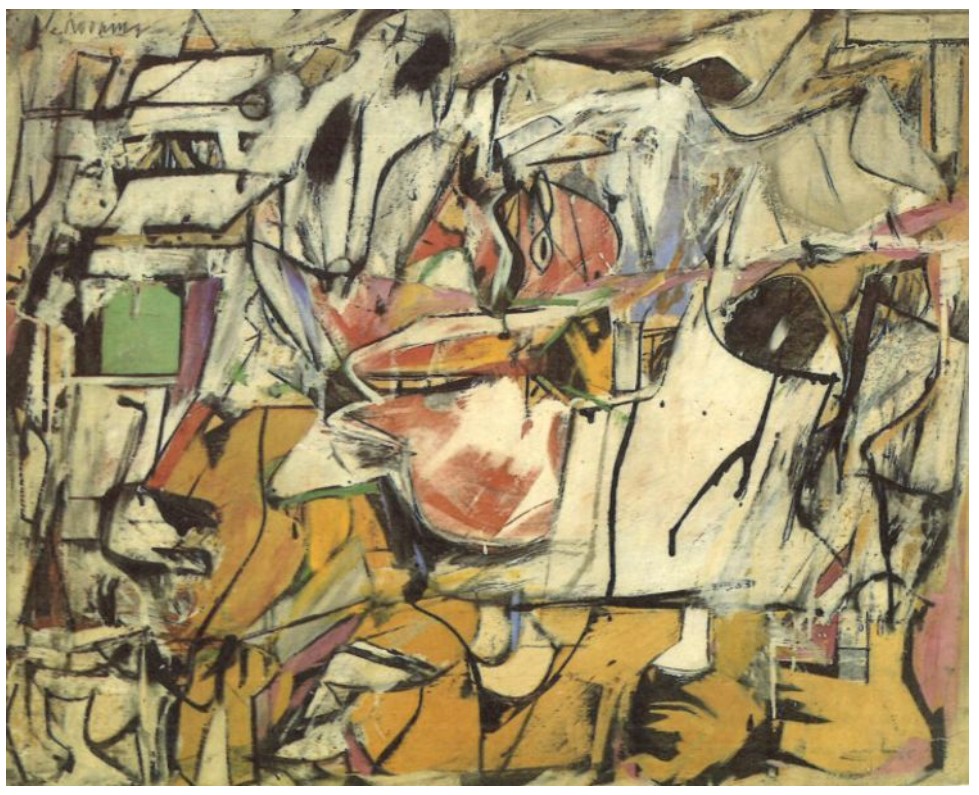
Willem de Kooning, Asheville, 1949. Phillips Collection, Washington, D.C.
© 2025 The Willem de Kooning Foundation / Artists Rights Society (ARS), New York.
Paintings such as Abstract Conversation have done much to reinvigorate the noble tradition of figurative painting. A generation of contemporary painters such as John Currin, Glenn Brown and Lisa Yuskavage have all acknowledged a debt of gratitude to Condo, for appreciating the traditions of painting, while not being suffocated by them, and in turn developing a whole new set of rubrics. Condo uses his inimitable technique to reassess painting in a radical new way and by combining the past with a more contemporaneous narrative, paintings such as this have done much to reinvigorate figurative painting and return the human figure to its central position in the modern art historical canon.
#2. Untitled, circa 1998
Property from a Private New York Collection
Christie’s New-York: 20 November 2025
Estimated: USD 350,000 – 550,000
USD 787,400
GEORGE CONDO (B. 1957), Untitled | Christie’s
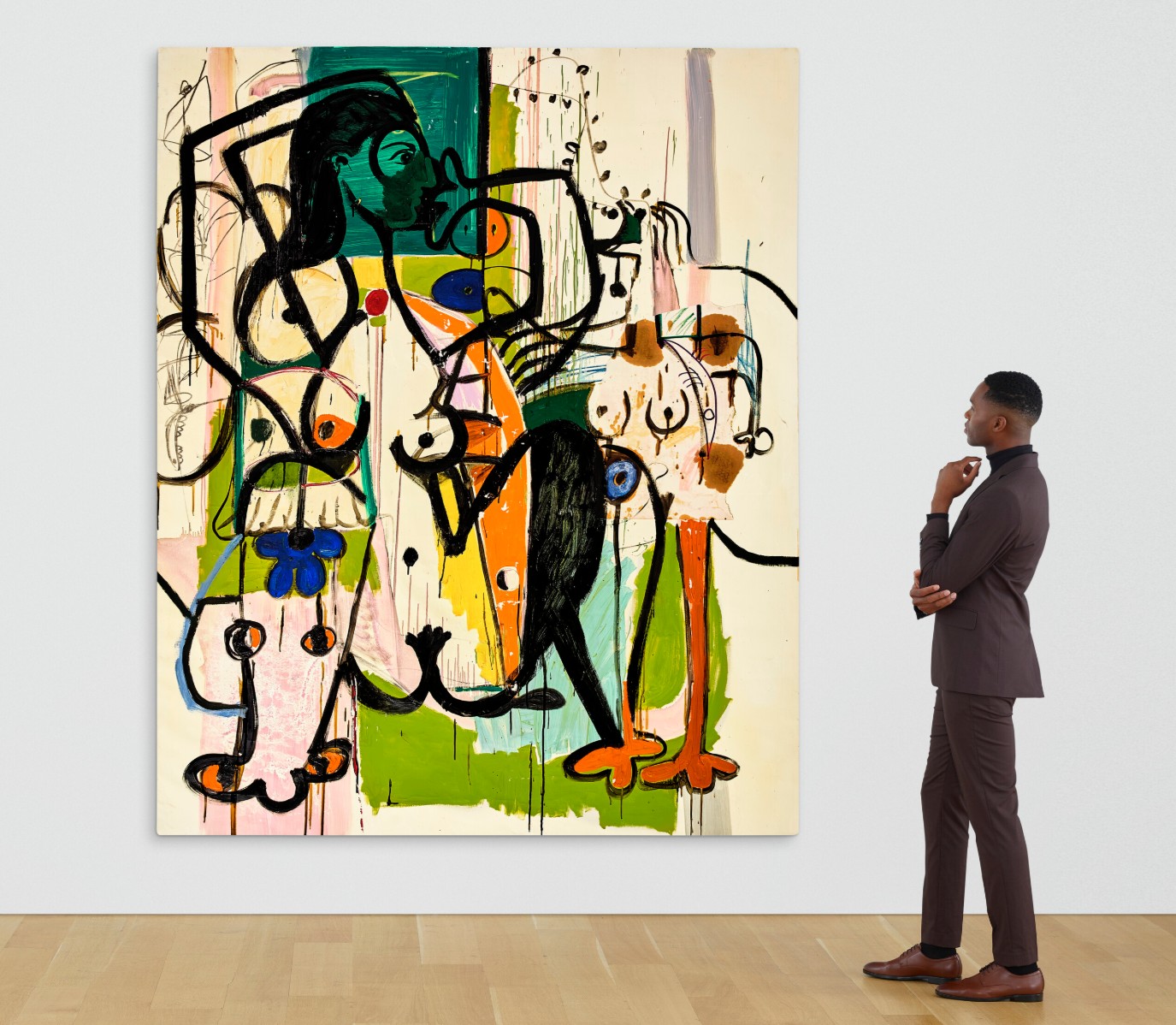
GEORGE CONDO (B. 1957)
Untitled, circa 1998
Oil and paper collage on canvas
76 5/8 x 62 5/8 inches (194.3 x 158.75 cm)
Signed ‘Condo’ (on the reverse)
#3. Untitled, 2007
Property from a Private New York Collection
Christie’s New-York: 20 November 2025
Estimated: USD 500,000 – 700,000
USD 635,000
GEORGE CONDO (B. 1957), Untitled | Christie’s
GEORGE CONDO (B. 1957)
Untitled, 2007
Acrylic and oil on canvas
108×85 inches (274.3 x 216 cm)
“Condo is not a producer of single precious items consistent in style and long in the making… He’s an artist of variety, plentitude and multiformity. He needs to be seen in an environment that presents him not as a virtuoso soloist but as the master of the massed chorale.”
Holland Cotter
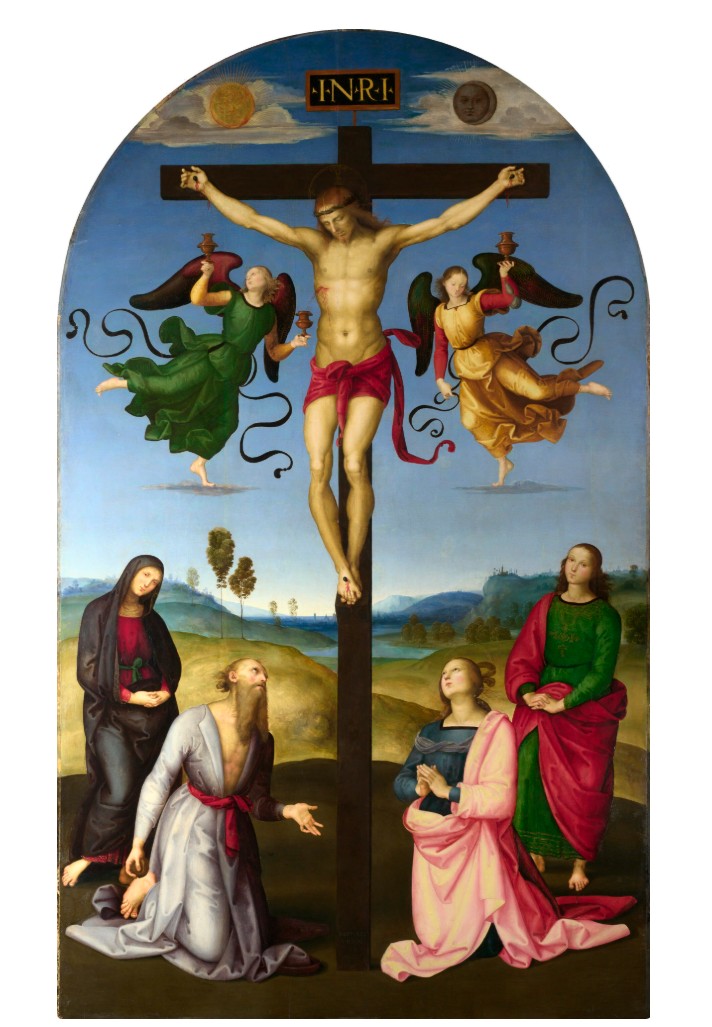
Raphael, The Mond Crucifixion, ca. 1503-3. National Gallery, London.
#4. Female Bust, 2008
Edlis Neeson Collection
Christie’s New-York: 20 November 2025
Estimated: USD 150,000 – 200,000
USD 444,500
SCULPTURE
GEORGE CONDO (B. 1957), Female Bust | Christie’s
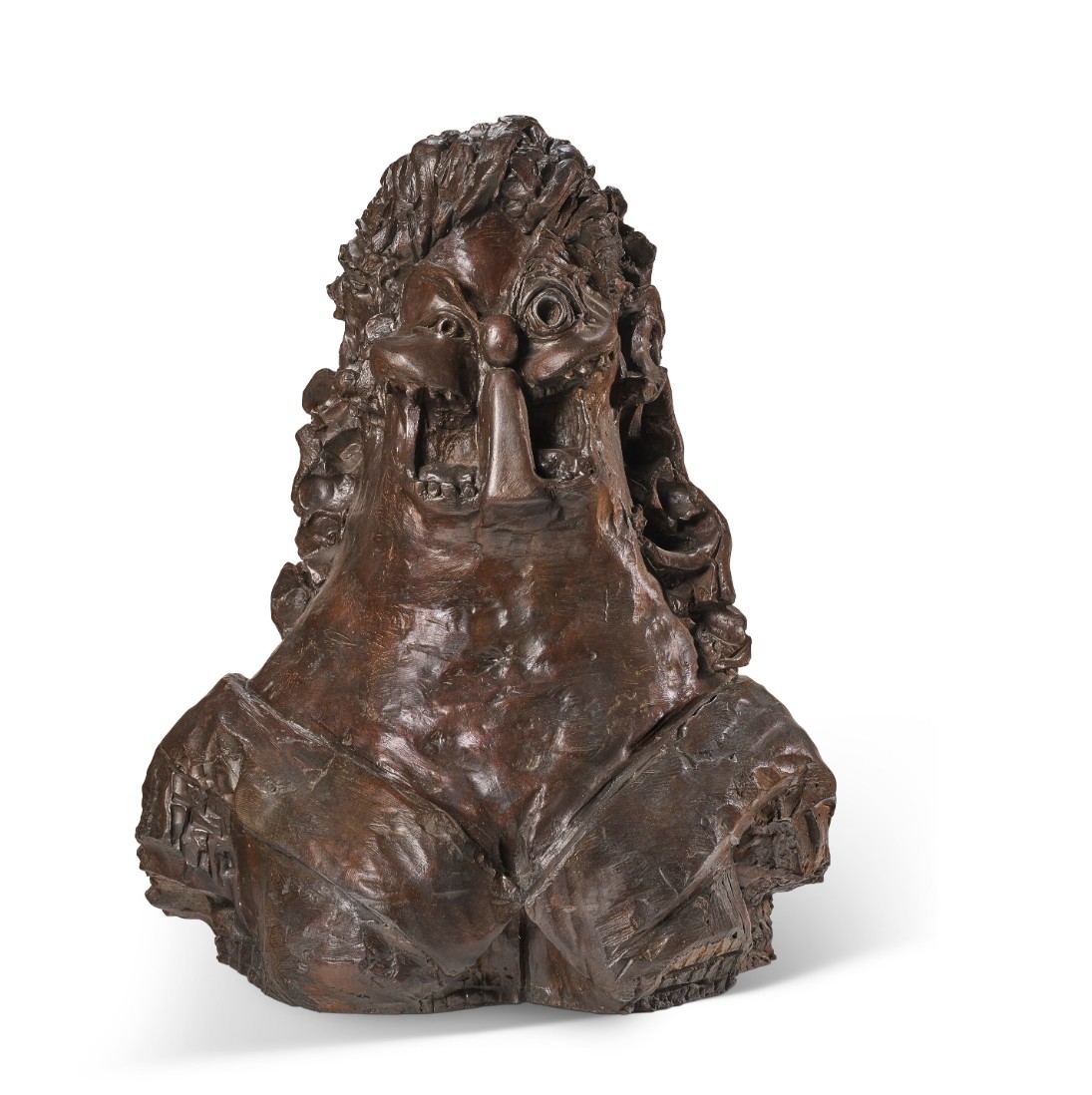
GEORGE CONDO (B. 1957)
Female Bust, 2008
Bronze
23x18x15 inches (58.4 x 45.7 x 38.1 cm)
Stamped with the artist’s signature and number ‘G. CONDO 3⁄4’ (lower edge)
This work is number three from an edition of four
#5. Division of the Eternal, 1986
Works from the Collection of Byron R. Meyer with Partial Proceeds
to Benefit the San Francisco Museum of Modern Art
Sotheby’s New-York: 19 November 2025
Estimated: USD 400,000 – 600,000
USD 431,800
Division of the Eternal | Contemporary Day Auction | 2025 | Sotheby’s
GEORGE CONDO (b. 1957)
Division of the Eternal, 1986
Oil, encaustic, ink, marker, graphite and paper collage on 3 joined canvases
107 x 85 1/2 inches (271.8 x 217.2 cm)
Signed and dated 9.86 (lower center right)
Dated Paris 86 (upper left)
Executed in 1986, George Gondo’s Division of the Eternal crystallizes the synthesis of figuration and abstraction that would come to define his contribution to postmodern painting. Executed during his Paris years, one of the most fertile periods of his early career, the work stands as a monumental exploration of psychic fragmentation, human comedy, and painterly excess. The composition’s monumental scale and fevered surface of oil, encaustic, and collage evoke both an archaeological wall and a palimpsest of consciousness, an index of the mind’s infinite divisions and reconciliations.
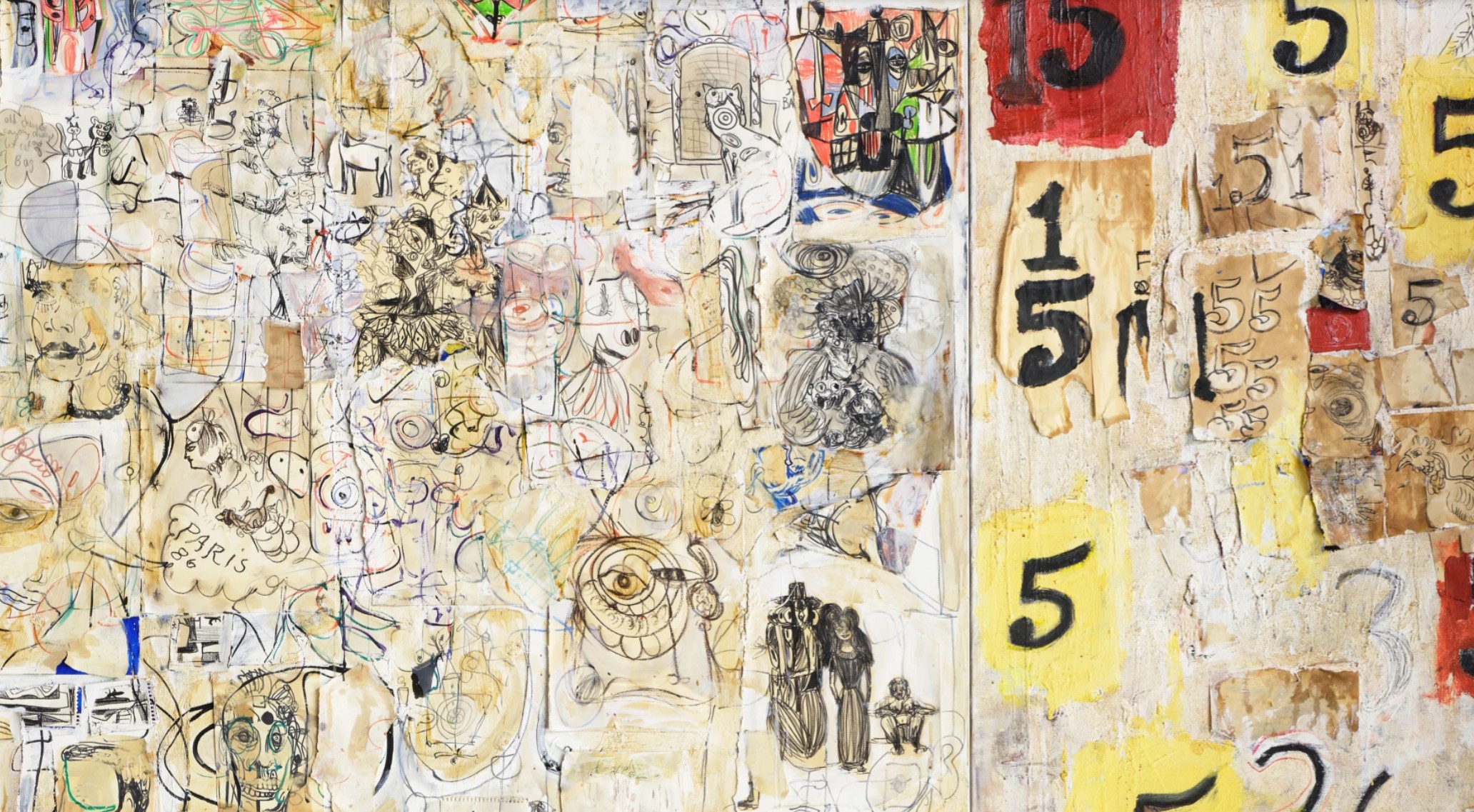
Painted at the height of the 1980s neo-expressionist surge, Division of the Eternal departs from the gestural bravado of his contemporaries by embracing a deeper dialogue with art history. Condo’s references are multiple and simultaneous: the cubist dislocation of Picasso, the spiritual density of Dubuffet, and the layered psychological space of Rauschenberg’s early combines. The serial repetition of the number “5” across the canvas, rendered in emphatic blocks of yellow and red, suggests a structural device akin to Charles Demuth’s and Jasper Johns’s numerical symbolism, yet Condo’s treatment transforms counting into incantation, a rhythmic anchor amid chaos.
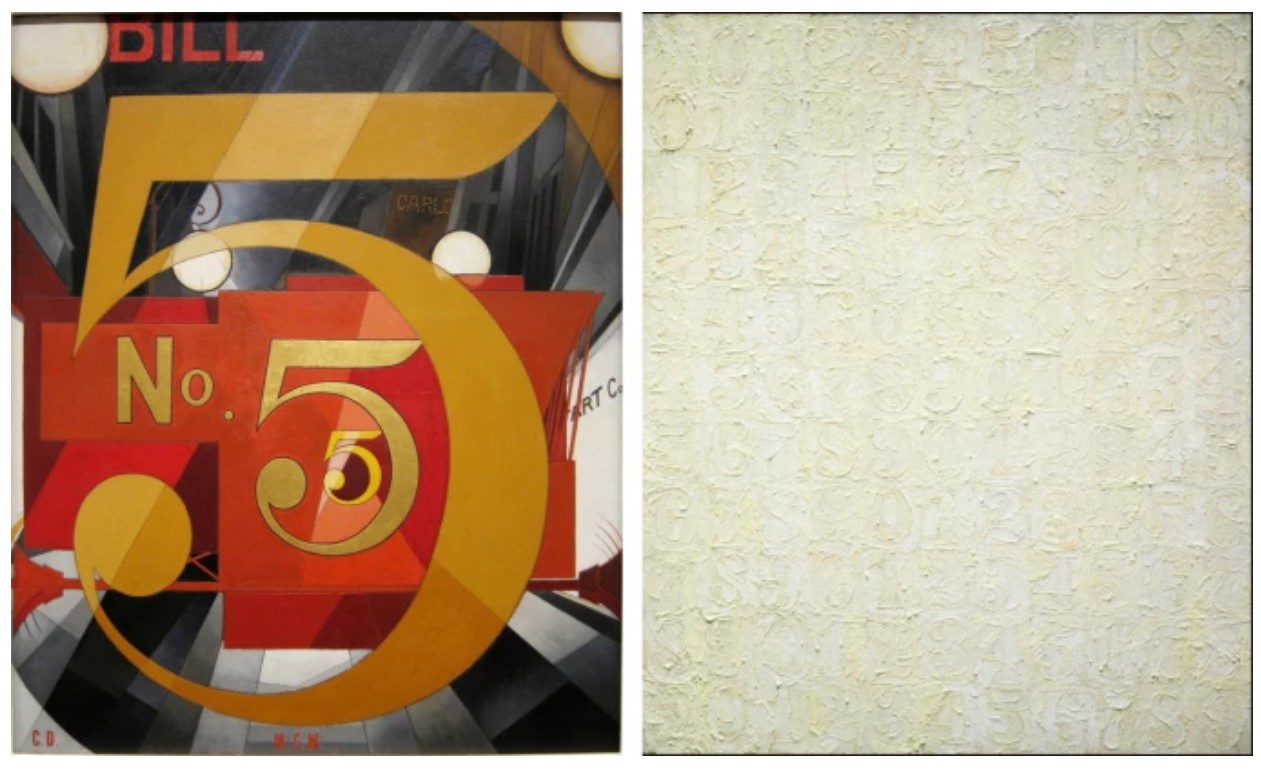
Left:Charles Demuth, I Saw the Figure 5 in Gold, 1928. The Metropolitan Museum of Art, New York.
Right: Jasper Johns, White Numbers, July 29, 1957.The Museum of Modern Art, New York. © 2025 Jasper Johns / Licensed by VAGA at Artists Rights Society (ARS), NY.
The surface bears evidence of multiple revisions, erasures, and overpainting, revealing Condo’s process as a kind of excavation. Paper collage and encaustic lend the painting a sculptural tactility, inviting comparisons with the textured strata of Antoni Tàpies or Alberto Burri, while the overall effect retains the immediacy and anxiety of raw thought. Each section teems with fragments of drawn figures, archaic symbols, and smudged gestures, traces of the human form in states of disintegration and renewal.
Alberto Burri, Composizione, 1953. Solomon R. Guggenheim Museum, New York. © Fondazione Palazzo Albizzini Collezione Burri, Città di Castello/2023 Artist Rights Society (ARS), New York/SIAE, Rome
Division of the Eternal emerges at a key inflection point in Condo’s career. Having left New York for Paris in 1985, he immersed himself in the European avant-garde tradition, befriending figures such as Jean-Michel Basquiat and working within a milieu that valued conceptual and painterly experimentation. The year 1986 saw the crystallization of what the artist would later call “Artificial Realism,” or the depiction of imagined figures through the technical language of the Old Masters. While many of his later portraits display psychological grotesquerie and overt caricature, here Condo operates on the cusp between abstraction and figuration, revealing the primordial field from which those personae would later emerge. Key figures from Condo’s repertoire—including the iconic character Rodrigo and the recurring symbol of the human eye—are scattered throughout the composition, serving as a window into the artist’s singular menagerie of subjects that would come to define his career.
Having remained in the collection of Byron R. Meyer since the year of its creation in 1986, Division of the Eternal held pride of place in his home as a centerpiece of his collection for over three decades. The painting reflects Meyer’s lifelong commitment to supporting the artists whose work composed his collection, purchased early on in Condo’s career before the artist’s trademark signs and symbols had become some of the most recognizable images in contemporary painting.
Ultimately, Division of the Eternal encapsulates Condo’s lifelong pursuit: to visualize the multiplicity of human consciousness through painterly invention. Its title alone suggests both fracture and perpetuity, a paradox resolved only through art. In its dense layering, symbolic repetition, and frenetic order, the work becomes a kind of visual fugue: an ode to the eternal divisions within the self, and a testament to Condo’s enduring relevance in the continuum of modern painting.
#6. Untitled, circa 1998
Phillips New-York: 21 November 2025
Estimated: USD 250,000 – 350,000
USD 374,100
George Condo Modern & Contemporary Art Day Sale, Afternoon Session
GEORGE CONDO
Untitled, circa 1998
Oil on canvas
50×50 inches (127×127 cm)
In 1998 George Condo was tapped to create the cover art for the seventh album of the American rock band Phish, The Story of the Ghost. Sparked by a mutual admiration between Condo and the band’s lead guitarist, Trey Anastasio, the collaboration was a natural fit for the artist and musicians, all New England natives who came of age in the 1980s. Condo studied music in college and performed with a band in his early 20s before dedicating himself to painting. His interest in music has revealed itself through recurrent collaborations; following the Phish album, Condo later works on cover art for Danny Elfman (2006), Kanye West (2010), Anthony Roth Costanzo (2018) and Travis Scott (2024).
In the present example, Condo teases ideas later used in the final album cover. A figure is paired with his miniature clone, who sprouts from atop his head. His outstretched hands hold two glass bottles that release bubbles in a playful composition, reflecting the jazz-funk energy of the album. The hand-painted album title and band name recall the whimsical text incorporated into his seminal The Cloudmaker and The Self Creator, both 1984, in which oversized letters spelling “Condo” dot fantastical landscapes. Painted in Condo’s signature style of artificial realism, the figure is both a sincere expression of inner feelings and a caricature of the human experience, at once sympathetic and tragicomic.
#7. ARP, 1984
Phillips New-York: 21 November 2025
Estimated: USD 120,000 – 180,000
USD 129,000
George Condo Modern & Contemporary Art Day Sale, Afternoon Session
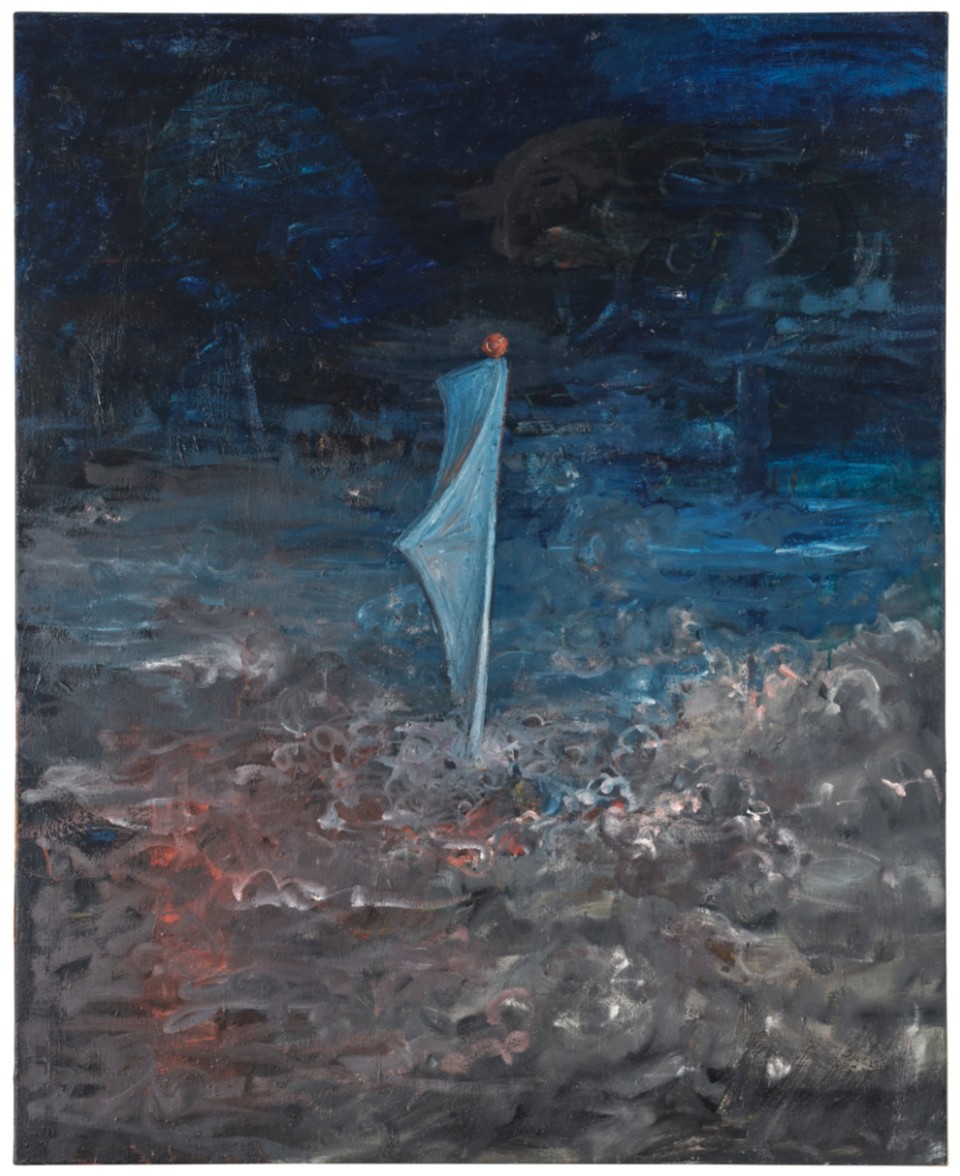
Oil on canvas
42×34 inches (106.7 x 86.4 cm)
#8. The Queen, 1984
Phillips New-York: 21 November 2025
Estimated: USD 20,000 – 30,000
USD 28,380
George Condo Modern & Contemporary Art Day Sale, Afternoon Session
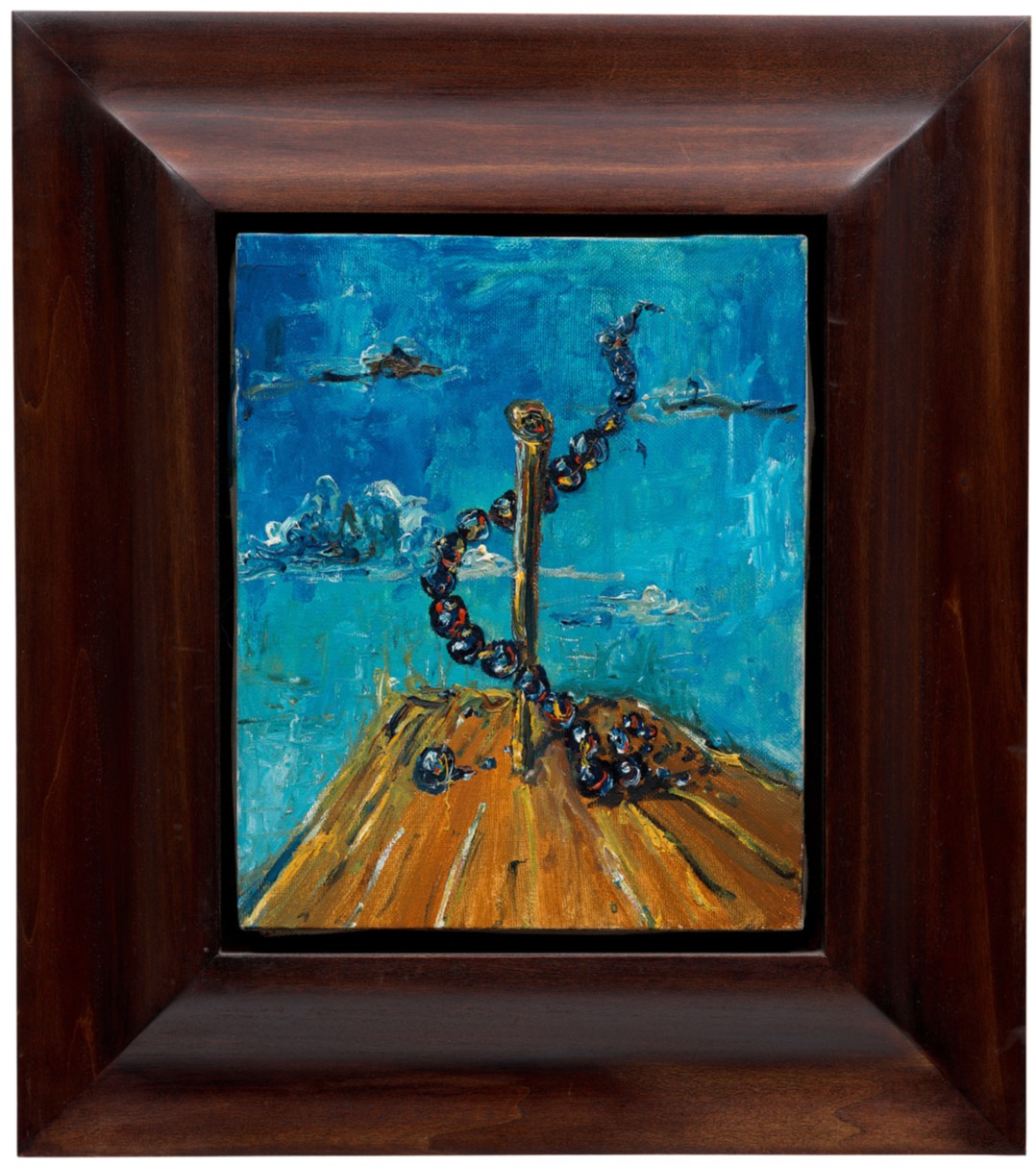
Acrylic on canvas, in artist’s frame
18 x 15 3/4 inches (45.7 x 40 cm)
Signed, titled and dated “Condo The Queen 9-84″ on the stretcher
2. Works on Paper
#1. Untitled, 2018
Christie’s New-York: 20 November 2025
Estimated: USD 50,000 – 70,000
USD 95,250
WORK ON PAPER
GEORGE CONDO (B. 1957), Untitled | Christie’s
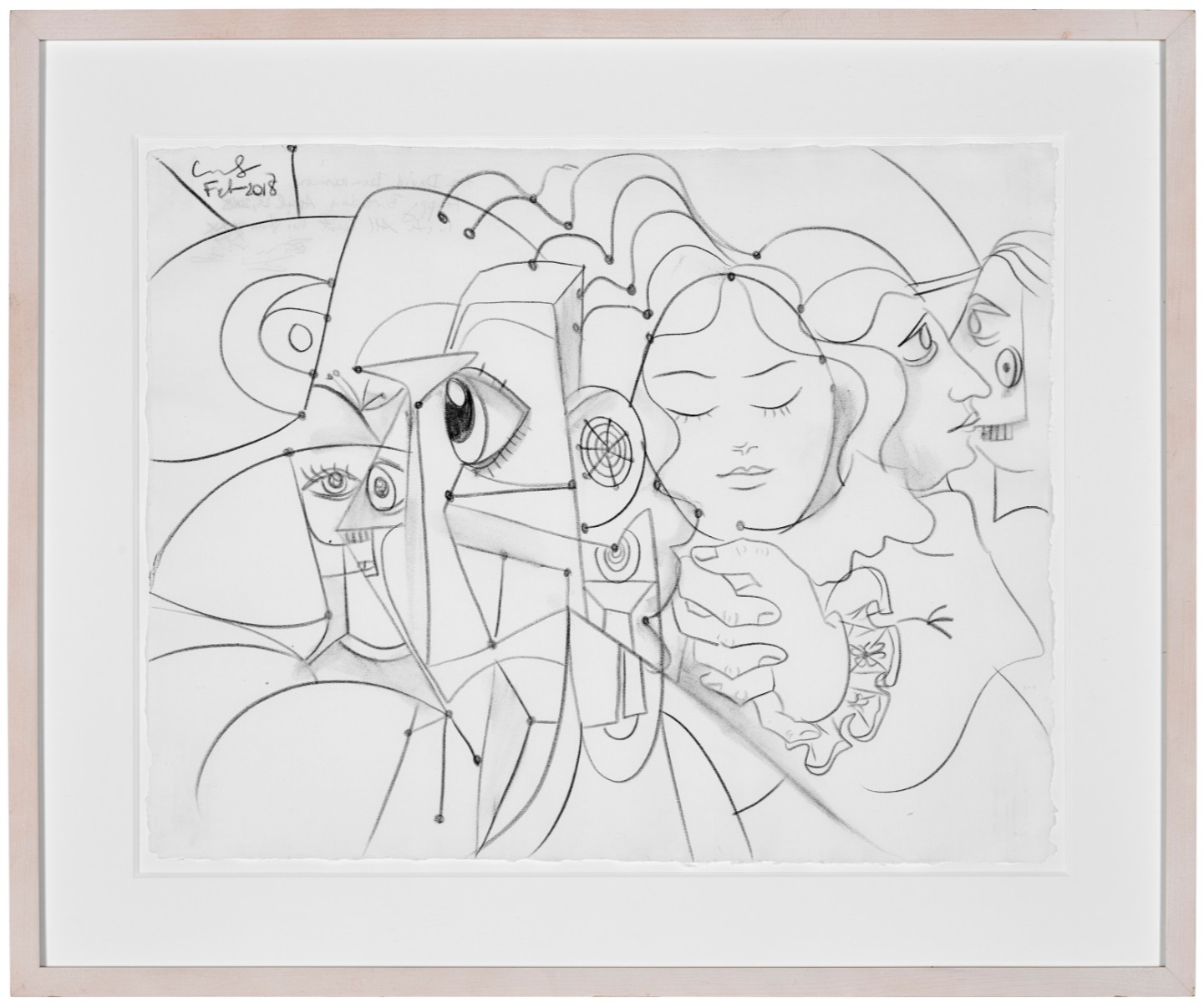
GEORGE CONDO (B. 1957)
Untitled, 2018
Graphite and wash on paper
18 1/8 x 22 3/4 inches (46 x 56.6 cm)
Signed and dated ‘Condo Feb 2018’ (upper left)
Inscribed and dedicated ‘Happy Birthday April 25, 2018 with all best wishes’
(on the reverse)
#2. Untitled, 1983
Phillips New-York: 21 November 2025
Estimated: USD 30,000 – 50,000
USD 30,960
WORK ON PAPER
George Condo Modern & Contemporary Art Day Sale, Afternoon Session
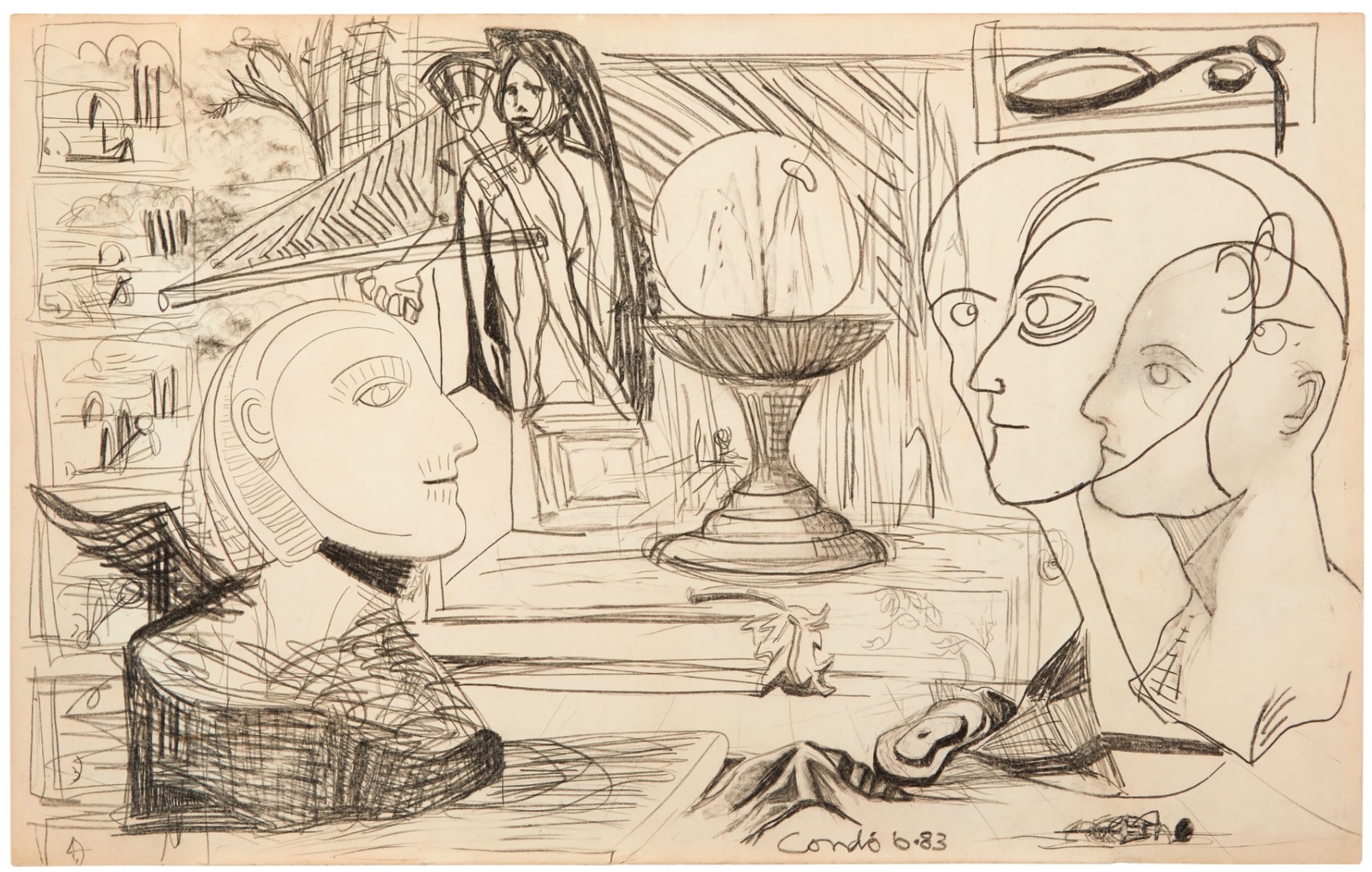
GEORGE CONDO
Untitled, 1983
Crayon and graphite on paper
24 1/8 x 38 1/8 inches (61.3 x 96.8 cm)
Signed and dated “Condo 6 • 83” lower right
Sunset, 2020
Sotheby’s New-York: 19 November 2025
Estimated: USD 450,000 – 550,000
PASSED
WORK ON PAPER
Sunset | Contemporary Day Auction | 2025 | Sotheby’s
GEORGE CONDO (b. 1957)
Sunset, 2020
Ink, graphite, gesso and watercolor on paper
41 3/4 x 60 inches (106 x 152.4 cm)
Signed and dated July 30, 2020 (upper left)
A sublime synthesis of art historical tropes and contemporary aesthetics, Sunset epitomizes the exceptional virtuosity, psychic intensity, and fragmented perspectives that define George Condo’s remarkable oeuvre. Executed in 2020, the work demonstrates the artist’s unparalleled ability to merge expressive line, radiant color, and psychological complexity into a single pictorial plane.
“They are about freedom of line and color and blur the distinction between drawing and painting. They are about improvisation on the human figure and its consciousness.”
Rendered in sweeping washes of violet, tangerine, and crimson, Sunset stages a dynamic encounter between figuration and abstraction. A central nude—serene yet unguarded—is enveloped by a chorus of distorted faces and gestural marks that seem to hover in constant motion. The composition encapsulates Condo’s signature mode of “psychological cubism,” in which he ruptures the picture plane to reveal the multifaceted nature of human emotion. Incorporating the formality of Old Master portraiture, the spontaneity of Abstract Expressionism, and the wry humor of Pop, Sunset collapses traditional boundaries of genre while exposing the emotional volatility of its subjects.
Francis Picabia, Pavonia, 1929. Sold at Sotheby’s, Paris for €10 million in March 2022. Private Collection.
Art © 2025 Artist Rights Society (ARS), New York/ADAGP, Paris
Dominated by rose and orange hues, punctuated with delicate purples and grays, Condo’s lines and color fields teeter on the periphery of representation and abstraction.
“There was a time when I realized that the central focal point of portraiture did not have to be representational in any way.”
Like Matisse’s figures, rendered in simplified shapes and liberated contours, Condo’s characters here break free from strict representational conventions, continuing a Modernist experimentation with the human form that Matisse set forth. Created during a moment of reflection and global uncertainty, Sunset distills Condo’s lifelong pursuit of emotional truth through the language of abstraction and the human form. The work exemplifies his unique ability to render the psyche visible—an exuberant and deeply introspective tableau where chaos and grace, beauty and absurdity, coexist in perfect, volatile balance.
Damien Hirst
PLEASE CLICK ON THE PICTURE BELOW TO ACCESS AUCTION MARKET OVERVIEW
#1. Momentary Love Blossom, 2018
Property from the Laurence and Patrick Seguin Collection, Paris
Sotheby’s New-York: 18 November 2025
Estimated: USD 2,500,000 – 3,500,000
USD 3,040,000
Momentary Love Blossom | The Now & Contemporary Evening Auction | 2025 | Sotheby’s
DAMIEN HIRST (b. 1965)
Momentary Love Blossom, 2018
Oil on canvas
144×108 inches (365.8 x 274.3 cm)
Signed, titled, dated 2018 and variously inscribed (on the reverse)
Signed (on the stretcher)
A resplendent constellation of blushing pinks, verdant greens, and sunlit whites unfolding against a crystalline blue sky, Damien Hirst’s Momentary Love Blossom envelops the viewer in a triumphant vision of nature’s renewal. Through luscious, cascading daubs of impasto, Hirst conjures the intoxicating splendor of spring within a dense tapestry of painterly gestures that seem to radiate with vitality. Here, his petals drift outward, some untethered, floating against the sea of azure, capturing, as the title suggests, a fleeting moment suspended in time.
“The Cherry Blossoms are about beauty and life and death. They’re extreme—there’s something almost tacky about them, like Jackson Pollock twisted by love. They’re decorative but taken from nature. They’re about desire and how we process the things around us and what we turn them into, but also about the insane visual transience of beauty—a tree in full crazy blossom against a clear sky.”
Damien Hirst in his studio, 2020. PHOTO by Prudence Cuming Associates Ltd. Art © 2025 Damien Hirst
Executed in 2018, Momentary Love Blossom epitomizes Hirst’s celebrated Cherry Blossom series, a body of work that revels in the transient beauty of spring while embodying the artist’s career-long fascination with capturing the dichotomy between life and impermanence. Cherry blossoms bloom spectacularly yet only momentarily. As such, they serve as a metaphor for all life and echo the tension explored in Hirst’s early Natural History series, featuring creatures suspended in formaldehyde, between fleeting beauty and the fragility of life. The present work bears remarkable provenance as it comes from the esteemed collection of Laurence and Patrick Seguin and is further distinguished for its inclusion in Hirst’s first exhibition of the series at Fondation Cartier in 2021-22.
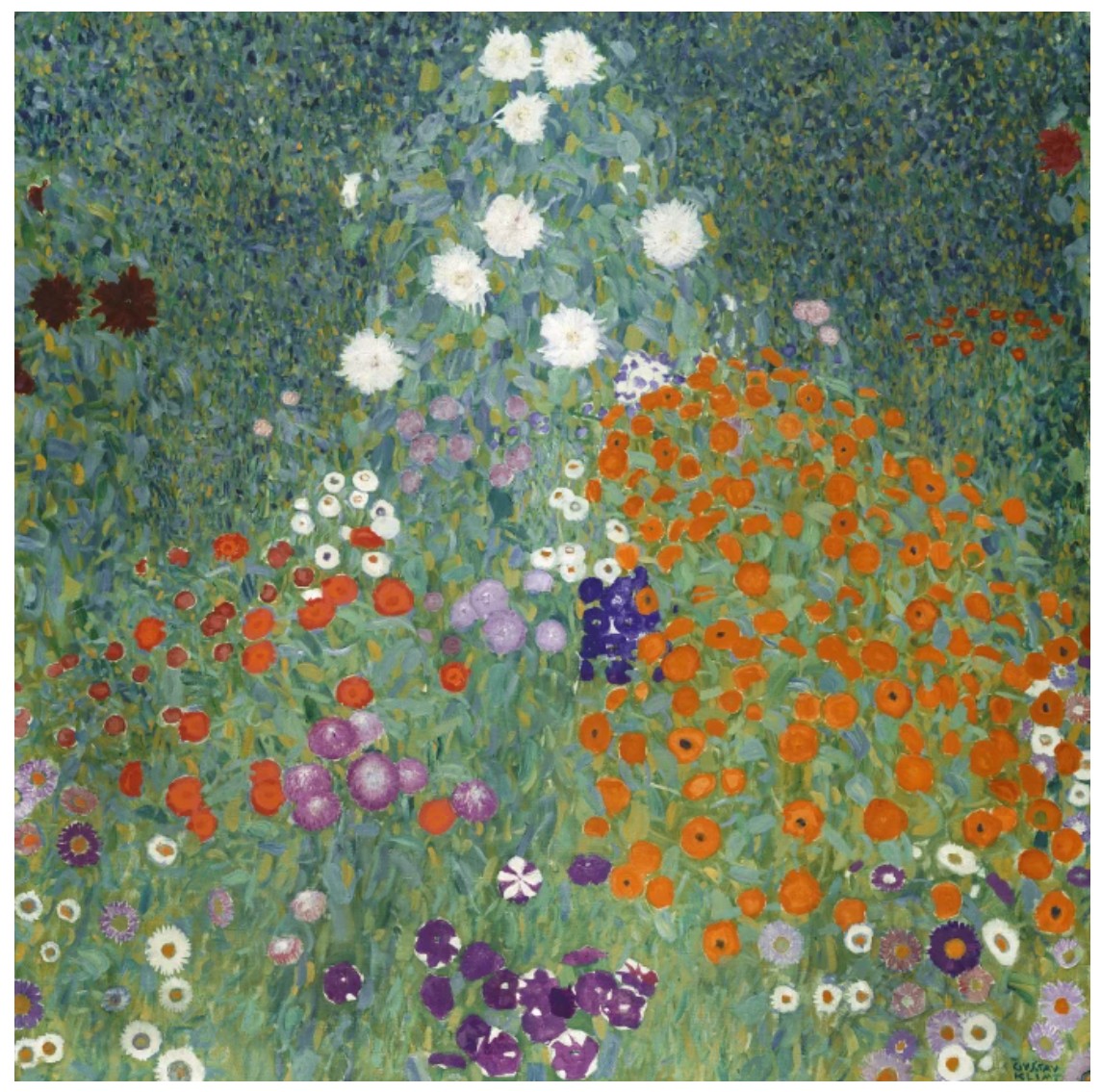
Gustav Klimt, Flower Garden, 1905-07. Private Collection. Image © Christie’s Images / Bridgeman Images
In Momentary Love Blossom, Hirst reimagines the genre of landscape painting with a playful wit, amalgamating the chromatic delicacy of Pointillism with the gestural bravado and spontaneity of Abstract Expressionism. Through this fusion of painterly influences, Hirst both pays homage to and subverts the great artistic movements of the late Nineteenth and Twentieth Centuries. Rooted in the art historical lineages of Monet’s depictions of his garden at Giverny and Pollock’s gestural abstractions, Momentary Love Blossom exemplifies Hirst’s fusion of control and chaos. While his earlier Spot Paintings imposed a mechanical order upon color, the Cherry Blossom series embraces its wild liberation. In the present work, the artist’s hand is unmistakably present, his brush dancing, daubing, and stippling across the canvas with exuberant abandon.
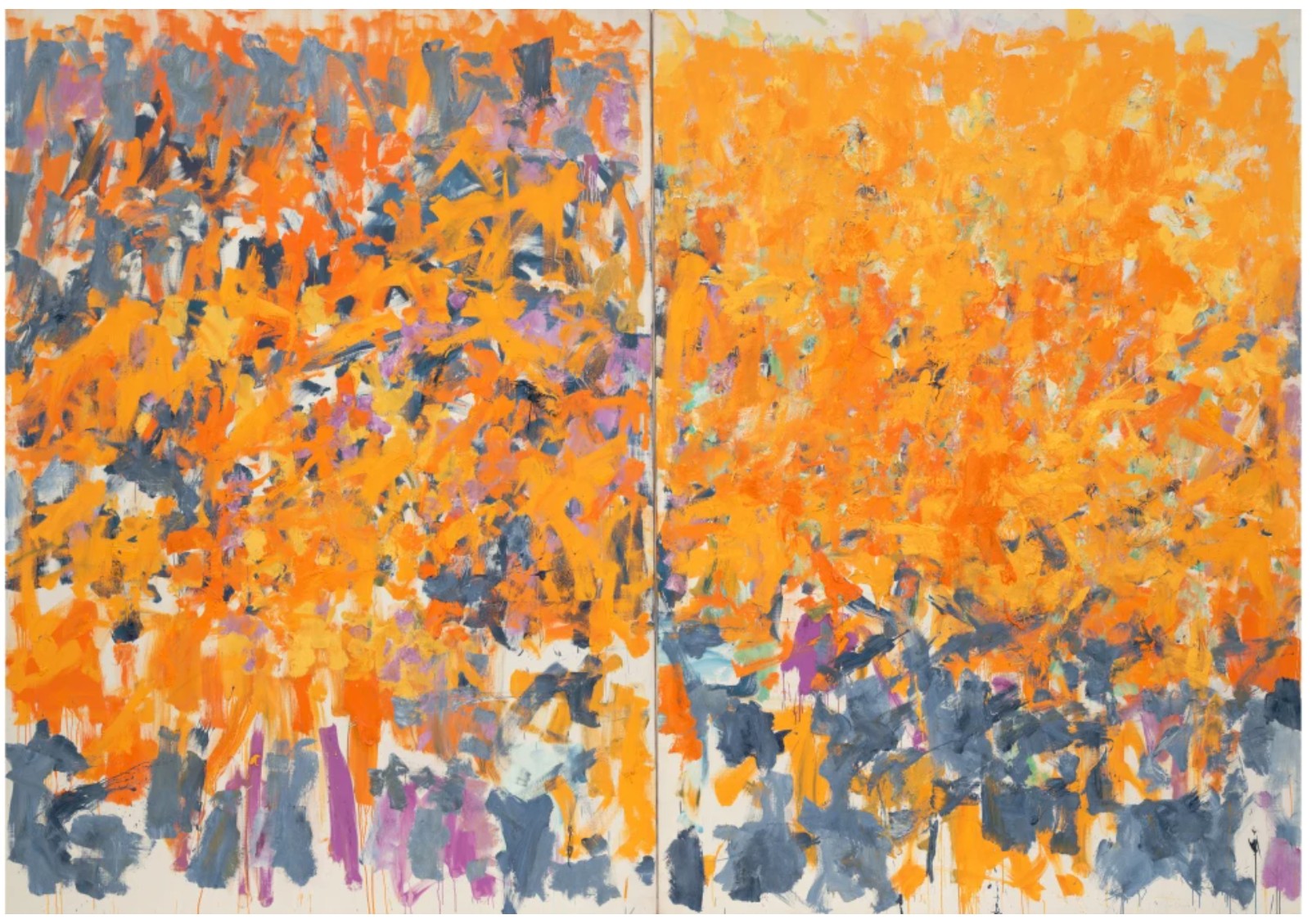
Joan Mitchell, Wood ,Wind, No Tuba, 1980. The Museum of Modern Art, New York.
Image © The Museum of Modern Art / Licensed by SCALA / Art Resource, NY. Art © Estate of Joan Mitchell
Against a serene expanse of sky, the branches surge upward, their bursts of pink and white petals rendered with tactile immediacy. The surface hums with motion, and one senses the artist’s own physical energy, the very act of painting, as integral to the work’s life force.
“It’s been so good to make them, to be completely lost in color and in paint in my studio. They’re garish and messy and fragile and about me moving away from Minimalism and the idea of an imaginary mechanical painter, and that’s so exciting for me.”
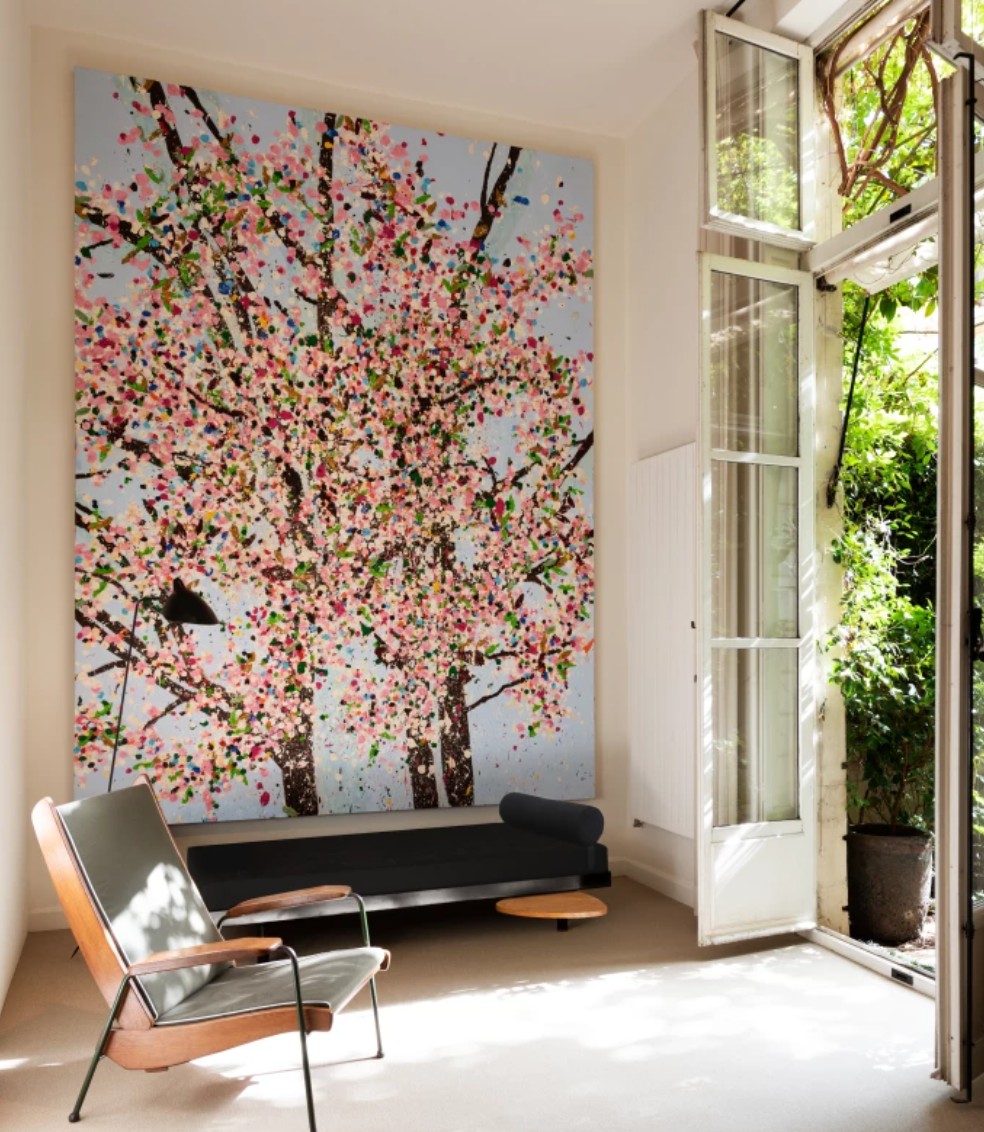
The present work installed in the residence of Laurence and Patrick Seguin, Paris. Art © 2025 Damien Hirst
“I’ve got an obsession with death,
but I think it’s like a celebration of life rather than something morbid.
You can’t have one without the other. I feel alive when I’m painting them.
So I’m putting my life into it… all that energy of life is actually caught in the paint.”
Emerging as among the most lyrical explorations in Hirst’s career, Momentary Love Blossom extends his enduring fascination with the dualities of existence: life and death, beauty and decay, permanence and transience. The cherry blossom, long a symbol of ephemerality, serves as an apt metaphor for the artist’s philosophical inquiry. Its fragile petals bloom in abundance only to soon disperse, a poignant reminder of the impermanence that shadows even the most beautiful moments. In Momentary Love Blossom, this meditation on impermanence becomes a radiant affirmation of life’s fleeting joy.
#2. 2,3-Dibenzoyl-D-Tartaric Acid, 2002
Christie’s New-York: 20 November 2025
Estimated: USD 100,000 – 150,000
USD 215,900
DAMIEN HIRST (B. 1965), 2,3-Dibenzoyl-D-Tartaric Acid | Christie’s
DAMIEN HIRST (B. 1965)
2,3-Dibenzoyl-D-Tartaric Acid, 2002
Household gloss on canvas
25×29 inches (63.5 x 73.7 cm)
Signed, titled and dated ‘2022 ‘2,3-Dibenzoyl-D-Tartaric Acid’ Damien Hirst’ (on the reverse)
Signed again ‘D. Hirst’ (on the stretcher)
#3. Saint Jude, 2004
Edlis Neeson Collection
Christie’s New-York: 20 November 2025
Estimated: USD 120,000 – 180,000
USD 139,700
DAMIEN HIRST (B. 1965), Saint Jude | Christie’s
DAMIEN HIRST (B. 1965)
Saint Jude, 2004
Glass, painted MDF, aluminum, acrylic, fish and formaldehyde solution
24 x 36 x 6 1/2 inches (61 x 91.5 x 16.5 cm)
Untitled (Nick), 1999
Sotheby’s New-York: 19 November 2025
Estimated: USD 600,000 – 800,000
WITHDRAWN
Untitled (Nick) | Contemporary Day Auction | 2025 | Sotheby’s
DAMIEN HIRST (b. 1965)
Untitled (Nick), 1999
Household gloss on canvas
68×76 inches (172.7 x 193 cm)
Signed, dedicated For Nick (etc.) and inscribed ♡ (on the reverse)
An immaculate constellation of color set against pristine white, Untitled (Nick) belongs to Damien Hirst’s celebrated corpus of Spot Paintings. This body of work has come to define one of the most iconic and enduring visual languages in contemporary art. Executed in 1999, the painting radiates both seductive precision and underlying conceptual tension. The Spot Paintings adhere to a strict formal logic. Each circular form is precisely measured and evenly spaced, suspended within a grid that appears invisible against the crisp white background. No two colors are ever repeated within the same composition, and no spot ever touches another. The result is a rhythmic equilibrium that seems almost mechanical in its perfection, yet palpably human in its chromatic vitality. In Untitled (Nick), Hirst’s carefully orchestrated palette extends across a broad spectrum. From deep crimson to pale lemon, azure to moss green, each hue vibrating in dynamic contrast to its neighbors.
“I once said that the spot paintings could be what art looks like viewed through an imaginary microscope. I love the fact that in the paintings the angst is removed… the colors project so much joy it’s hard to feel it, but it’s there.”
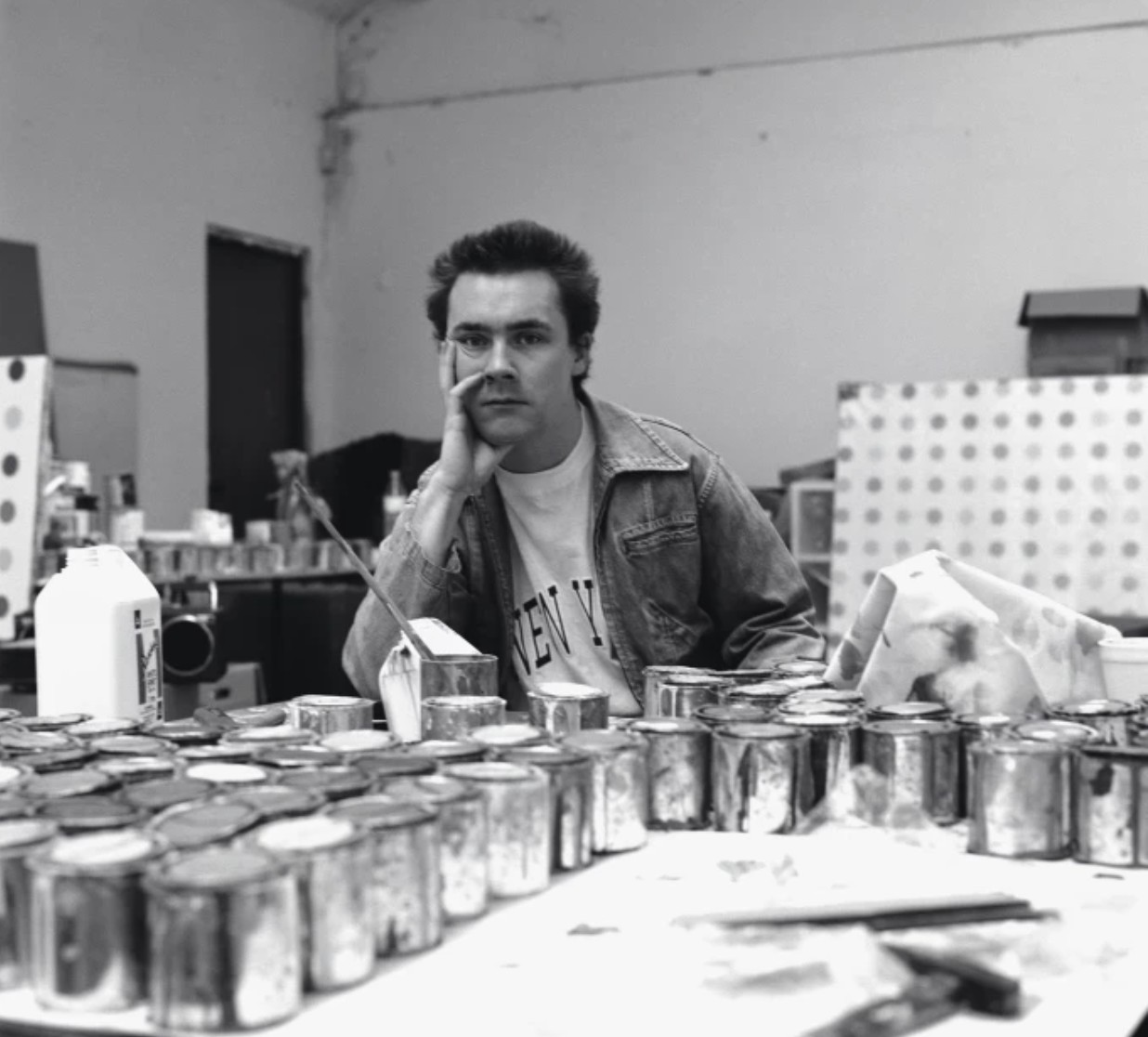
Damien Hirst photographed in 1993. Image © Gemma Levine/Hulton Archive/Getty Images.
Art © Damien Hirst and Science Ltd. All rights reserved, DACS 2025 Gemma Levine/Getty Images
Conceived as part of a systematic project initiated in the late 1980s, the Spot Paintings occupy a unique position at the intersection of art, science, and control. Hirst has noted that the idea was to “make paintings where the color was the subject.” Their titles, drawn from pharmaceutical compounds listed alphabetically in the Sigma Chemical Company’s catalogue, reinforce the link between color and chemistry, aesthetic pleasure and scientific detachment. This fascination with order, both visual and intellectual, parallels Hirst’s broader preoccupations with mortality, belief, and the limits of human understanding.
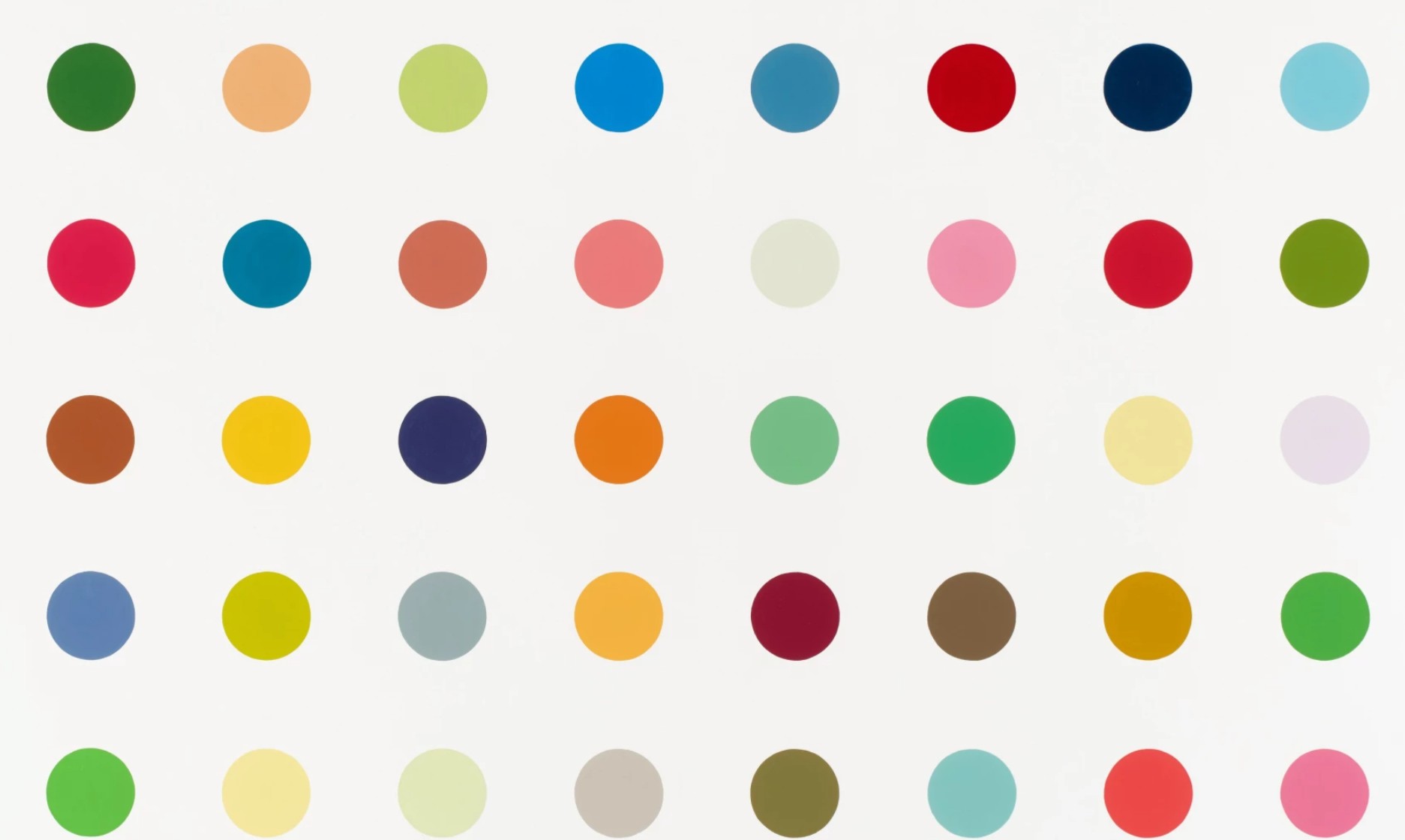
Hirst invites associations between the healing promises of modern medicine and the inevitability of decay. The pristine regularity of the grid evokes the clinical sterility of laboratory production, while the luscious color evokes the allure of consumption. This interplay between comfort and danger, vitality and control, lies at the heart of Hirst’s conceptual enterprise. Executed during a period of expanding international recognition, Untitled (Nick) embodies the precision and conceptual clarity that made the Spot Paintings both a symbol of Hirst’s generation and a meditation on its anxieties. Beneath their immaculate surfaces, these works reflect the contradictions of a culture obsessed with the quantifiable, where systems promise order, yet inevitably allude to fragility and the finite. With its dazzling chromatic rhythm and flawless symmetry, Untitled (Nick) encapsulates the paradox that defines Hirst’s art: the beauty of control, and the uneasy perfection of a world that seeks to medicate its mortality.
Rapture, 2003
Sotheby’s New-York: 19 November 2025
Estimated: USD 600,000 – 800,000
PASSED
Rapture | Contemporary Day Auction | 2025 | Sotheby’s
DAMIEN HIRST (b. 1965)
Rapture, 2003
Butterfly wings on household gloss on canvas in artist’s frame
Diameter: 105 3/4 inches (268.6 cm)
Full of Love, 1998
Christie’s New-York: 20 November 2025
Estimated: USD 250,000 – 350,000
PASSED
DAMIEN HIRST (B. 1965), Full of Love | Christie’s
DAMIEN HIRST (B. 1965)
Full of Love, 1998
Butterflies and household gloss on canvas
36×60 inches (91.4 x 152.4 cm)
Signed, titled and dated twice ‘Full of Love. 98. Damien Hirst 98.’ (on the overlap)
Signed again ‘D Hirst’ (on the stretcher)
Beautiful Flidais Macropsia Painting
& Beautiful Labraid Introversion Painting, 2011
Phillips New-York: 21 November 2025
Estimated: USD 80,000 – 120,000
PASSED
Damien Hirst Modern & Contemporary Art Day Sale, Afternoon Session
(i) Beautiful Flidais Macropsia Painting (ii) Beautiful Labraid Introversion Painting, 2011
Household gloss on canvas
Each: 24×21 inches (61.0 x 53.3 cm)
(i) Signed, dedicated, inscribed and dated “for Max Damien Hirst Happy Xmas 2011” on the reverse
Stamped with the artist’s stamp on the overlap
(ii) Signed, dedicated, inscribed and dated “for Jackson Happy Xmas Damien Hirst 2011” on the reverse
Stamped with the artist’s stamp on the overlap
Takashi Murakami
PLEASE CLICK ON THE PICTURE BELOW TO ACCESS AUCTION MARKET OVERVIEW
#1. Miss Ko² (Project Ko²), 1997
Christie’s New-York: 19 November 2025
Estimated: USD 1,800,000 – 2,500,000
USD 2,759,000
TAKASHI MURAKAMI (B. 1962), Miss Ko² (Project Ko²) | Christie’s
TAKASHI MURAKAMI (B. 1962)
Miss Ko² (Project Ko²), 1997
Fiberglass, iron, acrylic and oil paint
182.9 x 63.5 x 76.2 cm (72x25x30 inches)
This work is number one from an edition of three plus one artist’s proof
Standing six feet tall, Takashi Murakami’s Miss Ko2 (Project Ko2) is the artist’s first life-size sculpture, representing the radical reinvention of his artistic project and ushering in his famed fluid period. Miss Ko2 has taken up a totemic position in Murakami’s oeuvre, capturing the seismic moment in which his revolutionary Superflat movement catapulted into the third dimension. Here, we witness Murakami developing this theory, wherein he envisions the dissolution between distinctions vis-à-vis high art and low culture in Japan, made irrelevant in the postwar context as all creative forms were metaphorically flattened into exaggerated caricatures of sexuality and emotion corrupted by a predominant Western cultural influence. Murakami mimetically critiques the infusion of Western culture into Japanese society and the hypereroticized excesses of the otaku—or geek—subculture. Miss Ko2 magisterially weaves his deep understanding of Japanese society and its traditional artforms into an artwork aping consumerist society.
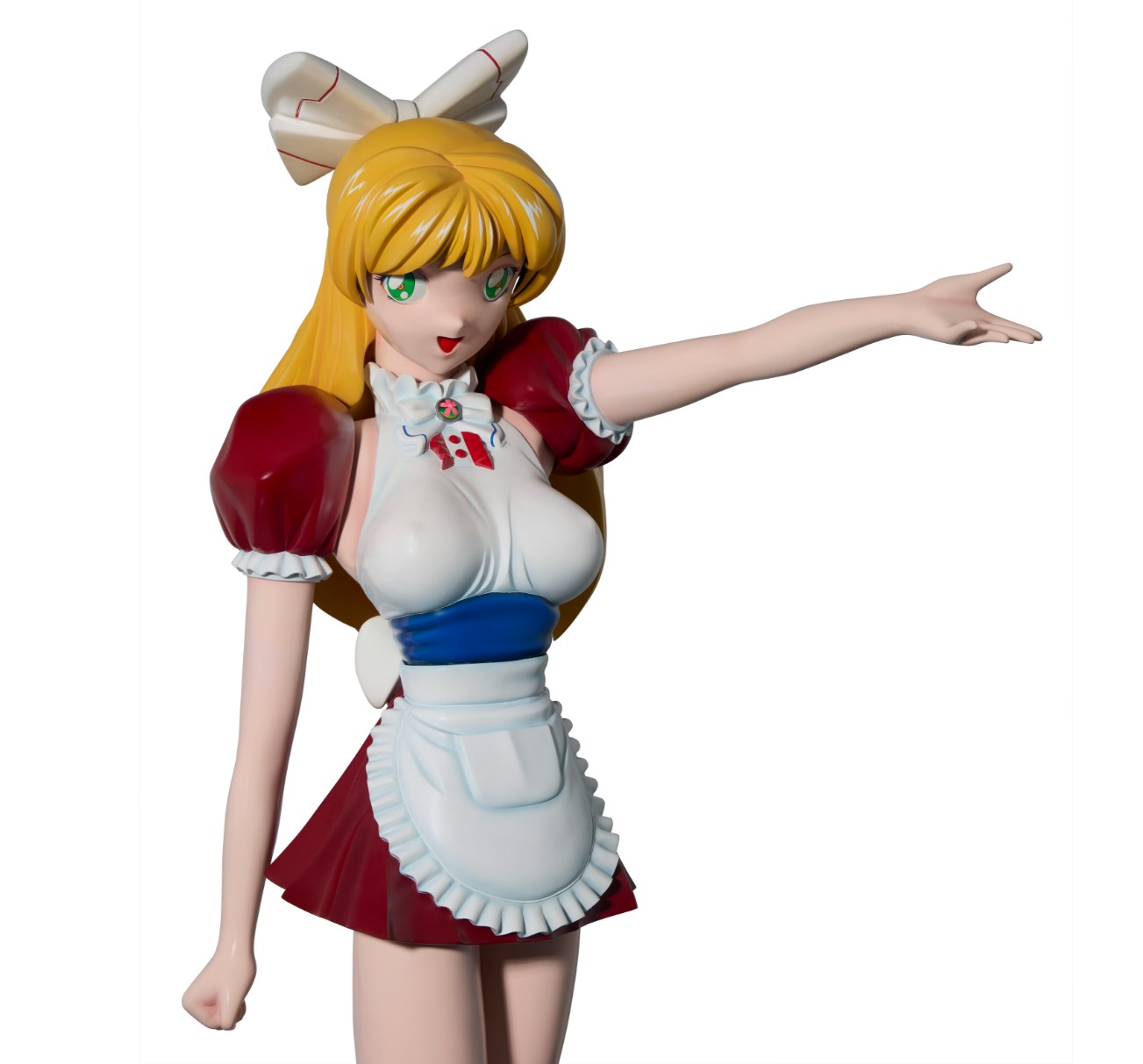
To create Miss Ko2, Murakami appropriated the character Yuka Takeuchi from the exuberant Japanese fighting video game Variable Geo. She wears an eroticized version of the popular waitress’ uniform of Anna Millers, an American pie restaurant chain then prevalent in Japan.
Sandro Boticelli, The Birth of Venus, 1480. Galleria Stampe e Disegni degli Uffizi, Florence.
These aspects made it a perfect subject for appropriation, exemplifying Murakami’s conception of Superflat. By expanding this character into a life-size scale, the artist made legible the absurdity of the otaku subculture. As Murakami writes,
“The very idea of making a life-size figure character was taboo within the otaku community. Figure culture began in response to a desire to somehow call the beloved characters of manga and anime forth into the real world, to have them at one’s fingertips. At the root of the figure character was their clear functionality as pornographic statues.”
While paralleling the appropriative strategies of Western artists, including Richard Prince and Jeff Koons, Murakami is simultaneously channeling the traditional Japanese artistic tradition of Mitate, the repurposing of existing objects, where the artist creates something new by adding subtle touches of originality.
Akihabara district, Tokyo, 2013. Photo: Alamy Stock Photo.
Miss Ko2 was able to depict how, within the milieu of the late 1990s, cultural categories of low and high were destabilized as the consumer economy absorbed high art. Using similar strategies of imitating mass culture found in Koons’s simulationisms and the appropriative approach of Prince, Murakami successfully parodies the West while confronting the inherent problems he saw with Japanese society. His Miss Ko2 figure wears a fetishized uniform of an overseas (American) company which had come to dominate Japanese cultural expression, while her life-size scale simultaneously critiques the fetishized obsession with figurines in the Japanese otaku fandom. The sculpture’s revealing bust, slender arms, and anatomically inconceivable proportions—slender arms, anime-doll face, and impossibly long, crossed legs—capture in realistic scale the absurdity of the feminine figurine ideal held by sections of Japanese society. The multilayered valiances held within the sculpture extend through to the work’s very name. Ko can mean child, girl, young woman, or even a fish egg in Japanese, while it also frequently constitutes a part of a female given name. Thus, Miss Ko2, pronounced Miss Ko Ko, can be interpreted with layered simultaneous meanings.
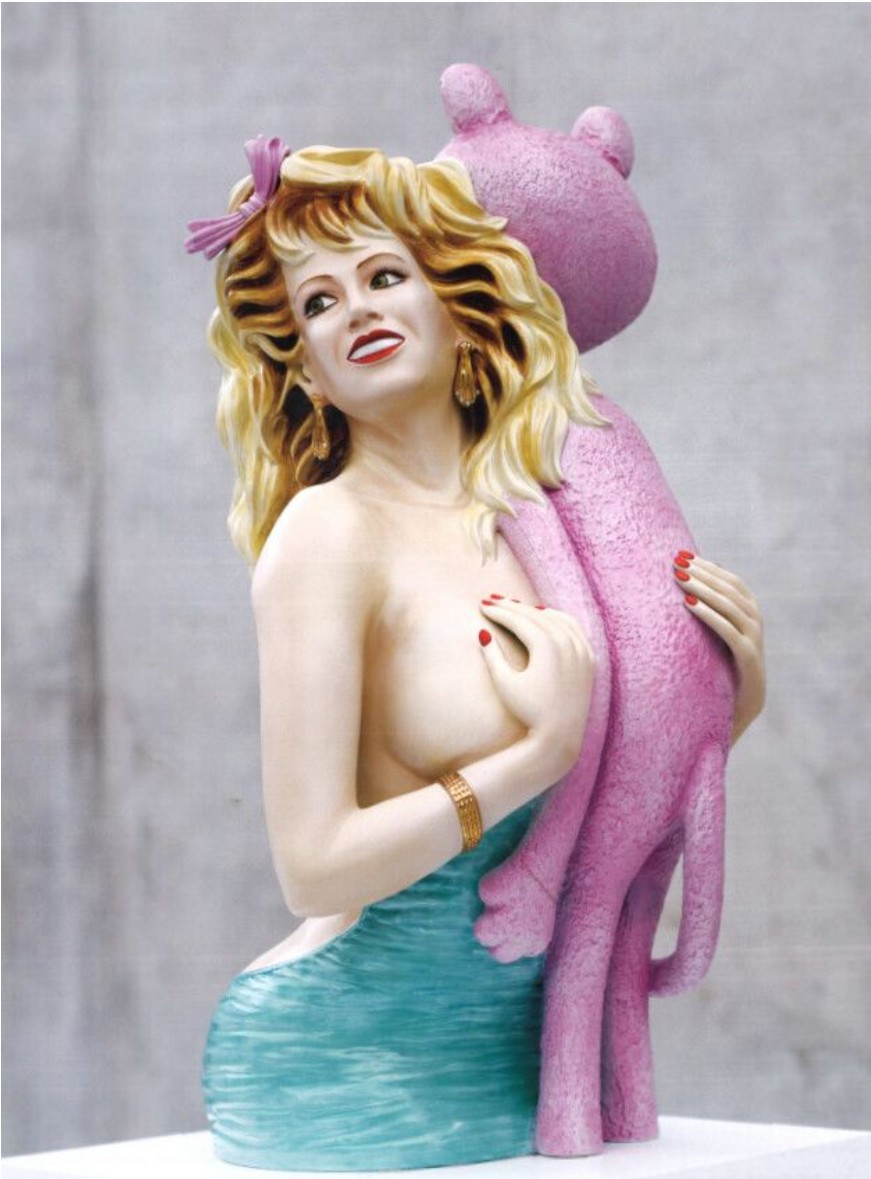
Jeff Koons, Pink Panther, 1988, The Museum of Modern Art, New York. © Jeff Koons
Miss Ko2 was the first of Murakami’s life-size fiberglass figurines, providing the template for celebrated works such as Hiropon (1997), and My Lonesome Cowboy (1997), of which examples of both reside in the Pinault Collection. The foundational importance of Miss Ko2 for Murakami’s broader oeuvre is demonstrated in the work’s extensive exhibition history, appearing in the artist’s celebrated retrospectives at the Museum of Contemporary Art of Tokyo, the Museum of Contemporary Art, Los Angeles, the Brooklyn Museum of Art, the Guggenheim Museum, Bilbao, and most spectacularly at Murakami Versailles, where the sculpture was placed in the Salon de Guerre, right at the entrance to the palace’s famed Hall of Mirrors and below an extravagant marble portrait of King Louis XIV. Her position at the precipice of French imperial power, with her outstretched left hand positioned as if beckoning the viewer into the Hall of Mirrors to view the remainder of Murakami’s work, poignantly recapitulates Miss Ko2’s singular importance within the artist’s vaunted oeuvre, representing the inaugural inception of his universally influential Superflat movement.
#2. Murakami.Flower #6006 Patch, 2022
Sotheby’s New-York: 19 November 2025
Estimated: USD 60,000 – 80,000
USD 63,500
Murakami.Flower #6006 Patch | Contemporary Day Auction | 2025 | Sotheby’s

TAKASHI MURAKAMI (b. 1962)
Murakami.Flower #6006 Patch, 2022
Acrylic on canvas mounted on aluminum frame
60×60 cm (23 5/8 x 23 5/8 inches)
Signed and dated 2022 (on the overlap)
POST-WAR ART
David Hockney
PLEASE CLICK ON THE PICTURE BELOW TO ACCESS AUCTION MARKET OVERVIEW
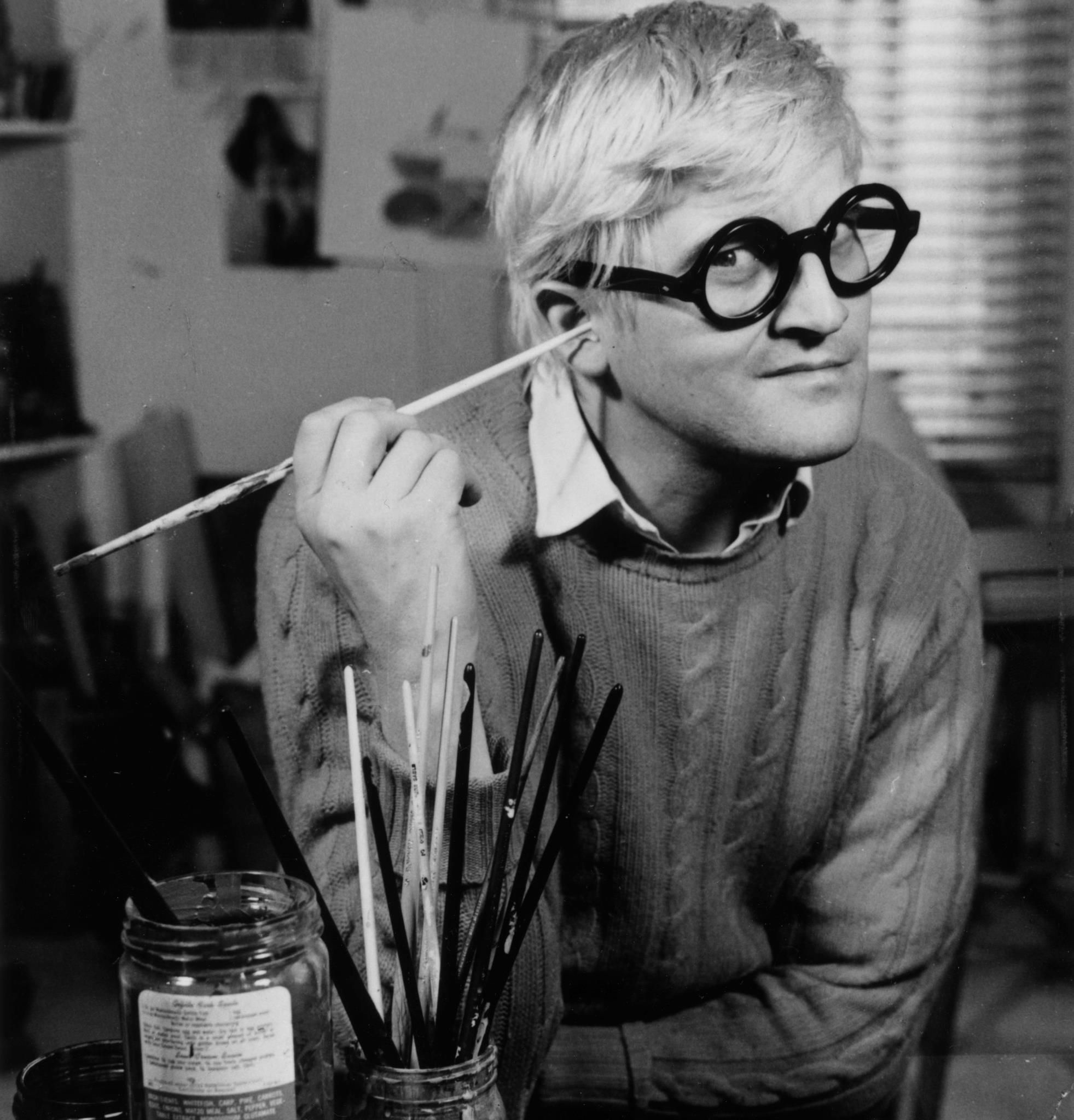
Christopher Isherwood and Don Bachardy, 1968
Property from a Distinguished Private European Collection
Christie’s New-York: 17 November 2025
Estimate on Request
USD 44,335,000
DAVID HOCKNEY (B. 1937), Christopher Isherwood and Don Bachardy | Christie’s
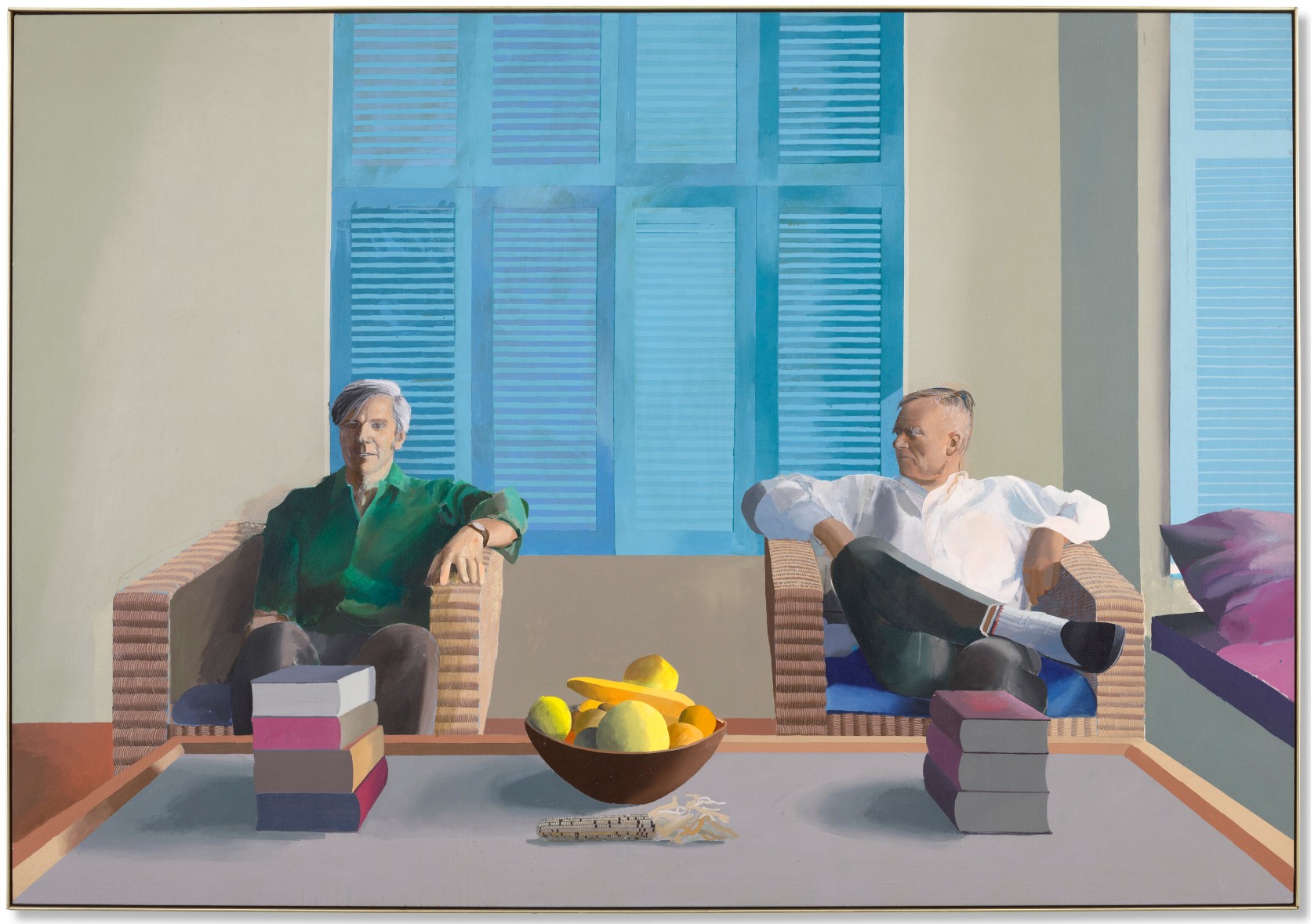
DAVID HOCKNEY (B. 1937)
Christopher Isherwood and Don Bachardy, 1968
Acrylic on canvas
83 1/2 x 119 1/2 inches (212 x 303.5 cm)
A masterpiece in psychological depth and virtuoso composition, Christopher Isherwood and Don Bachardy (1968) is the first of David Hockney’s double portraits: a series which stands among the supreme triumphs of his career. In a sunlit Santa Monica living room, two men sit upon woven armchairs.
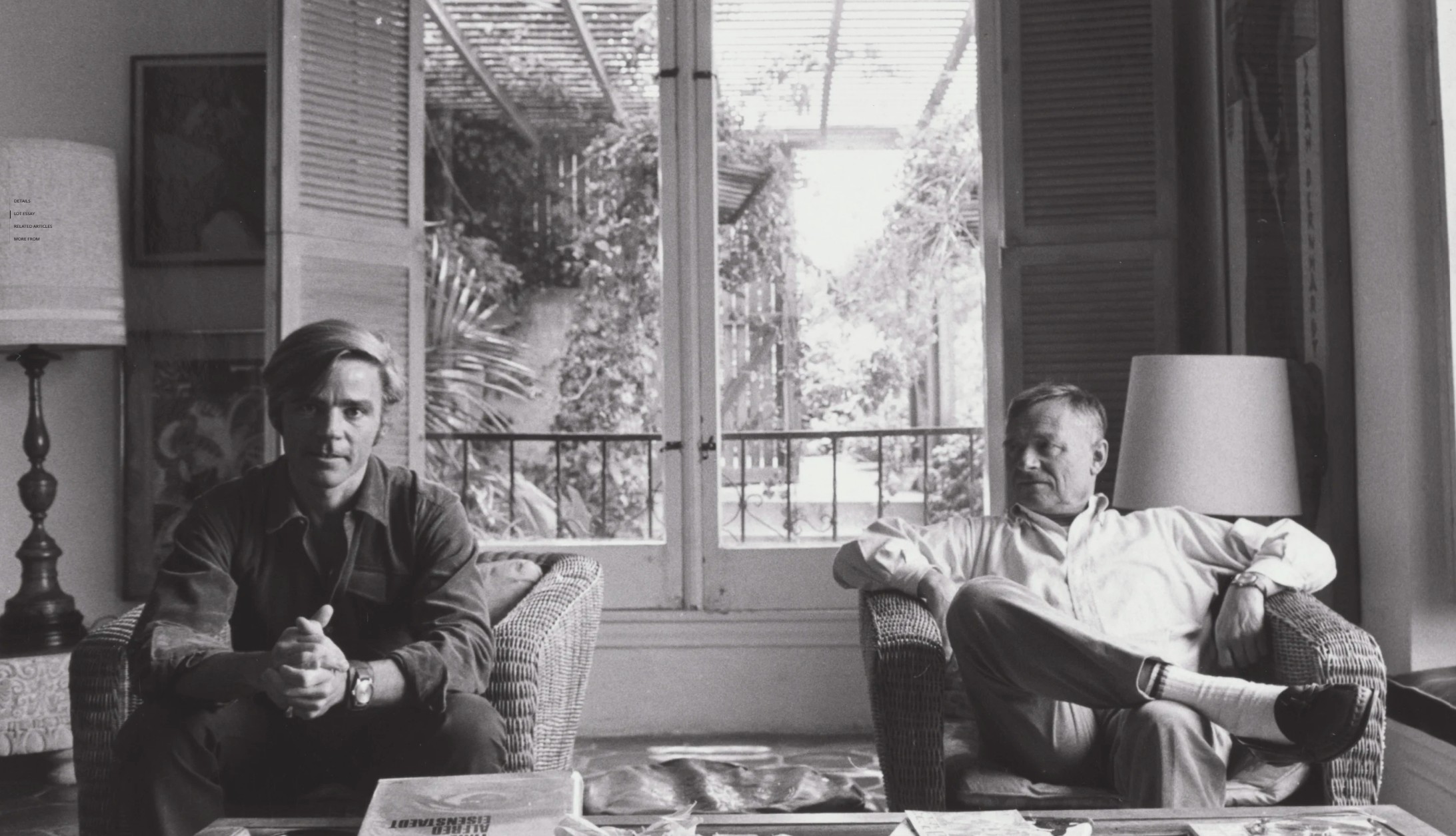
Christopher Isherwood and Don Bachardy, March 30, 1968 (source material for the present lot). Christopher Isherwood Papers, Huntington Library, San Marino. Photo: © David Hockney. Image courtesy of the Huntington Library.
In front of them is a table bearing two stacks of books, with a fruit bowl and an ear of corn at its center. Behind them is a screen of shutters, their slats and panels gleaming in pearlescent blue. The man to the right is the English novelist Christopher Isherwood, one of the great literary figures of the twentieth century. Dressed in crisp white shirt and socks, with a razor-sharp pleat in his trousers, he looks towards his companion. Don Bachardy, an artist and native Californian thirty years his junior, stares confidently out at the viewer. His deep green shirt makes him a jewel in the painting’s radiant setting. The dynamic of gazes is enhanced by the sunlight that streams in from the bedroom at the right, casting directional shadows upon the table. Hockney’s social intelligence is paired flawlessly with his pictorial ingenuity. He implicates himself and the viewer in the tension between the two men, conveying the subtleties of his friends’ relationship through his own exploration of space, sightlines and surface.
“If a picture has a person or two people in it, there is a human drama that’s meant to be talked about. It’s not just about lines.”
Most recently seen in the landmark 2025 survey show David Hockney 25 at the Fondation Louis Vuitton, Paris, Christopher Isherwood and Don Bachardy has been prominently exhibited throughout its lifetime. It was included in Hockney’s career-defining international retrospectives of 1970, 1988 and 1992-1993; in 2017-2018 it was a highlight of the survey David Hockney—touring London, Paris and New York—where it was shown in a room dedicated to the double portraits. Created between 1968 and 1975, these large, ambitious works mark the emergence of a carefully observed realism in light and perspective in Hockney’s painting, as well as a new focus on formal construction. Christopher Isherwood and Don Bachardy’s considered geometry, particularly the right-angled forms of the shutters and armchairs, takes cues from the staged iconography of early Renaissance artists such as Piero della Francesca. It also reflects the more immediate artistic context of 1960s American Minimalism. An equilateral triangle is formed between the sitters’ heads and the bowl of fruit, and they are locked in rectangular rhythm with the chairs, books and shuttered window. While the foreground’s stylized still-life lends the scene an almost timeless stillness, recalling the symbolism of medieval Annunciation scenes, the limpid sunlight and clean colors create a distinctively West Coast vision.
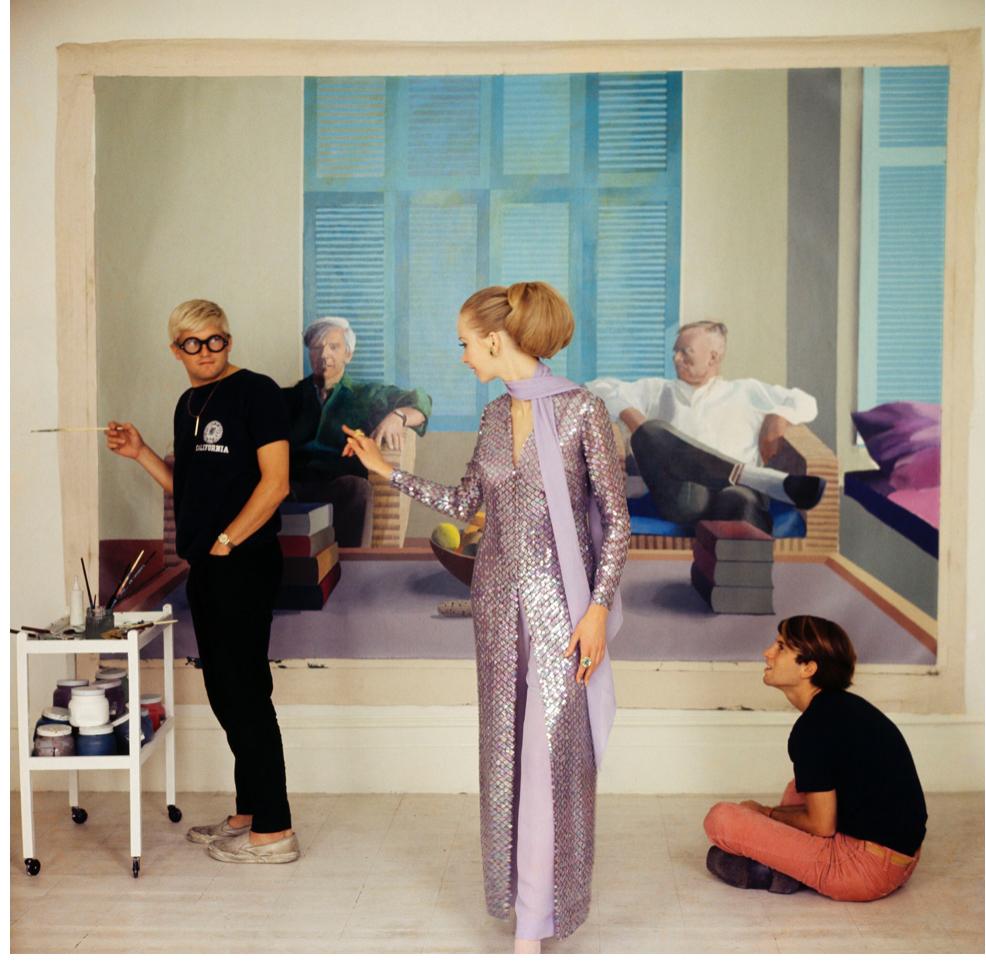
David Hockney, Maudie James, and Peter Schlesinger, December 1968 (present lot illustrated).
Photograph by Cecil Beaton for Vogue Magazine. © Condé Nast.
Christopher Isherwood met Don Bachardy on Valentine’s Day in 1953. Isherwood, a friend of W. H. Auden, Aldous Huxley and Truman Capote, had already found fame as an author with novels such as Goodbye to Berlin (1939), a semi-autobiographical account of his experiences of Weimar Germany. He and Auden had left Europe for New York on the outbreak of the Second World War, before Isherwood went west to Los Angeles, where he joined a distinguished milieu of European exiles. In Hollywood, he would later write A Single Man (1964), one of the founding texts for contemporary gay culture. When the couple met, Bachardy was eighteen years old and Isherwood forty-eight. “Don was young and full of life and he was a perfect darling,” Isherwood recalled. “It was just as simple as that” (C. Isherwood quoted in A. Maupin, “The First Couple: Don Bachardy and Christopher Isherwood,” The Village Voice, vol. 30, no. 16, July 2, 1985). Hockney’s friend Stephen Spender, another prominent author, had introduced Hockney to Isherwood—a fellow Yorkshireman—upon his arrival in Los Angeles in 1964, and they soon became close friends. Indeed, the present work is emblematic of the vibrant community of artists, writers, musicians and intellectuals at whose heart Hockney, a working-class Englishman born in Bradford, found himself in the 1960s and 1970s.
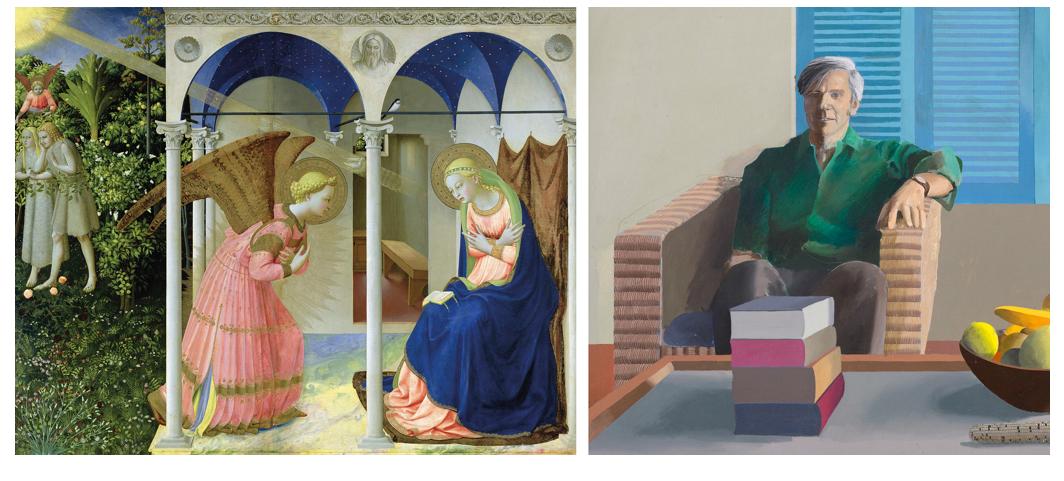
Left: Fra Angelico, The Annunciation, 1426. Museo del Prado, Madrid.
Right: Present lot illustrated (detail).
Throughout its long history, portraiture has been a way of signifying power, cultivation and character. Piero della Francesca’s famed double portrait of the Duke and Duchess of Urbino (circa 1473-1475) captures the sitters in profile before a landscape that represents their worldly dominion. It also reflects the relationship between Piero and his subjects: he was a frequent guest at their court, which became a major artistic and cultural center of the Italian Renaissance. The painter Hans Holbein was a similarly important figure in the English Tudor court. The affiliation between the two men in his The Ambassadors (1533)—which Hockney later analyzed in his 2001 book Secret Knowledge: Rediscovering the Lost Techniques of the Old Masters—is hotly debated. So too is the significance of the enigmatic, symbolic objects arrayed between them, which allude to various forms of scientific and religious knowledge. In the twentieth century, artists and writers in the Modernist avant-garde became ever more closely intertwined. Pablo Picasso’s statuesque portrait Gertrude Stein (1905-1906) is an iconic image of the writer and patron who held weekly salons in her Paris apartment, and whose support was critical to his early success.
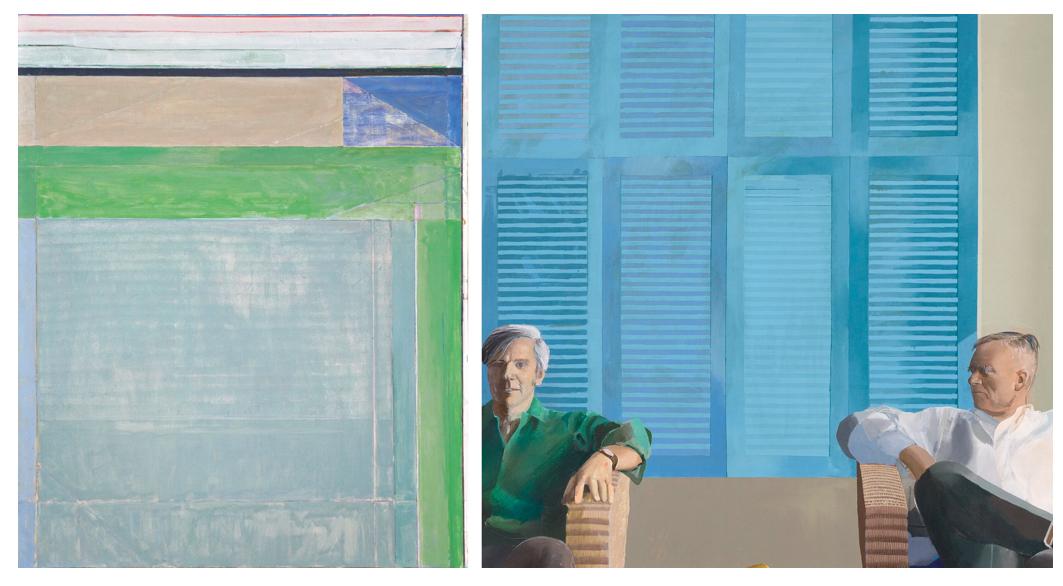
Left: Richard Diebenkorn, Ocean Park 115, 1979. Museum of Modern Art, New York. © 2025 Richard Diebenkorn Foundation / Artists Rights Society (ARS), New York.
Right: Present lot illustrated (detail).
While it was born of friendship rather than commission or patronage, Christopher Isherwood and Don Bachardy echoes aspects of these courtly masterpieces. Hockney pictures the duo presiding over their own salon, in the living room of the Adelaide Drive home they had shared since 1959. It was Bachardy—himself an accomplished artist—who had painted the shutters sky blue, creating what would be the background for Hockney’s painting. There is a tangible sense of exchange between the artist and his sitters. He interpreted their relationship in paint, while their image represents the cultural world in which he was making his way. The couple would also portray Hockney in their own work. In 1982, they published their collaborative book October, which reproduced elegant portraits by Bachardy—depicting Hockney, Joan Didion, Malcolm McDowell, Gore Vidal and other luminaries—alongside Isherwood’s journal entries for the month of October 1979.
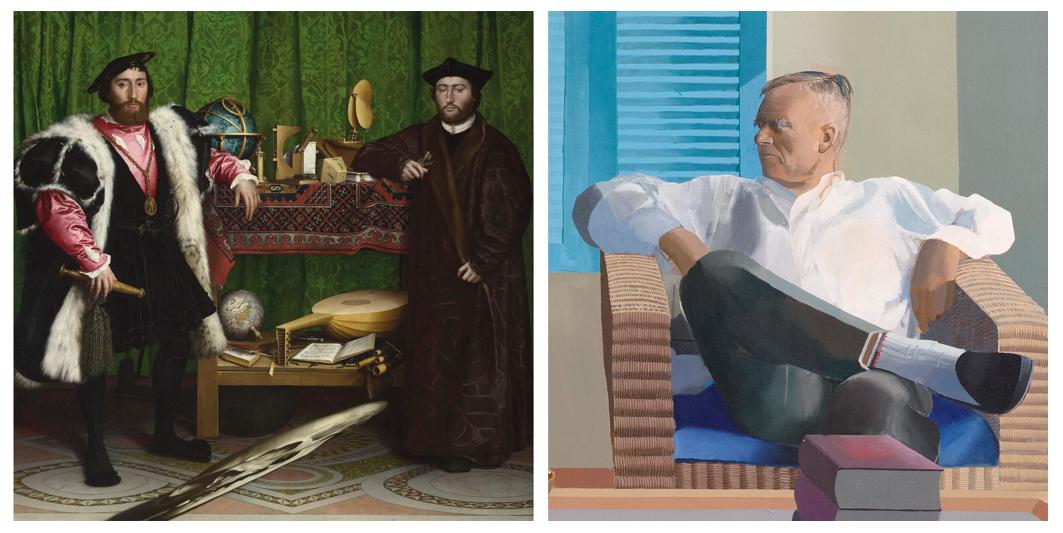
Left: Hans Holbein the Younger, Jean de Dinteville and Georges de Selve (‘The Ambassadors’), 1533. National Gallery, London.
Right: Present lot illustrated (detail).
Isherwood and Bachardy’s relationship would endure until the author’s death in 1986. In their double portrait, his solicitude towards his younger partner is physically palpable, and taken from life, as Hockney relates. “… I took a lot of photographs of them in a room, trying to find compositions, how to do it, and whenever I said Relax, Christopher always sat with his foot across his knee, and he always looked at Don. Don never looked that way; he was always looking at me. So I thought, that’s the pose it should be. And I began the picture” (D. Hockney, David Hockney by David Hockney, London 1976, p. 152). The face of Bachardy—who went away to England for two months—was eventually based largely on these photographs. Left alone, Isherwood visited Hockney’s studio almost daily, where the artist continued to study him from life. The duo’s differences are thus captured even in Hockney’s brushwork, with Isherwood’s face figured with fresh immediacy, and Bachardy’s built up through more slow, studied strokes.
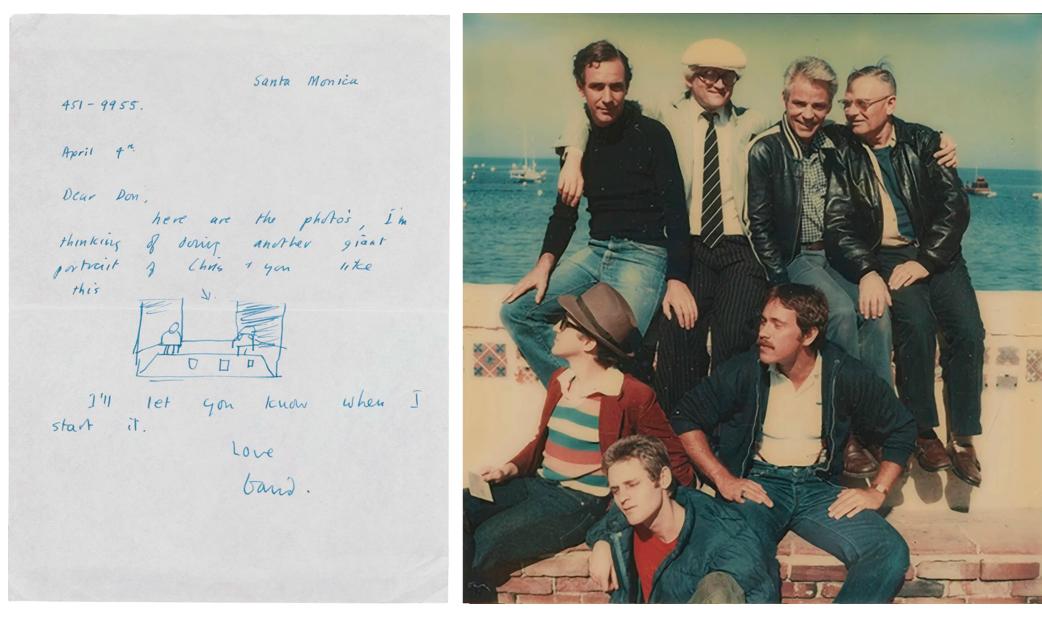
Left: Letter from David Hockney to Don Bachardy, April 4, 1968. Christopher Isherwood Papers, Huntington Library, San Marino. Photograph courtesy of the Huntington Library.
Right: David Hockney, Christopher Isherwood, and Don Bachardy in Catalina, 1976. Christopher Isherwood Papers, Huntington Library, San Marino. Photograph courtesy of the Huntington Library.
The present work’s masterful composition is echoed in Hockney’s later double portrait Mr and Mrs Clark and Percy (1970-1971), one of the best-loved paintings in the Tate, London. Here, too, Hockney worked both from photographs and life, astutely shading and flattening to create beguiling, crisp surfaces, and embracing the challenge of a difficult contre-jour light source. Again, he portrayed a couple in their home, staging a scene suggestive of tension. Ossie Clark’s extramarital affairs were well known, and his straying is hinted at his luxuriant pose, as well as the pure white lilies set before his wife Celia, and the wistful outdoor gaze of the couple’s cat, Percy.
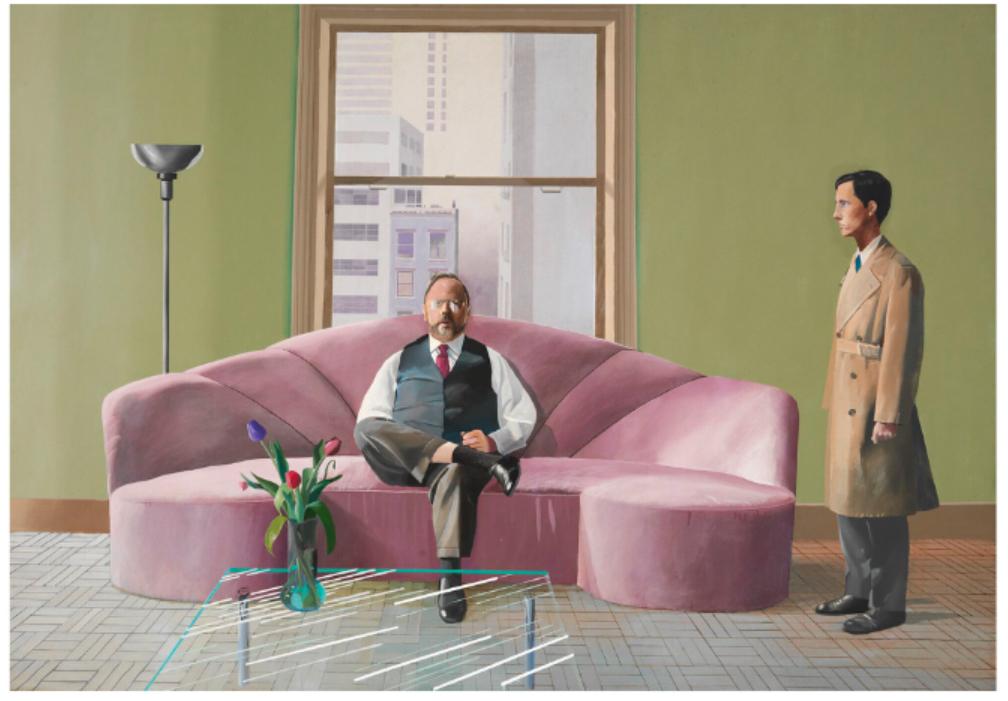
Henry Geldzahler & Christopher Scott, 1969. Private Collection. © David Hockney. Photo: Richard Schmidt.
Similarly, Henry Geldzahler and Christopher Scott (1969) seats the art dealer Geldzahler comfortably at the picture’s midpoint, while his younger partner stands buttoned up in a trenchcoat, stiff and ready to leave. The genius of Hockney’s double portraits lies in this transposition of complex interpersonal relationships into pictorial dramas of shape and form. Hockney cautions, however, against any overly symbolic approach to his work. The objects in Christopher Isherwood and Don Bachardy were arranged to heighten the picture’s poise and rhythm, not in a cryptic game of allusion.
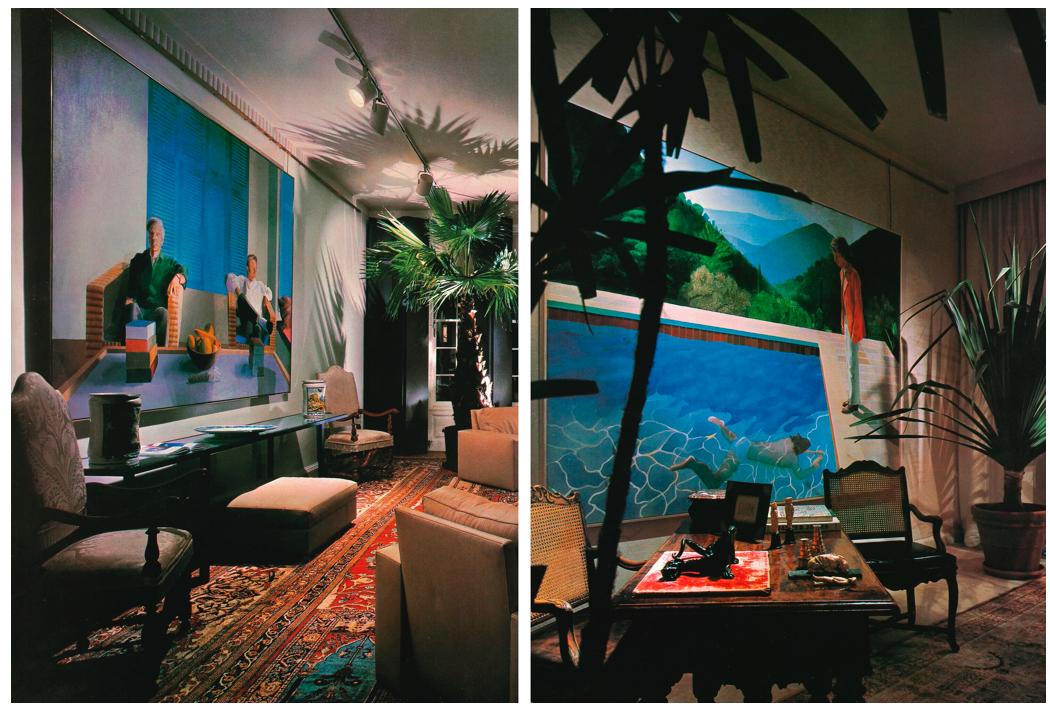
Left: The present work installed in the home of Mr. and Mrs. William L. Beadleston, Manhattan, 1982. Photo: Architectural Digest, © Conde Nast.
Right: David Hockney’s Portrait of an Artist (Pool with Two Figures) (1972) installed in the home of Mr. and Mrs. William L. Beadleston, Manhattan, 1982. Photo: Architectural Digest, © Conde Nast. Artwork: © David Hockney.
“I remember somebody asked why there were four books in front of Don and only three books in front of Christopher. Was this because Don wasn’t as well-read and needed more? Amazing what people read into pictures. There are four books because I needed four to balance it out” (D. Hockney, ibid., p. 152). Indeed, while the table’s still-life and shadows help to direct the work’s triangulation of gazes, this central area of the painting—with its crisp, Cezannesque volumes and smooth nuances of shade—can stand alone beautifully as an independent composition, as evidenced by its use as the striking cover of Nikos Stangos’ 1979 monograph Pictures by David Hockney.
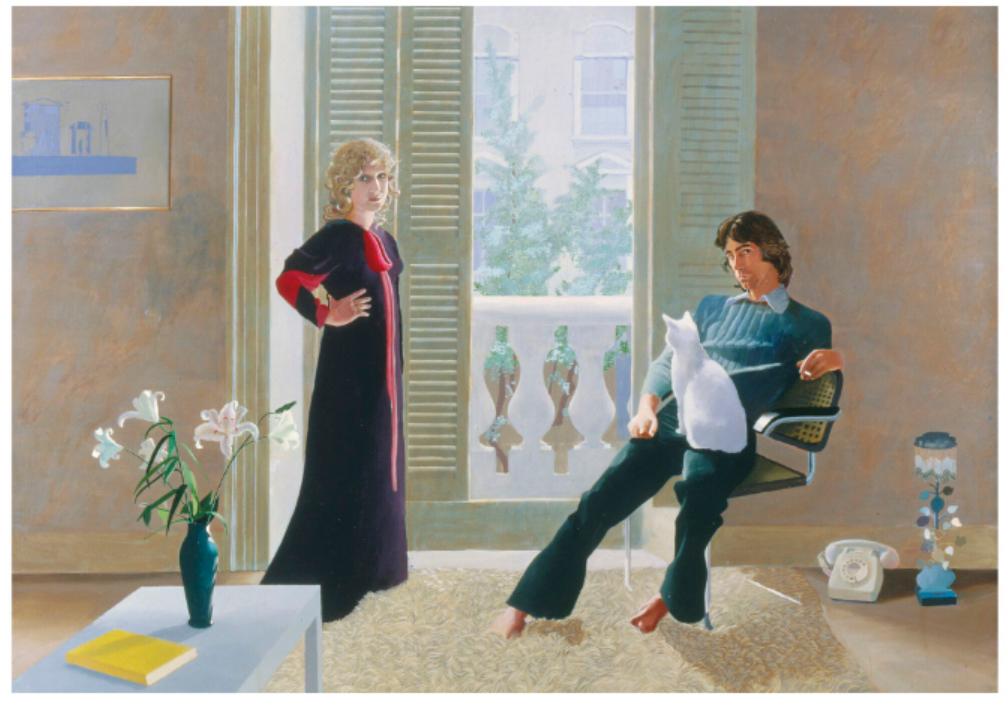
Mr. and Mrs. Clark and Percy, 1970-1971. Tate, London. © David Hockney.
Profound concerns with illusionistic space, surface and depth on the picture plane have long lain at the heart of Hockney’s work, leading him beyond the medium of paint to his iconic photo-collages and forays into theatrical set design. Relentlessly curious, in recent years he has even begun to draw work using an iPad. Paint, however, was his first love, and his joy in the creation of Christopher Isherwood and Don Bachardy is everywhere evident. We can feel his devotion to the light dancing upon the shutters’ iridescent planes, the sharply graphic fruit and books, and the engaging, tactile intimacy in his friends’ faces and clothing. The picture is at once an honest portrait of a lifelong relationship and a theatre of compelling visual architecture. It exemplifies the unique talent of Hockney, an artist at the height of his powers, in bringing the two together.
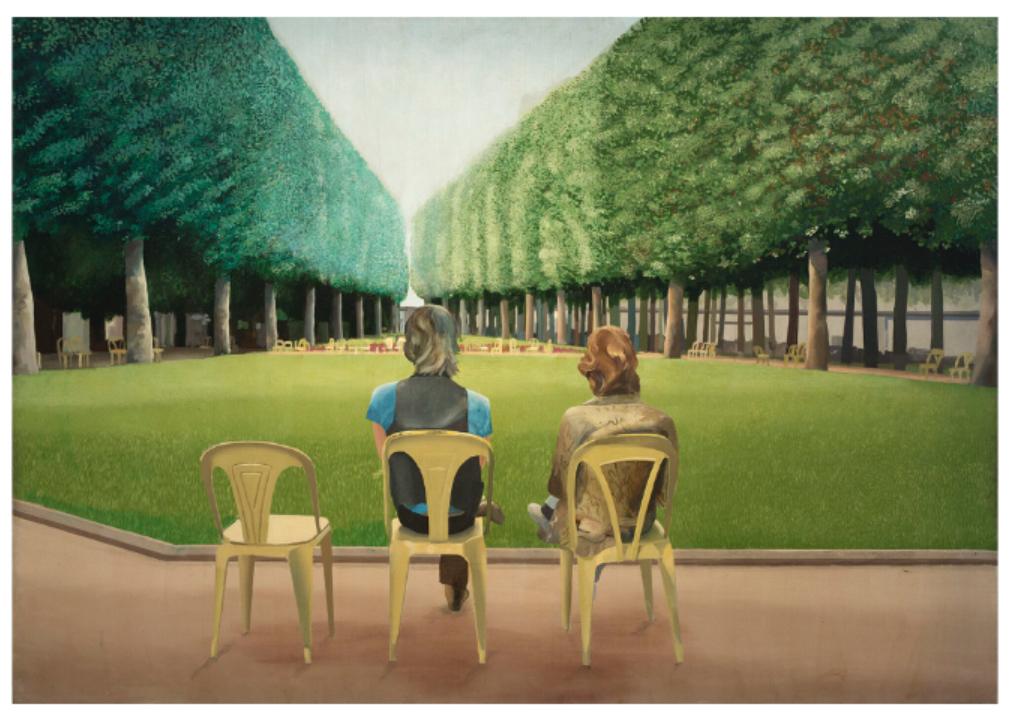
Le Parc des Sources, Vichy, 1970. Trustees of the Chatsworth Settlement, Bakewell. © David Hockney. Photo: Fabrice Gibert.
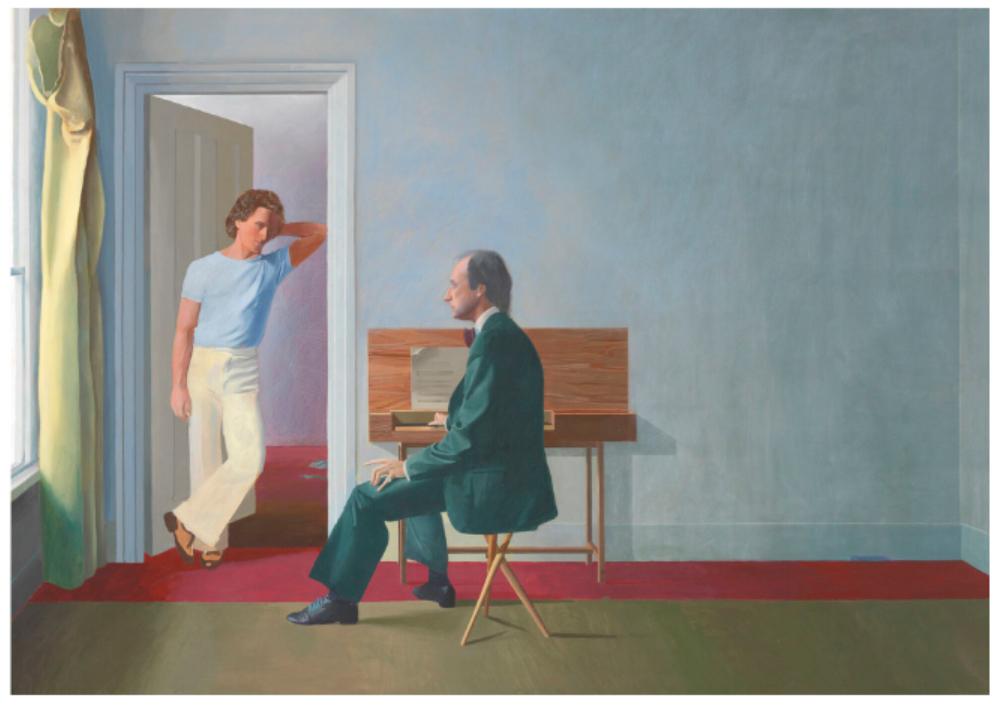
George Lawson and Wayne Sleep, 1975. Tate, London. © David Hockney. Photo: © Tate.
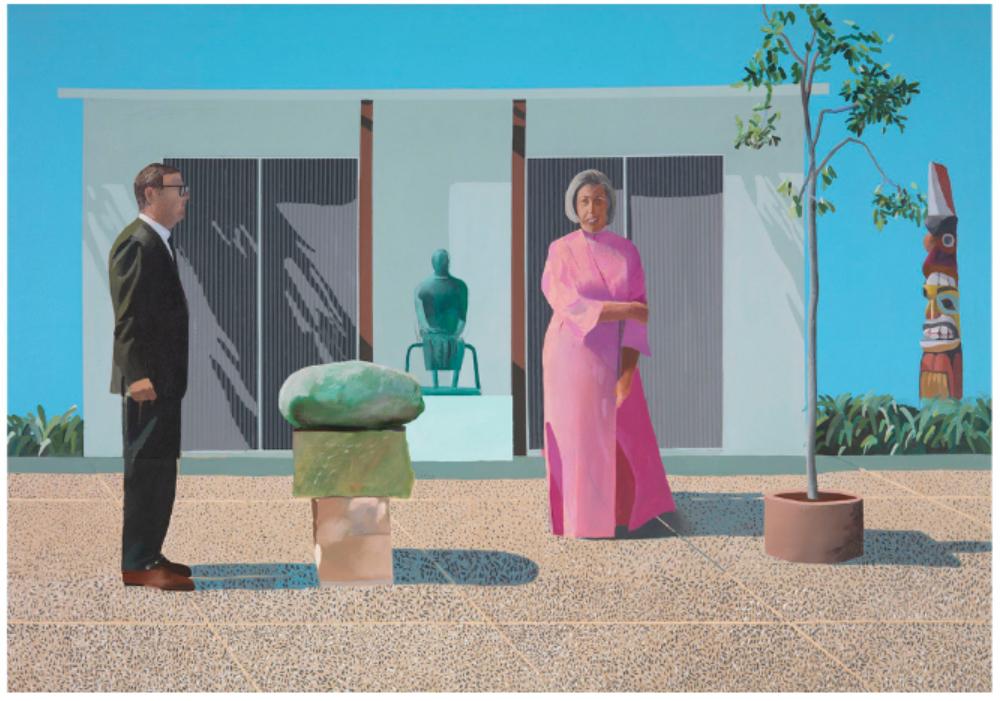
American Collectors (Fred and Marcia Weisman), 1968. Art Institute of Chicago © David Hockney. Photo: Richard Schmidt.
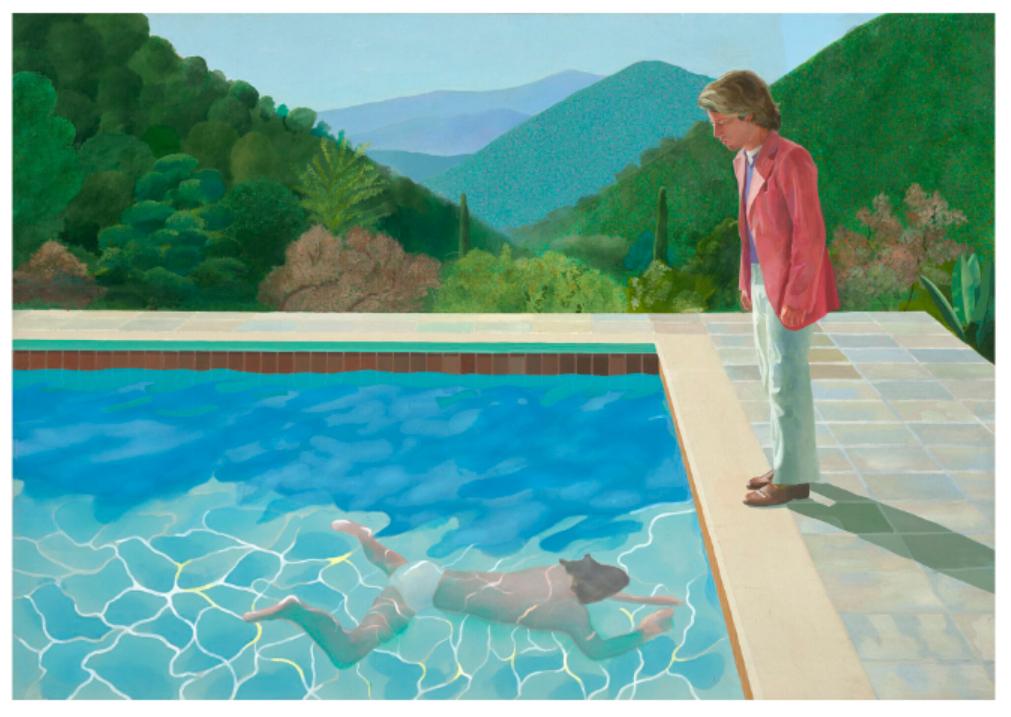
Portrait of an Artist (Pool with Two Figures), 1972. Private Collection. © David Hockney. Photo: Jonathan Wilkinson.
My Garden in Los Angeles, London, July 2000, 2000
Property from an Important Private Collection
Christie’s New-York: 17 November 2025
Estimated: USD 7,500,000 – 10,000,000
USD 9,469,000
DAVID HOCKNEY (B. 1937), My Garden in Los Angeles, London, July 2000 | Christie’s
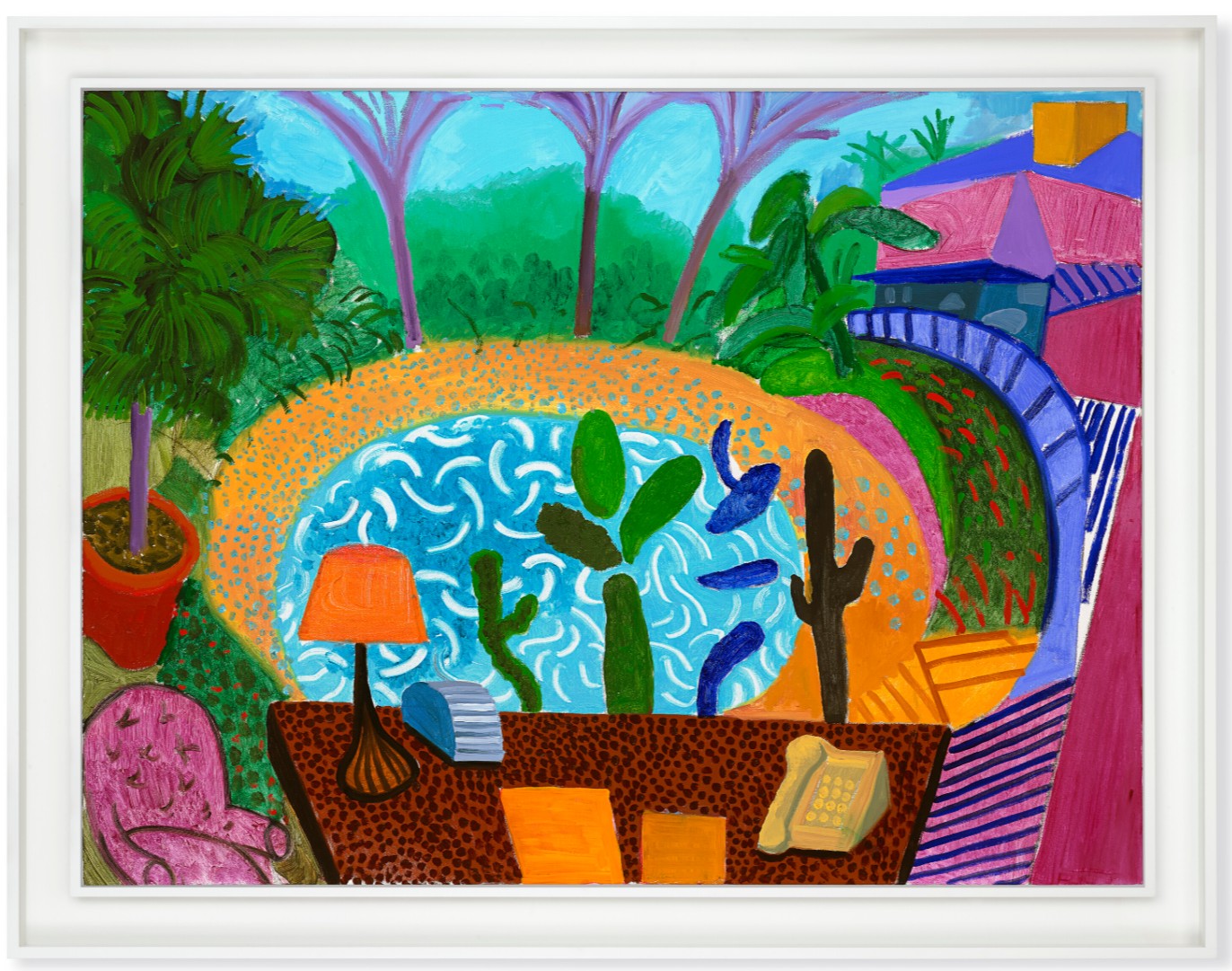
DAVID HOCKNEY (B. 1937)
My Garden in Los Angeles, London, July 2000, 2000
Oil on canvas
36×48 inches (91.4 x 121.9 cm)
Signed and dated ‘David Hockney ’00’ (on the reverse)
Luscious strokes of vibrant, Fauvist colors coalesce in David Hockney’s My Garden in Los Angeles, London, July 2000 in a virtuoso demonstration of mature mastery. The painting mediates on two of Hockney’s most pressing concerns—that of memory and that of space—resolving a decades-long dilemma around the uses of perspective in his paintings. The present work is a culmination of this exploratory process, synthesizing the lessons which Hockney learnt across his painted landscapes of Yorkshire, his abstract paintings, and his theatre productions. Here, the artist establishes a dynamic, expansive, and vivid point of view reflecting his own treasured memory of the distinctive pool, terrace, and garden at his Hollywood Hills home. Painted in London, The work is a deeply personal reflection on his memory of this intimate space as well as on his famous pool motif. Finally escaping the restrictions of conventional Albertian one-point linear perspective, Hockney opens up a new and expansive universe, depicting in paint the third and fourth dimensions in order to express an exciting sense of space, movement, and emotion on the flat surface of his canvas. The advances in perspective and style made with My Garden in Los Angeles laid the foundation for his much-celebrated post-millennium output—a period so prolific and transformative as to become the focus of Hockney’s recent tour-de-force retrospective at Fondation Louis Vuitton, David Hockney 25. It has been a period of immense creativity for or this extraordinary painter, a period which began with My Garden in Los Angeles.
The composition is foregrounded with Hockney’s own desk, depicted in a reversed perspective, angling outward as it recedes into the distance. By placing this work station, appointed with a telephone, rolodex, lamp, and two piles of paper, Hockney dissolves the division between interior and exterior. His fascinating use of perspective, recalling Vincent van Gogh’s interiors, immediately alerts the viewer that this is not an ordinary landscape painting. By foregrounding the desk at the precipice of his composition, Hockney appears to be placing the viewer in the position he himself adopts. Painted in London, the composition is entirely from memory; thus, Hockney’s decision to insert his viewer at his desk works to simultaneously place the viewer in the privileged place of his own thought. Hockney centers the composition with his circular pool, lovingly depicted with the iconic white lines which he himself painted.
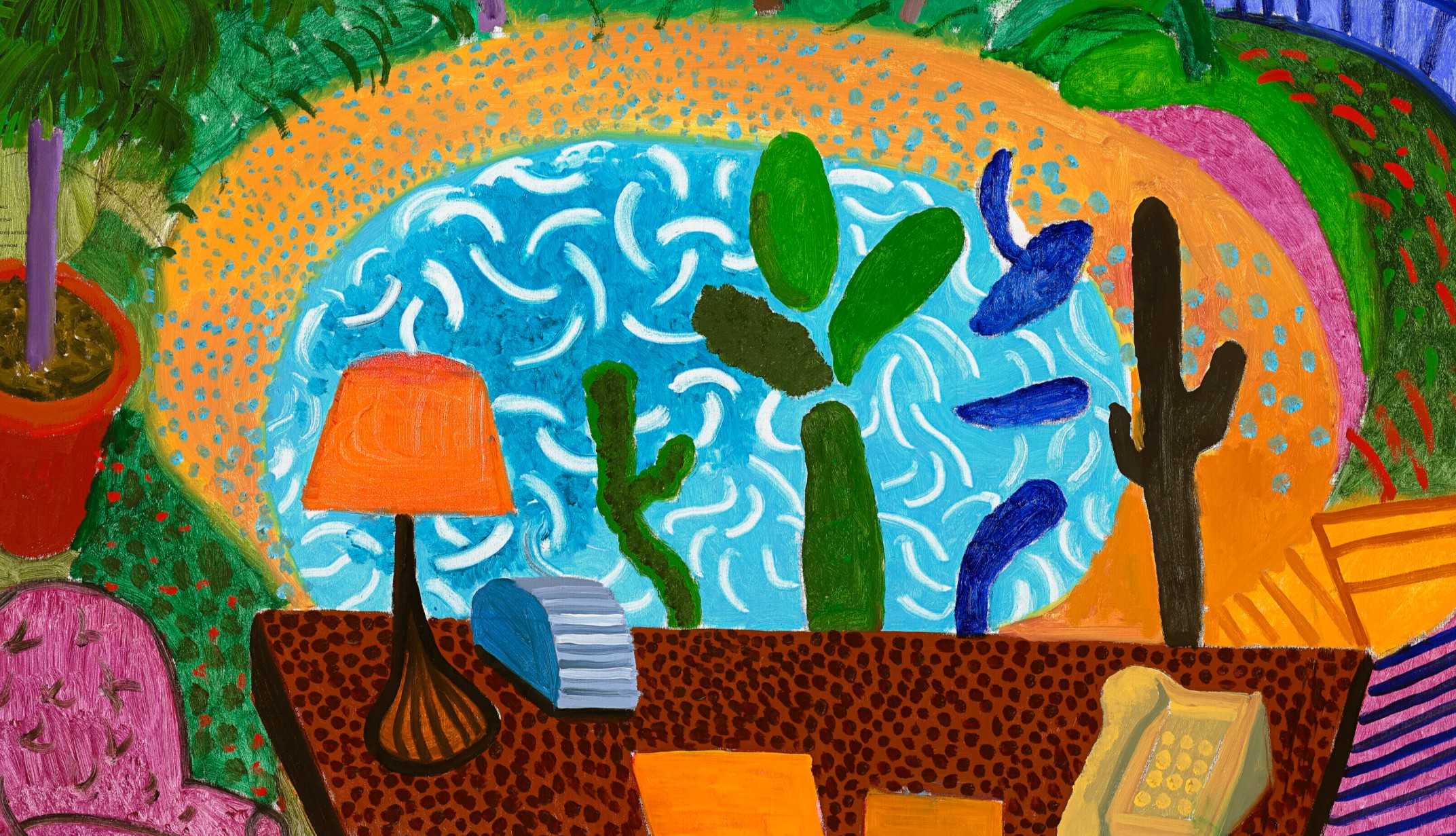
The pool radiates out spherically in a series of expanding rings—first the blue-dotted yellow ring around the pool itself, then the layer of carefully manicured vegetation, and finally the distorted convex curve of his vibrantly painted blue and purple house. These expanding rings establish a sense of the spectator being enveloped within a theatrical space unmoored from pictorial convention, expressing with false perspective his very real experience of this cherished space.
“The viewer roams around in these pictures and once the eye begins to look and see, it is forced to go on a journey and it can come back by a different route, or start somewhere else and make another one. I realized the forms were coming from my surrounding, my feelings… it all seemed to connect.”
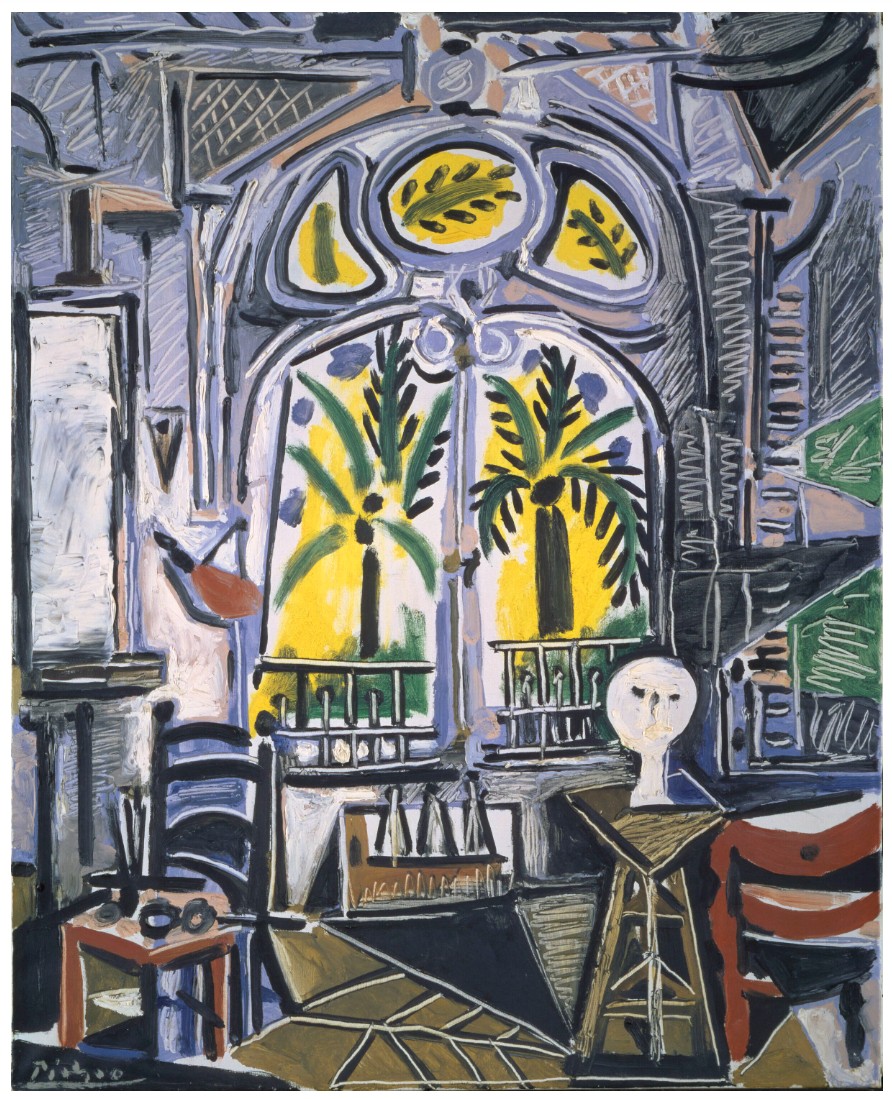
Pablo Picasso, The Studio (L’Atelier), 1955. Tate Gallery, London. © 2025 Estate of Pablo Picasso / Artists Rights Society (ARS), New York.
Photo: © Tate, London / Art Resource, New York.
Hockney had moved to Hollywood Hills permanently in 1979, acquiring the house depicted in the present painting in 1982 after renting the residence for some time. The unique geography of the hills had an immediate impact on his work.
“The roads aren’t straight… the moment you live up here, you get a different view of Los Angeles. First of all, these wiggly lines seem to enter your life, and they entered the paintings… I actually felt those wiggly lines.”
The De Stijl and the Fauvists who inspired Hockney’s house colors similarly influenced Hockney’s radiant palette in My Garden in Los Angeles. This painting emerges from a series of paintings Hockney made in London on his Hollywood Hills house and garden. Painted entirely from memory, the series parallels the famous painterly explorations of Claude Monet’s garden at Giverny or Joan Mitchell’s musings in La Tour. At the time, Hockney was spending more and more time in his native England, attending to the declining health of his mother as well as with his involvement with the National Gallery’s Encounters: New Art from Old exhibition in 2000. His mother had passed the prior year, and his trips driving into the countryside reconnected him to the landscapes of his youth.
“The first thing I did to the house I now owned was to start painting it. I had it painted red and blue, the colors of my designs for the Ravel L’Enfant de les Sortileges—and the green was the green of nature outside the house… I had the outside of the house painted in very bright colors. I was inspired to do this partly from having seen the De Stijl exhibition at the Walker Art Center and partly by the memory of the yellow Monet used on the outside of his Giverny house.”
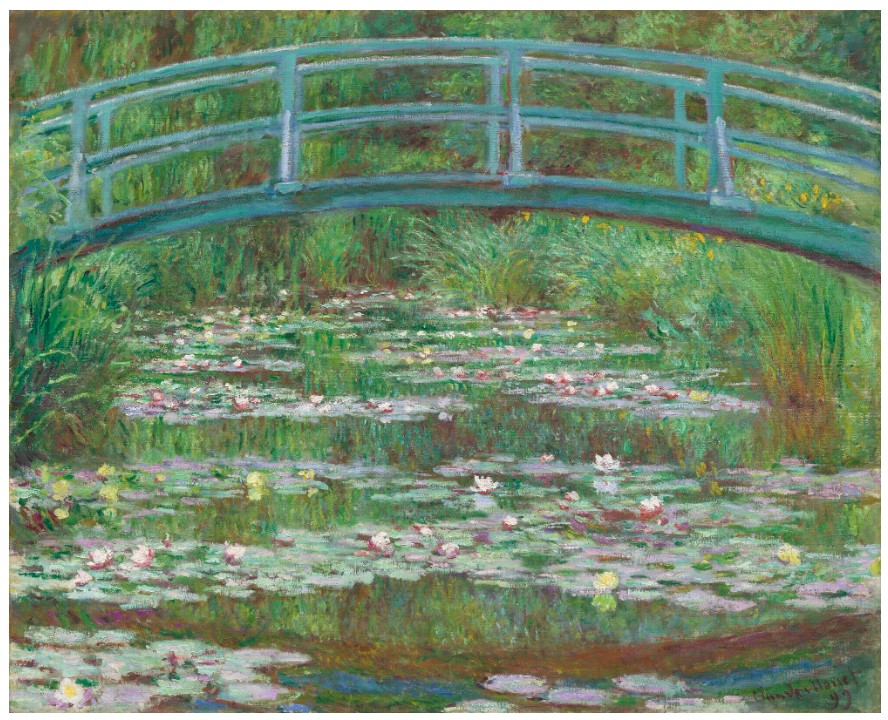
Claude Monet, The Japanese Footbridge, 1899. National Gallery of Art, Washington, D.C.
For the National Gallery exhibition, Hockney was exploring the use of optical aids—after observing the refined level of detail in the work of Ingres, he resolved to make the series Twelve Portraits after Ingres in a Uniform Style, depicting the portraits of twelve National Gallery security guards using a camera lucida. His immersion with the French master would have introduced him to Ingres’ singular landscape painting of the Medici gardens in Rome, whose circular canvas and composition parallels the present work. Hockney’s portrait series grew out of a much broader and more important intellectual venture which Hockney was embarking upon. Over the course of his career, he had become more and more dissatisfied with the perspectival effects of his earlier paintings, made with one-point perspective.
“You are deeply conscious of the edges. I began to be obsessed with them and also by the realization that you might be able to break them.”
His quest to break the edges of the picture plane lead him on an art historical quest to investigate the how the painters of the last four centuries might have used optical instruments. One of the few paintings made around this time, My Garden in Los Angeles can be seen as a visual corollary to Hockney’s art historical investigation, pushing the boundaries of spatial perspective while he was challenging art historical orthodoxy. His 2001 publication Secret Knowledge: Rediscovering the Lost Techniques of the Old Masters argues that artists from the past utilized the camera obscura and camera lucida much earlier than previously supposed, and that the studied naturalism of their styles came out from their reliance on these optical tools. With this revelation, Hockney undertook to revolutionize landscape painting, imposing his own memories and sense of space within the picture plane.
“We see with memory. This memory is the accretion of things seen, felt and remembered, a multi-layered phenomenon constituted by personal associations with particular places.”
Vincent van Gogh, La Chambre de Van Gogh à Arles, 1889. Musée d’Orsay, Paris.
The present work compelling adopts this novel approach to memory. Painting from recollection his beloved garden from far away London, Hockey offers a new and compelling vision. Equally important to the artist was his approach to space. My Garden in Los Angeles rejects the illusions and artifice of pictorial convention.
Paul Gauguin, Le Champ de pommes de terre, 1890. National Gallery of Art, Washington, D.C.
Hockney had first visited Andrea Palladio’s masterpiece structure Teatro Olimpico in 1979, and had marveled at the Renaissance architect’s mastery over space and illusion.
“It Is a beautiful theatre and you’re very conscious of this depiction of space in real space, an illusion of space in real space, which is of course different from the illusion of space on a flat surface.”
In the intervening decades, the artist became deeply involved with several operatic productions, working at La Scalia in Milan and the Metropolitan Opera in New York, among others. This experience led to his desire to depict in two dimensions what he could achieve in a three-dimensional stage production. Paralleling the painterly practices of the Venetian painters Veronese and Tintoretto, who were also profoundly impacted by the real and theoretical implications of the stage. In the present work, Hockney finally resolves the disjunction between the flat plane of the canvas and the recessive space of the stage, exploring with a multitudinous recessive perspective the depths of his imagined garden.
Installation view, David Hockney, Bigger Trees Near Warter in David Hockney 25, April 9 – September 1, 2025, Fondation Louis Vuitton, Paris. Photo: Marc Domage / © Fondation Louis Vuitton. Artwork: © David Hockney.
My Garden in Los Angeles is the pinnacle of decades of artistic discernment and intellectual discovery. Serving as a palimpsest resolving a decade of experimentation, My Garden in Los Angeles provides a stunning insight into the major painterly and conceptual concerns Hockney held at the turn of the century, concerns which his following work has continued to build upon.
Golden Still Life, 1987
The Geri Brawerman Collection: A Tribute to Los Angeles and A Legacy of Giving
Sotheby’s New-York: 19 November 2025
Estimated: USD 800,000 – 1,200,000
USD 2,734,000
Golden Still Life | Contemporary Day Auction | 2025 | Sotheby’s
DAVID HOCKNEY (b. 1937)
Golden Still Life, 1987
Acrylic on canvas
36×48 inches (91.4 x 121.9 cm)
Executed in 1987, Golden Still Life stands as a radiant example of David Hockney’s exploration of perception and pictorial space at the height of his technical virtuosity. Painted in sumptuous tones of yellow, orange, and gold, the painting belongs to the artist’s late-1980s group of still lifes, where traditional subject matter is reimagined through the lens of modernity and light. Exhibited in the artist’s landmark retrospective at the Los Angeles County Museum of Art, the Metropolitan Museum of Art, New York and the Tate London in 1988-89, Golden Still Life bridges the boundary between representation and abstraction, demonstrating Hockney’s ability to infuse familiar forms with vivid psychological resonance.
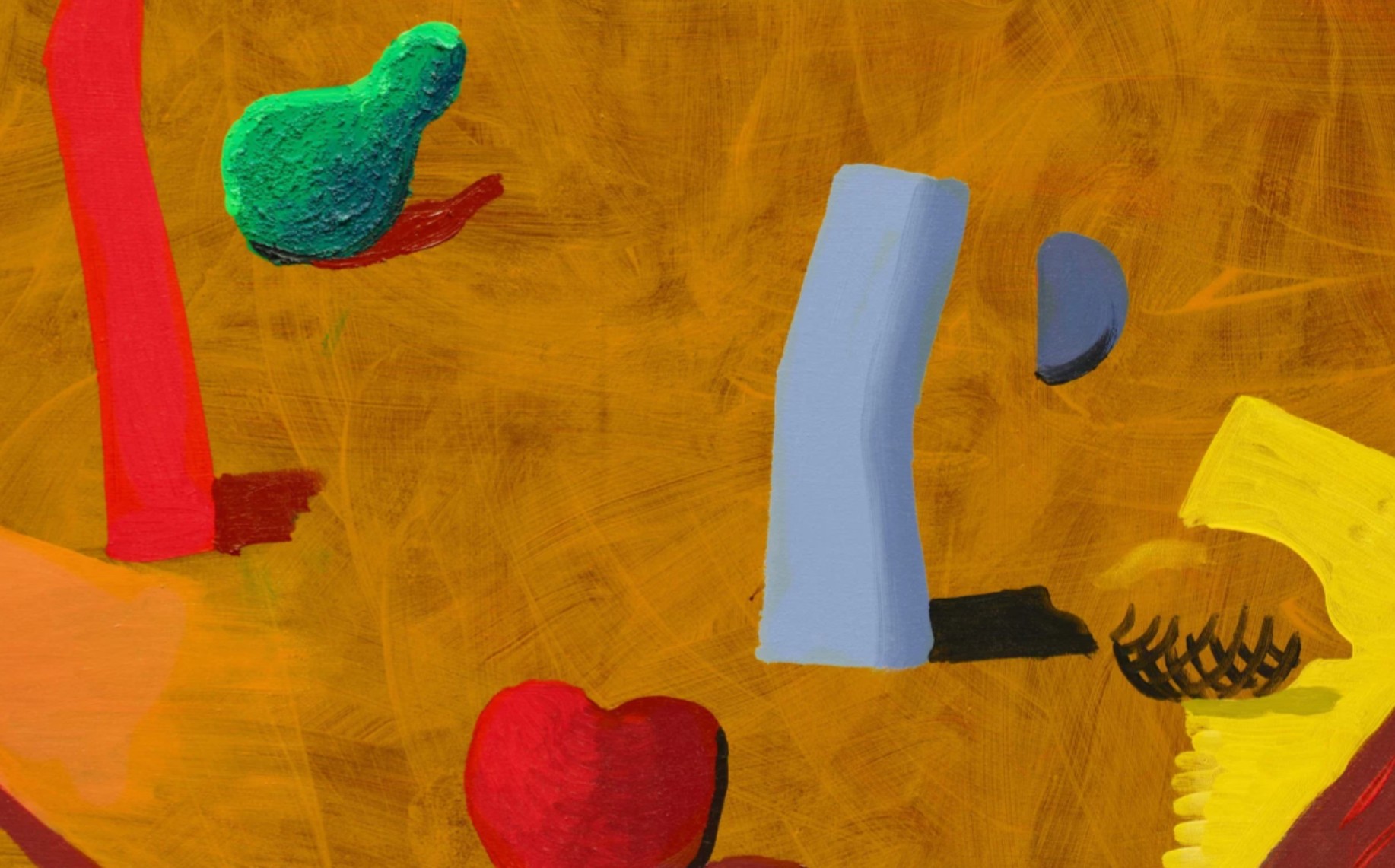
Set against a textured field of shimmering ochre, Golden Still Life transforms the domestic genre into a dynamic theater of color and geometry. The fruits—pear, apple, and lemon—float within a space defined less by physical depth than by the interplay of shadow and light. Hockney anchors the composition with angular corners of a table rendered in bold yellow and orange segments, while deliberately omitting its center, creating the illusion that the objects hover weightlessly. The result is a still life of remarkable vitality, at once grounded in the tradition of the Dutch masters and animated by the spatial inventiveness of twentieth-century modernism.
“Painting still lifes can be as exciting as anything can be in painting.
I remember once saying to Francis Bacon in Paris, that I knew a painting in California of tulips in a vase that was as profound as any painting he’d made.
I think at first he almost thought I was referring to my own, but I was referring to the Cézanne in the Norton Simon Museum. It’s the most beautiful painting, and it is as profound as anything he did. Just some tulips in a vase.
The profundity is not in the subject, it is the way it’s dealt with.”
The artist’s handling of shadow and reflection in Golden Still Life is particularly evocative, demonstrating the clarity and precision that define his mature acrylic technique. The luminous palette recalls his California paintings of the 1970s, while the compositional balance and restrained geometry prefigure the spatial experiments of the 1990s and early 2000s. As in works such as Fruit in a Chinese Bowl from 1988 and Two Red Pots from 1987, Hockney treats everyday subjects as opportunities for formal inquiry, exploring how vision is constructed and how painting can reveal that process. In reimagining the still life, Hockney engages a lineage that stretches from Henri Matisse to Paul Cézanne and Giorgio Morandi. Yet his sensibility remains unmistakably contemporary: color operates as both form and emotion, while the abstraction of space challenges conventional perspective. The title Golden Still Life underscores Hockney’s fascination with light as a metaphor for perception, the gold of illumination rather than mere opulence. In this sense, the work encapsulates the artist’s lifelong pursuit of depicting not the world as it appears, but as it is seen and felt.
Left: Paul Cézanne, Still Life with Apples, c. 1877-1878. The Fitzwilliam Museum, Cambridge University.
Right: Giorgio Morandi, Natura morta (V. 117), 1927. Private Collection.
Golden Still Life also embodies the deep cultural ties between Hockney and Los Angeles, the city that shaped his vision and the collection from which this painting emerges. Acquired by philanthropist Geri Brawerman from André Emmerich Gallery in 1991, the work has remained in the same collection for more than three decades, a reflection of her discerning taste and enduring support for the visual arts in Los Angeles. In Golden Still Life, Hockney reaffirms painting’s capacity to transform the ordinary into the sublime. The work’s radiant palette and architectural precision encapsulate the artist’s lifelong fascination with how we see and remember, a still life not of things, but of light itself.
Ed Ruscha
PLEASE CLICK ON THE PICTURE BELOW TO ACCESS AUCTION MARKET OVERVIEW

1. Paintings
How Do You Do?, 2003
Edlis Neeson Collection
Christie’s New-York: 19 November 2025
Estimated: USD 5,000,000 – 7,000,000
USD 6,785,000
ED RUSCHA (B. 1937), How Do You Do? | Christie’s
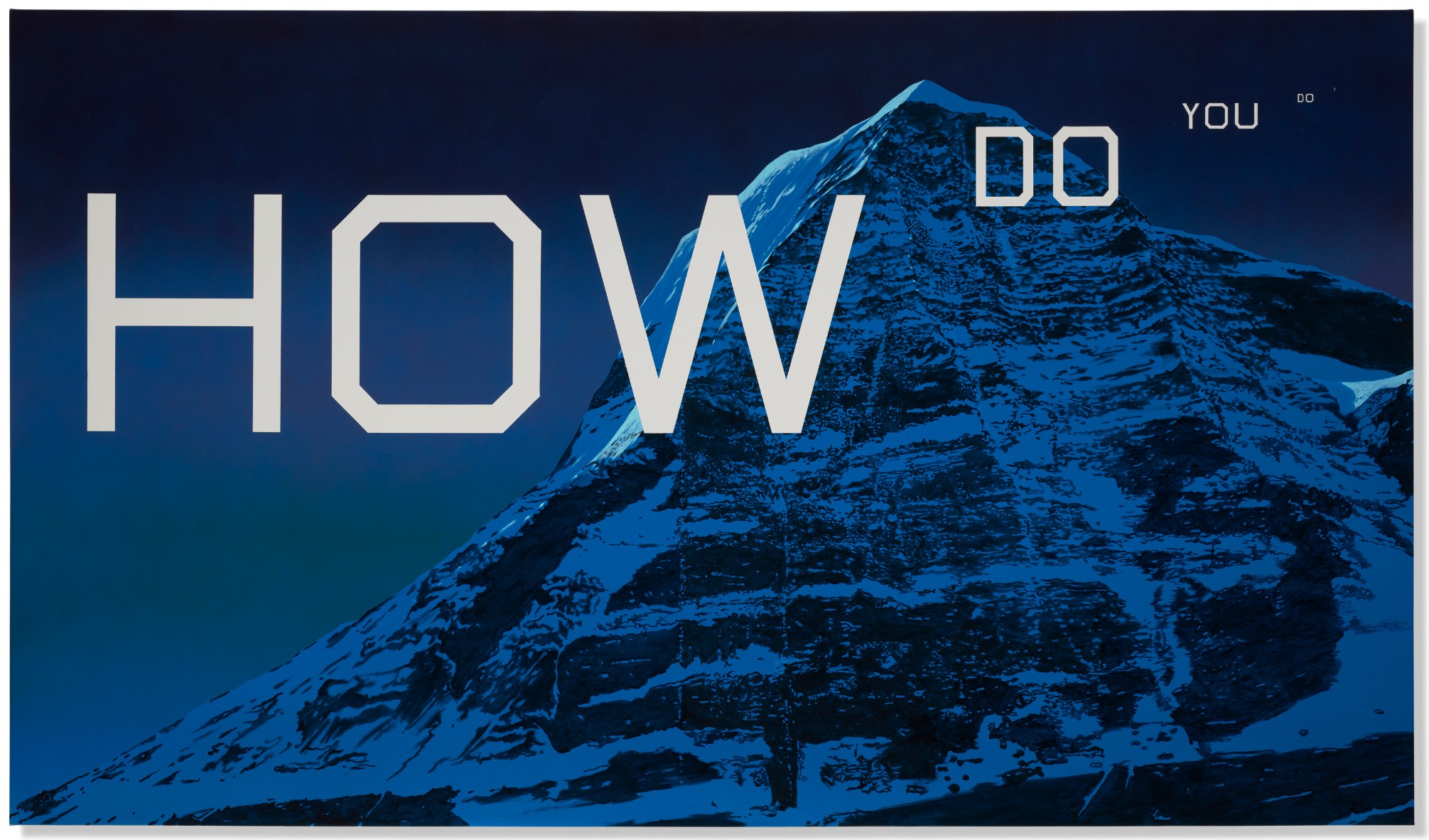
ED RUSCHA (B. 1937)
How Do You Do?, 2003
Oil on canvas
72×124 inches (182.9 x 315 cm)
Signed and dated twice ‘Ed Ruscha 2003’ (on the reverse)
“How do you do?” Dripping with the signature laconic irony developed in his acclaimed career, Ed Ruscha’s formal, somewhat archaic greeting is proclaimed in his titular painting. An exceptional, grand work emerging from the artist’s famed series of mountain paintings, How Do You Do? demonstrates Ruscha’s endless stream of creativity. The mountain motif has become central to the artist’s later reputation, with the productive period centered around the turn of the millennium which he spent making the series.
Capturing the immense scale and grandeur of the snow-clad crags of a high peak, How Do You Do? is painstakingly rendered, with the complex facets of each ridgeline, mountain face, rockfall, and summit depicted in minute detail against a sky of deep, saturated blues. Appropriating the imagery from photographs and illustrations, Ruscha describes the works as “ideas of ideas of ideas of mountains,” providing stage settings for his theater of words (E. Ruscha, quoted in R. Dean, “Preface,” op. cit., p. 1). The present work is one of the more spectacular of these painted stages, with Ruscha’s iconic imagery ascending up the mountain peak, diminishing in scale as if receding into the atmosphere. The work’s dynamic text is rare among the series, where Ruscha typically presents his words across a conventional horizontal plane. Ruscha’s innovation here allows text to interact with setting, emphasizing the stage-like aspect of the series.
Caspar David Friedrich, The Watzmann, circa 1824-1825. Alte Nationalgalerie, Staatliche Museen zu Berlin.
“You know, I was reading Melville’s Moby-Dick, and I came across something where he says that mountains are egotistical. And it struck me as a little shard of truth, that mountains do have this way of looking egotistical. Anyways, the specifics of the mountains, and whatever they mean, are beside the point, because they are really notions of mountains rather than real mountains”
Taking Captain Ahab’s comment that “there’s something ever egotistical in mountain-tops and towers, and all other grand and lofty things” as a point of departure, Ruscha utilizes his imposing subject as a backdrop to his linguistic wordplay. (H. Melville, Moby-Dick; or, The Whale, London, 1922, p. 190).
René Magritte, Every day, 1966. Private Collection. © 2025 C. Herscovici / Artists Rights Society (ARS), New York.
Ruscha achieves his bold lettering in How Do You Do? with his signature reverse-stenciling technique. Each letter, in his own Boy Scout Utility Western typeface, was made by carefully laying a stencil onto the white gesso ground before painting the composition. Ruscha’s final creative act after completing the painting was removing the stencils in one rapid, irreversible, subtractive process. With this process, Ruscha accomplishes an elegant result emphasizing the duality between text and background image. Ruscha compresses each word as his text proceeds across the canvas, ending with a subtle question mark. As if a statement fading with distance, his words seem to appear to ascend the mountain face, losing audibility with every gain in altitude. Working in tandem, text and image operate to emphasize the almost incomprehensible scale of this mountaintop.
Left: Andy Warhol, Paramount, from: Ads, 1985. © 2025 The Andy Warhol Foundation for the Visual Arts, Inc. / Licensed by ARS
Right: The lagoon at Disneyland with view of the Skyway attraction, Anaheim, California.
How Do You Do? expands beyond literary territory in its intricate relationship vis-à-vis text and background. The mountain, as a painted image of an image, recalls the painted cinematic backdrops of classical Hollywood productions, creating a space situated between reality and illusion.
“If I’m influenced by movies, it’s from way underneath, not just the surface. A lot of my paintings are anonymous backdrops for the drama of words. In a way they’re words in front of the old Paramount mountain… they’re just meant to support the drama, like the Hollywood sign being held up by sticks.”
In the present work, however, the interaction is more complex, as the text does interact with its background, rescaling each word as it summits the peak.
Ed Ruscha, Parking for Tower Rcds. Book Soup, 1999. Solomon R. Guggenheim Museum, New York. © Ed Ruscha
Ruscha asserts that the mountain motif emerged from him “wanting to have a background and a foreground,” and this background draws specifically upon the distinctive atmosphere of the West. Just as Ruscha’s earlier landscape paintings of sunsets and his photographs of Los Angeles capture the specificity of the West Coast, his mountains articulate a specific western attitude which the artist experienced weekly, on his drives from the city to his rural retreat near Joshua Tree National Park. Most weekends, Ruscha would drive across the Mojave desert, experiencing the sublime sight of the Transverse Ranges towering over either side of the road.
Ed Ruscha, Darlene Phipps, 2002. The Broad, Los Angeles. © Ed Ruscha
With over twelve mountain paintings in important international institutional collections, including in New York the Museum of Modern Art, the Whitney Museum of American Art, and the Solomon R. Guggenheim Museum, as well as the Broad in Los Angeles and the National Galleries of Scotland, the series has become one of the most recognizable and important out of Ruscha’s entire oeuvre. With its exceptional scale and novel interaction between text and backdrop, How Do You Do? is one of the most important works from the series, compellingly advancing his word paintings onto a new theoretical plane. Bringing together the sublimity of the Western landscape, the influence of theater and film backdrops, and Moby-Dick, Ruscha finds with How Do You Do? an enduring composition with which to play with the possibilities of text and paint.
Cosmo, Selma, Vine, 2000
Sotheby’s New-York: 19 November 2025
Estimated: USD 1,500,000 – 2,000,000
PASSED
Cosmo, Selma, Vine | Contemporary Day Auction | 2025 | Sotheby’s
ED RUSCHA (b. 1937)
Cosmo, Selma, Vine, 2000
Acrylic on canvas
70 x 138 1/8 inches (177.8 x 350.8 cm)
Signed and dated 2000 (on the reverse)
As a monumental paradigm of Ed Ruscha’s acclaimed series of Metro Plot paintings, Cosmo, Selma, Vine stands as a masterful expression of the artist’s enduring investigation into the unstable relationship between image, symbol, and text. Exceptional within Ruscha’s prolific oeuvre, the present work belongs to a rare number of paintings that pay homage to the one city that has remained both his muse and his mirror: Los Angeles. Rendered from an unconventional viewpoint that sits somewhere between a naturalistic vista and a reductive map, Cosmo, Selma, Vine abstracts a key Hollywood intersection into a distilled reflection on urban form, perception, and language. Challenging the utilitarian objectivity of the map, Ruscha transforms this fragment of cityscape into an enigmatic meditation on place, perception, and memory, realized with unparalleled technical and conceptual precision.
Portrait of Ed Ruscha with Los Angeles’s Hollywood Sign
Spanning nearly 12 feet in width, Cosmo, Selma, Vine is the largest work in this important series alongside two paintings of equal dimensions, one of which – Hollywood to Pico – belongs to the Whitney Museum of American Art in New York. Overwhelming bodily proportions yet paradoxically cropped as an indistinct microcosm, Ruscha’s distilled urban landscape composes a disorienting symbolic geography that challenges our conception of scale and perspective. Drawing together tendencies of naturalistic representation, minimalist abstraction and the experience of space in metropolitan America, Cosmo, Selma, Vine is an enigmatically whimsical homage to the modernist grid. By compounding such a rich dialogue of cultural references with phenomenal virtuosity, Ruscha has created a true masterpiece of postmodern painting.
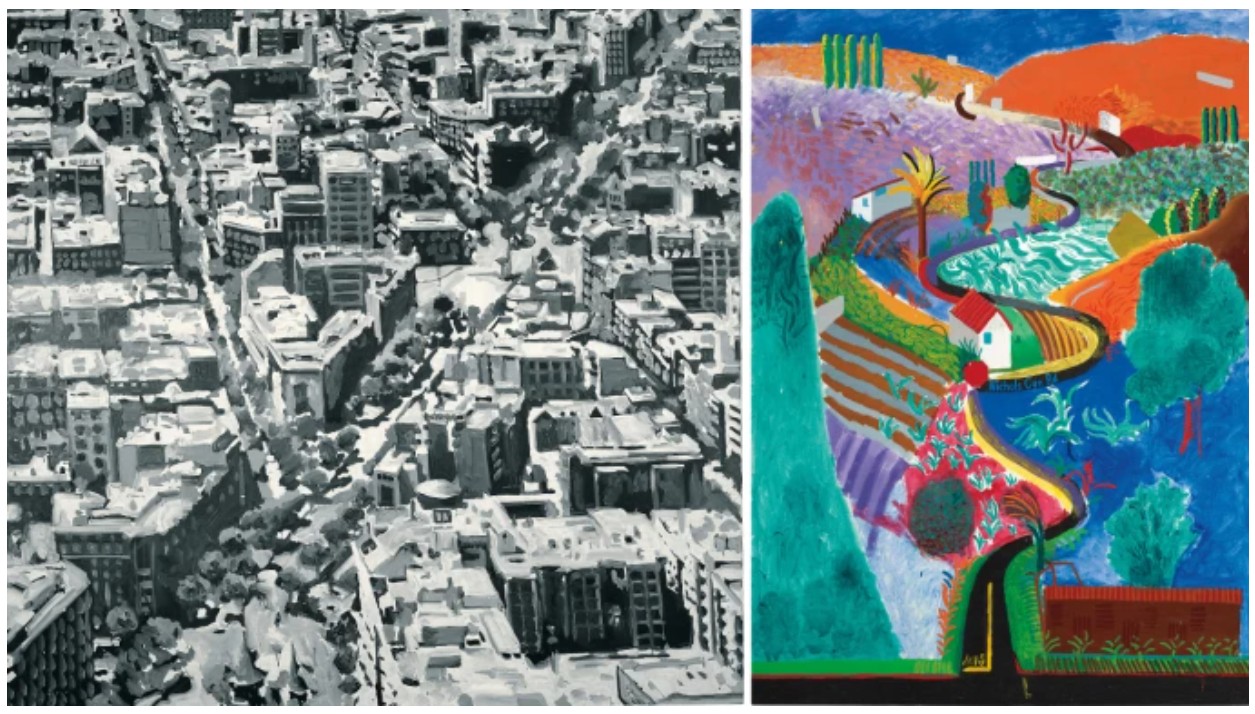
Left: Gerhard Richter, Stadtbild Madrid (Cityscape Madrid), 1968. San Francisco Museum of Modern Art. Art © Gerhard Richter.
Right: David Hockney, Nichols Canyon, 1980. Private Collection.
Ruscha began his series of now iconic Metro Plot paintings in 1998, starting with static grisailles depictions of recognizable Los Angeles boulevards from half elevated vantage points. Depicting a network of Hollywood streets just South West of the intersections shown in the present work, Santa Monica, Melrose, Beverly, La Brea, Fairfax, is one such work from this year that now resides in the permanent collection of the Los Angeles County Museum of Art. Recalling the artist’s famous photographic Panorama of 1966, Every Building on Sunset Strip, the limited set of street map paintings that Ruscha created intermittently over the next five years valorized the fallacious sense of infinity conjured by the sprawling grid system of Los Angeles, as well as the ubiquitous Thomas Guide books once widely used by those who traversed its streets by car. During the years of 1998-1999, Ruscha expanded his purview to cover American highway routes outside of California, and it is in the present work that he returned firmly to Los Angeles as a subject.
Metro Plot Paintings in Museum Collections
Boasting the largest format in the series, Cosmo, Selma, Vine is also one of his most specific and focused works in terms of subject. Moving away from famous avenues such as Sunset Boulevard, this selection of lesser-known roads seems arbitrary yet personal at once, presenting a certain lack of familiarity to call into question the realities of scale and distance in opposition to the perceived distortions of perspective. Ultimately Ruscha evokes the instructive nature of a map but ultimately provides a sense of disembodied futility as such stark minimalism fails to reveal any detail and the close cropping denies greater context. Ruscha thus forces a psychological reconceptualization of space through a perceptive muddling that plays to a sense of the uncanny – a tendency at the heart of his practice, where a sense of the familiar and the alien coincide.
Metro Plot Paintings in Museum Collections
Witnessing disembodied words and signage in the desert landscapes surrounding Route 66, Ruscha’s experience of travelling in America by car formed a stronghold of inspiration since his early career.
“A lot of my paintings are anonymous backdrops for the drama of words.”
While Ruscha’s earlier City Lights series, such as the present work, played with oblique birds-eye views of cityscapes, in the present series Ruscha revels in the synthesis of word and image offered by maps rather than privileging the autonomy of linguistic phrases. This translates spatially, in the mimetic angling of road and word, as well as conceptually by connoting a geographic other.
Ed Ruscha, Every Building on the Sunset Strip (detail), 1966, Los Angeles County Museum of Art. Art © 2025 Edward Ruscha
Crucially, the uncomfortable cerebral vantage point that Ruscha adopts neatly mimics the geometric construction grid of optical linear perspective, where lines recede into the picture plane to construct an illusion of depth. As a stronghold of academic drawing since its schematization by Renaissance architect Filippo Brunelleschi in the 15th century, Ruscha’s oblique half-commitment to the system of illusionistic depth also speaks to the gradual ‘flattening’ and re-appropriation of the grid by modernist painters, best exemplified by the two dimensional grid constructions of Piet Mondrian. Above any other global city, Los Angeles boasts amongst the greatest examples of modernist architecture in the buildings that compose its visual landscape, as well as the vast sprawling network of activity created by its gridded streets. Both nostalgically alluring, yet gritty and vacuous, Ruscha’s duplicitous post-modern city view reconsiders the possible synthesis of utility and elegance – of art and life – and constitutes the artist’s ultimate ballad on the nature of contemporary urban existence, in both its material and cerebral states.
2. Works on Paper
#1. Your Comedies, 1982
Property from an Esteemed West Coast Collection
Sotheby’s New-York: 19 November 2025
Estimated: USD 600,000 – 800,000
USD 1,819,000
WORK ON PAPER
Your Comedies | Contemporary Day Auction | 2025 | Sotheby’s
ED RUSCHA (b. 1937)
Your Comedies, 1982
Dry pigment on paper
40×60 inches (101.6 x 152.4 cm)
Signed and dated 1982 (lower right)
Executed in 1982, Ed Ruscha’s Your Comedies is a large-scale work on paper that highlights the artist’s innovative use of language and color. Set against a luminous field of coral and crimson that gradually shifts across the surface, the work transforms words into a meditation on human emotion. The four phrases, Your Comedies, Your Tragedies, Your Dramas, Your Love Stories, appear as fragments of a larger narrative, encouraging the viewer to consider the emotional weight of familiar storytelling genres when isolated from their usual context. By removing the words from literature, cinema, or conversation, Ruscha allows them to function simultaneously as text and image, making the language itself a central element of the composition.
“If I’m influenced by the movies, it’s from way down underneath, not just on the surface. A lot of my paintings are anonymous backdrops for the drama of words.”
The background’s transition from soft rose to deep crimson establishes a visual rhythm that mirrors the emotional arc of the text. As the eye moves from comedy to tragedy, drama to love, the arrangement prompts reflection on the full spectrum of human experience. Ruscha’s use of color recalls the meditative expanses of Mark Rothko, while his conceptual engagement with language aligns him with René Magritte and Marcel Duchamp, testing the limits of meaning and exploring how words operate in a contemplative space. The repeated use of the word Your directly addresses the viewer, transforming the phrases into a personal reflection and inviting the audience to project their own memories and experiences onto the glowing surface.
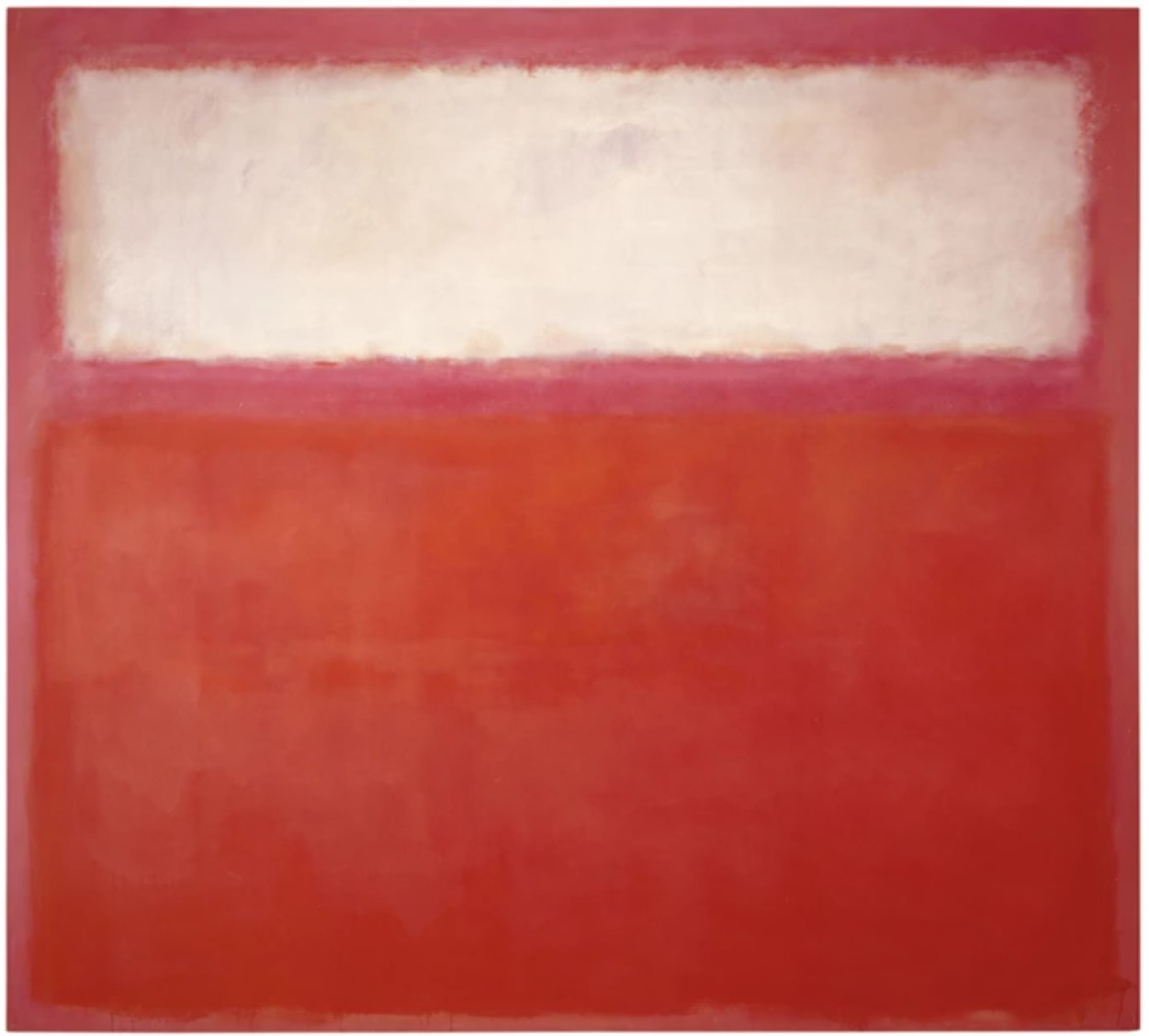
Mark Rothko, Pink and White over Red, 1957. Anderson Collection at Stanford University.
Art © 1998 Kate Rothko Prizel & Christopher Rothko / Artists Rights Society (ARS), New York
The work also reflects Ruscha’s connection to Los Angeles and its visual culture. Its precise typography and cinematic rhythm evoke the city’s billboards and marquees, distilling the essence of Hollywood storytelling into universal reflections on human emotion. At the same time, the work is closely related to Ruscha’s sunset paintings of the 1970s and early 1980s, which evoke the cinematic mythos of the Californian desert with their variegated streaks of color. This piece exemplifies California’s enduring influence on Ruscha’s practice, as well as the impact of his early career as a commercial sign maker, evident in the precision of his text. By pairing a romantic, dreamlike background with intriguing, suggestive language, Ruscha achieves a balance between poeticism and provocation, blending the emotional resonance of landscape with the conceptual force of text.
Ed Ruscha, Back of Hollywood, 1977. macLYON, France. Art © 2025 Ed Ruscha
The owners first encountered Your Comedies when it was installed behind the reception desk at Leo Castelli Gallery in New York in 1984. The work’s humor and the irony of the language were inescapable, as were the references to the spectacle of Hollywood and the grandeur of the American landscape. Created during a decade of increasing international recognition, Your Comedies demonstrates the maturity of Ruscha’s practice, showing how a few carefully chosen words can evoke a wide range of human emotion and experience. Ultimately, the work is both a reflection on narrative and a meditation on the personal stories we carry, with the open space between words and color providing its most profound resonance. In this space, Ruscha achieves a visual language that is precise and reflective.
#2. Pool, Pool, Pool, Pool, 1982
LA Standard: Works by Ed Ruscha from a Private West Coast Collection
Phillips New-York: 21 November 2025
Estimated: USD 200,000 – 300,000
USD 387,000
Ed Ruscha Modern & Contemporary Art Day Sale, Morning Session
ED RUSCHA
Pool, Pool, Pool, Pool, 1982
Pastel on paper
30×40 inches (76.2 x 101.6 cm)
Signed and dated “Ed Ruscha 1982” lower right
“If you isolate a word for just a moment and repeat it ten, fifteen times, you can easily drive the meaning from the word and from the sound of the word, and I do that a lot with the printed word.”
#3. Adios with Olive, 1969
Art from Stone: The Collection of Donald and Maggie Kelley
Christie’s New-York: 20 November 2025
Estimated: USD 250,000 – 350,000
USD 355,600
WORK ON PAPER
ED RUSCHA (B. 1937), Adios with Olive | Christie’s
ED RUSCHA (B. 1937)
Adios with Olive, 1969
Pastel and graphite on paper
11 1/4 x 14 1/2 inches (28.2 x 36.8 cm)
Signed and dated ‘E. Ruscha 1969’ (lower left)
Edward Ruscha, Jar of Olives, Falling, 1969. Modern Art Museum of Fort Worth.© Ed Ruscha
S for Spanish, 1988
LA Standard: Works by Ed Ruscha from a Private West Coast Collection
Phillips New-York: 21 November 2025
Estimated: USD 250,000 – 350,000
USD 283,800
WORK ON PAPER
Ed Ruscha Modern & Contemporary Art Day Sale, Morning Session
ED RUSCHA
S for Spanish, 1988
Acrylic on paper
60 1/8 x 40 1/4 inches (152.7 x 102.2 cm)
Signed and dated “Ed Ruscha ‘88” lower right
Signed, titled and dated “ED RUSCHA “S FOR SPANISH” 1988″ on the reverse
In S for Spanish, 1988, Ed Ruscha uses an airbrush and stencil to apply acrylic paint to paper, producing a diffused, red haze through which the shadowy silhouette of a woman in a dress emerges. The color is most concentrated near her form, appearing to radiate outward from the contours of her body. To the right hovers a large, gold, serifed letter “S.” Soft yet precise, this work is emblematic of Ruscha’s Silhouette drawings which he began in the 1980s, born out of a renewed experimentation with technique and a return to figuration.
“A lot of times the words are unimportant, their definitions are unimportant.
They become almost abstract objects.”
Though Ruscha rose to prominence in the 1960s and 1970s as a leading figure of text-based art, S for Spanish marks a turning point in his practice. In the 1980s, Ruscha reintroduced figuration into his work, often using stencils to replicate stock images. Here, in place of a word or phrase, Ruscha foregrounds a female figure that has appeared in many of his works, including Several Monograms (1986), a drawing held in the collection of the Whitney Museum of American Art. Alongside this shift in subject matter, Ruscha’s airbrush technique granted his work an atmospheric quality that diverged from the crisply outlined typography of preceding drawings.
“I like the idea of a word becoming a picture, almost leaving its body,
then coming back and becoming a word again.”
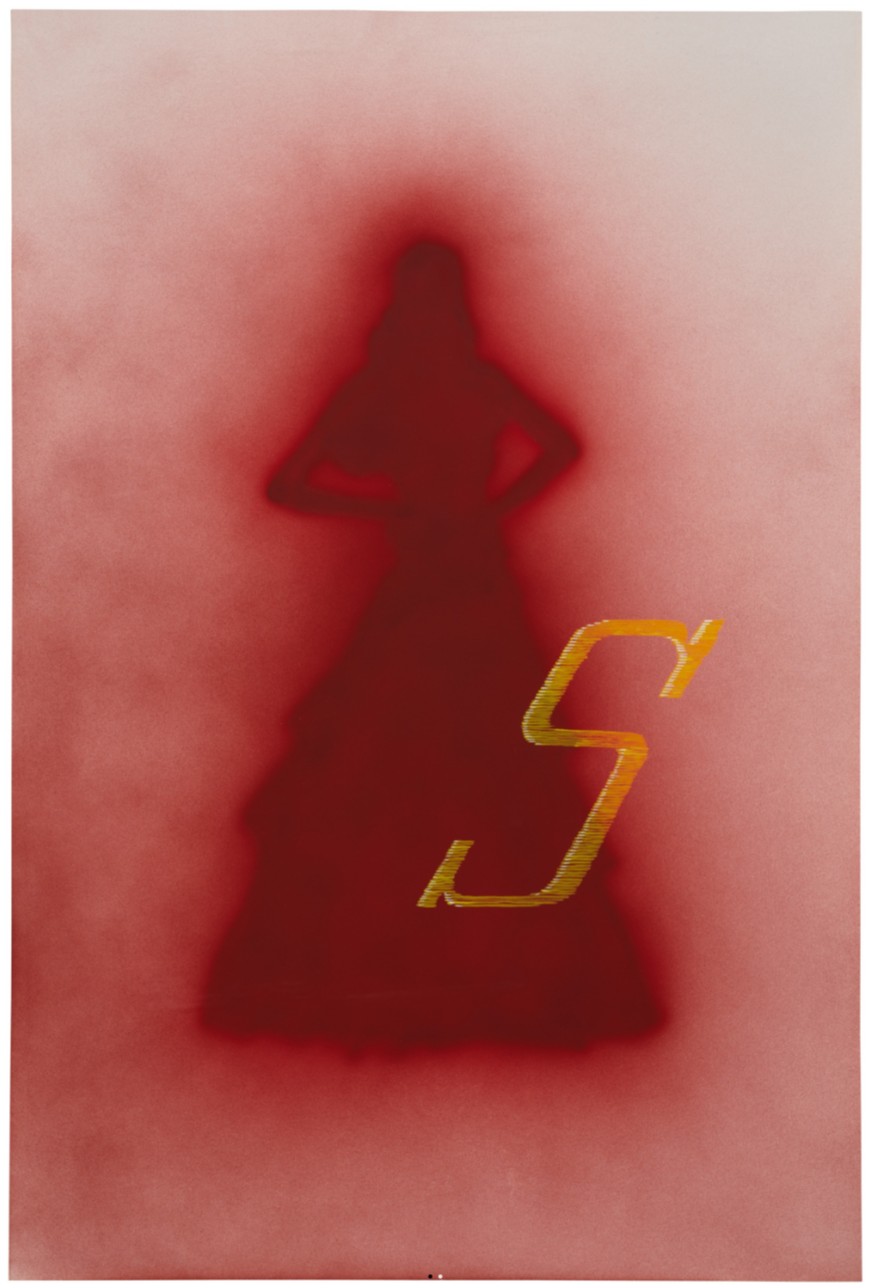
However, Ruscha did not completely abandon text for image. The prominent “S” and the work’s title reflect Ruscha’s sustained interest in the visual and conceptual dimensions of language and phonics. The letter functions dually as a linguistic signifier and a formal element—part symbol, part shape. S for Spanish captures this shifting relationship between word and image, revealing a moment in his career when the boundaries between the two became increasingly fluid.
Europe, 1989
Property from a Distinguished American Collection
Sotheby’s New-York: 19 November 2025
Estimated: USD 200,000 – 300,000
PASSED
WORK ON PAPER
Europe | Contemporary Day Auction | 2025 | Sotheby’s
ED RUSCHA (b. 1937)
Europe, 1989
Acrylic and graphite on museum board
30 x 40 1/8 inches (76.2 x 101.9 cm)
Signed and dated 1989 (lower right)
“In many of the works from the 1980s, Ruscha has chosen to leave words out altogether, replacing them by silhouetted images that are themselves enigmatic enough to force the issue of language into the open and by floating white rectangles or underliners whose references are often supplied by the painting’s title. Here Ruscha is playing somewhat with both our familiarity with his work, and with the self-described parameters of this art up to this point, by creating the expectation of language and then purposefully not supplying it.”
DAN CAMERON, ED RUSCHA PAINTINGS, 1990, P. 15
Woman from History, 1986
Sotheby’s New-York: 19 November 2025
Estimated: USD 250,000 – 350,000
WORK ON PAPER
WITHDRAWN
Woman From History | Contemporary Day Auction | 2025 | Sotheby’s
ED RUSCHA (b. 1937)
Woman from History, 1986
Dry pigment and acrylic on paper
60×40 inches (152.4 x 101.6 cm)
Signed and dated ’86 (lower right)
Yayoi Kusama
PLEASE CLICK ON THE PICTURE BELOW TO ACCESS AUCTION MARKET OVERVIEW
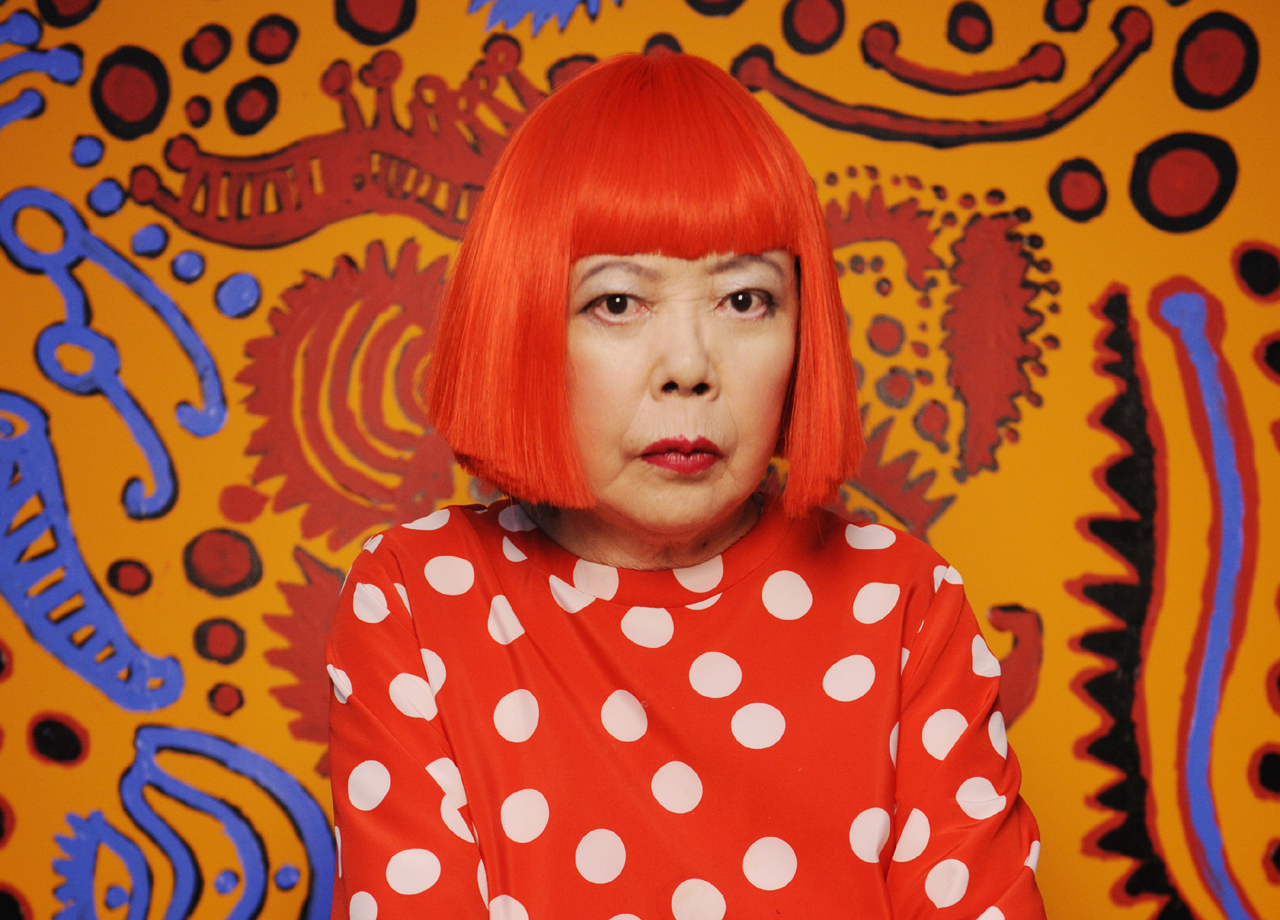
Pumpkin, 2019
Property from a Prestigious Private Collector
Sotheby’s New-York: 19 November 2025
Estimated: USD 1,700,000 – 2,500,000
USD 1,514,000
Pumpkin | Contemporary Day Auction | 2025 | Sotheby’s
YAYOI KUSAMA (b. 1929)
Pumpkin, 2019
Fiberglass reinforced plastic, stainless steel, urethane paint and mirror
94 x 118.1 x 120.7 cm (37 x 46 1/2 x 47 1/2 inches)
Signed and dated 2019 (on the lower edge)
Executed in 2019, Pumpkin is a resplendent embodiment of Yayoi Kusama’s most celebrated motif and one of the most recognizable symbols in contemporary art. Appearing for the first time at auction, Pumpkin is cast in fiberglass and stainless steel with a hallow interior filled with circular mirrors, painted in her signature palette of radiant yellow and inky black, the work pulses with optical rhythm and formal clarity. It stands within a lineage that stretches across Kusama’s entire career – from her earliest childhood drawings of gourds in wartime Japan to the mirrored environments and monumental sculptures that have defined her global acclaim in the twenty-first century.
“I adore pumpkins. As my spiritual home since childhood, and with their infinite spirituality, they contribute to the peace of mankind across the world and to the celebration of humanity. And by doing so, they make me feel at peace.”
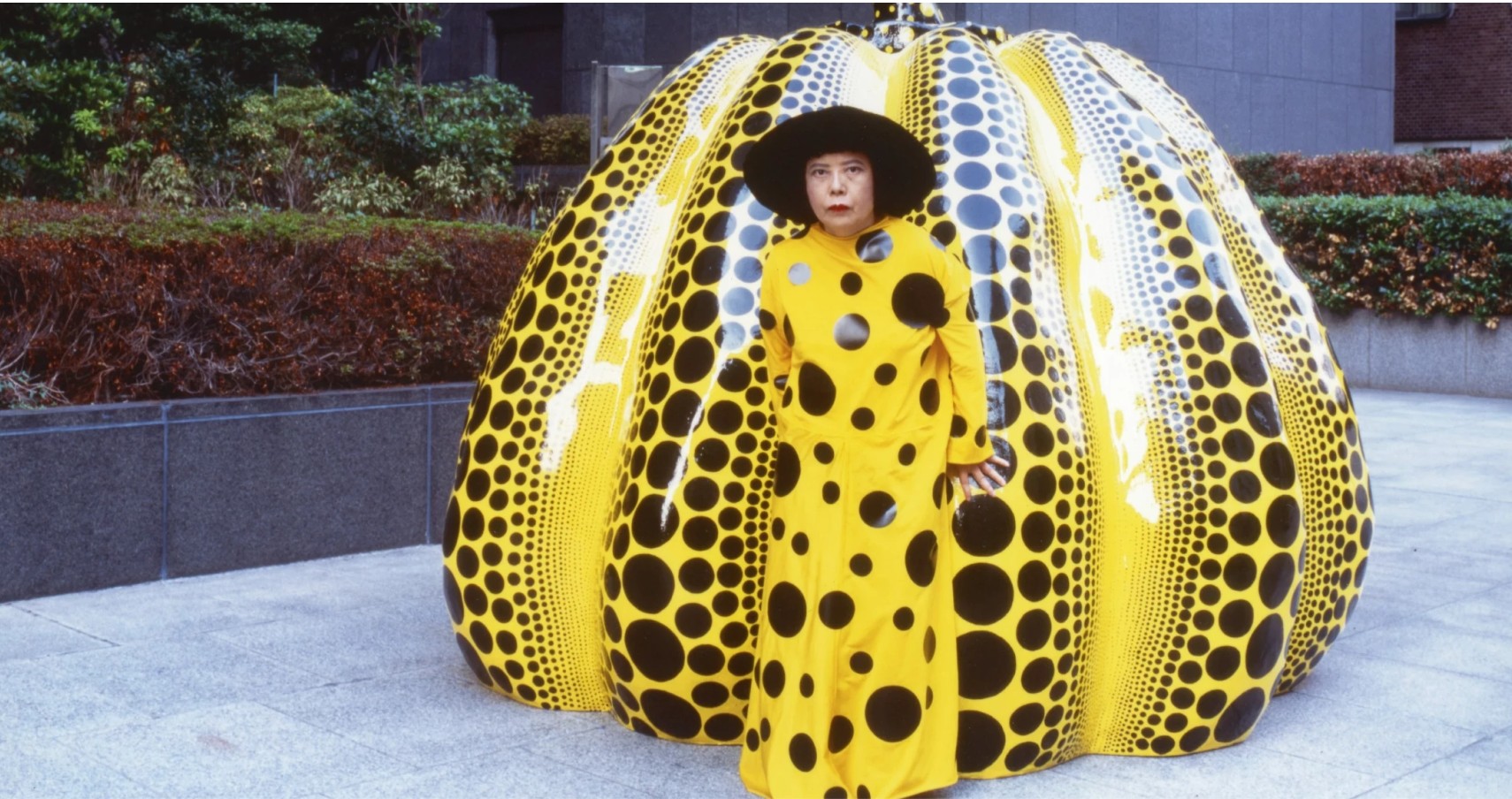
Yayoi Kusama with a Pumpkin sculpture in Fukuoka, Japan, 1994.
Image © Yayoi Kusama Inc. Art © 2024 Yayoi Kusama, Collection of Fukuoka Art Museum
For Kusama, the pumpkin is not simply an image of abundance or whimsy, but an object of deep psychological and spiritual resonance. She has described the motif as a source of comfort and peace, recalling her childhood fascination with the soft, organic irregularities of the gourd. Over decades, that humble form became a site of transcendence – a vessel through which she could negotiate the dualities of her experience: obsession and order, fear and fascination, the self and the infinite. In Pumpkin, these tensions are resolved through a dazzling union of form and surface. The sculpture’s glossy, industrial skin reflects the precision of modern manufacture, while its playful, perforated body evokes the irregular rhythms of nature. The alternating pattern of black dots – a lifelong emblem of Kusama’s artistic and psychological universe – spreads across the surface like a living cellular structure, at once microcosmic and cosmic.
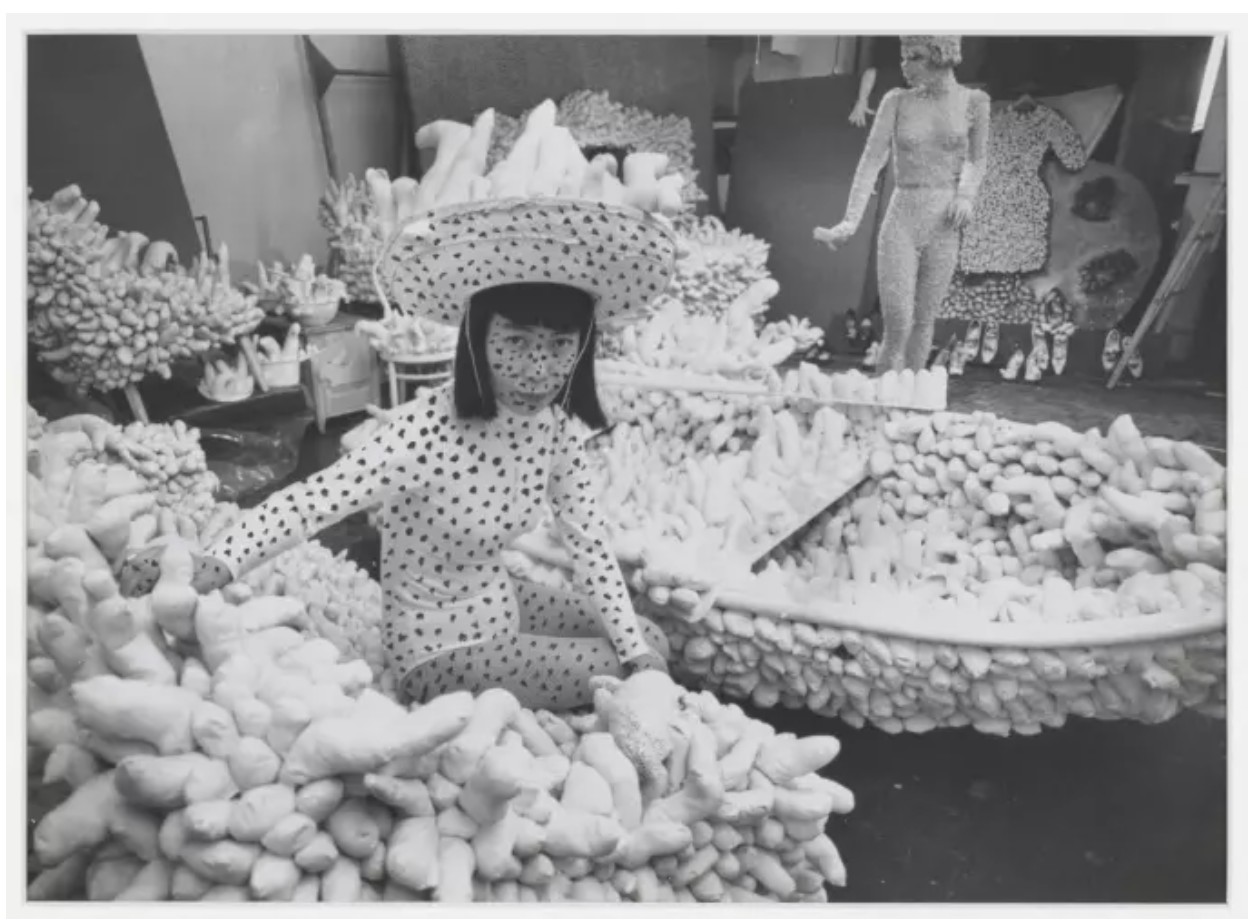
Yayoi Kusama in her studio, New York, 1963.
The Pumpkin series occupies a unique place within Kusama’s practice, bridging the intimate and the monumental, the handmade and the technological. Her earliest soft sculptures of the 1960s, covered in sewn protrusions, prefigured the tactile physicality of these later works. By the 1990s, the pumpkin had become central to her sculptural lexicon, culminating in the monumental Pumpkin (1994) installed at the Benesse Art Site on Naoshima Island – a global icon of contemporary Japanese art. In the present work, executed nearly three decades later, Kusama revisits the motif with renewed intensity. The punctured surface of the sculpture transforms solid form into light and void, inviting the viewer to peer through its openings and experience the interplay between interior and exterior. This act of looking – of immersion and reflection – echoes the phenomenological engagement of her Infinity Mirror Rooms, in which the boundaries of self dissolve into endless patterns.
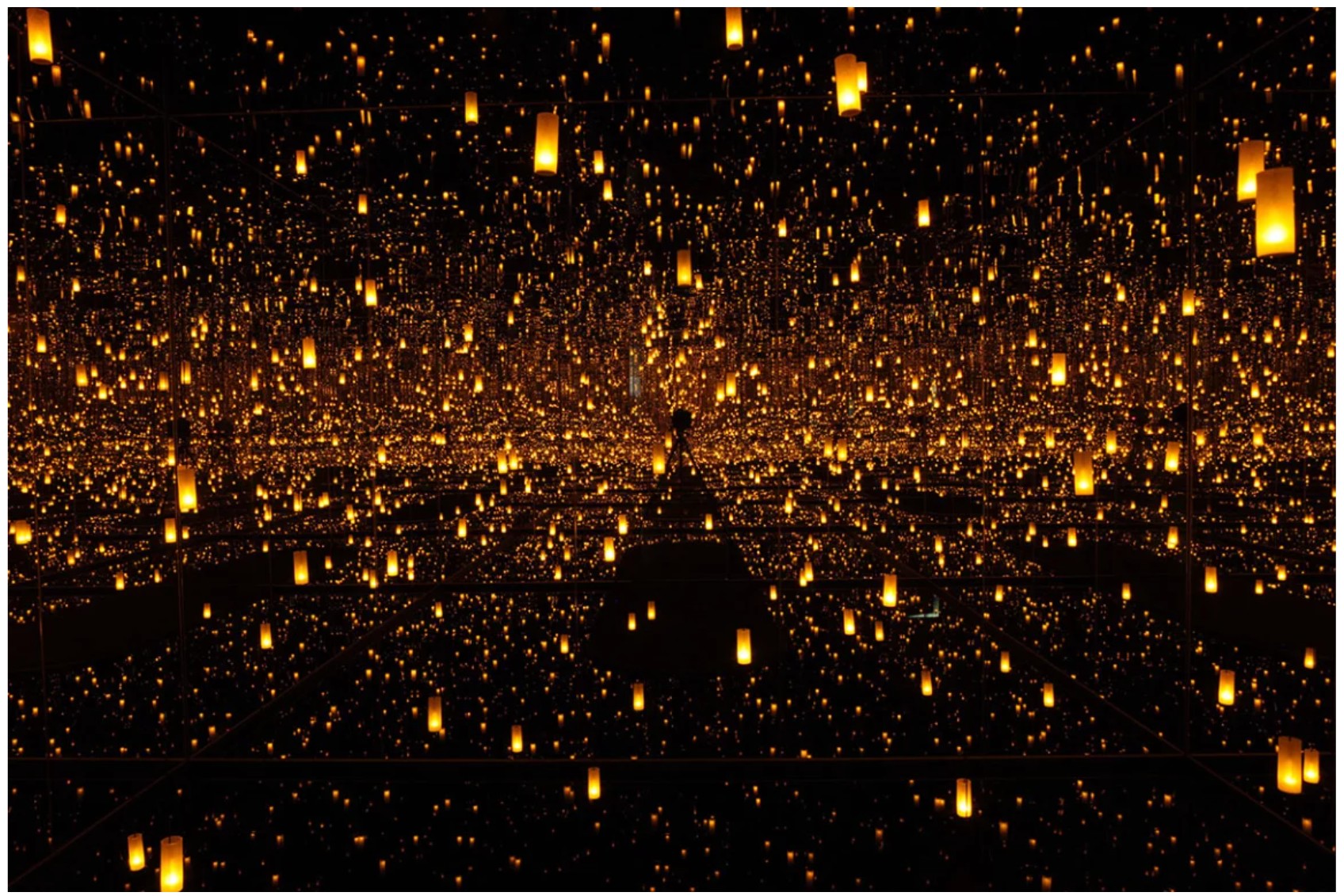
Yayoi Kusama, “Aftermath of Obliteration of Eternity,” 2009. Collection of the artist. Hirshhorn Museum. Courtesy of Ota Fine Arts, Tokyo/Singapore; Victoria Miro, London; David Zwirner, New York. © Yayoi Kusama.
Kusama’s pumpkins have often been read as self-portraits, expressions of her psychological terrain rendered in radiant, tactile form. Yet they also operate on a universal level, embodying the tension between individuality and repetition that defines much of her art.
“My desire was to predict and measure the infinity of the boundless universe from my own position in it.
By using polka dots to infinity, I break myself away from this earth.”
The present Pumpkin enacts this transformation with striking clarity: through repetition and reflection, it converts the material world into a field of infinite perception.
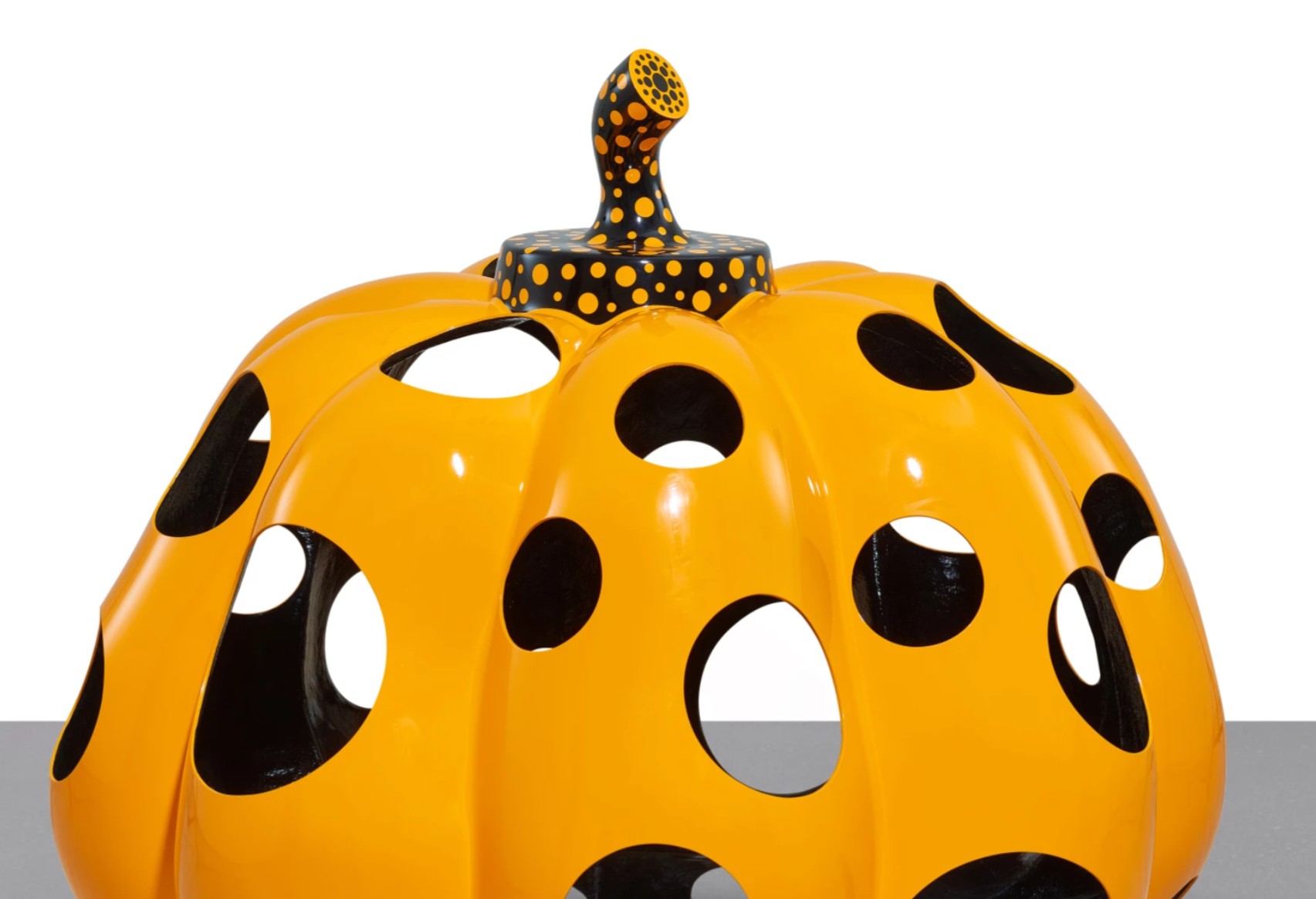
Like Kusama’s Pumpkin, Jeff Koons’s Rabbit (1986) reimagines an object of childhood delight as a mirror of contemporary consciousness. Cast in stainless steel, Koons’s inflatable bunny turns innocence into luxury, its flawless surface reflecting the viewer and the culture of desire that produced it. Where Rabbit explores the seductions and ironies of consumerism, Kusama’s Pumpkin transforms reflection into meditation—using repetition and color not for spectacle, but for transcendence. Both works, through their industrial perfection and iconic simplicity, embody the opposing yet complementary impulses of contemporary sculpture: irony and introspection, surface and soul.
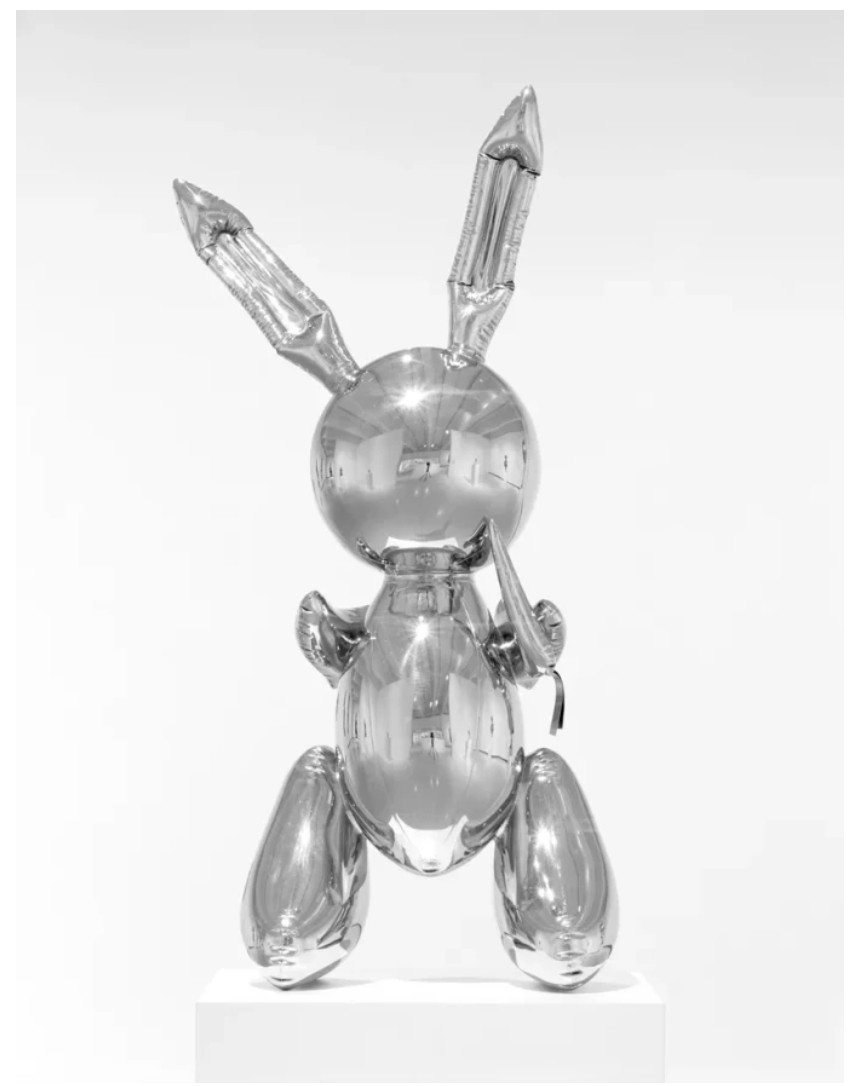
Jeff Koons, Rabbit, 1986. The Broad, Los Angeles. © Jeff Koons Douglas M. Parker Studio, Los Angeles.
In its luminous precision, Pumpkin exemplifies Kusama’s late style: technically refined, psychologically charged, and suffused with serenity. The gleaming yellow surface, punctuated by the hypnotic pulse of black dots, seems to oscillate between micro and macro, body and cosmos. It invites viewers into a dialogue between joy and contemplation – a space where art becomes both mirror and sanctuary. Ultimately, Pumpkin encapsulates the paradox at the heart of Kusama’s art: an obsessive repetition that leads not to confinement, but to liberation. What began as a childhood fascination has become one of the most powerful visual languages of our time – a symbol of endurance, empathy, and the infinite imagination of an artist who, through her polka-dotted universe, continues to find infinity in the everyday.
Net-Obsession, 1964
Sotheby’s New-York: 19 November 2025
Estimated: USD 700,000 – 1,000,000
USD 1,079,500
Net-Obsession | Contemporary Day Auction | 2025 | Sotheby’s
YAYOI KUSAMA (b. 1929)
Net-Obsession, 1964
Oil on canvas
50.8 x 40.6 cm (20×16 inches)
Signed, titled and dated 1964 twice (on the reverse)
Titled (on the stretcher)
Painted in 1964, Net-Obsession is a superb example of Yayoi Kusama’s early and defining Infinity Net period, a body of work that positioned her among the most original voices of postwar abstraction. Executed in densely modulated tones of crimson and oranges, the painting reveals the rhythmic accumulation of brushstrokes that came to symbolize Kusama’s unique vision of the infinite. Each mark, small and cellular, repeats across the canvas in an undulating field that appears at once methodical and ecstatic. In its hypnotic depth and vibrating texture, Net-Obsession embodies the psychological intensity and transcendental ambition that characterize Kusama’s art of the 1960s.
“You might say that I came under the spell of repetition and aggregation.
My nets grew beyond myself and beyond the canvases I was covering with them. They began to cover the walls, the ceiling, and finally the whole universe.
I was always standing at the center of the obsession,
over the passionate accretion and repetition inside of me.”
By the time Kusama painted Net-Obsession, she had been living in New York for nearly six years, immersed in the downtown avant-garde milieu that included Donald Judd, Frank Stella, Eva Hesse, and Claes Oldenburg. While Minimalism and Color Field painting sought purity through reduction, Kusama arrived at infinity through repetition. Her Infinity Nets, begun in 1958, were radical for their combination of obsessive gesture and near-total abstraction. Unlike her contemporaries, whose work often aspired to objectivity or detachment, Kusama’s process was deeply personal: each painted cell became both a manifestation of her psychic state and a meditation on the dissolution of the self.
Yayoi Kusama next to her Infinity Net Paintings in her studio in New York, 1961. Image © Yayoi Kusama
In Net-Obsession, the red palette introduces a visceral energy absent from her earlier monochrome white nets. The oscillating hues of carmine and vermilion, interwoven with pale flecks of negative space, create a pulsating rhythm reminiscent of biological growth or cosmic expansion. The composition’s centripetal movement draws the viewer inward, suggesting an infinite spiral rather than a flat surface. The accumulation of thousands of small, repeated gestures produces a field that is both microscopic and cosmic – a visual corollary to Kusama’s lifelong fascination with the boundlessness of the universe.
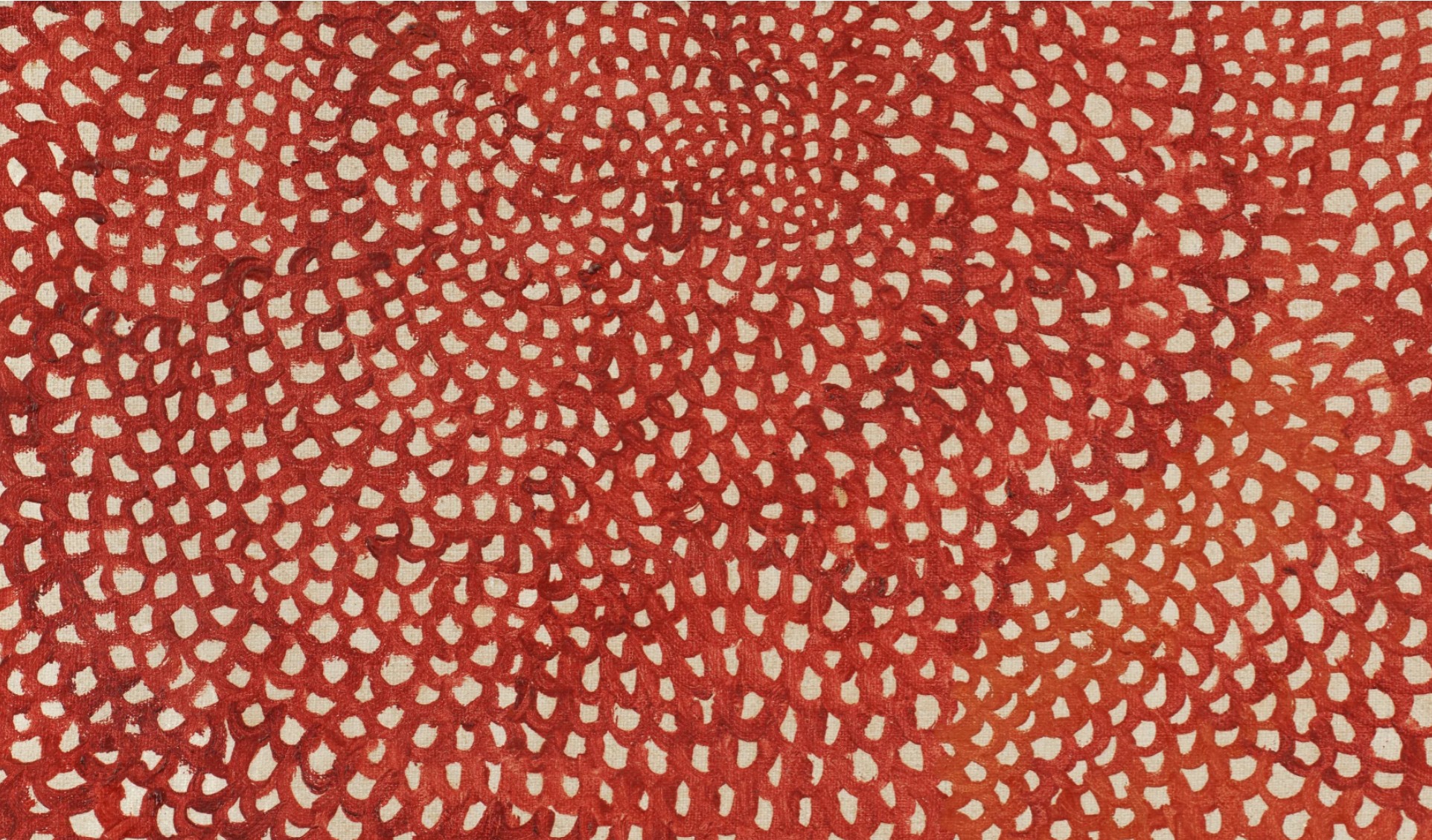
The year 1964 marked a pivotal moment in Kusama’s career. Having gained critical attention from influential dealers such as Richard Castellane and Donald Judd, she presented her first large-scale Infinity Net exhibitions in New York and Tokyo. The Net-Obsession works from this period, smaller in scale yet monumental in conception, bear witness to the transition between her early abstract practice and her later sculptural and performative experiments. In these paintings, the disciplined hand of the abstractionist coexists with the inner compulsion of the visionary. The repetitive act of painting each cell functions as both aesthetic construction and psychological catharsis, blurring the boundary between art-making and survival. Beyond its aesthetic refinement, Net-Obsession holds a deeply autobiographical resonance. Created during a period of intense self-imposed isolation, the work reflects the artist’s attempt to externalize the repetitive hallucinations that had haunted her since childhood. The act of painting thus becomes therapeutic, a disciplined ritual that transforms anxiety into pattern, and pattern into transcendence. Each brushstroke signifies both control and surrender, the conscious and the subconscious held in perfect equilibrium.
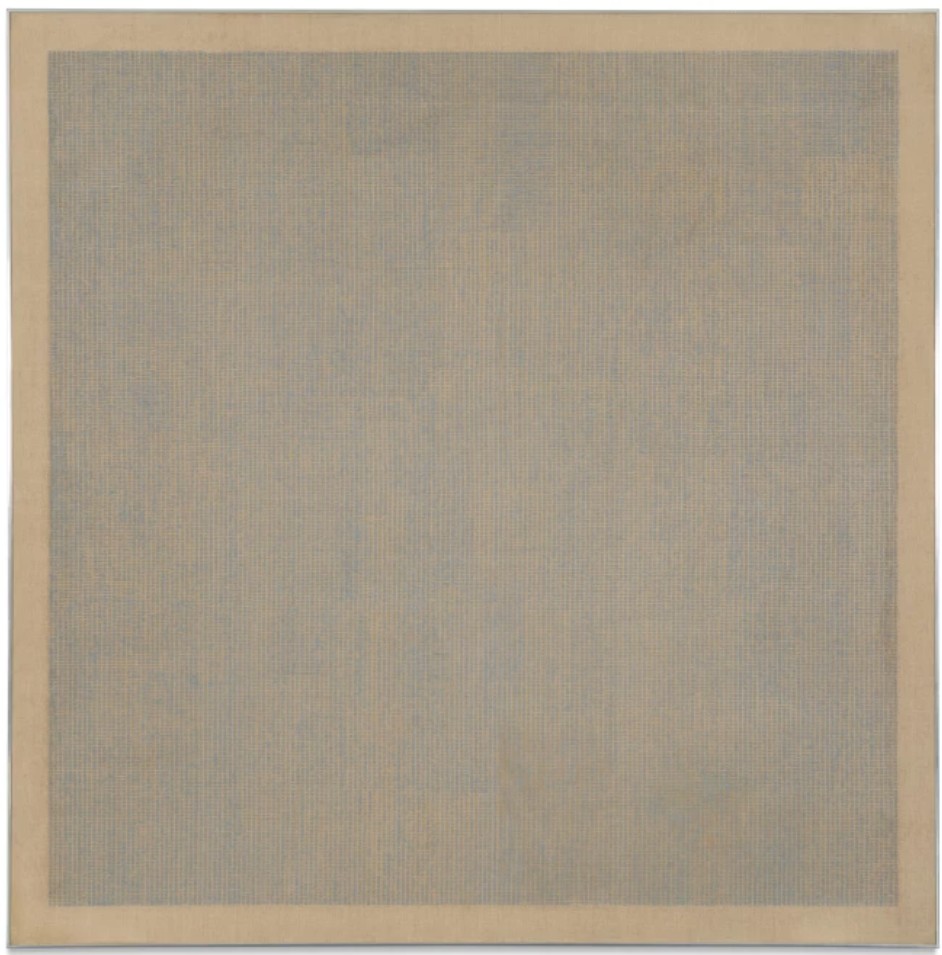
Agnes Martin, Grey Stone II, 1961. Sold at Sotheby’s, New York for $18.7 million in November 2023.
Private Collection. Art © 2025 Estate of Agnes Martin / Artists Rights Society (ARS), New York
Net-Obsession exemplifies the qualities that have made Kusama one of the most influential artists of the postwar era: the capacity to transform personal experience into universal metaphor, and to merge the physical act of painting with the metaphysical pursuit of infinity. In its modest scale and monumental sensibility, the work distills the essence of the Infinity Nets: a vision where repetition becomes revelation, and where the boundaries of the self dissolve into the endless rhythm of the cosmos.
INFINITY-NETS (ORUSB), 2014
Christie’s New-York: 20 November 2025
Estimated: USD 700,000 – 1,000,000
USD 889,000
YAYOI KUSAMA (B. 1929), INFINITY-NETS (ORUSB) | Christie’s
REPEAT SALE
Christie’s London: 9 October 2024
Estimated: GBP 600,000 – 900,000
GBP 781,200 / USD 1,023,372
YAYOI KUSAMA (B. 1929), INFINITY-NETS (ORUSB) | Christie’s (christies.com)
YAYOI KUSAMA (B. 1929)
INFINITY-NETS (ORUSB), 2014
Acrylic on canvas
97.2 x 130.5 cm (38 1/4 x 51 3/8 inches)
Signed, titled and dated ‘ORUSB INFINITY-NETS YAYOI KUSAMA 2014’ (on the reverse)
DOTS-OBSESSION (2WZAB), 2006
Christie’s New-York: 20 November 2025
Estimated: USD 350,000 – 550,000
USD 736,600
YAYOI KUSAMA (B. 1929), DOTS-OBSESSION (2WZAB) | Christie’s
YAYOI KUSAMA (B. 1929)
DOTS-OBSESSION (2WZAB), 2006
Acrylic and glitter on canvas
60.6 x 72.7 cm (23 7/8 x 28 5/8 inches)
Signed, titled in English and Japanese and dated
‘Yayoi Kusama 2006 DOTS-OBSESSION (2WZAB)’
(on the reverse)
Pistils and Stamens, 1990
Property from a Prestigious Private Collector
Sotheby’s New-York: 19 November 2025
Estimated: USD 250,000 – 350,000
USD 317,500
Pistils and Stamens | Contemporary Day Auction | 2025 | Sotheby’s
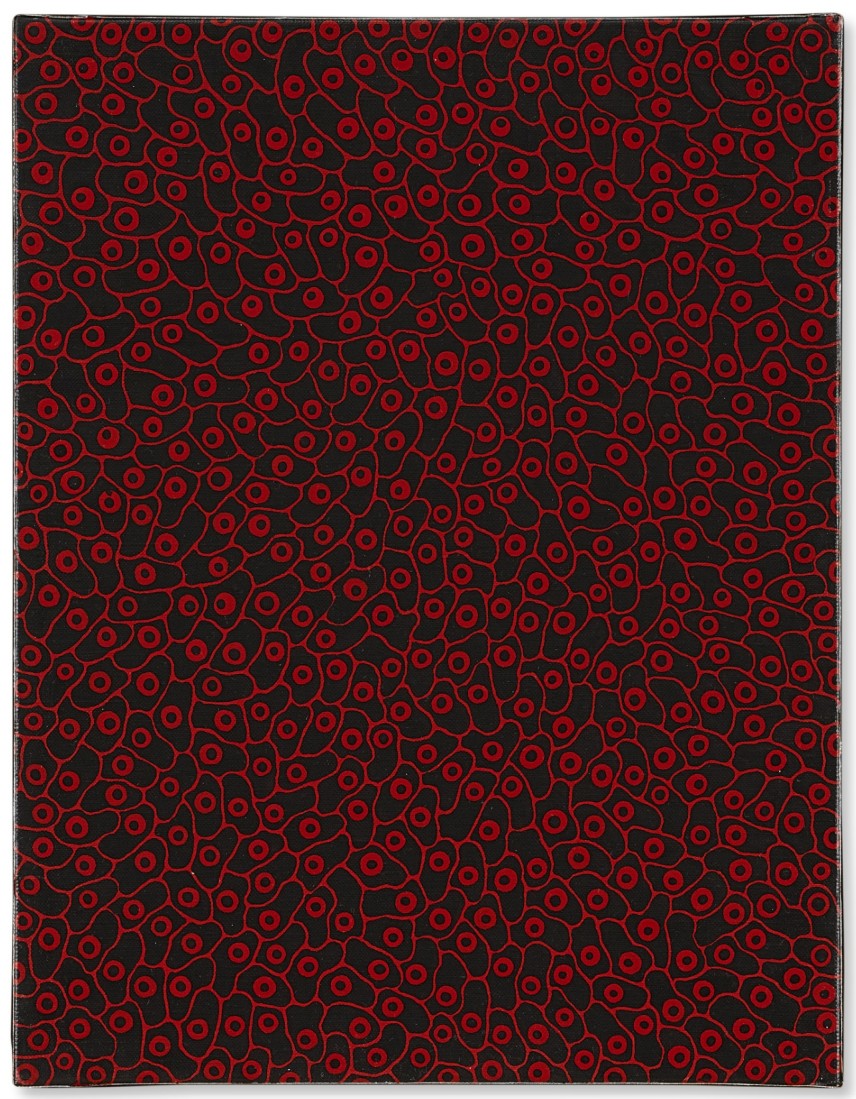
YAYOI KUSAMA (b. 1929)
Pistils and Stamens, 1990
Acrylic on canvas
41 x 31.8 cm (16 1/8 x 12 1/2 inches)
Signed, titled in Kanji and dated 1990 (on the reverse)
Nets 38, 1998
Phillips New-York: 21 November 2025
Estimated: USD 250,000 – 350,000
USD 283,800
Yayoi Kusama Modern & Contemporary Art Day Sale, Morning Session
YAYOI KUSAMA
Nets 38, 1998
Acrylic on canvas
40.6 x 31.8 cm (16 x 12 1/2 inches)
Signed, titled and dated “Yayoi Kusama 1998 Nets 38” on the reverse
Gerhard Richter
PLEASE CLICK ON THE PICTURE BELOW TO ACCESS AUCTION MARKET OVERVIEW
#1. Abstraktes Bild, 2009
Christie’s New-York: 20 November 2025
Estimated: USD 1,800,000 – 2,500,000
USD 2,759,000
GERHARD RICHTER (B. 1932), Abstraktes Bild | Christie’s
GERHARD RICHTER (B. 1932)
Abstraktes Bild, 2009
Oil on Alu-Dibond
83.8 x 83.8 cm (33×33 inches)
Signed, inscribed and dated ‘910-4 Richter 2009’ (on the reverse)
With its charged palette and layered construction, Abstraktes Bild distills over forty years of Richter’s inquiry into abstraction on a single, decisive surface. A fiery red surges across the canvas like molten metal – thickly dragged, folding back into itself. This red does not rest; it seems to move, still cooling from a heated state. As the eye travels downward, the color fractures, revealing sharp contrasts of medallion yellow. Richter stages this intensity against a field of white – not a neutral void, but an active force. Scraped and pulled with a squeegee, the white behaves like a veil, catching on ridges and pigment drags to form a surface reminiscent of weathered wood grain.
Through these striations, faint yellows, mauves, and greens emerge, resisting erasure and asserting presence. The painting is a record of pressure, friction, and hesitation – built through the layering and removal of horizontal strokes. Its brilliance lies in balance: red burns with heat while white breathes across it, cooling and tempering. This visual tension defines the work’s authority and dichotomy.
Gerhard Richter, Tulpen (Tulips), 1995. Private collection. © Gerhard Richter 2025 (0123).
To understand Abstraktes Bild, one must consider the evolution of Richter’s career. Born in Dresden and shaped by the aftermath of World War II, Richter’s early disillusionment with ideology fostered a deliberate detachment that freed him to explore an extraordinary range of styles. Indeed, what distinguishes Richter as one of the greatest living painters is his restless intellectual curiosity and resistance to confinement.
“I have no program, no style, no direction.”
His early photo-paintings blurred photographic clarity with painterly gesture, while his abstractions extended that same inquiry. Both modes are complementary expressions of a single question: how painting can still reveal truth in a post-ideological age.
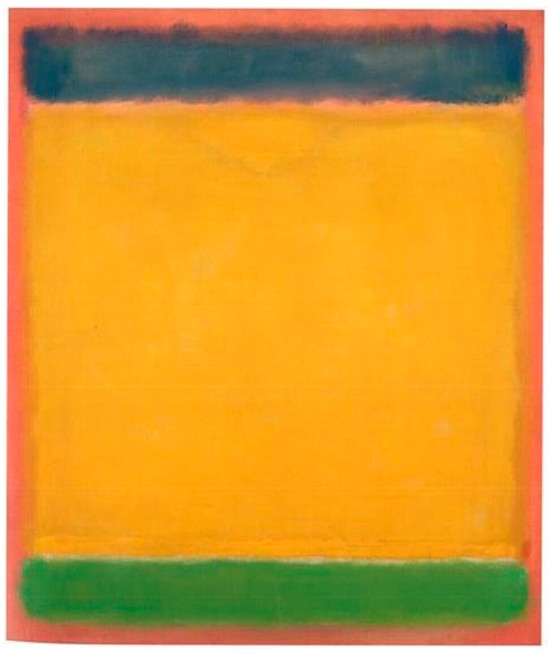
Mark Rothko, Untitled (Blue, Yellow, Green on Red), 1954. Whitney Museum of American Art, New York.
© 1998 Kate Rothko Prizel & Christopher Rothko / Artists Rights Society (ARS), New York.
Richter’s abstractions emerged partly in response to minimalism and color theory. They challenge the assumption that certain colors inherently harmonize. For Richter, any color may coexist with any other; harmony becomes incidental. Abstraktes Bild takes this further, layering red and yellow – two primary hues that pulse against one another – beneath a stark white overlay. Traditionally used to lighten colors, here white remains unblended, allowing softer tones to seep through yet freeze mid-transformation. The result subtly comments on color theory itself, transforming the canvas into a symphony wholly Richterian.
“You can put each color next to any other and it fits… Isn’t that truly anarchic?”
Gerhard Richter in his studio, 1994. Photo: Benjamin Katz.
© 2025 Artists Rights Society (ARS), New York/ VG Bild-kunst, Bonn. Artwork: © Gerhard Richter 2025 (0123).
The composition flirts with geometry: the top edge and outer right margin remain largely untouched by the white overlay, creating a soft structural boundary that frames the central field and exposes the painting’s underlying process. In doing so, Richter disrupts the boundless atmosphere of Rothko’s dissolved edges.
“Rothko’s enormous calm paintings… where any trace of chance is removed.”
For Richter, chance is not eliminated but embraced – scraped layers, drag marks, and chromatic interruptions resist closure. Yet he never relinquishes full control. Each work becomes a negotiation between will and accident.
#2. Abstraktes Bild, 1995
Sotheby’s New-York: 19 November 2025
Estimated: USD 1,200,000 – 1,800,000
USD 1,514,000
Abstraktes Bild | Contemporary Day Auction | 2025 | Sotheby’s
GERHARD RICHTER (b. 1932)
Abstraktes Bild, 1995
Oil on canvas
94 x 66.7 cm (37 x 26 1/4 inches)
Signed twice, dated 1995 and numbered 829-11 (on the reverse)
Painted in 1995, Abstraktes Bild (829-11) stands as a refined and meditative example of Gerhard Richter’s mature abstraction and series of Abstraktes Bilder, an oeuvre that has come to define the intellectual and emotional range of postwar painting. Executed during a pivotal decade in which Richter consolidated the language of his squeegee technique, the present work exemplifies the painter’s unparalleled ability to reconcile chance and control, opacity and luminosity, materiality and illusion.
The surface of Abstraktes Bild (829-11) reveals a dynamic choreography of movement and restraint. Broad, vertical sweeps of the squeegee drag and layer pigment across the canvas, generating translucent veils that alternately obscure and reveal the strata beneath. The palette, consisting of muted blacks, greys, and earthen browns, interrupted by flickers of white and faint teal, suggests both depth and dissolution. In these suspended gestures, Richter transforms the physical act of painting into a meditation on time and perception. Each mark simultaneously builds and erases, invoking the memory of prior states, and what remains is a palimpsest of both intention and accident.
GERHARD RICHTER IN COLOGNE, 1989. IMAGE: © PHOTO BY CHRIS FELVER/GETTY IMAGES ART © GERHARD RICHTER 2025
By 1995, Richter had fully mastered this dialectic between chaos and composition. The Abstraktes Bild paintings of the 1990s mark the culmination of decades of inquiry into the limits of representation. Having moved from photorealism to color charts and grey paintings, Richter turned to abstraction as a means of capturing the ineffable, a visual analogue to experience itself. In the present work, the surface oscillates between painterly gesture and photographic blur, inviting the viewer to navigate between material fact and optical suggestion.
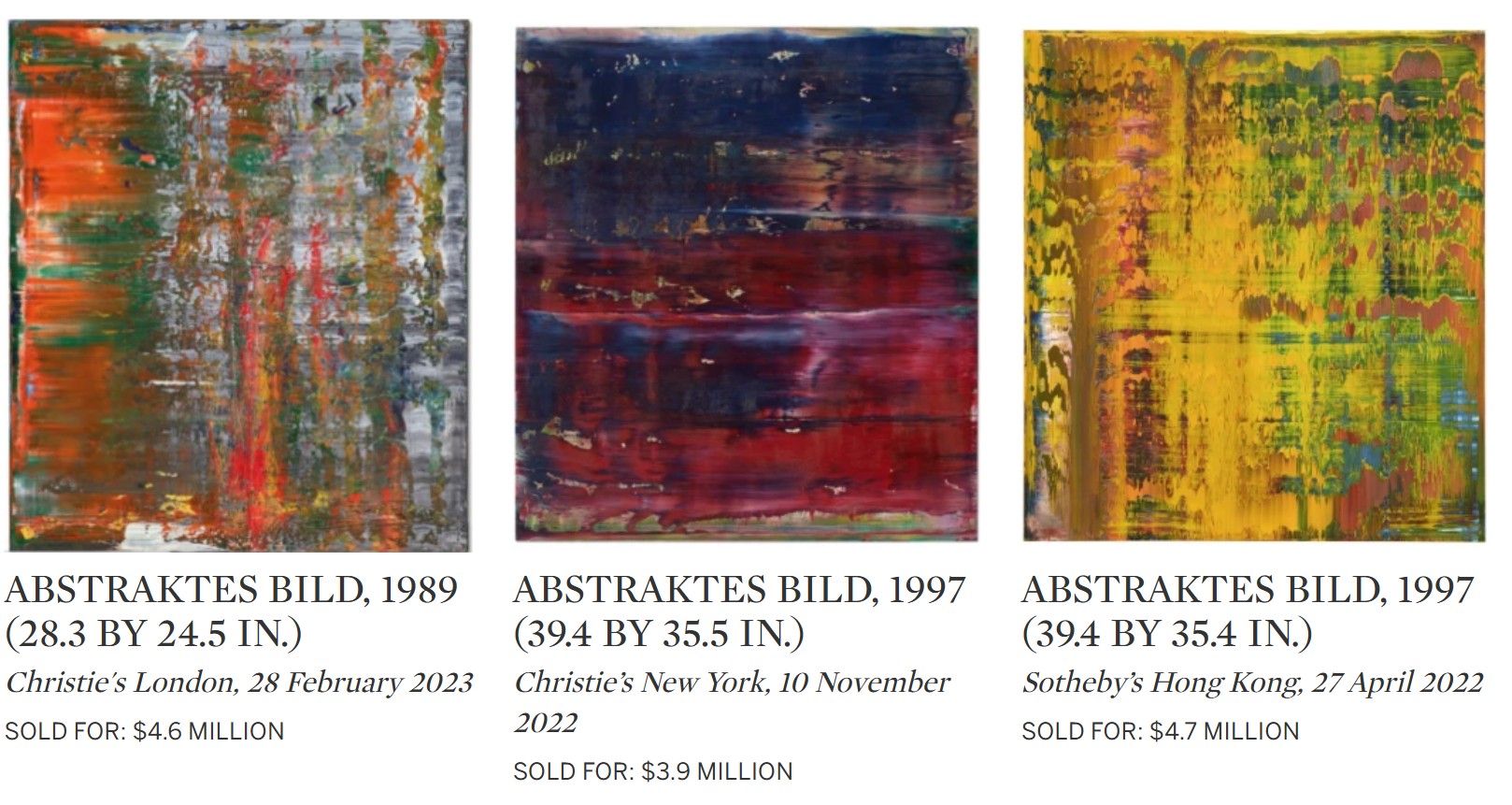
The atmosphere of Abstraktes Bild (829-11) carries the quiet intensity of Richter’s most celebrated canvases from this period, revealing the artist’s orchestration of visual tension where serenity emerges from turbulence. The vertical pulls of pigment create an almost architectural rhythm, recalling the structure of landscape or windowpanes, while the diffused light within the paint conjures a sense of atmosphere that is as much emotional as visual.
Rudolf Stingel, Untitled, 1991. The Whitney Museum of American Art, New York. Art © 2025 Rudolf Stingel
Richter’s achievement lies in his transformation of abstraction into an epistemological exercise, a form of seeing that acknowledges the limits of knowledge. In this respect, his practice finds kinship with Mark Rothko, whose color fields evoke spiritual depth through chromatic vibration, and Jackson Pollock, whose gestural networks similarly balance control and surrender. Yet Richter’s process remains uniquely his own: where Rothko dissolved form into aura and Pollock externalized gesture, Richter internalizes the act of painting, using the mechanics of removal to generate presence.
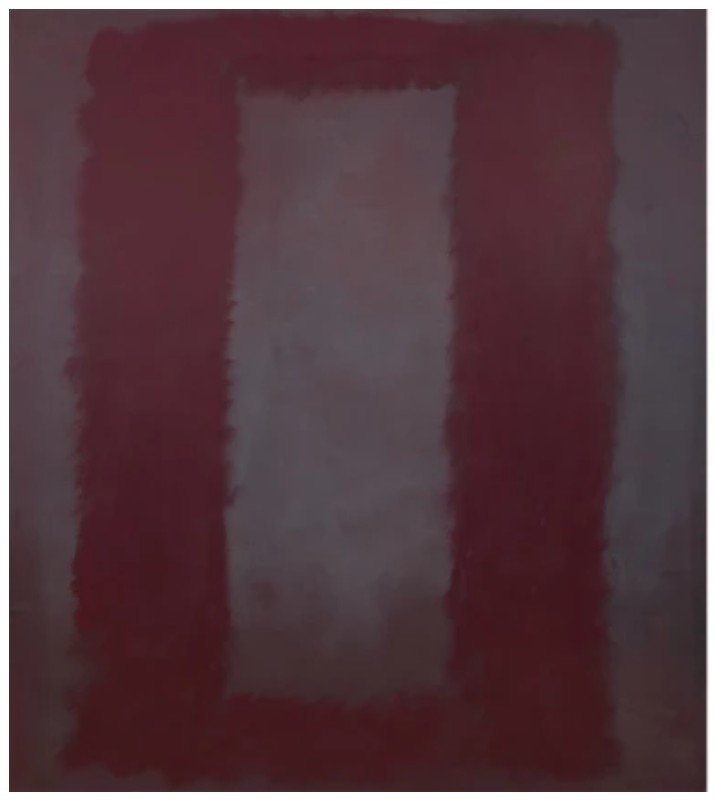
Mark Rothko, Red on Maroon, 1959. Tate London.
Art © 2025 Kate Rothko Prizel & Christopher Rothko / Artists Rights Society (ARS), New York
In its layered veils and restrained chromatic range, Abstraktes Bild (829-11) epitomizes the silent grandeur of Richter’s abstraction. The painting invites the viewer to dwell within uncertainty, to perceive the beauty of flux and the eloquence of what cannot be fixed. As both image and object, it reflects the paradox at the core of Richter’s art: the simultaneous pursuit of control and the acceptance of its impossibility. In its quiet gravity and material grace, the work stands as a testament to painting’s continued power to evoke mystery in the age of mechanical reproduction.
#3. Iblan, 2009
Christie’s New-York: 20 November 2025
Estimated: USD 800,000 – 1,200,000
USD 1,270,000
GERHARD RICHTER (B. 1932), Iblan | Christie’s
GERHARD RICHTER (B. 1932)
Iblan, 2009
Trevira CS, cotton, wool, silk and acrylic Jacquard-woven tapestry
271.8 x 368.3 cm (107×145 inches)
Signed and numbered ‘4⁄8 Richter’ (on a fabric label affixed to the reverse)
This work is number four from an edition of eight plus two artist’s proofs
#4. War Cut II, 2005
Christie’s New-York: 20 November 2025
Estimated: USD 100,000 – 150,000
USD 266,700
GERHARD RICHTER (B. 1932), War Cut II | Christie’s
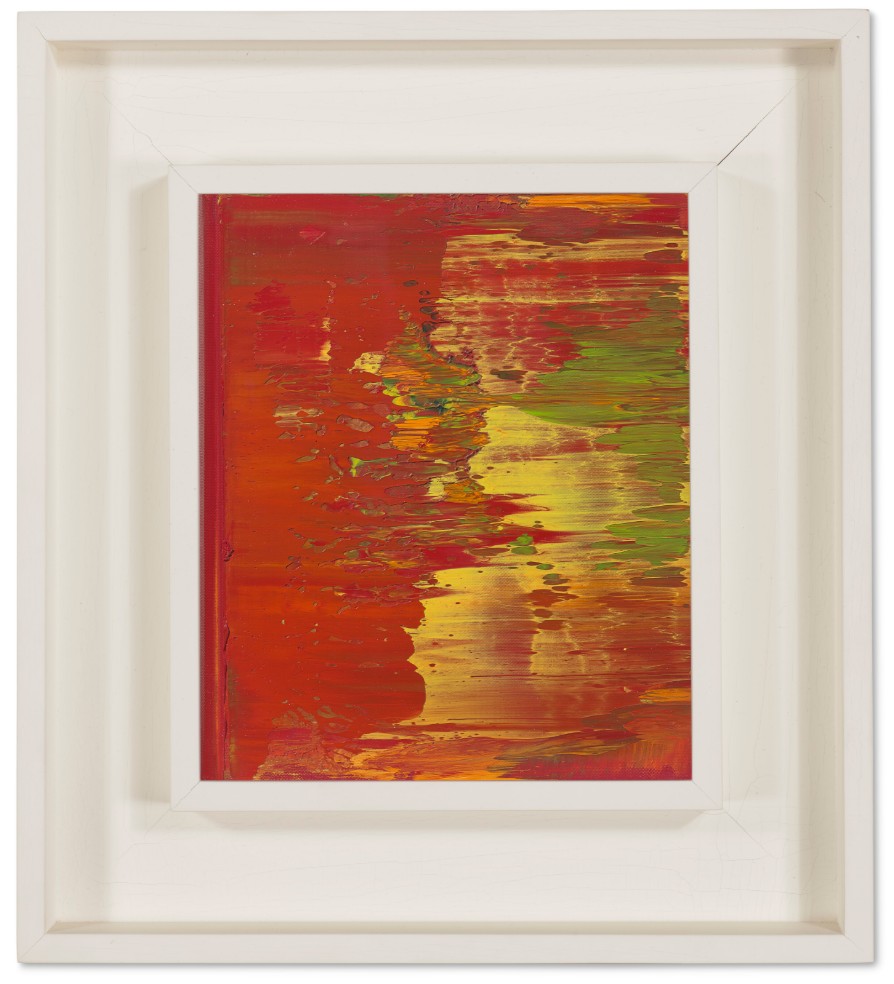
GERHARD RICHTER (B. 1932)
War Cut II, 2005
Oil on artist’s book
25.5 x 21.6 x 2.5 cm (10 x 8 1/2 x 1 inches)
Signed, inscribed, numbered and dated ‘8⁄30 F Richter 2005’ (on the inside front cover)
Signed again, numbered again and dated again ‘8 Richter 2005’ (on the reverse of the colophon page)
This work is number eight from an edition of 30 unique hand-painted variants
Untitled (Paris), 1991
Sotheby’s New-York: 19 November 2025
Estimated: USD 35,000 – 45,000
USD 57,150
Untitled (Paris) | Contemporary Day Auction | 2025 | Sotheby’s
GERHARD RICHTER (b. 1932)
Untitled (Paris), 1991
Oil on chromogenic print
20.6 x 29.5 cm (8 1/8 x 11 5/8 inches)
Signed and dated 8.4.91 in pencil (lower right)
Dated 8.4.91 in pencil (on the reverse)
Executed in 1991, this work is unique
Abstraktes Bild, 1999
Christie’s New-York: 20 November 2025
Estimated: USD 700,000 – 1,000,000
PASSED
GERHARD RICHTER (B. 1932), Abstraktes Bild | Christie’s
GERHARD RICHTER (B. 1932)
Abstraktes Bild, 1999
Oil on canvas
51×41 cm (20×16 inches)
Signed, inscribed and dated ‘862-1 Richter 1999’ (on the reverse)
Gerhard Richter’s sustained interrogation of the limits of painting and abstraction finds striking expression in the present Abstraktes Bild, executed with the artist’s signature squeegee technique. For Richter, the act of painting represented both a possibility and a constraint, a paradox that underpins the Abstraktes Bild series. His method is defined by the accumulation of successive layers of paint, applied and allowed to dry at varying rates before being drawn across the surface with a squeegee from the edges of the canvas inward.
This process resists the conventions of brushwork and gesture, generating a surface that is wholly abstract yet singularly self-contained. In so doing, Richter situates the series within a broader intellectual discourse on what he thought to be the “difficulties in justifying contemporary painting” (B. Söntgen, “Work on the Picture: The Discretion of Gerhard Richter,” in Gerhard Richter: Large Abstracts, Ostfildern 2008, p. 36.”). The present work epitomizes this dialogue, exemplifying the hallmarks of the series’ process while simultaneously questioning the role of the artist’s hand through calculated intervention and erasure.
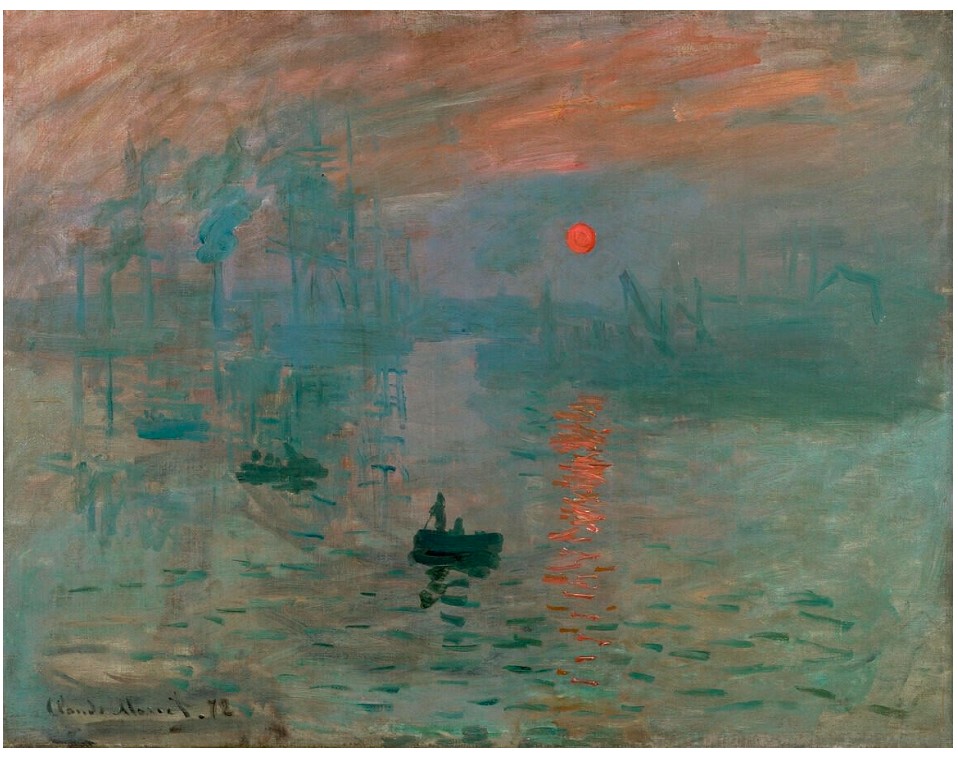
Claude Monet, Impression, Sunrise, 1872. Musée Marmottan, Paris.
Formally, the composition unfolds through rich, jewel-toned contrasts. Broad passages of maroon sweep across the surface, merging with deeper ceruleans concentrated along the right edge. At the center, a luminous field of titanium white dominates, layered with gradients of carmine and sharpened by accents of vermilion. Where the white drags over underlying layers, it pools with cerulean to form traces of desaturated blue—moments of visual tension that interrupt the surface before dissolving into darker tones. Beneath the central white expanse, faint striations introduce muted olive greens that mingle with maroon and blue, creating a refractive, mirage-like effect reminiscent of sunlight glancing across water. This optical play recalls Claude Monet’s Impression, Sunrise, where darker hues are lifted by the reflection of a single, radiant point of light. The painting thus merges the precision of Richter’s technique with an impressionistic sensitivity to color and illumination.
Lucio Fontana, Concetto spaziale, Attese, 1966. © 2025 Artists Rights Society (ARS), New York / SIAE, Rome.
On the left side of the canvas, a distinct energy takes hold. Here, deliberate painterly gestures emerge, pushing against the typically agestural surface of the Abstraktes Bild and transforming the squeegee marks into a secondary ground. Vertical strokes in red and blue move upward, blending layers of pigment into a rhythm of contrasting hues. These movements, echoed by later strikes that mix white and red, assert the artist’s presence within an otherwise mechanized process. The resulting tension between control and spontaneity recalls Lucio Fontana’s Concetto Spaziale, Attese, where incisions open the pictorial field to new spatial depth. In the present work, Richter’s interventions achieve a similar effect: the surface becomes animated and immediate, revealing a rare intimacy that distinguishes this Abstraktes Bild within the series.
Joseph Mallord William Turner, Rockets and Blue Lights (Close at Hand) to Warn Steamboats of Shoal Water, 1840.
Clark Art Institute, Williamstown.
Richter’s turn to abstraction in the postwar period marked a decisive engagement with the metaphysical possibilities of painting. After early experiments with photography and drawing, he developed the Abstraktes Bild series in 1991 as a sustained investigation into color, perception, and the limits of representation. Through these works, Richter explored transcendental ideas—particularly the sublime—using abstraction as a means of approaching what cannot be directly perceived. He described his paintings as “fictive models… [that] make visible a reality that we can neither see nor describe, but whose existence we can postulate” (G. Richter, “Text for catalogue of documenta 7,” in H. U. Obrist (ed.), The Daily Practice of Painting: Writings and Interviews 1962–1993, Cambridge, Mass., 1995, p. 100). The present lot exemplifies this sensibility: the jewel-like reds and blues evoke a sublimity reminiscent of Romantic painting. The effect recalls J. M. W. Turner’s Rockets and Blue Lights (Close at Hand) to Warn Steamboats of Shoal Water, where the play between turbulence and calm is fractured by the pale glow of dawn. Similarly, Richter’s modulated fields of white, blue, and green, accented by burnt umber and russet, convey a sense of shifting luminosity and depth. In this synthesis of control and chance, the painting affirms Richter’s enduring pursuit of a visual language capable of articulating realities beyond immediate perception.
Pierre Soulages
Peinture 161 x 200 cm, 14 novembre 1958
The Collection of Robert F. and Patricia G. Ross Weis
Christie’s New-York: 17 November 2025
Estimated: USD 5,000,000 – 7,000,000
USD 4,955,000
PIERRE SOULAGES (1919-2022), Peinture 161 x 200 cm, 14 novembre 1958 | Christie’s
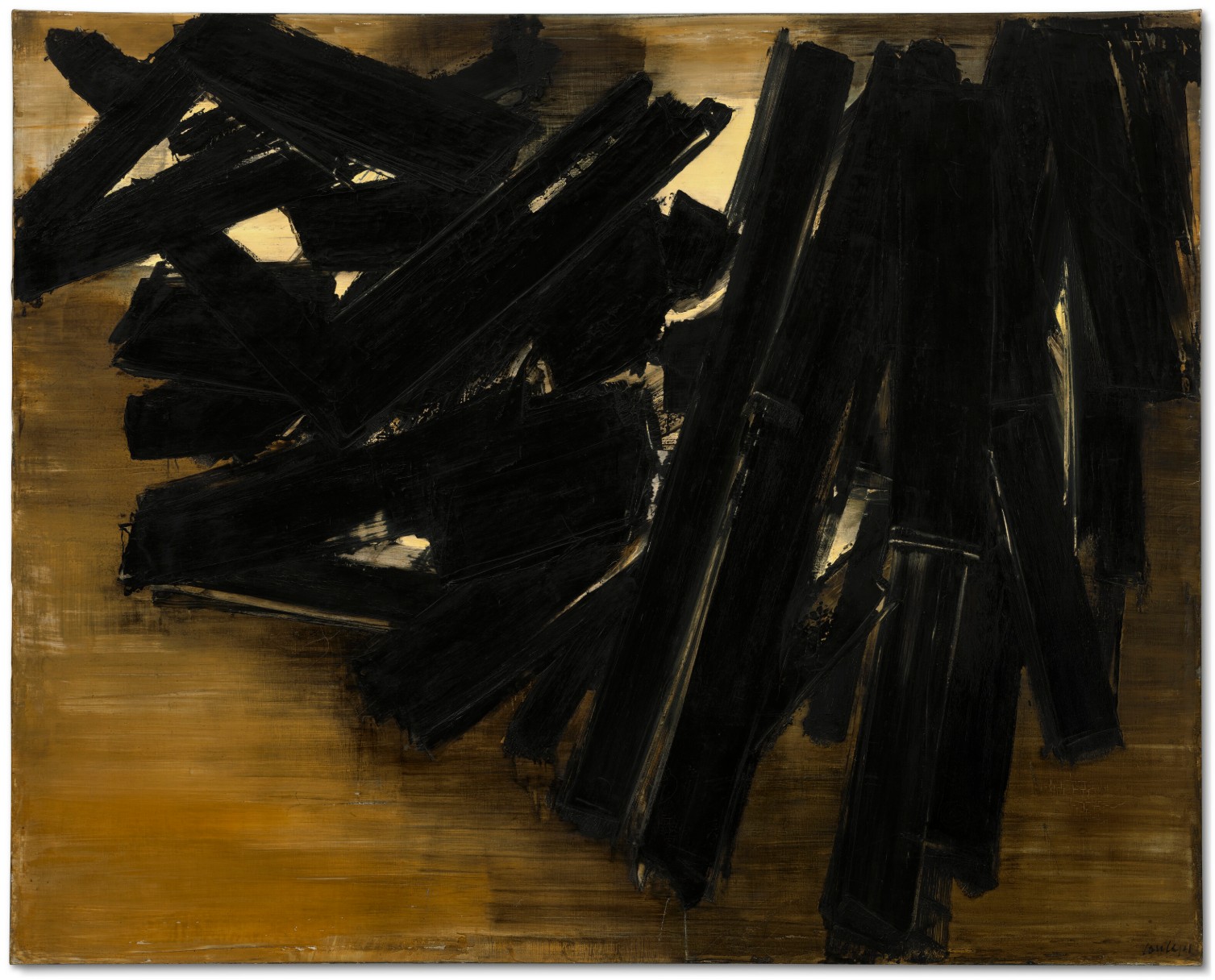
PIERRE SOULAGES (1919-2022)
Peinture 161 x 200 cm, 14 novembre 1958
Oil on canvas
161.9 x 201.6 cm (63 3/4 x 79 3/8 inches)
Signed ‘Soulages’ (lower right)
Signed again and dated ‘SOULAGES 58’ (on the reverse)
Signed thrice, partially titled and dated again ‘SOULAGES “Peinture” 14 nov 58’ (on the stretcher)
Painted in 1958
Not exhibited publicly since its debut at Samuel Kootz’s gallery in 1959, Pierre Soulages’s exceptional masterpiece, Peinture 161 x 200 cm 14 novembre 1958, encapsulates the distinctive and highly original character that defines the French artist’s painterly abstractions. One of the leading figures of postwar European abstraction, Soulages developed a unique approach to painting that emphasized the interplay of light and material, form and void, gesture and control. His works are known for their striking, elemental force—structures of darkness punctuated by flashes of color and luminescent transparency.
Dating from a crucial period in Soulages’s career, Peinture 161 x 200 cm 14 novembre 1958 is a masterful example of his raclage technique, a method that involved scraping away layers of pigment to reveal unexpected color relationships and depths. By the late 1950s, Soulages had moved beyond the bold, interlocking black forms of his earlier work and was pioneering a complex process of layering and excavation. Rather than applying color in a straightforward manner, he built up multiple strata of paint, only to then scrape and manipulate them to uncover luminous variations of tone. This meticulous, almost archaeological process gave his works a depth and intensity that set them apart from those of his contemporaries.
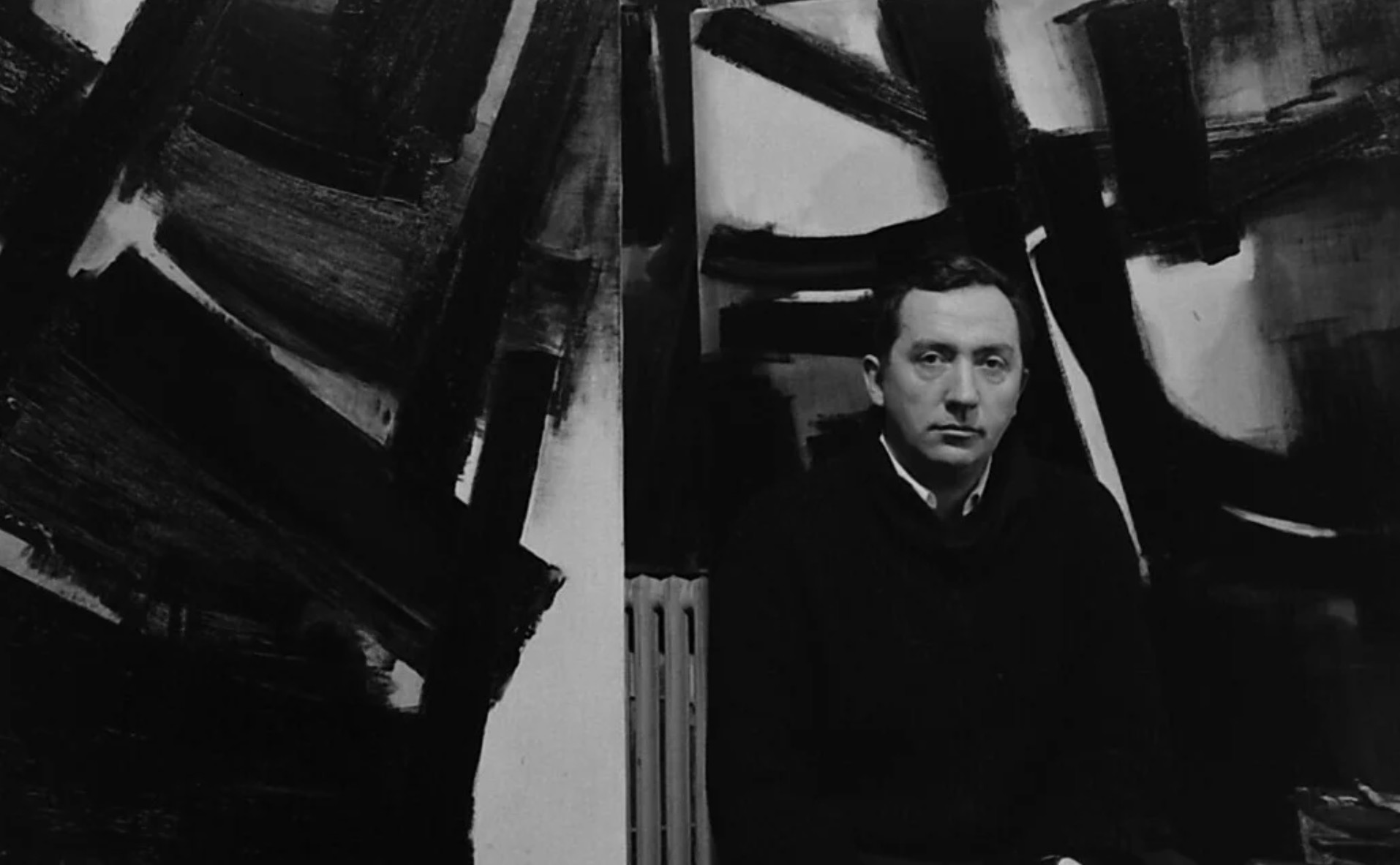
Pierre Soulages, United States, circa 1955. Photo: Dmitri Kessel / The LIFE Picture Collection via Getty Images.
Artwork: © 2025 Artists Rights Society (ARS), New York / ADAGP, Paris.
Pierre Encrevé, the author of Soulages: L’œuvre complet, Peintures I. 1946-1959, describes this phase as a defining moment in the artist’s development: “The years 1957-1963 particularly illustrate one of Soulages’s characteristic techniques in the double treatment of the surface: that of scraping, or, if one prefers, transparency through uncovering. On the prepared canvas (primed in white), he applies a layer of paint covering part or all of the surface, upon which he superimposes, while the paint is fresh, one or more layers of different color. He then uncovers a part of the background using the same soft-bladed spatulas that he more often loads with black paint: according to the power and the shape of the movement, this scraping will remove paint all the way down to the canvas, or only as far as one of the intermediate layers. A subtle mixture of the different layers’ colors are created, each time surprising for the painter himself; infinite variations of color are discovered on the canvas; new luminosities, and unexpected color intensities through transparencies of black … red, blue, and yellow ochre seem Soulages’s colors of choice for neighboring with large surfaces of black, at the same time as he uses them to create these mixtures, these disappearances-reappearances under the blade-scraped veils of black where the ‘transfigured’ color acquires a presence of a very particular emotional intensity” (P. Encrevé, “Le noir et l’outrenoir,” in Soulages: Noir Lumière, exh. cat. Musée d’Art Moderne de la Ville de Paris, 1996, p. 30).
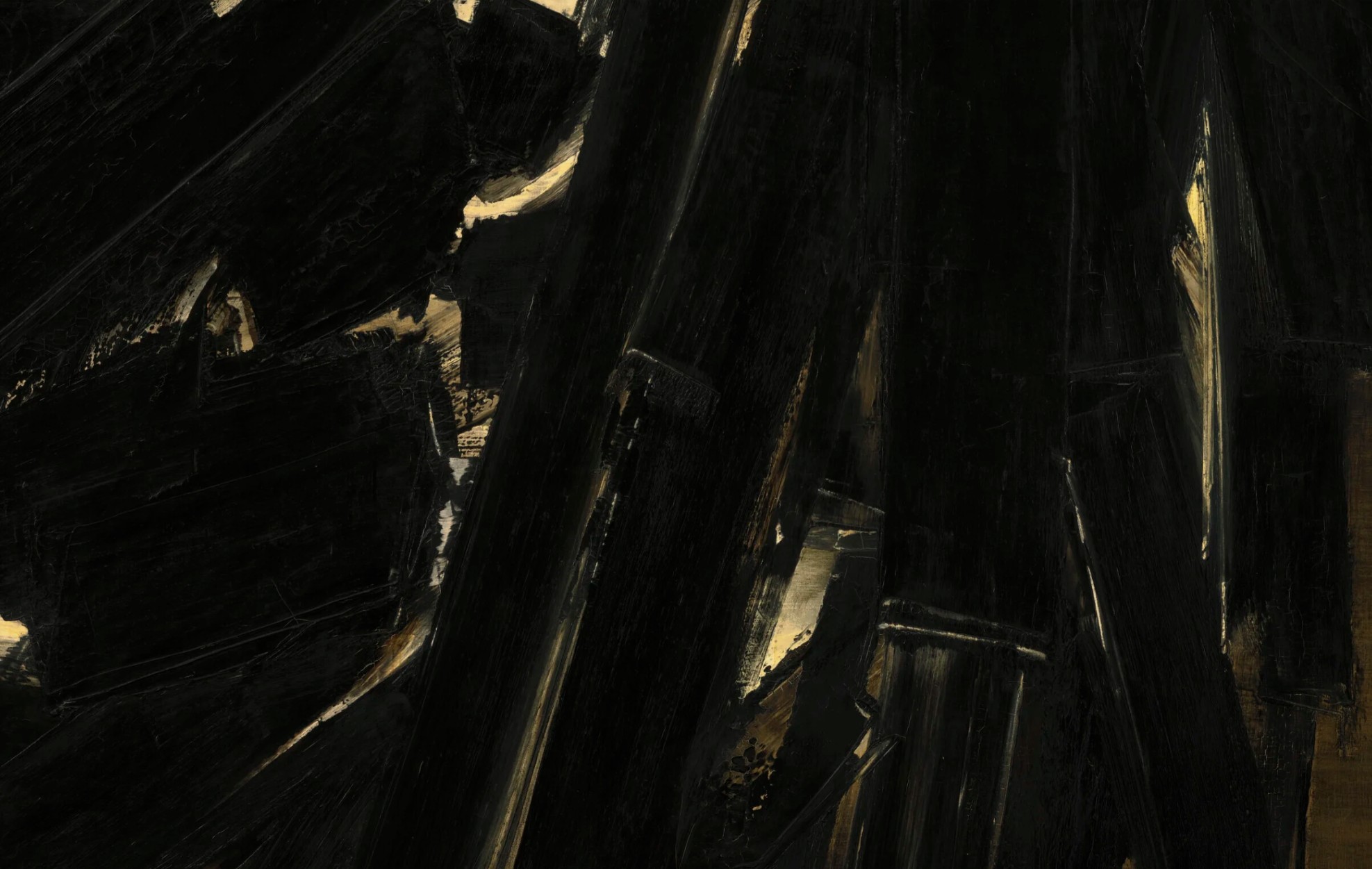
Painted in the airy rue Galande studio that Soulages moved into in 1957 and occupied for nearly two decades, Peinture 161 x 200 cm 14 novembre 1958 reflects an artist at the height of his powers. Though he had yet to achieve widespread acclaim in France, Soulages was already a celebrated figure in the American art world, where his work resonated with the avant-garde currents of the time. Soulages’s first visited New York in November 1957—exactly a year before the present work was painted—for his solo exhibition at Kootz Gallery, marking a turning point in his international reputation. The French painter received warm receptions at the Museum of Modern Art and the Solomon R. Guggenheim Museum, and he quickly developed friendships with leading artists such as Mark Rothko, Willem de Kooning, Robert Motherwell, and Franz Kline. This cross-cultural exchange placed him at the center of one of the most dynamic artistic dialogues of the twentieth century.
Despite these associations, Soulages maintained a strong sense of independence from the Abstract Expressionist movement. While many critics drew comparisons between his work and that of the New York School, he resisted such categorization, emphasizing his distinct approach to abstraction. When Robert Motherwell asserted that Abstract Expressionism could only be truly understood by Americans, Soulages famously countered:
“An art should be understood, loved, and shared by anyone, anywhere in the world. That we are marked by the culture in which we have grown up and lived, that’s part of us, very obviously. But I believe that in art, there are fundamentally only personal adventures that go beyond the individual, and even beyond his culture.”
This belief underscores the universal language that Soulages sought to create through his work, one that transcended national or stylistic boundaries.
James Johnson Sweeney, the director of the Guggenheim Museum and one of Soulages’s earliest champions, memorably wrote: “A painting by Pierre Soulages is like a chord on a vast piano struck with both hands simultaneously—struck and held” (J. Johnson Sweeney, Pierre Soulages, New York, 1972, p. 5). This powerful metaphor captures the sustained, resonant impact of Soulages’s work. Unlike the gestural sequences of Abstract Expressionism, Peinture 161 x 200 cm 14 novembre 1958 does not narrate an emotional journey or invite a temporal reading of the artist’s psyche. Instead, it presents itself as a singular, unified presence—an event in and of itself. It is neither lyrical nor sentimental; rather, it is a composition of pure structural energy.
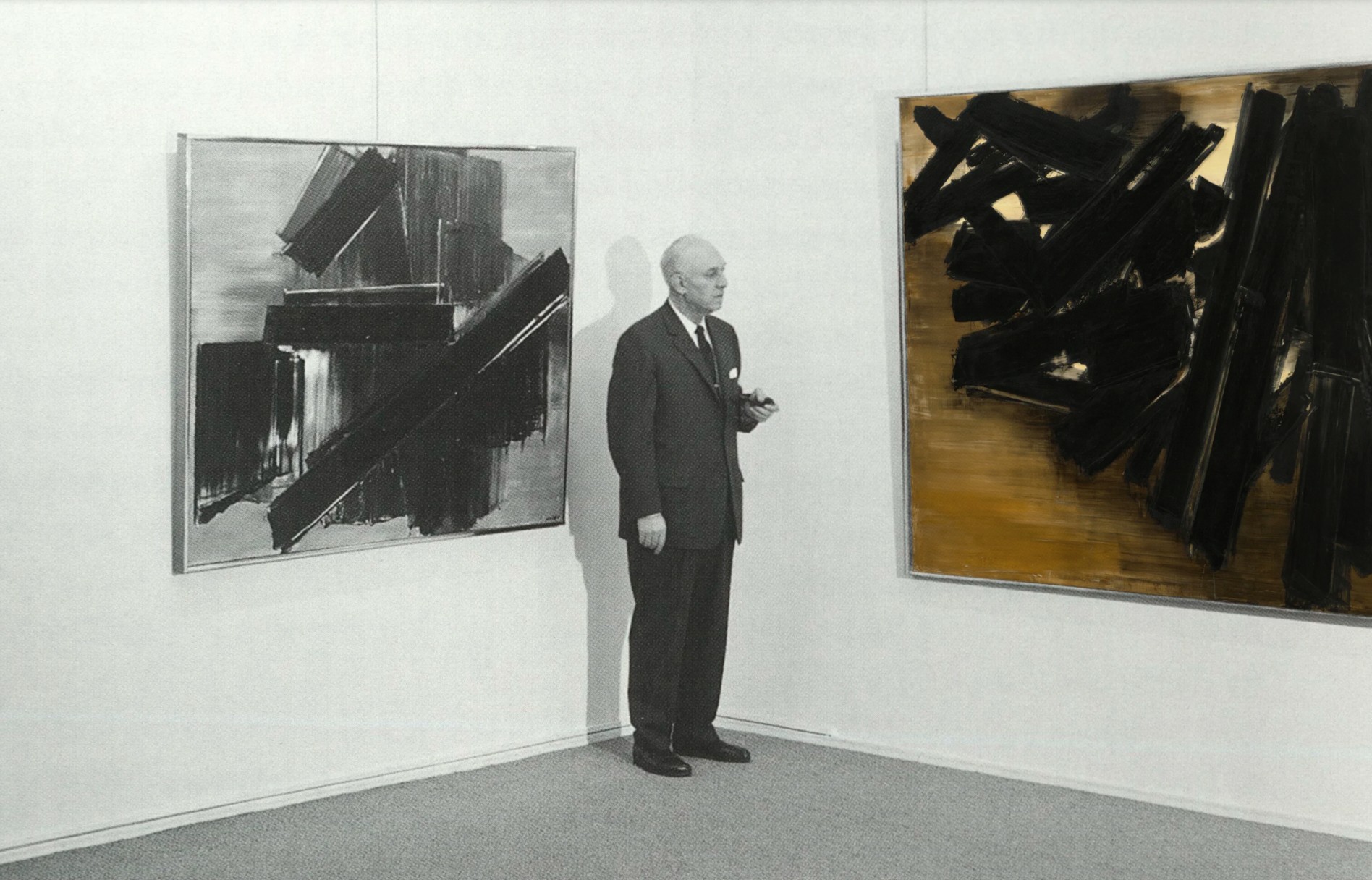
Samuel Kootz in his gallery during the exhibition Soulages, 1959 (present lot illustrated). Photographer unknown. Artwork: © 2025 Artists Rights Society (ARS), New York / ADAGP, Paris.
Central to Soulages’s philosophy was his rejection of traditional notions of artistic intention. He did not begin a painting with a preconceived image in mind but instead responded to the evolving interplay of material, light, and form. “Rather than movement, I prefer to talk of tension,” he explained. “And rhythm, yes. We can also say form: a shaping of matter and light” P. Soulages, quoted in “Les instruments de la peinture,” in Pierre Soulanges: Outrenoir, op. cit., p. 92). His use of house painters’ brushes and wide, flat scraping tools—many of which he designed himself—further distanced his work from the gestural expressiveness of his American counterparts. Instead of emphasizing the personal trace of the artist’s hand, Soulages sought to create compositions that stood independently of his own subjectivity.
This approach extended to his views on interpretation. He insisted that his paintings could evoke different responses depending on the viewer’s own experience and perception. “My pictures are poetic objects capable of receiving what each person is ready to invest there according to the ensemble of forms and colors that is proposed to him,” he once explained. “As for me, I don’t know what I am looking for when painting. Picasso said: ‘I do not search, I find.’ My attitude is a bit different: it’s what I do that teaches me what I’m looking for” (P. Soulages, quoted in ‘Peindre la peinture’, op. cit., p. 14).
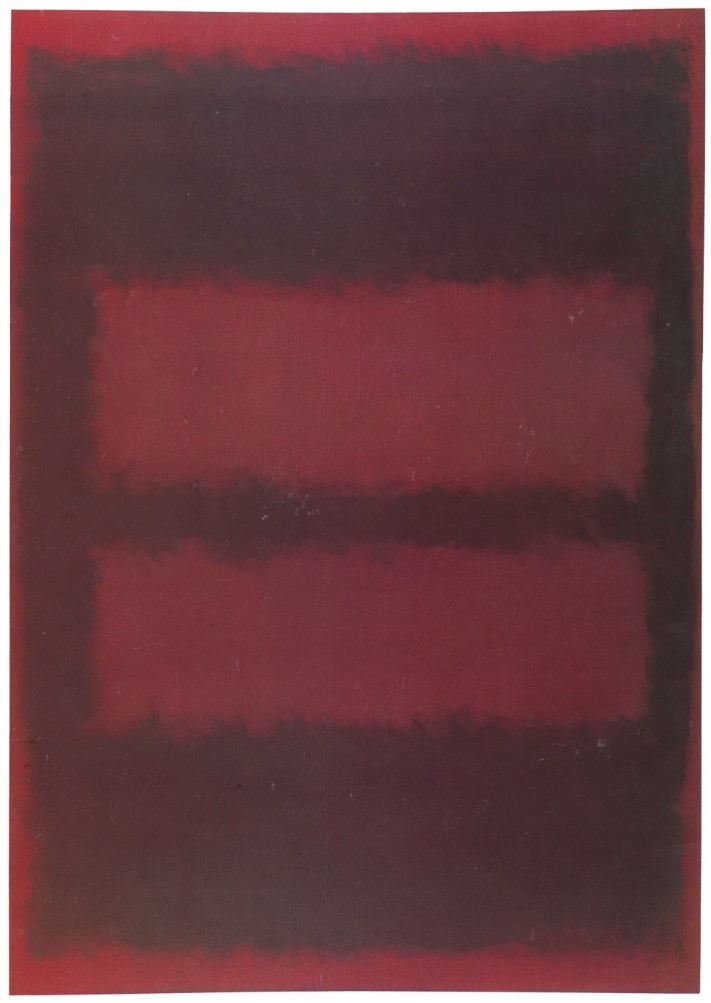
Mark Rothko, Black on Maroon, 1958. Tate, London.
© 1998 Kate Rothko Prizel & Christopher Rothko / Artists Rights Society (ARS), New York, NY.
This philosophy positions Soulages’s work within a broader lineage of modernist experimentation, where the act of painting becomes a dialogue between artist and medium. His technique of layering and excavation suggests an almost sculptural approach to the canvas, one that engages with depth, transparency, and the physicality of paint in a uniquely tactile way. Peinture 161 x 200 cm 14 novembre 1958 is an eloquent testament to this process, revealing in its scraped surfaces and layered color a history of decisions, revisions, and discoveries.
More than six decades after its creation, Peinture 161 x 200 cm 14 novembre 1958 remains a powerful statement of Soulages’s artistic vision. In its bold contrasts, rhythmic interplay of forms, and luminous depths, the painting embodies the essential qualities that have made Soulages one of the most enduring and influential figures in modern abstraction. It stands as both a historical artifact of a pivotal moment in twentieth-century art and a timeless meditation on the fundamental forces of light, matter, and perception.
Alex Katz
PLEASE CLICK ON THE PICTURE BELOW TO ACCESS AUCTION MARKET OVERVIEW
#1. Thai Restaurant, 1980
Christie’s New-York: 20 November 2025
Estimated: USD 600,000 – 800,000
USD 850,900
ALEX KATZ (B. 1927), Thai Restaurant | Christie’s
ALEX KATZ (B. 1927)
Thai Restaurant, 1980
Oil on linen
72×96 inches (182.9 x 243.8 cm)
“Katz’s portraits are true to the way we experience others. They eloquently convey the tension between the determinate outer appearance and the indeterminate inner reality of someone known only from the outside… For all their everydayness, Katz’s figures have an air of transient strangeness to them, suggesting the mystery of their inner existence, perhaps even to themselves.”
Donald Kuspit
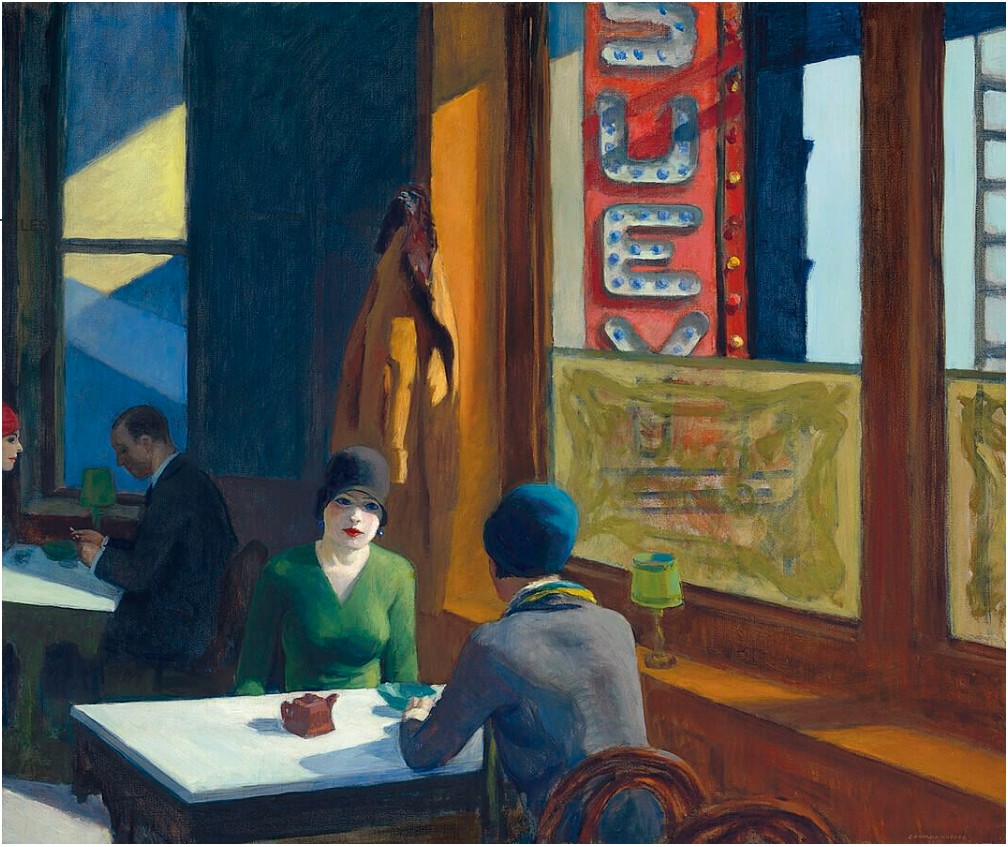
Edward Hopper, Chop Suey, 1929. Christie’s, New York, 13 November 2018, $91,875,000, auction record for the artist. © 2025 Heirs of Josephine Hopper / Licensed by VAGA at Artists Rights Society (ARS), NY
#2. Sarah, 2005
Property from an Important European Collection
Phillips New-York: 19 November 2025
Estimated: USD 400,000 – 600,000
USD 709,500
Alex Katz Modern & Contemporary Art Evening Sale featuring Cera the Triceratops
ALEX KATZ
Sarah, 2005
Oil on linen
60 1/8 x 84 1/8 inches (152.7 x 213.7 cm)
Signed and dated “Alex Katz 05” on the overlap
Alex Katz’s Sarah, painted in 2005, exemplifies the artist’s signature clarity and restraint. Against a vivid, flat green ground, the sitter’s face and hair are isolated in a simplified composition that heightens her quiet intensity. Katz defines her features with crisp contours and smooth, unmodulated color, eliminating surface texture in favor of precision and light. Shown in three-quarter profile, Sarah’s gaze drifts just beyond the viewer—vacant yet intent—inviting attention while withholding connection. The close crop and shallow depth draw her startlingly near, yet the stylized reduction of form keeps her at a remove. This paradox of intimacy and distance lies at the heart of Katz’s distilled approach to portraiture, where surface clarity becomes a means of abstraction and the figure assumes the iconic stillness of an image.
“I like to make an image that is so simple you can’t avoid it,
and so complicated you can’t figure it out.”
Amedeo Modigliani, Jeanne Hébuterne, 1919. The Metropolitan Museum of Art, New York.
Image: The Metropolitan Museum of Art, New York, Gift of Mr. and Mrs. Nate B. Spingold, 1956
Katz approaches painting as a means to capture what he describes as the “velocity” of an image—the sensation of life unfolding in real time. He describes his work as a kind of realism suited to the present, explaining,
“My contention is that my paintings are as realistic as Rembrandt’s… Realism’s a variable. The highest thing an artist can do is to make something that’s real for his time.”
In Sarah, that conviction manifests through tempo rather than detail: the measured rhythm of line and color conveys the quickness of observation stilled in paint. Rejecting the traditional aims of portraiture, Katz focuses not on psychological likeness, but on perception itself, presenting an image pared to its essential forms. As he has often maintained, his goal is not to tell a story but to create a moment, a pause in which seeing becomes its own subject. Katz’s pursuit of capturing “things quickly passing” is keenly felt in Sarah, where swiftly observed moments and particular conditions of light convey appearances as they are both felt and perceived in the immediacy of “the present tense,” the now.
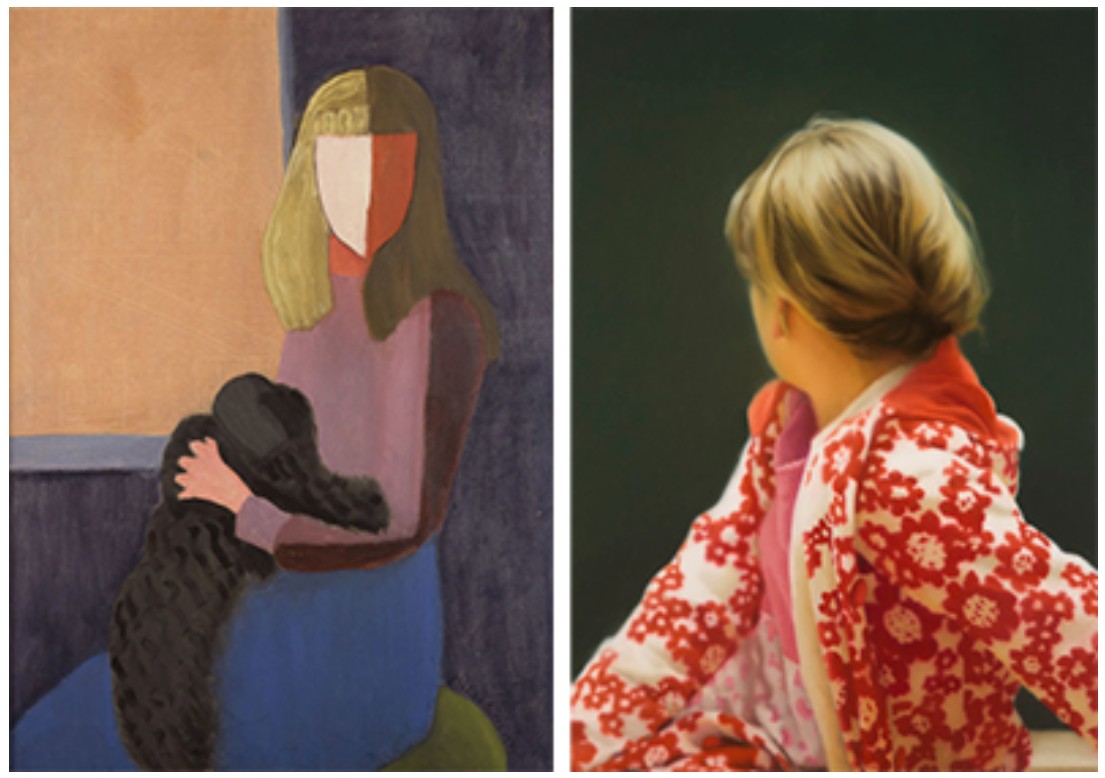
[Left] Milton Avery, Seated Girl with Dog, 1944. Collection Friends of the Neuberger
Museum of Art, Purchase College, State University of New York. Gift from the Estate of Roy R. Neuberger. Artwork: © 2025 Milton Avery Trust / Artists Rights Society (ARS), New York
[Right] Gerhard Richter, Betty, 1988. Saint Louis Art Museum, Missouri. Image/Artwork: © Gerhard Richter 2025 (0124)
Katz’s distilled aesthetic is the result of a meticulously honed process that merges classical methodologies with modern sensibilities. He begins with pencil drawings and oil sketches, then enlarges his compositions using the Renaissance cartoon technique, transferring outlines to canvas to ensure accuracy without sacrificing freshness. His paint application follows an alla prima (wet-on-wet) technique, allowing broad, fluid brushstrokes that preserve the lucid precision of his vision while maintaining the structural integrity of form. The elimination of surface detail, combined with the precise orchestration of light and shadow, yields a composition of remarkable stillness and clarity—a synthesis of spontaneity and control.
Born in Brooklyn in 1927 to Russian émigré parents, Katz studied at The Cooper Union and the Skowhegan School of Painting and Sculpture, where he formulated his commitment to figuration amid the dominance of Abstract Expressionism. Rejecting the gestural intensity of his contemporaries, he sought a visual language grounded in surface, light, and appearance rather than in emotion or gesture. This countercurrent position, while radical at mid-century, became foundational to a renewed interest in realism and the figure in postwar American art.
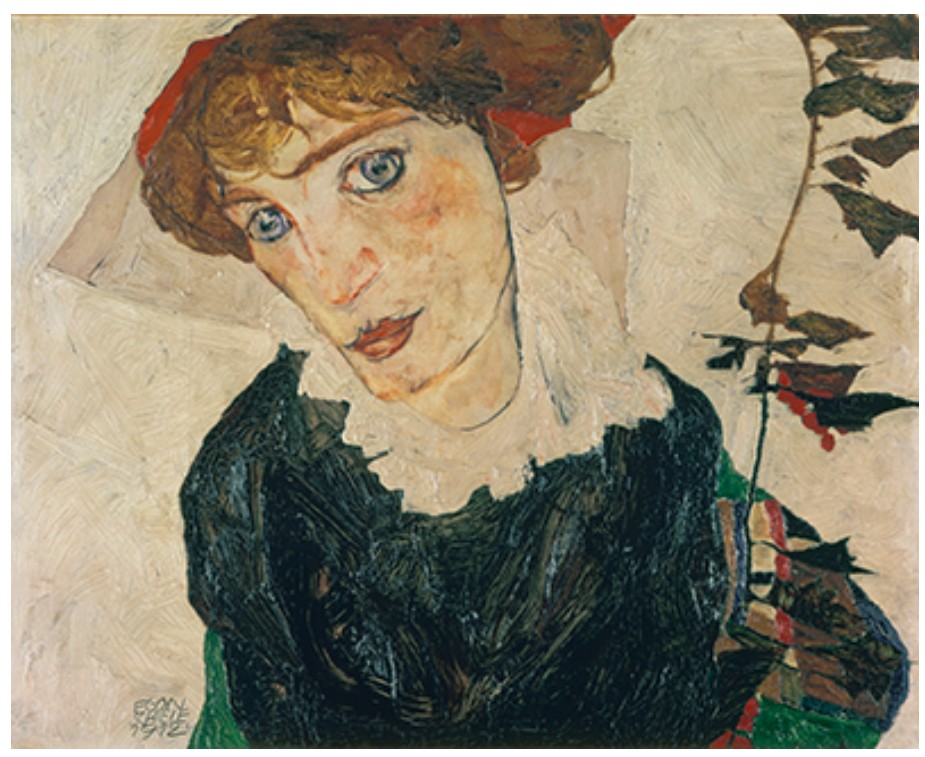
Egon Schiele, Portrait of Wally Neuzil, 1912. Leopold Museum, Vienna. Image: Erich Lessing / Art Resource, NY
Katz’s synthesis of classical form and modern clarity bridges high modernism and the vernacular idioms of popular culture—advertising, cinema, and fashion photography. Sarah belongs to a lineage of paintings that invite sustained contemplation of the surfaces through which identity, emotion, and presence are mediated.
“The vocabulary or grammar is all out of abstract painting – that’s what makes my painting different from all the other figurative painters”
Katz’s enduring influence lies in his ability to transform fleeting moments into enduring icons.
“Pop art deals with signs, while my work deals with symbols. Pop art is cynical and ironic. My work is not.”
This distinction underscores his pursuit of a visual language both contemporary and timeless—rooted in tradition yet distinctly of the present. Today, Katz’s work is represented in major museum collections worldwide, including the Museum of Modern Art, the Whitney Museum of American Art, the Metropolitan Museum of Art, and Tate Modern. His recent retrospective, Alex Katz: Gathering, held at the Solomon R. Guggenheim Museum in New York from 2022 to 2023, reaffirmed his position as one of the most influential American painters of the postwar era. Within this trajectory, Sarah stands as a consummate example of Katz’s mature style: a portrait of luminous restraint and enigmatic immediacy, capturing the ineffable balance between the real and the ideal, the momentary and the eternal.
#3. Danny and Laura, 1984
Property from a Private Florida Collection
Sotheby’s New-York: 19 November 2025
Estimated: USD 100,000 – 150,000
USD 355,600
Danny and Laura | Contemporary Day Auction | 2025 | Sotheby’s
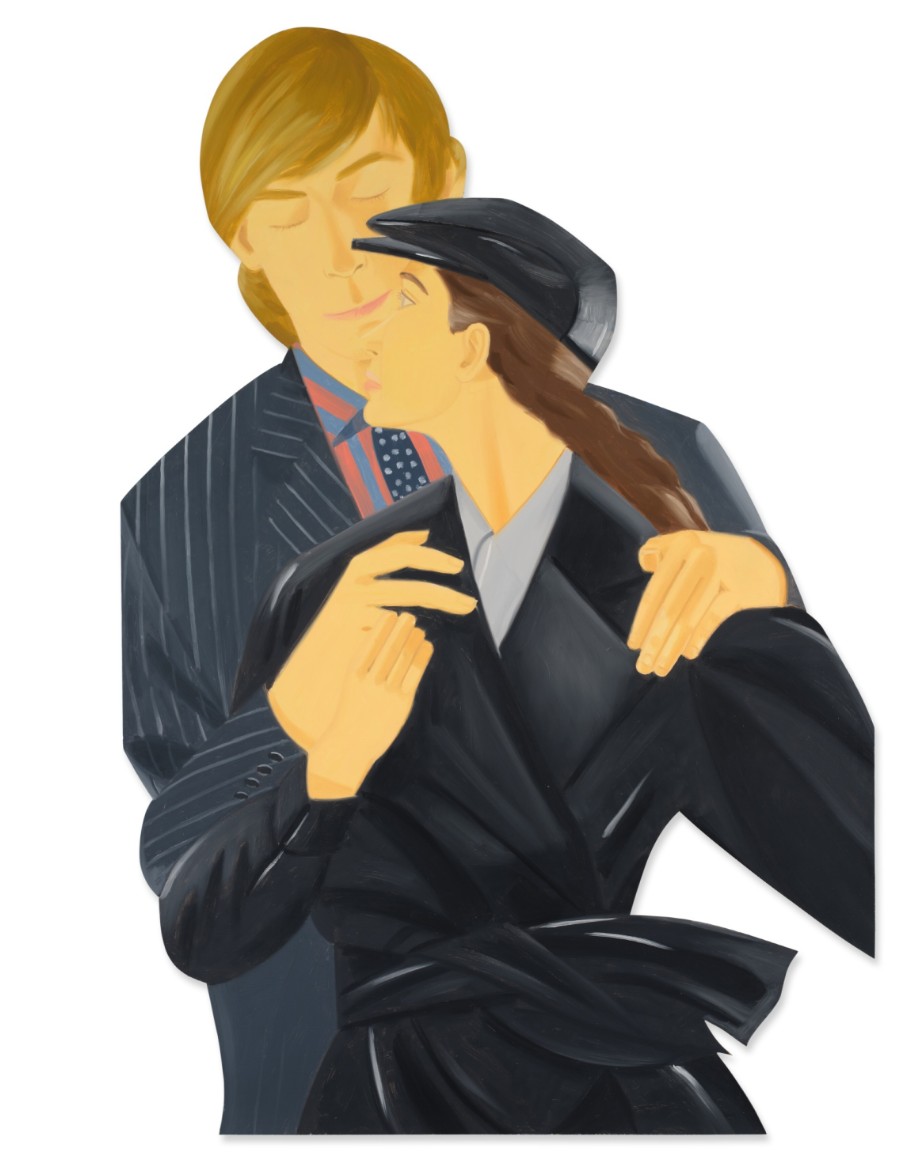
ALEX KATZ (b. 1927)
Danny and Laura, 1984
Oil on shaped aluminum
71×48 inches (180.3 x 121.9 cm)
David 4, 2005
Sotheby’s New-York: 19 November 2025
Estimated: USD 50,000 – 70,000
USD 60,960
David 4 | Contemporary Day Auction | 2025 | Sotheby’s
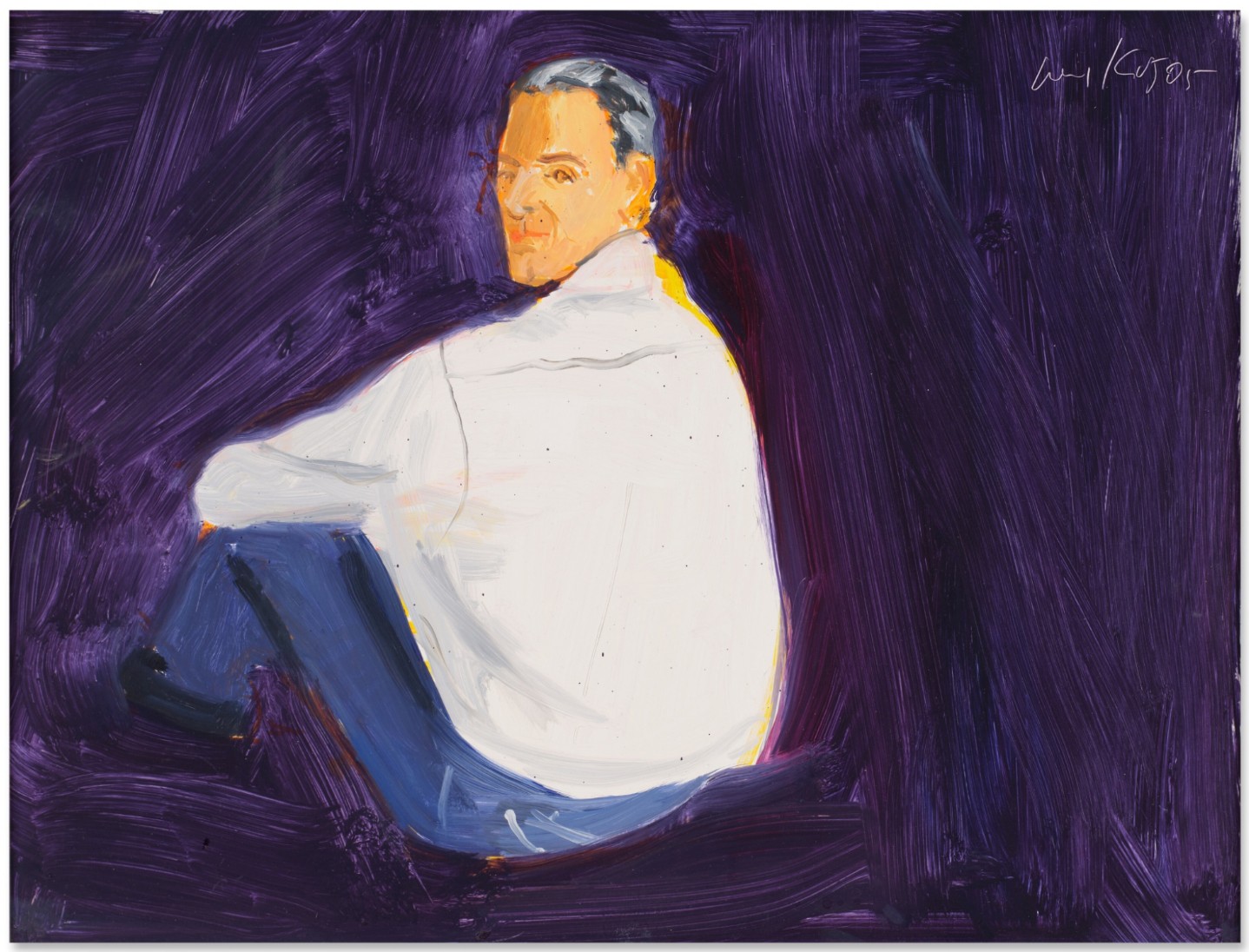
ALEX KATZ (b. 1927)
David 4, 2005
Oil on board
12×16 inches (30.5 x 40.6 cm)
Incised with the artist’s signature and date 05 (upper right)
Study for Pas de Deux, 1983
Property from a Private Florida Collection
Sotheby’s New-York: 19 November 2025
Estimated: USD 500,000 – 700,000
PASSED
Study for Pas de Deux | Contemporary Day Auction | 2025 | Sotheby’s
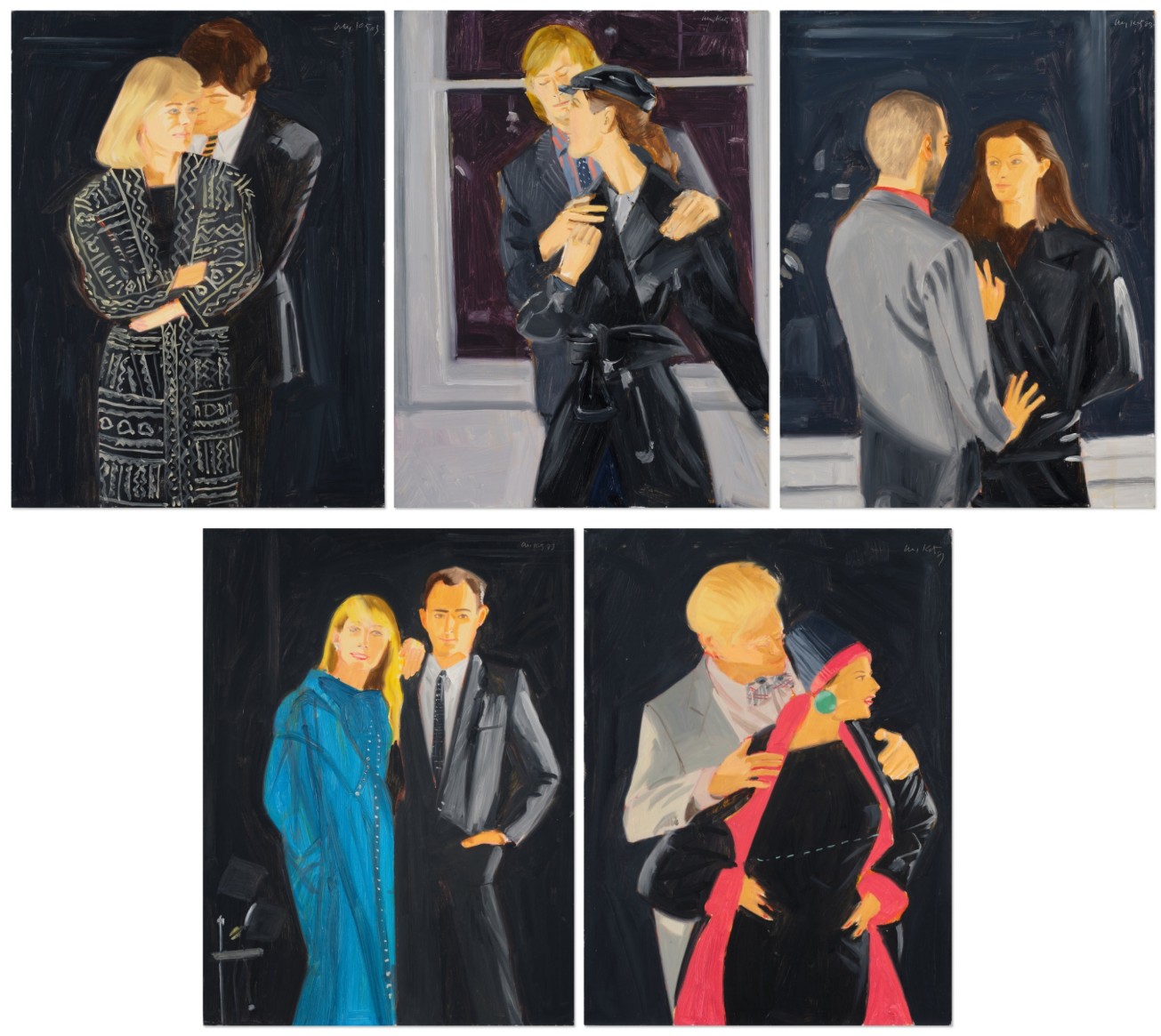
ALEX KATZ (b. 1927)
Study for Pas de Deux, 1983
Oil on board, in 5 parts
Each: 24×18 inches (61 x 45.7 cm)
Incised with the artist’s signature and date 83 (upper right of each)
Inscribed #1-5 respectively (on the reverse of each)
Executed in 1983, Study for Pas de Deux captures the refined poise and effortless glamour that have come to define Alex Katz’s most celebrated works. Comprising five intimately scaled panels, each depicting a pair of figures, this ensemble forms a cinematic sequence that encapsulates Katz’s fascination with gesture, fashion, and the subtle dynamics of human relationships. A preparatory study for Pas de Deux (1983), the present work offers a rare glimpse into the artist’s compositional process and enduring engagement with the visual language of contemporary culture.
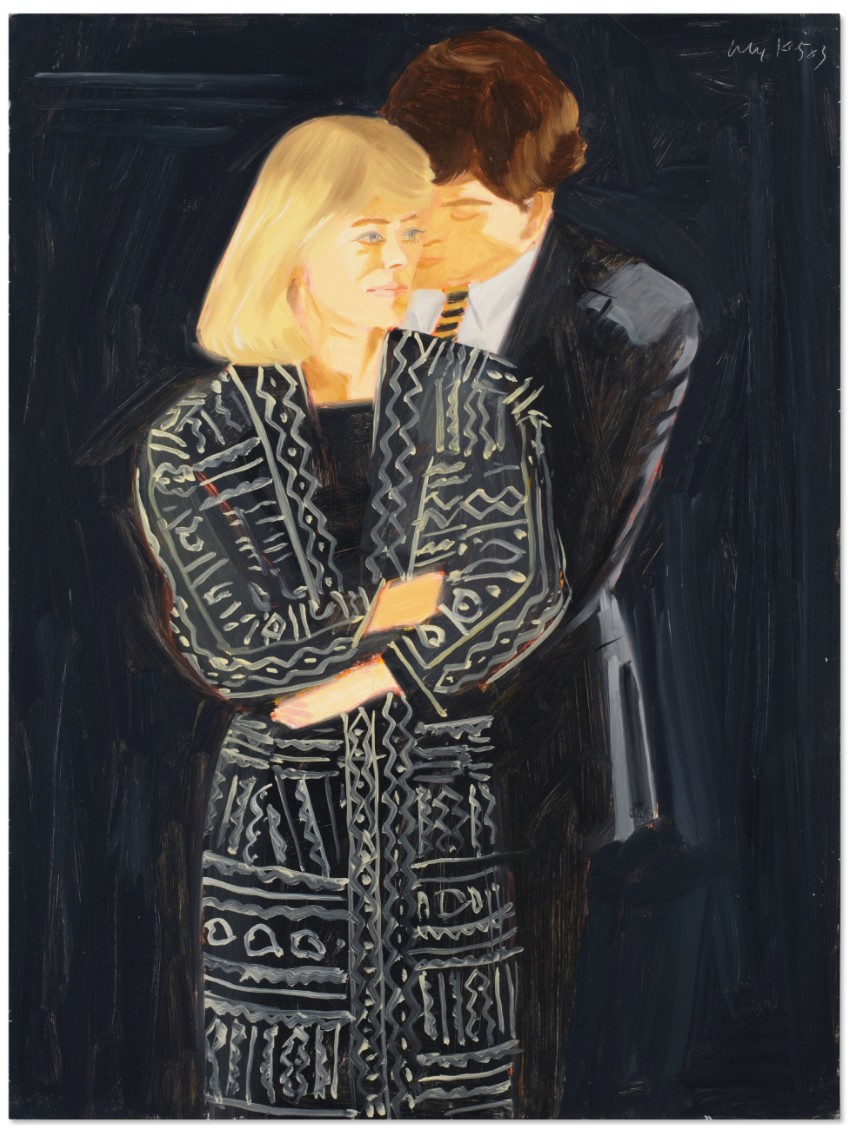
By the early 1980s, Katz had firmly established himself as one of the most distinctive voices in postwar American art. He developed a singular style defined by crisp contours, flattened planes of color, and a sense of poised immediacy. His subjects, drawn largely from his own circle of friends, artists, poets, and models, are presented with cinematic clarity. Katz’s figures exist in a timeless present: elegant, self-contained, and bathed in a cool, distilled light.
Alex Katz, Pas de Deux, 1983. Colby College Museum of Art, Waterville. Art © Alex Katz.
In Study for Pas de Deux, five couples are arranged as a rhythmic suite of portraits. Each pair occupies its own board, yet together they form a cohesive visual choreography. Indeed, a social dance unfolds across the panels. Katz’s title borrows from the lexicon of ballet, a pas de deux being a duet between two dancers, and here the metaphor of dance becomes an organizing principle.
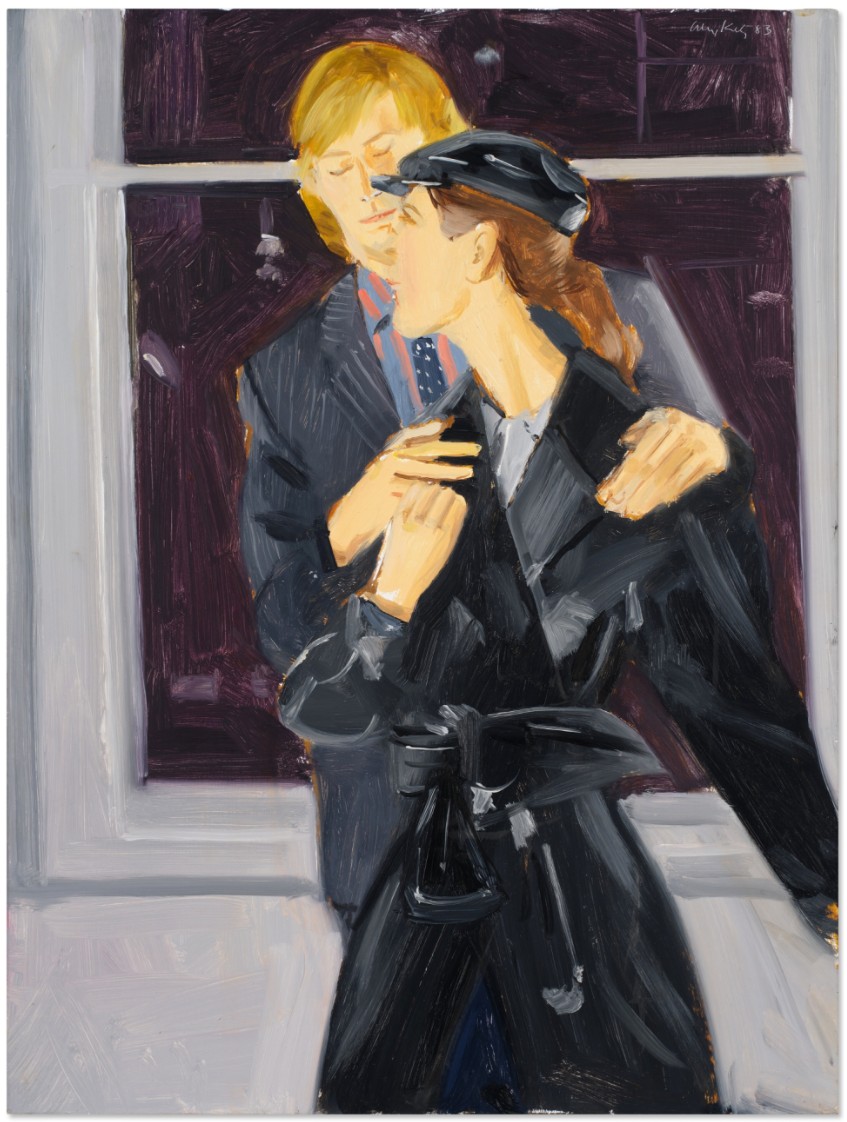
The artist choreographs a sequence of encounters: a man leans toward a woman in quiet conversation; another couple shares a moment of intimate proximity; yet another exchanges a gaze of ambiguous intensity. The result is both a study in gesture and a meditation on the nuances of human connection. Additionally, the composition’s serial structure situates Study for Pas de Deux within Katz’s broader experiments with multipart formats during the late 1970s and early 1980s. In this study, the five boards together function almost like film stills, their sequential arrangement suggesting passage and movement even as each pair remains suspended in stillness. This tension between motion and stasis, intimacy and display, has long been central to Katz’s pictorial drama.
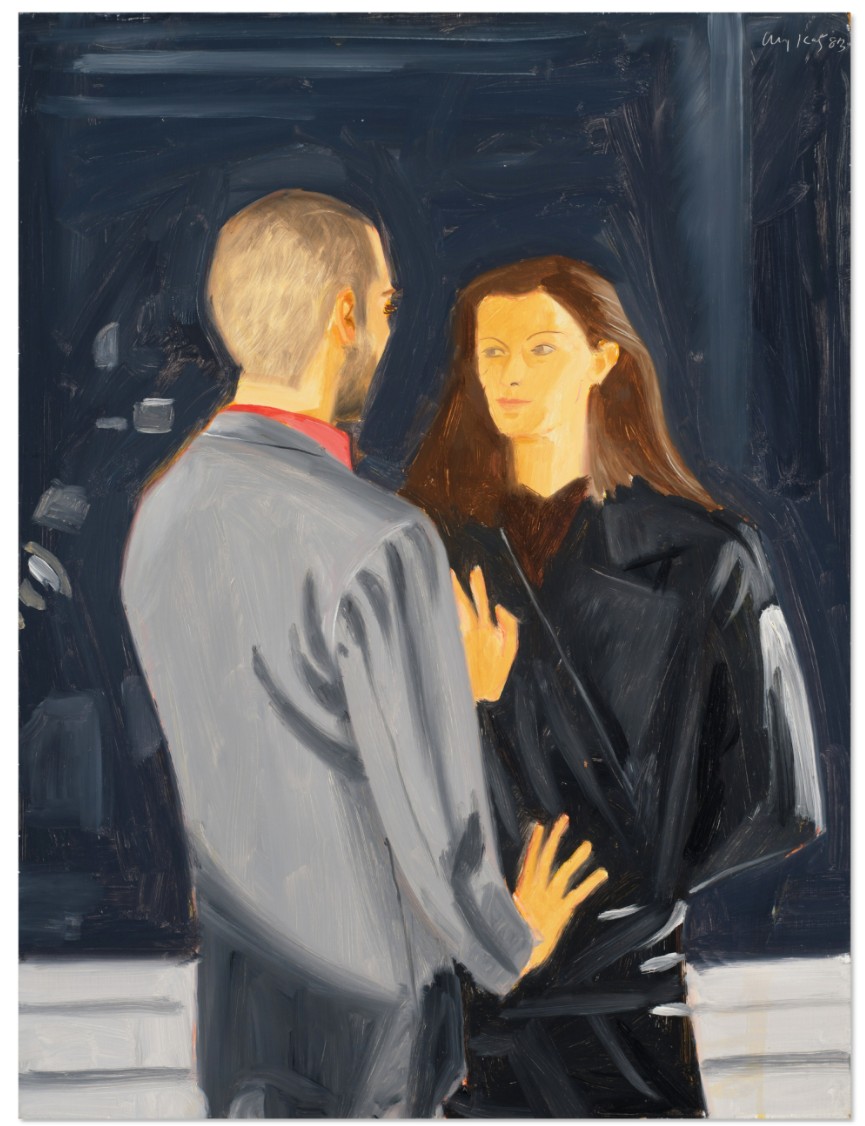
Each panel showcases Katz’s command of composition and color. Set against deep, flattened backgrounds, the figures emerge in precise silhouettes, their crisp outlines and luminous hues heightening the immediacy of the scene. Dark grounds offset pale faces, flashes of red and blue punctuate the composition, and each couple’s sophisticated attire, ranging from a patterned coat, to a sleek leather trench or a vivid scarf, adds its own rhythmic variation. Katz’s interest in fashion and form is palpable; the stylish clothing is not mere decoration, but an extension of character and gesture. As critics have noted, Katz’s work of this period draws heavily from the visual codes of fashion photography and film, translating the allure of the magazine spread into the language of high painting.
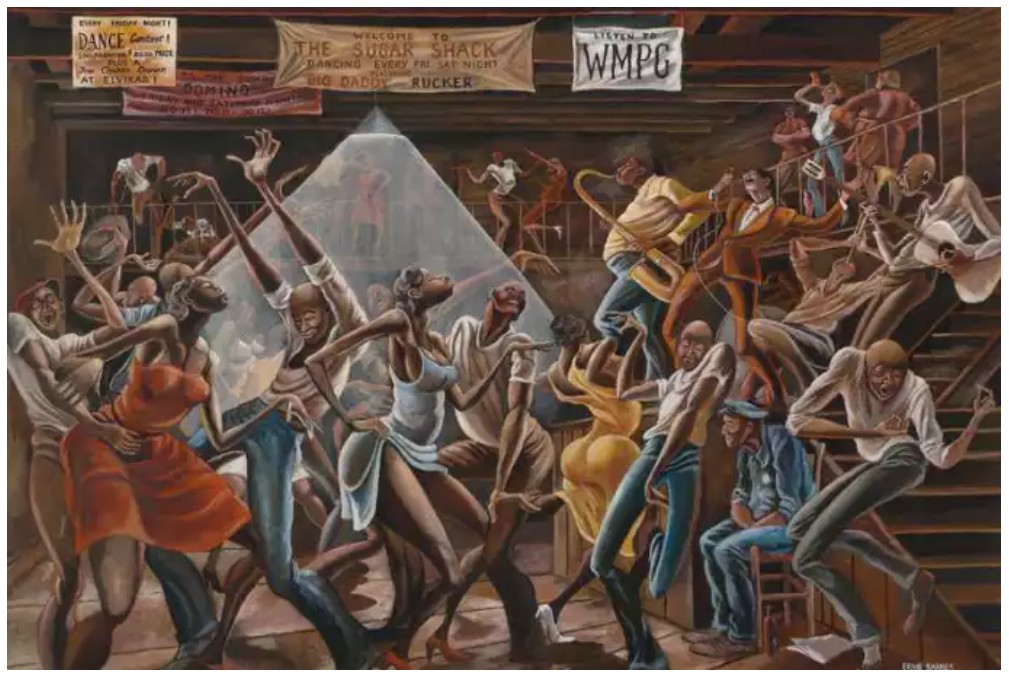
Ernie Barnes, The Sugar Shack, 1976. Private Collection. Art © Ernie Barnes Family Trust.
The couples themselves evoke the milieu that has long animated Katz’s art: the creative and social elite of New York’s downtown scene. They are icons of a cultural moment, rendered with the detached elegance that defines Katz’s vision of modern life. His approach is neither documentary nor narrative; rather, he distills gesture, light, and style into a pictorial shorthand that feels at once specific and universal.
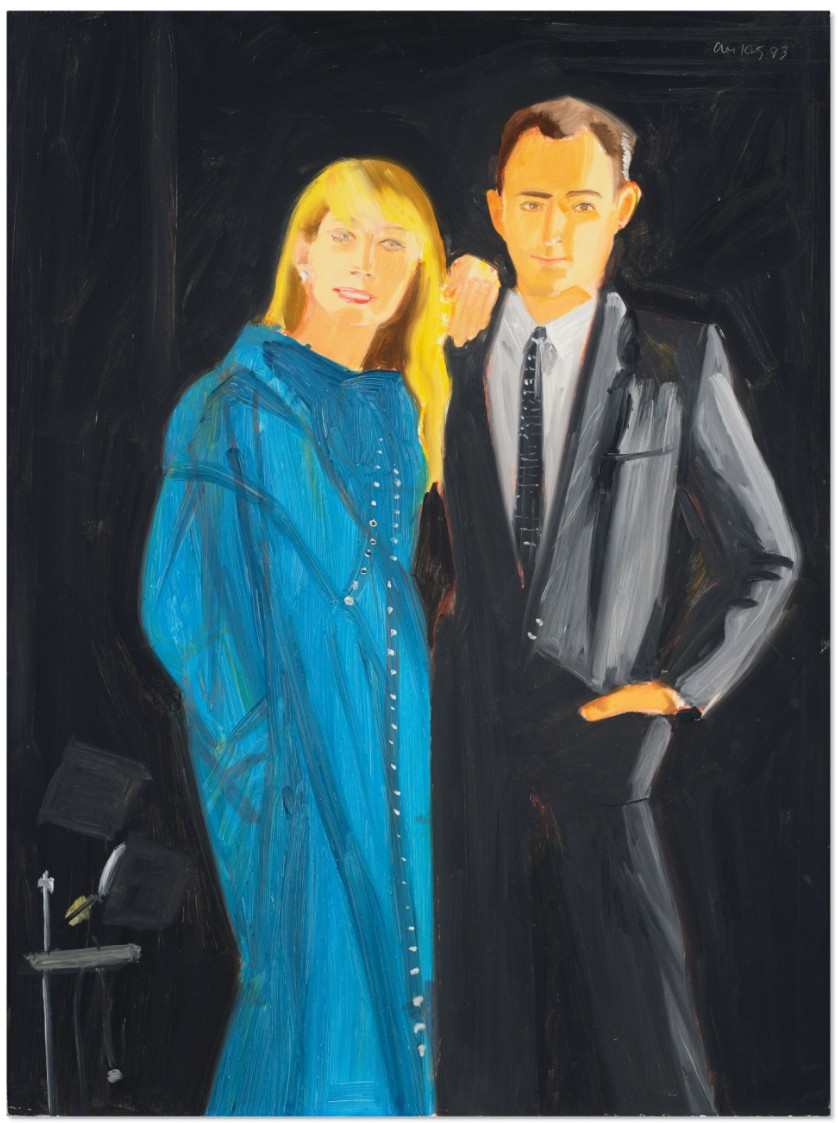
By 1983, Katz had also become increasingly involved with theater and dance, designing sets and costumes for productions by renowned choreographer Paul Taylor. The influence of performance permeates Study for Pas de Deux: each couple appears as though caught in mid-rehearsal, poised between movement and stillness, intimacy and display. The painting’s title and arrangement reinforce this sense of choreographed rhythm, underscoring Katz’s fascination with the body as a vehicle of form, expression, and design.
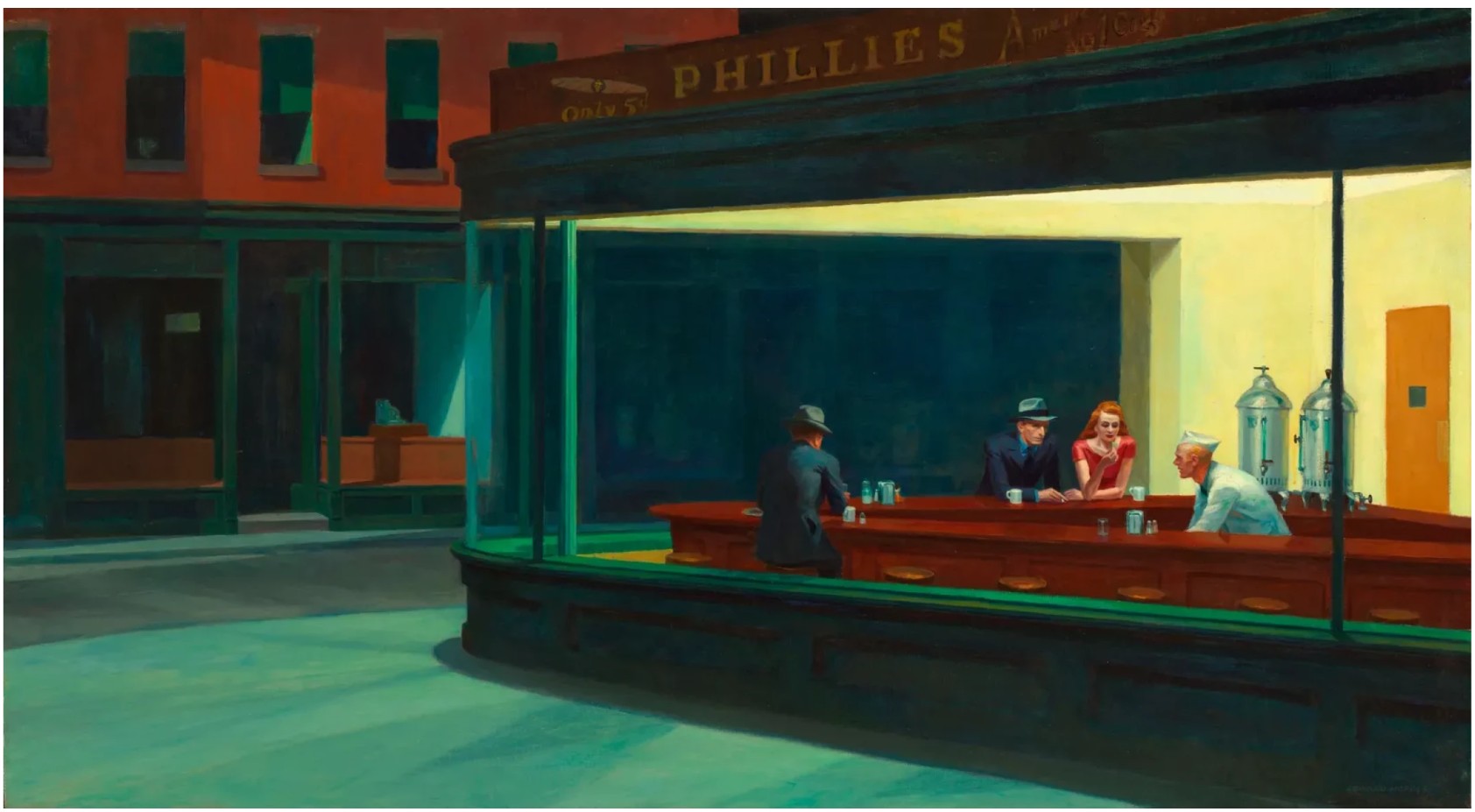
Edward Hopper, Nighthawks, 1942. Art Institute of Chicago
As a study, the present work reveals Katz’s meticulous process of distillation. Each board serves as both a compositional test and a self-contained portrait, allowing the artist to refine posture, proportion, and chromatic harmony before scaling up to the monumental canvas. Yet, the unity and completeness of the ensemble suggest that Katz conceived these panels not merely as preparatory sketches but as an autonomous work. It is an elegant meditation on the pair, both in life and in art.
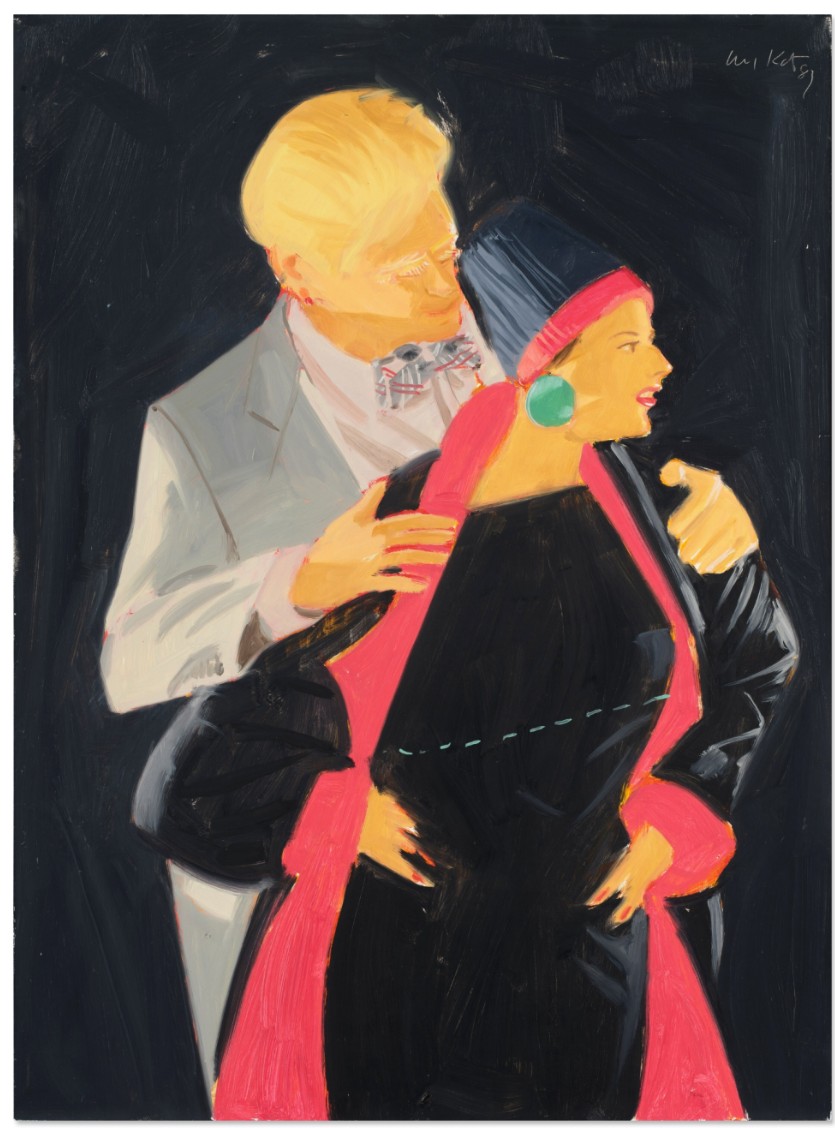
Fernando Botero
PLEASE CLICK ON THE PICTURE BELOW TO ACCESS AUCTION MARKET OVERVIEW
1. Paintings
#1. Florero, 1970
Property from a Private European Collection
Christie’s New-York: 17 November 2025
Estimated: USD 1,200,000 – 1,800,000
USD 1,524,000
FERNANDO BOTERO (1932-2023), Florero | Christie’s
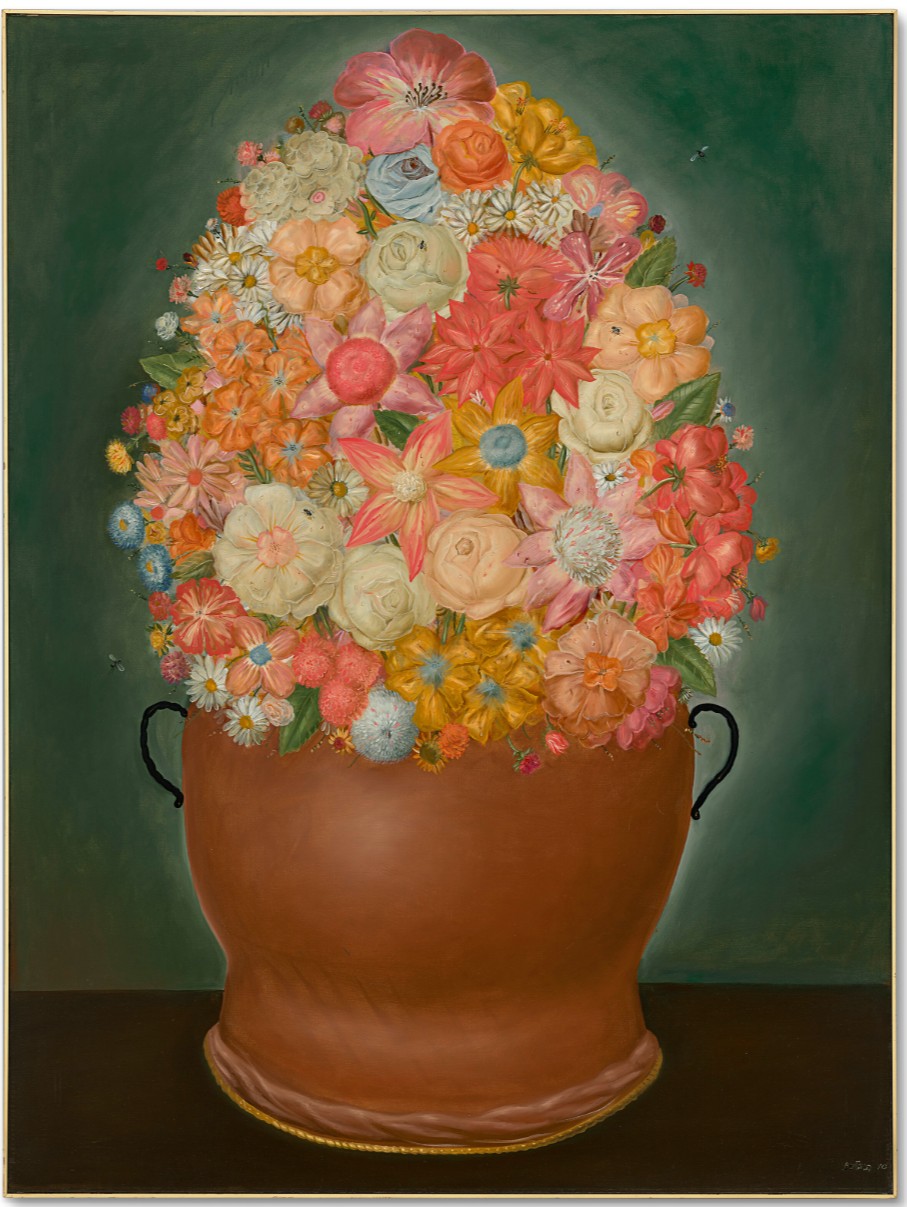
FERNANDO BOTERO (1932-2023)
Florero, 1970
Oil on canvas
193 x 144.8 cm (76×57 inches)
Signed and dated ‘Botero 70’ (lower right)
Signed, titled and dated twice ‘FLORERO Botero 70’ (on the reverse)
Fernando Botero’s Florero elevates the usually diminutive intimate genre of still life painting to a heroic scale. Pushed up against the picture plane, a startlingly large vase of flowers towers above the viewer and nearly bursts through the canvas. This tightly packed bouquet of more than twenty varieties of daisies, dahlias, peonies and camelias is an exuberant display of the artist’s painterly prowess. Rendered with acute attention to detail, the distinctive blooms include all parts of the flower: petals, sepals, stamens and pistils. Close observation reveals dewy droplets settling on petals and bees and flies buzzing amongst the floral array.
Botero manages a monumental still life that is both steeped in art historical tradition and definitively his own creation. As a young aspiring artist in the early 1950s, Botero ventured to Europe where he immersed himself in studying the Old Masters and 20th century modernists. Europe proved transformative for Botero, converting him into an insatiable student of art history. The lessons absorbed from wandering the Prado, Uffizi and Louvre in those early days would reverberate throughout his career. In Florero, Botero nods to the Golden Age of Dutch still life painting, with artists like Jan Davidsz de Heem, renowned for precise renderings of flowers, fruits and insects. De Heem’s opulent still lifes, in particular, often fill the entirety of his canvases and are notable for their brilliant use of varied color. Pop Art depictions of flowers may also have been on Botero’s mind at the time that he painted Florero in 1970. Having moved to New York in 1960 to immerse himself in the center of the art world, Botero would have had ample opportunity to see Andy Warhol’s Flowers series first on view at Leo Castelli Gallery in 1964.
Jan Davidsz. de Heem, Tulips, a sunflower, an iris, hydrangeas, honeysuckle, willow catkins, carnations and other flowers in a glass vase on a marble pediment. Private collection.
Botero’s move to New York in 1960 was a big gamble. He left his family behind in Bogotá and moved to the city with no money, no friends and little English. In the twelve years that he lived in the city, however, he went from impoverished obscurity to meteoric success with the Museum of Modern Art acquiring two of his most significant paintings and prominent dealers supporting him and successfully promoting his work.
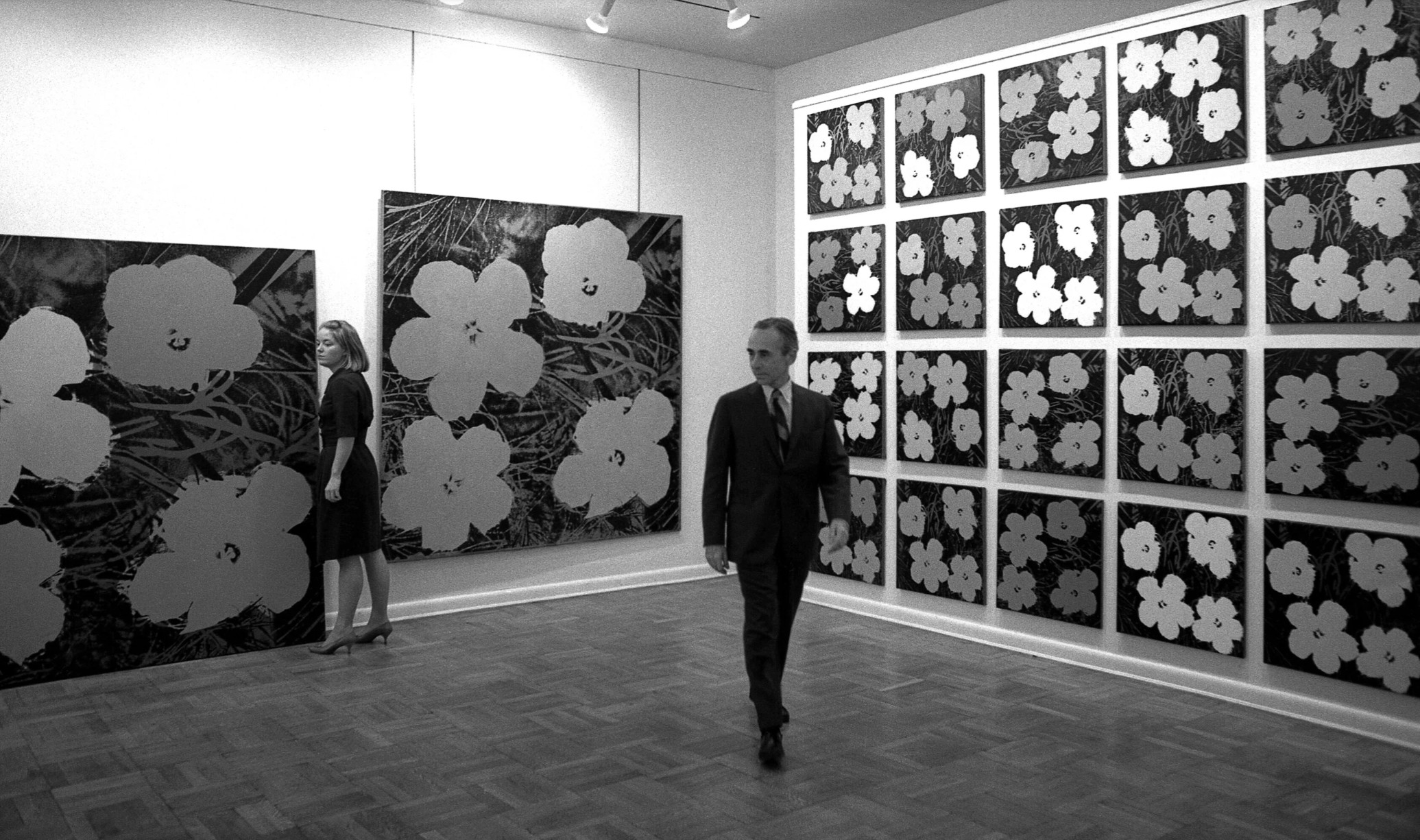
Leo Castelli at Andy Warhol: Flower Paintings, Leo Castelli Gallery, New York, 1964.
© 2023 The Andy Warhol Foundation for the Visual Arts, Inc. / Licensed by Artists Rights Society (ARS).
He also encountered racist criticism and remained ostracized by those who were part of the larger art movements in vogue at the time. While the New York years were fraught for the artist, it was also a period of tremendous growth. Botero came into his own in New York, finding his singular voice as an artist and producing some of his most significant works like Florero.
“I am interested in quiet color, not excited or feverish color. I have always considered that great art conveys tranquility and, in that sense,
I seek that even in color.”
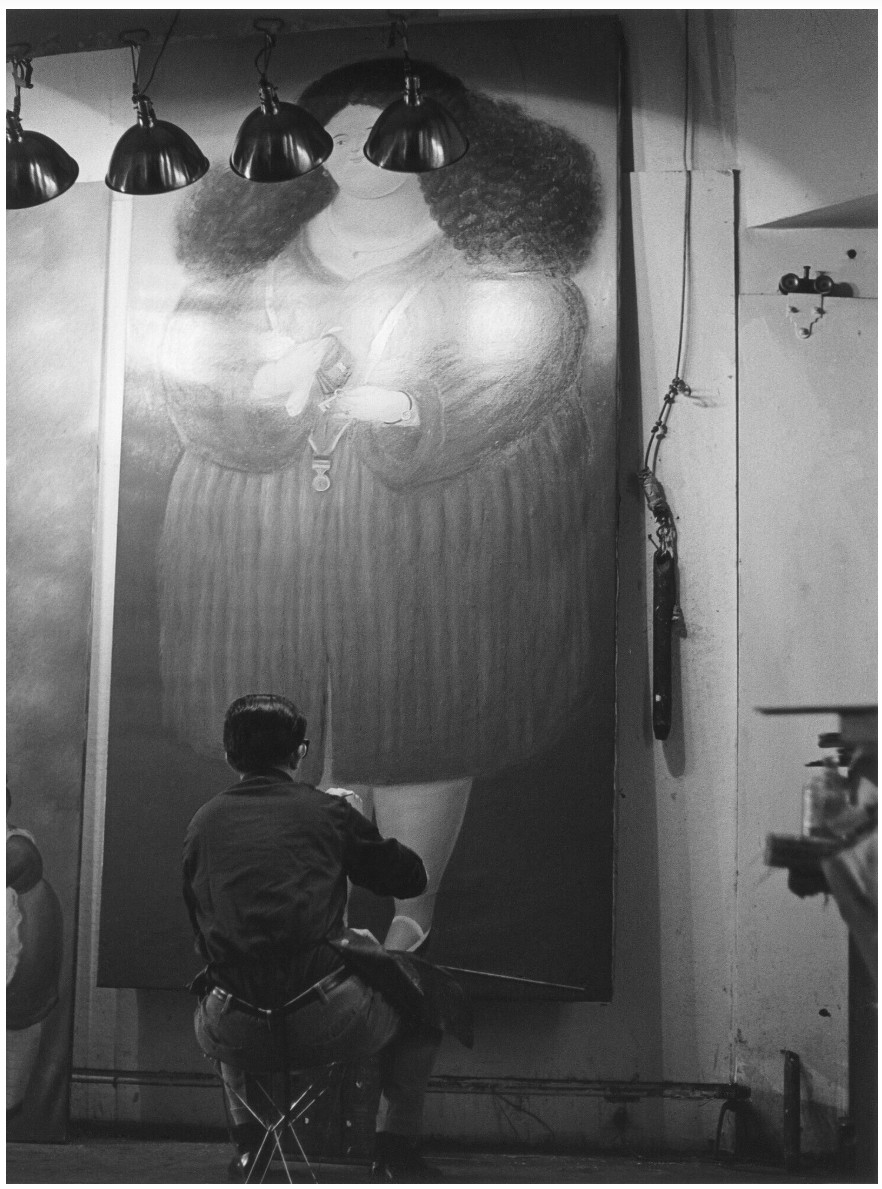
Fernando Botero in his studio in New York City, 1966. © The Estate of Fernando Botero.
Rendered in Botero’s signature pastel palette of the 1960s and 70s, Florero’s plentiful blooms appear in chromatic harmony. A consummate colorist, Botero usually painted with a restrictive palette, employing a limited number of colors in each canvas that evenly reverberate across his compositions. Florero, however, is striking for its sheer number of hues; rose, gold, auburn, cloudy blues and frosty whites are set against a backdrop of deep jade. Here the artist clearly reveled and succeeded in achieving a cohesive symphony in a great variety of color.
#2. The Beach, 2006
Sotheby’s New-York: 19 November 2025
Estimated: USD 600,000 – 800,000
USD 857,250
The Beach | Contemporary Day Auction | 2025 | Sotheby’s
FERNANDO BOTERO (1932 – 2023)
The Beach, 2006
Oil on canvas
131.4 x 189.9 cm (51 3/4 x 74 3/4 inches)
Signed and dated 06 (lower right)
In The Beach, Fernando Botero presents two of his most enduring subjects—the monumental nude and the couple of lovers—within a luminous seaside setting that exemplifies the artist’s unmistakable visual language. Two figures recline upon an ochre towel spread across a sun-drenched shore, their voluminous forms rendered with the velvety modeling that defines Botero’s mature style. The tranquil horizon stretches beyond them; the barren landscape at once peaceful and eerily timeless.
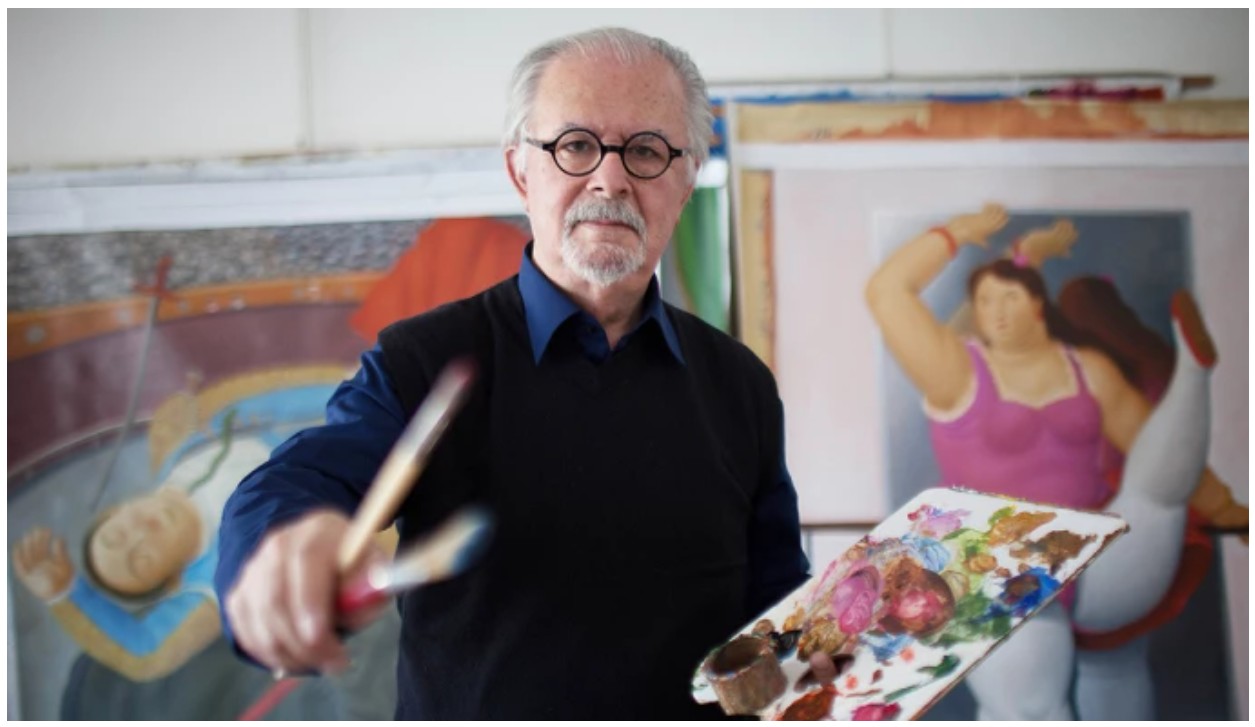
Botero in his studio
Executed in 2006, The Beach reflects the culmination of more than five decades of Botero’s exploration into the expressive potential of volume, proportion, and color, with a particular attention to how these formal elements pertain to the rendering of figures. From his early years in Medellín and Bogotá, Botero remained deeply engaged with art of the past. Following his first solo exhibition in 1951 and throughout the remainder of the 1950s, Botero spent many years in Spain, France and Italy. He immersed himself in the western art historical canon, studying Renaissance masters through modern luminaries. The artist’s extensive knowledge, spanning centuries of art, is expressed through his deliberate dialogue with European precedents and enduring motifs. By the 1960s and 70s, having established himself in both New York and Paris, Botero had developed his instantly recognizable style: figures of exaggerated scale yet delicate presence, each composed within harmoniously balanced spaces.
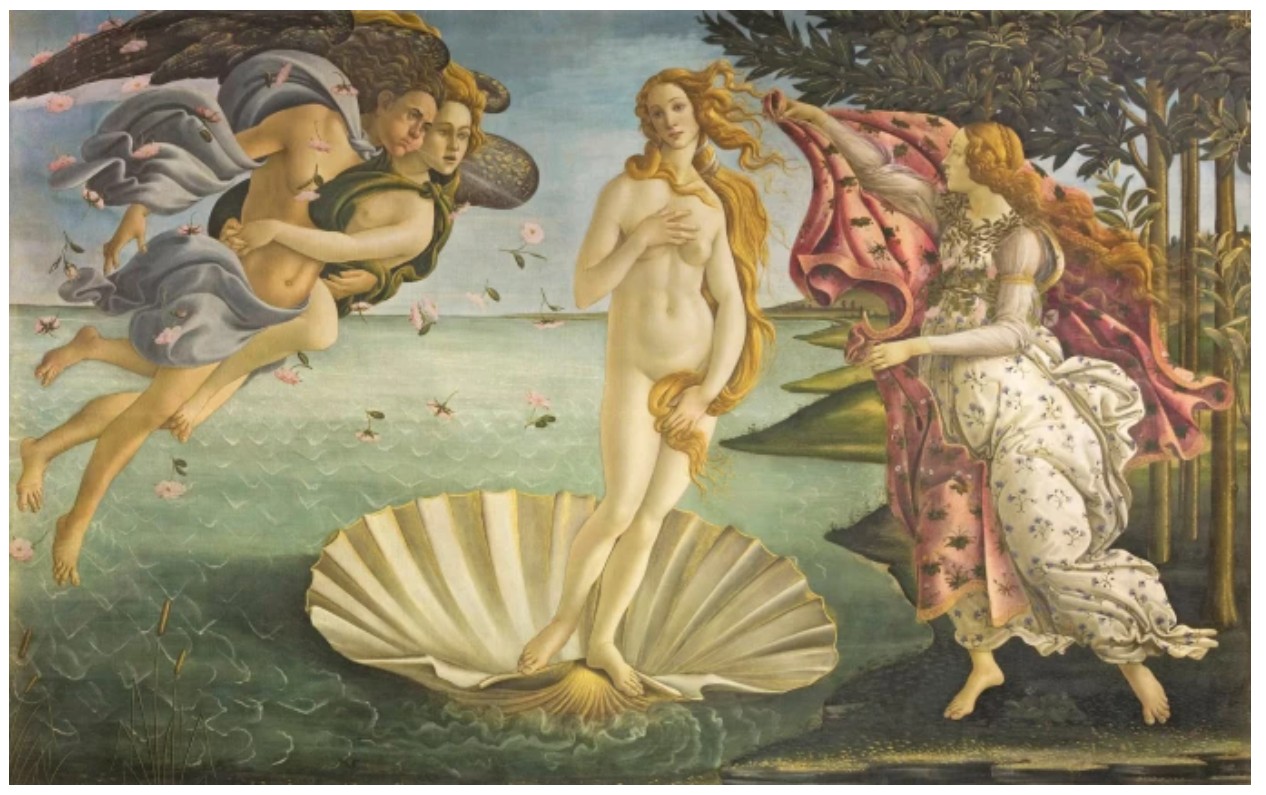
Sandro Botticelli, Birth of Venus, tempera on canvas, ca. 1485. The Uffizi, Florence
The reclining female nude, a motif to which Botero returned throughout his career, anchors the composition of the present work. The woman, in Botero’s signature exaggerated style, recalls centuries of history during which the female nude was of the most ubiquitous motifs. Most often applied to signify purity, canonical masterpieces such as Sandro Botticelli’s Birth of Venus and Titian’s Venus of Urbino situate the female nude in a mythological, idealized context, both of which Botero would have encountered during his time in Europe. Particularly of interest to the artist was the classical interest in volume, which Botero amplifies in his own figures. Beyond contributing to the tradition, Botero engages with the longstanding dialogue of modern and contemporary artists who call this lineage into question. In its frank presentation of the reclining female form, The Beach recalls the modern candor of Manet’s Olympia, where the nude confronts the viewer without mythological guise. Like Manet, Botero engages with the tradition of the female nude by subverting it, reimagining a classical subject through a distinctly modern lens.
Left: Titian, Venus of Urbino, oil on canvas, 1538. The Uffizi, Florence
Right: Edouard Manet, Olympia, oil on canvas, 1863. Musée d’Orsay, Paris © Musée d’Orsay, Dist. RMN-Grand Palais / Patrice Schmidt
In The Beach, Botero strikes a balance between irony, sensuality, form, and tradition. The couple’s softly rounded bodies, non-conforming to idealized canons, propose an alternative beauty rooted in fullness, contentment, and self-possession. Furthermore, Botero’s oeuvre often returns to themes of intimacy and companionship between lovers. Despite their neutral expressions, consistent throughout Botero’s oeuvre, the figures demonstrate an endearing comfort and closeness that characterizes many of the relationships between the artist’s couples. The Beach exemplifies Botero’s continued refinement of his most iconic subjects. It stands as a testament to his enduring dialogue between sensuality and form, humor and reverence. Within its radiant simplicity and striking monumentality, Botero offers a world where the fullness of life, in all its human imperfection, attains the weight and grace of the classical ideal.
#3. Still Life in front of a Window, 1979
Property from an Important American Collection
Phillips New-York: 19 November 2025
Estimated: USD 700,000 – 900,000
USD 838,500
Fernando Botero Modern & Contemporary Art Evening Sale featuring Cera the Triceratops
Oil on canvas
189.9 x 144.1 cm (74 3/4 x 56 3/4 inches)
Signed and dated “Botero 79” lower right
Fernando Botero’s Still Life in front of a Window, 1979 reimagines the classical still life through the artist’s distinctive formal vocabulary of exaggerated volume, flattened perspective, and stylized sensuality. Painted in oil on canvas, the work elevates an arrangement of everyday objects—a pair of ripe bananas, a pear, apples, a terracotta pitcher, and a draped red cloth—into something at once monumental and whimsical. Behind them, an open window reveals a jumbled cityscape of ochre rooftops, whose rhythmic curves mirror the rounded forms of the fruit in the foreground. The scene is both intimate and theatrical, imbuing the conventional still life format with warmth, density, and quiet drama.
“One day I painted a still life. That day I became an artist.”
Paul Cézanne, Still Life with Drapery, c. 1895. Collection of the State Hermitage, St. Petersburg. Image: HIP / Art Resource, NY
Exhibited from December 1979 to March 1980 at the Hirshhorn Museum and Sculpture Garden in Washington, D.C., the painting featured in the first educational exhibition of Botero’s work in the United States. That landmark presentation drew on more than forty lenders, including major institutions, private collections, and the artist himself. In 1987, Still Life in front of a Window was included in a touring retrospective that traveled to leading institutions in Munich, Bremen, Frankfurt, and Madrid. Since its acquisition in the 1980s, this large-scale historical canvas has remained in the same private family collection and has never been offered publicly.
“I believe it is very important that stylistic coherence should dominate the form of the expression… When you see a still life of mine, you will notice that the knives and forks, the fruit, the table, the napkins, everything is rendered in the same fashion, therefore the whole work radiates a sense of unity, harmony and coherence. That is what communicates its essential truth.”
Botero’s breakthrough came in 1956, when painting his first still life he realized that “the forms became stronger and more sensual” through experiments with proportion. This discovery laid the groundwork for the artistic maturity he reached in the mid-1960s, when scale became his primary tool for conferring physical presence, testing the limits of improbability, and transforming people and objects into sculptural volumes. Guided by Bernard Berenson’s concept of “tactile value,” Botero developed the “Boterismo” style that defined his work in the decades to follow. In Still Life in front of a Window, each object appears voluptuous and overfull, its smooth contours and matte surfaces emphasizing mass rather than texture. Soft, even lighting and the absence of deep shadow lend the composition a sense of quiet solidity. A slightly open drawer and a lone apple left on the windowsill introduce a note of informality, as if the scene has been interrupted mid-arrangement. Botero’s warm, saturated palette visually links the foreground and background, creating an atmospheric cohesion that further lends a sense of whimsy.
Francisco de Zurbarán, Still Life, c. 1660. Museo del Prado, Madrid. Image: © of the image Museo Nacional del Prado / Art Resource, NY
Though highly stylized, the painting is rooted in art historical precedent. During his studies in Madrid, Florence, and Paris, Botero immersed himself in the works of the Old Masters. He frequented the Museo del Prado, where he absorbed the Spanish still life tradition—particularly the bodegones of Juan Sánchez Cotán and Francisco de Zurbarán—and became familiar with the memento mori of Dutch Golden Age vanitas images, as well as the formal innovations of Paul Cézanne. These influences are evident in the clarity of composition and attention to spatial relationships between the table, the objects, and the architectural backdrop. Botero, however, deliberately resists illusionism. Brushwork is minimized, surfaces are flat and polished, and volume is built through color and contour rather than modeling.
“When I paint an apple or an orange, I know that it will be possible to recognize them, and that I am the one painting them, because I try to give each painted element, even the simplest one, a personality that comes from a deep conviction.”
Botero’s still lifes also reflect the social and cultural fabric of his native Colombia. Ordinary objects are imbued with presence and individuality, often referencing familiar settings, meals, or celebrations. In Still Life in front of a Window, the rooftops visible through the window resemble those of Medellín, his hometown, grounding the composition in lived experience. The effect is reverent rather than ironic; the fruit and pitcher seem less like props than figures, occupying space with sculptural gravitas.
Diego Rivera, Watermelons (Las sandias), 1957. Museo Dolores Olmedo Patiño, Mexico City. Image: Schalkwijk / Art Resource, NY, Artwork: © 2025 Banco de México Diego Rivera and Frida Kahlo Museums Trust/ Artist Rights Society (ARS), New York
His time in Mexico City in the mid-1950s further shaped this vision. The lingering influence of muralists like Diego Rivera and José Clemente Orozco, particularly their monumental scale and humanist critique, encouraged Botero to enlarge his forms as a vehicle for commentary. In Still Life in front of a Window, the influence manifests as a reverence for ordinary objects presented at a monumental scale. The bananas, for example, may carry symbolic weight in the Latin American context, evoking the fraught legacy of “banana republics” and the extractive economies of colonialism and U.S. intervention. By presenting them with exaggerated scale and painterly care, Botero confers dignity and ambiguity, blending formal delight with subtle critique. Still Life in front of a Window enacts this philosophy with clarity and force.
#4. La siesta, 1986
Property from a Private European Collection
Christie’s New-York: 20 November 2025
Estimated: USD 500,000 – 700,000
USD 762,000
FERNANDO BOTERO (1932-2023), La siesta | Christie’s
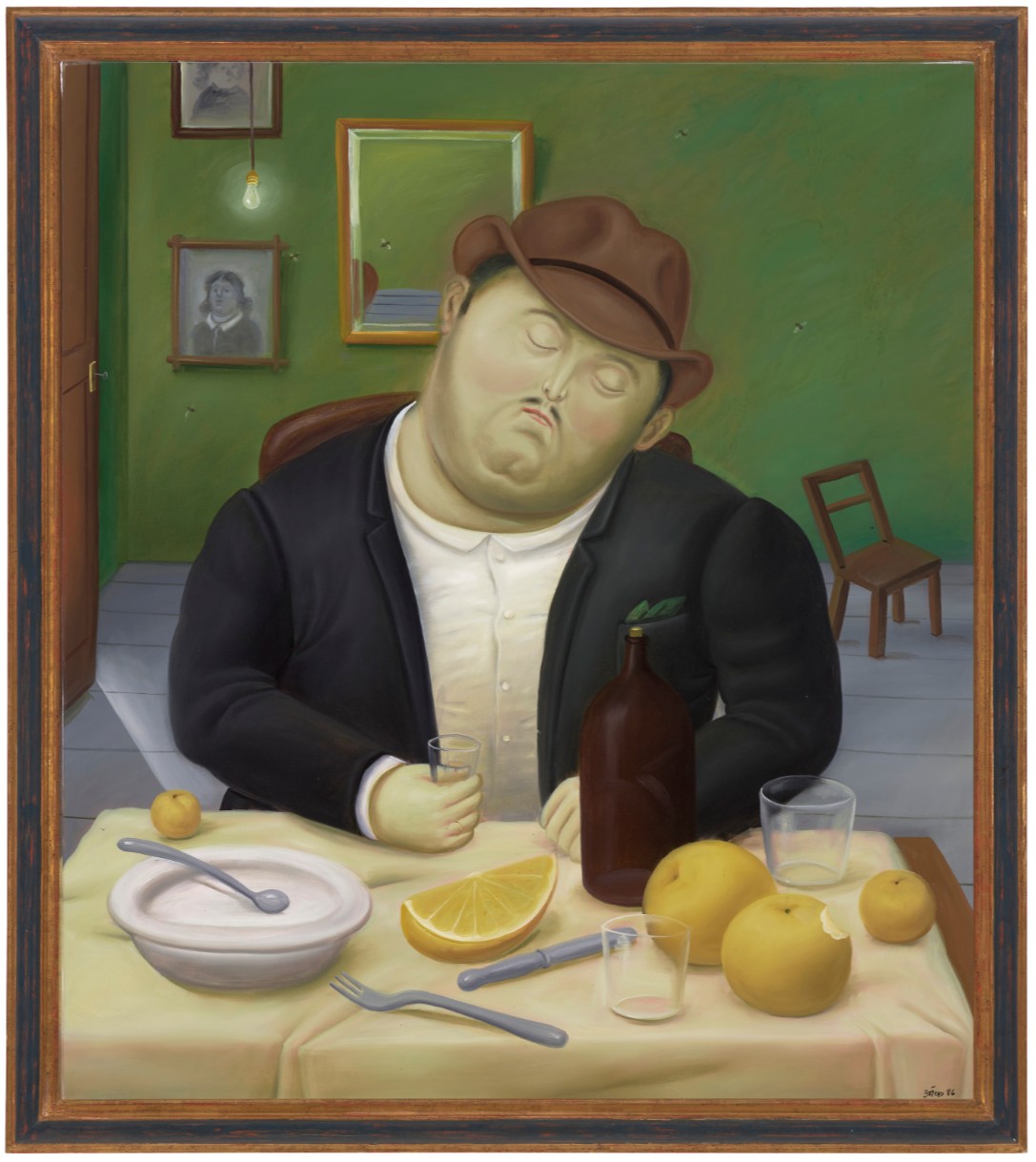
FERNANDO BOTERO (1932-2023)
La siesta, 1986
Oil on canvas
143.8 x 126.7 cm (56 5/8 x 49 7/8 inches)
Signed and dated ‘Botero 86’ (lower right)
“I create my subjects somehow visualizing them in my style. I start as a poet, put the colors and composition down on canvas as a painter, but finish my work as a sculptor taking delight in caressing the forms.”
#5. Niño comiendo helado, 1965
Christie’s New-York: 20 November 2025
Estimated: USD 250,000 – 350,000
USD 406,400
FERNANDO BOTERO (1932-2023), Niño comiendo helado | Christie’s
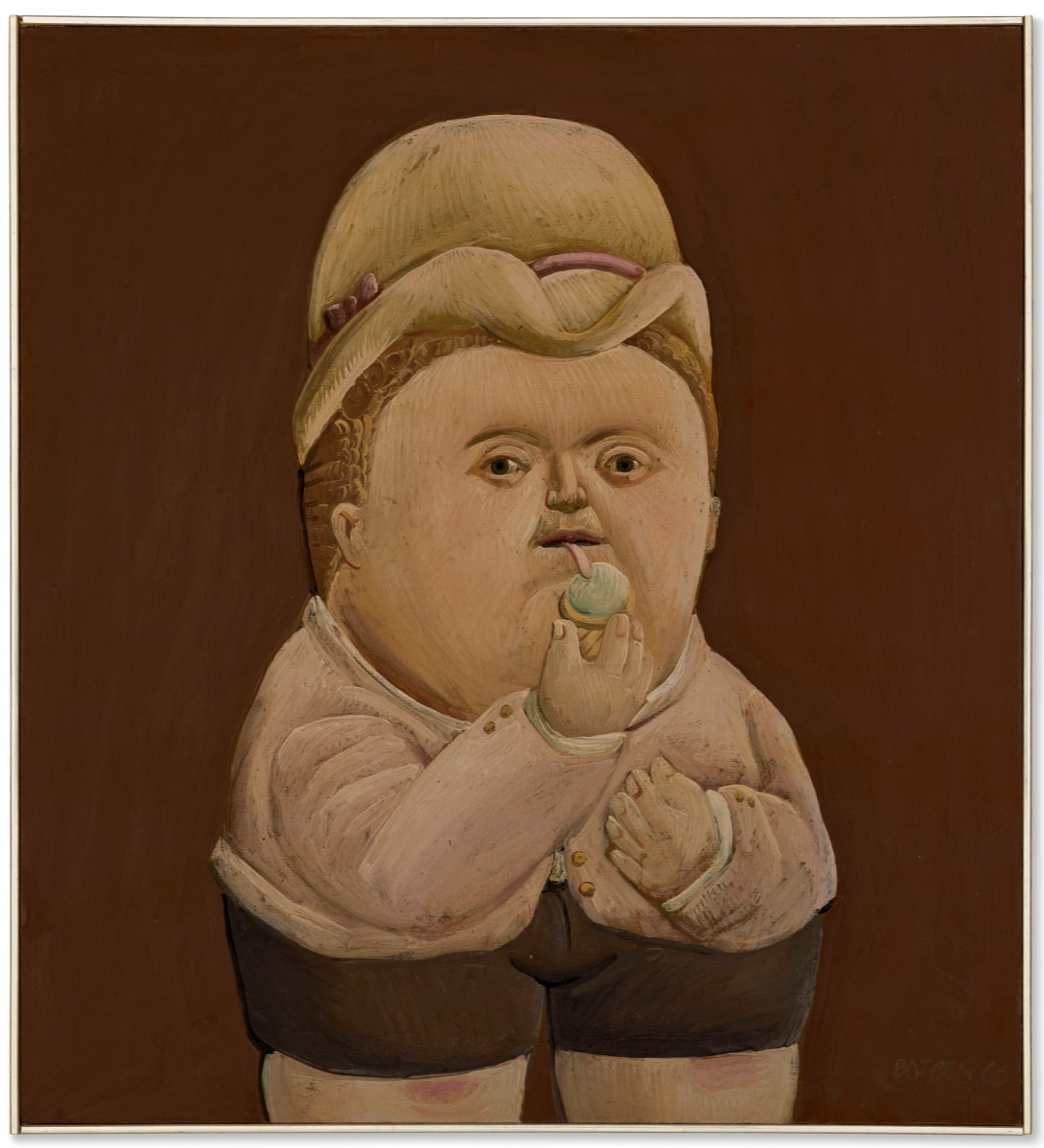
FERNANDO BOTERO (1932-2023)
Niño comiendo helado, 1965
Oil on canvas
86.4 x 86.4 cm (34×34 inches)
Signed and dated ‘Botero 65’ (lower right)
Signed again, titled and dated again ‘Botero 65 NIÑO COMIENDO HELADO’ (on the reverse)
#6. Untitled, circa 1959
Christie’s New-York: 20 November 2025
Estimated: USD 350,000 – 450,000
USD 355,600
FERNANDO BOTERO (1932-2023), Untitled | Christie’s
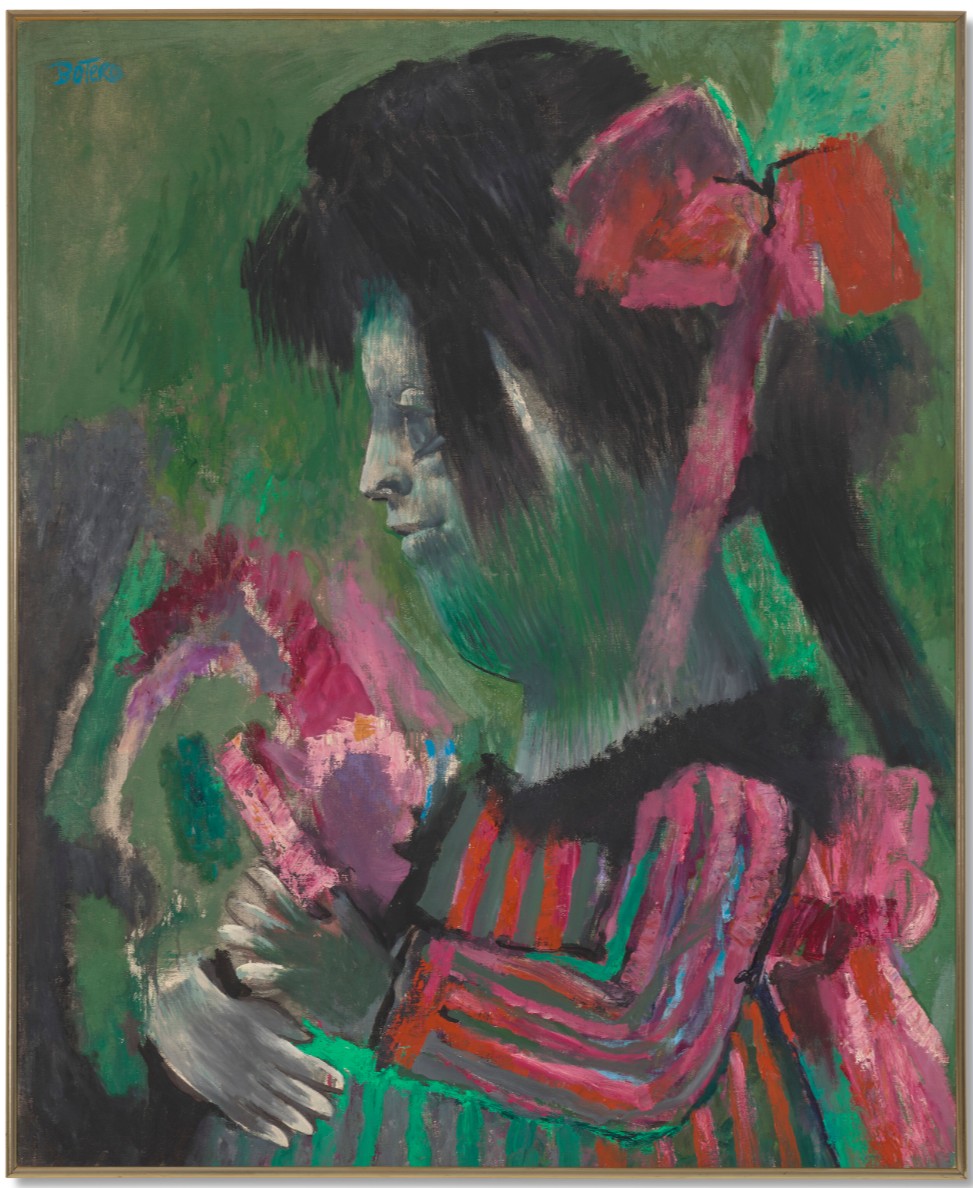
FERNANDO BOTERO (1932-2023)
Untitled, circa 1959
Oil on canvas
154.9 x 127 cm (61×50 inches)
Signed ‘Botero’ (upper left)
In the early 1950s, Fernando Botero was a young aspiring artist living in Bogotá, far removed from the epicenter of the art world in New York. While early success with his first solo exhibition at Galería Leo Matiz in Bogotá in 1951 brought him accolades in Colombia, he was a long way from achieving the international art stardom of his later years. His paintings from this decade seethe with energy, experimentation and expectation, much like, one can imagine, the ambitious artist himself at that time.
“I started to paint these volumetric figures when I was 17. I did it by intuition… because it said something to me. Then, of course, when I was in Europe, especially in Italy, I rationalized the importance of volume because I saw that all Italian painters like Michelangelo, Raphael, Giotto, Masaccio, Piero della Francesca made a celebration of volume.”
Buoyed by sales from his show at Leo Matiz as well as prize money for his winning submission to the Salón de Artistas Colombianos, Botero ventured to Europe in 1952 where he immersed himself in studying the Old Masters and 20th century modernists of Italy, Spain and France. Europe proved transformative for Botero, converting him into an insatiable student of art history. The lessons absorbed from wandering the Prado, Uffizi and Louvre in those early days would reverberate throughout his career. After Europe, Botero returned to Bogotá and then to Mexico City in 1956 where again he took to studying the masters, this time the muralists: Diego Rivera, José Clemente Orozco and David Alfaro Siqueiros. The monumental figures of Los Tres Grandes, as the trio became known, left another indelible impression on Botero that would prove a springboard for his lifelong investigation of volume and form.
Back home in Bogotá in the late 1950s, Botero set to work finding his own individual visual vocabulary that differentiated him from those eminent artistic predecessors. The body of work from this period is defined by vigorous brushstrokes, a deep, jewel-toned palette and an air of mystery. While markedly different from the paintings produced in the later six decades of his career, his 1950s work reveal the artist grappling with what would become the most significant principle of his practice—how to articulate volume and form.
Fernando Botero in his studio, Bogotá, 1959. © The Estate of Fernando Botero.
Pushed up against the picture plane, the girl in the present painting takes on monumental proportions, the hallmark of Botero’s now immediately recognizable style. Her bulbous facial features and considerable coif of black hair foreshadow the voluptuous figures from the artist’s later years. The expressionistic brushstrokes rendered in intense shades of aquamarine, rose and black, sharply deviate, however, from Botero’s later polished style that masks the hand of the artist. There is also an experimental and enigmatic essence here that Botero later eschewed. The surface of the painting toggles between thickly applied impasto and passages of canvas left deliberately bare. Rather than the clearly defined narratives found in the paintings of the artist’s later years, here the subject is more inscrutable. Botero provides a minimal plot line—a girl holding flowers, the likes of which we have never seen—and leaves us to ask more questions: What are these flowers? Who is this girl? What is she thinking? Who is this artist? Who will he become?
Femme du Monde, 1974
Phillips New-York: 21 November 2025
Estimated: USD 350,000 – 450,000
WITHDRAWN
Fernando Botero Modern & Contemporary Art Day Sale, Morning Session
Charcoal and sanguine on canvas
179.1 x 141 cm (70 1/2 x 55 1/2 inches)
Signed and dated “Botero 74” lower right
Bodegón con sandía, 1999
Christie’s New-York: 20 November 2025
Estimated: USD 200,000 – 300,000
PASSED
FERNANDO BOTERO (1932-2023), Bodegón con sandía | Christie’s
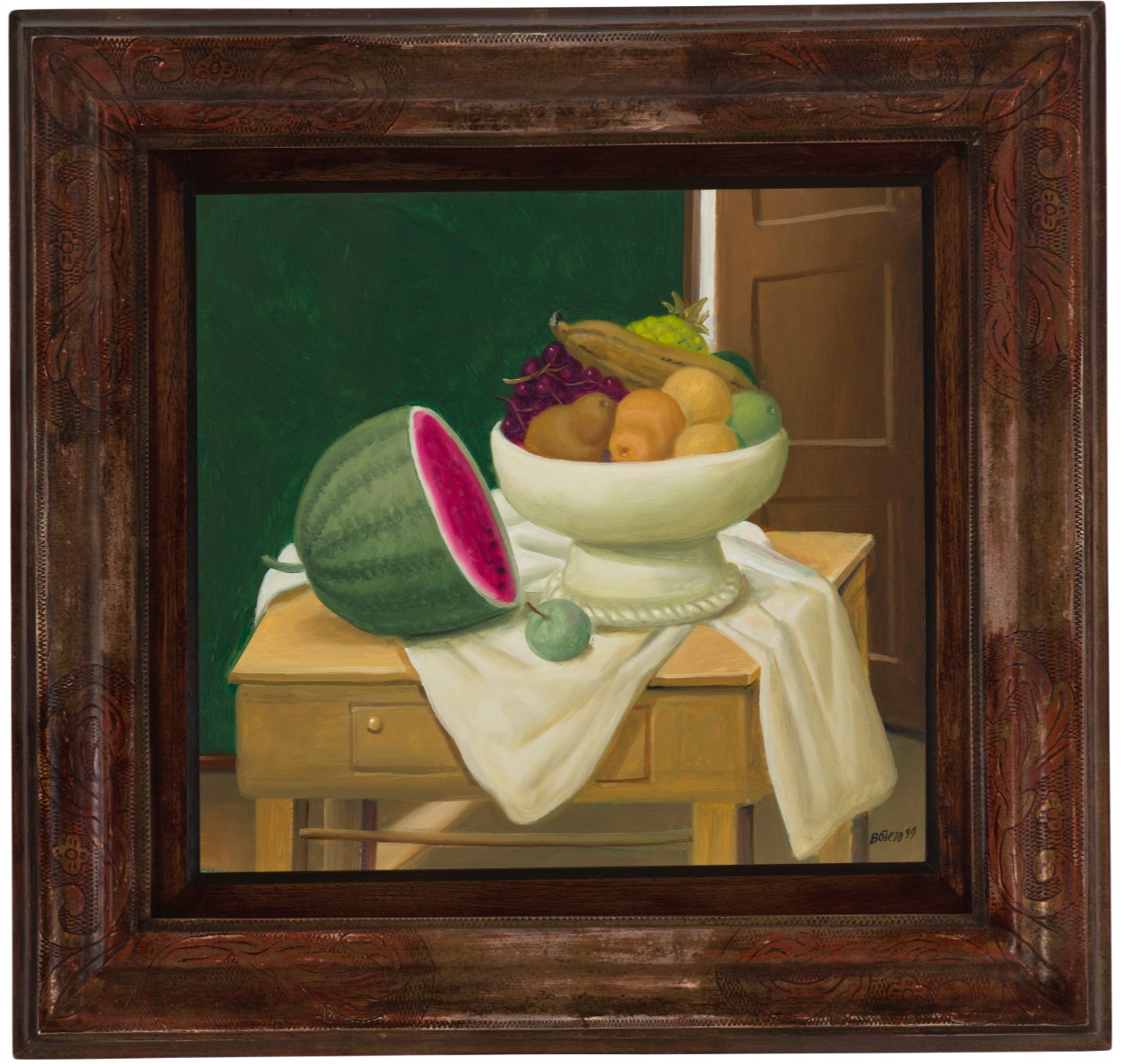
FERNANDO BOTERO (1932-2023)
Bodegón con sandía, 1999
Oil on canvas
36.2 x 39.1 cm (14 1/4 x 15 3/8 inches)
Signed and dated ‘Botero 99’ (lower right)
2. Sculptures
#1. Bailarines, 2001
Sotheby’s New-York: 19 November 2025
Estimated: USD 800,000 – 1,200,000
USD 920,750
Bailarines | Contemporary Day Auction | 2025 | Sotheby’s
FERNANDO BOTERO (1932 – 2023)
Bailarines, 2001
Bronze
134.6 x 53.5 x 89.2 cm (53 x 21 1/8 x 35 1/8 inches)
Incised with the number PA 1/2 (lower edge)
This work is artist’s proof 2 from an edition of 6 plus 2 artist’s proofs
Capturing Botero’s refined yet sensuous figures on a monumental scale, Bailarines manifests the characteristics of the artist’s oeuvre for which he is most beloved. Two figures, male and female, are locked in a gentle dance, their voluminous bodies poised in a moment of suspended motion. The motif of the dancing couple occupies a central place in Botero’s exploration of human connection, stretching back into even his earliest works. Across paintings and sculptures alike, Botero returns to scenes of ballroom dancers, musicians, and lovers—subjects that embody the harmony and sensuality of everyday life.
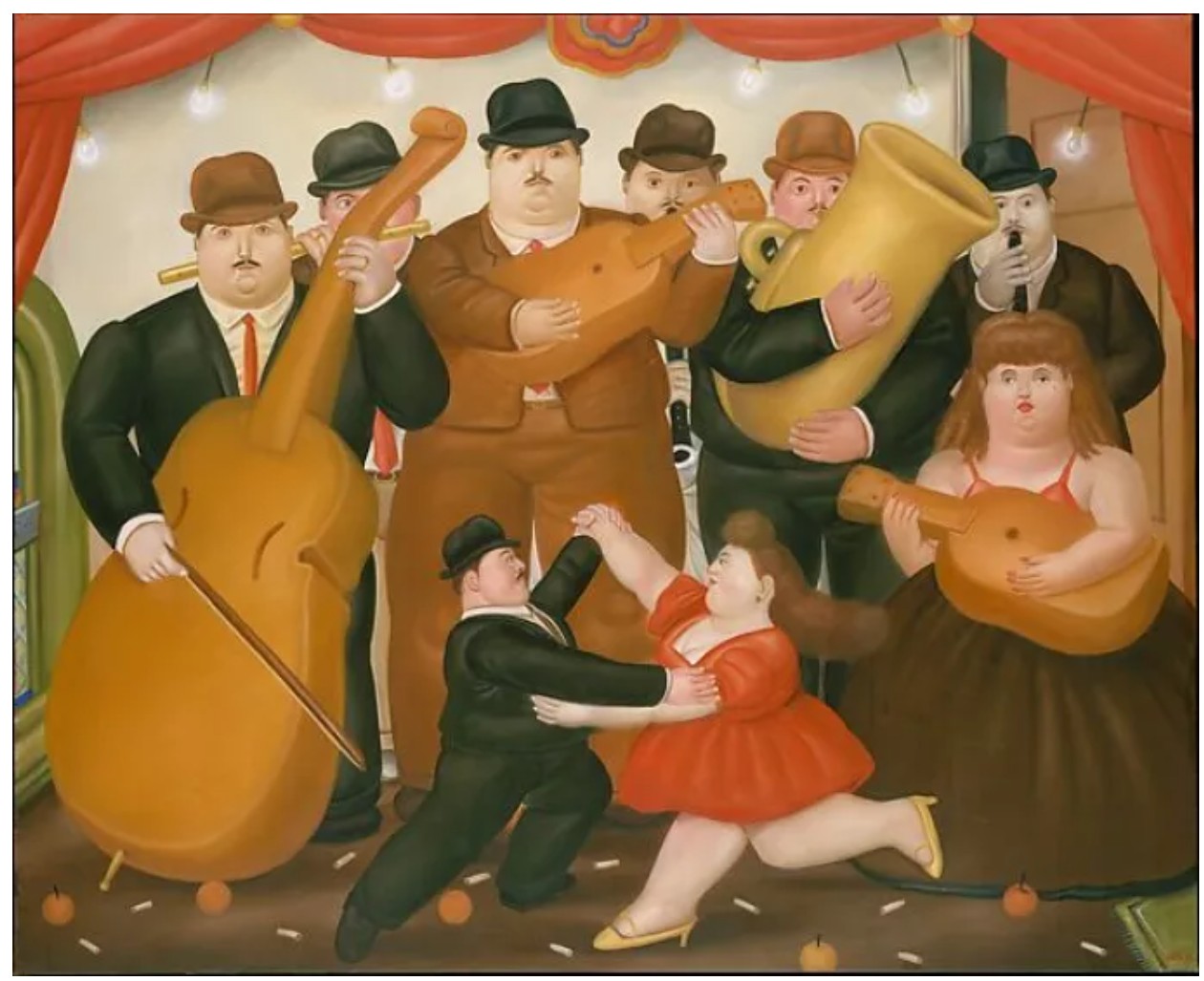
Fernando Botero, Dancing in Colombia, oil on canvas, 1890. The Metropolitan Museum © Fernando Botero
In Bailarines, Botero’s figures are stripped of ornament or narrative setting, imparting a timelessness that is often evoked by Botero’s simplified settings. The figure’s interlocking legs set forth the dancing motion. The rounded modeling of their bodies amplifies their intimacy, inviting viewers to sense not the heaviness of mass but the role of the human body as a vessel of rhythm, warmth and affection.
From his earliest experiments in the 1950s to his mature bronzes of the 1990s and 2000s, Botero treats the human body as a vehicle for form and feeling rather than pursuing anatomical precision. While Botero’s abandonment of physiological accuracy opposes much of Western art history’s traditional treatment of the nude figure, the artist’s oeuvre is heavily informed by and deeply in dialogue with precisely this tradition.
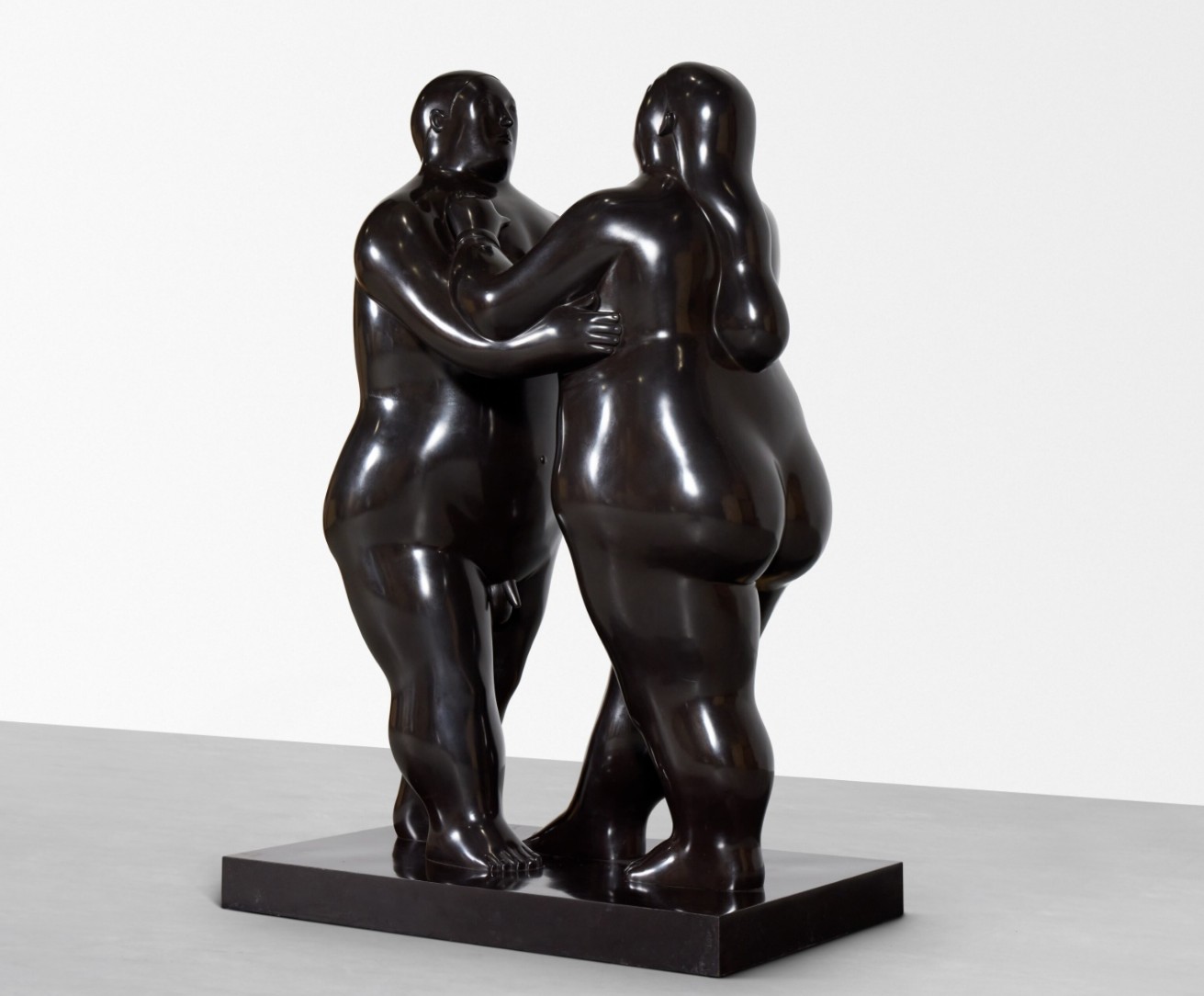
Botero spent his childhood and early adolescence in Medellín, Colombia, where he encountered pre-Columbian and Baroque, Spanish colonial art. Holding his first exhibition in Bogotá at the age of 19, Botero’s career began early and his immediately recognizable style quickly gained traction, reflected in his winning second place in the Salon Nacional de Artistas in 1952. Botero used his prize money to leave Colombia in hopes of honing his artistic abilities surrounded by historical masters. In the 1950s, the artist travelled to Spain, France and Italy, where he further embraced his interest in the human figure. Botero credits institutions such as Museo del Prado and Gallery Uffitzi for administering him a formal education in art and art history. Artists like Francisco Goya and Titan would come to profoundly impact the visual language that would become distinctly his own; he admired their command of mass and curvature in portraying the human body and their mastery of the classical nude.
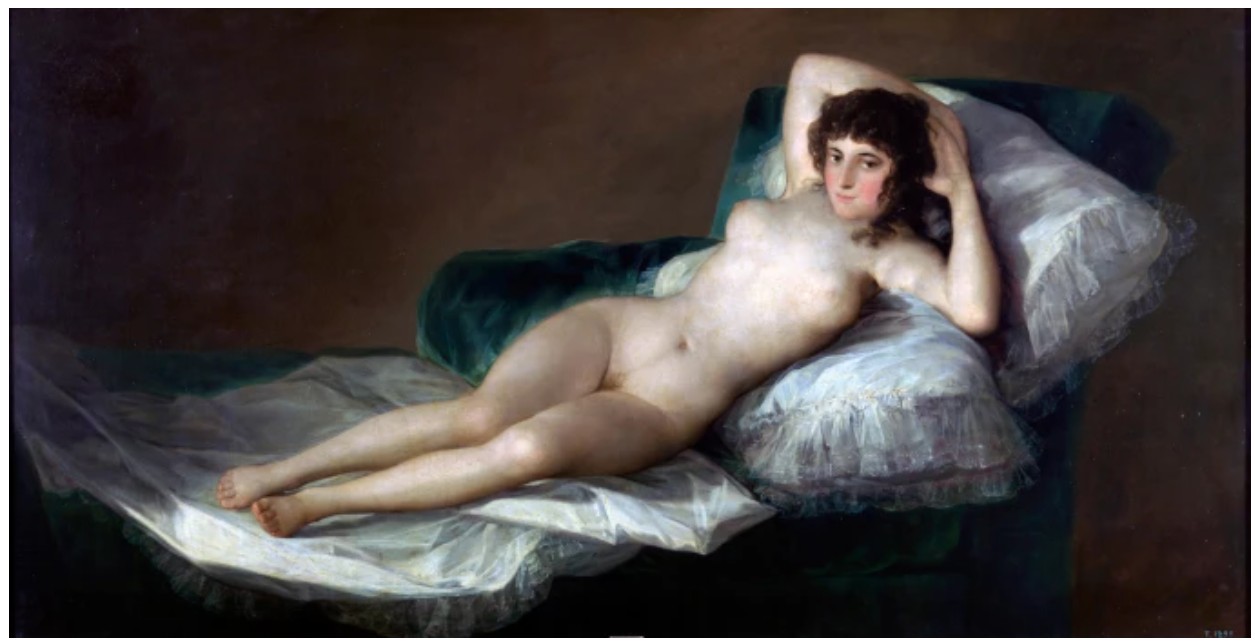
Francisco Goya, La Maja Desnuda, oil on canvas, 1797-1800. Museo del Prado, Madrid
One of the most recognizable sculptors of the modern age, Botero achieved international acclaim with public installations gracing Park Avenue in New York, the Champs-Élysées in Paris, and beyond. His Bailarines exemplifies the artist’s ability to fuse levity and mass, humor and elegance, all of which are qualities that have made his work both instantly recognizable and universally beloved.
#2. Rooster, 1981
Christie’s New-York: 20 November 2025
Estimated: USD 150,000 – 250,000
USD 762,000
FERNANDO BOTERO (1932-2023), Rooster | Christie’s
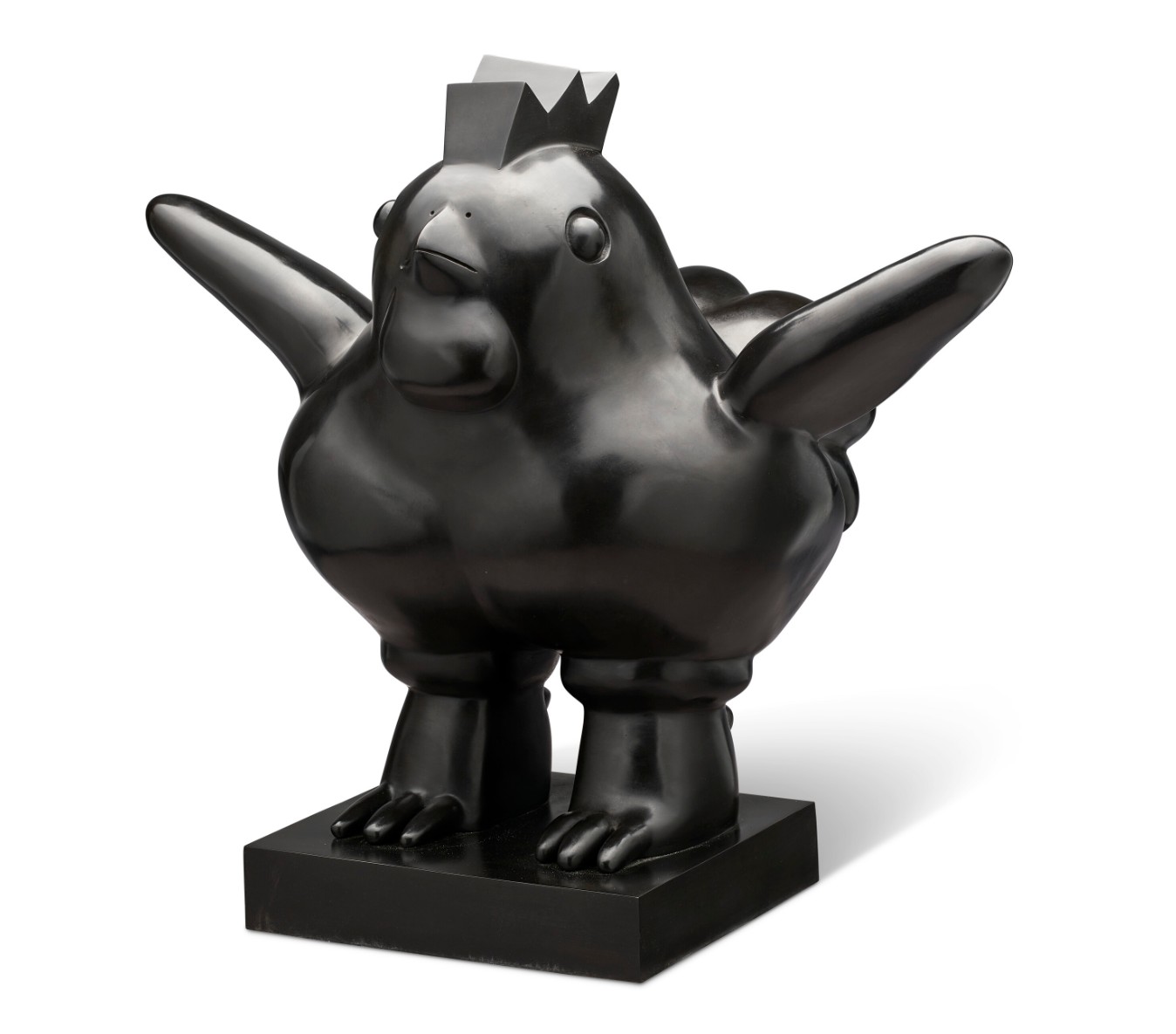
FERNANDO BOTERO (1932-2023)
Rooster, 1981
Bronze
68.6 x 75 x 58.4 cm (27 x 29 1/2 x 23 inches)
Incised with the artist’s signature and number and stamped with the foundry mark ‘Botero 5⁄6’ (on the base)
This work is number five from an edition of six
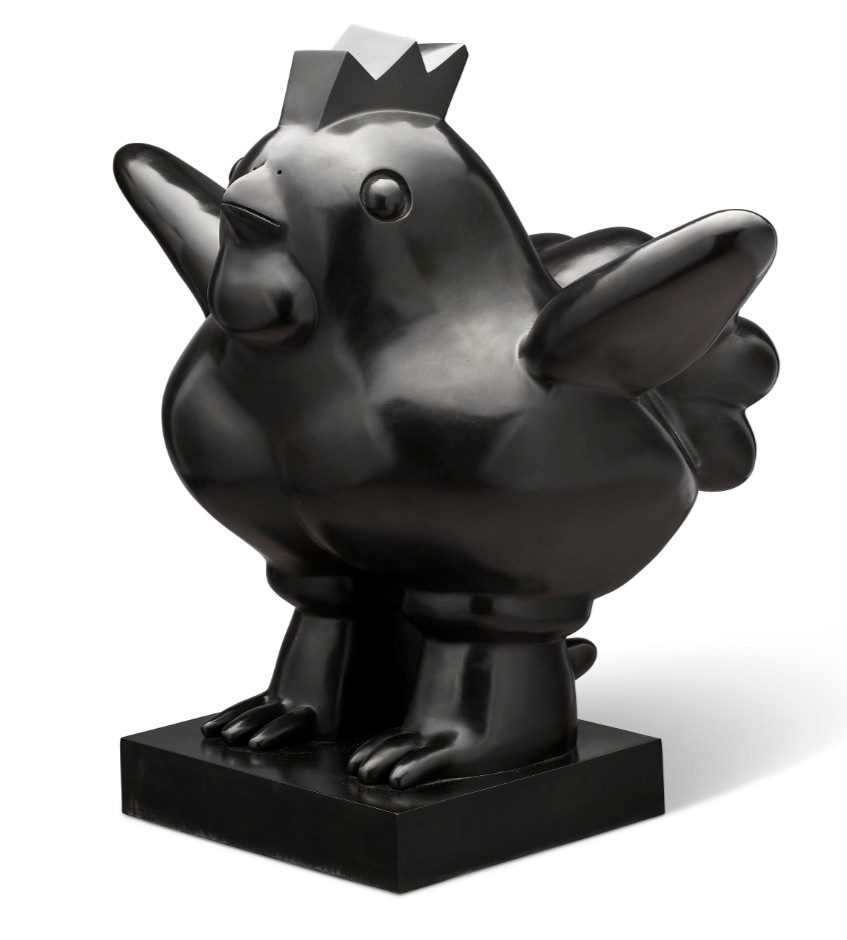
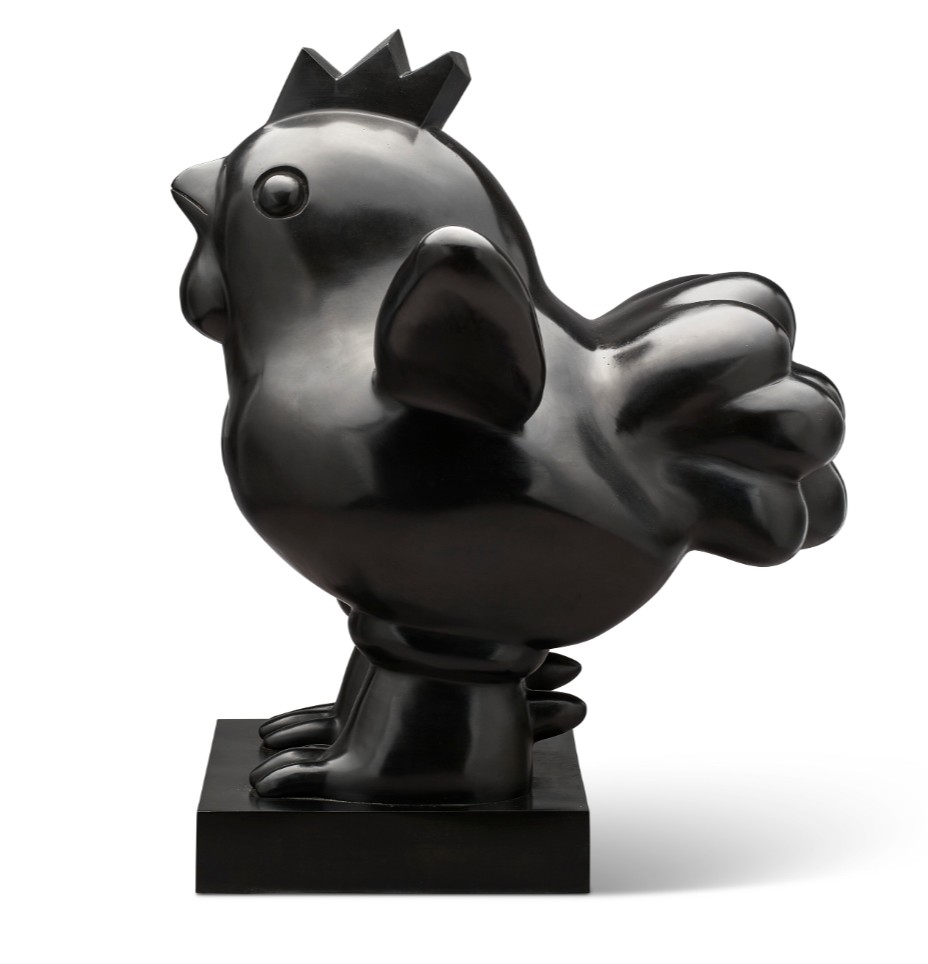
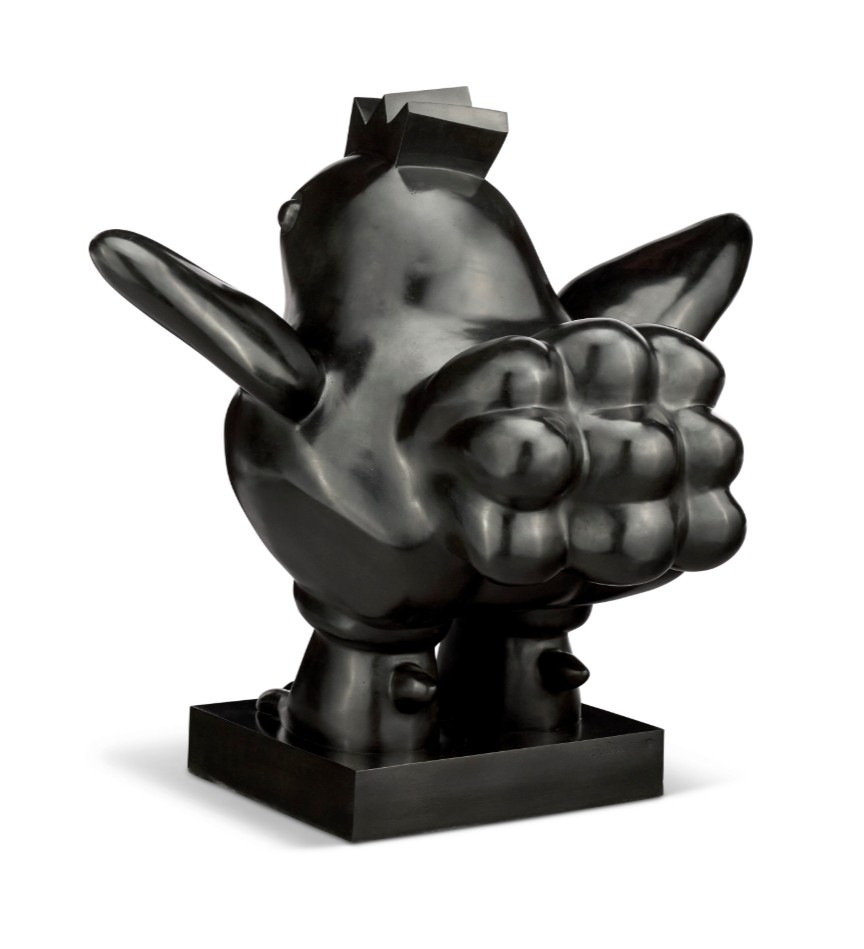
#3. Man on a Horse, circa 1990
Christie’s New-York: 20 November 2025
Estimated: USD 400,000 – 600,000
USD 609,600
FERNANDO BOTERO (1932-2023), Man on a Horse | Christie’s
FERNANDO BOTERO (1932-2023)
Man on a Horse, circa 1990
White Carrara marble
74.9 x 48.3 x 33 cm (29 1/2 x 19 x 13 inches)
Incised with the artist’s signature ‘Botero’ (on the base)
“Sculpture enables me to create real volumes…Sculpture is like a caress. You touch the form, you can give the forms the softness, the sensuality you want. It’s magnificent.”
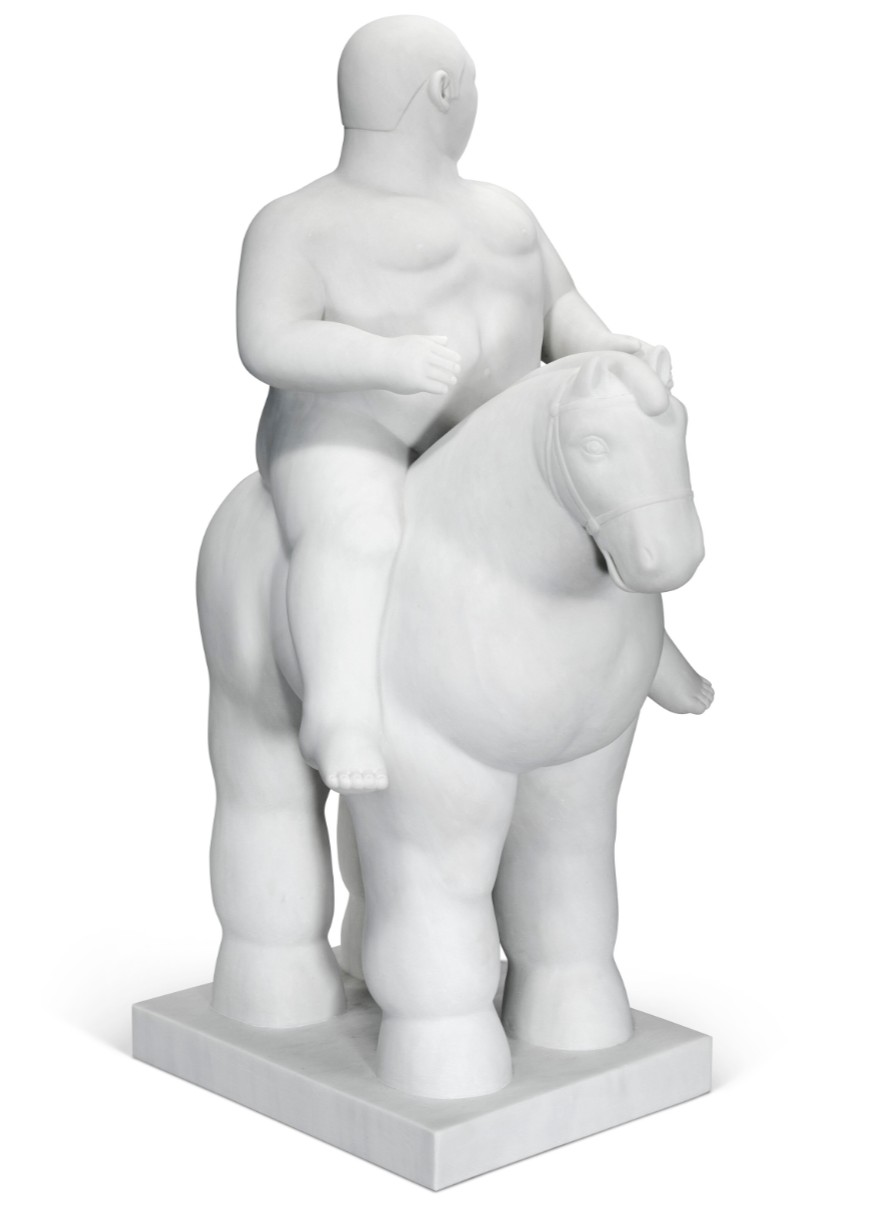
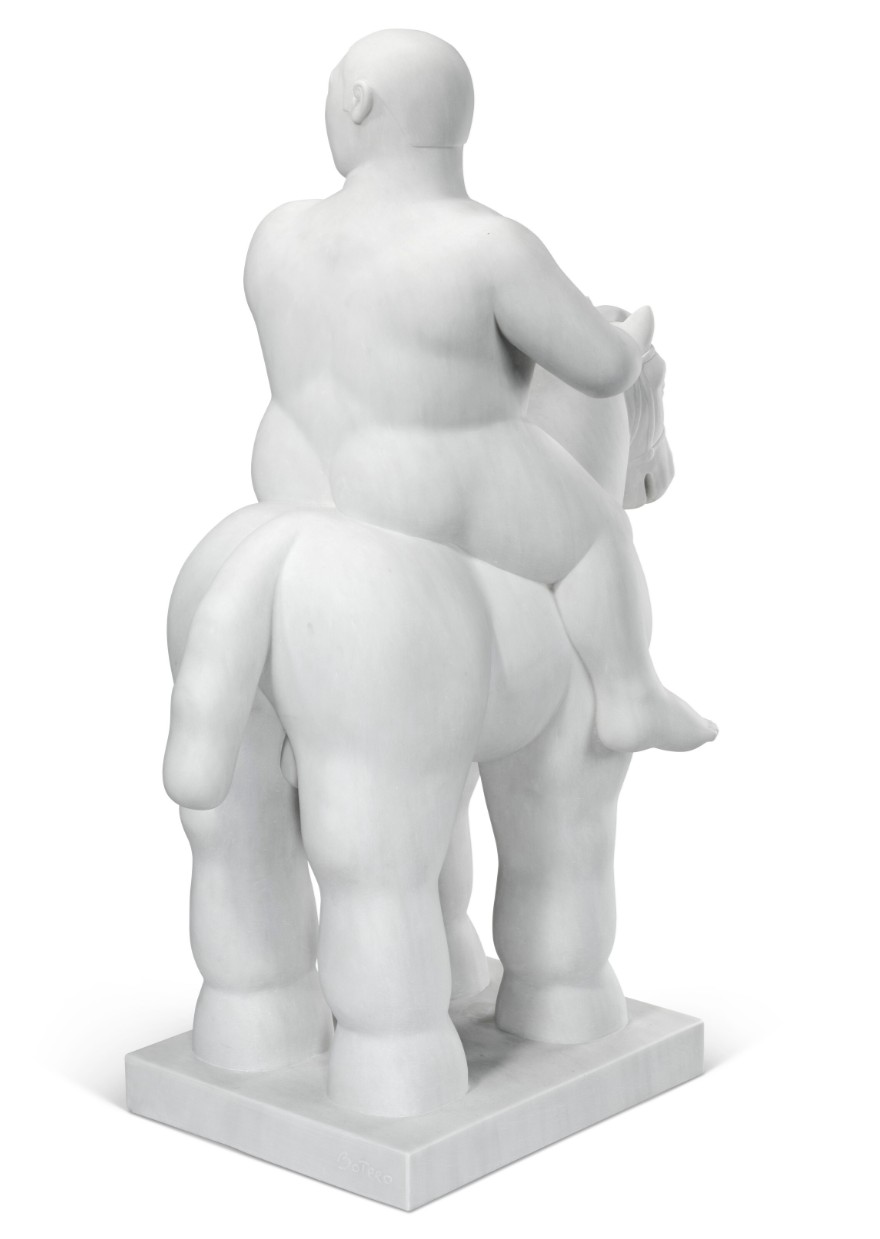
#4. Torso, 1981
Christie’s New-York: 20 November 2025
Estimated: USD 300,000 – 400,000
USD 457,200
FERNANDO BOTERO (1932-2023), Torso | Christie’s
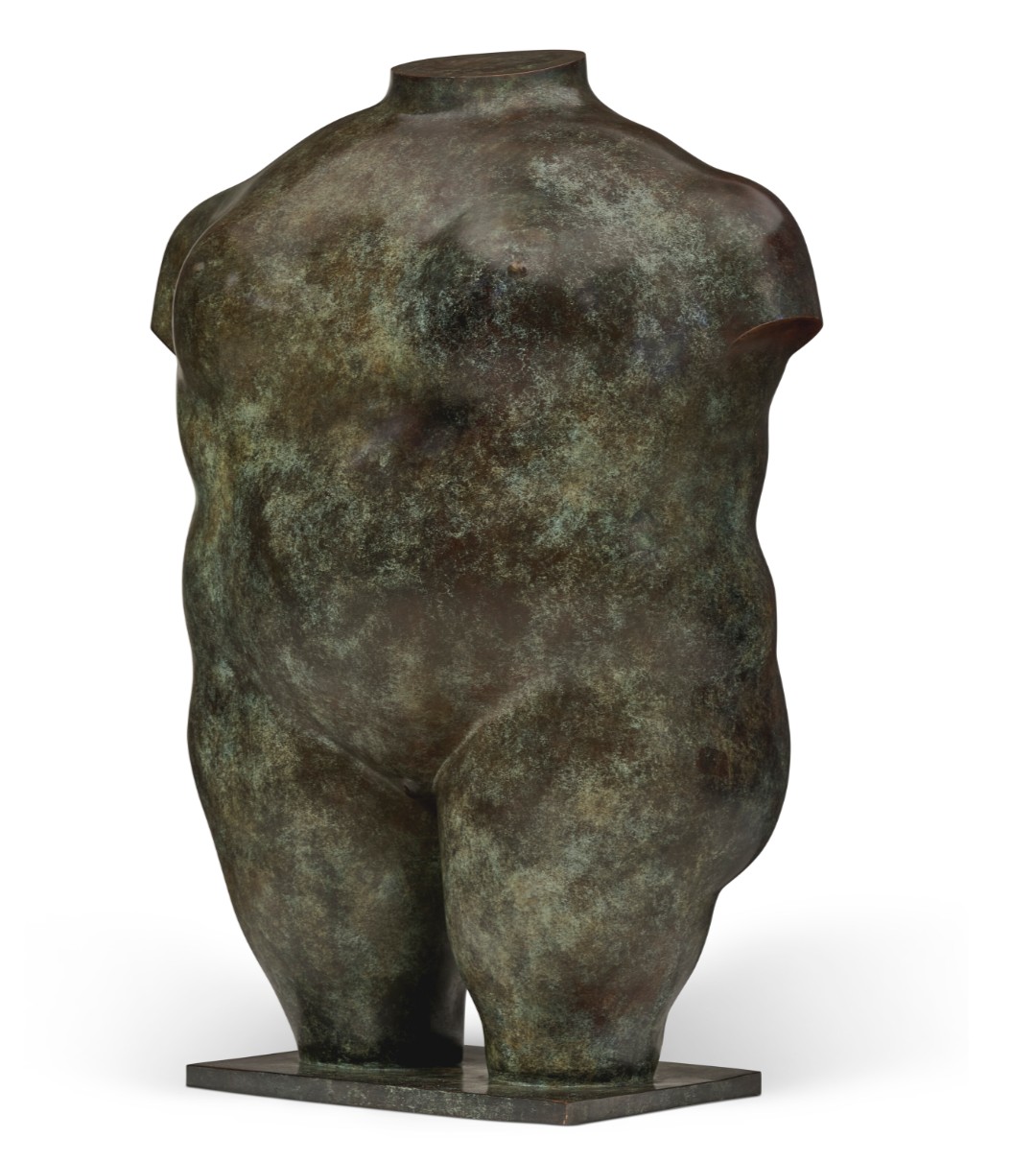
FERNANDO BOTERO (1932-2023)
Torso, 1981
Bronze
108 x 80 x 50.8 cm (42 1/2 x 31 1/2 x 20 inches)
Incised with the artist’s signature and number ‘Botero 2⁄6’ (on the base)
This work is number two from an edition of six
“Sculpture allows me to transform the torso into an object of spirit and sensuality. It’s not about anatomy, but about presence and a feeling of monumentality.”
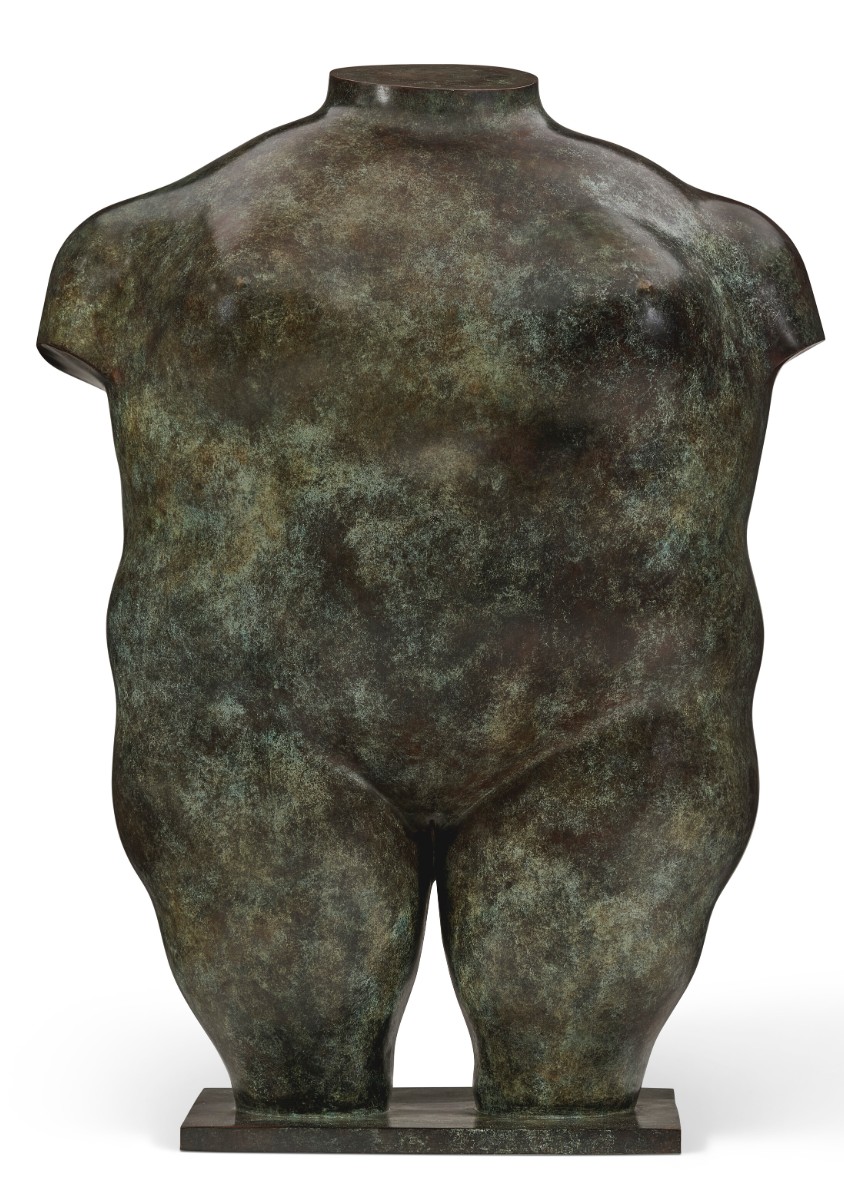
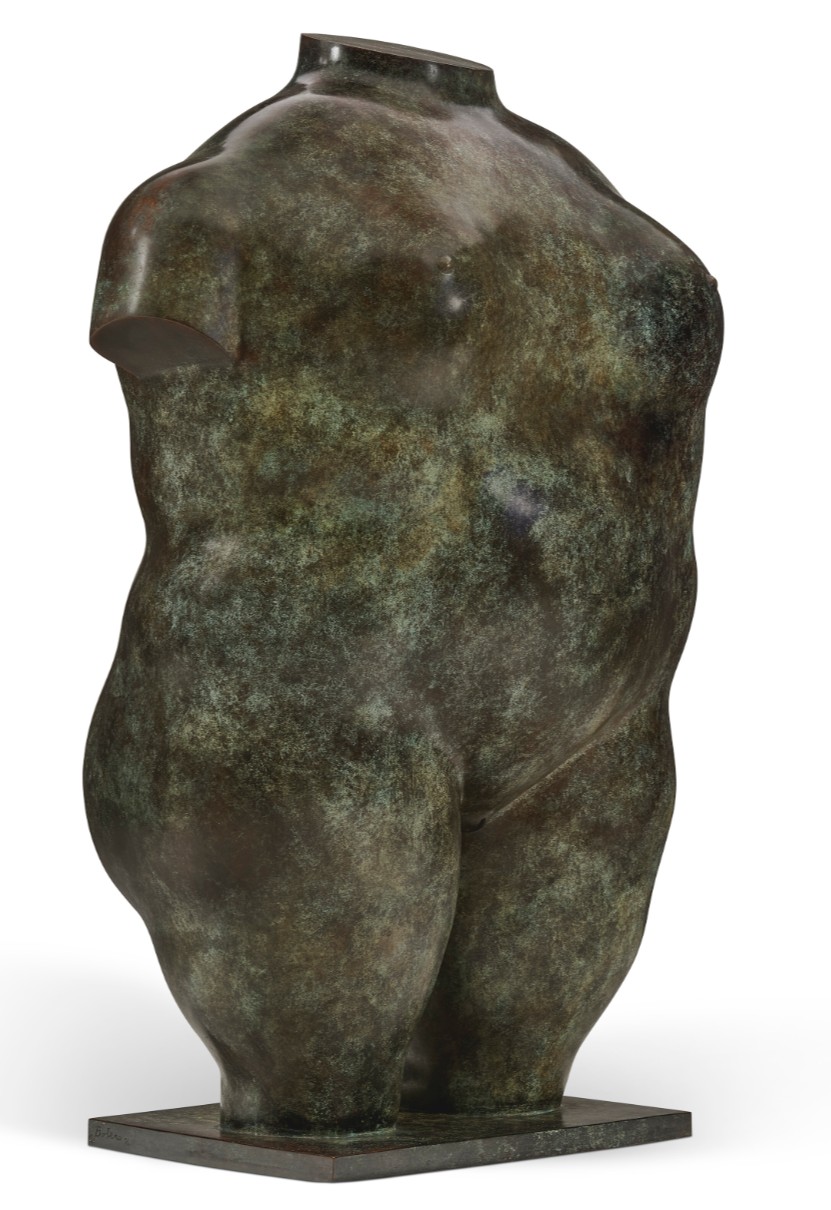
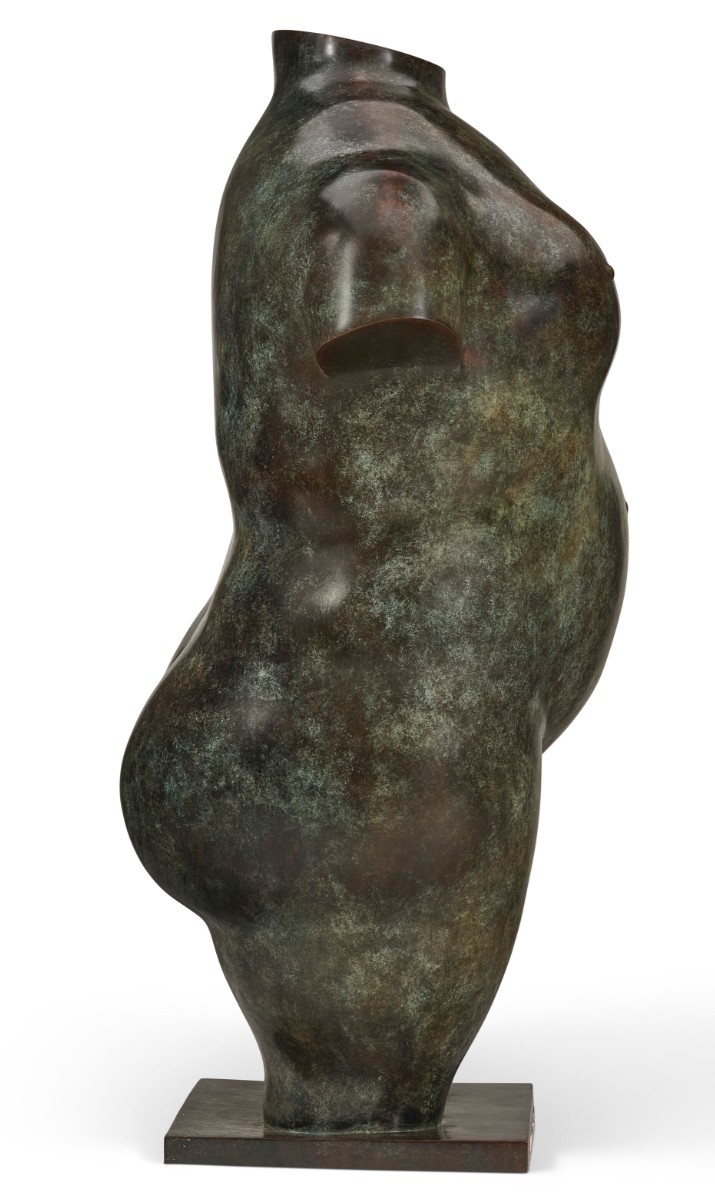
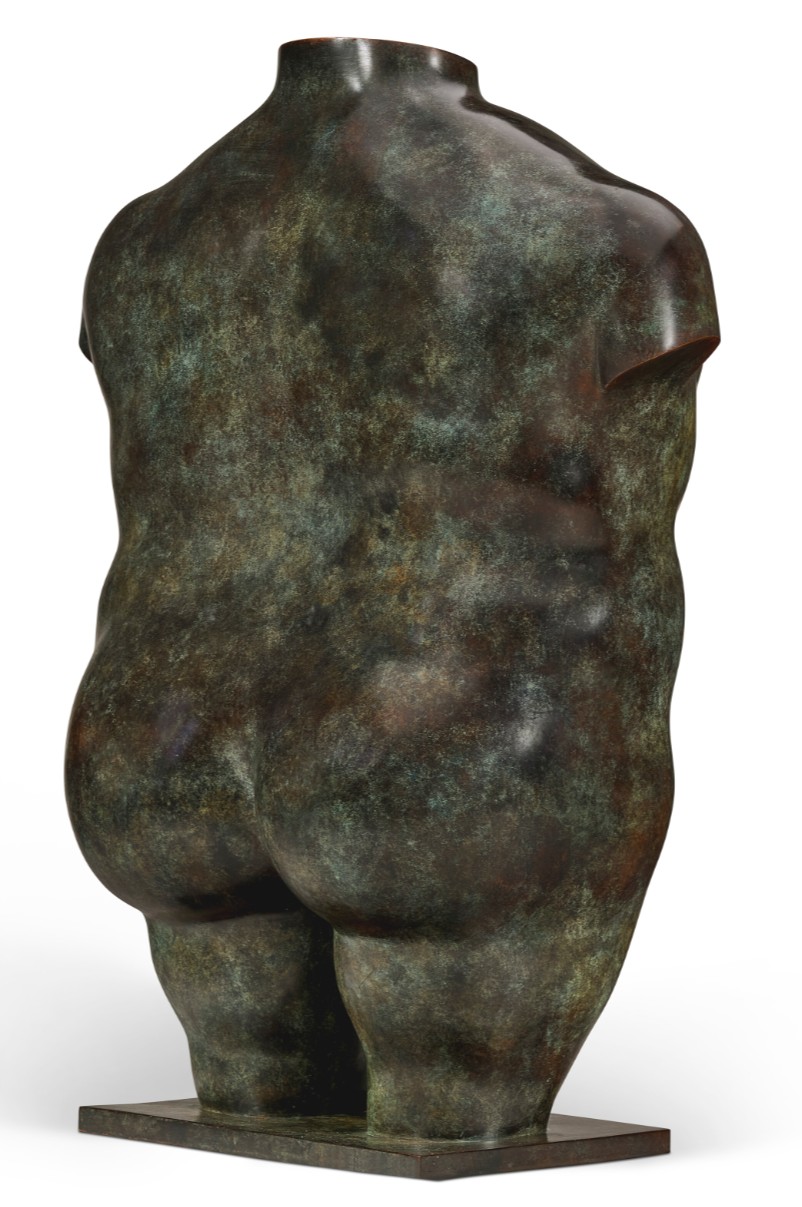
#5. Rape of Europa, 1995
The Collection of Lucille Coleman
Christie’s New-York: 20 November 2025
Estimated: USD 350,000 – 450,000
USD 406,400
FERNANDO BOTERO (1932-2023), Rape of Europa | Christie’s
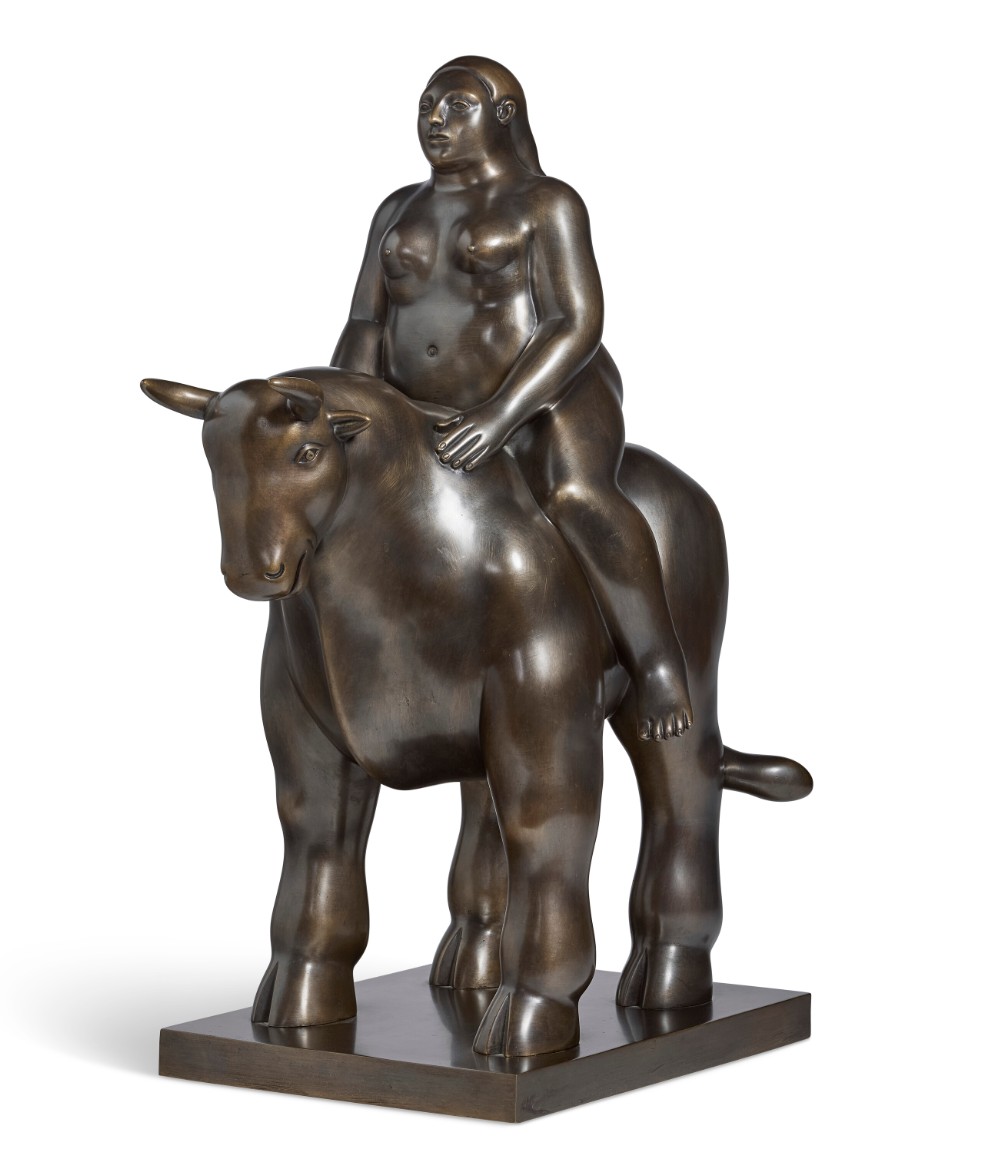
FERNANDO BOTERO (1932-2023)
Rape of Europa, 1995
Bronze
63.5 x 47 x 31.1 cm (25 x 18 1/2 x 12 1/4 inches)
Incised with the artist’s signature and stamped with the number and foundry mark ‘Botero 3⁄6’ (on the base)
This work is number three from an edition of six
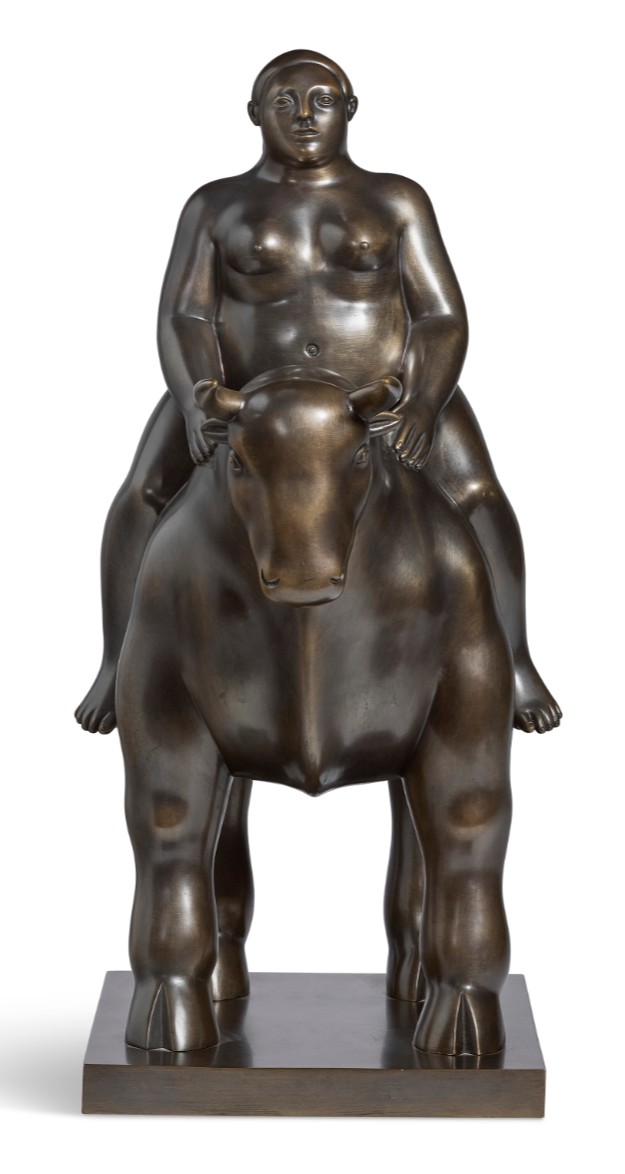
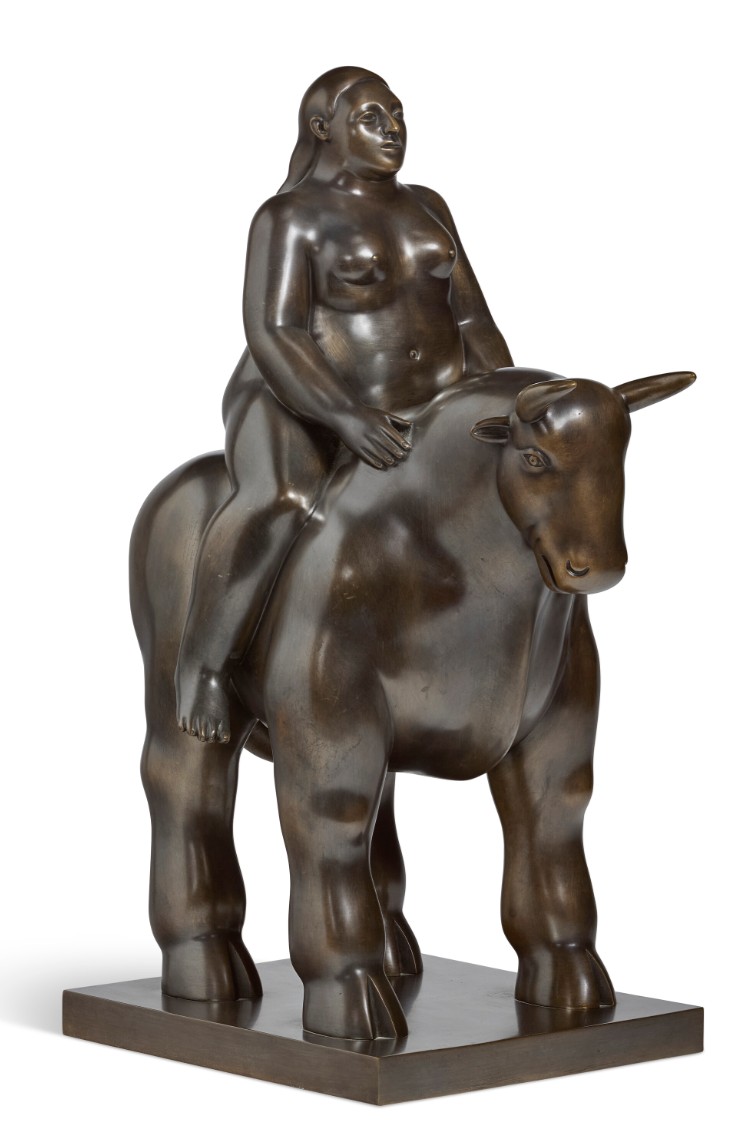
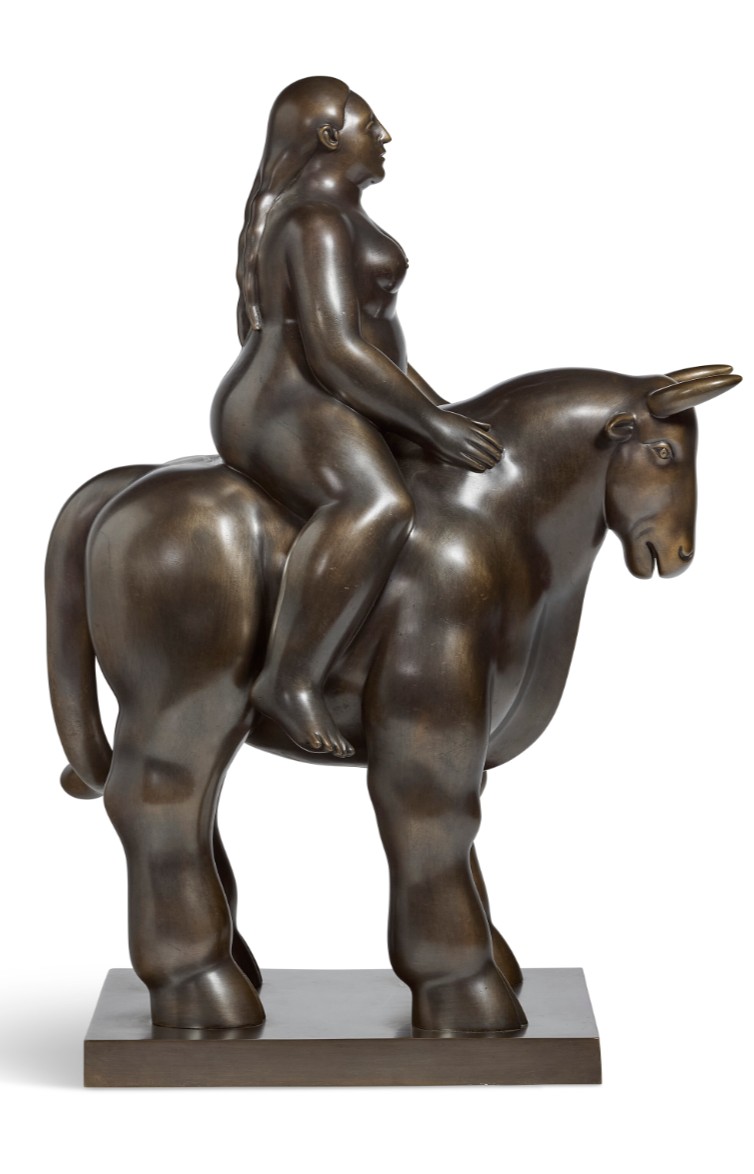
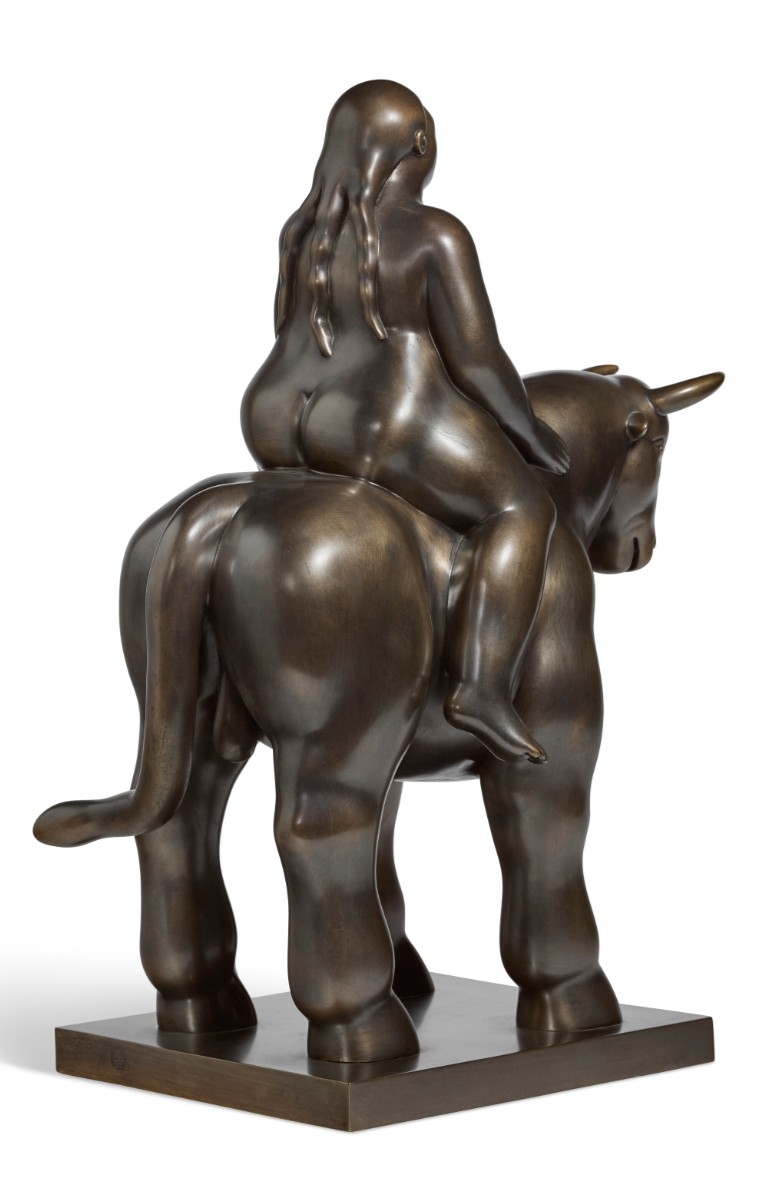
Awoman of glamour and generosity, Lucille Coleman was a true icon of elegance. A revered New York philanthropist, Lucille was warmly regarded by all who knew her as profoundly generous, and kind spirited. Alongside her husband of 45 years, Lucille championed the causes and communities most important to her. In addition to philanthropy, Lucille built an impressive personal collection of jewelry, fine art, and furniture. This season Christie’s is pleased to feature a whimsical sculpture by the beloved Colombian artist, Fernando Botero, in our much-anticipated Post-War and Contemporary art auction—a true testament to Lucille’s keen eye for quality and sense of sophistication across all that she collected. As an enduring tribute to how Lucille Coleman lived her life, the proceeds from her estate are offered with the intent to benefit charitable causes in New York, continuing her legacy and philanthropic spirit in the city she loved most.
#6. Reclining Woman with Apple, 1988
Property from a Private Florida Collection
Sotheby’s New-York: 19 November 2025
Estimated: USD 200,000 – 300,000
USD 342,900
Reclining Woman with Apple | Contemporary Day Auction | 2025 | Sotheby’s
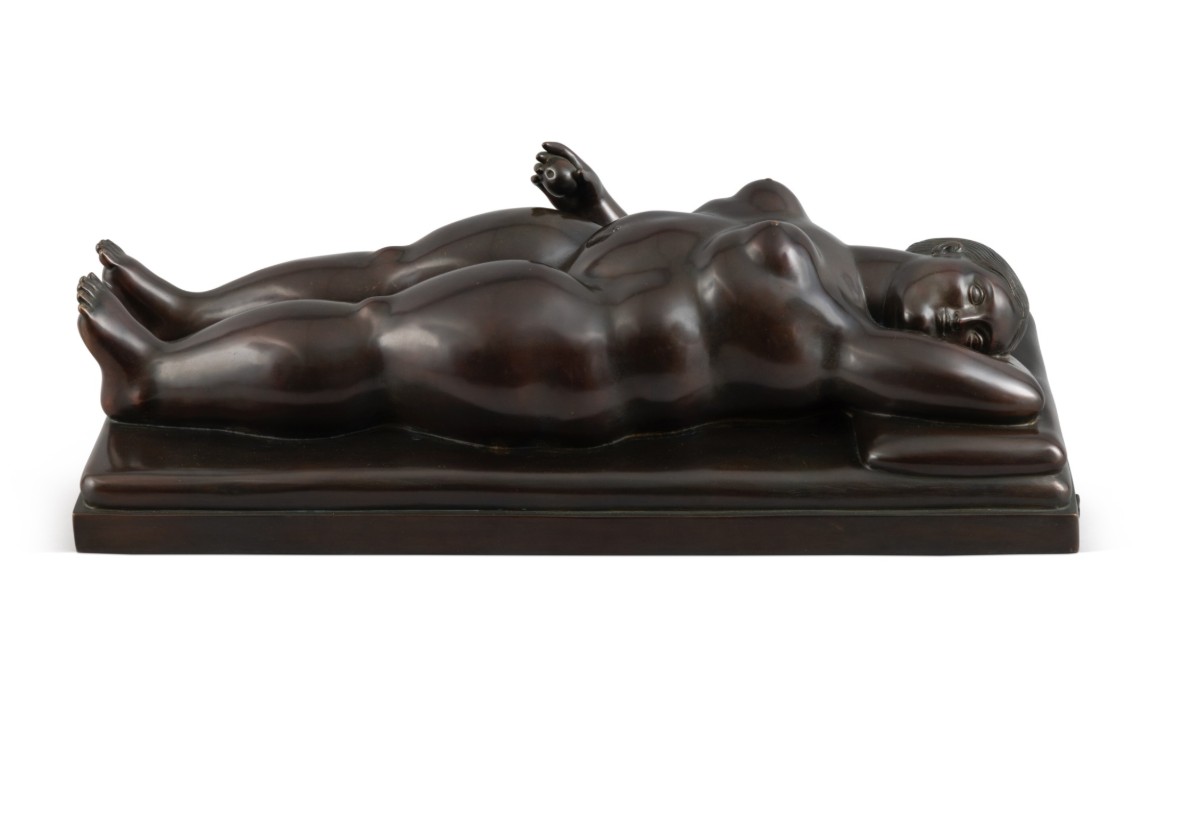
FERNANDO BOTERO (1932 – 2023)
Reclining Woman with Apple, 1988
Bronze
22.9 x 67.3 x 30.5 cm (9 x 26 1/2 x 12 inches)
Incised with the artist’s signature and number 1/6 (lower edge)
This work is number 1 from an edition of 6
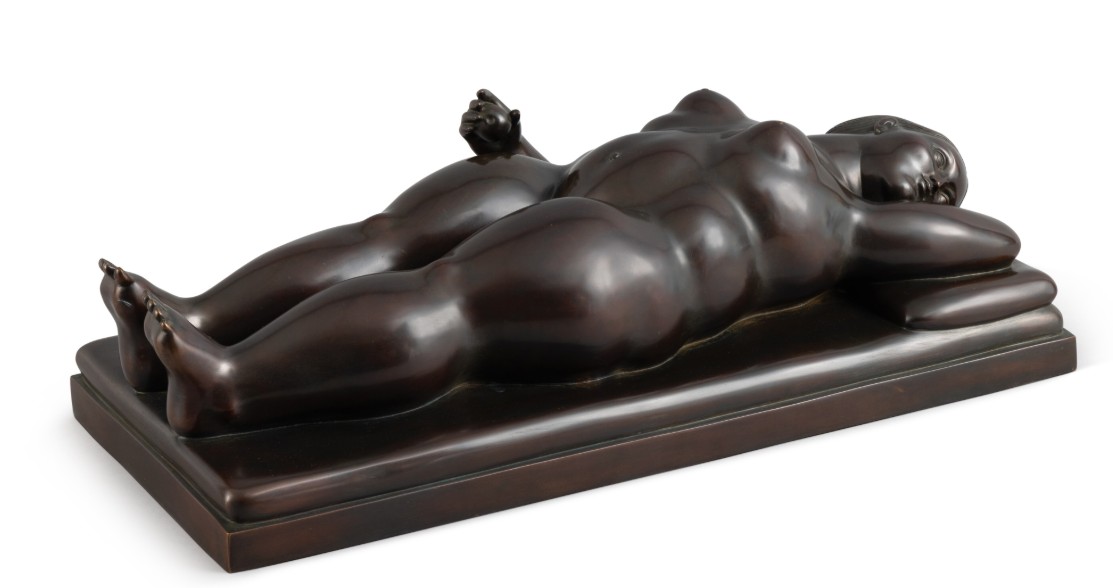
#7. Reclining Woman on a Pillow, 2010
Sotheby’s New-York: 19 November 2025
Estimated: USD 250,000 – 300,000
USD 279,400
Reclining Woman on a Pillow | Contemporary Day Auction | 2025 | Sotheby’s
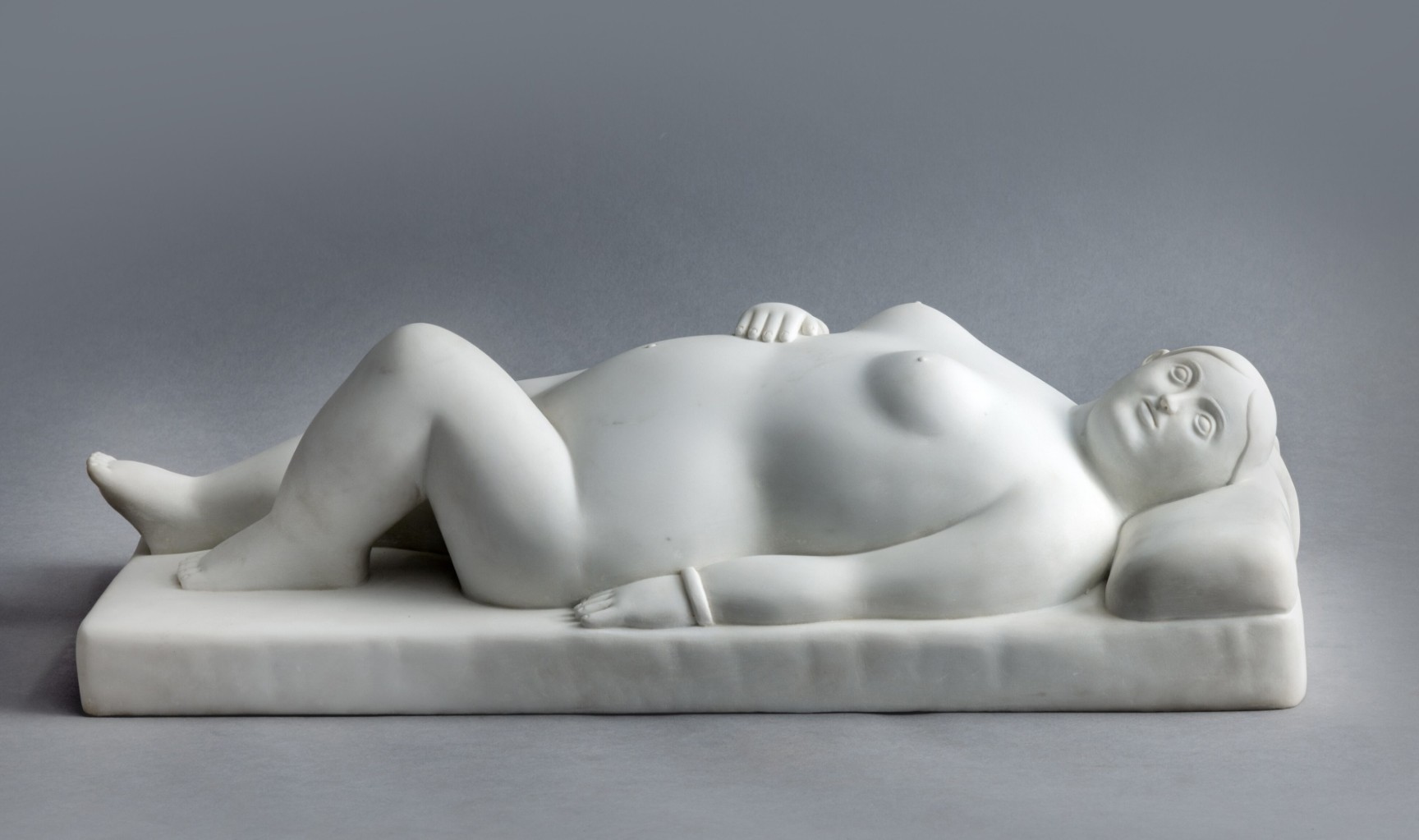
FERNANDO BOTERO (1932 – 2023)
Reclining Woman on a Pillow, 2010
White marble
20.3 x 63.5 x 27.3 cm (8 x 25 x 10 3/4 inches)
Incised with the artist’s signature (lower edge)
This work is unique
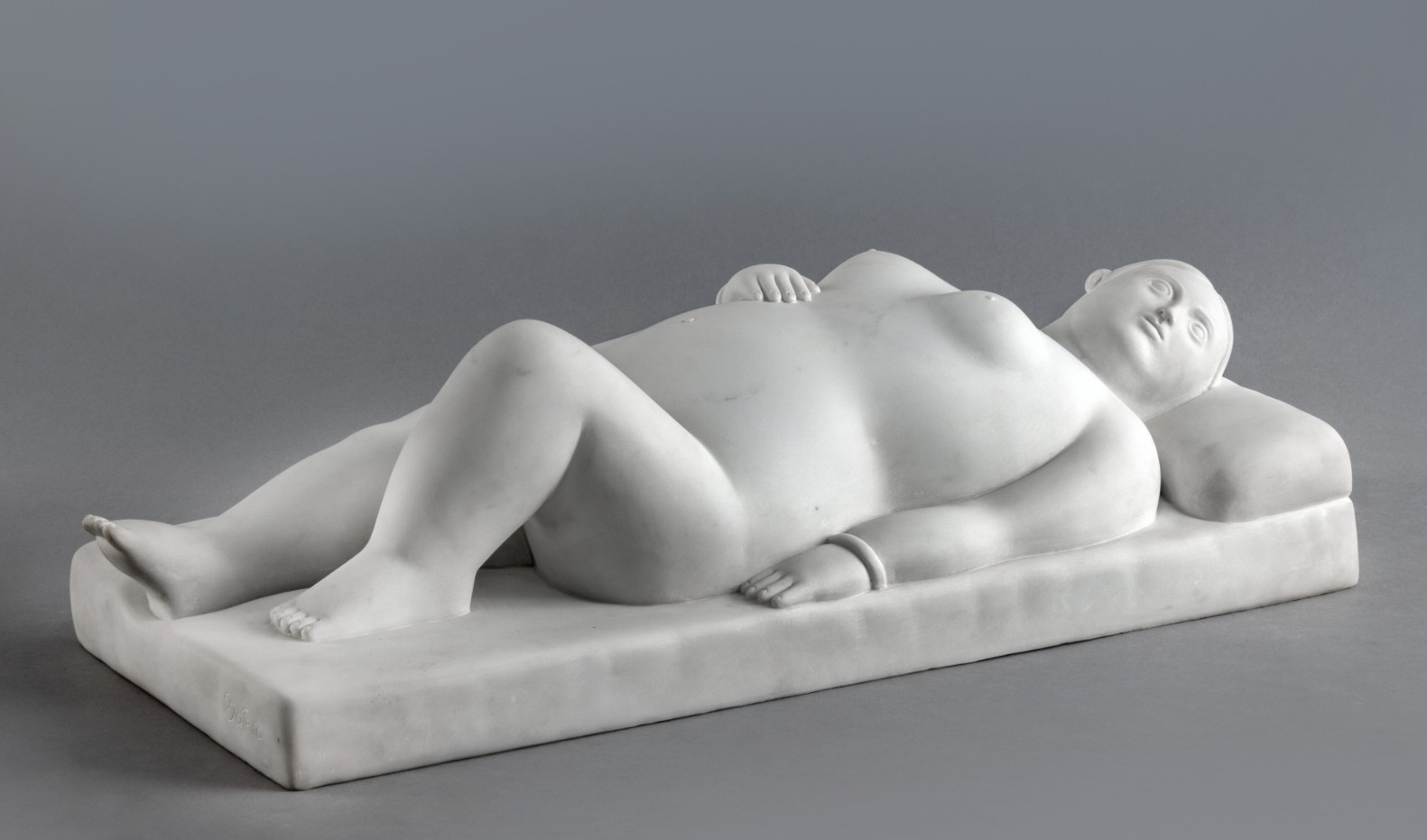
#8. Reclining Nude, 1976
Sotheby’s New-York: 19 November 2025
Estimated: USD 150,000 – 200,000
USD 241,300
Reclining Nude | Contemporary Day Auction | 2025 | Sotheby’s
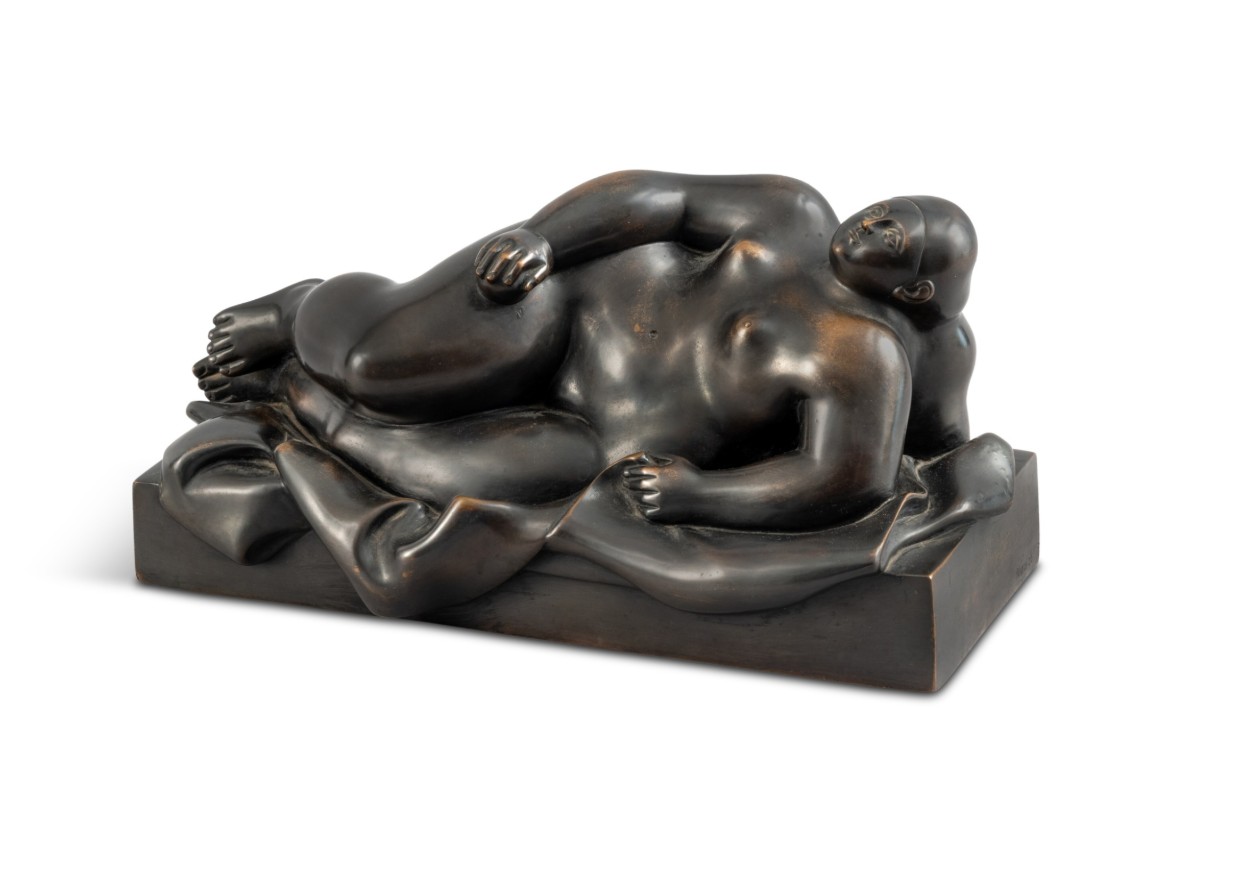
FERNANDO BOTERO (1932 – 2023)
Reclining Nude, 1976
Bronze
17.8 x 34.3 x 16.5 cm (7 x 13 1/2 x 6 1/2 inches)
Incised with the artist’s signature and number 2/6 (lower edge)
This work is number 2 from an edition of 6
Fernando Botero’s Reclining Nude from 1976 embodies the artist’s signature celebration of volume, sensuality, and serene monumentality at an intimate scale. Cast in bronze, the figure’s generous curves and tranquil pose reimagine the classical nude, transforming it into an emblem of vitality and timeless grace. Botero’s mastery lies in his ability to elevate fullness into poetry, giving physical form to harmony and abundance.
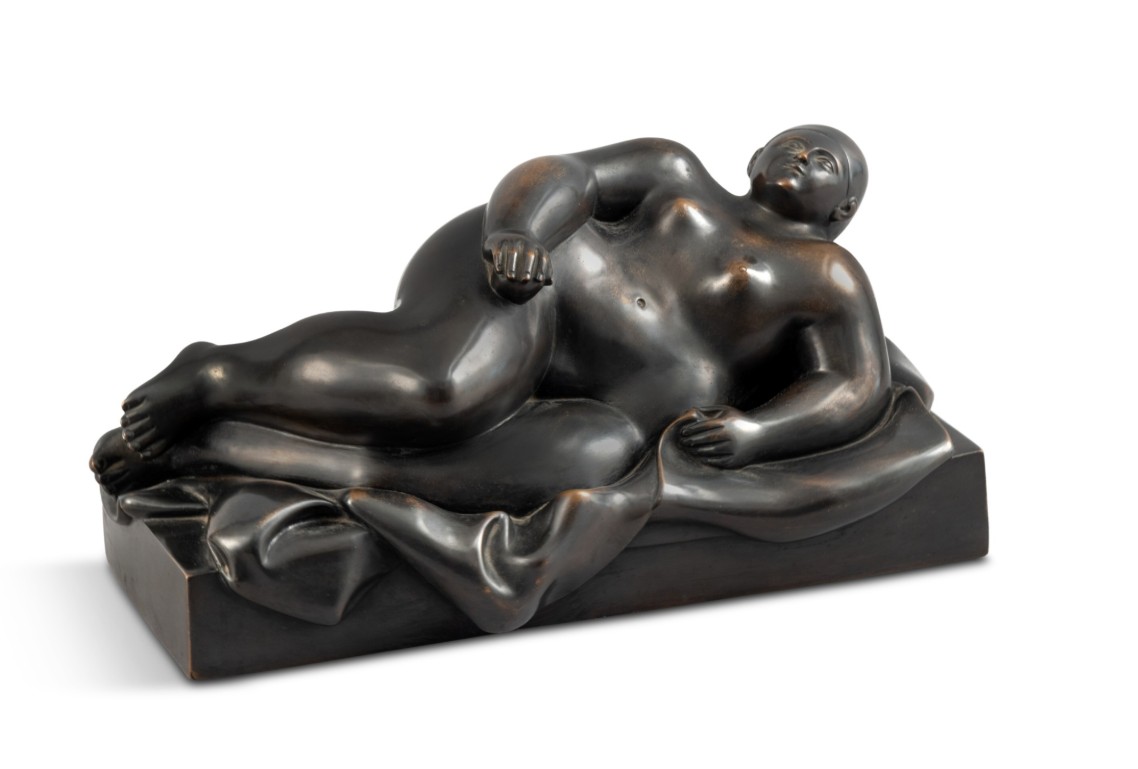
The sculpture was once part of the distinguished collection of Marie Pierre Colle Corcuera, whose life was shaped by art and fashion between Paris and Mexico. Daughter of the celebrated dealer Pierre Colle and Carmen Corcuera y Mier—one of Christian Dior’s muses—Marie Pierre grew up among artists such as Cocteau, Rivera, and Giacometti. Her discerning eye and refined sensibility found resonance in Botero’s lyrical humanism. Reclining Nude thus reflects not only the artist’s sculptural eloquence but also the collector’s enduring devotion to beauty, culture, and form.
3. Works on Paper
#1. Girl in Garden with Butterfly and Net, 1960
The Cindy and Jay Pritzker Collection
Sotheby’s New-York: 19 November 2025
Estimated: USD 70,000 – 90,000
USD 190,500
WORK ON PAPER
Girl in Garden with Butterfly and Net | Modern Day Auction | 2025 | Sotheby’s
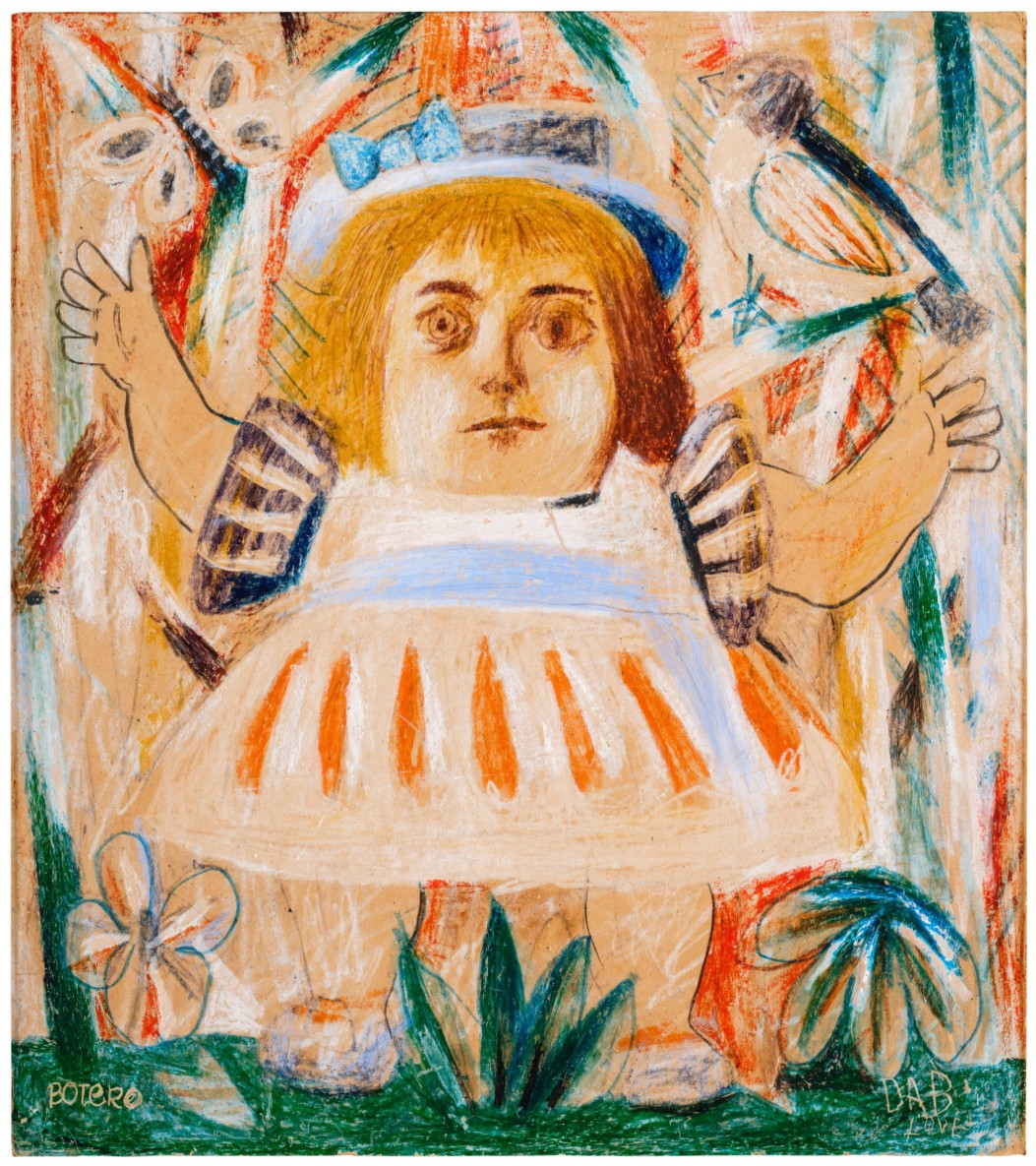
FERNANDO BOTERO (1932 – 2023)
Girl in Garden with Butterfly and Net, 1960
Wax crayon on paper mounted on panel
59.4 x 79.7 cm (26 1/8 x 23 inches)
Incised Botero (lower left)
Incised DAB LOVE (lower right)
#2. Ballerina, 2007
Sotheby’s New-York: 19 November 2025
Estimated: USD 40,000 – 60,000
USD 95,250
WORK ON PAPER
Ballerina | Contemporary Day Auction | 2025 | Sotheby’s
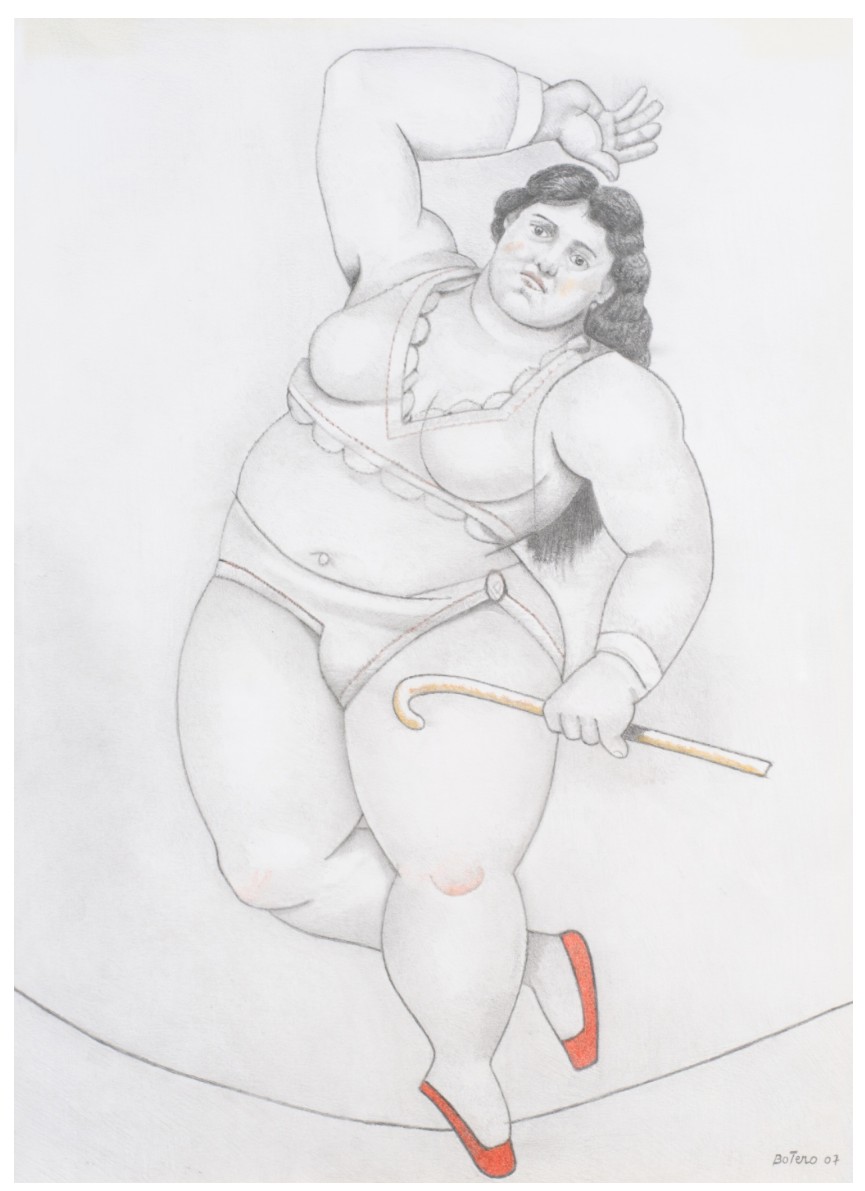
FERNANDO BOTERO (1932 – 2023)
Ballerina, 2007
Graphite and crayon on paper
49.5 x 33.7 cm (19 1/2 x 13 1/4 inches)
Signed and dated 07 (lower right)
#3. Monja, 1979
Sotheby’s New-York: 19 November 2025
Estimated: USD 40,000 – 60,000
USD 88,900
WORK ON PAPER
Monja | Contemporary Day Auction | 2025 | Sotheby’s
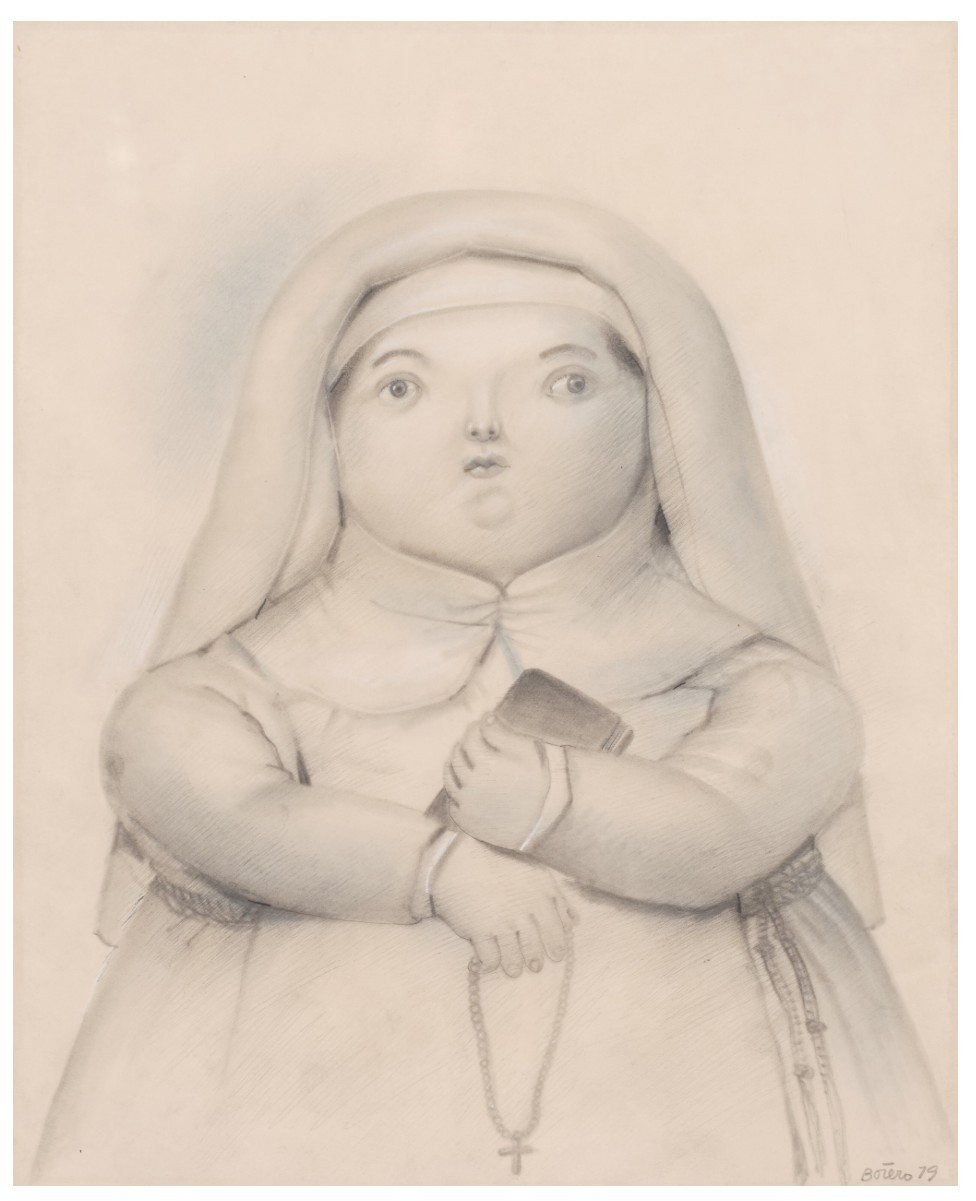
FERNANDO BOTERO (1932 – 2023)
Monja, 1979
Graphite and crayon on paper
43.5 x 35.6 cm (17 1/8 x 14 inches)
Signed and dated 79 (lower right)
#4. Sitting Woman, 1997
Christie’s New-York: 20 November 2025
Estimated: USD 35,000 – 45,000
USD 88,900
WORK ON PAPER
FERNANDO BOTERO (1932-2023), Sitting Woman | Christie’s
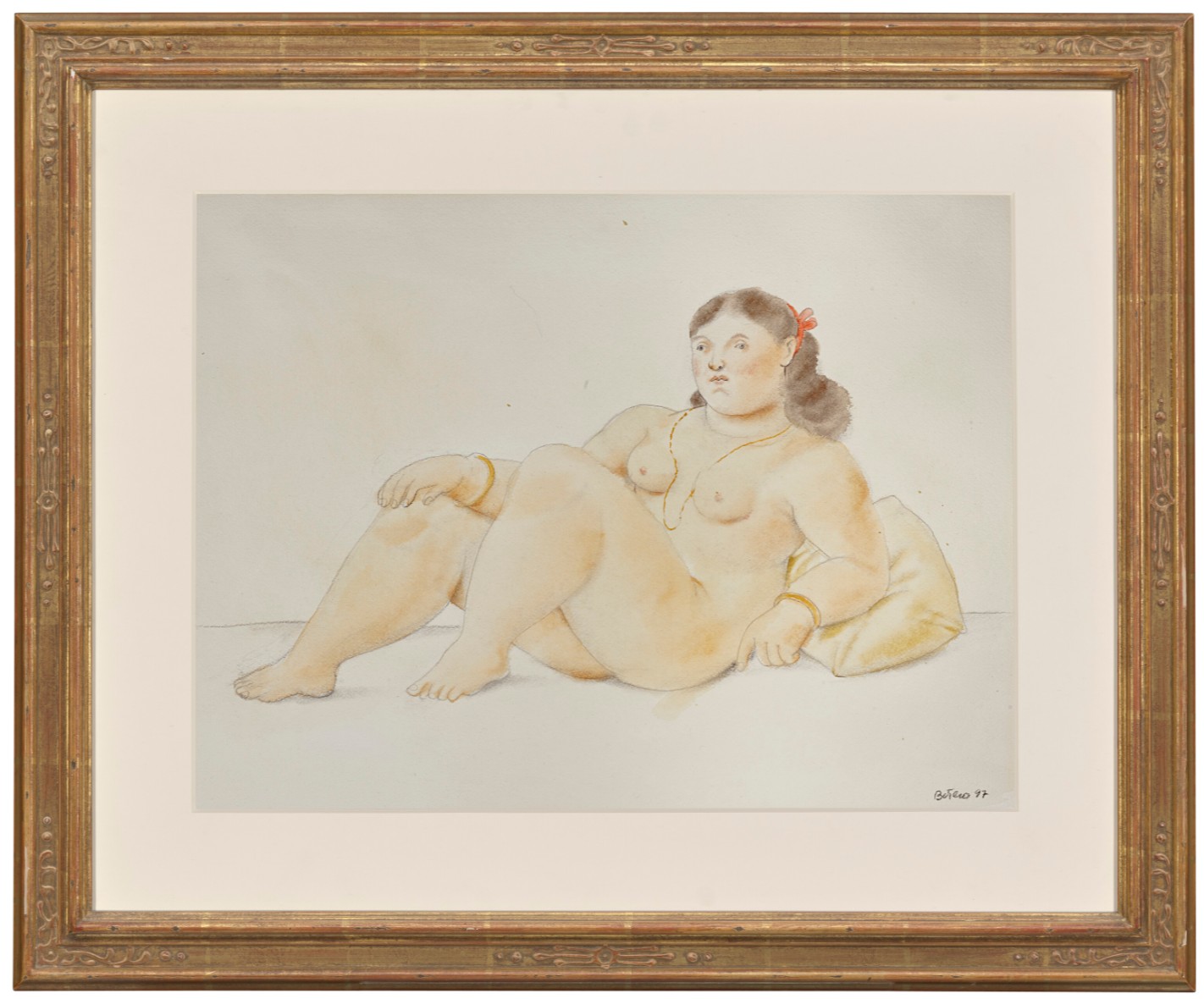
FERNANDO BOTERO (1932-2023)
Sitting Woman, 1997
Watercolor and graphite on paper
35.9 x 47.6 cm (14 1/8 x 18 2/4 inches)
Signed and dated ‘Botero 97’ (lower right)
#5. The Trapeze Artists, 2007
Sotheby’s New-York: 19 November 2025
Estimated: USD 40,000 – 60,000
USD 57,150
WORK ON PAPER
The Trapeze Artists | Contemporary Day Auction | 2025 | Sotheby’s
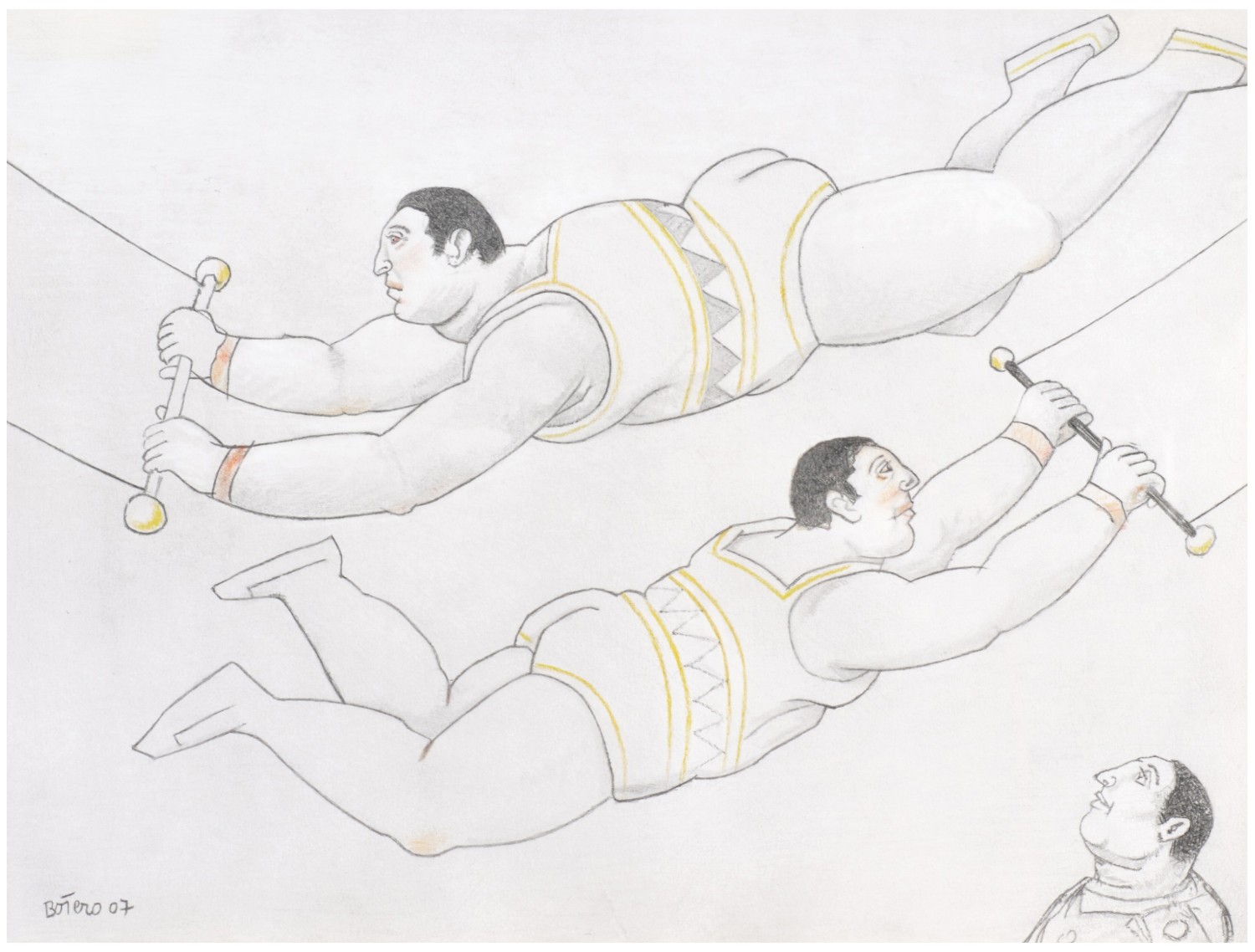
FERNANDO BOTERO (1932 – 2023)
The Trapeze Artists, 2007
Graphite and crayon on paper
30.5 x 41.3 cm (12 x 16 1/4 inches)
Signed and dated 07 (lower left)
#6. Man with Guitar, 2002
Sotheby’s New-York: 19 November 2025
Estimated: USD 25,000 – 35,000
USD 48,260
WORK ON PAPER
Man with Guitar | Contemporary Day Auction | 2025 | Sotheby’s
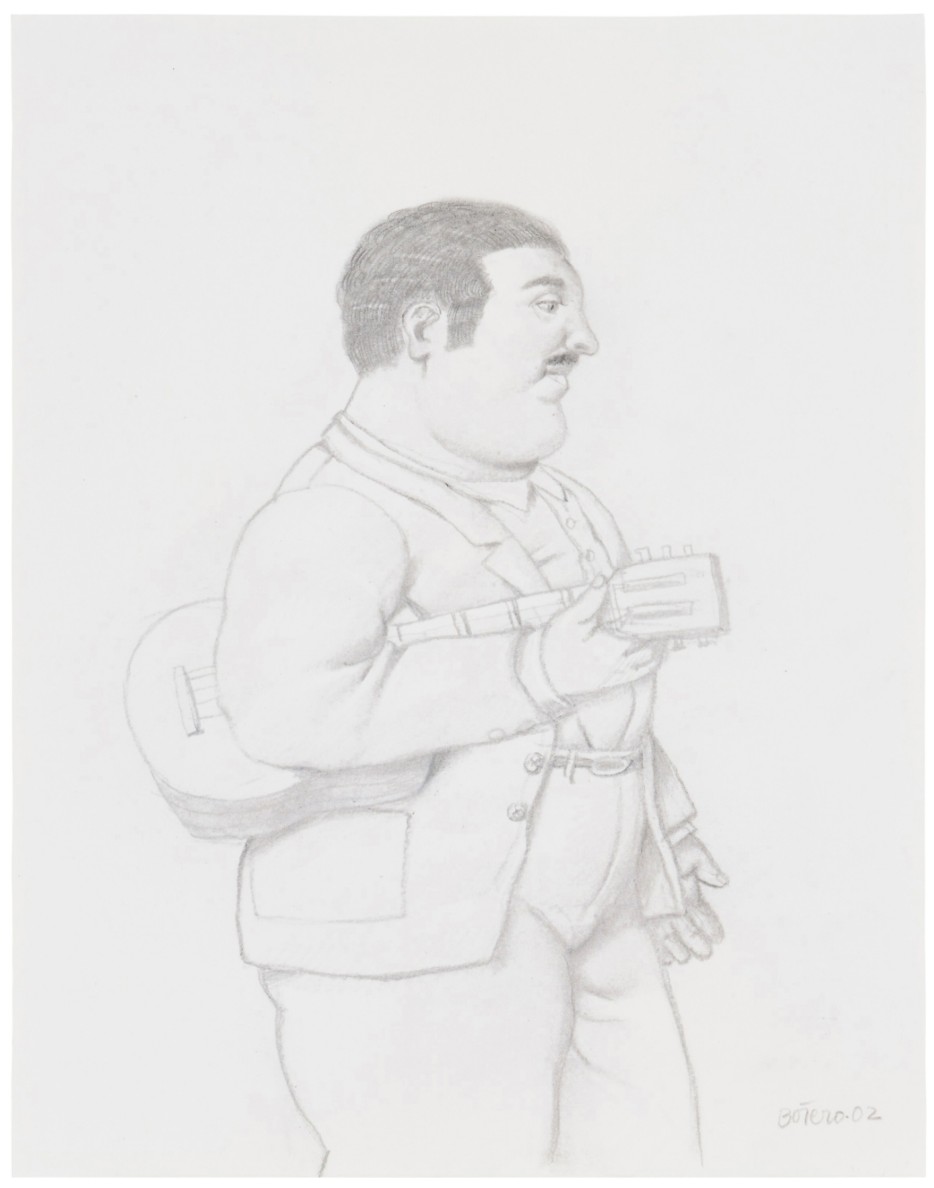
FERNANDO BOTERO (1932-2023)
Man with Guitar, 2002
Graphite on paper
41 x 31.8 cm (16 1/8 x 12 1/2 inches)
Signed and dated 02 (lower right)
#7. Naturaleza Muerta con Uvas, 1979
Phillips New-York: 21 November 2025
Estimated: USD 30,000 – 40,000
USD 28,380
WORK ON PAPER
Fernando Botero Modern & Contemporary Art Day Sale, Morning Session
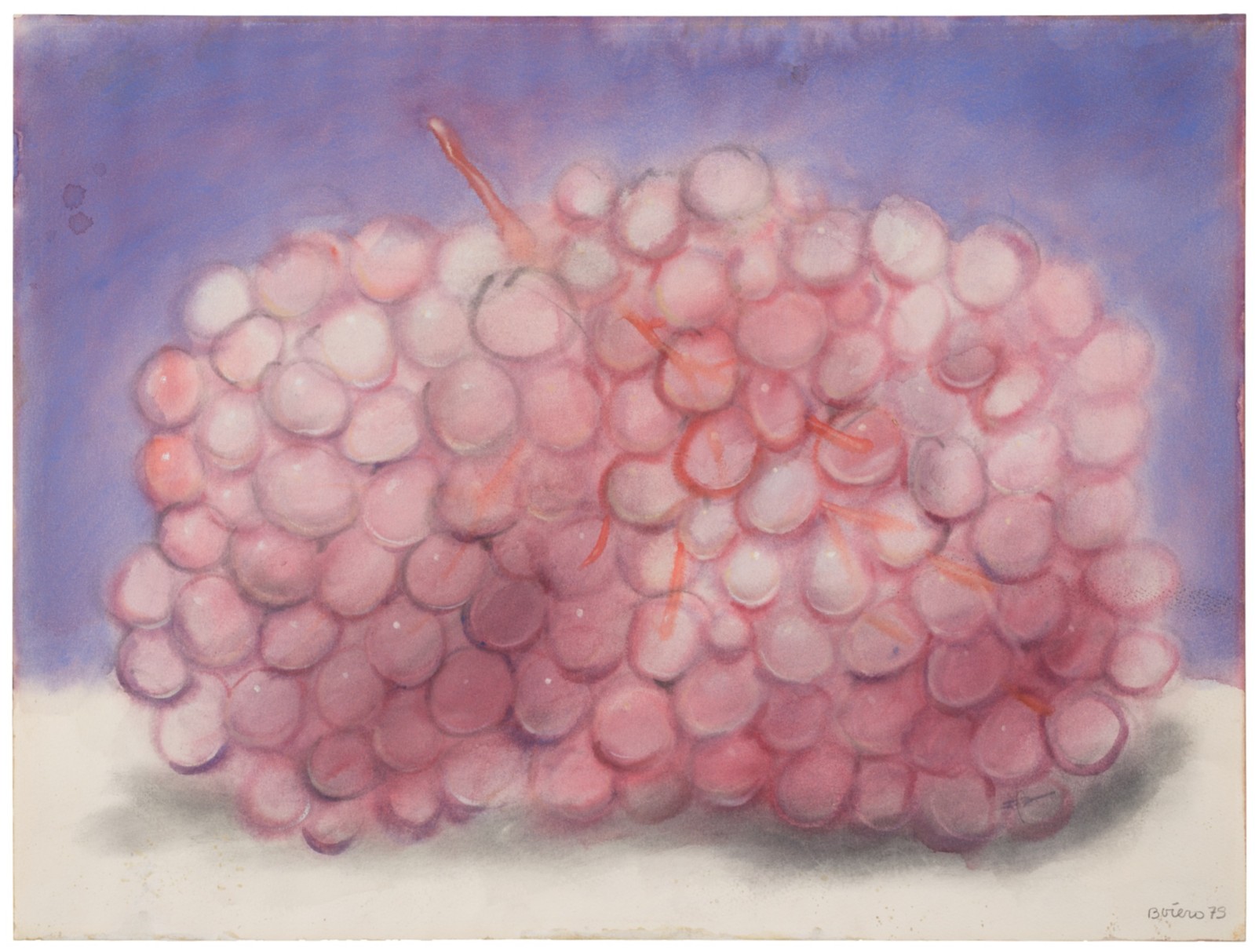
Watercolor on paper
46.4 x 61 cm (18 1/4 x 24 inches)
Signed and dated “Botero 79” lower right
Roy Lichtenstein
PLEASE CLICK ON THE PICTURE BELOW TO ACCESS AUCTION MARKET OVERVIEW
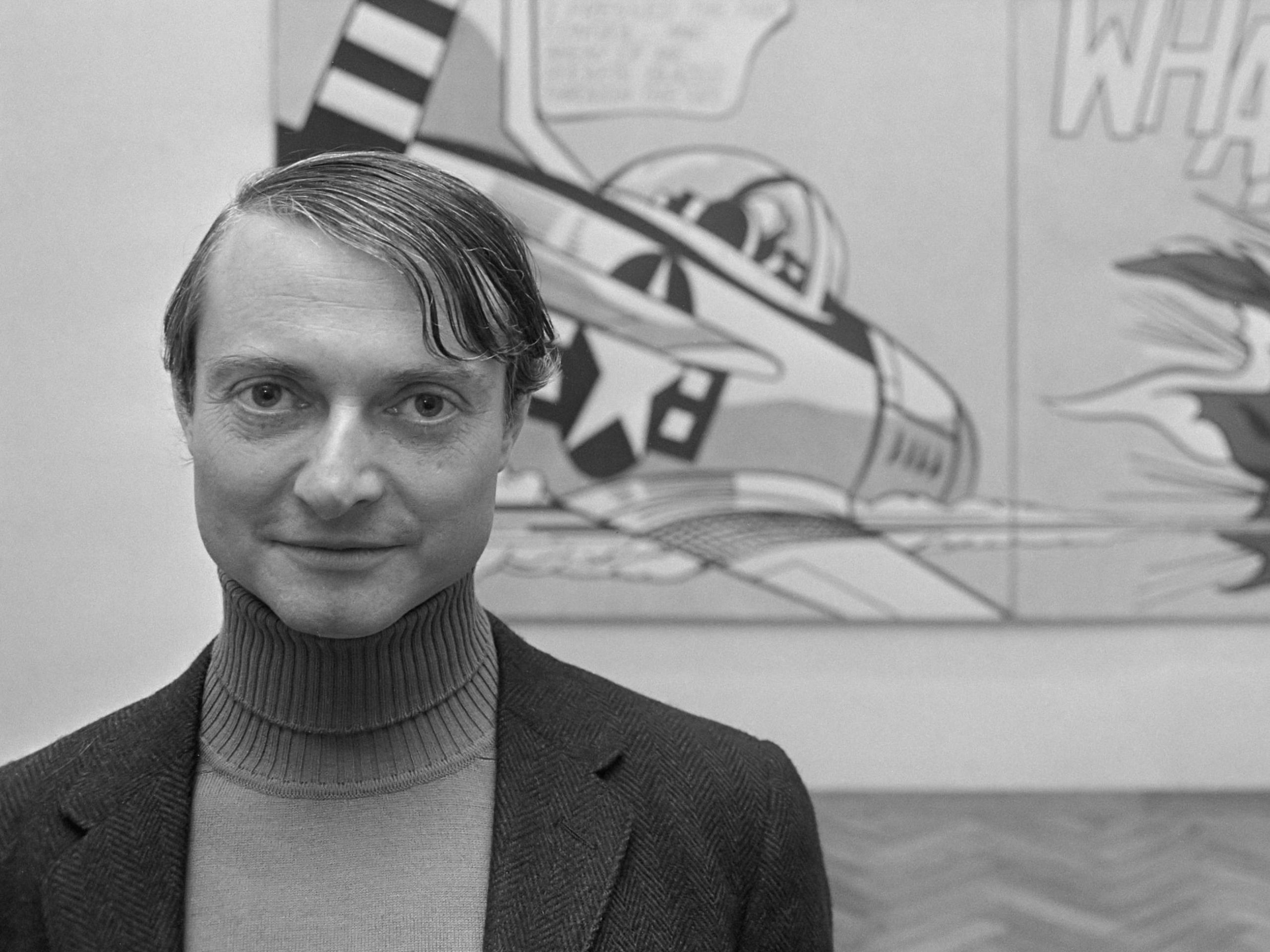
1. Paintings
#1. Modern Painting Triptych II, 1967
A Legacy Reimagined: Works from the Collection of Dorothy and Roy Lichtenstein
Sotheby’s New-York: 18 November 2025
Estimated: USD 3,500,000 – 4,500,000
USD 4,442,000
Modern Painting Triptych II | The Now & Contemporary Evening Auction | 2025 | Sotheby’s
ROY LICHTENSTEIN (1923 – 1997)
Modern Painting Triptych II, 1967
Acrylic, oil and graphite on canvas, in three parts
Each: 36×36 inches (91.4 x 91.4 cm)
Overall: 36×108 inches (91.4 x 274.3 cm)
Signed and dated ‘67 (on the reverse)
Roy Lichtenstein’s unmistakable graphic vocabulary crystallizes into scarlet, yellow, and ultramarine geometry, arching and interlocking into an urban panorama: Modern Painting Triptych II. Here, the steel ornamentation and industrial ligatures—joints of sleek new feats in engineering—of Manhattan’s Art Deco skyline are synthesized and recast in broad passages of primary-colored Ben-Day dots. Modern Painting Triptych II is one of 48 paintings which constitute the Modern Paintings series; of the just six multipanel works, including the present work, half belong in prestigious institutional collections: the Norton Simon Museum, Pasadena; Hirshhorn Museum and Sculpture Garden, Washington, D.C.; and Ryobi Foundation, Carbondale. Lichtenstein’s discoveries in the Modern Paintings would prove so formative that they would form the basis of his next body of work: the repetition of forms in Modern Painting Triptych II anticipates the series of Modular Paintings to follow, whose duplicating compositional grids developed upon these same themes of mechanization and seriality in the industry age.
Further testament to its significance in Lichtenstein’s oeuvre, Modern Painting Triptych II bears an extraordinary exhibition history, from its 1967 debut in Lichtenstein’s solo presentation at the legendary Leo Castelli Gallery to an extended loan at the National Collection of Fine Arts, Smithsonian American Art Museum in Washington, D.C. Just as Art Deco fused Futurism, Cubism, de Stil, and ancient Mesopotamia and Mesoamerica, taking old and new to create an architecture for present, Lichtenstein, too, proves himself to be an architect of his time through his triumphant Modern Paintings.
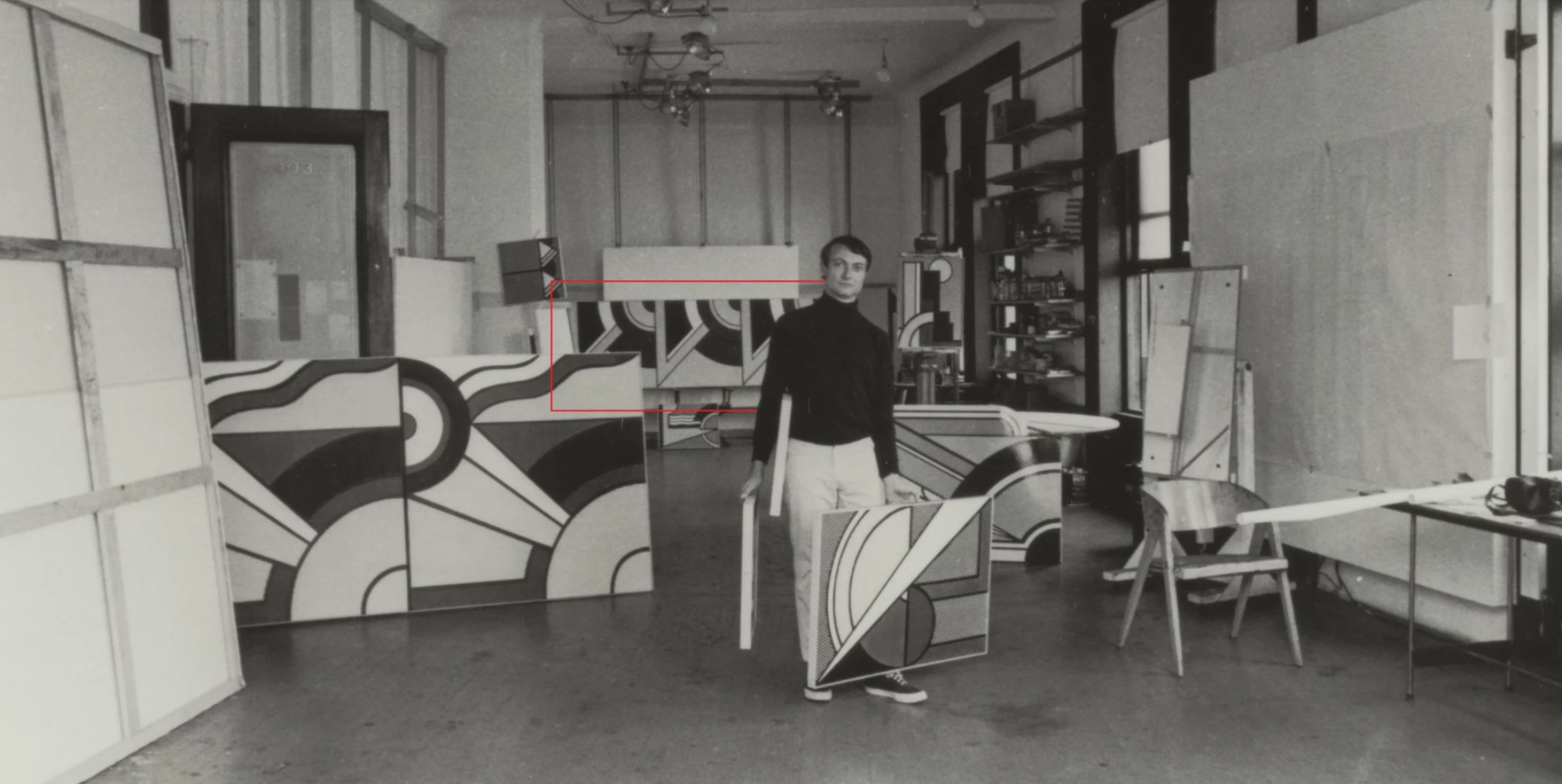
The present work pictured with Roy Lichtenstein in his 190 Bowery studio, 1967.
Photo by Judy B. Ross, courtesy RLF Archives. Art © Estate of Roy Lichtenstein
Lichtenstein created his first Modern Paintings in 1966, four decades after the earliest Art Deco projects began studding the Manhattan skyline. Art Deco, unveiled at the 1925 Exposition Internationale des Arts Décoratifs et Industriels Modernes in Paris, was the style that gave New York City, where Lichtenstein lived and worked, its character and cadence: from the Empire State to the Chrysler, the most iconic buildings boasted a novel decorative quality and towering verticality. Yet just as the style became the face of twentieth-century modernity, Modernism outpaced it—William Van Alen and Raymond Hood were usurped by Ludwig Mies van der Rohe, Philip Johnson, and Louis Kahn, whose glass-encased constructions made the vanguard of just a few thirty years prior feel dated.
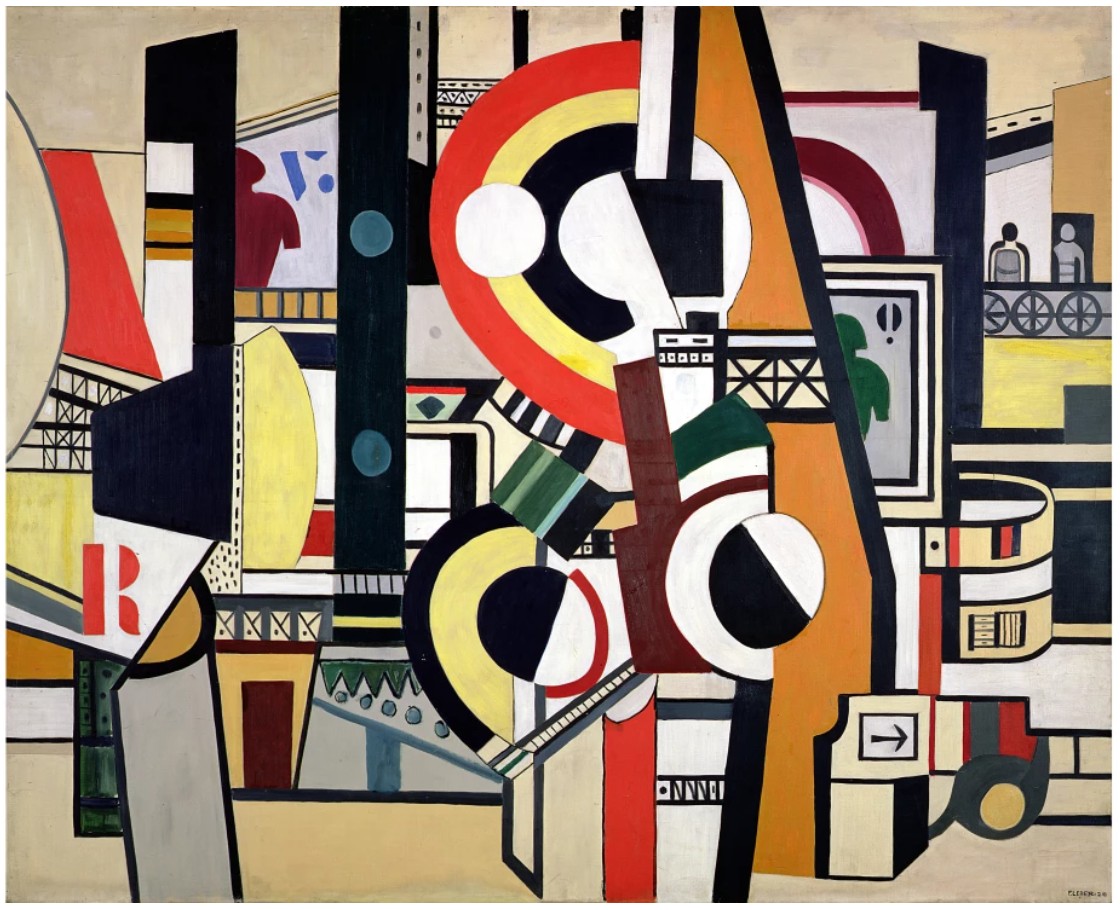
Fernand Léger, The Discs in the City, 1921. Musée National d’Art Moderne, Paris.
Image © Peter Willi / Bridgeman Images. Art © 2025 Artists Rights Society (ARS), New York / ADAGP, Paris
With his characteristic levity, Lichtenstein now parodied the vernacular of so-called modernity, his painterly pastiches engineering a reconciliation of once-spectacular innovation with Pop ingenuity. “What is particularly unnerving about the series is what is most relevant to the subject of Modernism versus Postmodernism,” David Antin observes, “The pathos of Modern Art is particular to itself… It was the specific claim of ‘modernism’ to be finally and forever open. That was its ‘futurism,’ and now that its future has receded into the past it can be had as a sealed package whose contents have the exotic look of something released from a time capsule.” (David Antin, “Modernism and Postmodernism: Approaching the Present in American Poetry,” boundary 2, Iss. 1, 1972, p. 99) Modern Painting Triptych II thus stylizes the already stylized, retrofitting the bygone past for the future.
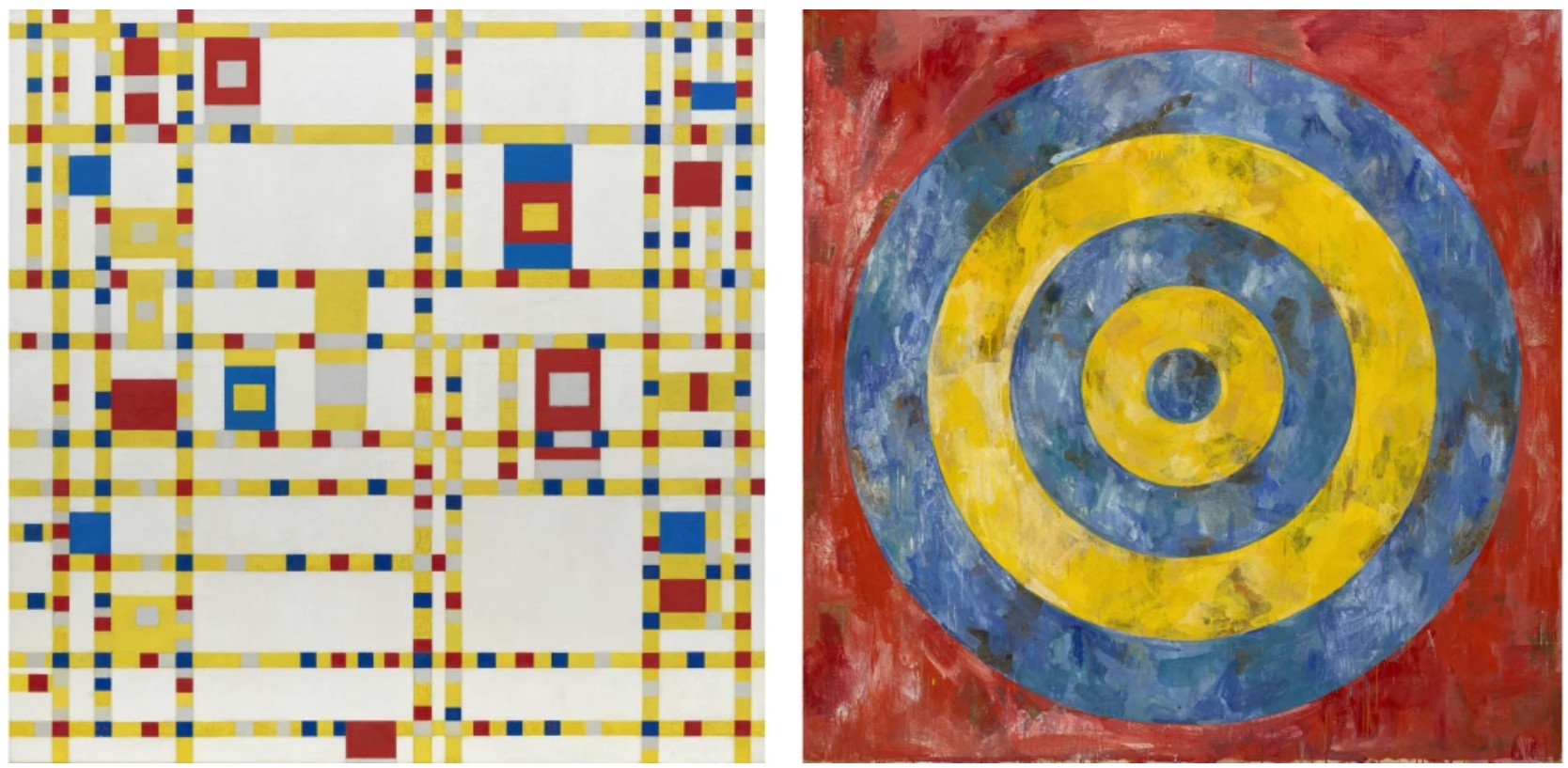
Left: Piet Mondrian, Broadway Boogie Woogie, 1942-43. The Museum of Modern Art, New York. Image © The Museum of Modern Art / Licensed by SCALA / Art Resource, NY. Right: Jasper Johns, Target, 1961. The Art Institute of Chicago, Chicago. Image © The Art Institute of Chicago / Art Resource, NY. Art © 2025 Jasper Johns / Licensed by VAGA at Artists Rights Society (ARS), NY
The primary palette and geometric composition of Modern Painting Tripych II also obliquely appropriates the advents of such renowned de Stijl artists as Piet Mondrian and Theo van Doesberg. Lichtenstein wrestled at length with Mondrian’s work in particular, interrogating the dissonance between Mondrian’s utopian notions of structure and order and the political unrest that underpinned the period of their creation.
Modern Paintings in Museum Collections
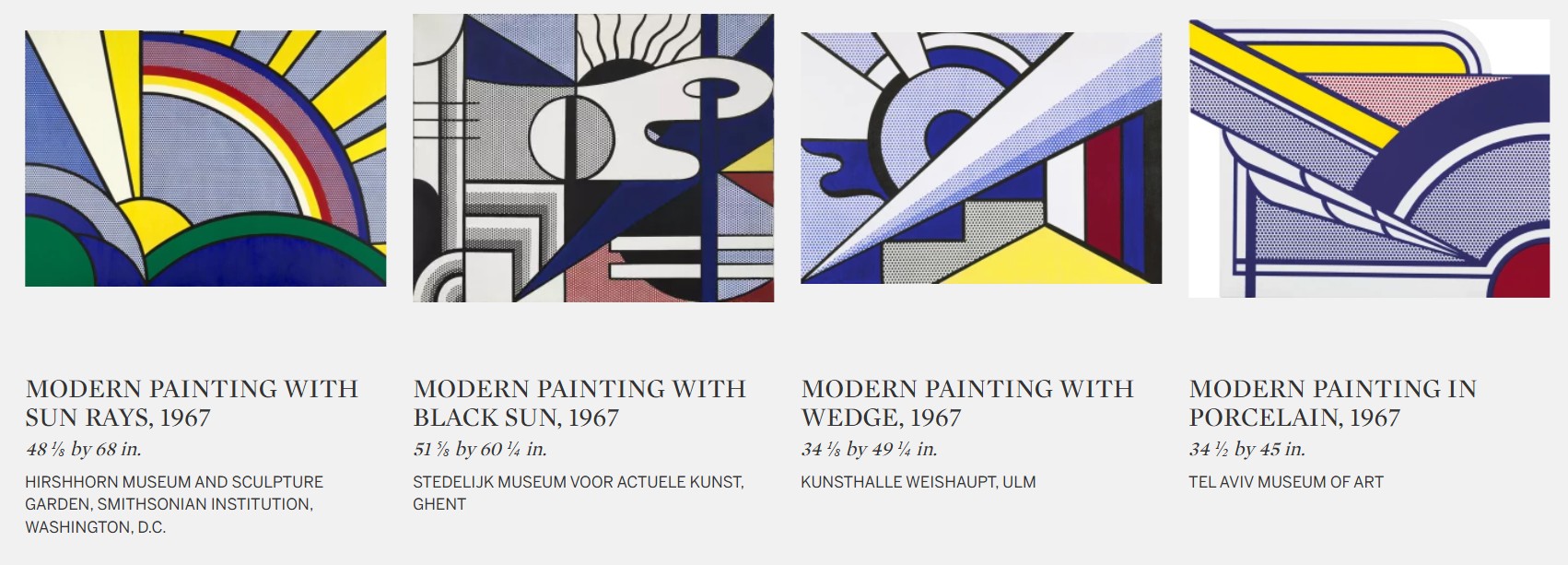
Modern Painting Triptych II embodies Lichtenstein’s examination of this distinctly Modern turbulence beneath the pristine surface of the two-dimensional canvas’ visual register, and his output would only continue to invest further and further into a dialogue with the history, criticism, and methodology of art. What began as a recontextualization of kitsch, everyday iconography would evolve into an unerring investigation of his predecessors in the paintings to follow. But the Modern Paintings reveal an early and prognostic engagement with art history in real-time: the quotidian imagery of consumer goods and comic book scenes of hopeful, hopeless war and romance through which he found his artistic footing would usher him toward the architectural polemics of the world around him. In this way Modern Painting Triptych II rests firmly on the bedrock of Lichtenstein’s artistic enterprise—an undiscriminating embrace of art and imagery and subverting the associations of taste bound to them.
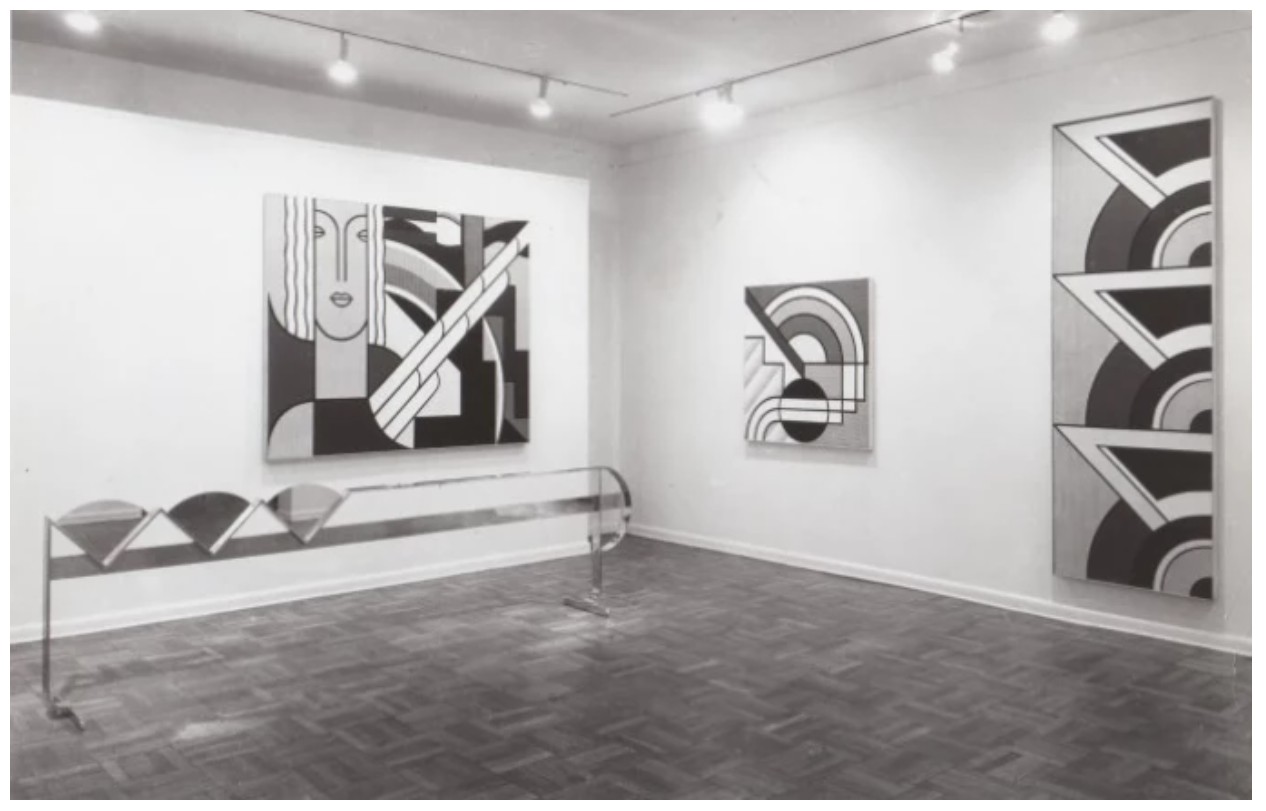
The present work installed at Leo Castelli Gallery, October – November 1967. Art © Estate of Roy Lichtenstein
Though the Modern Paintings sought new inspiration in metropolitan America, they stand as representations of Lichtenstein’s extant commitment to seeing the world as it is and painting it anew. Though fast dated, the Art Deco ecosystem that shaped New York would, Lichtenstein made sure, remain forever relevant. “From ash-tray to movie-theater foyer,” Lawrence Alloway notes, “the 30s are with us; as places to go, objects to use, the products of the period are a known, though [sic.] unvalued, part of our environment. They are definitely one of our common, non-esoteric fields of reference. Lichtenstein’s new paintings and sculptures are trophies of the 30s; trophies in the sense of mementos and memorials annexed from somebody else. In this case, the other is the form-sense of a preceding period.” (Lawrence Alloway quoted in: Exh. Cat., Cincinnati, Contemporary Arts Center, Roy Lichtenstein: Exhibition of Paintings and Sculpture, December 1967 – January 1968, n.p.) Thus, Modern Painting Triptych II not only encapsulates Lichtenstein’s compelling question of taste and aesthetics but challenges how artistic invention—even those close in the rearview of the avant-garde—can be traced, disrupted, and forever reinvented.
#2. Cubist Still Life with Vase and Flowers, 1973
A Legacy Reimagined: Works from the Collection of Dorothy and Roy Lichtenstein
Sotheby’s New-York: 18 November 2025
Estimated: USD 4,o00,000 – 6,000,000
USD 3,025,000
Cubist Still Life with Vase and Flowers | The Now & Contemporary Evening Auction | 2025 | Sotheby’s
ROY LICHTENSTEIN (1923 – 1997)
Cubist Still Life with Vase and Flowers, 1973
Acrylic, oil and graphite on canvas
90 1/4 x 60 inches (229.2 x 152.4 cm)
Signed and dated ‘73 (on the reverse)
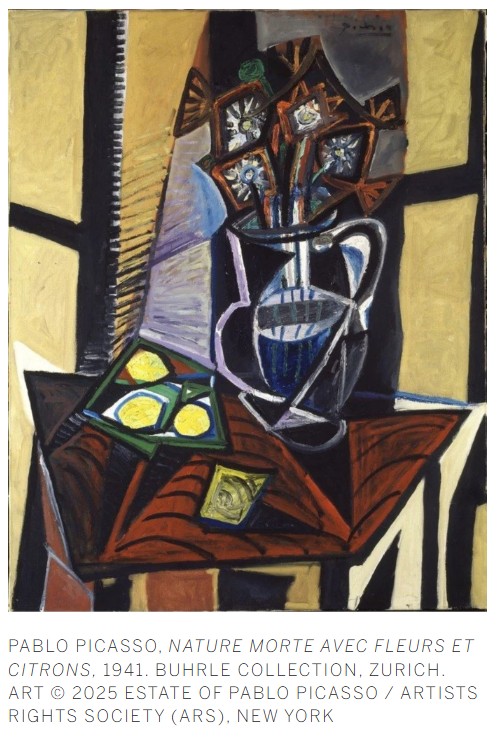
Cubist Still Life with Vase and Flowers epitomizes Roy Lichtenstein’s legendary Pop idiom and intellectual prowess, expanding his ongoing dialogue with the art historical canon. As one of a discrete series of eleven Cubist Still Life paintings Lichtenstein completed between 1973-75, of which four are held in prominent museum collections, and the only to feature a vase of flowers, the present work is a rare and important example within the artist’s iconic oeuvre. Cubist Still Life with Vase and Flowers pays homage to the legacy of Pablo Picasso, the father of Cubism and one of Lichenstein’s greatest influences, by directly invoking and subverting Picasso’s Cubist Still Life Flowers from 1939-43. Here, Lichtenstein has further abstracted Picasso’s fragmented picture plane, distilling the flowers and translucent vase to geometric planes of canary yellow, emerald green and soft peach. Further testament to the caliber of this painting, Cubist Still Life with Vase and Flowers has been widely exhibited at major international exhibitions, including his 1981 mid-career retrospective which included a leg at the Whitney Museum of American Art’s Breuer building on Madison Avenue.
Responding to one of the most iconic and enduring subjects in all of art history, the still life, Lichtenstein dismantles and refines his image in an investigation that is at once cerebral, satirical and utterly beautiful. Lichtenstein renders the translucent vase with a series of geometric shapes. His flowers are jagged geometric planes of yellow and white; his leaves are sharp triangles; his stems float above the vase, detached from their blossoms.
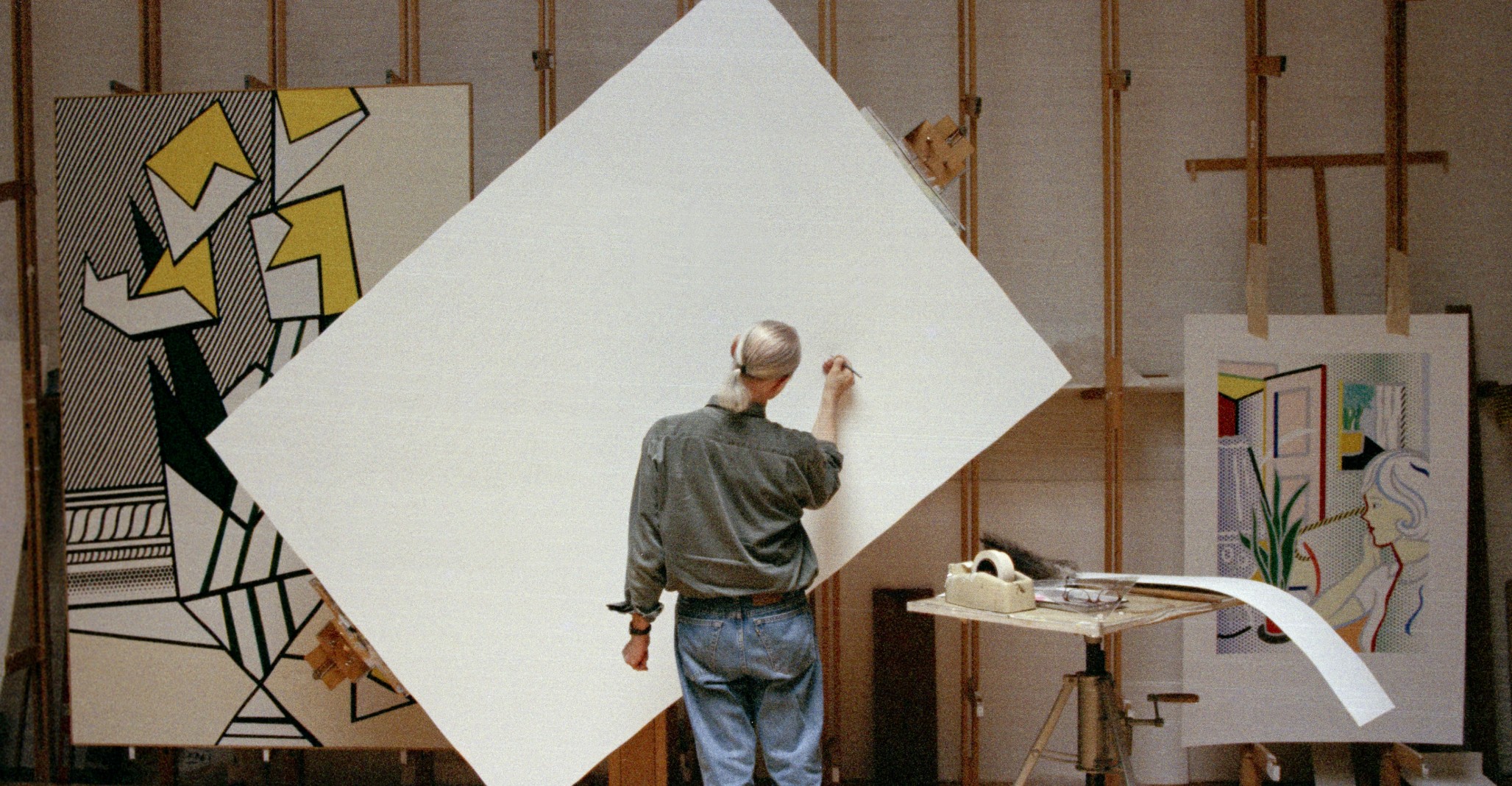
The present work with Roy Lichtenstein in his studio. Image © Bob Adelman Estate. Art © Estate of Roy Lichtenstein
Recalibrating Picasso’s 1939-43 work, Lichtenstein alters and augments his predecessor’s composition, omitting all but the vase from his composition. Lichtenstein’s fifth flower, an addition to the four featured in Picasso’s painting, rests outside of the vase—possibly fallen, removed or yet to be incorporated into the arrangement. This sole flower conveys a colossal presence: a symbol of ephemeral beauty, a gesture of affection, and here a signifier of the inherent artificiality of the composition. The fifth flower floats behind the translucent vase, but the viewer cannot see its stem through the glass. Lichtenstein has deconstructed the picture plane with bold geometric lines and flat planes of color, reimagining a very tangible subject into figments of a graphic, comic world. Behind the solitary vase, Lichtenstein has fractured the background, dividing the space into hash lines, fading Ben-Day dots, and even abstracted versions of his own Entablatures. In the present work, Lichtenstein’s play with Analytical Cubism is on full display, as the artist synthesizes multiple perspectival planes in a singular composition. The present work is a quintessential evocation of Lichtenstein’s fascination with art historical subjects which have become ubiquitous in popular imagery, such as the domestic still life.
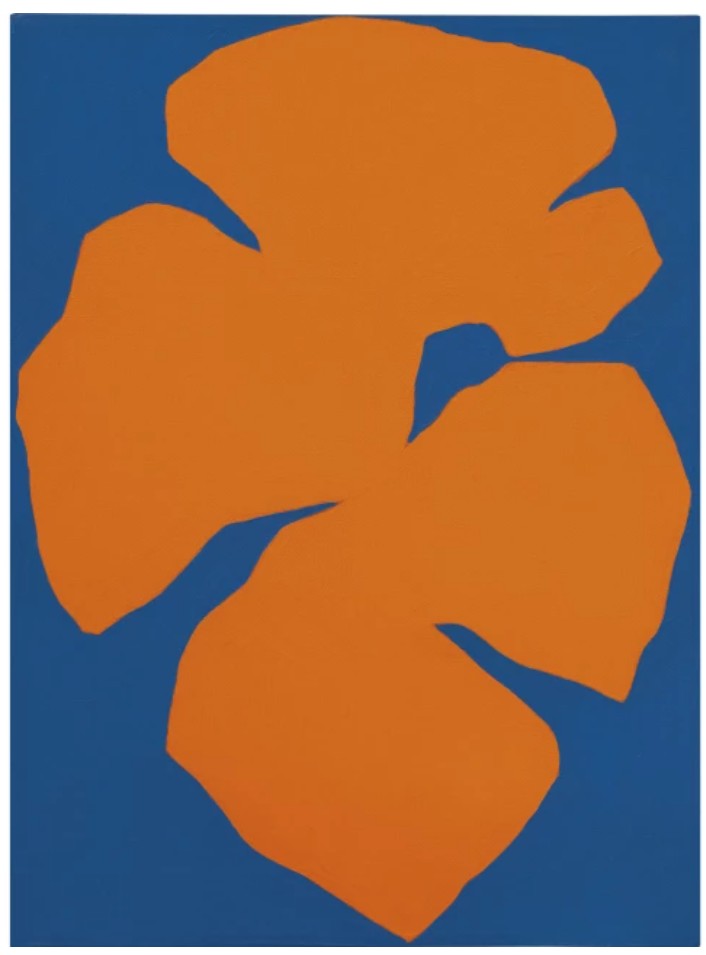
Ellsworth Kelly, Orange Blue, 1957. Private Collection. Art © Ellsworth Kelly Foundation.
For Lichtenstein, the 1970s marked a transition from the comic-book-inspired Pop paintings the defined his work of the 1960s to a witty interrogation of the art historical canon—from Classical architecture to Futurism, German Expressionism, Surrealism, Cubism and Art Deco. A pivotal year amid his explorations of the decade, 1973 marked Lichtenstein’s concerted inquiry into perhaps the most revolutionary movement of the Twentieth Century: Cubism. Even before this year, though, Picasso’s influence is evident in Lichtenstein’s oeuvre: Lichtenstein’s first overt response to Picasso appears in 1962 with the seminal painting Femme au chapeau. Lichtenstein’s interplay between form and fragmentation transforms the space in which the flowers and vase reside. Cubist Still Life with Vase and Flowers is an exceptional eulogy to the work of Picasso, with its subject matter recalling Picasso’s Cubist Still Life Flowers, and its rendition a manifestation of Lichtenstein’s refashioning of Cubist theory. Lichtenstein employs bold contour lines and flat geometric planes of color to both define and flatten space. Lichtenstein thereby takes Picasso’s Analytical Cubism a step further, using an economy of line and color to simultaneously evoke his processor and invent a wholly new style.
“What I am painting is a kind of Picasso done the way a cartoonist does it, or the way it might be described to you, so it loses the subtleties of Picasso, but it takes on other characteristics: the Picasso is converted to my pseudo-cartoon style and takes on a character of its own.” 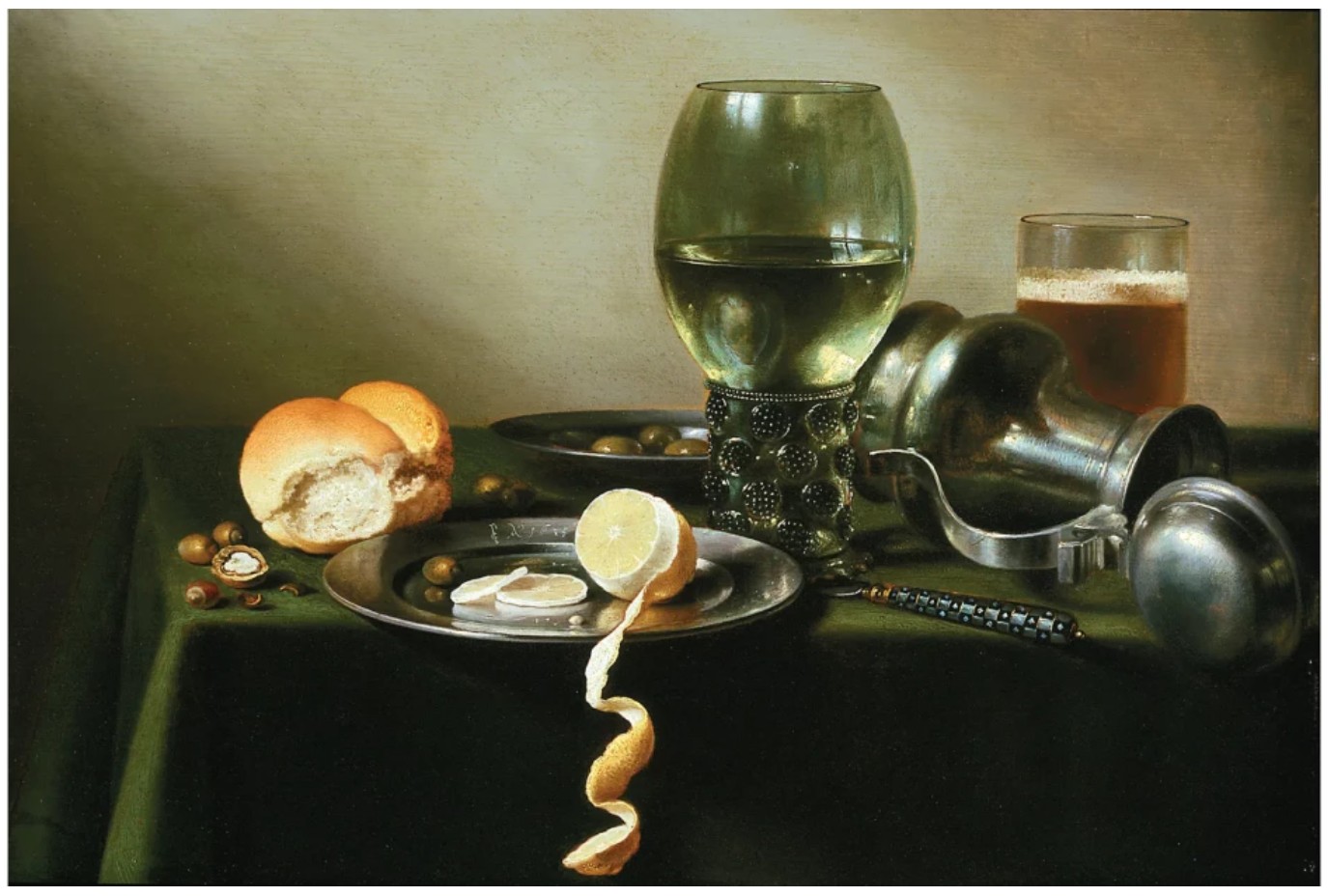
Pieter Claesz, Still Life with Overturned Jug, Glass of Beer, and Food, 1635. Private Collection. Image © 2025 Encyclopaedia Britannica
Not only a direct referent to Picasso, Lichtenstein’s work also harkens back to the history of still life painting. First gaining prominence in the Seventeenth Century as Vanitas paintings, the genre of still lives have become an essential part of a collector’s corpus. Conveyors of material identity, traditional still life paintings often reflected the wealth, status, and stylistic tastes of their owner. In European still life paintings, flower arrangements evoked a sense of aesthetic intuition and demonstrated a metric of class and decorative appeal. In turn, Cubism illustrates these objects against walls, deceptive patterns, and decorative interiors to collapse the distance between the painting and the two-dimensional surface. In a world of commodities, commercial advertising, and mass consumption, Lichtenstein reinterprets these historical subjects within popular culture.
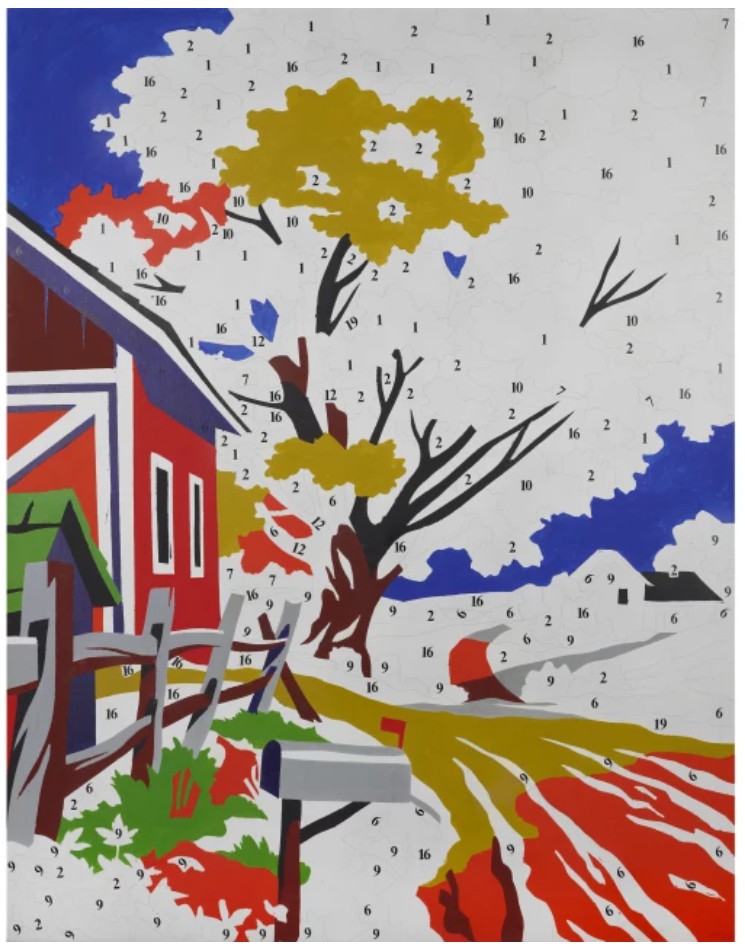
Andy Warhol, Do It Yourself (Landscape), 1962. Museum Ludwig, Cologne.
Image © bpk Bildagentur / Museum Ludwig / Rheinisches Bildarchiv Cologne / Britta Schlier / Art Resource, NY.
Art © 2025 Andy Warhol Foundation for the Visual Arts / Artists Rights Society (ARS), New York
Cubist Still Life with Vase and Flowers is a masterful exemplar of Lichtenstein’s unparalleled ability to synthesize the art historical canon with the visual lexicon of Pop. Monumental in scale, replete with canonical referents—from the subject of the still life to Picasso’s Analytical Cubism—Cubist Still Life with Vase and Flowers is a pure embodiment of Lichtenstein’s distinctive Pop vernacular and ability to reflect on and reinvent the icons of art history.
#3. Reflections: Wimpy III, 1988
A Legacy Reimagined: Works from the Collection of Dorothy and Roy Lichtenstein
Sotheby’s New-York: 19 November 2025
Estimated: USD 1,000,000 – 1,500,000
USD 2,002,000
Reflections: Wimpy III | Contemporary Day Auction | 2025 | Sotheby’s
ROY LICHTENSTEIN (1923 – 1997)
Reflections: Wimpy III, 1988
Acrylic, oil and graphite on canvas
32×40 inches (81.3 x 101.6 cm)
Signed and dated ’88 (on the reverse)
#4. Flower with Bamboo, 1996
A Legacy Reimagined: Works from the Collection of Dorothy and Roy Lichtenstein
Sotheby’s New-York: 18 November 2025
Estimated: USD 2,000,000 – 3,000,000
USD 1,514,000
Flower with Bamboo | The Now & Contemporary Evening Auction | 2025 | Sotheby’s
ROY LICHTENSTEIN (1923 – 1997)
Flower with Bamboo, 1996
Acrylic, oil and graphite on canvas
77 x 66 1/8 inches (195.6 x 168 cm)
Signed and dated ‘96 (on the reverse)
Like many of Roy Lichtenstein’s great works, Flower with Bamboo is an exercise in multiplicity. Straddling lines of East and West, landscape and abstraction, and ancient and modern, the present work exemplifies the artist’s career-long synthesis of cross-cultural influences and astringent commentary on contemporary iconography through his singular Pop sensibility. Simultaneously majestic and subtle, whimsical and refined, Lichtenstein employs his distinctive Pop technique and irreverent inquiry both to pay homage to the traditions of Chinese landscape painting and to illuminate the frequent generalization of Eastern motifs by Western artists for centuries.
Ceaselessly evolving and responding to the annals of art history, Lichtenstein, in his final decade, turned his focus to East Asian art, developing a series of paintings, collages, works on paper and sculptures inspired by the visual tropes of East Asian art in the Western imagination. In this penultimate series, Landscapes in the Chinese Style, Lichtenstein employed his Pop sensibility to render enchanting landscape scenes convey the graphic gravitas of his comic-like compositions with the elegant beauty of East Asian landscape painting.
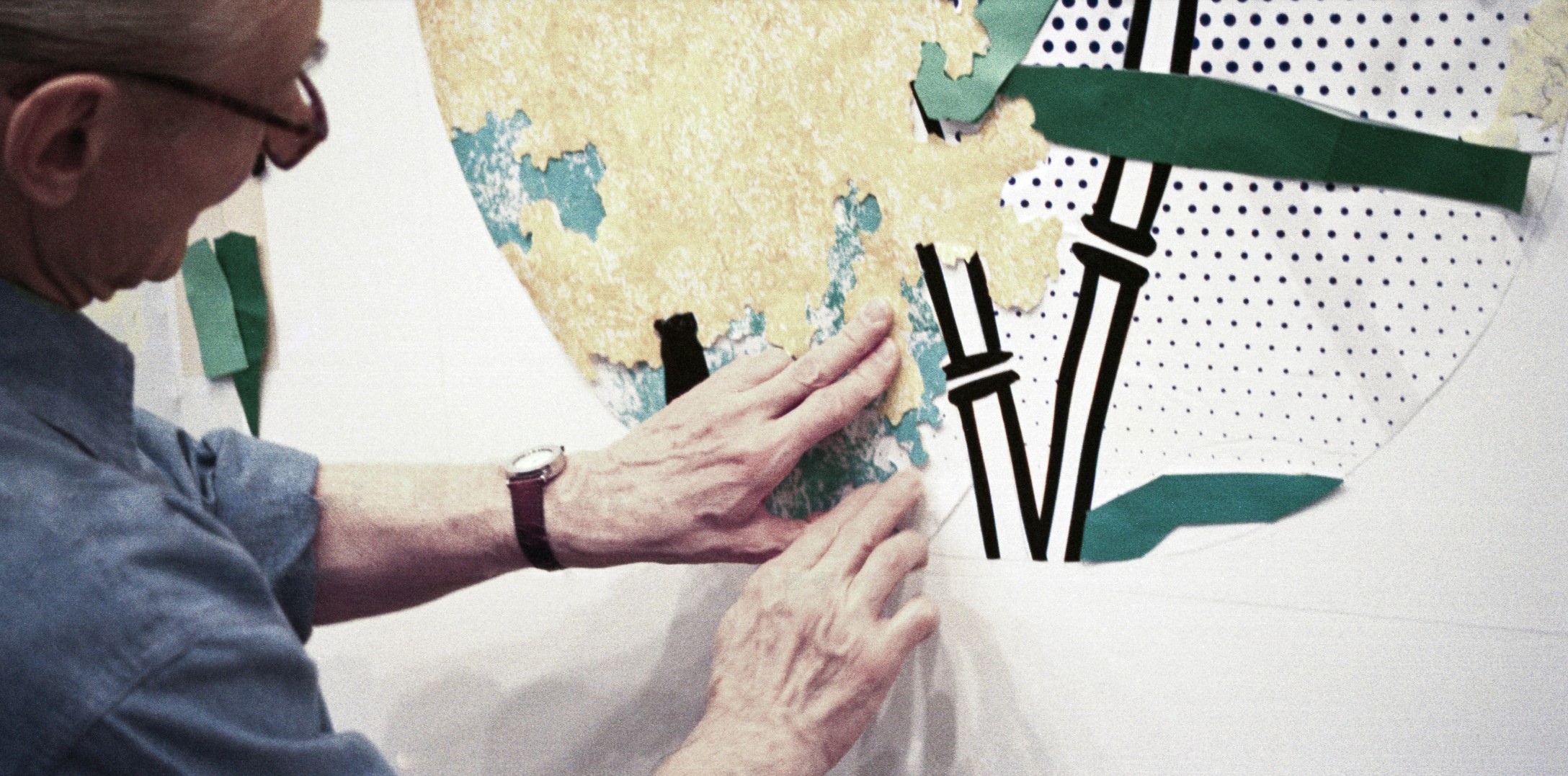
Roy Lichtenstein in his studio working on the study for the present work. Image © Bob Adelman. Art © Estate of Roy Lichtenstein
Flower with Bamboo, in many ways, is classically Lichtenstein: between the Ben-Day dots, bold contour lines, and Pop art quintessential flatness, the modern master’s hand is instantly recognizable in the present work. However, unlike his comic-book-inspired compositions of the 1960s, rendered in bright primary colors, Lichtenstein here draws inspiration from the natural landscape and the cool tones of iconic landscapes. Lichtenstein’s interest in Chinese art in the 1990s began almost five decades prior. Stationed in London during World War II, twenty-one-year-old Lichtenstein wrote home to his parents:
“I bought a book on Chinese painting, which I could have gotten in New York half the price. I’ll probably send it home with my collection of African masks, as my duffle bag now weighs more than I do, with all the art supplies.”
Later, when Lichtenstein returned to Ohio State University to complete his undergraduate and graduate degrees after the war, he enrolled in classes on East Asian art history.
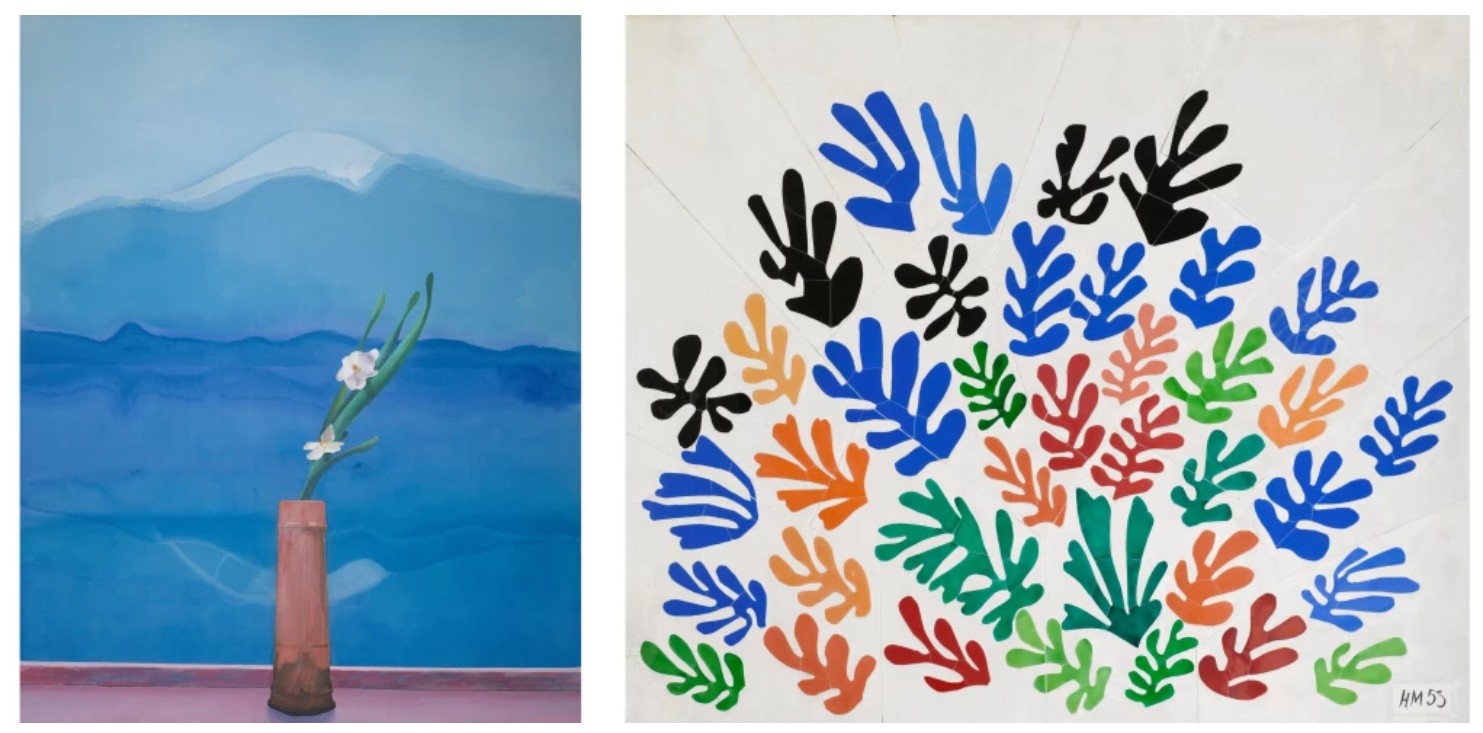
Left: David Hockney, Mount Fuji and Flowers, 1972. The Metropolitan Museum of Art, New York. Image © The Metropolitan Museum of Art / Art Resource, NY. Art © 2025 David Hockney. Right: Henri Matisse, La Gerbe, 1953. Los Angeles County Museum of Art, Los Angeles. Image © 2025 Museum Associates / LACMA. Licensed by Art Resource, NY. Art © 2025 Succession H. Matisse / Artists Rights Society (ARS), New York
And in 1994, after visiting an exhibition of Edgar Degas’ landscapes and Song Dynasty prints at the Metropolitan Museum of Art, Lichtenstein embarked on a series of paintings dedicated to the subject. He became particularly fascinated by their atmospheric qualities and the way nonfigurative shapes coalesce into representational forms.
“The thing that interested me was the mountains in front of mountains in front of mountains, and huge nature with little people… We all have a vague idea of what Chinese landscape look like—that sense of grandeur the Chinese felt about nature.”
In the present work, a spray of golden flowers and two spindling stalks of bamboo consume the front of the picture plane. Behind them, the composition dissolves into a haze of Ben-Day dots, suggesting the vast expanse beyond.
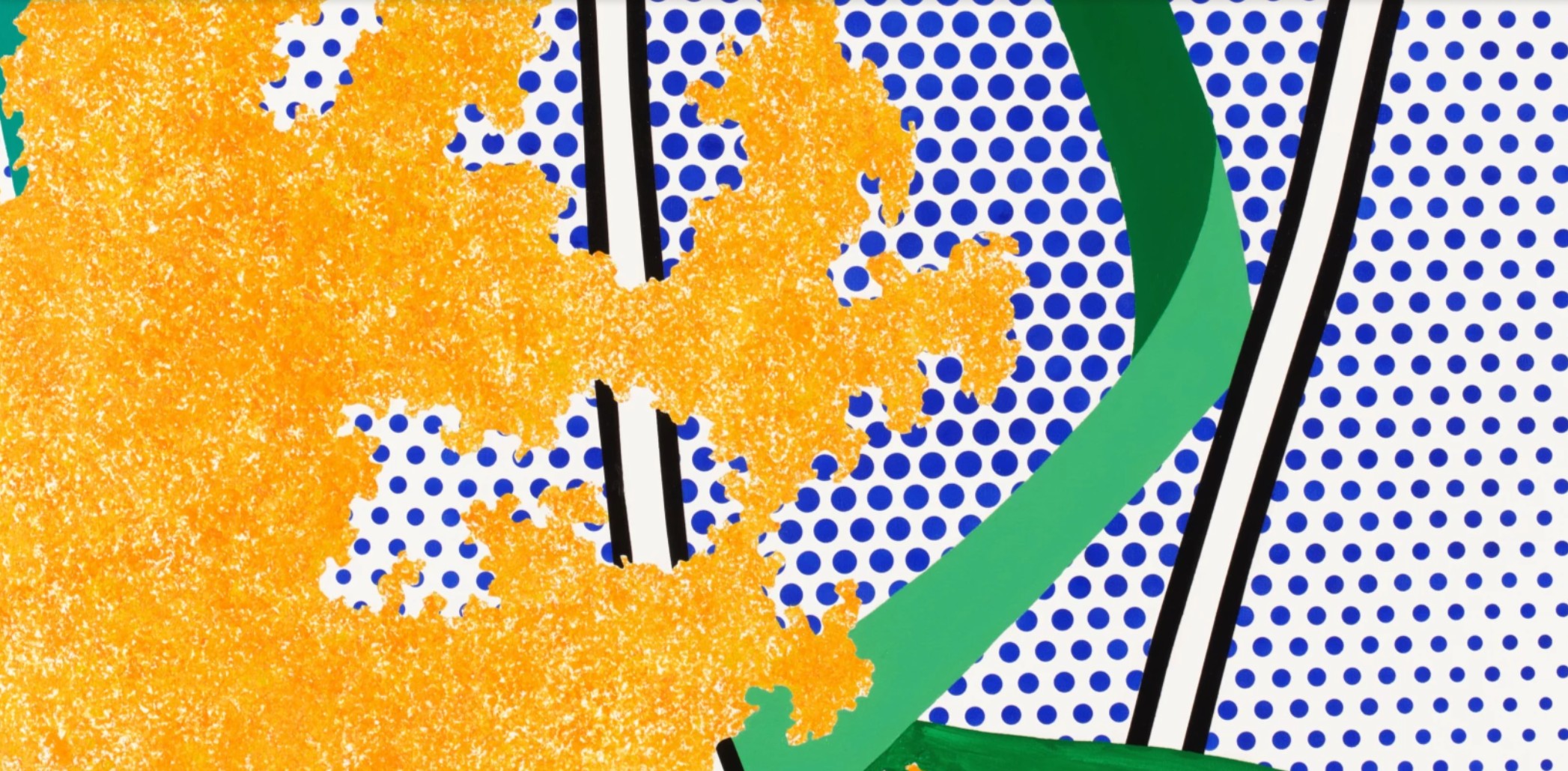
Ever the student of art history, Lichtenstein was constantly inspired by the iconography of other artists—the still life paintings of Pablo Picasso, the water lilies of Monet—creating his own versions replete with Ben-Day dots, flat planes of color and bold black outlines. The liveliness of Lichtenstein’s shapes that playfully extend across the work call to mind the organic shapes of Matisse’s Le Gerbe; like Matisse, who synthesized the curvature of various flora into spirited abstractions, Lichtenstein distills the features of stalks and petals into purely essential visual language. Here, the ovular vignette of the canvas and the geometric, bold diagonals of the bamboo evoke Cubist compositions. Like the Cubists, Lichtenstein toys with depth of field in the present work, synthesizing the foreground and background and eschewing traditional perspective.
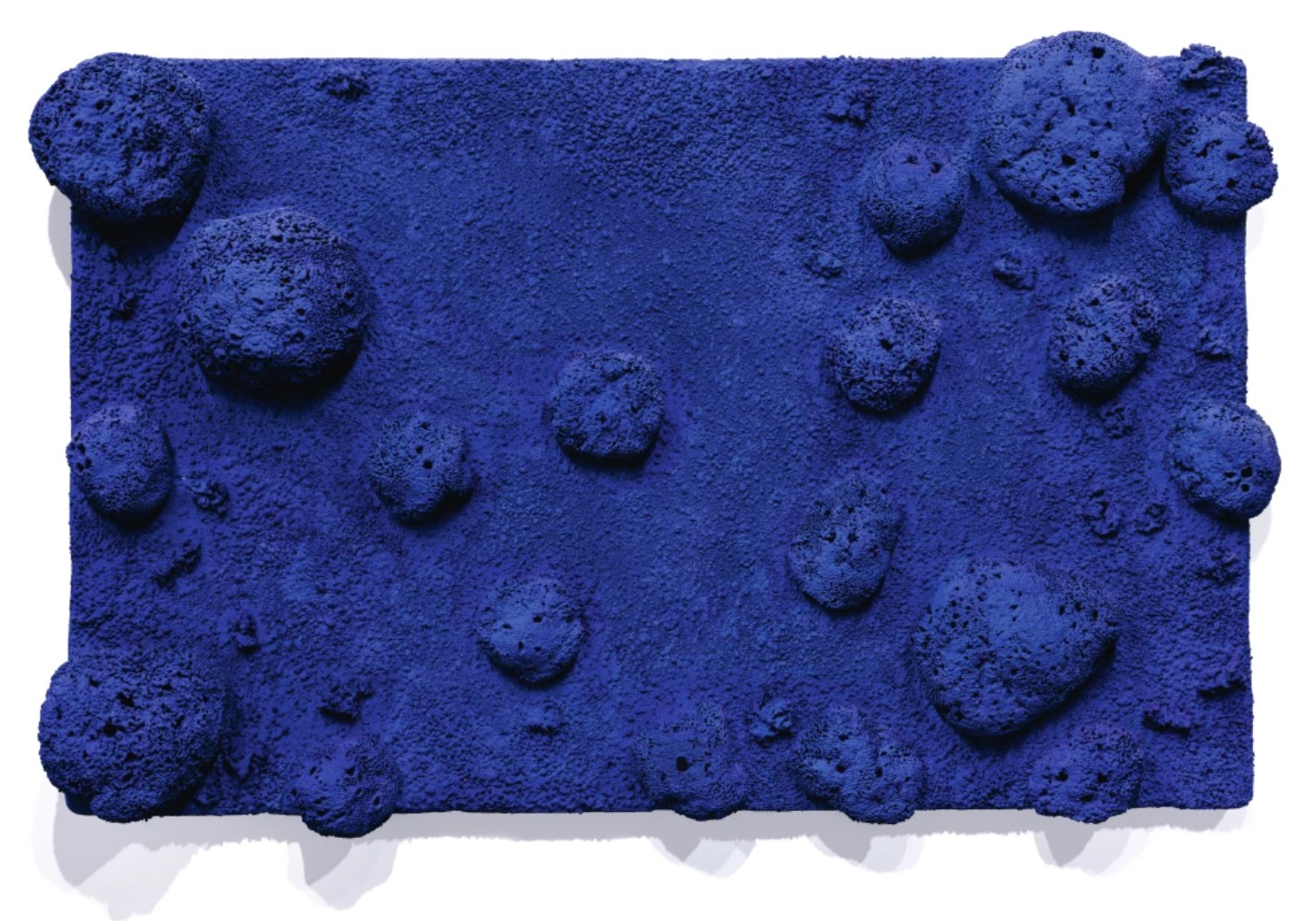
Yves Klein, Relief Éponge bleu sans titre (RE 28), 1961. Private Collection. Sold at Sotheby’s New York in November 2024 for $14.2 million. Art © 2025 Artists Rights Society (ARS), New York / ADAGP, Paris
The cluster of blue dots in the background dissipate towards the edges of the composition, evoking the sky reaching towards a horizon. Ribbon-like leaves twist across the composition, further confounding the depth of field and sense of scale. Lichtenstein here also blends his signature segments of flat pigment with irregular areas of sponge application, suggesting a dense mass of flowers or leaves. The resulting composition is both disorienting and meditative; it is seemingly familiar and yet completely abstract. This duality—depth and shallowness, high art and mass media—characterizes much of Lichtenstein’s oeuvre. Unique among the Chinese Style Landscapes in its perspective, Flower with Bamboo even resists characterization as a landscape. While the other entries in the series feature wide vistas and fog-covered mountains, Flower with Bamboo is much tighter, almost like a precisely arranged still life. Nevertheless, in the space created by the stalks of bamboo, a sense of scale emerges. The viewer peers out from behind the branches and is left to imagine what lies beyond. Indeed, Lichtenstein’s paintings are the product of imagination and fantasy rather than representations of reality.
Fan Painting – Landscape, 19th century. Ashmolean Museum, University of Oxford.
Image © HIP / Art Resource, NY © Ashmolean Museum, University
Lichtenstein’s Landscapes in the Chinese Style provide a commentary on the juxtapositions of East and West, or rather the ways in which the West imagines the East. Just as Lichtenstein’s earlier work provides a wry commentary on consumption of American popular imagery, here, he explores the popularization and reproduction of Asian art in Western culture. Lichtenstein’s work critiques a view of Asian art as monolithic, creating compositions with a mechanical quality in contrast to the intimacy of the prints by which he was inspired. The title of the series underscores this perspective—it is, of course, impossible to distill centuries of work across a vast geography under a single definition.
#5. Reflections on Brushstrokes, 1990
A Legacy Reimagined: Works from the Collection of Dorothy and Roy Lichtenstein
Sotheby’s New-York: 19 November 2025
Estimated: USD 1,200,000 – 1,800,000
USD 1,392,000
Reflections on Brushstrokes | Contemporary Day Auction | 2025 | Sotheby’s
ROY LICHTENSTEIN (1923 – 1997)
Reflections on Brushstrokes, 1990
Acrylic, oil and graphite on canvas
87 1/4 x 60 inches (221.6 x 152.4 cm)
Signed and dated ‘90 (on the reverse)
Resplendent in its fractured lyricism, Reflections on Brushstrokes from 1990 stands as one of the most incisive achievements of Roy Lichtenstein’s celebrated Reflections series, a body of work that redefined the possibilities of his Pop idiom in the final decades of his career. Monumental in scale and dazzling in execution, the present work revisits one of Lichtenstein’s most iconic motifs—the bravura brushstroke—only to fracture and reframe it through a dazzling play of obstruction and reveal. With its mirrored surfaces, embossed textures, and slivers of simulated glare, Reflections on Brushstrokes is at once a meditation on painting’s legacy and a reflection upon Lichtenstein’s own extraordinary artistic vocabulary.
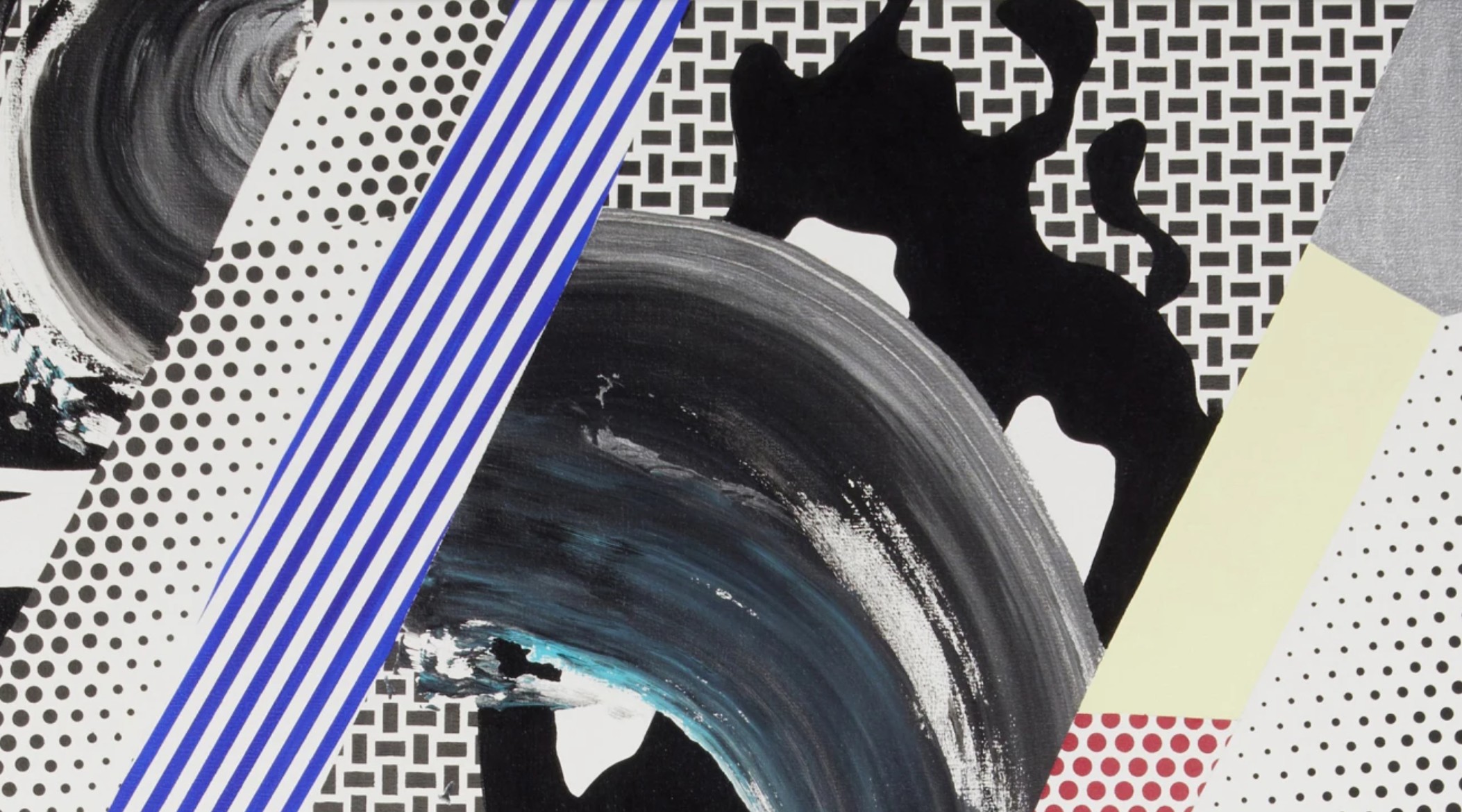
From the beginning of his career, Lichtenstein was fascinated by the paradox of the brushstroke. In the 1960s, his Brushstrokes paintings satirized the gestural excesses of Abstract Expressionism by rendering its marks as flat, comic-book signs. What in Pollock or de Kooning had been an index of expression and immediacy became, in Lichtenstein’s hands, a mechanical emblem—stylized, frozen, and repeatable. The brushstroke, emptied of expression, became a sign of expression itself. In Reflections on Brushstrokes, created nearly three decades later, that emblem returns with new complexity: larger, darker, weightier, and fragmented by layers of reflection. Here the brushstroke is not only a parody but a meditation—seen through veils of interference, as though caught between presence and absence, past and present. The composition is a virtuoso performance of visual interruption. Bold sweeps of black and gray curve across the surface, evoking both motion and mass, while vertical bars and diagonal stripes slice through the image, as though panes of glass were shattering across the picture plane. Embossed textures and bands of Ben-Day dots create rhythmic counterpoints; metallic PVC gleams and flickers, catching light and reflecting the viewer’s own presence back into the composition. The result is an image in constant flux, never static, always mediated by the conditions of looking. In this choreography of obstruction and revelation, Lichtenstein forces us to confront the very act of seeing as subject.
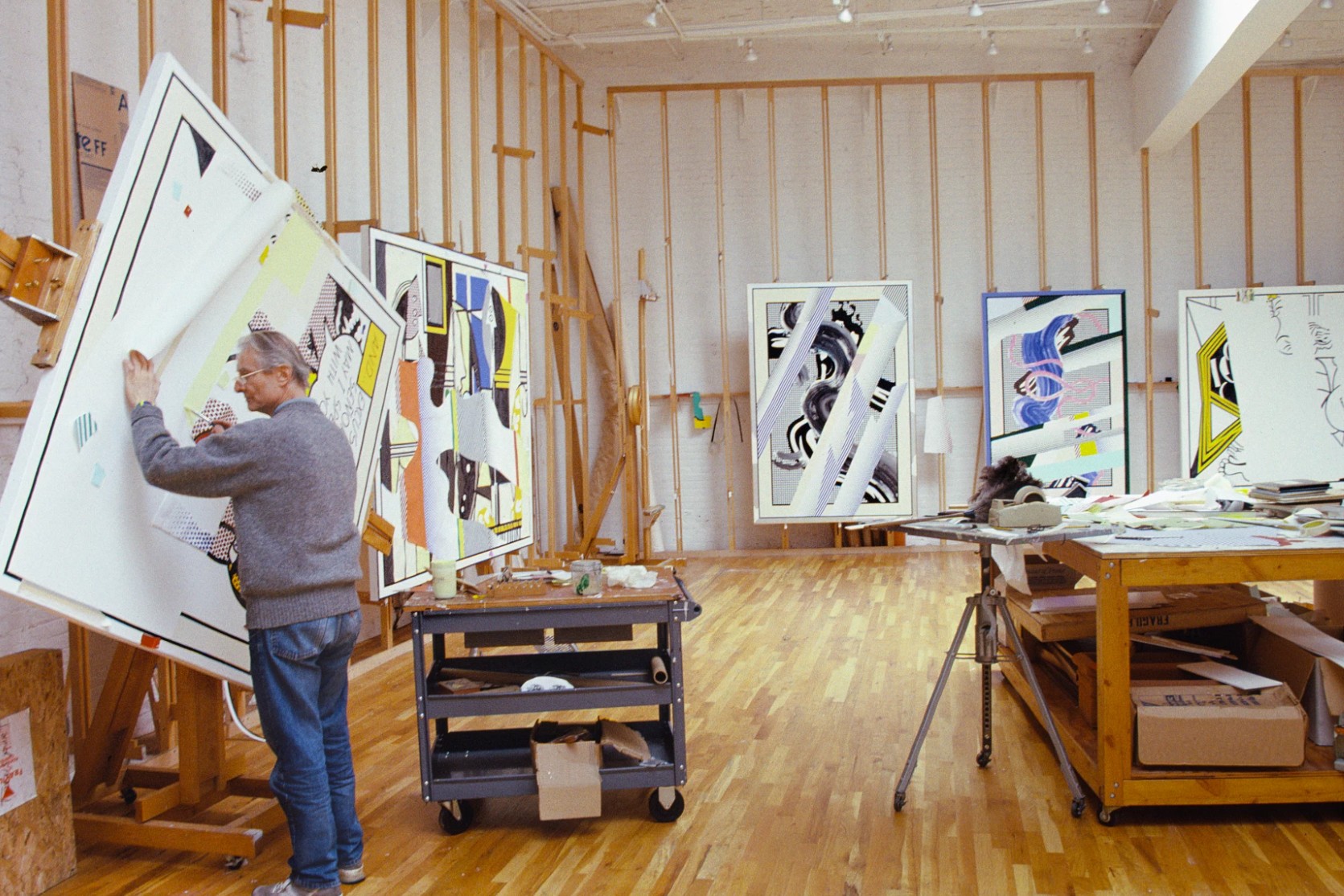
The present work installed in Roy Lichtenstein’s Washington Street studio, circa 1989.
Art © Estate of Roy Lichtenstein. Image © Bob Adelman.
The Reflections series, executed between 1988 and 1990, marked a decisive moment of retrospection and reinvention in Lichtenstein’s oeuvre. By overlaying his own motifs—comic heroines, art-historical quotations, still lifes, and the brushstroke itself—with simulated reflective bands, Lichtenstein turned his gaze upon his own practice. The mirror becomes metaphor: the work reflects not only imagery but also the artist’s career, and by extension the history of modern art.
“I started this series of Reflections on various early works of mine… It portrays a painting under glass. It is framed and the glass is preventing you from seeing the painting. Of course, the reflections are just an excuse to make an abstract work, with the cartoon image being supposedly partly hidden by the reflections.”
In the present work, the viewer, too, is implicated. Metallic passages and mirrored planes fold external space into the composition, pulling the spectator into its optical game. Standing before the work, one’s own image becomes part of the flicker of brushstroke and stripe. Lichtenstein transforms the passive act of looking into an active encounter: we are reflected in the very gesture we seek to apprehend. In this sense, Reflections on Brushstrokes extends his lifelong concern with perception and mediation, collapsing the distance between artwork, viewer, and cultural sign. The historical importance of the work is underscored by its extensive exhibition history. Reflections on Brushstrokes was included in Roy Lichtenstein: A Retrospective (1993–96), one of the most comprehensive surveys of his career, which traveled to major institutions including the Solomon R. Guggenheim Museum in New York, the Museum of Contemporary Art in Los Angeles, the Haus der Kunst in Munich, the Deichtorhallen in Hamburg, the Palais des Beaux-Arts in Brussels, and the Wexner Center for the Arts in Columbus. In that global survey, the work stood as a key demonstration of Lichtenstein’s capacity for reinvention in his final decades.
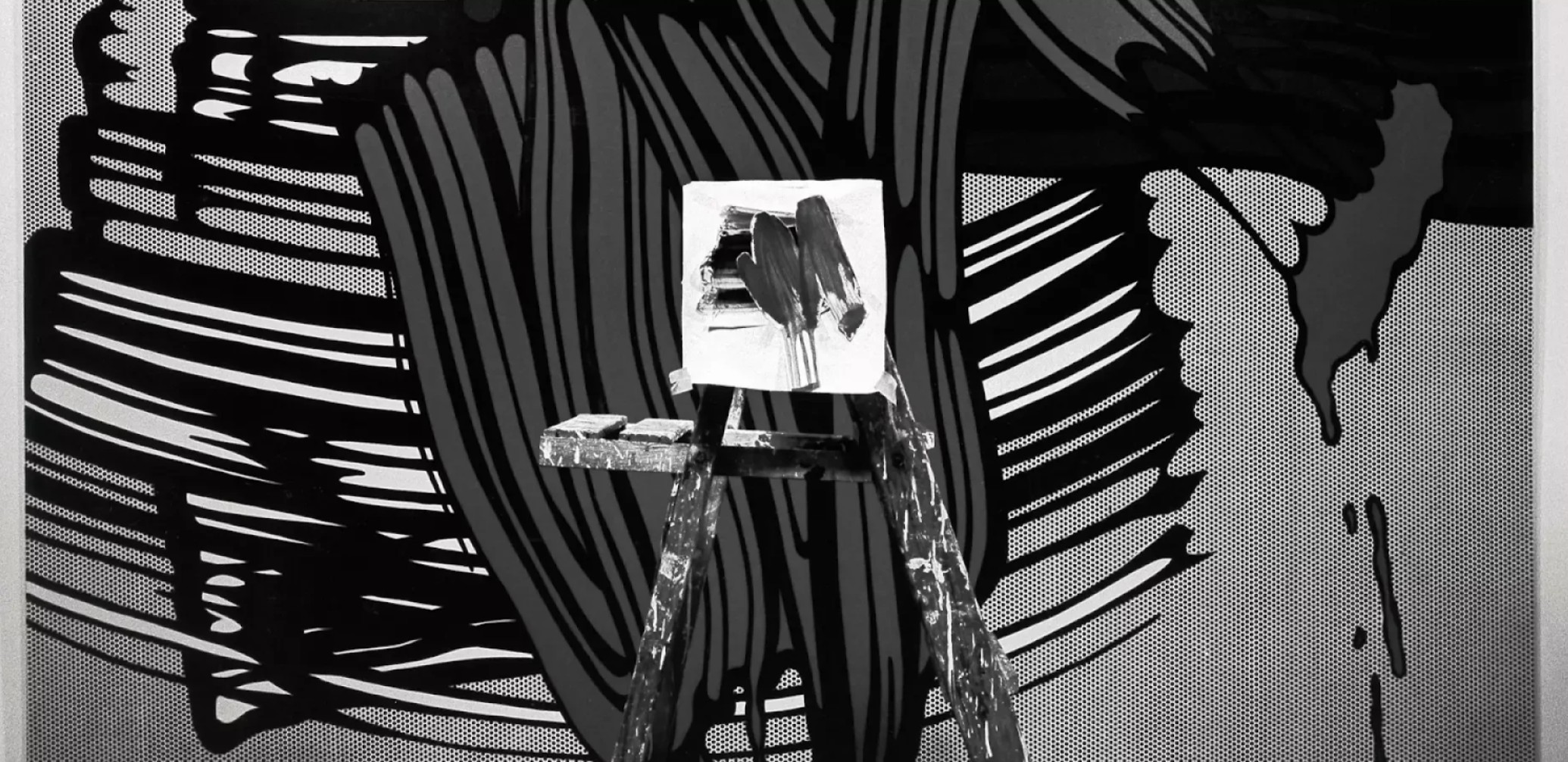
Big Painting VI in the artist’s studio, New York, 1965.
Photo by Ugo Mulas © Ugo Mulas Heirs. All rights reserved. Art © Estate of Roy Lichtenstein
In its ambition and complexity, Reflections on Brushstrokes condenses the arc of Lichtenstein’s career: the dialogue with Abstract Expressionism, the embrace of mechanical reproduction, the self-referential play of Pop, and the probing of perception in his late work. It is both a culmination and a mirror, folding the history of modern painting into a Pop idiom that remains as incisive today as when it was made. In its fractured brilliance, the work embodies the qualities that define Lichtenstein’s late triumph: boldness, irony, and a dazzling, self-aware clarity.
#6. Still Life with Two Grapefruits, 1994
A Legacy Reimagined: Works from the Collection of Dorothy and Roy Lichtenstein
Sotheby’s New-York: 19 November 2025
Estimated: USD 800,000 – 1,200,000
USD 1,270,000
Still Life with Two Grapefruits | Contemporary Day Auction | 2025 | Sotheby’s
ROY LICHTENSTEIN (1923 – 1997)
Still Life with Two Grapefruits, 1994
Acrylic, oil and graphite on canvas
30 1/8 x 24 1/8 inches (76.5 x 61.2 cm)
Signed and dated ’94 (on the reverse)
Radiant in color and crystalline in form, Still Life with Two Grapefruits (1994) exemplifies the assured refinement of Roy Lichtenstein’s late style. At once playful and rigorous, the work belongs to the artist’s celebrated body of still lifes that spanned more than two decades and came to define his dialogue with the grand traditions of painting. Here, two glowing spheres of yellow fruit are presented with schematic clarity, anchored on a sharply tilting tabletop. The familiar subject is transformed through the precision of Pop, becoming not an evocation of touch or taste but a distilled image of form, color, and sign.
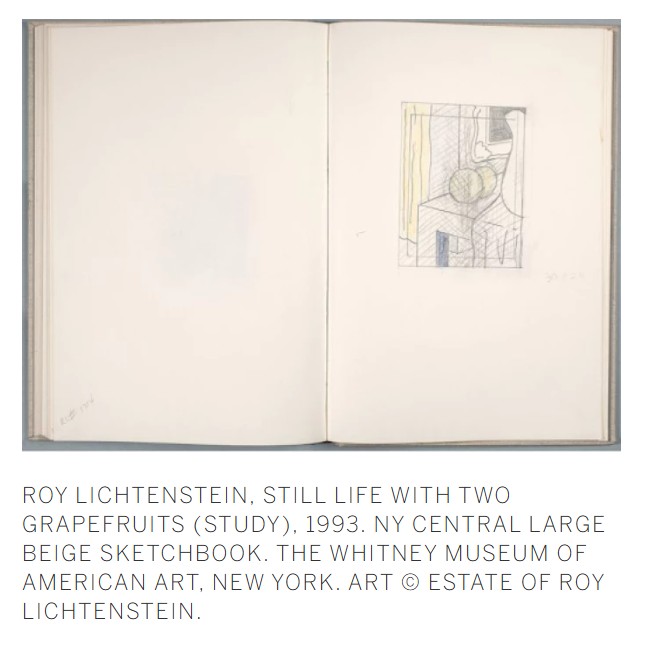
Lichtenstein’s fascination with still life first surfaced in the late 1970s, when he turned from the comic strip heroines and explosive dramas of his early Pop years to the quieter genres of art history. The still life offered him a laboratory in which to measure the language of modernism against his own graphic idiom. Grapes, bowls, and fruit recur across these canvases, but never as objects of sensual realism. Instead, they are reconstituted through black contour lines, flat fields of primary color, and the disciplined geometry of Ben-Day dots. In Still Life with Two Grapefruits, this language reaches a point of crystalline focus: the fruit appear almost as emblems, pared down to pure shape, hovering between depiction and abstraction.
The composition demonstrates Lichtenstein’s consummate control of balance and rhythm. The tabletop slices diagonally across the field, creating a taut counterpoint to the round perfection of the grapefruits. Shadow and light are handled with absolute economy—arcs of black and gray carve space with schematic force, while the expanse of white surrounding the objects lends them an almost iconic presence. Every element feels exact, deliberate, and resonant. The result is a composition that radiates calm authority, at once playful in subject and monumental in clarity.
“When we think of still lifes, we think of paintings that have a certain atmosphere or ambience. My still life paintings have none of those qualities, they just have pictures of certain things that are in a still life, like lemons and grapefruits and so forth. It’s not meant to have the usual still life meaning.”
In doing so, the painting situates itself in the lineage of still life as a stage for artistic invention. The grapefruits, like Cézanne’s apples or Matisse’s fruit bowls, are less about the objects themselves than about the possibilities of form and perception. But whereas the modernists built volume, depth, or coloristic complexity, Lichtenstein pursues flatness and graphic precision, filtering the inherited conventions of painting through the lens of Pop. His grapefruits are at once homage and reinvention: ordinary fruit reimagined as signs, the everyday elevated into the timeless register of art. Painted the year after the Guggenheim retrospective that toured internationally, Still Life with Two Grapefruits belongs to a moment when Lichtenstein revisited his signature motifs with renewed clarity and ambition. The 1990s marked a period of summation in his career, when his vocabulary—already iconic—was honed to its essentials. In this context, the still life becomes not a departure but a culmination, affirming the centrality of representation itself to his lifelong practice. What once had been the heroic brushstroke or the comic heroine is here distilled into two pieces of fruit, presented with equal seriousness and wit.
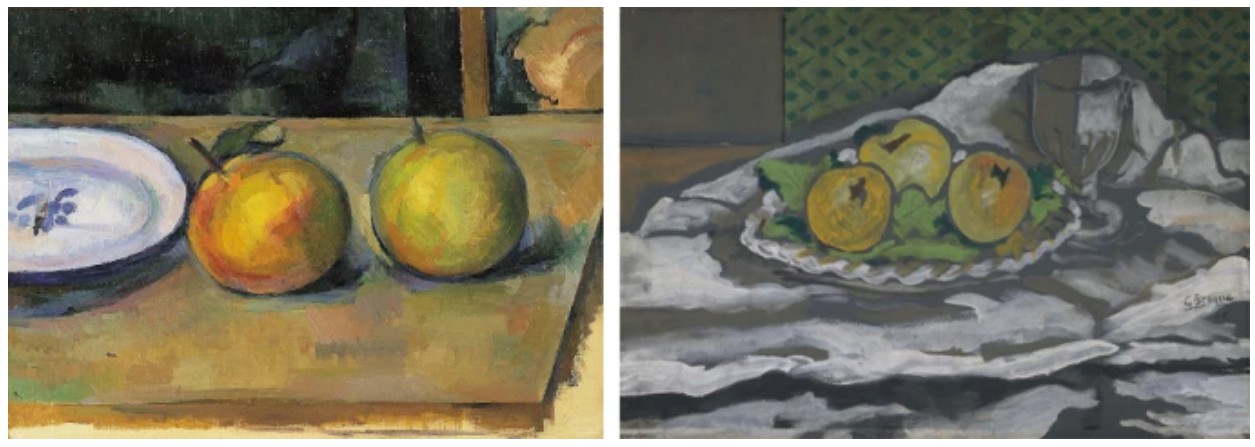
Left: Paul Cézanne, Deux pommes sur une table, c. 1895-1900. Speed Art Museum, Louisville, Kentucky.
Right: Georges Braque, Glass and Plate of Apples, 1925. Tate London.
The wit lies precisely in the denial of illusion. The grapefruits carry no texture, no translucence, no softness of touch. They are instantly recognizable yet entirely artificial, their presence defined not by realism but by line and color alone. Lichtenstein turns banality into emblem, the everyday into sign. This paradox—between immediacy and mediation, familiarity and estrangement—animates the painting, as it does much of his oeuvre. In its restraint, Still Life with Two Grapefruits achieves a remarkable clarity. It is at once a quiet canvas and a bold statement, a painting that collapses centuries of art history into the flat surface of Pop. With its luminous color, graphic force, and conceptual precision, the work stands as one of the most elegant distillations of Lichtenstein’s late production: the humble still life, recast as image, as icon, as pure painting.
#7. Entablature, 1974
A Legacy Reimagined: Works from the Collection of Dorothy and Roy Lichtenstein
Sotheby’s New-York: 19 November 2025
Estimated: USD 800,000 – 1,200,000
USD 1,270,000
Entablature | Contemporary Day Auction | 2025 | Sotheby’s
ROY LICHTENSTEIN (1923 – 1997)
Entablature, 1974
Acrylic, sand and graphite on canvas
60 x 100 1/8 inches (152.4 x 254.3 cm)
Signed and dated ‘74 (on the reverse)
Monumental in scale and commanding in presence, Entablature (1974) belongs to one of the most ambitious and conceptually rigorous series of Roy Lichtenstein’s career. Spanning five by seven and a half feet, the painting evokes the authority of architecture while sustaining the crisp clarity and graphic vitality that had long defined his Pop idiom. A work of extraordinary ambition, Entablature captures the moment in the 1970s when Lichtenstein shifted away from his comic-derived imagery to probe the very structures of art and ornament, creating paintings that are at once austere, sumptuous, and profoundly architectural.
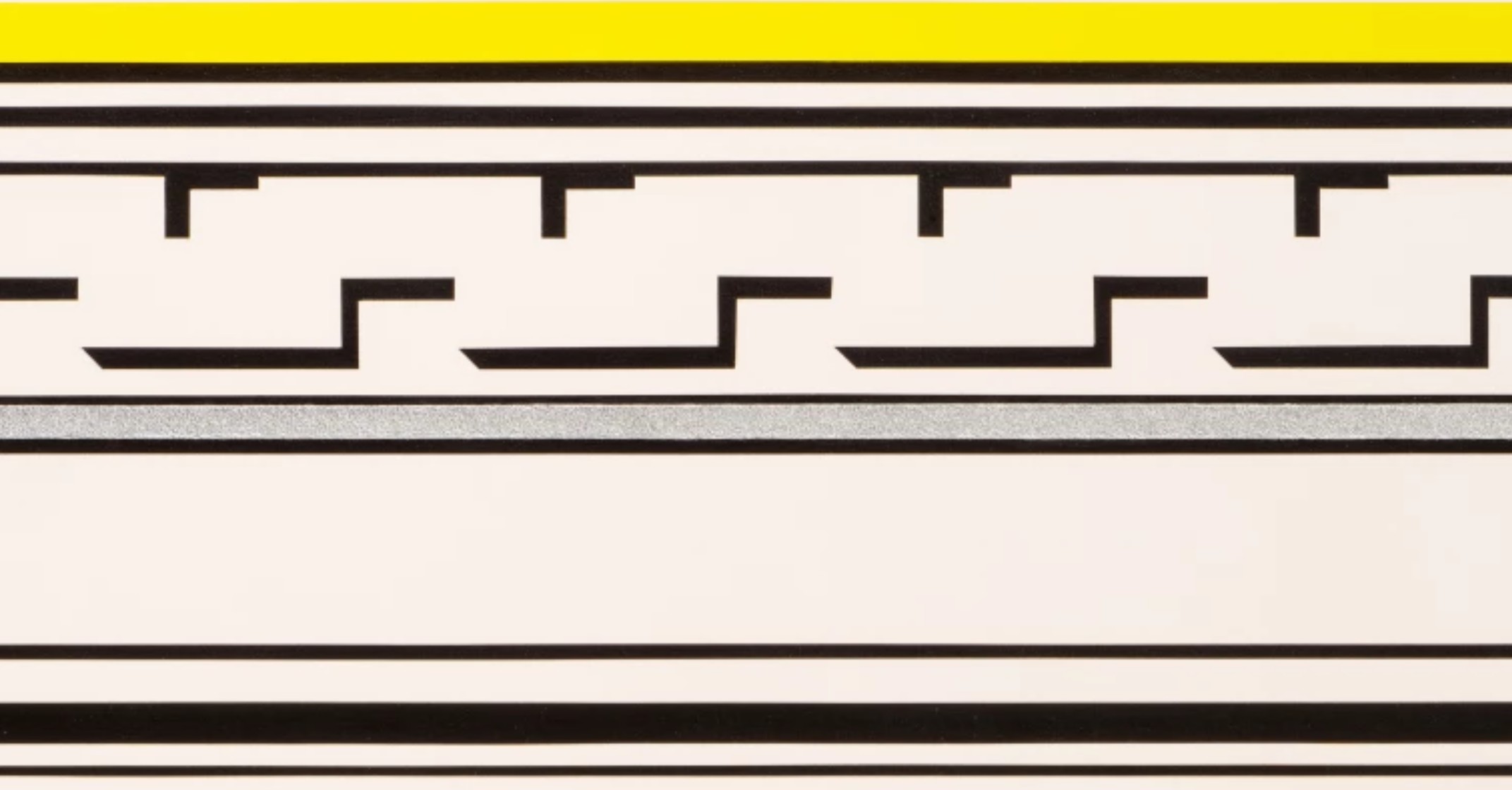
The Entablature series, produced between 1971 and 1976, represented a striking departure from the heroic narratives of his 1960s Pop. Where earlier works drew from comic books, advertisements, and the vocabulary of Abstract Expressionism, here Lichtenstein looked instead to the façades of classical and Beaux-Arts buildings. Translating cornices, moldings, and friezes into his distinctive idiom of flat color and bold outlines, he elevated ornament itself to the subject of painting. What had traditionally been the embellishment of structure became, in Lichtenstein’s hands, a structural subject in its own right.
Entablatures in Museum Collections
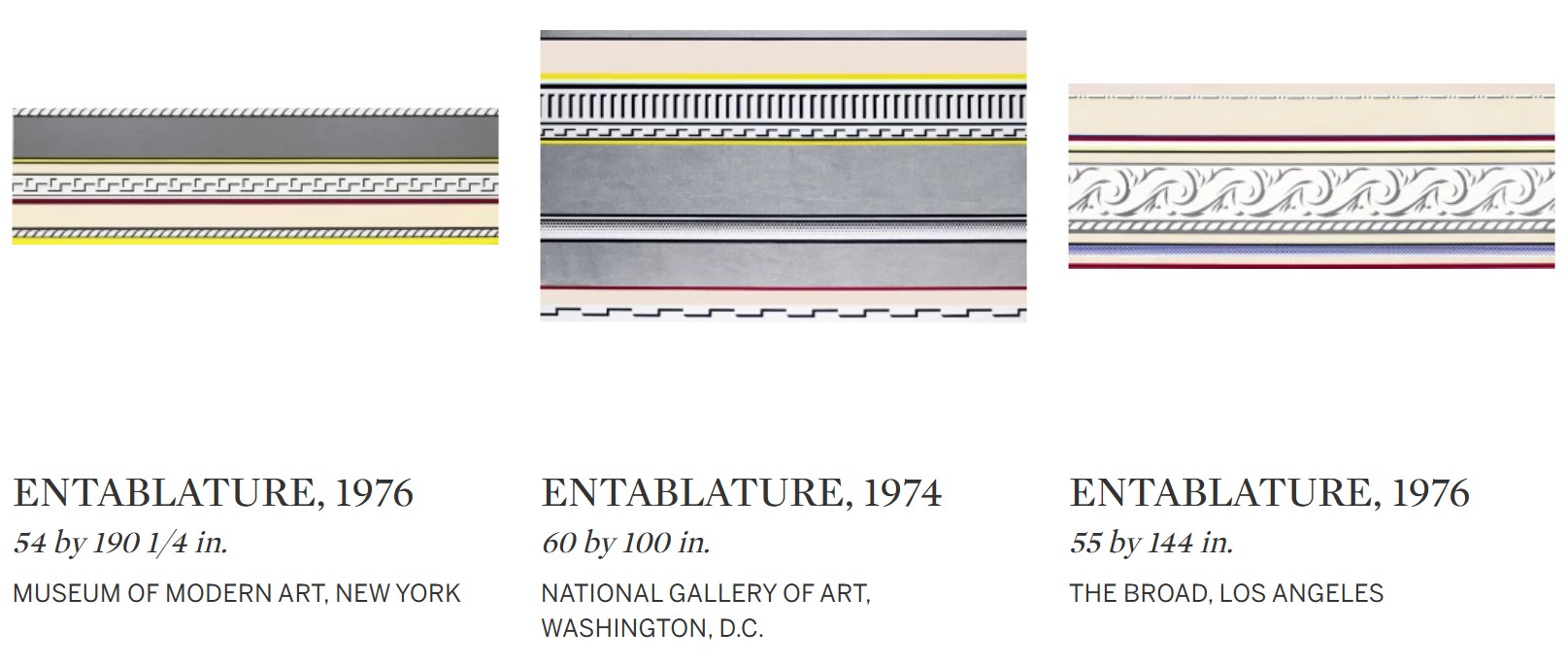
Formally, Entablature exemplifies the rigor of this pursuit. Its horizontal registers unfold with rhythmic order: geometric fretwork, sand-textured fields, linear stripes, and schematic patterns, each crisply articulated and stacked in succession. The addition of sand and graphite lends the surface a subtle tactility, pushing against the pure flatness of paint and animating the work with shifting texture. At this scale, the composition reads simultaneously as decorative pattern and monumental façade, commanding the viewer’s space like architecture transposed onto canvas.
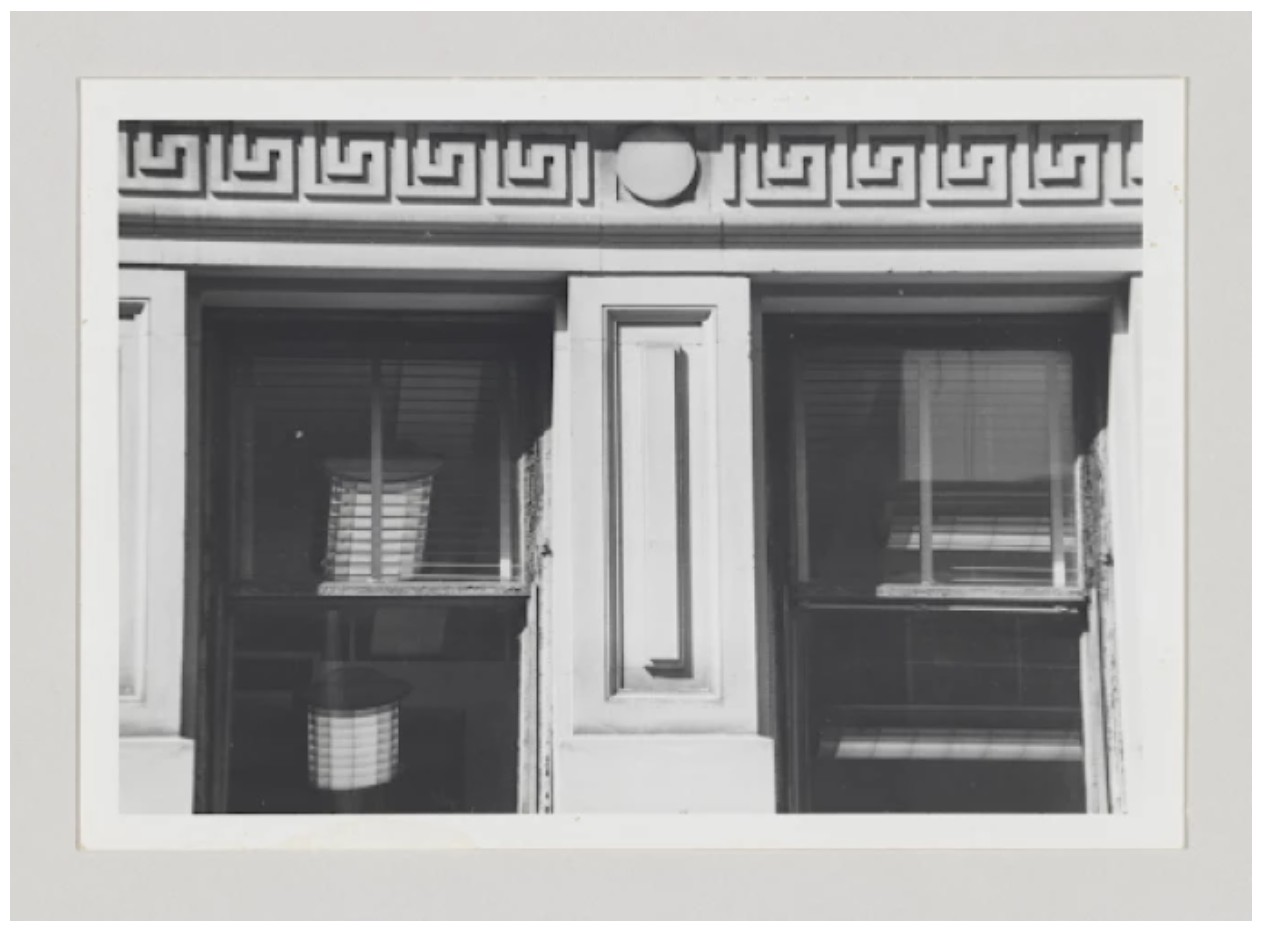
Roy Lichtenstein, Untitled [architecture study], c. 1970-1976.
The Whitney Museum of American Art, New York. Art © Estate of Roy Lichtenstein.
What makes the Entablatures so compelling is the tension they sustain between decoration and abstraction. The motifs themselves are ornamental, yet Lichtenstein distills them into the language of reduction—bands, stripes, flat zones, repeated patterns. By stripping away illusionism, he renders ornament at once minimal and monumental. The decorative, once marginal, is brought to the fore; the flourish becomes the subject. At this scale, the paradox is heightened: Lichtenstein transforms detail into drama, presenting ornament as both sign and structure.
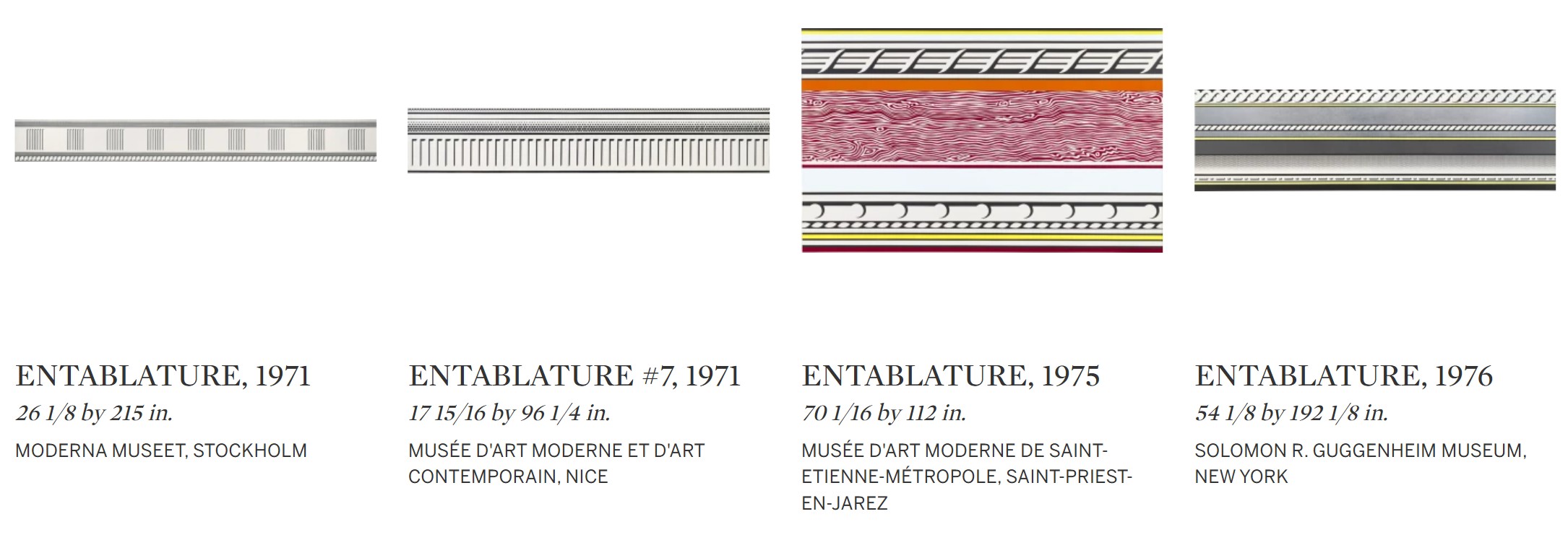
Within the arc of Lichtenstein’s career, Entablature performs a double task. It extends his lifelong fascination with the mediated image—just as his comic panels, explosions, and brushstrokes were stylized signs rather than direct gestures, so too these architectural forms function as signs for ornament rather than ornament itself. At the same time, the series signals a profound dialogue with the artistic debates of its era. By reducing decorative motifs to modular bands, Lichtenstein aligns himself with the seriality and restraint of Minimalism and formal abstraction, while his colors, textures, and Pop precision distinguish his work from the austerity of his peers.
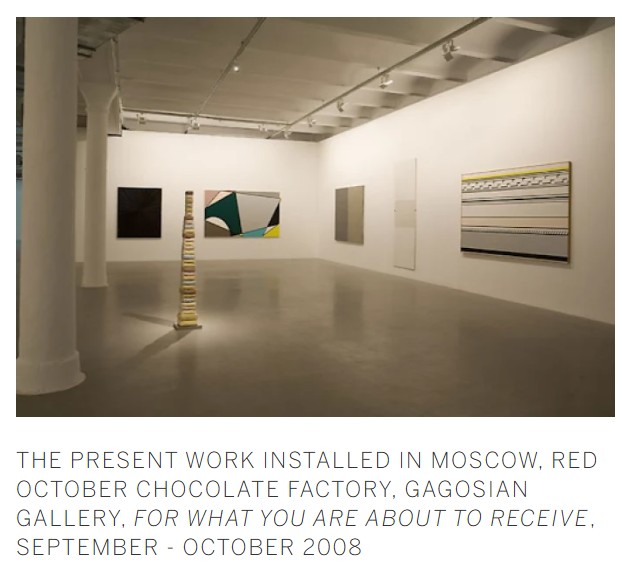
In this synthesis, Entablature demonstrates Lichtenstein’s ability to transform sources both high and low—from comic strips to classical façades—into a coherent and innovative pictorial language. It is a painting that is at once deeply rooted in art history and wholly of its time, reflecting on the endurance of ornament while speaking to the reductive impulses of the 1970s.
Monumental in size, exacting in execution, and ambitious in concept, Entablature is a landmark achievement of Lichtenstein’s mid-career production. It embodies the artist’s relentless capacity for reinvention, his willingness to interrogate the very terms of painting, and his ability to invest even the most overlooked details of culture—here, the decorative band of architecture—with the weight of modernist inquiry. With Entablature, Lichtenstein transforms ornament into monument, creating a work that resonates not only as a key chapter in his own oeuvre but as a profound contribution to the history of postwar art.
#8. Haystacks, 1969
Christie’s New-York: 20 November 2025
Estimated: USD 500,000 – 700,000
USD 787,400
ROY LICHTENSTEIN (1923-1997), Haystacks | Christie’s
ROY LICHTENSTEIN (1923-1997)
Haystacks, 1969
Oil and acrylic on canvas
16×24 inches (40.6 x 61 cm)
Signed and dated ‘rf Lichtenstein ’69’ (on the reverse)
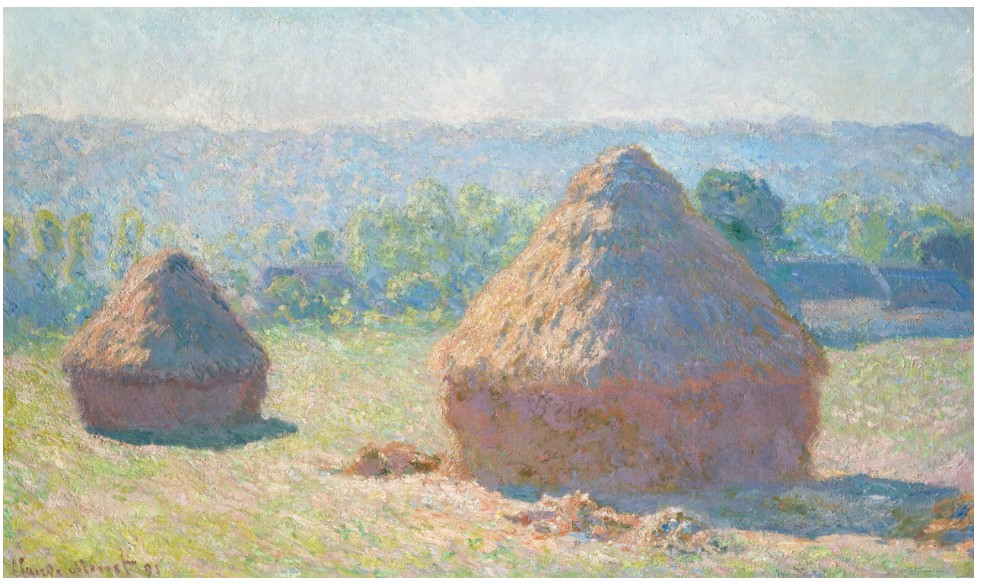
Claude Monet, Meules, fin de l’été, 1891. Musée d’Orsay, Paris.
#9. Brushstroke Abstraction II, 1996
A Legacy Reimagined: Works from the Collection of Dorothy and Roy Lichtenstein
Sotheby’s New-York: 18 November 2025
Estimated: USD 180,000 – 250,000
USD 533,400
Brushstroke Abstraction II | Contemporary Day Auction | 2025 | Sotheby’s
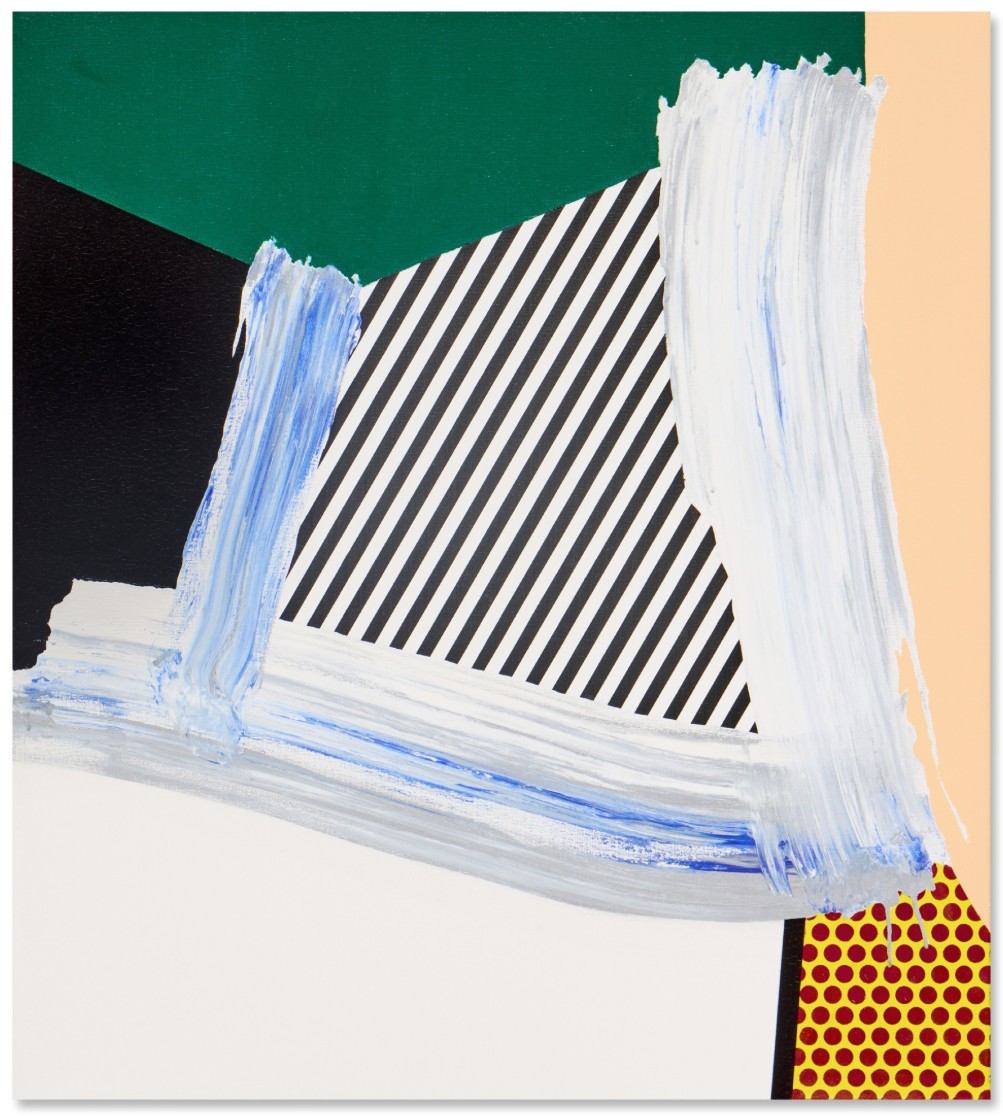
ROY LICHTENSTEIN (1923 – 1997)
Brushstroke Abstraction II, 1996
Acrylic, oil and graphite on canvas
30 1/8 x 27 1/8 inches (76.5 x 68.9 cm)
Signed and dated ’96 (on the reverse)
“True to the precepts of his initial style — borrowing subject matter from the past or present and turning into a quasi-absurdist statement — Roy Lichtenstein will undoubtedly continue to mine the day’s creative currents and transform them into lucid paraphrases that announce his provocative originality.”
John Gruen, “Artist’s Dialogue: Roy Lichtenstein: Bold Strokes of Wit and Wisdom,” Architectural Digest 42, no. 9, September 1985, p. 62
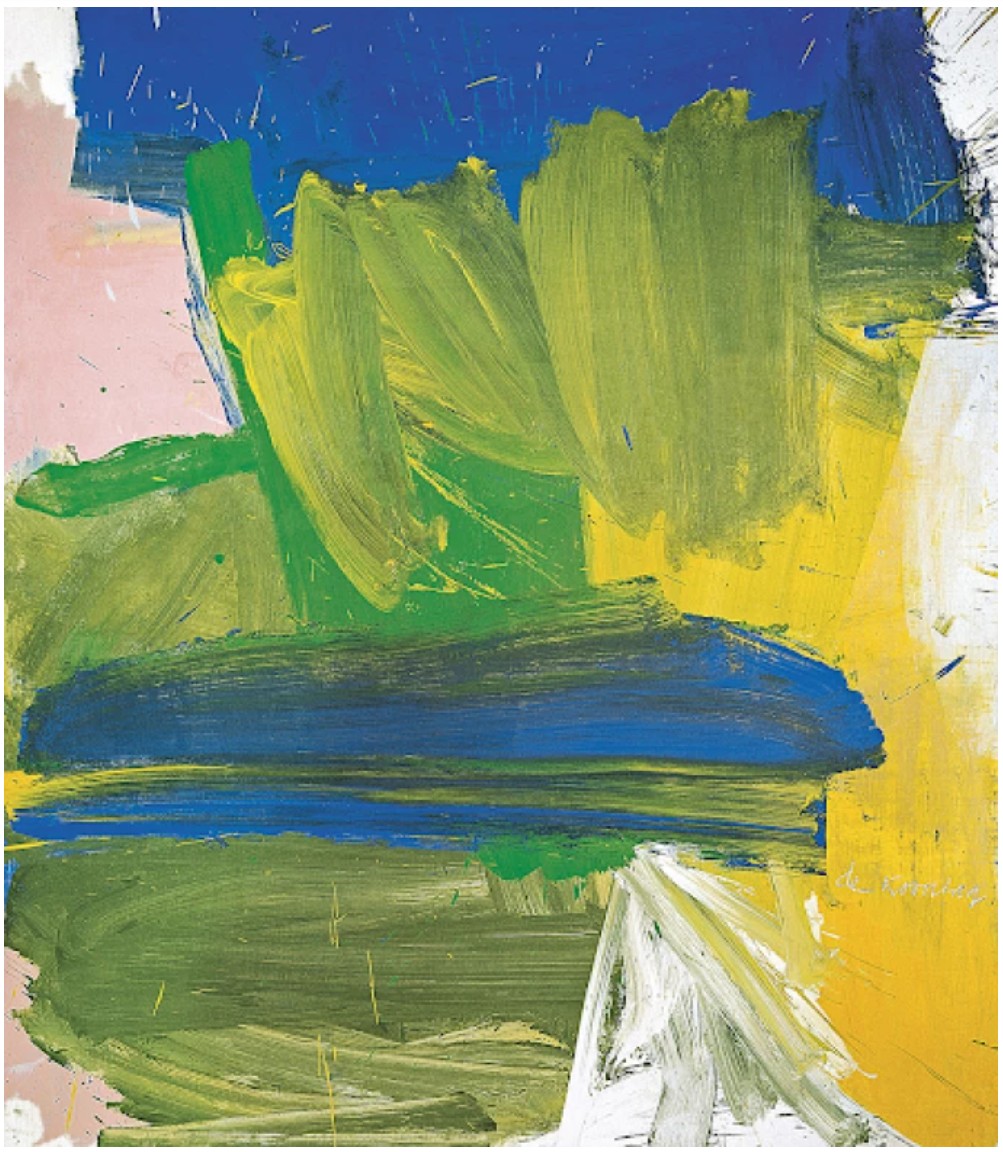
Willem de Kooning, Villa Borghese, 1960. Guggenheim Bilbao Museoa.
Art © 2025 The Willem de Kooning Foundation/Artists Rights Society (ARS), New York
#10. Brushstroke with Still Life II, 1996
Property from the Estate of Joan and Kenneth Goldglit
Christie’s New-York: 20 November 2025
Estimated: USD 300,000 – 500,000
USD 444,500
ROY LICHTENSTEIN (1923-1997), Brushstroke with Still Life II | Christie’s
ROY LICHTENSTEIN (1923-1997)
Brushstroke with Still Life II, 1996
Acrylic, oil and graphite on canvas
28×34 inches (71.1 x 86.4 cm)
Signed and dated ‘rf Lichtenstein ’96’ (on the reverse)
#11. Plus and Minus VI, 1988
A Legacy Reimagined: Works from the Collection of Dorothy and Roy Lichtenstein
Sotheby’s New-York: 18 November 2025
Estimated: USD 350,000 – 450,000
USD 406,400
Plus and Minus VI | Contemporary Day Auction | 2025 | Sotheby’s
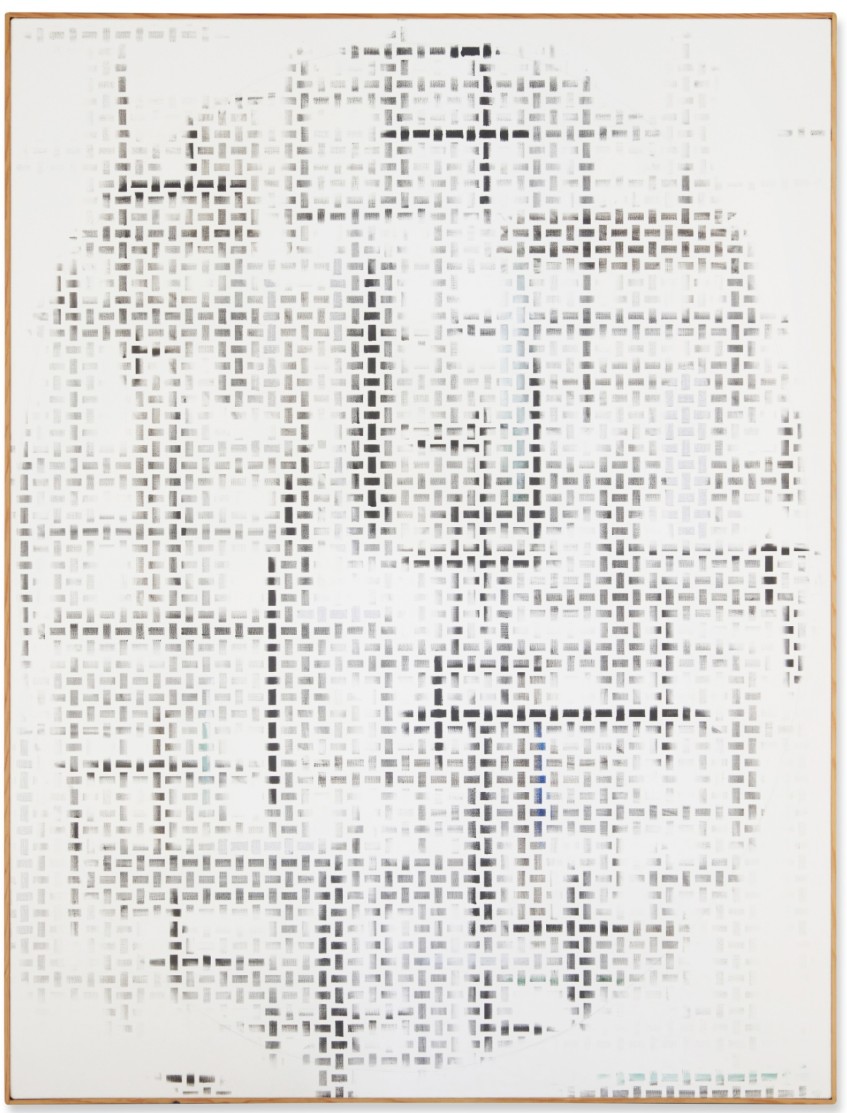
ROY LICHTENSTEIN (1923-1997)
Plus and Minus VI, 1988
Acrylic, oil and graphite on canvas
50×38 inches (127 x 96.5 cm)
Signed and dated ‘88 (on the reverse)
#12. Figure in Garden, circa 1949
Property from a Private Collection, Indianapolis
Sotheby’s New-York: 18 November 2025
Estimated: USD 60,000 – 80,000
USD 101,600
Figure in Garden | Contemporary Day Auction | 2025 | Sotheby’s
ROY LICHTENSTEIN (1923-1997)
Figure in Garden, circa 1949
Oil on canvas
24 1/4 x 19 3/4 inches (61.6 x 50.2 cm)
Signed (lower left)
2. Sculptures
#1. Coup de Chapeau II, 1996
A Legacy Reimagined: Works from the Collection of Dorothy and Roy Lichtenstein
Sotheby’s New-York: 18 November 2025
Estimated: USD 1,500,000 – 2,000,000
USD 3,832,000
Coup de Chapeau II | The Now & Contemporary Evening Auction | 2025 | Sotheby’s
ROY LICHTENSTEIN (1923 – 1997)
Coup de Chapeau II, 1996
Painted bronze
89 x 32 x 13 1/8 inches (226.1 x 81.3 x 33.3 cm)
Incised with the artist’s signature, numbered 0/6 and dated ‘96 (lower edge)
This work is the artist’s cast from an edition of 6 plus 1 artist’s cast
Bursting into three-dimensional space, Coup de Chapeau II encapsulates the iconic graphic power of Roy Lichtenstein’s instantly recognizable Pop idiom. Here, Lichtenstein harkens back to the explosive force and comic-book characters of his earliest Pop paintings of the 1960s. The cartoon-like hat, resembling those worn by Lichtenstein’s early comic book heroes, soars into the air, creating a swelling cloud in its wake and leaving the hat wearer in its dust. Coup de Chapeau II and its smaller sister sculpture, Coup de Chapeau I, operate as three-dimensional extensions of the artist’s final self-portrait, Coup de Chapeau (Self-Portrait), and its study Coup de Chapeau (Self-Portrait) (Study) from 1995-6. In his earlier two-dimensional works, the artist represents himself stunned by a flying hat soaring into the air—a symbol for the whiplash of the oncoming new millennium. In Coup de Chapeau II, Lichtenstein has isolated the airborne yellow hat and the trace of its motion, causing the viewer to ponder who wore the hat and the source of its inexplicable flight. Coup de Chapeau II is among the most celebrated of Lichtenstein’s sculptures, having been included in numerous exhibitions, including most recently the Albertina in Vienna for Roy Lichtenstein: A Centennial Exhibition.
Rene Magritte, Man in a Bowler Hat, 1964. Private Collection. Image © Superstock / Bridgeman Images.
Art © 2025 C. Herscovici, Brussels / Artists Rights Society (ARS), New York
Reaching nearly 90 inches, Lichtenstein’s Coup de Chapeau II epitomizes Lichtenstein’s transformation of his two-dimensional Pop idiom into sculpture. Here, Lichtenstein propels his signature graphic vernacular, including bold primary colors and strong lines, into three-dimensional space. Beams of yellow, blue, white and black emerge from a billowing cloud in a cartoon arc. Evoking the artist’s famed wall sculptures and explosion paintings of the early 60s, a crimson explosion bursts at the apex of the sculpture’s arc as if erupting with energy. Then thrust into the air, Lichtenstein’s yellow cap is launched above the explosion, tilted on its brim in mid-rotation. Lichtenstein accentuates this spinning effect by doubling the brim of the hat, creating the illusion that the hat is still in motion. Here, the French phrase “Coup de Chapeau” takes on multiple meanings: “The term coup de chapeau is defined as a salute, but coup alone is a blow, stroke, or hit, with chapeau being hat. To give un coup de chapeau means to bow. While Lichtenstein thought of his phrase as ‘a tip of the hat.’” (Exh. Cat., Washington, D.C., The Corcoran Gallery of Art (and traveling), Roy Lichtenstein: Sculpture and Drawings, 1998-2000, p. 21)
Left: Andy Warhol, Double Elvis, 1963. The Museum of Modern Art, New York. Image © The Museum of Modern Art / Licensed by SCALA / Art Resource, NY. Art © 2025 Andy Warhol Foundation for the Visual Arts / Artists Rights Society (ARS), New York.
Right: Ed Ruscha, Scream, 1964. Art © 2025 Ed Ruscha
Coup de Chapeau II operates as an important counterpart to Lichtenstein’s final and exceedingly rare self-portraits. The work reveals a highly personal revelation for the artist of his own grappling with the forces of change in a rapidly evolving society. The present sculpture was preceded by Coup de Chapeau (Self-Portrait) and its study Coup de Chapeau (Self-Portrait) (Study)—two rare works in which the artist depicts himself, stunned, by an airborne yellow cap. In the work on paper, Lichtenstein inscribes next to his image: “Self Portrait (Man hit by the 21st Century).” The hat illustrated in the aforementioned works and Coup de Chapeau II evokes the cap worn by Dagwood Bumstead in the popular comic “Blondie.” Methodical and iterative, Lichtenstein’s practice is one of sustained engagement across media. In many cases, the artist pursues a subject through a selection of different media such as drawing, collage, painting, sculpture and printmaking. Considering Coup de Chapeau II in dialogue with the related work on paper and painting illuminates the role of the artist in its narrative. Here, despite the omission of any human figure, Lichtenstein realizes a form of self-portraiture, exploring his own response to the advent of the new century. Harkening back to his earliest comic-book paintings, Lichtenstein’s Coup de Chapeau II is both a pure fulfillment of Pop and a reflection on the arc of his career. Like much of Lichtenstein’s oeuvre, these works are referential to his own practice and art history. Executed in 1996 in the last year of Lichtenstein’s career, Coup de Chapeau II is a masterful example of the artist’s continued reinvestigation of art history and his own practice. From the early 1960s, Lichtenstein was guided by an investigation of “art about art,” deconstructing the arbitrary boundaries between “high” and “low” through a system of signs and symbols associated with mass production and comic books.
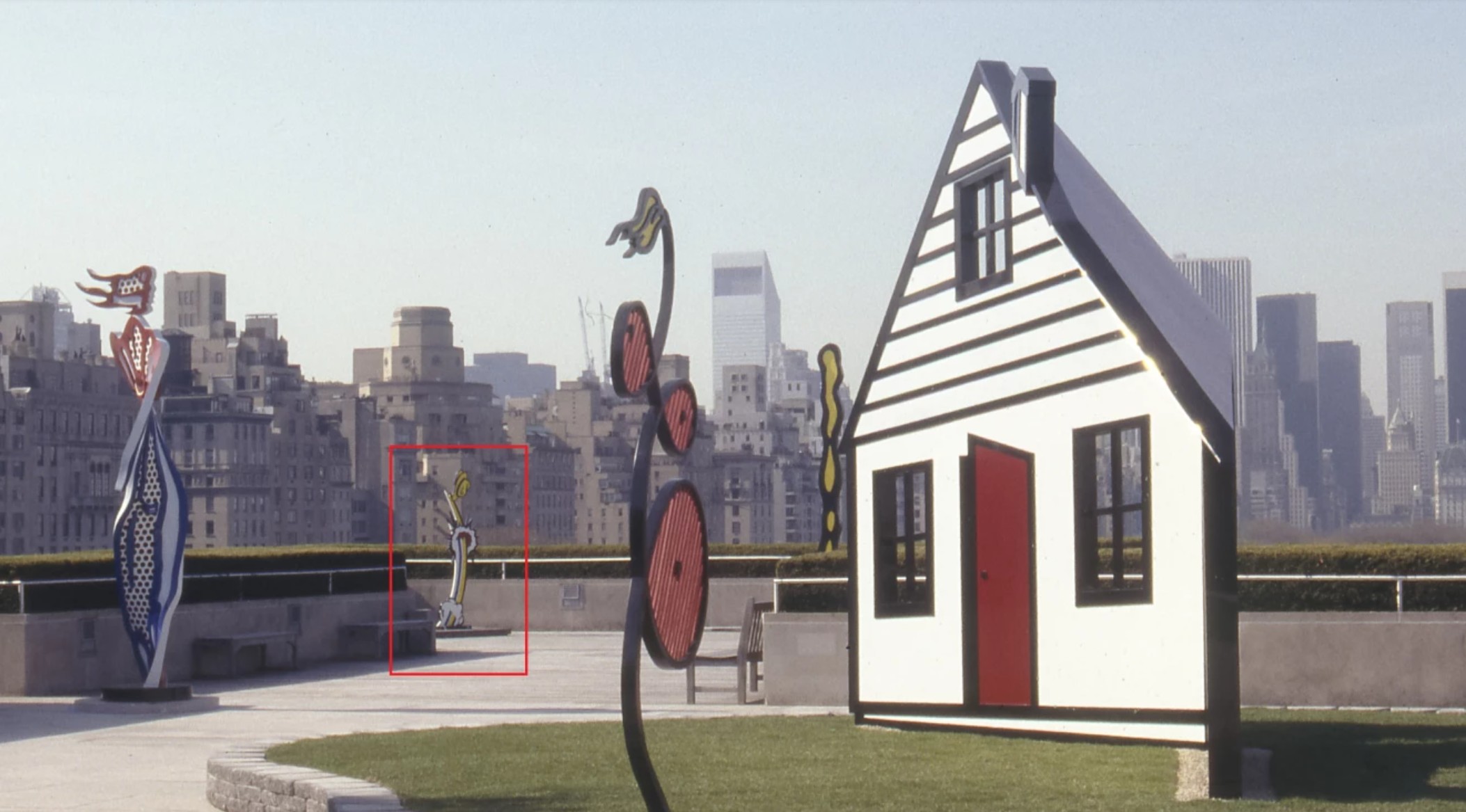
Another edition of the present work installed in Roy Lichtenstein on the Roof, The Metropolitan Museum of Art, New York, May – November 2003. Image © The Metropolitan Museum of Art / Art Resource, NY. Art © Estate of Roy Lichtenstein
Lichtenstein developed his signature visual vernacular, creating paintings inspired by comic-book caricatures and some of the most salient iconography from the art historical canon. As Lichtenstein’s career progressed, he eventually turned to his own work as a source of inspiration. In the present work, Lichtenstein quotes from the iconography that characterized his earliest Pop paintings, bringing it into three-dimensional space. The soaring hat resembles those in the compositions of some of his most celebrated early paintings, such as Mr. Bellamy (1961) and Kiss with Cloud (1964), while the explosion in its wake harkens back to the artist’s iconic explosion sculptures and war paintings of the 1960s, like Whaam! (1963) and Varoom! (1963).
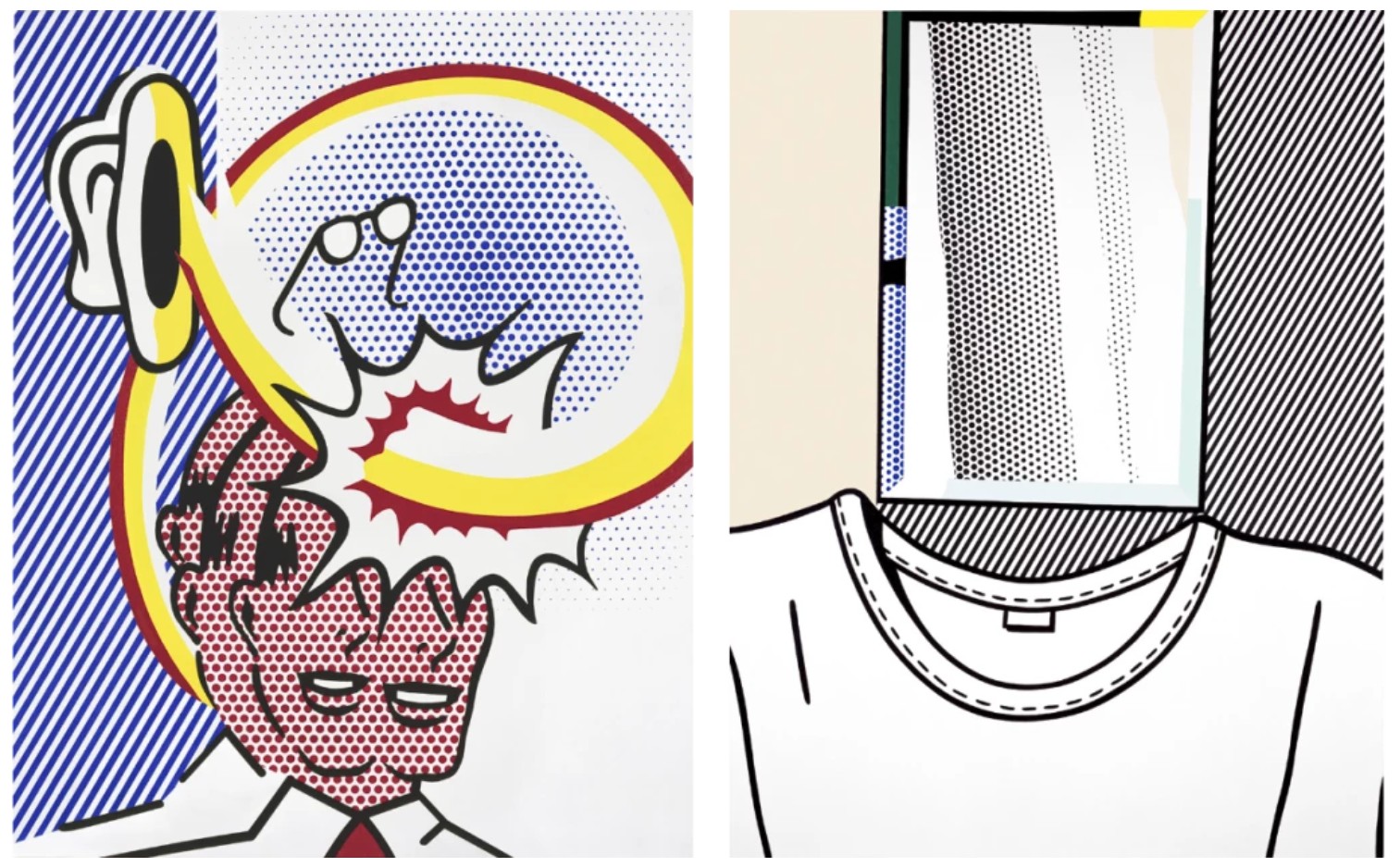
Left: Roy Lichtenstein, Coup De Chapeau (Self-Portrait), 1996. Private Collection, New York. Art © Estate of Roy Lichtenstein.
Right: Roy Lichtenstein, Self-Portrait, 1978. Private Collection. Art © Estate of Roy Lichtenstein
From Lichtenstein’s earliest explorations with three-dimensionality in the mid-1940s through the end of his life in 1997, sculpture occupied a central place in the artist’s practice. Across media and form, Lichtenstein operates to blur the boundaries and arbitrary parameters of their qualities. He probes the semiotics of space and perspective, volume and mass through his distinctive visual lexicon of color and line. Nowhere is Lichtenstein’s playful investigation of form and representation more apparent than in his sculptures like Coup de Chapeau II.
#2. Brushstrokes, 1996-2001
A Legacy Reimagined: Works from the Collection of Dorothy and Roy Lichtenstein
Sotheby’s New-York: 18 November 2025
Estimated: USD 4,o00,000 – 6,000,000
USD 3,100,000
Brushstrokes | The Now & Contemporary Evening Auction | 2025 | Sotheby’s
ROY LICHTENSTEIN (1923 – 1997)
Brushstrokes, 1996-2001
Painted aluminum
353 1/4 x 162 x 90 inches (897.3 x 411.5 x 228.6 cm)
Incised with the artist’s signature, dated ‘96 and numbered AP (lower edge)
Incised © Estate of Roy Lichtenstein and dated 2001 (lower edge)
Conceived in 1996 and cast in 2001, this work is the artist’s proof from an edition of 1 plus 1 artist’s proof
A superb example of Roy Lichtenstein’s celebrated monumental sculptures, Brushstrokes represents one of the artist’s most iconic motifs, heightening its semiotic meaning by transposing the form of the brushstroke into the sculptural medium. Harkening back to his legendary Brushstroke paintings of the 1960s, which themselves offer a witty commentary on the supremacy of Abstract Expressionism, Lichtenstein here returns to an investigation of the act of painting itself. Conceived in 1996 in the penultimate year of his life, Brushstrokes metamorphosizes the vigorous stroke of pigment from a painter’s brush into a three-dimensional embodiment of technique associated with two-dimensionality. Full of kinetic potential, Lichtenstein’s strokes of pigment appear to leap off the ground, soaring into the sky—each one more energetic and vigorous than the next. Despite their fundamental immobility, Lichtenstein’s splashes of blue, green, yellow and white suggest a perpetual motion, as if they have broken free from the confines of the two-dimensional picture plane. In the 1980s and 90s, Lichtenstein revisited the subject of the Brushstroke, this time in the form of monumental sculpture.
Examples of Lichtenstein’s monumental Brushstroke sculptures are held in many prominent institutional collections including Museo de Arte de Ponce, Puerto Rico; The J. Paul Getty Museum, Los Angeles; Museo Nacional Centro de Arte Reina Sofía; Hirshhorn Museum and Sculpture Garden, Washington, D.C, among others. The present work is one of two works from the edition, the other of which is on display in the permanent collection of the Portland Art Museum.
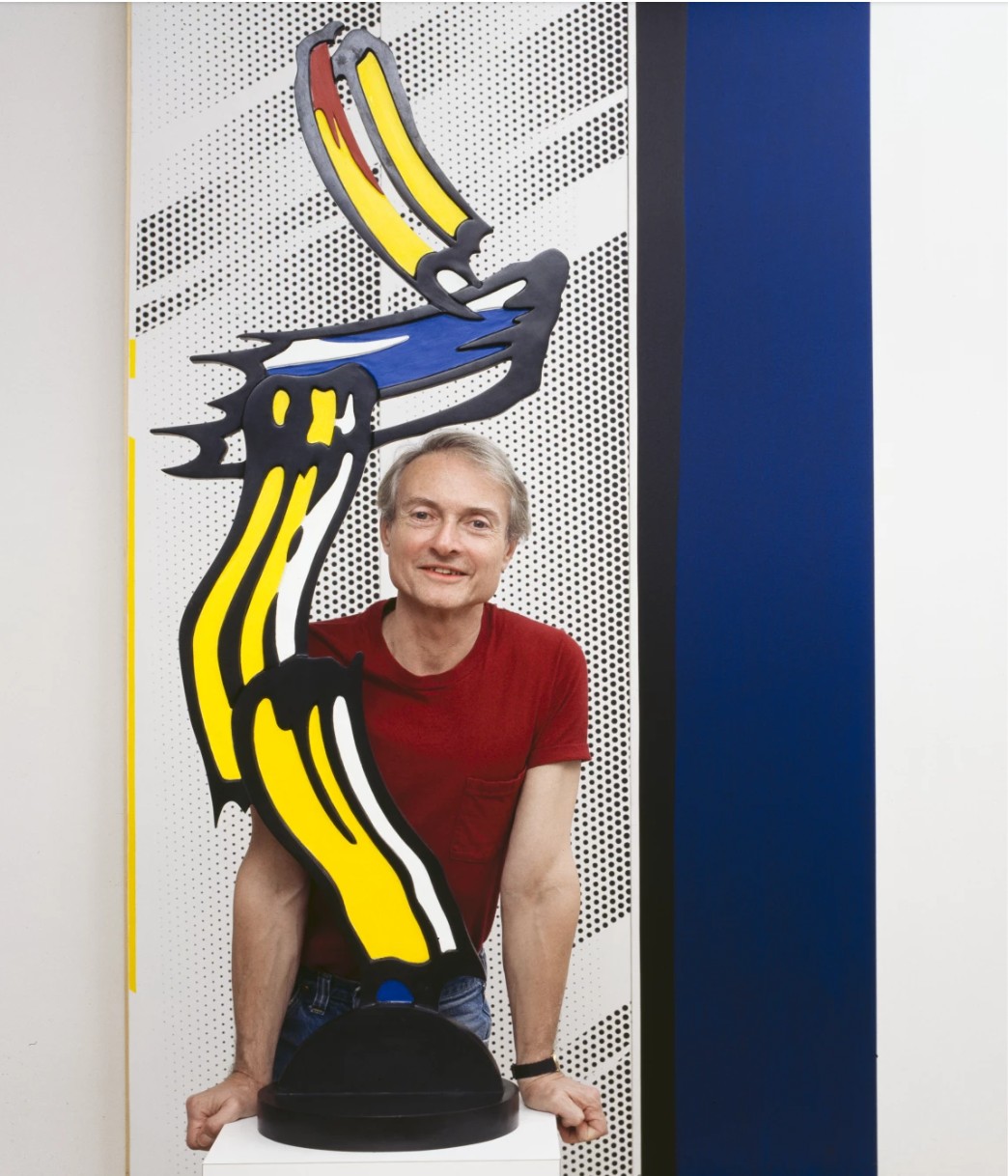
Roy Lichtenstein with one of his Brushstrokes sculptures. Image © Bob Adelman. Art © Estate of Roy Lichtenstein
Lichtenstein began experimenting with the brushstroke motif in the mid-1960s, creating a series of paintings from 1965-66 that remain some of his best-known and most celebrated works. Taking inspiration from comic book representations of painting and the gestural, vigorous compositions of the Abstract Expressionists, Lichtenstein creates a caricature of the brushstroke. Lichtenstein transformed the brushstroke from mere building block of a composition into the subject in and of itself. The resulting works are both trademarks of his clever ability to imitate and transform as well as instantly recognizable icons of his legendary Pop vernacular. As Lichtenstein’s career progressed, he began to look back not only on the art historical canon for inspiration, but also his own earlier works, incorporating his iconography into new compositions. The present work, among a series of monumental Brushstroke sculptures the artist created during the 1980s-90s, is adapted from these celebrated 1960s paintings. The Brushstroke sculptures can be viewed as the ideological pinnacle of the central motif of Lichtenstein’s career: an inquiry of the act of creation implicit in all of art history.
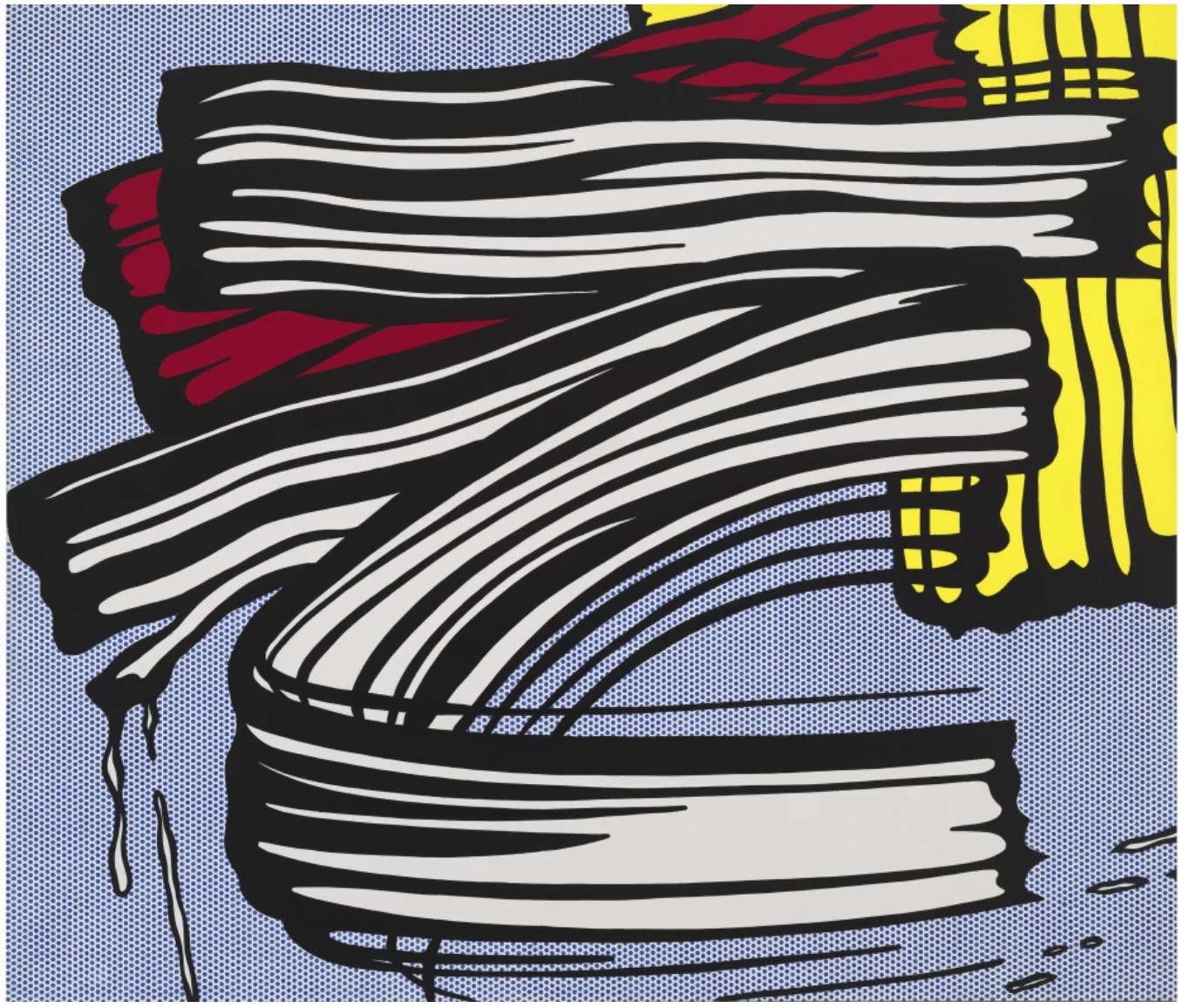
Roy Lichtenstein, Little Big Painting, 1965. Whitney Museum of American Art, New York.
Image © Whitney Museum of American Art / Licensed by Scala / Art Resource, NY. Art © Estate of Roy Lichtenstein
Energetic and fluid, Lichtenstein’s Brushstrokes conveys the action and expression of painting in a sculptural form. A powder blue stroke reaches into the air, intersected by an arcing splash of emerald green; a wispy yellow swipe of pigment is adorned with Lichtenstein’s iconic diagonal hash lines; and at the very peak, a white dash of paint reaches highest into the sky. Lichtenstein captures not only the vigorous motion of the painter’s brush, but also the viscosity of oil paint through the white and beige streaks within his colorful aluminum elements.
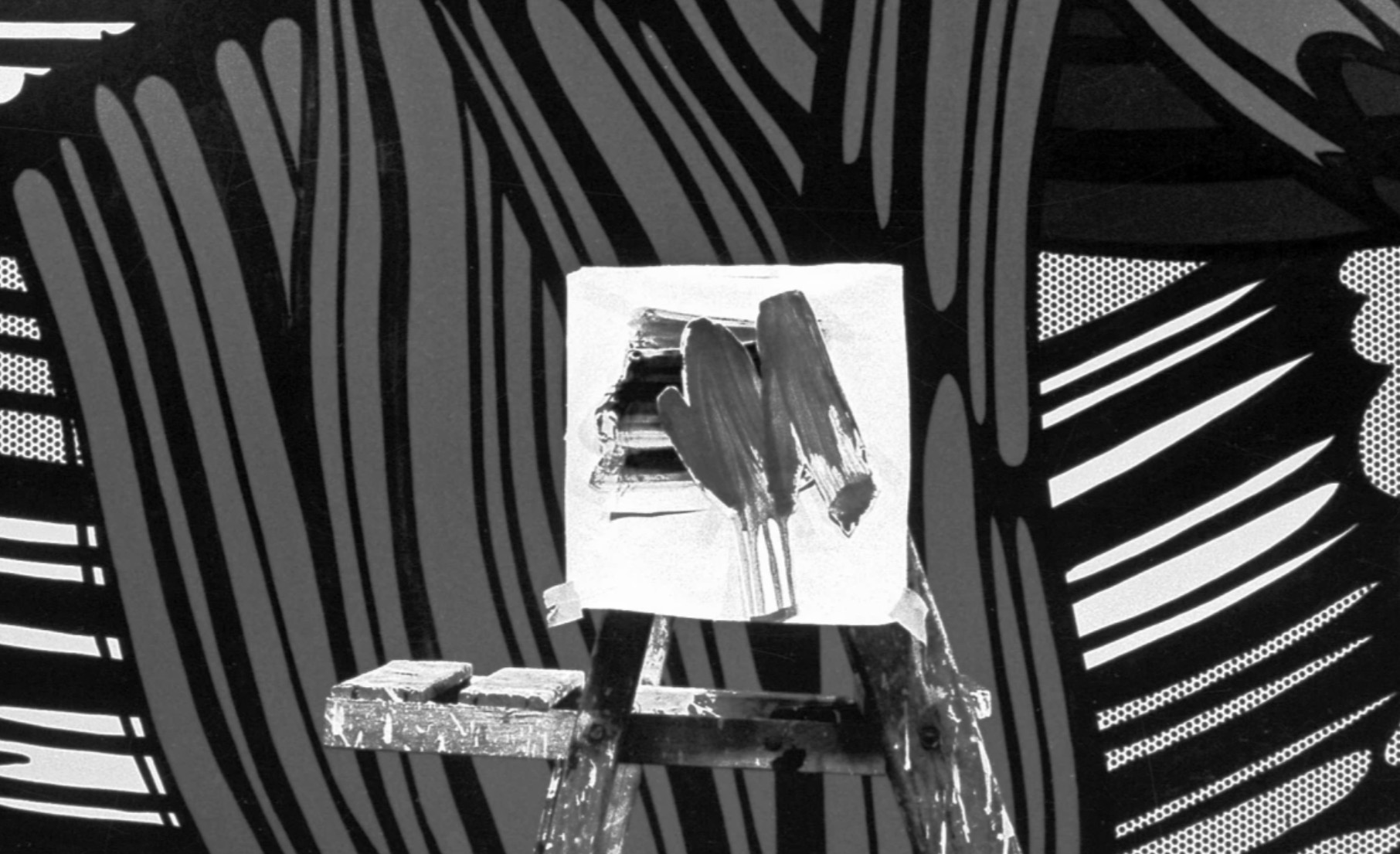
Roy Lichtenstein’s studio, 1965. Photo Ugo Mulas © Ugo Mulas Heirs. All Rights Reserved. Art © Estate of Roy Lichtenstein
Metamorphosizing the subject of the brushstroke into a monumental three-dimensional form, Lichtenstein creates the ultimate playful parody of artmaking. His work is a monument to the act of painting, to the ostensible spontaneity of gesture that defined the work of the inimitable Action Painters that commanded the Post-War period. Lichtenstein’s Brushstrokes is at once cerebral and undeniably humorous: the result of a career-long inquiry into the hegemony and solemnity of Ab Ex and an exaggeration of scale so extreme and playful, it must elicit joy.
Monumental Brushstrokes in Museum Collections
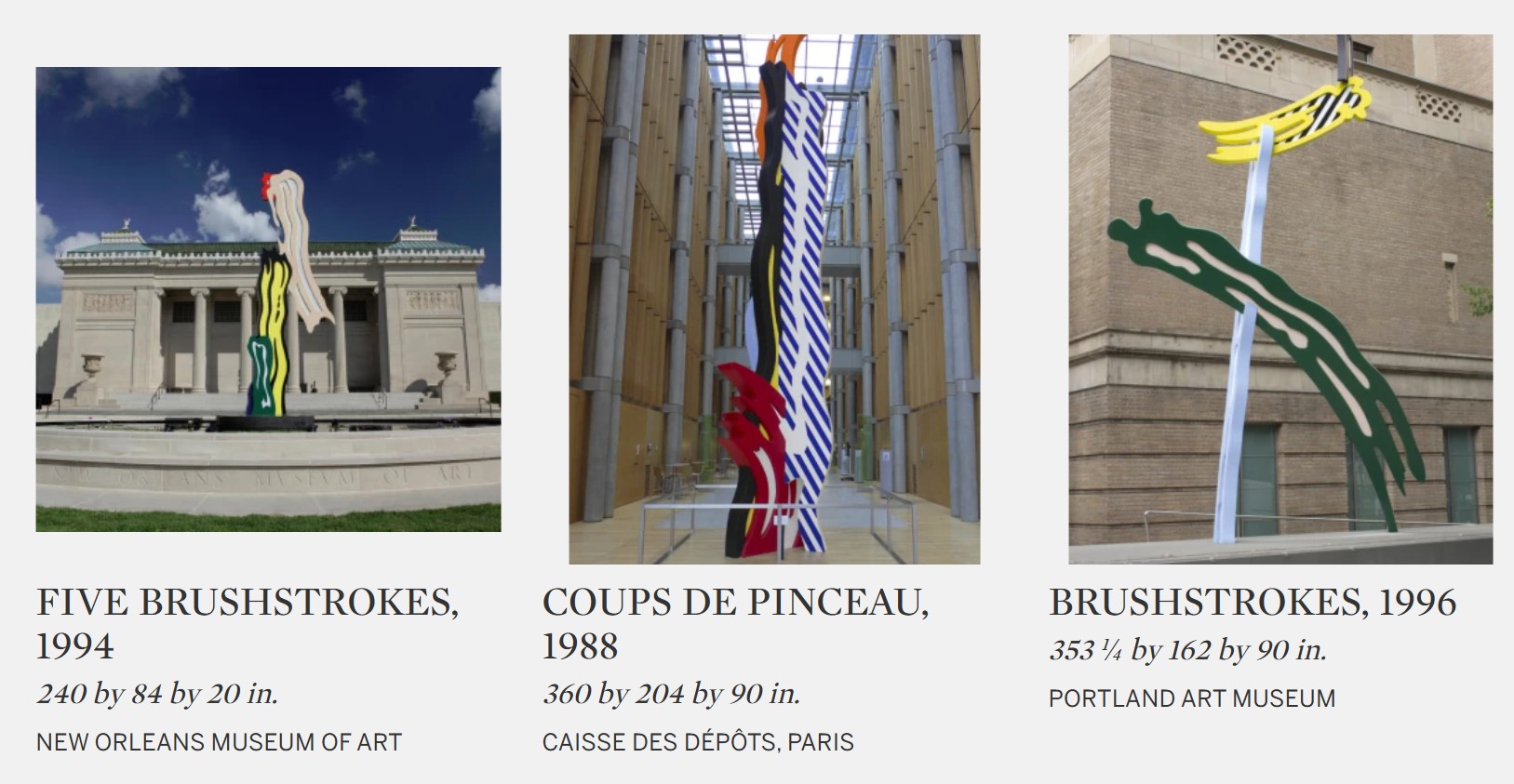
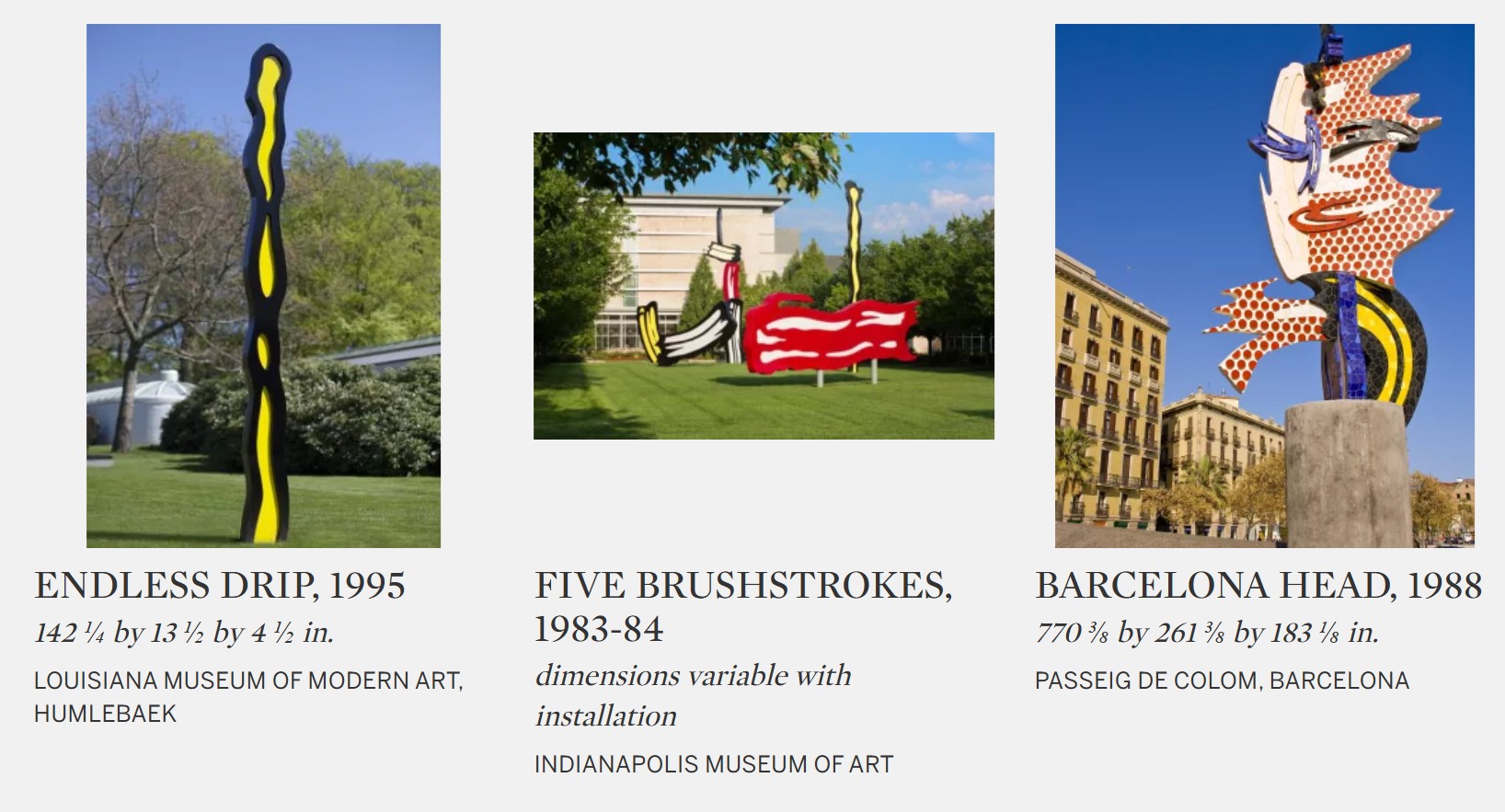
While Brushstrokes represents a two-dimensional form in three-dimensions, he does so while eschewing the three-dimensionality of sculpture. It exists both as a sculpture which can be experienced in-the-round and as a collection of two-dimensional elements. In this way, Lichtenstein has, in almost absurd fashion, both reduced the sculptural medium to two-dimensions while transforming a brushstroke into a three-dimensional object.
Jackson Pollock, Blue Poles, 1952. Image © National Gallery of Australia, Canberra / Purchased 1973 / Bridgeman Images.
Art © 2025 Pollock-Krasner Foundation / Artists Rights Society (ARS), New York
When viewed from afar, the environment around Brushstrokes serves as the background for Lichtenstein’s comic-like sculpture. Lichtenstein is painting on the sky, the grass, the facades of buildings, and even interior walls. Lichtenstein’s distinctive influence is undeniable and everywhere— in essence, he makes the whole world his canvas.
#3. Small House, 1996
A Legacy Reimagined: Works from the Collection of Dorothy and Roy Lichtenstein
Sotheby’s New-York: 19 November 2025
Estimated: USD 180,000 – 250,000
USD 1,206,500
Small House | Contemporary Day Auction | 2025 | Sotheby’s
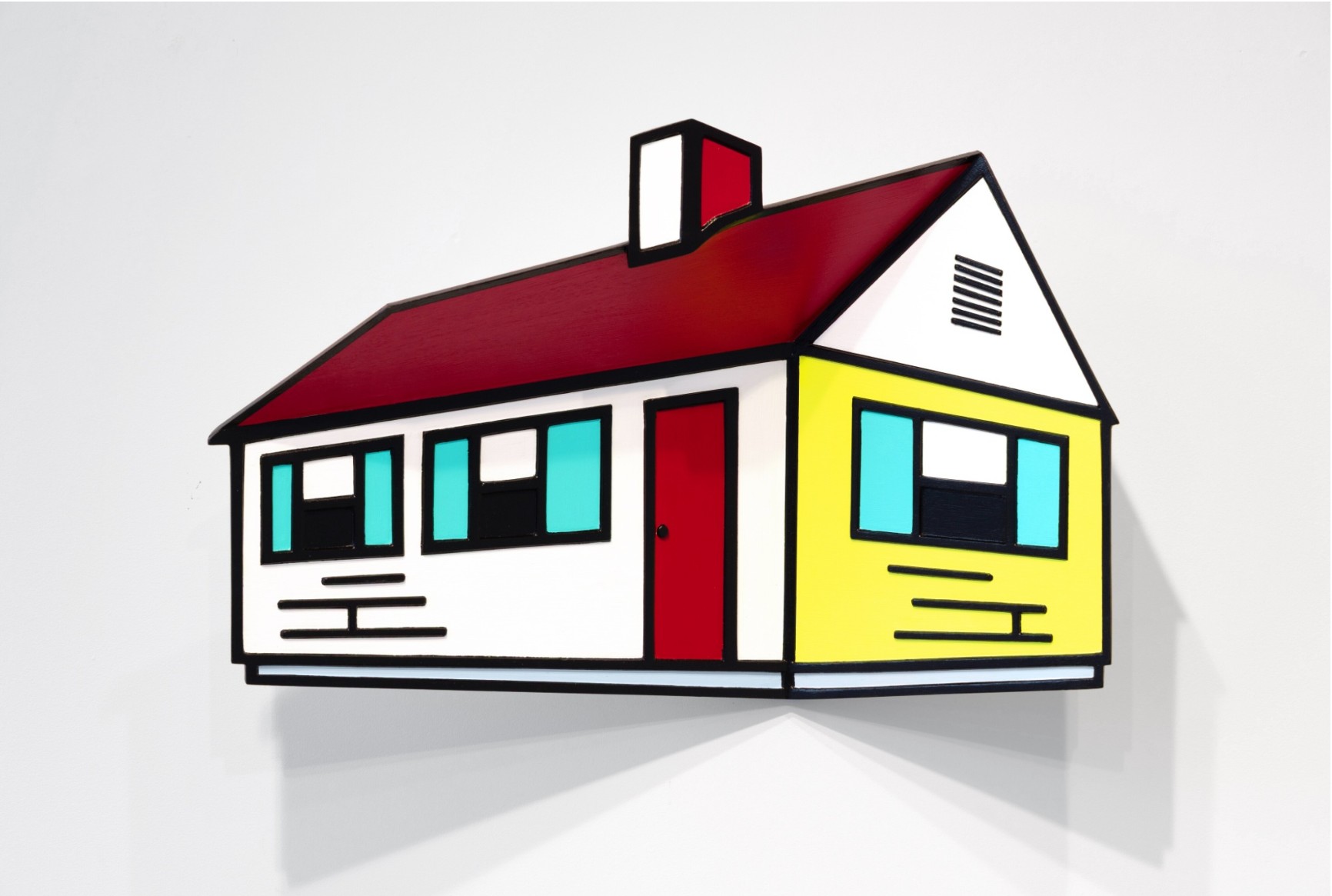
ROY LICHTENSTEIN (1923-1997)
Small House, 1996
Acrylic on wood
16 3/8 x 26 1/2 x 10 3/4 inches (41.6 x 67.3 x 27.3 cm)
Executed in 1996, this work is unique
“These pieces exist between painting and sculpture in terms not only of genre but also of structure; where Minimalist objects are neither painting nor sculpture… Pop objects tend to be both-and. If most representational painting is a two-dimensional encoding of three dimensional objects, Lichtenstein reverses the process here, and freezes it somewhere in between”
Hal Foster, “Pop Pygmalion,” Exh. Cat., London, Gagosian Gallery, (and traveling), Roy Lichtenstein Sculpture, 2005, p. 10
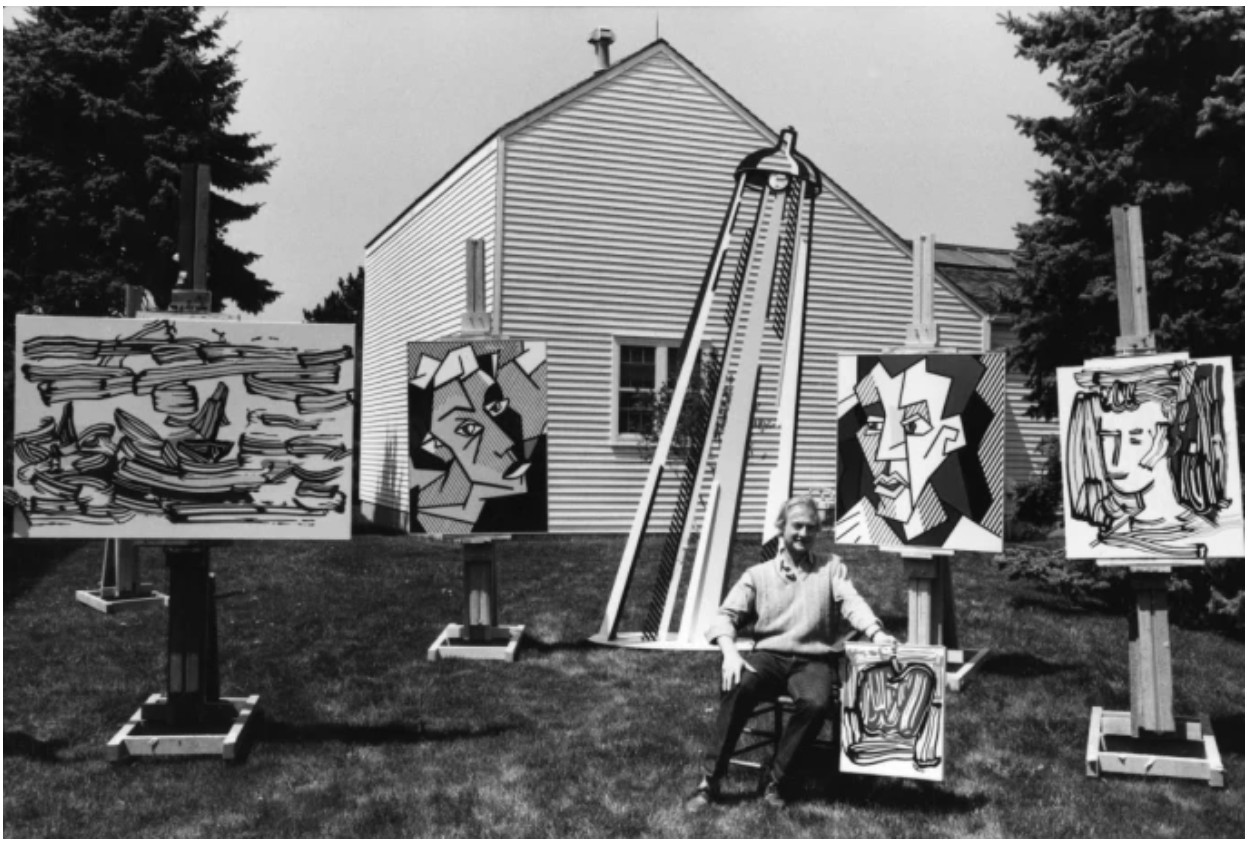
Roy Lichtenstein sitting outside his Southampton studio, New York, 1981.
Image © Arthur Schatz/Getty Images. Art © Estate of Roy Lichtenstein
#4. Landscape Mobile, 1990
A Legacy Reimagined: Works from the Collection of Dorothy and Roy Lichtenstein
Sotheby’s New-York: 19 November 2025
Estimated: USD 350,000 – 450,000
USD 1,079,500
Landscape Mobile | Contemporary Day Auction | 2025 | Sotheby’s
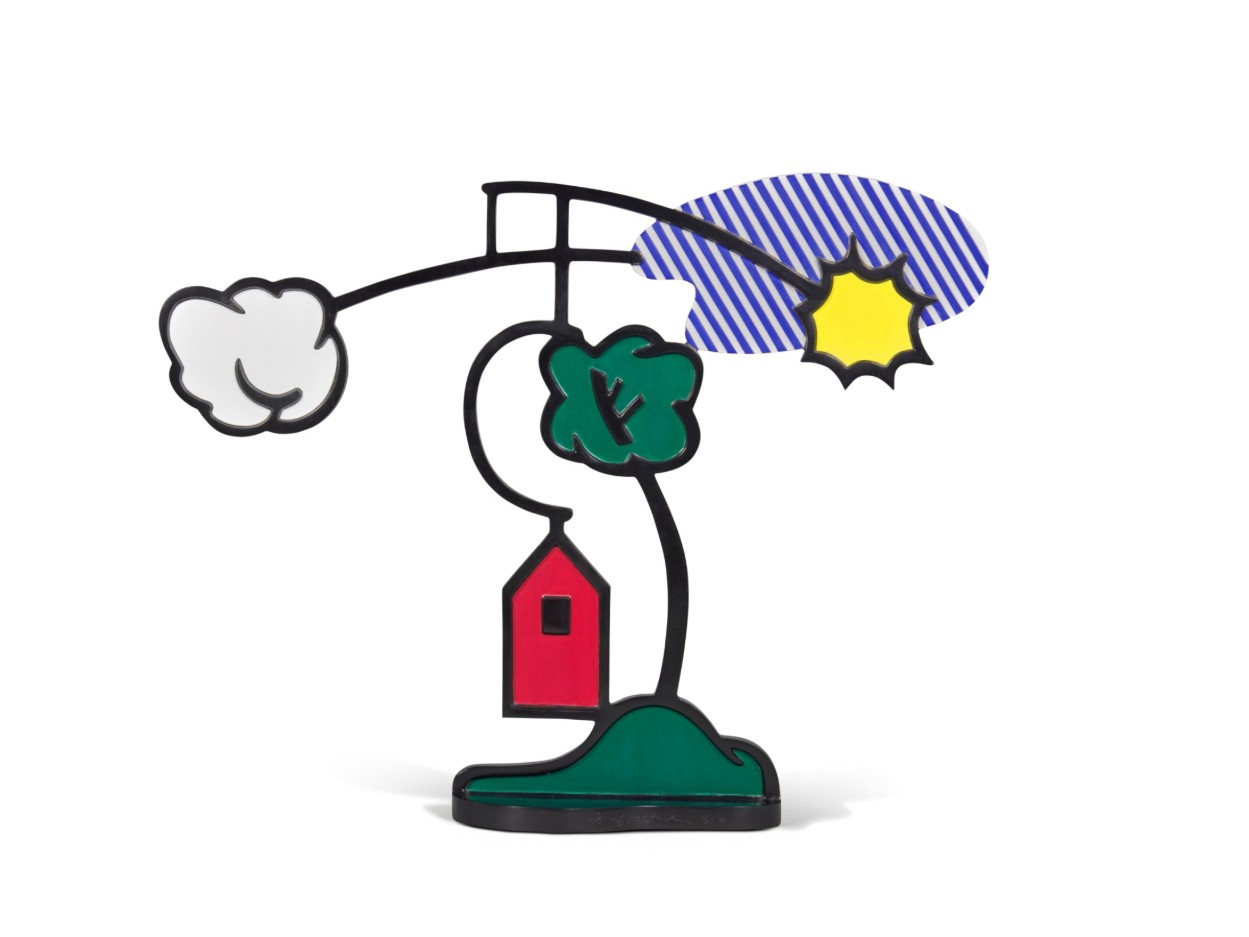
ROY LICHTENSTEIN (1923-1997)
Landscape Mobile, 1990
Painted and patinated bronze
29 1/8 x 8 3/8 x 36 3/4 inches (74 x 21.3 x 93.3 cm)
Incised with the artist’s signature, date ‘91 and number 0/6 (on the base)
This work is the artist’s proof from an edition of 6 plus 1 artist’s proof
“It might be that Lichtenstein only appears to conform to this old model of sculpture, in part to complicate it, even to refashion it for his own ends… Yet in Lichtenstein there is no stable, a priori ground—it is often, quite literally, a void, an empty space—and meaning accrues through the image alone.’”
Hal Foster, “Pop Pygmalion,” Exh. Cat., London (and traveling), Gagosian Gallery, Roy Lichtenstein: Sculpture, 2005, p. 11
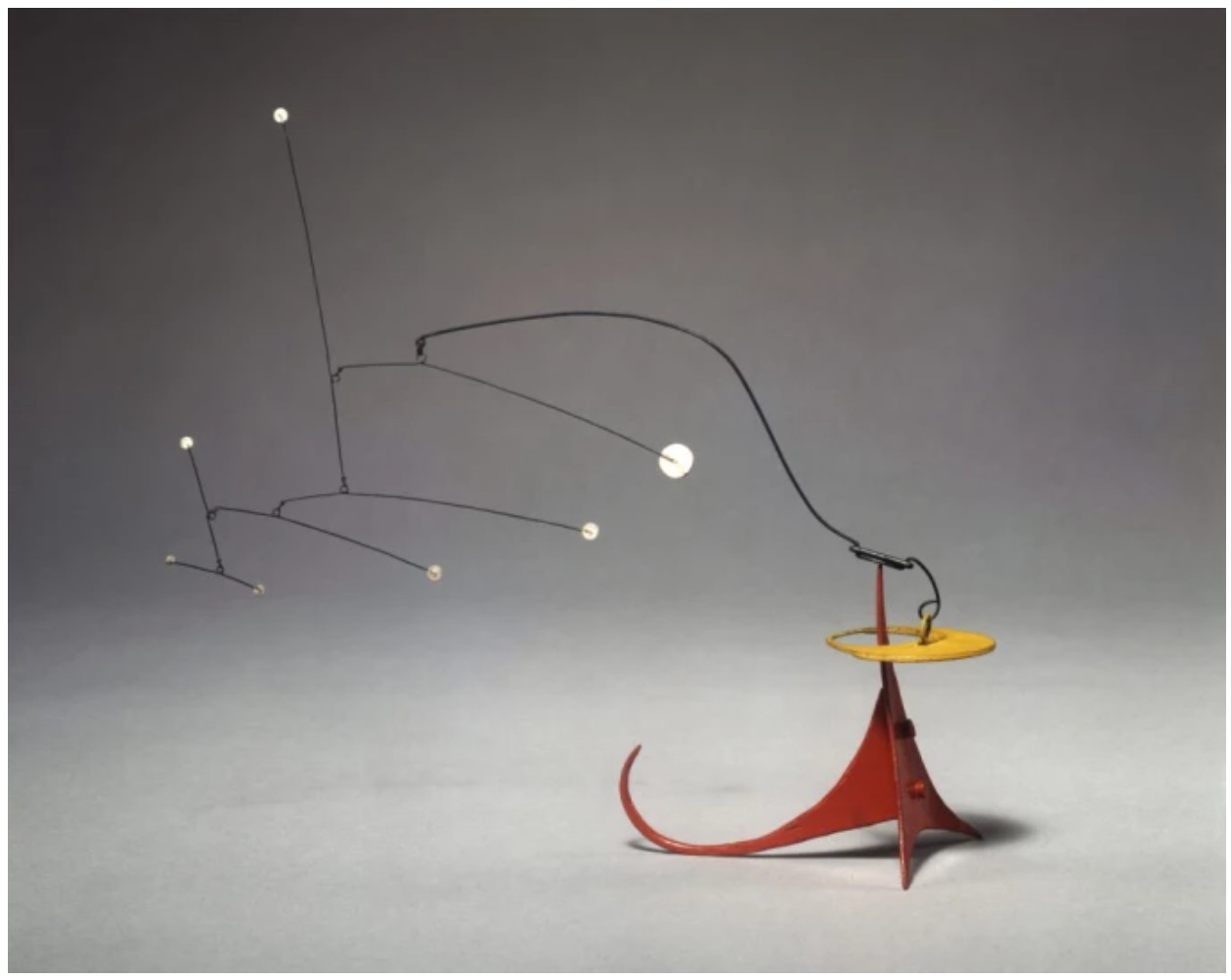
Alexander Calder, Little Pierced Disk, c. 1947. The Calder Foundation, New York.
Art © 2025 Calder Foundation, New York / Artists Rights Society (ARS), New York
#5. Cup and Saucer I (Prototype), circa 1976
A Legacy Reimagined: Works from the Collection of Dorothy and Roy Lichtenstein
Sotheby’s New-York: 19 November 2025
Estimated: USD 300,000 – 500,000
USD 635,000
Cup and Saucer I (Prototype) | Contemporary Day Auction | 2025 | Sotheby’s
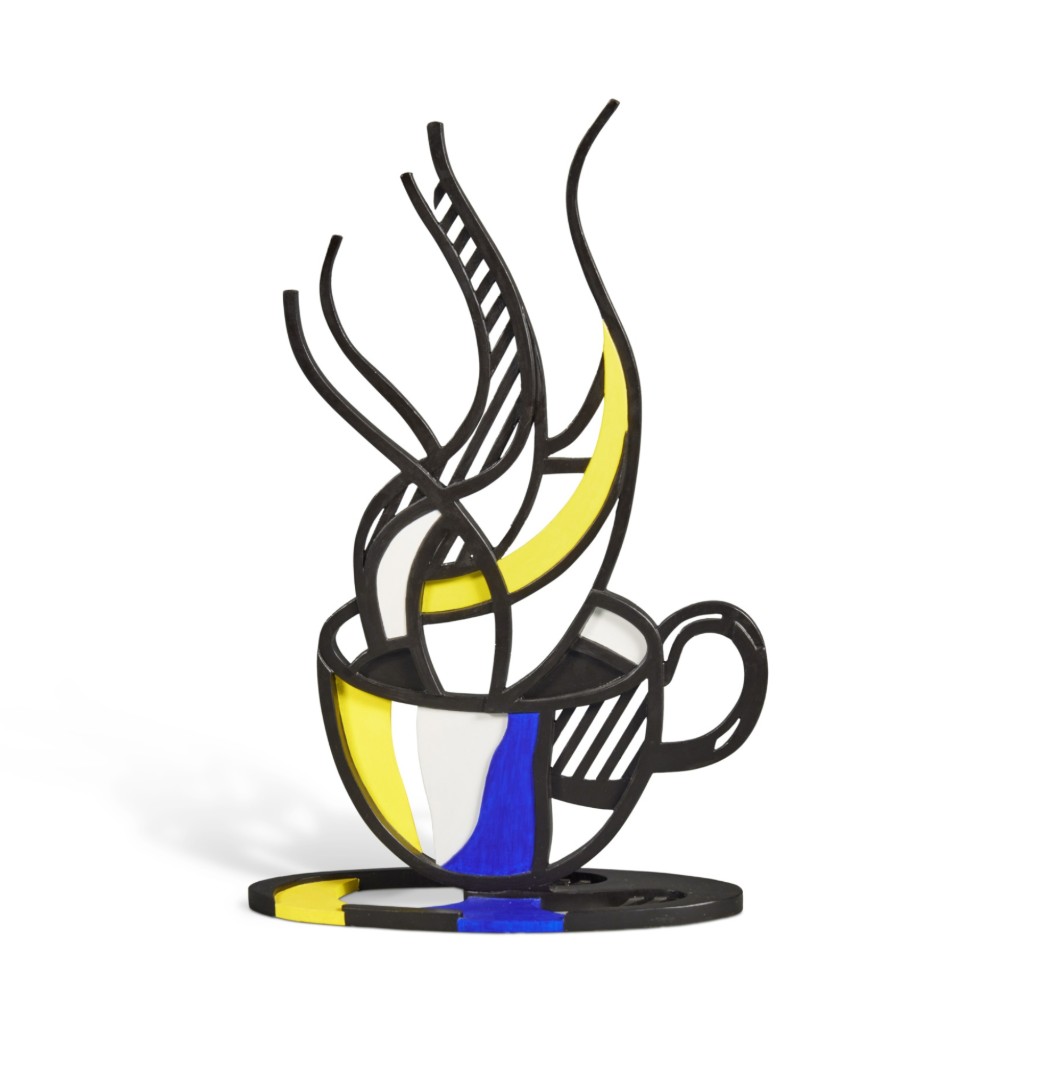
ROY LICHTENSTEIN (1923-1997)
Cup and Saucer I (Prototype), circa 1976
Acrylic on wood
30 1/8 x 18 3/4 x 6 3/4 inches (76.5 x 47.6 x 17.1 cm)
Executed circa 1976, this work is unique
#6. Metallic Brushstroke Head, 1993
A Legacy Reimagined: Works from the Collection of Dorothy and Roy Lichtenstein
Sotheby’s New-York: 19 November 2025
Estimated: USD 700,000 – 1,000,000
USD 635,000
Metallic Brushstroke Head | Contemporary Day Auction | 2025 | Sotheby’s
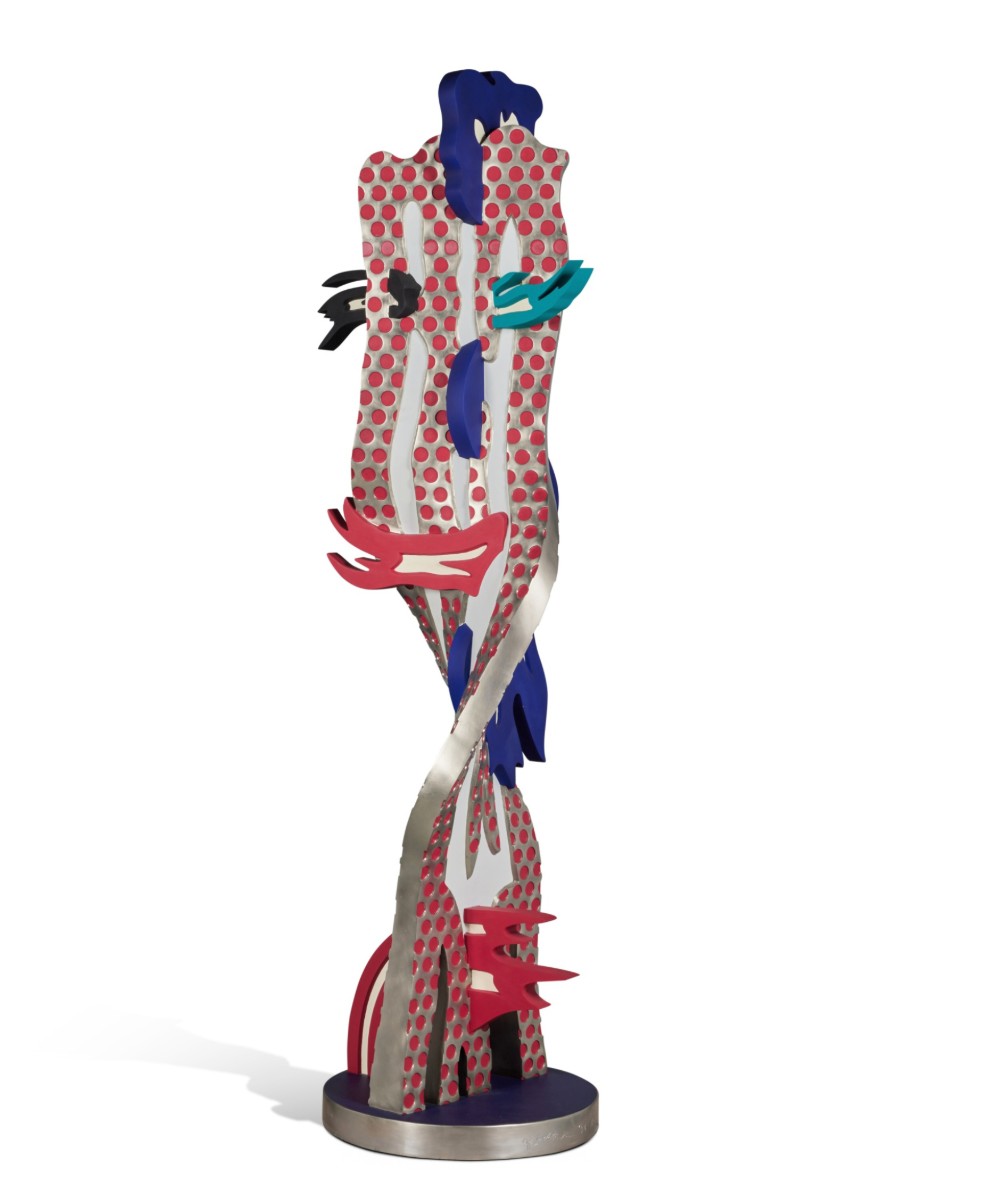
ROY LICHTENSTEIN (1923-1997)
Metallic Brushstroke Head, 1993
Painted nickel-plated bronze
83 x 24 1/2 x 24 1/2 inches (210.8 x 62.2 x 62.2 cm)
Incised with the artist’s signature, date ‘94 and number AP 2/2 (on the base)
This work is artist’s proof 2 of 2 from an edition of 6 plus 2 artist’s proofs
Towering over seven feet in height, Metallic Brushstroke Head (1993) is one of Roy Lichtenstein’s most ambitious sculptural achievements and a defining work of his late career. Executed in bronze and finished in a lustrous metallic patina, the sculpture transforms the fluid, gestural spontaneity of the brushstroke into monumental form, presenting a human head conjured entirely from stylized strokes of paint. Both playful and imposing, the work embodies Lichtenstein’s capacity to translate the language of painting into three dimensions, fusing Pop wit with sculptural grandeur.
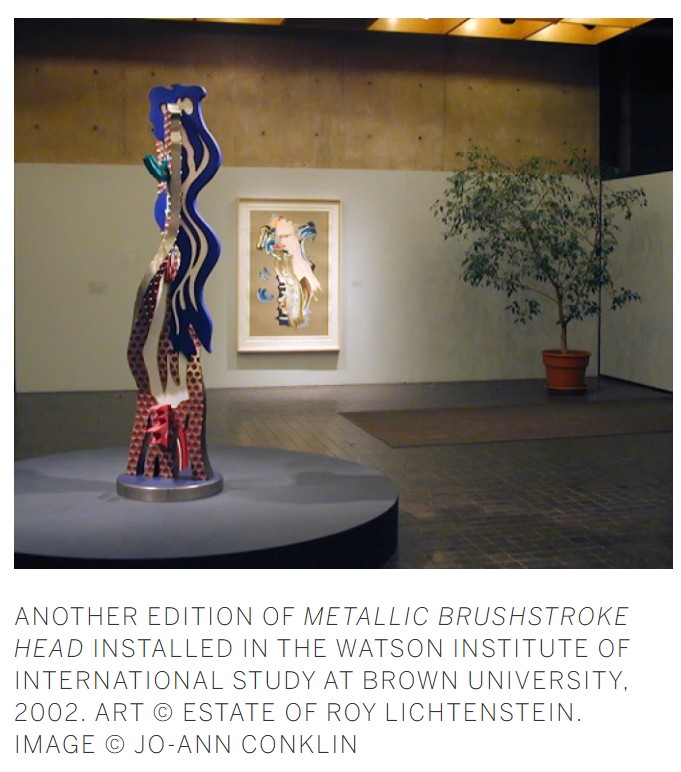
The Brushstroke Heads belong to a lineage that stretches back to Lichtenstein’s earliest explorations of the brushstroke motif in the mid-1960s. In his paintings of that period, the brushstroke served as a sly parody of Abstract Expressionism’s gestural bravura—reduced to a comic emblem, flattened, and frozen in Ben-Day dots. By the 1980s and 1990s, however, the motif re-emerged in his sculpture, where it took on renewed vigor and scale. In Metallic Brushstroke Head, the artist pushes this dialogue further, using the stylized stroke not only as a sign of painting, but as the very substance from which a human head is constructed. What had once been parody becomes a sculptural language in its own right: the brushstroke as anatomy, as structure, as form.
The sculpture’s verticality and commanding dimensions are critical to its effect. At more than two meters tall, the head looms as both figure and monument, asserting presence with architectural force. The overlapping bronze strokes sweep upward and outward, evoking locks of hair, a brow, a jawline—all conjured through the repetition of gestural signs. Despite the heavy medium, the work conveys remarkable lightness: the strokes appear to curl, bend, and twist as though freshly painted, their metallic sheen shimmering in ambient light. Lichtenstein achieves a paradoxical effect, fusing the permanence of bronze with the ephemerality of paint.
In this sense, Metallic Brushstroke Head extends Lichtenstein’s lifelong fascination with mediation and transformation. Just as his comic panels translated the immediacy of pulp into the permanence of high art, here the fleeting mark of the painter’s brush is monumentalized in bronze. The gestural, once ephemeral, is cast as enduring; the fluid becomes fixed; the private act of painting becomes public sculpture. By constructing a head from brushstrokes, Lichtenstein reflects not only on the history of portraiture but also on the identity of the artist, the face of painting itself. The metallic finish intensifies this play of meaning. Unlike his brightly painted brushstroke sculptures, Metallic Brushstroke Head emphasizes sheen, reflection, and surface. Its polished planes echo the gleam of industrial fabrication, aligning the work with the Pop embrace of mass production, while also nodding toward the long sculptural tradition of bronze statuary. The result is an object that is at once Pop and classical, playful and monumental.
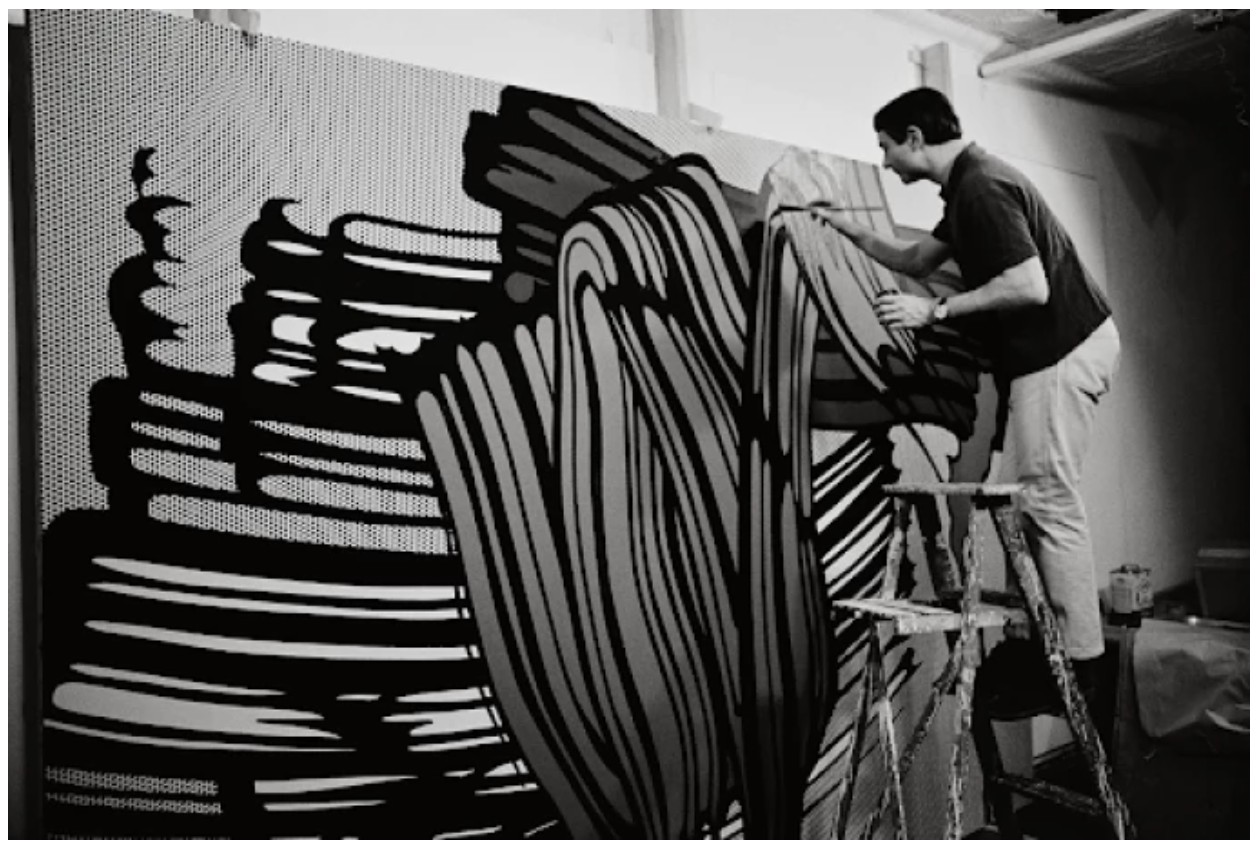
Lichtenstein painting a Brushstroke work, 1964. Art © Estate of Roy Lichtenstein. Image © Ugo Mulas
This capacity to merge Pop idioms with the gravitas of art history marked Lichtenstein’s late career with particular force. In the 1990s he revisited many of his signature motifs—the brushstroke, the comic heroine, the still life—recasting them with new formal ambition. Metallic Brushstroke Head belongs squarely to this period of summation and reinvention, when the artist, already canonized through retrospectives at the Guggenheim and worldwide, turned his motifs into monuments.
“Visible brushstrokes in a painting convey a sense of grand gesture. But, in my hands, the brushstroke becomes a depiction of the grand gesture. So the contradiction between what I’m portraying and how I’m portraying it is sharp. The brushstroke became very important for my work.”
The sculpture also resonates with contemporaneous currents in art. Its gleaming surfaces and exaggerated scale parallel the monumental ambitions of Jeff Koons and Claes Oldenburg, while its reflexive play with sign and structure aligns it with postmodern interrogations of image and identity. Yet Lichtenstein’s approach remains singular: he does not simply inflate an object but transforms a mark into a body, a sign into a portrait.
Metallic Brushstroke Head thus stands as both culmination and reflection. It condenses decades of inquiry into the nature of gesture, image, and artifice, and re-presents them in sculptural form. It is not simply a parody of painterly bravura, nor merely a Pop object, but a meditation on the endurance of art itself: the fleeting gesture made permanent, the head of painting cast in bronze. In its monumental scale, sculptural refinement, and conceptual resonance, Metallic Brushstroke Head exemplifies the boldness of Lichtenstein’s late production. It transforms the most ephemeral mark of painting into a towering figure, a lasting monument to the wit, rigor, and ambition that defined one of the twentieth century’s most influential artists.
#7. Metallic Brushstroke Head, 1994
Christie’s New-York: 20 November 2025
Estimated: USD 800,000 – 1,200,000
USD 508,000
ROY LICHTENSTEIN (1923-1997), Metallic Brushstroke Head | Christie’s
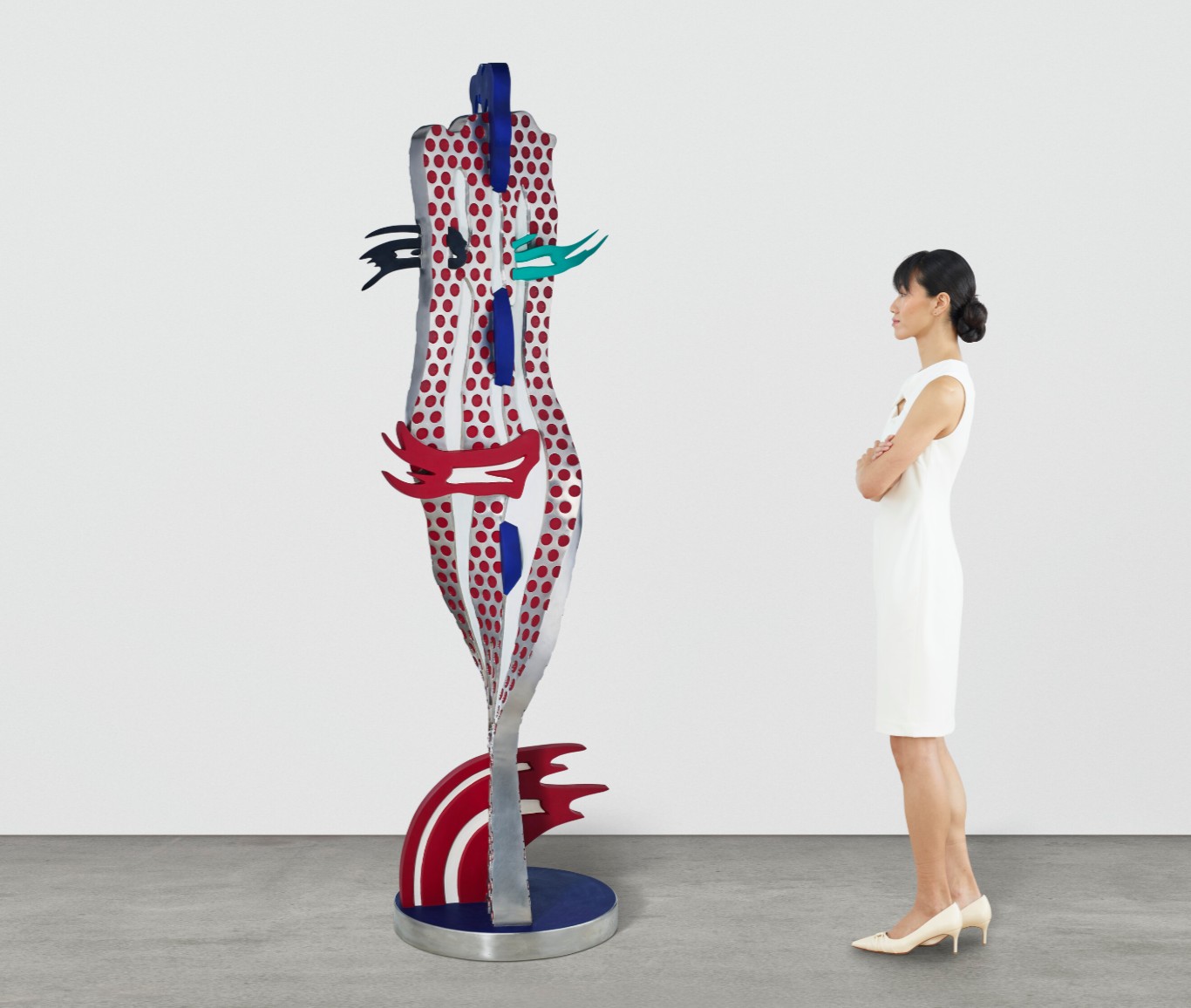
ROY LICHTENSTEIN (1923-1997)
Metallic Brushstroke Head, 1994
Painted nickel-plated bronze
82 3/4 x 24 1/2 x 24 1/2 inches (210.2 x 61 x 61 cm)
Incised with the artist’s signature, number, date and stamped with the foundry mark ‘rf Lichtenstein ’94 AP 1⁄2’
(on the base)
This work is the first artist’s proof from an edition of six plus two artist’s proofs
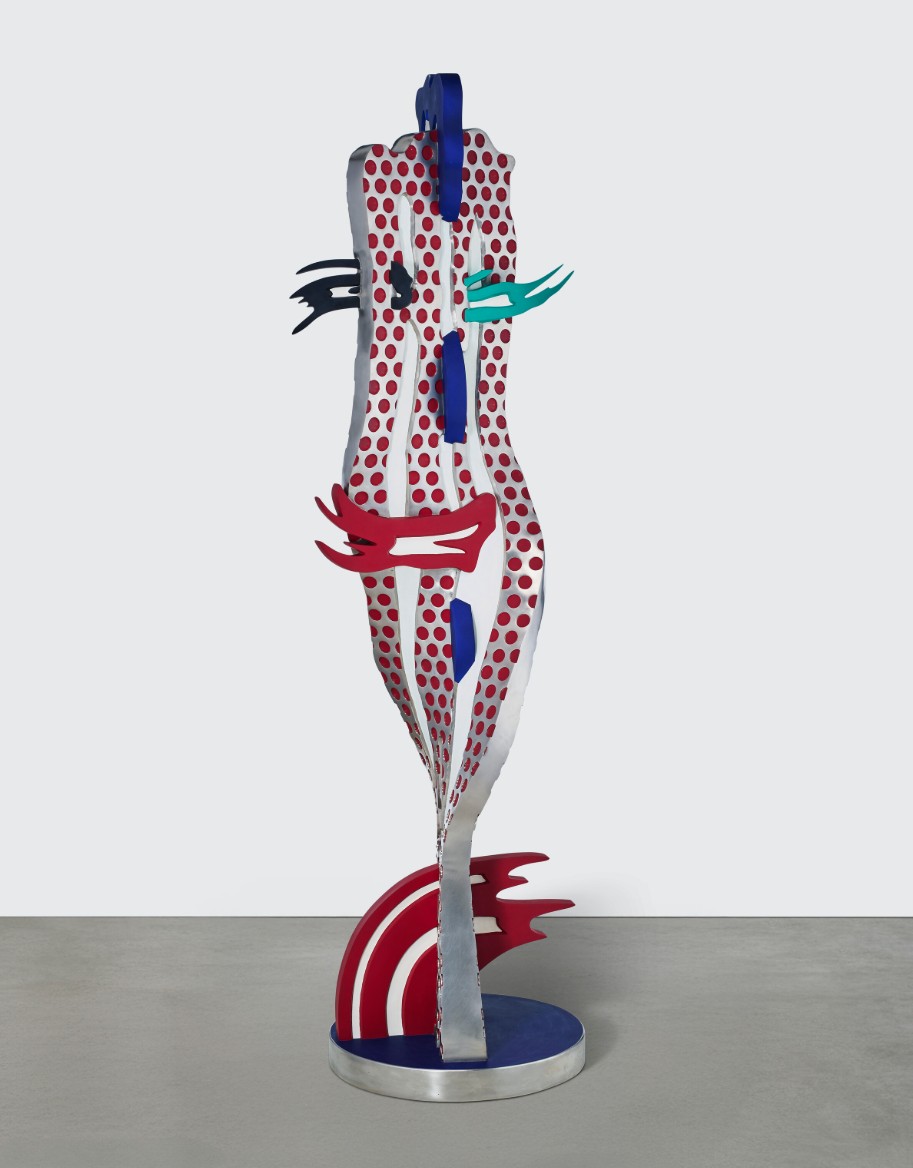
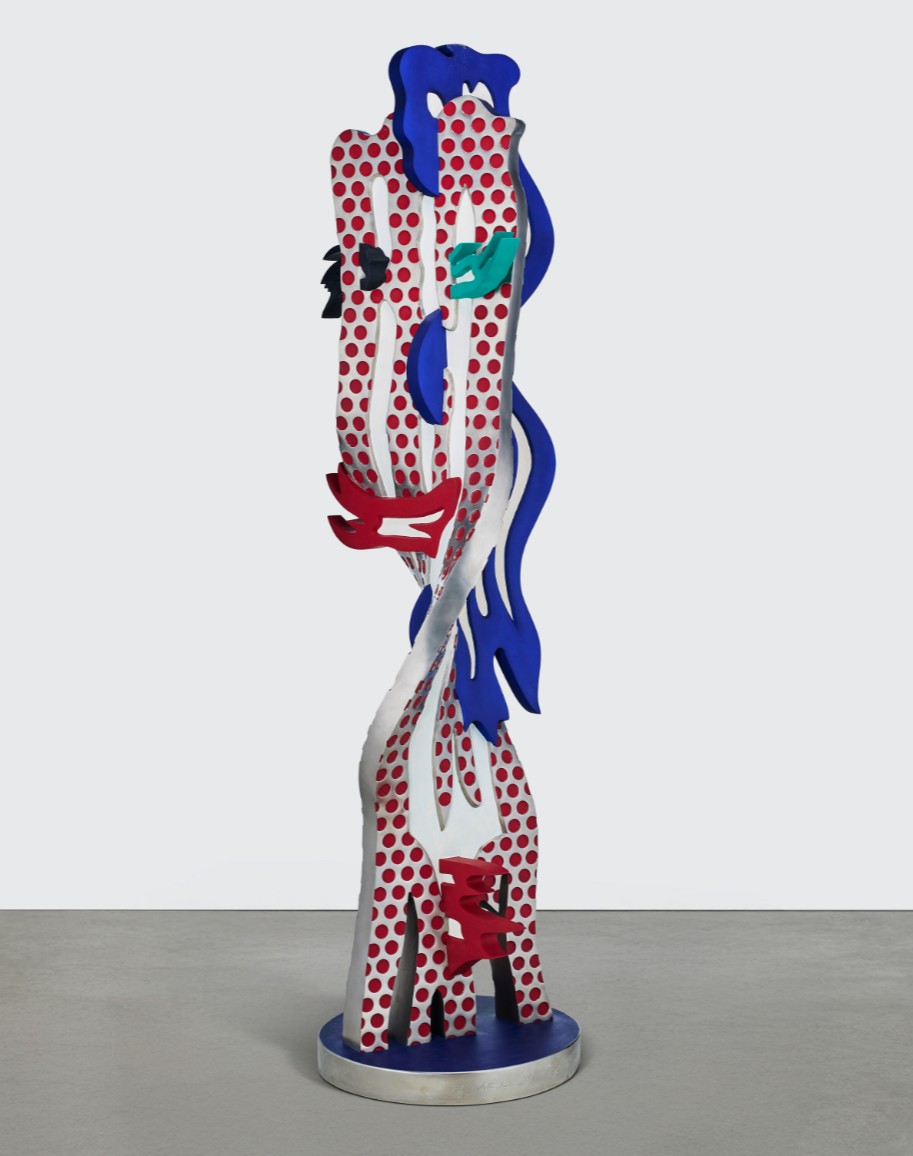
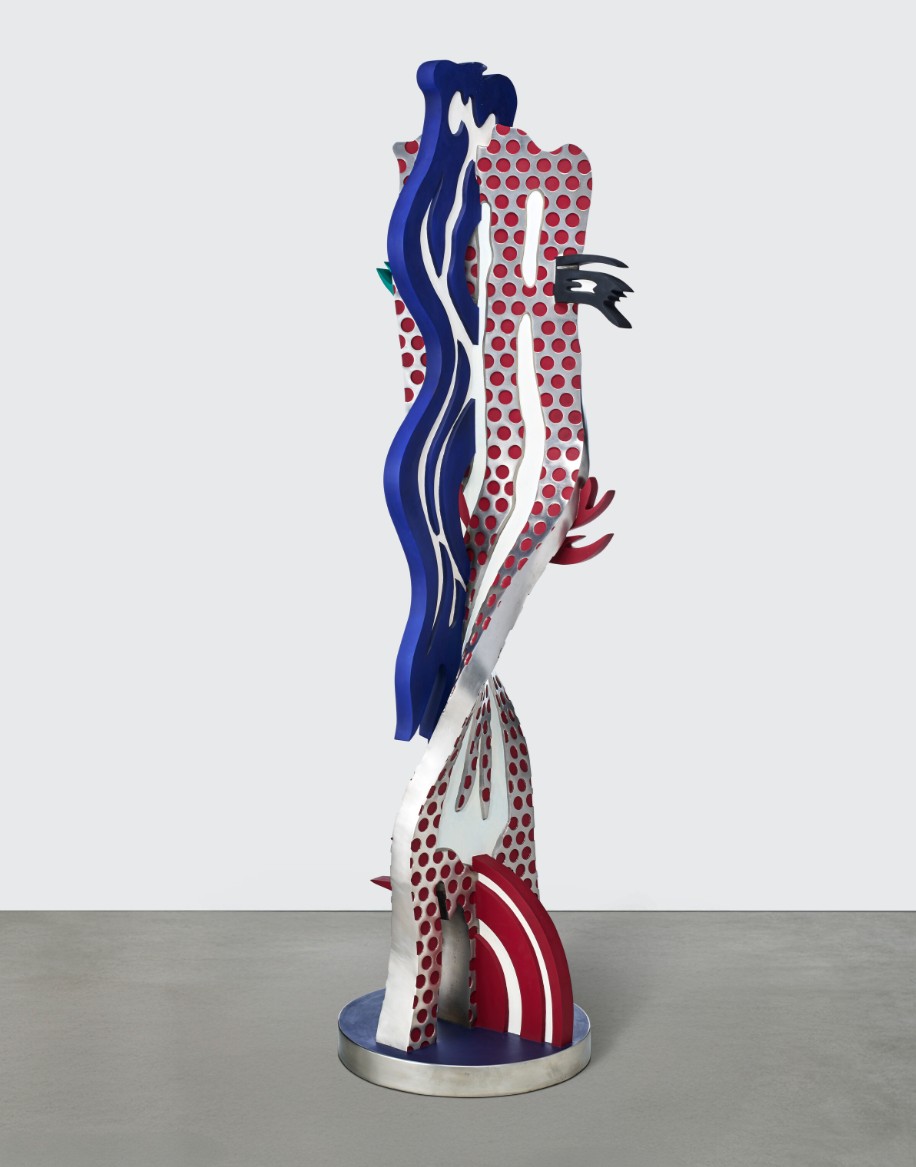
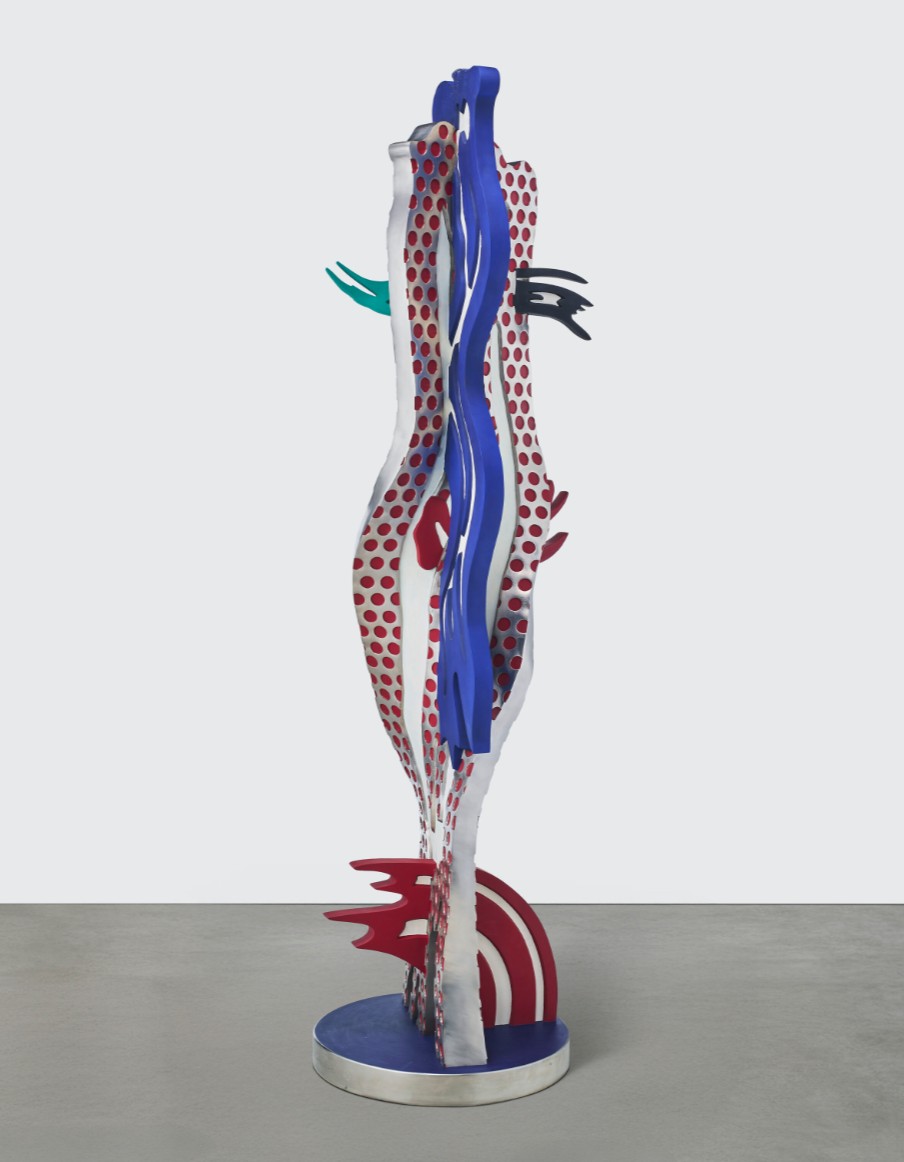
#8. Archaic Head, 1988
A Legacy Reimagined: Works from the Collection of Dorothy and Roy Lichtenstein
Sotheby’s New-York: 19 November 2025
Estimated: USD 600,000 – 800,000
USD 533,400
Archaic Head | Contemporary Day Auction | 2025 | Sotheby’s
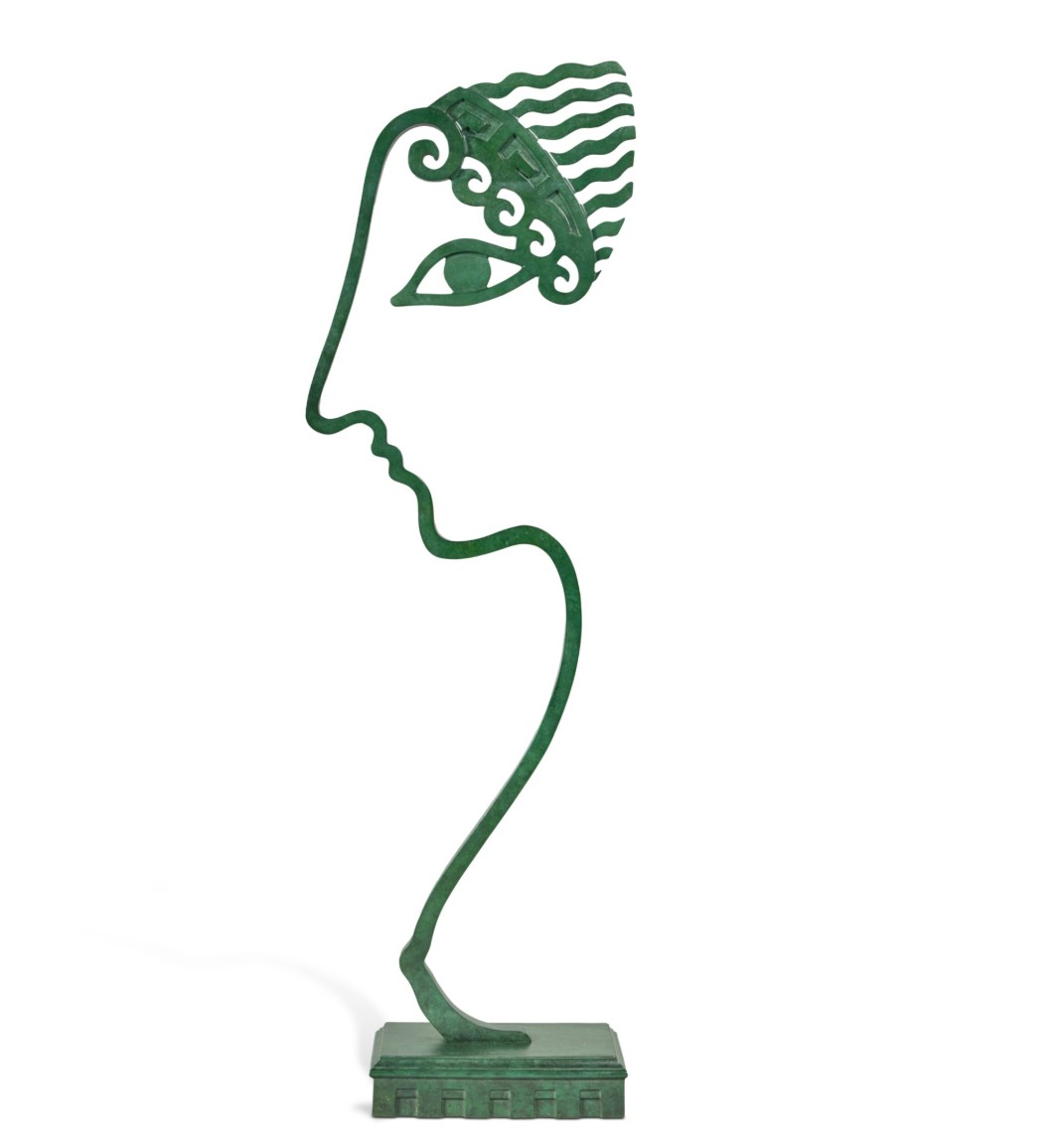
ROY LICHTENSTEIN (1923-1997)
Archaic Head, 1988
Patinated bronze
58 1/4 x 19 x 10 1/4 inches (148 x 48.3 x 26 cm)
Incised with the artist’s signature, date ’88 and number 0/6 (on the base)
This work is the artist’s proof from an edition of 6 plus 1 artist’s proof
Imposing in scale and striking in its stylization, Archaic Head (1988) exemplifies Roy Lichtenstein’s late sculptural practice, in which the artist reimagined the language of Pop through the enduring forms of art history. Cast in bronze, the work transforms the gravitas of an ancient sculptural head into the graphic idiom that had long defined Lichtenstein’s oeuvre. The result is a sculpture that is at once monumental and playful, a Pop translation of antiquity into the vocabulary of the twentieth century.
Roy and Dorothy Lichtenstein with Archaic Head, c. 1992. Art © Estate of Roy Lichtenstein. Image © Christine de Grancy.
Created in 1988, the work belongs to a fertile period of Lichtenstein’s late career. Following the intense decades of the 1960s and 1970s, the 1980s saw the artist revisiting and expanding his motifs with new ambition. Sculpture in particular became a field of major experimentation, allowing him to test how his two-dimensional idiom could operate in three dimensions. Works such as Archaic Head reveal his ability to translate not only the language of mass culture but also the gravitas of art history into his unmistakable style.
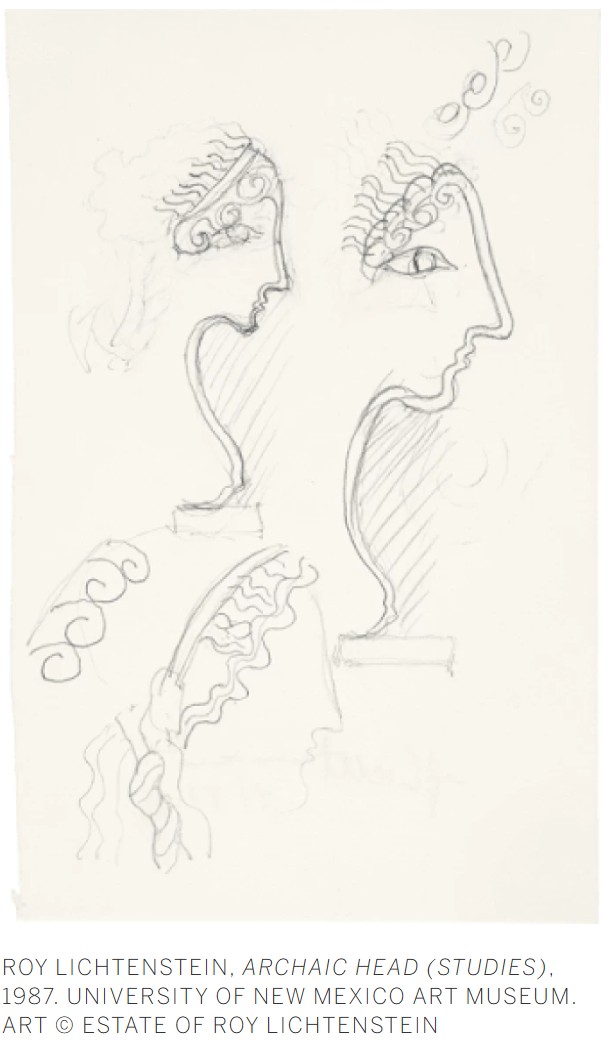
Lichtenstein’s engagement with the classical world was neither accidental nor superficial. Throughout the 1980s and 1990s, he repeatedly returned to motifs drawn from the history of art—nudes, interiors, mirrors, and, as here, the archetype of ancient sculpture—subjecting them to his unique process of stylization. In Archaic Head, the serene form of a timeworn bust is reduced to a sequence of bold contours, schematic planes, and simplified volumes. The calm, frontal face is immediately recognizable as a reference to Greco-Roman antiquity, yet its translation into Lichtenstein’s vocabulary of crisp outline and industrial finish renders it unmistakably contemporary.
The use of bronze is especially telling. Traditionally associated with permanence and cultural gravitas, bronze lends Archaic Head a weight and durability befitting its reference to antiquity. Yet Lichtenstein disrupts tradition by applying painted surfaces and patination in vivid contrast, effectively flattening the sculptural volume into the realm of image. In this tension between material heft and graphic surface lies much of the work’s power. The head is at once archaic and modern, timeless and mediated, an object that resists settling fully into either category.
The Townley Venus, AD 100s. The British Museum.
This transformation of the past into Pop idiom mirrors Lichtenstein’s broader project of reinterpreting the canon of art. Just as his Brushstrokes parodied the gestures of Abstract Expressionism and his Still Lifes recast the conventions of Cézanne or Matisse, so Archaic Head engages the long sculptural tradition. Rather than mimicking the subtleties of weathered marble or bronze, he seizes upon the archetype—the essential sign of the classical head—and reduces it to bold graphic shorthand. Antiquity becomes image, history becomes sign, the weight of tradition reframed within the logic of Pop. The verticality and scale of Archaic Head enhance its effect. At over life-size, the work asserts itself as both sculpture and monument, commanding the viewer’s space while retaining a clarity of design that resists heaviness. The simplicity of its contours and the frontality of its gaze evoke the timelessness of archaic prototypes, yet its stylized finish ensures that it belongs as much to the twentieth century as to antiquity.
In its conceptual and formal qualities, Archaic Head is emblematic of Lichtenstein’s late sculptural triumphs. It is a work that acknowledges tradition while remaking it, that embodies the endurance of the classical past while insisting on the mediated surfaces of Pop. Both reverent and ironic, playful and solemn, it demonstrates Lichtenstein’s ability to transform the most venerable of subjects into a work that is wholly his own. With its scale, material authority, and conceptual clarity, Archaic Head stands as a landmark of Lichtenstein’s sculptural oeuvre—a Pop monument to antiquity, and a reminder of his extraordinary capacity to reinvent the language of art for the modern age.
#9. Modern Painting in Porcelain, circa 1967
A Legacy Reimagined: Works from the Collection of Dorothy and Roy Lichtenstein
Sotheby’s New-York: 19 November 2025
Estimated: USD 70,000 – 100,000
USD 482,600
Modern Painting in Porcelain | Contemporary Day Auction | 2025 | Sotheby’s
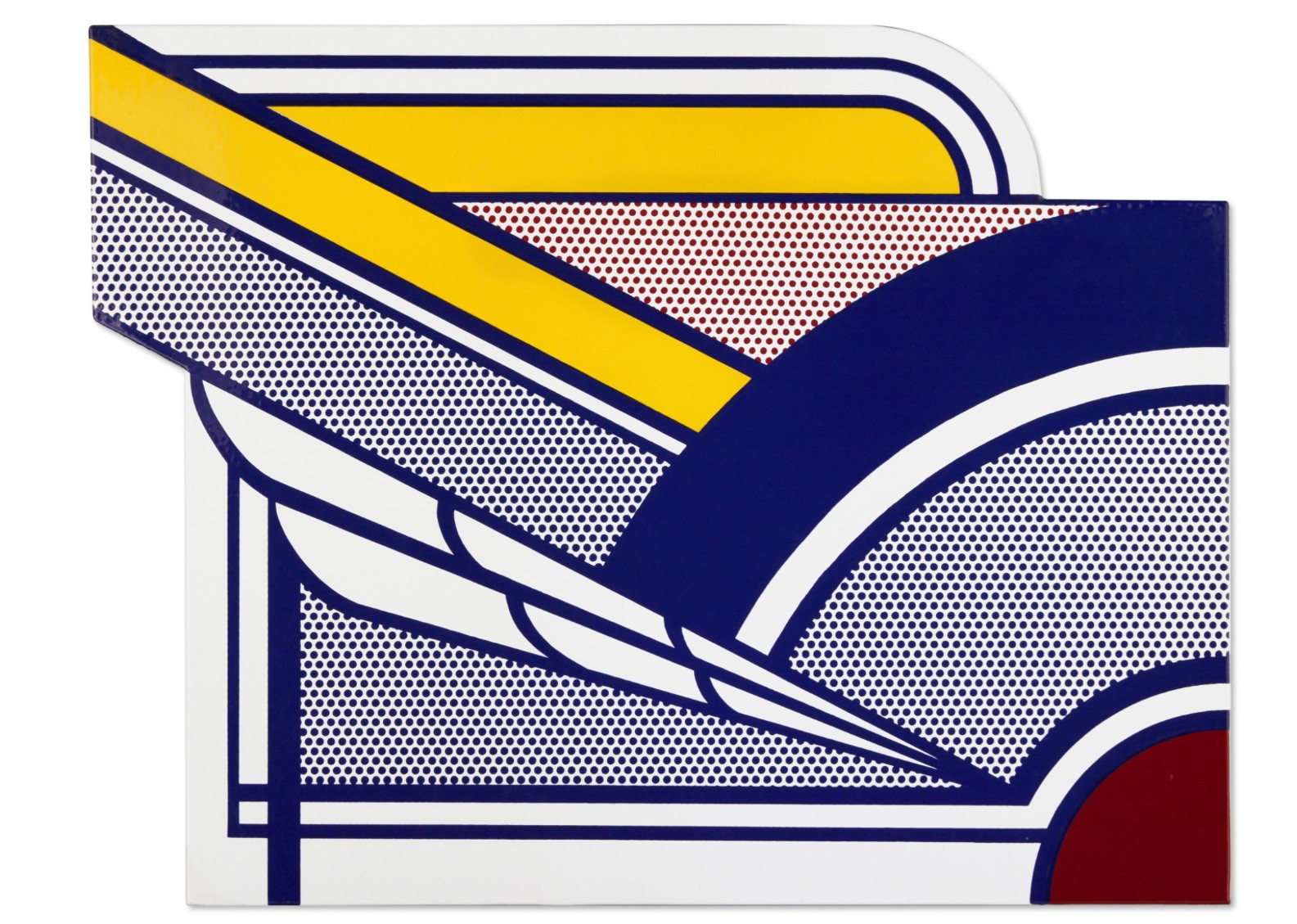
ROY LICHTENSTEIN (1923-1997)
Modern Painting in Porcelain, circa 1967
Porcelain enamel on steel
34 1/2 x 45 inches (87.6 x 114.3 cm)
Signed (on the reverse)
This work is from an edition of 6 plus 2 artist’s proofs
Double Glass, 1979
Christie’s New-York: 20 November 2025
Estimated: USD 1,500,000 – 2,000,000
PASSED
ROY LICHTENSTEIN (1923-1997), Double Glass | Christie’s
ROY LICHTENSTEIN (1923-1997)
Double Glass, 1979
Painted bronze
56x42x17 inches (142.2 x 106.7 x 43.2 cm)
Incised with the artist’s signature, number and date ‘3⁄3 rf Lichtenstein ’79’ (lower edge)
This work is number three from an edition of three
Few artists are able to reinvigorate history, culture and iconography as electrifyingly as Roy Lichtenstein, his hand so strong that is had the capacity to cast every image, every period, every medium through his lens. Examples like Double Glass are indicative of this very point, nodding referentially to the canon of 17th century Dutch still life painting while completely redefining it altogether. The present work projects the static nature of this lineage into a play between two and three dimensional space, the work simultaneously occupying and seemingly evading space depending on one’s vantage point.
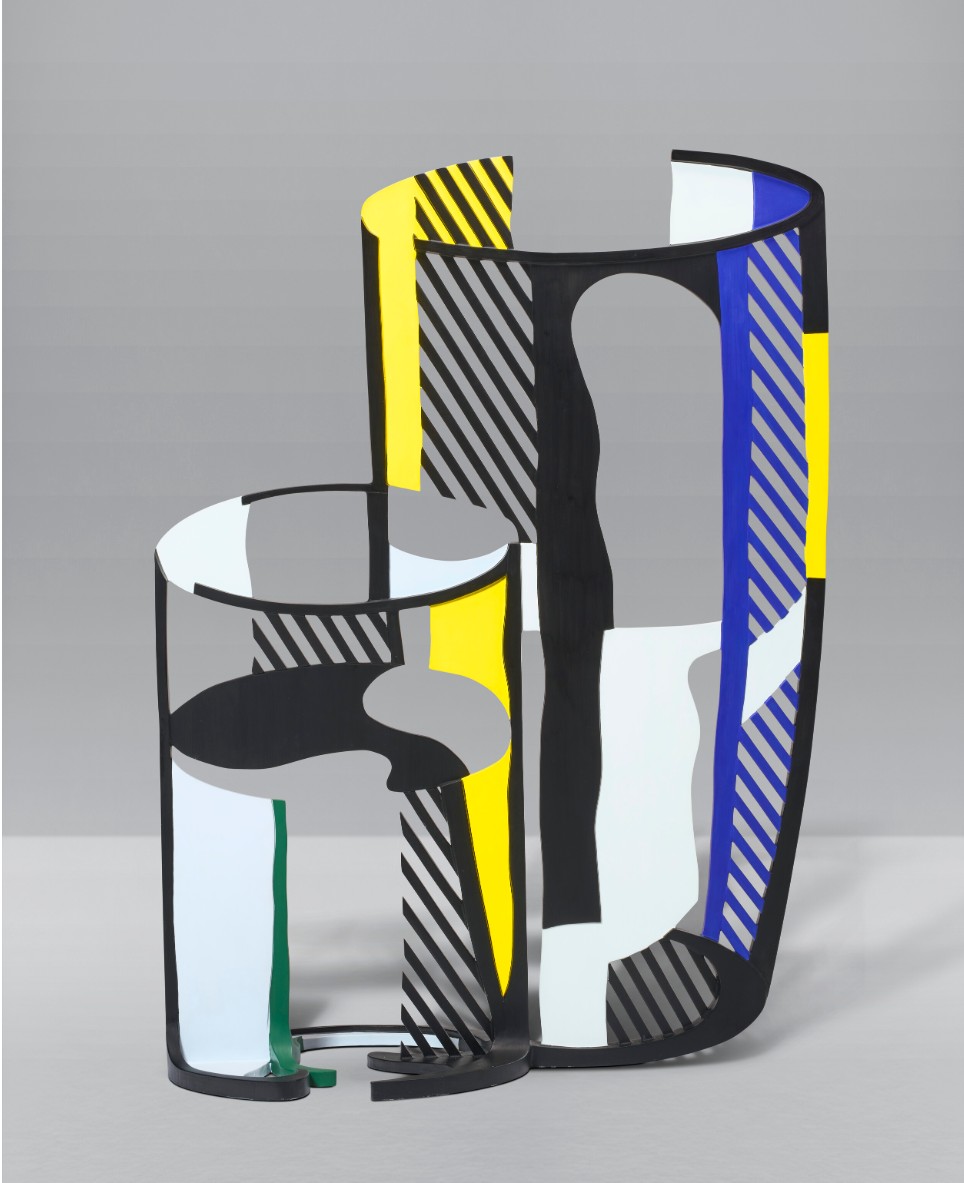
“I think that … the sense is almost an affinity of two-dimensional points of view. A sculpture from any viewpoint should work the way a drawing works, which is a two-dimensional thing.”
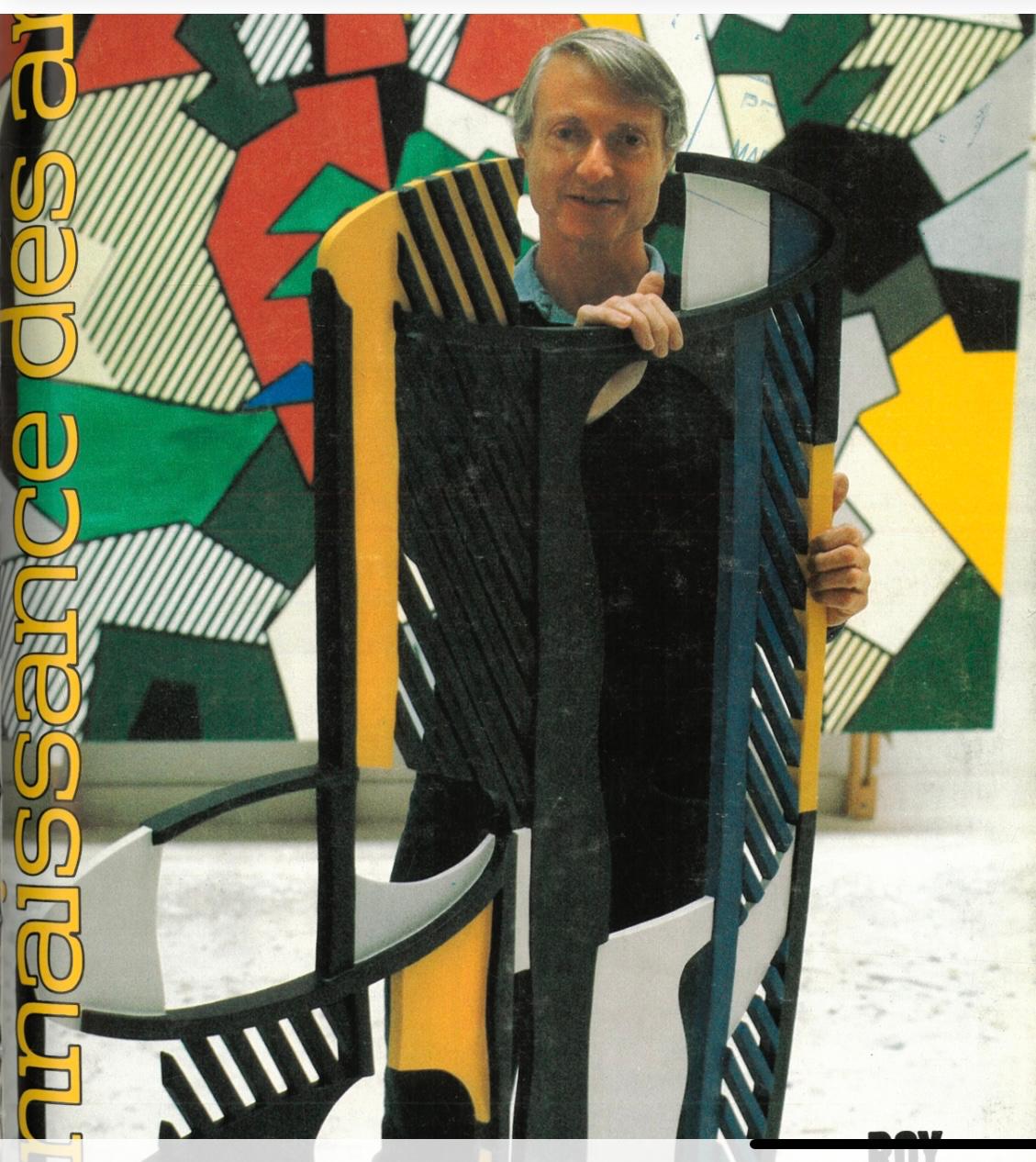
Roy Lichtenstein photographed in his New York studio, c. 1981, on the cover of Connaissance des arts, Paris, 1981.
Photo: Pascal Hinous. Artwork: © Estate of Roy Lichtenstein.
Lichtenstein sparks this history with his distinct visual language. Where one might expect a still life to be meticulously painted and deliciously lifelike, Lichtenstein does the complete opposite, rendering the forms down to color and line. Fine brushwork is replaced with both colors and cartoonish gestures. Across all of Lichtenstein’s oeuvre is a universal language which is both so varied and expansive yet instantly recognizable. Lichtenstein achieved a new visual lexicon that was so full and complete that it could be translated several times over and still feel distinctly his. The present work is a testament to that, with focus resting less on the composition itself and rather on the means by which the artist is able to translate his personal language to the history of painting.
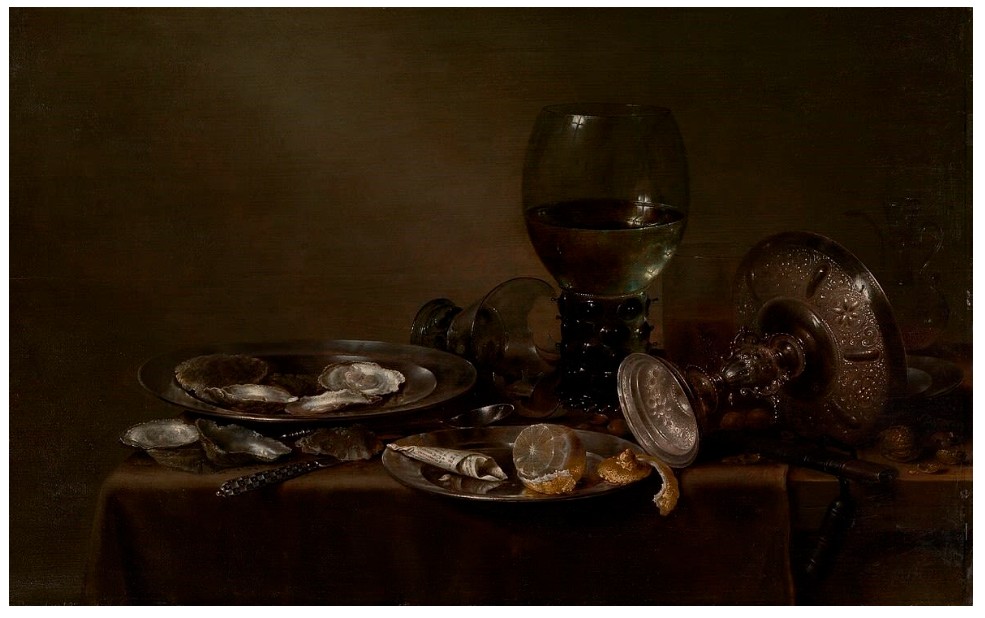
Willem Claesz Heda, Still Life with Oysters, a Silver Tazza, and Glassware, 1635. Metropolitan Museum of Art, New York
The 1970s represent an impressive turning point in the artist’s career. By this time, Lichtenstein looked less to comic book iconography as source material for his compositions and rather chose to present himself with boundless challenges to test the elasticity of his artistic voice. This shift coincides with the artist’s move from the Bowery to Southampton, New York, where perhaps it was the quiet of the Long Island shore which inspired the artist’s practice away from Pop iconography, looking both inward and beyond the contemporary moment to the history of art. It is during this time that he started quoting various art-historical genres, rendering subjects in Expressionist and Cubist styles, always with his signature hand. He also excavated the work of the masters like Gris, Léger, Peale and the 19th century deception paintings of Harnett for still life motifs, stripping them of their gravitas in favor of a cartoonish flair. Through these examples, the artist began diversifying his mark-making, introducing spikes, crosshatches and stripes into his works. Here, dappled accents of white, green, blue and yellow play against negative space to elicit the subtle highlights of water suspended in glass, and quick stripes define the curvature of the glasses.
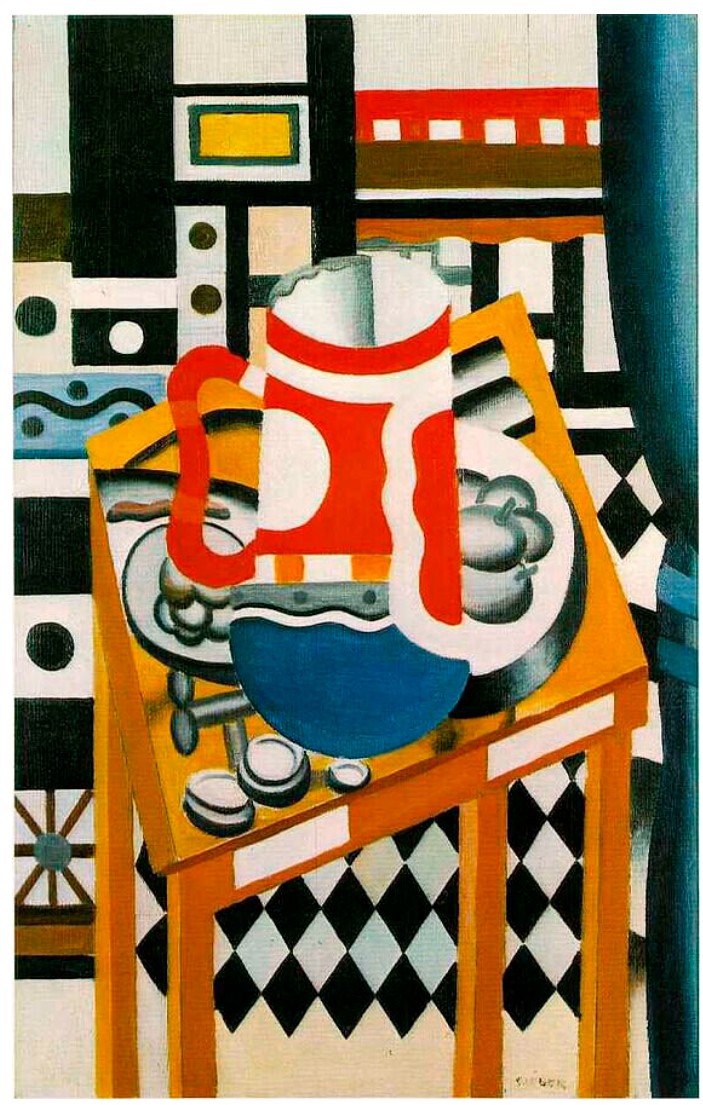
Fernand Léger, Still Life with a Beer Mug, 1921-1922. Tate, London.
Though a departure in some ways from his earlier practice, the tenets of Pop remain ever-present in Double Glass. Lichtenstein would still turn to commercial advertisements, rendering the meticulous illustrations of different tableware, edible goods, vases, and even supplies from his own studio with his signature hand. Whereas a still life painter may have preferred to place their easel before the objects themselves, Lichtenstein would reference a reproduction or an advertisement—a cornerstone of his Pop aesthetic and artistic practice. Rather than delving further into his commerciality, Lichtenstein uses the still life to depart from that important period in his career, while his contemporaries like Andy Warhol leaned in, repeating motifs of commercial products like Campbell’s soup cans or Brillo boxes.
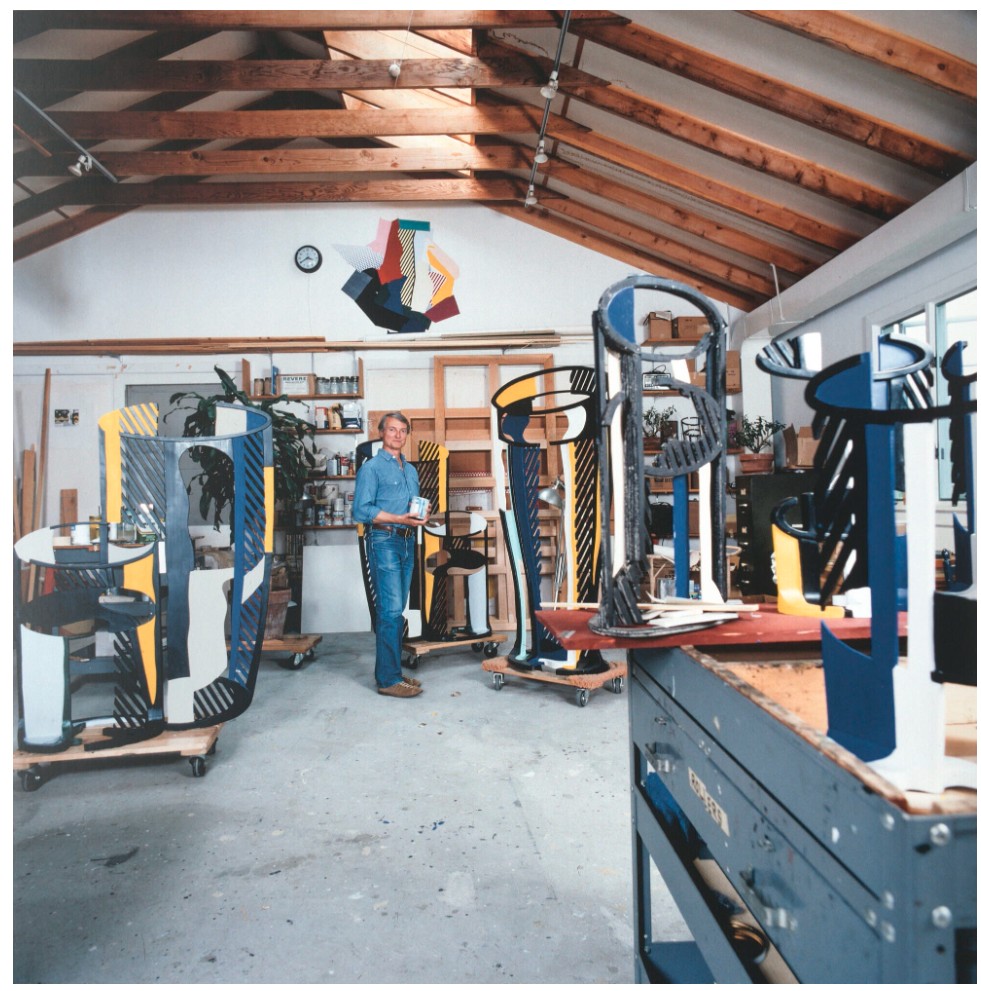
Roy Lichtenstein in his studio, c. 1980, Southampton. Photo: Hans Namuth. Courtesy Center for Creative Photography, University of Arizona © 1991 Hans Namuth Estate. Artwork: © Estate of Roy Lichtenstein
It also during this time that the artist begins his famed Mirror works, which merge the figurative with the abstract, Lichtenstein translating his signature style into various reflections, fragmentations and abstractions. This cerebral exercise of his own innovative technique is demonstrative of an artist at the peak of his oeuvre, where confidence inspires expansion and technical innovation. Another example from this edition is held in the Nasher Sculpture Center in Dallas, reflecting the work’s recognized importance within the canon of modern sculpture and affirming the work’s institutional significance.
3. Studies
#1. Woman: Sunlight, Moonlight (Study), 1995
A Legacy Reimagined: Works from the Collection of Dorothy and Roy Lichtenstein
Sotheby’s New-York: 18 November 2025
Estimated: USD 1,500,000 – 2,000,000
USD 2,734,000
Woman: Sunlight, Moonlight (Study) | The Now & Contemporary Evening Auction | 2025 | Sotheby’s
ROY LICHTENSTEIN (1923 – 1997)
Woman: Sunlight, Moonlight (Study), 1995
Tape, cut painted paper, cut printed paper and graphite on board
60×36 inches (152.4 x 91.4 cm)
Signed and dated ‘95 (on the reverse)
Capturing the radiant beauty and defining Pop style of Roy Lichtenstein’s revolutionary oeuvre, Woman: Sunlight, Moonlight (Study) embodies the investigation of materiality and image-making at the heart of the artist’s practice. Executed in 1995, Woman: Sunlight, Moonlight (Study) harkens back to the comic-book heroines that catapulted Lichtenstein’s career in the mid-1960s, but is distinguished by a twist: here, Lichtenstein reimagines the inherently two-dimensional comic-book subject as a three-dimensional sculpture.
Lichtenstein’s subject is the pinnacle of his acclaimed series of Nudes from the mid-1990s, which revisited the iconic female figures at the core of his early practice and, moreover, the Western art historical canon. Reflective and iterative, Lichtenstein’s practice is the result of reappropriations of his own oeuvre and the canon as well as exploration across media and form. Predating the celebrated bronze and wooden sculptures by the same title, Woman: Sunlight, Moonlight (Study) constitutes a masterful evocation of the extraordinary and defining process that differentiates Lichtenstein’s revolutionary career. Enchanting and timeless, yet pioneering and triumphant, Woman: Sunlight, Moonlight (Study) reveals a scintillating glimpse into the process that underpins Lichtenstein’s groundbreaking oeuvre.
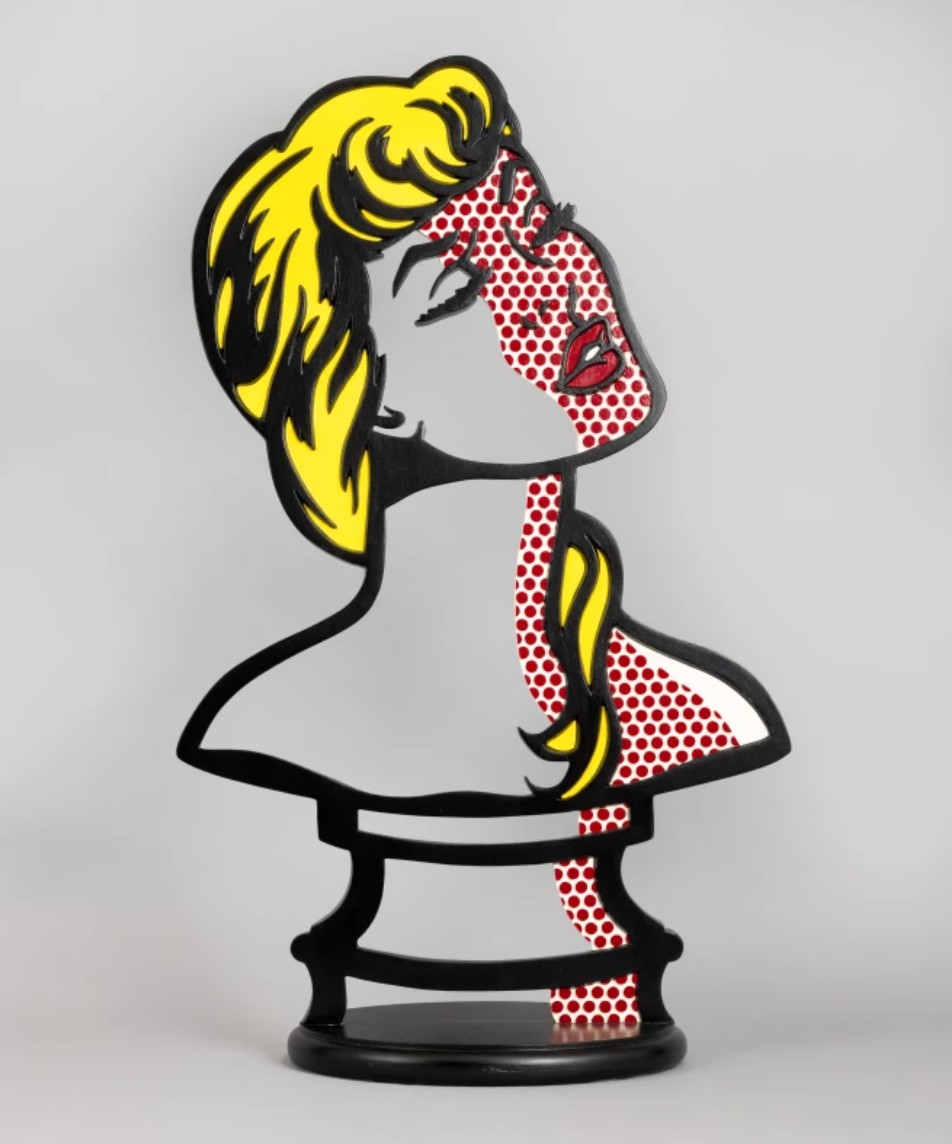
Roy Lichtenstein, Woman: Sunlight, Moonlight, 1996. Private Collection.
Sold at Sotheby’s New York in May 2025 for $4.9 million. Art © Estate of Roy Lichtenstein
Her face gently tipped upwards, eyelids softly closed and lips forming a subtle smile, Lichtenstein’s figure appears transfixed by the sky above. A stream of blue Ben-Day dots evokes the moon’s beams radiating against her skin. The progression of Lichtenstein’s signature pattern trickling down the base of the bust is punctuated only by a cherry red lip. Using color and line sparingly, Lichtenstein captures the full essence of the figure, offering a reappraisal of his own 1965 sculpture, Head with Blue Shadow, held in the Raymond and Patsy Nasher Sculpture Collection in Dallas. In his earlier three-dimensional sculpture, the figure gazes forward, her face divided in two: one side adorned with red Ben-Day dots and the other blue. Three decades later, Lichtenstein revitalizes the same concept but employs bold black contour lines and negative space to suggest volume. Woman: Sunlight, Moonlight (Study) perfectly encapsulates Lichtenstein’s legendary status as an artist who investigated and recalibrated both art history and, eventually, his own practice in a relentless quest for discovery and innovation.
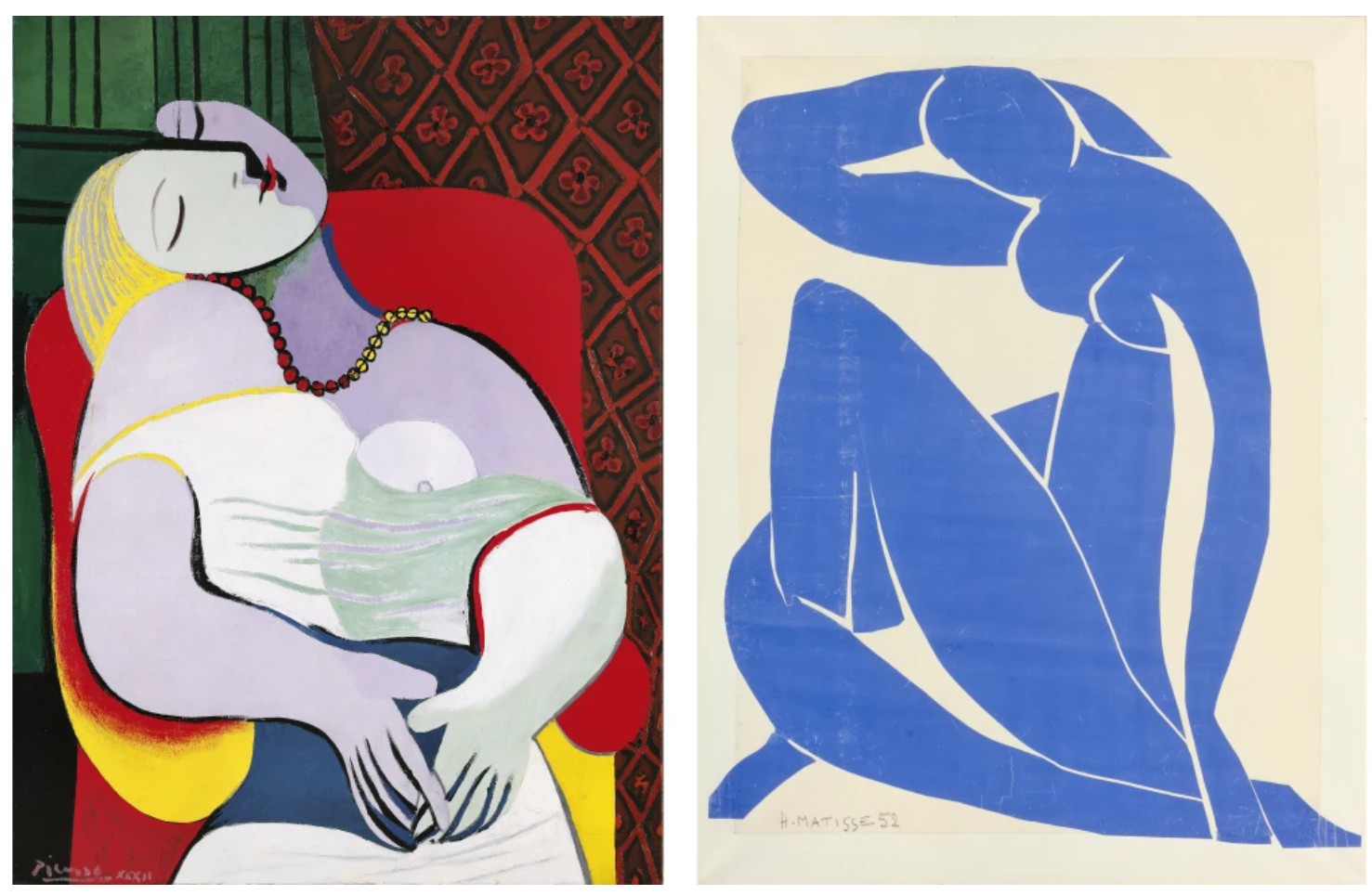
Left: Pablo Picasso, The Dream, 1932. Private Collection. Image © Christie’s Images / © Succession Picasso / DACS, London 2025 / Bridgeman Images. Art © 2025 Estate of Pablo Picasso / Artists Rights Society (ARS), New York. Right: Henri Matisse, Blue Nude II, 1952. Musée National d’Art Moderne, Paris. Image © CNAC / MNAM, Dist. RMN-Grand Palais / Art Resource, NY. Art © 2025 Succession H. Matisse / Artists Right Society (ARS), New York
The smooth contours, bold outlines, and meticulous execution of Woman: Sunlight, Moonlight (Study) are the result of Lichtenstein’s assiduous collaged construction using tape, cut painted paper, marker, and graphite. Employing the most salient identifier of his iconography—the Ben-Day dot—in his iconic royal blue, Lichtenstein reformulates the caricatured female bombshell motif that commands his earliest comic-book paintings. Lichtenstein’s sapphire celebration of the female form emerges from collaged elements, using cut planes of color to create an image of profound beauty. Much like Henri Matisse’s own innovations with medium, the present work recalls Matisse’s languid azure composition, Blue Nude II.
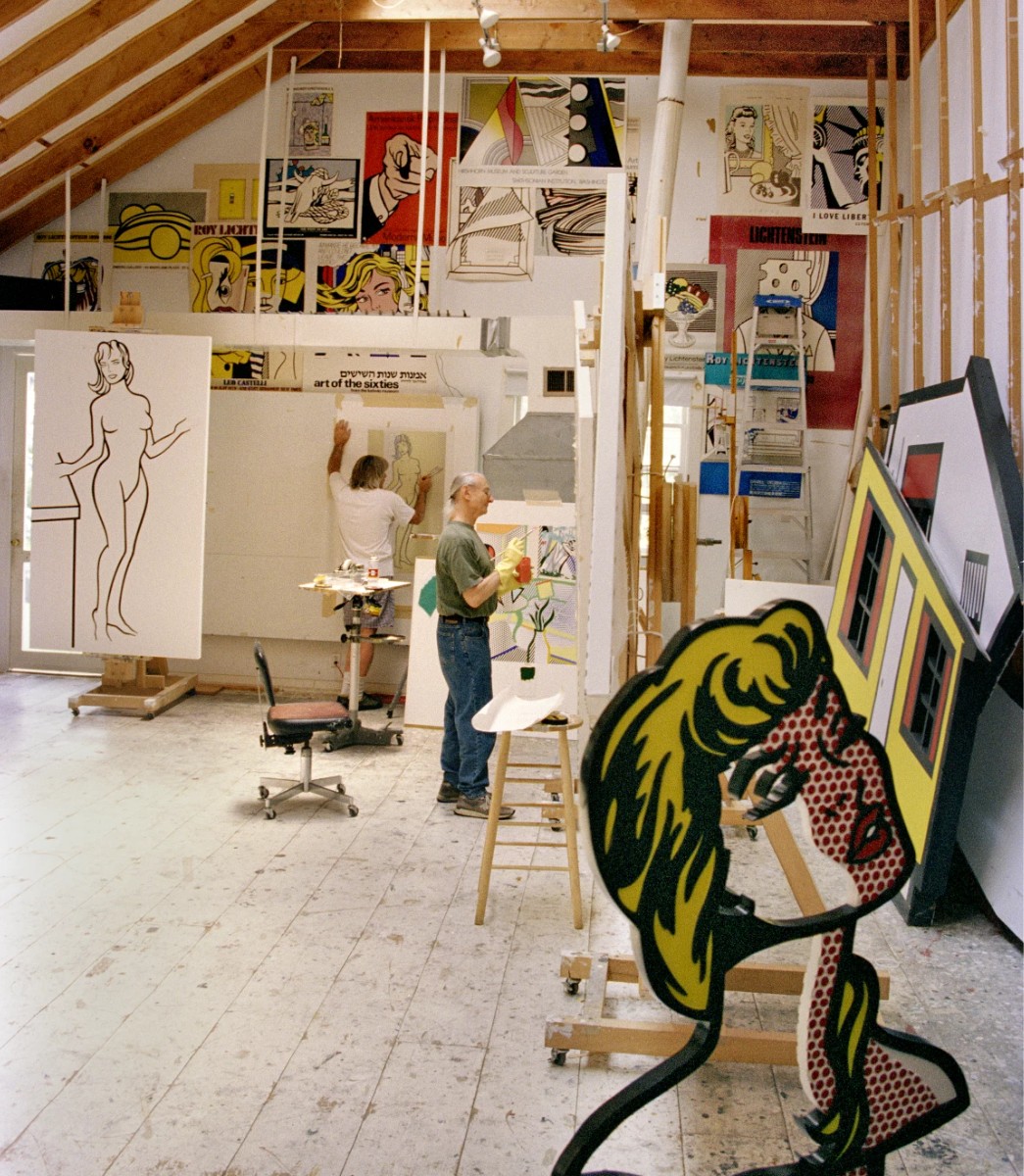
Roy Lichtenstein in his studio. Photo © Bob Adelman. Art © Estate of Roy Lichtenstein
Lichtenstein’s collaged work reveals a rare view of the artist’s vision and intervention—the synthesis of mechanical perfection and handmade production that defines his oeuvre. Lichtenstein’s exploration across drawing, collage, painting, sculpture and printmaking brings the governing questions of originality and appropriation at the heart of his conceptual project to the fore. Through Lichtenstein’s initial collages, he contended with the compositional and theoretical challenges of his subject, utilizing his celebrated Pop vernacular and challenging the viewer’s expectations at every stage. In Woman: Sunlight, Moonlight (Study), Lichtenstein borrows from the visual lexicon of mid-century romance comics, but plays with representing three-dimensionality in a two-dimensional form. Lichtenstein shatters multiple conventions in one image—contending with the arbitrary boundaries of both two- and three-dimensional representation in a singular collage.
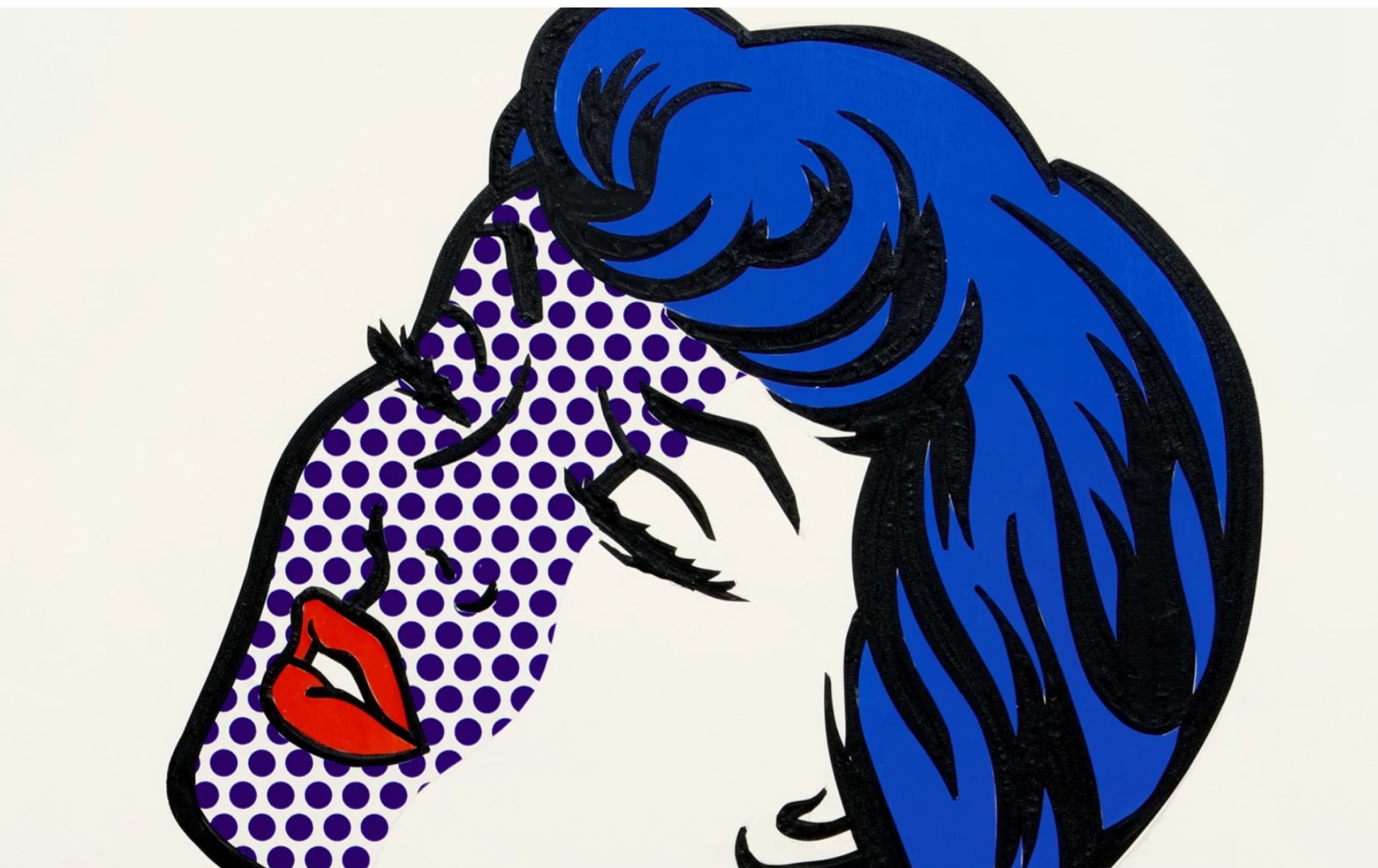
In the mid-1990s, shortly before Lichtenstein’s death in 1997, the artist returned to the female heroines of his 60s paintings, which were inspired by contemporaneous romance comics. The portrayal of feminine beauty across art history and popular media remains at the center of Lichtenstein’s practice across four decades, reaching a final peak with works such as Woman: Sunlight, Moonlight (Study). Predating the acclaimed two-sided bronze and wooden sculptures by the same name, Woman: Sunlight, Moonlight (Study) is the original manifestation of his conceptual program. Lichtenstein only executes a collage study of the cool blue, nighttime side, in which the figure tilts her head upward as if illuminated by the skies above. Lichtenstein would go on to create two unique wooden examples, one of which resides in the collection of the Whitney Museum of American Art, New York, as well as a bronze edition of six, an example from which is held in the esteemed collection of The Broad, Los Angeles.
#2. Interior with Mirrored Wall (Study), 1990
A Legacy Reimagined: Works from the Collection of Dorothy and Roy Lichtenstein
Sotheby’s New-York: 19 November 2025
Estimated: USD 500,000 – 700,000
USD 1,638,000
Interior with Mirrored Wall (Study) | Contemporary Day Auction | 2025 | Sotheby’s
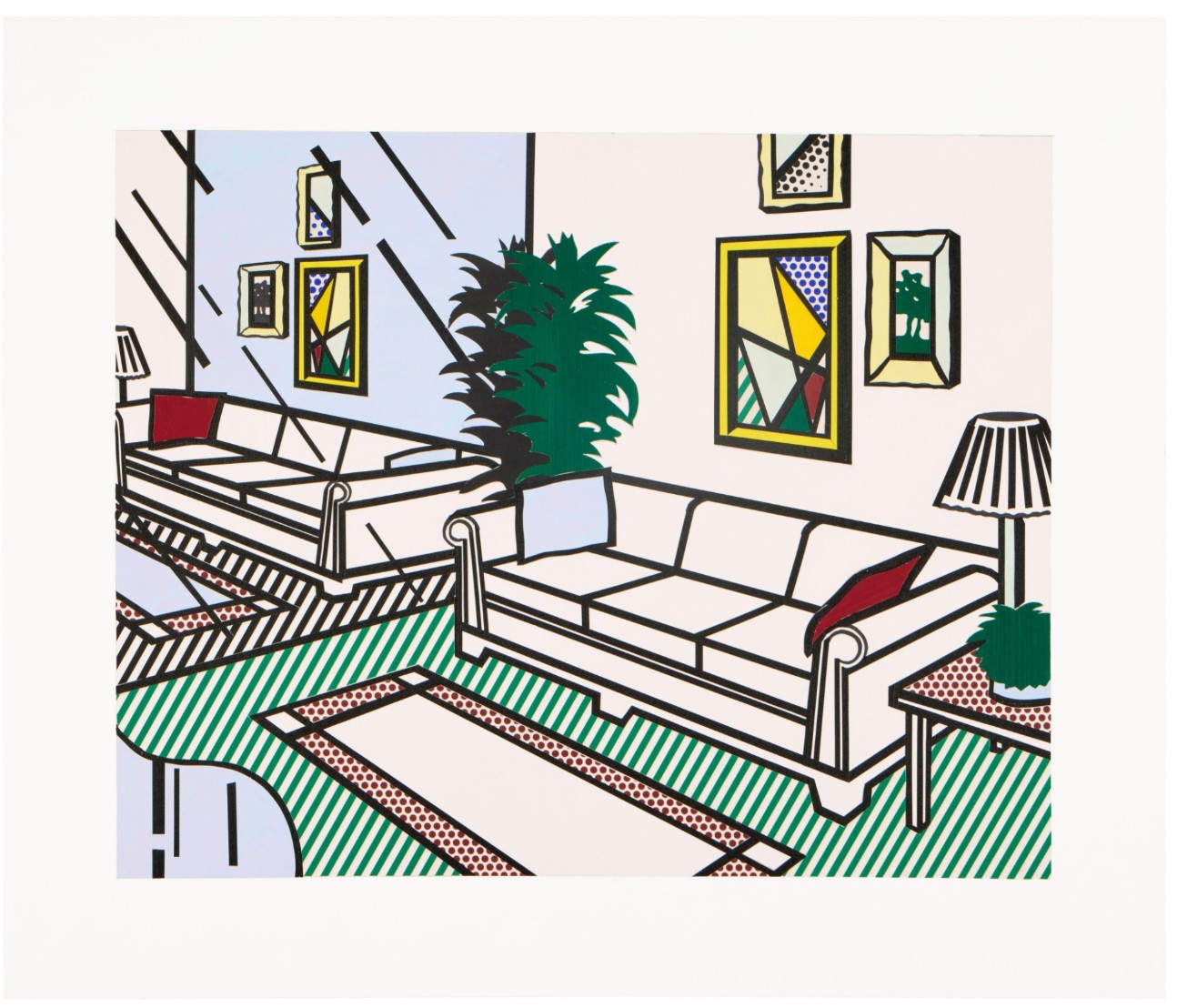
ROY LICHTENSTEIN (1923 – 1997)
Interior with Mirrored Wall (Study), 1990
Cut painted and printed paper, tape and graphite on board
Image: 26 1/2 x 33 inches (67.3 x 83.8 cm)
Board: 34 1/2 x 40 3/4 inches (87.6 x 103.5 cm)
Signed and dated ’90 (on the verso)
Crisp, elegant, and meticulously composed, Interior with Mirrored Wall (Study) from 1990 exemplifies Roy Lichtenstein’s late mastery of the interior as subject, a theme through which he transformed ordinary domestic spaces into rigorous meditations on form, perception, and representation. Lichtenstein distills his signature vocabulary of flat color, bold contour, and Ben-Day patterning into a serene composition anchored by the witty inclusion of a mirrored panel. Here, geometry, structure, and reflection coalesce in a vision that is at once intimate and conceptually expansive. Created just three years before his landmark retrospective at the Guggenheim, Interior with Mirrored Wall (Study) belongs to a period of extraordinary confidence, when Lichtenstein revisited his core motifs with renewed assurance. In this composition, the ordinary room is elevated into a meditation on seeing itself: a reflection on space, on representation, and on the very act of looking.
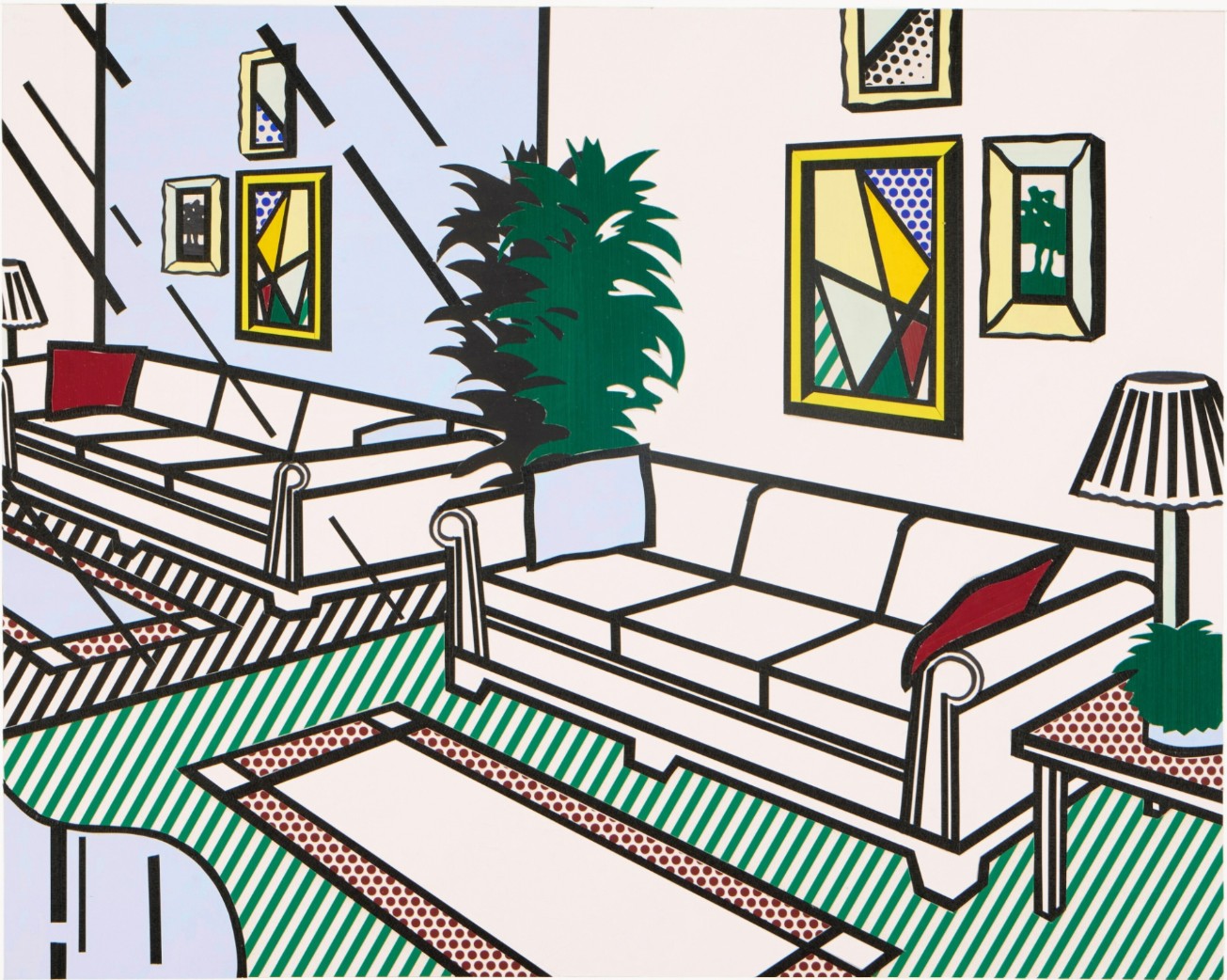
The interiors, which became a major focus of Lichtenstein’s production in the 1980s and 1990s, extended his longstanding project of reimagining the visual codes of everyday life through the clarity of Pop. If the 1960s were dominated by comic-strip drama and the 1970s by the architectonic abstraction of the Entablatures, the interiors mark a later turn toward the spaces of design and domesticity. In Interior with Mirrored Wall (Study), tables, chairs, and patterned walls are stripped to schematic essentials, their geometry tightly ordered yet softened by the doubling effect of the mirror, which both expands and flattens the space. The collage medium intensifies this tension. Cut and layered forms provide crisp material edges, foregrounding the artifice of construction, while at the same time offering a provisional glimpse of Lichtenstein’s working process. The mirrored surface functions less as depth than as another flat panel, folding reflection into the composition and reminding the viewer that even illusion is subject to mediation.
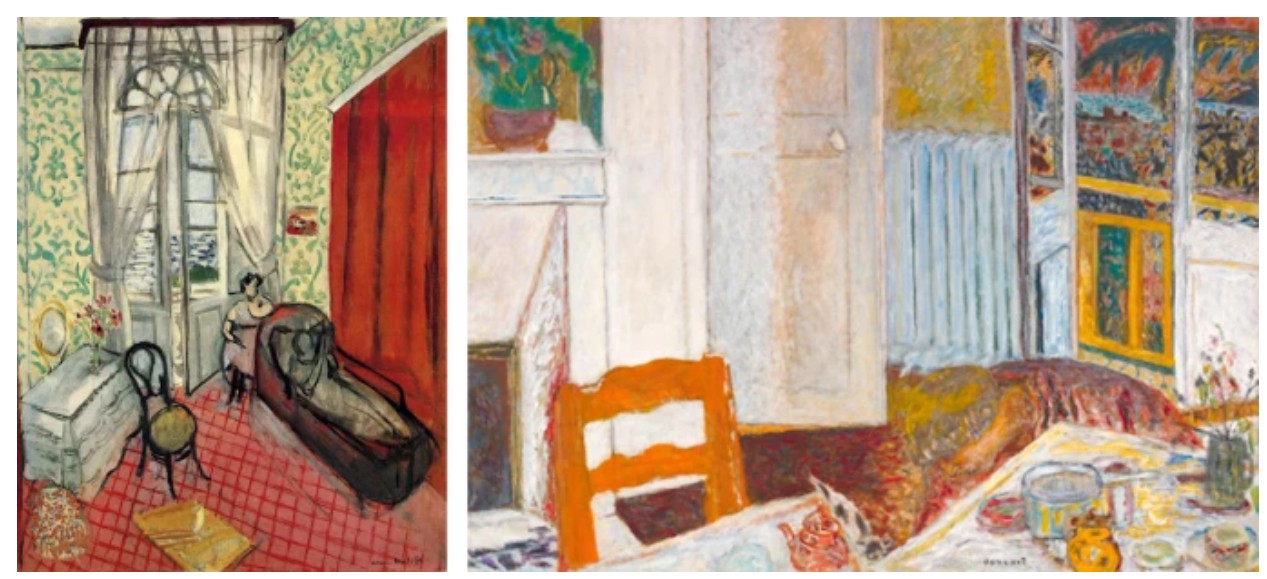
Left: Henri Matisse, Woman On The Couch, 1921. Musée de l’Orangerie, Paris.
Right: Pierre Bonnard, White Interior (Le Cannet), 1932. Musée de Grenoble, France.
This play of interior and reflection situates the work within a long lineage of modern interiors, from Matisse’s exuberant patterned rooms to de Chirico’s enigmatic metaphysical spaces. Yet Lichtenstein’s approach is uniquely his own: a domestic setting pared down to its structural signs, where the mirror becomes less a literal surface than a conceptual device, collapsing the distance between depiction and perception. As a study, the work reveals Lichtenstein’s method of testing spatial balance and compositional rhythm before scaling up to canvas. Yet it also operates as a complete vision in its own right, encapsulating the wit and clarity that define his late oeuvre. With its elegant geometry, conceptual precision, and understated wit, Interior with Mirrored Wall (Study) epitomizes the late flowering of Lichtenstein’s career. At once modest in medium and ambitious in scope, it demonstrates the artist’s ability to transform the most familiar of spaces into enduring reflections on the language of modern art.
#3. Large Interior with Three Reflections (Mural Panel) (Study), 1993
A Legacy Reimagined: Works from the Collection of Dorothy and Roy Lichtenstein
Sotheby’s New-York: 18 November 2025
Estimated: USD 1,000,000 – 1,500,000
USD 1,575,000
WORK ON PAPER
ROY LICHTENSTEIN (1923 – 1997)
Large Interior with Three Reflections (Mural Panel) (Study), 1993
Colored pencil and graphite on paper
Image: 9 1/8 x 24 1/4 inches (23 x 61.6 cm)
Sheet: 16 1/4 x 30 1/8 inches (41.3 x 76.4 cm)
A retrospective encapsulation of Roy Lichtenstein’s career in one entrancing composition, Large Interior with Three Reflections (Mural Panel) (Study) is replete with reference to the artist’s legendary oeuvre, cleverly synthesizes multiple perspectives, blending fiction and reality. The present work dates to Lichtenstein’s acclaimed Interiors of the 1990s, a series in which the artist explored domestic spaces as popularized in mass media, adorning them with icons from art history and his own practice. Here, Lichtenstein’s signature wit and distinctive Pop vernacular reaches its zenith: after decades of appropriating from art historical forebears, Lichtenstein turns to his own oeuvre for his subject matter. Predating a monumental mural of the same subject, the present work reveals Lichtenstein’s process and intellectual inquiry through compositional development. From his 1962 Curtains and Swiss Cheese to his melodramatic comic-book romance scenes, his 90s Cityscape and Imperfect Sculpture, Large Interior with Three Reflections (Mural Panel) (Study) is abounding with self-referential treasures—a trove of Lichtenstein’s incomparable oeuvre.
Although Lichtenstein’s exploration of interiors began in earnest in the early 1990s, the subject Lichtenstein engaged with the subject throughout his practice, dating back to the early 60s with iconic works like Bathroom (1961) in the collection of the Whitney Museum of American Art and Curtains (1962) in the collection of the Saint Louis Art Museum. In 1973, Lichtenstein again returned to the interior, creating the iconic Artist’s Studio “Look Mickey” in the collection of the Walker Art Center, Minneapolis, which incorporated elements of his own practice, including the Stretcher Bar paintings, Mirrors, and even a reproduction of his own 1961 work, Look Mickey. In the 90s, he returned to the theme with a renewed intensity, transforming his interiors into sites that engage with themes across his now four-decade body of work. Compelled by the banality and commercialization of domestic décor across popular media and advertisements, Lichtenstein created interiors with rich compositional complexity and the spirit of fantasy. Lichtenstein’s spaces feel familiar and yet uncanny, bearing the cinematic and atemporal quality of the comic realm.
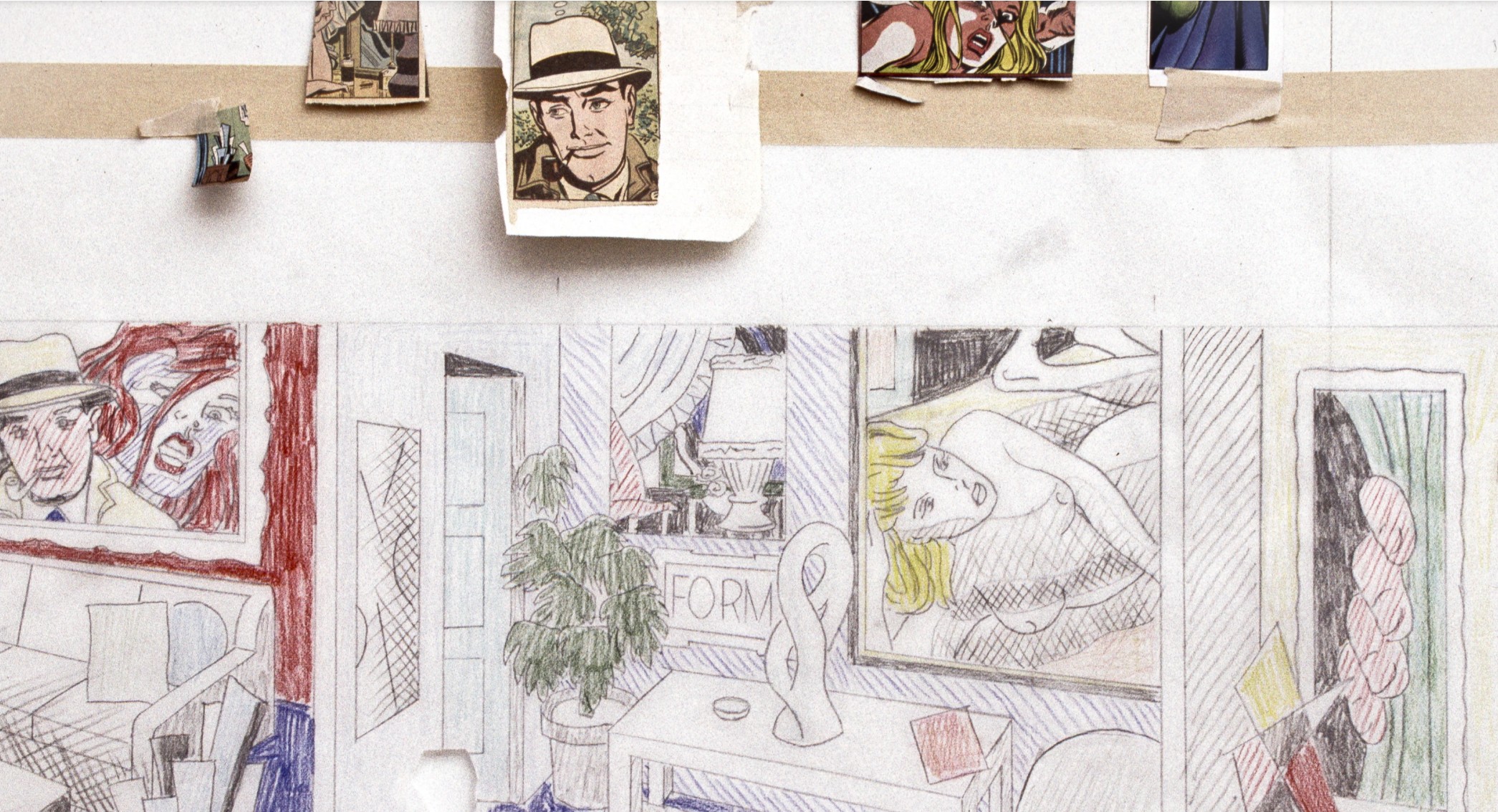
Image of Lichtenstein’s studio with studies for his Interior drawings, 1993. Image © Bob Adelman. Art © Estate of Roy Lichtenstein
Expanding from a single interior space, Lichtenstein here presents the viewer with the cross-section of a home, revealing three rooms at once. The tripartite interior exemplifies the playful invention at the core of Lichtenstein’s work; as our eyes meander through these three rooms, we are equally convinced of the reality and reminded of the inherent artificiality of the scene. Far from static, Lichtenstein’s composition offers a narrative unveiling which charts his career. In the living room, above the sofa, Lichtenstein appears to render a version of his 1960s, comic-book-inspired scenes, perhaps an amalgamation of Forget It! Forget Me! (1962) and Tension (1964), which capture a couple in conflict. Lichtenstein further adorns the room with his 1972 still life, Bananas and Grapefruit I, and his 1995 Cityscape. Wandering through the open door—itself an homage to the 1961 drawing Knock Knock, the viewer enters the foyer. Above the consol, in pride of place, Lichtenstein depicts a nude figure in repose—echoing both the tradition of the reclining female nude in the Western art historical canon and his own Nudes of the 1990s.
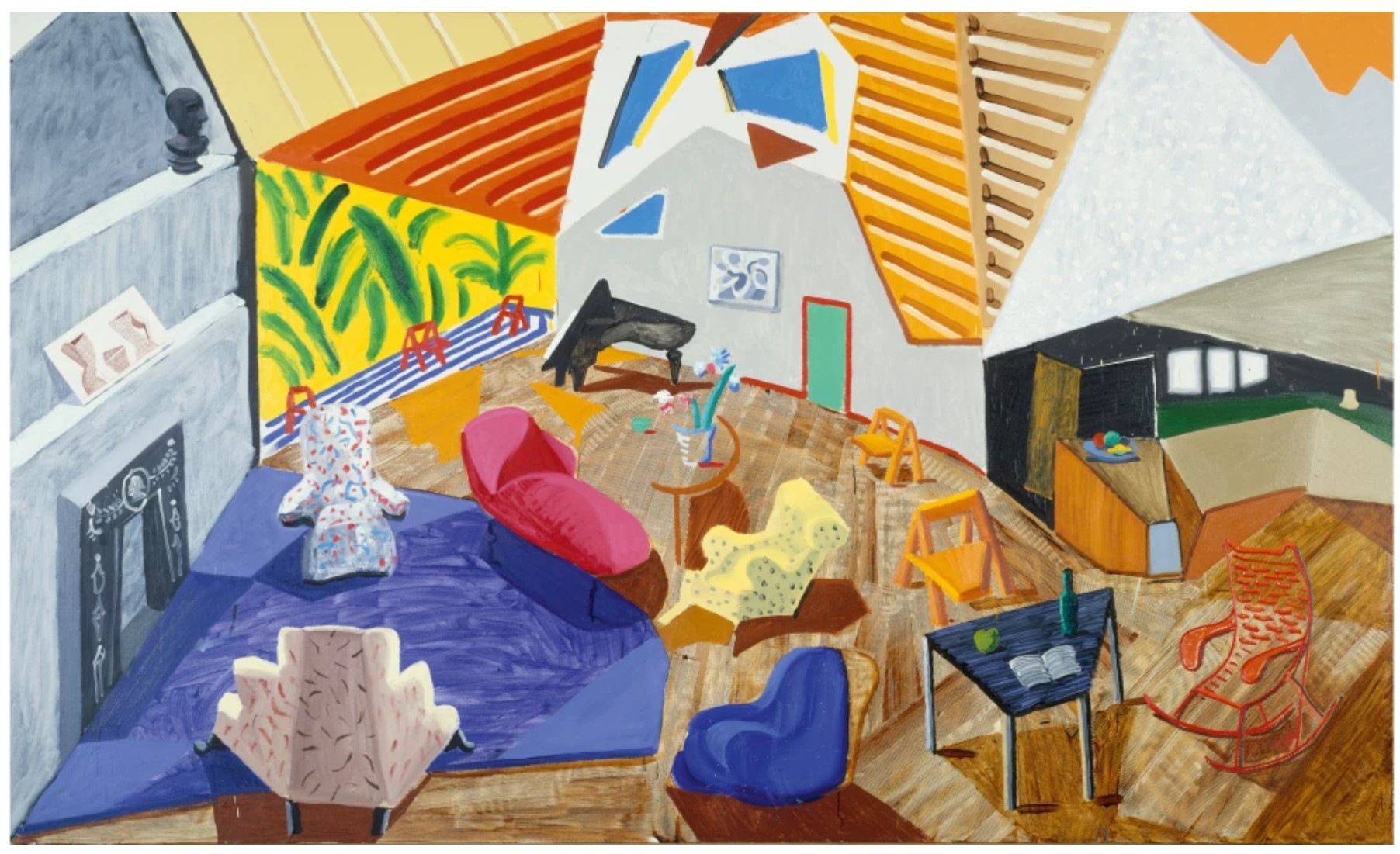
David Hockney, Large Interior, Los Angeles, 1988. The Metropolitan Museum of Art, New York.
Image © The Metropolitan Museum of Art / Art Resource, NY. Art © 2025 David Hockney
Just to the left of the nude, Lichtenstein evokes his 1962 painting, Curtains, with an intimate interior scene featuring a ruffled curtain drawn back before a moody sky. And just below this work, he incorporates a painting with a single word: FORM. Here, one cannot help but recall the artist’s iconic 1962 painting, ART, which featured the same palette of red text on yellow ground. At the foreground of the center frame, Lichtenstein playfully includes a sculptural version of his 1962 painting, Swiss Cheese. And, finally, in the rightmost vignette, above his 1995 Imperfect Sculpture, Lichtenstein makes a very clever addition. Here, in jest with the viewer, Lichtenstein depicts four fingers pulling back a curtain, as if the artist himself is pulling back the curtain to reveal the inherent artificiality of the picture.
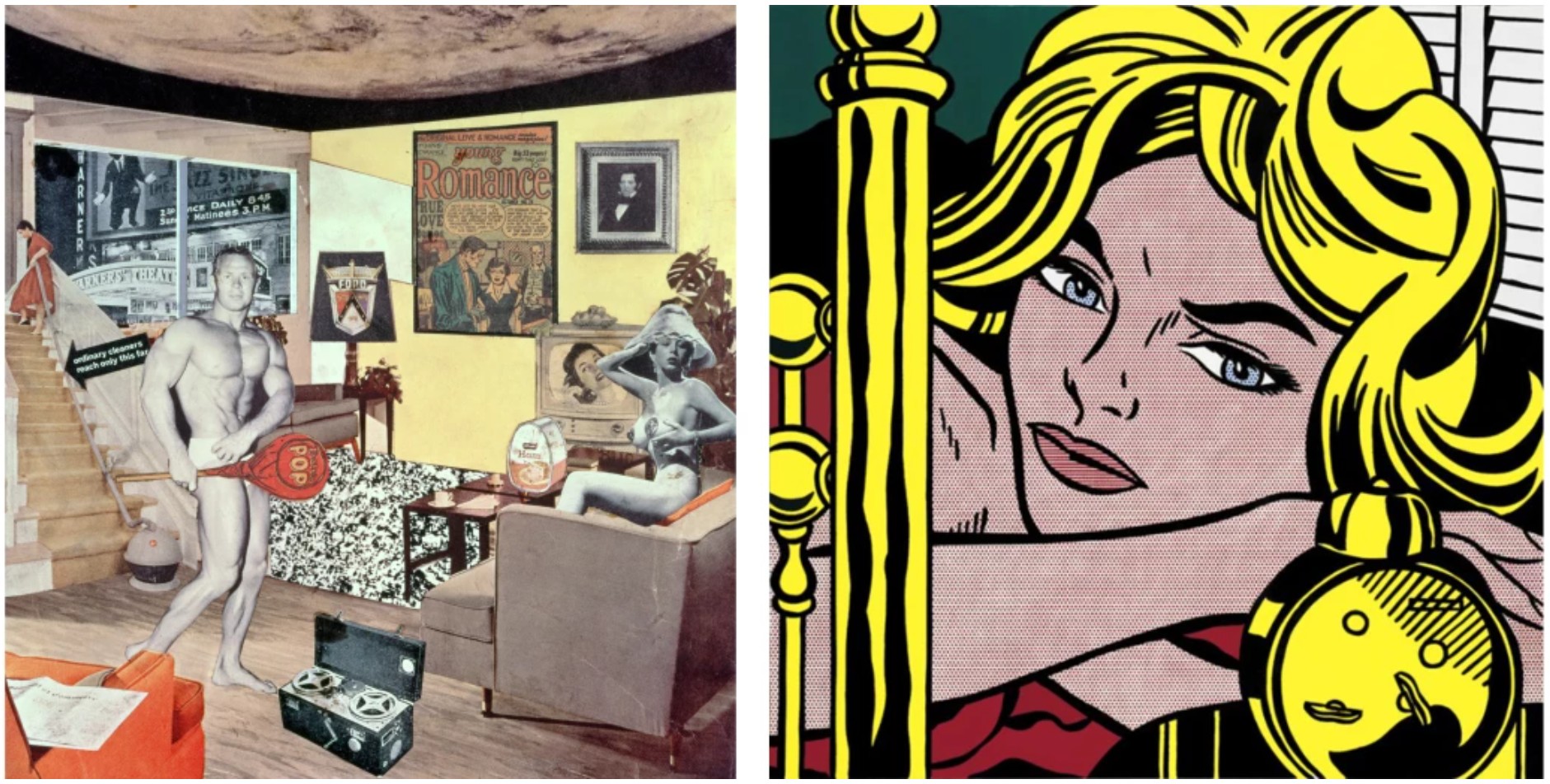
Left: Richard Hamilton, Just What Is It That Makes Today’s Homes So Different, So Appealing?, 1956. Kunsthalle Tubingen, Tubingen. Image © Bridgeman Images. Art © 2025 Artists Rights Society (ARS), New York / DACS, London. Right: Roy Lichtenstein, Blonde Waiting, 1964. Private Collection. Art © Estate of Roy Lichtenstein
Meticulous, inventive and ever clever, Lichtenstein captivates the viewer, synthesizing reality and illusion. Large Interior with Three Reflections (Mural Panel) (Study) perfectly encapsulates the driving inquiries of Lichtenstein’s career, transforming the ordinary into the extraordinary.
#4. Cover Image for Guggenheim Magazine (Study), 1993
A Legacy Reimagined: Works from the Collection of Dorothy and Roy Lichtenstein
Sotheby’s New-York: 19 November 2025
Estimated: USD 800,000 – 1,200,000
USD 1,255,000
Cover Image for Guggenheim Magazine (Study) | Contemporary Day Auction | 2025 | Sotheby’s
ROY LICHTENSTEIN (1923 – 1997)
Cover Image for Guggenheim Magazine (Study), 1993
Graphite, tape, cut painted and printed paper on board
Image: 40 1/2 x 31 7/8 inches (102.9 x 81 cm)
Board: 48 5/8 x 40 inches (123.5 x 101.6 cm)
Signed and dated ’93 (on the verso)
Executed in 1993 at the culmination of a career already canonized in the history of twentieth-century art, Cover Image for Guggenheim Magazine (Study) represents a moment of consummate visibility for Roy Lichtenstein: an artist whose vocabulary of Ben-Day dots, bold outlines, and chromatic clarity had come to define Pop itself. Created specifically for use on the cover of Guggenheim Magazine in conjunction with the artist’s landmark retrospective at the Solomon R. Guggenheim Museum (October 8, 1993 – January 16, 1994), the present work embodies both the intimacy of preparatory study and the grand cultural stage on which Lichtenstein now stood. At once collage, design, and image of enduring resonance, it distills the essential characteristics of Lichtenstein’s practice into a compact and striking still life.
“I am nominally copying, but I am really restating the copied thing in other terms. In doing that, the original acquires a totally different texture. It isn’t thick or thin brushstrokes, it’s dots and flat colors and unyielding lines.”
The 1993 retrospective, which subsequently traveled to major international institutions including the Museum of Contemporary Art, Los Angeles; the Musée des Beaux-Arts, Montréal; Munich’s Haus der Kunst; Hamburg’s Deichtorhallen; Brussels’s Palais des Beaux-Arts; and the Wexner Center for the Arts in Columbus, was the most ambitious survey of Lichtenstein’s work to date. The decision to place an original Lichtenstein collage on the cover of the Guggenheim’s official magazine signaled not only the centrality of his practice to postwar American art but also his recognition as an artist whose imagery had long since entered the collective imagination. The magazine cover was more than an ephemera of museum publicity: it was a testament to the mutual embrace between institution and artist, between Pop art’s language of mass communication and the sanctity of the museum space.
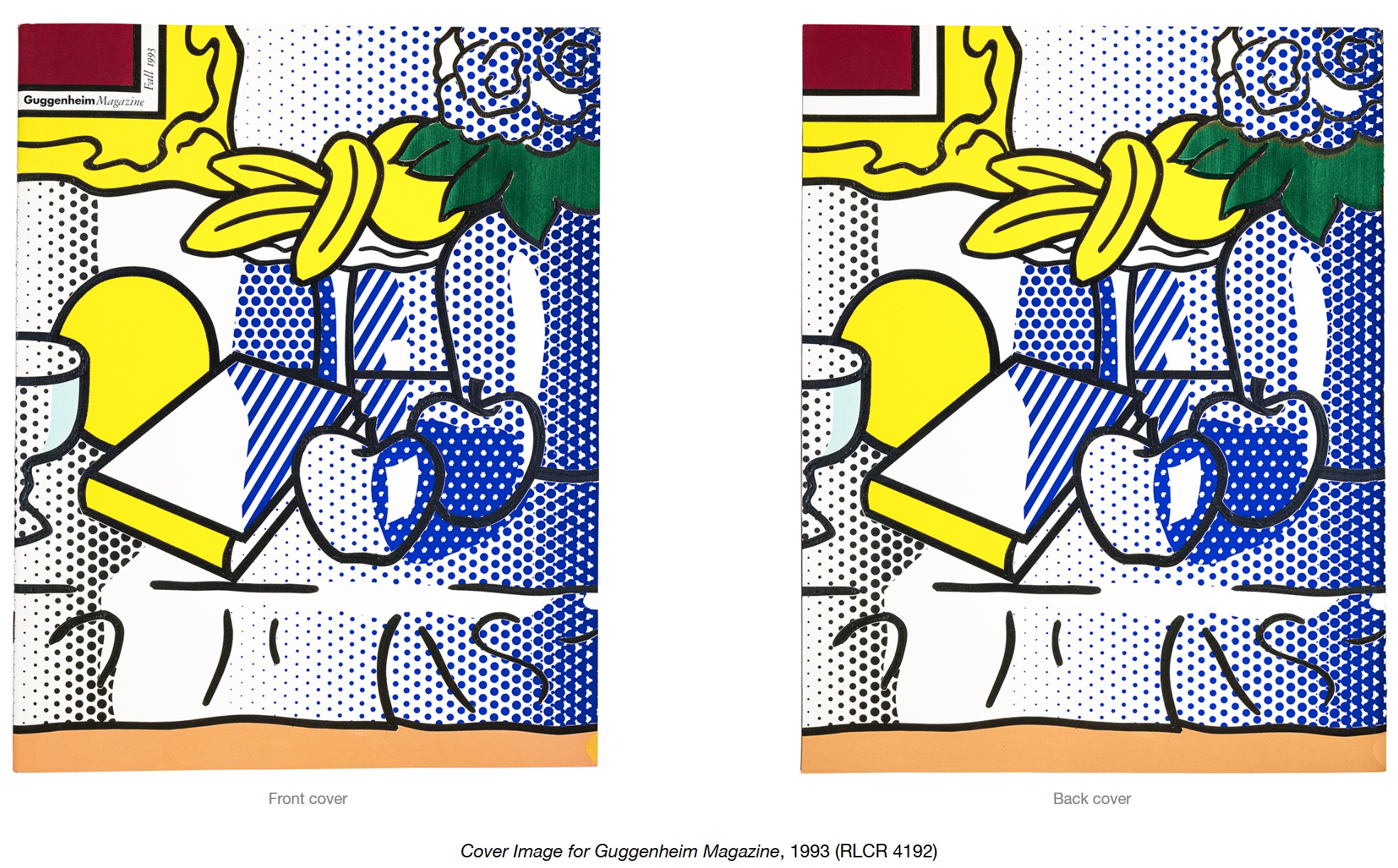
Formally, Cover Image for Guggenheim Magazine (Study) is both playful and rigorous. The composition belongs to Lichtenstein’s long engagement with the still life genre, a dialogue that had preoccupied him since the late 1970s. Here, fruit, vase, framed painting, and tabletop are reduced to their essential graphic contours and presented in a shallow, compressed space. Bananas, apples, flowers, and a book are articulated through his signature Ben-Day dots and blocks of primary color: yellow, blue, red, and green assert themselves with clarity, while black contour lines lock forms into place. The still life, one of painting’s oldest genres, is thus reimagined in the idiom of Pop—flattened, graphic, at once familiar and estranged. The choice of subject is telling. At the very moment when his career was being surveyed across continents, Lichtenstein offers the still life: the genre historically associated with painting’s capacity for reflection, arrangement, and mastery. But here the reflection is doubled. Just as his Reflections series had fractured and refracted images of comic heroines or abstract brushstrokes, this still life is not about abundance or domesticity but about mediation. A book lies open, its pages reduced to flat zones of white and blue striping; a vase tilts toward the viewer, almost schematic in its simplicity; fruit is rendered not with sensual modeling but with crisp edges and patterned dots. Each element speaks less to its materiality than to its image—an image whose function is to signify “book,” “fruit,” “table” in the most economical terms possible.
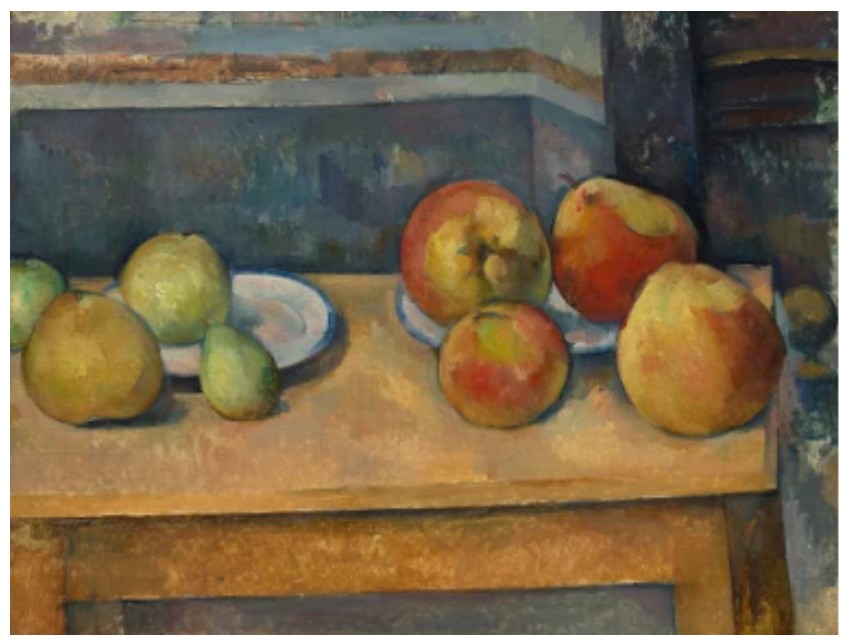
Paul Cézanne, Still Life with Apples and Pears, c. 1891-1892. The Metropolitan Museum of Art, New York.
As such, Cover Image for Guggenheim Magazine (Study) operates in the quintessential Lichtenstein mode: the transformation of familiar motifs into sign systems, where meaning is both immediately apparent and perpetually deferred. The everyday object becomes a reflection of painting’s language itself. It is a still life not of things, but of signs for things. And it is this semiotic precision that made the image such an apt emblem for the Guggenheim retrospective, where Lichtenstein’s entire oeuvre could be seen as a sustained interrogation of how art makes meaning through form.
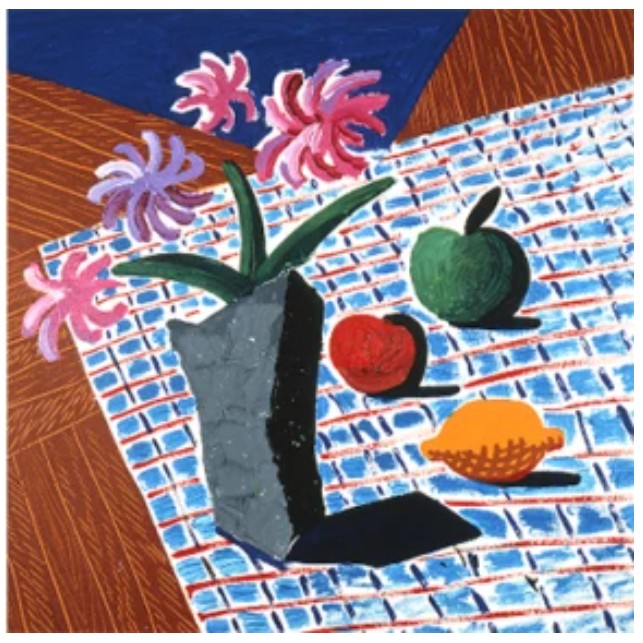
David Hockney, Still Life with Flowers, 1987. The Museum of Modern Art, New York.
The collage medium reinforces this play between immediacy and mediation. Unlike his large-scale paintings or polished screenprints, the study retains a tactile quality: paper elements cut and assembled into the crisp configuration. This sense of direct making, of image built from fragments, resonates with the work’s destiny as a magazine cover—an image disseminated in thousands of copies, printed front and back, carrying Lichtenstein’s Pop idiom into the hands of museum visitors worldwide. It is both intimate object and mass-produced emblem, collapsing the distinction between unique artwork and reproducible image that lay at the heart of Pop art’s provocations.
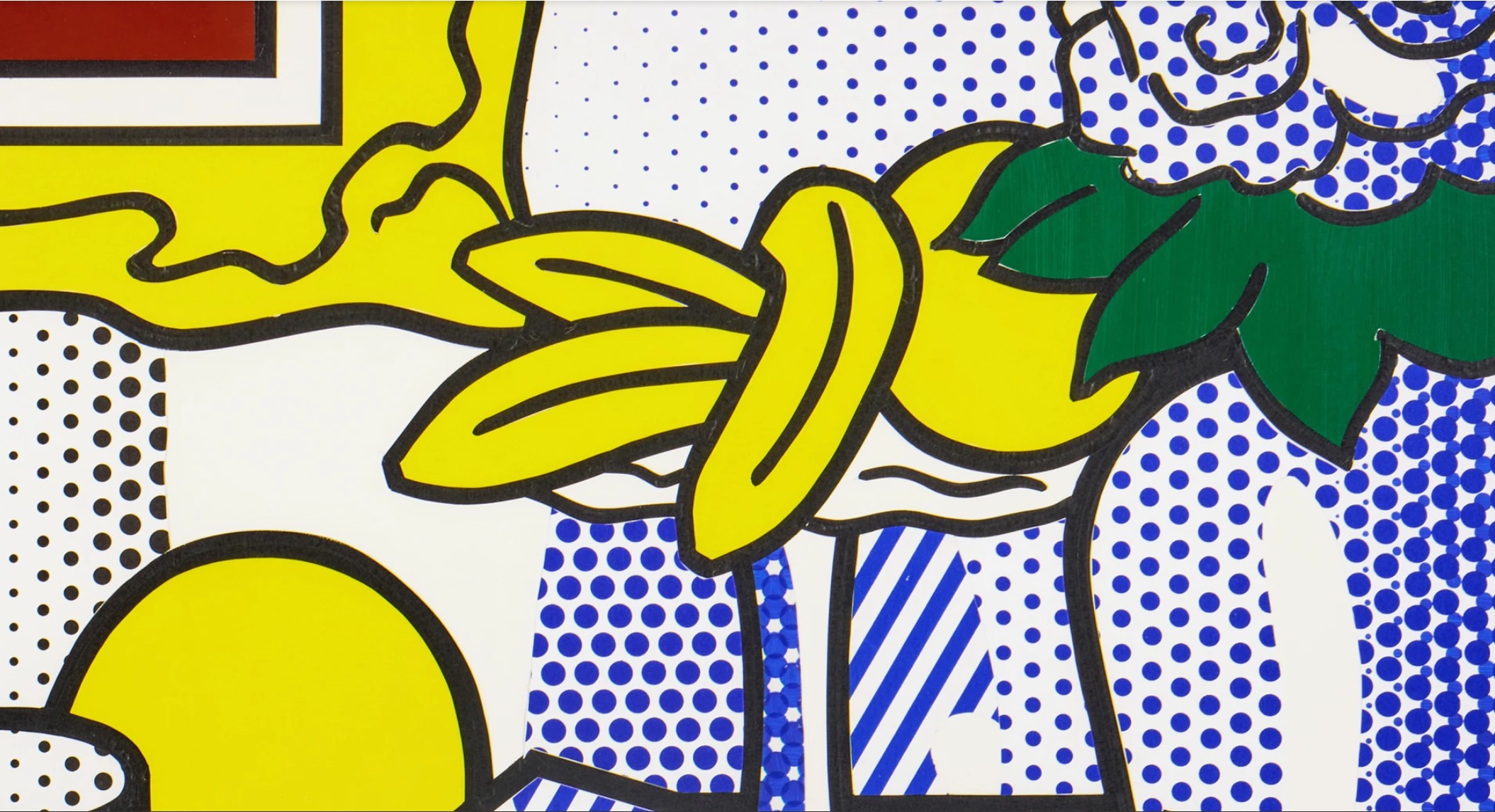
In the broader arc of Lichtenstein’s career, Cover Image for Guggenheim Magazine (Study) crystallizes several themes. It returns to the still life, aligning his practice with the lineage of Cézanne, Matisse, and Picasso, whom he frequently reinterpreted in Pop idiom. It underscores his fascination with the intersection of fine art and mass media, collapsing the hierarchy between cover design and canonical painting. And it situates his work firmly within the institutional framework of the 1990s, where Pop’s once-provocative language had become not only accepted but celebrated as central to the story of modern art. In its graphic clarity, chromatic force, and conceptual precision, Cover Image for Guggenheim Magazine (Study) is emblematic of late Lichtenstein: a moment where the artist reflects upon the very language he had spent decades constructing, and where the institutions of art history reflected it back. That the work served as the cover for the Guggenheim’s retrospective catalogue is fitting: it is at once a study, a still life, and a cover image—an emblem of how Pop art forever transformed not only what we see, but how images circulate, how they signify, and how they endure.
#5. Still Life with Portrait (Study), 1973
Property from the Estate of Joan and Kenneth Goldglit
Christie’s New-York: 20 November 2025
Estimated: USD 1,000,000 – 1,500,000
USD 1,016,000
ROY LICHTENSTEIN (1923-1997), Still Life with Portrait (Study) | Christie’s
ROY LICHTENSTEIN (1923-1997)
Still Life with Portrait (Study), 1973
Printed paper collage, acrylic, felt-tip pen and graphite on paperboard
42×32 inches (106.7 x 81.3 cm)
Signed and dated ‘rf Lichtenstein ’73’ (on the reverse)
Fusing a playful palette and a rigorous intellectual project, Still Life with Portrait (Study) is a stunning articulation of Roy Lichtenstein’s brilliant command of line, color and concept. Engaging in and contributing to a timeless dialogue with his art historical forebears, Roy Lichtenstein subverts the tenets and tropes of twentieth century modernism, weaving these archetypes with his own distinctive pioneering style and signature Pop aesthetic. Still Life with Portrait (Study) features two of Lichtenstein’s instantly recognizable subjects: a strikingly rendered interior space and the glamorous figure of a woman plucked straight out of a book, and offers a unique window into the artist’s process as he converts a comic strip into high-art through thoughtful sketching, painting, and collage, capturing the hand of the artist at the pinnacle of his career. Executed in 1973, the year after Lichtenstein started experimenting with the sill life motif that he will reinterpret throughout his career, Still Life with Portrait (Study) uniquely spotlights the artist’s technical inventiveness as a draftsman alongside his exquisite command of an art-historical lexicon.
“I do a lot of [collaging] in the paintings. I start something and keep adding to it—putting pieces of paper down temporarily and looking at the image.
It’s just much easier to try it out first in collage to get everything I want.”
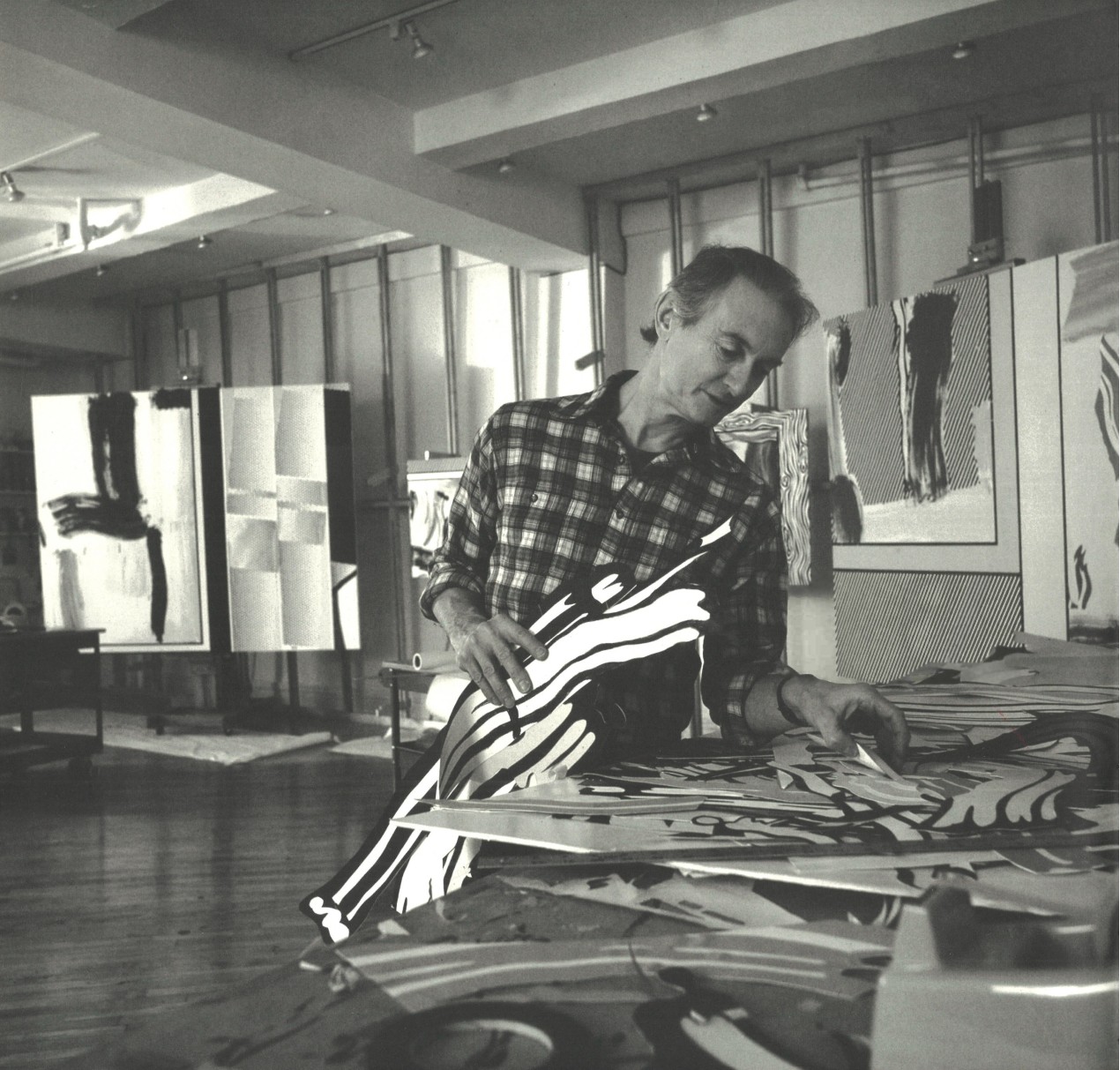
Roy Lichtenstein in his studio, New York, 1991. Photo: Hans Namuth.
Courtesy Center for Creative Photography, University of Arizona © 1991 Hans Namuth Estate. Artwork: © Estate of Roy Lichtenstein.
With flat colors and layered planes, Lichtenstein evokes the mechanical precision of mass reproduction while embedding nuanced references to art history. A female portrait within a yellow frame, reminiscent of 1940s glamour, sits alongside lemons, cherries, and a gleaming pitcher—elements that form a carefully controlled arrangement of curves, diagonals, and shadows. The study format reveals Lichtenstein’s careful planning process meticulously thought out as a foundation for a larger multiple. He frequently emphasized how essential collage was to his practice, allowing for flexible experimentation before committing to more laborious techniques such as Ben-Day dots and hard-edge painting.
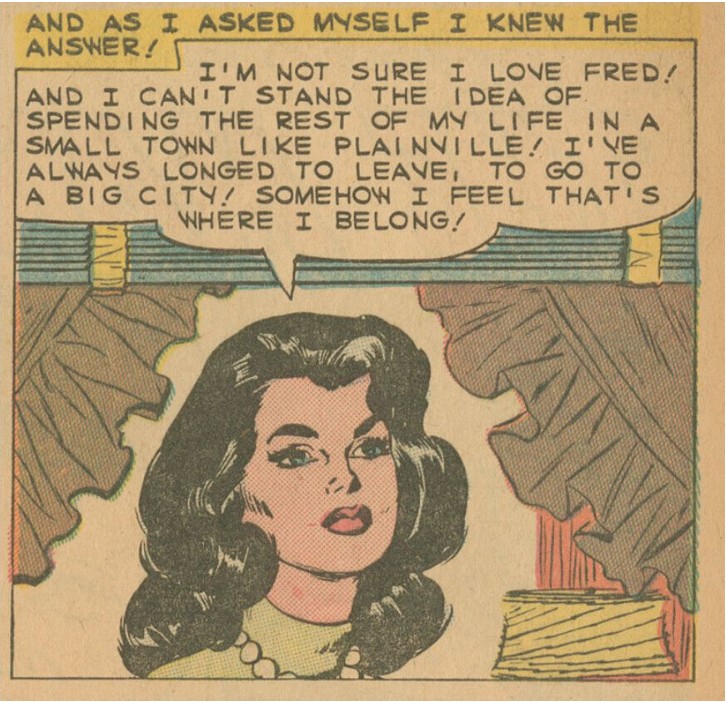
Panel from Sweethearts #49, July, 1954, Charlton Comics Group (source image for the present lot). Photo: © Estate of Roy Lichtenstein.
The protagonist for the woman figure portrayed in Still Life with Portrait (Study) was found in comic strip by the famous artist Vince Colletta. Colleta’s romantic illustrations in the fifties served as inspiration for Lichtenstein who transformed the melodramatic pulp imagery into symbols of mass-produced desire. Lichtenstein began incorporating these unforgettable stills into his paintings in 1961, weeks before Andy Warhol completed his own comic book paintings. Drawing inspiration from artists such as Allan Kaprow, George Segal, and Claes Oldenburg, whose works incorporated everyday objects and elements of mass culture, Lichtenstein began to explore a new visual lexicon drawn from advertising and comic book imagery. Lichtenstein’s use of comic strips made his paintings infamous during the sixties, boldly daring audiences to consider what constitutes fine art in an epoch defined by the soaring philosophies of Abstract Expressionism.
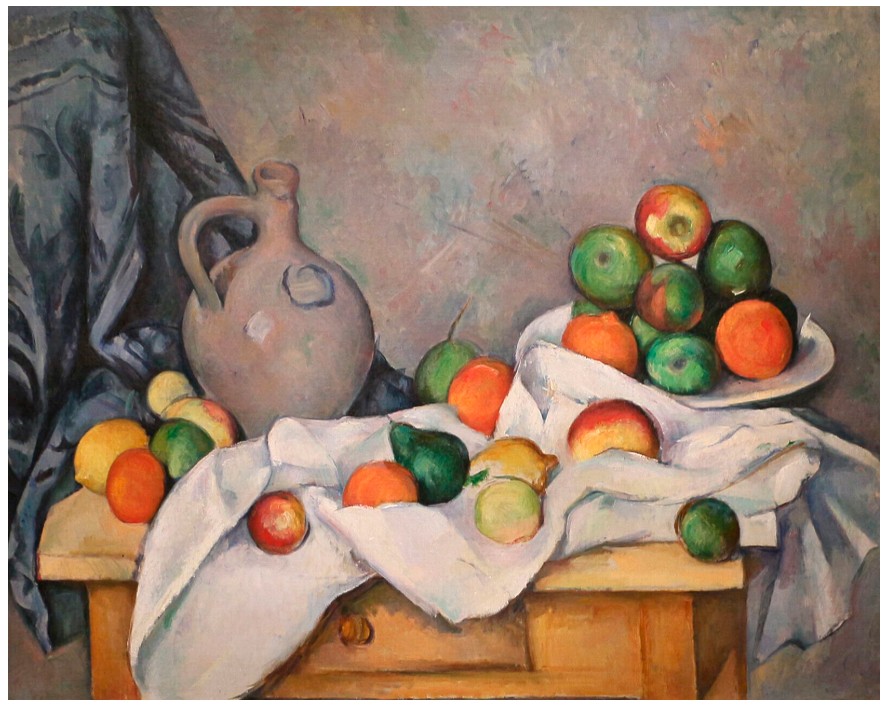
Paul Cézanne, Curtain, Jug and Dish of Fruit, 1894-94. National Gallery, London.
While Lichtenstein initially explored the still life theme in the early 1960s with stark renderings of mundane objects like tires or kitchen items, his approach evolved significantly in the 1970s. Works like Still Life with Portrait (Study) signal a shift toward more complex arrangements that retain his characteristic graphic punch while engaging more deeply with modernist themes. The late 1960s and 1970s marked a decisive shift in Roy Lichtenstein’s artistic trajectory, as he moved away from earlier subjects to engage directly with the lineage of art history itself. Still life’s centuries-old tradition afforded Lichtenstein the opportunity to indulge his fascination with composition’s formal qualities. He selected supple draped fabric, hard and reflective surfaces of frames and jugs, and organic surfaces such as fruit giving him a rich combination of textures to explore. These elements allowed him to revisit and recontextualize a centuries-old visual vocabulary using the stylized, mechanical aesthetic for which he is known. The evolution of the still life remains one of art history’s most enduring narratives, reflecting shifting philosophical attitudes toward material culture and human-object relations. Still Life with Portrait (Study) encapsulates two core principles that define Lichtenstein’s oeuvre: an acute understanding of the mechanics of visual communication, and a sustained engagement with the formal innovations of early modernism. The work’s juxtaposition of the portrait within a still life setting can be seen as a response to the collage strategies of Robert Rauschenberg, who fused disparate iconographic elements into unified yet disjunctive compositions that engage intellectually with image culture.
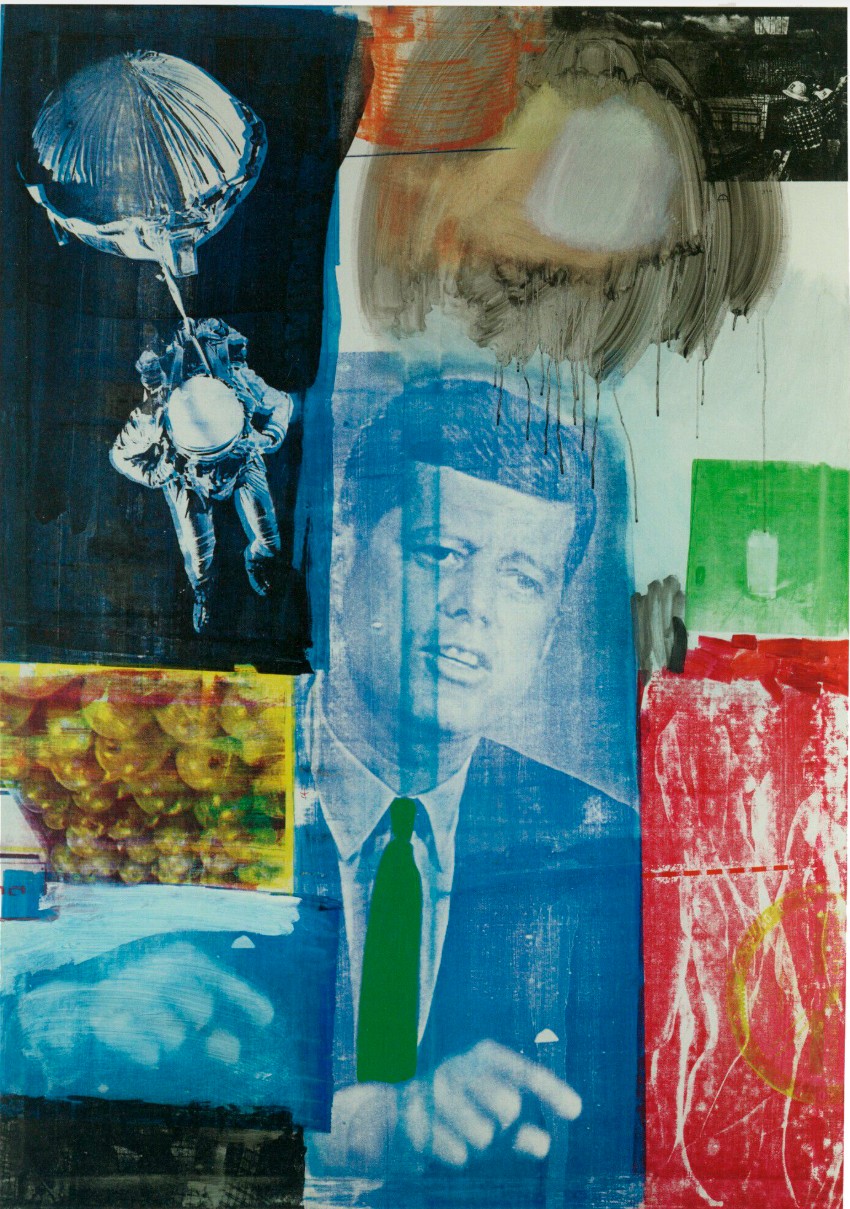
Robert Rauschenberg, Retroactive I, 1964. Wadsworth Atheneum, Hartford.
© 2025 Robert Rauschenberg Foundation / Licensed by VAGA at Artists Rights Society (ARS), New York.
By referencing the work of Picasso and Braque, while also maintaining affinities with Matisse, Lichtenstein positions the still life as a site of dialogue with modern art’s foundational figures, asserting his own place within modern art history. Gifted by the artist to his friends Joan and Kenneth Goldglit, Still Life with Portrait (Study) (1973), stands alongside major works held in prominent museum collections—such as Untitled (Still Life with Lemon and Glass) (1974) at The Metropolitan Museum of Art, Cubist Still Life (1974) at the National Gallery of Art, and Still Life with Crystal Bowl (1972) at the Whitney Museum. These paintings, alongside Still Life with Portrait (Study), showcase how Lichtenstein masterfully melded conceptual inquiry with the formal traditions of still life, transforming the genre into a self-reflexive platform for interrogating artistic identity, authorship, and the legacy of modernism.
#6. Reflections on Señorita (Study), circa 1990
A Legacy Reimagined: Works from the Collection of Dorothy and Roy Lichtenstein
Sotheby’s New-York: 19 November 2025
Estimated: USD 400,000 – 600,000
USD 952,500
WORK ON PAPER
Reflections on Señorita (Study) | Contemporary Day Auction | 2025 | Sotheby’s
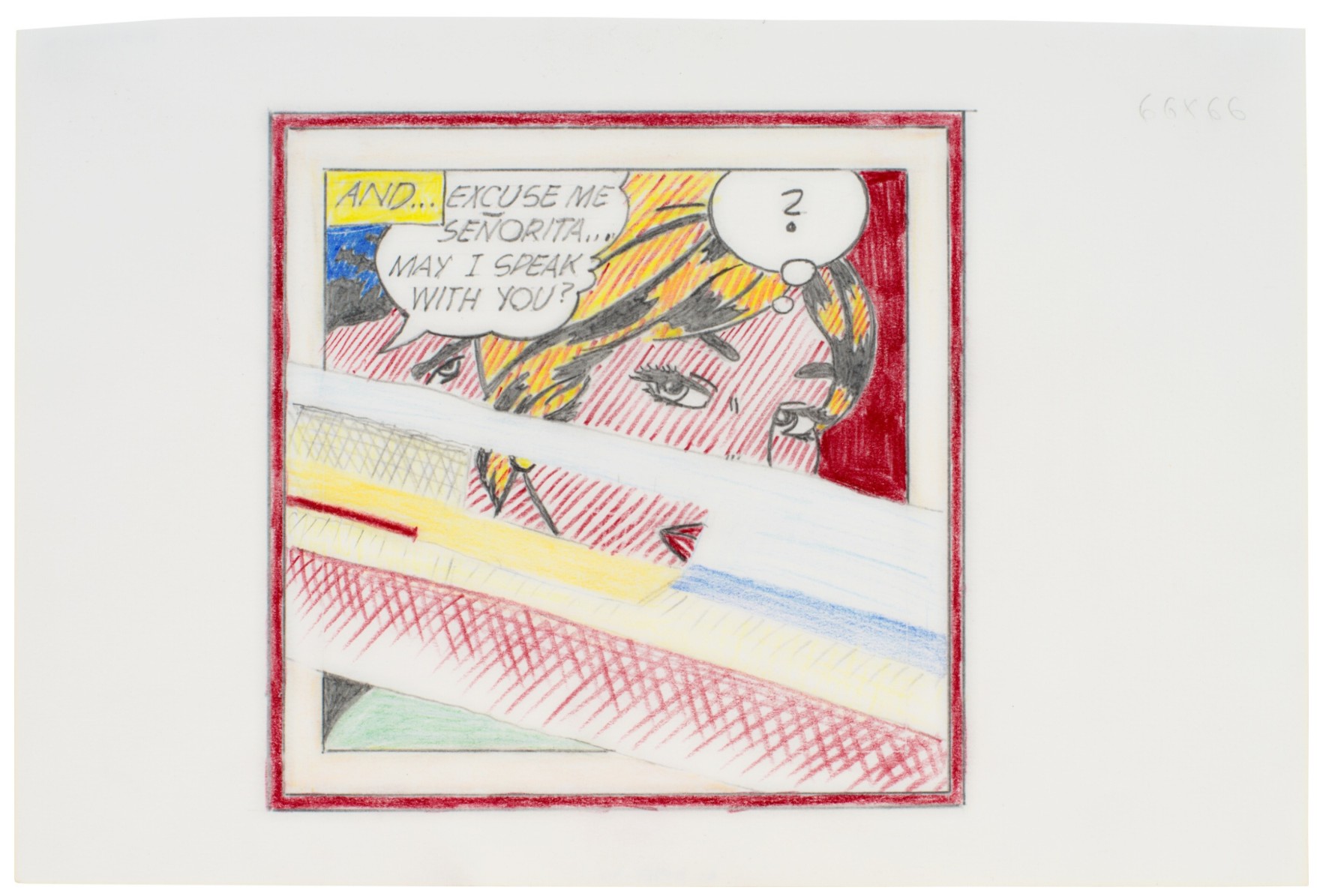
ROY LICHTENSTEIN (1923 – 1997)
Reflections on Señorita (Study), circa 1990
Colored pencil and graphite on paper
Image: 6 5/8 x 6 5/8 inches (16.8 x 16.8 cm)
Sheet: 8 1/4 x 12 1/4 inches (21 x 31.1 cm)
“I was very excited about and interested in the highly emotional content yet detached, impersonal handling of love, hate, war etc., in these cartoon images…
It is an intensification a stylistic intensification of the excitement which the subject matter has for me; but the style is, as you say, cool.
One of the things a cartoon does is to express violent emotion and passion in a completely mechanical and removed style.”
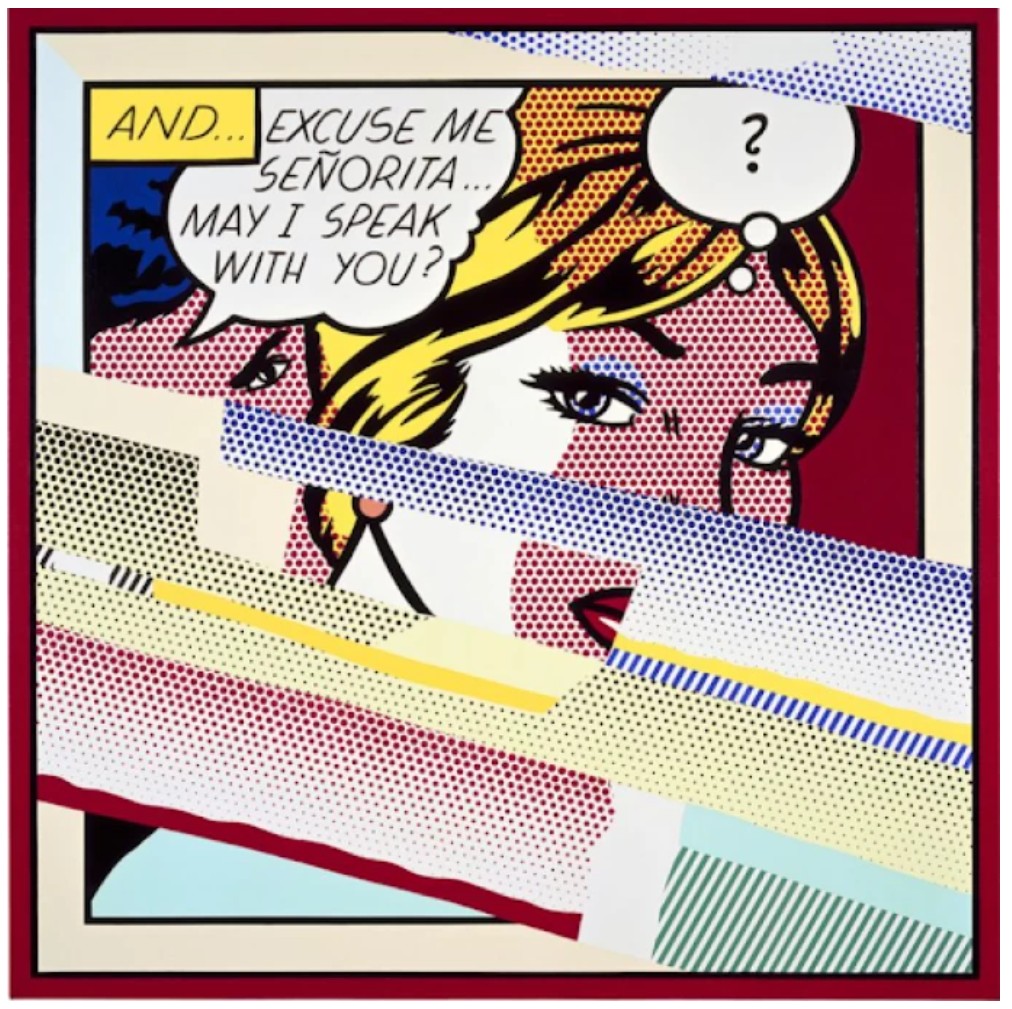
Roy Lichtenstein, Reflections on Señorita, 1990. Private Collection. Art © Estate of Roy Lichtenstein
#7. Sound of Music (Study), circa 1963-64
A Legacy Reimagined: Works from the Collection of Dorothy and Roy Lichtenstein
Sotheby’s New-York: 19 November 2025
Estimated: USD 800,000 – 1,200,000
USD 508,000
WORK ON PAPER
Sound of Music (Study) | The Now & Contemporary Evening Auction | 2025 | Sotheby’s
ROY LICHTENSTEIN (1923 – 1997)
Sound of Music (Study), circa 1963-64
Colored pencil and graphite on paper
Image: 4 x 4 3/4 inches (10.2 x 12.1 cm)
Sheet: 4 1/2 x 5 3/4 inches (11.4 x 14.6 cm)
Like a soft breeze, ledger lines gracefully stream through the open window, capturing our heroine’s attention with the “sound of music.” Executed circa 1963-64, Lichtenstein’s Sound of Music (Study) is an intimate scene of total enchantment. The present work is an iconic example of Lichtenstein’s legendary comic-inspired Pop works of the 1960s, which frequently capture beautiful heroines in melodramatic moments of surprise or marvel. Lichtenstein’s works from this period are among his most celebrated and paradigmatic, as the works which would catapult his fame and solidify his legendary status in Contemporary art. Preceding the artist’s iconic large-scale painting by the same title, the present work captures a moment of wonder and joy, paying homage to a 1962 comic illustration by Arthur Peddy published in the popular romance comic book, Heart Throbs. Lichtenstein’s studies are integral to his practice, as not only antecedents for large-scale paintings, but also fully realized works in and of themselves. The richly worked surface of the present work further reveals Lichtenstein’s presence and the conceptual development obscured from the precise execution of his paintings. Further testament to its importance, the present work has been featured in numerous major international exhibitions of Lichtenstein’s work, including the 2013 Retrospective at the Solomon R. Guggenheim Museum, New York (and traveling), the most comprehensive exhibition of the artist’s work to date.
“Each generation of illustrators makes modifications and reinforcements of these symbols, which then become part of the vocabulary of all. The result is an impersonal form. In my own work, I would like to bend this toward a new classicism.”
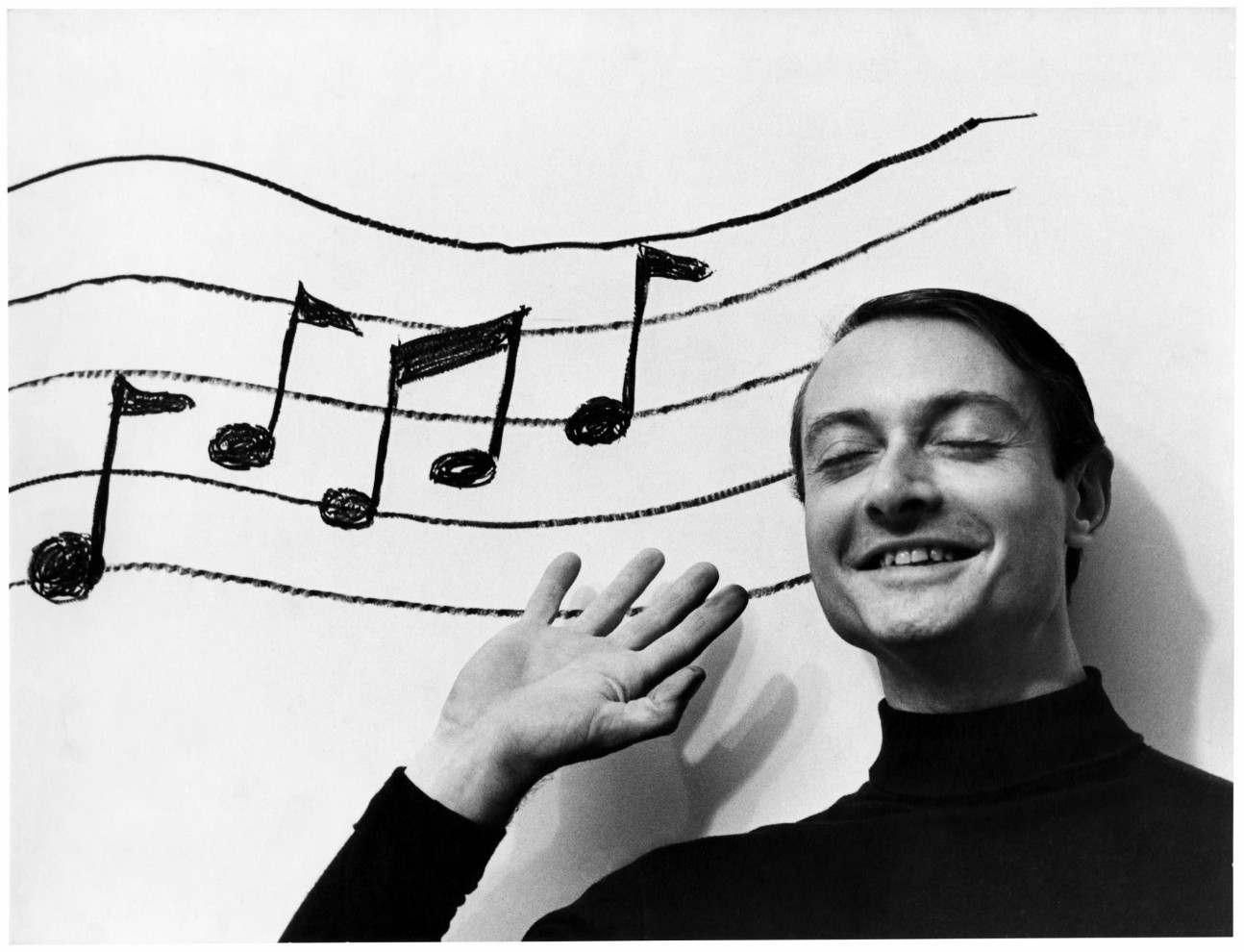
Roy Lichtenstein with musical notes, 1964. Photo Ugo Mulas © Ugo Mulas Heirs. All Rights Reserved
Entranced by musical melodies from afar, Lichtenstein’s subject gazes out towards the source of dazzling sounds. Her crystal blue eyes turn towards the window, her hand inquisitively rests on her chin, and her lips turn up in a smile. As with many of his early paintings, Lichtenstein closely crops the composition, so the figure’s face fills the majority of the picture plane. Her gaze, at once curious and playful, equally captivates the viewer who is privy to this clandestine moment of intrigue and intimacy. Inspired by the graphic and playful illustrations of contemporary comic book spreads, Lichtenstein recasts this popular iconography into the realm of fine art. An archival photograph from the artist’s studio reveals that Lichtenstein’s inspiration for the present work was a 1962 comic-book illustration for an amusing love story. Upon hearing a string of “La-La-La-La” from the window, the protagonist looks out and exclaims: “Oh, What a lovely baritone voice!” Lichtenstein’s figure appears deeply allured and intrigued by the music, coyly resisting the urge to turn her face fully towards the window, surrendering only a delicate smile. In Lichtenstein’s version, all text references are omitted from the composition, creating an additional layer of intrigue and fantasy to the scene. While created one year prior to the iconic 1965 film, The Sound of Music, Lichtenstein’s figure bears an undeniable resemblance to Maria Von Trapp and her infectious spirit which radiates a joyous mixture of innocence, mischief and exuberance.
Revealed through subtle shading and crisp graphite lines, Sound of Music (Study) offers a rare glimpse into Lichtenstein’s masterful creative process and the interventions hidden from his painted works. Through his studies, Lichtenstein resolved questions of composition and color, developing the structure for his bold contour lines, Ben-Day dots, and refined planes of pigment. Here, Lichtenstein renders the composition with vigorous graphite lines, defining areas of shading which will be replaced with Ben-Day dots in the painted iteration. The golden yellow of the protagonist’s hair gleams against the soft red and blue colored pencil used to render her face. The windowpanes are open and curtains billow in the breeze. In shifting from red to blue dots across the shadow of the figure’s face in the later canvas, Lichtenstein presages the same optical devices and illusions as Woman: Sunlight, Moonlight from 1996 and its collage study. His famed Ben-Day dots become a method of pictorial illusion, creating a juxtaposition between fullness and depth that further lends the work into fiction. This interplay between the study and the finished work reveals Lichtenstein’s creative interrogation of composition and depth, and the ongoing dialogue surrounding the representation of the female figure in the modern era.
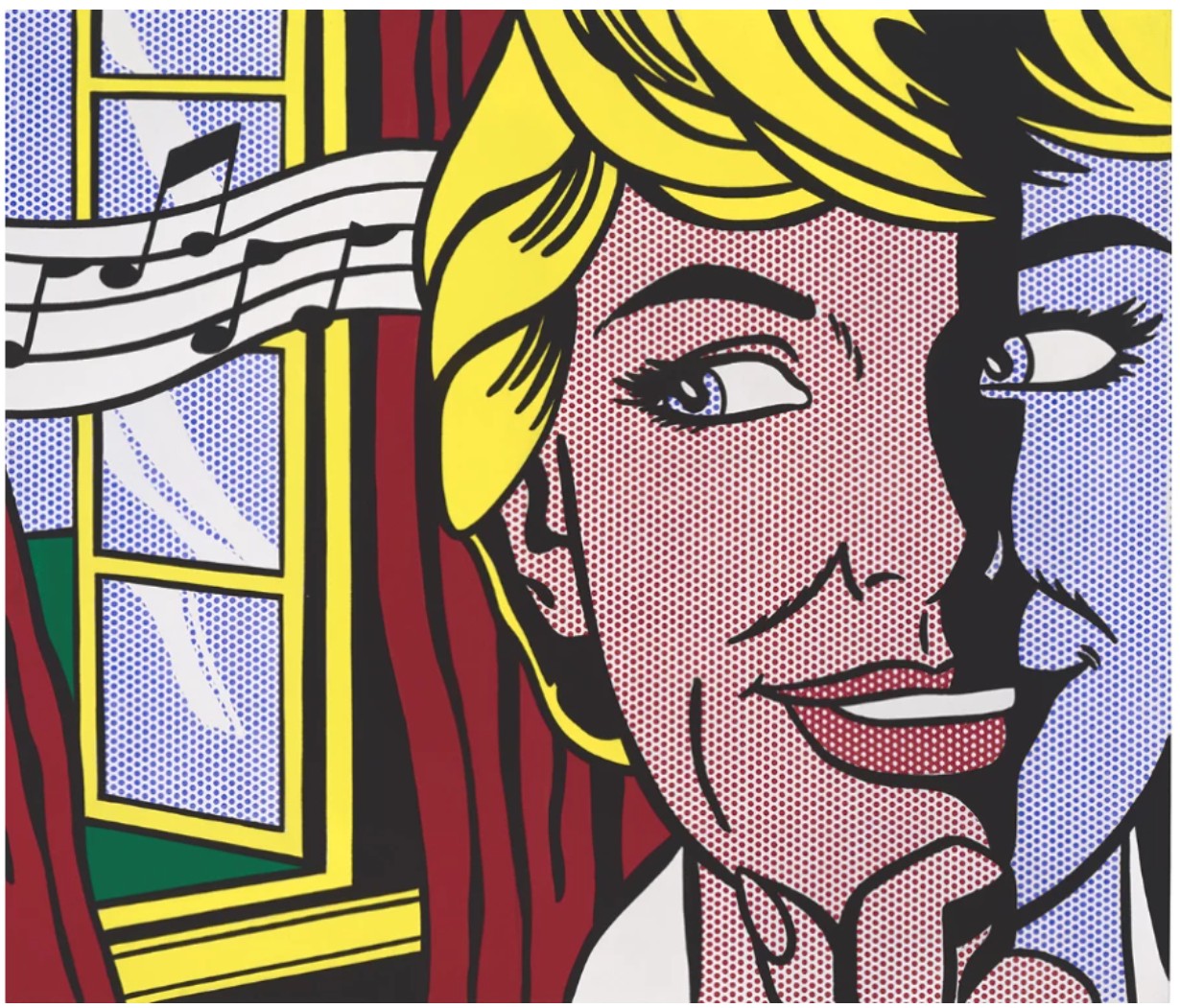
Roy Lichtenstein, Sound of Music, 1964. Private Collection. Art © 2025 Estate of Roy Lichtenstein / DACS
Drawn from the visual vocabulary of 1960s romance comics, Lichtenstein’s subject is simultaneously iconic and archetypal, embodying Lichtenstein’s enduring exploration of mass media’s portrayal of and commodification of feminine beauty. In his legendary “Girl Paintings,” Lichtenstein appropriates the artificial cliches of mid-century female glamour from magazines and advertisements, recasting them on canvas and brilliantly blurring the boundaries of high and low art. Through this method of appropriation, Lichtenstein exposed the artificiality of the comic-book heroes and their method of production. Reimaging these mass-produced fictional images through a process which is inherently manual and human. Somehow, the visibility of Lichtenstein’s intervention provides transparency and honesty to an image which is, of course, invented. Standing before Lichtenstein’s Sound of Music (Study), the viewer is enraptured by her wandering gaze and a sublime feeling of joy by the whisper of music. Lichtenstein’s rendering is a departure from the original comic illustration, imbued with a whimsy and innovation in the artist’s instantly recognizable Pop sensibility.
#8. Reflections on Thud! (Study), 1990
A Legacy Reimagined: Works from the Collection of Dorothy and Roy Lichtenstein
Sotheby’s New-York: 19 November 2025
Estimated: USD 250,000 – 350,000
USD 482,600
WORK ON PAPER
Reflections on Thud! (Study) | Contemporary Day Auction | 2025 | Sotheby’s
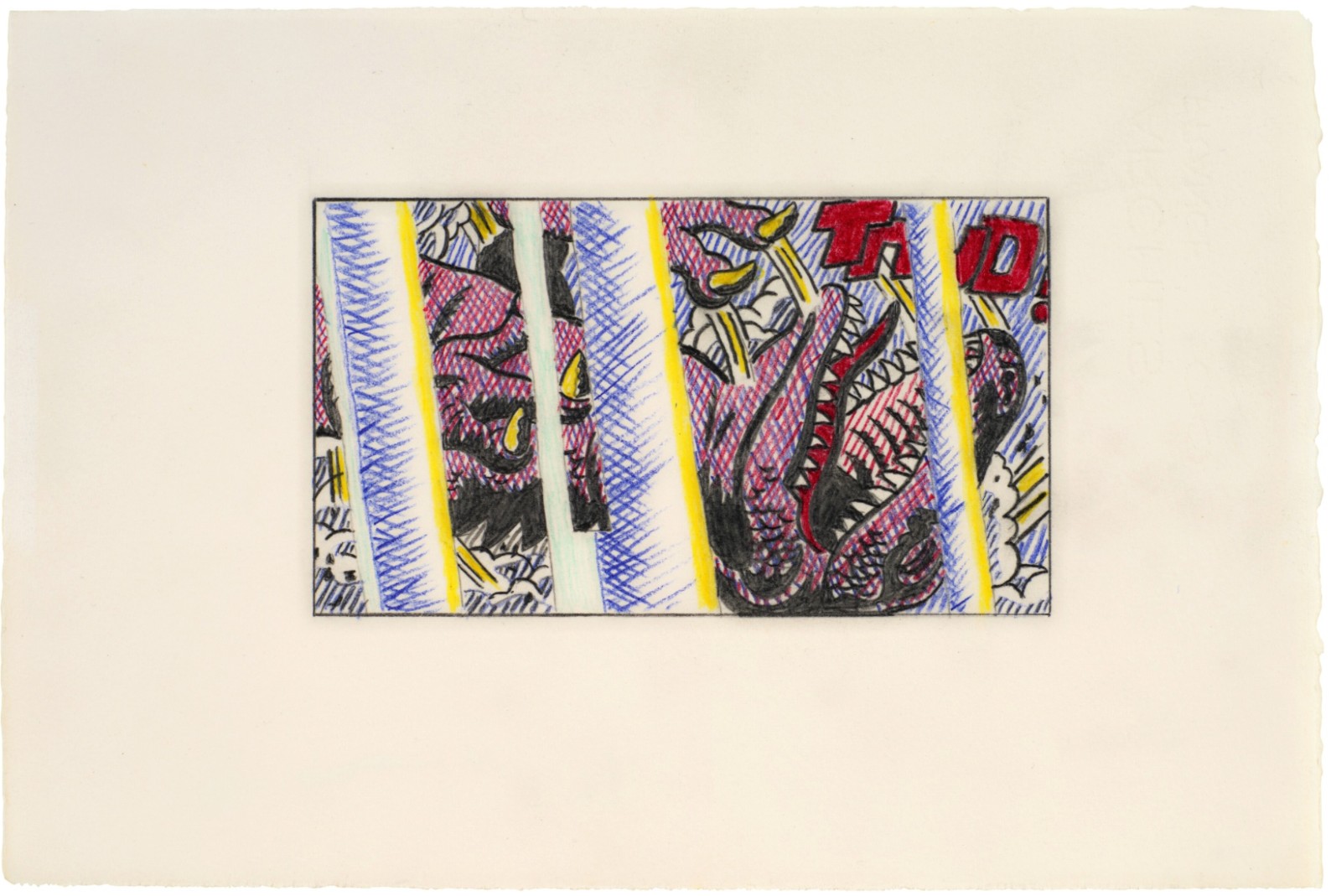
ROY LICHTENSTEIN (1923 – 1997)
Reflections on Thud! (Study), 1990
Colored pencil and graphite on paper
Image: 3 5/8 x 6 1/4 inches (9.2 x 15.9 cm)
Sheet: 7 1/2 x 11 1/8 inches (19 x 28.3 cm)
Signed and dated ‘90 (on the verso)
“I had been interested in the comic strip as a visual medium for a long time… This technique is a perfect example of an industrial process that developed as a direct result of the need for inexpensive and quick color-printing. These printed symbols attain perfection in the hands of commercial artists through the continuing idealization of the image made compatible with commercial considerations.”
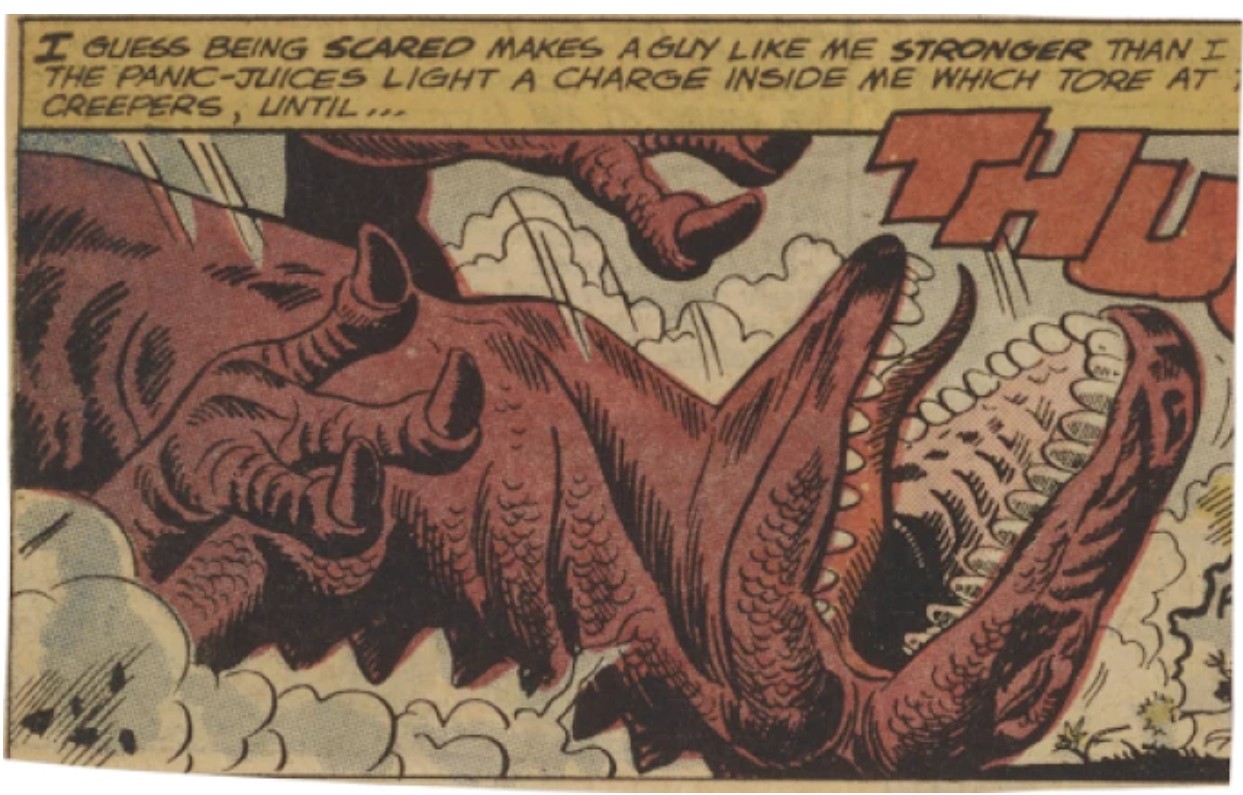
Source material for the present work from Star Spangled War Stories #117, October – November 1964.
#9. Piano, 1964
A Legacy Reimagined: Works from the Collection of Dorothy and Roy Lichtenstein
Sotheby’s New-York: 19 November 2025
Estimated: USD 300,000 – 400,000
USD 455,600
WORK ON PAPER
Piano | Contemporary Day Auction | 2025 | Sotheby’s
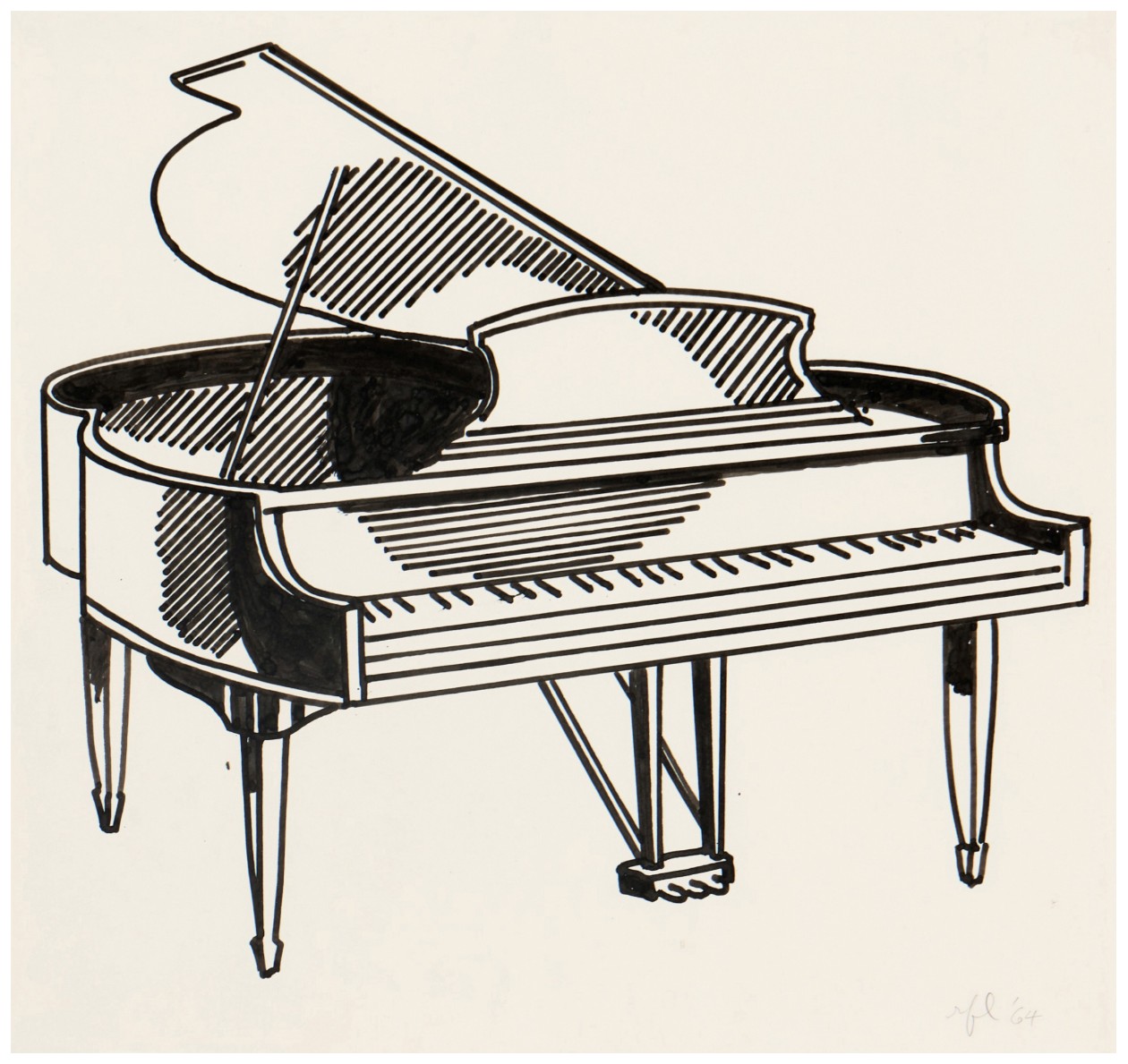
ROY LICHTENSTEIN (1923 – 1997)
Piano, 1964
Marker on paper
14 7/8 x 15 3/4 inches (37.8 x 40 cm)
Signed with the artist’s initials and dated ’64 (lower right)
“You know, as you compose music, you’re just off in your own world. You have no idea where reality is, so to have an idea of what people think is pretty hard.”
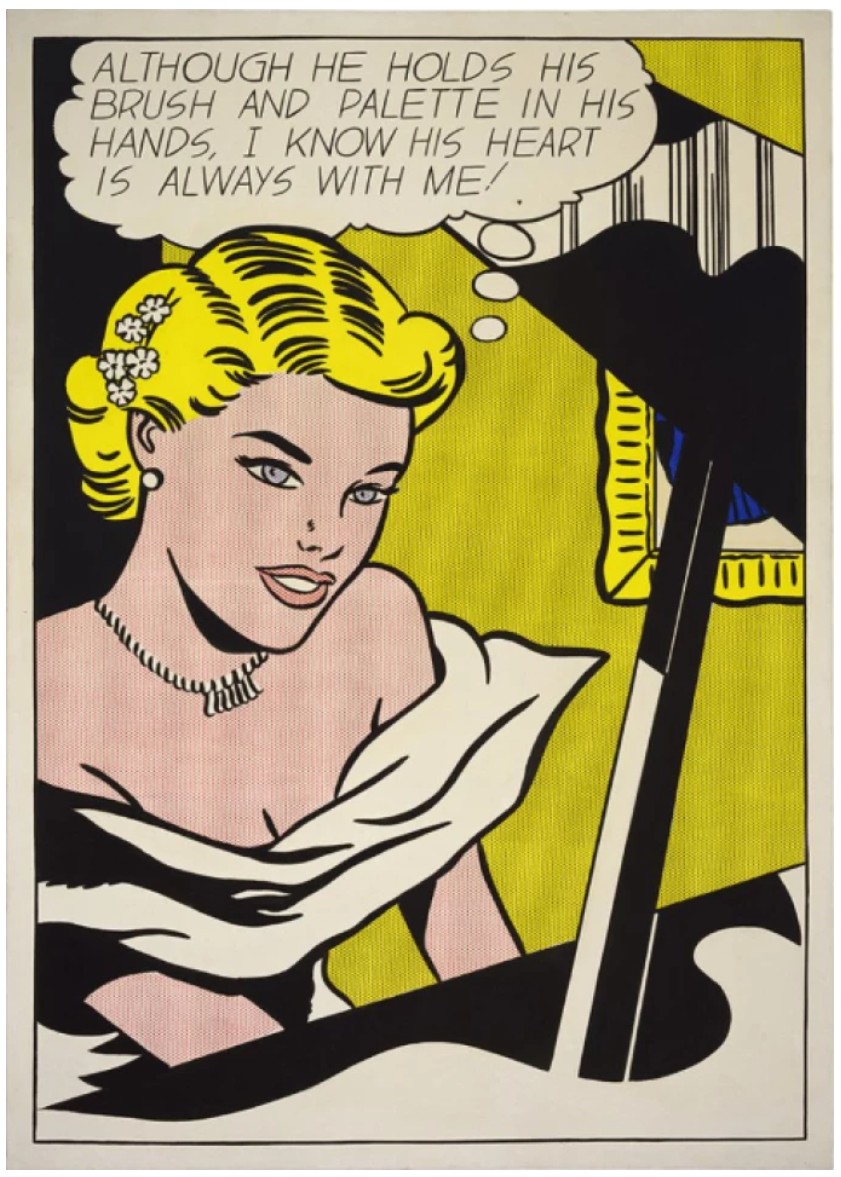
Roy Lichtenstein, Girl at Piano, 1963. Collection of Ronnie and Samuel Heyman. Art © Estate of Roy Lichtenstein
#10. Study for Large Red Barn (Study), 1969
Sotheby’s New-York: 19 November 2025
Estimated: USD 180,000 – 250,000
USD 279,400
WORK ON PAPER
Study for Large Red Barn (Study) | Contemporary Day Auction | 2025 | Sotheby’s
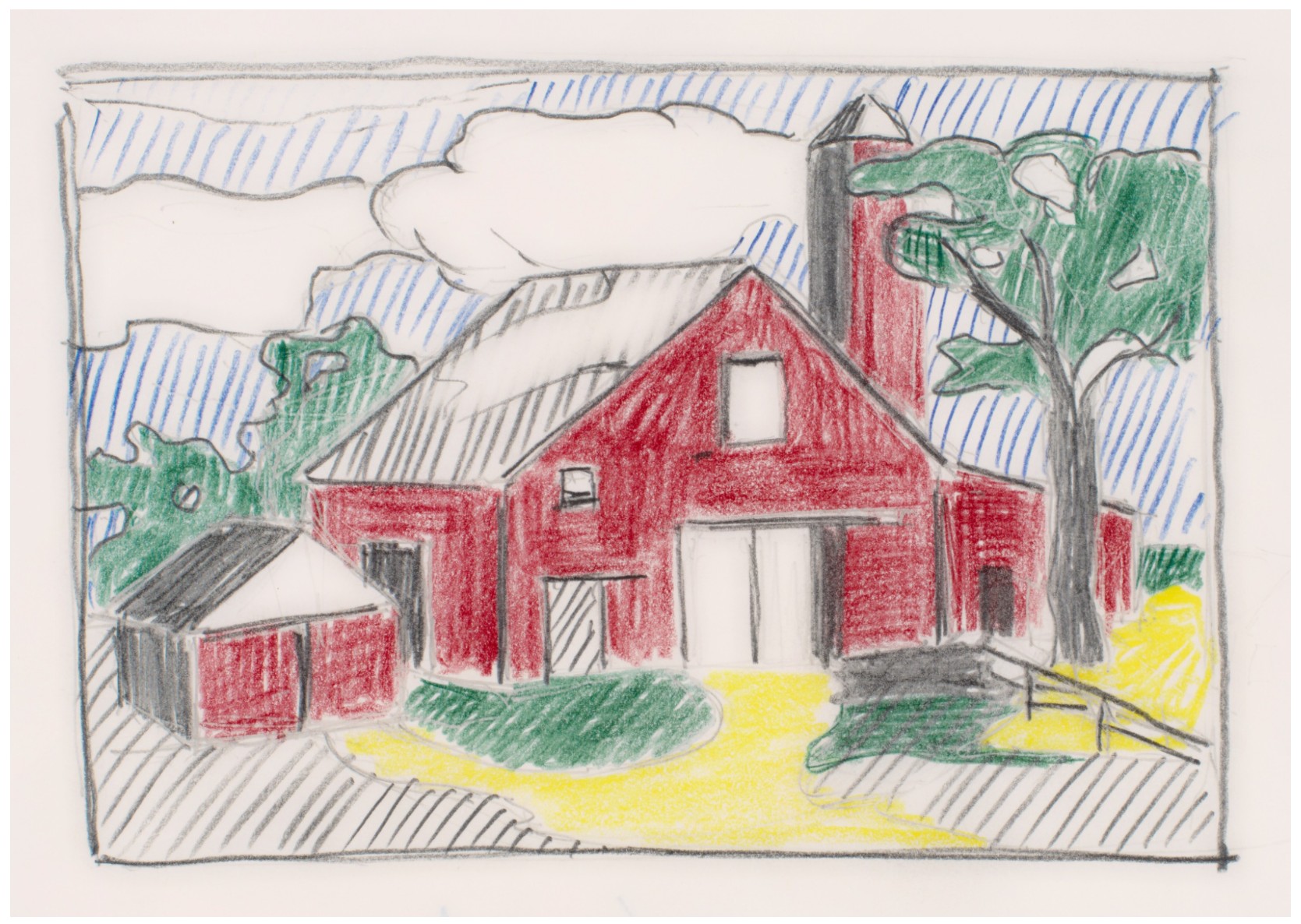
ROY LICHTENSTEIN (1923 – 1997)
Study for Large Red Barn (Study), 1969
Colored pencil and graphite on paper
Image: 4 x 5 3/4 inches (10.2 x 14.6 cm)
Sheet: 8 3/8 x 8 1/2 inches (21.3 x 21.6 cm)
Signed and dated ‘69 (on the verso)
#11. Mirror #1 (Study), 1970
Sotheby’s New-York: 19 November 2025
Estimated: USD 250,000 – 350,000
USD 279,400
Mirror #1 (Study) | Contemporary Day Auction | 2025 | Sotheby’s
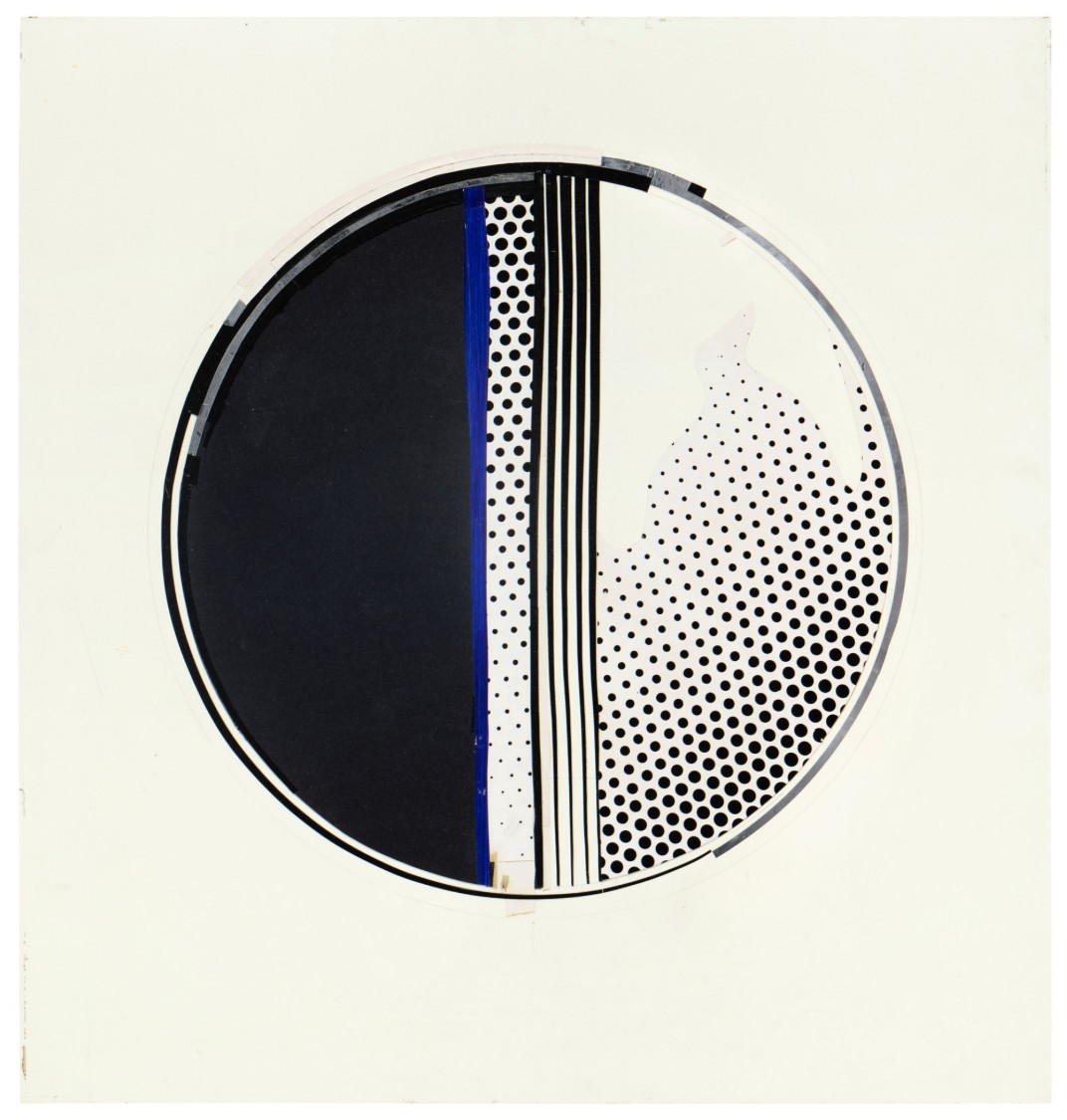
ROY LICHTENSTEIN (1923 – 1997)
Mirror #1 (Study), 1970
Cut painted and printed paper, tape, aluminum foil and graphite on board
Image diameter: 21 inches (53.3 cm)
Board: 29 3/8 x 28 inches (74.6 x 71.1 cm)
Signed and dated ’70 (on the verso)
#12. Temple II (Study), 1965
A Legacy Reimagined: Works from the Collection of Dorothy and Roy Lichtenstein
Sotheby’s New-York: 19 November 2025
Estimated: USD 150,000 – 200,000
USD 254,000
WORK ON PAPER
Temple II (Study) | Contemporary Day Auction | 2025 | Sotheby’s
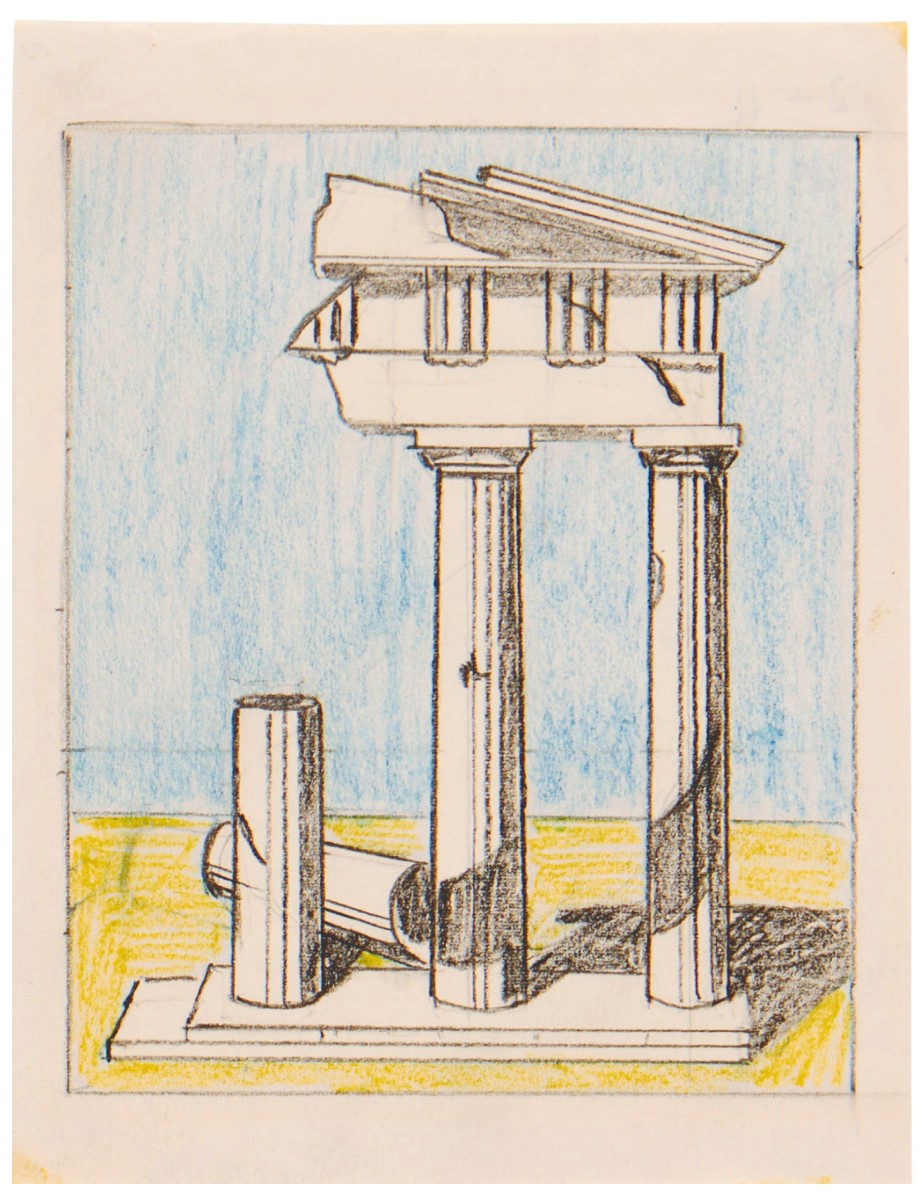
ROY LICHTENSTEIN (1923 – 1997)
Temple II (Study), 1965
Colored pencil and graphite on paper
Image: 4 3/4 x 3 7/8 inches (12.1 x 9.8 cm)
Sheet: 5 3/4 x 4 1/2 inches (14.6 x 11.4 cm)
#13. Trompe l’Oeil with Léger Head and Paintbrush (Study), 1973
A Legacy Reimagined: Works from the Collection of Dorothy and Roy Lichtenstein
Sotheby’s New-York: 19 November 2025
Estimated: USD 100,000 – 150,000
USD 177,800
WORK ON PAPER
Trompe l’Oeil with Léger Head and Paintbrush (Study) | Contemporary Day Auction | 2025 | Sotheby’s
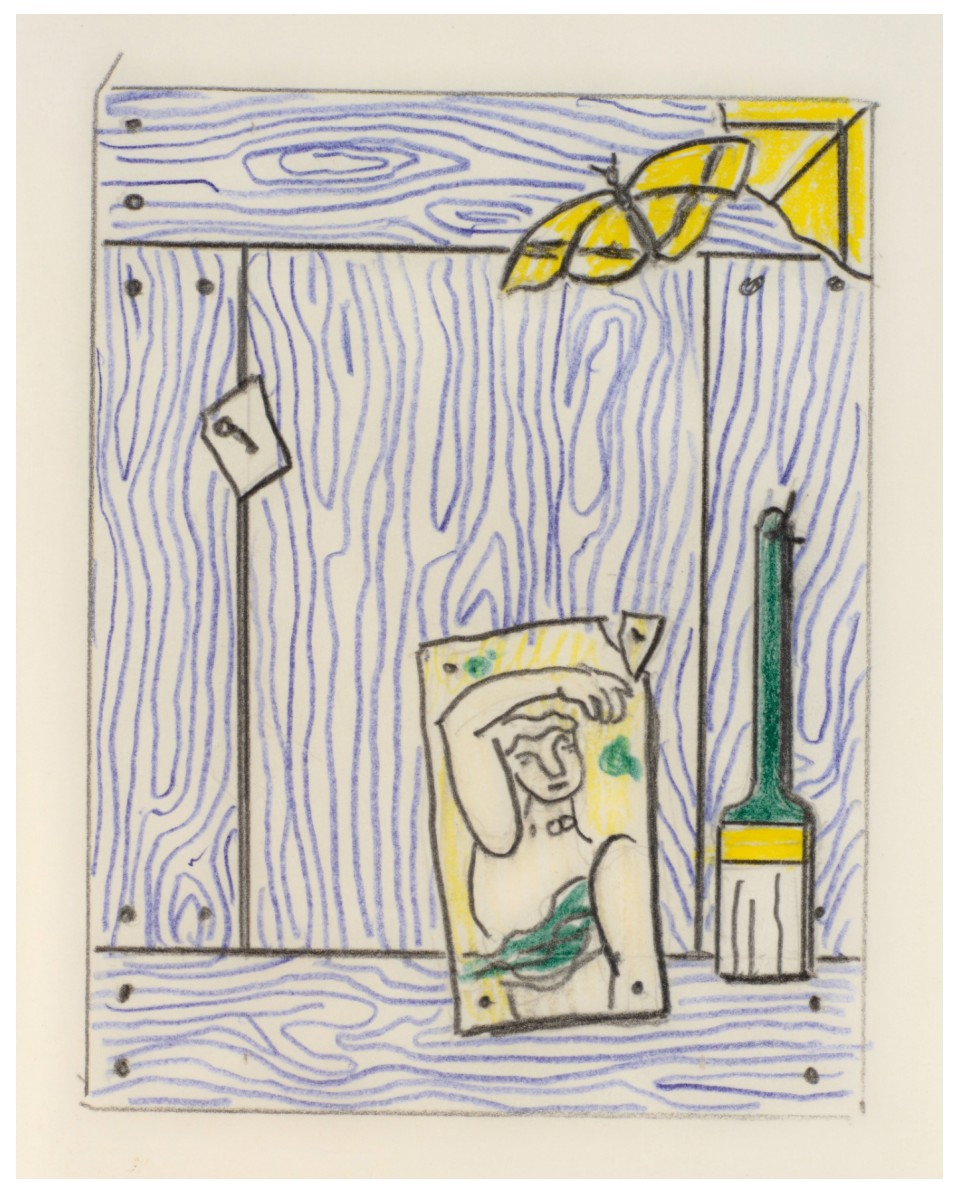
ROY LICHTENSTEIN (1923 – 1997)
Trompe l’Oeil with Léger Head and Paintbrush (Study), 1973
Colored pencil and graphite on paper
Image: 4 3/4 x 3 3/4 inches (12.1 x 9.5 cm)
Sheet: 8 1/4 x 5 inches (21 x 12.6 cm)
Signed and dated ‘73 (on the verso)
#14. Interior (Study), 1989
Christie’s New-York: 20 N0vember 2025
Estimated: USD 80,000 – 120,000
USD 165,100
WORK ON PAPER
ROY LICHTENSTEIN (1923-1997), Interior (Study) | Christie’s
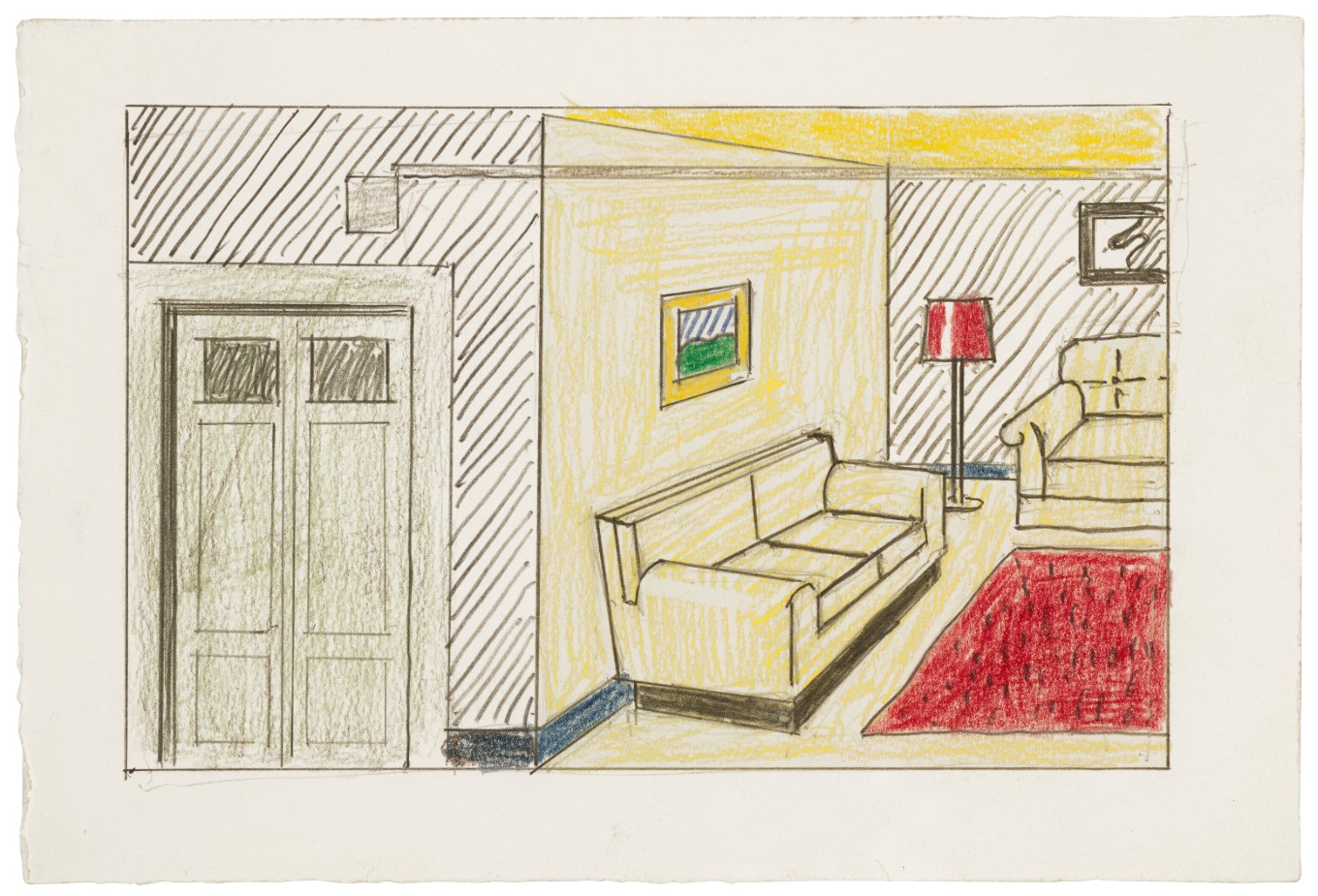
ROY LICHTENSTEIN (1923-1997)
Interior (Study), 1989
Colored pencil and graphite on paper
Image: 5 3/4 x 9 inches (14.6 x 22.9 cm)
Sheet: 7 1/2 x 11 1/8 inches (19.1 x 28.2 cm)
Signed and dated ‘r.f. Lichtenstein ’89’ (on the reverse)
#15. Reflections of “Large Interior” (Study), 1993
A Legacy Reimagined: Works from the Collection of Dorothy and Roy Lichtenstein
Sotheby’s New-York: 19 November 2025
Estimated: USD 400,000 – 600,000
USD 139,700
WORK ON PAPER
Reflections of “Large Interior” (Study) | Contemporary Day Auction | 2025 | Sotheby’s
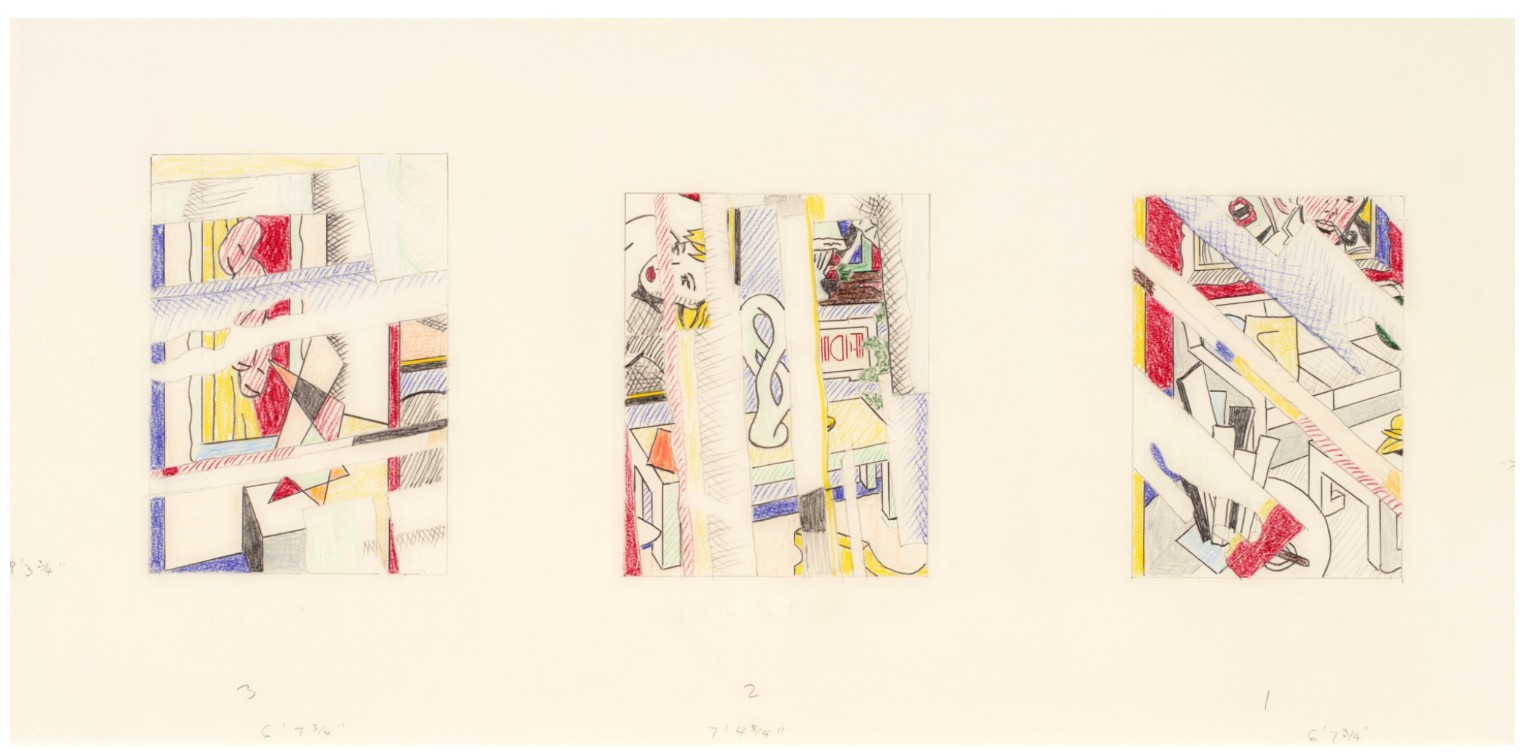
ROY LICHTENSTEIN (1923 – 1997)
Reflections of “Large Interior” (Study), 1993
Colored pencil and graphite on paper
Sheet: 15 1/8 x 30 inches (38.4 x 76.2 cm)
#16. Airplane (Study), 1989
A Legacy Reimagined: Works from the Collection of Dorothy and Roy Lichtenstein
Sotheby’s New-York: 19 November 2025
Estimated: USD 40,000 – 60,000
USD 127,200
WORK ON PAPER
Airplane (Study) | Contemporary Day Auction | 2025 | Sotheby’s
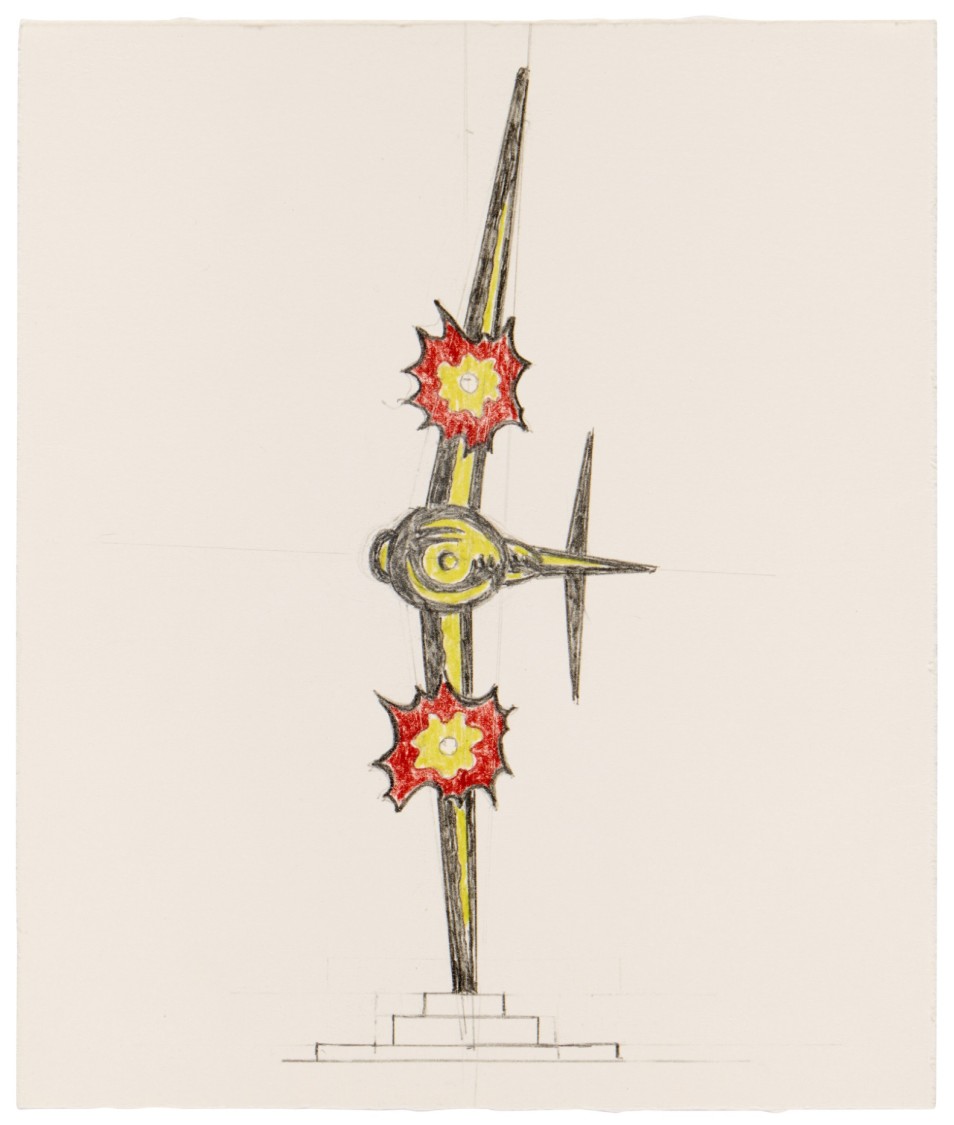
ROY LICHTENSTEIN (1923 – 1997)
Airplane (Study), 1989
Colored pencil and graphite on paper
9 x 7 1/2 inches (22.9 x 19.1 cm)
Dated ‘89 (on the verso)
#17. Composition (Washbasin Panel) (Study), 1965
A Legacy Reimagined: Works from the Collection of Dorothy and Roy Lichtenstein
Sotheby’s New-York: 19 November 2025
Estimated: USD 300,000 – 400,000
USD 127,000
WORK ON PAPER
Composition (Washbasin Panel) (Study) | Contemporary Day Auction | 2025 | Sotheby’s
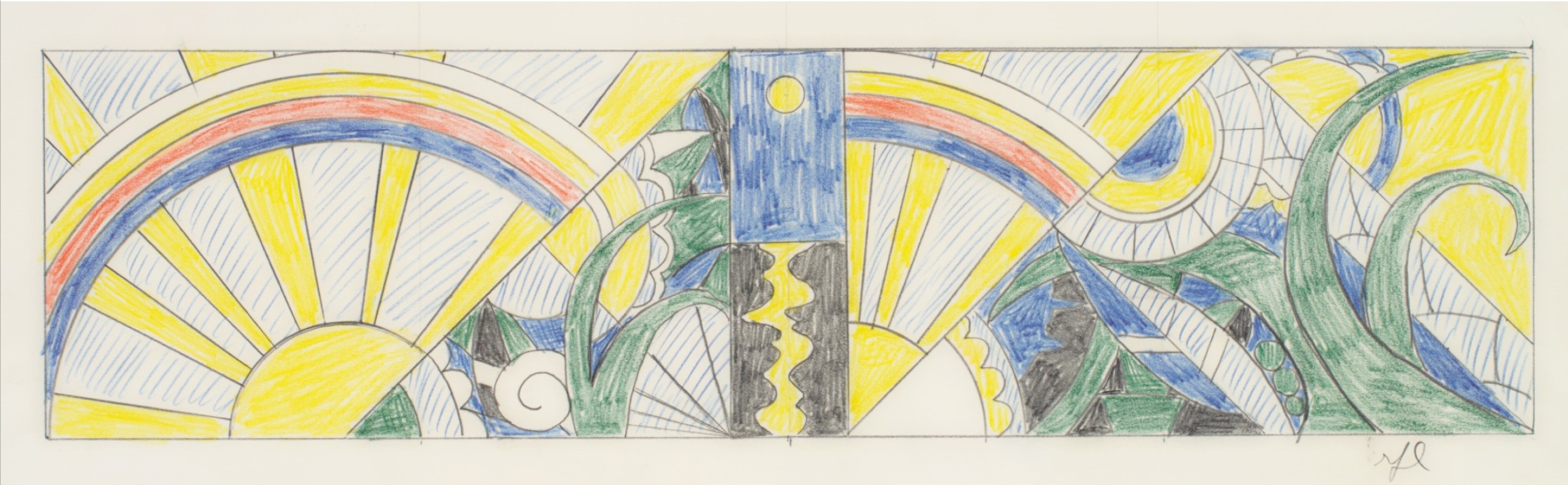
ROY LICHTENSTEIN (1923 – 1997)
Composition (Washbasin Panel) (Study), 1965
Colored pencil and graphite on paper
Image: 5 1/8 x 19 1/4 inches (12.9 x 48.9 cm)
Sheet: 9 1/4 x 22 7/8 inches (23.5 x 58.1 cm)
Signed with the artist’s initials (lower right)
#18. New Born (Study), circa 1988
A Legacy Reimagined: Works from the Collection of Dorothy and Roy Lichtenstein
Sotheby’s New-York: 19 November 2025
Estimated: USD 50,000 – 70,000
USD 88,900
New Born (Study) | Contemporary Day Auction | 2025 | Sotheby’s
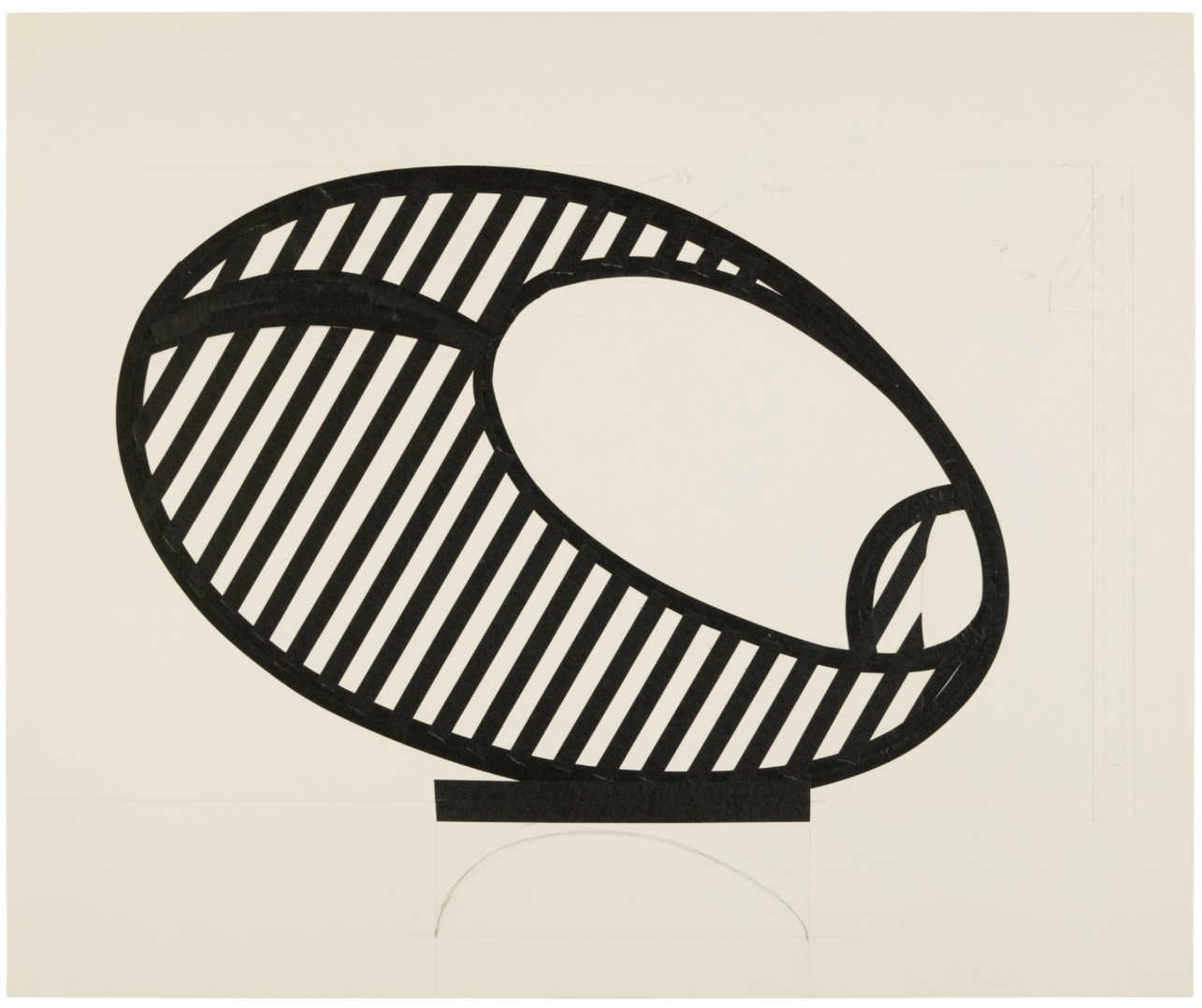
ROY LICHTENSTEIN (1923 – 1997)
New Born (Study), circa 1988
Graphite and tape on board
18 1/4 x 22 inches (46.3 x 55.9 cm)
Signed and dated ‘89 (on the verso)
#19. Cubist Still Life (Study), 1974
Christie’s New-York: 20 November 2025
Estimated: USD 70,000 – 100,000
USD 88,900
WORK ON PAPER
ROY LICHTENSTEIN (1923-1997), Cubist Still Life (Study) | Christie’s
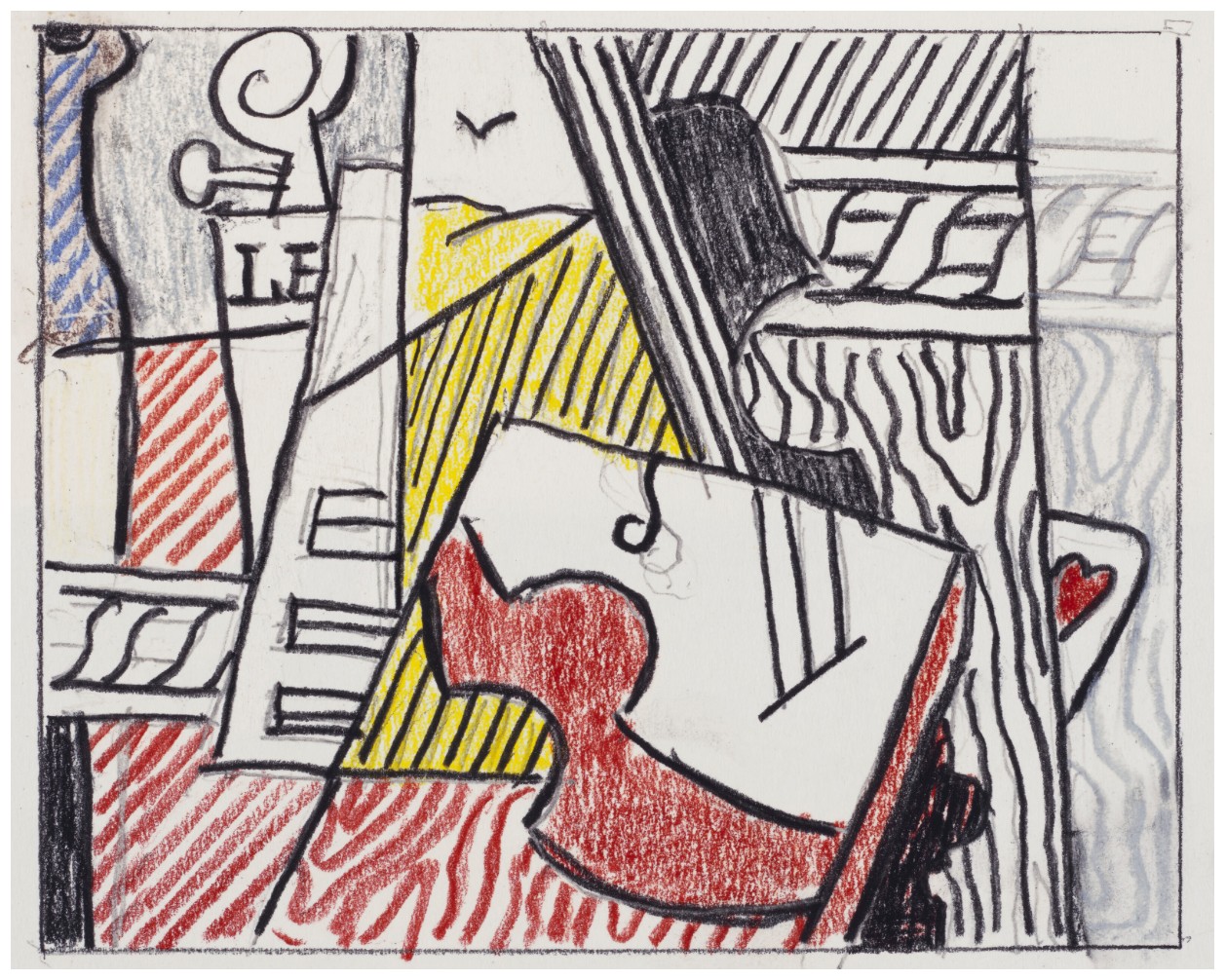
ROY LICHTENSTEIN (1923-1997)
Cubist Still Life (Study), 1974
Colored pencil and graphite on paper
Image: 3 3/4 x 4 5/8 inches (9.5 x 11.7 cm)
Sheet: 7 1/8 x 9 inches (17.9 x 22.9 cm)
Signed and dated ‘rf Lichtenstein ’74’ (on the reverse)
#20. Girl with Beach Ball II (Study), 1976
A Legacy Reimagined: Works from the Collection of Dorothy and Roy Lichtenstein
Sotheby’s New-York: 19 November 2025
Estimated: USD 100,000 – 150,000
USD 76,200
Girl with Beach Ball II (Study) | Contemporary Day Auction | 2025 | Sotheby’s
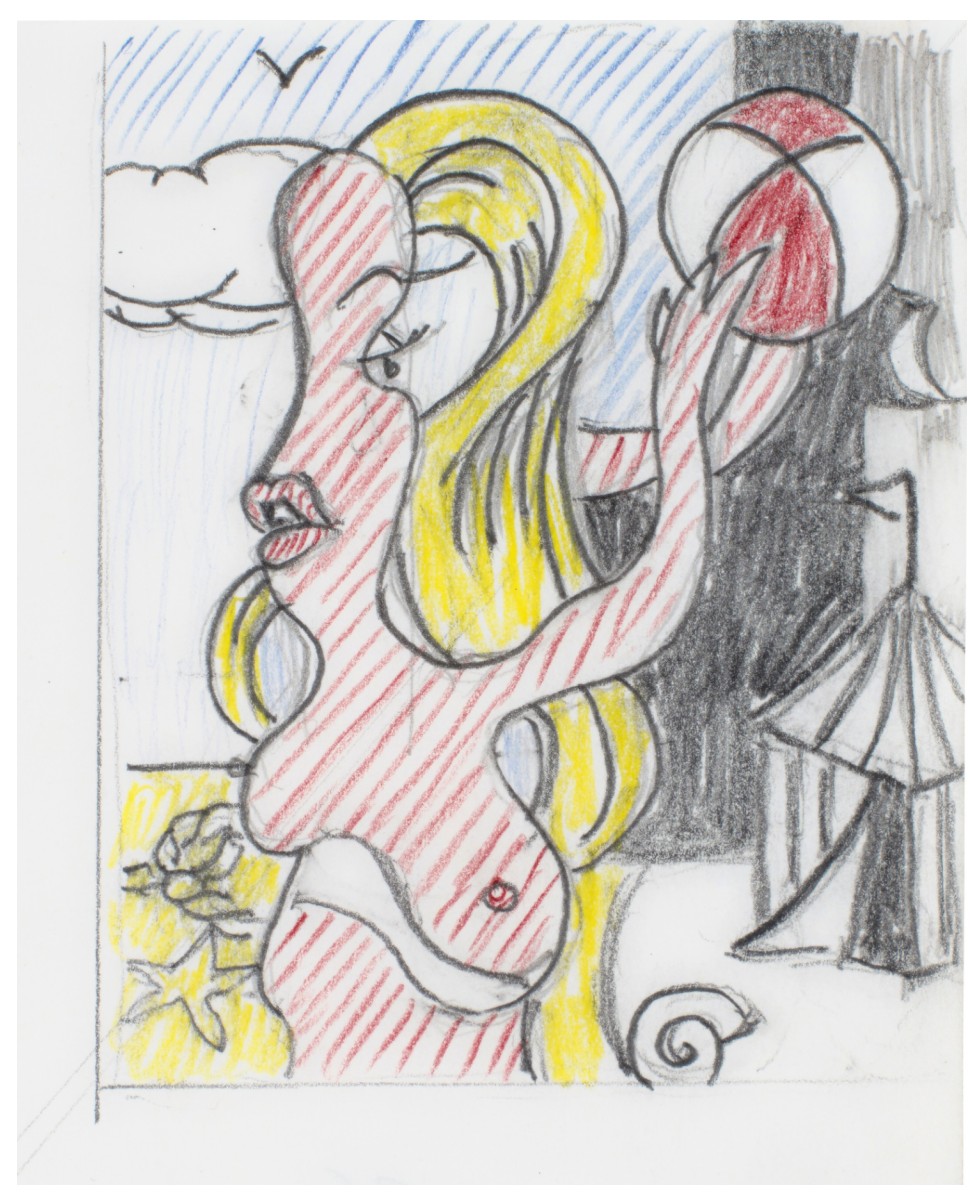
ROY LICHTENSTEIN (1923 – 1997)
Girl with Beach Ball II (Study), 1976
Colored pencil and graphite on paper
Image: 3 5/8 x 2 7/8 inches (9.2 x 7.3 cm)
Sheet: 5 7/8 x 3 5/8 inches (14.9 x 9.2 cm)
Signed, titled and dated 76 (on the verso)
#21. Still Life with Portrait of a Woman (Study), 1997
A Legacy Reimagined: Works from the Collection of Dorothy and Roy Lichtenstein
Sotheby’s New-York: 19 November 2025
Estimated: USD 80,000 – 120,000
USD 63,500
Still Life with Portrait of a Woman (Study) | Contemporary Day Auction | 2025 | Sotheby’s
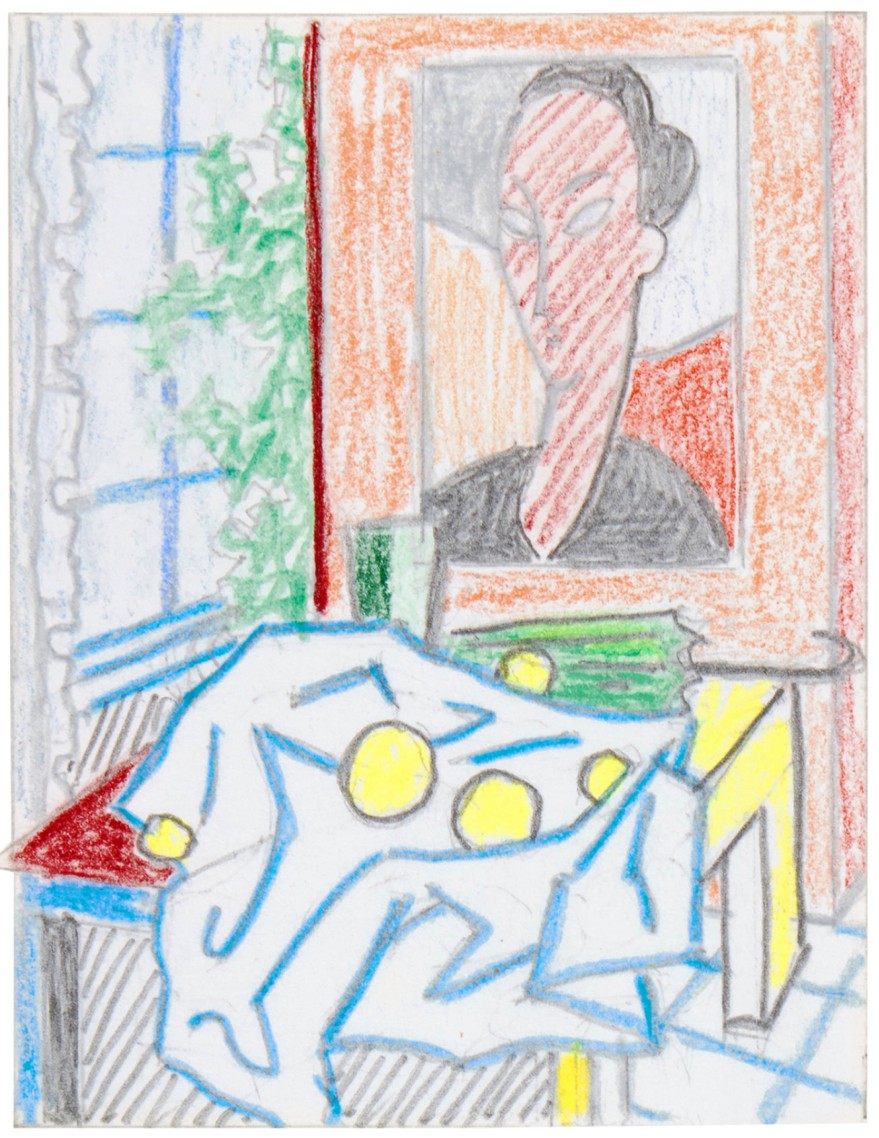
ROY LICHTENSTEIN (1923 – 1997)
Still Life with Portrait of a Woman (Study), 1997
Colored pencil and graphite on paper
Image: 4 7/8 x 3 3/4 inches (12.4 x 9.5 cm)
Sheet: 12 1/8 x 9 inches (30.8 x 22.9 cm)
#22. Modern Painting with Black Sun (Study), circa 1967
A Legacy Reimagined: Works from the Collection of Dorothy and Roy Lichtenstein
Sotheby’s New-York: 19 November 2025
Estimated: USD 40,000 – 60,000
USD 53,340
WORK ON PAPER
Modern Painting with Black Sun (Study) | Contemporary Day Auction | 2025 | Sotheby’s
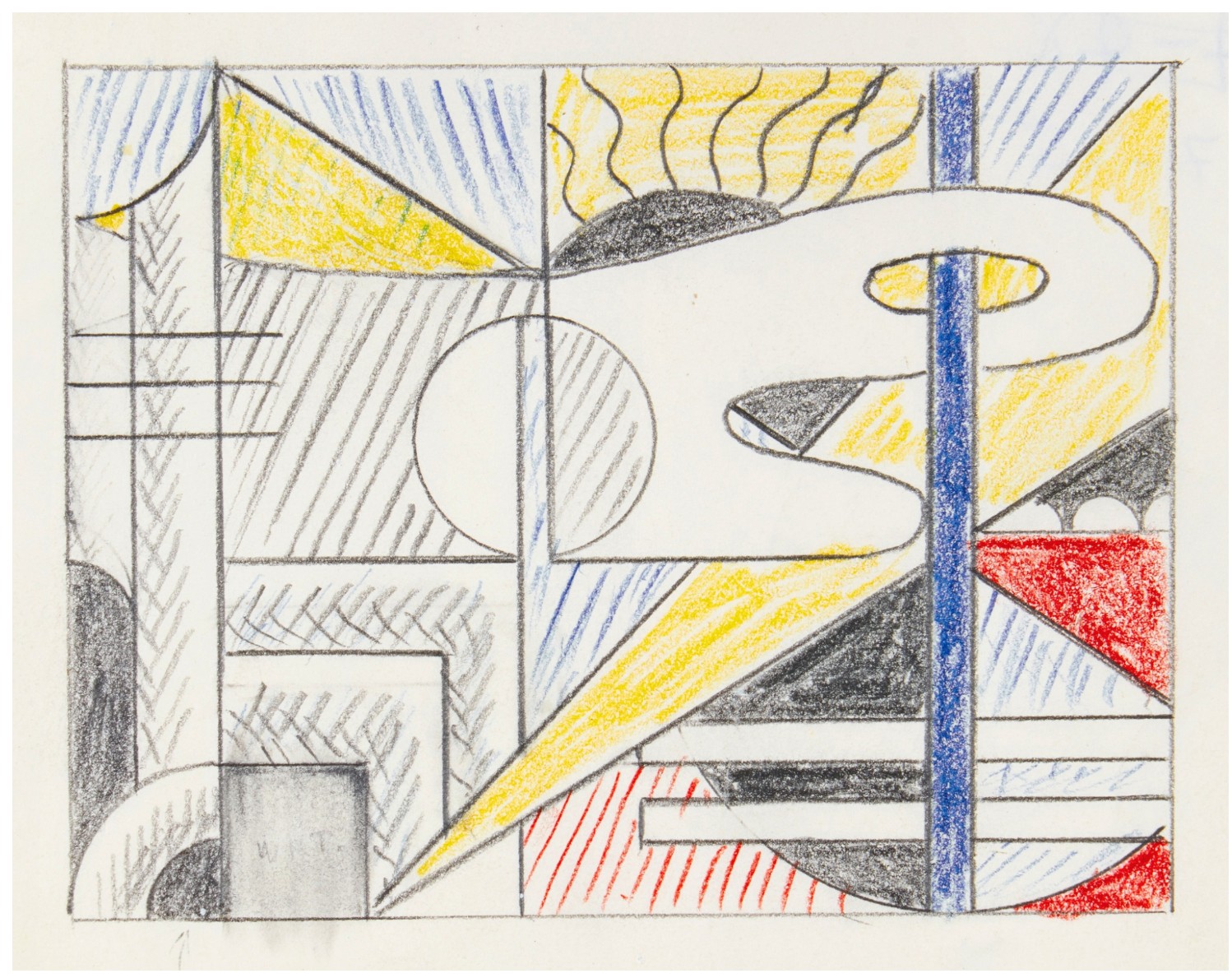
ROY LICHTENSTEIN (1923 – 1997)
Modern Painting with Black Sun (Study), circa 1967
Solored pencil and graphite on paper
Image: 3 1/2 x 4 1/2 inches (8.9 x 11.4 cm)
Sheet: 4 5/8 x 6 1/2 inches (11.7 x 16.5 cm)
#23. Untitled Shirt (Study), circa 1979
A Legacy Reimagined: Works from the Collection of Dorothy and Roy Lichtenstein
Sotheby’s New-York: 19 November 2025
Estimated: USD 40,000 – 60,000
USD 50,800
Untitled Shirt (Study) | Contemporary Day Auction | 2025 | Sotheby’s
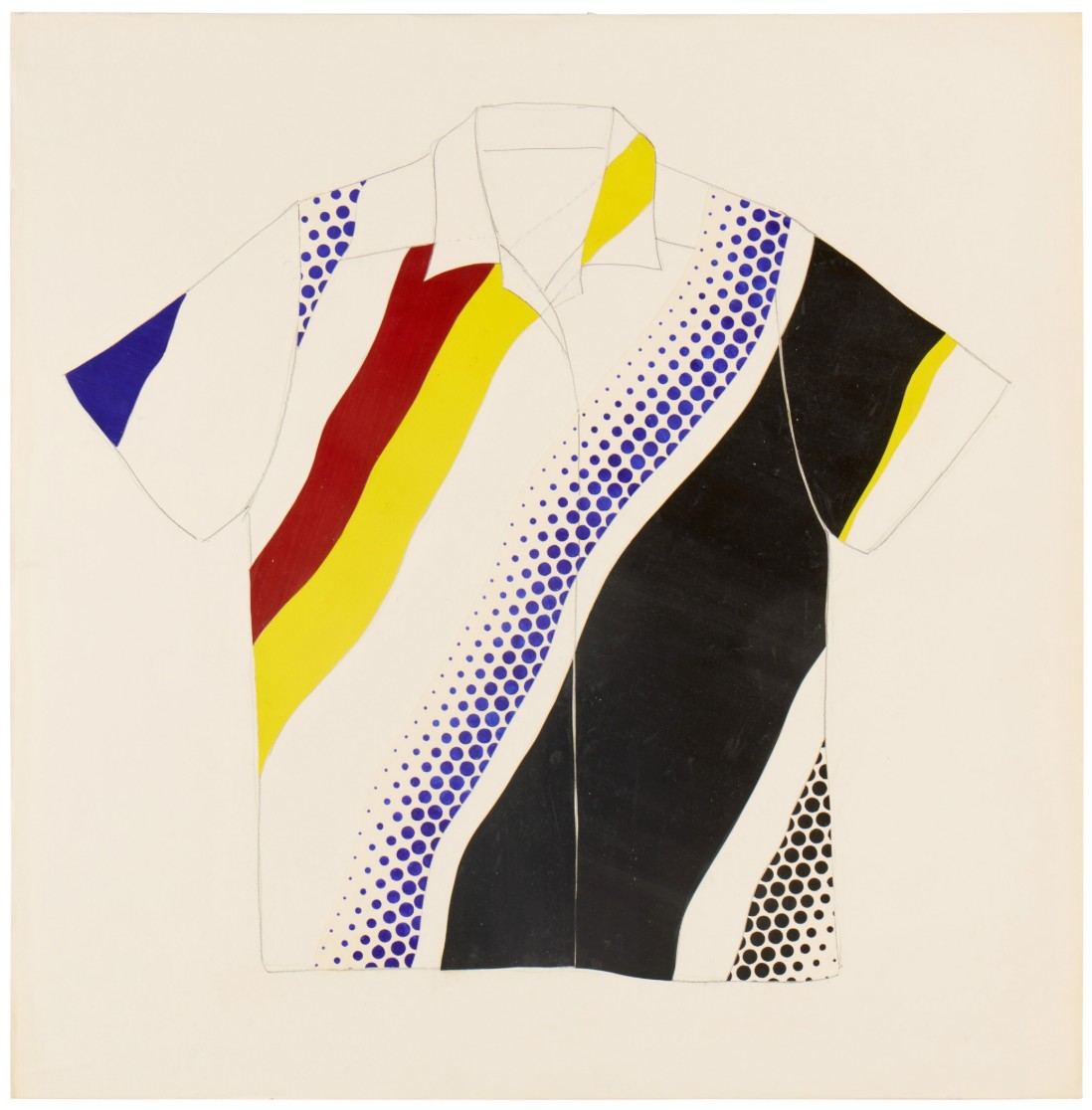
ROY LICHTENSTEIN (1923 – 1997)
Untitled Shirt (Study), circa 1979
Cut painted paper, colored pencil and graphite on board
40 3/4 x 40 1/4 inches (103.5 x 102.2 cm)
Entablature V (Study), 1976
A Legacy Reimagined: Works from the Collection of Dorothy and Roy Lichtenstein
Sotheby’s New-York: 19 November 2025
Estimated: USD 120,000 – 180,000
PASSED
Entablature V (Study) | Contemporary Day Auction | 2025 | Sotheby’s
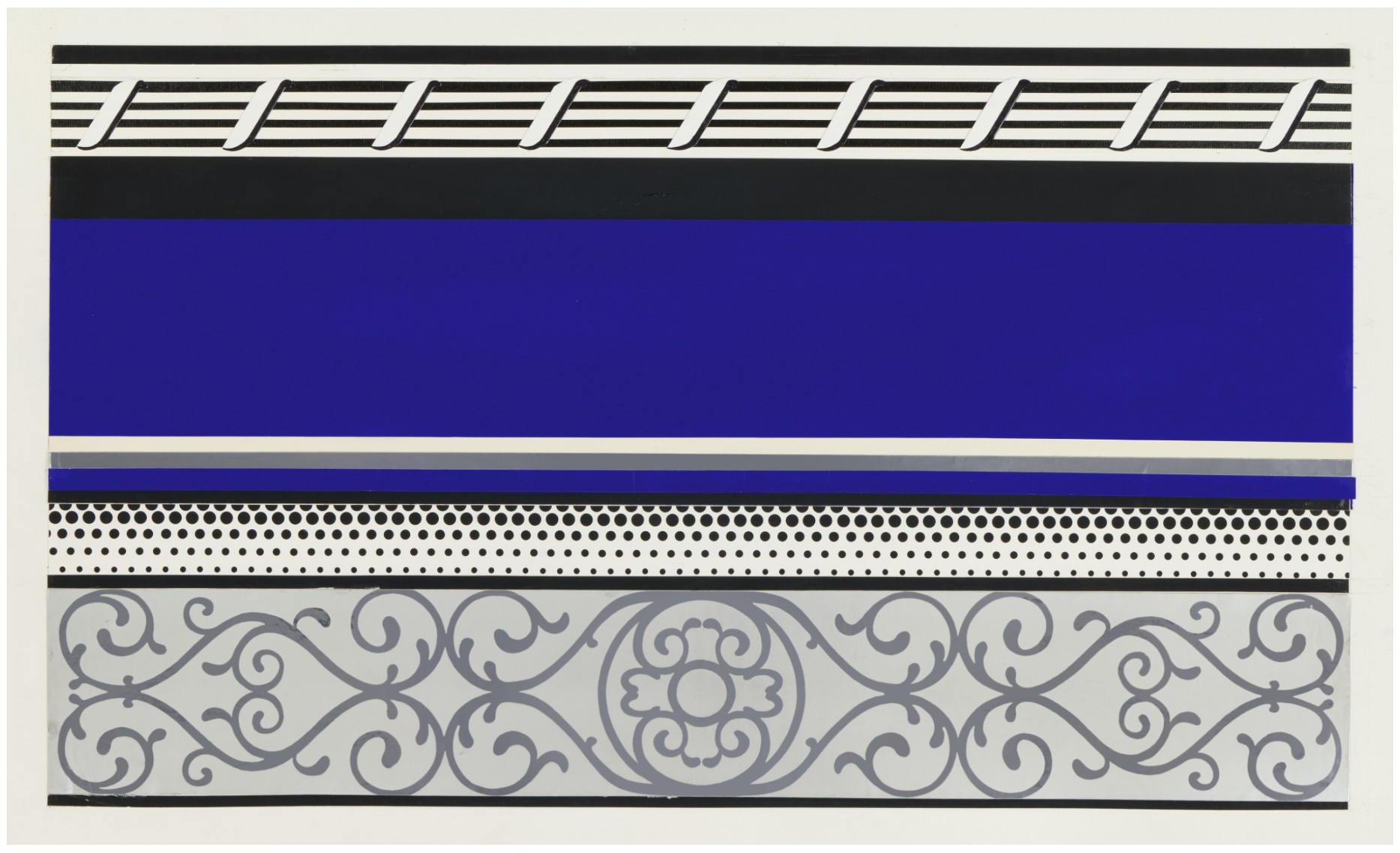
ROY LICHTENSTEIN (1923 – 1997)
Entablature V (Study), 1976
Cut printed paper, cut paper, tape, marker, aluminum foil and graphite on board
Image: 22 1/4 x 38 inches (56.5 x 96.5 cm)
Board: 28 1/4 x 44 1/4 inches (71.8 x 112.4 cm)
Signed and dated ’76 (on the verso)
4. Prints
Water Lily Pond with Reflections, 1992
Property from the Estate of Joan and Kenneth Goldglit
Christie’s New-York: 20 November 2025
Estimated: USD 500,000 – 700,000
USD 1,397,000
ROY LICHTENSTEIN (1923-1997), Water Lily Pond with Reflections | Christie’s
ROY LICHTENSTEIN (1923-1997)
Water Lily Pond with Reflections (Corlett 264, RLCR 4179), 1992
Screenprinted enamel on processed and swirled stainless steel, with painted aluminum frame
Signed, numbered and and dated ‘7⁄23 rf Lichtenstein ’92’ (on the reverse)
This work is number seven from an edition of 23 plus seven artist’s proofs
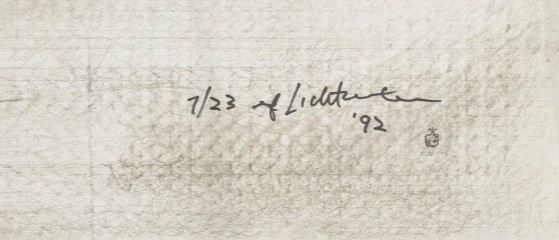
Nude with Blue Hair, State I, 1994
Christie’s New-York: 20 November 2025
Estimated: USD 500,000 – 700,000
USD 1,079,500
ROY LICHTENSTEIN (1923-1997), Nude with Blue Hair, State I | Christie’s
ROY LICHTENSTEIN (1923-1997)
Nude with Blue Hair, State I (Corlett 287, RLCR 4295), 1994
Relief print in colors on Rives BFK paper
Signed, numbered and dated ‘8⁄10 rf Lichtenstein ’94’ (lower right)
This work is number eight from an edition of ten plus six artist’s proofs
Water Lilies with Willows, 1990
A Legacy Reimagined: Works from the Collection of Dorothy and Roy Lichtenstein
Sotheby’s New-York: 19 November 2025
Estimated: USD 400,000 – 600,000
USD 1,514,000
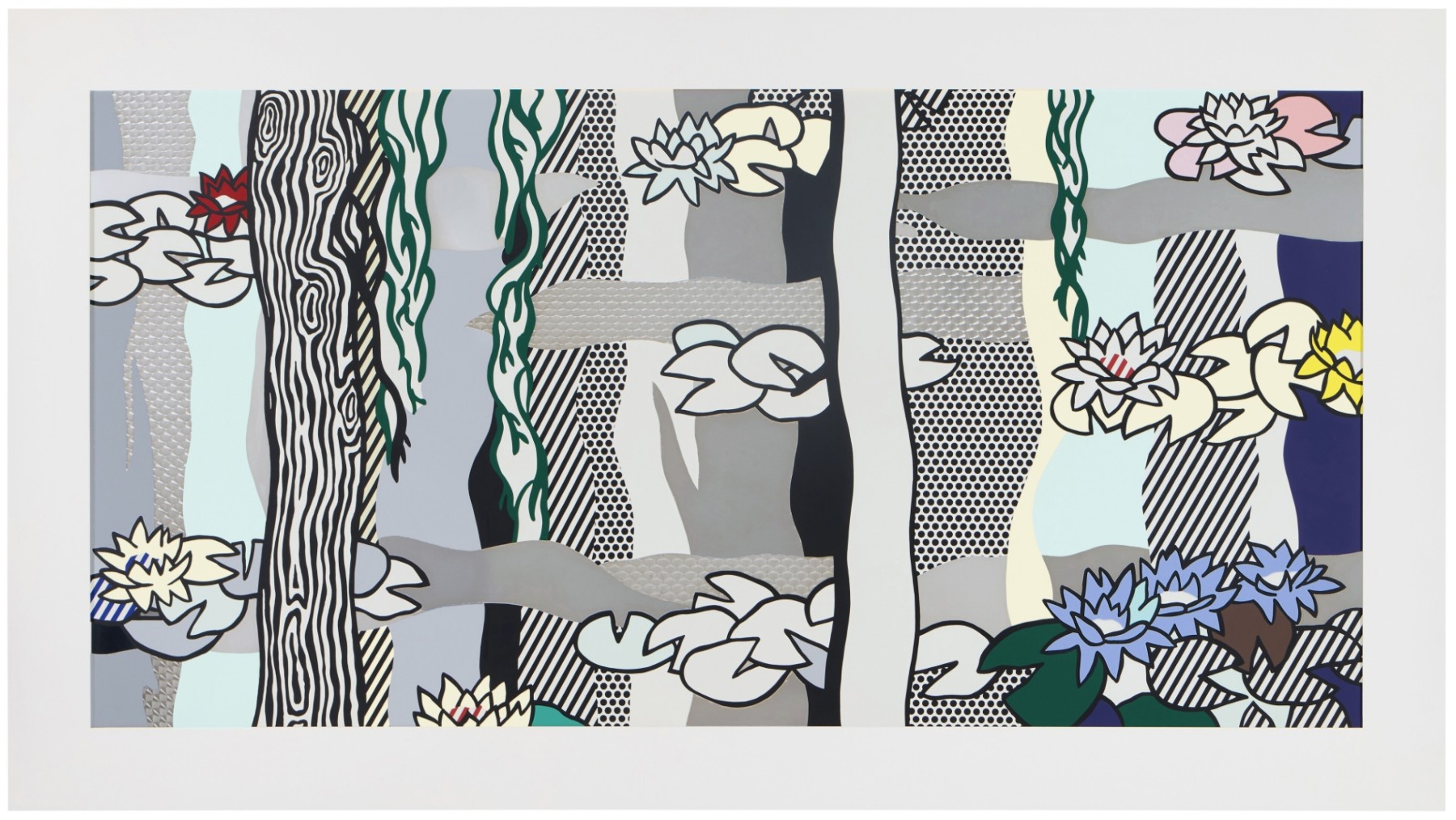
ROY LICHTENSTEIN (1923 – 1997)
Water Lilies with Willows (Corlett 266, RLCR 4170), 1990
from the Water Lilies series
Screenprinted enamel on processed and swirled stainless steel in the original painted aluminum frame
Signed, dated and inscribed AP 6/7 (on the reverse)
This impression is artist’s proof 6 of 7 from the numbered edition of 23 plus 7 artist’s proofs
Published by Saff Tech Arts
Water Lilies with Japanese Bridge, 1992
Phillips New-York: 21 November 2025
Estimated: USD 400,000 – 600,000
USD 645,000
Roy Lichtenstein Modern & Contemporary Art Day Sale, Morning Session
Screen-printed enamel on processed swirled stainless steel, with painted aluminum frame
83 1/8 x 58 in. (211.1 x 147.3 cm)
Stamped by Saff Tech Arts and inscribed with the workshop number “RL92-007” on the reverse
This work is number 6 from an edition of 23, plus 7 artist’s proofs, 1 Bon’a tirer, 4 Printer’s proofs, 2 Presentation proofs, 1 National Gallery of Art proof, and 2 Saff Tech Arts’ proofs
Andy Warhol
PLEASE CLICK ON THE PICTURE BELOW TO ACCESS AUCTION MARKET OVERVIEW
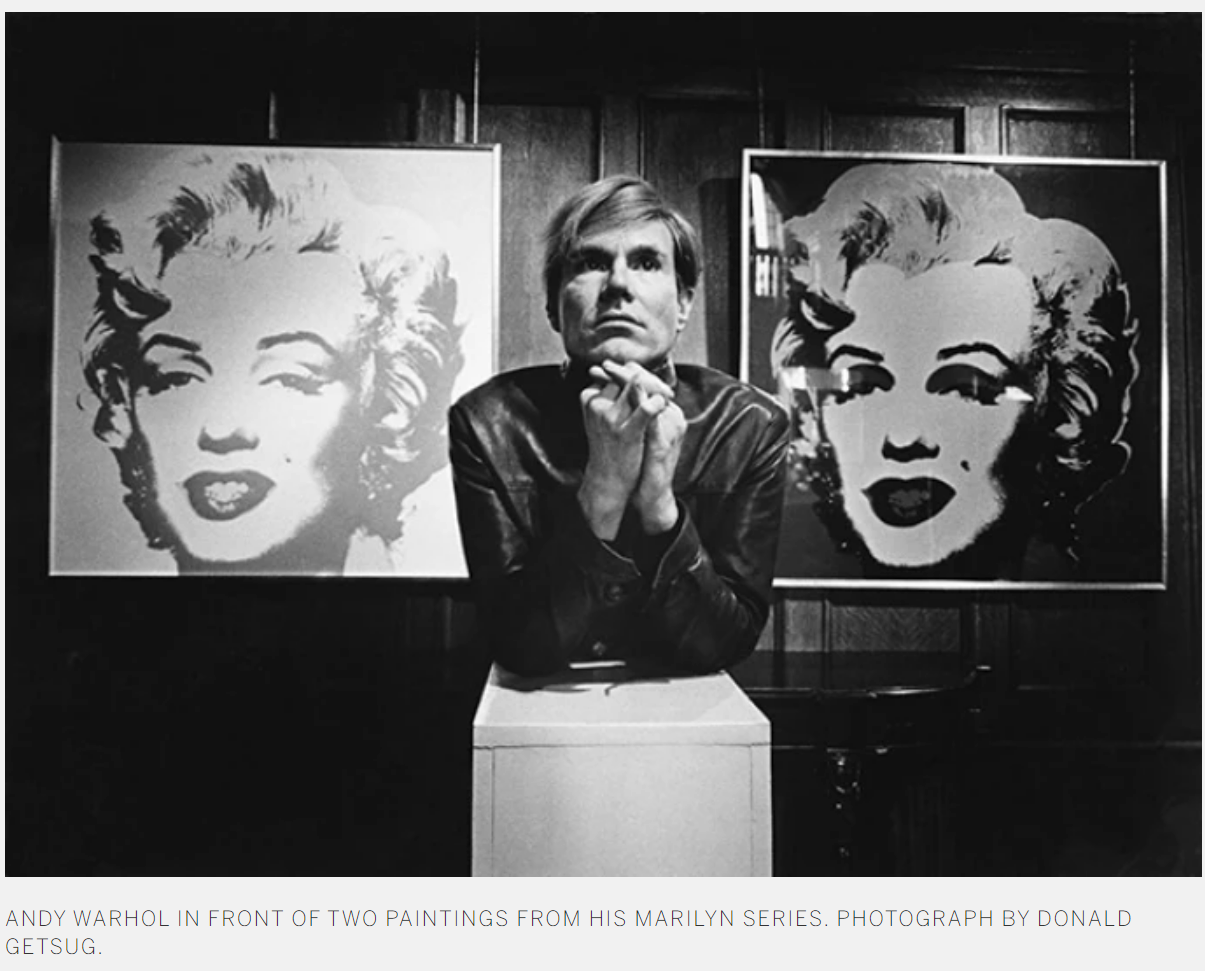
1. Paintings
#1. The Last Supper, 1986
Edlis Neeson Collection
Christie’s New-York: 19 November 2025
Estimated: USD 6,000,000 – 8,000,000
USD 8,127,000
ANDY WARHOL (1928-1987), The Last Supper | Christie’s
ANDY WARHOL (1928-1987)
The Last Supper, 1986
Acrylic and silkscreen ink on canvas
40×40 inches (101.6 x 101.6 cm)
Stamped with the artist’s signature ‘Andy Warhol ©’ (on the overlap)
Signed and inscribed by Frederick Hughes
‘I certify this to be an original painting by Andy Warhol completed by him in 1986 Frederick Hughes’
(on the overlap)
As Andy Warhol’s last work and ultimate artistic statement, The Last Supper is the culmination of the twentieth-century titan’s profoundly impactful oeuvre, recapitulating a lifetime of creativity and artistic invention into a singular series. Warhol places himself in contention with Leonardo da Vinci, one of the greatest artists in the artistic pantheon, appropriating and conversing with Leonardo’s iconic Last Supper mural to assert his place at the pinnacle of the art historical canon. As his final series, The Last Supper works powerfully to reiterate the principles which had defined Warhol’s entire artistic enterprise, meditating on fame, death, originality, and transformation. Warhol’s The Last Supper series was first exhibited at Warhol-Il Cenacolo in the refectory of Palazzo Stelline in Milan, directly across the street from Santa Maria delle Grazie, whose refectory is the site of Leonardo’s Last Supper. Warhol died in New York on February 22nd, exactly one month after he attended the opening of this Milan exhibition.
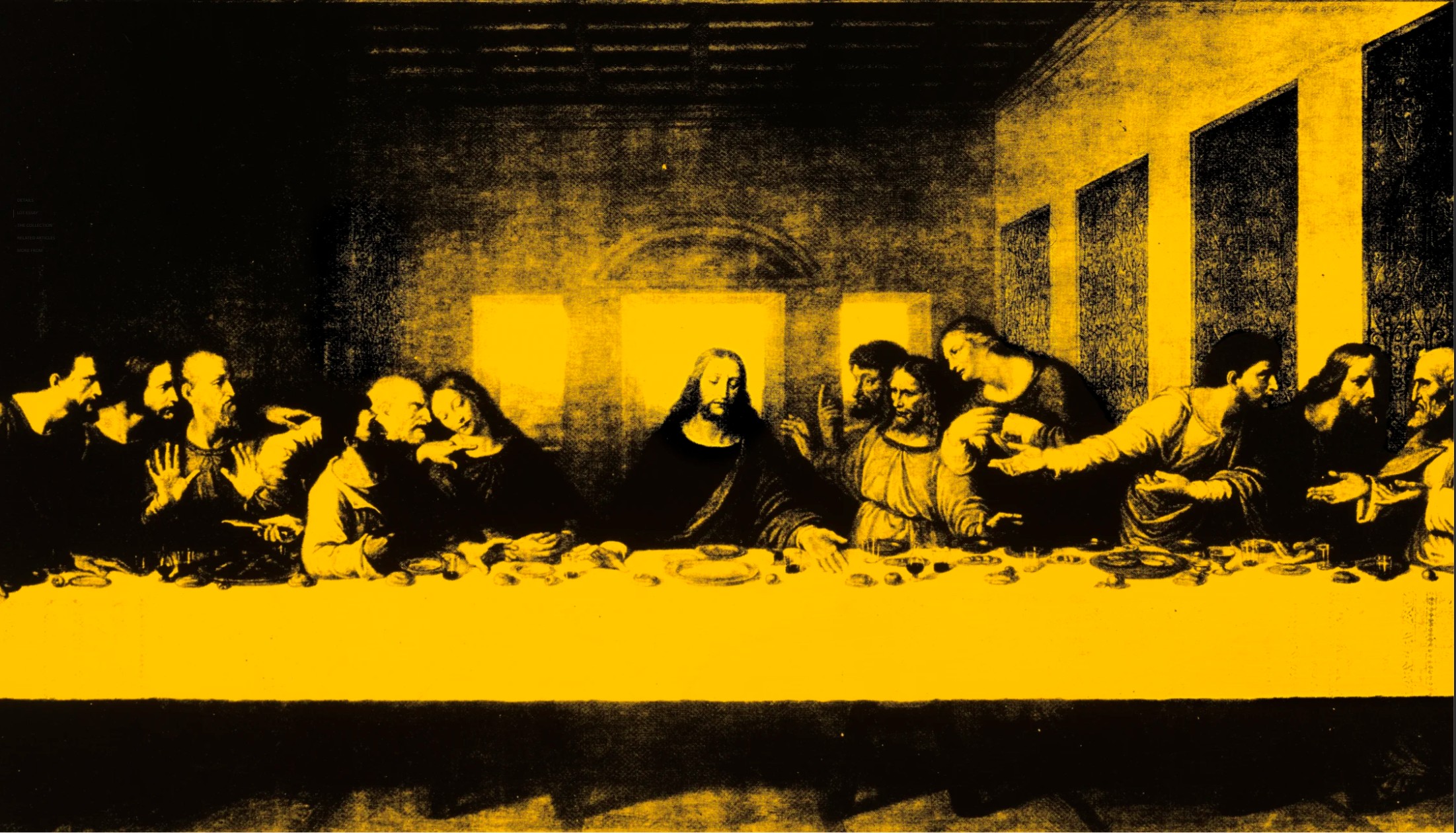
The dealer Alexander Iolas, who presented the artist’s first exhibition in 1952, also suggested the subject for what would be Warhol’s last show. Leonardo’s masterpiece became Warhol’s obsession, the Pop artist analyzing the famed composition from every angle and through a cacophony of reproductions. Warhol produced an exceptional quantity of preparatory material relating to the Last Supper, creating drawings, engravings, screenprints, and sculptural models of the scene in order to deconstruct and fully inhabit the composition. Warhol’s frenzied studies, stretching the course of almost two years, parallel the Old Master’s own struggles in achieving his mural, which demanded three.
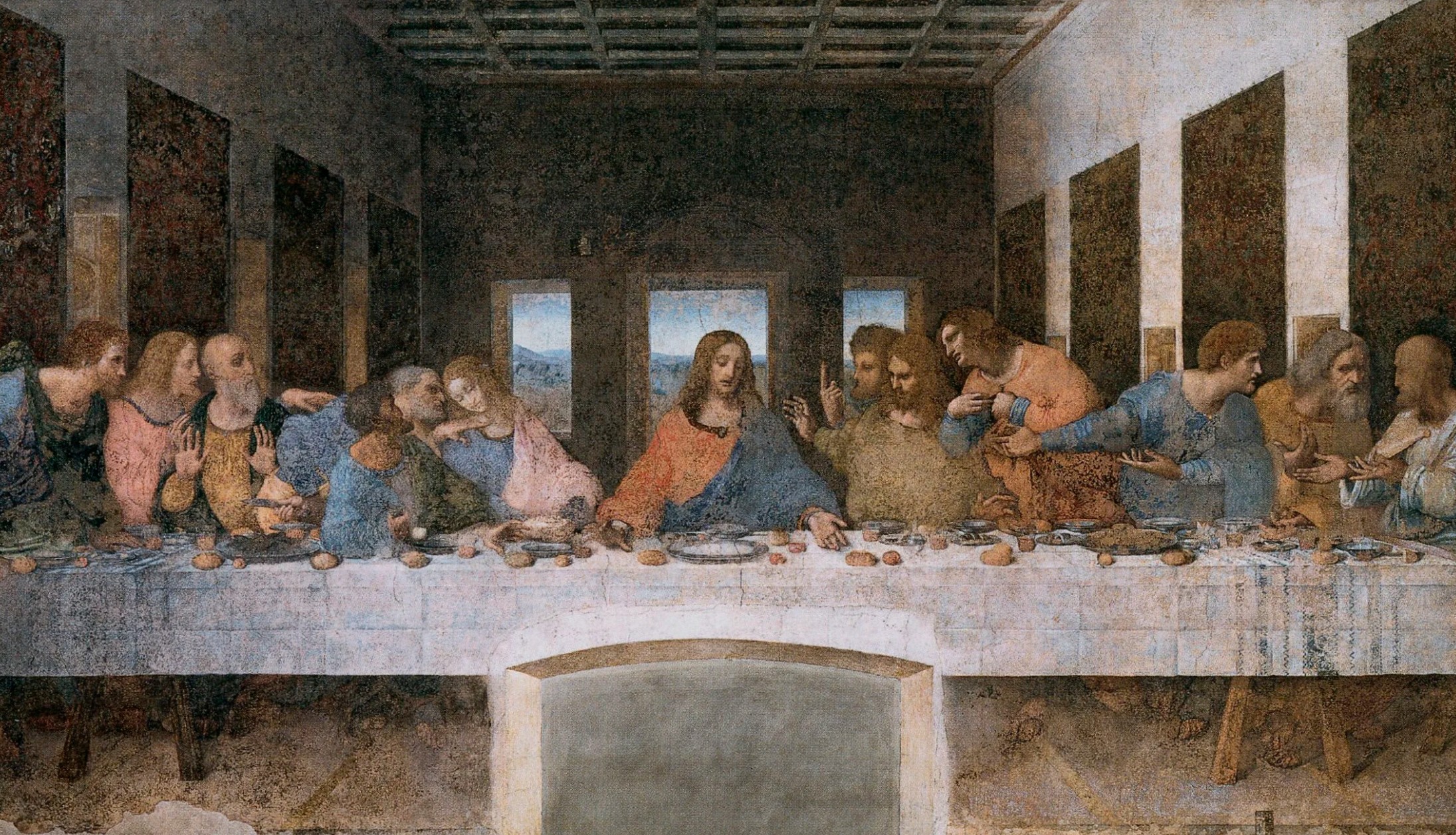
Warhol explained to his assistant Benjamin Liu his goal of making Leonardo’s painting “exciting again”.
“It’s a good picture… It’s something you see all the time. You don’t think about it.”
The source image seamlessly synchronizes with many of Warhol’s longstanding themes. Leonardo’s Last Supper had begun to deteriorate a decade after its completion due to an inherently unstable binding method and environmental effects, meaning that after many excruciating restoration campaigns, its present representation and its many reproductions no longer faithfully reflect how the painting originally appeared. This very aspect made the subject perfect for Warhol, whose entire career investigated the invention of celebrity and the inevitability of death and decay.
Maria Mulas, Andy Warhol during the exhibition that showed his Last Supper, 1987, Credito Valtellinese, Stelline Foundation, Italy. Photo: © Maria Mulas. All rights reserved 2025 / Bridgeman Images. Artwork: © 2025 The Andy Warhol Foundation for the Visual Arts, Inc. / Licensed by Artists Rights Society (ARS), New York.
The artist aimed to achieve as close an imitation of the original mural as possible, searching widely for the perfect photographic model for his work. Warhol finally chose a cheap, nineteenth-century engraving found in a devotional souvenir shop across from The Factory as the model for his silkscreens. With this selection, The Last Supper becomes a meditation on originality, the instantly-recognizable subject seen in the present work arriving on the silkscreen from a cascading series of intermediaries—a duplicated photograph of a reproduction of a copy after the original painting—its immediate recognition with the original a vivid assessment in how works of art become iconic through the dissemination of its image in reproduction.
Andy Warhol, Last Supper, 1985. © 2025 The Andy Warhol Foundation for the Visual Arts, Inc. / Licensed by Artists Rights Society (ARS).
While remaining truthful to his source image, Warhol complicates the composition by doubling his source image onto dualling horizontal planes, arranged one above the other. Christ and his Apostles now appear not once but twice, profoundly capturing the many dualities of Leonardo’s original. This action of duplication reenacts the dual reality of Leonardo’s masterpiece. The master infuses his scene with a mind-boggling multiple doubleness, capturing both Jesus’s announcement of his betrayal and the institution of the Eucharist in a single frozen image.
Andy Warhol, Mona Lisa, 1963. Metropolitan Museum of Art, New York.
© 2025 The Andy Warhol Foundation for the Visual Arts, Inc. / Licensed by Artists Rights Society (ARS).
There is an ironic symmetry in Warhol tackling Leonardo in his last series. One of the artist’s earliest silkscreen projects from the early 1960s was of the Florentine master’s Mona Lisa, the two Leonardo series serving as fitting bookends to a prolific period of discovery and artistic invention. With The Last Supper, Warhol was in fact returning to an important image which held deep sentimental value—his mother Julia kept a tattered reproduction of Leonardo’s Last Supper within the frayed yellowed pages of her Old Slavonic Prayer Book.
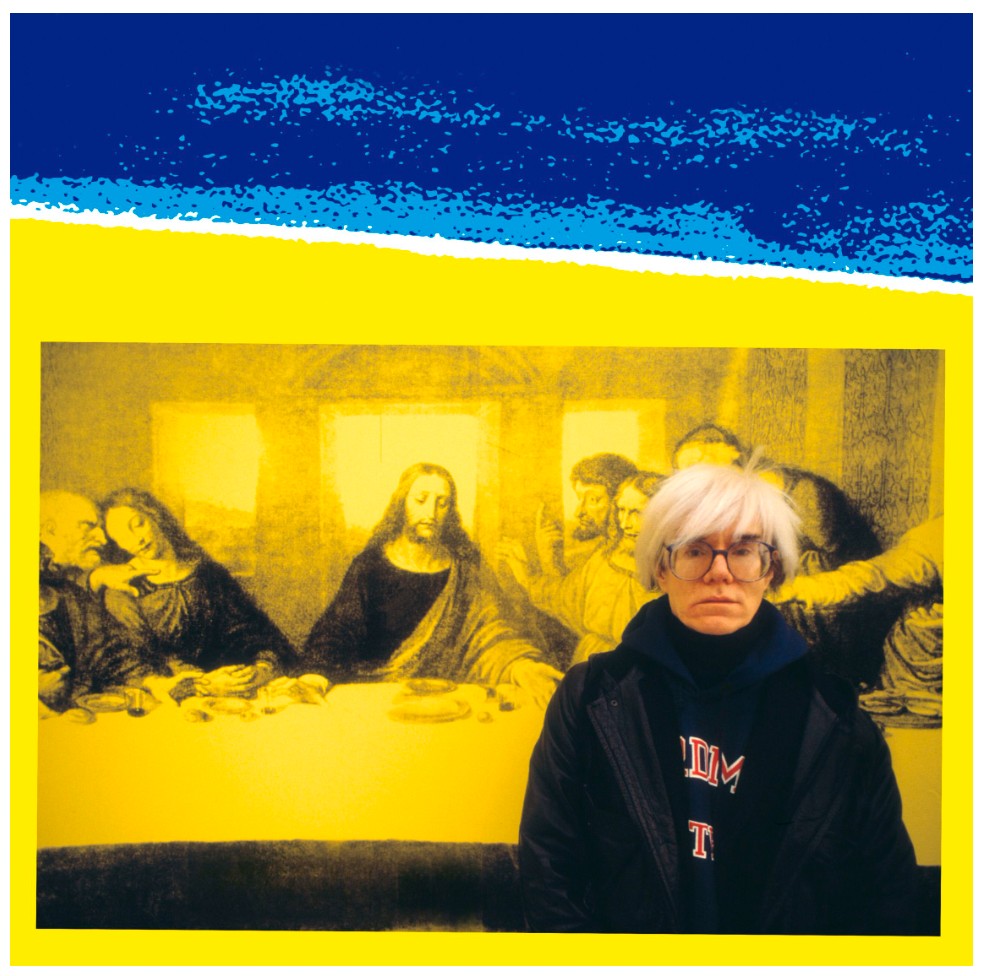
Andy Warhol in front of his work The Last Supper, Milan, 1987. Photo: Giorgio Lotti / Archivio Giorgio Lotti / Mondadori Portfolio via Getty Images. Artwork: © 2025 The Andy Warhol Foundation for the Visual Arts, Inc. / Licensed by Artists Rights Society (ARS).
Potently interweaving his own insights and principles into Leonardo’s iconic masterpiece, Andy Warhol established a compelling trans-historical dialogue with his predecessor. As his definitive, final statement, The Last Supper is inextricably linked with Warhol, forming a veritable self-portrait of the artist. The work visualizes Warhol’s ascent as one of the greatest and most influential figures of the twentieth century, surpassing even Leonardo in fame.
#2. The American Indian (Russell Means), 1977
Sotheby’s New-York: 18 November 2025
Estimated: USD 2,o00,000 – 3,000,000
USD 4,076,000
The American Indian (Russell Means) | The Now & Contemporary Evening Auction | 2025 | Sotheby’s
ANDY WARHOL (1928 – 1987)
The American Indian (Russell Means), 1977
Scrylic and silkscreen ink on canvas
50 1/8 x 42 inches (127 x 106.7 cm)
Residing at the intersection of popular culture, political activism, and celebrity, Portrait of an American Indian (Russell Means) is an exemplar of Andy Warhol’s distillation of diverse ideas into an iconic, enduring image. The image in question—a monumental headshot of Lakota leader and activist Russell Means—stares unflinchingly out at the viewer, clad in the silkscreen ink and bold swathes of color that mark Warhol’s signature style. In a venture with West Coast dealer and Ace Gallery owner Doug Chrismas, Warhol produced a limited suite series entitled, The American Indian, of which many are now held in prominent institutional collections including The National Museum of the American Indian, Washington, D.C.; Hamburger Kunsthalle; and The Andy Warhol Museum, Pittsburgh, among others. The present example, executed in late 1976, is among the very best from the series, possessing exceptional clarity in both line and color. Alongside its stunning visual contrasts, the portrait stirs up the contrasting perceptions of its subject: at once proud individual and general archetype, Portrait of an American Indian (Russell Means) embodies the “ironies” and “powers” that define Warhol’s most rigorous examinations of contemporary culture—as seen through the lens of his art. (Tony Berlant cited in: Neil Printz and Sally Kind-Nero, eds., The Andy Warhol Catalogue Raisonne, Vol. 4: Paintings and Sculpture late 1974-76, New York 2014, p. 492)

Polaroid studies of Russell Means, 1976. Art © 2025 Andy Warhol Foundation for the Visual Arts / Artists Rights Society (ARS), New York
Russell Means was born into the Lakota Oglala tribe in 1939, eventually rising up the ranks to assume leadership of the American Indian Movement (AIM). By the time he first encountered Warhol in 1976, Means had already established a public presence of his own. In February of 1973, he led the American Indian Movement during the highly-publicized, seventy-one day siege of the town of Wounded Knee on the Pine Ridge reservation—the infamous site of an 1890 massacre of the Lakota by a U.S. Cavalry regiment—in protest against the mistreatment of Native Americans by the U.S. government. The siege garnered significant attention in Hollywood and beyond, with Means assuming the role of public activist, and increasingly, of celebrity himself. Meanwhile, Warhol had separately devised the idea of a series centering the American Indian as its subject. After consulting Indian nations in California and Canada in search of an individual that “best personified the contemporary Indian,” Warhol learned of Russell Means. Starting with a cultural archetype and narrowing his focus to the individual, Andy Warhol invited Means to his New York studio in July 1976 to be photographed. The 82 Polaroid photographs Warhol took of Means that day became the foundation for The American Indian series.
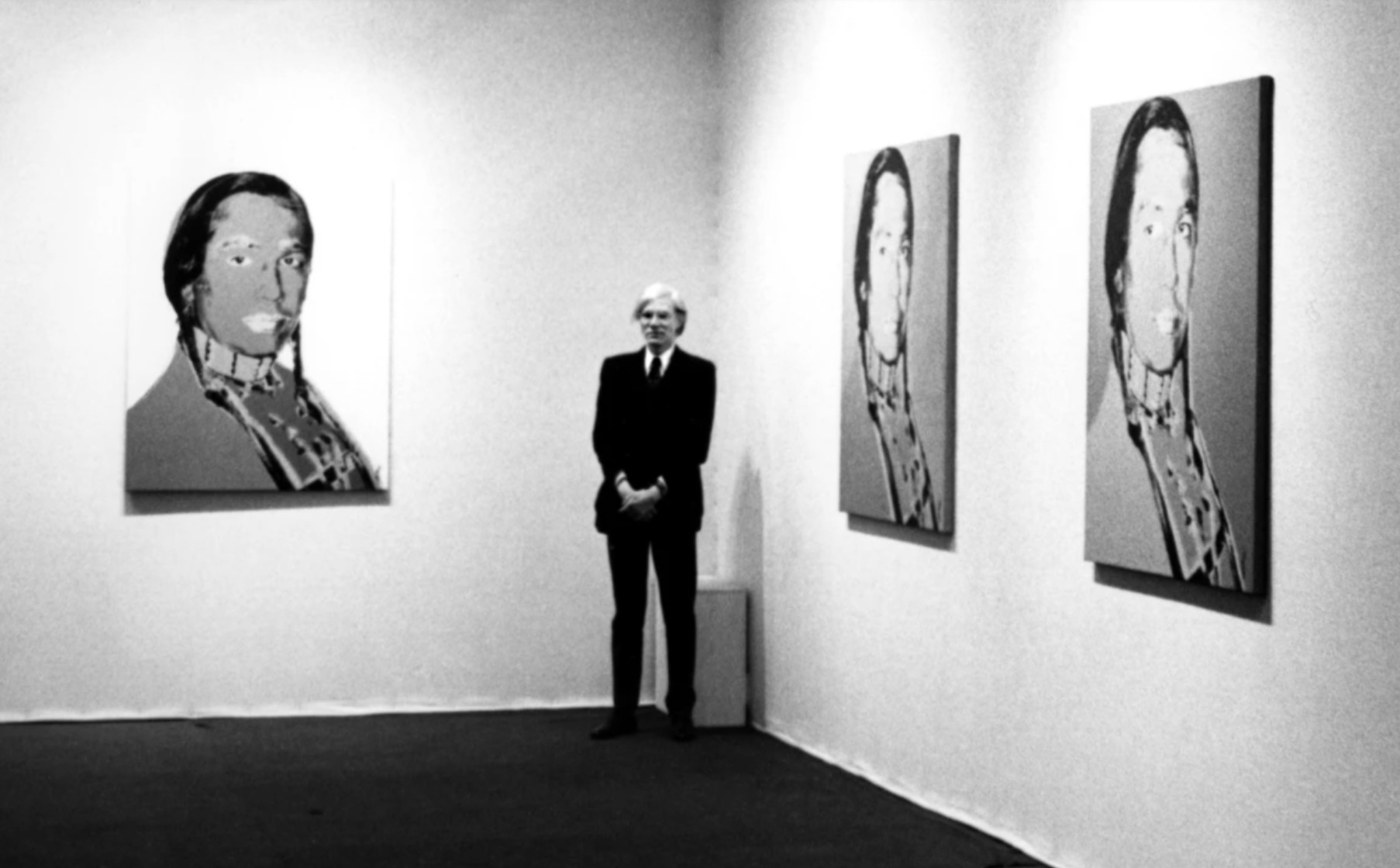
Andy Warhol at the opening of The American Indian Series at ACE Gallery, Paris 1976. Photo © Courtesy of Ace Gallery. Art © 2025 Andy Warhol Foundation for the Visual Art / Artists Rights Society (ARS), New York
In the series, Means is depicted wearing a calico print shirt, four beaded necklaces and a bone hairpipe choker, with his hair braided with brown leather wraps. His manner of dress was not particularly specific to his Lakota ancestry, but rather “contemporary and generically Indian in a sense, having come into fashion during the 1970s as an expression of American Indian pride.” Means’ typified manner of dress, refracted through Warhol’s characteristic use of seriality, contrasts with Means’ role as an individual community activist. Taken together, these factors form a complex identity for the “contemporary Indian,” who is both undeniably individual and apparently generic; as Rainer Michael Mason remarks on Warhol’s execution of the series, “The master of indifference, with a sureness that is less somnambulistic than it appears, has once more adopted a theme that is simultaneously captivating and banal. The Indian is a conventional accessory of the American scene, for the same reason as its counterpart, the cowboy, or as Coca-Cola, the electric chair, the movie star. The title of the series, moreover, ‘The American Indian’ takes this anonymous and communal dimension into account. At the same time, however, the Indian is the face of a real political problem, of a singular minority, and beyond that of all the American minorities.”
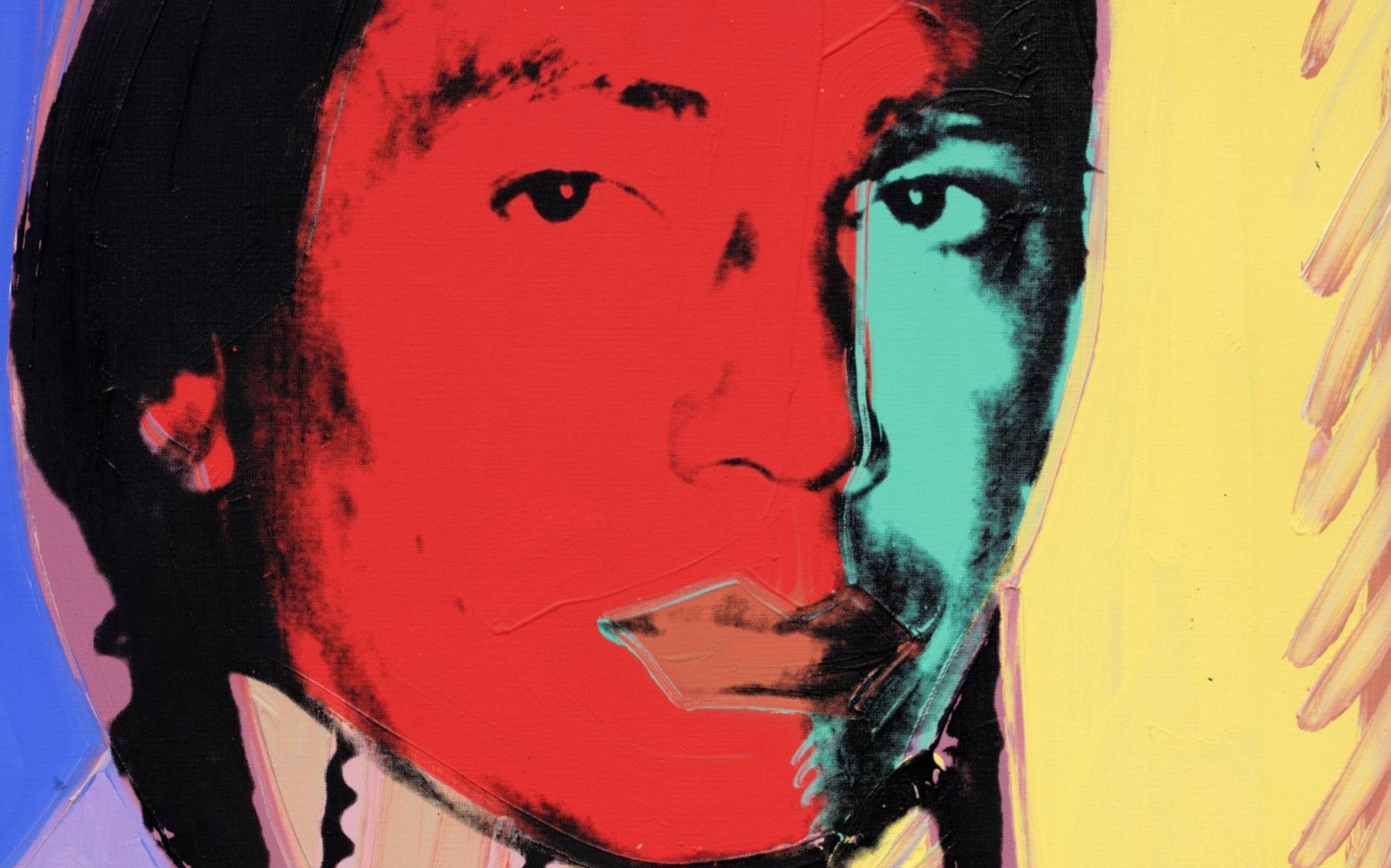
In each portrait, Warhol’s signature style accentuates the complex and commanding presence of Means himself. Defined by vivid, variegated coloration and high-contrast edges, Warhol’s technique lends each portrait a psychic intensity befitting the personal authority of its subject. The present work, Portrait of an American Indian (Russell Means), is a particularly impressive example. Set against a swath of brilliant golden yellow, Means’ face and adornments vibrate in a rich tapestry of lilac, periwinkle, brick red, and cyan. Each bright color is anchored by Means’ silkscreened image, which lends an inky depth to his braided hair, strong bone structure, and piercing gaze. Warhol characteristically built up his paint surfaces in superimposed layers, then would score the layered wet paint with his fingers to create optical effects: this technique is evident in the background, where Warhol pushes yellow paint to evoke scattering sunlight. In contrast to Warhol’s prior portraits of celebrities and cultural figures, which utilize a flat, graphic backdrop, Means’ portrait retains a potent sense of atmosphere: the golden yellow, indigo, and tan colored backdrop undeniably echoes the sky and the desert of the American West.
Jasper Johns, Flag, 1983. Private Collection. Sold at Sotheby’s New York in November 2014 for $36 million.
Art © 2025 Jasper Johns / Licensed by VAGA at Artists Rights Society (ARS), NY
Executed in the years following Russell Means’ siege of Wounded Knee, The American Indian series naturally assumes a political dimension. The lush setting of the American West becomes simultaneously associated with Hollywood myth-making, a force that often contributes to the stereotyping of the Indian and his character. This stereotype is often characterized by face paint, an image that seems commonplace, but in reality possesses a specific cultural meaning: as Means explains, face paint “was put on only those willing to die,” so those who wore such paint “were all the soldiers, the defenders inside Wounded Knee.” In this context, Warhol’s use of colored paint to portray Means’ face throughout the series is especially notable. Yet the image as a whole still retains a sense of ambiguity: oscillating between dignified individual and flattened archetype, and playing upon the language of media culture while presenting a sincere artistic representation.
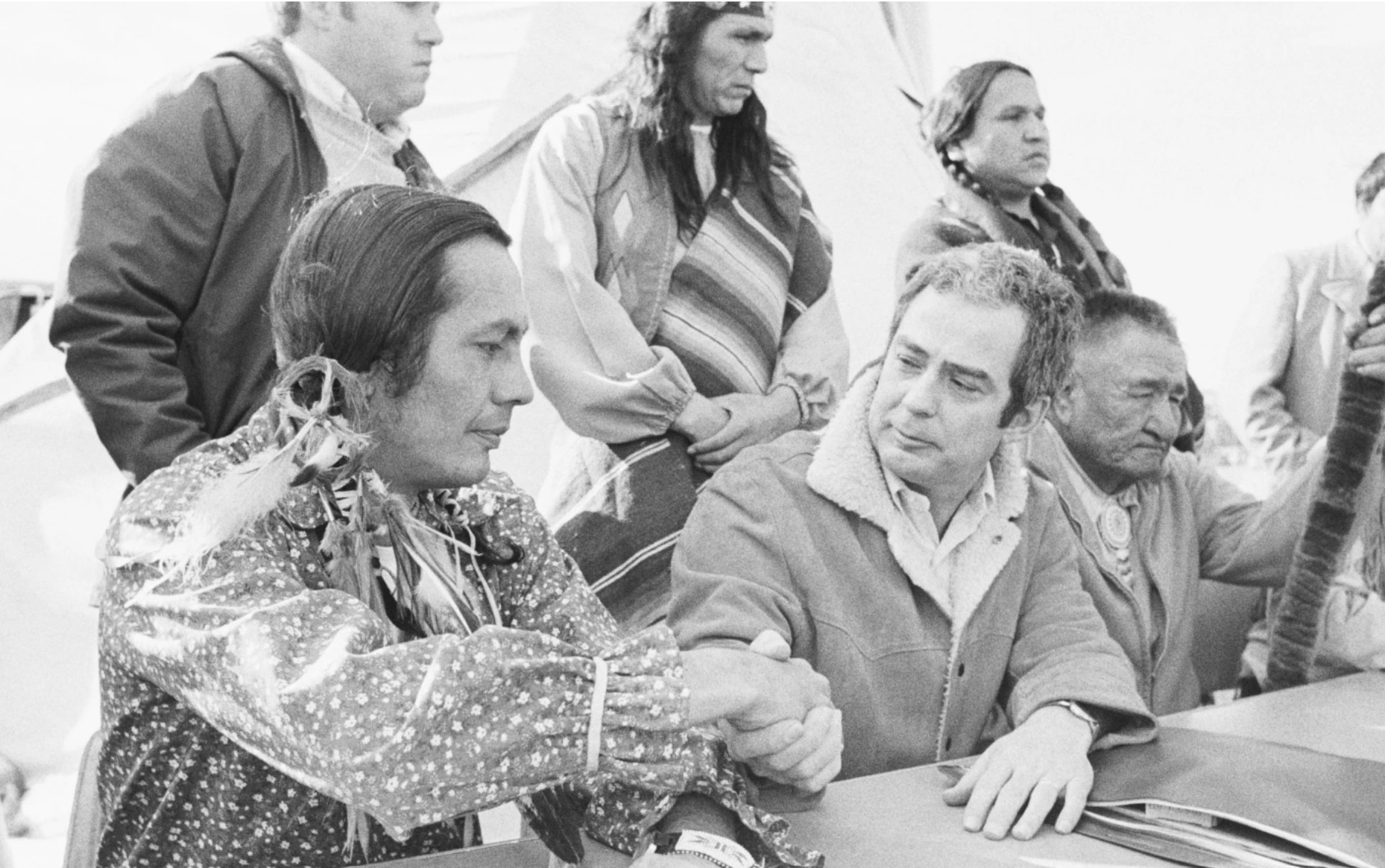
Russell Means and Kent Frizzell shaking hands, 1973. Image © Getty Images / Bettman
Encompassing the dual definitions of individual and archetype, Portrait of an American Indian (Russell Means) embodies Warhol’s most daring explorations of the seriality and portraiture which define the core of his oeuvre. The work, alongside the remainder of The American Indian series, is impressive in scale and intellectually rigorous in theme, revealing Warhol’s incisive and endless fascination with the cultural forces that define the American image.
#3. Skull, 1976
Edlis Neeson Collection
Christie’s New-York: 19 November 2025
Estimated: USD 800,000 – 1,200,000
USD 1,905,000
ANDY WARHOL (1928-1987), Skull | Christie’s
ANDY WARHOL (1928-1987)
Skull, 1976
Acrylic and silkscreen ink on canvas
15×19 inches (38.1 x 48.3 cm)
Stamped with the Andy Warhol Art Authentication Board, Inc. stamp and numbered ‘A108.025’ (on the overlap)
Powerfully conveying one of the legendary twentieth-century artist’s most intimate and contemplative motifs, Andy Warhol’s Skull is a choice example from his important series of Skull paintings begun in 1976. Inaugurating the final decade of Warhol’s life, Skull confronts the viewer with an unvarnished portrayal of its titular subject, operating as a memento mori reflecting on death’s inevitability. The work enthralls with an intense contrast of color, from the glittering gold background and vivid green foreground to the jet-black shadows and piercing voids of the skull.
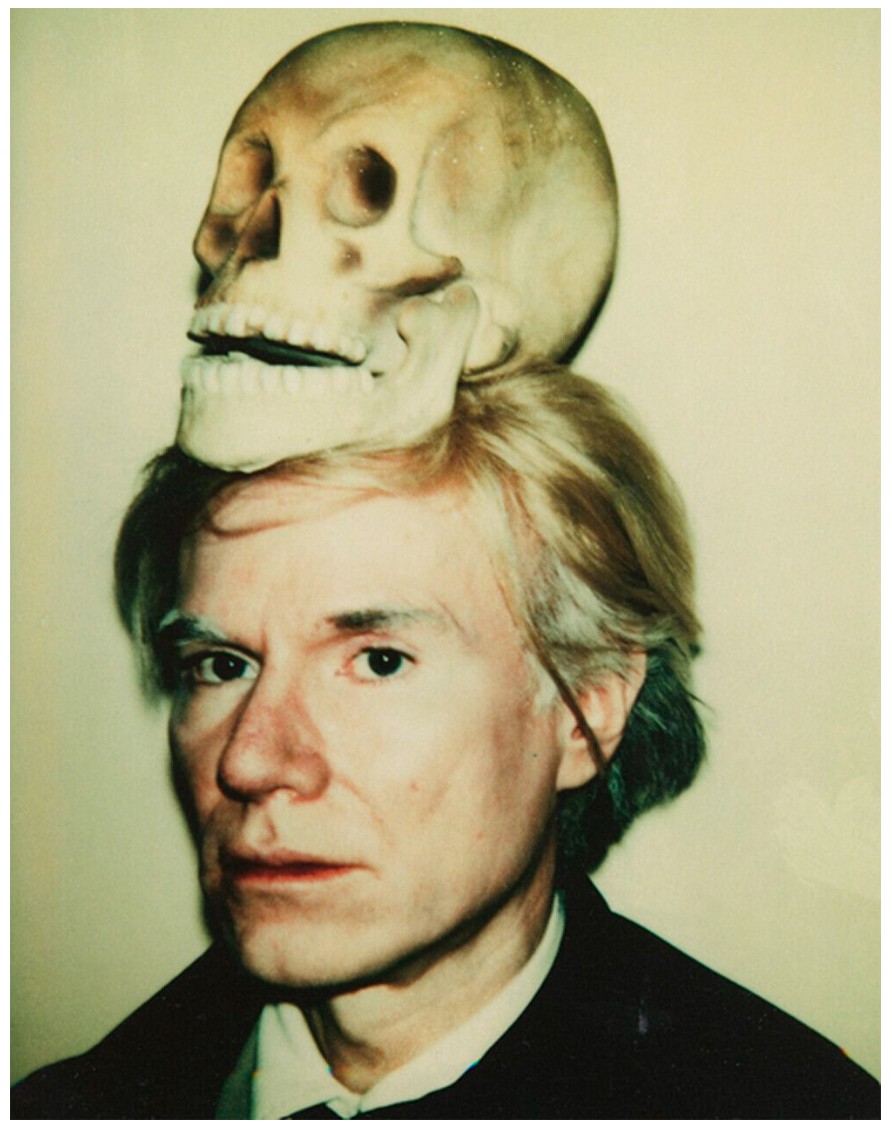
Andy Warhol with Skull, 1977. © 2025 The Andy Warhol Foundation for the Visual Arts, Inc. / Licensed by Artists Rights Society (ARS).
Rendered after a series of black-and-white photographs taken by Warhol’s assistant Ronnie Cutrone of a skull apparently acquired from a Paris taxidermy studio, the work meditates on the themes of mortality, vanitas, and temporality which pervaded the artist’s output after surviving Valerie Solanas’s assassination attempt in 1968. While recapitulating the motifs which had driven his early fascination with death and celebrity, the Skull series marked an important new trajectory in Warhol’s work. The skull was the first in a series of macabre subjects which Warhol would confront in his late career. Warhol mused on the concept of death in his book The Philosophy of Andy Warhol, published one year prior to the present work.
“I don’t believe in it, because you’re not around to know that it’s happened. I can’t say anything about it because I’m not prepared for it”
The themes embedded in Skull are currently the focus of a major travelling exhibition, Andy Warhol: Vanitas, organized by The Andy Warhol Museum in Pittsburgh.
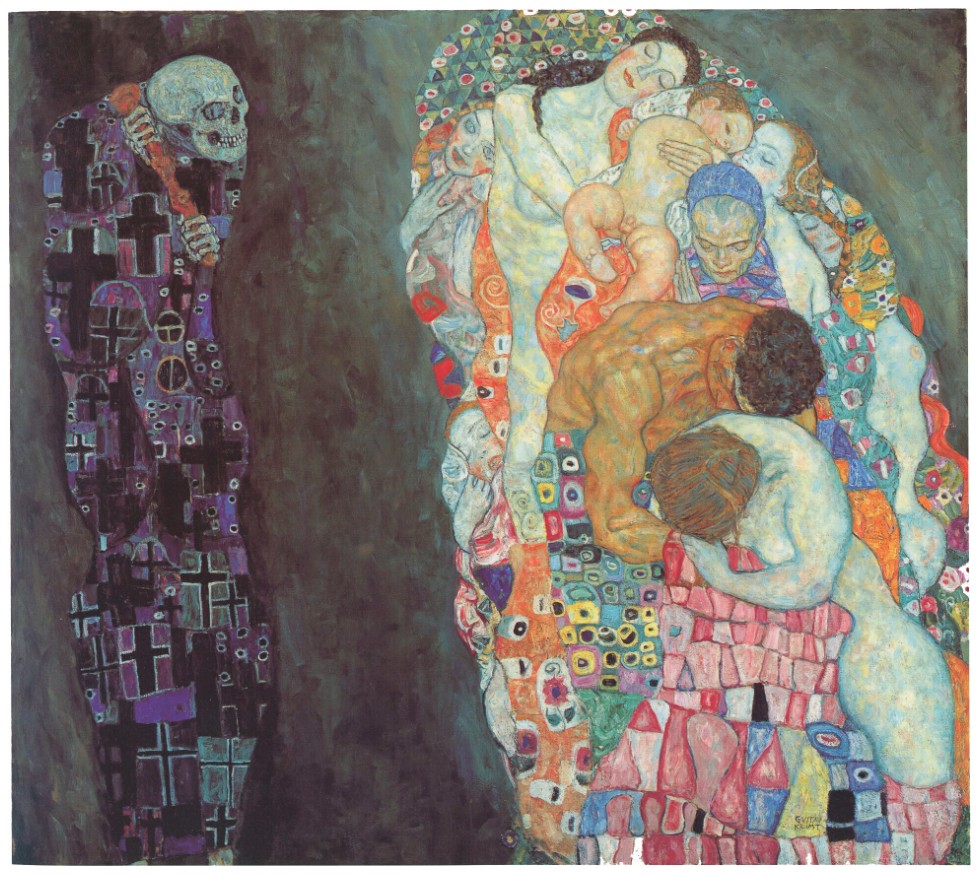
Gustav Klimt, Death and Life, 1908-11/1915, Leopold Museum, Privatstiftung, Vienna
With Skull, Warhol resuscitates the longstanding still life vanitas tradition, using the skull as a poignant visual reminder of one’s mortality. Contemporaneous with other still life series, including the Hammer and Sickle paintings, the present work demonstrates his formal interest in scale and monumentality, the artist employing skillful lighting and framing in order to emphasize the monumental presence of the skull in his moderately-sized canvases. Curiously the shadow of the skull in the present work casts the profile of a baby’s face onto the surface upon which it sits. Many have seen this as an allusion to rebirth, an optimistic outlook of this important image. Warhol thickly laid paint across the surface of the painting, modelling the paint layers with his fingers to emphasize the contours and edges of the skull, dramatizing the already strong shadows captured in his reference photograph. Warhol’s still life similarly removes extraneous subjects from the composition, removing any distraction from his intense focus on the skull.
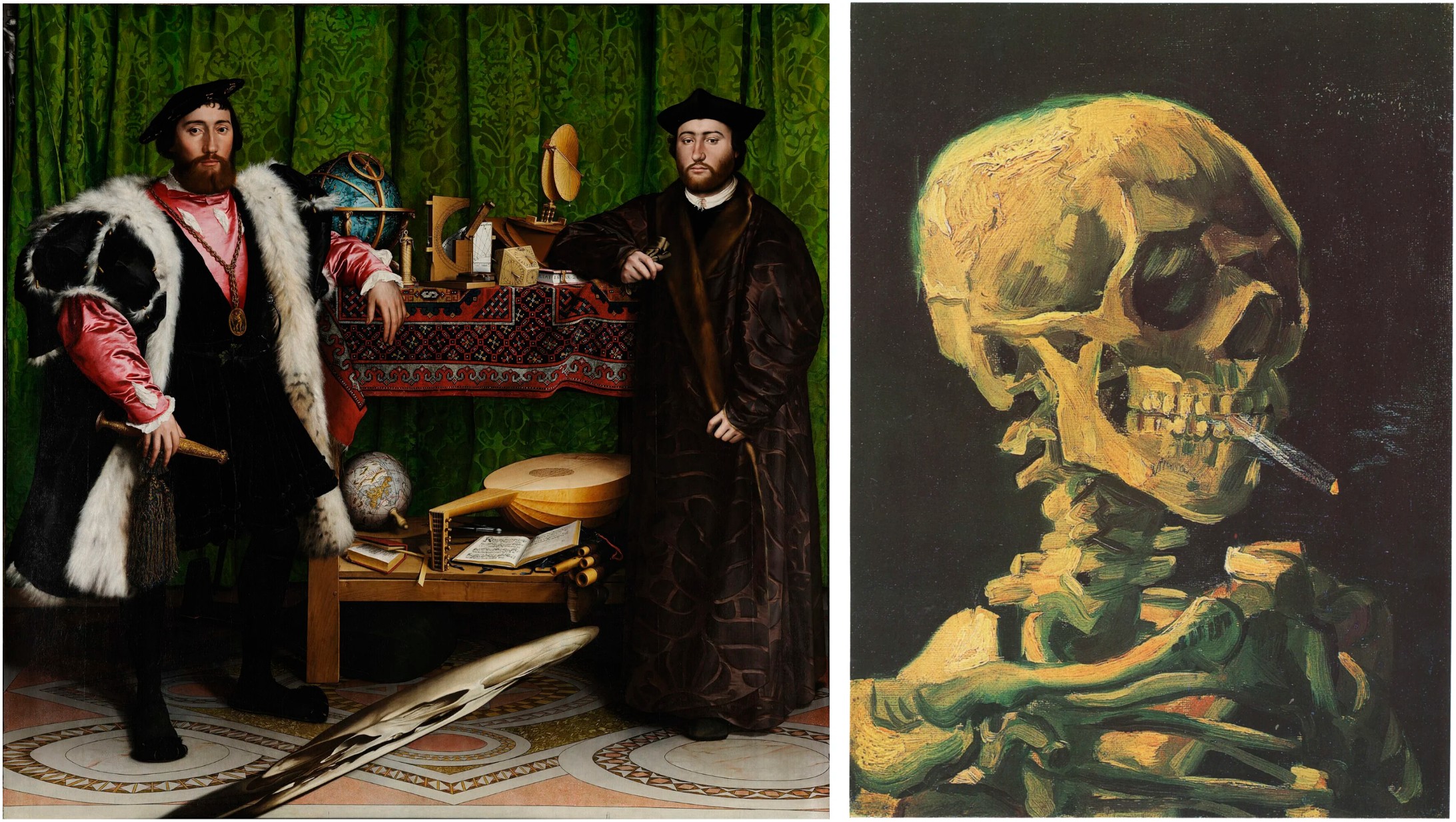
Left: Hans Holbein the Younger, The Ambassadors, 1533, The National Gallery, London.
Right: Vincent van Gogh, Skull with Burning Cigarette, 1885-1886. Van Gogh Museum, Amsterdam.
Warhol kept the present work with him until his death in 1987, infusing this Skull with even greater poignancy. The artist had long been concerned with death, focusing on the subject in his renderings of car crashes and dead celebrities in his early career.
“Death can really make you look like a star.”
Warhol intensified this focus after barely surviving being shot in 1968, his heart momentarily ceasing to beat on the operating table. With Skull, Warhol confronts the specter of his own mortality head-on, just like Hamlet, who, contemplating a skull held in his hands, moans, “Alas, poor Yorick!” (W. Shakespeare, Hamlet, Act 5, Scene I).
#4. Oxidation Painting (Diptych), 1978
Edlis Neeson Collection
Christie’s New-York: 19 November 2025
Estimated: USD 900,000 – 1,200,000
USD 1,714,500
ANDY WARHOL (1928-1987), Oxidation Painting (Diptych) | Christie’s
ANDY WARHOL (1928-1987)
Oxidation Painting (Diptych), 1978
Urine and copper paint on linen, in two parts
Each: 40×30 inches (101.6 x 76.2 cm)
Overall: 40×60 inches (101.6 x 152.4 cm)(2)
Signed, dedicated and dated
‘Pour la collection de Flavio Castillo Pontello Andy Warhol 1978’
(on the reverse of each canvas)
Occupying a singular space in the artist’s vaunted oeuvre, Andy Warhol’s Oxidation paintings demonstrate his boundless creativity and endless capacity for radical reinvention. The series was the first since Warhol’s early career to be produced without a photographic element. The present work, one of only three diptychs in the series, is a revelation of Warhol’s bold reimagining of abstraction, offering both formal innovation and astonishing beauty. Celebrating Warhol’s fascination with abstraction, steeped in the visual iconography of the Byzantine Catholic church of Warhol’s youth, and referencing New York queer nightlife scene and the colorful characters flowing into and out of his Factory studio, Oxidation Painting combines the disparate aspects of Warhol’s famously oblique personality into a rare, reflective masterpiece.
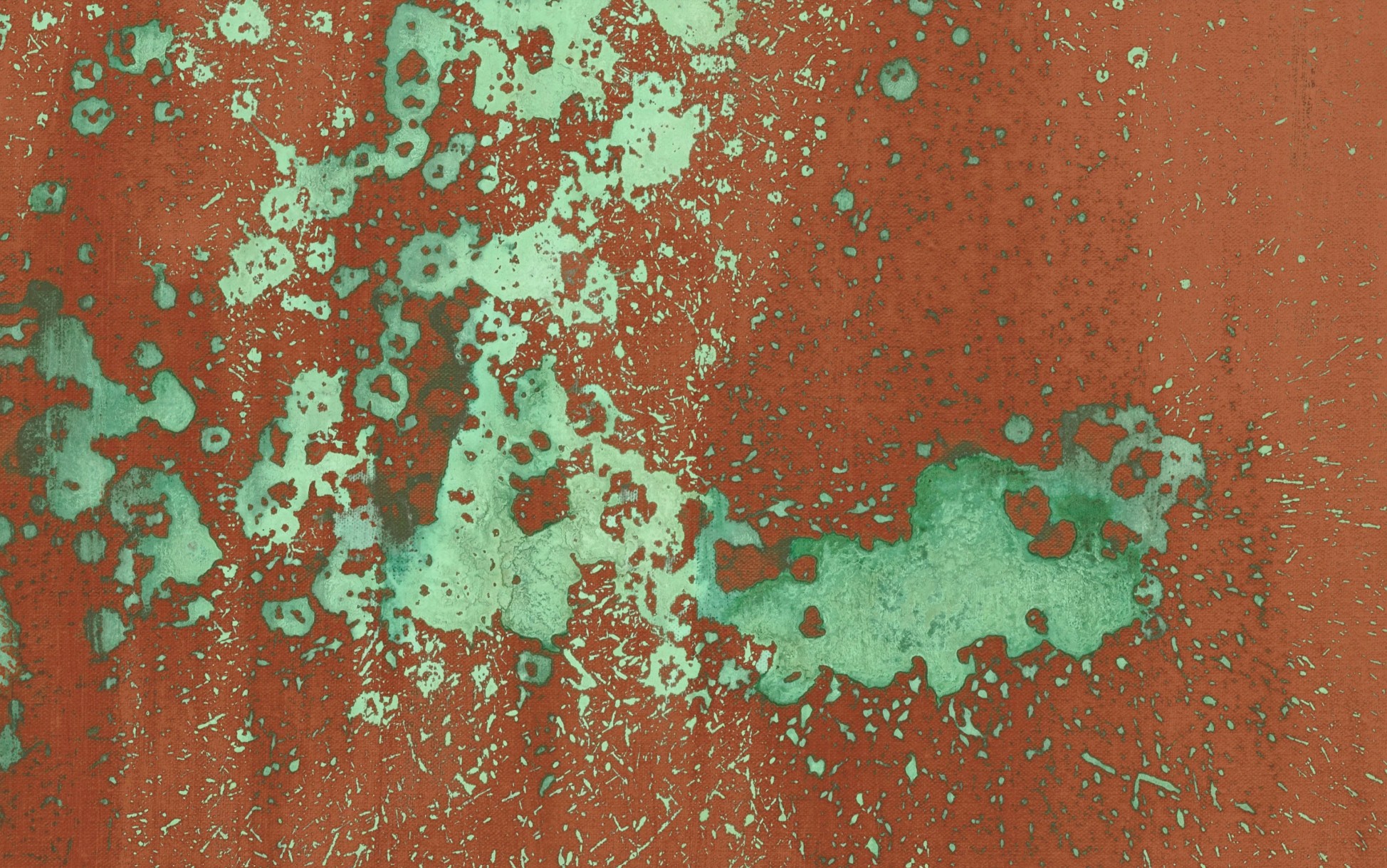
Oxidation Painting expands across two canvases coated in a metallic, bronze-toned paint. Splotches, drops, spills, and pools of varying alchemical stains scatter organically across the canvas surface, creating vivid biomorphic forms complimenting the copper background. The left canvas is almost wholly absorbed by a large, ovular form of darker olive greens and blacks which spread out slowly across the picture plane, gradually giving way to lighter shades dotted with white. The right canvas retains more glittering ground, stains only occasionally interrupting the shimmering surface in more methodical drops and splatters. The work is a riotous display of the artist’s technical achievement in creating a wide range of chemical effects with intricate shifts of color and textural contrasts.
Nat Finkelstein, Group Shot, ICA, Philadelphia, 1965. Photograph by Nat Finkelstein, © Estate of Nat Finkelstein.
Warhol devised novel methods and media for his Oxidation works. He first mixed copper and copper alloy powders with paint, layering the product onto stretched canvases. He and his assistants then applied urine via various mechanisms onto the wet paint, leaving the urine to react chemically with the metallic pigments, achieving the acid green forms which populate the composition. Warhol experimented widely with both the chemical process and the delivery mechanism, consuming different vitamin supplements to subtly alter the urine’s effect and exploring different methods of application—urinating directly on the canvas and collecting urine in containers to distribute in concentrated drips or pours. Through this innovative process, Warhol created a work of optically fascinating art without any marks of the painterly gesture. While literally absorbing the artist, Oxidation Painting avoids the appearance of the artist’s touch, achieving a result eagerly sought after by the Abstract Expressionists.
Jackson Pollock painting Autumn Rhythm: Number 30, 1950. Photo: Hans Namuth. Courtesy Center for Creative Photography, University of Arizona © 1991 Hans Namuth Estate. Artwork: © 2025 The Pollock-Krasner Foundation / Artists Rights Society (ARS), New York.
The work resembles Jackson Pollock’s drip paintings in both method and result—Warhol’s collaborator Bob Colacello reports him noting “it’s a parody of Jackson Pollock” (A. Warhol, quoted in N. Printz, The Andy Warhol Catalogue Raisonné Paintings 1976-1978, Vol. 5B, New York, 2018, p. 113). Working with the canvas horizontal on the ground, Warhol challenged Pollock’s status as the preeminent artist of the 20th century. With the Oxidation series, Warhol reasserted himself at the art world’s vanguard after a decade spent making silkscreen portraits critically derided as society portraits. The art historian Rosalind Krauss observed how Warhol decoded Pollock’s “liquid gesture” with his Oxidation paintings while employing his signature Pop art aesthetic. “For Warhol, the Oxidation paintings were simply once again motifs that connected high and low culture—action painting and the world of the baths and their golden showers—along the vector of notoriety or ‘fame’” (R. Krauss, The Optical Unconscious, Cambridge, MA, 1993 p. 276).
The Wilton Diptych, circa 1395-1399. National Gallery, London.
While avant-garde in method and material, Oxidation Painting contains several historical referents. Employing acid on copper has a long tradition in art history, with Old Masters including Albrecht Dürer and Rembrandt using etching—lines incised by acid on copper plate—for many of their graphic masterpieces. The urine was only effective while the copper paint was still wet, requiring Warhol to work rapidly. His wet-on-wet process resembles the buon fresco technique utilized by Michelangelo and Raphael in their famous Vatican paintings, all three artists having to rapidly make irreversible decisions before their ground hardened. Oxidation Painting also enacts a thoroughly traditional form, the diptych, which was widely used through the Middle Ages and Renaissance for religious altarpieces. The work’s copper ground similarly recalls altarpieces, resembling the gold ground icons which populate the Byzantine Catholic Church Warhol attended as a child. The process was simultaneously thoroughly contemporary, operating in parallel with New York’s progressive social scene and situated within the Happening and performance-based aesthetic of the 1960s and 1970s.
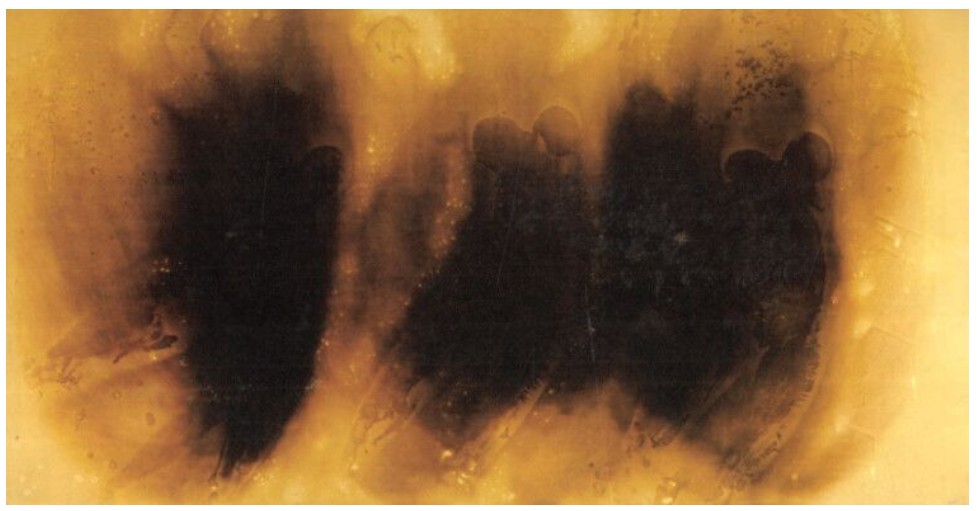
Yves Klein, Untitled fire painting (F 81), circa 1961.
© Succession Yves Klein c/o Artists Rights Society (ARS), New York / ADAGP, Paris 2025.
The present work was included in the first public exhibition of the Oxidation paintings in 1978 at Ace Gallery’s booth for the FIAC art fair in Paris. The works were an immediate revelation, with Art International noting how their “bitter beauty and precise bite are striking” (quoted in N. Printz, op. cit., p. 129). Oxidation Painting represents a watershed moment in Warhol’s career, grappling with the art historical tradition and Pollock’s looming legacy while once again revolutionizing the vanguard. Canonically important, the works also provide a tantalizing glimpse into the artist’s internal psyche.
#5. The Witch (from Myths), 1981
Sotheby’s New-York: 19 November 2025
Estimated: USD 1,200,000 – 1,800,000
USD 1,392,000
The Witch (from Myths) | Contemporary Day Auction | 2025 | Sotheby’s
ANDY WARHOL (1928 – 1987)
The Witch (from Myths), 1981
Acrylic and silkscreen ink on canvas
60×60 inches (152.4 x 152.4 cm)
Signed and dated 1981 (on the overlap)
Stamped by the Estate of Andy Warhol and the Andy Warhol Foundation for the Visual Arts, Inc.
Numbered PA51.012 on the overlap and stretcher bar
Andy Warhol’s striking The Witch (From Myths) stands as a testament to Warhol’s undying fascination with popular culture and its role in shaping the American consciousness. Graphically rendered in bright, saccharin hues, the instantly recognizable form of the Wicked Witch of the West from The Wizard of Oz emerges in black lines and bright green from the cotton candy pink colored background. Unmistakably one of the most iconic villains in the history of film, she is depicted mid-scream, or perhaps while laughing maniacally. Paint splatters and a light wash on the left of the canvas foretell the Witch’s watery annihilation at the end of The Wizard of Oz. Warhol intentionally draws upon cultural knowledge of the movie to imbue the painting with a sense of impending doom, juxtaposed with the vibrant tone of the color palette. While themes of death and destruction permeate the artist’s oeuvre–his Electric Chairs and Car Crashes foretell similar ends–the present work is lighthearted and upbeat. It recalls a shared cultural nostalgia rather than a collective trauma. Evidence of Warhol’s singular reverence for the ubiquity of American cultural production and mass media, The Witch (from Myths) is a premier example of Warhol’s work from his celebrated early 1980s period.
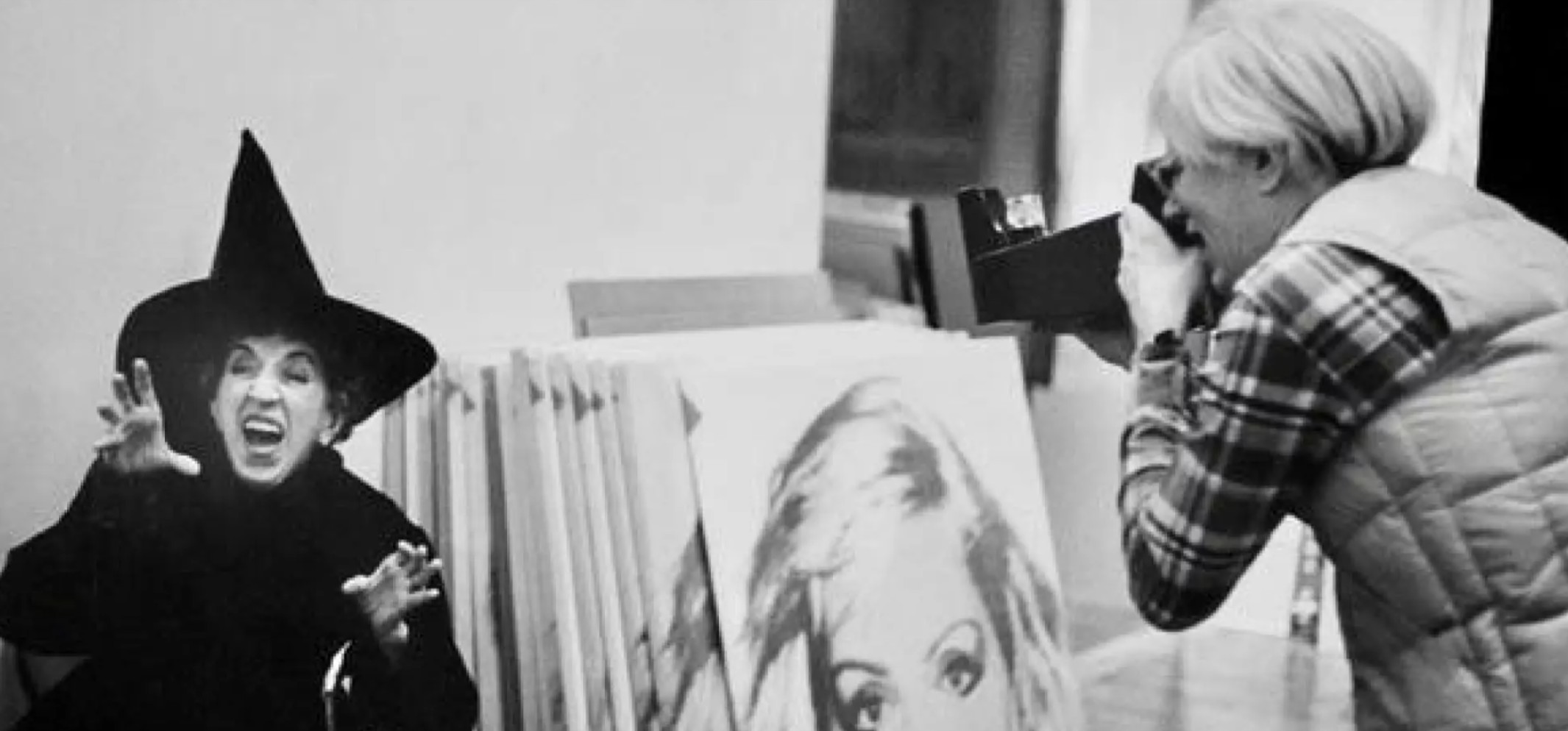
Andy Warhol photographing Margaret Hamilton, 1980.
Artwork © 2025 The Andy Warhol Foundation for the Visual Arts, Inc. / Licensed by Artists Rights Society (ARS), New York.
A unique piece from Warhol’s 1981 Myths series, the present work embodies the way Warhol’s work blends reality and fiction. The series, inspired by a doll the artist found at a flea market, refers not to the myths of ancient times, but the myths upon which contemporary American culture is founded. He originally planned to do a whole series of Disney characters, but settled on nine fictional characters, including Dracula, Santa Claus, Mickey Mouse, and Superman, as well as one image of Warhol himself. While Warhol is widely known for his portraits of real-life celebrities and prominent figures–from Marilyn Monroe to Mao Zedong–he did so using the stylistic signifiers of pop art, removing the images from the people themselves. In his Myths series, however, Warhol takes fictional subjects–including his own public persona–and brings them closer to life. By portraying these figures in the same manner as his portraits of real people, he pushes the characters of the American imagination into reality.
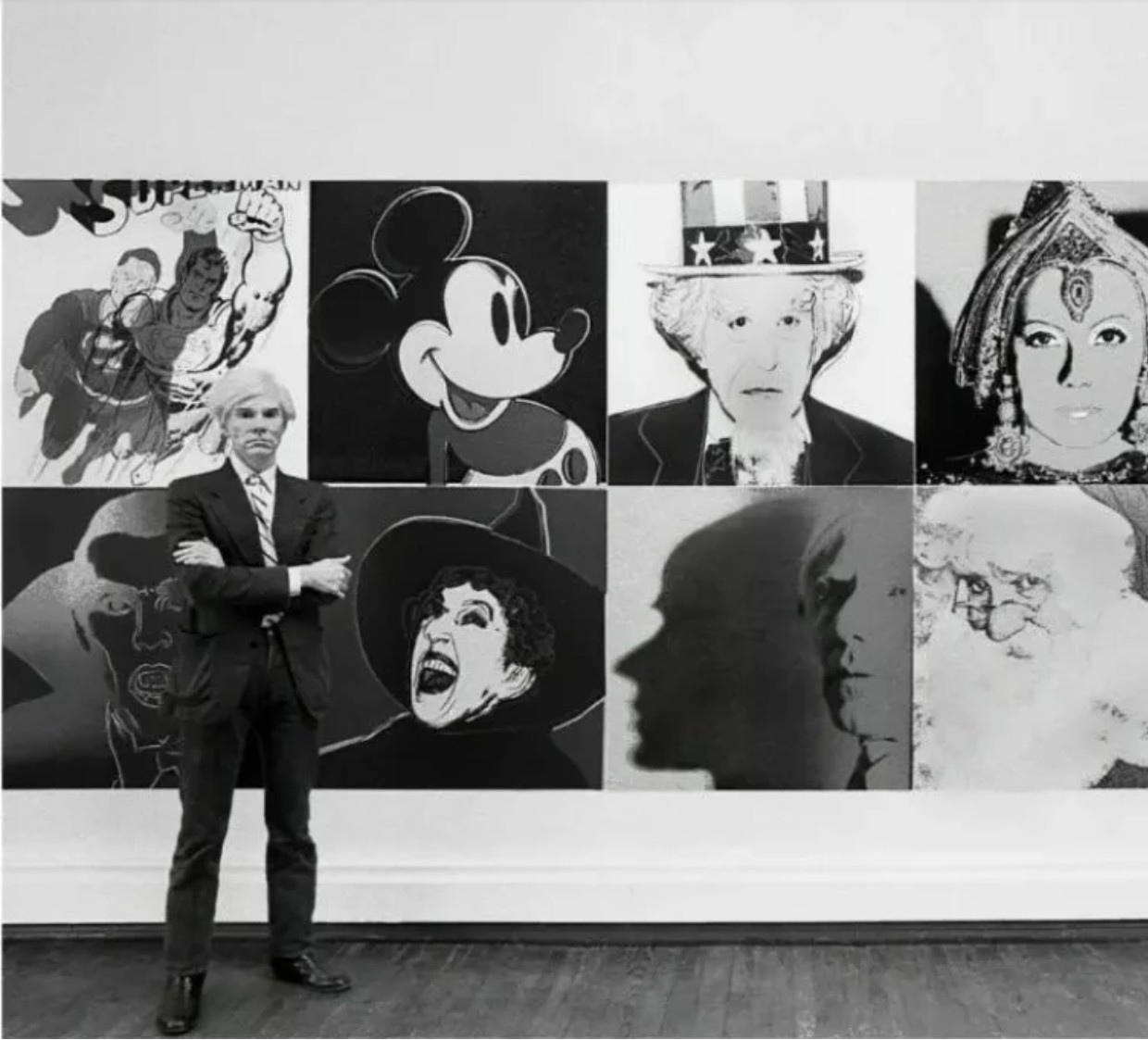
Andy Warhol at R. Feldman Gallery with Myths, 1981. Photo by Robert Levin.
© 2025 Andy Warhol Foundation for the Visual Arts / Artists Rights Society (ARS), New York
Further obfuscating the distinction between reality and fiction, Warhol based several of the myths on polaroid photos he took of people in costume. The present work depicts the actress Margaret Hamilton, who played the Wicked Witch of the West opposite Judy Garland in The Wizard of Oz (1939). Warhol met Hamilton in 1980; he wrote in his diary on August 12:
“I saw Margaret Hamilton, the witch in The Wizard of Oz, and got so excited and went over to her and told her how wonderful she was. She does the Maxwell House commercials now. She’s really small.”
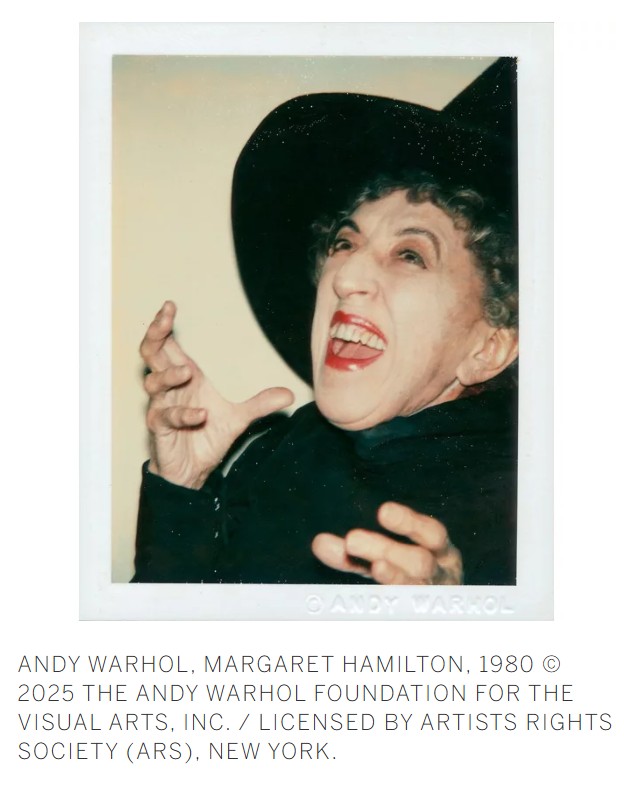
He invited Hamilton to his studio for a photoshoot, where she donned a witch hat and costume to pose for pictures. The reference image for The Witch shows Hamilton making the same screeching face as the eponymous witch in the painting. While the witch’s green face is distinctly of the character, her face itself–its expression and the curly hair bunching up around her ears–comes directly from Hamilton. The Witch (from Myths) is both a portrait of the classic character from 1939 and a portrait of Hamilton in 1980. Warhol intentionally blurs these lines, evoking–like many of his best known works do–the quintessentially modern iconography of cultural saturation. In The Witch (from Myths), Warhol elevates the Witch–both the actor and the character–to mythic status, affirming their role in the canon of American life. His deep engagement with contemporary culture pervades Warhol’s oeuvre. The characters, real or fictional, who populate the American collective consciousness were of real importance to him.
#6. Knives, circa 1981-82
Sotheby’s New-York: 19 November 2025
Estimated: USD 180,000 – 250,000
USD 279,400
Knives | Contemporary Day Auction | 2025 | Sotheby’s
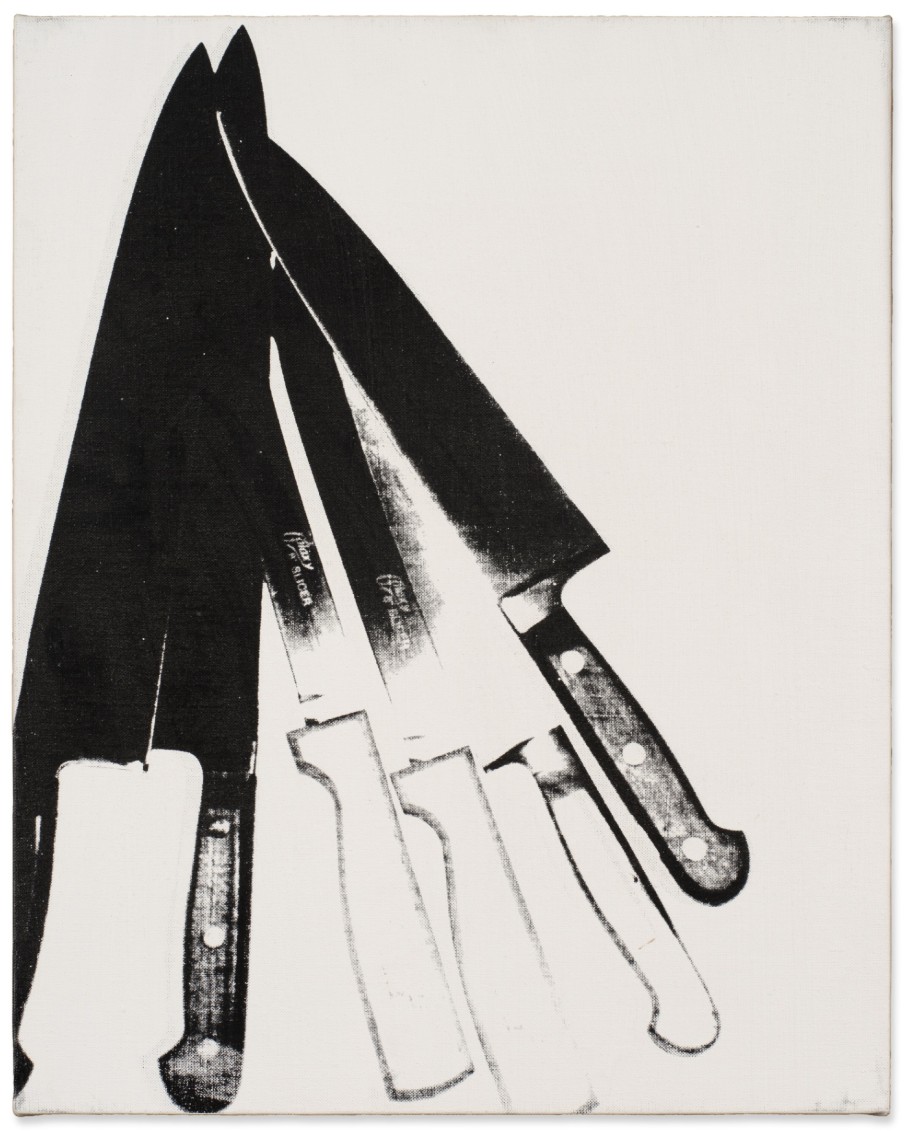
ANDY WARHOL (1928 – 1987)
Knives, circa 1981-82
Acrylic and silkscreen ink on canvas
20×16 inches (50.8 x 40.6 cm)
Stamped by the Estate of Andy Warhol twice and the Andy Warhol Foundation for the Visual Arts, Inc.
Numbered PA 95.007 on the overlap and stretcher
#7. Untitled, 1981
Property from a Distinguished Private Collection, Japan
Sotheby’s New-York: 19 November 2025
Estimated: USD 180,000 – 250,000
USD 241,300
Untitled | Contemporary Day Auction | 2025 | Sotheby’s
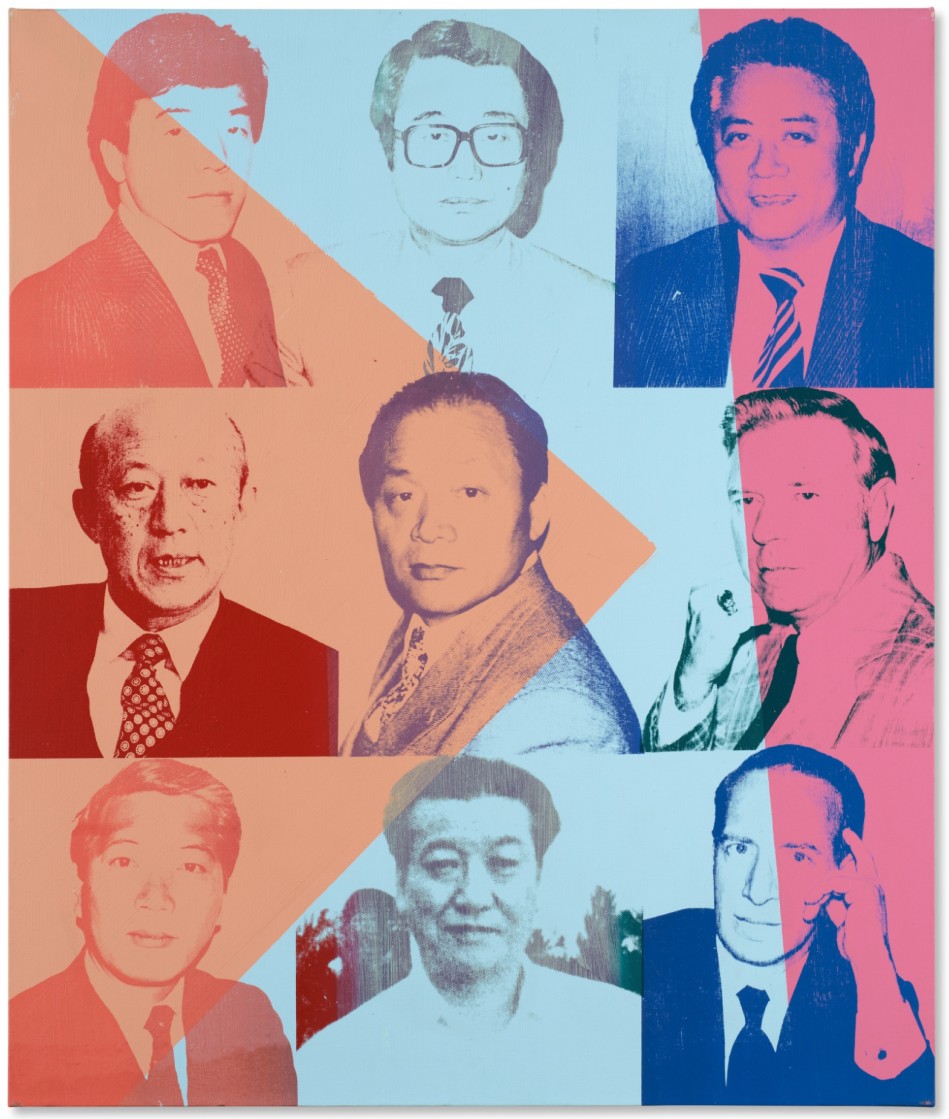
ANDY WARHOL (1928 – 1987)
Untitled, 1981
Acrylic and silkscreen ink on canvas
50 x 42 1/8 inches (127×107 cm)
Signed and dated 1981 (on the overlap)
#8. U.S. Weather Map/GE, 1985-86
Christie’s New-York: 20 November 2025
Estimated: USD 70,000 – 100,000
USD 215,900
ANDY WARHOL (1928-1987), U.S. Weather Map/GE | Christie’s
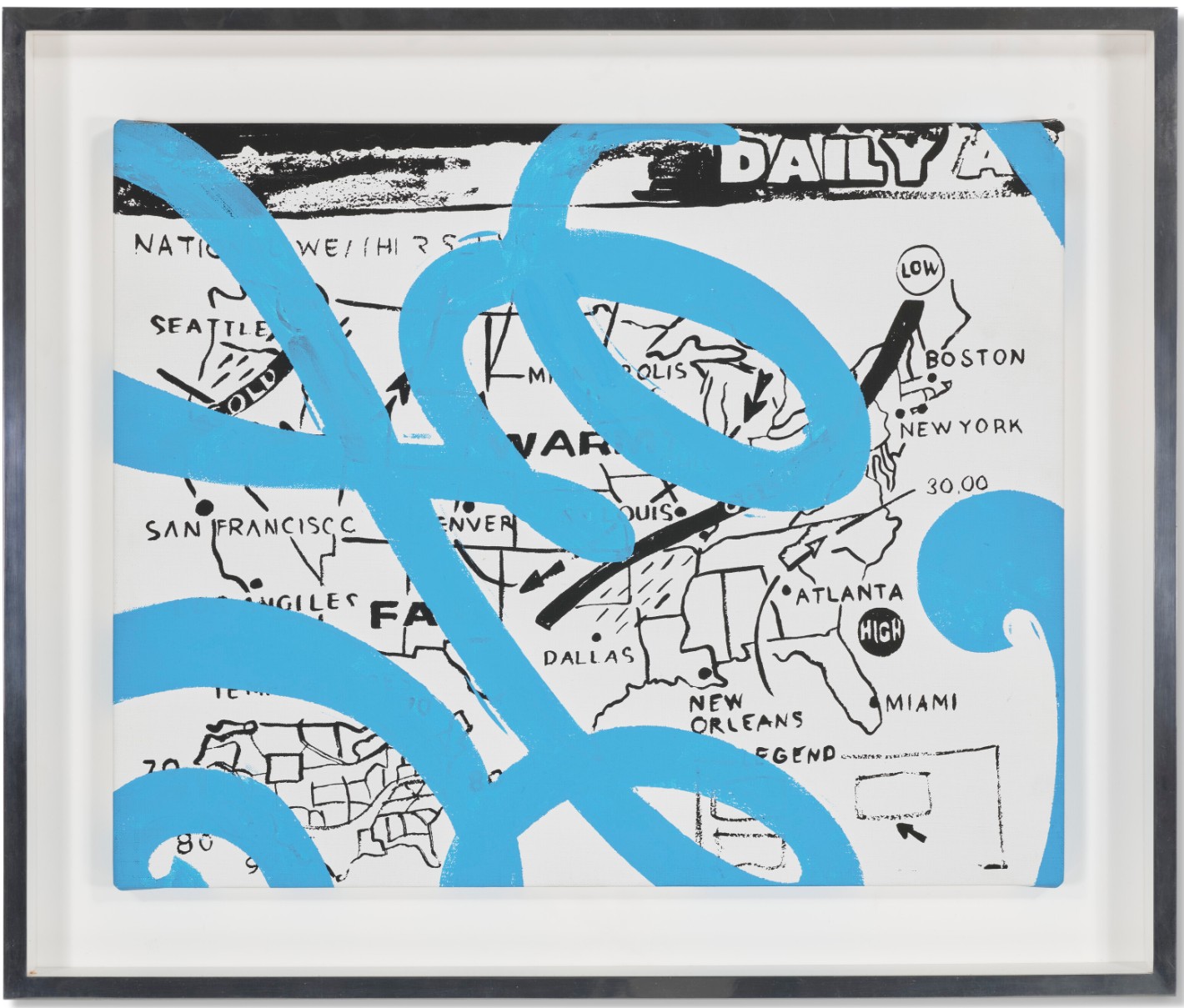
ANDY WARHOL (1928-1987)
U.S. Weather Map/GE, 1985-86
Acrylic and silkscreen ink on canvas
16×20 inches (40.6 x 50.8 cm)
Stamped with the Estate of Andy Warhol and the Andy Warhol Foundation for the Visual Arts, Inc. stamps
Numbered ‘PA10.302 VF’ (on the overlap)
Numbered again ‘PA10.302 (on the stretcher)
#9. Torso, 1977
Phillips New-York: 21 November 2025
Estimated: USD 300,000 – 500,000
USD 212,850
Andy Warhol Modern & Contemporary Art Day Sale, Morning Session
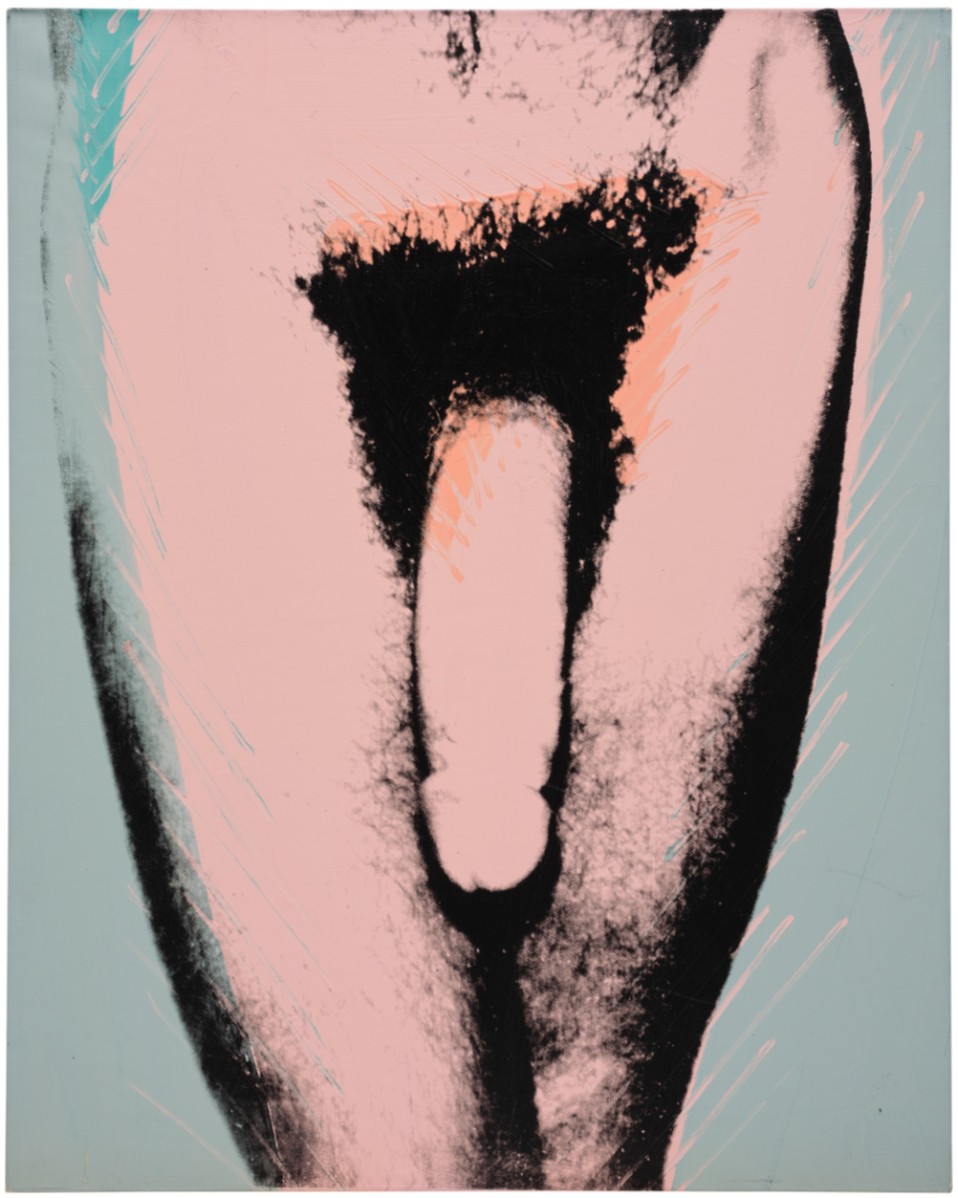
ANDY WARHOL
Torso, 1977
Acrylic and silkscreen ink on canvas
50 1/8 x 40 inches (127.3 x 101.6 cm)
Signed and dated “Andy Warhol 1977”
Stamped by the Estate of Andy Warhol and the Andy Warhol Foundation for the Visual Arts, Inc., New York
Initialed and numbered “PA79.007” on the reverse on the overlap
#10. Rorschach, 1984
Works from the Collection of Byron R. Meyer
with Partial Proceeds to Benefit the San Francisco Museum of Modern Art
Sotheby’s New-York: 19 November 2025
Estimated: USD 80,000 – 120,000
USD 203,200
Rorschach | Contemporary Day Auction | 2025 | Sotheby’s
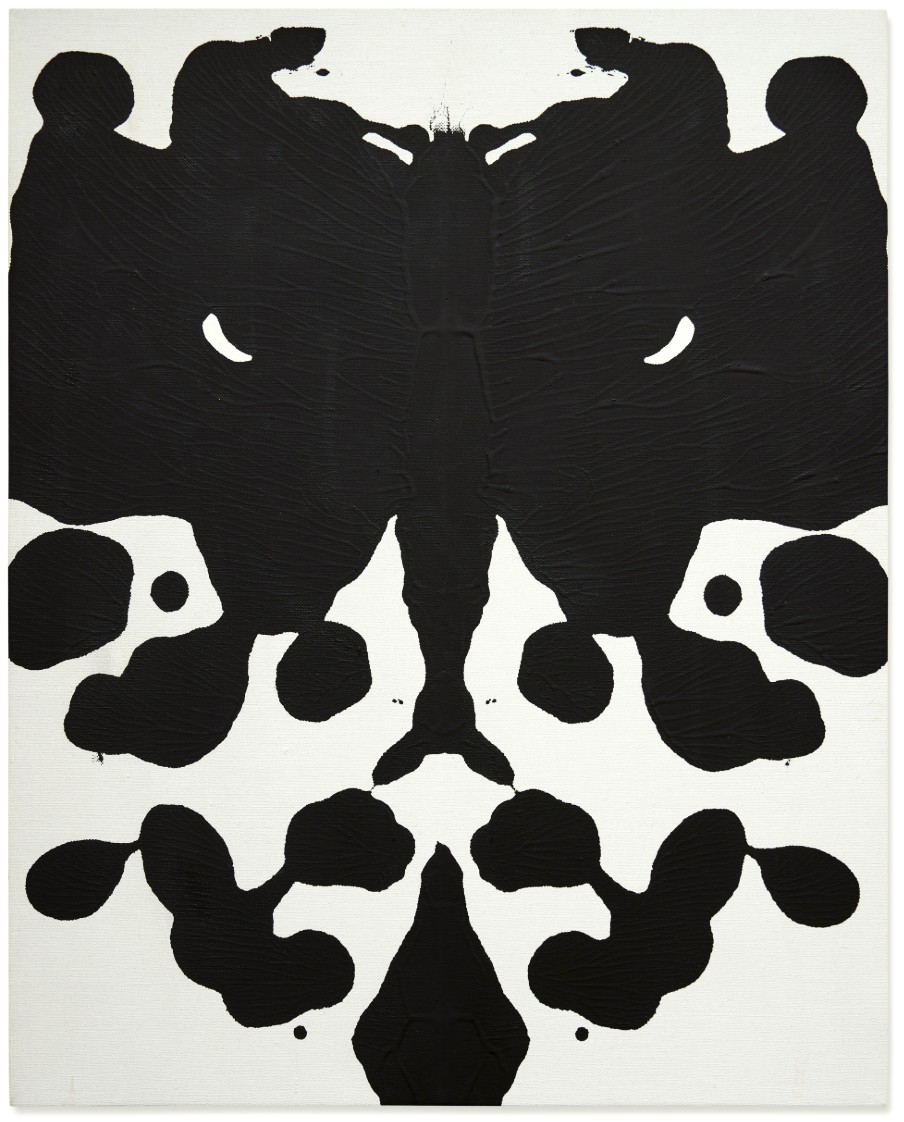
ANDY WARHOL (1928 – 1987)
Rorschach, 1984
Acrylic on canvas
20×16 inches (50.8 x 40.6 cm)
Stamped by the Estate of Andy Warhol and the Andy Warhol Foundation for the Visual Arts
Numbered PA 75.033 on the overlap
Shadow, 1979
Christie’s New-York: 20 November 2025
Estimated: USD 60,000 – 80,000
USD 120,650
ANDY WARHOL (1928-1987), Shadow | Christie’s
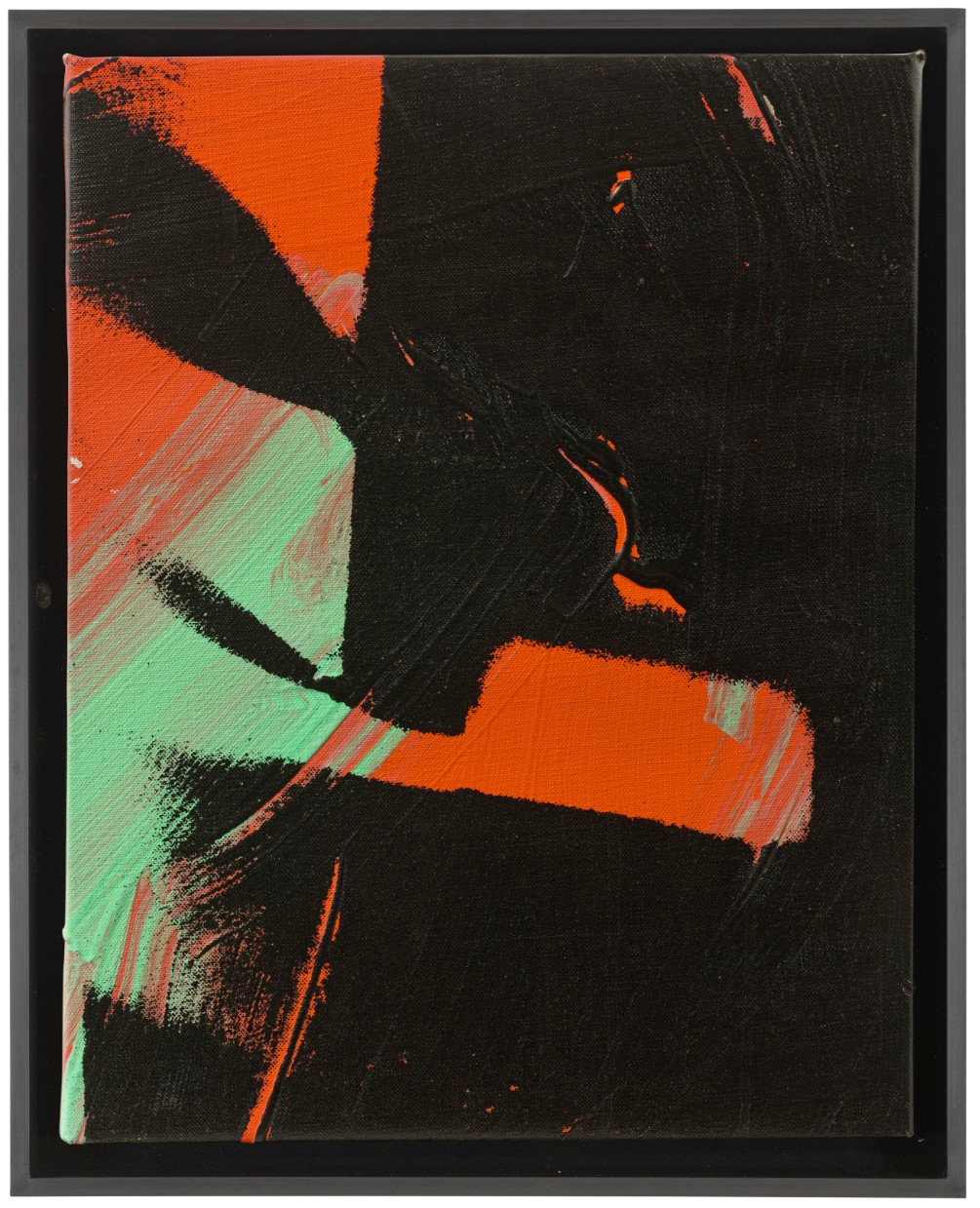
ANDY WARHOL (1928-1987)
Shadow, 1979
Acrylic and silkscreen ink on canvas
14×11 inches (35.6 x 27.9 cm)
Stamped with the Estate of Andy Warhol and The Andy Warhol Foundation for the Visual Arts, Inc. stamps
Numbered ‘PA65.038’ (on the overlap)
Numbered again ‘PA65.038’ (on the stretcher)
Ryuichi Sakamoto, 1983
Phillips New-York: 21 November 2025
Estimated: USD 250,000 – 350,000
PASSED
Andy Warhol Modern & Contemporary Art Day Sale, Morning Session
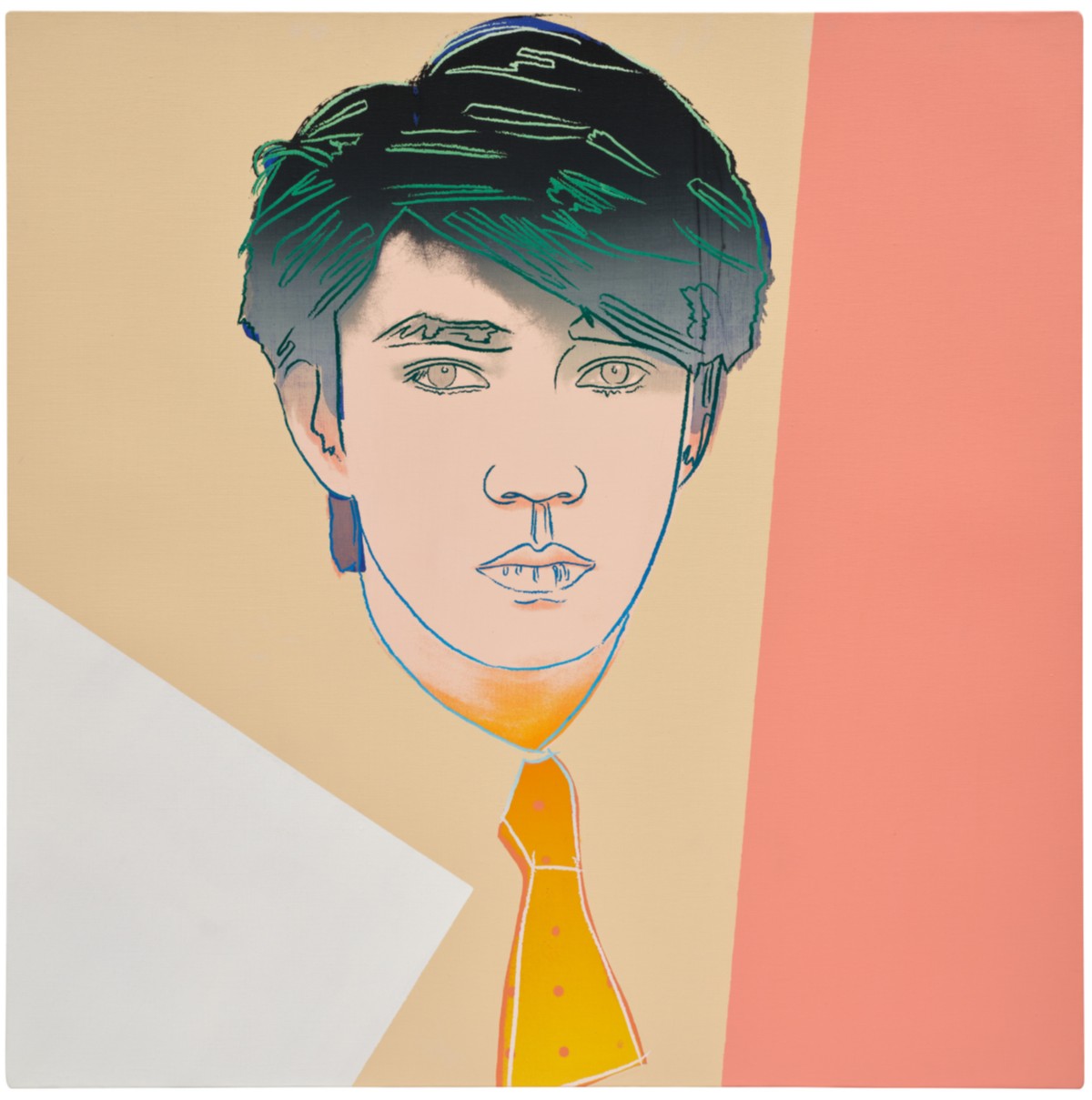
Acrylic and silkscreen on canvas
39 3/4 x 39 3/4 inches (101×101 cm)
Signed and dated “Andy Warhol 83” on the overlap
2. Works on Paper
Cherub, circa 1957
Property from an Important Private Collection, Japan
Christie’s New-York: 20 November 2025
Estimated: USD 70,000 – 100,000
USD 133,350
WORK ON PAPER
ANDY WARHOL (1928-1987), Cherub | Christie’s
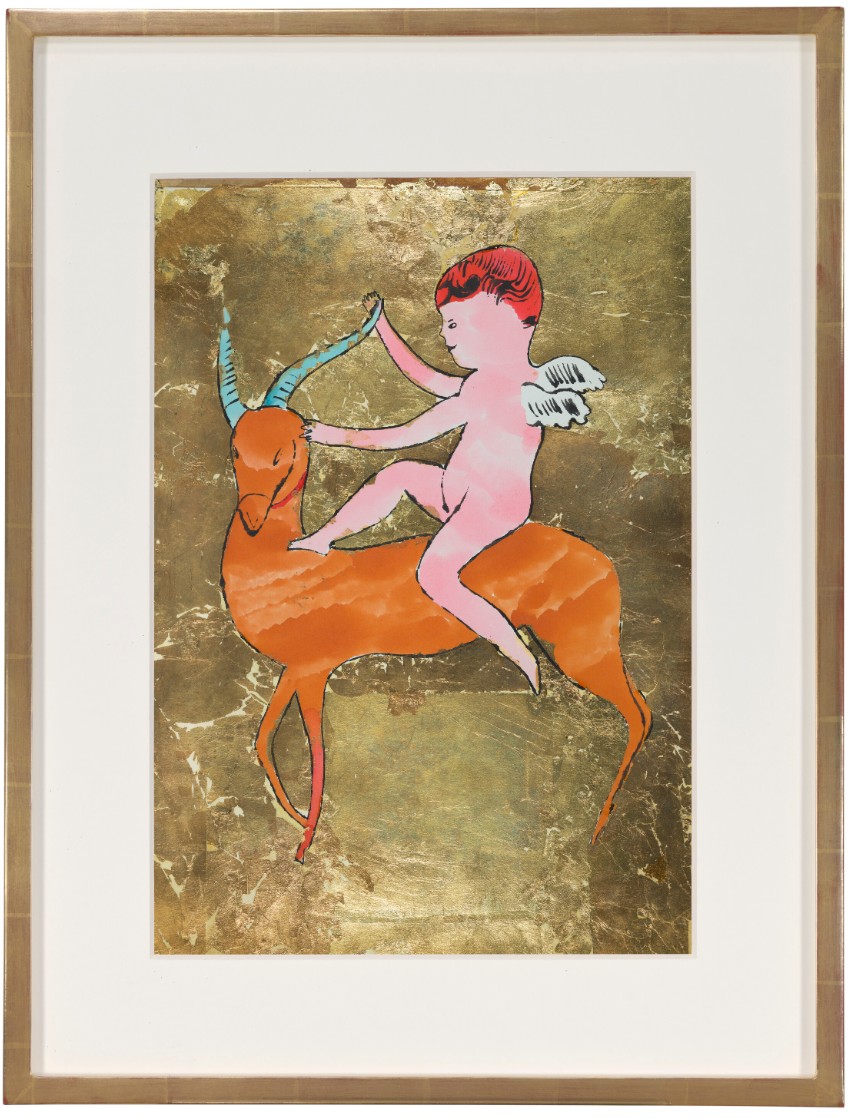
ANDY WARHOL (1928-1987)
Cherub, circa 1957
Ink, watercolor and gold leaf on paper
19 1/2 x 13 1/4 inches (49.5 x 33.7 cm)
Stamped with the Estate of Andy Warhol and the Andy Warhol Foundation for the Visual Arts, Inc. stamps
Numbered ‘VF 289.020’ (on the reverse)
Wedding Cake, circa 1959
Property from an Important Private Collection, Japan
Christie’s New-York: 20 November 2025
Estimated: USD 80,000 – 120,000
USD 114,300
WORK ON PAPER
ANDY WARHOL (1928-1987), Wedding Cake | Christie’s
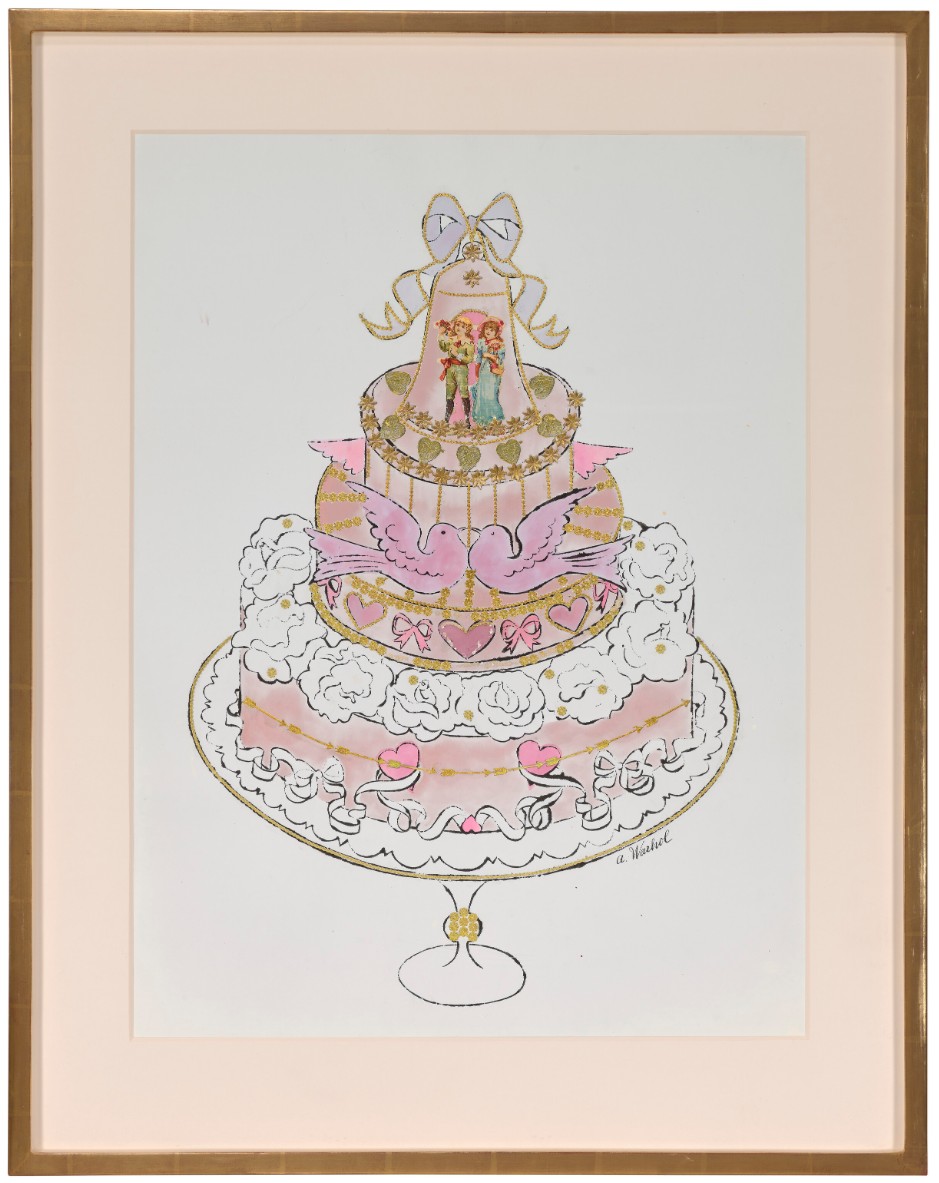
ANDY WARHOL (1928-1987)
Wedding Cake, circa 1959
Ink, watercolor, gold appliqué and printed paper collage on paper
28 1/2 x 22 1/2 inches (72.4 x 57.2 cm)
Signed ‘A. Warhol’ (lower right)
Stamped with the Estate of Andy Warhol and the Andy Warhol Foundation for the Visual Arts, Inc. stamps
Numbered ‘VF 290.004’ (on the reverse)
Seated Monkey with Baby Monkey, circa 1957
Property from an Important Private Collection, Japan
Christie’s New-York: 20 November 2025
Estimated: USD 80,000 – 120,000
USD 114,300
WORK ON PAPER
ANDY WARHOL (1928-1987), Seated Monkey with Baby Monkey | Christie’s
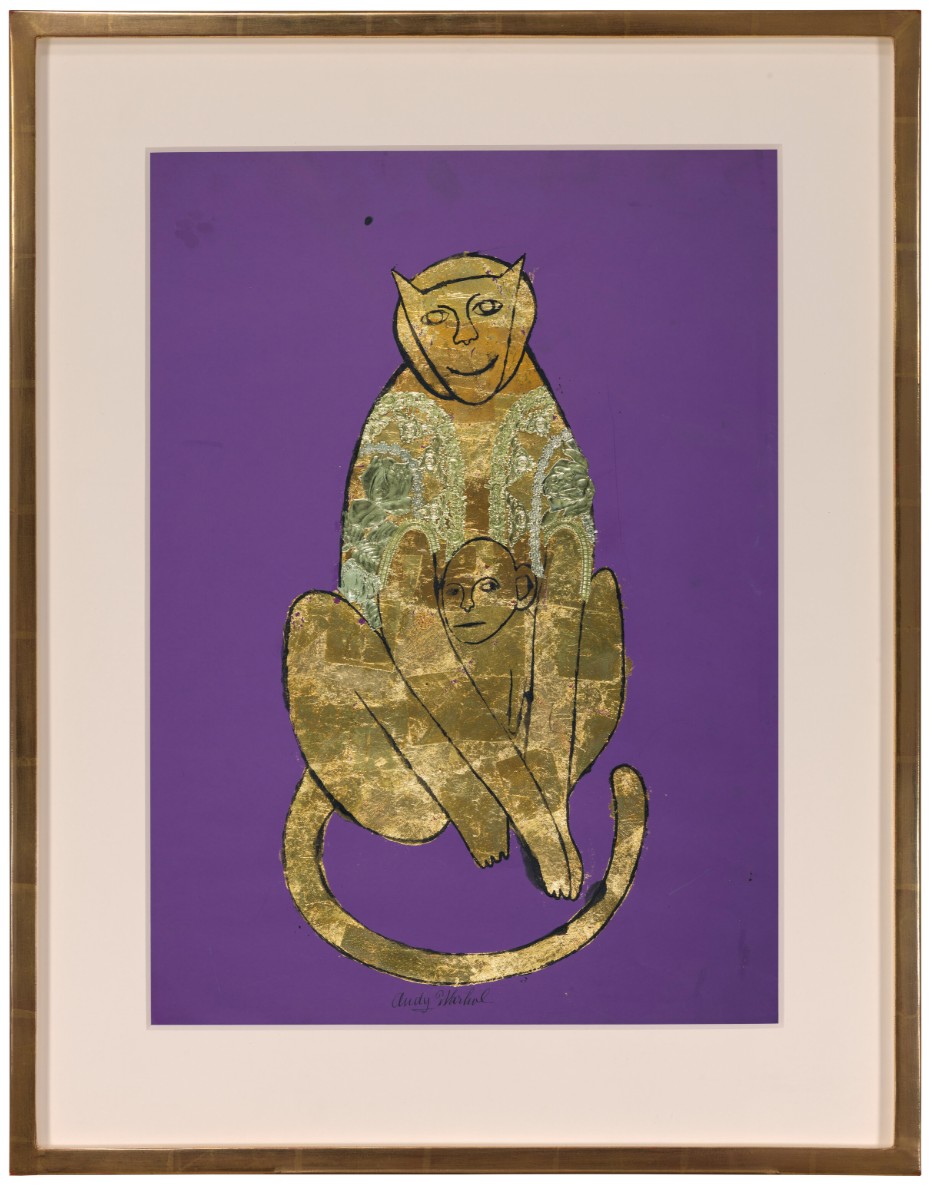
ANDY WARHOL (1928-1987)
Seated Monkey with Baby Monkey, circa 1957
Ink, gold leaf and gold appliqué on colored paper
22×16 inches (55.9 x 40.6 cm)
Signed ‘Andy Warhol’ (lower center)
Boy with Bow and Arrow, circa 1957
Property from an Important Private Collection, Japan
Christie’s New-York: 20 November 2025
Estimated: USD 60,000 – 80,000
USD 76,200
WORK ON PAPER
ANDY WARHOL (1928-1987), Boy with Bow and Arrow | Christie’s
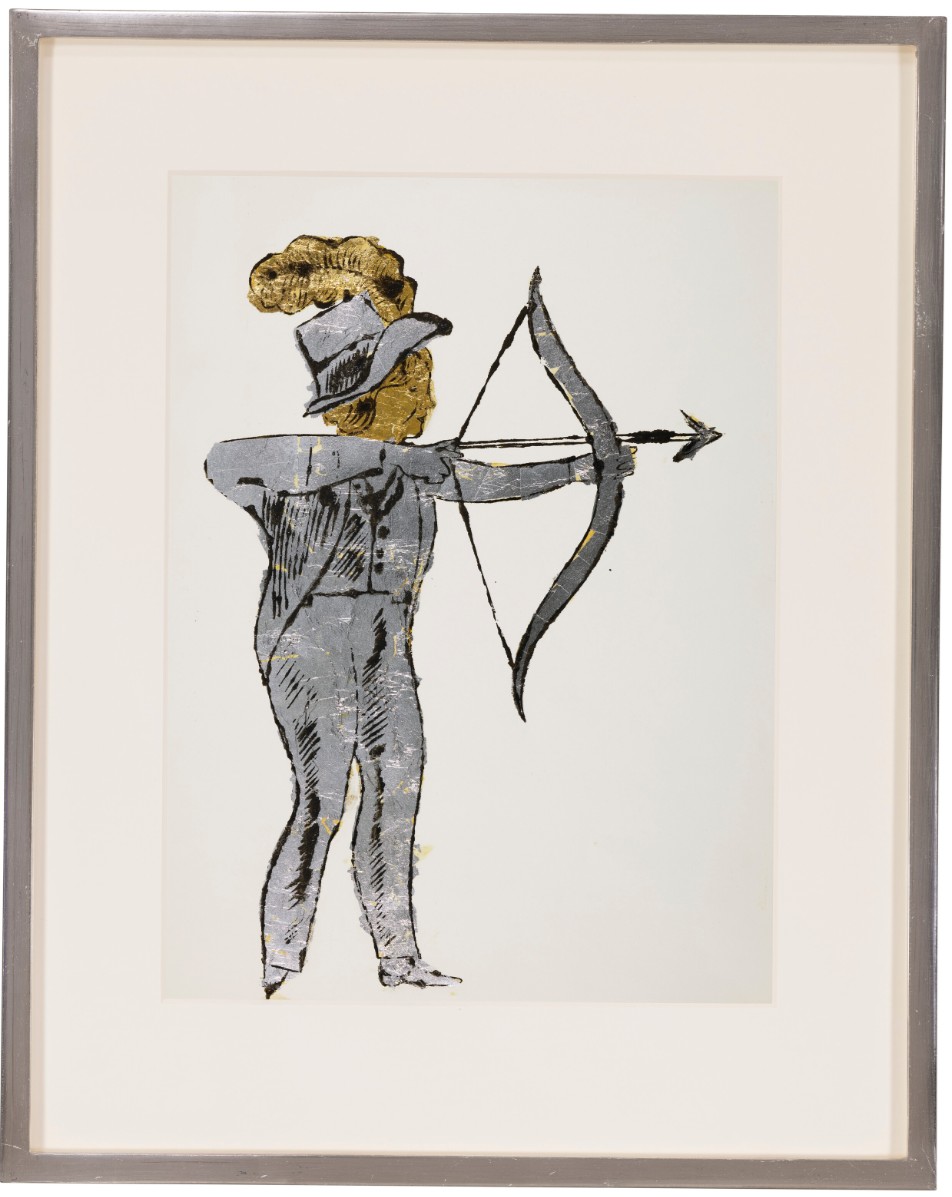
ANDY WARHOL (1928-1987)
Boy with Bow and Arrow, circa 1957
Ink, gold leaf and silver leaf on paper
23 x 15 5/8 inches (58.4 x 39.7 cm)
Stamped with the Estate of Andy Warhol and the Andy Warhol Foundation for the Visual Arts, Inc. stamps
Numbered ‘VF 289.018 (on the reverse)
3. Prints
Ads, 1985
Sotheby’s New-York: 19 November 2025
Estimated: USD 2,000,000 – 4,000,000
USD 2,978,000
Ads | Contemporary Day Auction | 2025 | Sotheby’s
ANDY WARHOL (1928 – 1987)
Ads, 1985
The complete set of ten screenprints in colors on Lenox Museum Board
Together with the original justification page
Each sheet: 38×38 inches (96.5 x 96.5 cm)
Signed and inscribed AP 22/30 (lower right or lower left of each)
This set is an artist’s proof set aside from the numbered edition of 190
Each with the blindstamps of the printer, Rupert Jasen Smith, and the publisher, Ronald Feldman Fine Arts, Inc.
Andy Warhol’s Ads portfolio was executed only two years before the artist’s death, and it serves as a retrospective of his fascination with glamour, fashion, film and celebrity. Having begun his career in graphic illustration, drawing magazine advertisements and then designing department store windows, the Ads brings us full circle but now with over two decades of exploring the democratization of popular consumer culture to inform the imagery. Warhol had made Campbell’s Soup as famous as Marilyn Monroe, he once said “what’s great about this country is America started the tradition where the richest consumers buy essentially the same things as the poorest. You can be watching TV and see Coca-Cola, and you can know that the President drinks Coke, Liz Taylor drinks Coke, and just think, you can drink Coke, too.” This sentiment of accessibility regardless of affluence is often used to explain the allure of printmaking; not everyone can afford a unique work by an important artist but a print? Less expensive to obtain, and by the nature of multiplicity, available to many rather than just one. Like many artists before him, Warhol knew he could broaden his audience through printmaking, he was also firm in his belief that nothing was truly unique, and everyday objects should be celebrated. Thus, a background in advertising and a delight in the influences of mass media mingled with the power of serialization to culminate in this remarkable survey of American iconography.
Left: © Retro AdArchives / Alamy Stock Photo // Center: © JJs / Alamy Stock Photo //
Right: © John Frost Newspapers / Alamy Stock Photo
A fascinating dialogue is formed when screenprint, originally a commercial printing technique, is utilized to portray symbols of commerce. By the time Ads was published in 1985, Warhol had mastered the medium and the technical complexity of these prints is astonishing. For example, The New Spirit (Donald Duck) employed over a dozen screens and multiple colors including neon and metallic hues. The inherently flat quality of a screenprint is counterbalanced in these prints with an almost theatrical quality, such as the haunting Chanel perfume bottle floating on an ombré background. The project was an ideal intersection of propaganda and proliferation wherein logos produced by the culture of the era were in turn recreated in multiple forms so that they could reach the largest audience in the same manner that an advertisement is crafted with the hope that it will be widely broadcast.

The power of advertising is a concept often discussed – why does it hold our interest; how can it be influential? For one, we are instantly attracted to the element of nostalgia, within the portfolio both James Dean and Judy Garland are portrayed, both having been beloved movie stars who died tragically, harkening back to Warhol’s early Death and Disaster series and his fascination with the potential for fame to meet a heartbreaking end. Van Heusen is an intriguing collision of the past and present as it features Ronald Reagan, the actor as the ambassador for a man’s shirt company, yet at the time of the portfolio’s publication, he was president of the United States. Another draw for the consumer is the portrayal of strength or dominance and what could signify success more blatantly than the emblems of corporate titans such as Mobil or Paramount? Each image, or each AD, appropriates a product (Life Savers), a corporate logo (Macintosh) or a famous face (Judy Garland); opulence (Chanel) mixes with utility (Volkswagen) and reminiscence (Rebel Without a Cause). To recognize these advertisements as a means of capturing the consumer’s attention at the same time they are being mythologized, elevated from banal commercial to high art, is the ultimate irony on which Warhol, a brand now himself, built an entire career.
Satyric Festival Song, 1986
Sotheby’s New-York: 19 November 2025
Estimated: USD 20,000 – 30,000
USD 27,940
EDITION PRINT
Satyric Festival Song, from the Martha Graham series | Contemporary Day Auction | 2025 | Sotheby’s
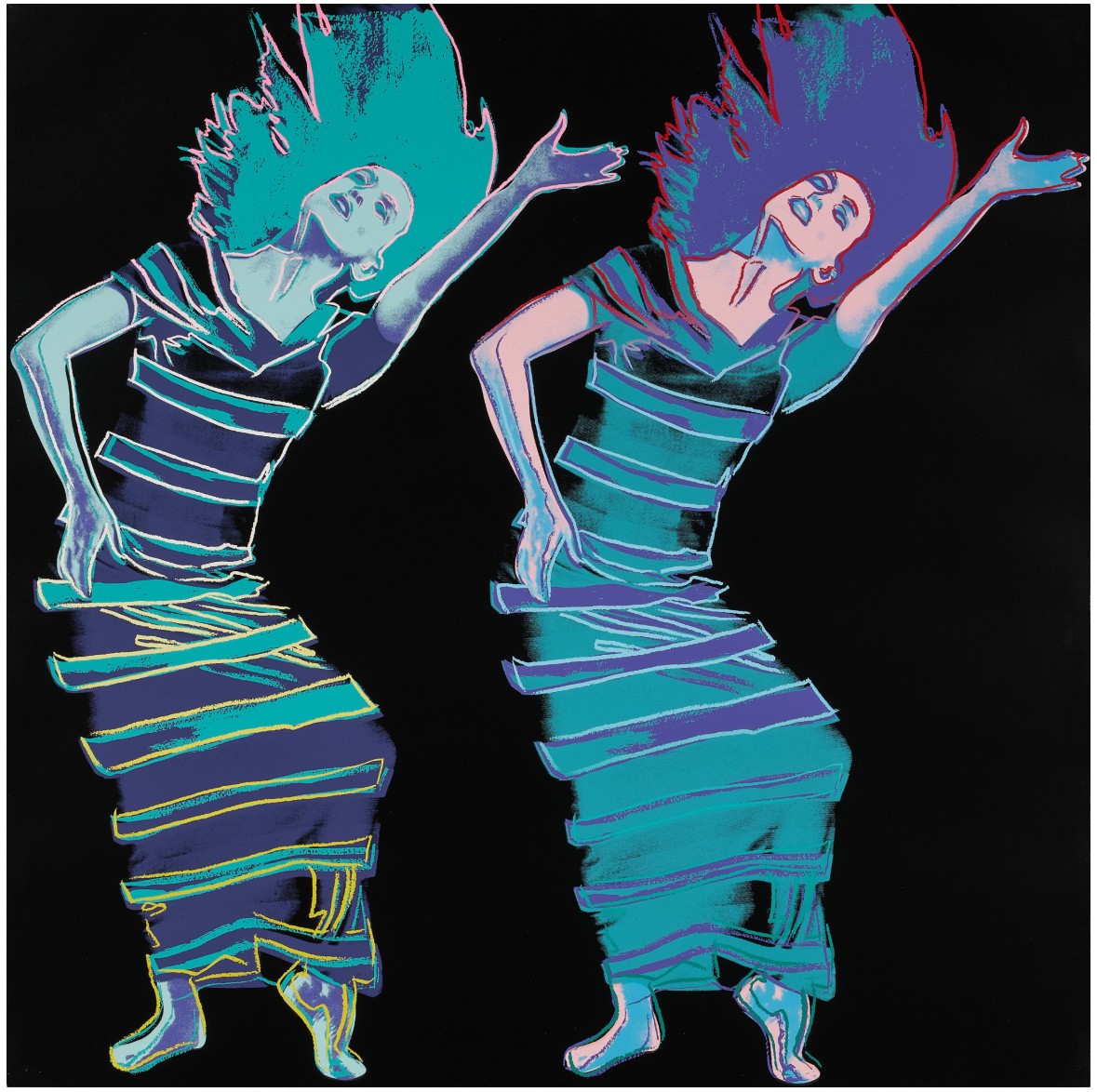
ANDY WARHOL (1928-1987)
Satyric Festival Song (Feldman & Schellmann no. II.387), 1986
from the Martha Graham series
Screenprint in colors on Lenox Museum Board
Signed and inscribed XI/XXV (on the verso)
This impression is one of 25 in Roman numerals
Aside from the edition of 100 in Arabic numerals plus 25 artist proofs
Published by Martha Graham Center of Contemporary Dance, Inc.
Joan Mitchell
PLEASE CLICK ON THE PICTURE BELOW TO ACCESS AUCTION MARKET OVERVIEW

1. Paintings
#1. Sunflower V, 1969
Elaine: The Collection of Elaine Wynn
Christie’s New-York: 17 November 2025
Estimated: USD 12,000,000 – 18,000,000
USD 16,735,000
JOAN MITCHELL (1925-1992), Sunflower V | Christie’s
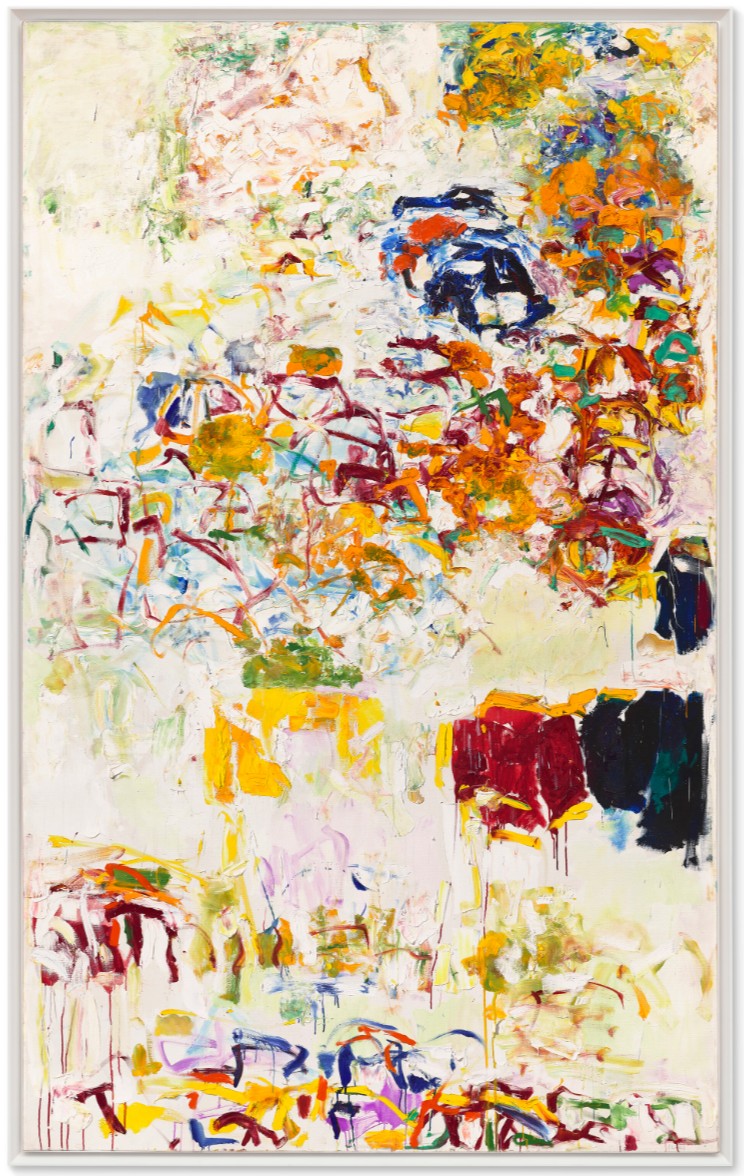
JOAN MITCHELL (1925-1992)
Sunflower V, 1969
Oil on canvas
102 1/2 x 63 inches (260.4 x 160 cm)
Signed ‘J. Mitchell’ (lower right)
Joan Mitchell’s colossal Sunflower V is a stirring visual poem wrought from the great Abstract Expressionist’s athletic brushstrokes and energetic paints, articulating simultaneously the splendid grandeur and the macabre of the natural world witnessed by the artist upon her arrival in 1967 to Vétheuil, the small village just outside Paris where she would remain for the rest of her life. Immersing herself within her newfound arcadian garden and embracing the poignant legacy of her artistic forebearers, Mitchell’s style and outlook changed considerably from her early architectonic abstract renderings of New York’s urbanity and her more mournful Calvi and Black Paintings made in Paris in the earlier part of the 1960s. Sunflower V marks the definitive fulcrum for the artist, Mitchell here embracing the natural world newly surrounding her, while accommodating her American inheritance with the vibrant French artistic tradition. Among the depictions of sunflowers made by the artist, Mitchell would continue to explore the subject in a variety of media—paintings, drawings, lithographs, and prints—until the very end of her life, making a monumental diptych celebrating this favored form just a year before her death with Sunflowers (1990-1991). Her continued engagement with sunflowers denotes their deeply personal, even autobiographical, significance for Mitchell.
“Sunflowers are something I feel intensely. They look so wonderful when young and they are so very moving when they are dying.”
Joan Mitchell in her garden at La Tour, Vétheuil, 1972. Photo: © Nancy Crampton. All rights reserved.
Standing two meters high, Sunflower V monumentalizes the vertical format favored by Old Master and Impressionist painters of flower still-lifes, expanding and exploring their vernacular at a revolutionary scale. Here, Mitchell suggestively paints a sunflower majestically unfurling from the top register down towards the bottom of the picture, the scale of the tableau capturing the true size of the massive sunflowers growing just outside her home in Vétheuil. The work manifests a detailed rendition of the bright blossom tossed high in the air, then careening downward through space in brilliant myriad melodies composed in shades of orange, red, thin washes of lavender and rich blues intermixed with the prominent dapples of white and yellow tones of cadmium and orpiment.
The alternating dense and thin passages of impastoed paint parallel and magnify her almost impressionistic brushwork at a stunning scale, capturing the atmospheric light surrounding and penetrating the petals, stems, and leaves which constitute the sunflower. Mitchell varies her brushstrokes, developing in certain areas—notably in the central zone—the poignant, linear strokes which recall her earlier 1950s works, and in other areas dense fields of interlocking gestural passages and blocky forms which Mitchell will go on to further develop through the next decade. The compositional plane is similarly expansive in Sunflower V, with the artist leaving less white space within her picture, nodding towards the allover paintings which she would develop later in life.
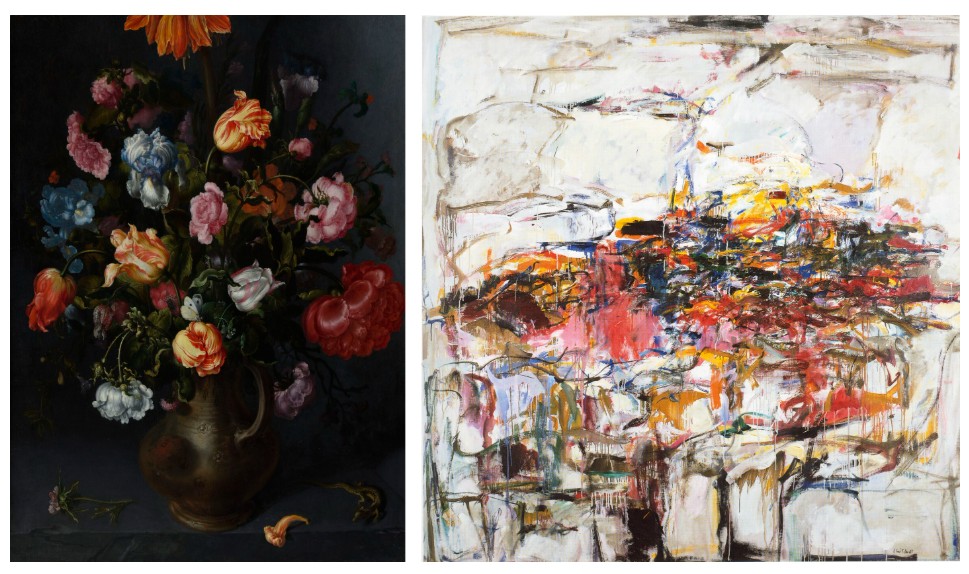
Left: Jacob Vosmaer, A Vase with Flowers, circa 1613. Metropolitan Museum of Art, New York.
Right: Joan Mitchell, City Landscape, 1955. Art Institute of Chicago. © Estate of Joan Mitchell.
Sunflower V manifests a deep emotional complexity, capturing both the flower’s magnificent first bloom down through its collapsing death in a sweeping narrative played out across the canvas. Art critic Dave Hickey gracefully describes how “Mitchell’s sunflowers bloom for us in their glory, singly and in floral banks, they reward us in the fullness of their moment, which is not much longer than the painter takes to re-imagine them, but they die dead. Mitchell insists that they do… They turn ugly and forbidding, rot and burn away” (D. Hickey, “Joan Mitchell: Epigrammata,” in Joan Mitchell: Sunflowers, exh. cat., Cheim & Read, New York, 2008, p. 2). Hickey aligns Mitchell’s Sunflowers with the classical epigram, both poems and paintings intertwining petulance and grandeur to capture and express the quotidian experience of living and breathing, but in their psychological complexity and enduring power Mitchell also expresses the existentialist laments of writers including Charles Baudelaire, Albert Camus, and Samuel Beckett, the former two residing on her bookshelf and the later a dear friend. Mitchell aligns herself aesthetically with this thoroughly French tradition of philosophizing death by elevating joy and despair onto equal planes, both expressions finding purchase amid her meticulous brushstrokes and vibrant variants of color. While other artists, notably Vincent van Gogh, have captured the bloom and subsequent decay of sunflowers across a series of canvases, Mitchell’s innovation here is to include one flower’s entire life cycle in a singular plane.
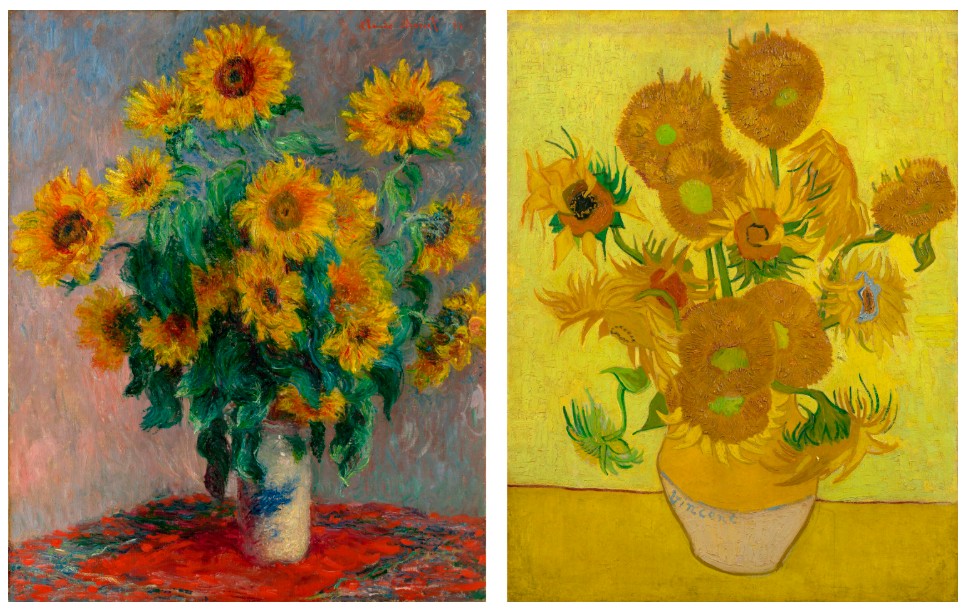
Left: Claude Monet, Bouquet of Sunflowers, 1881. Metropolitan Museum of Art, New York.
Right: Vincent van Gogh, Sunflowers, 1889. Van Gogh Museum, Amsterdam.
Van Gogh famously chose sunflowers for his most iconic subject, painting the buds’ lifecycle across a series of seven canvases. Mitchell had assiduously studied and admired the great master’s paintings while training at the Art Institute of Chicago, and her embrace of the same subject mirrors her forebearer. Van Gogh’s Sunflowers were among the first paintings the artist made upon his arrival to Arles in the south of France, fleeing the rigors and tribulations of Paris. The Dutch artist rejoiced enthusiastically in the joyous expression of the flowers, writing in a letter to his brother Theo in 1888 that “I’m painting with the gusto of a Marseillais eating bouillabaisse, which won’t surprise you when it’s a question of painting large SUNFLOWERS” (V. van Gogh, “No. 666: To Theo van Gogh. Arles, Tuesday, 21 or Wednesday, 22 August 1888,” Van Gogh Museum: The Letters, Online, accessed 3 June, 2025, emphasis original). Mitchell similarly alighted from the French metropolis for the bucolic idyll of Vétheuil, seeking to remove herself from the chaos of the city and to find new artistic inspiration. Acquiring La Tour, a house which prominently overlooked both the village and the river Siene, Mitchell and her partner, the Québécois painter Jean-Paul Riopelle, developed and maintained a magnificent garden on her terrace, with Riopelle planting the Russian Mammoth Sunflowers which appear in her paintings.
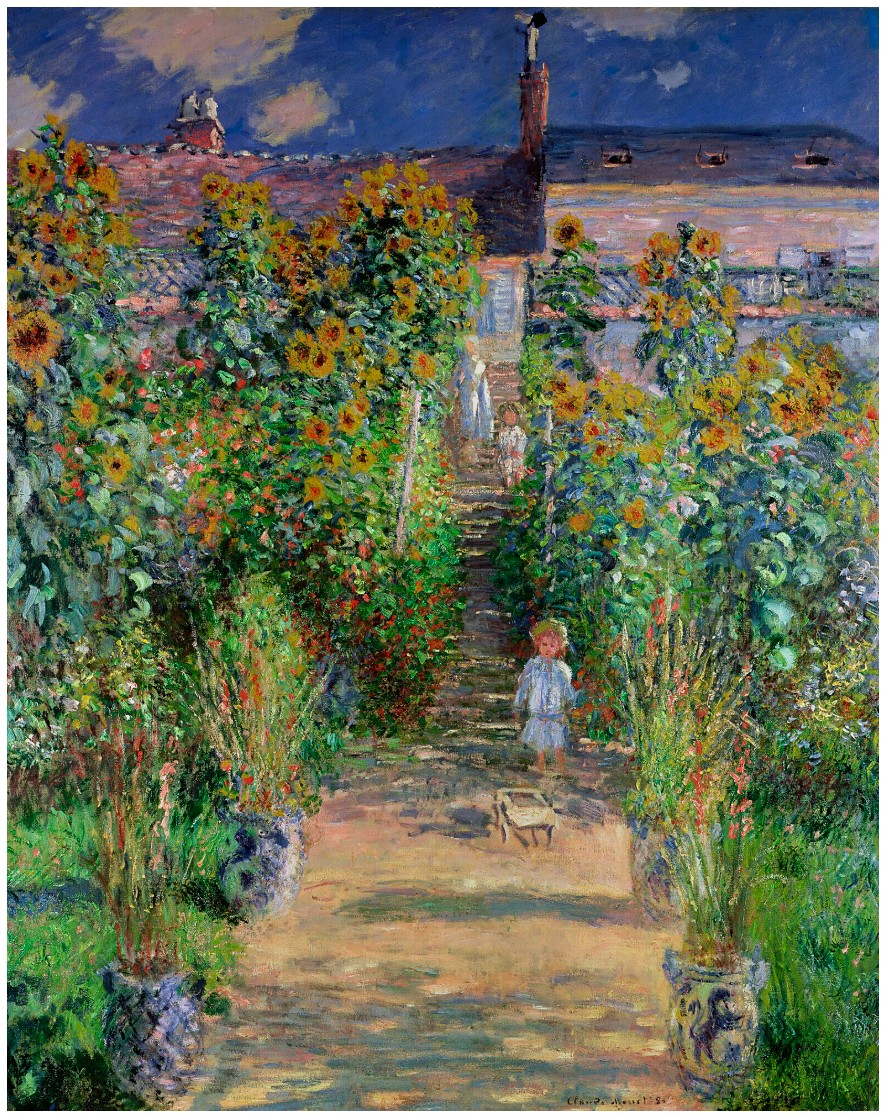
Claude Monet, The Artist’s Garden at Vétheuil, 1881. National Gallery of Art, Washington, D.C.
Mitchell had chosen the same village which Claude Monet had moved to almost a century before, Riopelle sowing the same sunflowers which the Impressionist master had painted so stunningly in a series of paintings from 1881. Both Monet’s and Mitchell’s moves out from Paris allowed an important self-reinvention permitted by their removal from the Parisian art world, both artists developing extraordinary lyrical compositions which exude unparalleled optimism and energy. Mitchell’s house overlooked the home which housed Monet and his family, providing an intimate proximity to the Impressionist’s legacy.
“I live in it, I walk in it. It’s fabulous. The garden, the trees, the church… the fields behind where Monet did his Poppy things… the Seine right below.”
La Tour also provided an important space for Mitchell to expand her work, both through its immersion within the French countryside and due to the property’s size, permitting her standalone studio to be her largest yet, allowing her to paint her large compositions such as Sunflower V on stretched canvases for the first time in her career. The relocation most importantly influenced Mitchell’s practice, however, by propelling her directly into the legacy of van Gogh and Monet, adducing a flavor of France’s artistic patrimony into her American abstractions. Considering Mitchell’s Sunflower paintings, the great French art historian Pierre Schneider proclaimed her as “the last heir to the grand tradition,” writing with elegant ekphrasis how her paintings were “a purely abstract space suddenly interrupted by a yellow literally taken from a sunflower” (P. Schneider, “Mitchell: la conscience et la terre,” L’Express, August-September 1982, p. 19).
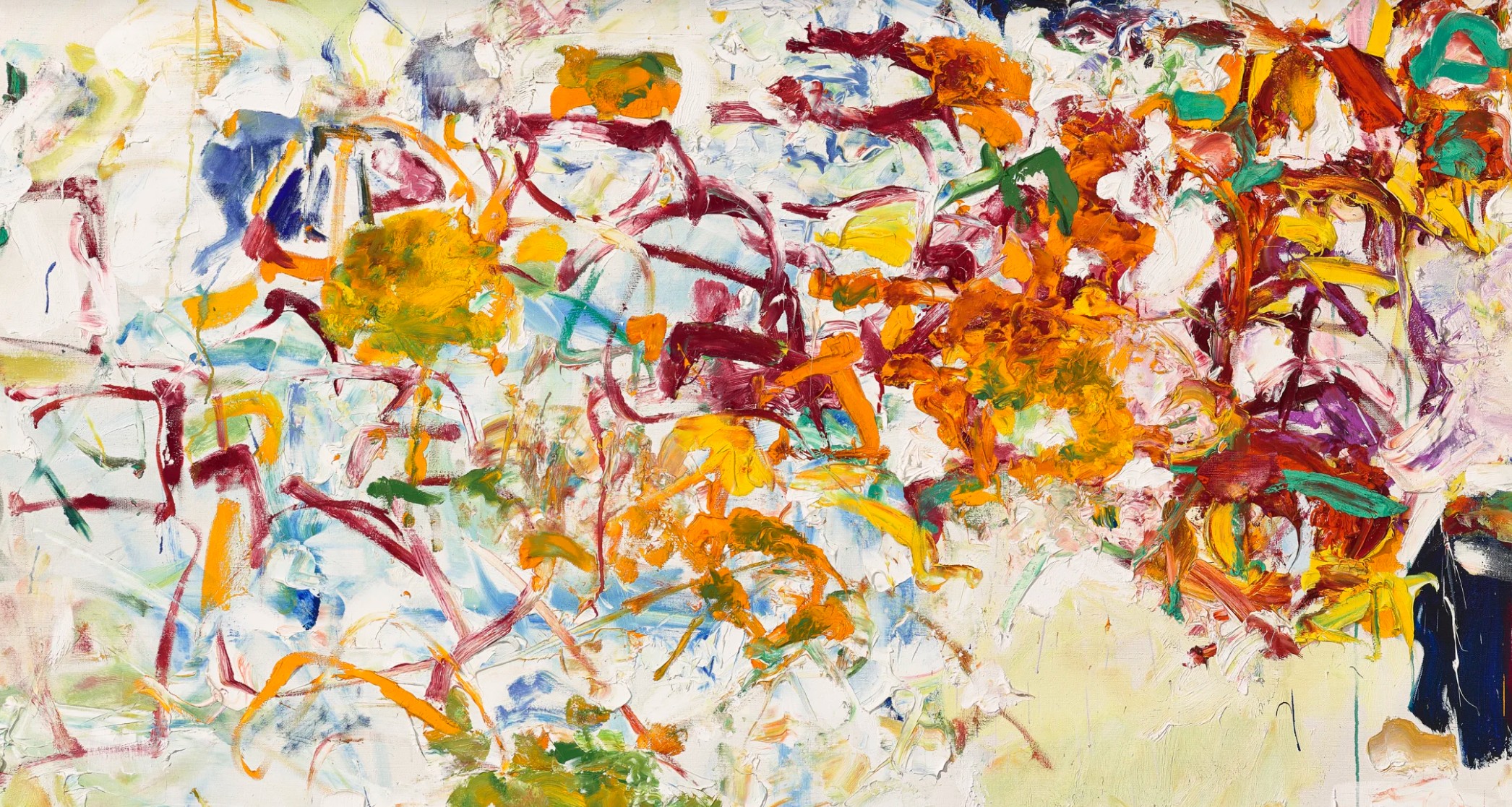
As Monet and van Gogh inspired Mitchell in her Sunflower paintings, Mitchell in turn has proved an important influence on successive generations of artists. Of signal importance to Joan Mitchell, other examples of her early Sunflowers are held in institutional collections including the Metropolitan Museum of Art, New York, the Smithsonian American Art Museum, Washington D.C., and the Williams College Museum of Art, Williamstown, Massachusetts. Mitchell would continue to be preoccupied by the motif until just before her death, continuing her exploration of the brilliant bloom and dramatic wilting of the flower. Drawing upon the tradition inaugurated by Monet and van Gogh, Mitchell triumphantly announces her permanence in her adopted home with Sunflower V, bridging American abstraction with the French tradition to formulate an entirely new and utterly beguiling expression of the natural world.
#2. Untitled, 1957-1958
Estimated: USD 10,000,000 – 15,o00,000
USD 14,290,000
Estimated: USD 7,000,000 – 9,000,000
USD 9,087,500
Untitled, 1957-1958
Oil on canvas
81 1/4 x 108 1/2 inched (206.4 x 275.6 cm)
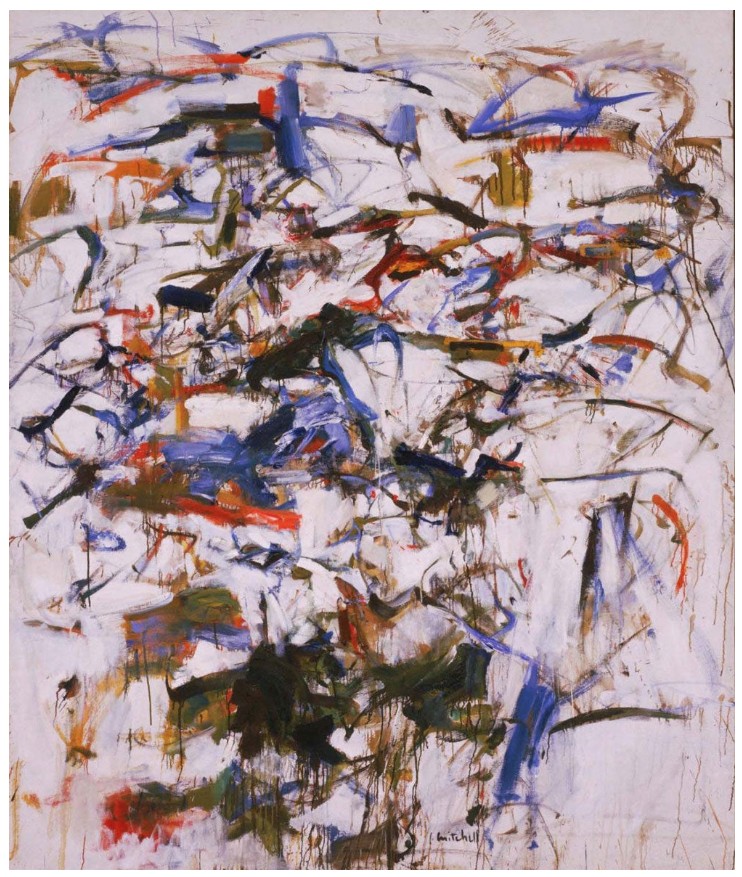
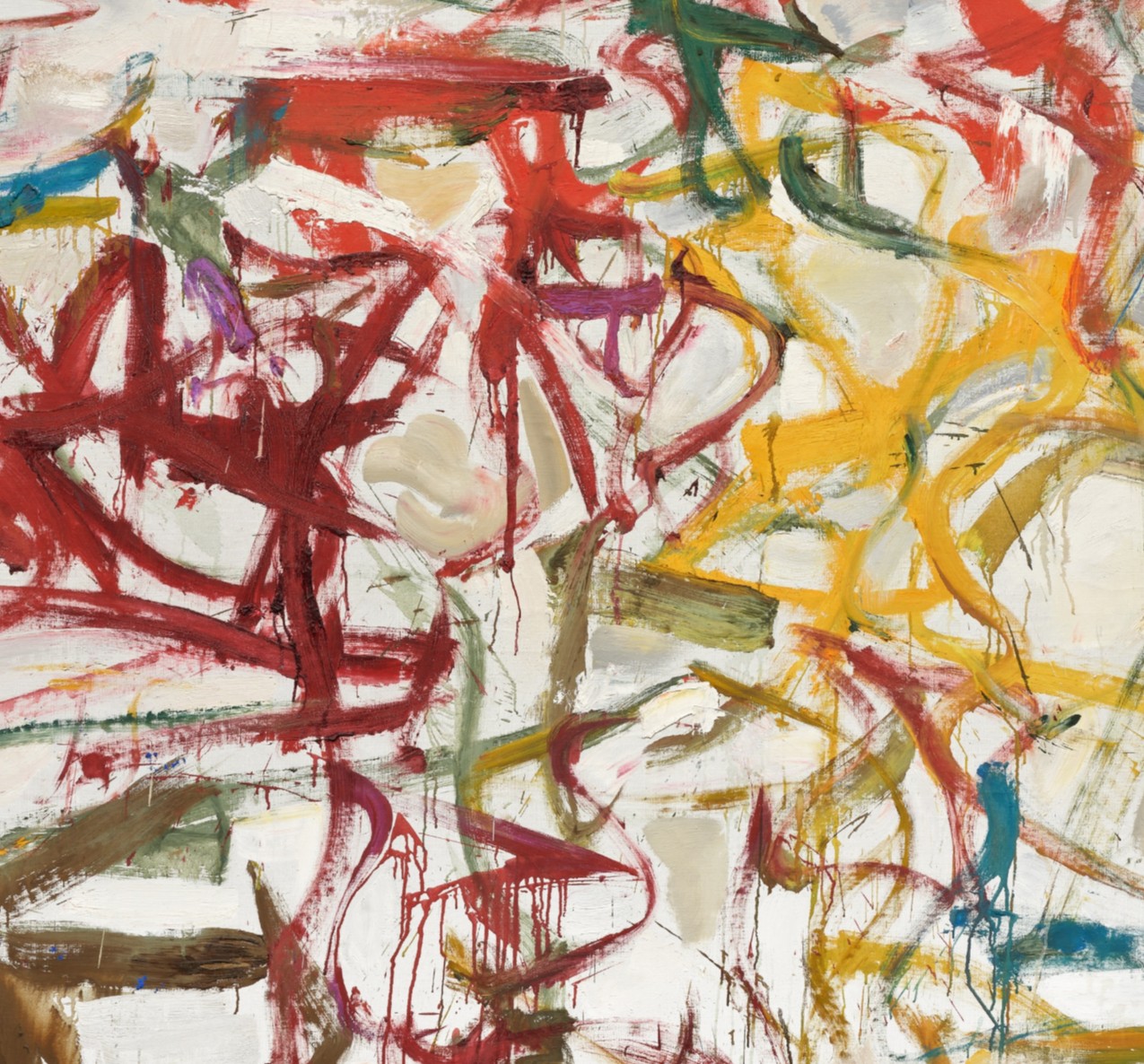
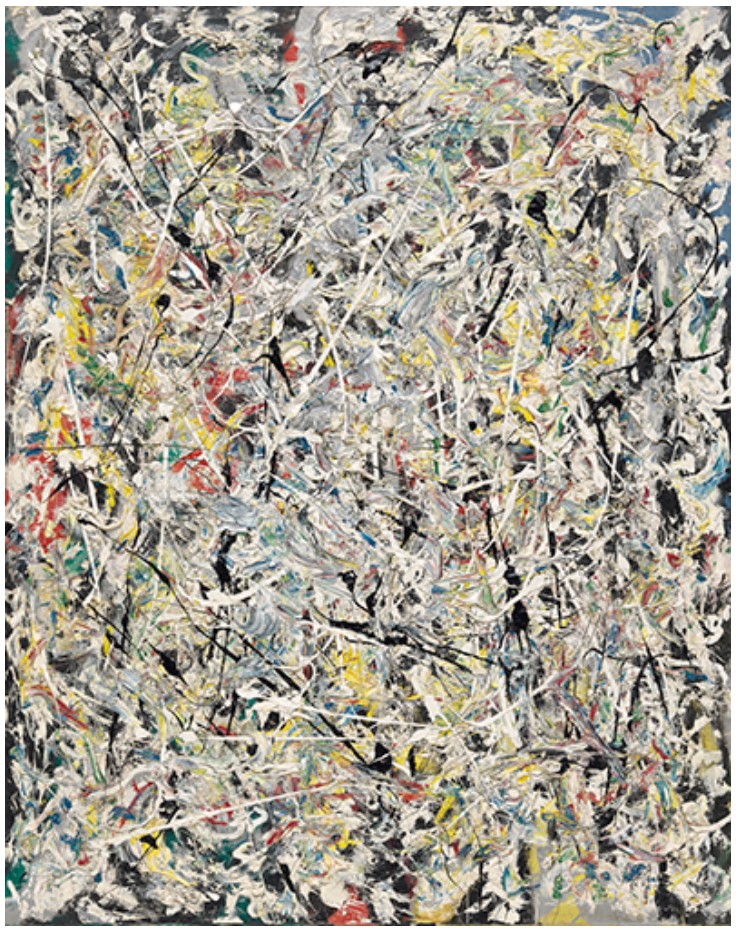
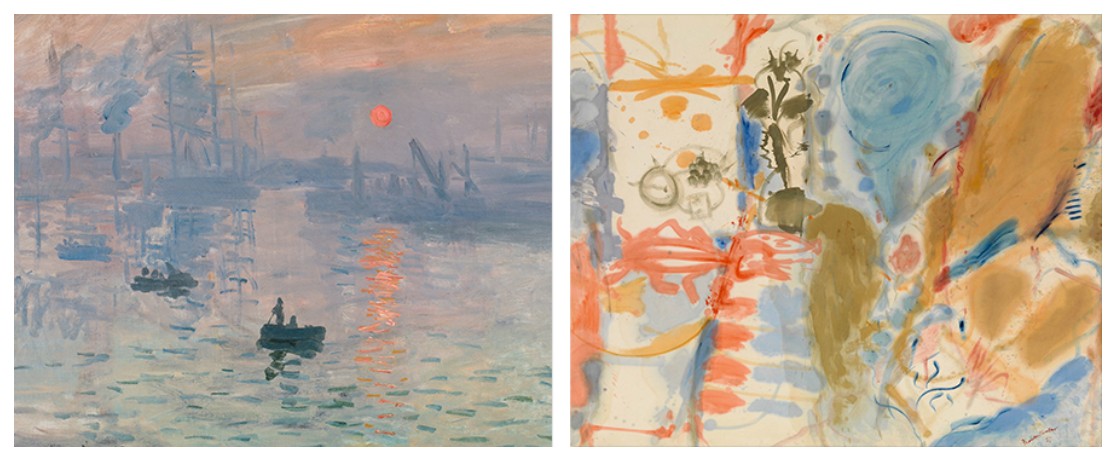
[Right] Helen Frankenthaler, Western Dream, 1957. The Metropolitan Museum of Art, New York. Artwork: © 2025 Helen Frankenthaler Foundation, Inc. / Artists Rights Society (ARS), New York
“I am very much influenced by nature as you define it. However, I do not necessarily distinguish it from ‘man-made’ nature—a city is as strange as a tree… I could certainly never mirror nature. I would like more to paint what it leaves me with.”
“I paint from a distance. The freedom in my work is quite controlled.”
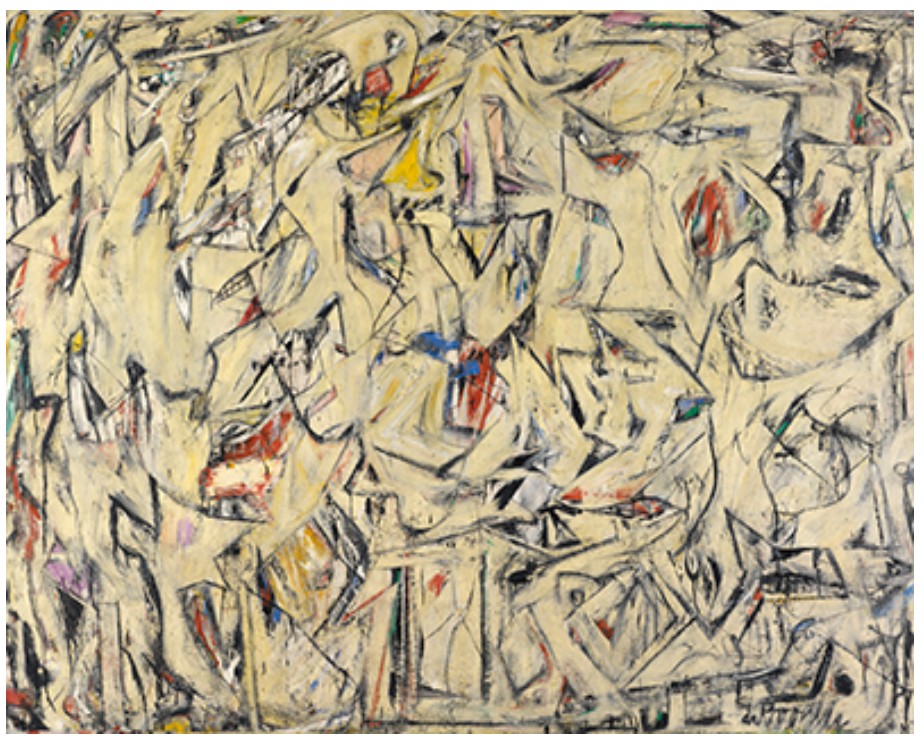
Artwork: © 2025 The Willem de Kooning Foundation/Artists Rights Society (ARS), New York
Although geographic distance separated her from the American art scene, Mitchell’s reputation endured and grew. Untitled embodies both ferocity and grace, chaos and composure. In its charged equilibrium, it captures the essence of Mitchell’s art: a fusion of intellect and instinct, memory and motion, rendered in paint as alive and immediate as the world it evokes.
Untitled, 1978-1979
American Visionaries: Property from an Important Private Collection
Christie’s New-York: 20 November 2025
Estimated: USD 2,000,000 – 3,000,000
USD 2,759,000
JOAN MITCHELL (1925-1992), Untitled | Christie’s
JOAN MITCHELL (1925-1992)
Untitled, 1978-1979
Diptych—oil on canvas
Overall: 25 5/8 x 42 7/8 inches (65.1 x 108.9 cm)(2)
Signed ‘Joan Mitchell’ (lower left)
Signed again twice and dedicated ‘Pour Philippe Piguet Joan Mitchell Joan Mitchell’ (on the stretcher)
Signed again ‘Mitchell’ (on the reverse)
Creamy strokes of yellow, lilac, and violet sway lyrically from one panel to the other as an explosion of dark rectangular forms emerge from the foreground. Joan Mitchell’s diptych Untitled (1978-1979) reveals the full ripeness of the artist’s maturity, each brushstroke denoting a furious intimacy as the artist imbues her composition with metaphysical depth. After having a celebrated retrospective at the Whitney Museum of American Art in 1974 and signing on with Xavier Fourcade the following year, the artist launched a renewed campaign waged against fear and rage as she simultaneously continued to deepen her connection to the natural world. Surrounded by her gardens at La Tour in Vétheuil, responding to the twin legacies of Monet and van Gogh, many of Mitchell’s works from the latter half of the decade allude to vegetation and the landscape.
“The field disappearing… a different space but there’s a field with a sky and—and an homage to Vincent perhaps.”
Striking in its deep and atmospheric engagement with the French landscape, Untitled is likewise remarkable in its anticipation of Mitchell’s later painterly development. Accentuating the work’s connection to Vétheuil and the French countryside, the artist gifted the present work to her close friend Philippe Piguet, a great-grandson of Claude Monet as well as an art historian, critic, and gallerist, who thereafter held onto the painting for almost two decades before the painting was acquired by the present owner.
Joan Mitchell’s garden at La Tour, Vétheuil, France, 1991. Photo: Christopher Campbell.
The palette employed in Untitled is deeply tied to Mitchell’s experience in rural France after moving to Vétheuil in 1967.
“Yellow comes from [Vétheuil]. I used very little yellow in New York or Paris. It is rapeseed, sunflowers… one sees a lot of yellow in the country. Purple too… it is abundant in the morning; the morning especially very early is violet… when I go out in the morning, it is violet.”
Mitchell’s deepfelt experience of color allows Untitled to be granted a temporal and geographical specificity, the vibrant yellows evoking the French countryside and the vivid violets placing the scene in the very early morning. The lilac tones suggest the spring—the same colors appear in her majestic four-panel La Vie en Rose, painted a year after the present work.
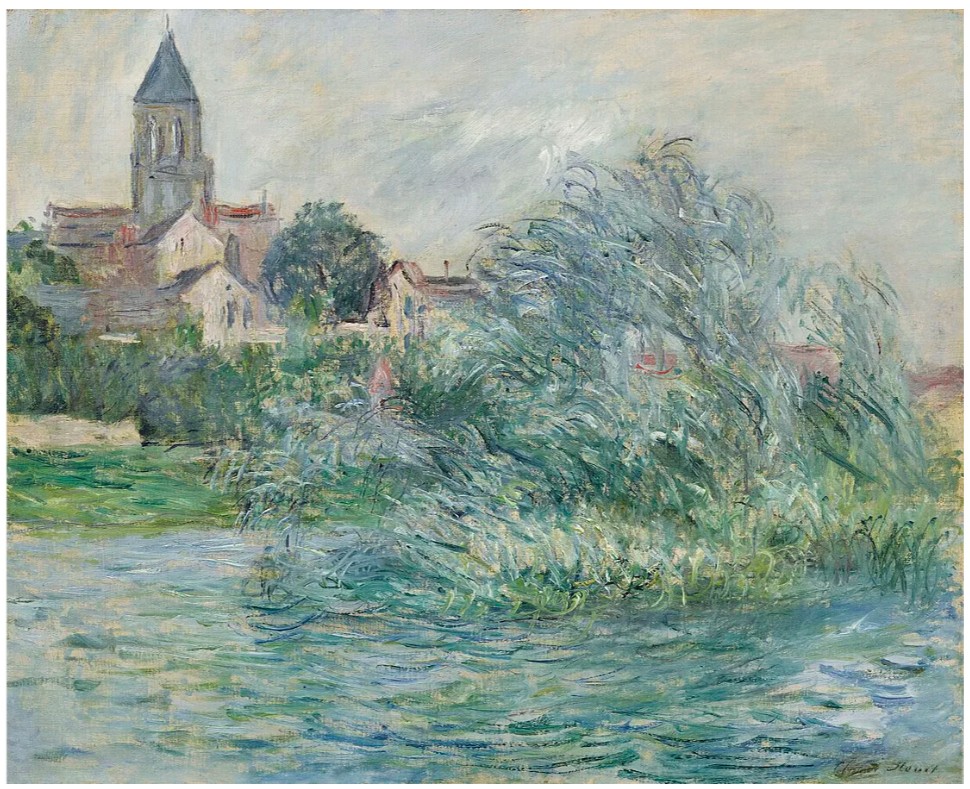
Claude Monet, L’église à Vétheuil, 1881.
Mitchell foregrounds Untitled with a series of rectangular black blocks from which the rest of the composition expands out. This dark foundation, interspersed with shots of cobalt blue, grounds the more airy elements which emanate across the remainder of the canvases. In the left panel, an explosion of blue propels outward from this base into the nuanced atmospheric zone of layered violets, greys, and yellows, establishing a linear, thrusting structure which moves up and then flows rightward across the picture plane. Through the middle ground of both panels, Mitchell establishes an expanse of lavender veiled with darker pigments and dotted with areas of white.
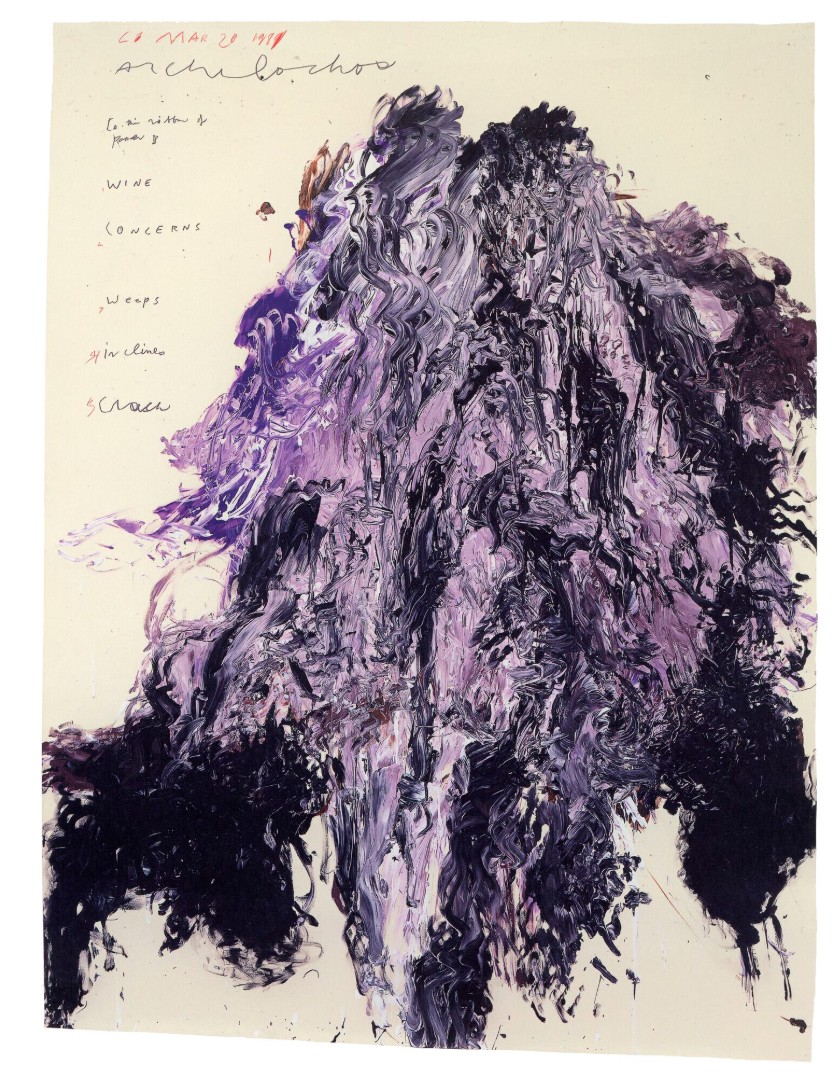
Cy Twombly, Untitled (Gaeta), 1989. © Cy Twombly Foundation.
The period from which Untitled emerges was a difficult one for the artist. Amid a deteriorating relationship with her partner, the Québécois painter Jean-Paul Riopelle, and following a decade of significant personal losses, including the death of her mother to cancer, in April 1978 Mitchell lost a dear friend and protégée when the young artist Phyllis Hailey tragically perished in a car crash. Mitchell would have begun painting Untitled with her heart heavy from this loss, recalling the mournful Calvi and Black Paintings series she made over a decade prior while mourning the deaths of her parents and her close friends Franz Kline and Frank O’Hara. In the present work, Mitchell pursues her emotional intensity structurally through a series of oppositions, evoking light versus dark, lightness and substance, with the gridded order of the lower register juxtaposed against the flowing freedom of brushstrokes across the upper register.
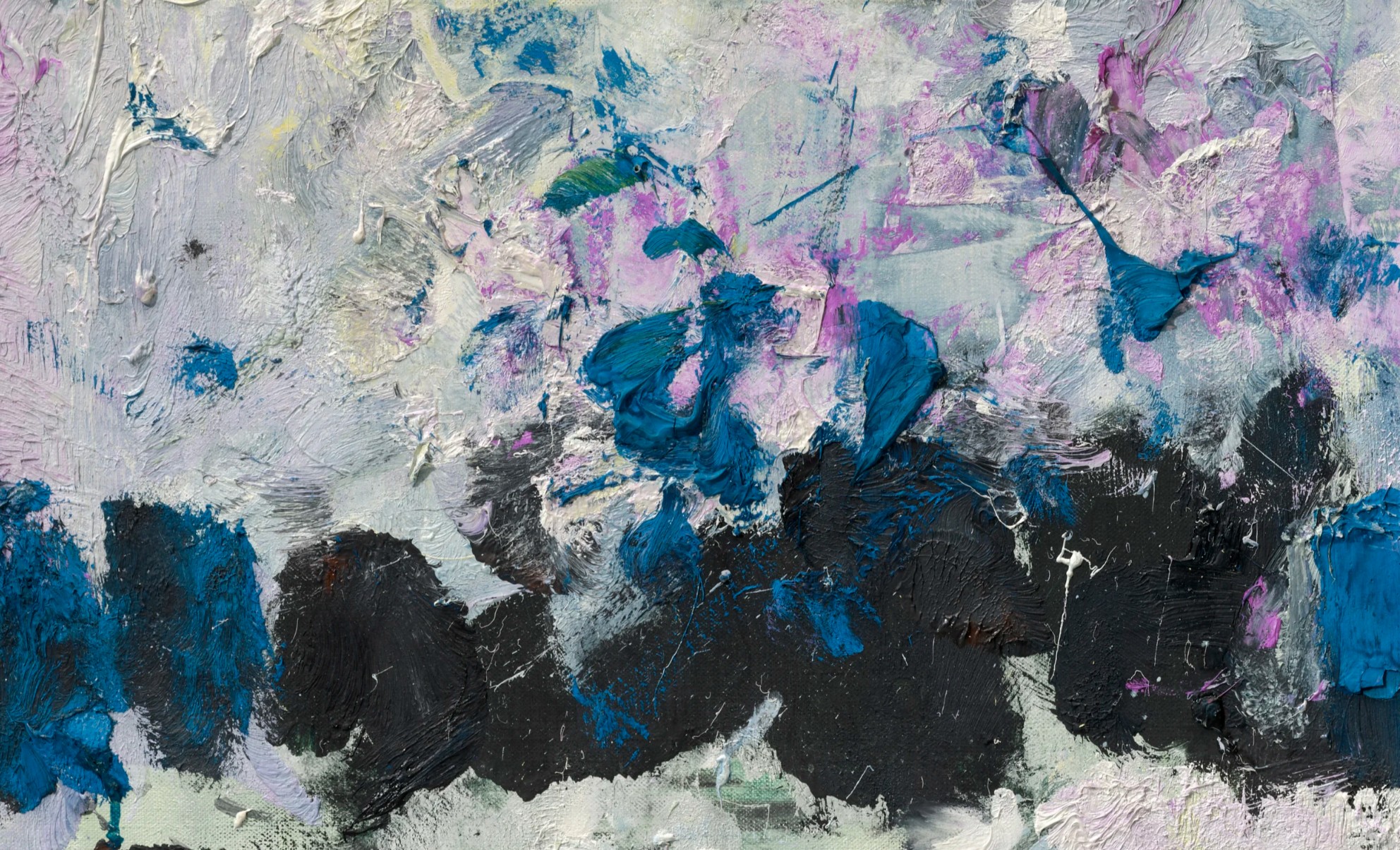
Philippe Piguet, the grandson of Claude Monet’s stepdaughter, first met Joan Mitchell earlier in the decade through a cousin living in Giverny, close to Mitchell’s residence in Vétheuil. Throughout the decade, he spent many weekends at Mitchell’s house and the two became close friends. Long, passionate conversations with the artist ignited a passion for the arts in Piguet, who became a gallerist then an art historian and critic, curating the 2014 exhibition Joan Mitchell: Mémoires de paysage at the Musée des Beaux-Arts de Caen. Piguet evocatively recalls the time he received the present work: “It was one evening when we were in the studio, discussing a thousand things about art and life, as usual. I suddenly saw her looking for something. She put the two panels together and asked me what I thought of it. I told her it was like a ‘baby’ of the large paintings she did. Then she told me it was for me, and I went home to Paris that night, overjoyed at the idea of having a work by her” (P. Piguet, personal correspondence, 4 October 2025).
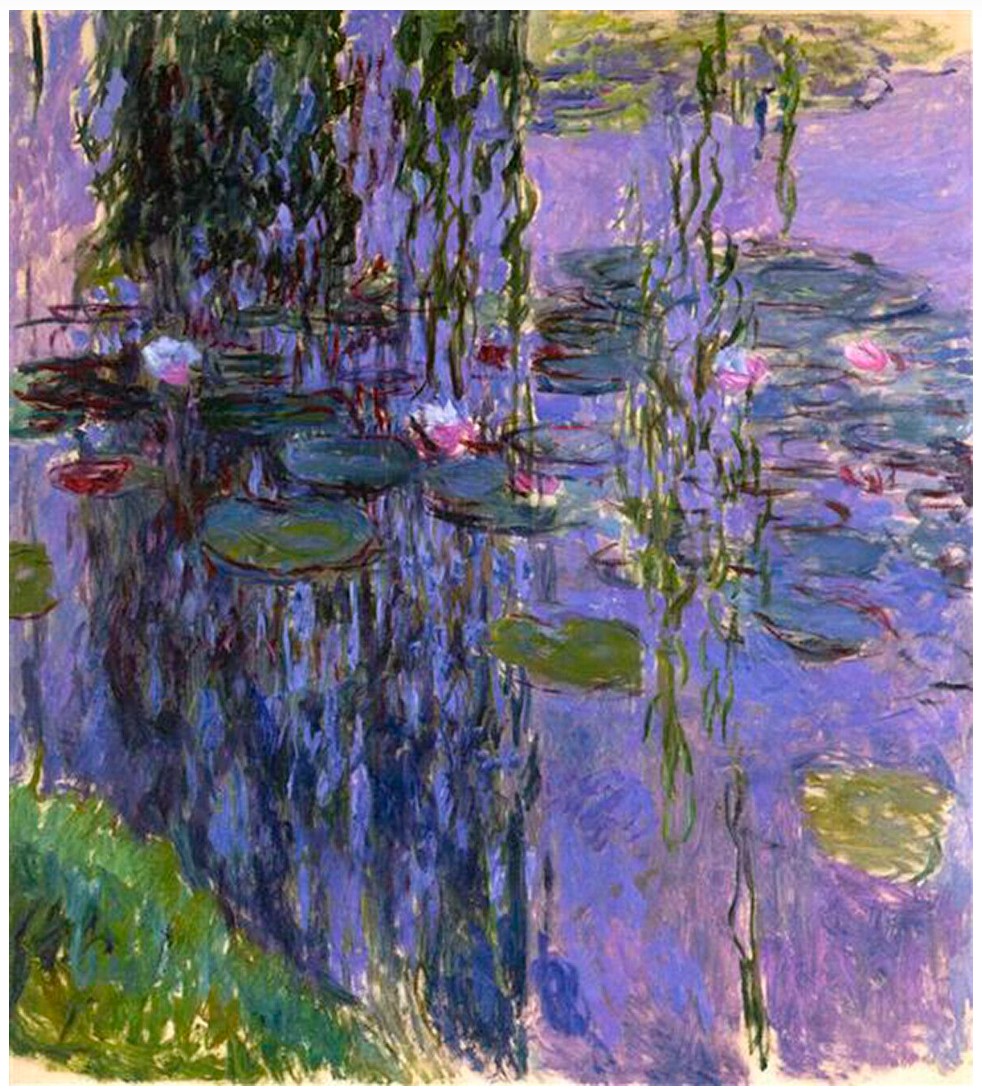
Claude Monet, Nympheas, 1916-1919. Musée Marmottan Monet, Paris.
While Mitchell produced several important diptychs over the course of the decade, including Weeds (1976, Hirshorn Museum and Sculpture Garden, Washinton, D.C.), No Rain (1976, Museum of Modern Art, New York), and Posted (1977, Walker Art Center, Minneapolis), the present work points forward stylistically to her monumental quadriptychs of 1979 on onward. In her use of yellows and dark foundational blocks, the work corresponds with Salut Tom (1978, National Gallery of Art, Washington, D.C.), while in terms of palette and composition, Untitled is essentially a study for Mitchell’s masterpiece La Vie en Rose (1979, Metropolitan Museum of Art, New York).
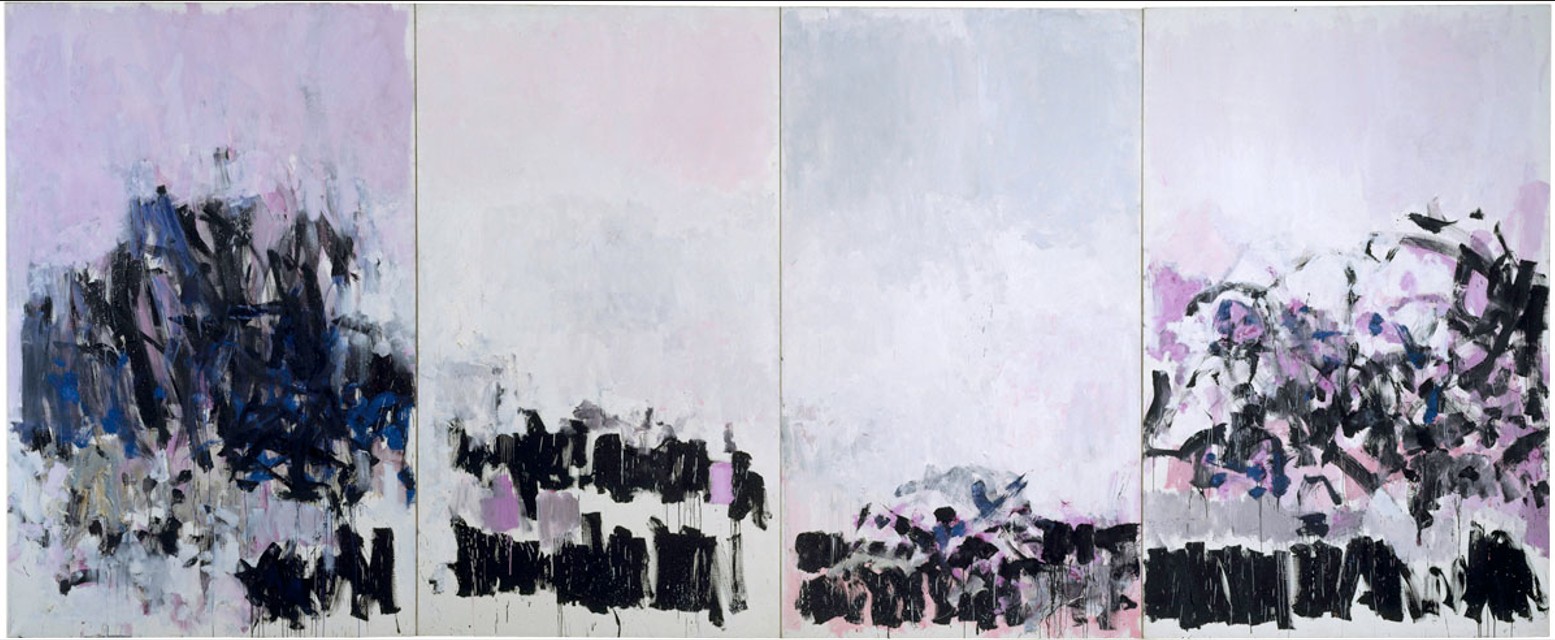
This pivotal picture is where Mitchell shifts styles from her favoring of vertical strokes and modulated opacity to a more organically energized field of accumulated brushstrokes, paving the path for her celebrated late paintings. Painted after Riopelle left her, La Vie en Rose depicts “creamy, beautifully modulated dusty pinks and soft blue-gray atop the four planes” which are “invaded by a determined brigade of black rectangularities, in a scumbled march across the bottom of all four panels” a composition which is first explored with Untitled (K. Kertess, Joan Mitchell, New York, 1997, p. 36). Anticipating and preparing for her stylistic shift the next year, Untitled is an important record of Mitchell’s evolution as an artist as she was developing her renowned late style.
#4. Untitled, 1991
Property from a Private New Jersey Collection
Christie’s New-York: 20 November 2025
Estimated: USD 400,000 – 600,000
USD 508,000
JOAN MITCHELL (1925-1992), Untitled | Christie’s
JOAN MITCHELL (1925-1992)
Untitled, 1991
Oil on canvas
16 1/4 x 13 1/8 inches (41.3 x 33.3 cm)
“I paint from a distance. I decide what I am going to do from a distance. The freedom in my work is quite controlled. I don’t close my eyes and hope for the best. If I can get into the act of painting, and be free in the act, then I want to know what my brush is doing.”
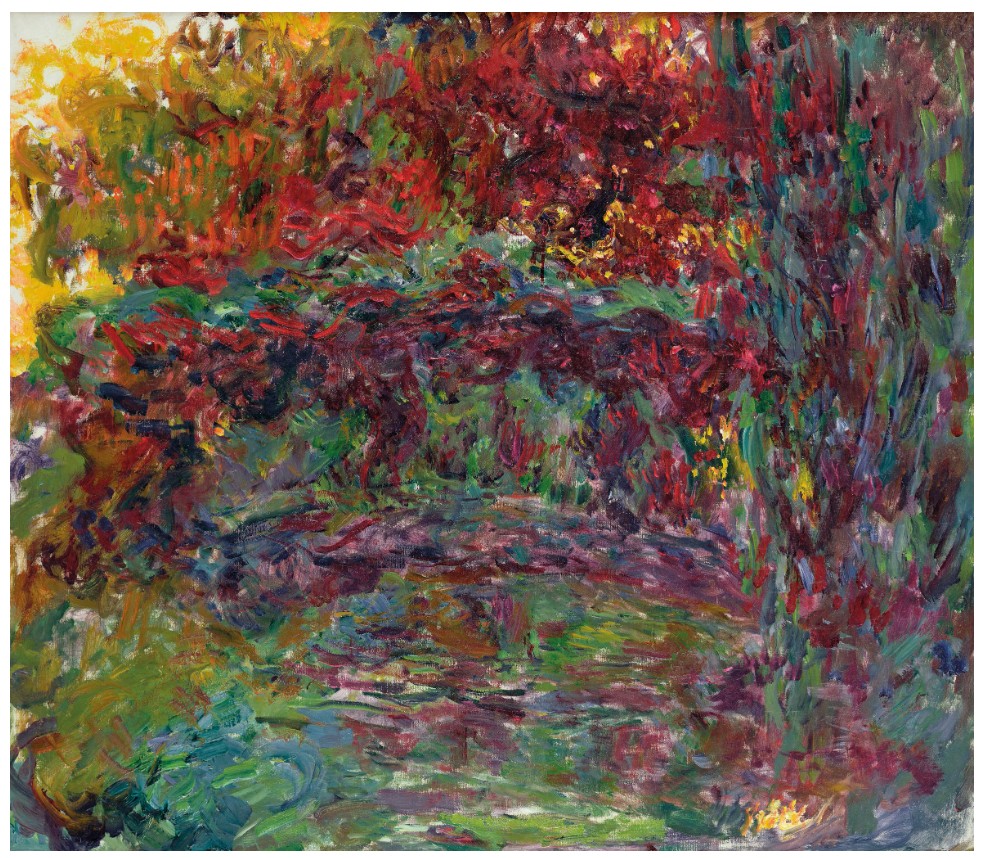
Claude Monet, The Japanese Footbridge, circa 1920-1922. Musée Marmottan, Paris.
Photo: Musee Marmottan Monet, Paris, France / Bridgeman Images.
2. Works on Paper
#1. Untitled, 1983
Property from a Private New Jersey Collection
Christie’s New-York: 20 November 2025
Estimated: USD 200,000 – 300,000
USD 698,500
WORK ON PAPER
JOAN MITCHELL (1925-1992), Untitled | Christie’s
JOAN MITCHELL (1925-1992)
Untitled, 1983
Pastel on paper
22 3/4 x 15 1/4 inches (57.8 x 38.7 cm)
Signed ‘Joan Mitchell’ (lower right)
#2. Untitled, circa 1989
Sotheby’s New-York: 19 November 2025
Estimated: USD 60,000 – 80,000
USD 177,800
WORK ON PAPER
Untitled | Contemporary Day Auction | 2025 | Sotheby’s
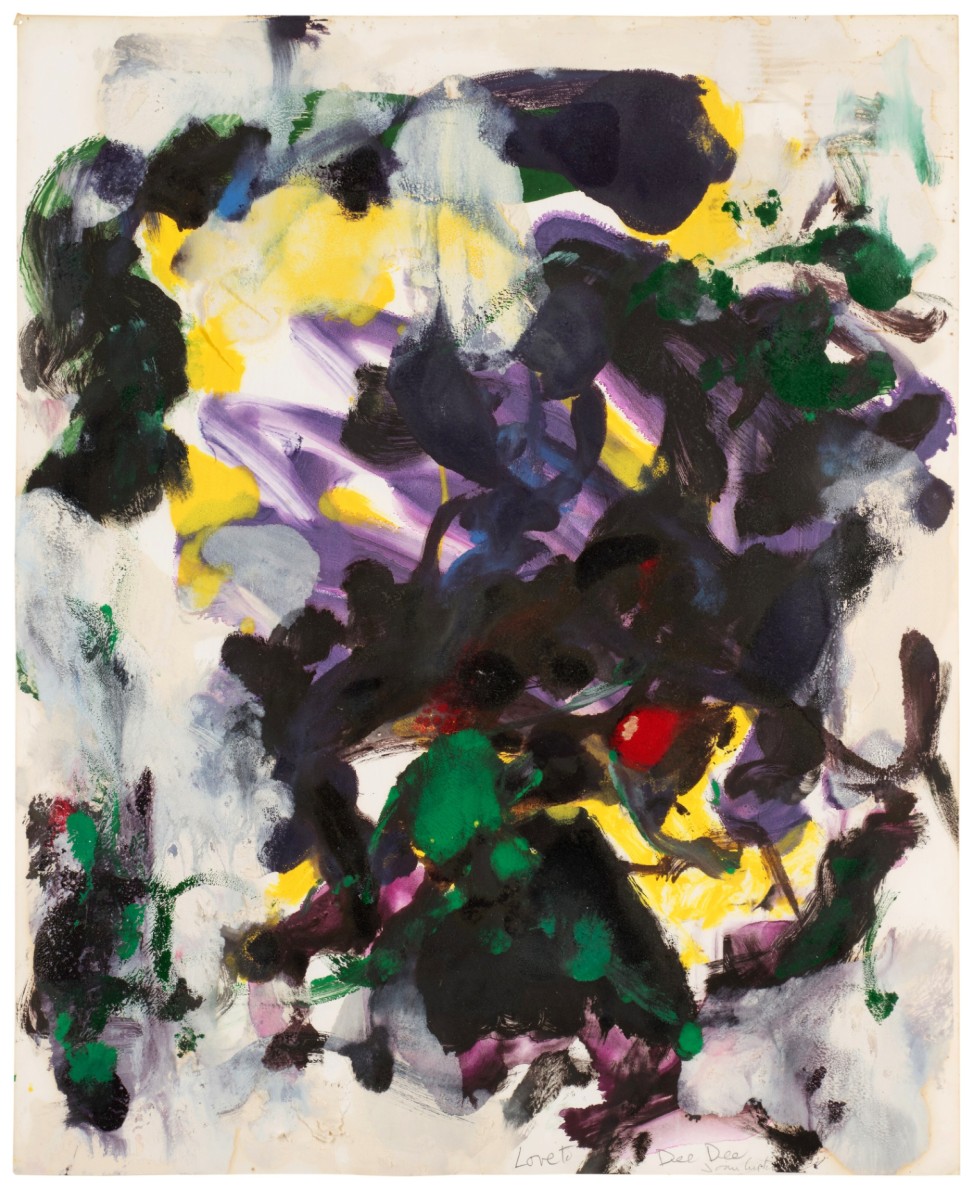
JOAN MITCHELL (1925 – 1992)
Untitled, circa 1989
Oil and acrylic monotype on paper
28 5/8 x 23 inches (72.7 x 58.4 cm)
Signed and inscribed Love to Dee Dee (lower right)
#3. Untitled, 1976
Sotheby’s New-York: 19 November 2025
Estimated: USD 60,000 – 80,000
USD 88,900
WORK ON PAPER
Untitled | Contemporary Day Auction | 2025 | Sotheby’s
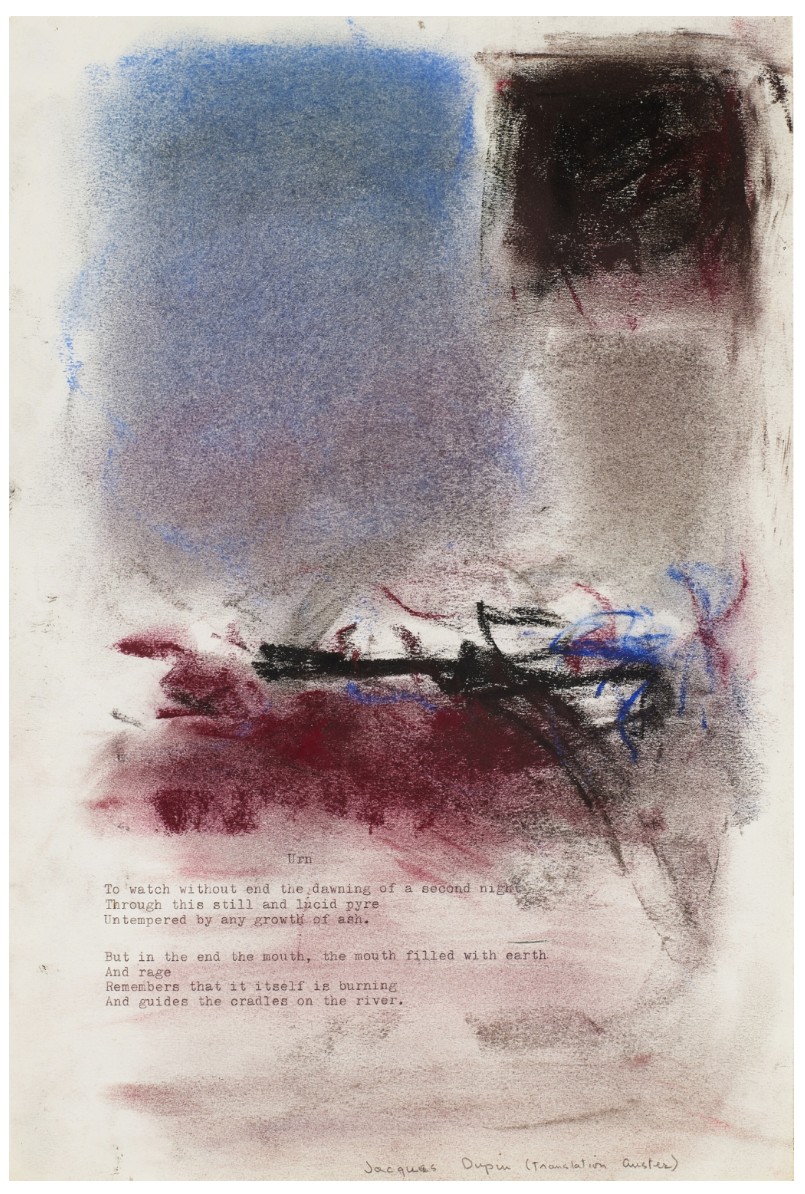
JOAN MITCHELL (1925 – 1992)
Untitled, 1976
Pastel and typewriter ink on paper
14 x 9 3/8 inches (35.6 x 23.8 cm)
Untitled, 1991
Christie’s New-York: 20 November 2025
Estimated: USD 200,000 – 300,000
PASSED
WORK ON PAPER
JOAN MITCHELL (1925-1992), Untitled | Christie’s
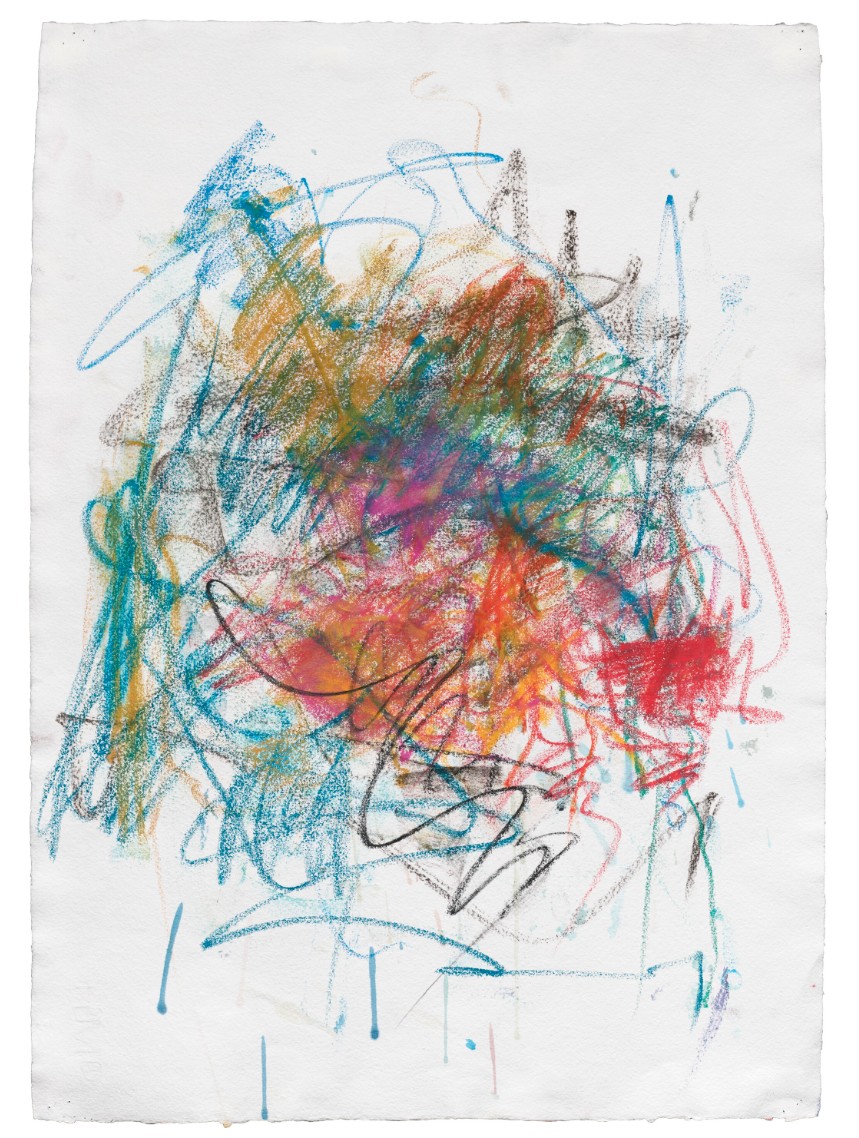
JOAN MITCHELL (1925-1992)
Untitled, 1991
Pastel, water-soluble wax crayon and watercolor on paper
24 1/4 x 17 3/8 inches (61.6 x 43.9 cm)
IMPRESSIONIST & MODERN ART
Francis Bacon
PLEASE CLICK ON THE PICTURE BELOW TO ACCESS AUCTION MARKET OVERVIEW
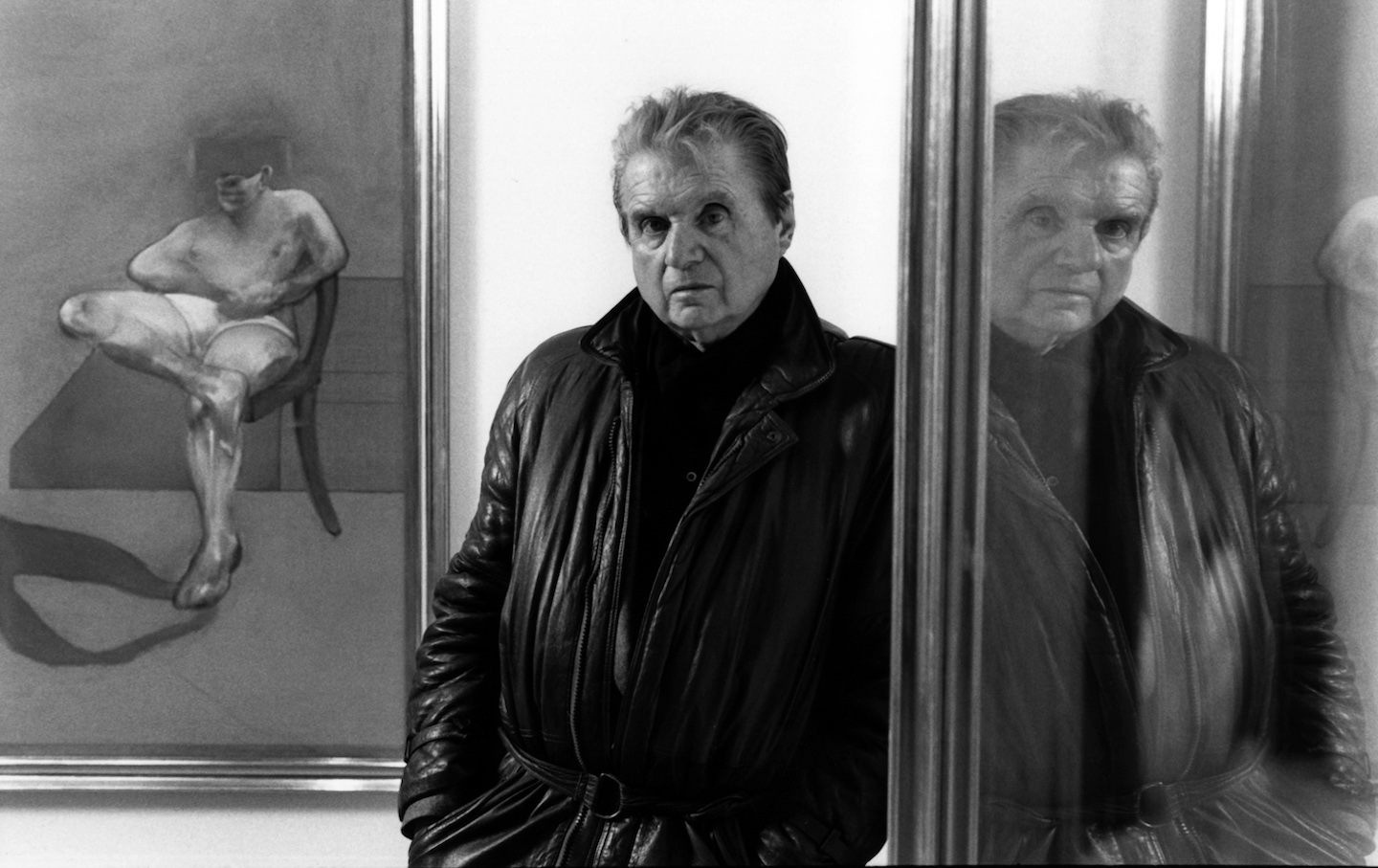
Study for Head of Isabel Rawsthorne and George Dyer, 1967
Phillips New-York: 19 November 2025
Estimated: USD 13,000,000 – 18,o00,000
USD 16,015,000
Francis Bacon Modern & Contemporary Art Evening Sale featuring Cera the Triceratops
Oil on canvas, diptych
Each 14×12 inches (35.6 x 30.5 cm)
Titled and dated “Study for Head of Isabel Rawsthorne 1967.” on the reverse of the left canvas
Titled and dated “Study for Head of George Dyer 1967.” on the reverse of the right canvas
Created in 1967 at the height of Francis Bacon’s most prolific and critically significant decade, Study for Head of Isabel Rawsthorne and George Dyer is the first of only 12 diptychs which employ the compacted 14 by 12 inch format produced by the artist to such powerful effect from 1961 onwards. Study for Head of Isabel Rawsthorne and George Dyer is especially significant as one of only two depicting Rawsthorne and Dyer together in a single diptych, featuring these two profoundly important intimates of Bacon’s circle side by side.
“I’ve always thought of friendships as where two people really tear one another apart and perhaps in that way learn something from one another.”
Alongside Soho stalwarts Muriel Belcher and Henrietta Moraes, Isabel Rawsthorne and George Dyer were constant companions during this fruitful period. Taking on a near-mythical status within Bacon’s oeuvre, these two companions would come to define this triumphant decade in magisterial portraits such as the 1967 Portrait of Isabel Rawsthorne Standing on a Street in Soho, housed in the Staatliche Museen zu Berlin, Nationalgalerie; the 1968 Portrait of George Dyer in a Mirror, held at the Museo Thyssen-Bornemisza in Madrid; and the 1969 Three Studies of George Dyer, in the collection of the Louisiana Museum of Modern Art, Humlebaek. Alongside the staggering 40 portraits in various formats of his lover and muse that Bacon produced between their meeting in 1963 and Dyer’s tragic death by suicide on the eve of the opening of Bacon’s landmark 1971 retrospective at the Grand Palais in Paris, Bacon also produced an impressive 19 portraits of Rawsthorne between 1964 and 1983, matched only in number by those of Moraes, with whom she ranks as Bacon’s most important and immediately recognizable female sitters. Exquisitely rendered, Study for Head of Isabel Rawsthorne and George Dyer conveys the central importance of Bacon’s intimate circle of friends and lovers in this critical period, and the triumph of his artistic vision.
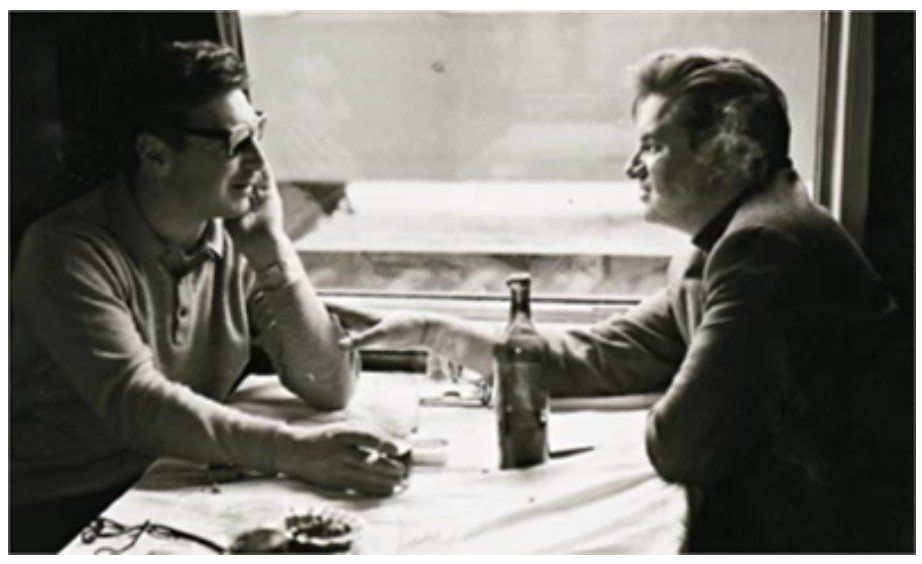
George Dyer and Francis Bacon on the Orient Express in 1965.
Photograph by John Deakin. Image: © John Deakin Archive / Bridgeman Images
Although eclipsed somewhat by her notoriety as a muse of various modern masters including Alberto Giacometti and Pablo Picasso, Isabel Rawsthorne was herself an accomplished and dedicated artist and set designer, whose own commitment to exploring the limits of the body pushed figuration into newly expressive territory in ways that resonated deeply with Bacon’s own artistic vision.
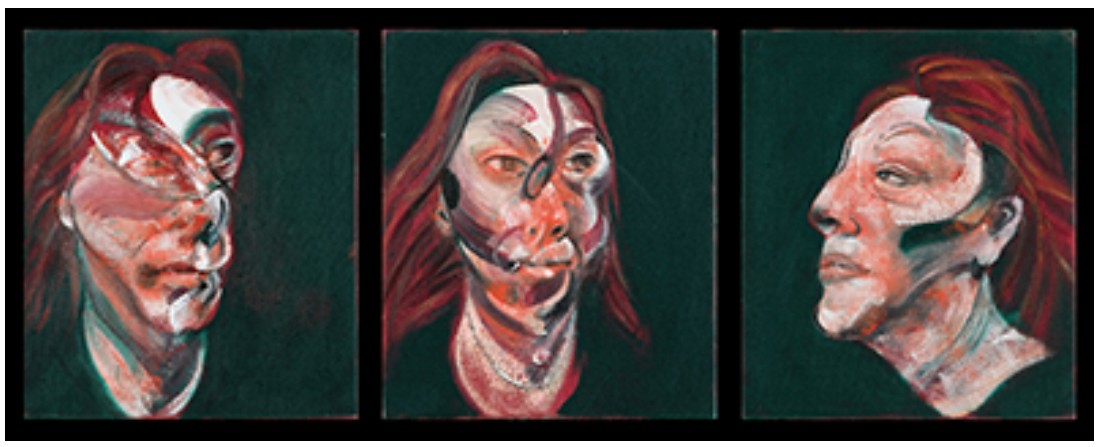
Francis Bacon, Three Studies for Portrait of Isabel Rawsthorne, 1965. Sainsbury Centre for Visual Arts, Great Britain.
Artwork: © 2025 Estate of Francis Bacon/Artists Rights Society (ARS), New York/DACS, London
Bacon and Rawsthorne had first met in Paris shortly after the Second World War, where she had been residing since 1934. It was when the two returned to London in the late 1940s that the deep bonds of their friendship were solidified, as regular denizens of Soho’s vibrant night scene and fixtures at Muriel Belcher’s Colony Room Club, where they would drink and discuss art, philosophy, and gossip long into the night. Sharing a deep sensuality and preference for the pleasures in life, she was amongst Bacon’s most trusted and respected confidantes.
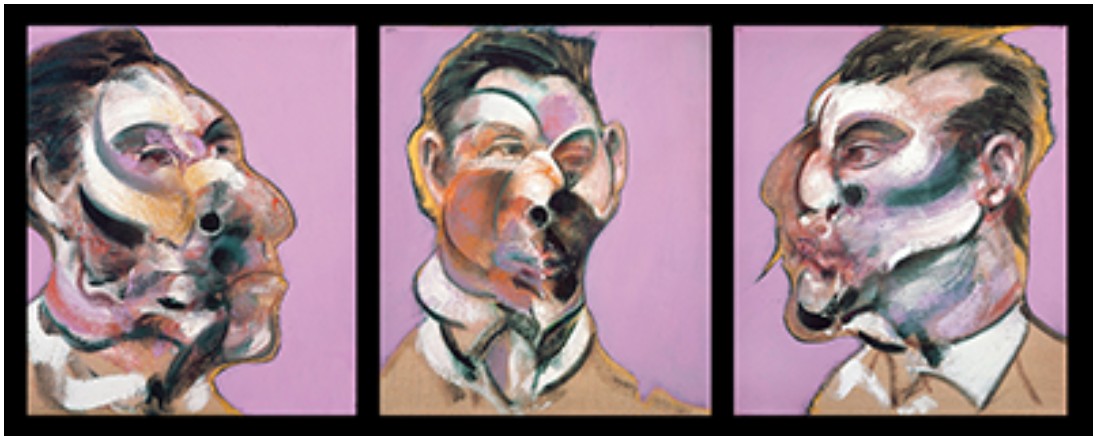
Francis Bacon, Three Studies of George Dyer, 1969. Louisiana Museum of Modern Art, Humlebæk.
Artwork: © 2025 Estate of Francis Bacon/Artists Rights Society (ARS), New York/DACS, London
Although Lucian Freud would later give a more prosaic account of Dyer and Bacon’s first meeting having taken place in a Soho club after Dyer offered to buy a round of drinks, a rich mythology soon developed around the conspicuous couple. By far the most colorful account of their initial encounter describes a housebreaking Dyer falling through the skylight of Bacon’s Reece Mews studio, surprising the artist and making off with a couple of his paintings, and speaks much more to Dyer’s colorful history and certain prejudices related to differences in their age and background than to historical accuracy. Muscular, with a prominent profile, thickly nasal Cockney drawl, and an air of criminality despite his elegant, Edwardian attire, Bacon was immediately captivated by Dyer, who would go on to become his principal subject through the remainder of the decade, producing three small-format triptychs within a year of their meeting. Both hailing originally from London’s East End, a place whose anti-establishment mythology and codes of family and honor impressed themselves deeply upon the more genteel Bacon, Rawsthorne and Dyer were perhaps understood by the artist as representing dual aspects of an intensely raw, existential condition, the perfect – and profoundly complementary – vehicles for his painterly “interrogation on the limits of the self.” Perhaps it was this duality – or, even more compellingly, the artist’s projection of two sides of himself onto these sitters – that led Bacon to experiment with combining their portraits in these diptychs.
Piero della Francesca, Diptych of Federico da Montefeltro and Battista Sforza, 1473-1475, Uffizi Gallery, Florence. Image: Bridgeman Images
Rich in art historical associations, the diptych thrived in the Middle Ages as a devotional tool, featuring religious subjects and often hinged as private, portable objects. Adopted in more secular contexts during the early Renaissance in the mode of double-profile marriage portraits such as Piero della Francesca’s masterful Portraits of the Duke and Duchess of Urbino, 1465-1472, the treatment of two, facing figures speaks powerfully to notions of balance, union, and the resolution of disparate parts. Part of what makes Study for Head of Isabel Rawsthorne and George Dyer such a captivating and compelling work is its complication of this more illustrative tradition, the primary relationship explored not between the two sitters exclusively, but on Bacon’s own, more complex relationship to both. Without doubt, Rawsthorne and Dyer represented the two singularly most important figures in Bacon’s life during this period, and in this respect, it is worth noting the oft-quoted anecdote that Rawsthorne was the only woman with whom Bacon had been physically intimate, the two perhaps even representing a balance of masculine and feminine energies for the artist.
“I couldn’t [paint] people I didn’t know very well […] It wouldn’t interest me to try […] unless I had seen a lot of them, watched their contours, watched the way they behaved.”
The question of duality fascinated Bacon, and in his adoption of the diptych format we can trace the ways in which the artist formalized his investigations into the oppositional forces at work between certain individuals such as Dyer and Rawsthorne, or painters Freud and Frank Auerbach. Such conflicts or oppositions were not only interpersonal but allowed Bacon to probe the inner conflicts and contradictions of the soul, often staging more introspective reflections of his own, complex feelings towards a specific sitter. The intense rivalry and intimacy that existed between Bacon and Freud is especially loaded on this point, bringing forth some of Bacon’s most psychologically intense and compelling works. Meeting almost daily, the two exchanged ideas furiously, challenging each other to ever more ambitious heights. As with Rawsthorne and Dyer, Bacon painted Freud’s likeness repeatedly, producing some 17 portraits of his friend and fellow artist between 1951 and 1973.
[Left] Detail of the present work.
[Right] George Dyer, c.1964. Photograph by John Deakin. Image: © John Deakin Archive / Bridgeman Images / The Estate of Francis Bacon. All rights reserved, DACS Images
Executed with an almost sculptural tactility in expressive sweeps of thick, heavily impastoed paint, the heads of Rawsthorne and Dyer emerge from a rich, forest-green ground, one that Bacon had made his own in an earlier series of works. Although facing the viewer, Rawsthorne’s gaze slides across to the unmistakable side profile of Dyer, an electrifying moment of connection that commands the living, breathing presence of these two figures into being. Profoundly tender, while Bacon’s uniquely deconstructive approach to form is masterfully deployed here, the violence so typically associated with Bacon’s painterly gesture is softened into a dignified, almost regal treatment of the two, the sensual sweep of Rawsthorne’s hair, sculptural planes of her face, and her intelligent, bright eyes counterbalanced by the pent-up energy and proud solidity of Dyer’s prominent profile. In this respect Study for Head of Isabel Rawsthorne and George Dyer succinctly captures the exquisite balance struck in Bacon’s finest work between distortion and the limits of our selfhood, of his unique skill in distilling and deconstructing the various physical, emotional, and psychological aspects of his subjects as a means of powerfully “conveying the mysterious aura of feeling- shaped flesh.”
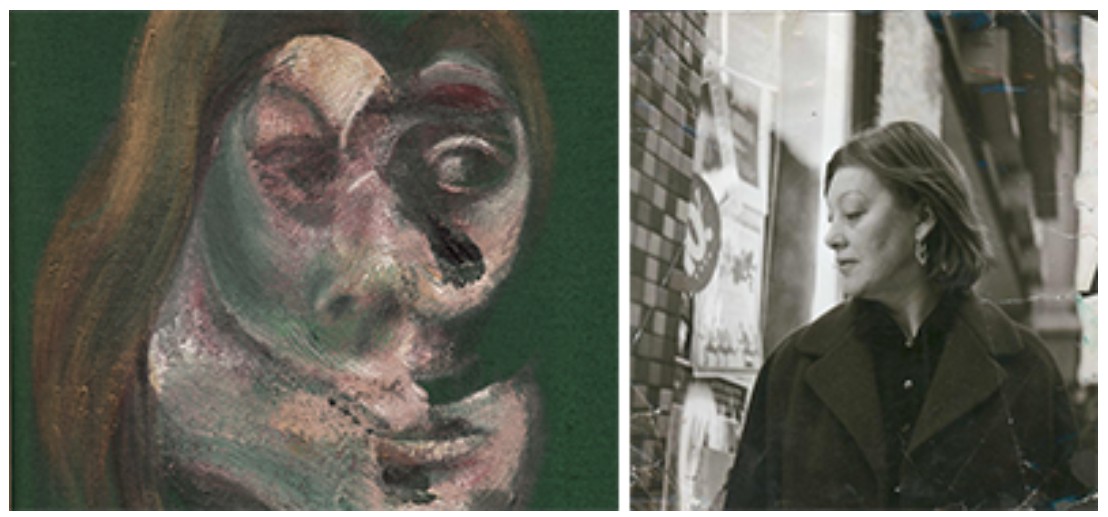
[Left] Detail of the present work.
[Right] Bacon studio material, Isabel Rawsthorne in Soho, c. 1965. Photograph by John Deakin. Collection Dublin City Gallery The Hugh Lane. Image: © John Deakin Archive / Bridgeman Images
Seemingly caught in motion, Bacon’s portraits were less interested in capturing physical movement than the quiver of a passing moment or imperceptible shattering of an internal shudder, a feature of his paintings radically extended in the diptychs and triptychs. Working from photographs — most infamously those taken by his friend and frequent Soho companion John Deakin which have survived, torn and paint-splattered records of the artist’s working practice — Bacon created a critical distance from his subjects, one that paradoxically better allowed him to reach the essence of their humanity.
“The living quality is what you have to get. In painting a portrait the problem is to find a technique by which you can give over all the pulsations of a person […] The sitter is someone of flesh and blood and what has to be caught is their emanation.”
A poignant and enduring tribute to two of the most important and constant forces in the artist’s life — two who defined his most celebrated decade — Study for Head of Isabel Rawsthorne and George Dyer powerfully illustrates the existential charge of Bacon’s portraiture, and the central role of his intimate circle of friends and lovers in achieving this.
Mark Rothko
PLEASE CLICK ON THE PICTURE BELOW TO ACCESS AUCTION MARKET OVERVIEW
No. 31 (Yellow Stripe), 1958
The Collection of Robert F. and Patricia G. Ross Weis
Christie’s New-York: 17 November 2025
Estimates on Request
USD 62,160,000
MARK ROTHKO (1903-1970), No. 31 (Yellow Stripe) | Christie’s
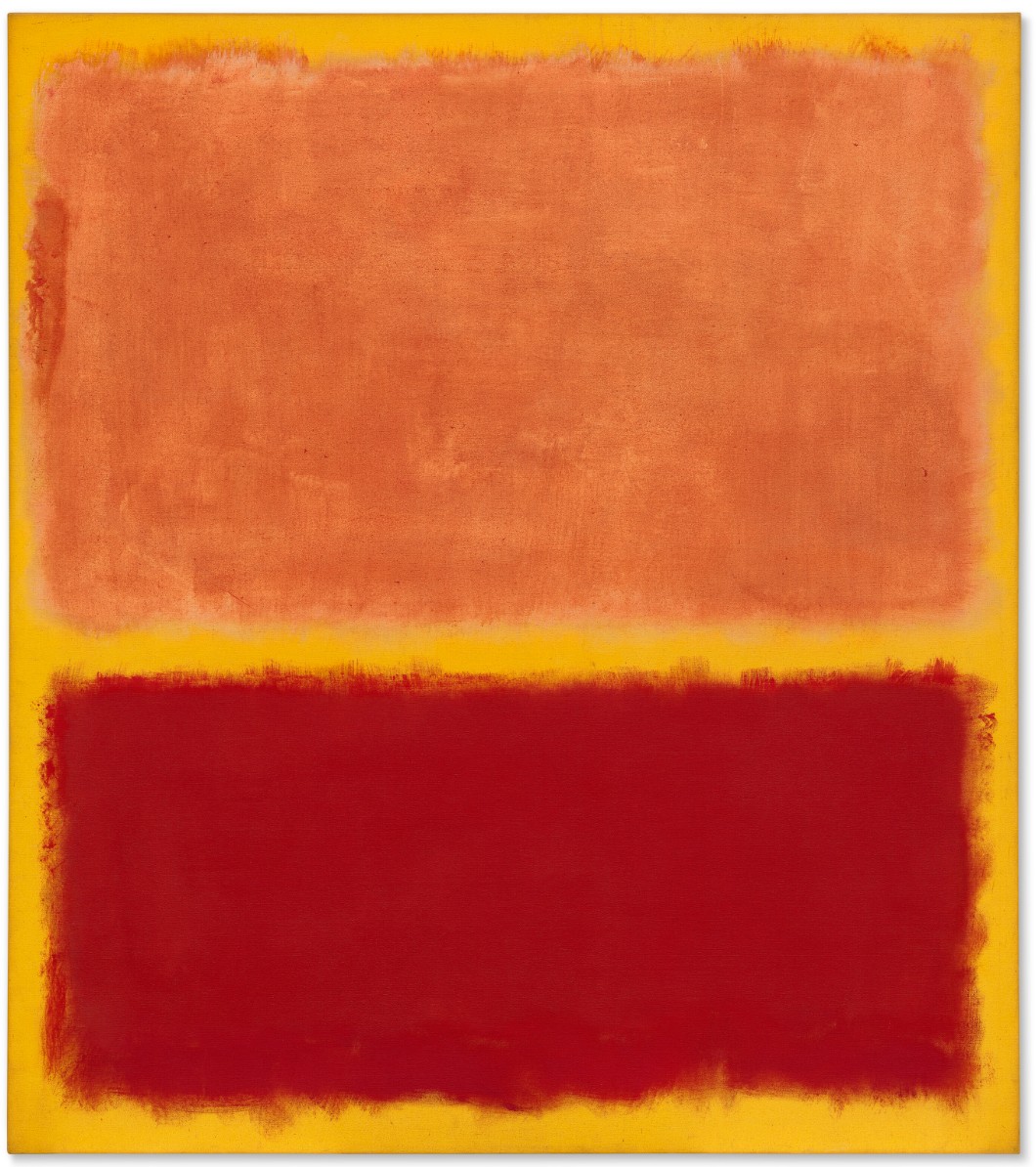
MARK ROTHKO (1903-1970)
No. 31 (Yellow Stripe), 1958
Oil on canvas
78 1/4 x 69 1/4 inches (198.8 x 175.9 cm)
Signed, partially titled and dated ‘MARK ROTHKO 1958 #31’ (on the reverse)
Painted in 1958, the same year Mark Rothko embarked on what would become the defining project of his career (a series of murals for the Four Seasons restaurant in the Seagram Building in Manhattan) No. 31 (Yellow Stripe) exemplifies Rothko’s mastery of color and emotional resonance. This period marked a crucial evolution in the Abstract Expressionist’s artistic output, characterized by his exploration of saturated hues and an ethereal sense of spirituality. In this luminous work, Rothko achieves an intensity that resonates with the human condition, invoking a sense of presence so powerful that, as he famously stated,
“when you turned your back to the painting, you would feel that presence the way you feel the sun on your back”
This effect is unmistakably present in works like No. 31 (Yellow Stripe), where radiant fields of color seem to breathe, casting an almost celestial glow that immerses the viewer in an experience beyond the visual.
During this pivotal phase of his career, Rothko employed high-keyed and luminous colors which he used for a short, but enormously creative, period before evolving toward the more somber preponderance of red, blue, and maroon that emerged from his Seagram murals and would come to mark his later career. No. 31 (Yellow Stripe) exemplifies this earlier creativity with its interplay of deep reds, soft pinks, peach hues, and intense yellows. Here, two fields of shifting color are stacked one on top of another, corralled only by an outer border whose chromatic intensity ultimately possesses the authority to restrain the strength of these two internal fields of color. This sense of internal conflict is further enhanced by the dramatic ‘feathering’ that marks the perimeters of these passages, the result of the constant tussle and painterly incursions that convey the energy of Rothko’s dramatic painterly technique.
“To those who are friendly to my pictures on the basis of their serenity,
I would like to say that they have found endurable in human life,
the extreme violence that pervades every inch of their surface.”
However, as Rothko’s reputation began to soar in the mid-1950s, so too did his concern over how his work was being perceived. Once a somewhat misanthropic outsider, he now found himself the subject of critical acclaim, which he met with both appreciation and skepticism. Yet, Rothko was wary of such interpretations, resisting any notion that his paintings were beautiful, harmonious arrangements of color. Rothko sought to convey deeper, more tumultuous emotions—pain, struggle, and existential unrest.
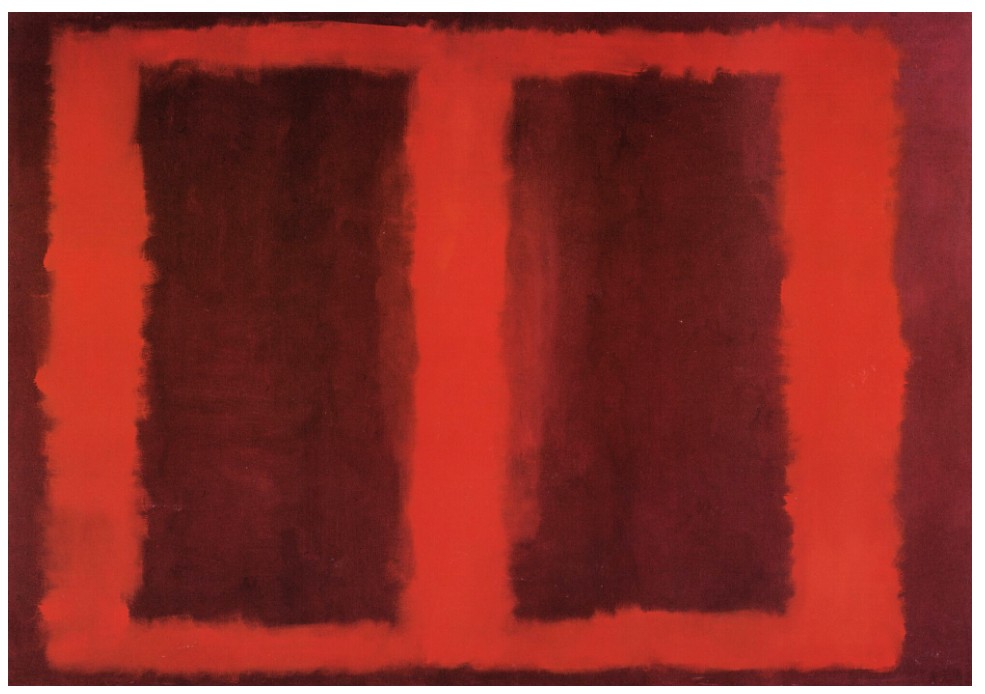
Mark Rothko, Sketch for “Mural No.4” (Orange on Maroon, Seagram Mural Sketch), 1958. Kawamura Memorial Museum of Art, Chiba-Ken. © 1998 Kate Rothko Prizel & Christopher Rothko / Artists Rights Society (ARS), New York.
It is this paradox—serenity coexisting with barely contained energy—that gives works like No. 31 (Yellow Stripe) their extraordinary power. The painting appears suspended between sublime beauty and a latent, almost volcanic intensity. Like a sunset tinged with an underlying turbulence, it radiates warmth while hinting at something deeper, something volatile. Rothko’s colors, glowing with a near-radioactive luminescence, create a tension that feels on the verge of eruption, capturing what he described as “serenity about to explode” (M. Rothko, quoted in J. E. B. Breslin, op. cit., p. 355). This unique quality of Rothko’s work had been astutely recognized by Hubert Crehan, one of the earliest critics to comment on his mature style. Writing in Arts Digest in 1954, Crehan likened the “immanent radiance” of Rothko’s paintings to the light emitted by a fission reaction—an observation that Rothko himself deemed “acute.” “We have in our time become aware of the reports of the great billows of colored light that have ripped asunder the calm skies over the atolls of the calmest ocean,” Crehan wrote. “We have heard of the terrible beauty of that light, a light softer, more pacifying than the hues of a rainbow and yet detonated as from some wrathful and diabolical depth. The tension of the color-relationships of some of the Rothko paintings I have seen has been raised to such a shrill pitch that one begins to feel in them that a fission might happen, that they might detonate” (H. Crehan, “Rothko’s Wall of Light: A Show of His New Works at Chicago” Arts Digest, no. 29, November 1, 1954, p. 19).
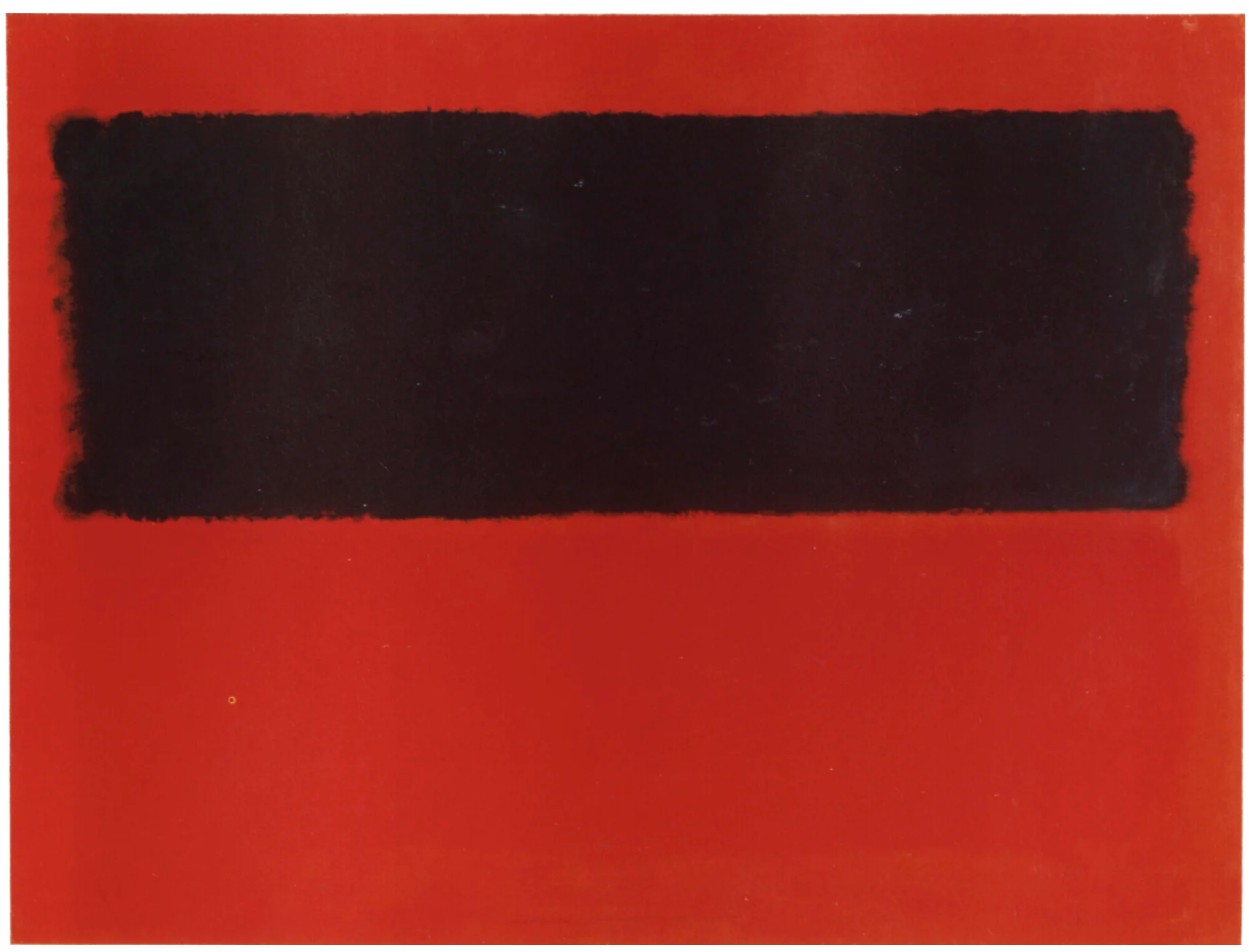
Mark Rothko, Black Area in Reds, 1958. Museum of Contemporary Art, Tokyo.
© 1998 Kate Rothko Prizel & Christopher Rothko / Artists Rights Society (ARS), New York.
Rothko’s response to Crehan’s insight was uncharacteristically favorable for the often embattled artist. Crehan embraced the notion that Rothko’s paintings were not merely tranquil fields of color but rather sites of profound emotional intensity, where elemental forces of light and darkness, joy and despair, clashed upon the surface. Crehan was—as Rothko would do time and again—pointing to what the artist saw as the primordial and tempestuous nature of his work, what Rothko had once described as “eternal symbols upon which we must fall back to express basic psychological ideas. …symbols of man’s primitive fears and motivations” (A. Gottlieb and M. Rothko, “The Portrait and the Modern Artist,” broadcast October 1943, quoted in I. Sandler, Abstract Expressionism and the American Experience, New York, 2009, p. 82).
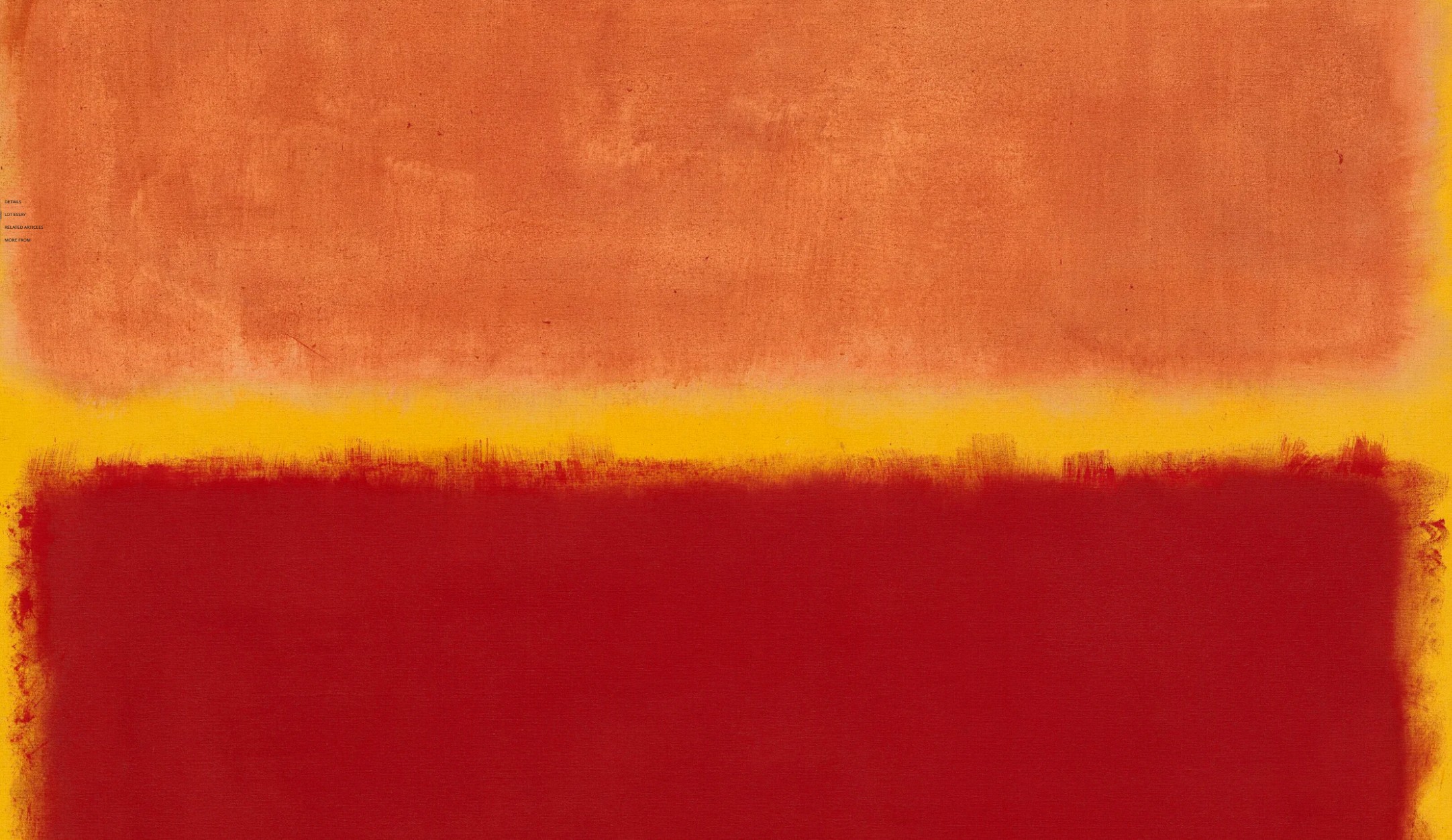
Amidst the existential unease of the post-World War II era, Rothko sought to create art that spoke to fundamental human truths. As Karl Jaspers observed, the war had forced people to turn not to Goethe but to Shakespeare, the Bible, or Aeschylus—works that directly confronted the raw realities of human existence (K. Jaspers, Unsere Zukunft und Goethe, Zurich, 1948, p. 22). Rothko, too, drew from these epic sources, aspiring to infuse his paintings with the same universal resonance. Nietzsche, Shakespeare, Mozart, and Aeschylus were among his inspirations, guiding him in his quest to forge a visual language that transcended the confines of abstraction.
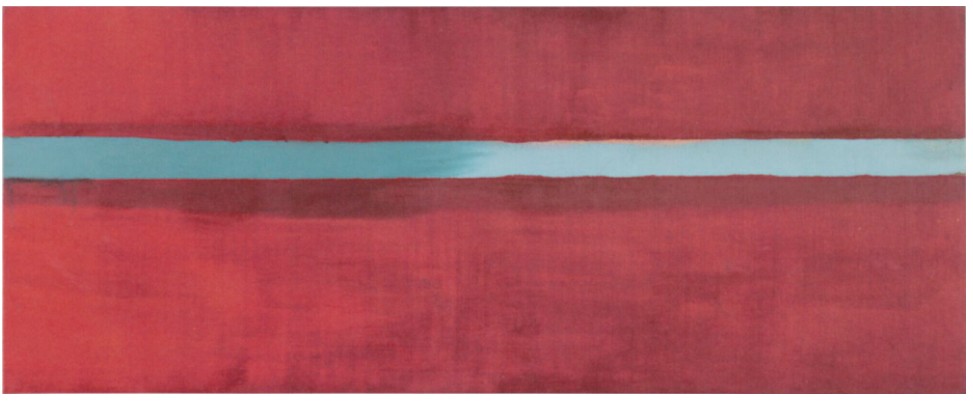
Barnett Newman, Horizon Light, 1949. Sheldon Memorial Art Gallery and Sculpture Garden, Lincoln. © 2025 Barnett Newman Foundation / Artists Rights Society (ARS), New York.
Rothko’s work was profoundly shaped by his deep engagement with the philosophy of Friedrich Nietzsche, particularly The Birth of Tragedy. In this seminal work, Nietzsche argued that the ancient Greeks had found a way to affirm a meaningful existence in an otherwise meaningless world through the invention of tragic drama. Following Nietzsche’s philosophical insights, Rothko’s abstract paintings reflect the innate dualism the German philosopher had identified as Apollonian and Dionysian forces. The Apollonian embodied order, form, and idealized beauty—exemplified in the precision of Ancient Greek sculpture. In contrast, the Dionysian represented unbridled energy, chaos, and raw emotional intensity, akin to the power of music. For Rothko, the noble and the sublime—central themes in Romantic painting—were meaningless unless they held, “to the bursting point, a core of the Wild” (M. Rothko, quoted in Mark Rothko, Retrospektive, exh. cat., Munich, 2008, p. 18). Like Mozart did in music, Rothko employed the radiant hues of his color fields as tonal vibrations, orchestrating them to evoke profound emotional responses. “I am not interested in relationships of color or form or anything else,” he famously asserted. “I am interested only in expressing the basic human emotions—tragedy, ecstasy, doom, and so on—and the fact that lots of people break down and cry when confronted by my pictures shows that I communicate with those basic human emotions. The people who weep before my pictures are having the same religious experience I had when I painted them” (M. Rothko, quoted in Selden Rodman, Conversations with Artists, New York, 1957, pp. 93-94).
Caspar David Friedrich, Woman before the Rising Sun, 1818. Museum Folkwang, Essen.
For Rothko, a painting like No. 31 (Yellow Stripe) was not simply an image but an experience—an encounter with color so intense that it took on an almost physical presence. As he insisted, “pictures must be miraculous…a revelation, an unexpected and unprecedented resolution of an eternally familiar need” (M. Rothko, “The Romantics Were Prompted,” Possibilities, no. 1, Winter 1947/8). The vast fields of color in this work seem to breathe and shift, their radiance drawing viewers into a realm of heightened perception, where emotions take form in shimmering, weightless hues. Indeed, much like Piet Mondrian, another artist in the collection of Robert F. and Patricia G. Ross Weis, Rothko sought to use abstraction to evoke the spiritual by emptying his pictures of direct references to the world.
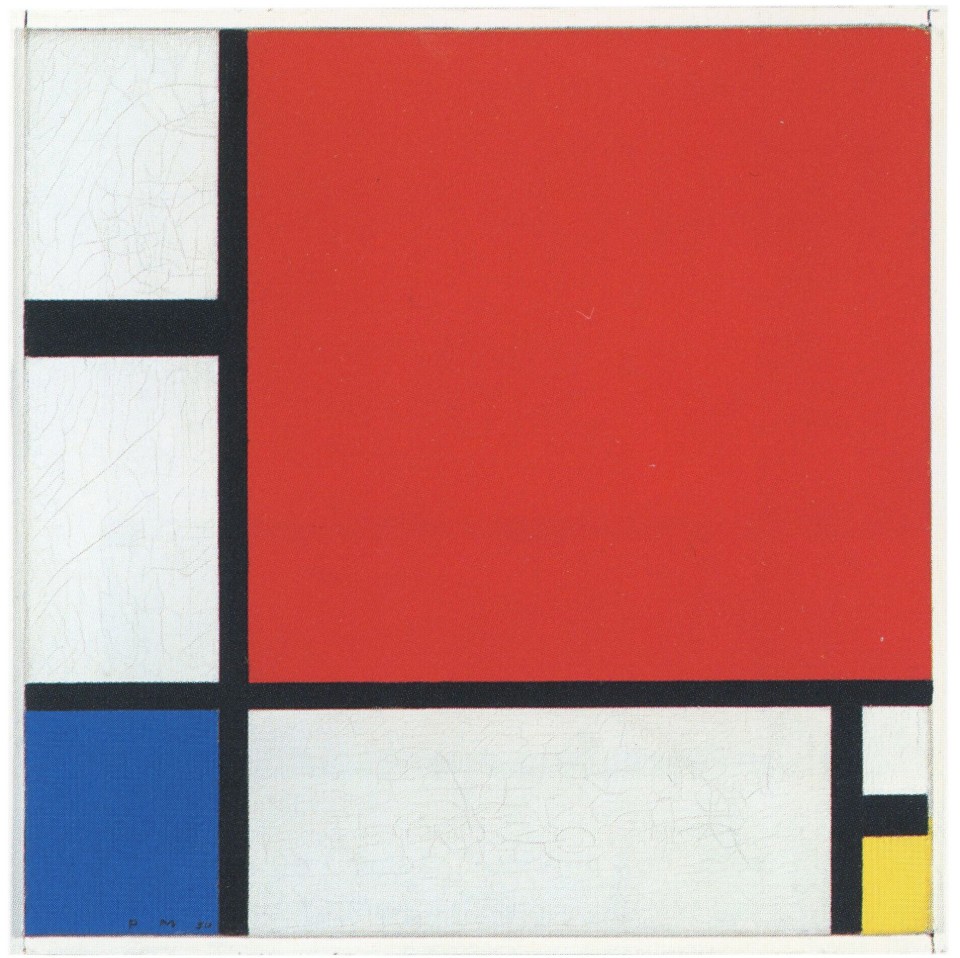
Piet Mondrian, Composition with Red, Yellow, and Blue, 1930. Kunsthaus, Zurich. © 2025 Mondrian / Holtzman Trust
Rothko’s son, Christopher, later reflected on his father’s paintings’ correlation to the human condition: “In essence, Rothko wanted his paintings to speak of and to the human, and his works are full of touches that remind us of their human creator and the work of his hand” (C. Rothko, in Mark Rothko, New York, 2022, p. 22). This humanity is present across the entire surface of No. 31 (Yellow Stripe), where the glowing surface pulses with life. Through an interplay of light and shadow, Mark Rothko’s artistic legacy continues to resonate. His paintings remain as poignant today as they were in his own time—an enduring testament to his vision, his search for depth beyond form, and his ability to translate human emotion into a transcendent visual experience. The weight and warmth of No. 31 (Yellow Stripe) serve as an invitation into Rothko’s world—one where color is language, and presence is everything.
Untitled, 1967
The Geri Brawerman Collection: A Tribute to Los Angeles and A Legacy of Giving
Sotheby’s New-York: 20 November 2025
Estimated: USD 3,000,000 – 5,000,000
USD 3,466,000
WORK ON PAPER
Untitled | Modern Evening Auction | 2025 | Sotheby’s
MARK ROTHKO (1903 – 1970)
Untitled, 1967
Oil on paper mounted on canvas
23 5/8 x 17 7/8 inches (60 x 45.4 cm)
Signed Mark Rothko (on the reverse)
Provocative in its exquisite palette and radical candor, Untitled is a paragon of Mark Rothko’s acclaimed paintings on paper. Executed in 1967, just three years before the artist’s passing, the present work dates to a period of profound creative transformation, in which Rothko devoted himself almost entirely to the medium of paper. In response to health concerns that prevented him from working on large canvases, Rothko embraced the versatility and intimacy of paper, producing compositions of extraordinary depth and meditative force that rival the resonant power of his monumental paintings. Bearing distinguished provenance, Untitled has been held in the esteemed collection of Geri Brawerman, celebrated patron of the arts and philanthropist, for over three decades. A radiant and deeply evocative exemplar of his mature practice, Untitled embodies the intense potency of contrasting hues and delicate brushstrokes that distinguish Mark Rothko as among the most dynamic and influential artists of the twentieth century.
“Freed from a false sense of security and community, the artist can abandon his plastic bankbook, just as he has abandoned other forms of security. Both the sense of community and of security depend on the familiar. Free of them, transcendental experiences become possible.”
The artist, 1949. Photo by William Heick
Rendered in a timeless palette with an exquisite command of composition and paint, Untitled reinforces Rothko’s position as a master colorist. In Untitled, Rothko distills his palette into a milky, luminescent white set against deep, noir-like hues, creating a unique, combative tension between the colors. The two chromatic entities hover within a singular spatial field, their soft, feathered edges suspended in halos of light. Floating against the atmospheric beige ground, the black-and-white forms radiate a harmonious, charged synergy, their relationship generating a transcendental sense of stillness and motion. The pigment appears both freshly applied and eternally fixed, an optical paradox achieved through Rothko’s nuanced technique of layering and feathering paint, which eliminates hard edges in favor of a subtle blending of pigment.
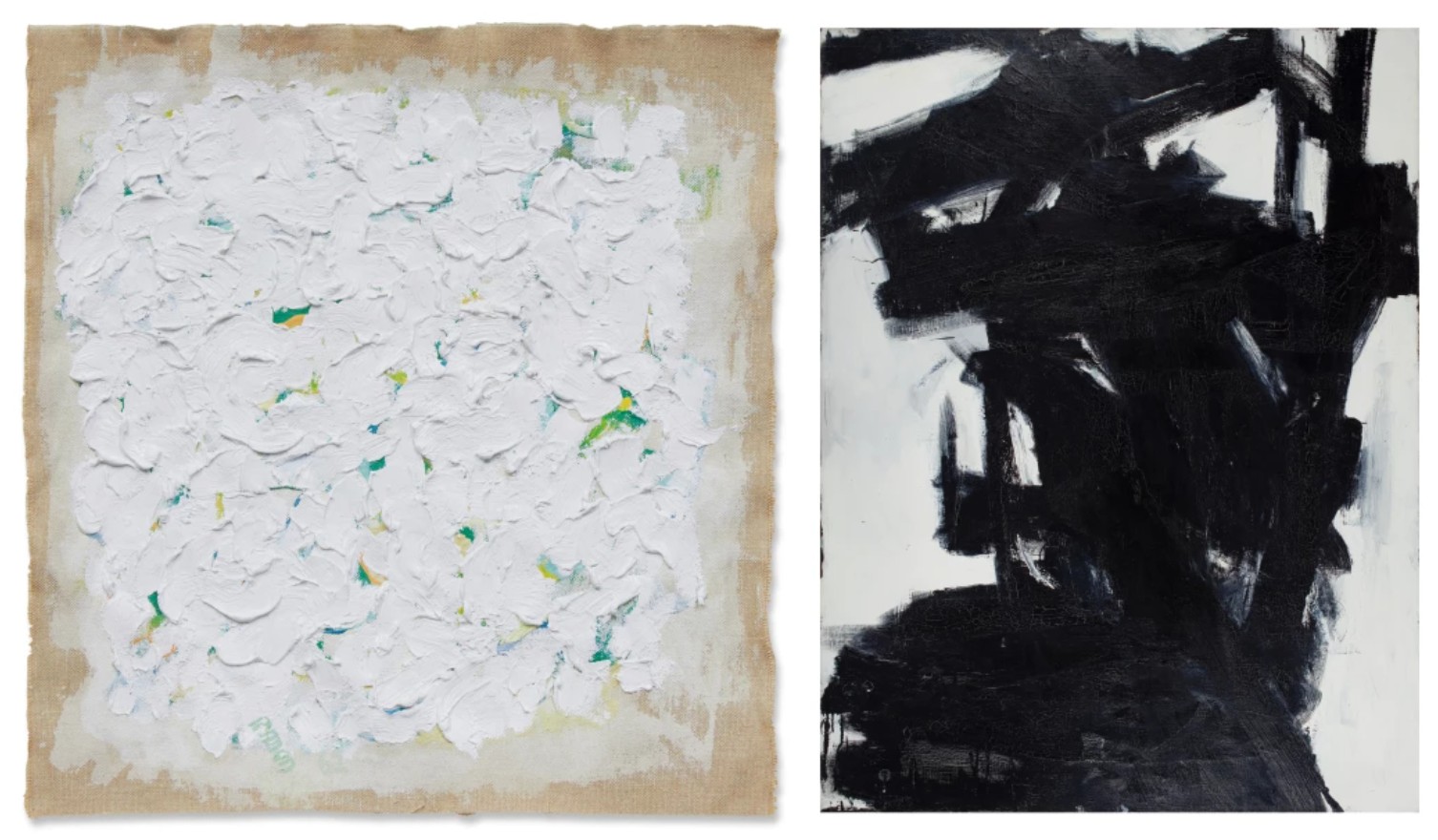
Left: Robert Ryman, Untitled, 1962. Private Collection. Sold at Sotheby’s New York in November 2021 for $4.9 million. Art © 2025 Robert Ryman. Right: Franz Kline, Ballantine, 1948-60. Los Angeles County Museum of Art, Los Angeles. Image © Bridgeman Images. Art © 2025 The Franz Kline Estate / Artists Rights Society (ARS), New York
Abandoning the classical structures of line and form, the work’s holistic surface emulates the nature of a void, the black pigment seemingly absorbing surrounding light with its matte surface. Rothko achieves this divine ethereality through a nuanced feathering technique, eliminating hard edges from his compositions in favor of a subtle blending of pigment. Rothko’s signature technique differentiated him from other Abstract Expressionist peers, who revolutionized abstract painting through their own means. The gentle accumulation of layers of oil paint in the present work mirrors the exacting process used in Rothko’s monumental paintings, in which the thoughtful accretion of pigment realizes a magnificent sense of depth and transcendence. The edges of Rothko’s forms are suspended in halos, which afford his painted surfaces a heavenly aura. Thereby, his paintings at once evoke stillness and motion, as if the pigments on the surface have been freshly applied yet are eternally fixed.
John Constable, Cloud Study: Stormy Sunset, 1821-22. National Gallery of Art, Washington D.C. Image © Bridgeman Images
The present work dates to a critical period in Rothko’s career. In 1967 and 1968, Rothko worked with an unrelenting curiosity, continually probing the relationship between the conscious and unconscious. Rothko’s later paintings reflect a complete disillusionment with the parameters of contemporary society and an elimination of dependency on the familiar.
Market Precedent: Mark Rothko Works on Paper Mounted on Laid Down on Canvas
This experimentation gave rise to the present work, which is imbued with atmospheric somberness, ritualistic stillness, and contemplative power. In the spring of 1968, at his doctors’ advice, Rothko refrained from working on a large scale. In working primarily with works on paper, Rothko experienced a wave of prolific creativity, as these works became a vehicle of immense creative expression and experimentation, breaking the boundaries of what painting could be. In his final years, Rothko’s artistic ambition reached its pinnacle with a body of works on paper that is unparalleled in its virtuosity and brilliance. Untitled encapsulates Rothko’s genius pursuit of form and light, deeply engrossing the viewer on a physically more intimate scale.
Joseph Mallard William Turner, Heidelberg, 1846. Scottish National Gallery, Edinburgh.
Image © National Galleries of Scotland / Bridgeman Images
In Untitled, Rothko achieves profound transcendence and connects the colored entities in a composition that perfectly balances the sensual and the spiritual. Cosmically enrapturing, the present work is an exquisite instance of the emotional fortitude of Rothko’s final period, rendered in a deeply reflective, personal scale.
Jean Dubuffet
Restaurant Rougeot II, 1961
The Matthew and Carolyn Bucksbaum Collection
Sotheby’s New-York: 20 November 2025
Estimated: USD 6,000,000 – 8,000,000
USD 7,492,000
PARIS CIRCUS SERIES
Restaurant Rougeot II | Modern Evening Auction | 2025 | Sotheby’s
JEAN DUBUFFET (1901 – 1985)
Restaurant Rougeot II, 1961
Oil on canvas
90.5 by 116.2 cm (35 5/8 x 45 3/4 inches)
Signed J Dubuffet (lower center)
Signed again, titled and dated avril 61 (on the reverse)
Executed in March-April 1961
Standing before Jean Dubuffet’s Restaurant Rougeot II, one can almost hear the clatter of dishware, boisterous laughter, symphony of conversation, and spectacle of Parisian nightlife. Dubuffet’s jubilant scene immediately transports the viewer to mid-century Paris, capturing the joie-de-vivre and vibrant atmosphere that characterized a burgeoning era of prosperity and hope in the post-war period. Returning to the bustling urban milieu in Paris after years spent in the Vence countryside, Dubuffet was captivated by the city’s potent sense of optimism and liberation in the wake of World War II.
Executed in 1961, a revolutionary year in Dubuffet’s oeuvre, Restaurant Rougeot II is an early example from the artist’s most celebrated and coveted series: the Paris Circus. Dubuffet’s paintings from this limited body of work are poignant vignettes of a rejuvenated Paris: featuring storefronts and street signs, automobiles and local establishments, and city dwellers strewn about wide boulevards. In these works, Dubuffet harnesses a masterful fusion of figuration and abstraction, generating a sensation of unbridled energy through kaleidoscopic coloration and vigorous brushwork.
“I went to draw at Restaurant Rougeot on Tuesday morning, March 28, 1961 from 9 a.m. to 10:30 a.m and I went back for lunch to draw again while eating, after which I immediately started the painting, which I worked on from 1 p.m. to 8:30 p.m. and then for a few more hours the next day.”
Jean Dubuffet, 1964. Photo by Ida Kar © National Portrait Gallery, London
A rare and seminal painting within the Paris Circus series, Restaurant Rougeot II is one of an exceptional suite of just three paintings depicting Restaurant Rougeot, which was once a vibrant enterprise located on the Boulevard Montparnasse. The sister painting to the present work, Restaurant Rougeot I is held in the Dubuffet Foundation’s collection. Furthermore, Restaurant Rougeot II is one of few major city-scene Paris Circus paintings still remaining in private hands; other examples are held in the collections of Musée des Arts Décoratifs, Paris; Tate, London; The Museum of Modern Art, New York; National Gallery, Washington, D.C., and the Centre Pompidou, Paris, among others.
Auguste Renoir, Bal du moulin de la Galette, 1876. Musée d’Orsay, Paris. Image © RMN-Grand Palais / Art Resource, NY
Exuding the boisterous spirit of Parisian urban life, Restaurant Rougeot II crystallizes the ebullience of the dynamic social fabric that Dubuffet encountered upon his return to the city after his sojourn in the country. Here, the viewer is witness to a mesmeric restaurant scene in which patrons lean into gripping conversation, throw their arms up in exclamation, and drink and dine with glee. At the composition’s center, the maître d’ outfitted in a white apron commands his audience like the conductor of an orchestra—his swift movement between tables represented by brisk strokes of white pigment.
Diners converse over full plates and glasses of wine, at times mingling between tables. Hopeful patrons stand in line at the entrance, waiting their turn for a spot at the beloved Restaurant Rougeot. By the door, a woman presses her hands against her cheeks aghast at a gentleman’s transgression of wearing a hat indoors. A coat check attendant guards his valuables and passersby on the streets peer through paned windows like spectators at the theatre. Dubuffet masterfully navigates the dichotomies between inside and outside, capturing the interior’s lively atmosphere, ornate moldings, and high ceilings, while also situating the viewer in the context of Parisian cosmopolitan life on the street level.
Le Boulevard Montparnasse, with Restaurant Rougeot. Photographer unknown
Dubuffet’s rendering of the Restaurant Rougeot sign above the entrance and individuality of expression afforded to each character in the scene imbues the painting with an enchanting familiarity, while maintaining the artist’s signature playful, liberated technique. Radically manipulating the perspective of the scene to produce a panoramic-like vantage for the viewer, Dubuffet captures the frenzied energy of Restaurant Rougeot as a microcosm for a vibrant Parisian metropolis.
Left: Paolo Veronese, Le nozze di Cana, 1562-63. Musée du Louvre, Paris. Image © Photo Josse / Bridgeman Images. Right: Jackson Pollock, Number 1, 1950 (Lavender Mist), 1950. National Gallery of Art, Washington, D.C. Image © Bridgeman Images. Art © 2025 Pollock-Krasner Foundation / Artists Rights Society (ARS), New York
Begun in 1961, the Paris Circus series marked a revolutionary departure from Dubuffet’s output in the late 1950s. In 1955, in the aftermath of World War II, Dubuffet retreated to rural Vence and began a series of geologically informed works connected to the natural environment. Works of this period, including Topographies, Texturologies, and Matériologies demonstrate the artist’s fascination with exploring his new terrain on a microscopic level and were executed in an austere, earthy palette. After six years in the countryside, Dubuffet’s return to a revitalized Paris sparked watershed development in his practice. The Paris Dubuffet had left was sober and depressed by war, while the new Paris he encountered was a thriving metropolis. Dubuffet responded with a series of works capturing the vitality, speed, and energy igniting the city.
Restaurant Rougeot II is one of a seminal and rare suite of just three paintings depicting the iconic Restaurant Rougeot on the Boulevard Montparnasse, with the sister painting belonging to the Fondation Dubuffet, Paris. Further testament to the significance of the present work, Restaurant Rougeot II is one of few major city-scene Paris Circus paintings remaining in private hands, with others widely represented in prestigious collections, including Musée des Arts Décoratifs, Paris; Tate, London; The Museum of Modern Art, New York; National Gallery, Washington, D.C., and the Centre Pompidou, Paris.
Restaurant Rougeot I, 1961, Fondation Dubuffet Paris
Using a chromatic palette of crimson reds, emerald greens, periwinkle blues, and tangerine oranges, applied in quick strokes over numerous layers, Dubuffet harnessed the essence of a city in progress in Restaurant Rougeot II. Dubuffet’s Paris Circus compositions are densely packed sensory barrages, brimming with information to uncover, just like a metropolitan street. Dubuffet explained his Paris Circus paintings in contrast with his earlier works: “The principle thing about [my paintings of this year] is that they are in complete contrast to those of the Texturology and Materiology series that I did previously. They are in every way the opposite… In reaction against this absenteeist tendency my paintings of this year put into play in all respects a very different intervention. The presence in them of the painter now is constant, even exaggerated. They are full of personages, and this time their role is played with spirit.” (the artist, “Statement on Paintings of 1961,” in: Peter Selz, The Work of Jean Dubuffet, New York 1962, p. 165)
Piet Mondrian, Broadway Boogie Woogie, 1942-43. The Museum of Modern Art, New York.
Image © The Museum of Modern Art / Licensed by SCALA / Art Resource, NY
Boisterous and undaunted, Dubuffet’s Restaurant Rougeot II is an exceptional example from Dubuffet’s most acclaimed series. With a polychromatic palette, vigorous gesture and radical fusion of figuration and abstraction, Dubuffet enchants the viewer with a deluge of color and form, capturing the energy of a new Paris. Held in the same family collection for over forty years, Restaurant Rougeot II is an exceedingly rare and important work within Dubuffet’s exalted oeuvre.
Passe l’heure, 1980
The Geri Brawerman Collection: A Tribute to Los Angeles and A Legacy of Giving
Sotheby’s New-York: 20 November 2025
Estimated: USD 600,000 – 800,000
USD 952,500
Passe l’heure | Contemporary Day Auction | 2025 | Sotheby’s
JEAN DUBUFFET (1901 – 1985)
Passe l’heure, 1980
Acrylic on canvas
100 x 81.2 cm (39 1/4 x 32 inches)
Signed with the artist’s initials and dated 80 (lower right)
Titled and dated Déc. 80 (on the reverse)
Executed in 1980, Passe l’heure captures Jean Dubuffet at a moment of extraordinary late-career vitality, when the artist’s restless inventiveness found new form in the Sites aux Figurines series. This body of work, produced between 1978 and 1981, marks a decisive shift in Dubuffet’s lifelong exploration of how thought, memory, and perception might be translated into visual form. Here, animated figures and fragmentary zones coalesce into a rhythmically charged composition that blurs distinctions between subject and setting, interior and exterior, self and environment.
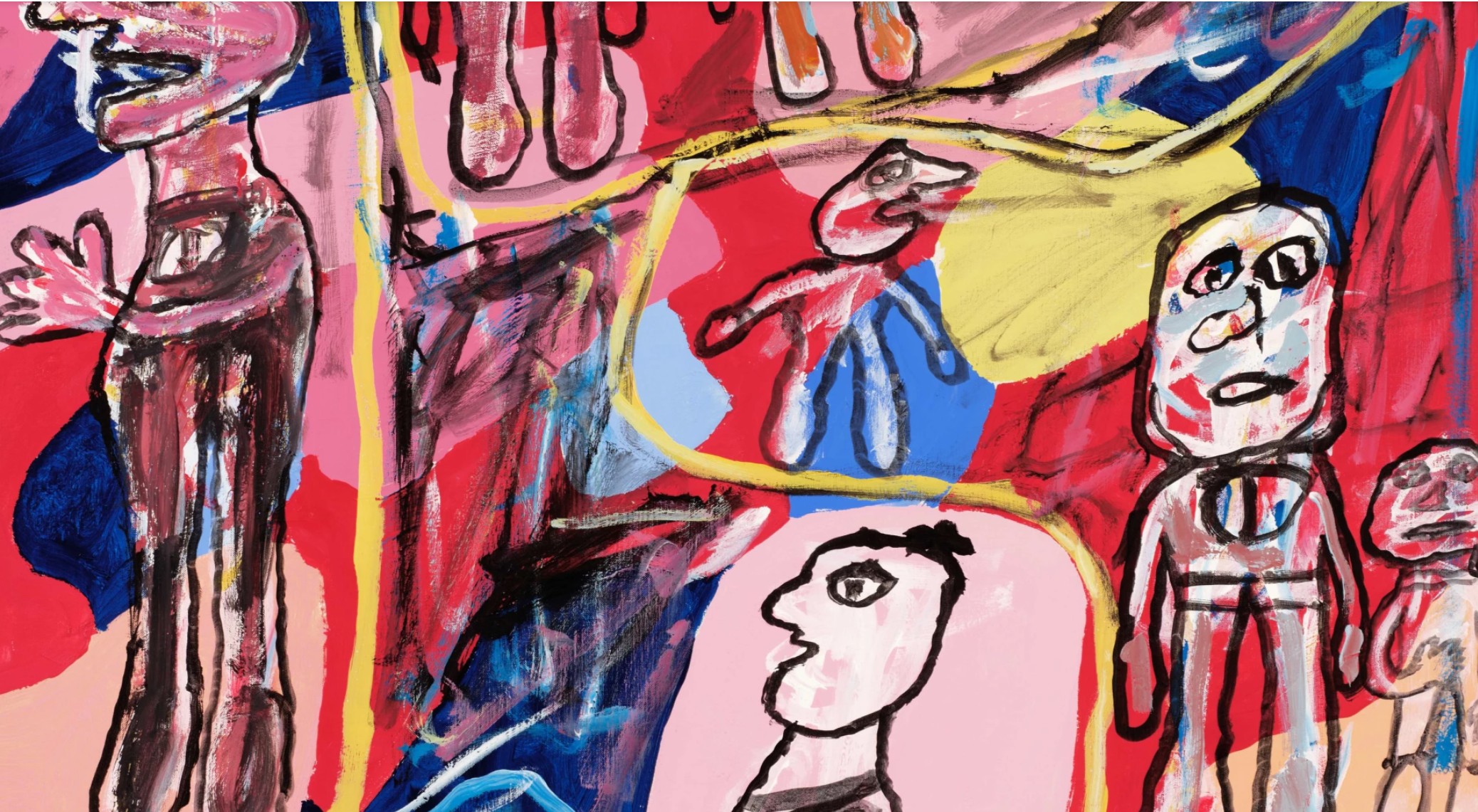
Across the composition, a dense constellation of figures rendered in vivid reds, ochres, blues, and whites populate the picture plane, their outlines simultaneously defined and absorbed into the intricate lattice of Dubuffet’s line. As in the closely related Partitions series that followed shortly after, Passe l’heure is governed by what the artist described as “a constantly occurring modulation of space… in which high and low, far and near, are no longer quite explicit” (Jean Dubuffet quoted in Exh. Cat., Salzburg, Museum der Moderne, Rupertinum Salzburg (and travelling), Jean Dubuffet – Traces of an Adventure, 2003, p. 240). Figures appear to drift between zones of color and gesture, caught in a perpetual state of flux that mirrors the instability of human thought and perception.
Portrait of Jean Dubuffet, Paris, 1976 © Archives Fondation Dubuffet, Paris / © Kurt Wyss, Basel / © ADAGP, Paris, 2025
This fragmentation of pictorial space can be traced to Dubuffet’s Théâtres de mémoire series, begun in 1975 and inspired by Frances Yates’s The Art of Memory. In those vast assemblages, Dubuffet fused gestural abstraction and figuration to evoke the associative structure of recollection. Following a back injury in 1978 that limited his physical movement, the artist turned to smaller formats, working seated and reimagining the sprawling mental landscapes of Théâtres de mémoire through the intimate, rhythmic surfaces of Sites aux Figurines. The present work epitomizes this transformation: a complex yet lucid orchestration of color and line that translates the mechanisms of memory and imagination into a visual language of joyful immediacy.
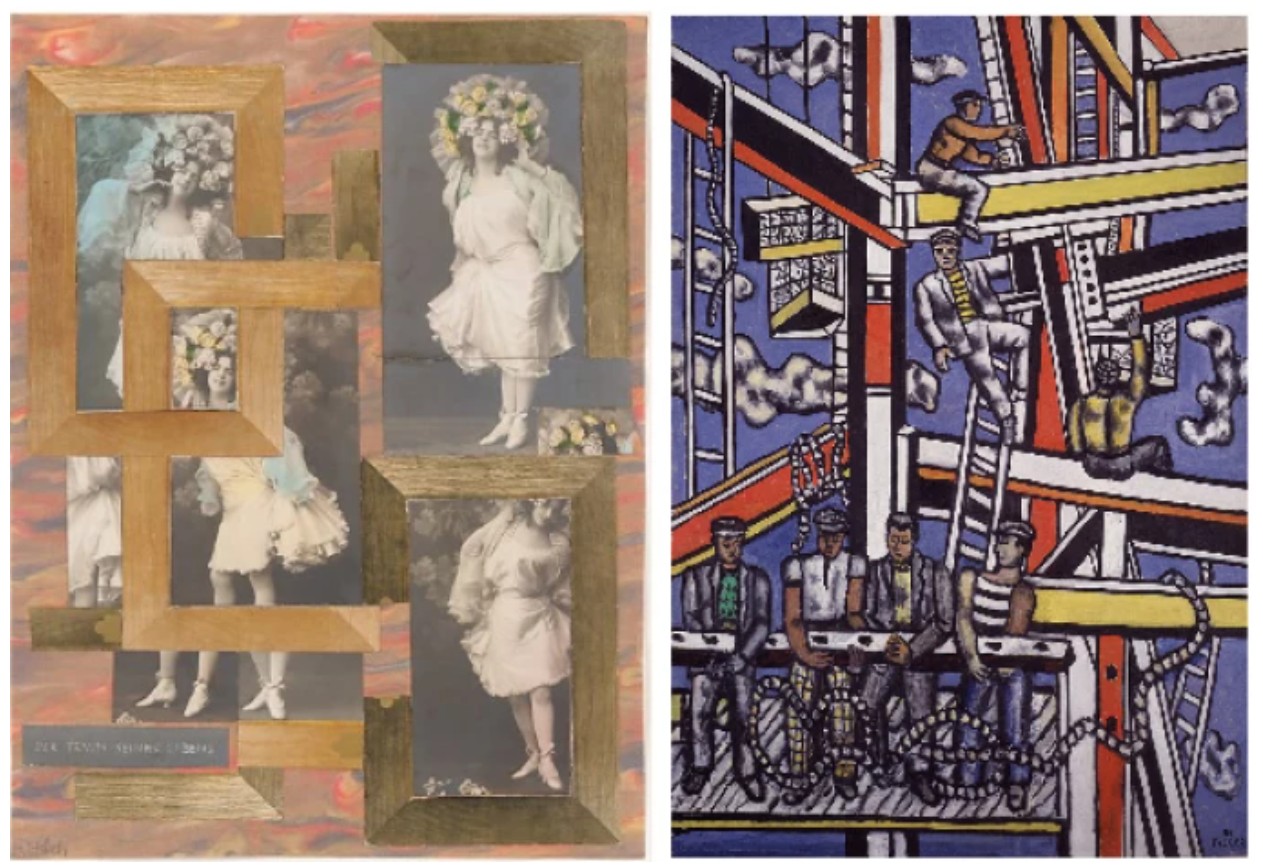
Left: Hannah Höch, Der Traum seinen Lebens (The Dream of His Life), 1925. The Metropolitan Museum of Art, New York.
Right: Fernand Léger, Builders with Rope, 1950. Solomon R. Guggenheim Museum, New York.
In Passe l’heure, Dubuffet’s figures—simplified yet expressive—reappear as inhabitants of psychological space rather than physical terrain. Each form is contained yet porous, suggesting zones of consciousness rather than bodies in a setting. The composition evokes what Dubuffet described as “representing what makes up our thoughts – to represent not the objective world, but what it becomes in our thoughts” (Jean Dubuffet quoted in Exh. Cat., London, Barbican, Jean Dubuffet: Brutal Beauty, 2021, p. 247). His late works abandon the illusion of perspective and the hierarchy of figure and ground in favor of an egalitarian pictorial democracy, where every line, shape, and hue participates equally in the life of the painting. With its kaleidoscopic interplay of form and color, Passe l’heure embodies the culmination of Dubuffet’s decades-long effort to unite thought, emotion, and material into a single continuum. The painting stands not only as a testament to the artist’s enduring creative force but as a profound declaration of faith in art’s capacity to mirror the restless, ever-shifting terrain of the human mind.
Pablo Picasso
La Lecture (Marie-Thérèse), 1932
The Collection of Robert F. and Patricia G. Ross Weis
Christie’s New-York: 17 November 2025
Estimate on Request
USD 45,485,000
PABLO PICASSO (1881-1973), La Lecture (Marie-Thérèse) | Christie’s
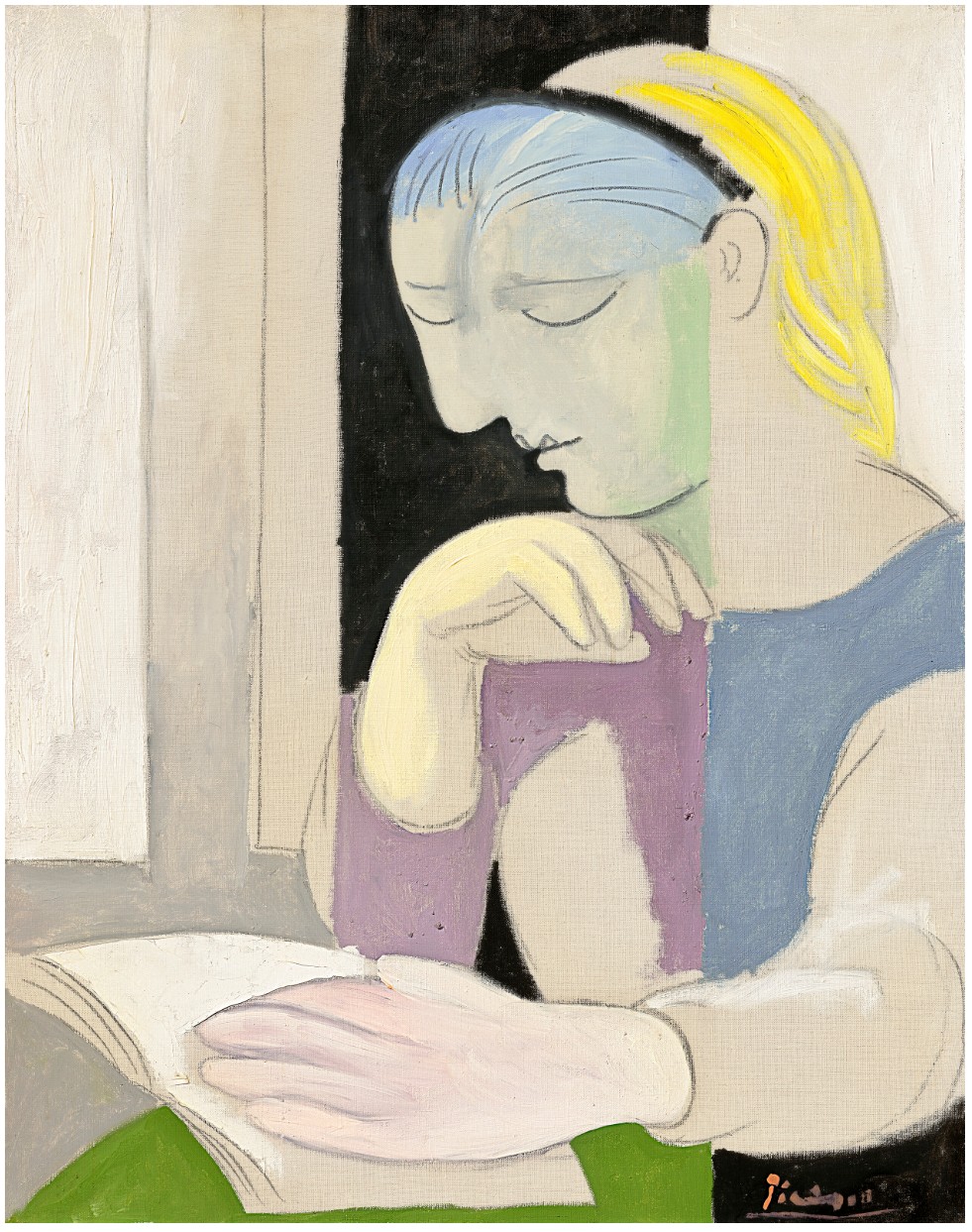
PABLO PICASSO (1881-1973)
La Lecture (Marie-Thérèse), 1932
Oil, Ripolin and charcoal on canvas
92.1 x 73 cm (36 1/4 x 28 3/4 inches)
Signed ‘Picasso’ (lower right)
Dated and inscribed ‘Boisgeloup 31 Août XXXII.’ (on the stretcher)
Painted in Boisgeloup on 31 August 1932
On 15 June 1932, an extensive survey exhibition dedicated to Pablo Picasso opened at the Galeries Georges Petit in Paris to great fanfare. Across each room in the recently renovated galleries visitors to Picasso: 1901-1932 were treated to an expansive array of works from every stage of the Spanish artist’s career thus far, the eclectic arrangement showcasing the breadth of creativity and ceaseless spirit of invention that marked Picasso’s art. The artist himself had been heavily involved in the planning and realization of the show, arranging loans from his most loyal private collectors and drawing heavily on his own personal archive to secure a final total of 225 paintings, seven sculptures and six illustrated books for display. Similarly, he took charge of the hanging of the works, choosing an arrangement that revealed the recurring leitmotifs, subjects and concerns that had fascinated him endlessly across the years.
In the lead up to the exhibition’s vernissage, however, newspaper reports claimed the artist would skip the opening night in favor of an evening at the movies: “I’ve been hooking these things on the wall for six days now,” Picasso is reported to have said, “and I’ve had enough of them” (quoted in M.C. FitzGerald, Making Modernism: Picasso and the Creation of the Market for Twentieth-Century Art, Berkeley and Los Angeles, 1995, p. 193). The artist escaped Paris shortly afterwards, retreating to his seventeenth-century château, Boisgeloup, in the Normandy countryside. Though just a quick drive from the French capital, this secluded, private property was a refuge for Picasso during the early 1930s, its location reducing the likelihood of unwelcome visitors, prying acquaintances, or admirers paying an unexpected call. Here, he was able to focus on his creative work undisturbed, in the stable he had transformed into a sculpture studio, or the room on the second floor of the corner tower, which had become a dedicated space for painting.
Pablo Picasso in front of Musiciens aux masques (1921) during his retrospective at the Galeries Georges Petit, Paris, June-July 1932. Photo: © RMN-Grand Palais / Art Resource, NY. Artwork: © 2025 Estate of Pablo Picasso / Artists Rights Society (ARS), New York.
Purchasing a large stock of new canvases, Picasso spent much of the summer of 1932 installed at Boisgeloup, picking up where he had left off in late May as preparations for the grand exhibition had consumed his time and forced him to pause his painterly activities. As with the extraordinary sequence of compositions that had emerged during the opening months of the year, the central figure in Picasso’s art during the summer was Marie-Thérèse Walter, the young woman who had been his lover and muse since 1927. Painted on 31 August 1932, La Lecture (Marie-Thérèse) portrays Marie-Thérèse in a moment of quiet leisure, her attention focused solely on her book, as she appears to lose herself in the story. Imbued with a quiet intimacy and tenderness that stands in stark contrast to the more highly stylized portraits of Marie-Thérèse that had occupied Picasso in recent weeks, this painting records the small, everyday moments the artist and muse enjoyed together in their idyllic, hidden retreat that summer.
View of the Grand Salle during the vernissage of “Picasso: 1901-1932,” at the Galerie Georges Petit, Paris, June 1932. Photograph by Gotthard Schuh. Artwork: © 2025 Estate of Pablo Picasso / Artists Rights Society (ARS), New York. Image: © RMN-Grand Palais / Art Resource, NY.
Picasso had first met Marie-Thérèse Walter in a chance encounter on the streets of Paris in the early evening of 8 January 1927. Marie-Thérèse, who was exiting the famed Galeries Lafayette department store with her newly purchased col Claudine and matching cuffs for a blouse, remembered catching the artist’s eye in the middle of the crowd. Making his way to her, Picasso promptly introduced himself. “You have an interesting face. I would like to do a portrait of you,” he reportedly told her. “I feel we are going to do great things together… I am Picasso” (quoted in J. Richardson, A Life of Picasso, The Triumphant Years, 1917-1932, New York, 2007, vol. 3, p. 323). In turn, Marie-Thérèse responded with a blank look. “The name Picasso did not mean anything to me. It was his tie that interested me,” she explained. “And then he charmed me” (quoted in P. Cabanne, “Picasso et les joies de la paternité” in L’Oeil, no. 226, May 1974, p. 7).
Château de Boisgeloup in 1931. Photographer unknown. Photo: © RMN-Grand Palais / Art Resource, NY.
Picasso was deeply struck by Marie-Thérèse’s statuesque beauty and youthful exuberance, and arranged to meet her again two days later, at the Saint-Lazare metro station. “I went there, just like that, because he had such a pleasant smile,” Marie-Thérèse remembered (quoted D. Widmaier Picasso, “Marie-Thérèse Walter and Pablo Picasso: New Insights into a Secret Love” in Pablo Picasso and Marie-Thérèse Walter: Between Classicism and Surrealism, exh. cat., Graphikmuseum Pablo Picasso, Münster, 2004, p. 29). This legendary encounter came at a pivotal turning point in the artist’s life, as he grew increasingly disillusioned by the haute-bourgeois existence that his wife, the Ukrainian-born ballet dancer Olga Khokhlova, had cultivated for them in Paris. Seeking new inspiration, he had become fascinated by the mythical l’amour fou promoted by André Breton and the Surrealists, a passionate love that would strike suddenly, and consume the beholder. When the tall, blonde, blue-eyed young woman passed him on the street that fateful day, the artist believed he had found such a paramour. The pair soon embarked upon a clandestine affair, centered around furtive meetings and love letters passed in secret.
Marie-Thérèse Walter, circa 1930. Photographer unknown. © Archives Maya Widmaier-Picasso.
As Françoise Gilot noted, Walter’s presence left an indelible mark on Picasso’s artistic output during these years, inspiring a vivid new pictorial vocabulary: “I found Marie-Thérèse fascinating to look at. I could see that she was certainly the woman who had inspired Pablo plastically more than any other. She had a very arresting face with a Grecian profile. The whole series of portraits of blonde women Pablo painted between 1927 and 1935 are almost exact replicas of her… she was very athletic, she had that high-color look of glowing good health one often sees in Swedish women. Her forms were handsomely sculptural, with a fullness of volume and a purity of line that gave her body and her face an extraordinary perfection” (F. Gilot and C. Lake, Life with Picasso, New York, 1964, pp. 241-242). As the 1930s dawned, Marie-Thérèse’s likeness appeared increasingly front and center in his works, blossoming forth in all areas of his creative production. Never before had Picasso’s art radiated such passionate, heady eroticism—from delicate drawings, to monumental canvases, to grand plaster sculptures, Marie-Thérèse became the very foundation of every aspect of Picasso’s artistic output.
”The day I met Marie-Thérèse I realized that I had before me what I had always been dreaming about.”
By the time their relationship entered its sixth, deeply passionate year, Picasso was intimately familiar with Marie-Thérèse’s form. He could recall from memory the way her golden hair fell as it brushed her cheek, the exact profile of the line that ran from her forehead, down her nose to her chin, and the sinuous, flowing topography of her athletic body as she slept. As a result, she became a vehicle for the artist’s most radical painterly experimentations, allowing him to explore themes of transformation and mutation in a myriad of intriguing ways. In 1931, the artist began a series of monumental plaster sculptures, working on carved reliefs and volumetric busts, each devoted to the poised, elegant features of Marie-Thérèse, while the first half of 1932 witnessed a great outpouring of superlative, monumental canvases capturing her form in a myriad of different styles and variations. Ranging from daring, formal reconfigurations of her figure, to richly sensuous visions of her in the role of archetypal reclining nude, these paintings show Picasso at his most inventive. A significant proportion of these works focus on seated portraits of Marie-Thérèse, relaxing in a moment of repose, writing a letter in Buste de femme de profil (Marie-Thérèse) (Zervos, vol. 7, no. 406; Private collection) or caught in a dreamy, sleeping state in the iconic La Rêve (Zervos, vol. 7, no. 364; Private collection) or Le sommeil (Zervos, vol. 7, no. 362; Private collection).
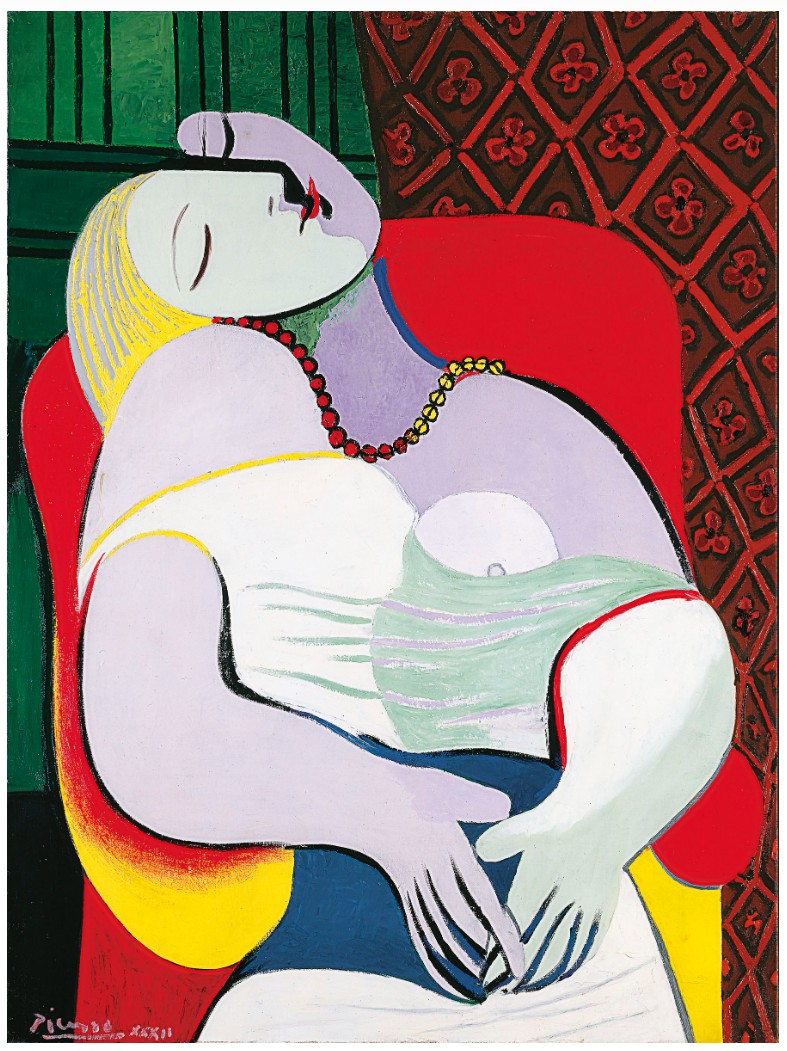
Pablo Picasso, Le Rêve, 24 January 1932. Private collection. © 2025 Estate of Pablo Picasso / Artists Rights Society (ARS), New York.
“Beautiful love of my life, Marie-Thérèse of my heart.”
Left: Pablo Picasso, La Lecture, 1932. Musée national Picasso, Paris. © 2025 Estate of Pablo Picasso / Artists Rights Society (ARS), New York.
Right: Pablo Picasso, Femme tenant un livre Marie-Thérèse, Fall 1932. The Norton Simon Museum, Pasadena. © 2025 Estate of Pablo Picasso / Artists Rights Society (ARS), New York.
In La Lecture (Marie-Thérèse), Picasso continues this thread of easy leisure, revisiting a subject that had been popular in portraiture since the seventeenth century and which he himself had deployed on numerous occasions for his depictions of the women in his life—that of a female protagonist reading. The first painting the artist completed in 1932 focused on this same subject—in La Lecture (Zervos, vol. 7, no. 358; Musée national Picasso, Paris), painted on 2 January, Marie-Thérèse appears to have been interrupted from her reading, her gaze directed squarely at the artist, her hands resting gently in her lap as she marks her place in the text. By contrast, in La lecture interrompue (9 January 1932, Zervos, vol. 7, no. 363; Private collection) painted a week later, Marie-Thérèse’s head lolls backwards against the headrest of her chair, as if she has is lost in a daydream conjured by the tale, or has drifted-off mid-way through a chapter. In the present work, her focus is trained solely on the book before her—with her chin propped on one hand, and her eyes cast downward, Marie-Thérèse is a study in relaxed focus, the gentle tilt of her head and soft expression suggesting she is oblivious to the artist’s attentions.
Pablo Picasso, Femme assise près d’une fenêtre (Marie-Thérèse), 30 October, 1932.
Private collection. © 2025 Estate of Pablo Picasso / Artists Rights Society (ARS), New York.
Seated before a simple rectangular window—which features in several other works from this year, including Nature morte à la fenêtre (18 January 1932, Zervos, vol. 7, no. 374; Private collection) and Femme assise près d’une fenêtre (Marie-Thérèse) (30 October 1932; Private collection)—Marie-Thérèse’s form appears monumental, Picasso’s treatment of the figure recalling the stylized, volumetric sculptures the artist had created the previous year, inspired by her elegant features. The soft light that spills through the window, meanwhile, illuminates Marie-Thérèse in a play of light and shade, which Picasso indicates by dividing her form into loosely blocked planes of predominantly pastel tones. Traces of charcoal remain visible on the surface of the canvas, interacting with the painted elements in an intriguing interplay that showcases the fluency and spontaneity of Picasso’s technique at this time. Subtle pentimenti reveal the evolution of the image as he worked to capture a likeness swiftly, lines shifting or altering in order to refine certain elements of the figure, as seen in Marie-Thérèse’s right hand. At the same time, there is a bold assuredness to his mark-making, a confidence that allows him to convey her features with a startling economy of means—with a single, short, curving line, for example, he indicates an eye, while a quick horizontal zig-zag at her mouth hints at the sensuality of her lips.
“I seek always to observe nature. I cling to resemblance, to a deeper resemblance, more real than the real, attaining the surreal.”
Left: Jean Honoré Fragonard, Young Girl Reading, circa 1769. National Gallery of Art, Washington, D.C.
Right: Camille Corot, Interrupted Reading, circa 1870. The Art Institute of Chicago.
There is a quiet stillness to La Lecture (Marie-Thérèse), a reflection perhaps of Marie-Thérèse’s ongoing presence in the artist’s life at Boisgeloup during this summer, and the simple rhythms of their days together, reading, working, making love, in the secluded surroundings of the chateau. “We would joke and laugh together all day,” Marie-Thérèse later recalled of their time together, “so happy with our secret, living a totally non-bourgeois life, a bohemian love away from those people Picasso knew then…” (quoted in B. Farrell, “Picasso: His Women: The Wonder is that He Found So Much Time to Paint” in Life, 27 December 1968, p. 74). Picasso’s numerous depictions of Marie-Thérèse from these months focus on poses that are captured from the privileged position of a lover, including close-up views of her face as she sleeps, the soft curves of her body as she reclines on a divan, the dreamy expression that takes over her face as she is lost in thought. Here, she appears completely at ease and comfortable in the artist’s presence. Allowed to observe his model uninterrupted, Picasso captures the vivid presence of his beloved model and muse in a peaceful, unremarkable moment of ordinary life.
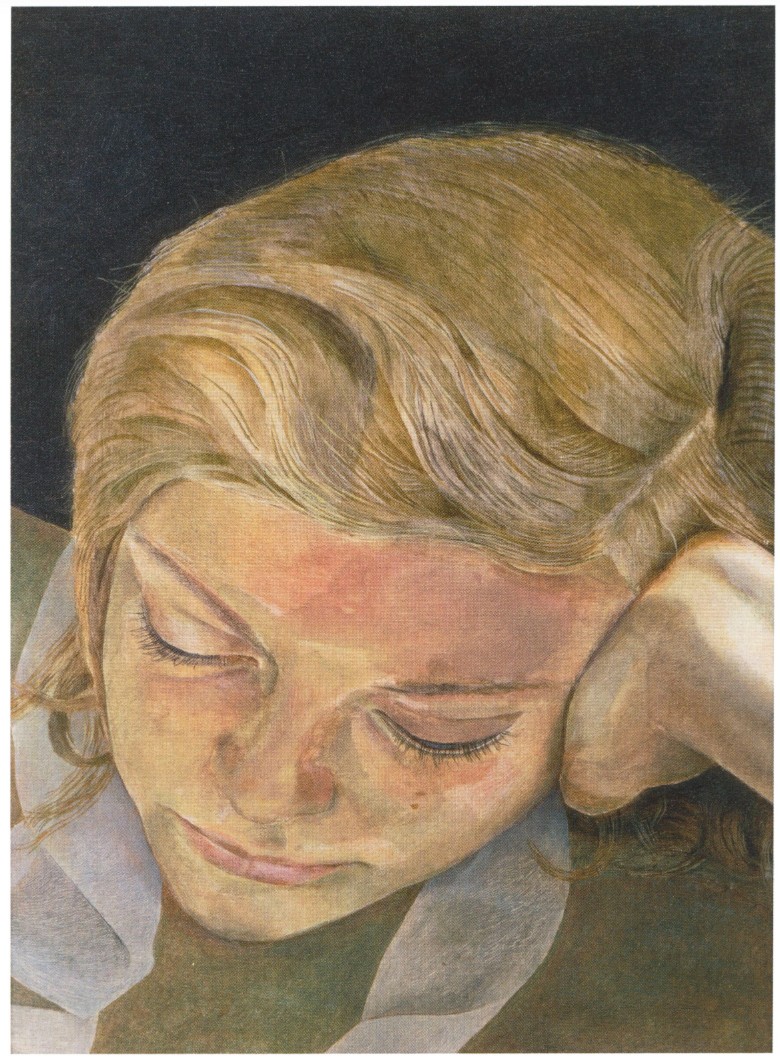
Lucian Freud, Girl Reading, 1953. Private collection. © The Lucian Freud Archive. All Rights Reserved 2025 / Bridgeman Images
In an interview with Marie-Thérèse in 1974, Pierre Cabanne asked her what first came to her mind when she heard the name Picasso. Walter answered: “Secrecy. This was because my life with him was always concealed. It was calm and tranquil. We didn’t tell anyone. We were happy like that, and that was enough for us” (quoted in P. Cabanne, op. cit., 1974, p. 7). In many ways, this secrecy came to an abrupt end when visitors entered the Galeries Georges Petit that June to see the artist’s mid-career retrospective, and discovered the great wealth of recent works dedicated to Marie-Thérèse. The repeated appearance of her features from canvas to canvas, room to room, combined with the often erotically charged nature of the works on show, indicated that the artist had found powerful inspiration in his young lover. Though Marie-Thérèse’s identity would remain hidden for a further three decades—her name and long relationship with the artist only revealed when Françoise Gilot published her memoirs in 1964—it was evident to anyone that saw the 1932 exhibition, either in Paris or in its revised format at the Kunsthaus Zurich later that year, that she now occupied the central position within Picasso’s creative vision.
Mère et enfant, 1965
Christie’s New-York: 17 November 2025
Estimated: USD 4,000,000 – 6,000,000
USD 5,077,000
PABLO PICASSO (1881-1973), Mère et enfant | Christie’s
PABLO PICASSO (1881-1973)
Mère et enfant, 1965
Oil on canvas
130.2 x 97.2 cm (51 1/4 x 38 1/4 inches)
Signed, dated and numbered ‘Picasso 27.10. 65. II’ (lower left)
Painted in Mougins on 27 October 1965
Mère et enfant is one of a series of works which Pablo Picasso began on 25 October 1965, on the occasion of his 84th birthday. Painted two days later, this large-scale canvas is a bold celebration of motherhood, which, together with the rest of the series, demonstrates the central place that this theme had occupied the artist throughout his life. From his Blue Period visions of mothers and children, to his deeply personal portrayals of his wife Olga and their son, Paul, and later, his playful, color-filled portraits of Claude and Paloma, Picasso had continually explored the potentials of this timeless and universal subject.
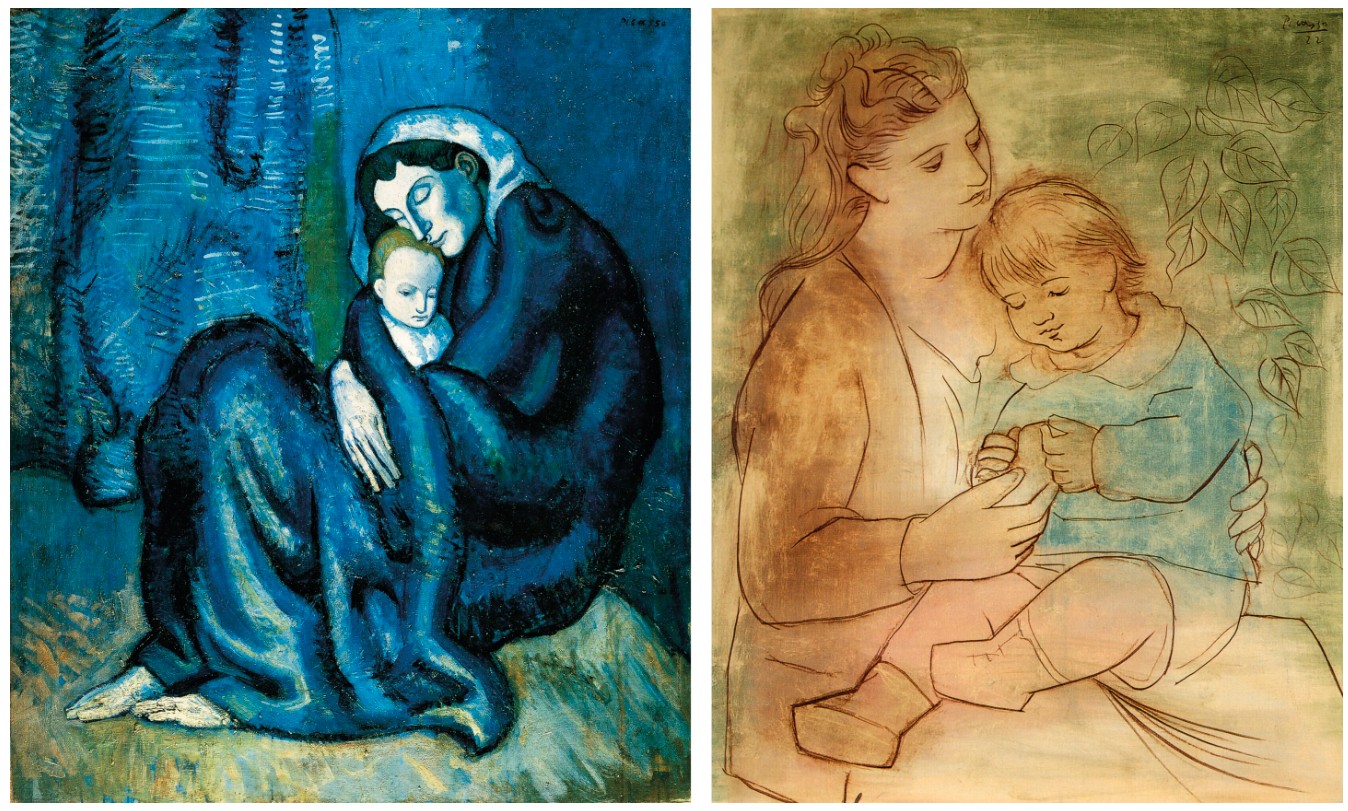
Left: Pablo Picasso, Mère et enfant, 1901. Harvard Art Museums. © 2025 Estate of Pablo Picasso / Artists Rights Society (ARS), New York.
Right: Pablo Picasso, Mère et enfant, 1922. The Cone Collection, Baltimore Museum of Art. © 2025 Estate of Pablo Picasso / Artists Rights Society (ARS), New York.
At this time in his life, Picasso was avidly examining the work of a variety of artists from the past. Masterpieces by Diego Velázquez, Rembrandt van Rijn, Nicolas Poussin, Eugène Delacroix, and Edouard Manet had been consumed by the artist’s gaze before being reimagined in his own hand.
Raphael, Madonna del Granduca, circa 1506-1507. Palazzo Pitti, Florence.
Like the musketeer, which was a visual conglomeration of artistic sources used to fashion a bold alter-ego of the artist himself, the mother and child motif similarly allowed Picasso to marry the artistic past with his own personal present. Happily married to Jacqueline Roque, his last great love, Picasso looked back across past decades, meditating on his own life and the family he had created, including his four children. It is not surprising that images of fatherhood, motherhood, and children should fill his art of this time, together forming a bold homage to his life and art.
“Ultimately, love is all there is”
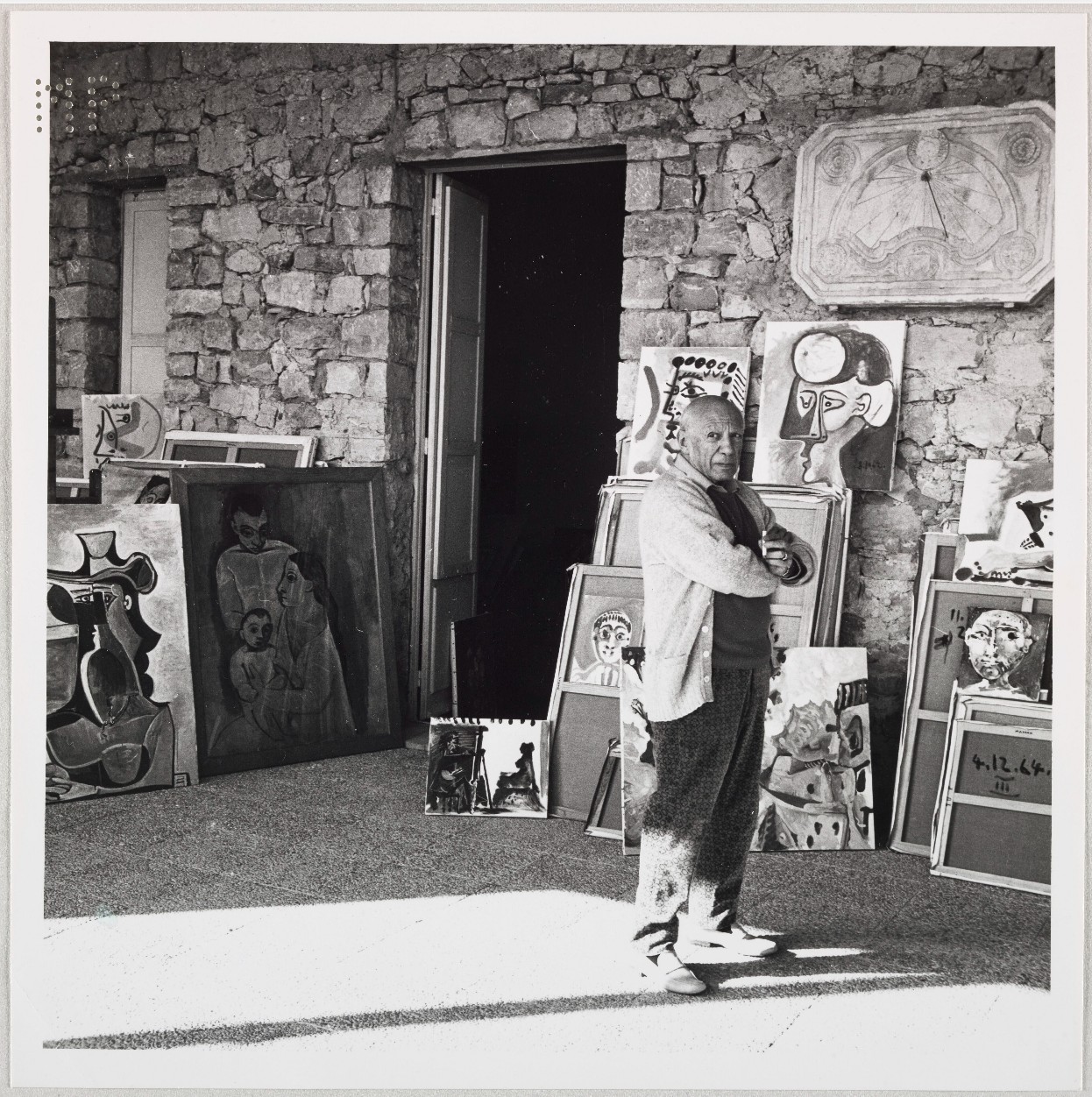
Pablo Picasso in the studio of Notre-Dame-de-Vie, Mougins, April 1965. Photographed by Andre Gomes. © 2025 Estate of Pablo Picasso / Artists Rights Society (ARS), New York. Photo: © RMN-Grand Palais / Art Resource, NY.
As with every stage of his career, Picasso used well-known motifs to experiment and explore a new painterly idiom. In the present work, the artist’s distinctive bold and gestural handling and simplified mode of expression encapsulates his style of the time.
“A dot for the breast, a line for the painter, five spots of color for the foot, a few strokes of pink and green… That’s enough, isn’t it? What else do I need to do? What can I add to that? It has all been said.”
Working with an unprecedented vigor and directness, Picasso distilled imagery into a combination of strokes and forms, creating a shorthand of signs and symbols which vividly conjured the subject he was conveying. In the present work, Picasso has, with a deft economy of means, combined the centuries-old iconography of the Madonna, adorned in a luminous blue dress, with his own idiosyncratic pictorial language. The hands of the mother and child are rendered in the same way, the simplified circles denoting their fingers further heightening the intense intimacy of their relationship. The pair also appears encircled by white, united as a single, unbreakable entity.
“Basically, there are only a few subjects. Everybody repeats them. Venus and Cupid become the Virgin and Child, the classical image of mother and child—but as a subject, it’s the same.”
Mère et enfant was acquired by Daniel-Henry Kahnweiler at the Galerie Louise Leiris, one of Picasso’s key dealers of this time, before being sold to the Brook Street Gallery, London, where it was exhibited in a retrospective of the artist held in 1971. Acquired by the present owner in 2006, the painting has remained in the same collection for almost twenty years.
Le Baigneur, 1957
Birth of the Modern: The Arnold and Joan Saltzman Collection
Christie’s New-York: 17 November 2025
Estimated: USD 3,500,000 – 5,500,000
USD 3,979,000
PABLO PICASSO (1881-1973), Le Baigneur | Christie’s
PABLO PICASSO (1881-1973)
Le Baigneur, 1957
Oil on canvas
100.5 x 81.4 cm (39 1/2 x 33 inches)
Signed and dated ‘Picasso 22.7.57.’ (upper left)
Painted in July 1957, Le Baigneur forms part of Pablo Picasso’s career-long engagement with the theme of the bather. As with so many motifs, Picasso would reincarnate these figures in countless guises. In the present work, a man wades into a placid, steel blue sea, his fingertips just grazing the top of the water. While much of his body has been painted in peach tones, the man’s ribs are lighter, represented by only a few horizontal marks. Short, staccato brushwork defines his hair while his face is composed of crisp, efficient lines.
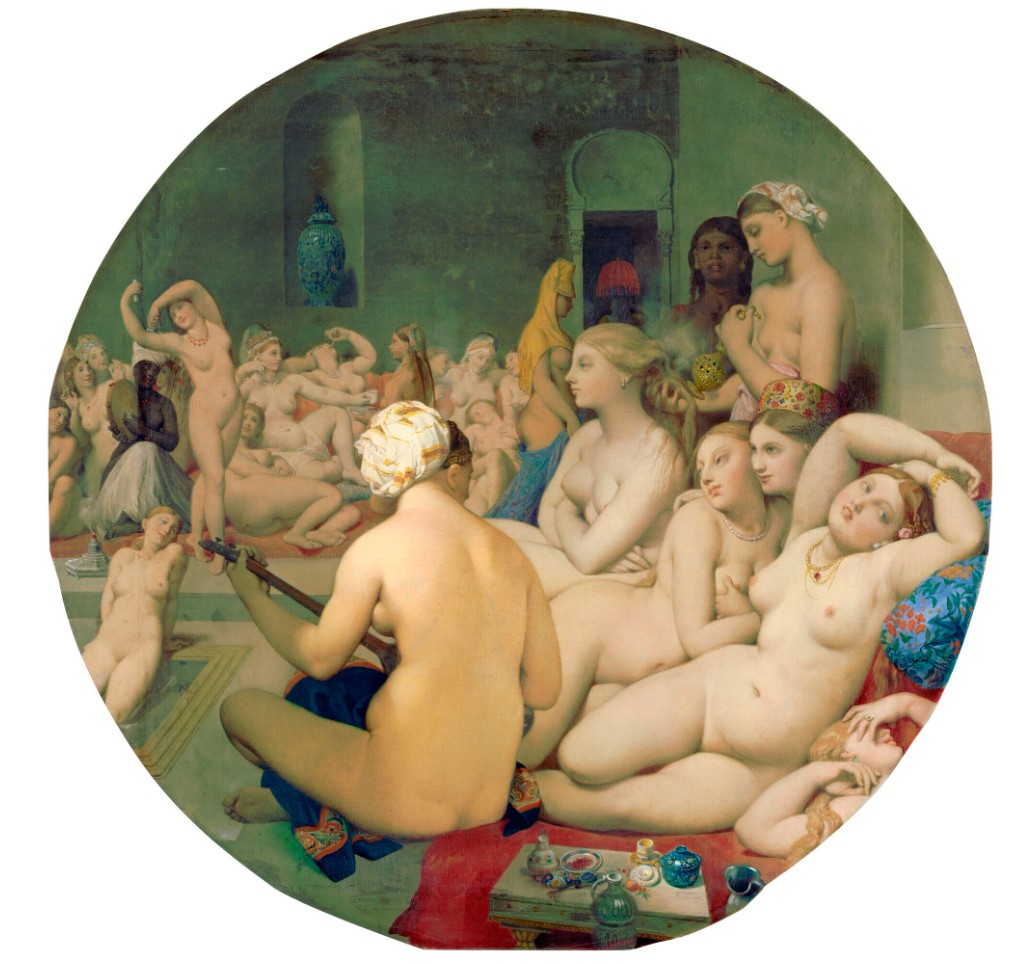
Jean-Auguste-Dominique Ingres, Le bain turc, 1862. Musée du Louvre, Paris.
Picasso’s interest in the subject of the bather can be traced back to when he was first living in Paris, where he moved in 1904. The following year, he went to visit Jean-Auguste-Dominique Ingres’ retrospective at the Salon d’Automne and, although previously dismissive of the French painter, found himself “overwhelmed” by what he saw. Picasso was captivated by Ingres’ draftsmanship, formal innovation, and, above all, his masterpiece, Le bain turc, which, up until then, had not been seen in public for many years. Ingres’ large canvas depicts a group of nude women at a harem, and their various postures and poses provided the young artist with a wellspring of inspiration. Long before his neoclassical period, Picasso looked to Le bain turc while painting the seminal Les Demoiselles d’Avignon, and he later returned to the nineteenth century composition when creating his surrealist bathers in the late 1920s and early 1930s. Beyond Ingres, however, the theme of the bathers is one with a long art historical precedent. The subject’s mythological and romantic associations appealed to artists including Titian, François Boucher, Camille Corot, and Pierre-Auguste Renoir, allowing them to paint female nudes in a natural, albeit erotic, fashion. Many modern artists, however, took a more naturalistic approach to the subject, seen, for example, in Paul Cezanne’s series of baigneurs.
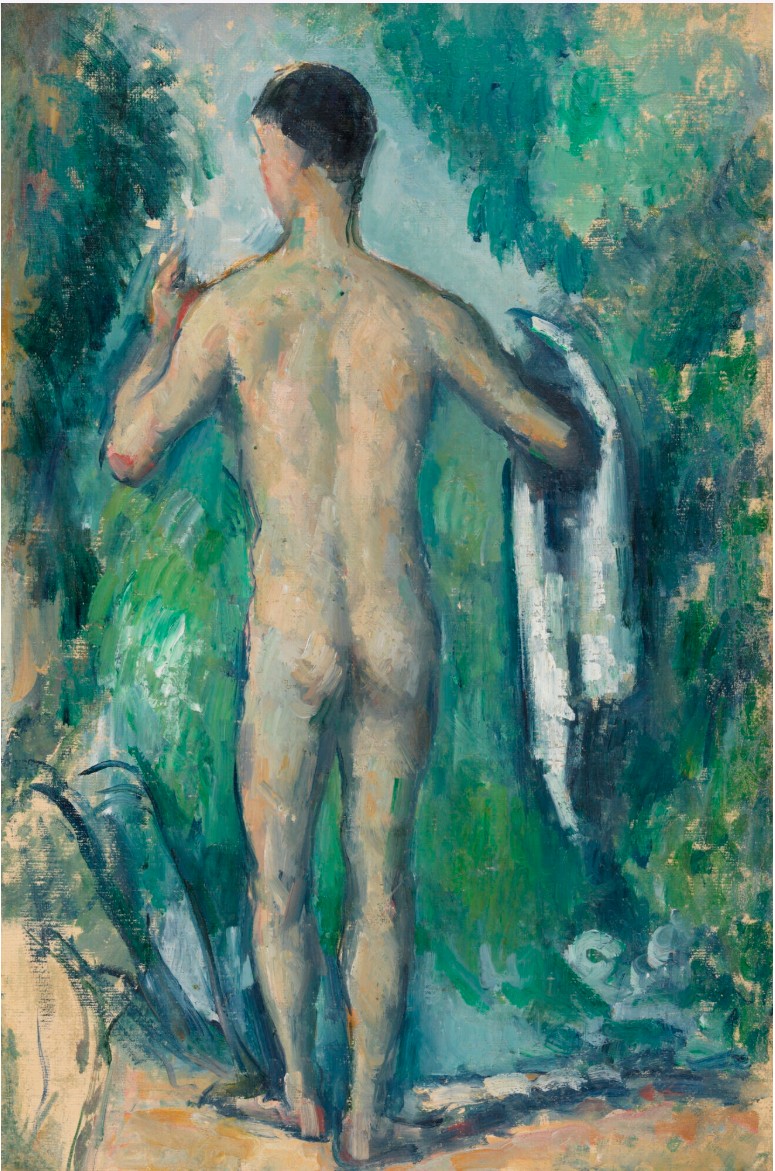
Paul Cezanne, Baigneur debout, vue de dos, 1879-1882. The Art Institute of Chicago.
Picasso’s bathers, too, were not romanticized, and to this theme, he brought his own perspective on figuration. He often worked on related scenes during seaside holidays, quickly filling sketchbooks with studies of bathers, only to expand upon the images once back in his studio. Within his oeuvre, the beach serves as a stage of sorts, composed of simple bands of sky, sea, and sand, against which his figures pose in outlandish and exaggerated ways. Painted in Dinard, Baigneuses jouant au ballon, 1928 (Zervos, vol. 7, no. 234; Musée national Picasso, Paris) shows three women tossing a ball, each body composed of a series of angular lines and planar forms. The colors employed are unmodulated, a treatment seen in the present work, which was painted almost three decades later.
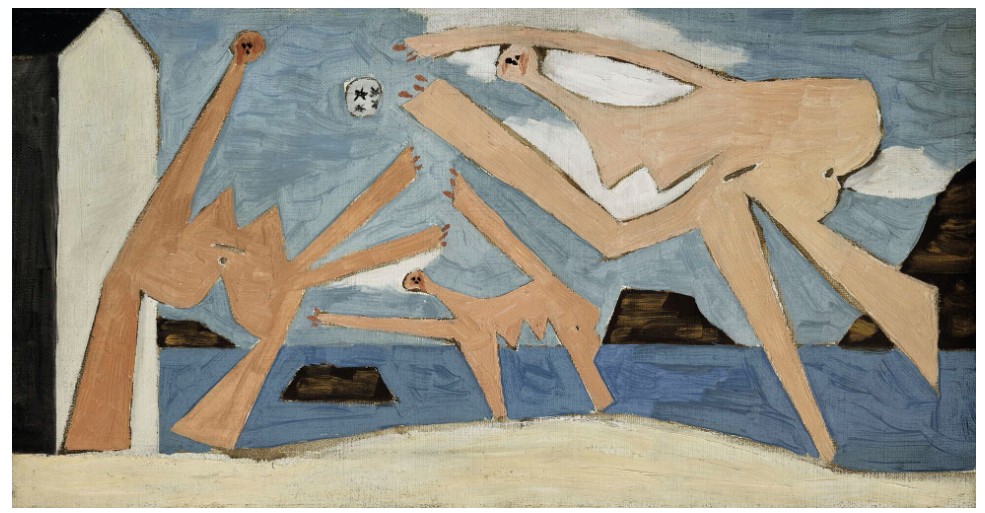
Pablo Picasso, Baigneuses jouant au ballon, 1928. Musée national Picasso, Paris.
© 2025 Estate of Pablo Picasso / Artists Rights Society (ARS), New York. Photo: © RMN-Grand Palais / Art Resource, New York.
Following the end of the Second World War, Picasso began to spend more and more time in the region colloquially known as Le Midi. He vacationed in Antibes and Golfe-Juan, and, in 1955, purchased the villa La Californie overlooking Cannes. Perhaps inspired by his time in the sun and seeing himself in these figures, Picasso returned to the theme of the bathers in 1956, completing the large canvas Deux femmes sur la plage in February (Zervos, vol. 17, no. 36; Musée national d’art moderne, Centre Georges Pompidou, Paris). He continued to explore the subject in a number of drawings, paintings, and several sculptures, first constructed out of scrap wood and later cast in bronze. Elements from Le Baigneur are evident as well in the contemporaneous Baigneurs sur la plage à la Garoupe, 1957 (Musée d’art et d’histoire, Geneva), particularly in the representation of the swimmers’ torsos and the graphic simplicity of the background.
Pablo Picasso on the beach at Golfe-Juan, 1948. Photographed by Willy Maywald. Photo: © 2025 Association Willy Maywald / Artists Rights Society (ARS), New York / ADAGP, Paris. Image: © CNAC/MNAM, Dist. RMN-Grand Palais / Art Resource, NY.
During this period, Picasso was also working on La chute d’Icare, his grand mural for the headquarters of the United Nations Educational Scientific and Cultural Organization (UNESCO) in Paris. The Greek myth tells of Icarus, who fell to his death after the sun melted the wax that held together his wings. While Picasso’s first ideas for the mural were interior scenes, set in an artist’s studio, he soon transposed the story. The final composition draws from the myriad bathing imagery that Picasso was creating during this period.
Mousquetaire, tête, 1967
The Art of Collecting: Property from a Distinguished Private Collector
Christie’s New-York: 17 November 2025
Estimated: USD 3,000,000 – 5,000,000
USD 4,101,000
PABLO PICASSO (1881-1973), Mousquetaire, tête | Christie’s
PABLO PICASSO (1881-1973)
Mousquetaire, tête, 1967
Oil on canvas
65×54 cm (25 5/8 x 21 1/4 inches)
Dated ‘24.3.67.’ (upper left)
Dated again and numbered ‘24.3.67. II’ (on the reverse)
Towards the end of 1966, Pablo Picasso began to concentrate on a subject that would come to define his late career, that of the musketeer. The figure, at once historical and imaginary, would dominate his output, filling his canvases with colorful depictions of lavishly-costumed characters, who often served as stand-ins for the artist himself. While he returned frequently to the subject throughout the next five years, the paintings created between 1967 and 1968 are marked by their inventiveness and exuberance. Executed on 24 March 1967, Mousquetaire, tête is a key example from this initial burst of creativity, executed in a riot of energetic brushwork and bright, striking color. Set against a muted ground, the bust portrait depicts a musketeer with a mane of curly hair. Baroque in attitude and dress, he stares confidently out at the viewer, a wry smile playing on his lips.
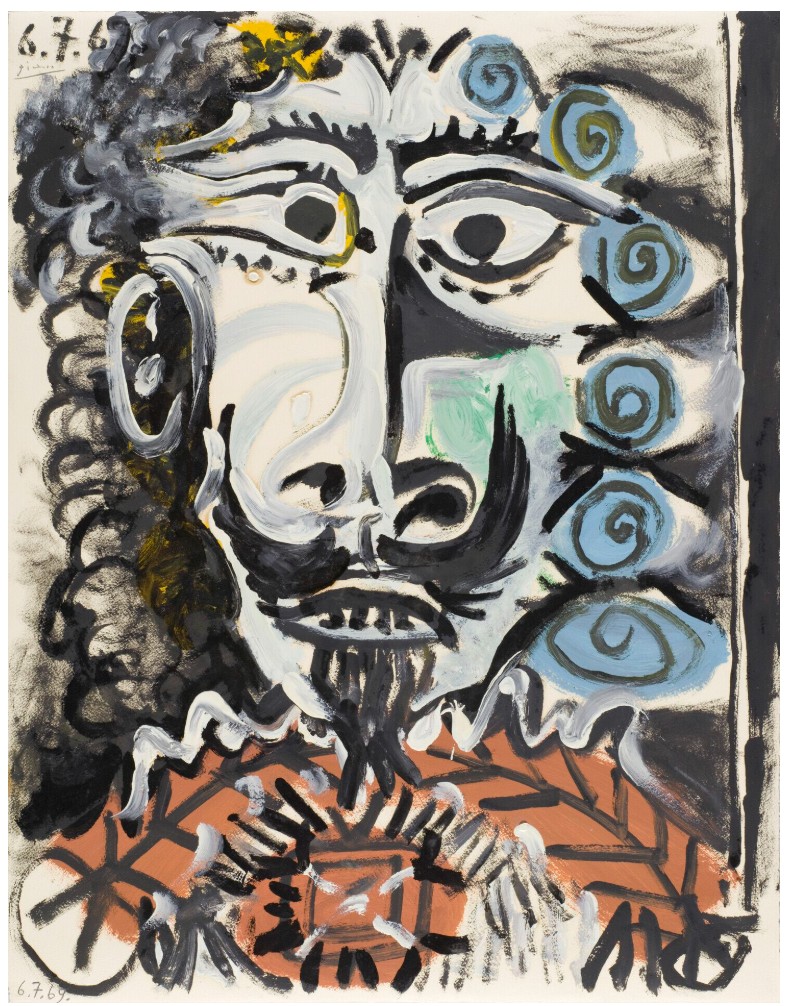
Pablo Picasso, Tête d’homme, 1969. Los Angeles County Museum of Art. © 2025 Estate of Pablo Picasso / Artists Rights Society (ARS), New York. Photo: © 2025 Museum Associates / LACMA. Licensed by Art Resource, NY
The idea for the musketeers first emerged during a period of convalescence for the artist in late 1965 and early 1966. Picasso passed his days rereading many classic works of literature, including plays and novels by William Shakespeare and Honoré de Balzac as well as Alexandre Dumas’ The Three Musketeers, the tales of Athos, Porthos, and Aramis’ adventures clearly taking root in his psyche. When he was finally able to begin painting again, a new character entered his work, the musketeer, or the Spanish version of the seventeenth-century cavalier, the hidalgo, a confident nobleman, skilled with the sword, bold in love, and outfitted in elaborate costumes. The first oil painting of this series was completed in February 1967, and many musketeer heads and full-length seated portraits soon followed, as Picasso worked with his typical fervent energy. His prolific output soon overwhelmed his atelier—so much so that he added two more studios to store the many canvases he had finished. Picasso felt strong affection for his musketeers and often gave them individual personalities. As any portraitist would ascribe to their subjects individual personalities, so too did Picasso differentiate between his musketeers, depicting one with a pipe and another with a paintbrush. Accordingly, his troop of musketeers—who for centuries had stood for virility, masculinity, and strength—became vessels for the artist’s vision of himself, as he wished the world to see him. Just as he had done throughout his career with figures such as the harlequin, minotaur, and Mediterranean sailor, he used the musketeer to affirm his potency, heroic nature, and charm. The musketeer, celebrated for his bravado, daring, and amorous liaisons, was the perfect foil for an artist in the last years of a long and spirited life.
Picasso in the studio of La Californie. Photograph by André Villers. Photo: © 2025 Artists Rights Society (ARS), New York / ADAGP, Paris. Artwork: © 2025 Estate of Pablo Picasso / Artists Rights Society (ARS), New York. Image: © RMN-Grand Palais / Art Resource, New York.
The musketeer as a visual archetype provided Picasso a means to further his quest for artistic supremacy, and he borrowed motifs from a variety of periods, including the Dutch and Spanish Golden Ages, French Modernism, and particularly the work of Diego Velázquez, Eugène Delacroix, and Rembrandt. For several years, Picasso had been reinterpreting masterpieces by these artists. His interest in the motif seems to have been the logical next step after having spent the previous years in dialogue with—and waging battle against—history’s great artists. During the last decades of his career, he cast his eye back to the painters he would have encountered as a young artist. It was Rembrandt, more than anyone, however, whose influence can be felt in the musketeers, and Picasso’s engagement with the Dutch Master was ongoing during the 1960s.
Rembrandt van Rijn, Herman Doomer (ca. 1595–1650), 1640. The Metropolitan Museum of Art, New York.
By citing different artists’ images and styles, Picasso demonstrated his virtuosity: he could, and did, go toe-to-toe with the great masters of western art. Widely acknowledged as a triumph of the artist’s later years, the musketeers fully capture Picasso’s artistic range; they represent a lifetime’s worth of innovation that was far from its end. Mischievous, playful, and large in scale, the musketeers possess all the energy of an artist in the thrall of a new and fascinating idea.
Femme dans un fauteuil, 1946
Birth of the Modern: The Arnold and Joan Saltzman Collection
Christie’s New-York: 17 November 2025
Estimated: USD 3,000,000 – 5,000,000
USD 3,979,000
PABLO PICASSO (1881-1973), Femme dans un fauteuil | Christie’s
PABLO PICASSO (1881-1973)
Femme dans un fauteuil, 1946
Oil and charcoal on canvas
55.3 x 46.2 cm (21 5/8 x 18 1/8 inches)
Signed and dated ‘Picasso 5 mai 46’ (upper left)
Dated again ‘5 mai 46’ (on the reverse)
Françoise Gilot entered Pablo Picasso’s life in May 1943. The two met at Le Catalan, a restaurant in Paris’ Left Bank, where Gilot was dining with the actor Alain Cuny and another friend. Picasso was with Dora Maar, the artist and his then-paramour. As Gilot wrote in her autobiography, Life with Picasso, “As the meal went on I noticed Picasso watching us, and from time to time acting a bit for our benefit… Whenever he said something particularly amusing, he smiled at us rather than just at his dinner companions. Finally, he got up and came over to our table. He brought with him a bowl of cherries and offered some to all of us, in his strong Spanish accent, calling them cerisses…” (Life with Picasso, New York, 1964, p. 14). Over the following weeks, the pair began to spend more and more together, but it was not until the following year that they became a couple.
Pablo Picasso and Françoise Gilot, 1946. Photographed by Michel Sima. © Michel Sima. All rights reserved 2025 / Bridgeman Images. © 2025 Estate of Pablo Picasso / Artists Rights Society (ARS), New York.
For the first two years, they had an on-again, off-again relationship, with Picasso frequently trying to convince Gilot to move in with him. An accomplished artist in her own right, she worried that moving would compromise her freedom; it wasn’t until the spring of 1946 that the two reached an understanding of sorts. “Yes, all of a sudden,” Gilot recalled, “at the end of April or the beginning of May, Pablo decided that he couldn’t live without me,” (J. Richardson and F. Gilot, “A Decade of Life with Picasso” in Picasso and Françoise Gilot: Paris-Vallauris, 1943-1953, exh. cat., Gagosian Gallery, New York, 2012, p. 17). Before long, she was living with Picasso in his studio on the Rue des Grands Augustins. Shortly thereafter, he painted Gilot in Femme dans un fauteuil, an ode to her presence in his life.
Pablo Picasso, La Femme-fleur, 1946. Private collection. © 2025 Estate of Pablo Picasso / Artists Rights Society (ARS), New York.
Femme dans un fauteuil was painted on 5 May 1946, the same day the artist created La Femme-fleur (Zervos, vol. 14, no. 167; Private collection), also a portrait of Gilot as a flowering plant. Initially, Picasso intended to depict Gilot fairly realistically, but then he remembered that Henri Matisse—whom the two had visited early that year while vacationing in Golfe-Juan in the South of France—had talked about painting her with green hair. Ever competitive, in La Femme-fleur, Picasso transformed Gilot into an elegant, lithe flower, with her head and neck forming the bloom.
“You’re like a growing plant. I’ve been wondering how I could get across the idea that you belong to the vegetable kingdom rather than the animal. I’ve never felt impelled to portray anyone else this way. It’s strange, isn’t it? I think it’s just right, though. It represents you.”
Françoise Gilot in Vallauris, 1948. Photographed by Gjon Mili. Photo: © Gjon Mili / The LIFE Picture Collection / Shutterstock.
In the present work, Picasso has further exaggerated Gilot’s hair as two enormous leaves. Her visage—which the artist referred to as a “little blue moon”—is almost overwhelmed by the greenery, as a yellow beam illuminates her enthroned body (quoted in ibid., p. 117). The vast majority of Picasso’s depictions of woman show them seated with the figure and chair often merging into one form. The chairs alternate between being luxuriant and pliant and, at other times, sharp-edged contraptions that forever constrain their sitter. Within the present work, the colors are crystalline. The vibrant tonalities imbue the portrait with a sense of vitality. The present work was painted almost precisely one year after the end of the Second World War in Europe. The couple, who had met during the darkest days of the Occupation, were now able to live together in a liberated Paris. Life was reemerging in the French capital and for Picasso, Gilot’s embodiment of spring—and thus of peacetime—suggested new beginnings and a hopeful view of the future.
René Magritte
Le Jockey perdu, 1942
The Matthew and Carolyn Bucksbaum Collection
Sotheby’s New-York: 20 November 2025
Estimated: USD 9,000,000 – 12,000,000
USD 12,340,000
Le Jockey perdu | Modern Evening Auction | 2025 | Sotheby’s
RENE MAGRITTE (1898 – 1967)
Le Jockey perdu, 1942
Oil on canvas
60.3 x 72.4 cm (23 3/4 x 28 1/2 inches)
Signed Magritte (lower right)
Among the pantheon of images reimagined and recontextualized by René Magritte throughout his career, the horse-and-rider motif exists as one of the most recognizable and defining of his oeuvre. Executed in 1942, at the prime of the artist’s technical bravura, the present work represents a radical foray into the Surrealist milieu and stands as the most exceptional depiction of the subject in oil. An early encounter with the work of Giorgio de Chirico would forever alter the course of Magritte’s career. In 1922, the young artist was moved to tears upon seeing a reproduction of the metaphysical painter’s 1914 Le Chant d’amour for the first time. De Chirico’s uncanny depiction of disparate objects amid an empty, penumbral piazza heralded for Magritte a new direction in artistry—one untethered from reality yet rooted in familiar forms. In the wake of this discovery, Magritte’s style shifted away from the Cubist-inspired and commercially driven figuration that dominated his work in the late 1910s and early 20s toward a new idiom premised on the juxtaposition of incongruous imagery. In 1926 the first incarnations of Le Jockey perdu were born.
René Magritte, Le Jockey perdu, 1926, Private Collection © 2025 C. Herscovici, Brussels / Artists Rights Society (ARS), New York
Though the precise order of execution is not known, Magritte created four works by the same title over the course of 1926. Each of the Jockey perdu—one pencil drawing, two papier collés and the seminal oil painting—feature a horse and jockey at the center of a wooded area comprised of towering, even ominous, bilboquet with sprouted tree limbs. In all except the pencil drawing, the scenes are framed by curtains, a theatrical device which the artist would reprise frequently throughout his oeuvre. Such imagery, which existed in at least one of the papiers collés prior to the oil, would soon coalesce in what Magritte would view as his “premier tableau”—his first true Surrealist painting (Sarah Whitfield and Michael Raeburn; David Sylvester, ed., René Magritte: Catalogue Raisonné, Oil Paintings, 1916-1930, vol. I, London, 1992, p. 169; see fig. 2).
Describing the sense of enchantment the composition conjures, Patrick Walberg writes: “Like the rider and his steed, the inanimate objects [that Le Jockey perdu] contains are represented simply… Still, in all, gazing at the scene in which they are disposed one has the feeling, and it is intense, of never having seen the like of it, before it one is at the same time reduced to astonishment and, literally, entranced… For the moment we may remark that this jockey’s headlong ride through the ambiguous forest evokes the leap through the looking-glass whereby Alice entered Wonderland. Here as there, it is a passing from the everyday world into a second world, one born of inspiration and whose substance is mystery” (Patrick Waldberg, René Magritte, Brussels, 1965, pp. 21-22).
Magritte’s pioneering juxtaposition of the known and unknown in Le Jockey perdu triumphantly proclaimed the artist’s entrée into a new artistic echelon. As David Sylvester writes of the initial painting: “[Le Jockey perdu] was seen from the very start as something special—and not just by the artist. A few months after it was realized, it became the first of his surrealist paintings to be reproduced, and the first of any of his paintings to be reproduced abroad” (ibid.). Sylvester continues, stating that Magritte’s practice of creating multiple variations on a theme—one which would come to define the very nature of his artistry—indeed originated with Le Jockey perdu.
Decades later, Magritte would recall the import of this imagery in a self-referential text on his Surrealist awakening: “He executed the [1926] painting ‘The lock jockey’, conceived with no aesthetic intention, with the sole aim of RESPONDING to a mysterious feelings, a ‘causeless’ anguish, a sort of ‘call to order’ which impinged on his consciousness at certain non-historic moments and which guided his life ever since birth” (ibid.).
While the image of the bilboquet—Magritte’s curious and often biomorphic chess-like form—as well as the drawn red curtains would proliferate in his works over the coming years, it would be another decade and a half before the artist returned to his foundational Surrealist subject of the horse and rider. In the lengthy interim between his Jockey perdu iterations, Magritte moved from Belgium to France and back again, his three-year stint in Paris proving a brief yet a pivotal period of development and intellectual exchange with the French Surrealists led by André Breton.
Paolo di Dono, called Uccello, The Hunt in the Forest, circa 1465-70, Ashmolean Museum, Oxford
Indeed, it was a work by the Italian Renaissance painter Uccello—the only Old Master mentioned by name in Breton’s canonical manifesto on Surrealism—that is believed to have partly inspired Magritte’s Le Jockey Perdu. Uccello’s Hunt in the Forest, itself a mastery of varying perspectives, features a nocturnal menagerie of man and beast with hunters bounding into the forest astride horses and on foot alongside their dogs (see fig. 3). The frieze-like composition, repeated verticality of trees and emphatic contrasts of light and dark within Magritte’s Jockey perdu finds resonance in the stage-like format and dramatic wooded backdrop of Uccello’s panel.
The iconography of the horse and rider, first unleashed in Magritte’s work in 1926 to much acclaim in Belgian Surrealist circles, including writers and patrons Camille Goemans and Paul-Gustave van Hecke, would by 1942 resurface in his oeuvre with unparalleled finesse. While the initial painting of Le Jockey perdu revealed a new dimension of ideation and conceptual alignment in Magritte’s work, the execution of the early composition proved somewhat rudimentary, displaying the broad brushwork and crude draftsmanship characteristic of his nascent oeuvre. David Sylvester touches upon this critique of the 1926 painting: “What is puzzling is why Magritte saw this particular work as his breakthrough: it seems a less convincingly realized work than Nocture… and was followed within a few months by several pictures which are more powerful and telling by a long way” (Siegfried Gohr, Magritte: Attempting the Impossible, New York, 2009, p. 82).
Siegfried Gohr expands upon this assessment, highlighting the exceptional quality of the present work: “It is true that the compositional idea [of the 1926 painting] is more precisely and convincingly expressed in the concurrent collages. And that later reprises can serve to clarify an idea is evidenced by the two 1942 versions of the painting [the present work in oil and a gouache], where the contrast between the jockey rooted to the spot despite his gallop and the row of tree trunks transformed into a balustrade is much more evocatively treated.” Gohr continues: “But why did Goemans and van Hacke attach such prominent significance to the 1926 work? Probably the type of visual invention was more important to them than the finished composition, because here Magritte succeeded, possibly for the first time, in inventing a poetically romantic situation that was entirely emancipated from de Chirico. The interpretation that the jockey has lost his orientation in the mysterious woods surrounding him would seem to be only half the truth. Though his real path has been replaced by a kind of red carpet, he has found entry into a fantastic, alternative world. Motion and haste, vegetable and sculptural elements, a fixed point (the rider) and extreme perspective create harsh oppositions that go beyond the Surrealist juxtaposition of apparently unrelated objects seen in a few other compositions of 1926. This combination of horseman and landscape would in fact concern Magritte once again much later” (ibid.). As Gohr underscores, the present composition adroitly captures the weight and significance of the subject imbued by the 1926 painting, yet is rendered with such skill and sensitivity as to compound the impact of the initial concept, bringing to bear decades’ worth of experience to exalt the seminal Surrealist motif.
The present painting was likely conceived on the occasion of Louis Scutenaire’s forthcoming monograph on Magritte, in which the artist aimed to feature Le Jockey perdu. However, according to Sylvester, a photograph of the 1926 composition either proved too difficult to procure (the work had been unseen since its sale to a collector in Africa), or, too unsophisticated to illustrate: “The first version was clumsy in execution and [Magritte] had [since] come to take a certain pride in exhibiting technical skill” (Sarah Whitfield; David Sylvester, ed., René Magritte: Catalogue Raisonné, Oil Paintings and Objects 1931-1948, vol. II, London, 1993, p. 298).
René Magritte, La Colère des dieux, 1960, Private Collection © 2025 C. Herscovici, Brussels / Artists Rights Society (ARS), New York
In his 1992 monograph on the artist, Sylvester mused on Magritte’s desire to reprise the subject in 1942: “It must have been something about the image that made Magritte so attached to The lost jockey. Maybe he felt that it had the romantic significance attributed to it by Goemans and Van Hecke. Maybe it had to do with the facts that, when he was a student his favorite painter (according to Charles Alexandre) was Uccello, that in the Manifesto Breton had named Uccello as the one old master painter relevant to Surrealism, and that The lost jockey looks as if it must surely have been based upon the cassone panel by Uccello of a hunt in the forest” (David Sylvester, Magritte: The Silence of the World, New York, 1992, p. 92). Ultimately, it would be Marcel Marien’s 1943 monograph, Magritte, which would prove the first book on the artist, superseding Scutenaire’s eventual publication. A testament not just to the power of the motif but also to the virtuosic execution of the present painting, Le Jockey perdu of 1942 is the very first—and, notable for the period, color—illustration in that volume.
From the 1940s onward, Magritte would go on to create five additional compositions bearing the same title, each executed in gouache on paper. While, in subsequent years, the jockey and rider duo would be recontextualized alongside other imagery like automobiles and interiors in La Colère des dieux and L’Enfance d’Icare, the present work remains one of only two know oils titled Le Jockey perdu.
Claude Monet
Nymphéas, 1907
Property from the Kawamura Memorial DIC Museum of Art
Christie’s New-York: 17 November 2025
Estimated: USD 40,000,000 – 60,000,000
USD 45,485,000
CLAUDE MONET (1840-1926), Nymphéas | Christie’s
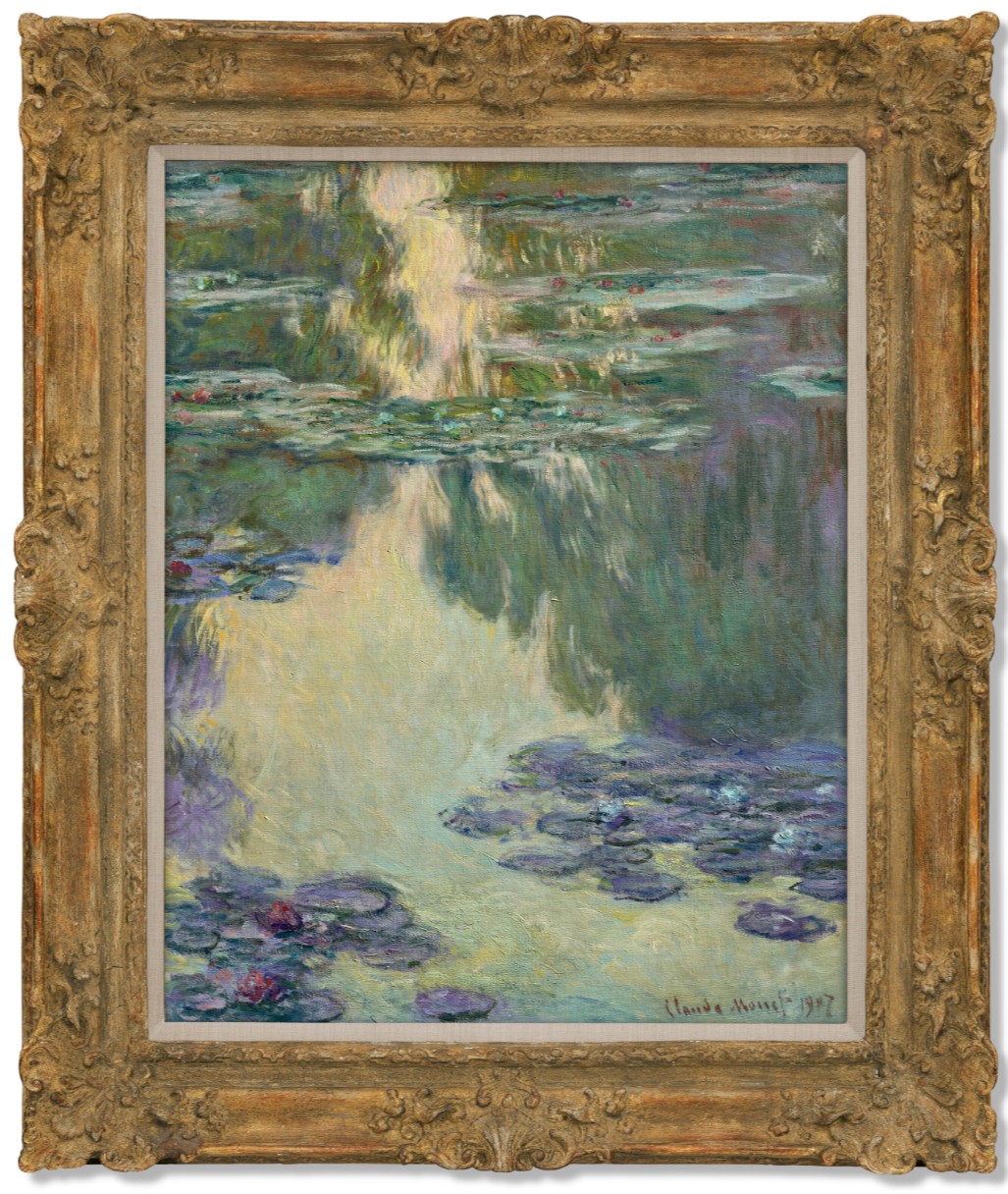
CLAUDE MONET (1840-1926)
Nymphéas, 1907
Oil on canvas
92 x 73.6 cm (36 1/4 x 29 inches)
Signed and dated ‘Claude Monet 1907’ (lower right)
Perhaps no other subject fascinated Claude Monet so intensively and persistently than the elaborate gardens he constructed at his home in Giverny. During the last twenty-five years of his life the artist devoted himself almost single-mindedly to depicting the flowing planes of flowers, towering willow trees and the expansive waterlily pond that he had fashioned within the grounds, producing an astonishingly complex and diverse group of canvases that capture the unique atmosphere of this arcadian landscape.
The resulting paintings stand among the most innovative and influential works of Monet’s entire oeuvre—while they affirm his life-long belief in the primacy of vision and experience, they are in many ways more abstract and daring than anything he had previously painted, and as such, offer a visionary, modern approach to painting for the twentieth century.
Claude Monet at the water-lily pond, Giverny, 1905. Photograph by Jacques-Ernest Bulloz.
The present Nymphéas comes from a small, concentrated series of fifteen canvases painted in a moment of intensive creativity in 1907 (Wildenstein, nos. 1703-1717). Having spent the cold, wet winter months re-touching the previous year’s output in his studio, Monet was eager to return to the water garden as soon as the weather allowed. Over the course of the spring and summer, he began to explore a new variation on his favored subject, employing a rare vertical format and an intensely close-up, cropped view to capture the dramatic, shimmering effects of light on his waterlily pond. Monet was clearly pleased with the final outcome of this approach, choosing to feature a large portion of the series, including this painting, in his celebrated exhibition at the Galerie Durand-Ruel in Paris in the spring of 1909. This marked the first occasion that the waterlily paintings were seen together in a single show.
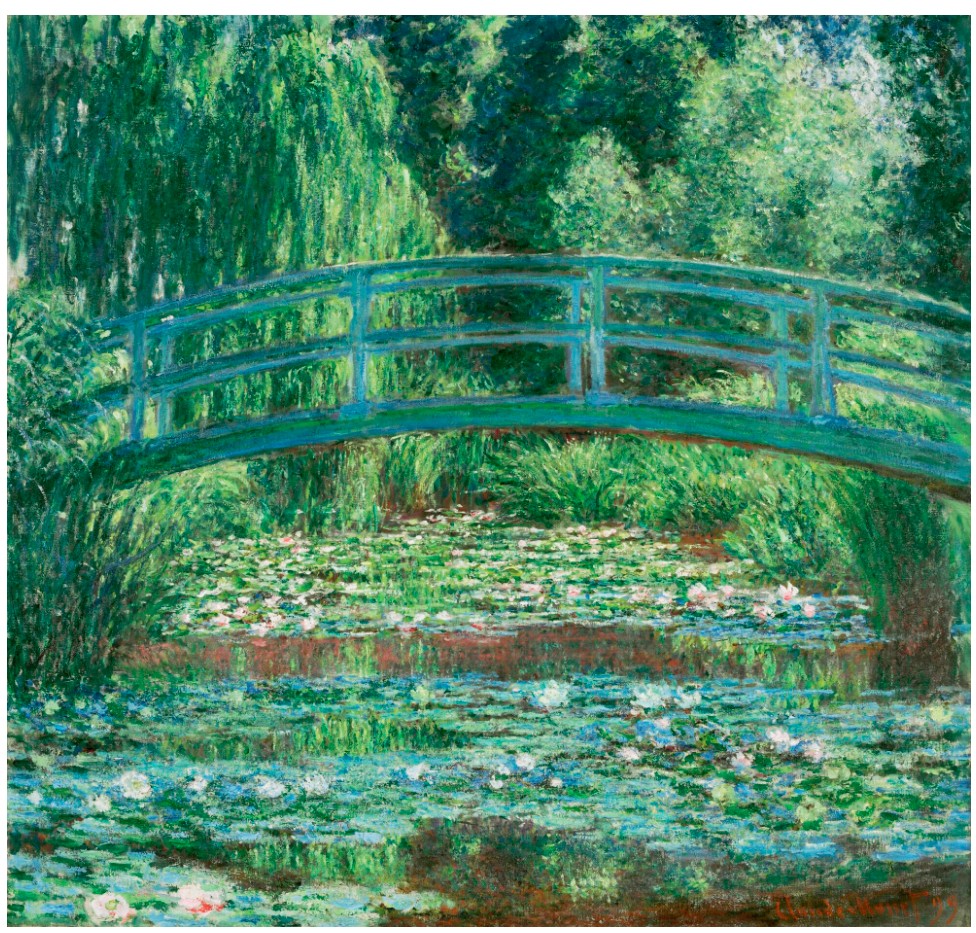
Claude Monet, Le bassin aux nymphéas, 1899. Philadelphia Museum of Art.
Monet had moved his family to Giverny in the spring of 1883, in search of a permanent base which they could finally call home after years of upheaval. Situated some forty miles from Paris, at the confluence of the Seine and the river Epte, Giverny was a small farming community of just three hundred inhabitants, a countryside enclave that remained untouched by the encroaching modernization which had dramatically altered scores of villages and hamlets along the Seine. Here, Monet found the tranquil retreat for which he had been searching, renting a sprawling, pink stucco house called La Pressoir (The Cider Press) from a wealthy local landowner who had recently retired to nearby Vernon. Sandwiched between the main village road and the regional thoroughfare connecting Vernon and Gasny, the house boasted a kitchen garden and orchard, as well as a barn to the west that Monet soon converted into a studio.
“I have always loved sky and water, leaves and flowers.
I found them in abundance in my little pool.”
Claude Monet by his water-lily pond at Giverny. Photograph by Pierre Choumoff.
When the property came up for sale in 1890, Monet made the swift decision to purchase it, “certain of never finding a better situation or more beautiful countryside,” he wrote to his dealer Paul Durand-Ruel (quoted in P.H. Tucker, op. cit., 1995, p. 175). Monet immediately began tearing up the existing gardens and planting extensive beds of flowers, together with wide arches over which grew tumbling clematis and roses. Three years later, he acquired an adjacent plot of land—a small meadow that lay beyond the railroad tracks bordering the end of the garden, flanked on one side by a small tributary known as the Ru. A modest pond lay within this meadow, and Monet soon applied to the local government for permission to refresh it “for the purpose of cultivating aquatic plants” (quoted in ibid., p. 176). Over the years that followed, this seemingly simple request would enable Monet to create the extraordinary landscape that served as the basis for his art for much of the rest of his life. By the autumn of 1893, he had converted nearly one thousand square meters into a lavish waterlily pond, spanned by a wooden footbridge at one end, and enhanced by an artful arrangement of flowers, trees and shrubs along its banks.
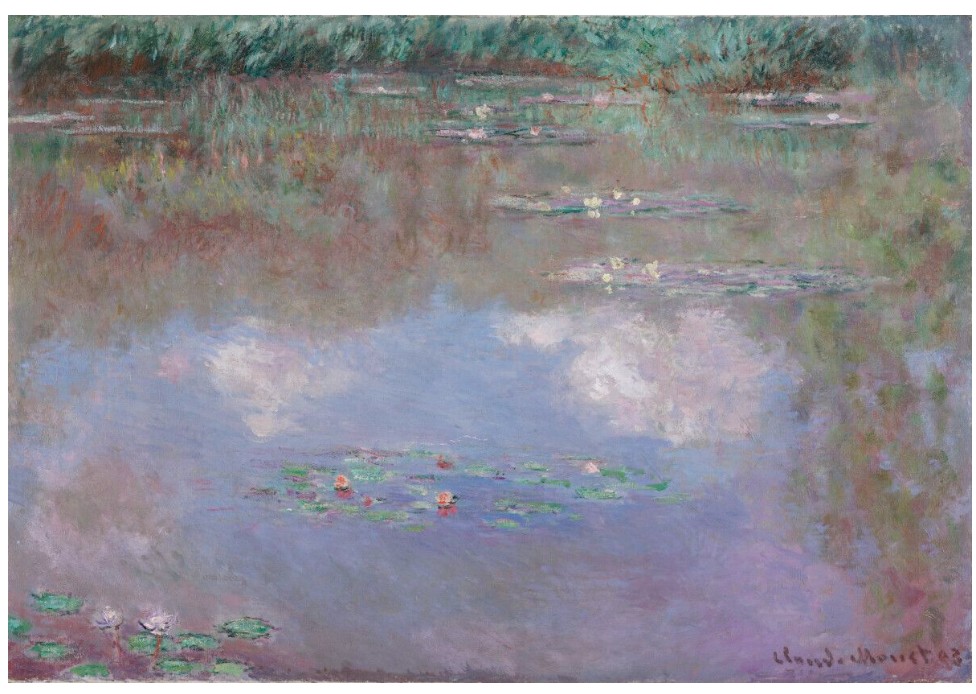
Claude Monet, Nymphéas, paysage d’eau, les nuages, 1903. Dallas Museum of Art.
Despite the extensive time, passion, and funds that Monet devoted to his ambitious horticultural project, he did not immediately embark upon painting the water garden, instead waiting for the plants to develop and mature naturally. It was not until the closing years of the nineteenth century that he first depicted the verdant paradise he had fashioned.
“It took me some time to understand my waterlilies. A landscape takes more than a day to get under your skin. And then all at once, I had the revelation—how wonderful my pond was—and reached for my palette. I’ve hardly had any other subject since that moment.”
Shortly thereafter, Monet decided the pond needed to be extended, which would allow him to attain a larger surface with greater and more varied visual effects. There was no more space in his land as it stood, so the artist set about purchasing part of a meadow on the other side of the Ru. Altering the course of this tributary, Monet was able to triple the size of the pond. From this point on, the reflections of the surface of the water intersected by the tranquil floating blooms became the predominant focus of his waterlily paintings. Monet gradually removed references to the surrounding landscape, eliminating the banks along the edge of the pool, the horizon line, and other stable pictorial elements, to focus solely on transient light effects, the shimmering water, and ephemeral reflections of the constantly changing skies above.
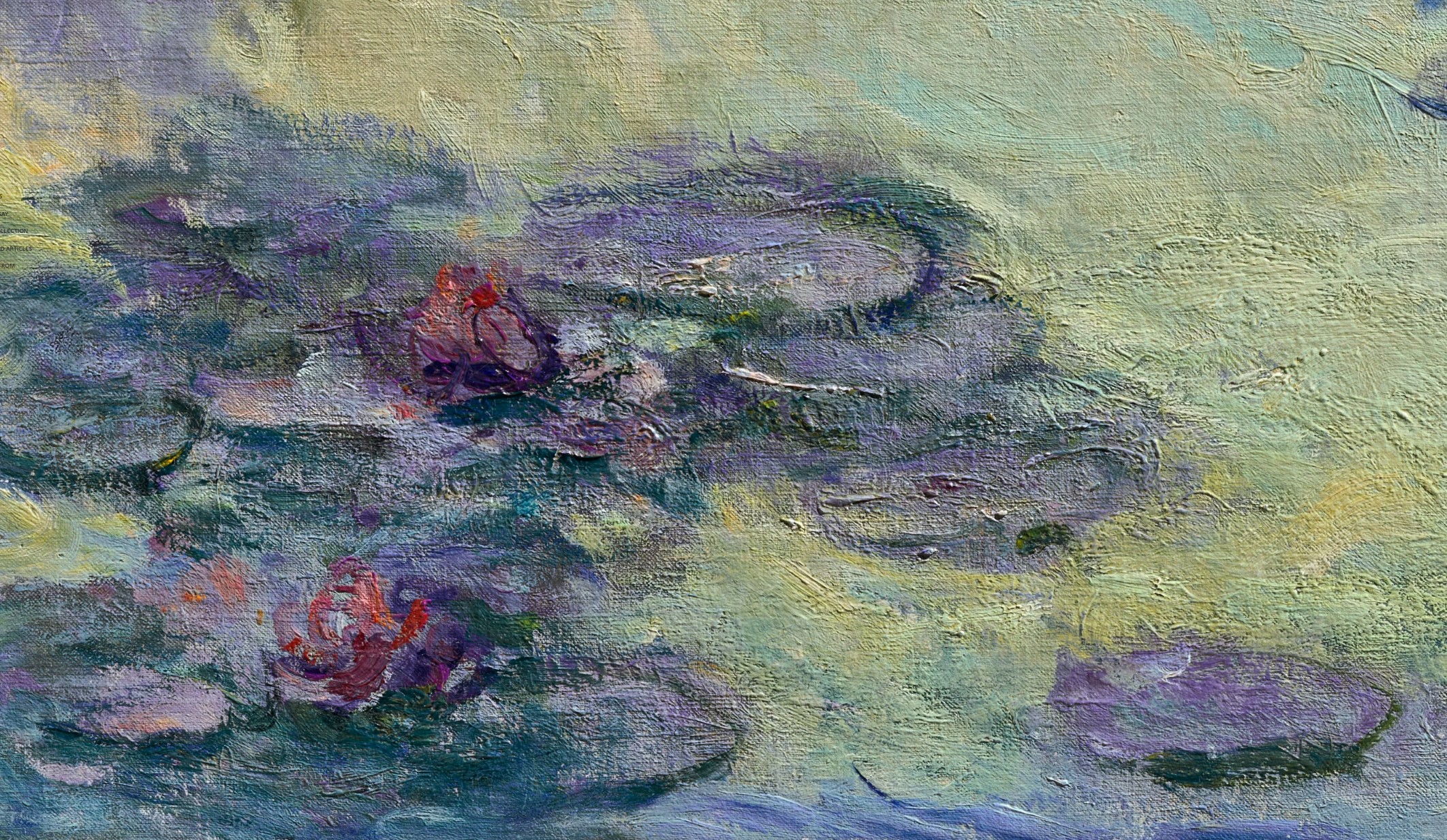
“I have painted so many of these waterlilies, always shifting my vantage point, changing the motif according to the seasons of the year and then according to the different effects of light the seasons create as they change. And, of course, the effect does change, constantly, not only from one season to another, but from one minute to the next as well, for the water flowers are far from being the whole spectacle; indeed, they are only its accompaniment. The basic element of the motif is the mirror of water, whose appearance changes at every instant because of the way bits of the sky are reflected in it, giving it life and movement. The passing cloud, the fresh breeze, the threat or arrival of a rainstorm, the sudden fierce gust of wind, the fading or suddenly refulgent light—all these things, unnoticed by the untutored eye, create changes in color and alter the surface of the water. It can be smooth, unruffled, and then, suddenly, there will be a ripple, a movement that breaks up into almost imperceptible wavelets or seems to crease the surface slowly, making it look like a wide piece of watered silk. The same for the colors, for the changes of light and shade, the reflections.”
From 1905 onwards, Monet worked with a furious passion on this subject, producing more than sixty views of the waterlily pond, concentrating his focus on the surface of the water. He painted the present Nymphéas in 1907, at a time which he uncharacteristically proclaimed he was “full of fire and confidence.” Between April and September, he was so absorbed in his work that he wrote only six letters—a rare occurrence in the usually prolific correspondence that the artist maintained. “Here all goes well,” he finally reported to Durand-Ruel in the early autumn of that year. “I have worked, and I am still working, with passion” (quoted in D. Wildenstein, Monet or the Triumph of Impressionism, Cologne, 1999, p. 379). Pleased with his progress, he invited the dealer to come and see the latest paintings at Giverny. “They are still a sort of groping research,” he claimed, “but I think that they are among my best efforts” (ibid., p. 379).
Yanagisawa Kien, Landscape in the Blue-and-Green Manner, first half of the 18th century. The Metropolitan Museum of Art, New York.
During this burst of creativity, Monet used an elongated, vertical format of canvas that was relatively unusual within his oeuvre. Each measuring roughly three feet in height, the fifteen paintings within this group appear to have drawn inspiration from Japanese hanging scrolls and decorative screens, examples of which Monet would have been deeply familiar with at this time. Long fascinated by Japanese art, he was an avid collector of ukiyo-e prints, their bold, colorful compositions filling the walls of the small salon and dining room, as well as lining the stairwells, of his home in Giverny.
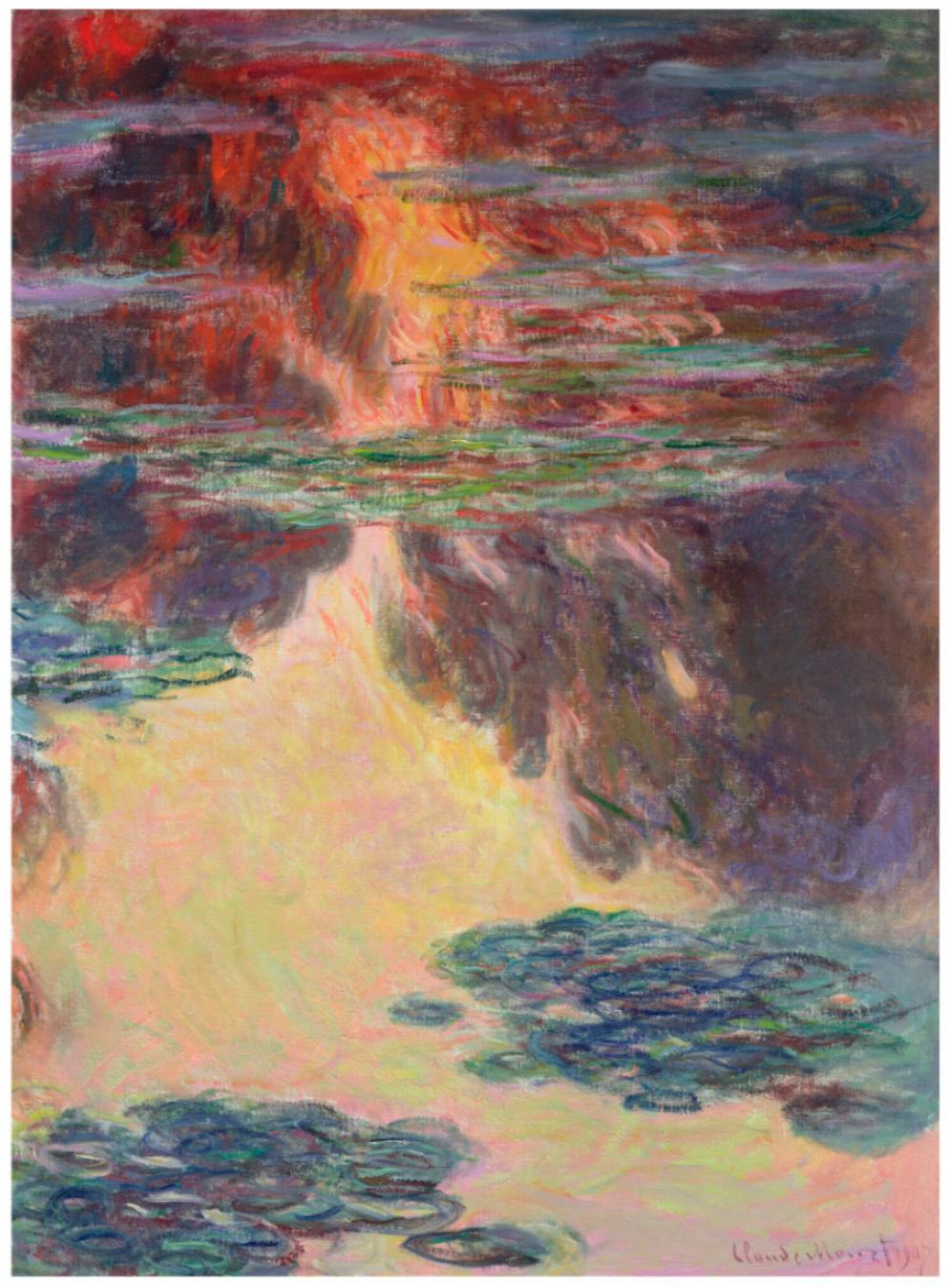
Claude Monet, Nymphéas, 1907. Musée Marmottan Monet, Paris. Photo: Bridgeman Images.
Monet regularly sought out particular prints by his favorite artists, and visited and corresponded with specialist dealers in Paris in his hunt for treasures. The growing taste for Asian art in France during the second half of the nineteenth century ensured that a vast array of Japanese objets d’art—including hanging scrolls, known as kakemono, folding screens, hand scrolls (makimono), ceramics and lacquerware—were readily available for connoisseurs and enthusiasts to peruse in the galleries, museums and collections around Paris. For Monet, these sources opened his imagination up to a different way of perceiving and interpreting nature, bringing the transient, ephemeral aspects of the natural world to the fore.
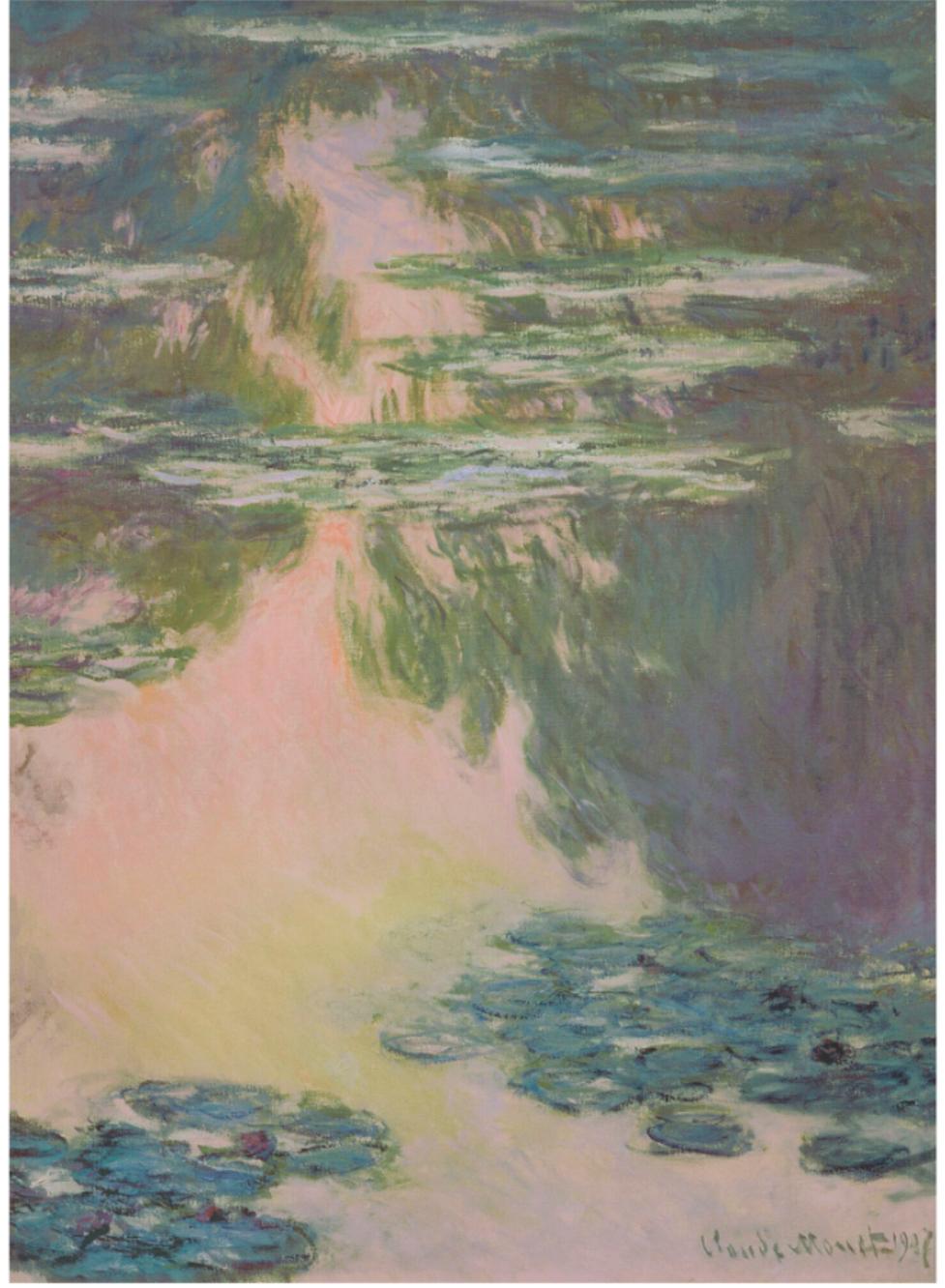
Claude Monet, Nymphéas, 1907. Artizon Museum, Ishibashi Foundation, Tokyo. Photo: © Peter Willi / Bridgeman Images.
Each of the 1907 paintings take a close-up view of the waterlily pond, looking down on the surface from above, allowing the water and the delicate aquatic plants to fill the canvas entirely. The principle focus of these works is the channel of light that runs down the middle of the composition, recording the reflection of the constantly shifting sky seen through the willows at the western edge of the pond. In some paintings from the group, the water is alight with the fiery red hues of sunset, while in others, the diffused light of an overcast grey day casts the scene in a cool palette of lavenders.
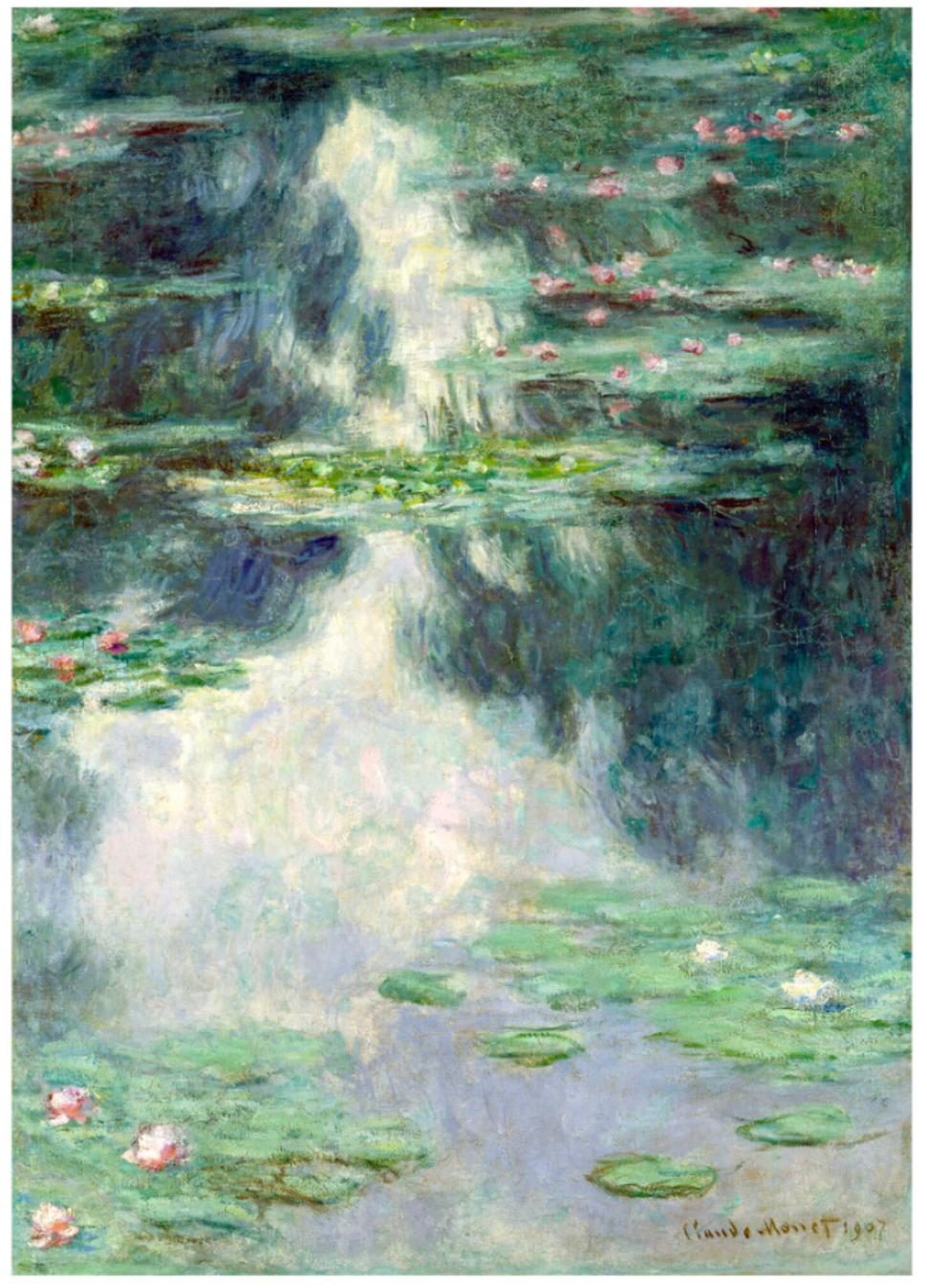
Claude Monet, Nymphéas, 1907. The Israel Museum, Jerusalem.
In the present Nymphéas, Monet deployed a variety of painterly techniques to masterfully capture both the reflections of light on the surface of the pond, and the changing hues within its depths, filling the canvas with an abundance of color in the process. For example, the waterlilies gain a distinct sculptural presence through the build-up of pigment and rich impasto, affirming their position on the top of the pond, while around them, layers of lustrous pigment are laid on top of one another to suggest the refractions of light and the shifting tones of the water. The vertical streak of light that runs from the top to the lower edge of the canvas in a sinuous, meandering path creates a striking contrast with the dramatic dark greens and blues of the surrounding foliage and its reflections. This stream of light—delineated in softly gradated hues of golden yellow, pink, lilac, and light blue—distorts any sense of conventional pictorial perspective, creating a complex confluence of sky and water within the image.
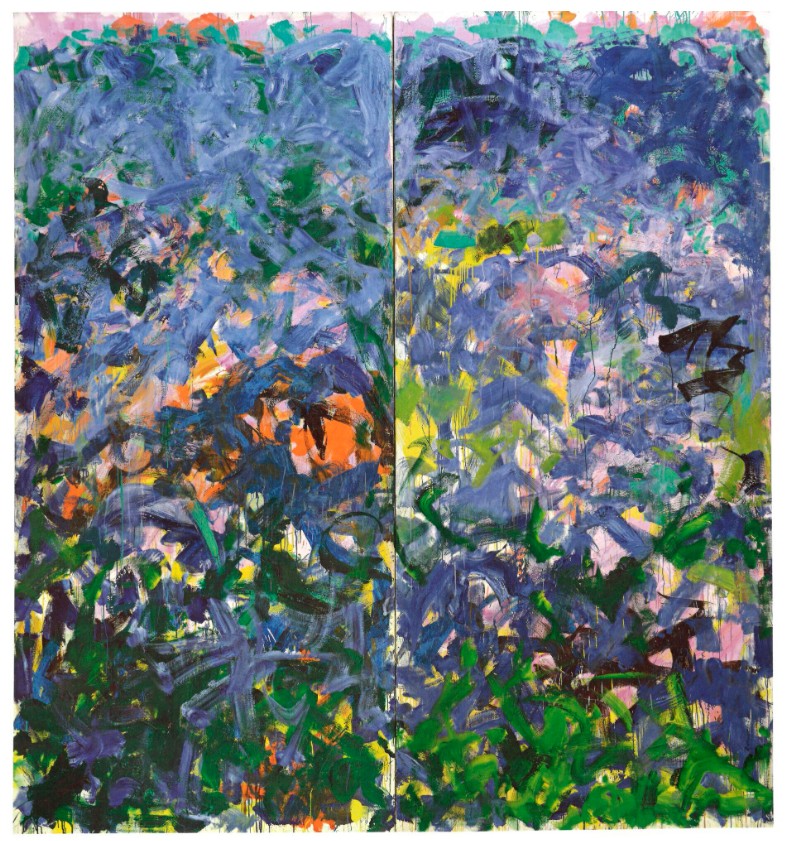
Joan Mitchell, La Grande Vallée XVII, Carl, 1984. Le Frac Provence-Alpes-Côte d’Azur. © Estate of Joan Mitchell.
In May 1909, Monet’s long-awaited exhibition, Les Nymphéas: Séries de paysages d’eau, opened in Paris. While the title appears to have been an homage by the artist to Gustave Courbet’s earlier Paysages de mer paintings, the exhibition served as a powerful showcase for not only the range and dynamism of the waterlily series, but also the continued inventiveness of Monet’s painterly style during the opening decade of the new century. The exhibition featured forty-eight canvases, the largest number of which dated to 1907 and included the present Nymphéas, a clear reflection of the standing with which the artist himself considered these paintings. This was the first time the public had the opportunity to see Monet’s most recent work in five years, and the show was met with rapturous acclaim.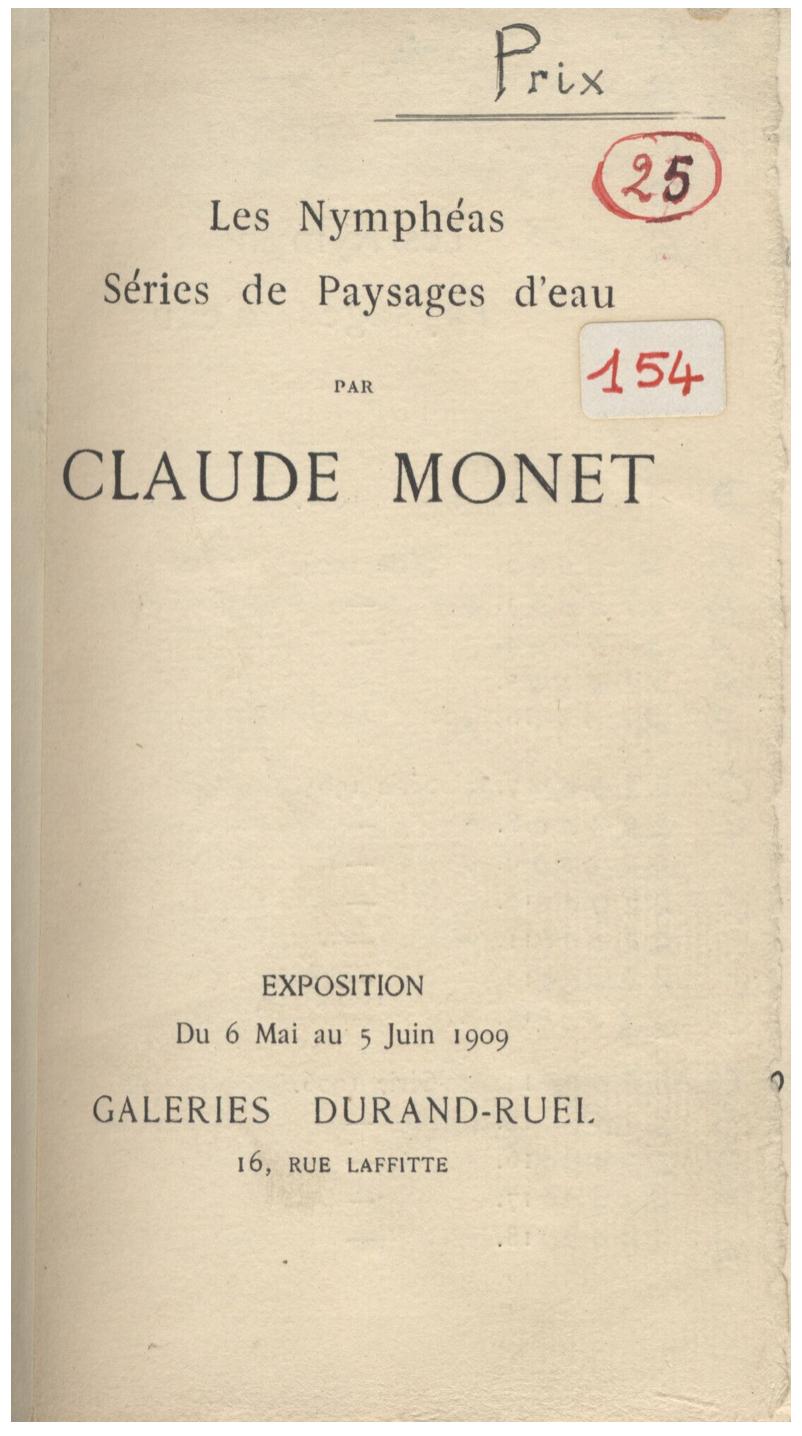
Cover of Les Nymphéas: Séries de paysages d’eau par Claude Monet, Galeries Durand-Ruel, Paris, 1909.
For example, a critic for The Burlington Magazine wrote, “One has never seen anything like it. These studies of waterlilies and still water in every possible effect of light and at every hour of the day are beautiful to a degree which one can hardly express without seeming to exaggerate… There is no other living artist who could have given us these marvelous effects of light and shadow, this glorious feast of color” (quoted in P.H. Tucker, op. cit., 1995, p. 196). Many praised Monet’s ability to continually push the boundaries of his own art, taking his depiction of the landscape to new heights in these works and attaining a level of abstraction that was entirely novel. Writing in the Gazette des Beaux-Arts, Roger Marx famously stated, “No more earth, no more sky, no limits now… Here the painter deliberately broke away from the teachings of Western tradition by not seeing pyramidal lines or a single point of focus. The nature of what is fixed, immutable, appears to him to contradict the very essence of fluidity… Through the incense of soft vapors, under a light veil or silvery mist, ‘the indecisive meets the precise.’ Certainty becomes conjecture and the enigma of the mystery opens the mind to the world of illusion and the infinity of dreams” (quoted in exh. cat., op. cit., 1998, p. 50).
Vue de Rouen depuis la côte Sainte-Catherine, circa 1892
Property from The Schlumberger Collection
Sotheby’s New-York: 20 November 2025
Estimated: USD 3,000,000 – 4,000,000
USD 7,370,000
Vue de Rouen depuis la côte Sainte-Catherine | Modern Evening Auction | 2025 | Sotheby’s
CLAUDE MONET (1840 – 1926)
Vue de Rouen depuis la côte Sainte-Catherine, circa 1892
Oil on canvas
65.3 x 100.2 cm (25 3/4 x 39 1/2 inches)
Stamped with the signature Claude Monet (lower right)
Stamped again (on the reverse)
Dating to circa 1892, Vue de Rouen depuis la côte Sainte-Catherine was painted during Claude Monet’s visit to the city of Rouen the same year. One of the first works executed during that pivotal trip, it forms a critical part of the artist’s exploratory process which culminated in his celebrated series depicting the majestic Gothic façade of the Rouen cathedral, widely considered as the triumph of the Impressionist movement.
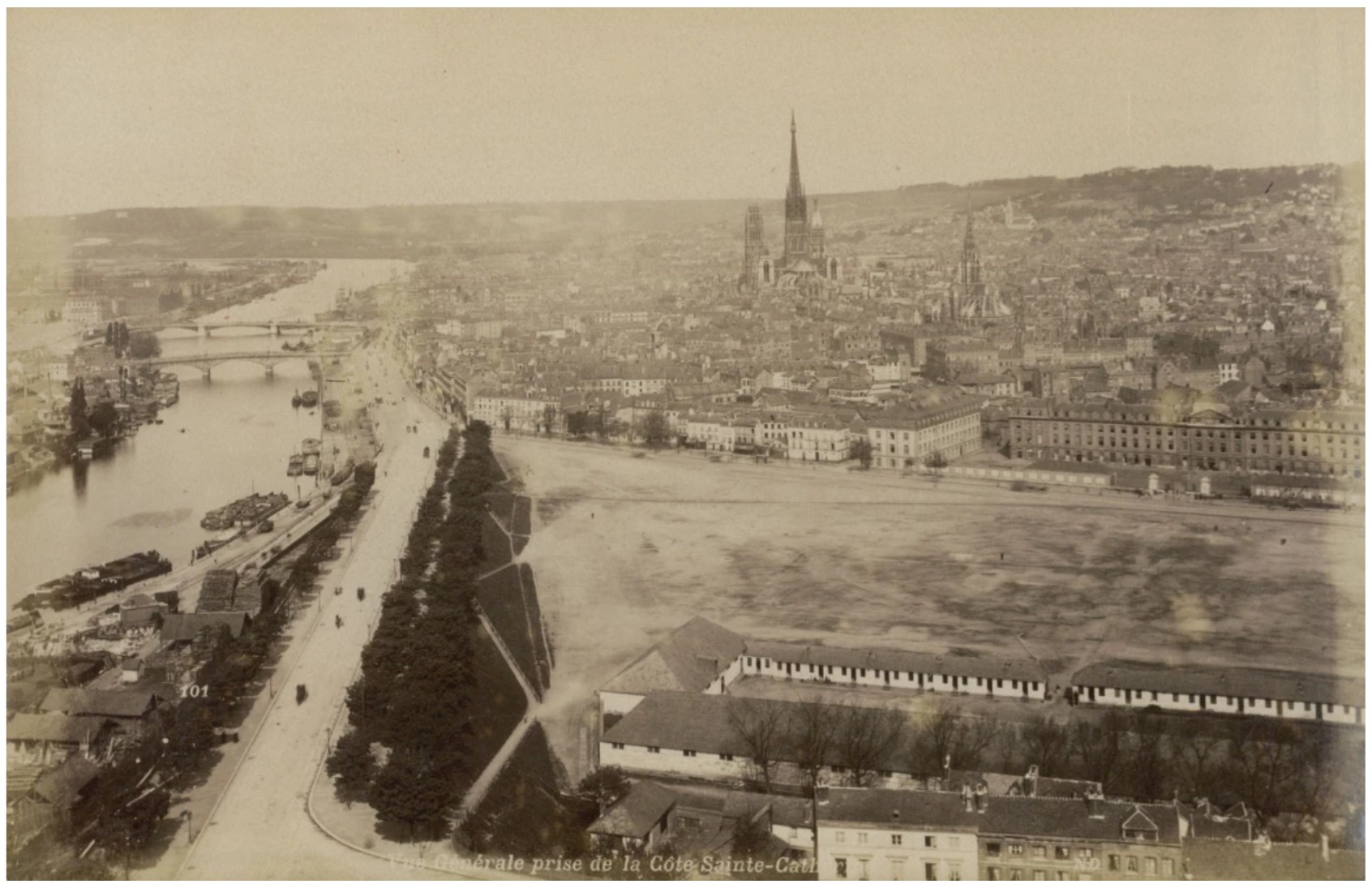
A view of Rouen from Côte Sainte-Catherine, circa 1880
With the picturesque Seine flowing through the middle of the city, its wonderfully preserved, dramatic medieval architecture, and bustling atmosphere as a trade center and the capital of Normandy, Rouen had served as a source of inspiration for artists across centuries. Monet’s close friend Camille Pissarro compared its beauty to that of Venice, as Christopher Lloyd describes: “…for Pissarro, Rouen possessed a potency that Venice had once exerted, and indeed continues to exert, on the European consciousness. In both cities there was a similar magic in the effects derived from the aesthetic relationship between the buildings and the water—in Rouen the Seine, and in Venice the lagoon or the canals” (Christopher Lloyd, Pissarro, Geneva, 1981, p. 88)
Camille Pissarro, Place Lafayette, Rouen, 1883, The Courtauld Gallery, London
It was Pissarro who had first introduced Monet to the vista in the present work, as recorded in a letter the former wrote to his son in October 1883: “…yesterday I was paid a visit by Monet, his brother and his son, by Durand-Ruel and his son. We spent the day together in Déville, on a high hill. There we saw the most splendid landscape that a painter could ever dream of: a view of Rouen, in the distance, with the Seine flowing, unfolding, as calm as a mirror, sunny slopes, splendid foregrounds: it was magical [feérique]. No doubt, I will go back to this village to paint there: it is marvelous” (quoted in Joachim Pissarro, Monet’s Cathedral: Rouen, 1892-1894, 1990, p. 12).
A native of Normandy, Monet visited Rouen frequently since childhood and painted it for the first time over two decades prior. On this occasion, Monet arrived in the city in early February 1892 and remained there until April. His visit was initially motivated by family matters: following the untimely death of his half-sister Maria, who had inherited a number of his works from their father, the artist was now keen, with the help of his brother Léon, to buy these paintings back from their mother. Only a handful of early Rouen canvases are known. These include the present work, as well as a markedly more sketch-like version rendered from the same viewpoint, Vue de Rouen, in the collection of Musée des Beaux-Arts de Rouen; La Rue de L’Épicerie à Rouen, and two further works depicting the foggy riverbank of the Seine.
These oils, combined with a number of pencil drawings Monet sketched out at the same time, provide a unique insight into the artist’s working process during this period. They also underscore that the Rouen Cathedral series, which shortly followed thereafter, was by no means “a premediated subject”. Rather, it was the result of a conscious and laborious search for a subject that would best allow Monet to address the concerns at the heart of his artistic quest. While most of the early Rouen canvases from 1892 focused on capturing the city’s specific viewpoints and architectural elements—acting as part of Monet’s process of scouting for location—Monet here focuses more on the transient effects of weather and time of the day on the city’s topography. He chooses not to depict the Seine or the more verdant section of the city that immediately surrounds it. Instead, Monet conveys the transformation of the surrounding scenery—the valley, the rooftops and the cathedral’s spire—under the soft, hazy sunshine that envelops them. The cathedral spire, the smaller towers and rooftops—the smaller spire on the right likely denoting the Church of Saint-Maclou – also serve as important vertical elements, endowing the present composition with a sense of pictorial rhythm.
Claude Monet, Le Portail, brouillard matinal, 1894, Folkwang Museum Essen
Claude Monet, Cathédrale de Rouen, effet de soleil, fine de journée, 1892, Musée Marmottan Monet, Paris
Claude Monet, Cathédrale de Rouen, symphonie en gris et rose, 1894, National Museum Cardiff, Wales
It is through Monet’s masterful rendering of the sky and air in the present work—using soft, feathery brushstrokes to capture the subtle gradations of tone as the sun and fog transform the scene—that one perceives the artist’s deep fascination with the fleeting atmospheric effects of this great northern city and its landscape. After experimenting with various locations and viewpoints, Monet ultimately focused on depicting these effects in his iconic canvases of the Rouen Cathedral, its imposing medieval façade providing the perfect backdrop for their most potent expression. Integral to the working process that resulted in the creation of his arguably most celebrated and pictorially innovative series, Vue de Rouen depuis la côte Sainte-Catherine is an important canvas from a crucial period in Monet’s career. Remaining in the esteemed Schlumberger collection for over sixty years, the present work comes to auction for the first time.
Falaise des Petites-Dalles, 1881
The Art of Collecting: Property from a Distinguished Private Collector
Christie’s New-York: 17 November 2025
Estimated: USD 2,800,000 – 3,500,000
USD 3,247,000
CLAUDE MONET (1840-1926), Falaise des Petites-Dalles | Christie’s
CLAUDE MONET (1840-1926)
Falaise des Petites-Dalles, 1881
Oil on canvas
59.5 x 73 cm (23 3/8 x 28 3/4 inches)
Signed and dated ‘Claude Monet 81’ (lower right)
Buoyed with newfound enthusiasm as well as the success of the 1880 paintings—the dealer Paul Durand-Ruel purchased fifteen pictures, including two of Les Petites-Dalles—Monet eagerly returned to Normandy in 1881. He installed himself in Fécamp and spent his days roaming the coast in search of motifs that caught his eye. It was during this trip that he painted Falaise des Petites-Dalles, a spirited seascape awash in soft, diaphanous tonalities. Committed to painting en plein air, Monet would have set up his easel on the rocky beach and cast his eye towards the eastern side of the harbor of Les Petites-Dalles as he developed this composition. The towering form of the cliff dominates the present work, the sheer height of its façade suggested by an intricate weave of vertical brushstrokes. Wintery light has turned the Channel seafoam green, and impastoed swirls of white paint evoke the waves’ froth crashing against the shore. The imagery is dynamic and teeming with movement; as the renowned art historian Richard Bretell noted, “Monet’s coastal pictures of the 1880s clearly demonstrate his uncanny ability to depict the invisible—the wind” (Monet in Normandy, exh. cat., Fine Arts Museums of San Francisco, 2006, p. 98). Working in solitude and facing adverse weather conditions—his outings were often impacted by the heavy rains and winds that buffeted the northern coast—Monet spent his days in the pursuit of nature’s transient effects.
Vincent van Gogh
Piles de romans parisiens et roses dans un verre, 1887
The Cindy and Jay Pritzker Collection
Sotheby’s New-York: 20 November 2025
Estimate upon Request
USD 62,710,000
VINCENT VAN GOGH (1853 – 1890)
Piles de romans parisiens et roses dans un verre (Romans parisiens), 1887
Oil on canvas
73.3 x 92.1 cm (28 7/8 x 36 1/4 inches)
Executed in November-December 1887
Piles de romans parisiens et roses dans une verre (Romans parisiens) is one of the most important still lifes that Vincent van Gogh ever painted and the largest in scale to come to auction since the late 1980s. It was painted towards the end of van Gogh’s time in Paris in the final months of 1887. One of only four still lifes featuring books that the artist executed during the course of his two years in the French capital, this work is further distinguished by its exceptional exhibition history and unique combination of visual motifs as well as the tour de force application of medium. The present work is one of the artist’s most accomplished from this period.
Arriving in Paris on 28 February 1886, van Gogh wrote a note in haste to his brother Theo. He had come to Paris four months earlier than they had agreed—and wanted to meet at midday in the Salle Carrée at the Musée du Louvre. The former location of the official Paris Salon, this large gallery housed one of the most important collections of artwork within the museum; at the time of Vincent’s arrival in Paris Leonardo’s Mona Lisa, Veronese’s Marriage at Cana and Rembrandt’s Holy Family hung on the Salon’s walls, tightly packed between other masterpieces.
Letter from Vincent van Gogh to Theo van Gogh, announcing Vincent’s arrival to Paris. 28 February 1886 (letter no. 567)
My dear Theo, do not be cross with me that I’ve come all of a sudden. I’ve fully thought about it and I believe that we will save time this way. I’ll be at the Louvre at noon, or earlier if you’d like. Please reply to let me know what time you could come to the Salon Carré. As for expenses, I repeat, it comes to the same thing. I have some money left, that goes without saying, and I want to talk to you before spending anything.—We’ll sort things out, you’ll see—So get there as soon as possible. I shake your hand. All the best, Vincent
Theo and Vincent were to live together, first in a small apartment on the rue Laval and then in larger quarters on the rue Lepic. Vincent would stay in Paris for nearly two years, departing in February of 1888 for the south of France. While in Paris his artistic practice would undertake a radical shift, embracing a vivid color palette and sharp variations in his handling of oil paint. Romans parisiens captures this pivotal moment in late 1887 where color, subject and paint handling crystallized into van Gogh’s mature style, one that would flourish in the remaining three years of his life in Paris, Arles, Saint-Rémy-de-Provence and Auvers-sur-Oise. It was during this period of time, from 1887 to 1890, that van Gogh’s greatest masterpieces were created, forever changing the history of modern art.
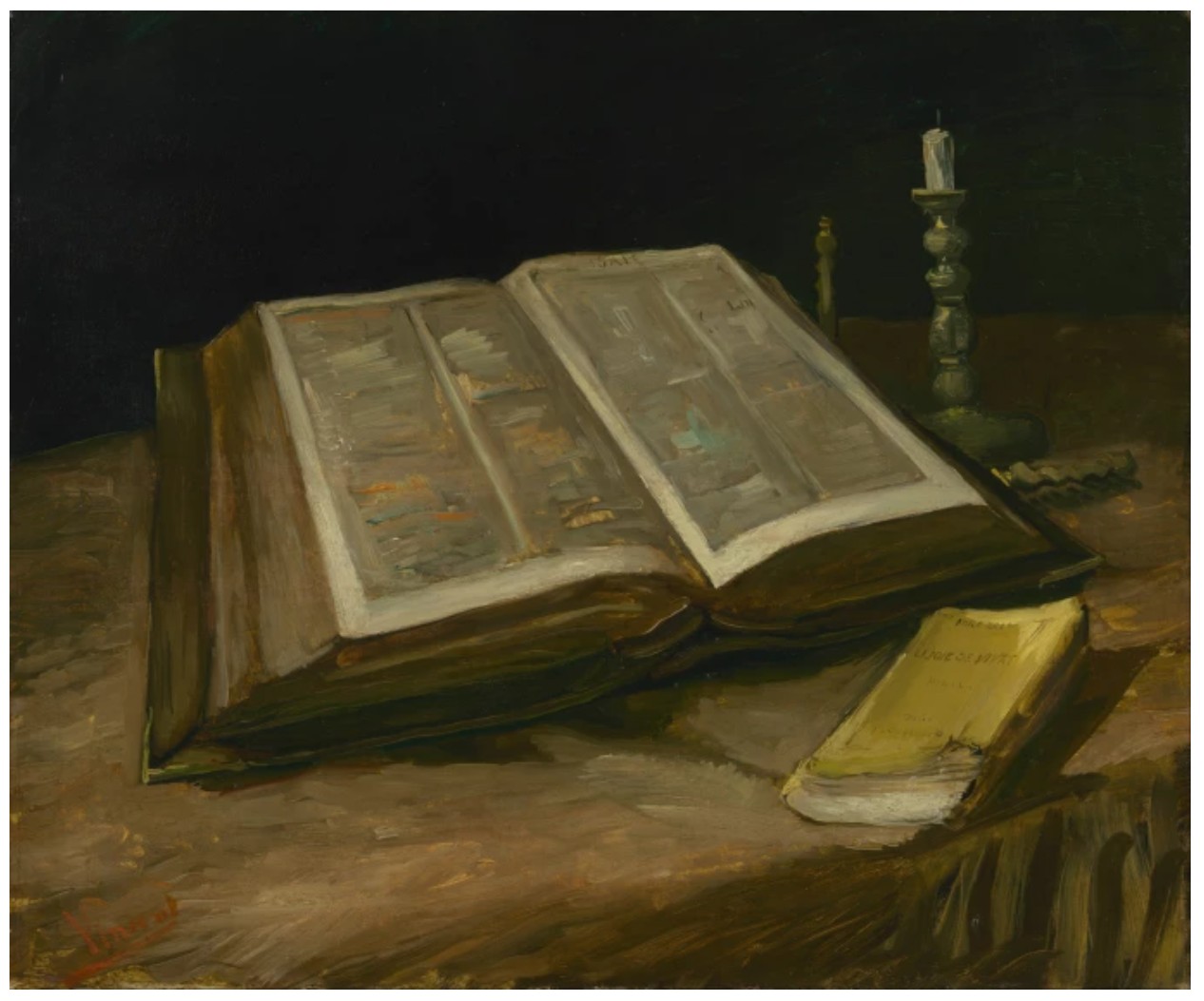
Vincent van Gogh, Still Life with Bible, October 1885, Van Gogh Museum, Amsterdam
During his two-year stay in Paris from 1886 to 1888, van Gogh was introduced to the latest developments in the visual arts and to several of the most innovative painters working in Paris at the time, including Paul Signac, Georges Seurat, Henri de Toulouse-Lautrec and Émile Bernard. With the encouragement and company of his brother, van Gogh frequented the many cafés and taverns where he exchanged both ideas and canvases with this new circle. The city also offered him several opportunities to view the critically acclaimed works of the Impressionists, whose paintings were most notably featured at their eighth and final group exhibition in 1886, though he remained, aside from select works by Edgar Degas and Claude Monet, unconvinced in their overall artistic program. Van Gogh rapidly absorbed the disparate artistic styles and techniques pioneered by the Parisian avant-garde and quickly formulated his own highly distinctive pictorial language. The shock and admiration of these once unfamiliar artists and their varied practices had a dramatic impact on van Gogh. Surrounded by artists, dancers, musicians, actors and writers in Montmartre, van Gogh abandoned the dark palette that dominated many of his early paintings in Holland and replaced it with a newfound love of color.
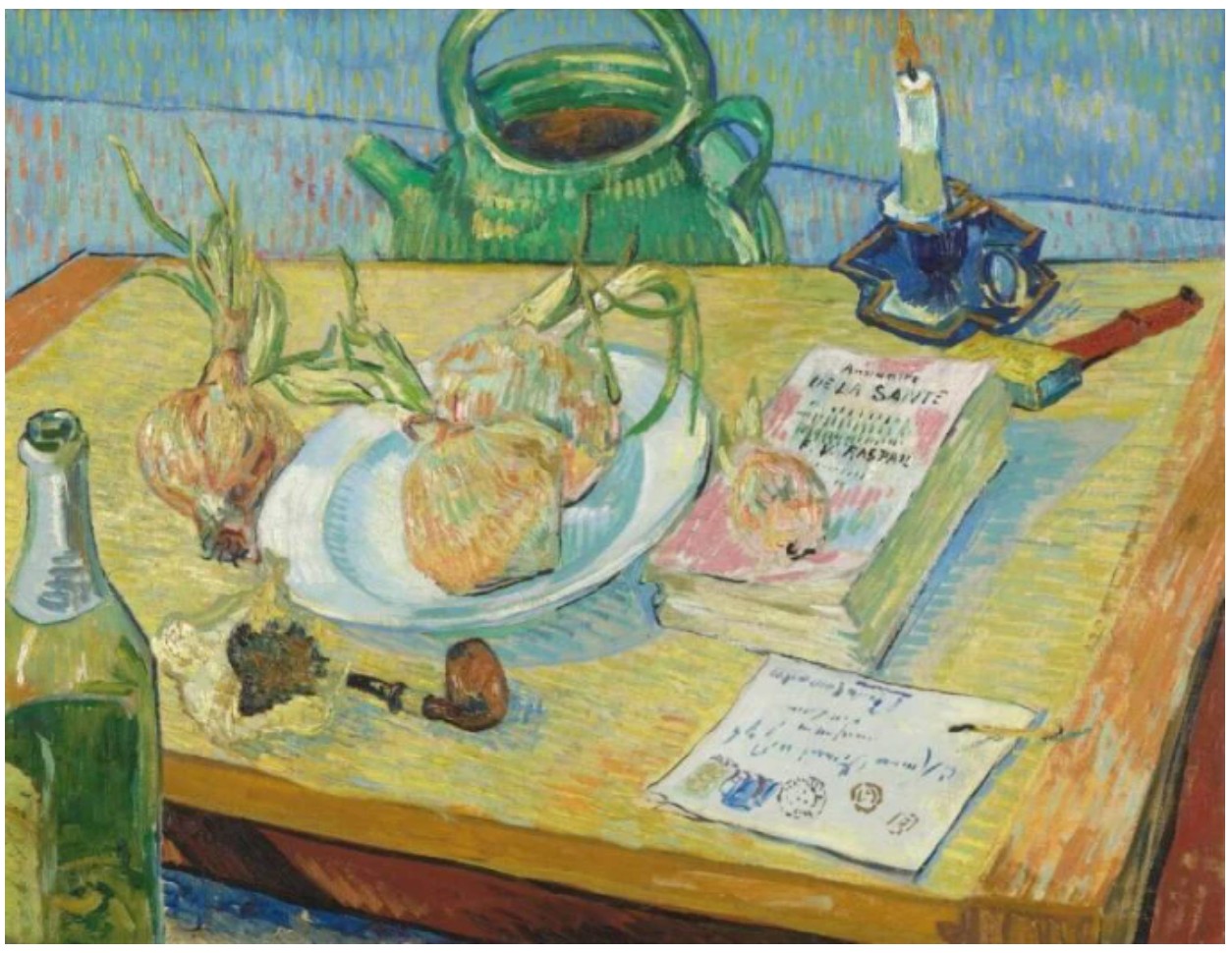
Vincent van Gogh, Still Life with a Plate of Onions, 1889, Kröller-Müller Museum, Otterlo
Before his move to France and his pivot to radically brighter tones, van Gogh first painted books as a subject in October of 1885 in his Still Life with Bible. Here the artist directly juxtaposes a large bible that had belonged to his recently-deceased father with a relatively smaller-scale contemporary French novel, Émile Zola’s La Joie de vivre. The yellow color of the cover of Zola’s novel was shared by many works of fiction in Paris at this time. The phrase “Les Livres jaunes” specifically denotes these volumes as modern French paperbacks; the realist authors that van Gogh so admired would primarily have been published in this format. In Still Life with Bible the bible can be seen as representing the artist’s father (a preacher who his son thought was stuck in the past) and the paperback as representing van Gogh himself, who was a passionate reader of Realist literature.
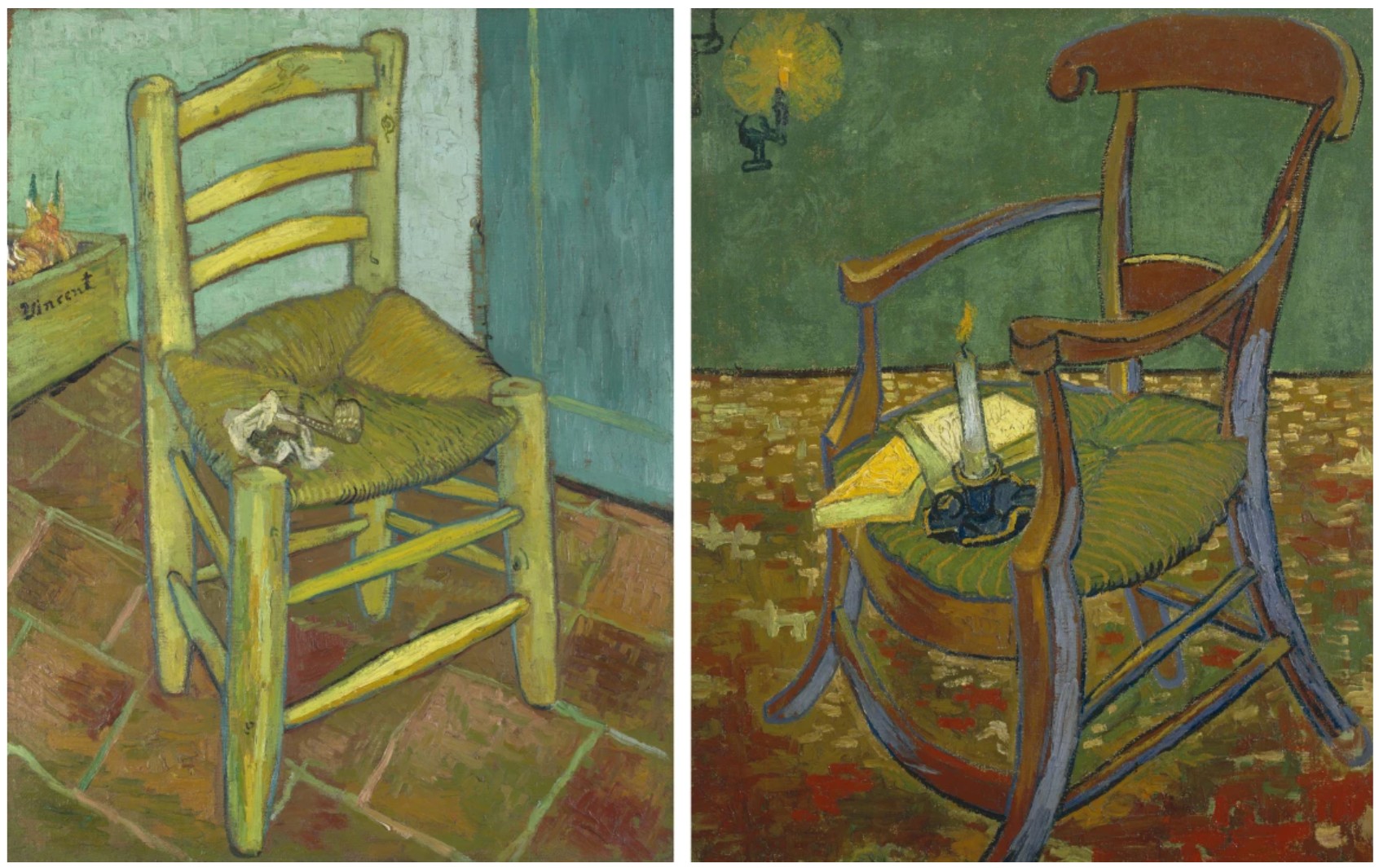
Left: Vincent van Gogh, La Chaise de Vincent avec sa pipe, late 1888, National Gallery, London
Right: Vincent van Gogh, Le Fauteuil de Paul Gauguin, November 1888, Van Gogh Museum, Amsterdam
In two other still lifes that feature books, a symbolic connection between the composition and an absent person (or persons) are evident. Nature morte avec planche à dessin et oignons serves as both a self portrait of van Gogh and a reminder of his brother Theo: the Annuaire a reference to van Gogh’s delicate health at this time and the letter addressed to him by his brother showing the importance of their correspondence and of the written word. Le Fauteuil de Paul Gauguin of 1888 again uses books and a candle as a stand-in for the painting’s subject, the artist Paul Gauguin. Its pendant, La Chaise de Vincent avec sa pipe depicts a less ornate seat supporting a pipe and pouch of tobacco, while in the background a box of onions bears the artist’s signature. Here portrait and self-portrait are conveyed as still life.
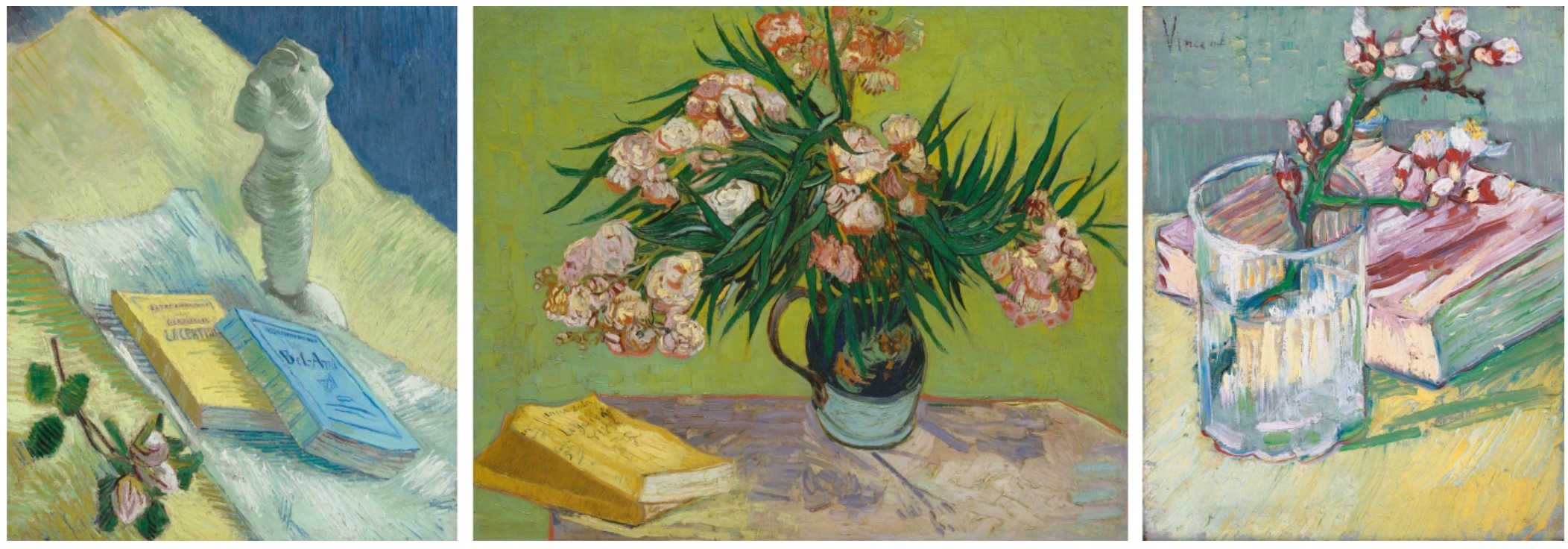
Left: Vincent van Gogh, Nature morte à la statuette de plâtre et aux deux romans, late 1887, Kröller-Müller Museum, Otterlo
Center: Vincent van Gogh, Les Lauriers-roses, 1888, The Metropolitan Museum of Art, New York
Right: Vincent van Gogh, Branche d’amandier en fleurs dans un verre avec un livre, 1888, Private Collection
Of the nearly nine hundred oils that van Gogh painted throughout his career, only nine prominently feature books. Aside from the works already described above, Piles de romans parisiens, Trois romans and Nature morte à la statuette de plâtre et aux deux romans date to van Gogh’s time in Paris, while Branche d’amandier en fleurs dans un verre were painted in Arles in 1888.
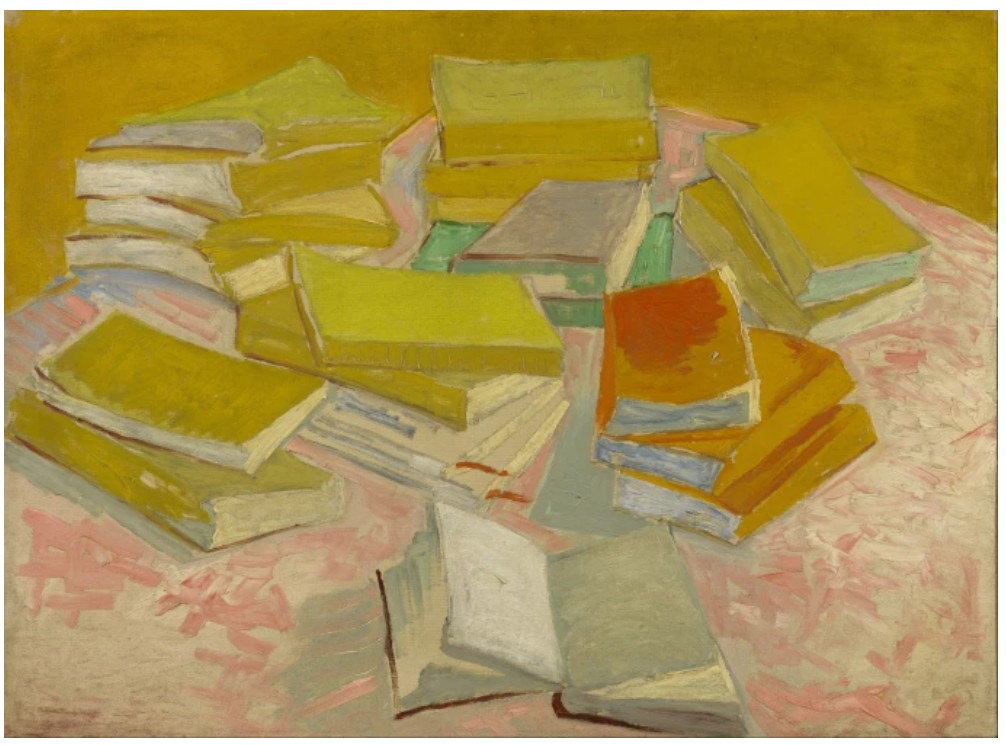
Vincent van Gogh, Piles des romans parisiens, October-November 1887, Van Gogh Museum, Amsterdam
The most directly related of these Parisian canvases, Piles des romans parisiens was a preparatory study for the present work. It similarly places an open book towards the lower center of the canvas, a seeming invitation to the viewer as reader. “Reading was extremely important to van Gogh, as is evident from the frequent references in his letters to contemporary literature. He particularly admired the French naturalists, such as Emile Zola and the De Goncourt brothers: ‘if one wants truth, life as it is, De Goncourt, for example, in Germinie Lacerteux, La fille Elisa, Zola in La Joie de vivre and L’Assomoir and so many other masterpieces paint life as we feel it ourselves and thus satisfy that need which we have, that people tell us the truth’” (Exh. Cat., London, Royal Academy of Arts, The Real Van Gogh: The Artist and His Letters, 2010, p. 226).
Edgar Degas, Portrait de Louis Edmond Duranty, 1879, Burrell Collection, Glasgow
In the van Gogh Museum’s analysis of the preparatory painting, which forms a part of their permanent collection, they have written on the subject of the viewer-as-reader “Although there is no figure in either version of Romans parisiens, they must nevertheless be seen as an attempt to depict a reader. Van Gogh adopted the indirect approach. In the first painting it is the viewer who is actually the reader, for in the foreground there is an open book. He moved it a little further away in the second picture [the present work], severing that connection, but he once again communicated the idea of the presence of a passionate reader of novels by showing the living room and the back of a chair, which makes it clear that we are seeing the reader’s home. Van Gogh may have got his idea for the full reading table from Degas’s imposing Portrait de Louis Edmond Duranty of 1878-79, in which the critic is seen in his study at his desk piled high with books, paperwork and prints in front of the shelves of his large library.
Left: Édouard Manet, Portrait d’Émile Zola, 1868, Musée d’Orsay, Paris
Right: Paul Cézanne, Portrait de Gustave Geffroy, 1895, Musée d’Orsay, Paris
The surroundings identify Duranty as the man of letters pur sang, and van Gogh will have concluded that he had no need to portray a reader, leaving books to convey that impression, just as the drinker is suggested by the full glass in Café table with absinthe” (Ella Hendriks and Louis van Tilborgh, Vincent van Gogh Paintings, Volume 2, Antwerp & Paris, 1885-1888, London, 2011, pp. 508-09). Some seven years later, Paul Cézanne would capture the journalist and critic Gustave Geffroy in a similar setting. Under close scrutiny, the shelf set directly behind Geffroy’s chair contains a shelf of contemporary French novels in their characteristic yellow covers.
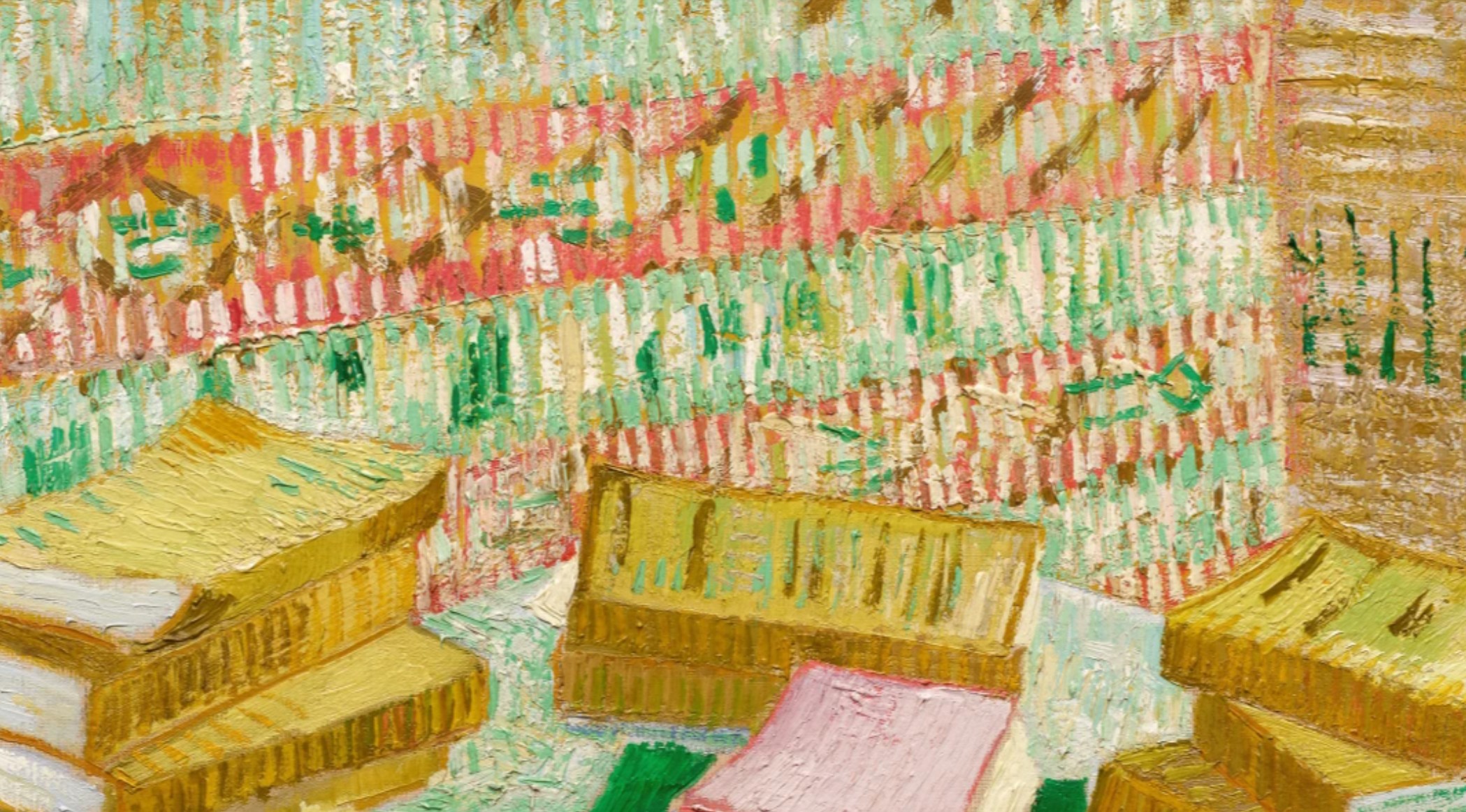
In examining the similarities and differences between the present work and the study Piles of French Novels, which forms part of their permanent collection, Ella Hendriks and Louis van Tilborgh focus not only on the size of the canvas and the cropping of the scene but also on the handling of the paint, inclusion of suggestions of text on the covers and interiors of the volume, details of the wall hanging, specificity of setting and—perhaps symbolically the most important difference—the inclusion of flowers. In the preparatory oil, color and execution are handled in a more monochromatic and flattened manner, which seems to be a nod to the influence of Japanese prints on van Gogh’s work at the time. “The first version was an attempt to make an oil painting in the style of a Japanese print. The composition is conceived in terms of discrete blocks… van Gogh combined them with a painterly touch…. In the final months of his stay in Paris he largely reverted to the… the Neo-Impressionist style, which is well illustrated by the second version of his pile of novels [the present work]. In it he opted for a systematic pattern of small dashes and loose strokes supplemented with hatchings, comparable to those in Portrait of Etienne-Lucien Martin and Self-Portrait as a Painter” (ibid., pp. 506-07) .