
Ed Ruscha’s oeuvre is incredibly diverse in its use of media and includes painting, drawing, print, photography, and film, among other less categorical experiments such as artist’s books. The highly graphic, illustrational aesthetic, and often ironic language-based content of his work has become iconic in West Coast Pop art.
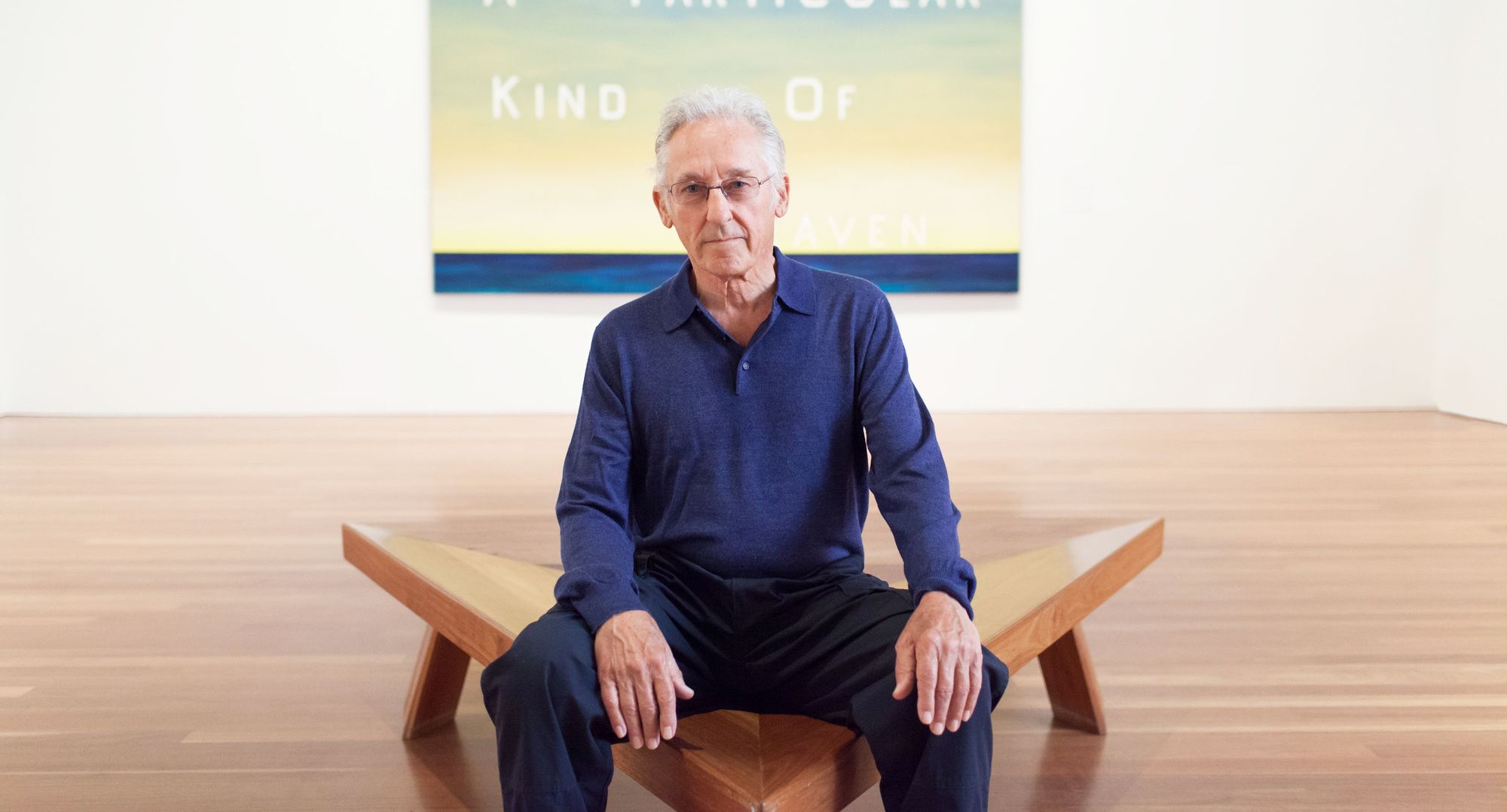
Born in 1937, and raised largely in Oklahoma City, Oklahoma, Ruscha relocated to Los Angeles, in 1956 to attend the Chouinard Art Institute (now Cal Arts). Although widely recognized as an American Pop artist, he contributed greatly to the development of Conceptual art, and precursors to his work can be traced to Abstract Expressionism, Dadaism, and Surrealism.
The most iconic works by Ruscha are his paintings and works on paper that feature language, which employs calligraphic techniques and sardonic, even glib text. In many ways, these text-based works act as a critique of pop culture, canon, and semantics itself. Their inspiration is drawn from more accessible sources than the high art of museums and other major institutions, such as comic strips, commercial advertising, and typography. In his well-known painting OOF, from 1962 (reworked in 1963 and in the collection of the Museum of Modern Art, New York), Ruscha makes onomatopoeia the focus of the piece, rather than relegating it to the status of adornment for another image, like it is traditionally used in comic strips. Ruscha is also known for his print and photography books like Every Building on the Sunset Strip (1966) and Twentysix Gasoline Stations (1963) featuring exactly what the titles suggest in a deadpan black and white.
Since his first solo show at Ferus Gallery in 1963, Ruscha has exhibited globally, with notable solo shows at the Los Angeles County Museum of Art, the Art Institute of Chicago, and the Moderna Museet in Stockholm.
Public Collections
Ruscha’s stylistic technique of combining high and low media and inspiration, and his striking visual design aesthetic, have made his works incredibly popular, and numerous museums and collections worldwide have acquired his work, including the Hirshhorn Museum and Sculpture Garden, Washington, DC; the Los Angeles County Museum of Art; the Tate Modern, London; and the Stedelijk Museum, Amsterdam. Ruscha continues to live and work in Culver City, California.
Museum Exhibitions
Museum Of Modern Art, New-York
Gallery Representation
Gagosian
Artist Website
PART I: SUMMARY
Auction Market Overview
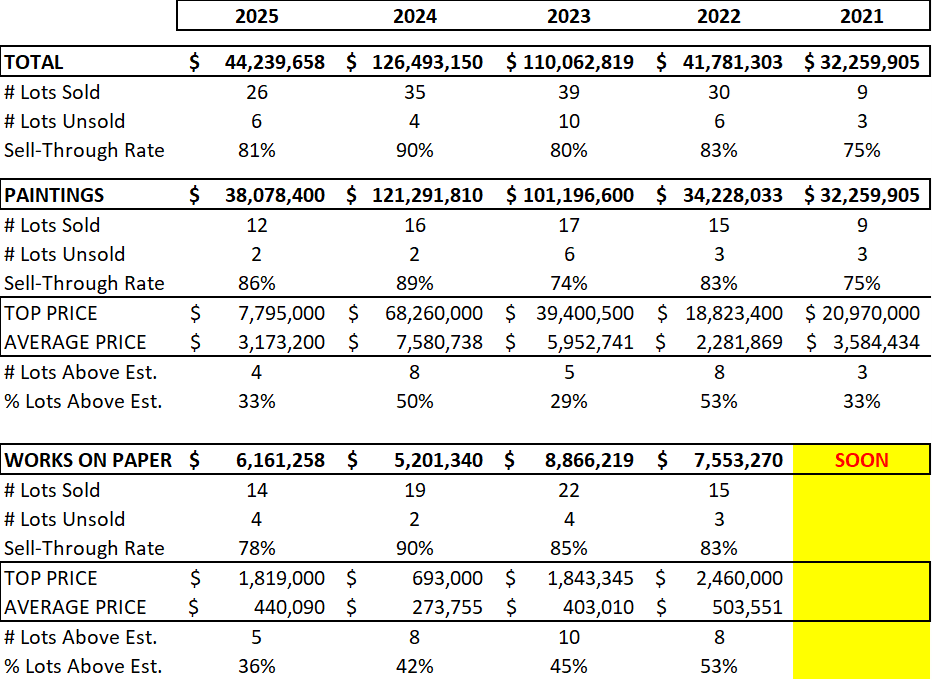
2025 AUCTION STATISTICS
Turnover: USD 44,239,658
-65% vs. 2024
# Lots sold: 26
Sell-Through Rate: 81%
MARKET SEGMENTATION
Paintings (86.1%) / Works on Paper (13.9%)
New-York (96.6%) / London (3.4%)
(by value)
Highest Price Achieved at Auction:
USD 68,260,000
(19 November 2024)
Auction Summary
2025 Auction Highlights
12 lots sold at auction in 2025 for a total turnover of USD 38,078,400. With 2 lots failing to sell, the sell-through rate is 86%. The highest price has been achieved by That Was Then This is Now, a WORD painting dated 1989, that sold at Sotheby’s in New-York, on 15 May 2025, for USD 7,795,000.
2025 Top 3 Lots
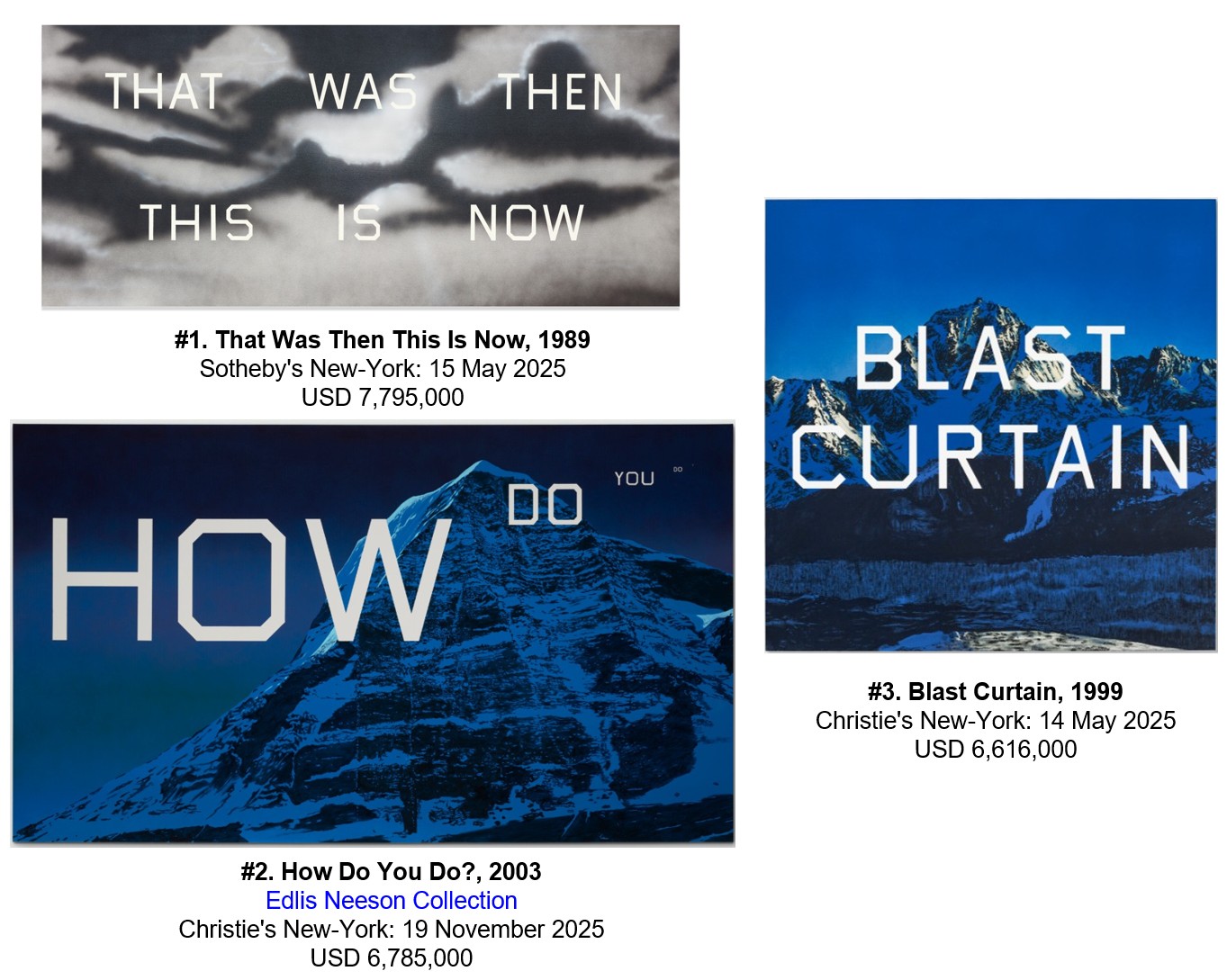
10 lots sold for more than USD 1 million, generating a cumulative turnover of USD 37,495,600, representing 98.5% of the total turnover of 2025. 3 lots sold for more than USD 5 million, generating a cumulative turnover of USD 21,196,000, representing 55.5% of the total turnover of 2025.
Furthermore, 14 Works on Paper sold at auction in 2025 for a total turnover of USD 6,161,258. With 4 lots failing to sell, the sell-through rate is 78%. The highest price achieved is 2025 was for Your Comedies, a work on paper dated 1982, that sold at Sotheby’s in New-York, on 19 November 2025, for USD 1,819,000.
2025 Top 3 Lots
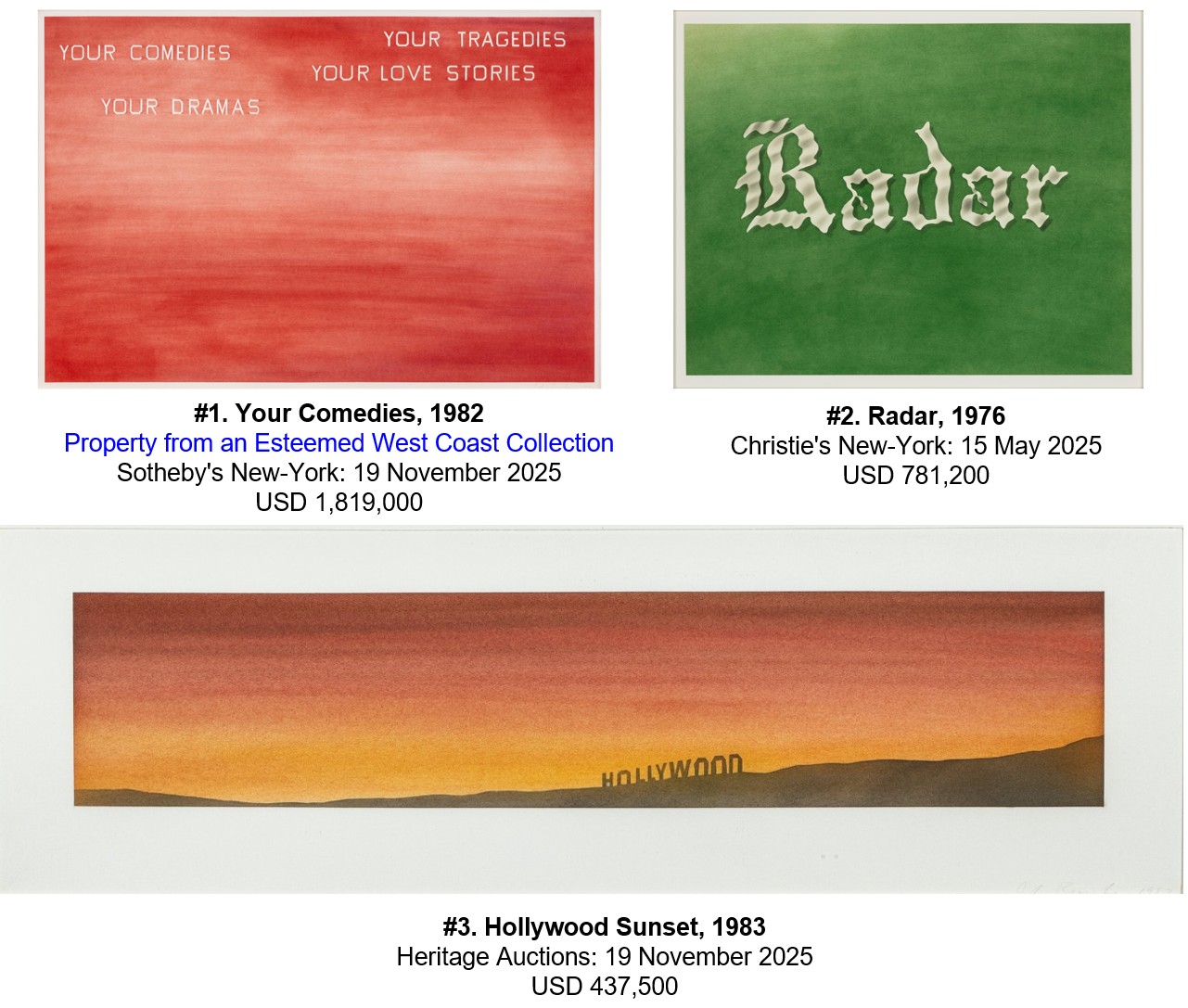
This is the only lot that sold for more than USD 1 million, representing 29.5% of the total turnover of 2025. 2 lots sold for more than USD 500,000, generating a cumulative turnover of USD 2,600,200, representing 42.2% of the total turnover for 2025. All lots except 1 sold for more than USD 100,000.
2024 Auction Highlights
16 lots sold at auction in 2024 for a total turnover of USD 121,291,810. With 2 lots failing to sell, the sell-through rate is 89%. Standard Station, Ten Cent Western Being Torn in Half, a major painting dated 1964 from the artist’s celebrated Gas Station series, sold for USD 68,260,000, at Christie’s in New-York on 19 November 2024, a new world auction record for the artist.
2024 Top 3 Lots
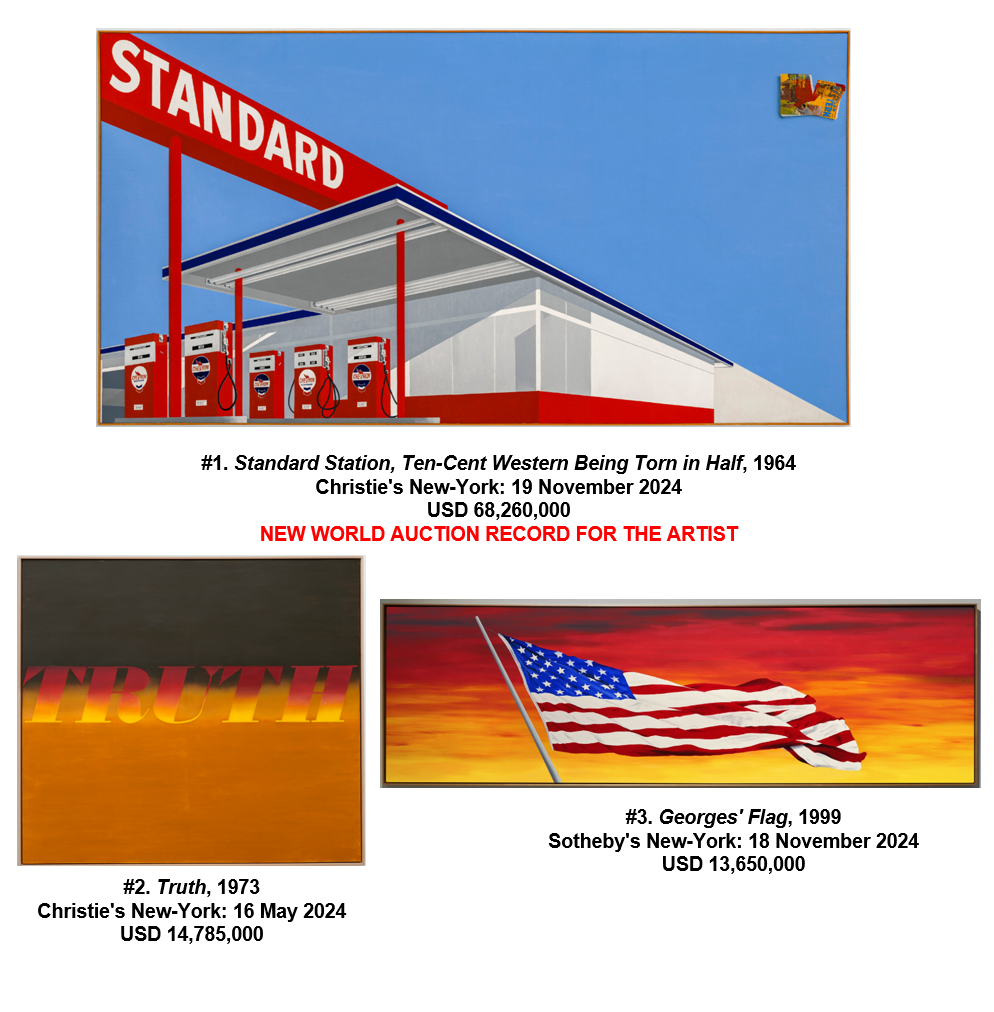
3 paintings sold for more than USD 10 million, generating a cumulative turnover of USD 96,695,000, representing 79.7% of the total turnover for 2024.
Furthermore, 16 Works on Paper sold at auction in 2024 for a total turnover of USD 5,201,340. With 2 lots failing to sell, the sell-through rate is 90%. Skytown, a Gunpowder drawing dated 1967, sold at Christie’s in New-York on 1 October 2024 for USD 693,000, the highest price achieved for a Work on Paper in 2024.
2024 Top 3 Lots
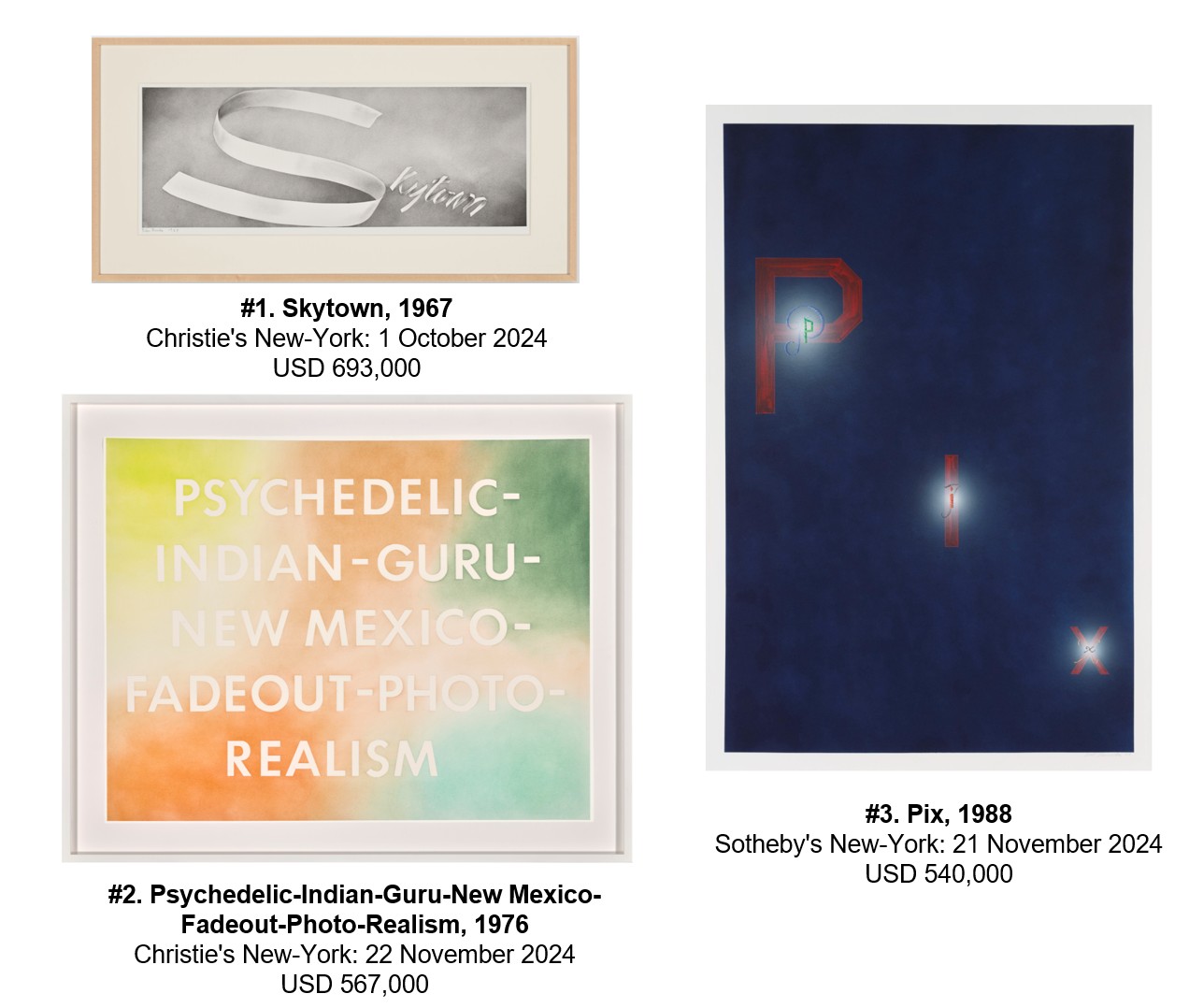
3 lots sold for more than USD 500,000, generating a cumulative turnover of USD 1,800,000, representing 34.6% of the total turnover for 2024. All lots but one sold for more than USD 100,000.
2023 Auction Highlights
17 lots sold at auction in 2023 for a total turnover of USD 101,196,600. The top lot, Securing The Last Letter (Boss) from the Emily Fisher Landau Collection, was sold at Sotheby’s in New-York on 9 November 2023, for USD 39,400,500. With no lot failing to sell, the sell-through rate is a perfect 100%.
2023 Top 3 Lots
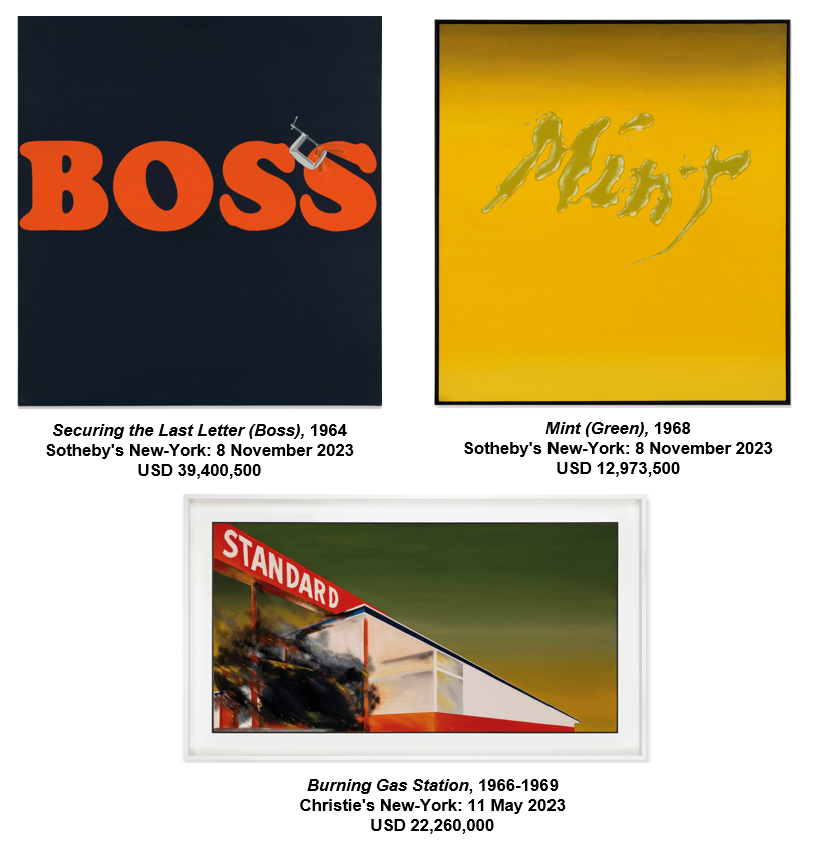
3 lots sold over USD 10 million, generating a cumulative turnover of USD 74,634,000, contributing 73.8% to the total turnover for 2023. 13 lots sold over USD 10 million, for a cumulative turnover of USD 98,787,500, representing 97.6% of the total turnover for 2023.
Furthermore, 22 Works on Paper sold at auction in 2023 for a total turnover of USD 8,866,217. With 4 lots failing to sell, the sell-through rate is 85%. The highest price has been achieved by Eye with Fluid, a gunpowder drawing dated 1968 that sold at Sotheby’s in Paris on 15 March 2023 for EUR 1,742,000 (USD 1,843,345).
2023 Top 3 Lots
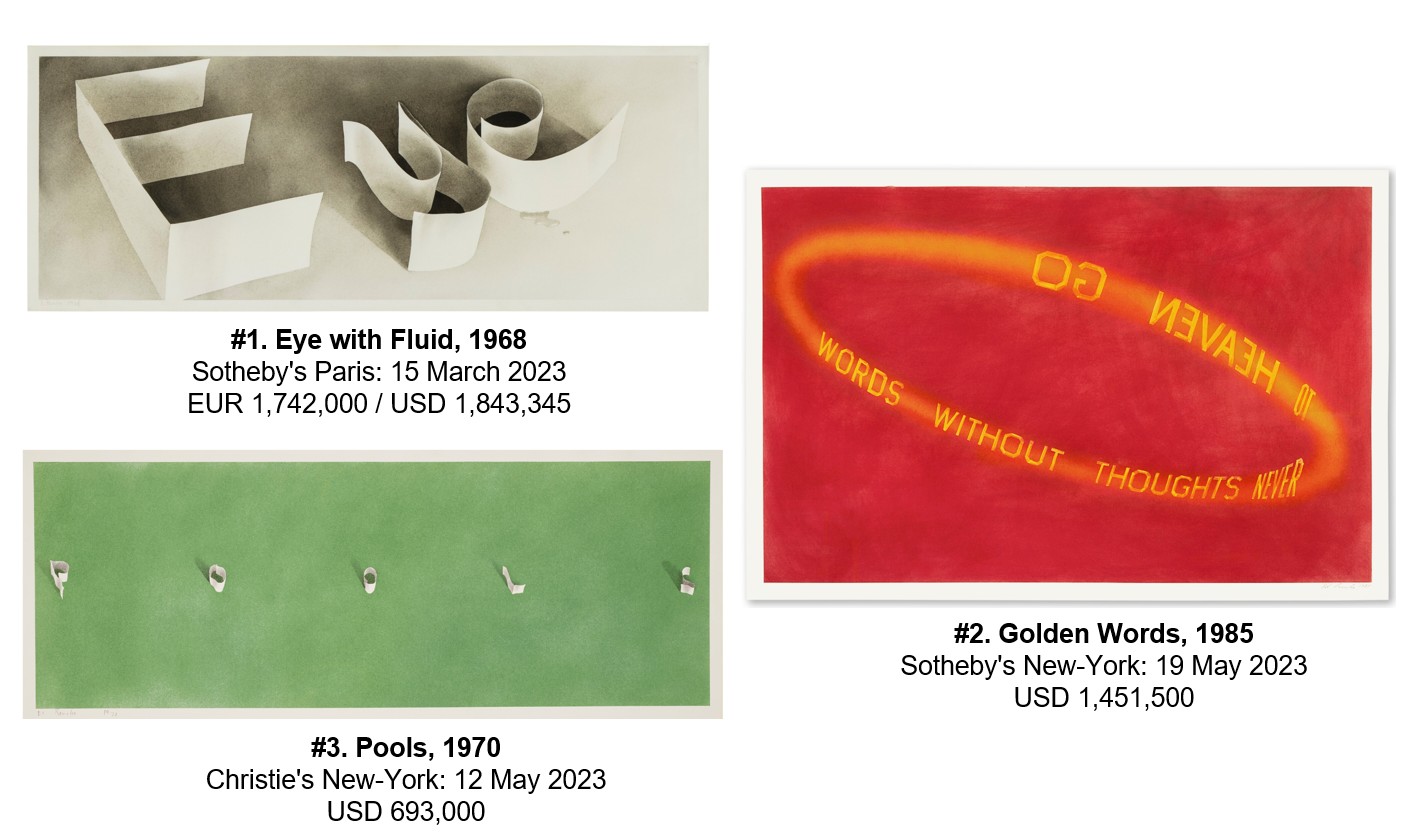
2 lots sold for more than USD 1 million, generating a cumulative turnover of USD 3,294,845, representing 37.2% of the total turnover for 2023. 5 lots sold for more than USD 500,000, generating a cumulative turnover of USD 5,125,845, representing 57.8% of the total turnover for 2023.
2022 Auction Highlights
15 lots sold at auction in 2022 for a total turnover of USD 34,228,033. The top lot, Cold Beer Beautiful Girl, sold for USD 18,823,400 at Sotheby’s in New-York on 19 May 2022.
2022 Top 3 Lots
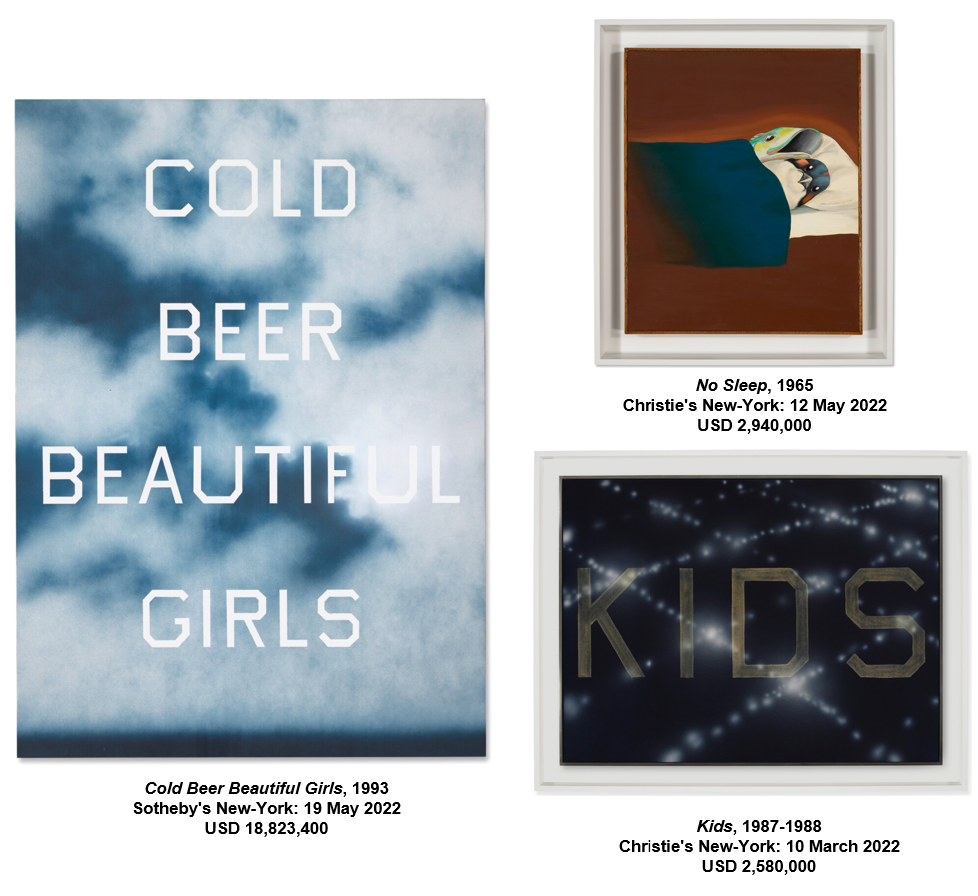
Only one lot sold for over USD 10 million. 8 lots sold over USD 1 million, for a cumulative turnover of USD 30,818,576, representing 90% of the total turnover for 2022.
Furthermore, 15 Works on Paper sold at auction in 2022 for a total turnover of USD 7,553,270. With 3 lots failing to sell, the sell-through rate is 83%. The highest price was achieved by an exceptional gunpowder drawing, Western with Fly, dated 1967, sold at Christie’s in New-York, on 13 May 2022, for USD 2,460,000. This is the only lot that sold for more than USD 1 million, representing 32.6% of the total turnover of 2022.
2022 Top 3 Lots
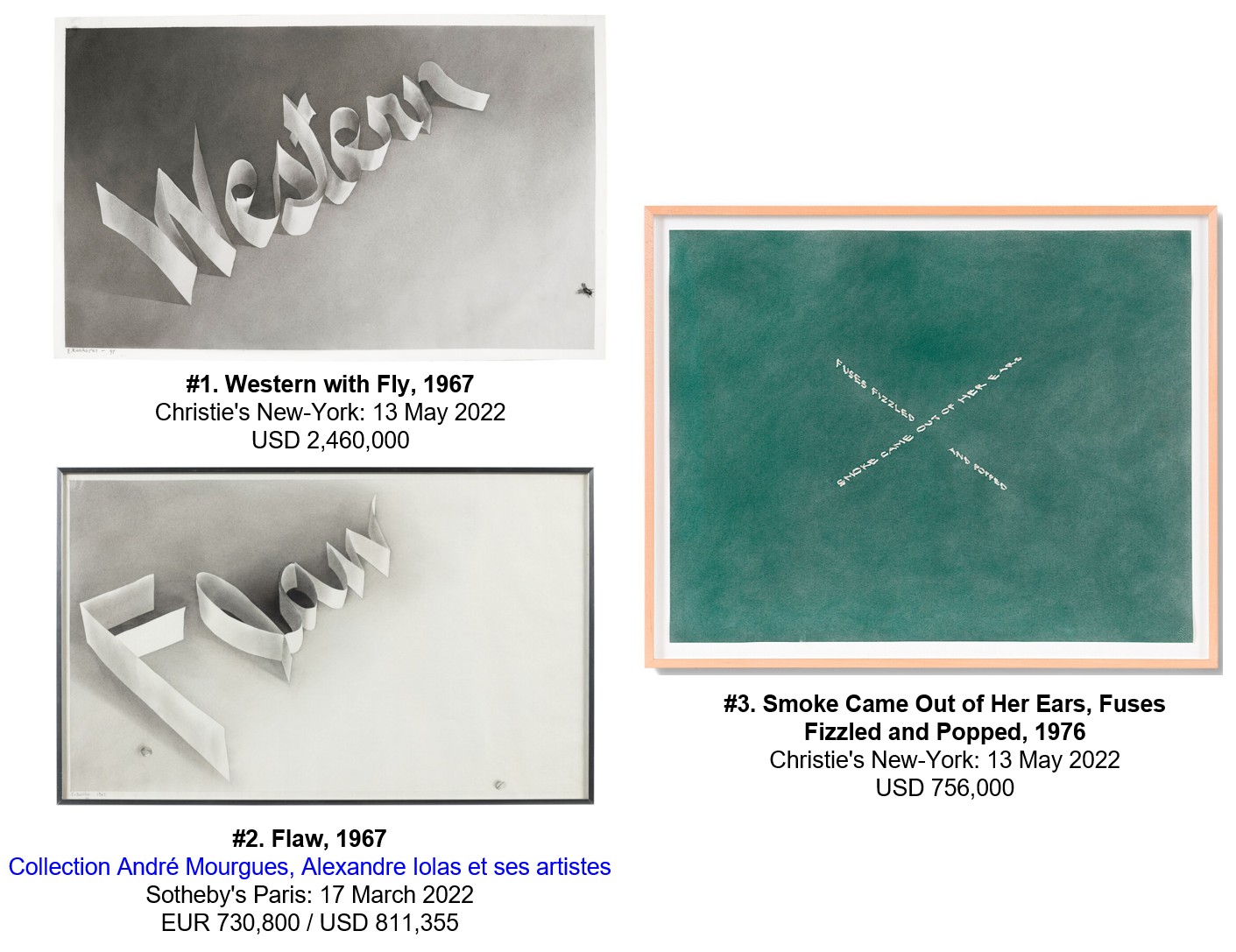
6 lots sold for more than USD 500,000, generating a cumulative turnover of USD 5,917,355, representing 78.3% of the total turnover of 2022. All lots except 2 sold for more than USD 100,000.
2021 Auction Highlights
9 lots sold at auction in 2021 for a total turnover of USD 32,259,905. With 3 lots failing to sell, the sell-through rate is 75%. The highest price has been achieved at Christie’s in New-York, on 11 November 2021, when Ripe, a painting dated 1967 sold for USD 20,000,000.
2021 Top 3 Lots
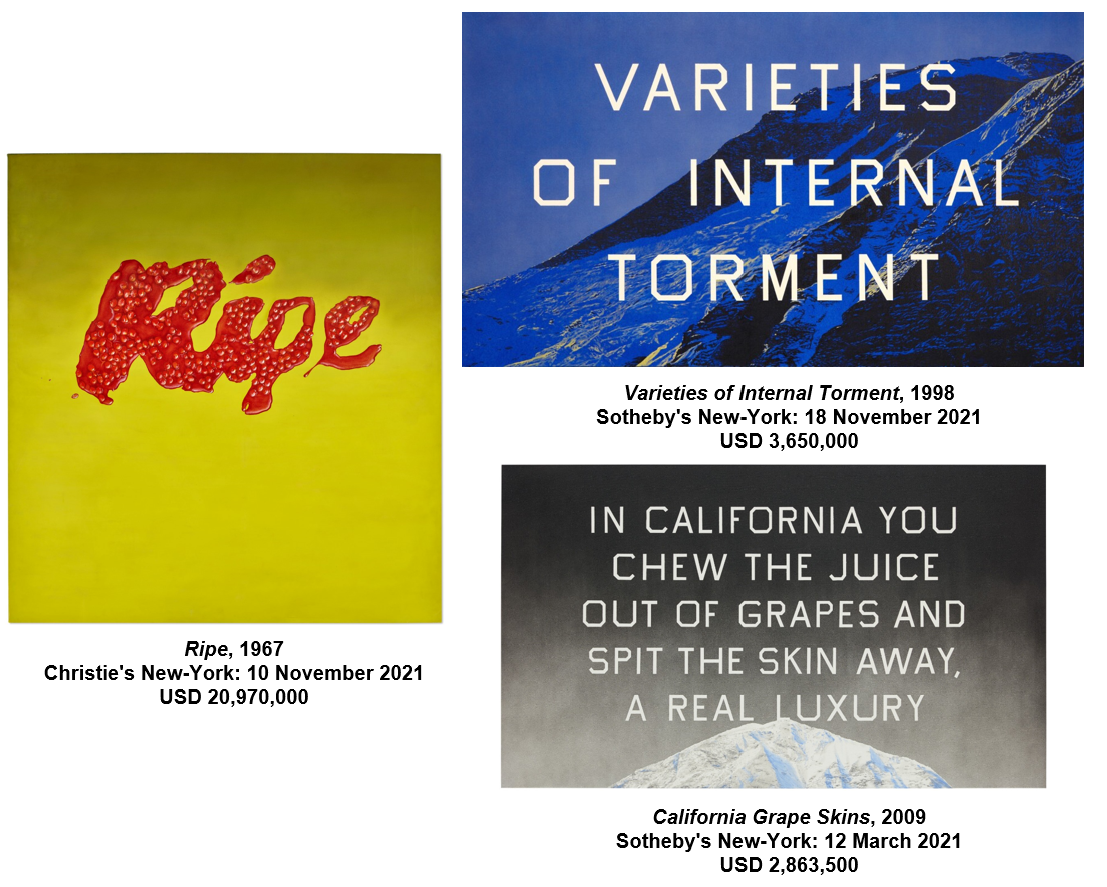
This was the only lot that sold above USD 10 million. 4 lots sold above USD 1 million, generating a cumulative turnover of USD 28,955,500, representing 89.8% of the total turnover for 2021.
PLEASE CLICK BELOW FOR WORKS ON PAPER DETAILED AUCTION RESULTS
Top Lots
The top 10 lots generated a cumulative turnover of USD 304,013,900. The highest price paid at auction for a work by Ed Ruscha was achieved at Christie’s in New-York, on 19 November 2024, by Standard Station, Ten-Cent Western Being Torn in Half, an iconic Gas Station painting dated 1964, that sold for USD 68,260,000. All paintings from the top 10 are dated from the sixties except 3. All paintings sold in New-York. 6 lots among the 10 top lots sold after 2022.
#1. Standard Station, Ten-Cent Western Being Torn in Half, 1964
Christie’s New-York: 19 November 2024
Estimate on Request
USD 68,260,000
NEW WORLD AUCTION RECORD FOR THE ARTIST
ED RUSCHA (B. 1937), Standard Station, Ten-Cent Western Being Torn in Half | Christie’s
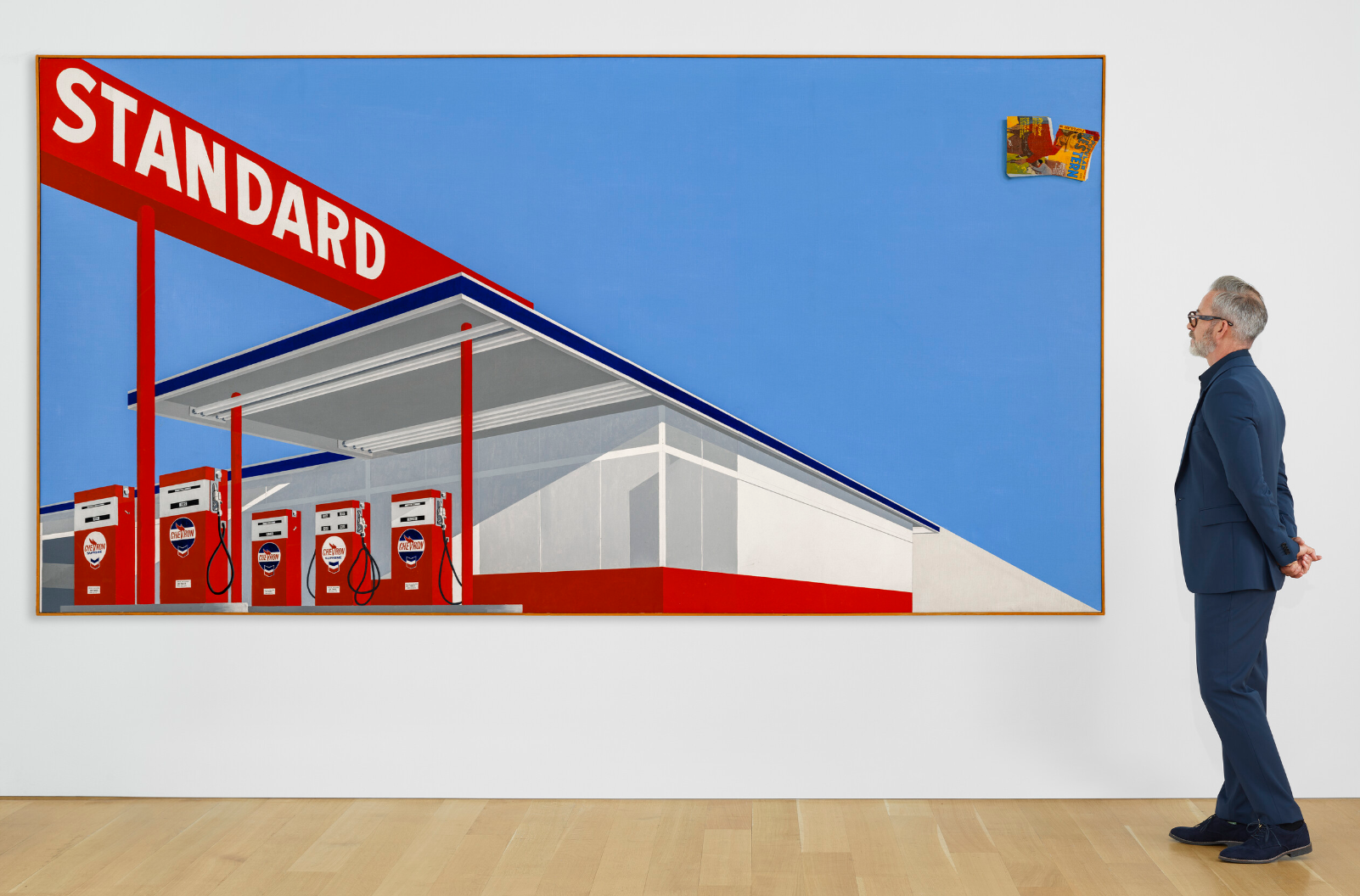
ED RUSCHA (B. 1937)
Standard Station, Ten-Cent Western Being Torn in Half, 1964
Oil on canvas
65 x 121 1/2 inches (165.1 x 308.6 cm)
Signed, titled and dated ‘”STANDARD STATION, 10¢ WESTERN BEING TORN IN HALF” 1964 Edward J. Ruscha’ (on the stretcher)
#2. Hurting the Word Radio #2, 1964
Christie’s New-York: 13 November 2019
Estimated: USD 30,000,000 – 40,000,000
USD 52,485,000
Ed Ruscha (b. 1937) (christies.com)
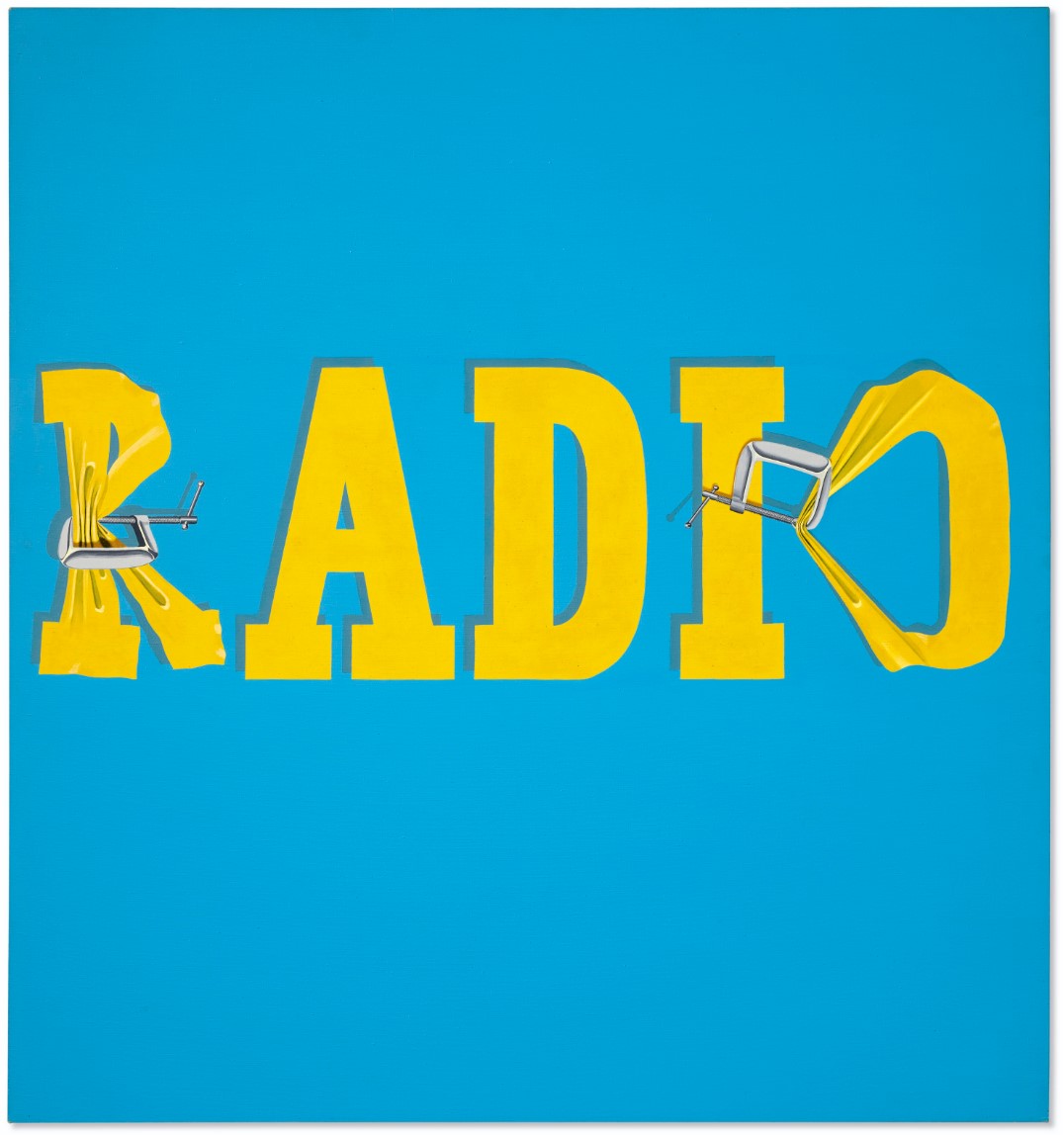
ED RUSCHA (b. 1937)
Hurting the Word Radio #2, 1964
Oil on canvas
59 x 55 1/4 inches (150 x 140.3 cm)
Signed, titled and dated ‘”Hurting the Word Radio” #2 1964 Edward J. Ruscha’ (on the stretcher)
USD 50 million
#3. Securing the Last Letter (Boss), 1964
Sotheby’s New-York: 8 November 2023
Estimated: USD 35,000,000 – 45,000,000
USD 39,400,500
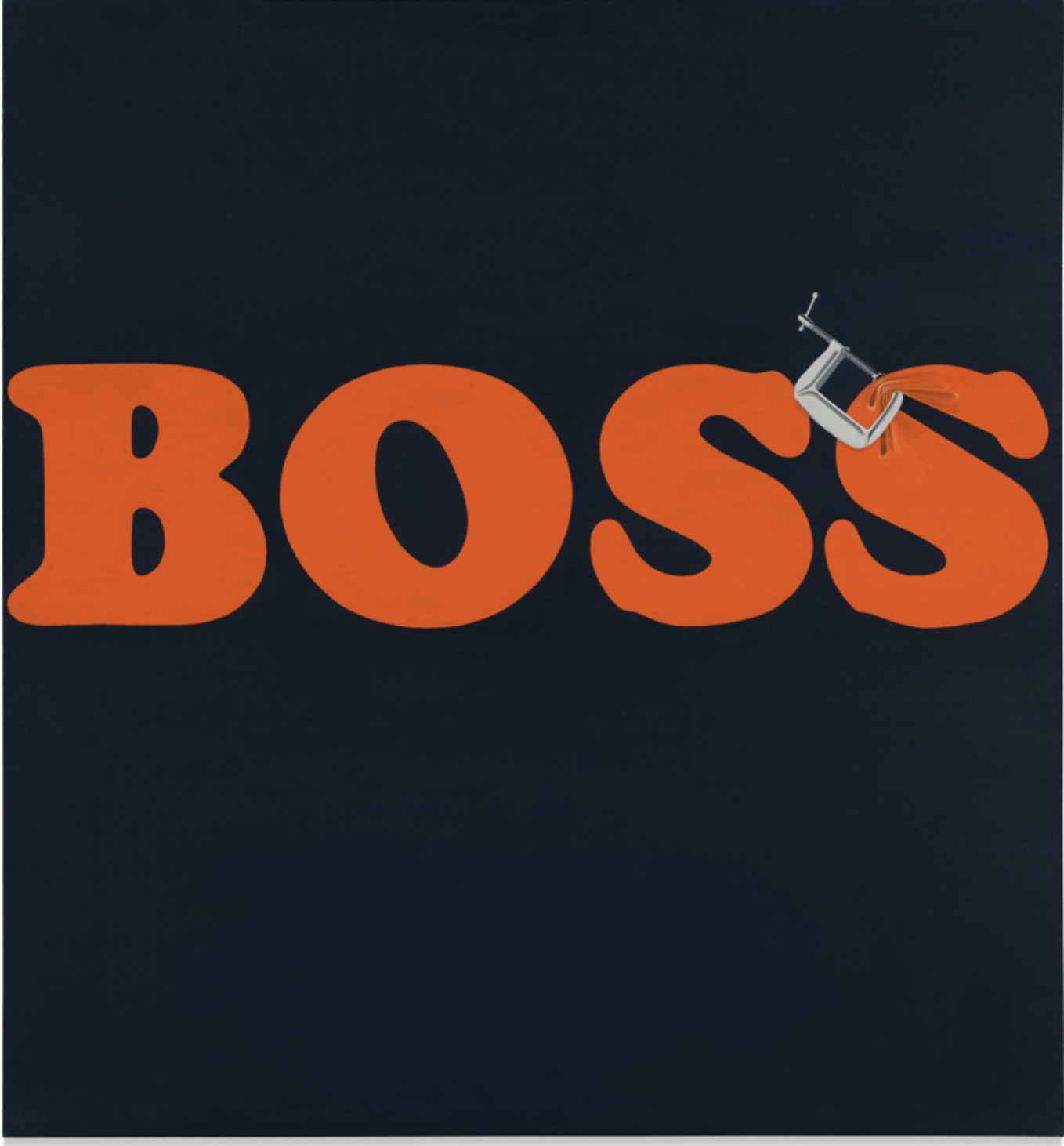
ED RUSCHA (b. 1937)
Securing the Last Letter (Boss), 1964
Oil on canvas
59 x 55 1/8 inches (149.9 x 140 cm)
Signed, titled and dated 1964 (on the stretcher)
#4. Smash, 1963
Christie’s New-York: 12 November 2014
Estimated: USD 15,000,000 – 20,000,000
USD 30,405,000
Ed Ruscha (b. 1937) (christies.com)
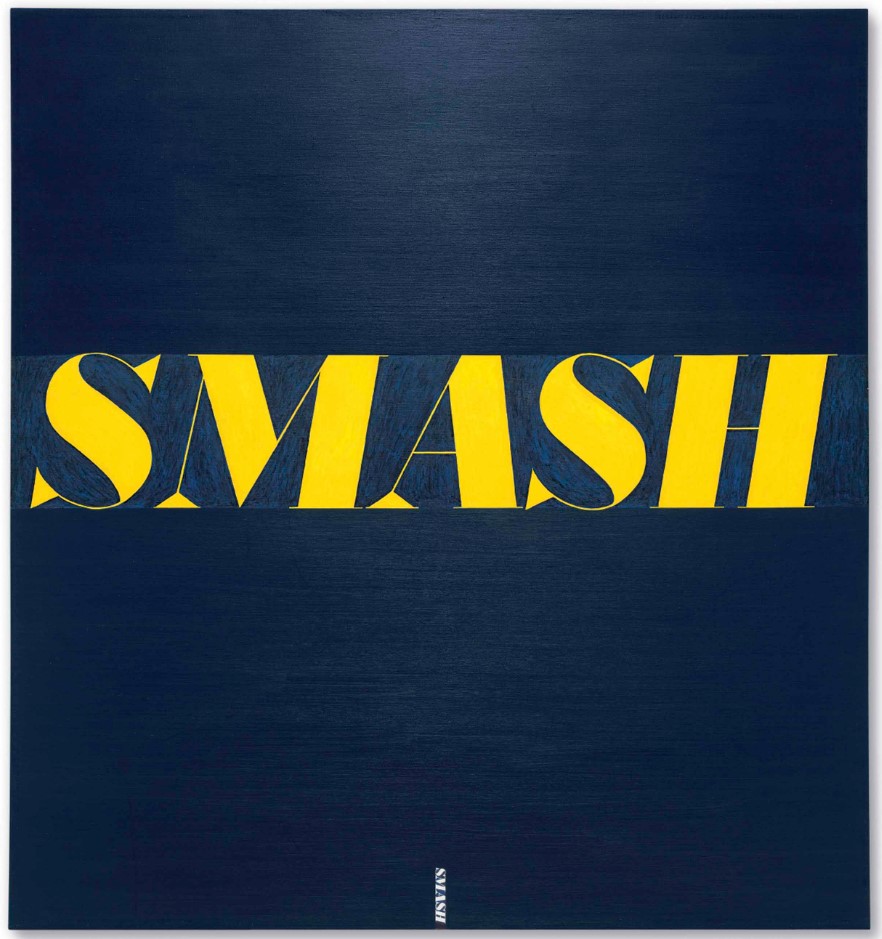
ED RUSCHA (b. 1937)
Smash, 1963
Oil on canvas
71 3/4 x 67 inches (182.2 x 170.1 cm)
Signed and dated ‘3 / 1963 E. RUSCHA’ (on the stretcher)
USD 30 million
#5. Annie, 1962
Christie’s New-York: 10 July 2020
Estimated: USD 20,000,000 – 30,000,000
USD 22,975,000
Ed Ruscha (b. 1937) (christies.com)
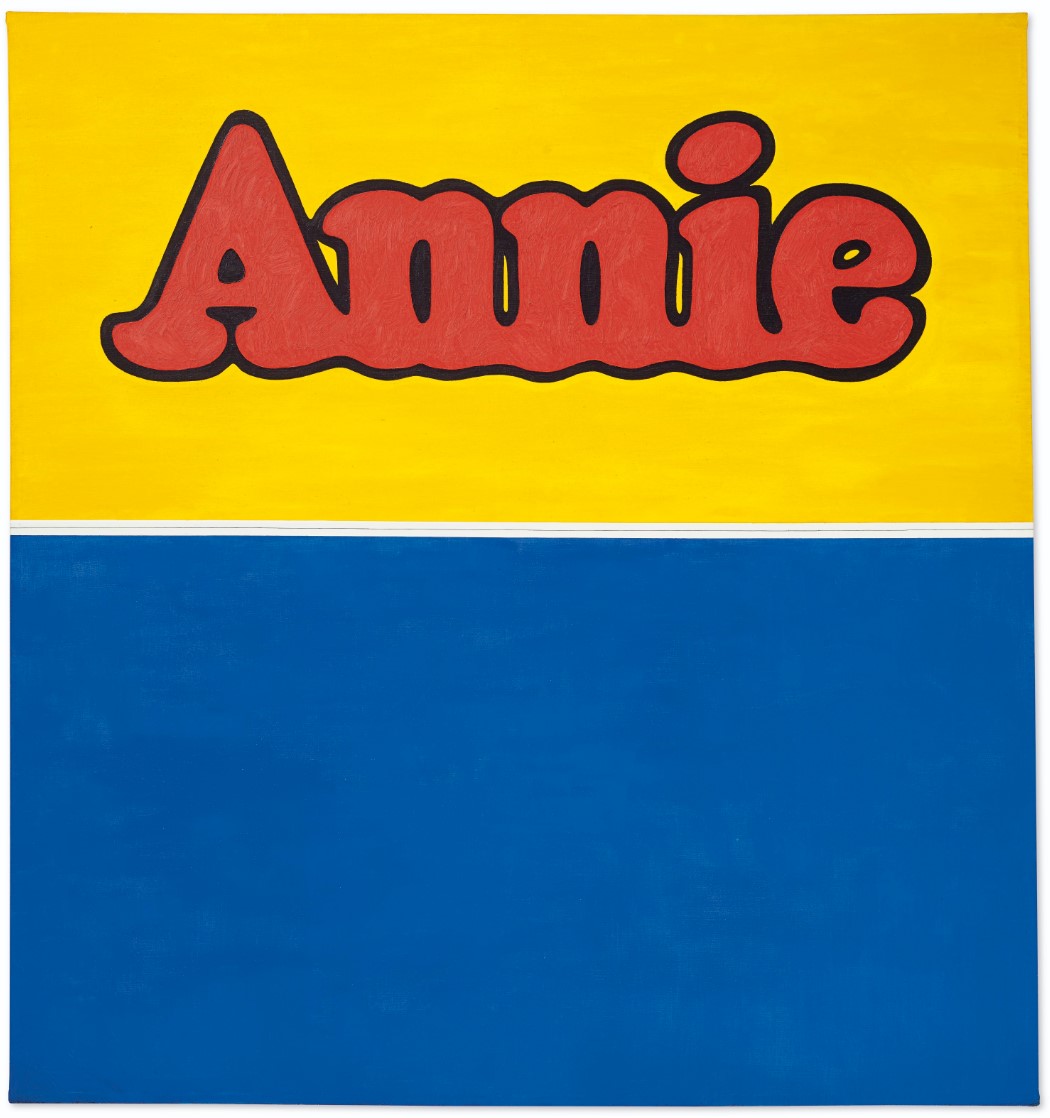
ED RUSCHA (b. 1937)
Annie, 1962
Oil and graphite on canvas
71 1/2 x 66 3/4 inches (181 x 169.5 cm)
#6. Burning Gas Station, 1966-1969
Christie’s New-York: 11 May 2023
Estimated: USD 20,000,000 – 30,000,000
USD 22,260,000
ED RUSCHA (B. 1937) (christies.com)
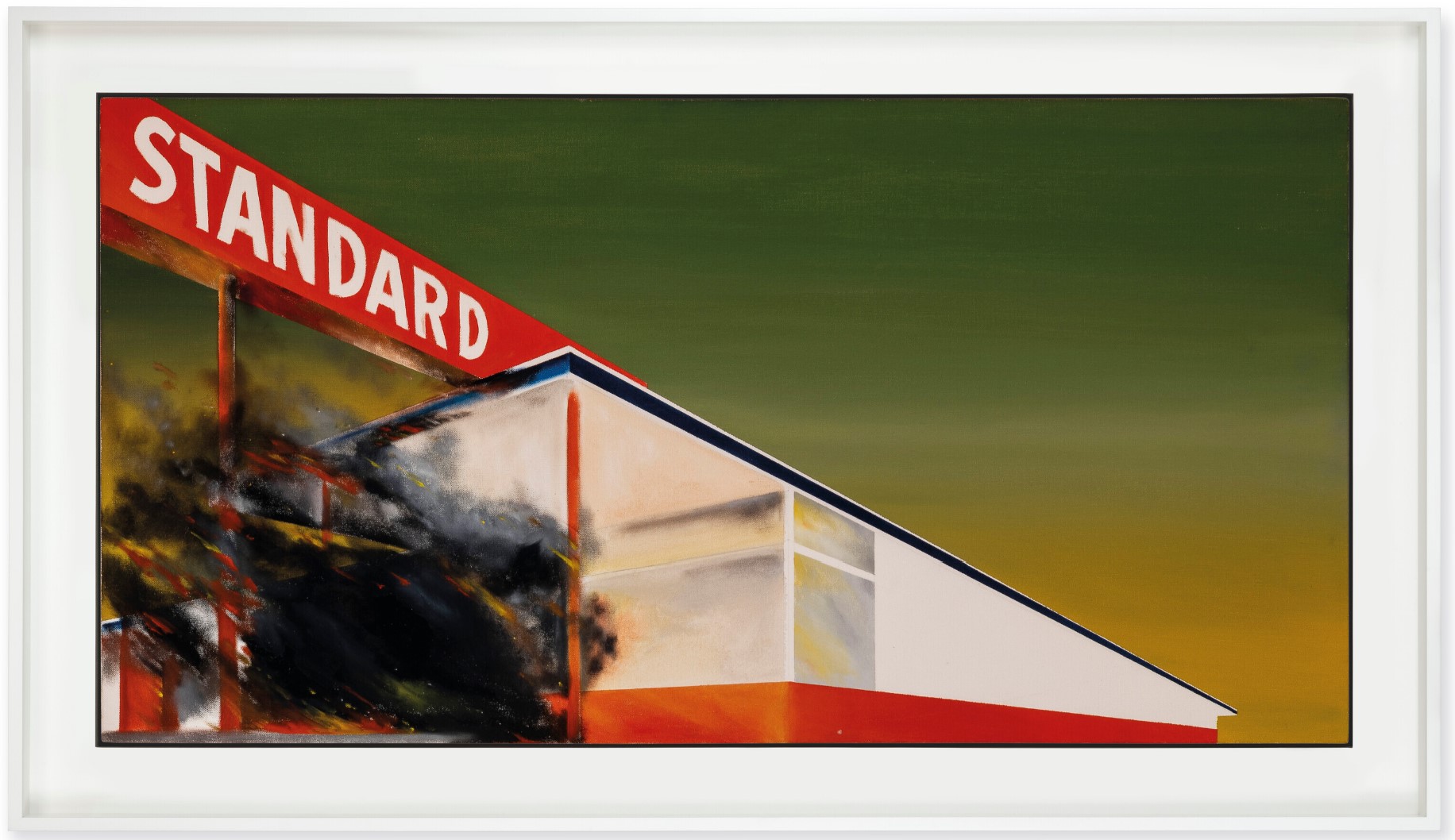
ED RUSCHA (B. 1937)
Burning Gas Station, 1966-1969
Oil on canvas
20 1/8 x 39 inches (51.1 x 99.1 cm)
Signed, titled and dated ‘”BURNING GAS STATION” 1966-1969 E. Ruscha’ (on the stretcher)
#7. Ripe, 1967
Christie’s New-York: 10 November 2021
Estimated: USD 18,000,000 – 22,000,000
USD 20,970,000
ED RUSCHA (B. 1937) (christies.com)
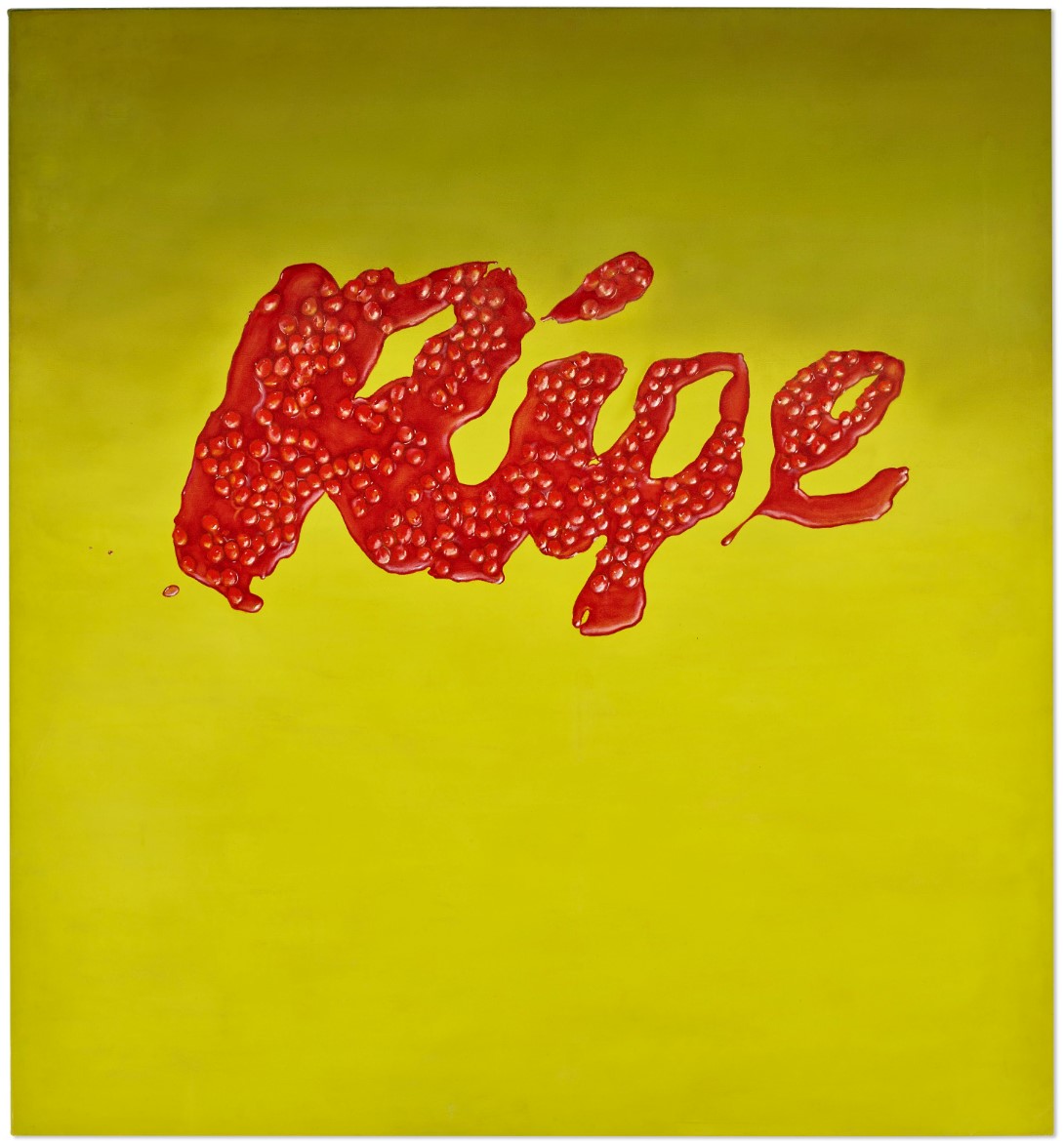
ED RUSCHA (B. 1937)
Ripe, 1967
Oil on canvas
59 ¼ x 54 ¾ inches (150.5 x 139.1 cm)
USD 20 million
#8. Cold Beer Beautiful Girls, 1993
Sotheby’s New-York: 19 May 2022
Estimated: USD 15,000,000 – 20,000,000
USD 18,823,400
Cold Beer Beautiful Girls | Contemporary Evening Auction | 2022 | Sotheby’s (sothebys.com)
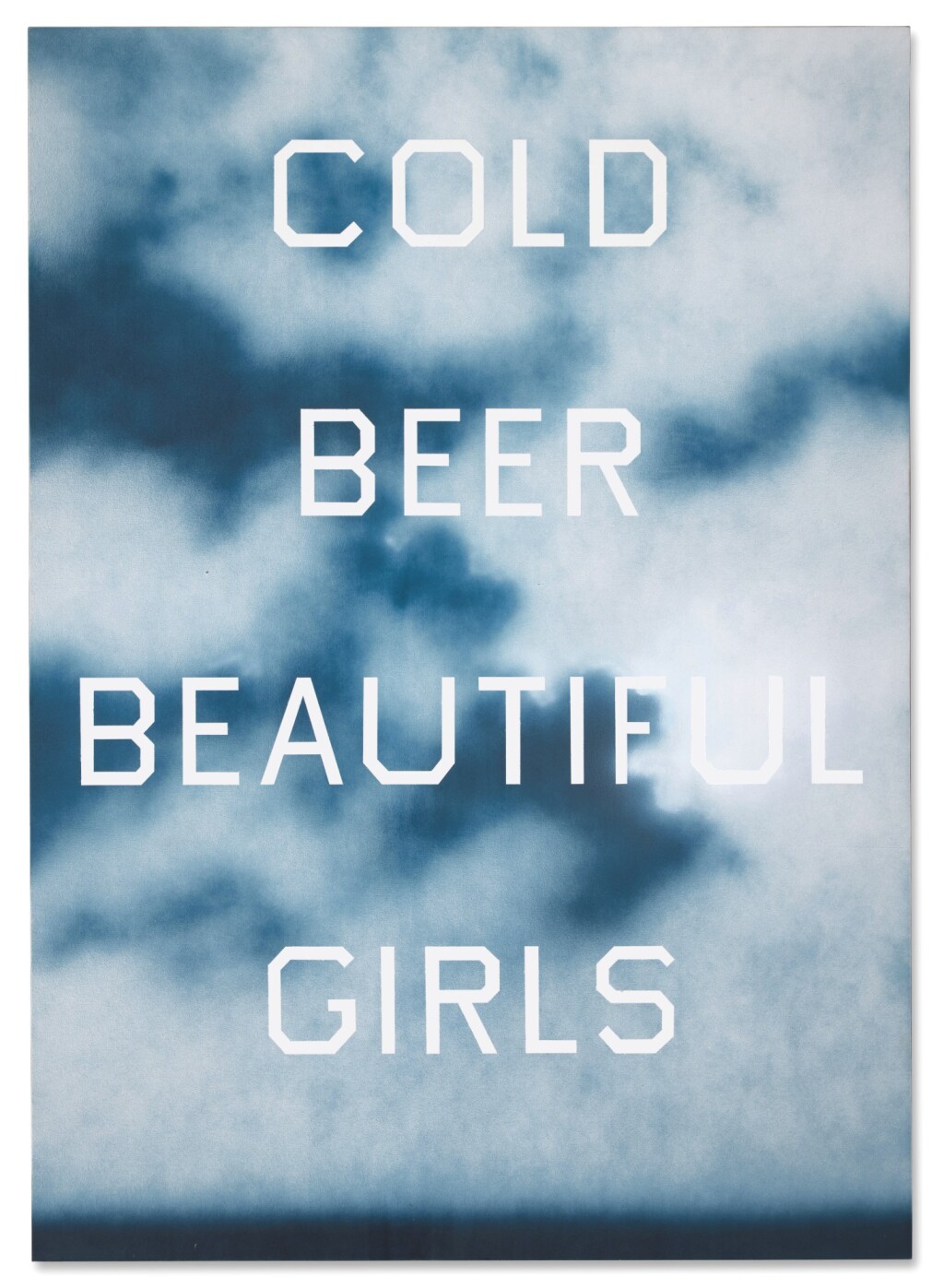
ED RUSCHA (B. 1937)
Cold Beer Beautiful Girls, 1993
Acrylic on canvas
84×60 inches (213.4 x 152.4 cm)
signed Ed Ruscha and dated ’93 (on the reverse)
Signed Ed Ruscha, titled Cold Beer Beautiful Girls and dated 1993 (on the stretcher)
#9. Truth, 1973
Christie’s New-York: 16 May 2024
Estimated: USD 7,000,000 – 10,000,000
USD 14,785,000
ED RUSCHA (B. 1937), Truth | Christie’s (christies.com)

ED RUSCHA (B. 1937)
Truth, 1973
Oil on canvas
54×60 inches (137.2 x 152.4 cm)
Signed, dedicated, inscribed and dated ‘For Merle and Pearl Edward Ruscha 1973 IT RHYMES WITH TOOTH’
(on the reverse)
#10. Georges’ Flag, 1999
Sotheby’s New-York: 18 November 2024
Estimated: USD 8,000,000 – 12,000,000
USD 13,650,000
Georges’ Flag | The Now and Contemporary Evening Auction | 2024 | Sotheby’s
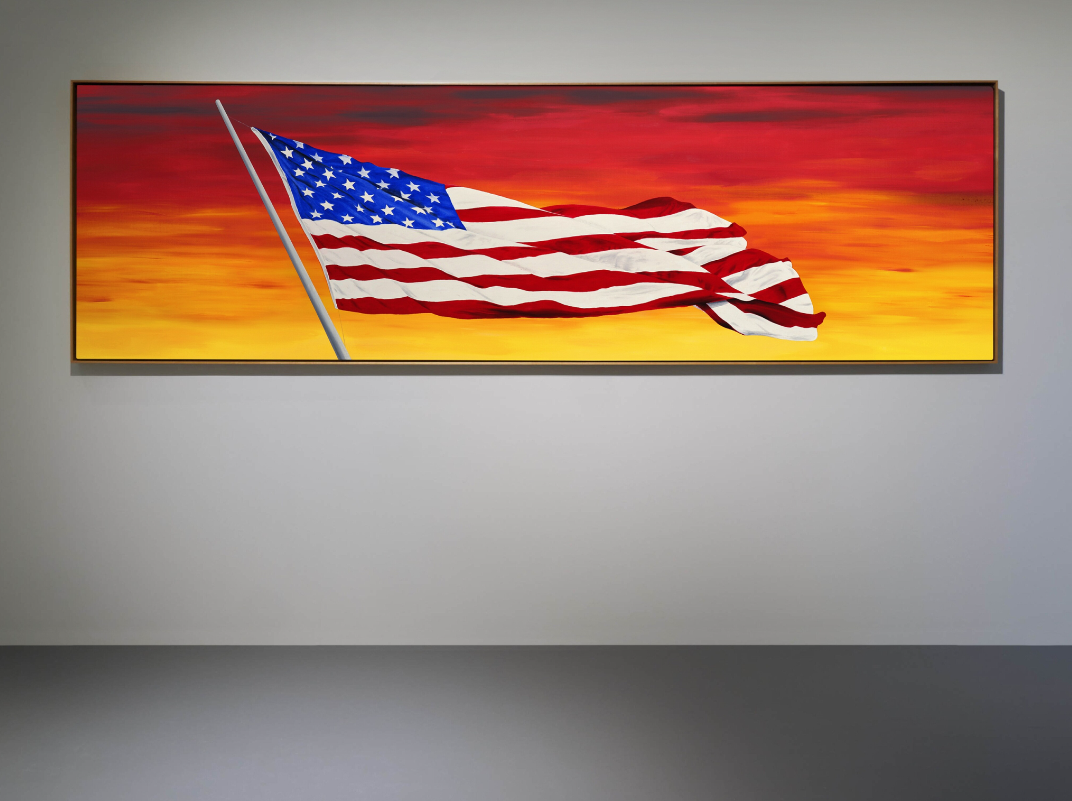
ED RUSCHA (b. 1937)
Georges’ Flag, 1999
Oil on canvas
38 x 129 1/8 inches (96.5 x 328 cm)
Signed and dated 1999 (on the reverse)
Signed, titled and dated 1999 (on the stretcher)
#11. Mint (Green), 1968
Sotheby’s New-York: 8 November 2023
Estimated: USD 10,000,000 – 15,000,000
USD 12,973,500
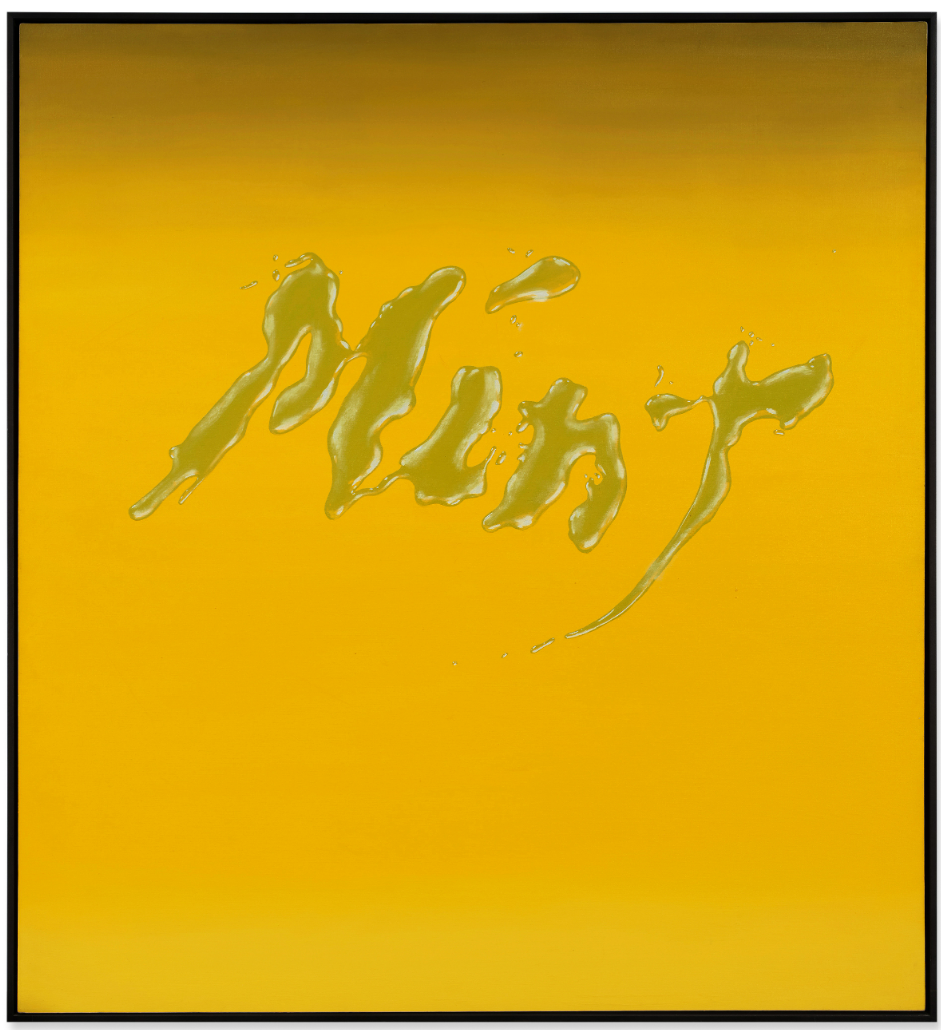
ED RUSCHA (b. 1937)
Mint (Green), 1968
Oil on canvas
60×55 inches (152.4 x 139.7 cm)
Signed and dated 1968 (on the reverse)
USD 10 million
#12. I Tried to Forget to Remember, 1986
Sotheby’s New-York: 15 May 2019
Estimated: USD 5,000,000 – 7,000,000
USD 8,237,000
(#7) ED RUSCHA | I Tried to Forget to Remember (sothebys.com)
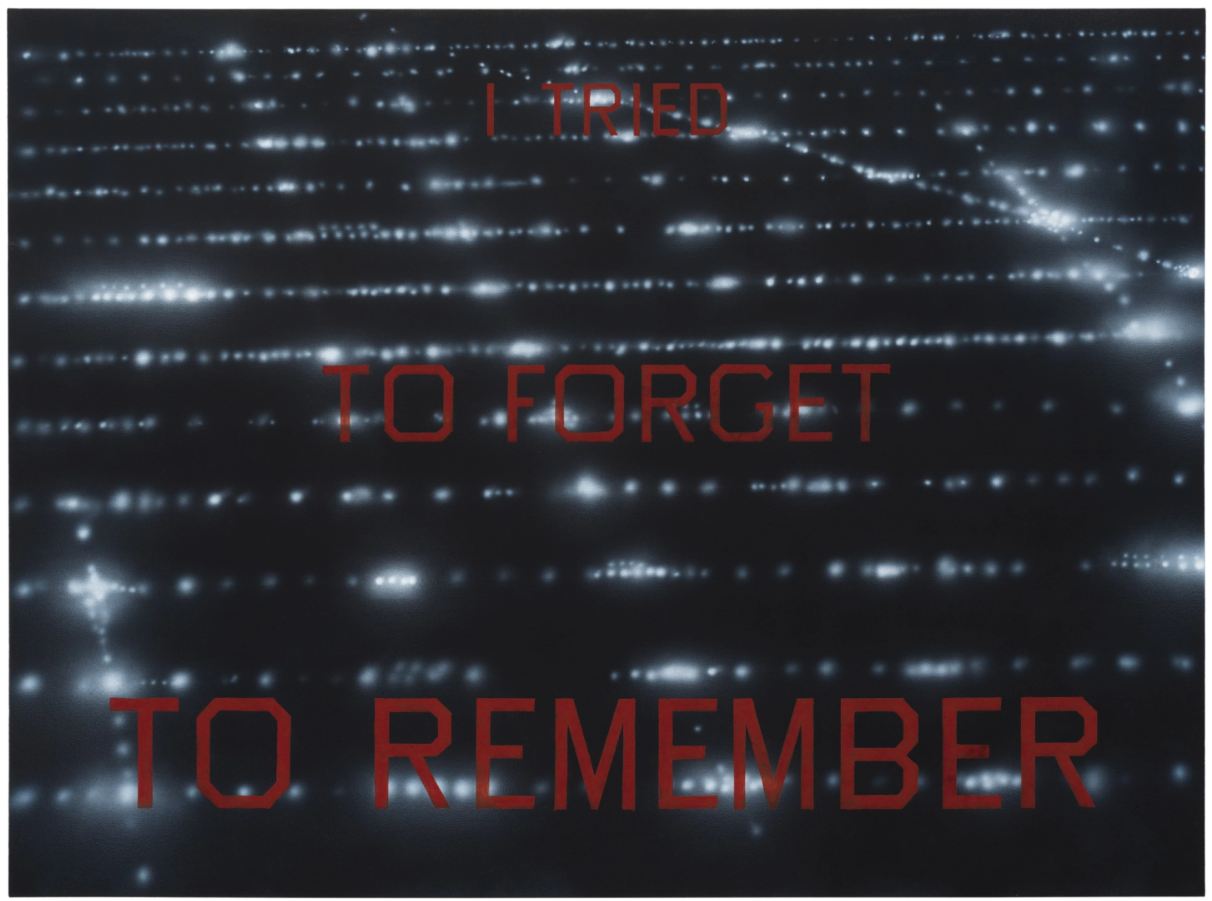
ED RUSCHA
I Tried to Forget to Remember, 1986
Oil and acrylic on canvas
72×96 inches (182.9 x 243.8 cm)
Signed and dated ’86 on the reverse
#13. Burning Gas Station, 1965
Christie’s New-York: 12 November 2007
Estimated: USD 4,000,000 – 6,000,000
USD 6,985,000
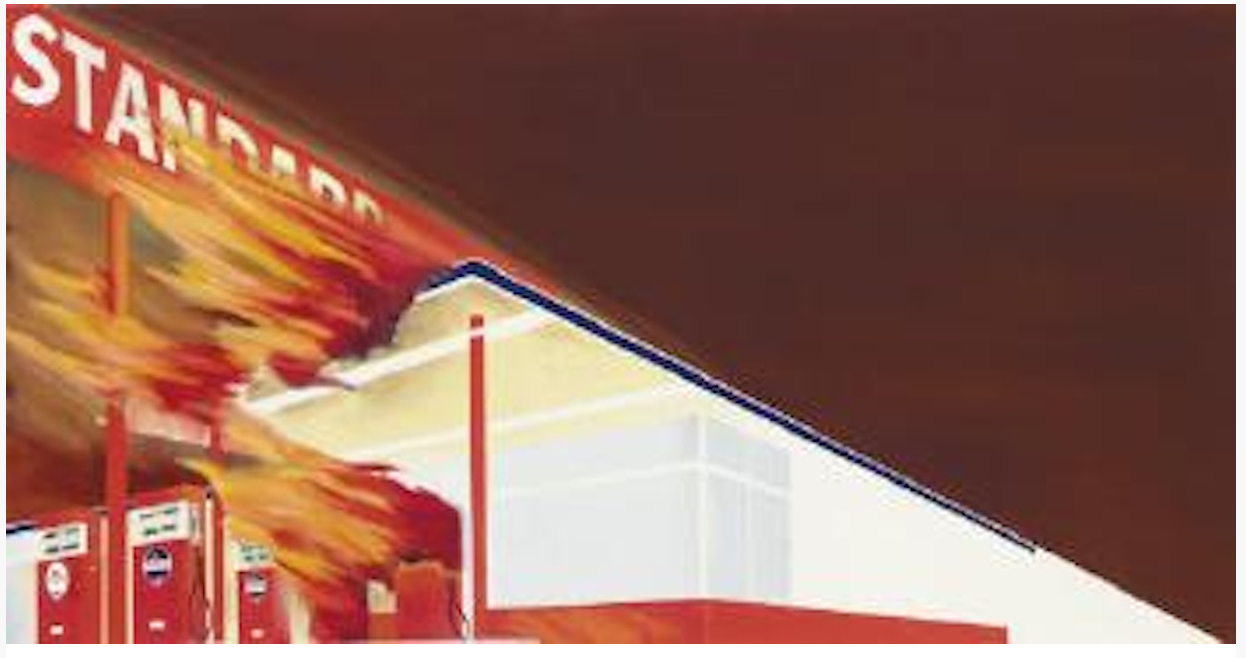
ED RUSCHA
Burning Gas Station, 1965
Oil and graphite on canvas
20 1/2 x 39 inches (52.1 x 99.1 cm)
Signed and dated on the reverse
#14. Brave Man’s Porch, 1996
Sotheby’s New-York: 16 November 2017
Estimated: USD 4,000,000 – 6,000,000
USD 6,550,400
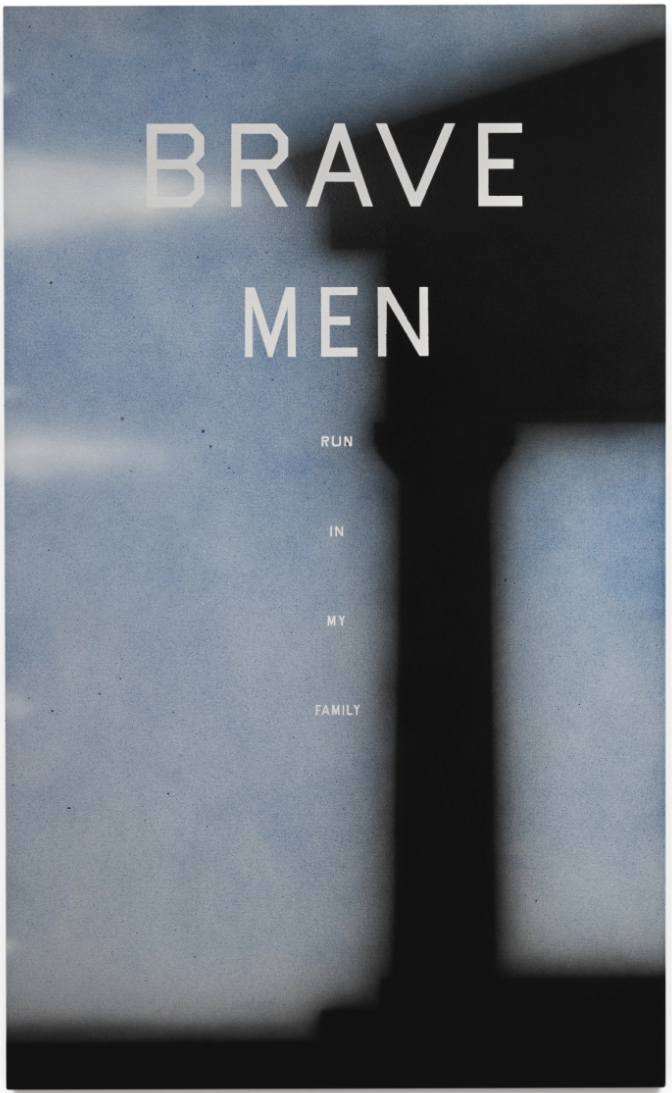
ED RUSCHA
Brave Man’s Porch, 1996
Acrylic on canvas
82×50 inches (208.3 x 127 cm)
Signed and dated 1996 on the reverse; signed, titled and dated 1996 on the stretcher
#15. Plenty Big Hotel Room (Painting for the American Indian), 1985
Sotheby’s New-York: 8 November 2023
Estimated: USD 5,000,000 – 7,000,000
USD 6,079,500
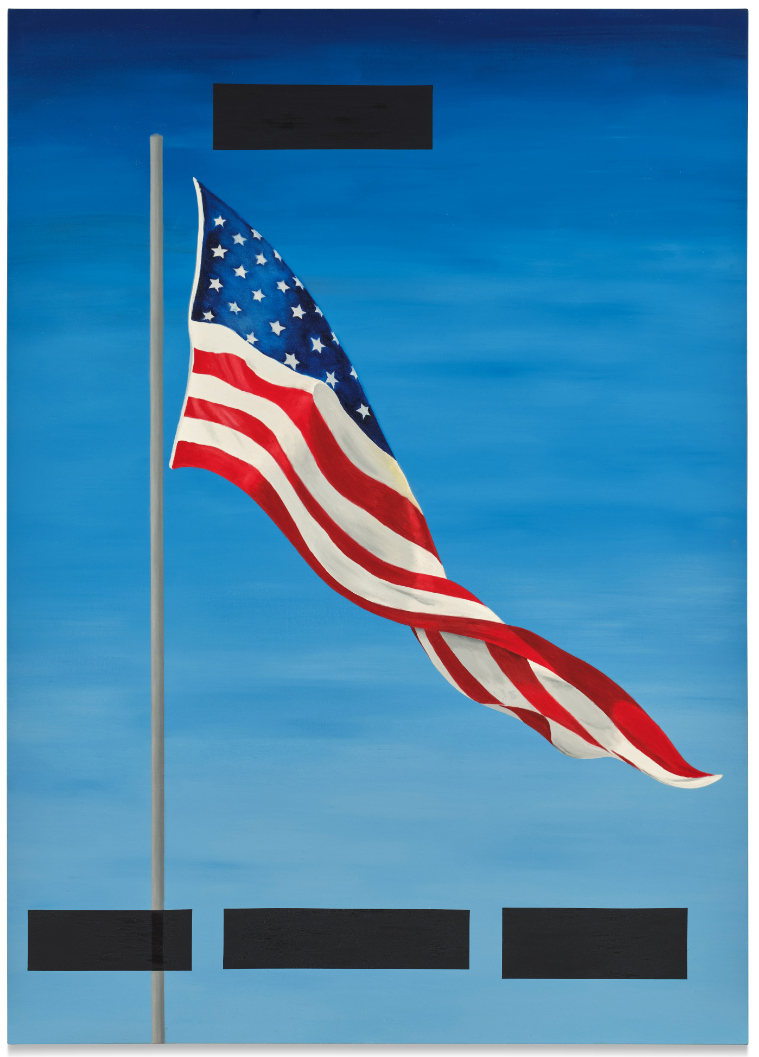
ED RUSCHA (b. 1937)
Plenty Big Hotel Room (Painting for the American Indian), 1985
Oil on canvas
84×60 inches (213.4 x 152.4 cm)
Signed and dated 85 (on the reverse)
PART II: AUCTION RESULTS
2026 Upcoming Lots
2026 Auction Results
FOR PAINTINGS ONLY
PRELIMINARY AUCTION RESULTS
As of 15 June 2026
#1. Me, 1999
Sotheby’s New-York: 14 May 2026
Estimated: USD 4,000,000 – 6,000,000
USD 6,952,000
Ed Ruscha | Me | The Now & Contemporary Evening Auction | 2026 |
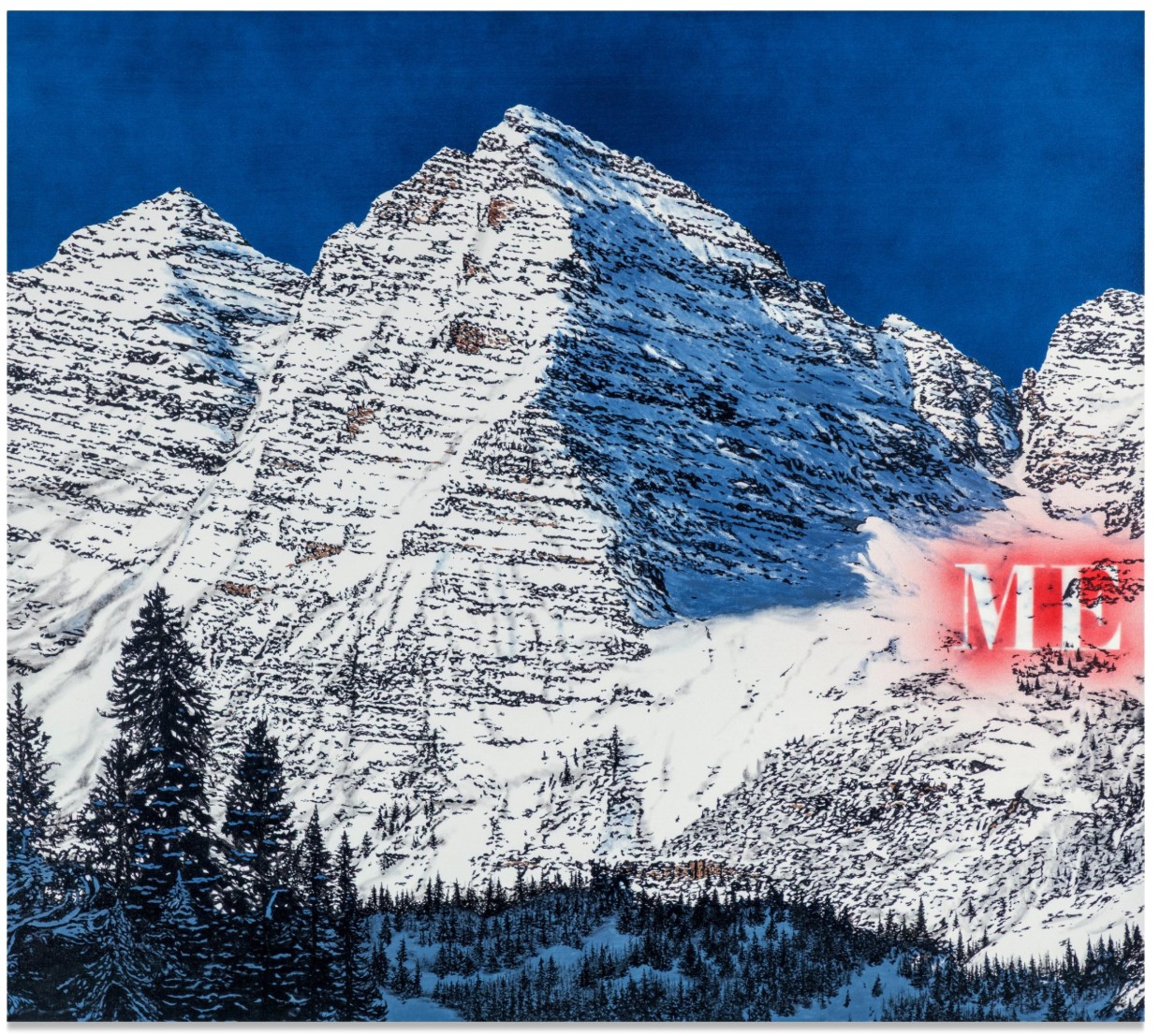
ED RUSCHA (b. 1937)
Me, 1999
Acrylic on canvas
64×72 inches (162 x 182.9 cm)
Signed and dated 1999 (on the reverse)
USD 1 million
#2. Spasm, 1987
K Auction: 29 April 2026
Estimated: KRW 900,000,000 – 2,000,000,000
KRW 1,120,000,000 (Hammer)
KRW 1,321,600,000 / USD 888,400
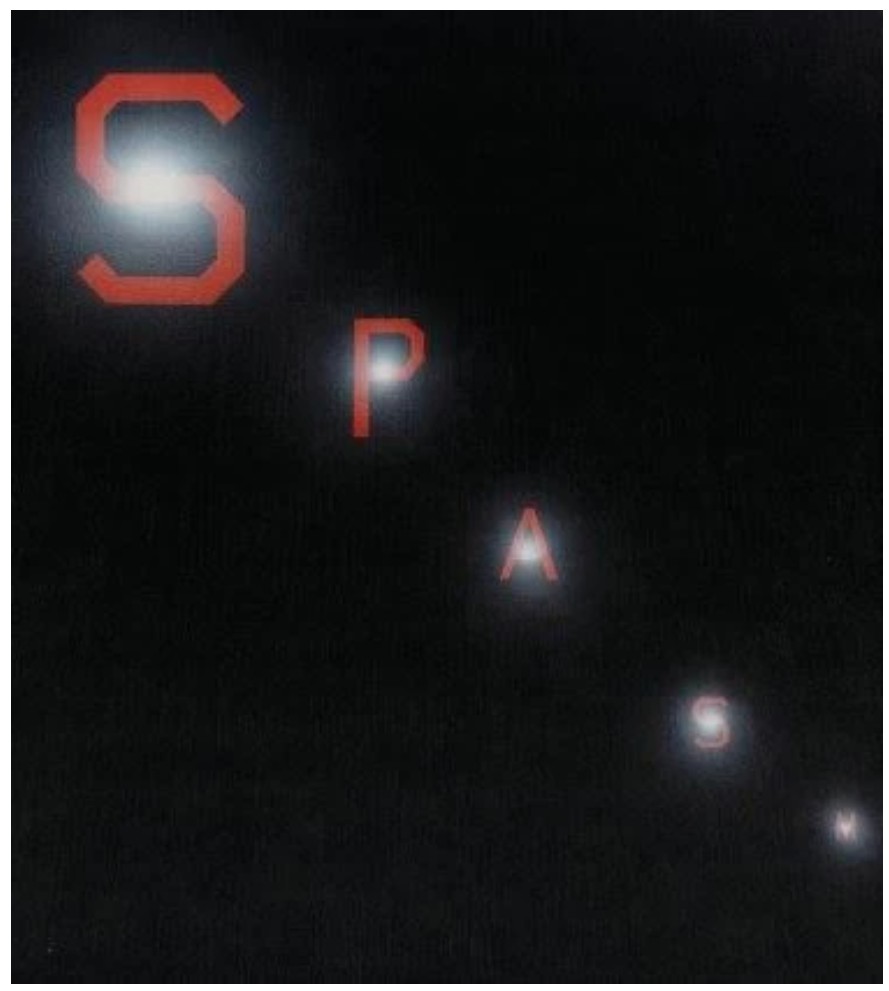
ED RUSCHA
Spasm, 1987
Acrylic on canvas
60×54 inches (152.5 x 137.2 cm)
Lots Passed
Psycho Spaghetti Western #2, 2010
Christie’s New-York: 20 May 2026
Estimated: USD 600,000 – 800,000
PASSED
ED RUSCHA (B. 1937), Psycho Spaghetti Western #2 | Christie’s
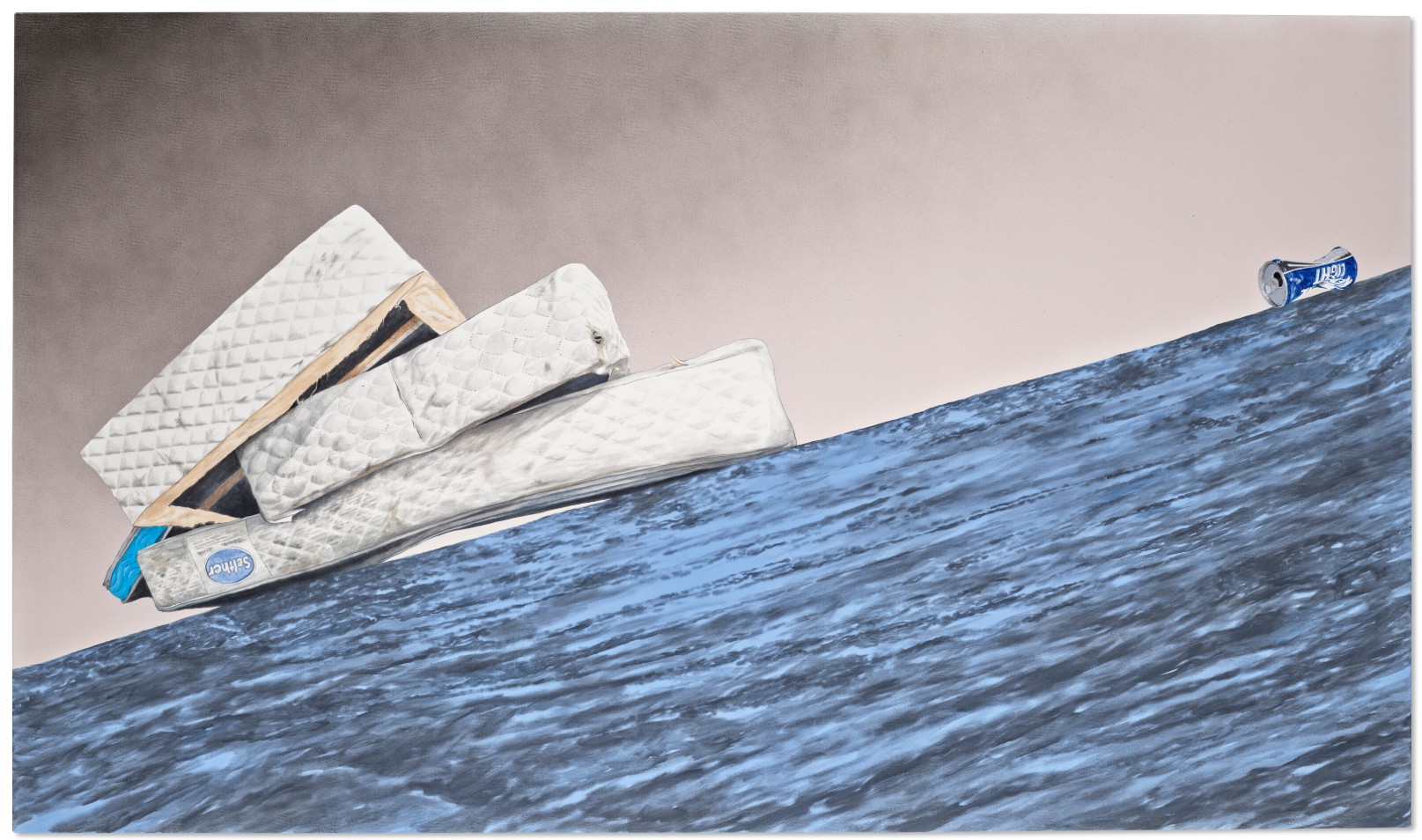
ED RUSCHA (B. 1937)
Psycho Spaghetti Western #2, 2010
Acrylic on canvas
42×72 inches (106.7 x 182.9 cm)
Signed and dated ‘Ed Ruscha 2010’ (on the reverse)
Titled ‘”PSYCHO SPAGHETTI WESTERN NO.2″‘ (on the stretcher)
Career Sportswear, 2000
Christie’s New-York: 20 May 2026
Estimated: USD 3,500,000 – 5,500,000
PASSED
ED RUSCHA (B. 1937), Career Sportswear | Christie’s

ED RUSCHA (B. 1937)
Career Sportswear, 2000
Acrylic on canvas
60×60 inches (154.2 x 154.2 cm.)
Signed and dated ‘Ed Ruscha 2000’ (on the reverse)
2025 Auction Results
FOR PAINTINGS ONLY
12 lots sold at auction in 2025 for a total turnover of USD 38,078,400. With 2 lots failing to sell, the sell-through rate is 86%. The highest price has been achieved by That Was Then This is Now, a WORD painting dated 1989, that sold at Sotheby’s in New-York, on 15 May 2025, for USD 7,795,000.
2025 Top 3 Lots
10 lots sold for more than USD 1 million, generating a cumulative turnover of USD 37,495,600, representing 98.5% of the total turnover of 2025. 3 lots sold for more than USD 5 million, generating a cumulative turnover of USD 21,196,000, representing 55.5% of the total turnover of 2025.
XXXXXXXXXX
#1. That Was Then This Is Now, 1989
Sotheby’s New-York: 15 May 2025
Estimated: USD 7,000,000 – 10,000,000
USD 7,795,000
WORD PAINTING
READ MORE IN FOCUS SECTION
That Was Then This Is Now | The Now and Contemporary Evening Auction | 2025 | Sotheby’s
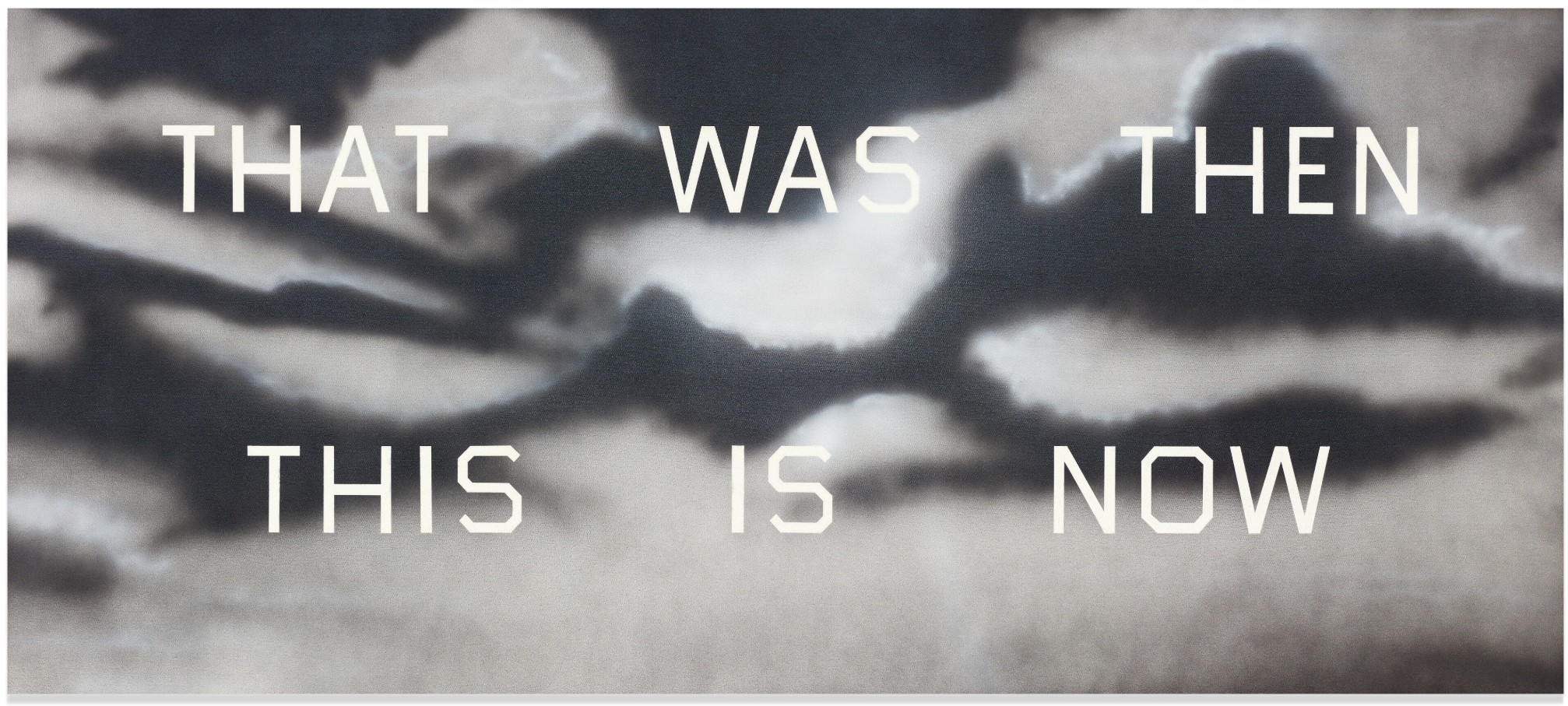
ED RUSCHA (b. 1937)
That Was Then This Is Now, 1989
Acrylic on canvas
42×96 inches (106.7 x 243.8 cm)
Signed and dated 1989 (on the reverse)
Signed, titled and dated 1989 (on the stretcher)
#2. How Do You Do?, 2003
Edlis Neeson Collection
Christie’s New-York: 19 November 2025
Estimated: USD 5,000,000 – 7,000,000
USD 6,785,000
MOUNTAIN PAINTING
READ MORE IN FOCUS SECTION
ED RUSCHA (B. 1937), How Do You Do? | Christie’s
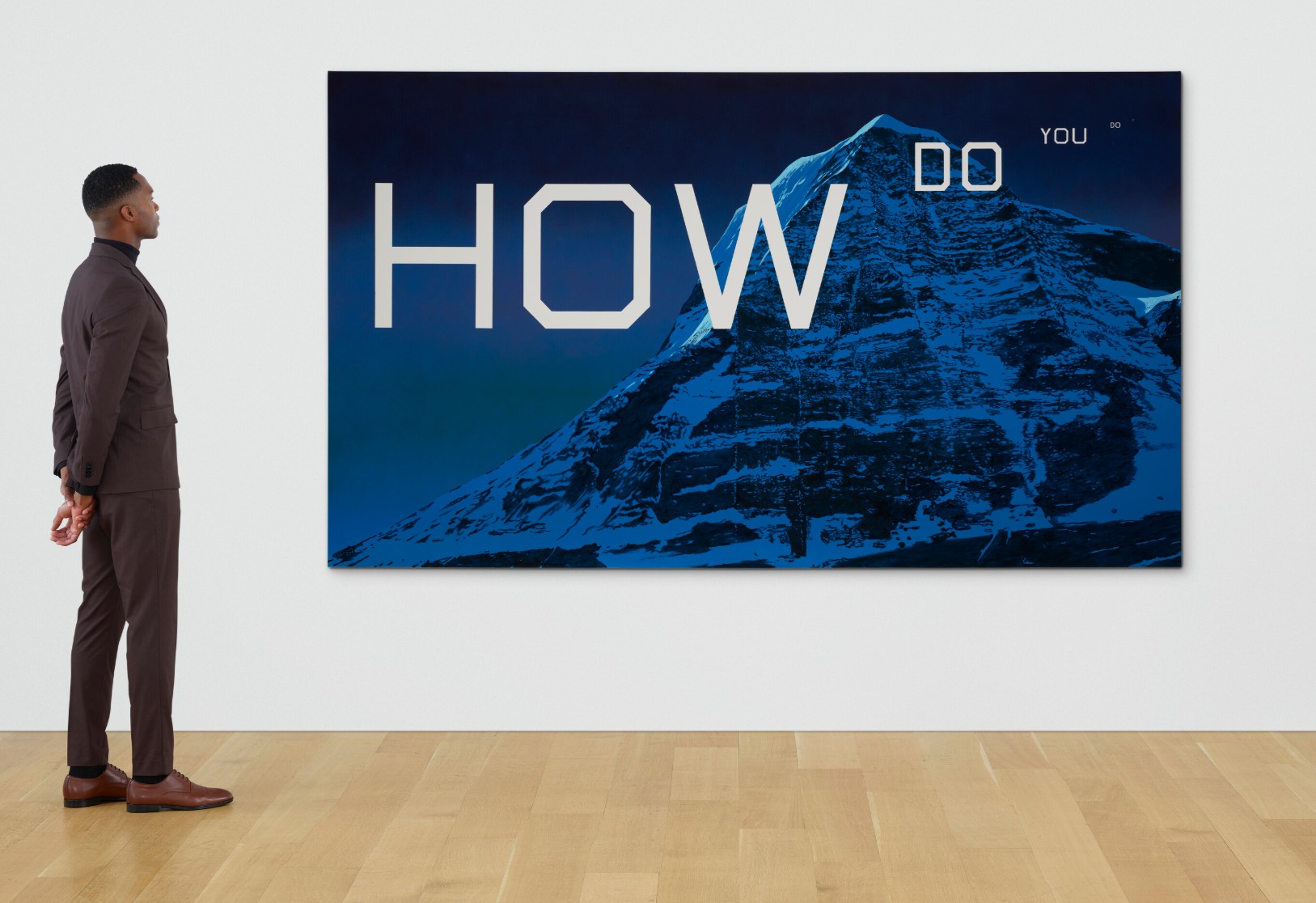
ED RUSCHA (B. 1937)
How Do You Do?, 2003
Oil on canvas
72×124 inches (182.9 x 315 cm)
Signed and dated twice ‘Ed Ruscha 2003’ (on the reverse)
#3. Blast Curtain, 1999
Christie’s New-York: 14 May 2025
Estimated: USD 4,000,000 – 6,000,000
USD 6,616,000
MOUNTAIN PAINTING
READ MORE IN FOCUS SECTION
ED RUSCHA (B. 1937), Blast Curtain | Christie’s
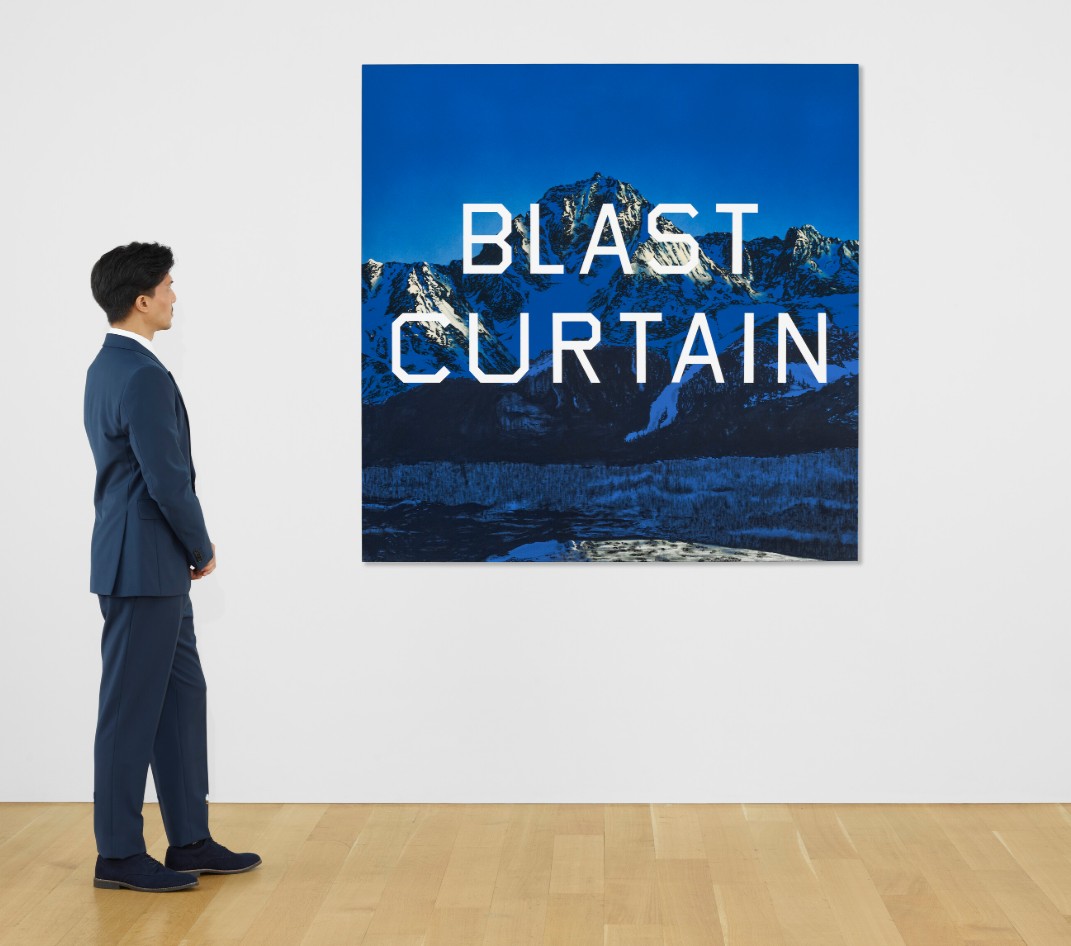
ED RUSCHA (B. 1937)
Blast Curtain, 1999
Acrylic on canvas
64×64 inches (162.6 x 162.6 cm)
Signed and dated ‘Ed Ruscha 1999’ (on the reverse)
USD 5 million
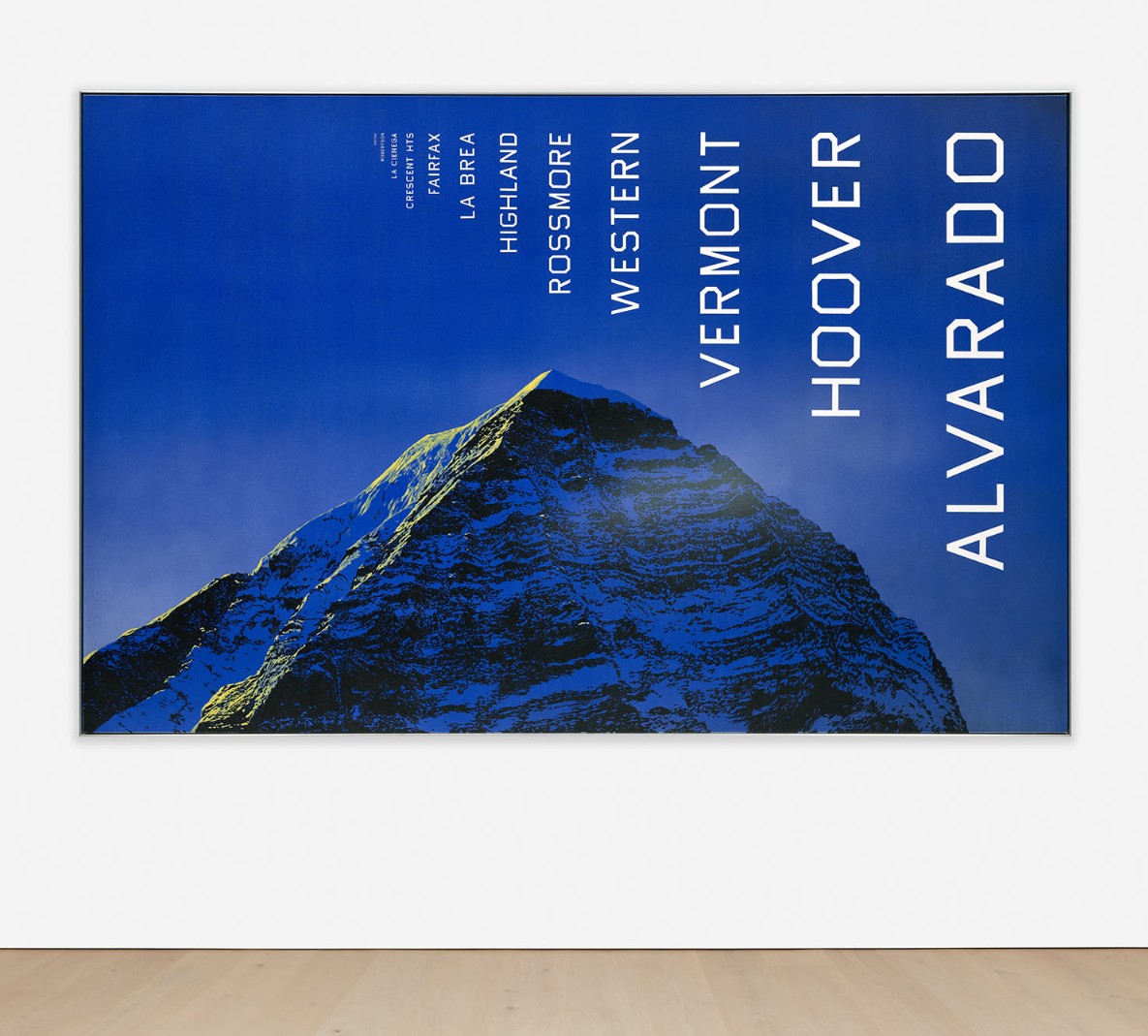
#4. Alvarado to Doheny, 1998
Phillips New-York: 13 May 2025
Estimated: USD 4,000,000 – 6,000,000
USD 4,900,000
MOUNTAIN PAINTING
READ MORE IN FOCUS SECTION
Ed Ruscha Modern & Contemporary Art Evening Sale
#5. Devil or Angel, 1973
Christie’s New-York: 14 May 2025
Estimated: USD 2,500,000 – 3,500,000
USD 2,954,000
ED RUSCHA (B. 1937), Devil or Angel | Christie’s
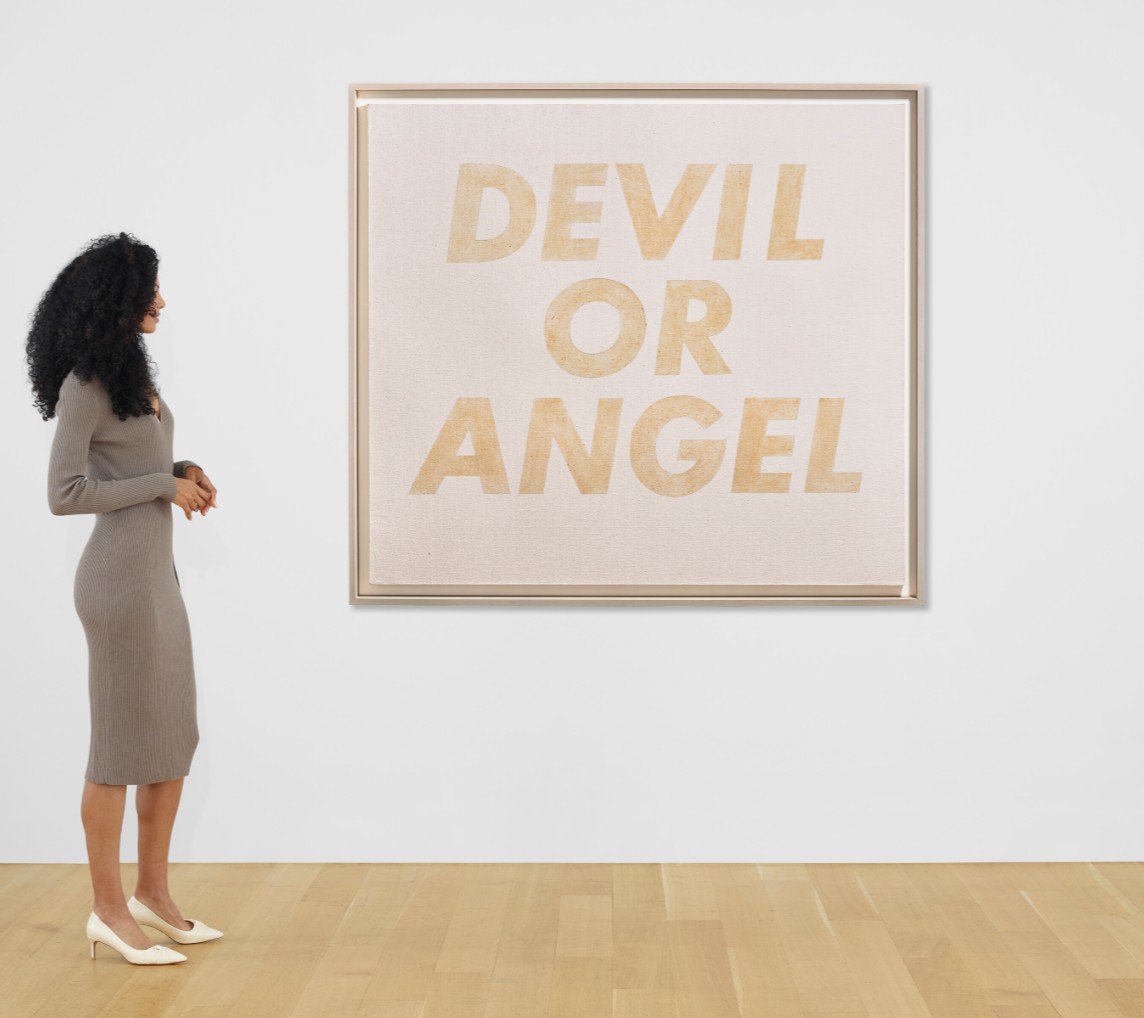
ED RUSCHA (B. 1937)
Devil or Angel, 1973
Red cabbage stain on canvas
54×60 inches (137.2 x 152.4 cm)
#6. Yip Yip, 1994
Sotheby’s New-York: 16 May 2025
Estimated: USD 600,000 – 800,000
USD 2,246,000
SILHOUETTE PAINTING
READ MORE IN FOCUS SECTION
Yip Yip | Contemporary Day Auction | 2025 | Sotheby’s
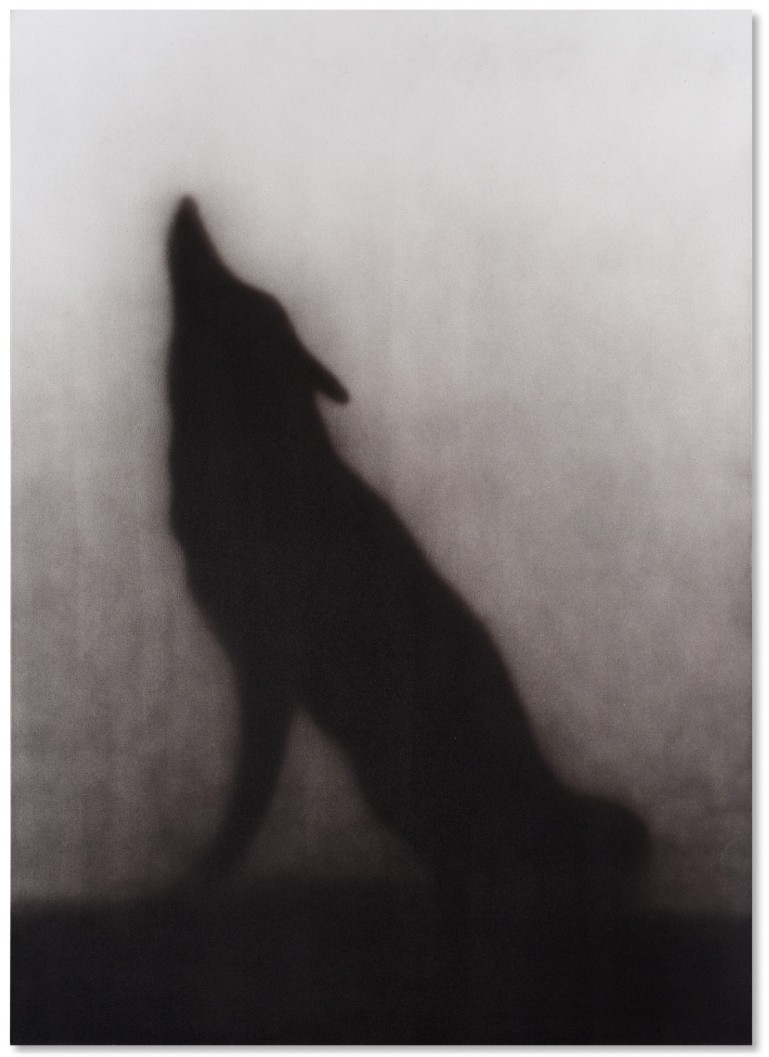
ED RUSCHA (b. 1937)
Yip Yip, 1994
Acrylic on canvas
84×60 inches (213.4 x 152.4 cm)
Signed and dated 1994 (on the reverse)
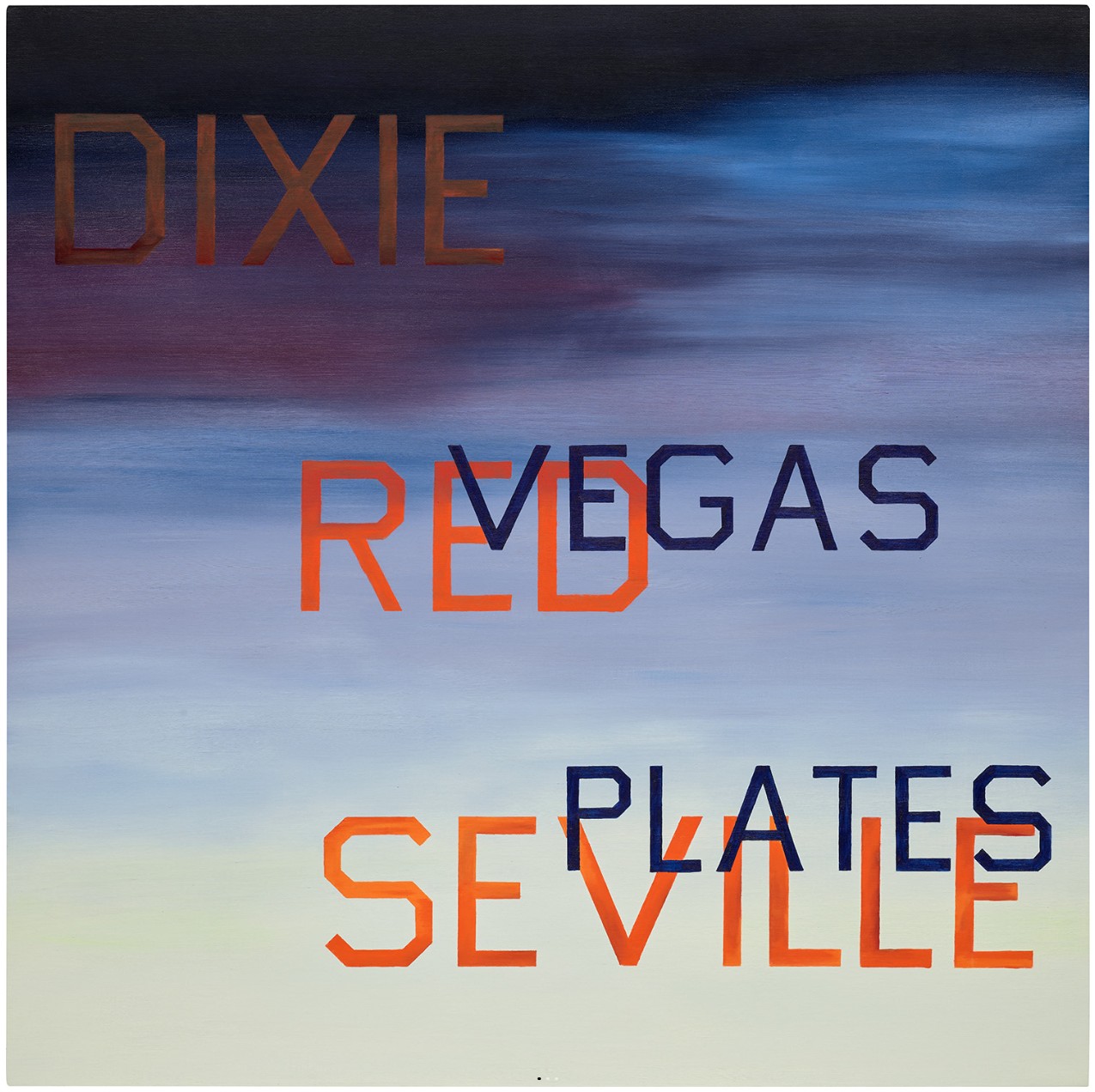
#7. Dixie Red Seville, 1985
Phillips New-York: 13 May 2025
Estimated: USD 1,800,000 – 2,500,000
USD 1,996,000
Ed Ruscha Modern & Contemporary Art Evening Sale
#8. Pressures, 1967
Christie’s New-York: 27 February 2025
Estimated: USD 1,000,000 – 1,500,000
USD 1,986,000
ED RUSCHA (B. 1937), Pressures | Christie’s
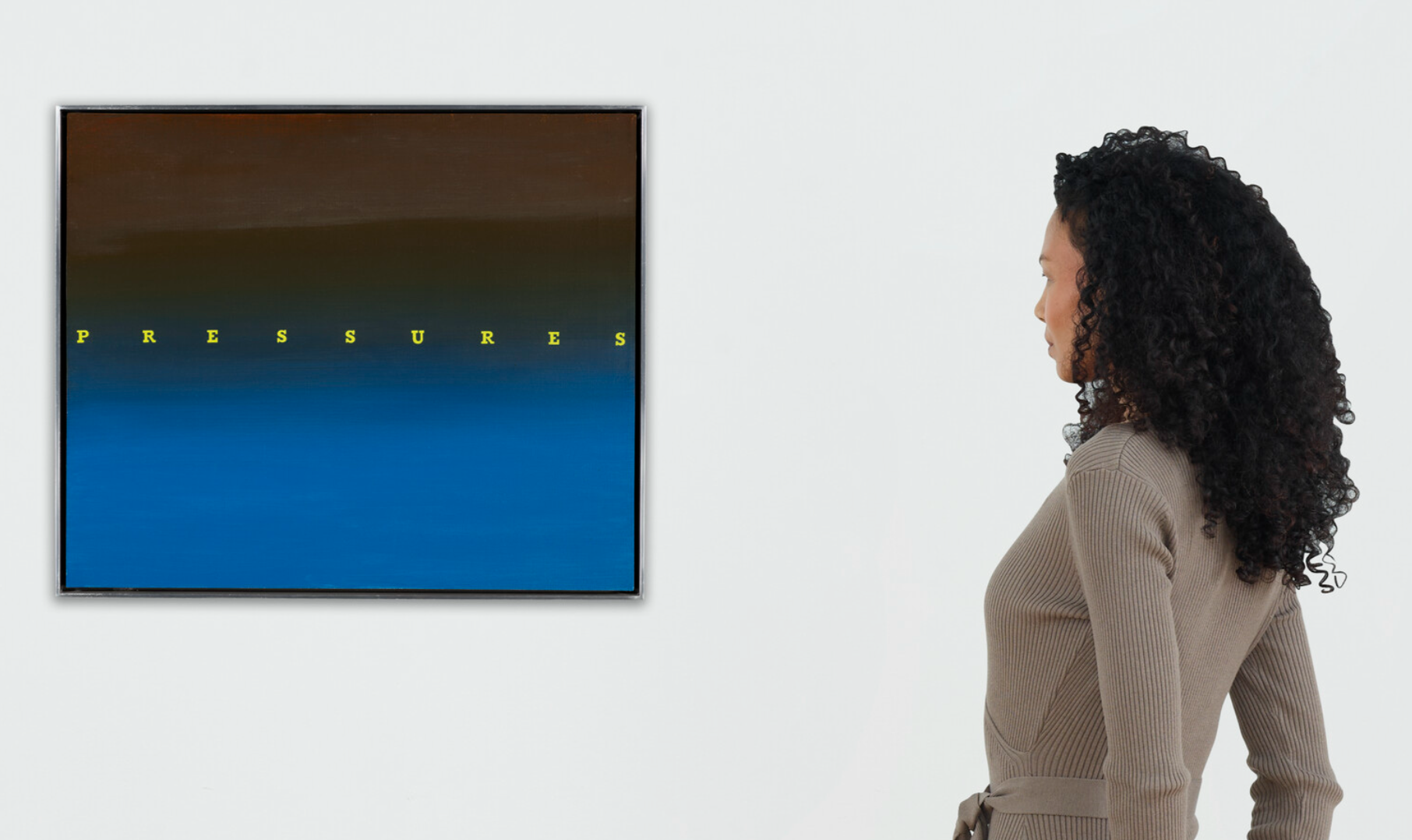
ED RUSCHA (B. 1937)
Pressures, 1967
Oil on canvas
20×24 inches (50.8 x 61 cm)
Signed, titled and dated ‘EDWARD RUSCHA “PRESSURES” 1967’ (on the stretcher)
#9. Dry Frontier, 1987
Christie’s London: 5 March 2025
Estimated: GBP 600,000 – 800,000
GBP 945,000 / USD 1,209,600
SILHOUETTE PAINTING
ED RUSCHA (B. 1937), Dry Frontier | Christie’s
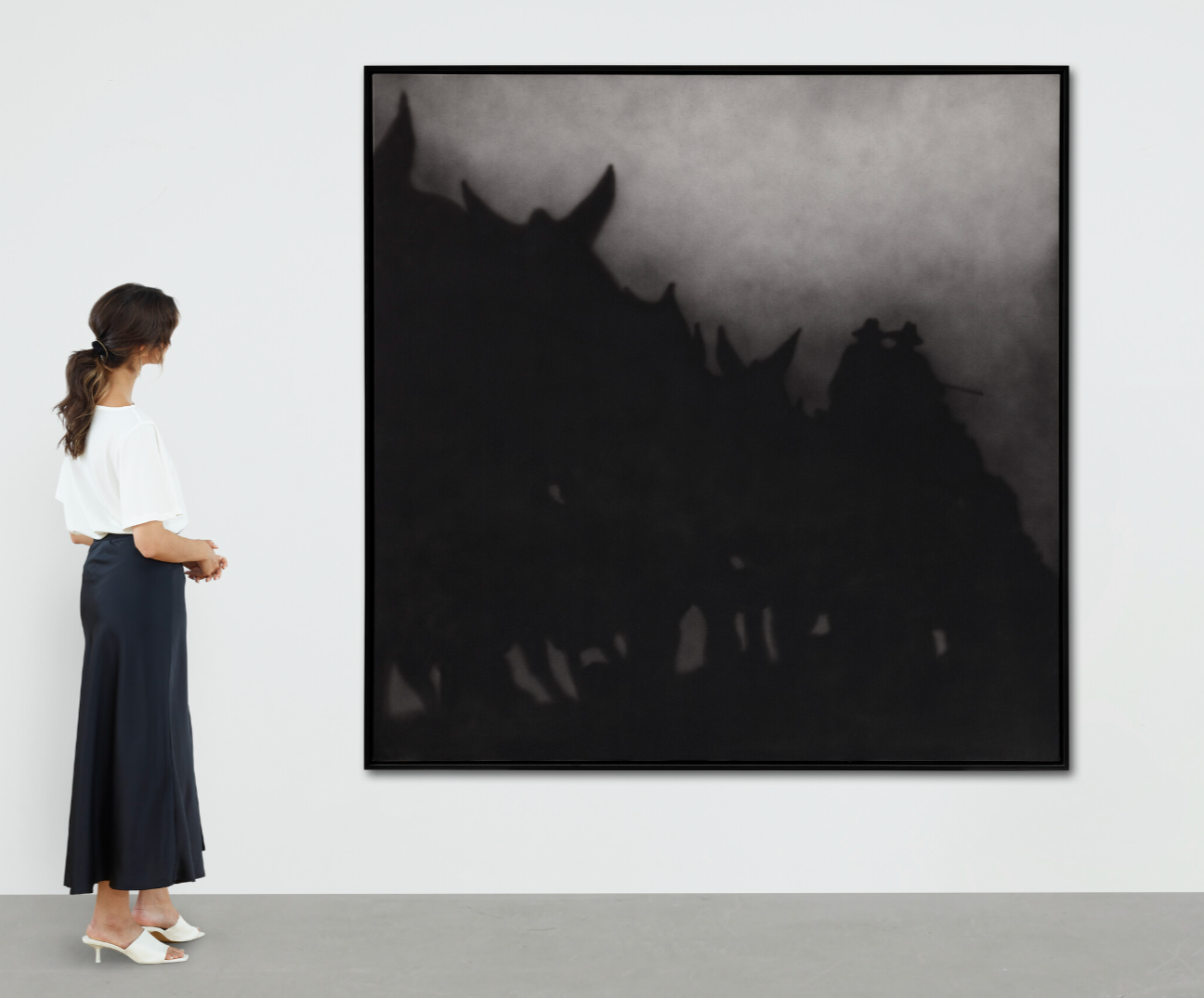
ED RUSCHA (B. 1937)
Dry Frontier, 1987
Acrylic on canvas
72x 72 inches (182.9 x 182.9 cm)
Signed and dated ‘Ed Ruscha 1987’ (on the reverse)
Signed, titled and dated ‘ED RUSCHA “DRY FRONTIER” 1987’ (on the stretcher)
#10. Johnny Tomorrow, 1984
Leonard & Louise Riggio: Collected Works
Christie’s New-York: 12 May 2025
Estimated: USD 1,500,000 – 2,000,000
USD 1,008,000
ED RUSCHA (B. 1937), Johnny Tomorrow | Christie’s
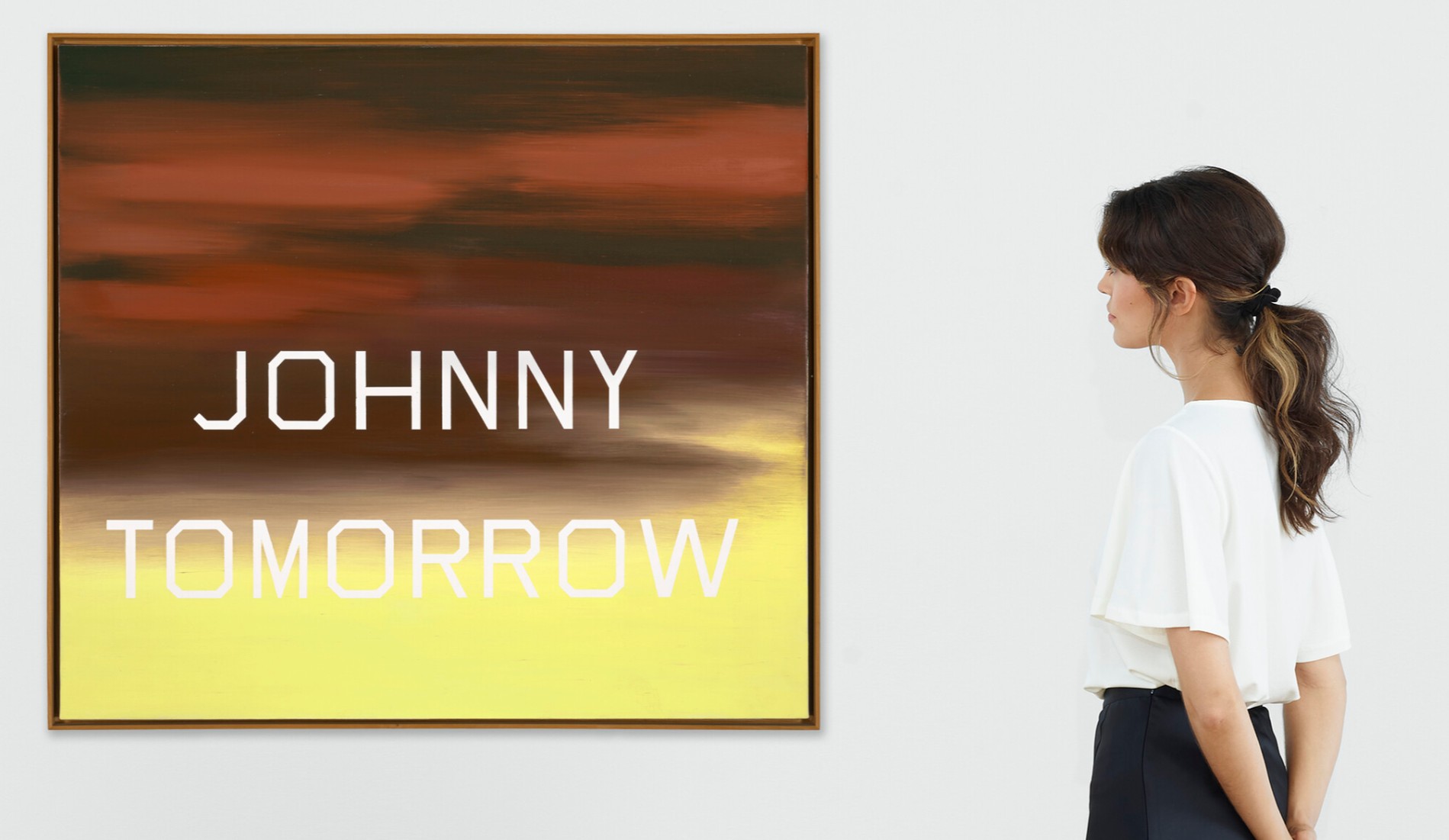
ED RUSCHA (B. 1937)
Johnny Tomorrow, 1984
Oil on canvas
36×40 inches (91.4 x 101.6 cm)
Signed twice, titled and dated twice
‘Ed Ruscha 1984 EDWARD RUSCHA “JOHNNY TOMORROW” 1984’
(on the backing board)
USD 1 million
#11. Hey What Say, 2016
Sotheby’s New-York: 26 September 2025
Estimated: USD 350,000 – 450,000
USD 406,400
Hey What Say | Contemporary Curated | 2025 | Sotheby’s
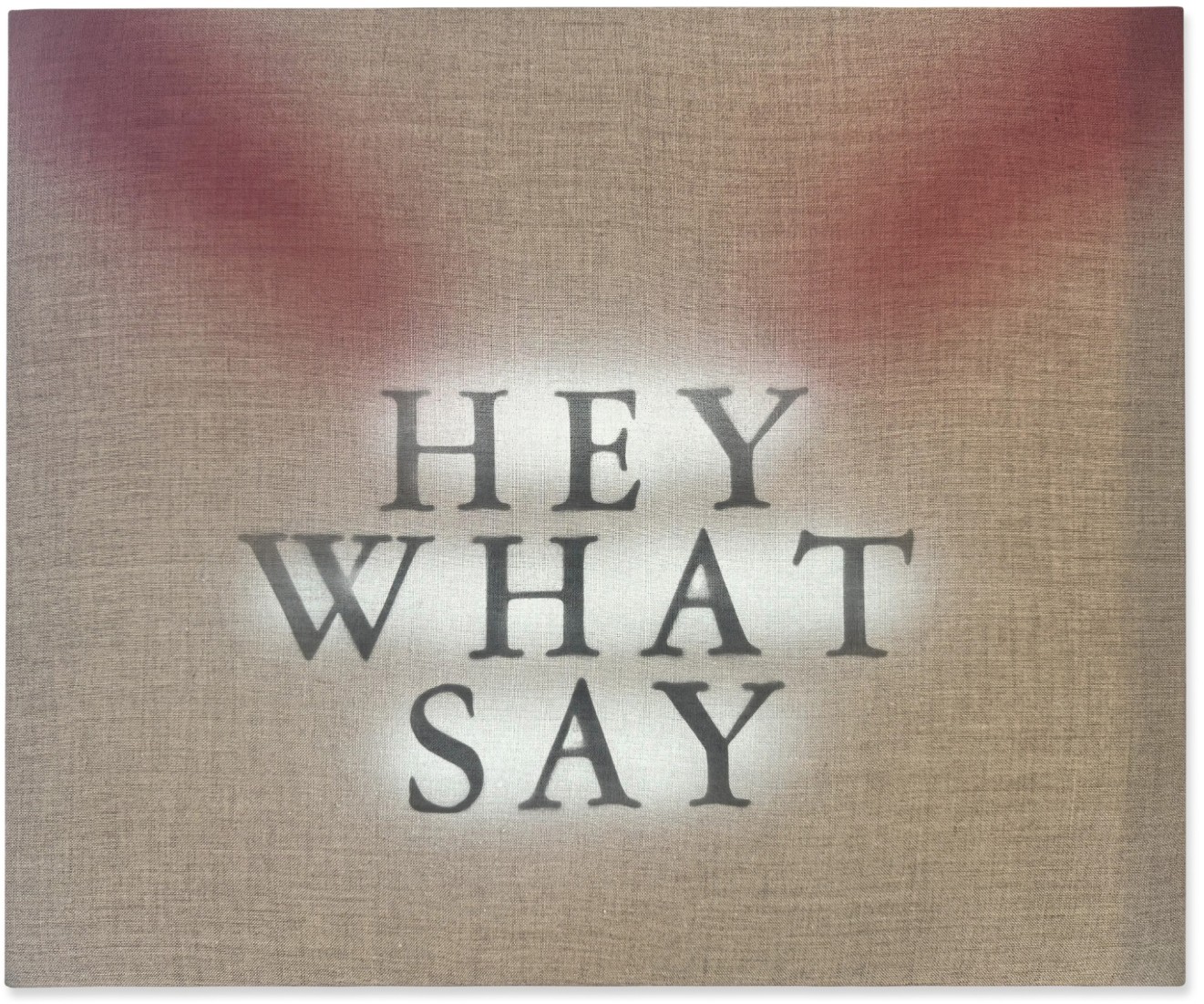
ED RUSCHA (b. 1937)
Hey What Say, 2016
Acrylic on linen
20×24 inches (50.8 x 61 cm)
Signed and dated 2016 (on the reverse)
#12. Limited Palette, 1989
Christie’s online: 18 July 2025
Estimated: USD 150,000 – 200,000
USD 176,400
ED RUSCHA (B. 1937), Limited Palette | Christie’s
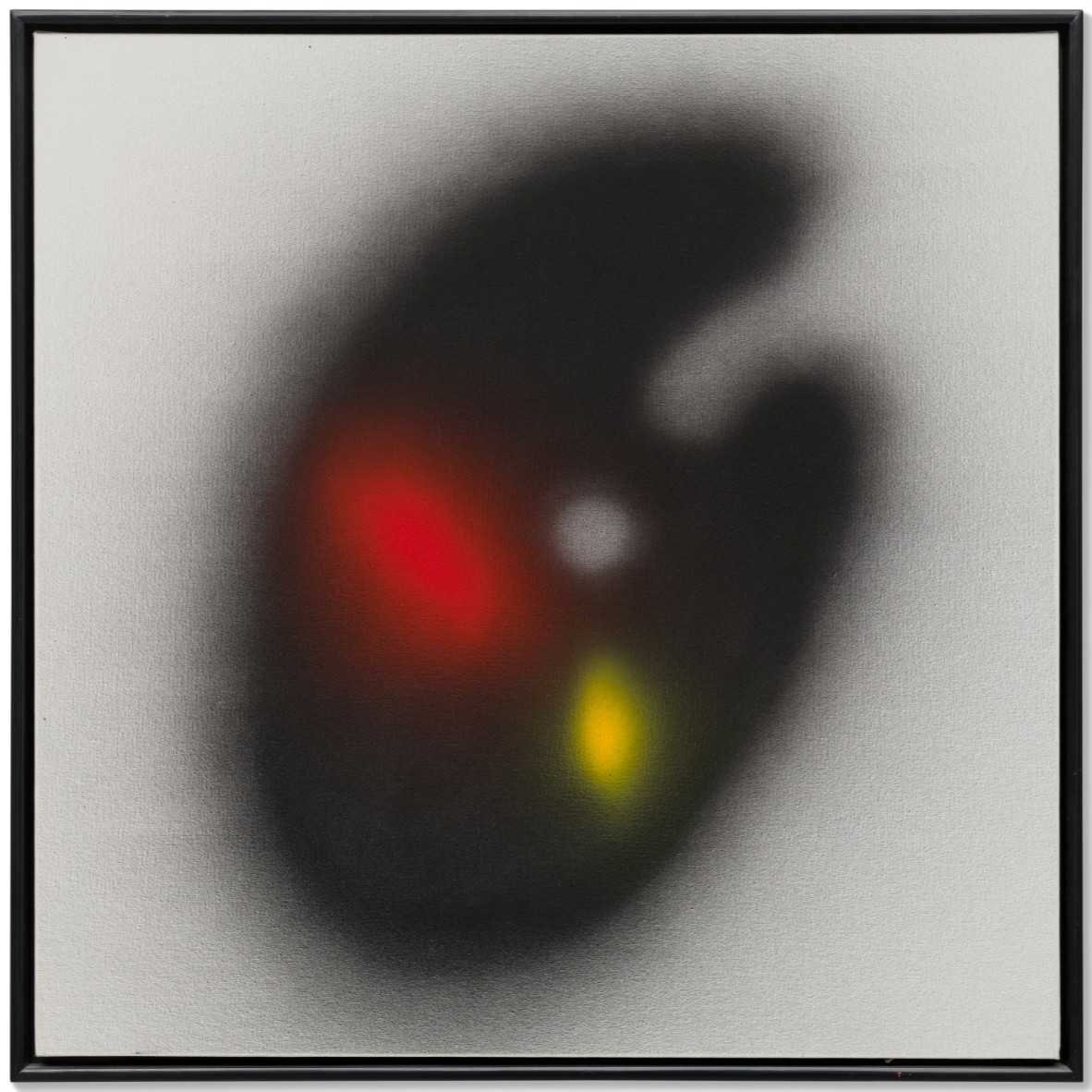
ED RUSCHA (B. 1937)
Limited Palette, 1989
Acrylic on canvas
36 1/4 x 36 inches (92.1 x 91.4 cm)
Signed and dated ‘Ed Ruscha 1989’ (on the reverse)
Signed, titled and dated ‘ED RUSCHA “LIMITED PALETTE” 1989’ (on the stretcher)
Lots Passed
Cosmo, Selma, Vine, 2000
Sotheby’s New-York: 19 November 2025
Estimated: USD 1,500,000 – 2,000,000
METRO PLOT PAINTING
PASSED
Cosmo, Selma, Vine | Contemporary Day Auction | 2025 | Sotheby’s
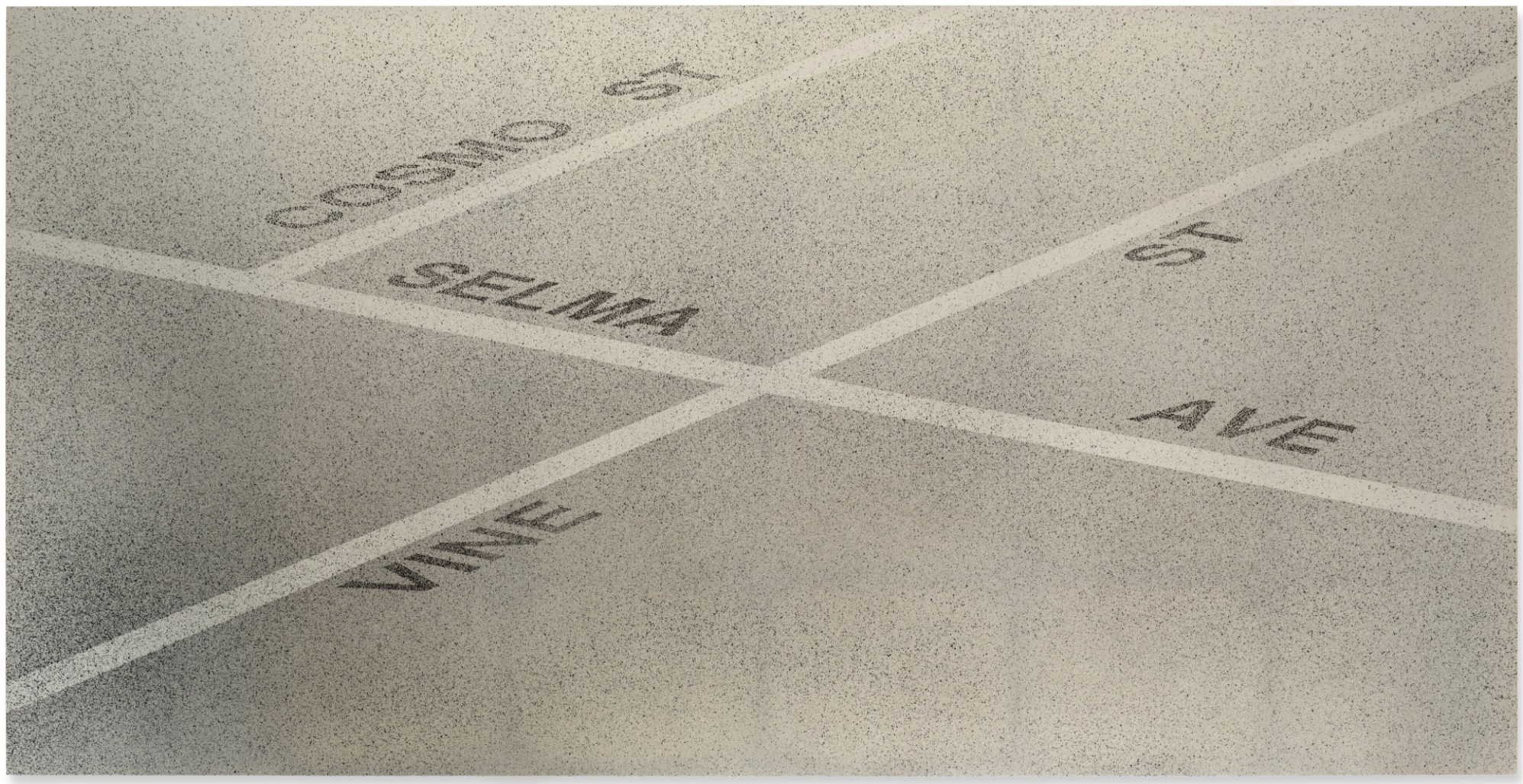
ED RUSCHA (b. 1937)
Cosmo, Selma, Vine, 2000
Acrylic on canvas
70 x 138 1/8 inches (177.8 x 350.8 cm)
Signed and dated 2000 (on the reverse)
Bowling Ball, Olive, 1969
Christie’s New-York: 15 May 2025
Estimated: USD 1,200,000 – 1,800,000
PASSED
ED RUSCHA (B. 1937), Bowling Ball, Olive | Christie’s
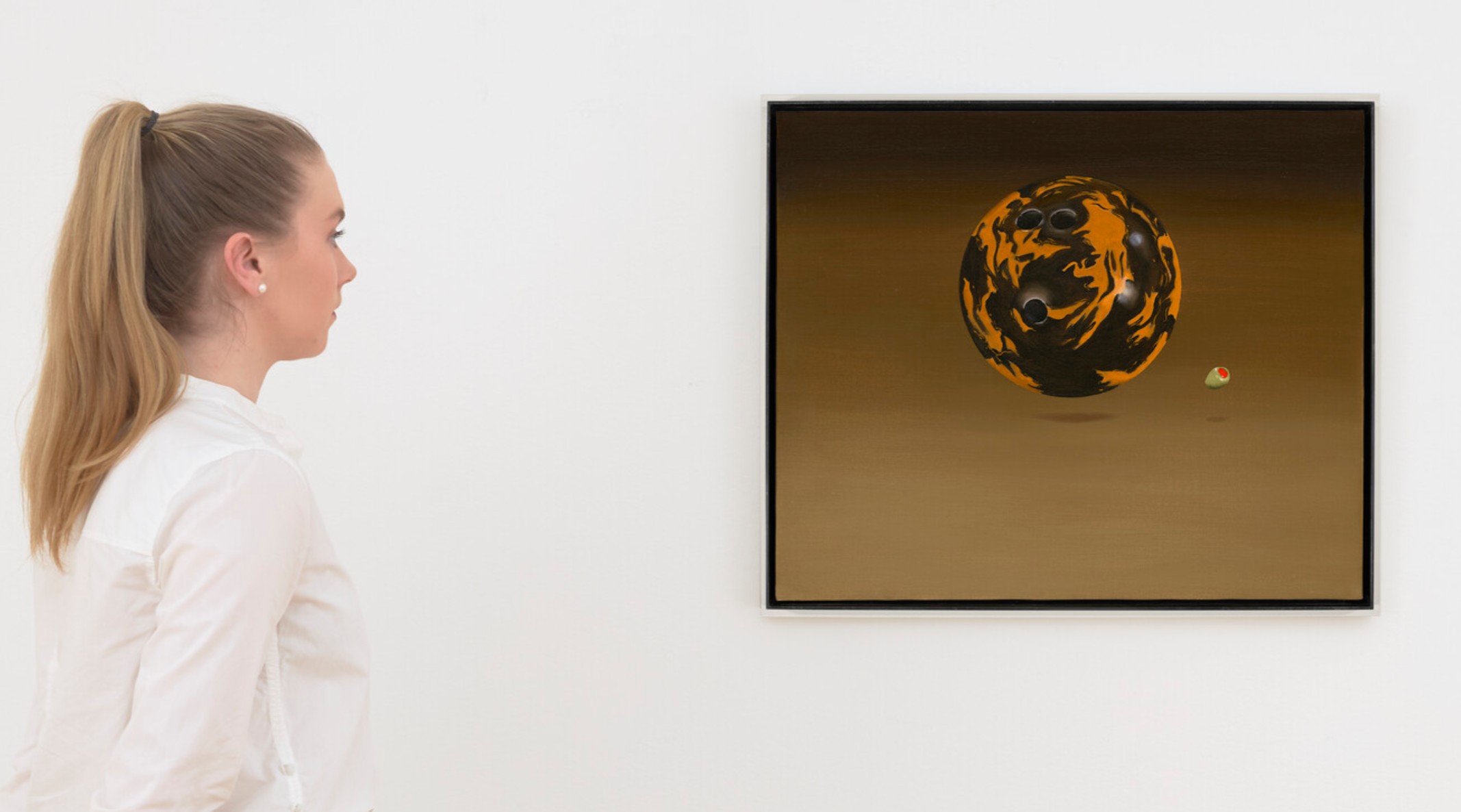
ED RUSCHA (B. 1937)
Bowling Ball, Olive, 1969
Oil on canvas
19 7/8 x 23 7/8 inches (50.5 x 60.6 cm)
Signed and dated ‘E. Ruscha 1969’ (on the reverse)
2024 Auction Results
FOR PAINTINGS ONLY
16 lots sold at auction in 2024 for a total turnover of USD 121,291,810. With 2 lots failing to sell, the sell-through rate is 89%. Standard Station, Ten Cent Western Being Torn in Half, a major painting dated 1964 from the artist’s celebrated Gas Station series, sold for USD 68,260,000, at Christie’s in New-York on 19 November 2024, a new world auction record for the artist.
2024 Top 3 Lots
3 paintings sold for more than USD 10 million, generating a cumulative turnover of USD 96,695,000, representing 79.7% of the total turnover for 2024.
XXXXXXXXXX
#1. Standard Station, Ten-Cent Western Being Torn in Half, 1964
Christie’s New-York: 19 November 2024
Estimate on Request
USD 68,260,000
NEW WORLD AUCTION RECORD FOR THE ARTIST
ED RUSCHA (B. 1937), Standard Station, Ten-Cent Western Being Torn in Half | Christie’s
ED RUSCHA (B. 1937)
Standard Station, Ten-Cent Western Being Torn in Half, 1964
Oil on canvas
65 x 121 1/2 inches (165.1 x 308.6 cm)
Signed, titled and dated ‘”STANDARD STATION, 10¢ WESTERN BEING TORN IN HALF” 1964 Edward J. Ruscha’ (on the stretcher)
#2. Truth, 1973
Christie’s New-York: 16 May 2024
Estimated: USD 7,000,000 – 10,000,000
USD 14,785,000
ED RUSCHA (B. 1937), Truth | Christie’s (christies.com)
ED RUSCHA (B. 1937)
Truth, 1973
Oil on canvas
54×60 inches (137.2 x 152.4 cm)
Signed, dedicated, inscribed and dated ‘For Merle and Pearl Edward Ruscha 1973 IT RHYMES WITH TOOTH’ (on the reverse)
#3. Georges’ Flag, 1999
Sotheby’s New-York: 18 November 2024
Estimated: USD 8,000,000 – 12,000,000
USD 13,650,000
Georges’ Flag | The Now and Contemporary Evening Auction | 2024 | Sotheby’s
ED RUSCHA (b. 1937)
Georges’ Flag, 1999
Oil on canvas
38 x 129 1/8 inches (96.5 x 328 cm)
Signed and dated 1999 (on the reverse)
Signed, titled and dated 1999 (on the stretcher)
USD 10 million
#4. Start Over Please, 2015
Christie’s London: 9 October 2024
Estimated: GBP 2,000,000 – 3,000,000
GBP 3,186,000 / USD 4,173,660
ED RUSCHA (B. 1937), Start Over Please | Christie’s (christies.com)
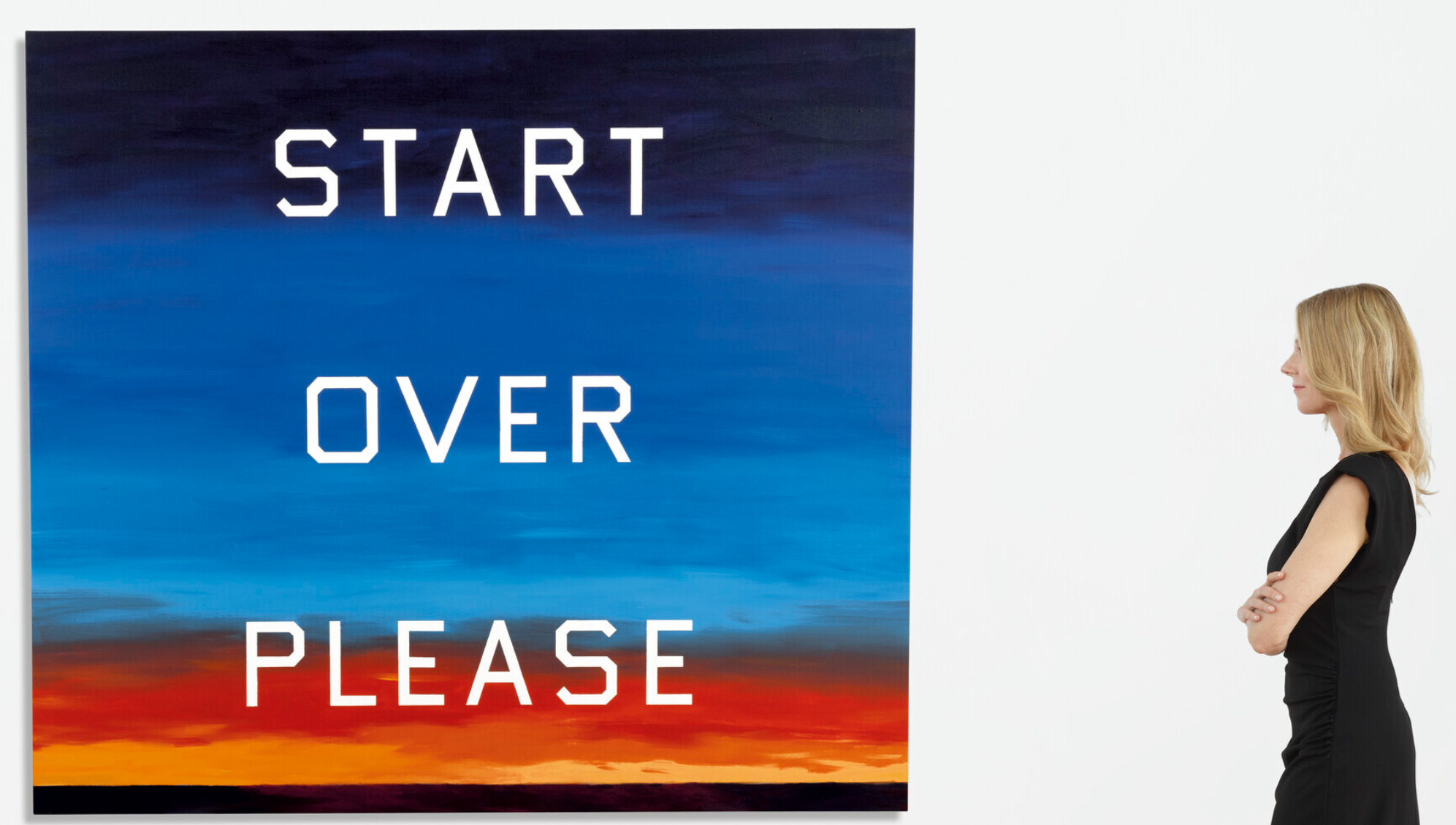
ED RUSCHA (B. 1937)
Start Over Please, 2015
Oil on canvas
64×72 inches (162.7 x 183 cm)
Signed and dated ‘Ed Ruscha 2015’ (on the reverse)
#5. 99% Angel, 1% Devil, 1983
Sotheby’s New-York: 21 November 2024
Estimated: USD 1,500,000 – 2,000,000
USD 3,265,000
99% Angel, 1% Devil | Contemporary Day Auction | 2024 | Sotheby’s
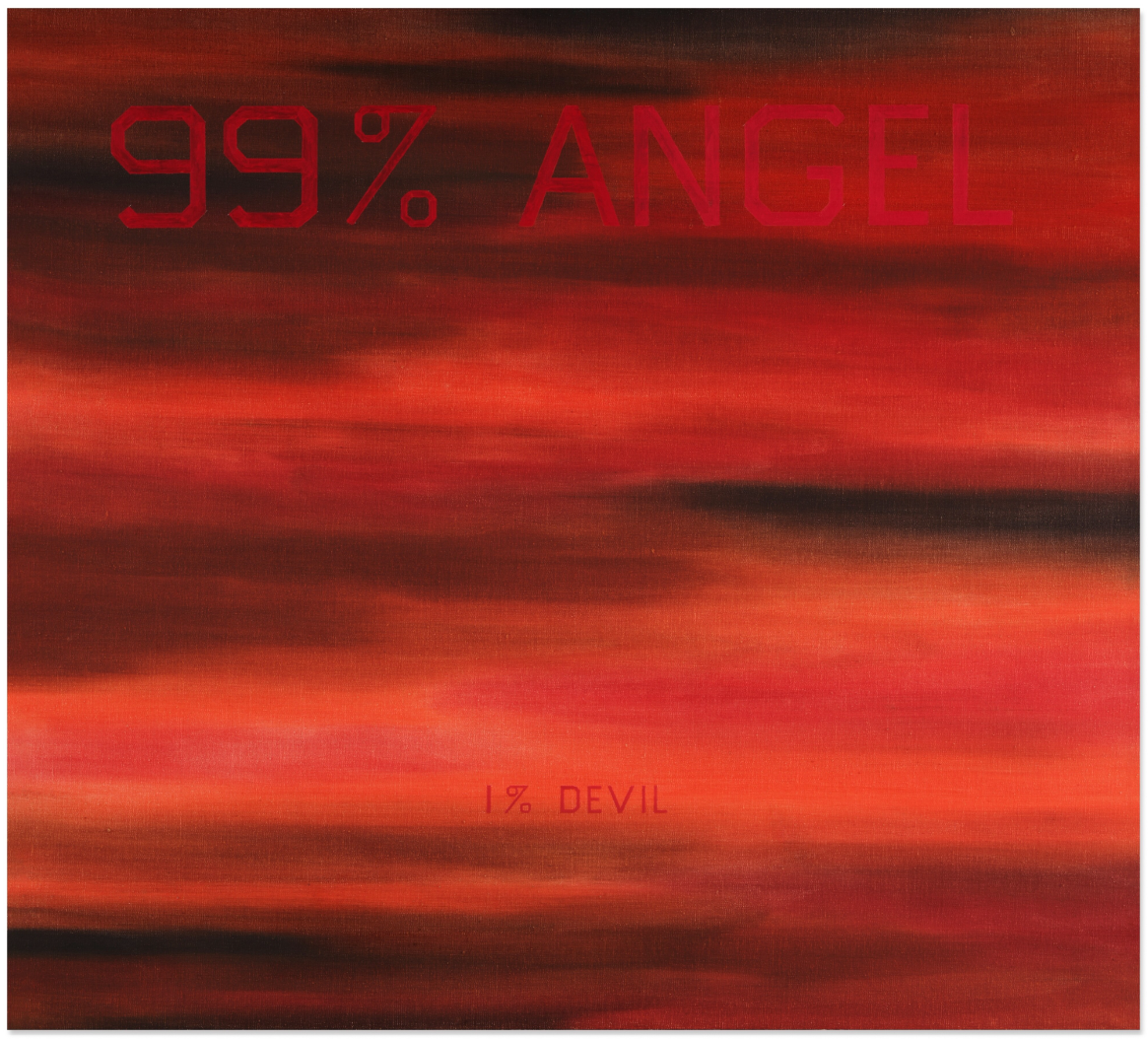
ED RUSCHA (b. 1937)
99% Angel, 1% Devil, 1983
Acrylic on canvas
36×40 inches (91.4 x 101.6 cm)
Signed and dated 1983 (on the reverse)
Signed, titled and dated twice 1983 and APR 7 ’83 (on the overlap)
#6. The Wrap-Up, 1993
Sotheby’s New-York: 20 November 2024
Estimated: USD 4,000,000 – 6,000,000
USD 3,000,000
The Wrap-up | The Now and Contemporary Evening Auction | 2024 | Sotheby’s
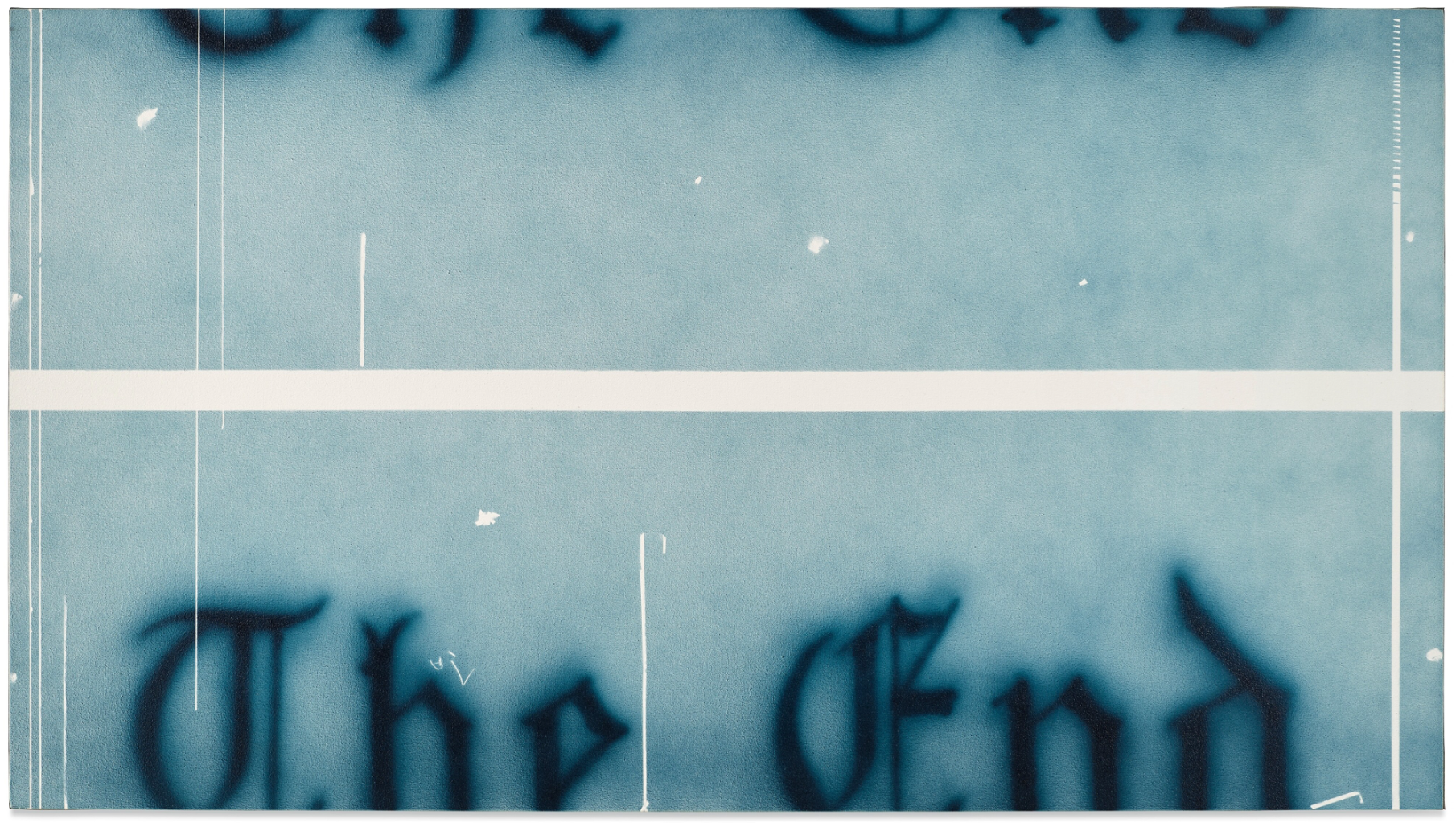
ED RUSCHA (b. 1937)
The Wrap-Up, 1993
Acrylic on canvas
40×72 inches (101.6 x 182.9 cm)
#7. Marble Shatters Drinking Glass, 1968
Christie’s New-York: 19 November 2024
Estimated: USD 1,200,000 – 1,800,000
USD 2,712,000
ED RUSCHA (B. 1937), Marble Shatters Drinking Glass | Christie’s
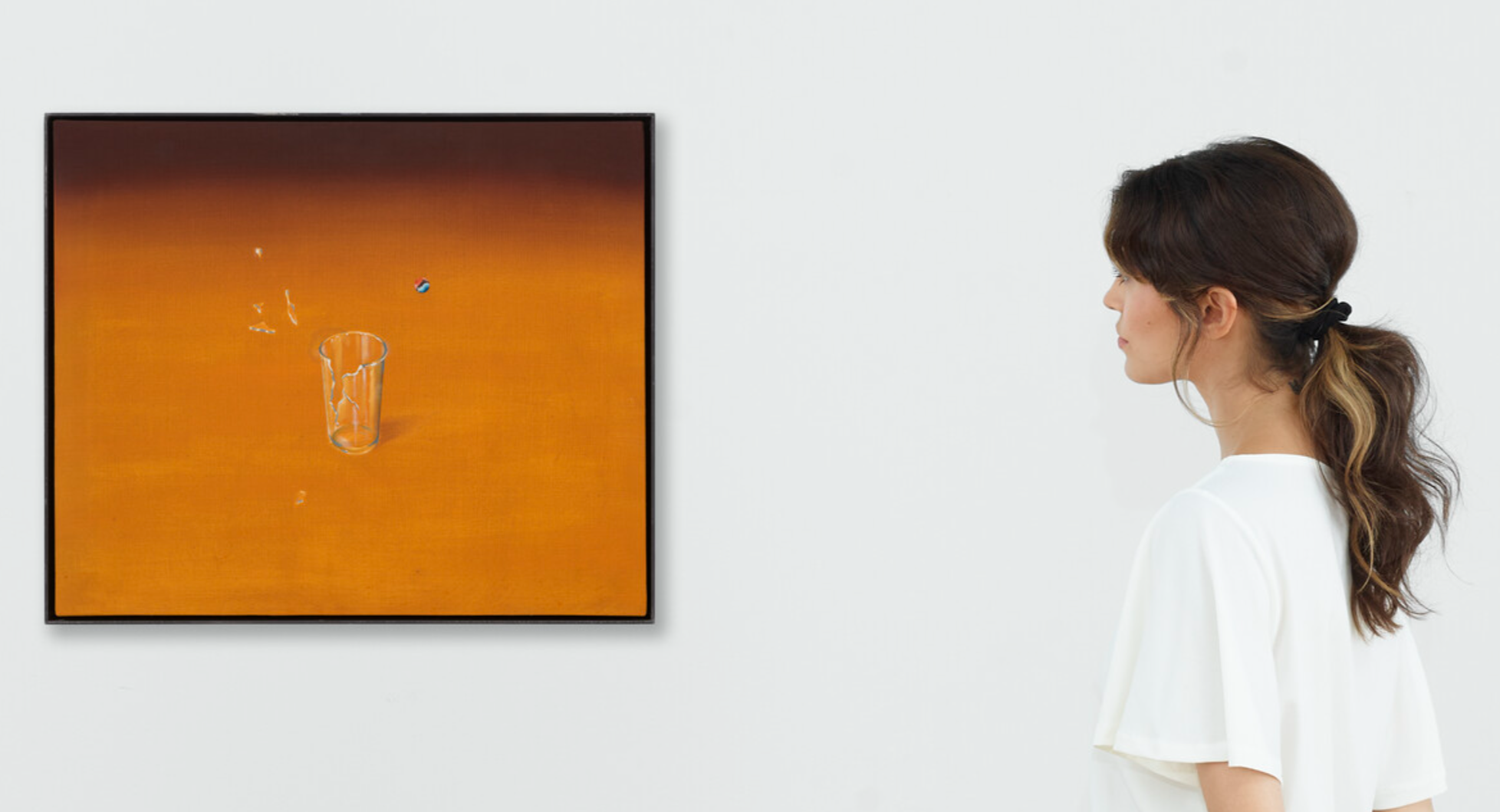
ED RUSCHA (B. 1937)
Marble Shatters Drinking Glass, 1968
Oil on canvas
20×24 inches (50.8 x 61 cm)
Signed and dated twice and titled ‘”MARBLE SHATTERS DRINKING GLASS” 1968 Ed Ruscha Ed Ruscha 1968’
(on the stretcher)
#8. Untitled, 2015
Christie’s New-York: 1 October 2024
Estimated: USD 2,000,000 – 3,000,000
USD 2,591,000
ED RUSCHA (B. 1937), Untitled | Christie’s (christies.com)
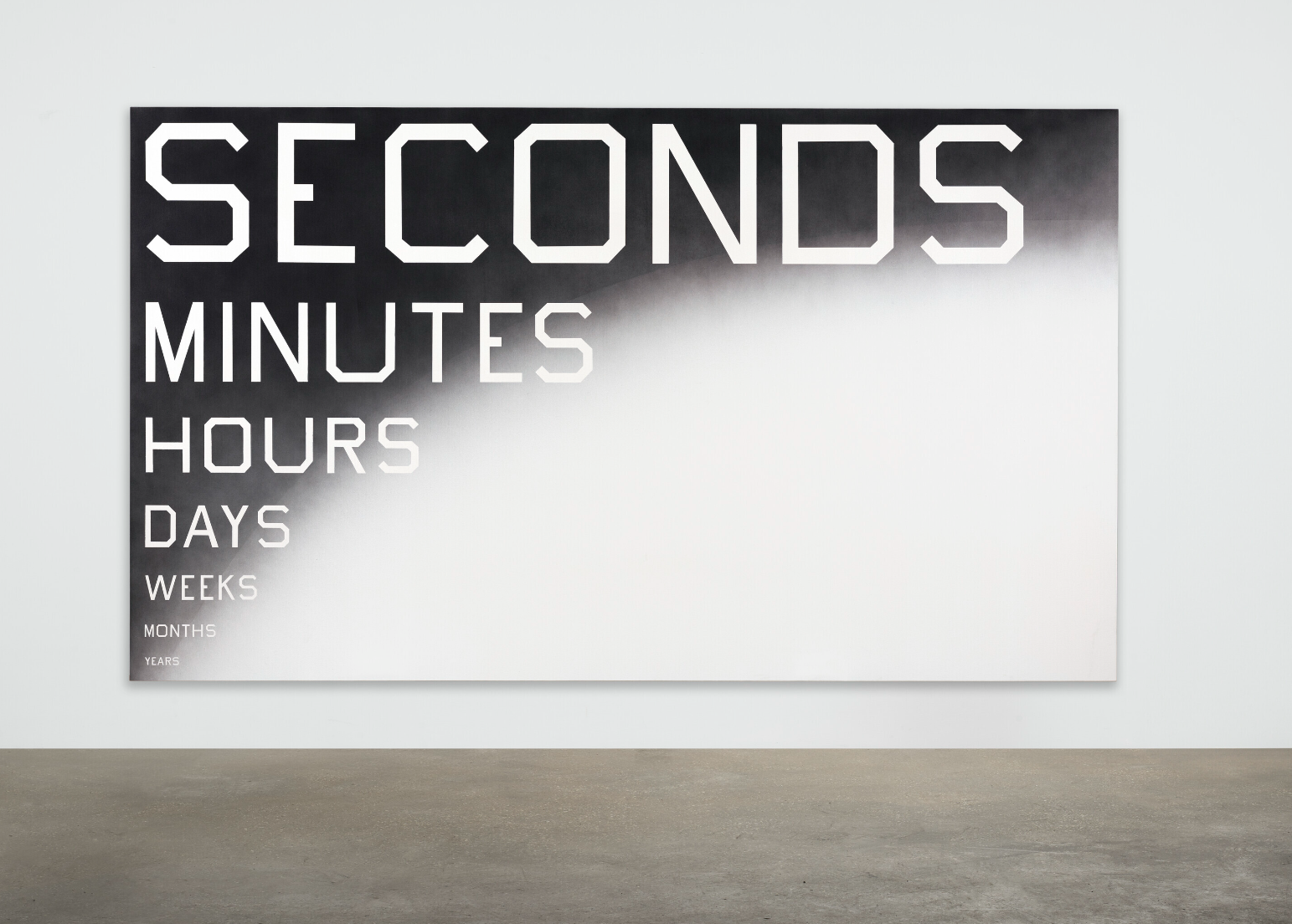
ED RUSCHA (B. 1937)
Untitled, 2015
Acrylic on canvas
72×124 inches (182.9 x 315 cm)
Signed and dated ‘Ed Ruscha 2015’ (on the reverse)
#9. Tril Bil Mil, 2016
Christie’s New-York: 19 November 2024
Estimated: USD 2,000,000 – 3,000,000
USD 2,470,000
ED RUSCHA (B. 1937), Tril Bil Mil | Christie’s
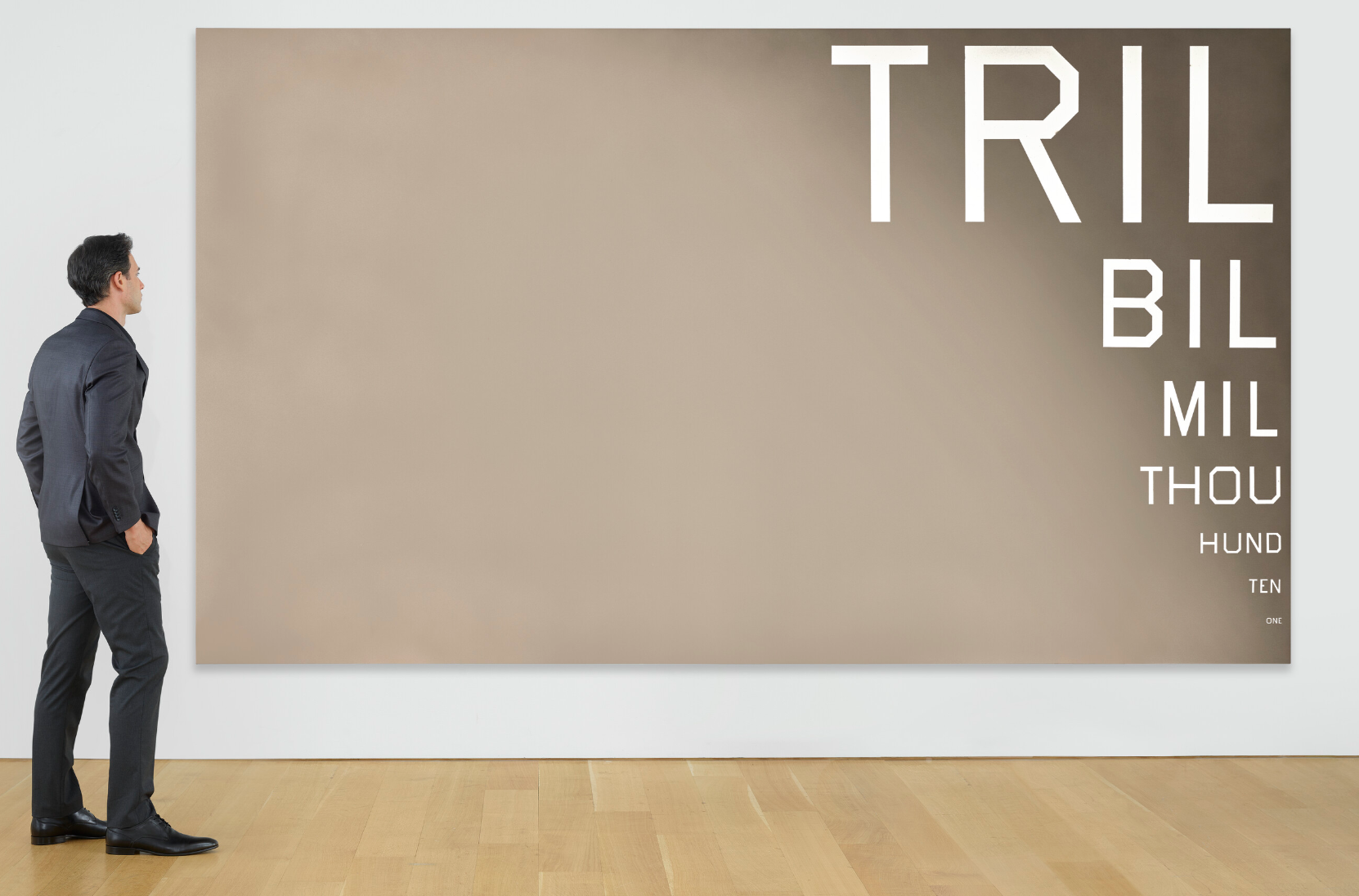
ED RUSCHA (B. 1937)
Tril Bil Mil, 2016
Acrylic on canvas
72×124 inches (182.9 x 315 cm)
Signed and dated ‘Ed Ruscha 2016’ (on the reverse)
#10. Christ Candle, 1987
Sotheby’s New-York: 13 May 2024
Estimated: USD 2,500,000 – 3,500,000
USD 2,200,000
Christ Candle | Contemporary Evening Auction | 2024 | Sotheby’s (sothebys.com)

ED RUSCHA (b. 1937)
Christ Candle, 1987
Acrylic on canvas
71 3/4 x 72 inches (182.2 x 182.9 cm)
Signed and dated 1987 (on the reverse)
#11. Howl, 1986
Phillips New-York: 20 November 2024
Estimated: USD 600,000 – 800,000
USD 1,481,750
Ed Ruscha – Modern & Contemporary … Lot 144 November 2024 | Phillips
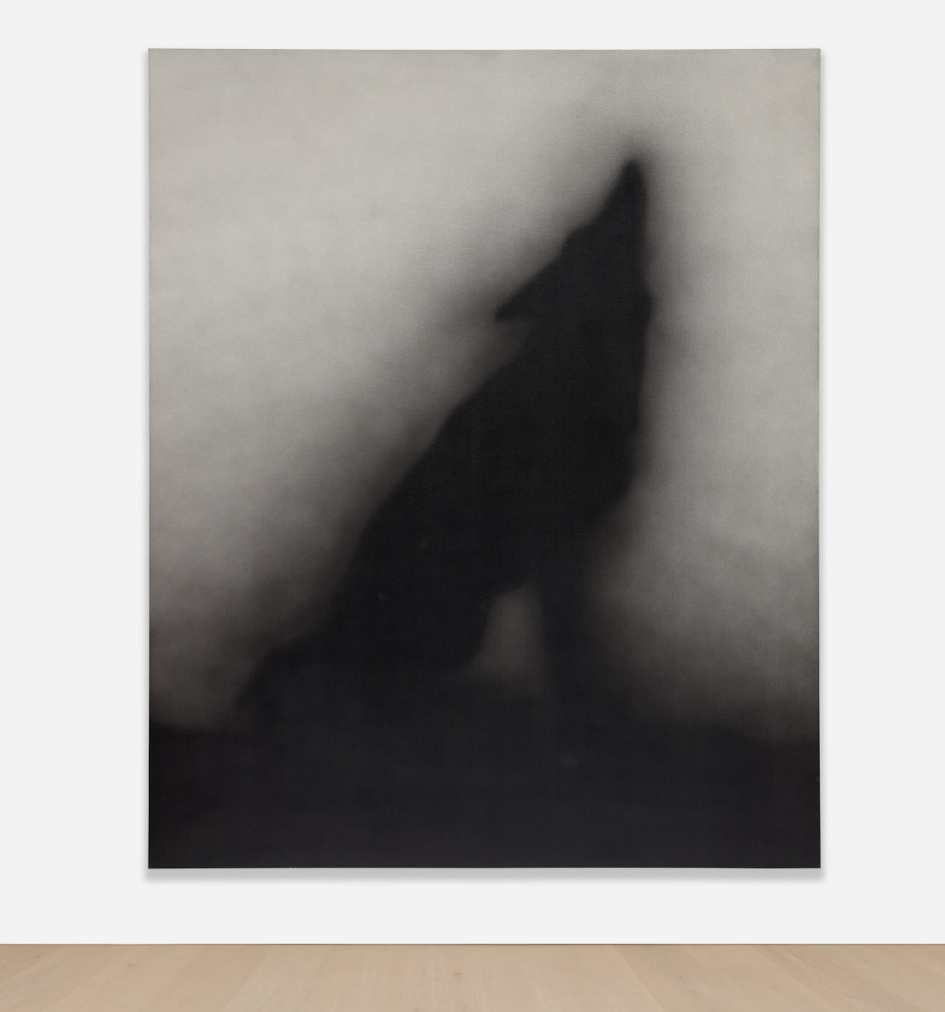
ED RUSCHA
Howl, 1986
Acrylic on canvas
78 1/4 x 63 7/8 inches (198.8 x 162.2 cm)
Signed and dated “Ed Ruscha 86” on the reverse
Signed, titled and dated “EDWARD RUSCHA “HOWL” 1986” on the stretcher
#12. Big Dipper, 1980
Christie’s New-York: 22 November 2024
Estimated: USD 800,000 – 1,200,000
USD 1,008,000
ED RUSCHA (B. 1937), Big Dipper | Christie’s
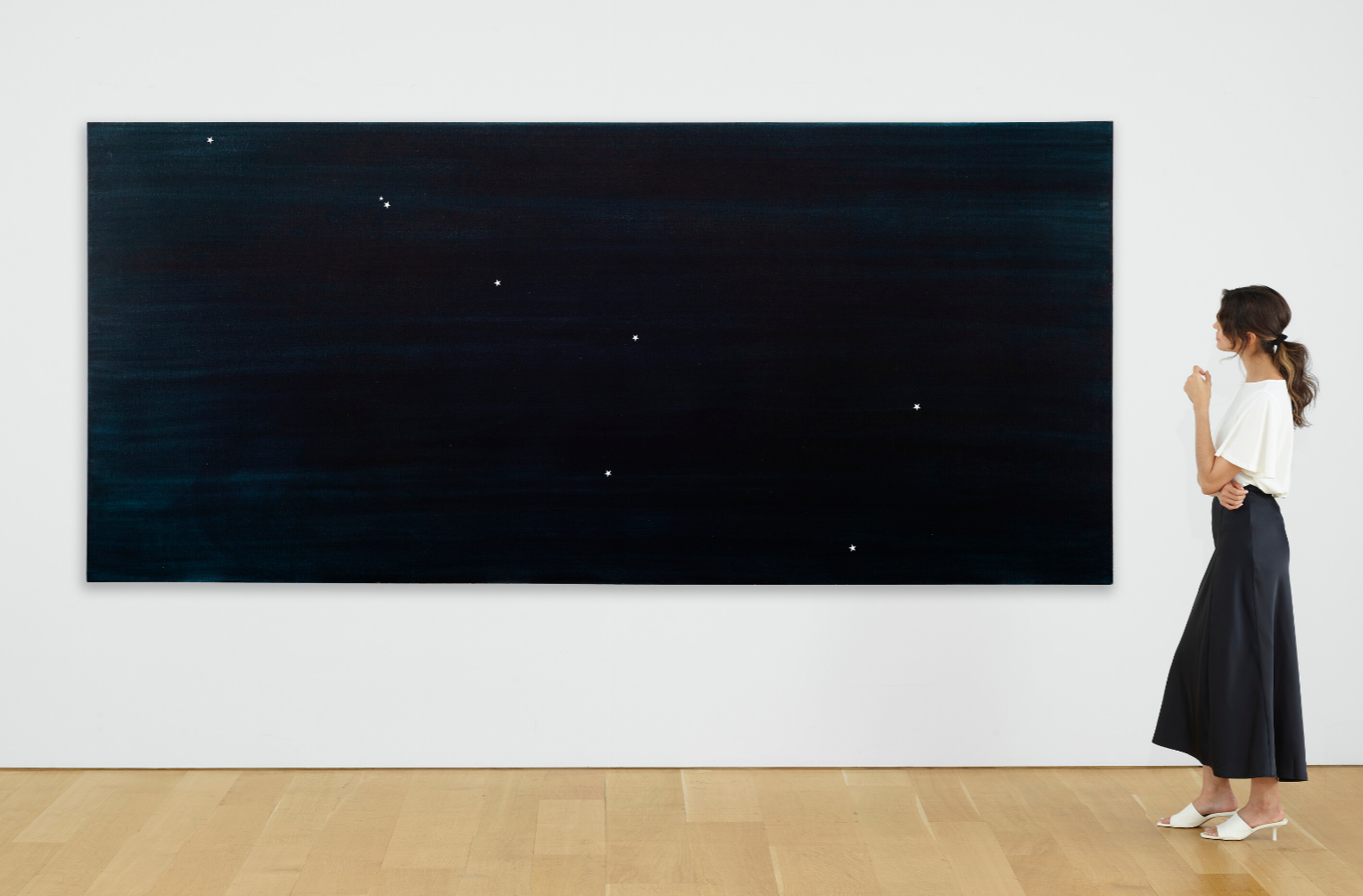
ED RUSCHA (B. 1937)
Big Dipper, 1980
Oil on canvas
54×120 inches (137.2 x 304.8 cm)
Signed and dated ‘Edward Ruscha 1980’ (on the reverse)
USD 1 million
#13. You Cannot Be Serious, 2008
Sotheby’s New-York: 14 May 2024
Estimated: USD 450,000 – 650,000
USD 790,500
Proceeds to Benefit the John and Patty McEnroe Foundation
You Cannot Be Serious | Contemporary Day Auction | 2024 | Sotheby’s (sothebys.com)

ED RUSCHA (b. 1937)
You Cannot Be Serious, 2008
Acrylic on museum board
24 x 27 7/8 inches (61 x 70.8 cm)
Signed and dated 2008 (lower right)
#14. Drugs, Hardware, Barber, Video, 1987
Sotheby’s New-York: 1 March 2024
Estimated: USD 600,000 – 800,000
USD 508,000
Drugs, Hardware, Barber, Video | Contemporary Curated | 2024 | Sotheby’s (sothebys.com)
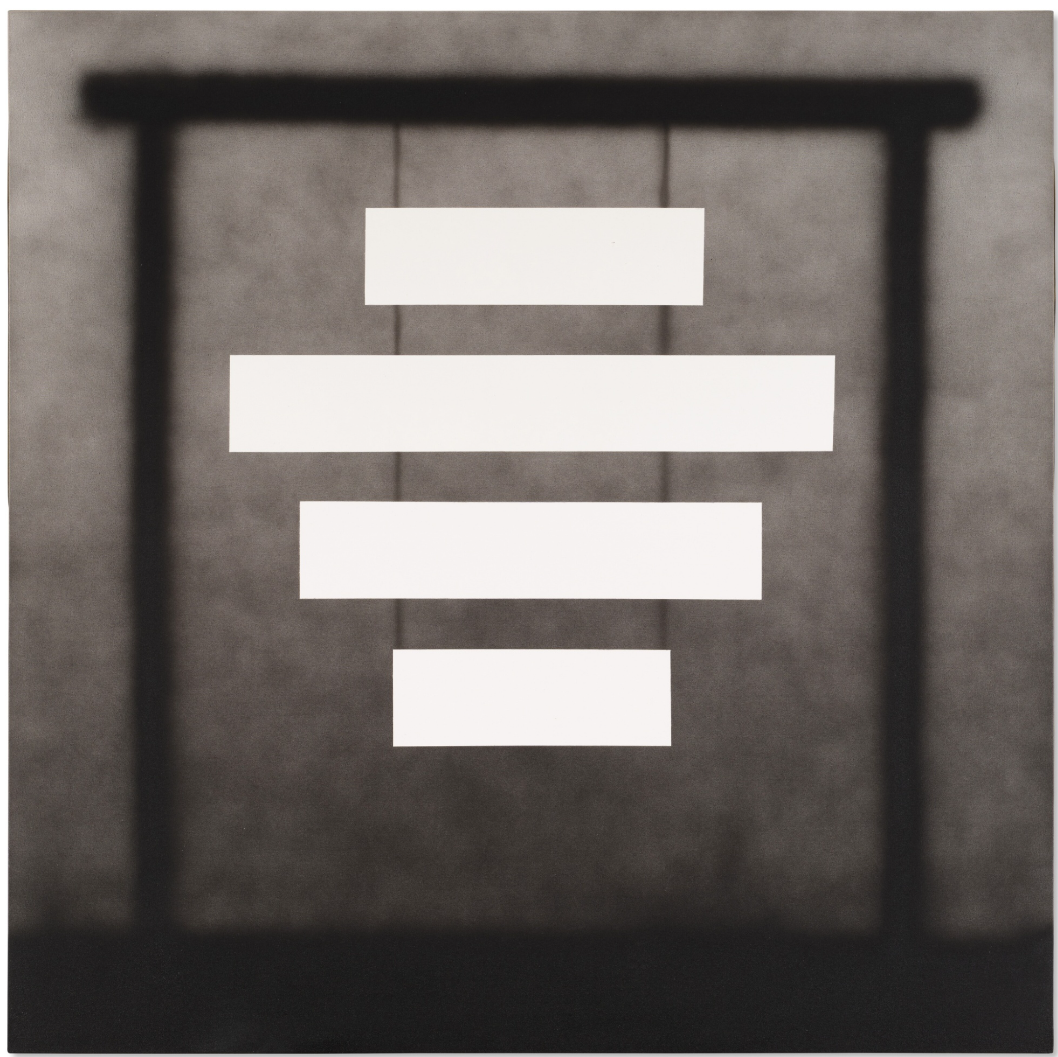
ED RUSCHA (b. 1937)
Drugs, Hardware, Barber, Video, 1987
Acrylic on canvas
72×72 inches (182.9 x 182.9 cm)
Signed and dated 1987 (on the reverse)
#15. L for Lumens, 1993
Christie’s New-York: 17 May 2024
Estimated: USD 200,000 – 300,000
USD 327,600
ED RUSCHA (B. 1937), L for Lumens | Christie’s (christies.com)
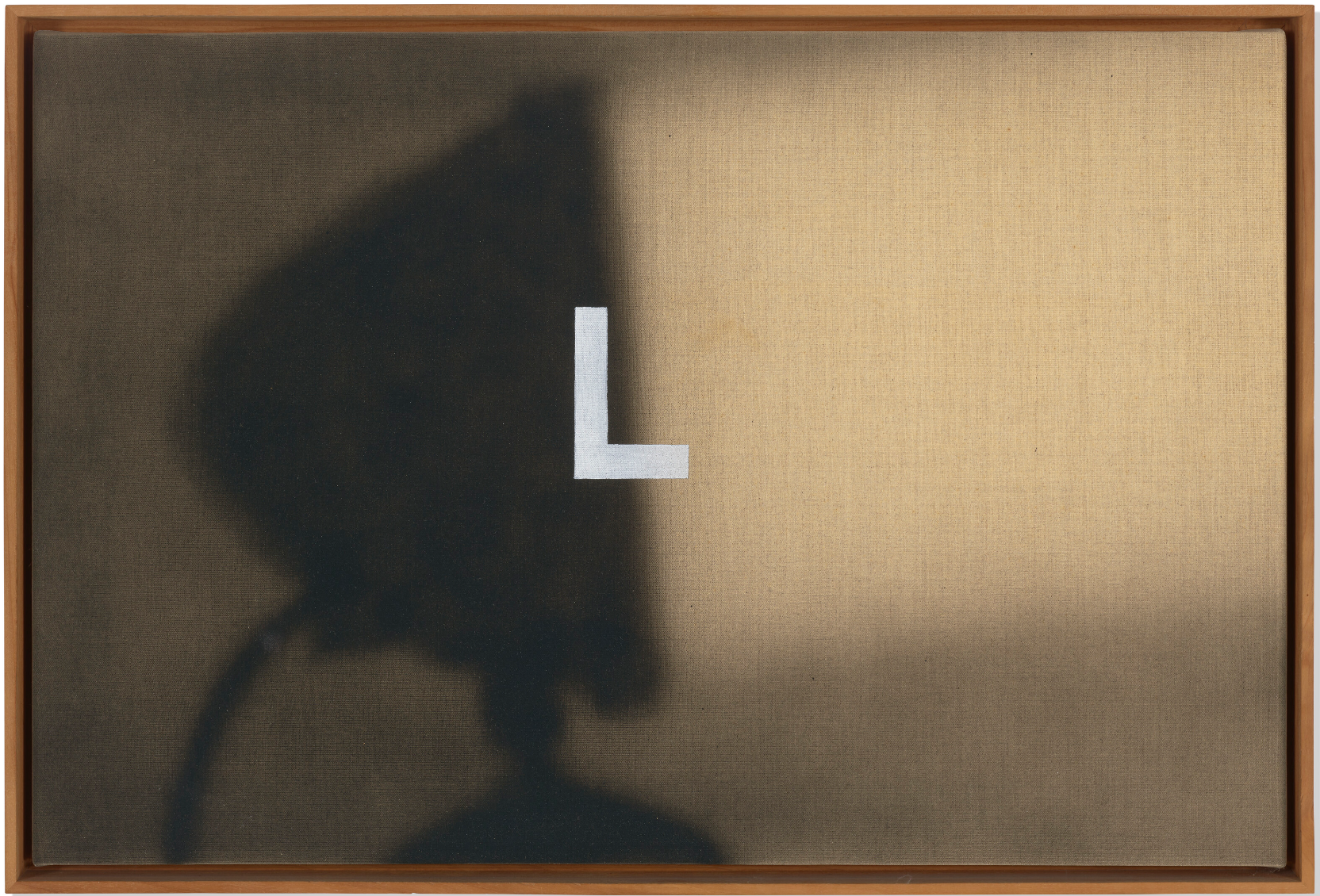
ED RUSCHA (B. 1937)
L for Lumens, 1993
Acrylic on canvas
16×24 inches (40.6 x 61 cm)
Signed and dated ‘Ed Ruscha 1993’ (on the reverse)
Three Books, 2001
Christie’s New-York: 22 November 2024
Estimated: USD 50,000 – 70,000
USD 69,300
ED RUSCHA (B. 1937), Three Books | Christie’s
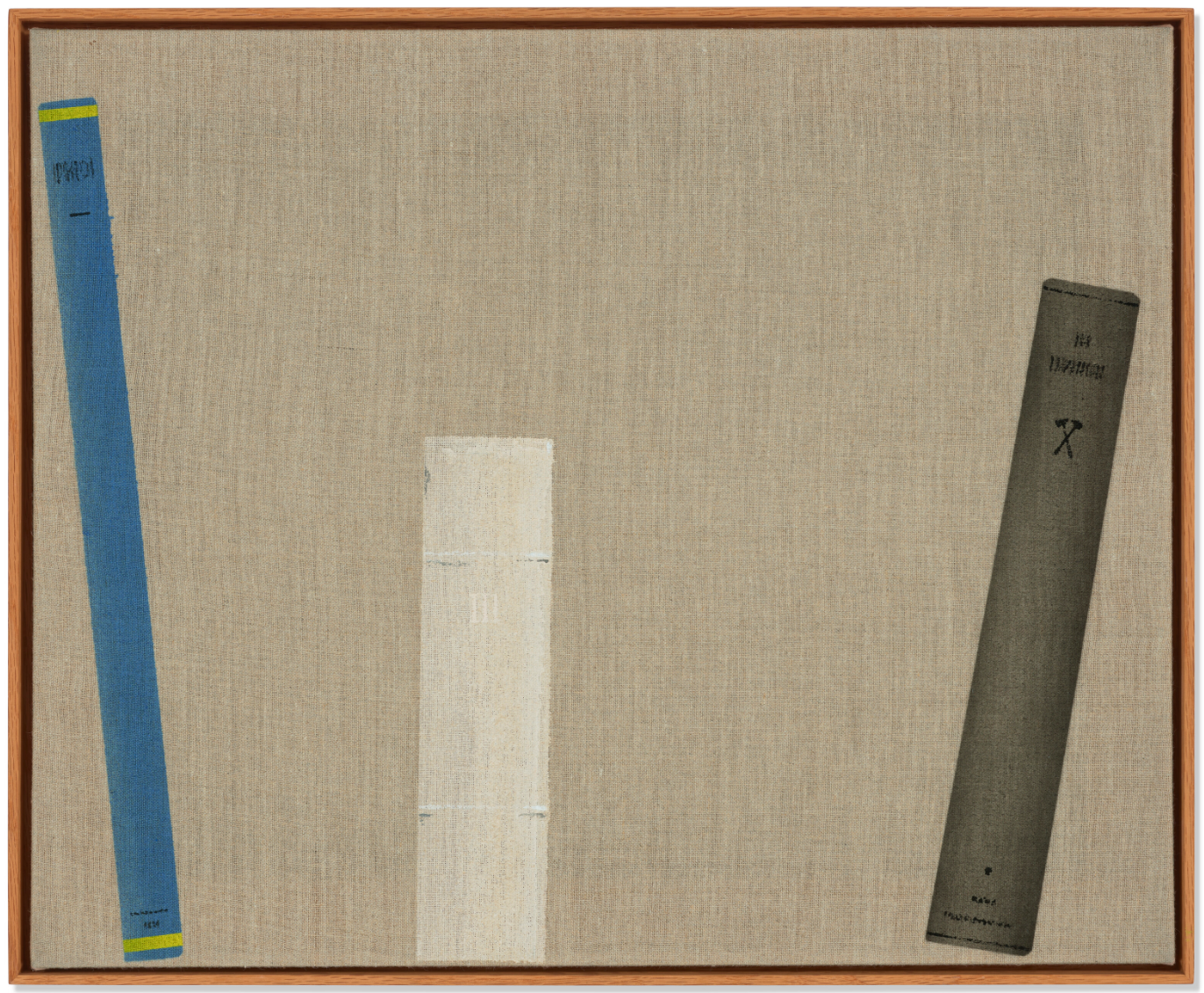
ED RUSCHA (B. 1937)
Three Books, 2001
Acrylic on linen
18×22 inches (45.7 x 55.9 cm)
Signed and dated ‘Ed Ruscha 2001’ (on the reverse)
Lots Withdrawn
Isle of Fear, 1987-1988
Phillips New-York: 19 November 2024
Estimated: USD 1,500,000 – 2,000,000
WITHDRAWN
Ed Ruscha – Modern & Contemporary A… Lot 25 November 2024 | Phillips
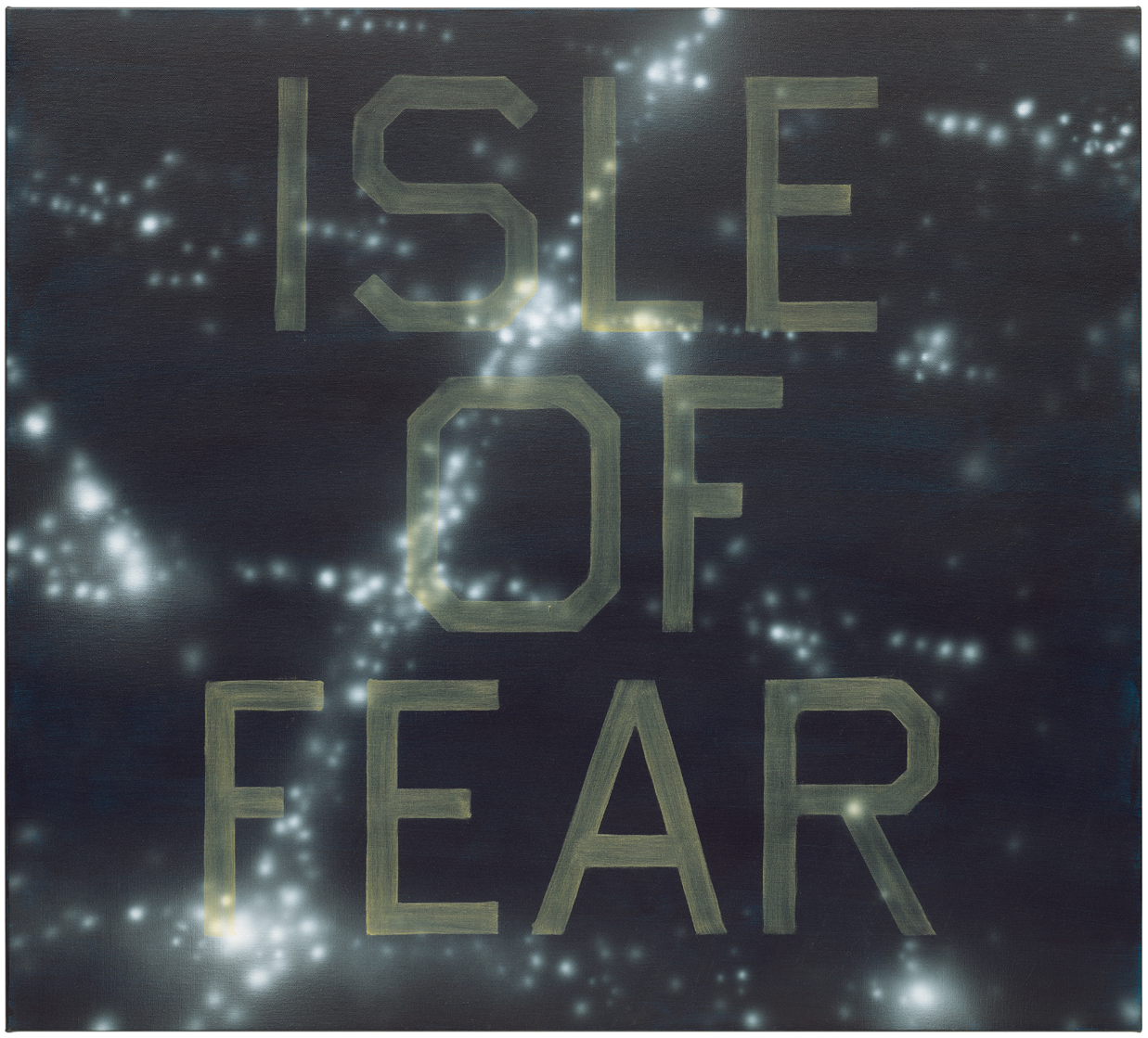
ED RUSCHA
Isle of Fear, 1987-1988
Oil and acrylic on canvas
36 1/2 x 40 inches (92.7 x 101.6 cm)
Signed and dated “Ed Ruscha 1987-88″ on the reverse
2023 Auction Results
FOR PAINTINGS ONLY
17 lots sold at auction in 2023 for a total turnover of USD 101,196,600. The top lot, Securing The Last Letter (Boss) from the Emily Fisher Landau Collection was sold at Sotheby’s in New-York on 9 November 2023, for USD 39,400,500. With 6 lots failing to sell, the sell-through rate is 74%.
2023 Top 3 Lots
3 lots sold over USD 10 million, generating a cumulative turnover of USD 74,634,000, contributing 73.8% to the total turnover for 2023. 13 lots sold over USD 1 million, for a cumulative turnover of USD 98,787,500, representing 97.6% of the total turnover for 2023.
XXXXXXXXXX
#1. Securing the Last Letter (Boss), 1964
Sotheby’s New-York: 8 November 2023
Estimated: USD 35,000,000 – 45,000,000
USD 39,400,500
ED RUSCHA (b. 1937)
Securing the Last Letter (Boss), 1964
Oil on canvas
59 x 55 1/8 inches (149.9 x 140 cm)
Signed, titled and dated 1964 (on the stretcher)
#2. Burning Gas Station, 1966-1969
Christie’s New-York: 11 May 2023
Estimated: USD 20,000,000 – 30,000,000
USD 22,260,000
ED RUSCHA (B. 1937)
Burning Gas Station, 1966-1969
Oil on canvas
20 1/8 x 39 inches (51.1 x 99.1 cm)
Signed, titled and dated ‘”BURNING GAS STATION” 1966-1969 E. Ruscha’ (on the stretcher)
#3. Mint (Green), 1968
Sotheby’s New-York: 8 November 2023
Estimated: USD 10,000,000 – 15,000,000
USD 12,973,500
ED RUSCHA (b. 1937)
Mint (Green), 1968
Oil on canvas
60×55 inches (152.4 x 139.7 cm)
Signed and dated 1968 (on the reverse)
USD 10 million
#4. Plenty Big Hotel Room (Painting for the American Indian), 1985
Sotheby’s New-York: 8 November 2023
Estimated: USD 5,000,000 – 7,000,000
USD 6,079,500
ED RUSCHA (b. 1937)
Plenty Big Hotel Room (Painting for the American Indian), 1985
Oil on canvas
84×60 inches (213.4 x 152.4 cm)
Signed and dated 85 (on the reverse)
USD 5 million
#5. Manual Mobility, 1994
Phillips New-York: 17 May 2023
Estimated: USD 4,000,000 – 6,000,000
USD 3,448,000
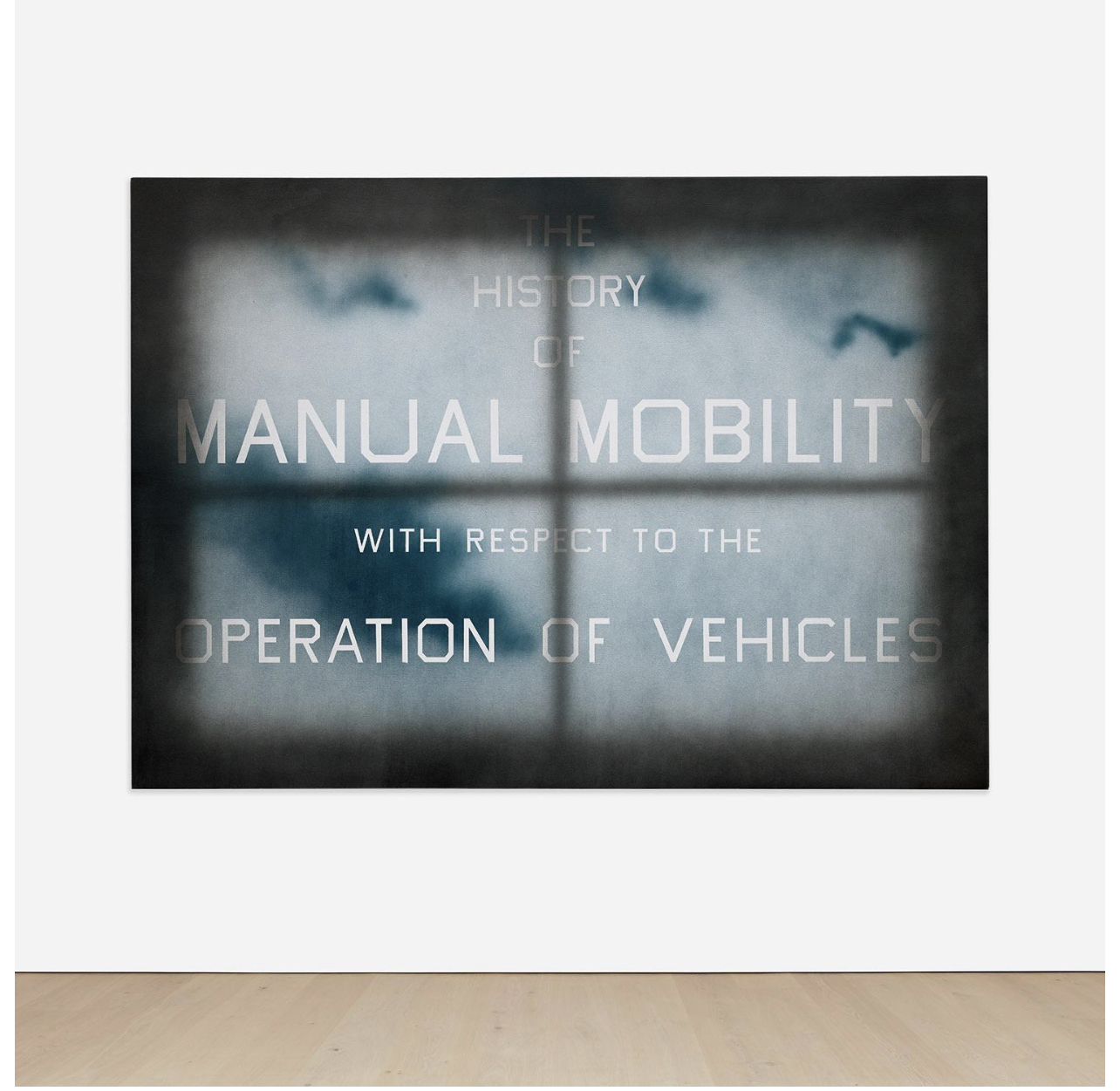
ED RUSCHA
Manual Mobility, 1994
Acrylic on canvas
60×84 inches (152.4 x 213.4 cm)
Signed and dated “Ed Ruscha 1994” on the overlap
#6. Life, 1984
Sotheby’s New-York: 9 November 2023
Estimated: USD 1,800,000 – 2,500,000
USD 2,843,000
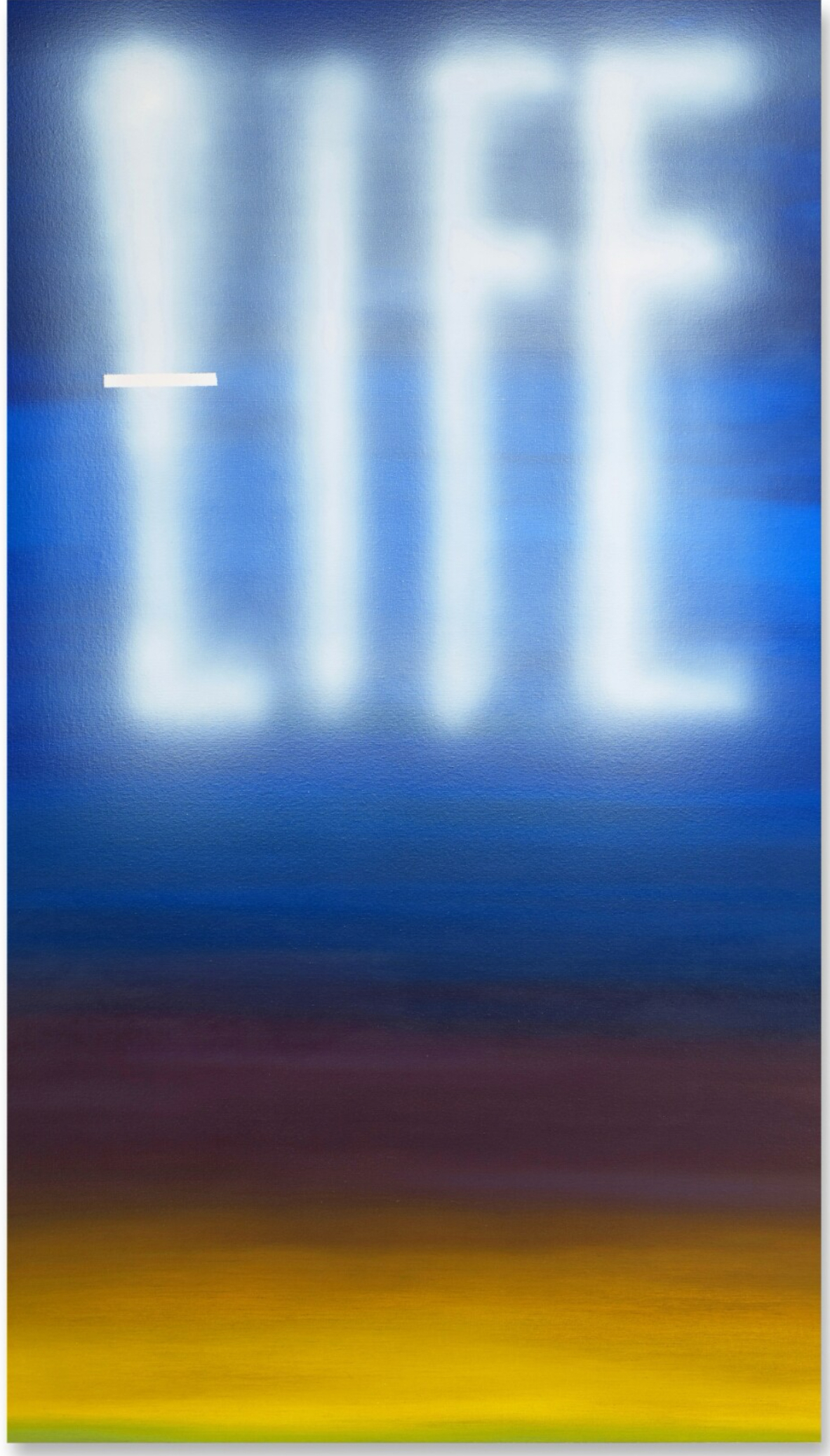
ED RUSCHA (b. 1937)
Life, 1984
Oil and enamel on canvas
84 1/8 x 48 1/8 inches (213.7 x 122.2 cm)
Signed and dated 1984 (on the reverse)
#7. Radio [#1], 1963
Sotheby’s New-York: 18 May 2023
Estimated: USD 2,000,000 – 3,000,000
USD 2,107,500
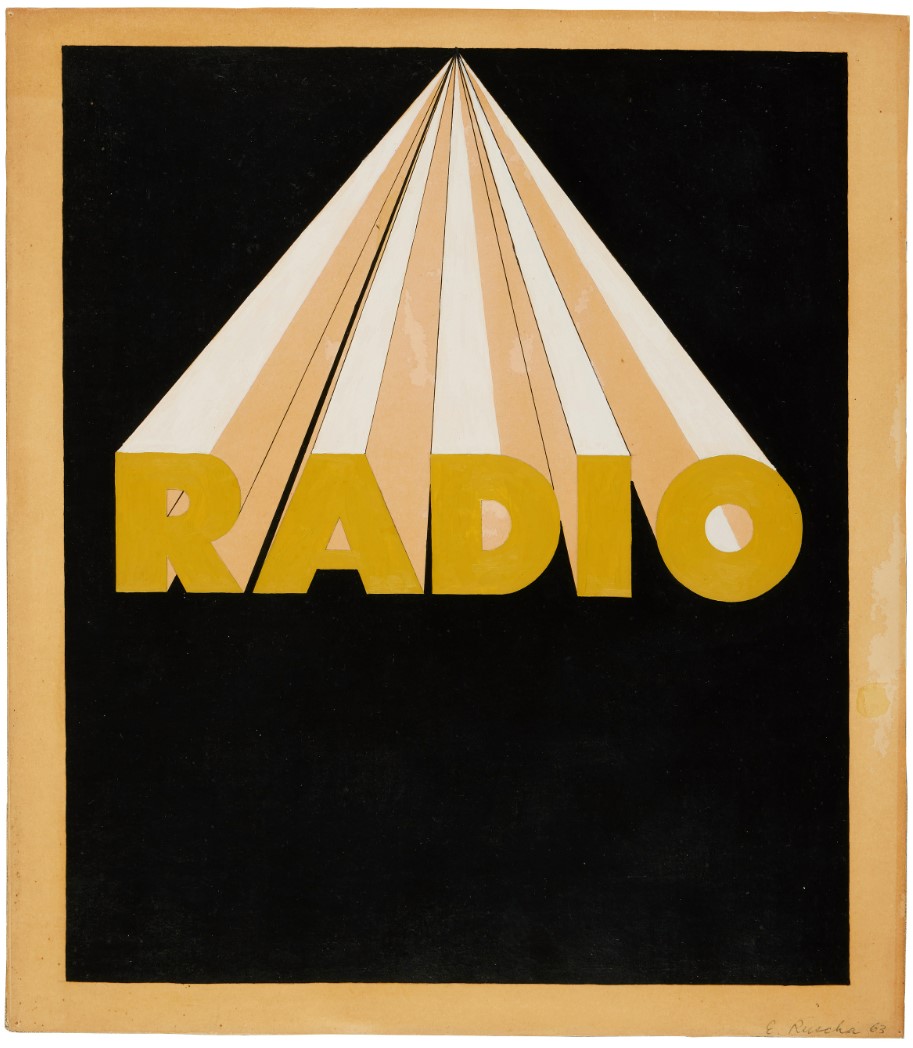
ED RUSCHA (b. 1937)
Radio [#1], 1963
Oil and black ink on paperboard mounted to canvas
14 5/8 x 12 3/4 inches (37.1 x 32.4 cm)
Signed and dated 63 (lower right)
#8. Chain and Cable, 1987
Christie’s New-York: 7 November 2023
Estimated: USD 2,500,000 – 3,500,000
USD 2,107,000
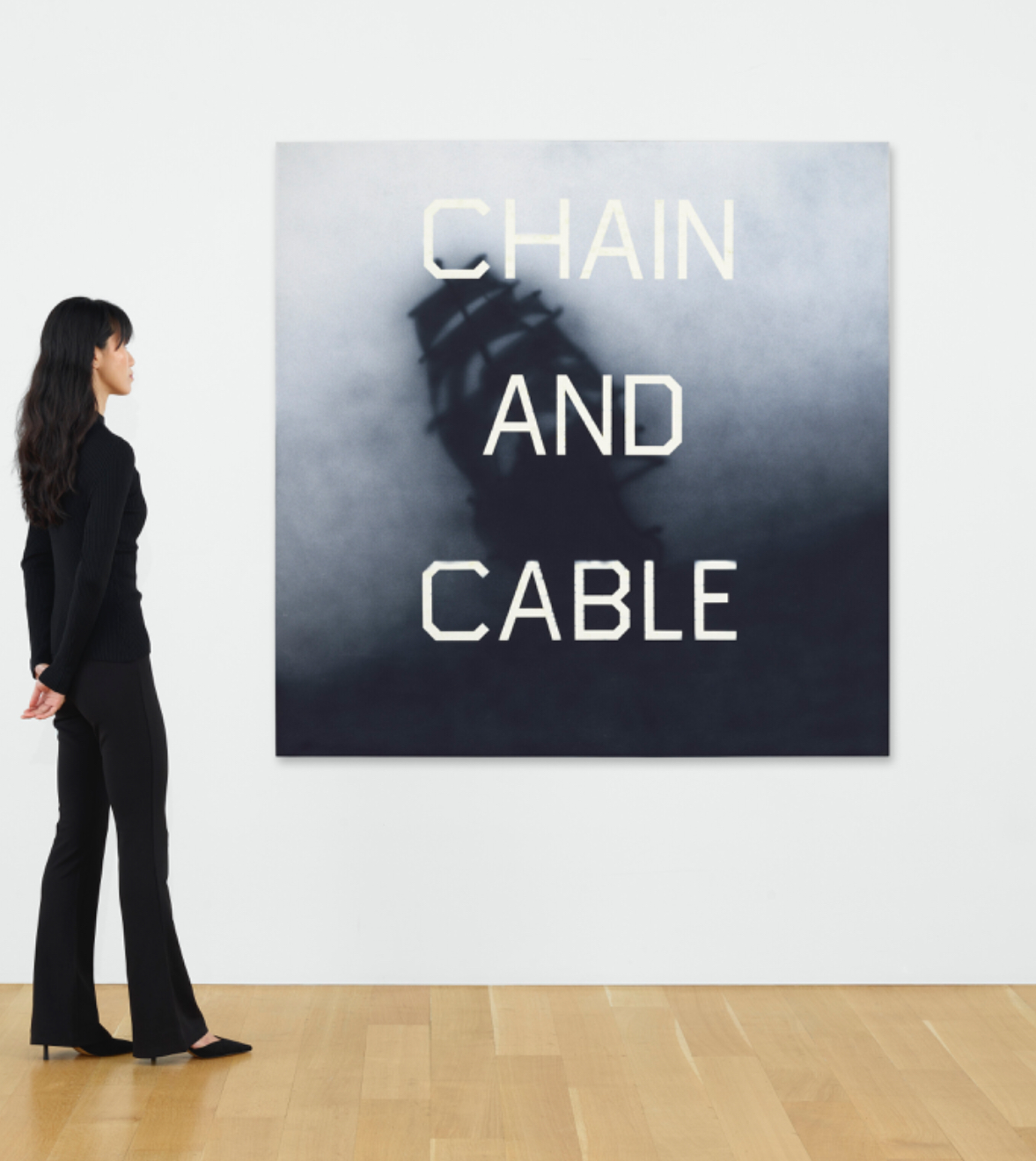
ED RUSCHA (b. 1937)
Chain and Cable, 1987
Acrylic on canvas
64×64 inches (162.6 x 162.6 cm)
Signed and dated ‘Ed Ruscha 1987’ (on the reverse)
Signed again, titled and dated again ‘ED RUSCHA “CHAIN AND CABLE” 1987’ (on the stretcher)
#9. The Future, 1981
Christie’s New-York: 18 May 2023
Estimated: USD 800,000 – 1,200,000
USD 1,865,000
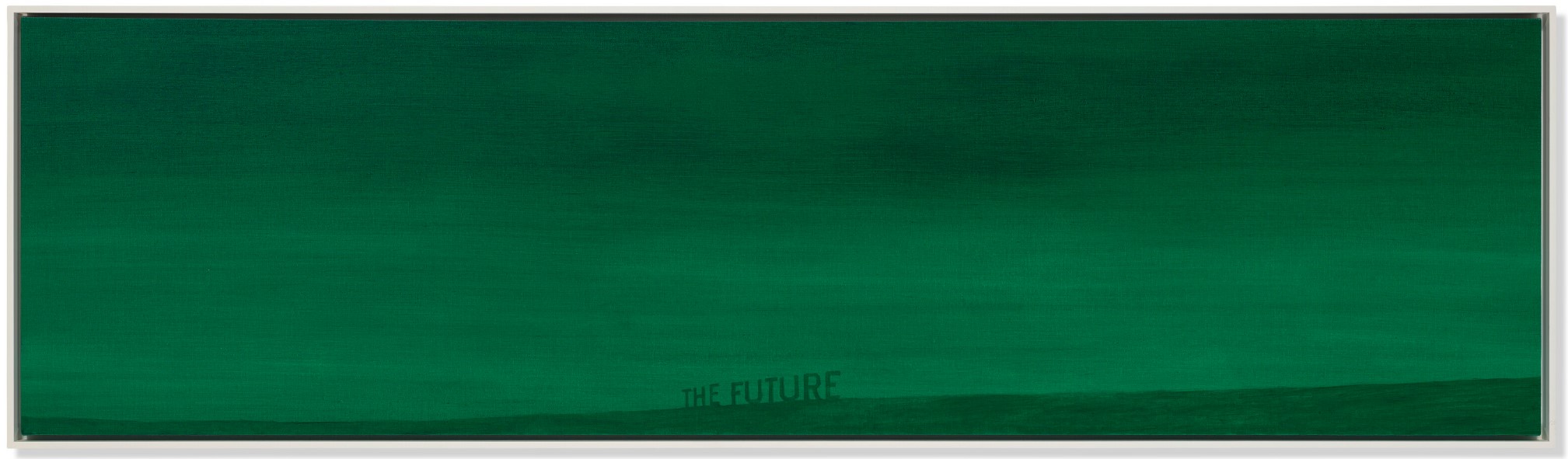
ED RUSCHA (b. 1937)
The Future, 1981
Oil on canvas
22×80 inches (55.8 x 203.2 cm)
Signed and dated ‘Ed Ruscha 1981’ (on the reverse); dated ‘July 18, ’81’ (on the overlap)
#10. Do You Think She “Has It”?, 1974
Christie’s New-York: 11 May 2023
Estimated: USD 1,500,000 – 2,000,000
USD 1,865,000
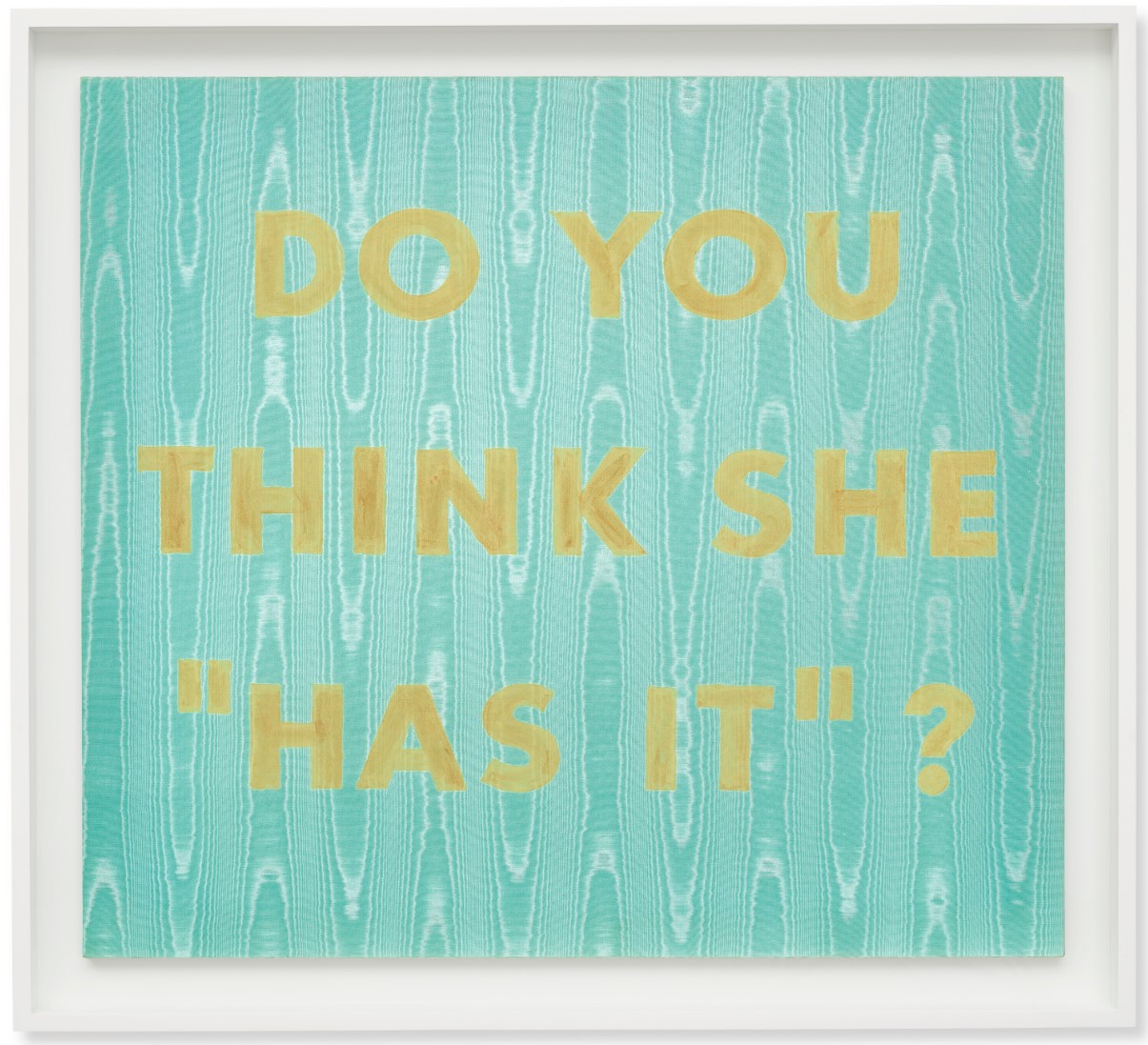
ED RUSCHA (B. 1937)
Do You Think She “Has It”?, 1974
Egg yolk on moiré
35 7/8 x 40 inches (91.1 x 101.6 cm)
Signed and dated ‘Edward Ruscha 1974’ (on the overlap)
#11. Pattern of Lust, 1987
Estimated: USD 1,000,000 – 1,500,000
USD 1,562,500
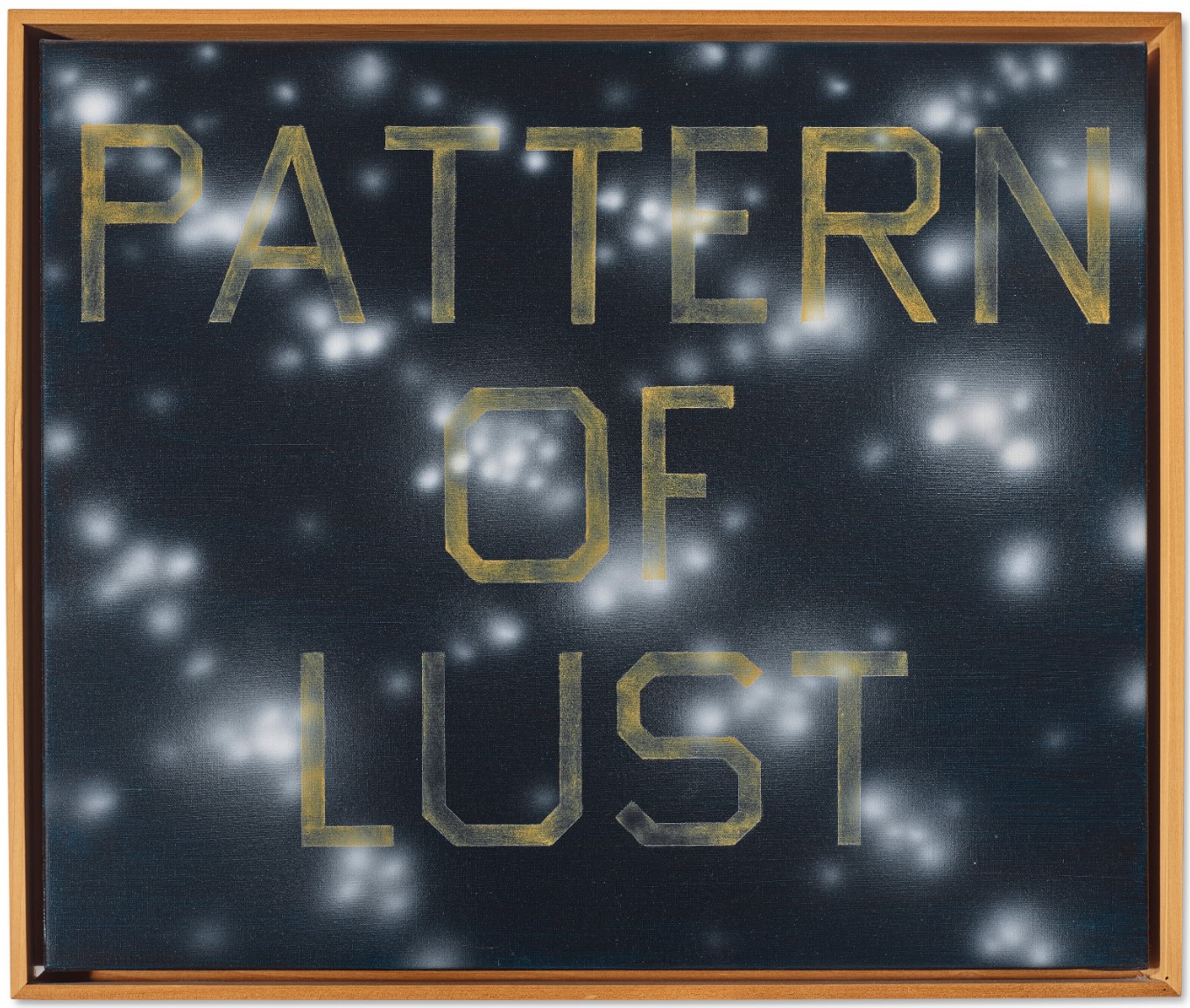
ED RUSCHA (B. 1937)
Pattern of Lust, 1987
Acrylic and oil on canvas
20×24 inches (50.8 x 60.1 cm)
Signed, titled and dated ‘ED RUSCHA “PATTERN OF LUST” 1987’ (on the stretcher)
Signed again and dated again ‘Ed Ruscha 1987’ (on the reverse)
#12. See, 1985
Christie’s New-York: 7 March 2023
Estimated: USD 1,500,000 – 2,000,000
USD 1,260,000
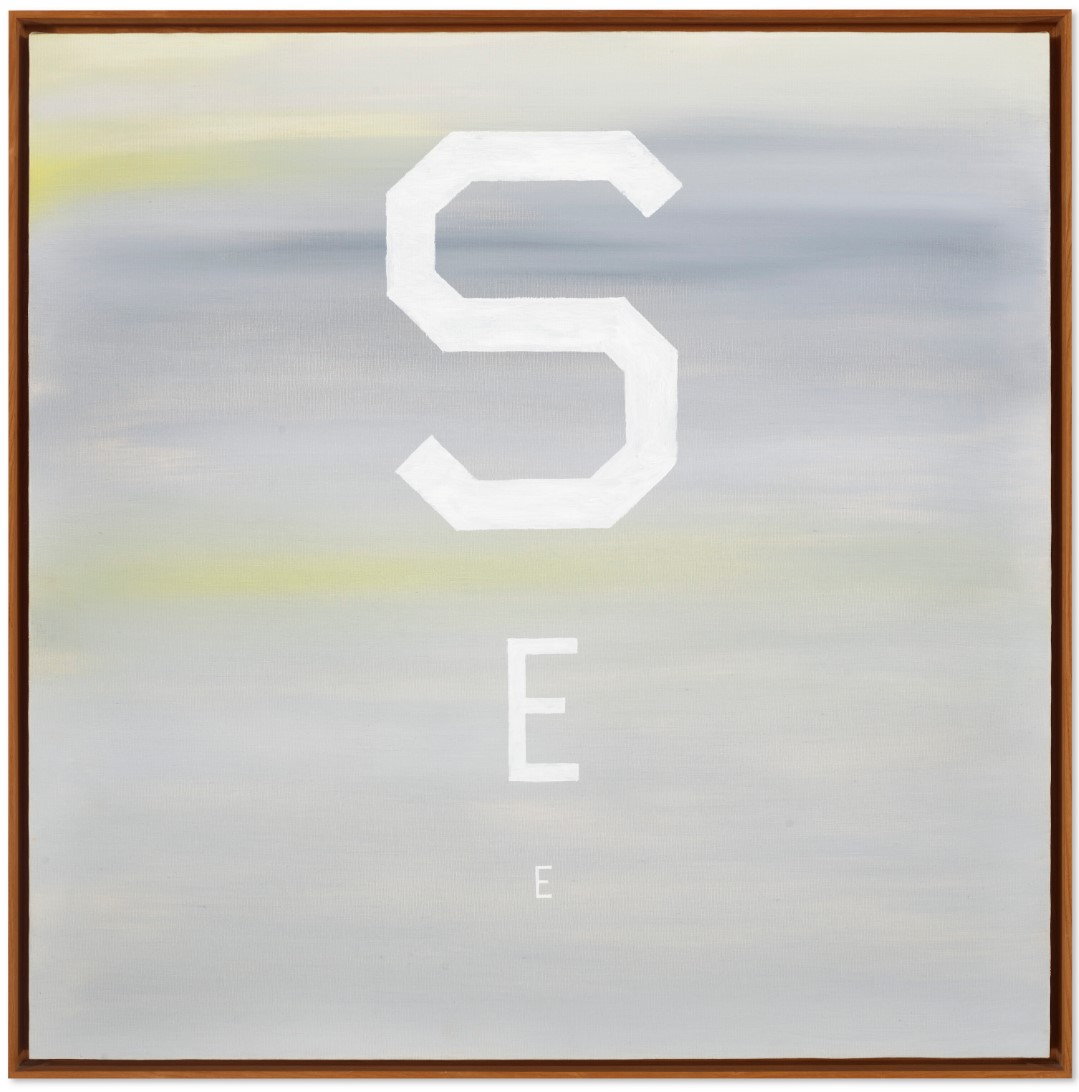
ED RUSCHA (B. 1937)
See, 1985
Oil on canvas
29 7/8 x 29 3/4 inches (75.9 x 75.6 cm)
Signed, titled and dated ‘Ed Ruscha “SEE” 1983-1985’ (on the reverse)
#13. Uphill Driver, 1986
Sotheby’s New-York: 9 November 2023
Estimated: USD 800,000 – 1,200,000
USD 1,016,000
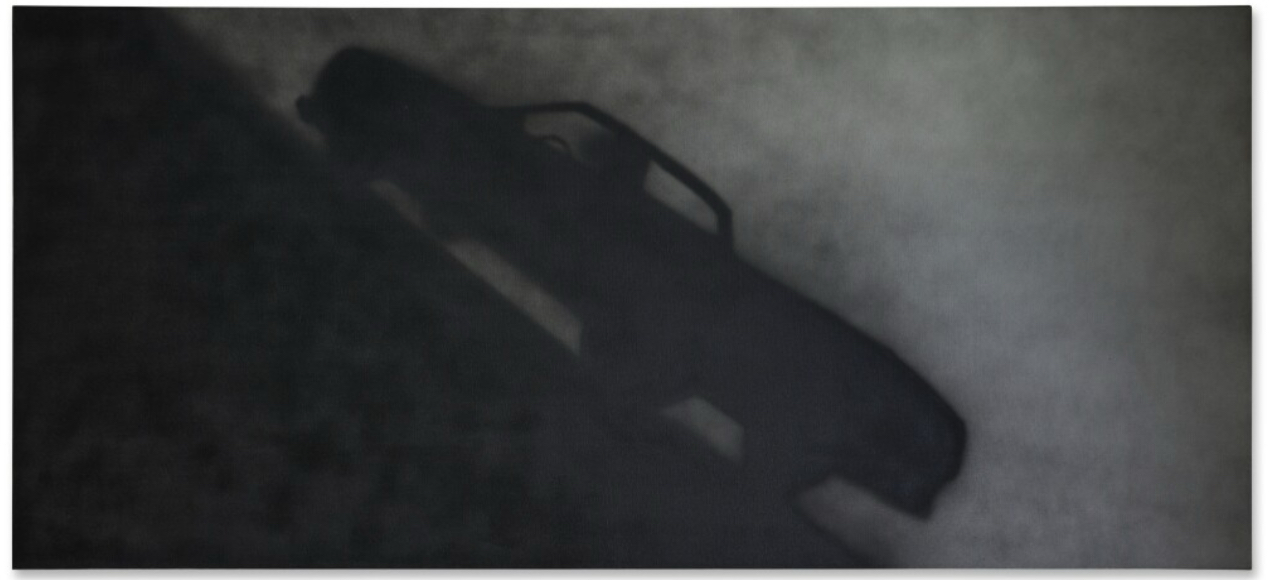
ED RUSCHA (b. 1937)
Uphill Driver, 1986
Acrylic on canvas
54×120 inches (137.2 x 304.8 cm)
Signed and dated 1986 (on the reverse)
USD 1 million
#14. Nowhere, 1982
Christie’s New-York: 12 May 2023
Estimated: USD 700,000 – 1,000,000
USD 819,000
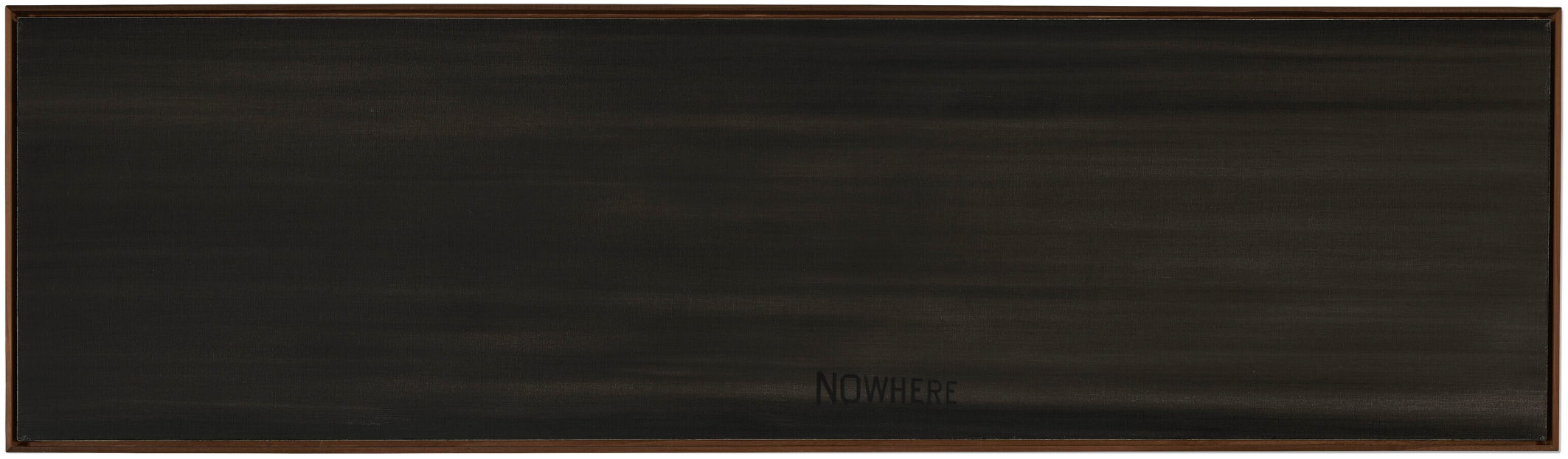
ED RUSCHA (B. 1937)
Nowhere, 1982
Oil on canvas
22×80 inches (55.9 x 203.2 cm)
#15. Chairman, 1977
Christie’s New-York: 9 November 2023
Estimated: USD 1,000,000 – 1,500,000
USD 756,000
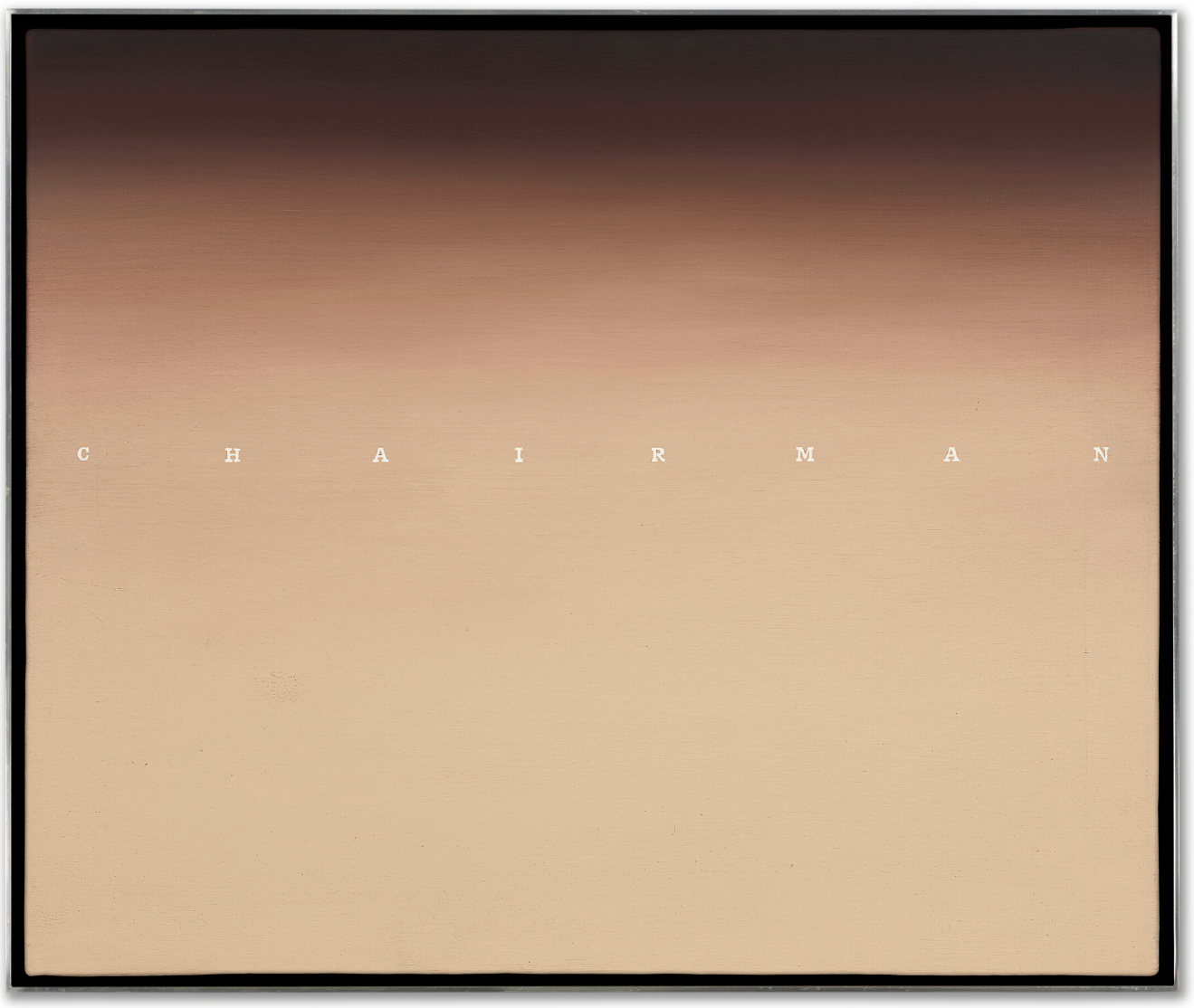
ED RUSCHA (B. 1937)
Chairman, 1977
Oil on canvas
20×24 inches (50.8 x 61 cm)
Signed and dated ‘Edward Ruscha 1977’ (on the reverse)
#16. Ford Fairlane, 1994
Christie’s New-York: 7 March 2023
Estimated: USD 300,000 – 500,000
USD 516,600
ED RUSCHA (B. 1937) (christies.com)
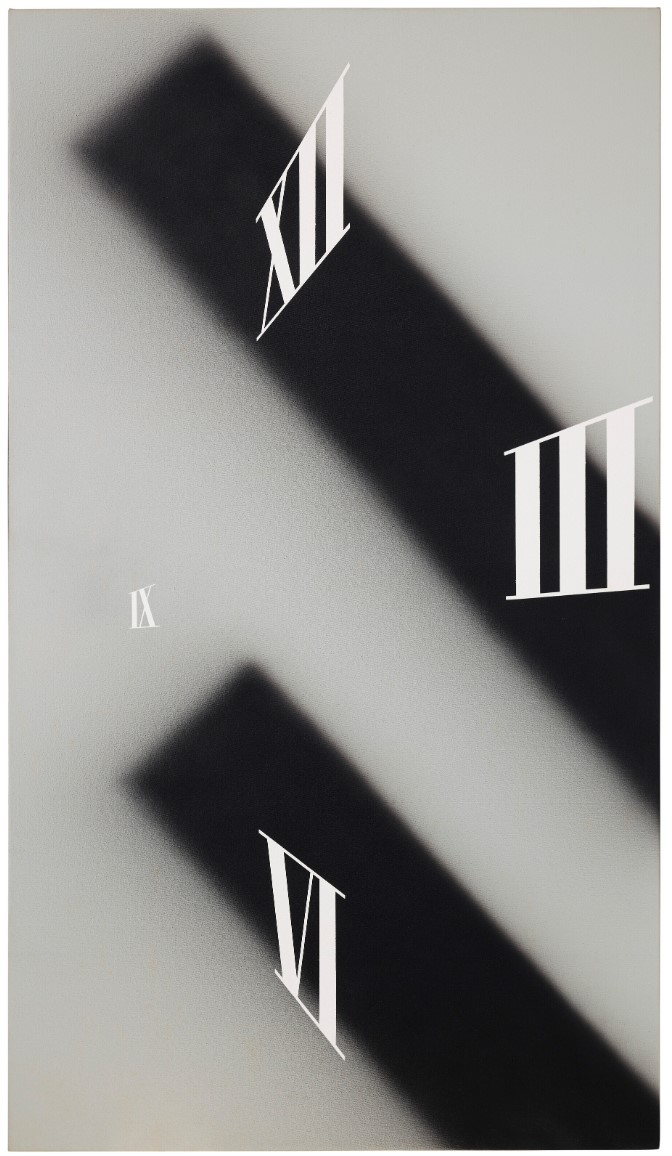
ED RUSCHA (B. 1937)
Ford Fairlane, 1994
Acrylic on canvas
84×48 inches (213.4 x 121.9 cm)
Signed and dated ‘Ed Ruscha 1994’ (on the reverse)
#17. Time Marches On, 1988
Sotheby’s New-York: 16 November 2023
Estimated: USD 150,000 – 200,000
USD 317,500
Time Marches On | Contemporary Day Auction | 2023 | Sotheby’s (sothebys.com)
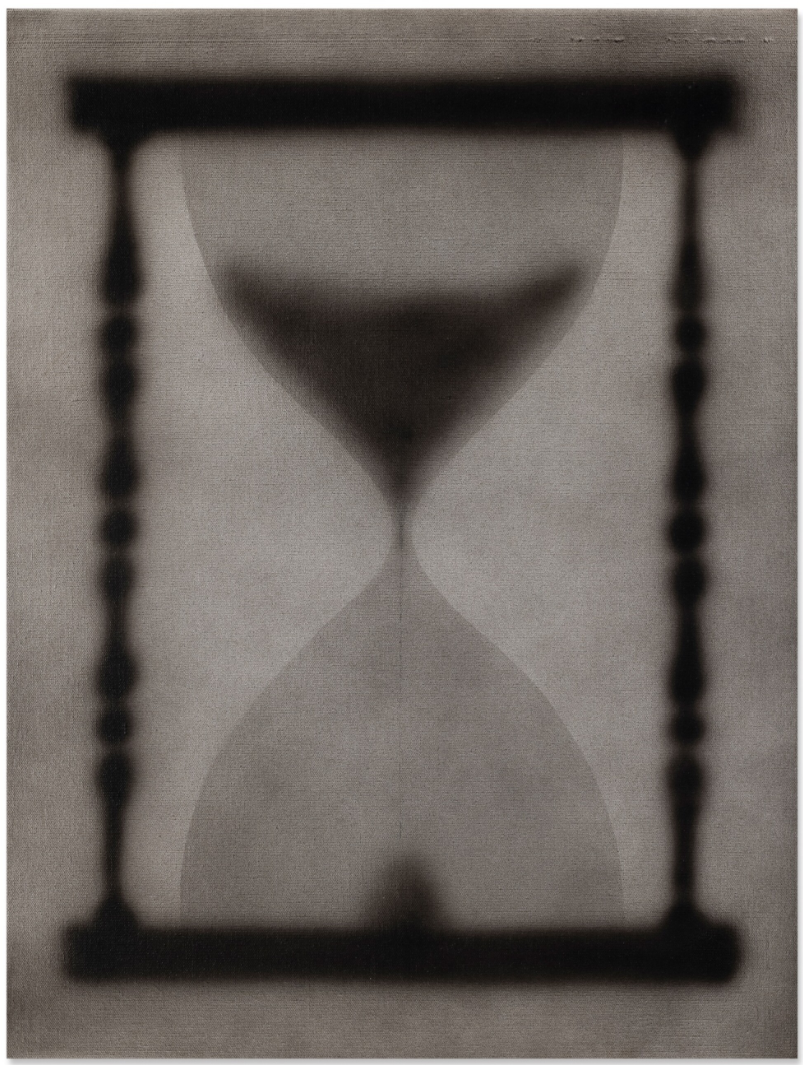
ED RUSCHA (b. 1937)
Time Marches On, 1988
Acrylic on canvas
24×18 inches (61 x 45.7 cm)
Signed and dated 1988 (on the reverse)
2022 Auction Results
FOR PAINTINGS ONLY
15 lots sold at auction in 2022 for a total turnover of USD 34,228,033. The top lot, Cold Beer Beautiful Girl, sold for USD 18,823,400 at Sotheby’s in New-York on 19 May 2022. Only one lot sold for over USD 10 million.
2022 Top 3 Lots
8 lots sold over USD 1 million, for a cumulative turnover of USD 30,818,576, representing 90% of the total turnover for 2022.
XXXXXXXXXX
#1. Cold Beer Beautiful Girls, 1993
Sotheby’s New-York: 19 May 2022
Estimated: USD 15,000,000 – 20,000,000
USD 18,823,400
ED RUSCHA (B. 1937)
Cold Beer Beautiful Girls, 1993
Acrylic on canvas
84×60 inches (213.4 x 152.4 cm)
signed Ed Ruscha and dated ’93 (on the reverse)
Signed Ed Ruscha, titled Cold Beer Beautiful Girls and dated 1993 (on the stretcher)
#2. No Sleep, 1965
Christie’s New-York: 12 May 2022
Estimated: USD 1,500,000 – 2,000,000
USD 2,940,000
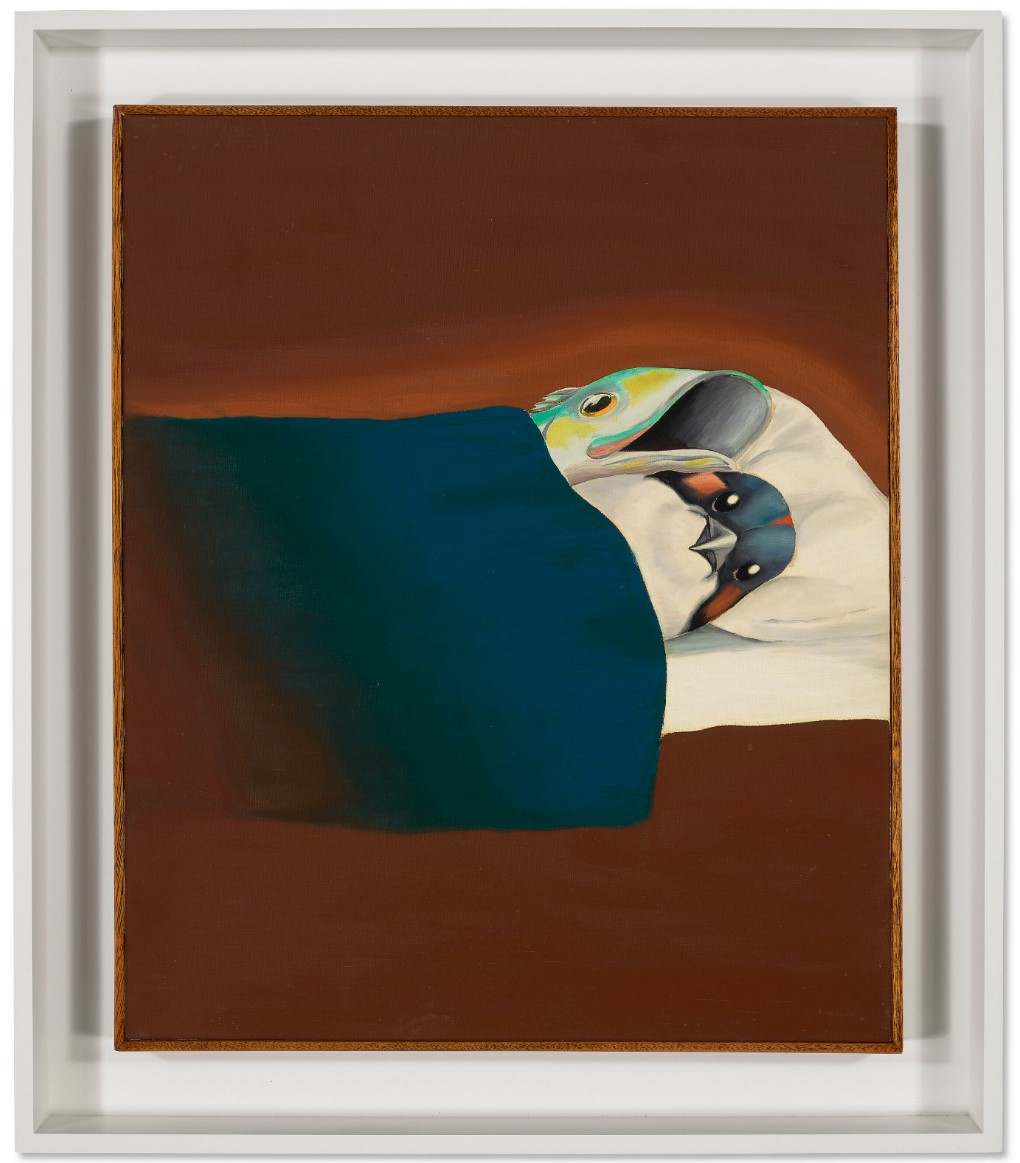
ED RUSCHA (B. 1937)
No Sleep, 1965
Oil on canvas
24 x 19 7⁄8 inches (61 x 50.5 cm)
Signed ‘E. RUSCHA’ (on the reverse)
Titled and dated ‘”NO SLEEP” 1965’ (on the stretcher)
#3. Kids, 1987-1988
Christie’s New-York: 10 March 2022
Estimated: USD 1,800,000 – 2,500,000
USD 2,580,000
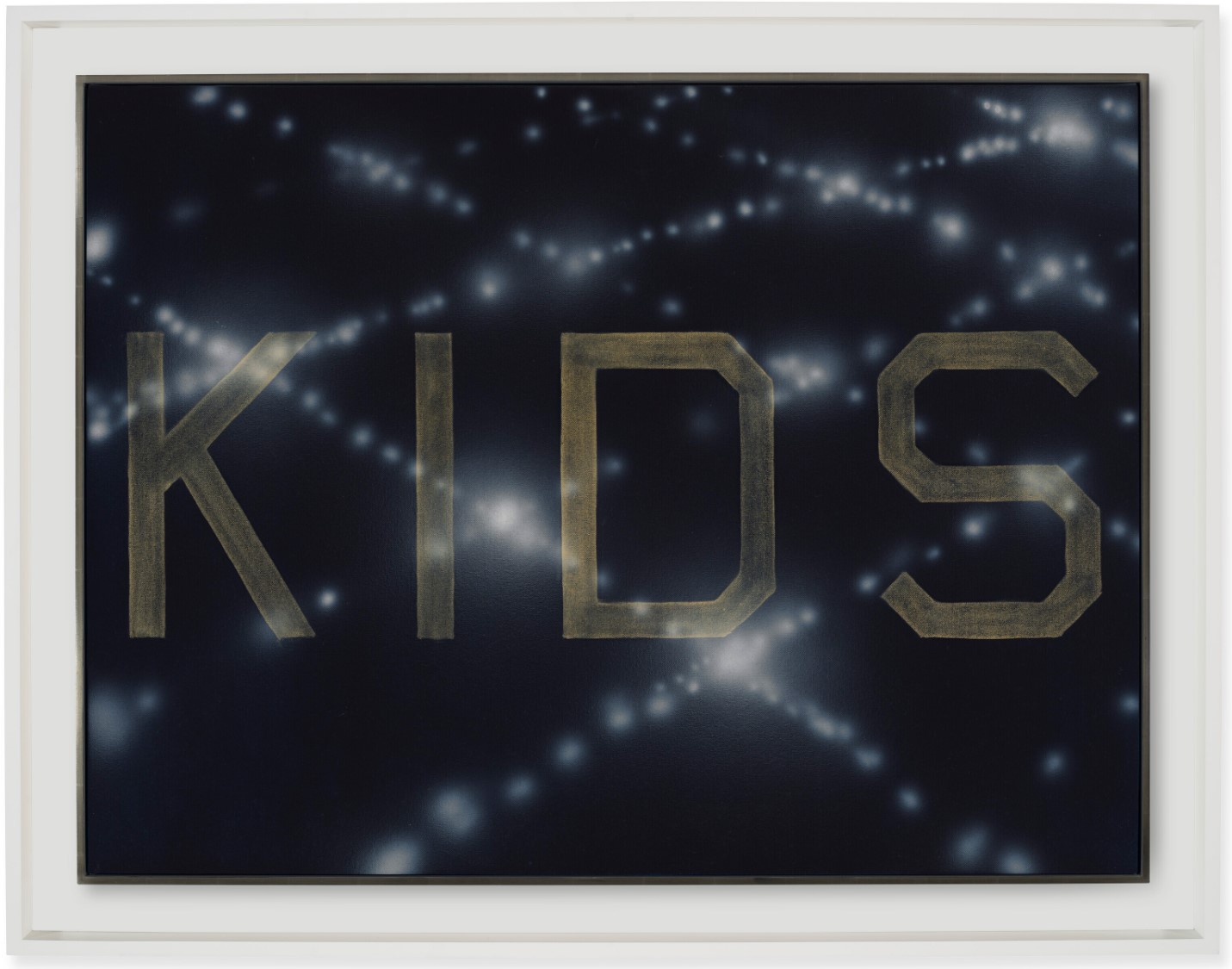
ED RUSCHA (B. 1937)
Kids, 1987-1988
Acrylic and oil on canvas
36 1⁄8 x 48 1⁄4 inches (91.8 x 122.6 cm)
Signed and dated ‘Ed Ruscha 1988’ (on the backing board)
#4. Huge Conditions, 2007
Phillips London: 3 March 2022
Estimated: GBP 1,100,000 – 1,500,000
GBP 1,232,500 / USD 1,641,801
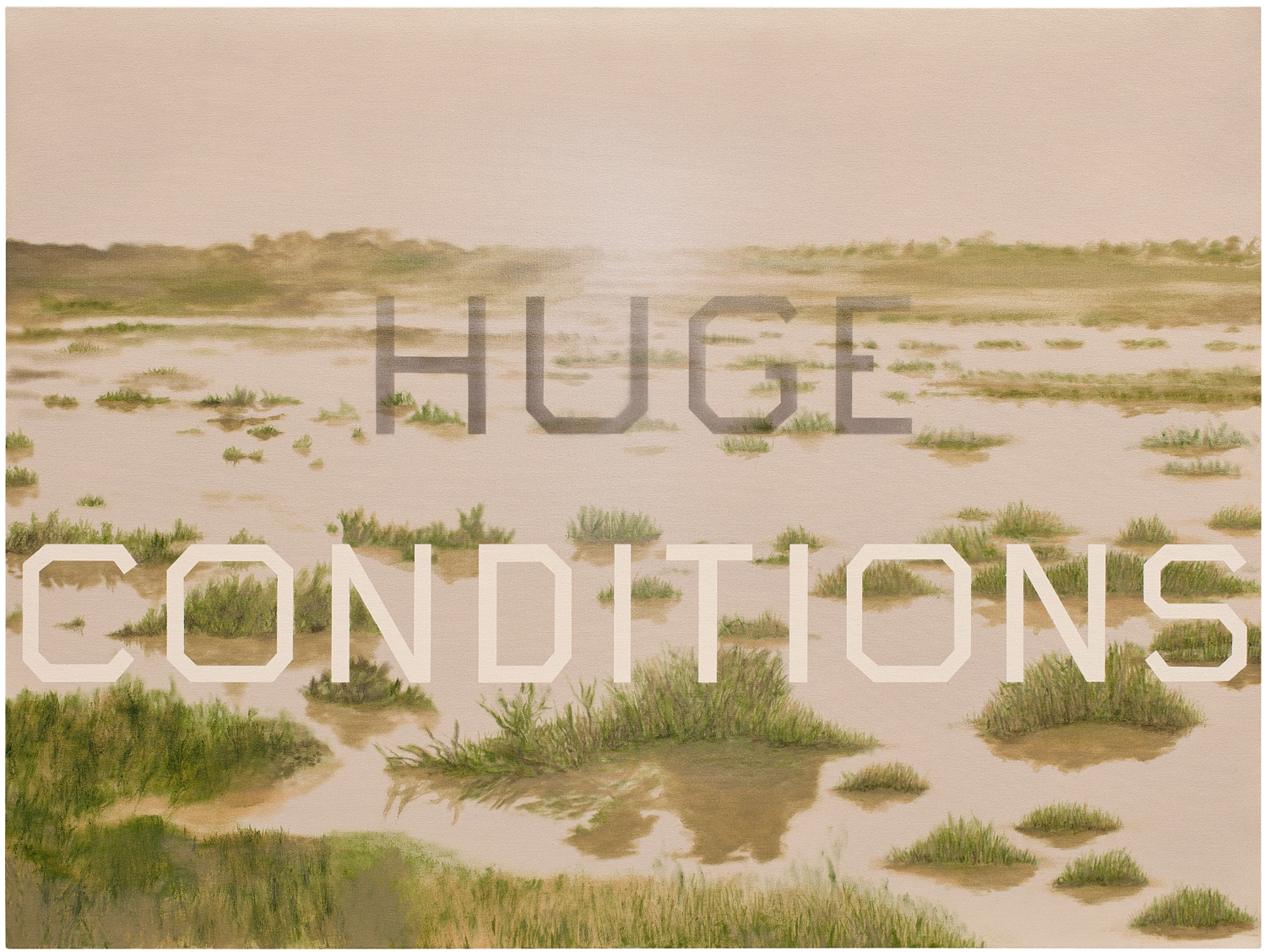
ED RUSCHA
Huge Conditions, 2007
Acrylic on canvas
36×48 inches (91.4 x 121.9 cm)
Signed, titled and dated ”’HUGE CONDITIONS” Ed Ruscha 2007′ on the reverse
Signed, titled and dated ‘ED RUSCHA ”HUGE CONDITIONS” 2007’ on the stretcher
#5. Bowling Ball, Olive, 1969
Christie’s New-York: 12 May 2022
Estimated: USD 1,500,000 – 2,000,000
USD 1,620,000
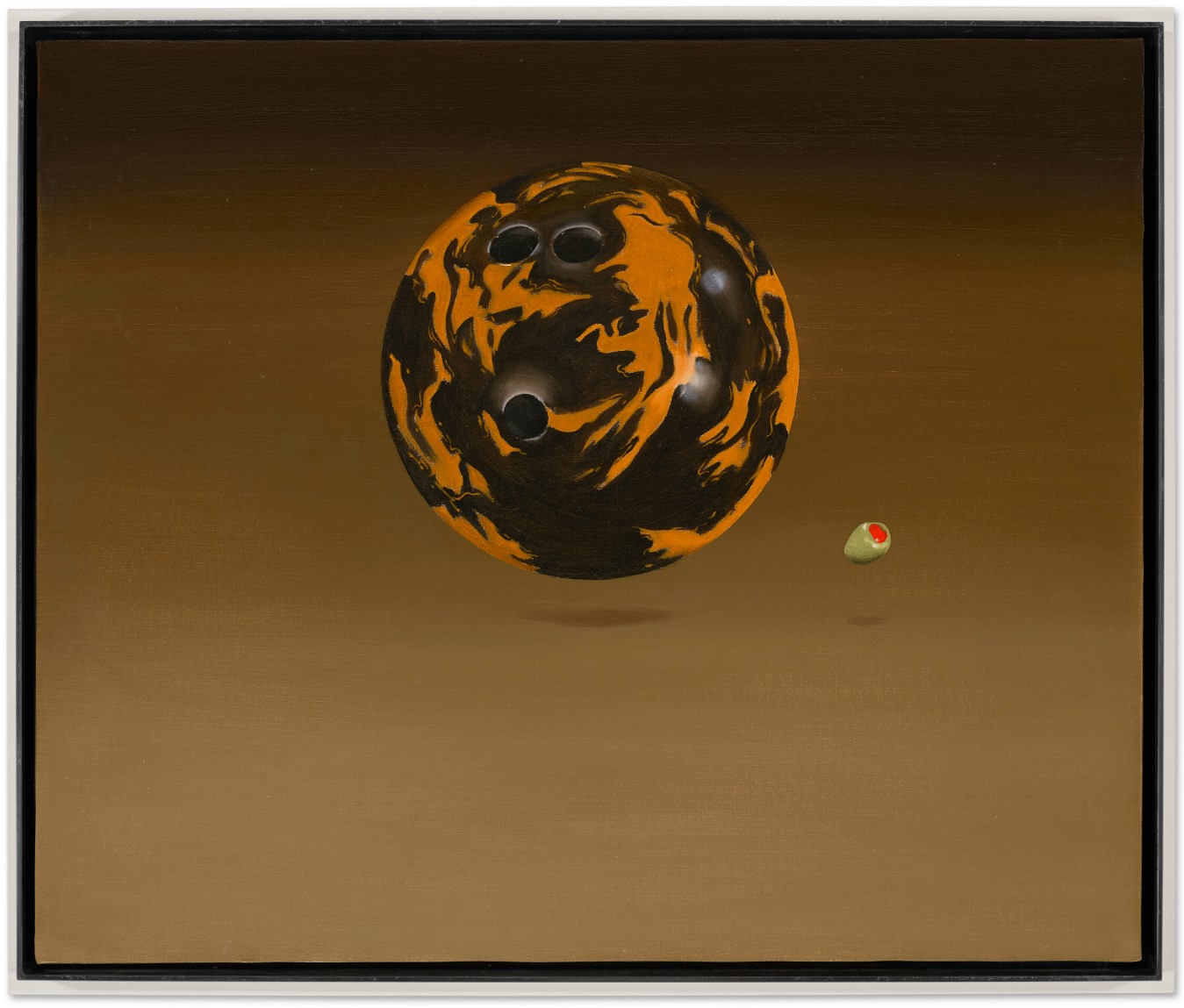
ED RUSCHA (B. 1937)
Bowling Ball, Olive, 1969
Oil on canvas
20×24 inches (50.5 x 60.6 cm)
Signed and dated ‘E. Ruscha 1969’ (on the reverse)
#6. Affiliation, 1987
Christie’s New-York: 13 May 2022
Estimated: USD 600,000 – 800,000
USD 1,197,000
ED RUSCHA (B. 1937) (christies.com)
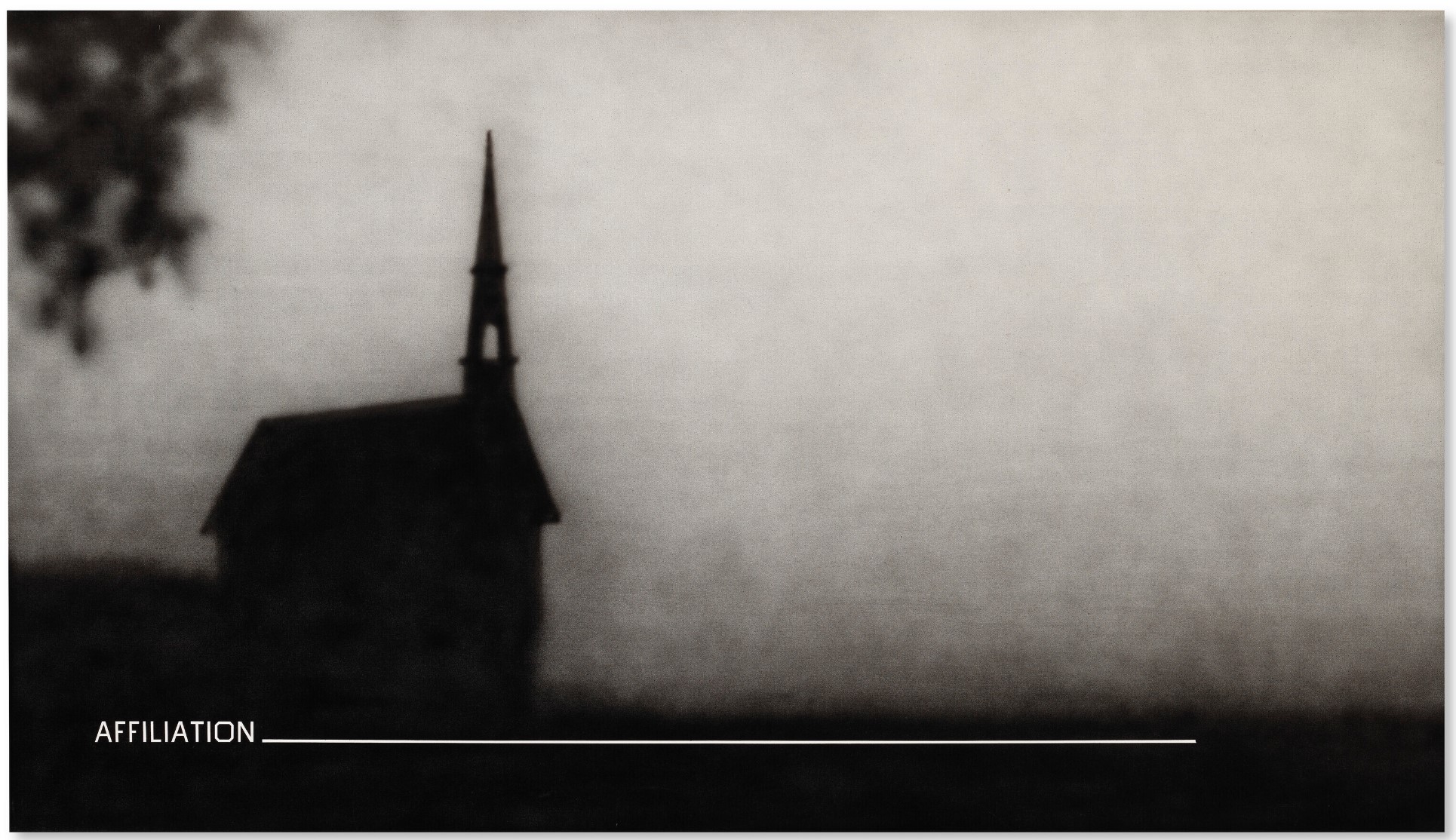
ED RUSCHA (B. 1937)
Affiliation, 1987
Acrylic on canvas
60×105 inches (152.4 x 266.7 cm)
Signed and dated ‘Ed Ruscha 1987’ (on the reverse)
Signed again, titled and dated again ‘ED RUSCHA “AFFILIATION” 1987’ (on the stretcher)
#7. The Eighties, 1980
Bonhams New-York: 16 November 2022
Estimated: USD 800,000 – 1,200,000
USD 1,008,375
Bonhams : ED RUSCHA (B. 1937) The Eighties 1980
Oil on canvas
21×159 inches (53.3 x 403.9 cm)
#8. Bamboo Pole, 1980
Christie’s New-York: 10 November 2022
Estimated: USD 500,000 – 700,000
USD 1,008,000
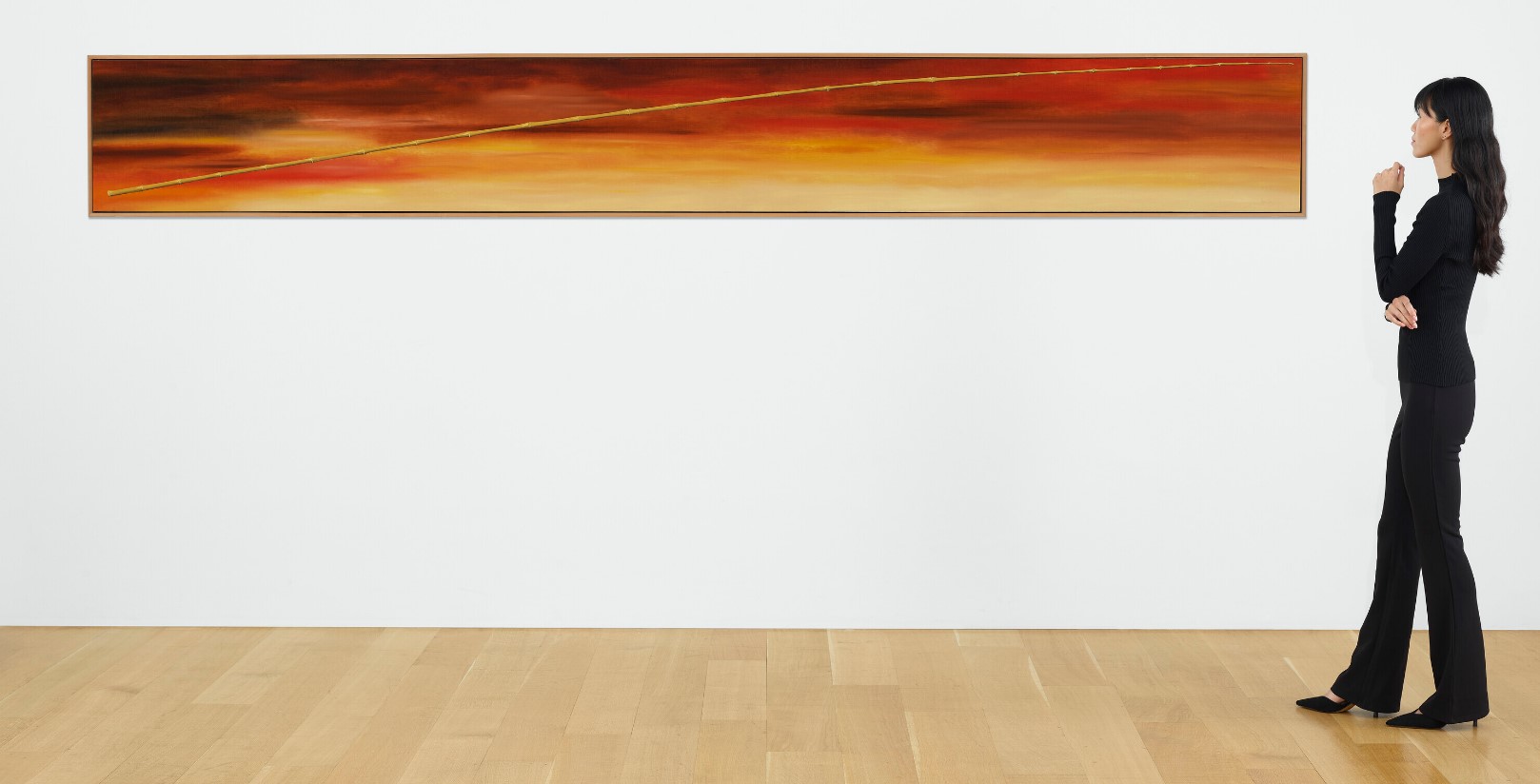
ED RUSCHA (B. 1937)
Bamboo Pole, 1980
Oil on canvas
20 x 158 3/4 inches (50.8 x 403.2 cm)
Signed and dated ‘Ed Ruscha 1980’ (on the stretcher)
USD 1 million
#9. Hawaiian Music, 1974
Sotheby’s New-York: 30 September 2022
Estimated: USD 600,000 – 800,000
USD 844,200
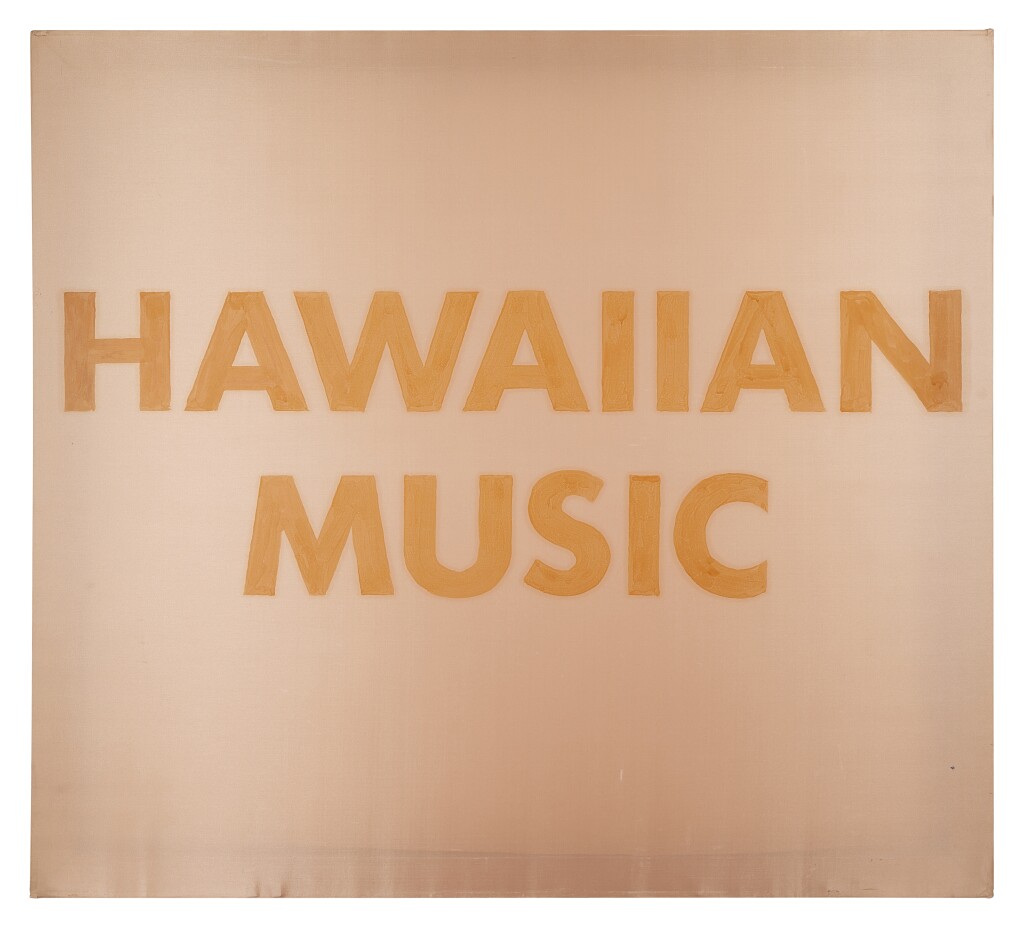
ED RUSCHA (B. 1937)
Hawaiian Music, 1974
Egg yolk on taffeta
36×40 inches (91 x 101.6 cm)
#10. Mean as Hell, 1979
Christie’s New-York: 18 November 2022
Estimated: USD 1,000,000 – 2,000,000
USD 800,100
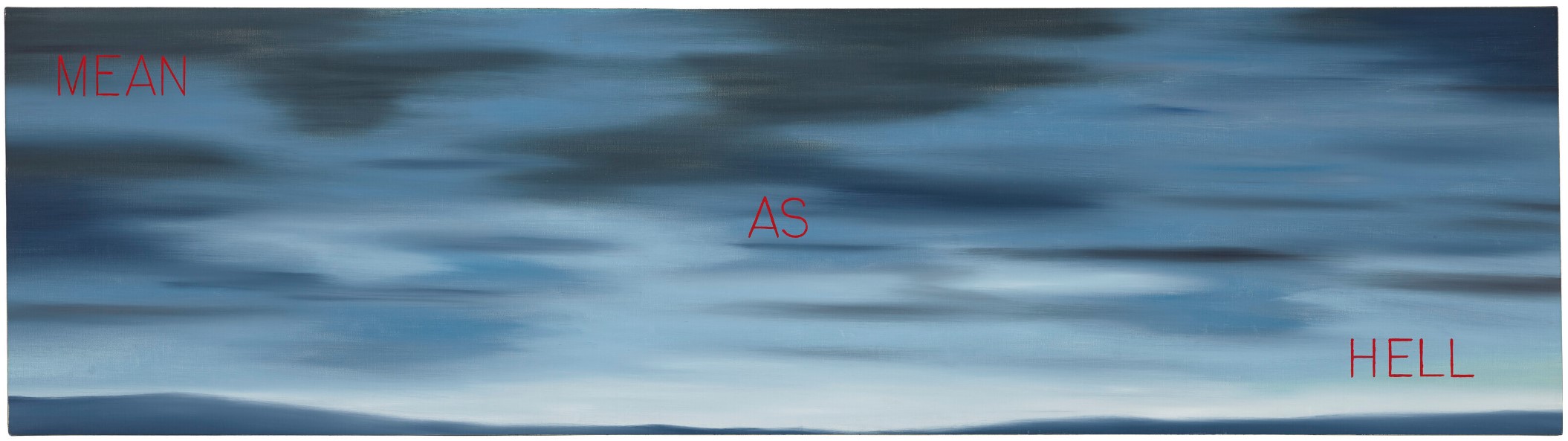
ED RUSCHA (B. 1937)
Mean as Hell, 1979
Oil on canvas
22×80 inches (55.9 x 203.2 cm)
Signed and dated ‘Edward Ruscha 1979’ (on the reverse)
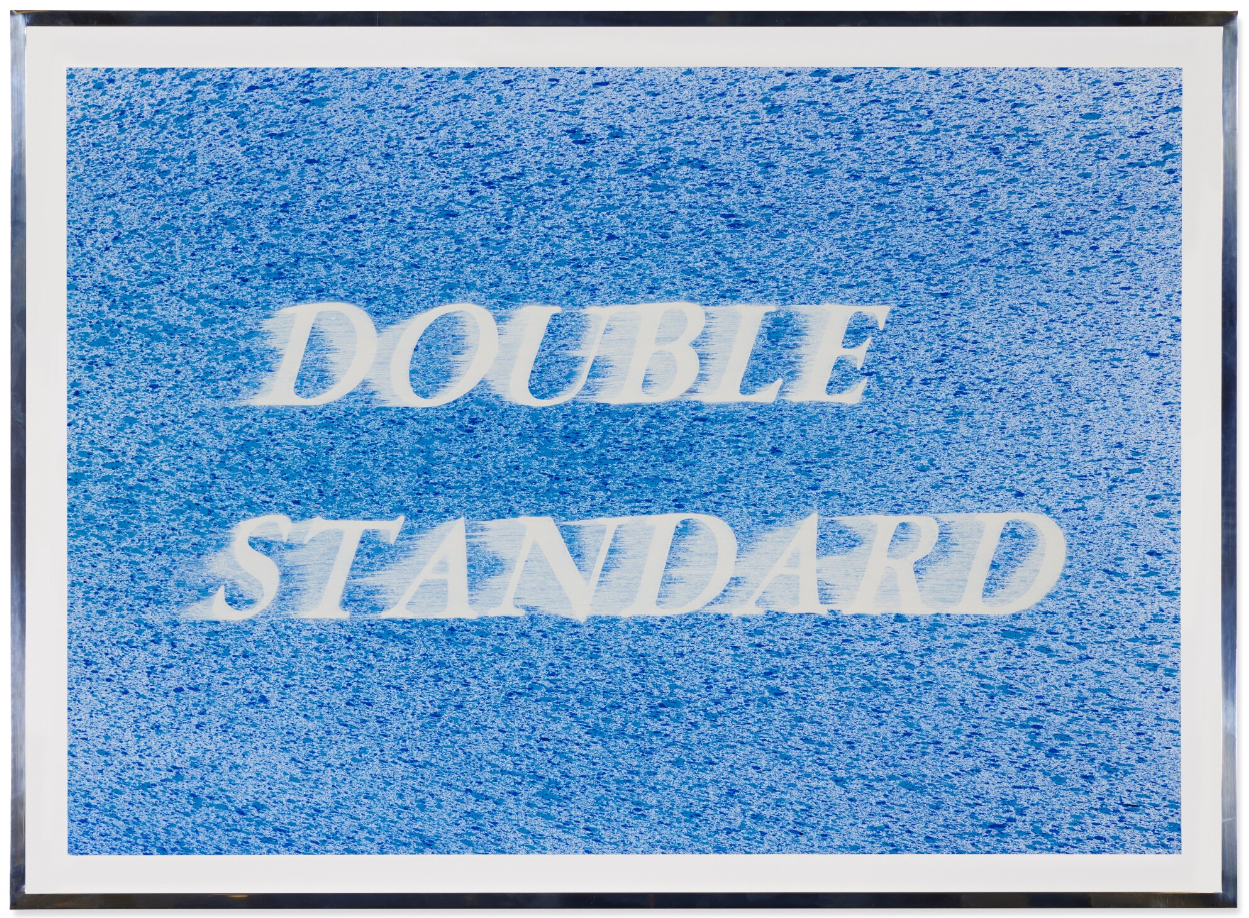
#11. Double Standard, 2019
Sotheby’s New-York: 20 May 2022
Estimated: USD 200,000 – 300,000
USD 535,500
Double Standard | Contemporary Day Auction | 2022 | Sotheby’s (sothebys.com)
ED RUSCHA (b. 1937)
Double Standard, 2019
Acrylic on museum board
24×34 inches (61 x 86.5 cm)
Signed Ed Ruscha and dated 2019 (on the verso)
USD 500,000
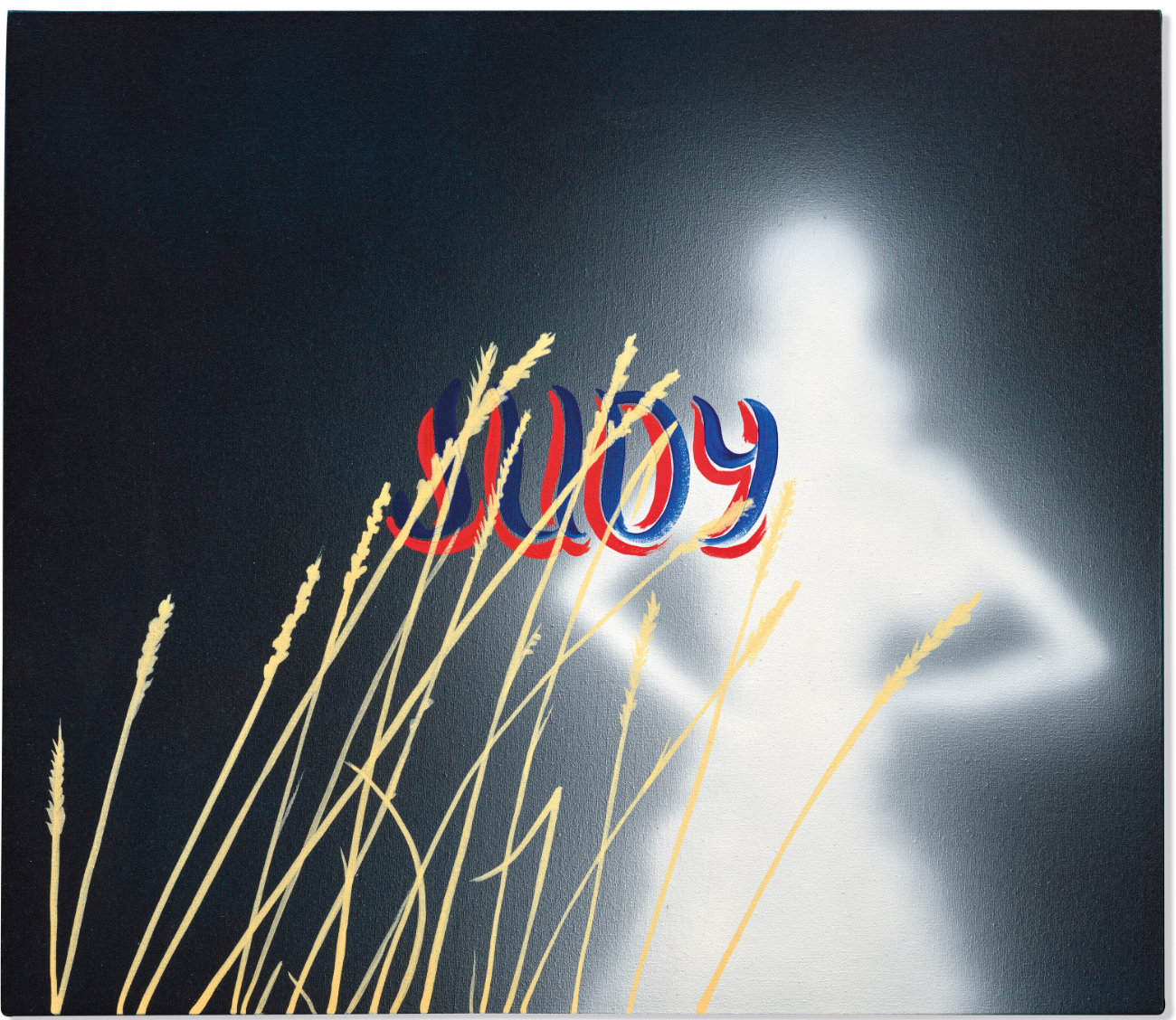
#12. Judy, 1992
Christie’s Paris: 30 November 2022
Estimated: EUR 300,000 – 500,000
EUR 478,800 / USD 494,117
ED RUSCHA (Born 1937)
Judy, 1992
Acrylic on canvas
26 x 29 7/8 inches (66×76 cm)
Signed and dated ‘Ed Ruscha 1992’ (on the reverse)
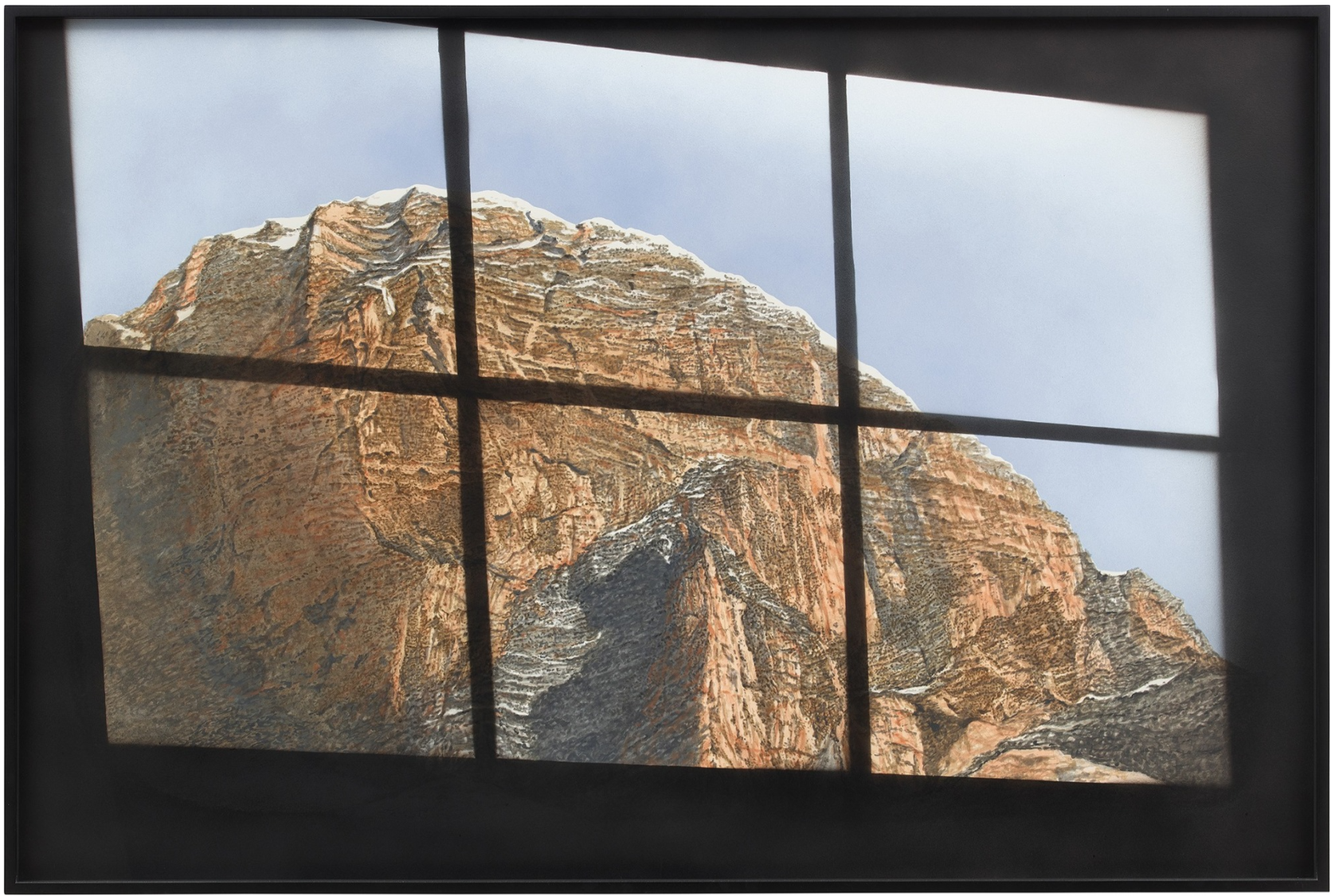
#13. Spied Upon Scene: Window, 2017
Phillips Hong-Kong: 22 June 2022
Estimated: HKD 3,500,000 – 5,500,000
HKD 3,150,000 / USD 401,289
Ed Ruscha – 20th Century & Contemporary… Lot 13 June 2022 | Phillips
ED RUSCHA
Spied Upon Scene: Window, 2017
Acrylic on museum board paper
39 1/2 x 59 5/8 inches (100.4 x 151.3 cm)
Signed, titled and dated ‘”SPIED UPON SCENE: WINDOW” Ed Ruscha 2017’ on the reverse
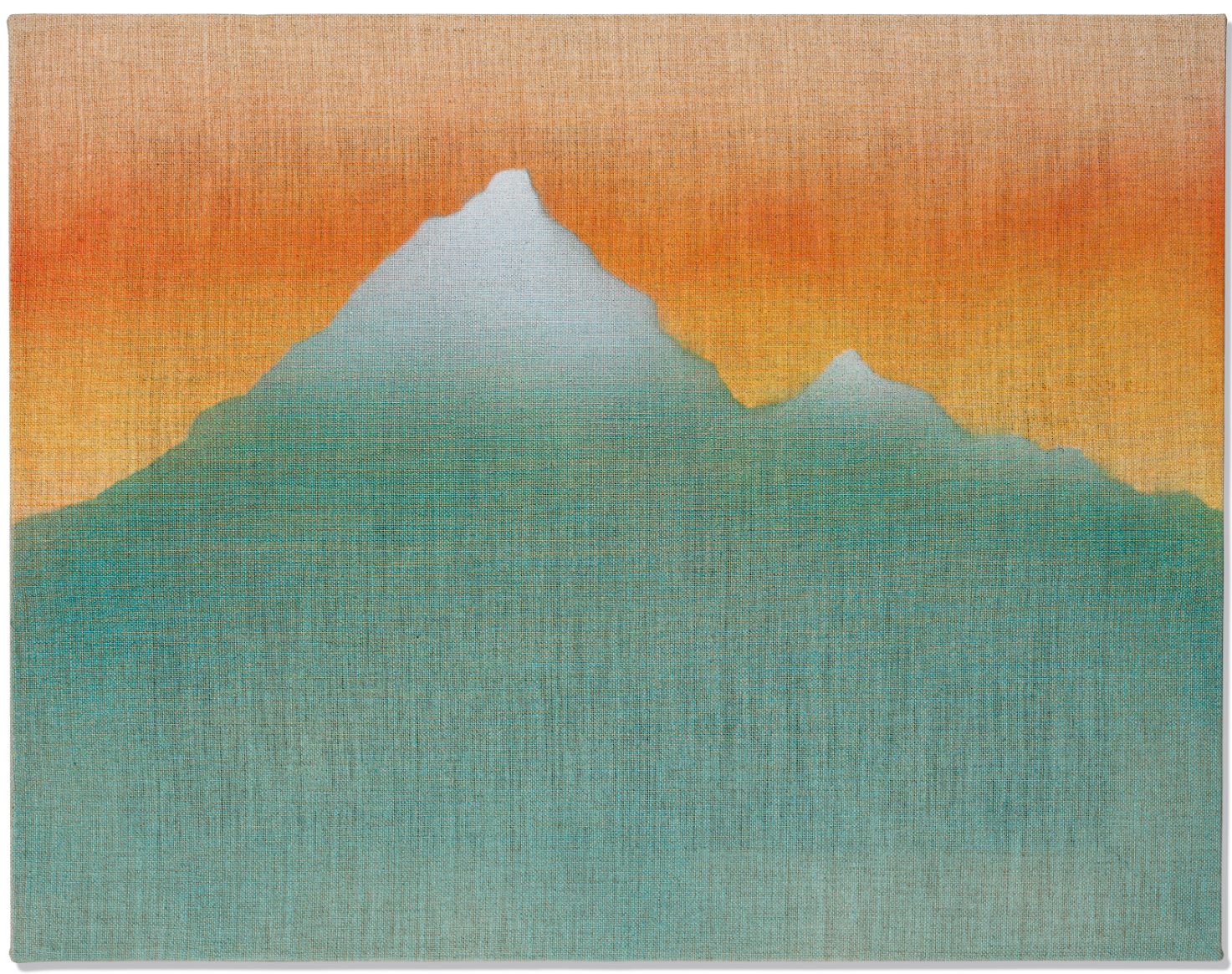
#14. Mountain, 2009
Christie’s Paris: 30 November 2022
Estimated: EUR 90,000 – 130,000
EUR 207,900 / USD 214,551
Ed Ruscha (né en 1937), Mountain | Christie’s (christies.com)
ED RUSCHA (Born 1937)
Mountain, 2009
Acrylic on canvas
14 1/8 x 18 1/8 inches (36×46 cm)
Signed and dated ‘Ed Ruscha 2009’ (on the reverse)
#15. So, 2006
Phillips New-York: 19 May 2022
Estimated: USD 30,000 – 40,000
USD 119,700
Ed Ruscha – 20th Century & Contemporary… Lot 199 May 2022 | Phillips
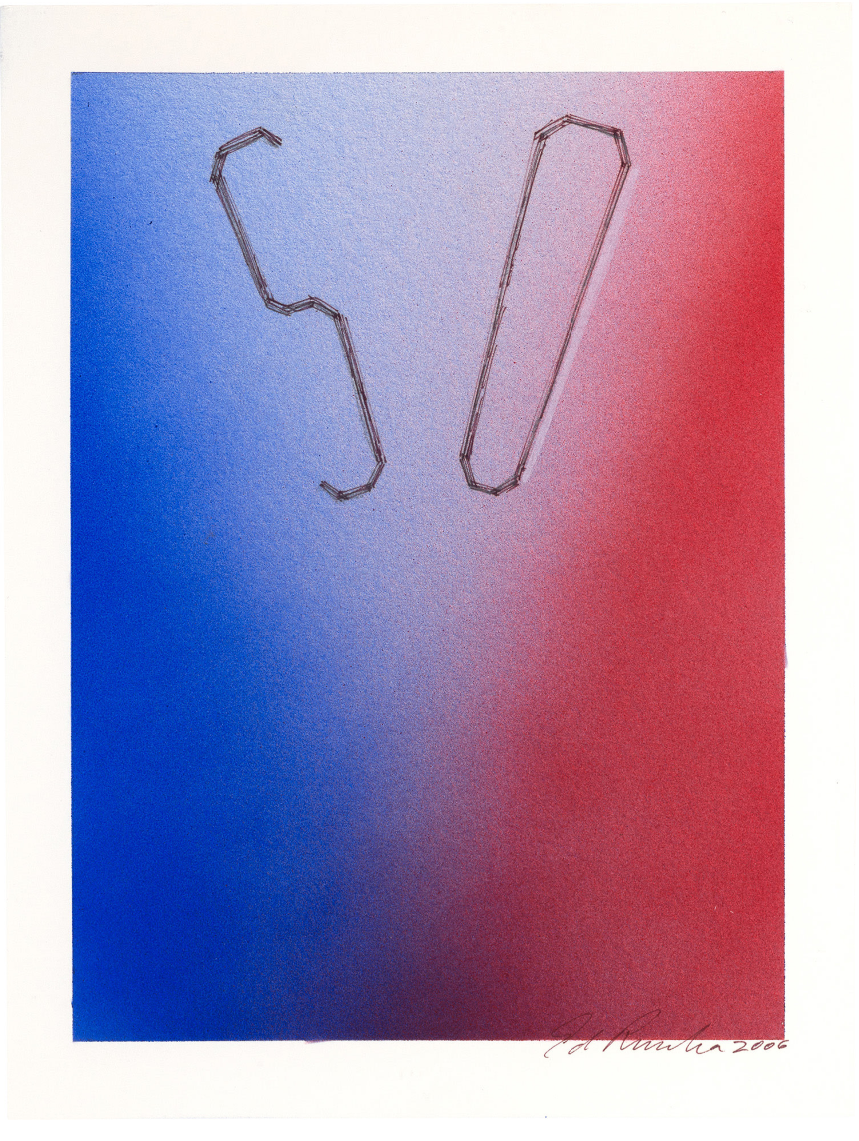
ED RUSCHA
So, 2006
Acrylic and ink on museum board
12 1/4 x 9 3/8 inches (31.1 x 23.8 cm)
Signed and dated “Ed Ruscha 2006” lower right
2021 Auction Results
FOR PAINTINGS ONLY
9 lots sold at auction in 2021 for a total turnover of USD 32,259,905. With 3 lots failing to sell, the sell-through rate is 75%. The highest price has been achieved at Christie’s in New-York, on 11 November 2021, when Ripe, a painting dated 1967 sold for USD 20,000,000.
2021 Top 3 Lots
This was the only lot that sold above USD 10 million. 4 lots sold above USD 1 million, generating a cumulative turnover of USD 28,955,500, representing 89.8% of the total turnover for 2021.
XXXXXXXXXX
#1. Ripe, 1967
Christie’s New-York: 10 November 2021
Estimated: USD 18,000,000 – 22,000,000
USD 20,970,000
ED RUSCHA (B. 1937) (christies.com)
ED RUSCHA (B. 1937)
Ripe, 1967
Oil on canvas
59 ¼ x 54 ¾ inches (150.5 x 139.1 cm)
#2. Varieties of Internal Torment, 1998
Sotheby’s New-York: 18 November 2021
Estimated: USD 3,000,000 – 4,000,000
USD 3,650,000
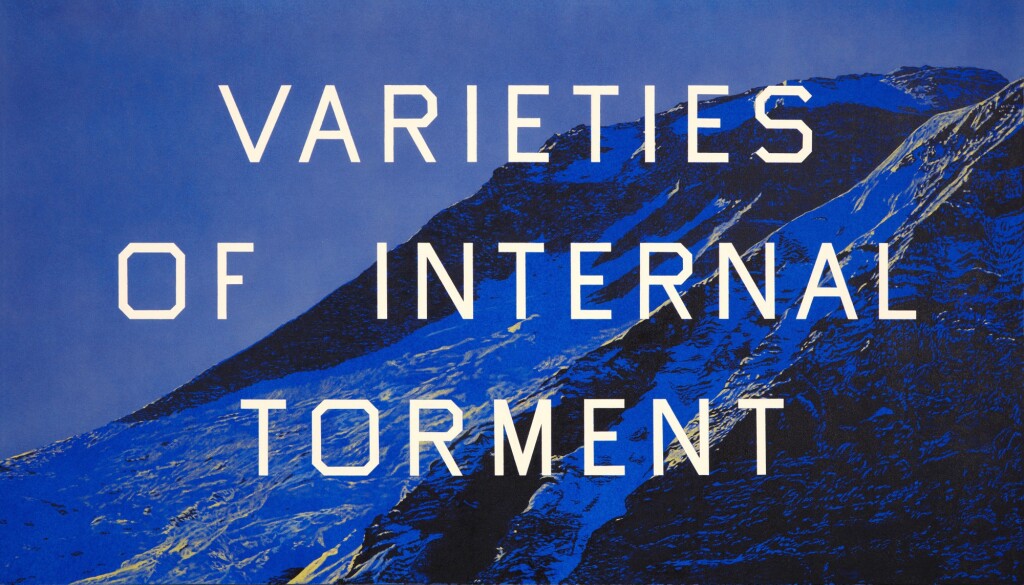
ED RUSCHA (B.1937)
Varieties of Internal Torment, 1998
Acrylic on canvas
48×84 inches (121.9 x 213.3 cm)
Signed Ed Ruscha and dated 1998 (on the reverse)
#3. California Grape Skins, 2009
Sotheby’s New-York: 12 March 2021
Estimated: USD 2,200,000 – 2,800,000
USD 2,863,500
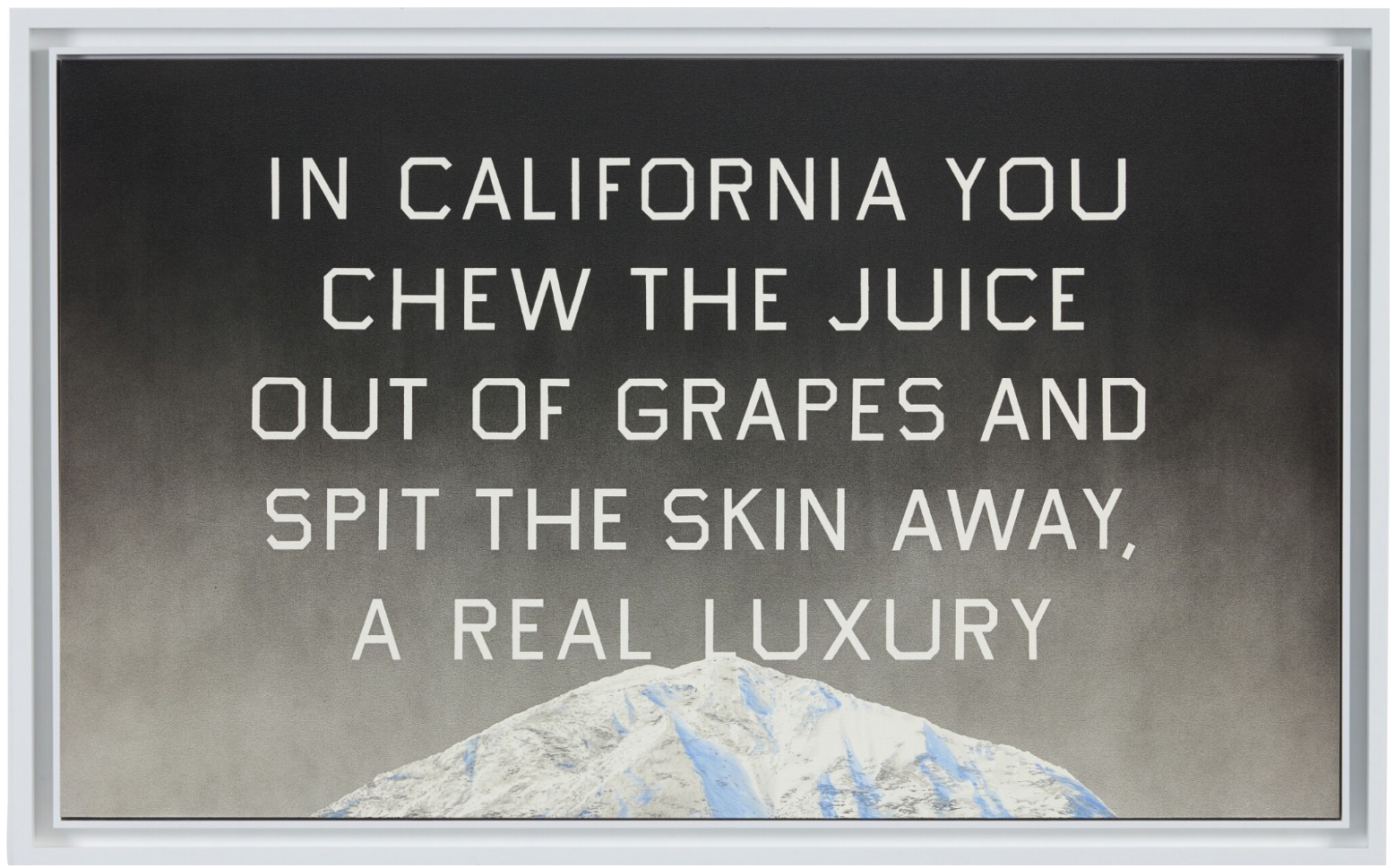
ED RUSCHA (b. 1937)
California Grape Skins, 2009
Acrylic on canvas
38×64 inches (96.8 x 162.9 cm)
Signed and dated 2009 on the reverse
#4. It’s OK—Everything’s OK, 1979
Sotheby’s NY: 13 May 2021
Estimated: USD 800,000 – 1,200,000
USD 1,472,000
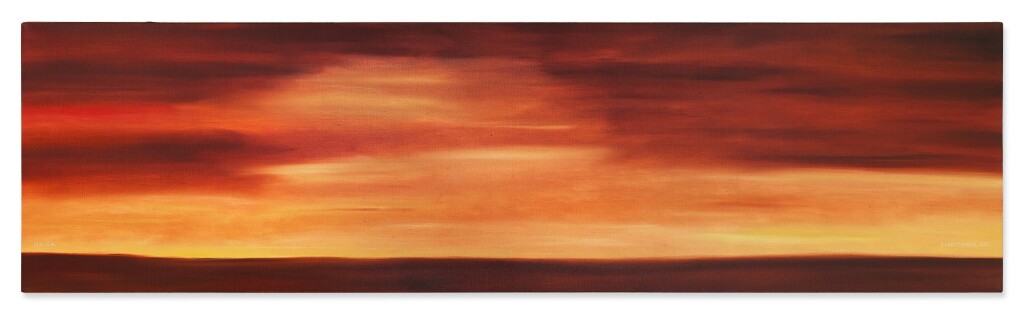
ED RUSCHA (B. 1937)
It’s OK—Everything’s OK, 1979
Oil on canvas
22×80 inches (55.9 x 203.2 cm)
USD 1 million
#5. Bee?, 1997-99
Sotheby’s Hong-Kong: 19 April 2021
Estimated: HKD 6,000,000 – 8,000,000
HKD 7,556,000 / USD 972,934
ED RUSCHA (b. 1937)
Bee?, 1997-99
Acrylic on shaped canvas
74×58 inches (187.6 x 147.3 cm)
Signed and dated 1997-99
#6. Chrysler New York, 1994
Sotheby’s New-York: 30 September 2021
Estimated: USD 400,000 – 600,000
USD 806,500
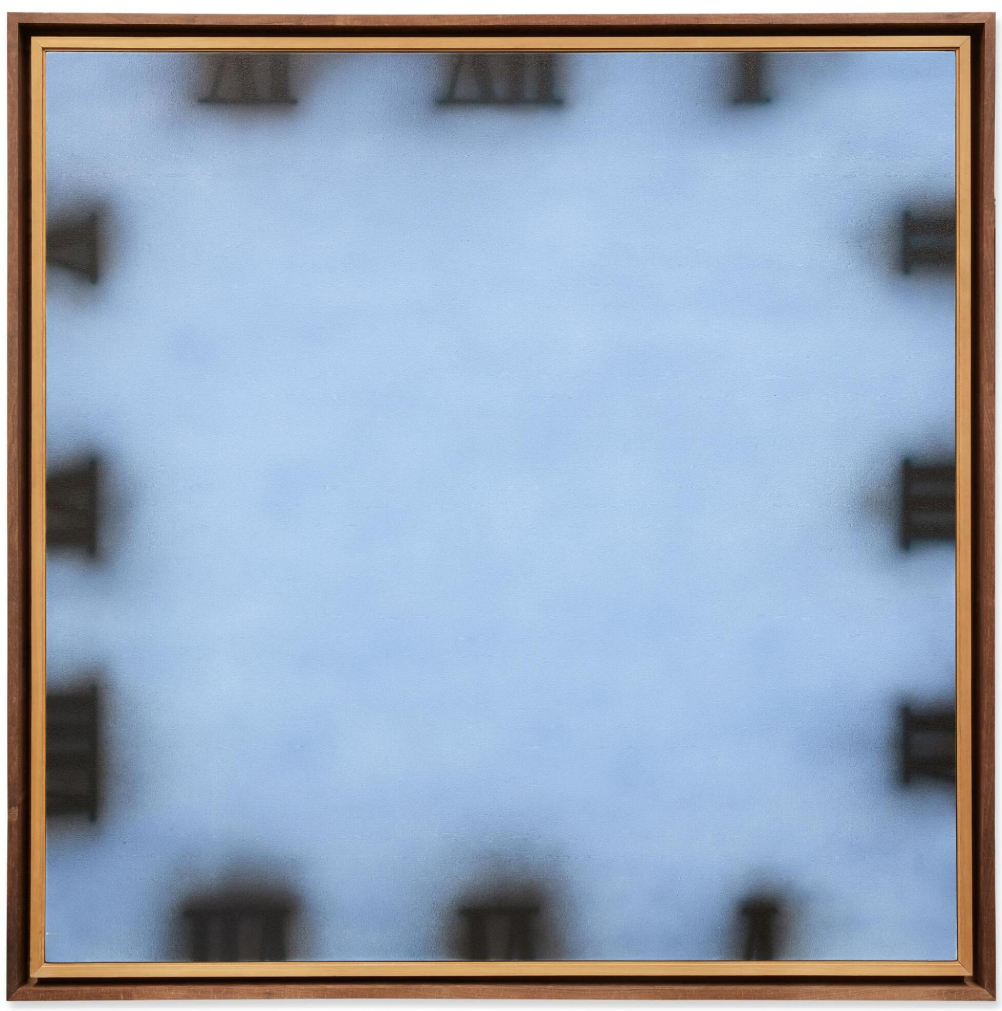
ED RUSCHA (b. 1937)
Chrysler New York, 1994
Acrylic on canvas
64×64 inches (162.6 x 162.6 cm)
Signed and dated 1994 on the reverse
#7. Doric, 1996
Phillips London: 15 October 2021
Estimated: GBP 400,000 – 600,000
GBP 441,000 / USD 606,685
Ed Ruscha – 20th Century & Contempor… Lot 22 October 2021 | Phillips
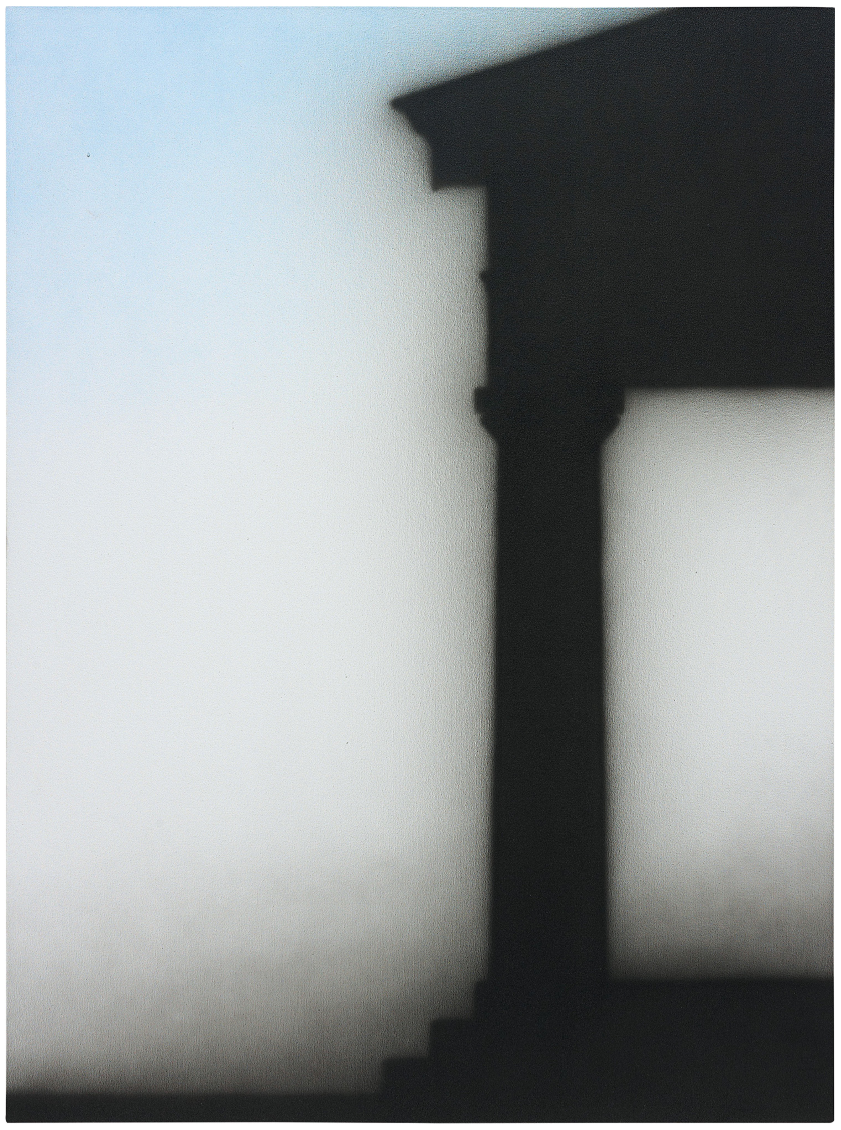
ED RUSCHA
Doric, 1996
Acrylic on canvas
54 1/8 x 40 1/8 inches (137.5 x 101.9 cm)
Signed, titled and dated ‘Ed Ruscha 1996’ on the reverse
Titled ‘Doric’ on the overlap; signed, titled and dated ‘EDWARD RUSCHA – 1996 ”DORIC”’ on the stretcher
#8. 1981 – Future, 1980
Phillips Hong-Kong: 8 June 2021
Estimated: HKD 4,000,000 – 6,000,000
HKD 4,410,000 / USD 568,306
Ed Ruscha – 20th Century & Contemporary… Lot 24 June 2021 | Phillips
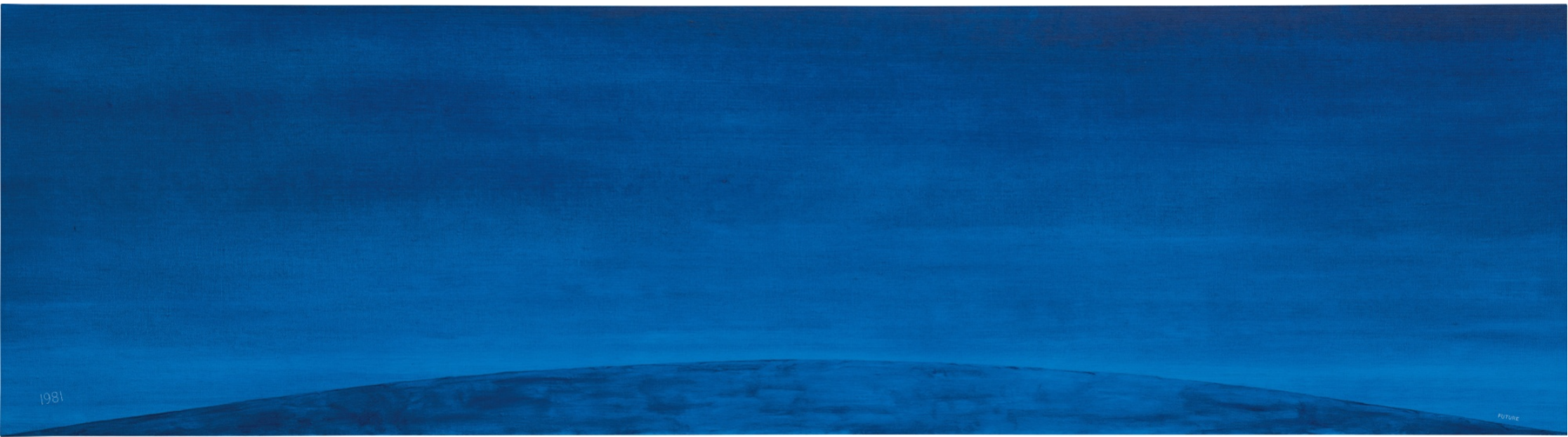
ED RUSCHA
1981 – Future, 1980
Oil on canvas
22 x 79 7/8 inches (56 x 202.9 cm)
Signed, titled and dated ‘“1981 – FUTURE” Ed Ruscha 1980’ on the reverse
PART III: FOCUS
Word Paintings
That Was Then This Is Now, 1989
Sotheby’s New-York: 15 May 2025
Estimated: USD 7,000,000 – 10,000,000
USD 7,795,000
That Was Then This Is Now | The Now and Contemporary Evening Auction | 2025 | Sotheby’s
ED RUSCHA (b. 1937)
That Was Then This Is Now, 1989
Acrylic on canvas
42×96 inches (106.7 x 243.8 cm)
Signed and dated 1989 (on the reverse)
Signed, titled and dated 1989 (on the stretcher)
Radiating above a celestial yet portent cloudy sky, Ed Ruscha’s iconic and enigmatic text–THAT WAS THEN THIS IS NOW–thunders across the canvas, evoking the cinematic climax of the transient instance between past and present. In an arresting theatrical crescendo, Ruscha masterfully elicits a moment of revolution: glowing white sunlight emanates from behind clusters of stormy clouds, dramatically illuminating an ethereal promise of hope and transformation. Ruscha’s titular phrase That Was Then This Is Now epitomizes a central conceptual concern of the artist’s practice–the enduring friction between nostalgia and reality, before and after, past and present. Executed in 1989, That Was Then This Is Now belongs to a seminal and limited group of sfumato skies painted between 1988-90, including Hell Heaven and Do Az I Do, which provide a conceptual counterpart to the artist’s earlier burning sunrise-sunset paintings of the 70s and 80s. Through a sibylline sky charged in a paradoxical narrative in which past and present conditions are unknown, That Was Then This Is Now entrances the viewer in an elusive yet eternally resonant notion of the ever-changing realities of human existence. Testament to the persisting importance of this theme in Ruscha’s practice, the artist’s recent major career retrospective organized by The Museum of Modern Art, New York and the Los Angeles County Museum of Art paid homage to this theme in its title: Ed Ruscha / Now Then.
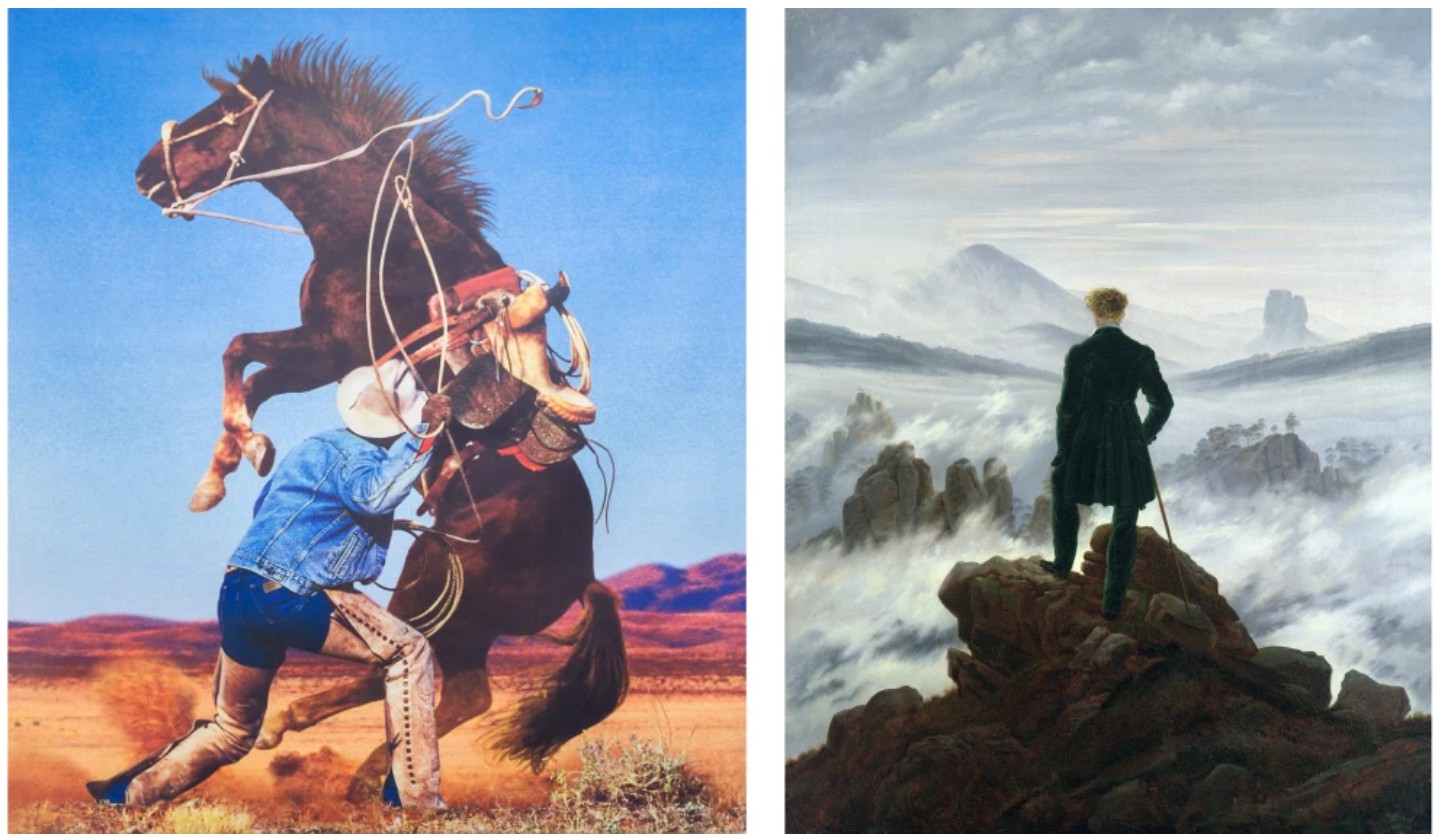
Left: Richard Prince, Untitled (Cowboy), 1999. Astrup Fearnley Museet, Oslo. Art © 2025 Richard Prince. Right: Caspar David Friedrich, The Wanderer above the Sea of Fog, 1818. Hamburger Kunsthalle. Image © Bridgeman Images
An instantly alluring and mystic phrase, That Was Then This Is Now is a paragon of the conceptual rigor and singular engagement with semiotics that have come to define Ruscha’s imitable practice. In bold articulation, Ruscha’s text confronts the viewer with a phrase that is simultaneously triumphant and nostalgic, commanding attention and inspiring reflection. The present work embodies the best of Ruscha’s most celebrated paintings in which imagery and semantics coalesce in a brilliant visual dialogue, probing the reciprocity between image, symbol, and text. Ruscha’s titular painting further invokes the romantic notions of cinema and a bygone Hollywood era, harkening back to the black-and-white movies that the artist recalls watching during his childhood in Oklahoma City. Through expansive text set against an enigmatic grisaille sky, That Was Then This Is Now suggests a sudden theatrical twist in an old Hollywood celluloid film. Furthermore, Ruscha evokes the age-old cinematic trope of the prophetic sky which appears across cinema as foreshadowing for a narrative turning point.
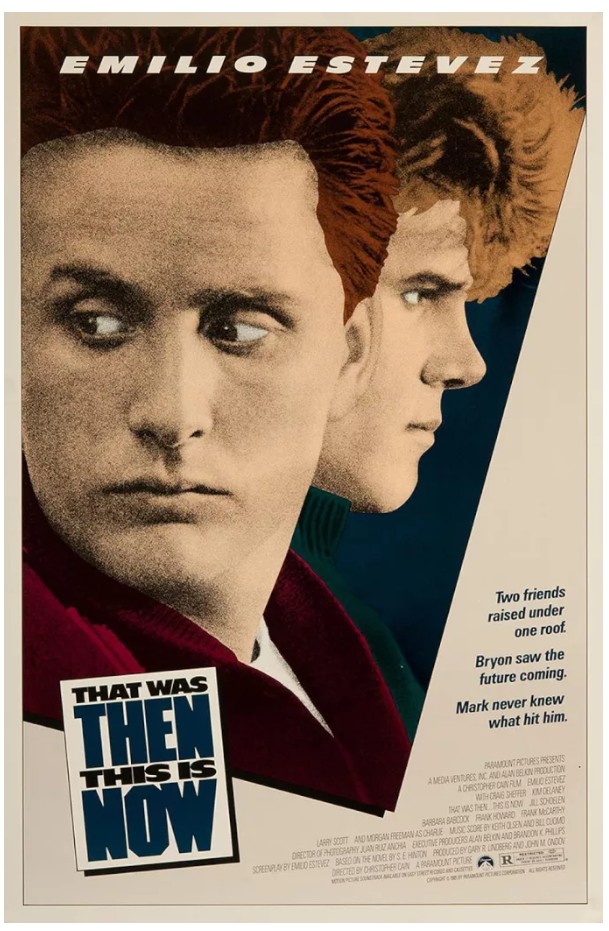
The poster for That Was Then… This Is Now, 1985
Executed in the artist’s iconic typeface, developed and refined in the 1980s, That Was Then This Is Now alludes to a past and present of which the conditions are decidedly unknown. Following Ruscha’s lauded sunrise-sunset paintings of the 70s and 80s, Ruscha’s cloudy sky backdrops evoke a similar concept of ambiguous transformation. The addition of Ruscha’s arresting text challenges the viewer in a moment of redemption or reckoning, even longing for an earlier time. Ruscha’s titular phrase concretizes this conceptual concern in Ruscha’s oeuvre, foreshadowing its increased importance in the artist’s works of the 90s and beyond. Evincing the present work’s paramount significance, Robert Dean and Lisa Turvey observe in the Catalogue Raisonné entry for the work: “The title phrase prefigures a recurrent ‘before and after’ theme in Ruscha’s work of the next two decades.” (Robert Dean and Lisa Turvey, eds., Edward Ruscha: Catalogue Raisonné of the Paintings, 1988-1992, Volume Four: 1988-1992, New York 2009, p. 136 )
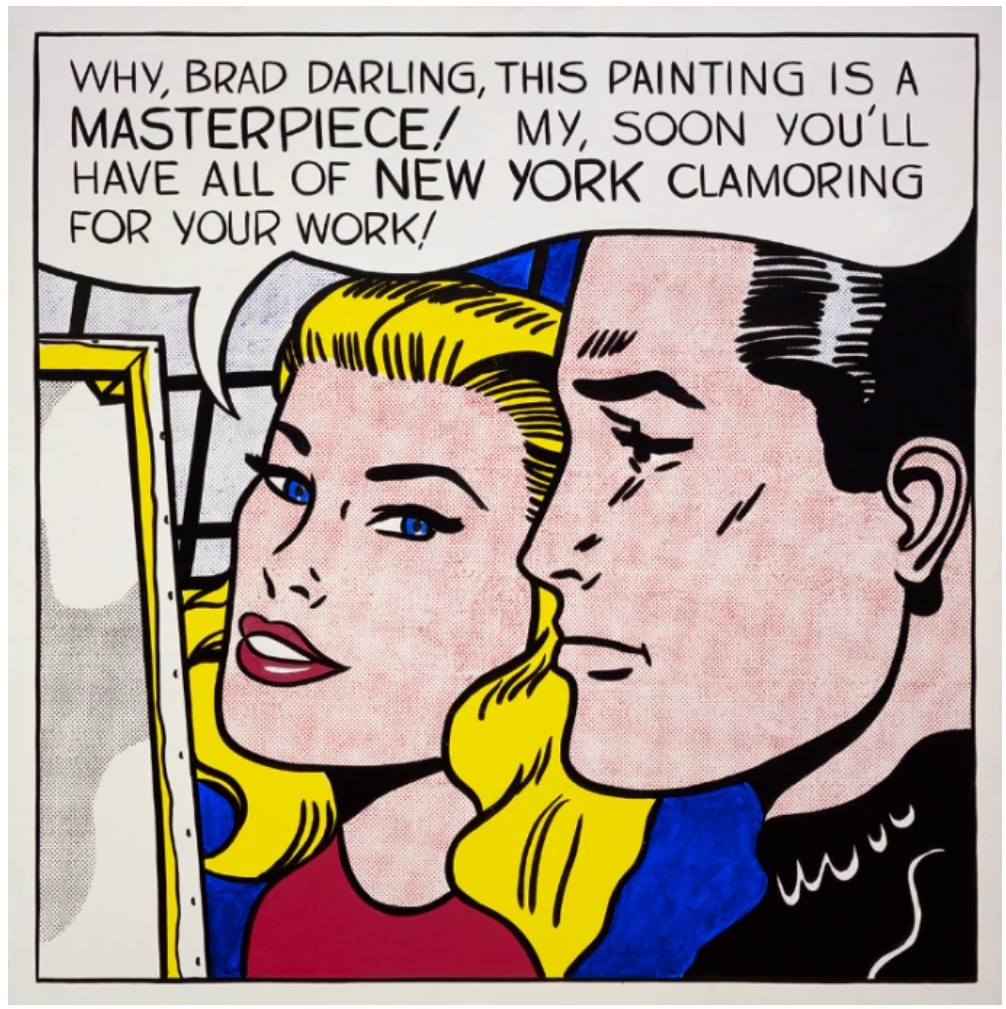
Roy Lichtenstein, Masterpiece, 1962. Private Collection. Art © Estate of Roy Lichtenstein
Working briefly as a commercial artist following his move to Los Angeles in 1956, Ruscha found inspiration in the prospering advertisement industry, Hollywood, and mid-century American pop culture. He was most famously captivated by the colossal billboards lining America’s Western highways, towering monuments to American consumerism which provided a seemingly endless barrage of text and image in striking mélanges of sign and symbol. The highway billboards would uniquely inform Ruscha’s distinctive visual vernacular and brand of Pop, by which he challenged the semiotic function of the written word through beguiling and idiosyncratic compositions. The appropriation of the commonplace and its subsequent transcendence into fine art chimes with Pop art’s greatest ambassadors such as Andy Warhol and Roy Lichtenstein, who worked simultaneously to Ruscha throughout much of the late Twentieth Century, probing the consumer culture as a springboard for artistic expression. That Was Then This is Now harkens back to the cinematic seriality of Warhol’s silkscreens and the hyperbolized drama of Hollywood films in Lichtenstein’s early paintings.
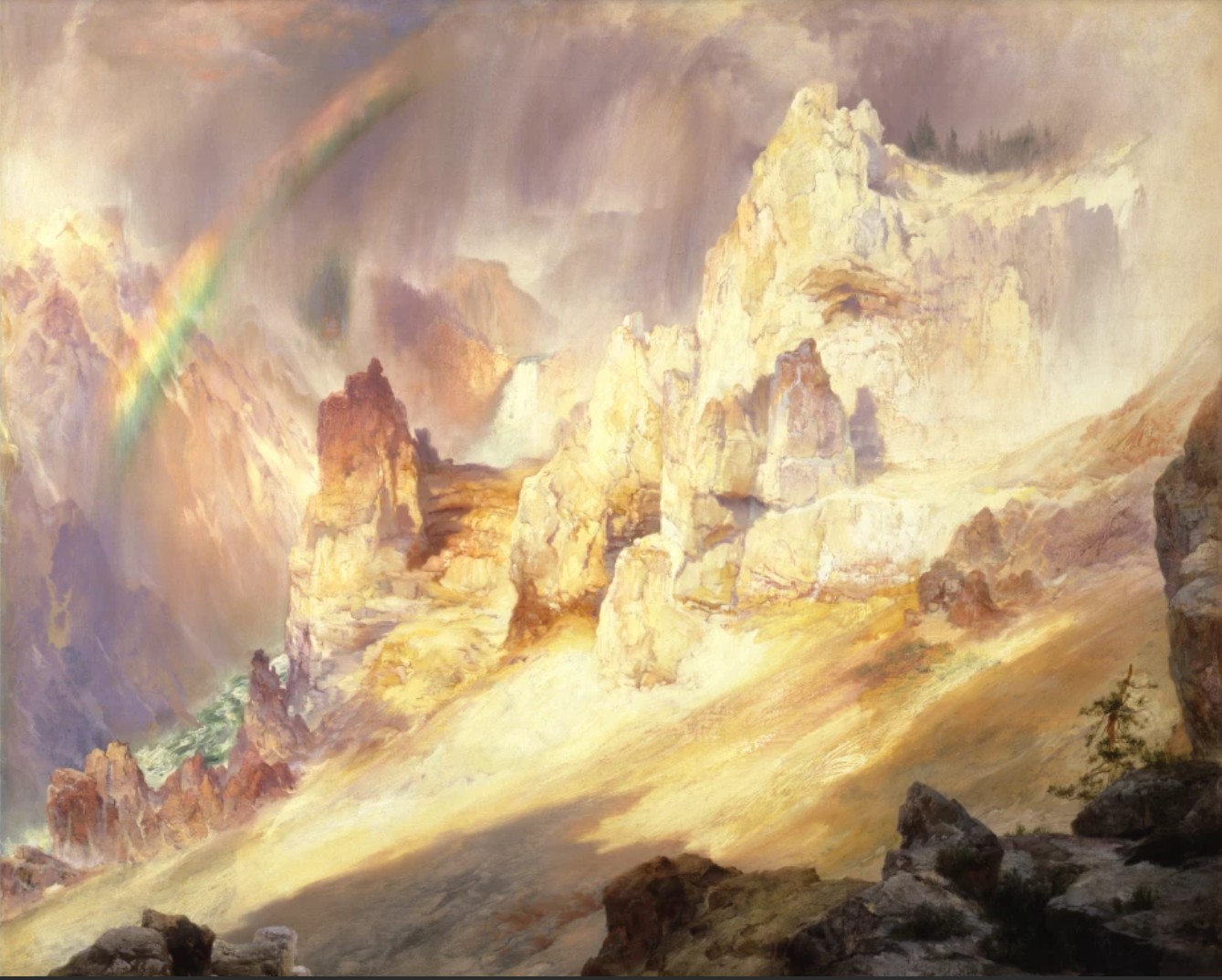
Thomas Moran, Rainbow over the Grand Canyon of the Yellowstone, 1900. Smithsonian American Art Museum, Washington D.C.
Image © Smithsonian American Art Museum, Washington D.C.
Hollywood as a subject runs throughout Ruscha’s career, famously represented by explorations of the Hollywood signs, such as Back of Hollywood from 1977, which famously features a burning orange, sun-soaked sky–cleverly positioned as either, and possibly both, sunrise and sunset. In 1988-90, Ruscha introduced the cloudy sky, an equally enigmatic and operatic backdrop for his compositions. In That Was Then This Is Now, Ruscha’s fateful sky highlights the tension between nostalgia and reality, history and destiny, and; rise and fall that underpin Ruscha’s radical and singular artistic output. Ever prescient and ever apposite, That Was Then This Is Now is a consummate painting in Ruscha’s cherished and iconic oeuvre.
Dixie Red Seville, 1985
Phillips New-York: 13 May 2025
Estimated: USD 1,800,000 – 2,500,000
USD 1,996,000
Ed Ruscha Modern & Contemporary Art Evening Sale
Known for a body of work that falls between the Pop and Conceptual art movements, Ruscha got his start in advertising before switching to fine art, and like his peers Andy Warhol and Roy Lichtenstein, his commercial beginnings had a strong influence on his art practice. Ruscha engages an advertising sign painter’s signature technique, stenciling, to achieve the crisp juxtaposition of angular text against the wide brushstrokes of sky in Dixie Red Seville. In the present work, Ruscha painted the blue background before applying the red and black text, the inverse of the “reverse-stenciling” technique used on later airbrush works, such as SERIES GOLDIE TBD. Similarly, the large scale and easy legibility of Dixie Red Seville draws on advertising techniques, encouraging the viewer to extrapolate various emotions and meanings from a simple set of words.
Ruscha often found inspiration from phrases glimpsed while driving out west. The diagonal composition of Dixie Red Seville recalls the way in which the highway can seem to run infinitely into the horizon, especially across the flat expanses of the American Southwest. The layered text effect encourages the eye to move along the diagonal axis of the work at least twice, taking in the words, and the shifting sky, repeatedly. With Dixie Red Seville, Ruscha engages modernist preoccupations with the pursuit of flatness and multiplied symbolic meaning on the picture plane, reinterpreted into the mythos of the American Southwest.
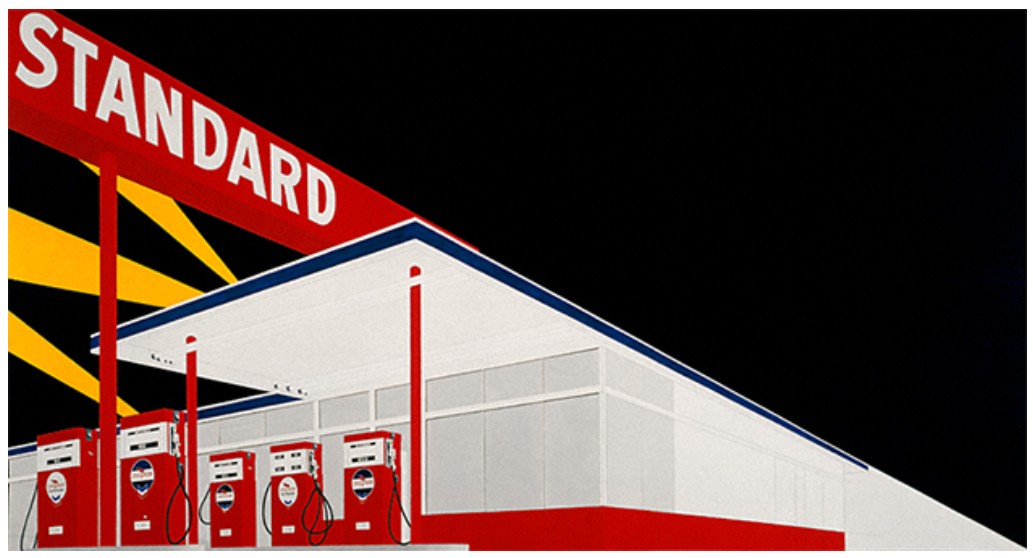
Ed Ruscha, Standard Station, Amarillo, Texas, 1963. Hood Museum of Art, Dartmouth College. Artwork: © Ed Ruscha
The left-to-right diagonal text of Dixie Red Seville gives the work a narrative quality, as well, drawing on some of Ruscha’s earlier, more conceptual work. His 1963 artist’s book, 26 Gasoline Stations, documents every gas station between his mother’s home in Oklahoma City, and Ruscha’s adopted hometown of Los Angeles. The book format implies a narrative continuity—one flips from page to page, presumably moving forward in time, along the course of the quintessentially American road trip out west. Similarly, the movement of the eye from top left to bottom right of Dixie Red Seville suggests narrative and duration, a quality that’s drawn out further through the associations of the painted words.
“I don’t consciously insert [a message] into my work, I like the idea of a word becoming a picture, almost leaving its body,
then coming back and becoming a word again.”
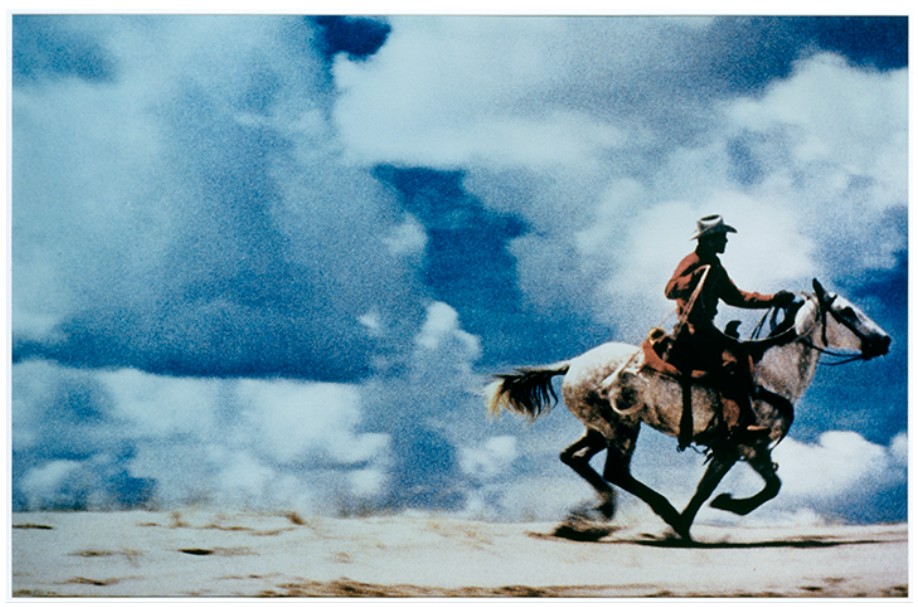
Richard Prince, Untitled (cowboy), 1989. The Metropolitan Museum of Art, New York.
Image: © The Metropolitan Museum of Art / Art Resource, NY, Artwork: © Richard Prince
The multiplying associations of each word in Dixie Red Seville recall the semiotic concept of “floating signifiers,” words whose meanings don’t necessarily refer to a concrete, physical object, and thus can be reinterpreted based on their context. This is certainly the case with Dixie Red Seville; while the words floating against the blue sky may conjure the idea of a Cadillac driving through the South, they are open to interpretation. There is no red Cadillac on the picture plane to tie the words to any particular meaning. This aligns with Ruscha’s philosophy towards his word-paintings as a whole, as he collapses the distinction between meaning and representation, word and image.
Johnny Tomorrow, 1984
Leonard & Louise Riggio: Collected Works
Christie’s New-York: 12 May 2025
Estimated: USD 1,500,000 – 2,000,000
USD 1,008,000
ED RUSCHA (B. 1937), Johnny Tomorrow | Christie’s
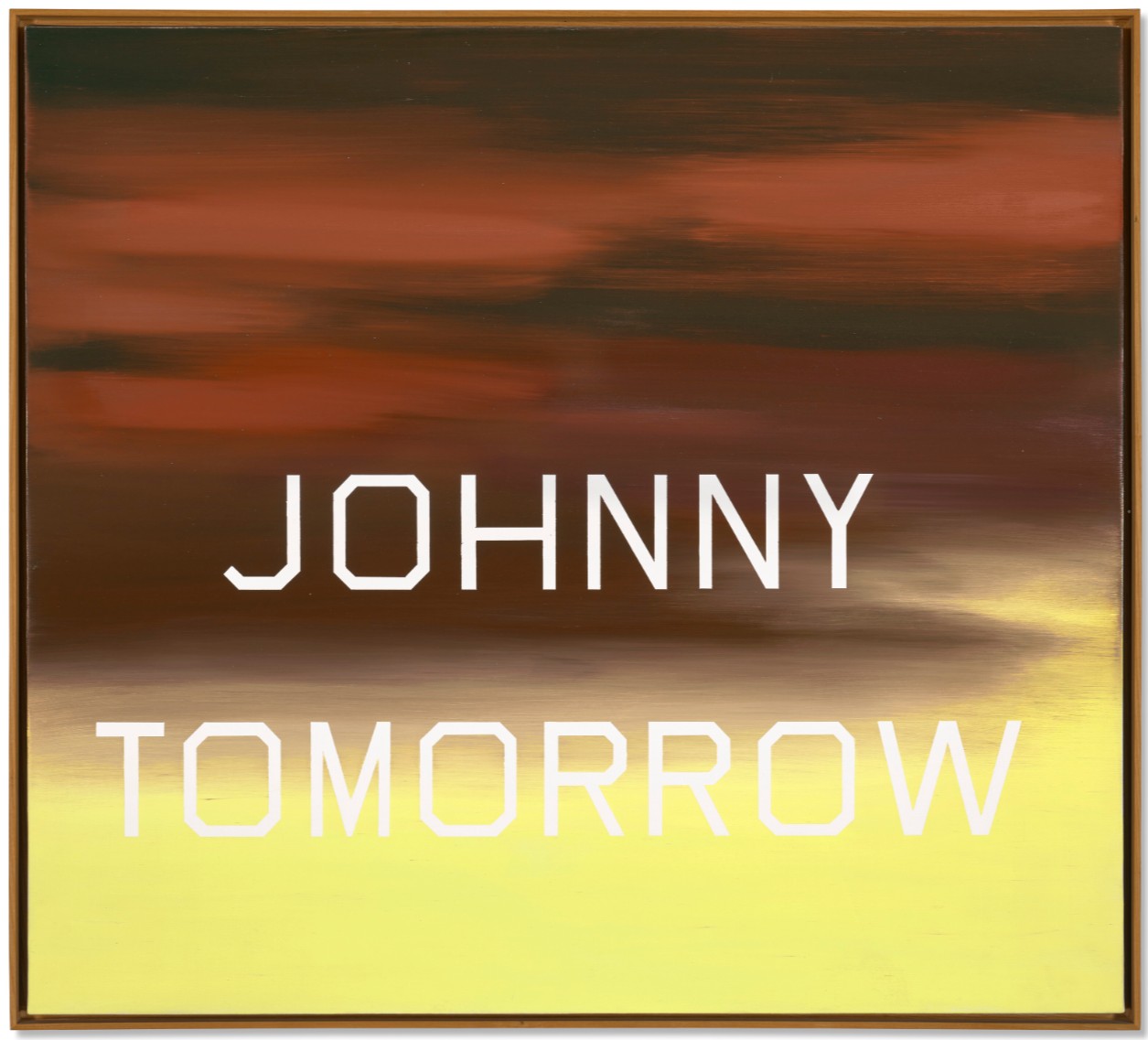
ED RUSCHA (B. 1937)
Johnny Tomorrow, 1984
Oil on canvas
36×40 inches (91.4 x 101.6 cm)
Signed twice, titled and dated twice
‘Ed Ruscha 1984 EDWARD RUSCHA “JOHNNY TOMORROW” 1984’
(on the backing board)
Exacting in execution and masterful in conception, Johnny Tomorrow, emerging from Ed Ruscha’s iconic word paintings, sees the eponymous text suspended cinematically at the center of a twilight sky which transitions into a cream colored foreground, the lower half of “tomorrow” fading poetically into illegibility against its light backdrop. Marking Ruscha’s return to traditional painting within his classic square format, the canvas evinces the lessons learnt from the artist’s novel explorations in unconventional media—which spanned from gunpowder to jelly and chocolate—during the artist’s sojourn from 1968 away from his paintbrush. Ruscha approaches the canvas with a newfound lyricality, attending even more closely to the subtle effects of his materials after years of experimentation. The effects are visually and mentally engaging, the artist himself noting that the present work “scratches at the back of the brain” (quoted in Edward Ruscha: Catalogue Raisonné of the Paintings, Volume Three: 1983-1987, eds. R. Dean and E. Wright, New York, 2007, p. 104).
Ruscha deploys an innovative technique composing this image, which he terms “reverse stenciling.” First engaging stenciled letters to demarcate his carefully constructed typefaces across the canvas, Ruscha then painted the composition. After completing the painting, he removed the stencils, revealing his letters as spaces of white gessoed ground in an unreversible, subtractive process. His innovative technique was at once thoroughly contemporary whilst recalling the red-figure Attic vase painters of antiquity, the effect compellingly completing his composition in a single revelatory act establishing Ruscha’s text as a preconceived figure against the painted ground. Ruscha elucidates how he views his meticulous process-based practice separately from the painterly approach of the Abstract Expressionists, describing how “they wanted to collapse the whole art process into one act; I wanted to break it into stages, which I do now. First, whatever I’m going to do is completely premeditated, however off-the-wall it might be. Then it’s executed, you know, fabricated” (quoted in The Works of Ed Ruscha, San Francisco Museum of Art, exh. cat., 1982, p. 27). Ruscha’s premeditated fabrication of Johnny Tomorrow draws from his training as both a graphic artist and aligns with his broader oeuvre; each painting is meticulously planned, with each element drafted in advance in studies. Each word and phrase is carefully chosen, and even the composition of his colors are scientifically articulated in terms of percentages of pigment by the early ages of his drafting process. Ruscha calibrates every part of the composition in advance of the canvas’s priming, his procedure contrasting diametrically to the gestural action painting of the generation before. His innovative procedure-based effort artfully articulates the great American artist’s symphonic character, wherein every element is related thematically and harmonically within and across each work.
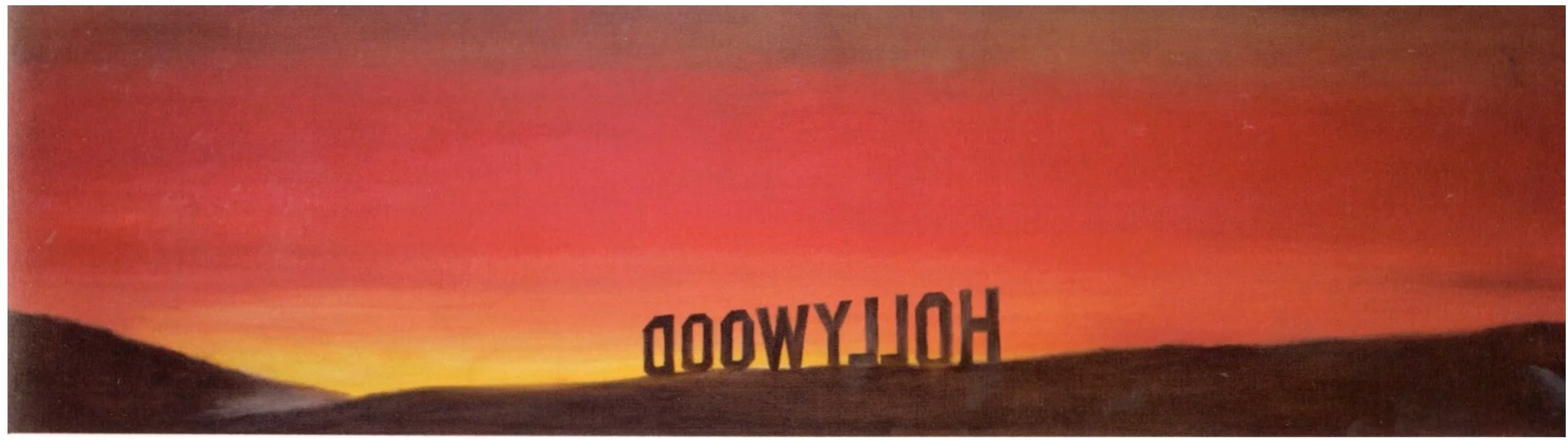
Ed Ruscha, The Back of Hollywood, 1977. Musée d’Art Contemporain, Lyon. © Ed Ruscha.
Johnny Tomorrow evokes in its swarthy upper register the last vestiges of sunlight eking through scattered clouds, the fading light signaling the end of the day poignantly juxtaposing with “tomorrow” to imbue the work with a sense of cyclicality, one day ending anticipating the coming morrow. The mellow cream yellow in the foreground recalls the day’s first illumination as the sun peaks above the horizon, the clarity of tone and form resembling daybreak. Ruscha plays into this association through his strategic placement of “tomorrow” within this dawn-colored passage, establishing a dichotomy between the upper twilight signaling the ending of one day and the lower dawn heralding a new beginning. The artist challenges expectations, evincing what art critic Dave Hickey describes as how his paintings “derive their complexity from their complicity with the world around them… they are complexity itself” (“The Song of the Giant Egress,” in Edward Ruscha: Catalogue Raisonné of the Paintings, Volume Three: 1983-1987, eds. R. Dean and E. Wright, New York, 2007, p. 10).
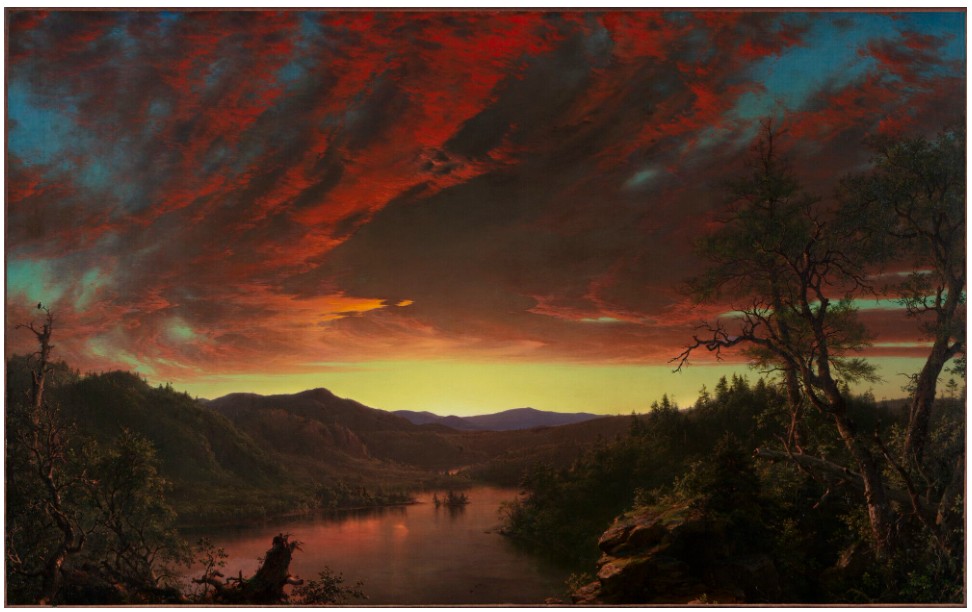
Frederic Edwin Church, Twilight in the Wilderness, 1860. Cleveland Museum of Art.
The titular phrase functions as a multi-referential association toward both a character trait and current American slang, paralleling Ruscha’s contemporaneous increased interested in the participatory, social aspect of his works. The title recalls a bevy of Hollywood movie titles and characters quite apropos for the Los Angeles-based artist: Johnny Apollo (1940), Johnny Eager (1941), Johnny Angel (1945), Johnny O’Clock (1947), Johnny Guitar (1954), Johnny Cool (1963), or Johnny Friendly from On the Waterfront (1954). Implicated into the self-referential obsessions of the Los Angeles film industry, Johnny becomes removed from its original sense as nomenclature, metamorphosizing instead as a character trait replayed “ad infinitum.” A commensurate wordsmith with the poise of a poet, Ruscha simultaneously plays against the slang phrase “Johnny on the spot,” with “Johnny Tomorrow” evoking instead the antithesis of a reliable personage and instead constructing an existentialist figure educing Samuel Beckett’s Godot, a personage always coming, never arriving. Simultaneously serious and cheeky, Johnny Tomorrow elegantly condenses low and high brow culture into a singular tableau, reveling in Ruscha’s mastery of the possibilities of text and the ambiguities of linguistic meaning.
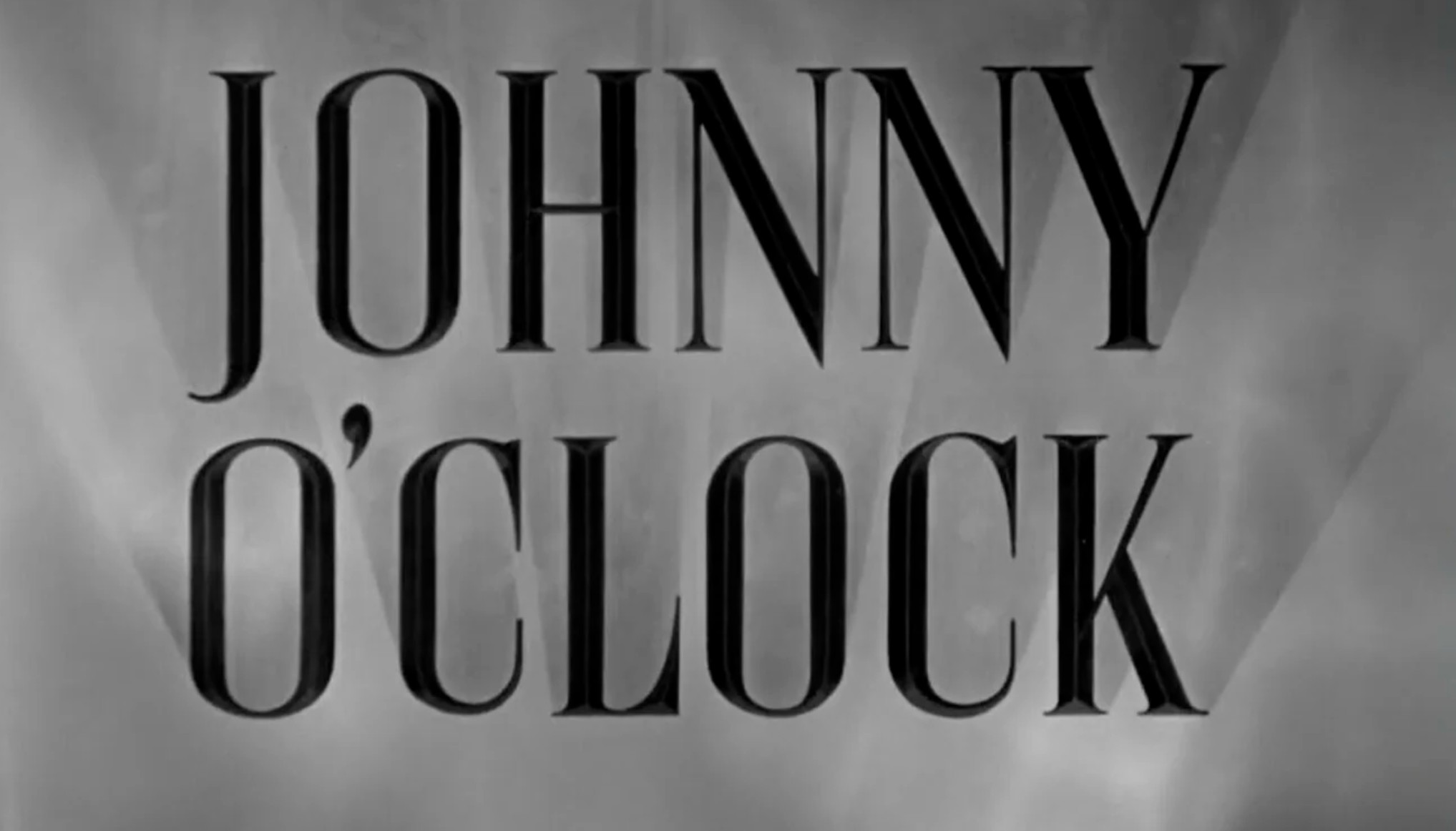
Johnny Tomorrow exhibits the great American artist’s trademark whit and poetic diction, conveying at once technical mastery and an astounding command of language which succinctly captures the American zeitgeist. Ruscha shows with this work a revitalized sense of the cinematic as his unique dialect begins to emphasize a sense of participation with his audience. Reflecting back to his earlier word paintings, Ruscha here signals both the resurgence and the continued development of his celebrated style.
Devil or Angel, 1973
Christie’s New-York: 14 May 2025
Estimated: USD 2,500,000 – 3,500,000
USD 2,954,000
ED RUSCHA (B. 1937), Devil or Angel | Christie’s
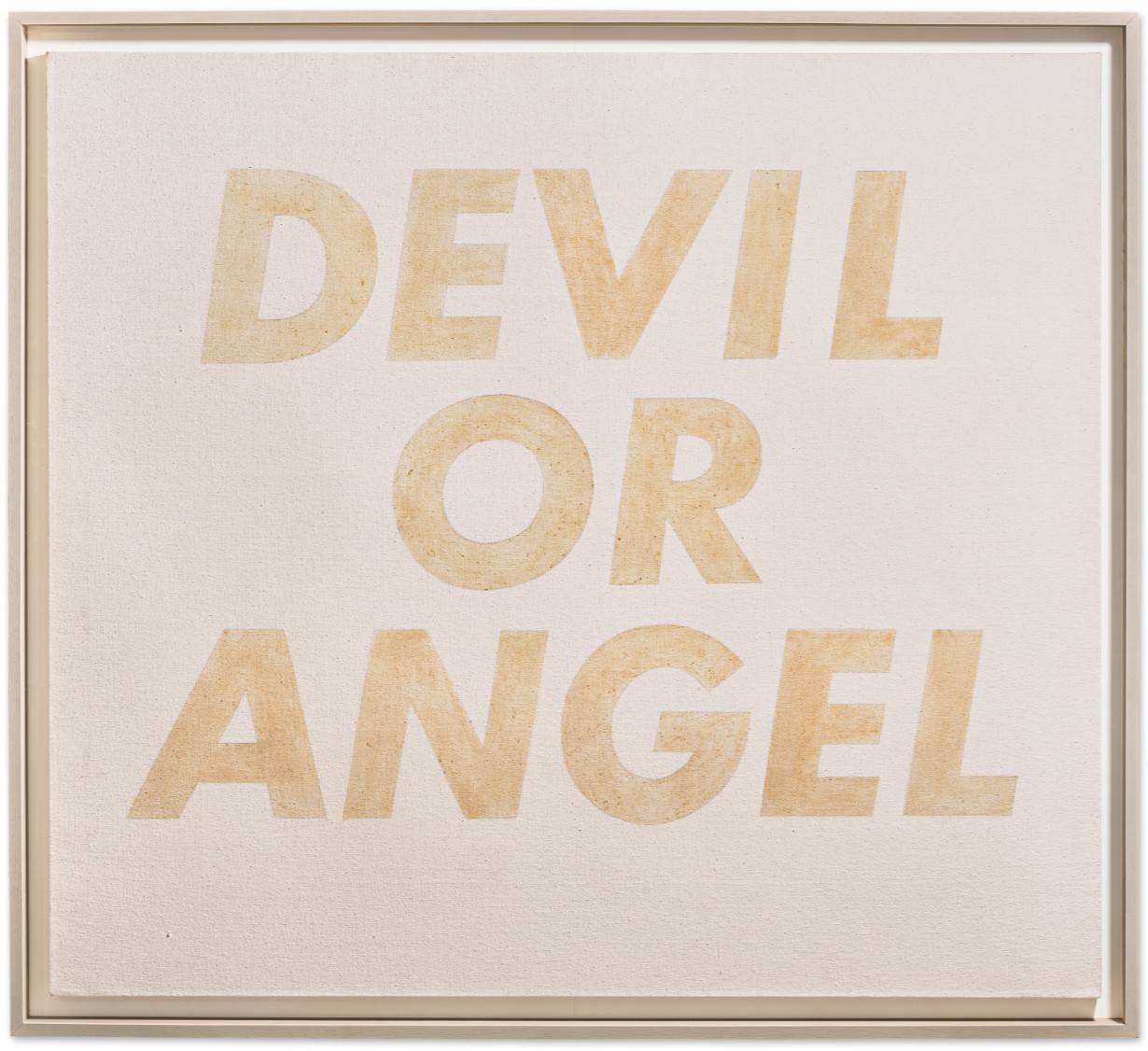
ED RUSCHA (B. 1937)
Devil or Angel, 1973
Red cabbage stain on canvas
54×60 inches (137.2 x 152.4 cm)
Painted in 1973, Devil or Angel is a quintessential example of Ed Ruscha’s early ability to balance aesthetic elegance with wry humor. One of an exceptional series of works the artist made in the late 1960s and early 1970s using organic materials as opposed to traditional paint, the italicized letters that spell out the words “devil or angel” have been formed against a raw white canvas using the colored juice of a red cabbage. The minimal look achieved by the painting’s tight composition and spare formal elements—the single, pale color and the easily legible, quotidian font—conflicts with the freighted meaning of the three words to create a resonant work that cannot be ignored.
Positioning the words centrally on a large, nearly square canvas, Ruscha appears to be posing a bold question to the viewer. Yet, in leaving out the question mark, the text transforms into an enigmatic statement. The mystery is further underlined by the textured, hand-painted quality of the red cabbage stain used to articulate the letters. Its pale pink-orange color feels ephemeral and fragile, which is firmly at odds with the striking biblical imagery evoked by the three words. Ruscha always plays with the relationship between text and image, allowing words to float free of their usual semantic associations. As he has said, combining words and images creates a pivotal “tension [that] is where I live” (E. Ruscha, quoted at “Ed Ruscha and the Art of the Everyday”, online [accessed: 4/8/2025).
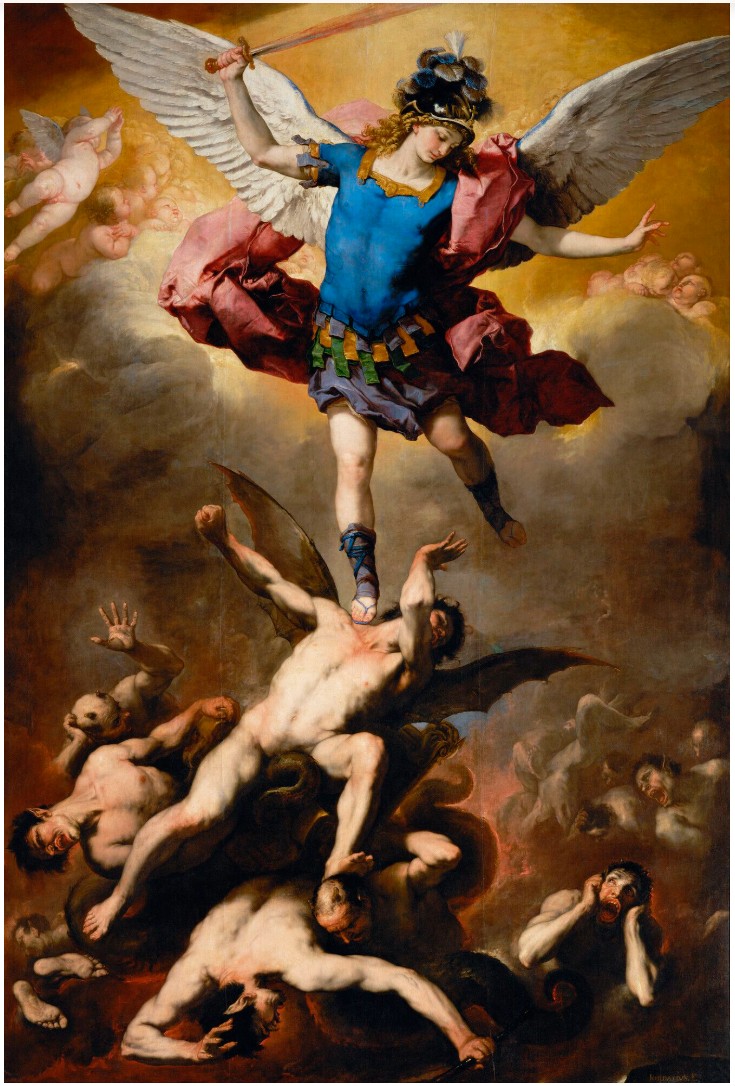
Luca Giordano, The Fall of the Rebel Angel, 1660-1665. Kunsthistorisches Museum, Vienna.
Unusually for Ruscha, whose work is characteristically impersonal, the words featured in Devil or Angel hint at the artist’s own autobiography. Born in 1937 in Oklahoma, Ruscha was raised Roman Catholic. “I am a confirmed atheist today, but the church helped me get where I am,” he told a newspaper in 2021. (E. Ruscha, quoted in M. Wecker, “Ed Ruscha, the most famous Catholic artist few Catholics know, National Catholic Reporter, January 21, 2021) Over the course of Ruscha’s career, he has continued to explore some of the central tenants of the faith in which he was raised in works such as, “Evil” (1973), 99% Angel, 1% Devil, (1983), “51% Angel, 49% Devil” (1984), “Heaven” (1988), “Hell” (1988), “Miracle” (1999) and “The Holy Bible” (2003).
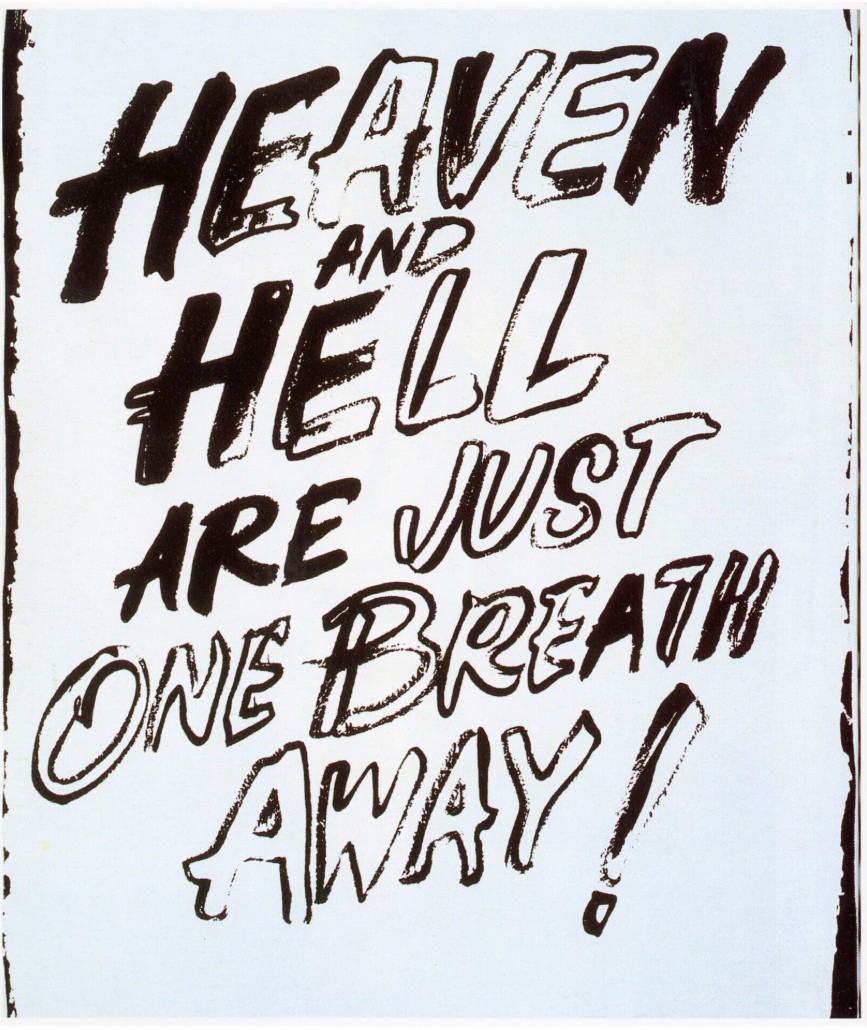
Andy Warhol, Heaven and Hell, circa 1984-86. Andy Warhol Museum, Pittsburgh.
© 2025 The Andy Warhol Foundation for the Visual Arts, Inc. / Licensed by Artists Rights Society (ARS).
The use of non-traditional methods to make Devil or Angel is rooted in a fascination with materials that originated in the artist’s childhood. A friend used Higgins India ink to draw cartoons, and from that moment Ruscha was hooked. “I had a very tactile sensation for that ink; it’s one of the strongest that has affected me as far as my interest in art” (E. Ruscha, quoted at Tate, ibid). This interest was reflected in one of Ruscha’s earliest bodies of work, from which Devil or Angel would emerge. This included Stains, a portfolio of prints made in 1969, which consisted of works made using egg yolk, turpentine, beer, salad dressing, gunpowder and even the artist’s own blood. He went on to make works on linen and canvas, using materials as diverse as Pepto-Bismol and caviar, chocolate and rose petal stain, cilantro stain and egg yolk. Such imaginative combinations and bold experiments speak to Ruscha’s consistent ability take elements from the everyday and rethink them entirely afresh, an impulse that has rightfully positioned him as a central figure in postwar American art.
Pressures, 1967
Christie’s New-York: 27 February 2025
Estimated: USD 1,000,000 – 1,500,000
USD 1,986,000
ED RUSCHA (B. 1937), Pressures | Christie’s
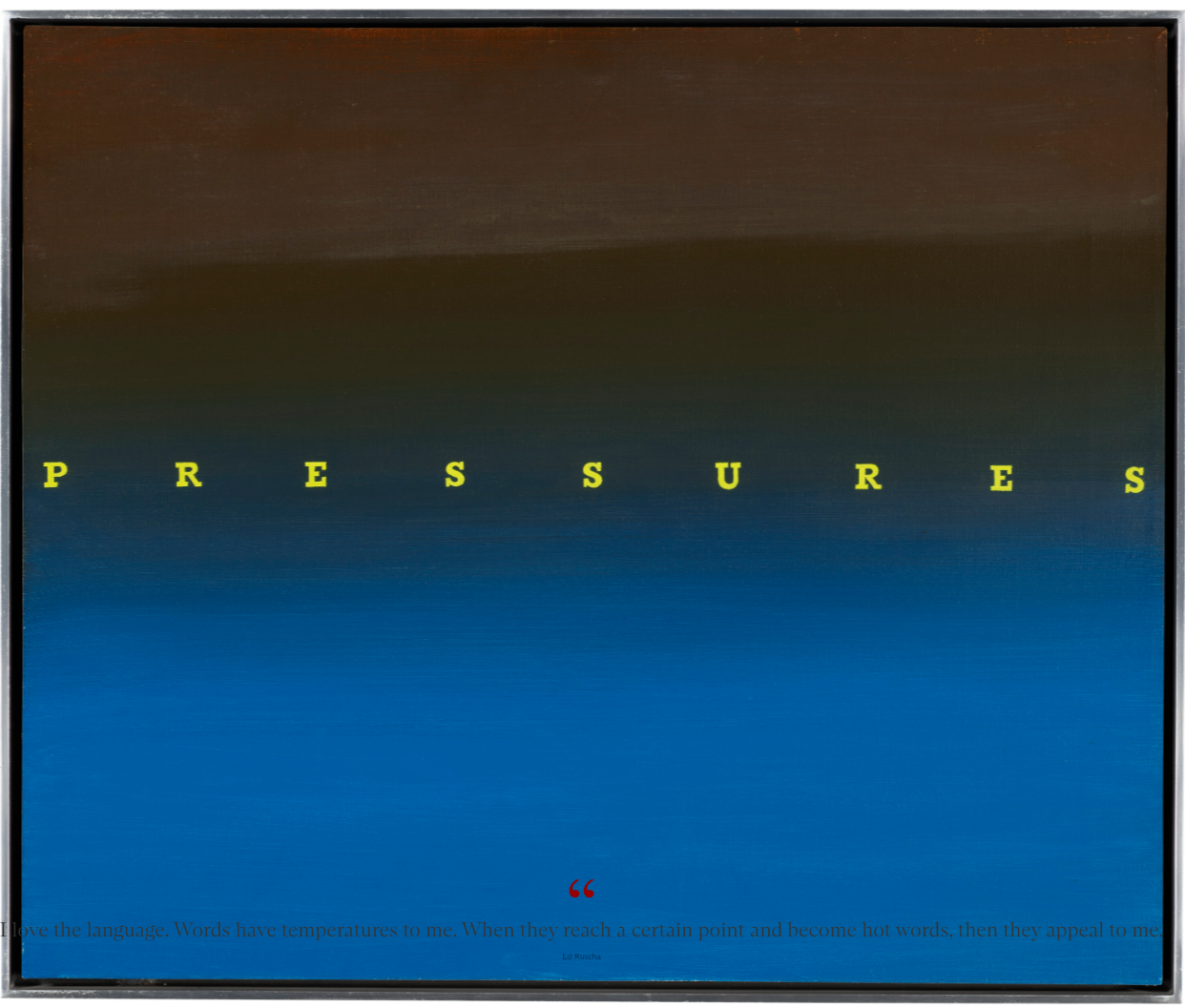
ED RUSCHA (B. 1937)
Pressures, 1967
Oil on canvas
20×24 inches (50.8 x 61 cm)
Signed, titled and dated ‘EDWARD RUSCHA “PRESSURES” 1967’ (on the stretcher)
Ed Ruscha’s seminal Pressures is an important early word painting from the celebrated American artist. Painted in 1967 amid a foundational decade for Ruscha, the work explores his first fully fledged conception for merging text and image. The eight equally spaced yellow letters are executed in a precise serifed font elegantly contrasted against a graduated ground flowing from Prussian to midnight blue to chocolate brown, appearing as the embryonic forerunner to Ruscha’s trademark “Boy Scout Utility Modern” font. Painted just after his triumphant series of masterpieces, including OOF, Annie, and the Standard Station series, Pressures exhibits Ruscha at his most innovative and experimental, refining the idiosyncratic visual language which he would continue to explore and expand in the following decades. As one of only seven word paintings from 1967, Pressures was included in the artist’s first traveling retrospective The Works of Ed Ruscha, further articulating the significance of the work within the artist’s greater oeuvre.
“I love the language. Words have temperatures to me. When they reach a certain point and become hot words, then they appeal to me.”
Ruscha’s inspiration for his word paintings emerged from a visit to France and Spain in the summer of 1961. Seeing foreign words on street signs such as “Boulangerie” and “Metropolitain,” Ruscha recognized the graphic and aesthetic possibilities of text once removed from linguistic meaning. In Pressures, Ruscha further emphasizes his desire to diverge meaning from his letters’ graphic design, arraying each letter across the horizontal plane with space between each character, dissociating a reader’s immediate absorption of “pressures” as a word to digest and define and instead allowing the work’s viewer to first come across his canvas as a work of art rather than a textual plane. Ruscha’s intricate understanding and toying with the conceptual possibilities afforded by the use of text in art recalls Roland Barthes’ sense of the “real semiotic power” of art, in which paintings that play with semiotic signs rather than destroying them unite the machinery of language with the expository power of art to propel an artwork towards new aesthetic heights. Here, Ruscha disengages with the diction inherent in Pressures, instead focusing first on the aesthetic pleasure produced by his beautifully sculpted typographical forms then on the sonic pleasure established by the viewer once they recognize and articulate the titular term.
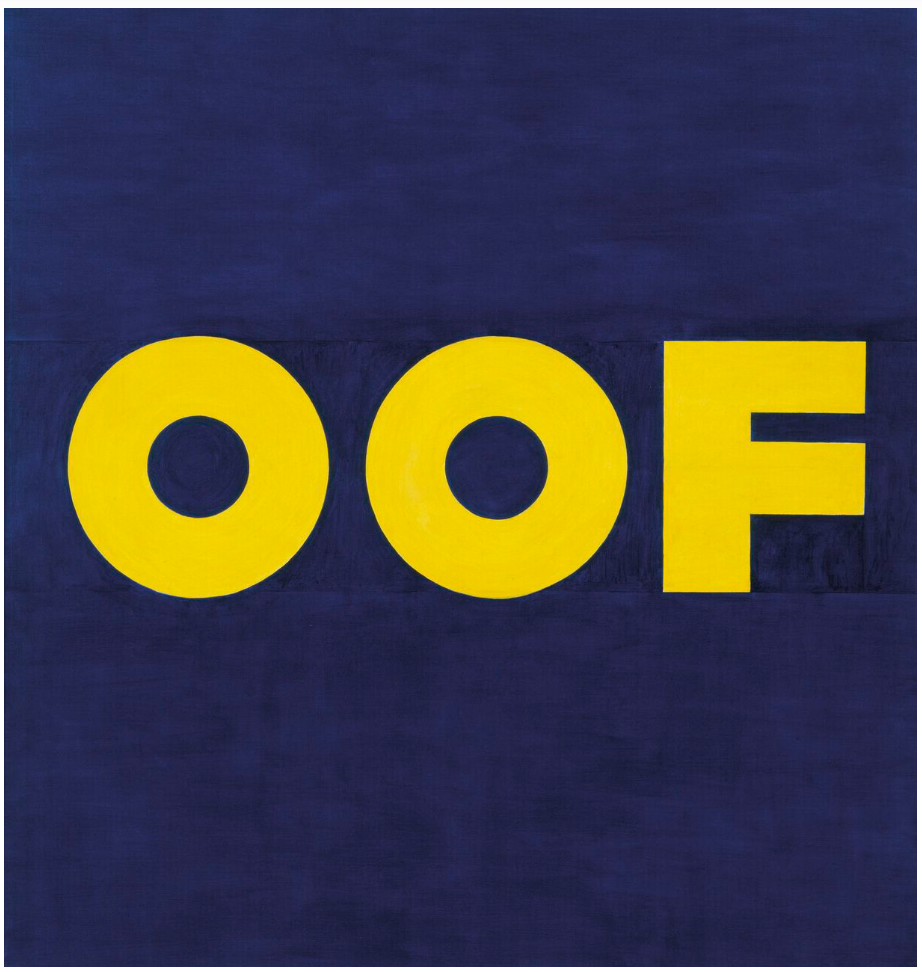
Ed Ruscha, OOF, 1962. Museum of Modern Art, New York. © Ed Ruscha.
Photo: © 2025 The Museum of Modern Art / Licensed by SCALA / Art Resource, New York.
Born in Omaha, Nebraska, and raised in Oklahoma City, Ruscha drove west across the Great Plains to Los Angeles at the age of eighteen to attend the Chouinard Art Institute. Originally drawn towards the study of bookmaking and graphic design, Ruscha became intrigued with the visual arts through his studies. While resistant to the abstract expressionist bent of his art teachers, a trip to New York he took with the artist Joe Goode in 1961 gave him his first exposure to Pop artists like Andy Warhol, James Rosenquist, and Jasper Johns.
“You know, we found out that we weren’t crazy, or at least we weren’t crazy alone.
It was great.”
Contrasting his painterly approach with that of the Abstract Expressionists, Ruscha said:
“They wanted to collapse the whole art process into one act; I wanted to break it into stages, which I do now. First, whatever I’m going to do is completely premeditated, however off-the-wall it might be. Then it’s executed, you know, fabricated.”
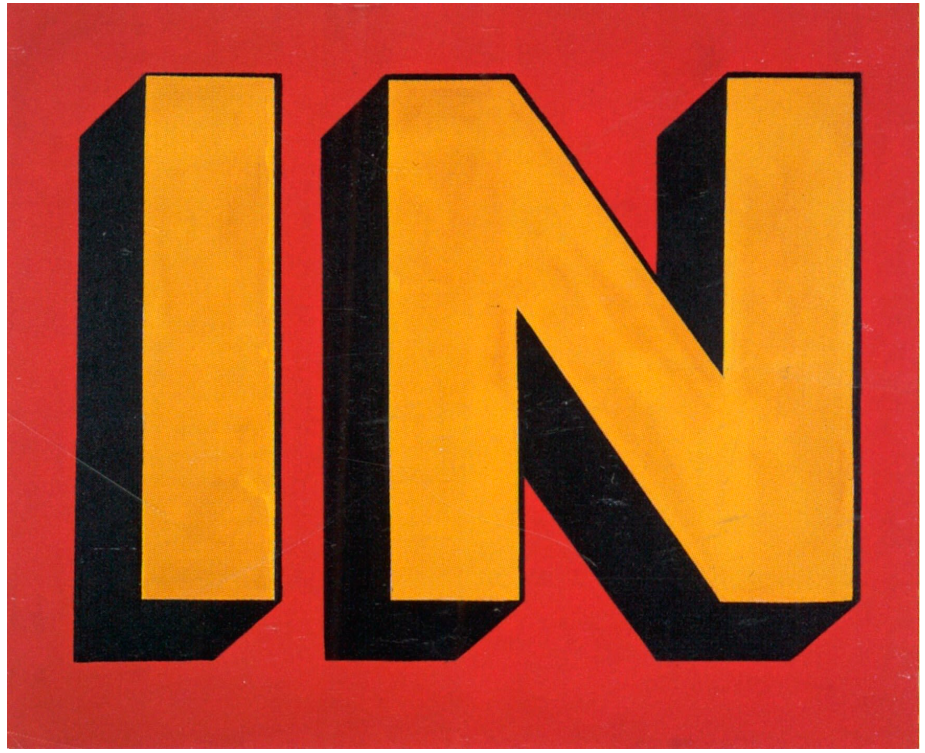
Roy Lichtenstein, In, 1962. © Estate of Roy Lichtenstein.
Ruscha’s first experiment with typographical art was with his early Sweetwater, which he showed to then-gallerist and future Director, Henry T. Hopkins, in 1959. Hopkins bought the work on the spot, and included the young Ruscha into his stable of artists at his Huysman Gallery, placing the young artist in direct competition with the strong roster across the street at Ferus Gallery headed by Billy Al Bengston and Kenneth Price. After Huysman Gallery closed, Ruscha joined Ferus, exhibiting with Bengston and Price, along with New York artists including Andy Warhol, Jasper Johns, and Roy Lichtenstein. The new Pop style championed by these artists had a profound impact on Ruscha’s work. Seeing Johns’ Target with Four Faces for the first time, Ruscha stated
“That just sent me. I knew from then on that I was going to be a fine artist… the work of Johns and Rauschenberg marked a departure in the sense that their work was premeditated.”
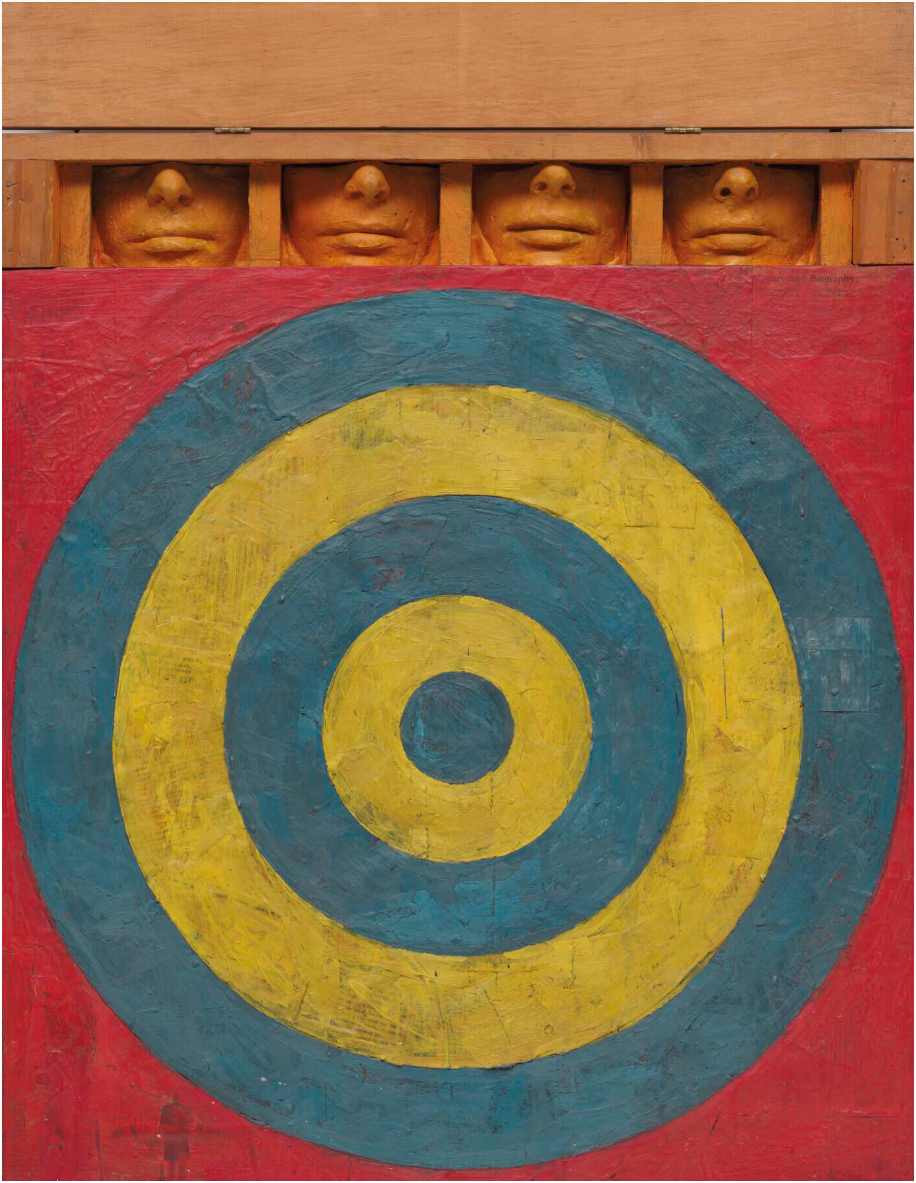
Jasper Johns, Target with Four Faces, 1955. Museum of Modern Art, New York.
© 2025 Jasper Johns / Licensed by VAGA at Artists Rights Society (ARS), NY.
Photo: © The Museum of Modern Art / Licensed by SCALA / Art Resource, New York.
The premeditated fabrication which Ruscha discovered in Pop art appealed both to his training as a graphic artist and his artistic process: each painting of his paintings is meticulously planned, with each element drafted in advance in a notebook, each word carefully chosen, and even the background colors specified by their specific blend of colors by the early stages of his drafting process. Thus, the entire layout of Pressures was carefully calibrated in advance of Ruscha priming the canvas, his procedure intentionally diametrically opposed to the gestural action painting of the generation before him. His systematic process contrasts as well to Cy Twombly’s contemporaneous and seemingly spontaneous productions. Twombly, an artist similarly intrigued by the possibilities of text and words, meditates on the painterly gesture involved in the act of writing in his Untitled, made in the same year as Pressures. Twombly stretches his looping calligraphy across and over the composition, improvising his movement to the point of illegibility, resulting in a vacillation of textual and visual meaning—Twombly’s work is pure gesture, while Ruscha’s meticulous planning evacuates almost any sign of the artist’s hand from his work; the precisely rendered characters sprawled across Pressures become a paragon of legibility against Twombly’s onslaught against meaning. Despite the two artists’ contradictory attitudes towards artmaking, their works both achieve a semiotization of text, severing connotation from language via a destabilization of signification to embrace the aesthetic luxuries of locution—through different means, Twombly and Ruscha both compellingly demonstrate the seismic potential of painting after Abstract Expressionism, ably ascribing to Leo Steinberg’s prognosis for art after Abstract Expressionism: “the artist does not simply make a thing, an artifact. . . . What he creates is a provocation, a particular, unique, and perhaps novel relation with reader or viewer.” (L. Steinberg quoted in A. Hochdörfer, “Leo Steinberg,” Artforum, vol. 50, no. 2, October 2011).
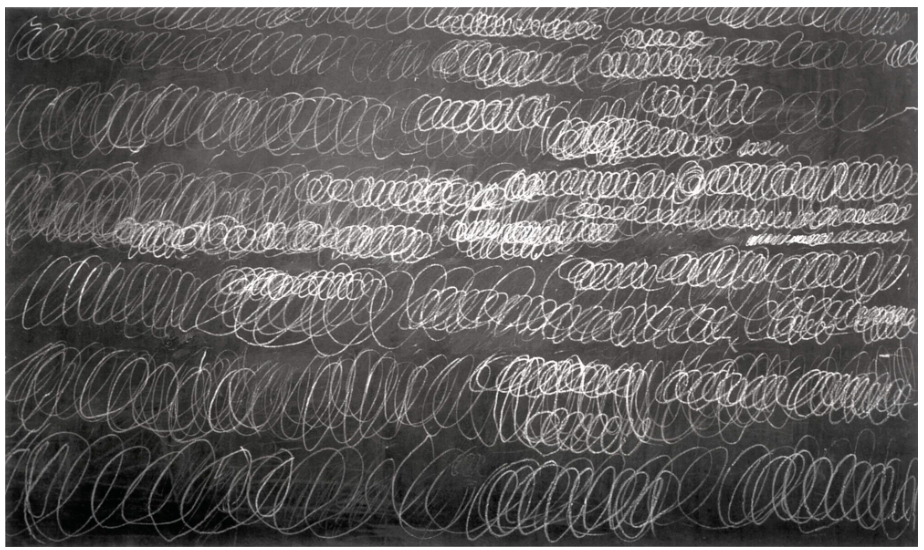
Cy Twombly, Untitled, 1967. Menil Collection, Houston. © Cy Twombly Foundation.
Ed Ruscha’s works from the 1960s stand at the pivotal point in the history of art as the painterly tradition fought to maintain its relevance against the nascent Pop movement. With Pressures, Ruscha straddles both Pop and tradition while eloquently demonstrating his early mastery over his word paintings. Emerging from the artist’s most innovative decade, Pressures positions Ruscha as one of the leading artists of the time, embodying the distinctive style through which he forged his own path within the post-war art discourse.
99% Angel, 1% Devil, 1983
Sotheby’s New-York: 21 November 2024
Estimated: USD 1,500,000 – 2,000,000
USD 3,265,000
99% Angel, 1% Devil | Contemporary Day Auction | 2024 | Sotheby’s
ED RUSCHA (b. 1937)
99% Angel, 1% Devil, 1983
Acrylic on canvas
36×40 inches (91.4 x 101.6 cm)
Signed and dated 1983 (on the reverse)
Signed, titled and dated twice 1983 and APR 7 ’83 (on the overlap)
In 99% Angel, 1% Devil by Ed Ruscha, the titular phrase emerges from a fiery field of expertly rendered sfumato, charging the composition with psychological intensity and embodying the artist’s peerless style in which image, symbol and text coexist in tensile relationships. Executed in 1983, the present work is a quintessential example of Ruscha’s sunset paintings from the 1970s and early 1980s evoking the cinematic mythos of the Californian desert with its variegated streaks of paint. The expression 99% Angel, 1% Devil evinces the artist’s enduring interest in religious subject matter, which recurs throughout his oeuvre and speaks to the deep influence that his Catholic upbringing has had on his artistic practice. Testament to the significance of the present work, other examples of sunset paintings by Ed Ruscha are held in the permanent collections of the Whitney Museum of American Art, New York; the Museum of Modern Art, New York; and the National Gallery of Art, Washington D.C. Beguiling and theatrical, 99% Angel, 1% Devil encapsulates Ruscha’s unique capacity to evocatively portray spirituality and its pervasive manifestations within the American imagination.
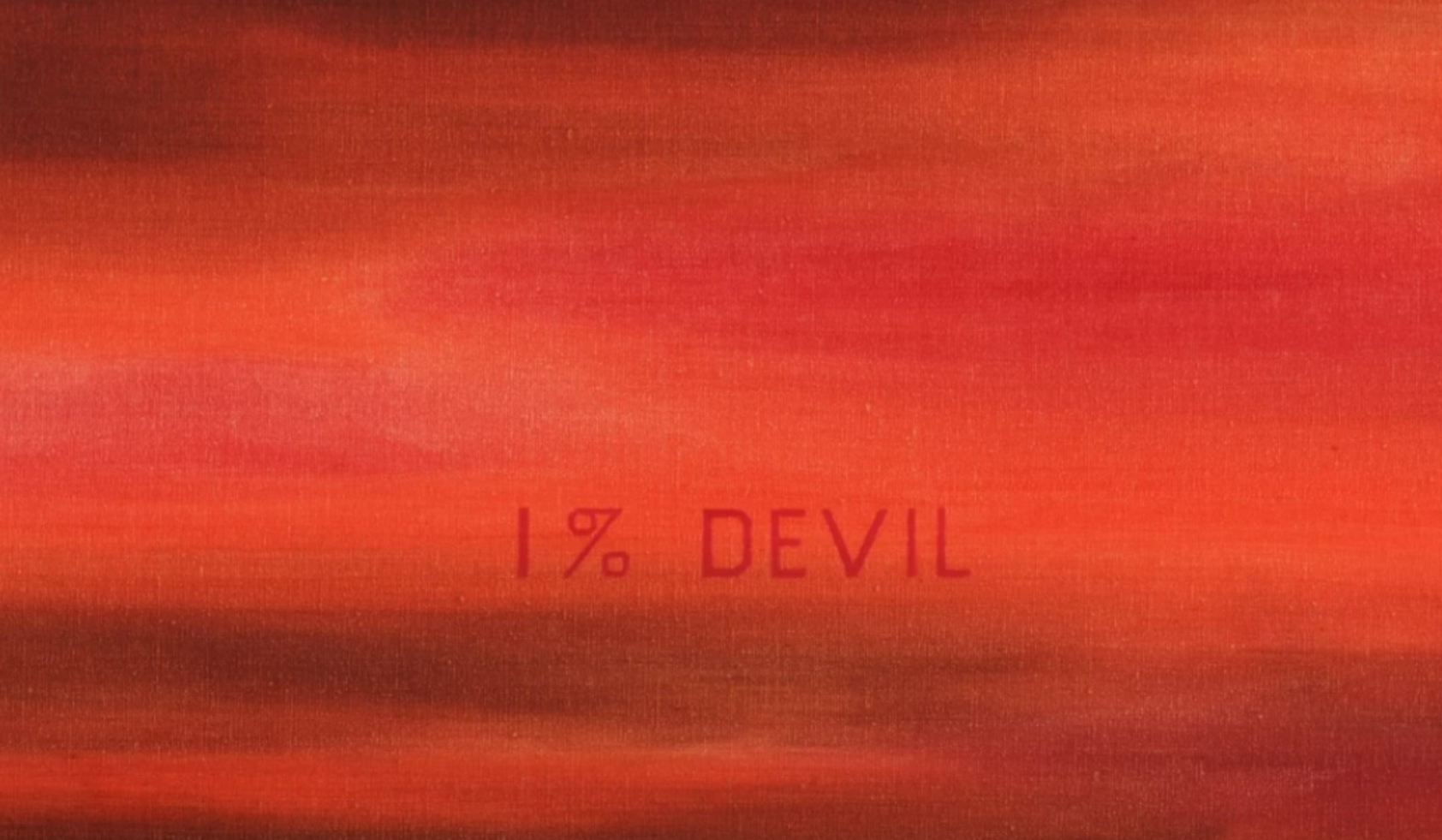
The composition of 99% Angel, 1% Devil consists of brilliant gradations of crimson, vermillion, and umber, presenting an arresting ground for Ruscha’s enigmatic statement. The abstracted, panoramic vista endows the present work with a smoldering sfumato and thrilling sense of intrigue, echoing the sublime glow of Frederic Edwin Church’s landscapes and the emotional potency of Joseph Mallord William Turner’s storm scenes. In his choice of source material, Ruscha draws from both the blazing skies of Los Angeles, his longtime home, and more broadly, the mythology of the American West that has pervaded cinema and American pop culture at large; thus, Ruscha’s depiction of the expansive sky retains a level of generic anonymity that only serves to heighten the psychological complexity it evokes. Locating the sublime in both the natural and artificial, Ruscha’s portrayal of quotidian vistas parallels Warhol’s trademark Coca-Cola bottles and Campbell soup cans, or Roy Lichtenstein’s iconic comic-book inspired blondes.
“I’ve always believed in anonymity as far as backdrop goes […] That’s why I have this kind of lofty idea of a landscape as being a pivotal point to making a picture. And so there’s a landscape that’s a background, but I don’t see it. It’s almost not there. It’s just something to put the words on.”
The tension between specificity and abstraction that Ruscha achieves here echoes that of the text, which teeters on recognition but remains elusive.
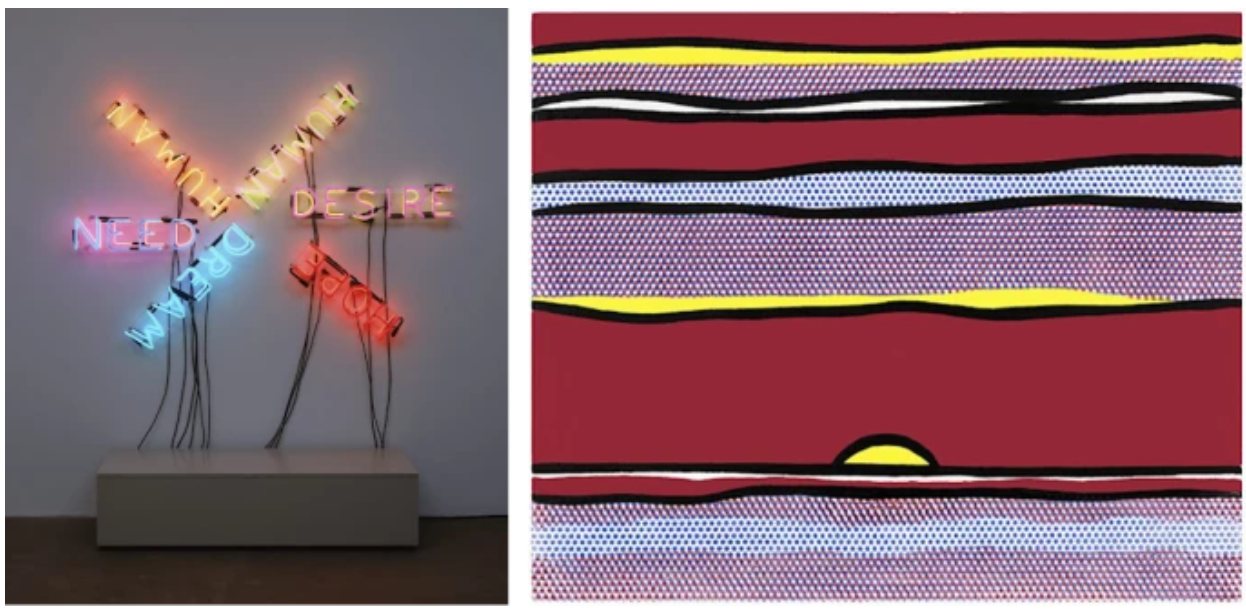
Left: Bruce Nauman, Human/Need/Desire, 1983. Image © New York, Museum of Modern Art. Art © 2024 Bruce Nauman/Artists Rights Society (ARS), New York
Right: Roy Lichtenstein, Sunset, 1964. Private Collection.
Ruscha’s signature witty and subversive treatment of religious subject matter is on full display in 99% Angel, 1% Devil. As a young boy raised in Oklahoma, he developed a fraught relationship with Catholicism, explaining that “[My grandparents] were real strict Catholics. They were all raised that way and, naturally, I got this legacy of Catholicism that I eventually had to get smart and back away from… I think that I got distorted feelings about morality, maybe, and things that were put on me by the Catholic Church.” (Ed Ruscha quoted in Richard D. Marshall, Ed Ruscha, London and New York, 2003, p. 183). Ruscha has since grappled with faith through his artistic practice, recontextualizing references to the Church through his singular lexicographic painting style. Here, the phrase 99% Angel, 1% Devil takes on a colloquial, tongue-in-cheek tenor, as the first half – “99% Angel” – dominates the viewer’s field of vision, leaving “1% Devil” stealthily inscribed in a smaller typeface along the bottom edge of the canvas. The difference in typographical scale creates a Surrealist sense of depth and perspective within the composition, all while imbuing the phrase with a mischievous attitude; thus, Ruscha employs the graphic tension of the text against the skyscape as both object and illusion, creating an optical effect.
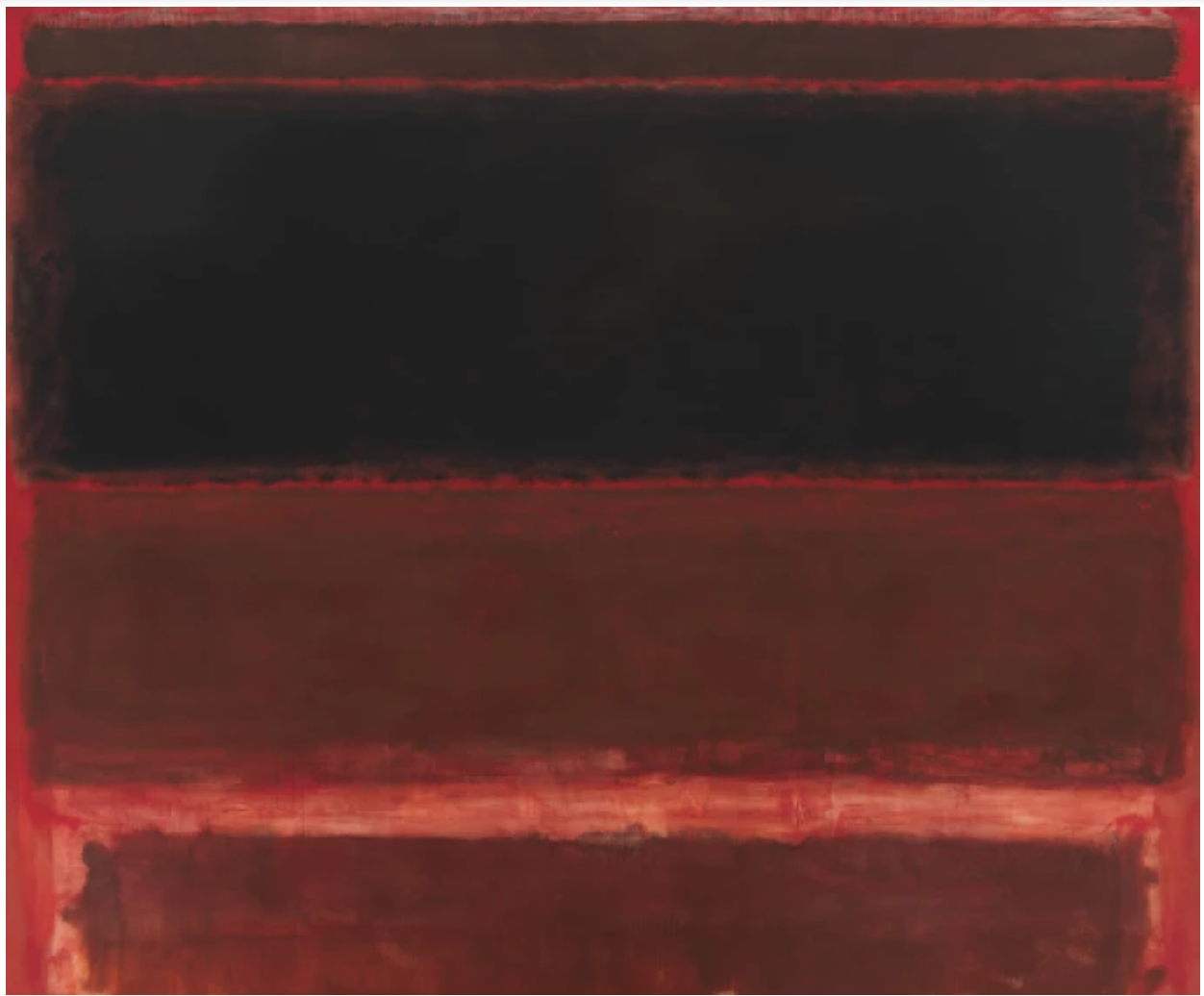
Mark Rothko, Four Darks in Red, 1958.
Image © New York, Whitney Museum of American Art. Art © Kate Rothko Prizel & Christopher Rothko/Artists Rights Society (ARS), New York
Depicting a blazing sunset with his signature filmic lens, Ed Ruscha seamlessly evokes the boundless miles of the great American landscape, Ruscha’s inspiration and muse, in 99% Angel, 1% Devil. Aggrandized and isolated in Ruscha’s paintings, words and phrases are stripped of context, imploring the viewer to contemplate the transcendent power of language and question the nature of the sublime. Through the crisp scarlet letters projected onto the endless expanse of the mythical West, articulated by a masterful gradation of pigment, Ruscha incites a subversive contemplation of moral duality and religion. Deftly examining the complex relationship between collective culture, text and iconography, 99% Angel, 1% Devil boldly embodies the subtle interplay of aesthetic and conceptual concerns that exemplify Ed Ruscha’s most seminal paintings.
The Wrap-Up, 1993
Sotheby’s New-York: 20 November 2024
Estimated: USD 4,000,000 – 6,000,000
USD 3,000,000
The Wrap-up | The Now and Contemporary Evening Auction | 2024 | Sotheby’s
ED RUSCHA (b. 1937)
The Wrap-Up, 1993
Acrylic on canvas
40×72 inches (101.6 x 182.9 cm)
Standing before Ed Ruscha’s The Wrap-Up, one can almost hear the whir of the celluloid film in the projector flickering to a halt—glitching for just a moment as the familiar cinematic finale “The End” rolls off the screen and fades away. Ephemeral and enchanting, glowing with the allure of old Hollywood nostalgia, The Wrap-Up from 1993 poignantly evokes the finality of a glamorous and bygone era, encapsulating the beguiling and transient moment between past and present. A simultaneously resonant and enigmatic phrase, “The End” embodies the conceptual rigor of Ruscha’s seminal, career-long exploration of semiotics and text. Since the 1960s, Ruscha’s infatuation with American consumerism and the ethos of Los Angeles pop culture has informed the artist’s distinctive visual vernacular through direct reference and subtle nuances, capturing a uniquely American, mid-century idealism and deconstructing boundaries between “high” and “low” art. Evanescent yet timeless, The Wrap-Up elicits a sentimentality for the fading glory of the Hollywood golden age and the inescapability of the passage of time. The Wrap-Up is a superb example from a limited suite of paintings Ruscha began in 1991, exploring the iconic phrase “The End” through entrancing cinematic scenes. Evincing the unique importance of the present work, its sister painting and the first work in the series, The End (1991), is held in the permanent collection of The Museum of Modern Art, New York.
“There are things that I’m constantly looking at that I feel should be elevated to greater status, almost to philosophical status or to a religious status. That’s why taking things out of context is a useful tool to an artist. It’s the concept of taking something that’s not subject matter and making it subject matter.”
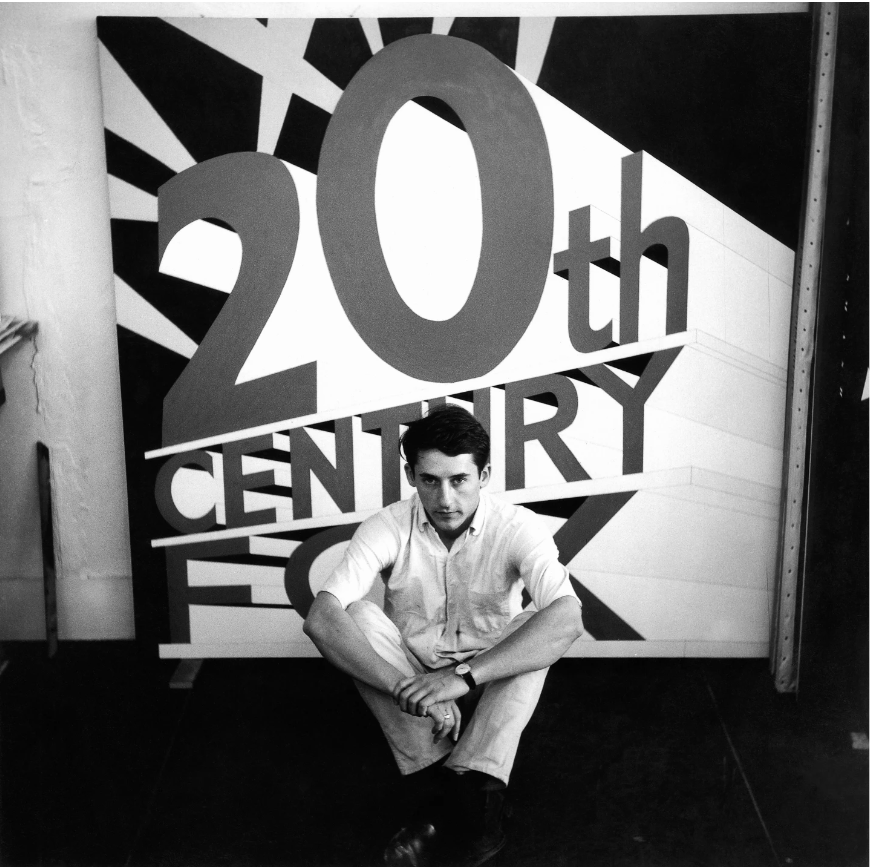
Ed Ruscha in his Echo Park studio, Los Angeles, 1963. Photo by Joe Goode, courtesy the Moderna Museet. Art © Ed Ruscha
The Wrap-Up immediately transports the viewer to the mid-century film screening, harkening back to the black-and-white movies that Ruscha recalls from his childhood in Oklahoma City. Simultaneously, the painting suggests the finality and impending obsolescence of a now antiquated chapter of our times, through its overt yet enigmatic text. Capturing a poignant and wistful nostalgia, The Wrap-Up romanticizes an analog time, charmed with imperfections and idiosyncrasies which have been largely extinguished. Duplicating the text in an upper and lower register, Ruscha masterfully depicts the effect of an instantaneous moment of mechanical imperfection—two frames caught on screen at once. The immediacy and intrigue of this fleeting instance is further enhanced by Ruscha’s so-called light leaks—the vertical streaks and splashes of white atop the blurred text, evidence of a worn and old-fashioned projector lens marred with dust particles, tiny scratches and scrapes.
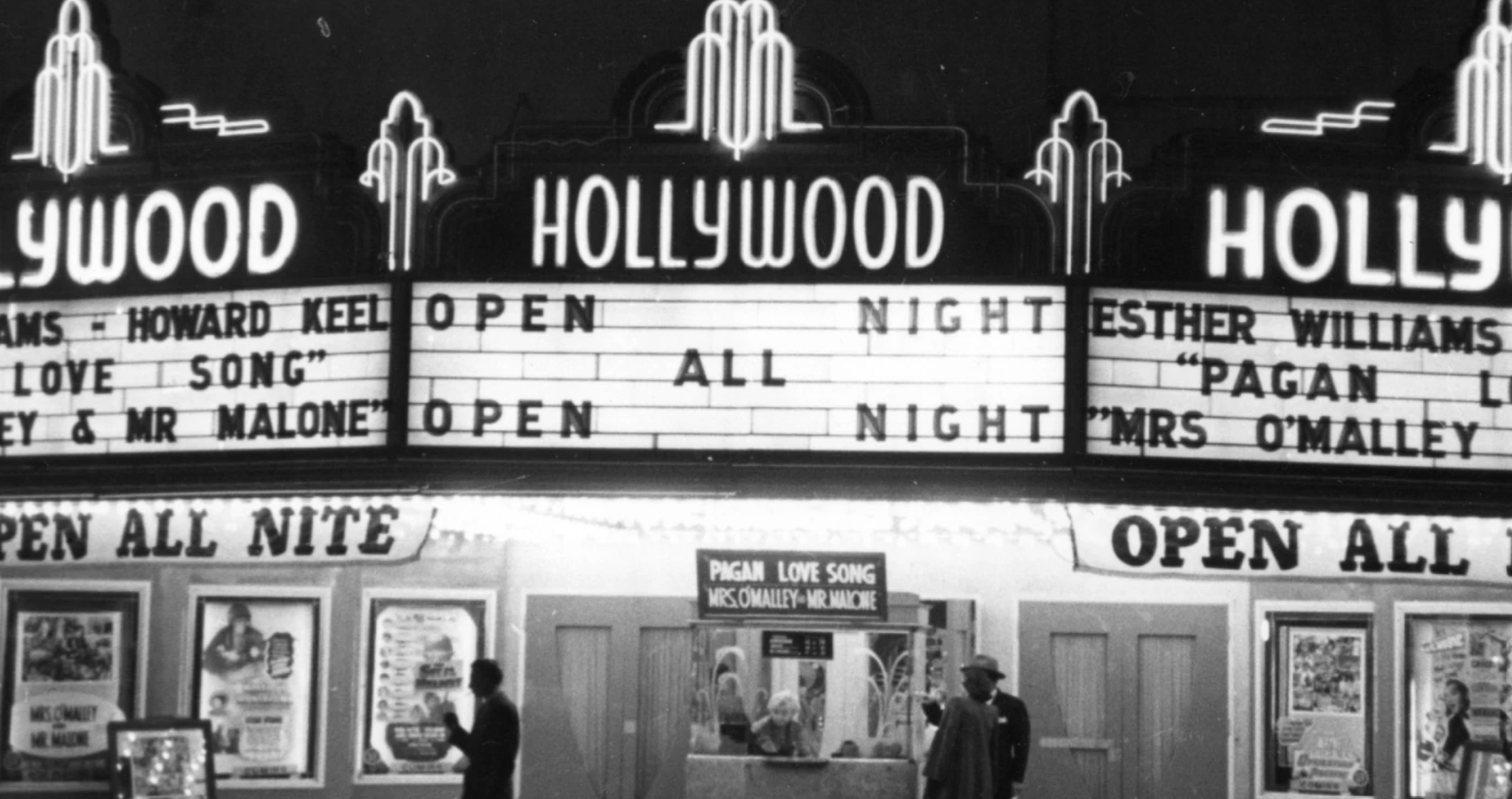
These details envelop the viewer, conveying a sense of theatricality and realism of a bygone cinematic era and immortalizing a sensation soon to be forgotten with the advent of new technologies. Lauded for his beguiling attention to detail and distinctive trompe l’oeil techniques, Ruscha has an innate understanding for the particularities of a composition that captivate and bewitch.
Tril Bil Mil, 2016
Christie’s New-York: 19 November 2024
Estimated: USD 2,000,000 – 3,000,000
USD 2,470,000
ED RUSCHA (B. 1937), Tril Bil Mil | Christie’s
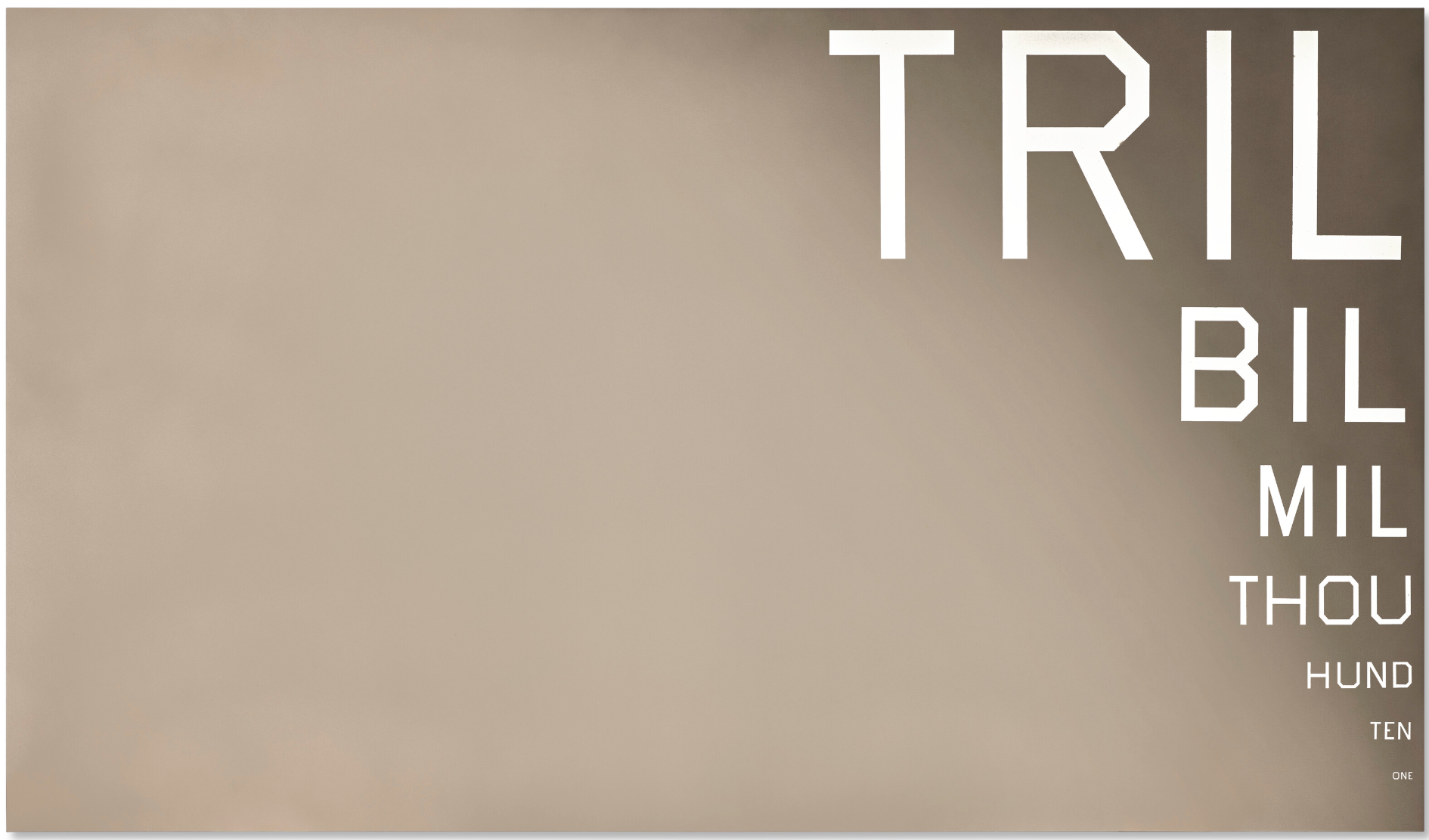
ED RUSCHA (B. 1937)
Tril Bil Mil, 2016
Acrylic on canvas
72×124 inches (182.9 x 315 cm)
Signed and dated ‘Ed Ruscha 2016’ (on the reverse)
Monumental in size and exacting in execution, Ed Ruscha imbues his 2016 painting Tril Bil Mil with profound insights wrought from decades of practice. Working at his grandest scale yet, Ruscha inscribes a linguistic slope of syllabic statements into a ground built of grainy earthen hues. The titular syllables regress orderly from the top of the canvas in a cascade, diminishing logically from the prodigious size of “TRIL” to the minute, barely discernible “ONE” at the bottom right edge of the canvas.
First exhibited as the centerpiece of his 2016 exhibition “Extremes and In-betweens” at Gagosian Gallery, London, the work gracing the catalogue’s front cover. For this show, Ruscha employed his trademark ‘Boy Scout Utility Modern’ typeface he first designed nearly half a century previously, plotting the font across huge canvases to articulate his internal philosophical ponderings developed in old age. Centering on the relation of the macrocosm to the microcosm, Ruscha describes his series with characteristic humility: “I’m not trying to wrap things up or make final statements or capture anything in a big way. It’s more like, whatever the voyage is, that’s where I am. I’m just traveling along the tops of things, not trying to bring an answer to anything, necessarily, but just to keep making pictures” (E. Ruscha, quoted in F. Nayeri, “Ed Ruscha Continues His Wordplay,” New York Times, November 3, 2016, online).
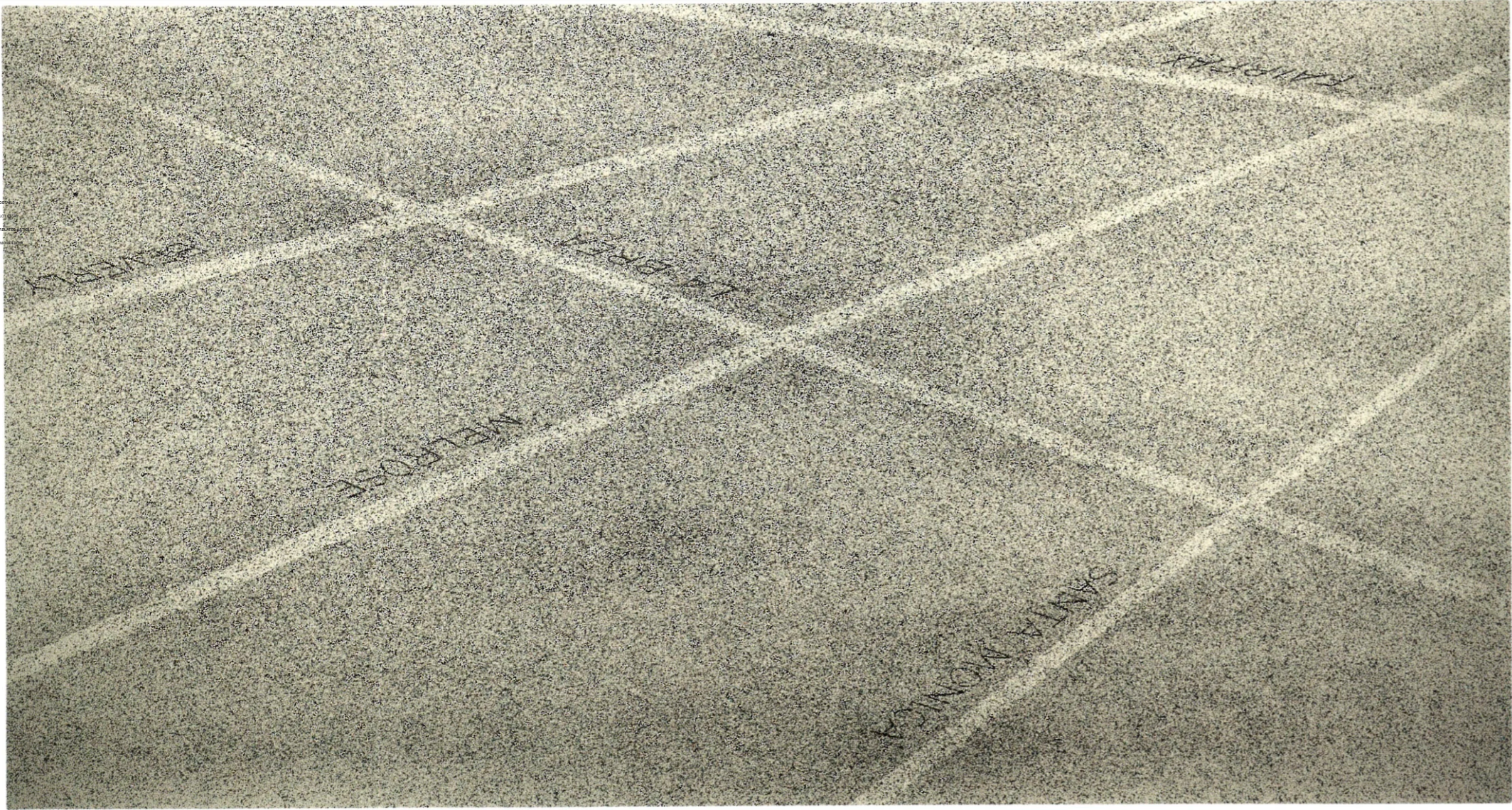
Ed Ruscha, Santa Monica, Melrose, Beverly, La Brea, Fairfax, 1998. Los Angeles County Museum of Art.
Tril Bil Mil is a reflection on the artist’s pensive conception of perspective and scale, especially when related to his word paintings. Ruscha often observes how words have no intrinsic size: “I mean, what size is a word, after all?” (E. Ruscha, quoted in J. Weiss, “Words in Space,” in Ed Ruscha / Now Then: A Retrospective, Museum of Modern Art, 2023, p. 160). The artist transforms his chosen words from diction into represented objects, emphasizing their arbitrary size in relation to the picture pane, able to be scaled up or down whilst remaining ‘actual size,’ contrary to how he’s previously depicted objects true-to-size in his compositions, such as the can of Spam soaring comet-like across Actual Size. In the present work, Ruscha further amplifies the distinction words and their referents, meditating on partial numerals coordinated in relative scale so that the conception of ‘trillion’ is magnitudes larger than the solitary digit at the bottom of the numerical waterfall.
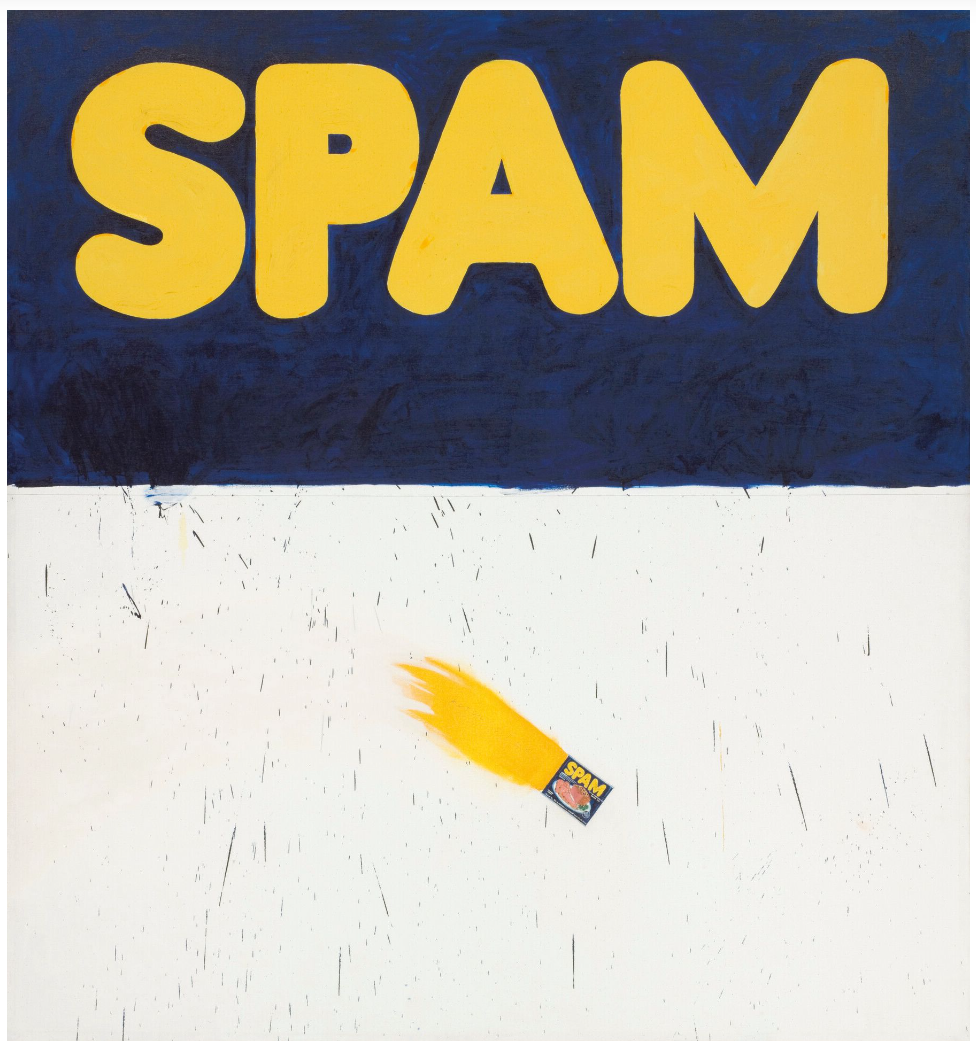
Ed Ruscha, Actual Size, 1962. Los Angeles County Museum of Art. © Ed Ruscha. Photo: © 2024 Museum Associates / LACMA. Licensed by Art Resource, NY.
Ruscha is able to adduce a certain insouciance through his severing of his words’ concluding syllables above ‘TEN,’ suggesting that even without physical size, the conceptual largess of these terms is too substantial for even his outsized canvas to contain. So they plunge off the picture pane. Picasso similarly dwelt on the inability of an artwork to contain the full sense of a word in his Cubist Still Life with a Bottle of Rum from 1911. In this picture, a refracted tablescape is presented at a variety of comingled perspectives, simultaneously presenting all sides of these fractured geometric forms. In this abstracted field of browns, grays, and blacks, Picasso emphasizes the two-dimensionality of his canvas with his analytical fracturing of objects into forms. However, the words he includes—originating as newspaper titles—are circumscribed into jumbled, discrete letters, the flat canvas no longer able to articulate them as recognizable words.
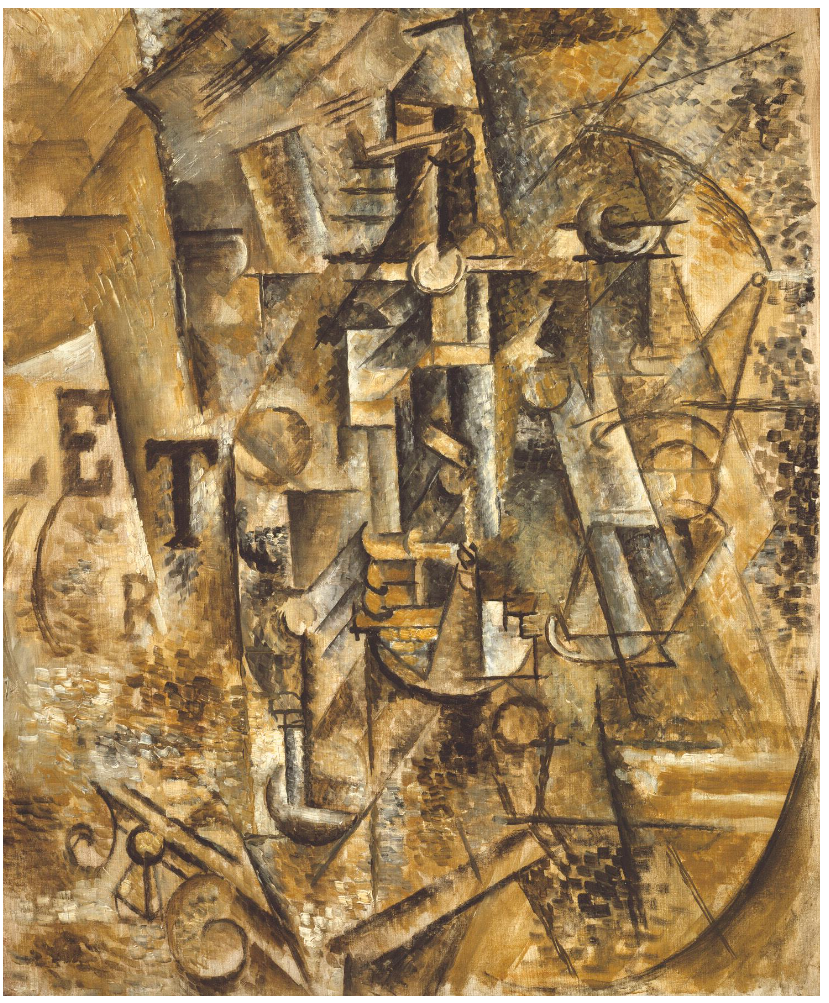
Pablo Picasso, Still Life with a Bottle of Rum, 1911. Metropolitan Museum of Art, New York. © 2024 Estate of Pablo Picasso / Artists Rights Society (ARS), New York. Photo: © The Metropolitan Museum of Art. Image source: Art Resource, NY.
While Ruscha’s oeuvre has always contented with and recontextualized the archetypical signs and symbols of the American vernacular, here the artist’s keen eye turns to his anxieties regarding the county’s social and environmental future. Tril Bil Mil expressively conveys the perils of overaccumulation, with incomprehensible quantities like billion and trillion suggesting an oblique reference to the accretion of wealth; a constant artistic refrain, similar conceptions of wealth are powerfully evoked in Andy Warhol’s paintings of dollar bills and signs.
Start Over Please, 2015
Christie’s London: 9 October 2024
Estimated: GBP 2,000,000 – 3,000,000
GBP 3,186,000 / USD 4,173,660
ED RUSCHA (B. 1937), Start Over Please | Christie’s (christies.com)
ED RUSCHA (B. 1937)
Start Over Please, 2015
Oil on canvas
64×72 inches (162.7 x 183 cm)
Signed and dated ‘Ed Ruscha 2015’ (on the reverse)
The title of Ed Ruscha’s Start Over Please (2015) is emblazoned in white across a six-foot-wide inferno of a sky. Its three monosyllabic words resound with percussive force at the surface of the canvas, each crisp capitalized letter equally spaced on three horizontal lines. The text is an uncanny presence. It straddles the sky and spans its vivid gradient: from the smouldering orange sun beneath the horizon line, to blue and deeper blue, and the darkling stratospheric depths. The words form a strange pattern of crescents and lines, like mappings of synthetic constellations. It is a characteristically enigmatic painting by the Los Angeles-based artist, who for the last seven decades has explored the combination of images, words, epigrams, and the potent aesthetics of American consumer culture. Ruscha’s art—which spans painting, drawing, collage, photography, and books—is as playful as it is deadpan and as straightforward as it is inscrutable. The present painting belongs to a body of works begun in the 1980s that feature superimposed statements against sublime landscapes. Whether an electrifying dawn or an apocalyptic night, ‘Start Over Please’ reads like an inevitable cue, beckoning the viewer to act.
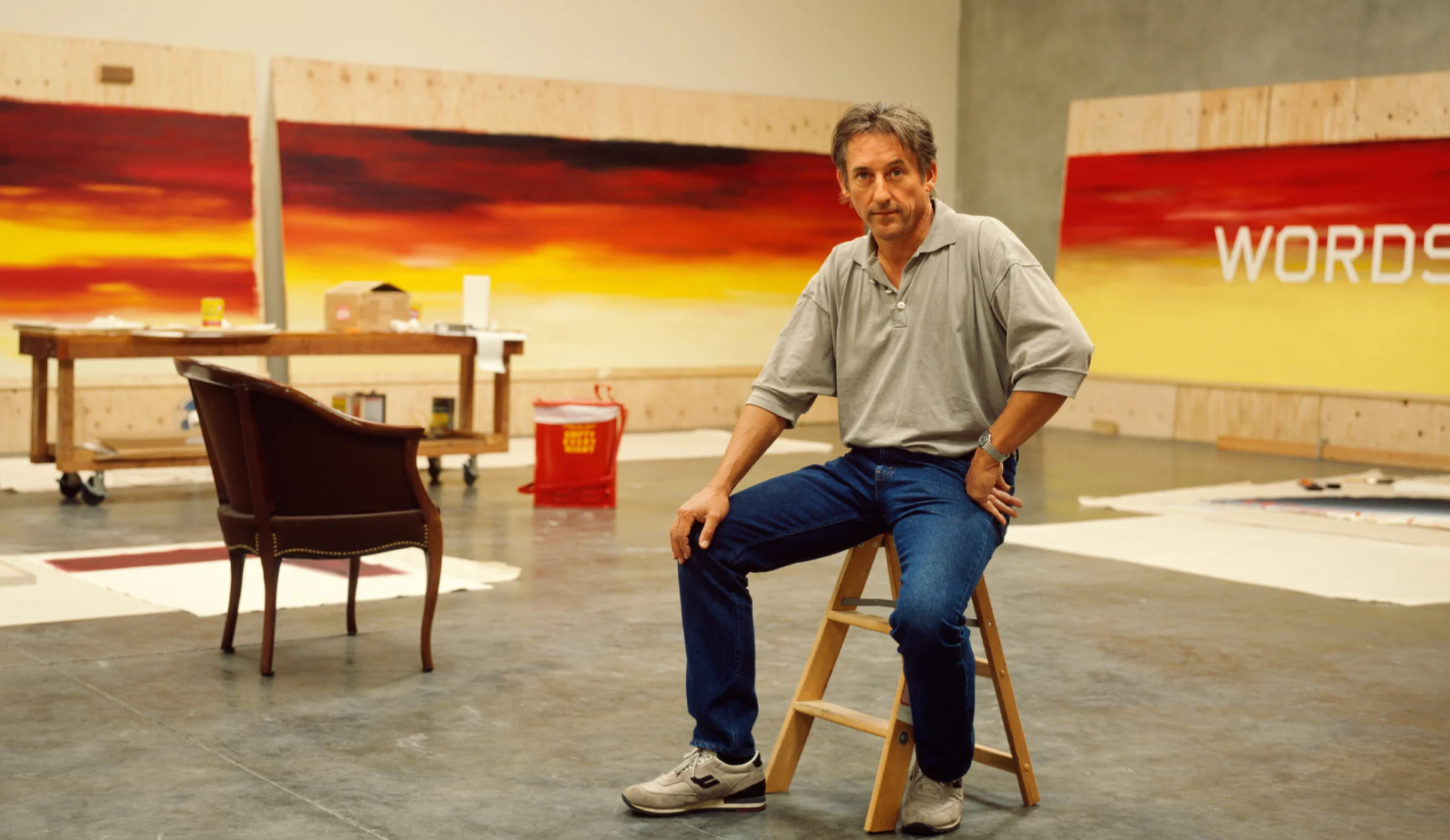
985. Photo: Evelyn Hofer/Getty Images. Artwork: © Ed Ruscha.
Since his first job as a layout artist in a Los Angeles advertising agency, Ruscha has explored a wide range of elaborate typographies in his art: from Garamond and Old English Gothic, to trompe-l’oeil letters formed of curlicued ribbons, foam, liquid spills, and stains. In the early 1980s he designed a font of his own, called Boy Scout Utility Modern. It is a capitalised and undecorated sans-serif letterform with shaved, angular edges in place of rounded curves, and has come to be the artist’s signature typeface. Ruscha deems it an appropriately neutral and inexpressive vessel for his free-standing statements. ‘Some people wear shoes that say something; some people wear shoes that don’t say anything’, he explained. ‘I use a type face that doesn’t say anything’ (E. Ruscha quoted in E. King, ‘Ed Ruscha on Paper: A view on the spirit and letter of the pop-art pioneer’, Interwoven, 2018).
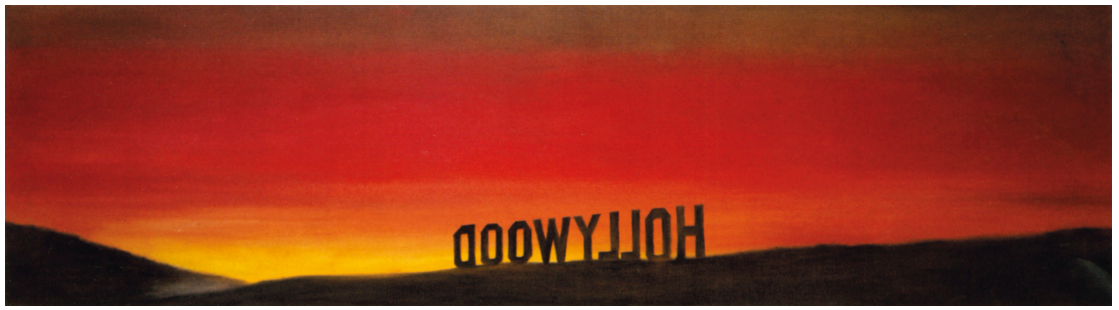
Ed Ruscha, The Back of Hollywood, 1977. Collection Musée d’Art Contemporain, Lyon. Artwork: © Ed Ruscha.
Boy Scout Utility Modern shares the truncated style of Ruscha’s much beloved ‘Hollywood’ sign. He had once joked that the iconic cultural landmark, glimpsed from his studio window, was his personal smog meter. On fair days it is visible from a distance of up to fifteen miles away. He drew its white cut-out letters for the first time in 1967, and the sign has since become as recognised in his oeuvre as it is in Los Angeles. Ruscha’s sensibility for words as they appear in landscape—viewed obliquely, through atmosphere and mists, or cast into dramatic perspectives—can be traced to his earliest works. His photographic books of the 1960s document the billboards, gas stations, road signs, and store signs that punctuated his drives between Oklahoma City and California on the US 66—gleaming, man-made markers in America’s sweeping Western flatlands. ‘Words are pattern-like’, Ruscha says, ‘and in their horizontality across the canvas, they answer my investigation into landscape’ (E. Ruscha quoted in B. Blistène, ‘Conversation with Ed Ruscha’, in Edward Ruscha, exh. cat. Museum Boijmans Van Beuningen, Rotterdam 1990, n.p.).
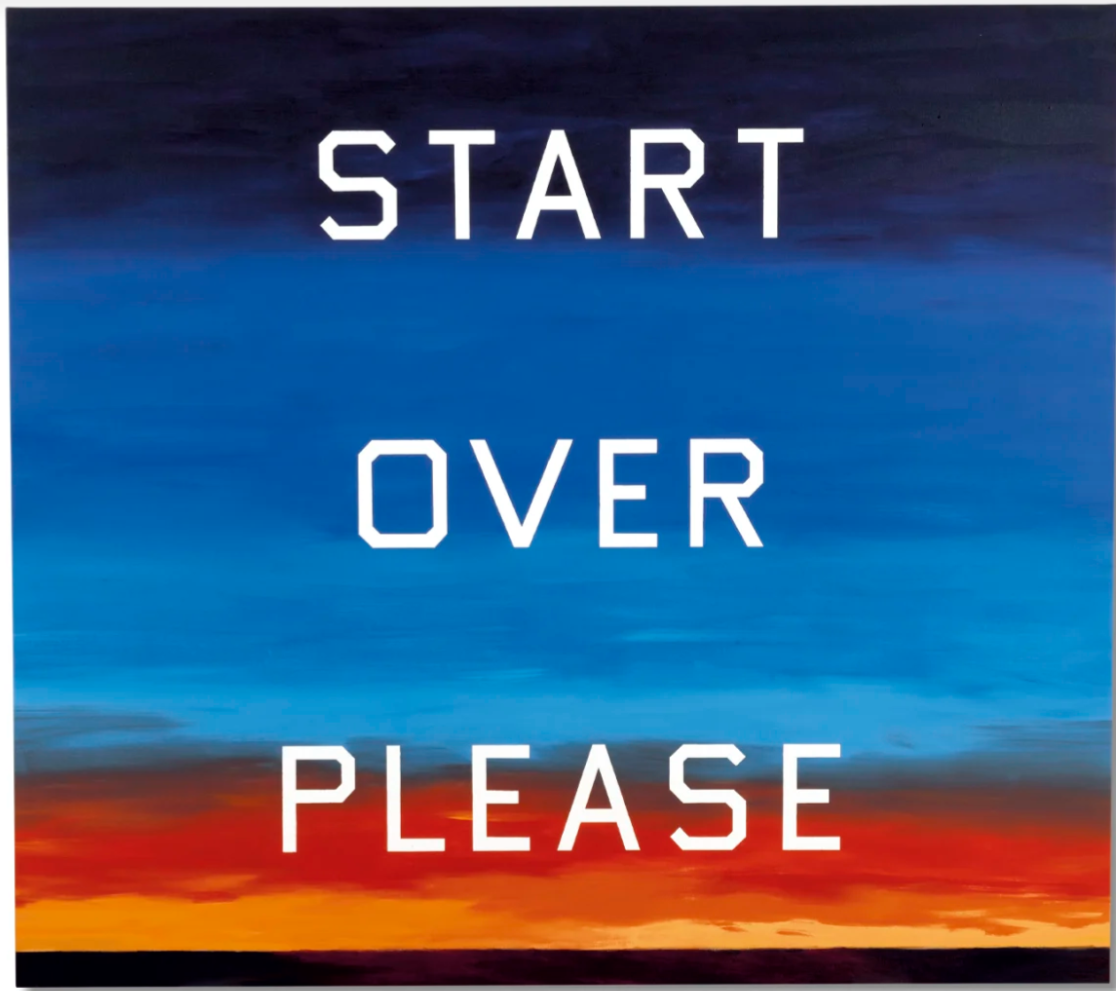
Ruscha’s shift to simplified, unembellished typography in the 1980s correlated with his adoption of more sophisticated phraseology and development of backgrounds as real, figurative spaces. While in his previous works words float in abstract space like specimens under a microscope—their ‘objectness’ and texture amplified—the present painting forms part of a series of works in which enigmatic statements are composed flatly against spectacular landscapes. Here, the words ‘Start Over Please’ are cleanly extracted from their background, pulled from the vivid skyline to the surface of the canvas to create two disjunct spatial planes. The landscape is at once the text’s foil and support.
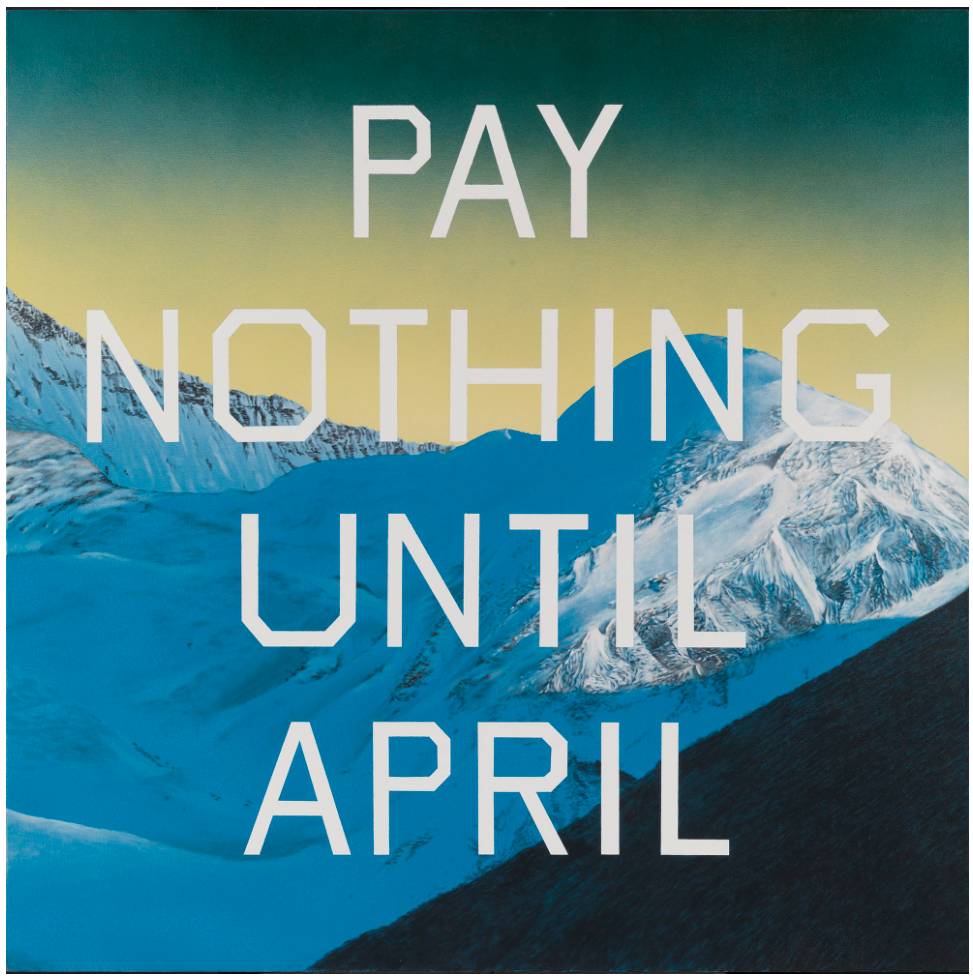
Ed Ruscha, Pay Nothing Until April, 2003. Tate, London. Artwork: © Ed Ruscha. Photo: © Tate, ARTIST ROOMS.
Start Over Please invokes a cycle of beginnings and ends. Words roll over the blazing backdrop like the credits of a film or the blinking ‘Game Over’ message in a video game. It is a masterful illusion of narrative, which Ruscha tacitly implies yet seldom reveals. The painting exists in dialogue with a series of Ruscha’s works that incorporates the related phrase ‘The End’. Examples are held in the Tate Collection and the Museum of Modern Art, New York.
Untitled, 2015
Christie’s New-York: 1 October 2024
Estimated: USD 2,000,000 – 3,000,000
USD 2,591,000
ED RUSCHA (B. 1937), Untitled | Christie’s (christies.com)
ED RUSCHA (B. 1937)
Untitled, 2015
Acrylic on canvas
72×124 inches (182.9 x 315 cm)
Signed and dated ‘Ed Ruscha 2015’ (on the reverse)
The great American artist Ed Ruscha’s Untitled is a definitive statement from the artist’s mature period. Reflecting upon the passage of time as he neared his eightieth decade, Ruscha laid out different measurements of time—Seconds, minutes, hours, days, weeks, months, years—across the wide expanse of his canvas. Reliant once again on his now-signature ‘Boy Scout Utility Modern’ typeface, which he first designed forty-five years previously, Ruscha reverses the predictable relationship between timescale and type size, decreasing the letter size and weight from the topmost “SECONDS” to the bottommost “YEARS.” This reversal introduces a cheeky irony into the work, making what could have been an aging artist’s meditation on temporality instead a humorous comment on the passage of time. Untitled exposes the full impact of the many years which Ruscha has explored his famed word art paintings. His student years learning graphic design at the Chouinard Art Institute remain in evidence in the work’s composition; the artist precisely lays out each of his letters in relation to each other and to the work’s ground, elegantly construing a series of formal relationships amid the seemingly-arbitrary scale and placement of his words. Each demotion in scale follows the ground’s careful elliptical gradient curve, allowing the S in each term to inhabit the ambiguous space between dark and light, the white color of the letter almost fading to invisibility.
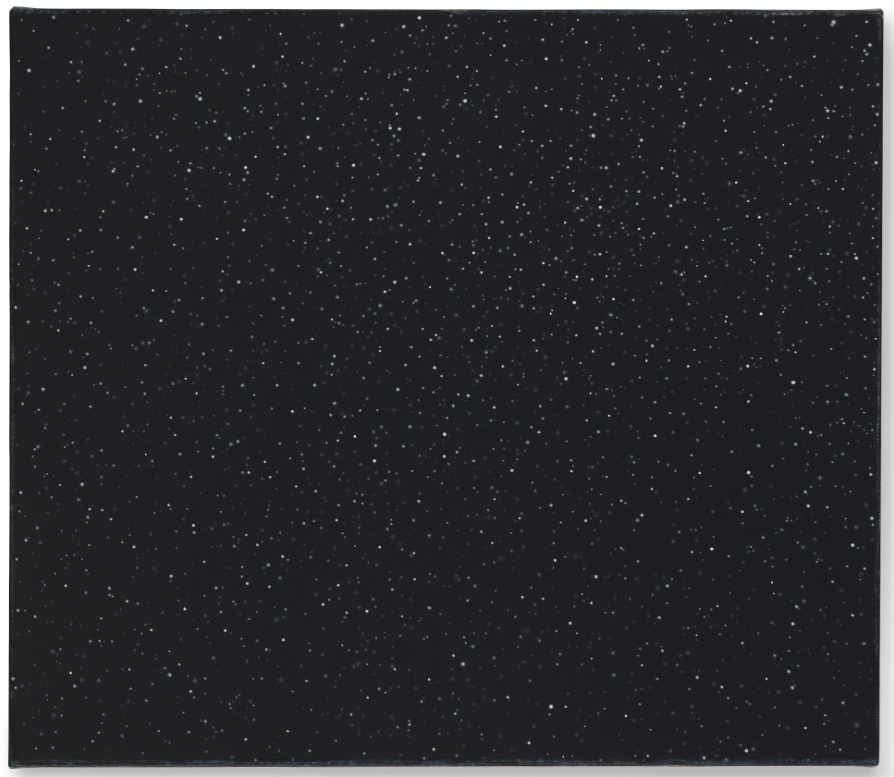
Vija Celmins. Night Sky #14, 1996-1997. © Vija Celmins, Courtesy Matthew Marks Gallery.
The careful contrast between darker and brighter tones in this monochromatic work investigates themes and motifs which Ruscha first addressed in his important early Gunpowder series, which he began in 1967. The artist’s careful alterations in gradation between layers of gunpowder were the first time in which the letters consisted of negative space, constructed out of blank canvas against a pigmented backdrop, a painterly effect Ruscha riffs on in the present work. Ruscha has become more and more interested in time as a subject, with many of his works made in this century confronting temporality. Representing the United States at the 51st Venice Biennale in 2005, his Course of Empire project grapples with the ravages of time, a theme continued in his painting Plank in Decline. Ruscha shifts focus from the effect of time to the purely conceptual subject of passing time with his 2013 lithographic series Periods. Similarly composed, this work anticipates the current lot, denoting abbreviated measurements of time in ascending scale against a mountainous backdrop. In this case, however, “YRS.” is in the largest font, whilst “SECS.” is the smallest, with the words’ scales correlating to the amount of time they represent. The conflation of image and text in this series poses suggestive questions to the viewer regarding the association between passing time and landscape. It is significant that with Ruscha’s reprisal of the Periods motif in the present work, the artist disengages with any specified backdrop, amplifying the focus on his text. Two years after his first experimentation with textual temporality, Ruscha further refines the motif, excavating the powerful symbolism inherent in this text into a unspecified spatial setting. Thus, time itself becomes the work’s subject, the comparison of seconds to minutes and so on stressed through the contrasting tones in gradient. The reversal of emphasis from years to seconds between Periods and Untitled functions as a memento mori, demonstrating that as one confronts aging, shorter spans of time gain importance.
Truth, 1973
Christie’s New-York: 16 May 2024
Estimated: USD 7,000,000 – 10,000,000
USD 14,785,000
ED RUSCHA (B. 1937), Truth | Christie’s (christies.com)

ED RUSCHA (B. 1937)
Truth, 1973
Oil on canvas
54×60 inches (137.2 x 152.4 cm)
Signed, dedicated, inscribed and dated ‘For Merle and Pearl Edward Ruscha 1973 IT RHYMES WITH TOOTH’ (on the reverse)
Painted amidst the Vietnam War in 1973, Ed Ruscha’s expansive and arresting work glorifies the imaginative and progressive spirit that not only is synonymous with post-war Los Angeles but also embodies the ethos of the collection of Norman and Lyn Lear. As one of the most beloved and influential figures in entertainment and television, Norman Lear challenged Americans to engage with the most pressing issues of the day with heart and humor—valuing truth above all. Acquired in 1980, TRUTH acted as a hallmark of the collection for over four decades. Connoting the power of truth itself to cut through all kinds of pretense or falsehood, it is a painting that finds harmony in the truth-telling honesty of Norman Lear’s sitcoms, as well as his life-long commitment to activist causes.
Painted in 1973, Ed Ruscha’s Truth is one of the artist’s signature paintings in which he turns a seemingly simple singular word into a powerful and enigmatic motif. No other artist has lent such illustrative intrigue to minimal text and phrases, a feat which has cemented his place as a visionary within the history of American art. Truth is a particularly compelling canvas that marries Ruscha’s forthright delivery with painterly finesse. In the artist’s hands, the moral imperative is transformed into an image, an object, and a physical presence while still retaining all the cultural connotations connected to its broad, philosophical meaning. This work is the definitive rendering of the painter’s mindset when he noted, “Words have temperatures to me. When they have reached a certain point and become hot words they appeal to me… sometimes I have a dream that if a word gets too hot and too appealing, it will boil apart, and I won’t be able to read or think of it” (E. Ruscha, “Repainting, redrawing and rephotographing Los Angeles”, Art Newspaper, December 19, 2012). The combination of textual immediacy, the use of a volcanic color palette, and the sheer size of the canvas lend Truth a roiling, explosive presence that seems to muscle its way off the wall and into the world.

The Lear family with Ed Ruscha’s Truth (1979). Courtesy of the Lear Family Archives. Artwork: © Ed Ruscha.
Set within a dichromatic earthy space, the word ‘TRUTH’ in all capitals cuts into our field of view. Rendered in a fiery gradient that resembles burning embers or a California sunrise, the letters stretch horizontally across the five-foot canvas as their serifs threaten to expand beyond the confines of the picture plane. Ruscha’s choice to use deep red at the upper extremities of the lettering gradually shifts into orange and lemon yellow makes the text heavier at the top and establishes an imposing air for the entire work. The backdrop is painted with wide, visible strokes of burnt ochre that segue into a warm earthy expanse of organic hues at the top. Where these two fields meet, a hazy line of diaphanous color acts almost as an illusionistic groundline for the titular word. This smoky air is at odds with the sharpness of Ruscha’s text, a juxtaposition possible through his use of reverse stenciling techniques which allow each letter to act as a window into another layer or neatly separate from the background as a discrete object depending on how the viewer experiences the work. “Usually in my paintings, I’m creating some sort of disorder between the different elements”, Ruscha has explained “and avoiding the recognizable aspect of living things by painting words. I like the feeling of an enormous pressure in a painting” (E. Ruscha, quoted in R. Marshall, Ed Ruscha, New York 2003, p. 241). By creating this optical complexity within a seemingly simple composition, the artist provokes a stronger response and lends an intense gravity to what amounts to a single word hovering in space.

Ed Ruscha, Gospel, 1972, Art Gallery of New South Wales, Sydney. © Ed Ruscha.
Ed Ruscha, Faith, 1972. © Ed Ruscha.
Ed Ruscha, Hope, 1972. © Ed Ruscha.
Truth is a member of a discrete series that the artist started in 1972 as a visualization of the moral tenets of Ruscha’s Catholic upbringing. Included in the grouping are paintings such as Gospel (1972, Art Gallery of New South Wales), Mercy (1972), Purity (1972), Faith (1972), and one of several versions of Hope including a 1998 work on paper in the collection of Tate Modern, London). Each word is rendered in italic Bodoni Ultra Bold, a favorite font of Ruscha that he used in other canvases to give material substance to a word, something which is on full display in the present example.

Ed Ruscha, Truth, 1972. © Ed Ruscha.
Ed Ruscha, Purity, 1972. © Ed Ruscha.
Ed Ruscha, Mercy, 1972. © Ed Ruscha.
Truth’s genesis can be found in the legendary figure of Irving Blum, the director of the L.A. based Ferus Gallery. Ruscha was introduced by Blum to Merle and Pearl Glick, the first owners of the painting; Merle was a dentist and Pearl was Blum’s cousin, and both had an insatiable appetite for collecting art. Their tastes veered strongly toward the burgeoning Pop Art scene thanks to Hopps and Blum, and it was because of this that they struck up a lasting relationship with Ruscha and the other artists who populated the Ferus stable. In 1970, Ruscha created a painting titled Tooth for Merle, a nod towards the collector’s profession. Three years later, the artist made a wry allusion to this previous painting and its rhyming title when he painted the present work for the couple’s collection. Truth is remarkable for both its smoldering intensity as well as Ruscha’s ability to coax the feeling of dimensional space out of a single word on an abstract colorfield. Landscape painting, though perhaps not immediately apparent, has been a source of much inspiration for Ruscha even as works like the present example seem to depict a non-place or some hazy abstraction. The present example is reminiscent of a desert at dusk or an aerial view of dusty fields against a darkening sky. The letters themselves could be hovering in the immediate foreground or resting upon the floor; Ruscha’s close crop and tight composition create a visual ambiguity that confuses our understanding of the scene as it moves from the picture plane to the illusionistic depth of an imagined beyond.
You Cannot Be Serious, 2008
Sotheby’s New-York: 14 May 2024
Estimated: USD 450,000 – 650,000
USD 790,500
Proceeds to Benefit the John and Patty McEnroe Foundation
You Cannot Be Serious | Contemporary Day Auction | 2024 | Sotheby’s (sothebys.com)
ED RUSCHA (b. 1937)
You Cannot Be Serious, 2008
Acrylic on museum board
24 x 27 7/8 inches (61 x 70.8 cm)
Signed and dated 2008 (lower right)
Christ Candle, 1987
Sotheby’s New-York: 13 May 2024
Estimated: USD 2,500,000 – 3,500,000
USD 2,200,000
Christ Candle | Contemporary Evening Auction | 2024 | Sotheby’s (sothebys.com)
ED RUSCHA (b. 1937)
Christ Candle, 1987
Acrylic on canvas
71 3/4 x 72 inches (182.2 x 182.9 cm)
Signed and dated 1987 (on the reverse)
Juxtaposed against a grid of urban lights, Ed Ruscha’s crisp handwriting outlines the striking phrase “Christ Candle”, enticing the viewer with its captivating cinematic intensity. Shimmering starkly against the hypnotic grid, “Christ Candle” refers to the name of a candle company whose sign Ruscha glimpsed in passing driving down Venice Boulevard in Los Angeles. Within Ruscha’s acclaimed series of City Lights paintings, a body of work that was innovative and transitional for the artist in terms of subject matter and technique, the present work is distinguished by its direct inclusion of the artist’s hand. Christ Candle is one of only two examples Ruscha produced using stencils to approximate his own handwriting, the other of which is Love Chief, which is notably held in the collection of the Auckland Art Gallery Toi o Tāmaki, New Zealand. Bearing exceptional provenance, Christ Candle was acquired by Emily Fisher Landau from Leo Castelli Gallery shortly after its execution in February 1988. Remaining in Landau’s collection for over three decades, the present work was notably included in Ed Ruscha’s 1989-1991 traveling retrospective at the Centre national d’art et de culture Georges-Pompidou, Paris; Museum Boymans-Van Beuningen, Rotterdam; Centre Cultural de la Fundacio Caixa de Pensions, Barcelona; Serpentine Gallery, London and Museum of Contemporary Art, Los Angeles; as well as numerous exhibitions at the Fisher Landau Center for Art. Christ Candle is a paragon of Ed Ruscha’s canonical art historical legacy, embodying his unique capacity to evocatively portray desire and its pervasive manifestations within American popular culture.

ED RUSCHA UNFOLDING EVERY BUILDING ON THE SUNSET STRIP BY JERRY MCMILLAN, 1967. PHOTO © COURTESY THE CRAIG KRULL GALLERY, SANTA MONICA. ART © 2023 EDWARD RUSCHA
Affording the present work a heightened sense of intimacy, Ruscha employs his own handwriting in the text, recalling the fleeting moments taken to scroll the name he glanced at while driving down Venice Boulevard. In doing so, Ruscha encapsulates the feeling of desire associated with glimpsing a roadside billboard designed to capture the viewer’s attention in one compelling instant. To render the text, Ruscha drew large stencils and then used a reverse stenciling technique on white gessoed canvas. Working on a larger scale than before and introducing for the first time the airbrush technique to achieve the softly diffused, hazy white of urban lights, Ruscha’s City Lights paintings reverberate with an atmospheric luminosity that ignites the otherwise impenetrable nocturne sky. Attesting to the importance of Ruscha’s City Lights series more broadly, other examples are held in numerous prestigious public and private collections, including that of the Broad Art Foundation, Los Angeles; the Museum of Contemporary Art, Los Angeles; the San Francisco Museum of Art; and the Museum of Contemporary Art, Chicago. An especially captivating painting from this series, the titular text of Christ Candle, draws parallels between the flickering lights of a cityscape and rows of votive candles, perhaps even offering a wry commentary on the commercialization of faith. Here, the grid of city lights is mapped onto the idea of rows of votive candles, symbolizing the idealization of Los Angeles, the city of angels, in popular culture. Ruscha’s sprawling lines of text create a vertiginous effect, implying a speed and motion that corresponds to the passing of the flickering lights into the distance in a shimmering cinematic allure. In Christ Candle, Ruscha captures the city of Los Angeles from an aerial perspective as if glimpsed from the vantage of a landing airplane.

PHOTOGRAPH OF THE LOS ANGELES SKYLINE AT NIGHT. PHOTO © JUSTIN TIERNEY / EYEEM / GETTY IMAGES
Los Angeles here dissolves into a reductive grid, illuminated by the ethereal white glow of streetlights and traffic concentrated in bright clusters at joint-like intersections. To achieve this hazy smolder of light that brilliantly punctuates the surface and diffuses at different scales of intensity, Ruscha utilized the airbrush, a technique that he has continued to explore ever since. Capitalizing on the dissipated softness and subtle translucence that result, Christ Candle dutifully records contrasting patterns of light through variously dense hues of white paint. Like constellations in the night sky, the luminous Los Angeles cityscape invites spectacular associations with the enduring magnetism and glamour of Hollywood’s silver screen. Through both image and text, Christ Candle is cryptic and enigmatic, evading specific association and reveling in a state of ambiguity that lacks clear resolution. “The City Lights paintings could be said to articulate a noir-ish version of the sublime: they trigger fascination tinged with doubt and uncertainty.” (Ralph Rugoff quoted in: Exh. Cat., London, Hayward Gallery (and travelling), Ed Ruscha: Fifty Years of Painting, 2010, p. 21)

LEFT: FELIX GONZALEZ-TORRES, “UNTITLED” (TORONTO), 1992. IMAGE © THE MUSEUM OF MODERN ART/LICENSED BY SCALA / ART RESOURCE, NY ART © 2024 THE FELIX GONZALEZ-TORRES FOUNDATION, COURTESY ANDREA ROSEN GALLERY, NEW YORK. RIGHT: GERHARD RICHTER, KERZE, 1983. SOLD AT SOTHEBY’S, LONDON FOR £8 MILLION IN FEBRUARY 2008. PRIVATE COLLECTION. ART © 2024 GERHARD RICHTER
The near monochromatic palette and reductive composition of the City Lights paintings present a significant departure from Ruscha’s earlier sunset paintings of the 1970s and early 1980s, which featured highly saturated, candy-colored skies painted in vibrant reds, pinks, and oranges. Indeed, while up until this point, much of Ruscha’s work had centered around the automobile and the road as a focal point, looking at the landscape as seen through the window of a car, with the present series, Ruscha expands his field of vision. Abstracting the map of Los Angeles, Ruscha reduces the landscape to its most minimal framework, distilling the hallmarks of urbanization down to mere pinpricks of fluorescent lights in a loosely rendered grid that collectively reveal activity on a greater scale. Indeed, insofar as these paintings chronicle and record space, they do so not through the literal map of the city grid that they purportedly lay out but rather through the varying densities of light that pool and ebb along the grid’s scaffolding framework, indicating greater concentrations of light and activity and thus recording patterns of urbanization and inhabitation. In his monograph on the artist, scholar Richard Marshall suggested that Ruscha developed his idea for these paintings during his many trips flying between Miami and Los Angeles in early 1985 while working on his commission for the Miami-Dade Public Library. His first large-scale public commission, Ruscha created an eight-panel rotunda painting for the library. To accommodate the physical size of this commission, Ruscha also moved into a bigger studio in Venice, California, during this time, and the larger studio space allowed him to increase his scale moving forward.

If cinema parallels the projection of the mind’s eye, Ruscha’s handwritten text clings to the viewer’s stream of consciousness, exposing deeply held desires. Christ Candle embodies Ruscha’s career-long investigation of text and image through the lens of Los Angeles and Hollywood as cultural symbols. Drawing the viewer into its indeterminate geography in which time and memory are destabilized, Ruscha’s Christ Candle enthralls viewers, enchanting them with its compositional complexity and its instantaneous visual appeal.
Chairman, 1977
Christie’s New-York: 9 November 2023
Estimated: USD 1,000,000 – 1,500,000
USD 756,000
ED RUSCHA (B. 1937) (christies.com)
ED RUSCHA (B. 1937)
Chairman, 1977
Oil on canvas
20×24 inches (50.8 x 61 cm)
Signed and dated ‘Edward Ruscha 1977’ (on the reverse)
With Ed Ruscha’s classic California-cool aesthetic and elegantly executed sfumato, Chairman stands out as an astonishing example of the artist’s visually and conceptually rich word paintings of the 1970s. Marked with exquisite details, the present work exemplifies his intimate and precise process which has made an indelible impact on painting and conceptualism. Recalling the atmospheric billows of clouds in the horizon seen in the work of J. M. W. Turner, as well as Ruscha’s own series of buildings on fire, Chairman sets art history ablaze like the sun over the Hollywood Hills.
Given as a gift to the late music executive Jerry Moss, the co-founder of the influential A&M Records, Chairman is both universal and a record of a specific moment in time. It is, to quote Ruscha, an official work of art meant to mark professional achievement. He also photographed the exterior of the original offices of A&M Records, and the image is a part of his Streets of Los Angeles archive at the Getty Museum, Los Angeles. This provenance cements Ruscha’s influence on the history of the city, not just the fine art scene. In this way, he is a truly interdisciplinary artist who reminds us of important intersections between art and music, from Wassily Kandinsky’s improvisation paintings to Roy DeCarava’s photographs of jazz icons like Duke Ellington, Billie Holiday, and Louis Armstrong.
Securing the Last Letter (Boss), 1964
Sotheby’s New-York: 8 November 2023
Estimated: USD 35,000,000 – 45,000,000
USD 39,400,500
ED RUSCHA (b. 1937)
Securing the Last Letter (Boss), 1964
Oil on canvas
59 x 55 1/8 inches (149.9 x 140 cm)
Signed, titled and dated 1964 (on the stretcher)
Emblazoned in glowing orange, the word “BOSS” thunders from a contrasting expanse of midnight navy in Ed Ruscha’s Securing the Last Letter (Boss) from 1964. The booming clamor of the word here is interrupted only by the industrial C-clamp that squinches and compresses the final letter, warping the image with the full genius of the artist’s semiotic subversion. Merging Pop Art, conceptualism, and a distinct West Coast sensibility with an elemental graphic force, Ruscha’s Text paintings of the 1960s transformed ordinary language into arresting visual statements that launched the artist into the innovative forefront of American contemporary art. Heralding a milestone in his aesthetic evolution, Securing the Last Letter (Boss) is one of only 24 large-scale paintings measuring over fifty inches that Ruscha executed in the seminal period between 1960 and 1965, and it develops from his earlier 1961 painting Boss, now held in the Broad Museum, Los Angeles, by introducing the unexpected image of a C-clamp into the word. Further probing the materiality of language, the present work is thus an exceptionally rare masterpiece from a limited suite of only four large-scale Text paintings with the clamp motif, half of which now belong to prominent institutional collections; notably, the sister painting to the present work, Not Only Securing the Last Letter but Damaging It as Well (Boss) resides in the Museum Brandhorst, Munich, while Hurting the Word Radio #1 is held in the Menil Collection, Houston. Further testifying to its prodigious significance, Securing the Last Letter (Boss) bears exceptional provenance, having only belonged to notable collectors Ed and Audrey Sabol prior to Emily Fisher Landau, who acquired the present work in 1988 through Leo Castelli Gallery.
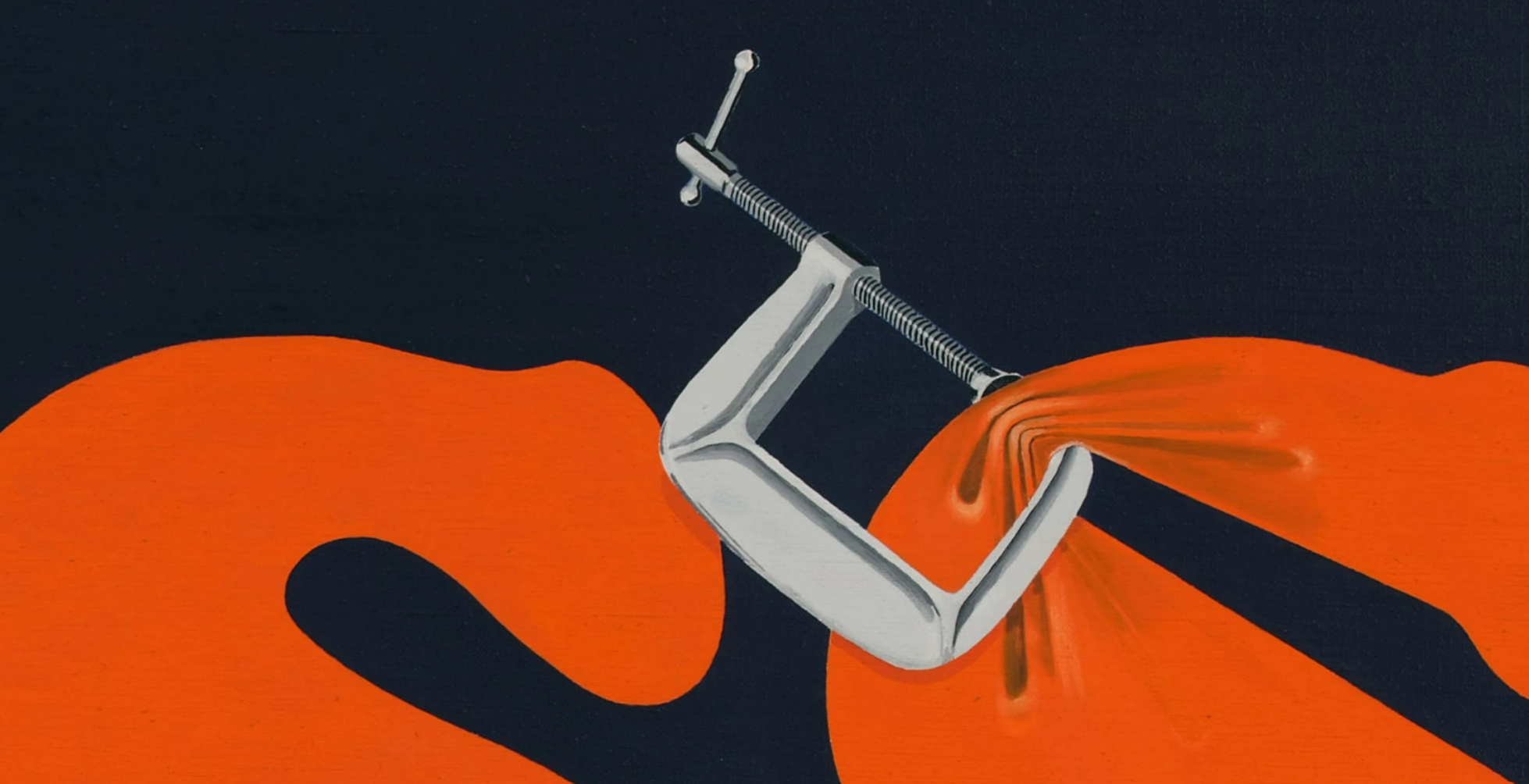
Theatrical in scale and cinematic in allure, in Securing the Last Letter (Boss), Ruscha spells out with bright, bolded letters a word that aptly parallels the palpable authority of its visual dynamism: “BOSS.” The graphic potency and commanding associations of the titular word strike both the eyes and the mind like a boxer’s punch, a forceful expression of dominance and cool. Any semantic association of authority, however, appears undermined by the metal clamp that clenches onto the orange skin of the final “S,” radically disrupting the presumed flatness of the given text and insisting on its sculptural physicality and symbolic potential instead. The C-clamp—a utilitarian metal device of mechanics and carpentry—introduces a trompe l’oeil that elevates text into object, language into art, colloquialism into critique: as Thomas Crow analyzes, “The accurately depicted clamp, like an illustration from a tool supply catalogue, shouts ‘actual size,’ as it reveals the orange letters to be made of some ostensibly malleable material… It is a C-clamp, its namesake letter parasitically making the nonsensical BOScS out of Boss, deflating the boastful overtones of the word and perhaps marking its having congealed into a commercialized cliché” (Thomas Crow, “Turn It Up: The Sounds of the Young Ed Ruscha” in Exh. Cat., Ed Ruscha: Ace Radio Honk Boss, Craig F. Starr Gallery, New York, 2018-2019, n.p.). As with the very best of Ruscha’s seminal Text paintings, the artist here transfigures the word “BOSS” into a vehicle for his formal and conceptual investigations, a signature interplay of semiotics that has since shaped the cornerstone of his prolific career.
Mint (Green), 1968
Sotheby’s New-York: 8 November 2023
Estimated: USD 10,000,000 – 15,000,000
USD 12,973,500
ED RUSCHA (b. 1937)
Mint (Green), 1968
Oil on canvas
60×55 inches (152.4 x 139.7 cm)
Signed and dated 1968 (on the reverse)
As the word emerges with spectral liquid brilliance, “Mint” seizes the graphic yellow canvas with its sheer viscosity in Ed Ruscha’s Mint (Green), capturing the duality of transience and endurance that challenges the very fixity of semiotic meaning. Executed in 1968, Mint (Green) belongs to a highly limited series of twelve large-scale “liquid” or “wet” word paintings Ruscha created between 1966 and 1969, nine of which now reside in distinguished museum collections including The Art Institute of Chicago and The Broad Museum, Los Angeles. In this pivotal and provocative corpus, Ruscha continues to radically disrupt the act of reading by depicting text as if formed from water, oil, or another fluid matter, launching his painterly wordplay to new conceptual terrain while further probing the malleability of language that has remained the cornerstone of his career-long oeuvre. Indeed, with Mint (Green), Ruscha’s choice text metamorphosizes into a three-dimensional substance itself, settling in the precarious evanescence of elemental liquid form before a stark yellow background that recalls the artist’s aesthetic origins in commercial art and graphic advertisement. First exhibited at Alexander Iolas Gallery in 1970 and acquired by Emily Fisher Landau from Leo Castelli Gallery in 1988, Mint (Green) is a paragon of Ed Ruscha’s canonical art historical legacy, rippling with the mesmerizing innovations of his painterly breakthrough. Beginning with Annie, Poured from Maple Syrup from 1966—now in the permanent collection of Norton Simon Museum, Pasadena—Ruscha’s beguiling “liquid” paintings command the visual potency of painting to evoke the familiar appearance of wet surfaces, such as when raindrops descend upon an outdoor sign, or when shapes appear in condensation on the surface of a glass window. Signifying a key bridge between the material and the abstract, Mint (Green) is exemplary of Ruscha’s fusion of form and concept, with the illusionistic transparency of its letters compelling viewers to contemplate the layers of perception and meaning beneath its text.
Life, 1984
Sotheby’s New-York: 9 November 2023
Estimated: USD 1,800,000 – 2,500,000
USD 2,843,000
ED RUSCHA (b. 1937)
Life, 1984
Oil and enamel on canvas
84 1/8 x 48 1/8 inches (213.7 x 122.2 cm)
Signed and dated 1984 (on the reverse)
Encapsulating Ed Ruscha’s career-long exploration of semiotics and text, Life from 1984 embodies the conceptual rigor and signature style that have come to define the artist’s highly acclaimed practice. Held in the personal collection of Emily Fisher Landau for nearly 40 years, the work boasts an illustrious exhibition history, having been exhibited at the Fisher Landau Center for Art extensively from 1985 to 2017. Further attesting to the work’s importance, the painting was reproduced in a promotional poster for the Venice Art Walk by the Venice Family Clinic in 1988. Ed Ruscha is currently the focus of a long-awaited retrospective at the Museum of Modern Art in New York, open through January 2024, the most comprehensive exhibition of the artist’s work ever staged, and his first solo exhibition at the museum.
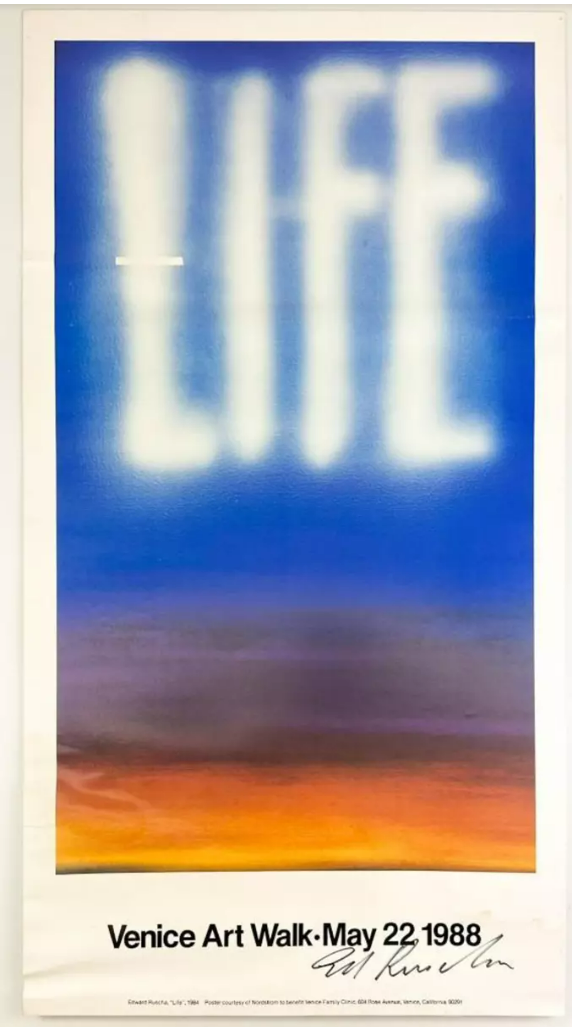
ED RUSCHA’S LIFE, 1984, ILLUSTRATED ON A POSTER FOR THE VENICE ART WALK, VENICE BEACH, MAY 1988. ART © 2023 EDWARD RUSCHA
Emerging from a magnificent dusk sky, the titular word, “LIFE” boldly confronts the viewer in a theatrical crescendo of text and image. Perhaps an ode to the iconic LIFE magazine, the present work appears to utilize the magazine’s bold white typeface, though enlarged, pressed, and refitted within the composition for his own investigations. Hazily rendered, the word floats like clouds on a chromatic plane, echoing the opening credits to a film or a fleeting glimpse of a roadside billboard designed to captivate in an instant. Significantly, Life reflects the first time the artist used an an airbrush technique to render the text which achieves a resounding effect as the canvas reverberates with an atmospheric glow. The bright, fluorescent white letters burst forth from the canvas, pulling themselves out from the dimming twilight with an energetic bravado. Prickling with electricity, “LIFE” comes in a flash, mimicking the blinding effect of oncoming headlights of a car speeding past on the highway.
Chain and Cable, 1987
Christie’s New-York: 7 November 2023
Estimated: USD 2,500,000 – 3,500,000
USD 2,107,000
ED RUSCHA (b. 1937) (christies.com)
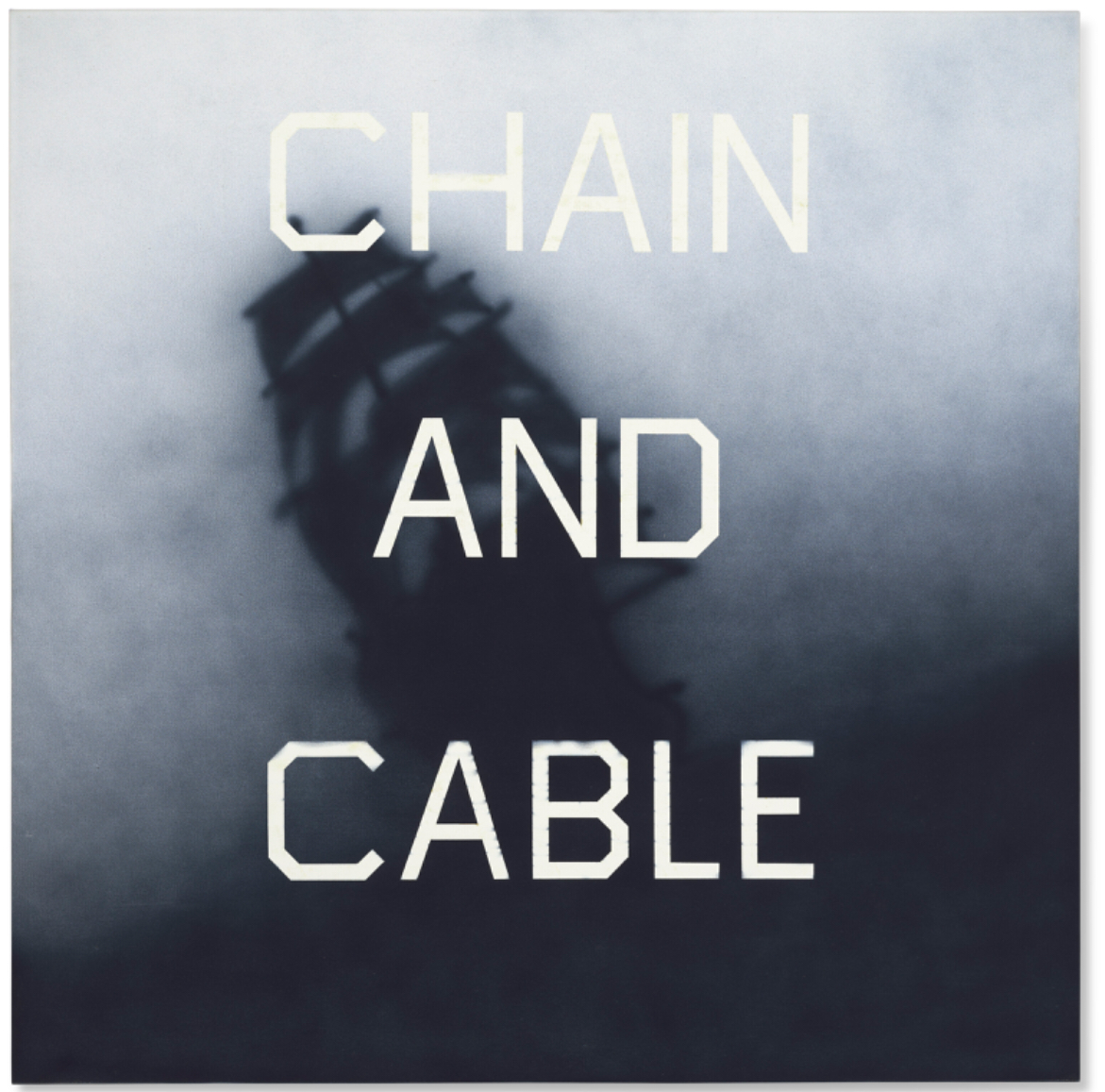
ED RUSCHA (b. 1937)
Chain and Cable, 1987
Acrylic on canvas
64×64 inches (162.6 x 162.6 cm)
Signed and dated ‘Ed Ruscha 1987’ (on the reverse)
Signed again, titled and dated again ‘ED RUSCHA “CHAIN AND CABLE” 1987’ (on the stretcher)
Ed Ruscha’s striking painting Chain and Cable occupies an important place within the artist’s singular career. Exhibited around the world and extensively cited in the literature on the artist, the lyrical and contemplative canvas tells an entire story within a single, large-scale canvas. Ruscha, currently the subject of an acclaimed retrospective at the Museum of Modern Art, New York, engages in his characteristic wordplay here: “chain” and “cable” are terms for parts of a ship’s anchoring apparatus, but they also could refer to the Biblical story of Cain and Abel. While our focus with Ruscha tends to be on these evocative puns, Chain and Cable also evinces his skill and subtlety as a painter.
In the 1980s, Ruscha began using a spray gun (drawing on the Finish Fetish and Light and Space movements in Southern California), which lends the present work an atmospheric and sublime flair akin. There is a resemblance to an otherworldly daguerreotype, with its soft focus interspersed with fine detail. As critic Donald Kuspit wrote in his review of Ruscha’s 1987 Robert Miller Gallery show, where Chain and Cable was first shown, the artist “force[s] us into an uncertainty about the medium that makes the image seem to float free of its material base, as if in a memory” (D. Kuspit, “Ed Ruscha,” Artforum, February 1988, p. 145). Especially in these nautical works from the late 1980s, Ruscha proves that there is beauty in uncertainty, like a film noir or a message in a bottle.
Titian, Cain and Abel, circa 1488-1576. S. Maria della Salute, Venice. Photo: Cameraphoto Arte, Venice / Art Resource, NY.
Chain and Cable combines Ruscha’s signature bold text with a misty scene, as if the words are emerging from the storm of paint. A ghostly ship barrels toward us, just as “chain” and “cable” scroll up across the scene like movie credits. Maybe this is a ghost ship like the Mary Celeste or the Flying Dutchman, a vessel that travels the sea without a soul aboard. Yet Ruscha’s soul is always in the words he chooses, which in this instance are both nautical and Biblical. Ruscha muses, “If someone wants to look at Chain and Cable and say ‘Cain and Abel,’ then I’ll say, yes, that is maybe a logical viewer’s response. That’s strictly the ballpark of the viewer” (E. Ruscha, quoted in R. Dean and E. Wright, eds., Edward Ruscha: Catalogue Raisonné of the Paintings, Volume Three: 1983-1987, New York, 2007, p. 322). In the book of Genesis, God punishes Cain for killing his brother Abel by casting him out into the cruel world. God says, “You will be a restless wanderer on the earth” (Genesis 4:12, New International Version). In Chain and Cable, we wander with Ruscha—not as a curse, but rather as an opportunity to really dive into his immense contribution to postwar art. A secular comparison for Chain and Cable could be James Joyce. Critic Robert Enright theorized, “With ‘chain and cable,’ you get a spoonerism [a type of humorous verbal error] that is a play to the ear with an industrial resonance. That’s how a poem would work, the layering you get in that simple phrase is the kind of thing Joyce plays with continually in Ulysses” (R. Enright, “The Painted Whirred: Ed Ruscha’s Spin on Language,” Border Crossings, 2008, p. 44).
Radio [#1], 1963
Sotheby’s New-York: 18 May 2023
Estimated: USD 2,000,000 – 3,000,000
USD 2,107,500
Radio [#1] | Contemporary Evening Auction | 2023 | Sotheby’s (sothebys.com)
ED RUSCHA (b. 1937)
Radio [#1], 1963
Oil and black ink on paperboard mounted to canvas
14 5/8 x 12 3/4 inches (37.1 x 32.4 cm)
Signed and dated 63 (lower right)
Enticing the viewer with a captivating fusion of image and text that recalls the provocative opening of a Hollywood film and the most compelling advertisements of the 1960s and 70s, Radio is an icon of Ed Ruscha’s works on paper and a thrilling example of the artist’s early text paintings: the body of work that established Ruscha as one of the most innovative painters of his time. Deftly examining the complex relationship between collective culture, text, and iconography, Radio boldly illustrates Ruscha’s unique capacity to evocatively capture American popular culture and visual imagination. With an arresting intensity, the crisp letters cinematically emerge from the velvety dark in a seductive and cacophonous treatise on the nature of semiotics and consumer culture, embodying the subtle interplay of aesthetic and conceptual concerns that exemplify Ruscha’s highly acclaimed artistic practice. Testifying to the artist’s singular appeal and significance as embodied in the present work, Ed Ruscha is the focus of a long-awaited retrospective at the Museum of Modern Art opening in September 2023.
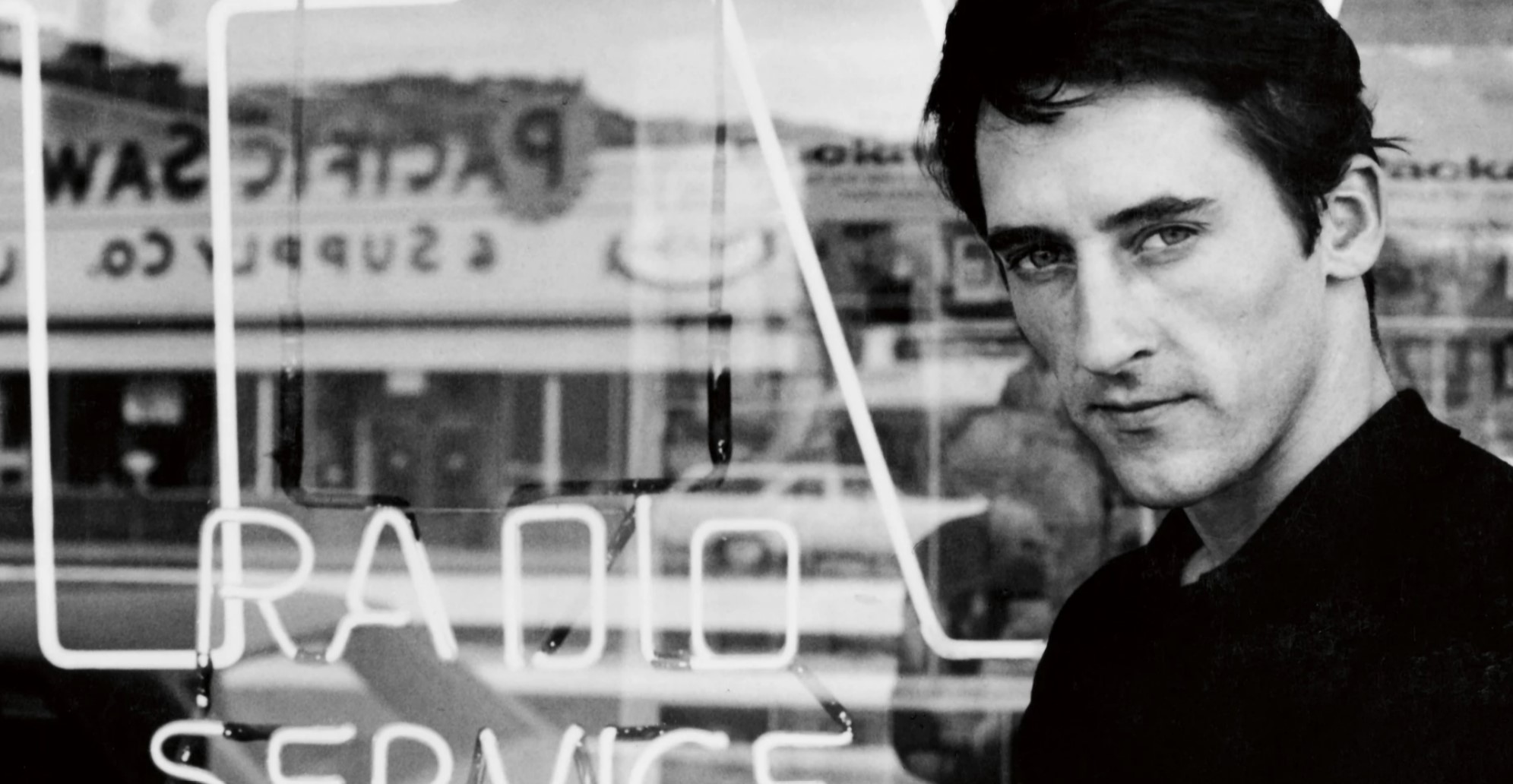
DENNIS HOPPER, ED RUSCHA, 1964. PHOTO © DENNIS HOPPER, COURTESY OF THE HOPPER ART TRUST
Barreling out of an expanse of black is a graphic shock of letters, their blocky forms spelling out “RADIO” in a warm yellow ochre. The forms float on a depthless plane, echoing the opening credits to a film or a fleeting glimpse of a roadside billboard designed to captivate the viewer’s attention in one compelling instant. Beams of white emanate like sound waves or radio antennae from the letters, reaching towards a far-off horizon. The letters are transformed and abstracted, and one is reminded of the blurring of words during a poor radio transmission. Meticulously and elegantly rendered, each letter is even and structured with an almost mechanical zeal. Ruscha stencils the word with careful precision, opting for a bold, clean typography that mimics the lettering found in advertisements, deconstructing the barriers between “high” and “low” art. In Radio, Ruscha employs the graphic tension of the text against the dark background as both object and illusion to create an optical effect that teeters between specificity and abstraction, the recognizable and the thrillingly elusive.
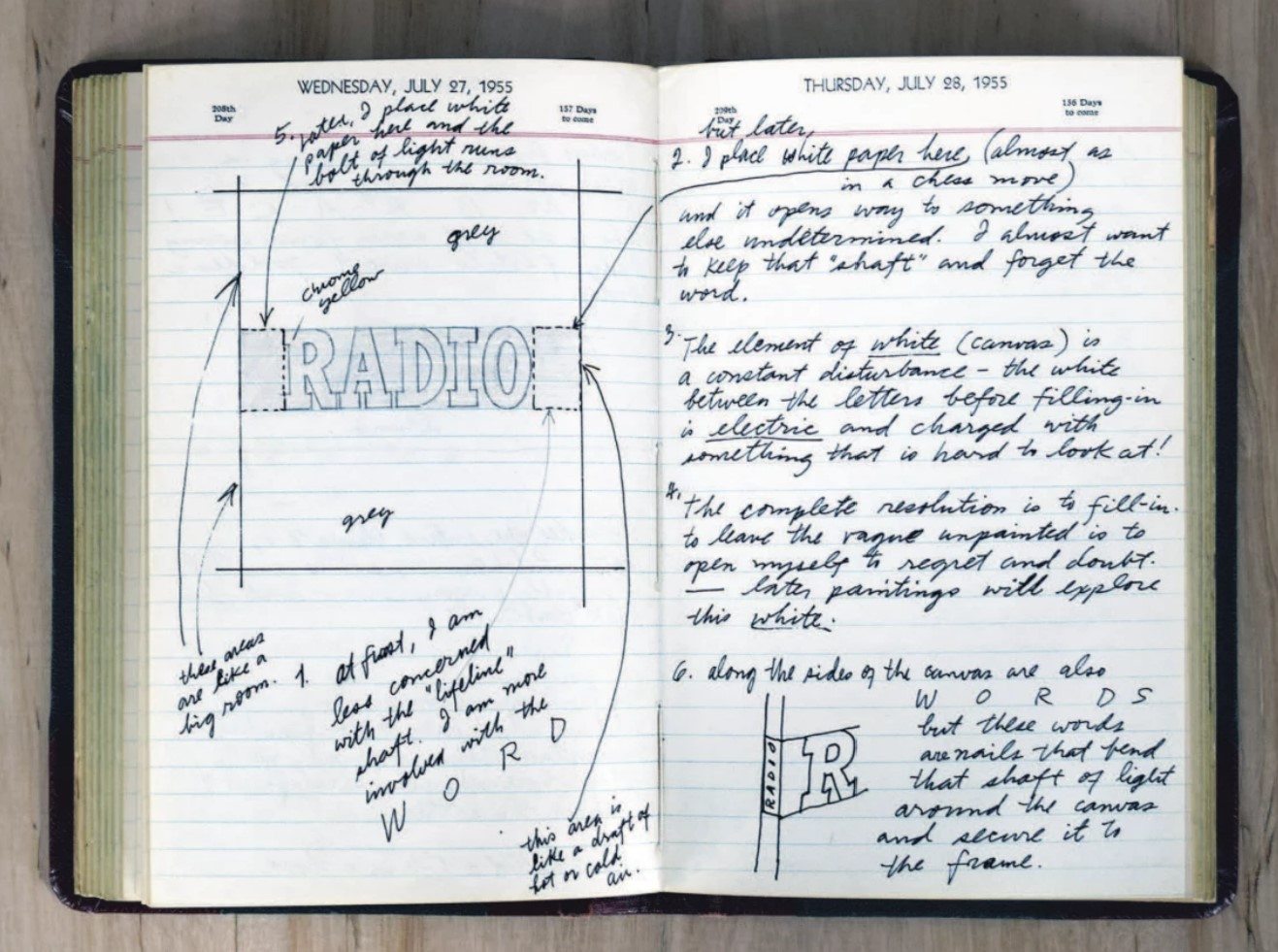
AN ENTRY FROM ED RUSCHA’S STUDIO NOTEBOOK, 1962. PHOTO © PAUL RUSCHA. ART © 2023 ED RUSCHA
By the time Ruscha painted Radio in 1963, the years of family radio were over and the technology had found a new home in the cars of every American, becoming inextricably linked to the culture of freedom, youth, and individualism associated with automobiles. The open roads of Los Angeles promised adventure, excitement, fast speeds, and independence, thus capturing a fundamental piece of the southern California identity. Radio encapsulates both the sound and the idea of the freedom of the open road, the memory of driving with the radio blaring and watching a stream of advertisements and signs pass by. References to electricity, noise, and car culture are common in Ruscha’s paintings from this innovative period, which evoke a quintessentially American nostalgia.
“You can turn on the radio and the radio becomes the soundtrack for what you see out the window. And somehow I get more from doing this in Los Angeles than I do in another city.”
Listening to the radio along Route 66, Ruscha would’ve also heard the sequences of letters spelled out over and over in every station ID and promo, concrete punctuations in the static-infused AM aural stream.
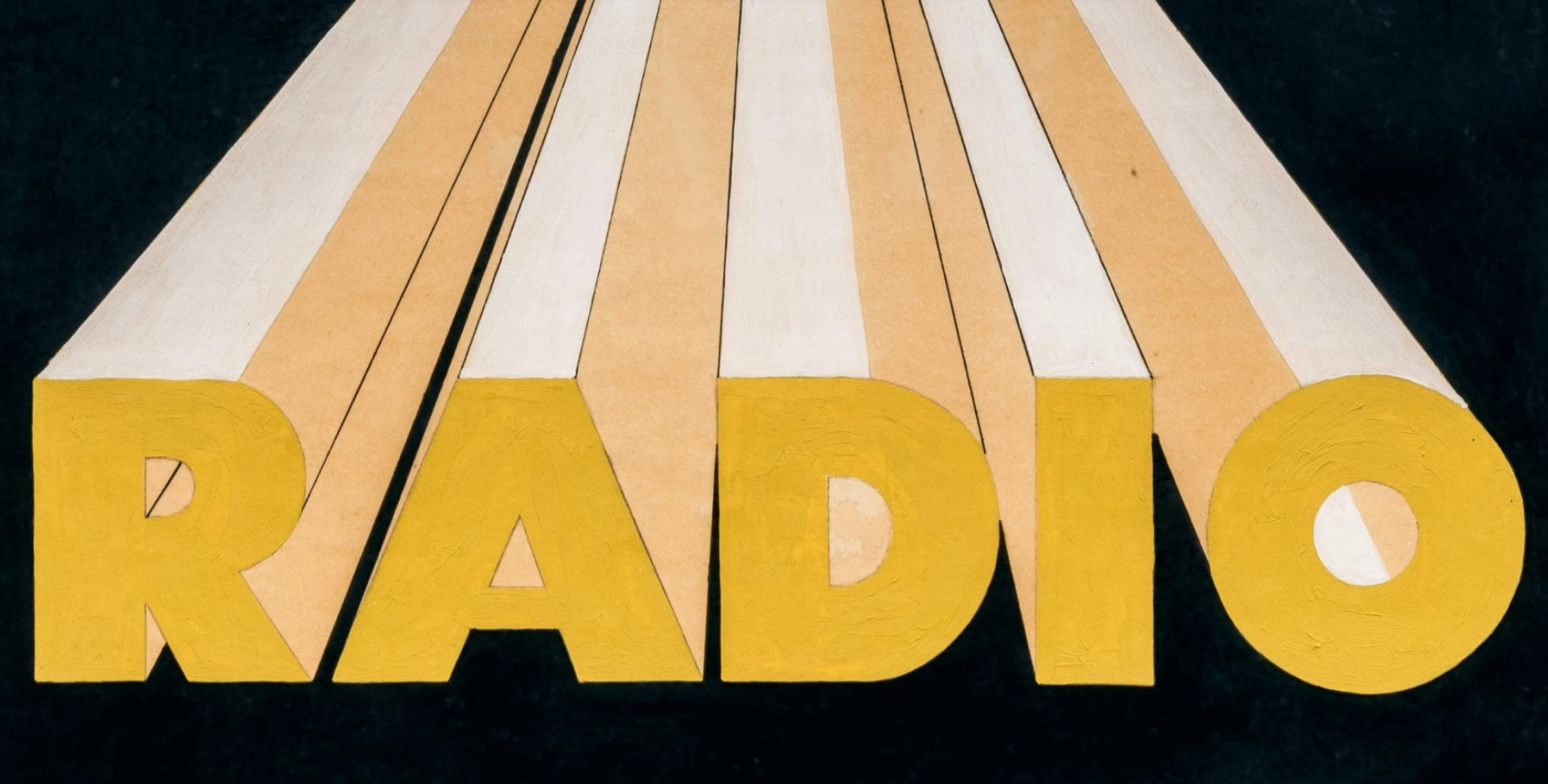
Encapsulating Ruscha’s career-long exploration of semiotics and text, Radio embodies in vivid color and graphic form the conceptual rigor and signature style that have come to the artist’s celebrated oeuvre. Influenced by his surroundings, popular culture, and advertisements, Ruscha’s portrayal of quotidian ephemera parallels Warhol’s trademark Coca-Cola bottles and Campbell soup cans, or Roy Lichtenstein’s iconic comic book inspired blondes.
“There are things that I’m constantly looking at that I feel should be elevated to greater status, almost to philosophical status or to a religious status”, says the artist, “That’s why taking things out of context is a useful tool to an artist. It’s the concept of taking something that’s not subject matter and making it subject matter.”
Aggrandized and isolated in Ruscha’s paintings, words and phrases are stripped of context, imploring the viewer to contemplate the transcendent power of language.
The Future, 1981
Christie’s New-York: 18 May 2023
Estimated: USD 800,000 – 1,200,000
USD 1,865,000
ED RUSCHA (b. 1937) (christies.com)
ED RUSCHA (b. 1937)
The Future, 1981
Oil on canvas
22×80 inches (55.8 x 203.2 cm)
Signed and dated ‘Ed Ruscha 1981’ (on the reverse); dated ‘July 18, ’81’ (on the overlap)
Manual Mobility, 1994
Phillips New-York: 17 May 2023
Estimated: USD 4,000,000 – 6,000,000
USD 3,448,000
Ed Ruscha – 20th Century & Contemporary … Lot 29 May 2023 | Phillips
ED RUSCHA
Manual Mobility, 1994
Acrylic on canvas
60×84 inches (152.4 x 213.4 cm)
Signed and dated “Ed Ruscha 1994” on the overlap
Manual Mobility, 1994, is an iconic example of Ed Ruscha’s career-defining text painting. Known for a body of work that falls between the Pop and Conceptual art movements, Ruscha got his start in advertising before switching to fine art, and like his peers Andy Warhol and Roy Lichtenstein, his commercial beginnings had a strong influence on his art practice. The lines MANUAL MOBILITY and OPERATION OF VEHICLES are stenciled larger than the rest, creating a hierarchy of text that suggests these two lines are the most important textual elements. The words sit in front of a cloudy blue sky, and the shadow of a window frame hangs in front of them. Manual Mobility brings Ruscha’s early Surrealist, trompe l’oeil interest together with his career-long fascinations with the Western United States, the aesthetics of Hollywood films, and the relationship between text and image. Manual Mobility is a prime example of Ruscha’s use of an airbrush, a tool he began using in the mid-1980s to achieve a “strokeless,” photorealistic quality in his paintings. Ruscha begins compositions like Manual Mobility by first blocking off the letter forms with tape, a process he calls “reverse-stenciling.” He then uses the airbrush to paint the background (in this case, the cloudy sky), and removes the tape to reveal the letter forms, crisp and strong against the wispy, sfumato effect of the airbrush. In Manual Mobility, however, Ruscha picks up the airbrush one more time, and paints the shadowy window shape over the lettering. The microscopic spray of the airbrushed black paint along the lines of the windowpanes makes the view into the sky beyond seem hazy. The image softens and sharpens depending on the viewer’s distance from the canvas, like a camera lens snapping into focus.
Pattern of Lust, 1987
Estimated: USD 1,000,000 – 1,500,000
USD 1,562,500
ED RUSCHA (B. 1937)
Pattern of Lust, 1987
Acrylic and oil on canvas
20×24 inches (50.8 x 60.1 cm)
Signed, titled and dated ‘ED RUSCHA “PATTERN OF LUST” 1987’ (on the stretcher)
Signed again and dated again ‘Ed Ruscha 1987’ (on the reverse)
An intimate, spellbinding creation, Ed Ruscha’s Pattern of Lust is a particularly mesmerizing example of the artist’s celebrated City Lights series (1985-1990). Highly-coveted and ravishingly beautiful, the City Lights paintings are among Ruscha’s most sought-after series, in which a sparkling nocturnal vision of the Los Angeles grid is paired with the cryptic words and phrases for which Ruscha is best known. Indeed, in Pattern of Lust, Ruscha marries a beautiful, transcendent vision of the heavens with the seedier dark side of Hollywood glamor.
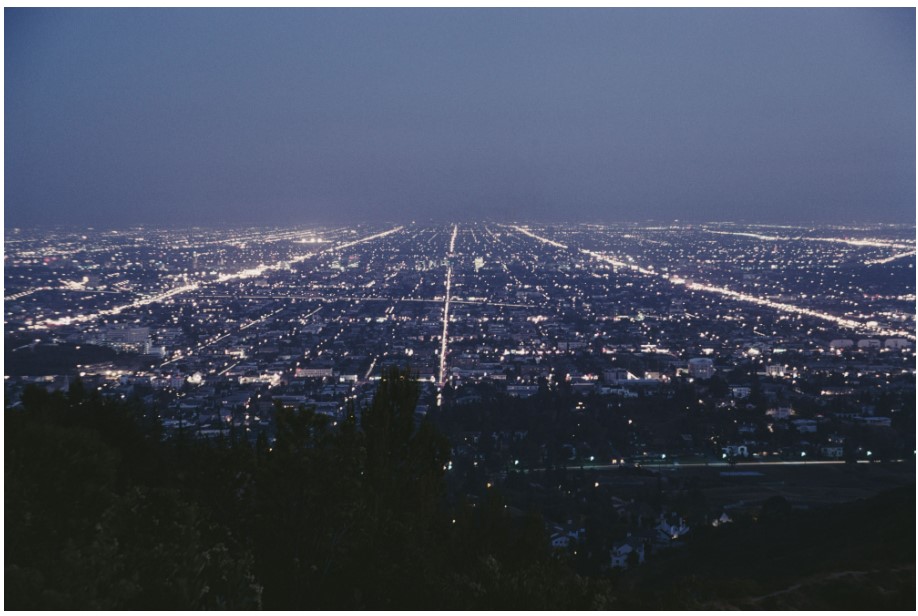
Aerial view of Los Angeles, circa 1962. Photo: Archive Photos / Getty Images.
“A lot of my paintings are anonymous backdrops for the drama of words. They’re just meant to support the drama, like the ‘Hollywood’ sign being held up by sticks.”
Evoking the collective silence of a hushed airplane as it makes its final descent into Los Angeles at night, Pattern of Lust makes for a riveting experience, one that’s made all the more captivating because of the strange words that hover before the eye. As if materializing out of thin air, the phrase “PATTERN OF LUST” rises up from the pictorial ether, rendered by hand in Ruscha’s signature “Boy Scout Utility Modern” font. Ruscha employed an airbrush to create the midnight-blue background and its pattern of twinkling lights, but he painted the text by hand, varying the density of the paint so that the underlying pattern of lights would shine through. The authoritarian nature of Ruscha’s chosen font makes it seem as if an important announcement were being issued, or that the title screen of a major Hollywood film has come up and a hush falls over the crowd.
Nowhere, 1982
Christie’s New-York: 12 May 2023
Estimated: USD 700,000 – 1,000,000
USD 819,000
ED RUSCHA (B. 1937), Nowhere | Christie’s (christies.com)
ED RUSCHA (B. 1937)
Nowhere, 1982
Oil on canvas
22×80 inches (55.9 x 203.2 cm)
Ed Ruscha’s 1982 painting, Nowhere, represents a turn to a nihilistic, more minimal style, in contrast to his brighter and more hopeful works featuring the Hollywood sign, which represented his journey to his dream in Los Angeles. In Nowhere, the road stretches out in a straight line, disappearing into the horizon, creating a feeling of endlessness and infinity. The lack of any other elements in the painting, such as trees or buildings, further emphasizes the sense of isolation and abandonment. His use of color in this painting is particularly striking. The dark sky and the black road create a sense of foreboding and uncertainty, while the warm orange glow of a distant streetlamp or the moonlight suggests a glimmer of hope in an otherwise bleak environment. The overall effect is one of tension and contrast, with the viewer drawn into the painting and forced to confront the emptiness of the scene and the desolate landscape with a single road stretching out into the distance, seemingly leading to everywhere and nowhere at the same time. The road, which leads to nowhere, could be seen as a metaphor for the aimlessness of modern life, where individuals are often unsure of their purpose or direction.
Nowhere is an extremely powerful and thought-provoking work of art. Through its use of color, composition, and symbolism, the painting explores themes of emptiness, isolation, and the search for meaning in modern society. It invites the viewer to reflect on their own experiences of isolation and disconnection, and to question the assumptions and values of the society in which they live.
Do You Think She “Has It”?, 1974
Christie’s New-York: 11 May 2023
Estimated: USD 1,500,000 – 2,000,000
USD 1,865,000
ED RUSCHA (B. 1937) (christies.com)
ED RUSCHA (B. 1937)
Do You Think She “Has It”?, 1974
Egg yolk on moiré
35 7/8 x 40 inches (91.1 x 101.6 cm)
Signed and dated ‘Edward Ruscha 1974’ (on the overlap)
Conceptually rich and yet visually seductive, Ed Ruscha’s Do You Think She “Has It”? is one of the artist’s most fascinating works, made by painting egg yolk onto moiré silk. The sensual contrast between the yellow egg and the shimmery green silk is what gives this work its visual punch. In 1969, Ruscha had turned away from traditional painting materials and instead innovated with a wide range of organic substances, ranging from cherry juice and tea to salad dressing and vaseline. All of this ultimately led him back to painting again, and in the early 1970s, he incorporated whole phrases into his work, rather than the single words he used in the prior decade. Painted in 1974, Do You Think She “Has It”? is one of the more provocative paintings from the series, featuring one of the longest phrases in the group, in which the artist poses the viewer a direct question. The years 1971 to 1974 are widely considered to be the golden age of Ruscha’s linguistic exploration. During this era, Ruscha produced a fascinating and mysterious body of work in which the single words of the 1960s proliferate and grow, which Ruscha then gathers into ever more mysterious combinations. Painted in 1974, Do You Think She “Has It”? is an outstanding example of this radical and seductive moment in his career, made by painting raw egg yolk onto a beautiful piece of pale green moiré silk. Here, the effect is oddly beautiful. The textural contrast between the luxurious fabric and the pale yellow egg yolk is visually striking. The color and texture of the moiré silk conjures up the elegant couture of the 1950s and ‘60s, since moiré, along with crinoline and taffeta, was a popular material for gowns and party dresses at the time. Here, Ruscha’s cryptic text has marred the dress—an indelible stain on an otherwise virgin surface.
See, 1985
Christie’s New-York: 7 March 2023
Estimated: USD 1,500,000 – 2,000,000
USD 1,260,000
ED RUSCHA (B. 1937) (christies.com)
ED RUSCHA (B. 1937)
See, 1985
Oil on canvas
29 7/8 x 29 3/4 inches (75.9 x 75.6 cm)
Signed, titled and dated ‘Ed Ruscha “SEE” 1983-1985’ (on the reverse)
Judy, 1992
Christie’s Paris: 30 November 2022
Estimated: EUR 300,000 – 500,000
EUR 478,800 / USD 494,117
Ed Ruscha (né en 1937), Judy | Christie’s (christies.com)
ED RUSCHA (Born 1937)
Judy, 1992
Acrylic on canvas
26 x 29 7/8 inches (66×76 cm)
Signed and dated ‘Ed Ruscha 1992’ (on the reverse)
Depicting a hazy female figure silhouetted in white against a black background, overlaid by stems of wheat and the work’s title written in vibrant, curvaceous red and blue script, Judy (1992) is a superb example of Ed Ruscha’s masterful interplay between image and text. Ruscha focuses primarily on the typography used to render the name, a feature which simultaneously highlights and dwarfs the woman’s ghostly presence. If she is named Judy, she nonetheless remains unidentified: her outline is a graphic motif that acts as a moody adjunct to the bold formalist beauty of the text. The letters hover through the picture as if in a movie-screen’s opening credits. Verbalizing the visual, Ed Ruscha is a painter of words, and has dedicated his practice to exploring the intersection between the literal and the pictorial. Judy belongs to a series of sooty sfumato compositions that the artist started to produce in the 1980s, with silhouettes set against monochrome, shadowy backgrounds. Created using an airbrush, some of these works left out text altogether, focusing on forms inspired by photography and black-and-white film. While Judy sees text retaining a central role, its nocturnal chiaroscuro—juxtaposed with the candied, glossy red and blue text and the scenic foreground of the wheat—lends the work a surreal, theatrical suspense that echoes the classic cinematography and gritty aesthetic of film noir. The work is at once richly atmospheric and profoundly enigmatic.
The Eighties, 1980
Bonhams New-York: 16 November 2022
Estimated: USD 800,000 – 1,200,000
USD 1,008,375
Bonhams : ED RUSCHA (B. 1937) The Eighties 1980

Oil on canvas
21×159 inches (53.3 x 403.9 cm)
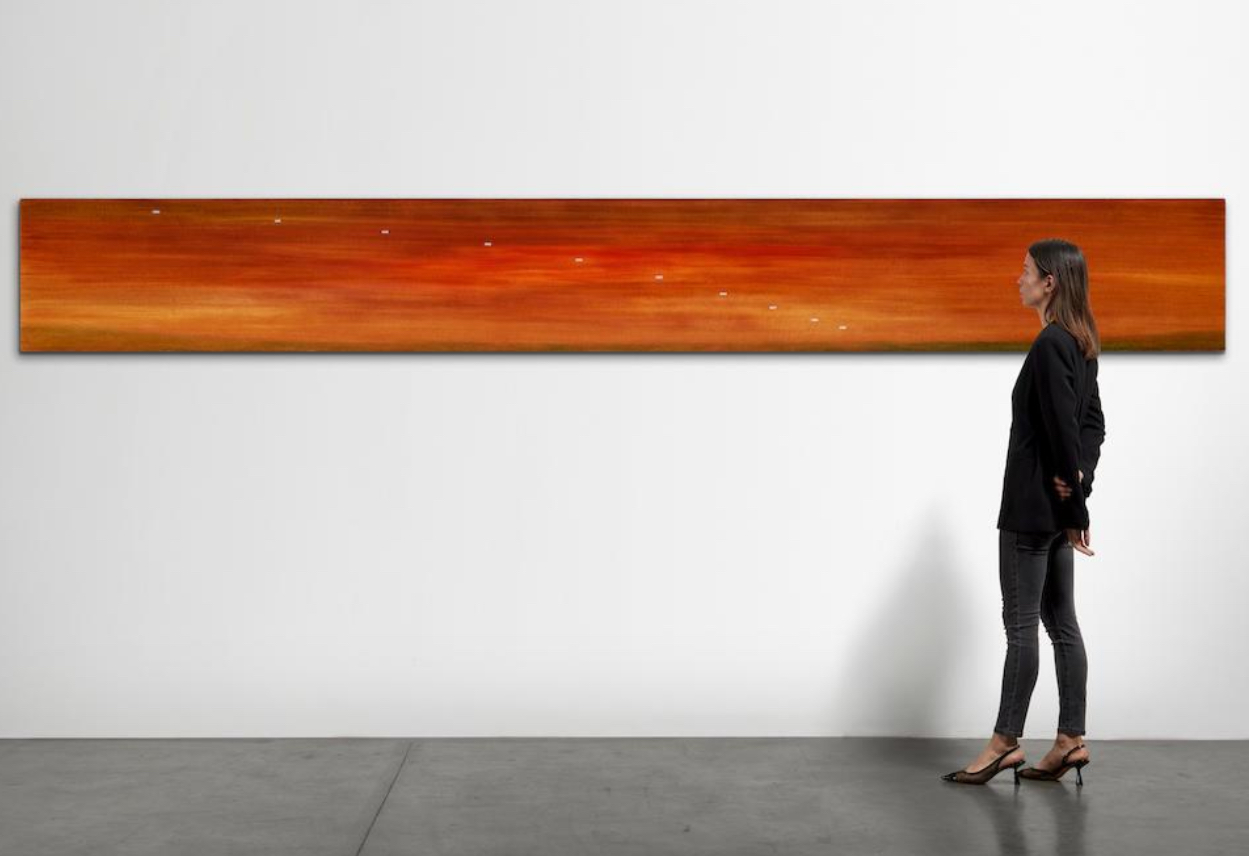
In The Eighties, Ruscha utilizes the canvas as an object, one whose dimensions insist on a narrative, encouraging the viewer to pass across the work’s face. At nearly 14 feet long, it is one of the largest works produced by the artist. Speaking of his developing interest in a scalar approach to painting, in 1981 Ruscha commented:
“It is a natural progression of extensions of syntax […] It’s the idea of things running horizontally and trying to take off. It’s almost like an airstrip […] there’s some kind of mechanical motion behind it that asks you to walk from one side of the canvas to the other, to read what was on it.”
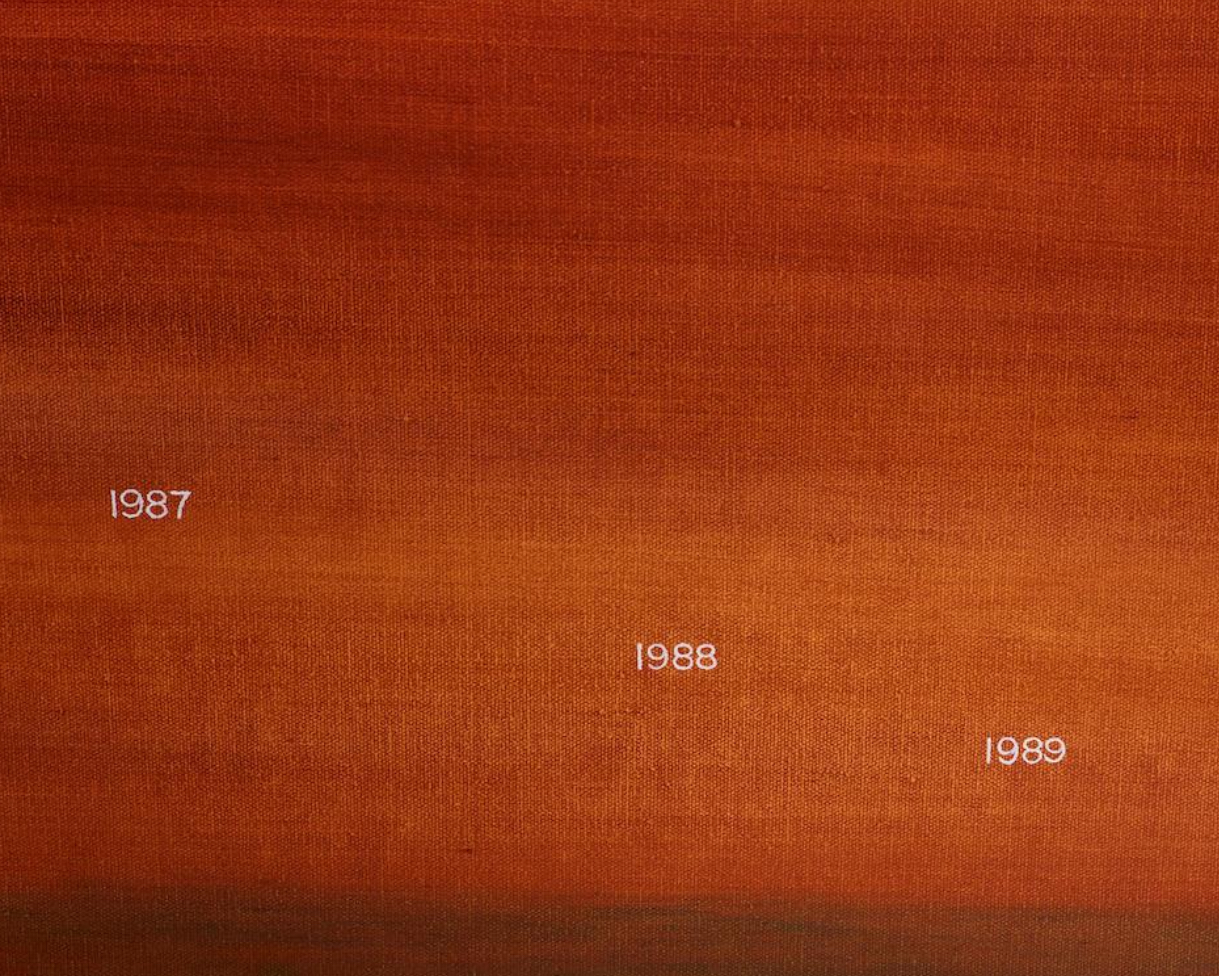
The 1980s truly represented the premature end of the twentieth century as a modernist epoch. With the proliferation of free market capitalism, political conservatism on the rise and the development of nascent communication technologies, including the early internet and video games, the world underwent dramatic changes. It is a decade that looms ever-larger in the rear-view mirror to our contemporary minds that hear the echo of East-West tensions, pandemics, and economic uncertainty. Presented here, therefore, is a truly exceptional painting by one of the living masters of our time that is potently relevant. Ruscha’s The Eighties is a remarkable work that addresses the ambition of a decade, but also the incandescent fading twilight of history. In The Eighties, one of Ruscha’s iconic Los Angeles sunsets is abstracted to the point of almost becoming a color field painting, over which his quintessential text hangs. One cannot but appreciate an aching beauty in the fiery yet solemn glow of this radiant, diminishing sky, evoking the palette of Monet’s red suns of one-hundred years prior.
Bamboo Pole, 1980
Christie’s New-York: 10 November 2022
Estimated: USD 500,000 – 700,000
USD 1,008,000
ED RUSCHA (B. 1937) (christies.com)

ED RUSCHA (B. 1937)
Bamboo Pole, 1980
Oil on canvas
20 x 158 3/4 inches (50.8 x 403.2 cm)
Signed and dated ‘Ed Ruscha 1980’ (on the stretcher)
Rendered on an extreme horizontal, Bamboo Pole is a large-scale example of a series Ruscha undertook in the late 1970s and early 1980s. Each depicting smoldering sunsets from various locales, these panoramic canvases took the open sky as subject with titles like Mexico, Texas Oklahoma, Kansas (1980) and America’s Future (1979). True to form, Ruscha creates an airless quality that tends toward surrealism even while treading the line between coldly conceptual and picturesque. In only a few of the works in this grouping are extraneous objects introduced which push the compositions into more intriguing visual territory. Bamboo Pole is one of these examples, and the gentle arc of a single bamboo shaft splits the glowing clouds like the exhaust trail of a jet across the sky.
Curving from the bottom left up to the right corner, the pole floats as if caught in a gravitational field atop a warm gradient that heaves upwards from white to red. The painting is both of the object itself and of the perplexing interaction between the stick and its sublime backdrop. Pitting simple subjects against the vastness of skyscapes, Ruscha establishes an energetic dichotomy that enchants the viewer while keeping them at arm’s length.
Hawaiian Music, 1974
Sotheby’s New-York: 30 September 2022
Estimated: USD 600,000 – 800,000
USD 844,200
Hawaiian Music | Contemporary Curated | 2022 | Sotheby’s (sothebys.com)
ED RUSCHA (B. 1937)
Hawaiian Music, 1974
Egg yolk on taffeta
36×40 inches (91 x 101.6 cm)
Hovering over the nuanced ground of peachy taffeta, the words Hawaiian Music are articulated in a hue several shades darker than the iridescent taffeta below them; the similarities in tone and saturation between the two materials invite close inspection by the viewer, necessitating intimate interaction with a painting whose text persistently evades narrative or comprehension, exemplifying the artist’s whimsical transgression of the boundaries between looking and reading. Emerging from a critical period in the development of Ruscha’s practice, the present work marks the transformative moment at which the artist began to shift away from his formerly monosyllabic vernacular toward a distinctly heightened linguistic complexity. Honing his autographic deadpan lyricism, the years 1973-1975 are considered the golden age for Ruscha’s most accomplished exploration of language and its visual resonance when manipulated, modified and expressed through pictorial means. In the present work, the eggwhite sinks into the satin support, allowing the text to penetrate the ground beneath it and exist within its woven construction, rather than sitting atop the surface as oil or acrylic on canvas would. In emphasizing the physical weight of the letters’ shapes and color through painting them in a ready-made organic material familiar to our everyday world, Ruscha transports the enigmatic phrase out of language and purely into the visual realm.
Cold Beer Beautiful Girls, 1993
Sotheby’s New-York: 19 May 2022
Estimated: USD 15,000,000 – 20,000,000
USD 18,823,400
Cold Beer Beautiful Girls | Contemporary Evening Auction | 2022 | Sotheby’s (sothebys.com)
ED RUSCHA (B. 1937)
Cold Beer Beautiful Girls, 1993
Acrylic on canvas
84×60 inches (213.4 x 152.4 cm)
signed Ed Ruscha and dated ’93 (on the reverse)
Signed Ed Ruscha, titled Cold Beer Beautiful Girls and dated 1993 (on the stretcher)
Emerging from a theatrical blue sky, Ed Ruscha’s iconic crisp white letters reveal the titular phrase ‘Cold Beer Beautiful Girls,’ enticing the viewer with a captivating zenith of symbol and text recalling the provocative opening of a Hollywood black-and-white film and the most compelling advertisements of the 1960s and 70s. Encapsulating Ruscha’s career-long exploration of semiotics and text, Cold Beer Beautiful Girls is a seminal embodiment of the conceptual rigor and signature style that have come to define Ed Ruscha’s highly acclaimed artistic practice. With an arresting intensity, the crisp white letters cinematically emerge from a cloudy sky in a seductive and triumphant treatise on the nature of semiotics and consumer culture. In the present work, Ruscha bestows the beguiling phrase with a poetic and iconic status. Emphasizing the importance of Cold Beer Beautiful Girls, the sister painting is held in the permanent Collection of the Broad Art Foundation in California. Elusively enticing, subtly ironic, and yet simultaneously imbued with a nostalgic familiarity, the text ‘COLD BEER BEAUTIFUL GIRLS’ here becomes a distillation of American idealism, a wry commentary on the endless promise the phrase evokes, analogous to the best-known images of American Pop. A stirring tribute to the artist’s beloved Californian surroundings, Cold Beer Beautiful Girls stands as one of the ultimate icons of Ed Ruscha’s body of work. This alluring image represents Ruscha’s unique capacity to evocatively portray desire and its pervasive manifestations within American popular culture and visual imagination.
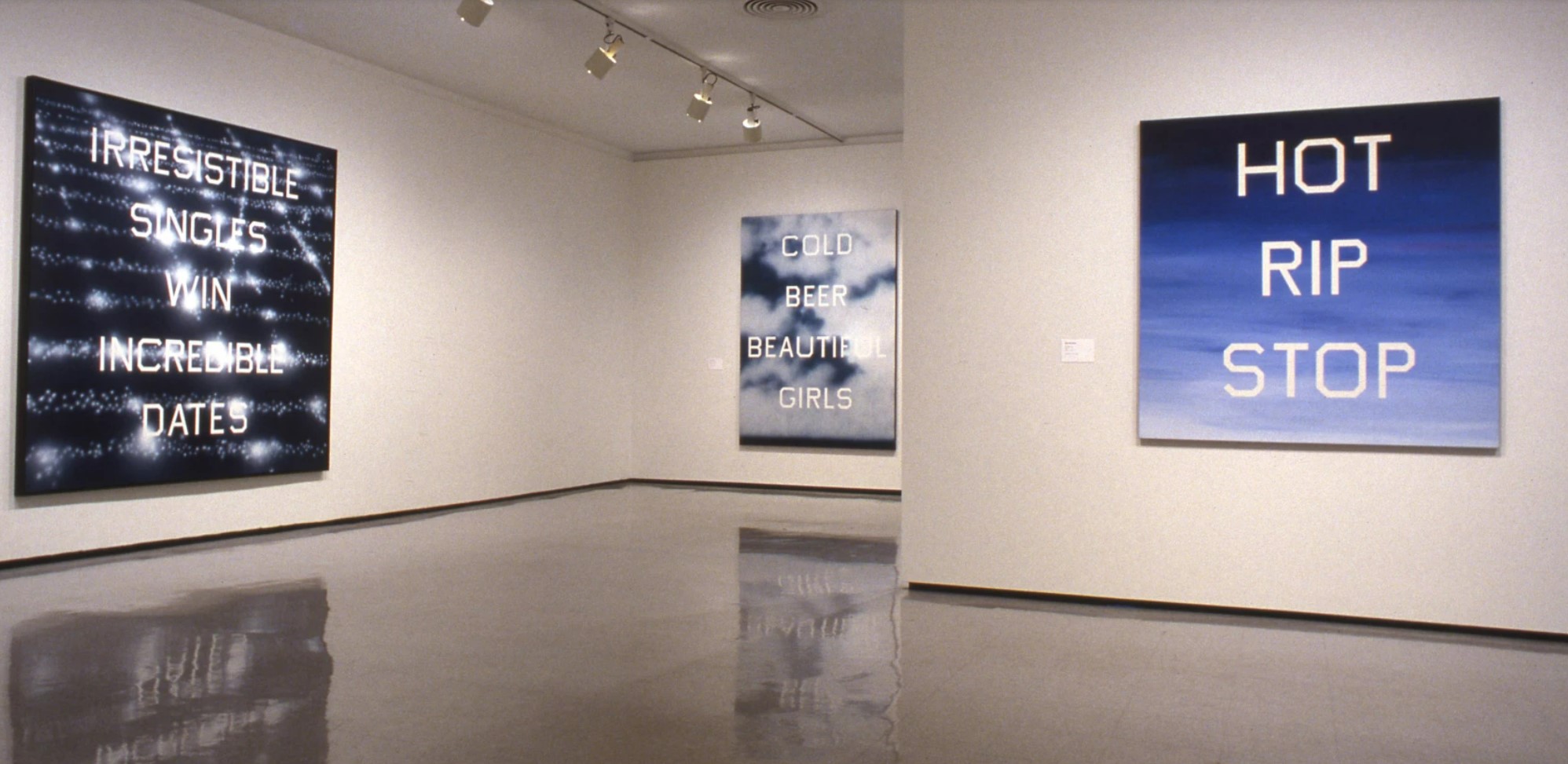
Since the 1960s, Ed Ruscha has immortalized his home of Los Angeles, and more broadly the West Coast, through his inimitable brand of Pop Art. In the present Cold Beer Beautiful Girls, Ruscha renders an abstracted skyline along the bottom of the composition, orientating his viewed in an abstracted yet distinctly West Coast landscape. The tension between specificity and abstraction that Ruscha achieves here echoes that of the text, which teeters on recognition but remains elusive. Locating the sublime in both the natural and artificial, Ruscha’s portrayal of quotidian ephemera parallels Warhol’s trademark Coca-Cola bottles and Campbell soup cans, or Roy Lichtenstein’s iconic comic-book inspired blondes. Influenced by his surroundings, popular culture and advertisements, Ruscha stencils the phrase with careful precision, deconstructing the barriers between “high” and “low” art. Executed in 1993, the present work dates to the period during which Ruscha returned to painting in acrylic on canvas, creating some of his most revered and well known works. The appropriation of the commonplace and its subsequent transcendence into fine art chimes with Pop Art’s greatest ambassadors such as Andy Warhol, Roy Lichtenstein, and Barbara Kruger, who worked simultaneously with Ruscha throughout much of the late Twentieth Century to deepen the artistic exploration of commercial culture.
Affiliation, 1987
Christie’s New-York: 13 May 2022
Estimated: USD 600,000 – 800,000
USD 1,197,000
ED RUSCHA (B. 1937) (christies.com)
ED RUSCHA (B. 1937)
Affiliation, 1987
Acrylic on canvas
60×105 inches (152.4 x 266.7 cm)
Signed and dated ‘Ed Ruscha 1987’ (on the reverse)
Signed again, titled and dated again ‘ED RUSCHA “AFFILIATION” 1987’ (on the stretcher)
Although the subject matter is reminiscent of small town America, Ed Ruscha’s 1987 painting, Affiliation, evokes an eerie, otherworldly presence. The artist’s iconic pairing of incongruous words and images is on full display here—the phantasmal apparitions contrast sharply with the clear-cut style and bureaucratic tone of the text. Acquired from the Robert Miller Gallery in 1987, Affiliation has been in the late Sondra Gilman’s collection since the year it was painted. Over the course of several decades, Gilman amassed a world-class grouping of painting and sculpture by leading names in the 20th century canon of art history, including Ed Ruscha, Frank Stella, Kenneth Noland, Agnes Martin and Andy Warhol. Affiliation’s figures materialize from the ether like a lifelong yet indistinct memory or an analog, black and white film reel, suggesting a surrealistic dreamscape. A foreboding fog lingers in the air, the hazy forms juxtaposed against the artwork’s namesake. The word “AFFILIATION” appears towards the base of the work, painted meticulously. A perfectly straight line follows the word. Painted in a stark black and white color palette, the work emits a charged, precarious aura. Negative space abounds in the composition, but the church’s spire acts as a visual lightning rod against the blurred edges of the clouds; the point of the belfry appears in razor sharp focus and demands the viewer’s attention. In addition to Ruscha’s visual humor and dry wit, there is an undeniable gravitas and seriousness that underlies his work, which can perhaps be attributed to Ruscha’s early experience with Christianity. Affiliation presents the viewer with a monochrome, non-descript building that appears to be a church. Ruscha pushes the audience to critically engage with the image and define for themselves what affiliations they might have with the imagery- in Ruscha’s works, clarity is something to be worked out in the viewer’s own mind.
Kids, 1987-1988
Christie’s New-York: 10 March 2022
Estimated: USD 1,800,000 – 2,500,000
USD 2,580,000
ED RUSCHA (B. 1937) (christies.com)
ED RUSCHA (B. 1937)
Kids, 1987-1988
Acrylic and oil on canvas
36 1⁄8 x 48 1⁄4 inches (91.8 x 122.6 cm)
Signed and dated ‘Ed Ruscha 1988’ (on the backing board)
Huge Conditions, 2007
Phillips London: 3 March 2022
Estimated: GBP 1,100,000 – 1,500,000
GBP 1,232,500 / USD 1,641,801
Ed Ruscha – 20th Century & Contemporar… Lot 28 March 2022 | Phillips
ED RUSCHA
Huge Conditions, 2007
Acrylic on canvas
36×48 inches (91.4 x 121.9 cm)
Signed, titled and dated ”’HUGE CONDITIONS” Ed Ruscha 2007′ on the reverse
Signed, titled and dated ‘ED RUSCHA ”HUGE CONDITIONS” 2007’ on the stretcher
Its title dominating the center of the composition, Huge Conditions belongs to a significant body of paintings which Ruscha first embarked on in the 1980s, all featuring expansive landscapes overlaid with text. To achieve the stunning, photorealist finish that we see here, Ruscha initially sprayed a thin layer of paint directly onto the canvas, later working up the detail in acrylic paint more precisely applied with a brush. Finally, Ruscha applied the text using a stencil, its emblematic font an invention of the artist’s own which he has named ‘Boy Scout Utility Modern’ – a title which sounds strangely like a witty echo of one of his Word Paintings. As Ruscha describes it, ‘there are no curves to the letters – they’re all straight lines.’’i This square, straight quality to the typeface is emphasized by its wide spatial arrangement, and Ruscha’s careful control of the painting’s emphatically lateral composition.
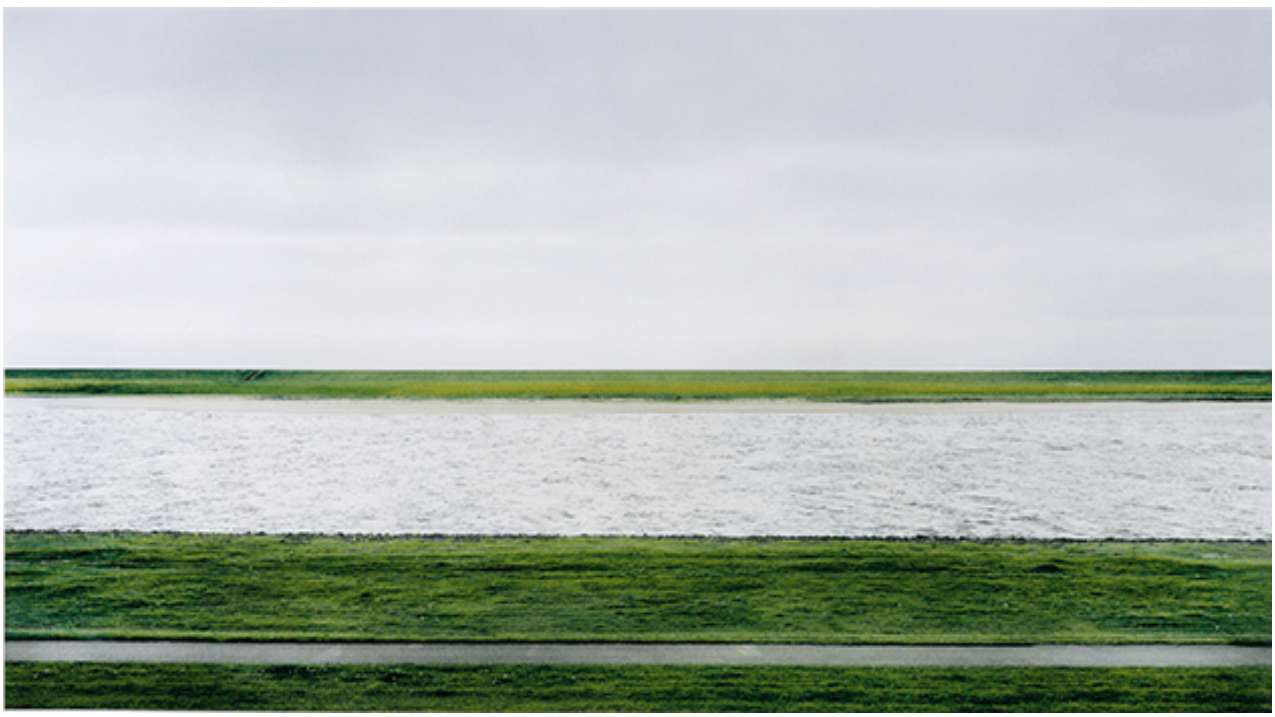
Andreas Gursky, The Rhine II, 1999, Tate, London. Image: © Tate, Artwork: © Courtesy Monika Sprueth Galerie, Koeln / VG Bild-Kunst, Bonn and DACS, London 2022
With this cinematic scope, Ruscha generates a remarkable sense of quietly atmospheric tension here not unlike the serene seascapes of Lucas Arruda or the extreme horizontality of Andreas Gursky’s Photographs of the Rhine. Bathed in an ethereal dawn light, the rising sun just breaking over the line of the horizon, the scene takes on the eerie stillness of David Casper Friedrich’s strange and sublime landscapes. Devoid of even the faintest human presence here though, the marshy expanse stretches out before us, silent and serene. A compelling ambiguity hangs over the scene – are we waiting for something to end, or are we gazing out at a new beginning? What are the ‘conditions’ referenced by the text, and what would failing to fulfil them imply? Sterling Ruby’s astute observation that ‘For me, your work represents the perfect balance of the apocalypse and serenity […] symbolizing some sort of dichotic meditation on existence’ is especially resonant here, emphasised by the tensions established between the flooded landscape and Ruscha’s selection of text.
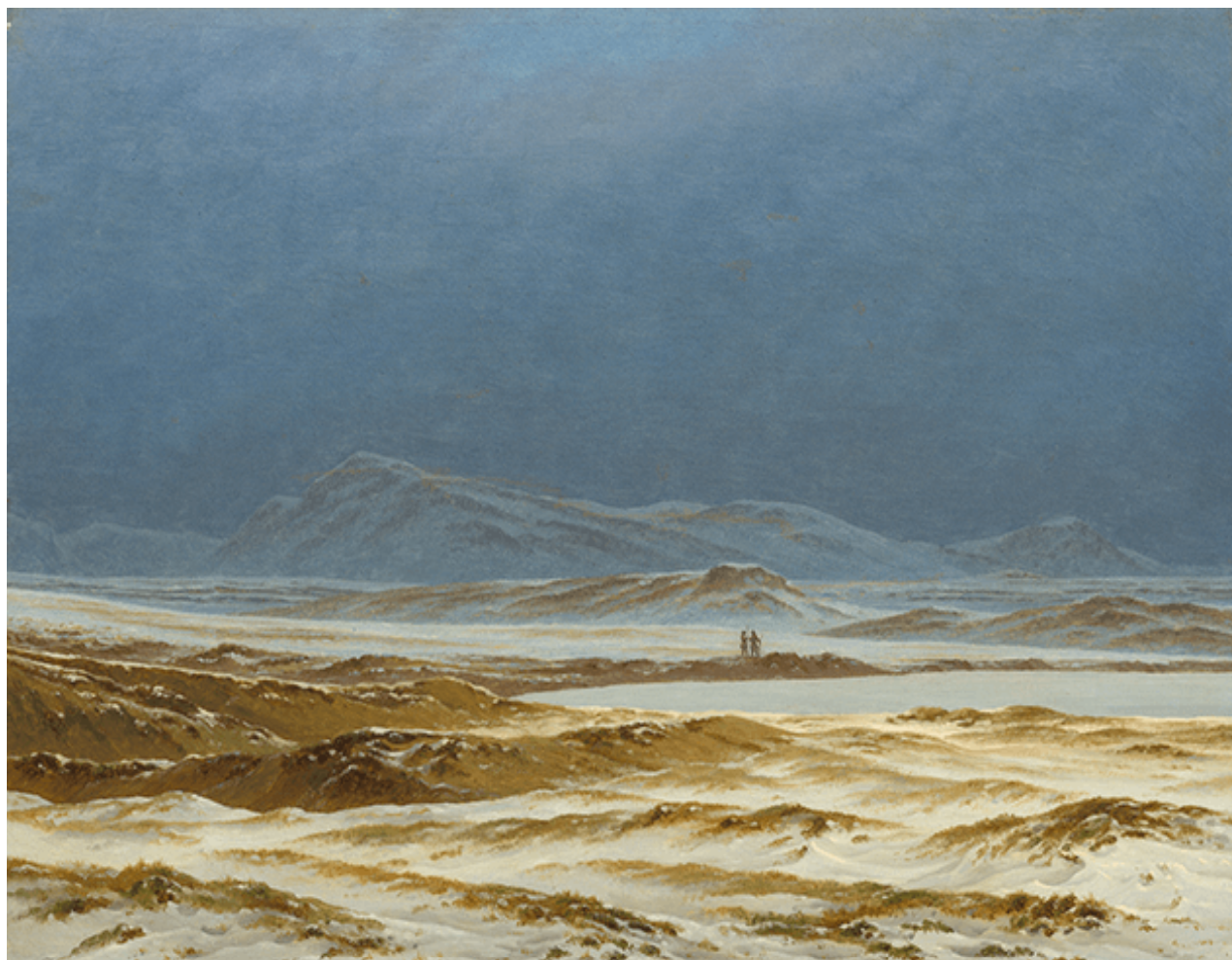
Casper David Friedrich, Paysage du Nord, printemps, (Northern Landscape, Spring), ca. 1825, National Gallery of Art, Washington, D.C. Image: Courtesy National Gallery of Art, Washington, D.C.
In its panoramic scope Huge Conditions also recalls myths of the ‘American West’, a theme which recurs throughout Ruscha’s Word Paintings and across his oeuvre more broadly. In 2016, the de Young Museum in San Francisco addressed this directly with the exhibition Ed Ruscha and the Great American West, while in 2005 Ruscha had himself tackled the question of American mythmaking in his presentation for La Biennale di Venezia.
Varieties of Internal Torment, 1998
Sotheby’s New-York: 18 November 2021
Estimated: USD 3,000,000 – 4,000,000
USD 3,650,000
Varieties of Internal Torment | Contemporary Evening Auction | 2021 | Sotheby’s (sothebys.com)
ED RUSCHA (B.1937)
Varieties of Internal Torment, 1998
Acrylic on canvas
48×84 inches (121.9 x 213.3 cm)
Signed Ed Ruscha and dated 1998 (on the reverse)
Set against a steep, snowy mountain and a cerulean sky, Ed Ruscha’s Varieties of Internal Torment is a striking representation of the artist’s distinctive juxtapositions of language and image. The present work is a superb and early example of Ruscha’s critically acclaimed mountain paintings, several of which are included in such collections as the Tate Modern, London and the Museum of Modern Art, New York. Deftly splitting meaning from form, the viewer is encouraged to reconsider an automatic acceptance of meaning tied to proximity and explore the potential of language supported by the image.
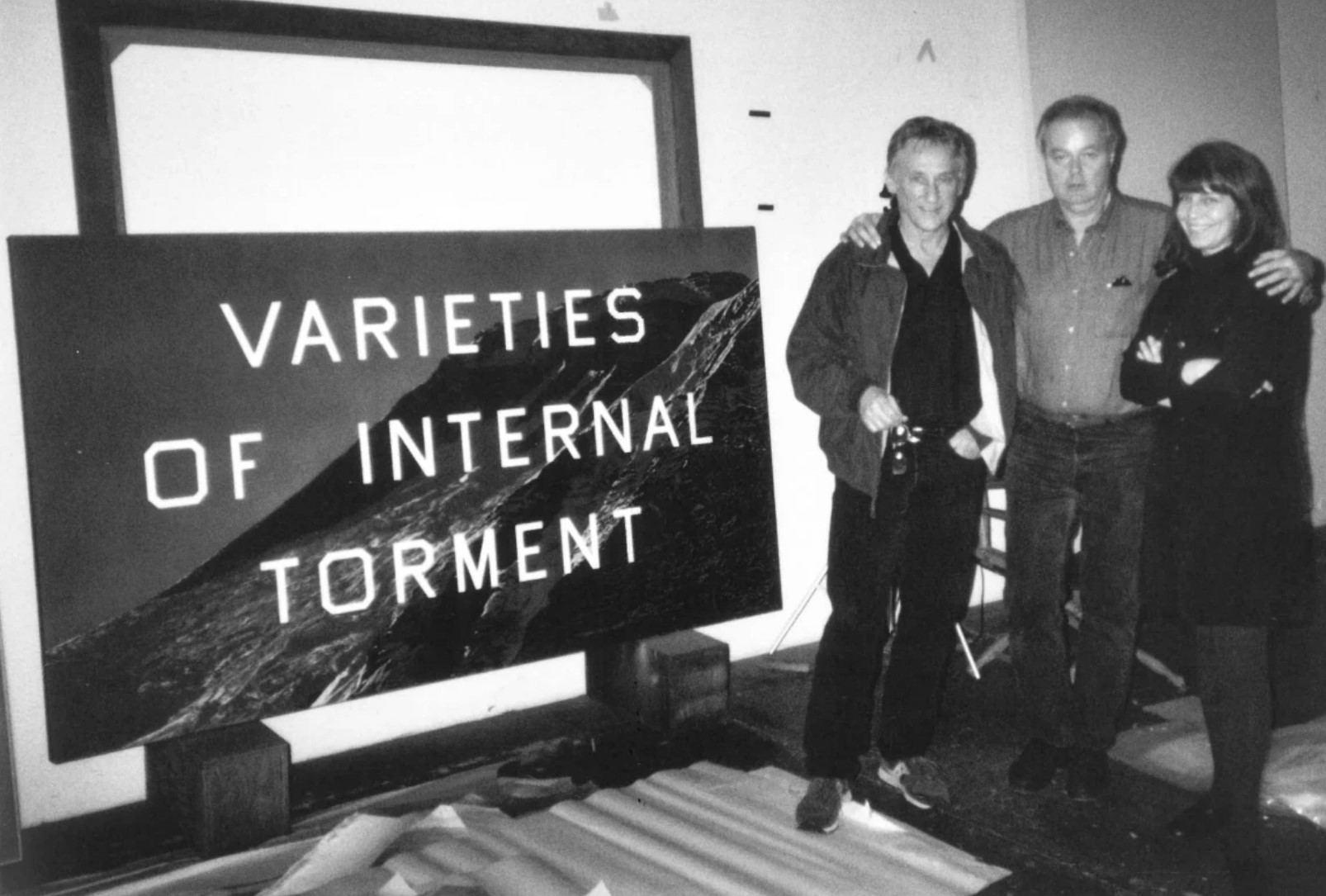
RUSCHA, MASON WILLIAMS AND MARY DEAN AT RUSHA’S VENICE STUDIO, 1998. PHOTO © PAUL RUSCHA. ART © ED RUSCHA
In the present work, the monumental phrase “Varieties of Internal Torment” is emblazoned across the mountain and sky like a surrealist’s reimagining of the iconic Hollywood sign, the pure white of the letters standing in contrast to the shadowy snow below. The canvas is unusually rectangular for the series, whose examples are nearly always closer to a square shape. The strong horizontality recalls the format of a billboard, or a widescreen film. The closely cropped composition compresses the claustrophobic text: the sheer drama of the screen—suspense, climax, the rising and the falling action—is embodied by the steep incline/decline. Unlike your standard plot, however, there is no denouement. Varieties of Internal Torment maintains its air of mystery.
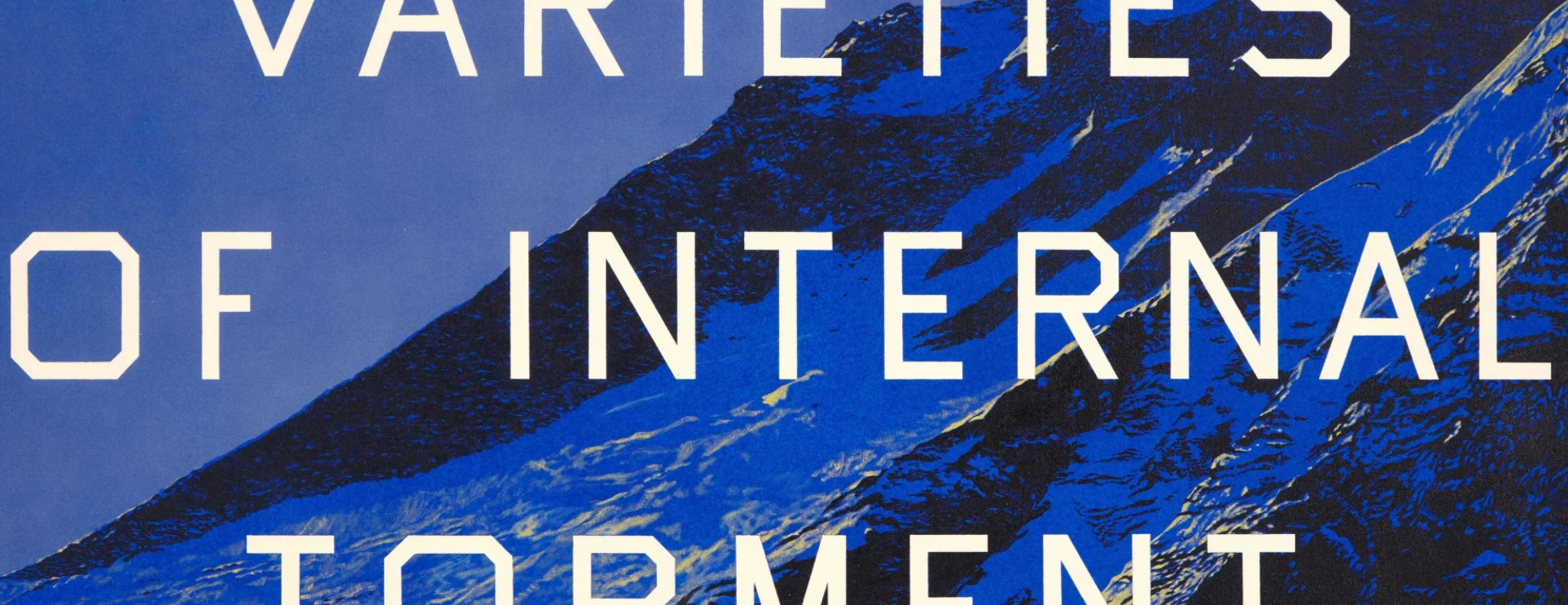
The background, while visually complementing the white letters, complicates their meaning; the longer one considers the relationship between image and text the more surreal the painting becomes. “On close examination, Ruscha’s super-real, photographic mountains break up into a complex series of little flat planes of color, similar to a paint-by number kit or the methods used by billboard painters. The natural appearance of the mountains is only an illusion; rather, Ruscha gives us the ‘idea’ of a mountain.
Ripe, 1967
Christie’s New-York: 10 November 2021
Estimated: USD 18,000,000 – 22,000,000
USD 20,970,000
ED RUSCHA (B. 1937) (christies.com)
ED RUSCHA (B. 1937)
Ripe, 1967
Oil on canvas
59 ¼ x 54 ¾ inches (150.5 x 139.1 cm)
With its juicy splash of luscious red set against a backdrop of vibrant yellow-green, Ed Ruscha’s Ripe is one of the most striking of the artist’s word paintings that he executed in 1967. An exemplary example of his interest in form, this work belongs to an important group of paintings that Ruscha executed following his now iconic renderings of Standard stations. Furthering his investigations into the formal qualities of words which he began in earnest with OOF, 1962 (Museum of Modern Art, New York), in Ripe the artist not only deftly renders the fluid silhouette of the word’s shape, but also the three-dimensional qualities of the liquid too as it appears to sit on the surface of the canvas. It is this tension between the formal qualities of the word, and what the word has come to signify that helps the artist in his choice of what to depict. Thus, Ripe is one of the earliest word works in which Ruscha introduces the appearance of three dimensionality onto the surface of the canvas, a technique that would later morph into his liquid paintings.
It’s OK—Everything’s OK, 1979
Sotheby’s NY: 13 May 2021
Estimated: USD 800,000 – 1,200,000
USD 1,472,000
It’s OK—Everything’s OK | Contemporary Art Day Auction | 2021 | Sotheby’s (sothebys.com)
ED RUSCHA (B. 1937)
It’s OK—Everything’s OK, 1979
Oil on canvas
22×80 inches (55.9 x 203.2 cm)
Theatrical and breathtaking in its expertly executed sfumato, Ed Ruscha’s It’s OK ー Everything’s OK reverberates with a dynamic energy utterly unique to the artist’s peerless style in which image, symbol and text coexist in sometimes tensile relationships. Executed in 1979, the present work is part of a series of sunset paintings that Ruscha developed during the 1970s and 1980s. A highly saturated, candy-colored sky painted in vibrant reds, oranges, and yellows, the present work recalls the landscape of California deserts. Throughout his singular career, Ruscha has explored semiotics and employed various artistic techniques to address how words and symbols carry meaning when juxtaposed with image. Ruscha has stenciled the words “ It’s OK ー Everything’s OK” in crisp white paint on the lower right- and left-hand corners of the canvas, prompting the reader to draw nearer in order to make out the last words. A poetic landscape reinforced by the phrase included by Ruscha, It’s OK ー Everything’s OK prompts reflection.
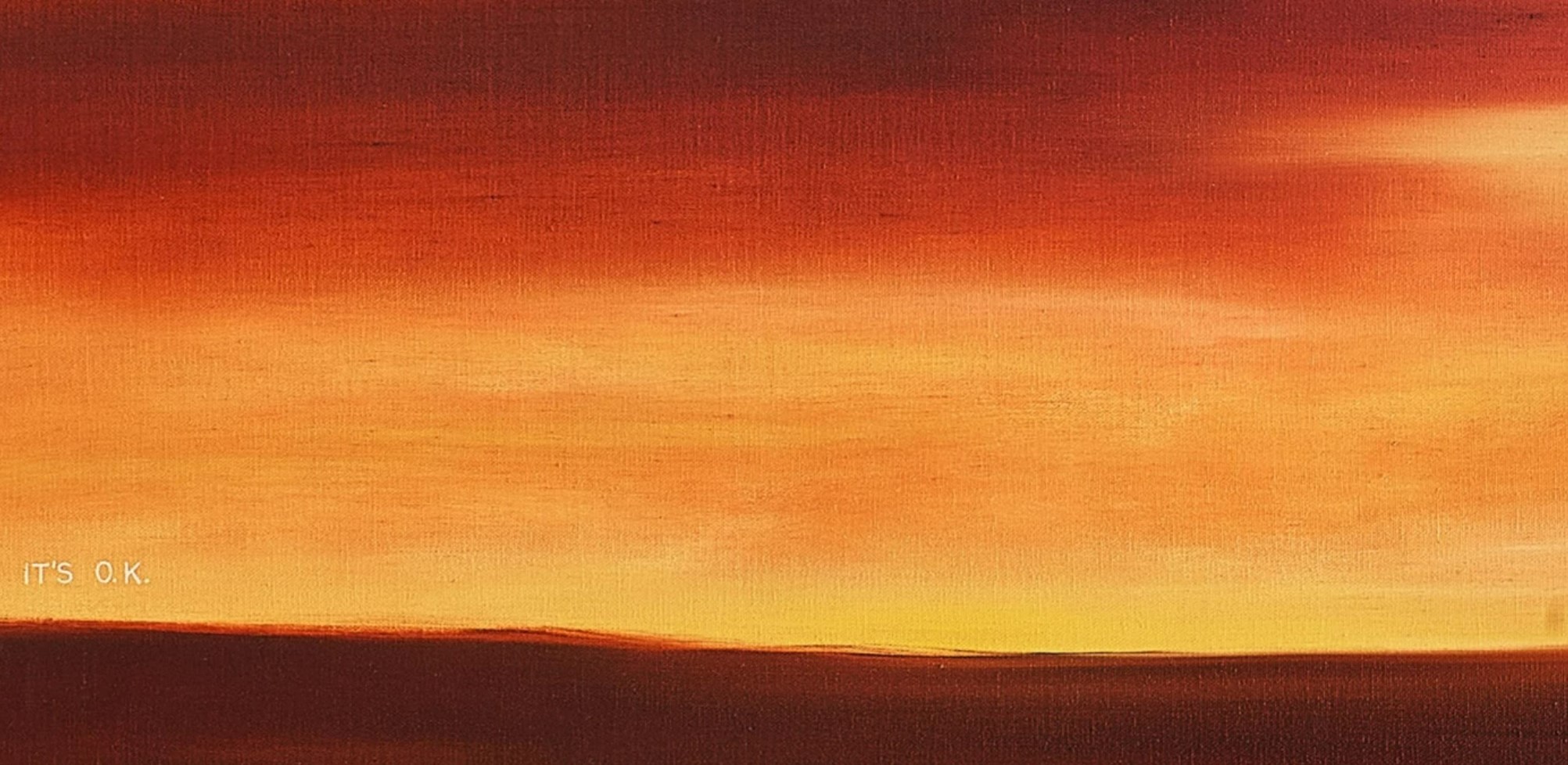
The familiar and reassuring phrase of the present work emerges from its tranquil surrounding as a self-affirming beacon of colloquial America. The calming nature of the phrase perfectly parallels the relaxing atmosphere of the surrounding painting. Reminiscent of a nineteenth century landscape painting by Turner or John Constable, the present work’s treatment of paint is blended and fused so that the colors seep into each other, ultimately forming a sublime representation of dusk. The result is a serene and placid view of the horizon that generously provides the viewer with a splendid scene of one of nature’s greatest offerings, the sunset.
Bee?, 1997-99
Sotheby’s Hong-Kong: 19 April 2021
Estimated: HKD 6,000,000 – 8,000,000
HKD 7,556,000 / USD 972,934
Ed Ruscha 埃德 · 魯沙 | Bee? | Contemporary Art Evening Sale | 2021 | Sotheby’s (sothebys.com)
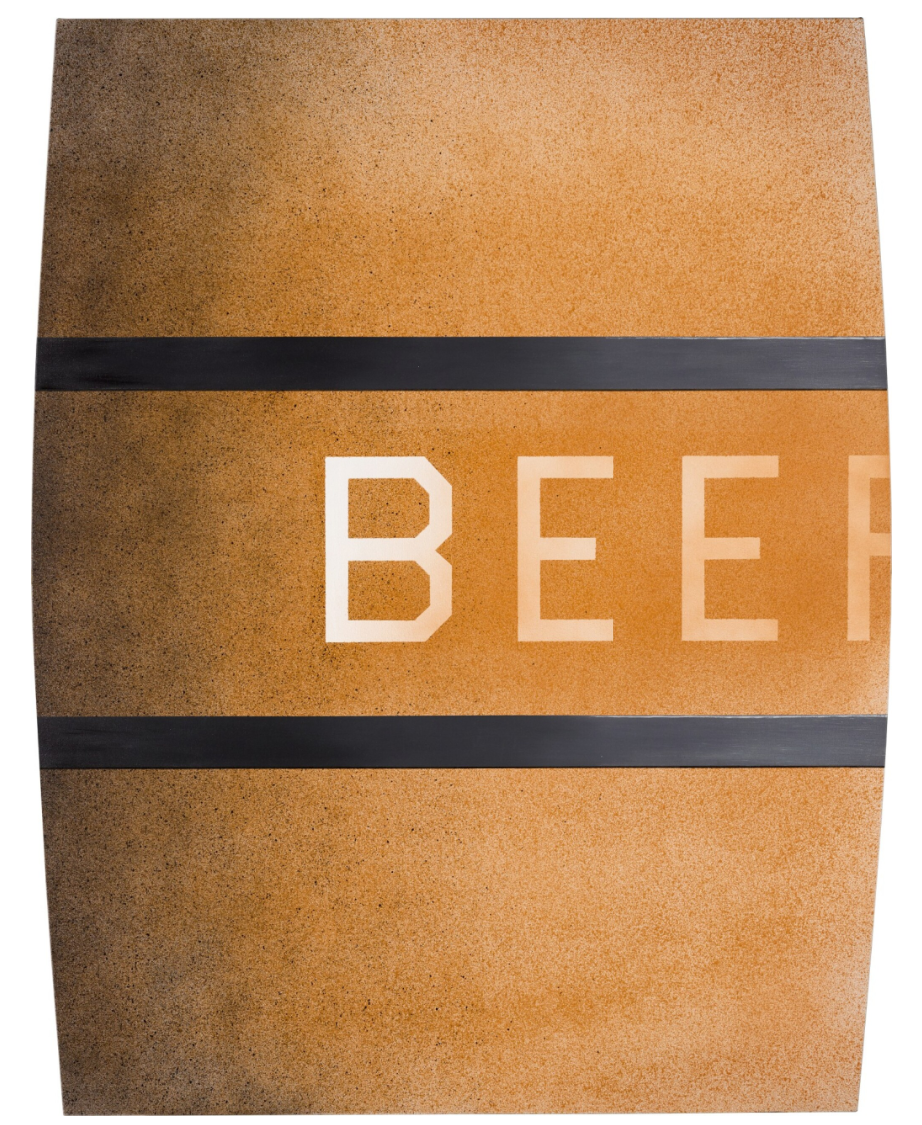
ED RUSCHA (b. 1937)
Bee?, 1997-99
Acrylic on shaped canvas
74×58 inches (187.6 x 147.3 cm)
Signed and dated 1997-99
Set against a barrel-shaped canvas with horizontal silver bands that allude to the metal hoops encircling a beer barrel’s wooden staves, the letters “B”, “E”, “E” stridently and playfully capture the theatrical graphic force that typifies Ed Ruscha’s acclaimed oeuvre. With its last letter only partially revealed, the ambiguous word runs off the edge of the canvas, hinting at several possible meanings: the fourth letter of the word could be an R, an F, or a P, spelling BEER, BEEF, or BEEP. One of only a small handful of works executed on shaped canvases, the strikingly unique Bee? juxtaposes an incomplete word with a seemingly abstract yet suggestively trompe l’oeil form, cleverly exploring the affiliation between text and imagery and exemplifying Ruscha’s peerless style in which image, symbol and text coexist in sometimes tensile relationships.
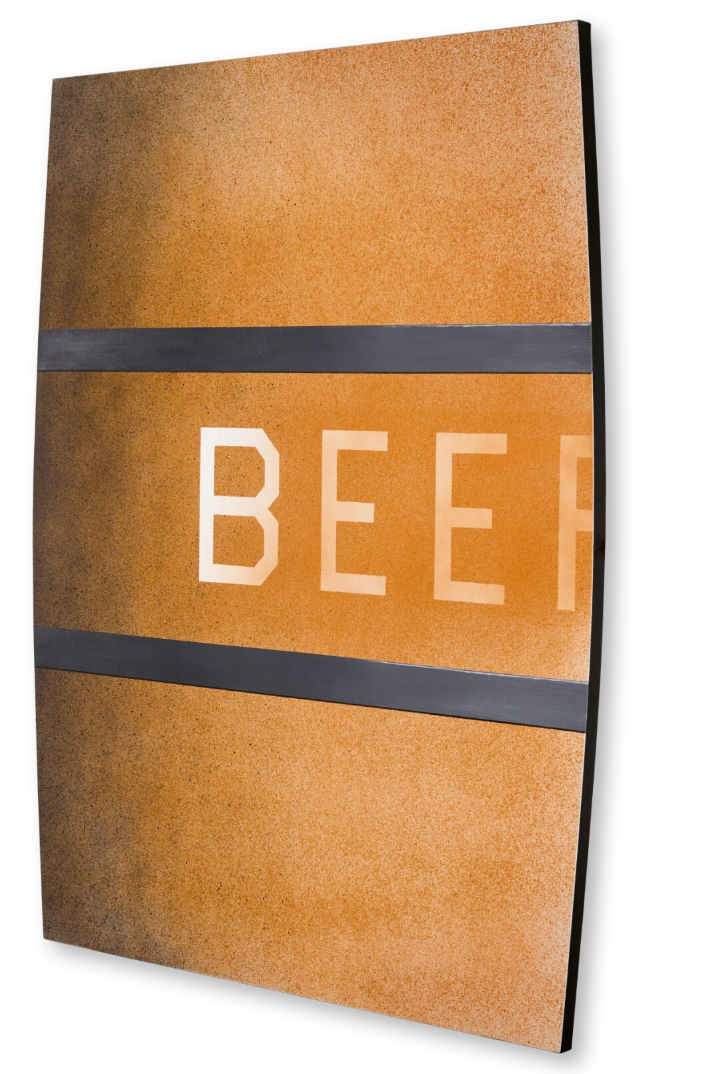
Throughout his singular career, Ruscha has explored semiotics and employed various artistic techniques to address how words and symbols carry meaning when juxtaposed with image. The immediacy and magnetic pull of his consistently conceptual semantic puzzles are never static; rather, they bristle with tension, intrigue and seduction, providing the viewer clues to achieve an overall understanding of the picture, while pulling away as the viewer is inescapably drawn in. Executed in 1997-1999, coinciding with Ruscha’s internationally celebrated presentation at the 1997 Whitney Biennial, the present work stands apart even within the small group of shaped canvases created during this period in its evocation of Rene Magritte’s iconic The Treachery of Images. Commanding a strong and astutely witty presence with just three and a half letters and a banal image, Bee? is a uniquely spirited and ingenious exemplar within Ruscha’s unparalleled oeuvre.
California Grape Skins, 2009
Sotheby’s New-York: 12 March 2021
Estimated: USD 2,200,000 – 2,800,000
USD 2,863,500
California Grape Skins | Contemporary Curated | 2021 | Sotheby’s (sothebys.com)
ED RUSCHA (b. 1937)
California Grape Skins, 2009
Acrylic on canvas
38×64 inches (96.8 x 162.9 cm)
Signed and dated 2009 on the reverse
Widely celebrated for their singular hybrid of arch conceptualism and Pop Art aesthetics, Ed Ruscha’s text paintings are the quintessential visual signifiers of Postwar American culture. Of all of the artist’s series, the Mountain Paintings most clearly articulate Ruscha’s aims, bringing together idiomatic colloquialisms and palindromes with the rugged West’s grandeur and mythos. Executed in 2009, California Grape Skins is a conceptual peak in this crucial body of work, quoting an excerpt from Jack Kerouac’s seminal 1957 Beat epic, On the Road, and superimposing it onto a grand vista. Both sweeping in its epic proportions yet coolly detached in its appropriation of a definitive literary classic, the present work juxtaposes familiar archetypes to mine shared cultural memory, capturing Ed Ruscha’s inimitable spirit of artistic inquiry in the process.
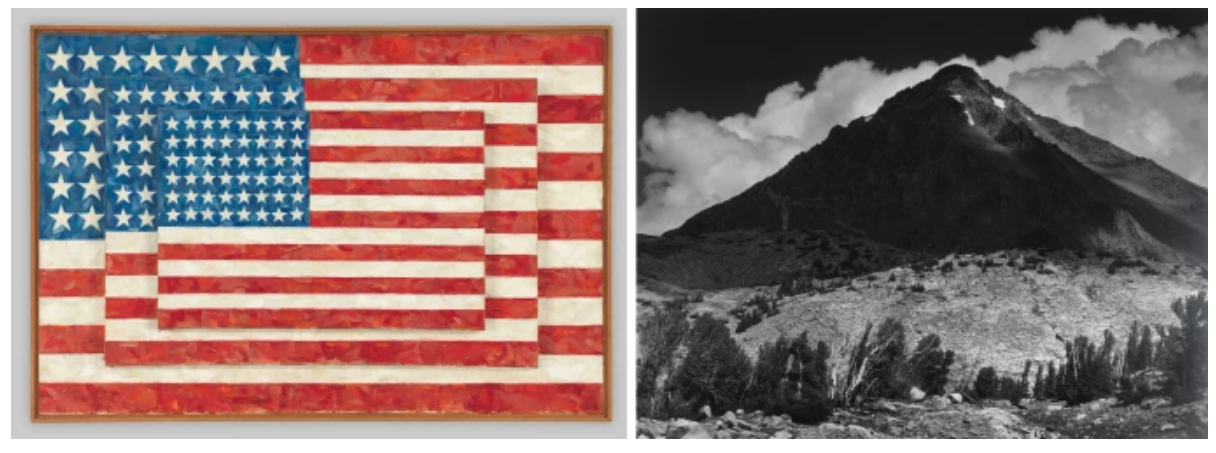
LEFT: JASPER JOHNS, THREE FLAGS, 1958 / WHITNEY MUSEUM OF AMERICAN ART
© JASPER JOHNS / LICENSED BY VAGA AT ARTISTS RIGHTS SOCIETY (ARS), NEW YORK
RIGHT: ANSEL ADAMS MOUNT WYNNE, KINGS CANYON NATIONAL PARK, CALIFORNIA, CIRCA 1933 / THE MUSEUM OF MODERN ART, NEW YORK © 2021 THE ANSEL ADAMS PUBLISHING RIGHTS TRUST
Ed Ruscha left his native Oklahoma for Los Angeles in 1956, where he enrolled at the Chouinard Art Institute, beginning his first text-based works soon after. Dually inspired by the graphic proto-Pop artworks of Jasper Johns and Robert Rauschenberg as well as the unbridled commercialism of Hollywood industry, the artist’s early works brought together the world of printed matter, governed by rules and grammar, with the exuberant and expressive arena of painting, charting a new pathway forward in visual art. Ruscha brought his signature synthesis of these commercial and fine art influences to a crescendo at the turn of the millennium, when he began his Mountain Paintings, utilizing found nature photography and text from a wide range of sources to interrogate the semiotics of the American terrain.
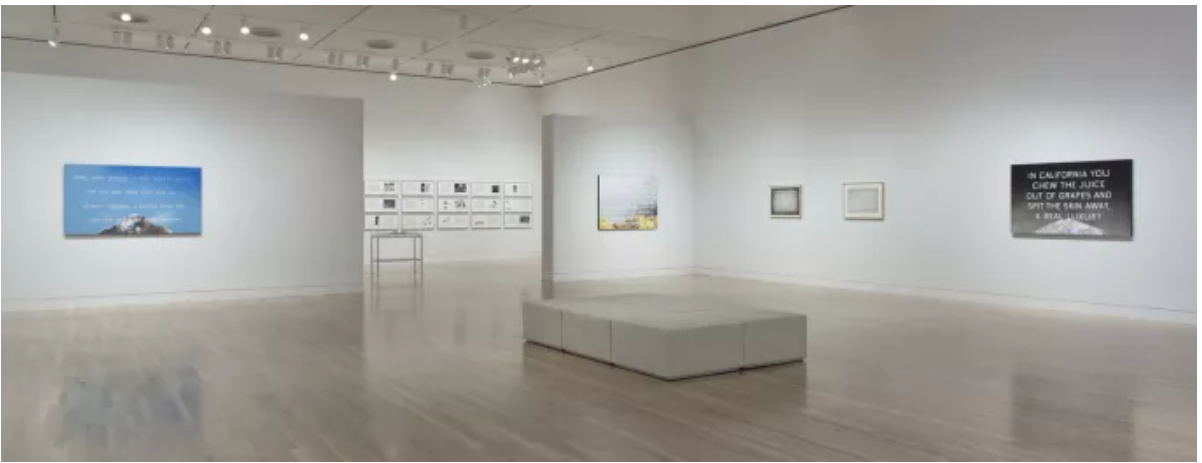
THE PRESENT WORK INSTALLED AT ED RUSCHA: ON THE ROAD, HAMMER MUSEUM, LOS ANGELES, 2011
Fascinated by how ideas are made manifest and concrete through the act of painting, Ruscha’s Mountain Paintings use natural contexts to interrogate man-made culture. California Grape Skins is imposing and brooding in its color palette, a gradient of black to grey with inflections of icy blue and bright white. Out of the abyss, a dramatic peak emerges, delineated in planar passages with a painterly chiaroscuro and stark relief as if lit by spotlight. Ruscha’s text dominates the composition, recalling the artist’s earlier 1970s works, which placed canny American aphorisms on monochromatic or gradient backgrounds. More than an image of a mountain stamped with text, California Grape Skins offers a surreal vision; the bottom-most line of the artist’s text is eclipsed by the mountain’s peak, complicating a straightforward photographic reading of the composition. Describing these works, Neal Benezra writes, “On close examination, Ruscha’s super-real, photographic mountains break up into a complex series of little flat planes of color, similar to a paint-by-number kit or the methods used by billboard painters. The natural appearance of the mountains is only an illusion” (Neal Benezra quoted in Exh. Cat., Washington D.C., Hirshhorn Museum and Sculpture Garden, Ed Ruscha: 2000-2002, p. 174). Ruscha is insistent on the mountain being a facsimile, a construction that reflects a cultural ideal, as artificial as text floating in the sky.
Annie, 1962
Christie’s New-York: 10 July 2020
Estimated: USD 20,000,000 – 30,000,000
USD 22,975,000
Ed Ruscha (b. 1937) (christies.com)
ED RUSCHA (b. 1937)
Annie, 1962
Oil and graphite on canvas
71 1/2 x 66 3/4 inches (181 x 169.5 cm)
Annie is a groundbreaking, important early painting by Ed Ruscha. Measuring nearly six feet tall, this large-scale canvas is an early example of what would become his signature style, and demonstrates the unique and pioneering approach to art that would make him one of the most celebrated artists of his generation. In this painting, Ruscha abandons the conventional dichotomy of figurative and abstract art. His seemingly simple aesthetic presents a completely novel way of looking at art and understanding its iconography.
Hurting the Word Radio #2, 1964
Christie’s New-York: 13 November 2019
Estimated: USD 30,000,000 – 40,000,000
USD 52,485,000
Ed Ruscha (b. 1937) (christies.com)
ED RUSCHA (b. 1937)
Hurting the Word Radio #2, 1964
Oil on canvas
59 x 55 1/4 inches (150 x 140.3 cm)
Signed, titled and dated ‘”Hurting the Word Radio” #2 1964 Edward J. Ruscha’ (on the stretcher)
Across a vast expanse of vibrant sky blue, the word “RADIO” is laid out in a beguiling juxtaposition of static and surreal sunshine yellow painted letters. Hurting the Word Radio #2 is an iconic example of Ed Ruscha’s c-clamp paintings, which also includes Hurting the Word Radio #1 (Menil Collection, Houston) and Not Only Securing the Last Letter but Damaging it as Well (Boss) (Museum Brandhorst, Munich). Here, the bold, stately letters synonymous with Ruscha’s practice become distorted and warped as trompe l’oeil c-clamps squeeze the “R” and tug on the “O,” distorting and transforming them in to rippled rubbery notes. Indeed, Hurting the Word Radio #2 is an important early example of the artist’s revolutionary Text paintings—a body of work that would establish Ruscha as one of the most innovative and influential painters of the 1960s.
I Tried to Forget to Remember, 1986
Sotheby’s New-York: 15 May 2019
Estimated: USD 5,000,000 – 7,000,000
USD 8,237,000
(#7) ED RUSCHA | I Tried to Forget to Remember (sothebys.com)
ED RUSCHA
I Tried to Forget to Remember, 1986
Oil and acrylic on canvas
72×96 inches (182.9 x 243.8 cm)
Signed and dated ’86 on the reverse
Set against a darkened nighttime cityscape punctuated by a crisscross network of lights, the fiery-red text “I Tried to Forget to Remember” brilliantly captures the theatrical graphic force that typifies Ed Ruscha’s electric oeuvre. Executed in 1986, I Tried to Forget to Remember is the largest example from the artist’s acclaimed series of City Lights paintings, a body of work that was innovative and transitional for the artist in terms of both subject matter and technique. Working on a larger scale than before and introducing for the first time the airbrush technique to achieve the softly diffused, hazy white of urban lights, Ruscha’s City Light paintings reverberate with an atmospheric luminosity that ignites the otherwise impenetrable nocturne sky. An especially captivating painting from this series, the titular text of I Tried to Forget to Remember is a word play derived from Elvis Presley’s 1955 country classic “I Forgot to Remember to Forget,” an especially poetic and complex phrase the conjures the artist’s greatest linguistic brilliance. The amplifying lines of text create a vertiginous effect, implying a speed and motion that corresponds to the passing of the flickering lights into the distance in a shimmering cinematic allure. In I Tried to Forget to Remember, Ruscha captures the city of Los Angeles from an aerial perspective, as if glimpsed from the vantage of a landing airplane. The sprawling city here dissolves into a reductive grid, illuminated by the ethereal white glow of street lights and traffic concentrated in bright clusters at joint-like intersections. To achieve this hazy smolder of light that brilliantly punctuates the surface and diffuses at different scales of intensity, Ruscha utilized the airbrush, a technique that he would continue to explore for the remainder of his prodigious career. Capitalizing on the dissipated softness and subtle translucence that result, I Tried to Forget to Remember dutifully records contrasting patterns of light through variously dense hues of white paint. Through the heightened foreshortening of the painted perspective, I Tried to Forget to Remember shimmers with an enticingly cinematic allure. Like constellations in the night sky, the luminous Los Angeles cityscape invites spectacular associations with the enduring magnetism and glamour of Hollywood’s silver screen.
Smash, 1963
Christie’s New-York: 12 November 2014
Estimated: USD 15,000,000 – 20,000,000
USD 30,405,000
Ed Ruscha (b. 1937) (christies.com)
ED RUSCHA (b. 1937)
Smash, 1963
Oil on canvas
71 3/4 x 67 inches (182.2 x 170.1 cm)
Signed and dated ‘3 / 1963 E. RUSCHA’ (on the stretcher)
Across a vast expanse of sumptuous deep ultramarine, the word “SMASH” is laid out in vibrant, sunshine yellow letters that expand horizontally to fill the breadth of this large canvas. At risk of being completely enveloped by the rich chromatic quality of the deep blue ground, these stately letters are painted on a ground of a slightly softer-keyed blue, causing them to levitate above the surface. Ruscha lays out this central band right around the canvas, embracing the sides of the stretcher in addition to the front. And as if to further emphasize the totality of the painting, Ruscha paints the word “SMASH” three more times, along the lower edge and once along each side of the painting. In essence, the word “SMASH” now runs directly through the very heart of the work.
Gas Stations
1. Paintings
Standard Station, Ten-Cent Western Being Torn in Half, 1964
Christie’s New-York: 19 November 2024
Estimate on Request
USD 68,260,000
NEW WORLD AUCTION RECORD FOR THE ARTIST
ED RUSCHA (B. 1937), Standard Station, Ten-Cent Western Being Torn in Half | Christie’s
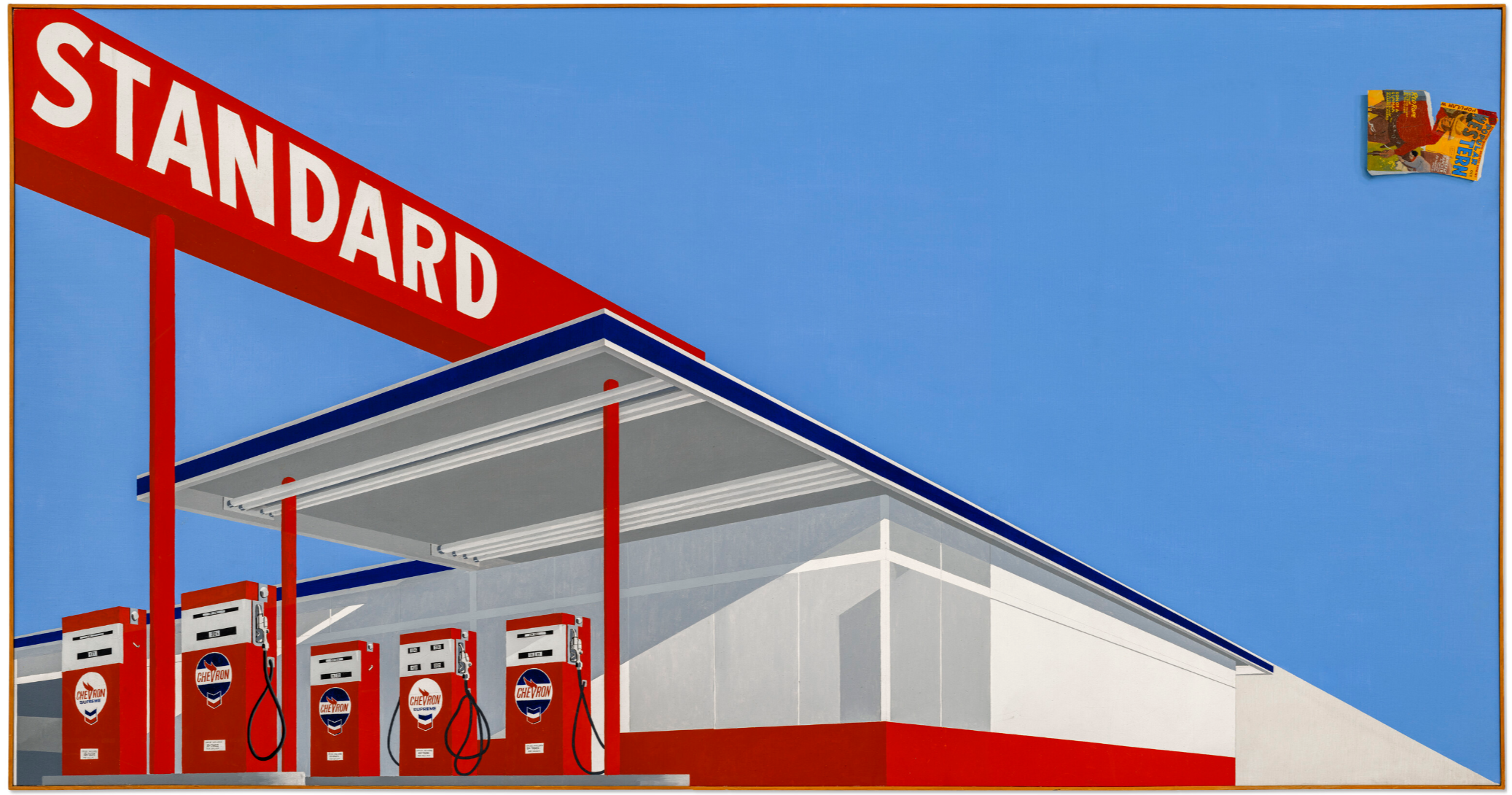
ED RUSCHA (B. 1937)
Standard Station, Ten-Cent Western Being Torn in Half, 1964
Oil on canvas
65 x 121 1/2 inches (165.1 x 308.6 cm)
Signed, titled and dated ‘”STANDARD STATION, 10¢ WESTERN BEING TORN IN HALF” 1964 Edward J. Ruscha’ (on the stretcher)
Painted in 1964, Standard Station, Ten-Cent Western Being Torn in Half is a defining painting in the canon of American postwar art. This monumental canvas presents two visions of America, one that celebrates the pioneering spirit of the Wild West and another in which the car has replaced the cowboy as a symbol of America’s future. Combining the realism of Edward Hopper, the inscrutability of Surrealism, and the bold audacity of Pop, Ed Ruscha’s striking painting represents a seismic shift in the artistic landscape in much the same way that Claude Monet’s paintings of Argenteuil came to represent a new, modern, Impressionist France in the nineteenth century.
“I don’t have any River Seine like Monet,
I’ve just got U.S. 66 between Oklahoma and Los Angeles.”
Ed Ruscha, 1964. Photo: Dennis Hopper. © Dennis Hopper, Courtesy of The Hopper Art Trust.
The present work was painted at a seminal moment in the artist’s career as he emerged as the leading member of a nascent West Coast artistic community that would soon challenge New York as the place where the most exciting art in the country was being produced. Widely cited in the literature on the artist, Standard Station, Ten-Cent Western Being Torn in Half was previously on long-term loan to the Modern Art Museum of Fort Worth, and has most recently formed a cornerstone of Ruscha’s critically acclaimed retrospective Now / Then organized by the Museum of Modern Art, New York and the Los Angeles County Museum of Art.
Set against a vast expanse of cloudless blue sky, the dramatic silhouette of a Standard Oil gas station rises up from a distant horizon. Using the Renaissance principle of one-point perspective, the building forces its way into the picture plane, a twentieth century architectural icon distinguished by its strict geometry and patriotic red, white, and blue trim. Opaque shadows fall across the façade of the building and punctuating these flat panes of planes of color are the various pieces of forecourt furniture that designate the instantly recognizable brand. Gas pumps stand proudly up-right with the blue and white Chevron roundels emblazoned on their front and serpentine black rubber hoses hanging down by their side (the only curved lines in the painting). Bright red uprights support the gas station’s large canopy which is topped off in dramatic fashion with the STANDARD marquee dominating the left hand register of the composition. In a moment of pure Surrealist conceit, this flatness of this dramatic form is punctuated by the torn pages of a comic book painted—with stunning trompe l’oeil effect—apparently suspended in the upper right corner.
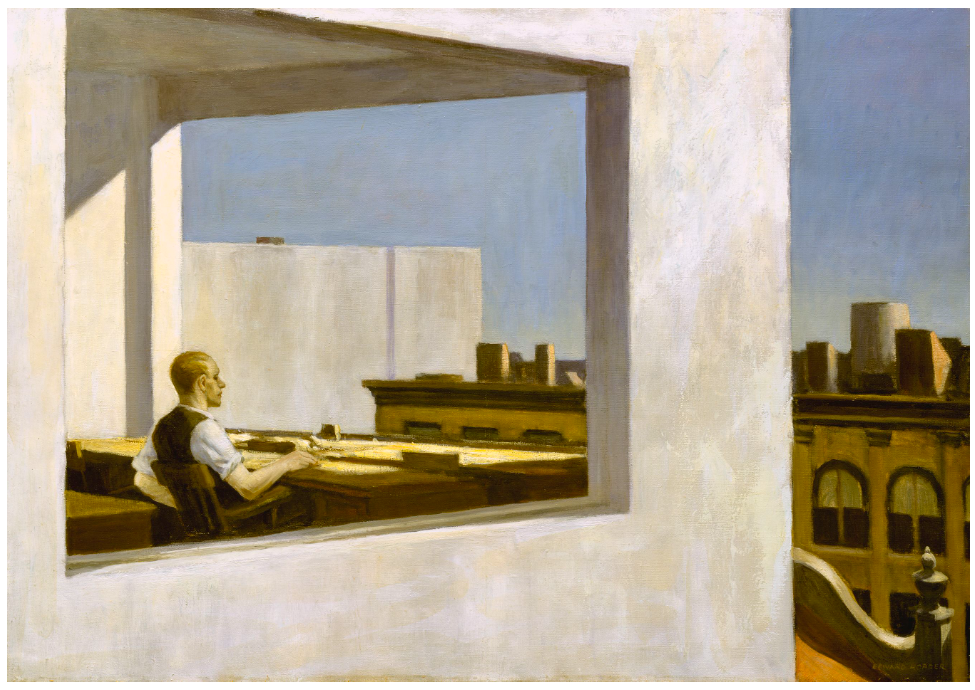
Edward Hopper, Office in a Small City, 1953. The Metropolitan Museum of Art, New York.
Ruscha began encountering the iconic buildings that were to become such a crucial element of his paintings in 1956, when driving from his home in Oklahoma to California to start art school in Los Angeles. During the many subsequent trips Ruscha made driving backwards and forwards across the expanse landscape, the artist claimed to have developed his own form of cinematic way of looking at the landscape.
“When I’m driving in certain rural areas out here in the West I start to make my own Panavision. I’m making my own movie as I’m driving… I get a lot of information out on the road that I use in my studio…”
It was on one such trip that he found himself driving through Amarillo, Texas when he came across one particular gas station (still standing today) which impressed itself into his consciousness. It would come to feature in many of the artist’s most important works including his iconic artist book Twentysix Gasoline Stations (1963), Standard Station, Amarillo, Texas (1963, Hood Museum of Art, Dartmouth), and the present work.
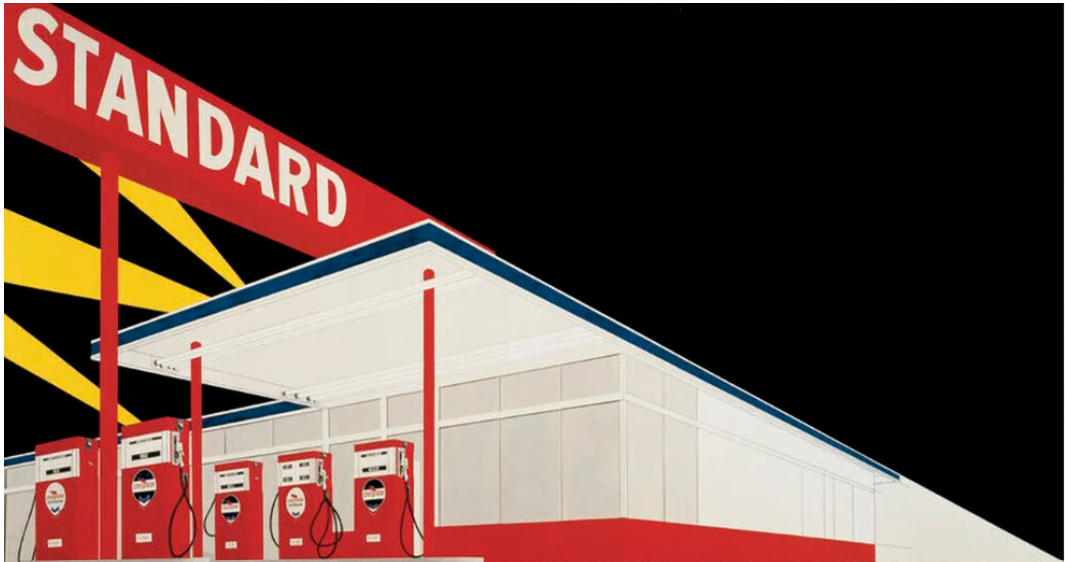
Ed Ruscha, Standard Station, Amarillo, Texas, 1963. Hood Museum of Art, Hanover, New Hampshire.
The unique architectural form of the Standard gas station was designed specifically to stand out in the landscape. The striking angular silhouette rose up out of the flat countryside as a driver approached, pointing directly at them, almost challenging them to stop, pull in, and fill up.
“They had a zoom quality, the way they were lifted up in the air, and they really caught your eye, and the gas stations was a sleek metal box sitting underneath it.”
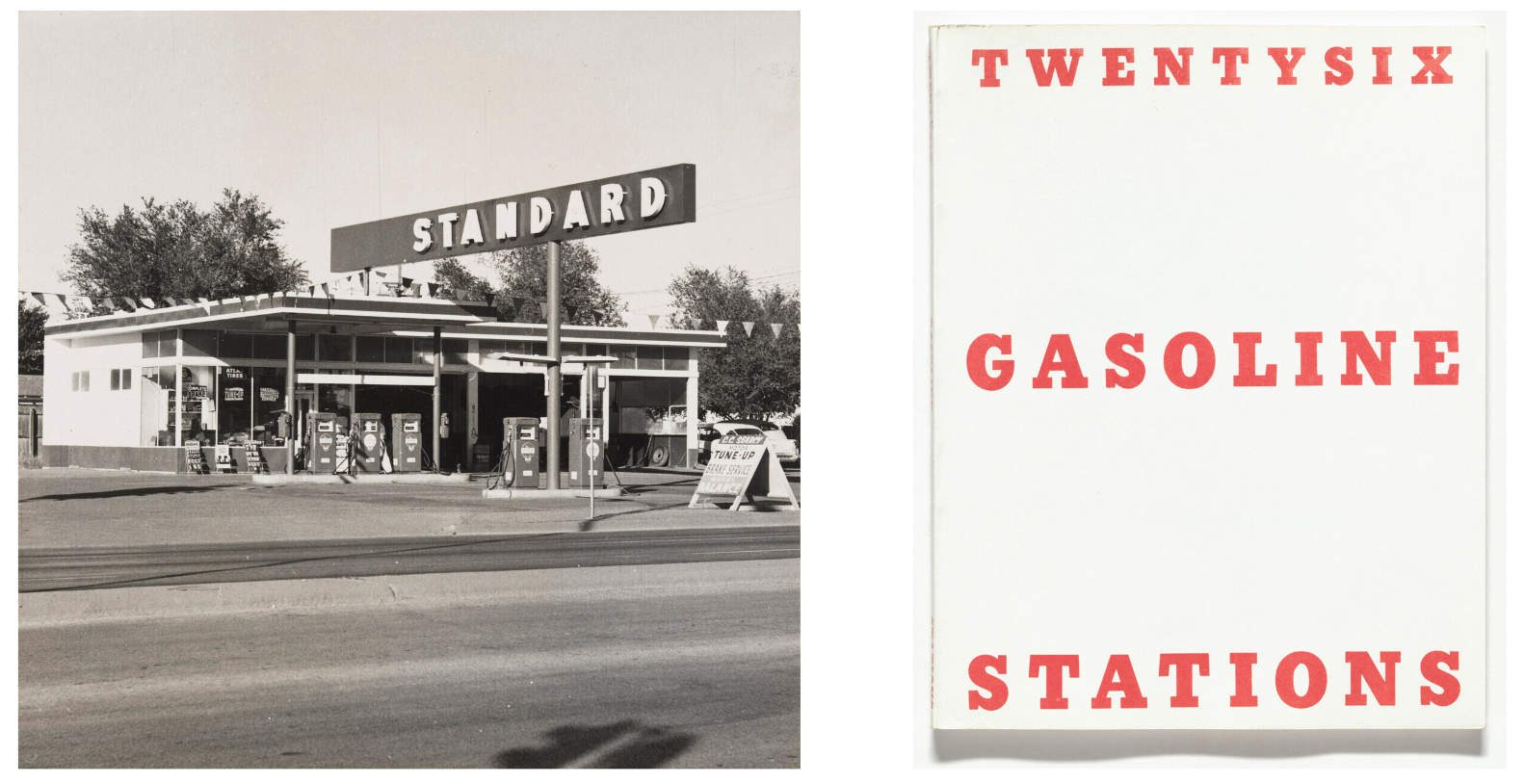
Cover of Ed Ruscha’s Twentysix Gasoline Stations, 1963. Museum of Modern Art, New York. © Ed Ruscha. Photo: © The Museum of Modern Art / Licensed by SCALA / Art Resource, NY.
The idea to combine this mainstay of the classic American road trip with a comic book has its origins in a painting which, when Ruscha first saw it, left him with the sensation similar—as he described it—to an atomic bomb going off in his mind. Jasper Johns Target with Four Faces (1955, Museum of Modern Art, New York) also took familiar objects and brought them together in a way which Johns said allowed them work on another level. Standard Station, Ten-Cent Western Being Torn in Half Ruscha not only combines two incongruous objects in a similar way, but also brings together ‘old’ and ‘new’ representations of America.
“I wanted to bring unlike elements together. And so it’s no different than maybe a piece of music that might have a coda at the end, or some other element that that is unlike the rest of the work. Or I might add something to somehow antagonize the main theme. And that goes through with all my work. Sometimes there’s little oddities that I welcome.”
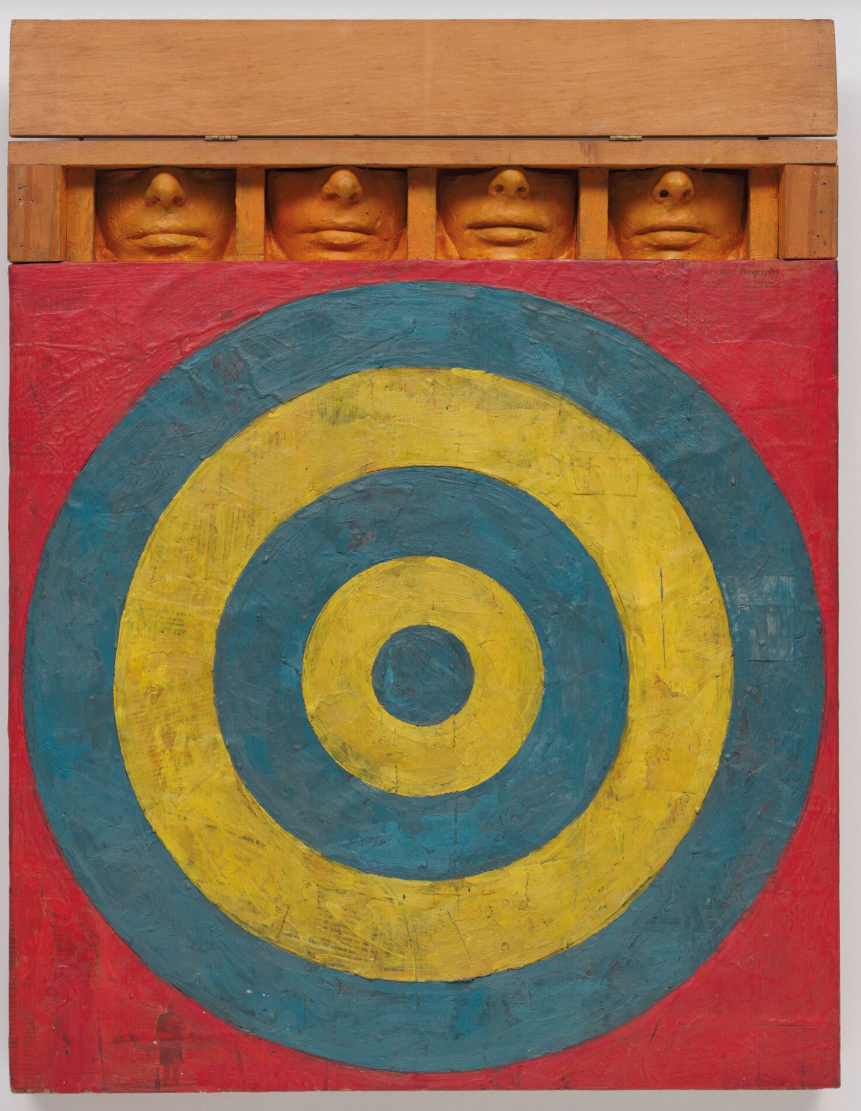
Jasper Johns, Target with Four Faces, 1955. Museum of Modern Art, New York. © 2024 Jasper Johns / Licensed by VAGA at Artists Rights Society (ARS), NY. Photo: © The Museum of Modern Art / Licensed by SCALA / Art Resource, NY.
Ever since Europeans first landed on the eastern shores of what would become America in the sixteenth century, the vast expanse of uncharted territory that lay to the west has been a mythical source of both hope and inspiration for the population. From the epic landscapes of the Hudson River School, reflecting the manifest destiny of eighteenth and nineteenth-century settlers, to the pioneering spirit of the cowboy paintings of Frederic Remington, the American psyche has become entwined in the country’s relationship with its western boundary.
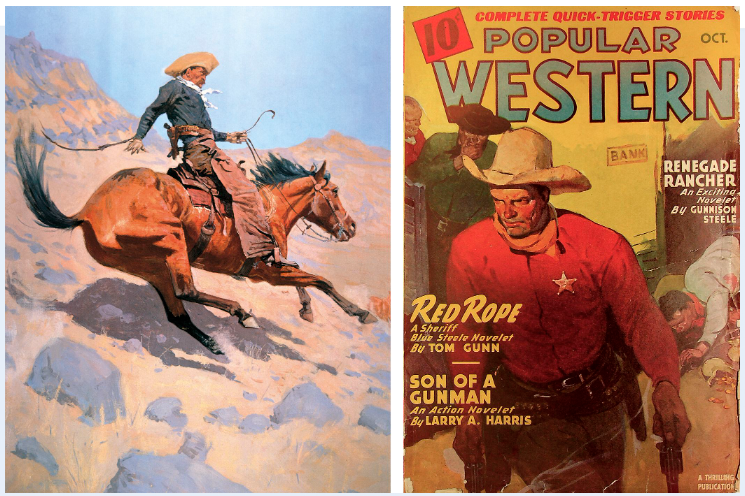
Left: Frederic Remington, The Cowboy, 1902. Photo: Peter Newark American Pictures / Bridgeman Images.
Right: October 1946 issue of Popular Western, A Thrilling Publication, vol. 31, no. 2.
These are all elements that can be seen in the present work. The old American West is present in the motif of the Popular Western comic book from 1946, complete with a sheriff in his resplendent red shirt and revolvers in both hands on the cover. That same pioneering spirit is also present in the titles of the stories contained within: ‘Renegade Rancher,’ ‘Red Rope: A Sheriff Blue Steele Novelet,’ and ‘Son of a Gunman’ all attest to the drama, lawlessness, action and adventure that life in the untamed west promised. Yet, this is a version of America which, in Ruscha’s painting, is literally being torn up by ripping the comic book in half and hurling out of the picture plane. This proved to be a particularly adaptable motif for the artist as he also included it another painting from the period, Noise, Pencil, Broken Pencil, Cheap Western (1963, Virginia Museum of Fine Arts).
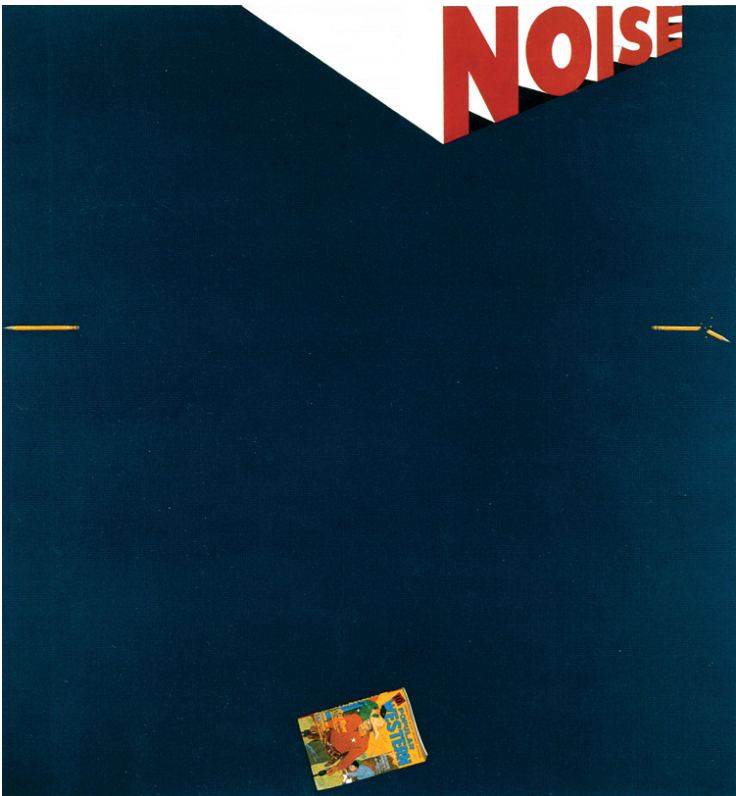
Ed Ruscha, Noise, Pencil, Broken Pencil, Cheap Western, 1963. Virginia Museum of Fine Arts. © Ed Ruscha.
In Standard Station, Ten-Cent Western Being Torn in Half, cowboy culture has been replaced by car culture. The Standard gas station represented a new, modern version of America in which the automobile, and its associated culture, has come to dominate (literally in the case of the present work) the landscape. This is something which resonated with Ruscha from the moment he saw that first gas station back in the 1950s.
“There was something new and clean about it. The gas station had a polished newness that I just had to draw and then paint.”
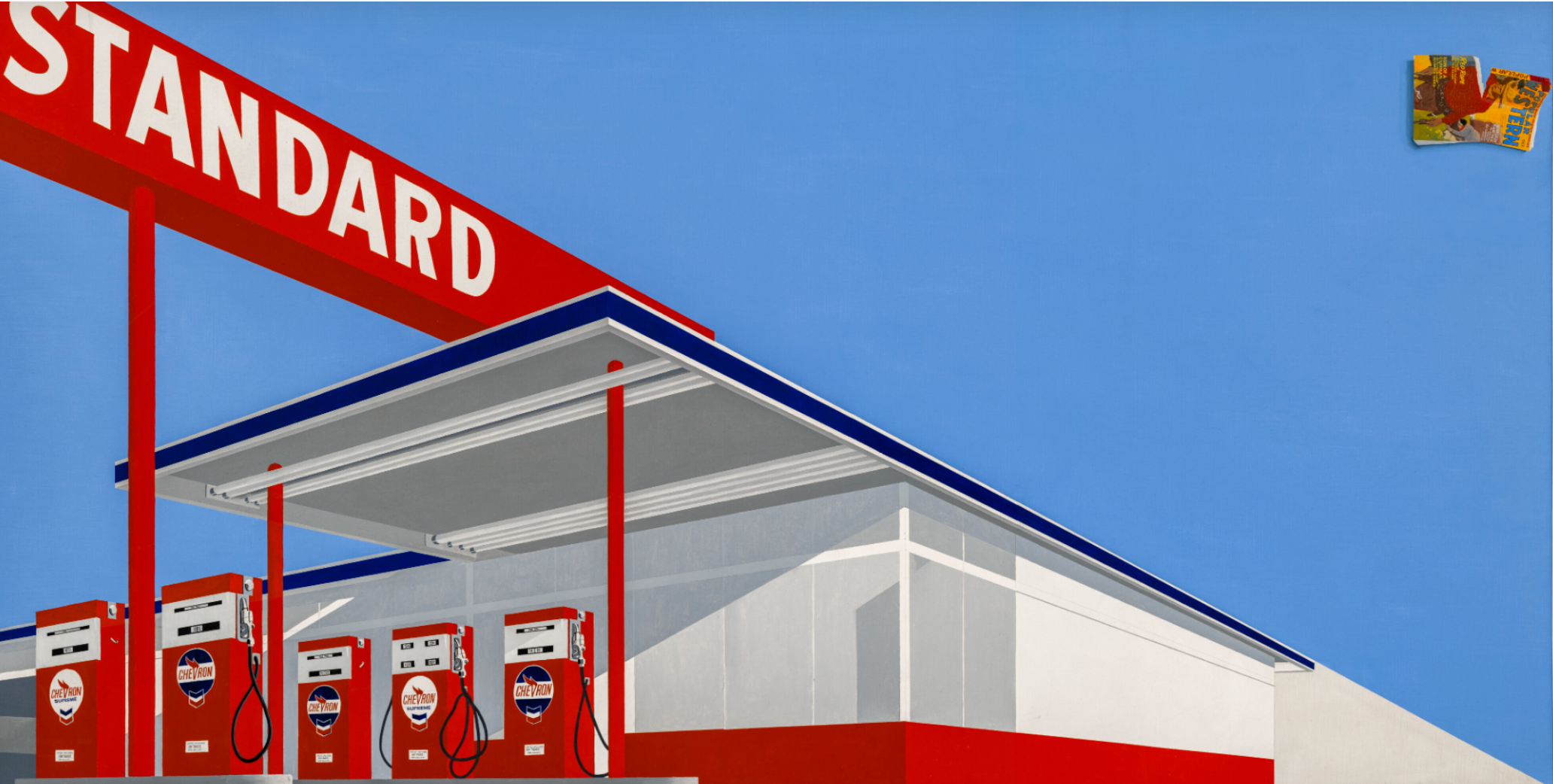
The gas stations became the stars of Ruscha’s cinematic ‘road movies’ and feature in many of the artist’s most important paintings. The present painting’s sister canvas, Standard Station, Amarillo, Texas, 1964, is in the collection of the Hood Museum of Art, Hanover, and the motif appears in four other major paintings including: Standard Station, 1965; Burning Gas Station, 1966-69; Burning Gas Station, 1965-66; and the later Standard Station, 1986-87. Apart from the Hood Museum painting, none of the other paintings featuring the Standard gas station comes close to the present work in terms of size. Its formal arrangement was also adopted in other notable paintings from the period including Los Angeles County Museum of Art on Fire (1965-68, Hirshhorn Museum and Sculpture Garden, Washington, D.C.) and his later paintings of another icon of the American West, the Hollywood sign. There is, incidentally, also an autobiographical reference to this form that Ruscha has acknowledged. The artist has said that the dramatic angle of the composition was partly inspired by the 1942 Disney film Bambi, and, in particular, the way that Bambi’s father stood proudly in the forest, plus it references the stag featured in advertisements for the Hartford Insurance Company in the 1950s, a company where Ruscha’s father worked.
Ed Ruscha’s Standard Stations (To Scale)
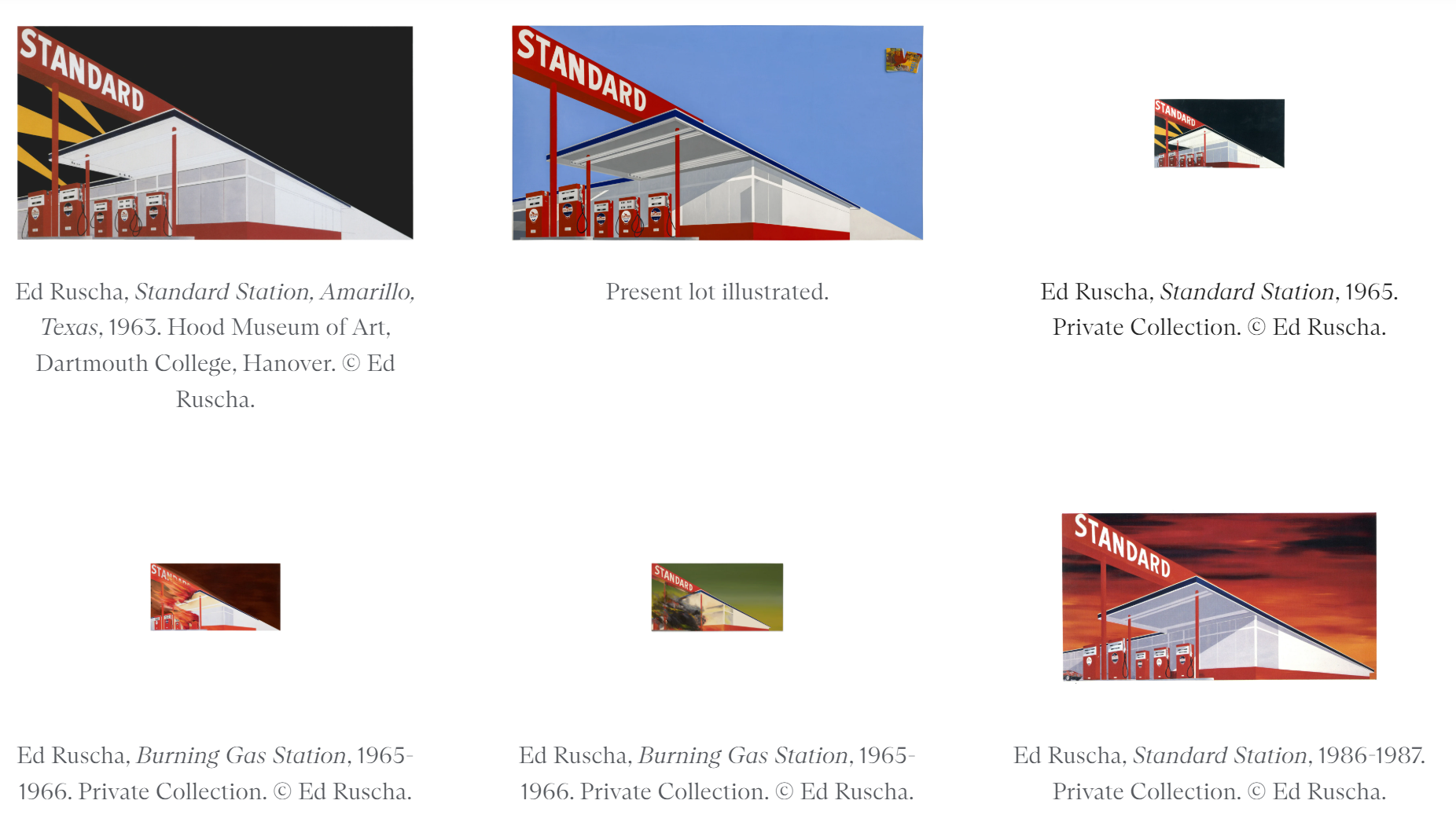
Ruscha’s journeys from Oklahoma to California and back again have attained an almost mythical status in the more than half century since he began them. The gas stations he witnessed along the way provided him with the source material for what would become one of the most iconic series of paintings in the American postwar canon. Unlike artists such the modernist painter Charles Sheeler and, to some extent even Edward Hopper, Ruscha removed extraneous detail to add a sense of power to his paintings. Depicting what Ruscha referred to as the “quietude of travel,” the present work becomes a celebration of these silent sentinels of the open road.
“I think they [paintings without people] become more powerful without extraneous elements like people, cars, or anything beyond the story. That’s why these lines, these planes in a gas station were more important than trying to create an Edward Hopper. It became something for me to investigate. I was able to subtract a romantic story from the scene—I wanted something that had some industrial strength to it. People would have muddied it”
Thus, Standard Station, Ten-Cent Western Being Torn in Half has become a representation of America itself, a reflection of the old and a promise of the new, as seen through Ruscha’s unique artistic vision.
Burning Gas Station, 1966-1969
Christie’s New-York: 11 May 2023
Estimated: USD 20,000,000 – 30,000,000
USD 22,260,000
ED RUSCHA (B. 1937) (christies.com)
ED RUSCHA (B. 1937)
Burning Gas Station, 1966-1969
Oil on canvas
20 1/8 x 39 inches (51.1 x 99.1 cm)
Signed, titled and dated ‘”BURNING GAS STATION” 1966-1969 E. Ruscha’ (on the stretcher)
Painted in 1966-1969, Ed Ruscha’s Burning Gas Station belongs to one of the most iconic series in twentieth-century art. Inspired by the gas stations that punctuated his drives between Los Angeles and his native Oklahoma, the present work is just one of just five Standard Stations the artist painted in the 1960s (a sixth followed in 1986-1987). Collectively, these paintings form one of the most iconic and coherent bodies of work of the postwar period, with only a few remaining in private hands. Collectively, these paintings form one of the most iconic and coherent bodies of work of the postwar period, with only a few remaining in private hands. In Burning Gas Station, a fiery explosion threatens to obliterate the iconic Standard station, as if Ruscha has decided to torch the “standards” by which art itself has been defined. Tinged with anarchist fantasies but also a devotion to the love of painting itself, the present work is an exceptional example of this notorious series, and has not been publicly exhibited since 1976.
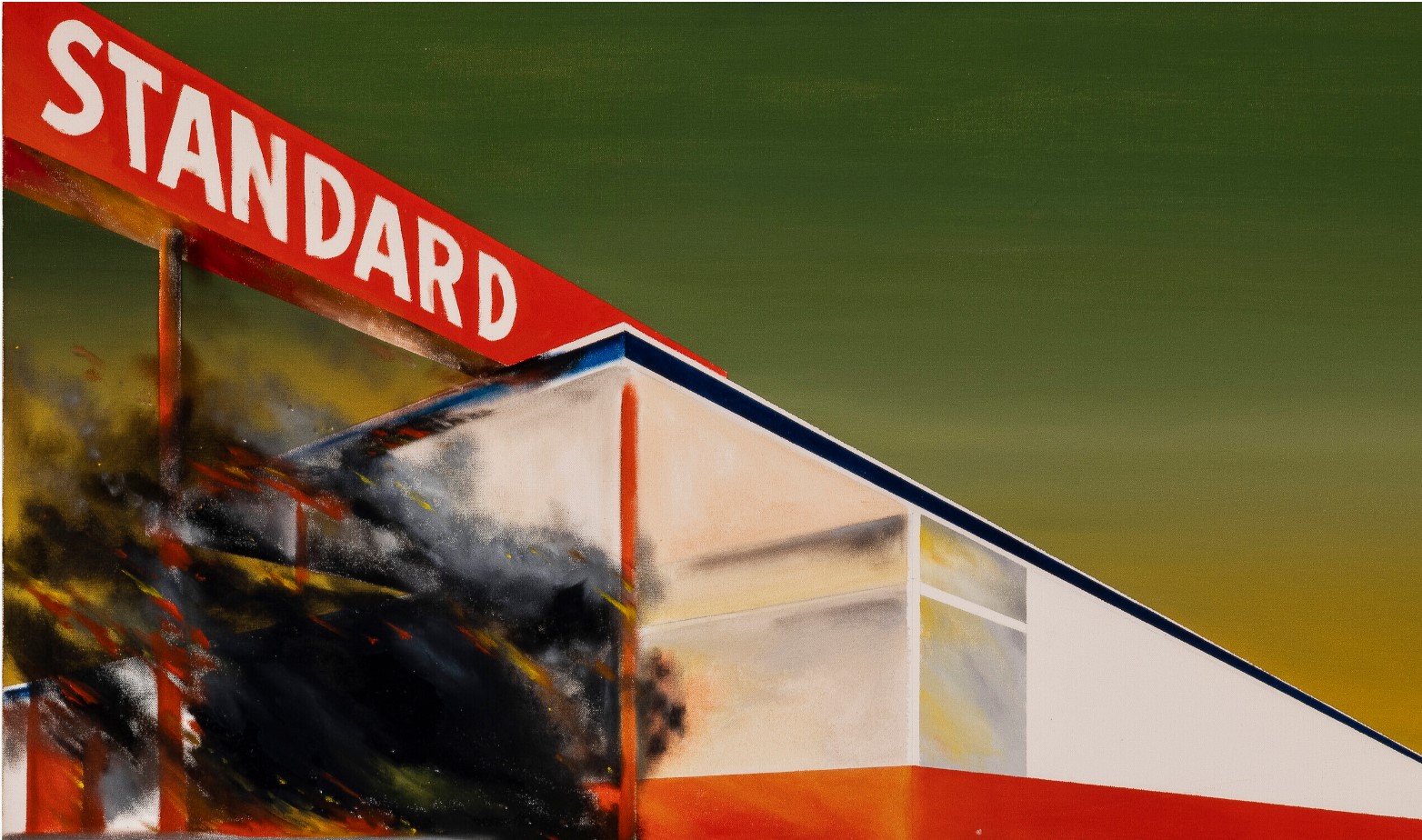
Burning Gas Station is the pinnacle of the Standard Station paintings of the 1960s, as it was the last in the series, which he made at the decade’s end in 1968. Here, the gas station has been abstracted down to its barest essentials. The sleek, modern building and its gleaming glass interior is at odds with the chaos of the fiery explosion taking place nearby. This sentiment is ratcheted up to dramatic effect by Ruscha’s ingenious flair for pictorial composition, in which the diagonal format of the building causes it to zoom outward with the unstoppable speed of a roaring freight train. A sleek, ribbon-like border runs along the upper edge, in the form of a shimmering blue line that echoes the diagonal thrust of the painting’s composition. Ruscha has used a mysterious ombre effect to convey the night sky, which ranges from dark black to green and yellow. (This is one of the first instances in which Ruscha employed the ombre background, which ultimately became one of his longest-running visual motifs). The eerie night sky, combined with the explosion that has just rocked through the scene, makes for one of the most visually arresting paintings in the entire series.
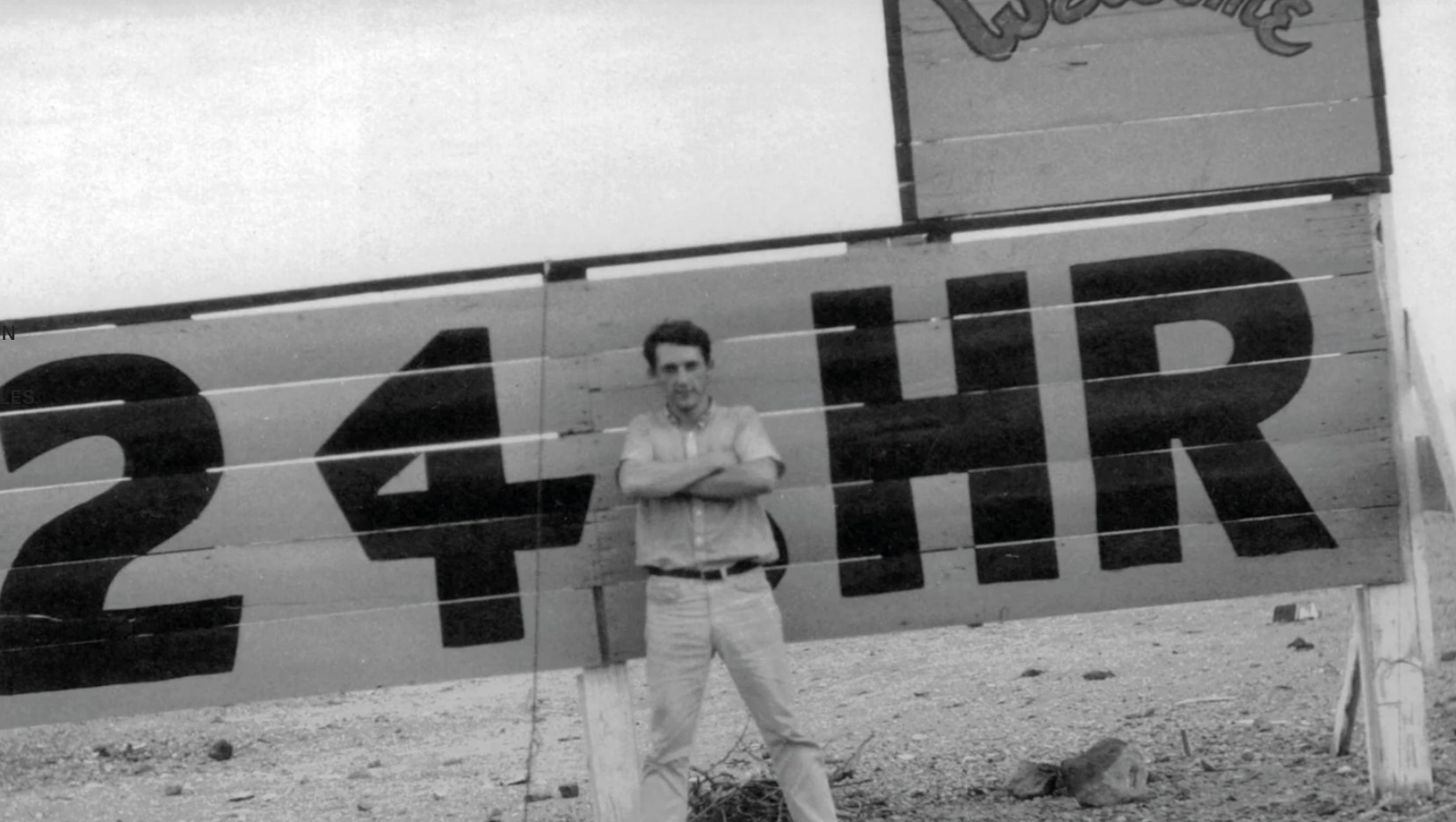
In Burning Gas Station it is the tension between the gleaming, white perfection of the gas station and the chaos of the fiery explosion that makes this painting into the apotheosis of the entire series. By invoking the awesome power of fire, the painting leaves the realm of the everyday world to cross over into the uncanny valley of Surrealism. This strategy also touches upon the absurdist nature of Dada and its willingness to incorporate nonsensical objects as the subject of “High” art. So, too, does fire symbolize the transformative power of the Holy Spirit in the Catholic church, which Ruscha knew from his youth in Oklahoma. A powerful, primal entity that has allowed the species to survive for millennia, fire is a life-giving and yet utterly destructive force.
2. Photographs
Gasoline Stations, 1962
Phillips New-York: 4 April 2024
Estimated: USD 100,000 – 150,000
USD 133,350
Ed Ruscha – Photographs from the Marti… Lot 15 April 2024 | Phillips
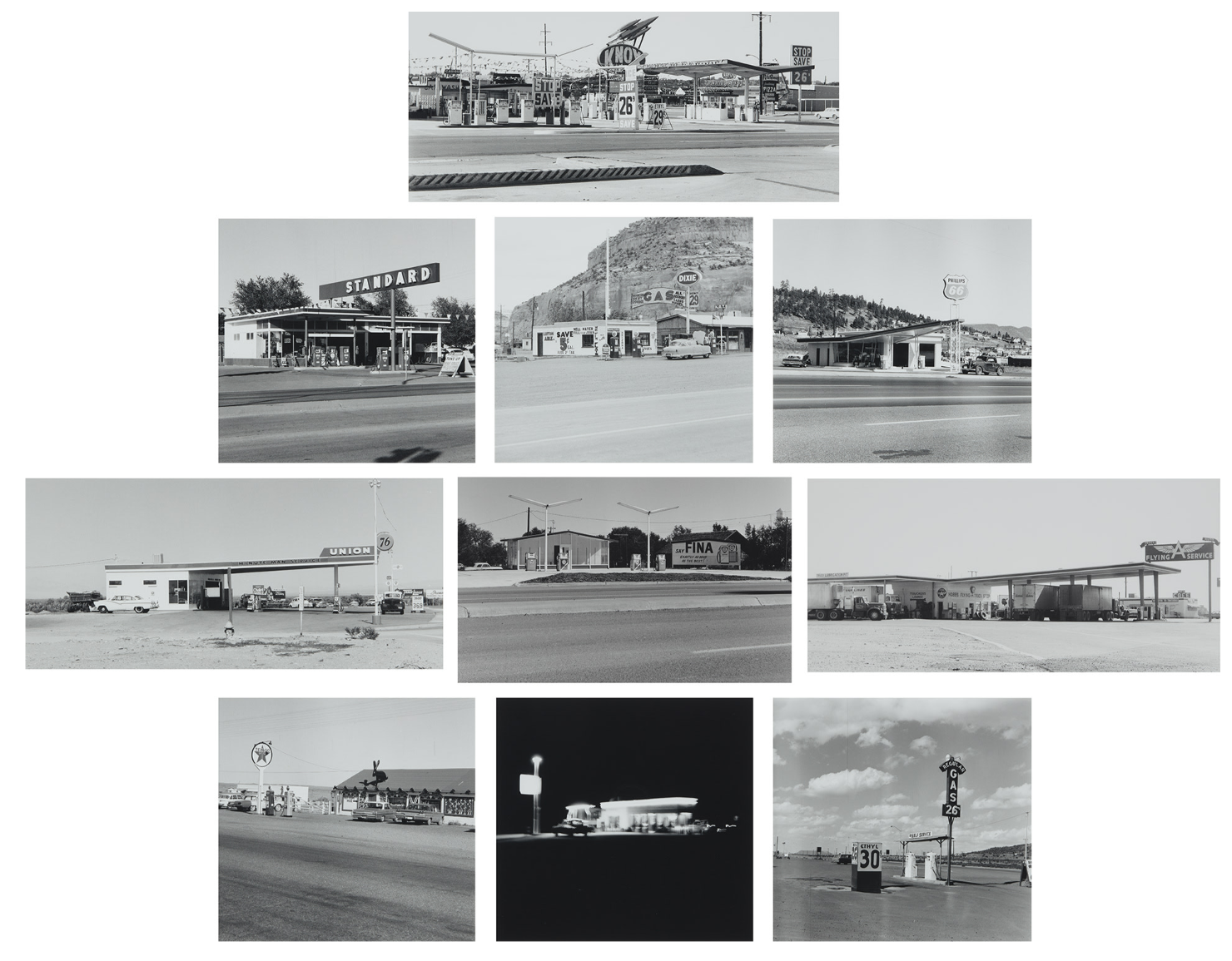
ED RUSCHA
Gasoline Stations, 1962
Ten gelatin silver prints, printed 1989
Varying sizes
Smallest: 8×18 inches (20.3 x 45.7 cm)
Largest: 10 1/8 x 10 3/4 inches (25.7 x 27.3 cm)
Each with title and edition 19/25 stamps on the reverse of the flush-mount
This complete portfolio, printed in 1989, is comprised of 10 of the 26 images included in the book.
With his playful, sublime, genre-defying paintings, prints, photographs, and books, Ed Ruscha has transformed the landscape of 20th century art. The imagery of the gas station, and its rich association with American car and highway culture, became a pivotal part of Ruscha’s visual lexicon when he first approached the subject in the early 1960s. As Ruscha has explained, the series was originally conceived as an artist’s book, the first of many seminal publications that he would go on to produce throughout his illustrious career.
“I wanted to make a book of some kind. And at the same time . . . my whole attitude about everything came out in this one phrase that I made up for myself, which was “twenty-six gasoline stations.” I worked on that in my mind for a long time and I knew that title before the book had even come about. And then, paradoxically, the idea of the photographs of the gasoline stations came around, so it’s an idea first—and then I kind of worked it down.”
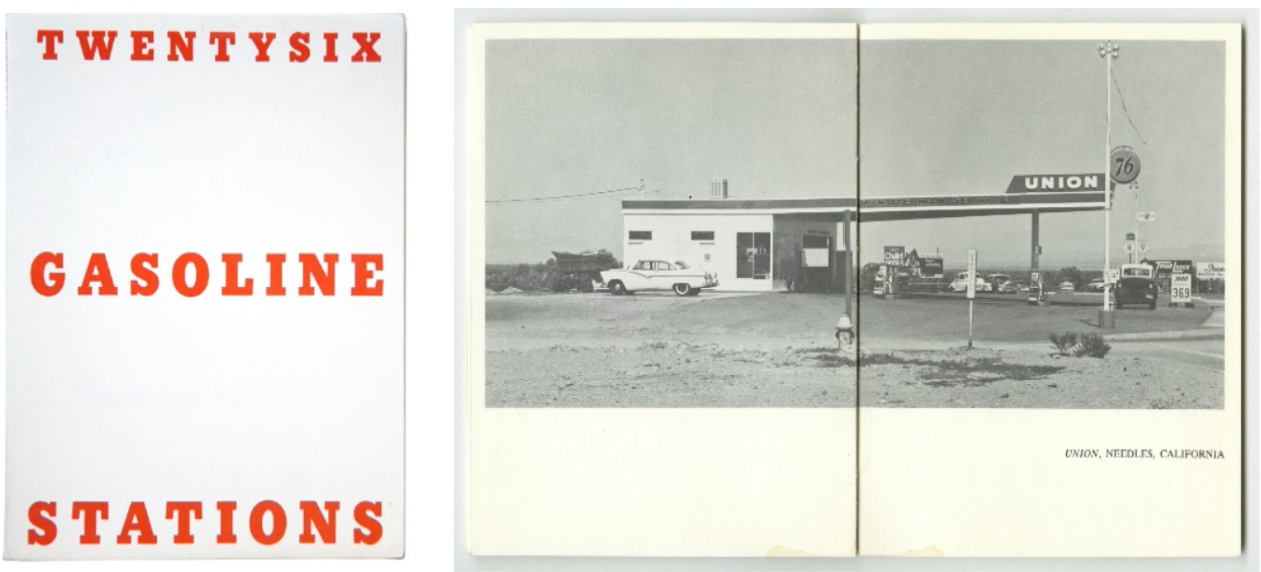
Ed Ruscha, Twentsix Gasoline Stations, cover and interior spread
Published in 1963, Twenty six Gasoline Stations featured exactly that—26 photographs taken along Route 66 between Los Angeles, where he lived, and Oklahoma City, where he was born and raised. While that stretch of highway was personal for him—it also represented something far more universal, and far more American: the allure of the open road.
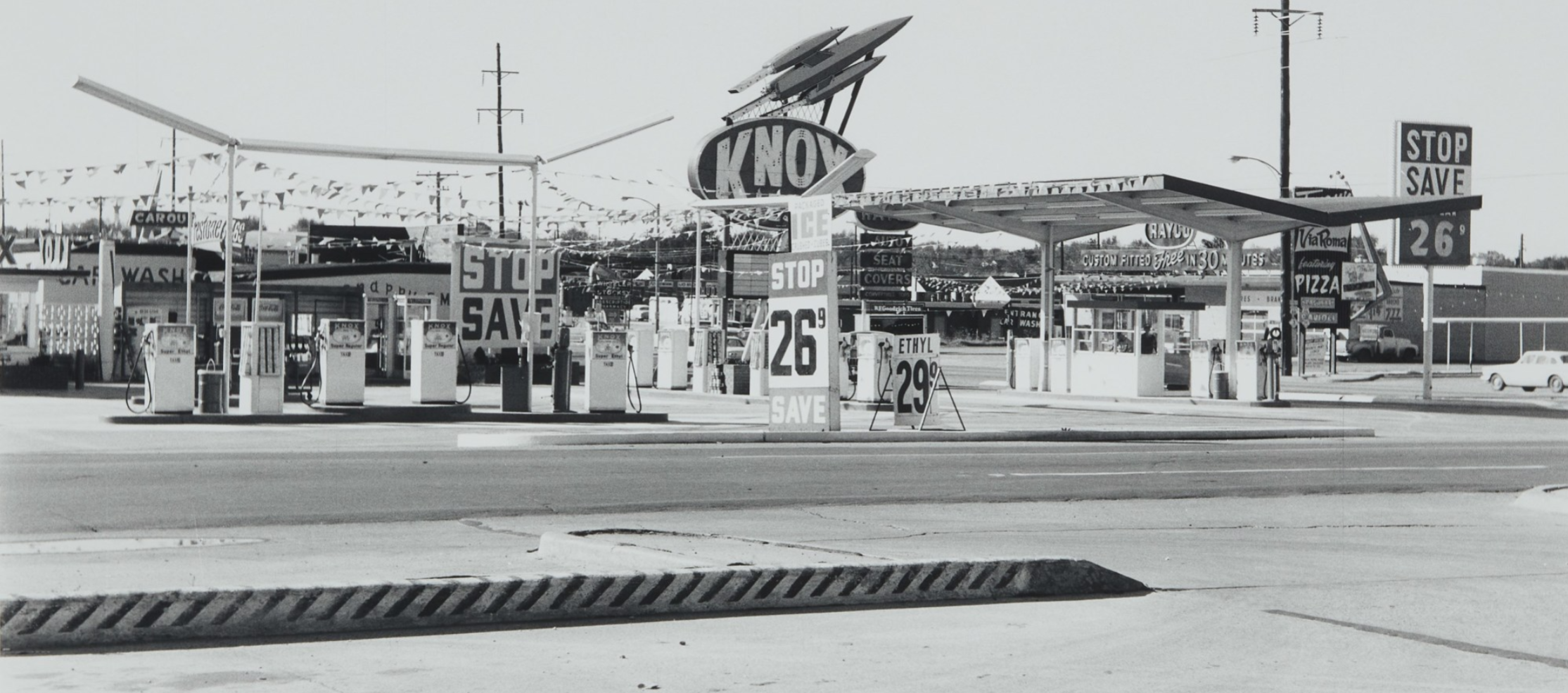
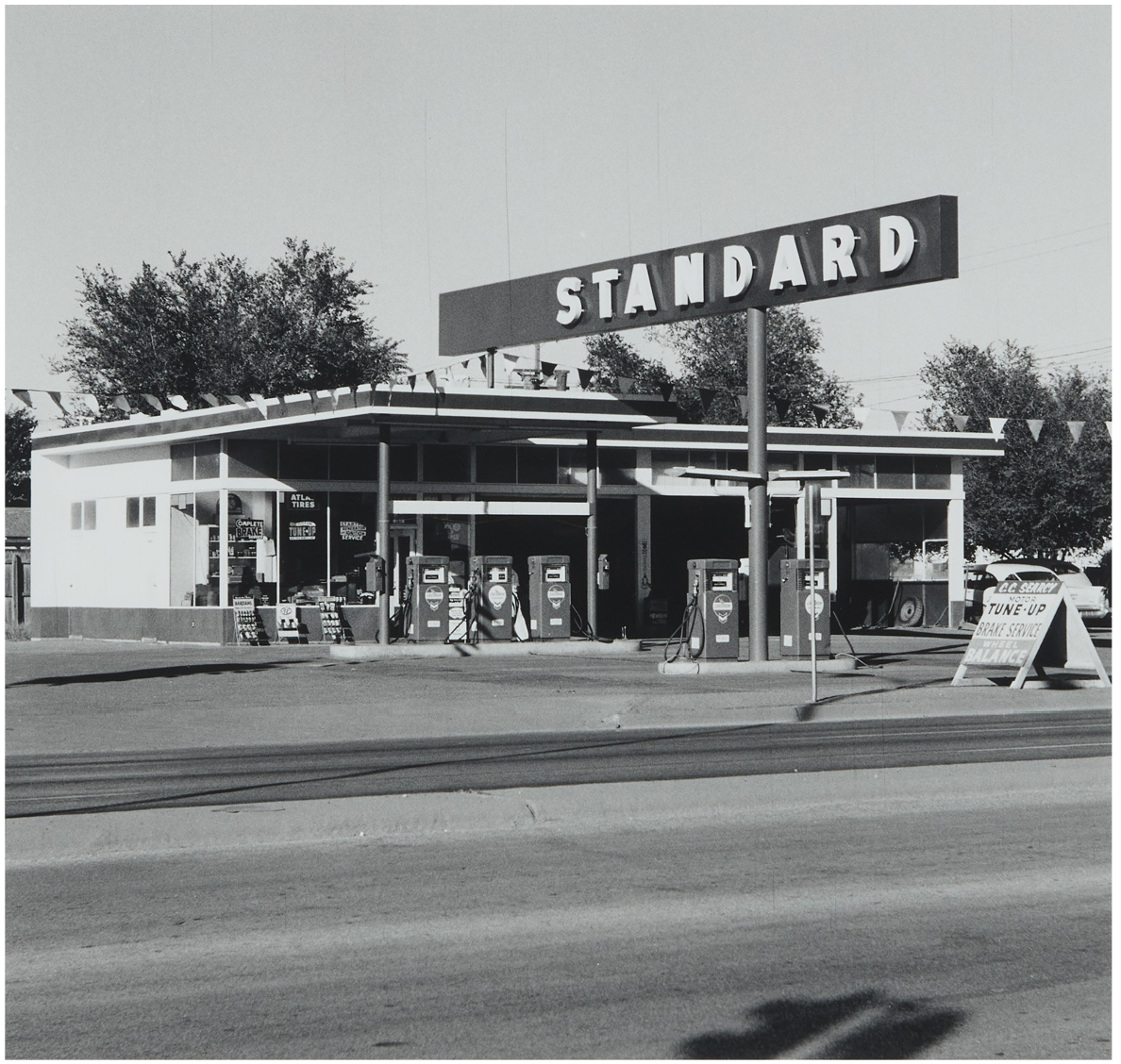
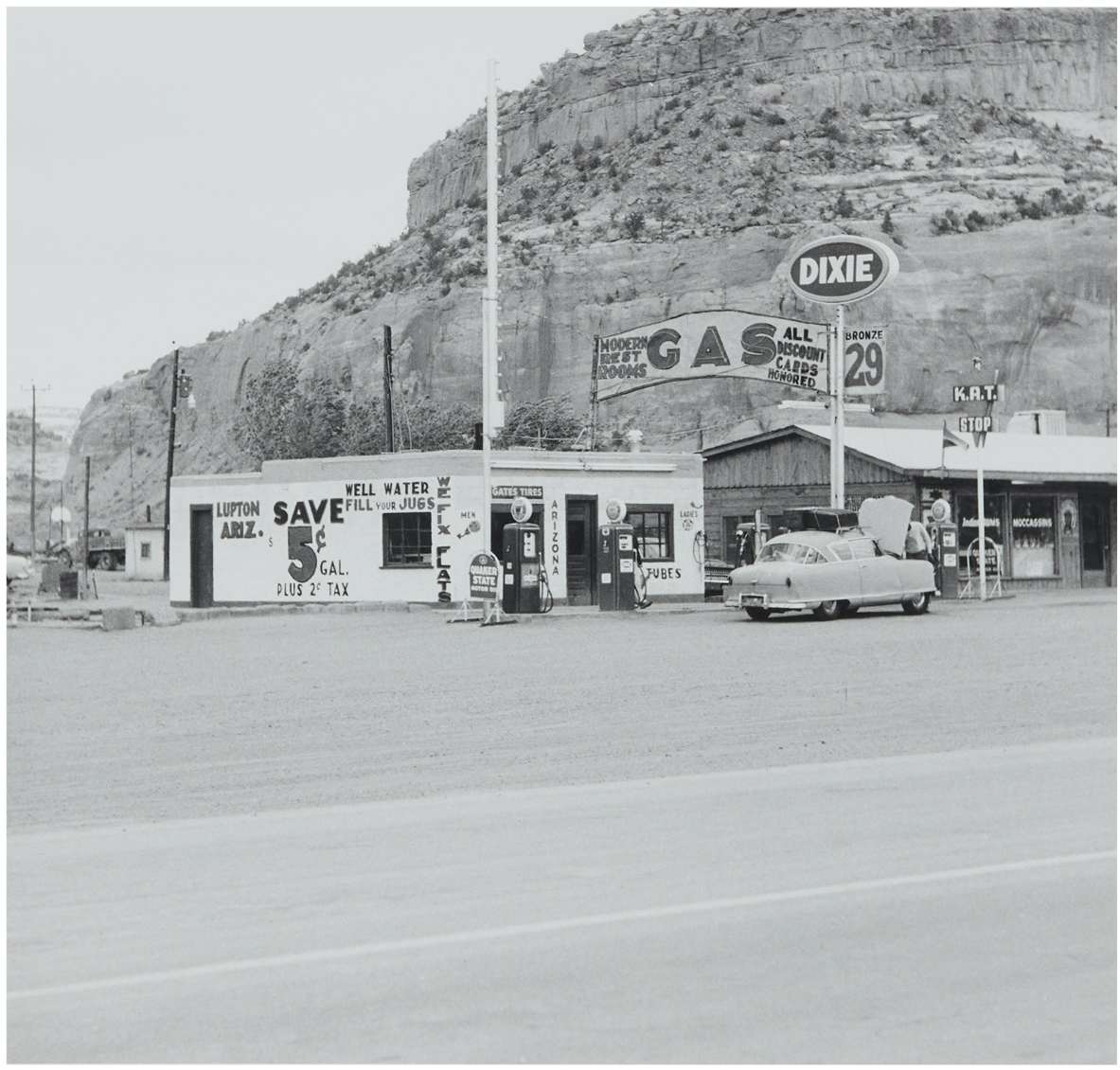
3. Prints
PLEASE SEE PRINT SECTION FOR MORE INFORMATION
Standard Station, 1966
Christie’s New-York: 28 October 2022
Estimated: USD 400,000 – 600,000
USD 554,400
ED RUSCHA (B. 1937), Standard Station | Christie’s (christies.com)
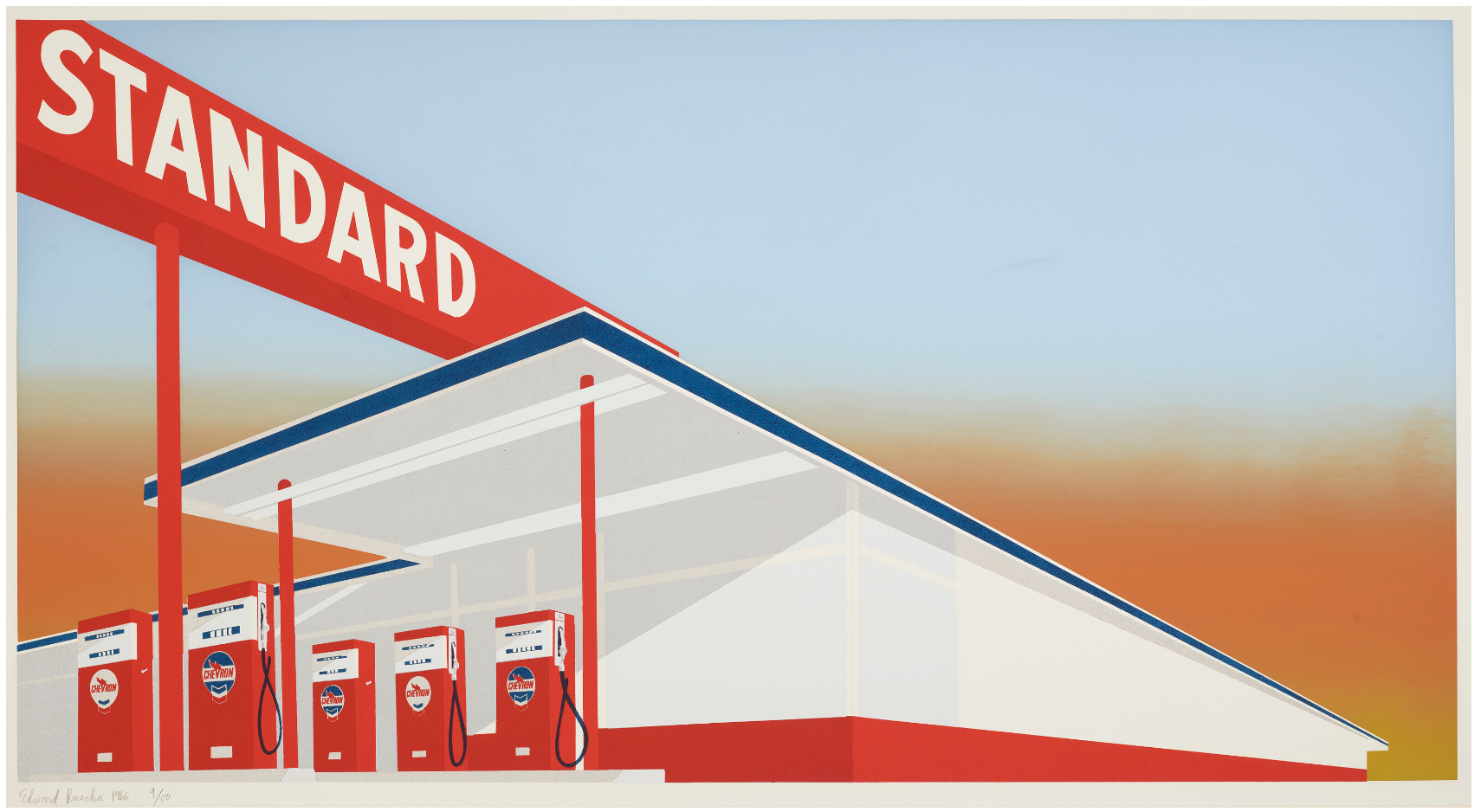
ED RUSCHA (B. 1937)
Standard Station, 1966
Screenprint in colors on commercial buff paper
Image: 19 1/2 x 37 inches (49.5 x 93.9 cm)
Sheet: 25 5/8 x 40 1/8 inches (65.1 x 101.9 cm)
Signed and dated in pencil, numbered 9/50 (there were also two artist’s proofs)
Published by Audrey Sabol, Villanova, Pennsylvania
Mountain Paintings
Me, 1999
Sotheby’s New-York: 14 May 2026
Estimated: USD 4,000,000 – 6,000,000
USD 6,952,000
Ed Ruscha | Me | The Now & Contemporary Evening Auction | 2026 |
ED RUSCHA (b. 1937)
Me, 1999
Acrylic on canvas
64×72 inches (162 x 182.9 cm)
Signed and dated 1999 (on the reverse)
A work of exceptional clarity and conceptual force, Ed Ruscha’s Me (1999) stands as a rare and highly resolved example from the celebrated Mountain series. It is further distinguished as one of only three compositions to feature this specific text in conjunction with the artist’s striking reverse airbrush technique. At once austere and monumental, the painting encapsulates the essential concerns of Ruscha’s mature practice—language, perception, and the constructed image—within a composition of remarkable economy. Its visual precision and conceptual directness mark it as a particularly significant and singular work within the series, in which the convergence of text and landscape achieves a distilled and resonant form. In Me, Ruscha compresses the central tenets of his artistic inquiry into a single, declarative image: a landscape that evokes the historical promise of Manifest Destiny while asserting the lasting primacy of the inner self. Here, the vastness of nature serves as a stage upon which the viewer, and by extension, the artist, becomes an active participant in this vision. The result is a poised and deliberate stillness, in which word and image meet in a moment of heightened suspension.
“I like the tension of having a combination of words or a word in front of something that is also lively in itself like a mountain top, and a lot of these mountain tops suggest glory or beauty, things like that. They almost have their own orchestration, you can almost hear trumpets playing, and I like that reference. It’s sort of a non-verbal way of referencing something that is really not making any noise at all. But then put in combination with words—that tension is where I live.”
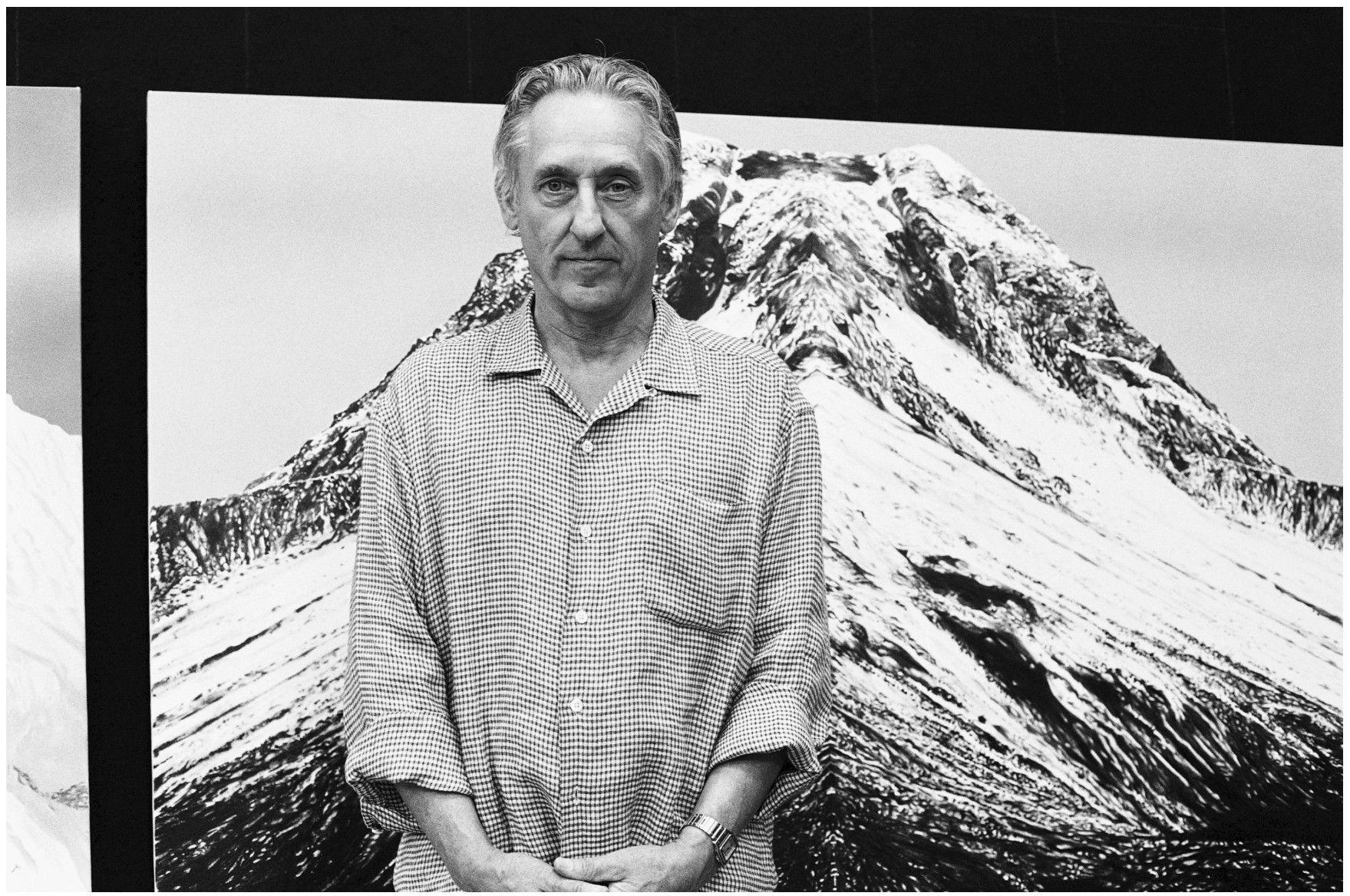
Ed Ruscha with one of his Mountain paintings. Photo © Alice Springs / Helmut Newton Foundation / Trunk Archive
Within the Mountain series, Ruscha consistently employed his characteristic phrases and epigraphs, invoking luscious lifestyles and daring attitudes in BABY JET and SEX AT NOON TAXES. In other instances, the pared-down simplicity of IS or THE suffices for Ruscha’s titular vernacular, demonstrating his facility in imbuing even the most minimal text with layered significance. “If Ruscha previously had been identified most closely with the iconography of the Hollywood sign and the Standard station, the ‘Mountain’ paintings would become central to his later reputation, unlike the ‘Metro Plots,’ which cite locations in the United States, especially Los Angeles, the mountains, based on illustrations and photographs-refer to no place in particular. Instead, what Ruscha has described as ‘ideas of ideas of ideas of mountains’ are stage settings for a theater of words: palindromes, quotations, sayings, and gravestone-like epitaphs. Often the clever palindromes used (‘Never Odd or Even,’ ‘Solo Gigolos,’ ‘Step on No Pets’) are backdropped by bilaterally symmetric mountains, the Rorschach-like, mirror imagery reiterating the equilibrium of the phrase.” (Robert Dean, Edward Ruscha: Catalogue Raisonne of The Paintings, Vol. 6: 1998–2003, New York, 2013, p. 1)
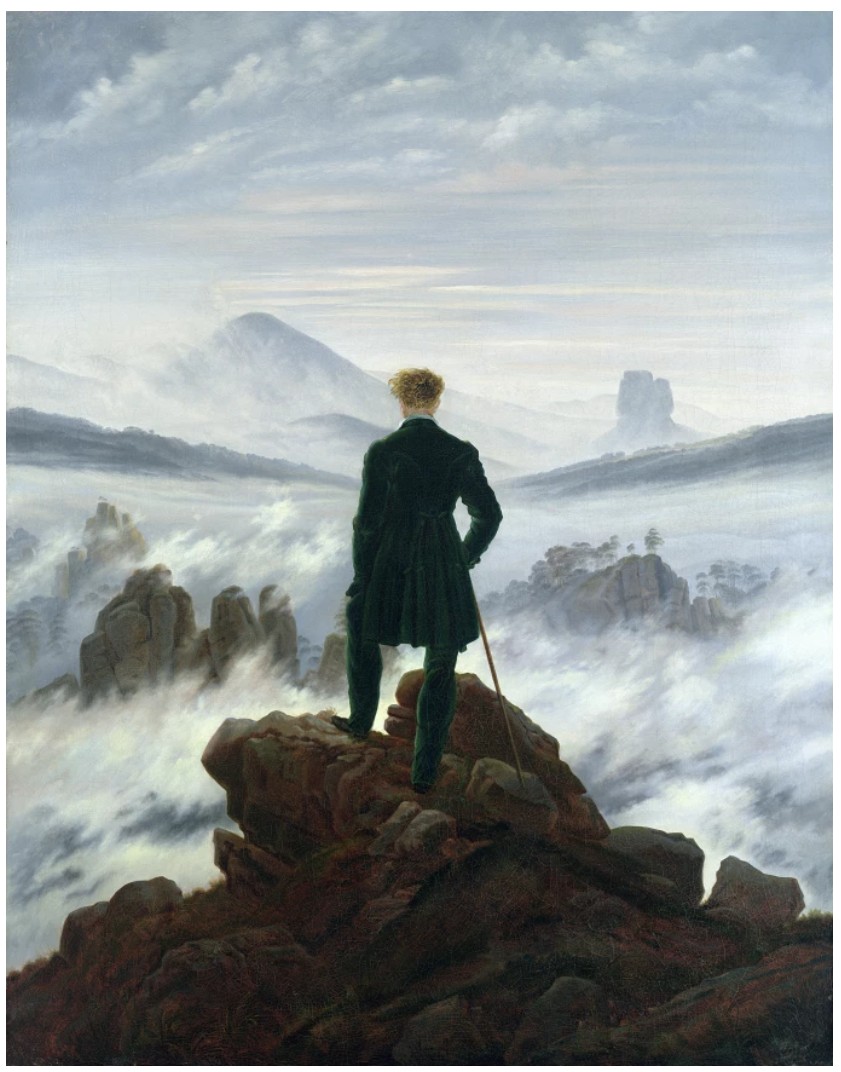
Caspar David Friedrich, The Wanderer above the Sea of Fog, 1818. Hamburger Kunsthalle. Image © Bridgeman Images
Undeniably evoking the iconic Hollywood sign, Ruscha elevates Me toward a more introspective focus. In selecting a text that eschews direct reference or instructive idiom, Me articulates instead the grandeur of selfhood and the act of seeing oneself within, and upon, the world instead. Originally from Omaha, Nebraska, Ruscha described his first impressions of Los Angeles as an actualization of the Californian myth and the broader American conception of West Coast allure.
Ed Ruscha’s Mountain Paintings in Museum Collections
In all the grandeur of their pristine, snow-capped peaks, Ed Ruscha’s mountains pay tribute both to the mythology of the American West that runs throughout his oeuvre and to the sublime experience of standing before a massive natural form. Paired with his Pop signature of overlaying text onto these scenes, the mountains are absorbed into an American commercial idiom and translated into the language of image and caption — a style that propelled Ruscha’s success and whose prominence is reflected in their presence in museum collections worldwide. All Art © 2026 Edward Ruscha
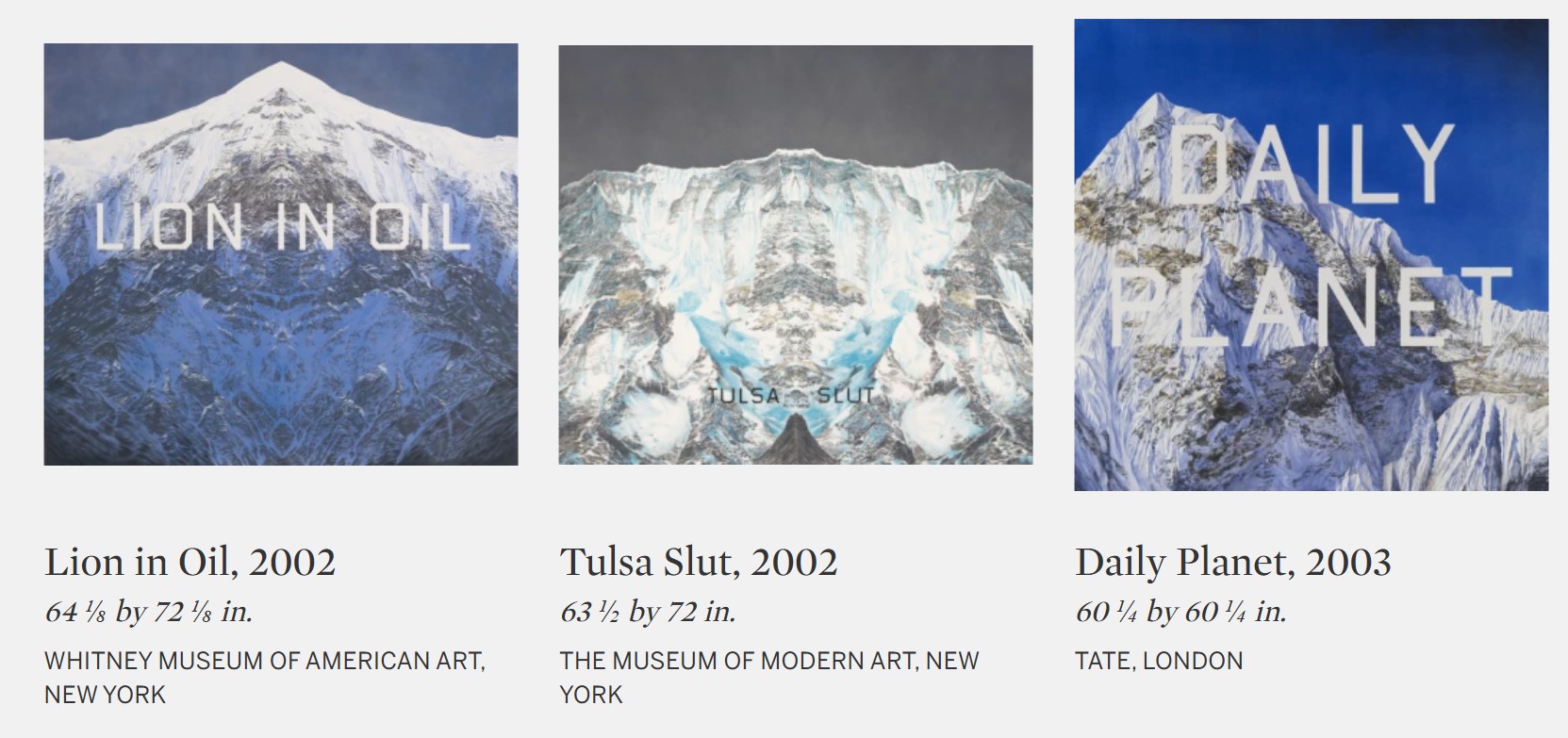
In this context, his sustained engagement with compositions that echo the Hollywood sign renders it all the more significant that the artist elects to inscribe himself upon these monumental peaks. Ruscha’s breathtaking vistas are part photograph and part road sign. Following his move to Los Angeles in 1956, he worked as a sign painter, a graphic designer, and an assistant to an art book publisher. Influenced by the printed text that filled his days, as well as the word games of Marcel Duchamp, Ruscha formed a unique visual language that is simultaneously commercial and formally sophisticated.
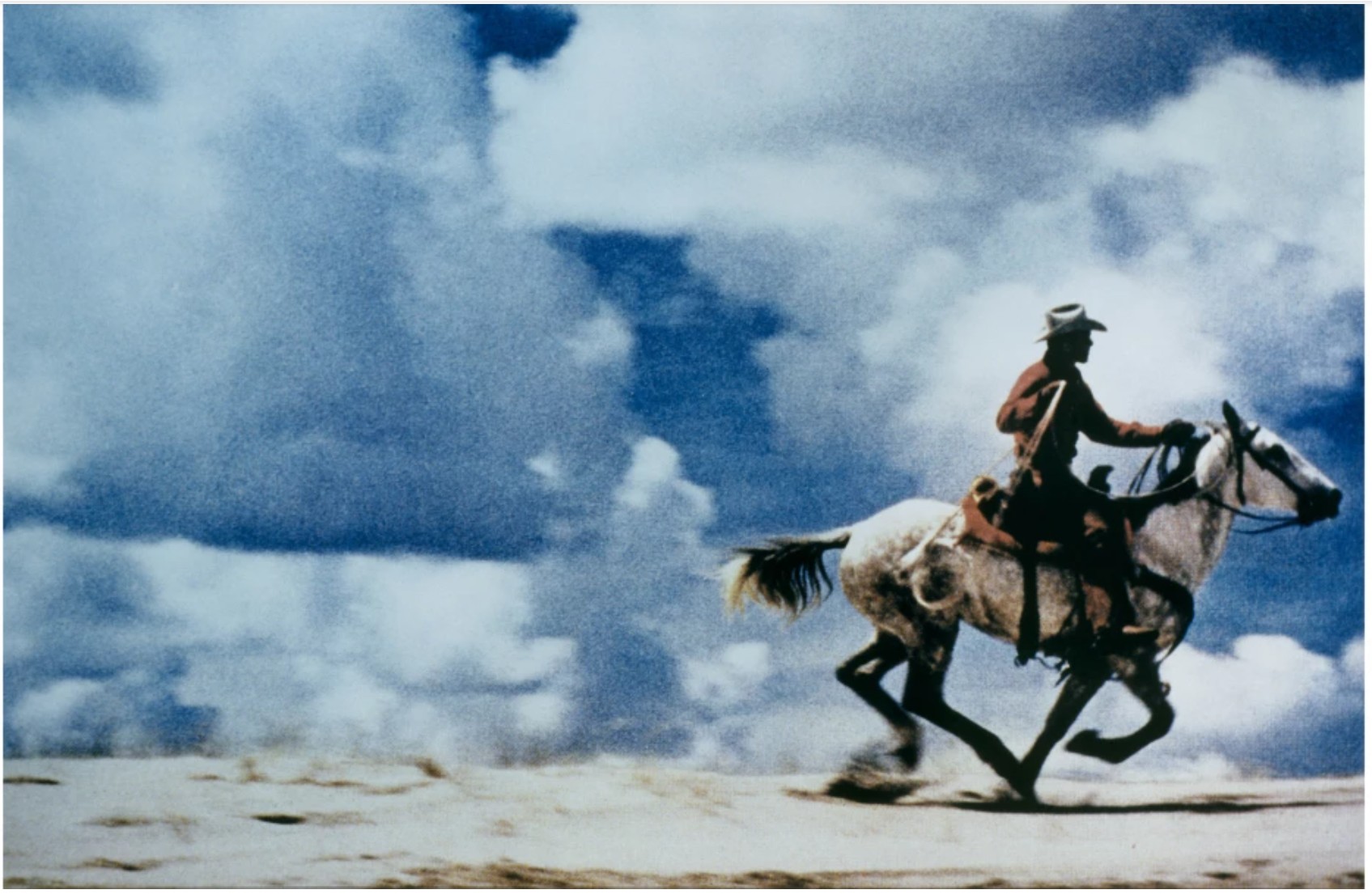
Richard Prince, Untitled (Cowboy), 1989. Metropolitan Museum of Art, New York.
Image © The Metropolitan Museum of Art. Image source: Art Resource, NY. Art © Richard Prince
His interest in commercial signage and logos is elevated to a cinematic art form in the mountain series of the late 1990s. Ruscha began painting the snowy mountains just before the turn of the millennium, borrowing the rugged, magnificent landscapes from magazine illustrations and photographs. The mountains are geographically neutral and are defined solely by whatever words, letters, or numbers Ruscha chooses to paint over them.
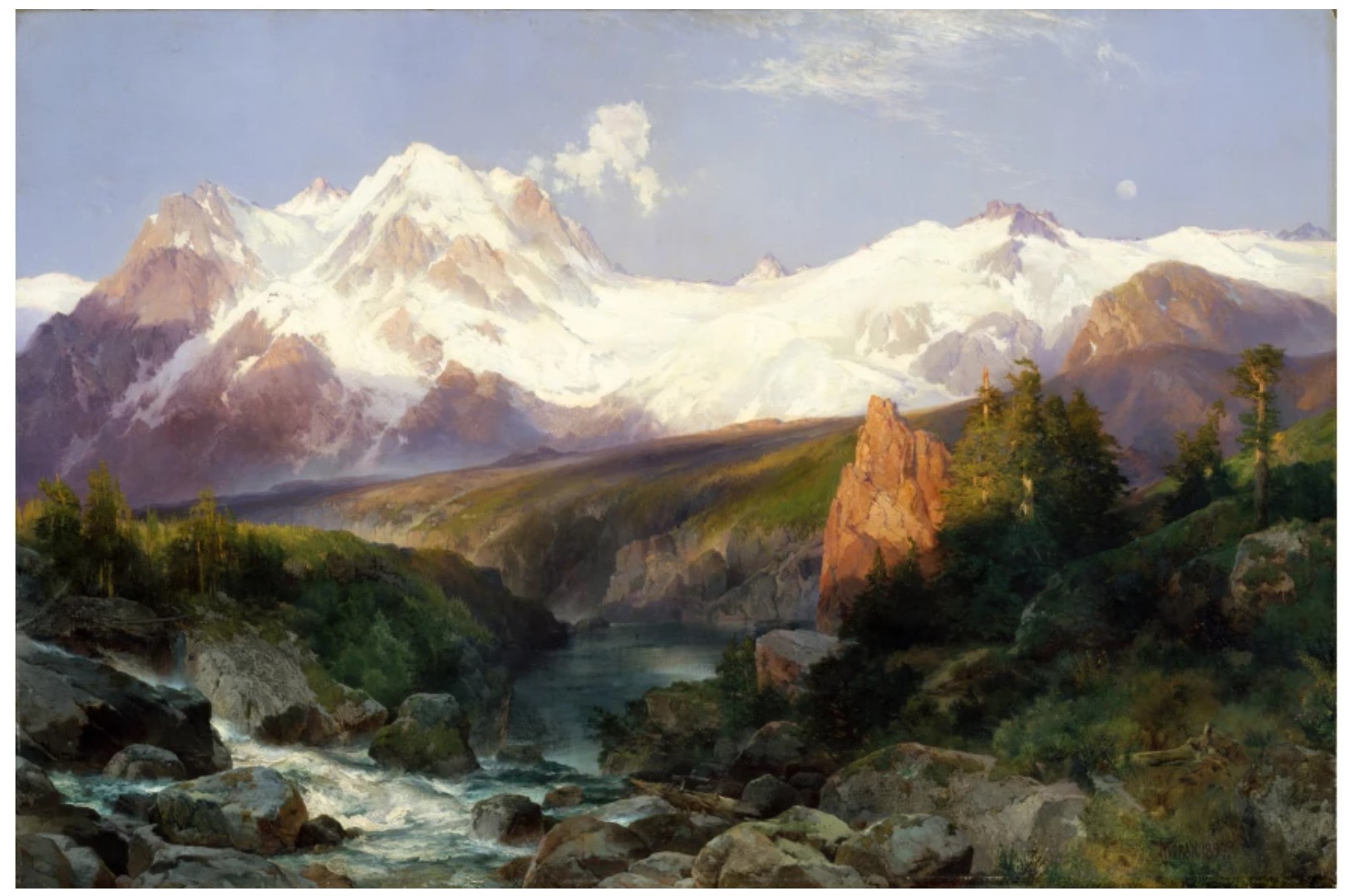
Thomas Moran, The Teton Range, 1897. Metropolitan Museum of Art, New York. Image © Bridgeman Images
ME encourages introspective contemplation while defying being known itself. The cold, bare mountain recalls the nostalgic romanticism of the American Dream and of the Manifest Destiny aspirations so historically tied to the Californian landscape, while simultaneously constructing a dream-like atmosphere that seems to deliver the artist’s prophecy of selfhood’s necessary alignment within nature’s glorious beauty. Ruscha in his signature wit, displays here his mastery of both the traditions of art history and contemporary visual culture, presenting a landscape defined as much by its barrenness as its rich textual details.
Career Sportswear, 2000
Christie’s New-York: 20 May 2026
Estimated: USD 3,500,000 – 5,500,000
PASSED
ED RUSCHA (B. 1937), Career Sportswear | Christie’s
ED RUSCHA (B. 1937)
Career Sportswear, 2000
Acrylic on canvas
60×60 inches (154.2 x 154.2 cm.)
Signed and dated ‘Ed Ruscha 2000’ (on the reverse)
An iconic, early example of the highly coveted mountain paintings that the artist began several decades ago, Ed Ruscha’s Career Sportswear is a majestic painting from this celebrated series. A dramatic, snow-capped mountain peak has been rendered in meticulous detail, where high, wispy clouds come in and out of focus. Here, the thin mountain air and extreme weather at the peak are the unlikely backdrop for what Ruscha calls “the drama of words.” The enigmatic phrase CAREER SPORTSWEAR is writ large, announcing itself by means of bold, authoritative lettering in a crisp, white script. Like something out of a dream or movie, the text beckons the viewer into this evocative and beautiful realm. The meaning of the phrase is taken from advertising clichés of a bygone era, used to market an “active lifestyle” to consumers in magazines and newspapers. It is this uncanny blend—blatant commercialism combined with the sublimity of history painting—that makes the mountain paintings so well-received. Seen in this light, Career Sportswear is a subtle riff off a grand tradition.
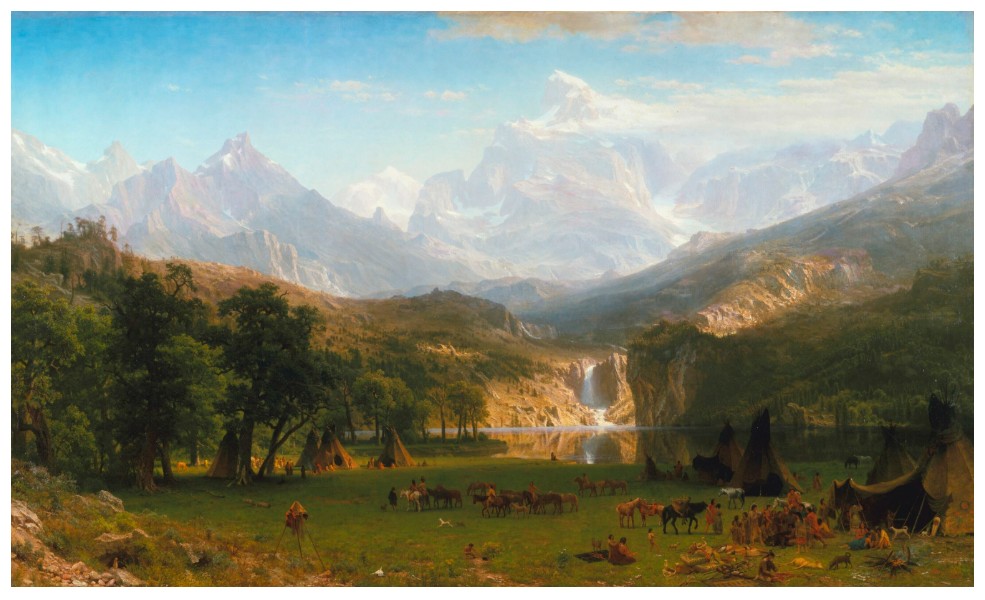
Albert Bierstadt, The Rocky Mountains, Lander’s Peak, 1863, Metropolitan Museum of Art, New York.
Rendered with almost photographic precision, the painting showcases Ruscha’s acute technical skill, especially in the diaphanous white clouds that seem to be forming and dissolving before our very eyes. In the present work, Ruscha’s mountain peak has more in common with the famous logo of the Paramount Studio in Hollywood than with the large-scale, awe-inducing landscape paintings of Caspar David Friedrich. Here, Ruscha’s signature script, which he famously dubbed “boy scout utility modern,” is rendered in all-caps. The whiteness of the words fades into each wisp of cloud, blurring the divide between background and foreground. In Career Sportswear, Ruscha has superimposed the two genres of landscape painting and word art, yielding a surrealist encounter that continues to provoke and delight in the nearly three decades since its creation.
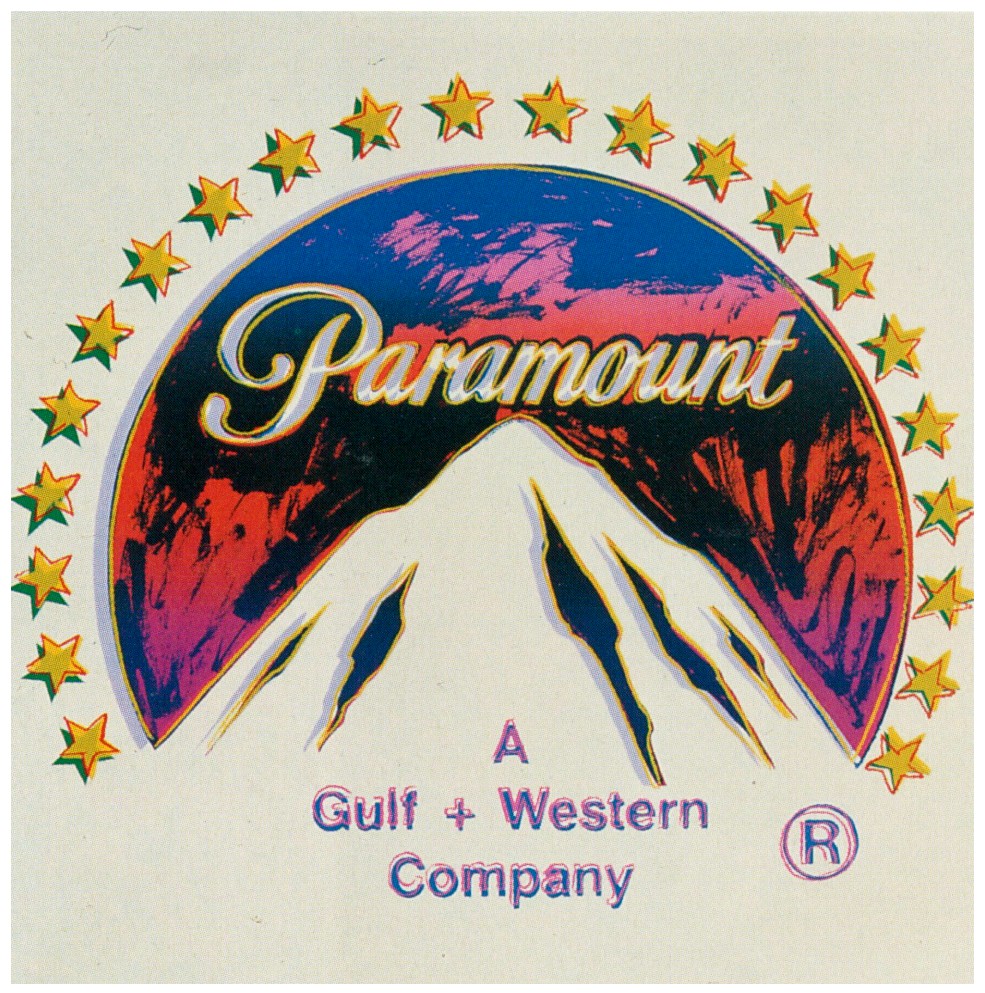
Andy Warhol, Paramount, from: Ads, 1985.
© 2026 The Andy Warhol Foundation for the Visual Arts, Inc. / Licensed by Artists Rights Society (ARS).
When they first appeared, Ruscha’s mountain paintings were seen as a new departure. They had a certain visual “snap” heretofore not seen in his previous work. They demonstrated an amazing verisimilitude, showcasing a new level of technical draftsmanship that had previously lain dormant in his work. They also possessed a staggering beauty that stopped people in their tracks. Collectors and critics alike gravitated to the mountain paintings, such that today, over a dozen examples are included in prestigious museum collections around the world, including the Museum of Modern Art, New York, the Whitney Museum of American Art, New York and the Tate, London.
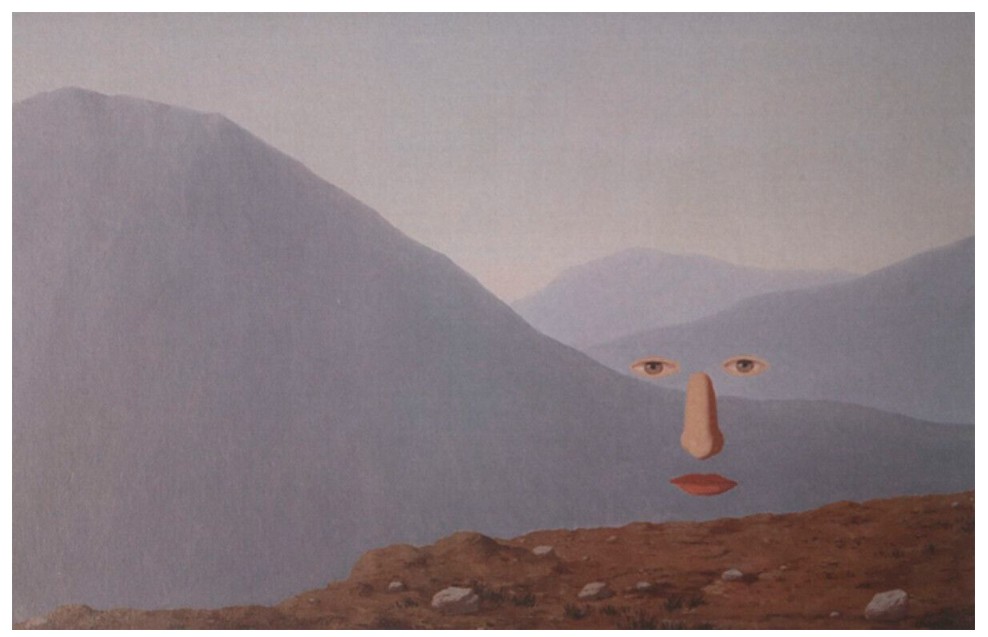
René Magritte, Every day, 1966, Private collection. © 2026 C. Herscovici / Artists Rights Society (ARS), New York.
To create the present work, Ruscha used a time-consuming, meticulous process that could span several weeks and months. He began by spraying an initial layer of acrylic paint onto the canvas, and then slowly worked up the image over time. This yielded a flawless surface, one that conveys a photographic rendering of deep recessional space, but that also remains resolutely flat, almost like a thin scrim. The impossibility of these two aspects, coexisting within a single picture, was a virtuosic feat that offered another level of complexity to the already multifaceted image.

Embedded with the weight of history, Ruscha’s mountain paintings take as their departure point the sublime landscape paintings of Albert Bierstadt and Caspar David Friedrich. In Ruscha’s hands, however, there are subtle techniques that play off that grand tradition, instead subverting it and revealing it to be a rather hollowed-out cliché. Ruscha has explained that he was interested in “notions of mountains rather than real mountains” (quoted in K. Brougher, in Ed Ruscha and the Great American West, exh. cat., Fine Art Museums of San Francisco, 2016, p. 44). Indeed, Ruscha manages to both acknowledge and subvert the collective understanding of the romantic, heroic mountain peak in Career Sportswear.
How Do You Do?, 2003
Edlis Neeson Collection
Christie’s New-York: 19 November 2025
Estimated: USD 5,000,000 – 7,000,000
USD 6,785,000
ED RUSCHA (B. 1937), How Do You Do? | Christie’s
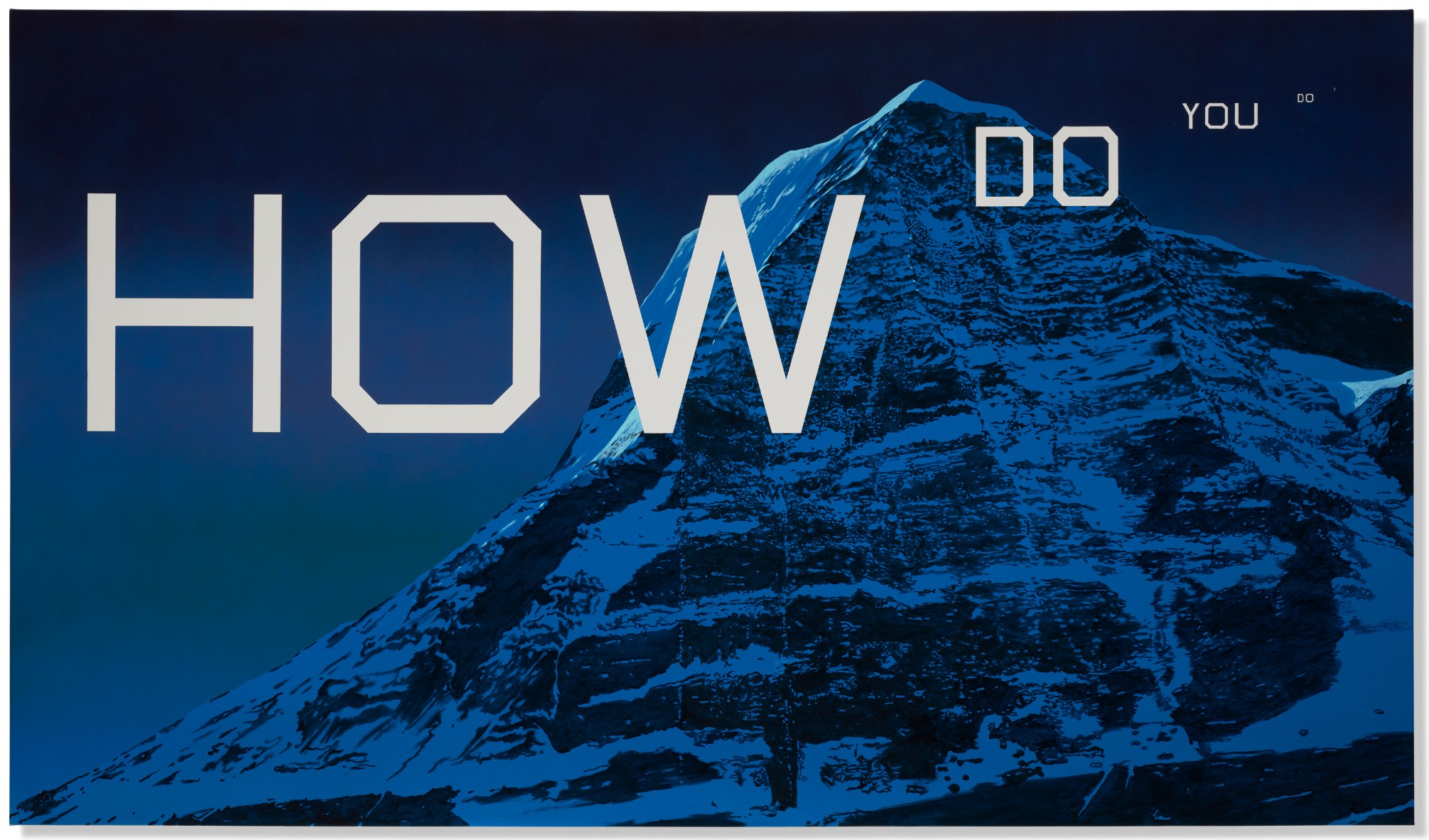
ED RUSCHA (B. 1937)
How Do You Do?, 2003
Oil on canvas
72×124 inches (182.9 x 315 cm)
Signed and dated twice ‘Ed Ruscha 2003’ (on the reverse)
“How do you do?” Dripping with the signature laconic irony developed in his acclaimed career, Ed Ruscha’s formal, somewhat archaic greeting is proclaimed in his titular painting. An exceptional, grand work emerging from the artist’s famed series of mountain paintings, How Do You Do? demonstrates Ruscha’s endless stream of creativity. The mountain motif has become central to the artist’s later reputation, with the productive period centered around the turn of the millennium which he spent making the series.
Capturing the immense scale and grandeur of the snow-clad crags of a high peak, How Do You Do? is painstakingly rendered, with the complex facets of each ridgeline, mountain face, rockfall, and summit depicted in minute detail against a sky of deep, saturated blues. Appropriating the imagery from photographs and illustrations, Ruscha describes the works as “ideas of ideas of ideas of mountains,” providing stage settings for his theater of words (E. Ruscha, quoted in R. Dean, “Preface,” op. cit., p. 1). The present work is one of the more spectacular of these painted stages, with Ruscha’s iconic imagery ascending up the mountain peak, diminishing in scale as if receding into the atmosphere. The work’s dynamic text is rare among the series, where Ruscha typically presents his words across a conventional horizontal plane. Ruscha’s innovation here allows text to interact with setting, emphasizing the stage-like aspect of the series.
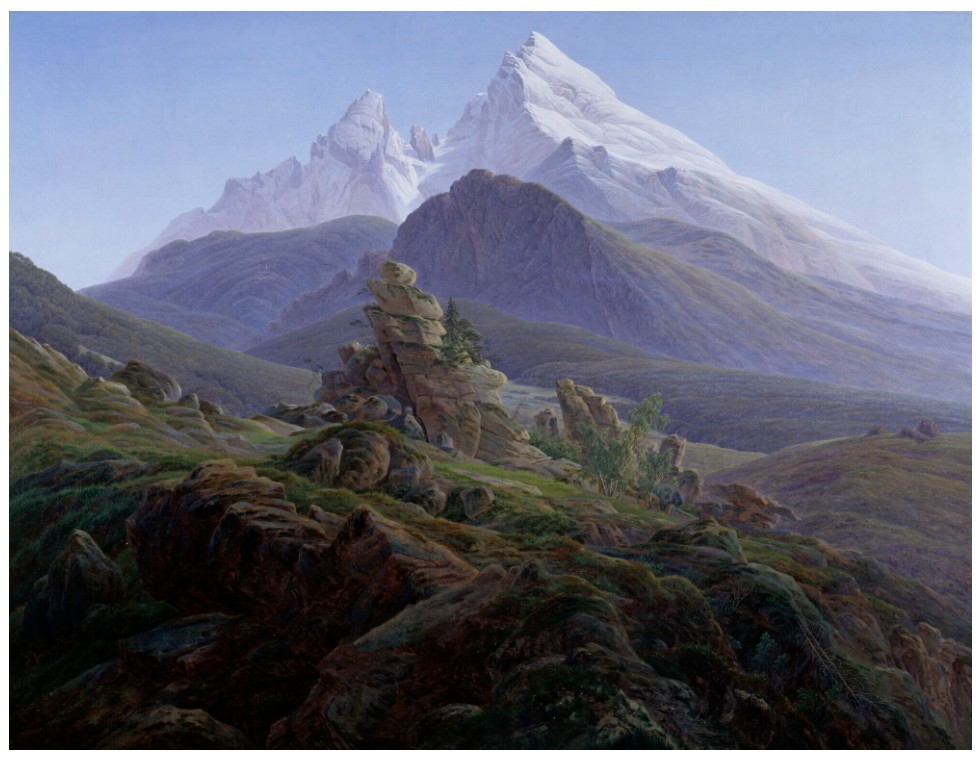
Caspar David Friedrich, The Watzmann, circa 1824-1825. Alte Nationalgalerie, Staatliche Museen zu Berlin.
“You know, I was reading Melville’s Moby-Dick, and I came across something where he says that mountains are egotistical. And it struck me as a little shard of truth, that mountains do have this way of looking egotistical. Anyways, the specifics of the mountains, and whatever they mean, are beside the point, because they are really notions of mountains rather than real mountains”
Taking Captain Ahab’s comment that “there’s something ever egotistical in mountain-tops and towers, and all other grand and lofty things” as a point of departure, Ruscha utilizes his imposing subject as a backdrop to his linguistic wordplay. (H. Melville, Moby-Dick; or, The Whale, London, 1922, p. 190).
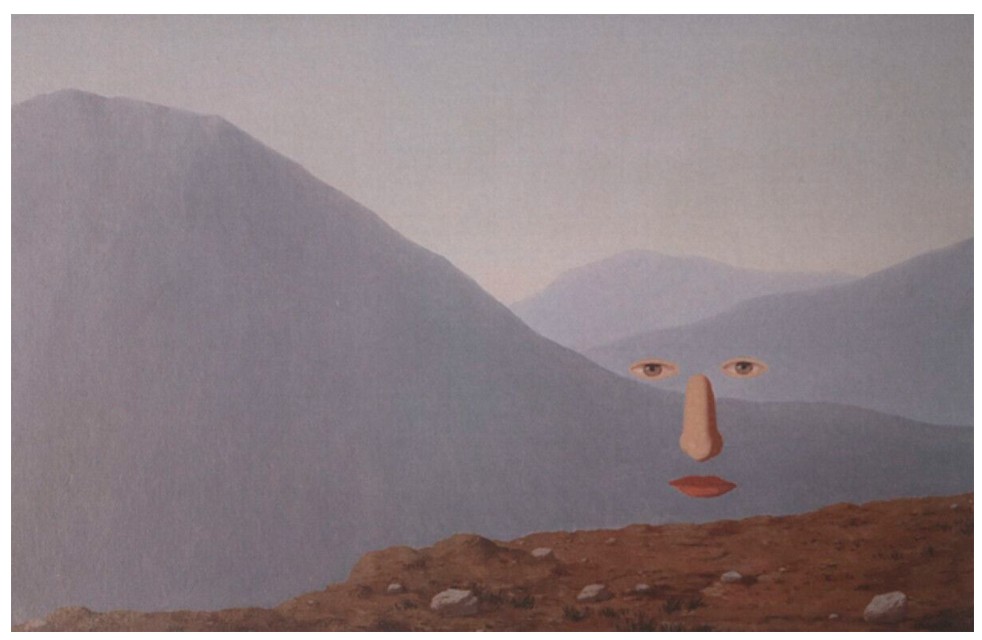
René Magritte, Every day, 1966. Private Collection. © 2025 C. Herscovici / Artists Rights Society (ARS), New York.
Ruscha achieves his bold lettering in How Do You Do? with his signature reverse-stenciling technique. Each letter, in his own Boy Scout Utility Western typeface, was made by carefully laying a stencil onto the white gesso ground before painting the composition. Ruscha’s final creative act after completing the painting was removing the stencils in one rapid, irreversible, subtractive process. With this process, Ruscha accomplishes an elegant result emphasizing the duality between text and background image. Ruscha compresses each word as his text proceeds across the canvas, ending with a subtle question mark. As if a statement fading with distance, his words seem to appear to ascend the mountain face, losing audibility with every gain in altitude. Working in tandem, text and image operate to emphasize the almost incomprehensible scale of this mountaintop.
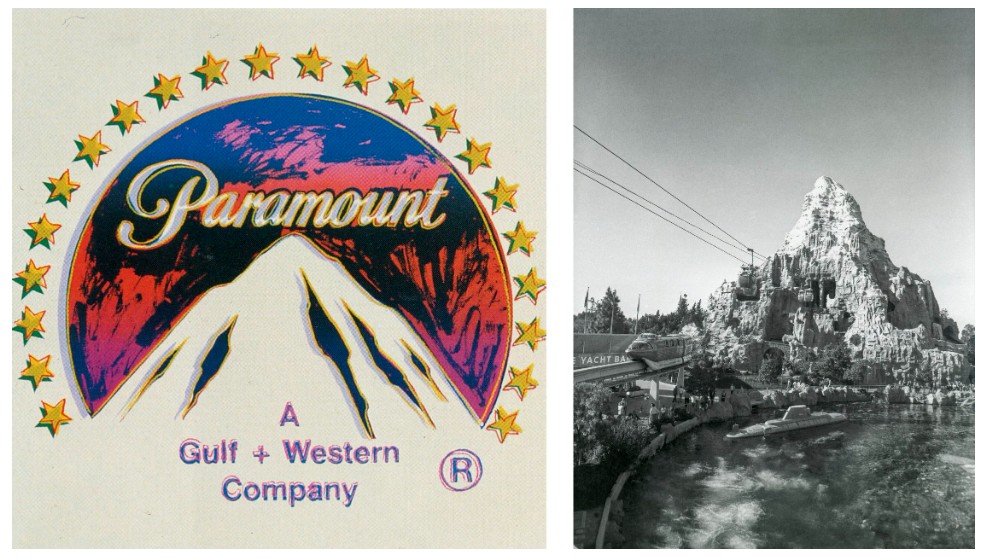
Left: Andy Warhol, Paramount, from: Ads, 1985. © 2025 The Andy Warhol Foundation for the Visual Arts, Inc. / Licensed by ARS
Right: The lagoon at Disneyland with view of the Skyway attraction, Anaheim, California.
How Do You Do? expands beyond literary territory in its intricate relationship vis-à-vis text and background. The mountain, as a painted image of an image, recalls the painted cinematic backdrops of classical Hollywood productions, creating a space situated between reality and illusion.
“If I’m influenced by movies, it’s from way underneath, not just the surface. A lot of my paintings are anonymous backdrops for the drama of words. In a way they’re words in front of the old Paramount mountain… they’re just meant to support the drama, like the Hollywood sign being held up by sticks.”
In the present work, however, the interaction is more complex, as the text does interact with its background, rescaling each word as it summits the peak.
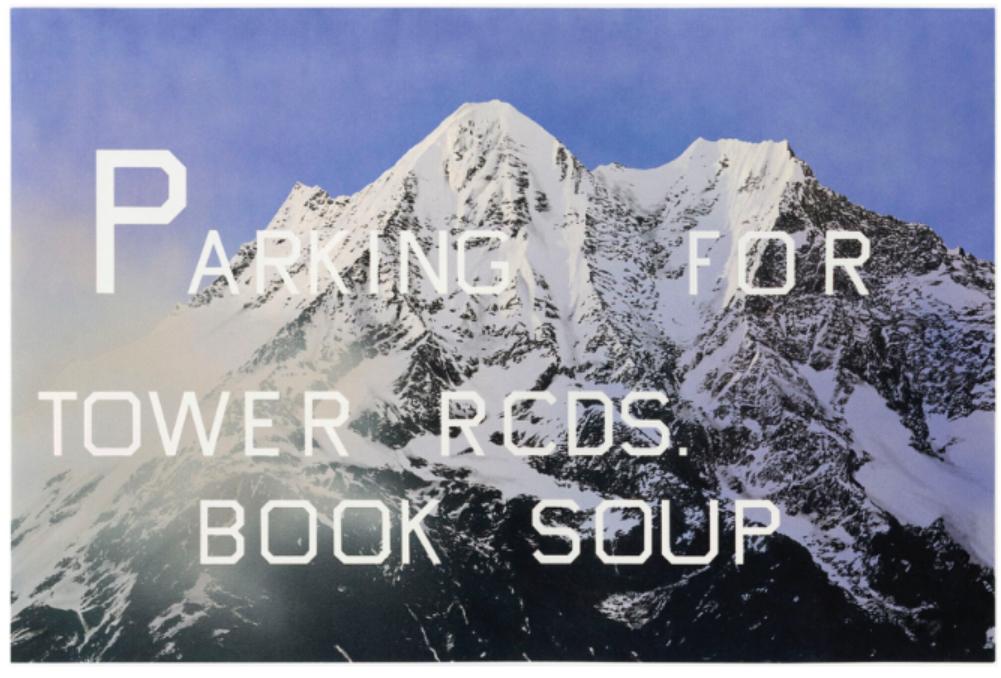
Ed Ruscha, Parking for Tower Rcds. Book Soup, 1999. Solomon R. Guggenheim Museum, New York. © Ed Ruscha
Ruscha asserts that the mountain motif emerged from him “wanting to have a background and a foreground,” and this background draws specifically upon the distinctive atmosphere of the West. Just as Ruscha’s earlier landscape paintings of sunsets and his photographs of Los Angeles capture the specificity of the West Coast, his mountains articulate a specific western attitude which the artist experienced weekly, on his drives from the city to his rural retreat near Joshua Tree National Park. Most weekends, Ruscha would drive across the Mojave desert, experiencing the sublime sight of the Transverse Ranges towering over either side of the road.
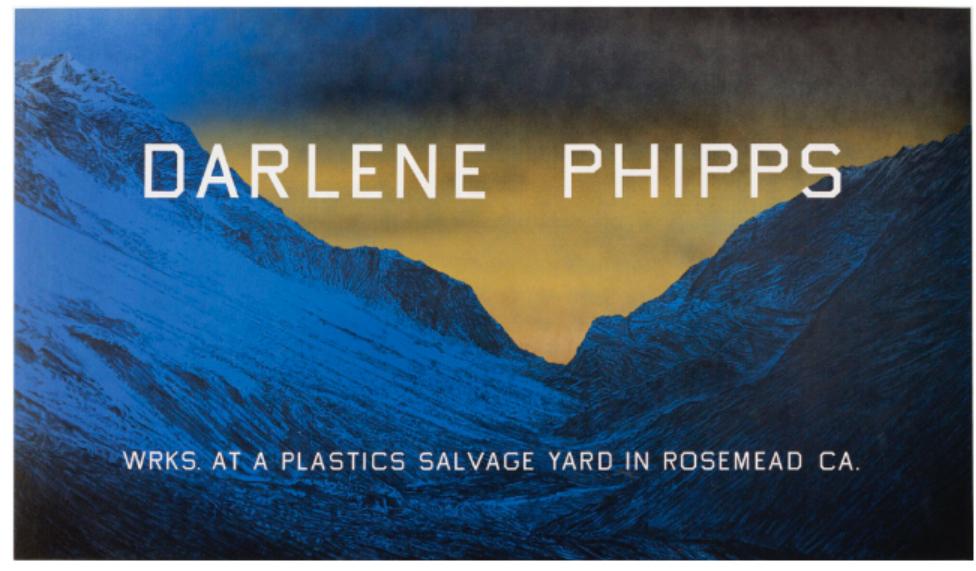
Ed Ruscha, Darlene Phipps, 2002. The Broad, Los Angeles. © Ed Ruscha
With over twelve mountain paintings in important international institutional collections, including in New York the Museum of Modern Art, the Whitney Museum of American Art, and the Solomon R. Guggenheim Museum, as well as the Broad in Los Angeles and the National Galleries of Scotland, the series has become one of the most recognizable and important out of Ruscha’s entire oeuvre. With its exceptional scale and novel interaction between text and backdrop, How Do You Do? is one of the most important works from the series, compellingly advancing his word paintings onto a new theoretical plane. Bringing together the sublimity of the Western landscape, the influence of theater and film backdrops, and Moby-Dick, Ruscha finds with How Do You Do? an enduring composition with which to play with the possibilities of text and paint.
Alvarado to Doheny, 1998
Phillips New-York: 13 May 2025
Estimated: USD 4,000,000 – 6,000,000
USD 4,900,000
Ed Ruscha Modern & Contemporary Art Evening Sale
Ed Ruscha’s text-based art fundamentally reshaped how we view the intersection of imagery and language. A quintessential West Coast artist, Ruscha embraced the visual culture of Los Angeles—its sprawling landscapes, both natural and artificial. This sensibility positioned him as a pioneer of the West Coast Pop Art movement. Drawing influence from artists like Jasper Johns and Robert Rauschenberg, Ruscha made text his lifelong medium, exploring its aesthetic properties and its slippery relationship with imagery. Most recently exhibited the group show, L.A. Story at Hauser & Wirth, the present work is a playful representation of the artist’s most recognizable subject matter and adopted hometown, Los Angeles.
“I’m not really painting mountains, but an idea of mountains.”
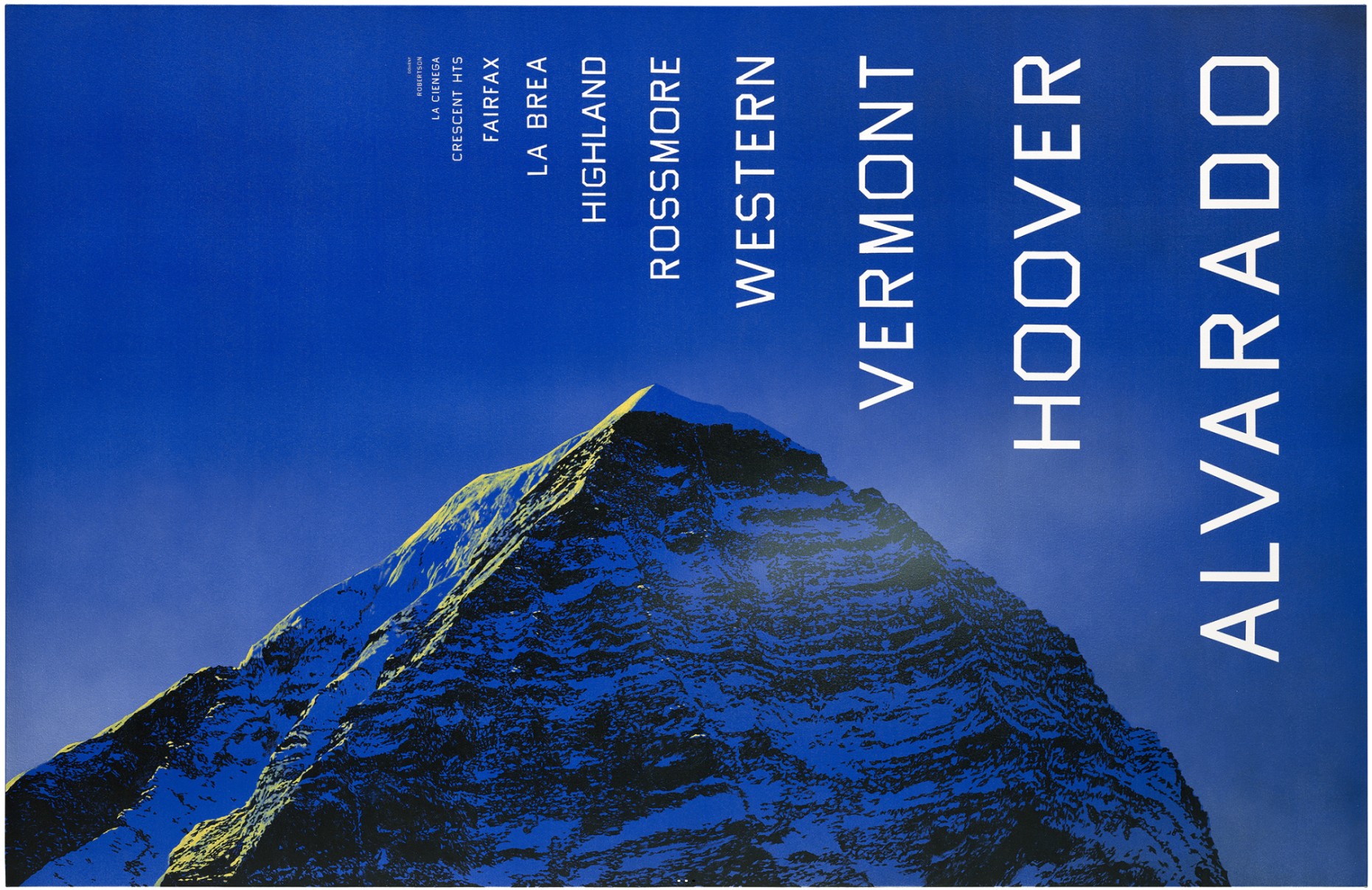
Ruscha often pulls words from memory and mass culture—advertising, print media, billboards—creating a kind of visual dictionary of American life.
“Some [words] are found, ready-made, some are dreams, some come from newspapers. They are finished by blind faith.”
As in the text-based work of his peers, such as Jenny Holzer and Barbara Kruger, Ruscha’s uses this popular language a vehicle for cultural critique. Employing the lexicon of popular media, the artist’s familiar graphics feel at once reassuring and disjunctive within the artist’s compositions, prompting the viewer to question how aesthetics and language present in their everyday media consumption.
Jenny Holzer, from Survival, 1985. Image: © Jenny Holzer / Art Resource, NY
Artwork: © 2025 Jenny Holzer / Artists Rights Society (ARS), New York
Hollywood—its icons, logos, and mythologies—has long been a staple of Ruscha’s visual language. In Alvarado to Doheny, painted in 1998, the iconic Paramount mountain emerges in crisp, snow-dusted detail. Paramount has used a stylized mountain logo since its founding in 1912, embedding it deeply into the visual language of American cinema. Here, Ruscha’s mountain, though similar, is distinct—more idea than replica—rendered in layers of vivid blue, sunlight grazing its peaks. Across this pristine landscape floats the phrase “Alvarado to Doheny,” stenciled in icy white, stark against the intense azure hue of the sky. The phrase itself is a visual and conceptual puzzle and while the in-painting text refers to the historic streets and surrounding neighborhoods of the Tinseltown area, “Alvarado to Doheny” hints at a quiet, static view of nature—at once artful and disorienting. A keen example of Ruscha’s sharp wit and fluency in word play, his dexterous use of image and text recalls the visual puns employed his Surrealist predecessors.
[Left] René Magritte, The Glass Key (La clef de verre), 1959. The Menil Collection, Houston. Artwork: © 2025 C. Herscovici / Artists Rights Society (ARS), New York
[Right] Marcel Duchamp, L.H.O.O.Q. Mona Lisa. 1919 (replica from 1930). Centre Pomidou, Paris. Image: © CNAC/MNAM, Dist. RMN-Grand Palais / Art Resource, NY, Artwork: © 2025 Association Marcel Duchamp / ADAGP, Paris / Artists Rights Society (ARS), New York
Ruscha presents a majestic landscape—an image of the sublime—only to overlay it with mundane typography. The grandeur of the mountain is undermined, or maybe enhanced, by the neutrality of the text.
“They’re not really mountains. They’re ideas of mountains… picturing some sort of unobtainable bliss or glory—rock and ways to fall, dangerous and beautiful.”
His landscapes are informed by photographs, memories of road trips, and imaginative reconfigurations. Rendered with the saturated light and hyperbolic palette, they are reminiscent of the hand painted sets for Hollywood soundstages. They are cinematic in their artificiality—flatter and more theatrical than real.
“I had a notion to make pictures by using words and presenting them in some way and it seemed like a mountain was an archetypal stage set. It was a perfect foil for whatever was happening in the foreground.”
This theatricality is underscored by the text itself. Applied with Ruscha’s custom typeface, “Boy Scout Utility Modern”—a straight-edged, style-less font he invented—the words take on a bureaucratic banality. “If the telephone company was having a picnic and asked one of their employees to design a poster,” he jokes, “this font is what he’d come up with.”iii It’s this tension—between grandeur and plainness, symbolism and absurdity—that defines Alvarado to Doheny. Angular and unbending, the almost mechanical stenciled letterforms dramatically interrupt the placid landscape behind them.
Ruscha has always insisted that the words in his paintings are intentionally void of traditional meaning.
“I like the idea of a word becoming a picture, almost leaving its body, then coming back and becoming a word again.”
For him, words are visual material, capable of evoking emotion purely through color, typeface, and context. “Words have temperatures to me,” he explains. “When they reach a certain point and become hot words, then they appeal to me.”v In Alvarado to Doheny, that temperature is cold—detached, consumerist, ironic.
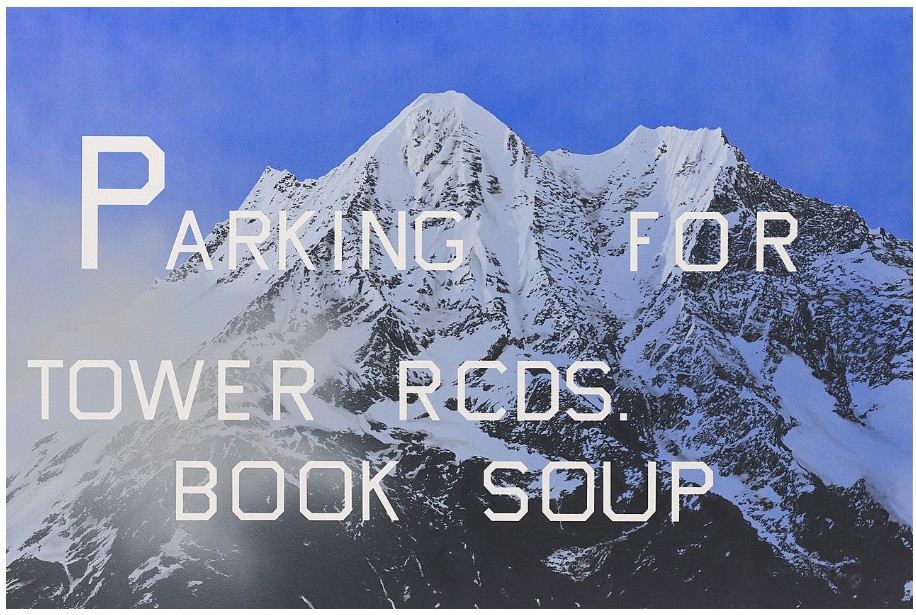
Ed Ruscha, Parking for Tower Rcds. Book Soup, 1999. Solomon R. Guggenheim Museum, New York. Artwork: © Ed Ruscha
Historically, mountains have symbolized the sublime—from Caspar David Friedrich’s romantic landscapes to the majesty of Albert Bierstadt’s Hudson River School imagery and Ansel Adams’ environmental photography. They represent the unreachable, the divine. But Ruscha subverts this tradition. Instead of spiritual awe, he offers slogans and slick surface. Obstructing the statuesque snow caped peak with his stylized white text spelling out the names of active Los Angeles thoroughfares, he undermines the quiet solemnity of the American landscape tradition. This discordant relationship of urbanity and the pastoral, text and image is characteristic of Ruscha’s gleeful irreverence towards semantics. The words seem to hover, disconnected from the landscape, caught in a liminal zone between real and unreal. Even nature, in Ruscha’s hands, becomes another layer of advertising, another image filtered through pop culture and contradiction. Albert Bierstadt, Merced River, Yosemite Valley, 1866. The Metropolitan Museum of Art, New York.
“A lot of my paintings are anonymous backdrops for the drama of words… In a way, they’re words in front of an old Paramount Studios mountain. You don’t have to have a mountain back there—you could have a landscape, a farm. I have a background, foreground. It’s so simple… just meant to support the drama, like the Hollywood sign being held up by sticks.”
Ruscha’s aim is not as much to create a pictorial representation, as it is to create a contrast which provokes the viewer to reconsider their understanding of the relationship between text and image. Ruscha’s irreverent treatment of the mountainous background in the present painting is almost Duchampian; a refashioning of imagery borrowed from the public consciousness in his own vision he challenges visual understanding itself. With Alvarado to Doheny, Ruscha delivers not just an image, but a meditation—a cool, wry critique of how we see, what we read, and the meanings we assign to the seemingly ordinary. In his hands, even the most majestic view becomes a canvas for doubt, irony, and play.
Blast Curtain, 1999
Christie’s New-York: 14 May 2025
Estimated: USD 4,000,000 – 6,000,000
USD 6,616,000
ED RUSCHA (B. 1937), Blast Curtain | Christie’s
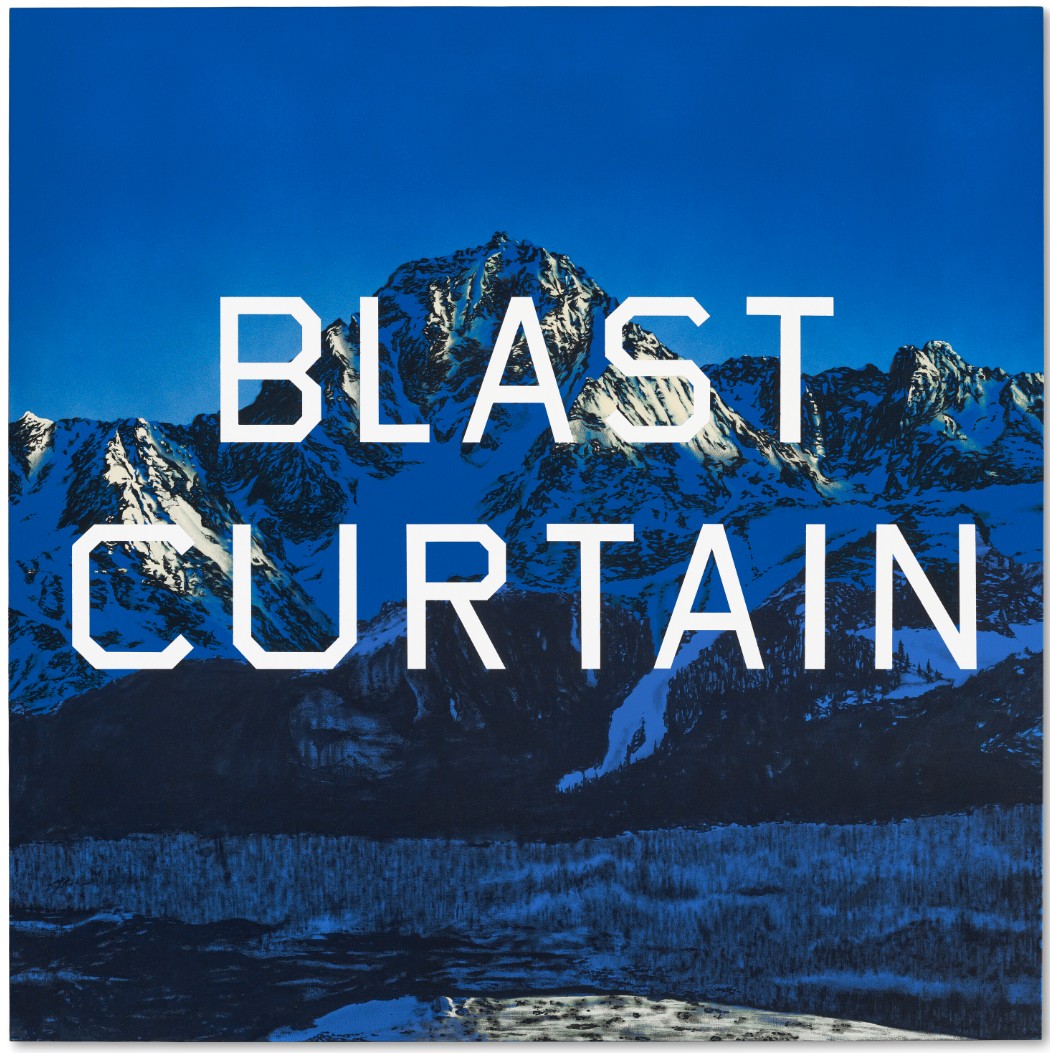
ED RUSCHA (B. 1937)
Blast Curtain, 1999
Acrylic on canvas
64×64 inches (162.6 x 162.6 cm)
Signed and dated ‘Ed Ruscha 1999’ (on the reverse)
Painted in 1999, Blast Curtain is an exquisite early example of the ‘mountain paintings’ that have become one of the most iconic series of paintings in Ed Ruscha’s acclaimed career. In this work, the words “BLAST CURTAIN” are spelled out in pristine ice-white lettering and placed centrally against a vista of sun-kissed, snow-capped peaks, forested plains and a clear blue sky. An intrepid explorer of the territory where language and image meet, it is Ruscha’s choice combinations of words and images that achieve the visual and conceptual dissonance that have distinguished him as one of America’s finest living artists. Testament to their significance within his oeuvre, over a dozen examples of Ruscha’s mountain paintings are included in the world’s most important museum collections including the Museum of Modern Art, New York, the Whitney Museum of American Art, New York and the Tate, London. Blast Curtain was included in a major exhibition of Ruscha’s work in 2000, which toured to museums including Hirshorn Museum, Washington D. C.; Museum of Modern Art Oxford; and Kunstmuseum Wolfsburg.
Despite the sublime beauty of the setting and the flawless execution of the painting, it is the power of words that has consistently motivated Ruscha. The sources for the text he chooses are various, encompassing phrases that he sees while driving, reading the newspapers, watching movies, listening to the radio or that he remembers from dreams. In Blast Curtain, it was the feeling the words evoked in Ruscha that made them memorable. “I like the idea that the anxiety of modern life could be hiding behind any given mountain,” he has said, “and the sounds of the city and everything. ‘Blast Curtain’ comes from those walls, those steel walls that you see at airports to cut down on sound. And I thought that this had to be painted so I could gammer down these words. And then the idea of some kind of fantasy mountains with the palindromic idea began to like say there’s some sort of crazy metaphor for glory.” (E. Ruscha, quoted in G. Adams, “King of pop art”, Independent, 8 October 2011).
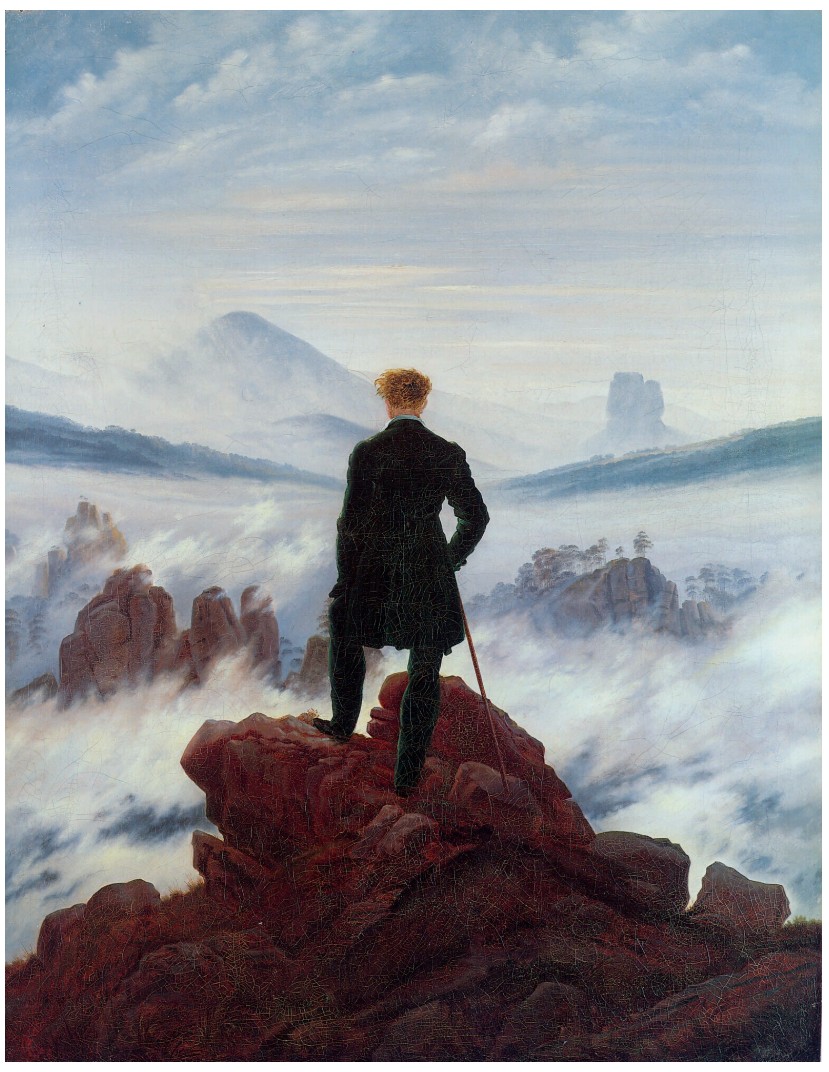
Caspar David Friedrich, The Wanderer above a Sea of Mists, 1818. Hamburger Kunsthalle, Hamburg.
Although Ruscha has worked with natural landscape imagery since the 1980s, he first began to use alpine scenery as a backdrop in 1997. Borrowing and amalgamating imagery from magazine illustrations, postcards and photographs, he chose the mountain setting because of its ability to combine visual drama with cultural ubiquity. “It’s just a setting,” he says. “A theatrical setting that is quite anonymous. It’s immediately recognizable … so that it just lands itself in the world of acceptance” (E. Ruscha, quoted at ibid.) This painting was made by initially spraying a thin layer of acrylic paint onto the canvas, then working the image up with flawless precision using a brush. The text was applied using a stencil, in an angular font that Ruscha devised himself called ‘Boy Scout Utility Modern’. It is unusual for having no curves, and it too has a neutral quality that appeals to Ruscha, who has used it in his work since 1980.
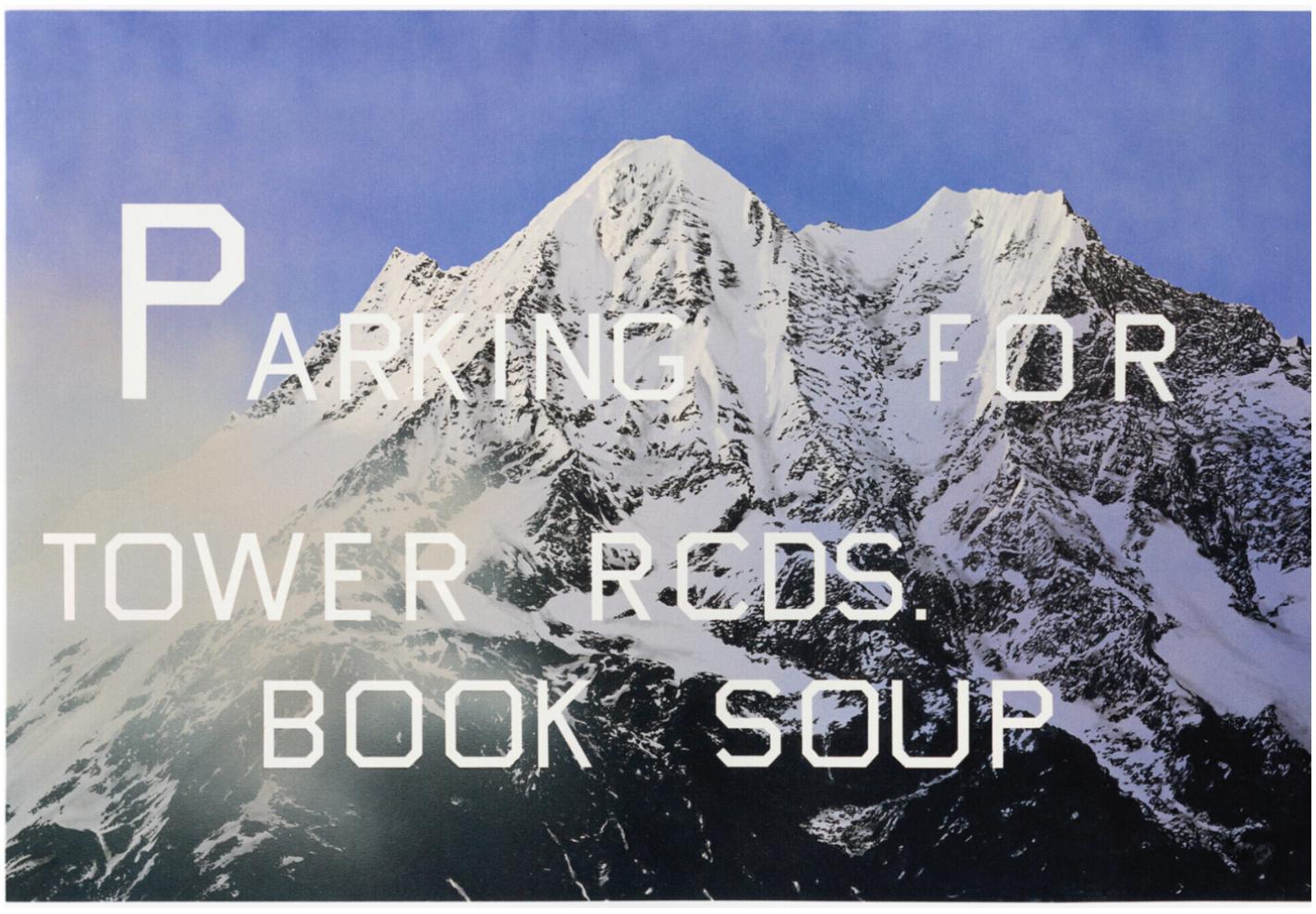
Ed Ruscha, Parking for Tower Rcds. Book Soup, 1999. Solomon R. Guggenheim Museum, New-York
Born in Oklahoma City in 1937, Ruscha moved to Los Angeles in 1956 to study design at Chouinard Art Institute. Although the landscapes that appear in his works are anonymous, they are steeped in the iconography of Hollywood and the vernacular architecture of the city he has for so long called home. He has explained, “A lot of my paintings are anonymous backdrops for the drama of words. In a way, they’re words in front of an old Paramount Studios mountain. You don’t have to have a mountain back there – you could have a landscape, a farm. I have a background, foreground. It’s so simple. And the backgrounds are of no particular character. They’re just meant to support the drama, like the Hollywood sign being held up by sticks” (E. Ruscha quoted in R.D. Marshall, Ed Ruscha, London, 2003, p. 239).
Flags
Georges’ Flag, 1999
Sotheby’s New-York: 18 November 2024
Estimated: USD 8,000,000 – 12,000,000
USD 13,650,000
Georges’ Flag | The Now and Contemporary Evening Auction | 2024 | Sotheby’s
ED RUSCHA (b. 1937)
Georges’ Flag, 1999
Oil on canvas
38 x 129 1/8 inches (96.5 x 328 cm)
Signed and dated 1999 (on the reverse)
Signed, titled and dated 1999 (on the stretcher)
The American flag billows against an extraordinarily vermilion sky in Georges’ Flag from 1999, an operatic ode to Ed Ruscha’s career-long commitment to Pop, conceptualism, and his distinctly West Coast sensibility. A vast and epic painting of histrionic significance, Georges’ Flag deploys the intellectually loaded image of the national banner so aptly appropriated in the most seminal works by Ruscha’s peers – from Jasper Johns, Robert Rauschenberg, to Claes Oldenburg – and now stands as a testament to the artist’s longstanding interest in the American West. In the 1960s, Ruscha first powerfully asserted that language itself was representation – that text could be legible as both word and object – thus pushing the boundaries of the then-nascent Pop movement. In 1985, however, his investigation of words’ dual truth as both text and image turned its attention into the semiotic realm of signs and signals with his first flag paintings. Georges’ Flag marks the last and largest canvas in an early group of six paintings centering the American flag executed between 1985-99, a motif so resonant and resounding that Ruscha would later reengage it in 2017 and feature it prominently in his solo exhibition at the Vienna Secession, Ed Ruscha: Double Americanisms. Georges’ Flag thunders at panoramic scale, an absorptive, arresting vista which commands its viewer’s salutations and meditations on a country’s iconography.
“I think that there is one fundamental thing, and that is that artists are attracted to glamour, you see. The American way of life possesses a certain siren voice of some kind, which is glamorous to almost any society…”
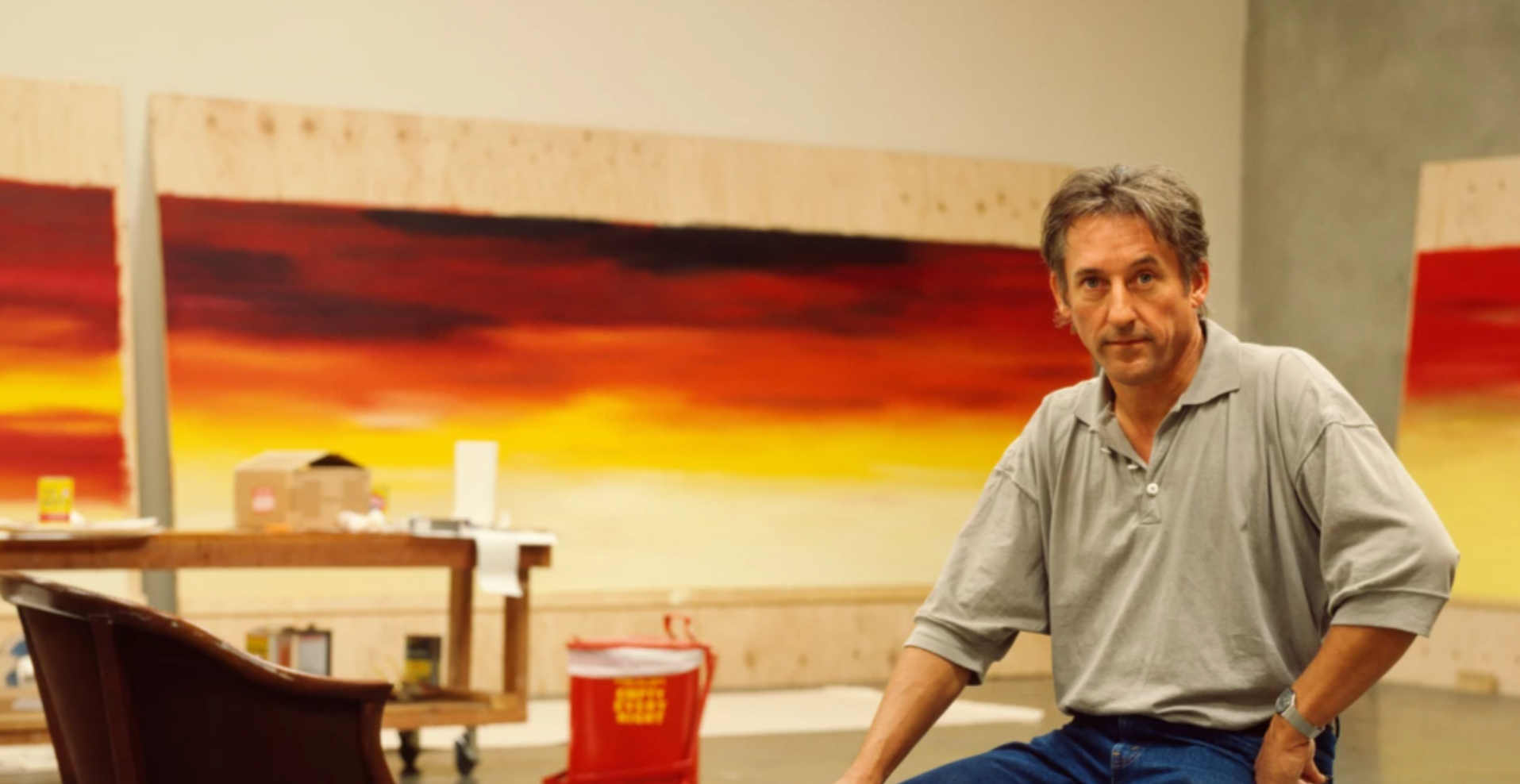
Ed Ruscha in his studio, 1985. Photo © Evelyn Hofer/Getty Images. Art © Ed Ruscha
Cascading from crimson and scarlet to sun-soaked yellow, the sky is ablaze with the expansive beauty of American terrain, simultaneously evoking a sunrise and a sunset. Each rippling crease in the flag is rendered with illusionistic precision, yet its cinematic, spotlit illumination lends its image a graphic force that belies its ostensible realism. Spanning over ten feet in width, this glowing vista offers Ruscha’s riposte on a centuries-long legacy of American painting, from the triumphal flag in Emanuel Leutze’s Washington Crossing the Delaware from 1851 to the bombastic mountain ranges of the Hudson River School. The stars and stripes which rained down in Childe Hassam’s Impressionist cityscapes of Fifth Avenue now undulate with solid, galvanizing gravitas, and the tattered yet resilient flag in photographs from the Civil War to Ground Zero is summoned here perfected at larger-than-life scale, hyperbolically saturated and totally immersive.
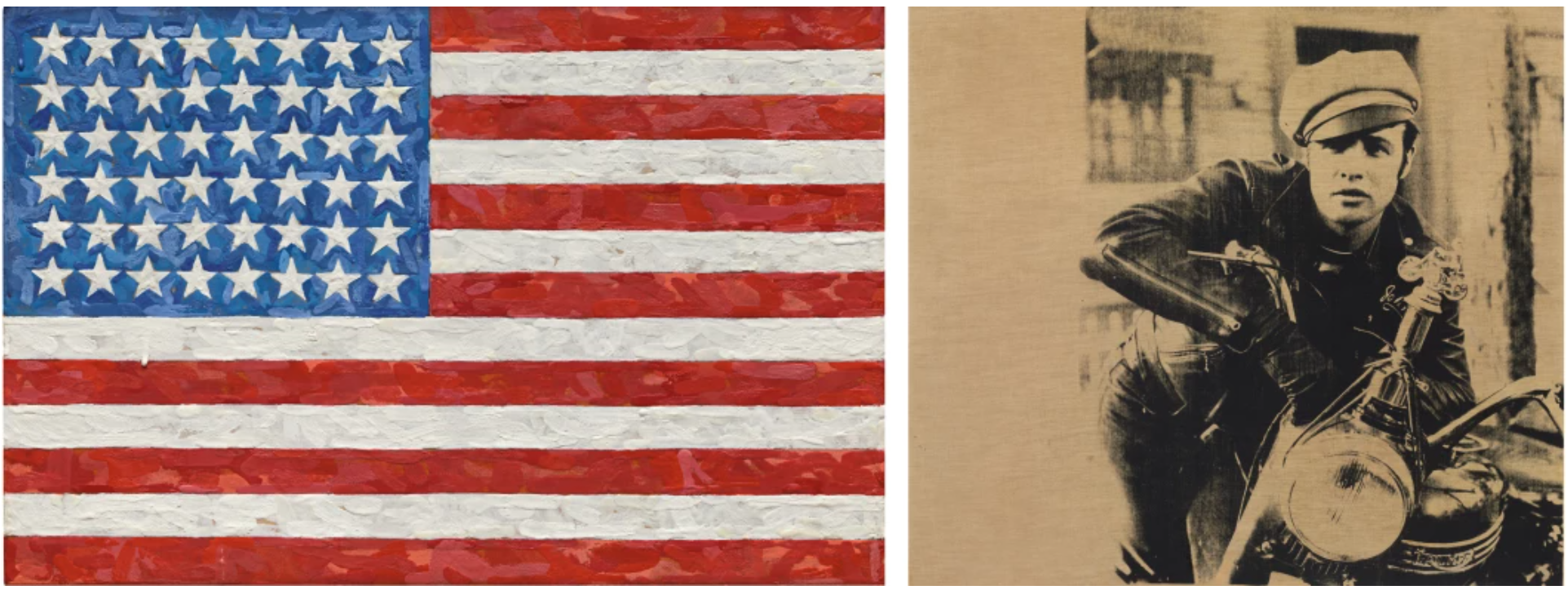
Left: Jasper Johns, Flag, 1983. Private Collection. Sold at Sotheby’s New York in November 2014 for $36 million. Art © Jasper Johns/Licensed by VAGA, New York, NY. Right: Andy Warhol, Marlon, 1966. Private Collection. Image © Bridgeman Images. Art © 2024 Andy Warhol Foundation for the Visual Arts / Artists Rights Society (ARS), New York
The flag has long been regarded as a proto-Pop icon. The1950s and 60s saw American artists take the omnipresent flag’s image as one to detach, flatten, and recontextualize with the same rote deadpan as they had with advertisements, comic illustrations, consumer logos, and journalism. Ruscha, however, not only saw the flag as something to sublimate into his work but rather a vessel for semiotic interrogation. Just as he had with text – developing an oeuvre comprised of words liquified, mangled with C-clamps, or evicted altogether with censor strips – Ruscha’s interest in the flag went far beyond its formal qualities into how its connotative powers could be culled and subverted. By blurring the taught boundaries between language, text, and visual object, Georges’ Flag satiates the impression of grandeur so heavily and historically associated with the flag, whilst probing what it is the viewer recognizes in its image.
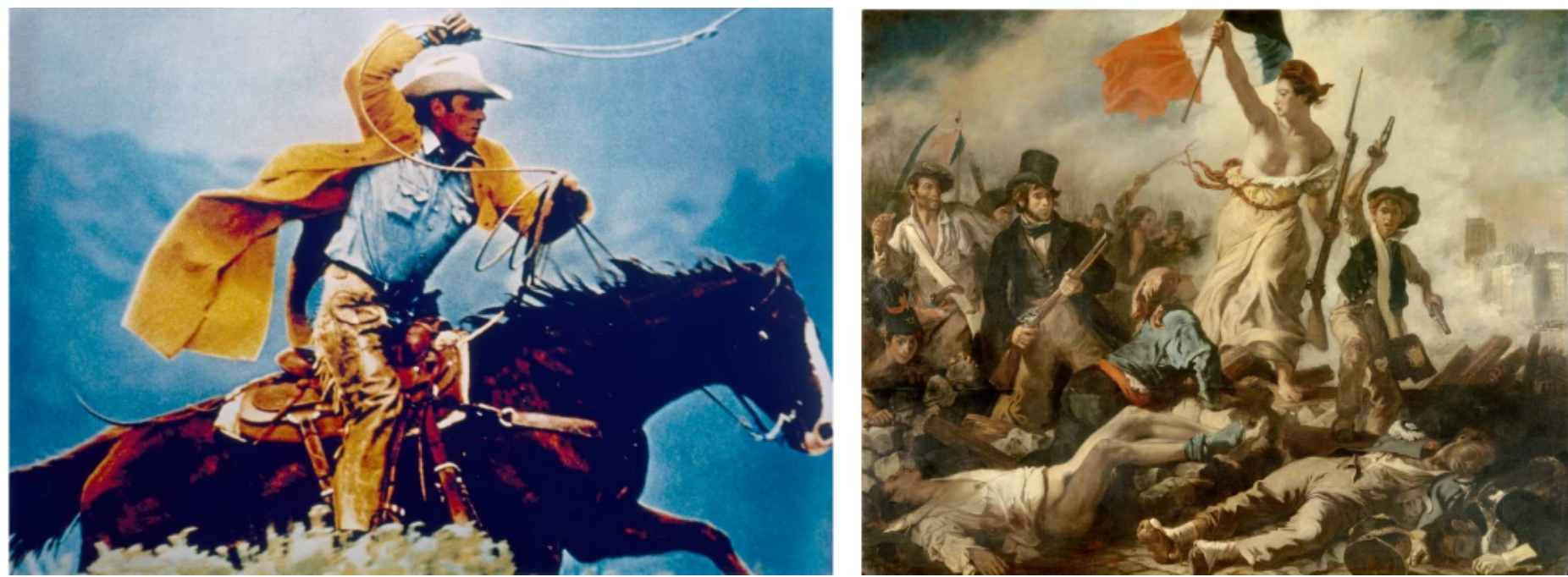
Left: Richard Prince, Untitled (Cowboy), 1991-92. San Francisco Museum of Modern Art. Art © 2024 Richard Prince. Right: Ferdinand Victor Eugene Delacroix, Liberty Leading the People, July the 28th, 1830, 1830. Image © Photo Josse / Bridgeman Images
The compositions of Ruscha’s first interpretations of the flag originated from the artist’s photographic studies of a large flag above the Santa Monica Freeway. Once part of the storied Route 66, this highway has come to serve as a metaphor for the perceived freedom of opportunity, rugged hardiness and idealized lifestyle of the American West, and it was the very road Ruscha drove when he moved from his hometown of Oklahoma City to Los Angeles in 1956. This stretch of highway was also the primary route taken by those heading westward from the Midwest for California in the 1930s during the Great Depression, now concretized in collective memory by such iconic novels as John Steinbeck’s The Grapes of Wrath, and has taken on a mythic quality in its promises of transformation. Many of the cultural and geographical landmarks Ruscha passed on his own drive, from the Rocky Mountains to Standard Oil gas stations, would profoundly inspire his output. These historic and autobiographical elements further heighten the underlying narrative of the present work, as Ruscha tackles myth and reality, personal history and national legacy.
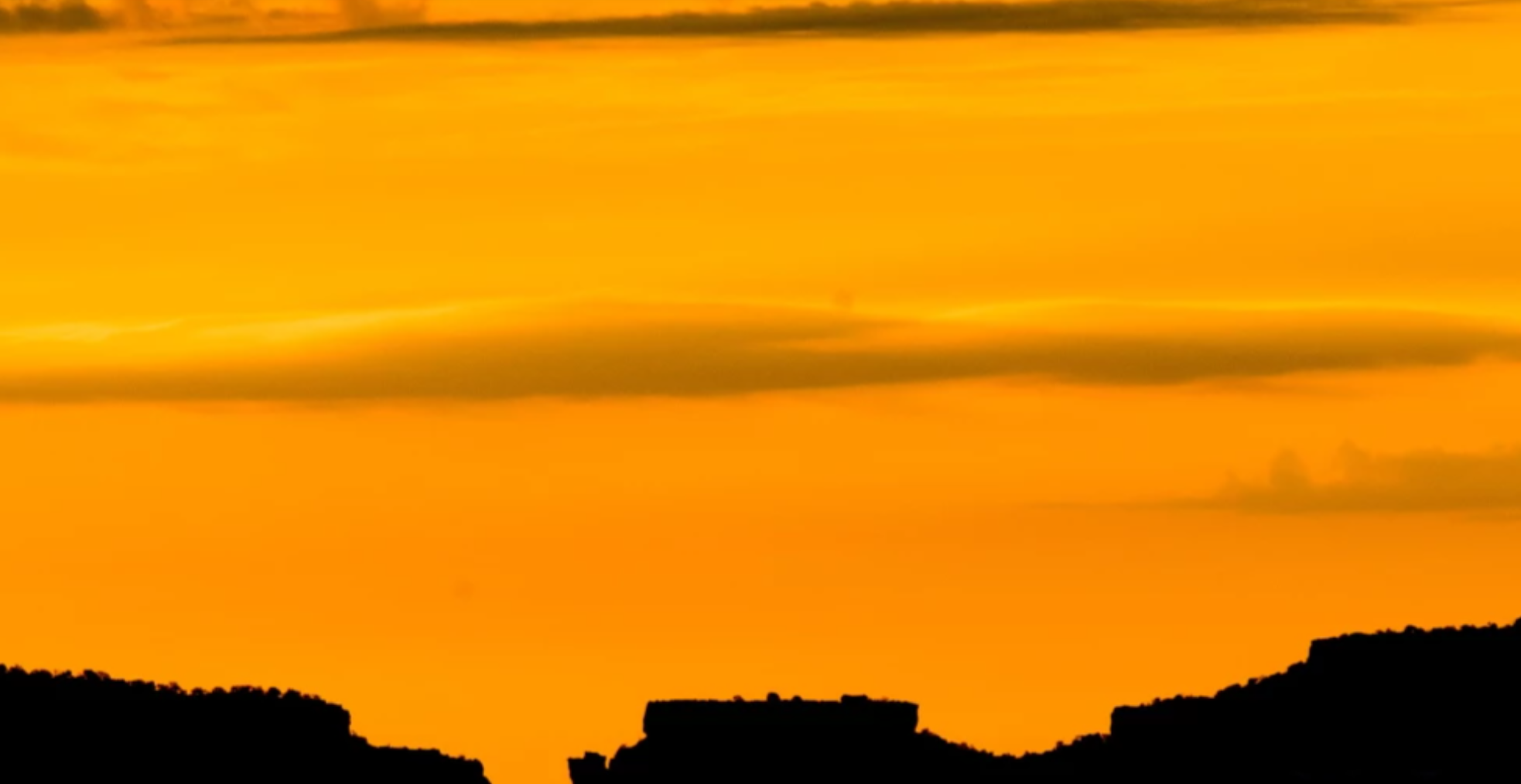
Sunset in the Grand Canyon, Arizona, 2018. Photo © Patrick Gorski/NurPhoto via Getty Images
A resplendent display of American mythos and magnitude depicted with sweeping horizontality, Georges’ Flag mesmerizes with the undeniable affect of a hot and unending sky and the star-spangled potency of the flag. Evincing a preconceptual interest in semiotics using the vernacular of Pop, the present work rhapsodizes Ruscha’s protean brilliance as he navigates the lexicon of American cultural heritage. Capturing the immensity of the country it represents and the spirit of those that call it home, Georges’ Flag is a paragon of Ruscha’s iconic oeuvre.
Plenty Big Hotel Room (Painting for the American Indian), 1985
Sotheby’s New-York: 8 November 2023
Estimated: USD 5,000,000 – 7,000,000
USD 6,079,500
ED RUSCHA (b. 1937)
Plenty Big Hotel Room (Painting for the American Indian), 1985
Oil on canvas
84×60 inches (213.4 x 152.4 cm)
Signed and dated 85 (on the reverse)
An American flag blows adject to its flagpole, suspended in the wind and ostensibly untethered in Ed Ruscha’s uncanny Plenty Big Hotel Room (Painting for the American Indian) from 1985. Punctuated by four black “censor strips,” the inclusion of text with which Ruscha had become so synonymous has been redacted. In the 1960s, Ruscha first powerfully asserted that language itself was representation – that text could be legible as both words and objects – thus pushing the boundaries of the then-nascent Pop movement. In 1985, however, he begins to not only omit text but employ a device that signals its erasure, making the present work one of the earliest examples of this suggestive breakthrough. 1985 would also mark the first year the American flag would appear in Ruscha’s oeuvre, the present work being the second ever time he included the motif. Here, the flag stands as an intellectually loaded appropriation of the symbol that so many of his Pop peers – Jasper Johns, Claes Oldenburg, among others – interpreted and incorporated in their most seminal works, now functioning as a testament to Ruscha’s longstanding interest in the American West and solemn tribute to the indigenous peoples of the United States to whom this work is dedicated. Ruscha channels the political, cultural and art historical resonance of the American flag into Plenty Big Hotel Room (Painting for the American Indian) and turns it onto itself. The word “hotel” is used both critically and sardonically, a signifier Ruscha described as “luxury in a land taken over from the Indians” (the artist quoted in Robert Dean, ed., Edward Ruscha: Catalogue Raisonné of the Paintings, Volume Three: 1983-1987, New York, 2007, p. 154).
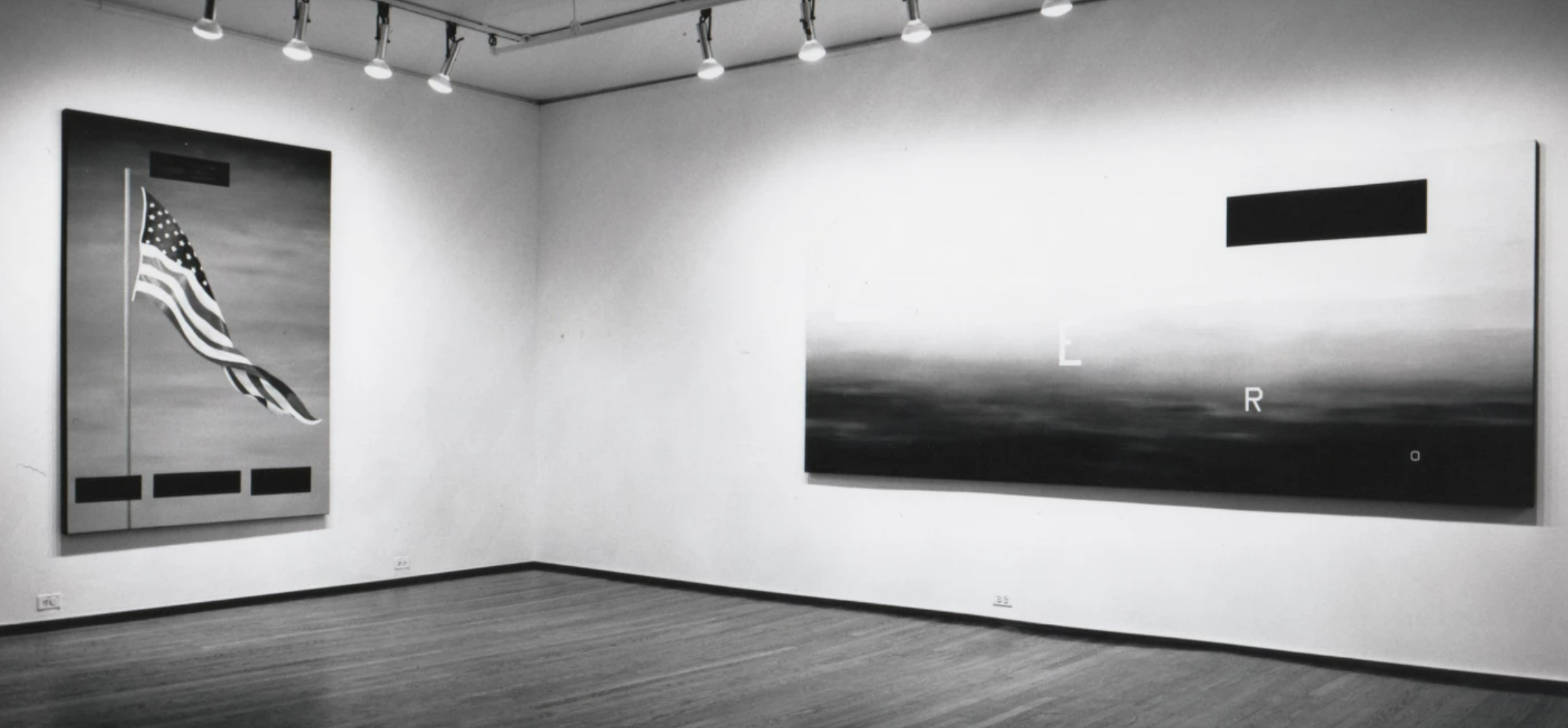
Further impressed upon the viewer by the present work’s monumental scale and surreal modulations of color and shadow, the claim to the North American continent is proven facile, Americana sentiments are made ironic and the nationalist valence of the ubiquitous flag is upended. Ruscha, whose text-centric paintings earned him international acclaim two decades earlier, proves himself continually innovative in his semantic sleight of hand. Simultaneously signaling absence and presence, the black bars of Plenty Big Hotel Room (Painting for the American Indian) and eerily free-floating flag testify to the gravity of this moment in Ruscha’s career and his keen attention to the full connotative nuances and broader historical implications of the words and images he relies upon. Billowing at the command of the wind and dramatically illuminated, the painted flag here is immediately understood to be its referent, but the image is not entirely coherent: the flag is not tied to its pole. As the canvas’ compositional logic unravels before the viewer, the flag’s associations with the triumph of Manifest Destiny begin to collapse as well. The American flag, infinitely deployed in American media, homes and public spaces, dichotomously stands an iconic nationalist image and fraught symbol of conquest, disenfranchisement and theft.
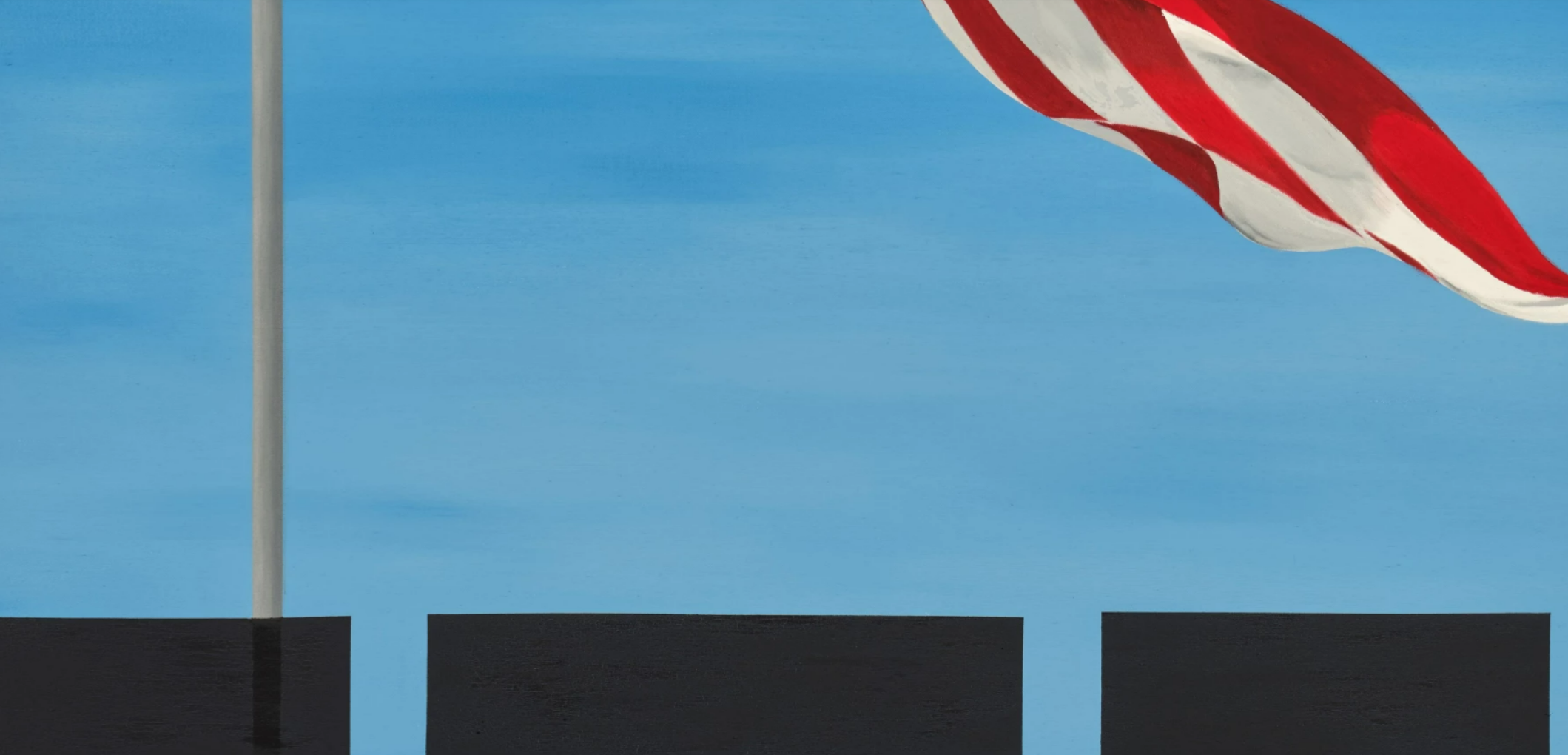
In a clever, Johnsian gesture, Ruscha’s use of his “censor strips” toys with what we understand or know to be true and here subverts it before our eyes. Ruscha began exploring the use of redacted text in 1985 with reverse stenciled censor strips, created by blocking out a rectangle of gessoed canvas with tape and leaving it unpainted. The formal properties of these strips allude to de-classified censored government documents, heightening the political implications baked into the iconography, and communicate the pervasive silencing of indigenous voices in the ownership and management of land that was theirs. Although Ruscha’s images purport a kind of apoliticism, his “censor strips” betray a different position. Functioning as an aesthetic and ontological play on what the mind assumes when left to its own devices, Ruscha’s redacted “text” is not text at all; there are no words underlying the strips that have been covered, and they were never there to begin with – so successful is Ruscha in this conceptual coup, however, that we interpret that to be the case. “This is Ruscha at his most slyly ironic,” Robert Dean and Erin Wright commented on the present work, “with the American flag seen as a symbol of hegemony, the plenty big hotel room of the title […] in tandem with its dedication to the American Indian would suggest reservation (with both meanings of the word) as well as what is transitory, nomadic, and vanishing.” (Robert Dean, ed., Edward Ruscha: Catalogue Raisonné of the Paintings, Volume Three: 1983-1987, New York, 2007, p. 154)
Silouhette Paintings
Yip Yip, 1994
Sotheby’s New-York: 16 May 2025
Estimated: USD 600,000 – 800,000
USD 2,246,000
Yip Yip | Contemporary Day Auction | 2025 | Sotheby’s
ED RUSCHA (b. 1937)
Yip Yip, 1994
Acrylic on canvas
84×60 inches (213.4 x 152.4 cm)
Signed and dated 1994 (on the reverse)
A striking example from Ed Ruscha’s acclaimed Silhouette series, Yip Yip from1994 presents a dramatic portrait of a howling coyote whose high-pitched vocalizations of ‘yip yip’ are palpable through his pose. Amidst a hazy grayscale ether, the animal’s silhouetted visage emerges, creating a visual experience that is at once alluring in the viewer’s proximity to the potentially dangerous creature and unsettling in the surreal quality of the impending dusk that surrounds. The diagonal thrust formed by the upward turn of the coyote’s nose calls to mind the same formal compositional device present in many of Ruscha’s most iconic paintings, including his portrayal of the Hollywood sign and Standard Oil stations from the 1960s, while his use of airbrushing ignited a new direction in his continuously innovative artistic vocabulary. Using an airbrush, Ruscha created an atmosphere reminiscent of the chiaroscuro light of film noir and contrived a low, cinematic vantage point that positions the viewer as silent witness to the scene, akin to a spectator peering upwards at a film in a state of awe or vulnerability.
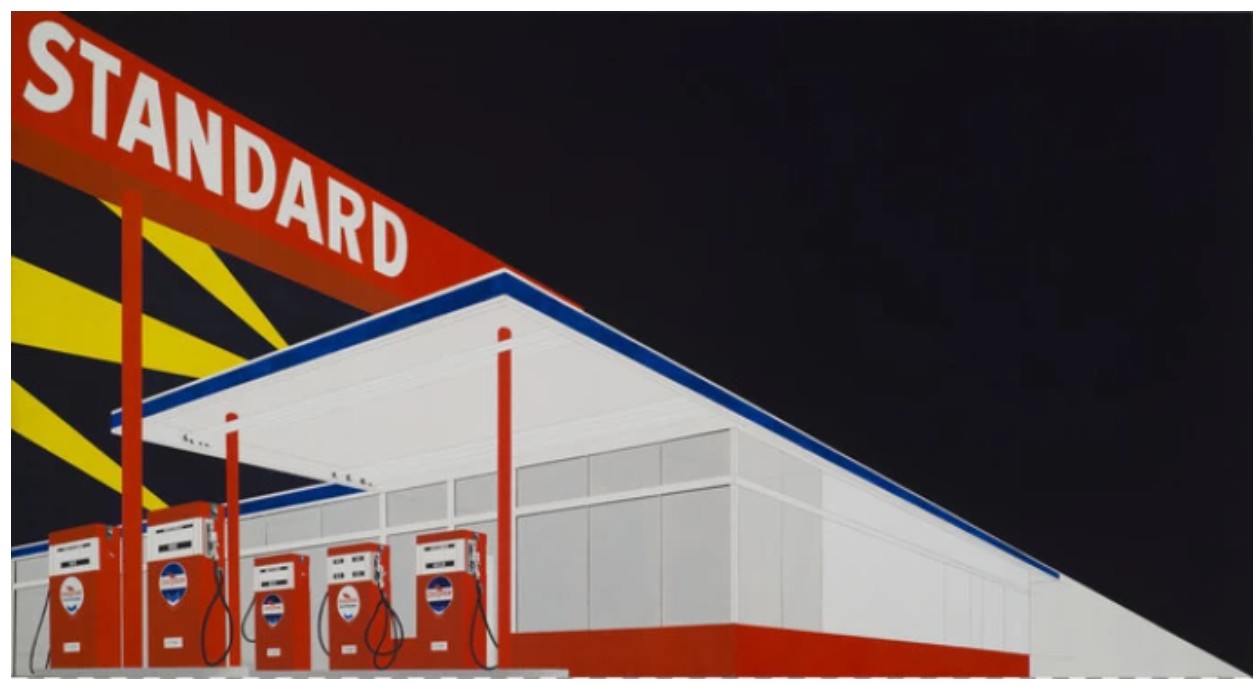
Ed Ruscha, Standard Station, Amarillo, Texas, 1963, Hood Museum of Art, Dartmouth College. IMAGE © Ed Ruscha
Throughout his six-decade-long career, Ed Ruscha has consistently demonstrated his shrewd wit and technical dexterity, yet the artist has reinvented his artistic language throughout his oeuvre, continually producing new bodies of work that solidify his position as one of the most innovative and influential artists of his generation. In contrast to Ruscha’s earlier ‘cool’ paintings, created to echo the slick language of advertising with a sharply delineated hard-edged approach, the velvety aura present in his Silhouette series started in the mid-1980s arose from the artist’s interest in making paintings without any visible brushstrokes. In his quest to explore the creative possibilities afforded by a spray gun, Ruscha deftly achieved an atmospheric softening of focus, making the familiar outline of a coyote appear strange and frightening in the present work.
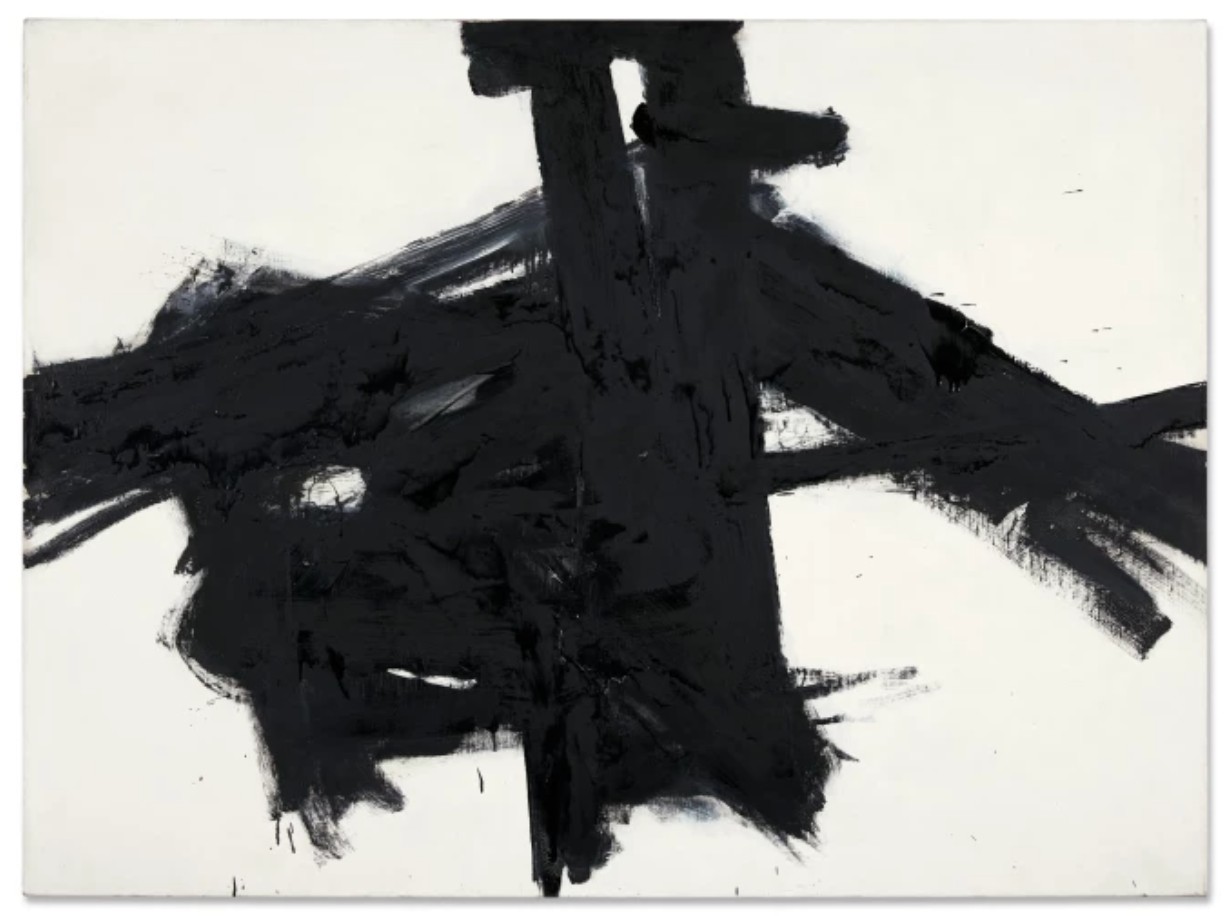
FRANZ KLINE, CROSSTOWN, 1955. PRIVATE COLLECTION.
SOLD AT SOTHEBY’S NEW YORK FOR $12 MILLION ON 15 NOVEMBER 2021.
In his Silhouette series, Ruscha also embraced the challenge of eliminating color to work primarily in the nuances of black and white, citing the art historical precedent of Franz Kline, as well as his lifelong interest in film, as inspiration. This body of work encompasses the nebulous silhouettes of imagery including slipper ships, covered wagons, suburban houses, and animals, which collectively refer to America’s history of westward migration and the subsequent mythic fantasy of the American West, as well as broader themes of memory and the passage of time. The coyote portrayed in the present work connects with Ruscha’s Oklahoma upbringing, a South Central United States locale he left at the age of nineteen to study at the Chouinard Art Institute (now California Institute of the Arts) and his experiences traversing the open road of desert and prairie habits where coyotes are most commonly spotted while photographing his celebrated gas stations. As a canine known for its characteristics of independence and intelligence, the coyote can also be viewed as a surrogate for the trailblazing artist.
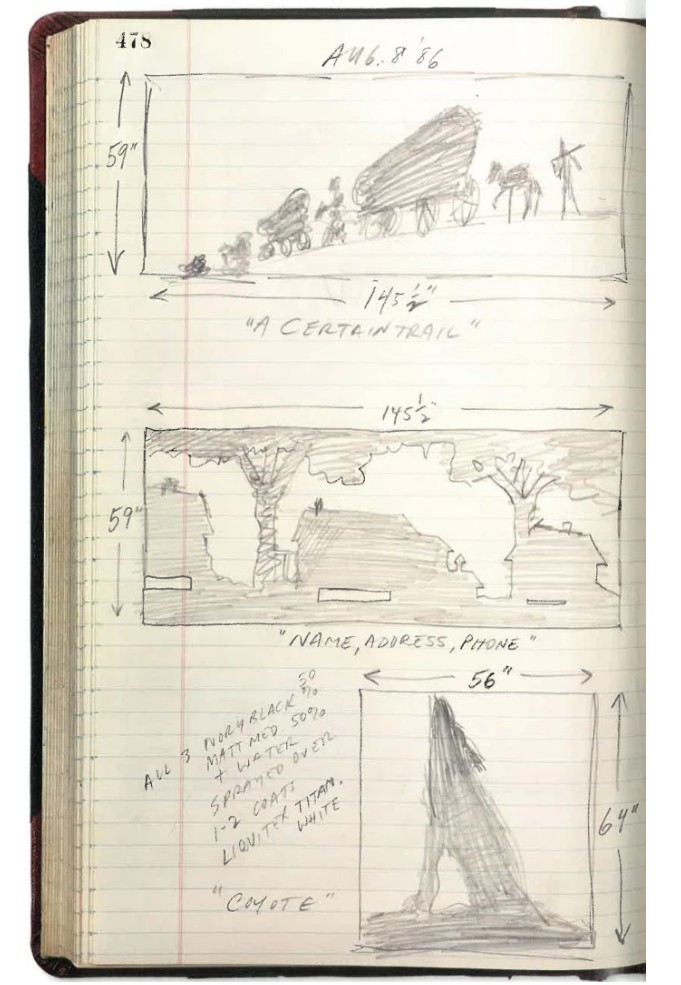
A sketch for the present work illustrated in the artist’s studio notebook, August 1986.
Robert Dean, ed., Edward Ruscha: Catalogue Raisonné of the Paintings, Volume Five: 1993-1997, New York 2012
While Ed Rusha’s exploration of the creative possibilities achieved with a spray gun in his Silhouette series served as an extension of his ongoing exploration with innovative media and methods, ranging from caviar to gunpowder to chocolate, the paintings also serve as an evolution of his longstanding engagement with language and sound. As an evolution and extension from this point, by the mid-1980s, Ruscha found he could also imbue the silent medium of painting with sound without his former reliance on the intermingling of text and image to convey an audible effect. In Yip Yip, Rusha evokes a textual narrative with sound implicitly present, both in the title and coyote’s gesture, serving as an evolution of the artist’s longstanding exploration of the shape, sound and feeling of words.
Ed Ruscha’s Silhouette Series Paintings in Institutional Collections
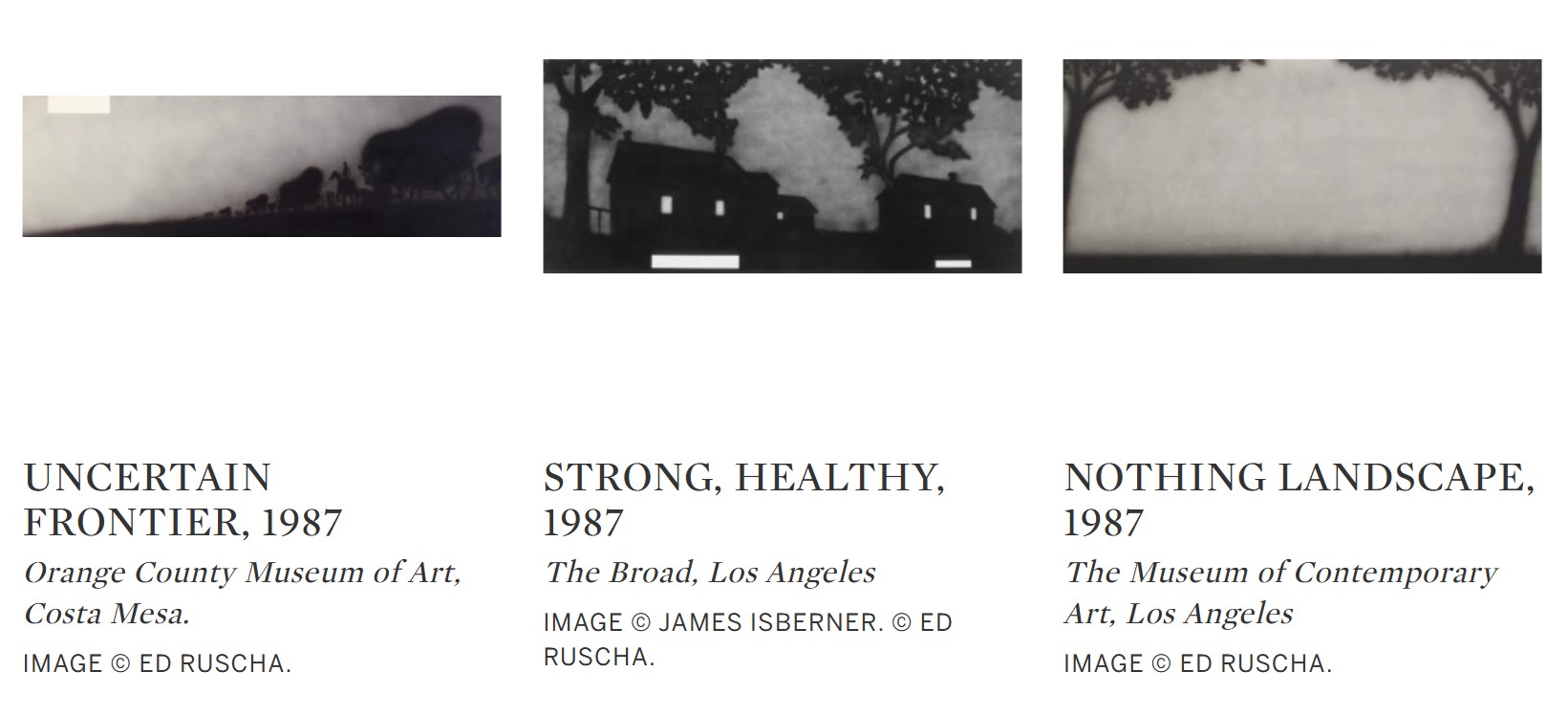
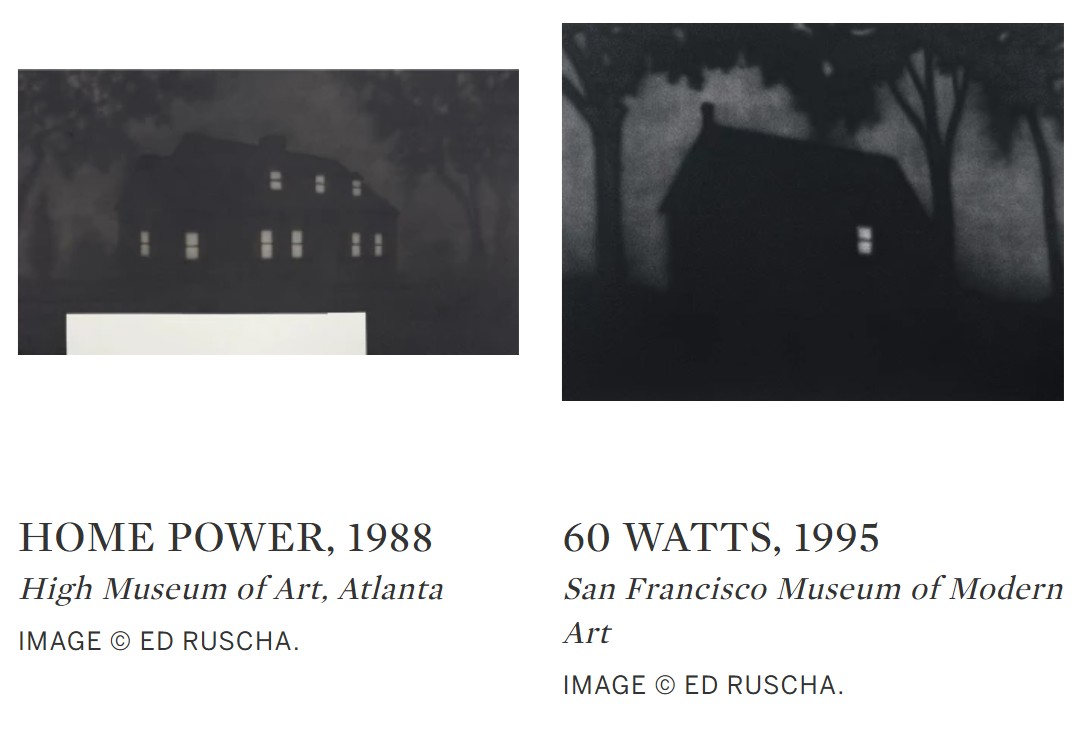
Ed Rusha’s Silhouette series was embraced by the art world at the outset of its creation, serving as a testament to the artist’s perpetual reinvention that defines his artistic legacy. In 1987, the Whitney Museum of American Art, New York selected two Silhouette paintings executed the year prior to include in their Biennial and in 1991, the Museum of Modern Art, New York acquired a similar animal painting from the series, an elephant titled Jumbo, for their permanent collection. In addition to early critical acclaim, the enduring importance of this body of work within the artist’s oeuvre is reinforced by the presence of examples from the series in the collections of The Broad, Los Angeles, the San Francisco Museum of Modern Art; The Museum of Contemporary Art, Los Angeles and the High Museum of Art, Atlanta, among many others.
Dry Frontier, 1987
Christie’s London: 5 March 2025
Estimated: GBP 600,000 – 800,000
GBP 945,000 / USD 1,209,600
ED RUSCHA (B. 1937), Dry Frontier | Christie’s
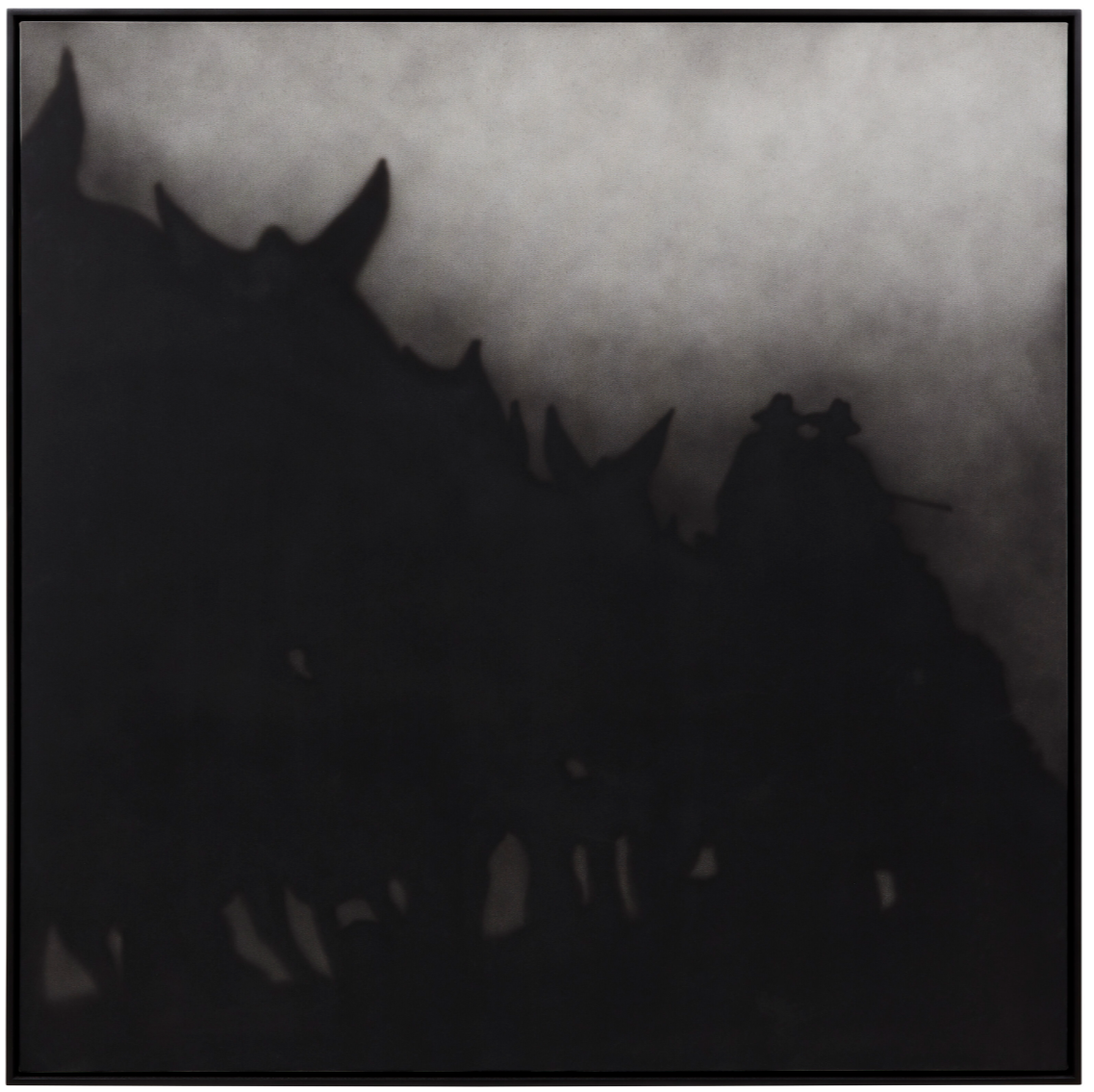
ED RUSCHA (B. 1937)
Dry Frontier, 1987
Acrylic on canvas
72x 72 inches (182.9 x 182.9 cm)
Signed and dated ‘Ed Ruscha 1987’ (on the reverse)
Signed, titled and dated ‘ED RUSCHA “DRY FRONTIER” 1987’ (on the stretcher)
Two frontiersmen drive their horse-drawn Conestoga wagon ever-westward in Ed Ruscha’s Dry Frontier (1987), one of the artist’s iconic silhouette paintings. An atmospheric twilight is evoked through Ruscha’s careful layering of airbrushed paint, a medium he adopted in the mid 1980s seeking ‘stroke-less’ paintings for inscrutable, text-free images. A sharp diagonal cuts dramatically across the picture plane, formed by the dense blackness of the convoy against a pale, smoky sky.
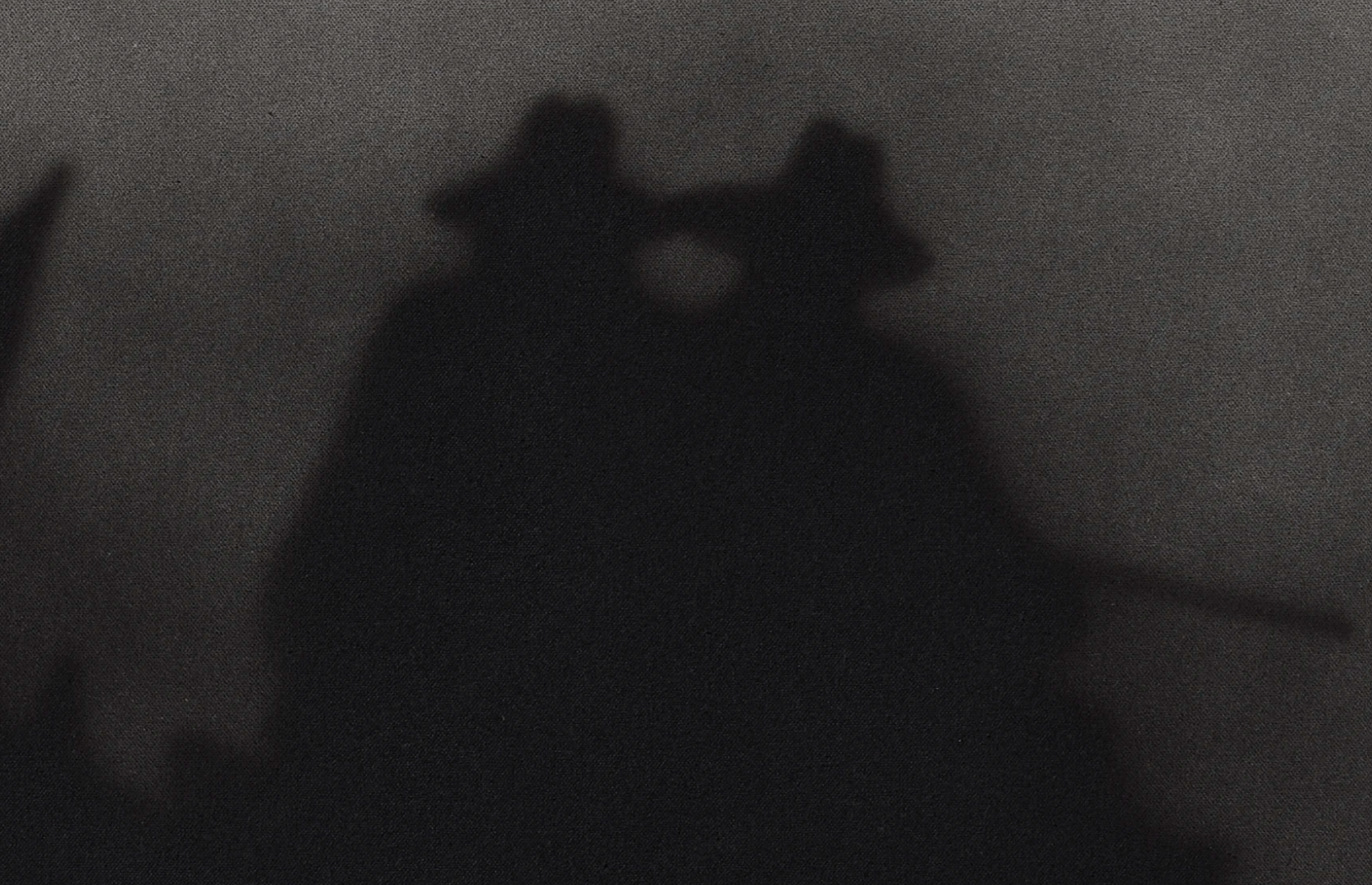
Assuming a low, cinematic vantage point, the viewer becomes a silent witness to the scene, like a spectator to a film. Since the early 1960s Ruscha has examined the powerful semiotic function of the stereotype, playfully yet poignantly probing the words, phrases and imagery of American mass culture. In the present work, Ruscha looks to the ‘West’ as a carefully cultivated national mythology. Ruscha’s silhouette paintings are held in several major museum collections, including a variation on the theme of the present work, Uncertain Frontier (1987), in the collection of the Orange County Museum, Newport Beach. A recent major retrospective of the artist’s work, Ed Ruscha / Now Then, travelled from the Museum of Modern Art, New York, to the Los Angeles County Museum of Art across 2023-2024.
Ruscha’s silhouette series drew closely on the Los Angeles-based artist’s proximity to the film industry, featuring imagery that conjured old Hollywood Westerns: howling coyotes, horses, desert cacti and desolate houses. As a young man Ruscha had journeyed from Oklahoma City to Los Angeles, and the significance the word ‘Western’ held additional resonance for the artist. His first California studio was located on Western Avenue, Hollywood. Despite their cinematic, even photographic feel, Ruscha’s sources for the silhouettes were most often imaginary, indebted to the overall spirit of the Western genre rather than any one image or film. The composition of the present work could be a film-still from any number of movies, in which the camera lies low as a horse and wagon rattle through the frame. The effect is heroic and otherworldly, and at the same time intimately familiar. The horses and their cargo will charge onwards, beyond the picture, so despite the fullness of its composition the canvas contains a sense of expectant spaciousness: the vast and liberatory possibility of the West.
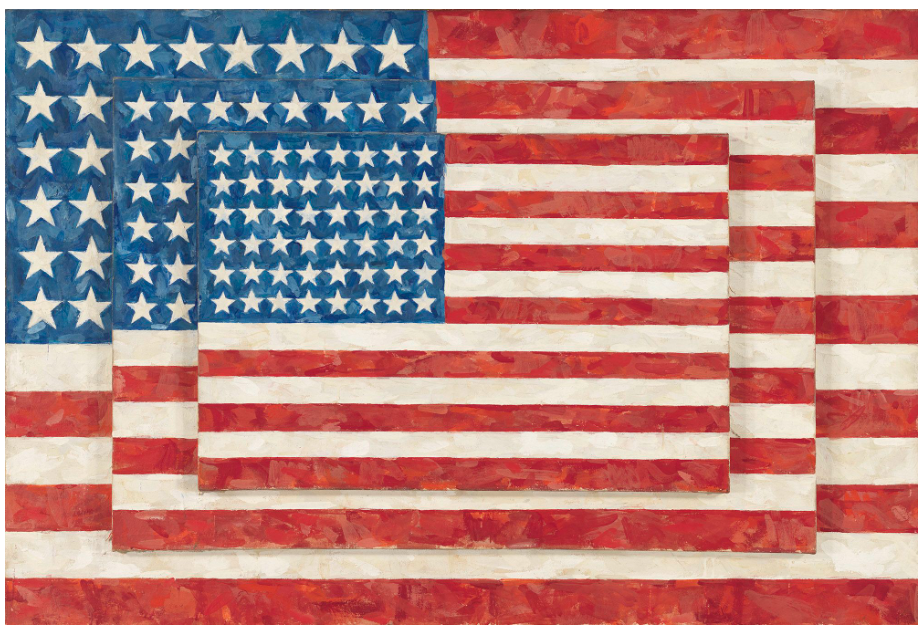
Jasper Johns, Three Flags, 1958. Whitney Museum of American Art, New York. Artwork: © Jasper Jones, DACS 2025. Digital image: © 2025 Whitney Museum of American Art / Licensed by Scala.
The critic Christopher Knight suggests that ‘a primary difference between Ruscha’s word-paintings and his silhouettes is the difference between speaking and listening’ (C. Knight, ‘Against Type: The Silhouette Paintings of Edward Ruscha’, Parkett, No. 18, 1988, p. 84). In the present work, there is a sense of the artist mining his own visual library. The diagonal which cuts across the composition, while accentuating the convoy’s forward-driving momentum, also recalls such iconic early Ruscha works as Large Trademark with Eight Spotlights (1962) and his Standard Station series. The latter were themselves inspired by earlier photographs, collated in the artist book Twentysix Gasoline Stations (1963), which documented Ruscha’s own westward voyage along Route 66—the storied highway to the modern American West.
“I don’t have any Seine River like Monet.
I’ve just got US 66 between Oklahoma and Los Angeles.”
Two decades later that road no longer existed, having been formally decommissioned two years before Ruscha painted the present work, and replaced with a series of new, high-speed interstate superhighways. With its vision of American pioneers of the past, Dry Frontier haunts its contemporary moment like a lost photograph emerging gradually from a national subconscious.
Howl, 1986
Phillips New-York: 20 November 2024
Estimated: USD 600,000 – 800,000
USD 1,481,750
Ed Ruscha – Modern & Contemporary … Lot 144 November 2024 | Phillips
ED RUSCHA
Howl, 1986
Acrylic on canvas
78 1/4 x 63 7/8 inches (198.8 x 162.2 cm)
Signed and dated “Ed Ruscha 86” on the reverse
Signed, titled and dated “EDWARD RUSCHA “HOWL” 1986” on the stretcher
Ed Ruscha’s Howl, 1986, opts for an airbrush over the traditional paint brush to employ a smoky, hazy setting for its subject – a lone coyote. Standing at almost six and a half feet tall, the present work is an exceptional example of Ruscha’s Silhouette paintings. Creating a grainy, almost eerie backdrop for the howling coyote, shades of black and gray coalesce into one sooty hue, connecting the present work to the Old Hollywood films that inspired the artist throughout his practice. Howl has been in the same Los Angeles private collection since 1986 and has been exhibited widely across the United States and Europe, most notably included in the artist’s survey at the Hirshhorn Museum and Sculpture Garden, Washington, D.C. in 2002, and at the Moderna Museet, Stockholm in 2010. Ruscha adopted the airbrush in the mid-1980s. This technique allowed the artist to create soft, atmospheric edges in his paintings, the result of which are devoid of hard lines and brushstrokes, which allow the central images to emerge slowly from their neutral backgrounds. The graininess and muted color palette in the Silhouette paintings mimics Old Hollywood film noir – a huge influence on Ruscha’s practice. Inverting the Western movie trope of fading to black, the coyote in Howl is rendered in a black gradient, fading into the shadowy grisaille background, highlighting the drama and enigma of the subject. Eschewing the precision of the artist’s hand, the delicate, airbrushed paint falls loosely around the coyote in various shades of black and gray. These varying tones, which highlight simply light and dark, are reminiscent of chiaroscuro employed by Old Masters such as Leonardo da Vinci, Caravaggio and Peter Paul Rubens. Though Ruscha’s airbrushed compositions purposefully exclude minute attention to detail found in Old Master paintings, he utilizes a similar effect of light fading into dark, emphasizing this technique through his choice of media.
Peter Paul Rubens and Frans Snyders, Prometheus Bound, circa 1611–1618, Philadelphia Museum of Art. Image: Philadelphia Museum of Art, Purchased with the W.P. Wilstach Fund, 1950, W1950-3-1
Started in the 1980s, Ruscha’s Silhouette paintings represented a continuing innovation in the artist’s practice. Experimenting with unconventional media throughout his life – such as gunpowder and vegetable dye – the use of the airbrush paved a new way for Ruscha’s artistic output. These paintings were the artist’s largest canvases to date, and differ from the rest of Ruscha’s oeuvre with the absence of text. But instead of calling this work “Coyote,” Ruscha instead chose to call it the sound which the coyote makes, challenging our pre-conceived notions of language and how it relates to image, or a play on the effects of sound versus the effects of the visual. Instead of using text in an explicit, overt way to inform the action, by including the text for “HOWL” somewhere within the painting, Ruscha relies on the animal itself to bring sound to the painting.
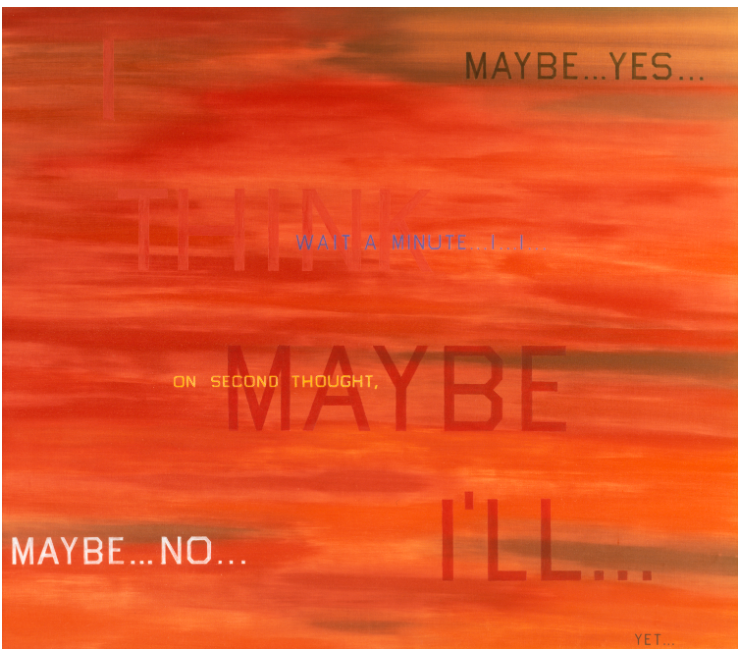
Ed Ruscha, I Think I’ll…, 1983, National Gallery of Art, Washington, D.C. Image: National Gallery of Art, Washington, D.C., Gift of Marcia S. Weisman, in Honor of the 50th Anniversary of the National Gallery of Art, 1990.126.1, Artwork: © Ed Ruscha
Without text, the present work and the Silhouette paintings allow the effects of light and shadow to take the forefront. Abandoning the Pop-like representations of iconic brands and simple words that preceded it, the present work adopts a more muted color palette reminiscent of a black and white photograph. Indeed, Ruscha himself relates these images to photography –
“The dark paintings come mostly from photography, although they are no photographically done or anything. I feel that they are related to the subject of photography – they are dark and strokeless, they’re painted with an airbrush.”
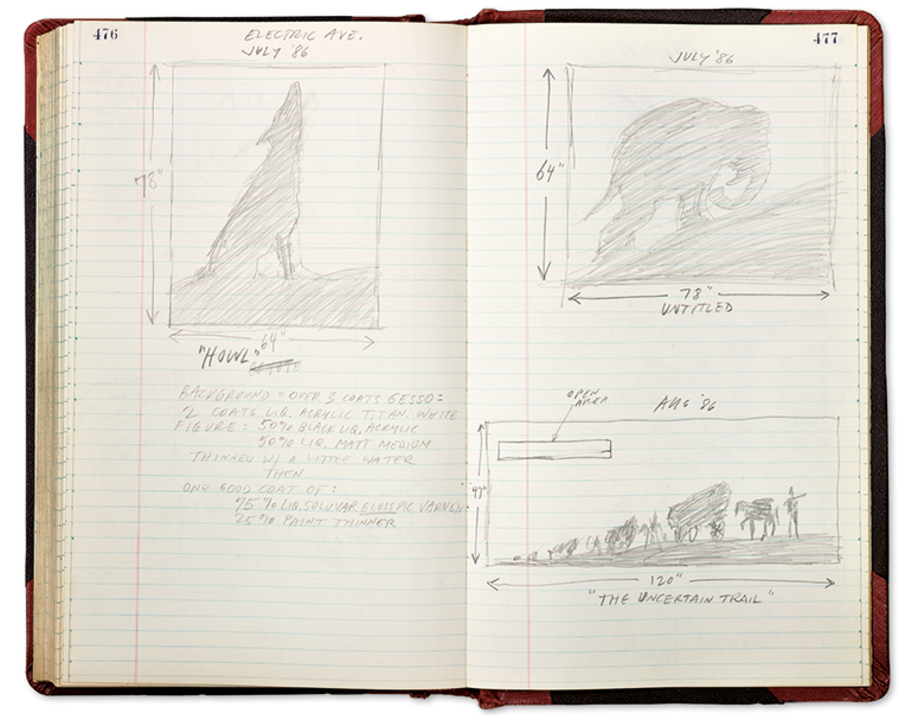
The present work illustrated in the artist’s sketchbooks. Image/Artwork: © Ed Ruscha
Though best known as a California artist, Ruscha grew up in Oklahoma, and incorporated many references to the West throughout his practice. Choosing the coyote as the lone subject in Howl, Ruscha pays homage to the wide-open expanses from which he came, providing a reference to his suburban upbringing out West. The coyote is mostly nocturnal, and yet here, the animal is eerily rendered as if emerging from the dawn. Often described as a trickster in Native American lore, the animal comes to life in the present work through the layering of the airbrush, which in turn tricks the eye and forces the viewer to contemplate whether the animal is coming or going into the shadowy mist. The combination of mythical and nostalgic is distinctly Ruscha—a nod to both his Western roots and fascination with storytelling in Old Hollywood and the Old West, this time without any words to frame a narrative.
Drugs, Hardware, Barber, Video, 1987
Sotheby’s New-York: 1 March 2024
Estimated: USD 600,000 – 800,000
USD 508,000
Drugs, Hardware, Barber, Video | Contemporary Curated | 2024 | Sotheby’s (sothebys.com)
ED RUSCHA (b. 1937)
Drugs, Hardware, Barber, Video, 1987
Acrylic on canvas
72×72 inches (182.9 x 182.9 cm)
Signed and dated 1987 (on the reverse)
Against the ominous grisaille of charcoal and slate, four white “censor strips” punctuate the cinematic still of an unoccupied playground swing in Ed Ruscha’s Drugs, Harber, Barber, Video of 1987. Executed at the height of the artist’s fascination with black-and-white movies, the present work also bears the mark of his most significant artistic breakthrough of the 1980s: the inclusion of the censor strip motif. The inclusion of text for which Ruscha had become so synonymous in the 1960s has now been redacted; where he had made such a powerful case in his early work that language itself was representative – that text could be simultaneously legible as a word and an object – in 1985 he began to not only omit text but employ a device that so conspicuously signaled its erasure. Testament to Drugs, Harber, Barber, Video’s critical importance in the artist’s oeuvre, the present work has been exhibited internationally in many of Ruscha’s most monumental exhibitions, among them his eponymous surveys at the Musée National d’Art Moderne, Centre Georges Pompidou, Paris; Museum Boymans-van Beuningen, Rotterdam; and Robert Miller Gallery, New York, where it was acquired the year of its execution by Emily Fisher Landau and held in her distinguished collection for the last four decades.
JENNY HOLZER, COLIN POWELL GREEN WHITE, 2006. PRIVATE COLLECTION. IMAGE © COURTESY: JENNY HOLZER / ART RESOURCE, NY. ART © 2023 JENNY HOLZER / ARTISTS RIGHTS SOCIETY (ARS), NEW YORK
Achieved through a reverse stenciling process, the four starkly white strips on the surface of Drugs, Harber, Barber, Video ostensibly stand in for each word of the title – but Ruscha makes this impossible to conclusively discern. Created by blocking out a rectangle of gessoed canvas with tape and leaving it unpainted, Ruscha’s use of his “censor strips” toys with what we understand or know to be true and here subverts it before our eyes. The formal properties of these strips allude to de-classified censored government documents and functions as both an optical and ontological play on what the mind assumes when left to its own devices. In the present work, Ruscha’s redacted “text” is not text at all: there are no words underlying the strips that have been covered, and they were never there to begin with – so successful is Ruscha in this conceptual coup, however, that we interpret that to be the case.
Uphill Driver, 1986
Sotheby’s New-York: 9 November 2023
Estimated: USD 800,000 – 1,200,000
USD 1,016,000
ED RUSCHA (b. 1937)
Uphill Driver, 1986
Acrylic on canvas
54×120 inches (137.2 x 304.8 cm)
Signed and dated 1986 (on the reverse)
Ed Ruscha’s Uphill Driver, executed in 1986, is exemplary of the artist’s career-defining series of Silhouette paintings by way of a hauntingly provocative image of a car poised on a steep hill. Ruscha’s Silhouette paintings, characterized by their black and white, hazily rendered airbrushed technique, boldly depart from the text-based paintings that initially earned him critical acclaim. In Uphill Driver, the viewer encounters an eerie sedan, frozen in time and space as it ascends a steep incline. A ghostly figure at the wheel is scarcely discernible – a mere grayish blur. Ruscha’s use of the airbrush imparts a palpable sense of mounting precarity, heightened by the inclusion of a striking diagonal element. As a lasting symbol of American cultural nostalgia, Uphill Driver offers a singular expression of Ed Ruscha’s remarkable ability to imbue the quotidian with the unnatural.
Other Series
Cosmo, Selma, Vine, 2000
Sotheby’s New-York: 19 November 2025
Estimated: USD 1,500,000 – 2,000,000
METRO PLOT PAINTING
PASSED
Cosmo, Selma, Vine | Contemporary Day Auction | 2025 | Sotheby’s
ED RUSCHA (b. 1937)
Cosmo, Selma, Vine, 2000
Acrylic on canvas
70 x 138 1/8 inches (177.8 x 350.8 cm)
Signed and dated 2000 (on the reverse)
As a monumental paradigm of Ed Ruscha’s acclaimed series of Metro Plot paintings, Cosmo, Selma, Vine stands as a masterful expression of the artist’s enduring investigation into the unstable relationship between image, symbol, and text. Exceptional within Ruscha’s prolific oeuvre, the present work belongs to a rare number of paintings that pay homage to the one city that has remained both his muse and his mirror: Los Angeles. Rendered from an unconventional viewpoint that sits somewhere between a naturalistic vista and a reductive map, Cosmo, Selma, Vine abstracts a key Hollywood intersection into a distilled reflection on urban form, perception, and language. Challenging the utilitarian objectivity of the map, Ruscha transforms this fragment of cityscape into an enigmatic meditation on place, perception, and memory, realized with unparalleled technical and conceptual precision.
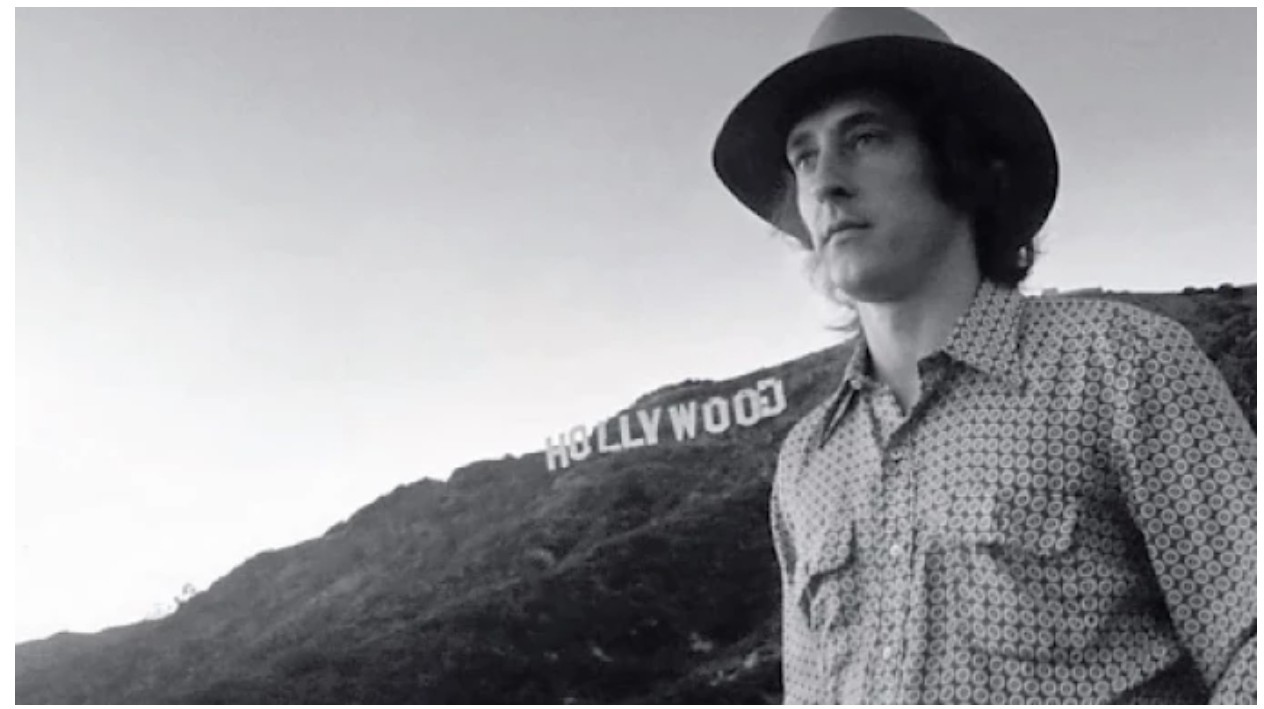
Portrait of Ed Ruscha with Los Angeles’s Hollywood Sign
Spanning nearly 12 feet in width, Cosmo, Selma, Vine is the largest work in this important series alongside two paintings of equal dimensions, one of which – Hollywood to Pico – belongs to the Whitney Museum of American Art in New York. Overwhelming bodily proportions yet paradoxically cropped as an indistinct microcosm, Ruscha’s distilled urban landscape composes a disorienting symbolic geography that challenges our conception of scale and perspective. Drawing together tendencies of naturalistic representation, minimalist abstraction and the experience of space in metropolitan America, Cosmo, Selma, Vine is an enigmatically whimsical homage to the modernist grid. By compounding such a rich dialogue of cultural references with phenomenal virtuosity, Ruscha has created a true masterpiece of postmodern painting.
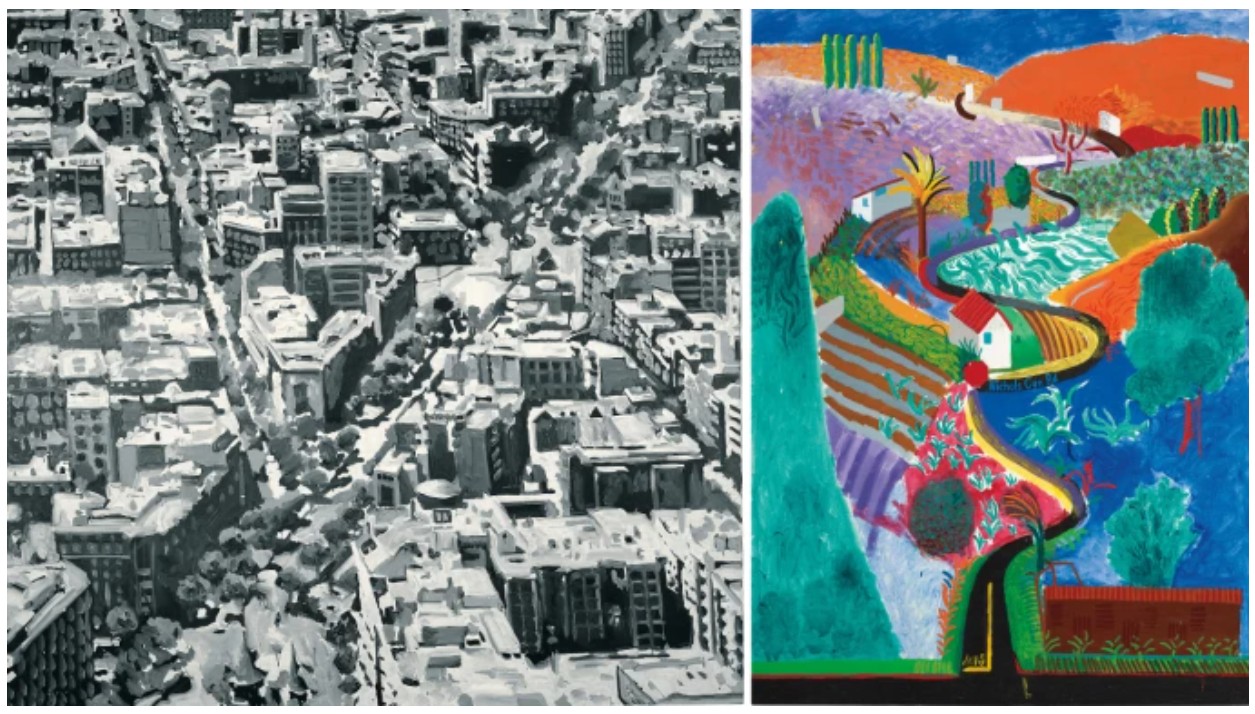
Left: Gerhard Richter, Stadtbild Madrid (Cityscape Madrid), 1968. San Francisco Museum of Modern Art. Art © Gerhard Richter.
Right: David Hockney, Nichols Canyon, 1980. Private Collection.
Ruscha began his series of now iconic Metro Plot paintings in 1998, starting with static grisailles depictions of recognizable Los Angeles boulevards from half elevated vantage points. Depicting a network of Hollywood streets just South West of the intersections shown in the present work, Santa Monica, Melrose, Beverly, La Brea, Fairfax, is one such work from this year that now resides in the permanent collection of the Los Angeles County Museum of Art. Recalling the artist’s famous photographic Panorama of 1966, Every Building on Sunset Strip, the limited set of street map paintings that Ruscha created intermittently over the next five years valorized the fallacious sense of infinity conjured by the sprawling grid system of Los Angeles, as well as the ubiquitous Thomas Guide books once widely used by those who traversed its streets by car. During the years of 1998-1999, Ruscha expanded his purview to cover American highway routes outside of California, and it is in the present work that he returned firmly to Los Angeles as a subject.
Metro Plot Paintings in Museum Collections
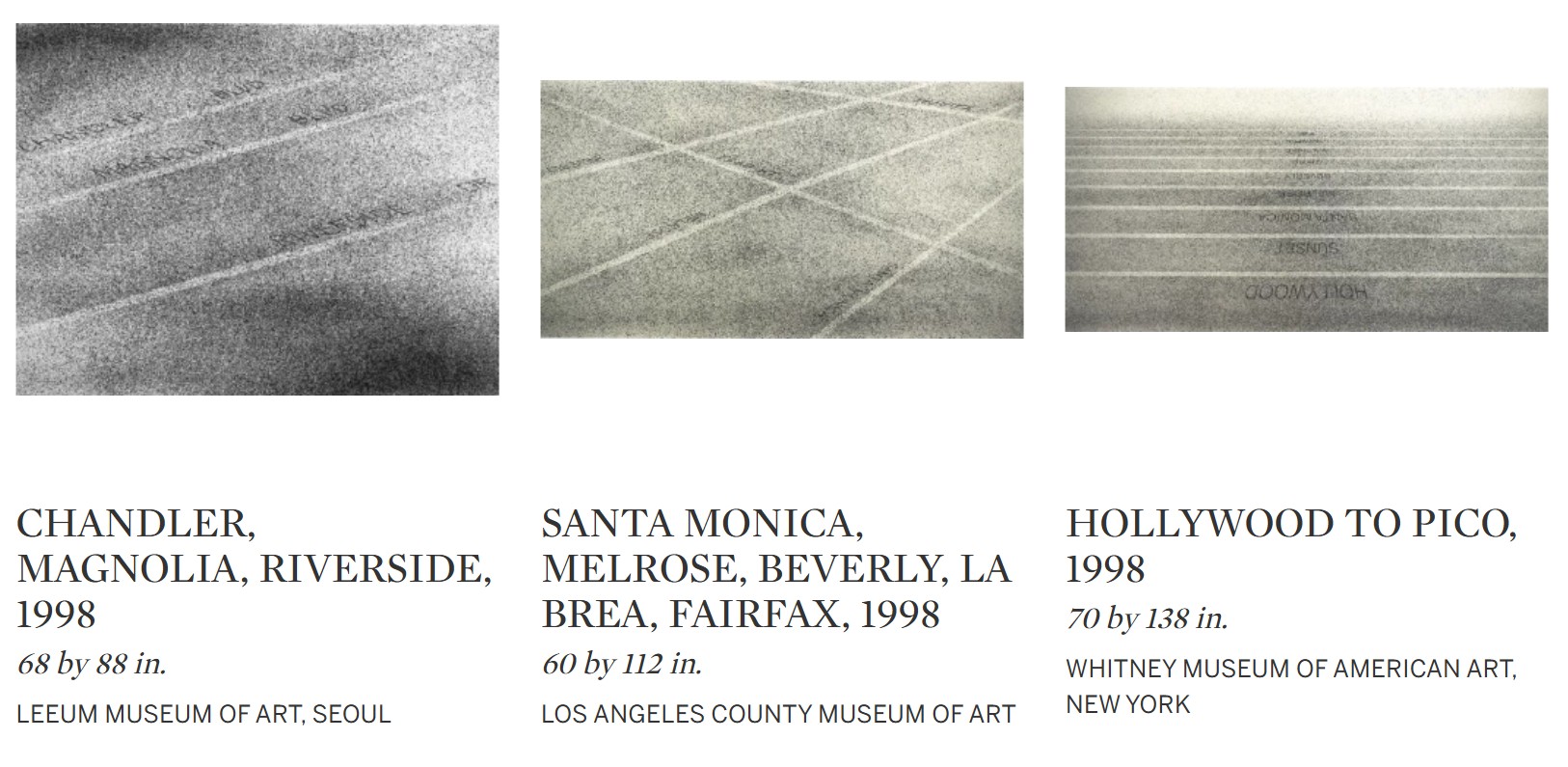
Boasting the largest format in the series, Cosmo, Selma, Vine is also one of his most specific and focused works in terms of subject. Moving away from famous avenues such as Sunset Boulevard, this selection of lesser-known roads seems arbitrary yet personal at once, presenting a certain lack of familiarity to call into question the realities of scale and distance in opposition to the perceived distortions of perspective. Ultimately Ruscha evokes the instructive nature of a map but ultimately provides a sense of disembodied futility as such stark minimalism fails to reveal any detail and the close cropping denies greater context. Ruscha thus forces a psychological reconceptualization of space through a perceptive muddling that plays to a sense of the uncanny – a tendency at the heart of his practice, where a sense of the familiar and the alien coincide.
Metro Plot Paintings in Museum Collections
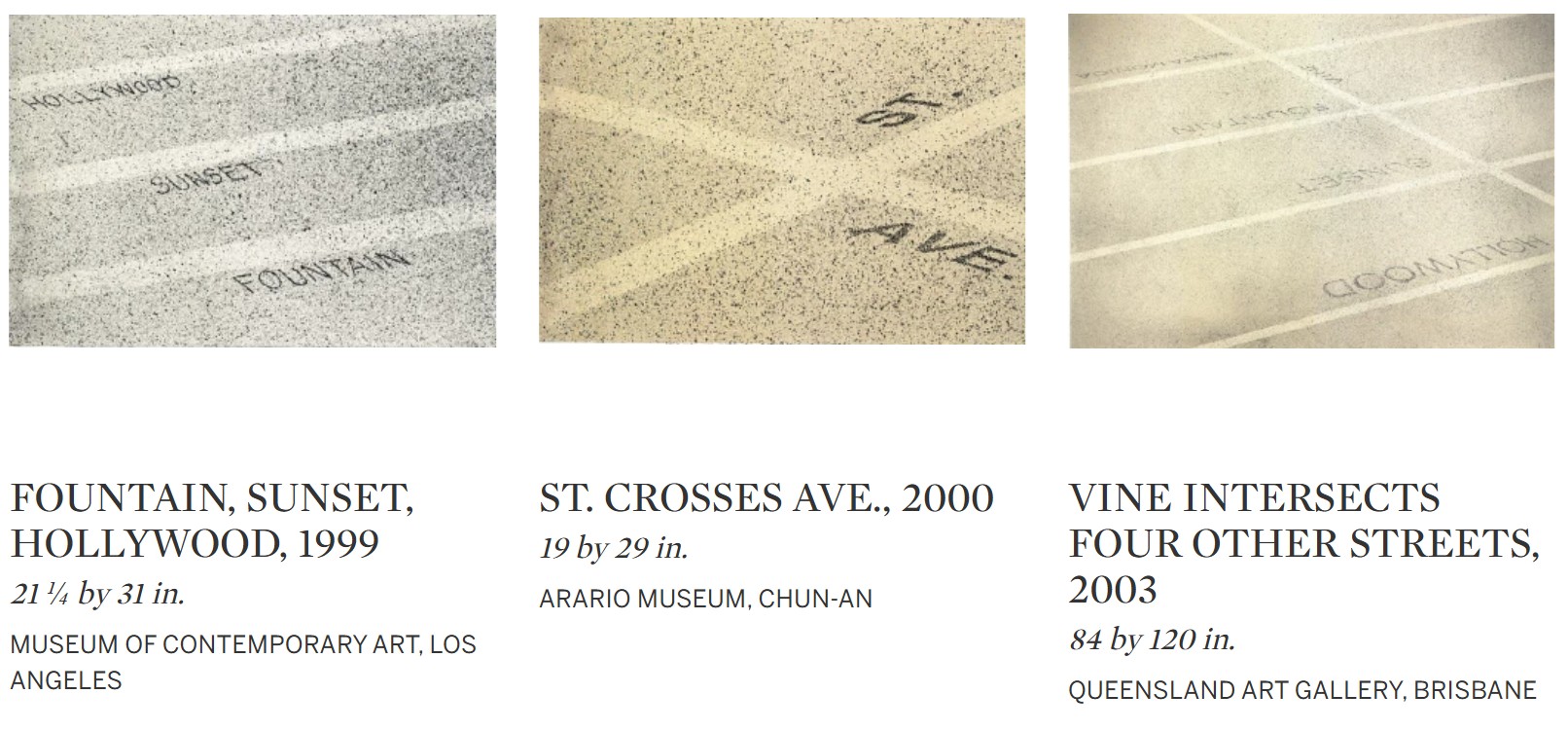
Witnessing disembodied words and signage in the desert landscapes surrounding Route 66, Ruscha’s experience of travelling in America by car formed a stronghold of inspiration since his early career.
“A lot of my paintings are anonymous backdrops for the drama of words.”
While Ruscha’s earlier City Lights series, such as the present work, played with oblique birds-eye views of cityscapes, in the present series Ruscha revels in the synthesis of word and image offered by maps rather than privileging the autonomy of linguistic phrases. This translates spatially, in the mimetic angling of road and word, as well as conceptually by connoting a geographic other.
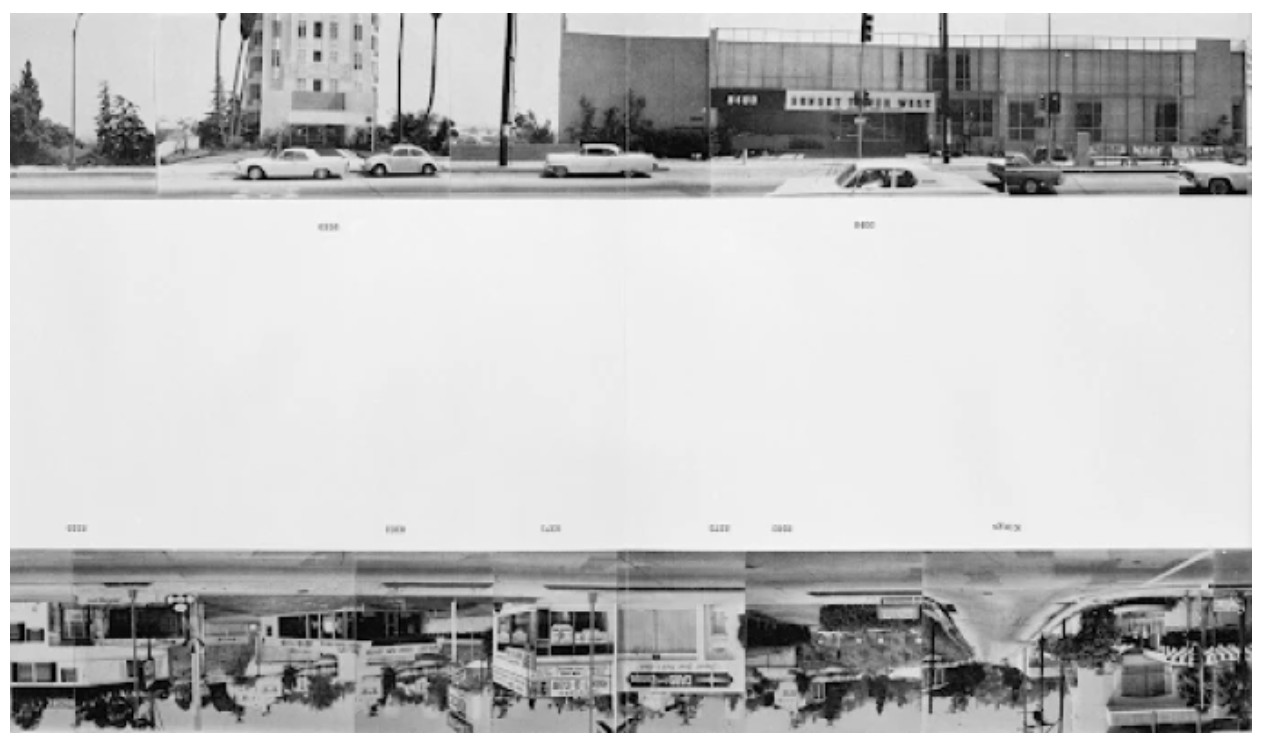
Ed Ruscha, Every Building on the Sunset Strip (detail), 1966, Los Angeles County Museum of Art. Art © 2025 Edward Ruscha
Crucially, the uncomfortable cerebral vantage point that Ruscha adopts neatly mimics the geometric construction grid of optical linear perspective, where lines recede into the picture plane to construct an illusion of depth. As a stronghold of academic drawing since its schematization by Renaissance architect Filippo Brunelleschi in the 15th century, Ruscha’s oblique half-commitment to the system of illusionistic depth also speaks to the gradual ‘flattening’ and re-appropriation of the grid by modernist painters, best exemplified by the two dimensional grid constructions of Piet Mondrian. Above any other global city, Los Angeles boasts amongst the greatest examples of modernist architecture in the buildings that compose its visual landscape, as well as the vast sprawling network of activity created by its gridded streets. Both nostalgically alluring, yet gritty and vacuous, Ruscha’s duplicitous post-modern city view reconsiders the possible synthesis of utility and elegance – of art and life – and constitutes the artist’s ultimate ballad on the nature of contemporary urban existence, in both its material and cerebral states.
Marble Shatters Drinking Glass, 1968
Christie’s New-York: 19 November 2024
Estimated: USD 1,200,000 – 1,800,000
USD 2,712,000
ED RUSCHA (B. 1937), Marble Shatters Drinking Glass | Christie’s
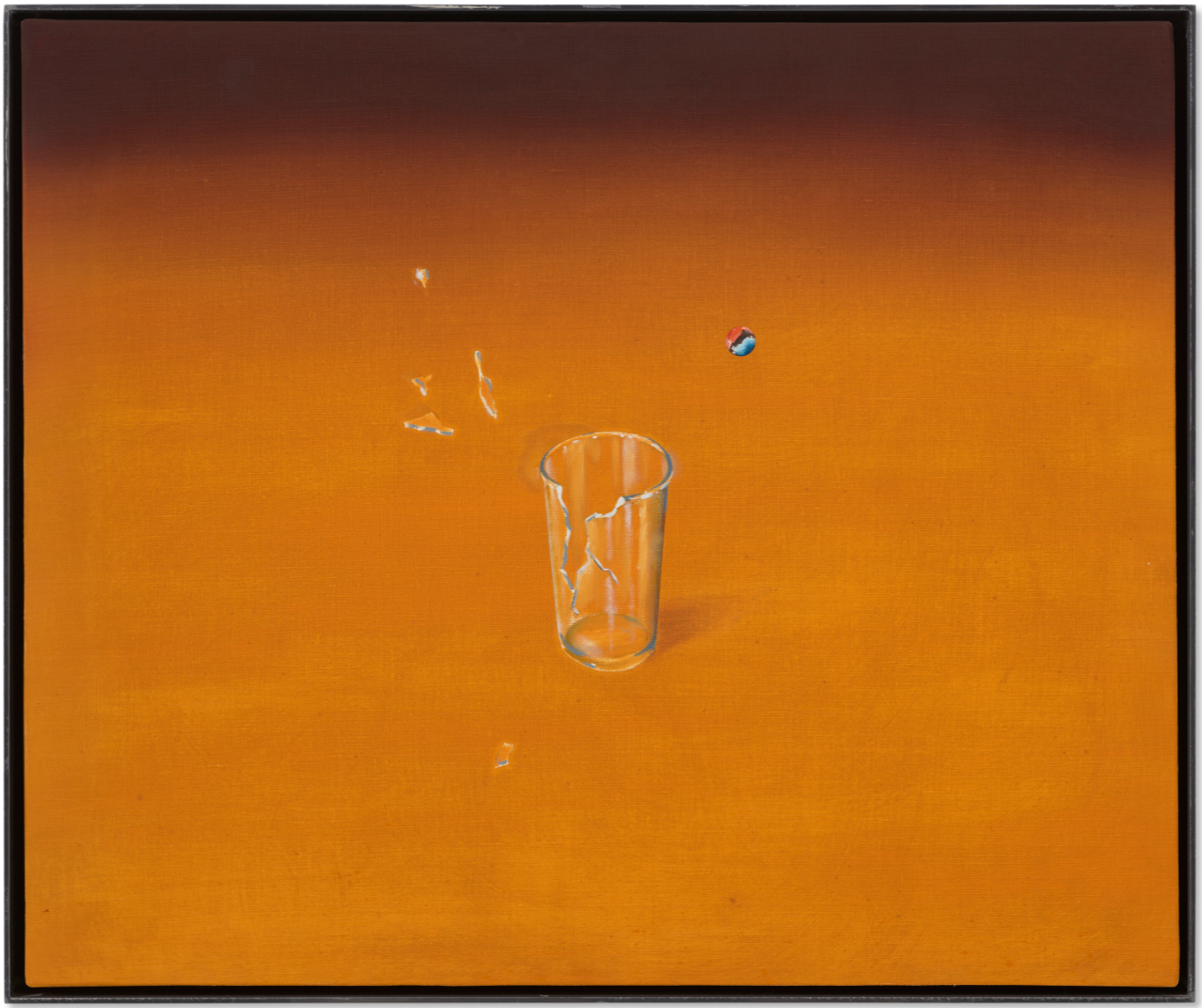
ED RUSCHA (B. 1937)
Marble Shatters Drinking Glass, 1968
Oil on canvas
20×24 inches (50.8 x 61 cm)
Signed and dated twice and titled ‘”MARBLE SHATTERS DRINKING GLASS” 1968 Ed Ruscha Ed Ruscha 1968’
(on the stretcher)
Painted during a pivotal year for the artist, a period during which he completed some of his most iconic works, Ed Ruscha’s Marble Shatters Drinking Glass represents the pinnacle of his enigmatic, surreal, and technically brilliant paintings of the 1960s. In the present work, the artist challenges the narrative foundations of art by assembling an array of objects—a shattered tumbler, shards of flying glass, and a multi-colored marble—in a manner that suggests a dramatic narrative, but—tantalizingly—without satisfying it. By painting in this manner, Ruscha directs attention towards the forms themselves, particularly their sculptural qualities, a quality that would become a central pillar of the artist’s oeuvre. Painted the same year he completed Los Angeles County Museum of Art on Fire (1965-1968, Hirshhorn Museum and Sculpture Garden, Washington, D.C.), Marble Shatters Drinking Glass takes its place amongst the pantheon of Ruscha’s work.
Set against one of the artist’s signature gradated backdrops, Ruscha paints a shattered glass tumbler and an errant marble. Seemingly captured the split second after contact between the two has resulted in shards of flying glass, this canvas successfully showcases not only the artist’s superlative technical skills as a painter, but also his lifelong interest in how we look at, and perceive, objects. The skill with which he renders not only the subject matter, but also the ambiguity of the events surrounding what is being depicted on the surface of the canvas, is something which is unique to Ruscha during this period.
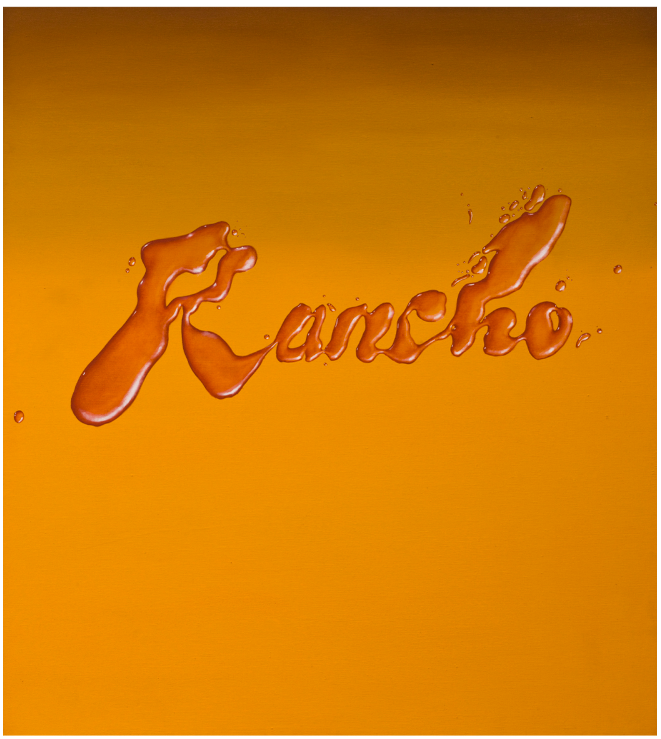
Ed Ruscha, Rancho, 1968. Museum of Modern Art, New York. © Ed Ruscha.
Marble Shatters Drinking Glass was executed during a period when Ruscha spent much of his time perfecting his “word” paintings. Alongside these, Ruscha also began to investigate paintings without words; the result was a series of four works in which the subject was a glass in various stages of destruction. In a nod to nostalgia, some of the glasses contain milk, a throwback—like Andy Warhol’s cans of tomato soup—to a notion of American wholesomeness, something at odds with the destructive nature of the subject matter. Many of the objects came from his own studio, and were often chosen because of the challenges they presented to the artist as he sought to depict these static objects in a more dynamic way. While other artists of the 1960s, such as Warhol and Roy Lichtenstein, sought to “flatten” the world as they saw it, Ruscha was relishing the challenges of representing the opposite point of view.
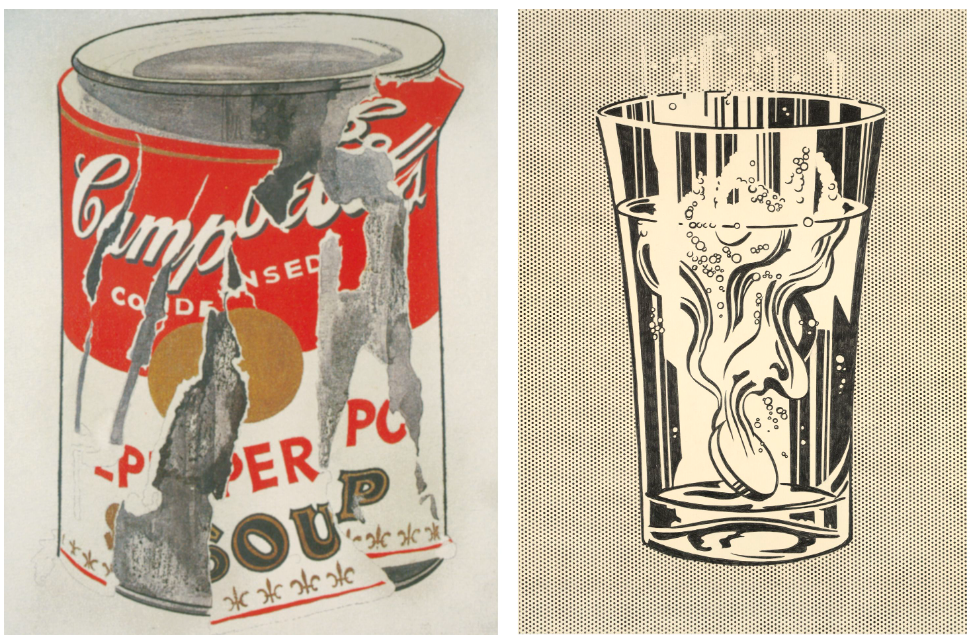
Left: Andy Warhol, Small, Torn Campbell’s Soup Can (Pepper Pot), 1962. The Broad, Los Angeles. © 2024 The Andy Warhol Foundation for the Visual Arts, Inc. / Licensed by Artists Rights Society (ARS).
Right: Roy Lichtenstein, Alka Seltzer, 1966. Art Institute of Chicago. © Estate of Roy Lichtenstein. Photo: The Art Institute of Chicago / Art Resource, NY.
Drawing visual parallels to the bizarre floating objects of Surrealists like René Magritte and the metaphysical tableaus of Giorgio de Chirico, Ruscha’s object paintings are both similar and distinct from his textual pieces. The words that he uses come in a variety of typefaces, sizes, and styles, but the objects always allude to illusion and are expertly rendered.
“Words exist in a world of no-size. Take a word like ‘smash’—we don’t know it by size. We see it on billboards, in four-point type and all stages in between. On the other hand, I found out that it is important for objects to be their actual size in my paintings. If I do a painting of a pencil or magazine or fly or pills, I feel some sort of responsibility to paint them natural size—I get out the ruler.”
René Magritte, La clef des champs, 1936. Museo Nacional Thyssen-Bornemisza, Madrid.
© 2024 C. Herscovici / Artists Rights Society (ARS), New York.
Ultimately, the juxtapositions in works such as Marble Shatters Drinking Glass serve to destabilize our expectations. His non sequitur motifs, unconventional use of color, and meticulous paint application technique seek to raise more questions than they answer. As such, the present work stands as an exemplar of Ruscha’s oeuvre. Its combination of formal elements depicted in informal ways, extends throughout his practice and creates a distinct visual language that informs the artist’s decidedly signature style. These premeditated compositions and juxtapositions of objects, subjects, and ideas are at the core of Ruscha’s practice.
Big Dipper, 1980
Christie’s New-York: 22 November 2024
Estimated: USD 800,000 – 1,200,000
USD 1,008,000
ED RUSCHA (B. 1937), Big Dipper | Christie’s
ED RUSCHA (B. 1937)
Big Dipper, 1980
Oil on canvas
54×120 inches (137.2 x 304.8 cm)
Signed and dated ‘Edward Ruscha 1980’ (on the reverse)
Stretching ten feet wide, American master Ed Ruscha’s monumental Big Dipper invites the viewer into an immersive experience. Deep midnight blues envelop the painting’s surface, swaddling both the canvas and the viewer in the evocative quiet of evening. Big Dipper evokes the universal human experience of staring into the inky darkness of the night sky, contemplating one’s place in the cosmos. The composition, nearly monochrome, features a richly dark sky punctuated by lone points of light outlining the titular constellation. The stark contrast between the tiny dots of light and the endless expanse of night creates a meditative stillness, depicting a moment of quiet contemplation in the presence of the unknowable. Ruscha’s fascination with the American landscape, particularly Los Angeles, is well-documented in his art, which frequently explores themes of urban and exurban sprawl, highways, and city grids. This interest informs Big Dipper, but here, Ruscha engages with the landscape from a distant, cosmic perspective. The painting reflects a significant shift in his artistic approach, laying the groundwork for his evolution in the 1980s and 1990s, particularly seen in his iconic City Lights and Metro Plots series. This transition is crucial: in the 1980s, Ruscha moves toward a subtler, more atmospheric aesthetic, broadening his horizons beyond the more straightforward Pop Art iconography of his earlier work.
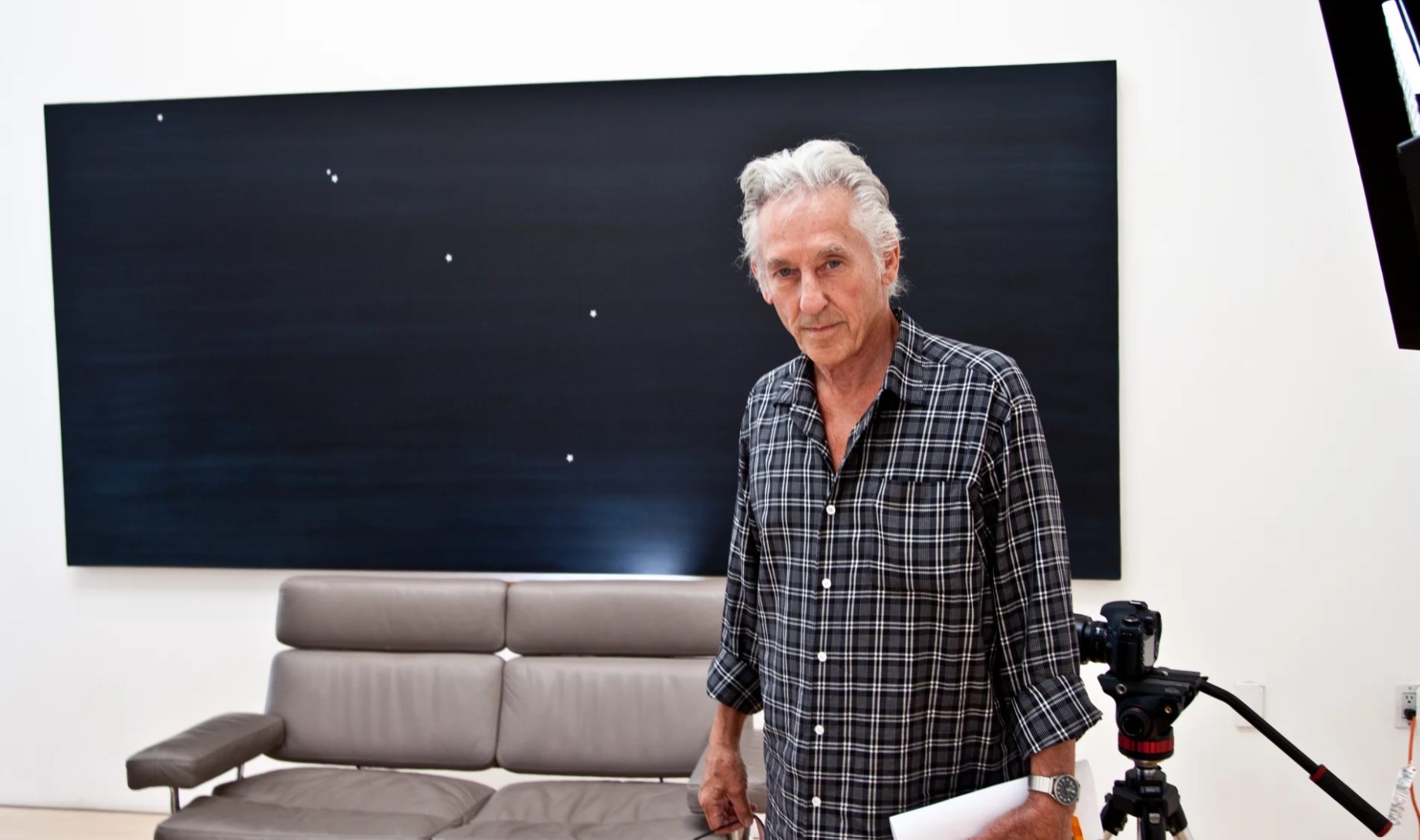
Ed Ruscha, Beverly Hills, 2014 (present lot illustrated). Courtesy of the artist and Gagosian.
Big Dipper is an embodiment of the central theme running throughout Ruscha’s decades-long career: the elevation of everyday subjects—such as an auto shop, city streets, or a gas station—into symbols and allegories through atmospheric execution. This is echoed in his exploration of urban landscapes, viewed from both below and above; Big Dipper looks up at the sky, while City Lights and Metro Plots offer a bird’s-eye view of the city at night, as though seen from a plane. Ruscha’s fascination with the everyday architecture of America’s postwar sprawl has roots in a cross-country road trip he took at nineteen along Route 66, traveling from his native Oklahoma to Los Angeles to attend art school. The potent symbols of Route 66’s iconic vistas and signs deeply influenced Ruscha’s art, forming recurring motifs throughout his career.
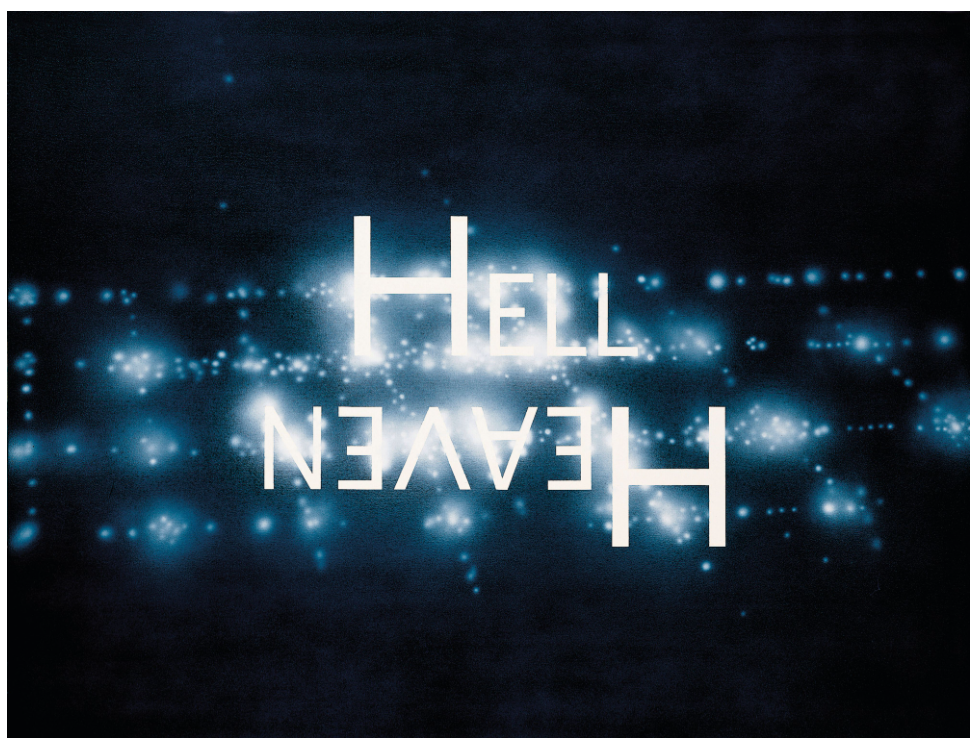
Ed Ruscha, Hell, Heaven, 1989. © Ed Ruscha.
In Big Dipper, Ruscha hones in on our perception of the constellation as a symbol, a signifier, a simulacrum—not merely the thing itself. In an interview with Paul Karlstrom, Ruscha expressed that “the selection of [an] object is more important than anything. It’s almost like the idea is more important than the actual physical presence of it.” Here, the constellation operates as a form of universal language. Just as Ruscha’s painted words carry layered meanings, the Big Dipper represents navigation, the passage of time, and humanity’s connection to the heavens. The stars, like text, signify something beyond their mere appearance, pointing to larger narratives about time, meaning, and existence.
Big Dipper also forms Ruscha’s contribution to a long tradition of artists capturing the dark beauty of the night sky. Serving as both a navigation tool and a source of existential reflection, the night sky has long provided a backdrop for sublime expressions of the human psyche. In this context, Ed Ruscha’s work represents a postmodern interpretation of the sublime in American landscape painting, echoing the tradition of the Hudson River School.
No Sleep, 1965
Christie’s New-York: 12 May 2022
Estimated: USD 1,500,000 – 2,000,000
USD 2,940,000
ED RUSCHA (B. 1937) (christies.com)
ED RUSCHA (B. 1937)
No Sleep, 1965
Oil on canvas
24 x 19 7⁄8 inches (61 x 50.5 cm)
Signed ‘E. RUSCHA’ (on the reverse)
Titled and dated ‘”NO SLEEP” 1965’ (on the stretcher)
An exceptional example from the moment of Pop Art’s ascendance on the West Coast, the present work is one of the finest, most significant paintings of its era. It is also–like so much of Ruscha’s work–wickedly funny. Here, the artist depicts an intimate window into the night time “pillow talk” of a mute song bird and his loquacious companion, a gleaming, wide-mouthed fish. This seemingly gabs on and on, oblivious to her companion’s need for sleep. It is an intimate scene, beautifully spot-lit as if the bed had been placed upon an empty stage. The palette is limited to a delicate balance of cobalt blue, creamy white and a rich, russet-brown (perhaps an ode to the Old Masters, and Ruscha has cited Bruegel and Bosch as inspiration). The painting itself is an exercise in restraint, where the empty background of warm, brown tones works to highlight the bright white of the bird’s plumage and the fish’s slick, silvery skin. It is both spare and lush, as Ruscha manages to convey the animals’ expressions in a sophisticated, yet deadpan, way—right down to the bird’s dead eyes and his blank, comic stare.
Like his Word paintings, Ruscha’s wildlife paintings are full of clever one-liners and subtle double-entendres. Most of the titles from this series read like riddles, whose meaning can only be interpreted by analyzing the painting’s visual content. In this way, Ruscha blends text and image to further complicate and enrich each painting’s meaning. In Give Him Anything and He’ll Sign It, 1965 (Whitney Museum of American Art, New York), Ruscha depicts a bird with a pencil for a beak. In another, Angry Because It’s Plaster, Not Milk, 1965 (The Broad, Los Angeles), the bird’s open beak attempts to grab a glass of milk lying on its side; the milk doesn’t spill, however, and it’s only in referencing the title that the viewer “gets” the joke–it’s a plaster replica of a glass of milk, not actually a glass of milk. In No Sleep, the joke is again revealed by the title. The talkative fish keeps her companion awake, causing the lack of sleep to which the title alludes. Throughout his career, Ruscha has subtly delighted in these inside jokes – from the flying can of spam in Actual Size, 1962, Los Angeles County Museum of Art) to the refried beans in Adios, 1967 (Glenstone).
Bowling Ball, Olive, 1969
Christie’s New-York: 12 May 2022
Estimated: USD 1,500,000 – 2,000,000
USD 1,620,000
ED RUSCHA (B. 1937) (christies.com)
ED RUSCHA (B. 1937)
Bowling Ball, Olive, 1969
Oil on canvas
20×24 inches (50.5 x 60.6 cm)
Signed and dated ‘E. Ruscha 1969’ (on the reverse)
In Bowling Ball, Olive, Ruscha’s technical sophistication as a painter is on full display: a bowling ball with a decorative, tiger-stripe patterning that was commonly discovered in bowling alleys of the 1950s and 60s, and a classic martini olive that hovers alongside its larger neighbor. Both of these objects (one impossibly heavy, the other a tiny garnish) are seen to levitate as if by some conjurer’s trick. Ruscha has taken extra care in rendering the sheen of the bowling ball—right down to the two sparkles of light reflecting off its gleaming surface. The background features the beautiful ombre effect that has now become iconic to Ruscha’s work. It ranges in tone from light orange to a deep russet-brown, not unlike the LA sunsets that have so often influenced his style.
Chrysler New York, 1994
Sotheby’s New-York: 30 September 2021
Estimated: USD 400,000 – 600,000
USD 806,500
Chrysler New York | Contemporary Curated | 2021 | Sotheby’s (sothebys.com)
ED RUSCHA (b. 1937)
Chrysler New York, 1994
Acrylic on canvas
64×64 inches (162.6 x 162.6 cm)
Signed and dated 1994 on the reverse
Reverberating with the electric and captivating energy, Chrysler New York encapsulates the exuberance of Ed Ruscha’s matchless artistic vernacular with stunning clarity and graphic force. The present work is part of a series of paintings in which Ruscha incorporated faded clock faces on the perimeter of the canvas and titled them after classic American cars. A testament to symbols of American life, Chrysler New York differs from his works from the 1980s, taking on a foggy and nocturnal chill that is reflective of the artist’s sentiments about the incoming final decade of the twentieth century. Dramatic, impactful, and mysterious, the present work is emblematic of Ruscha’s ability to convey a cinematic narrative that calls for contextualization by the viewer.
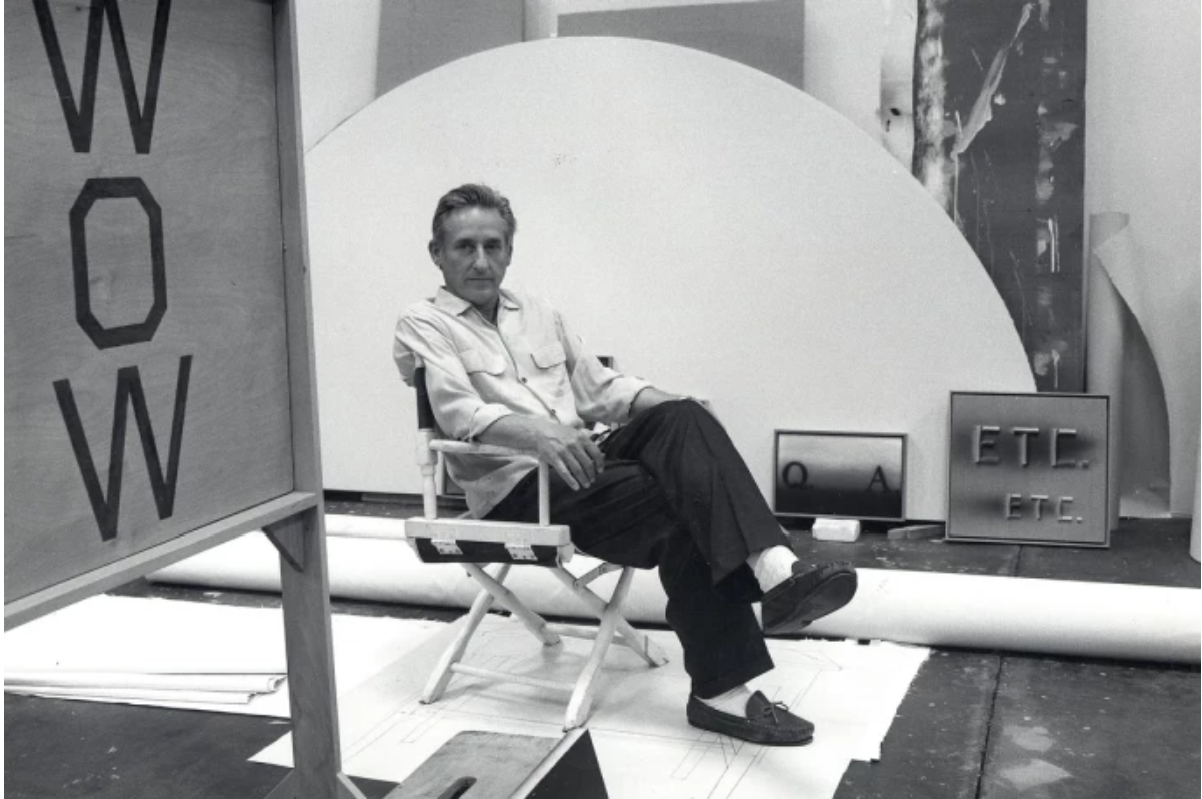
ED RUSCHA IN STUDIO, 1980S. PHOTO: LEO HOLUB/ARCHIVES OF AMERICAN ART/SMITHSONIAN INSTITUTION, WASHINGTON, DC.
In the present work, the picture plane is absorbed in a ghostly ethereal haze in which darkness slowly meets a sky blue light, resulting in an all-encompassing composition. The roman numeral time markers create a darkened aura around the perimeter of the painting, bringing the eye towards the lightened center. Recalling the pervasive influence of film and Hollywood on the artist’s work, the subtly blurred outlines that seep from the letter’s borders into the surrounding monochrome background radiates with the same buzz as a frame of a projected analog film. Ruscha’s interest in film and Hollywood could be associated with the similar enthusiasm for the subject from his Pop Art contemporaries like Andy Warhol, who created approximately thirty films throughout his career.
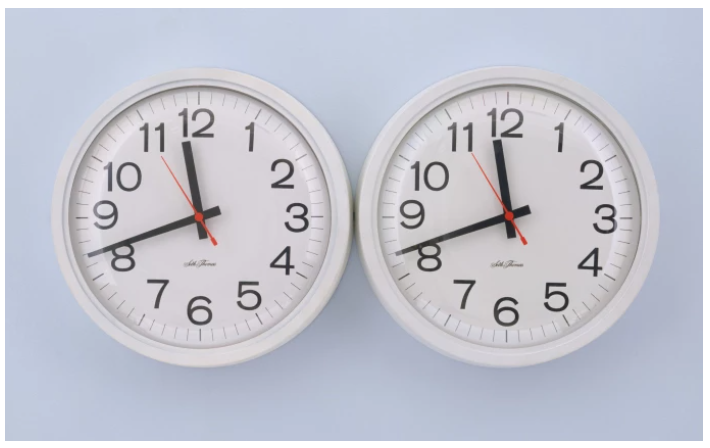
FELIX GONZALEZ-TORRES, “UNTITLED” (PERFECT LOVERS), 1991, THE MUSEUM OF MODERN ART, NEW YORK, © 2021 THE FELIX GONZALEZ-TORRES FOUNDATION, COURTESY ANDREA ROSEN GALLERY, NEW YORK
Ruscha’s poetic and deadpan imagery combines the cinematographic with the sublime, creating images that distill American idealism into beautiful paintings. A serene picture, Chrysler New York represents an object that tells time, inviting the viewer to reflect on the philosophical existence of a universally quotidian item. Ruscha frequently employs deeper connotations to familiar images, transforming the work into a curious and sensuous item that suggests further mystery through its title. Evidently, the present work serves as a nod to a basic device that holds tremendous philosophical connotations and a skillful example of Ruscha’s great proficiency within his artistry. Once hung at the Ritz Carlton in Seoul, Korea, Chrysler New York is representative of Ruscha’s use of color, form, and space to create paintings that are visually stimulating while provoking various interpretations. An exhilarating articulation of Ruscha’s iconic artistic language, the present work represents Ruscha’s emblematic adoption of theatricality as achieved through the use of unconventional media and textuality to convey a dream-like, sublime and transcendent image.
Works on Paper
PLEASE CLICK BELOW FOR WORKS ON PAPER
Ed Ruscha Prints
PLEASE CLICK BELOW FOR ED RUSCHA PRINTS HIGHLIGHTS