
Jeff Koons stands among the most consequential figures of late 20th- and early 21st-century art. Emerging in New York during the early 1980s, he redefined the relationship between popular culture and high art through an aesthetic that is at once seductive, industrial, and conceptually precise. His practice is built on clarity of form, immaculate fabrication, and the strategic elevation of everyday objects into monumental icons. More than a stylistic signature, Koons’ work interrogates value itself: emotional value, cultural value, and ultimately market value.
Introduction
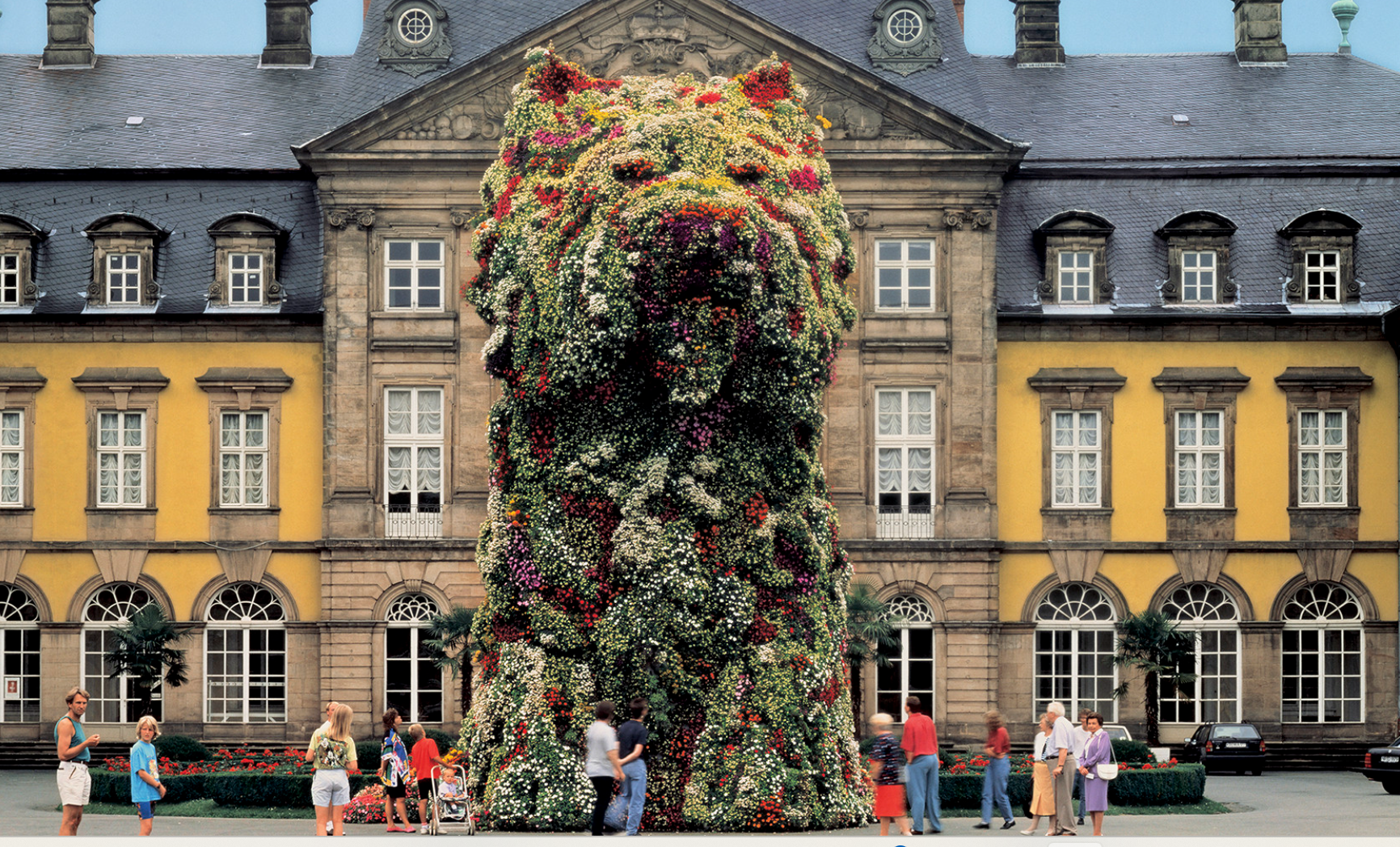
Born in York, Pennsylvania in 1955, Koons studied at the School of the Art Institute of Chicago and the Maryland Institute College of Art in Baltimore and, receiving a BFA from the latter in 1976. Since his first solo exhibition in 1980, his work has evolved from small-scale assemblages of toys and found objects to his now iconic monumental works, including huge balloon animals rendered in mirror-polished stainless steel, as well as flowering topiary sculptures, such as Puppy (1992), which is permanently installed at the Guggenheim Museum Bilbao.
Jeff Koons rose to prominence in the mid-1980s as part of a generation of artists exploring the meaning of art and spectacle in a media-saturated era. With his stated artistic intention to “communicate with the masses,” Koons makes use of conceptual constructs, including the ancient, the everyday, and the sublime, creating luxurious icons and elaborate tableaux, which, beneath their captivating exteriors, engage the viewer in a metaphysical dialogue with cultural history.
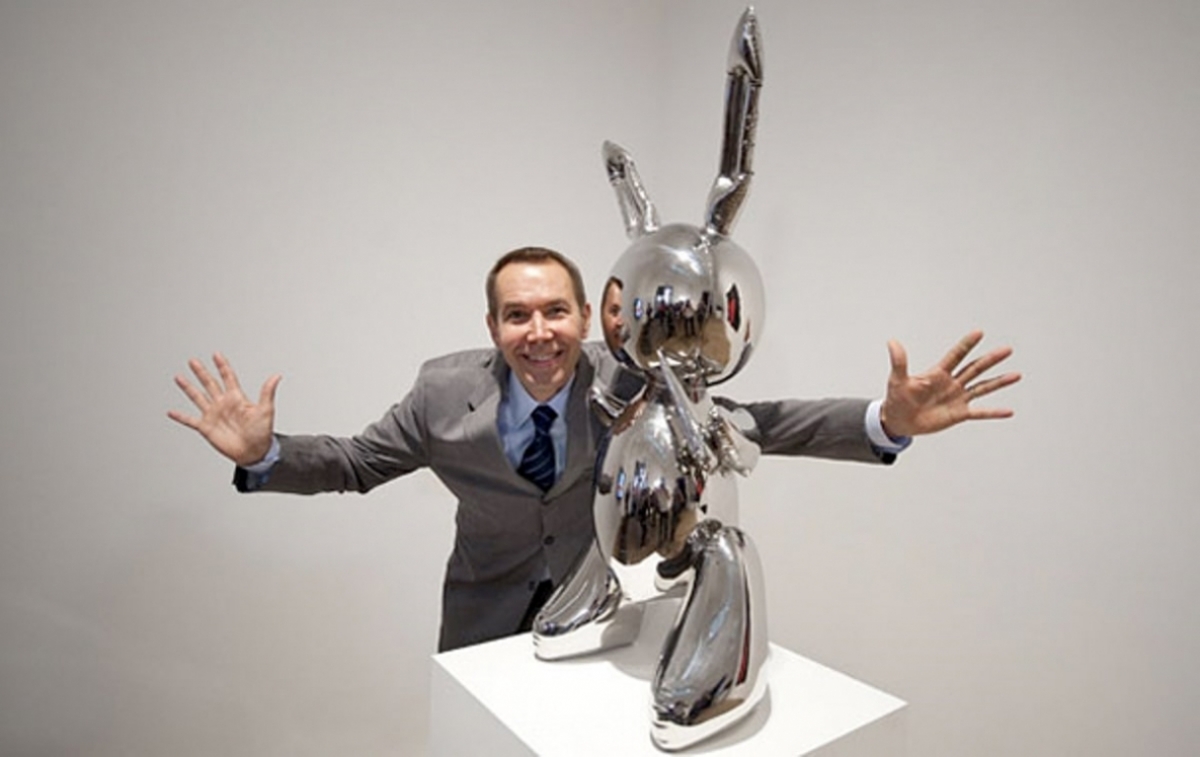
Koons draws attention to the continuity of images as they pass through time, combining art historical reference with vernacular images and objects, from common suburban products and mass media to symbols of sexuality and transcendence. Beginning with Inflatables (1978–79), a series inspired by the readymade, Koons created six series of innovative works in less than a decade including Pre-New (1979–80), The New (1980–87), Equilibrium (1983–93), Luxury & Degradation (1986), and Statuary (1986). His interest in popular culture expanded in the Banality series (1988), which included sculptures of recognizable figures such as Michael Jackson and Bubbles (1988)—a nearly life-size gold-leaf porcelain statue of the pop singer with his pet chimpanzee. In 1989, Koons presented Made in Heaven (1989–91), a series centered on him and his then-wife in sexually explicit poses, frequently in fairytale settings, evoking the stark bodily presence of the nudes depicted by French Realist painters.
During the mid-1990s, Koons expanded his Pop sensibility through the Celebration series (1994–): hyper realistic, brightly colored paintings and large-scale sculptures depicting vernacular images and forms such as plastic figurines, Play-Doh, and jewelry. Conflating the readymade and the monumental, these works attest to Koons’s ongoing fascination with childlike consciousness and communication, transforming humble objects into abstract symbols of transcendence and the biological.
The themes of air, breath and inflation have long been central to Koons’s practice. He began to explore blow-up objects as early as 1979 with his Inflatables, which found counterparts in the encased, fluorescently-lit vacuum cleaners he exhibited as The New the following year. The Equilibrium series of 1985 included basketballs suspended in tanks of water, and unnerving, weighty flotation devices made of bronze. His iconic stainless steel Rabbit, a direct ancestor to the twisted balloon animals, appeared in 1986; the Balloon Dog arrived as part of the large-scale Celebration series commenced in the early 1990s, which reimagined objects associated with milestones such as birthdays, Easter and Valentine’s Day.
From the outset, Koons adopted a studio model closer to architecture or engineering than to romantic painterly tradition. Works are fabricated with extreme technical precision, often by specialized teams, using stainless steel, mirror-polished surfaces, porcelain, or large-scale painting techniques. The finish is never incidental. It is essential. Reflection, perfection, and surface become philosophical devices rather than decorative choices.
Early Conceptual Foundations: The New and Equilibrium
Koons’ early series, particularly The New (late 1970s–early 1980s), presented brand-new vacuum cleaners and domestic appliances in Plexiglas vitrines illuminated by fluorescent light. These works operated at the intersection of Minimalism and consumer display, asking whether the aura of art could be transferred to mass-produced objects simply through context and framing.
In Equilibrium (1985), Koons suspended basketballs in tanks filled with precisely calibrated saline solution so that they floated in perfect balance. The works evoke aspiration, suspended ambition, and the fragile tension between success and failure. The metaphor is clean and almost scientific — a meditation on equilibrium both physical and social.
Banality (1988): Kitsch as Monument
With the Banality series, Koons shifted into figurative sculpture. Executed in polychromed wood and porcelain, these works appropriated sentimental and mass-cultural imagery — from cartoonish animals to celebrities. The most emblematic example, Michael Jackson and Bubbles, transformed pop idolatry into a gilded porcelain monument.
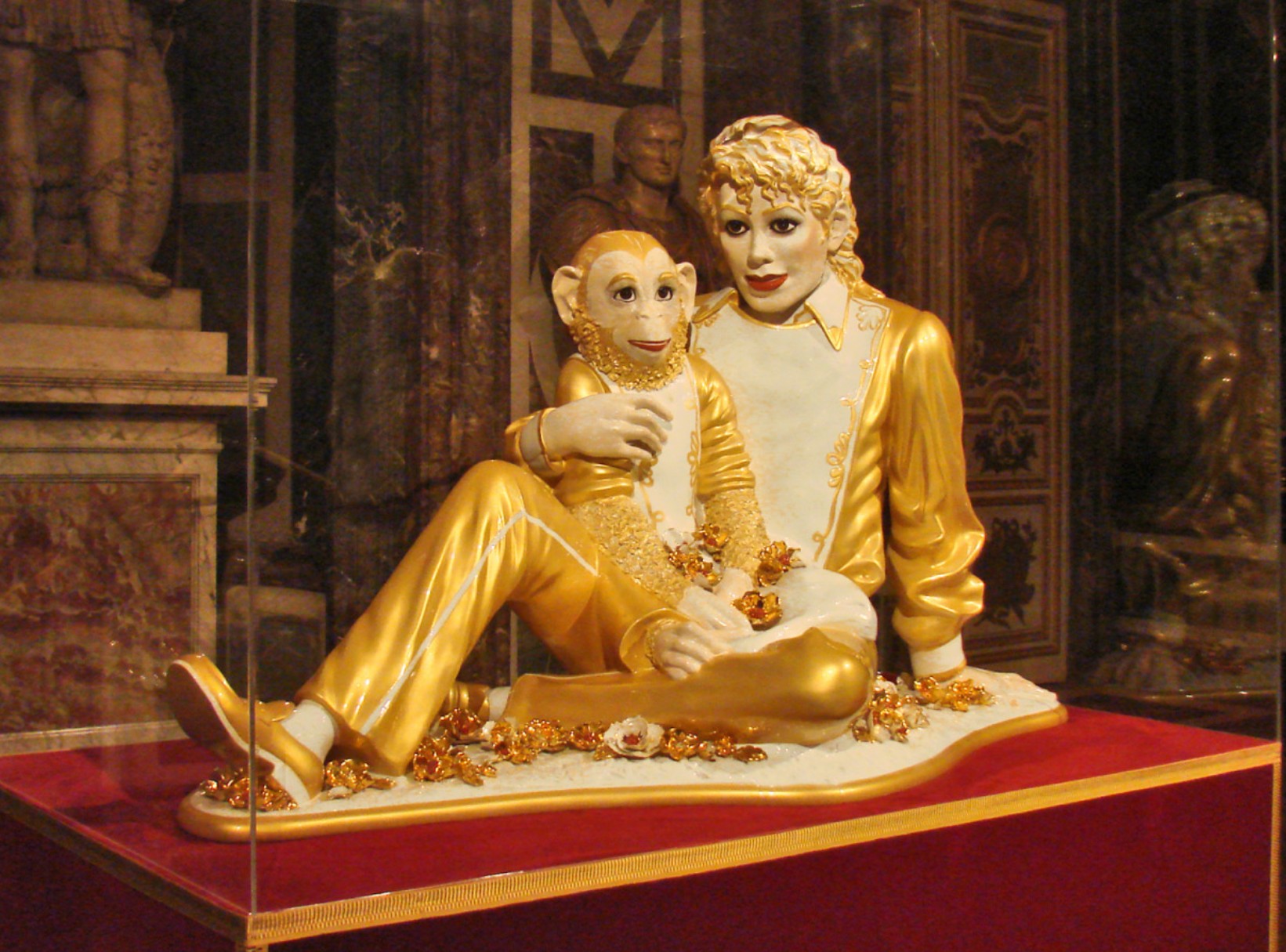
The series deliberately embraced what critics once dismissed as kitsch. Rather than ironizing popular taste, Koons magnified it. He positioned desire, innocence, and cultural spectacle at the center of contemporary sculpture, refusing hierarchical distinctions between elite and popular imagery.
Made in Heaven (1989–1991): Intimacy and Controversy
Perhaps the most debated body of work in his career, Made in Heaven featured explicit representations of Koons and Ilona Staller (Cicciolina) in large-scale paintings and sculptures. The series confronted sexuality, celebrity, and self-exposure head-on.
While divisive, it reinforced Koons’ willingness to collapse boundaries between private life, media spectacle, and fine art. In retrospect, it anticipated the contemporary culture of visibility long before social media made self-display ubiquitous.
Celebration (1994–ongoing): The Iconic Turn
The Celebration series marks Koons’ most recognized and commercially impactful body of work. Monumental sculptures such as Balloon Dog, Tulips, Hanging Heart, and Diamond translate ephemeral party objects into mirror-polished stainless steel with saturated color coatings.
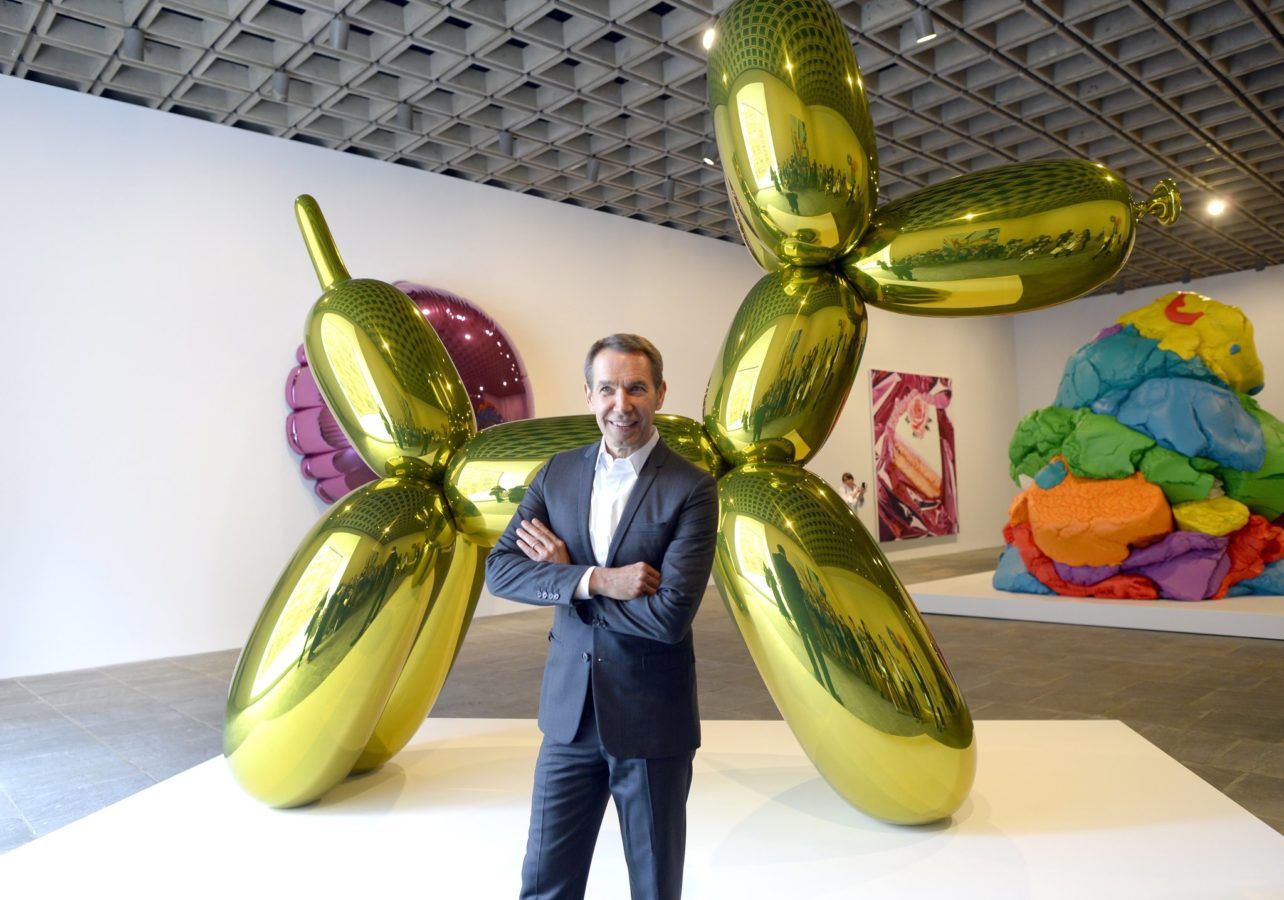
These works operate on multiple levels. On the surface, they evoke childhood joy and festive symbolism. Formally, they demonstrate extreme technical mastery — stainless steel fabricated to resemble fragile latex. Conceptually, their reflective surfaces integrate the viewer and surrounding environment into the sculpture itself. The artwork is completed through participation: the spectator becomes part of the visual field.
This series firmly established Koons as a global cultural icon and positioned his sculptures among the most recognizable objects in contemporary art.
Puppy and Public Monumentality
In 1992, Koons created Puppy, a monumental topiary sculpture composed of tens of thousands of flowering plants arranged over a steel structure. Installed permanently outside the Guggenheim Museum Bilbao, it demonstrates his capacity to merge public art, horticulture, and architectural scale.
The work is disarming in its simplicity yet complex in execution — a hallmark of Koons’ approach.
Later Series: Gazing Ball, Hulk Elvis, and Antiquity
In the Gazing Ball series, Koons reinterpreted canonical Western masterpieces by affixing reflective blue glass spheres to their surfaces. The gesture inserts the present viewer into art history itself, suggesting that meaning is continuously renewed through perception.
The Hulk Elvis works juxtapose inflatable toy aesthetics with heroic and mythic imagery, blending American pop iconography with references to global art traditions. Meanwhile, the Antiquity series merges classical sculpture with contemporary imagery, collapsing temporal hierarchies and reinforcing Koons’ persistent dialogue between past and present.
Technique, Philosophy, and Legacy
Koons’ work is defined by immaculate surface, industrial fabrication, and conceptual accessibility. He often speaks of “acceptance” — encouraging viewers to embrace their own desires rather than feel shame for them. His sculptures neither mock nor moralize; they amplify.
Institutionally, Koons has been the subject of major retrospectives at the Whitney Museum of American Art, the Centre Pompidou, and other leading museums worldwide. Market-wise, his works have repeatedly set records for living artists, reinforcing his status not only as a cultural figure but as a structural force within the contemporary art economy.
Jeff Koons’ achievement lies in his ability to synthesize spectacle, craftsmanship, and philosophical clarity. His objects are immediately legible, yet conceptually layered. They function simultaneously as mirrors, monuments, and market symbols — perhaps the most accurate reflection of our time.
Public Collections
Jeff Koons works are present in numerous public collections, including: Art Institute of Chicago, Illinois; Art Gallery of New South Wales, Sydney, Australia; The Brant Foundation, Greenwich Connecticut; The Broad Art Foundation, Santa Monica, California; Carnegie Museum of Art, Pittsburgh, Pennsylvania; Des Moines Art Center, Des Moines, Iowa; Deste Foundation for Contemporary Art, Athens, Greece; Eli Broad Family Foundation, Los Angeles, California; Fondation Louis Vuitton pour la création, Paris, France; Fondazione Prada, Milan, Italy; Francois Pinault Foundation for Contemporary Art; Groninger Museum of Art, Groningen, The Netherlands; Guggenheim Museum, Bilbao, Spain; Deutsche Guggenheim Berlin, Berlin, Germany; Los Angeles County Museum of Art (LACMA), Los Angeles, California; Museo Jumex, Mexico City, Mexico; Museum of Contemporary Art, Chicago, Illinois; Museum of Contemporary Art, Los Angeles, California; Museum of Contemporary Art, Tokyo, Japan; The Museum of Modern Art, New York, New York; The Museum of Modern Art, San Francisco, California; Rubell Museum, Miami, Florida; Seattle Art Museum, Seattle, Washington; Staatsgalerie Stuttgart, Germany; Tate Gallery, London, United Kingdom
Gallery Representation
Jeff Koons is represented by a tightly curated group of major international galleries, reflecting both the scale of his production and his position at the top tier of the global contemporary market.

Gagosian is Koons’ principal global representative. The gallery has presented multiple major solo exhibitions of his work across New York, London, Paris, Rome, and Beverly Hills. Their collaboration has focused on large-scale sculptural projects, the Celebration series, and more recent bodies of work such as Gazing Ball and Shine. Gagosian’s infrastructure matches Koons’ industrial studio practice—museum-scale ambition, global logistics, and institutional placement strategy.

David Zwirner also represents Koons and has staged major exhibitions of his work in New York, London, and Paris. Zwirner’s program emphasizes rigorous curatorial framing, often positioning Koons within broader art-historical and conceptual dialogues rather than purely market-driven spectacle. The partnership reinforces Koons’ institutional and scholarly positioning.
Artist Website
PART I: SUMMARY
Auction Market Overview
2025 AUCTION STATISTICS
Turnover: USD 19,608,840
– 31.1% vs. 2024
# Lots sold: 14
Sell-Through Rate: 100%
MARKET SEGMENTATION
New-York (80.2%) / London (19.8%)
(by value)
Highest Price Achieved at Auction:
USD 91,075,000
Auction Summary
2025 Auction Highlights
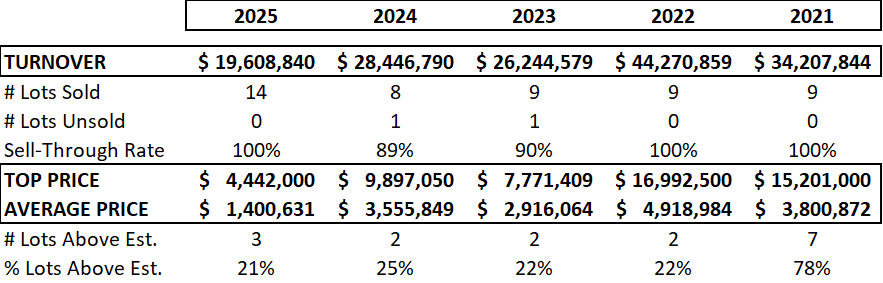
14 lots sold at auction in 2025 for a total turnover of USD 19,608,840. With no lot failing to sell, the sell-through rate is 100%. The highest price was achieved by Hulk (Rock), a sculpture from the HULK ELVIS series that sold at Sotheby’s in New-York, on 18 November 2025, for USD 4,442,000.
2025 Top 3 Lots
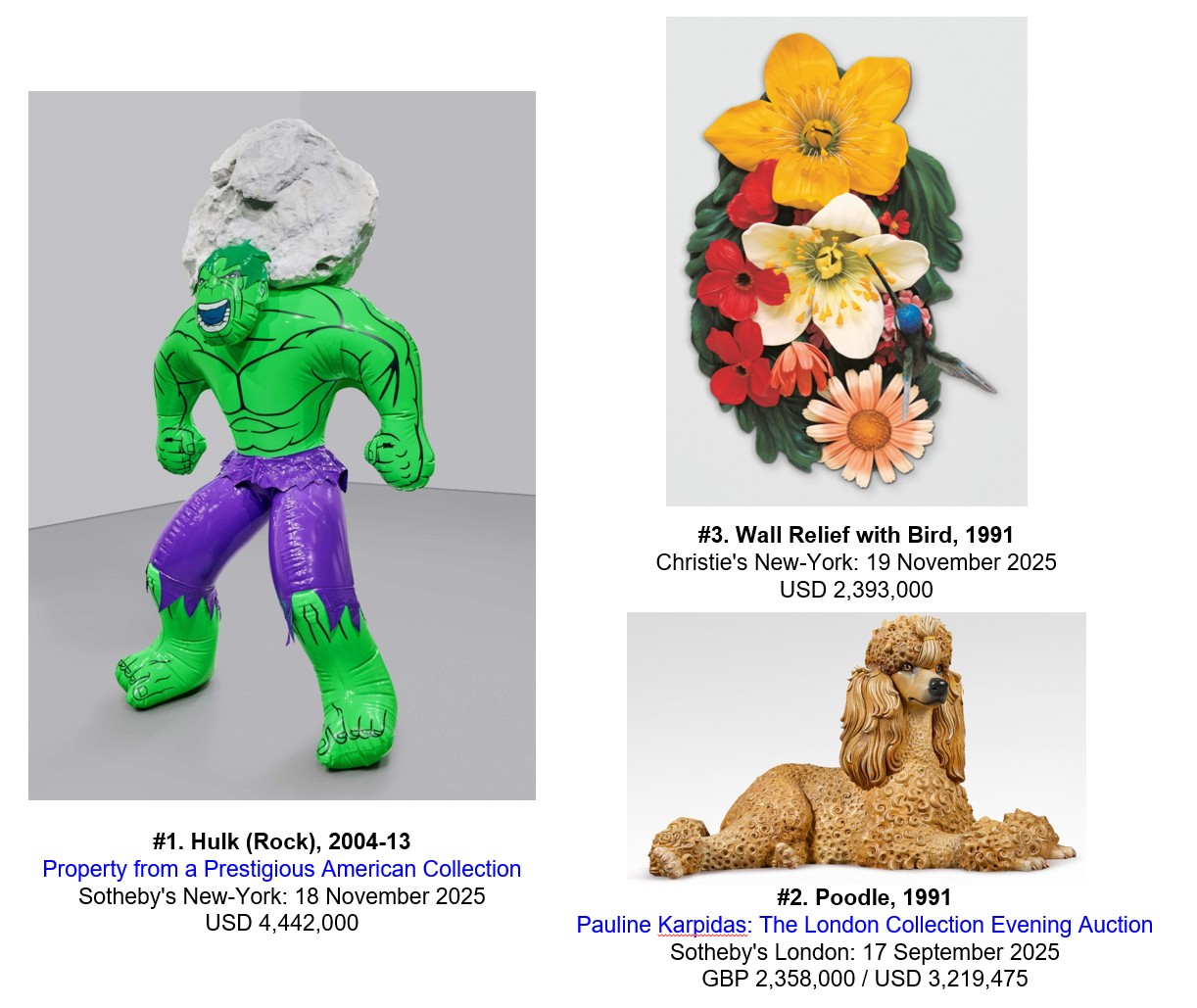
6 lots sold for more than USD 1 million, generating a cumulative turnover of USD 15,101,625, representing 77% of the total for 2025.
2024 Auction Highlights
8 lots sold at auction in 2024 for a total turnover of USD 28,446,790. With 1 lot failing to sell, the sell-through rate is 89%. The highest price has been achieved by Balloon Monkey (Blue) that sold for GBP 7,555,000 (USD 9,897,050) at Christie’s in London on 9 October 2024.
2024 Top 3 Lots
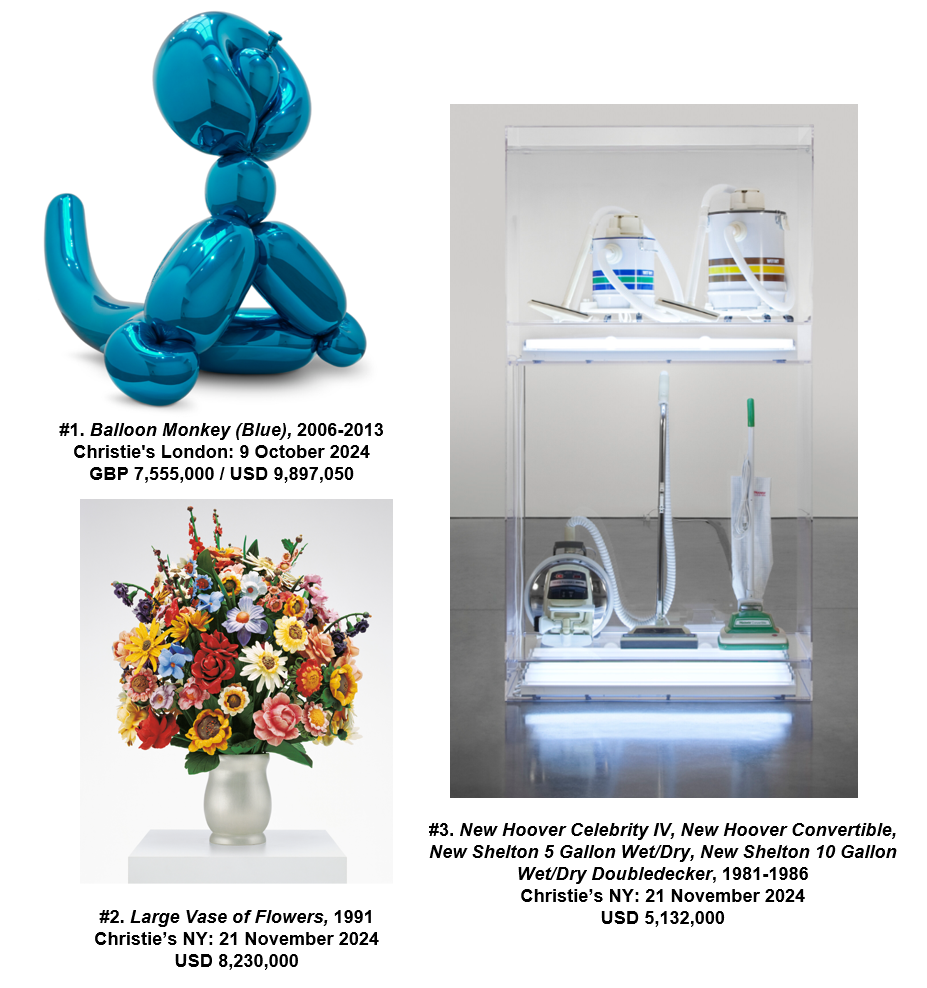
3 lots sold for more than USD 5 million generating a cumulative turnover of USD 23,259,050, representing 81.8% of the total turnover for 2024.
2023 Auction Highlights
9 lots sold at auction in 2023 for a total turnover of USD 26,244,579. With one lot failing to sell, the sell-through rate is 90%. The highest price was achieved at Christie’s in Hong-Kong on 28 May 2023, when Sacred Heart (Magenta Gold) sold for HKD 60,875,000 (USD 7,771,409).
2023 Top 3 Lots
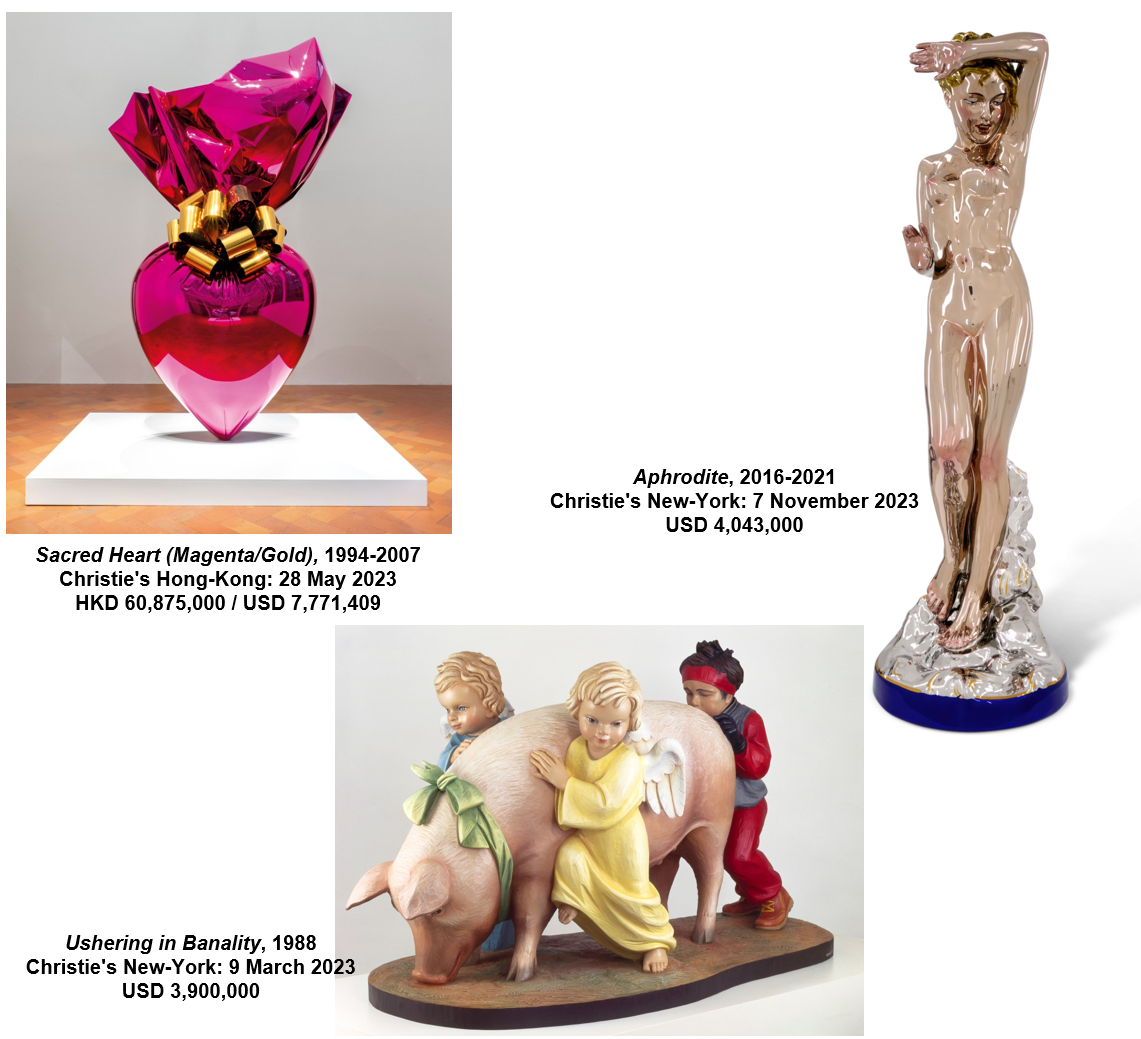
This is the only lot that sold for more than USD 5 million. All lots but one sold for more than USD 1 million.
2022 Auction Highlights
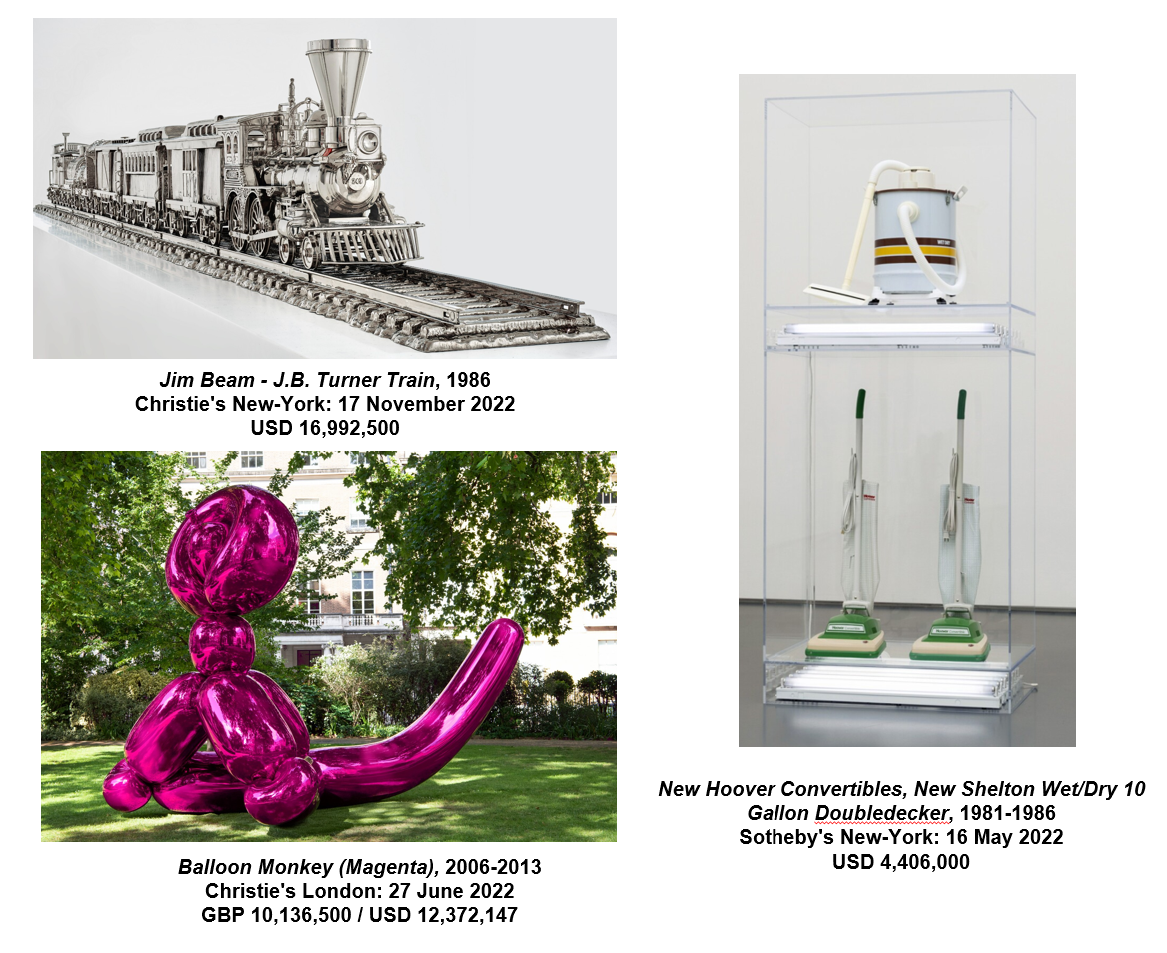
9 lots sold at auction in 2022 for a total turnover of USD 44,270,859. With no lot failing to sell, the sell-through rate is 100%. The top lot of 2022, Jim Beam – J.B. Turner Train was sold at Christie’s in New-York on 17 November 2022 for USD 16,992,500.
2022 Top 3 Lots
2021 Auction Highlights
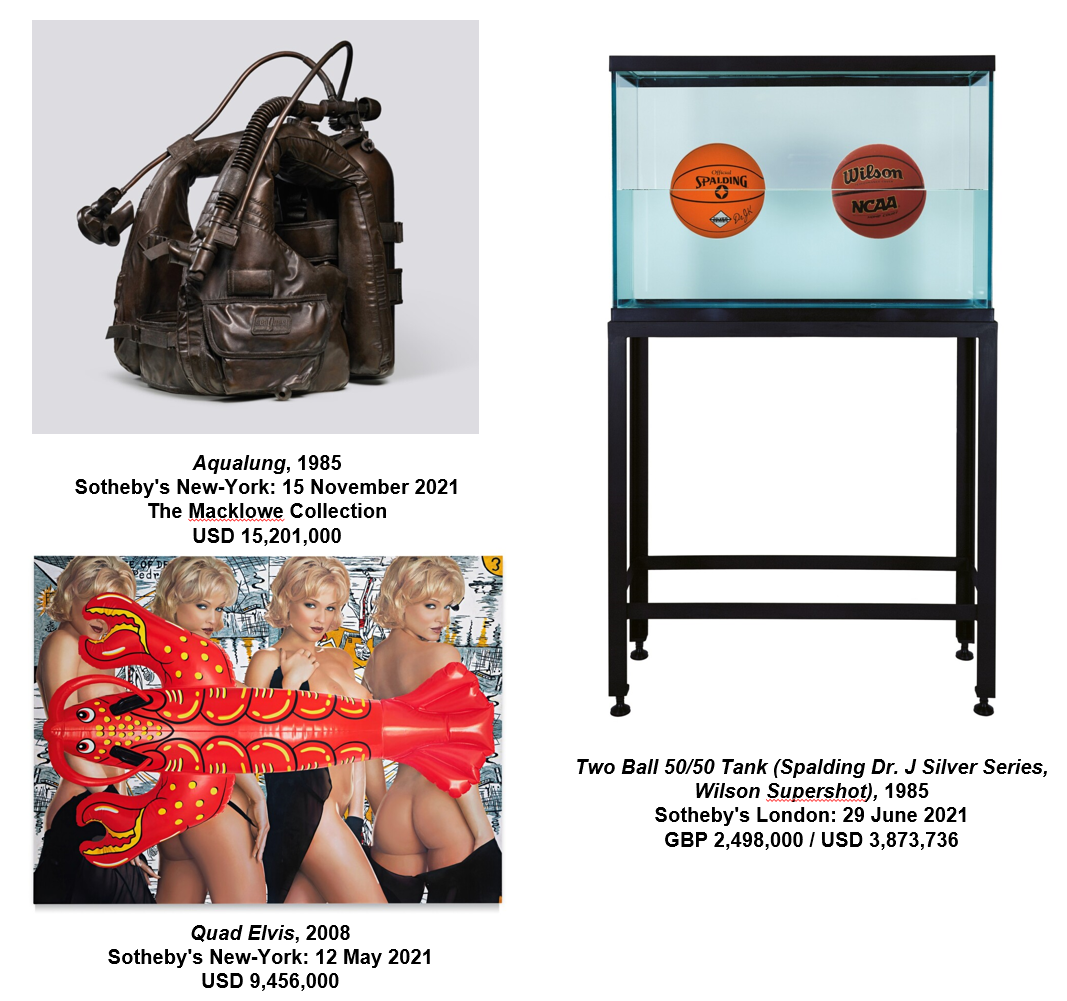
9 lots sold at auction in 2021 for a total turnover of USD 34,207,844. With no lot failing to sell, the sell-through rate is 100%. The highest price was achieved at Sotheby’s in New-York on 15 November 2021, when Aqualung sold for USD 15,201,000.
2021 Top 3 Lots
Top Lots
#1. Rabbit, 1986
Christie’s New-York: 14 May 2019
Estimated: USD 50,000,000 – 70,000,000
USD 91,075,000
Jeff Koons (b. 1955) (christies.com)
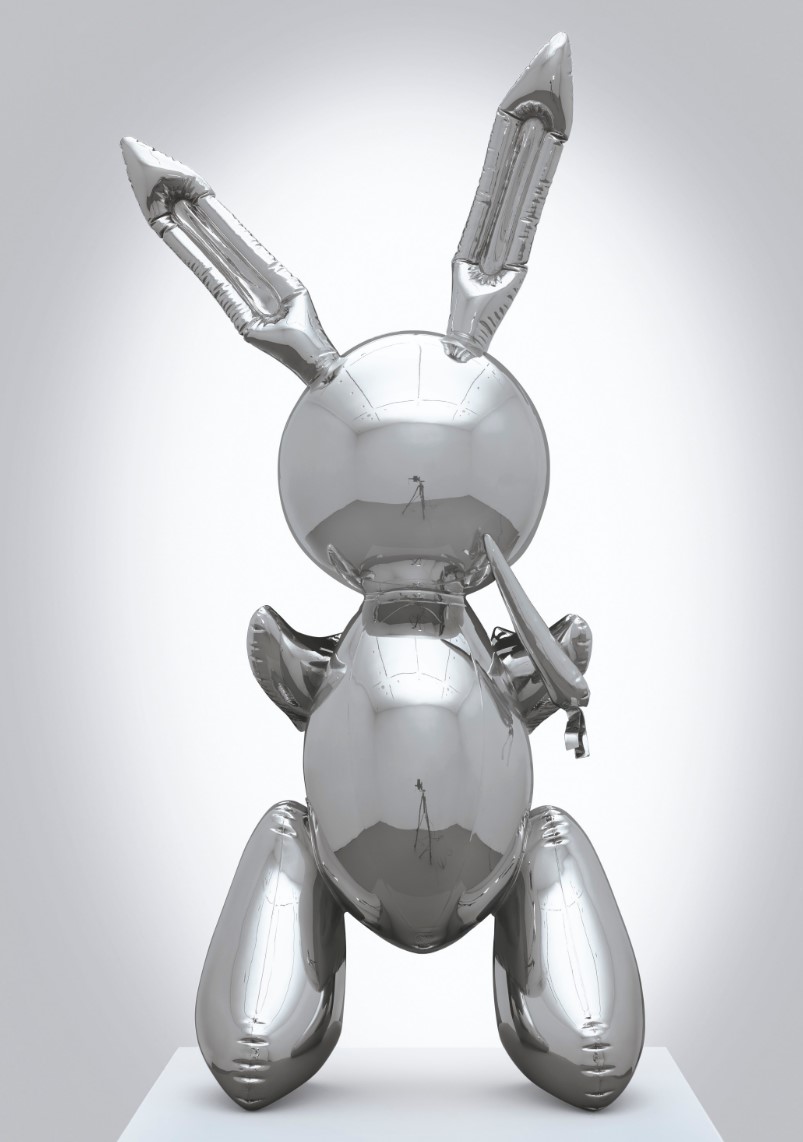
JEFF KOONS (b. 1955)
Rabbit, 1986
Stainless steel
41x19x12 inches (104.1 x 48.3 x 30.5 cm)
This work is number two from an edition of three plus one artist’s proof
#2. Balloon Dog Orange
Christie’s New-York: 11 November 2013
Estimated: USD 35,000,000 – 55,000,000
USD 58,405,000
Jeff Koons (B. 1955) (christies.com)
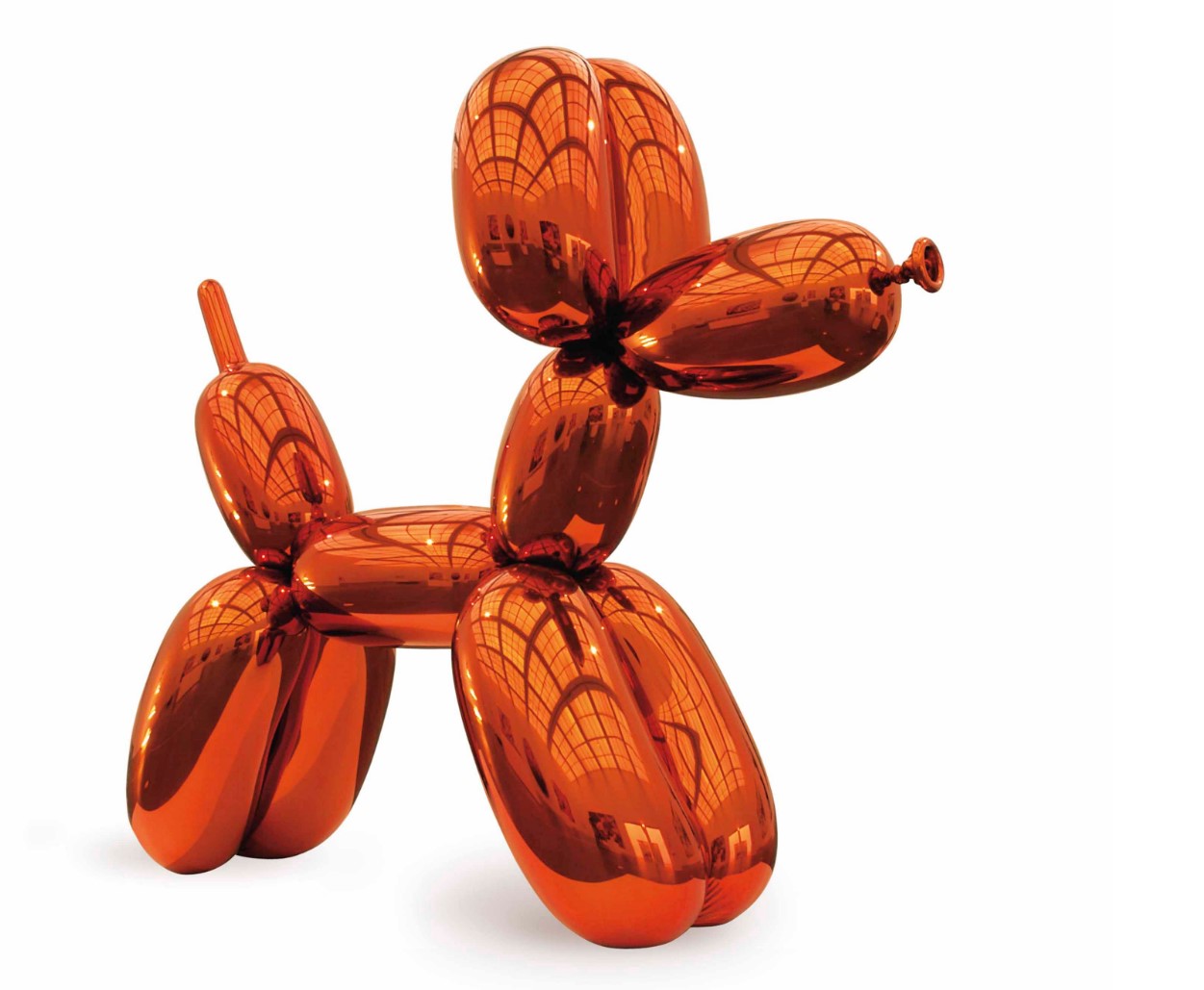
JEFF KOONS (B. 1955)
Balloon Dog (Orange), 1994-2000
Mirror-polished stainless steel with transparent color coating
121x143x45 inches (307.3 x 363.2 x 114.3 cm)
Signed and dated ‘Jeff Koons 1994-2000’ (on the underside)
This work is one of five unique versions (Blue, Magenta, Orange, Red, Yellow)
#3. Jim Beam – J.B. Turner Train
Christie’s New-York: 12 May 2014
Estimate on Request
USD 33,765,000
Jeff Koons (B. 1955) (christies.com)
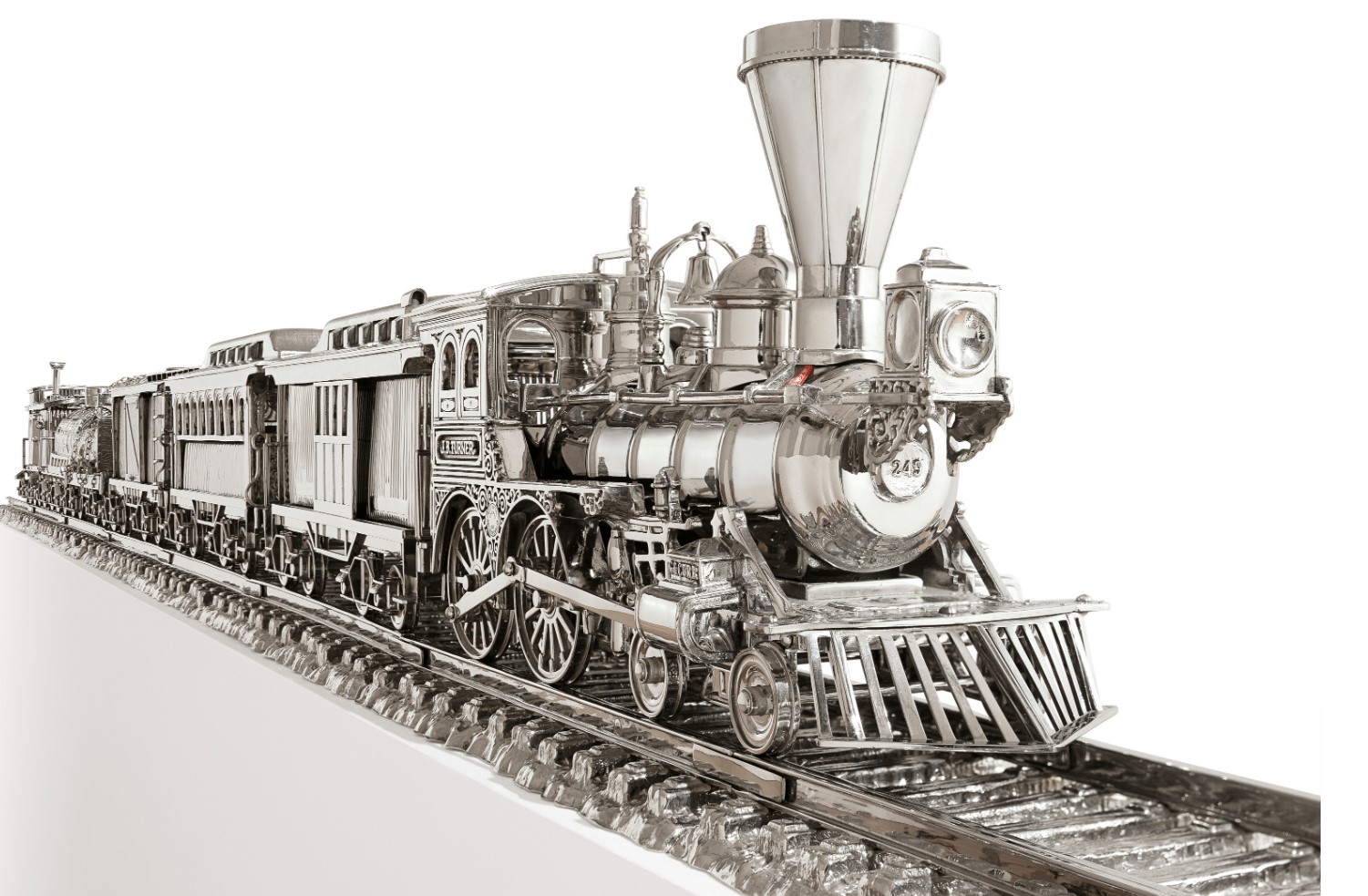
JEFF KOONS (B. 1955)
Jim Beam – J.B. Turner Train, 1986
Stainless steel and bourbon
11 x 114 x 6 1/2 inches (27.9 x 289.6 x 16.5 cm)
This work is the artist’s proof from an edition of three plus one artist’s proof
#4. Tulips, 1995-2004
Christie’s New-York: 14 November 2012
Estimate On Request
USD 33,682,500
Jeff Koons (b. 1955) (christies.com)
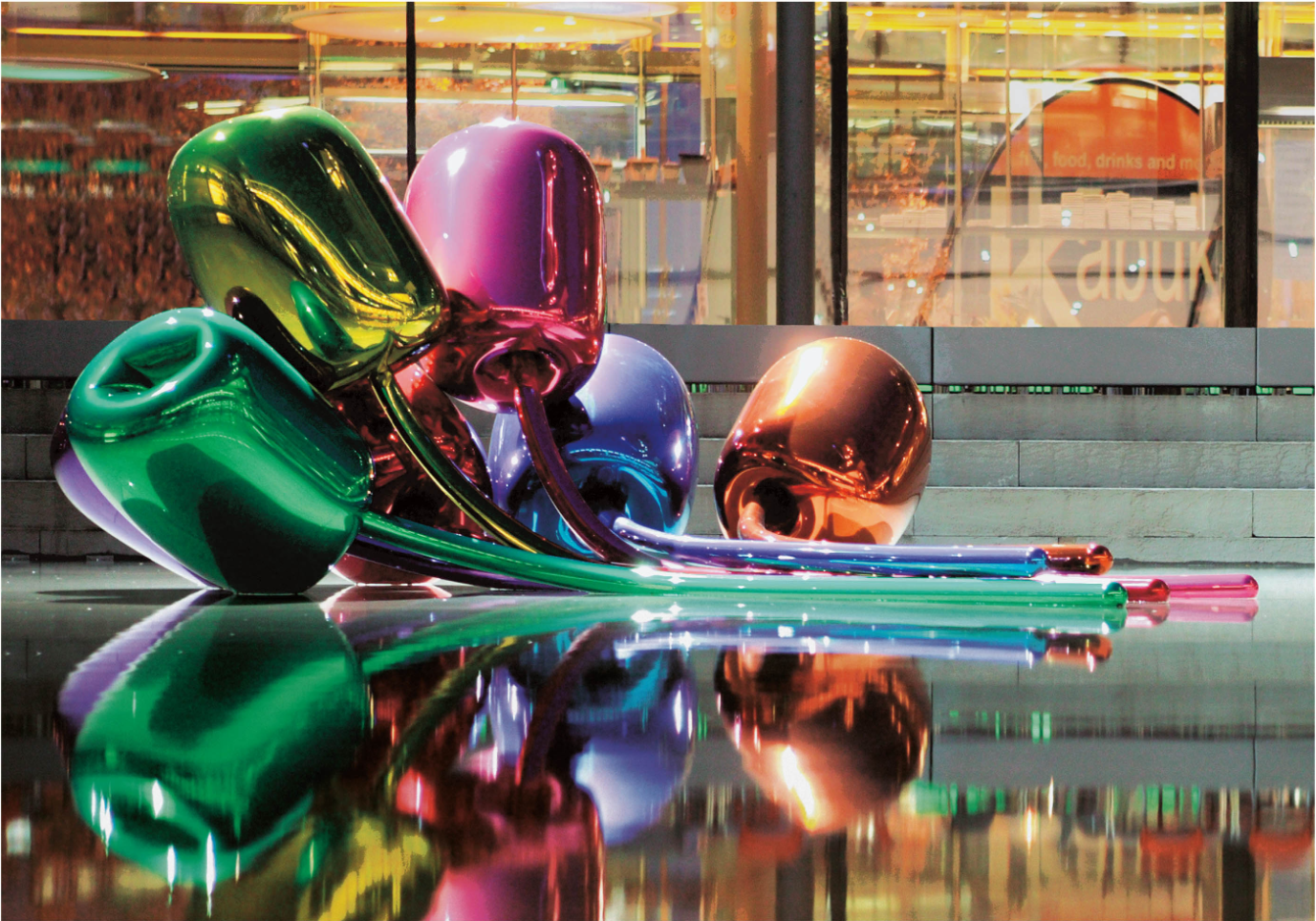
JEFF KOONS (b. 1955)
Tulips, 1995-2004
Mirror-polished stainless steel with transparent color coating
80x180x205 inches (203.2 x 457.2 x 520.7 cm)
This work is one of five unique versions
#5. Popeye, 2009-2011
Sotheby’s New-York: 13 May 2014
Estimate On Request
USD 28,165,000
(#34) Jeff Koons (sothebys.com)
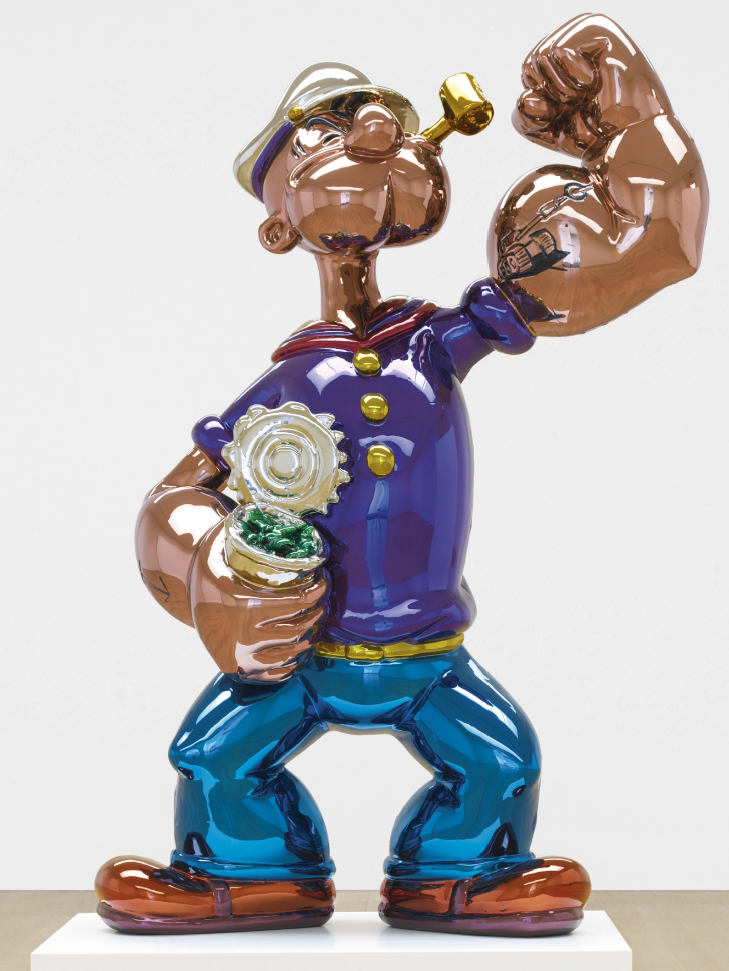
JEFF KOONS
Popeye, 2009-2011
Mirror polished stainless steel with transparent color coating
78 x 51 3/4 x 28 1/2 inches (198.1 x 131 x 72.4 cm)
Signed, dated 2009-2011 and numbered 3/3 on the underside of Popeye’s right foot
This work is number three from an edition of three plus one artist’s proof
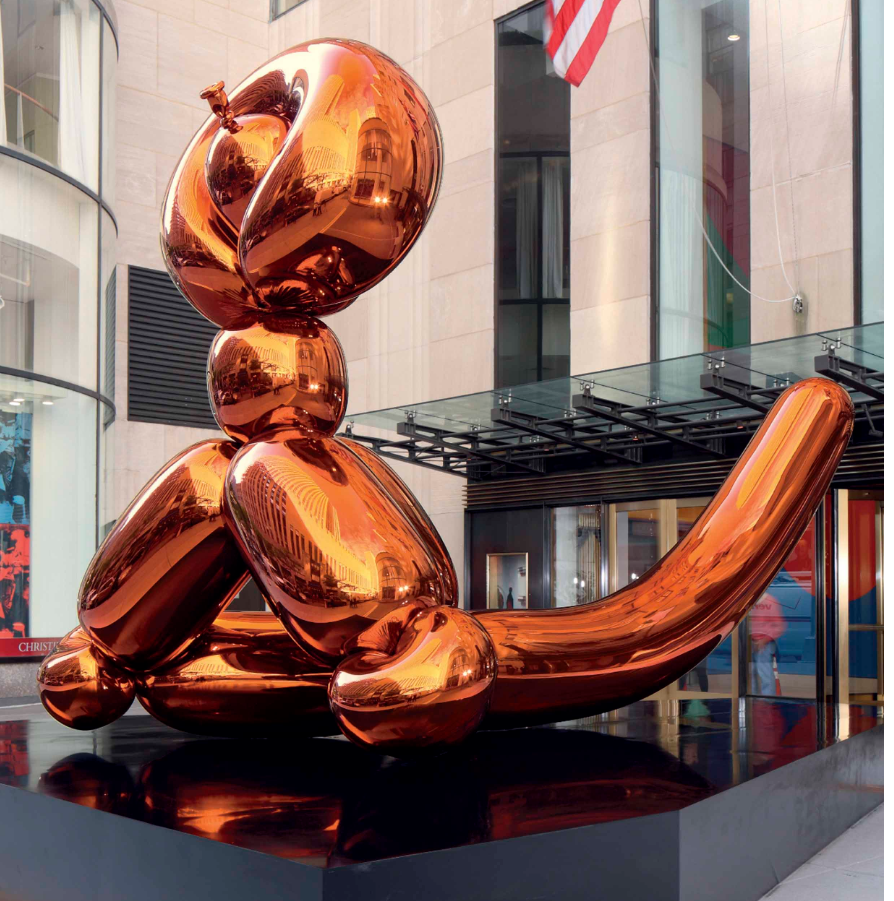
#6. Balloon Monkey (Orange), 2006-2013
Christie’s New-York: 12 November 2014
Estimated: USD 20,000,000 – 30,000,000
USD 25,925,000
Jeff Koons (B. 1955) (christies.com)
JEFF KOONS (B. 1955)
Balloon Monkey (Orange), 2006-2013
Mirror-polished stainless steel with transparent color coating
150x235x126 inches (381 x 596.9 x 320 cm)
Signed and dated ‘Jeff Koons 2006-2013’ (on the underside of the head)
This work is one of five unique versions (Blue, Magenta, Orange, Red, Yellow)
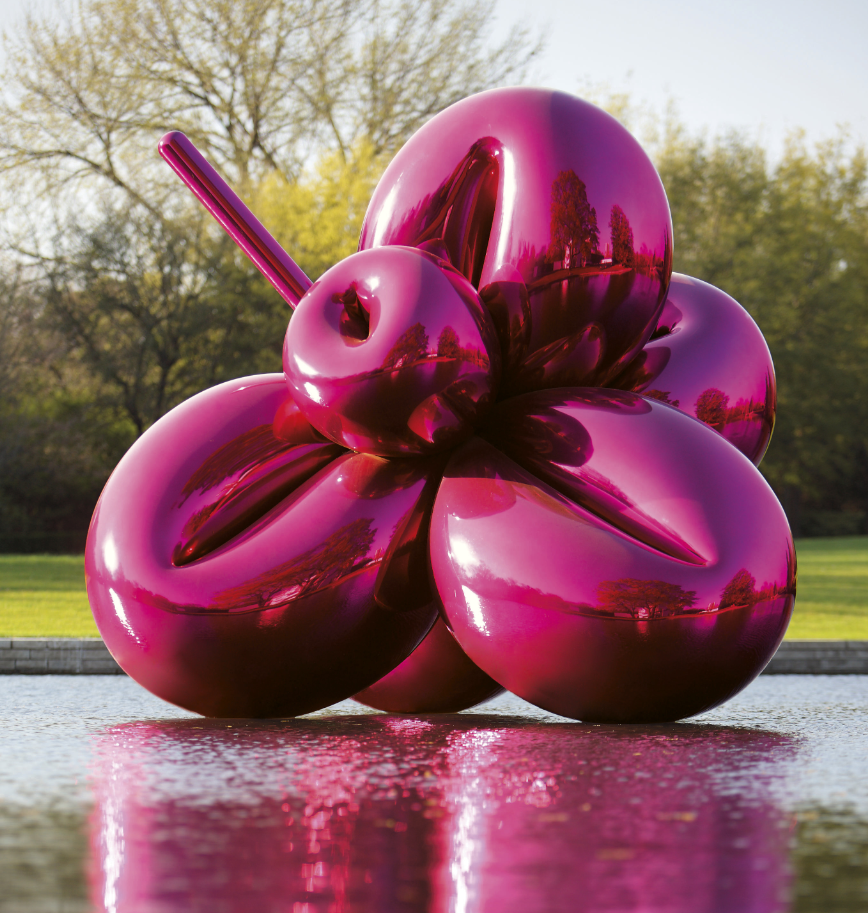
#7. Balloon Flower (Magenta), 1995-2000
Christie’s London: 30 June 2008
Estimate on Request
GBP 12,921,250 / USD 25,728,676
Jeff Koons (b. 1955) (christies.com)
JEFF KOONS (b. 1955)
Balloon Flower (Magenta), 1995-2000
High chromium stainless steel with transparent color coating
133 7/8 x 112 1/4 x 102 3/8 inches (340x285x260 cm)
This work is one of five unique versions (Magenta, Blue, Orange, Yellow and Red)
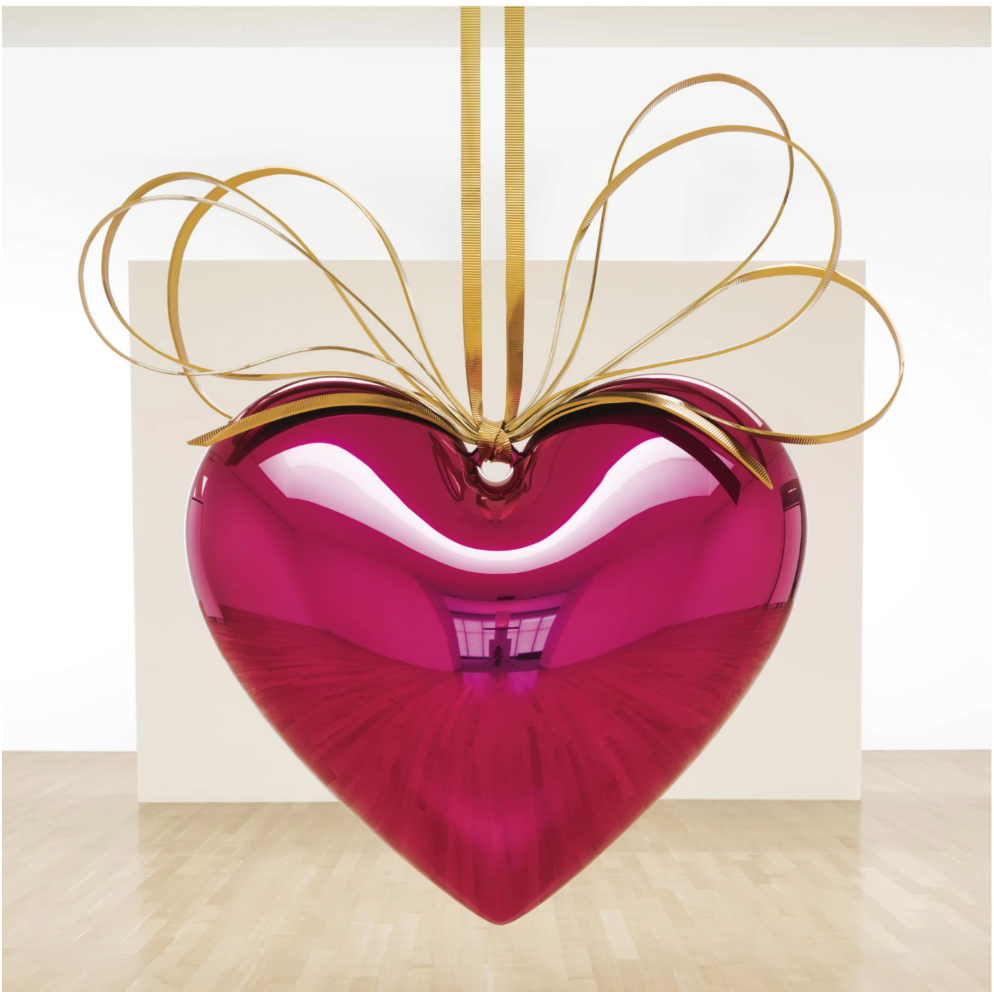
#8. Hanging Heart (Magenta/Gold), 1994-2006
Sotheby’s New-York: 14 November 2007
Estimated: USD 15,000,000 – 20,000,000
USD 23,561,000
(#14) Jeff Koons (sothebys.com)
JEFF KOONS
Hanging Heart (Magenta/Gold), 1994-2006
High chromium stainless steel with transparent color coating and yellow brass
106x85x40 inches (296.2 x 215.9 x 101.6 cm)
This work is one of five versions each uniquely colored
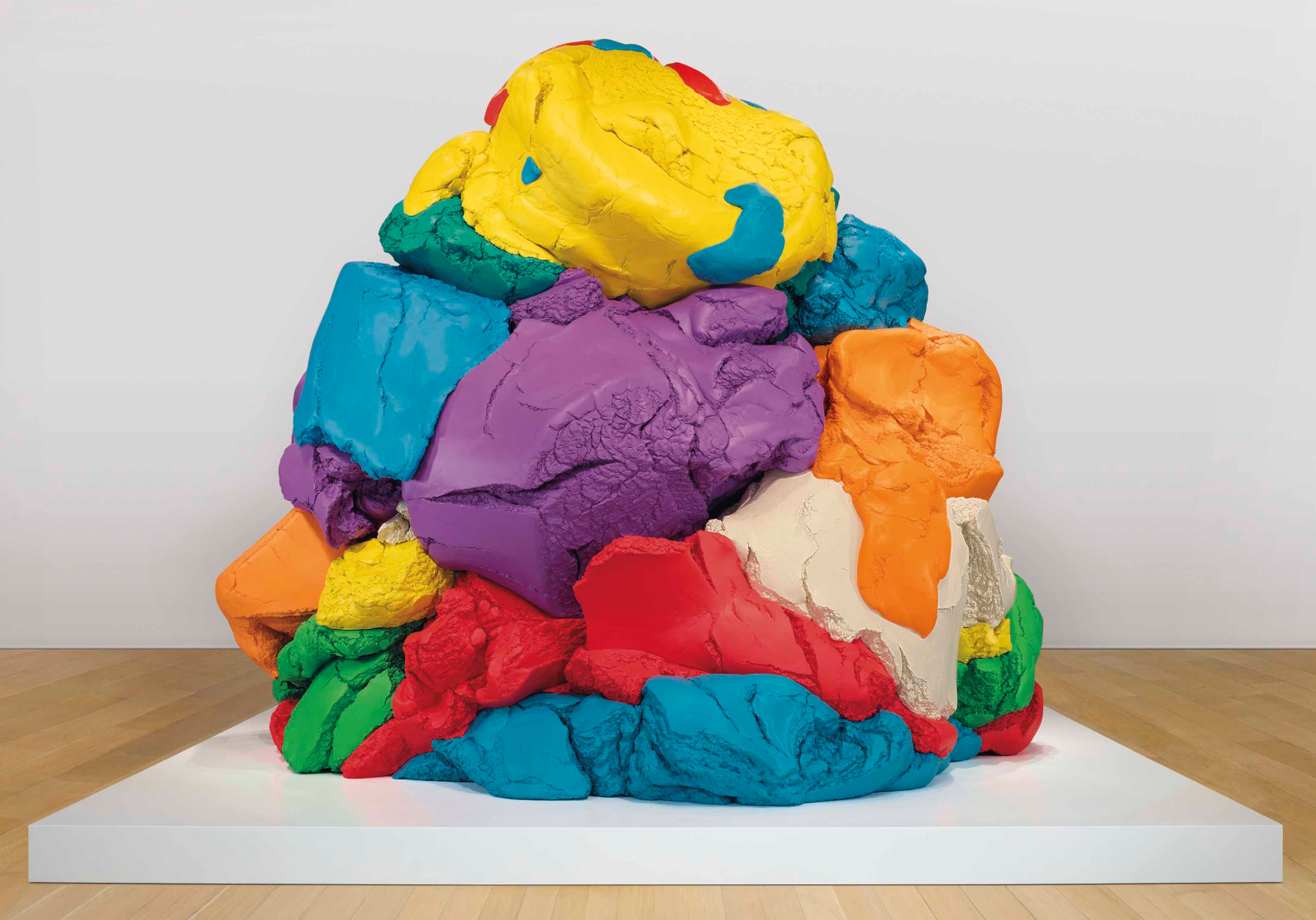
#9. Play-Doh, 1994-2014
Christie’s New-York: 17 May 2018
Estimate on Request
USD 22,812,500
Jeff Koons (b. 1955) (christies.com)
JEFF KOONS (b. 1955)
Play-Doh, 1994-2014
Polychromed aluminum
124 x 152 1/4 x 137 inches (315 x 386.7 x 348 cm)
This work is one of five unique versions
#10. Jim Beam – J.B. Turner Train, 1986
Christie’s New-York: 17 November 2022
Estimated: USD 15,000,000 – 20,000,000
USD 16,992,500
JEFF KOONS (B. 1955) (christies.com)
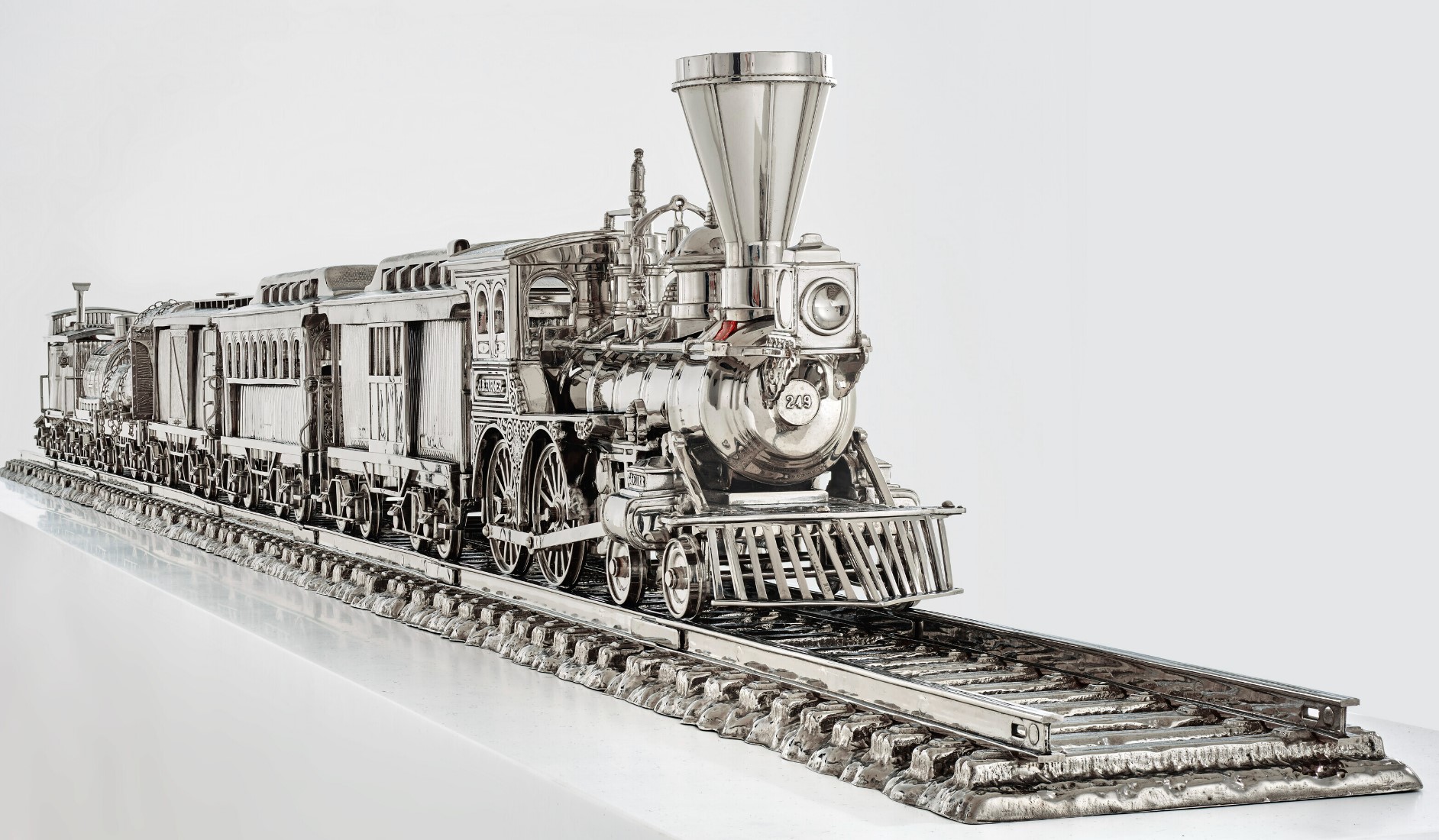
JEFF KOONS (B. 1955)
Jim Beam – J.B. Turner Train, 1986
Stainless steel and bourbon
11 x 114 x 6 1/2 inches (27.9 x 289.6 x 16.5 cm)
#11. Balloon Flower (Blue), 1995-2000
Christie’s New-York: 10 November 2010
Estimated: USD 12,000,000 – 16,000,000
USD 16,882,500
Jeff Koons (b. 1955) , Balloon Flower (Blue) | Christie’s
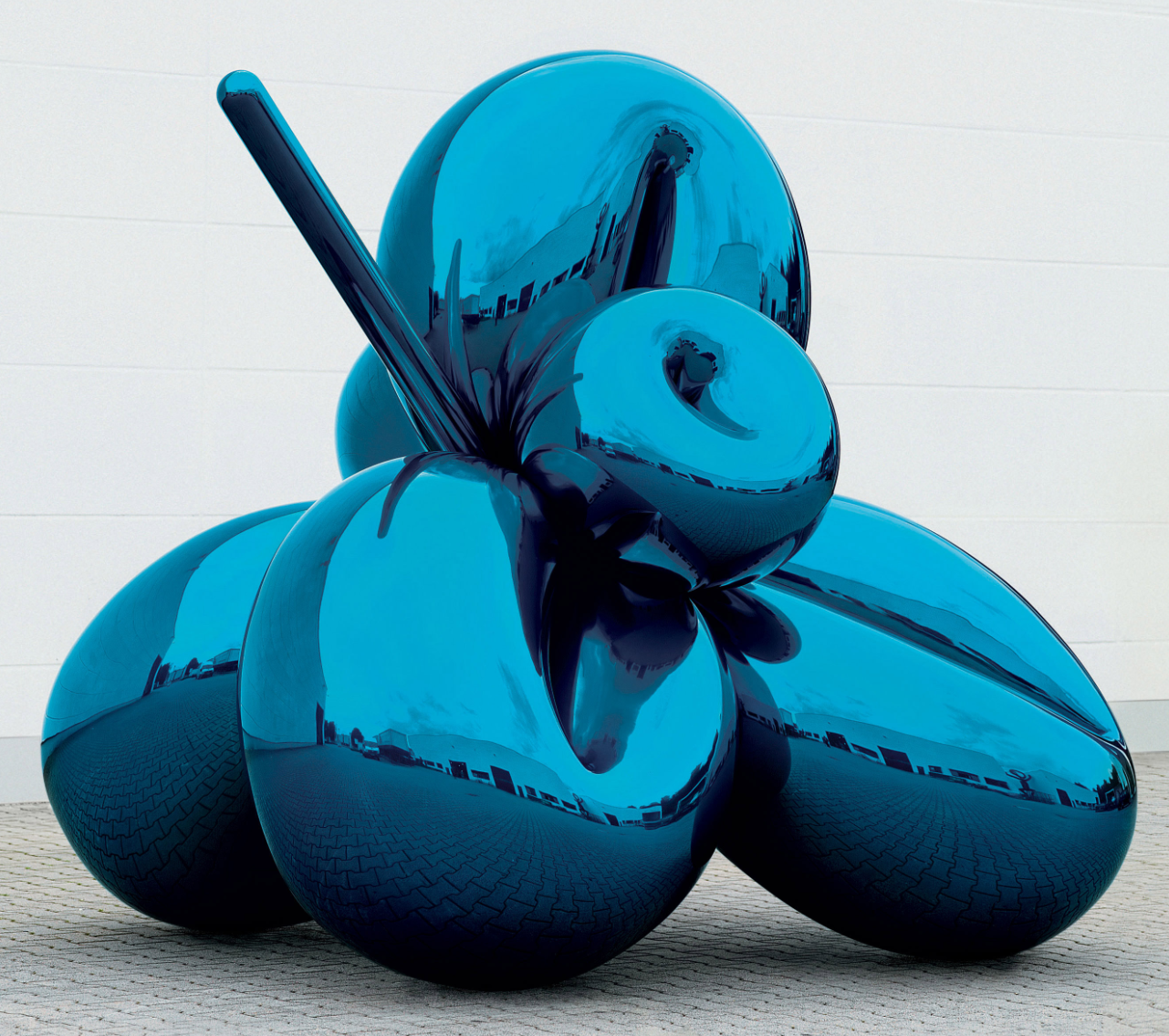
JEFF KOONS (b. 1955)
Balloon Flower (Blue), 1995-2000
High chromium stainless steel with transparent color coating
133 1/4 x 112 1/4 x 102 3/8 inches (340 x 285 x 260 cm)
This work is one of five unique versions (Blue, Magenta, Yellow, Orange and Red)
#12. Pink Panther, 1988
Christie’s New-York: 12 November 2014
Estimated: USD 8,000,000 – 12,000,000
USD 15,845,000
Jeff Koons (b. 1955), Pink Panther | Christie’s
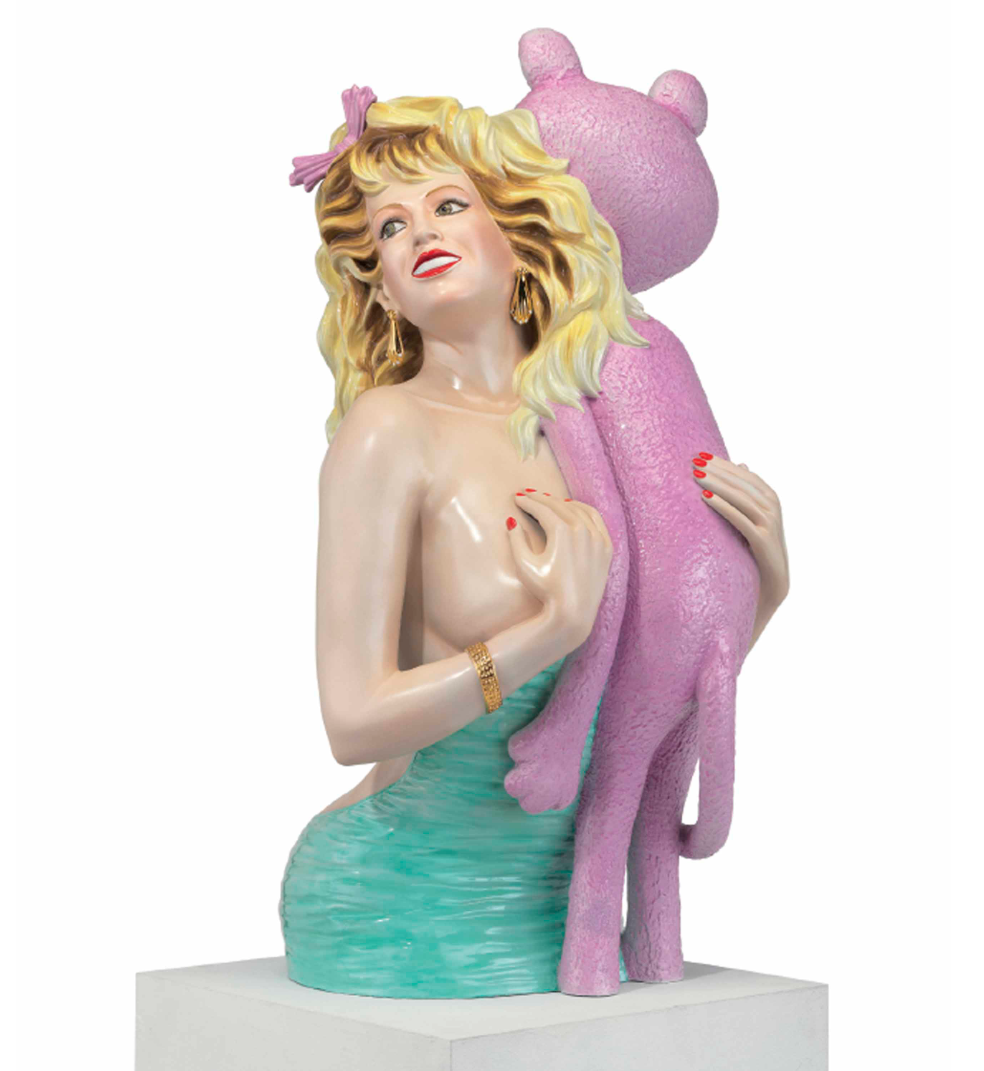
JEFF KOONS (b. 1955)
Pink Panther, 1988
Porcelain
41 x 20 1/2 x 19 inches (104.1 x 52.1 x 48.3 cm)
Signed, numbered and dated ‘Jeff Koons 88 AP’ (on the underside)
This work is the artist’s proof from an edition of three plus one artist’s proof
PART II: AUCTION RESULTS
2026 Upcoming Lots
MORE LOTS COMING SOON
2026 Auction Results
PRELIMINARY AUCTION RESULTS
As of 15 June 2026
#1. Louis XIV, 1986
Robert Mnuchin: Collector at Heart
Sotheby’s New-York: 14 May 2026
Estimated: USD 7,000,000 – 10,000,000
USD 8,570,000
Jeff Koons | Louis XIV | Robert Mnuchin: Collector at Heart Evening
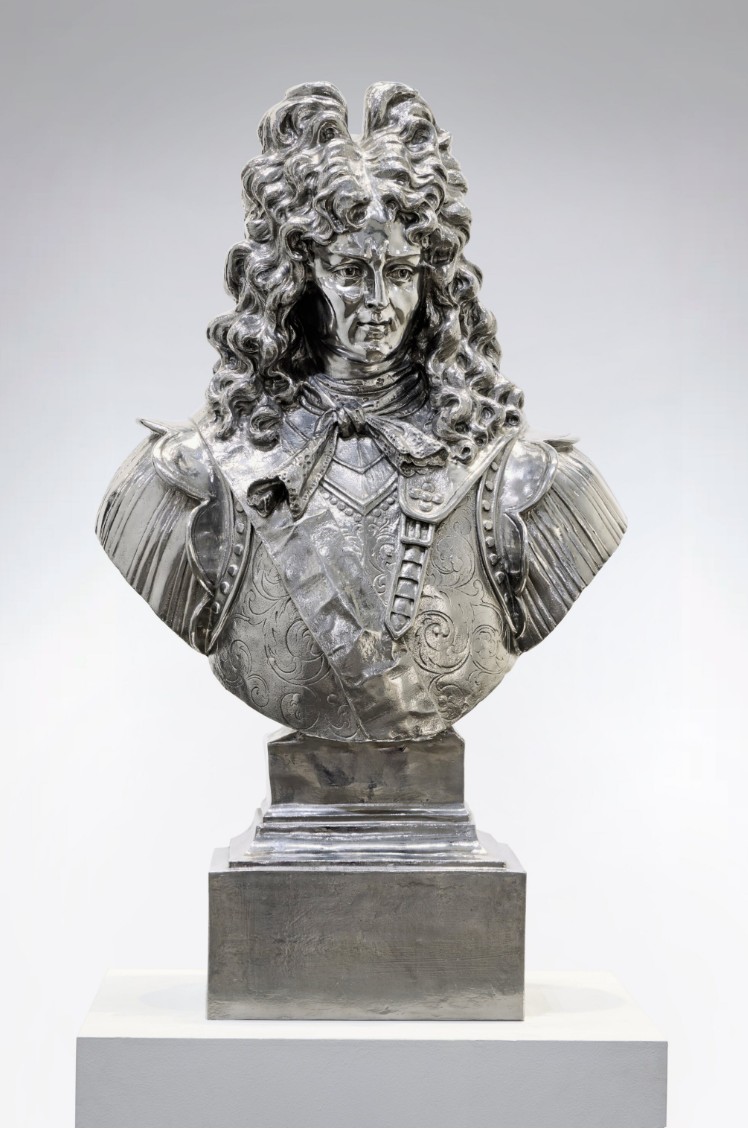
JEFF KOONS (b. 1955)
Louis XIV, 1986
Stainless steel
46x27x15 inches (116.8 x 68.6 x 38.1 cm)
This work is the artist’s proof from an edition of 3 plus 1 artist’s proof
#2. Winter Bears, 1988
Temple of Style: The Barbara Jakobson Collection
Christie’s New-York: 26 February 2026
Estimated: USD 3,800,000 – 5,000,000
USD 7,639,000
JEFF KOONS (B. 1955), Winter Bears | Christie’s
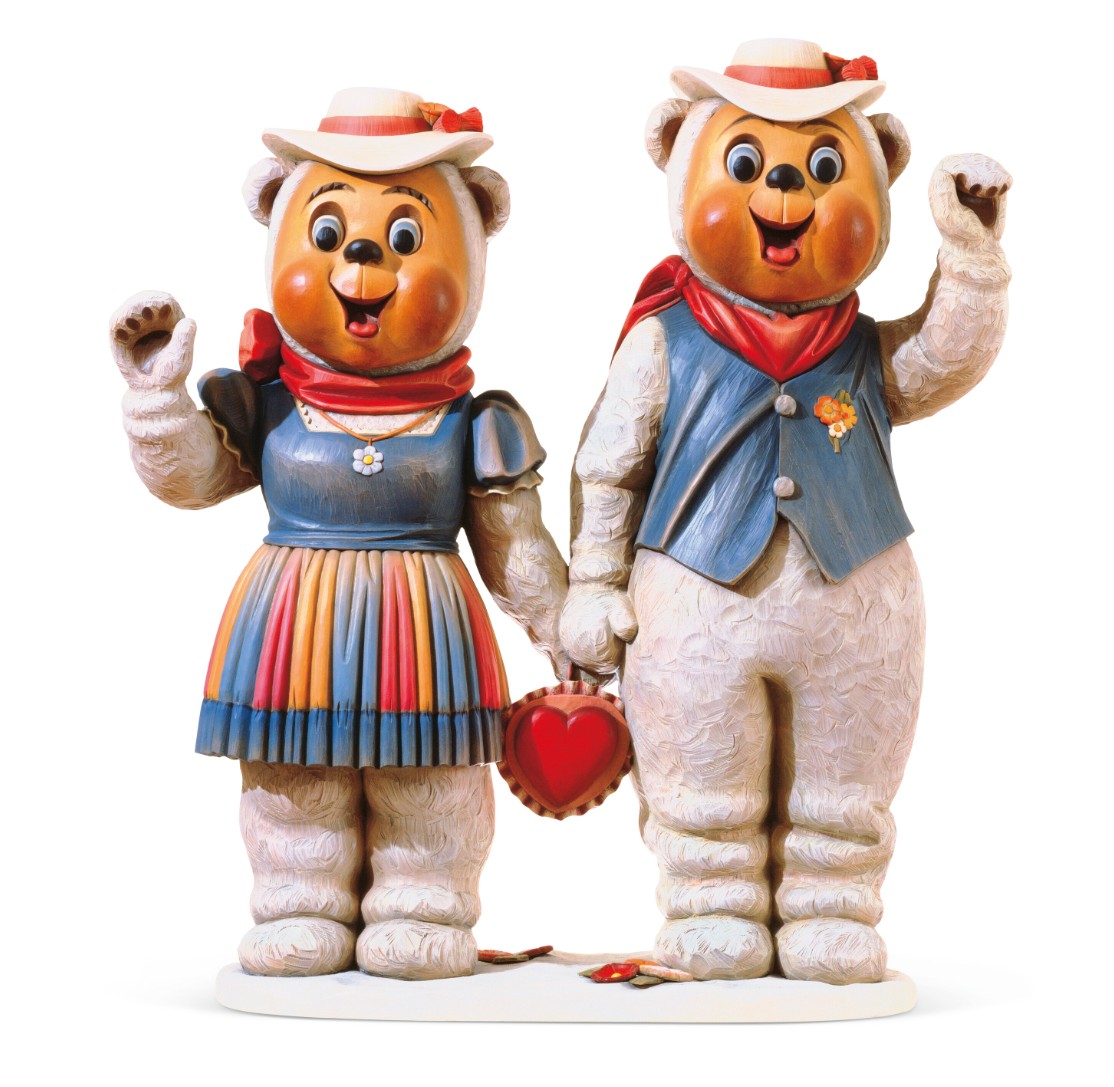
JEFF KOONS (B. 1955)
Winter Bears, 1988
Polychromed wood
48 x 44 x 15-1/2 inches (121.9 x 111.8 x 39.4 cm)
Incised with the foundry mark (lower edge of the base)
Incised with the artists’s signature, number, date and foundry mark ‘Koons 1⁄3 88’ (on the underside)
This work is number one from an edition of three plus one artist’s proof
USD 1 million
#3. Gazing Ball (Esquiline Venus), 2013
Edlis Neeson Collection
Christie’s New-York: 20 May 2026
Estimated: USD 600,000 – 800,000
USD 508,000
JEFF KOONS (B. 1955), Gazing Ball (Esquiline Venus) | Christie’s
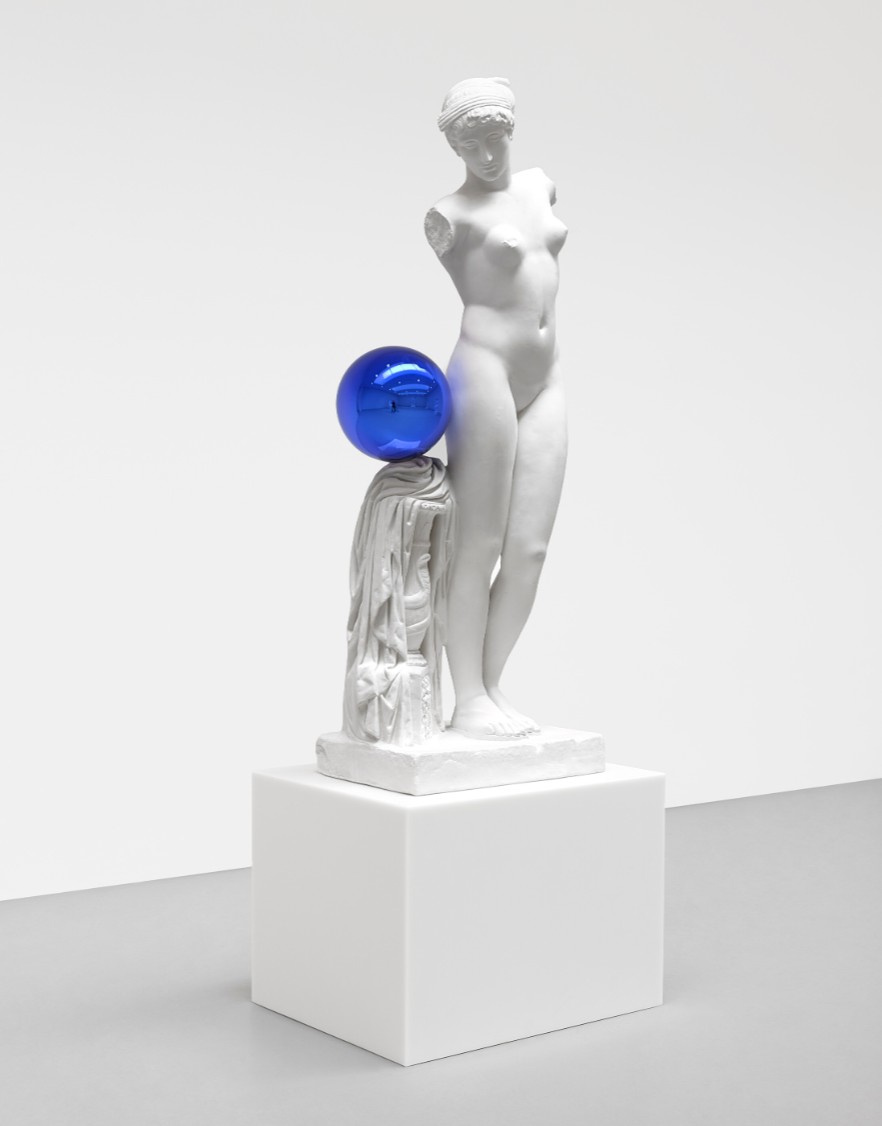
JEFF KOONS (B. 1955)
Gazing Ball (Esquiline Venus), 2013
Plaster and glass
Figure: 61-3/8 x 24-1/8 x 16-1/8 inches (155.9 x 61.3 x 41 cm)
Base: 21x29x23 inches (53.3 x 73.7 x 58.4 cm)
This work is number one from an edition of three plus one artist’s proof
#4. Silver Shoes, 1990
Edlis Neeson Collection
Christie’s New-York: 20 May 2026
Estimated: USD 400,000 – 600,000
USD 254,000
JEFF KOONS (B. 1955), Silver Shoes | Christie’s
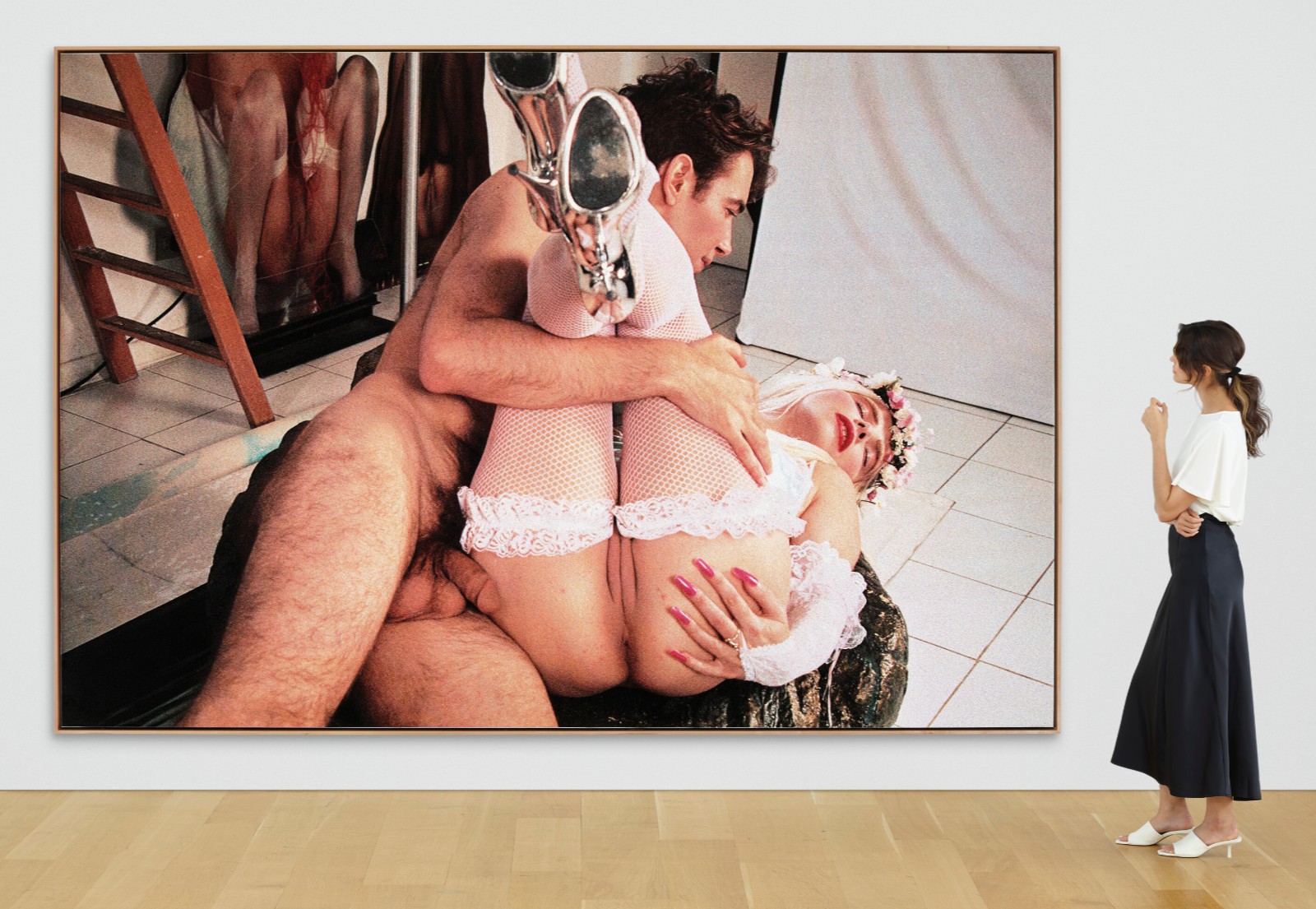
JEFF KOONS (B. 1955)
Silver Shoes, 1990
Oil inks on canvas
96×144 inches (243.8 x 365.8 cm)
This work is number one from an edition of one plus one artist’s proof
2025 Auction Results
14 lots sold at auction in 2025 for a total turnover of USD 19,608,840. With no lot failing to sell, the sell-through rate is 100%. The highest price was achieved by Hulk (Rock), a sculpture from the HULK ELVIS series that sold at Sotheby’s in New-York, on 18 November 2025, for USD 4,442,000.
2025 Top 3 Lots
6 lots sold for more than USD 1 million, generating a cumulative turnover of USD 15,101,625, representing 77% of the total for 2025.
#1. Hulk (Rock), 2004-13
Property from a Prestigious American Collection
Sotheby’s New-York: 18 November 2025
Estimated: USD 2,o00,000 – 3,000,000
USD 4,442,000
HULK ELVIS SERIES
Hulk (Rock) | The Now & Contemporary Evening Auction | 2025 | Sotheby’s
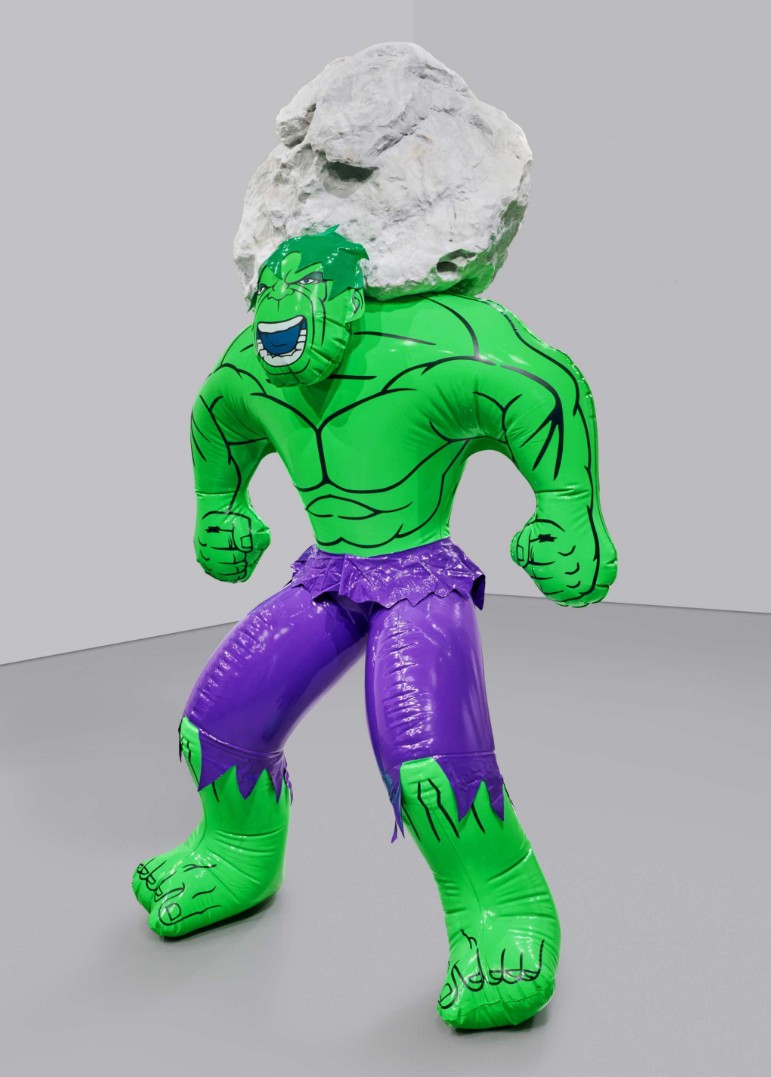
JEFF KOONS (b. 1955)
Hulk (Rock), 2004-13
Polychromed bronze and marble
87 3/8 x 48 3/4 x 28 1/8 inches (221.9 x 123.8 x 71.4 cm)
Signed, dated 2004-2013 and numbered 2/3 (on the interior of the purple element)
This work is number 2 from an edition of 3 plus 1 artist’s proof
#2. Poodle, 1991
Pauline Karpidas: The London Collection Evening Auction
Sotheby’s London: 17 September 2025
Estimated: GBP 1,000,000 – 1.500,000
GBP 2,358,000 / USD 3,219,475
MADE IN HEAVEN SERIES
Poodle | Pauline Karpidas: The London Collection Evening Auction | 2025 | Sotheby’s
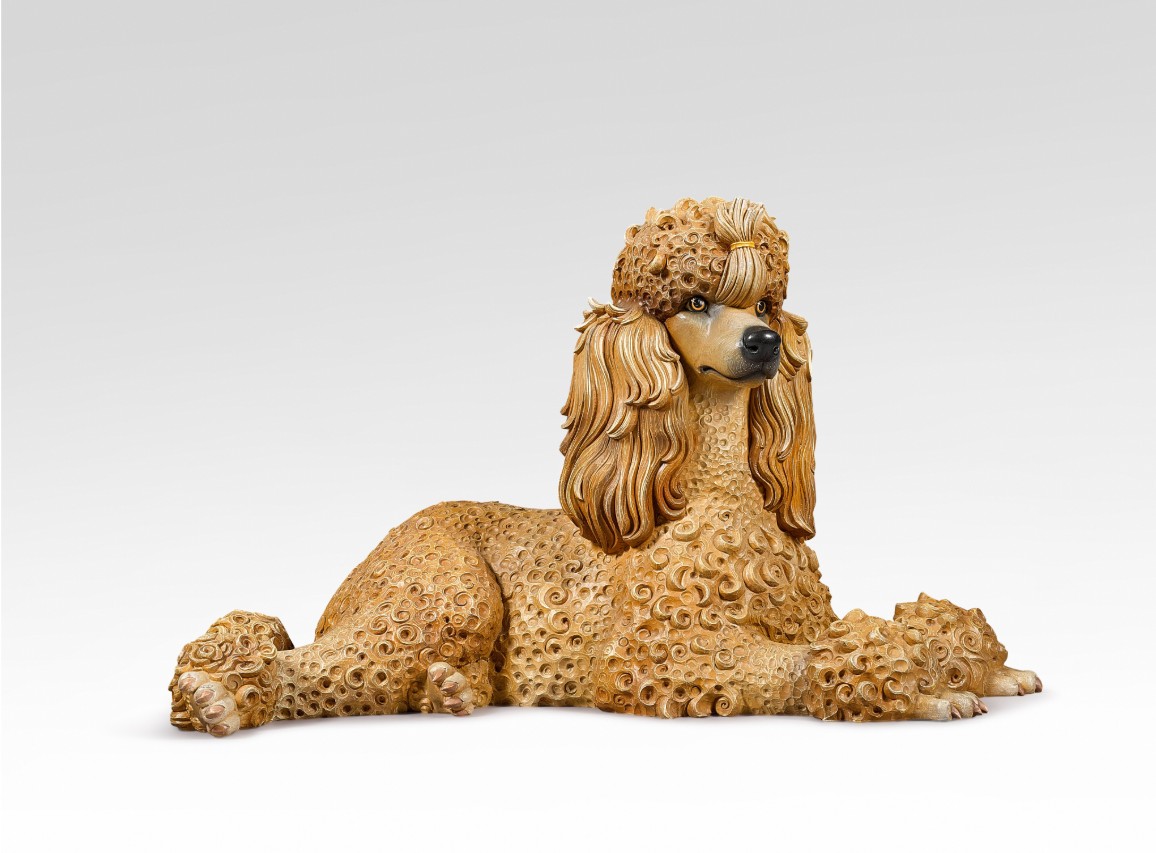
JEFF KOONS (b. 1955)
Poodle, 1991
Polychromed wood
23 x 39 1/2 x 20 1/2 inches (58.4 x 100.3 x 52.1 cm)
Incised with the signature, dated ’91 and numbered 3/3 (on the underside)
This work is number 3 from an edition of 3 plus 1 artist’s proof
#3. Wall Relief with Bird, 1991
Christie’s New-York: 19 November 2025
Estimated: USD 2,000,000 – 3,000,000
USD 2,393,000
MADE IN HEAVEN SERIES
JEFF KOONS (B. 1955), Wall Relief with Bird | Christie’s
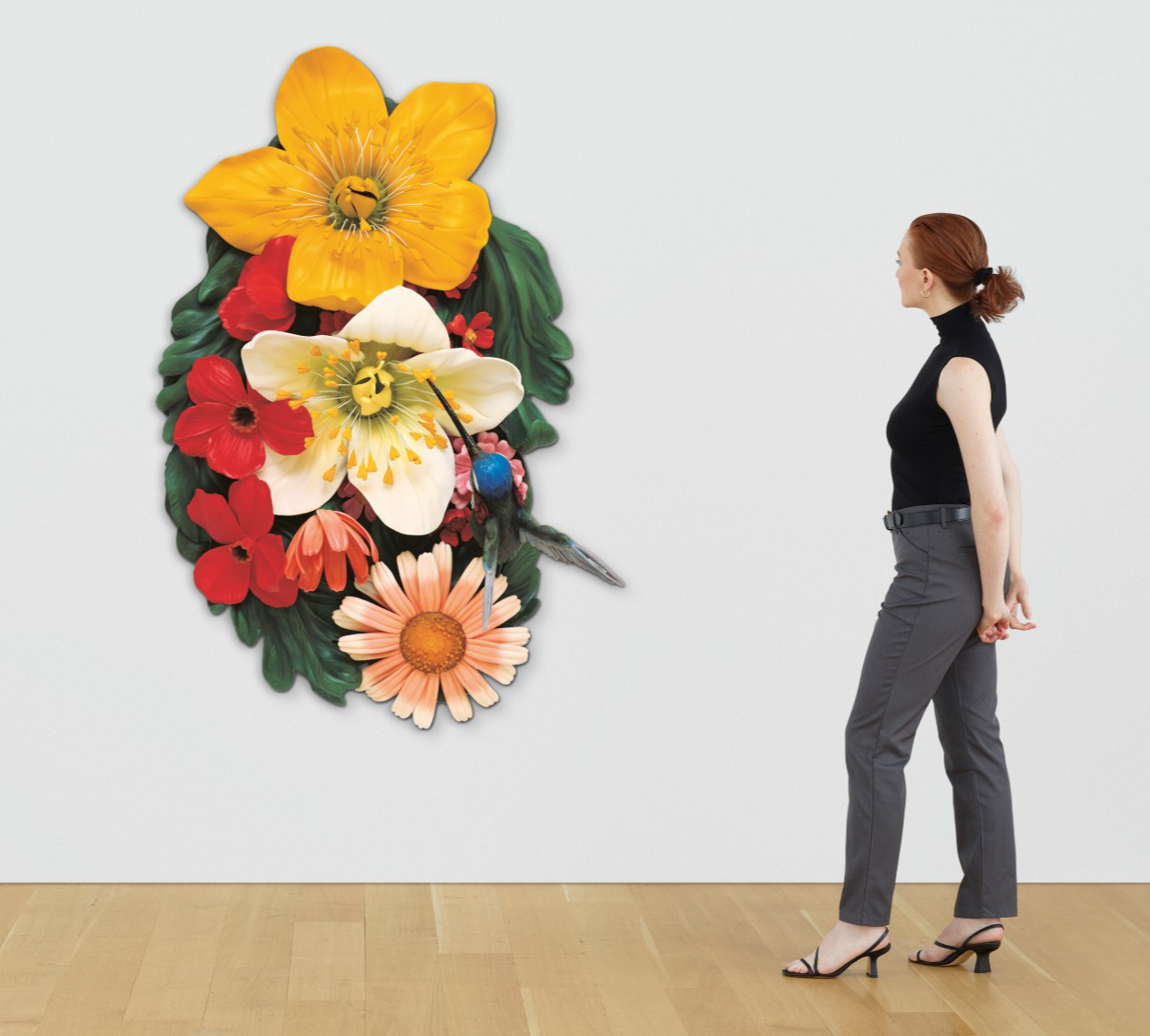
JEFF KOONS (B. 1955)
Wall Relief with Bird, 1991
Polychromed wood
72x50x27 inches (182.9 x 127 x 68.6 cm)
This work is number three from an edition of three plus one artist’s proof
#4. Baroque Egg with Bow (Orange/Magenta), 1994-2008
Sotheby’s New-York: 15 May 2025
Estimated: USD 2,500,000 – 3,500,000
USD 2,307,000
CELEBRATION SERIES
Baroque Egg with Bow | The Now and Contemporary Evening Auction | 2025 | Sotheby’s
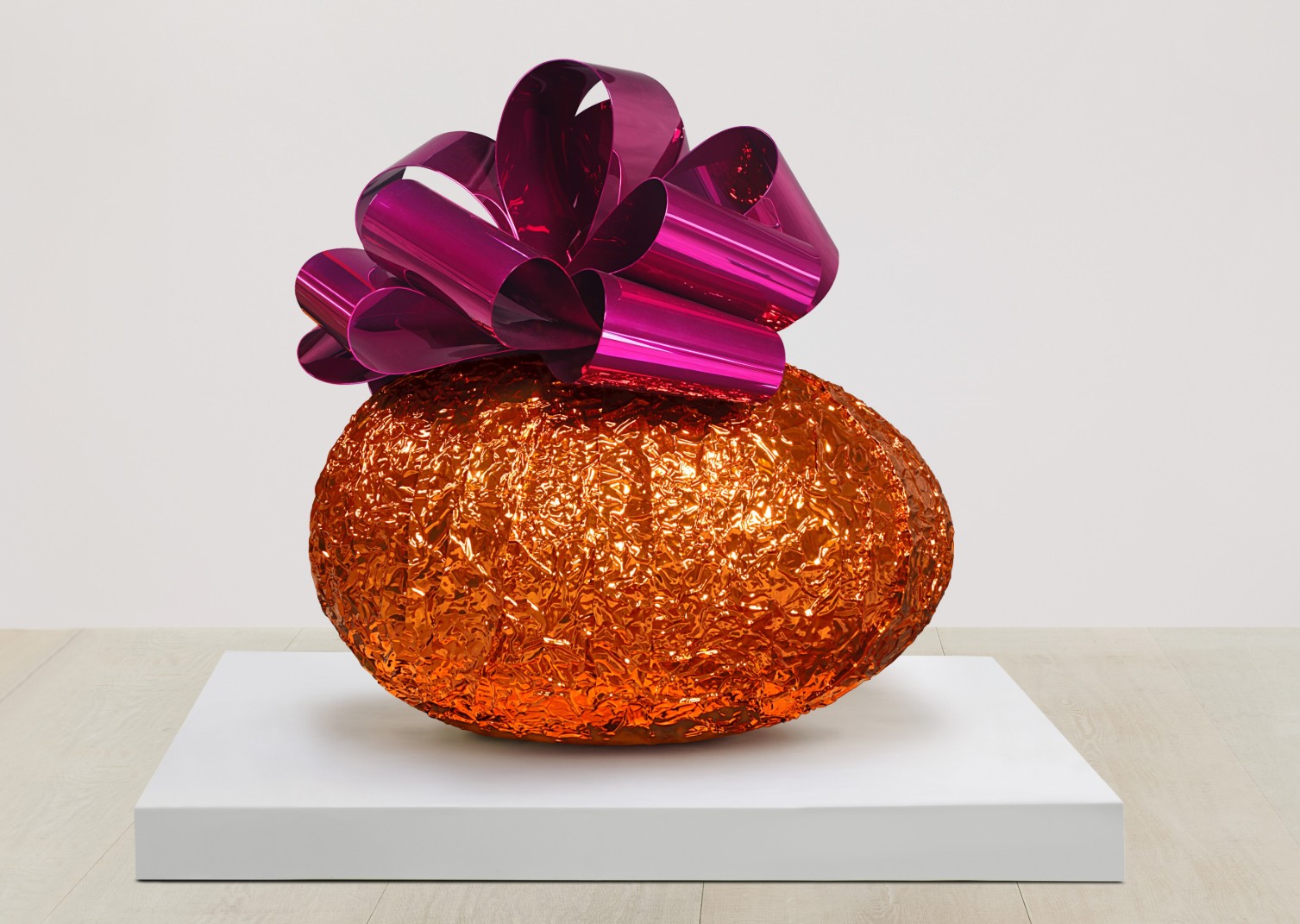
JEFF KOONS (b. 1955)
Baroque Egg with Bow (Orange/Magenta), 1994-2008
Mirror-polished stainless steel with transparent color coating
78 3/8 x 76 3/4 x 76 inches (199x195x193 cm)
This work is one of five uniquely colored variants
#5. Dolphin Taz Trashcan, 2007-2011
Phillips New-York: 13 May 2025
Estimated: USD 800,000 – 1,200,000
USD 1,391,000
POPEYE SERIES
Jeff Koons Modern & Contemporary Art Evening Sale
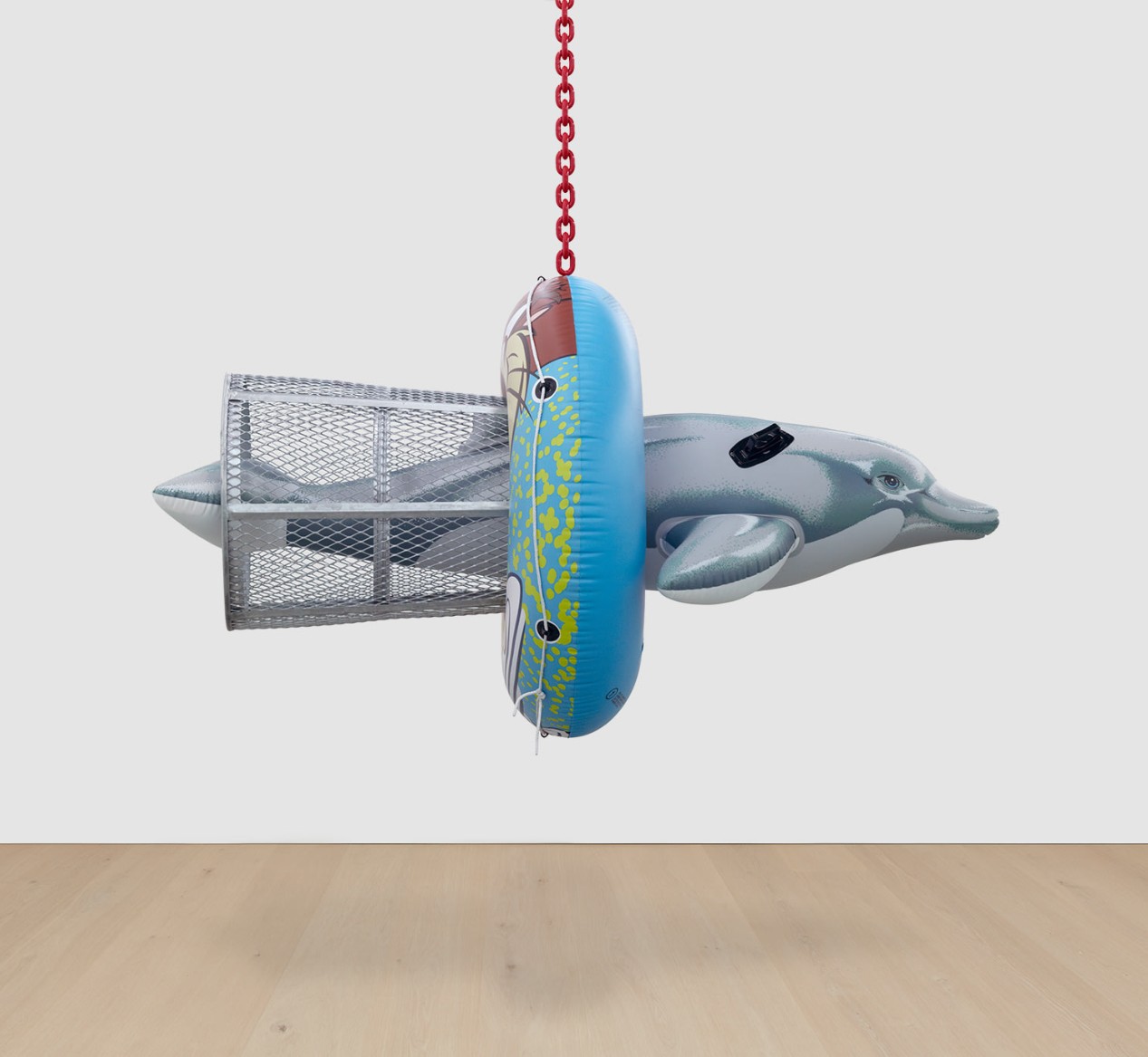
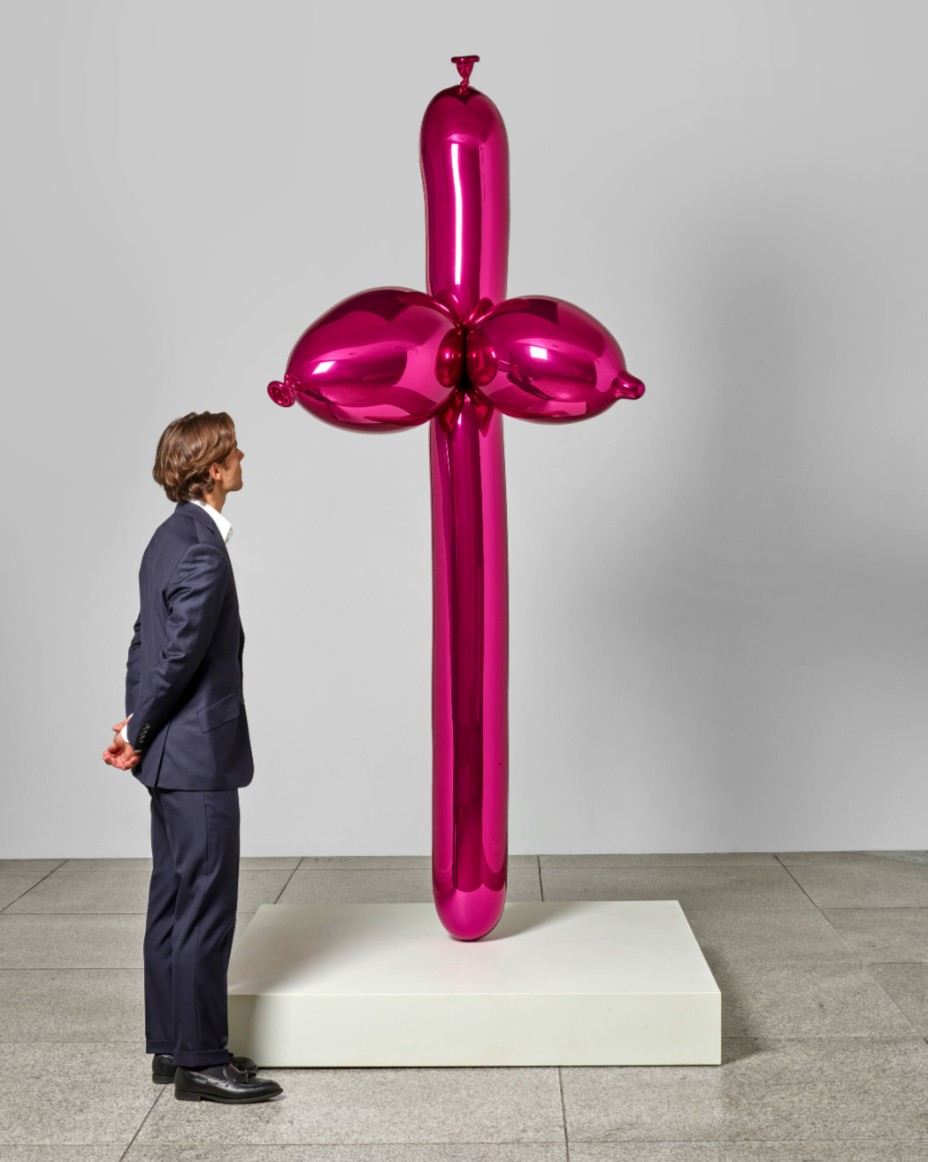
#6. Balloon Venus Dolni Vestonice (Magenta), 2013-17
Bonhams New-York: 19 November 2025
Estimated: USD 1,500,000 – 2,500,000
USD 1,349,150
ANTIQUITY SERIES
Bonhams : JEFF KOONS (B. 1955) Balloon Venus Dolni Vestonice (Magenta)
JEFF KOONS (B. 1955)
Balloon Venus Dolni Vestonice (Magenta), 2013-17
Mirror-polished stainless steel with transparent color coating
109 1/8 x 43 7/8 x 28 1/4 inches (277.2 x 111.3 x 71.7 cm)
This work is one of five unique variants
USD 1 million
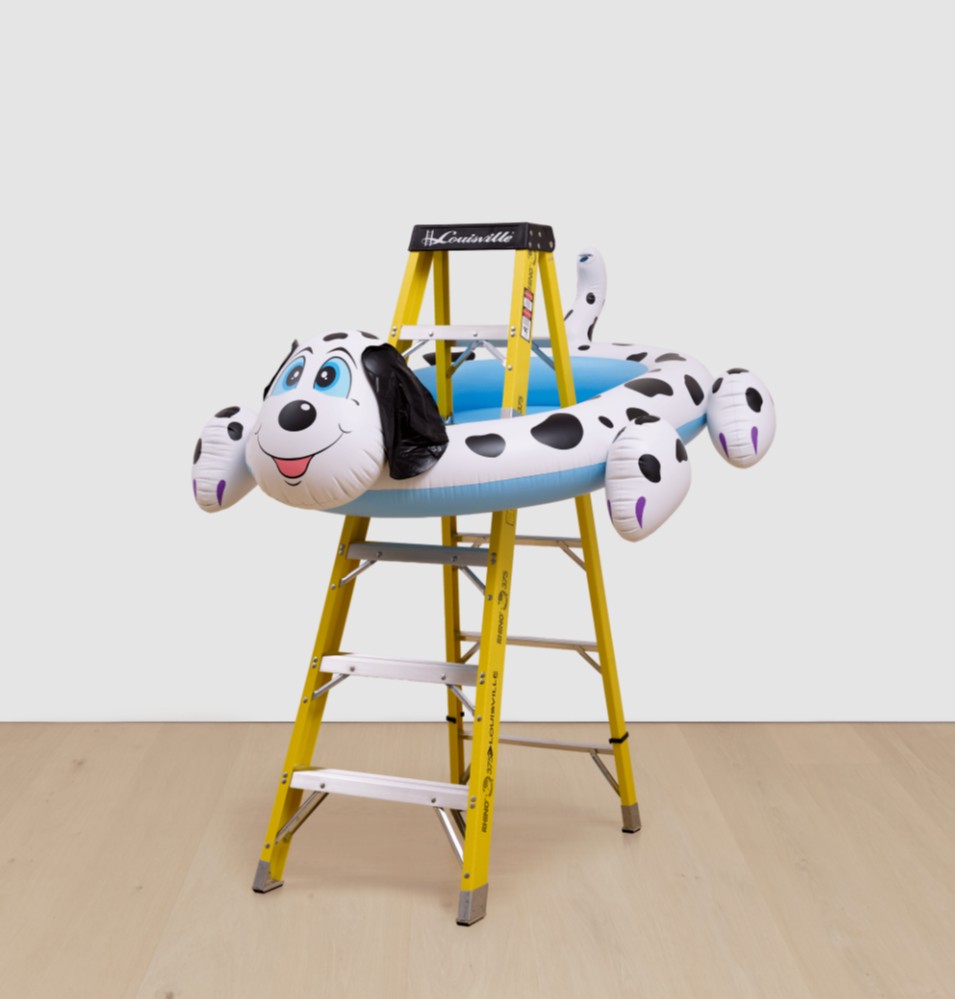
#7. Dogpool Ladder, 2007-2011
Estimated: USD 750,000 – 1,o00,000
USD 967,500
POPEYE SERIES
Jeff Koons Modern & Contemporary Art Evening Sale featuring Cera the Triceratops
JEFF KOONS
Dogpool Ladder, 2007-2011
Polychromed aluminum and aluminum
68 x 59 1/4 x 63 3/4 inches (172.7 x 150.5 x 161.9 cm)
This work is number 2 from an edition of 3 plus 1 artist’s proof
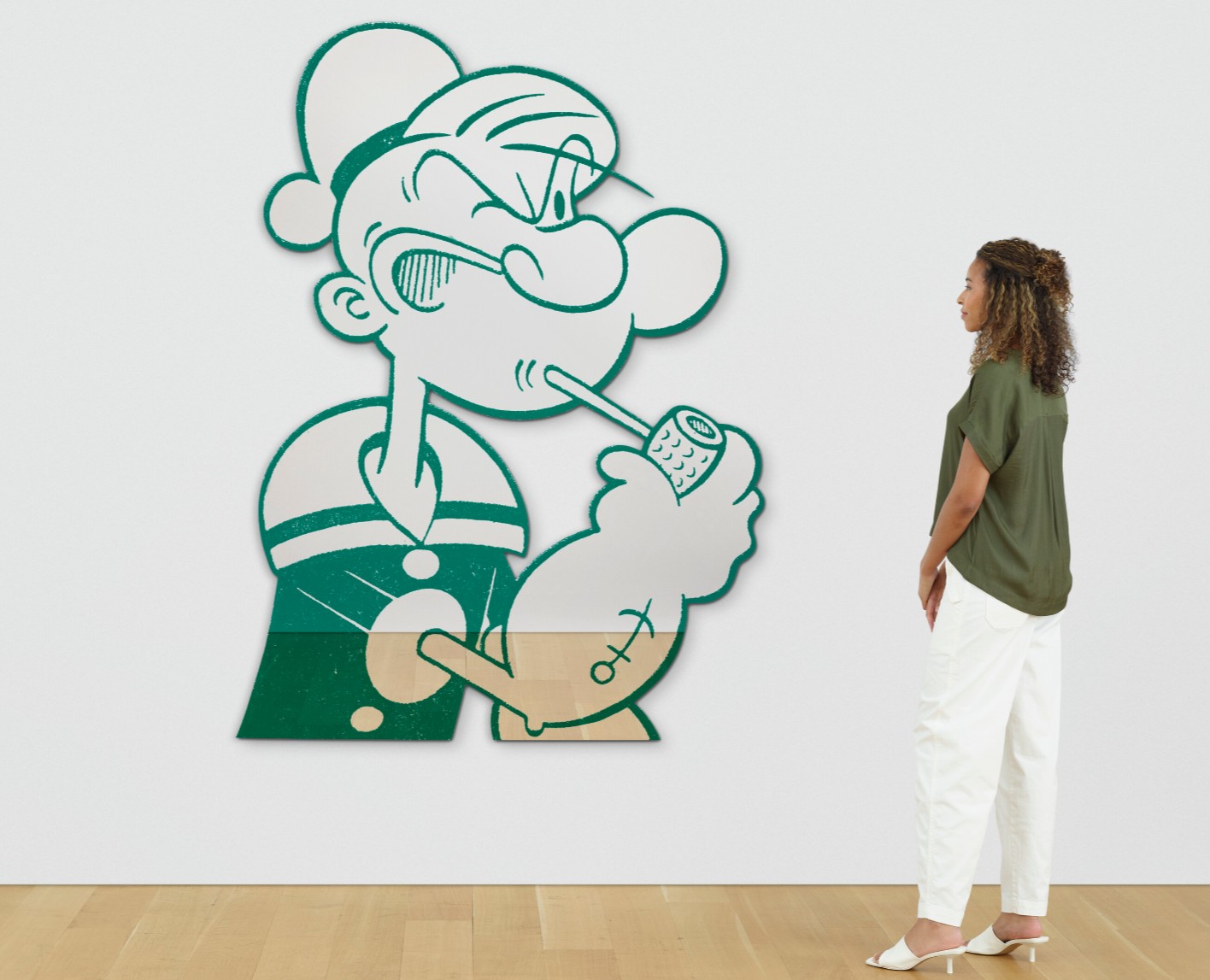
#8. Popeye (Green), 2004-2009
Edlis Neeson Collection
Christie’s New-York: 19 November 2025
Estimated: USD 600,000 – 800,000
USD 762,000
POPEYE SERIES
JEFF KOONS (B. 1955), Popeye (Green) | Christie’s
JEFF KOONS (B. 1955)
Popeye (Green), 2004-2009
Mirror-polished stainless steel with transparent color coating
80 x 59 1/2 x 1 1/4 inches (203.2 x 151.1 x 3.2 cm)
Signed and dated ‘Jeff Koons 2004-2009’ (on the reverse)
This work is one of five unique versions (Blue, Green, Orange, Red, Yellow)
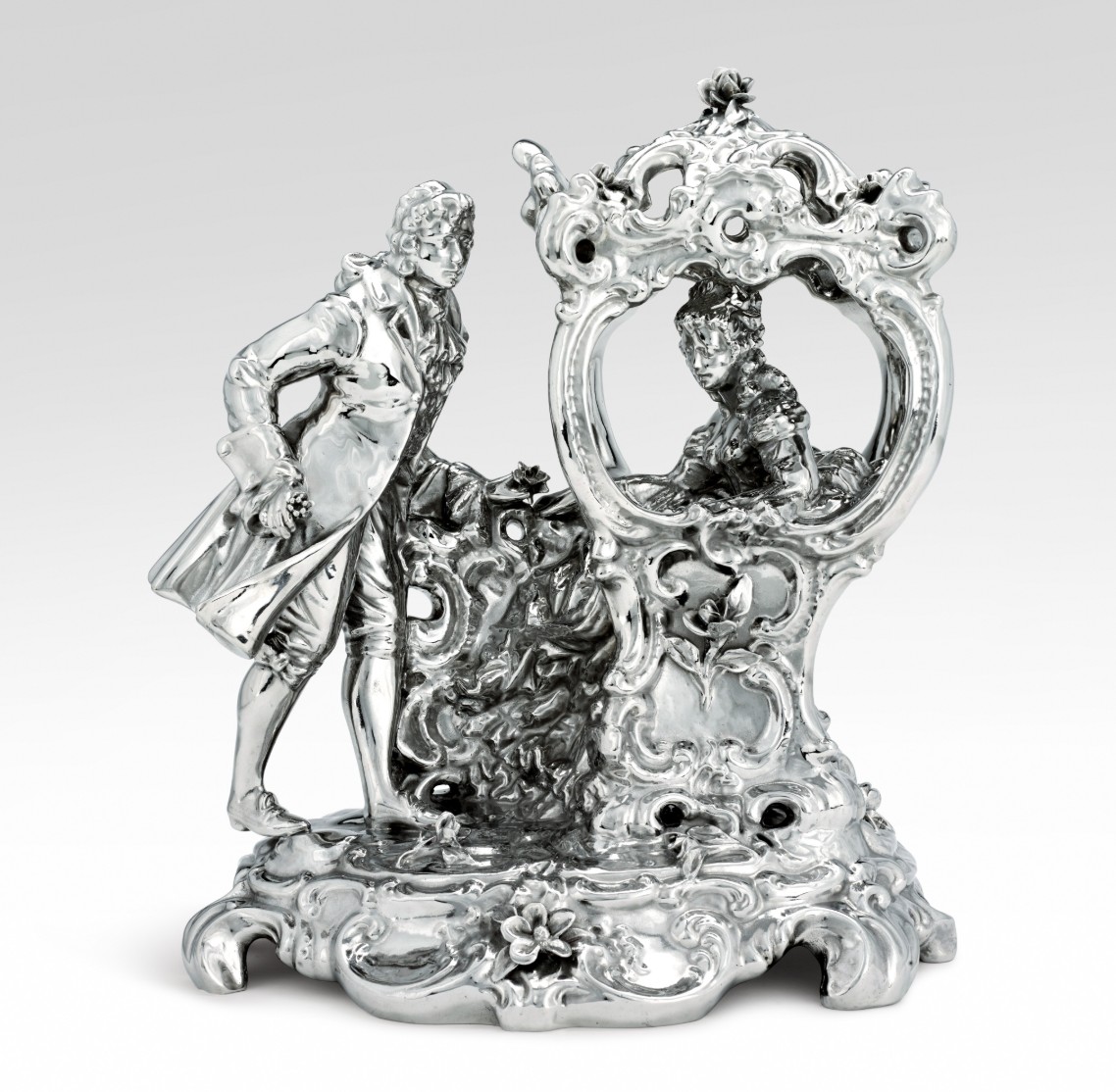
#9. French Coach Couple, 1986
Sotheby’s London: 17 September 2025
Estimated: GBP 500,000 – 700,000
GBP 482,600 / USD 658,915
JEFF KOONS (b. 1955)
French Coach Couple, 1986
Stainless steel
17 x 15 1/2 x 11 3/4 inches (43.2 x 39.4 x 29.8 cm)
This work is the artist’s proof aside from the edition of 3
#10. Gazing Ball (Ariadne), 2013
Christie’s New-York: 20 November 2025
Estimated: USD 600,000 – 800,000
USD 635,000
GAZING BALL SERIES
JEFF KOONS (B. 1955), Gazing Ball (Ariadne) | Christie’s
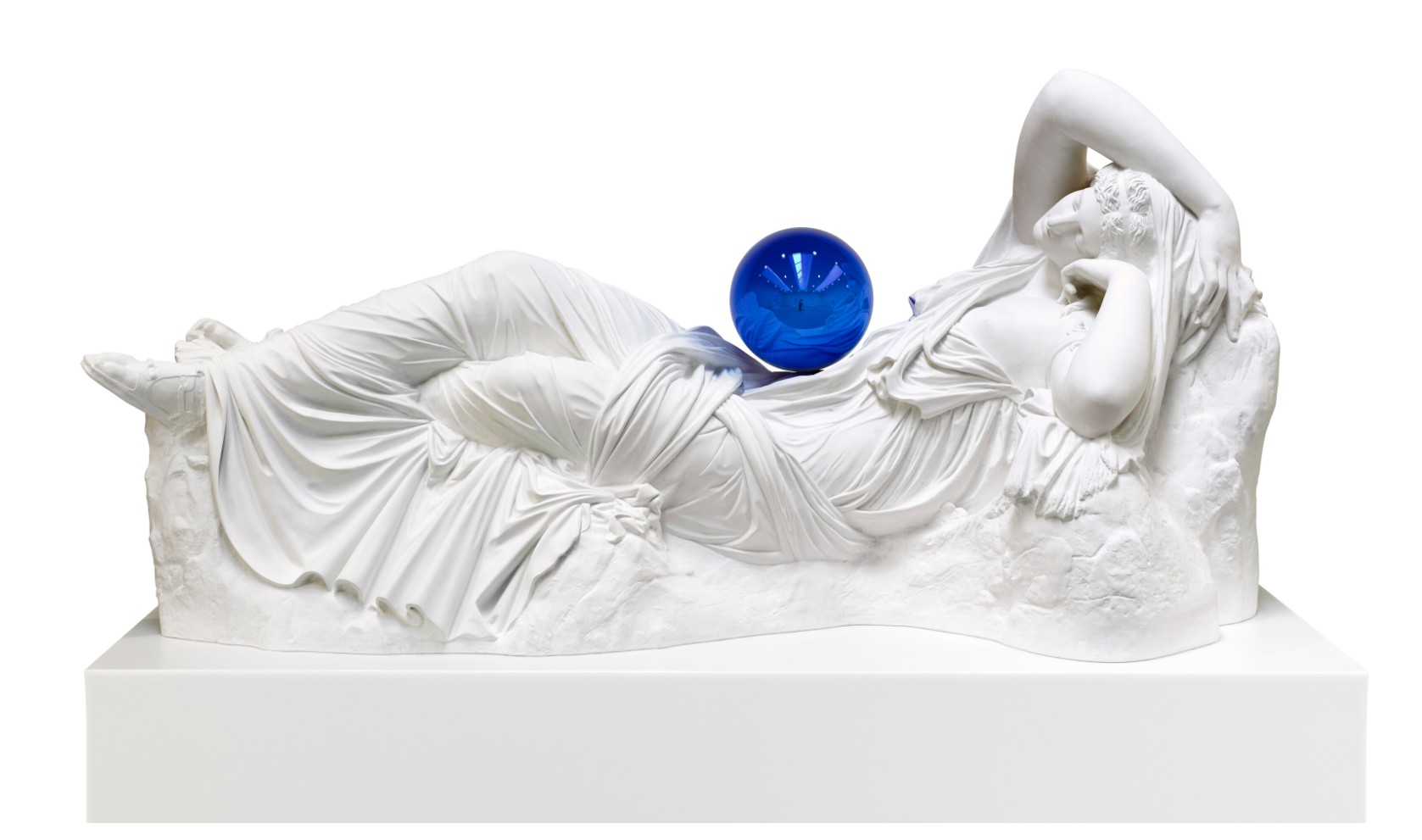
JEFF KOONS (B. 1955)
Gazing Ball (Ariadne), 2013
Plaster and glass
44 3/8 x 93 7/8 x 36 5/8 inches (112.7 x 238.4 x 93 cm)
This work is number one from an edition of three plus one artist’s proof
#11. Gazing Ball (Courbet Sleep), 2014-2015
Edlis Neeson Collection
Christie’s New-York: 19 November 2025
Estimated: USD 600,000 – 800,000
USD 596,900
GAZING BALL SERIES
JEFF KOONS (B. 1955), Gazing Ball (Courbet Sleep) | Christie’s
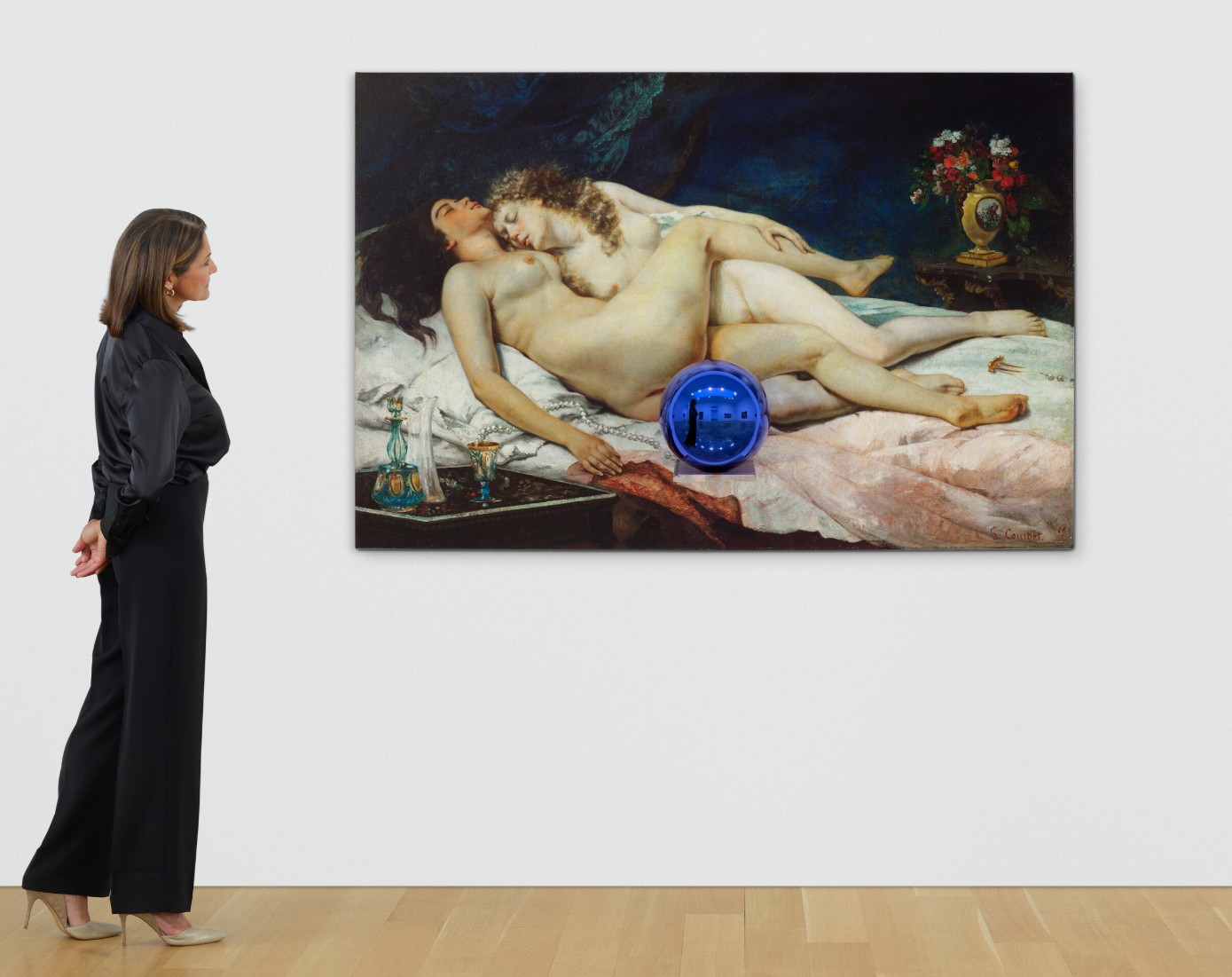
JEFF KOONS (B. 1955)
Gazing Ball (Courbet Sleep), 2014-2015
Oil on canvas, glass and aluminum
53 3/4 x 81 x 14 3/4 inches (136.5 x 205.7 x 37.5 cm)
Signed and dated ‘Jeff Koons 2014-2015’ (on the overlap)
USD 500,000
#12. Snorkel Vest, 1985
Property from an Important European Collection
Christie’s New-York: 20 November 2025
Estimated: USD 400,000 – 600,000
USD 481,800
EQUILIBRIUM SERIES
JEFF KOONS (B. 1955), Snorkel Vest | Christie’s
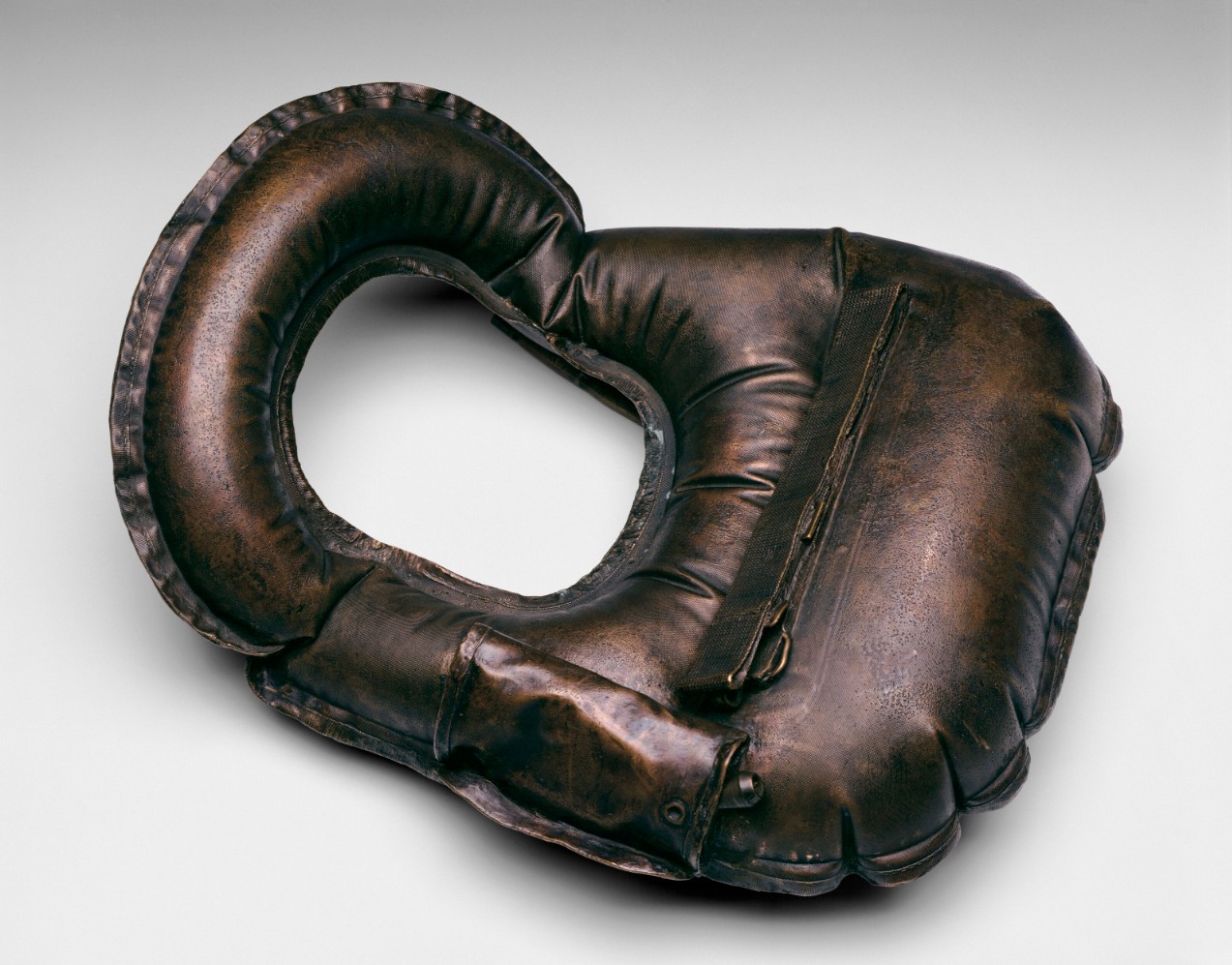
JEFF KOONS (B. 1955)
Snorkel Vest, 1985
Bronze
21x18x6 inches (53.3 x 45.7 x 15.2 cm)
This work is the artist’s proof from an edition of three plus one artist’s proof
#13. Lobster Wall Relief, 2012
Christie’s New-York: 15 May 2025
Estimated; USD 300,000 – 500,000
USD 264,600
JEFF KOONS (B. 1955), Lobster Wall Relief | Christie’s
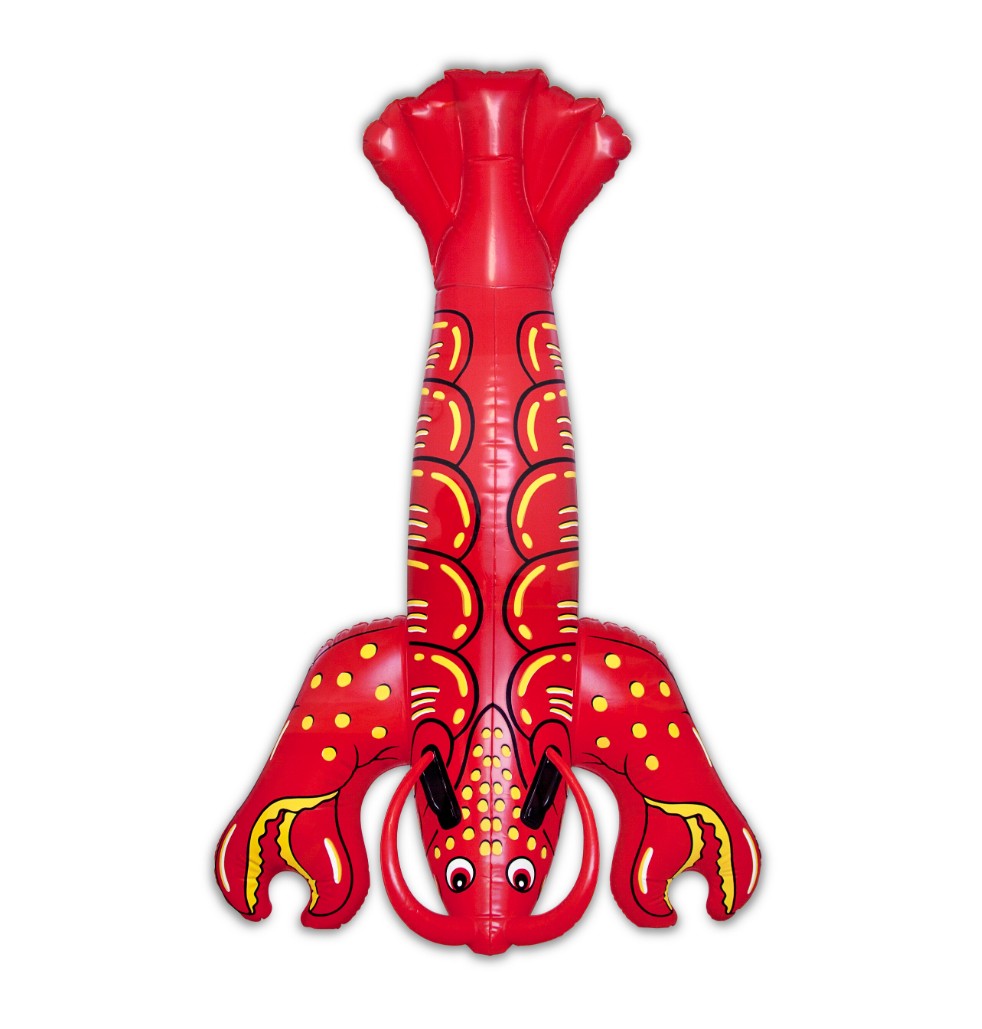
JEFF KOONS (B. 1955)
Lobster Wall Relief, 2012
Inkjet on stainless steel with polychromed edges
78 x 48 3/8 x 1 1/4 inches (198.1 x 122.9 x 3.2 cm)
Signed, numbered and dated ‘Jeff Koons 3⁄3 ’12’ (on the reverse)
This work is number three from an edition of three plus one artist’s proof
#14. Speaker, 1979
Christie’s New-York: 30 September 2025
Estimated: USD 200,000 – 300,000
USD 190,500
JEFF KOONS (B. 1955), Speaker | Christie’s
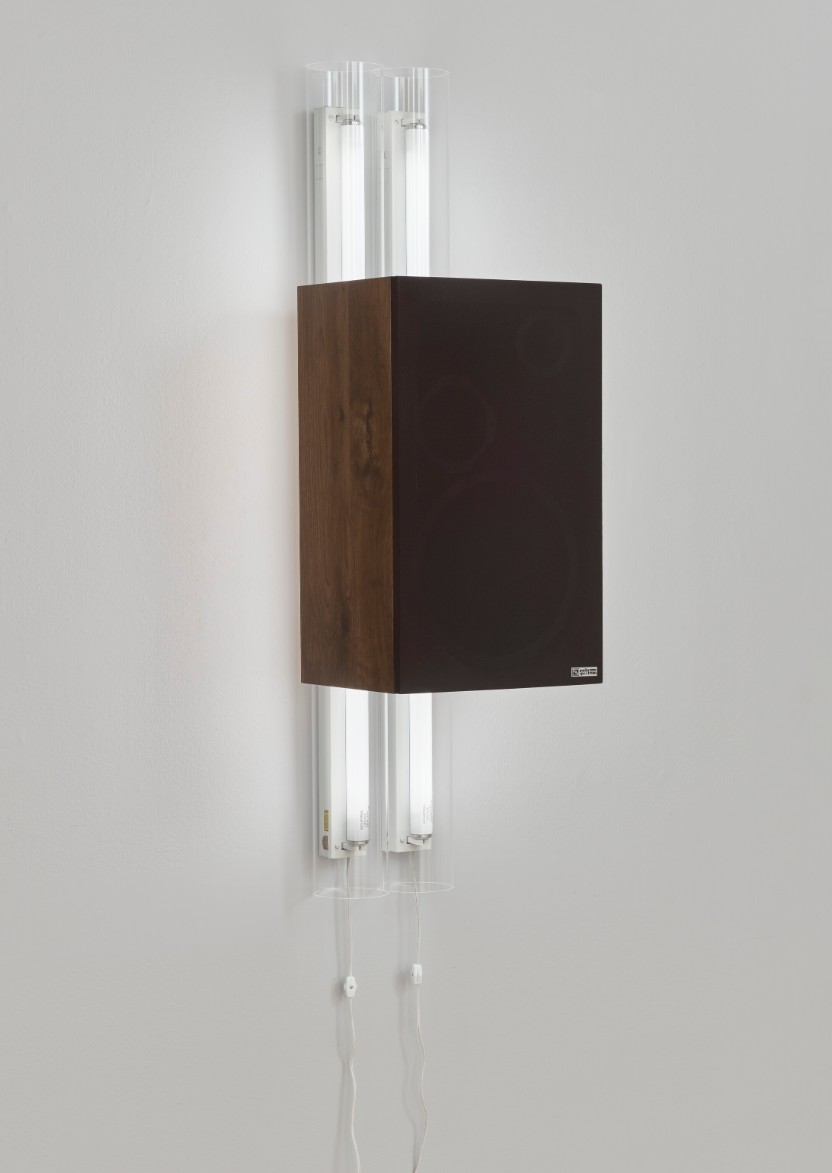
JEFF KOONS (B. 1955)
Speaker, 1979
Speaker, fluorescent lights and acrylic
54 x 15 x 17 3/8 inches (137.2 x 38.1 x 44.1 cm)
This work is unique
2024 Auction Results
8 lots sold at auction in 2024 for a total turnover of USD 28,446,790. With 1 lot failing to sell, the sell-through rate is 89%. The highest price has been achieved by Balloon Monkey (Blue) that sold for GBP 7,555,000 (USD 9,897,050) at Christie’s in London on 9 October 2024.
2024 Top 3 Lots
3 lots sold for more than USD 5 million generating a cumulative turnover of USD 23,259,050, representing 81.8% of the total turnover for 2024.
#1. Balloon Monkey (Blue), 2006-2013
Christie’s London: 9 October 2024
Estimated: GBP 6,500,000 – 10,000,000
GBP 7,555,000 / USD 9,897,050
JEFF KOONS (B. 1955), Balloon Monkey (Blue) | Christie’s (christies.com)
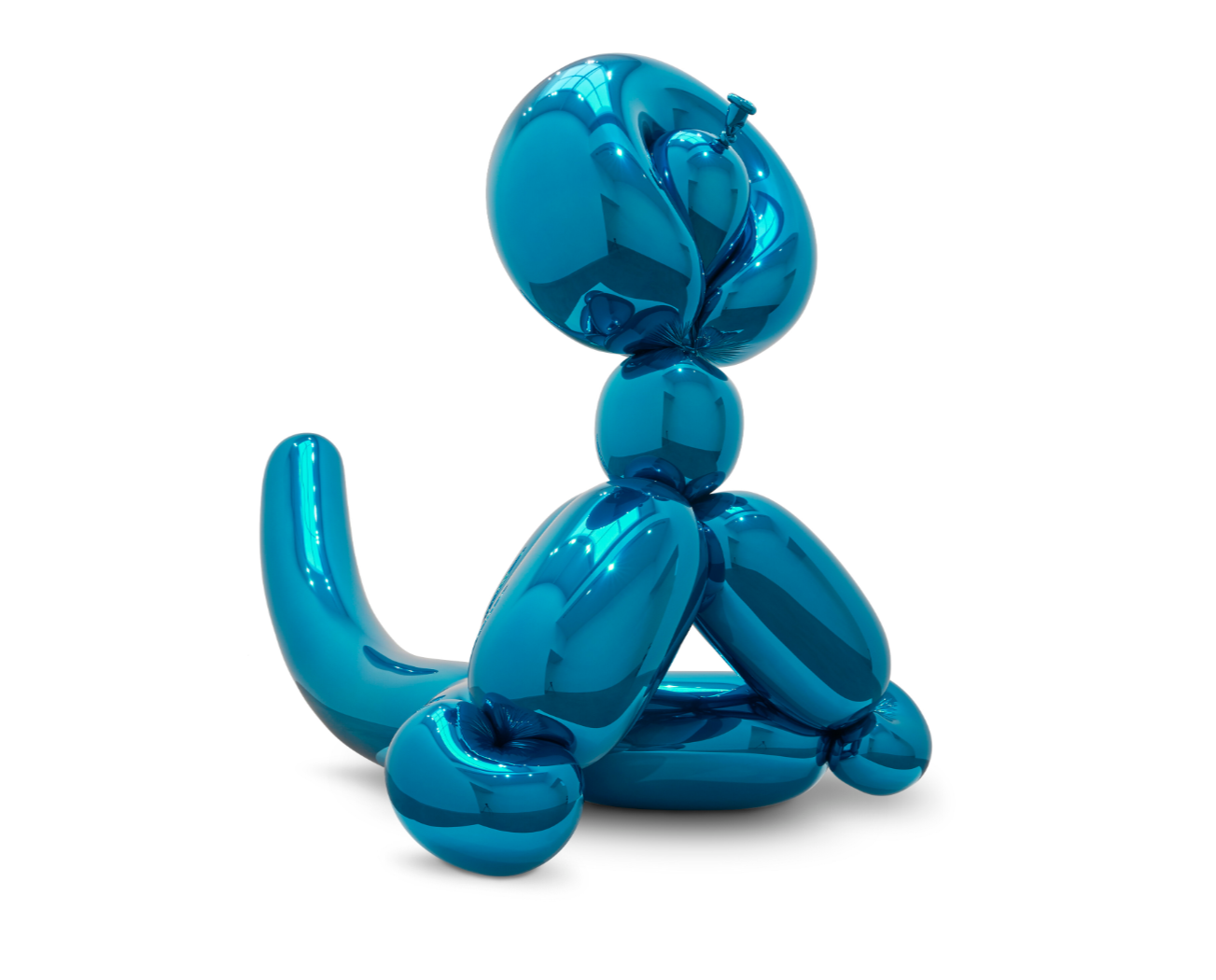
JEFF KOONS (B. 1955)
Balloon Monkey (Blue), 2006-2013
Mirror-polished stainless steel with transparent color coating
150x126x235 inches (381 x 320 x 596.9 cm)
Executed in 2006-2013, this work is one of five unique versions (Red, Yellow, Blue, Magenta, Orange)
#2. Large Vase of Flowers, 1991
Christie’s New-York: 21 November 2024
Estimated: USD 6,000,000 – 8,000,000
USD 8,230,000
JEFF KOONS (B. 1955), Large Vase of Flowers | Christie’s
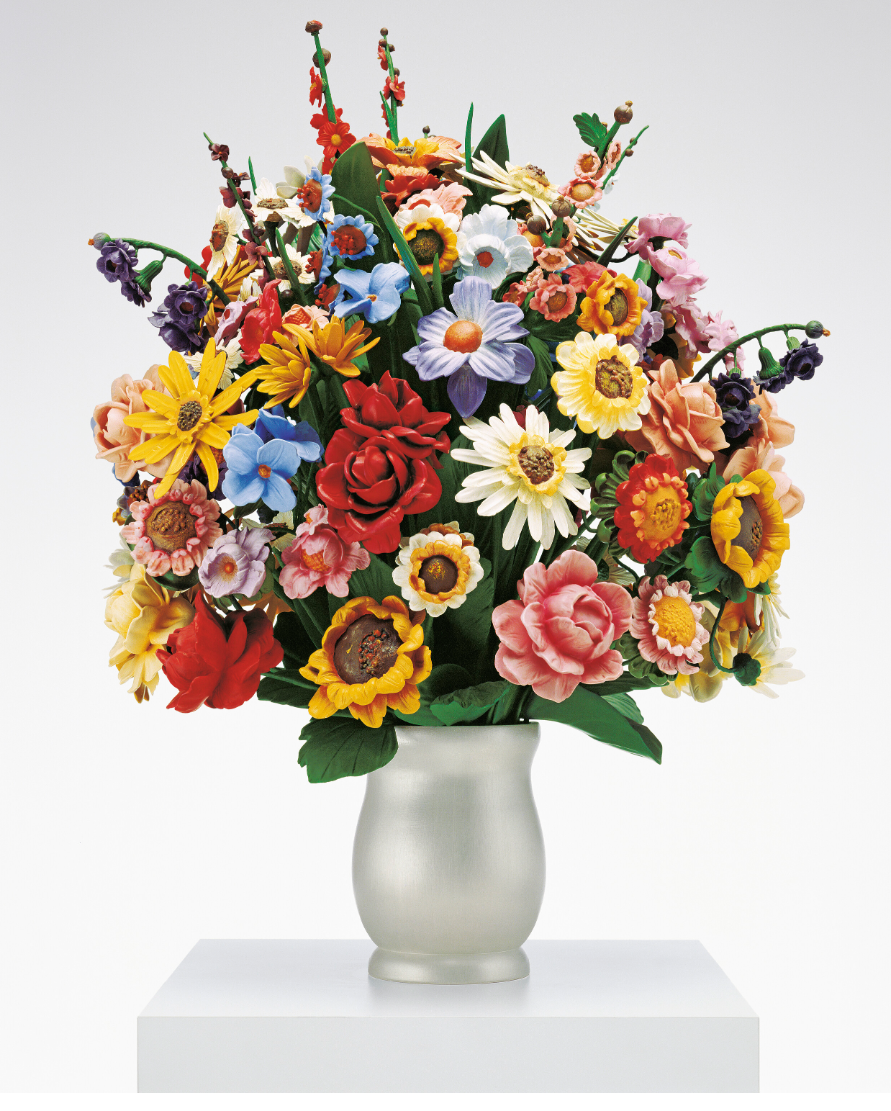
JEFF KOONS (B. 1955)
Large Vase of Flowers, 1991
Polychromed wood
52x43x43 inches (132.1 x 109.2 x 109.2 cm)
This work is the artist’s proof from an edition of three plus one artist’s proof
#3. New Hoover Celebrity IV, New Hoover Convertible, New Shelton 5 Gallon Wet/Dry, New Shelton 10 Gallon Wet/Dry Doubledecker, 1981-1986
Christie’s New-York: 21 November 2024
Estimated: USD 3,500,000 – 5,500,000
USD 5,132,000
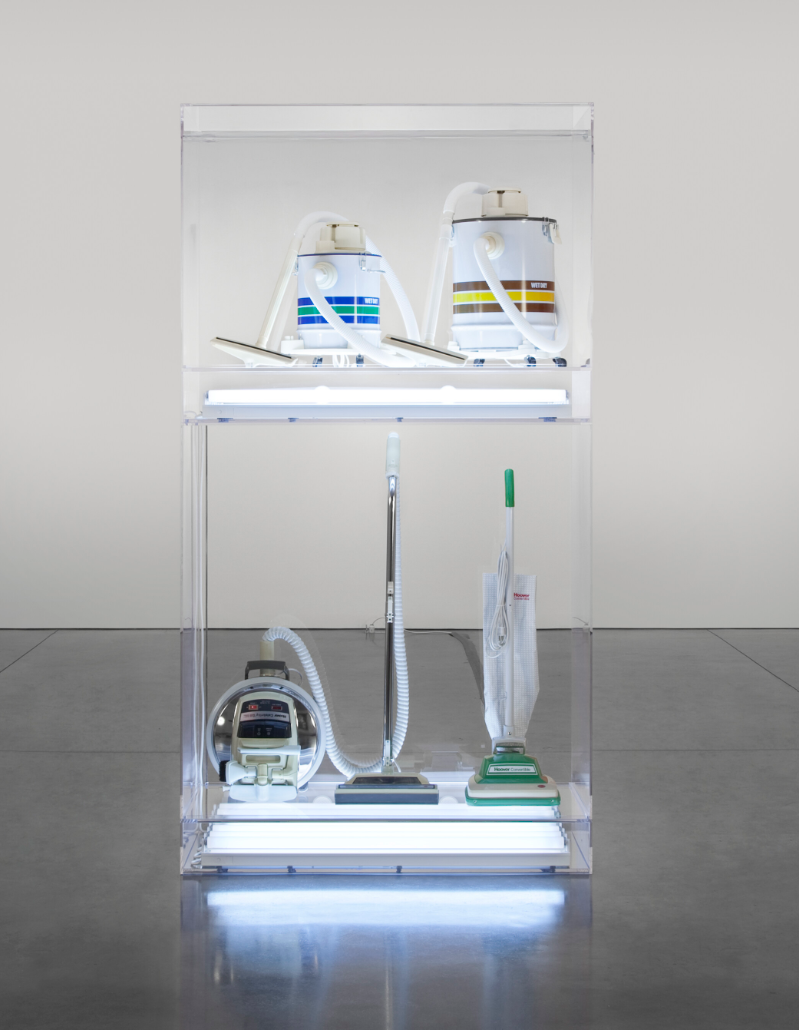
JEFF KOONS (B. 1955)
New Hoover Celebrity IV, New Hoover Convertible, New Shelton 5 Gallon Wet/Dry, New Shelton 10 Gallon Wet/Dry Doubledecker, 1981-1986
Four vacuum cleaners, acrylic and fluorescent lights
99 x 53 1/2 x 28 inches (251.5 x 135.9 x 71.1 cm)
USD 5 million
#4. Two Ball Total Equilibrium Tank (Spalding Dr. J Silver Series), 1985
Phillips New-York: 19 November 2024
Estimated: USD 4,000,000 – 6,000,000
USD 3,569,000
Jeff Koons – Modern & Contemporary … Lot 14 November 2024 | Phillips
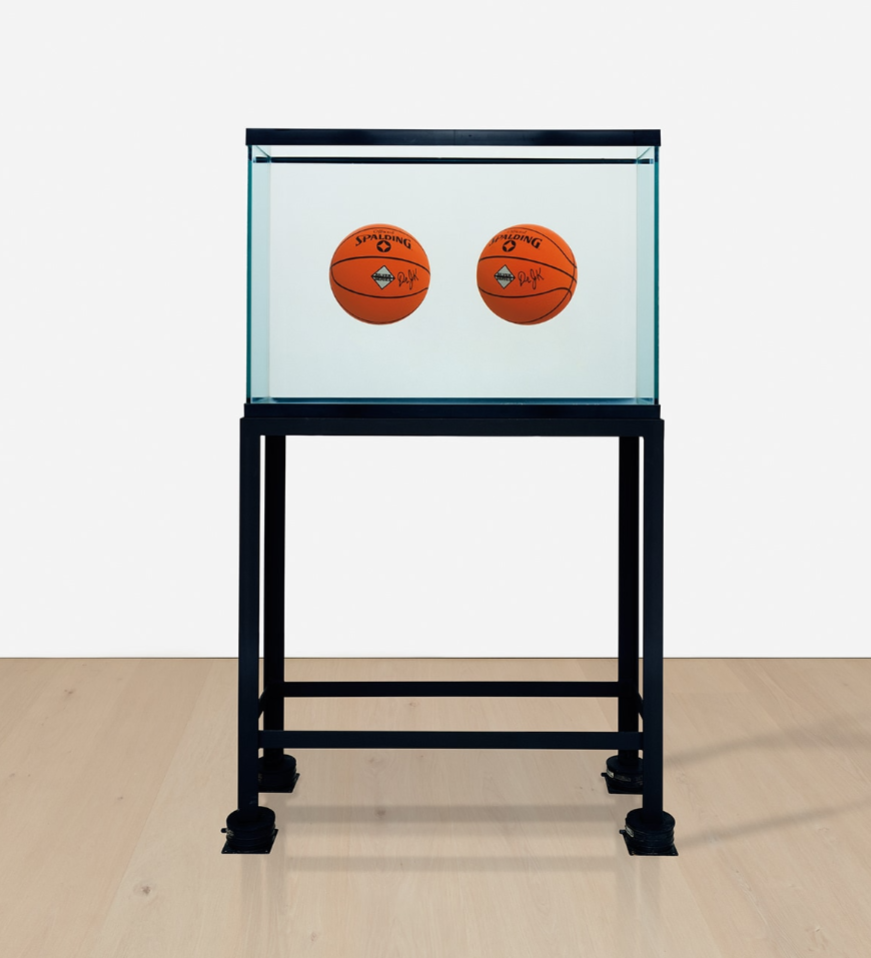
JEFF KOONS
Two Ball Total Equilibrium Tank (Spalding Dr. J Silver Series), 1985
Glass, steel, sodium chloride reagent, distilled water and two basketballs
62 3/4 x 36 3/4 x 13 1/4 inches (159.4 x 93.3 x 33.7 cm)
This work is number 1 from an edition of 2
USD 1 million
#5. Snorkel Vest, 1985
Christie’s New-York: 17 May 2024
Estimated: USD 350,000 – 550,000
USD 819,000
https://www.christies.com/en/lot/lot-6482494

JEFF KOONS (B. 1955)
Snorkel Vest, 1985
Bronze
21x18x6 inches (53.3 x 45.7 x 15.2 cm)
This work is number three from an edition of three plus one artist’s proof
#6. Gazing Ball (Fragonard Young Girl Playing with her Dog), 2014-2015
Sotheby’s Singapore: 9 June 2024
Estimated: SGD 550,000 – 860,000
SGD 672,000 / USD 497,480
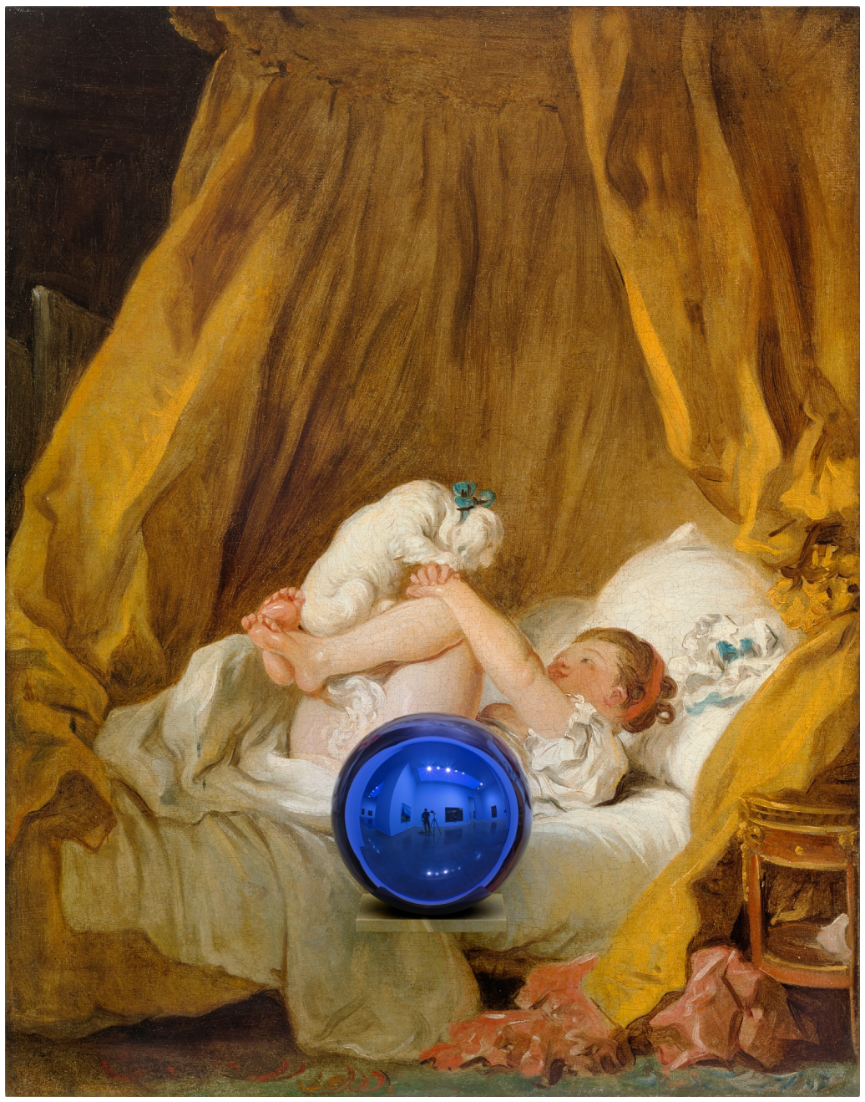
JEFF KOONS (b. 1955)
Gazing Ball (Fragonard Young Girl Playing with her Dog), 2014-2015
Oil on canvas, glass and aluminum
68 1/2 53 3/4 x 14 3/4 inches (174 x 136.5 x 37.5 cm)
Signed and dated 2014-2015 (on the overlap)
#7. Dirty Ejaculation, 1991
Sotheby’s New-York: 14 May 2024
Estimated: USD 150,000 – 200,000
USD 152,400
Dirty Ejaculation | Contemporary Day Auction | 2024 | Sotheby’s
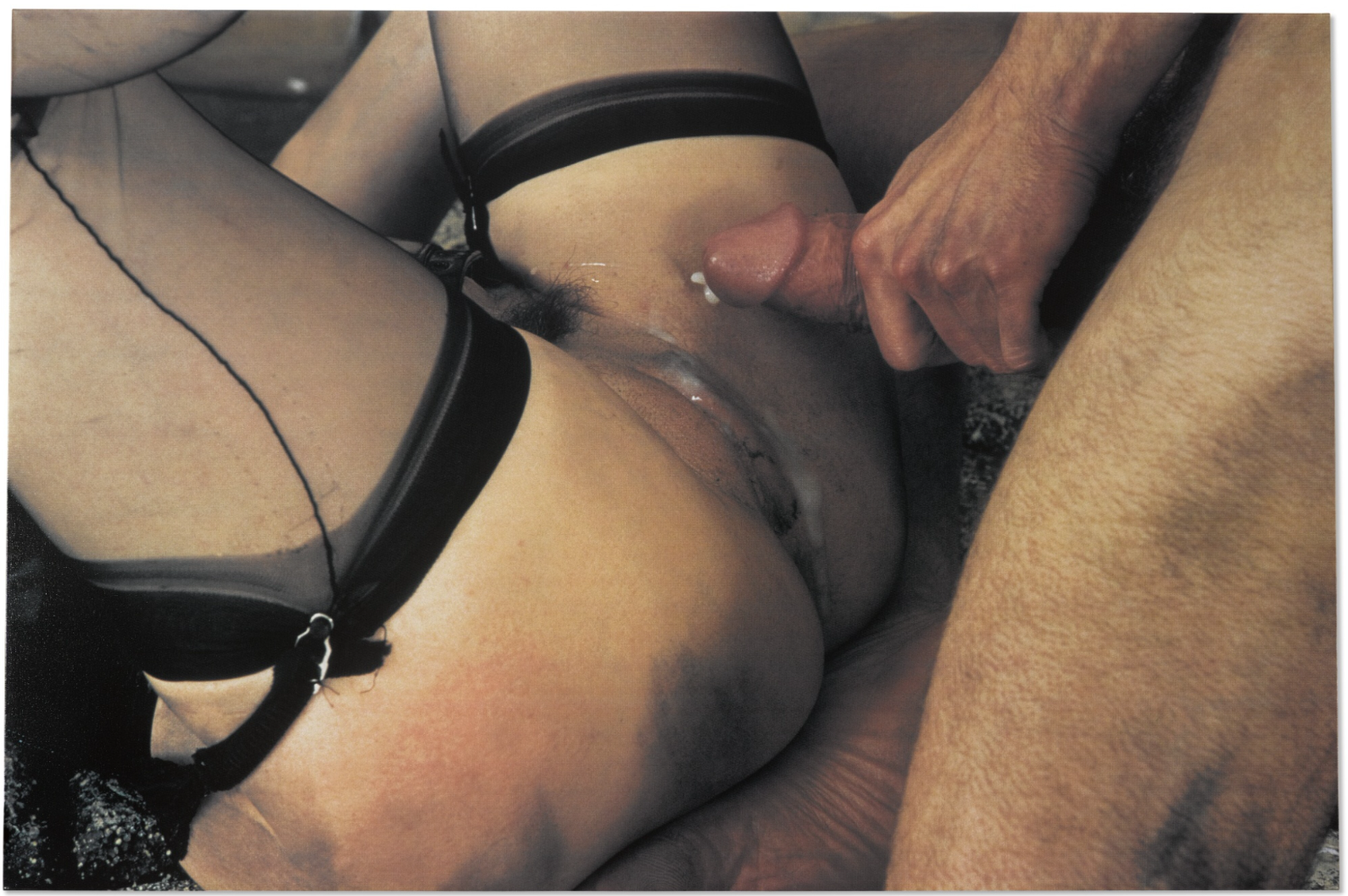
JEFF KOONS (b. 1955)
Dirty Ejaculation, 1991
Oil ink on canvas
60 1/2 x 91 1/4 inches (153.6 x 231.8 cm)
Signed, titled and dated ’91 (on the overlap)
This work is number 1 from an edition of 1 plus 1 artist’s proof
#8. Snorkel (Shotgun), 1985
Phillips New-York: 20 November 2024
Estimated: USD 150,000 – 200,000
USD 149,860
Jeff Koons – Modern & Contemporary… Lot 327 November 2024 | Phillips
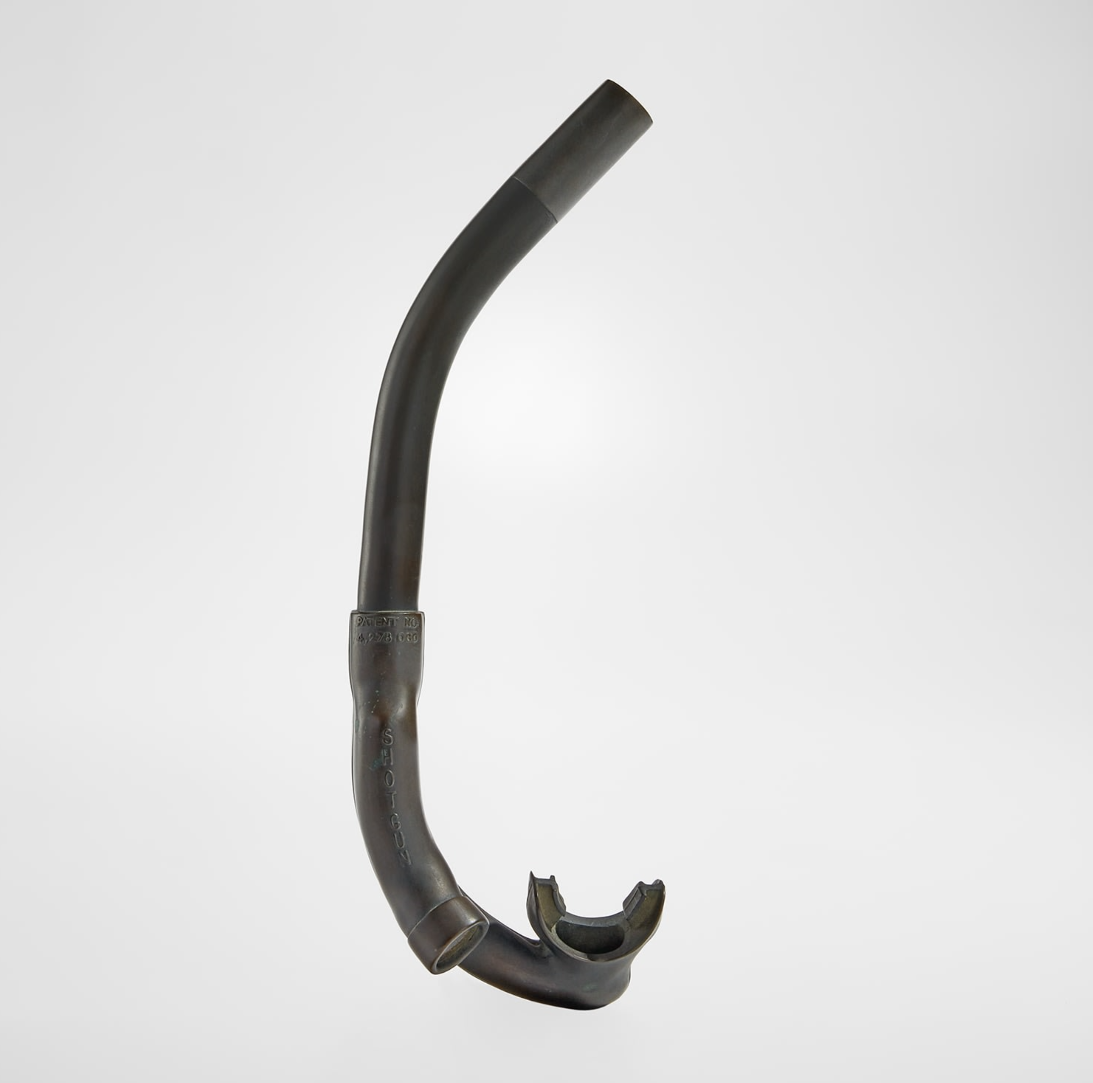
JEFF KOONS
Snorkel (Shotgun), 1985
Bronze
14 1/2 x 5 x 2 1/2 inches (36.8 x 12.7 x 6.4 cm)
This work is number 1 from an edition of 3 plus 1 artist’s proof
Lots Passed
Woman in Tub, 1988
Sotheby’s New-York: 20 November 2024
Estimated: USD 10,000.000 – 15,000,000
PASSED
Woman in Tub | The Now and Contemporary Evening Auction | 2024 | Sotheby’s
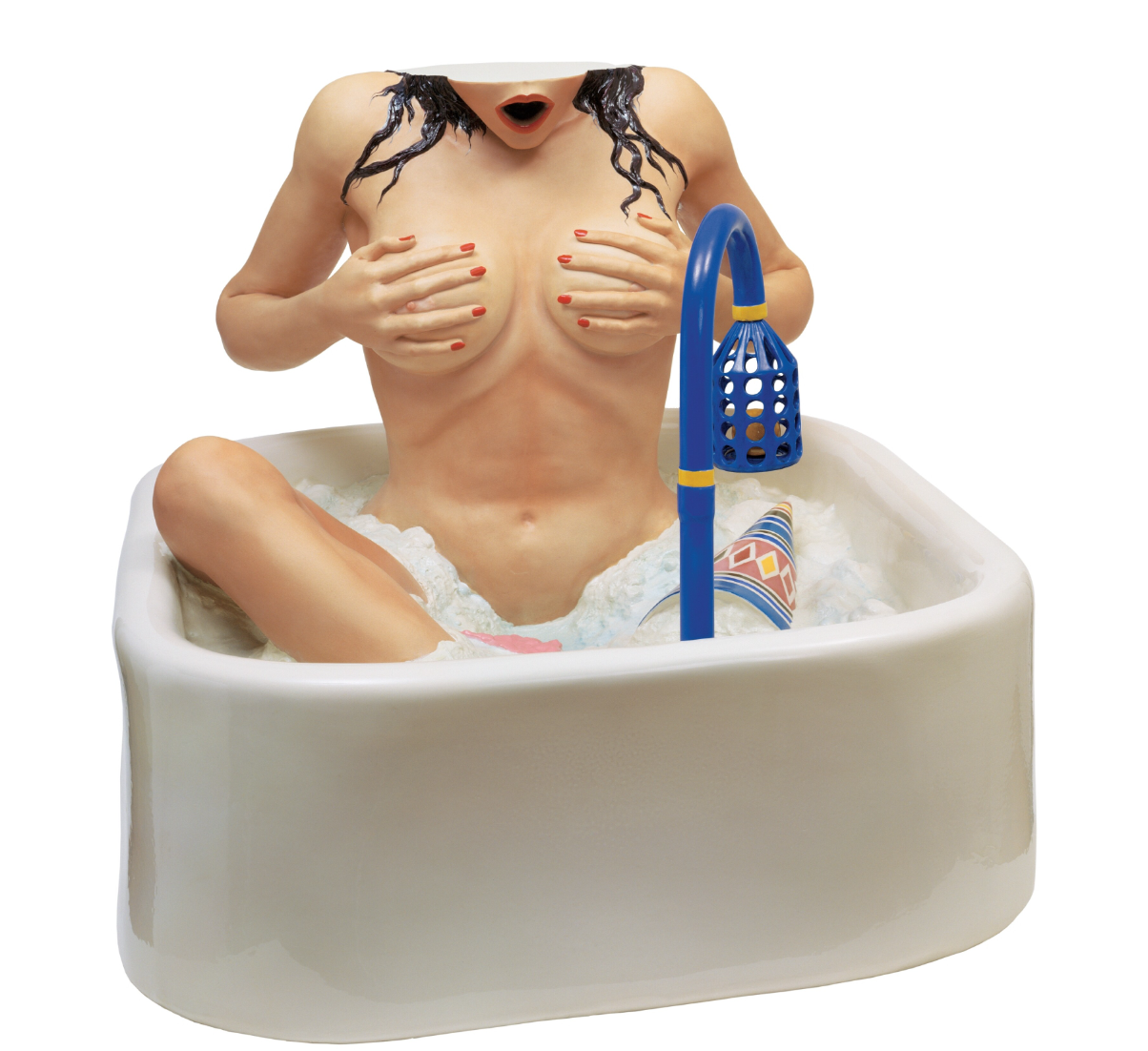
JEFF KOONS (b. 1955)
Woman in Tub, 1988
Porcelain
23 3/4 x 36 x 27 inches (60.3 x 91.4 x 68.6 cm)
Incised with the artist’s initials, dated ’88 and numbered 3/3 (on the underside)
Incised A. Maggioni (lower edge)
This work is number 3 of an edition of 3 plus 1 artist’s proof
2023 Auction Results
9 lots sold at auction in 2023 for a total turnover of USD 26,244,579. With one lot failing to sell, the sell-through rate is 90%. The highest price was achieved at Christie’s in Hong-Kong on 28 May 2023, when Sacred Heart (Magenta Gold) sold for HKD 60,875,000 (USD 7,771,409). This is the only lot that sold above USD 5 million. 8 lots sold above USD 1 million.
2023 Top 3 Lots
#1. Sacred Heart (Magenta/Gold), 1994-2007
Christie’s Hong-Kong: 28 May 2023
Estimated: HKD 50,000,000 – 70,000,000
HKD 60,875,000 / USD 7,771,410
CELEBRATION SERIES
JEFF KOONS (B. 1955) (christies.com)
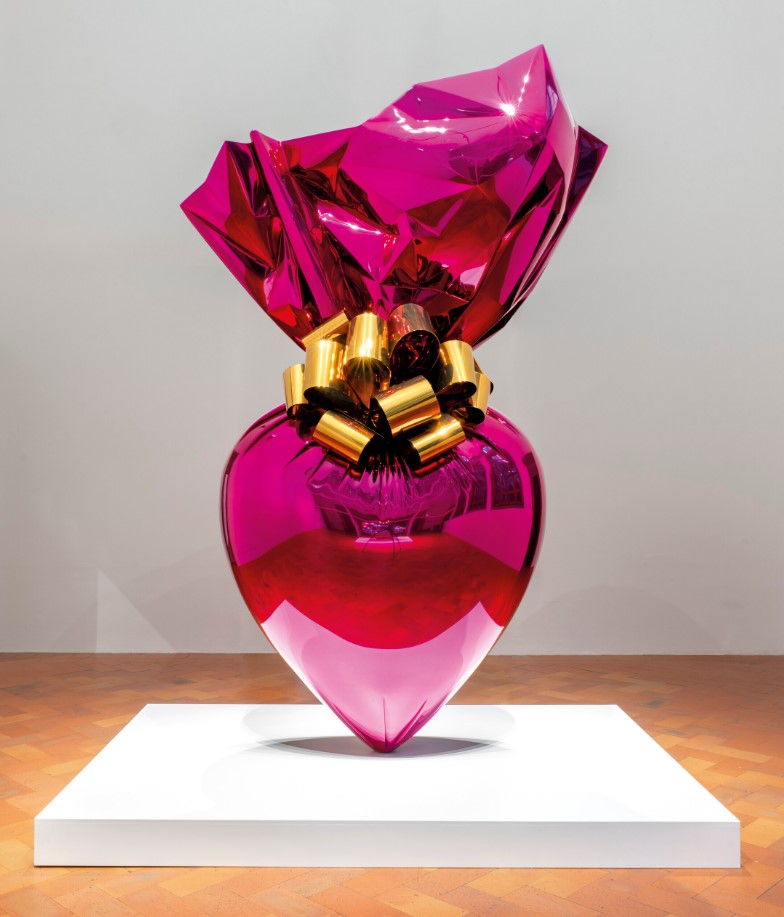
JEFF KOONS (B. 1955)
Sacred Heart (Magenta/Gold), 1994-2007
Mirror-polished stainless steel with transparent color coating sculpture
356.9 (H) x 218.4 x 121 cm (140 1/2 x 86 x 47 5/8 inches)
Signed and dated ‘JEFF KOONS 1994-2007’ (inside the bow)
This is one of five unique versions
#2. Aphrodite, 2016-2021
Christie’s New-York: 7 November 2023
Estimated: USD 4,000,000 – 6,000,000
USD 4,043,000
PORCELAIN SERIES
JEFF KOONS (B. 1955) (christies.com)
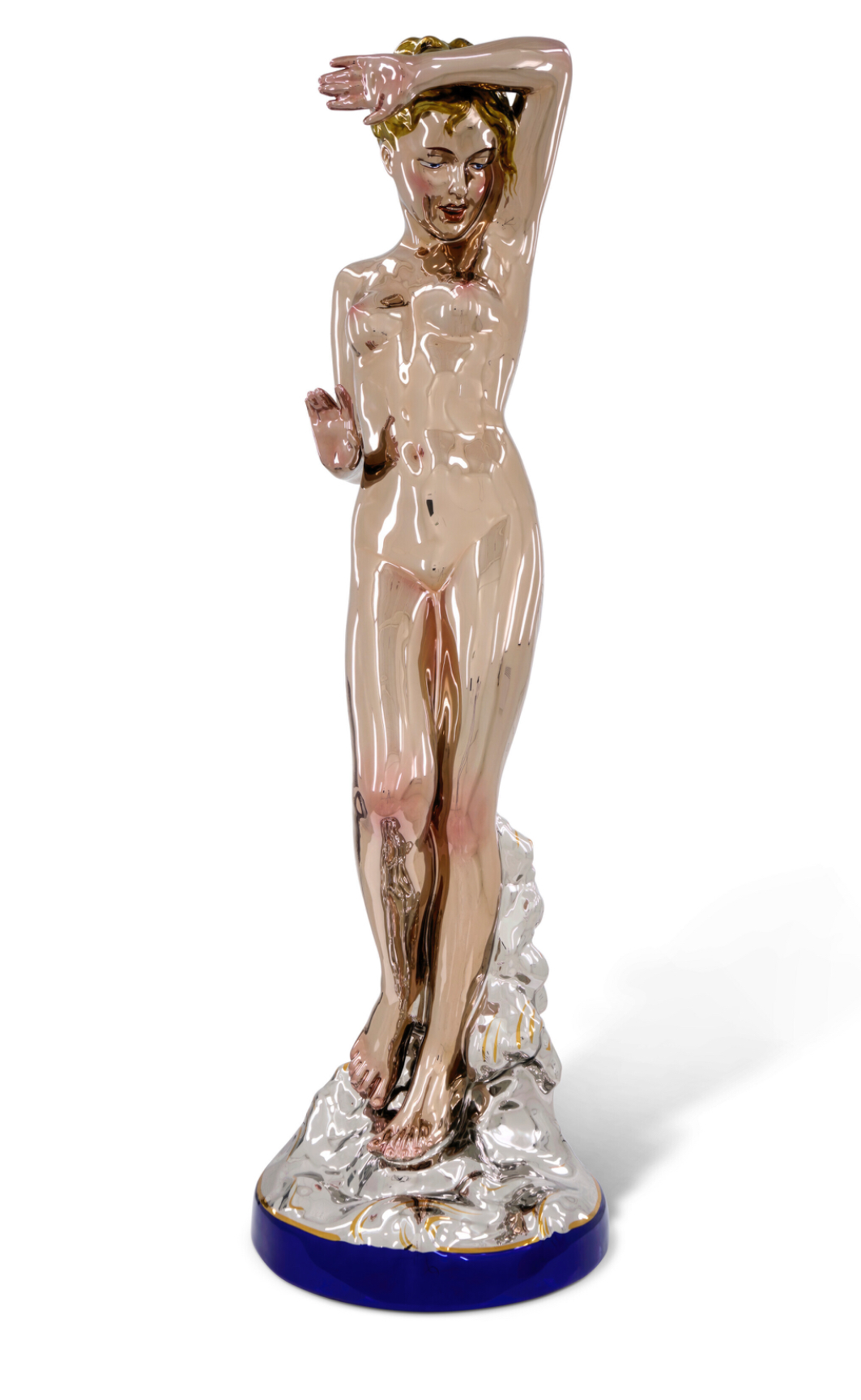
JEFF KOONS (B. 1955)
Aphrodite, 2016-2021
Mirror-polished stainless steel with transparent color coating
102 x 30 3/16 x 30 3/8 inches (259.1 x 76.7 x 77.2 cm)
This work is number one from an edition of three plus one artist’s proof
#3. Ushering in Banality, 1988
Christie’s New-York: 9 March 2023
Estimated: USD 2,500,000 – 3,500,000
USD 3,900,000
BANALITY SERIES
JEFF KOONS (B. 1955) (christies.com)
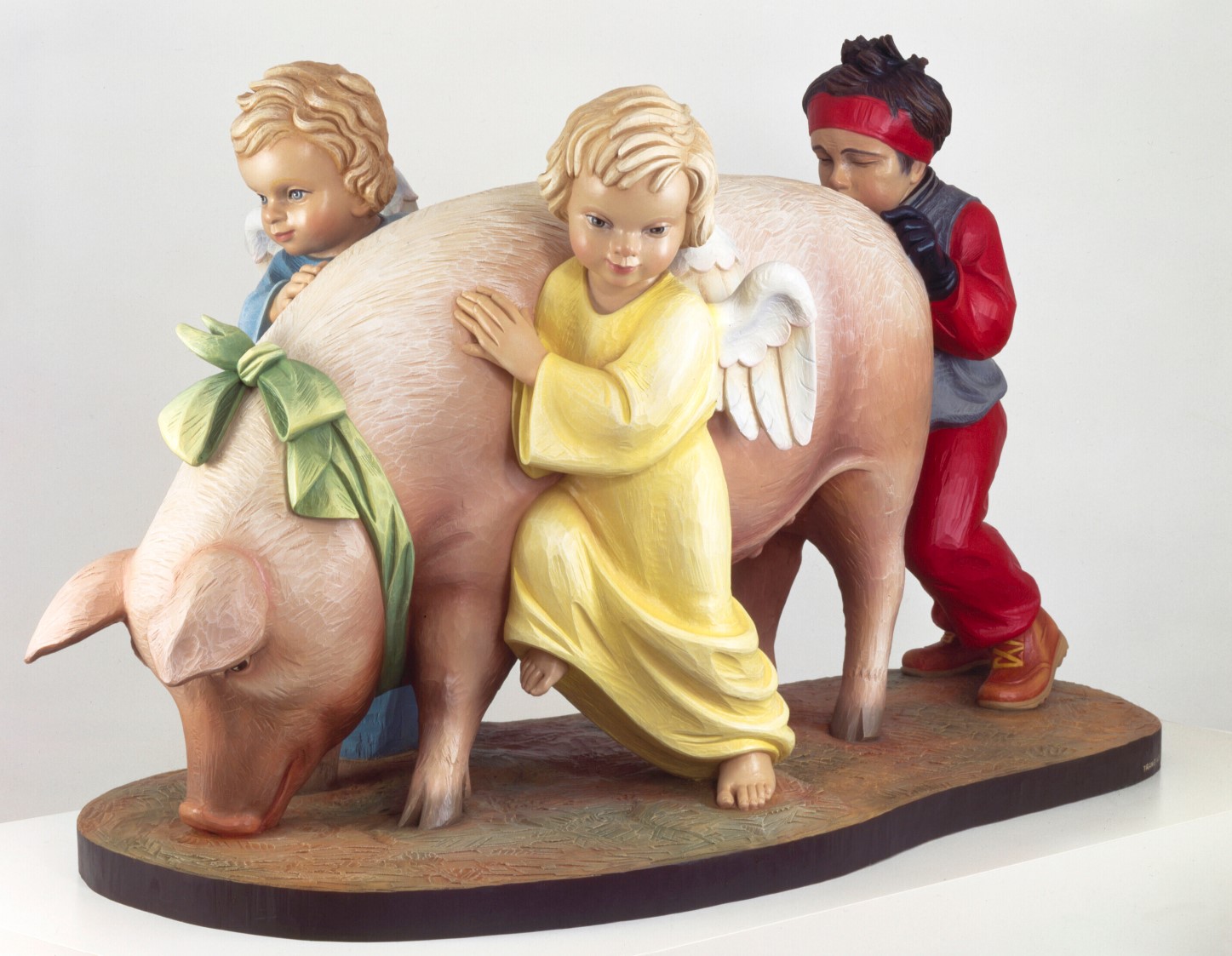
JEFF KOONS (B. 1955)
Ushering in Banality, 1988
Polychromed wood
38x62x30 inches (96.5 x 157.5 x 76.2 cm)
Incised with the artist’s signature, number and date ‘Jeff Koons 3/3 88’ (on the underside)
This work is number three from an edition of three plus one artist’s proof
#4. Swan (Inflatable), 2011-15
Sotheby’s New-York: 18 May 2023
Estimated: USD 2,000,000 – 3,000,000
USD 3,085,000
CELEBRATION SERIES
Swan (Inflatable) | Contemporary Evening Auction | 2023 | Sotheby’s (sothebys.com)
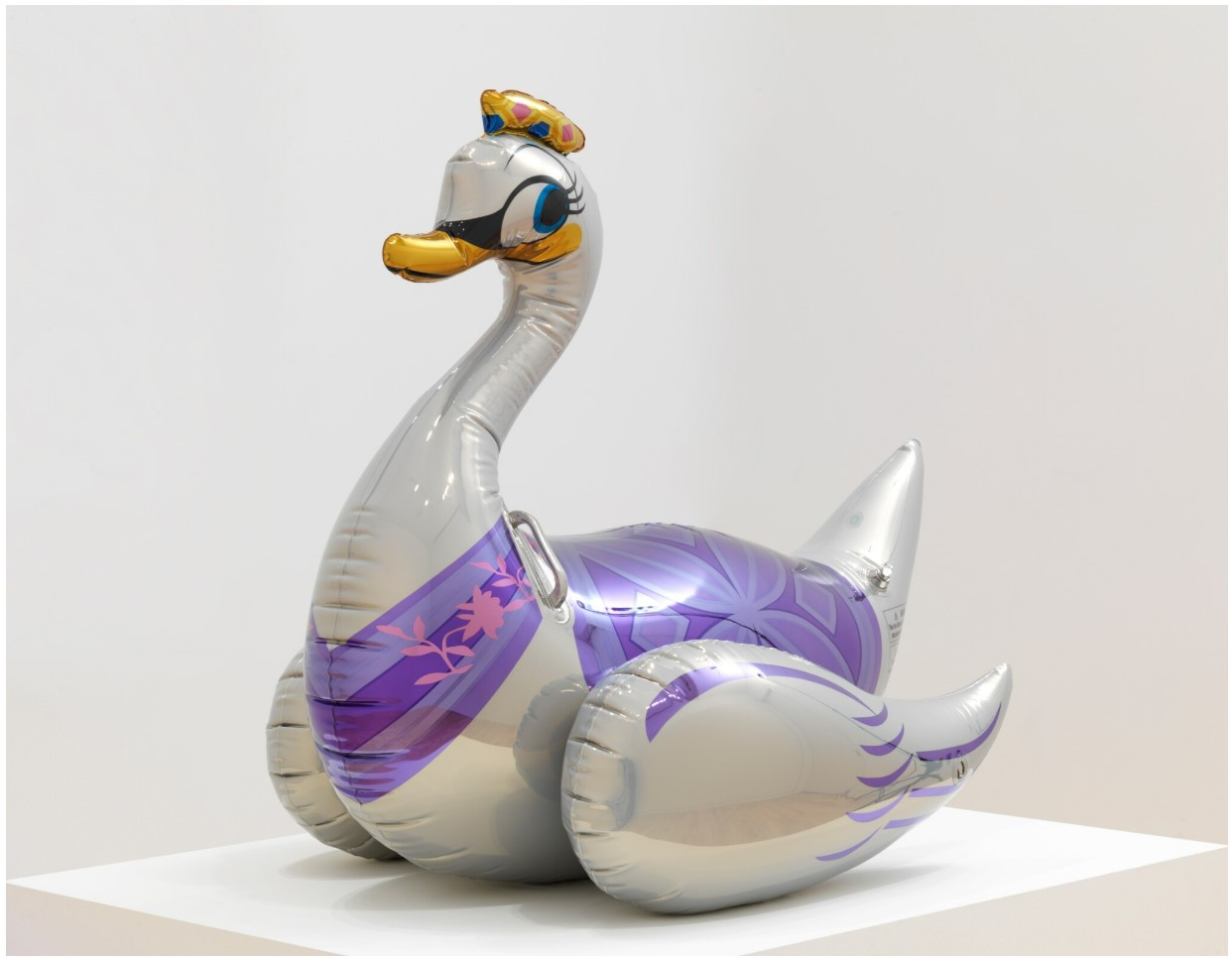
JEFF KOONS (b. 1955)
Swan (Inflatable), 2011-15
Mirror-polished stainless steel with transparent color coating
32 1/2 x 36 5/16 x 25 15/16 inches (82.6 x 92.2 x 65.9 cm)
This work is number 1 from an edition of 3 plus 1 artist’s proof
#5. Baroque Egg with Bow (Pink/Gold), 1994-2008
Christie’s New-York: 7 November 2023
Estimated: USD 3,000,000 – 5,000,000
USD 2,470,000
CELEBRATION SERIES
JEFF KOONS (B. 1955) (christies.com)
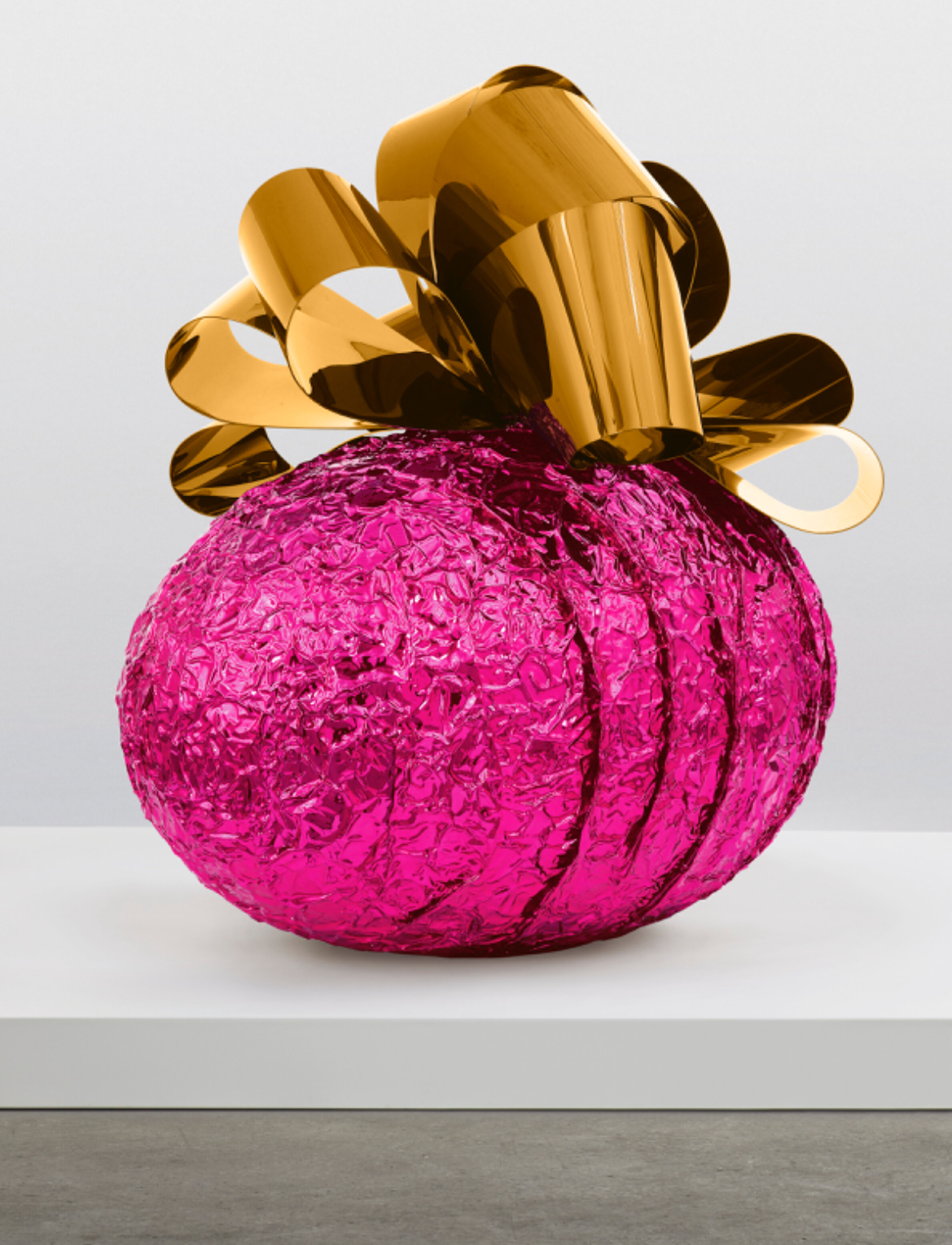
JEFF KOONS (B. 1955)
Baroque Egg with Bow (Pink/Gold), 1994-2008
Mirror-polished stainless steel with transparent color coating
78 3/8 x 76 13/16 x 76 inches (199x195x193 cm)
One of five unique versions:
Turquoise/Magenta, Blue/Turquoise, Blue/Gold, Orange/Magenta, Pink/Gold
#6. Kiepenkerl (Humpty Dumpty), 1987
Christie’s New-York: 17 May 2023
Estimated: USD 3,000,000 – 5,000,000
USD 1,986,000
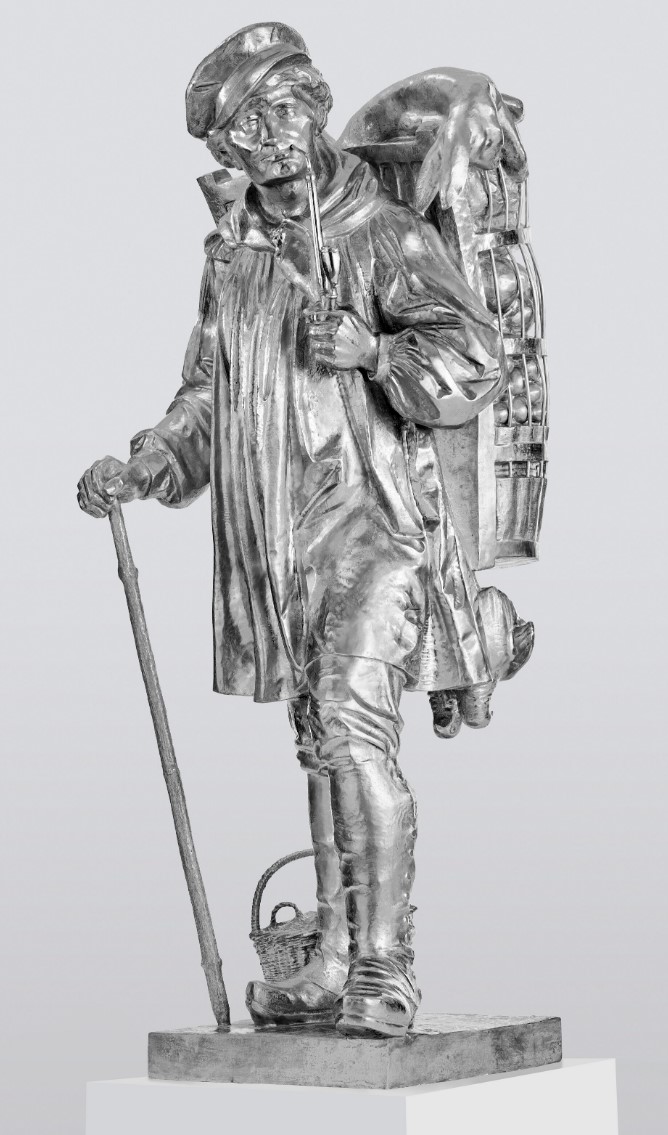
JEFF KOONS (B. 1955)
Kiepenkerl (Humpty Dumpty), 1987
Stainless steel
71x26x37 inches (180.3 x 66 x 94 cm)
This is a unique work, separate from the subsequent edition of three plus one artist’s proof
#7. Lobster Log, 2003-2012
Phillips New-York: 14 November 2023
Estimated: USD 1,000,000 – 1,500,000
USD 1,270,000
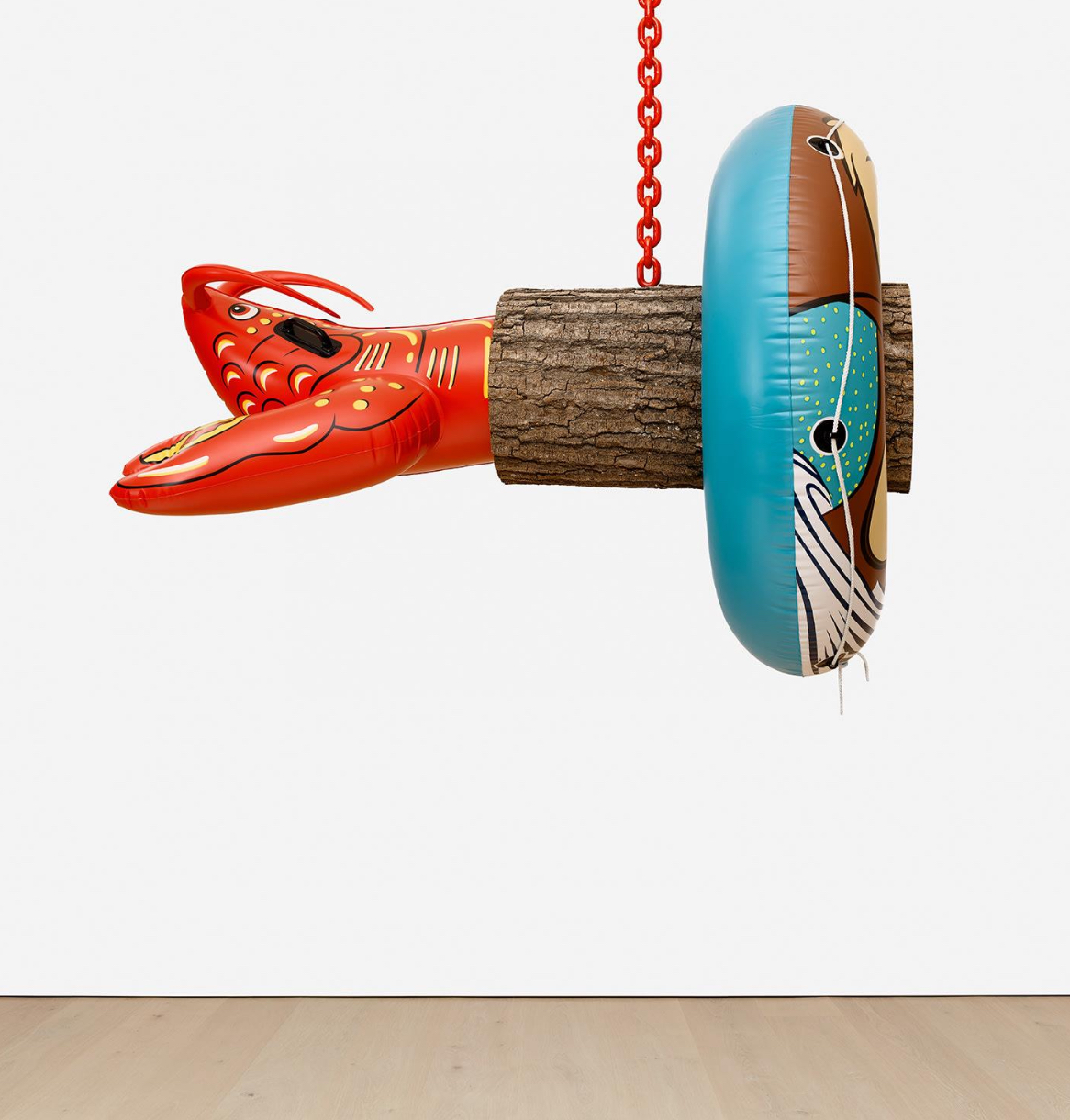
JEFF KOONS
Lobster Log, 2003-2012
Polychromed aluminum, wood, stainless steel and coated steel chain
42 x 56 1/8 x 42 inches (106.7 x 142.6 x 106.7 cm)
Chain length variable
This work is number 1 from an edition of 3 plus 1 artist’s proof
#8. Hot Dog, 2002
Sotheby’s New-York: 16 November 2023
Estimated: USD 1,000,000 – 1,500,000
USD 1,143,000
EASY FUN ETHEREAL SERIES
Hot Dog | Contemporary Day Auction | 2023 | Sotheby’s (sothebys.com)
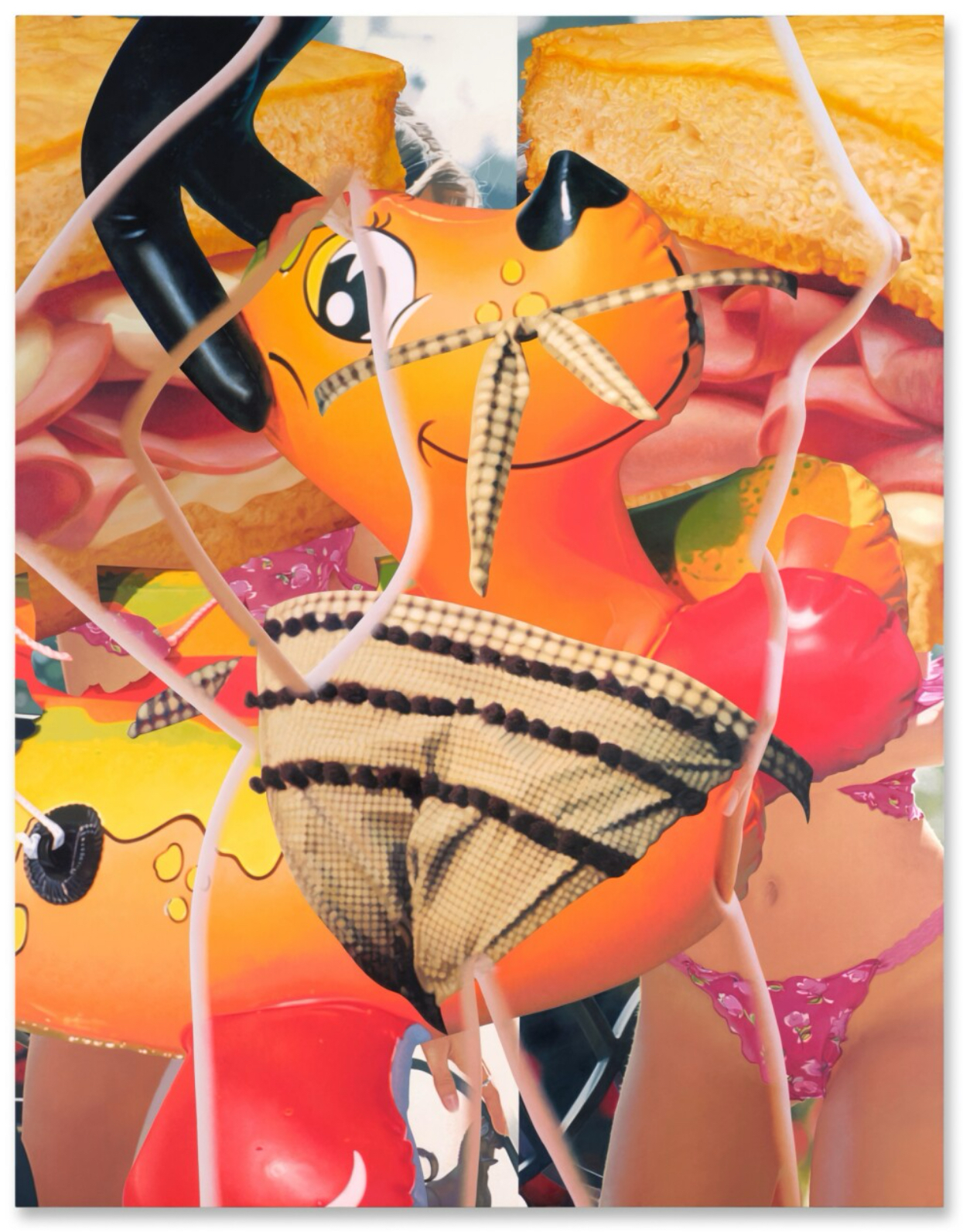
JEFF KOONS (b. 1955)
Hot Dog, 2002
Oil on canvas
108×84 inches (274.3 x 213.4 cm)
Signed and dated ’02 (on the overlap)
#9. Cherubs, 1991
Phillips London: 2 March 2023
Estimated: GBP 500,000 – 700,000
GBP 482,600 / USD 576,710
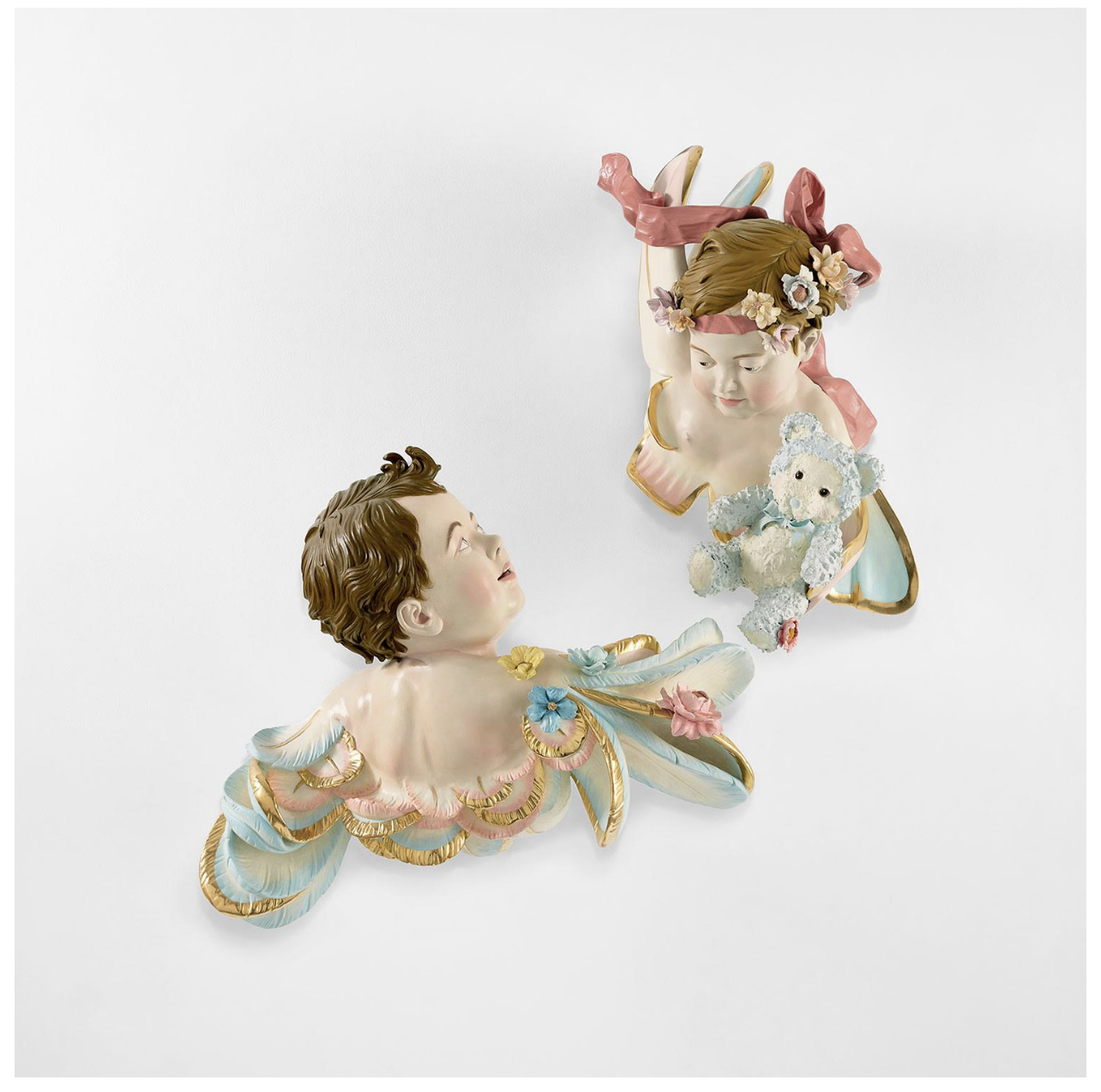
JEFF KOONS
Cherubs, 1991
Polychromed wood, in 2 parts
121.9 x 110.5 x 48.3 cm (47 7/8 x 43 1/2 x 19 inches)
Inscribed with signature, number and date ‘3/3 91 J FUX’
2022 Auction Results
9 lots sold at auction in 2022 for a total turnover of USD 44,270,859. With no lot failing to sell, the sell-through rate is 100%. The top lot of 2022, Jim Beam – J.B. Turner Train was sold at Christie’s in New-York on 17 November 2022 for USD 16,992,500. 2 lots sold above USD 10 million, generating a cumulative turnover of USD 29,364,647, representing 66.3% of the total turnover of 2022.
2022 Top 3 Lots
#1. Jim Beam – J.B. Turner Train, 1986
Christie’s New-York: 17 November 2022
Estimated: USD 15,000,000 – 20,000,000
USD 16,992,500
LUXURY AND DEGRADATION SERIES
JEFF KOONS (B. 1955) (christies.com)
JEFF KOONS (B. 1955)
Jim Beam – J.B. Turner Train, 1986
Stainless steel and bourbon
11 x 114 x 6 1/2 inches (27.9 x 289.6 x 16.5 cm)
#2. Balloon Monkey (Magenta), 2006-2013
Christie’s London: 27 June 2022
Estimated: GBP 6,000,000 – 10,000,000
GBP 10,136,500 / USD 12,372,147
CELEBRATION SERIES
JEFF KOONS (B. 1955) (christies.com)
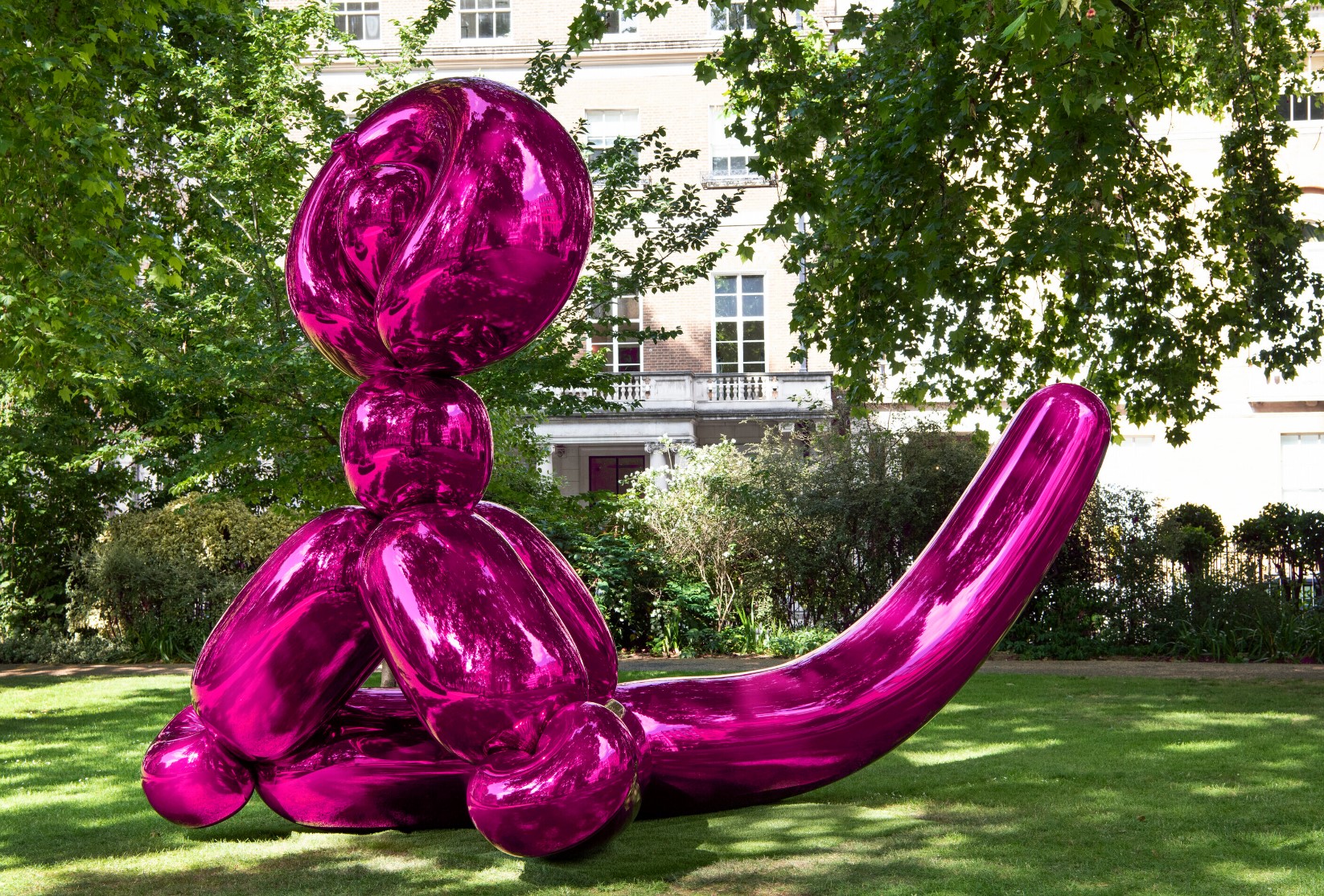
JEFF KOONS (B. 1955)
Balloon Monkey (Magenta), 2006-2013
Mirror-polished stainless steel with transparent color coating
150x126x235 inches (381 x 320 x 596.9 cm)
This work is the artist’s proof and one of five unique versions (Red, Magenta, Blue, Yellow, Orange)
#3. New Hoover Convertibles, New Shelton Wet/Dry 10 Gallon Doubledecker, 1981-1986
Sotheby’s New-York: 16 May 2022
Estimated: USD 3,500,000 – 4,500,000
USD 4,406,000
NEW SERIES
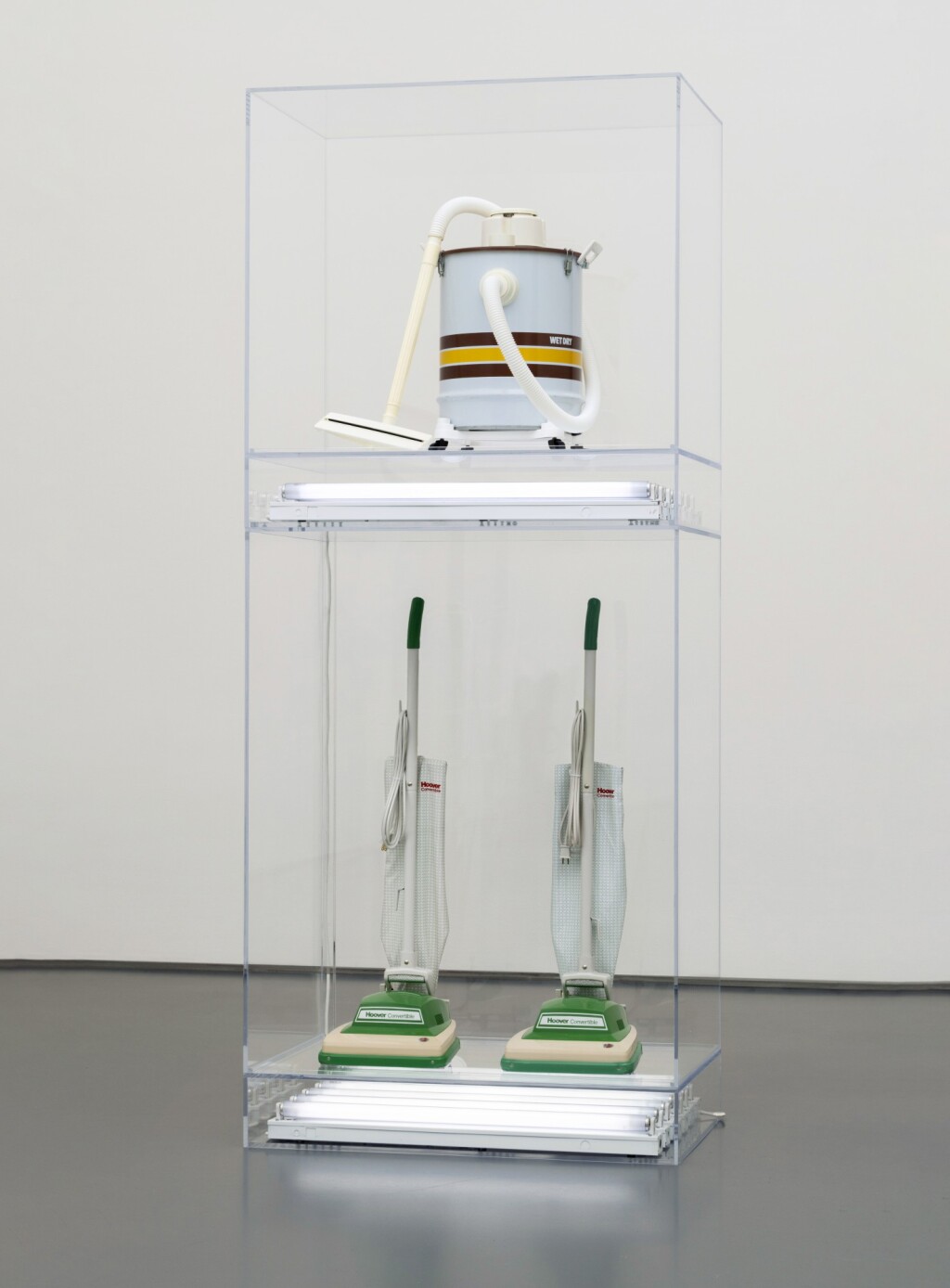
JEFF KOONS (b. 1955)
New Hoover Convertibles, New Shelton Wet/Dry 10 Gallon Doubledecker, 1981-1986
Three vacuum cleaners, acrylic and fluorescent lights
99x41x28 inches (251.1 x 104.1 x 71.1 cm)
#4. Popples, 1988
The Macklowe Collection
Sotheby’s New-York: 16 May 2022
Estimated: USD 1,500,000 – 2,000,000
USD 3,922,000
BANALITY SERIES
Popples | The Macklowe Collection | | Sotheby’s (sothebys.com)
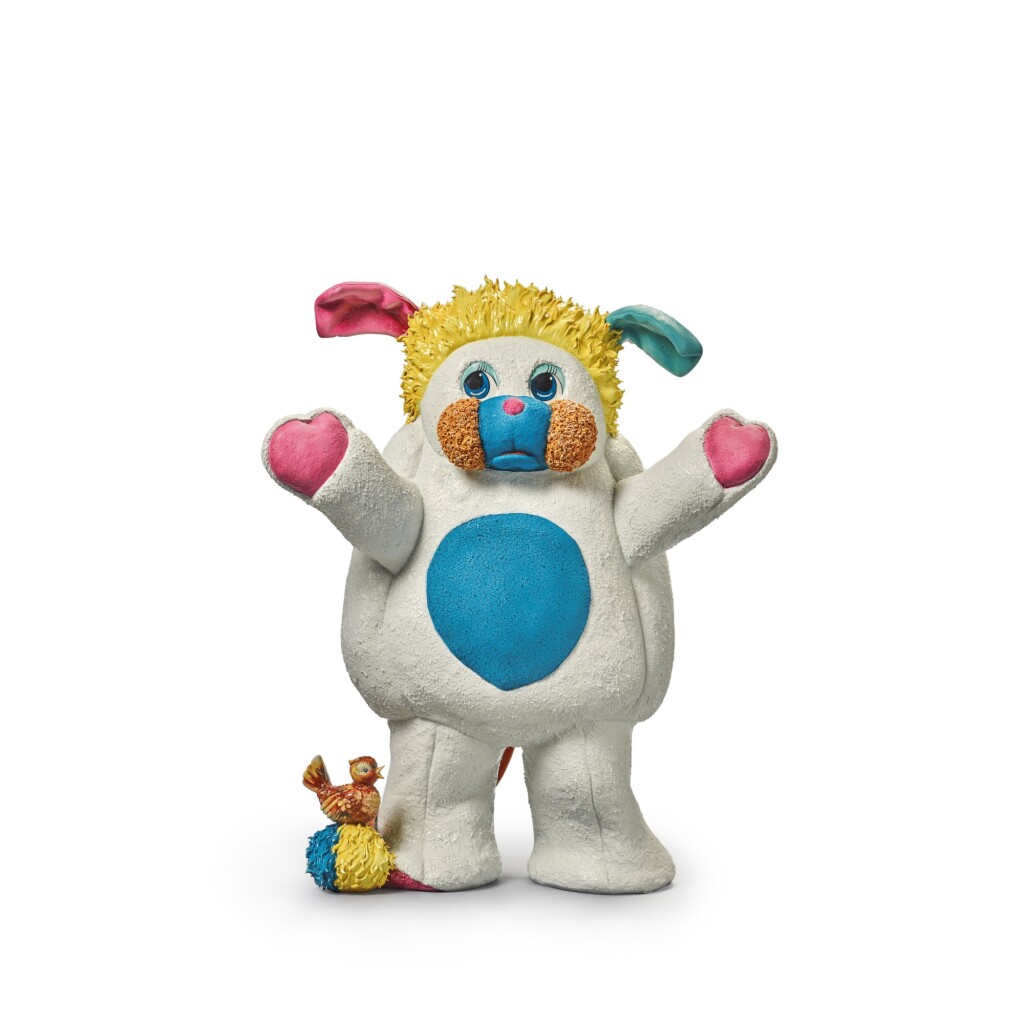
JEFF KOONS (b.1955)
Popples, 1988
Porcelain
29 1/4 x 23 x 12 inches (74.3 x 58.4 x 30.5 cm)
Signed and numbered 1/3 on base
This work is number 1 from an edition of 3 plus one artist’s proof
#5. Lobster, 2007-2012
Christie’s New-York: 9 May 2022
Estimated: USD 3,500,000 – 5,500,000
USD 3,780,000
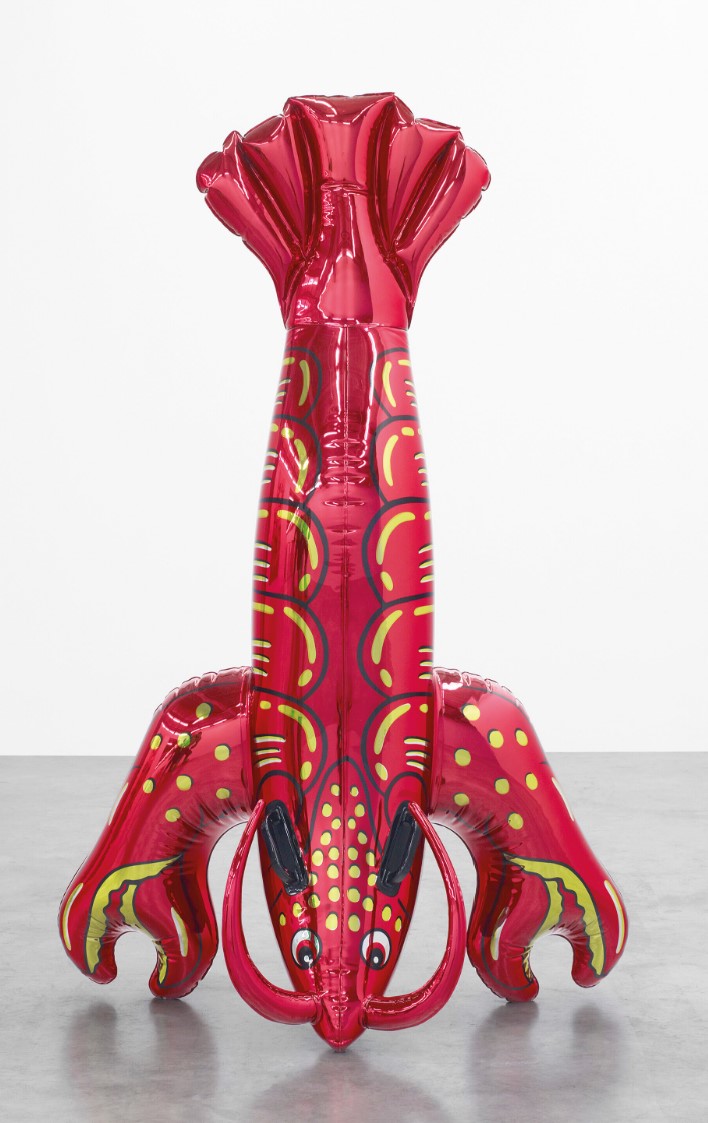
JEFF KOONS (B. 1955)
Lobster, 2007-2012
Mirror-polished stainless steel with transparent color coating
57 7/8 x 18 7/8 x 37 inches (147 x 47.9 x 94 cm)
Signed, numbered and dated ‘J. Koons ’07-’12 3⁄3’ (on the underside)
This work is number three from an edition of three plus an artist’s proof
#6. Jim Beam – J.B. Turner Engine, 1986
Sotheby’s Hong-Kong: 27 April 2022
Estimated: HKD 13,500,000 – 15,500,000
HKD 9,450,000 / USD 1,204,312
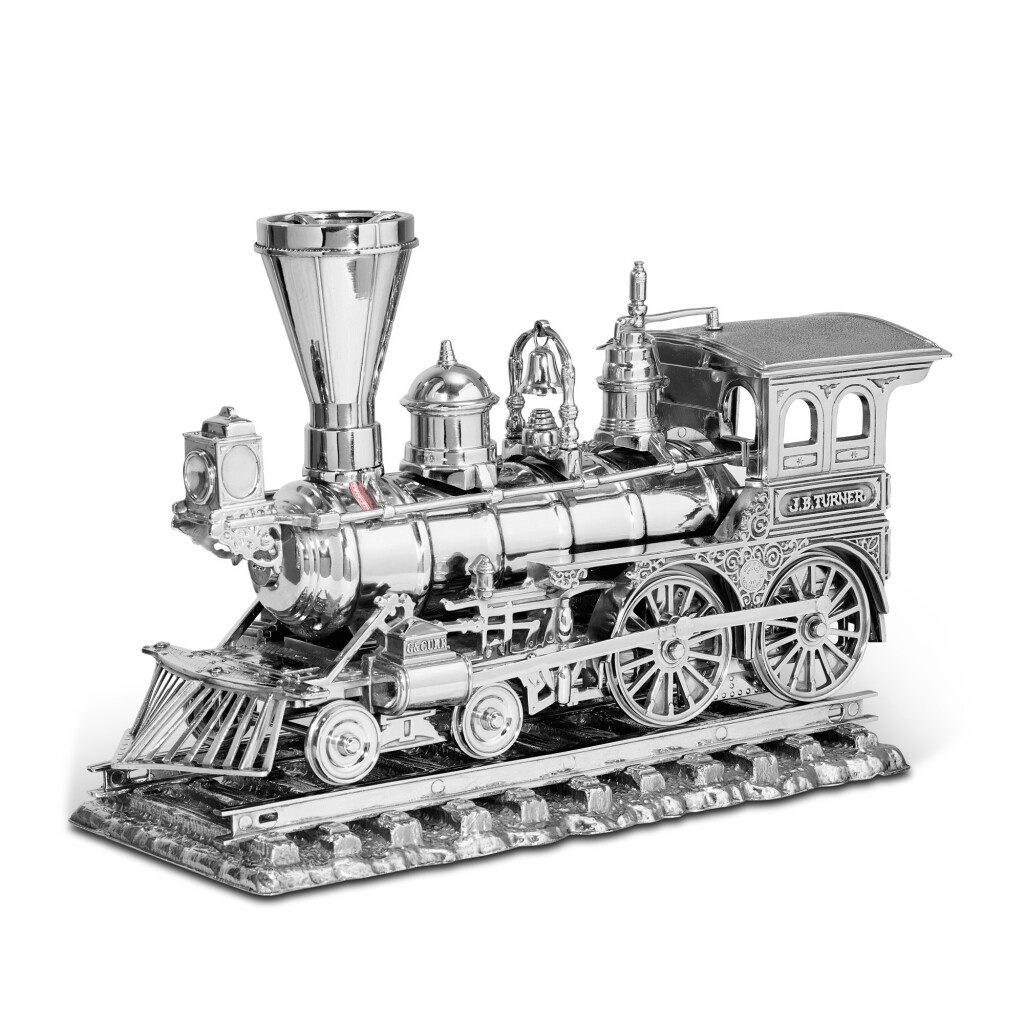
JEFF KOONS (b. 1955)
Jim Beam – J.B. Turner Engine, 1986
Stainless steel and bourbon
11 x 17 x 6 1/2 inches (27.9 x 43.2 x 16.5 cm)
This work is number 1 from an edition of 3, plus 1 artist’s proof
#7. Travel Bar, 1986
Christie’s New-York: 10 March 2022
Estimated: USD 900,000 – 1,200,000
USD 1,197,000
JEFF KOONS (B. 1955) (christies.com)
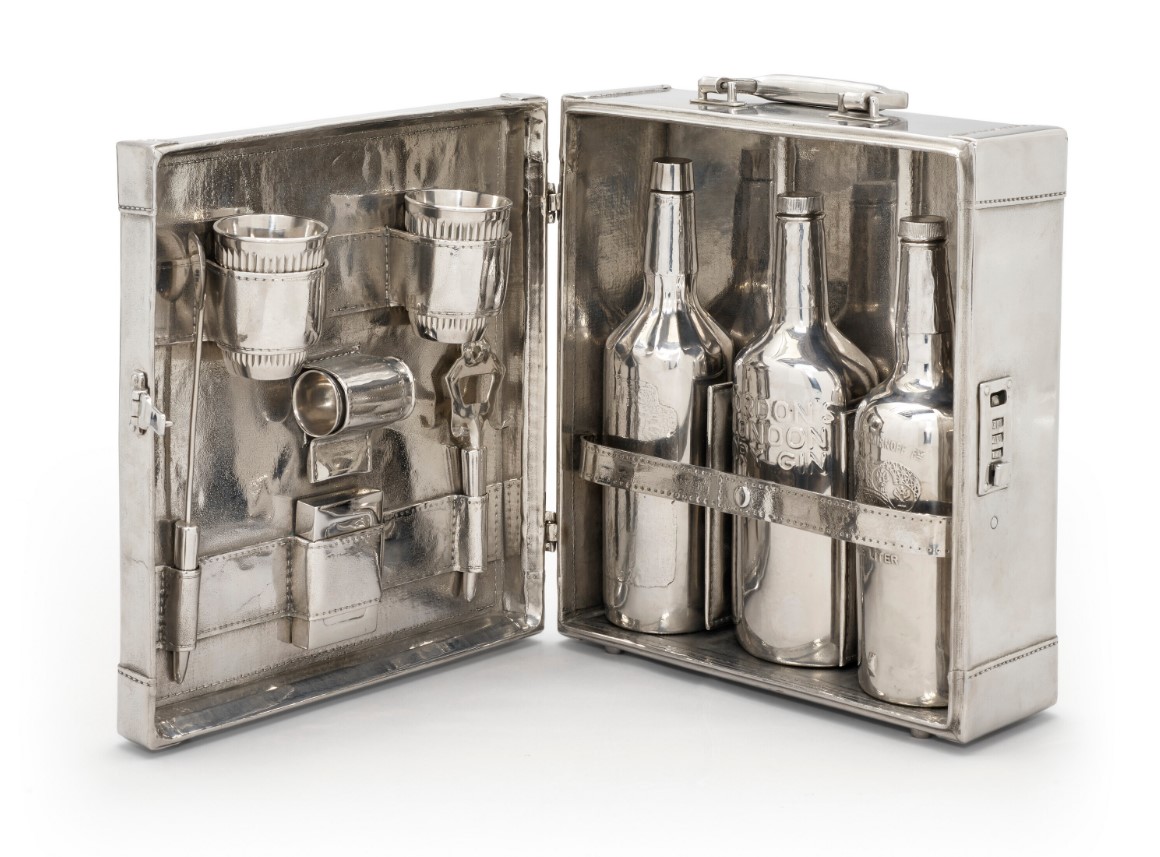
JEFF KOONS (B. 1955)
Travel Bar, 1986
Stainless steel
14x20x12 inches (35.6 x 50.8 x 30.5 cm)
This work is number one from an edition of three plus one artist’s proof
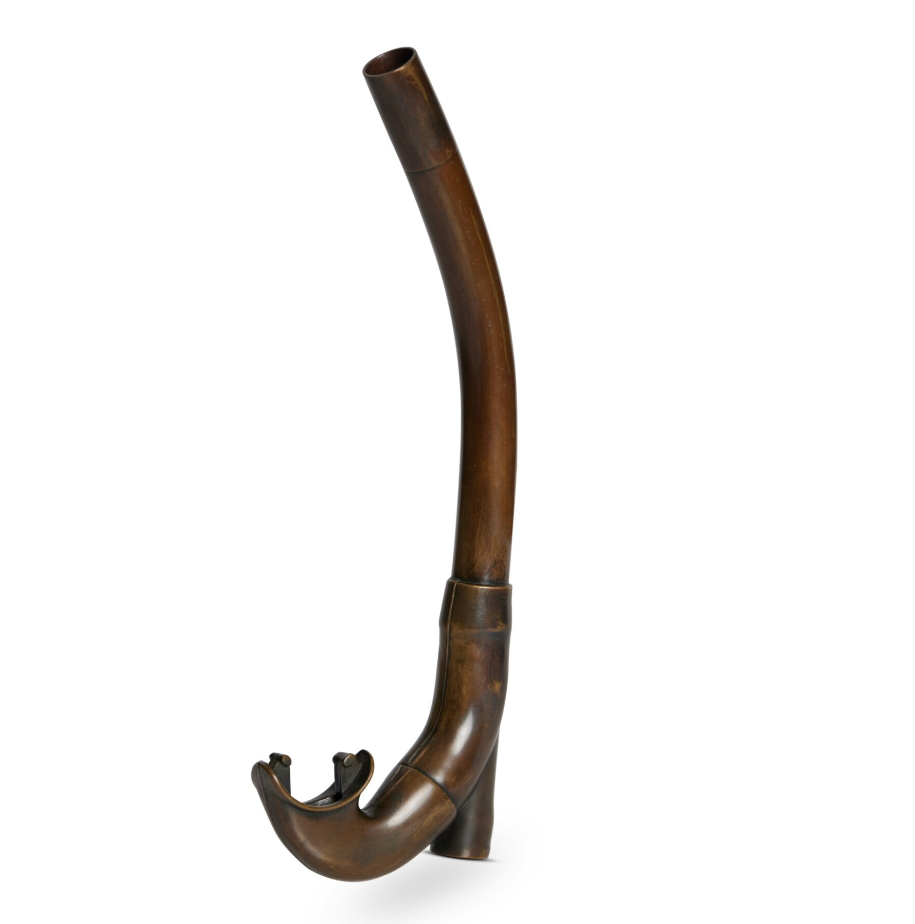
#8. Snorkel (Generic), 1985
Sotheby’s New-York: 20 May 2022
Estimated: USD 200,000 – 300,000
USD 239,400
Snorkel (Generic) | Contemporary Day Auction | 2022 | Sotheby’s (sothebys.com)
JEFF KOONS (b. 1955)
Snorkel (Generic), 1985
Bronze
14 1/2 x 5 x 1 inches (36.8 x 12.5 x 2.5 cm)
This work is number 1 from an edition of 3, plus 1 artist’s proof
#9. Bikini (Desert), 2001
Sotheby’s New-York: 11 March 2022
Estimated: USD 150,000 – 250,000
USD 157,500
Bikini (Desert) | Contemporary Curated | 2022 | Sotheby’s (sothebys.com)
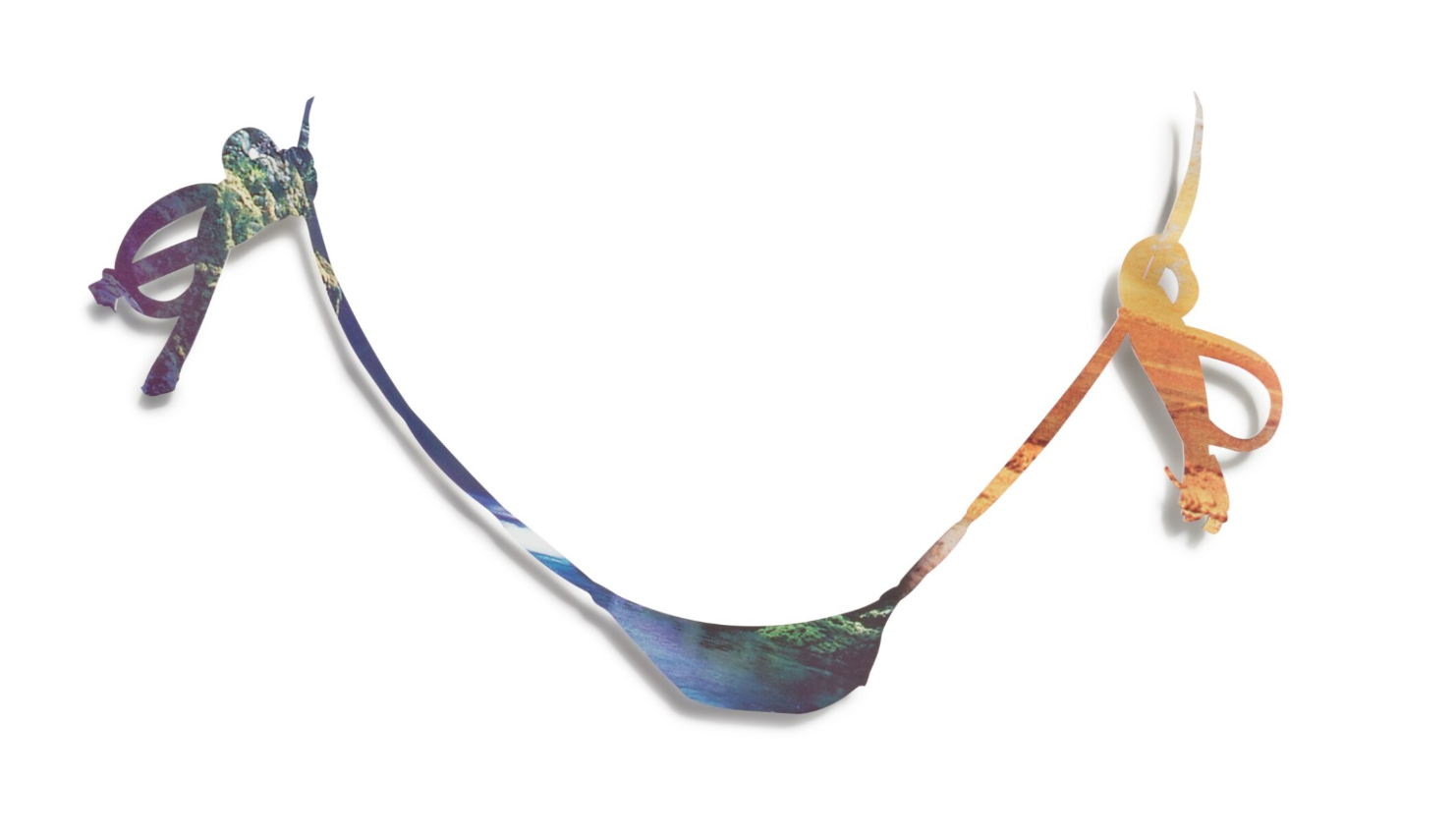
JEFF KOONS (b. 1955)
Bikini (Desert), 2001
Silkscreen on stainless steel with mirror polished edges
56×90 inches (142.2 x 228.6 cm)
Signed Jeff Koons and dated ’01 (on the verso)
This work is from a variant of 4, each uniquely colored
2021 Auction Results
9 lots sold at auction in 2021 for a total turnover of USD 34,207,844. With no lot failing to sell, the sell-through rate is 100%. The highest price was achieved at Sotheby’s in New-York on 15 November 2021, when Aqualung sold for USD 15,201,000.
2021 Top 3 Lots
#1. Aqualung, 1985
The Macklowe Collection
Sotheby’s New-York: 15 November 2021
Estimated: USD 8,000,000 – 12,000,000
USD 15,201,000
EQUILIBRIUM SERIES
Aqualung | The Macklowe Collection | | Sotheby’s (sothebys.com)
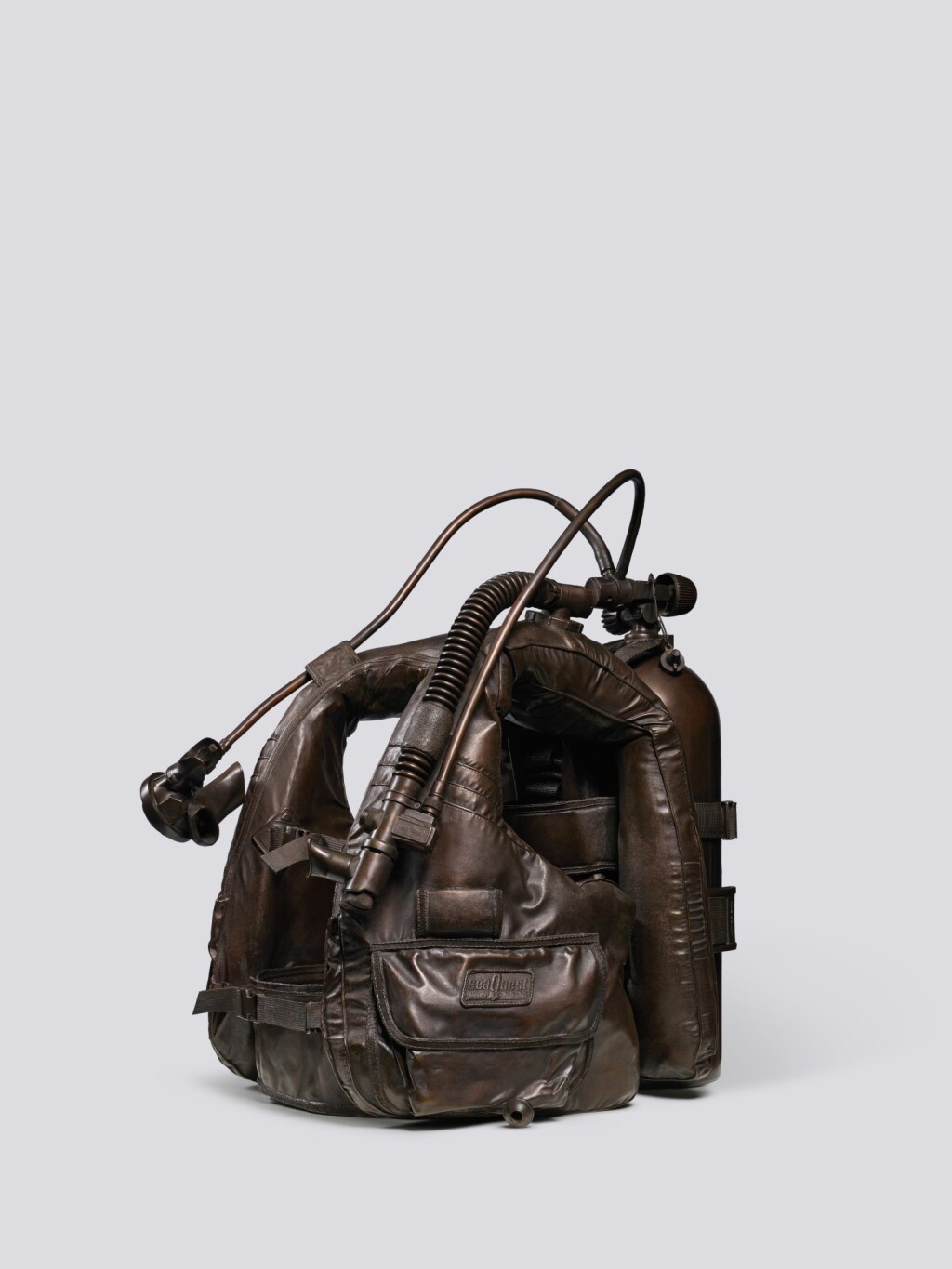
JEFF KOONS (b. 1955)
Aqualung, 1985
Bronze
27 x 17 1/2 x 17 1/2 inches (68.6 x 44.5 x 44.5 cm)
This work is number 3 from an edition of 3 plus 1 artist’s proof
#2. Quad Elvis, 2008
Sotheby’s New-York: 12 May 2021
Estimated: USD 4,000,000 – 6,000,000
USD 9,456,000
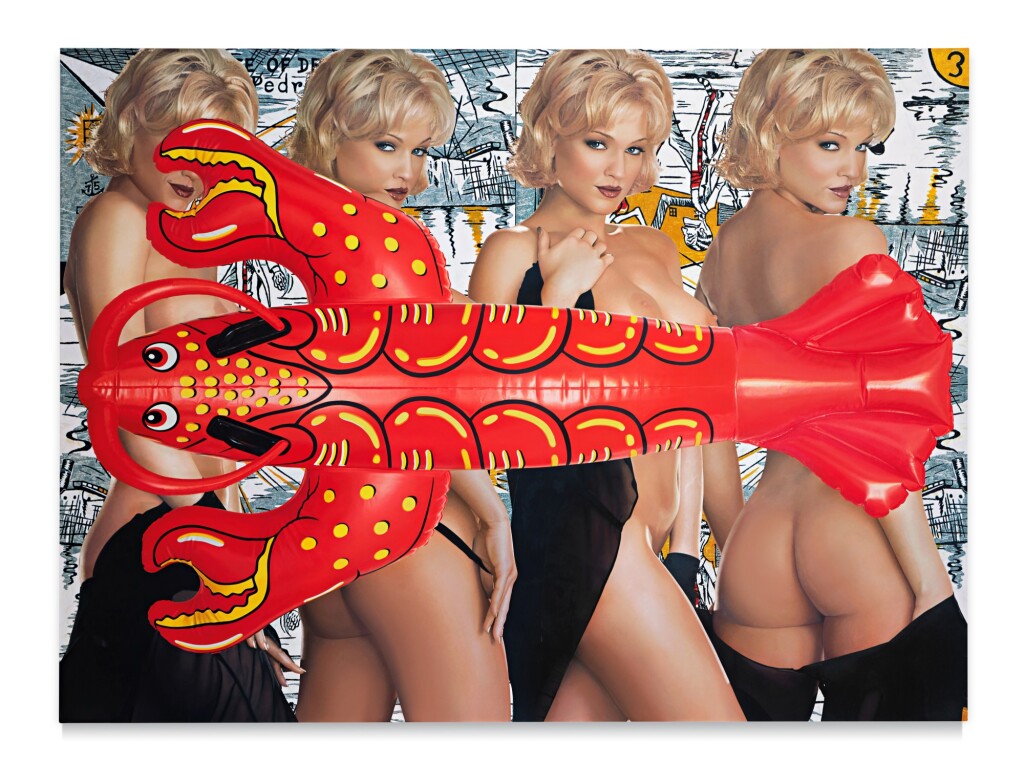
JEFF KOONS (b.1955)
Quad Elvis, 2008
Oil on canvas
102×138 inches (259.1 x 350.5 cm)
Signed and dated ’08 on the reverse
#3. Two Ball 50/50 Tank (Spalding Dr. J Silver Series, Wilson Supershot), 1985
Sotheby’s London: 29 June 2021
Estimated: GBP 2,500,000 – 3,500,000
GBP 2,498,000 / USD 3,873,736
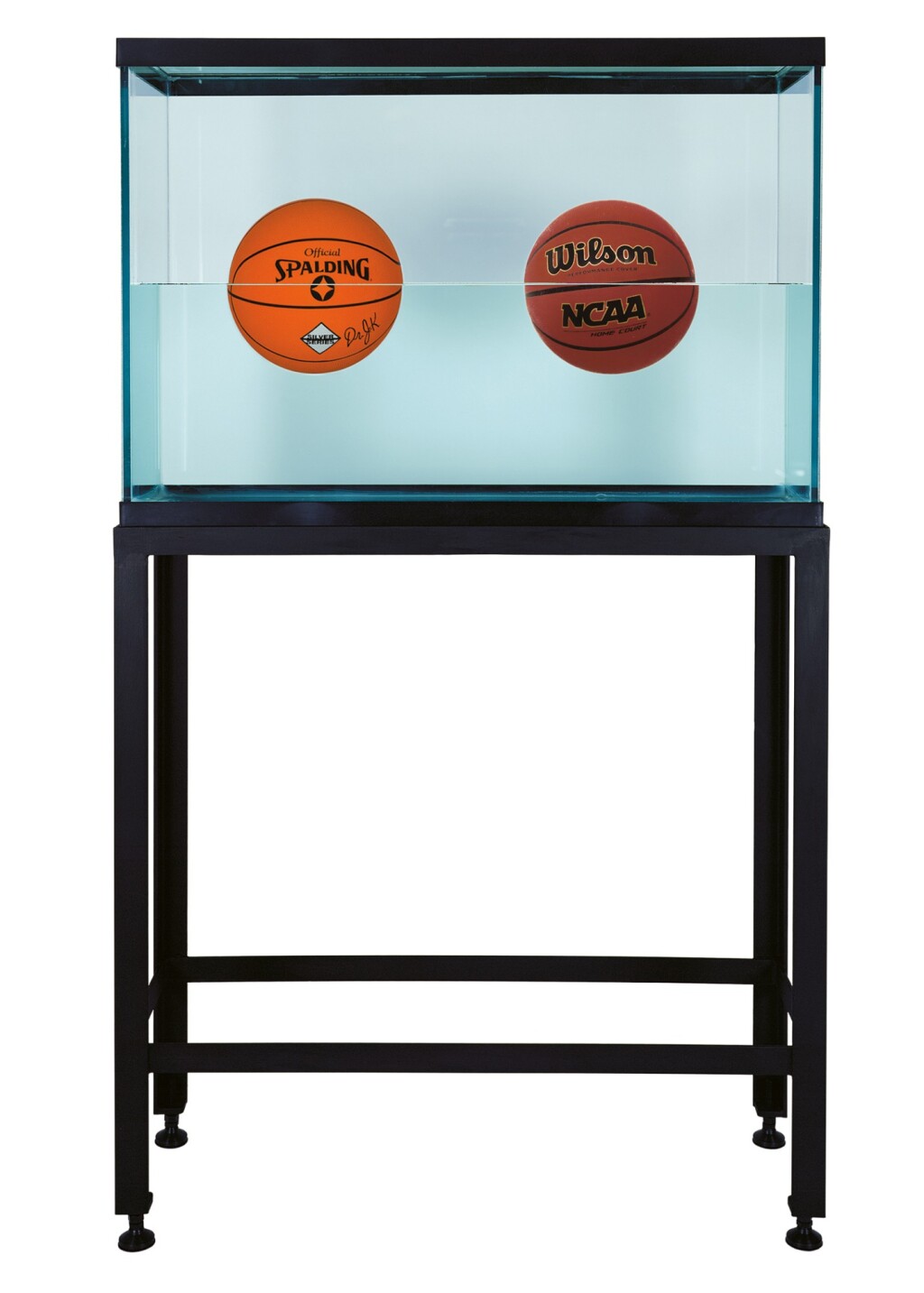
JEFF KOONS (b. 1955)
Two Ball 50/50 Tank (Spalding Dr. J Silver Series, Wilson Supershot), 1985
Glass, steel, distilled water, and two basketballs
62 3/4 x 36 3/4 x 13 1/4 inches (159.4 x 93.3 x 33.7 cm)
This work is number 2 from an edition of 2
#4. Baccarat Crystal Set, 1986
Sotheby’s New-York: 15 November 2021
The Macklowe Collection
Estimated: USD 900,000 – 1,200,000
USD 1,956,000
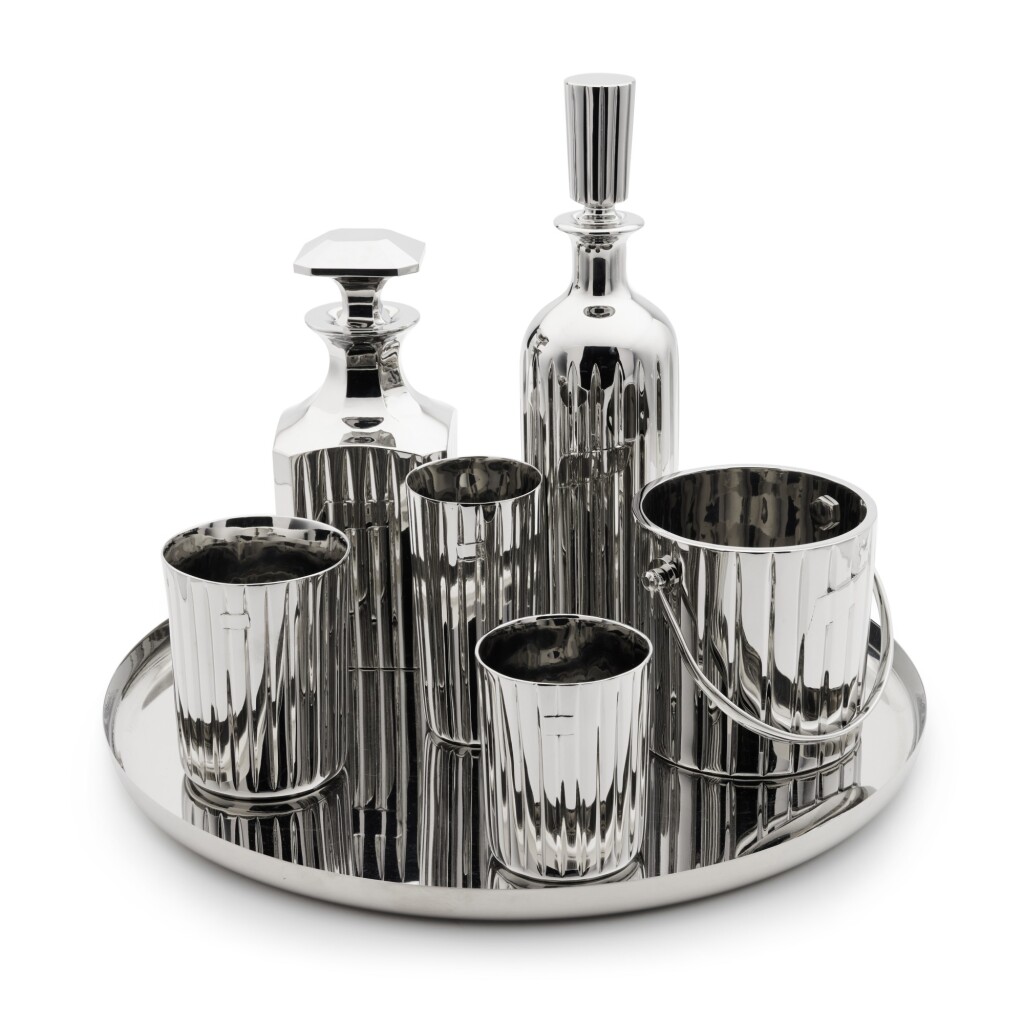
JEFF KOONS (b. 1955)
Baccarat Crystal Set, 1986
Stainless steel
12 ½ x 16 x 16 inches (31.8 x 40.6 x 40.6 cm)
This work is number 3 from an edition of 3 plus 1 artist’s proof
#5. Gazing Ball (Titian Mars, Venus, and Cupid), 2014-2015
Christie’s New-York: 12 November 2021
Estimated: USD 500,000 – 700,000
USD 1,230,000
JEFF KOONS (B. 1955) (christies.com)
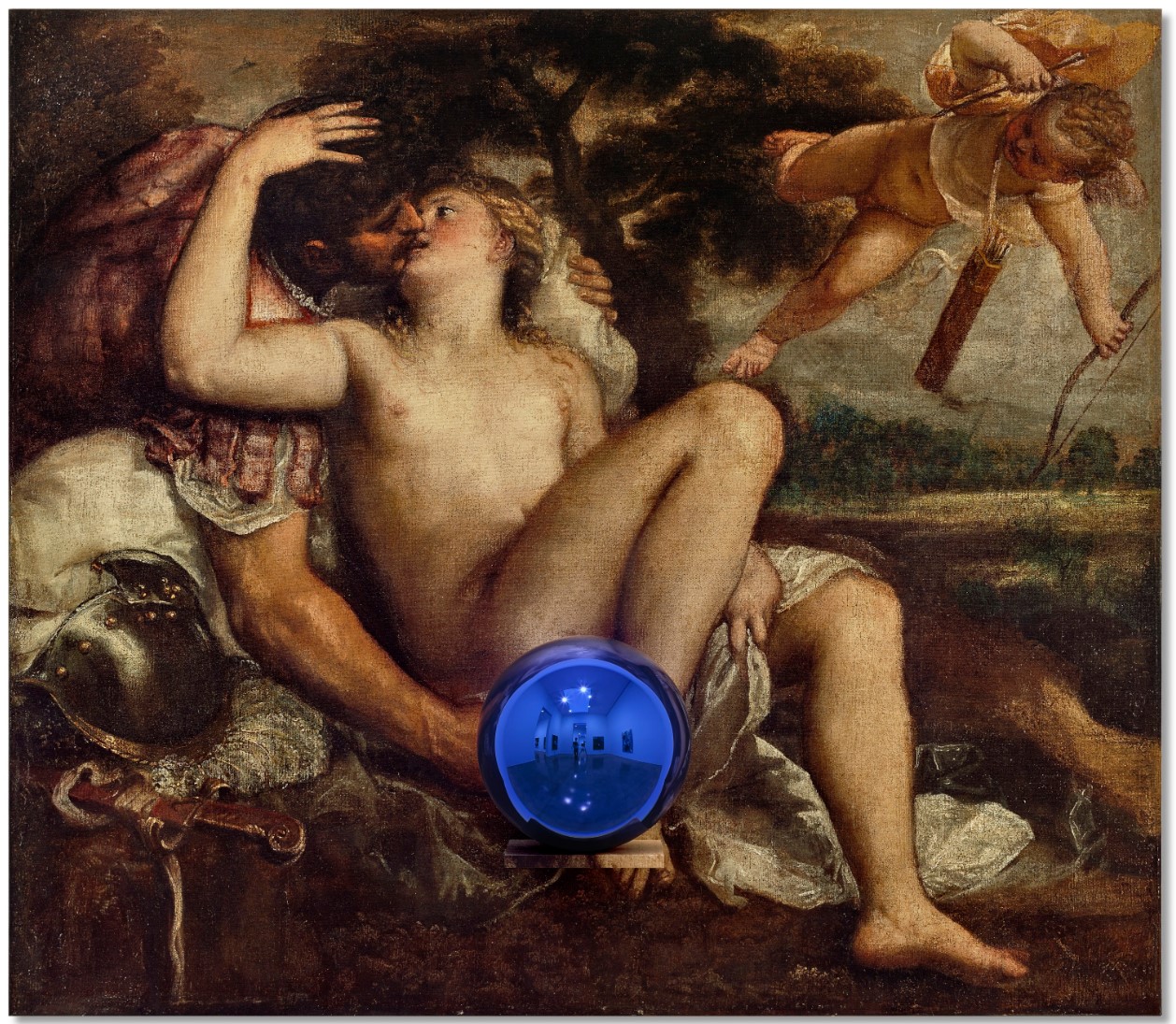
JEFF KOONS (B. 1955)
Gazing Ball (Titian Mars, Venus, and Cupid), 2014-2015
Oil on canvas, glass and aluminum
58 x 66 1/2 x 14 3/4 inches (147.3 x 168.9 x 37.5 cm)
Signed and dated ‘Jeff Koons 2014-2015’ (on the overlap)
#6. Gazing Ball (Demeter), 2014
Phillips New-York: 23 June 2021
Estimated: USD 400,000 – 600,000
USD 998,000
Jeff Koons – 20th Century & Contemporar… Lot 50 June 2021 | Phillips
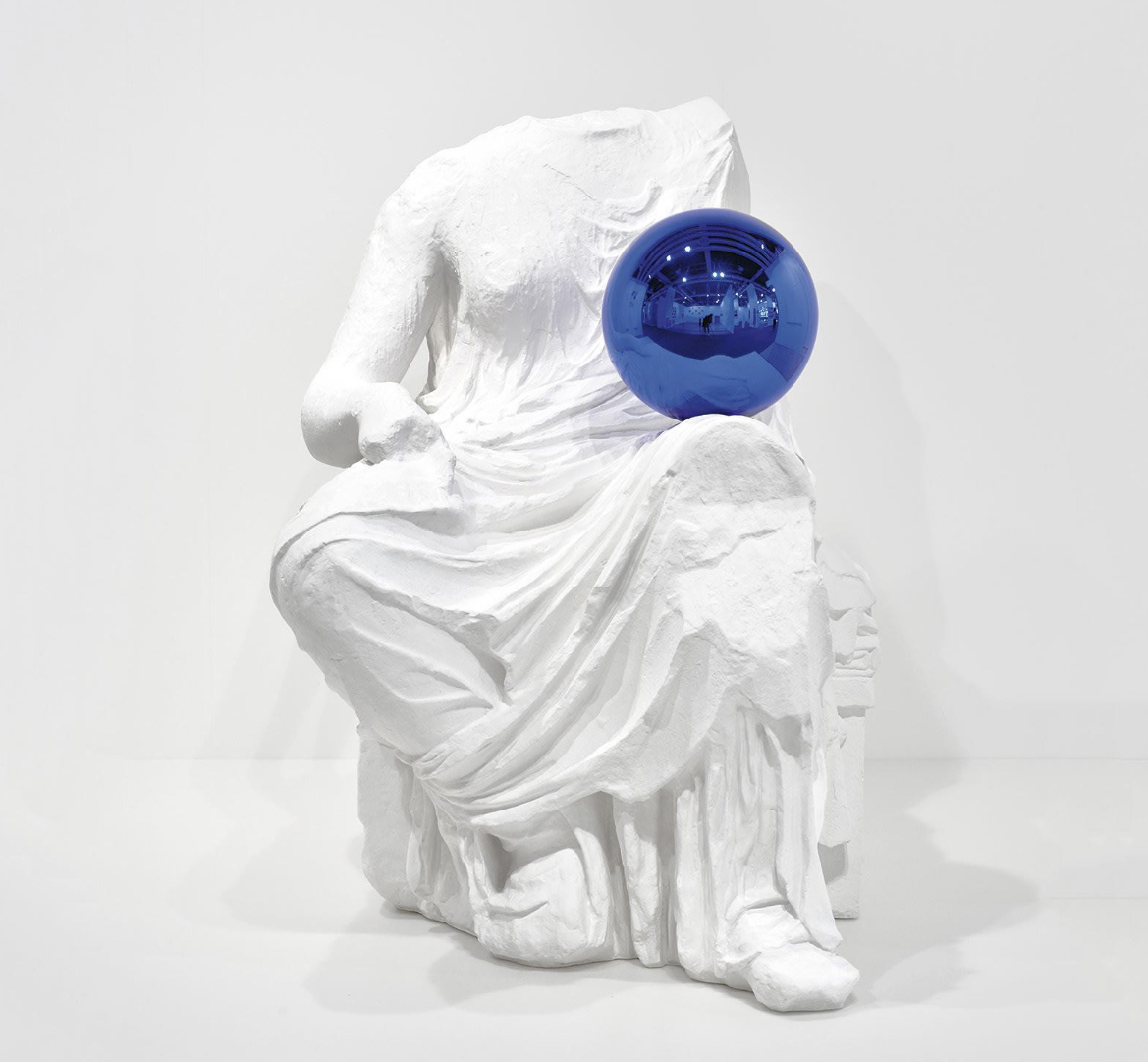
JEFF KOONS
Gazing Ball (Demeter), 2014
Plaster and glass
48 3/4 x 34 1/8 x 40 1/2 inches (123.8 x 86.7 x 102.9 cm)
This work is an artist’s proof aside from an edition of 3 plus 1 artist’s proof
#7. Pancakes, 2001
Sotheby’s New-York: 12 May 2021
Estimated: USD 1,000,000 – 1,500,000
USD 867,000
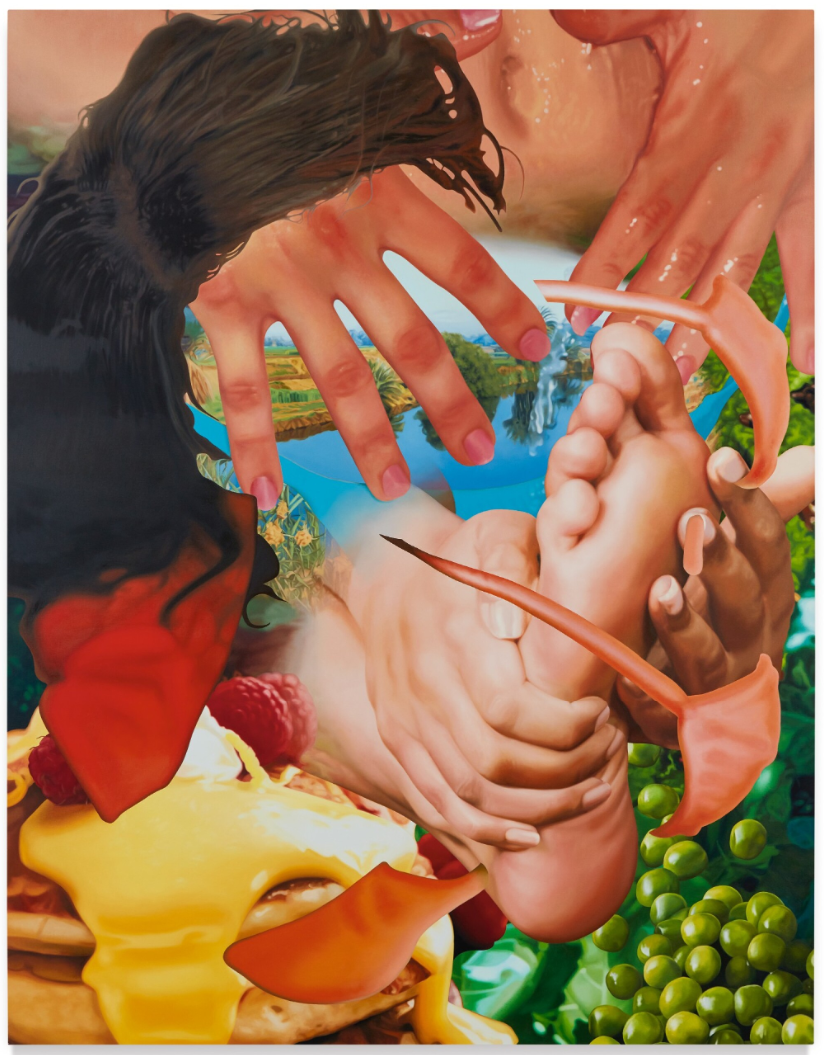
JEFF KOONS (b.1955)
Pancakes, 2001
Oil on canvas
108×84 inches (274.6 x 213.4 cm)
Signed and dated ’01 on the overlap
#8. Donkey (Yellow), 1999
Sotheby’s New-York: 19 November 2022
Estimated: USD 250,000 – 350,000
USD 403,200
Donkey (Yellow) | Contemporary Day Auction | 2021 | Sotheby’s (sothebys.com)
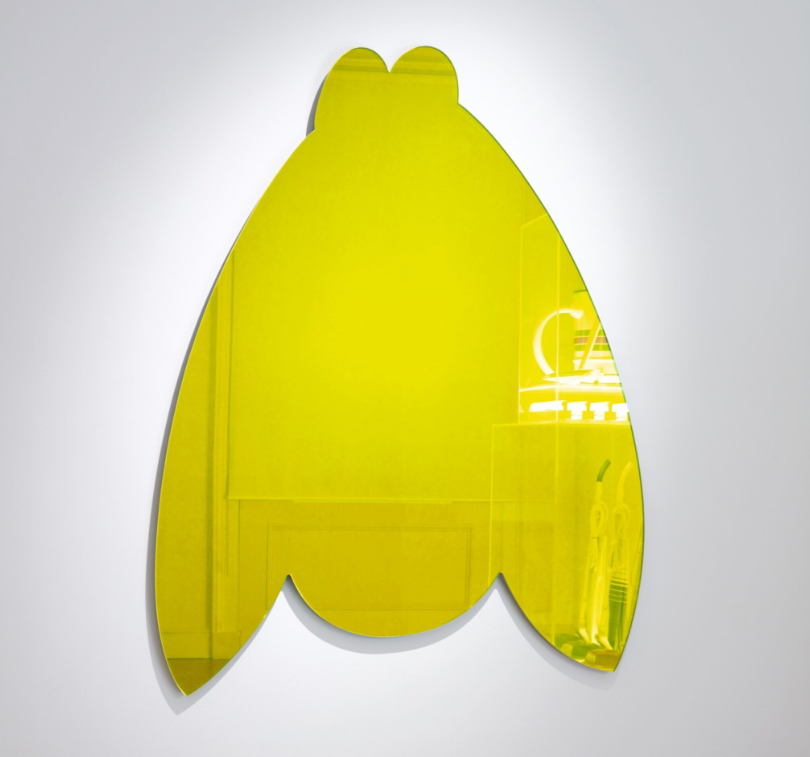
JEFF KOONS (b. 1955)
Donkey (Yellow), 1999
Crystal glass, mirrored glass, carbon fiber, foam, colored plastic inter-layer, stainless steel
76 3/4 x 59 1/4 inches (194.9 x 150.5 cm)
Signed and dated 1999 (on the reverse)
This work is number 1 of 4 unique versions
#9. Snorkel (Generic), 1985
Christie’s New-York: 16 October 2021
Estimated: GBP 100,000 – 150,000
GBP 162,500 / USD 222,908
JEFF KOONS (B. 1955) (christies.com)
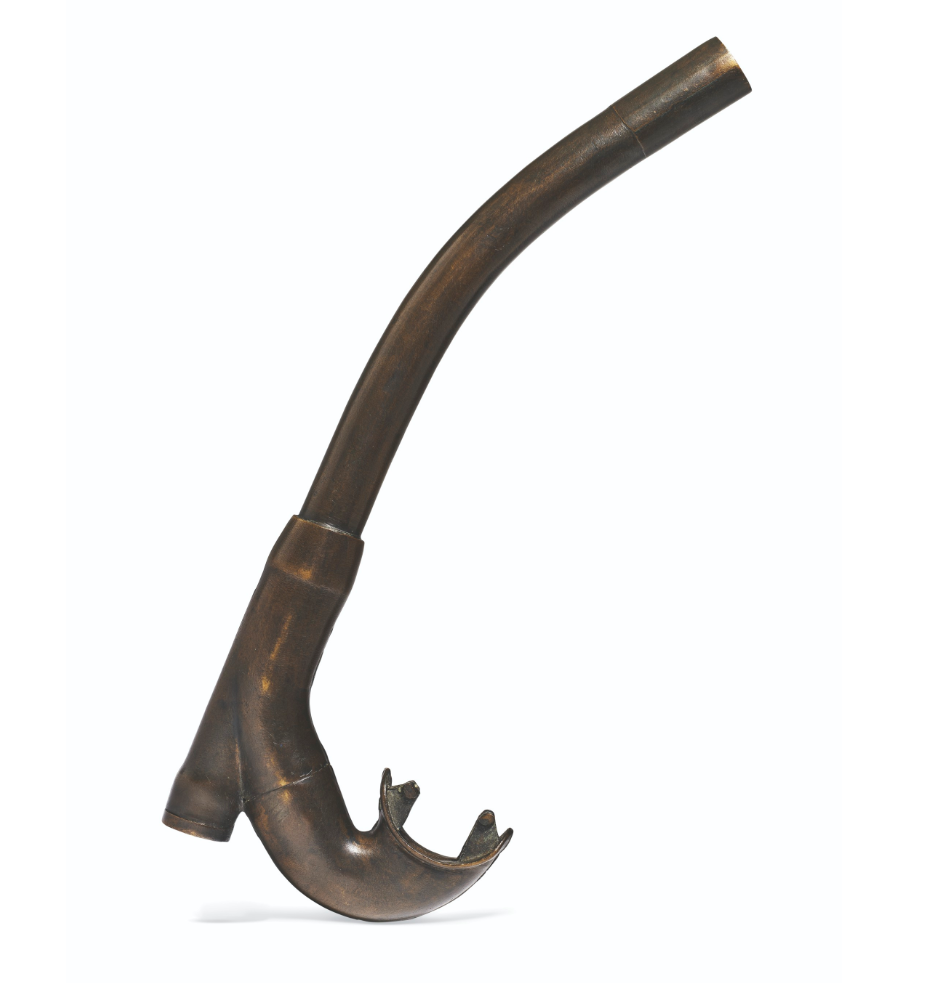
JEFF KOONS (B. 1955)
Snorkel (Generic), 1985
Bronze
14 1/2 x 5 x 1 1/4 inches (36.8 x 12.7 x 3.2 cm)
Executed in 1985, this work is from an edition of three plus one artist’s proof
PART III: FOCUS
Celebration Series
Baroque Egg with Bow (Orange/Magenta), 1994-2008
Sotheby’s New-York: 15 May 2025
Estimated: USD 2,500,000 – 3,500,000
USD 2,307,000
CELEBRATION SERIES
Baroque Egg with Bow | The Now and Contemporary Evening Auction | 2025 | Sotheby’s
JEFF KOONS (b. 1955)
Baroque Egg with Bow (Orange/Magenta), 1994-2008
Mirror-polished stainless steel with transparent color coating
78 3/8 x 76 3/4 x 76 inches (199x195x193 cm)
This work is one of five uniquely colored variants
Finished in a crinkled, foil-like metallic orange and crowned with a high-gloss magenta bow, Baroque Egg with Bow (Orange/Magenta) exemplifies Jeff Koons’ unparalleled talent for transforming the familiar into the monumental. Modeled after a mass-produced chocolate Easter egg, the sculpture is among the most iconic examples of Koons’ Celebration series—an ongoing project begun in the 1990s that reimagines motifs drawn from childhood, holidays, and rites of passage.
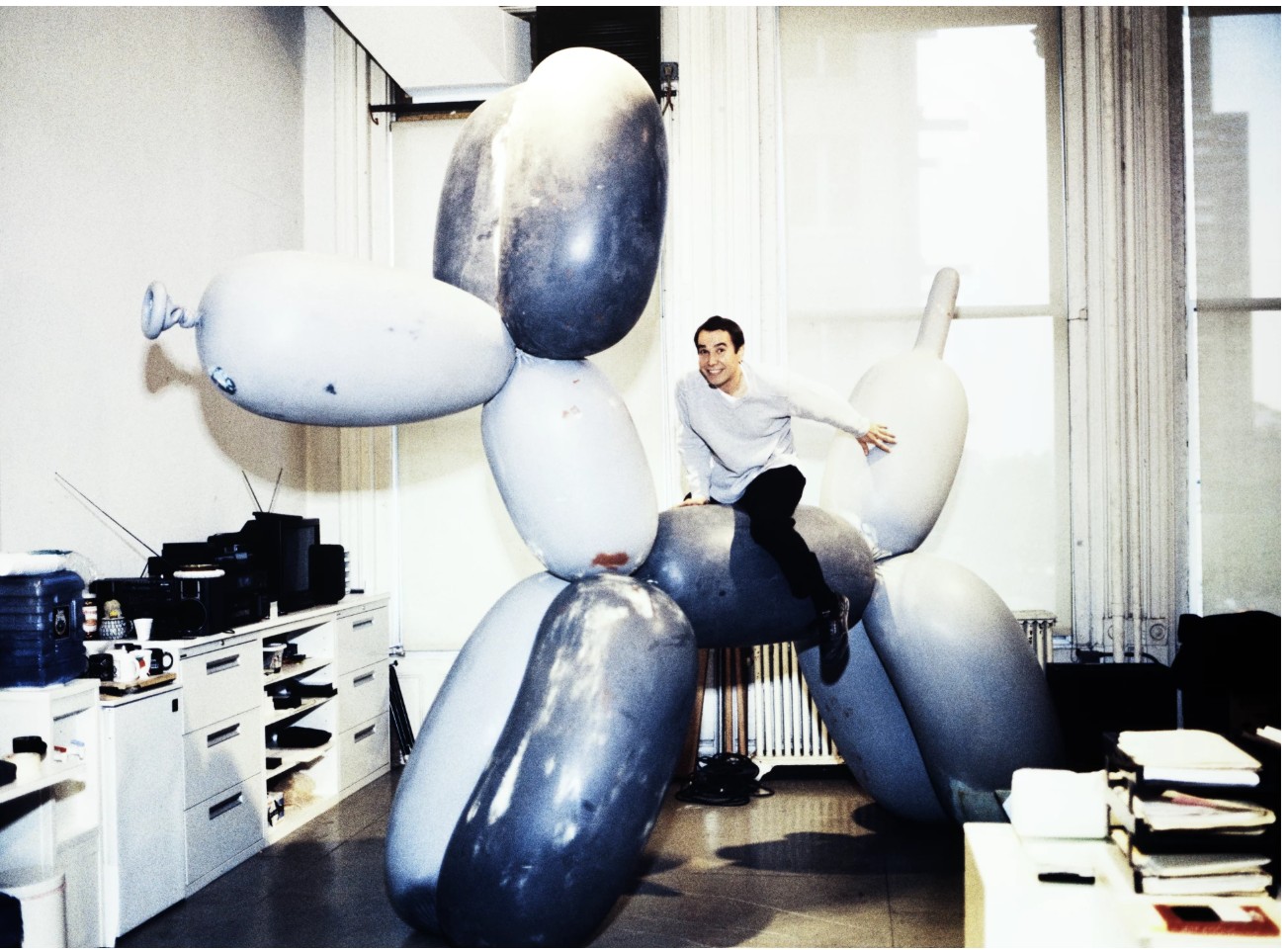
The artist photographed with one of his Balloon Dog sculptures. Photo © Ellen von Unwerth. Art © 2025 Jeff Koons
The egg, long a symbol of fertility and renewal, becomes in Koons’ hands a kaleidoscopic monument to material desire and visual excess. At once joyful and uncanny, the present sculpture is playful in form yet layered with symbolic, historical, and emotional complexity.The symbol of the egg has a deep historical lineage, appearing in religious, philosophical, and artistic traditions spanning centuries. From ancient Egyptian hieroglyphs to the works of artists like Hieronymus Bosch, Diego Velázquez, René Magritte, Salvador Dali and Constantin Brancusi, the ovum has been depicted as a sign of creation and renewal. In Baroque Egg with Bow, Koons invokes that lineage while embedding the object within a contemporary consumer aesthetic. The sculpture’s glistening surface mimics commercial perfection, recalling foil-wrapped candies and high-end packaging. Yet through sheer scale and technical virtuosity, Koons transforms the readymade into something seductive and sublime.
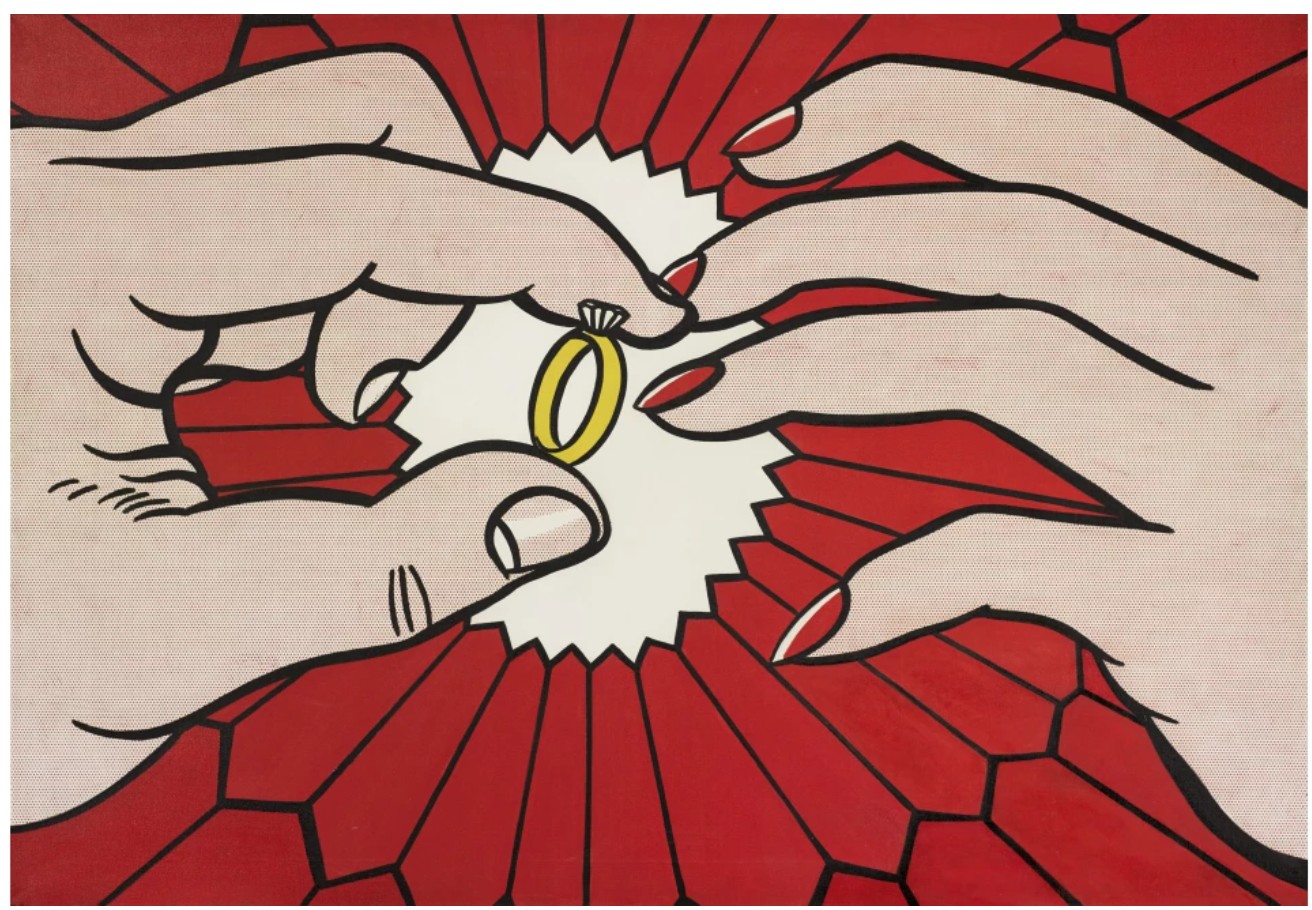
Roy Lichtenstein, The Ring (Engagement), 1962. Private Collection.
Sold at Sotheby’s New York in May 2015 for $41.7 million. Art © Estate of Roy Lichtenstein
While Duchamp’s ready-mades employed unadorned, utilitarian forms, Koons gravitates toward objects already imbued with aesthetic and emotional appeal. In the present work, the egg carries associations not only of childhood innocence, but also of ritual and romance, gift-giving and springtime renewal. The Celebration series, which began in the 1990s, is one of Koon’s most ambitious projects, both in terms of scale and technical execution. The series captures milestones in life and the calendar year—featuring motifs like flowers, toys, cakes, and hearts—to evoke themes of seduction, romance, and reproduction. Each work in the series functions as an archetype—an emotionally charged icon drawn from collective memory. At the same time, Baroque Egg with Bow (Orange/Magenta) reveals Koons’ fascination with art historical grandeur. The bow atop the egg—glossy, ornamental, and perfectly symmetrical—recalls both Rococo confection and the theatrical flourishes of the Baroque.
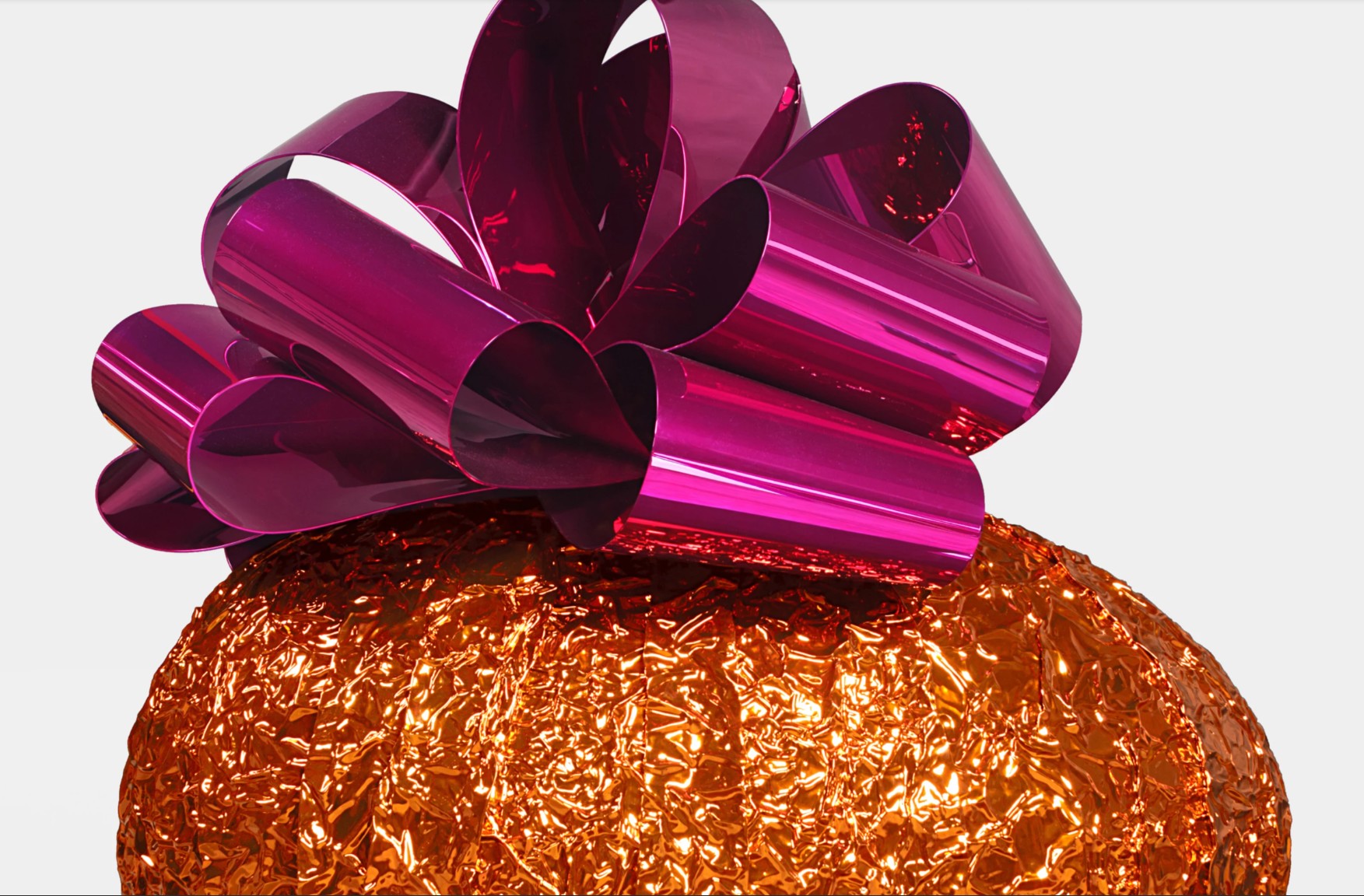
“I use the Baroque to show the public that we are in the realm of the spiritual, the eternal. The church uses the Baroque to manipulate and seduce, but in return it does give the public a spiritual experience. My work deals in the vocabulary of the Baroque.”
Like a reliquary or altarpiece, the sculpture dazzles, drawing the viewer into an encounter that hovers between reverence and irony.
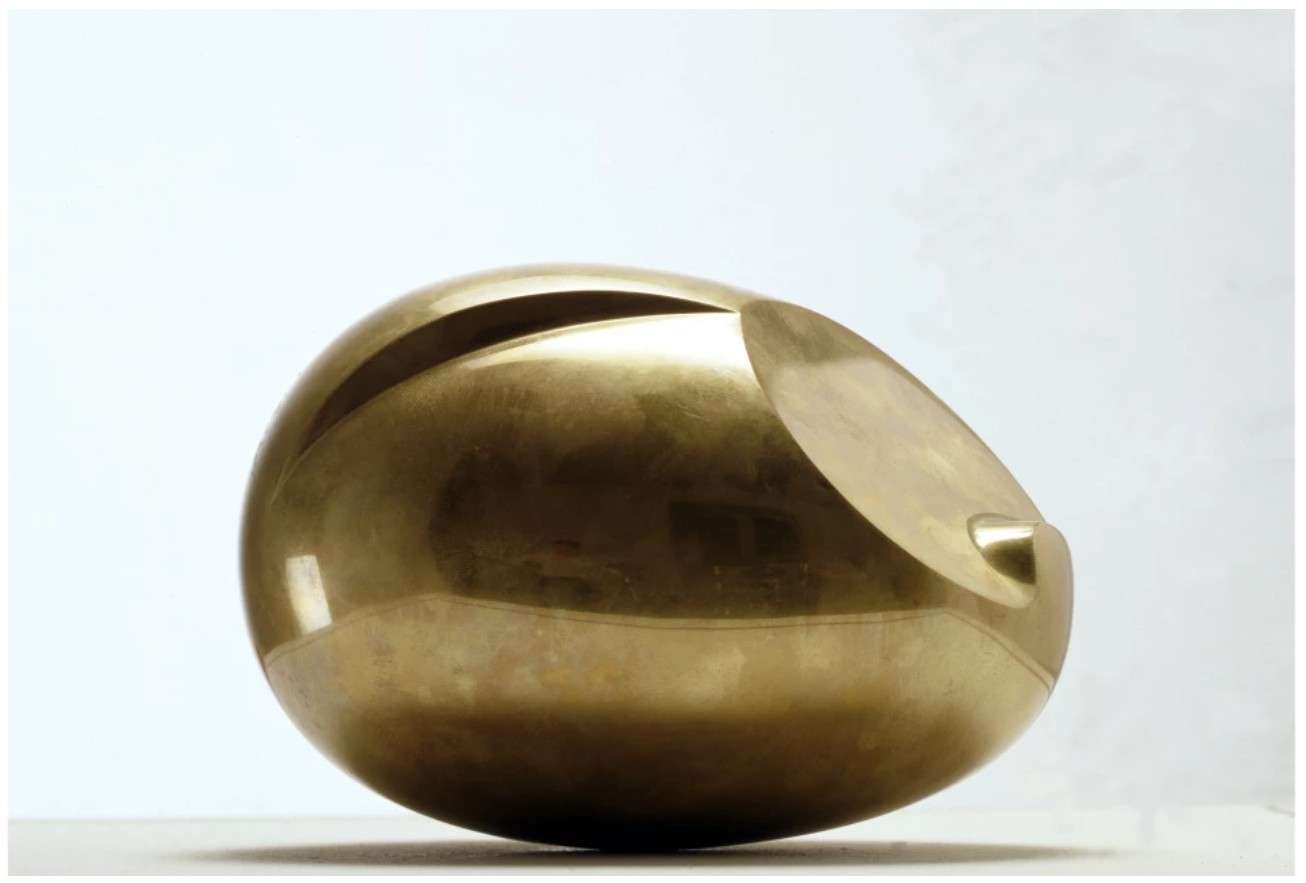
Constantin Brâncuși, The New Born, 1925. Centre Pompidou, Paris.
Image © Luisa Ricciarini / Bridgeman Images. Art © Succession Brancusi – All rights reserved (ARS) 2025
Another key influence on Baroque Egg with Bow (Orange/Magenta) is the opulent craftsmanship of Fabergé eggs. Like Fabergé, Koons demonstrates an obsessive dedication to perfection in his work. The Celebration series marked his return to stainless steel, a medium he had not used since the mid-1980s. By applying transparent color over the polished metal, Koons created an illusion of depth and an “interior life” within his sculptures—an effect that balances the joyous exterior with an underlying complexity. Though the surface shimmers with joy, the emotional core of the series is deeply personal. Celebration followed Koons’ Made in Heaven series and the public collapse of his relationship with Ilona Staller (La Cicciolina), which culminated in a lengthy custody dispute over their son, Ludwig. Against this backdrop, the egg takes on a new dimension—not only a universal symbol of birth and renewal, but also an intimate gesture: a visual message sent across time and distance from father to child. This layering of private narrative and public iconography gives the work its charged emotional tenor.
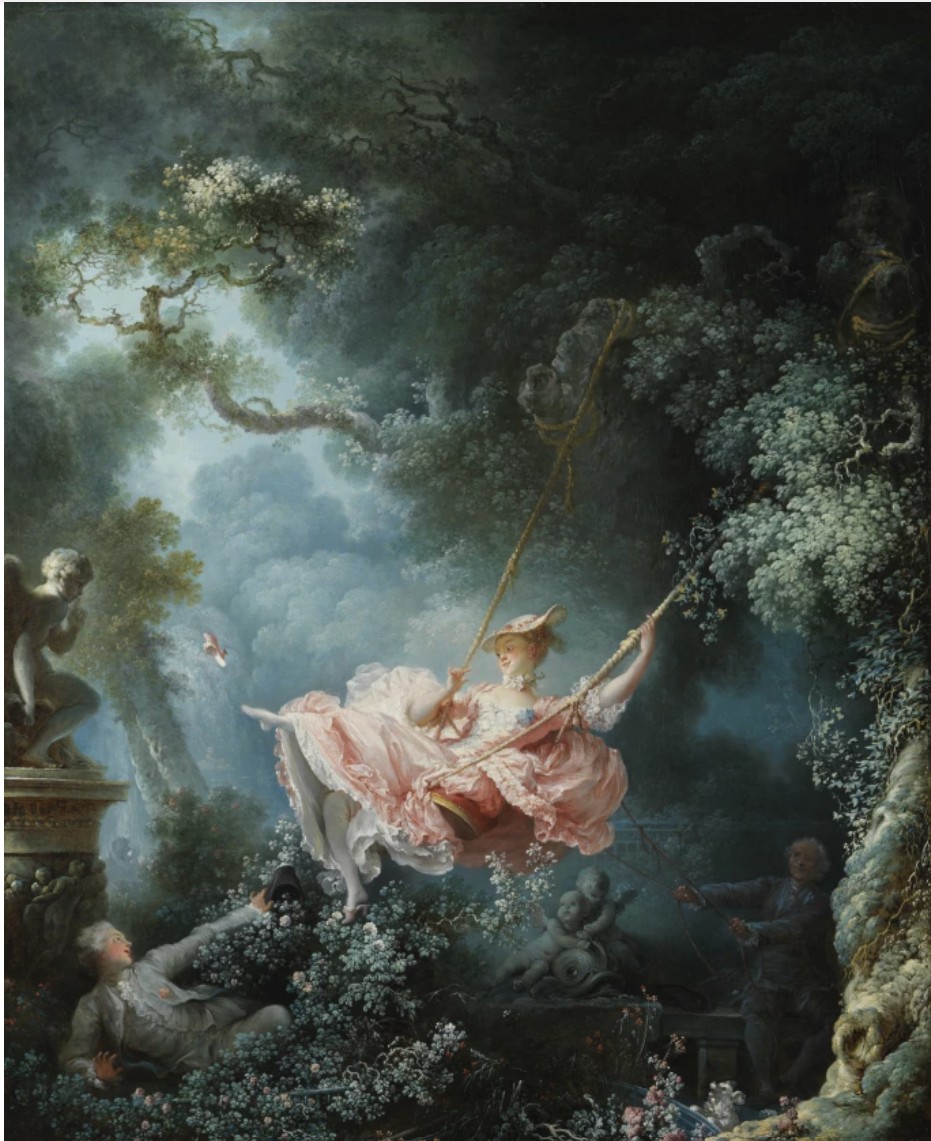
Jean-Honore Fragonard, The Swing, 1767. Wallace Collection, London. Image © Wallace Collection, London, UK / Bridgeman Images
Baroque Egg with Bow (Orange/Magenta) is at once dazzling and sincere, seductive and solemn. Through its polished surface, the viewer encounters a paradox: a luxury object that reflects not only the world around it, but the emotional depths beneath it. In marrying the traditions of Baroque art and Fabergé craft with the tropes of American mass culture, Koons transforms a seasonal confection into a monument of contemporary life—part devotional object, part postmodern artifact. As with much of Koons’ practice, the work leaves the viewer suspended between awe and amusement, caught in the luminous tension between material excess and spiritual longing.
Balloon Monkey (Blue), 2006-2013
Christie’s London: 9 October 2024
Estimated: GBP 6,500,000 – 10,000,000
GBP 7,555,000 / USD 9,897,050
CELEBRATION SERIES
JEFF KOONS (B. 1955), Balloon Monkey (Blue) | Christie’s (christies.com)
JEFF KOONS (B. 1955)
Balloon Monkey (Blue), 2006-2013
Mirror-polished stainless steel with transparent color coating
150x126x235 inches (381 x 320 x 596.9 cm)
Executed in 2006-2013, this work is one of five unique versions (Red, Yellow, Blue, Magenta, Orange)
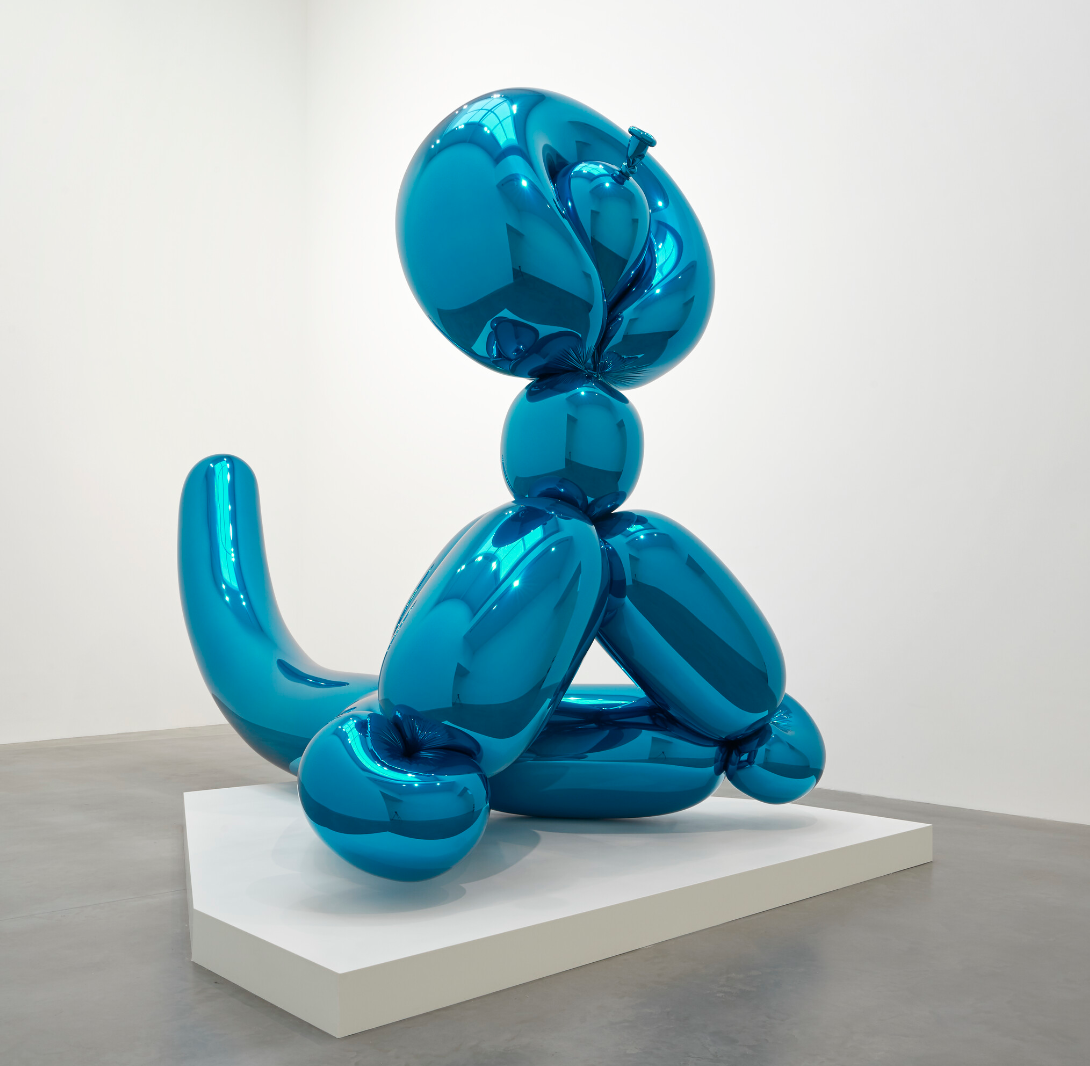
A majestic vision seven years in the making, Balloon Monkey (Blue) (2006-2013) sees Jeff Koons’s sculptural practice reach extraordinary new heights of formal splendor, technical achievement and sheer, awe-inspiring impact. Its seductive form, monumental scale and reflective, opulently colored surface—all precision-crafted to seemingly impossible levels of flawlessness and finish—capture the essence of his work, which employs the iconography of childhood innocence to expose the deep drives of desire and joy that animate our relationship with art. The present sculpture is one of five unique versions of Balloon Monkey, each formed of mirror-polished stainless steel with a transparent color coating: the others are red, magenta, yellow, and orange. They are the very largest of Koons’s balloon-animal works. Developing the vocabulary of the Celebration series—which included the artist’s first inflatable colossus, the iconic Balloon Dog (1994-2000)—Balloon Monkey (Blue) arrives at an apex of glossy, weightless perfection. Sweeping six meters from head to tail and standing almost four meters high, it towers like a sphinx or totem, an ephemeral plaything transformed into a sublime, otherworldly object of worship. The work was included in Jeff Koons: Now, his major 2016 survey exhibition at Damien Hirst’s Newport Street Gallery in London, and more recently in Jeff Koons: Shine at Palazzo Strozzi, Florence.
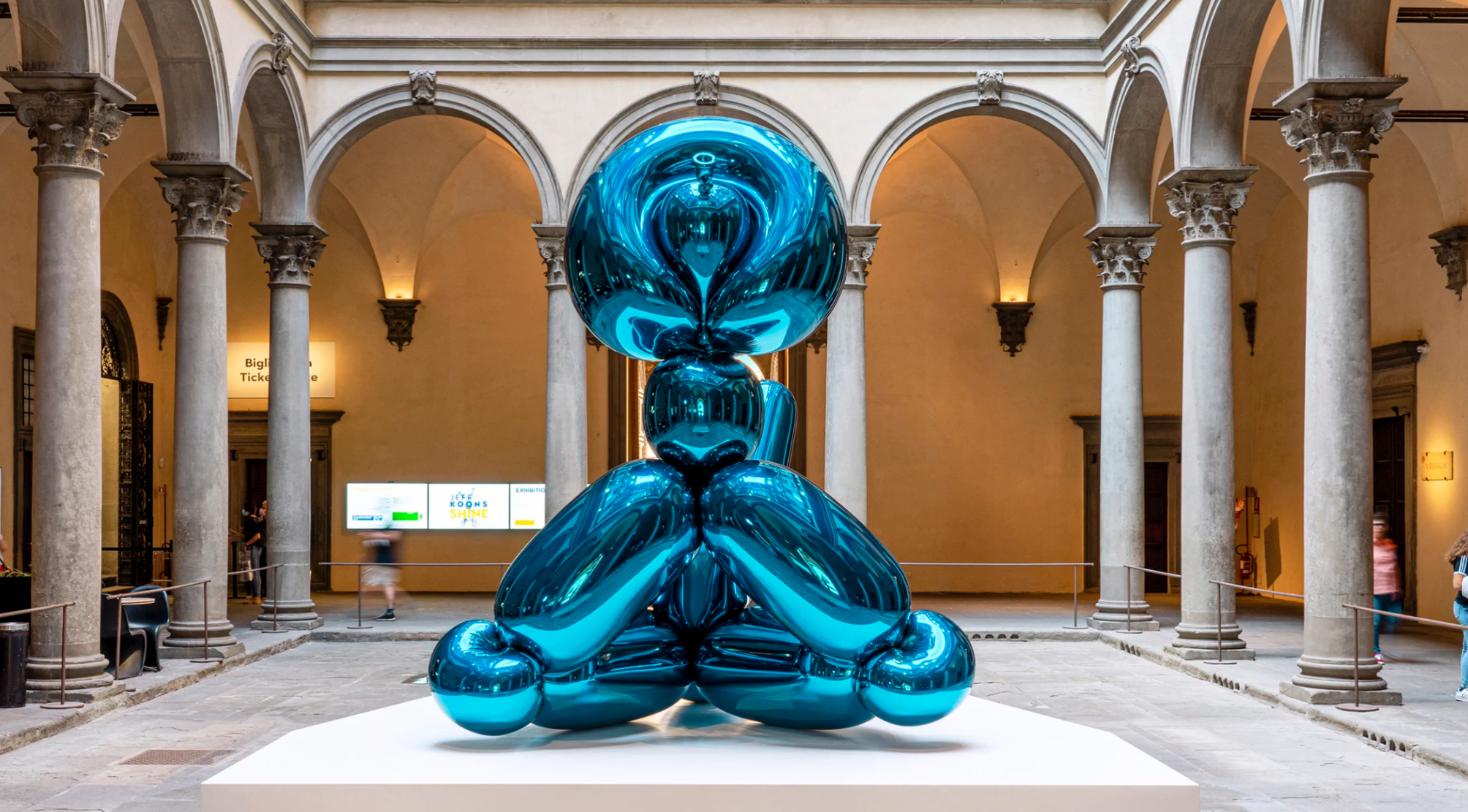
The present lot installed in Jeff Koons: Shine, Palazzo Strozzi, Florence, 2021. © Jeff Koons.
The themes of air, breath and inflation have long been central to Koons’s practice. He began to explore blow-up objects as early as 1979 with his Inflatables, which found counterparts in the encased, fluorescently-lit vacuum cleaners he exhibited as The New the following year. The Equilibrium series of 1985 included basketballs suspended in tanks of water, and unnerving flotation devices made of heavy bronze. His iconic stainless steel Rabbit, a direct ancestor to the twisted balloon animals, appeared in 1986; the Balloon Dog arrived as part of the large-scale Celebration series commenced in the early 1990s, which reimagined objects associated with milestones such as birthdays, Easter and Valentine’s Day. Alongside Balloon Swan (2004-2011) and Balloon Rabbit (2005-2010), Balloon Monkey represents an evolution of these works, developing their exuberant spirit and complex, confounding presence. Beyond their sensual play between lightness and weight, fragility and strength, Koons sees the inflatables as metaphors for the human condition.
“I think it comes about just defining this balance of interior/exterior’. You breathe in and you inflate. You pull the external realm into yourself, and you inflate. Breath is a symbol of life energy. When you exhale, it returns to the exterior, that’s a symbol of almost your last breath.”
That something so seemingly childish can speak to these grand, existential ideas is a revelation: Balloon Monkey (Blue) is a union of the sublime and the ridiculous, transcending our every aesthetic assumption. Its very physical presence is hallucinogenic. As if by magic, the most fleeting of objects has become an immaculate, gleaming titan in several tons of stainless steel. This miraculous spectacle is the result of an extraordinary devotion to precision, purity and integrity. Using a balloon twisted into the shape of a monkey, Koons and his team of fabricators used bespoke white-light and CT scanning technologies to create a finely-tuned computerized model, before engaging in an intricate multi-step process of casting, three-dimensional milling, polishing and painting—involving much trial and error, and thousands of hours of work—in the pursuit of the final, faultless sculpture.
“My art has always used sex as a direct communication line to the viewer. The surface of my stainless steel pieces is pure sex and gives an object both a masculine and a feminine side: the weight of the steel engages with the femininity of the reflective surface.”
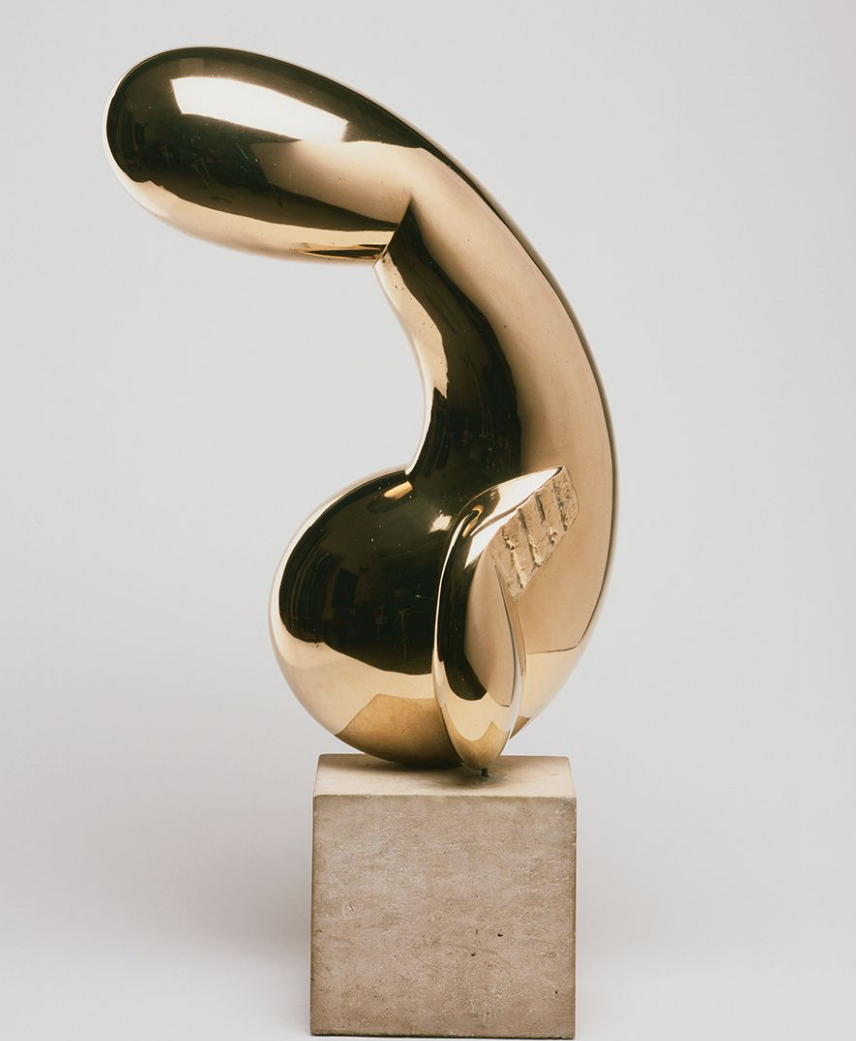
With its pyramidal structure and swooping, cantilevered tail, Balloon Monkey (Blue) can be seen as an abstract, almost architectural presence. Its clean lines and space-age geometries recall the work of Constantin Brâncuși, the father of modernist sculpture. Its form contains multiple layers of abstraction, from monkey to balloon representation to monument, as if distilled from reality to a metaphysical ideal. Koons strives for a sense of ‘objectivity’ and universality through the pure, hyper-polished facture of his works, which appear never to have been touched by mortal hands. In doing so, he uncovers something of the erotic charge that lies at the heart of our sensual interactions with the world. The monkey’s swelling, phallic tail and orifical creases and curves are not incidental: like the lingam and yoni statues of ancient Hindu tradition, it invokes both masculine and feminine aspects of sexuality. Koons encourages the viewer to embrace and enjoy these elements of life without guilt, returning to a state of prelapsarian wonder.
Baroque Egg with Bow (Pink/Gold), 1994-2008
Christie’s New-York: 7 November 2023
Estimated: USD 3,000,000 – 5,000,000
USD 2,470,000
CELEBRATION SERIES
JEFF KOONS (B. 1955) (christies.com)
JEFF KOONS (B. 1955)
Baroque Egg with Bow (Pink/Gold), 1994-2008
Mirror-polished stainless steel with transparent color coating
78 3/8 x 76 13/16 x 76 inches (199x195x193 cm)
One of five unique versions:
Turquoise/Magenta, Blue/Turquoise, Blue/Gold, Orange/Magenta, Pink/Gold
Jeff Koons’s Baroque Egg with Bow (Pink/Gold) is a reminder of the artist’s unparalleled ability to infuse simple objects with complex layers of meaning. Standing nearly seven feet tall, the dazzling splendor of the present work conceals the complicated conceptual relationship between desire and consumption, and memory and joy. An outstanding example of the exacting fabrication for which the artist is celebrated, the luminous exterior celebrates Koons’s holistic approach to art, combining concept and construction to turn a moment of celebration into a moment of magic.
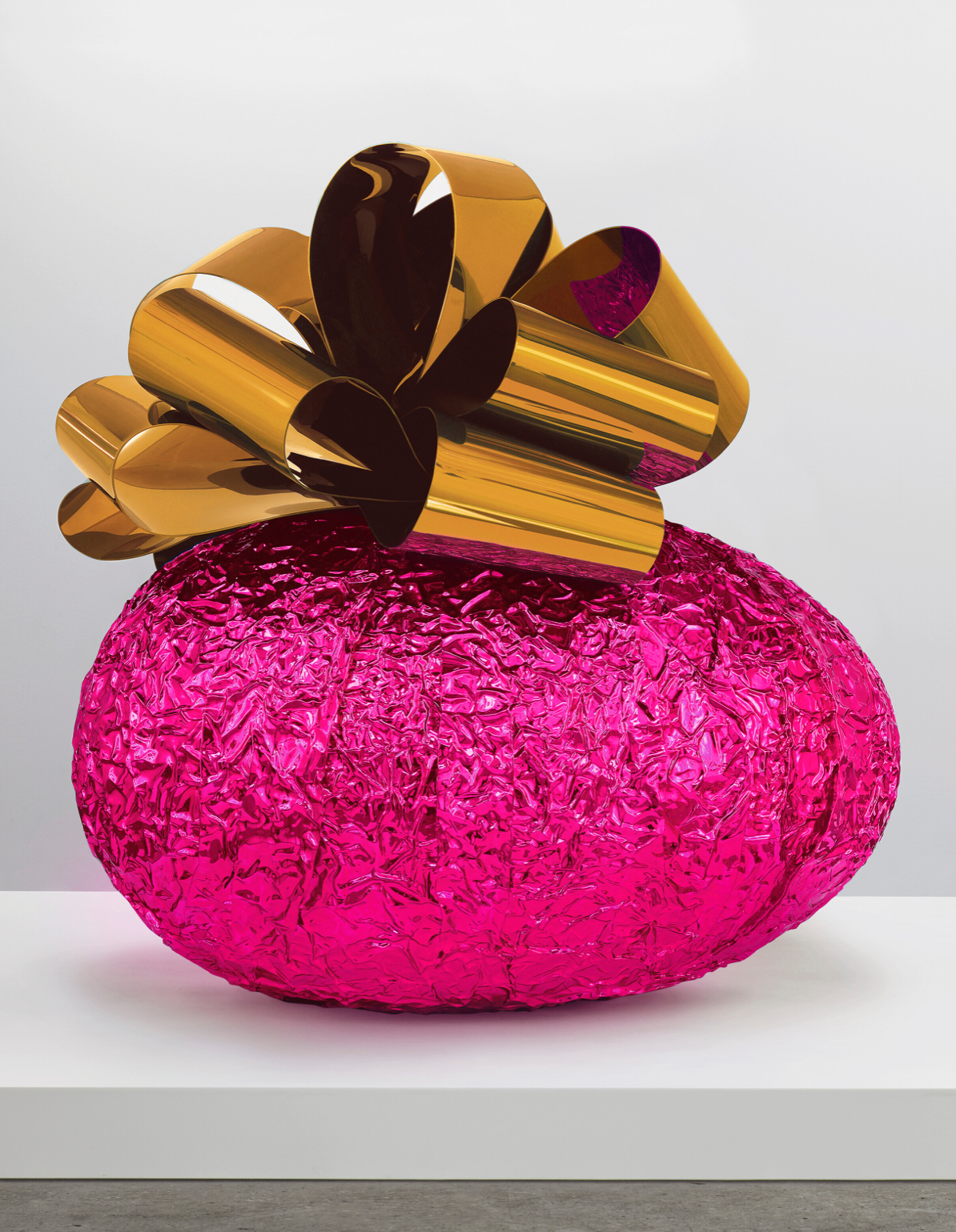
The egg, a symbol of fertility and completeness, has long inspired Koons and resulted in a sustained body of work. His choice of subject matter is not random, but rather intentionally used to evoke a variety of sensations and memories. From the mysterious world created by Hieronymus Bosch, to the extravagance of Peter Carl Fabergé’s bejeweled eggs for the Russian Imperial court, the egg has become a highly emotive symbol of the “balance of the symmetrical and asymmetrical, a sense of the fertile, and a sense of the eternal through biology and procreation, and then, on the other hand, you have the sense of the spiritual, very ethereal, eternal: the polarities” (J. Koons, quoted in A. Hüsch, ed., Jeff Koons: Celebration, exh. cat., Staatliche Museen zu Berlin, Berlin 2008, p. 87).
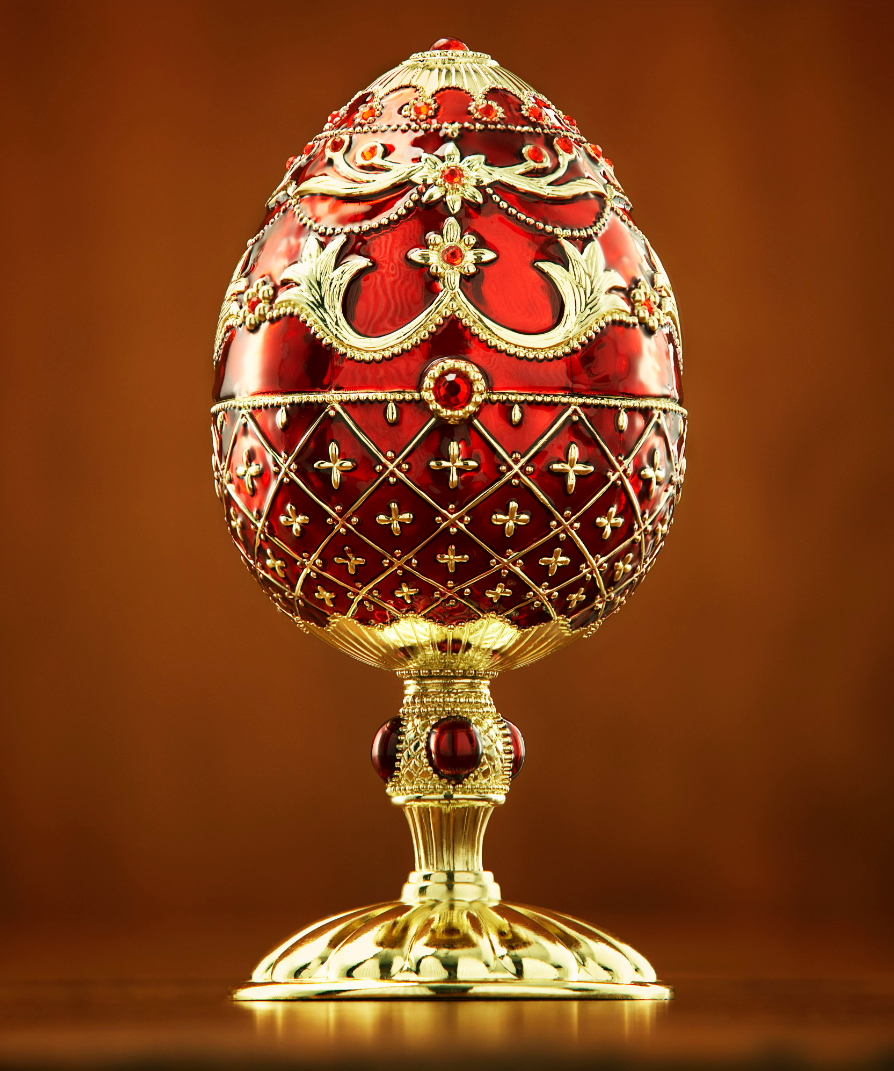
Faberge style egg. Photo: © David Muir / Getty Images.
Koons has often drawn inspiration from the Baroque, the period in the early to mid-seventeenth century characterized by opulent interiors and the intermixing of religious themes with eroticism. Koons explains, “I use the Baroque to show the public that we are in the realm of the spiritual, the eternal. The church uses the Baroque to manipulate and seduce, but in return it does give the public a spiritual experience. My work deals in the vocabulary of the Baroque” (J. Koons, quoted in A. Muthesius, Jeff Koons, Cologne, 1992, p. 158). During this period, the spiritual and the sensual were interconnected. Perhaps the most famous Baroque painting is Johannes Vermeer’s Girl with a Pearl Earring (c. 1665), whose smooth and alluring jewelry could be the seventeenth-century precursor to Koons’s egg. Koons and Vermeer are unmatched in their use of light and reflection, a skill that transforms the egg and the pearl earring alike into transcendent, ethereal beings rather than mute objects. It has been suggested that the pearl earring is in fact not pearl, but rather polished tin or silver, like the mirror polished stainless steel used by Koons. In any case, the gentle eroticism of Vermeer’s handling of the portrait can only be matched by Koons’s eye for the feminine curvature of Baroque Egg with Bow (Pink/Gold).
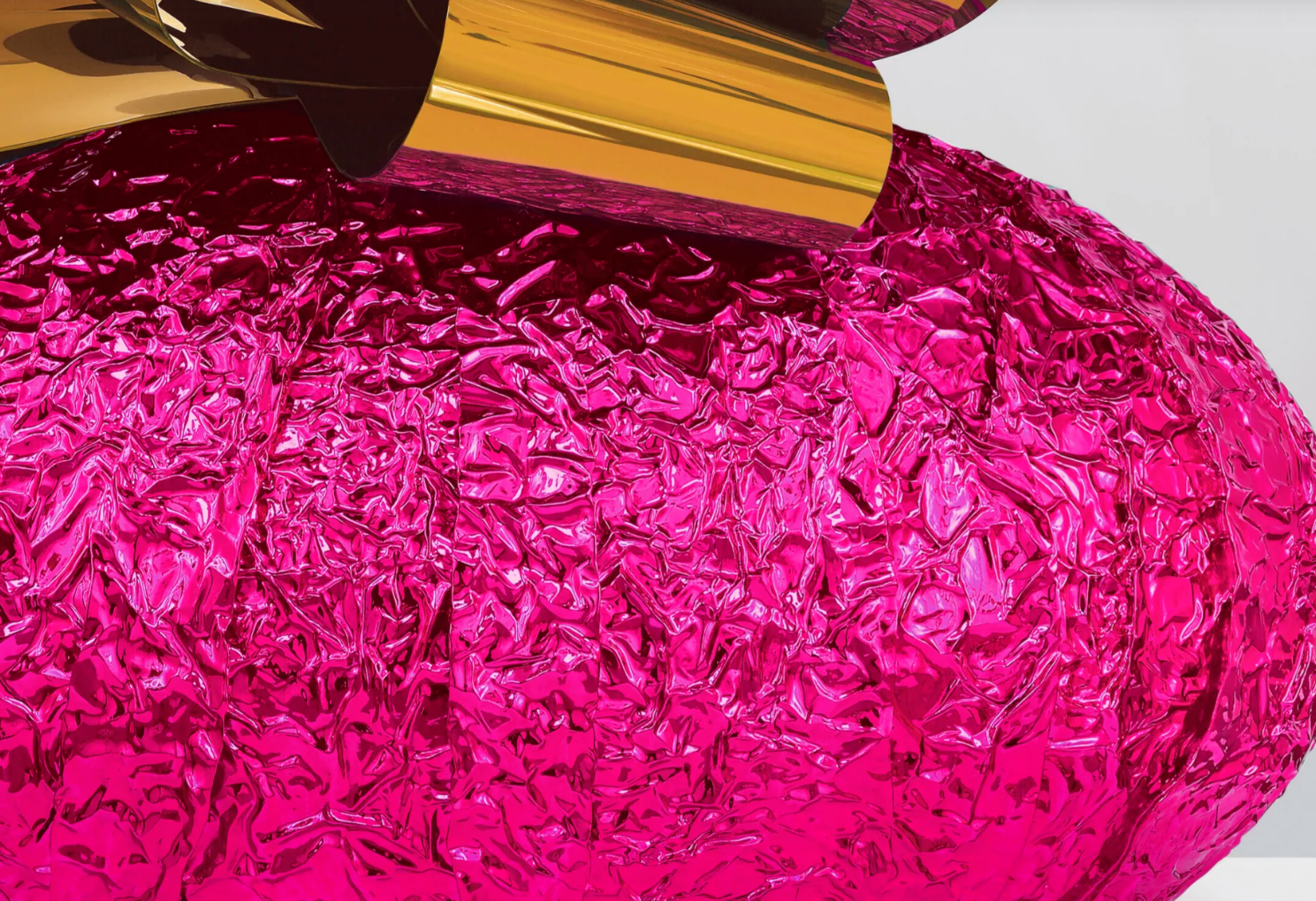
The influence of the House of Fabergé on Baroque Egg with Bow (Pink/Gold) cannot be overlooked. Koons and Fabergé share a dedication to their craft and a love for an opulent objet. Fabergé’s process required the utmost dedication, just as Koons’s eggs are likewise painstakingly executed, “[Fabergé] eggs could almost always be opened and there would be a surprise inside. For the most part, work on these eggs was very complicated. To avoid repetition we had to vary the materials, the exterior, and the content of the egg. The process of making these eggs usually took about one year” (G. von Habsberg, Fabergé: Imperial Jeweler, St. Petersburg, 1993, p. 452-453). Finally, the canonical Fabergé eggs were commissioned as gifts to be exchanged among the royalty of Imperial Russia, and it has always been Koons’s wish for his work to be understood as a gift, hence the intricate bow atop his sculptural confection.
Sacred Heart (Magenta/Gold), 1994-2007
Christie’s Hong-Kong: 28 May 2023
Estimated: HKD 50,000,000 – 70,000,000
HKD 60,875,000 / USD 7,771,410
CELEBRATION SERIES
JEFF KOONS (B. 1955) (christies.com)
JEFF KOONS (B. 1955)
Sacred Heart (Magenta/Gold), 1994-2007
Mirror-polished stainless steel with transparent color coating sculpture
356.9 (H) x 218.4 x 121 cm (140 1/2 x 86 x 47 5/8 inches)
Signed and dated ‘JEFF KOONS 1994-2007’ (inside the bow)
This is one of five unique versions
Jeff Koons’s Sacred Heart (Magenta/Gold) is the ultimate example of contemporary sculpture. Bringing together familiar iconography with extraordinary workmanship, the artist presents a work of both conceptual depth and dazzling beauty; the present work is ablaze with passion and optimism. With a luxurious combination of rich hues, Sacred Heart (Magenta/Gold), a unique version from an edition of five, is a massive gift to the viewer from Koons’s characteristically generous spirit. It is reminiscent of a magenta sapphire, among the rarest colors of the gemstone, or Botticelli’s use of gold leaf in The Birth of Venus (c. 1484-1486). Sacred Heart (Magenta/Gold) is simultaneously reverential and opulent, and it epitomizes Koons’s appreciation of Asian art and culture. He observes that all of his sculptures ‘have these universal aspects, these qualities that we celebrate in our aesthetics, both Eastern and Western…How can we reach a higher level of transcendence, a level of total consciousness? These interests are at the base of Eastern philosophy. All the works participate in the affirmation of the self and they also stimulate the viewer, so that the viewer is aware that art is the essence of their own potential. At the end of the day, it’s all metaphor for self-acceptance, and that you accept other people’ (J. Koons, quoted in S. Short, ‘Jeff Koons Talks Art Basel Hong Kong and China vs. the West’, #Legend, March 1, 2018).
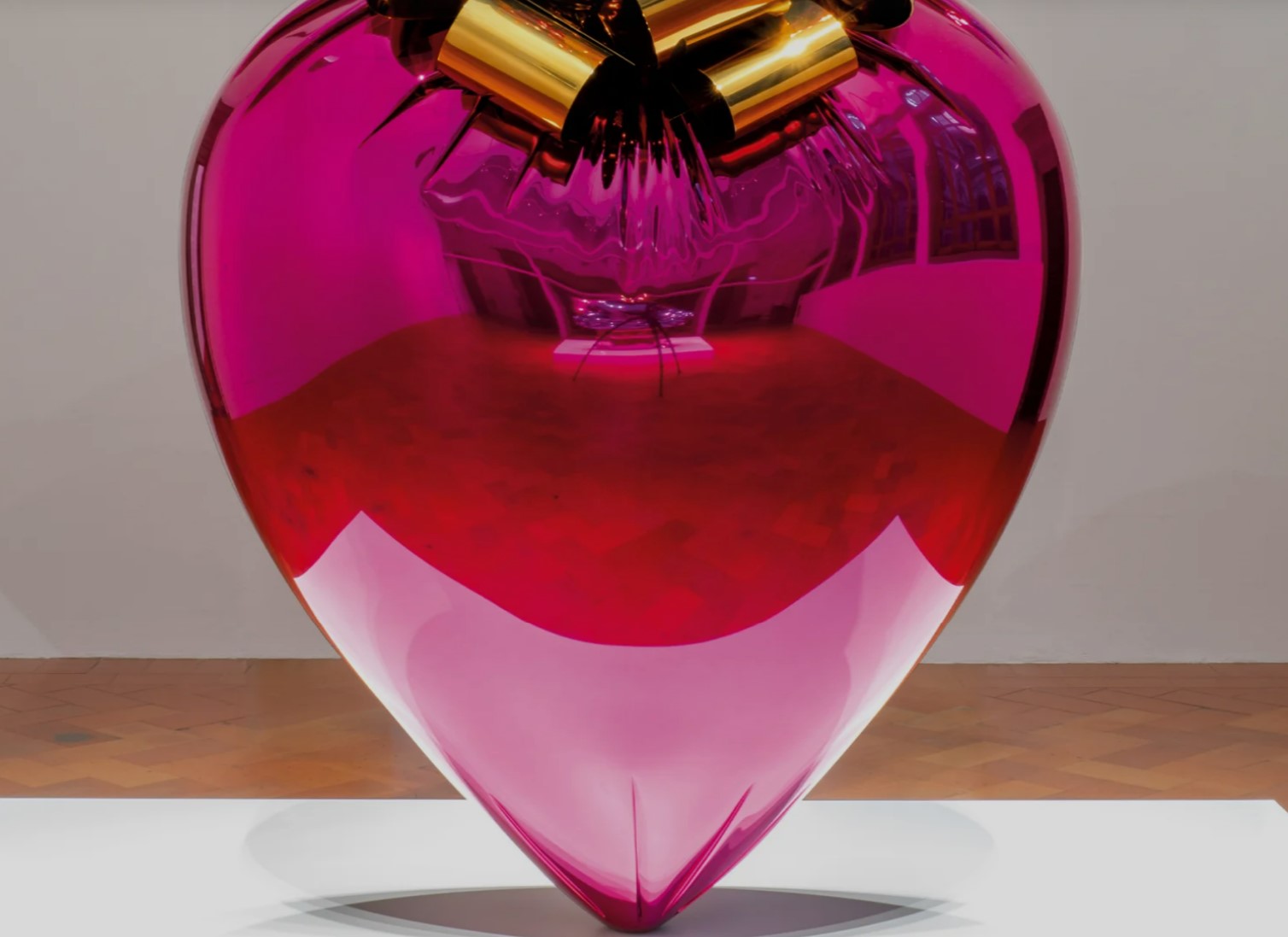
Sacred Heart (Magenta/Gold) is a key work in Koons’s iconic Celebration series (1994-), which also includes Balloon Dog (1994-2000), Balloon Flower (1995-2000), and Tulips (1995-2004). The Celebration series embraces the acceptance and openness to the world that we have in childhood, but also it taps into archetype and mythology. The work encompasses joy while at the same time maintaining other connections that parallel our live experience. It draws the viewer to it through its transparent colors, and the sculpture’s mirrored reflective surface along with its reflective gleaming bow, and presentation as a gift. While at one moment exposing itself through its highly reflective seductive surface, there is also an awareness that there is something internal within this gift that is present and mysterious. The colors of red and gold have always been symbols of seduction, power, and magnificence.
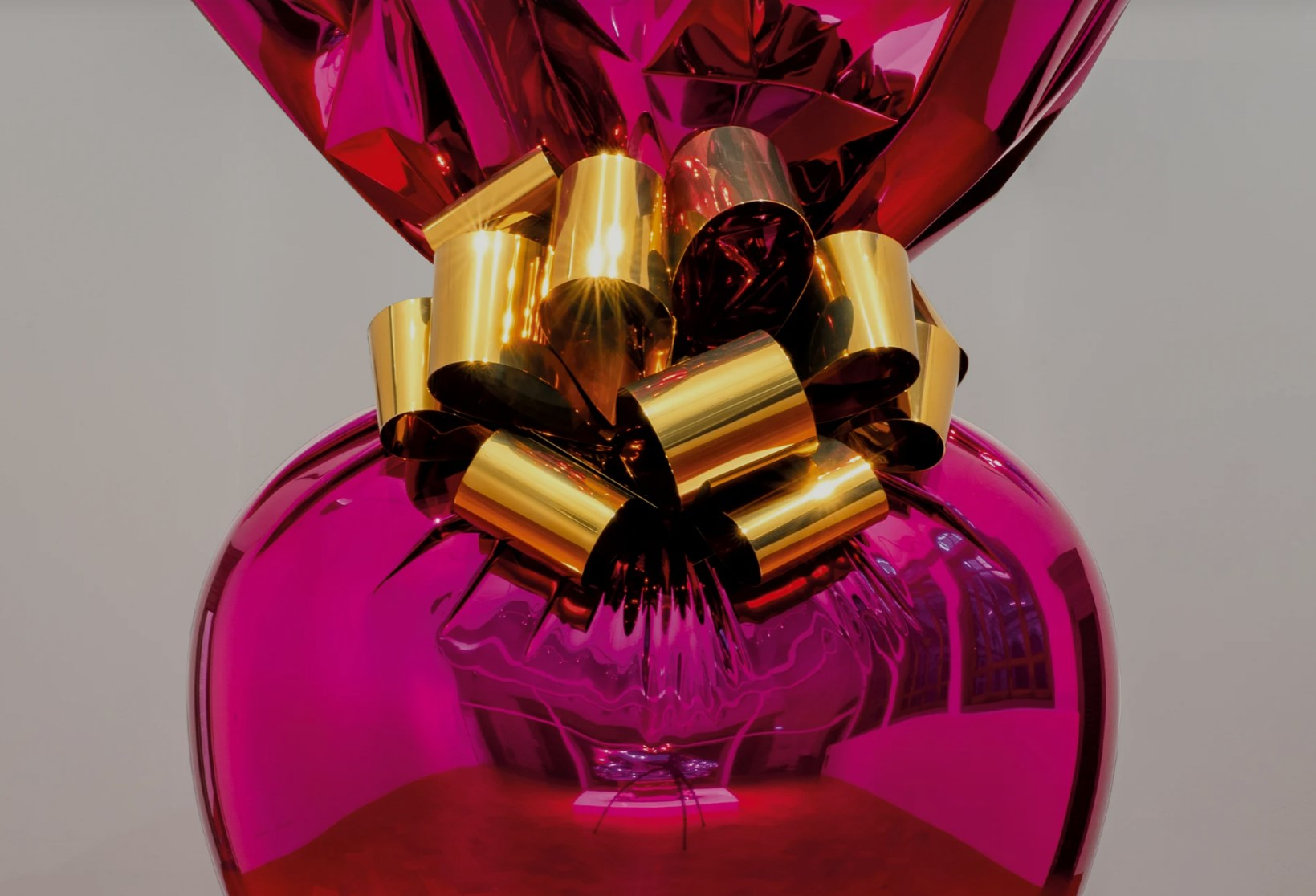
Sacred Heart (Magenta/Gold) is furthermore a product of intense technical skill and craftsmanship. The highly finished stainless steel is a labour-intensive, exacting process that is also apparent in the legendary Rabbit (1986). The pristine metallic shine of Sacred Heart (Magenta/Gold) is filled with desire, and the radiant sheen exudes a playful energy. Koons’s formal innovations connect him to sculptors like Constantin Brâncuși, whose Sleeping Muse (1910) is a bronzed manifestation of intimacy, not unlike the romantic connotations of Sacred Heart. Koons’s and Brâncuși’s focus on discrete parts of the body also has a Surrealist element, which sought to investigate the multifariousness of the body. As Koons notes, ‘I have always felt an affinity for Duchamp and his objects, but I also wanted my sculptures to be closer to Brâncuși’s objects, to his finish, to the sensuality of his forms’ (J. Koons, quoted in Phaidon Editors, ‘Jeff Koons on his teenage meeting with Salvador Dalí’, Phaidon, June 24, 2019).
Swan (Inflatable), 2011-15
Sotheby’s New-York: 18 May 2023
Estimated: USD 2,000,000 – 3,000,000
USD 3,085,000
CELEBRATION SERIES
Swan (Inflatable) | Contemporary Evening Auction | 2023 | Sotheby’s (sothebys.com)
JEFF KOONS (b. 1955)
Swan (Inflatable), 2011-15
Mirror-polished stainless steel with transparent color coating
32 1/2 x 36 5/16 x 25 15/16 inches (82.6 x 92.2 x 65.9 cm)
This work is number 1 from an edition of 3 plus 1 artist’s proof
Polished to a lustrous shine and coated in iridescent purple, gold, pink, and blue, Swan (Inflatable) is a sparkling exemplar of Jeff Koons’s career-long reinterpretations of images and objects associated with banality, childhood innocence, and pervasive consumerism. Working in the lineage of Marcel Duchamp, Andy Warhol, and Roy Lichtenstein, Koons is the inimitable twenty-first century interrogator of paradigms of popular taste and widely regarded as one of the world’s most important living artists. In the present work, Koons appropriates the form of an ordinary pool float and deifies it to an object of high art. Swan (Inflatable) follows on the heels of Koons’ iconic Celebration series, joining the playground that is the artist’s sculptural output, inhabited by his famed puppies, rabbits, dolphins, and lobsters. In its witty synthesis of art and kitsch, sincerity and irreverence, purity and perversion, Swan (Inflatable) embodies the clever contradictions that constitute Koons’s conceptual project.
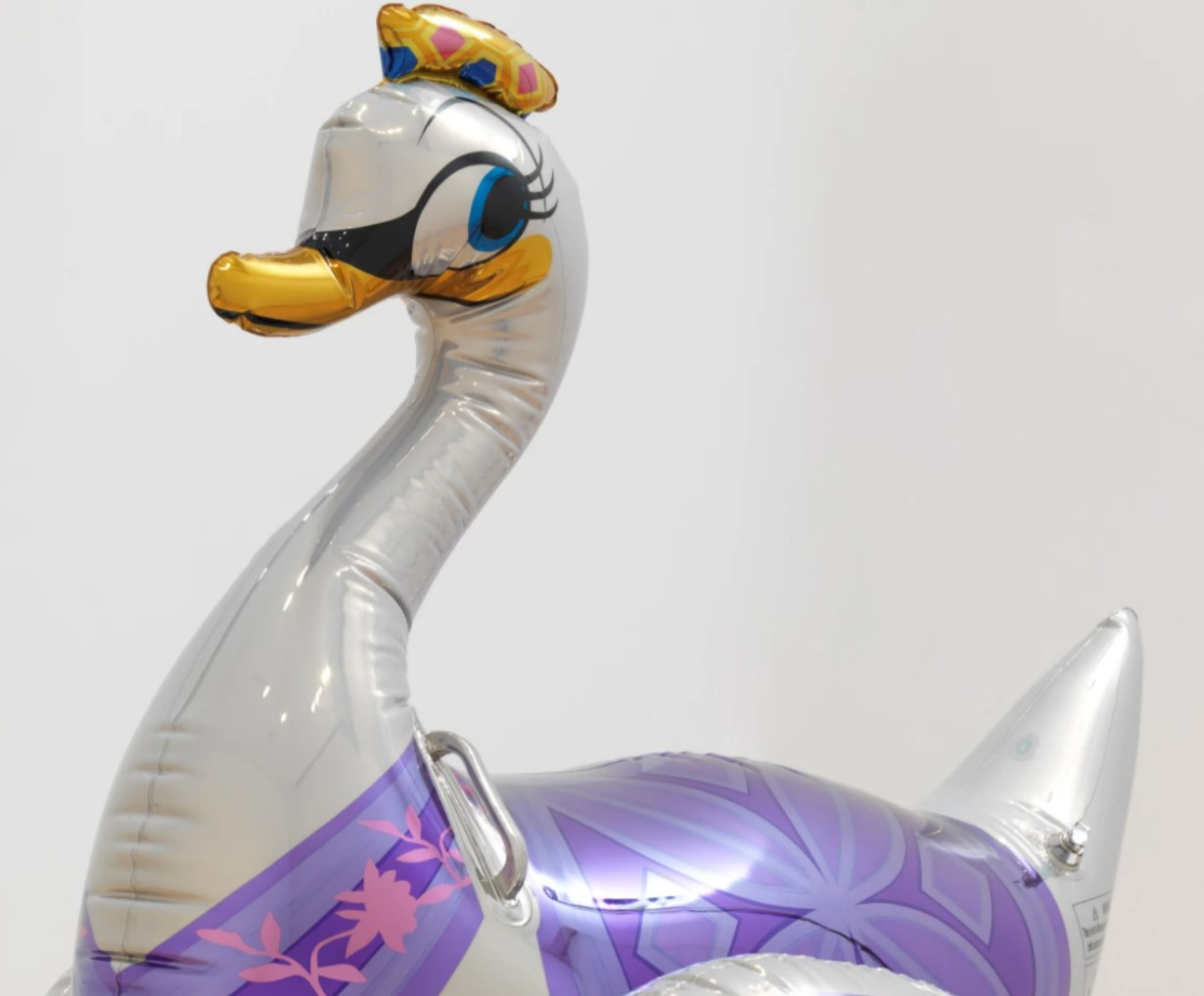
Standing at three feet tall, Swan (Inflatable) boasts the extraordinary technical precision of Koons’ stainless steel sculptural practice, which he began developing decades earlier. In collaboration with physicists and engineers, Koons’ achieves a sense of weightlessness in his metallic creation that defies its medium. Despite the ostensibly simple adoption of the pool float’s image in the present work, every detail has been meticulously accounted for: from the valve and manufacturing label of the pool float, to the gleaming tiara, to the ripples which suggest the form has only recently been filled with air. Koons’ familiar chosen subject, with its saccharine palette and hyperbolic gloss, recalls fond memories of chlorinated pools, suburban summers, and store-bought accessories. His appropriation of a toy from adolescence—one readily purchasable and available in bulk—and subsequent manipulation of it into an adult-scaled sculpture is a decidedly Duchampian gesture. Unlike Duchamp, however, who tended to use “ordinary, everyday objects, with little association beyond their predominant function in the world outside the purview of art—a bicycle wheel, a bottle rack, a urinal…Koons uses objects that are already a little closer to art, or at least to design.” (John Caldwell, “The Way We Live Now,” in Exh. Cat, San Francisco Museum of Art, Jeff Koons, 1992, p. 10) The iconography of childhood and its associations are preserved, monumentalized, and effectively immortalized.
Balloon Monkey (Magenta), 2006-2013
Christie’s London: 27 June 2022
Estimated: GBP 6,000,000 – 10,000,000
GBP 10,136,500 / USD 12,372,147
CELEBRATION SERIES
JEFF KOONS (B. 1955) (christies.com)
JEFF KOONS (B. 1955)
Balloon Monkey (Magenta), 2006-2013
Mirror-polished stainless steel with transparent color coating
150x126x235 inches (381 x 320 x 596.9 cm)
This work is the artist’s proof and one of five unique versions (Red, Magenta, Blue, Yellow, Orange)
A majestic vision seven years in the making, Balloon Monkey (Magenta) (2006-2013) sees Jeff Koons’s sculptural practice reach extraordinary new heights of formal splendor, technical achievement and sheer, awe-inspiring impact. Completed on the eve of the artist’s career retrospective at the Whitney Museum of American Art, New York, its seductive form, monumental scale and reflective, opulently colored surface—all precision-crafted to seemingly impossible levels of flawlessness and finish—capture the essence of his work, which probes the iconography of childhood innocence to expose the deep drives of desire and joy that animate our relationship with art. The present sculpture is the highly sought-after artist’s proof and one of five unique versions of Balloon Monkey, each formed of mirror-polished stainless steel with a transparent colour coating: the others are red, blue, yellow, and orange. They are the very largest of Koons’s balloon-animal works. Developing the vocabulary of the Celebration series—which included the artist’s first inflatable colossus, the iconic Balloon Dog (1994-2000)—Balloon Monkey (Magenta) arrives at an apex of glossy, weightless perfection. Sweeping six metres from head to tail and standing almost four metres high, it towers like a sphinx or totem, an ephemeral plaything transformed into a sublime, otherworldly object of worship.
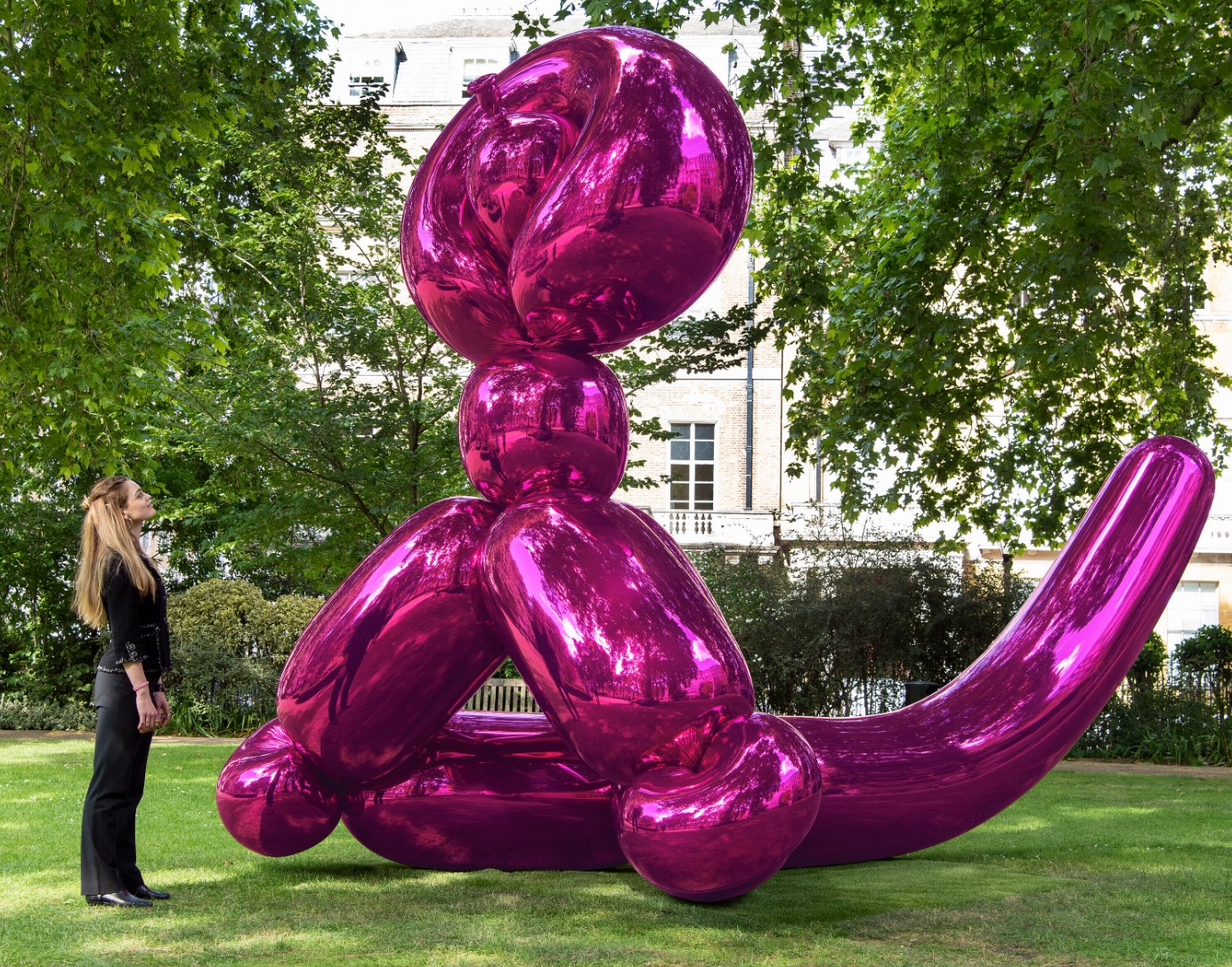 Alongside Balloon Swan (2004-2011) and Balloon Rabbit (2005-2010), Balloon Monkey represents an evolution of these works, developing their exuberant spirit and complex, confounding presence. Beyond their sensual play between lightness and weight, fragility and strength, Koons sees the inflatables as metaphors for the human condition.
“I think it comes about just defining this balance of interior/exterior. You breathe in and you inflate. You pull the external realm into yourself, and you inflate. Breath is a symbol of life energy. When you exhale, it returns to the exterior, that’s a symbol of almost your last breath.”
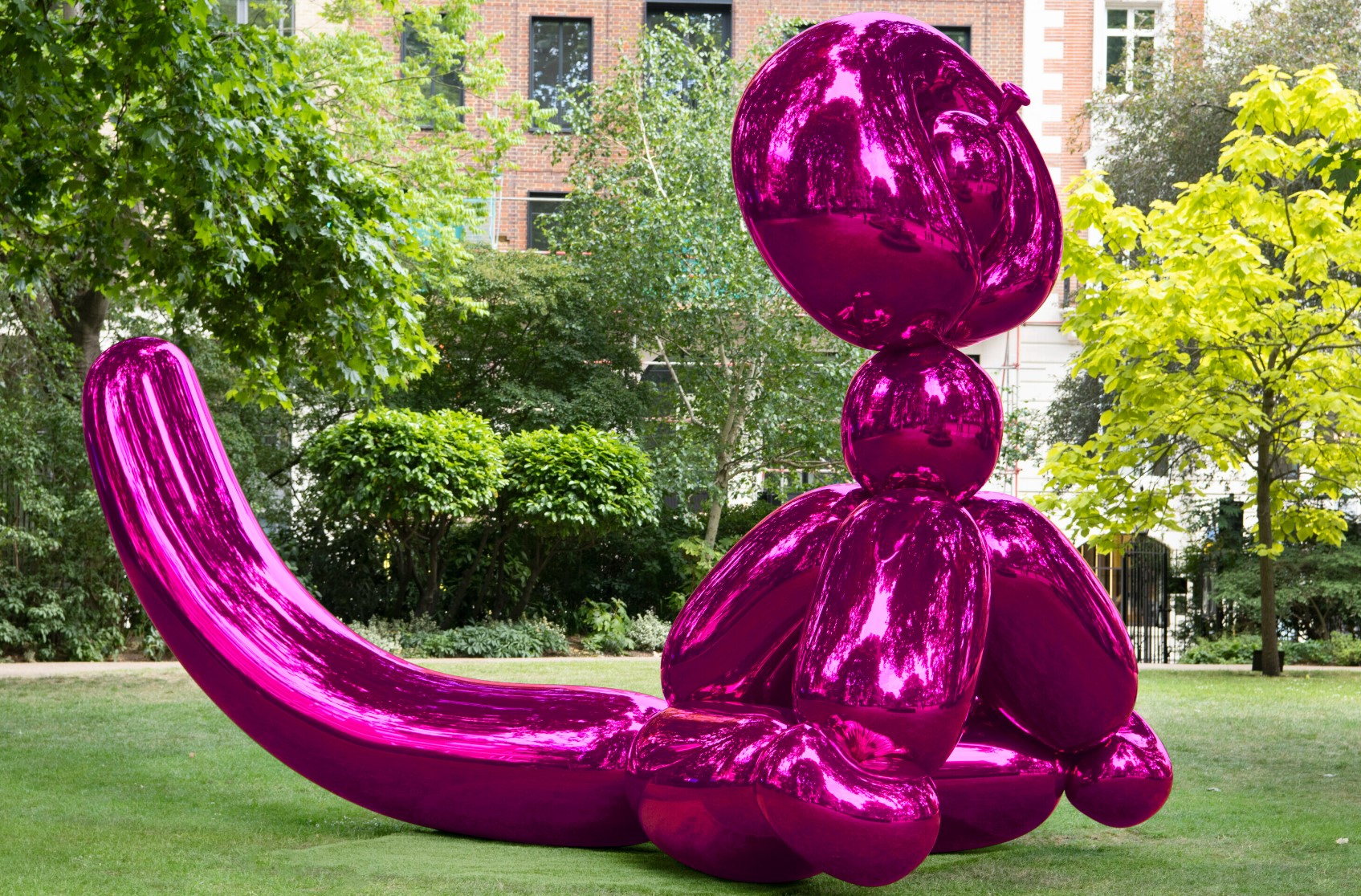
That something so seemingly childish can speak to these grand, existential ideas is a revelation: Balloon Monkey (Magenta) is a confluence of the sublime and the ridiculous, transcending our every aesthetic assumption. Its very physical presence is hallucinogenic. As if by magic, the most fleeting of objects has become an immaculate, gleaming titan in several tons of stainless steel. This miraculous spectacle is the result of an extraordinary devotion to precision, purity and integrity. Working from an actual balloon monkey created by a specialist inflatable artist, Koons and his team of fabricators used bespoke white-light and CT scanning technologies to create a finely-tuned computerized model, before engaging in an intricate multi-step process of casting, three-dimensional milling, polishing and painting—involving much trial and error, and thousands of hours of work—in the pursuit of the final, faultless object. With its pyramidal structure and swooping, cantilevered tail, Balloon Monkey (Magenta) can be seen as an abstract, almost architectural presence. Its clean lines and space-age geometries recall the work of Constantin Brâncui, the father of modernist sculpture. Its form contains multiple layers of abstraction, from monkey to balloon representation to monument, as if distilled from reality to a metaphysical ideal. Koons strives for a sense of ‘objectivity’ and universality through the pure, hyper-polished facture of his works, which appear never to have been touched by mortal hands. In doing so, he uncovers something of the erotic charge that lies at the heart of our sensual interactions with the world.
“My art has always used sex as a direct communication line to the viewer. The surface of my stainless steel pieces is pure sex and gives an object both a masculine and a feminine side: the weight of the steel engages with the femininity of the reflective surface.”
The monkey’s swelling, phallic tail and orifical creases and curves are not incidental: like the lingam and yoni statues of ancient Hindu tradition, it invokes both masculine and feminine aspects of sexuality. Koons encourages the viewer to embrace and enjoy these elements of life without guilt, returning to a state of prelapsarian wonder.
Rabbit, 1986
Christie’s New-York: 14 May 2019
Estimated: USD 50,000,000 – 70,000,000
USD 91,075,000
Jeff Koons (b. 1955) (christies.com)
JEFF KOONS (b. 1955)
Rabbit, 1986
Stainless steel
41x19x12 inches (104.1 x 48.3 x 30.5 cm)
This work is number two from an edition of three plus one artist’s proof
Since its creation in 1986, Jeff Koons’s Rabbit has become one of the most iconic works of 20th-century art. Standing at just over three feet tall, this shiny steel sculpture is at once inviting and imposing. Rabbit melds a Minimalist sheen with a naïve sense of play. It is crisp and cool in its appearance, yet taps into the visual language of childhood, of all that is pure and innocent. Its lack of facial features renders it wholly inscrutable, but the forms themselves evoke fun and frivolity, an effect heightened by the crimps and dimples that have been translated into the stainless steel from which it has been made. Few works of art of its generation can have the same instant recognizability: it has been on the cover of numerous books, exhibition catalogues and magazines; a monumental blow-up version even featured in the 2007 Macy’s Thanksgiving Day Parade. For an artist such as Koons, who is so focused on widening the sphere in which art operates and communicates, Rabbit is the ultimate case in point.
Despite its endemic presence in our cultural fabric, Rabbit is also an exceedingly rare object. The sculpture was cast in 1986 in an edition of three, plus an artist’s proof. In addition to this example, one is now in The Broad Art Foundation, Los Angeles, another in the collection of the Museum of Contemporary Art in Chicago, and a third in the National Museum of Qatar. Thus, the present example is the only one left in private hands, and while other examples have been exhibited extensively, this example of Rabbit has not been exhibited in public since the 1988 group show, Schlaf der Vernunft, or The Sleep of Reason, at the Museum Fredericianum in Kassel.
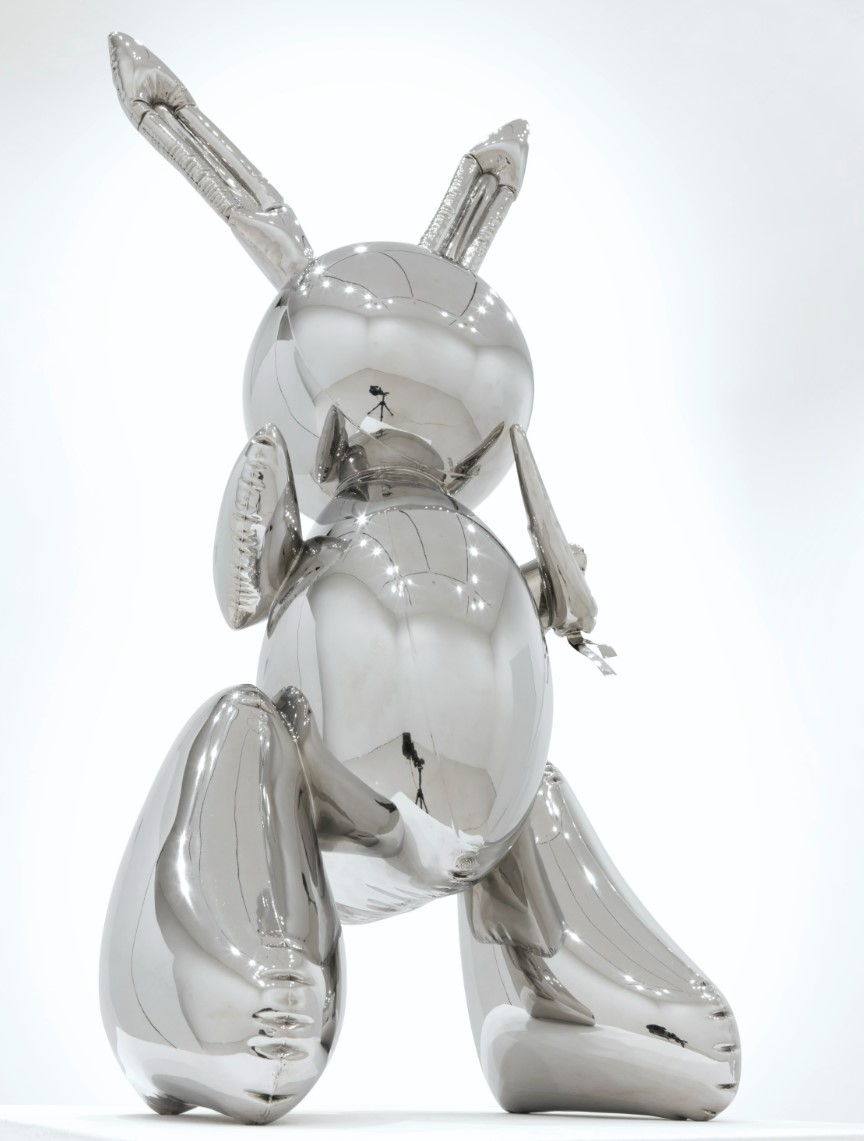
Looking at Rabbit, the precision for which Koons has since become so renowned is there in all its seductive glory. The steel surface of the titular bunny initially appears smooth and balloon-like, the forms reduced to some abstract, Platonic ideal. They nonetheless introduce complex plays of form, with the narrow carrot serving as a counterpoint to the rounded torso and face. Adding a dynamism to the composition, the tentatively-hovering carrot, perching at the edge of the spherical head also ensures that there is a tension to the work. It hints at penetration, at bursting the balloon, and at that most Koonsian of subjects: sex. The dynamism of Rabbit is reinforced by the fact that, on closer inspection, this sculpture has been rendered with an incredibly meticulous attention to detail. Be it in the corrugations that run up the bending ears, the seams that run down the body, the trails of sheet metal that sprout from the bottom of the carrot or the letters around the nozzle on the reverse, there is an incredible range of textures at play. These are made all the more dramatic by the mercury-like perfection of the bulk of the surface which they disrupt and emphasize. Its curving, sloping surfaces reflect the viewer, yes, but also reflect itself. In this, entire games of light and movement are invoked, with aspects of the rabbit’s anatomy reflected in its head, in its torso and even in the carrot, creating a veritable hall of mirrors.
Balloon Dog Orange
Christie’s New-York: 11 November 2013
Estimated: USD 35,000,000 – 55,000,000
USD 58,405,000
Jeff Koons (B. 1955) (christies.com)
JEFF KOONS (B. 1955)
Balloon Dog (Orange), 1994-2000
Mirror-polished stainless steel with transparent color coating
121x143x45 inches (307.3 x 363.2 x 114.3 cm)
Signed and dated ‘Jeff Koons 1994-2000’ (on the underside)
This work is one of five unique versions (Blue, Magenta, Orange, Red, Yellow)
Jeff Koons’ Balloon Dog (Orange) is considered the supreme example from the highly acclaimed Celebration series of paintings and sculptures that Koons instigated in the early 1990s. The series evolved from his desire to recreate the ecstatic experiences of a child’s enjoyment of the world through universal signifiers representing birthday parties and festive events. It is one of five unique Balloon Dog sculptures made from precision engineered, mirror-polished stainless steel and finished with a translucent coating of either blue, magenta, orange, red, or yellow. Balloon Dog (Orange)’s radiantly beautiful color and pristine finish embodies a contemporary vision of fin-de-siécle opulence. With its giant swollen body and highly reflective surface, this ten-foot, one-ton metal balloon animal conveys a miraculous illusion of weightlessness. The sheer beauty of its materiality is designed to ensnare and captivate, while its form is endowed with the joyful associations of childhood, hope and innocence. Balloon Dog (Orange) uses sentimentality and hyperbolic scale as a tool of insight-one that speaks directly to and about a collective humanity. Its high-impact size, form, and subject encapsulates Koons’ egalitarian approach to art; and his masterful ability to create intellectually and sensuously exciting objects from the banal and familiar. Content aside, in formal terms Balloon Dog (Orange) marked a new pinnacle of sculpture as an entire medium, discipline and tradition. It is a bold, forceful and imposing monument that radiates powerfully with an almost epic sense of vitality-qualities that have firmly secured its status as one of the defining artworks of the 20th century.
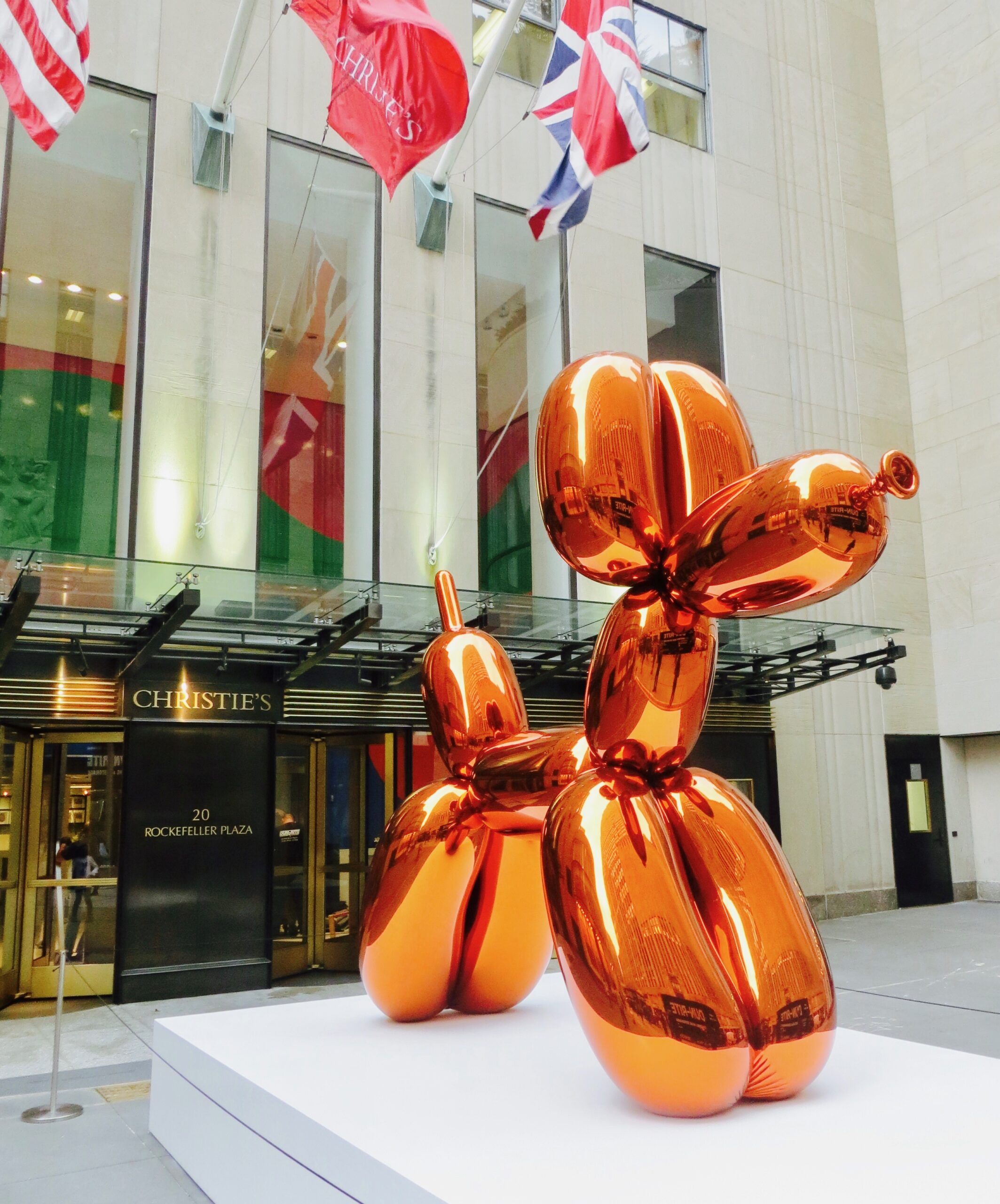
Despite its immense size, no detail has been spared in the rendering of the Balloon Dog’s form: note the exactingly shaped knot that serves as its nose, the twists and crimps at the base of the robust limbs, and the erect, yet rubbery looking tail. The artist’s exacting standards are one of the most captivating aspects of Koons’ work and this trait reached its apogee with the fabrication of the Celebration sculptures, which includes balloon flowers, hanging hearts, eggs, and diamonds, among other subjects. Koons had intended to premier the series at New York’s Guggenheim Museum in the mid-1990s, but it involved so much labor that he was forced to gradually complete it over more than ten years. Part of the challenge was creating the flawlessly smooth contours on sculptures like Balloon Dog (Orange) where 60 parts are welded together to produce the simple, but very suggestive shapes. Koons worked closely with a specialist foundry in California to achieve his desired result, which involved years spent perfecting the meticulous color coating that appears to hover above the stainless-steel surface.
Tulips, 1995-2004
Christie’s New-York: 14 November 2012
Estimate On Request
USD 33,682,500
Jeff Koons (b. 1955) (christies.com)
JEFF KOONS (b. 1955)
Tulips, 1995-2004
Mirror-polished stainless steel with transparent color coating
80x180x205 inches (203.2 x 457.2 x 520.7 cm)
This work is one of five unique versions
Towering over the viewer in a blaze of multi-colored splendor, with each color dramatically reflecting and rebounding off the other to create an intense rainbow effect, Jeff Koons’ monumental Tulips marks the technical crescendo of his Celebration series. A timeless sculptural masterpiece, Koons has taken the simple temporary nature of a small, light balloon sculpture created in a matter of seconds, and blown it up to a heroic scale. It is an enchanting sculpture that casts the illusion of joyous weightlessness but is paradoxically heavy, employing over three tons of meticulously sculpted stainless steel. This is a multivalent sculpture, operating on a number of different levels from the simple and directly arresting visual beauty of the object and its awe-inspiring scale, to the ground-breaking complexity of its fabrication and to the deep conceptual themes which lie beneath its apparently flawless surface. The Celebration series evolved from Koons’ desire to recreate the ecstatic experiences of a child’s enjoyment of the world with universal signifiers. Creating forms that recall Constantin Brancusi’s sublime sculptures as well as children’s toys, Koons has tapped into the canon of the history of art by taking flowers as his subject for this still life colossus, introducing ideas of the memento mori as well as romance and beauty. Flowers have run as a thematic thread throughout Koons’ career, appearing already in his Inflatables of 1979, and came to the fore in his Made in Heaven series in 1991 where he emphasized their sexual nature. Tulips marked the sculptural culmination of the theme, and of Koons’ now-legendary Celebration series. Tulips was created in an edition of five versions, each of which features a unique arrangement of the colors of the flowers. In recent years, these have become icons of Koons’ work, featuring in a range of his exhibitions and in articles about the artist. The other examples are held by high-profile collections: one was shown at the unveiling of the Broad Contemporary Art Museum, Los Angeles County Museum of Art in 2008, while others are at the Guggenheim Bilbao, the Prada Foundation and the Viktor Pinchuk Foundation; an exhibition copy was also created to be shown in China and is on a ten-year loan to the US Embassy in Beijing.
Popeye, 2009-2011
Sotheby’s New-York: 13 May 2014
Estimate On Request
USD 28,165,000
(#34) Jeff Koons (sothebys.com)
JEFF KOONS
Popeye, 2009-2011
Mirror polished stainless steel with transparent color coating
78 x 51 3/4 x 28 1/2 inches (198.1 x 131 x 72.4 cm)
Signed, dated 2009-2011 and numbered 3/3 on the underside of Popeye’s right foot
This work is number three from an edition of three plus one artist’s proof
With Koons’s monumental Popeye, overt virility and inescapable phallic prowess is on display through a masquerade of bulging musculature and exultant posturing. Where Koons portrays Jackson in the guise of a tragi-kistch pietà, Popeye is undoubtedly steeped in classical tropes of heroic masculinity. Indeed, Popeye was framed within this very classical context in the recent exhibition Jeff Koons: The Sculptor at the Frankfurt Liebieghaus Skulpturensammlung, in which super-reflectivity and radiant color contrasted with the idealism of ancient marble. Evoking the straining biceps of the Hellenic Laӧcoon in the Vatican, possessing a bulk that summons the heavy musculature of the Farnese Hercules, and echoing the exquisitely rounded athletic curves for which the Discophoros of Polykleitos is paradigmatic, Popeye represents the meeting of American Pop and Minimalism with the European figurative tradition. Articulated in mirror polished stainless steel – the fabric of Minimalism and according to the artist, “symbol of the proletariat”– the present work reasserts the classical tradition of public statuary as an ideal projection of the body politic (the artist cited in Norman Rosenthal, “Notes on Jeff Koons” in The Jeff Koons Handbook, New York, 1992, p. 20). During the French Revolution, and most markedly associated with the radical tyranny of the Terror between 1793 and 1794, Jacques-Louis David cast the public seal of the Republic in the guise of Hercules. Symbolic of the glory of the French people, Hercules represented action over reason and the triumph of strength, courage and labor over the throne’s despotism. Intended to reside over the Place de la Concord, David’s unrealized 46 foot colossus combined an expression of democracy with threatening proletarian power. At once half-man and half-god, this mythological figure is the very historical archetype of empowered masculinity conjured by Koons’s Popeye. The prominent tattoo of a tank visible inside Popeye’s left bicep – an adaptation on the typical anchors tattooed on both forearms – affirms an equivalence between Hercules and the bellicose chauvinism of Popeye’s proletarian transcendence.
Balloon Monkey (Orange), 2006-2013
Christie’s New-York: 12 November 2014
Estimated: USD 20,000,000 – 30,000,000
USD 25,925,000
Jeff Koons (B. 1955) (christies.com)
JEFF KOONS (B. 1955)
Balloon Monkey (Orange), 2006-2013
Mirror-polished stainless steel with transparent color coating
150x235x126 inches (381 x 596.9 x 320 cm)
Signed and dated ‘Jeff Koons 2006-2013’ (on the underside of the head)
This work is one of five unique versions (Blue, Magenta, Orange, Red, Yellow)
“I’ve always enjoyed objects that contain air because they are very anthropomorphic, every time you take a breath, it’s like a symbol of life, and every time you exhale, it’s a symbol of death.”
Seven years in the making, Balloon Monkey (Orange) marks a spectacular new chapter in Jeff Koons’s oeuvre. Looking at the miraculously smooth, highly polished surface of this monumental sculpture, one can appreciate how the artist has progressively attained ever-greater heights of perfection. Koons developed the idea for this sculpture over years of research, modeling, computer rendering, milling, polishing, lacquering and polishing again before the final form was realized. His perseverance has resulted in an incredibly seductive, monochrome finish that grants stainless steel and the humble balloon monkey an apotheosis. The sheer beauty of its materiality is designed to entice and captivate, while its form is endowed with the joyful associations of childhood, hope and innocence. This is one of five unique Balloon Monkey sculptures made from precision -engineered, mirror-polished stainless steel finished with a translucent brightly colored coating of either blue, magenta, orange, red or yellow. The sculpture conveys the artist’s recurrent interest in air-filled forms, which stand as metaphors for the human condition.
Balloon Flower (Magenta), 1995-2000
Christie’s London: 30 June 2008
Estimate on Request
GBP 12,921,250 / USD 25,728,676
Jeff Koons (b. 1955) (christies.com)
JEFF KOONS (b. 1955)
Balloon Flower (Magenta), 1995-2000
High chromium stainless steel with transparent color coating
133 7/8 x 112 1/4 x 102 3/8 inches (340x285x260 cm)
This work is one of five unique versions (Magenta, Blue, Orange, Yellow and Red)
Jeff Koons’ Celebration series is aptly named. Looking at the gleaming and vast perfection of Balloon Flower (Magenta), the ultimate Koonsian trophy, one cannot help but be awed and enthused by the mixture of humour, beauty and humanity, as well as the crazy scale. Koons has taken a childlike vision, blown it up in size and cast it in seemingly indestructible steel, a far cry from the fragile membrane of the all-too-burstable balloons it is based on. The dignity, the formal beauty, of this glistening mass of curves is gleefully deflated by its deliberately infantile subject matter. Balloon Flower (Magenta) is a monument to nostalgia and to the wide-eyed awe with which children see the world. And, as is so often the case with Koons’ works, it is so much more: Balloon Flower (Magenta) provides the viewer with a thrilling and sensuous image of the pristine that is at the same time rife with strange tensions between lightness and weight, between the ephemeral and the eternal, even between irony and earnestness, and with references to childhood and, to top it all, to sexuality.
Hanging Heart (Magenta/Gold), 1994-2006
Sotheby’s New-York: 14 November 2007
Estimated: USD 15,000,000 – 20,000,000
USD 23,561,000
(#14) Jeff Koons (sothebys.com)
JEFF KOONS
Hanging Heart (Magenta/Gold), 1994-2006
High chromium stainless steel with transparent color coating and yellow brass
106x85x40 inches (296.2 x 215.9 x 101.6 cm)
This work is one of five versions each uniquely colored
Jeff Koons’ sensational magenta stainless steel sculpture, Hanging Heart (Magenta and Gold), floats as if weightless; magnificently suspended by a flamboyant looping sash of gold curling ribbon; its flawless iridescent surface beckoning the beholder to marvel at the artist’s most opulent of valentines. Part of the mythic Celebration series which Koons began in 1994 with Balloon Dog , Hanging Heart (Magenta and Gold) is a unique work from a series of five painstakingly fine-tuned versions (including an artist’s proof) each rendered in its own sumptuous flush of color. Viewed for the first time since its physical realization, Hanging Heart (Magenta and Gold) is an unforeseen revelation of creative and technical mastery and breaks ground as the first of its kind to be welcomed to the United States.
Play-Doh, 1994-2014
Christie’s New-York: 17 May 2018
Estimate on Request
USD 22,812,500
Jeff Koons (b. 1955) (christies.com)
JEFF KOONS (b. 1955)
Play-Doh, 1994-2014
Polychromed aluminum
124 x 152 1/4 x 137 inches (315 x 386.7 x 348 cm)
This work is one of five unique versions
In 2014, Jeff Koons was given a retrospective at the Whitney Museum of American Art in New York. This colossal show was the final one before the Whitney closed the iconic Marcel Breuer building. As well as an ending, though, it marked a beginning: the debut of Koons’s monumental Play-Doh, a sculpture that had already become legendary in the two decades of its creation. This is one of the largest and most complex works in Koons’s Celebration series, a group of works that had its inception in the mid-1990s, and which includes such contemporary icons as Balloon Dog, Hanging Heart and Tulips. The Celebration series has become almost mythic in its gestation, with Koons pushing fabrication techniques to new levels of perfection that met his own desire for a meticulous finish. The result of this single-minded dedication is all too visible in Play-Doh: looking at the crevices, curves and bobbles of its surface, as well as the matte colors with their faint sheen, the viewer would be forgiven for thinking that this really was a Brobdingnagian mass of Play-Doh, the vibrant colors piled on top of each other. Yet this sculpture has been assembled through the use of more than two dozen interlocking sections of painted aluminum. Gravity alone fastens them together, the weight of each color pressing down on the next. Koons’s exacting criteria runs to intriguing extremes: each of these pieces is painted in its entirety, not just the facet visible when Play-Doh is fully assembled. And in each of the five versions of Play-Doh, the configuration is unique.
Popeye Series
Dogpool Ladder, 2007-2011
Estimated: USD 750,000 – 1,o00,000
USD 967,500
Jeff Koons Modern & Contemporary Art Evening Sale featuring Cera the Triceratops
JEFF KOONS
Dogpool Ladder, 2007-2011
Polychromed aluminum and aluminum
68 x 59 1/4 x 63 3/4 inches (172.7 x 150.5 x 161.9 cm)
This work is number 2 from an edition of 3 plus 1 artist’s proof
Dogpool Ladder, executed between 2007 and 2011, is a striking example from Jeff Koons’ Popeye series, begun in 2002 and distinguished by its playful fusion of inflatables and everyday objects. A spotted dog-shaped pool float—meticulously cast in polychromed aluminum to mimic the matte-soft skin of printed vinyl—loops around a bright yellow step ladder, a mass-produced object incorporated by the artist in its unaltered form. At first glance, the familiar forms conjure nostalgia, evoking the carefree summers of suburban America, yet beneath this playful exterior the work reveals deeper tensions between innocence and entrapment, consumerism and transformation, illusion and reality.
“My work is a support system for people to feel good about themselves.”
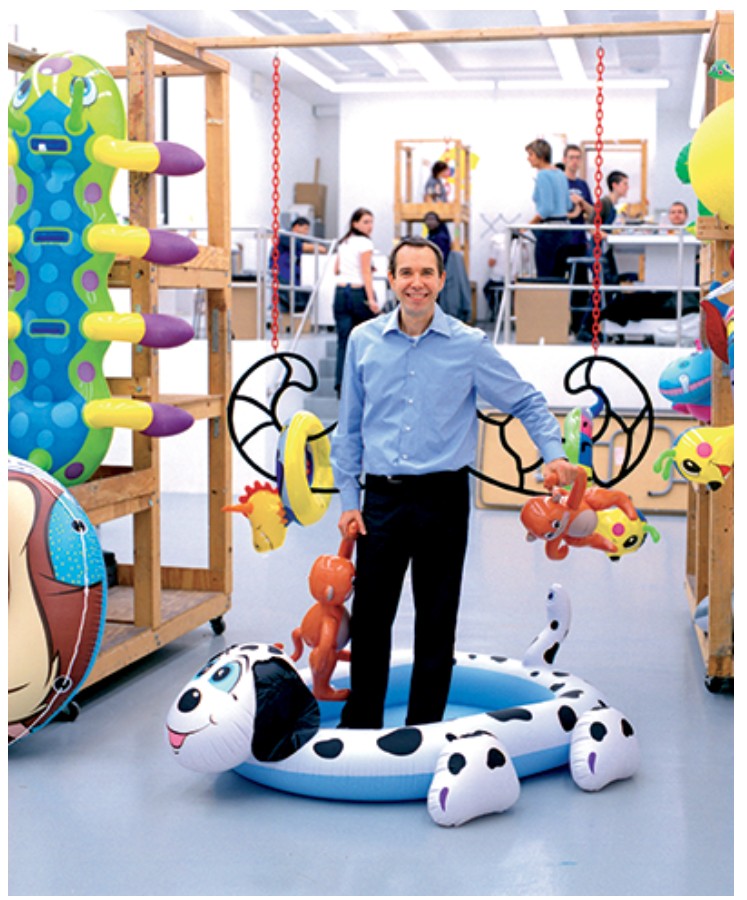
Another example of the present work illustrated in the artist’s New York studio in a preliminary state.
Photography by Chris Fanning and Frances Janisch.
Image: © Chris Fanning, Artwork: © Jeff Koons
Koons’ engagement with inflatables dates back to the late 1970s, when he scoured discount shops on New York’s Lower East Side for vinyl toys to present alongside mirrors, “parodying the chaste rationality of minimalist sculptures.” His 1986 Rabbit—a stainless-steel replica of an inflatable bunny—extended this exploration and set the stage for the Celebration series of the 1990s, with its now iconic Balloon Dog. The Popeye sculptures continue this trajectory, but unlike their reflective predecessors, which implicate and affirm the viewer through mirrored surfaces, they recall the cast bronze lifeboats and snorkel vests of Koons’ 1985 Equilibrium series. Both bodies of work render flotation devices in improbably weighty materials, deploying surface as a means of heightening the cognitive dissonance between appearance and reality. In the Popeye works, feather-light pool toys—objects of play and transience—are transformed into meticulously painted aluminum forms that destabilize the line between illusion and fact.
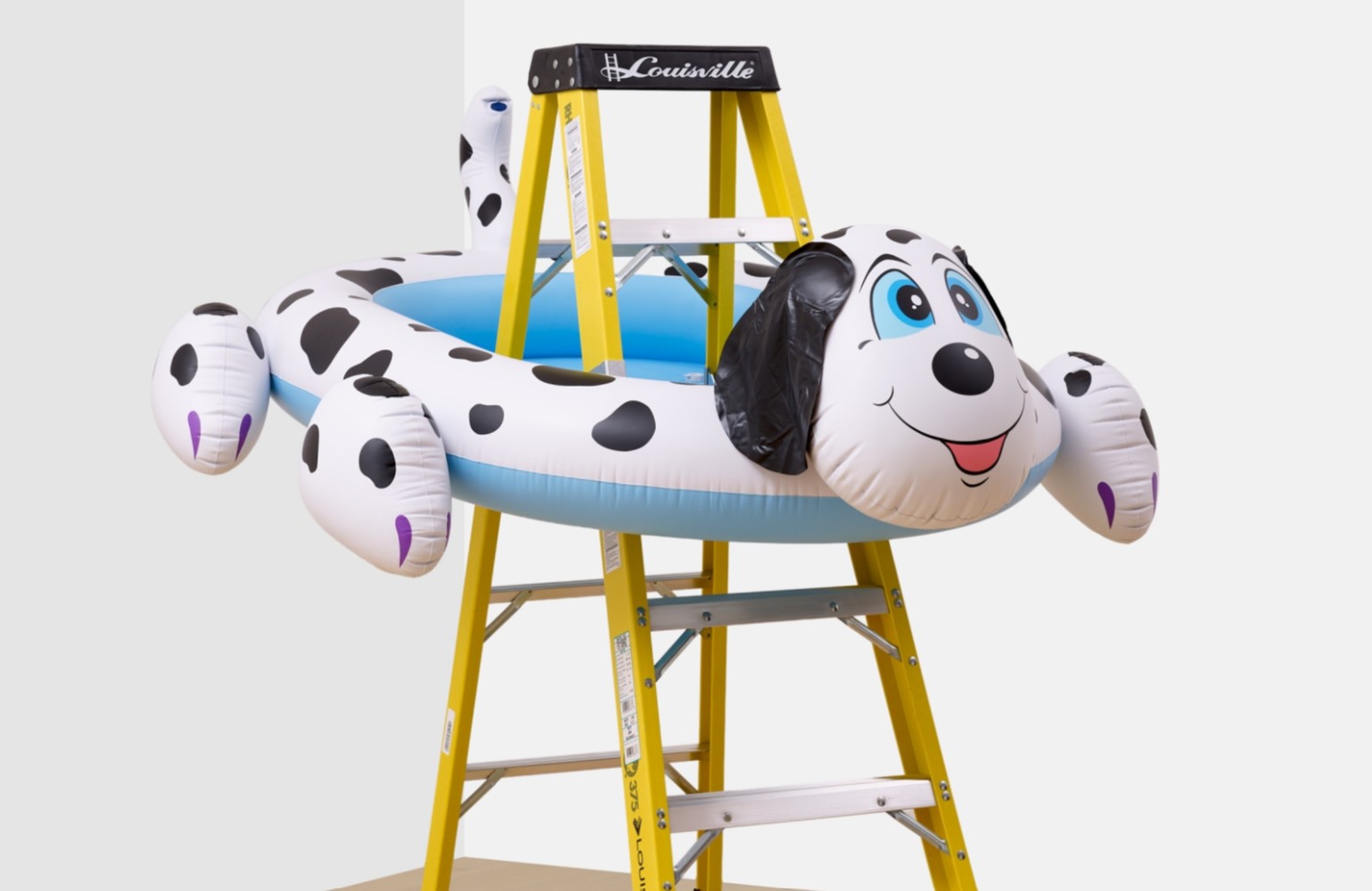
In Dogpool Ladder, Koons intensifies this deception. The plastic pool appears lightweight and pliable yet is in fact rigid cast metal. Every seam and ripple mimics the texture of vinyl, but its unyielding solidity flouts expectation. By contrast, the yellow step ladder remains unaltered—a utilitarian readymade that offsets the hyperreal falsity of the inflatable. This dynamic recalls Marcel Duchamp’s assisted readymades, in which familiar objects, decontextualized, acquire new meaning. Like Duchamp, Koons manipulates perception, forcing viewers to question what they see.
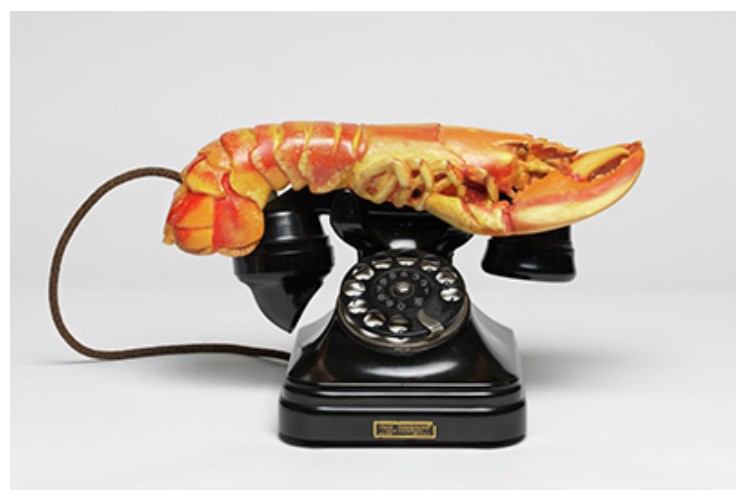
Salvador Dalí, Lobster Telephone, 1938. Tate, London. Image: © Tate, London / Art Resource, NY
Artwork: © 2025 Salvador Dalí, Gala-Salvador Dalí Foundation / Artists Rights Society (ARS), New York
The composite structure of the Popeye sculptures recalls Surrealist strategies of unlikely conjunction. Salvador Dalí’s Lobster Telephone, 1936, is a touchstone. Extending this lineage, Koons combines incongruous objects to generate new symbolic and psychological resonances, positioning Dogpool Ladder within the Surrealist embrace of the unexpected. Koons has long acknowledged the fetishistic dimension of inflatables.
“There is a huge sexual fetish thing on the Web for pool toys,
it would be a tragedy if they go soft due to a leak.”
Dogpool Ladder engages this charge directly: the original inflatable spouts water from the dog’s uplifted tail, a detail Koons carefully preserved in metal. With the ladder rising through the ring, the composition carries a latent phallic charge, while the encircling inflatable suggests containment or restraint. This play of soft and hard, freedom and restraint, echoes Dalí’s erotic absurdities, where the fetish object operates simultaneously as a consumer good and a sexual metaphor.
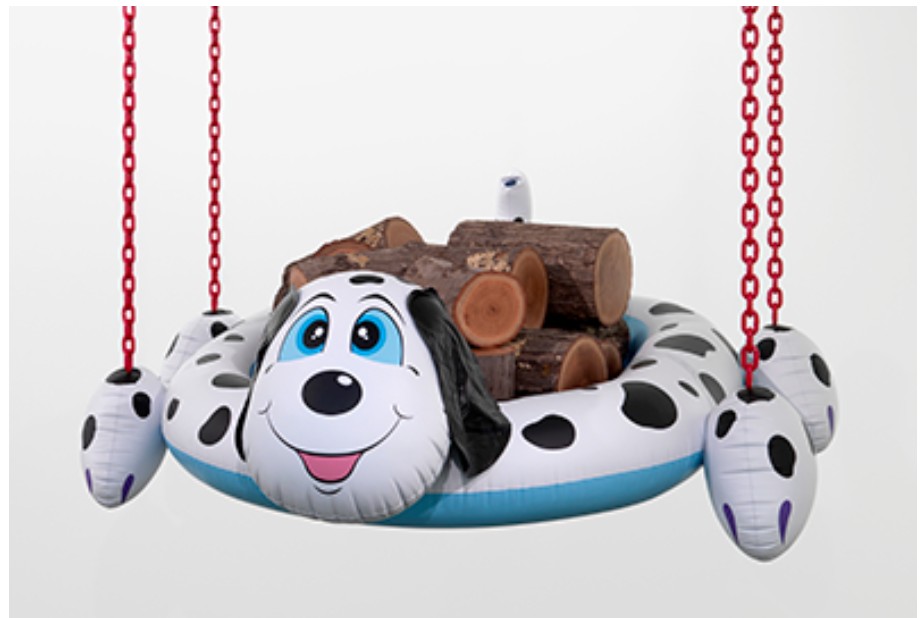
Jeff Koons, Dogpool (Logs), 2003-2008. Pinault Collection, Paris. Image/Artwork: © Jeff Koons
Though named after the cartoon character, Koons’ Popeye works often do not depict the sailor directly. Instead, they share a visual language of cartoon vitality, aquatic motifs, and retrospective image-making. Dogpool Ladder epitomizes these concerns—balancing innocence and sexuality, high and low humor and critique. The ladder functions both literally and symbolically, evoking aspiration, scaffolding, and slapstick pratfalls. For Koons, it is a means of addressing vulnerability, desire, and achievement.
“Popeye is about an image of, ‘I am what I am.’ Kind of a symbol of self-acceptance that you have to embrace who you are. Popeye has spinach. Spinach brings about his transcendence, and brings about his power. That’s what art [is]. Art is our spinach.”
At first glance, the work appears to celebrate the disposable, mass-produced objects of American suburban life. Yet beneath this cheerful surface lies a more cynical reading. The dog’s frozen grin may read as cheerful, but its painted expression of joy is curiously performative, verging on eerie. The ladder’s cold rungs, by contrast, imply confinement and exclusion. This tension between buoyancy and restriction reflects the contradictions of consumer culture, while also aligning Koons with Andy Warhol. Yet where Warhol iconized celebrity and commodities, Koons probes the promises and limits of suburban leisure. He himself has suggested that the Popeye works imply “an eye for Pop,” signaling his self-aware engagement with the imagery of mass culture.
“Pool toys are inflatable, just like people.
Inflatables really are metaphors for the continuation of life.”
For Koons, however, the work remains optimistic. This idea is reflected in the Popeye series’ namesake: a self-transforming cartoon hero who gains superhuman strength by consuming spinach. The plastic pup in this sculpture, seemingly stuck yet cheerfully grinning from its perch, embodies this same resilient optimism. Suspended at the halfway point, the sculpture suggests movement, as if the canine might yet reach the top of the ladder. In this sense, Dogpool Ladder is a metaphor for perseverance, a playful yet profound commentary on survival in a world of constraints.
Popeye (Green), 2004-2009
Edlis Neeson Collection
Christie’s New-York: 19 November 2025
Estimated: USD 600,000 – 800,000
USD 762,000
JEFF KOONS (B. 1955), Popeye (Green) | Christie’s
JEFF KOONS (B. 1955)
Popeye (Green), 2004-2009
Mirror-polished stainless steel with transparent color coating
80 x 59 1/2 x 1 1/4 inches (203.2 x 151.1 x 3.2 cm)
Signed and dated ‘Jeff Koons 2004-2009’ (on the reverse)
This work is one of five unique versions (Blue, Green, Orange, Red, Yellow)
Jeff Koons’s Popeye (Green) compellingly incorporates two of the renowned American artist’s most memorable motifs—his iconic adaptation of the Popeye character and his fascination with reflective surfaces—into a potent recapitulation of his oeuvre. The mirrored surface of the work establishes a confrontational relationship between the artwork and the viewer, incorporating the observer into itself and merging their identity with that of Popeye. The mirroring effect, first seen in Koons’s celebrated Rabbit sculpture, is coupled with the Popeye motif, which first emerged as a sculptural series in 2002. Popeye (Green) expands upon these hermeneutics by simultaneously reflecting their concerns outward toward the viewer and enveloping the viewer within the work itself.
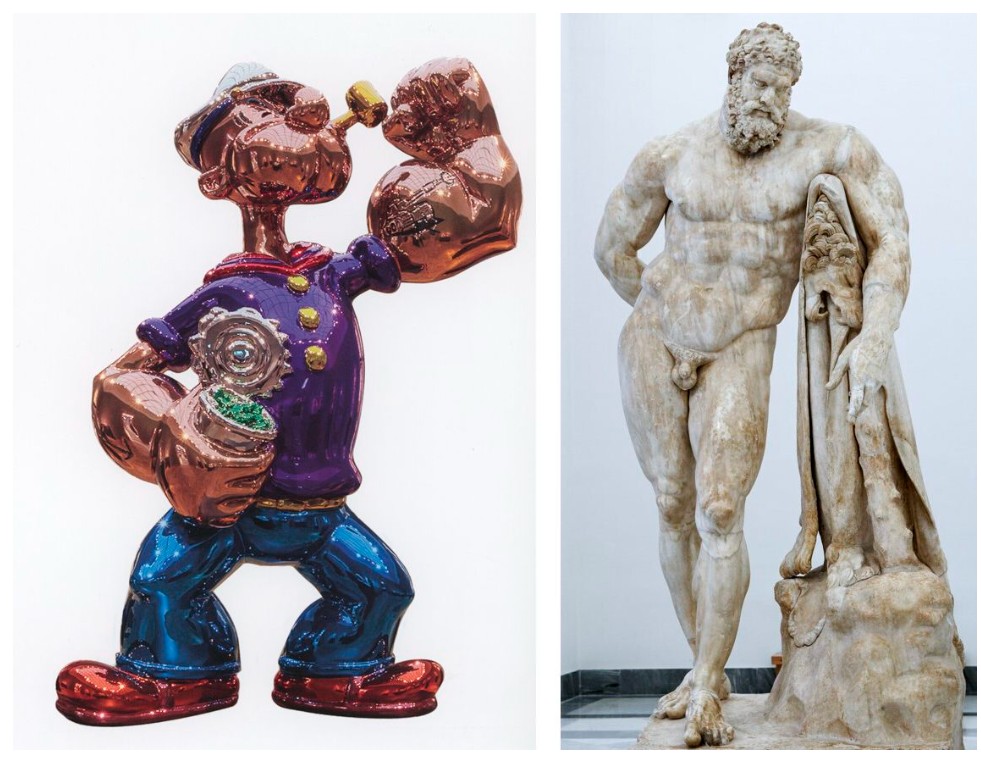
Left: Jeff Koons, Popeye, 2009-2011. Private Collection. © Jeff Koons.
Right: Glykon, reproduced from the original by Lysippos, Farnese Hercules, 216 AD. Naples National Archaeological Museum.
Popeye (Green) recreates Popeye’s instantly recognizable silhouette as a two-dimensional facsimile which lays flat against the wall. Flattening his imagery from his previous Popeye in the round sculptures heightens the cartoonish aspect of the artist’s source material while simultaneously retaining its discursive function—by bringing his work closer to his original referent, Koons strengthens the juxtapositions inherent in the work. Koons painted his series in five unique versions, utilizing either blue, green, orange, red, or yellow coloring. The green used here recalls the original pigmentation of the “Thimble Theatre” cartoon from 1925 as well as the title font color from the Popeye comic books. Another figure from this cartoon, Olive Oyl, another reflective wall artwork, is described by Koons as the present work’s pendant.
“Popeye is about an image of ‘I am what I am.’ Kind of a symbol of self-acceptance that you have to embrace who you are. Popeye has spinach. Spinach brings about his transcendence, and brings about his power. That’s what art [is]. Art is our spinach. Art can bring about this transcendence and this empowerment and our life can expand and we can have a vastness that is what we’re seeking.”
Koons’s optimistic account of transcendence and empowerment and the sense of an expansive vastness to life is further accentuated in the present work with his usage of the highly reflective surface.
“I used mirrors earlier in my work. I started back in 1977 and 1978 using store-bought mirrors… what I have always enjoyed about mirrors is both the recognition they give the viewer and their movement. The viewer is creating an abstraction by moving around and causing change. It is always affirming you, the viewer.”
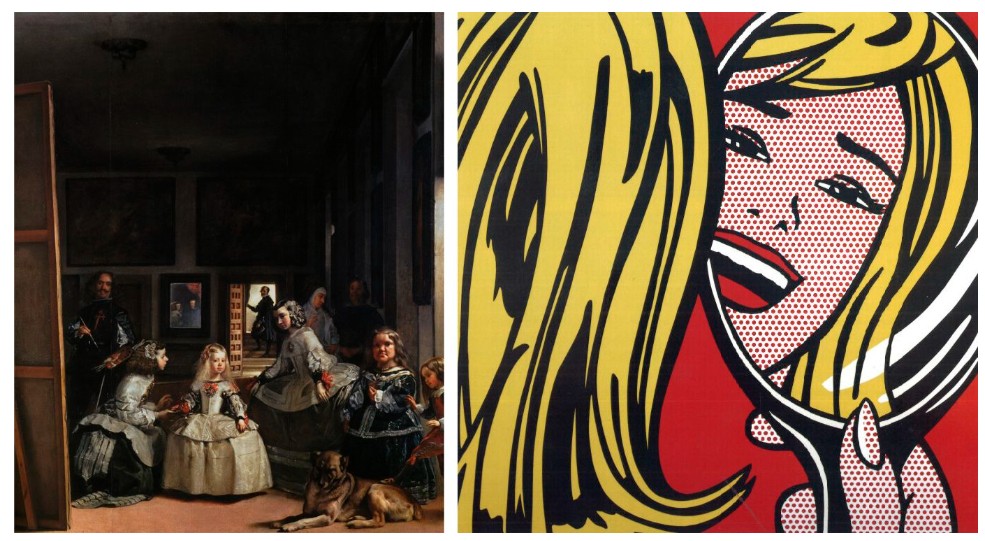
Left: Diego Velázquez, Las Meninas, 1656. Museo del Prado, Madrid.
Right: Roy Lichtenstein, Girl in Mirror, 1964. © Estate of Roy Lichtenstein.
Reflections pervade Koons’s oeuvre, from the mirrors used as bases for his early inflatable sculptures to the highly polished surfaces of his Statuary and Celebration series and the Gazing Ball works. Popeye (Green), however, is where the motif reaches its apotheosis, as its flat surface is pervasive, recapitulating the environment in which it is placed outward back toward the viewer. By integrating two of his most renowned and emphatic motifs together, Jeff Koons achieves a mesmeric and contemplative result in Popeye (Green). By inserting his own viewer’s reflection into the work, Koons literally incorporates his audience into the work’s themes of self-acceptance and empowerment.
Dolphin Taz Trashcan, 2007-2011
Phillips New-York: 13 May 2025
Estimated: USD 800,000 – 1,200,000
USD 1,391,000
Jeff Koons Modern & Contemporary Art Evening Sale
Executed between 2007 and 2011, Jeff Koons’ Dolphin Taz Trashcan is a masterful orchestration of polychromed aluminum masquerading as an assemblage of feather-light plastic toys. Suspended from a red steel chain, a sleek blue dolphin pool float appears to thrust through a bright blue Looney Tunes-themed swim ring while being enmeshed in a cold, industrial metal trashcan. At first glance, the familiar forms conjure nostalgia, evoking the carefree summers of suburban America, where inflatable toys populate backyard pools and communal swimming areas. Yet beneath its buoyant, playful exterior, the work reveals deeper tensions—between innocence and entrapment, consumerism and transformation, illusion and reality.
“Pool toys are inflatable, just like people. Inflatables really are metaphors for the continuation of life.”
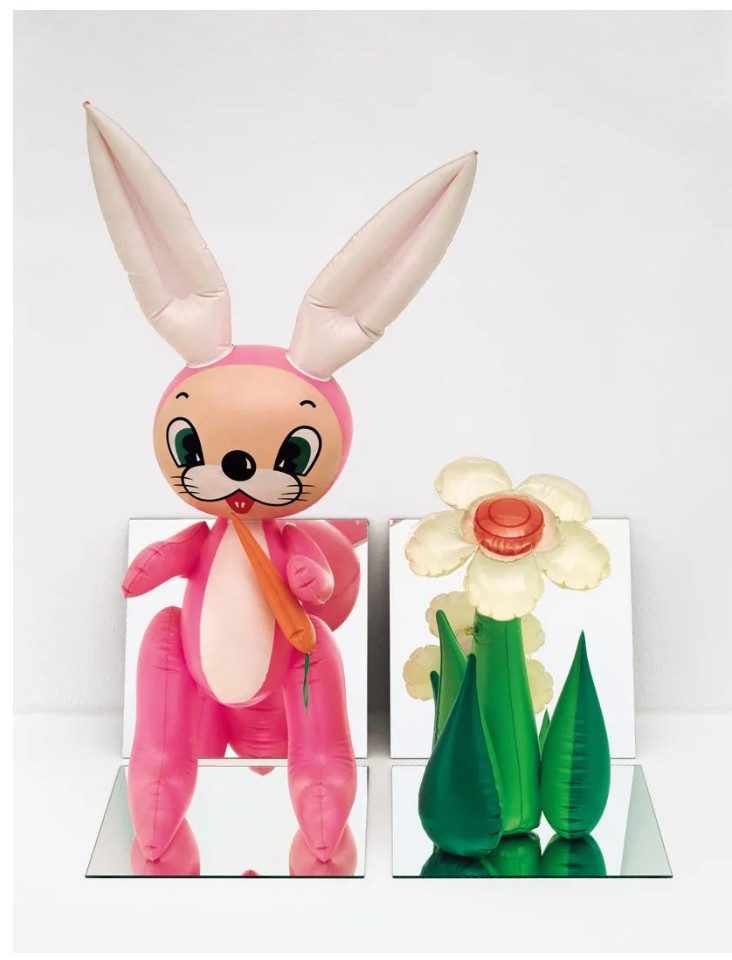
Jeff Koons, Inflatable Flower and Bunny (Tall White and Pink Bunny), 1979. The Broad, Los Angeles. Artwork: © Jeff Koons
“My work is a support system for people to feel good about themselves.”
Part of Koons’ Popeye series Dolphin Taz Trashcan epitomizes his signature fusion of hyperrealism and conceptual rigor. Launched in 2002, the Popeye series comprises both sculptures and paintings that juxtapose brightly colored pool inflatables with stark, unaltered utilitarian objects, forming whimsical compositions that explore notions of self-acceptance and transcendence. Though named after the cartoon character Popeye, the works do not always depict him directly. Rather, they share a common visual language of vibrant vitality, aquatic themes, and a deliberate retrospective approach to image-making. Dolphin Taz Trashcan epitomizes the core concerns of the Popeye series—Koons’ fascination with the interplay between childhood innocence and adult sexuality, the intersection of high and low culture, and the reinvention of kitsch within the avant-garde. More profoundly, it underscores the ephemeral nature of life itself, hinting at both buoyancy and entrapment, playfulness and restriction. The inflatables, though appearing soft and weightless, are meticulously cast in metal, deceiving the eye with their trompe-l’oeil precision. The unaltered trashcan, an ordinary utilitarian object, acts as both a literal and symbolic container, reinforcing themes of restriction and exclusion. Through its surreal juxtaposition, the sculpture distills Koons’ ongoing dialogue with materiality, mass culture, and the complex psychological undertones hidden beneath the surface of the everyday.
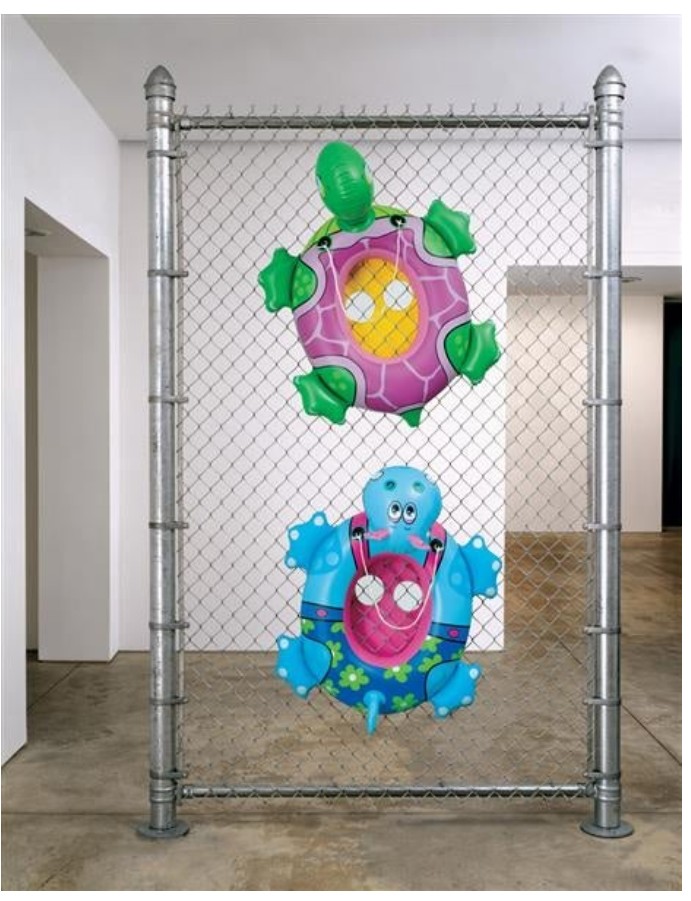
Jeff Koons, Chainlink, 2003. Pinault Collection, Paris. Artwork: © Jeff Koons
Koons’ engagement with inflatable objects dates back to 1978, shortly after his arrival in New York City, when he scoured discount shops on the Lower East Side for vinyl toys that he would present alongside mirrors, “parodying the chaste rationality of minimalist sculptures.” His 1986 Rabbit, a cast metal replica of a balloon bunny, furthered this exploration, leading to the Celebration series of the 1990s, from which his iconic Balloon Dog emerged. The Popeye sculptures represent a continuation of this trajectory, transforming ephemeral pool inflatables into heavy, meticulously painted aluminum objects that blur the line between artifice and reality. In Dolphin Taz Trashcan, Koons heightens this deception. The dolphin and swim ring, though appearing lightweight and pliable, are rigid, hard-cast metal. Every seam and ripple mimics the real texture of inflatable plastic, yet their cold, solid nature defies expectation. The trashcan, a functional, industrial object, remains unaltered—a ready-made that contrasts with the hyper realistic falsity of the cast inflatables. This dynamic recalls Marcel Duchamp’s assisted readymades, particularly Bicycle Wheel, 1913, where a familiar object, decontextualized, gains new meaning. Like Duchamp, Koons manipulates material perception, forcing the viewer to question the authenticity of what they see.
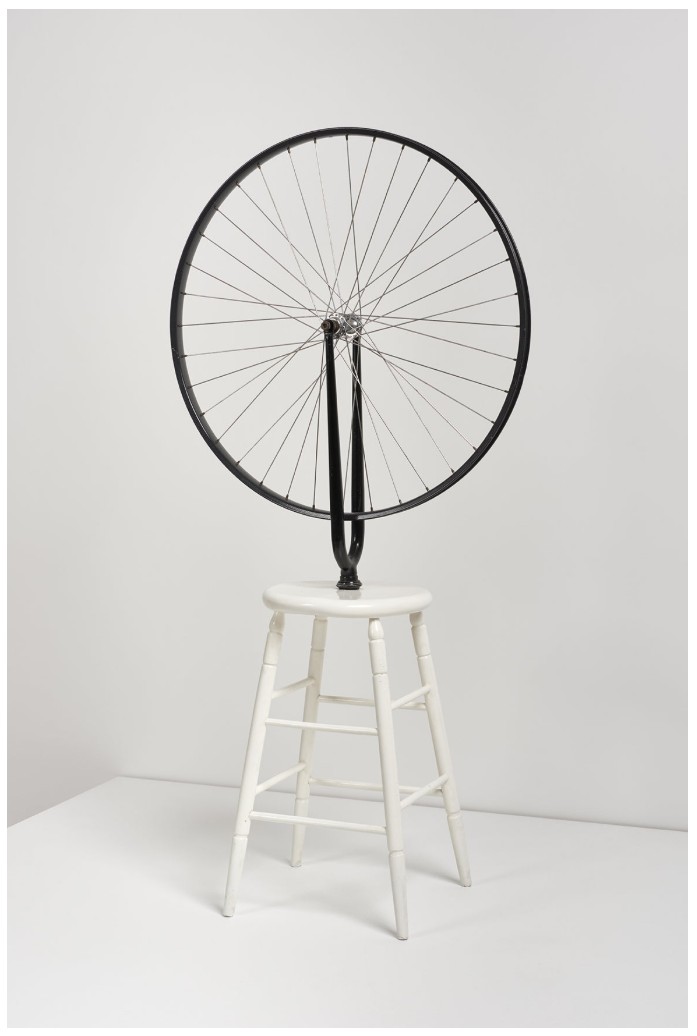
Marcel Duchamp, Bicycle Wheel, 1913/1964. Philadelphia Museum of Art. Image: Philadelphia Museum of Art, Gift of Galleria Schwarz, 1964, 1964-175-1, Artwork: © 2025 Association Marcel Duchamp / ADAGP, Paris / Artists Rights Society (ARS), New York
At first glance, the work appears to celebrate the disposable, mass-produced objects of American suburban life. The inflatable dolphin and Looney Tunes swim ring evoke childhood summers spent in backyard pools, scenes of carefree leisure. Yet beneath this cheerful surface lies a more cynical reading. The dolphin’s fixed smile and the grinning face of Taz, emblazoned on the ring, feel eerily performative—mere painted expressions of joy. The trashcan, with its cold, metallic cage, suggests confinement and exclusion, introducing a sinister undercurrent. This contrast between buoyancy and restriction, innocence and entrapment, reflects the contradictions of consumer culture. Koons, often likened to a neo-Warhol, iconizes the banal. But where Andy Warhol’s Pop art glorified celebrity and consumption, Koons probes the artifice of suburban pleasures. It is telling that Koons has expressed that, for him, the title of the Popeye series implied “an eye for Pop”—a phrase that reveals his self-aware stance toward the visual language of mass culture. Much like Warhol’s tributes to popular culture and industrial design in his silkscreens and Brillo Boxes, Koons elevates dollar-store pool toys to the status of fine art, simultaneously celebrating and critiquing their cultural ubiquity.
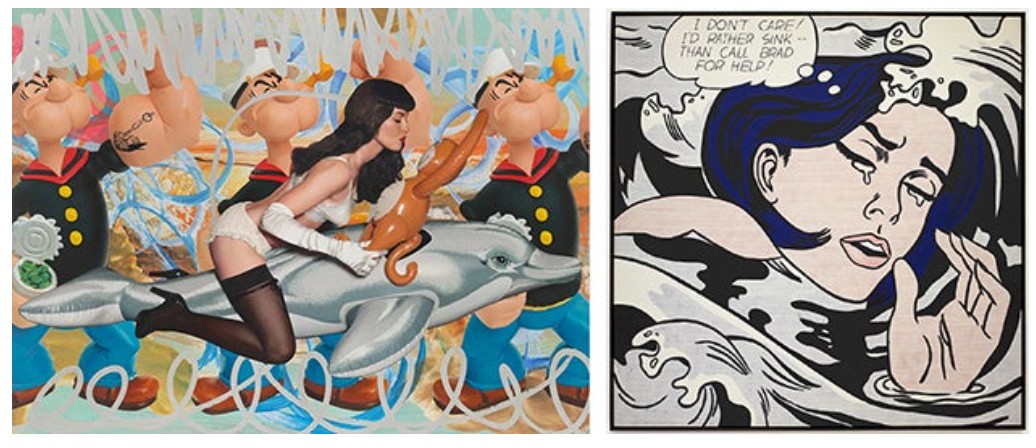
[Left] Jeff Koons, Girl with Dolphin and Monkey Triple Popeye (Seascape), 2010. The Broad, Los Angeles. Artwork: © Jeff Koons
[Right] Roy Lichtenstein, Drowning Girl, 1963. The Museum of Modern Art, New York. Image: © The Museum of Modern Art/Licensed by SCALA / Art Resource, New York, Artwork: © Estate of Roy Lichtenstein
Koons’ fascination with inflatable toys extends beyond childhood nostalgia and openly acknowledges their fetishistic allure. Speaking at the Serpentine Gallery’s debut of the Popeye series in 2009, he quipped that “there is a huge sexual fetish thing on the Web for pool toys” and lamented that it is always a “bit of tragedy if they go soft due to a leak.” This statement recontextualizes Dolphin Taz Trashcan, lending it an underlying erotic charge. The composition reinforces this dual reading. The dolphin, penetrating the swim ring, suggests a phallic motif, while the open-ended trashcan resembles a constraining, metallic passage. The taut ropes and steel chain, typically associated with play, now hint at bondage, submission, and containment. This interplay between soft and hard, freedom and restraint, echoes the fetishization of objects, a theme deeply embedded in the work of Salvador Dalí. His Lobster Telephone, 1936, in which a crustacean’s tail aligns with the mouthpiece of a rotary phone, uses absurdity to heighten sexual innuendo—a strategy Koons similarly employs. Like Duchamp and Dalí, Koons understands the seductive power of the fetish object, both in its sexual and consumerist connotations. Dolphin Taz Trashcan becomes a composite of desires: nostalgia, consumption, play, and repression, all intertwined in a surreal, hyperreal assemblage.
Despite these tensions, Dolphin Taz Trashcan is not wholly cynical. Koons has always positioned his art as a conduit for self-empowerment. “Art is about something you carry around inside yourself,” he has stated. “It’s not about the objects—they’re just carriers of the ability to stimulate and activate the viewer’s mental and physical state.” This idea is reflected in the Popeye series’ namesake: a self-transforming cartoon hero who gains superhuman strength by consuming spinach. The dolphin, seemingly trapped yet cheerfully emerging from its confines, embodies this same resilient optimism. Suspended mid-air, the sculpture suggests movement, as if the dolphin might yet break free. Arthur C. Danto, in discussing Koons’ Popeye works, observed that the animals appear to reassure themselves, thinking, “I’ll get through this!” The bright red chain, though a tether, also functions as a support—Koons’ version of a life preserver. In this sense, Dolphin Taz Trashcan is a metaphor for perseverance, a playful yet profound commentary on survival in a world of constraints.
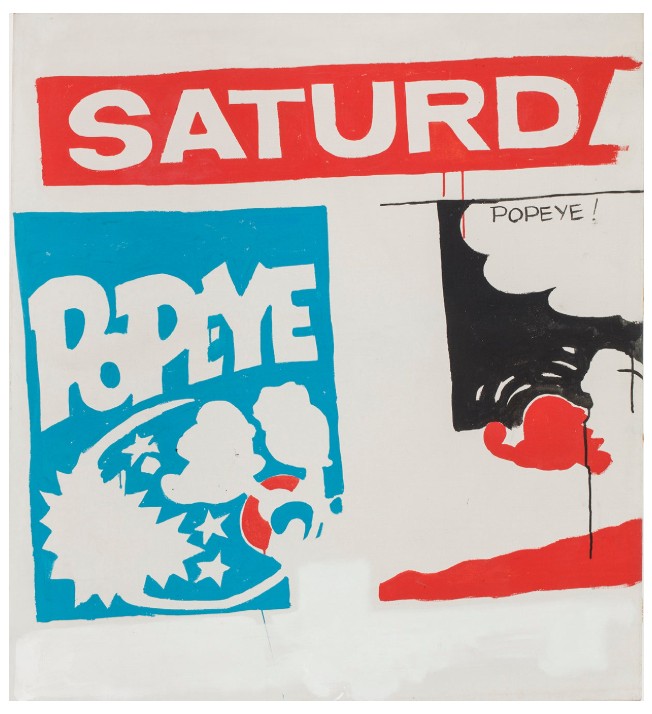
Andy Warhol, Saturday’s Popeye, 1961. The Ludwig Collection, Ludwig Forum für Internationale Kunst, Aachen, Germany. Artwork: © 2025 The Andy Warhol Foundation for the Visual Arts, Inc. / Licensed by Artists Rights Society (ARS), New York
“Popeye is about an image of, ‘I am what I am’. Kind of a symbol of self-acceptance that you have to embrace who you are. Popeye has spinach. Spinach brings about his transcendence, and brings about his power. That’s what art [is]. Art is our spinach.”
Koons’ works neither alienate nor critique; they seek to engage. Dolphin Taz Trashcan literalizes this act of elevation by being suspended from the ceiling, forcing the viewer to look up at an object they might otherwise dismiss. In doing so, Koons democratizes art, making it accessible to all. The mirrored finishes of other inflatables in Koons’ related series—such as the Hybrids, begun around 2003 and featuring puffed-up likenesses of the spinach-guzzling sailor himself, or the Celebration works, which originated in the mid-1990s and span subjects from balloon dogs to tulips—often reflect the viewer, drawing them into the experience. Here, though the objects themselves are not reflective, they function as cultural mirrors—reminding us of our collective past, our consumerist impulses, and our ability to transcend limitations. Dolphin Taz Trashcan is more than a sculptural assemblage; it is an invitation. Whether interpreted as a celebration of childhood, a critique of suburban illusion, or a surrealist exploration of desire, it compels us to see the extraordinary in the ordinary, urging us, like Popeye, to embrace our own transformations.
Luxury and Degradation Series
Jim Beam – J.B. Turner Train, 1986
Christie’s New-York: 17 November 2022
Estimated: USD 15,000,000 – 20,000,000
USD 16,992,500
LUXURY AND DEGRADATION SERIES
JEFF KOONS (B. 1955) (christies.com)
JEFF KOONS (B. 1955)
Jim Beam – J.B. Turner Train, 1986
Stainless steel and bourbon
11 x 114 x 6 1/2 inches (27.9 x 289.6 x 16.5 cm)
Known for his iconic large-scale sculptures which combine dazzling craftsmanship with conceptual rigor, Jeff Koons is one of the most widely celebrated artists of the current era. His works pull from the archive of popular culture in order to turn an eye toward such critical topics as consumerism, advertising, and the inherent social structures of capitalist society. As conceptually complex as it is aesthetically striking, Jim Beam – J. B. Turner Train marks one of the artist’s first forays into highly polished steel as a medium. First realized in 1986, it was a core component of his seminal 1986 Luxury and Degradation exhibition which helped to cement his recognition around the world. Through this work Koons draws our attention to the dangers of wealth signaling and the ways in which art and imagery have been used to create a subtle but powerful divide within the cultural consciousness.
“I wanted to suggest how the idea of luxury, through abstraction, is used to induce a psychological state of degradation, the public is constantly undergoing a re-education, being set up for the big kill”
Viewing advertisements full of expensive goods that manufacturers tout as luxury items, the general population yearns to be on a level worthy of buying them and financially sound enough to afford them. However, this constant need to possess things out of reach erodes the self-worth and self-image of the consumer. This in turn creates an even deeper need to own and purchase branded or expensive items for the sheer fact that they have a logo or a large price tag. This is a fact that Koons leverages with his sumptuous mirrored works by delivering the glitz and glamour wrapped around an abstraction of reality.
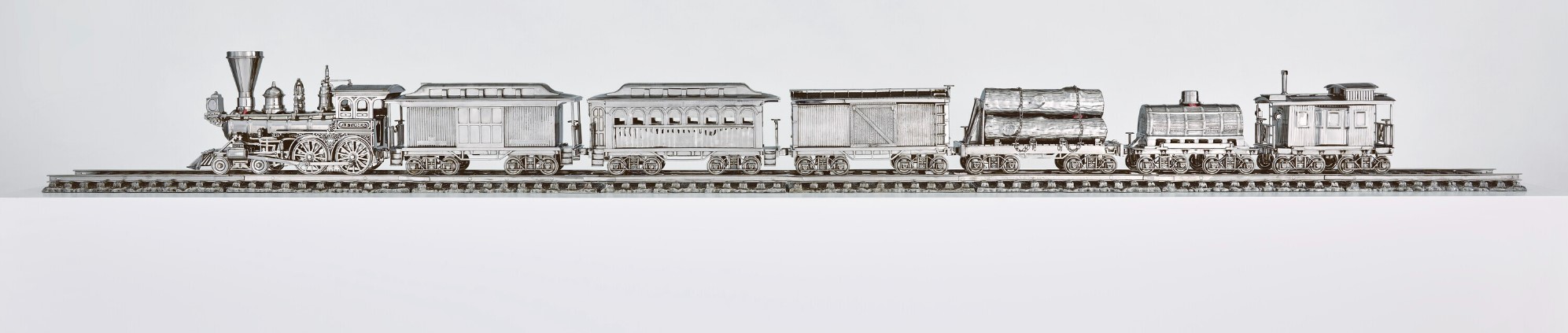
Intricately detailed and visually stunning, Jim Beam – J.B. Turner Train is a masterful of Koon’s fastidious technique. Cast in steel, the gleaming steam engine pulls six cars behind it on a purpose-made track that extends beyond the train on either side. The polished chimney on the front of the locomotive extends upward in utilitarian grandeur, and each bit of ornament and mechanical embellishment is recreated in exacting detail. The ground itself is stylized and takes after the cast elements of the miniature source rather than any real rocky terrain. Looking for all intents and purposes like a scale model of a functioning vehicle, the attention to detail in Koons’s artifice does not stop at surface level.
Jim Beam – J.B. Turner Engine, 1986
Sotheby’s Hong-Kong: 27 April 2022
Estimated: HKD 13,500,000 – 15,500,000
HKD 9,450,000 / USD 1,204,312
LUXURY AND DEGRADATION SERIES
JEFF KOONS (b. 1955)
Jim Beam – J.B. Turner Engine, 1986
Stainless steel and bourbon
11 x 17 x 6 1/2 inches (27.9 x 43.2 x 16.5 cm)
This work is number 1 from an edition of 3, plus 1 artist’s proof
eff Koons’s Jim Beam – J.B. Turner Engine (1986) is the archetypal example from the artist’s seminal Luxury and Degradation series, which saw Koons transform vernacular objects into stainless steel sculptures for the first time in his career. The Luxury and Degradation series was first exhibited at the International With Monument Gallery in New York and the Daniel Weinberg Gallery in Los Angeles in 1986, featuring his sparkling stainless steel sculptures from the series, including the Jim Beam – J.B. Turner Train. Koons’ transformation of the ceramic Jim Beam train decanter—was shown next to various bar accessories also cast in stainless steel—including Ice Bucket, Baccarat Crystal Set, Travel Bar and Fisherman Golfer, a cocktail shaker set—as well as replications of popular liquor advertisements for Bacardi Rum, Gordon’s Gin, Martell Cognac, Hennessy Whiskey and others.
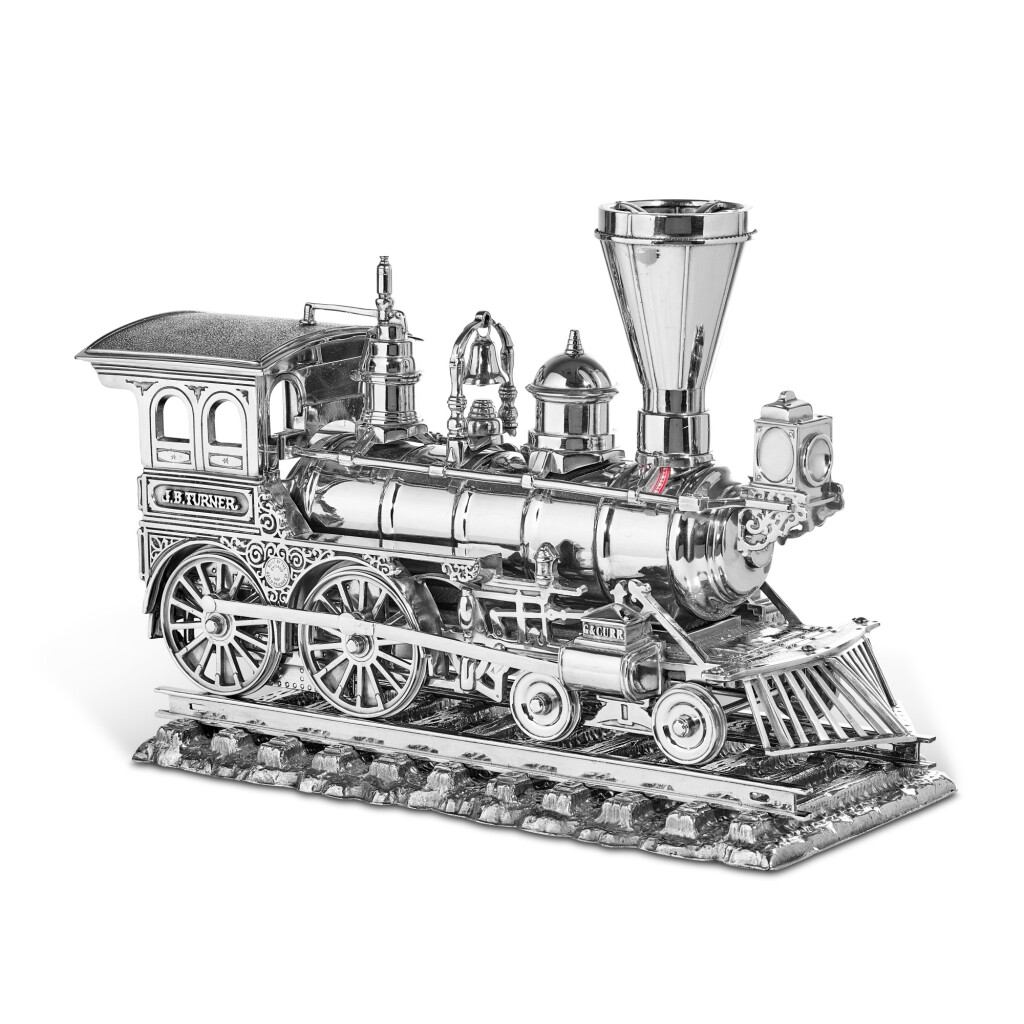
For this iconic series, the artist created meticulous sculptures of the individual parts of the train, including the Jim Beam – Baggage Car, Barrel Car, Box Car, Caboose, Log Car, Observation Car, Passenger Car and the J.B. Turner Engine—as presented here—which arguably drives the point of Koons’s artistic inquiry home. Each carriage, and the coveted Jim Beam – J.B. Turner Engine of which there are only three copies plus the Artist’s Proof, contains a fifth of bourbon that is sealed and tax-stamped, like the original Jim Beam train. In this way, Koons’s sculpture has gone through a material transformation, but “the soul of the piece, which is the liquor inside” is preserved (Jeff Koons cited in: Exh. Cat., San Francisco Museum of Modern Art, Jeff Koons: Retrospective, 1992, p. 65).
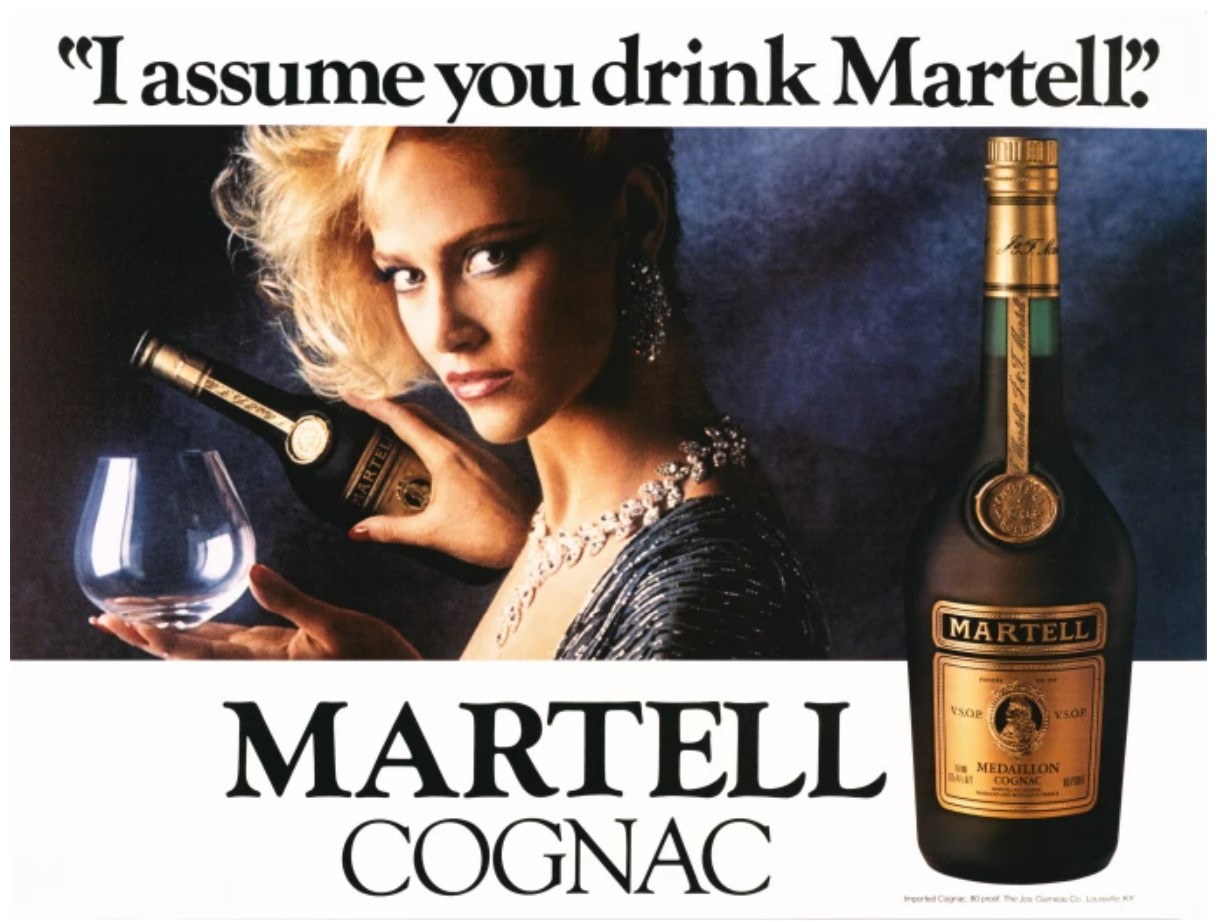
JEFF KOONS, I ASSUME YOU DRINK MARTELL, 1986, OIL INKS ON CANVAS, 114.3 X 152.4 CM, EDITION OF 2 PLUS 1 AP © JEFF KOONS
SOLD BY SOTHEBY’S NEW YORK, NOVEMBER 2011
Luxury and Degradation playfully yet powerfully highlights the danger of being manipulated and seduced by commerce and capitalism. Koons was struck by the way liquor advertisements at the time fed into and reinforced class stereotypes, with the content of the advertisements changing to target different audiences. Liquor advertisements aimed towards those of a higher socio-economic class were discernibly more abstract, monochromatic and conceptual, while those targeting a lower class were more narrative and figurative, selling a false promise of the American dream. Koons explained how his work played into yet at the same time critiqued the false luxury depicted in advertising, and the resulting dependence, much like alcoholism itself.
“I wanted to show how luxury and abstraction are used to debase people and take away their economic and political power. The underlying theme paralleled the alcoholic… I worked in stainless steel. That was the first time I worked with it. It was perfect coordination because stainless steel was the only metal that would keep the alcohol preserved forever. But I also like the fake luxury of stainless steel. It has always been the luxury of the proletariat. It was to seduce.”
Referred to by Koons as the “material of the Proletarian”, stainless steel is both practical and affordable, yet can be polished to a dazzling sheen that hints at luxury. However, as Koons powerfully symbolizes with his work, it is a faux luxury, a false promise of the American dream.
Travel Bar, 1986
Christie’s New-York: 10 March 2022
Estimated: USD 900,000 – 1,200,000
USD 1,197,000
JEFF KOONS (B. 1955) (christies.com)
JEFF KOONS (B. 1955)
Travel Bar, 1986
Stainless steel
14x20x12 inches (35.6 x 50.8 x 30.5 cm)
This work is number one from an edition of three plus one artist’s proof
Baccarat Crystal Set, 1986
Sotheby’s New-York: 15 November 2021
The Macklowe Collection
Estimated: USD 900,000 – 1,200,000
USD 1,956,000
Baccarat Crystal Set | The Macklowe Collection | | Sotheby’s (sothebys.com)
JEFF KOONS (b. 1955)
Baccarat Crystal Set, 1986
Stainless steel
12 ½ x 16 x 16 inches (31.8 x 40.6 x 40.6 cm)
This work is number 3 from an edition of 3 plus 1 artist’s proof
Baccarat Crystal Set, executed in 1986, is emblematic of the Jeff Koons’s landmark Luxury and Degradation series. Revolving around the seductive yet simultaneously destructive nature of the alcohol industry and the perils of luxury, this body of work appropriated slick advertisements for Bacardi Rum, Gordon’s Gin, Martell Cognac and Hennessy Cognac, making them into paintings and installing them alongside gleaming chrome sculptures of associated drinking paraphernalia. Of the latter, Koons cast in reflective stainless steel an Ice Bucket, a Travel Bar, a Fisherman Golfer cocktail shaker and, for the present work, a Baccarat crystal drinkware set. Virtually synonymous with luxury and affluence, Baccarat is famed for its superb decorative crystal figurines, chandeliers, and glassware, producing commissions for royalty, heads of state, and the wealthiest patrons since the mid-18th Century. Based on a classic set of glasses and barware produced by Baccarat, Koons’s metallic mirrored sculpture exaggerates the crystal’s status as a valuable collector’s item, yet simultaneously degrades it by utilizing such a common material as stainless steel. Encapsulating the investigations into consumerism, wealth, and banality that have defined Koons’s output for decades, Baccarat Crystal Set was fittingly featured in both Koons’s second career solo exhibition at Daniel Weinberg Gallery in 1986, and his major retrospective at the Whitney Museum of American Art in 2014. Executed in an edition of three plus one artist’s proof, another example from this edition is notably held in the collection of the Museum of Modern Art in New York. Widely referenced in literature as an archetype of the themes at the heart of the Luxury and Degradation series, the present work offers an aesthetically elegant yet conceptually complex embodiment of Koons’s inimitable practice. Outwardly dazzling, extravagant, and evocative of immense wealth and opulence, Baccarat Crystal Set’s material ordinariness belies these mythologized notions with false luxury, the ultimate metaphor for the seductive false promise of the American dream.
New Series
New Hoover Celebrity IV, New Hoover Convertible, New Shelton 5 Gallon Wet/Dry, New Shelton 10 Gallon Wet/Dry Doubledecker, 1981-1986
Christie’s New-York: 21 November 2024
Estimated: USD 3,500,000 – 5,500,000
USD 5,132,000
NEW SERIES
JEFF KOONS (B. 1955)
New Hoover Celebrity IV, New Hoover Convertible, New Shelton 5 Gallon Wet/Dry, New Shelton 10 Gallon Wet/Dry Doubledecker, 1981-1986
Four vacuum cleaners, acrylic and fluorescent lights
99 x 53 1/2 x 28 inches (251.5 x 135.9 x 71.1 cm)
Jeff Koons’s New Hoover Celebrity IV, New Hoover Convertible, New Shelton 5 Gallon Wet/Dry, New Shelton 10 Gallon Wet/Dry Doubledecker represents modern domesticity as a sleek ultra-modern reliquary. Here, Koons has carefully selected four unique vacuum cleaners, showcased within a double-decker museum-style vitrine, to stand as saintly trophies of cleanliness and order. Illuminated by cool, almost clinical, fluorescent lights, Koons’s construct elevates these commonplace objects to the status of high art, underscoring society’s obsession with the new.
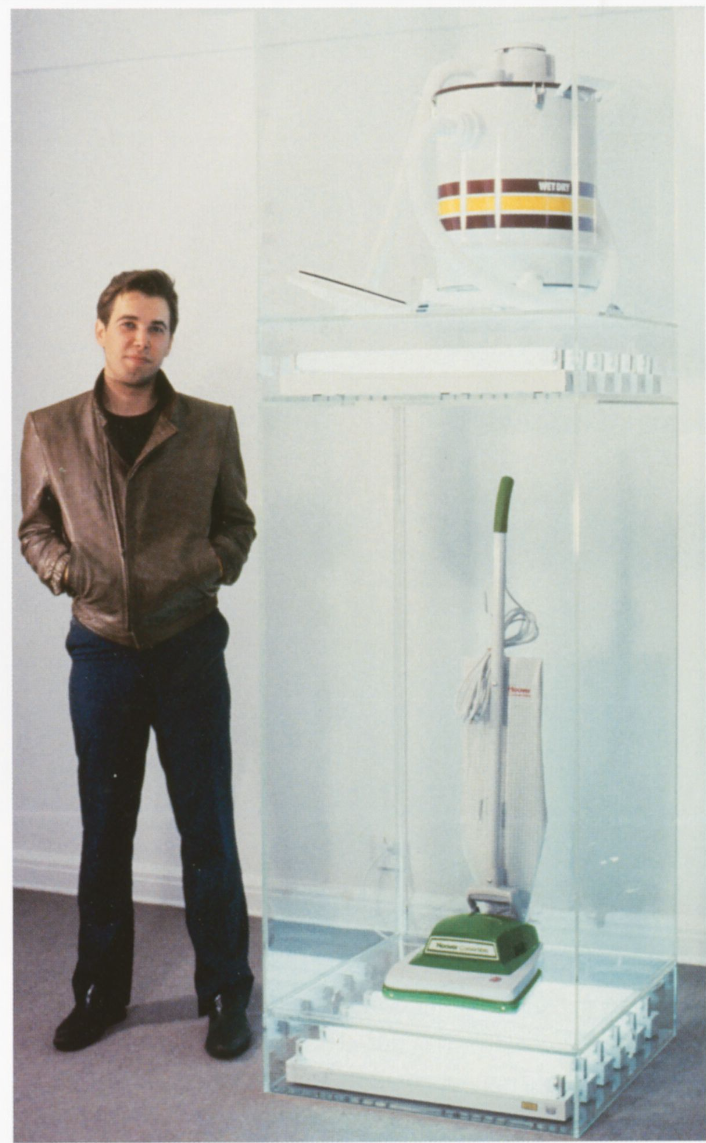
Jeff Koons with the New Hoover Convertible, New Shelton Wet / Dry 10 Gallon Doubledecker, New York, 1981. © Jeff Koons.
The present work is perhaps the most impressive of Koons’s iconic series, The New, which marked the beginning of his career in the early 1980s. Here, Koons juxtaposed readymade sculpture and billboards to blend the worlds of advertising, commerce, and high culture. Works from the now-legendary series can be found in museums worldwide, including the New Shelton Wet/Drys 10 Gallon, Doubledecker (1981) housed at the Museum of Modern Art in New York, and New Hoover Convertibles, Green, Blue; New Hoover Convertibles, Green, Blue; Doubledecker (1981-87) at New York’s Whitney Museum of American Art.
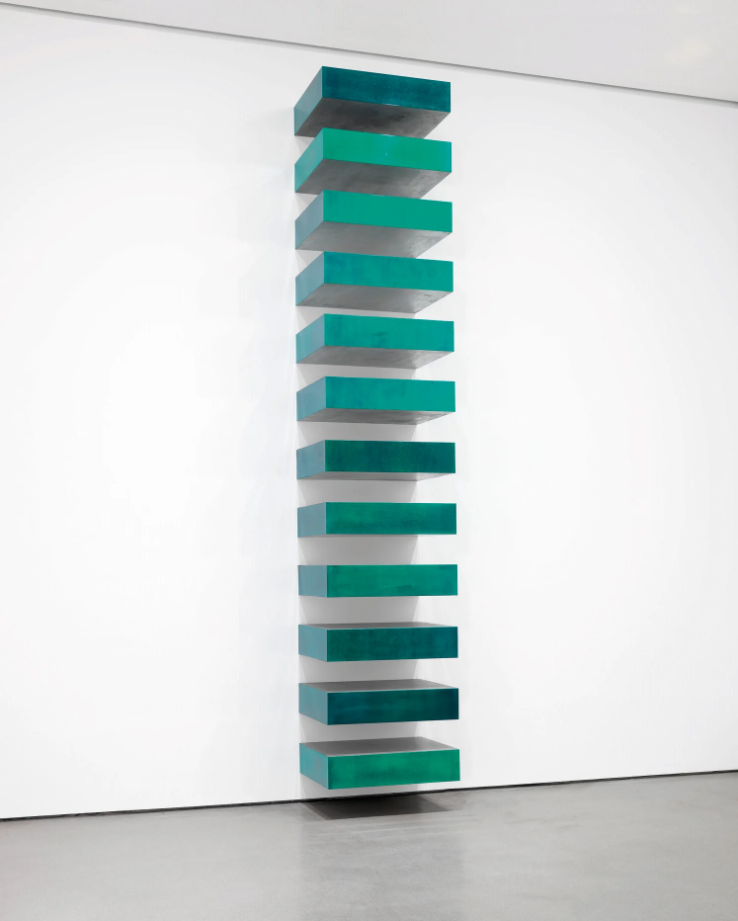
Donald Judd, Untitled (Stack), 1967. Museum of Modern Art, New York. © 2024 Judd Foundation / Artists Rights Society (ARS), New York. Photo: © The Museum of Modern Art / Licensed by SCALA / Art Resource, New York.
The Readymade collides with Minimalism in the present work; Koons’s use of fluorescent tubes recalls Dan Flavin’s light sculptures and the towering sculpture of a Donald Judd stack, while the found vacuum cleaners take their cue from the modern master Marcel Duchamp. Throughout his practice, Koons — like Duchamp — elevates commonplace objects into legitimate subjects for art. Koons, who first began to fully understand the work of Duchamp while working at the Museum of Modern Art in the late 1970s, was inspired by the directness of the readymade and its capability to favor ideas over formal qualities. Since then, Koons has repeatedly turned to objects that help to narrow the traditional division between popular culture and art. He often emphasized that his work is inclusive.
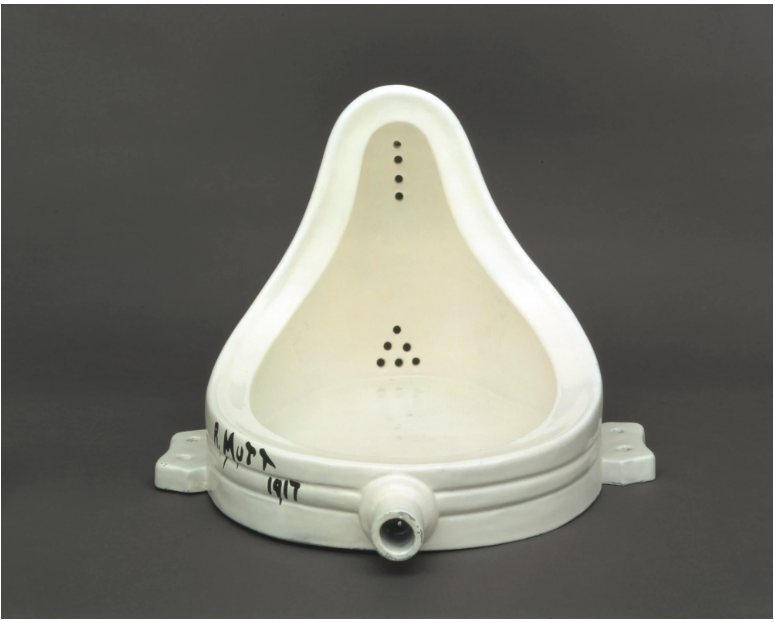
Marcel Duchamp, Fountain, 1917. Tate Gallery, London. © Association Marcel Duchamp / ADAGP, Paris / Artists Rights Society (ARS), New York 2024. Photo © Tate, London / Art Resource, New York.
While Duchamp often relied upon the conceptual or academic nature of a museum or gallery to assist with the recontextualization of his Readymades, Koons’s sculptures from The New are ennobled within their pristine vitrines and the episodic content of his series, making this elevation of subject matter more inherent to the work.
“Coming out of a Duchampian background, I am concerned with the object and with transformation. I transform the content of a chosen object by putting it in a specific context. I control the new content through the support mechanisms. I use billboard ads, the juxtaposition of the object with the other objects, as well as the actual process of transformation I put the object through. This recodifies the object so that it gives off the kind of information I would like people to view.”
In Koons’s artistic realm, the vacuum cleaner takes on multiple meanings designed to encourage viewers to reflect upon themselves.
“These works present ideal newness. The whole philosophy of my work maintains that the individual just needs self-confidence in life. Self-confidence that is enough — that they can display themselves, use the abilities that they have. They can do it with a new car. They can do it with a vacuum cleaner. They can do it with a chair. They can do very well in life. They just have to do it with themselves”
In the context of The New, Koons’s vacuum cleaners are depicted as inanimate secular saints — fetishes and everyday objects that have transcended their original purpose, suggesting a potential path to redemption.
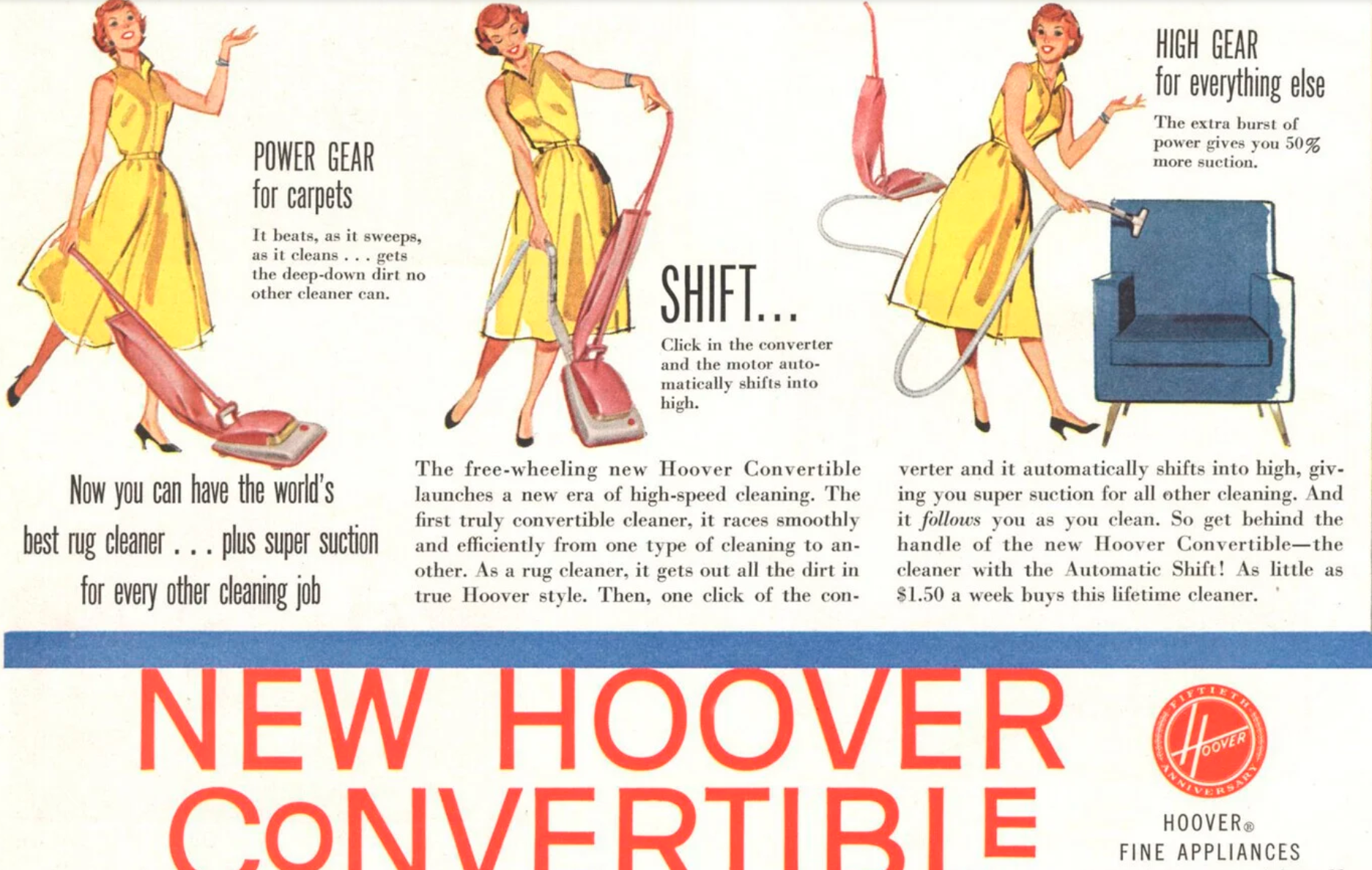
Hoover advertisement, circa 1950. Photo: © The Advertising Archives / Bridgeman Images.
For Koons, the vacuum cleaner serves as a compelling artifact that engages with a broad spectrum of themes foundational to his artistic philosophy. Before his Banality series explored sexuality, and even before the more overtly explicit Made in Heaven, Koons subtly introduced related motifs through pieces like the present work. He explained his choice of the vacuum cleaner by noting its anthropomorphic qualities.
“It displays both male and female sexuality. It has orifices and phallic attachments. I have always tried to create work which does not alienate any part of my audience.”
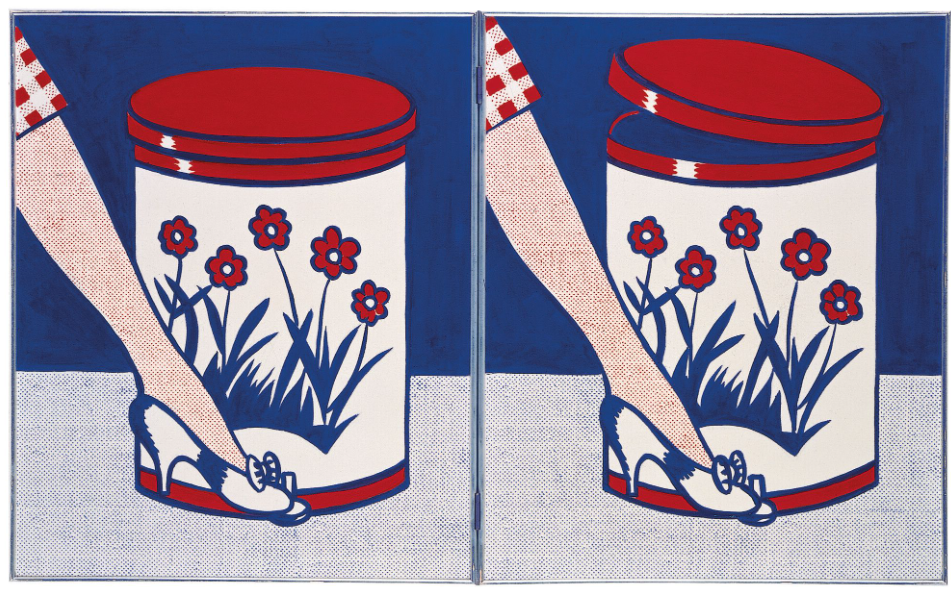
Roy Lichtenstein, Step-on Can with Leg, 1961. © Estate of Roy Lichtenstein.
Further elaborating on the theme of anthropomorphism, Koons has referred to these vacuum cleaners as “breathing machines,” explaining that he “always liked that quality of being like lungs. When you come into the world, the first thing you did is breathe to be able to live” (J. Koons, quoted in H. W. Holzwarth, ed., Jeff Koons, Cologne, 2009, p. 112). This idea of breath, already prevalent in his 1970s readymade series Inflatables, runs like a constant thread through Koons’s oeuvre—from his Equilibrium series to the colorful balloon flowers and animals featured in his recent Celebration sculptures. Breath sustains us and is essential to our existence; in Koons’s philosophy, art holds similar significance. At the same time, air is invisible, weightless, intangible, and ephemeral, akin to Duchamp’s 50cc of Paris Air from 1919, housed in the Philadelphia Museum of Art. Mixing Koons’s philosophies on desire, commercialism, and sexuality, The New investigates the vacant world of consumerism with an epic and mythic and immortal sense of possibility and meaning.
New Hoover Convertibles, New Shelton Wet/Dry 10 Gallon Doubledecker, 1981-1986
Sotheby’s New-York: 16 May 2022
Estimated: USD 3,500,000 – 4,500,000
USD 4,406,000
NEW SERIES
JEFF KOONS (b. 1955)
New Hoover Convertibles, New Shelton Wet/Dry 10 Gallon Doubledecker, 1981-1986
Three vacuum cleaners, acrylic and fluorescent lights
99x41x28 inches (251.1 x 104.1 x 71.1 cm)
A paradigm of The New series, New Hoover Convertibles, New Shelton Wet/Dry 10 Gallon Doubledecker from 1981-86 epitomizes a transformative moment in Koons’s conceptual and artistic practice. Created amid 1980s cultural excess, the present work plays with the popular culture of its era while remaining timeless in its steadfast beauty. Koons embraces the possibilities allowed by his predecessors, Pop Art and Dada, and surpasses the artistic conventions that they imposed on the readymade as art. Unlike the shocking irreverence of Marcel Duchamp’s infamous Fountain (1917), Koons’s pristine and stunningly presented appliances evoke awe and desire from their viewers, despite the appropriated objects being just as functional and quotidian as Duchamp’s urinal. The Doubledecker lures us to it like an expertly conceived advertisement: we long to possess one of Koons’s gleaming Hoovers and Sheltons. The present work, like so many other seminal installations by Koons, appeals both to our consumerist and aesthetic impulses.
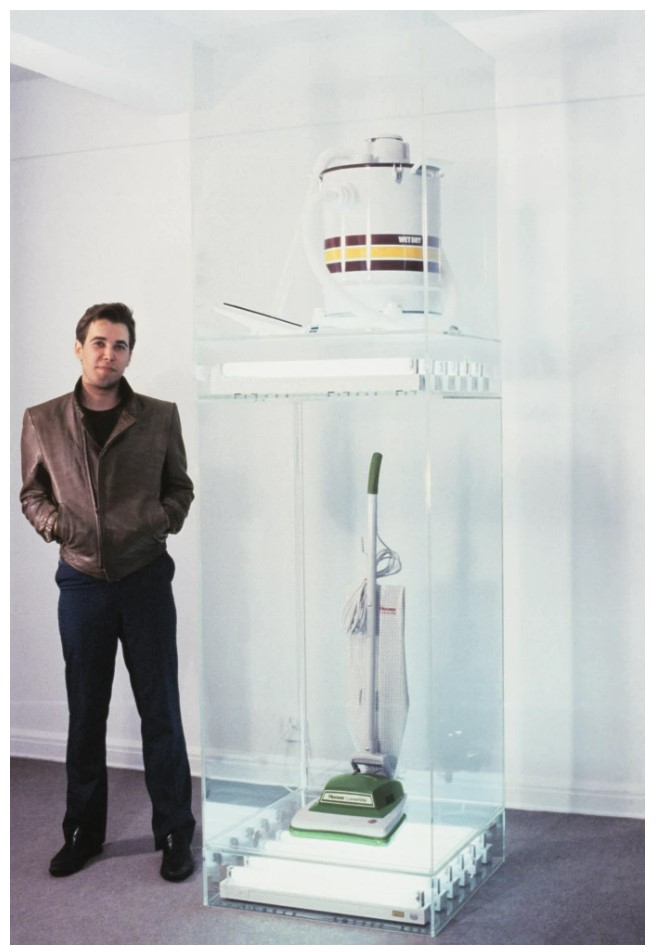
JEFF KOONS WITH THE NEW HOOVER CONVERTIBLE, NEW SHELTON WET/DRY 10 GALLON DOUBLEDECKER, NEW YORK, 1991. ART © JEFF KOONS
New Hoover Convertibles, New Shelton Wet/Dry 10 Gallon Doubledecker is an alluring and impactful confluence of beauty and simplicity. The appliances face the viewer straight on—the tall metal spines of the Hoovers rising purposefully from their bases, and the pliable handle of the Shelton gracefully encircling and embracing its cylindrical body. They are all lit from below so that they appear to glow, as if with the promise of innovation. Reflecting off the gleaming metal, the scintillating fluorescent lights perfectly serve to reverently showcase Koons’s appliances. At the peak of technological advancement for their time, these devices exist as monuments to both usefulness and design. Securely positioned within the 1980s dual preoccupation with commerce and futuristic technology, at the time of their inception the Hoovers and Shelton in the present work would have elicited deep feelings of lustful acquisitiveness and fascination in their viewers. They are, by nature, machines designed to work for us—to make our homes cleaner and more enjoyable. Though they are practical household appliances, these new and advanced vacuum cleaners are in fact luxury items. Koons treats them as such by illuminating their beauty and presenting them as the newest, best, and most desirable models that money can buy. Koons treats them as such by illuminating their beauty and presenting them as the newest, best, and most desirable models that money can buy. Koons treats them as such by illuminating their beauty and presenting them as the newest, best, and most desirable models that money can buy.
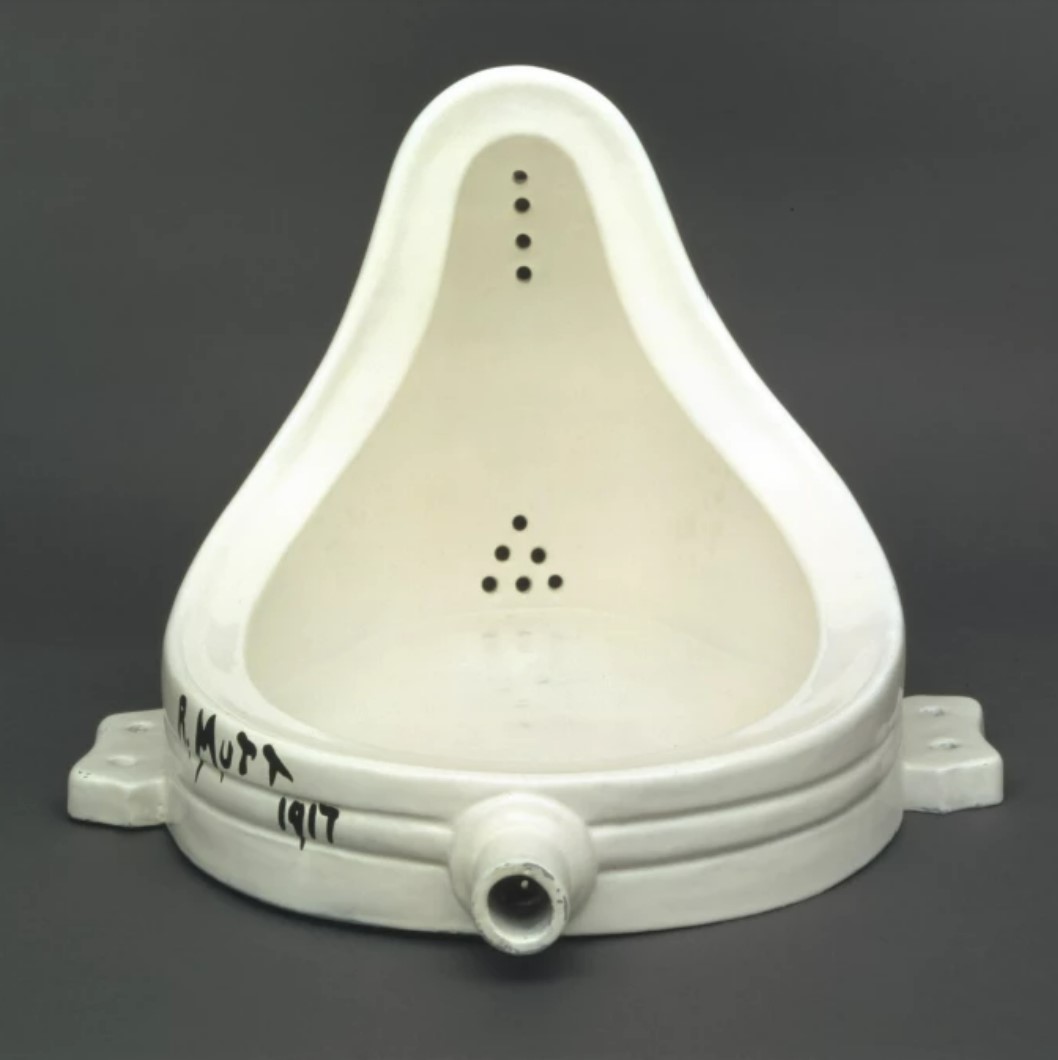
MARCEL DUCHAMP, FOUNTAIN, 1917, REPLICA 1964. IMAGE © TATE, LONDON / ART RESOURCE, NY. ART © 2022 ARTISTS RIGHTS SOCIETY (ARS), NEW YORK / ADAGP, PARIS / ESTATE OF MARCEL DUCHAMP
The present work is not the first example of Koons’s affinity for household appliances. In Toaster (1979), a work from The Pre-New series, Koons created a hybrid sculpture by affixing a toaster to two cylindrical fluorescent lights. The formal elements of Toaster pay homage to both Donald Judd’s minimalist practice of isolating individual modular objects in space and Dan Flavin’s ubiquitous fluorescent lights. However, “Koons felt that by bolting appliances to light fixtures, as he had been doing, he was interfering with their wholeness, their pristine, ready-made qualities.” (Hans Werner Holzwarth, ed., Jeff Koons, Cologne, 2009, p. 107) This sense of impurity and fracture was rectified by what became the first work in The New series: a single vacuum cleaner displayed in stark isolation.
Throughout his career, Koons has repeatedly gravitated towards entities that he believes have an anthropomorphic quality. More than their shape or physical appearance, Koons is attracted to things that exhibit life-like behaviors. The vacuum cleaners initially appealed to Koons because they were, in his words, “breathing machines.” (Ibid, p. 109) According to him, these machines take in, release, and filter air as human lungs do. They, like us, exist off their surrounding environment. As we realize this inherent similarity, we begin to identify with our mechanistic proxies. As he was creating The New series, Koons would rush out to buy the latest model of his chosen appliance before it was out of production. Once he had procured a machine at the height of its relevance and commercial popularity, he would remove its packaging and place it straight into its Plexiglas encasement.
Made in Heaven Series
Silver Shoes, 1990
Edlis Neeson Collection
Christie’s New-York: 20 May 2026
Estimated: USD 400,000 – 600,000
USD 254,000
JEFF KOONS (B. 1955), Silver Shoes | Christie’s
JEFF KOONS (B. 1955)
Silver Shoes, 1990
Oil inks on canvas
96×144 inches (243.8 x 365.8 cm)
This work is number one from an edition of one plus one artist’s proof
Jeff Koons’s Silver Shoes is an iconic work from the artist’s pivotal Made from Heaven series. Created from 1989 to 1992, the notorious series marked a dramatic evolution for Koons, presenting his first works on canvas as well as fully conceptualizing the motifs that he would continue to elaborate on until the present day. Focusing on themes of desire and objectification, which Koons considers the driving forces of art history, the series presents large silk-screened images of sexual activity between Koons and his then-wife Ilona Staller, also known by the moniker Cicciolina. The paintings were first exhibited alongside life-sized wood sculptures of animals and flowers, as well as glass figurines of the duo. This radical new project functioned as a “Gesamtkunstwerk that unfolded in real time over several years,” as the art historian Alison M. Gingeras writes. “In the process of making Made in Heaven from 1989 to 1992, Jeff Koons became Jeff Koons. It was over this crucial three-year span that he forged both his art world and mainstream identity. As has been documented in recent art historical scholarship, this body of work allowed Koons to ‘crossover’—catapulting him from art world star to mainstream media figure” (“Born through Porn: How Jeff Koons Became Jeff Koons,” in Jeff Koons: Made in Heaven, exh. cat., Luxembourg & Dayan, New York, 2010, pp. 13-14).
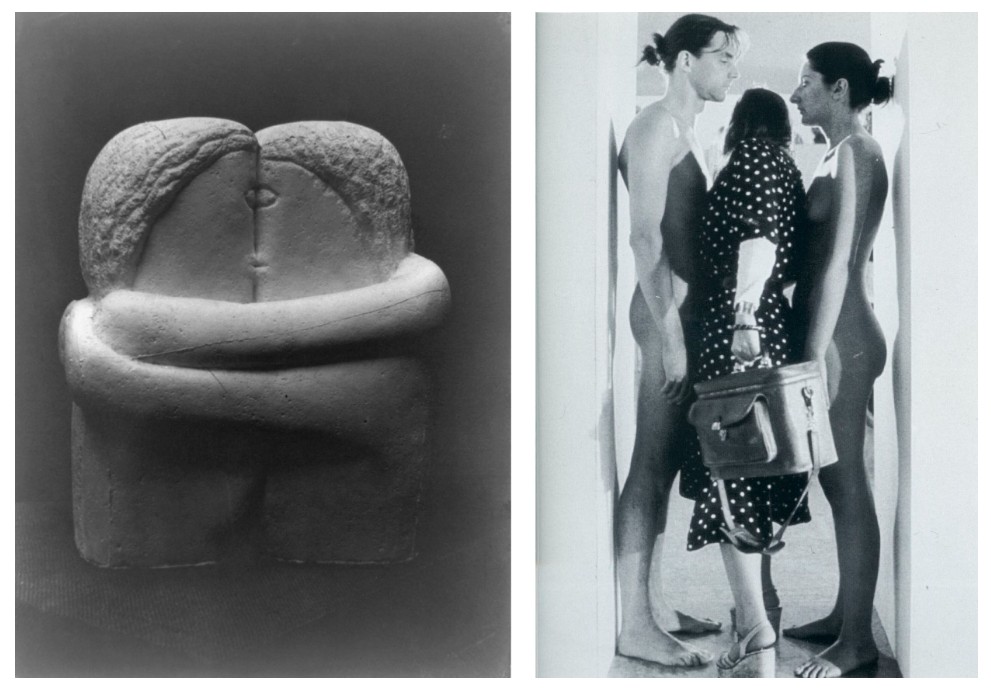
Left: Constantin Brancusi, The Kiss, 1913. Philadelphia, Museum of Art.
Right: Marina Abramović, Imponderabilia, 1977. © 2026 Artists Rights Society (ARS), New York / VG Bild-Kunst, Bonn.
Describing the Made in Heaven series:
“It was about using the body as metaphor, again, for self-acceptance, the acceptance of sexuality, how we procreate, how we continue the species. It’s our genes, our DNA. I believe that there are forms of communication that are biological, which are really quite profound”
In Silver Shoes, the titular element foregrounds the composition, foreshortened directly at the apparent surface of the canvas as Staller’s legs dangle in the air, feet crossed slightly at the ankles. Koons presents the scene frontally, revealing both his and Staller’s genitalia as well as their facial expressions—Staller’s face appears lost in ecstasy, a modern reenactment of Bernini’s St. Teresa in Ecstacy, which Koons’s intent gaze seems determined to capture. The scene appears to be one of post-coital bliss, contrasting with the more active positions of the other works from the Made in Heaven series.
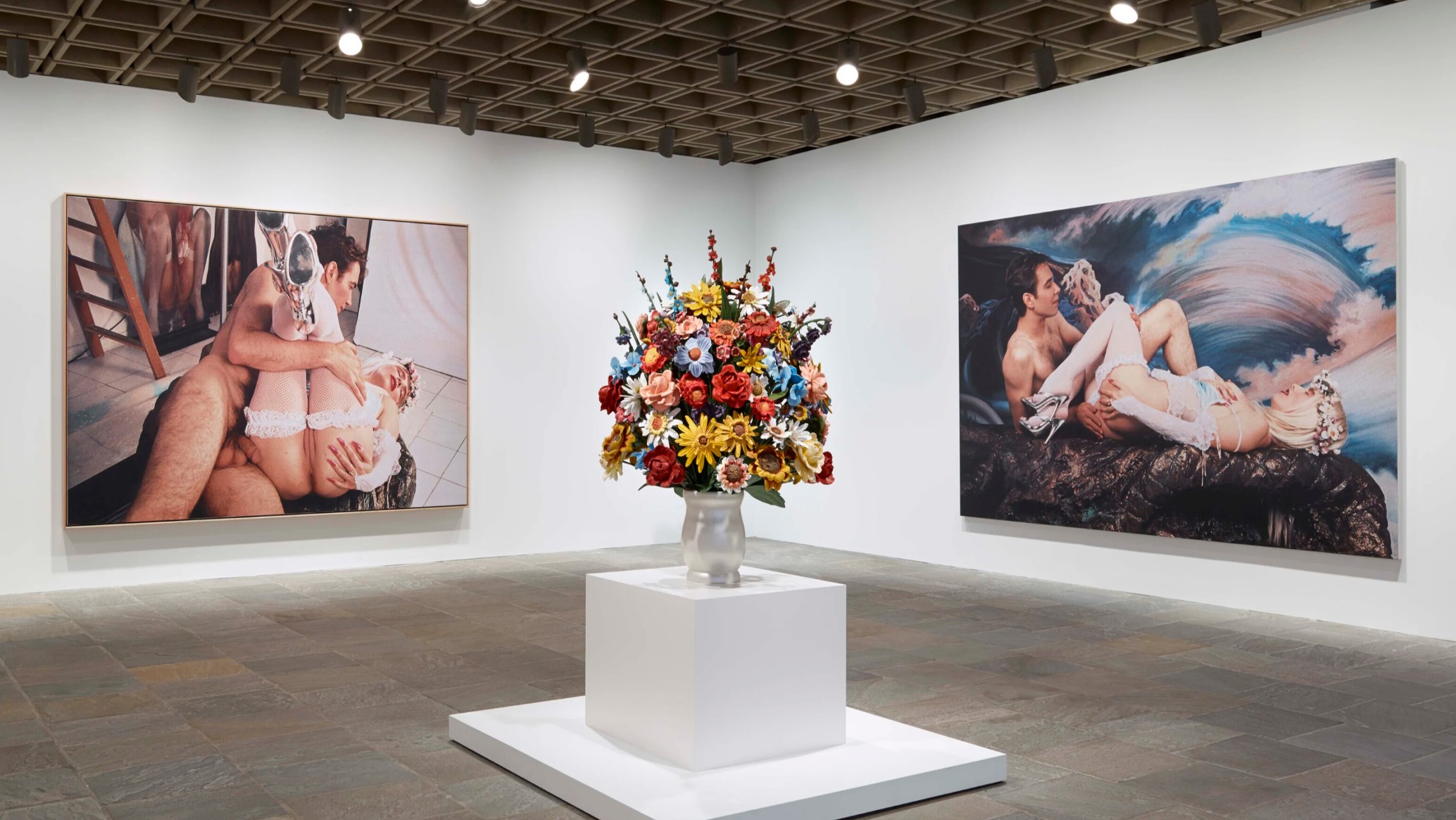
Installation view. New York, Whitney Museum of American Art, Jeff Koons: A Retrospective, June – October 2014 (present lot illustrated). Artwork: © Jeff Koons. Photograph: Ronald Amstutz
While erotic and explicit, the present work, and the series overall, are by no means pornographic. As the curator and art critic John Caldwell writes of the series, “A curious aspect of Koons’s new paintings is that they are not pornographic, even though they are explicit depictions of sexual activity… Probably the reason for this is that in one sense, they are too real. In an essay published in 1969, Susan Sontag pointed out that pornography is often placed outside the category of serious writing because it lacks fully developed characters. Her thesis was that the characters in a pornographic novel must be fairly generic figures in order to project our erotic desires onto them; too much literary specificity in its actors would make the characters into real people and interfere with our fantasies. In the case of Koons’s work, something like that seems to have happened” (“Jeff Koons: The Way We Live Now,” in Jeff Koons, exh. cat., San Francisco Museum of Modern Art, 1992, p. 14).
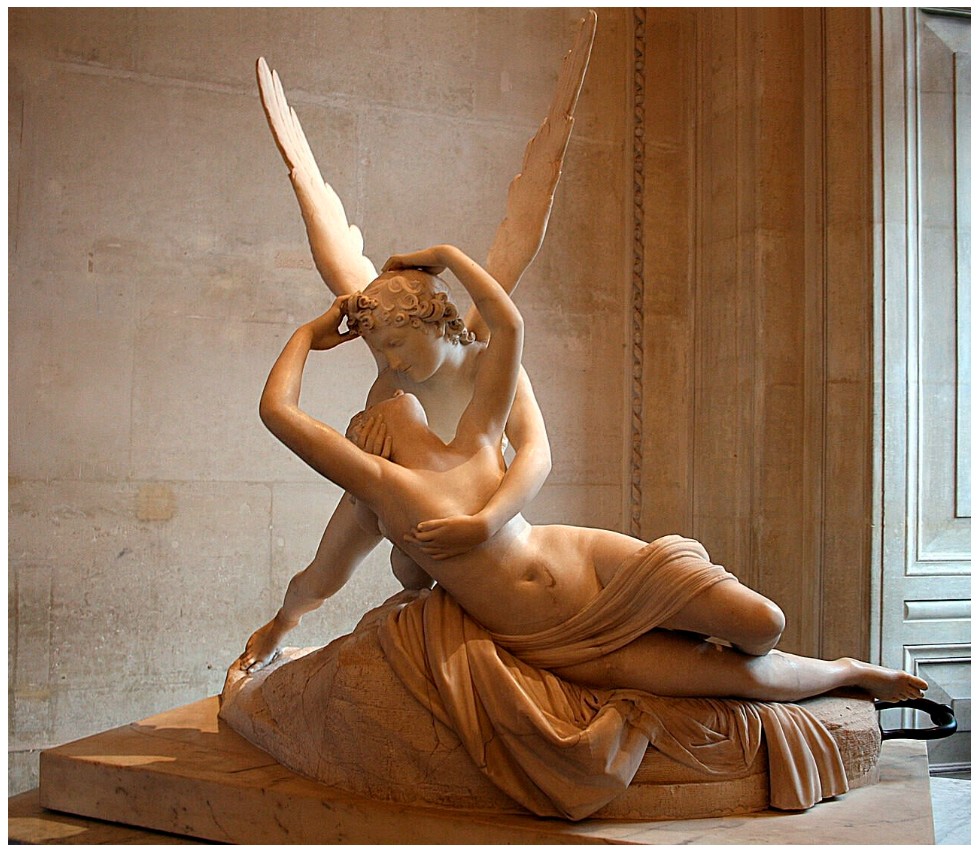
Antonio Canova, Psyche Revived by Cupid’s Kiss, 1787-1793. Musée du Louvre, Paris.
“Like rococo art and Duchamp,” the scholar Daniela Salvioni writes, “Made in Heaven unabashedly places sex within the purview of art. It dares to broach the issue of pleasure in a context in which its appearance is rare, despite the fact that to please is an integral function of art. Moreover, it does so in an era besieged by hysterical puritanism, thus ushering in, in my opinion, a welcome defiance of repressive attacks” (“Jeff Koons’s Poetics of Class,” in ibid., p. 25). As Salvioni notes, erotic art has a long and distinguished art historical legacy, from prehistoric fertility talismans onward to the disguised eroticism of Fragonard. Koons himself makes both explicit and implicit reference to this history in the series: his work Manet references the French artist’s Déjeuner sur l’herbe, while his Violet Ice (Kama Sutra) refers to the famous ancient Sanskrit text on sexuality and eroticism. In the present work, Koons makes more implicit reference to historic erotic art—the position of the couple recalls the pose of the two lovers in Michelangelo’s Leda and the Swan, later destroyed for its supposed indecent subject matter, as well as a work from the infamous series of prints made by Marcantonio Raimondi in collaboration with the writer and poet Pietro Aretino. Known as I modi, or The Sixteen Pleasures, this series of erotic prints was among the first to elevate erotic art into the art historical mainstream.
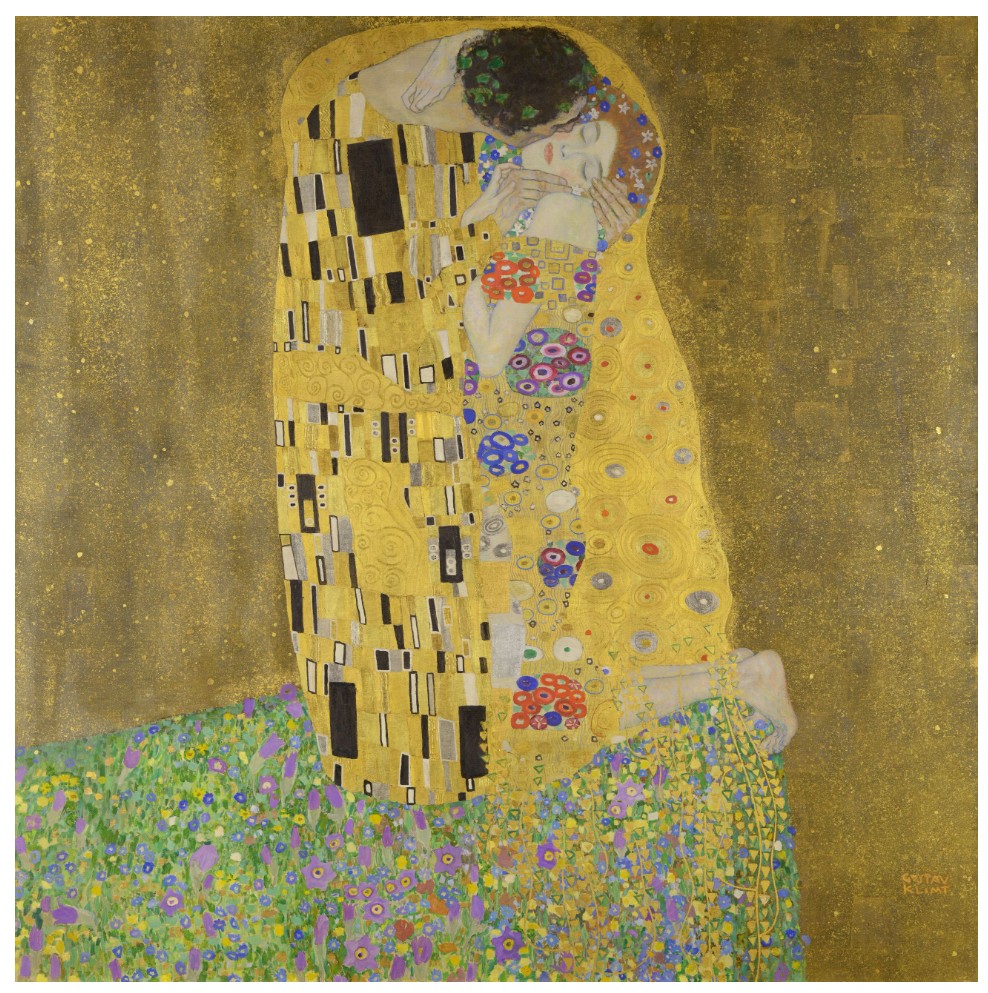
Gustav Klimt, The Kiss, 1907-1908. Österreichische Galerie Belvedere, Vienna.
Silver Shoes also resembles another antecedent—the erotic paintings of Egon Schiele, particularly Man and Woman I (Lovers I) (1914, Private collection) and The Embrace (Lovers II) (1917, Belvedere, Vienna). In the latter, Schiele paints a self-portrait of himself and his wife Edith post-coitus. In these works, the artist explores “the fundamental rift between the sexes, and revolve around duality, unfulfilled desires and expectations, and the failure of relationships” as the art historian Kerstin Jesse writes (“From ‘Hell Brueghel’ to ‘Decipherer of Human Traits’: Egon Schiele’s ‘Late Works from 1914 to 1918,” in Changing Times: Egon Schiele’s Last Years, 1914-1918, exh. cat., Leopold Museum, Vienna, 2025, p. 24). Like Schiele, Koons transforms an intimate, autobiographical encounter into an image that oscillates between tenderness and estrangement, specificity and archetype. In Silver Shoes, this charged equilibrium situates the work within a lineage of erotic art that is less concerned with provocation than with revealing how desire, vulnerability, and selfexposure have long functioned as engines of artistic invention.
Wall Relief with Bird, 1991
Christie’s New-York: 19 November 2025
Estimated: USD 2,000,000 – 3,000,000
USD 2,393,000
JEFF KOONS (B. 1955), Wall Relief with Bird | Christie’s
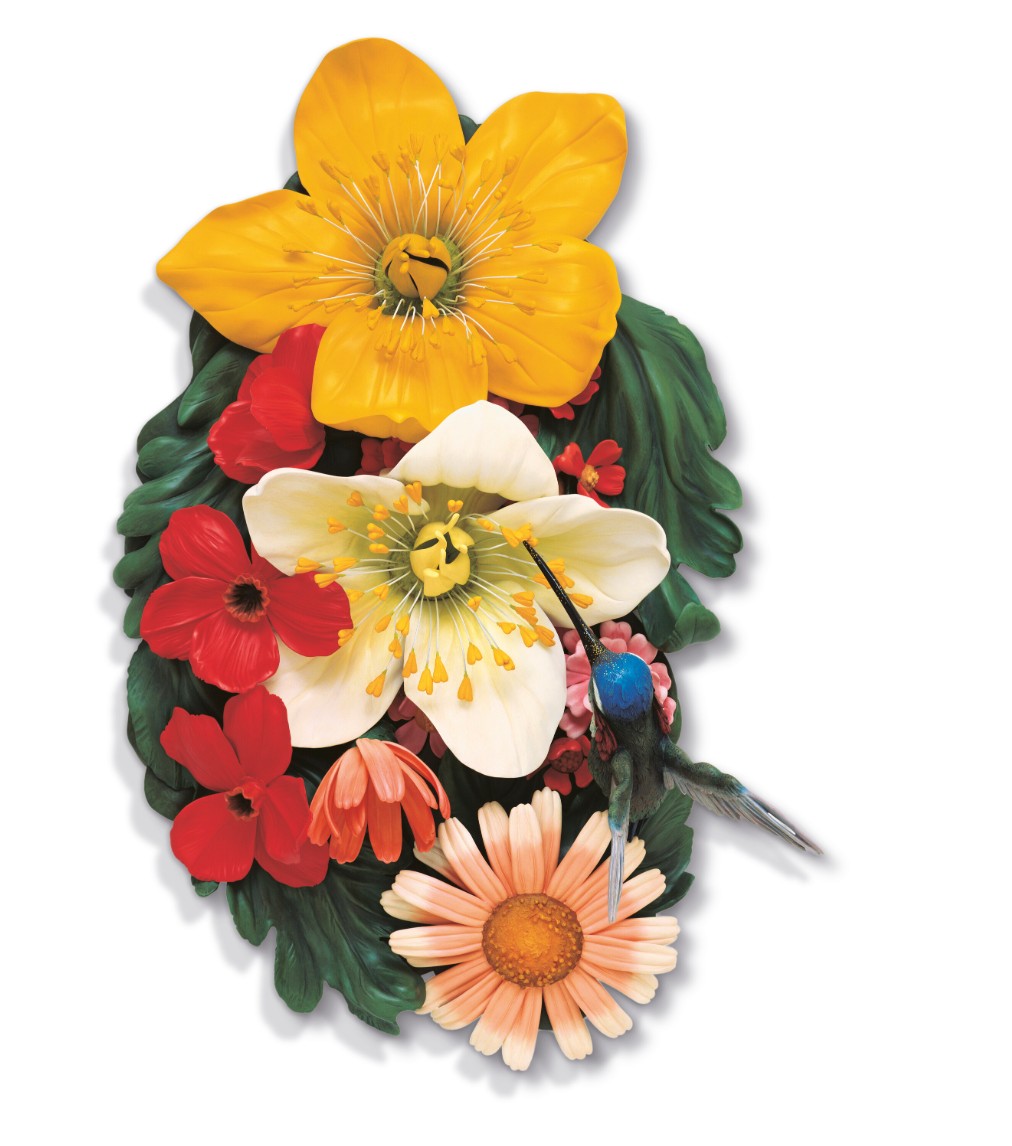
JEFF KOONS (B. 1955)
Wall Relief with Bird, 1991
Polychromed wood
72x50x27 inches (182.9 x 127 x 68.6 cm)
This work is number three from an edition of three plus one artist’s proof
A fertile bounty of lasciviously unfurling floral buds in full anthesis, Jeff Koons’s Wall Relief with Bird is an over life-size celebration of Edenic abundance. An important sculpture emerging from the artist’s notorious Made in Heaven series, the sculpture unifies motifs from Koons’s earliest sculptural works of 1979—his inflatable flowers and his wall-mounted appliances—to offer a vivid and tantalizing vision of his artistic universe.
“In Wall Relief with Bird there is a bird pollinating these large flowers. The imagery to me is about penetration. It’s also about fertility and pollination, and the eternal.”
One of Koons’s most quintessential masterpieces, the present edition has been exhibited in the artist’s seminal surveys and retrospectives including the Metropolitan Museum of Art and the Whitney Museum of American Art in New York as well as Tate Modern in London, while other editions of Wall Relief with Bird have been shown globally, from the Datar Museums in Doha, to Fondation Beyeler in Basel and the Louisiana Museum in Humlebæk.
Wall Relief with Bird is a high-relief polychrome wood sculpture with enticingly wrought veristic botanical and avian forms. Three voluptuous blossoming flowers align at the center of the composition—a yellow hibiscus at the top, followed by a white magnolia at the center with a delicate, pink daisy below. A blue hummingbird flutters around the central petal, its sharp beak just penetrating one of the flower’s anthers. Surrounding this central trio are several red and rose-colored flowers, all bound by grounding green leaves which surround the sculpture.
“I have always enjoyed flowers…
I always like the sense that a flower just displays itself.
The viewer always finds grace in a flower.
Flowers are a symbol that life goes forward.”
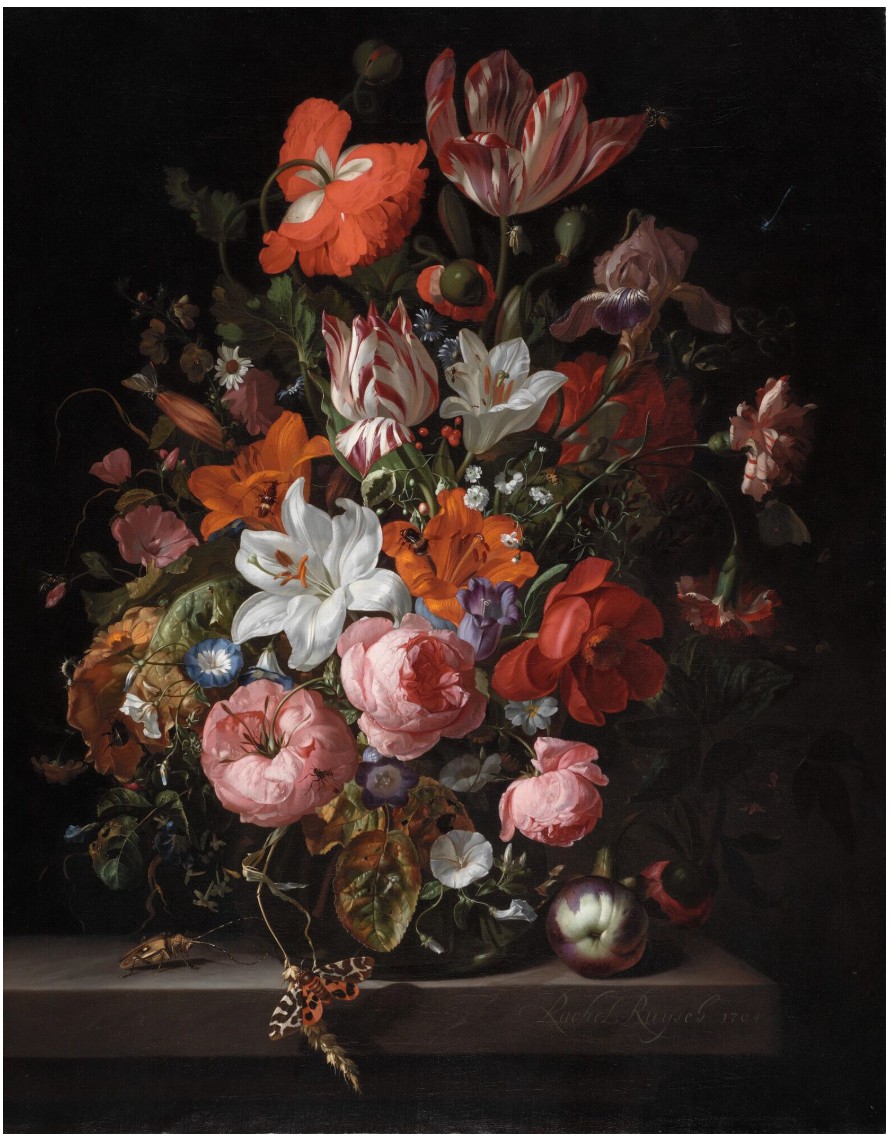
Rachel Ruysch, Flowers in a Glass Vase, 1704. Detroit Institute of Arts.
Wall Relief with Bird was first exhibited alongside the other works in the Made in Heaven series, where “panting little dogs were displayed alongside Murano glass figurines of the newlyweds in flagrante and sculptures of carved flowers with humanoid orifices, some in the midst of pollination by a hummingbird’s long bill” (S. Rothkopf, “No Limits,” in Jeff Koons: A Retrospective, exh. cat., Whitney Museum of American Art, New York, 2014, p. 25). This baroque spectacle functioned as a gesamtkunstwerk of painting and sculpture placing the viewer in the midst of an exuberant celebration of erotic passion between Koons and Ilona Staller, an Italian politician, model, and adult film star who married the artist the same year Made in Heaven was first exhibited.
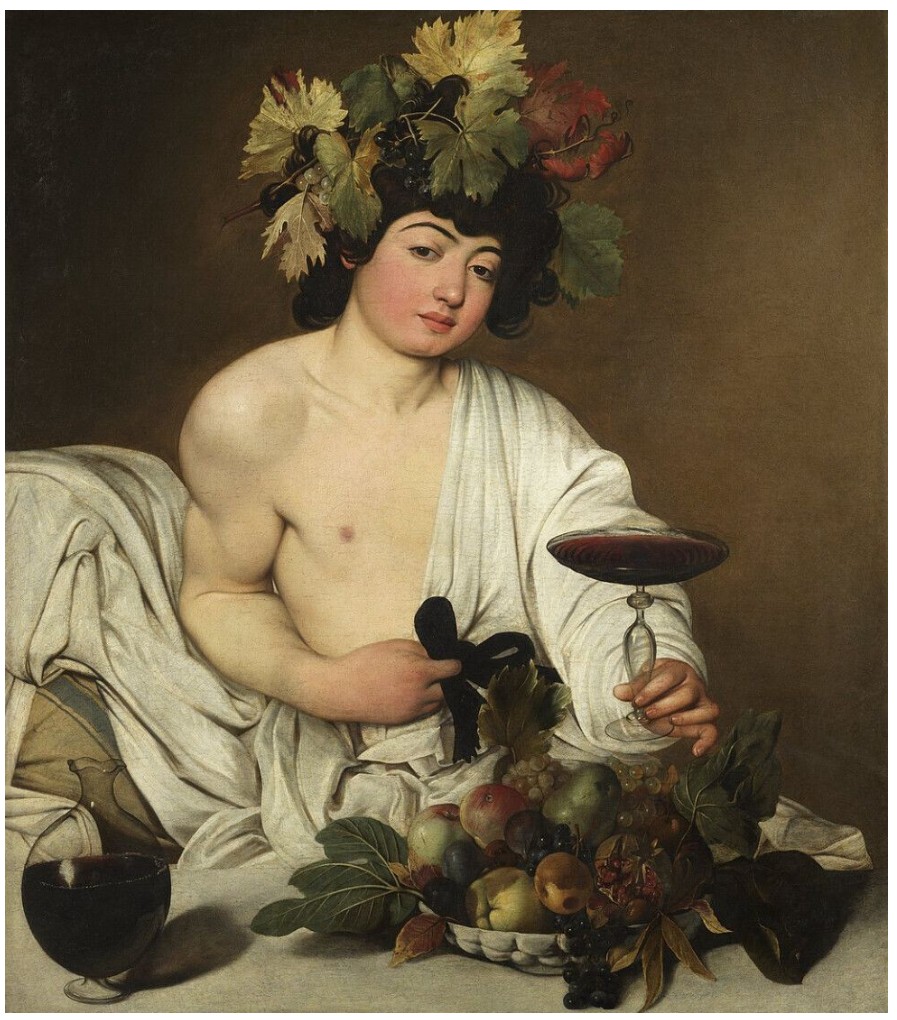
Caravaggio, Bacchus, circa 1598. Uffizi Gallery, Florence.
The floral elements which dominate Wall Relief with Bird have had outsized significance as an enduring motif throughout Jeff Koons’s oeuvre, commencing with his first artworks, the Inflatables.
“I used to make inflatable flowers, back in 1979. They were store-bought inflatables. I inflated them, put them on glass mirrors, and just let them display themselves. When I was younger, seven, eight, nine, taking lessons, I drew flowers. But there’s a tension in flowers—and especially in the vases of flowers—about whether they’re domesticated or undomesticated. In a vase, the flowers are cut. Even though they’re a symbol, like the Garden of Eden, of life and sexuality and abundance, when you start to look at them in a philosophical way, there is actually no hope, no future”
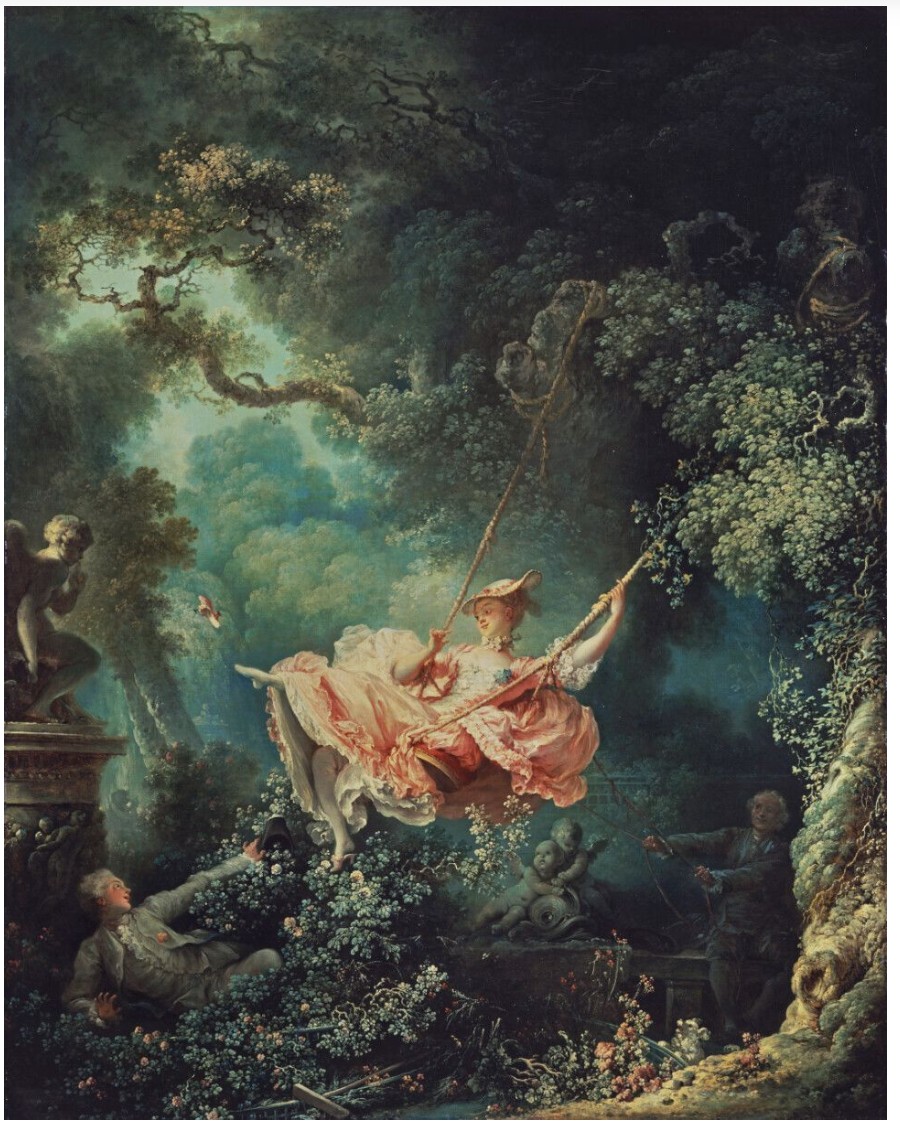
Jean-Honore Fragonard, The Swing (Les Hasards heureux de L’Escarpolette), 1767. Wallace Collection, London.
While his floral motifs emphasize the work’s stated themes of penetration, offering alluring orifices for the hummingbird’s beak to enter, Koons’s medium explores the theme of the eternal made explicit by the artist. Koons has elaborated how “wood is a material that churches have used a lot, therefore it is associated with spirituality. It is considered a living material” (J. Koons, quoted in ibid., p. 151). Koons had first started working with wood for Banality, the series prior to Made in Heaven, creating secular figurative sculptures which align with the baroque tradition of polychrome religious statuary. Koons had begun to explore the way the Catholic church employed art in European churches, developing a fascination for the Baroque and the Rococo while studying how religious art operated in institutional structures as a constant negotiation between object and worshiper.
“The church has used wood a lot to communicate to people that there’s a sense of continuation to life. It’s considered a living material, but it’s a seductive material.
It has a certain sense of warmth.”
The work operates like a religious altarpiece, aligning with what Renaissance art historian Alexander Nagel has written about Koons’s art: “Jeff Koons consecrates not just living beings but also ordinary things, and that is why when I look at his work I am always checking against the Christian relic cult” (A. Nagel, “Objects That Are Only Boundaries,” in Jeff Koons: A Retrospective, op. cit., p. 243).
Georgia O’Keeffe, Red Canna, circa 1924. University of Arizona Museum of Art, Tucson.
Channeling the traditional usage of his medium in religious settings, Koons creates with Wall Relief with Bird a sensuous masterpiece communicating an almost spiritual sense of eternity, whilst simultaneously elaborating upon the penetrative, erotic aspects which pervade the broader Made in Heaven series. Jeff Koons is one of the most impactful artists alive today, his constantly reinventive creative world reinterprets Duchamp, Dada, Surrealism, and Pop art for the contemporary age. One of his most evocative and multifaceted works, Wall Relief with Bird insightfully provides an unvarnished look into the celebratory nature of procreation while rejoicing in the eternal.
Poodle, 1991
Pauline Karpidas: The London Collection Evening Auction
Sotheby’s London: 17 September 2025
Estimated: GBP 1,000,000 – 1.500,000
GBP 2,358,000 / USD 3,219,475
Poodle | Pauline Karpidas: The London Collection Evening Auction | 2025 | Sotheby’s
JEFF KOONS (b. 1955)
Poodle, 1991
Polychromed wood
23 x 39 1/2 x 20 1/2 inches (58.4 x 100.3 x 52.1 cm)
Incised with the signature, dated ’91 and numbered 3/3 (on the underside)
This work is number 3 from an edition of 3 plus 1 artist’s proof
Irresistibly adorable and animated, Poodle encapsulates Jeff Koons’s career-long investigation into the complexities of objecthood and his ongoing challenge to conventional notions of taste, seduction, and consumerism in twentieth-century America. The sculpture forms part of his controversial Made in Heaven series, executed between 1989 and 1991. Pairing explicit self-portraits of the artist and his then-wife Ilona Staller (the adult-film star known as ‘La Cicciolina’) with more whimsical motifs such as animals and flowers, the series oscillates between the overtly sexual and the deceptively innocent. First shown at the Venice Biennale and later labelled ‘X-rated’ at its 1991 debut at Sonnabend Gallery, Made in Heaven cemented Koons’s position at the volatile crossroads of taste, taboo, and cultural spectacle. It also solidified his role as Duchamp’s postmodern heir—a provocateur attuned to the decadence of late 1980s America, a culture intoxicated by image, material excess, and the rituals of social aspiration.
“In Made in Heaven, I wasn’t trying to excite somebody sexually. I was trying to excite them intellectually. I tried to take the sexuality out of the images and to put them onto these objects, the flower pieces and the animals.”
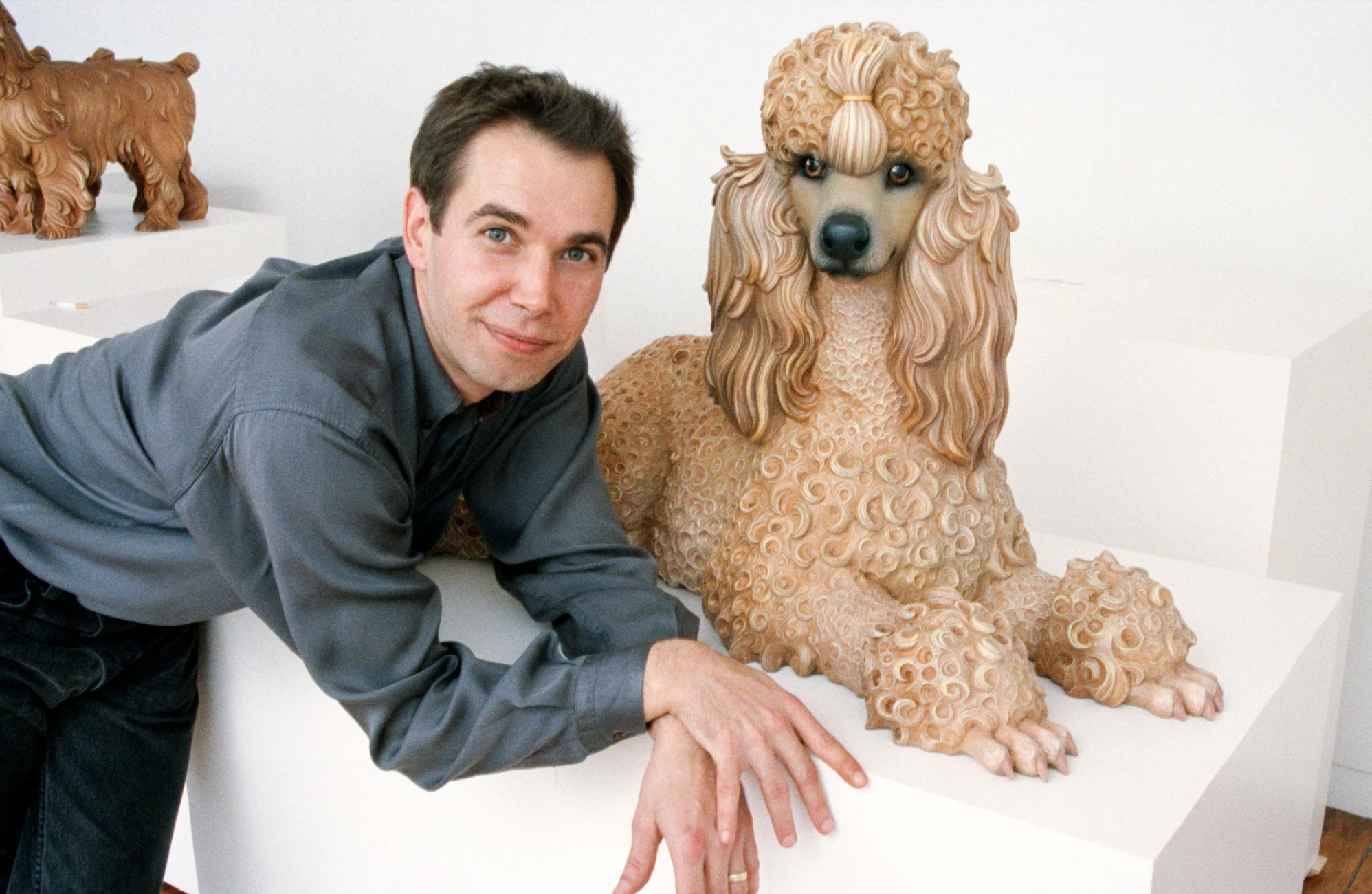
Jeff Koons with Poodle photographed at Made in Heaven, Sonnabend Gallery, New York, 1991 © Jeff Koons, Photo: © Bob Adelman Estate
Poodle is one of the wry, brilliantly deadpan sculptures that punctuate Koons’s larger-than-life Made in Heaven series, which included large-scale oil inks on canvas and sculptures in carved wood, marble, and glass. Its playful elegance offers a tender counterpoint to the surrounding eroticism; cloaked in innocence, the dog softens the spectacle of desire without quite disavowing it. Set against such brazen intimacy, Poodle reads as a meditation on our attachment to pets and ornaments—on the gentle comforts of the domestic and the disarming pull of cuteness. It traces the fine line between eroticism and aesthetic pleasure, showing how easily desire can slip from body to object. If the erotic tableaux elsewhere in Made in Heaven render sex as spectacle—lush, theatrical, and excessive—Poodle seduces more quietly. Beguiling and provocative, the animal stands apart for its direct gaze: where Koons and Staller often avert or obscure eye contact, Poodle meets the viewer head-on. Complete with a butter-yellow bow and meticulously rendered curls, the dog fixes us with glassy, exaggerated eyes, posed with the enigmatic stillness of a Baroque sphinx.
Audrey Hepburn in the 1954 film Sabrina © Paramount Pictures / Bridgeman Images
Once a utilitarian breed of working dogs, poodles came to embody the height of aristocratic decadence, particularly after Louis XVI declared them France’s national dog. Koons seizes on this transformation from gun dog to coiffed showpiece. By the time he created Poodle, the breed had become a visual shorthand for a particular kind of upper-class, urban femininity—an accessory of Park Avenue refinement and a fixture in the world of art collectors. The sculpture, then, operates as a double signifier: both dog and artwork serve as emblems of cultural capital that signal success, gentility, and class. As a pseudo-Pop artist, Koons reflects the tastes and aspirations of his audience back to them. But unlike Warhol, who drew his subjects from mass media and popular culture, Koons tailors his iconography to the elite—those who buy, collect, and consume contemporary art. In this sense, Poodle is both a seductive artefact and a subtle indictment, implicating its viewer in the very system it critiques.
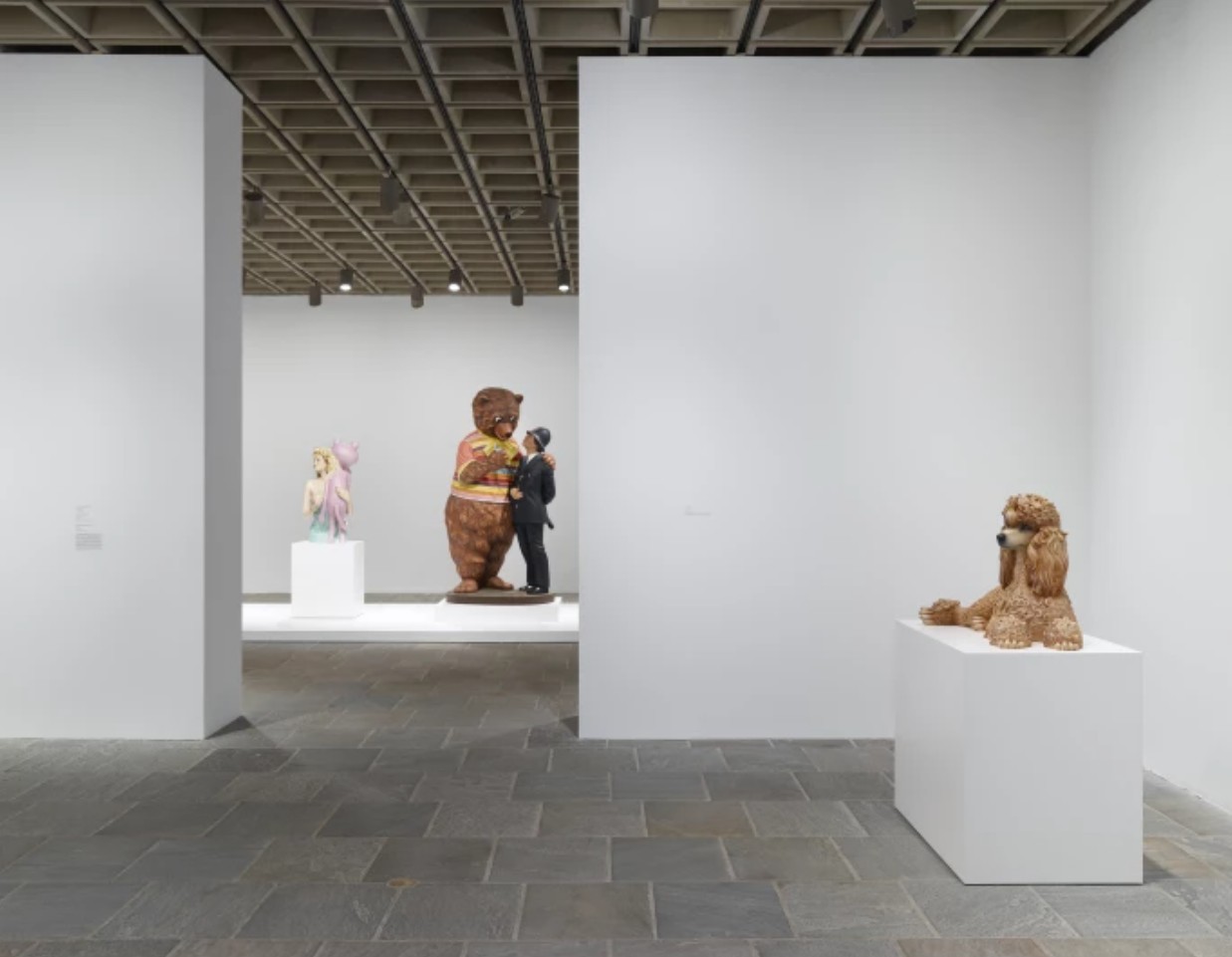
Poodle photographed at Jeff Koons: A Retrospective, The Whitney Museum of American Art, New York, 2014 © Jeff Koons
Photo: © Whitney Museum of American Art / Licensed by Scala
A polychrome sculpture that evokes porcelain tchotchkes or knick-knacks, Poodle is blown up to a surreal, life-size scale. This inflation of form and finish draws out a series of contradictions that lie at the heart of Koons’s practice. Too immaculate to dismiss as kitsch, yet too absurd to take entirely seriously, the work unsettles our assumptions about what an artwork should be. Its gaudy refinement—part Baroque heirloom, part decorative souvenir—presses against fixed hierarchies of value and taste, amplifying the uneasy space between excess and ornament, high art and high camp. In doing so, Poodle invites us to question not only its status as an object, but also the cultural codes through which objects accrue meaning.
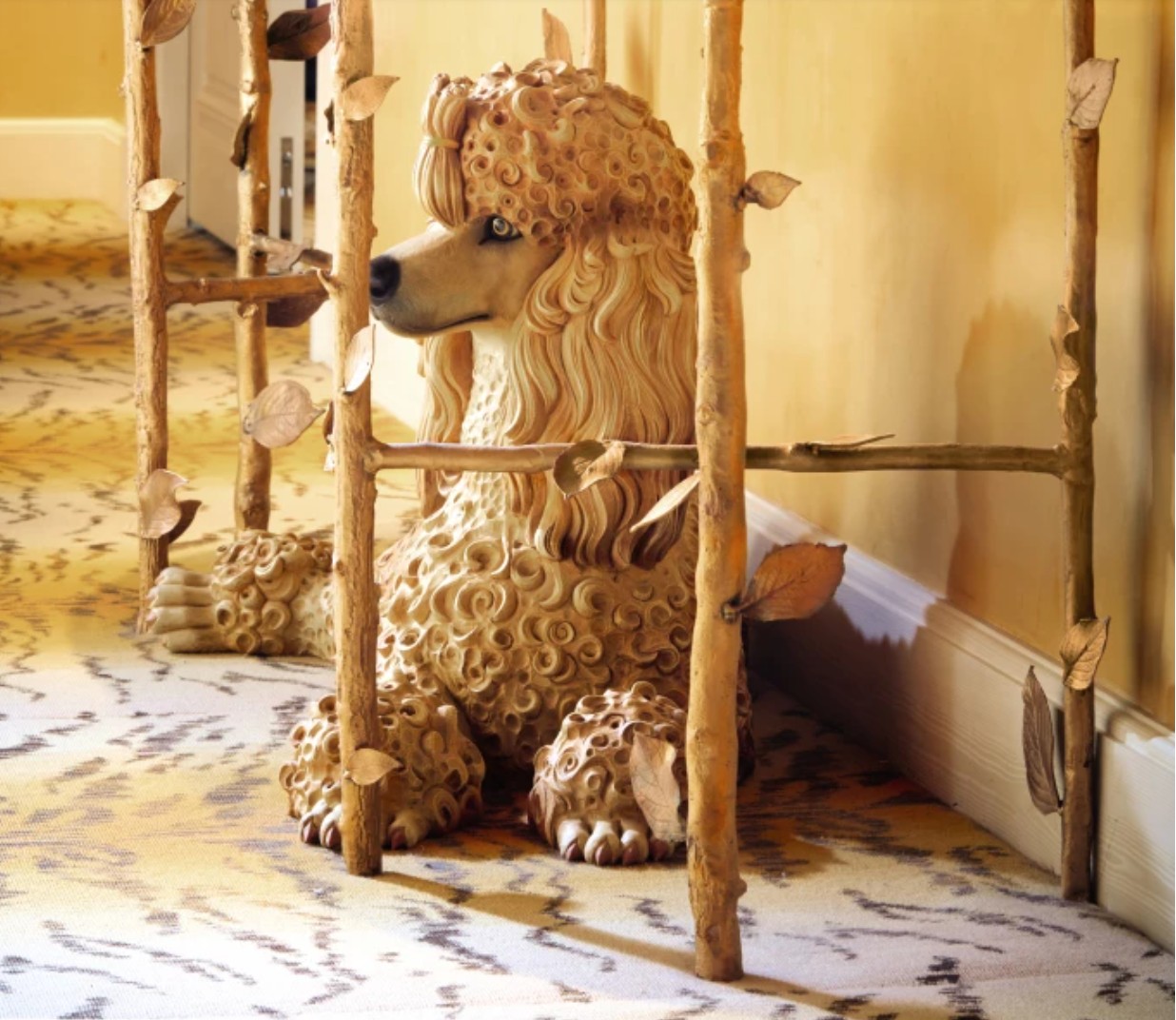
The present work shown in the London home of Pauline Karpidas
The use of polychromed wood underscores this tension. Not merely a nod to dime-store figurines, Koons’s choice of material conjures the grand tradition of Baroque sculpture, works famed for their devotional intensity and dazzling surface. Poodle revives this lineage with a knowing wink. Commissioned from master artisans in Southern Germany and Northern Italy, the sculpture’s lavish craftsmanship reflects an almost religious dedication to illusionistic precision. Every incision and flourish adheres to Koons’s exacting standards, blurring the line between reverent craftsmanship and industrial perfection. Like Duchamp’s Fountain, which transformed a urinal into high art through the force of the artist’s signature, Poodle appropriates the labor of others and rebrands it within the Koonsian lexicon. From his earliest series, such as Pre-New and The New (1979–83), in which household appliances were sealed inside Plexiglas vitrines, Koons has consistently probed the entanglements of objecthood, consumption, and desire. These early works, shaped by his time as a young employee at MoMA, responded directly to Duchamp’s readymades, filtered through the sleek aesthetics of twentieth-century mass production. But with the Banality and Made in Heaven series, Koons shifted toward a more complex model that preserved the Duchampian gesture while replacing the ‘found’ with the meticulously fabricated. In doing so, he did more than parody kitsch—he revived sculptural traditions, provoking us to rethink the boundaries between the handmade, the collectable, and the sacred.
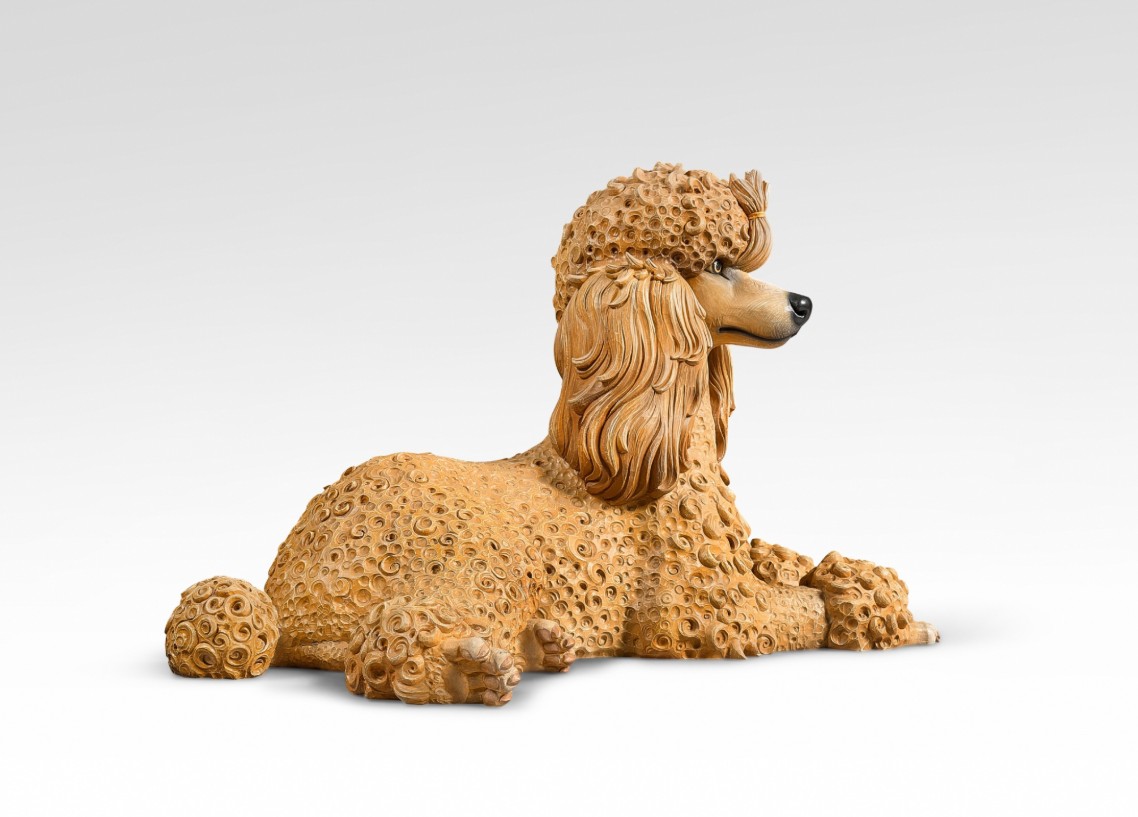
At once endearing and uncanny, Poodle crystallizes Koons’s broader project: to unsettle the boundaries between art and commerce, refinement and vulgarity, the sacred and the absurd. By fusing high craftsmanship with low iconography, and by deploying the language of devotion in service of the decorative, Koons invites us not just to look, but to question the cultural codes that shape value, taste, and desire. In doing so, Poodle emerges as both a dazzling object and a sharp conceptual gesture, one that encapsulates the artist’s enduring role in contemporary art history. Reflecting its importance, the work has featured in many of Koons’s most significant exhibitions, from his 1992 survey at the Stedelijk Museum in Amsterdam to his 2014 retrospective at the Whitney Museum of American Art in New York. Further testament to its stature, editions of Poodle reside in the permanent collections of both the Whitney and the Berardo Collection in Lisbon.
Large Vase of Flowers, 1991
Christie’s New-York: 21 November 2024
Estimated: USD 6,000,000 – 8,000,000
USD 8,230,000
JEFF KOONS (B. 1955), Large Vase of Flowers | Christie’s
JEFF KOONS (B. 1955)
Large Vase of Flowers, 1991
Polychromed wood
52x43x43 inches (132.1 x 109.2 x 109.2 cm)
This work is the artist’s proof from an edition of three plus one artist’s proof
As one of the world’s most celebrated contemporary artists, Jeff Koons has spent his career challenging our preconceptions and understanding of art. As part of this mission, his representations of flowers have become one of the artist’s most prolific and celebrated motifs. From the very beginning of his career Koons has used floral forms as a highly symbolic indicator of life.
“I have always enjoyed flowers. Since taking art lessons as a child, I have had flowers in my work. I always like the sense that a flower just displays itself. The viewer always finds grace in a flower. Flowers are a symbol that life goes forward.”
For Koons, there are strong parallels between man and flower, all of which course through the heart of his practice.
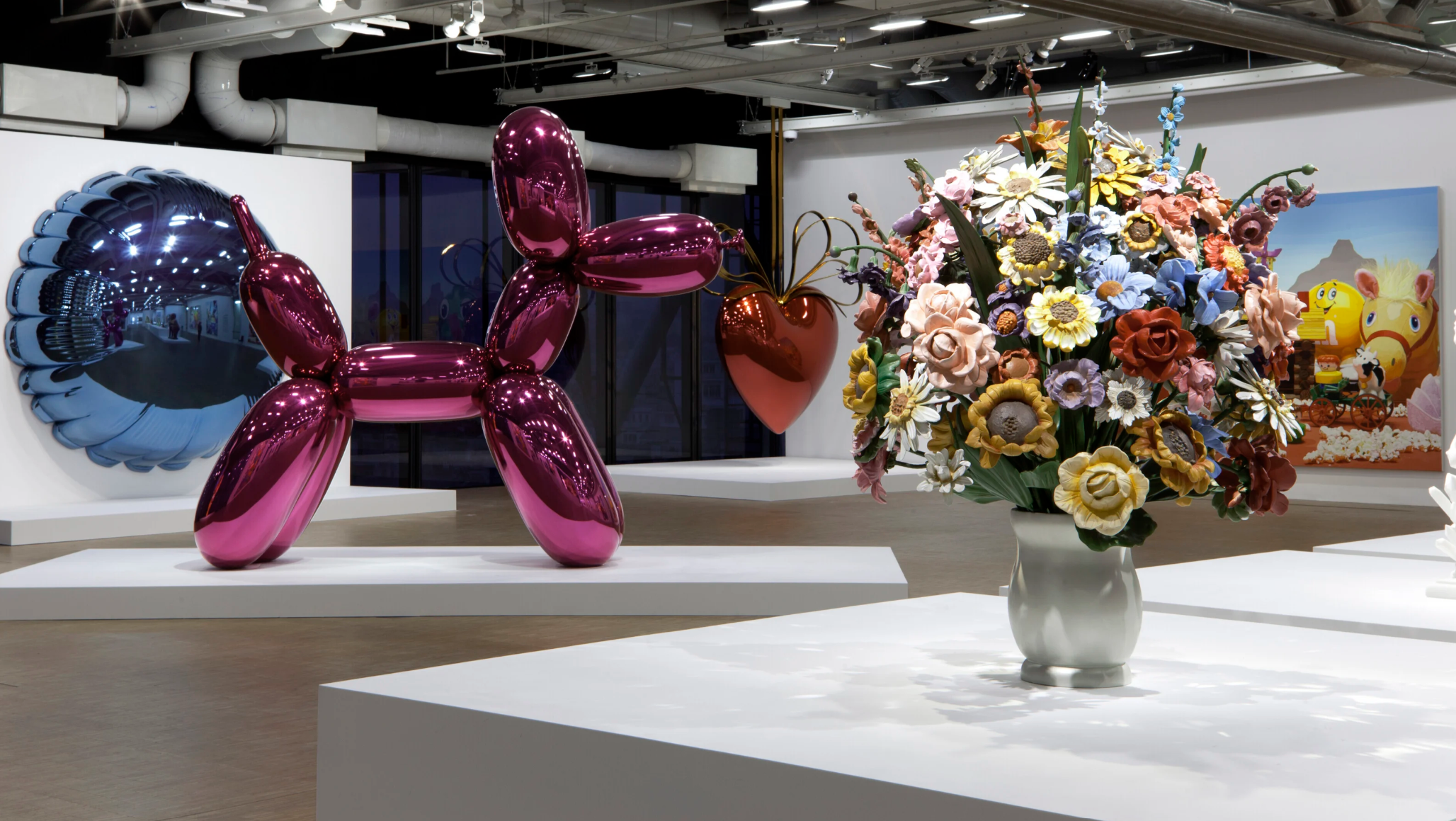
Installation view, Jeff Koons: A Retrospective, November 26, 2014 – April 27, 2015, Centre Pompidou, Paris (present lot illustrated). Artwork: © Jeff Koons.
Representing life, sex, fragility, fertility, joy, and banality, the symbol of the flower has become a powerful and compelling motif for the artist. From his early Inflatables and Statuary series to his stainless-steel Balloon Flowers and the 48-foot-high flower Puppy sculpture, no one emblem within the artist’s oeuvre more fully encapsulates these notions than the present work, his widely exhibited Large Vase of Flowers. In his typically direct and enigmatic manner, Koons describes his polychrome bouquet of spring flowers:
“In the Large Vase of Flowers there are 140 flowers.
They are very sexual and fertile…”
Executed in 1991, the vibrant, blossom-filled sculpture is an unassuming triumph of the artist’s now iconic Made in Heaven series.
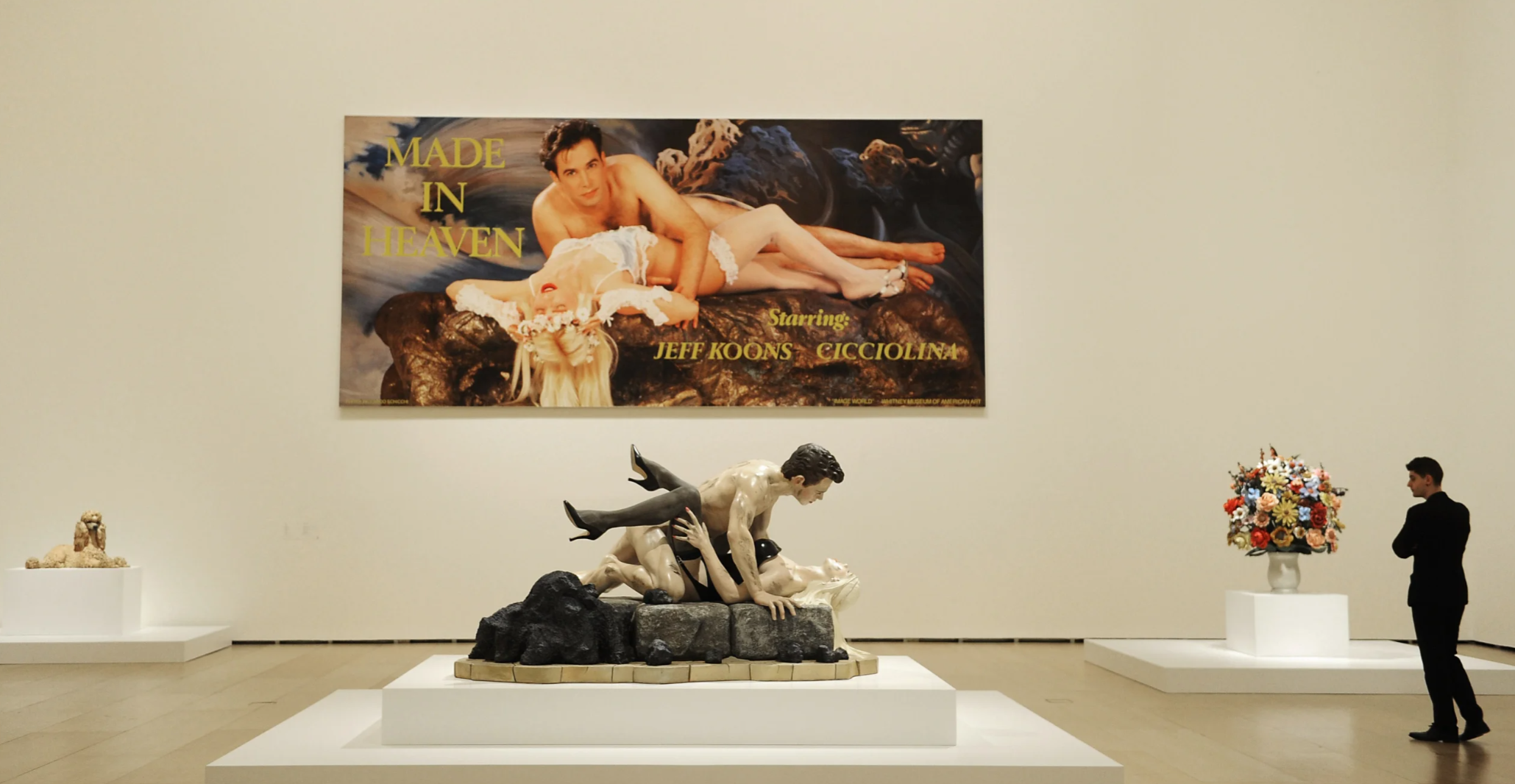
Installation view, Jeff Koons: A Retrospective, June 9 – September 27, 2015, Guggenheim Bilbao (present lot illustrated).
Photo: Ander Gillenea / AFP via Getty Images. Artwork: © Jeff Koons.
When the series debuted in 1991, at Sonnabend in New York and Max Hetzler in Cologne, Koons’s large paintings of himself with his then-wife were exhibited alongside polychrome sculptures of puppies, cherubs, birds, and flowers. These floral arrangements were the perfect subject matter for the artist’s exploration of the public perception of love, romance, and even sex: after all, they are often presented as a romantic gift or wishful preludes to procreation. And crucially, the very beauty of flowers depends on the natural processes by which they themselves reproduce. In Large Vase of Flowers, and in reality, that beauty is very clear for all to see.
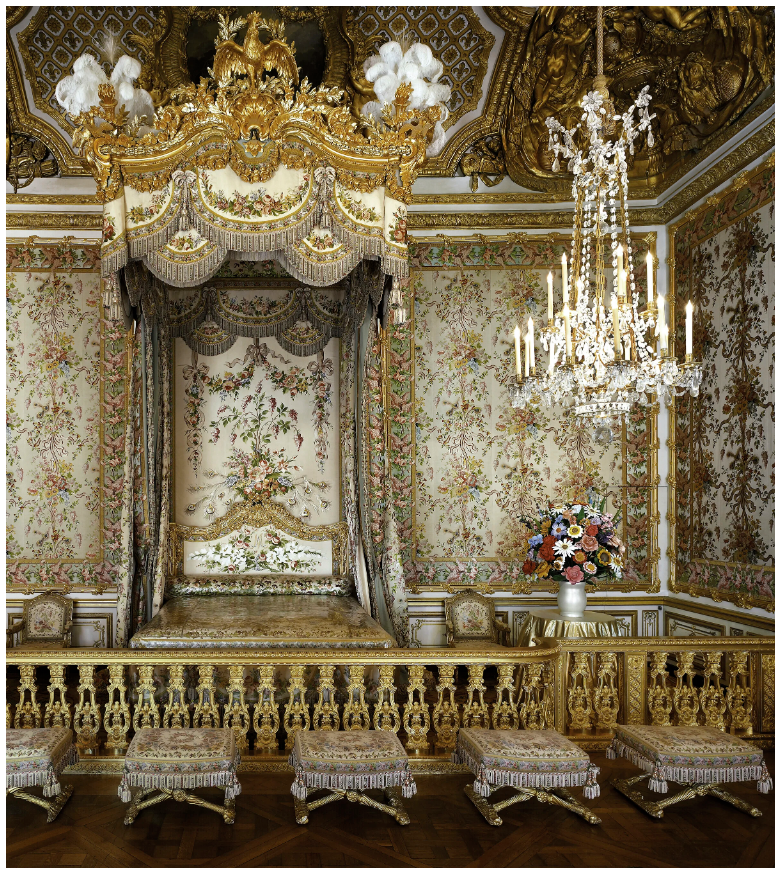
Installation view, Jeff Koons; Versailles, October 9, 2008 – April 1, 2009, Château de Versailles (present lot illustrated).
Artwork: © Jeff Koons.
“In Made in Heaven, I wasn’t trying to excite somebody sexually. I was trying to excite them intellectually. I tried to take the sexuality out of the images and to put them onto these objects, the flower pieces and the animals.”
Within the context of the wider Made in Heaven series, the winsome and vibrant Large Vase of Flowers serves as the perfect foil to Koons’s corporeal images, showcasing the beauty and vitality of sex. Thus, with his customary panache, Koons entices his audience to throw fig-leaves and shame back into the Garden of Eden—to discard the entire notion of original sin. With its Baroque styling, the Made in Heaven series casts sex as a form of worship, a way of both celebrating and continuing life.
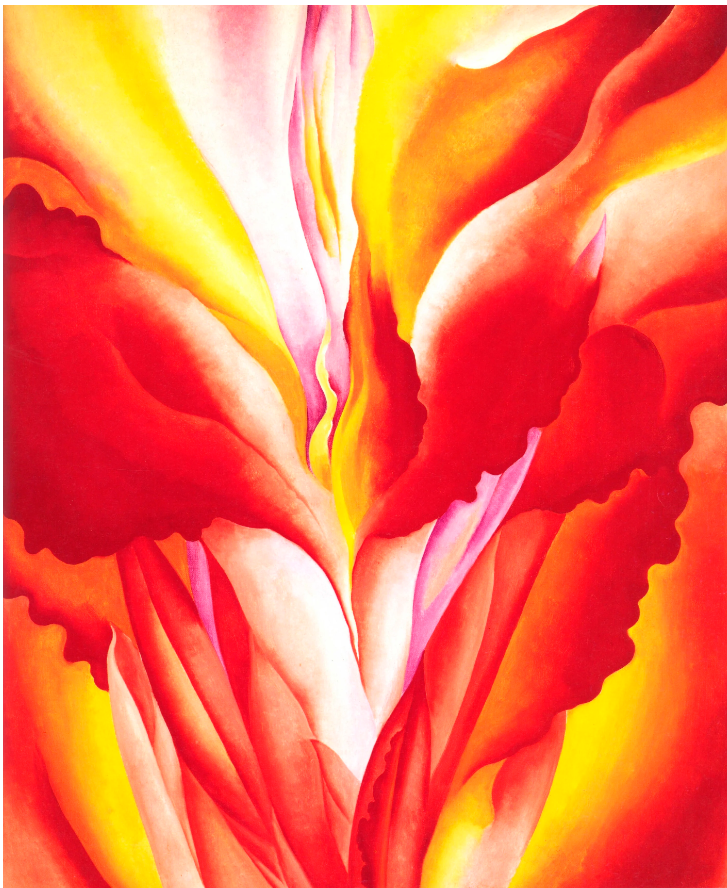
Georgia O’Keeffe, Red Canna, c. 1924. University of Arizona Museum of Art, Tucson.
© 2024 Georgia O’Keeffe Museum / Artists Rights Society (ARS), New York.
Stepping away from contemporary conventions, this sense of liberation that Large Vase of Flowers possesses comes in part from the awe-inspiring grandeur evocative of either the paintings of the Dutch Golden Age or the later elaborate eighteenth-century European art that has traces throughout the series. From the idyllic sets to the painted wood sculptures, Made in Heaven summons Baroque aesthetics and decoration.
“I use the Baroque to show the public that we are in the realm of the spiritual, the eternal. The church uses the Baroque to manipulate and seduce, but in return it does give the public a spiritual experience. My work deals in the vocabulary of the Baroque.”
Underscoring this notion, Large Vase of Flowers, and its sister-sculptures, continues a method of production first utilized by Koons one year earlier in his Banality series. Banality marked the first time wherein the artist created a series of sculptures that did not depend entirely on ready-made objects. Instead, Koons worked with a team of artisans—he refers to them as “fabricators”—from Southern Germany and Northern Italy who had been mastering their craft for generations, in order to imbue his works with the spirituality that he aimed to achieve. It is this practice that Koons embarked upon over 30 years ago that largely informs his studio practice today.
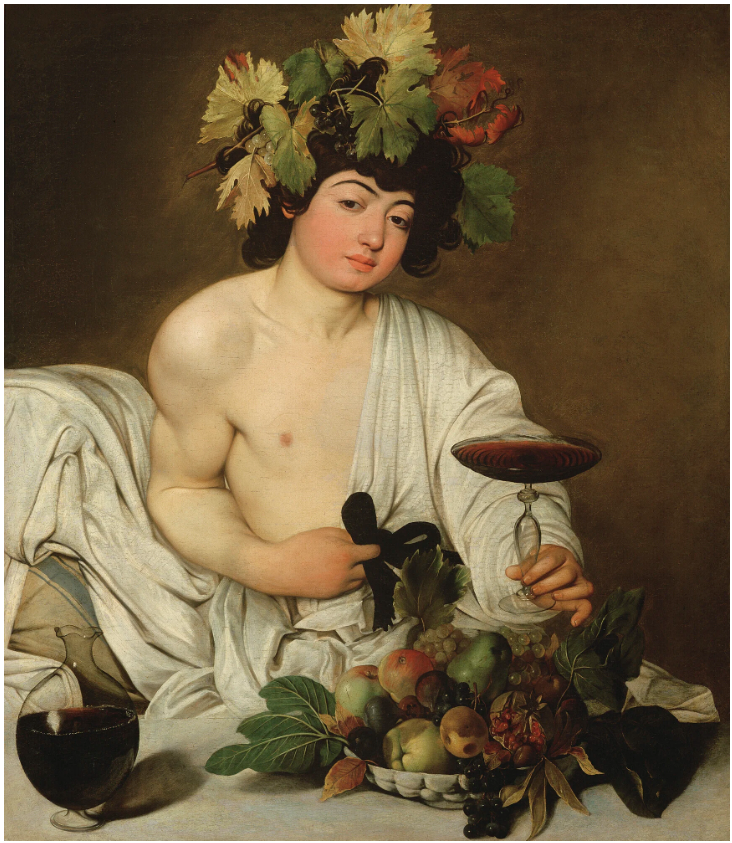
Michelangelo Merisi da Caravaggio, Bacchus, circa 1596. Galleria degli Uffizi, Florence.
Photo: Galleria degli Uffizi, Florence, Tuscany, Italy / Bridgeman Images
With artistic direction from Koons, the polychrome wood sculptures in Made in Heaven were crafted in Oberammergau, Germany and Ortisei, Italy, two locations known for their centuries-old woodcarving traditions. And, while the use of skilled sculptors worked to elevate the thematic content of the series, it also ensured that Koons’s sculptures were hand carved and painted to the highest degree of perfection, allowing his idea to take the most exacting form. The year after Large Vase of Flowers was created, Koons unleashed his famous Puppy to the world. Koons recalled of the time leading up to the execution of the monumental canine.
“I became aware of those floral sculptures of Northern Italy and Bavaria. So I thought, Oh, it would be nice to make a living work, a work that shows the lifecycle just like an individual.”
While Puppy would rely on living flora, Large Vase of Flowers takes new life from flora that has passed, resurrected and reincarnated as an ever-blooming bouquet.
Cherubs, 1991
Phillips London: 2 March 2023
Estimated: GBP 500,000 – 700,000
GBP 482,600 / USD 576,710
Jeff Koons – 20th Century & Contempora… Lot 16 March 2023 | Phillips
JEFF KOONS
Cherubs, 1991
Polychromed wood, in 2 parts
121.9 x 110.5 x 48.3 cm (47 7/8 x 43 1/2 x 19 inches)
Inscribed with signature, number and date ‘3/3 91 J FUX’
An art-world provocateur, Jeff Koons has been no stranger to controversy during his four-decade career, infamous for his ‘pagan monuments to mass-culture triviality’ as much as his flirtation with large-scale spectacle in a multi-media age. However, unlike other artists with works that are controversial, Koons insists that the shock and sensation provoked by some of his more infamous pieces are not intentional, his aims being more closely aligned to notions of acceptance and affirmation. No body of work speaks more clearly to these tensions than his Made in Heaven series, which moves between hardcore pornographic imagery and kitsch, encompassing sculptural depictions of flowers, pet dogs, and cherubs with more sexually explicit works of the artist and his then wife, the adult film star Ilona Staller.
Brash and unapologetic, Made in Heaven was first announced in 1989 with the appearance of a giant billboard at various sites across New York, styled like a promotional still from a feature film featuring a nude Koons draped across his prone wife as painterly waves crash suggestively behind them. Installed as part of the Whitney Museum of American Art’s Image World exhibition, the billboard’s blend of kitsch aesthetics and eroticism set the tone for the series to come, which created an immediate sensation following its inaugural presentation at La Biennale di Venezia in 1990 and in Koons’ hotly anticipated solo show at the Sonnabend Gallery in New York the following year.
Banality Series
Jeff Koons’ series of large polychrome wood and porcelain sculptures titled Banality demonstrates his ability to create contemporary objects of desire; seductively bizarre and deeply coveted. The Banality series included toy-inspired objects, slightly altered and enlarged to abnormal size. Like much of Koons work, these pieces have sexual connotations that are sometimes amusing and at other times unsettling.
“Banality was about communicating to the bourgeois class. I wanted to remove their guilt and shame about the banality that motivates them and which they respond to…to embrace their own history so that they can move on and actually create a new upper class instead of having culture debase them.”
In the Banality series, Koons creates strange combinations of opposites, in particular, the wedding of “high” and “low” through choice of subject and technique. Like Marcel Duchamp and Andy Warhol before him, Koons employs everyday objects as the impetus for his art, but he chooses objects that are already approaching art and transforms them. Koons executes his works to the standards of the Renaissance masters demanding utter perfection from his studio of artisans and craftspeople. The pain-staking efforts to master traditional materials in unprecedented scale and therefore complexity set Koons apart.
Ushering in Banality, 1988
Christie’s New-York: 9 March 2023
Estimated: USD 2,500,000 – 3,500,000
USD 3,900,000
BANALITY SERIES
JEFF KOONS (B. 1955) (christies.com)
JEFF KOONS (B. 1955)
Ushering in Banality, 1988
Polychromed wood
38x62x30 inches (96.5 x 157.5 x 76.2 cm)
Incised with the artist’s signature, number and date ‘Jeff Koons 3/3 88’ (on the underside)
This work is number three from an edition of three plus one artist’s proof
Popples, 1988
The Macklowe Collection
Sotheby’s New-York: 16 May 2022
Estimated: USD 1,500,000 – 2,000,000
USD 3,922,000
BANALITY SERIES
Popples | The Macklowe Collection | | Sotheby’s (sothebys.com)
JEFF KOONS (b.1955)
Popples, 1988
Porcelain
29 1/4 x 23 x 12 inches (74.3 x 58.4 x 30.5 cm)
Signed and numbered 1/3 on base
This work is number 1 from an edition of 3 plus one artist’s proof
Jeff Koons’s porcelain Popples sculpture, conceived in 1988 as part of his Banality series, is a witty and subversive example of the artist’s celebrated brand of critical post-Modernism. Koons’s Banality series, consisting of twenty sculptures based on a wide range of images inspired by pop culture motifs as well as Renaissance and Baroque art, was widely publicized through a series of exhibitions and picture ads in respected art journals, and catapulted Koons to stardom on the international art scene. Each source image is reinterpreted and recontextualized to be made unfamiliar in a new and symbolic material; the present work for instance is crafted from artisanal porcelain, a once-rarified material that has become a mainstay of bourgeois taste. Based on a popular 1980s toy, Popples is a seemingly deadpan quotation of a common consumer object, yet through Koons’s clever manipulation, becomes a comment on childhood innocence, mass culture, and the very nature of art. The intense craftsmanship questions the perceived boundaries and notions of taste that were seen to define “high” and “low” culture. Popples thus represents a culmination of the many layers and signature themes that have come to define Koons’s oeuvre, including his peerless ability to interrogate the very nature of art.
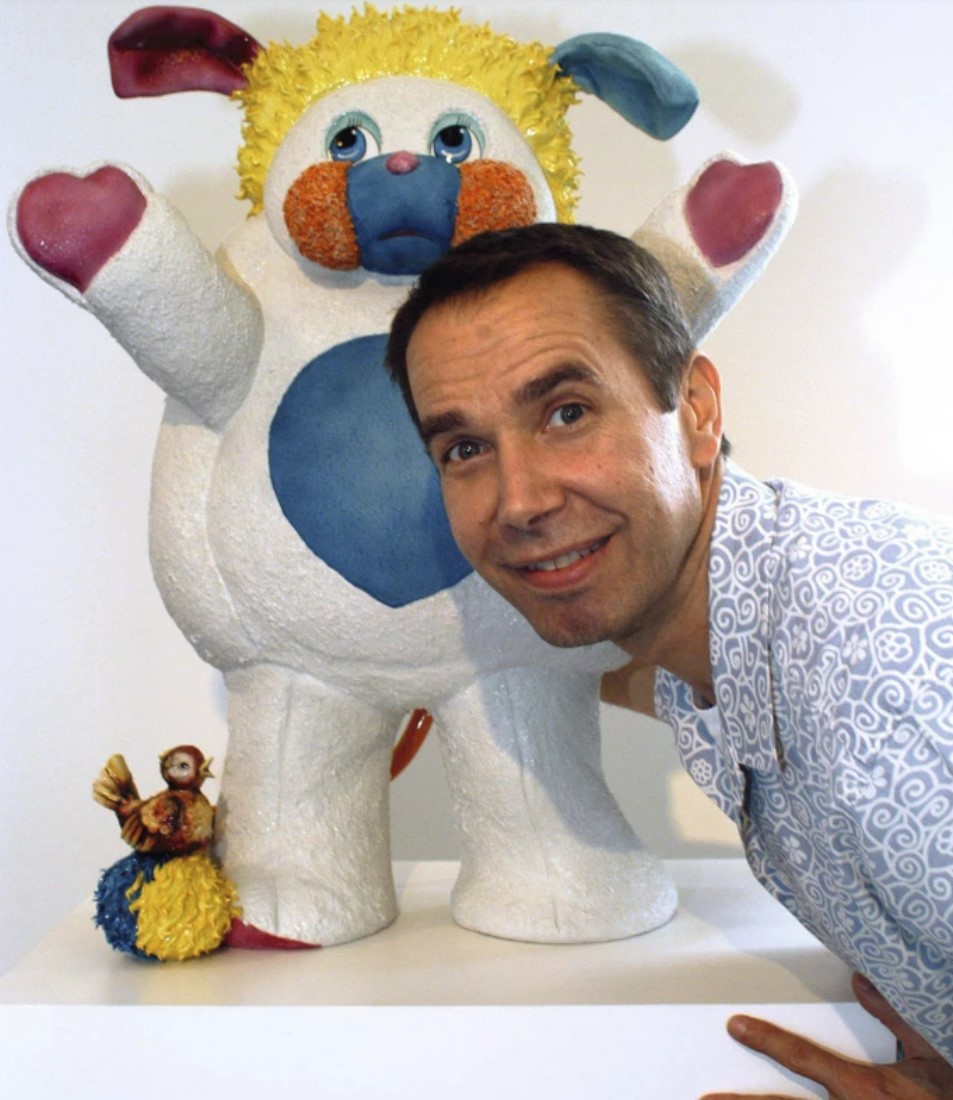
JEFF KOONS WITH POPPLES, GALERIE DER GEGENWART, 2003. PHOTO: DPA PICTURE ALLIANCE / ALAMY STOCK PHOTO
The original Popples characters represented icons of innocence, and the intentionally appealing, cuddly plush toy quickly gained mass popularity for its saccharine sweetness. It was this overtly pleasing appeal that attracted Koons: “The world of peluche animals–peluche means soft in French–is for me a dialogue, a negotiation between the animate and the inanimate. They take on the stance of receiving love. A peluche doesn’t desire to be loved. It doesn’t look `Love me!’ but teases `Love me.’ For if it did not automatically receive love, you would throw it away.” (Angelika Muthesius, Jeff Koons, Cologne, 1992, p. 25) Here, the fluffy and pliant plushie is transformed in the cool, hard material of porcelain, with a highly polished sheen. The bright yellow hair, which should be soft to the touch, is instead rendered in stiffly pointed porcelain spikes, and its stiff, frozen stance is the antithesis to its ostensibly huggable form. Underscored by the fragility of its material, the porcelain Popples is an untouchable, uncanny rendering. As noted by writer Adam Gopnik of the Banality works, “Koons’s sculptures shock not because of their intellectual message but because of their physical presence. The contours of each piece are as chubby as Disney drawings, but their execution seems glacially slow, and they are, above all, hard.” (Adam Gopnik, “The Art World: Lost and Found,” The New Yorker, 20 February 1989, p. 107)
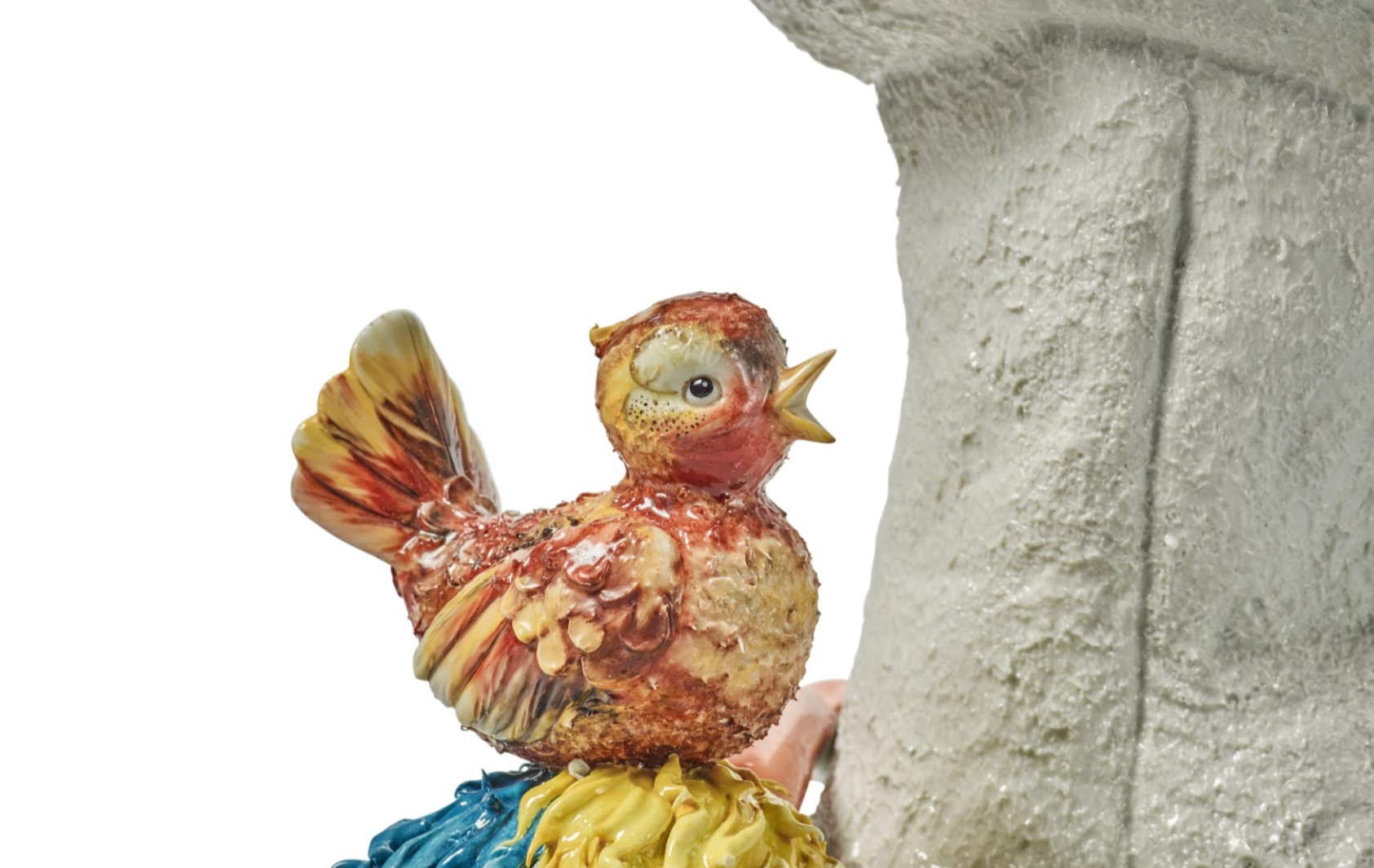
Handmade by renowned Italian craftsmen in the highest quality porcelain, Popples is flawlessly and meticulously executed in immense detail. The choice of medium introduces an element of cognitive dissonance, as the painstakingly recreated plushie is so intricately accurate as to appear hyper-real: the variegated enamel surface precisely imitates the tiny pills of polyester fiber that make up the bunches of fur on the toy version.
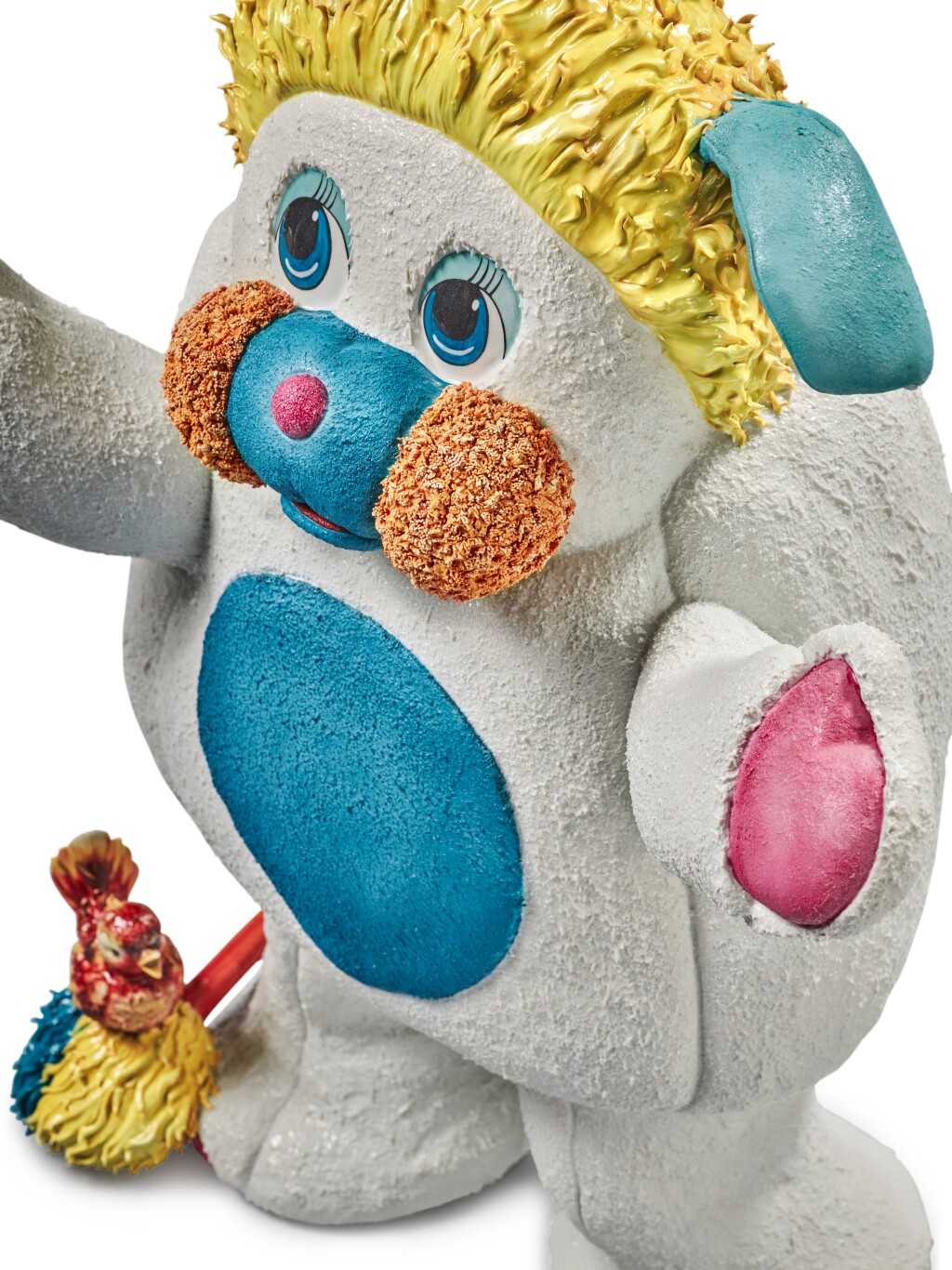
Further, Koons’s use of artisanal porcelain reveals a vein of socioeconomic subversiveness that runs throughout his oeuvre. Historically, porcelain was a rarified material requiring highly refined skill and craftsmanship to produce and, as a result, was typically available only to the wealthy and aristocracy. However, in the latter half of the twentieth century, new industrial and mechanized modes of production made porcelain far more commercial and readily available to the masses. With the rare exception of the remaining fine artisans of the type employed by Koons, the quality of exquisite porcelain was mostly lost, and has instead become a relatively cheap and easily produced material used in ordinary objects of mass consumption like figurines and knick-knacks. Through its history, then, porcelain has embodied both the rococo and the kitsch, luxurious and cheap; as Koons explains of the Banality pieces, “When I work with porcelain it is to meet people’s social and economic needs, so that they can feel that they can be kings and queens for the day.” (The artist quoted in Angelika Muthesius, Ibid., p. 26) In its nature as an object of “high” exquisite craftsmanship portraying a subject of “low” popular culture, Popples therefore embodies the contradictory history of its medium.
Lobster
Even though we are well aware Lobster is not a defining series of the artist’s oeuvre, we found appropriate to present some of the works recently sold along that theme under that title.
Lobster Log, 2003-2012
Phillips New-York: 14 November 2023
Estimated: USD 1,000,000 – 1,500,000
USD 1,270,000
Jeff Koons – 20th Century & Contemp… Lot 58 November 2023 | Phillips
JEFF KOONS
Lobster Log, 2003-2012
Polychromed aluminum, wood, stainless steel and coated steel chain
42 x 56 1/8 x 42 inches (106.7 x 142.6 x 106.7 cm)
Chain length variable
This work is number 1 from an edition of 3 plus 1 artist’s proof
With his characteristic playfulness, Jeff Koons creates an assemblage of art history and personal memory in Lobster Log, 2003-2012. The work is a cadavre-exquis made of polished aluminum, wood, and steel, consisting of the front half of a lobster-shaped pool toy, a tubular pool float, and a log in place of a tail. Suspended from the ceiling by a red chain, it is as if Lobster Log swims through the air, wearing a pool floatie through a sea of Surrealist references and Koons’s own artistic motifs. Inflatables have been a staple of Koons’s art practice for decades, since the artist’s first Inflatables series of the late 1970s, which placed inflatable vinyl toys in dialogue with mirrors. Later bodies of work have brought inflatable and mirror together in one object; the artist’s famous sculptures in the forms of inflatable objects—toys, pool floats, and balloons—reflect the viewer and their surroundings in their highly-polished painted steel surfaces. Lobster Log is a trompe l’oeil inflatable object—or rather, an assemblage, in the absurdist lineage of Marcel Duchamp, that merges transformed readymades and everyday objects in unexpected combinations.
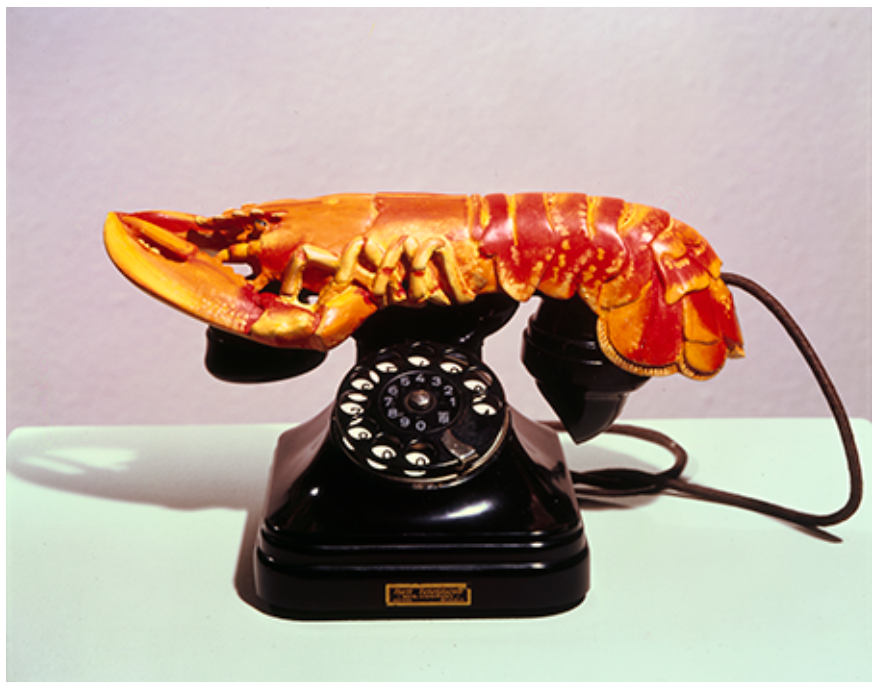
Salvador Dalí, Lobster Telephone, 1938. Tate Modern, London. Image: © Tate, London / Art Resource, NY, Artwork: © 2023 Salvador Dalí, Gala-Salvador Dalí Foundation / Artists Rights Society (ARS), New York
Lobster Log belongs to Koons’s Popeye series, a body of work named for the macho comic strip character, Popeye the Sailor Man, and defined by its pool party iconography and assemblage technique. Koons explains that, for the Popeye series, he chose to combine pool floats with readymade objects (such as the log in the present work) in order to “give the inflatable a cultural history… a sense of a past, something to have a relationship with.” Given that Koons views inflatables as anthropomorphic objects, it follows that the inflatable’s cultural past in Lobster Log aligns with Koons’s own childhood memories and art historical influences. As a child growing up in Philadelphia, Koons encountered Duchamp’s assemblage and readymade work at the Philadelphia Museum of Art by the age of seven. He also recalls the pool float as a “liberating” object from about the same time in his childhood, as it enabled him to swim without his parents’ assistance. However, Koons troubles a directly nostalgic reading of Lobster Log in material terms, as, by casting his lobster and inner tube in aluminum, he “liberates” them from any practical floating ability—Lobster Log would sink at any pool party, and yet, Koons suspends the object in midair. The viewer confronts this cognitive dissonance in the bold installation of Lobster Log.
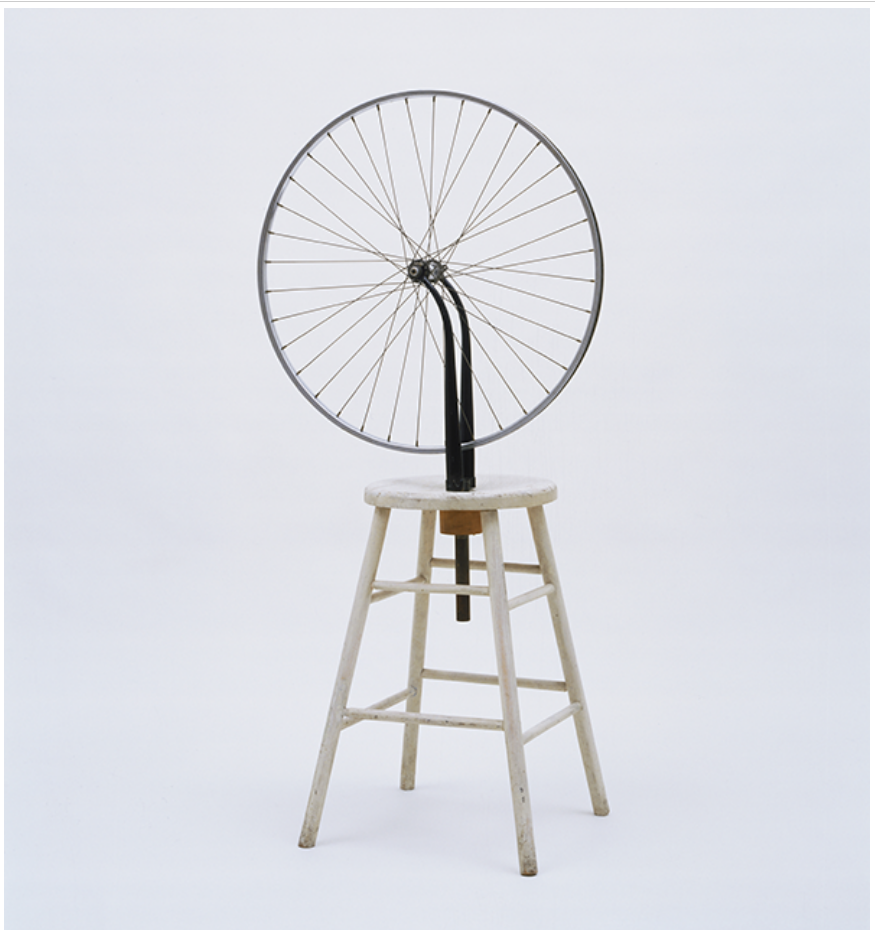
Marcel Duchamp, Bicycle Wheel, 1913 (1951). The Museum of Modern Art, New York. Image: © The Museum of Modern Art/Licensed by SCALA / Art Resource, NY, Artwork: © 2023 Association Marcel Duchamp / ADAGP, Paris / Artists Rights Society (ARS), New York
A sole reading of childhood innocence and play, however, stands in contrast with Koons’s assertion that “there is a huge sexual fetish thing on the Web for pool toys.” The lobster, too, is a sexually charged object in Koons’s interpretation, and so its presence as a pool toy in Lobster Log is doubly loaded. For Koons, the lobster, itself an aphrodisiac dish, is a symbol of both male and female sexuality. He explains that the creature’s arms are “very strong, but they could be fallopian tubes and its body could be the womb. If you look at its tail, it’s almost like a stripper with a boa doing a feather dance, and also has tentacles that look like Dalí’s mustache. “Salvador Dalí, one of Koons’s favorite artists, and a direct artistic antecedent to the Popeye series, used the lobster as a symbol of erotic desire in his work. Lobster Log perhaps most closely parallels Dalí’s absurdist assemblage, Lobster Telephone, 1938, in which, as Terry Riggs wryly notes in his description of the piece for the Tate Modern, “the crustacean’s tail, where its sexual parts are located, is placed directly over the mouthpiece.” Like Duchamp and Dalí before him, Koons is aware of the seductive power of the fetish object—in both the sexual and consumerist connotations of the term. Lobster Log fuses multiple, overlapping meanings of desire, freedom, and play together in one object; the Popeye work is a keen deployment of what Arthur C. Danto—with Duchampian punning—calls Koons’s “Pop-eye.”
Lobster, 2007-2012
Christie’s New-York: 9 May 2022
Estimated: USD 3,500,000 – 5,500,000
USD 3,780,000
JEFF KOONS (B. 1955) (christies.com)
JEFF KOONS (B. 1955)
Lobster, 2007-2012
Mirror-polished stainless steel with transparent color coating
57 7/8 x 18 7/8 x 37 inches (147 x 47.9 x 94 cm)
Signed, numbered and dated ‘J. Koons ’07-’12 3⁄3’ (on the underside)
This work is number three from an edition of three plus an artist’s proof
Jeff Koons is one of today’s preeminent champions of the Pop aesthetic, and an interrogator of nostalgia and consumerism in equal measure. His triumphant use of everyday objects that bring to light deeper issues of mortality, commerce, and the inner workings of the art world stems from an innate ability to combine seemingly innocent objects with deeper connections to the human condition. Lobster is a lustrous example of Koons’s so-called inflatables which marry kitsch with conceptual depth. Connecting his series of steel-clad pool toys with a larger idea.
“I think of the inflatables as anthropomorphic, we are ourselves inflatables, we take a breath, we expand; we contract, our last breath in life, our deflation”
The original objects inflate and deflate as air is drawn in and out, just as a person breathes until they cannot; they are both are temporary and changeable. Lobster is an impervious duplicate, its steel skin cannot deflate and thus it rises above the ordinary into a sculptural plane beyond the temporal.
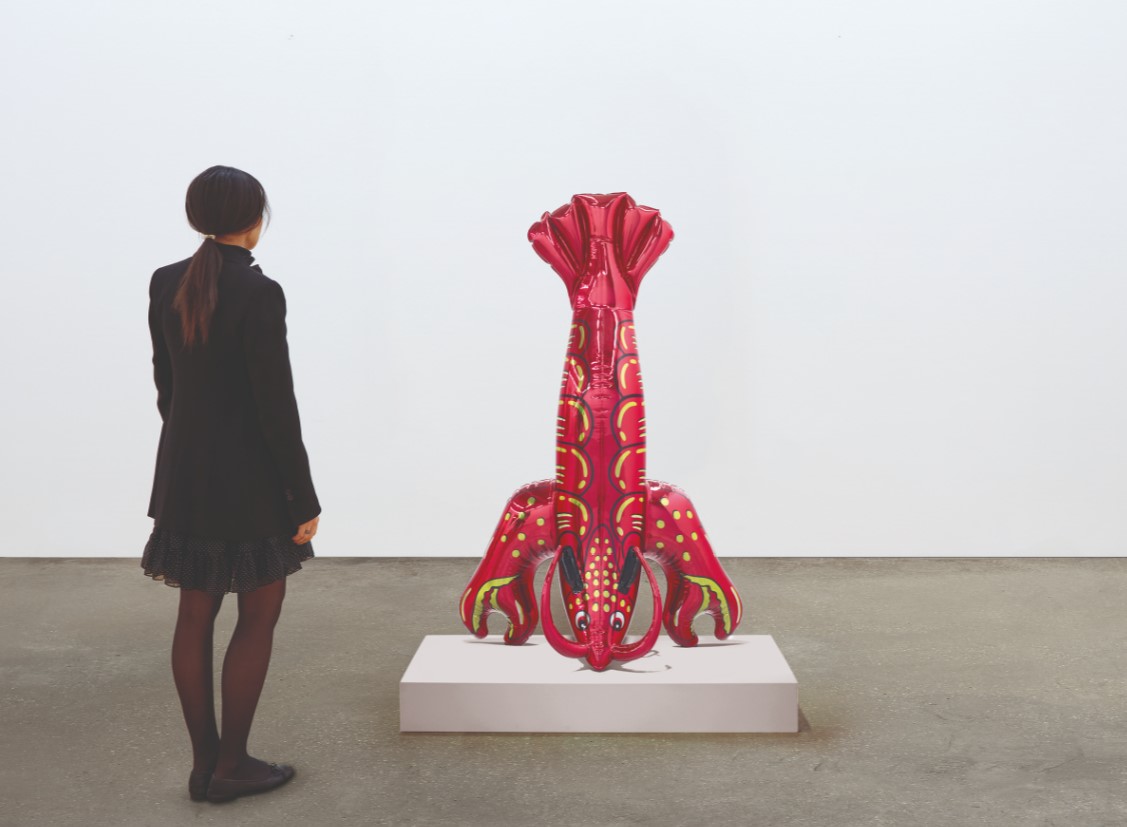
Rendered life-size in fire truck red with accents of black and golden yellow, Lobster is an immaculate reproduction of an inflatable toy one might use as a floatation device in a pool or at the beach. Replete with two black handles near the crustacean’s head, Koons includes seams, ripples, and the dimples inherent in a fully inflated plastic toy as the air strains at the surrounding structure. However, there is a visual weight to Lobster that is rectified when the viewer learns that it is crafted from stainless steel. The polar opposite of the pliable polyethylene item Koons found as he combed the dollar stores of New York’s Lower East Side, this sturdy structure acts as an icon of commodity culture. The artist further blurs the reading by placing the object face down resting on the tip of its head and two open claws on either side; the tail rises into the air like a Surrealist obelisk. Imbued with a latent eroticism, Lobster is taut and gleaming in its stance. Koons himself backs up this sexualized reading.
“If you look at Lobster’s arms, very strong, but they could be fallopian tubes and its body could be the womb. If you look at its tail, it’s almost like a stripper with a boa doing a feather dance, and also has tentacles that look like Dali’s mustache.”
The reference to Dalí is especially telling, as the preeminent Surrealist often inserted the image of the lobster into his erotically-charged dreamscapes. Coupled with an obvious nod to Duchampian readymades, Koons connects his work to an art historical trajectory concerned with desire, both intimate and commercial. By subverting the object’s position and material, he opens up a larger conversation about the item itself and also the place of novelties and mass-produced trinkets within our cultural unconscious.
Quad Elvis, 2008
Sotheby’s New-York: 12 May 2021
Estimated: USD 4,000,000 – 6,000,000
USD 9,456,000
Quad Elvis | Contemporary Art Evening Auction | | Sotheby’s (sothebys.com)
JEFF KOONS (b.1955)
Quad Elvis, 2008
Oil on canvas
102×138 inches (259.1 x 350.5 cm)
Signed and dated ’08 on the reverse
Enigmatic and seductive, emphatic yet elegant, Quad Elvis is a brilliant example of the virtuosic dexterity with which Jeff Koons has reimagined the art historical canon throughout his artistic career. Channeling the artist’s quintessential Pop sensibility, the present work unites a vivid assembly of found imagery into a kaleidoscopic composition that provides an endlessly engaging viewing experience for all who stand before it. Executed in 2008, Quad Elvis is part of a suite of three paintings that are brought together by their shared composition and titling device; the other paintings, Elvis and Triple Elvis, features the same Playboy model, Heather Kozar, in various numeric permutations, and reside in important private collections. As it engages in a conceptually rigorous yet playful dialogue with its artistic antecedents, Quad Elvis intertwines humor and sex, extensive referential meaning with virtuosic artistic technique, all in powerful testament to Jeff Koons’ unparalleled stature in the post-Pop era.
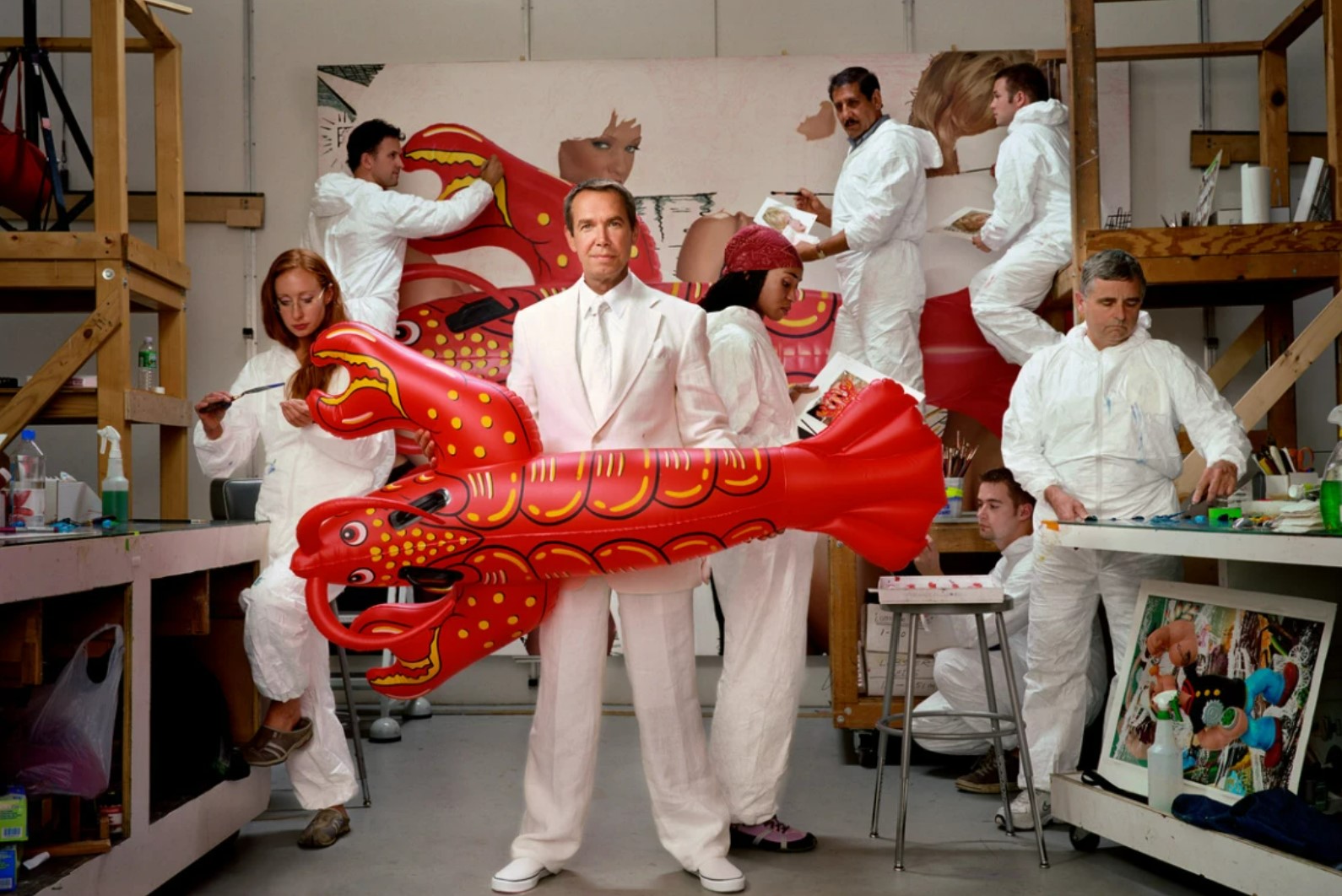
Quad Elvis, alongside Elvis and Triple Elvis, belongs to the Popeye series of paintings and sculptures that Koons executed between 2002 and 2013. While centered on the cartoon character Popeye, these related works do not always depict Popeye directly, and instead are more broadly unified by a shared sense of sensual vitality, nuanced references to water, and the distinctively retrospective approach that goes into their making. Evidenced by the present work, Koons brings the same exacting perfectionism to his paintings as he does to his towering aluminum and steel sculptures of the Popeye series. Yet despite its photorealist finish, Quad Elvis is in fact the product of a meticulous, time-intensive process: Koons creates these paintings first by bringing together found imagery with motifs from his oeuvre, digitally manipulating and collaging the images in Adobe Photoshop, and then meticulously transferring the final composition by hand onto canvas with exacting precision.
Equilibrium Series
Two Ball Total Equilibrium Tank (Spalding Dr. J Silver Series), 1985
Phillips New-York: 19 November 2024
Estimated: USD 4,000,000 – 6,000,000
USD 3,569,000
Jeff Koons – Modern & Contemporary … Lot 14 November 2024 | Phillips
JEFF KOONS
Two Ball Total Equilibrium Tank (Spalding Dr. J Silver Series), 1985
Glass, steel, sodium chloride reagent, distilled water and two basketballs
62 3/4 x 36 3/4 x 13 1/4 inches (159.4 x 93.3 x 33.7 cm)
This work is number 1 from an edition of 2
Having remained in the same private collection for nearly 30 years, Jeff Koons’ Two Ball Total Equilibrium Tank (Spalding Dr. J Silver Series), 1985, is a landmark in the artist’s early career belonging to his pivotal Equilibrium series. The present work was created in advance of Koons’ first solo exhibition, Equilibrium, staged at International With Monument Gallery in 1985, in the bourgeoning art and cultural hot spot of New York City’s East Village. Exemplifying his exploration of the intersection of art, science, and consumer culture through the use of everyday objects—in this case, basketballs suspended in a seemingly impossible state of perfect equilibrium within a water-filled tank—works from the Equilibrium series have found their way into some of the most prestigious public and private collections worldwide, including the Tate Modern, London; the Museum of Modern Art, New York; the Astrup Fearnley Collection, Oslo; the Museum of Contemporary Art, Chicago; and the Art Bridges Foundation, Arkansas, among others. Two Ball Equilibrium Tank (Spalding Dr. J Series) offers a meditation on stasis, desire, and the tension between artifice and reality, all suspended in a state of perfect equilibrium.
#4. Snorkel (Shotgun), 1985
Phillips New-York: 20 November 2024
Estimated: USD 150,000 – 200,000
USD 149,860
Jeff Koons – Modern & Contemporary… Lot 327 November 2024 | Phillips
JEFF KOONS
Snorkel (Shotgun), 1985
Bronze
14 1/2 x 5 x 2 1/2 inches (36.8 x 12.7 x 6.4 cm)
This work is number 1 from an edition of 3 plus 1 artist’s proof
Cryptic and alluring, Jeff Koons’ Snorkel (Shotgun), 1985, comes from the artist’s pivotal Equilibrium series, which questions our understanding of ordinary objects and how they relate to cultural production. Cast entirely in bronze, the present example is meticulously molded from a functioning snorkel. Rendering the object in bronze, a material more closely associated with monumental sculpture, Koons presents an ironic take on the readymade, elevating a quotidian object by translating its form in the durable artistic media. Uncanny and kitsch, this early work lays the groundwork for Koons’ unrivalled sculpture practice. A definitive example of Koons’ Equilibrium series, Snorkel (Shotgun) marks a defining moment in the artist’s career. The work was notably first exhibited in Koons’ debut solo show at the International with Monument Gallery in New York City’s Lower East Side in 1985. The exhibition was conceived as a “multilayer allegory concerning unattainable states of being” and expanded on Duchamp’s concept of the readymade.i In this series Koons sought to explore contradiction through his bronze cast objects, floating basketballs and Nike posters. The objects—ranging from the present snorkel to a life jacket and a raft—thus take on new meaning. Recreational and safety devices designed in their original form to keep one afloat become satirically non-functional when cast in bronze. Koons’ groundbreaking early work marked a move beyond both the readymade and appropriation art. A product of the 1980s economy, the present example at once parodies and fetishizes the object on which it is based, all the while remaining self-aware of its role as a valuable art object. Abstracting the commodity, Snorkel (Shotgun) marks an early foray that would later culminate in some of Koons’ most iconic works, including Balloon Dog, 1994–2000, and Lobster, 2003.
Snorkel Vest, 1985
Christie’s New-York: 17 May 2024
Estimated: USD 350,000 – 550,000
USD 819,000
https://www.christies.com/en/lot/lot-6482494
JEFF KOONS (B. 1955)
Snorkel Vest, 1985
Bronze
21x18x6 inches (53.3 x 45.7 x 15.2 cm)
This work is number three from an edition of three plus one artist’s proof
A significant forerunner to the artist’s use of fabricated inflatables, Jeff Koons’s Snorkel Vest is an important bronze from his iconic Equilibrium series. Departing from the readymade sculptures of his earlier work, the cast bronze sculptures of the Equilibrium series anticipated Koons’s later use of inflatables—most notably in the Celebration and Popeye series.
“Inflatables, of course, are metaphors for people, and they are metaphors of life and optimism for me. The most deathlike image I know is of an inflatable that has collapsed.”
Snorkel Vest, of course, will never collapse. This iconic sculpture exists in a state of preservation and equilibrium; a flotation device permanently inflated but prepared to sink anyone who might try and wear it; a deep meditation in bronze on the perils of salvation. At once aesthetically alluring and meticulously fabricated, this sculpture speaks to the very heart of Koons’s relationship with inflatables—lacing them with a dark commentary on the notion of salvation. Worn on the chest and strapped at the back, inflated and deflated through an oral inflation tube, this type of flotation vest is most popular among recreational snorkelers. The dark commentary on dysfunction is apparent in Snorkel Vest when considering that the flotation device, cast in bronze, no longer floats. In fact, the allure of sculpture resides in its juxtaposition of material and form, and the result of this juxtaposition is an extremely tactile work of art that almost begs to be touched. With its attractive folds of vinyl and nylon cast in bronze, one cannot help but wonder whether the vest is in fact solid or soft. The apparent contradiction of a bronze inflatable leads then to the startling realization that Koons has created a work of art that is the functional opposite of its archetype. The buoyant life preserver now sinks, and we are left to understand that the devices meant to save us may in fact drown us.
Impossibility and unsustainability are essential themes in the artist’s Equilibrium series, and Snorkel Vest embodies these themes with undeniable sprezzatura. The meticulous cast and the rich color of bronze arouse our curiosity and create a unique viewing sensation that is simultaneously solemn and buoyant, exciting and somber. At the same time, Snorkel Vest operates intellectually by allowing us to question, through the medium of sculpture, the act of preservation, as well as the heavy ideals preserved in monuments. Koons’s various attempts at preservation (in bronze, behind glass or in tanks of water) render all of the objects in his Equilibrium series useless. The basketball can no longer be dribbled, the bronze lifeboat cannot float, but by rendering these objects physically immutable, they are kept from decomposing and deflating. This is the state of equilibrium or balance toward which the entire Equilibrium series aspires, as the artwork is harmonized for the present, existing in stasis, almost inaccessible.
Aqualung, 1985
The Macklowe Collection
Sotheby’s New-York: 15 November 2021
Estimated: USD 8,000,000 – 12,000,000
USD 15,201,000
EQUILIBRIUM SERIES
Aqualung | The Macklowe Collection | | Sotheby’s (sothebys.com)
JEFF KOONS (b. 1955)
Aqualung, 1985
Bronze
27 x 17 1/2 x 17 1/2 inches (68.6 x 44.5 x 44.5 cm)
This work is number 3 from an edition of 3 plus 1 artist’s proof
Created in 1985, Jeff Koons’s Aqualung is an impeccable replica of an Aqua-Lung “SeaQuest” scuba vest, paradoxically fabricated in bronze. A critical component of the artist’s iconic Equilibrium series, Koons debuted the present work at artist-run East Village gallery International With Monument in 1985, alongside tanks of floating basketballs, Nike posters, and other cast bronze inflatable devices such as a life vest, snorkel and life raft. Occupying a central position within this groundbreaking series, the work has featured in nearly every major retrospective exhibit of the artist’s work, along with countless books, articles and essays. An exquisite object in and of itself, Aqualung epitomizes the key themes at the heart of the Equilibrium series: the symbolic, almost mystical quality of life-giving breath, and its importance in the role of creation. “I have always enjoyed objects that contain air because they are very anthropomorphic,” Koons has said. “Every time you take a breath, it’s like a symbol of life…” (The artist quoted in Exh. Cat., Paris, Château de Versailles, Jeff Koons: Versailles, September 2008-January 2009, p. 111) As a diving device, it supplies the diver with life-giving oxygen, and yet the material of its bronze construction would inevitably cause them to sink. In its dramatic embodiment of the dichotomies of life and death, lightness and heaviness, swimming and sinking, Aqualung represents one of the artist’s most potent conceptual projects. Befitting its seminal importance within the artist’s oeuvre, the present example was included in the artist’s major mid-career retrospective in 2014 at the Whitney Museum of American Art, Centre Pompidou, and Guggenheim Museum Bilbao.
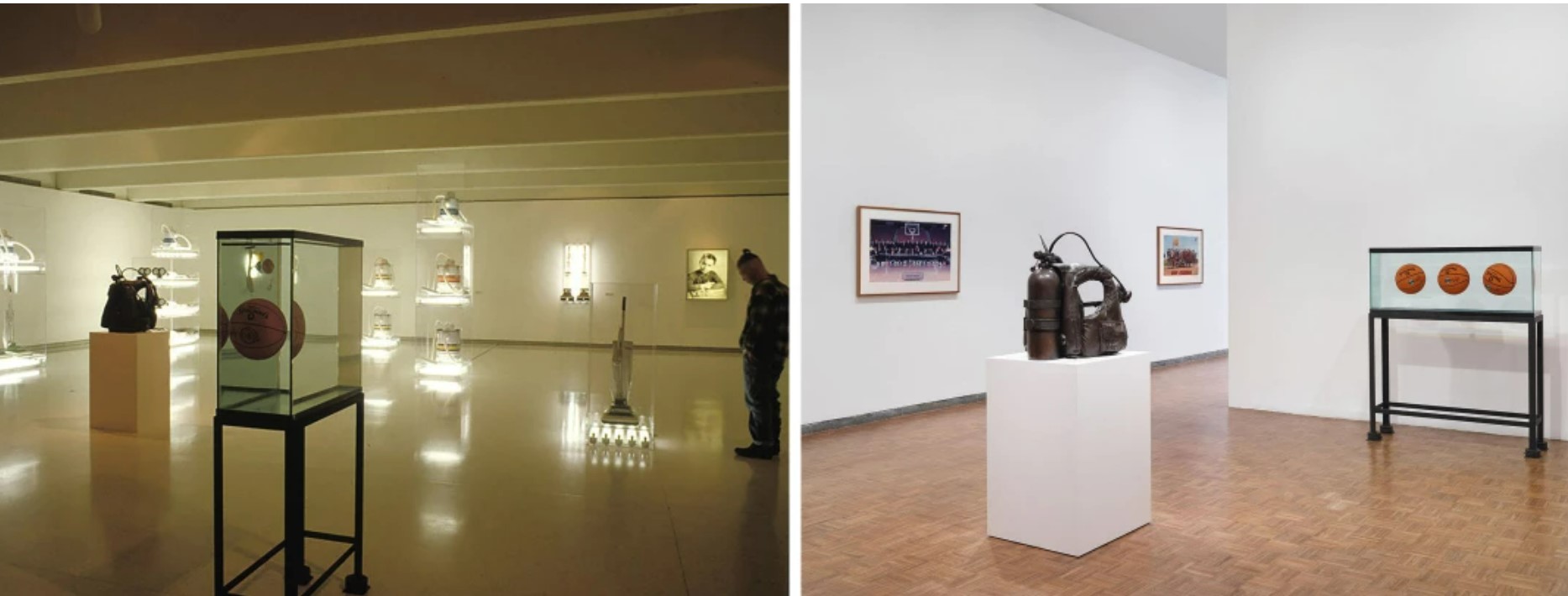
Widely considered to be the critical turning-point in Koons’s career, the Equilibrium series is a pinnacle of fabrication and invention. Aqualung proved to be particularly complex, necessitating the need for a professional fabricator, one who might be able to replicate, with almost microscopic precision, the many folds, wrinkles and curves of the vest, in addition to its plastic buckles, pockets and tubes. Working with Dick Polich, a professional metallurgist with advanced degrees from Yale and M.I.T.–and a former Navy fighter pilot–Koons was able to achieve the accuracy he so desired, resulting in a precise and flawless replica. Due to their meticulous, time-consuming fabrication, Koons’s sculptures so convincingly evoke their real-life counterparts as to seem hyper-real, which allows him to build upon the principles espoused in Marcel Duchamp’s readymades by taking them yet one step further.
Two Ball 50/50 Tank (Spalding Dr. J Silver Series, Wilson Supershot), 1985
Sotheby’s London: 29 June 2021
Estimated: GBP 2,500,000 – 3,500,000
GBP 2,498,000
Two Ball 50/50 Tank (Spalding Dr. J Silver Series, Wilson Supershot) | 《半滿水缸,兩個籃球(Spalding Dr. J Silver 系列與 Wilson Supershot)》 | Modern & Contemporary Art Evening Sale | | Sotheby’s (sothebys.com)
JEFF KOONS (b. 1955)
Two Ball 50/50 Tank (Spalding Dr. J Silver Series, Wilson Supershot), 1985
Glass, steel, distilled water, and two basketballs
62 3/4 x 36 3/4 x 13 1/4 inches (159.4 x 93.3 x 33.7 cm)
This work is number 2 from an edition of 2
One of Jeff Koons’s most iconic and instantly recognizable works, Two Ball 50/50 Tank belongs to the pivotal Equilibrium series which debuted to much acclaim in 1985. A seminal body of work in Koons’s oeuvre, these pieces embody the artist’s quintessential fusion of readymade objects, streamlined Minimalist vocabulary and mesmerizing Pop art aesthetic and together form an entropic vision of the human condition in late capitalism’s consumption-oriented society.
Calmly suspended, at once teasing and intangible, two buoyant basketballs float at mid-point in a vitrine supported on black steel stands, which is half-filled with water. Invoking the peculiar visual language of science, the objects are held like specimens in a case, fixed in an uncanny stasis that is at odds with the nature of the dynamic game. One of his most instantly recognizable metaphors, the floating ball is an early iteration of Koons sustained creative obsession with inflatables. Koons elaborates: “Inflatables, of course, are metaphors for people and they are metaphors of life and optimism for me” (Jeff Koons cited in: R. Lopex, Conversation: Jeff Koons, Chicago Magazine, June 2008, online). After consultations with Nobel Prize-winning physicist Dr. Richard P. Feynman, Koons filled his basketballs with a carefully mixed ratio of distilled water and Epsom salts, so that each ball floats exactly half-submerged in a tank filled with distilled water.
Snorkel (Generic), 1985
Christie’s New-York: 16 October 2021
Estimated: GBP 100,000 – 150,000
GBP 162,500 / USD 222,908
JEFF KOONS (B. 1955) (christies.com)
JEFF KOONS (B. 1955)
Snorkel (Generic), 1985
Bronze
14 1/2 x 5 x 1 1/4 inches (36.8 x 12.7 x 3.2 cm)
Executed in 1985, this work is from an edition of three plus one artist’s proof
An enigmatic, seductive sculpture from the artist’s watershed Equilibrium series, Jeff Koons’s Snorkel (Generic) transforms the ordinary into the extraordinary. The work is a meticulous simulacrum cast in glimmering bronze from a snorkel mould. But for its rich brown patina this snorkel seems ready for coral reef exploration; the sculpture is a testament to Koon’s technical rigor and commitment to precision. Executed in 1985, and held in the same private collection ever since, Snorkel (Generic) was exhibited as part of Koon’s solo debut held that same year at International With Monument, a gallery in New York City’s East Village. The Equilibrium series has since been recognized as a pivotal moment in Koons’s career during which his practice embraced the pristine engineering which would come to characterize so many of his subsequent works. Snorkel (Generic) is part of an edition of three, and sculptures from this series were exhibited in as part of Koons’s 1993 touring retrospective held at the San Francisco Museum of Modern Art and the Walker Art Center, Minneapolis.
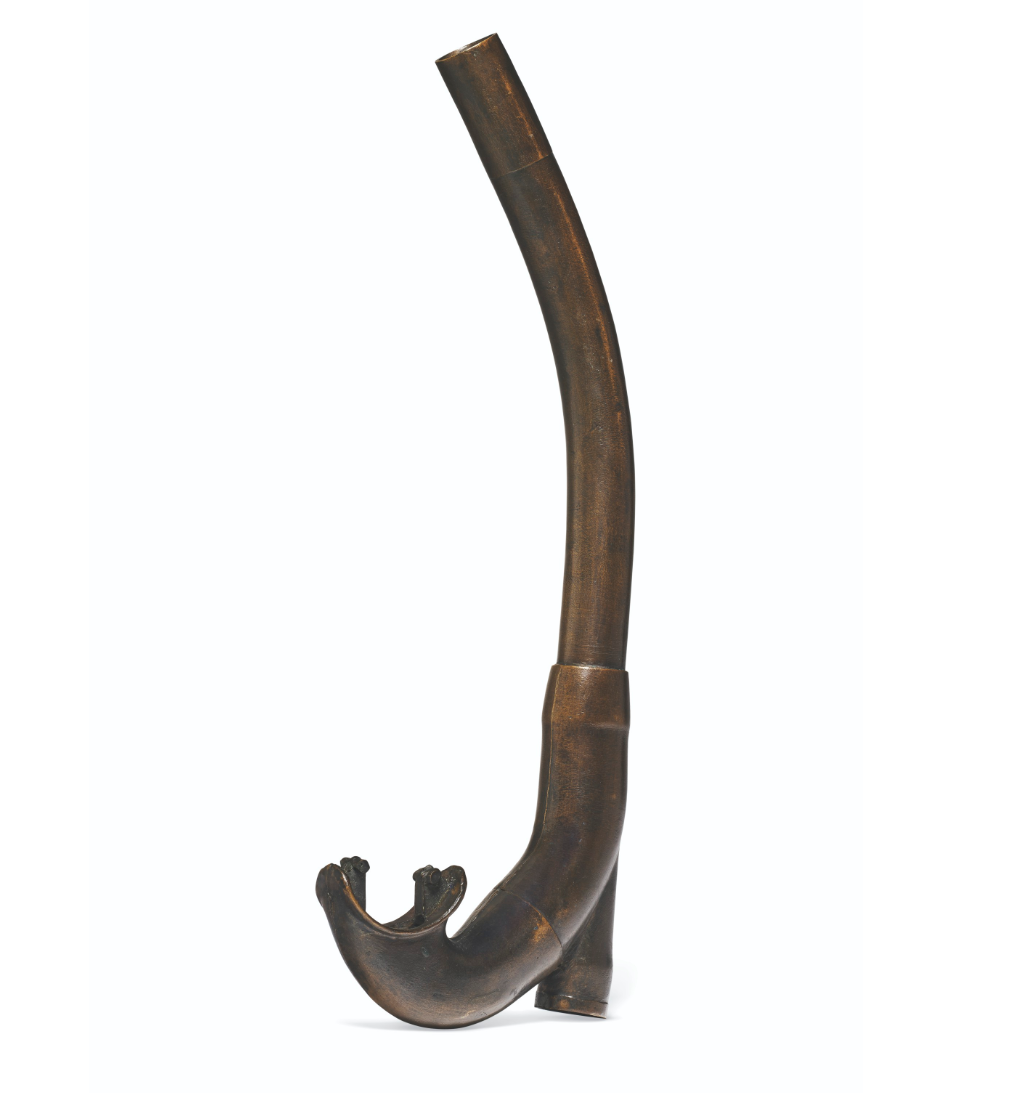
In allowing divers to discover the mysteries of the ocean, Koons’s snorkel alludes to the triumph of man over nature and a means to conquer the unknown. Fabricated in bronze, however, his version transmogrifies a life-giving tool into something lethal; Snorkel (Generic) is an eloquent visualization of the absurd. Reflecting upon the Equilibrium works, Daniela Salvioni wrote, ‘The contradiction between the purpose of the original objects—to keep one afloat and thus preserve life—and the massive tonnage of the actual sculptures—transforms the objects into a devastating metaphor of impossibility and unsustainability’ (D. Salvioni, ‘Jeff Koons’s Poetics of Class’, in Jeff Koons, exh. cat. San Francisco Museum of Modern Art, 1992, p. 20). The visual paradox at the heart of Snorkel (Generic) illustrates the influence of Surrealism on Koons’s art: to render the functional strange has a long and rich art historical legacy, one that summons images of Marcel Duchamp’s ‘readymades’ and Meret Oppenheimer’s fur-covered teacup. Yet Snorkel (Generic) unveils its otherworldliness gradually, a detachment viewed through the lens of Pop Art. At once visually arresting and conceptually complicated, it attests to a landmark moment in Koons’s career, in which the artist firmly established his referential compass.
Gazing Ball Series
Gazing Ball (Esquiline Venus), 2013
Edlis Neeson Collection
Christie’s New-York: 20 May 2026
Estimated: USD 600,000 – 800,000
USD 508,000
JEFF KOONS (B. 1955), Gazing Ball (Esquiline Venus) | Christie’s
JEFF KOONS (B. 1955)
Gazing Ball (Esquiline Venus), 2013
Plaster and glass
Figure: 61-3/8 x 24-1/8 x 16-1/8 inches (155.9 x 61.3 x 41 cm)
Base: 21x29x23 inches (53.3 x 73.7 x 58.4 cm)
This work is number one from an edition of three plus one artist’s proof
Jeff Koons’s Gazing Ball (Esquiline Venus) is a striking example from the artist’s iconic Gazing Ball series of sculptures created in 2013. Blending the readymade with art historical tradition, Koons here casts the canonical ancient Roman sculpture Esquiline Venus in plaster. The artist cheekily balances a blue gazing ball in a seemingly precarious position, teetering at the edge of the sculpture’s urn support. Working on this series, Koons came to a realization, noting how “with sculpture, you feel a constant polarity between the biological and Platonism. The sculpture also places an emphasis on form.” (quoted in B. Powers, “A Talk with Jeff Koons,” Art News, Spring 2016, p. 29). Fusing the classical past with the contemporary moment, Koons establishes a compelling commentary on temporality. As the Italian curator Francesco Bonami writes, “time in Koons’s work is eventually irrelevant. No apparent hierarchy exists in the timeline of his production. That’s why the Gazing Ball group of sculptures is blooming from several different places with no direct connection between them” (“A Kind of Blue,” in Jeff Koons: Gazing Ball, exh. cat., David Zwirner, New York, 2013, n.p.).
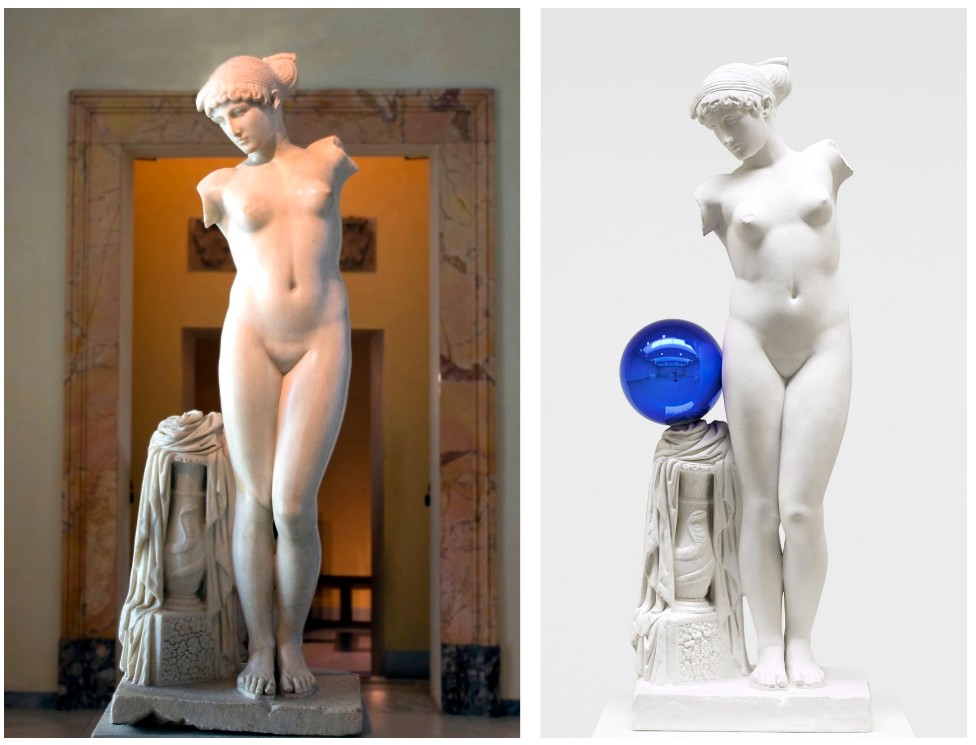
Left: The Esquiline Venus, circa 50 C.E. Capitoline Museums, Rome. Photo: Shutterstock.
Right: Present lot illustrated.
Koons created a special type of plaster to create his new series. His artistic intervention follows a noble history of imitatio, the imitation of ancient art, with artist’s including Michelangelo creating sculptural copies of Greek and Roman works. The Victorian era saw a renewed interest in copies, with thousands of plaster casts made to reproduce ancient art. Koons is just the latest artist interested in engaging with the art of the past, but in the present work he adds an absorbing new element to the millennia-old form.
“Gazing Balls are devices of connecting. I want to participate, I always just wanted to be involved in a dialogue with the avant-garde. This is my family, these are the artists I have interest in, the joy that has enriched my life. I enjoy participating in the dialogue and I want to being something to the table.”
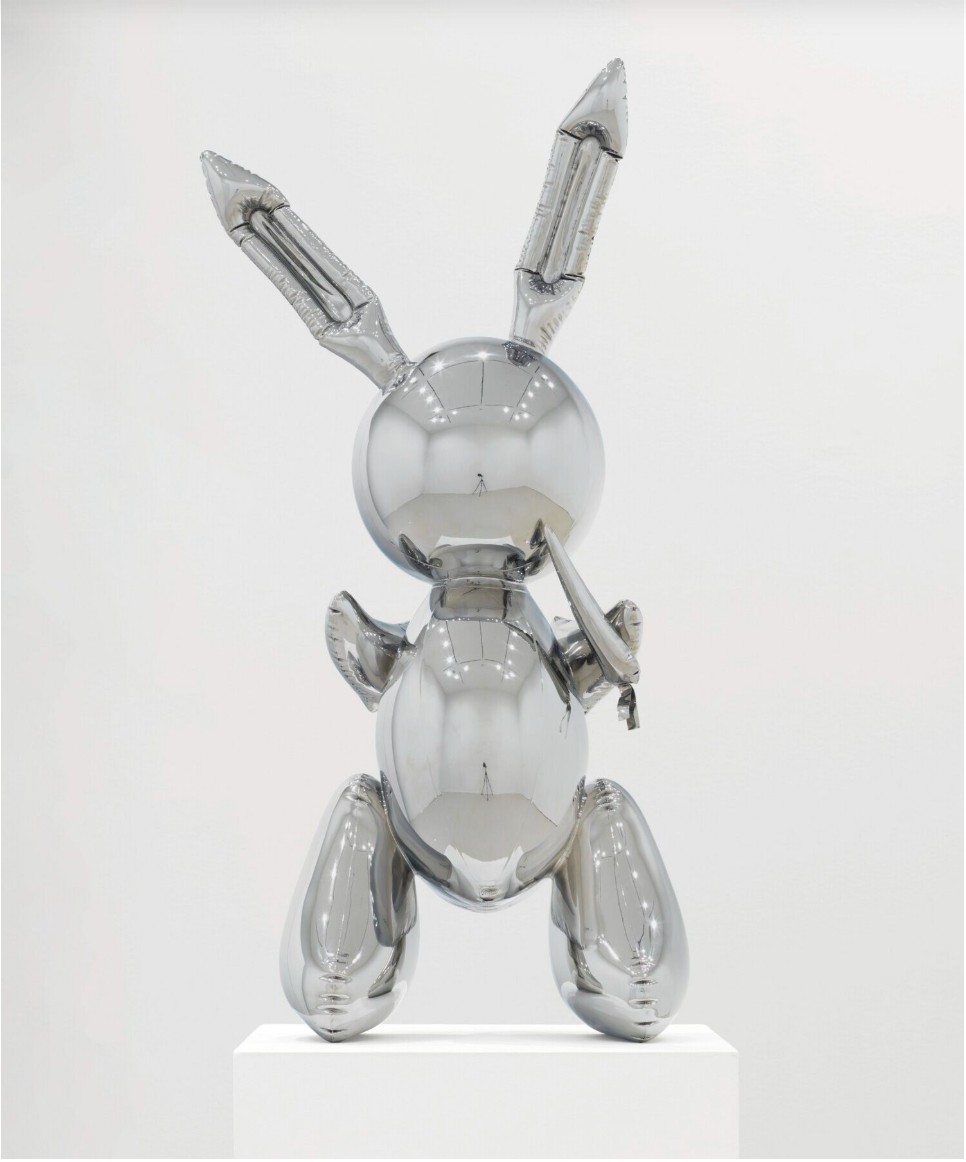
Jeff Koons, Rabbit, 1986. © Jeff Koons.
Relating the Gazing Ball series to the optical design of Hadrian’s Villa, Bonami elucidates how, “in Koons’s new body of work, the sculptures have become recipients of the blue bubbles that looks like they could have been raised out of Canopus’s waters like a crowd of magical fairies or perhaps like isolated fireflies invading the hills outside ancient Rome on a summer’s night” (F. Bonami, op. cit.). Koons considers the head of his important earlier sculpture Rabbit to be the original gazing ball. His adoption of the gazing ball motif mirrors the Duchampian readymade: “the gazing ball is like Duchamp’s urinal in that it’s a confrontational object, but it’s also very retinal” the artist notes (ibid.). With its addition to the present work, Koons reframes the focus of the piece away from the form itself and towards the environment within which the work resides, incorporating his audience into the artwork itself. While the gazing ball “represents the vastness of the universe and at the same time the intimacy of right here, right now,” the sculptural cast of Esquiline Venus does not intend to replicate the visual experience of seeing the original, held in the Capitoline Museums in Rome, and instead represents a conceptual embodiment of antiquity’s essence (ibid.).
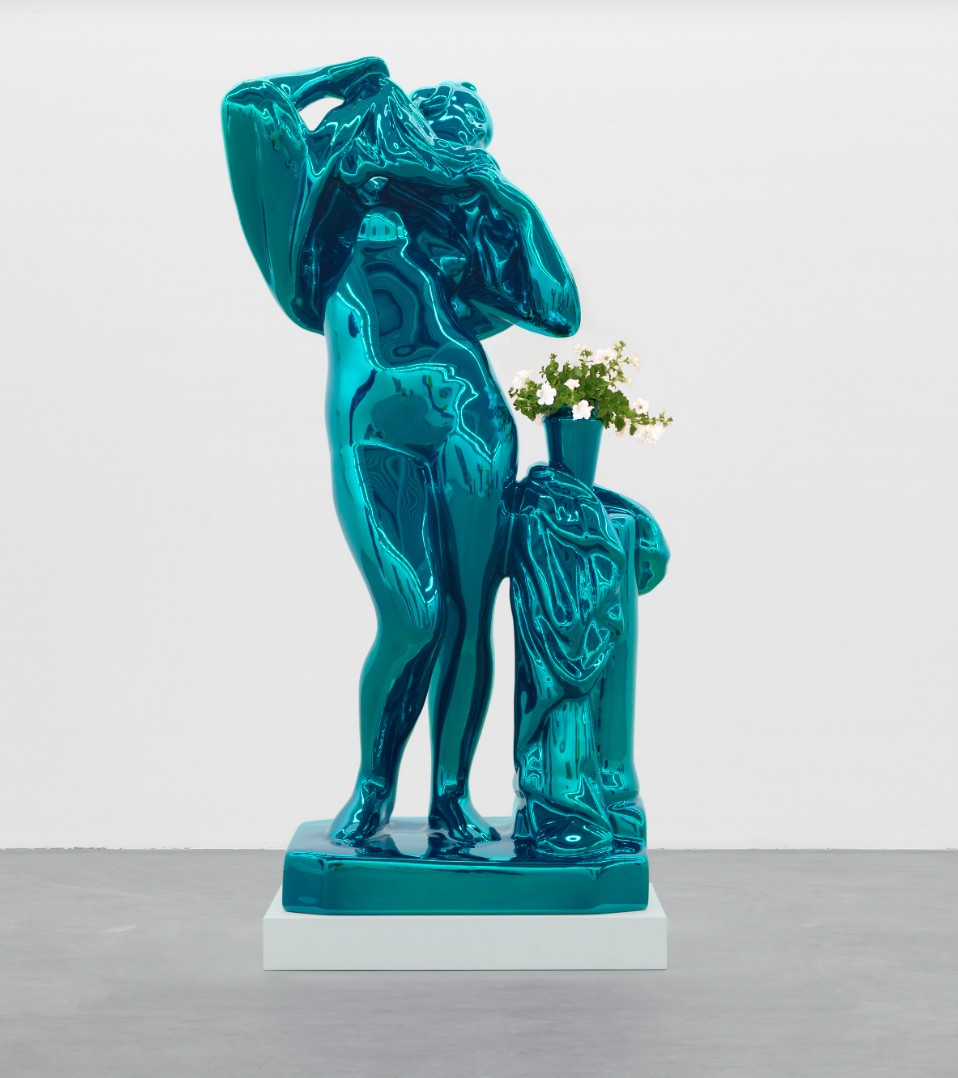
Jeff Koons, Metallic Venus, 2010-2012. The Broad, Los Angeles. © Jeff Koons.
The original Esquiline Venus was first unearthed in Rome in 1874, as the ancient city was being renovated after becoming the capital of the modern Italian state. While the true subject of the work is not known, the work is either a representation of the Greco-Roman goddess Venus or the Egyptian Queen Cleopatra. It is thought to represent an example of the eclectic Neo-attic style of around the first century CE, which itself sought to imitate the previous style of Attic Greece several centuries earlier.
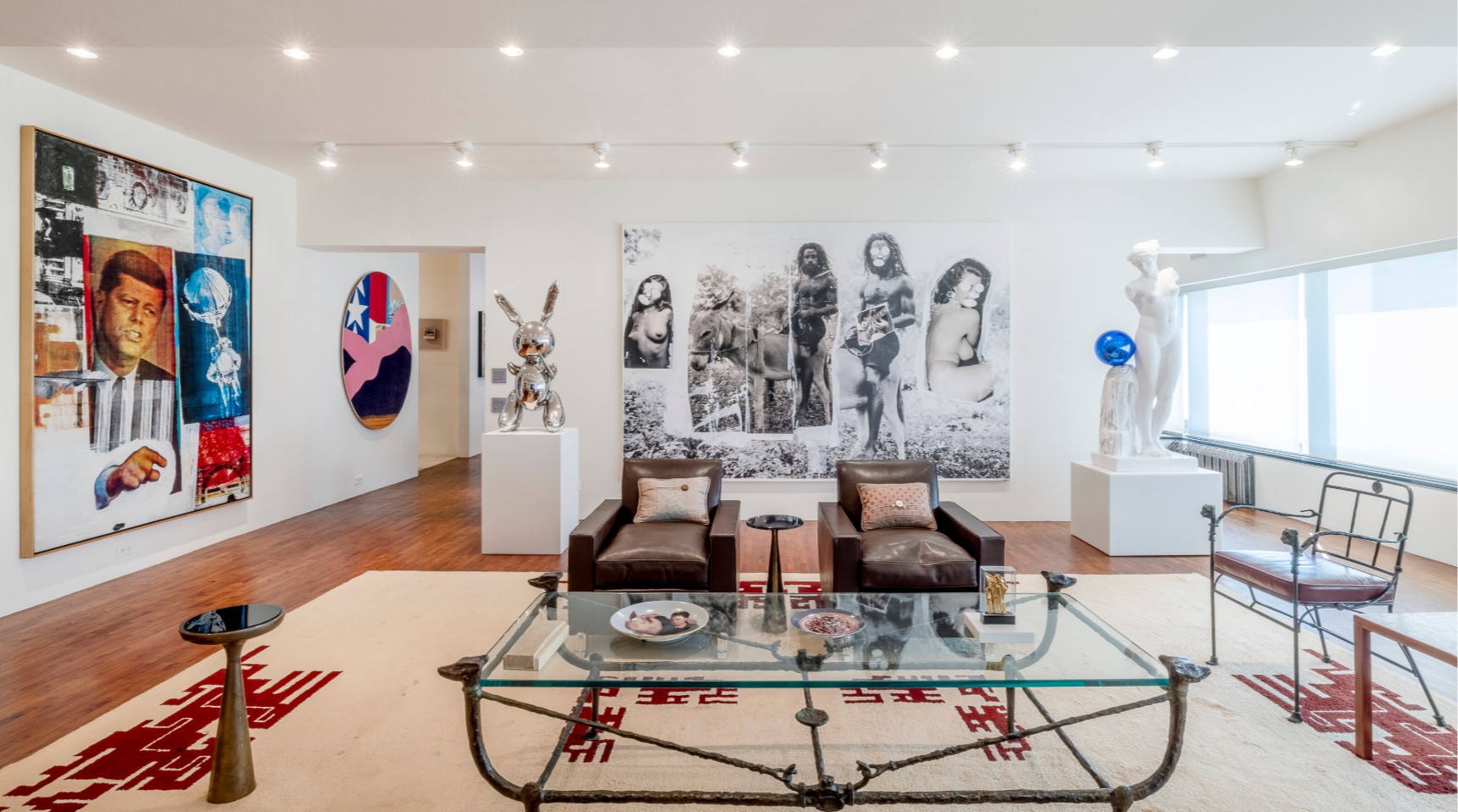
Immediately after being unearthed, the work attracted the gaze of artists, including the celebrated painter Lawrence Alma-Tadema, whose painting A Sculptor’s Model, completed in 1877, recreates the sculptural form of the Esquiline Venus into a painted figure. Another painter, Edward Poynter, also adapted the ancient sculpture for his painting Diadumenè (1884, Royal Albert Memorial Museum, Exeter), which shows the Venus figure in a bathhouse near a reflecting pool. The reflective image inspired the Capitoline Museums to install the original Esquiline Venus next to a reflecting pool, anticipating Koons’s artistic intervention.
“The experience is about you, your desires,
your participation, your relationship with the image.”
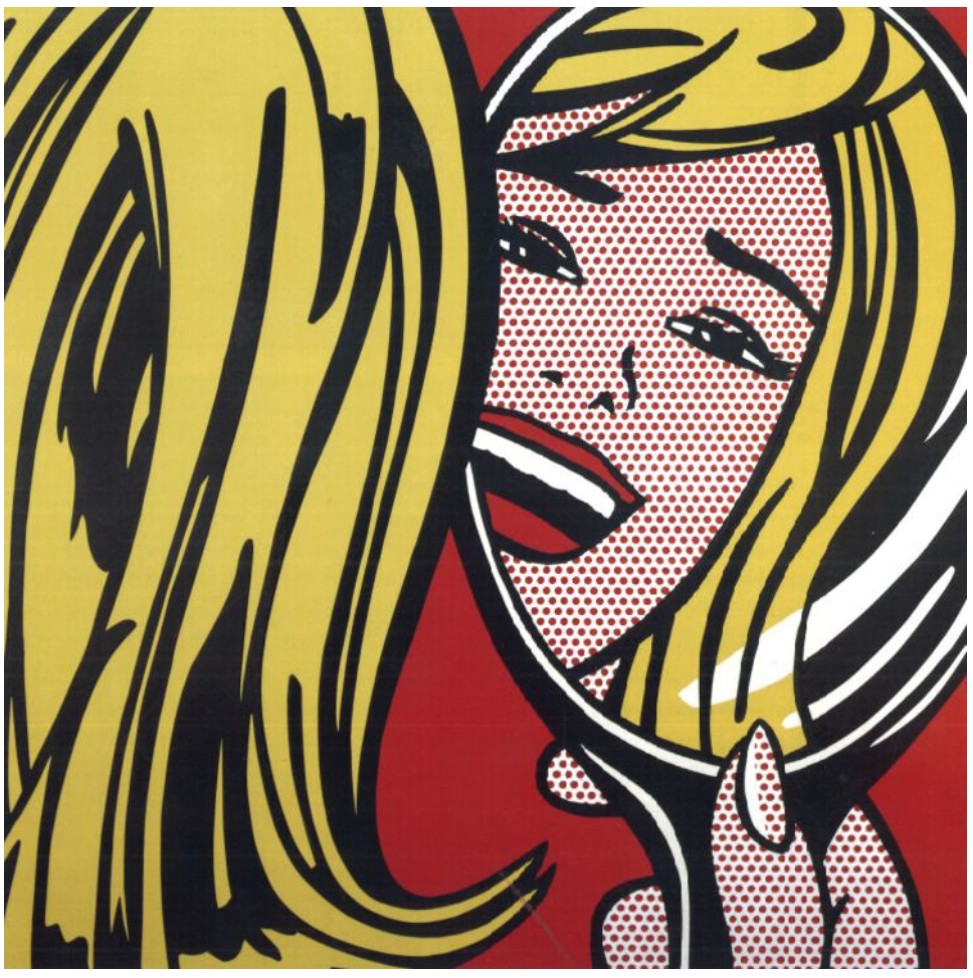
Roy Lichtenstein, Girl in Mirror, 1964. © 2026 Estate of Roy Lichtenstein / DACS.
Gazing Ball (Esquiline Venus) creates a fascinating view into Jeff Koons’s deep art historical knowledge as he innovates upon the notion of the readymade, appropriating canonical subjects in the tradition of Duchamp while interpreting the experience of his viewer through cannily placed reflections.
Gazing Ball (Ariadne), 2013
Christie’s New-York: 20 November 2025
Estimated: USD 600,000 – 800,000
USD 635,000
JEFF KOONS (B. 1955), Gazing Ball (Ariadne) | Christie’s
JEFF KOONS (B. 1955)
Gazing Ball (Ariadne), 2013
Plaster and glass
44 3/8 x 93 7/8 x 36 5/8 inches (112.7 x 238.4 x 93 cm)
This work is number one from an edition of three plus one artist’s proof
Gazing Ball (Courbet Sleep), 2014-2015
Edlis Neeson Collection
Christie’s New-York: 19 November 2025
Estimated: USD 600,000 – 800,000
USD 596,900
JEFF KOONS (B. 1955), Gazing Ball (Courbet Sleep) | Christie’s
JEFF KOONS (B. 1955)
Gazing Ball (Courbet Sleep), 2014-2015
Oil on canvas, glass and aluminum
53 3/4 x 81 x 14 3/4 inches (136.5 x 205.7 x 37.5 cm)
Signed and dated ‘Jeff Koons 2014-2015’ (on the overlap)
Fusing the readymade with the art historical tradition, Jeff Koons’s Gazing Ball (Courbet Sleep) is an important example from the artist’s Gazing Ball Paintings series first exhibited in 2015. Koons first utilized his now-iconic gazing balls in a sculptural series where casts of casts of canonical works of European sculpture balanced blue gazing balls at key positions.
“With sculpture, you feel a constant polarity between the biological and Platonism. The sculpture also places an emphasis on form.
With the paintings, you have a more ancient dialogue.”
For his Gazing Ball paintings, Koons recalled the effect of painted three-dimensional surfaces, from the caves of Lascaux to the polychrome statues of Greek antiquity, and how two-dimensional and three-dimensional forms were brought together.
“The Gazing Ball sculptures have the same confrontation. There’s a dialogue taking place about the humanism of art and how important connectivity is in our lives. I wanted to make work that would add to the dialogue of the readymade and the concept of objective art.”
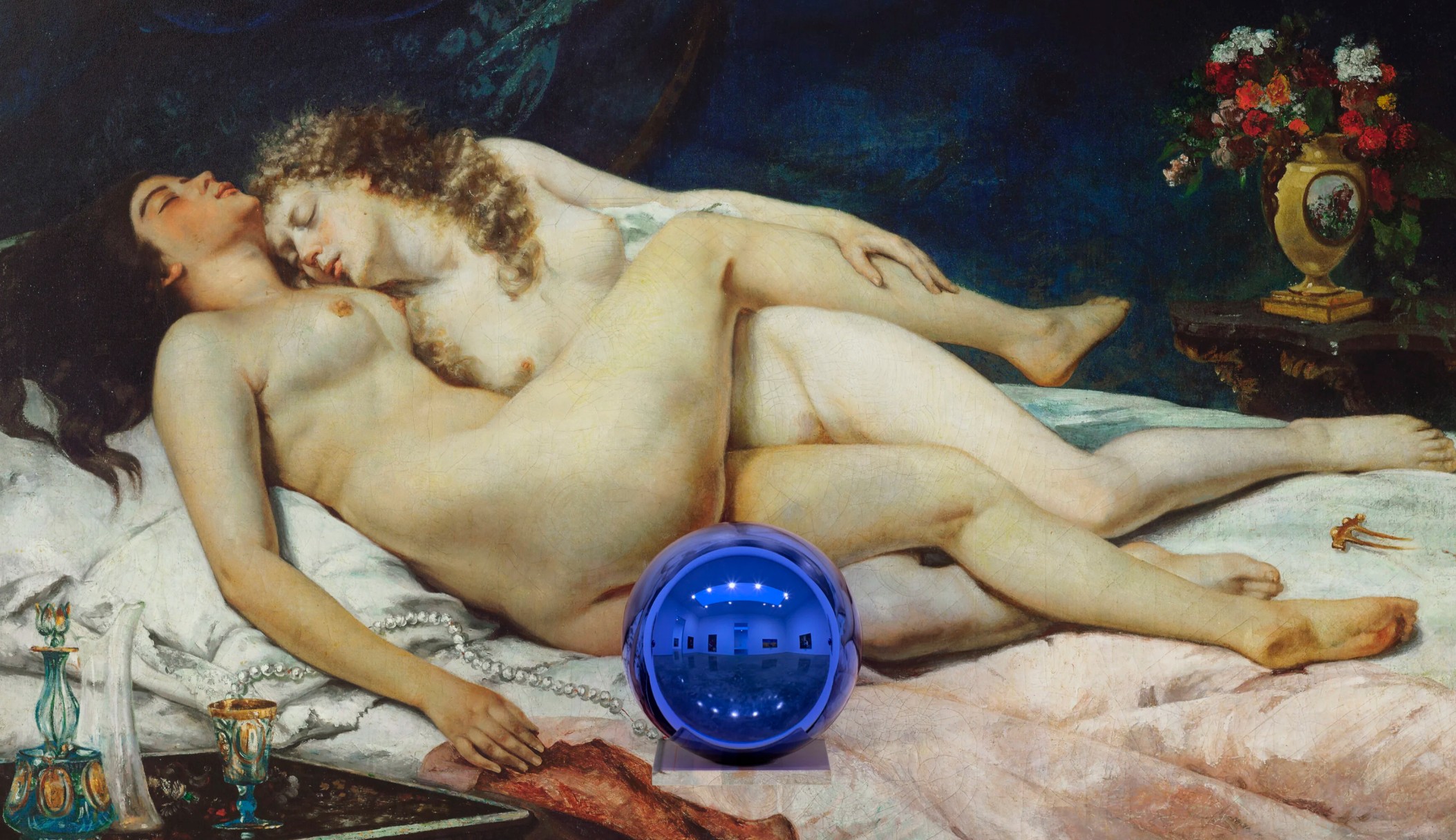
With Gazing Ball (Courbet Sleep), the artist creates a painted visual replica of the French artist’s infamous The Sleepers painting, now held at the Petit Palais, Paris. The painting, which depicts the then-scandalous scene of two nude recumbent women entwined together upon a bed and surrounded with Empire style decadence, appears to be an exact facsimile of the original, every detail hand-replicated including even a painted line for every crack on the original. Koons’s version is however is completely flat, omitting any painterly impasto used in the original. Koons’s most significant intervention is the placement of a reflective spherical blue gazing ball against the painted backdrop. Poised just below the centerline, the ball partially obscures the raised rear of one of the painted women whilst simultaneously reflecting this intimate region onto its surface.
“I want to participate, I always just wanted to be involved in a dialogue with the avant-garde. This is my family, these are the artists I have interest in, the joy that has enriched my life. I enjoy participating in the dialogue and I want to bring something to the table.”
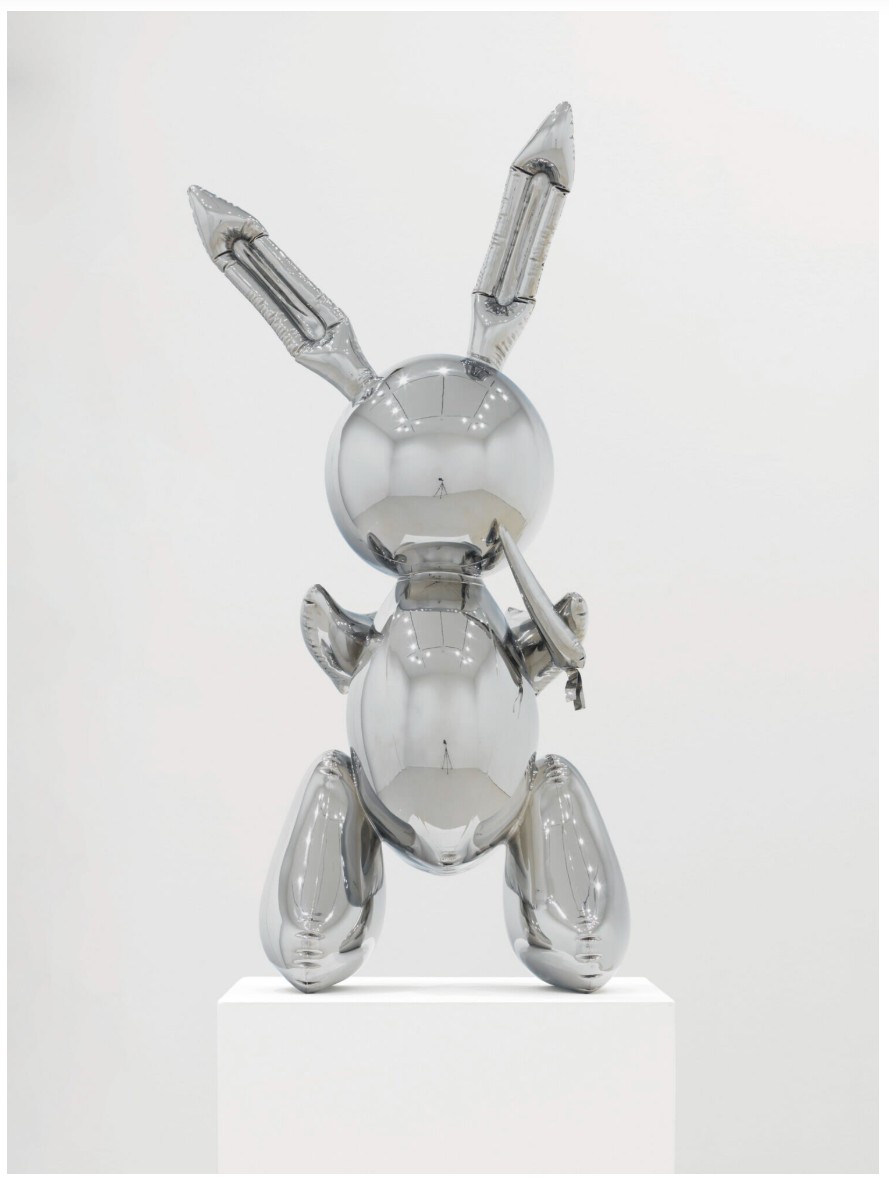
Jeff Koons, Rabbit, 1986. © Jeff Koons.
Koons identifies the head of his Rabbit, one of his most famous works, as the original gazing ball. He connects the use of the ball to Marcel Duchamp, the inventor of the readymade and a steadfast influence for Koons.
“The gazing ball is like Duchamp’s urinal in that it’s a confrontational object,
but it’s also very retinal.”
Used in the present work, the experience is about the viewer, forcing the audience to participate within and identify their own relationship with the image. In this participatory tone, the Gazing Ball paintings are also reminiscent of Andy Warhol’s Silver Clouds which float freely around their given spaces, reflecting everything around them and interacting with observers. While the gazing ball “represents the vastness of the universe and at the same time the intimacy of right here, right now,” the painting is not a mere visual reproduction of the visual experience of Courbet’s original, but a conceptual embodiment of the painting’s essence.
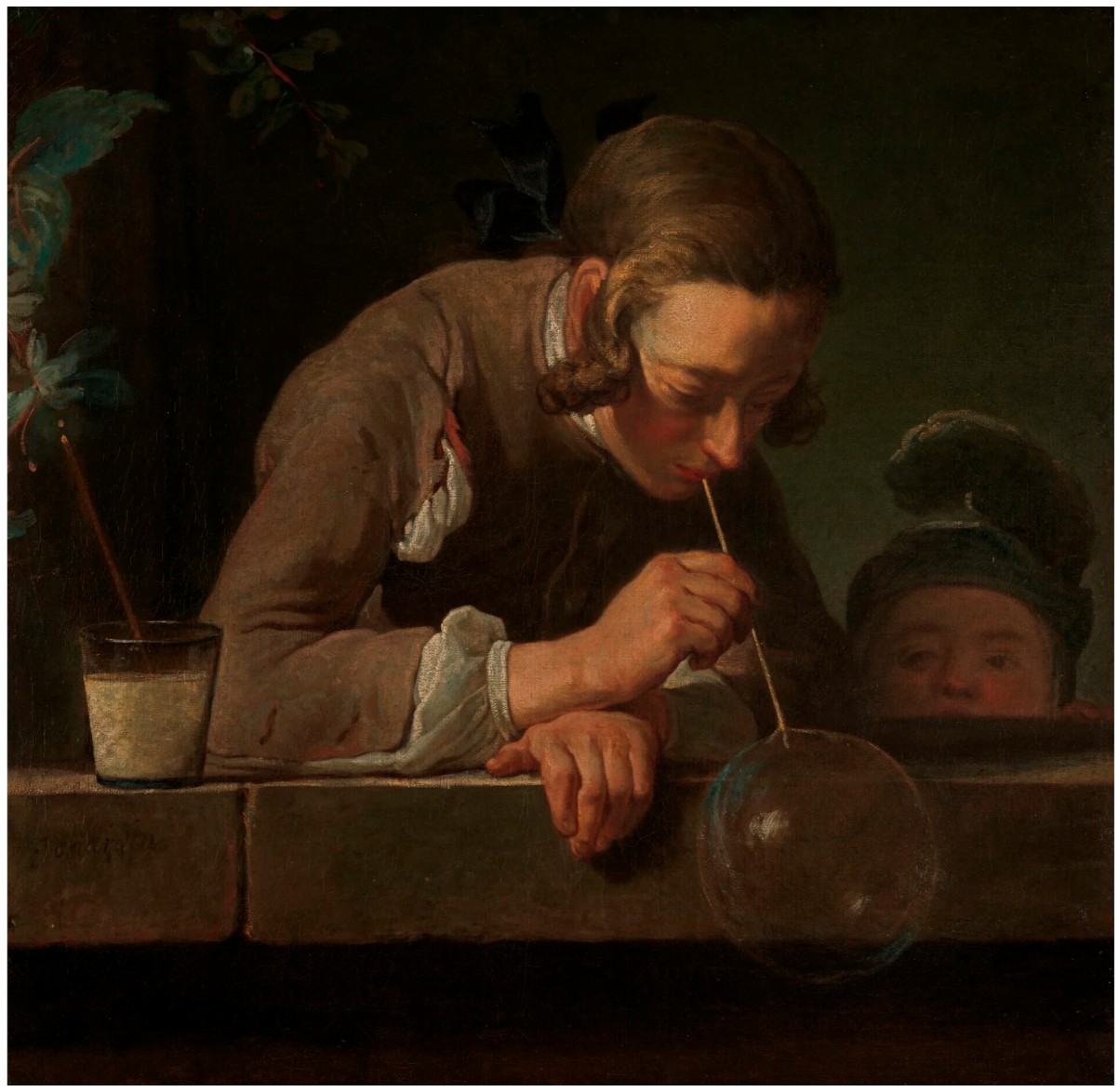
Jean Baptiste Siméon Chardin, Soap Bubbles, circa 1733-34. Metropolitan Museum of Art, New York.
Commissioned by Khalil Bey, the Ottoman envoy to France, Courbet’s The Sleepers was then a scandalous image, and joined two similarly controversial paintings also in Khalil-Bey’s collection—Courbet’s L’Origine du monde and Ingres’ The Turkish Bath. This trio created a boudoir salon exhibiting erotic female subjects, recalling Titian’s Poesie paintings from two centuries prior. Jeff Koons’s intervention in placing a reflective ball with the painting recreates the original dynamism of the commission, where the painting was meant to be in intimate dialogue with the onlooker and other paintings placed in its environs.
“The experience is about you, your desires, your participation,
your relationship with the image.”
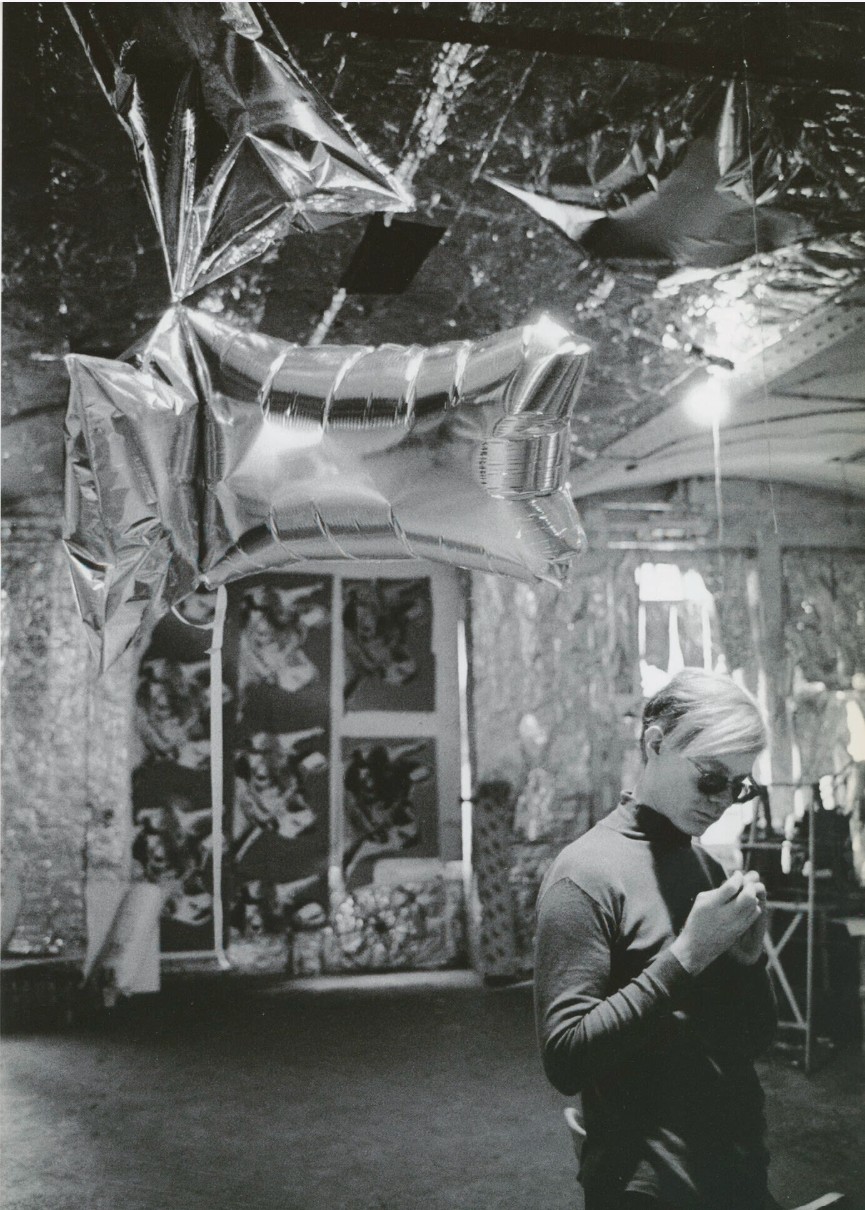
Stephen Shore, Warhol with “Silver Clouds” in the Factory, circa 1965-1967.
Photo: © Stephen Shore. © 2025 The Andy Warhol Foundation for the Visual Arts, Inc. / Licensed by Artists Rights Society (ARS).
Gazing Ball (Courbet’s Sleep) provides a scintillating view into Jeff Koons’s deep art historical knowledge as he innovates upon the notion of the readymade, appropriating canonical subjects in the tradition of Duchamp while interpreting the experience of his viewer through cannily placed reflections.
Gazing Ball (Fragonard Young Girl Playing with her Dog), 2014-2015
Sotheby’s Singapore: 9 June 2024
Estimated: SGD 550,000 – 860,000
SGD 672,000 / USD 497,480
JEFF KOONS (b. 1955)
Gazing Ball (Fragonard Young Girl Playing with her Dog), 2014-2015
Oil on canvas, glass and aluminum
68 1/2 53 3/4 x 14 3/4 inches (174 x 136.5 x 37.5 cm)
Signed and dated 2014-2015 (on the overlap)
Drawing upon the work of the late French Rococo master, Jean-Honoré Fragonard, Jeff Koons’s Gazing Ball (Fragonard Young Girl Playing with her Dog) (2014-2015) is a charming example of the artist’s celebrated Gazing Ball paintings. In 2015, Koons first presented 35 Gazing Ball paintings referencing artists of the past including the present work, which pays homage to Fragonard’s Mädchen mit Hund (Girl with Dog) (circa 1770), currently housed at the Bavarian State Painting Collections – Alte Pinakothek in Munich. However, unlike Fragonard, Koons adds a small shelf at the centre of the work, upon which he places a large, reflective blue glass ball, which had been hand-blown in Pennsylvania. Koons’s brilliant cobalt sphere absorbs past, future, and the instantaneous present, embodying an otherworldly space or a porthole towards an alternate universe. A phenomenon of visual-somatic experience that creates a metaphysical dialogue with art history, the present work is at once familiar and fantastical, exemplifying the masterful conflation of seeming opposites which defines Koons’s inimitable oeuvre. Koons offers an abstract vision of time in which history exists in a continuum. In Gazing Ball (Fragonard Young Girl Playing with her Dog), the ball serves as a portal into a tender domestic scene, allowing the viewer to not only witness this moment of play between the young girl and her dog, but also feel as if they are present.
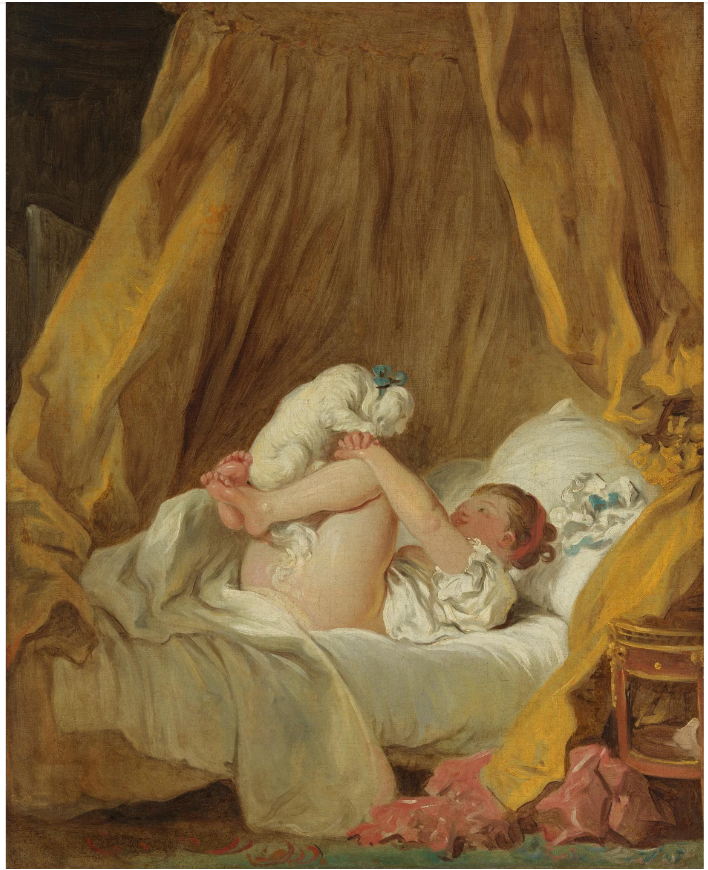
JEAN-HONORÉ FRAGONARD (1732-1806), MÄDCHEN MIT HUND (GIRL WITH DOG), CIRCA 1770
COURTESY OF THE BAVARIAN STATE PAINTING COLLECTIONS – ALTE PINAKOTHEK, MUNICH
Essential to Koons’s practice is a consideration of the viewer’s gaze and the presence of their reflection in the work which he explored in his 1986 stainless steel sculpture Rabbit. Koons engages with philosophy and Alois Riegl’s idea of the beholder’s share establishing symbiotic relationships between viewers, the object, and the spaces that they share. For Koons, the environment around the artwork is as important to the conceptual foundation of the piece as the artwork itself. He is interested in the generosity offered by a work of art through its encounter with the viewer, an exchange that he both reveals and heightens in his illuminating façades.
“It constantly reminds viewers of their existence, of your existence, it’s all about you. When you leave the room, it’s gone. When you move, the abstraction takes place; nothing happens without you, it needs you. It’s visually so abstract that it always made me think of generosity”
In the manner of Marcel Duchamp’s appropriation of everyday objects as ‘readymades’ and his reinterpretation of historical masterpieces in works such as L.H.O.O.Q., Koons’s Gazing Ball series is part of a lineage of radical art—yet also firmly rooted in a specific time and place. Koons presents the talisman of the gazing ball from his hometown of York, Pennsylvania, where glass globes often ornament suburban lawns or gardens, mounted on pillars and reflecting their rural surroundings. This tradition inspired Koons for the way in which this decorative orb creates a shared experience between neighbors, reflecting his own attraction to the power of art to offer wonderment and generosity. Pairing the gazing ball with an antiquity whose very nature proffers the vaulted pantheon of art history, the spectacular finish and precision of the ball’s ideal beauty juxtaposed with its popular use value as lawn decoration conflates the highly ordinary with the surreal, fueling a debate about taste that is paradigmatic of Koons’s conceptual project. Here the artist proposes an equilibrium between suburbia and fantasy, and between contemporary mass culture and the venerable annals of history. Arguing for the appreciation of mass-appeal imagery, Koons traffics in the arbitrary distinctions between high and low art, positioning his output in the uncharted territory between the predetermined polar categories.
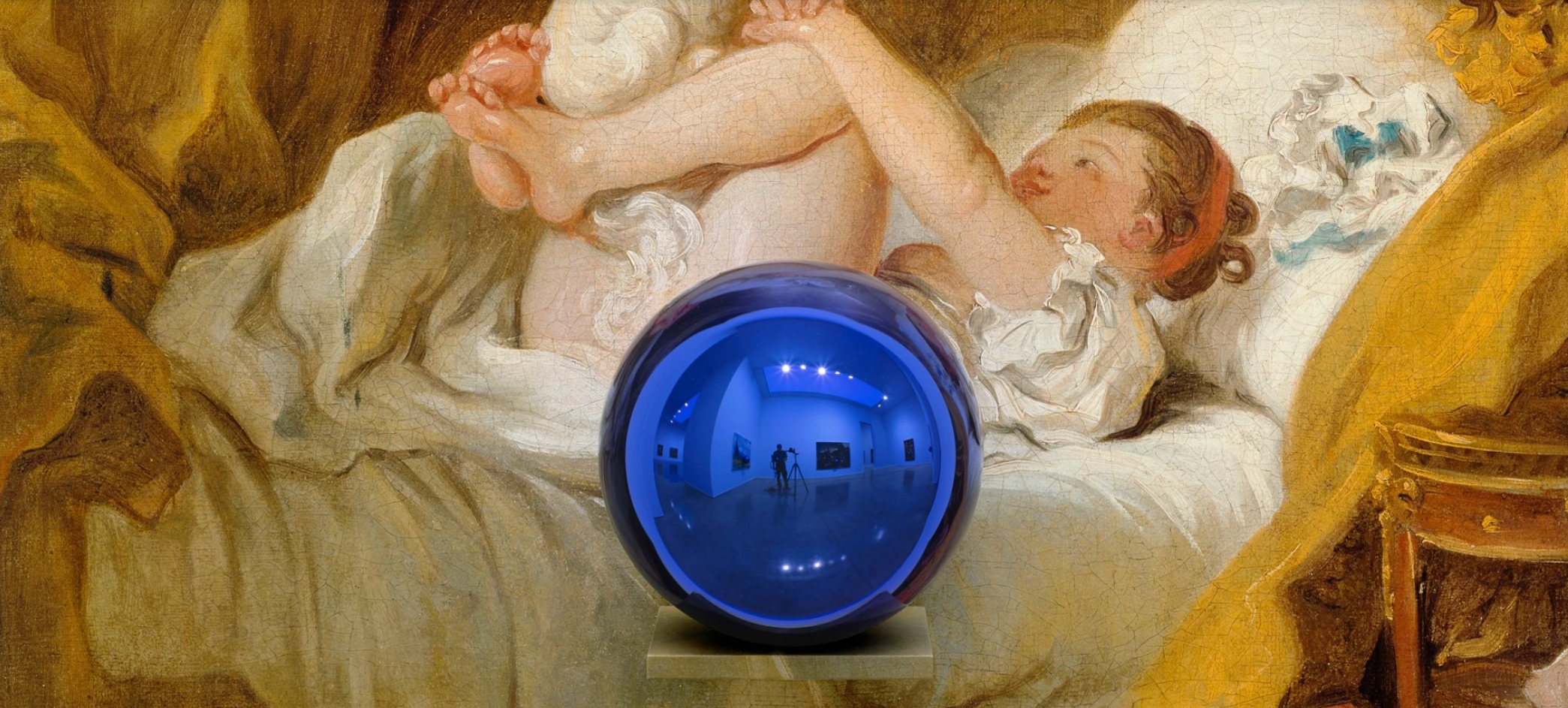
Growing up in York, Koons’s father ran Henry J. Koons Decorators, through which Koons came to understand how the middle-class endow material goods and décor with their deepest aspirations. His father’s elaborate furniture displays and window tableaux showcased precise arrangements of decorative goods that promised social mobility to the residents of the community, and installed mirrors around every corner to make shoppers aware of their presence – a strategy Koons continues to employ in his sculpture, as evidenced by the present work. Enveloped in the sociology of aesthetics, Koons invokes a challenging poetics of class, revealing the emotional investments crystallized in objects and presenting a stimulating commentary on the nature of objecthood and material culture in America. Conflating high art and the decorative, the handcrafted and the engineered, and the original and the readymade, Gazing Ball (Fragonard Young Girl Playing with her Dog) speaks to the very heart of Koons’s artistic practice, manifesting as a prime example of the artist’s widely celebrated oeuvre.
Gazing Ball (Titian Mars, Venus, and Cupid), 2014-2015
Christie’s New-York: 12 November 2021
Estimated: USD 500,000 – 700,000
USD 1,230,000
JEFF KOONS (B. 1955) (christies.com)
JEFF KOONS (B. 1955)
Gazing Ball (Titian Mars, Venus, and Cupid), 2014-2015
Oil on canvas, glass and aluminum
58 x 66 1/2 x 14 3/4 inches (147.3 x 168.9 x 37.5 cm)
Signed and dated ‘Jeff Koons 2014-2015’ (on the overlap)
Gazing Ball (Demeter), 2014
Phillips New-York: 23 June 2021
Estimated: USD 400,000 – 600,000
USD 998,000
Jeff Koons – 20th Century & Contemporar… Lot 50 June 2021 | Phillips
JEFF KOONS
Gazing Ball (Demeter), 2014
Plaster and glass
48 3/4 x 34 1/8 x 40 1/2 inches (123.8 x 86.7 x 102.9 cm)
This work is an artist’s proof aside from an edition of 3 plus 1 artist’s proof
Contrasting high and low artforms, Jeff Koons’ Gazing Ball (Demeter), executed in 2014, fuses an iconic work from the history of art with an artifact of banal consumerism. Appropriating one of the most iconic sculptural forms of the classical past, Koons recasts Pheidias’ Demeter from the East pediment of the Parthenon, today in the collection of the British Museum, as a decorative ornament cut off from the lofty pretensions of the aesthetic academicism. Koons’ outrageous democratization of taste radically celebrates visual culture of all forms, high and low.
“I like to think that when you leave the room, the art leaves the room. Art is about your own possibilities as a human being. It’s about your own excitement, your own potential, and what you can become. It affirms your existence.”
Celebrated for its daring facsimiles of art historical icons, the Gazing Ball series presents viewers with contemporary impressions in the manner of Marcel Duchamp’s readymades and his radical reinterpretations of historically significant artworks. The Gazing Ball works are part of the lineage of the avant-garde but are firmly rooted in the cultural milieu of the American middle class. Koons presents the gazing ball as talisman of his hometown of York, Pennsylvania, where the glass ornaments are ubiquitous accoutrements of suburban lawns and gardens. Pairing the gazing ball with an image of antiquity whose very nature mirrors the vaunted pantheon of art history, the spectacular finish of the ball is juxtaposed with its popular use as pedestrian decoration and conflates the ordinary with the surreal, fueling the debate about taste that is paradigmatic of Koons’s conceptual project. The artist proposes an equilibrium between contemporary mass culture and the ivory towers of art history; arguing for the appreciation of quotidian imagery, Koons questions the arbitrary distinctions between high and low art, positioning his output firmly between these predetermined aesthetic poles.
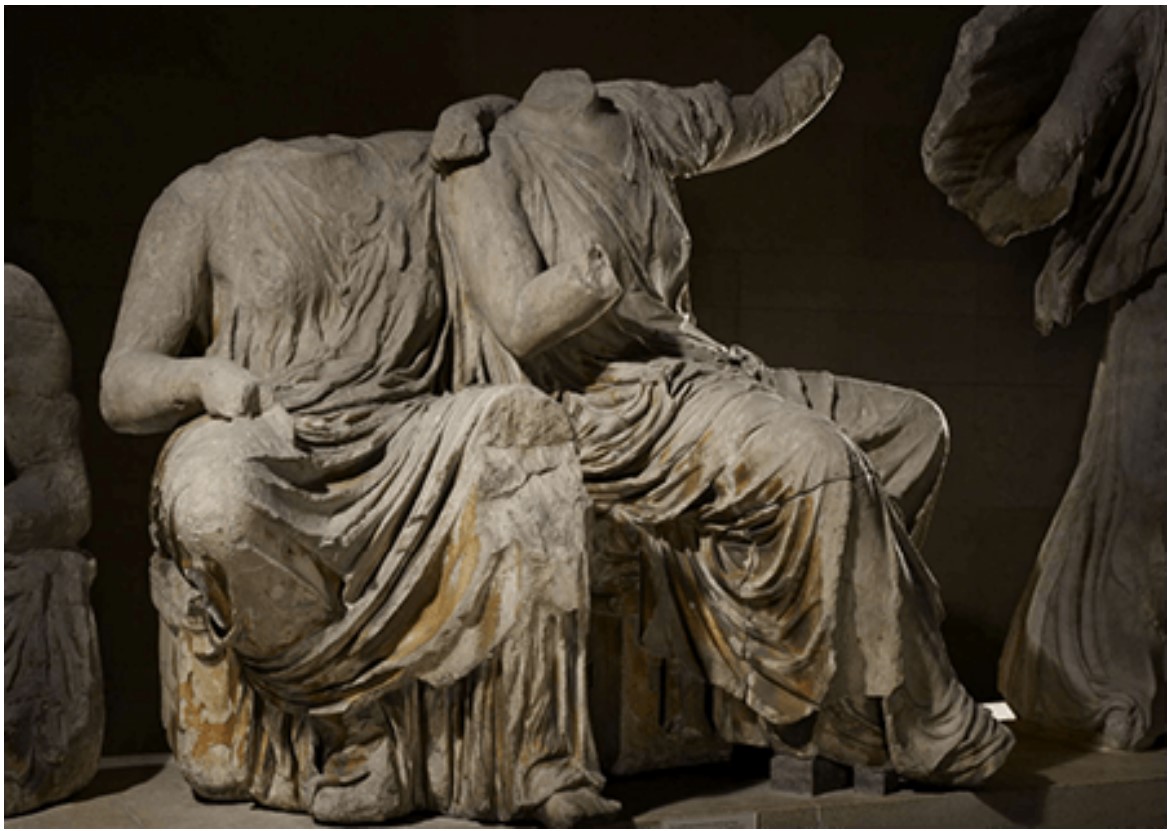
Pheidias, Demeter and Persephone, 438BC-432 BC. The Parthenon Sculptures, British Museum © The Trustees of the British Museum
Essential to Koons’s practice is the consideration of the viewer’s participation in the experience of the artwork. Informed by Alois Riegl’s writings on the relationship between artwork and viewer, Koons believes in the philosophy of embrace, establishing a symbiotic relationship between viewers, the artwork, and the spaces they share. Koons is interested in the exchange offered by an artwork and its encounter with the viewer, which he heightens in the illuminating allure of the flawlessly reflective surface of the gazing ball.
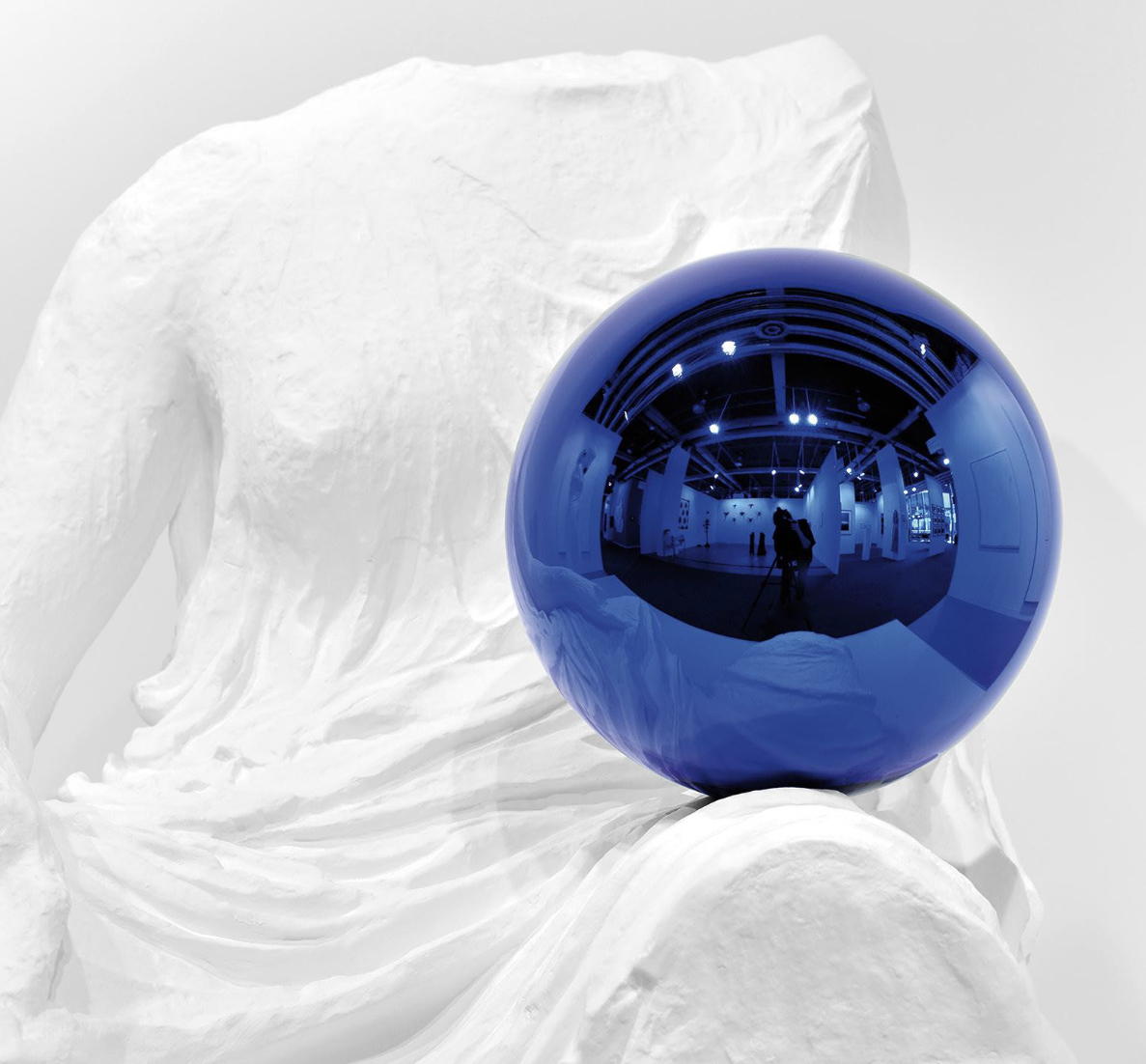
The mirrored façade of the ball “constantly reminds viewers of their existence, of your existence…It’s visually so abstract that it always made me think of generosity.” His artistic agenda is characterized by unrelenting optimism, exhorting viewers to accept and embrace his buoyant iconography regardless of socially imposed criteria of good taste. The ebullient aesthetic exchange of Gazing Ball (Demeter) reminds us of the ultimate pleasures in succumbing to our most primal desire for beauty, a flattening of the poles of attraction that exemplifies Koons’s work.
Easy Fun Ethereal Series
Hot Dog, 2002
Sotheby’s New-York: 16 November 2023
Estimated: USD 1,000,000 – 1,500,000
USD 1,143,000
EASY FUN ETHEREAL SERIES
Hot Dog | Contemporary Day Auction | 2023 | Sotheby’s (sothebys.com)
JEFF KOONS (b. 1955)
Hot Dog, 2002
Oil on canvas
108×84 inches (274.3 x 213.4 cm)
Signed and dated ’02 (on the overlap)
A frenetic amalgamation of unabashed sensuality and rapture, Hot Dog is an alluring embodiment of the virtuosic dexterity with which Jeff Koons has deftly reimagined the art historical canon throughout his artistic career. Executed in 2002, the present work belongs to the seminal Easyfun-Ethereal series, a festive collection of twenty-four paintings that unites cutout photographs culled from the glossy pages of fashion and cosmetic magazines, and advertisements on food product packaging, into seductive photorealistic murals with the aid of computer technology. Channeling the artist’s quintessential Pop sensibility, the present work weaves an exuberant tapestry of far-fetched imagery, from a ham and cheese sandwich and inflatable pool to the revealing lower half of a swimsuit model, into a kaleidoscopic tableau of excess. In a thought-provoking yet playful dialogue with a range of artistic precedents, Hot Dog seamlessly interlaces humor and sensuality with exceptional artistic bravado, all in powerful tribute to Jeff Koons’ unparalleled prominence in the post-Pop era.
Executed between 2000-2002, the Easyfun-Ethereal series was born out of a commission by the Deutsche Guggenheim, Berlin in 2000, following the zealous public reception of Koons’ Balloon Flower (Blue), a large-scale mirror-polished stainless-steel sculpture installed in Potsdamer Platz in Berlin the year before. Though the original commission only called for seven paintings, the free-flowing spontaneity inherent in their creative process spurred Koons to expand the series to twenty-four paintings over two years. As exemplified in the present work, Koons applies the same exacting perfectionism to his paintings as he does to his towering aluminum and stainless-steel sculptures of his earlier Celebration series, many of which similarly feature inflatable animal-shaped pool floats such as swans, monkeys, and dogs as their subjects. However, behind the photorealistic finish of Hot Dog lies a painstakingly detailed and time-intensive process. Koons first curates an assortment of found imagery culled from diverse print media and his personal photo archive before digitally manipulating and collaging the images in Adobe Photoshop. He then meticulously transfers the final composition by hand onto canvas with exacting precision.
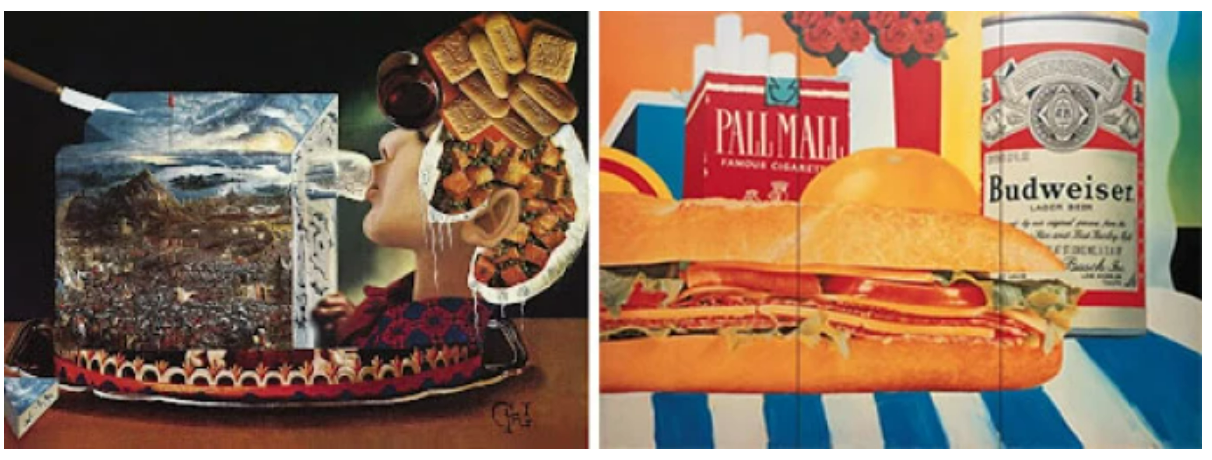
LEFT: PAGE FROM SALVADOR DALÍ’S COOKBOOK LES DÎNERS DE GALA, 1973
ART © 2021 SALVADOR DALÍ, GALA-SALVADOR DALÍ FOUNDATION / ARTISTS RIGHTS SOCIETY (ARS), NEW YORK.
RIGHT: TOM WESSELMAN, STILL LIFE #33, 1963
ART © TOM WESSELMANN/LICENSED BY VAGA, NEW YORK, NY
A masterpiece that deftly blends conceptual depth with visual impact, Hot Dog showcases Koons’ skillful incorporation of several of his most formative influences, both from the annals of art history and his personal life. Chief amongst these is Koons’ homage to his two artistic heroes: Salvador Dalí and Marcel Duchamp. Despite their stylistic and conceptual differences, Duchamp and Dali both used their art to render the ordinary extraordinary. So too does Koons’, uniting disparate aesthetic references to deli meats, skimpy bikinis, and inflatable pool toys, paradigms of popular taste and archetypes of kitsch sentimentality, all reimagined and articulated in his signature mode. The resulting work embodies a central tenet of Surrealism: the juxtaposition of two seemingly disparate entities to create an entirely novel object, verging on the absurd. Simultaneously, Hot Dog offers an altered concept of the Duchampian readymade, as Koons creates an entirely novel object based on emblems or ideas drawn from the mass consciousness.
Pancakes, 2001
Sotheby’s New-York: 12 May 2021
Estimated: USD 1,000,000 – 1,500,000
USD 867,000
EASY FUN ETHEREAL SERIES
Pancakes | Contemporary Art Evening Auction | 2021 | Sotheby’s (sothebys.com)
JEFF KOONS (b.1955)
Pancakes, 2001
Oil on canvas
108×84 inches (274.6 x 213.4 cm)
Signed and dated ’01 on the overlap
Jeff Koons Pancakes, 2001 is a frenetic amalgam of sensuality. Fusing photorealistic imagery of food, landscape and human form, Koons creates a phantasmagoric spectacle of human desire in the age of late capitalism. The present work is a study in the transmogrifying effects of early digital processors like Photoshop, which is evoked and redoubled through the exacting replication of the newly rendered visual collage into a seductive hand-painted oil on canvas. Pancakes elicits and celebrates desirousness, pleasure and consumerism, all hallmarks of Koons’ unabashed sensibility of indulgence. As he said, “You know, all of life is… just about being able to find amazement in things. I think it’s easy for people to feel connected to that situation of not tiring of looking at something over and over again, and not feeling any sense of boredom, but feeling interest. Life is amazing, and visual experience is amazing.” (David Sylvester, Interviews with American Artists, London 2002, p. 334) This preoccupation with the rich and entrancing elements of visual culture is paramount to the aesthetic sensibility of Jeff Koons and decidedly embodies the quintessential spirit of his oeuvre.
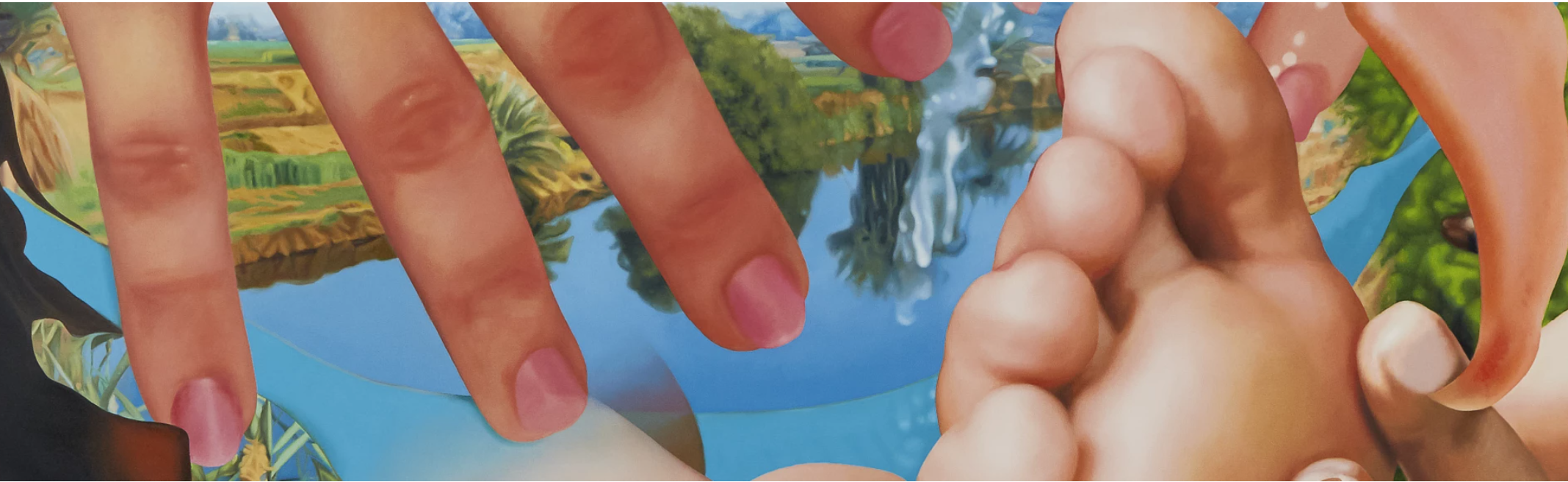
Belonging to his series Easyfun-Ethereal, the present work represents a fusing of spatial layers. For this series, Koons sourced images from glossy magazines and personal photographs and then used the computer to combine these images in a deliriously optimistic reshuffle, shifting both context and scale. The collaged fragments seemingly surface unmoored to their surrounding elements, evoking an ethereal effect. Following the initial computer manipulation, these images are then transferred back to the traditional medium of oil painting with photorealistic perfection. With the Easyfun series, begun in 1999, Koons truly honed the use of his multi-layered collage imagery, exploring his new super-pop Baroque aesthetic. The collaged, disconnected images and high-key colors that comprise Pancakes are a metaphor for the bombarding stimuli of modern life. Drawing upon this diversity of imagery from both personal records and culture at large, Koons creates a work at once both instantly legible and utterly disorienting. He confronts viewers with a dazzling and prismatic projection of human desire to be visually enveloped by.
Other Series
Louis XIV, 1986
Robert Mnuchin: Collector at Heart
Sotheby’s New-York: 14 May 2026
Estimated: USD 7,000,000 – 10,000,000
USD 8,570,000
STATUARY SERIES
Jeff Koons | Louis XIV | Robert Mnuchin: Collector at Heart Evening
JEFF KOONS (b. 1955)
Louis XIV, 1986
Stainless steel
46x27x15 inches (116.8 x 68.6 x 38.1 cm)
This work is the artist’s proof from an edition of 3 plus 1 artist’s proof
“On the one side there is Louis XIV and on the other side there is Bob Hope. If you put art in the hands of a monarch, it will reflect his ego and eventually become decorative. If you put it in the hands of the masses, it will reflect mass ego and eventually become decorative. If you put art in the hands of Jeff Koons, it will reflect my ego and eventually become decorative.”
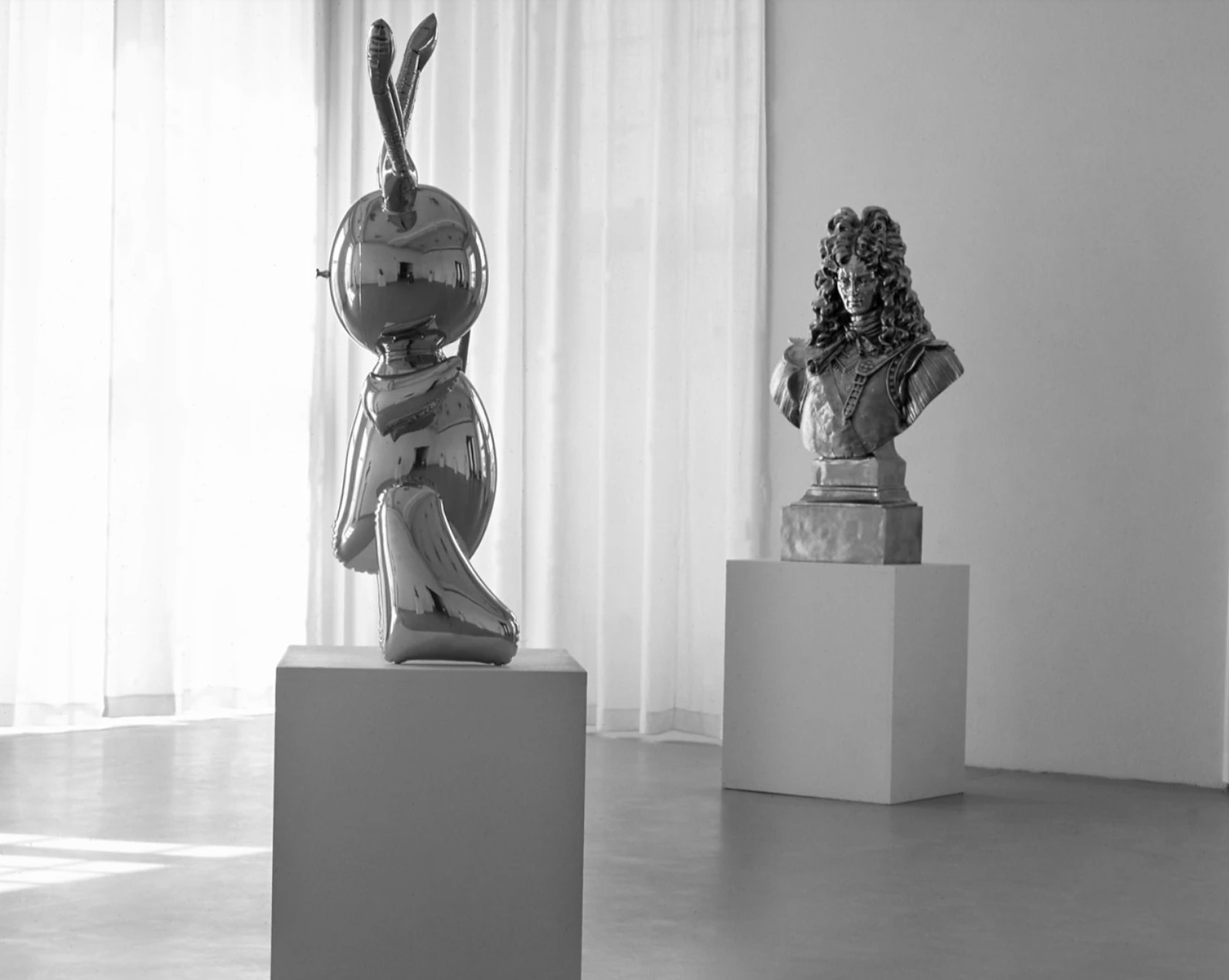
The present work installed in Schlaf Der Vernunft at Museum Fridericianum, Kassel, February – May 1988. Art © 2026 Jeff Koons
A thrilling paradox rendered in royal pomp and steel, Louis XIV, from 1986, is the ultimate embodiment of Jeff Koons’ insurgent oeuvre, a gleeful assault on the hierarchies and hegemonies of taste rendered with immaculate finish and imposing presence. Simultaneously a homage, a critique, and a self-portrait of ambition, the life-size bust of the so-called “Sun King” embodies the tension between sovereign grandeur and contemporary mass production. Executed in 1986 as part of an edition of three plus one artist’s proof, Louis XIV is, as Robert Mnuchin himself noted, “Koons from the very best period”, emerging from the seminal Statuary series in which Koons first incorporated canonical “high” art into his practice. A measure of the work’s enduring significance, all other editions of Louis XIV are held in esteemed museum collections, including the Nasher Sculpture Center, Dallas; The Broad, Los Angeles; and DESTE Foundation for Contemporary Art, Athens. Further testament to its importance, Louis XIV has been included in nearly every major retrospective of the artist’s work.
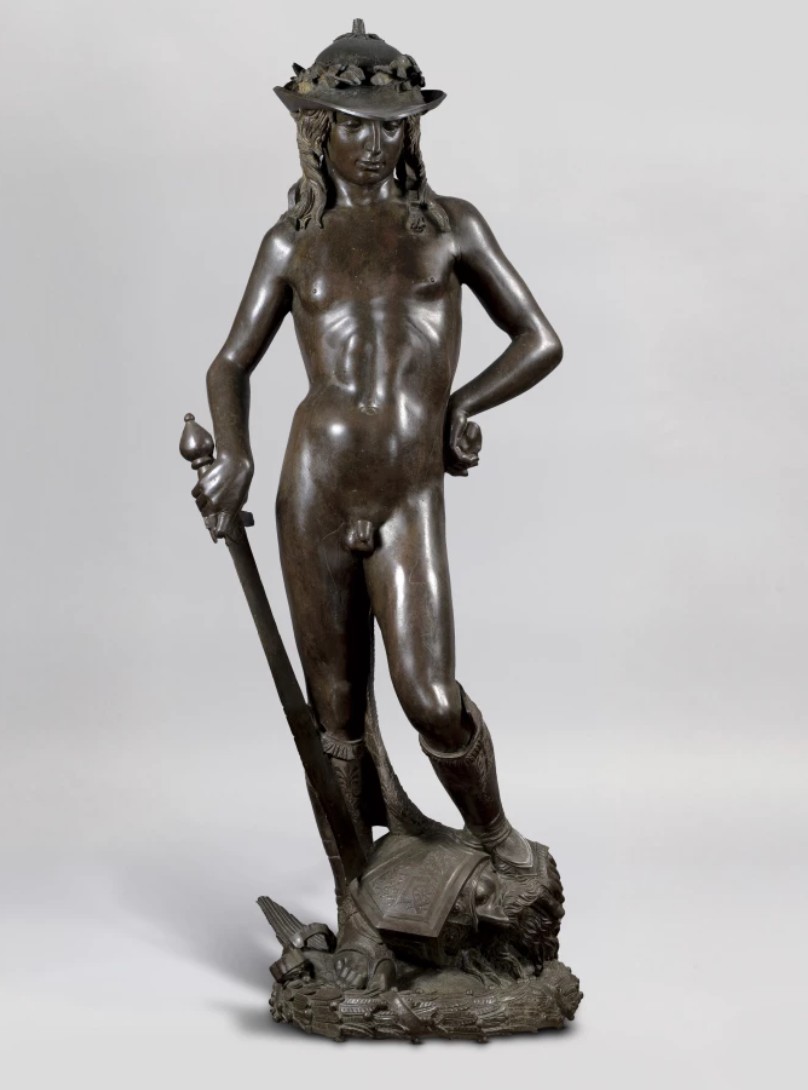
Donatello, David, 1430-35. Museo Nazionale del Bargello, Florence.
Image © Scala/Ministero per i Beni e le Attività culturali / Art Resource, NY
Koons’s gleaming bust of the King of France cuts an impressive figure. His steely gaze pierces the viewer beneath a turret of tumbling curls whose peaks rise in impressive heights and cascade into gleaming ringlets. Decoration abounds, and the proportions are exaggerated and excessive, a visual bravado that results in something more than life-size. Everything gleams and reflects, in effect transmuting the Sun King’s image into a manifestation of the most potent symbol of his absolute power: the Hall of Mirrors. Fittingly, Louis XIV was prominently featured in Koons’ 2008 exhibition at the Palace of Versailles. Juxtaposed with the variegated surface of his elaborate coif and detailed attire, the smooth, broad planes of Louis’ face form a pristine looking glass. Face to face with the sculpture, the viewer’s own visage gazes back. Louis XIV acts as both icon and mirror, a forceful assertion of monarchical power that is democratized by the viewer’s implication in the image.
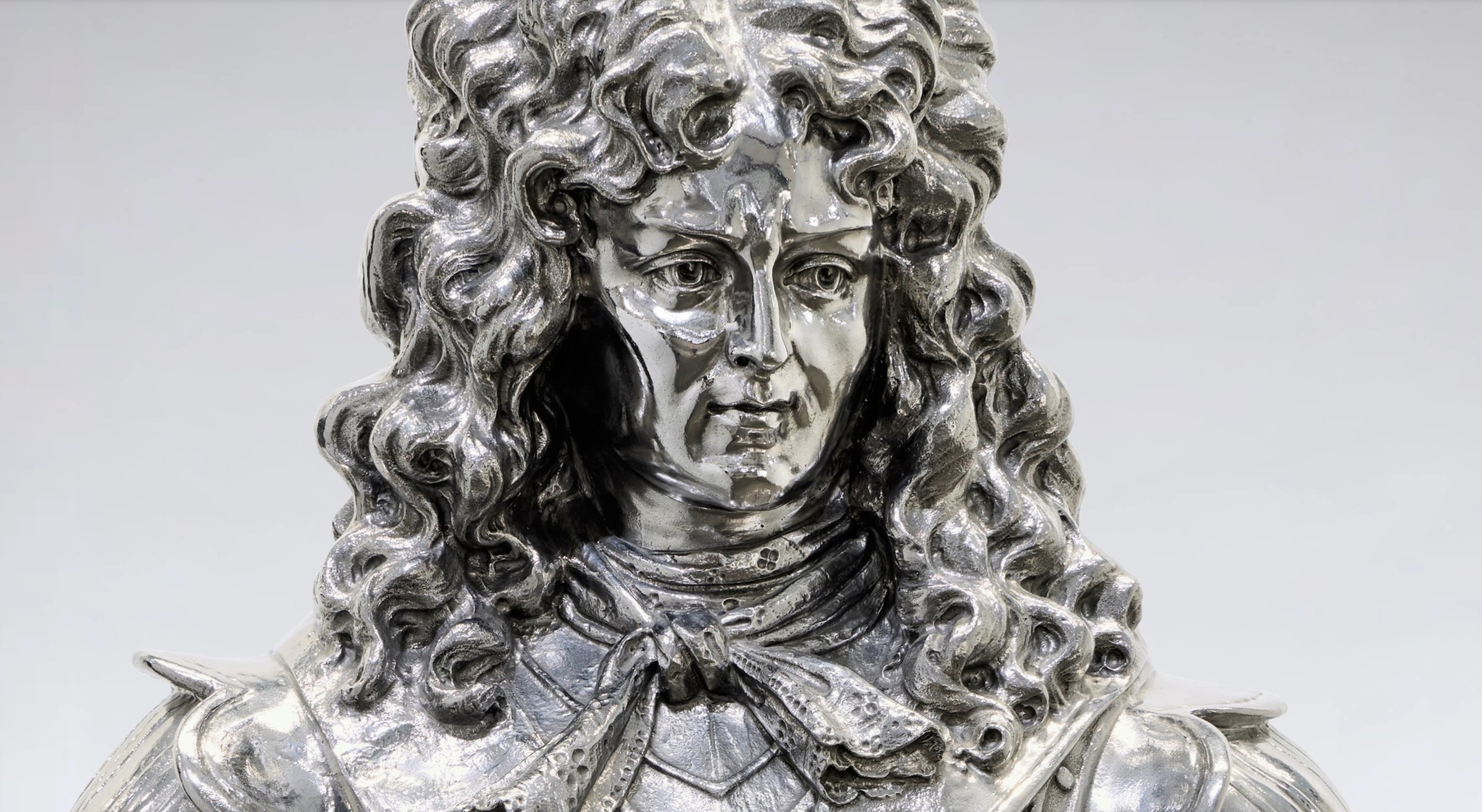
Louis XIV is an integral work within Koons’ groundbreaking Statuary series, created alongside the artist’s record at auction, Rabbit, whose winning bid was achieved by Mnuchin himself in the auction room. It is in this pioneering group of artworks that Koons first established a direct reference to canonical “high art” in his practice, a theme he would continue to explore throughout his career. Executed with cool precision, the Statuary series exploits the breadth of canonical art history and popular kitsch, probing the nature of cultural hierarchy and taste.
“I remember walking down Canal Street and seeing a fibreglass bust of Louis XIV in this place called Canal Plastics, where I would get a lot of my plastic sheets. I thought it was fantastic. I carried that with me in my head and then when I was walking around somewhere, probably somewhere around Times Square, I saw a little plaster cast of Bob Hope. Then this narrative started to develop. I realised they were really symbols of what happens when you put art in the hands of either the mass, with Bob Hope, or an individual, in Louis’ case of a monarch.”
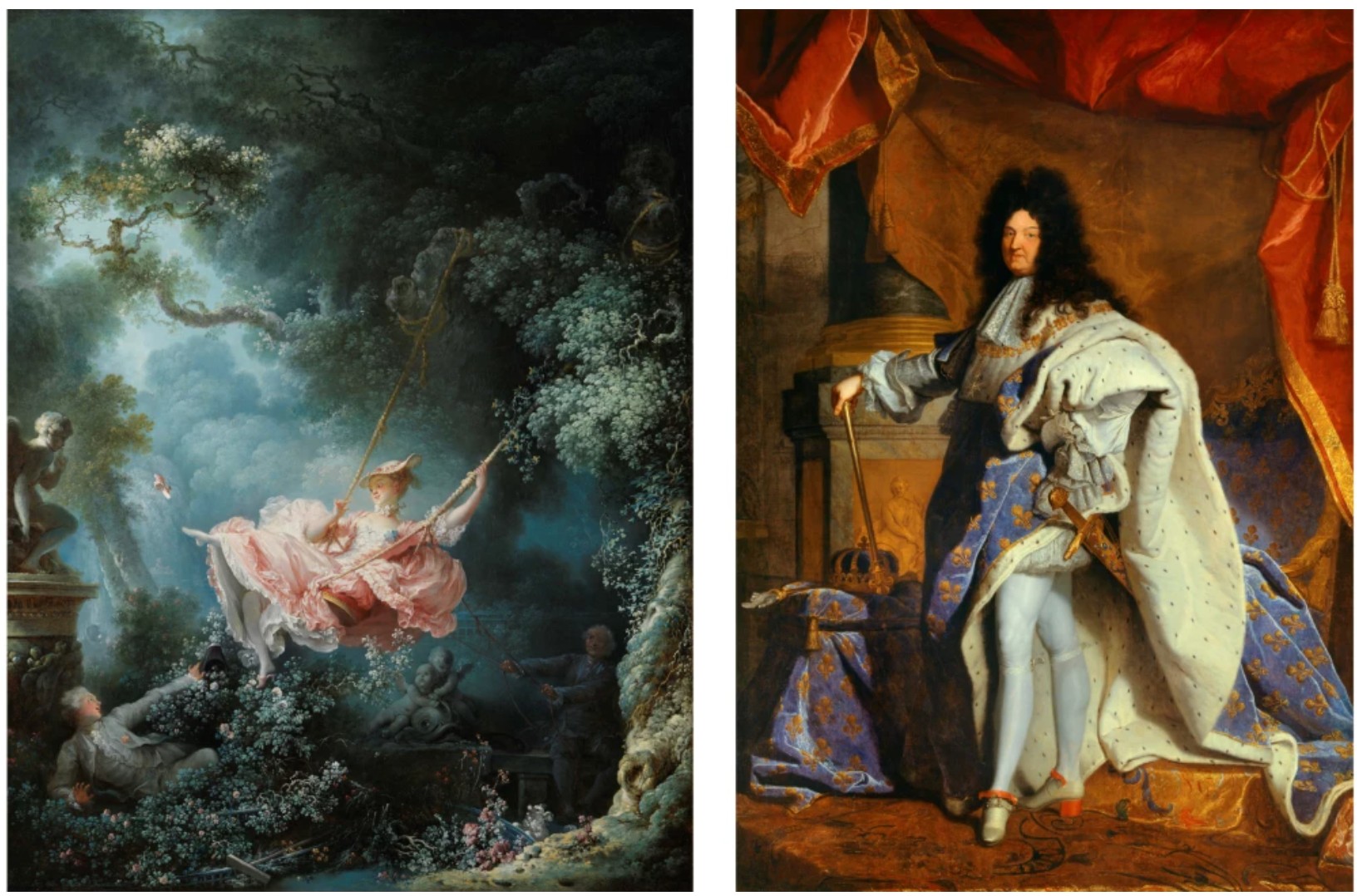
Left: Jean-Honoré Fragonard, The Swing, 1767. Wallace Collection, London. Image © Wallace Collection, London, UK / Bridgeman Images. Right: Hyacinthe Rigaud, Portrait en pied de Louis XIV, 1701. Château de Versailles. Image © Photo Josse / Bridgeman Image
Central to Louis XIV’s conceptual force is its material, polished stainless steel, which Koons deploys with both formal precision and philosophical provocation. Interacting with the work, the viewer’s own image is reflected back from the seductive surface.
“It’s about affirming the viewer, telling him, ‘You exist! When you move, it moves. The reflection changes. If you don’t move, nothing happens. Everything depends on you, the viewer.”
Further, steel is a practical, even proletarian material, one familiar to Koons given his upbringing in a steel industry town in Pennsylvania.
“I chose high-grade stainless steel as my material for the sense of security it emanates. The polish only emphasises that security, as does the fact that the saucepans Mom used to cook with were steel too.”
Simultaneously, steel exudes the gleam and glimmer of luxury and sanctitude.
“In the high-grade steel works, there’s a direct link with religious relics, which are polished too. So they make a spiritual appeal to the beholder and fill him with confidence.”
At once proletarian and luxurious, the material enacts in its very surface the cultural hierarchies it sets out to dismantle.
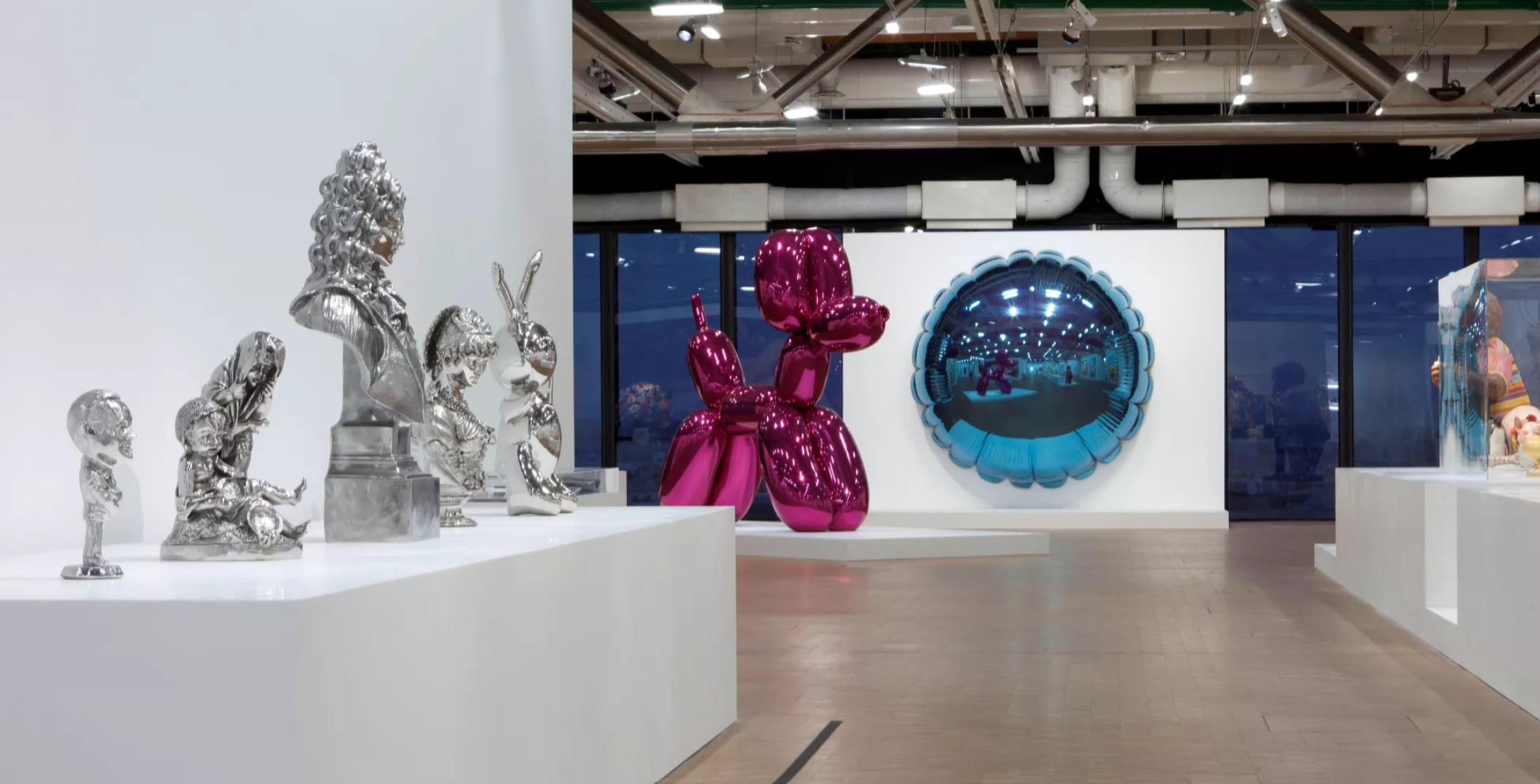
Another edition of the present work installed in Jeff Koons: A Retrospective at the Centre Georges Pompidou, Paris, November 2014 – April 2015. Photo © CNAC/MNAM, Dist. RMN-Grand Palais / Art Resource, NY. Photo by Hervé Véronèse. Art © 2026 Jeff Koons
“Louis was a symbol of what happens to art under a monarch (whoever controls it, it will eventually reflect his or her ego and simply become decorative). I was making reference to that because if I wanted that responsibility or had that opportunity, the same thing would eventually happen. If you put art in the hands of the monarch it will reflect his ego and eventually become decorative. If you put art in the hands of the masses, it will reflect mass ego and eventually become decorative. If you put art in the hands of Jeff Koons it will reflect my ego and eventually become decorative.”
Both art-historical statement and trophy object, Louis XIV is perhaps the work that most directly addresses the mythology of power that surrounds Koons as an artist. Depicting the first celebrity monarch, the original master of image-making, Koons draws a parallel between King Louis XIV’s use of image and his own use of popular iconography, thereby implicating his own ego in the same cycle of vanity and decoration he sets out to expose.
Balloon Venus Dolni Vestonice (Magenta), 2013-17
Bonhams New-York: 19 November 2025
Estimated: USD 1,500,000 – 2,500,000
USD 1,349,150
ANTIQUITY SERIES
Bonhams : JEFF KOONS (B. 1955) Balloon Venus Dolni Vestonice (Magenta)
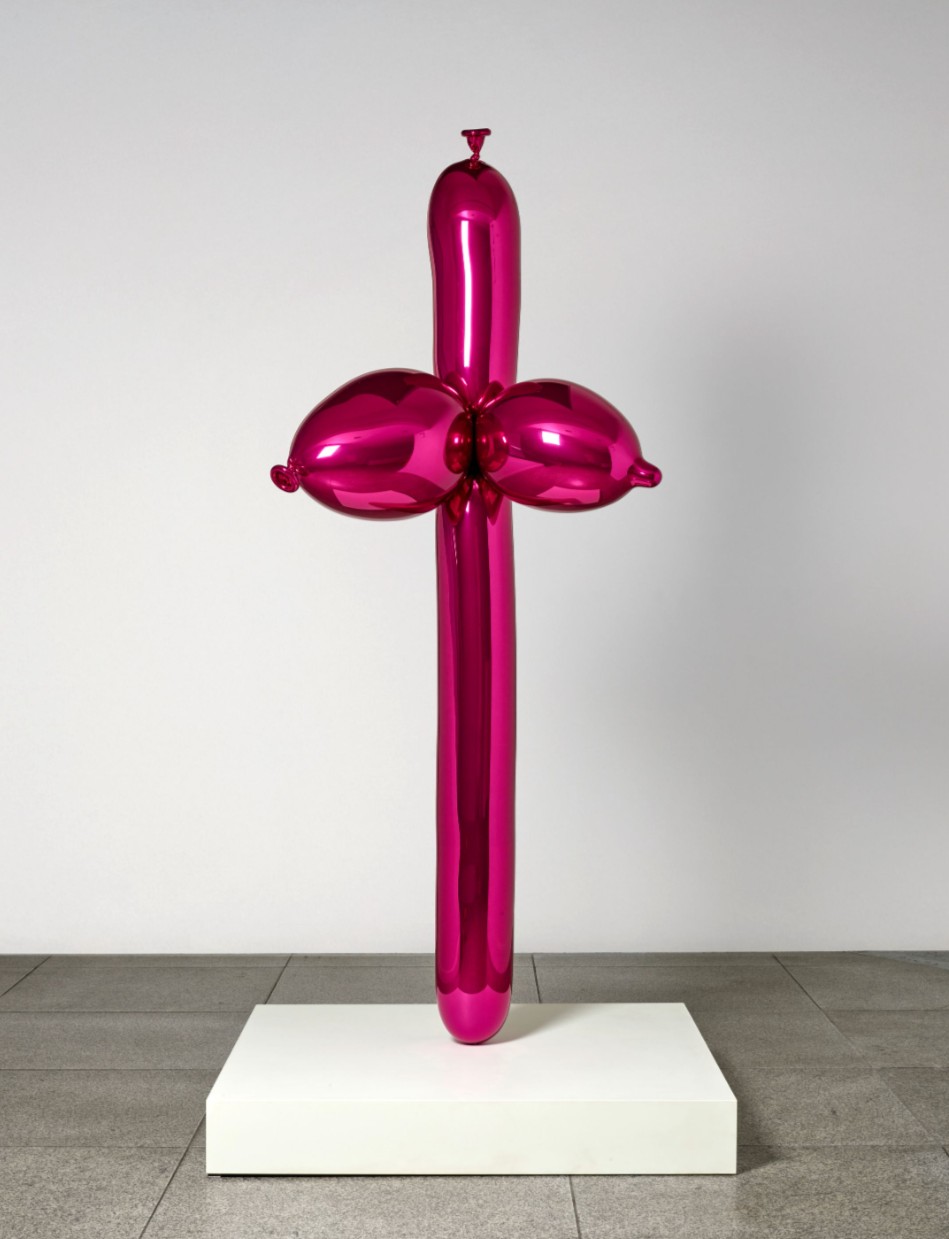
JEFF KOONS (B. 1955)
Balloon Venus Dolni Vestonice (Magenta), 2013-17
Mirror-polished stainless steel with transparent color coating
109 1/8 x 43 7/8 x 28 1/4 inches (277.2 x 111.3 x 71.7 cm)
This work is one of five unique variants
Jeff Koons occupies a singular place within the history of late-twentieth- and early-twenty-first-century art. Few artists have more audaciously embodied the contradictions of Postmodernism; its simultaneous embrace of the readymade, its fascination with surface, and its entanglement with popular culture and human history. A monumental, quintessential example of his famed stainless steel balloon sculptures, Balloon Venus Dolni Vestonice (Magenta) wonderfully encapsulates these tensions. By reimagining one of the earliest known sculptural depictions of the human form through the industrial precision and chromatic exuberance of contemporary fabrication, Koons transforms an artifact of prehistory into a gleaming emblem of the 21st Century that references the ancient, fertility, and ritual. The result is an image of desire and affirmation refracted through the flawless mirror-finish surface; a testament to Koons’ standing as one of the most important and calculated commentators of our age.
The present work references a venus from Dolní Věstonice, a Paleolithic figurine discovered in the Czech Republic and dating to approximately 30,000 BCE. The original object, a small statuette of a female body made from mammoth ivory, is among humanity’s oldest surviving representations of fertility and the female form. Koons’s version, by contrast, is monumental in scale and rendered in stainless steel coated with a chromed magenta finish. The translation from ivory to mirror-polished stainless steel charts the historical passage from the tactile intimacy of prehistory to the alienated gleam of industrial modernity. Where the prehistoric Venus speaks of embodied ritual, Koons’s Venus speaks of display, consumption, and technological fetishism. As a depiction of the female form, Balloon Venus Dolni Vestonice (Magenta) extends the erotic ideology that has charged Koons’s practice throughout his career.
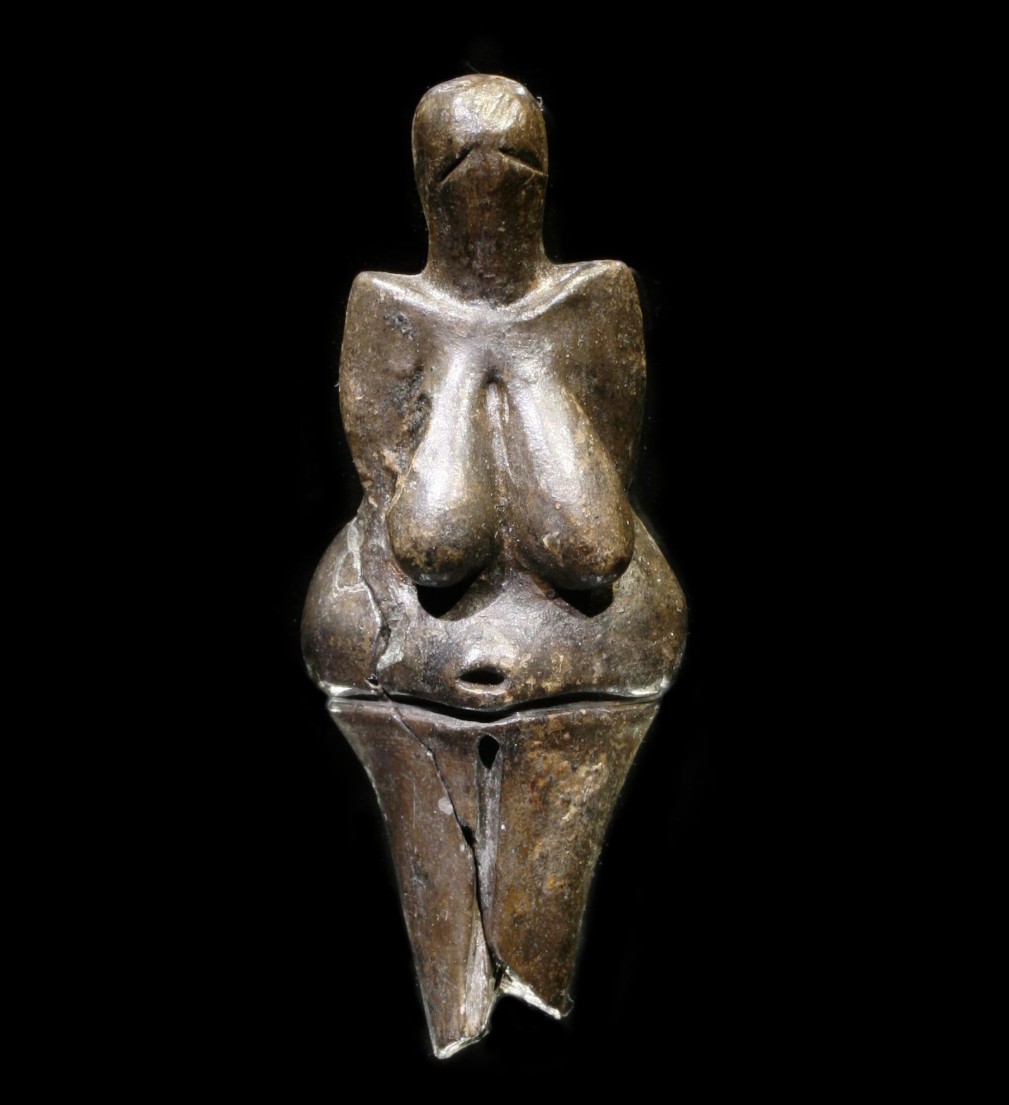
Věstonická Venus at the Mammoth Hunters exhibition in the National Museum in Prague
A sculpture that embodies the breath of its maker, Balloon Venus Dolni Vestonice (Magenta) possesses an internal life, its taut, inflated contours poised at the threshold between stillness and expulsion. The swelling lobes and compressed knots suggest a physical tension animated from within. This sense of interior imbues the sculpture with a vitality whose perfection is contingent upon containment, whose surface tension is a metaphor for existence itself. An underlying motif of Koons’ most important works – from his vacuum cleaners, Equilibrium tanks, to his Lifeboat (1985) – the inhalation and exhalation of breath conveys a deeper meaning about the balance of life and the psychosomatic relationship between our internal and external lives. The materiality of the steel captures this dichotomy, embodying both fragility and permanence; an idol that transforms the fluid act of breathing into a monumental expression of energy and life.
allegory-of-transience-so-called-vanitas-group
Polished to a pristine mirror-finish, Koons’s Balloon Venus Dolni Vestonice (Magenta) has a spiritual intensity, a sacred ornament that speaks to the depth of the human condition. The sculpture’s chromed surface creates a seamless barrier between internal and external life, but it goes further. Like the idols of antiquity, it confronts the viewer with the spectacle of beauty and selfhood. In its structure, Koons alludes not only to the prehistoric Venus that lends the work its name but also to the Allegory of Transience, otherwise known as the Vanitas group by Michel Erhart, whose three intertwined figures represent youth, beauty, and decay. Just as Erhart’s carved triptych dramatizes the transience of life in three discrete stages, Koons reimagines that allegory through the tripartite ‘crown’ of balloons. In Koons’s monumental, mirror-polished steel, mortality and eternity co-exist. Balloon Venus Dolni Vestonice (Magenta) translates the moral symbolism of Vanitas through the contemporary language of desire, therefore, where perfection and transience coexist within a single, wondrous form.
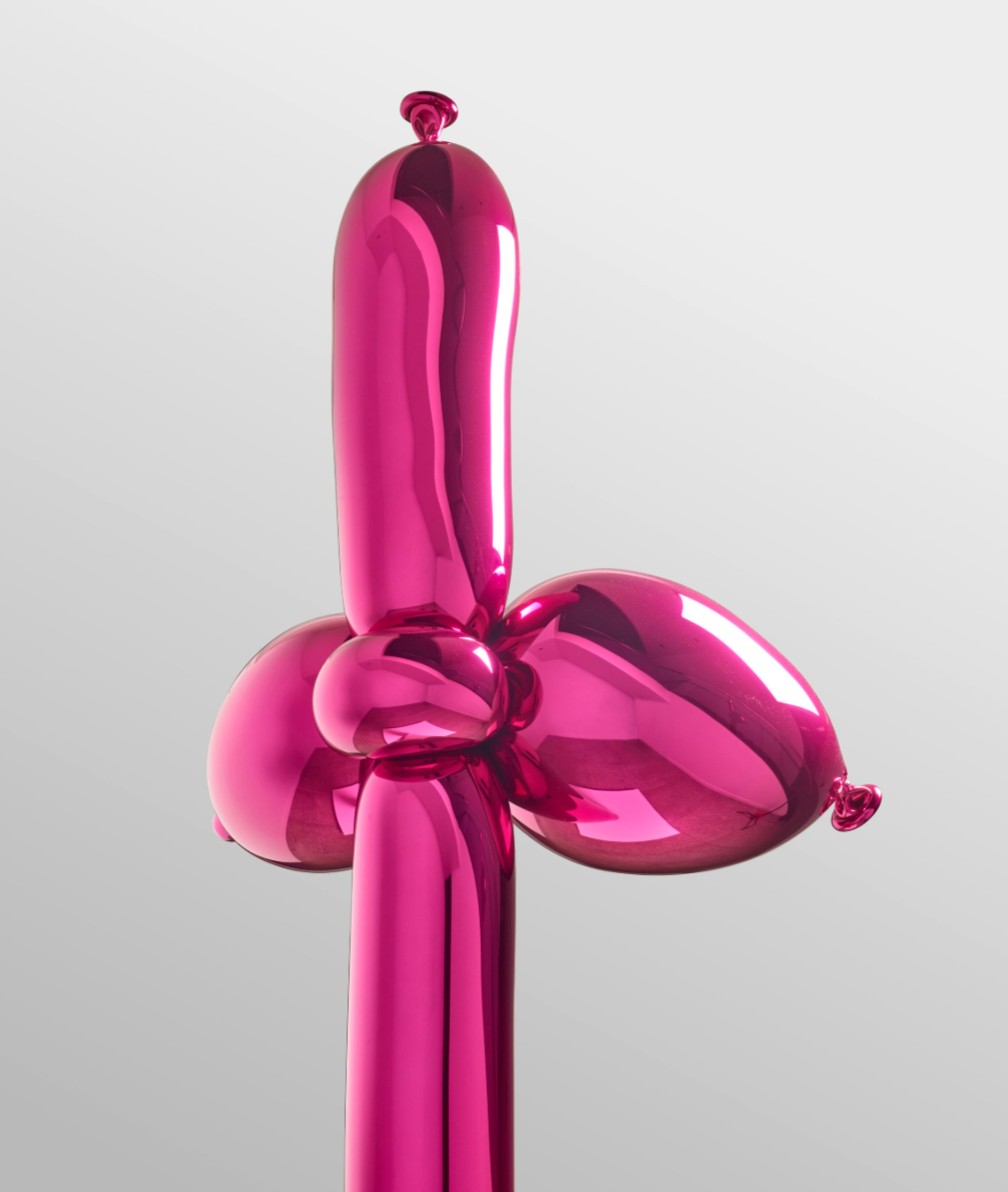
Koons is the Postmodern artist sui generis. Not because he resolves the contradictions of art and capital, but because he stages them with unparalleled clarity. Koons represents the philosophical Eros. A brazen exploration of libidinal desire, his Balloon Venus Dolni Vestonice (Magenta) exposes the vocabulary of late capitalism that has cannibalized culture and history; everything is here, everything is now, everything is possible. In Balloon Venus Dolni Vestonice (Magenta), Koons transforms the ancient venus statuette and Micher Erhart’s Vanitas into a large-scale contemporary icon. Through it, the artist impresses upon us the enduring power of desire and represents the biological narrative, the narrative of human history. It is a masterpiece of Postmodern practice by an artist whose place in the canon can only balloon in significance as we continue to reappraise his scrutiny and revelation of our millennial moment.
Hulk (Rock), 2004-13
Property from a Prestigious American Collection
Sotheby’s New-York: 18 November 2025
Estimated: USD 2,o00,000 – 3,000,000
USD 4,442,000
HULK ELVIS SERIES
Hulk (Rock) | The Now & Contemporary Evening Auction | 2025 | Sotheby’s
JEFF KOONS (b. 1955)
Hulk (Rock), 2004-13
Polychromed bronze and marble
87 3/8 x 48 3/4 x 28 1/8 inches (221.9 x 123.8 x 71.4 cm)
Signed, dated 2004-2013 and numbered 2/3 (on the interior of the purple element)
This work is number 2 from an edition of 3 plus 1 artist’s proof
Embodying the artist’s singular ability to transform the familiar into the extraordinary, Hulk (Rock) deftly typifies Jeff Koons’ celebrated artistic practice; his flawless fabrications become the means of upending expectation. At first glance, the sculpture appears to be a lightweight inflatable toy, contradictorily balancing the weight of a marble boulder upon its shoulders with a triumphant roar—an ephemeral inflatable toy stretched to the limit of its capacity. Yet upon closer inspection, the viewer discovers that the delicate surface is in fact cast in bronze, a material historically associated with permanence and steeped in art-historical convention. This seamless fabrication, polished to a degree of perfection that defies belief, illustrates Koons’ unparalleled mastery of surface and form while inviting us to reconsider the reliability of perception itself. Hulk (Rock) extends the lineage of Pop Art pioneered by Andy Warhol and Roy Lichtenstein, transforming mass-media icons into monumental reflections of contemporary desire and identity. Like Warhol’s Superman or Lichtenstein’s Popeye, Koons references the comic-book hero as a vehicle for examining strength, vulnerability, and the construction of myth through consumer culture.
“Everything has something to offer, and if you look at something at some level there’s something there that you can find of benefit. I really try to take life like a glass filled with water and put a sponge in there and try to get something out of everything.”
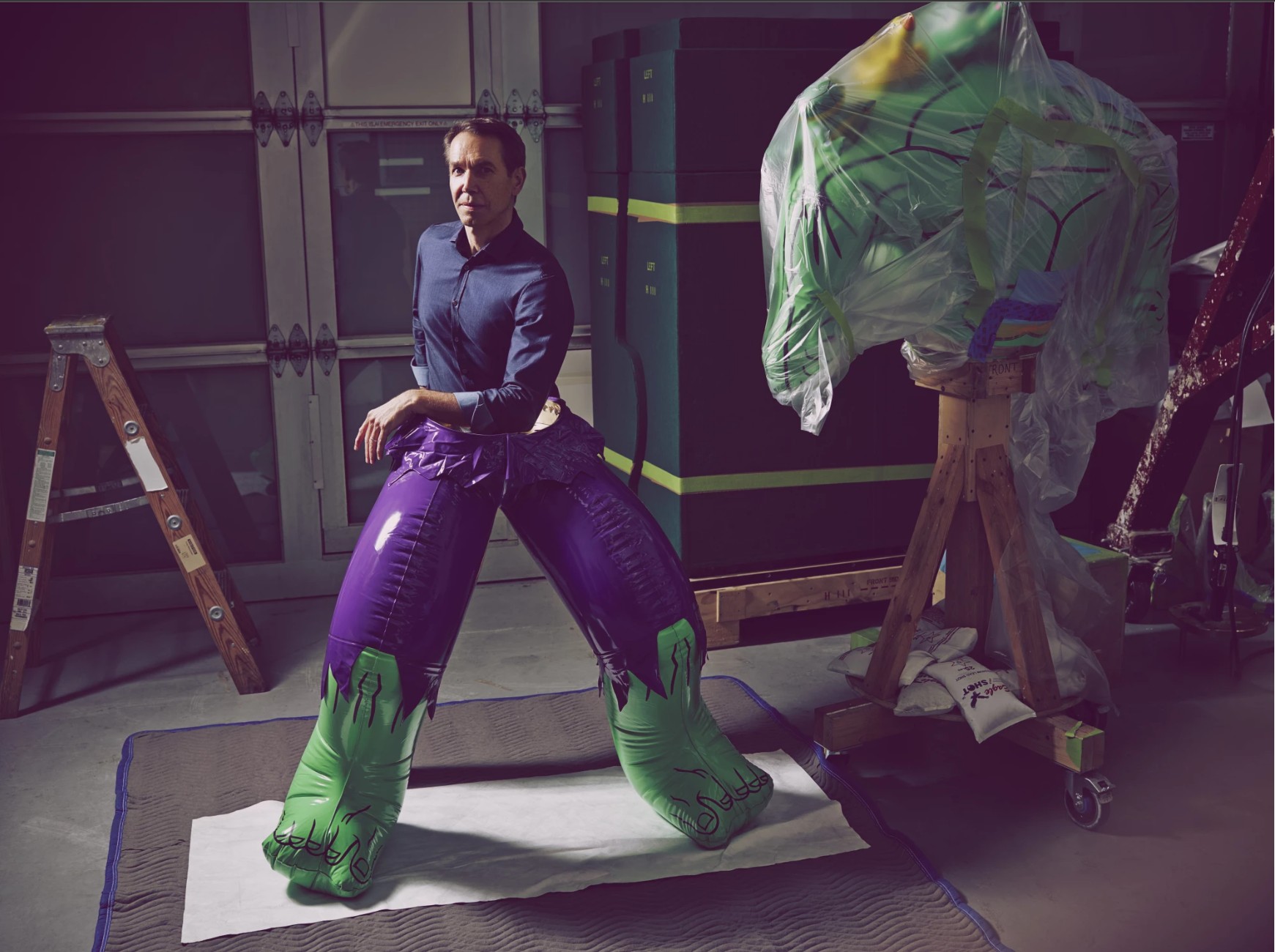
Jeff Koons in his studio. Image © Guy Aroch / Trunk Archive. Art © 2025 Jeff Koons Guy Aroch / trunkarchive.com
Koons’s Hulk series casts the Marvel superhero in various guises, each iteration balancing theatricality with conceptual rigor. The artist’s choice of subject is deeply resonant. First appearing in The Incredible Hulk in 1962, the character created by Stan Lee and Jack Kirby has long embodied the tension between vulnerability and power. Mild-mannered Dr. Bruce Banner, transformed by a blast of gamma radiation, becomes the Hulk when provoked by rage. Known for his vibrant green skin, exaggerated musculature, and purple pants stretched and torn by his rapid, anger-fueled growth, Hulk (Rock) toys with ideas of strength, power, and vulgarity.
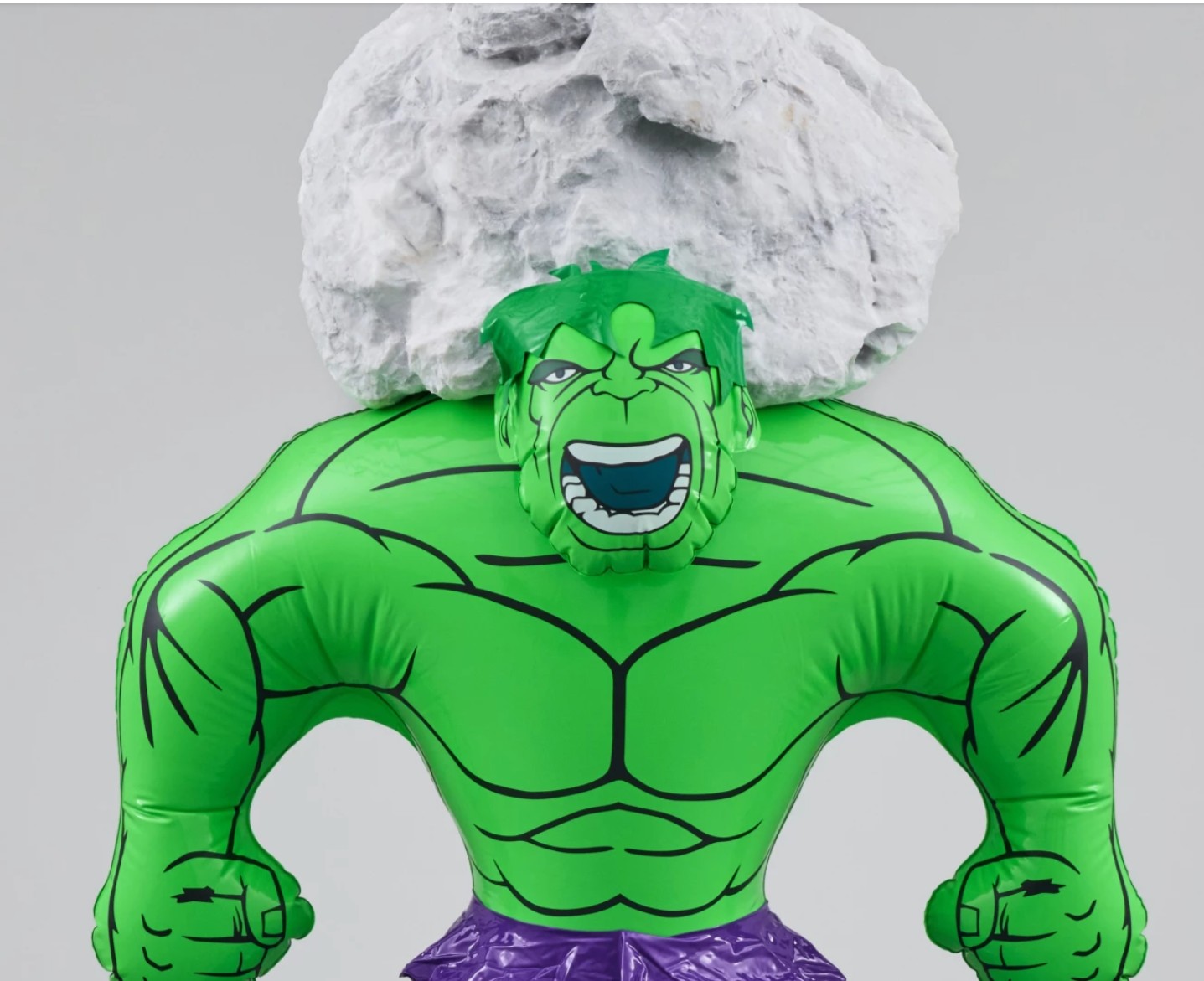
Born in an era riddled with fear of nuclear annihilation, the Hulk’s status as a superhero questions the concepts of righteous anger and justified violence. Occupying the margins of society due to his frightening appearance, the Hulk quickly became a leader in his own right within American counterculture, representing resistance to the traditional, handsome superhero archetype and creating space for the abject to stand on the side of the “good guys.” Unlike other superheroes, the Hulk embodies ambivalence: his strength is both a blessing and a curse, his appearance inspiring awe and fear in equal measure. The Hulk offered readers a parable of unchecked power and the destructive potential of modern science, while simultaneously serving as a figure of cathartic release—an avatar of justified anger in a world fraught with existential risk. This lineage situates Koons’ Hulk (Rock) within a broader cultural conversation—less about superheroes in the narrow sense and more about how societies project anxieties, desires, and ideals onto mass-market characters.
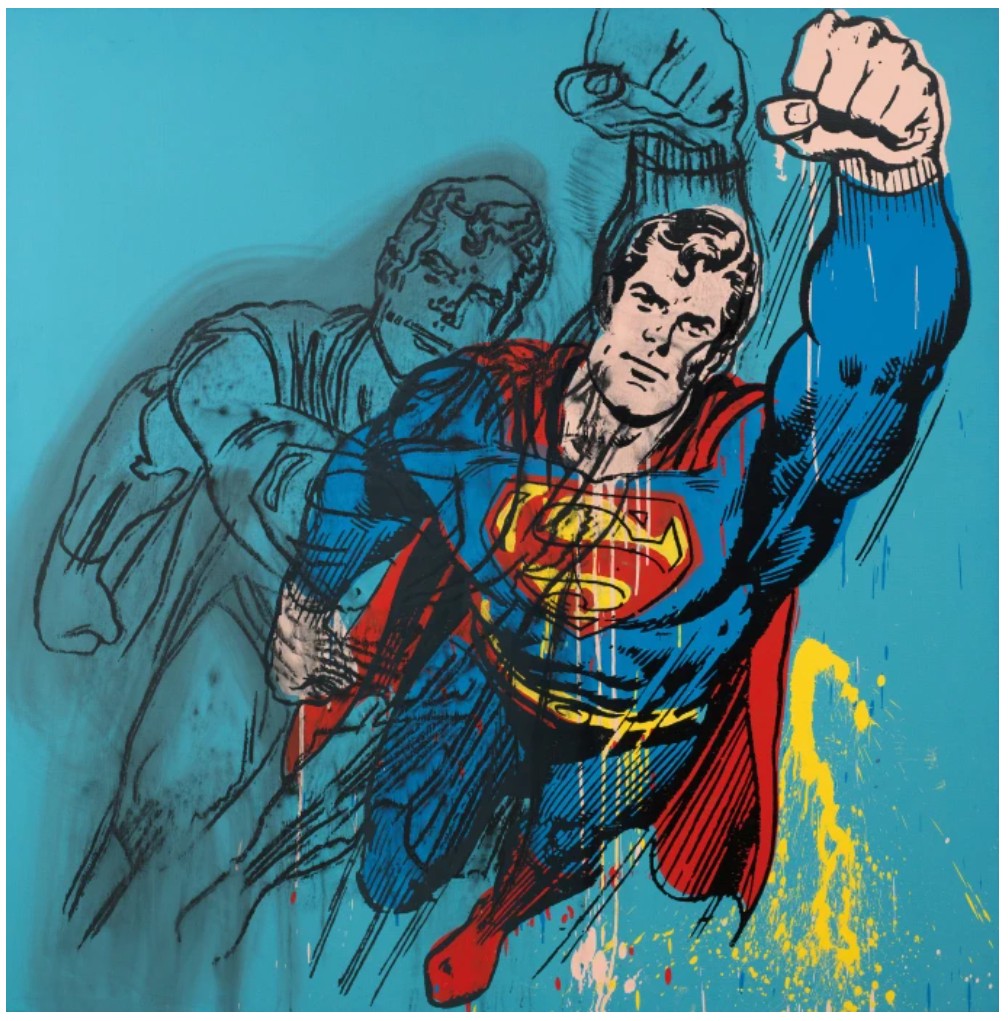
Andy Warhol, Superman, 1981. Private Collection. Sold at Sotheby’s New York in May 2015 for $14.4 million.
Art © 2025 Andy Warhol Foundation for the Visual Arts / Artists Rights Society (ARS), New York
Among his most accomplished works from the early 2000s, the Hulk sculptures—and their immediate precursor, the Popeye series—extend the artist’s enduring dialogue with the readymade and the iconography of American Pop culture. Jeff Koons is synonymous with the revival of Pop in the twentieth century, taking up the torch from Warhol, Lichtenstein, and Oldenburg with his iconic early Banality series, which recontextualized everyday, banal materials and images within a contemporary framework.
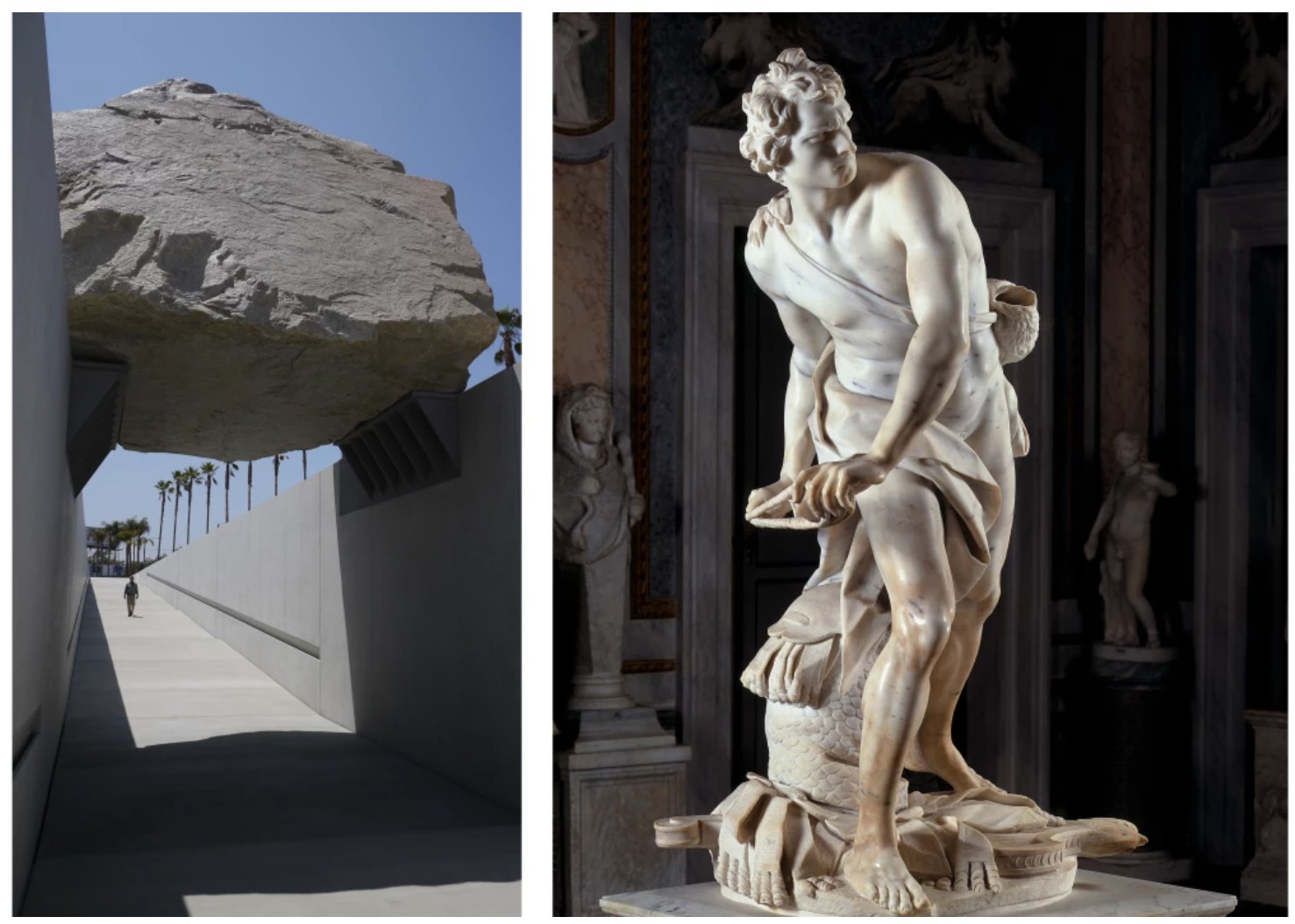
Left: Michael Heizer, Levitated Mass, 2012. Los Angeles County Museum of Art. Photo by Mary Shanahan. Art © Michael Heizer. Courtesy of the artist and Gagosian. Right: Gian Lorenzo Bernini, David, 1623-4. Galleria Borghese, Rome. Image © Andreo Jemolo / Scala / Art Resource, NY
Jeff Koons’ work is fundamentally about perception—how we see, what we value, and how meaning is constructed through surface, scale, and desire. Throughout his career, Koons has explored the boundary between the real and the artificial, the profound and the banal, inviting viewers to question not only the object before them but also their own reactions to it.
“They’re there as protectors…but at the same time they can become very, very violent… The Hulks are like that—they’re really high-testosterone symbols.”
The Hulk figure itself crystallizes these contradictions. As a pop-culture icon, the Hulk embodies both rage and protection, strength and vulnerability—qualities that Koons sees as reflections of the human condition. By monumentalizing this comic hero in the guise of a classical sculpture, Koons transforms mass-media imagery into an object of reverence, collapsing distinctions between high art and low art, myth and consumer fantasy. Its stance, firm and protectionary, evokes images of Japanese temple guardians while also referencing Andy Warhol’s images of Elvis Presley, fusing diverse sources of aesthetic and conceptual inspiration. In Koons’ universe, perception is faith, and the Hulk—both as a guardian from East Asian culture and an icon fixed in Western collective imagination—reflects the very essential and human desire for self-protection and self-preservation.
Aphrodite, 2016-2021
Christie’s New-York: 7 November 2023
Estimated: USD 4,000,000 – 6,000,000
USD 4,043,000
PORCELAIN SERIES
JEFF KOONS (B. 1955) (christies.com)
JEFF KOONS (B. 1955)
Aphrodite, 2016-2021
Mirror-polished stainless steel with transparent color coating
102 x 30 3/16 x 30 3/8 inches (259.1 x 76.7 x 77.2 cm)
This work is number one from an edition of three plus one artist’s proof.
Standing nearly nine feet tall, the subject of Jeff Koons’s Aphrodite lives among art history’s greatest sculptures, and under Koons’s tutelage the Greek goddess’s lustrous form is as desirable as any classical rendering of her. His precise, yet delicate, touch is on full display here as he offers us a sculpture that lies at a point between truth and fiction, movement and stasis, myth and the now. With works such as this, Koons established himself as a twenty-first century Pygmalion, who, driven by desire, breathes life into the inanimate. Indeed, Ovid could be describing Koons in his poem Metamorphoses, the source of the Pygmalion myth, “He carved a statue out of snow-white ivory, and gave to it exquisite beauty, which no woman of the world has ever equalled: she was so beautiful, he fell in love with his creation” (Ovid, Metamorphoses, Bloomington and Indianapolis, 1983, p. 242).
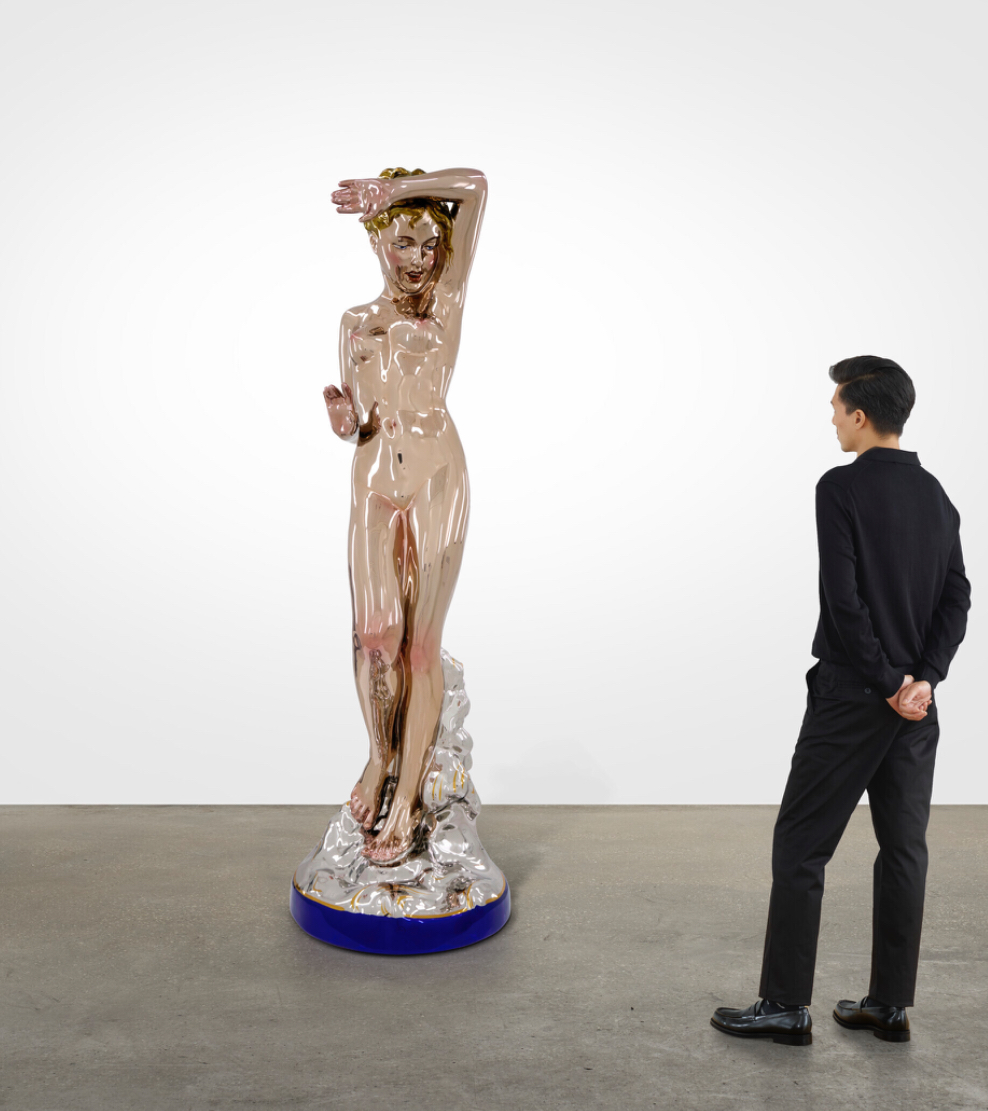
Koons’s references to Aphrodite are part of a long, fascinating history of the goddess within art history. He eloquently references the ‘readymade’ nature of Roman sculpture, which also characterizes his oeuvre.
“A lot of these pieces are copies, and you can feel the dedication that the Romans had to try to preserve all of the power within the original Greek pieces from the third century BCE. But at the same time, you always have the desire for a new form, a new material realization.”
As an example, one might look to the marble statue of Aphrodite in the collection of the Metropolitan Museum itself. This statue is a copy of a Greek original as Koons notes, and the legs are also their own copies as well; they were restored from a cast of the Medici Venus in Florence.
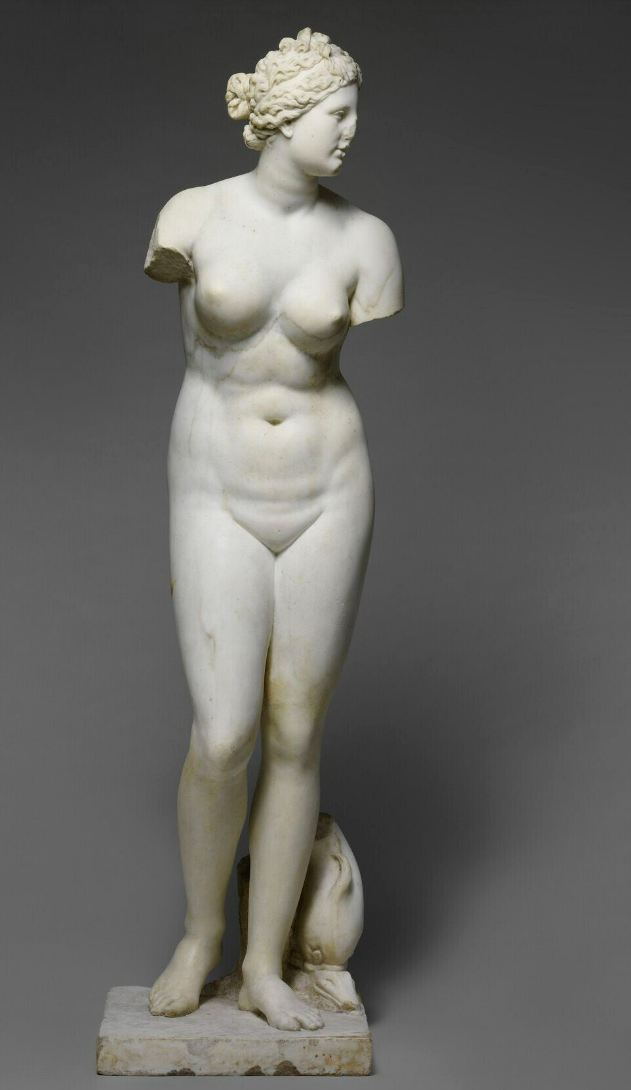
For his rendition of Aphrodite, Koons modeled his sculpture on a Royal Dux figurine. The early 20th century figurine was manufactured in the Czech Republic. The Porcelain series, which Aphrodite is part of, uses porcelain figurines as models which range from the 17th century to the present day. In antiquity, Aphrodite often used her hands to cover her breasts and pubic area, but Koons chooses to amplify her sexuality and use a source material that leaves her uncovered. Conversely, the Aphrodite of Knidos (4thcentury BCE), the first sculpture to show Aphrodite nude and the model upon which later sculptures of the goddess relied, leaves her breasts nude as Koons does (he explicitly used this iteration of Aphrodite in works such as Antiquity 4, 2010-2013). Furthermore, his Aphrodite, with her limbs intact, is both a readymade and an act of aspiration, a gesture of wholeness inspired by mass produced and repeated objects. It is also important to note that Koons’s appropriation of this porcelain figure instead of a Greco-Roman “original” is in fact truer to life. While we assume sculptures of antiquity have always been marble white, they were in fact polychromed, and their pigments have chipped off over the centuries.
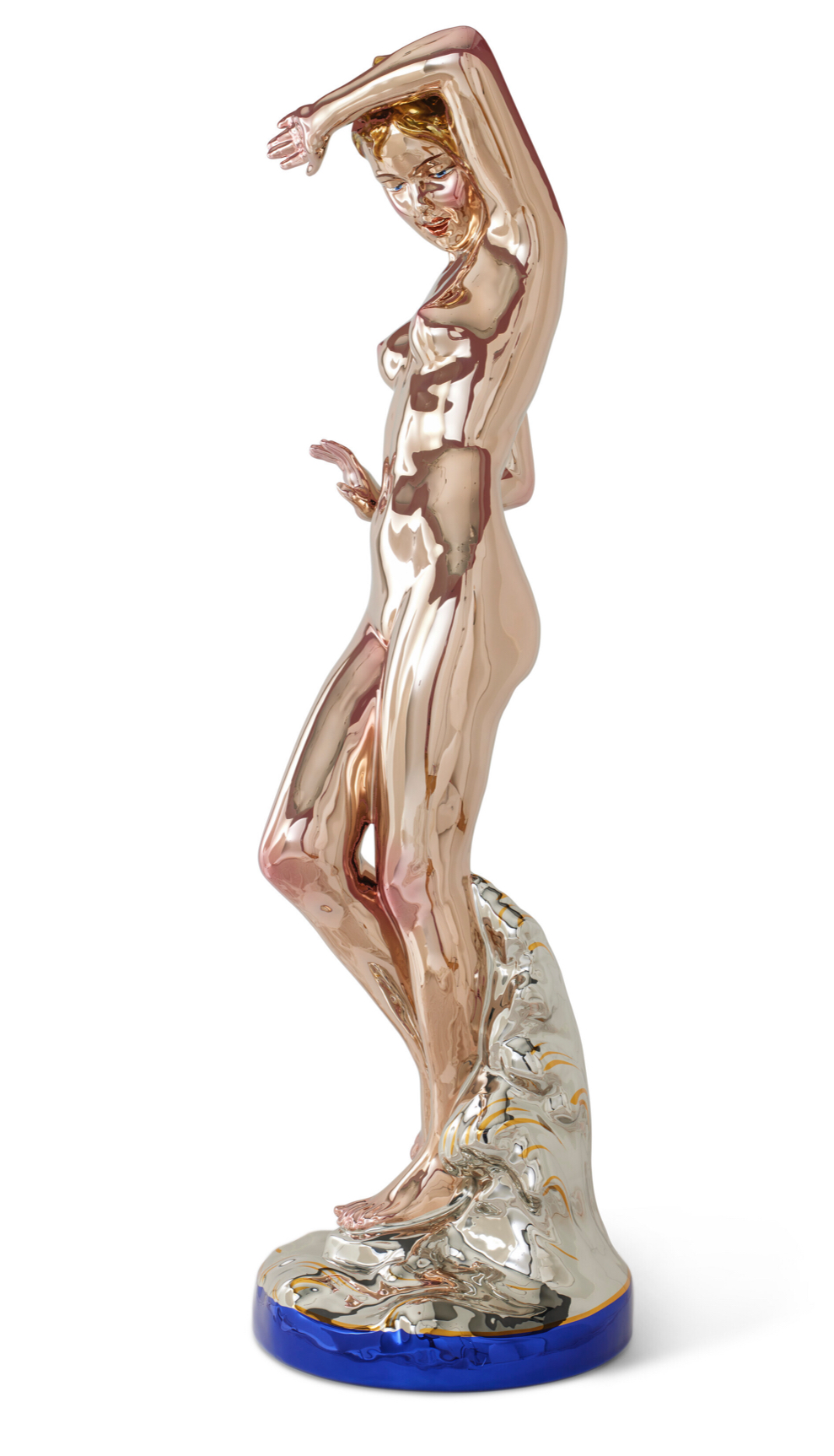
An important Roman erotic text described the Aphrodite of Knidos as a spectacle of desire, “The goddess stands in the center; her statue made of marble from Paros. Her lips are slightly parted by a lofty smile. Nothing hides her beauty, which is entirely exposed, other than a furtive hand veiling her modesty. The art of the sculptor has succeeded so well that it seems the marble has shed its hardness to mold the grace of her limbs” (Lucian of Samosata, Erōtes, approx. 2nd-4th century CE). The same could be said of Koons’s Aphrodite, which is the culmination of his longstanding fascination with the goddess.
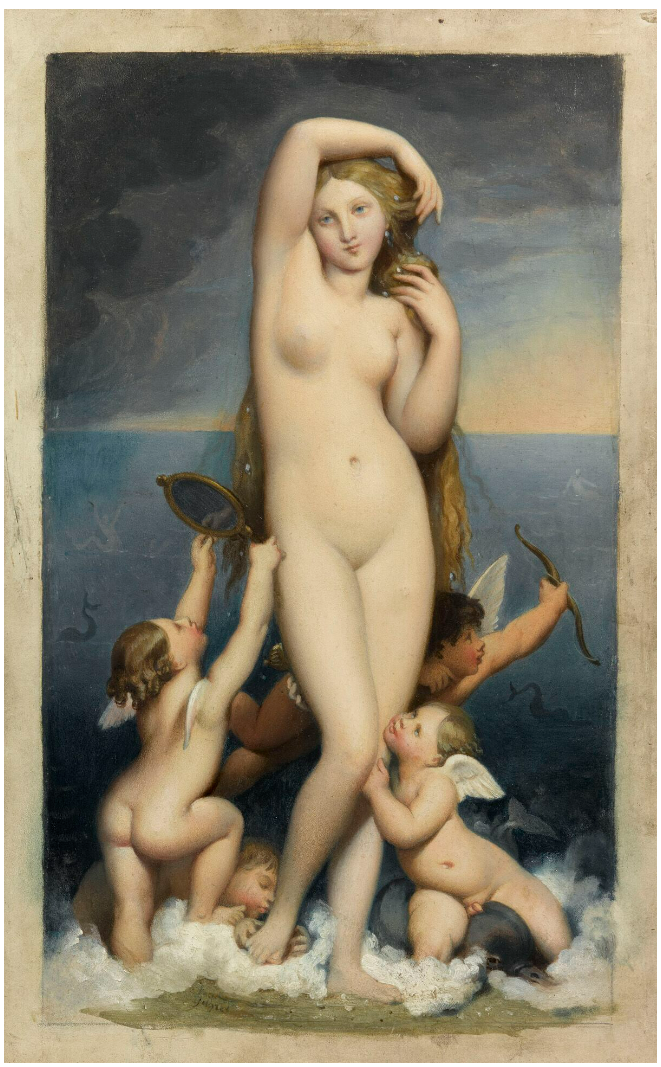
Jean Auguste Dominique Ingres, Venus Anadyomene, 1780-1867. Musée du Louvre, Paris. Photo: © RMN-Grand Palais / Art Resource, NY.
With Aphrodite, Koons transcends time. It reaches back into antiquity even as it references the birth of modernity in eighteenth and nineteenth-century Neoclassicism. Koons channels the unabashed sensuality of Alexandre Cabanel’s famous painting The Birth of Venus (1863, Musée d’Orsay, Paris), in which the titular figure looks coyly out at us with one barely open eye. The sculptural luxuriousness of the present Aphrodite is also apparent in Jacques-Louis David’s Mars Disarmed by Venus (1824, Musées royaux des Beaux-Arts de Belgique, Brussels), whose lush treatment of bodies has all the tactility and elegance of Koons’s. David’s Venus exhibits the impossibly extended back that would characterize much Orientalist and Neoclassical painting, a technique used to amplify the sexuality of the composition. The same could be said of the present work, whose lithe verticality presents the body in its idealized form.
Kiepenkerl (Humpty Dumpty), 1987
Christie’s New-York: 17 May 2023
Estimated: USD 3,000,000 – 5,000,000
USD 1,986,000
JEFF KOONS (B. 1955) (christies.com)
JEFF KOONS (B. 1955)
Kiepenkerl (Humpty Dumpty), 1987
Stainless steel
71x26x37 inches (180.3 x 66 x 94 cm)
This is a unique work, separate from the subsequent edition of three plus one artist’s proof
Executed in 1987, Jeff Koons’s Kiepenkerl (Humpty Dumpty) is a pivotal work in the artist’s oeuvre, the first in which he interrogated established traditions of monumental sculpture. It is also one of the first works in which Koons turned to surface and materials to reflect on fundamental questions about being human. Thus, it becomes the progenitor of the iconic series of balloon animals for which the artist has rightly become celebrated throughout the world. This particular example is a unique work, separate from the subsequent Kiepenkerls in an edition of three plus one artist’s proof, which the artist completed later the same year. Two of these later works are in major museum collections (The Broad, Los Angeles and the Hirschhorn Museum and Sculpture Garden in Washington, D.C.). Thus, Kiepenkerl (Humpty Dumpty) sits as a pivotal work within Koons’s oeuvre when the scale and scope of his ambition would shift dramatically and pave the way for much of his ensuing career.
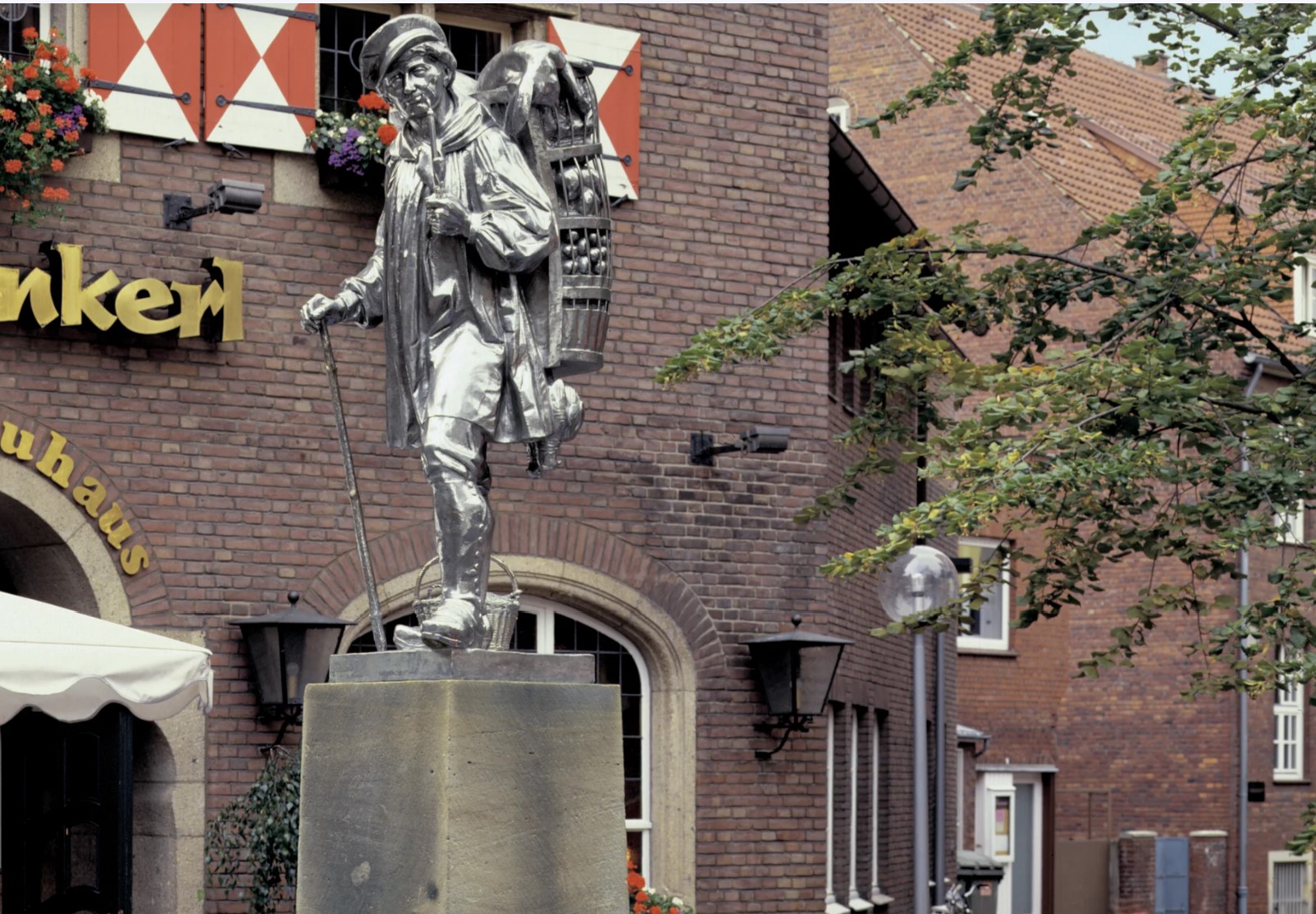
The origin of the present work lies in an invitation Koons received to participate in the 1987 edition of Skulptur Projekte, an outdoor sculpture exhibition held once a decade in the German town of Münster. “I displayed a work entitled Kiepenkerl,” the artist recalled. “This work is a recasting of a bronze sculpture which is located in the town center of Münster. The original bronze Kiepenkerl has always been a very meaningful and identity-based sculpture to the people of Münster, symbolizing self-sufficiency, abundance and moral relationship with the world… My idea, on finding the Kiepenkerl in the town center outside a restaurant carrying its name, was to contemporize the public’s symbol of self-sufficiency and economic security—to recreate an icon that could once again meet the needs of the public. I chose to recreate the Kiepenkerl in highly-polished stainless steel, the luxurious material of the proletariat, in order to transform it into a contemporary symbol for a society which itself has transformed from agrarian to economic”
Jeff Koons Multiples
PLEASE CLICK BELOW FOR JEFF KOONS MULTIPLES HIGHLIGHTS