WORK IN PROGRESS
Born in 1977 in London, the United Kingdom, Lynette Yiadom-Boakye studied at the Royal Academy Schools, Falmouth College of Art, and finally received her MFA from St. Martins School of Art and Design. Culling images from a variety of sources, but foremost her own imagination, Yiadom-Boakye’s most recognizable works are those of fictitious black figures set against dark, monochromatic backgrounds. Though the context and story of her painted figures are rather inscrutable, her use of narrative titling enhances the understanding of the work. Because of the nature of her work, there has been a general tendency for viewers and critics to wholly classify her oeuvre as political, which she has acknowledged, but also stated that, “…my starting point is always the language of painting itself and how that relates to the subject matter.”
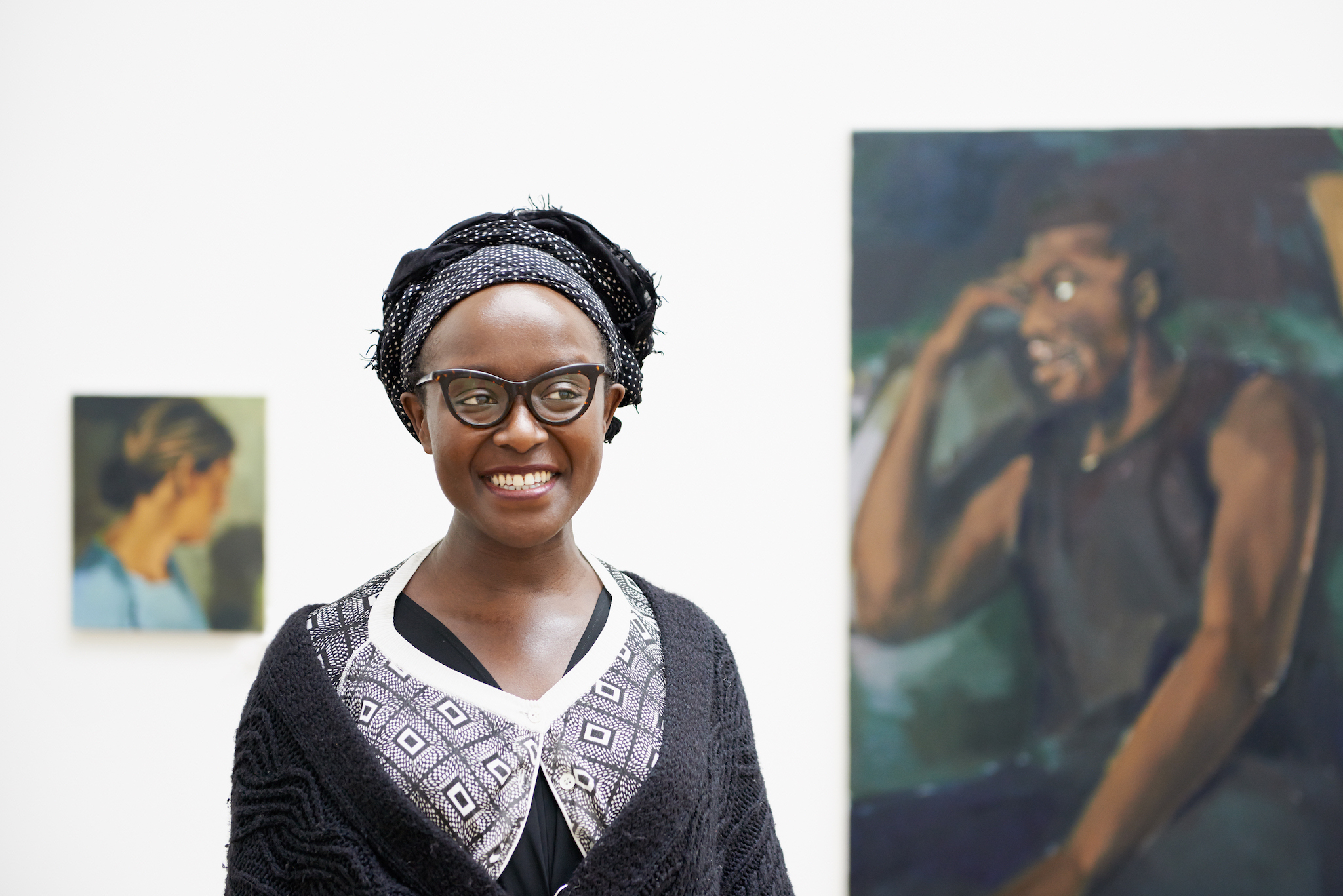
Recently the subject of a major retrospective at the Tate Britain, London, as well as a solo exhibition at the Guggenheim Bilbao last year, Yiadom-Boakye is widely regarded as one of the finest figurative painters of her generation. Her practice is one of portraiture, yet her subjects are far from sitters in the traditional sense. Instead, they are figments of the artist’s psyche, whose forms take shape through the very act of putting brush to canvas. They are nourished by art history, music and literature: their compositions often evoke memories of the Old Masters or the Post-Impressionists, while their curious titles resemble lines of poetry or song, plucked from the artist’s own synesthetic archive. Yiadom-Boakye is a writer as well as a painter, and her canvases often confront the viewer like unfinished chapters, or characters in the process of formation.
A writer as much as an artist, Yiadom-Boakye draws inspiration from many sources. Her characters live lives beyond the painting: we, as viewers, are only privy to single, inconclusive snapshots. Many of her paintings are deliberately evocative of works from the Western canon, their compositions imagined afresh with a new cast of subjects.
Lynette Yiadom-Boakye was born in London. She studied at Central Saint Martins, Falmouth School of Art and the Royal Academy. Her first solo exhibition was held at Gasworks, London, in 2007. She was awarded the Carnegie Prize in 2018 and was the 2012 recipient of the Pinchuk Foundation Future Generation Prize. She was shortlisted for the Turner Prize in 2013. Solo exhibitions include Fly In League With The Night, Kunstsammlung Nordrhein-Westfalen, Düsseldorf (2021) and Tate Britain, London (2020); Under-Song For A Cipher, New Museum of Contemporary Art, New York (2017); Capsule 03: Lynette Yiadom-Boakye, Haus der Kunst, Munich (2015-2016); and Verses After Dusk, Serpentine Gallery, London (2015) among others. Group exhibitions include Shifting the Silence, San Francisco Museum of Modern Art; Unsettled Objects, Sharjah Art Foundation, United Arab Emirates (2021); and Ghana Freedom, 58th Venice Biennale (2019). Her work is included in numerous permanent collections such as the Tate, London; The Victoria & Albert Museum, London; The Museum of Modern Art, New York, the San Francisco Museum of Modern Art and the National Museum of African Art at the Smithsonian, Washington, D.C.
Practical Information
Yiadom-Boakye’s work is held in numerous important public collections including Tate Modern, the Institute of Contemporary Art, Boston, the Museum of Contemporary Art, Los Angeles, and the Museum of Modern Art, New York. In 2013, she was shortlisted for the Turner Prize, and she was included in the inaugural Ghanaian pavilion at the 2019 Venice Biennale. The artist has also mounted a solo exhibition at the Guggenheim Museum, Bilbao entitled No Twilight too Mighty, which will run from March through September 2023.
Since graduating from the Royal Academy in 2003, Yiadom-Boakye has taken her place as one of the leading figurative painters of her generation. Between 2020 and February 2023, she mounted her first major retrospective Fly in the League with the Night, organised by Tate Britain in collaboration with Moderna Museet, Stockholm, Kunstsammlung Nordrhein-Westfalen, Düsseldorf, and MUDAM, Luxembourg. She was the recipient of the Pinchuk Foundation Future Generation Prize in 2013 and the 2018 winner of the prestigious Carnegie Prize. In 2013, she was shortlisted for the Turner Prize. Her work is included in a number of significant permanent collections across the globe, including those of Tate, London, The Victoria & Albert Museum, London, The Museum of Modern Art, New York, the San Francisco Museum of Modern Art and the National Museum of African Art at the Smithsonian, Washington, D.C.
Lynette Yiadom-Boakye is represented by two primary galleries that have managed her career for over a decade.

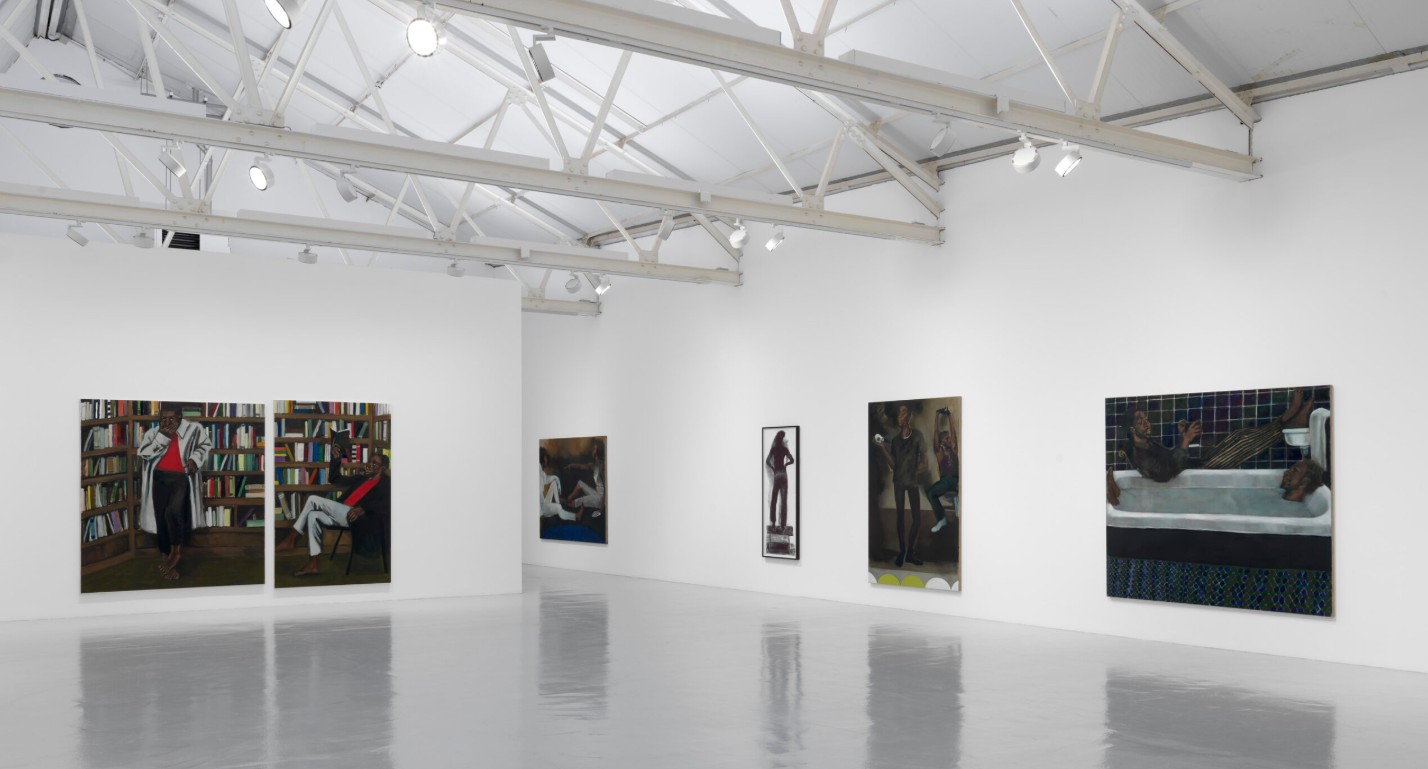
Representing her in the United Kingdom, this gallery has hosted multiple solo exhibitions for her, including recent 2024 and 2025 showings such as Keep The Moon Amongst Ourselves.

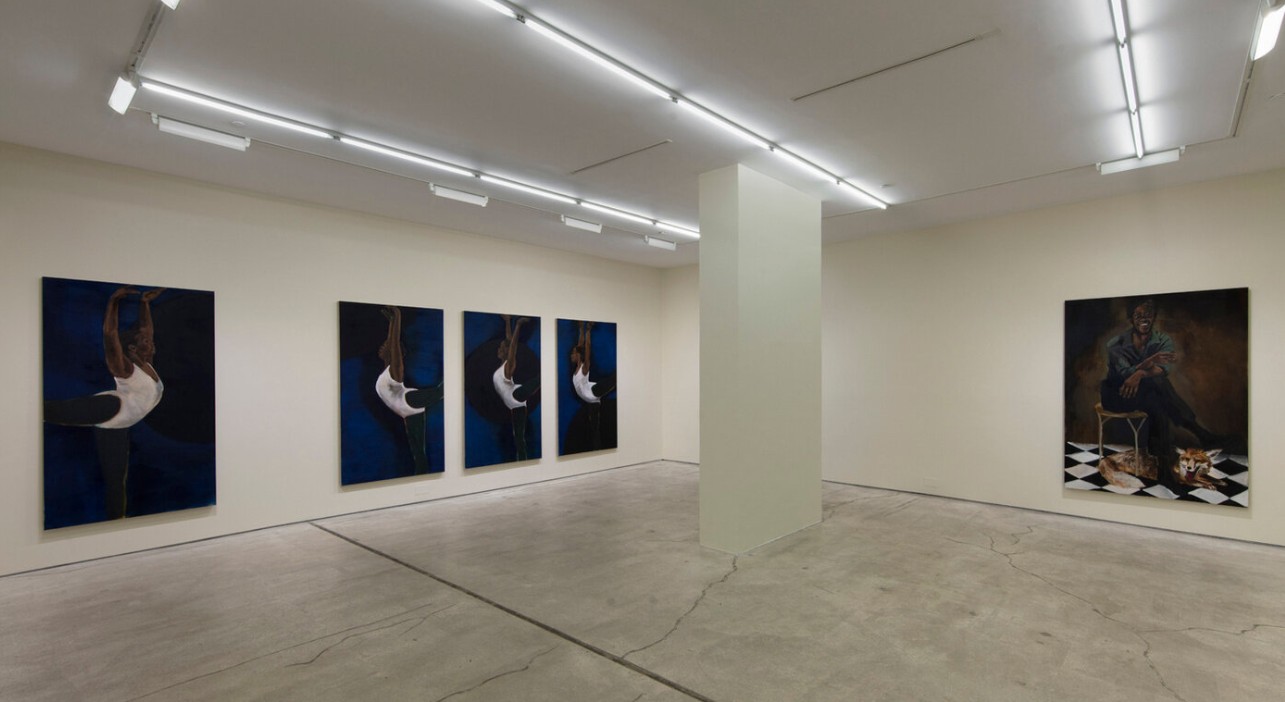
Representing her in the United States since 2010. The gallery features her work at major international art fairs and in focused solo exhibitions, such as her first U.S. solo show Essays and Documents.
PART I: SUMMARY
Auction Market Overview
2025 AUCTION STATISTICS
Turnover: USD 5,992,067
-53.8% vs. 2024
# Lots sold: 11 Lots
Sell-Through Rate: 85%
Highest Price Achieved at Auction:
GBP 2,952,000 / USD 3,635,465
(12 October 2023)
Auction Summary
2025 Auction Highlights
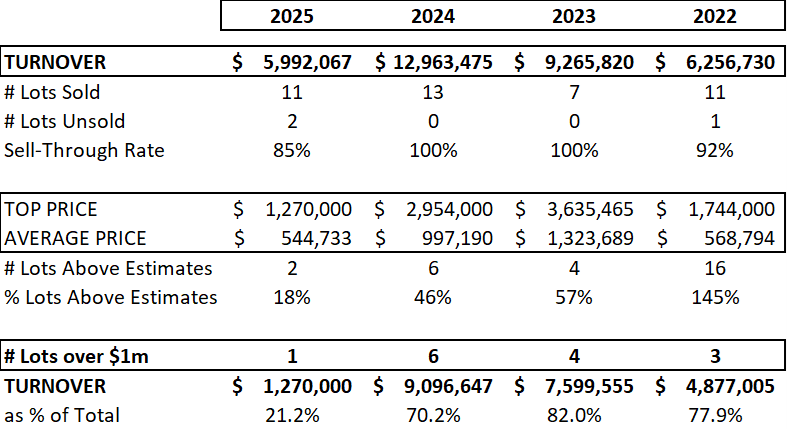
11 lots sold at auction in 2025 for a total turnover of USD 5,992,067. With 2 lots failing to sell, the sell-through rate is 85%. Brutality by Any Other Name, a painting dated 2011, sold at Phillips, in New-York, on 13 May 2025, for USD 1,270,000, the highest price achieved in 2025. This is the only lot that sold for more than USD 1 million, representing 21.2% of the total turnover for 2025.
2025 Top 3 Lots
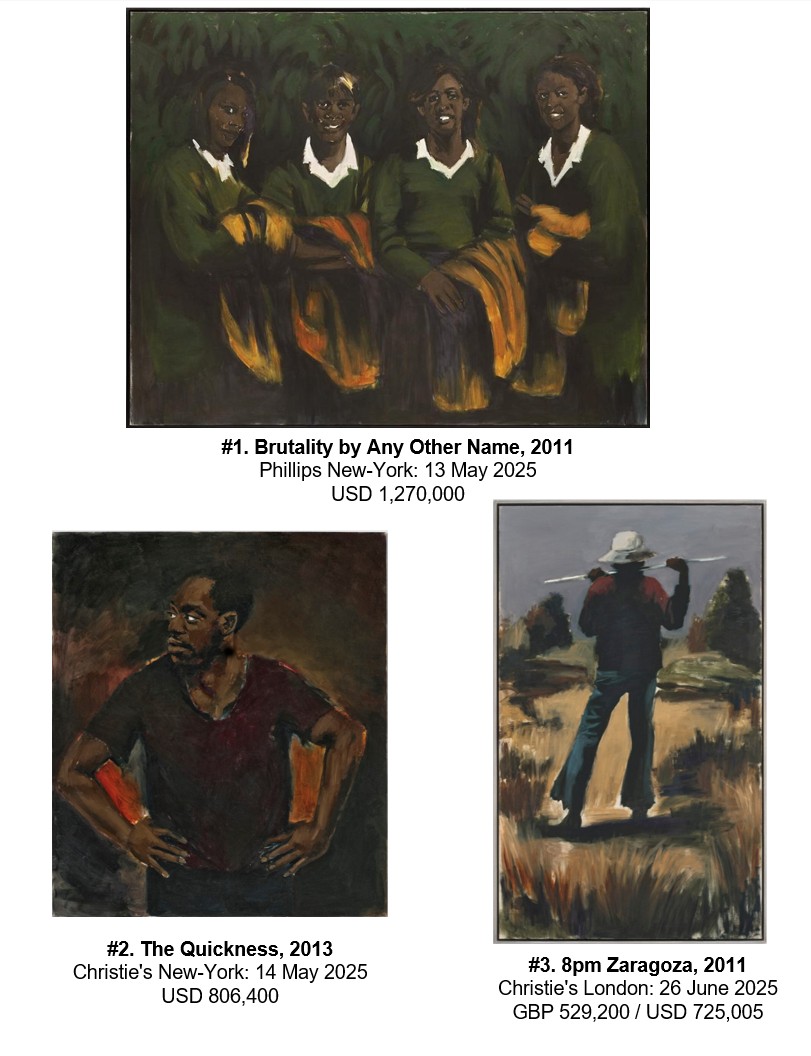
6 lots sold for more than USD 500,000, generating a cumulative turnover of USD 4,690,468, representing 78.3% of the total turnover for 2025.
2024 Auction Highlights
13 lots sold in 2024 for a total turnover of USD 12,963,475. With no lot failing to sell, the sell-through rate is 100%. Black Allegiance to the Cunning, a painting dated 2018, sold at Christie’s in New-York on 14 May 2024, for USD 2,954,000, the highest price for 2024.
2024 Top 3 Lots
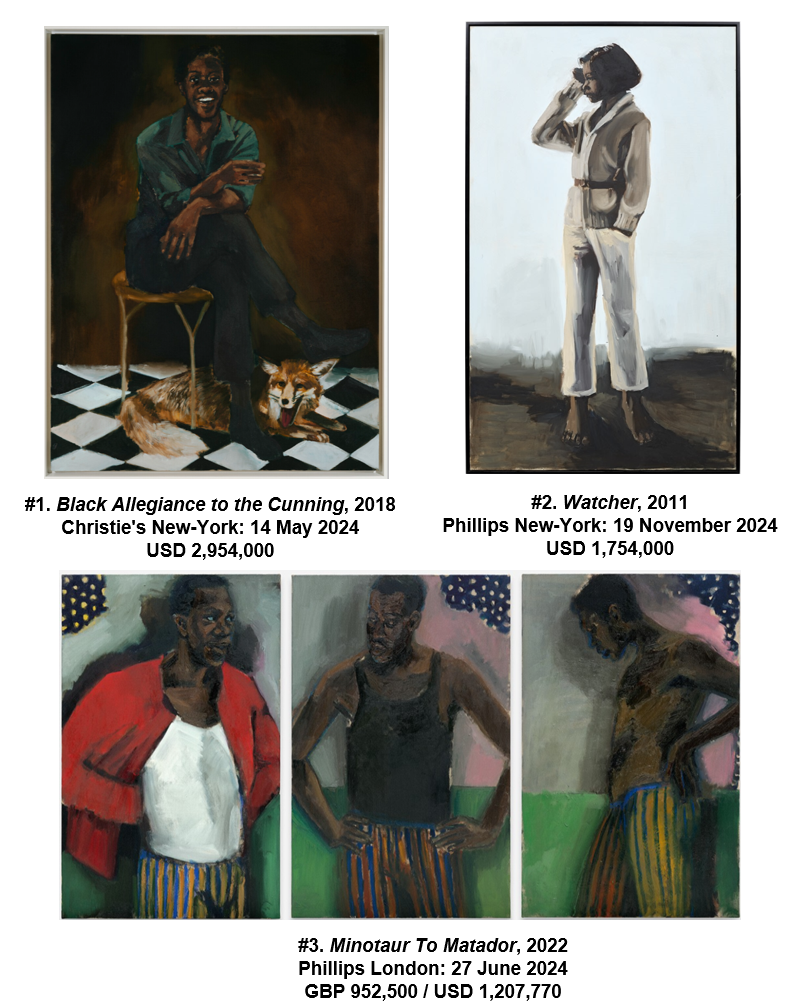
6 lots sold for more than USD 1 million, generating a cumulative turnover of USD 9,096,647, representing 70.2% of the total for 2024.
2023 Auction Highlights
7 lots sold at auction in 2023 for a total turnover of USD 9,265,820. With no lot failing to sell, the sell-through rate is 100%. The highest price has been achieved at Sotheby’s in London on 12 October 2023, when Six Birds in the Bush, a painting dated 2015, sold for GBP 2,952,000 (USD 3,635,465), a new auction record for the artist.
2023 Top 3 Lots
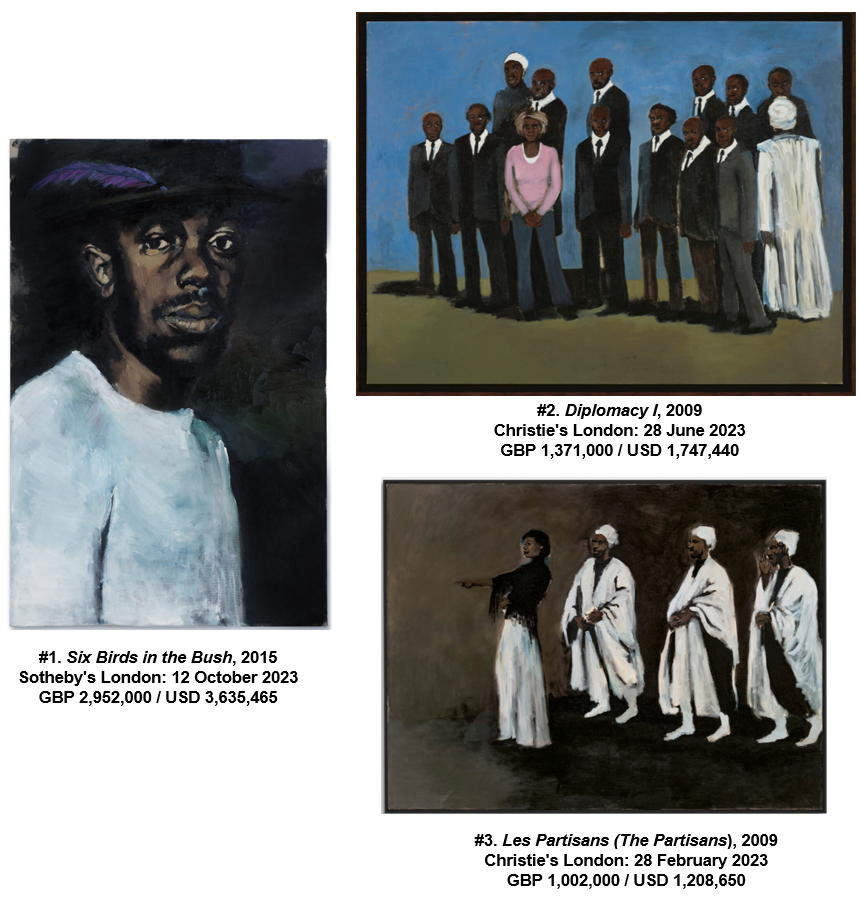
4 lots sold for more than USD 1 million, generating a cumulative turnover of USD 7,599,555, representing 82% of the total for 2023.
2022 Auction Highlights
11 lots sold at auction in 2022 for a total turnover of USD 6,256,730. With 1 lot failing to sell, the sell-through rate is 92%. The highest price of 2022 was achieved by 11pm Sunday, a painting dated 2011, that sold at Sotheby’s, in New-York, on 19 May 2022, for USD 1,744,000.
2022 Top 3 Lots
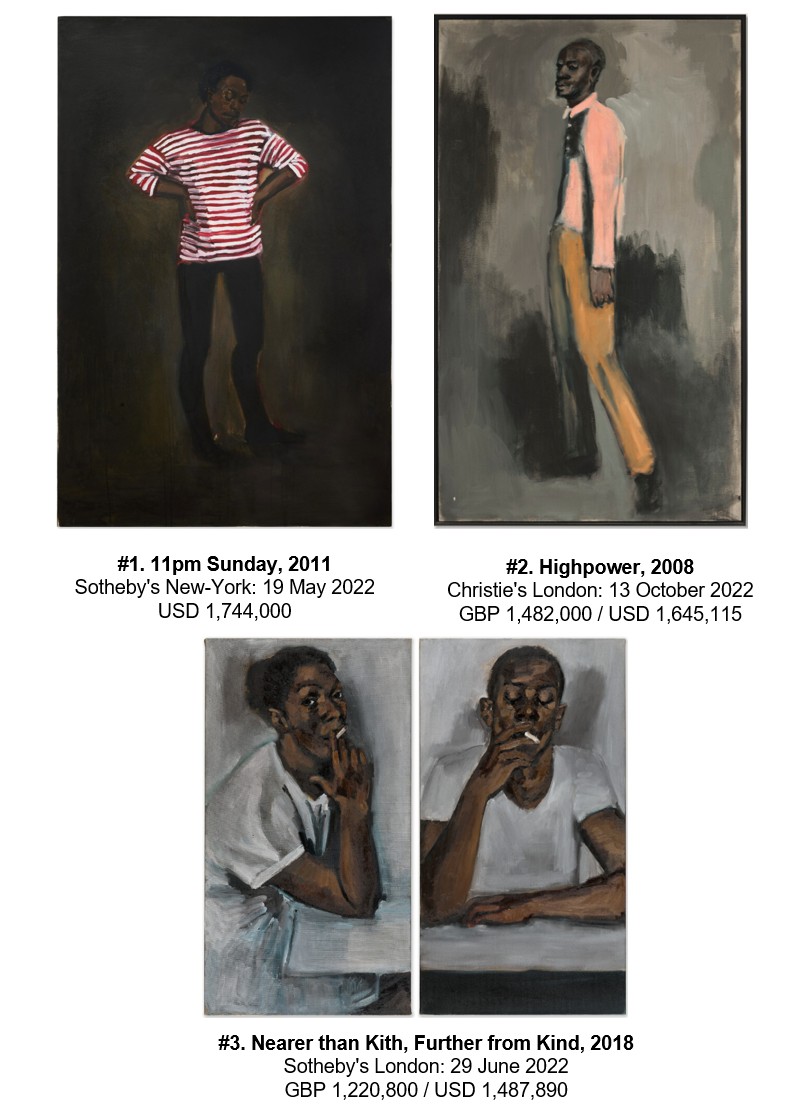
3 lots sold for more than USD 1 million, generating a cumulative turnover of USD 4,877,005, representing 77.9% of the total turnover for 2022.
Top Lots
#1. Six Birds in the Bush, 2015
Sotheby’s London: 12 October 2023
Estimated: GBP 1,200,000 – 1,800,000
GBP 2,952,000 / USD 3,635,465
Six Birds in the Bush | The Now Evening Auction | 2023 | Sotheby’s (sothebys.com)
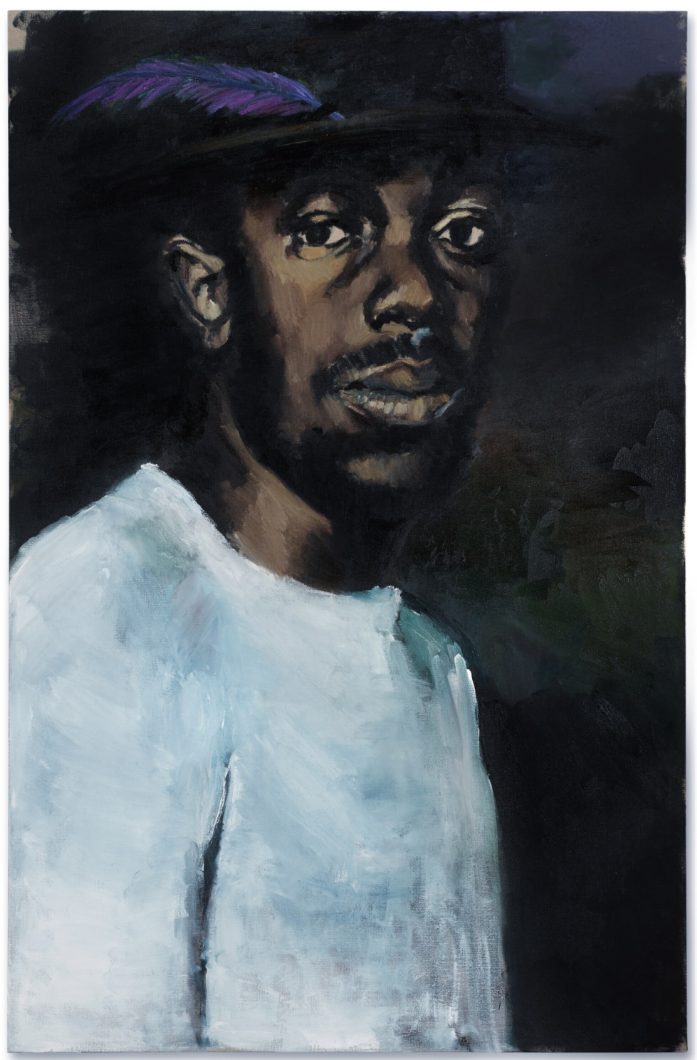
LYNETTE YIADOM-BOAKYE (b. 1977)
Six Birds in the Bush, 2015
Oil on linen
200×130 cm (78 3/4 x 51 1/8 inches)
Signed with the artist’s initials, titled and dated 2015 (on the reverse)
#2. Black Allegiance to the Cunning, 2018
Christie’s New-York: 14 May 2024
Estimated: USD 1,000,000 – 1,500,000
USD 2,954,000
LYNETTE YIADOM-BOAKYE (B. 1977), Black Allegiance to the Cunning | Christie’s (christies.com)
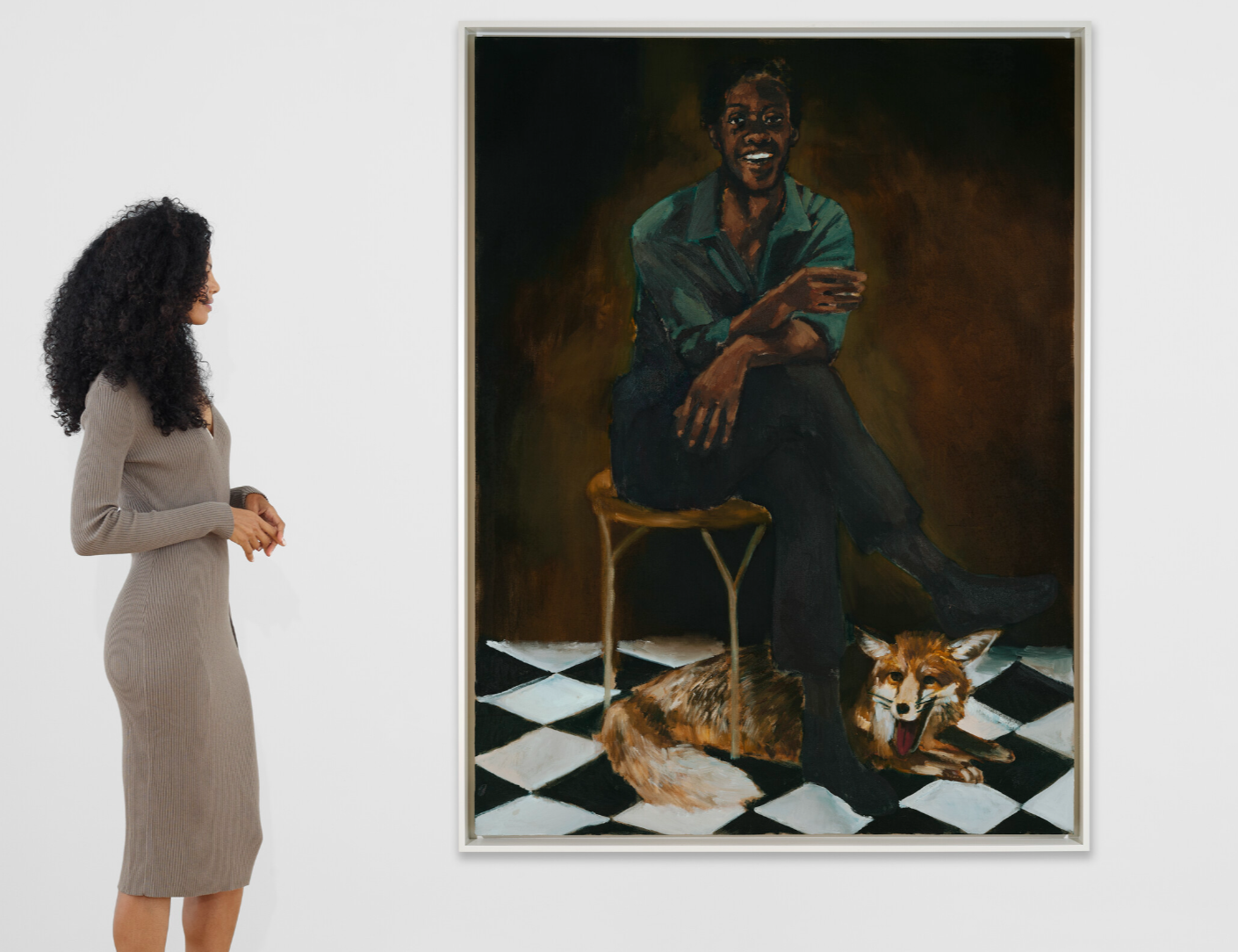
LYNETTE YIADOM-BOAKYE (B. 1977)
Black Allegiance to the Cunning, 2018
Oil on linen
200×150 cm (79×59 inches)
Signed with the artist’s initials, titled and dated ‘LYB 2018 Black Allegiance to the Cunning’ (on the reverse)
#4. Watcher, 2011
Phillips New-York: 19 November 2024
Estimated: USD 1,000,000 – 1,500,000
USD 1,754,000
Lynette Yiadom-Boakye – Modern & Con… Lot 4 November 2024 | Phillips
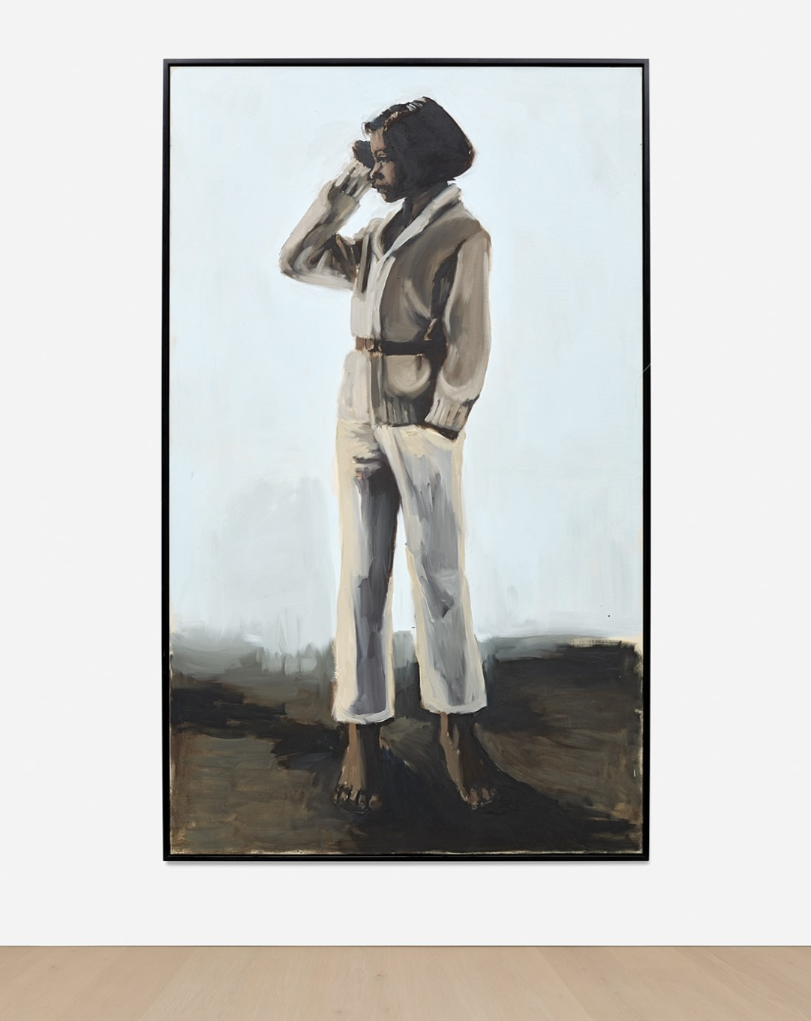
LYNETTE YIADOM-BOAKYE
Watcher, 2011
Oil on canvas
200×120 cm (78 7/8 x 47 1/4 inches)
Signed with the artist’s initials, titled and dated “LYB 2011 Watcher” on the reverse
#5. Diplomacy I, 2009
Christie’s London: 28 June 2023
Estimated: GBP 1,000,000 – 1,500,000
GBP 1,371,000 / USD 1,747,440
LYNETTE YIADOM-BOAKYE (B. 1977), Diplomacy I | Christie’s (christies.com)
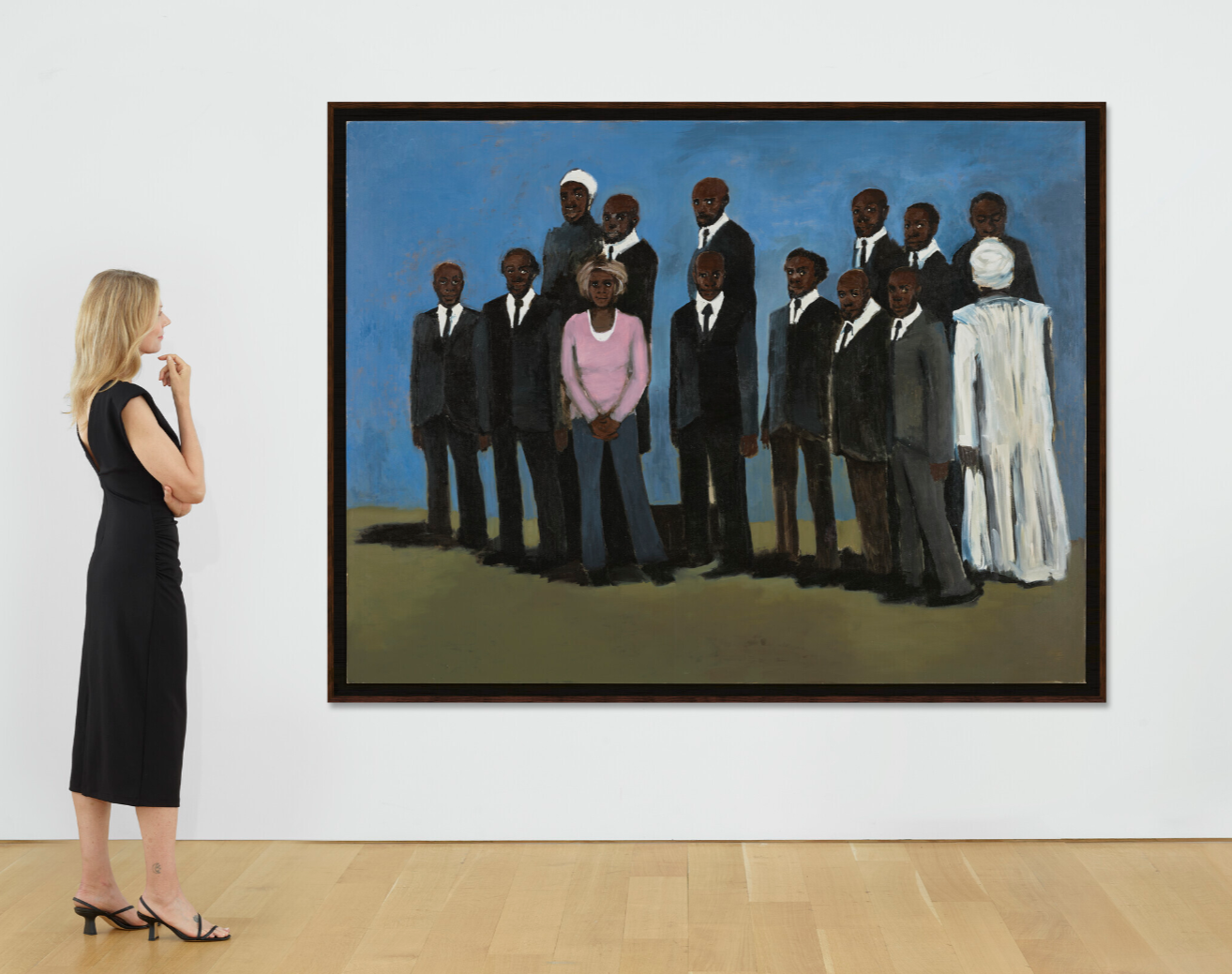
LYNETTE YIADOM-BOAKYE (B. 1977)
Diplomacy I, 2009
Oil on canvas
190.2 x 250 cm (74 7/8 x 98 3/8 inches)
Signed with the artist’s initials, titled and dated ‘LYB 2009 DIPLOMACY I’ (on the reverse)
PART II: AUCTION RESULTS
2026 Auction Results
As of 15 June 2026
#1. Shoot The Desperate, Hug The Needy, 2010
Christie’s New-York: 21 May 2026
Estimated: USD 700,000 – 1,000,000
USD 825,500
LYNETTE YIADOM-BOAKYE (B. 1977), Shoot The Desperate, Hug The Needy | Christie’s
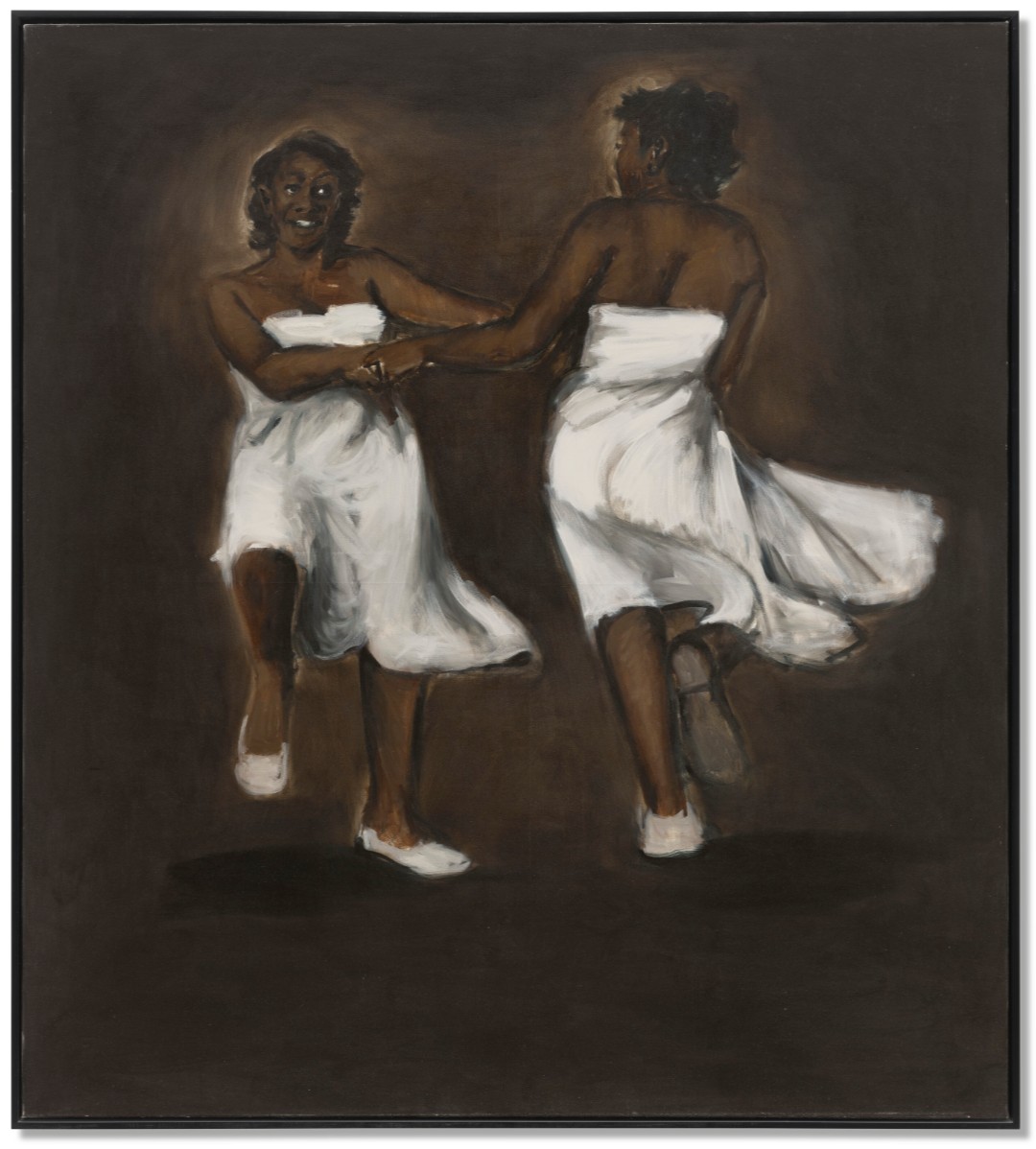
LYNETTE YIADOM-BOAKYE (B. 1977)
Shoot The Desperate, Hug The Needy, 2010
Oil on canvas
200×180 cm (78-3/4 x 70-7/8 inches)
Signed with the artist’s initials, titled and dated
‘Shoot the Desperate, Hug the Needy LYB 2010’
(on the reverse)
#2. Victory Sweatsuit II, 2008
Bonhams New-York: 20 May 2026
Estimated: USD 350,000 – 550,000
USD 381,500
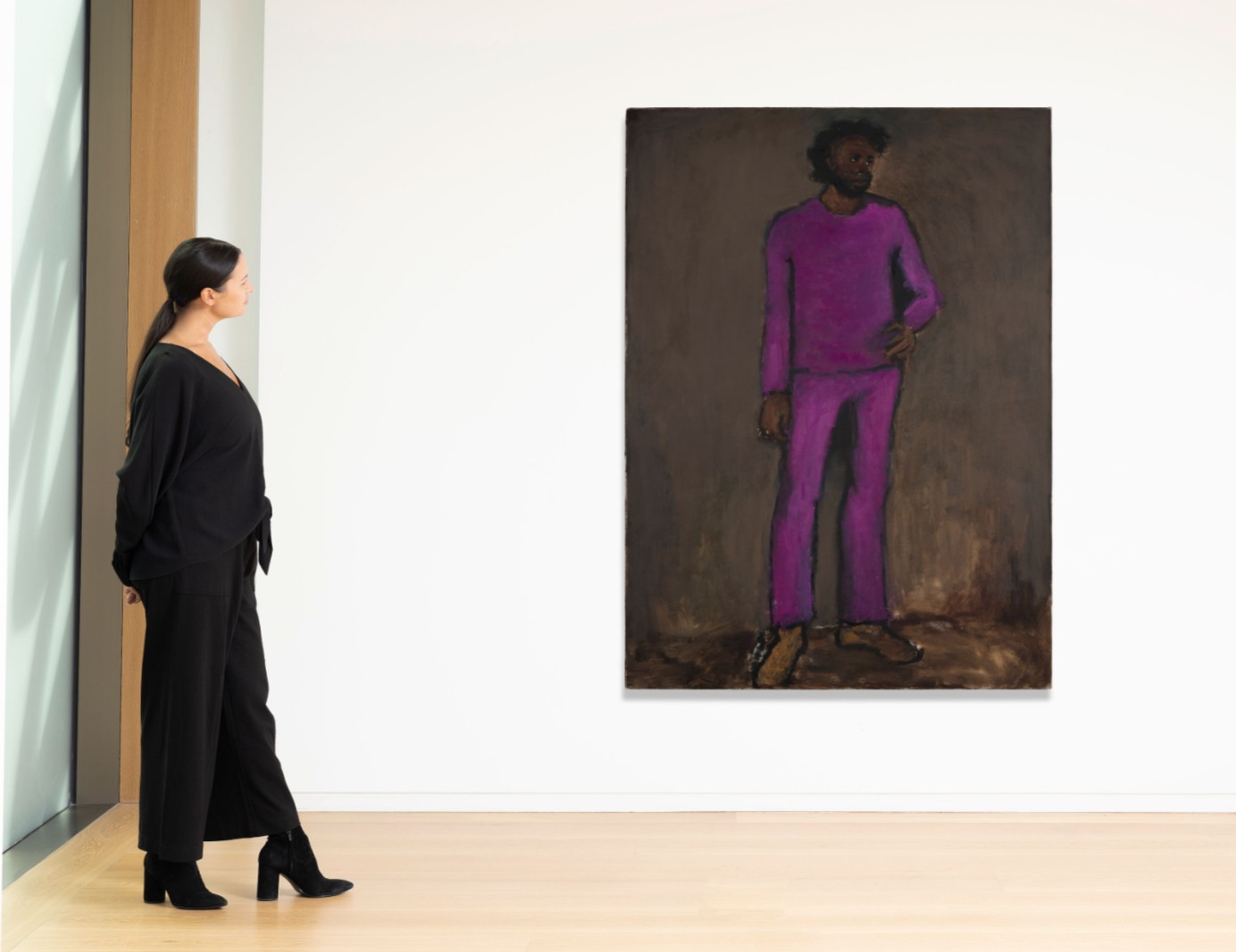
Victory Sweatsuit II, 2008
Oil on canvas
130 x 95.4 cm (51-1/4 x 37-1/2 inches)
Signed indistinctly, inscribed and dated ‘Victory Sweatsuit II 2008’ (on the reverse)
#3. Study for ‘Ferry’, 2006
Estimated: GBP 20,000 – 30,000
GBP 38,100 / USD 50,980
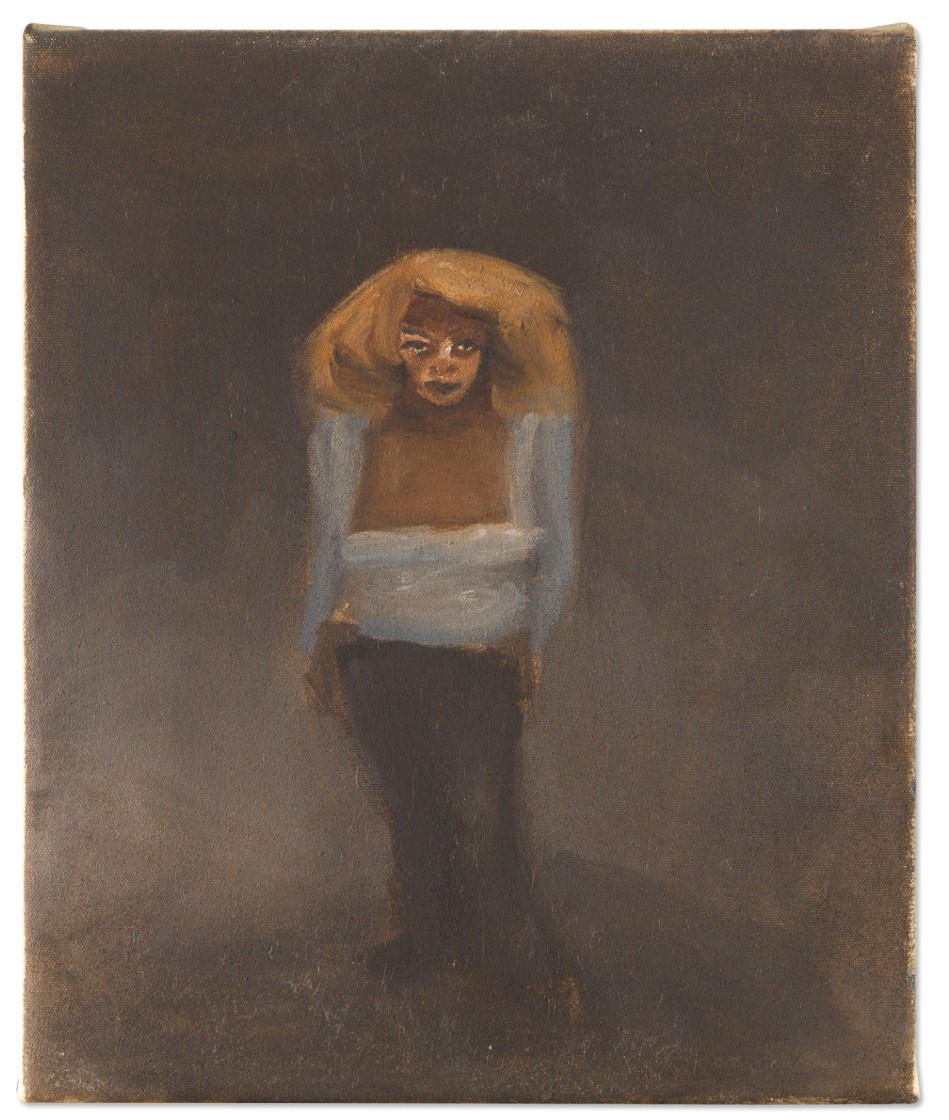
LYNETTE YIADOM BOAKYE (b. 1977)
Study for ‘Ferry’, 2006
Oil on canvas
30.5 x 25.1 cm (12×10 inches)
Signed, titled and dated 2006 (on the reverse)
Lots Passed
The World In Agreement With, 2011
Estimated: GBP 300,000 – 500,000
PASSED
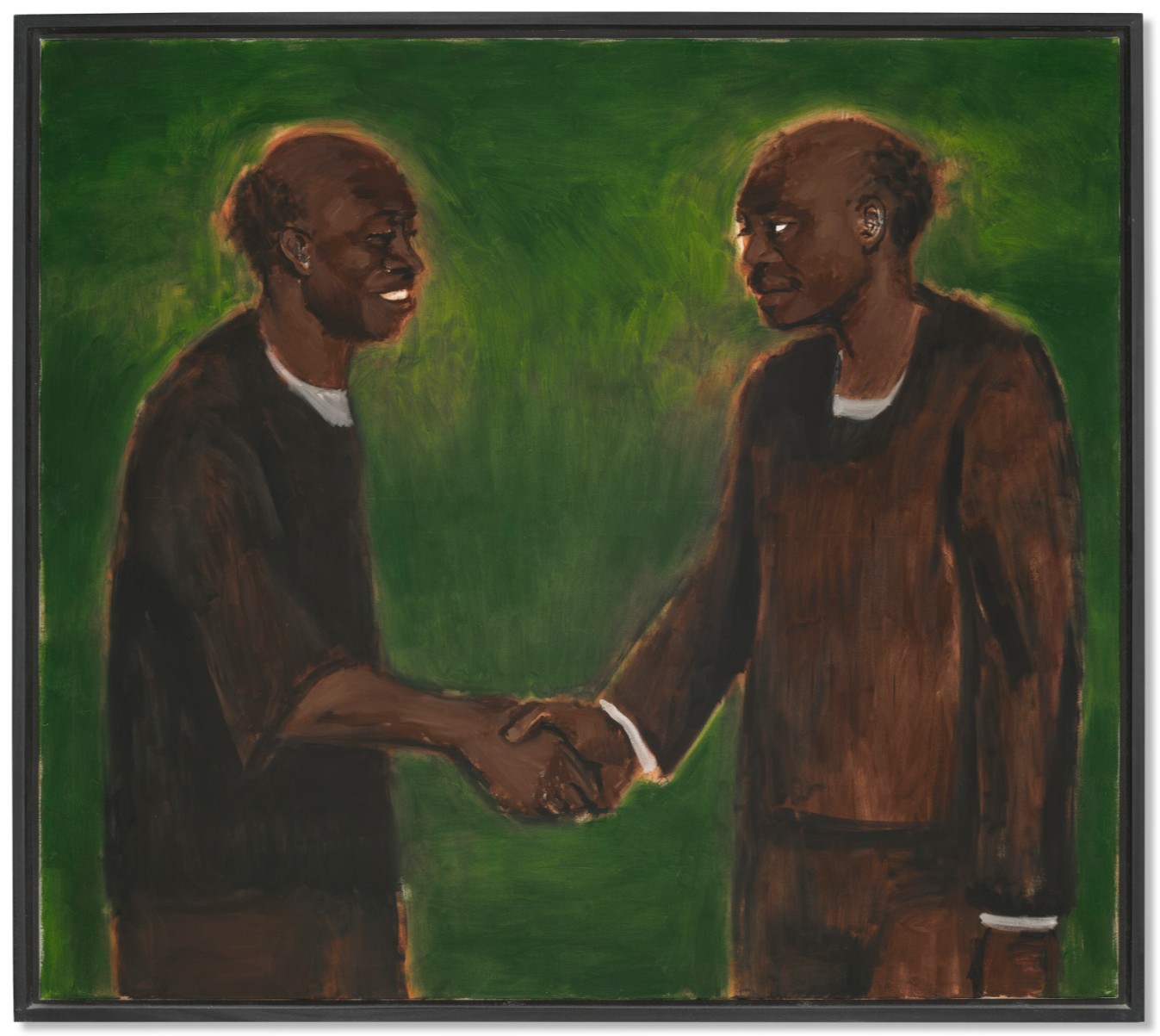
The World In Agreement With, 2011
Oil on canvas
160.4 x 180 cm (63-1/8 x 70-7/8 inches)
Signed with the artist’s initials, titled and dated
‘LYB 2011 The World In Agreement With’
(on the reverse)
2025 Auction Results
11 lots sold at auction in 2025 for a total turnover of USD 5,992,067. With 2 lots failing to sell, the sell-through rate is 85%. Brutality by Any Other Name, a painting dated 2011, sold at Phillips, in New-York, on 13 May 2025, for USD 1,270,000, the highest price achieved in 2025. This is the only lot that sold for more than USD 1 million, representing 21.2% of the total turnover for 2025.
2025 Top 3 Lots
6 lots sold for more than USD 500,000, generating a cumulative turnover of USD 4,690,468, representing 78.3% of the total turnover for 2025.
#1. Brutality by Any Other Name, 2011
Phillips New-York: 13 May 2025
Estimated: USD 1,000,000 – 1,500,000
USD 1,270,000
READ MORE IN FOCUS SECTION
Lynette Yiadom-Boakye Modern & Contemporary Art Evening Sale
USD 1 million
#2. The Quickness, 2013
Estimated: USD 600,000 – 800,000
USD 806,400
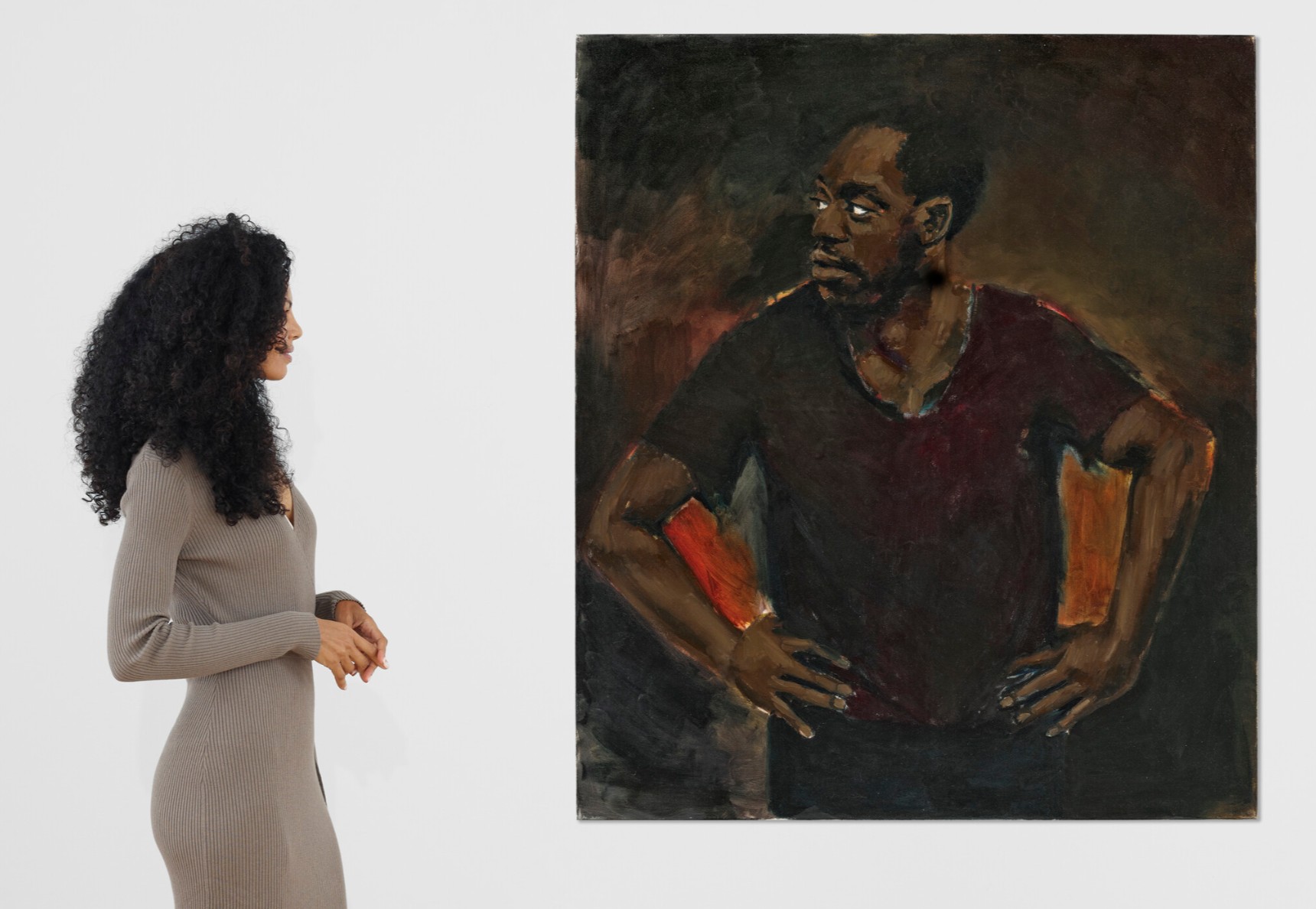
The Quickness, 2013
Oil on canvas
150.4 x 130.2 cm (59 1/4 x 51 1/4 inches)
Signed with the artist’s initials, titled and dated ‘The Quickness LYB 2013’ (on the reverse)
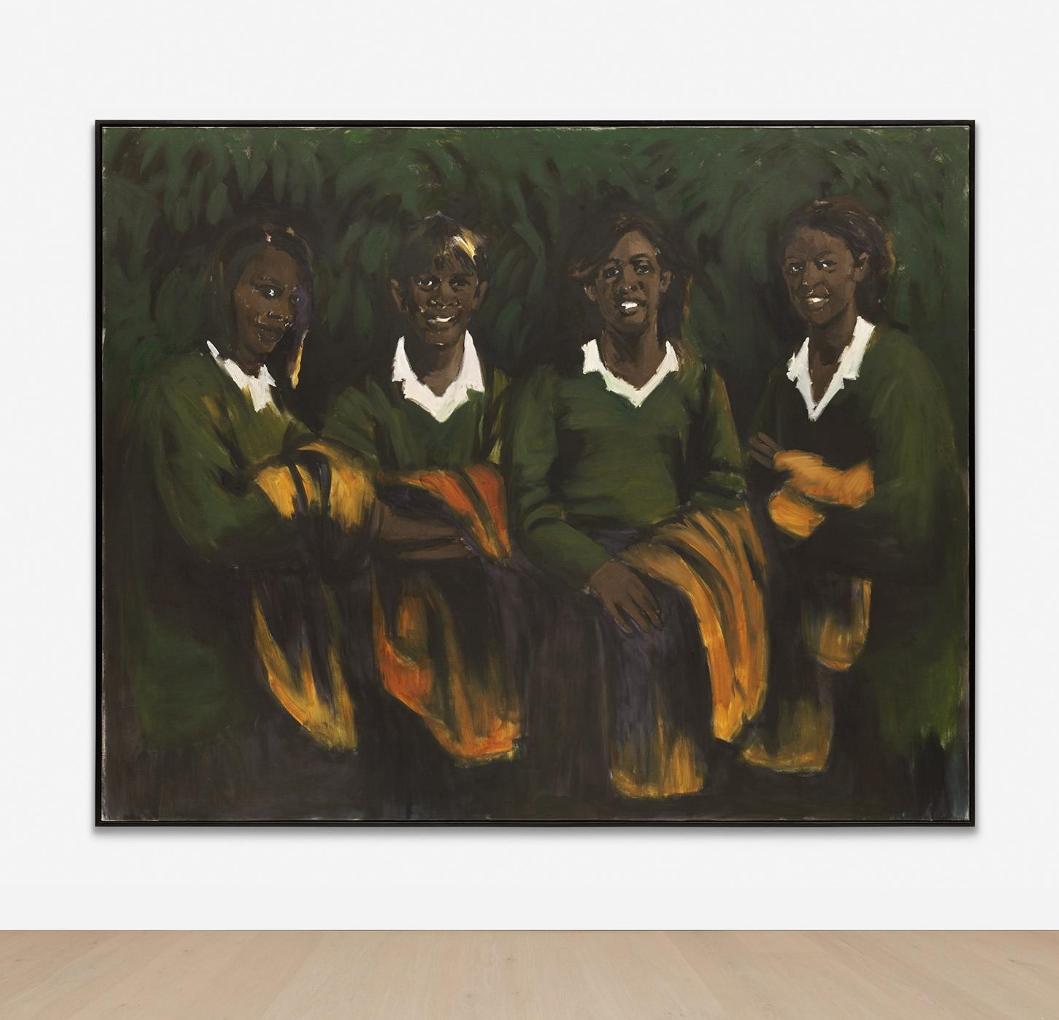
#3. 8pm Zaragoza, 2011
Christie’s London: 26 June 2025
Estimated: GBP 500,000 – 700,000
GBP 529,200 / USD 725,005
LYNETTE YIADOM-BOAKYE (B. 1977), 8pm Zaragoza | Christie’s
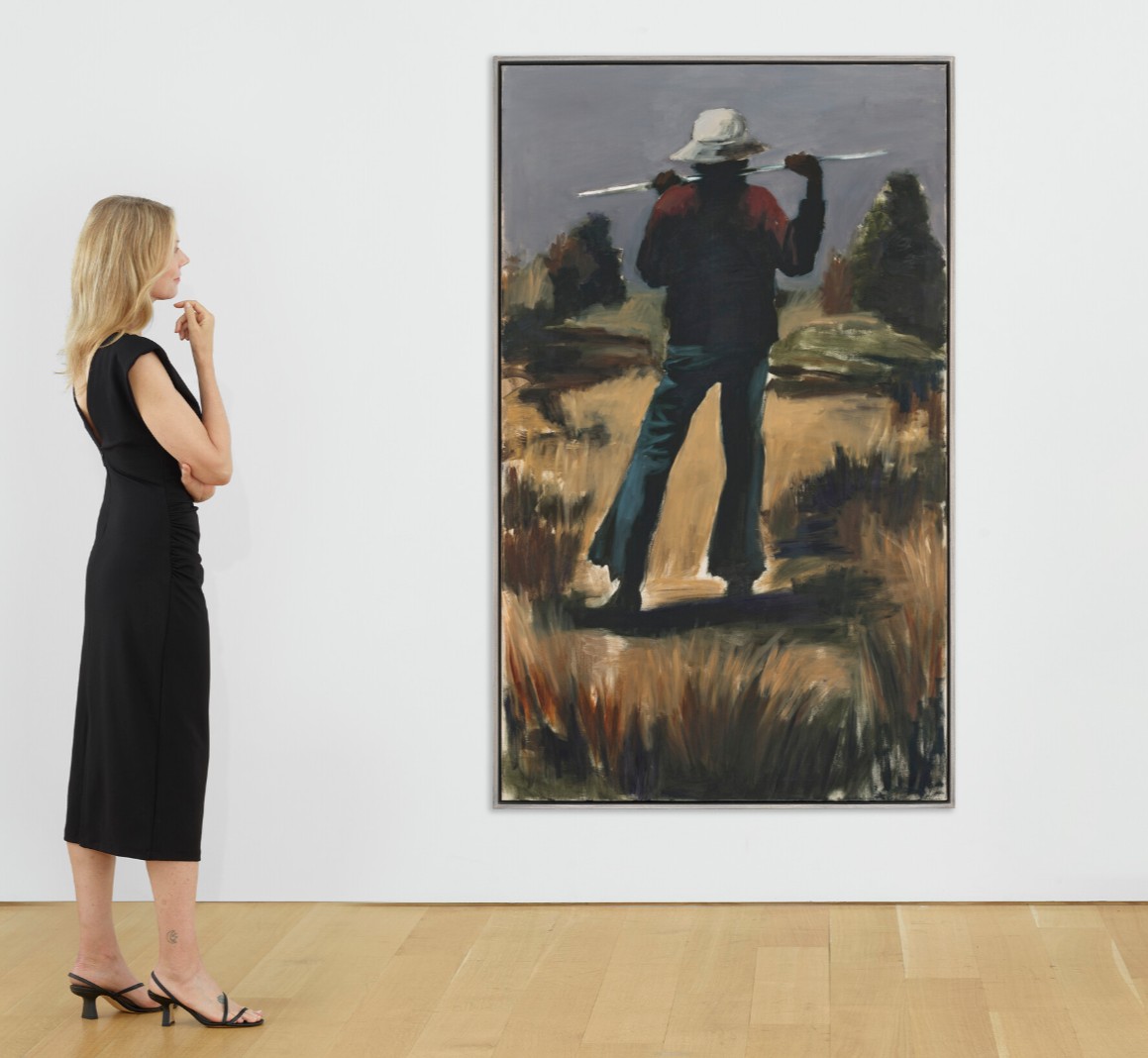
LYNETTE YIADOM-BOAKYE (B. 1977)
8pm Zaragoza, 2011
Oil on canvas
200×120 cm (78 3/4 x 47 1/4 inches)
Signed with the artist’s initials, titled and dated ‘8pm Zaragoza LYB 2011’ (on the reverse)
#4. Periodical, 2006
Property from a Distinguished Danish Collection
Christie’s New-York: 20 November 2025
Estimated: USD 400,000 – 600,000
USD 673,100
READ MORE IN FOCUS SECTION
LYNETTE YIADOM-BOAKYE (B. 1977), Periodical | Christie’s
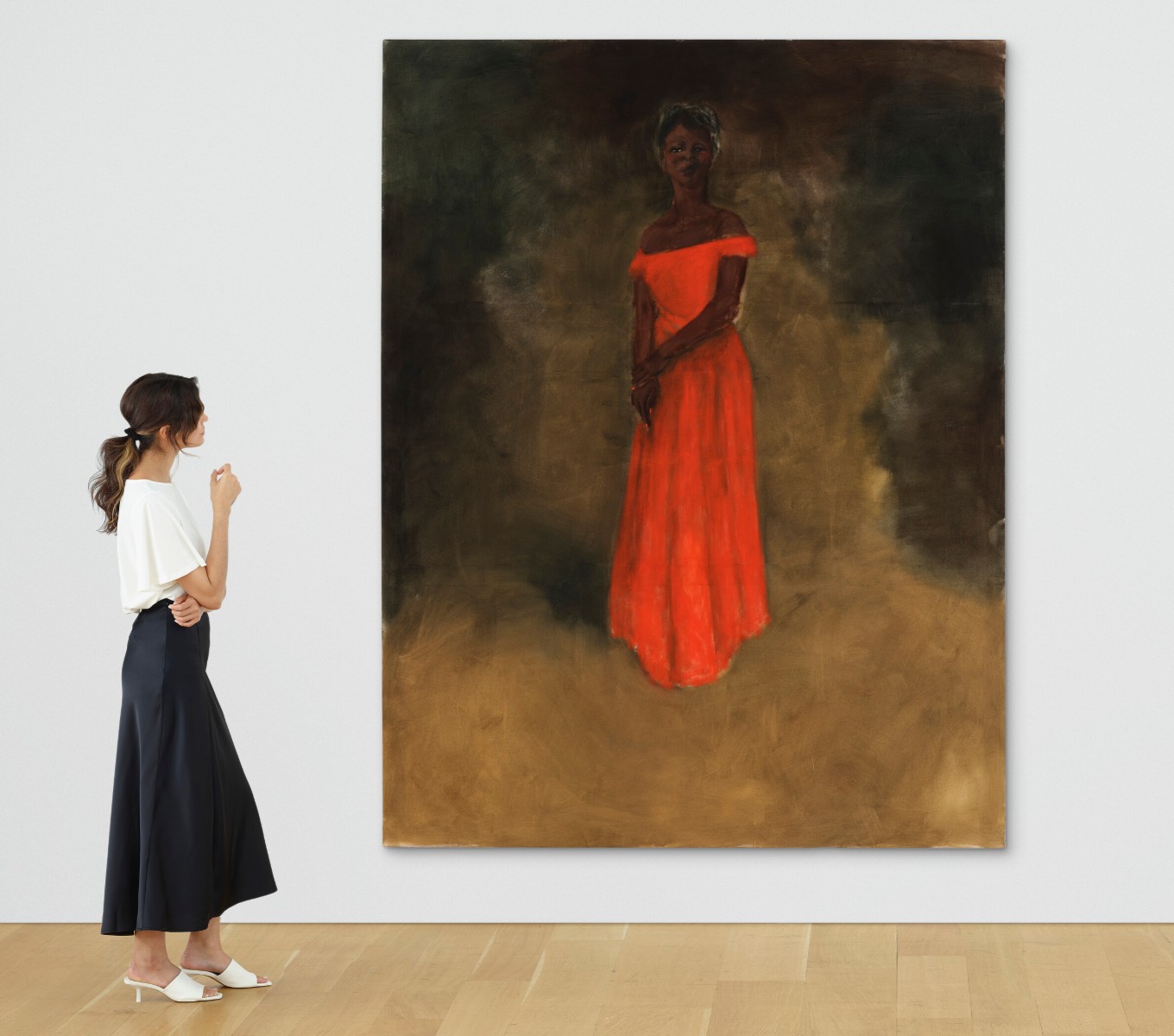
LYNETTE YIADOM-BOAKYE (B. 1977)
Periodical, 2006
Oil on canvas
244×188 cm (96×74 inches)
Signed and dated ‘Lynette Yiadom-Boakye 2006’ (on the reverse)
#5. The Trappings, 2012
Christie’s London: 15 October 2025
Estimated: GBP 400,000 – 600,000
GBP 482,600 / USD 646,685
READ MORE IN FOCUS SECTION
LYNETTE YIADOM-BOAKYE (B. 1977), The Trappings | Christie’s
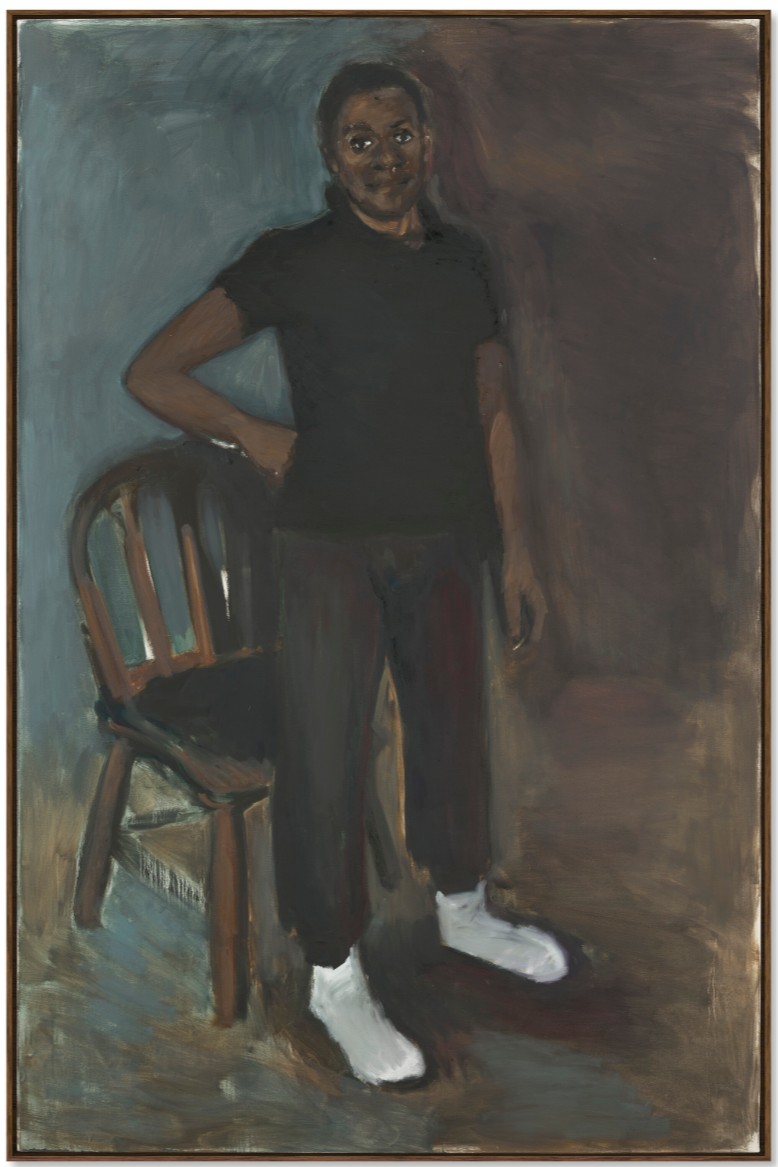
LYNETTE YIADOM-BOAKYE (B. 1977)
The Trappings, 2012
Oil on canvas
200×130 cm (78 3/4 x 51 1/4 inches)
Signed with the artist’s initials, titled and dated ‘The Trappings LYB 2012’ (on the reverse)
#6. Womanology, 2010
Phillips London: 6 March 2025
Estimated: GBP 350,000 – 450,000
GBP 444,500 / USD 569,280
Lynette Yiadom-Boakye – Modern & Conte… Lot 25 March 2025 | Phillips
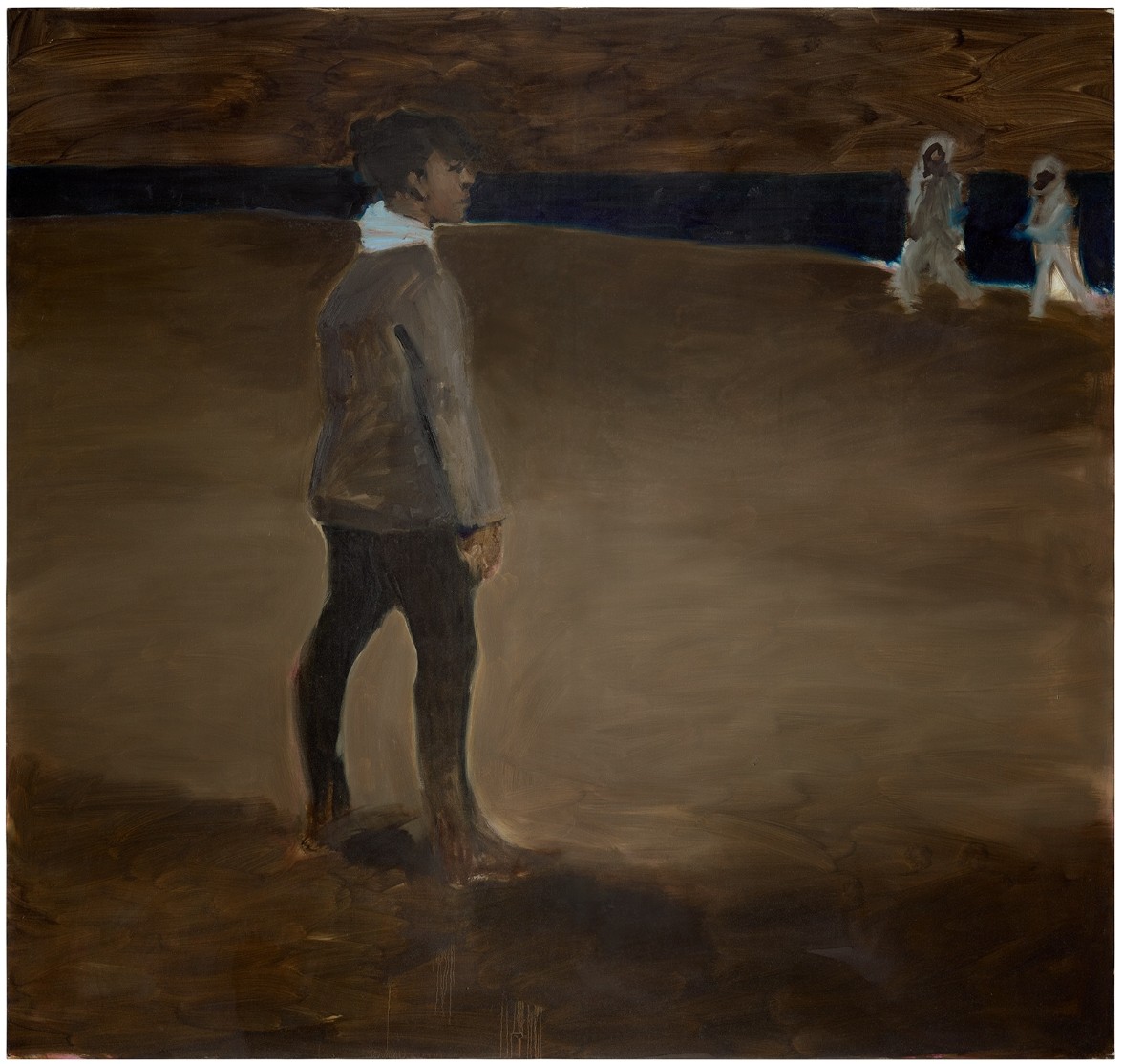
LYNETTE YIADOM-BOAKYE
Womanology, 2010
Oil on canvas
190.2 x 200.3 cm (74 7/8 x 78 7/8 inches)
Signed with the artist’s initials, titled and dated ‘LB 2010 Womanology’ on the reverse
#7. Pearl For A Mackerel, 2010
Phillips London: 26 June 2025
Estimated: GBP 450,000 – 650,000
GBP 355,600 / USD 487,170
READ MORE IN FOCUS SECTION
Lynette Yiadom-Boakye Modern & Contemporary Art: Evening & Day Sale
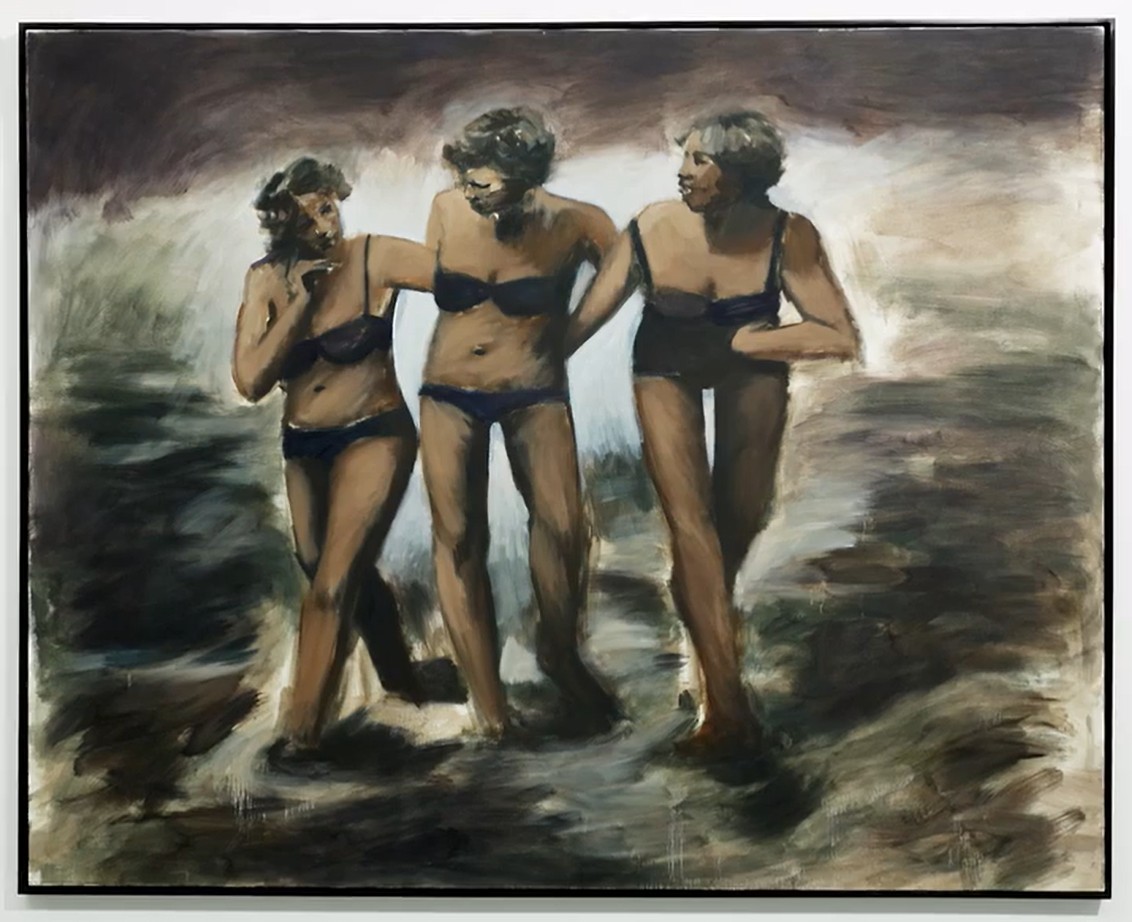
Pearl For A Mackerel, 2010
Titled and dated ‘Pearl For A Mackerel 2010’ on the reverse
#8. Three Kings, 2005
Christie’s London: 16 October 2025
Estimated: GBP 200,000 – 300,000
GBP 279,400 / USD 374,395
READ MORE IN FOCUS SECTION
LYNETTE YIADOM-BOAKYE (B. 1977), Three Kings | Christie’s
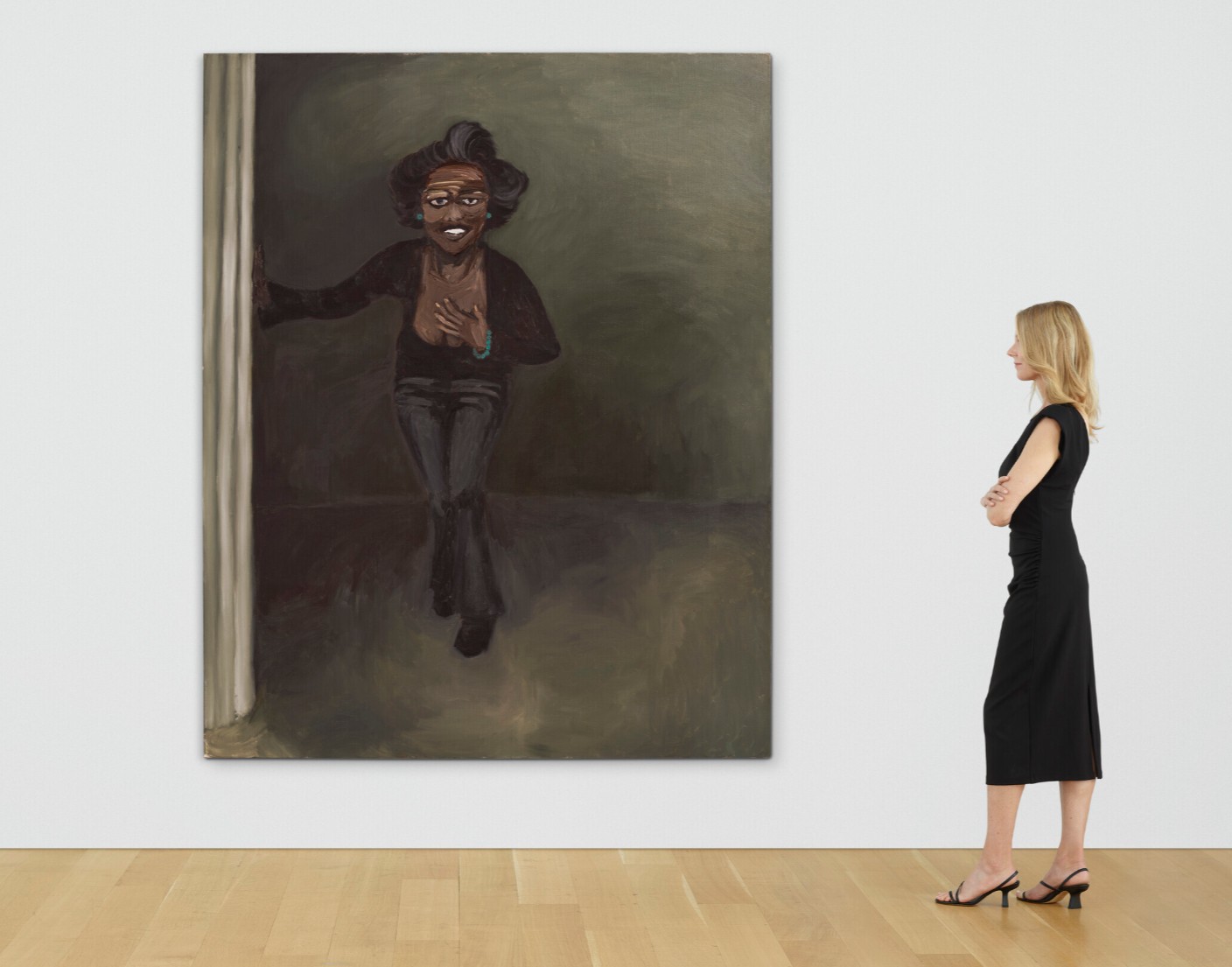
LYNETTE YIADOM-BOAKYE (B. 1977)
Three Kings, 2005
Oil on linen
243.6 x 196 cm (95 7/8 x 77 1/8 inches)
Signed with the artist’s initials, titled and dated ‘LYB ‘Three Kings’ 2005′ (on the reverse)
#9. Curlew, 2010
Phillips New-York: 21 November 2025
Estimated: USD 100,000 – 150,000
USD 167,100
Lynette Yiadom-Boakye Modern & Contemporary Art Day Sale, Afternoon Session
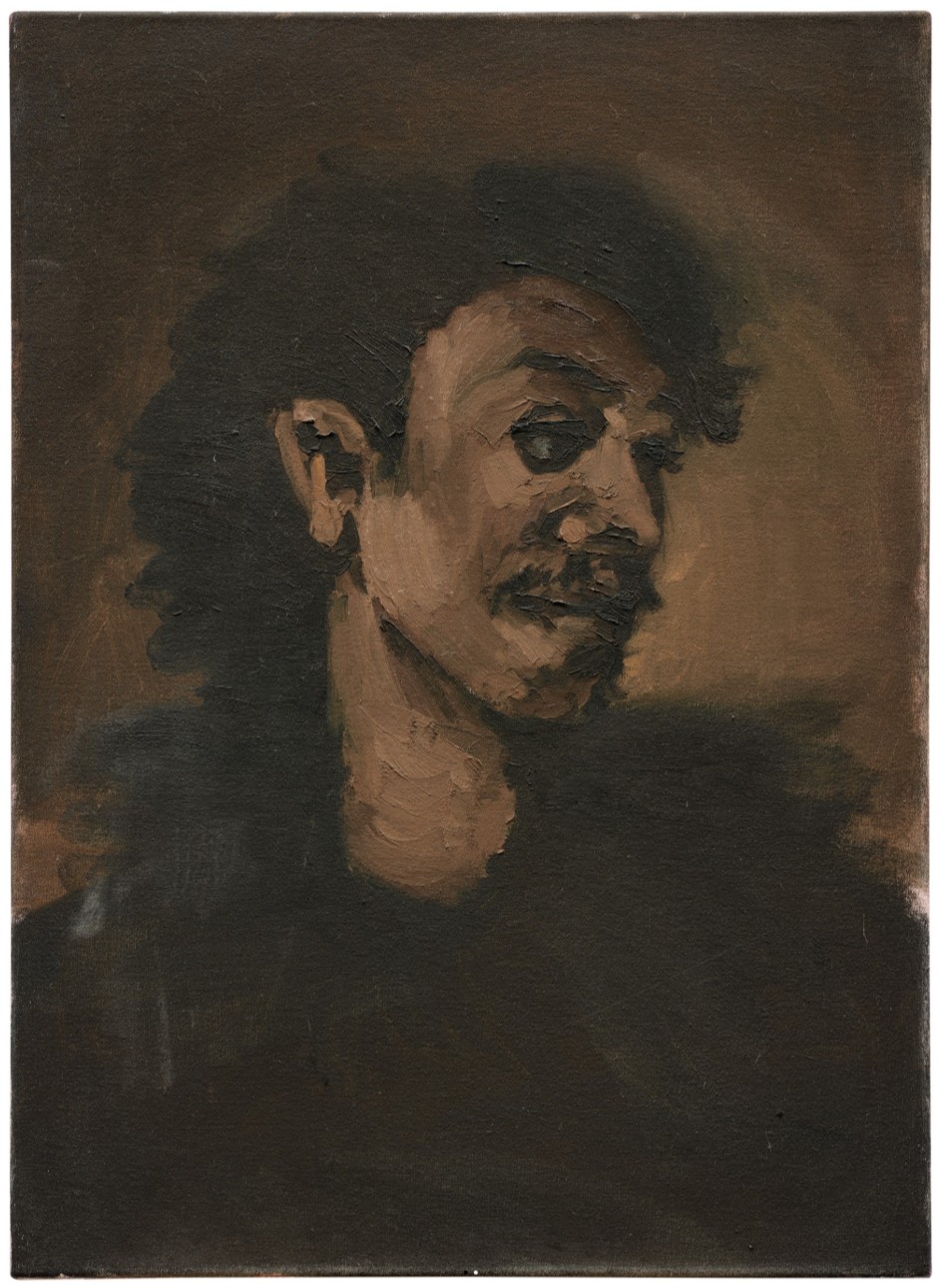
LYNETTE YIADOM-BOAKYE
Curlew, 2010
Oil on canvas
54.9 x 40.6 cm (21 5/8 x 16 inches)
Titled and dated “2010 Curlew” on the reverse
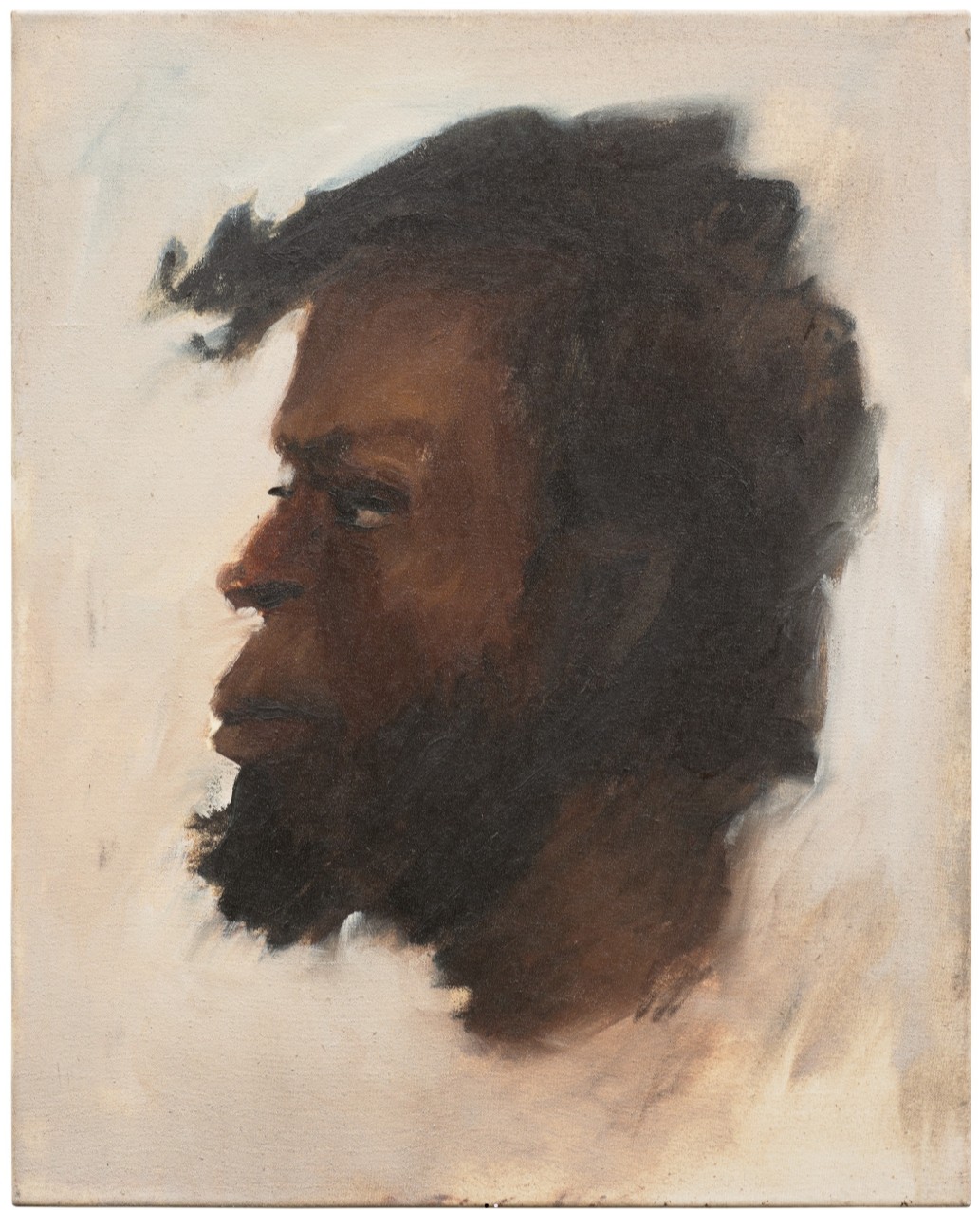
#10. Statistic, 2007
Phillips London: 18 October 2025
Estimated: GBP 80,000 – 120,000
GBP 109,650 / USD 146,930
Lynette Yiadom-Boakye Modern & Contemporary Art Day Sale
#11. Alors, 2006
Christie’s New-York: 15 May 2025
Estimated: USD 150,000 – 250,000
USD 126,000
LYNETTE YIADOM-BOAKYE (B. 1977), Alors | Christie’s
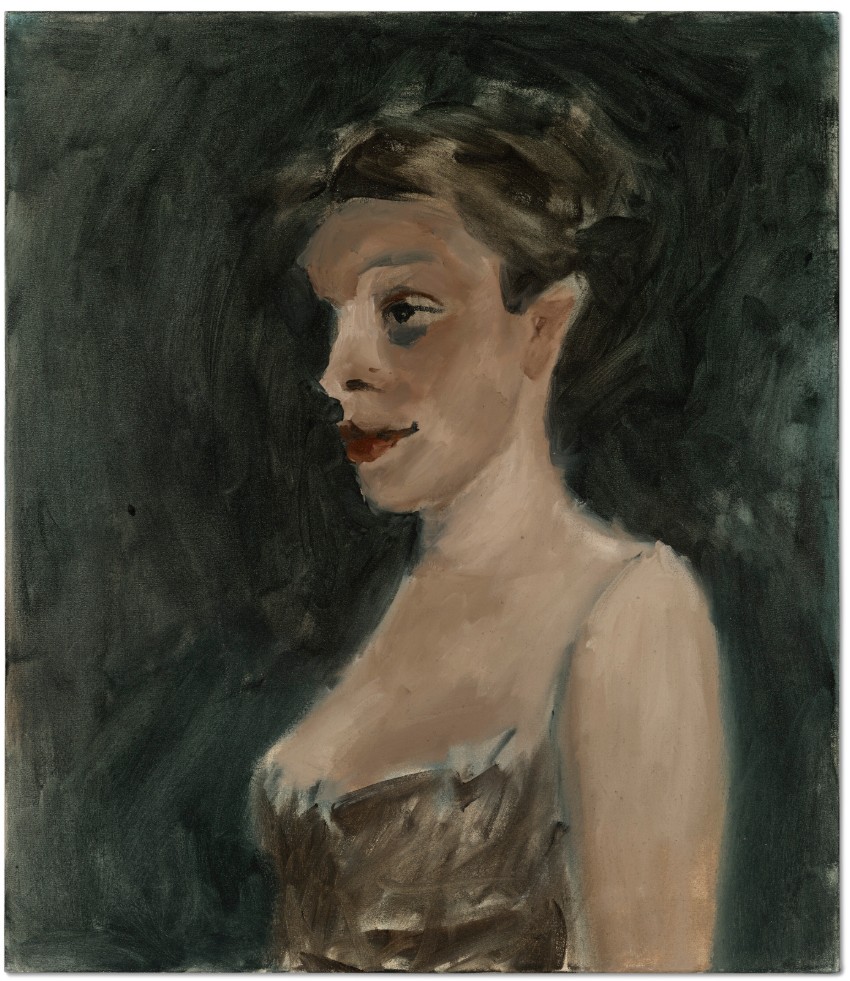
LYNETTE YIADOM-BOAKYE (B. 1977)
Alors, 2006
Oil on canvas
75.3 x 65.4 cm (29 5/8 x 25 3/4 inches)
Signed with the artist’s initials, titled and dated ”Alors’ LYB 2006′ (on the reverse)
Lots Passed
Obelisk, 2005
Sotheby’s New-York: 19 November 2025
Estimated: USD 600,000 – 800,000
PASSED
Obelisk | Contemporary Day Auction | 2025 | Sotheby’s
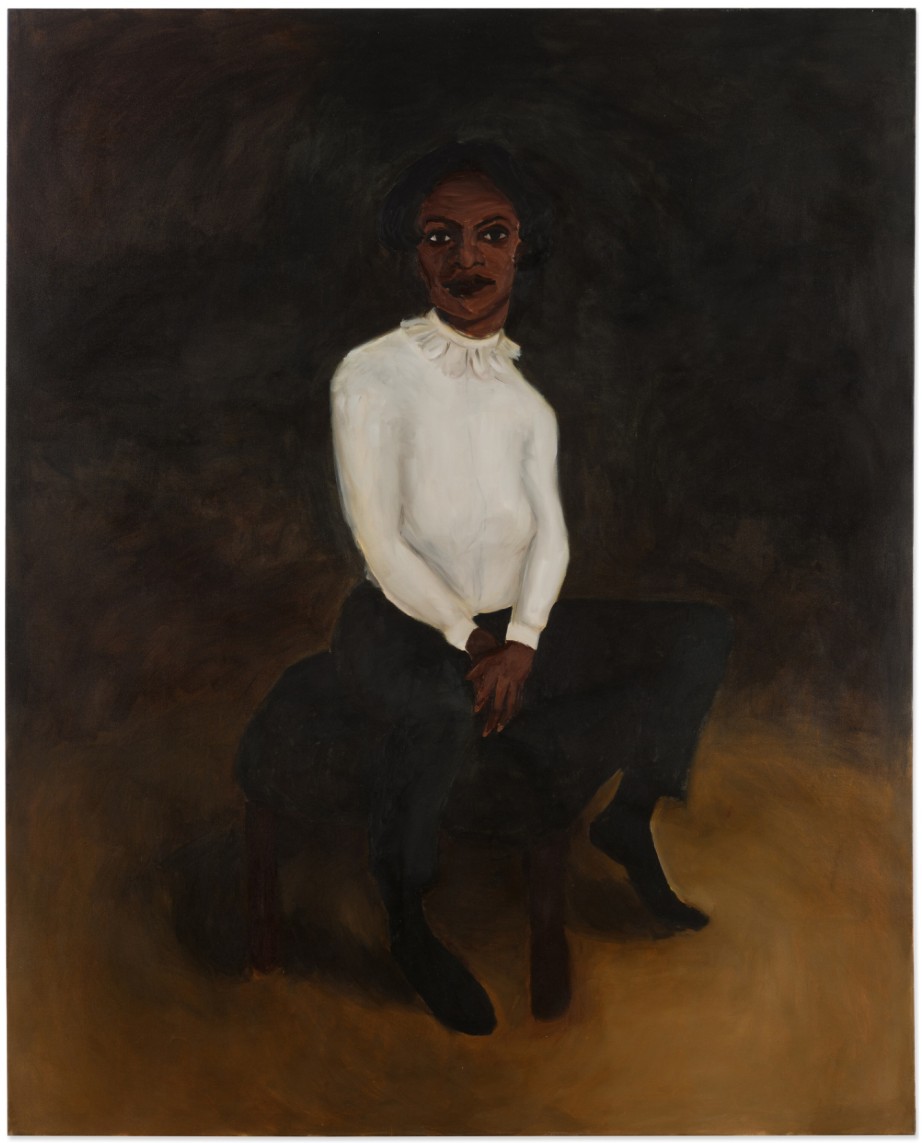
LYNETTE YIADOM-BOAKYE (b. 1977)
Obelisk, 2005
Oil on canvas
243.3 x 195.5 cm (95 3/4 x 77 inches)
Signed, titled and dated 2005 (on the reverse)
Signed (on the stretcher)
My Bull, 2002
Sotheby’s London: 17 October 2025
Estimated: GBP 80,000 – 120,000
PASSED
My Bull | Contemporary Day Auction | 2025 | Sotheby’s
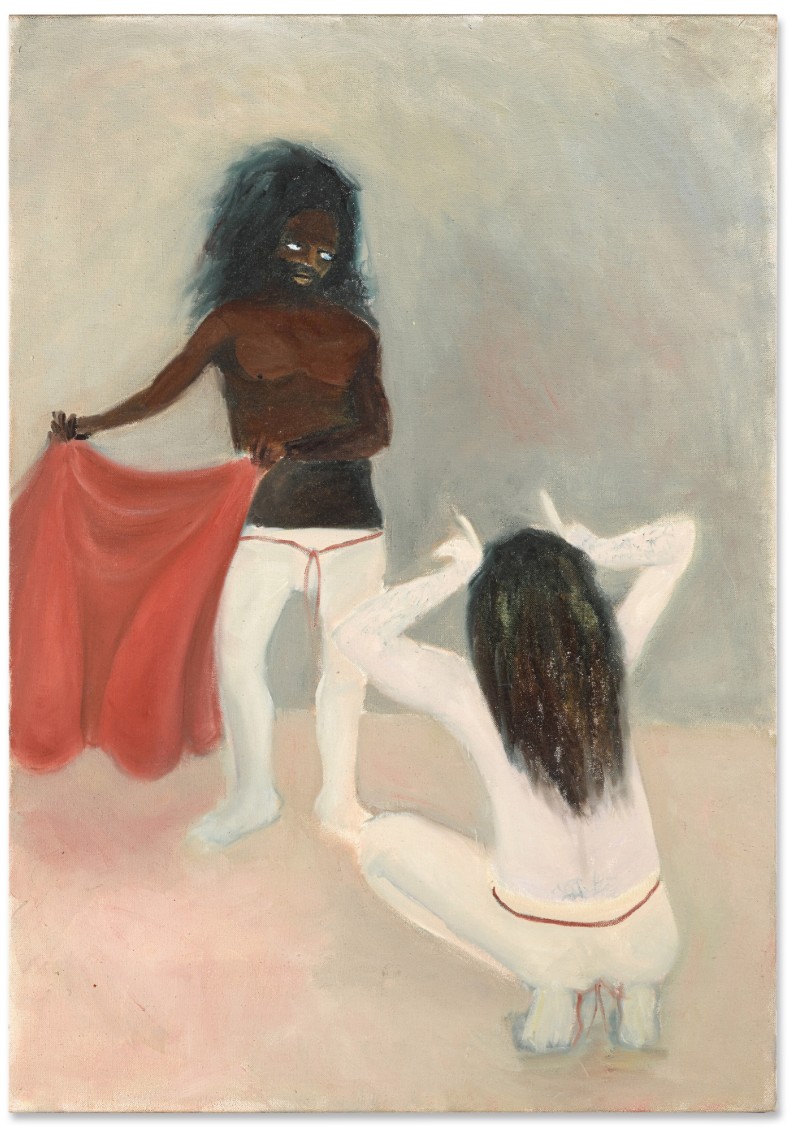
LYNETTE YIADOM-BOAKYE (b. 1977)
My Bull, 2002
Oil on canvas
101.6 x 71 cm (40×28 inches)
Signed, titled and dated 2002 (on the reverse)
2024 Auction Results
13 lots sold in 2024 for a total turnover of USD 12,963,475. With no lot failing to sell, the sell-through rate is 100%. Black Allegiance to the Cunning, a painting dated 2018, sold at Christie’s in New-York on 14 May 2024, for USD 2,954,000, the highest price for 2024.
2024 Top 3 Lots
6 lots sold for more than USD 1 million, generating a cumulative turnover of USD 9,096,647, representing 70.2% of the total for 2024.
#1. Black Allegiance to the Cunning, 2018
Christie’s New-York: 14 May 2024
Estimated: USD 1,000,000 – 1,500,000
USD 2,954,000
LYNETTE YIADOM-BOAKYE (B. 1977), Black Allegiance to the Cunning | Christie’s (christies.com)
LYNETTE YIADOM-BOAKYE (B. 1977)
Black Allegiance to the Cunning, 2018
Oil on linen
200×150 cm (79×59 inches)
Signed with the artist’s initials, titled and dated ‘LYB 2018 Black Allegiance to the Cunning’ (on the reverse)
#2. Watcher, 2011
Phillips New-York: 19 November 2024
Estimated: USD 1,000,000 – 1,500,000
USD 1,754,000
Lynette Yiadom-Boakye – Modern & Con… Lot 4 November 2024 | Phillips
LYNETTE YIADOM-BOAKYE
Watcher, 2011
Oil on canvas
200×120 cm (78 7/8 x 47 1/4 inches)
Signed with the artist’s initials, titled and dated “LYB 2011 Watcher” on the reverse
#3. Minotaur To Matador, 2022
Phillips London: 27 June 2024
Estimated: GBP 900,000 – 1,500,000
GBP 952,500 / USD 1,207,770
https://www.phillips.com/detail/lynette-yiadomboakye/UK010424/5
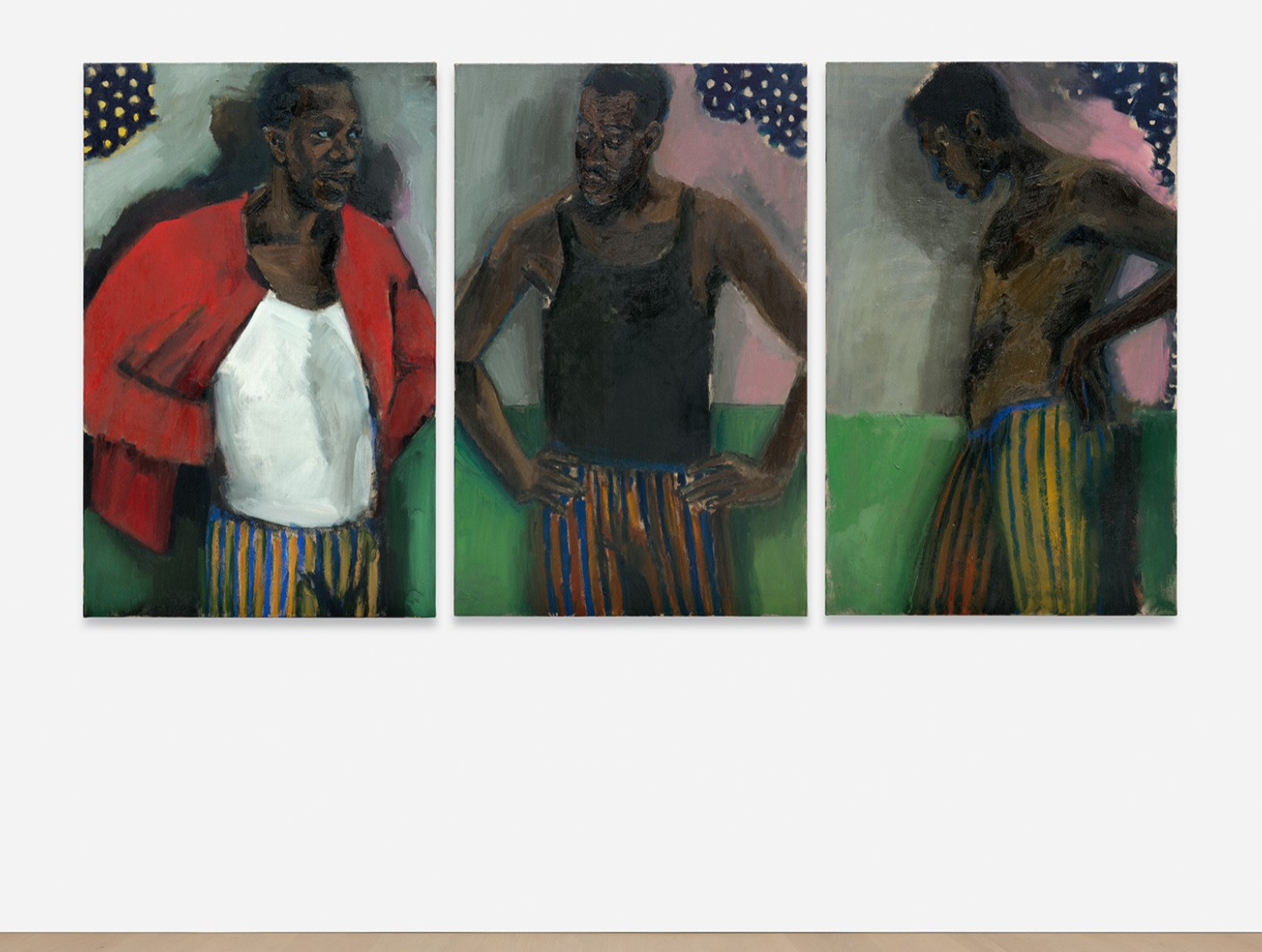
LYNETTE YIADOM-BOAKYE
Minotaur To Matador, 2022
Oil on linen, triptych
Each: 109.8 x 70.3 cm (43 1/4 x 27 5/8 inches)
Overall: 109.8 x 220 cm (43 1/4 x 86 5/8 inches)
Signed, titled and dated ‘Minotaur To Matador 2022 Lynette Yiadom-Boakye’ on the reverse of each part
#4. Of All The Seasons, 2017
Christie’s London: 7 March 2024
Estimated: GBP 500,000 – 700,000
GBP 856,800 / USD 1,086,422
LYNETTE YIADOM-BOAKYE (B. 1977), Of All The Seasons | Christie’s (christies.com)
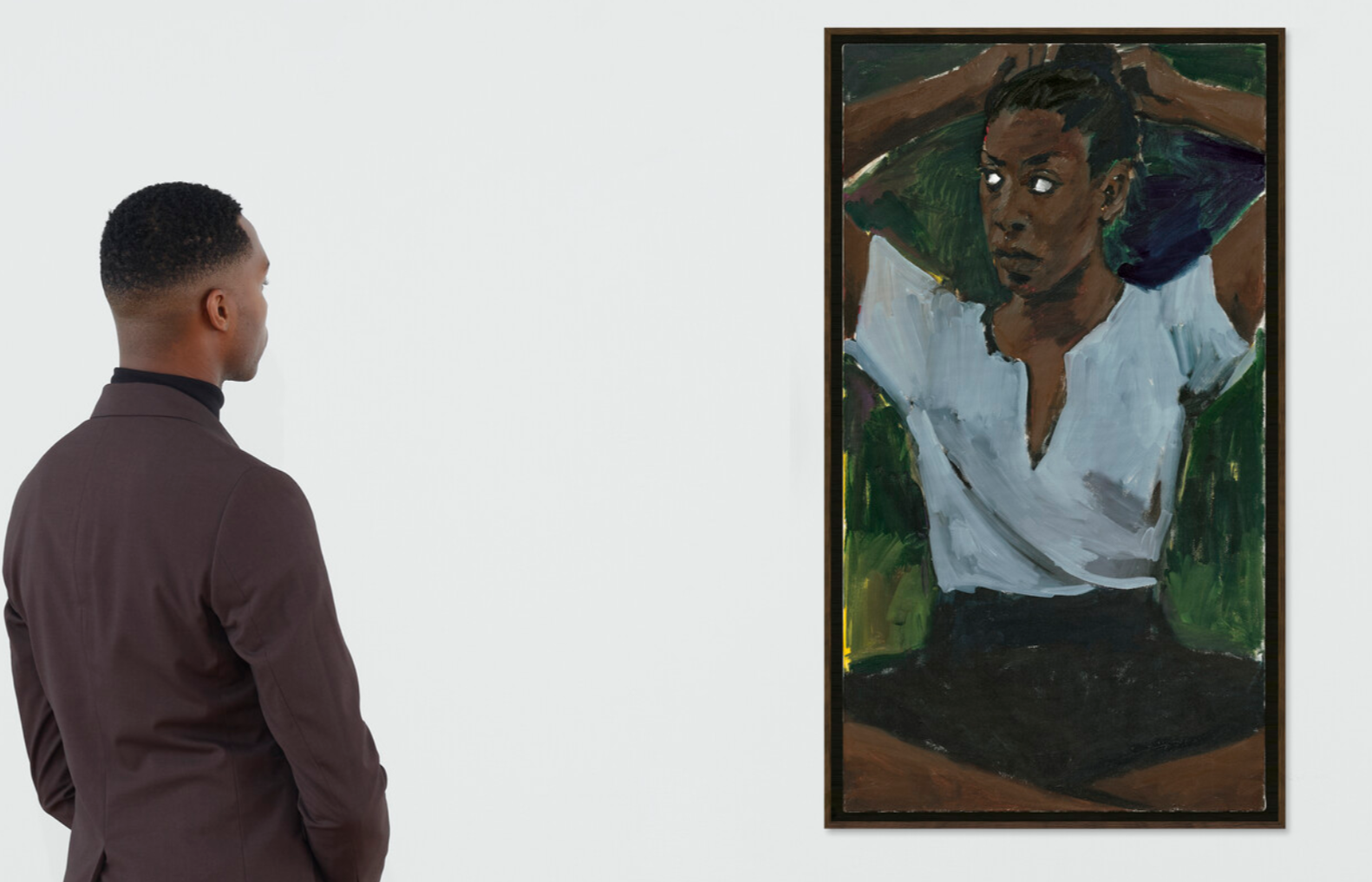
LYNETTE YIADOM-BOAKYE (B. 1977)
Of All The Seasons, 2017
Oil on canvas
110.2 x 60.6 cm (43 3/8 x 23 7/8 inches)
Signed with the artist’s initials, titled and dated ‘LYB 2017 Of All The Seasons’ (on the reverse)
#5. 11pm Saturday, 2011
Christie’s London: 9 October 2024
Estimated: GBP 800,000 – 1,200,000
GBP 819,000 / USD 1,072,770
LYNETTE YIADOM-BOAKYE (B. 1977), 11pm Saturday | Christie’s
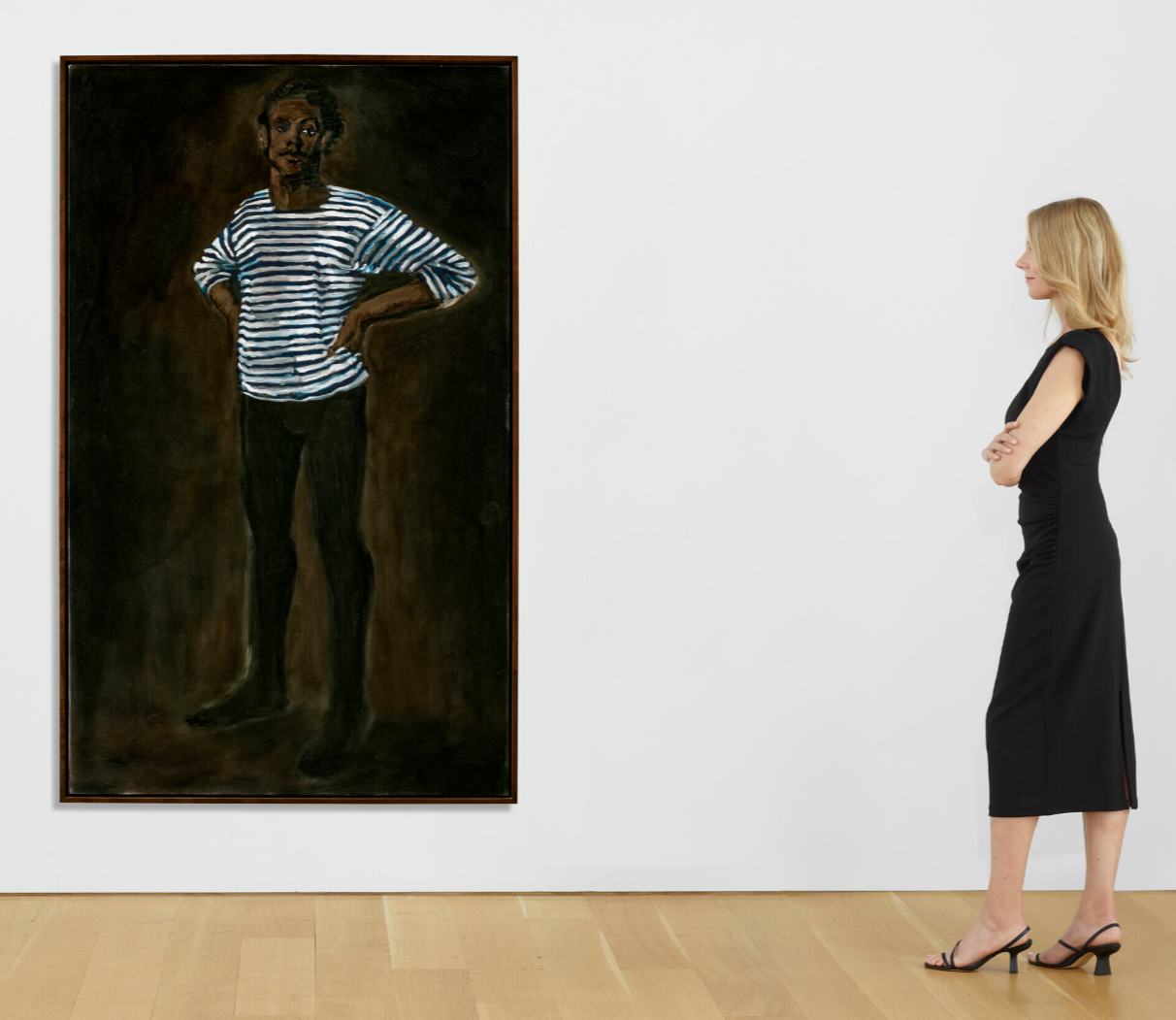
LYNETTE YIADOM-BOAKYE (B. 1977)
11pm Saturday, 2011
Oil on canvas
200×120 cm (78 3/4 x 47 1/4 inches)
Signed with the artist’s initials, titled and dated ’11pm Saturday LYB 2011′ (on the reverse)
#6. Militant Pressures, 2016
Sotheby’s London: 9 October 2024
Estimated: GBP 700,000 – 1,000,000
GBP 780,000 / USD 1,021,685
Militant Pressures | Contemporary Evening Auction | 2024 | Sotheby’s
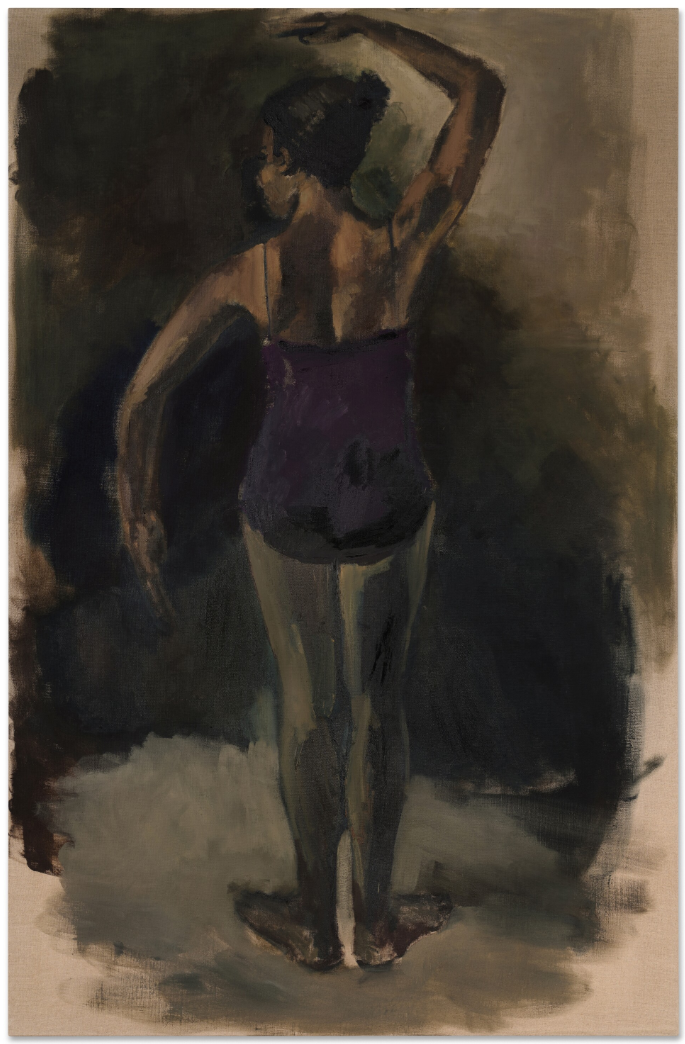
LYNETTE YIADOM-BOAKYE (b. 1977)
Militant Pressures, 2016
Oil on linen
200 x 130.2 cm (78 3/4 x 51 1/4 inches)
Signed, titled and dated 2016 (on the reverse)
USD 1 million
#7. Secular Readings, 2010
Sotheby’s New-York: 13 May 2024
Estimated: USD 700,000 – 1,000,000
USD 889,000
Secular Readings | The Now Evening Auction | 2024 | Sotheby’s (sothebys.com)
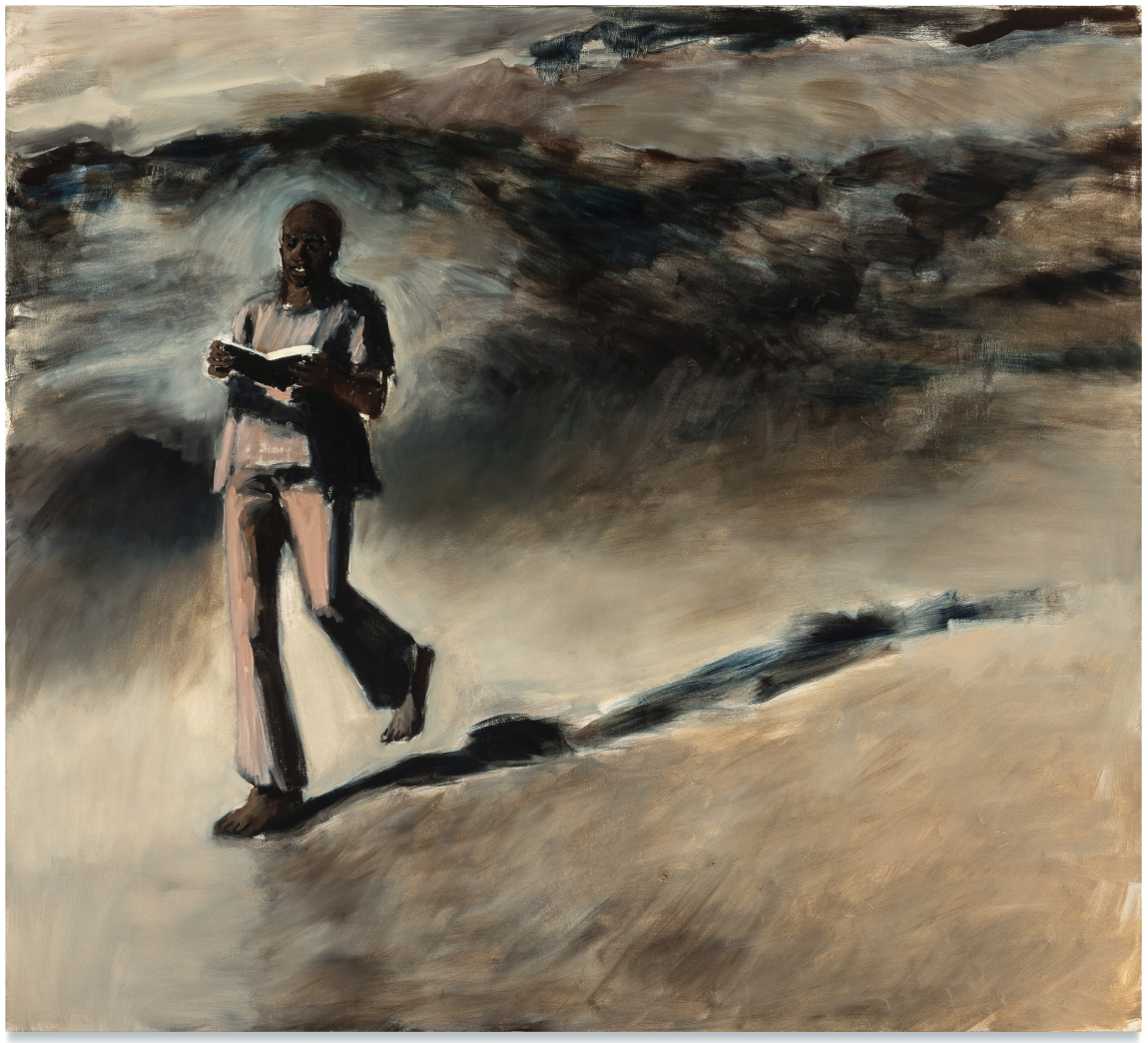
LYNETTE YIADOM-BOAKYE (b. 1977)
Secular Readings, 2010
Oil on canvas
180×200 cm (70 7/8 x 78 3/4 inches)
Titled and dated 2010 (on the reverse)
#8. Painkiller, 2011
Christie’s New-York: 21 November 2024
Estimated: USD 800,000 – 1,200,000
USD 756,000
LYNETTE YIADOM-BOAKYE (b. 1977), Painkiller | Christie’s
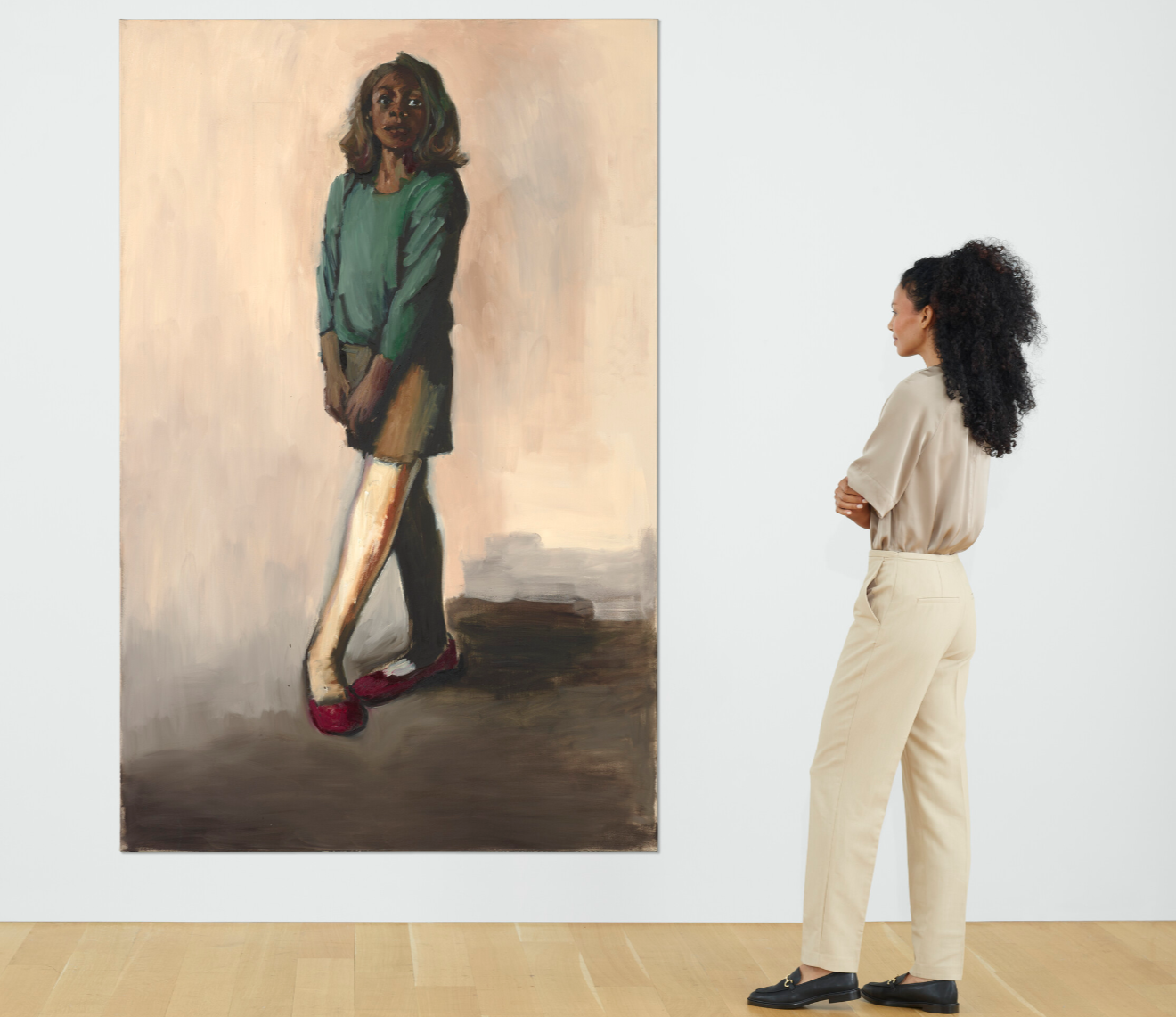
LYNETTE YIADOM-BOAKYE (b. 1977)
Painkiller, 2011
Oil on canvas
200×130 cm (78 3/4 x 51 1/4 inches)
#9. 5am, Cadiz, 2009
Christie’s London: 27 June 2024
Estimated: GBP 600,000 – 800,000
GBP 567,000 / USD 718,956
LYNETTE YIADOM-BOAKYE (B. 1977) (christies.com)
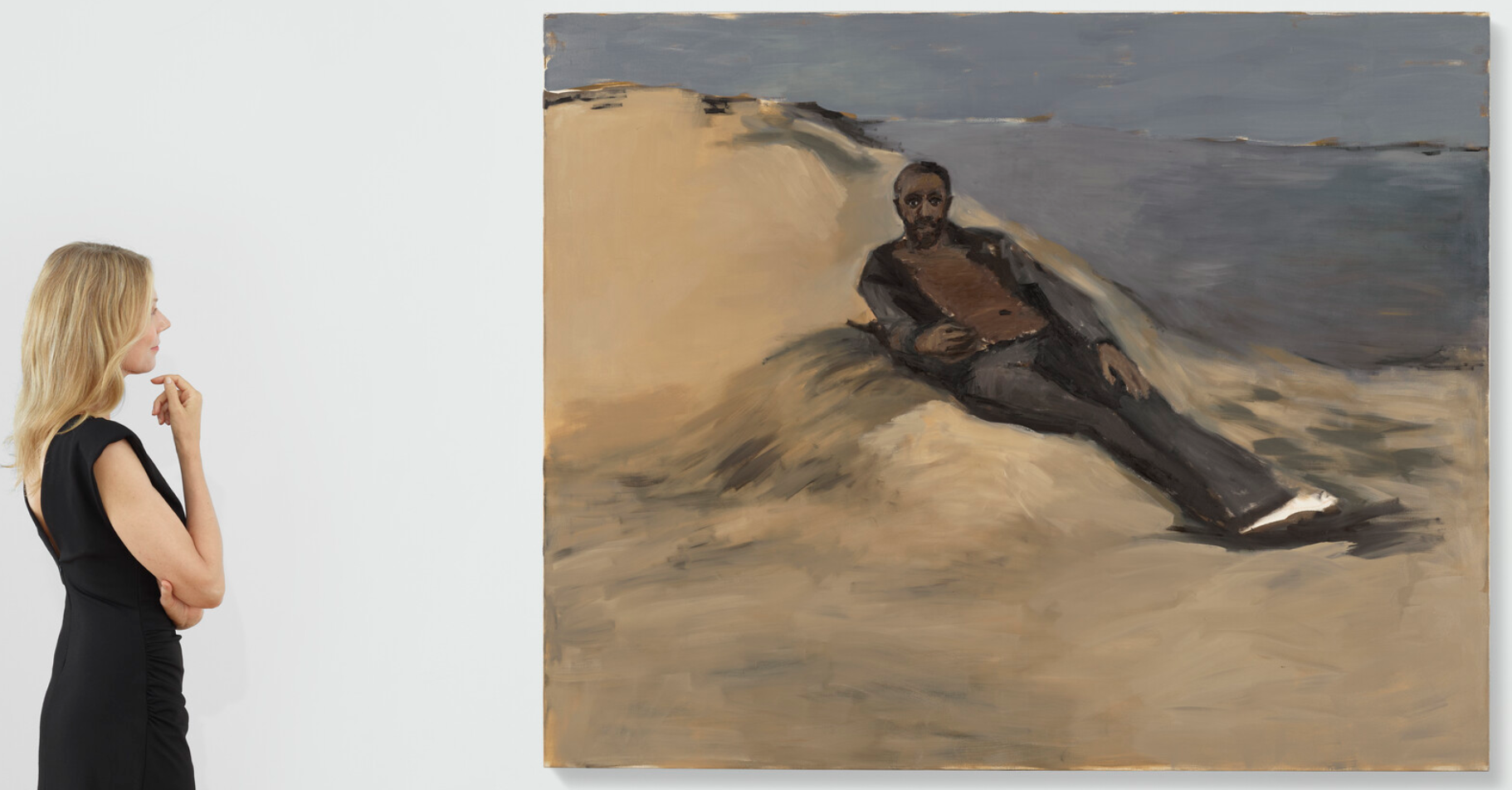
LYNETTE YIADOM-BOAKYE (B. 1977)
5am, Cadiz, 2009
Oil on canvas
160×200 cm (63 x 78 3/4 inches)
Signed with the artist’s initials, titled and dated ‘LYB 2009 5am Cadiz’ (on the reverse)
#10. Kingfisher, 2011
Sotheby’s London: 7 March 2024
Estimated: EUR 300,000 – 400,000
EUR 472,600 / USD 599,260
Kingfisher | Modern & Contemporary Day Auction | 2024 | Sotheby’s
LYNETTE YIADOM-BOAKYE (b. 1977)
Kingfisher, 2011
Oil on canvas
70.2 x 65 cm (27 5/8 x 25 5/8 inches)
Signed with the artist’s initials, titled and dated 2011 (on the reverse)
#11. 11am Monday, 2011
Christie’s New-York: 1 October 2024
Estimated: USD 600,000 – 800,000
USD 567,000
LYNETTE YIADOM-BOAKYE (B. 1977), 11am Monday | Christie’s
LYNETTE YIADOM-BOAKYE (B. 1977)
11am Monday, 2011
oil on canvas
180.3 x 99.7 cm (71 x 39 1/4 inches)
#12. Pressure on Cannibals, 2006
Christie’s London: 9 March 2024
Estimated: GBP 70,000 – 100,000
GBP 163,800 / USD 210,615
LYNETTE YIADOM-BOAKYE (B. 1977), Pressure on Cannibals | Christie’s
LYNETTE YIADOM-BOAKYE (B. 1977)
Pressure on Cannibals, 2006
Oil on linen
65.3 x 55.2 cm (25 3/4 x 21 3/4 inches)
Signed with artist’s initials, titled and dated ‘Pressure on Cannibals LYB 2006’ (on the reverse)
#13. Flex, 2011
Christie’s New-York: 1 October 2024
Estimated: USD 80,000 – 120,000
USD 126,000
LYNETTE YIADOM-BOAKYE (B. 1977), Flex | Christie’s
LYNETTE YIADOM-BOAKYE (B. 1977)
Flex, 2011
Oil on canvas
40.3 x 34.9 cm (15 7/8 x 13 3/4 inches)
Signed with the artist’s initials, titled and dated ‘LYB 2011 Flex’ (on the reverse)
2023 Auction Results
7 lots sold at auction in 2023 for a total turnover of USD 9,265,820. With no lot failing to sell, the sell-through rate is 100%. The highest price has been achieved at Sotheby’s in London on 12 October 2023, when Six Birds in the Bush, a painting dated 2015, sold for GBP 2,952,000 (USD 3,635,465), a new auction record for the artist.
2023 Top 3 Lots
4 lots sold for more than USD 1 million, generating a cumulative turnover of USD 7,599,555, representing 82% of the total for 2023.
#1. Six Birds in the Bush, 2015
Sotheby’s London: 12 October 2023
Estimated: GBP 1,200,000 – 1,800,000
GBP 2,952,000 / USD 3,635,465
NEW WORLD AUCTION RECORD FOR THE ARTIST
Six Birds in the Bush | The Now Evening Auction | 2023 | Sotheby’s (sothebys.com)
LYNETTE YIADOM-BOAKYE (b. 1977)
Six Birds in the Bush, 2015
Oil on linen
200×130 cm (78 3/4 x 51 1/8 inches)
Signed with the artist’s initials, titled and dated 2015 (on the reverse)
#2. Diplomacy I, 2009
Christie’s London: 28 June 2023
Estimated: GBP 1,000,000 – 1,500,000
GBP 1,371,000 / USD 1,747,440
LYNETTE YIADOM-BOAKYE (B. 1977), Diplomacy I | Christie’s (christies.com)
LYNETTE YIADOM-BOAKYE (B. 1977)
Diplomacy I, 2009
Oil on canvas
190.2 x 250 cm (74 7/8 x 98 3/8 inches)
Signed with the artist’s initials, titled and dated ‘LYB 2009 DIPLOMACY I’ (on the reverse)
#3. Les Partisans (The Partisans), 2009
Christie’s London: 28 February 2023
Estimated: GBP 800,000 – 1,200,000
GBP 1,002,000 / USD 1,208,650
LYNETTE YIADOM-BOAKYE (B. 1977), Les Partisans (The Partisans) | Christie’s (christies.com)
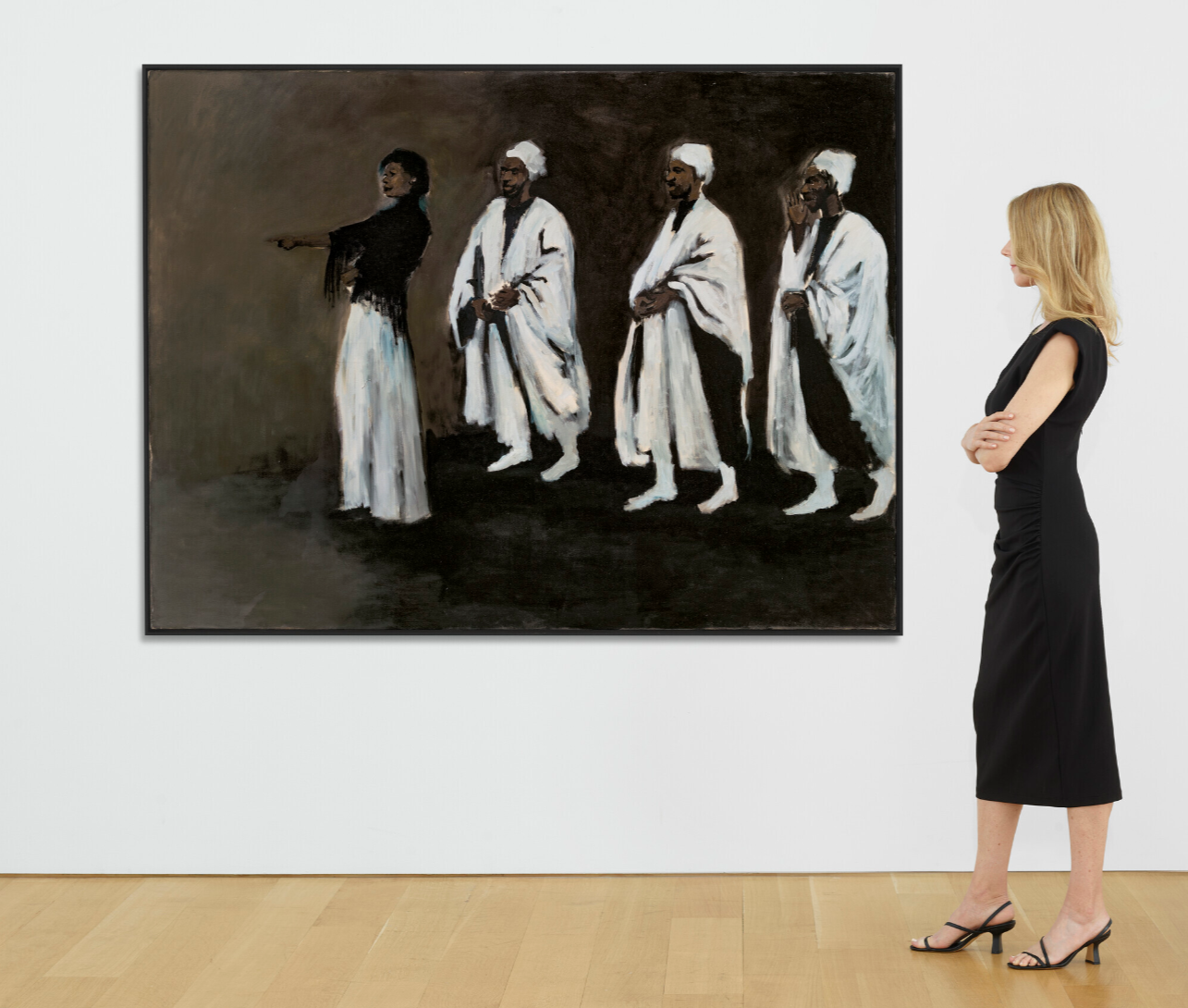
LYNETTE YIADOM-BOAKYE (B. 1977)
Les Partisans (The Partisans), 2009
Oil on canvas
150.8 x 200 cm (59 3/8 x 78 3/4 inches)
Signed with the artist’s initials, titled and dated ‘LYB 2009 Les Partisans’ (on the reverse)
#4. Highriser, 2009
Christie’s New-York: 15 May 2023
Estimated: USD 700,000 – 1,000,000
USD 1,002,000
LYNETTE YIADOM-BOAKYE (B. 1977), Highriser | Christie’s (christies.com)
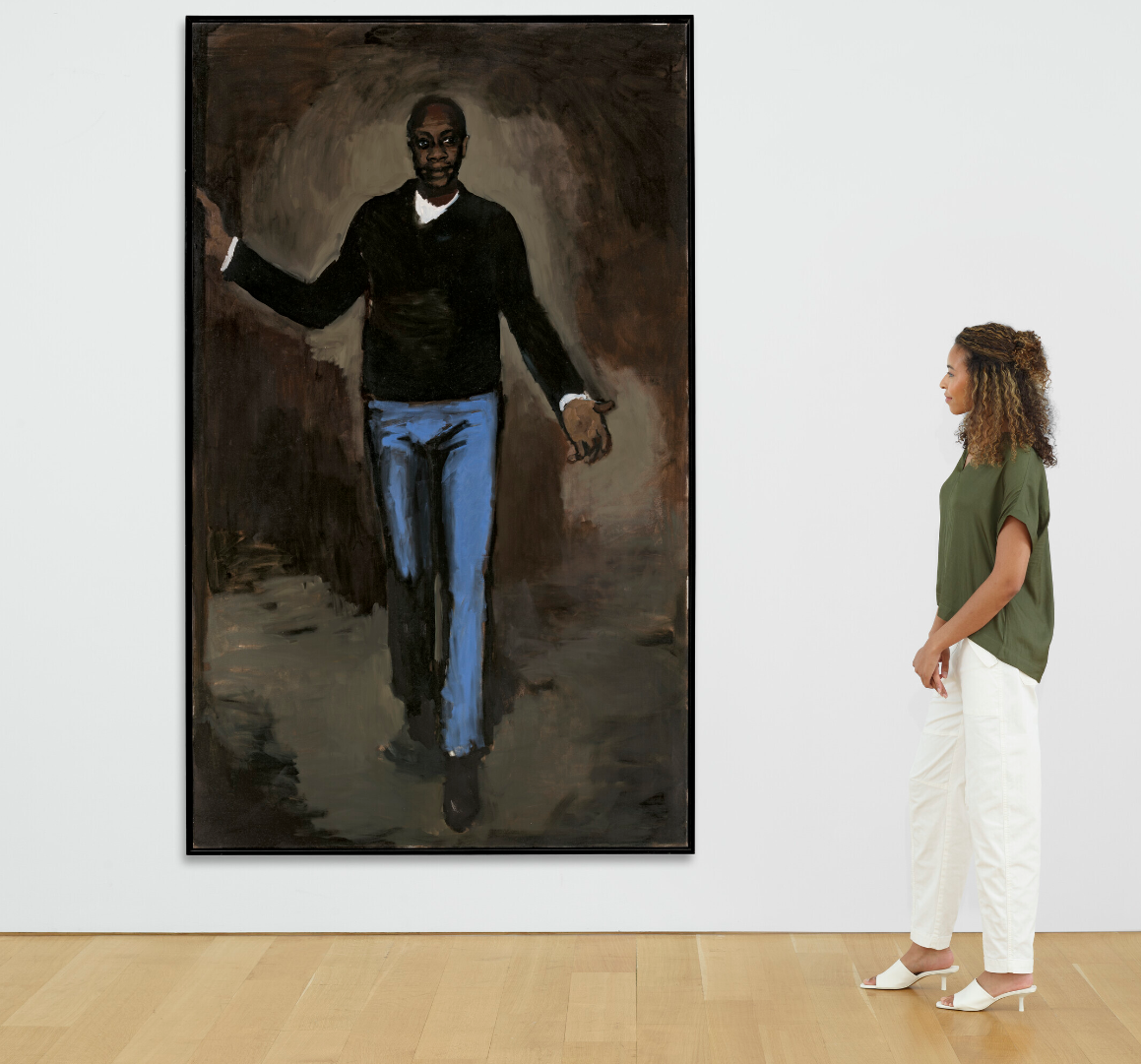
LYNETTE YIADOM-BOAKYE (B. 1977)
Highriser, 2009
Oil on canvas
250.5 x 150 cm (98 5/8 x 59 inches)
Signed with the artist’s initials, titled and dated ‘Highriser LYB 2009’ (on the reverse)
USD 1 million
#5. A Focus For The Cavalry, 2016
Sotheby’s New-York: 15 November 2023
Estimated: USD 800,000 – 1,200,000
USD 952,500
A Focus For The Cavalry | The Now Evening Auction | 2023 | Sotheby’s (sothebys.com)
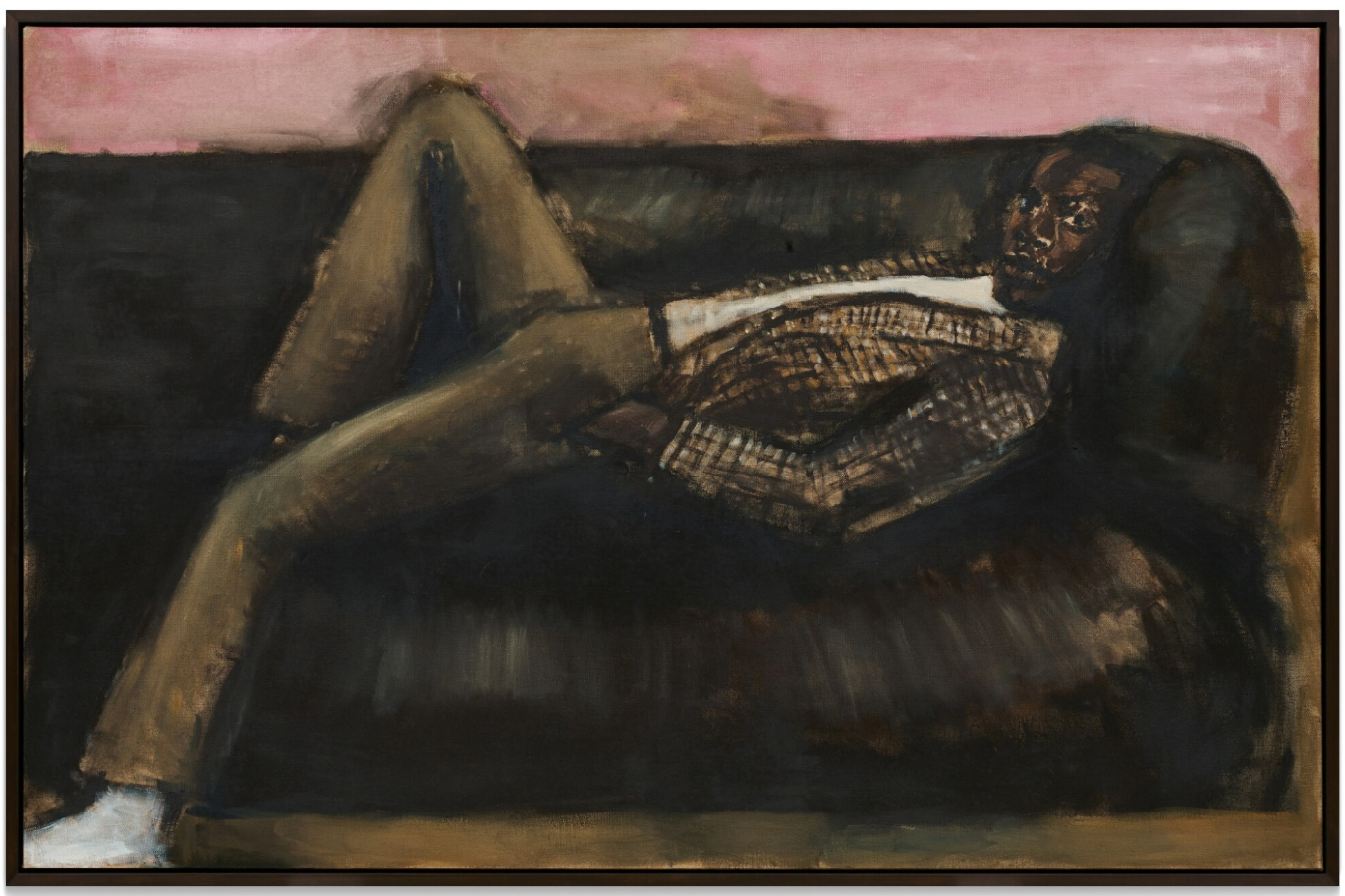
LYNETTE YIADOM-BOAKYE (b. 1977)
A Focus For The Cavalry, 2016
Oil on canvas
130×200 cm (51 1/8 x 78 3/4 inches)
Titled and dated 2016 (on the reverse)
#6. Wishes Above Needs, 2011
Christie’s London: 1 March 2023
Estimated: GBP 200,000 – 300,000
GBP 453,600 / USD 545,815
LYNETTE YIADOM-BOAKYE (B. 1977), Wishes Above Needs | Christie’s
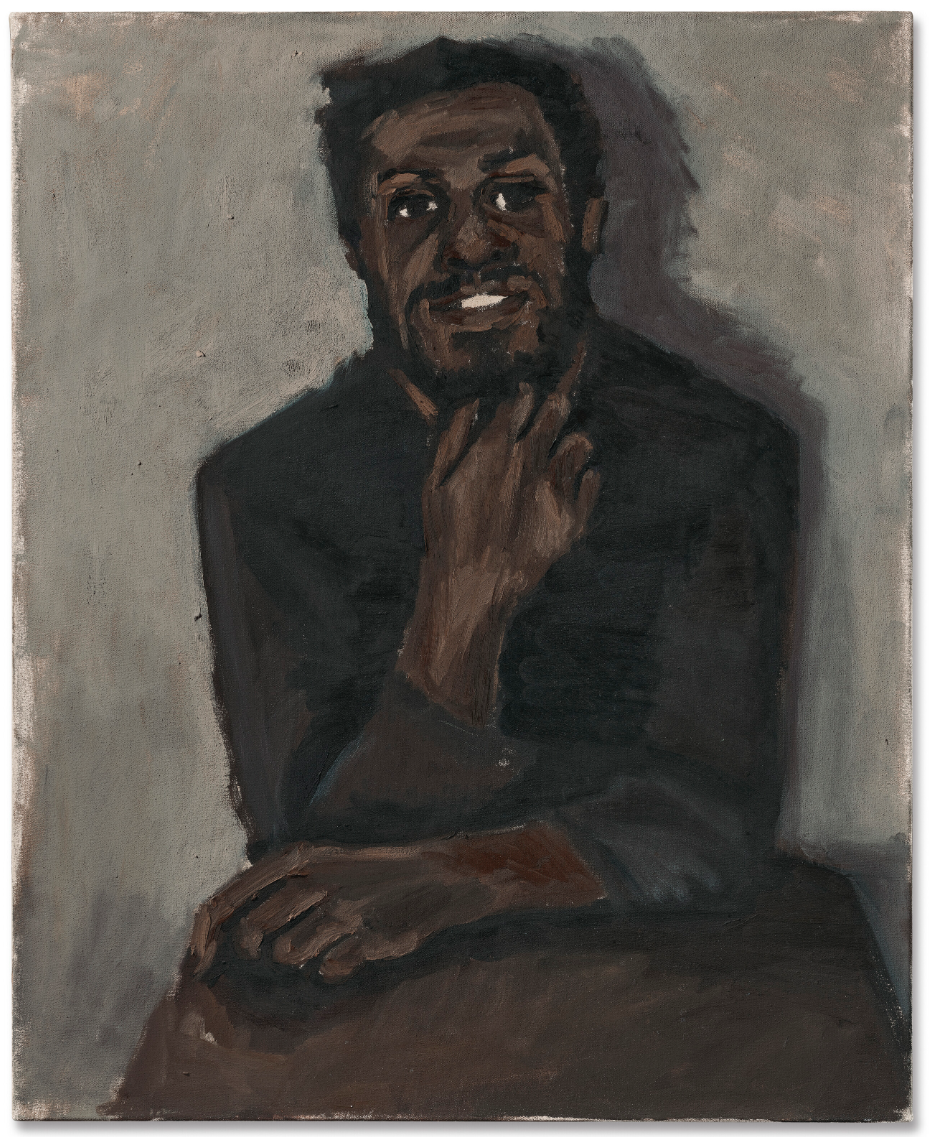
LYNETTE YIADOM-BOAKYE (B. 1977)
Wishes Above Needs, 2011
Oil on canvas
80.4 x 65.4cm (31 5/8 x 25 3/4 inches)
Signed with the artist’s initials, titled and dated ‘LYB 2011 Wishes Above Needs’ (on the reverse)
#7. Radiowave, 2008
Christie’s London: 6 December 2023
Estimated: GBP 60,000 – 80,000
GBP 133,350 / USD 167,950
Lynette Yiadom-Boakye – New Now London Lot 7 December 2023 | Phillips
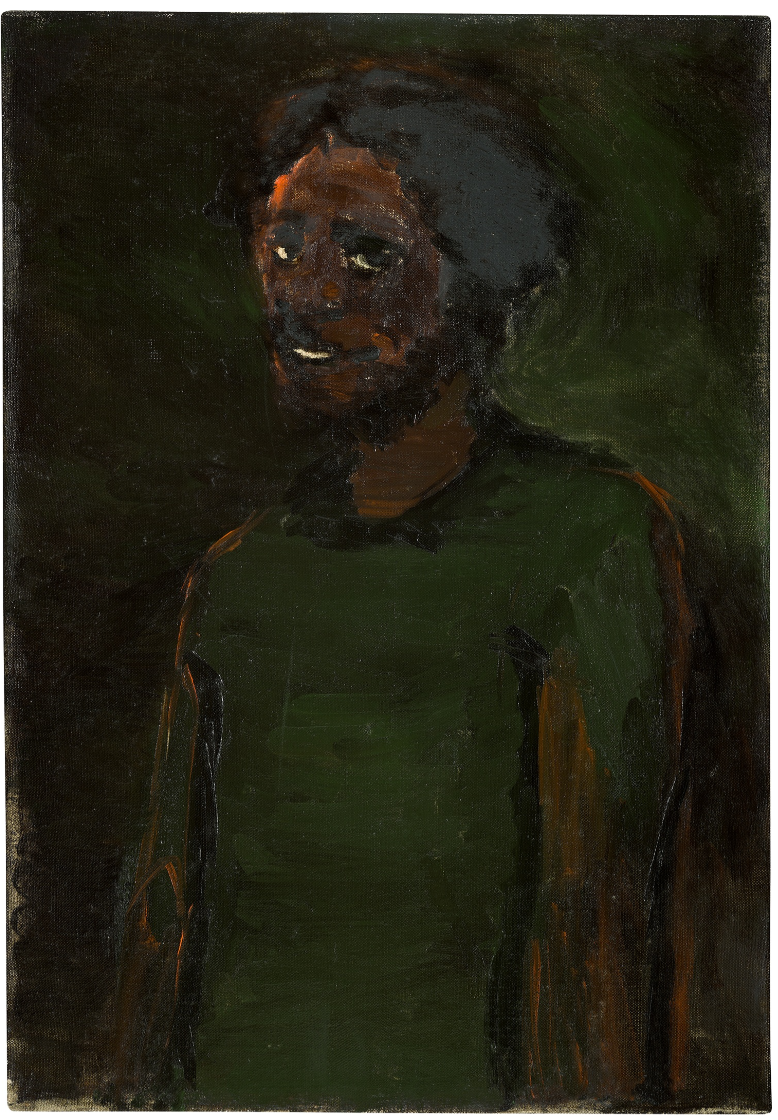
LYNETTE YIADOM-BOAKYE
Radiowave, 2008
Oil on linen
50×35 cm (19 5/8 x 13 3/4 inches)
Signed with the artist’s initials, titled and dated ‘Radiowave LYB 2008’ on the reverse
2022 Auction Results
11 lots sold at auction in 2022 for a total turnover of USD 6,256,730. With 1 lot failing to sell, the sell-through rate is 92%. The highest price of 2022 was achieved by 11pm Sunday, a painting dated 2011, that sold at Sotheby’s, in New-York, on 19 May 2022, for USD 1,744,000.
2022 Top 3 Lots
3 lots sold for more than USD 1 million, generating a cumulative turnover of USD 4,877,005, representing 77.9% of the total turnover for 2022.
#1. 11pm Sunday, 2011
Sotheby’s New-York: 19 May 2022
Estimated: USD 1,200,000 – 1,800,000
USD 1,744,000
11pm Sunday | The Now Evening Auction | 2022 | Sotheby’s (sothebys.com)
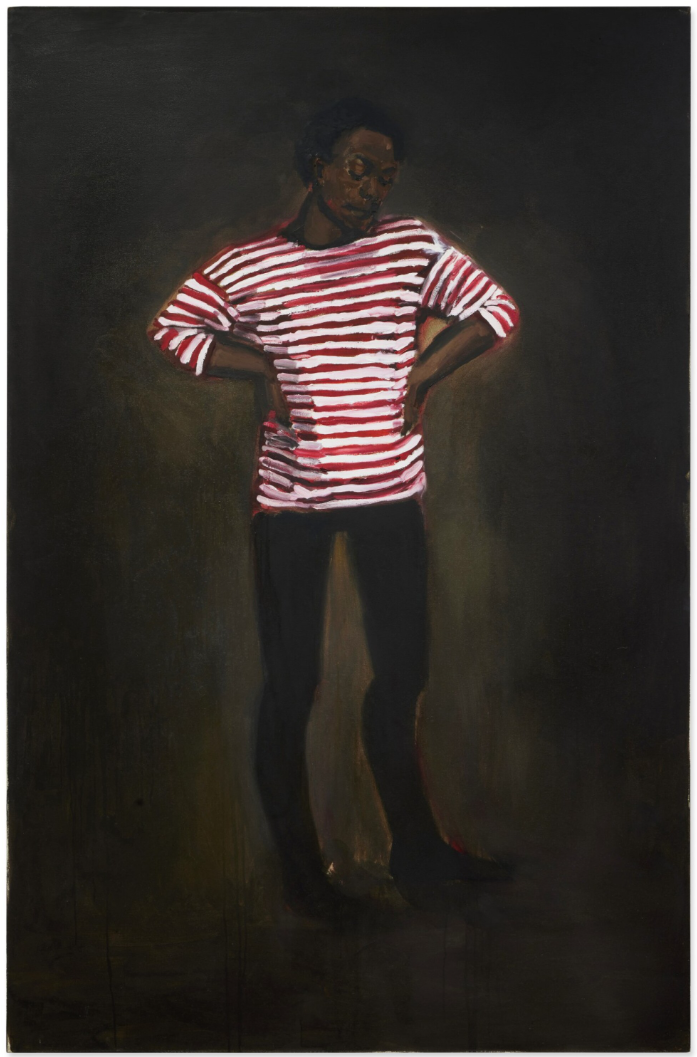
LYNETTE YIADOM-BOAKYE (b. 1977)
11pm Sunday, 2011
Oil on canvas
200.7 x 129.9 cm (79 x 51 1/8 inches)
Signed, titled 11pm Sunday and dated 2011 (on the reverse)
#2. Highpower, 2008
Christie’s London: 13 October 2022
Estimated: GBP 600,000 – 800,000
GBP 1,482,000 / USD 1,645,115
LYNETTE YIADOM-BOAKYE (B. 1977), Highpower | Christie’s (christies.com)
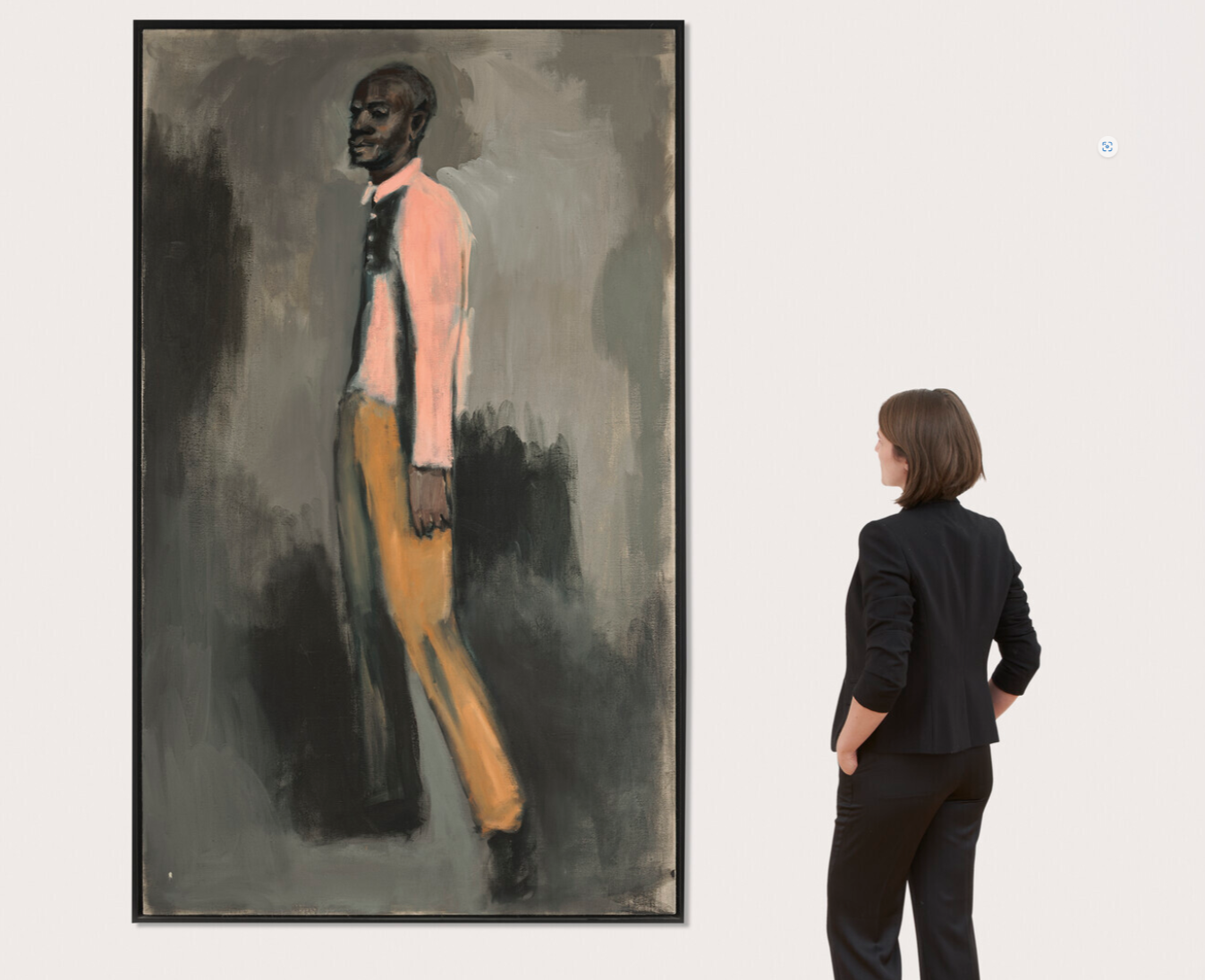
LYNETTE YIADOM-BOAKYE (B. 1977)
Highpower, 2008
Oil on linen
199.7 x 119.7 cm (78 5/8 x 47 1/8 inches)
Signed, titled and dated ‘Lynette Highpower 2008’ (on the reverse)
#3. Nearer than Kith, Further from Kind, 2018
Sotheby’s London: 29 June 2022
Estimated: GBP 400,000 – 600,000
GBP 1,220,800 / USD 1,487,890
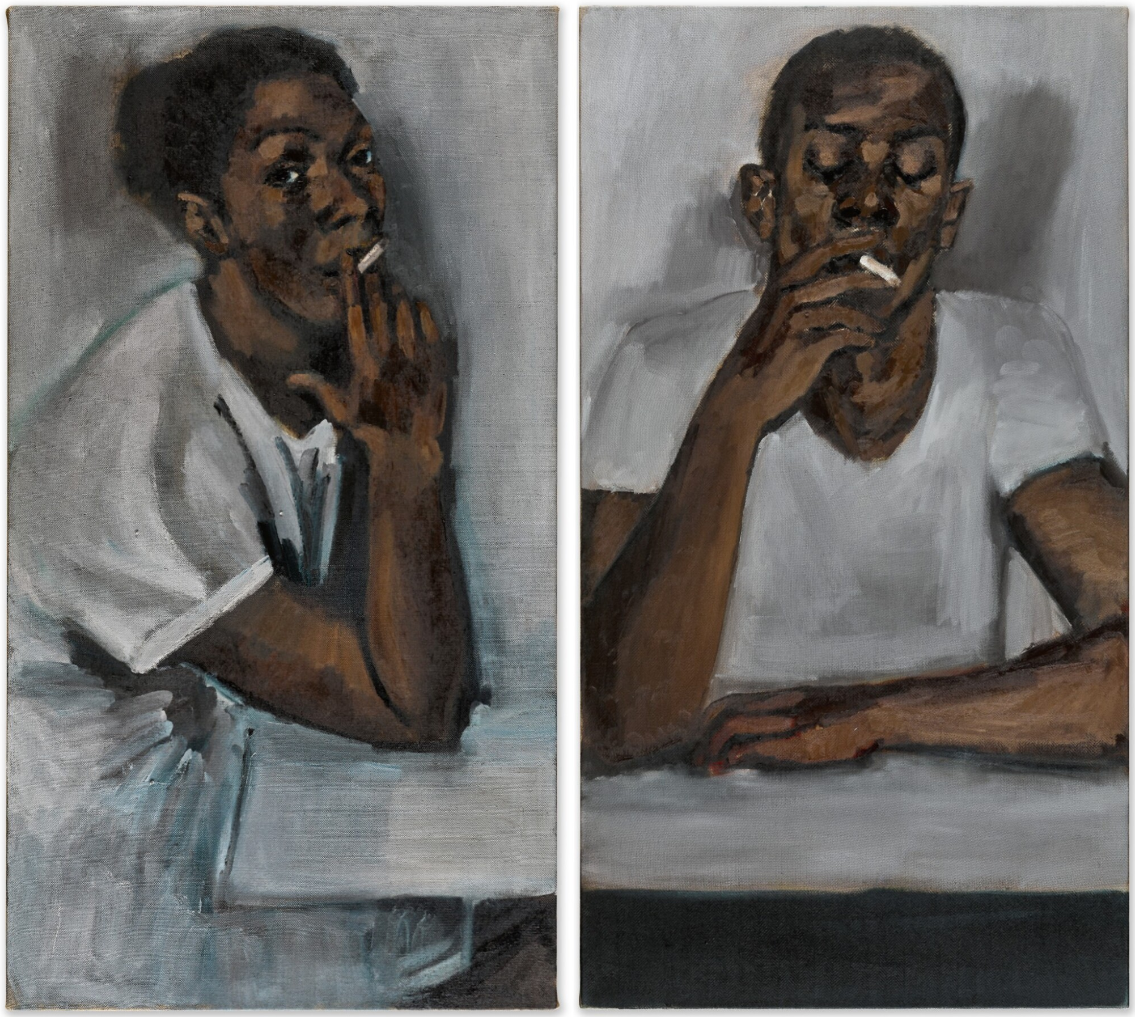
LYNETTE YIADOM-BOAKYE (b. 1977)
Nearer than Kith, Further from Kind, 2018
Oil on linen
Each: 110.5 x 60.5 cm (43 1/2 x 23 7/8 inches)
Titled Nearer Than Kith, Further from Kind and dated 2018 (on the reverse of both canvases)
#4. Quicksand, 2008
Sotheby’s New-York: 20 May 2022
Estimated: USD 300,000 – 500,000
USD 504,000
Quicksand | Contemporary Day Auction | 2022 | Sotheby’s
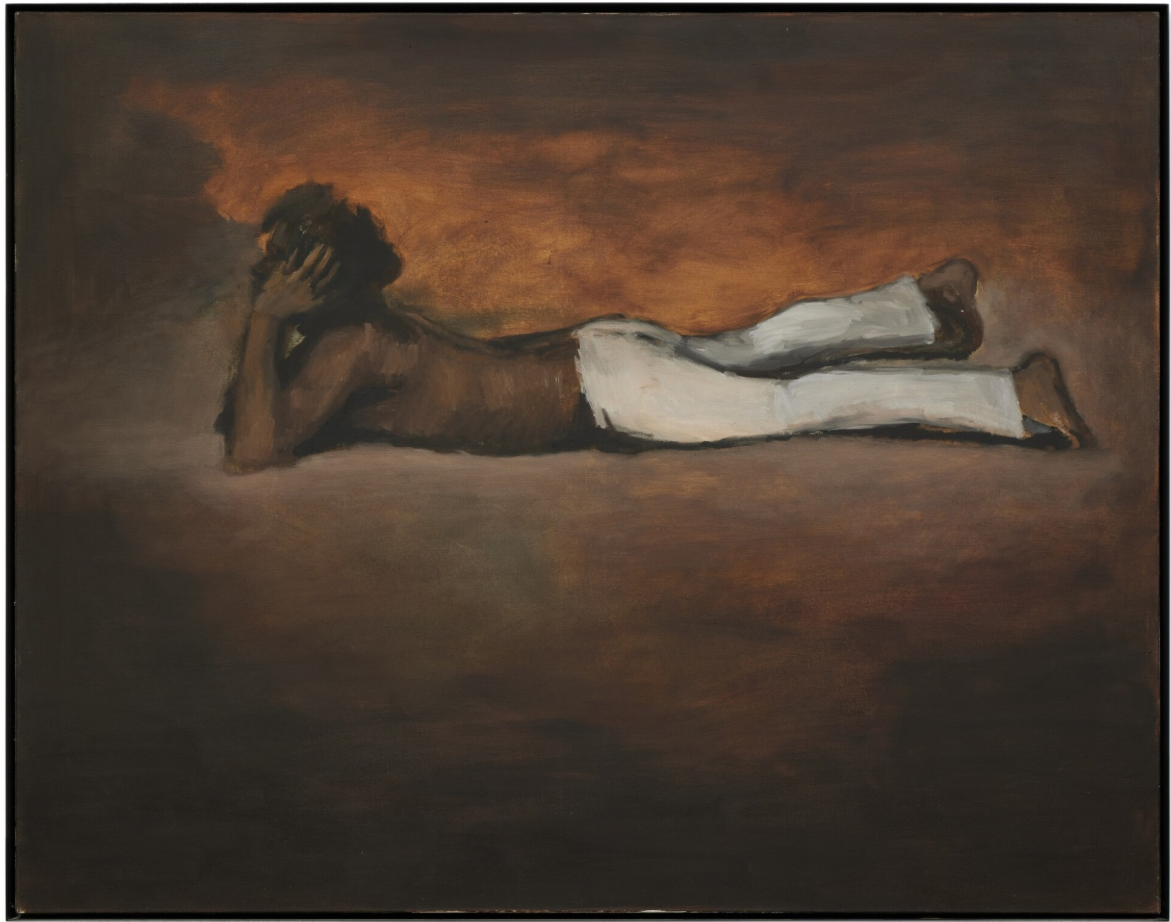
LYNETTE YIADOM-BOAKYE (b. 1977)
Quicksand, 2008
Oil on linen
110.5 x 139.7 cm (43 1/2 x 55 inches)
Signed, titled and dated 2008 (on the reverse)
#5. A Political Shirt, 2010
Sotheby’s London: 3 March 2022
Estimated: GBP 100,000 – 150,000
GBP 144,900 / USD 193,895
A Political Shirt | Modern & Contemporary Day Auction | 2022 | Sotheby’s
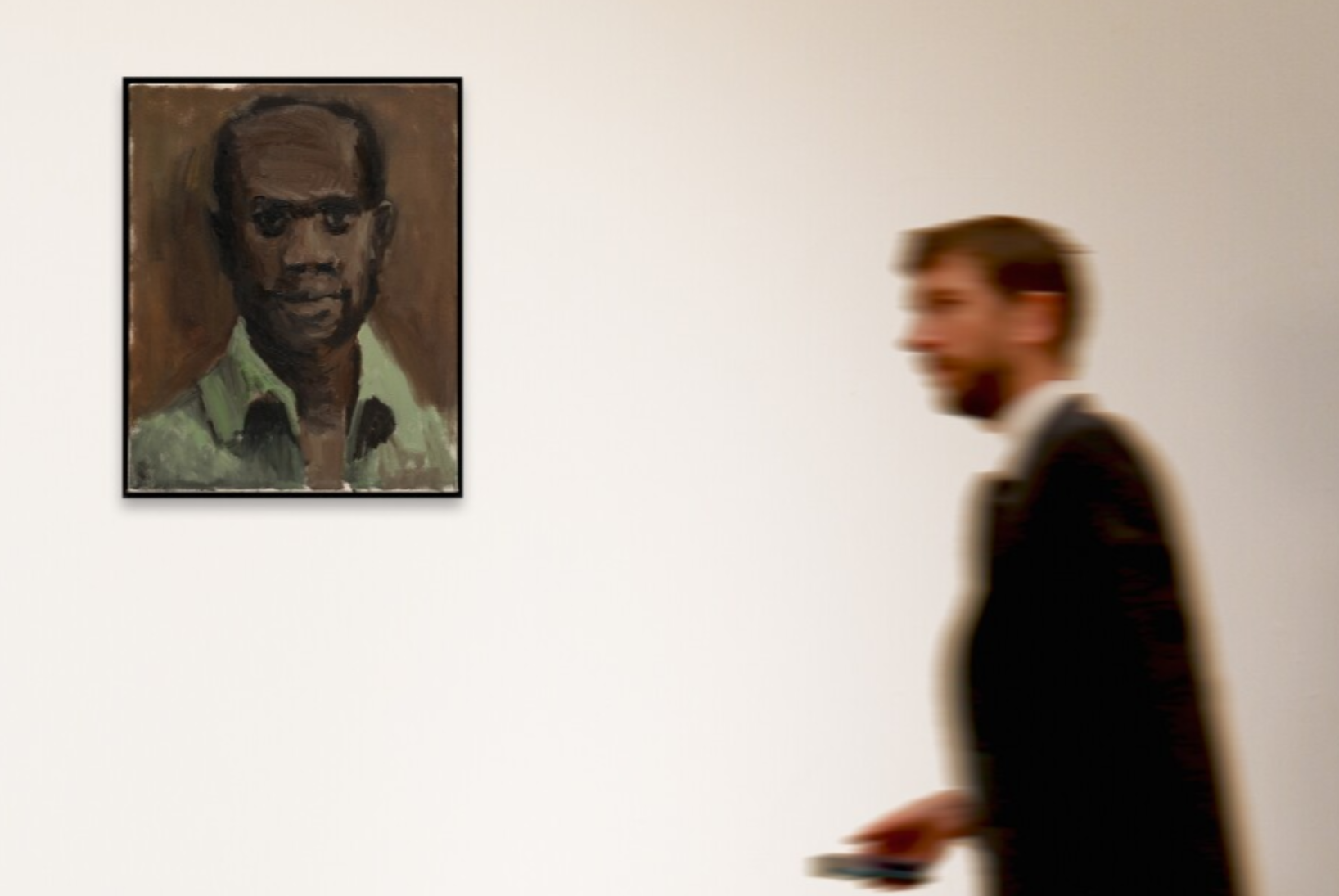
LYNETTE YIADOM-BOAKYE (B. 1977)
A Political Shirt, 2010
Oil on linen
50 x 40.3 cm (19 3/4 x 15 7/8 inches)
Signed, titled and dated 2010 on the reverse
PART III: FOCUS
Record Breakers
Six Birds in the Bush, 2015
Sotheby’s London: 12 October 2023
Estimated: GBP 1,200,000 – 1,800,000
GBP 2,952,000 / USD 3,635,465
Six Birds in the Bush | The Now Evening Auction | 2023 | Sotheby’s (sothebys.com)
LYNETTE YIADOM-BOAKYE (b. 1977)
Six Birds in the Bush, 2015
Oil on linen
200×130 cm (78 3/4 x 51 1/8 inches)
Signed with the artist’s initials, titled and dated 2015 (on the reverse)
British artist Lynette Yiadom-Boakye is world-renowned for her masterful large-scale canvases that imbue her subjects with a unique kind of magic. Six Birds in the Bush is a supreme example of the artist’s technical skill with paint and control over psychological complexity. It portrays a man who absentmindedly directs his gaze towards the public, as if interrupted in his thoughts. Full of charisma and a real, tangible personality, he wears clothes unattributable to a specific time and place. Indeed, Boakye’s figures are unplaceable in time and place and act as touchstones for personal reflections and individual ideas. This work very clearly and powerful encapsulates the artist’s historicising impulse in that sense, as the subject is both highly contemporary and yet seems to emerge from a history book. In the painting, the viewer is attracted by the playful assonance of some colours of the backgrounds that can be traced forward to the subject’s clothing: the blue and the greens move from the blurry plane behind the portrait and the reflections on the white shirt and the hat’s feather.
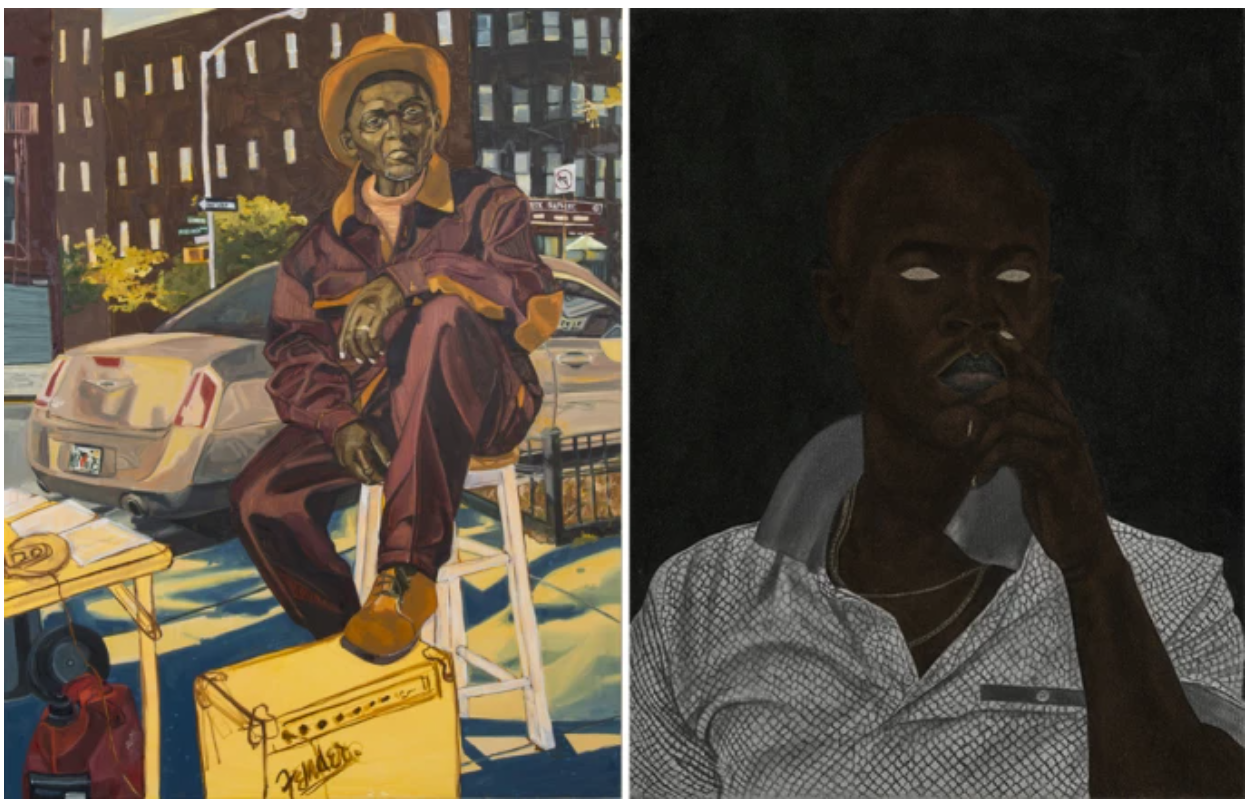
LEFT: JORDAN CASTEEL, JAMES, 2015
RIGHT: CINGA SAMSON, UNTITLED, 2020. SOLD AT SOTHEBY’S, LONDON, IN OCTOBER 2022 FOR £69,300. © THE ARTIST. © 2023 WHITE CUBE
“Suggestion is the dream” claimed French poet Stephane Mallarmé, identifying suggestion as a portal to another world and another dimension linked to poetry in the same way history is linked to prose. For the artist, who is also a writer, her titles are an integral part of the work and constitute another brushstroke, another splash of color. As the artist has poignantly noted: “I write about the things I can’t paint and paint the things I can’t write about” (Lynette Yiadom-Boakye, “An Introduction to Lynette Yiadom-Boakye,” Tate website, November 2022). Through the choice of portraiture as her main mode of expression, the artist situates herself in a highly traditional genre that bears much art historical weight and implication. Much of her originality is to be found precisely in the approach that she takes, images dedicated to black subjects, inscribed in the more limited history of black people painted by black artists.
Yiadom-Boakye renders the complexity of humanity in the simplest way possible. Visually layered yet beguilingly flat, her faces render the complexity of humanity in a highly refined and intricate manner. She does not, however, veil the artistic difficulties inherent to her particular brand of quiet, sensual realism, but rather demands an intense kind of slow looking from every viewer in the tradition of artists such as Manet and Degas.
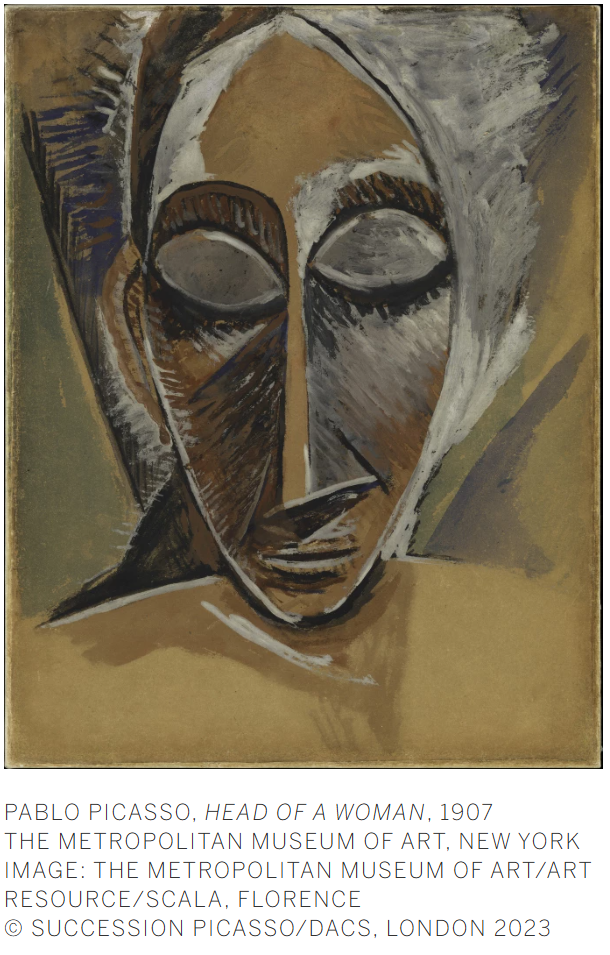
In many ways, the artist is concerned with neither subject nor genre but rather the act of painting itself and its possibilities. She tends to work quickly, producing one work a day: everything else is subordinate to pictorial investigation. The interest in the painted medium is, as anticipated, underlined by the limitation the artist imposes on herself by choosing to only create naturalistic portraits of black subjects. This unusual choice, which lends itself to a limited palette and a simple, confident brushstroke, further focusses the artist’s production on working through slight variations in glazing, composition and pigmentation. This mode of working aligns the artist and her (self-)historicising practice closer to that of Modernist artists such as Cézanne, Morandi or Monet who, through intense repetition of similar subjects in series, not only developed distinctive, influential personal styles, but also asserted the artist’s presence on a more fundamental level.
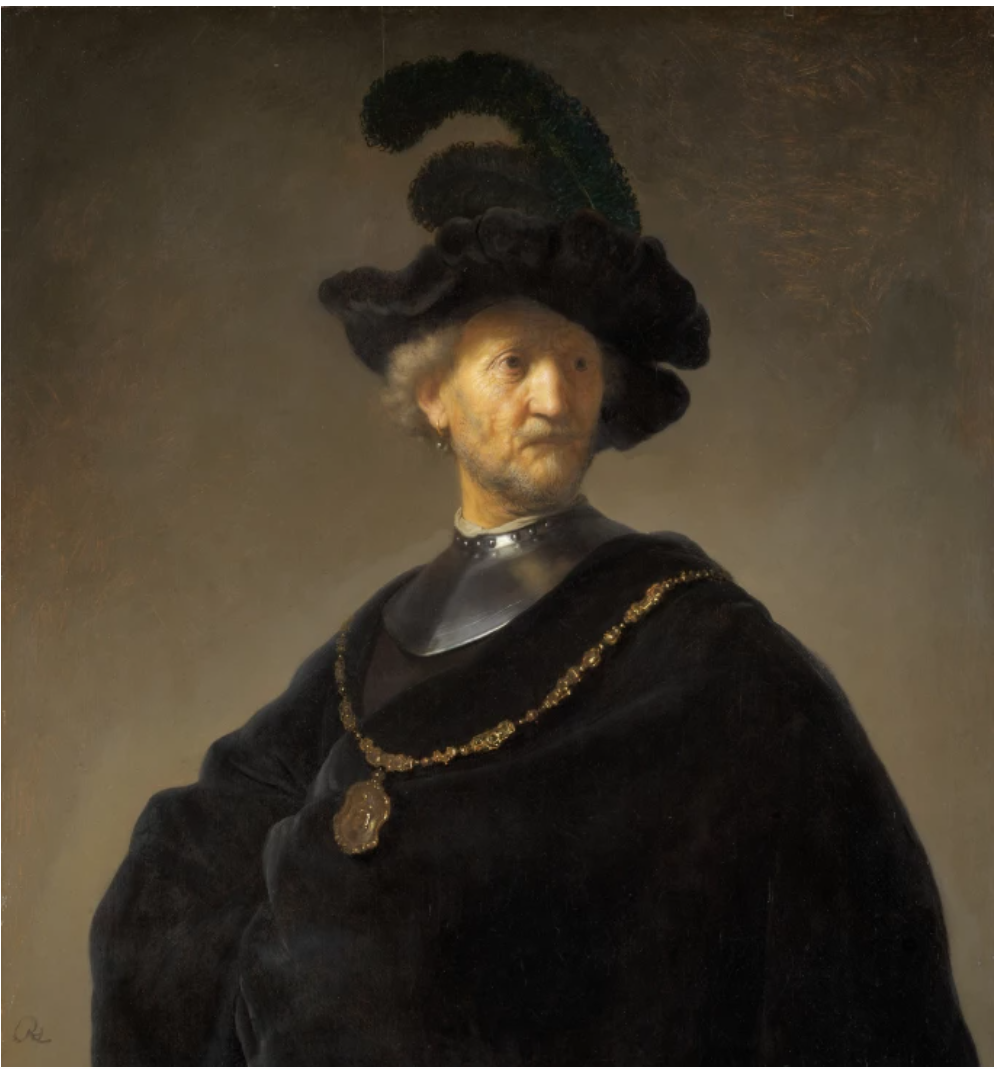
REMBRANDT, OLD MAN WITH A GOLD CHAIN, CIRCA 1631
THE ART INSTITUTE OF CHICAGO
In Six Birds in the Bush simplicity means breaking the limits of the eye through the artist’s precisely impressionistic brushwork. There is a dreamlike realism emanating from the canvas; the subject’s identity is both clear yet oblique, as if seen through the haze of fading memories. Yiadom-Boakye views the human head as the portal to one’s soul and her best works, such as Six Birds in the Bush, feature the subject gazing directly out of the canvas. Fixed in place, the viewer is suddenly aware of their transience; the people in Yiadom-Boakye’s universe have no such fears. In recent years, Yiadom-Boakye has taken her rightful place as one of the most respected contemporary artists currently working, shortlisted in 2013 for the Turner Prize and omnipresent protagonist in Fly in League With the Night, her first solo exhibition at Tate Britain. Exhibited in this highly acclaimed show, the present work integrates many key aspects of her oeuvre: tremoring between contemporary and classical, it holds up a mirror to society and its actors and forms a breathtakingly beautiful ode to painting.
Portraits
Periodical, 2006
Property from a Distinguished Danish Collection
Christie’s New-York: 20 November 2025
Estimated: USD 400,000 – 600,000
USD 673,100
LYNETTE YIADOM-BOAKYE (B. 1977), Periodical | Christie’s
LYNETTE YIADOM-BOAKYE (B. 1977)
Periodical, 2006
Oil on canvas
96×74 inches (244×188 cm)
Signed and dated ‘Lynette Yiadom-Boakye 2006’ (on the reverse)
“Yiadom-Boakye’s paintings feature an almost exclusively black pantheon of fictive figures that are in equal measure dark and luminous, rendered without disegno-that underlayer of drawing common to traditional paintings-so that they look, as one critic rightly recognized, improvised and effortless, even virtuoso.”
Elena Filipovic
(“A Sovereignty of Quiet,” in Lynette Yiadom-Boakye: Under-Song for a Cipher, New York 2017, p. 12).
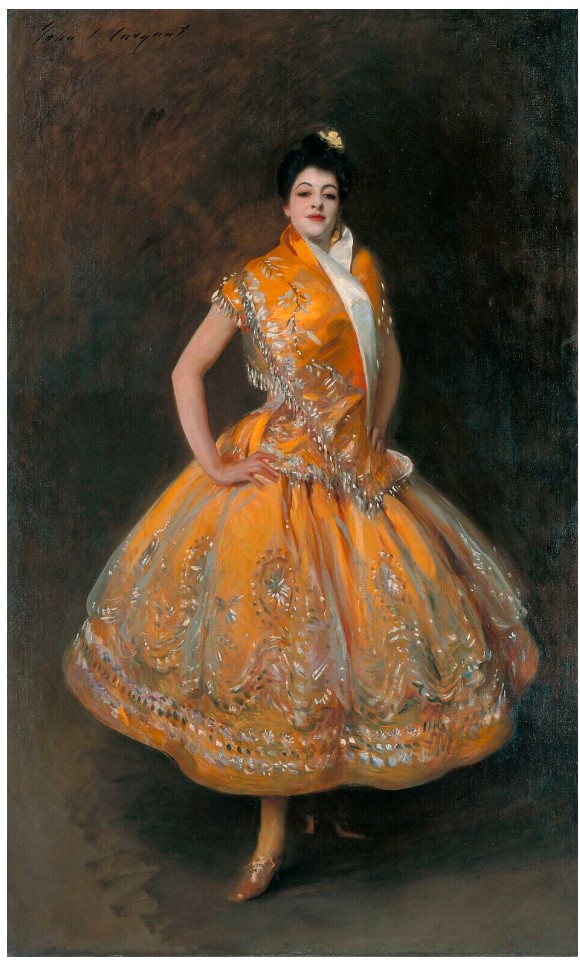
John Singer Sargent, La Carmencita (Carmen Dauset Moreno), circa 1890
Obelisk, 2005
Sotheby’s New-York: 19 November 2025
Estimated: USD 600,000 – 800,000
PASSED
Obelisk | Contemporary Day Auction | 2025 | Sotheby’s
LYNETTE YIADOM-BOAKYE (b. 1977)
Obelisk, 2005
Oil on canvas
95 3/4 x 77 inches (243.3 x 195.5 cm)
Signed, titled and dated 2005 (on the reverse)
Signed (on the stretcher)
Monumental in its stillness and enigmatic in atmosphere, Obelisk from 2005 exemplifies Lynette Yiadom-Boakye’s gift for conjuring presence through painterly restraint. Towering at over two meters, the canvas commands attention not with spectacle but with silence, the figure emerging from shadow in muted earth tones, poised between monument and apparition. At once intimate and grand, the work demonstrates the artist’s singular ability to imbue invented subjects with a gravitas that feels both timeless and immediate. Executed in 2005, Obelisk belongs to a pivotal moment in Yiadom-Boakye’s trajectory, just after her graduation from the Royal Academy Schools in London. At this early stage she had already turned away from portraiture in the traditional sense, instead inventing her figures from memory and imagination. In Obelisk, this strategy manifests in a sitter who is neither an individual likeness nor a narrative character, but an emblem of interiority and endurance.
“I work from scrapbooks, I work from images I collect, I work from life a little bit, I seek out the imagery I need. I take photos. All of that is then composed on the canvas.”
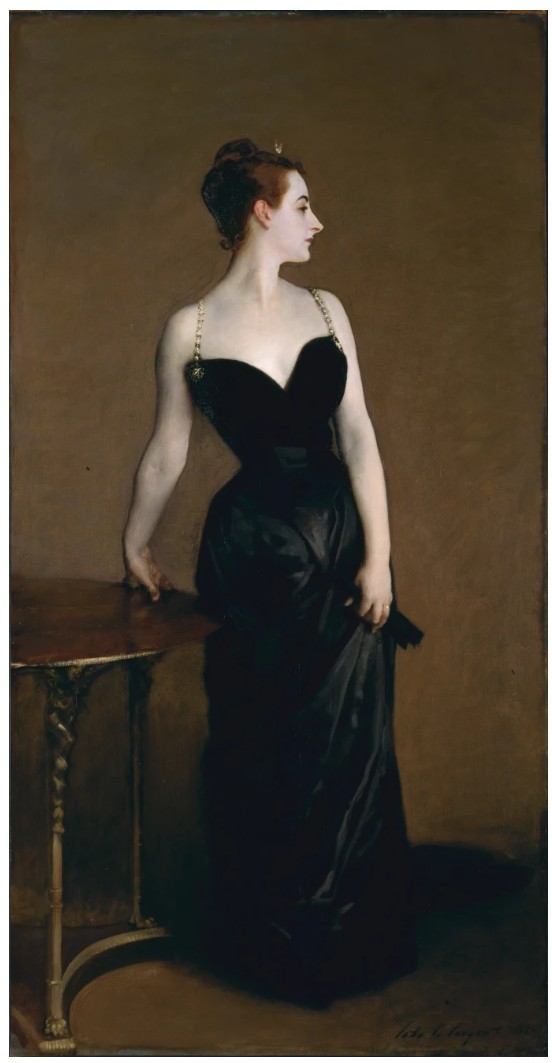
JOHN SINGER SARGENT, MADAME X (MADAME PIERRE GAUTREAU), 1883-1884.
IMAGE © Metropolitan Museum of Art / BRIDGEMAN IMAGES
The chromatic register is subdued yet richly modulated. Deep umbers, blacks, and ochres saturate the surface, while subtle passages of light animate the figure into being. Brushwork is confident but unshowy, activating negative space so that surrounding darkness becomes charged with psychological weight. Obelisk captures this paradox with commanding force. Within Yiadom-Boakye’s oeuvre, Obelisk anticipates the compositional ambition and contemplative gravity of her later masterworks. It is a painting that achieves monumentality not through narrative or spectacle, but through the quiet assertion of presence. In its commanding scale, tonal richness, and enigmatic poise, Obelisk stands as one of the most compelling achievements of Yiadom-Boakye’s early career, a formative statement of the painterly voice that would soon propel her onto the international stage.
Three Kings, 2005
Christie’s London: 16 October 2025
Estimated: GBP 200,000 – 300,000
GBP 279,400 / USD 374,395
LYNETTE YIADOM-BOAKYE (B. 1977), Three Kings | Christie’s
LYNETTE YIADOM-BOAKYE (B. 1977)
Three Kings, 2005
Oil on linen
243.6 x 196 cm (95 7/8 x 77 1/8 inches)
Signed with the artist’s initials, titled and dated ‘LYB ‘Three Kings’ 2005′ (on the reverse)
Held in the same private collection since the year it was made, Lynette Yiadom-Boakye’s Three Kings (2005) encapsulates a moment of encounter. The protagonist of the painting looks fixedly at the beholder. She is attired in simple dark clothing, enlivened by a cerulean bead bracelet and two earrings of the same hue. While most of the composition is rendered in shimmering, shadowy waves of paint, her face is a mask-like visage of bold impasto strokes.
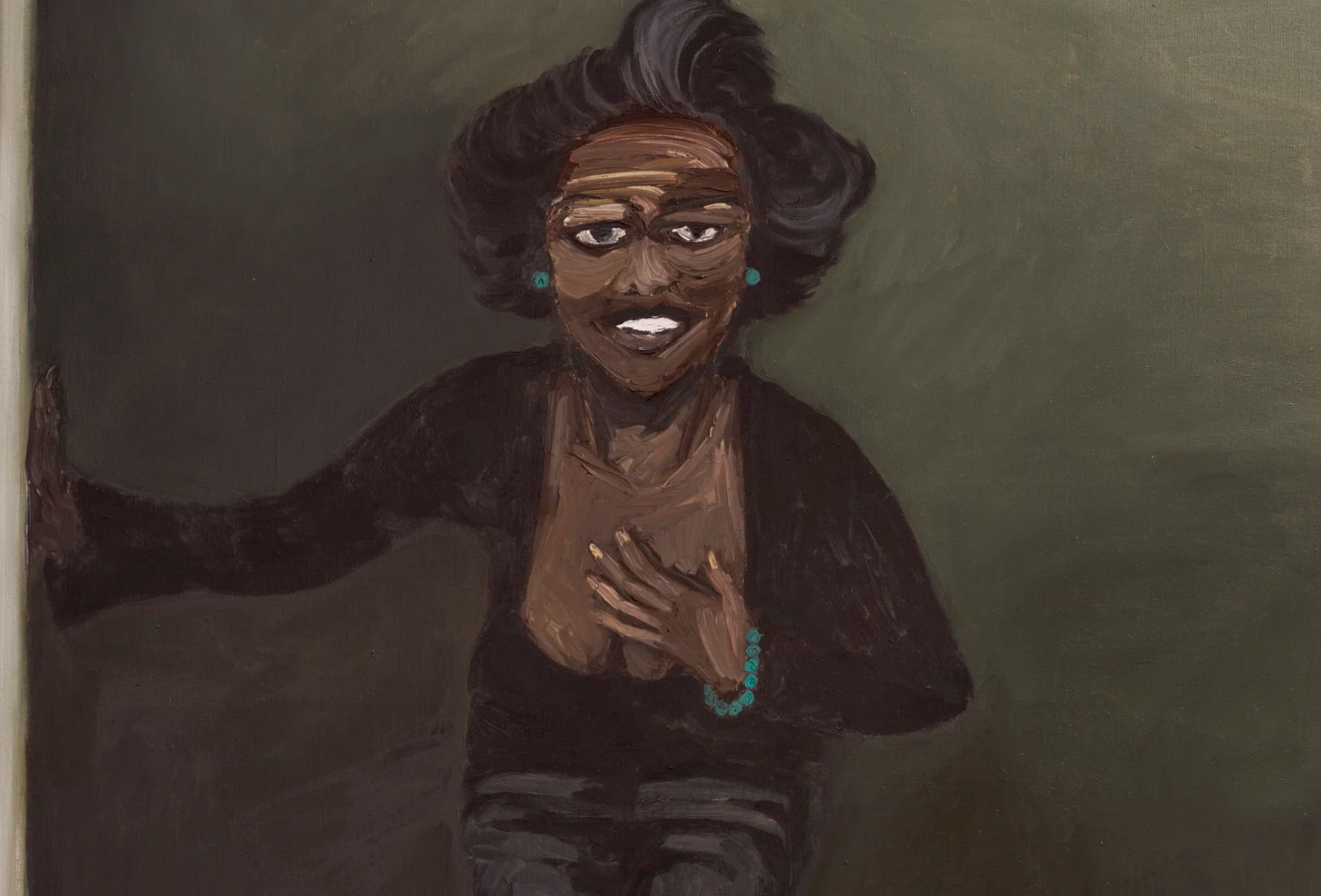
Her expression is ambiguous, welcoming hospitality mingled with surprise. She places her left hand to her chest as if in astonishment, while her right hand holds onto a partially-visible curtain, or perhaps a fluted column, as if steadying herself. Yiadom-Boakye graduated from the Royal Academy of Arts in 2003. Four years later writer and curator Ekow Eshun chose her as an artist to watch. She has since exhibited at the Venice Biennale (2013 and 2019) and her work has entered major museum collections. In 2020, she became the first Black British woman artist to have a monographic exhibition at Tate Britain, London.
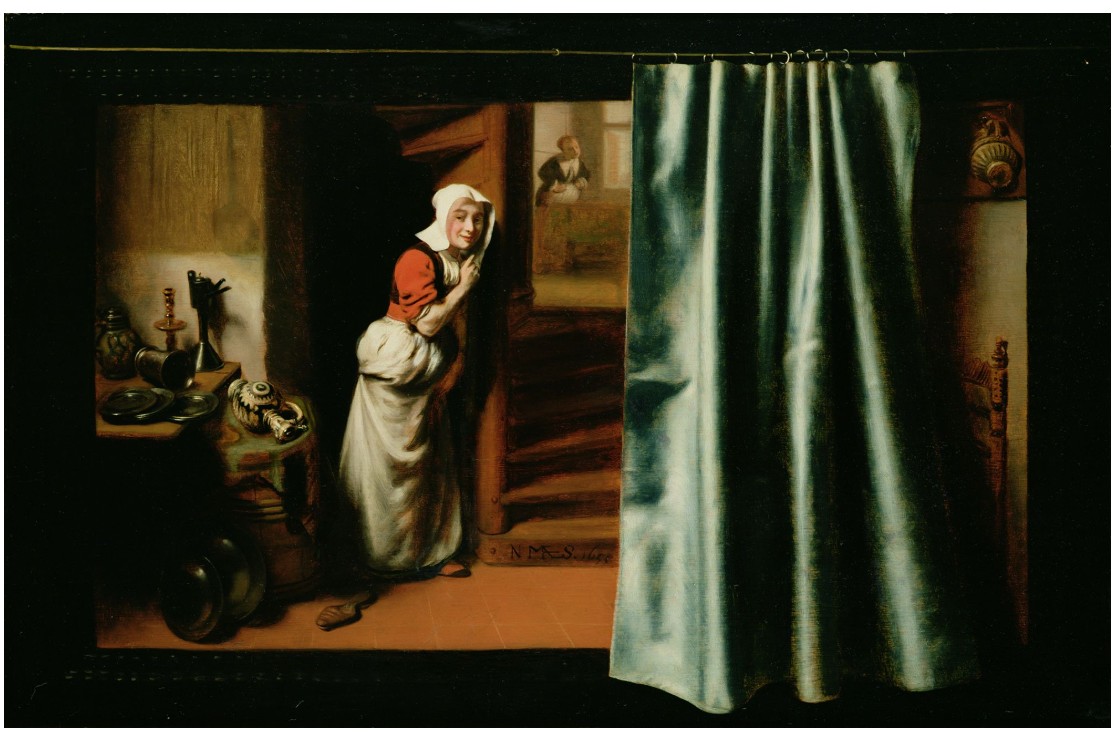
Nicolaes Maes, An Eavesdropper with a Woman Scolding, 1655. Guildhall Art Gallery, London.
Digital image: Guildhall Art Gallery / Harold Samuel Collection / Bridgeman Images.
In Three Kings, the setting is suggestive of the theatre, a world of make-believe detached from mundane reality. It evokes the heavy textile dividers of Dutch Golden Age paintings such as Nicolaes Maes’ 1650s ‘eavesdropper’ series and the sumptuous scarlet curtain in John Singer Sargent’s Dr. Pozzi at Home (1881), a painting that Yiadom-Boakye has repeatedly referenced. The artist exclusively paints black protagonists, but her project is not simply to insert them into the Western canon.
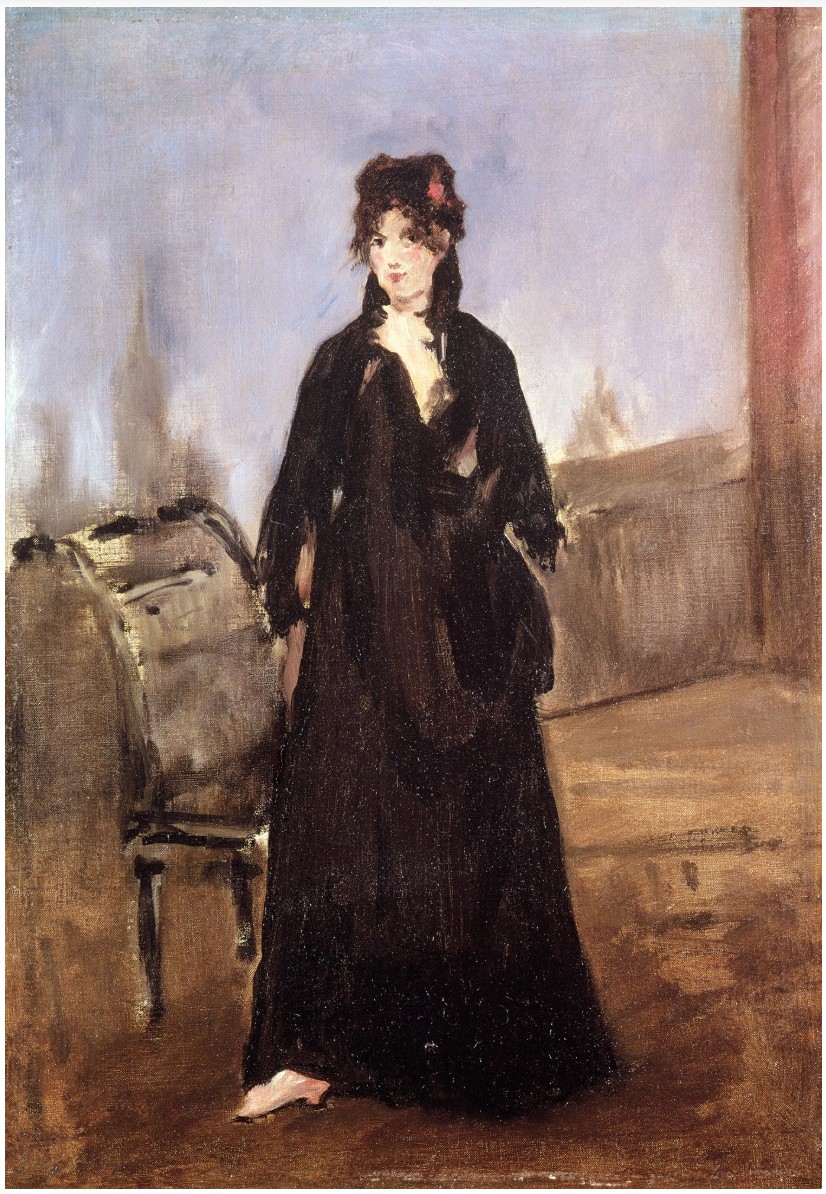
Édouard Manet, Portrait de Berthe Morisot au Soulier Rose, 1872. Hiroshima Museum of Art.
Digital image: Lefevre Fine Art Ltd., London / Bridgeman Images.
Yiadom-Boakye is a masterful painter of darkness and light, drawing on the Renaissance technique of chiaroscuro as perfected by Caravaggio in the late 16th century. Three Kings’ tenebrous room is distinguished by dappled patches of illumination. The painting’s title itself summons up the specter of art history, evoking the trio of magi who visited the infant Jesus: is this a modern-day Mary? Although her paintings have a veneer of verisimilitude, Yiadom-Boakye’s figures are purely imaginary. The world they inhabit seems to exist outside any single historical moment. She is a writer as well as a painter, and author Zadie Smith has compared her subjects to fictional characters. Yet she also avoids obvious narrative.
The Trappings, 2012
Christie’s London: 15 October 2025
Estimated: GBP 400,000 – 600,000
GBP 482,600 / USD 646,685
LYNETTE YIADOM-BOAKYE (B. 1977), The Trappings | Christie’s
LYNETTE YIADOM-BOAKYE (B. 1977)
The Trappings, 2012
Oil on canvas
200×130 cm (78 3/4 x 51 1/4 inches)
Signed with the artist’s initials, titled and dated ‘The Trappings LYB 2012’ (on the reverse)
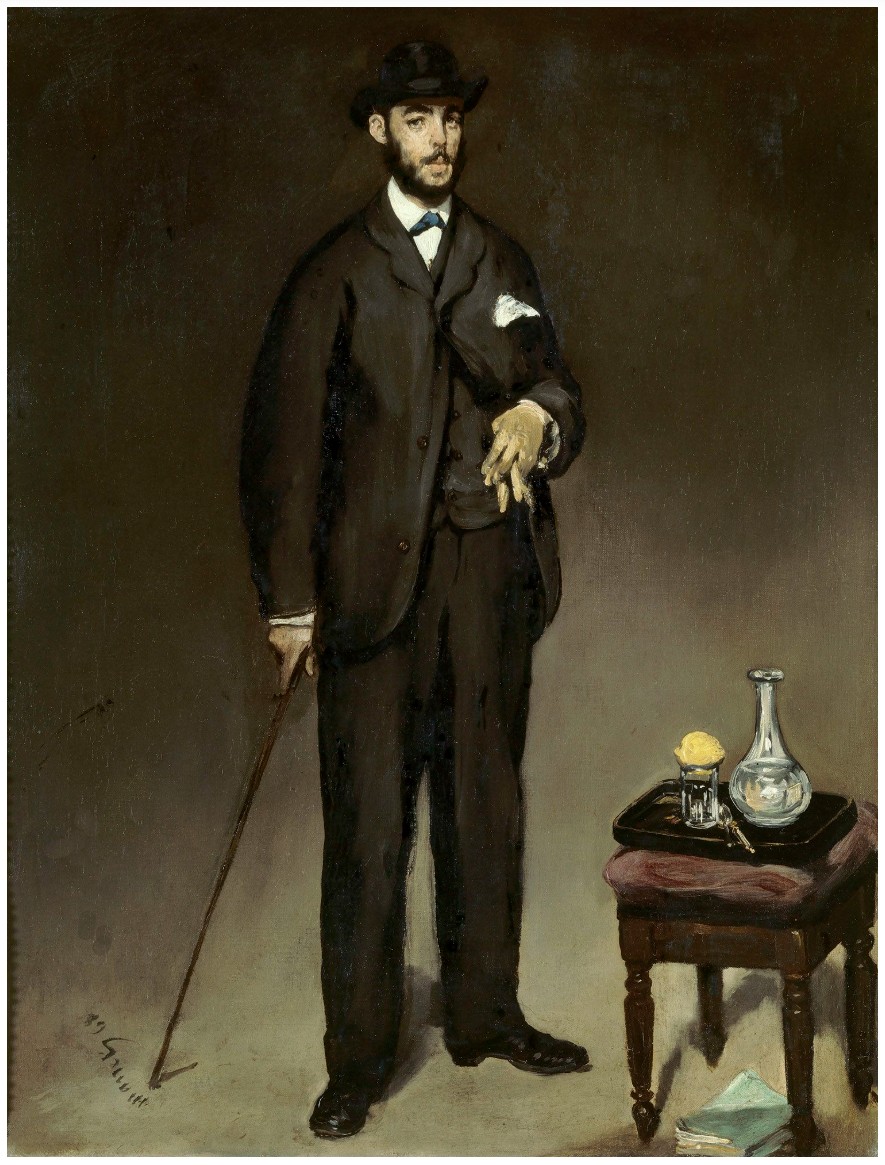
Digital image: © 2025 Photo Josse / Scala, Florence.
Yiadom-Boakye paints quickly, applying thin layers of paint wet on wet without underdrawing. Executed in a single sitting, her canvases display a matte, silky facture; in places, glimpses of raw canvas break through urgent, animated strokes.
“I think seduction is very important, I love painting. I love the surface of it.”
A writer of prose as well as an artist, Yiadom-Boakye’s painterly realms have a distinctly novelistic quality. Discussing the affinity between painting and writing, she explains
“I think with painting there is as much of a language as there is with writing, so for me, a very quick washy mark reads as the same as the shortness of a particular sentence.”
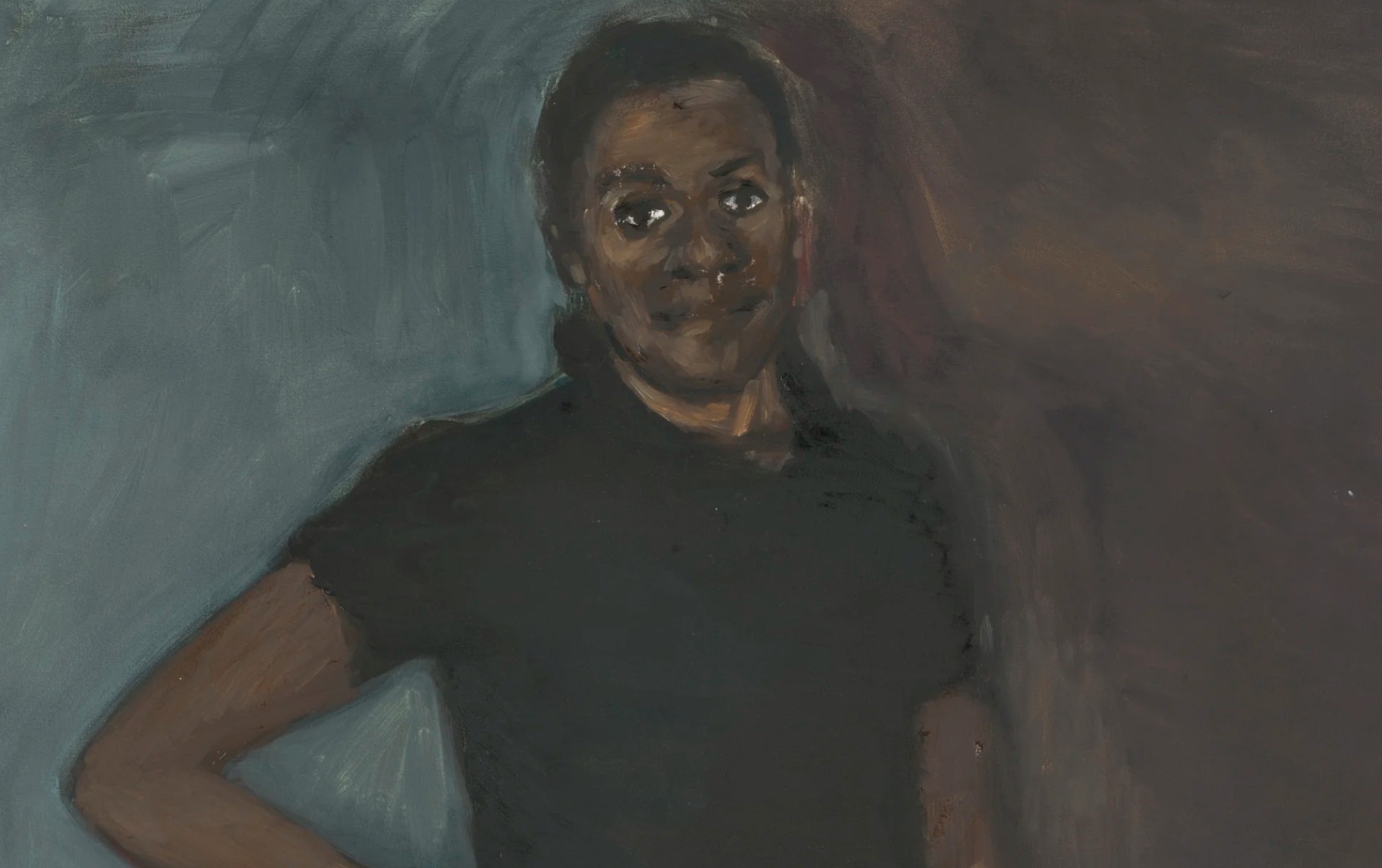
In The Trappings, Yiadom-Boakye’s mastery of gesture is on full display, her deft painterly idiom conjuring with theatrical flair a moment of intimacy between subject and viewer. Posed against a simple painted backdrop, the figure in The Trappings finds art-historical precedents in the nineteenth-century character studies of Édouard Manet or John Singer Sargent. Yet the subjects of Yiadom-Boakye’s impressionistic, emotionally charged paintings are inhabited by a cast of characters drawn from a vast visual library of found images, memory, literature, and art history.
“Although they are not real I think of them as people known to me. They are imbued with a power of their own … I admire them for their strength, their moral fiber.”
The figure in The Trappings, who looks out so convincingly beyond the picture plane, and appears as if he might step out of the painted space of the canvas into the world of the viewer, is made of paint and not flesh, conjured merely from the artist’s imagination.
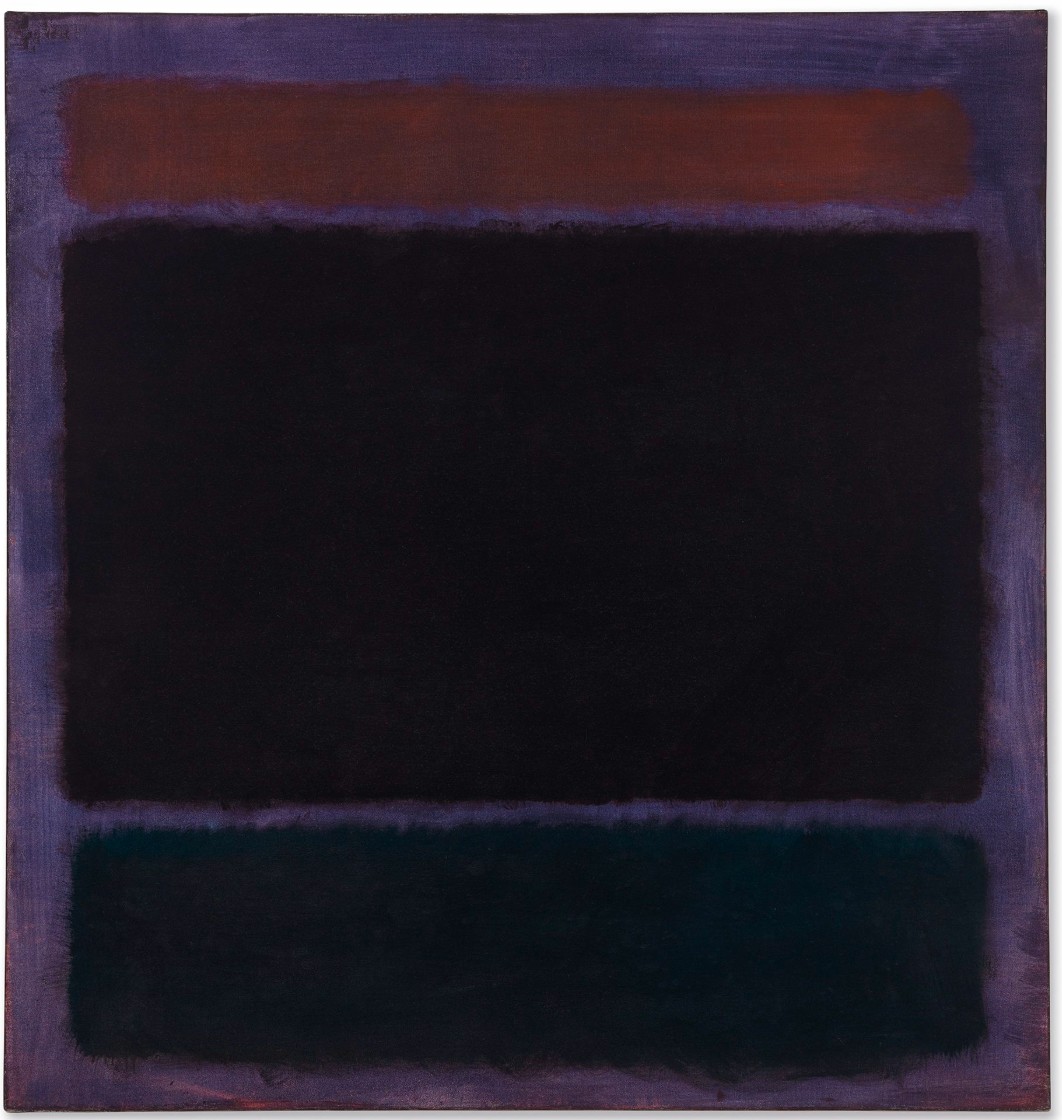
The title of The Trappings suggests misplaced desire, but also misdirection and false facades. Dressed entirely in black, the subject of Yiadom-Boakye’s painting might allude to the passage from William Shakespeare’s Hamlet in which the protagonist describes the ritual or artificial presentation of grief—the ‘customary suits of solemn black’—as ‘the trappings and the suits of woe,’ a pale imitation of the true weight of his feeling. The painted veneer of the canvas, like the stage of a theatre, is revealed to be a place of artifice and unreality. Drawing on powerful storytelling traditions and masterful command of paint, in The Trappings Yiadom-Boakye weaves narrative from illusion, conjuring a pliable space in which time and place are manipulated and unmoored.
Painkiller, 2011
Christie’s New-York: 21 November 2024
Estimated: USD 800,000 – 1,200,000
USD 756,000
LYNETTE YIADOM-BOAKYE (b. 1977), Painkiller | Christie’s
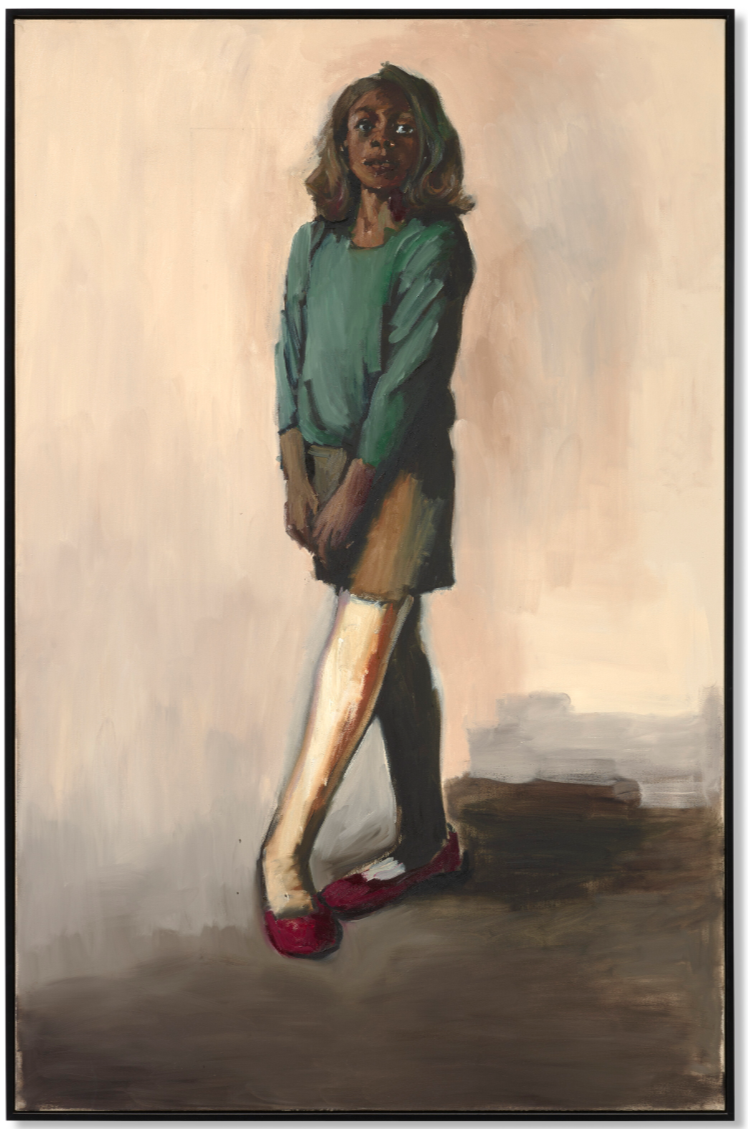
LYNETTE YIADOM-BOAKYE (b. 1977)
Painkiller, 2011
Oil on canvas
200×130 cm (78 3/4 x 51 1/4 inches)
A graceful young woman commands the composition of this large-scale canvas. Poised like a ballet dancer, she stands confidently, her hands clasped to the front, and her left leg poised forward at a right angle like a ballerina. Turning her face slightly, her chin is lifted towards her left shoulder to look up and away as if giving one last contemplative glance toward the crowd before commencing her performance.
The sense of drama in Painkiller ensures that it emerges as an exemplar from the acclaimed British-Ghanian artist Lynette Yiadom-Boakye’s painterly practice. The artist eloquently articulates the full complexity of human subjectivity via her confident brushstrokes. Her subjects, while inhabiting the genre’s conventional framework, are not portraits; Yiadom-Boakye constructs her figures not from life but from a potent mélange of found images, memory, and vivid imagination intermingled with a certain spontaneity expressed through painterly improvisation. While ostensibly a successor to a great lineage of Western portraitists, from Goya and Hals to Whistler and Sargent, Yiadom-Boakye composes her subjects like a novelist, her figures reminiscent of Leo Tolstoy or Gabriel Garcia-Marquez in their fictive ability to appear more realistic than reality—unencumbered from representational modes, the audience intimately comprehends and inhabits these figures, ascribing their own stories onto the image.
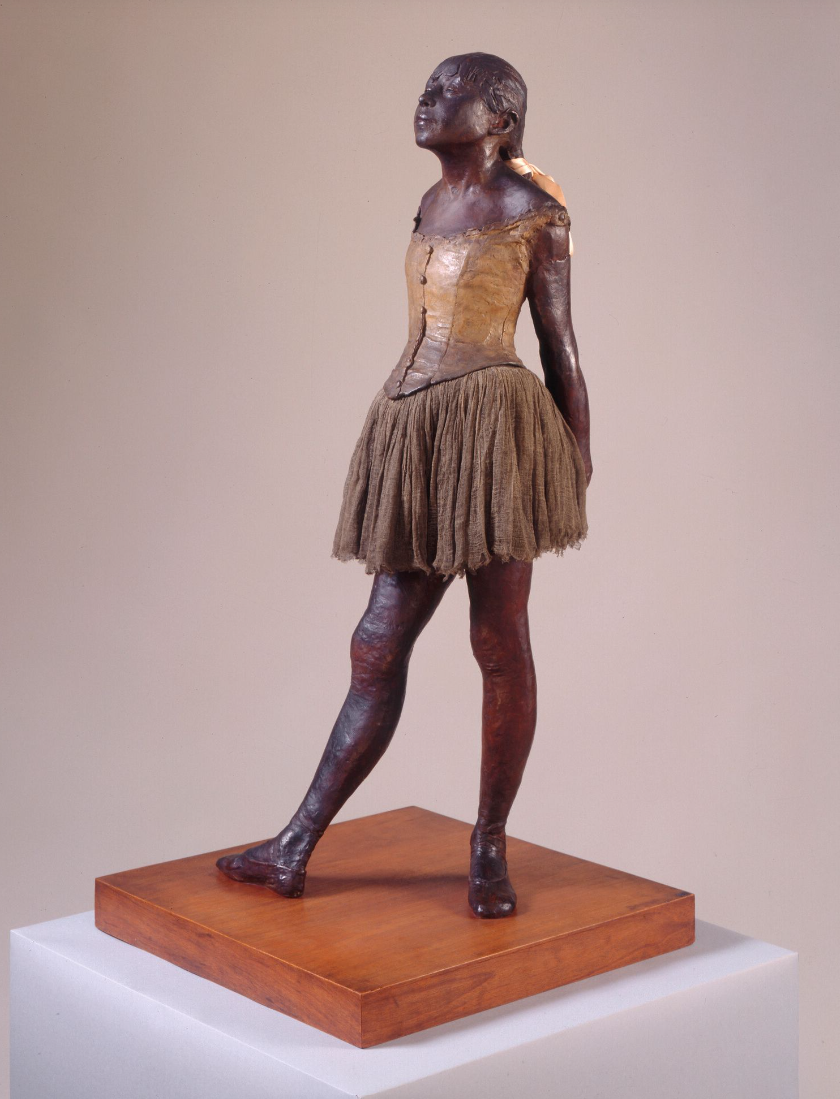
Edgar Degas, Little Dancer Aged Fourteen, 1880-1881. Tate Gallery, London. Photo: Tate, London / Art Resource, New York.
Yiadom-Boakye delights the eye in her subtle manipulation of paint across canvas. Working with the time-honored materials of an old master—a rabbit-skin glue gesso binding oil paint to canvas—the artist expeditiously paints her work wet-on-wet to fully exploit the medium’s physicality. Sophisticated underpainting allows this warm backdrop of subtle hues to develop into areas of vivid abstraction, demonstrative of the sheer exuberance achievable through the medium. The artist employs a kaleidoscope of atmospheric and organic hues against the tableau, reveling in the bottomless depth which her palette achieves across the economically-applied paint surface. The dense layers of pigment on the woman’s left leg establish the work’s focal point, the profound contrast vis-à-vis the shadowed right leg providing a charged element of potential movement amid an otherwise tranquil image.
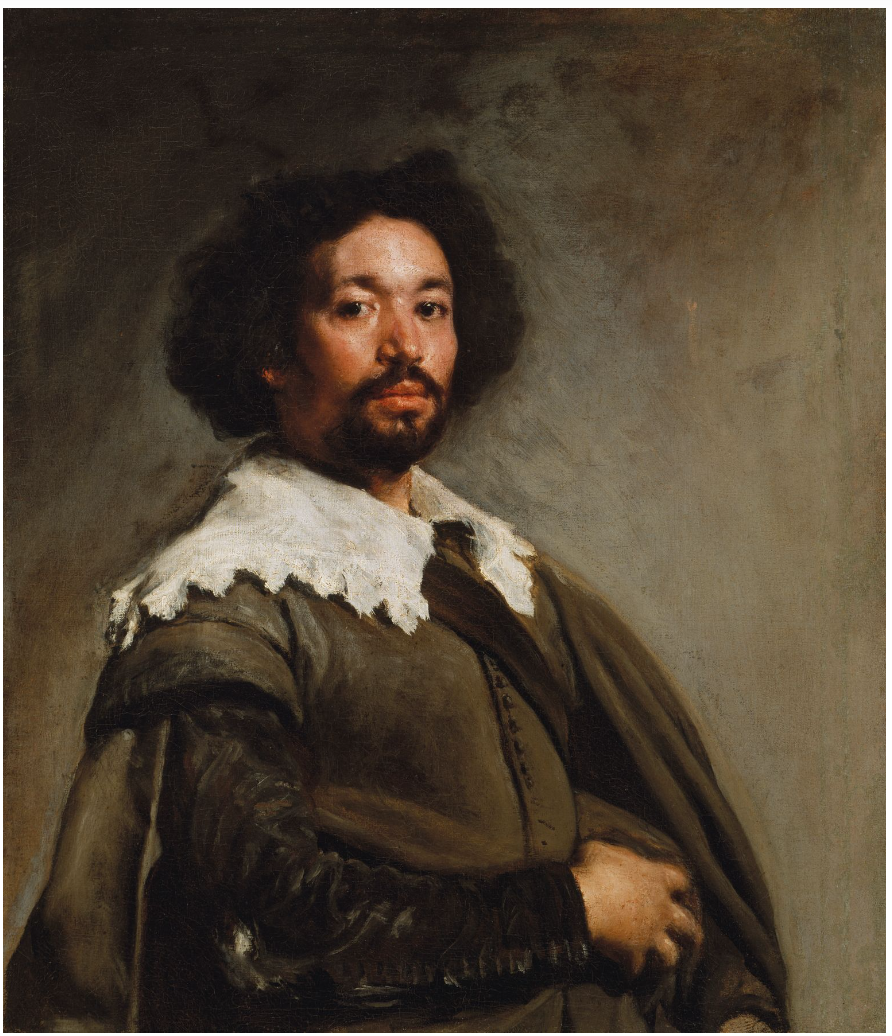
Diego Rodríguez de Silva y Velázquez, Juan de Pareja, 1650. Metropolitan Museum of Art, New York.
Photo: © The Metropolitan Museum of Art / Art Resource, New York.
Painkiller achieves an evocative sense of timelessness, creating a space of stillness and repose inviting contemplative solitude and silence. Yiadom-Boakye strives to exhume notions of contemporaneity or temporality from her work, depicting her Black figures in ambiguous vistas devoid of context. The darkened swirled form of the floor on which our figure stands slowly fades into the cream background, a bare spatial suggestion in an otherwise ethereal composition. Such an atmospheric environment allows for a full enjoyment of character, unleashing the emotional charge held within Yiadom-Boakye’s figure. The deep psychological power of the artist’s characters coupled with her technical masterly evoke the spirit of Diego Velázquez, particularly in his portrait of the Afro-Hispanic artist Juan de Pareja. Yiadom-Boakye is a careful student of art history, her citations of posture and pose evidencing the multitudes of monographs of Degas, Manet, and others filling her studio. Rare among her portraits, Painkiller features meticulously-rendered ruby-red shoes, an item typically omitted from Yiadom-Boakye’s work to further her timeless effect. Here the shot of red pigment perfectly complements the soft teal of the figure’s loosely-draped blouse, providing compositional unity bridging the dark foreground with the light background.
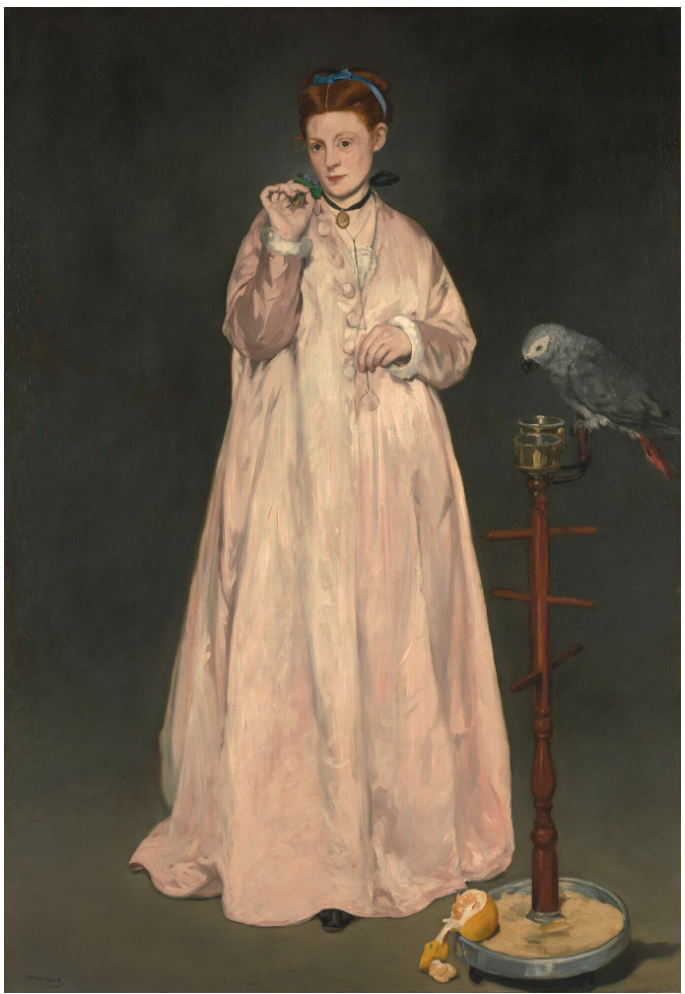
Edouard Manet, La femme au perroquet, 1866. Metropolitan Museum of Art, New York.
Photo: The Metropolitan Museum of Art, New York.
Yiadom-Boakye is a writer and poet as well as a painter, and within her canvas she writes a poem in paint, drawing out such strong and universally human emotions that her figure compiles a lifetime of stories within a singular picture frame. Yiadom-Boakye’s titles are as allusive as her characters, which the artist considers simply as “an extra mark in the paintings… I don’t paint about writing or write about paintings. It’s just the opposite, in fact: I write about the things I can’t paint and paint the things I can’t write about” (Y. Boakye, quoted in Zadie Smith, “A Bird of Few Words: Narrative mysteries in the paintings of Lynette Yiadom-Boakye, New Yorker June 19, 2017 p. 52).
Watcher, 2011
Phillips New-York: 19 November 2024
Estimated: USD 1,000,000 – 1,500,000
USD 1,754,000
Lynette Yiadom-Boakye – Modern & Con… Lot 4 November 2024 | Phillips
LYNETTE YIADOM-BOAKYE
Watcher, 2011
Oil on canvas
200×120 cm (78 7/8 x 47 1/4 inches)
Signed with the artist’s initials, titled and dated “LYB 2011 Watcher” on the reverse
In Watcher, 2011, Lynette Yiadom-Boakye invites us into a scene of quite suspense, where a solitary woman stands, eyes shaded, as if searching for something beyond our view. “All-seeing and all-knowing,” she establishes a motif of watchfulness that prefigures the seekers who would later appear in works like The Woman That Watches, 2015, at the Rennie Collection in Vancouver and Ever the Woman Watchful, 2017. The present work was created during a pivotal period in Yiadom-Boakye’s career, which coincided with her solo exhibition at the Studio Museum in Harlem, which ran from 2010-2011 and marked her museum debut. This period was formative for Yiadom-Boakye as she refined her unique approach to portraiture, ultimately shaping the enigmatic style celebrated in her mid-career retrospective, Fly in League with the Night, recently staged at Tate Britain from November 2022 to February 2023. Watcher encapsulates Yiadom-Boakye’s signature blend of abstraction and figuration, situating her characters in a space untethered by time and place.
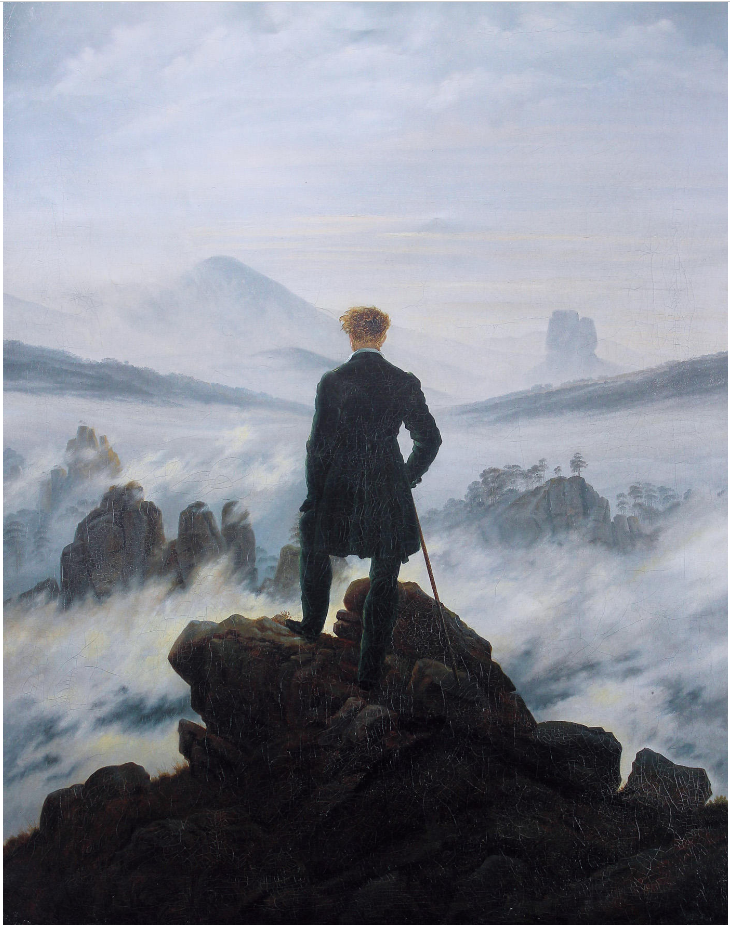
Caspar David Friedrich, Wanderer above the Sea of Fog, c. 1817. Hamburger Kunsthalle, Germany.
Image: ART Collection / Alamy Stock Photo
The woman in Watcher is dressed simply yet deliberately, wearing a monochromatic ensemble of a coat and trousers, with bare feet. She stands poised, one elbow bent, staring out to the horizon at a scene unseen by the viewer. She engages in a silent dialogue with other solitary searchers, including Caspar David Friedrich’s The Wanderer above the Sea of Fog, at the Hamburger Kunsthalle, Germany, and Andrew Wyeth’s Christina’s World, at the Museum of Modern Art, New York. Yiadom-Boakye is less interested in portraying real individuals than in evoking the stories that surround them, stating that, despite being constructions of her own making, “[her] figures are recognizably people.” In Watcher, this concept of Yiadom-Boakye’s portraiture communicating “character studies of people who don’t exist” is especially evident; the figure’s identity is undefined, allowing her to become a vessel for the viewer’s imagination. The absence of narrative clues forces the viewer to speculate, to project their own stories onto her.
Yiadom-Boakye’s figures inhabit realms detached from concrete markers of identity or time, creating a sense of timelessness central to her work. By avoiding specific temporal markers, the artist allows her subjects to occupy a universal space, free from immediate social or cultural associations. In Watcher, the absence of a defined setting creates a world beyond time, inviting viewers to contemplate a scene that could exist anywhere, at any moment. The subdued palette of this painting—a mix of muted greens, browns, and grays—complements the contemplative mood. Yiadom-Boakye’s emphasis on color and composition draws attention to the emotive and enduring qualities of her figures. Her deliberate palette deepens the painting’s mystery, inviting viewers to lose themselves in the quiet, timeless world she has created.
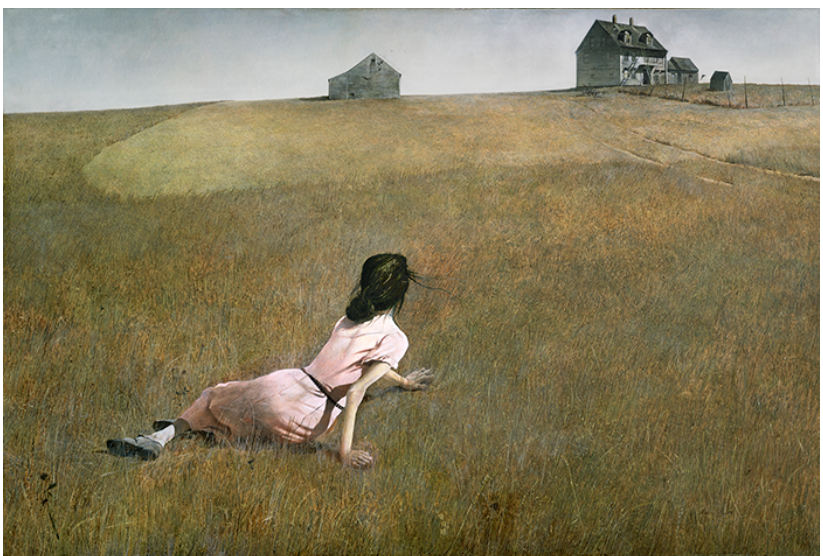
Andrew Wyeth, Christina’s World, 1948. The Museum of Modern Art, New York. Image: © The Museum of Modern Art/Licensed by SCALA / Art Resource, NY, Artwork: © 2024 Andrew Wyeth / Artists Rights Society (ARS), New York
Yiadom-Boakye’s commitment to depicting Black figures asserts the presence and autonomy of Black identity, independent of Western artistic traditions.
“Blackness has never been other to me… I’ve never felt the need to explain its presence in the work any more than I’ve felt the need to explain my presence in the world.”
In Watcher, the central Black female figure embodies this ethos, existing independently, free from stereotypes or imposed perceptions. Yiadom-Boakye conveys Black existence as self-sufficient and timeless: “We’ve always been here… outside of nightmares and imaginations, pre and post ‘discovery’. Through this painting, Yiadom-Boakye redefines portraiture by centering Blackness, challenging a genre that has historically used symbolic objects to signal wealth and social rank. By stripping away these markers, she emphasizes humanity over status, reflecting art historian Erwin Panofsky’s Renaissance ideal of capturing “whatever the sitter has in common with the rest of humanity.” This approach exemplifies a new iteration of portraiture—one that transcends the genre’s legacy of relegating Black figures to marginalized roles.
“I’ve been influenced by historic painters who share a certain devil-may-care mode working, who were not so concerned with formal perfection or academic rules, but with the physicality they knew and how they could make it tangible through paint—people like Edouard Manet, Walter Sickert and Francisco Goya.”
Unlike canonical Western portraits, Yiadom-Boakye’s sitters are imagined characters, drawn from a collage of inspirations: magazine clippings, family photos, and references to old master paintings. This technique allows her to depict Black identity on her own terms, creating subjects who are resilient and empowered. The figure in Watcher, a hybridized character brought to life as an embodiment of agency and strength, transcends specific narratives with her contemplative gaze, embodying a timeless, universal essence that resonates with the broader human experience, making her both an individual and an everywoman.
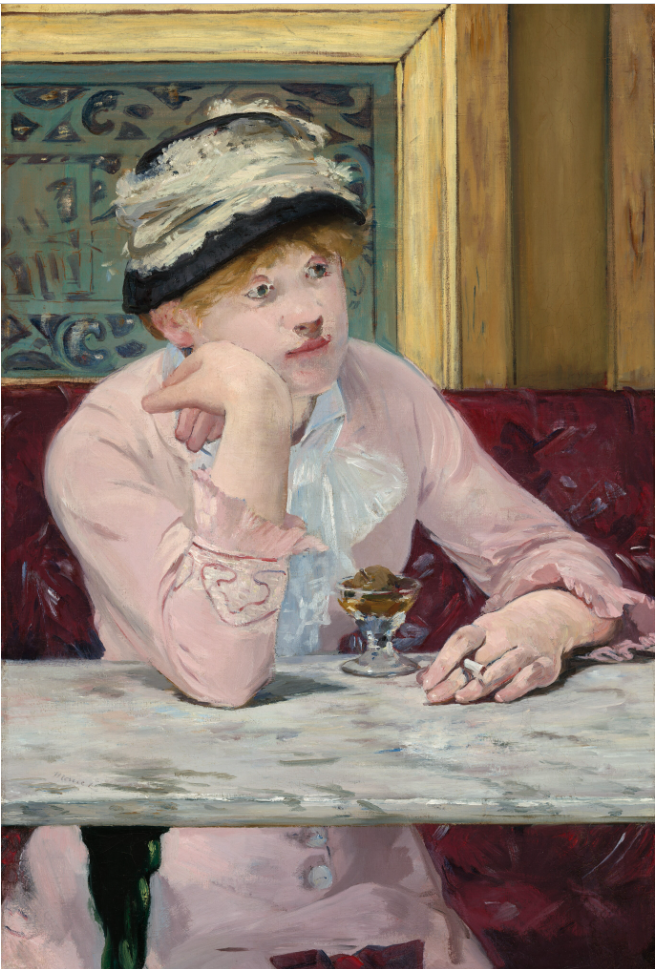
Edouard Manet, Plum Brandy, c. 1877, National Gallery of Art, Washington, D.C.
Image: National Gallery of Art, Washington, D.C., Collection of Mr. and Mrs. Paul Mellon, 1971.85.1
Despite her uniquely contemporary voice, Yiadom-Boakye draws heavily from nineteenth-century painters like Édouard Manet, Edgar Degas, John Singer Sargent, and Walter Sickert. She admires their unconventional approaches to figuration. In Watcher, she transposes and reimagines elements of color, composition, gesture, and pose from these historical European artists. The subtle color shifts in the fabric folds recall the geometric tablecloths and allusive verisimilitude of Paul Cézanne, while her rapid brushwork and skill in capturing fleeting moods echo the Impressionists’ commitment to the ephemeral. In Watcher, Yiadom-Boakye’s subject, deep in thought, evokes the introspective stillness seen in Mary Cassatt’s portraits, while the figure’s expression—marked by distant concentration—harkens back to Berthe Morisot’s Jeune femme en toilette de bal (Young Girl in a Ball Gown), 1879, at the Musée d’Orsay in Paris, where loose, expressive strokes reveal a woman captivated by an off-screen presence. The subject of Watcher, with her soft gaze and slightly raised eyebrows, seems to channel this same intensity of focus. Her right hand is lifted, as if she has just turned her head, caught mid-motion, perhaps to shield her eyes or brush back her hair against an imagined breeze. Through these gestures, Watcher captures a sense of narrowing perspective, as if the subject’s world has shrunk to a single point of fascination, skillfully conveying Yiadom-Boakye’s modern dialogue with her art historical influences.
11am Monday, 2011
Christie’s New-York: 1 October 2024
Estimated: USD 600,000 – 800,000
USD 567,000
LYNETTE YIADOM-BOAKYE (B. 1977), 11am Monday | Christie’s
LYNETTE YIADOM-BOAKYE (B. 1977)
11am Monday, 2011
oil on canvas
180.3 x 99.7 cm (71 x 39 1/4 inches)
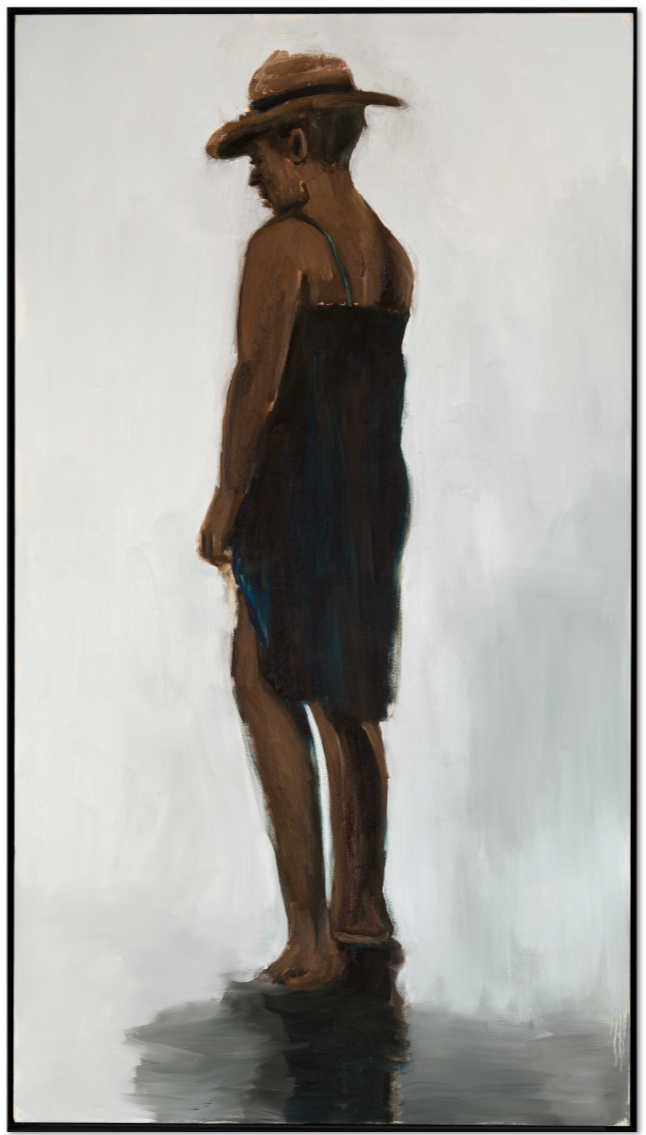
An elegant, life-sized figure stands with her back to the viewer against a serene, misty backdrop, a shadow trailing at her heels. It is morning. Barefoot and draped in a simple blue shift dress that hints at nightwear, she wears a brimmed hat that could suggest a certain formality, yet instead here evokes an early coastal morning’s tranquility. One might imagine her waking in a seaside beach house, descending to the kitchen to make coffee, then stepping onto the deck as it brews, watching the waves roll in beneath the low morning clouds while the sun begins to break through. Yet, another interpretation of this scene might sense not tranquility but a certain heaviness, perhaps sorrow or loneliness. Such is the magic of Lynette Yiadom-Boakye’s work. The enigmatically titled 11am Monday exemplifies Yiadom-Boakye’s mastery in creating vivid, imagined worlds through her distinctive economy of form, deliberate absence of narrative, and painterly prowess.
“The timelessness is completely important. It’s partly about removing things that would become in some way nostalgic…I think that’s why I like the outdoors, because it removes sense of time and I want the painting to feel timeless…”
Enacting an almost minimalist approach to portraiture, Yiadom-Boakye’s practice begins and ends with the figure. The figures in Yiadom-Boakye’s paintings are not real people; rather, the artist conjures her subjects from found imagery and her own imagination. Almost all of the figures in Yiadom-Boakye’s paintings are Black, though the artist maintains that this is not an explicit political statement but merely a natural product of her mind and hand. In her own words, “It isn’t so much about placing black people in the canon as it is about saying that we’ve always been here, we’ve always existed, self-sufficient, outside of nightmares and imaginations, pre and post “discovery”, and in no way defined or limited by who sees us.” Yet, although Yiadom-Boakye did not intend her paintings to be explicitly political, they have a significant effect: they rectify the long-standing omission of Black figures from the Western artistic tradition by integrating them into the very canon that previously excluded them.
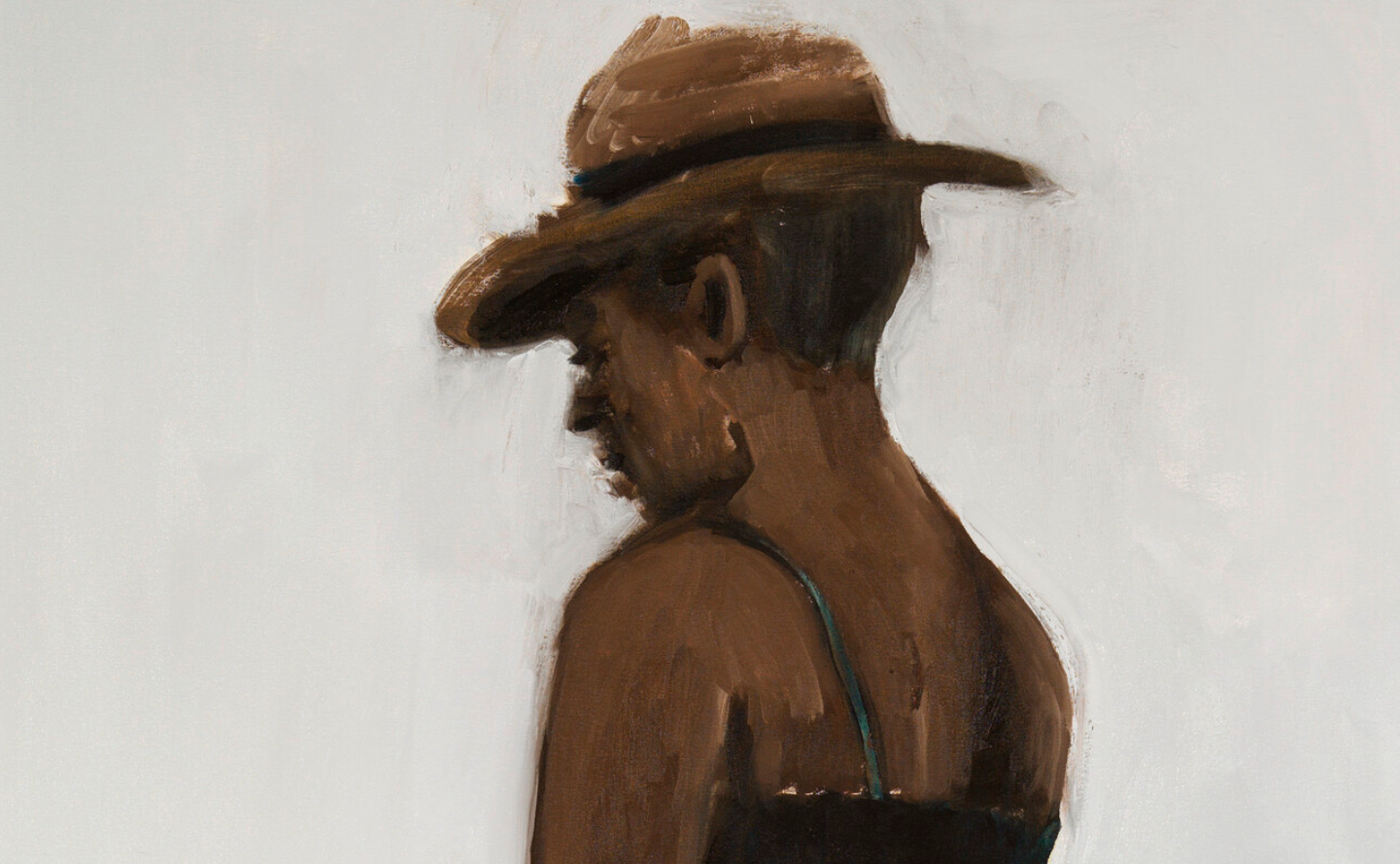
Lynette Yiadom-Boakye indeed engages with historical portraiture in her work but deliberately avoids the symbolic details typical of traditional portraits. This approach achieves two significant results. On the surface, Yiadom-Boakye aims for her paintings to feel timeless, free from specific historical or geographical contexts.
“The timelessness is completely important. It’s partly about removing things that would become in some way nostalgic…I think that’s why I like the outdoors, because it removes sense of time and I want the painting to feel timeless.”
For instance, while one might interpret 11am Monday as depicting a coastal scene, Yiadom-Boakye offers no concrete evidence to confirm such details or to define the subject’s surroundings. Secondly, her minimalist approach contrasts sharply with traditional portraiture, where subjects often included wealthy, authoritative figures eager to display their status through various accoutrement such as invaluable jewels and expensive fashions à la mode. Unlike these portraits, Yiadom-Boakye’s subjects do not need to prove their worth; their presence on the canvas alone affirms their significance. In her paintings, the Black figure is presented unapologetically, simply existing without needing justification.
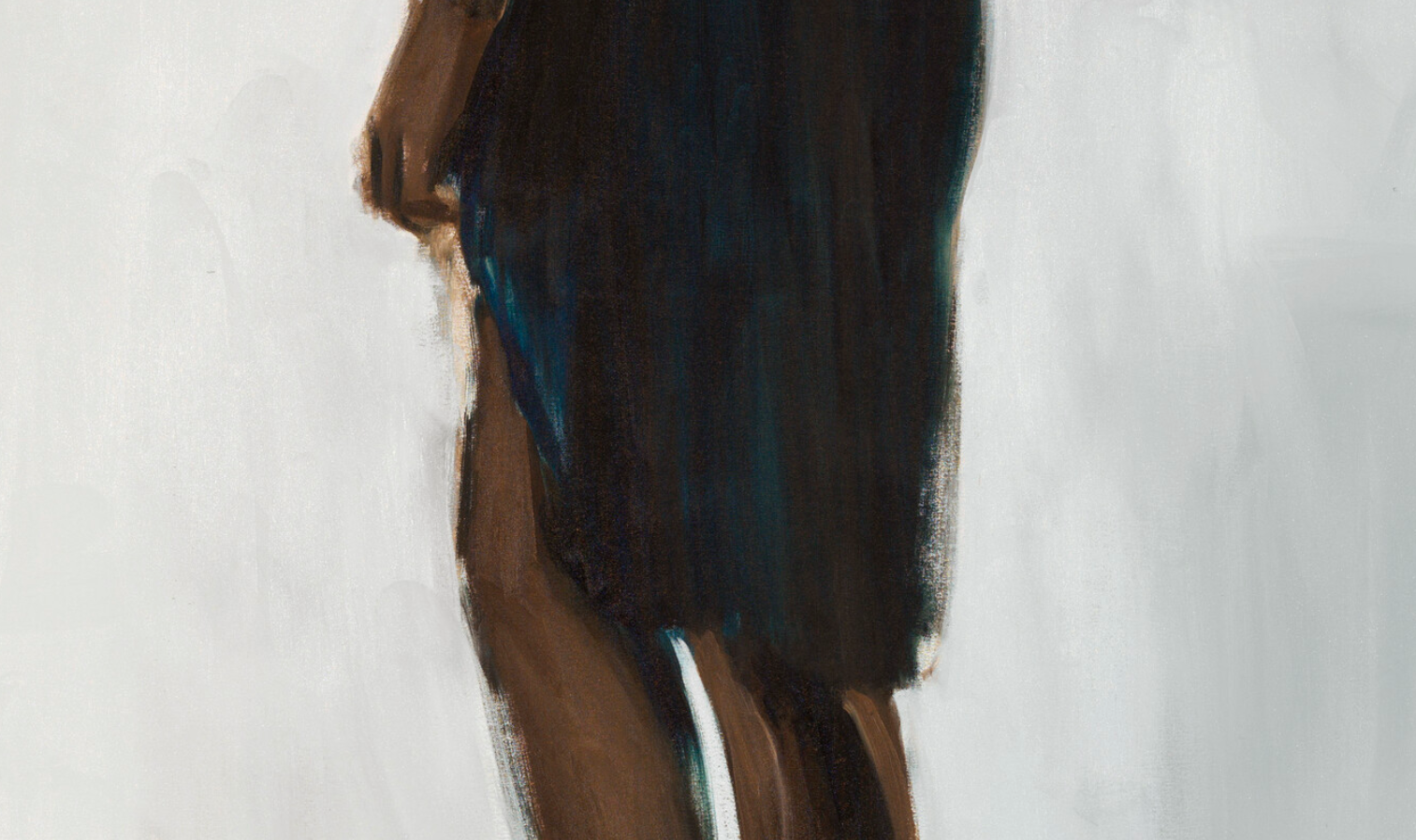
In 11am Monday, as with the rest of her remarkable body of work, Lynette Yiadom-Boakye draws on traditional elements of line, color, and scale. The absence of a specific narrative in the painting allows viewers to project their own stories onto it, while also encouraging a focus on the painting’s physical surface and Yiadom-Boakye’s technical prowess. On closer inspection, the urgency of her brushstrokes, the nuanced color contrasts, and her distinct yet fluid lines become evident. The deep blues of the figure’s dress, combined with rich violets, blacks, and flashes of white and green, suggest a silky texture and a sense of movement, even though the dress is only loosely defined. The surrounding haze of grays and whites evokes a sense of air, making it an integral part of the composition. Using a dark, earthy palette of blues, browns, and cool grays, Yiadom-Boakye connects to a lineage of artists from the Old Masters like Goya, Velázquez, Hals, and Sargent to Modernists such as Manet, Degas, and Sickert. Like these predecessors, she excels in representing both form and space, mastering not only the depiction of figures but also the spatial depth in her work, such that air, itself, becomes a subject in its own right.
Of All The Seasons, 2017
Christie’s London: 7 March 2024
Estimated: GBP 500,000 – 700,000
GBP 856,800 / USD 1,086,422
LYNETTE YIADOM-BOAKYE (B. 1977), Of All The Seasons | Christie’s (christies.com)
LYNETTE YIADOM-BOAKYE (B. 1977)
Of All The Seasons, 2017
Oil on canvas
110.2 x 60.6 cm (43 3/8 x 23 7/8 inches)
Signed with the artist’s initials, titled and dated ‘LYB 2017 Of All The Seasons’ (on the reverse)
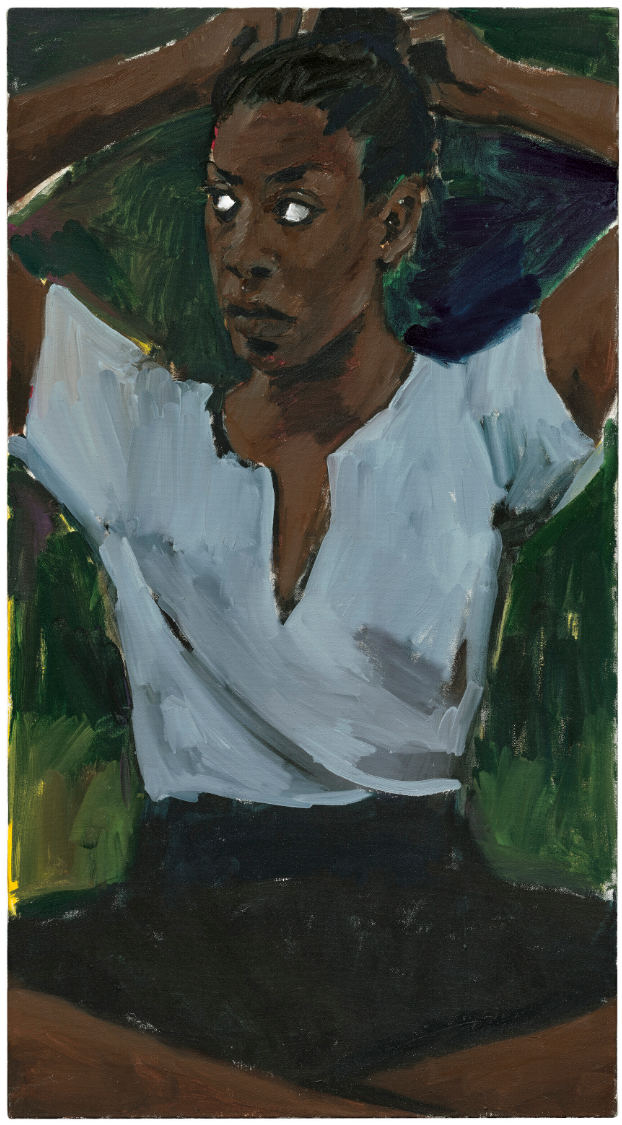
Unveiled in Lynette Yiadom-Boakye’s landmark solo exhibition at the New Museum, New York in 2017, Of All The Seasons is an arresting work from a pivotal moment in the artist’s career. A woman sits cross-legged against a backdrop of verdant greens and blues, her hands raised to her hair. Her arms and legs are cropped at the edge of the picture plane; her eyes, full of complex emotion, are trained on something out of sight. Time, place and narrative are held in tantalizing suspense. Yiadom-Boakye’s brushwork quivers with movement, layered in fluid streaks of color and punctuated with dazzling glints of white, red and yellow. Her exhibition at the New Museum, following swiftly on the heels of important presentations at the Serpentine Gallery, London and the Kunsthalle Basel, marked her solo debut in a major US institution. The show was reviewed in The New Yorker by author Zadie Smith, who hailed the artist’s enigmatic portraits of imaginary subjects. Alive with half-told stories, the present work captures the moment that Yiadom-Boakye began to take her place on the international stage. In Of All The Seasons, a conversation seems about to begin: the protagonist’s companion is unseen and unheard, but their presence is unmistakable.
Yiadom-Boakye places black subjects at the core of her practice. Deliberately divorced from any particular setting or time period, her paintings have been seen as attempts to address questions of black representation in the Western canon: her subjects inhabit worlds that might have once been the domain of Vermeer, Velázquez, Degas or Manet. Yet, as Smith points out in her essay, ‘Yiadom-Boakye is doing more than exploring the supposedly uncharted territory of black selfhood … Nor are these paintings solely concerned with inserting the black figure into an overwhelmingly white canon’ (Z. Smith, ‘Lynette Yiadom-Boakye’s Imaginary Portraits’, The New Yorker, 12 June 2017). Instead, perhaps more than anything, Yiadom-Boakye’s subjects represent extensions of her own imagination: ‘they’re all black’, she explains, ‘because … I’m not white’ (L. Yiadom-Boakye, quoted in conversation with H. U. Obrist, Kaleidoscope, No. 15, 2012, p. 102). In certain paintings, she deliberately toys with the frictions of race and gender politics; in others, her protagonists are simply present, lost in thought or going about their daily lives. Here, life simmers beyond the edges of the picture plane, rich in untold secrets.
Kingfisher, 2011
Sotheby’s London: 7 March 2024
Estimated: EUR 300,000 – 400,000
EUR 472,600 / USD 599,260
Kingfisher | Modern & Contemporary Day Auction | 2024 | Sotheby’s
LYNETTE YIADOM-BOAKYE (b. 1977)
Kingfisher, 2011
Oil on canvas
70.2 x 65 cm (27 5/8 x 25 5/8 inches)
Signed with the artist’s initials, titled and dated 2011 (on the reverse)
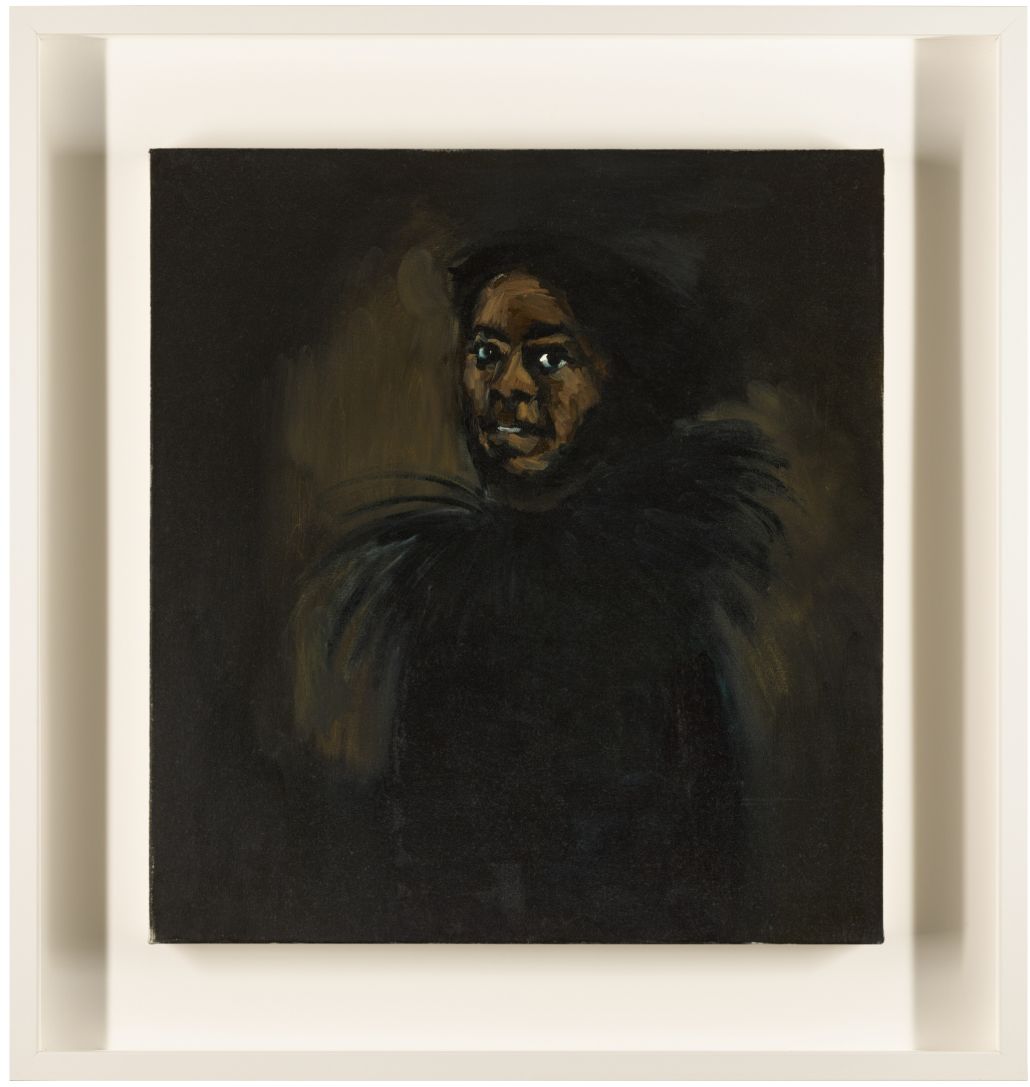
Lynette Yiadom-Boakye’s portraits are instilled with an unparalleled auratic and mesmerizing sensibility, radiating the unique magic of her artistry. The present work, executed in 2011, is one such triumphant example, exemplary of the artist’s exceptional painterly skill. Kingfisher offers a striking depiction of a woman whose gaze, as though captured mid-thought, captures the viewer and draws them in. Plumes of bird feathers around her neck are punctuated by accents of green and blue, all set against a mahogany backdrop heightened with glowing golden hues. In Polynesia, where the bird is considered sacred, the Kingfisher signifies control over the seas. Yiadom-Boakye’s Kingfisher similarly demands control over the canvas; a glorious example of the artist’s principal practices, the present work oscillates between modern and traditional influences, inviting the viewer to engage with the long standing legacy of portraiture within the canon of Western art history.
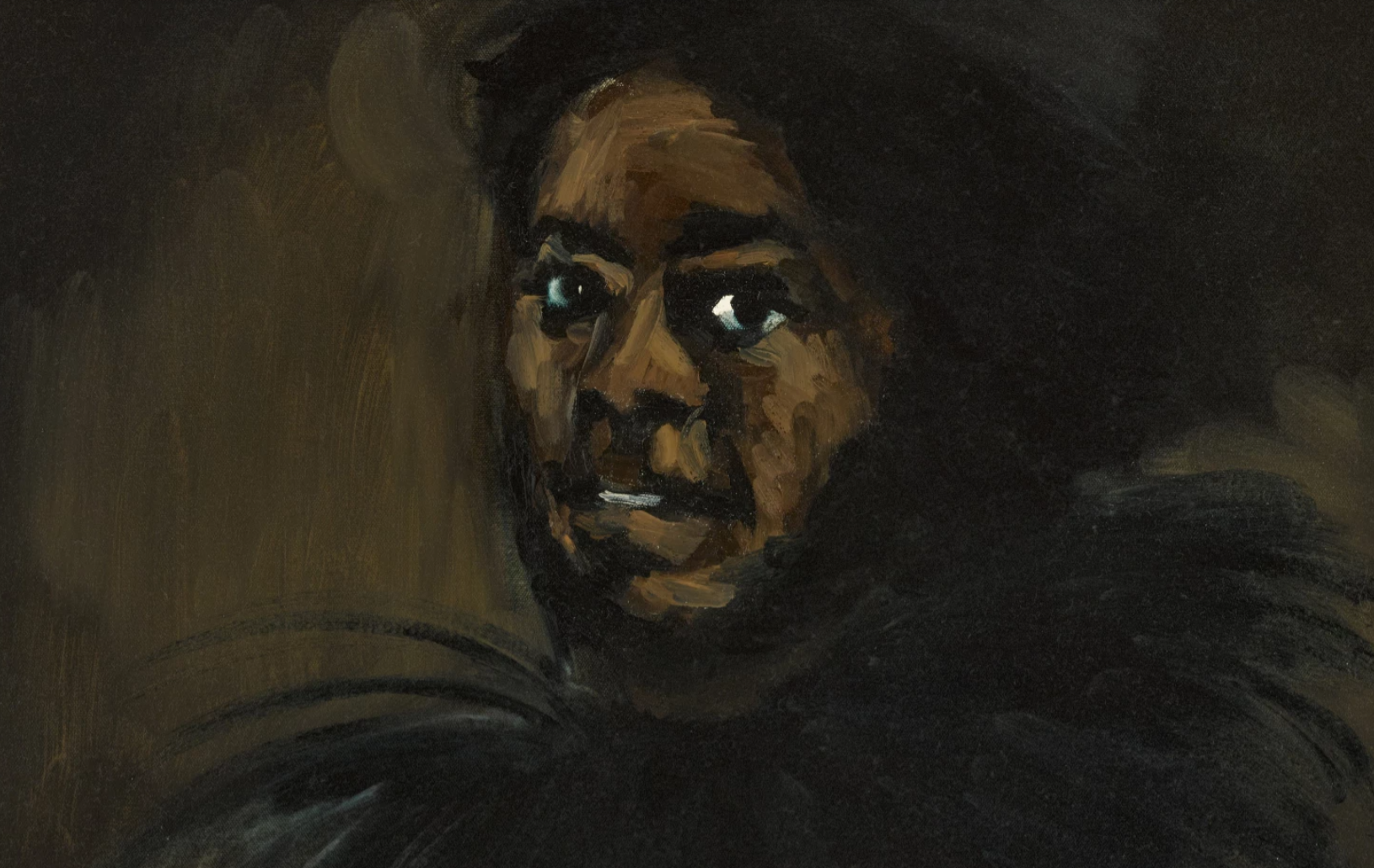
Demonstrating a spellbinding ability to capture her figures through the luminosity and interplay between shadow and light, Yiadom-Boakye often completes her paintings in just one day, adopting an alla prima or wet-on-wet technique akin to the fresco methodology. Retaining spontaneity in the form of loose brushstrokes and spirited mark making, the subject demands attention. Theatrical, historical yet wholly contemporary, the sitter, akin to many of Yiadom-Boakye’s protagonists, is defiant of contextualization and unattributable to a specific time or place, contributing to its captivating charm. The depiction of birds, feathers and the reference to nocturnal birds of prey within Yiadom-Boakye’s oeuvre, underpin the world that the artist depicts. As creatures of the air, birds occupy a mysterious position in mythology and are potent symbols of unearthly planes beyond human understanding: the stork representing fertility and birth; magpies, bad luck and death; eagles, freedom and bravery. Such subjects are profound philosophical subjects of the human condition, and the inclusion of bird feathers in the present work signals the internal worlds of Yiadom-Boakye’s equally elegant and mysterious sitters. Yiadom-Boakye enigmatic characters are not known to her. Like many of her mystifying figures, Kingfisher depicts a quasi-fictitious subject pulled from the figments of Yiadom-Boakye’s imagination and inspired by the artist’s photographic archive of family photographs and media clippings.
“I realized early on that painting from life wasn’t something that I was all that invested in. I was always more interested in the painting than I was the people. For me, removing that as a compulsion offered me a lot more freedom to actually paint and think about color, form, movement, and light.”
Turning to the mechanics of painting itself in which portraiture is a vehicle for painting, Yiadom-Boakye encourages her viewers to engage with the canvas directly, unencumbered by narrative.
Highriser, 2009
Christie’s New-York: 15 May 2023
Estimated: USD 700,000 – 1,000,000
USD 1,002,000
LYNETTE YIADOM-BOAKYE (B. 1977), Highriser | Christie’s (christies.com)
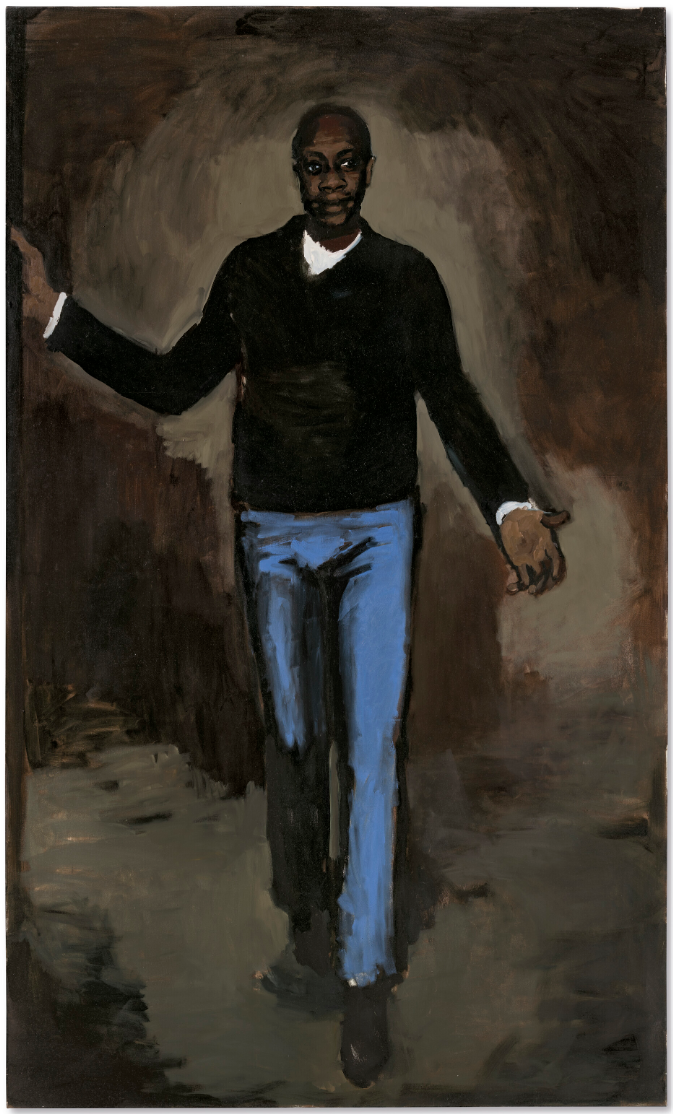
LYNETTE YIADOM-BOAKYE (B. 1977)
Highriser, 2009
Oil on canvas
250.5 x 150 cm (98 5/8 x 59 inches)
Signed with the artist’s initials, titled and dated ‘Highriser LYB 2009’ (on the reverse)
Lynette Yiadom-Boakye’s evocative painting Highriser is emblematic of her desire to understand and celebrate the act of painting. Measuring over eight feet tall, within its epic proportions the artist presents an astute and intense examination of the medium’s component parts: color, light, composition, and gesture. Included in every major exhibition of the artist’s work, including the recent critically acclaimed retrospective at Tate Modern in London, this monumental canvas presents a moment to consider and explore mood, movement and pose worked out on the surface of the canvas. Taking her inspiration from contemporary society as well as art history, Yiadom-Boakye is a collector of images, which she examines, dissects, condenses, and reinterprets to produce portraits of imagined characters, raising questions of identity and representation. The present canvas presents an intense study of light and shadow, reminiscent of Gustave Courbet or Jean-François Millet. A tall, lean man steps toward us, entering our world or beckoning us to enter his. He is both a monument and a specter, somewhere between the timeless and the ethereal. Yiadom-Boakye skillfully renders affecting details, such as the figure’s white collar and sleeves peeking out from his otherwise black and blue clothes. Surrounding him are browns and blacks subtly deepened or lightened by the artist with skillful mixing. The figure’s blue pants, laden with shadow, become like a sculptural base. This effect recalls the modelling and deep shadows of Surrealist sculpture and photography, such as Man Ray’s Untitled Rayograph (1922) or Le Violon d’Ingres (1924). Yet Yiadom-Boakye’s paintings never feel removed or fantastical. We might recognize someone we know within them, and this familiarity has made the artist’s paintings of single figures, like Highriser, among her most cherished and sought-after works.
Highriser, with its expressive and intentionally loose marks, expounds upon the emotional power of Yiadom-Boakye’s process. Working the rapid tradition of celebrated painters like Picasso, she largely creates her paintings in a single day. She relies on scrapbooks of images, along with notes, memory, and stories, rather than biographical details and therefore her work oscillates between the documentary and the imaginary. We might imagine Highriser hanging beside Monet’s equally monumental paintings of Rouen Cathedral. Both Yiadom-Boakye and Monet push the expressive effects of painting to their limits in search of truer and more universal emotions. Equally apparent here is Yiadom-Boakye’s ongoing inquiry into perception: how we are perceived, how others perceive us, and the line between fact and fiction. What results from Yiadom-Boakye’s technical skill and poetic imagery is an emotional landscape that pays homage to and transcends genres and movements.
Wishes Above Needs, 2011
Christie’s London: 1 March 2023
Estimated: GBP 200,000 – 300,000
GBP 453,600 / USD 545,815
LYNETTE YIADOM-BOAKYE (B. 1977), Wishes Above Needs | Christie’s
LYNETTE YIADOM-BOAKYE (B. 1977)
Wishes Above Needs, 2011
Oil on canvas
80.4 x 65.4cm (31 5/8 x 25 3/4 inches)
Signed with the artist’s initials, titled and dated ‘LYB 2011 Wishes Above Needs’ (on the reverse)
Painted in 2011, Wishes Above Needs is an enigmatic work that exemplifies Lynette Yiadom-Boakye’s redefinition of contemporary portraiture. Rendered in her signature nocturnal palette, it depicts an anonymous male figure sitting alone at a table, his gaze directed towards something beyond the picture plane. Hand poised on his chin, he flashes us a quiet smile, his eyes and teeth a gleaming white against a background of sepia light and shade. Through hazy, hurried brushstrokes, the work is imbued with a sense of immediacy, characteristic of an artist who frequently creates her paintings in a single day. Inspired by memories and found images, yet conjured completely from her imagination, Yiadom-Boakye’s protagonist is one whose location and history is unknown—a surreal character whose narrative remains untold. Ambiguously poetic, and completely devoid of any contextual clues, the title Wishes Above Needs further hints at a backstory beyond our reach.
“One of the reasons I made a conscious decision not to work from people I know is to get around this idea of objectifying … It’s about seeing but more than feeling. Thinking through feeling.”
Recalling Caravaggio’s dramatic chiaroscuro, Édouard Manet’s loose brushwork and alla prima directness, and Francisco Goya’s moody color palette, Wishes Above Needs is a painting steeped in art-historical references. However, by inserting the contemporary Black figure into her canvas, and predominantly depicting Black sitters throughout her practice, the artist simultaneously dismantles this canon. In Wishes Above Needs and other works, the artist recuperates traditionally exclusionary genres, borrowing the painterly techniques of the past, and presenting us with a new history of representation.
A Political Shirt, 2010
Sotheby’s London: 3 March 2022
Estimated: GBP 100,000 – 150,000
GBP 144,900 / USD 193,895
A Political Shirt | Modern & Contemporary Day Auction | 2022 | Sotheby’s
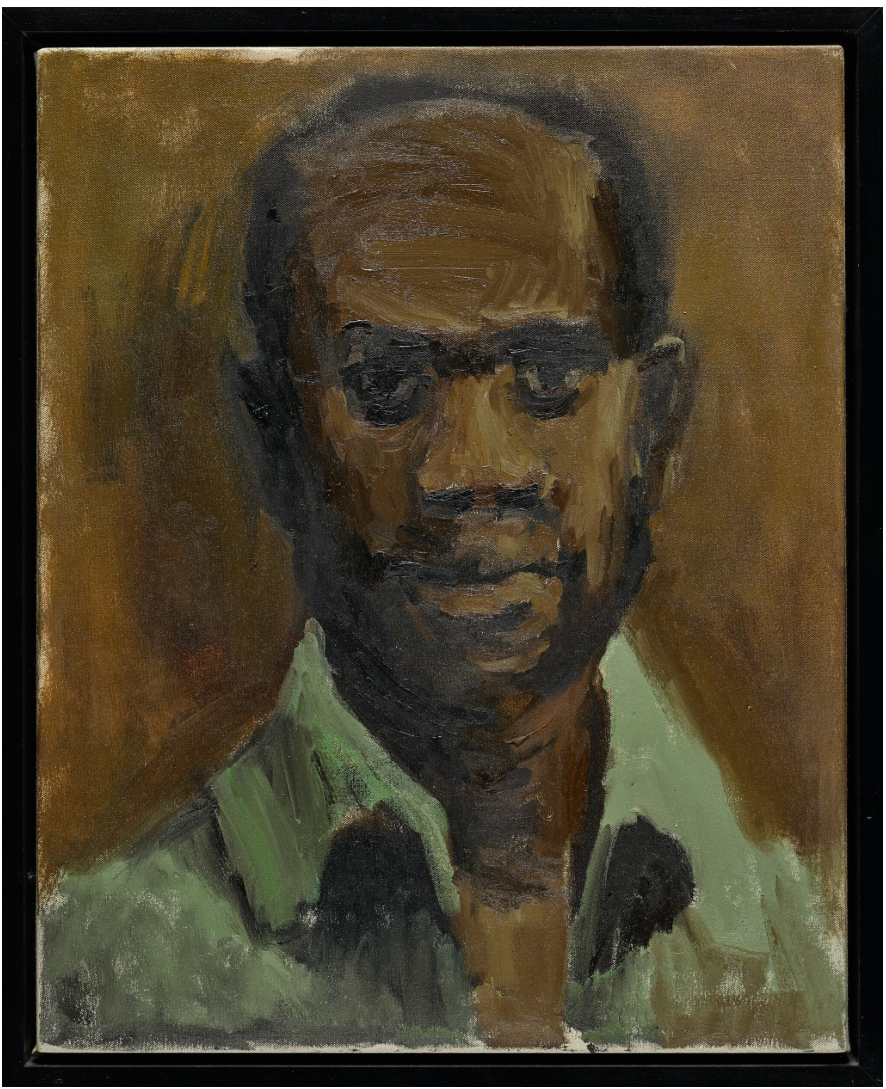
LYNETTE YIADOM-BOAKYE (B. 1977)
A Political Shirt, 2010
Oil on linen
50 x 40.3 cm (19 3/4 x 15 7/8 inches)
Signed, titled and dated 2010 on the reverse
Powerful and beguiling, Lynette Yiadom-Boakye’s A Political Shirt is a par exemplar of the artist’s signature mode of enigmatic and captivating portraiture; a celebrated oeuvre preoccupied with examining the complexity of human nature through subjects conjured from the artist’s imagination and mediated onto the canvas through her vital creative process. Executed in 2010, the present work is a heady concoction of art-historical allusion and elegant forms, fully realizing the potential for figuration to communicate notions of interiority and thought.
Exemplifying Yiadom-Boakye’s focus on nuances of the cerebral, the subject of A Political Shirt is seemingly meditative, wrapped within his own train of thought. His gaze, punctuated by dark and piercing pupils,lead us beyond the edge of the canvas—upon a subject inaccessible to the viewer before him. Despite his mysterious anonymity, Yiadom-Boakye finds ways to imbue her imaginary sitter with a sense of identity through the visual cues of posture, expression, fashion and indeed the title of the work. Describing the artist’s project in terms highly reminiscent of the present work, acclaimed novelist Zadie Smith reflects: “Subtleties of human personality it might take thousands of words to establish are here articulated by way of a few confident brushstrokes.” (Zadie Smith, “Boakye’s Imaginary Portraits,” The New Yorker, 12 June 2017). Presenting a subject that is at once unknowable and subconsciously familiar, A Political Shirt endlessly engages the imagination, acting as a generative source for narrative, association and speculation.
An exceptionally elegant example from her celebrated body of work, A Political Shirt invites and denies access, occupying the border between the established canon and a productive unknown. Although trained to paint from live models, Yiadom-Boakye’s subjects are pulled from her imagination, each a conflation of experiences, memories, and art history. The artist describes her paintings as, “suggestions of people…They don’t share our concerns or anxieties. They are somewhere else altogether.” This lack of a fixed narrative invites viewers to project their own interpretations, thus raising important questions of identity and representation
With an uncanny ability to forge narrative and mood in her painting, Yiadom-Boakye’s evocative works have resulted in critical acclaim on the global stage. A finalist for the Turner Prize and subsequently representing Ghana in the 2019 Venice Biennale; the artist will continue to be honored with a major survey of her works at the Tate Britain in November 2022, a monographic exhibition which was sadly cut short by lockdown. This exhibition is currently touring internationally before coming back to be restaged at Tate Britain for a full three-month run.
Highpower, 2008
Christie’s London: 13 October 2022
Estimated: GBP 600,000 – 800,000
GBP 1,482,000 / USD 1,645,115
LYNETTE YIADOM-BOAKYE (B. 1977), Highpower | Christie’s (christies.com)
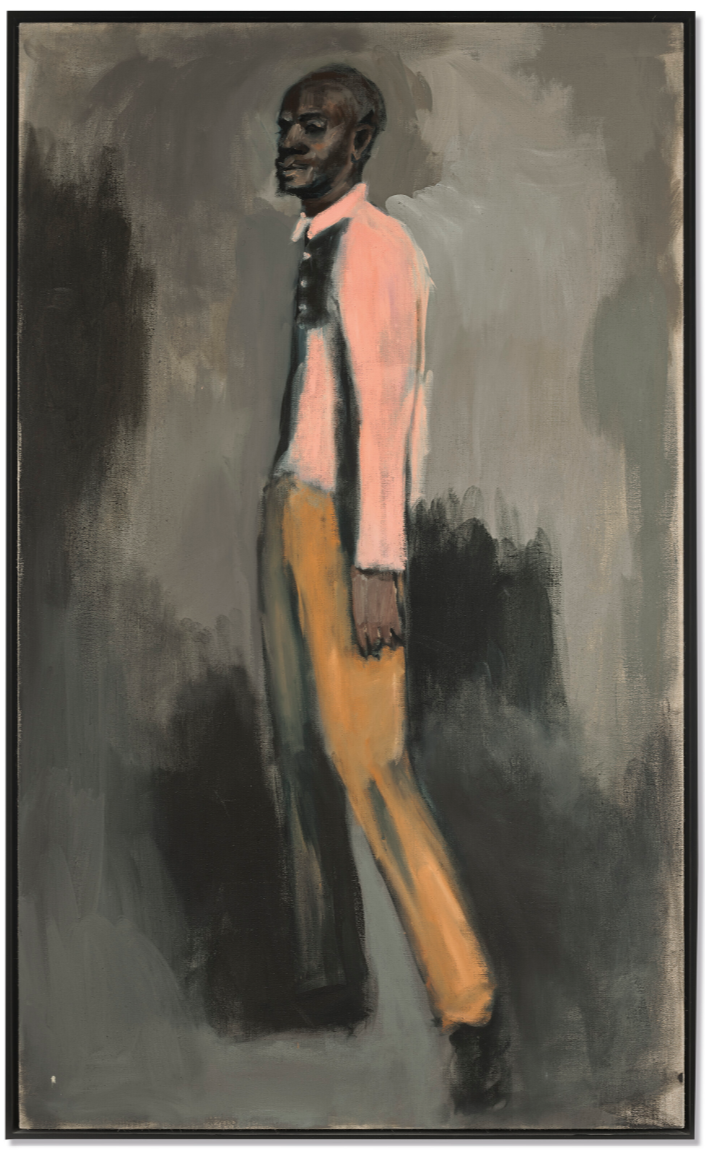
LYNETTE YIADOM-BOAKYE (B. 1977)
Highpower, 2008
Oil on linen
199.7 x 119.7 cm (78 5/8 x 47 1/8 inches)
Signed, titled and dated ‘Lynette Highpower 2008’ (on the reverse)
One of the UK’s most celebrated painters, Lynette Yiadom-Boakye is acclaimed for her enigmatic portraits of fictitious Black people that exist outside of specific times or places. The paintings are rooted in traditional formal considerations such as line, colour, and scale, and are often self-reflexive about the medium itself. Yiadom-Boakye’s practice is also inextricably linked to her writing, both in the titles of the works and also in accompanying poems. In the noble, expressive painting Highpower, the protagonist is conjured from Yiadom-Boakye’s imagination as in all her portraiture. His brow is furrowed, giving a sense of severity, but a sensitivity also emanates through his languid posture; he gives the impression of being a renaissance man and a paragon of erudition. Manual shows a woman, seemingly just shy of middle age, her eyes trained over the viewer’s shoulder. There is a steeliness to her gaze and an air of quiet determination. All the while she is at ease, yet simultaneously alert and acutely aware of what is happening beyond the picture plane. Glorious fluorescent hues of yellow and orange permeate through the painting. Erector shows a middle-aged man with a piercing gaze staring beyond the frame.
As in Highpower and Manual, the sitter appears to belong to a class of statesmen, philosophers and artists; wise, reputable, severe yet sensitive. Hard-won experience has shaped his features and Yiadom-Boakye’s brushstrokes effortlessly etch stoicism onto the man’s face. Magic is the more playful of the four works. The triptych is read left to right and it seems as if the sitter has delighted by a piece of information, after which they become animated and full of vivacious energy. The figure has longish, wild hair, and a seemingly artistic or impish temperament.
11pm Sunday, 2011
Sotheby’s New-York: 19 May 2022
Estimated: USD 1,200,000 – 1,800,000
USD 1,744,000
11pm Sunday | The Now Evening Auction | 2022 | Sotheby’s (sothebys.com)
LYNETTE YIADOM-BOAKYE (b. 1977)
11pm Sunday, 2011
Oil on canvas
200.7 x 129.9 cm (79 x 51 1/8 inches)
Signed, titled 11pm Sunday and dated 2011 (on the reverse)
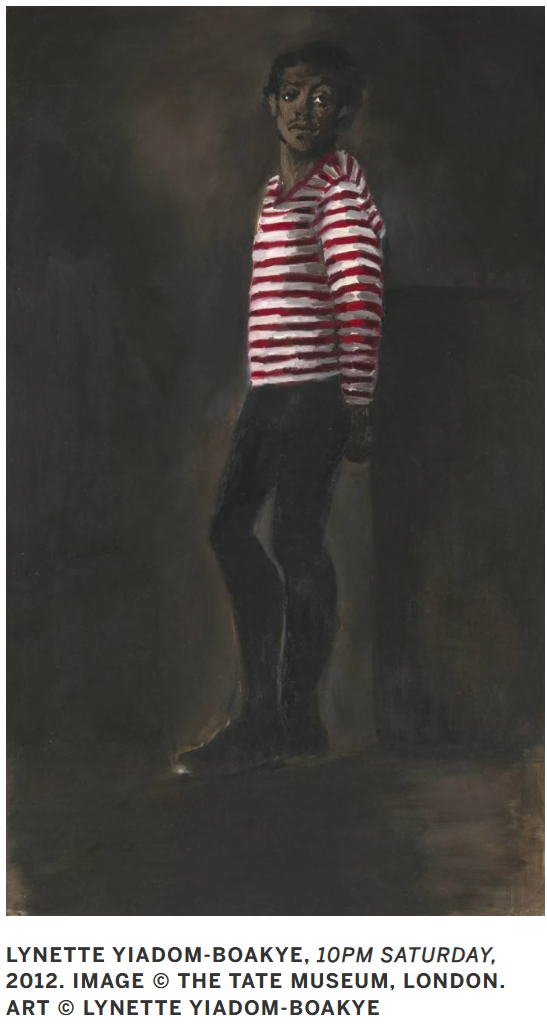
Emerging from a fog of amber hues in a phosphoric glow, the poised and demure figure of Lynette Yiadom-Boakye’s 11pm Sunday stares downward with hands on hips. Readily identifiable by their red-and-white striped shirt, our protagonist is a character repeatedly revisited by Yiadom-Boakye, and notably reappears in 10pm Saturday, a sister painting to the present work that is now held in the collection of Tate in London. And yet, the familiar character remains unknowable here, an enigmatic image of the figure who exists in serene ambiguity outside specific time and place, even as the work nominally alludes to the time of day. Lending the gravitas of a Whistler, Sargent or Manet to contemporary portrayals of imaginary black figures, Yiadom-Boakye’s paintings forge narrative and mood in uncanny ways that endlessly probe the viewer’s imagination and raise broader questions about how one interprets representation. In recent years, the artist’s meteoric rise is evidenced by her widespread institutional success: in 2019, the British-Ghanain artist received the Carnegie Prize and represented Ghana at the 58th Venice Biennale, and in 2020 was the subject of a major retrospective, Fly in League with the Night, which began at Tate in London and continues to travel internationally today, already having moved to Moderna Museet in Stockholm, Sweden and K20 in Dusseldorf, Germany. Simultaneously inviting and mysterious, 11pm Sunday exhibits Yiadom-Boakye’s phenomenal finesse as she refashions historical conventions of portraiture through her sublime painting style.
Like all the figures that populate Yiadom-Boakye’s oeuvre, the subject of 11pm Sunday is derived from the artist’s imagination, conflating the memories, images, and art historical traditions that inspire her philosophical painting practice. Set against a burnt hickory background of murky hazels and grays and composed with a cloudy mix of unblended brushstrokes, the fictional subject casts their gaze downward and stands in contrapposto.
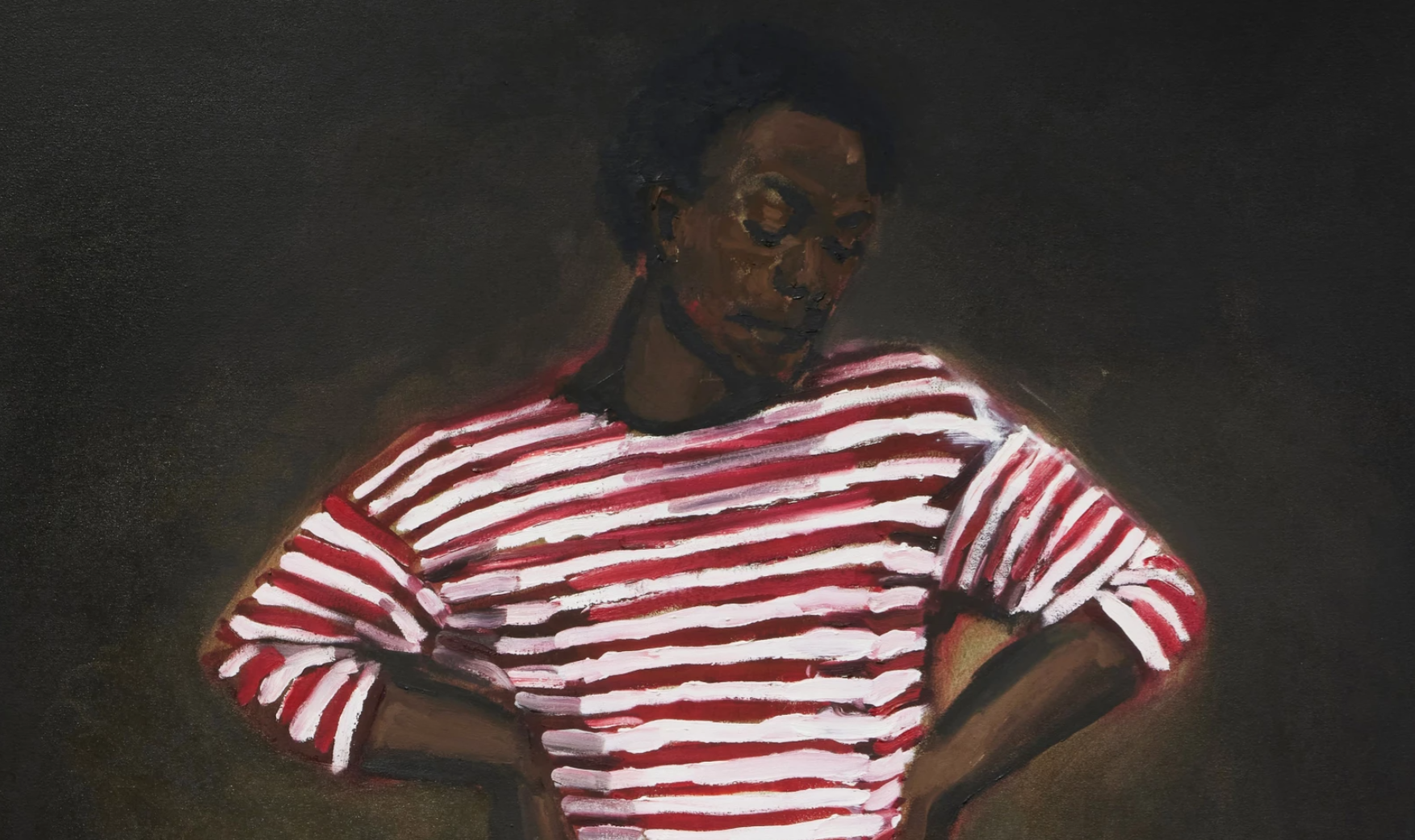
The subject seems to melt into a shadowy haze by way of their loosely-rendered feet and legs, but they stand firmly with their hands on their hips, their entire body illuminated by a faint angelic halo that highlights the atmospheric and ethereal quality of the painting. Echoing the sturdy yet loosened brushstrokes in the works of Édouard Manet and Paul Cezanne, Yiadom-Boakye refined her painterly elegance through years spent depicting live models, but established the conceptual basis of her practice when she shifted the source of her portraits from reality to imagination. Though formal comparisons with nineteenth-century painters are appropriate, the fictive nature of Yiadom-Boake’s dreamlike paintings marks her practice as a radical and contemporary departure from European traditions of portraiture.
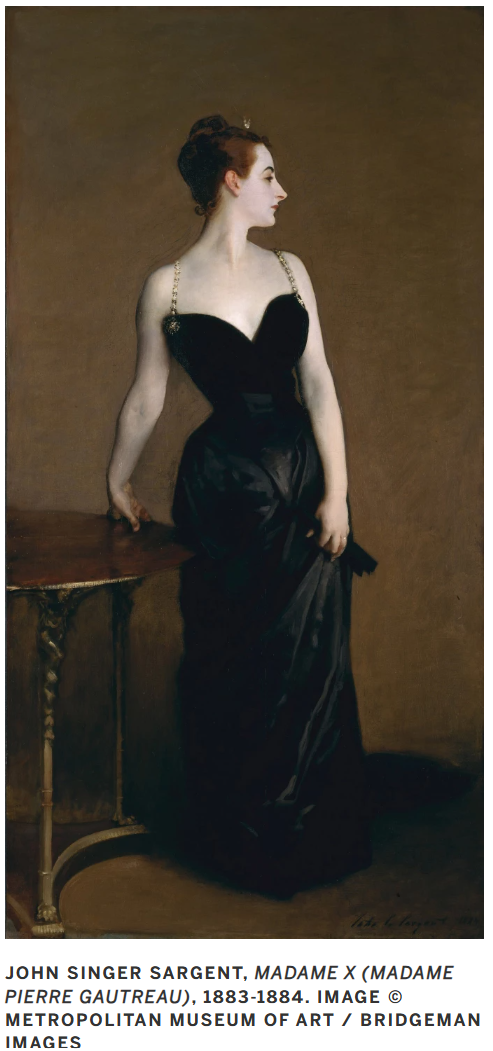
While her portraitist forebears aimed to record the appearance of a real sitter, the artist liberates her subjects from the limits of objective reality: her paintings are of mere “suggestions of people. They don’t share our concerns or anxieties. They are somewhere else altogether.”
Centered on subjects of African descent, Yiadom-Boakye’s paintings are also a boldly nuanced representation of black subjects in a primarily white, hegemonic history of painting. Writer and critic Hilton Als has noted that Yiadom-Boakye is “interested in black society, not as it was affected or shaped by the white world, but as it exists unto itself.” By constructing self-contained worlds for her subjects to inhabit, Yiadom-Boakye opens an infinite range of possibilities for the representation of black sitters, situating her beguiling paintings between an established canon and a productive unknown. In an interview with curator Antwaun Sargent, the artist asserts, “Following my own nose and doing as I damned well please has always seemed to me to be the most radical thing I could do. It isn’t so much about placing black people in the canon as it is about saying that we’ve always been here, we’ve always existed, self-sufficient, outside of nightmares and imaginations, pre and post “discovery”, and in no way defined or limited by who sees us.” (The artist in conversation with Antwaun Sargent in ‘Lynette Yiadom-Boakye: Speaking Through Painting,” Tate, 13 October 2020 (online)). As the subject stands in firm contrast to the nebulous background, 11pm Sunday is an alluring testament to Yiadom-Boakye’s ability to imbue her figures with undeniable character. The artist offers us not only a relatable sense of her imaginary subject’s personality, but also an intimate glimpse into the eclectic community of figures that she has built throughout her richly fantastical oeuvre.
Group Compositions
Pearl For A Mackerel, 2010
Phillips London: 26 June 2025
Estimated: GBP 450,000 – 650,000
GBP 355,600 / USD 487,170
Lynette Yiadom-Boakye Modern & Contemporary Art: Evening & Day Sale
Pearl For A Mackerel, 2010
Titled and dated ‘Pearl For A Mackerel 2010’ on the reverse
Renowned for her evocative figurative paintings, Lynette Yiadom-Boakye investigates and repositions the depiction of Black figures in the Western canon of art history. The Pearl For A Mackerel, executed in 2010, is one of Yiadom-Boakye’s most important, early group portraits; she only began creating multi-figure works in the prior year. As such, this monumental painting is a key marker of her evolving stylistic language, resulting in her nomination for the Turner Prize in 2013. Tending to focus on single-sex compositions, this female group portrait showcases Yiadom-Boakye’s unique understanding of color and emblematizes her characteristically skillful exploration of traditional painterly techniques. Full of charisma and a pervasive kind of magical realism, Yiadom-Boakye’s figures are unplaceable in time and unbound in place. Together, they act as touchstones for personal reflections and individual ideas. As such, although relatively sparse in compositional elements, the present work is replete with psychological complexity and formal intensity, a supreme example of the artist’s practice.
“I work from scrapbooks, I work from images I collect,
I work from life a little bit, I seek out the imagery I need. I take photos.
All of that is then composed on the canvas.”
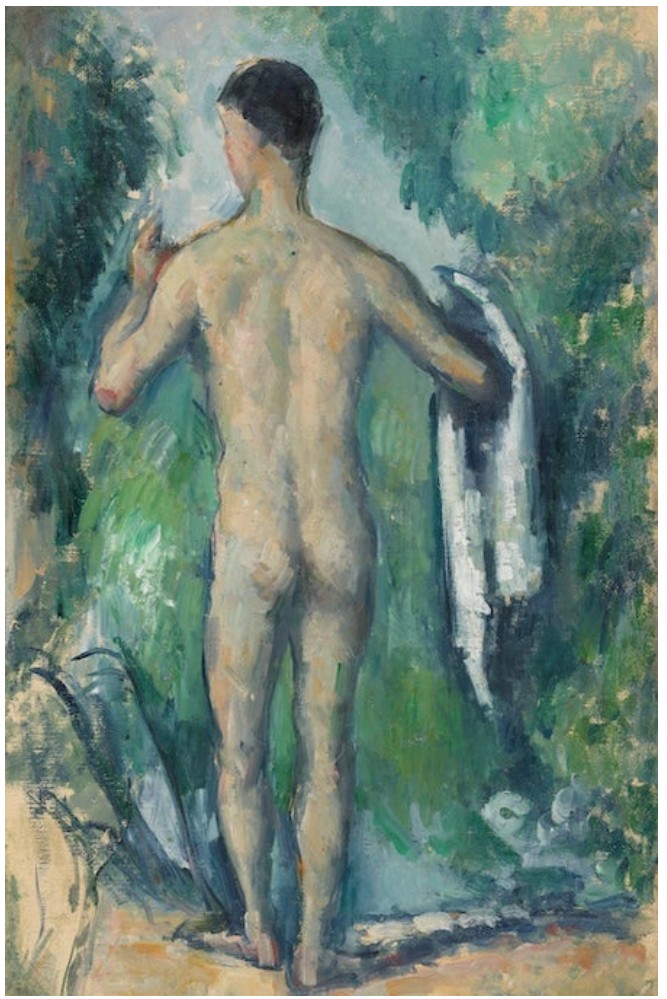
Paul Cézanne, Standing Bather, Seen from the Back, 1879-92, The Art Institute of Chicago.
Image: Art Institute of Chicago, Bequest of Brooks McCormick, 2007.289
Broad brushstrokes in muted tones envelope the three female figures, who emerge from a dim yet luminous background. Yiadom-Boakye adopts the chiaroscuro tradition, historically used to idealize white subjects in 16th Century Venetian and 17th Century Dutch portraiture, and transforms it, deploying a complex interplay between light and shadow to accentuate the features of Black figures with unprecedented nuance and dignity. Drawing inspiration from historic masters such as Caravaggio, Rembrandt and Francisco Goya, she studied traditional compositional frameworks to reinterpret them through her own contemporary lens.
“I’ve been influenced by historic painters who share a certain devil-may-care mode of working, who were not so concerned with formal perfection or academic rules, but with the physicality of paint, the act of painting, the life that they knew and how they could make it tangible through paint, people like Édouard Manet, Walter Sickert and Francisco Goya’.“
Much of her originality is to be found precisely in the approach that she takes in creating images dedicated to Black subjects, inscribed within the more limited history of Black people painted by Black artists. In this, she is a key member of a generation of Contemporary Black figurative painters, from Amy Sherald and Jordan Casteel to Claudette Johnson and Danielle Mckinney. Clad in swimwear, the three figures of the present work are depicted as if returning from the sea’s edge. The figure of the bather is an important art historical touchstone for the present work, recalling paintings by artists such as Edgar Degas and Paul Cézanne. Formally, the earlier artists’ gestural mark-making, graduated tonal transitions and complex compositional structures all function as constituent parts of Yiadom-Boakye’s painting practice, exemplified in the present work. Working quickly, she has blurred tones of black, grey and white with fluid, impressionistic brushstrokes that leave areas of the canvas bare, underlining the dynamism of her painting. Often completing her paintings within a day, this mark-making is rooted in the artist’s alla prima technique, both generating and enhancing the energy of the composition. Time and place remain undefined, bestowing the present work with a sense of mystery and magic; indeed, in the unfinished haze of the background, this work suggests a very gestural kind of non-objective abstraction. In many ways, at its core, The Pearl For A Mackerel powerfully demonstrates how the artist is concerned with neither subject nor genre but rather the act of painting itself and its possibilities.
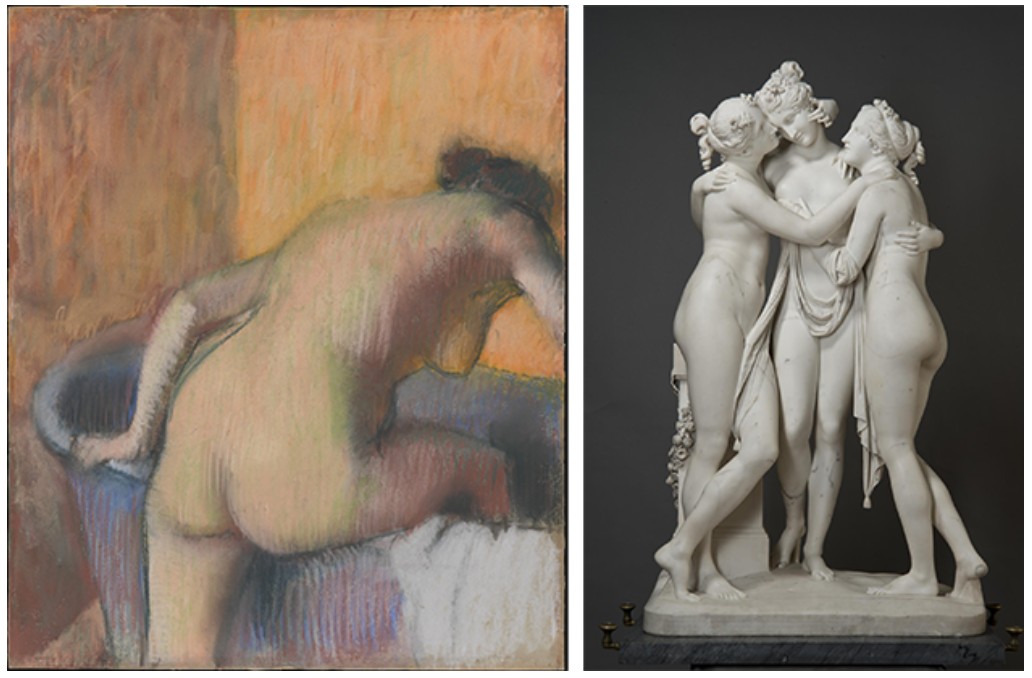
Left: Edgar Degas, Bather Stepping into a Tub, circa 1890, The Metropolitan Museum of Art, New York. Image: The Metropolitan Museum of Art, New York, H.O. Havemeyer Collection, Bequest of Mrs. H.O. Havemeyer, 1929
Right: Antonio Canova, The Three Graces, 1814, The Hermitage Museum, Saint Petersburg
Leaning forward, the two figures to the right engage in conversation with the woman on the left. Arm-in-arm and striding forwards together, there is an undeniable sense of familiarity and companionship between them; absorbed in their own world, they look at each other rather than acknowledging the viewer. Through a resolutely female gaze, Yiadom-Boakye offers a counterpoint to traditional, voyeuristic and idealized portrayals of women in Western art. Instead, she imbues her subjects with a profound sense of dignity, poise and presence. Unlike Degas’ passive bather or Canova’s hyper-feminine rendering of the female body, her figures exist on their own terms: self-aware, unposed and uninterested in being observed. Their identities are shaped not by narrative or allegory but by mood, gesture and the psychological depth that emerges from Yiadom-Boakye’s intuitive process.
“Although they are not real I think of them as people known to me. They are imbued with a power of their own… I admire them for their strength, their moral fibre.”
Conjured from memory and imagination, each figure in The Pearl for the Mackerel is instilled with an emotional depth and individuality that transcends fiction, becoming archetypes of Yiadom-Boakye’s magical visual universe of dreams.
Brutality by Any Other Name, 2011
Phillips New-York: 13 May 2025
Estimated: USD 1,000,000 – 1,500,000
USD 1,270,000
Lynette Yiadom-Boakye Modern & Contemporary Art Evening Sale
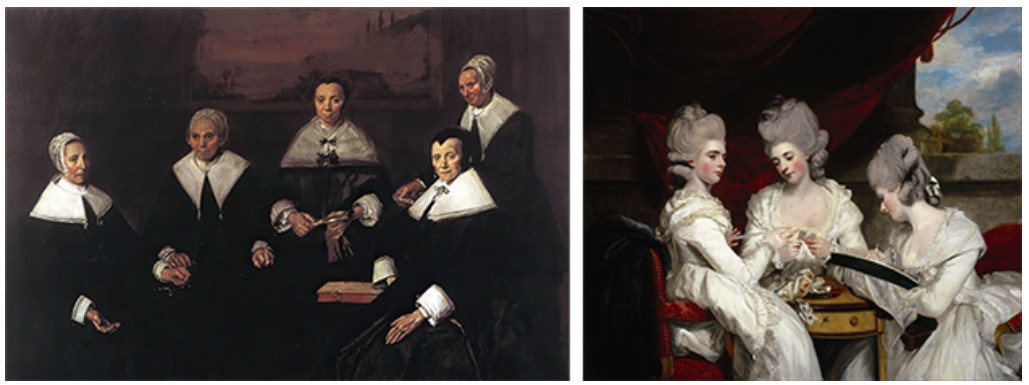
[Right] Joshua Reynolds, The Ladies Waldegrave, 1780–1781. National Galleries of Scotland, Edinburgh. Image: Archivart / Alamy Stock Photo
Composed with deliberate formal clarity, Brutality by Any Other Name presents four young women in a compressed, stage-like picture plane. This shallow space, evoking the flattened depth of Diego Velázquez or Édouard Manet, collapses distance and thrusts the figures forward, intensifying their presence. The work recalls Old Master compositions, particularly group portraits of the seventeenth-century Dutch Golden Age and early British modernity—such as Frans Hals’s The Regentesses of the Old Men’s Almshouse or the genteel Conversation Pieces of Joshua Reynolds and William Hogarth. In these historical precedents, group portraits project cohesion through uniformity while registering individual identity through gesture and expression. Yiadom-Boakye mirrors this tradition but subtly undermines its ideological underpinnings. Her figures are not marked by title, social rank, or allegorical intent. Their roles are neither clear nor categorizable; their identities resist fixed interpretation.
“I’ve been influenced by historic painters who share a certain devil-may-care mode of working, who were not so concerned with formal perfection or academic rules but with the physicality of paint, the act of painting…”
This ambiguity is a key element of the painting’s effect. Roughly school-aged and dressed alike, the imagined women of Brutality by Any Other Name wear clothing reminiscent of uniforms—with starched white collars poking out at the tops of V-neck knitted sweaters and the same ochre-orange jacket draped over each of their arms—yet are untethered from any specific institutional setting. This repetition of costume does not impose hierarchy but amplifies individuality through nuanced variations in posture, bearing, and facial expression. Their direct gazes confront the viewer, not as an invitation to narrative or seduction but as an assertion of presence. This confrontational stance draws on a long tradition of female sitters who meet the viewer’s eye, from the portraiture of Jean-Auguste-Dominique Ingres to Édouard Manet. Yet here, the mirrored stares diffuse singularity, forming a visual chorus rather than a solo.
“I’ve come to realize that having a measure of uncertainty is vital to the way I work.”
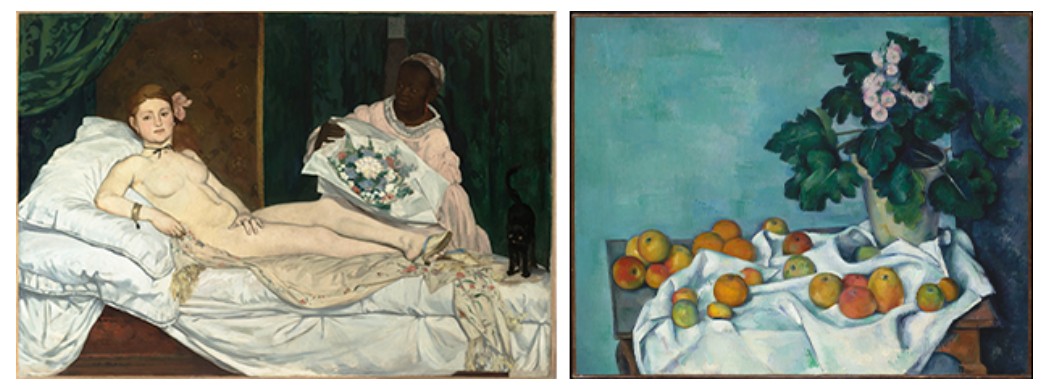 [Left] Édouard Manet, Olympia, 1863. Musée d’Orsay, Paris. Image: © RMN-Grand Palais / Art Resource, NY
[Right] Paul Cézanne, Still Life with Apples and a Pot of Primroses, c. 1890, The Metropolitan Museum of Art, New York. Image: The Metropolitan Museum of Art, New York, Bequest of Sam A. Lewisohn, 1951, 51.112.1
The mood of Brutality by Any Other Name is one of restraint and psychological opacity. Yiadom-Boakye’s earthy palette—burnt umber, olive green, ochre—recalls the tones of Rembrandt and Caravaggio, though without their theatrical chiaroscuro. The figures are intimately rendered yet curiously remote—together, but self-contained. Golden highlights and deep purple shadows shape the sculptural folds of the cloth held by each girl, anchoring the composition. These folds echo classical drapery but resist emblematic clarity. Yiadom-Boakye’s deft treatment of fabric—and her tendency to let figures emerge from and dissolve into similarly toned backgrounds—reveals her exuberant engagement with paint. Through underpainting and layered color, earlier marks seep through as modulated hues and shadows, creating passages of abstraction that recall postwar painters like Mark Rothko and, as has been observed, “speak of a kinship with Paul Cézanne’s tablecloths or the two large pillows on which Édouard Manet’s Olympia rests.”i Ultimately, the artist explains, “all marks are there to support the figure… It’s a continuous preoccupation to achieve the right balance between the skin of the figure and the surroundings.”
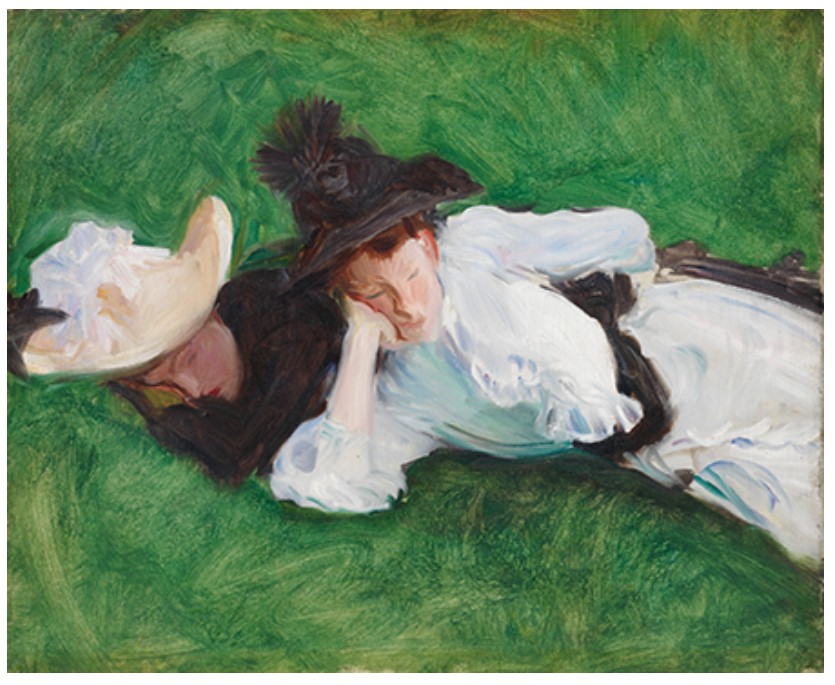 John Singer Sargent, Two Girls on a Lawn, ca. 1889. The Metropolitan Museum of Art, New York. Image: The Metropolitan Museum of Art, New York, Gift of Mrs. Francis Ormond, 1950, 50.130.20
Comparisons to late 19th- and early 20th-century painters such as John Singer Sargent are especially fruitful. Sargent’s Two Girls on a Lawn, ca. 1889 resonates in its presentation of ambiguous intimacy, narrative indeterminacy, and shared sensitivity to the fleeting, unspoken qualities of the everyday. Both artists employ a subdued palette—Sargent’s soft greens and sun-bleached whites echoing the quiet domesticity of the garden setting, while Yiadom-Boakye’s deeper tones generate a more earthy, contemplative atmosphere. What Sargent’s painting conveys through its quietude, and even its sense of muteness, finds resonance in Yiadom-Boakye’s quartet and the para-imaginary world they occupy. The women—or girls—in Brutality by Any Other Name are bonded by composition and proximity but remain emotionally opaque, their interiority carefully withheld. Yet the similarities ultimately underscore their divergence: Sargent’s subjects are rendered with observational clarity, anchored in a specific time, place, and social milieu. In contrast, Yiadom-Boakye’s imagined quartet exists outside time, their expressions charged with ambiguity and their presence unmoored from narrative context. Where Sargent records, Yiadom-Boakye invents—replacing biography with speculation, and transforming the portrait into a site of inwardness and possibility.
“I’ve always thought in terms of the mark-making as a language and the painting itself as a language; it was never about describing an idea, or describing a time, or describing a situation, but allowing for a language that speaks of a feeling, and a place, and a person, and a history and an existence in itself… Any form of explanation comes through sensation.”
This resonance extends further into American modernism. The stillness and sense of isolation in Brutality by Any Other Name echo, both tonally and atmospherically, the muted loneliness of Edward Hopper’s psychologically suspended visions of urban life, as seen in iconic works such as Nighthawks, 1942. Yiadom-Boakye’s figures are more physically proximate, they too are emotionally oblique—unreadable, present but unreachable. The setting itself is timeless and non-specific, suspended in imaginative space. As viewers, we are offered no clues to their identities, relationships, or purpose. The painting resists narrative closure, inviting us to linger in its ambiguity.
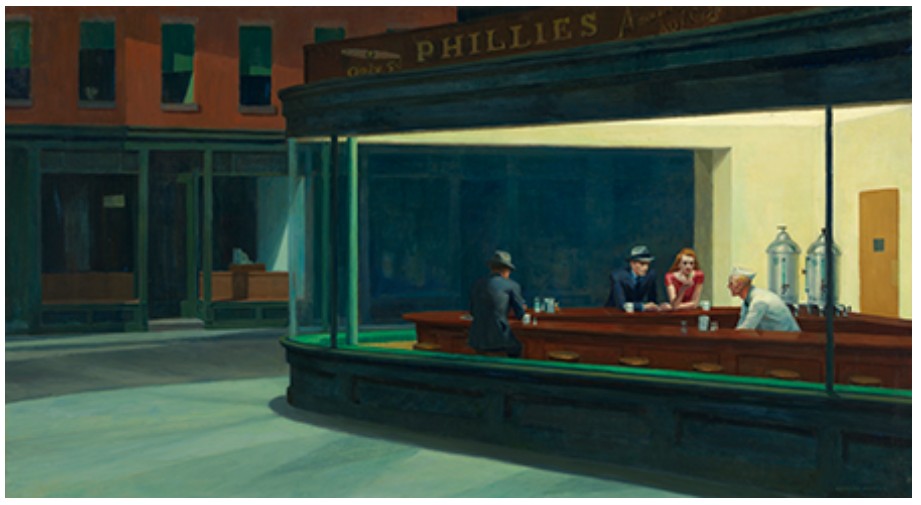
Portraits of two or more subjects began emerging in Yiadom-Boakye’s practice around 2009, yet one consistent feature remains: gender mixing is virtually absent from her canvases. “The conventional male/female dynamic is complete… it’s a narrative that doesn’t interest me,” she has said.iii Her focus, instead, is on camaraderie rather than romance. This sensibility is palpable in Brutality by Any Other Name, where the four young women convey a quiet solidarity—unified, but not uniform. Their body language is both guarded and open: arms crossed or held before them, chins slightly lowered, but meeting the viewer’s gaze with a spectrum of expressions, from coy restraint to wide, toothy grins. They seem to hover at the threshold of self-possession, projecting a kind of confident vulnerability that resists overdetermined narratives of innocence or defiance. Yiadom-Boakye has often emphasized that her figures are not exceptional, but familiar.
“When the issue of color comes up, I think it would be a lot stranger if they were white. After all, I was raised by Black people… for me this sense of a kind of normality isn’t necessarily celebratory, it’s more a general idea of normality.”
Yet in the context of Western portraiture, that very normalcy becomes radical. In Brutality by Any Other Name, the act of representing Black life as self-contained, unknowable, and wholly sovereign becomes a quiet political gesture. The figures do not perform or explain themselves. They are simply, unmistakably, there.
In Brutality by Any Other Name, those brushstrokes conjure not a mimetic reality, but an imaginative one—a speculative, alternate visual grammar that renders Black life with grace, complexity, and ambiguity. In this, Yiadom-Boakye shares affinities with artists such as Noah Davis, Barkley L. Hendricks, Jennifer Packer, and Amy Sherald, all of whom center Black figuration in their work. But where others may draw from specific histories or social commentary, Yiadom-Boakye’s relationship to fiction and temporality sets her apart. Her subjects are not tethered to chronology—they are not historical, contemporary, or utopian. They occupy a timeless, imaginative space that honors painterly tradition even as it rewrites it. Brutality by Any Other Name is not merely a reclamation of the portrait genre—it is a reconstitution of it. Through Yiadom-Boakye’s confident hand, the painting opens up a space not just for representation, but for infinite possibility.
Diplomacy I, 2009
Christie’s London: 28 June 2023
Estimated: GBP 1,000,000 – 1,500,000
GBP 1,371,000 / USD 1,747,440
LYNETTE YIADOM-BOAKYE (B. 1977), Diplomacy I | Christie’s (christies.com)
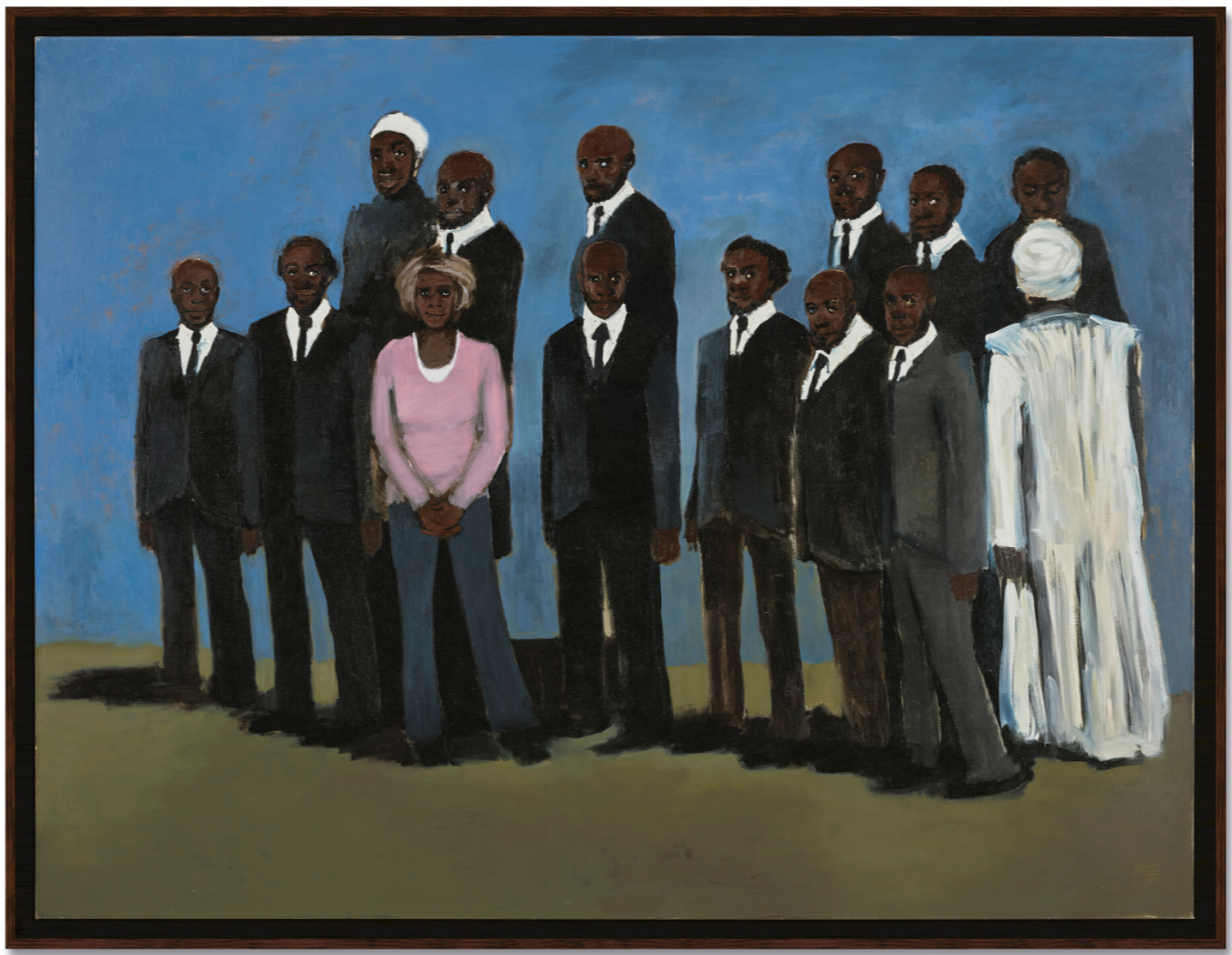
LYNETTE YIADOM-BOAKYE (B. 1977)
Diplomacy I, 2009
Oil on canvas
190.2 x 250 cm (74 7/8 x 98 3/8 inches)
Signed with the artist’s initials, titled and dated ‘LYB 2009 DIPLOMACY I’ (on the reverse)
Included in Lynette Yiadom-Boakye’s landmark retrospective at Tate Britain, London earlier this year, Diplomacy I is an icon of her practice. Painted in 2009, it belongs to a trio of works that represent her first major group compositions. The paintings depict a group of suited delegates, recalling Marion Kaplan’s photographs of African Heads of State at a summit in Uganda in 1967. Into each work, however, Yiadom-Boakye has inserted a single woman, here incongruously clad in pink. Executed at the dawn of her rise to critical acclaim, the work captures many of the ideas and techniques that have since come to define her practice. Important conversations about race and gender lurk in the shadows; echoes of art history simmer amid rich, expressive brushwork. In an image of diplomatic relations, Yiadom-Boakye invites us to consider how stories we thought we knew might be retold. Scenes of ceremony and celebration recur throughout Yiadom-Boakye’s oeuvre. In the present work, the figures assemble against a velvety blue backdrop, their shadows long upon the ground. Their gazes are fixated on the viewer as if posing for a photograph, the whites of their eyes gleaming through the texture. A single figure, in long white Sudanese robes, stands with his back to the spectator. Yiadom-Boakye’s lone woman glows brightly amid the ensemble: centered and poised, she assumes an air of quiet authority.
At the time of the present work, Yiadom-Boakye was beginning to take her place on the international stage. 2010 would see her first major institutional show open at the Studio Museum in Harlem. Shortly afterwards, her landmark presentation at the Chisenhale Gallery, London, earned her a nomination for the 2013 Turner Prize. Plucked from her imagination, though often informed by pre-existing images, her fictional characters wrote bold new chapters for Black representation in art. Yet while political narratives strain at the edges of her compositions, Yiadom-Boakye does not lay claim to specific messages or agendas. Her subjects are Black, she explains, because she is: they are extensions of her imagination. Similarly, the women who haunt the Diplomacy series are there for themselves, as much as for their meaning.
“I want the painting to feel timeless… we know what political art is supposed to look like, but I think there are many ways to make it.”
Here, the piercing, direct gazes of the figures conjure memories of Edouard Manet and Edvard Munch; the solemnity of the affair, meanwhile, invokes Henri Fantin-Latour’s 1864 painting Hommage à Delacroix. For all their ceremonial uniformity, each figure is precisely and individually wrought, a multitude of fleeting emotions registering upon their faces. We do not know where they have come from; nor do we know where they are going. Yet, captured in a brief moment of inexplicit congregation, they reveal more about the dynamics of history, painting and human interaction than any narrative canvas.
Les Partisans (The Partisans), 2009
Christie’s London: 28 February 2023
Estimated: GBP 800,000 – 1,200,000
GBP 1,002,000 / USD 1,208,650
LYNETTE YIADOM-BOAKYE (B. 1977), Les Partisans (The Partisans) | Christie’s (christies.com)
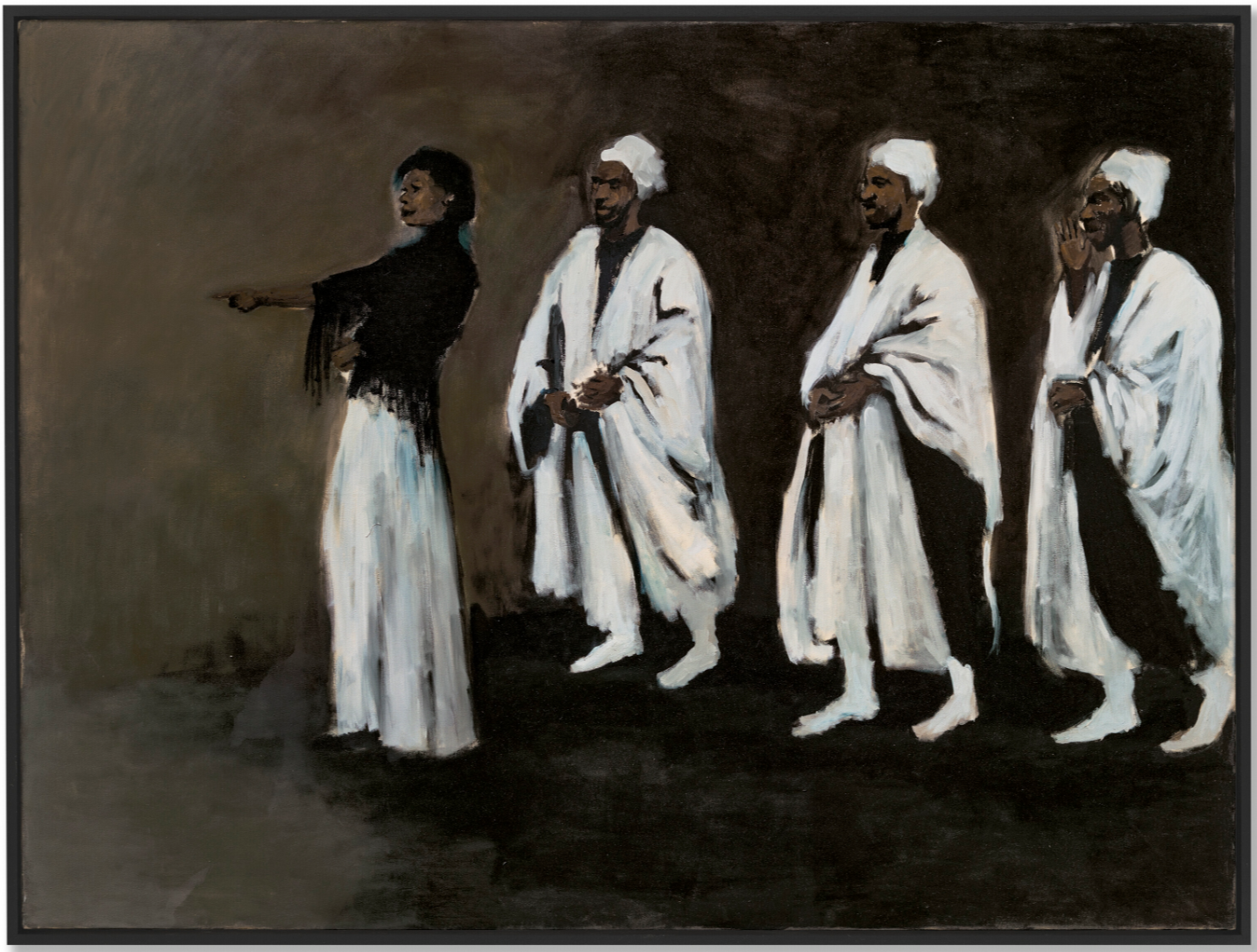
LYNETTE YIADOM-BOAKYE (B. 1977)
Les Partisans (The Partisans), 2009
Oil on canvas
150.8 x 200 cm (59 3/8 x 78 3/4 inches)
Signed with the artist’s initials, titled and dated ‘LYB 2009 Les Partisans’ (on the reverse)
An enthralling tableau spanning two metres in width, Les Partisans is an important early work by Lynette Yiadom-Boakye. From layers of rich, tactile brushwork and velvety chiaroscuro, a group of figures emerges, bathed in exquisite tonal contrasts. Three men, dressed in dazzling white robes, look to their leader: a woman, who points the way out of the darkness towards the light in the distance. Painted in 2009, the work is closely related to Yiadom-Boakye’s celebrated three-part series Diplomacy, the first instalment of which features in her current retrospective at Tate Britain, London. Resembling photographs of political conventions, these works represent her earliest major group compositions, each featuring a single woman amid a gathering of men. Significantly, this was the first time the artist had included both genders in her portraits: a strategy that continues to remain rare within her oeuvre. Here, binary oppositions—male and female, illumination and shadow—are eloquently intertwined. The three men, like the three magi, assume the role of disciples; the woman, flickering with Yiadom-Boakye’s own likeness, becomes the prophet. A new dawn breaks just beyond the picture plane, its light seeping into her world. In 2009, Yiadom-Boakye was poised on the brink of acclaim. The following year would see her first major institutional show open at the Studio Museum, Harlem, followed by her landmark presentation at the Chisenhale Gallery, London, which earnt her a nomination for the 2013 Turner Prize. Les Partisans, along with the Diplomacy series, captured many of the ideas that have since come to form the matrix of her practice. Plucked largely from her imagination, though frequently informed by art history and other external sources, Yiadom-Boakye’s fictional characters play out enigmatic scenarios. Though she has claimed that her depiction of black figures is not intended to be explicitly political, she is nonetheless conscious that they frequently spark politicized narratives. For all their apparent timelessness, the works’ references to ‘partisans’ and ‘diplomats’ prompts the viewer to think about the diaspora and the role of black leaders in global history: the curator Okwui Enwezor has compared the series to Marion Kaplan’s photographs of East African leaders at a summit in 1967. In Les Partisans, such implications work in poetic counterpart with the painting’s nod to Western religious iconography: an epiphany of some description has occurred, but its precise nature—spiritual, political, cultural—is left entirely to the viewer’s imagination.
The work’s political overtones also extend to its focus on a female leader. As well as playing with art-historical settings and genres in which black figures were typically not represented, Yiadom-Boakye also considers scenarios from which women have been largely absent. As Enwezor writes, the singular presence of a female protagonist in each of these large-scale group portraits serves to disrupt ‘the all-male club of leaders. The insertion of the female character into the field of power suggests a mild critique of representations of postcolonial heroism in which women play no role’ (O. Enwezor, ‘The Subversions of Realism’, in Lynette Yiadom-Boakye: Any Number of Preoccupations, exh. cat. Studio Museum of Harlem, New York 2010, p. 30). In both Les Partisans and the Diplomacy series, the woman in question seems to have been cut and spliced from another realm, her garments out of kilter with those of her companions, and her form seemingly bathed in an otherworldly light. That light—consciously imported from the paintings of Goya, Manet, Ingres and other patriarchs of the Western canon—is endowed with new meaning. It is no longer a conduit to the past, but a means of illuminating marginalised narratives, and of showing alternative ways forward.
Other Series
Shoot The Desperate, Hug The Needy, 2010
Christie’s New-York: 21 May 2026
Estimated: USD 700,000 – 1,000,000
USD 825,500
LYNETTE YIADOM-BOAKYE (B. 1977), Shoot The Desperate, Hug The Needy | Christie’s
LYNETTE YIADOM-BOAKYE (B. 1977)
Shoot The Desperate, Hug The Needy, 2010
Oil on canvas
200×180 cm (78-3/4 x 70-7/8 inches)
Signed with the artist’s initials, titled and dated
‘Shoot the Desperate, Hug the Needy LYB 2010’
(on the reverse)
“In many ways, I think less about the figures than I do about how they are painted.
I ceased to see the paintings as portraits a long time ago.
Thus, I don’t really see them as ‘characters’ in the individual sense, as personalities or people with specific traits.
I always think of them as somehow beyond these things.
They exist entirely in paint.”
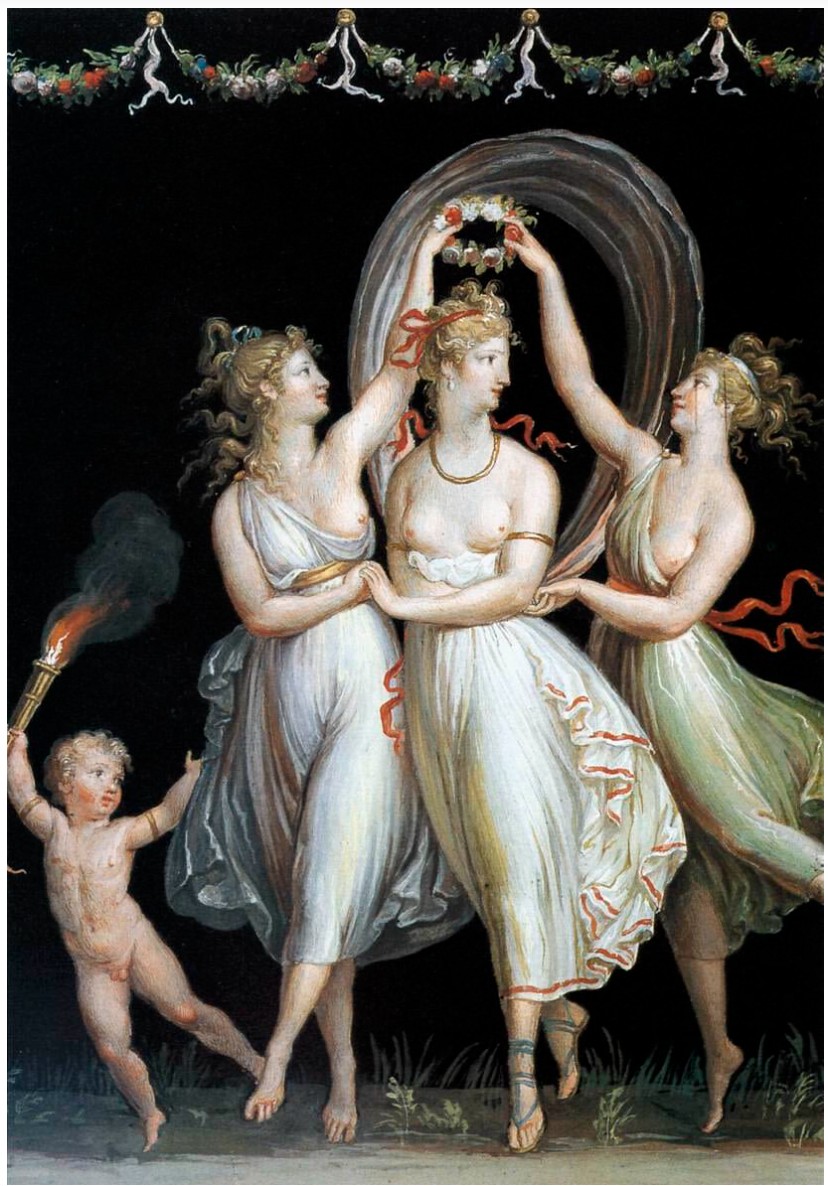
Antonio Canova, The Three Graces, 1799 (detail). Museo Canova, Italy.
Victory Sweatsuit II, 2008
Bonhams New-York: 20 May 2026
Estimated: USD 350,000 – 550,000
USD 381,500
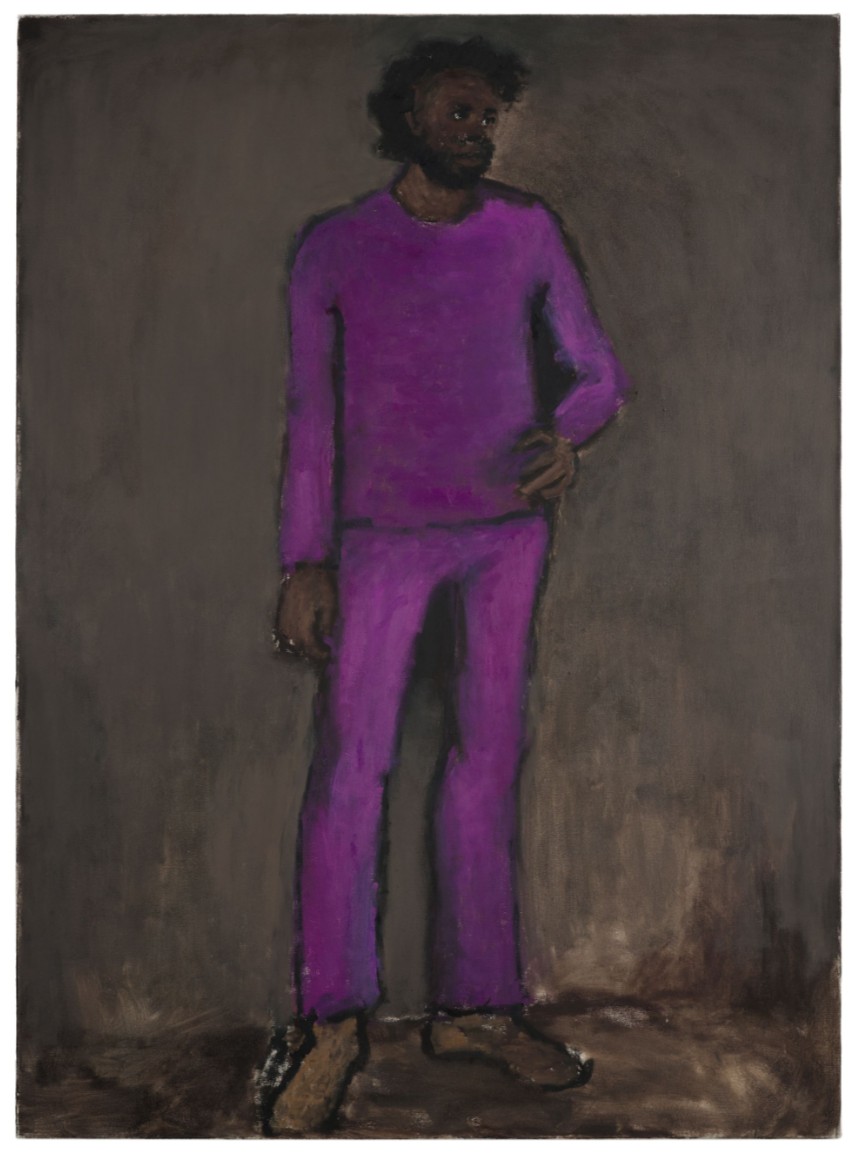
Victory Sweatsuit II, 2008
Oil on canvas
130 x 95.4 cm (51-1/4 x 37-1/2 inches)
Signed indistinctly, inscribed and dated ‘Victory Sweatsuit II 2008’ (on the reverse)
Painted the year Barack Obama won his first presidency, Victory Sweatsuit II nevertheless carries a quiet, resonant charge. Without overt reference, Yiadom-Boakye’s imagined figure inhabits a moment of shifting possibility. The work registers a moment of historical inflection with a poignant dignity and nuance. Reviewing her New Museum exhibition for The New Yorker in 2017, novelist Zadie Smith commented: “we have become used to titles that ironize or undercut what we are looking at, providing conceptual scaffolding for feeble visual ideas, or weak punch lines to duller jokes. For Yiadom-Boakye, titles are allusive; they should be considered, she has said, simply ‘an extra mark in the paintings'” (Zadie Smith, “Lynette Yiadom-Boakye’s Imaginary Portraits,” The New Yorker, June 12, 2017, Online). This historical tether, worn lightly through its title and recentering of Black identity, confers an elegant and authentic social-political weight upon the painting; an undeniable moment of quiet conquest as the arc of history at last bends toward justice.
In Victory Sweatsuit II, the figure’s gaze is averted from the viewer; yet the stark white of his eyes reflects the pensiveness of someone lost in thought. There is something quietly confrontational about his stillness as the onlooker is drawn in, compelled to decipher what he sees and feels. As so often in Yiadom-Boakye’s oeuvre, the subject inhabits a private world entirely their own: present before us, yet unreachable, dreamy, and enigmatic. The apparent simplicity of the figure invites reflections on the artist’s use of color and light as Yiadom-Boakye paints quickly, without an imprimatura. In Victory Sweatsuit II, the intuitive brushstrokes build a moody ambience, while chiaroscuro’s nuances and shades create a dramatic effect, making the figure emerge from the background as if conjured from the ground itself. Rich in color, the oil paint is applied in thin, progressive layers, revealing the texture of the canvas underneath.
Womanology, 2010
Phillips London: 6 March 2025
Estimated: GBP 350,000 – 450,000
GBP 444,500 / USD 569,280
Lynette Yiadom-Boakye – Modern & Conte… Lot 25 March 2025 | Phillips
LYNETTE YIADOM-BOAKYE
Womanology, 2010
Oil on canvas
190.2 x 200.3 cm (74 7/8 x 78 7/8 inches)
Signed with the artist’s initials, titled and dated ‘LB 2010 Womanology’ on the reverse
Painted in 2010, Womanology forms part of a conceptual suite of works by acclaimed British painter Lynette Yiadom-Boakye that gesture towards an ongoing exploration of femininity, identity, and observation in her practice. The self-reflective nature of Womanology also speaks to Yiadom-Boakye’s position as an established female artist working within the long tradition of portraiture and figurative painting. It was a highlight of the eponymous exhibition from the esteemed collection of José Ramón Prieto at the Museo de Bellas Artes in Bilbao in 2021, showcasing a selection of works exclusively by women artists, and positioning Yiadom-Boakye as the leading figure at the very forefront of this contemporary pantheon alongside internationally acclaimed figures such as Marina Abramović, Louise Bourgeois, and Tracey Emin. Rendered in deft, broad strokes of subtle, earthy hues, the architecture of the composition in Womanology centers around a single female figure, comprising a pared-back sequence of effortless brushstrokes that distinguish her form from the muted surroundings. In the distance, two luminous figures traverse the horizon line, their presence creating a relative sense of pictorial space and depth. In this more liminal landscape, it is the central protagonist who grounds and guides us, a horizontal swathe of deep, rich blue pigment drawing the viewer eye’s inwards towards her face, the composition’s vanishing point framed by her light-colored hood. Catching the line of her gaze, our eye is sent back out across the canvas towards the characters in the distance, an oscillation that dramatizes the question of looking itself.
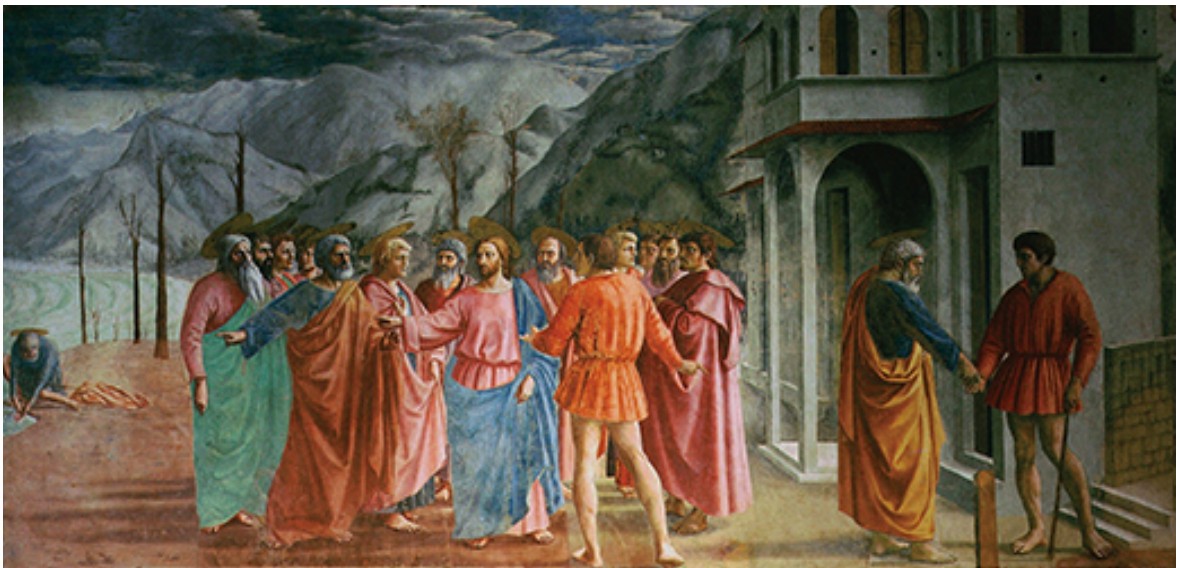
Masaccio, The Tribute Money, c. 1424-1427. Chapel Brancacci, Florence
In contrast to the indistinct, tonal backdrops that were more typical of her early work, in this transitional composition, the figures are set within a spatial if somewhat ‘placeless’ environment. The visual logic here recalls the early implementation of linear perspective in Renaissance painting, aligning the artist with the history of figuration in the Western canon as in the early 15th century, when pioneering artists such as Masaccio were striving to represent the illusion of depth on a two-dimensional surface. Yiadom-Boakye’s subtle nod to the forefathers of single-point perspective is evident in the diminishing figures receding into the distance of the present work, coupled with the converging parallel lines of the landscape. In the early workings of linear perspective, the directional pull of the guiding lines could be used to convey an underlying sense of continuous narrative, leading the viewer from one scene to the next. In Womanology, the ambiguity of the landscape and the identity of the figures resists any kind of literal interpretation. Instead, Yiadom-Boakye invites the viewer to contemplate and reconstruct the surrounding contextual narrative. A writer as well as a painter, her canvases serve as intimate painterly fictions. Imagined scenarios, like film-stills extracted from a wider narrative, punctuate her artistic practice, fragments of storylines that lie just beyond our conceptual reach. In doing so, she confronts many of the traditional notions of the genre of portraiture; her subjects are not real-life sitters, but figments of her imagination.
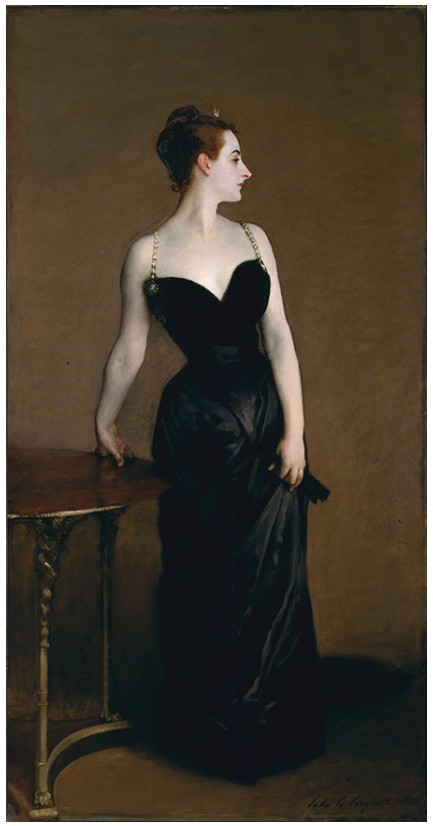
John Singer Sargent, Portrait of Madame X, 1884, The Metropolitan Museum of Art, New York.
Image: The Metropolitan Museum of Art, New York, Arthur Hoppock Hearn Fund, 1916, 16.53
The influence of British portrait painter John Singer Sargent on Yiadom-Boakye’s painting style is well documented, and is evidenced beautifully in the present work, both technically and conceptually. Take for example Singer Sargent’s 1884 Madame X, arguably one of his most recognizable portraits and now held in the permanent collection of The Metropolitan Museum of Art in New York. The portrait shows a single female figure, her head turned to the right, away from the viewer and gazing into the middle distance, drawing remarkable visual parallels with Womanology. Even the opulent, umber tones, subtle highlights and soft, painterly brushstrokes are reminiscent of Sargent’s famous work. But what draws the most striking parallel here is the unknowability of the sitter, famously referred to as the anonymous ‘Madame X’. American socialite and acquaintance of the artist in Paris, the subject was in fact Madame de Gautrot, her reputation so tarnished by the scandalous portrait that her name was relegated to the pages of history. Sensitive to his sitter’s need for some anonymity, Sargent himself requested that her name be withheld when the work was acquired by The Metropolitan Museum of Art. Much like the figures populating Yiadom-Boakye’s canvases, this ambiguity enables viewers to reconstruct these stories for themselves.
Militant Pressures, 2016
Sotheby’s London: 9 October 2024
Estimated: GBP 700,000 – 1,000,000
GBP 780,000 / USD 1,021,685
Militant Pressures | Contemporary Evening Auction | 2024 | Sotheby’s
LYNETTE YIADOM-BOAKYE (b. 1977)
Militant Pressures, 2016
Oil on linen
200 x 130.2 cm (78 3/4 x 51 1/4 inches)
Signed, titled and dated 2016 (on the reverse)
Executed in 2016, Militant Pressures by Lynette Yiadom-Boakye espouses an auratic and mesmerizing sensibility, inviting the viewer into a world of quiet intensity and profound introspection. Dominating the composition, a ballerina exudes a palpable tranquility, yet every muscle and limb is flexed and taut, signifying the strength and beauty of her artistry. Dressed in a leotard and emerald tights and set against a backdrop of expressively rendered and varied green hues, the present figure demonstrates Yiadom-Boayke’s rigorous investigation of colour, light, and composition. Retaining spontaneity in the form of loose brushstrokes and spirited mark making, the artist approaches the canvas just like her pirouetting subjects; with passion, gusto, and improvisation, sharing with her protagonists a visible exuberance and joy for creation. A testament to the importance of the present work is its rich exhibition history, in which Militant Pressures was exhibited at the Kunsthalle Basel in 2017, the artist’s first institutional solo show in Switzerland.
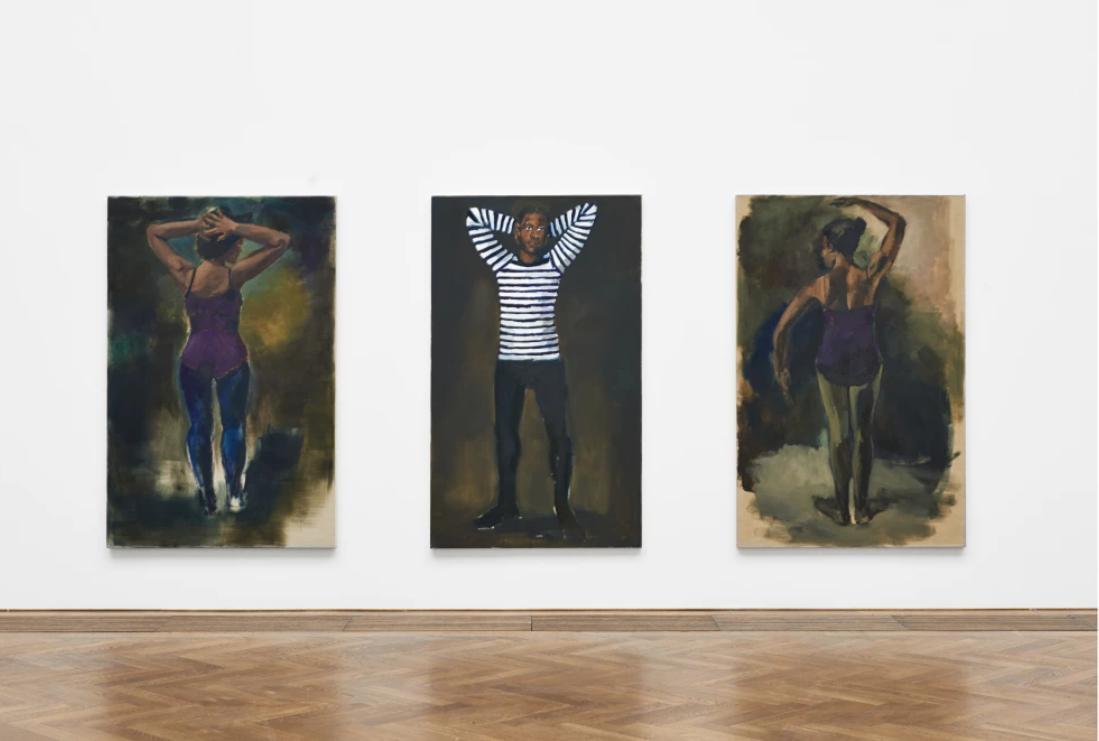
Lynette Yiadom-Boakye, Installation view A Passion To A Principle, Kunsthalle Basel, 2016, view on (f.l.t.r.) Pressure From A Didact, Witching Hour, Militant Pressures (all 2016). Image: Philipp Hänger
As underlined by her major travelling retrospective Fly In League With The Night in 2020, Yiadom-Boakye repeatedly and exclusively paints the Black experience. In Militant Pressures we see the return of the ballerina as Yiadom-Boakye’s subject; a a recurrent motif instilled with elegance and grace that echoes the canon of post-Impressionism. Taking Édouard Manet, Edgar Degas, and Walter Sickert as a point of departure, Yiadom-Boakye addresses and subverts traditional modes of portraiture and an art historical legacy that has been almost exclusively written by Caucasian men depicting almost exclusively Caucasian subjects. Indeed, the present work departs from typical depictions of the Black female body in Western art, which are often associated or invested with sorrow, pain, or martyrdom. As such, Yiadom-Boakye asks us to consider and situate Militant Pressures within the Western canon at large, re-imagining and re-historicizing the very genre of portraiture itself to remedy the systemic racial disparity that exists in the history of art.
“I realized early on that painting from life wasn’t something that I was all that invested in. I was always more interested in the painting than I was the people. For me, removing that as a compulsion offered me a lot more freedom to actually paint and think about color, form, movement, and light”
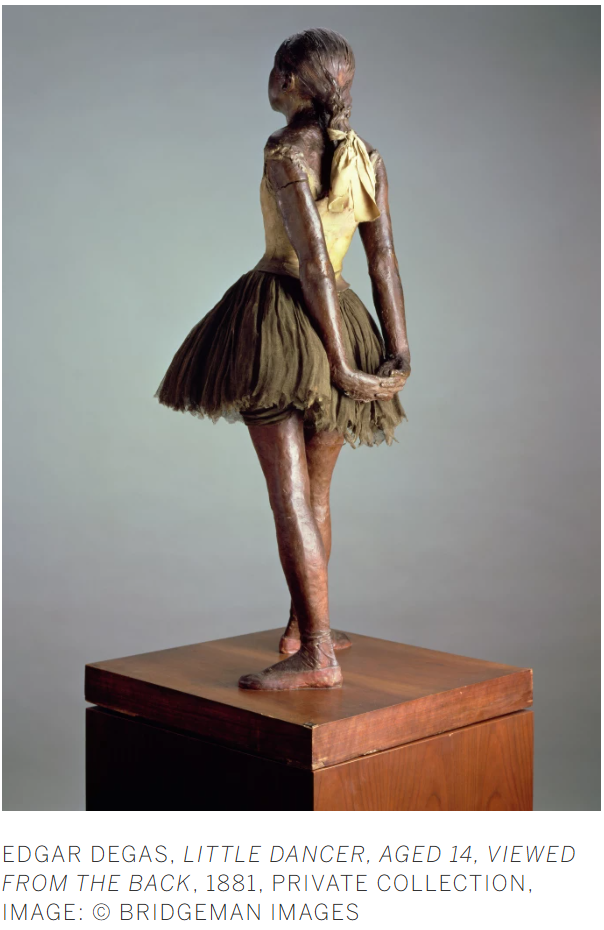
While Degas painted models from life, Yiadom-Boakye’s enigmatic characters are drawn from her imagination. The ballerina, like many of her mystifying figures, are quasi-fictitious subjects inspired by the artist’s photographic archive of family photographs and media clippings. Turning to the mechanics of painting itself for which portraiture serves a vehicle, Yiadom-Boakye encourages her viewers to engage with the canvas directly, unencumbered by narrative. Demonstrating a spellbinding ability to capture the motion of her figures through luminosity and the interplay between shadow and light, the artist often completes her paintings in just one day, adopting an alla prima, or wet-on-wet, technique akin to fresco painting. Further displacing her figures in time and space, the dancer wears no shoes, garment or style that places her in any given period, status, or class. Adopting stock motifs found in the era of commedia dell’arte, Yiadom-Boakye is often anachronistic and consciously atemporal. As elusive as the bodies she paints, meanings behind the given titles of her paintings are equally evasive.
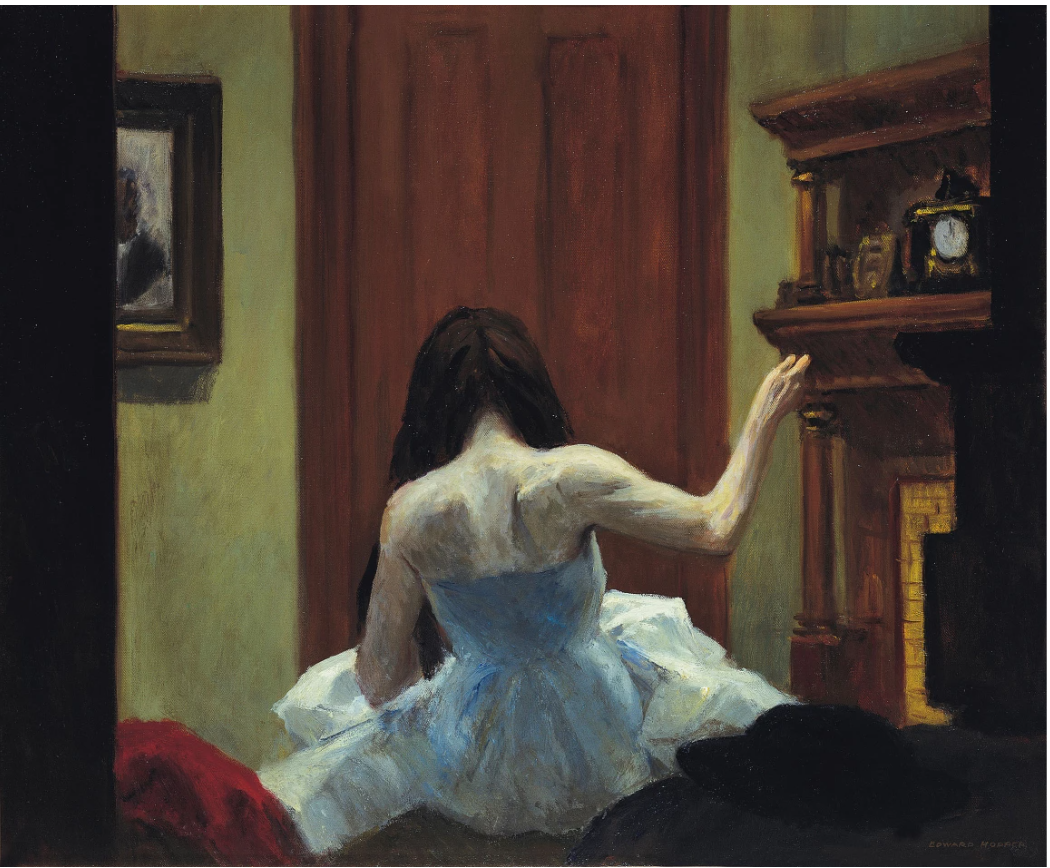
Edward Hopper, New York Interior, 1921, Whitney Museum of American Art, New York, Image: Josephine N. Hopper Bequest 70.1200. © Heirs of Josephine Hopper/ Licensed by Artists Rights Society (ARS) NY/DACS, London 2024
Yiadom-Boakye’s ballerina defies affiliation with the marginalized. The strength of the female form instead displays a subtle mixture of vulnerability and power, unperturbed and tranquil, adding to the often-unrecognized tradition of images of black nobility. Yiadom-Boakye seeks to normalize and equalize the Black body in our visual consciousness, recalibrating the historic and endemic erasure and exclusion of it. Reclaiming space within the institutions of art history and in the Western cultural canon, therefore, Militant Pressures is an ethereal and beguiling jewel, an exemplar of Yiadom-Boakye’s painterly practice and a work that confirms her status as one of the most significant and acclaimed figurative painters of her generation.
Minotaur To Matador, 2022
Phillips London: 27 June 2024
Estimated: GBP 900,000 – 1,500,000
GBP 952,500 / USD 1,207,770
https://www.phillips.com/detail/lynette-yiadomboakye/UK010424/5
LYNETTE YIADOM-BOAKYE
Minotaur To Matador, 2022
Oil on linen, triptych
Each: 109.8 x 70.3 cm (43 1/4 x 27 5/8 inches)
Overall: 109.8 x 220 cm (43 1/4 x 86 5/8 inches)
Signed, titled and dated ‘Minotaur To Matador 2022 Lynette Yiadom-Boakye’ on the reverse of each part
A contemporary master of static drama and narrative ambiguity, Turner Prize nominated Lynette Yiadom-Boakye’s portraits continue to push against the boundaries of the genre, engaging with its rich history while challenging certain expectations and assumptions. Executed in 2022, Minotaur to Matador is an exceptional example of Yiadom-Boakye’s technical precision, remarkable painterly fluency, and virtuoso command of color and tone, its triptych format a striking and unusual pictorial device used by the artist here to powerful effect.
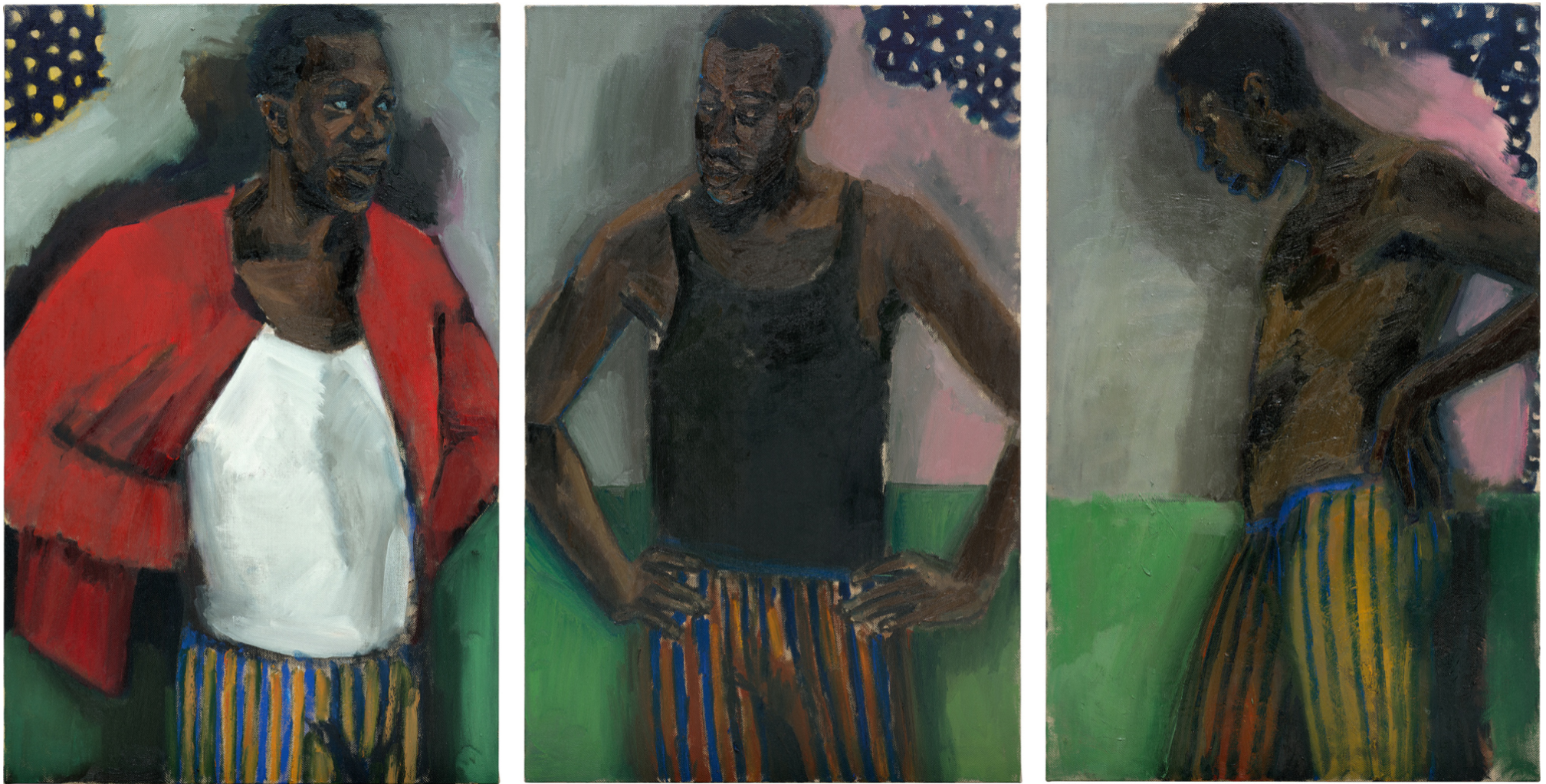
Originating in the Middle Ages, triptychs are most typically associated with religious subjects, depicting Biblical stories and originally functioning as devotional aids for a mostly illiterate lay congregation. Offering a powerful means of visualizing the teaching of Christianity, the triptych form also enabled the inclusion of multiple narrative elements and characters into a single work. Enigmatic and alluring, Minotaur to Matador updates this visual language, introducing a strikingly cinematic quality to the presentation of the figure across three panels here, subtle changes in pose and dress anchored in the recurring bold striped pattern of the subject’s trousers and unusually brightly rendered background.
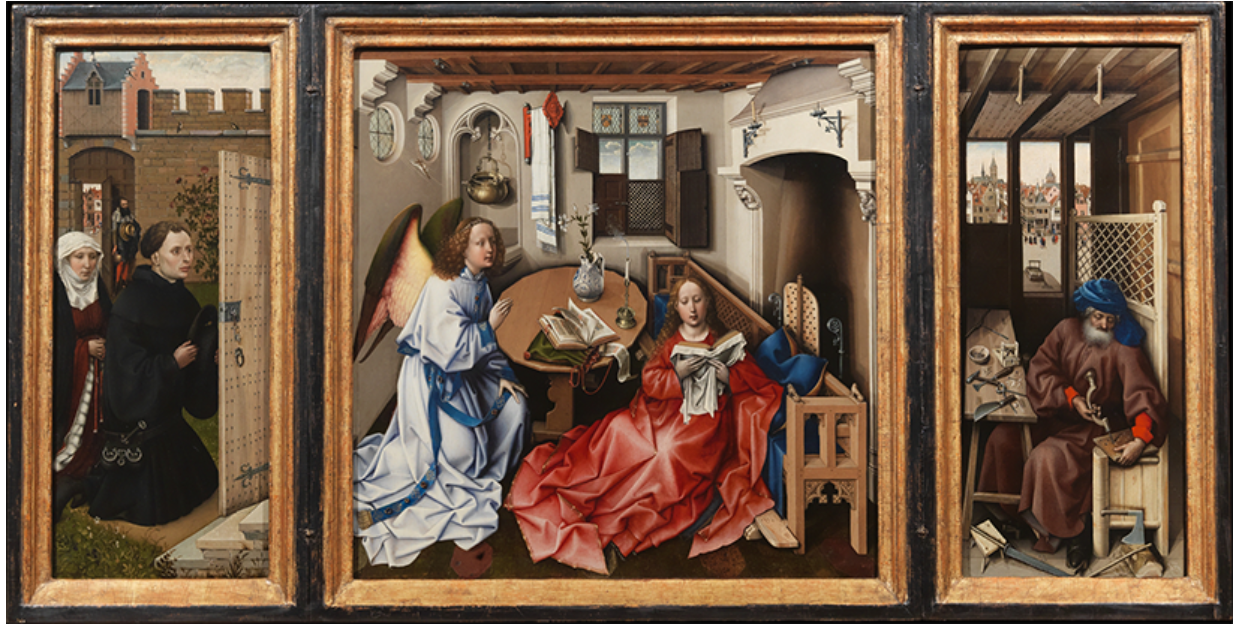
Robert Campin, The Mérode Altarpiece (The Annunciation Triptych), circa 1427-1432, The Metropolitan Museum of Art, New York. Image: © The Metropolitan Museum of Art, New York, The Cloisters Collection, 1956, 56.70a-c
Executed in stunning contrasts of cadmium red, brilliant blues, and iridescent gold tones against a softly shifting backdrop of warmer greys and pinks, the work’s chromatic consistency reinforces this sense of narrative progression, the tripartite structure providing a visual analogue to the typical narrative structure of beginning, middle, and end. The title too seems to imply a transition from one state to another – charting an evolution from mythic beast to human master that works on both physical and psychological levels here. Cutting against the grain, the transition implied by the title encourages us to read the triptych from right to left, following the protagonist from a state of undress through to his transformation into civilized ‘Matador’, theatrically emphasized in the open sweep of his brilliantly red jacket. With the head of a bull and the body of a man, the Minotaur is a creature from classical mythology, incarcerated at the center of a complex subterranean labyrinth by the order of King Minos of Crete. A story of cruelty, lust, and the consequences for disobeying the will of the Gods, the Minotaur’s creation was the result of an unnatural union between a bull and Minos’ wife Parsiphaë, bewitched by Poseidon as punishment for the King’s refusal to sacrifice the majestic creature in his honor. Typically depicted as a ferocious beast who feasted on human flesh, it was the young Theseus who eventually triumphed over the creature with the help of Minos’ daughter Ariadne. A foundational myth of western civilisation, the Minotaur also lends itself to more psychological interpretations, often taken to symbolise the repressed fears and desires dwelling in the dark labyrinth of our subconscious. Given these contexts, Yiadom-Boakye’s Minotaur to Matador seems to quietly dramatize this conflict, charting a path from our raw, animalistic selves to the self-possession and mastery of the Matador, who slays the wild animal in a dramatic, performative fashion.
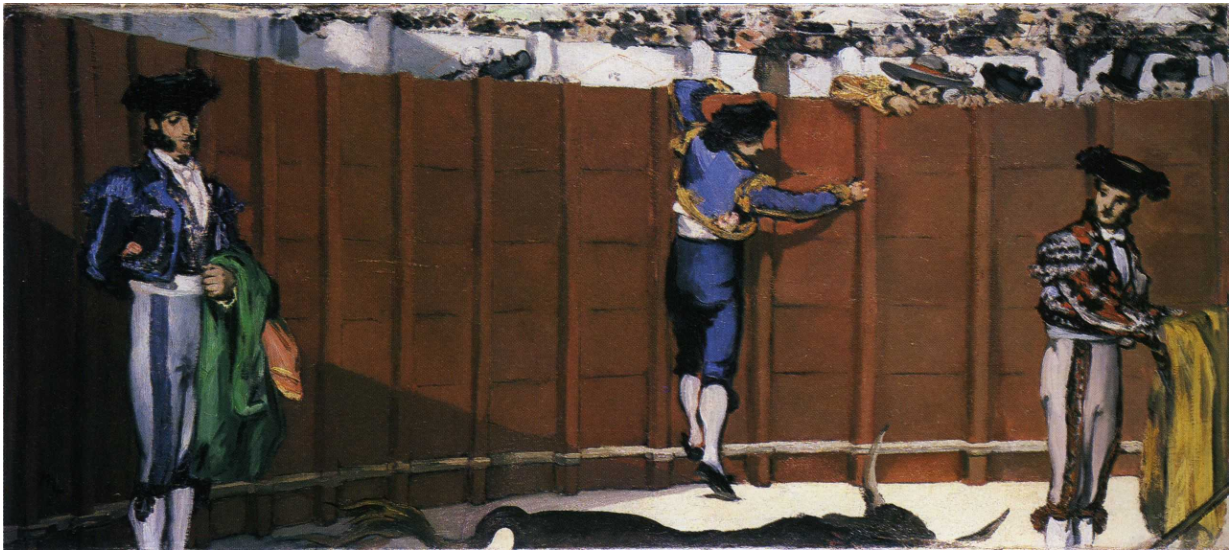 Édouard Manet, The Bullfight, 1864-65, The Frick Collection, New York. Image: The Picture Art Collection / Alamy Stock Photo
While the figure of the Matador has a long art historical legacy including works by Francisco Goya, Édouard Manet, and Francis Bacon, the exchange between the figures of Minotaur and Matador were most profoundly explored across the career of modern master Pablo Picasso, appearing amongst his very earliest and latest works. Heavily autobiographical, Picasso treated the Minotaur as a potent symbol of masculine virility and brutality, featuring prominently in his erotically charged paintings from the 1920s and beyond. Dramatizing the internal struggle between civilized man and wild beast, Picasso appropriated the potent symbolism of the mythical creature as a means of exploring the irrationality of the unconscious and of working through his own, turbulent love affairs of the period. Deeply embedded in the culture of his native Andalusia, Picasso was an avid fan of bullfighting, and of the stark contrasts between beauty and horror, dance and violence that the spectacle presented. Although Picasso turned to these sources throughout his career, the figure of the Matador made a significant and sustained appearance towards the end of his life, the older painter aligning himself with the skilled, heroic, and triumphant bullfighter who exists so closely to the line that divides life from death. Drawing on these rich art historical dialogues, Yiadom-Boyake takes a more subtle approach, her serene composition evading the brutality and overt eroticism of Picasso’s treatment of the motif in favor of a more ambiguous and quietly introspective tone. Liberated from the need to tell specific truths about individuals limited by real-world constraints, through her confident brushstrokes, rich palette, and Baroque flourishes Yiadom-Boakye creates a world apart, not in order to simply insert Black bodies into space historically occupied almost exclusively by representations of Whiteness – although they certainly challenge on this point – but to open up an expansive space of imaginative possibility and infinitude, not within the canvas itself, but within the imaginative exchange between artist, painting, and viewer.
5am, Cadiz, 2009
Christie’s London: 27 June 2024
Estimated: GBP 600,000 – 800,000
GBP 567,000 / USD 718,956
LYNETTE YIADOM-BOAKYE (B. 1977) (christies.com)
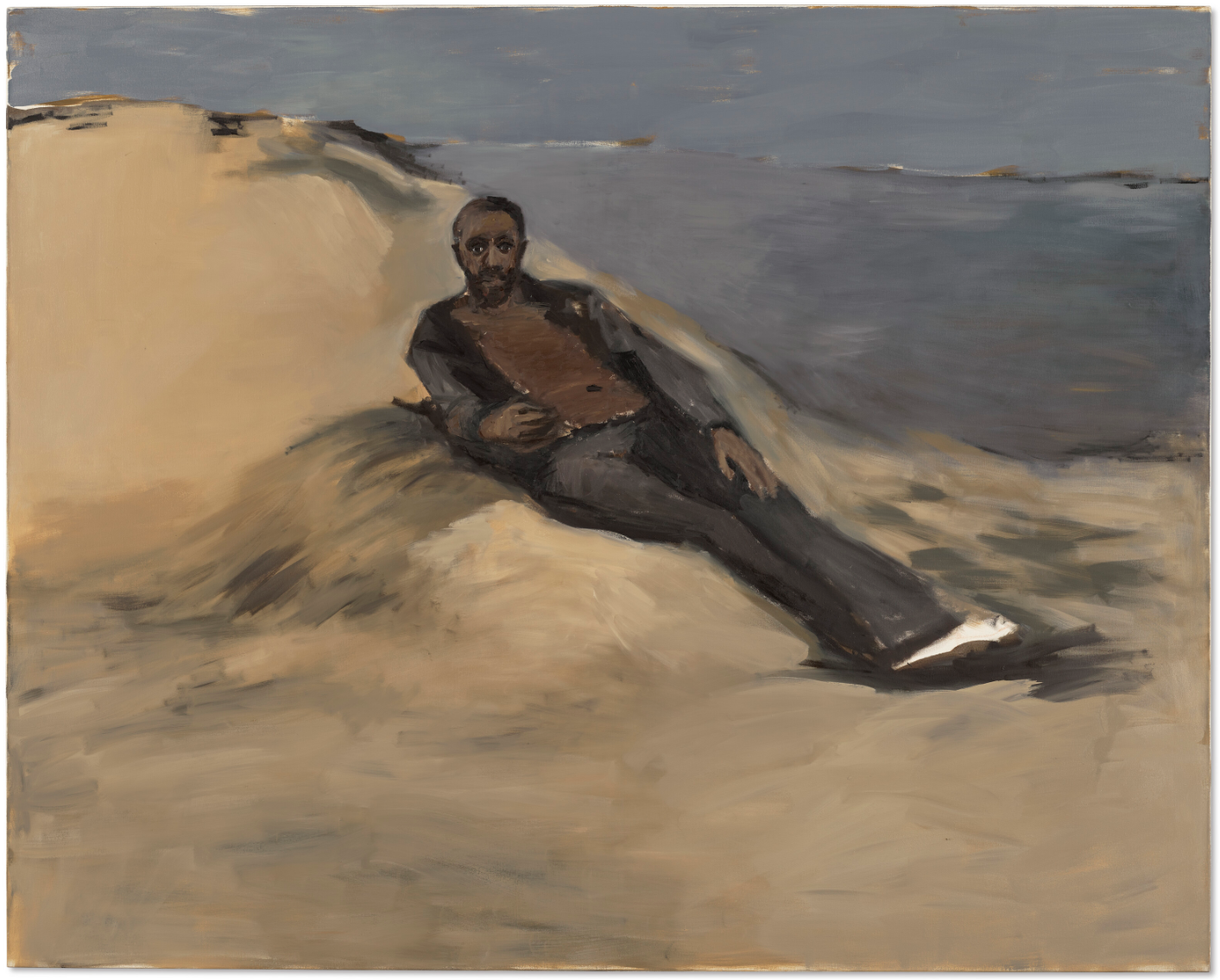
LYNETTE YIADOM-BOAKYE (B. 1977)
5am, Cadiz, 2009
Oil on canvas
160×200 cm (63 x 78 3/4 inches)
Signed with the artist’s initials, titled and dated ‘LYB 2009 5am Cadiz’ (on the reverse)
Spanning an impressive width of two metres, 5am, Cádiz (2009) is a characteristically enigmatic painting by Lynette Yiadom-Boakye. Propped on one arm, a male figure reclines languidly against a shimmering seascape, and stares ahead at the viewer with striking directness. Interested more in mood than fixing her figures within a specific place or time, Yiadom-Boakye reminds us that—as is the case with all her paintings—this is a scene of fiction. Her figures are conjured from an alchemy of imagination, memory, improvisation, and found visual material. In the cool, half-light of early morning, the subject of 5am, Cádiz feels uncannily displaced, suspended in the liminal no man’s land between night and day. The work is one of a sequence of paintings made by the artist over the course of almost a decade that feature this same character, depicted at different hours of the day in the Cádiz landscape. 8am Cádiz (2017) is held in the collection of The Baltimore Museum of Art. Conjuring Spain’s histories of transatlantic slave-trading, the present work is a powerful example of the artist’s ongoing investigation of black identity, and the interpretive freedom inherent in her storytelling.
Employing a muted, earthy palette of brown, ochre, and burnt umber pigments, Yiadom-Boakye’s practice takes inspiration from a strong pedigree of artists, from Old Masters such as Goya, Velázquez, Hals and Sargent to Modernists including Manet, Degas and Sickert. These painters share an interest in the physicality of paint, and sought to render space—its airiness and shadows—as well as form. Yiadom-Boakye’s subjects often inhabit vacant rooms stripped of objects and vast open landscapes, and here, Cádiz’s sand dunes offer a typically dreamlike backdrop. Glimpses of buildings and settlements on the horizon line are obfuscated by loose and hypnotic brushstrokes; the artist warns us that this distant civilisation may well be a mirage. Yiadom-Boakye applies paint with deft and improvised fluency that is, as described by novelist Zadie Smith, evocative of writing. She paints swiftly, often completing canvases in one sitting. Brushstrokes are the artist’s articulation, writes Smith, and ‘The canvas is the text’ (Z. Smith, ‘Lynette Yiadom-Boakye’s Imaginary Portraits’, The New Yorker, 12 June 2017).
Indeed, Yiadom-Boakye has famously stated that her titles constitute ‘an extra mark in the paintings’ (L. Yiadom-Boakye, quoted in ibid). A writer as well as a painter, she is a master of capturing the complex inner lives of her subjects whilst eluding explanation or explicit narrative. Stories reverberate implicitly through her canvases with a deep, psychological hum. By the end of the seventeenth century Cádiz—situated between North Africa and the Atlantic sea—was the epicentre of Spain’s transatlantic slave trade, responsible for transporting several hundreds of thousands of African captives to South and Central America and colonies in the Caribbean. The hazy mystery of Yiadom-Boakye’s canvas is sharply inflected by her title, as the viewer comes to consider the threatening proximity of the sea, the subject’s origins, and perhaps his fate. Reading very little in his expression, we might question whether 5am, Cádiz marks the opening or final scene in the story. Art historian Barry Schwabsky identifies a ‘novelistic impulse’ in Yiadom-Boakye’s paintings. ‘She seems to want to conjure a character,’ he writes, ‘much as a writer of fiction might, synthesising him or her out of some imponderable amalgamation of diverse observations from both life itself and the art of her precursors’ (B. Schwabsky, Lynette Yiadom-Boakye: Essays and Letters, exh. cat. Stevenson Gallery, Cape Town 2010, p. 4). Enchanting and steeped in significance, the present work is a captivating triumph of Yiadom-Boakye’s creative power.
Secular Readings, 2010
Sotheby’s New-York: 13 May 2024
Estimated: USD 700,000 – 1,000,000
USD 889,000
Secular Readings | The Now Evening Auction | 2024 | Sotheby’s (sothebys.com)
LYNETTE YIADOM-BOAKYE (b. 1977)
Secular Readings, 2010
Oil on canvas
180×200 cm (70 7/8 x 78 3/4 inches)
Titled and dated 2010 (on the reverse)
Book in hand and feet bare, a lone figure traipses across a tranquil landscape with meditative grace in Lynette Yiadom-Boakye’s Secular Readings. Executed in 2010, the present work invites the viewer into an imagined world, a state that seamlessly alternates between dream, imagination, and reality. Dignified and solemn, the protagonist in Secular Readings emanates an arresting sense of self with enviable ease – this psychological complexity is foundational to Yiadom-Boakye’s figurative vision. In a subtle subversion of portraiture, Yiadom-Boakye’s stripped-back paintings eschew grandeur in favor of bringing an unfettered sense of humanity to the fore.
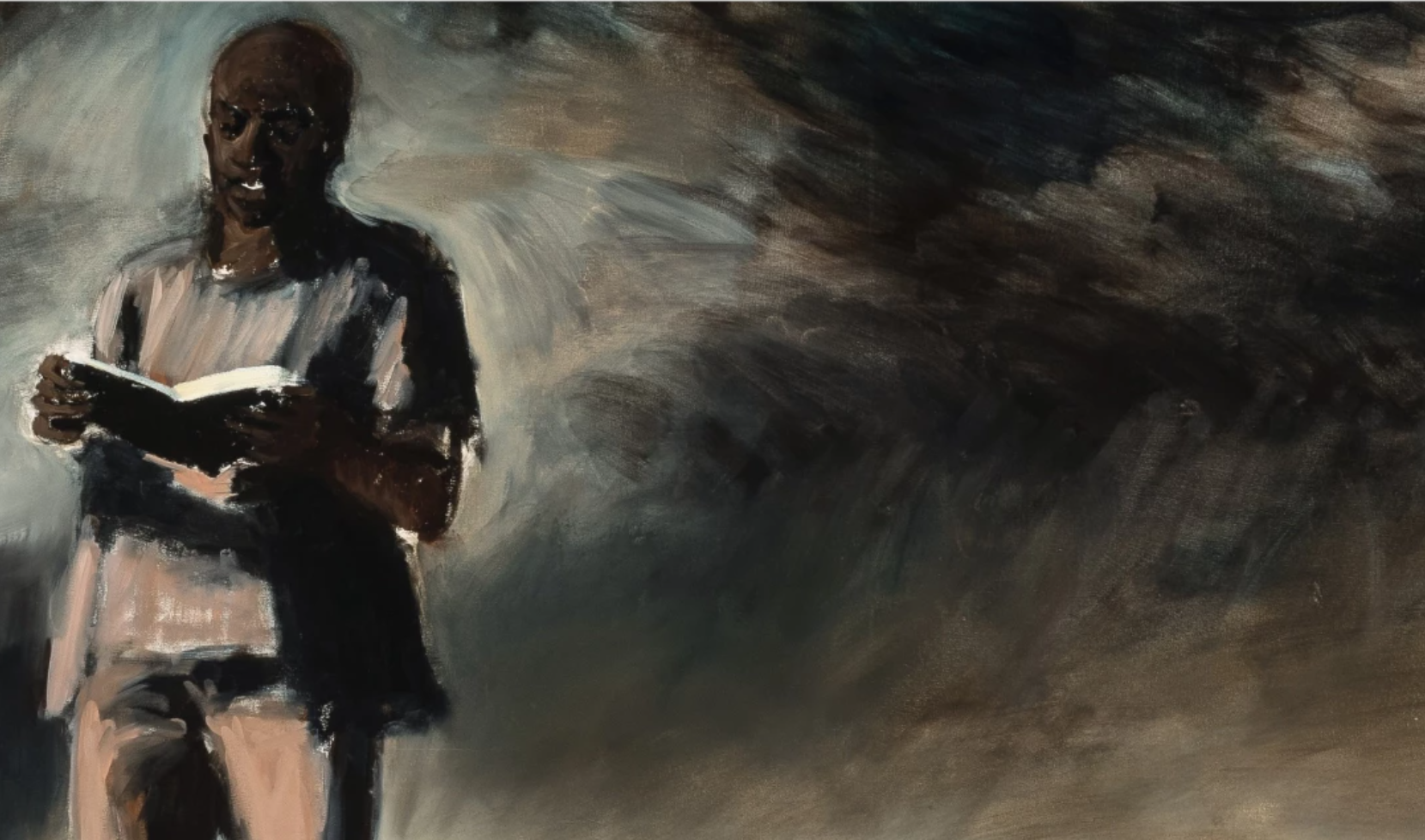
The narrative intrigue of Secular Readings is heightened by Yiadom-Boakye’s dramatic use of chiaroscuro, which casts her figure in sharp relief and pitches his shadow across the expanse of the canvas. Borrowed from predecessors such as Edward Hopper, Edgar Degas, and Caspar David Friedrich, these compositional cues are transposed with Yiadom-Boakye’s unique artistic voice to fabricate filmic universes imbued with modernistic historical impermanence. Laconic and beautiful, the subject’s contemplative posture brings into focus the ethos of Yiadom-Boakye’s rightfully celebrated artistry, which evokes the language of poetry – a fiction imbued with reality and truth.
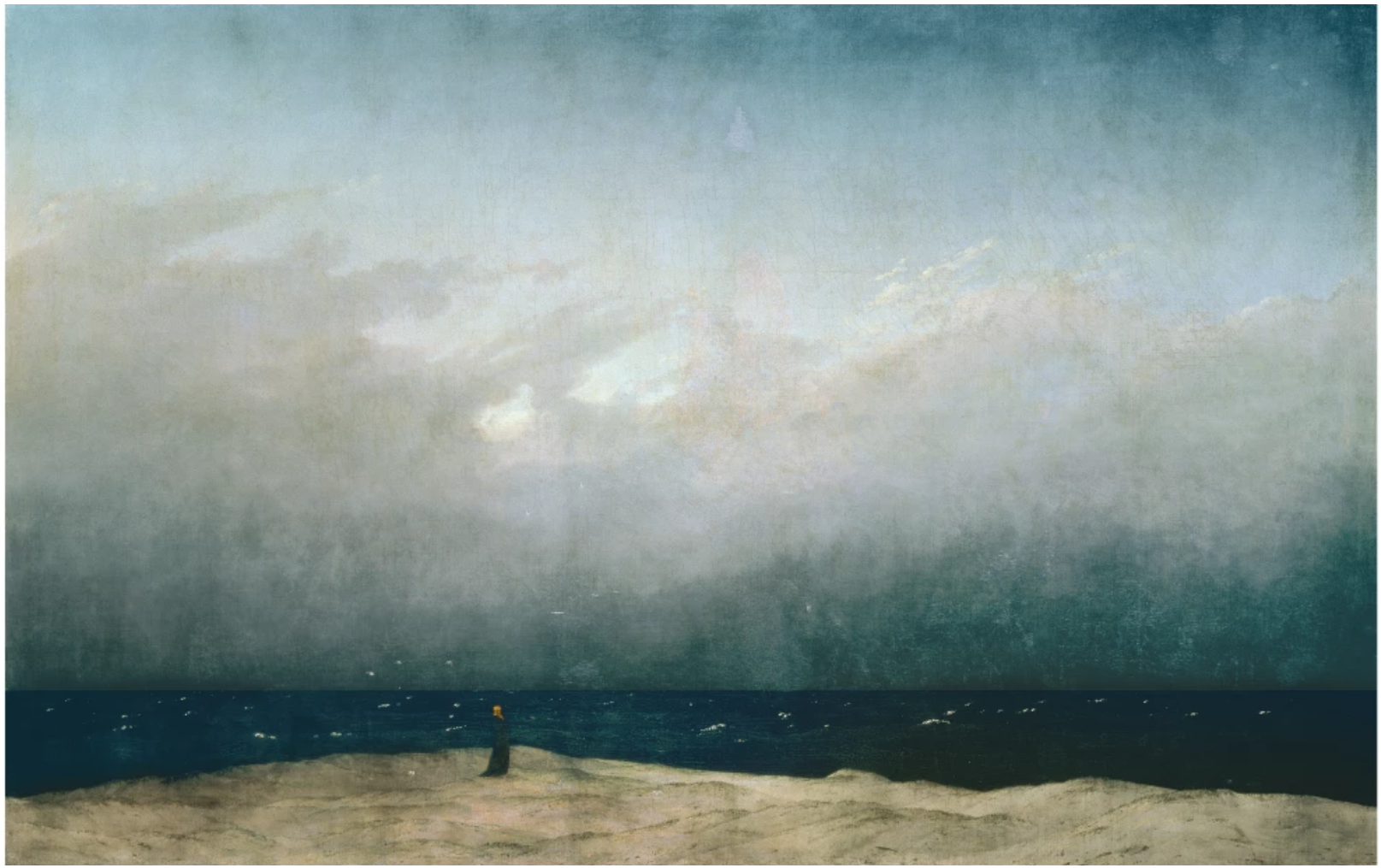
CASPAR DAVID FRIEDRICH, THE MONK BY THE SEA, 1808-10. ALTE NATIONALGALERIE, BERLIN. IMAGE © BRIDGEMAN IMAGES
Secular Readings is exemplary of the artist’s ability to summon emotional veracity through painting. Rendered in muted and earthy tones, Yiadom-Boakye’s solitary figure seems to emerge from the landscape that engulfs him, both his origin and his destination unknown. Every modulation in light and form seeps through the canvas as carefully modulated hues and shades, an exercise in the monochrome. Dramatic lighting cuts through Yiadom-Boakye’s otherwise flat composition, fixing her subject in space, however gesturally evoked. Yiadom-Boakye does not veil the artistic difficulties inherent to her particular brand of quiet, sensual realism, but rather demands an intense kind of slow looking from every viewer in the tradition of artists such as Manet and Degas.
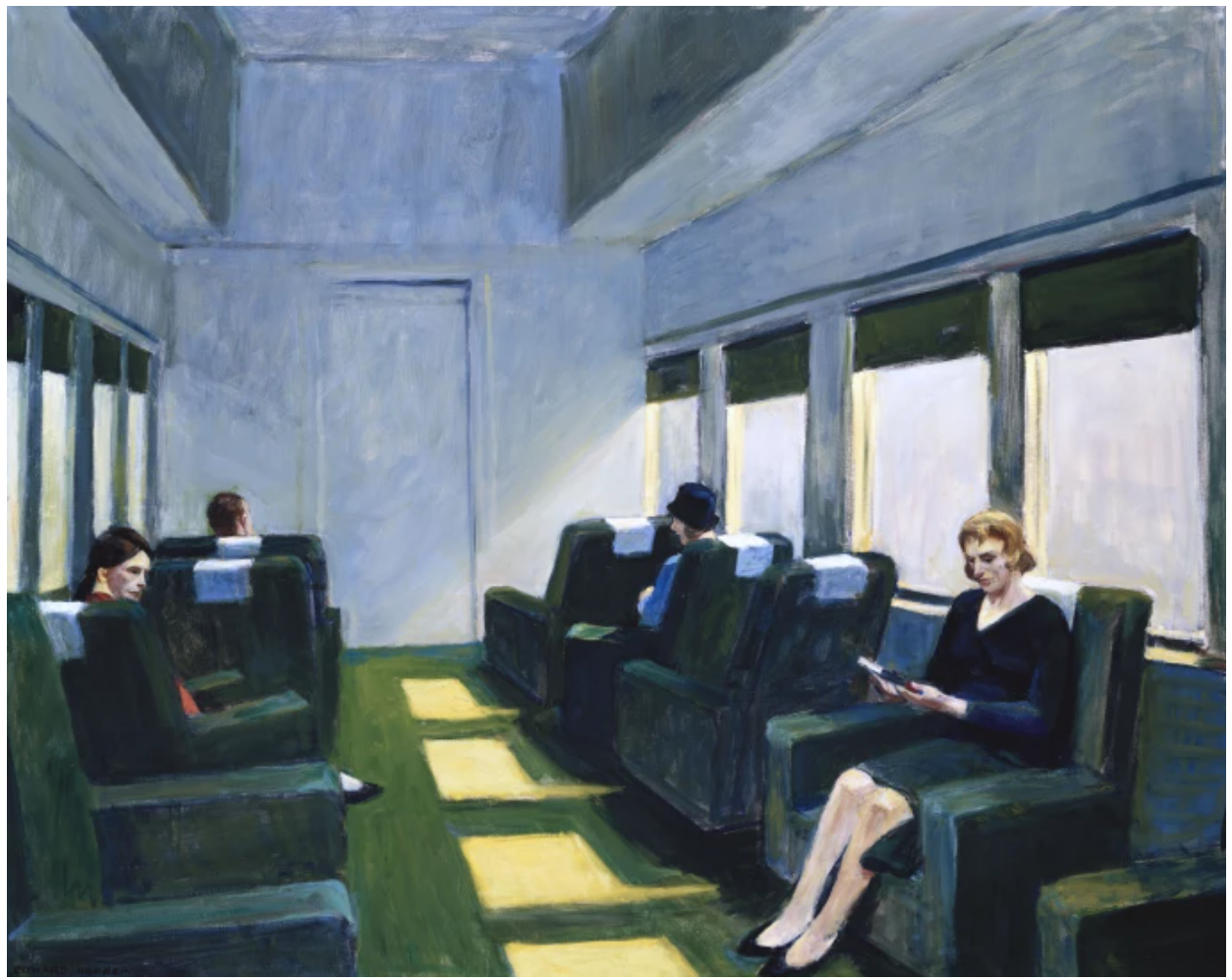
EDWARD HOPPER, CHAIR CAR, 1965. PRIVATE COLLECTION. IMAGES © CHRISTIE’S IMAGES / BRIDGEMAN IMAGES. ART © 2024 EDWARD HOPPER
In a deviation from traditional portraiture, Yiadom-Boakye’s subjects are not grounded in reality; rather, they are imagined, sprung from family snapshots, collected scrapbook materials, even a simple mood or glance. Indeed, the present landscape feels as if conjured from a memory, with no defining and definitive clues of context or location. Yiadom-Boakye’s portraiture relies completely on sentiment as a means of defining personhood. As Andrea Schlieker writes, “It is left to us to ascribe to the characters their story, to delve further into the serenity of her intimate fictions. They have the quality of characters from a novel or phantoms from a dream, yet they are so vividly portrayed, so full of personality, their gaze so compellingly alive, that the viewer experiences an instant sense of recognition.” (Andrea Schlieker, “Quiet Fires: The Paintings of Lynette Yiadom-Boakye” in: Exh. Cat., Lynette Yiadom-Boakye: Fly In League With the Night, London 2020, p. 13)
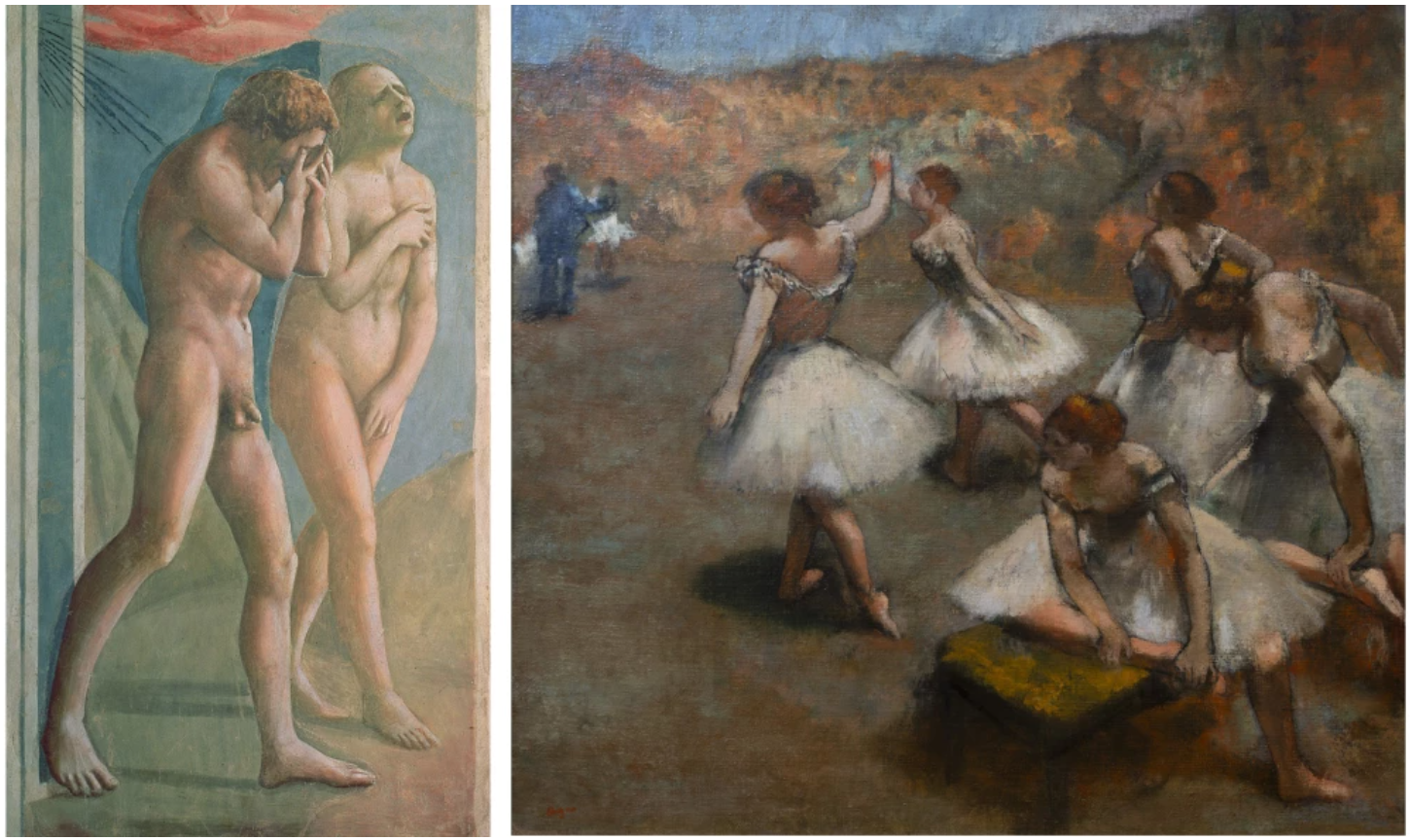
LEFT: TOMMASO MASACCIO, ADAM AND EVE BANISHED FROM PARADISE, C.1427. CHIESA DI SANTA MARIA DEL CARMINE, FLORENCE. IMAGE © RAFFAELLO BENCINI / BRIDGEMAN IMAGES. RIGHT: EDGAR DEGAS, DANSEUSES SUR LA SCENE, C. 1889. MUSÉE DES BEAUX-ARTS DE LYON. IMAGE © MANUEL COHEN / ART RESOURCE, NY
This allure of fiction and implied narrative is intrinsic to Yiadom-Boakye’s body of work – Secular Readings extends this conceptual project through its protagonist’s metacognition. The artist herself has commented how each of her characters take on imagined lives of their own: “Although they are not real I think of them as people known to me. They are imbued with a power of their own… I admire them for their strength, their moral fibre.” (the artist quoted in: Exh. Cat. The Studio Museum in Harlem, Flow, 2008, p. 103) Just as we, as viewers, are invited into Yiadom-Boakye’s conjured narratives, the figure in Secular Readings engages himself in a separate world of fact or fiction through his reading, taking on the role of critic, scholar, and consumer in a parallel to his observers. Secular Readings evinces Yiadom-Boakye’s ability to distill profound emotions into a simple composition, brimming with eloquence. With languid elegance and sophisticated intelligence, the present work integrates many key aspects of her oeuvre: tremoring between contemporary and classical, it holds up a mirror to society and forms a breathtakingly beautiful ode to painting.
A Focus For The Cavalry, 2016
Sotheby’s New-York: 15 November 2023
Estimated: USD 800,000 – 1,200,000
USD 952,500
A Focus For The Cavalry | The Now Evening Auction | 2023 | Sotheby’s (sothebys.com)
LYNETTE YIADOM-BOAKYE (b. 1977)
A Focus For The Cavalry, 2016
Oil on canvas
130×200 cm (51 1/8 x 78 3/4 inches)
Titled and dated 2016 (on the reverse)
Eye to eye and face to face, Lynette Yiadom-Boakye’s A Focus For The Cavalry entrances the viewer. Executed in 2016, the present work invites the viewer into an imagined world, a limbo state that seamlessly alternates between dream, imagination, and reality. As the gaze softens and the viewer escapes the mesmerizing trance produced by the dramatic brushwork of the face, we are forced to consider the pose. Yiadom-Boakye routinely makes use of the reclining figure, subverting the expectation of a female subject and placing herself in an art historical lineage to which she is extremely attuned. Color, composition, glance, or pose borrowed from predecessors such as Walter Sickert, Édouard Manet, John Singer Sargent and Paul Cezanne are transposed with Yiadom-Boakye’s unique artistic voice to fabricate imagined universes, creating a body of work imbued with modernistic historical impermanence. Laconic, beautiful, the subject’s contemplative yet confident glare brings into focus the ethos of Yiadom-Boakye’s rightfully celebrated artistry, as we are treated to her deliberately frenetic brushstrokes, blissfully engulfing spectators in a sea of mahogany in motion.
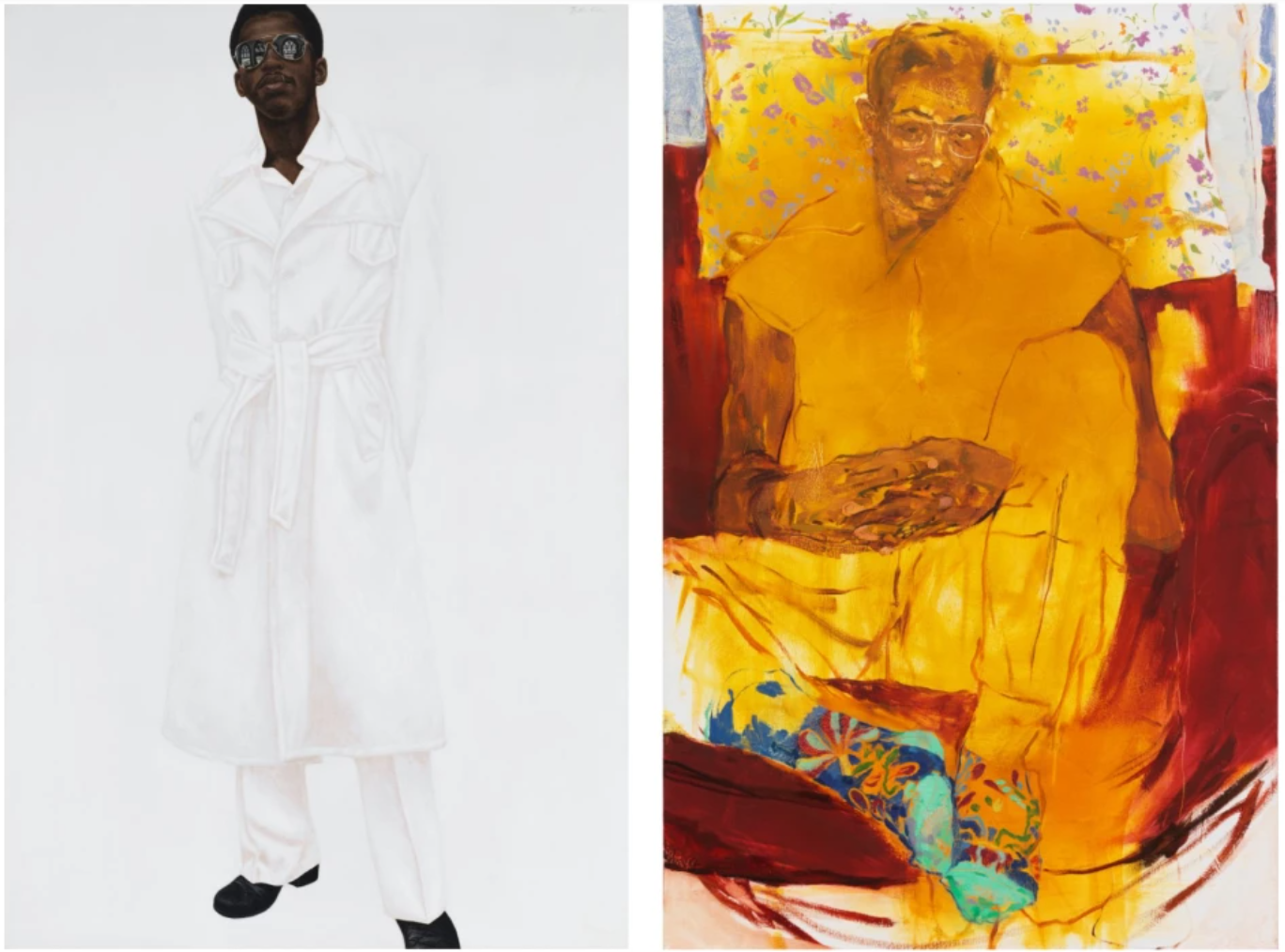
LEFT: BARKLEY L. HENDRICKS, STEVE, 1976. IMAGE © WHITNEY MUSEUM OF AMERICAN ART / LICENSED BY SCALA / ART RESOURCE, NY. ART © ESTATE OF BARKLEY L. HENDRICKS. RIGHT: JENNIFER PACKER, TIA, 2017. PRIVATE COLLECTION. ART © 2023 JENNIFER PACKER
Included in the A Passion To A Principle exhibition held at Kunsthalle Basel in 2016, A Focus For The Cavalry continuesYiadom-Boakye’s practice of creating introspective viewing experiences that encourage intimacy with her paintings despite their impressive scale. The subject finds himself consumed by a cloud of dark copper hues meticulously layered to mimic deep onyx and birch. Tethered by a foot grounded in shades of earthly beige, the subject’s body interacts with the canvas as his knee bends into grazing a sky of soft ethereal pink. Uninhibited by periodization, his clothes are unattributable to any specific time or place endowing the imagined sitter with an aura of autonomy in juxtaposition to his illusory conception. When describing her subjects, Yiadom-Boakye states that
“If they are pathetic, they don’t survive – if I feel sorry for someone, I get rid of them. I don’t like to paint victims.”
Emblematic of these words and exemplified within her private pantheon of mostly male recumbent figures we find paintings bestowed with a strong sense of unwavering confidence and defiant individuality. Works such as Closer to a Comfort from 2018, whose subject’s intense gaze matches that of the present lot, find their counterpart in others such as Coagulant Dangers from 2018 whose subjects appear inaccessible and apathetic to worlds outside of their own. Irrespective of their attitude, each of the figures in these works emits a self-reliant presence that can be felt far beyond the canvas.
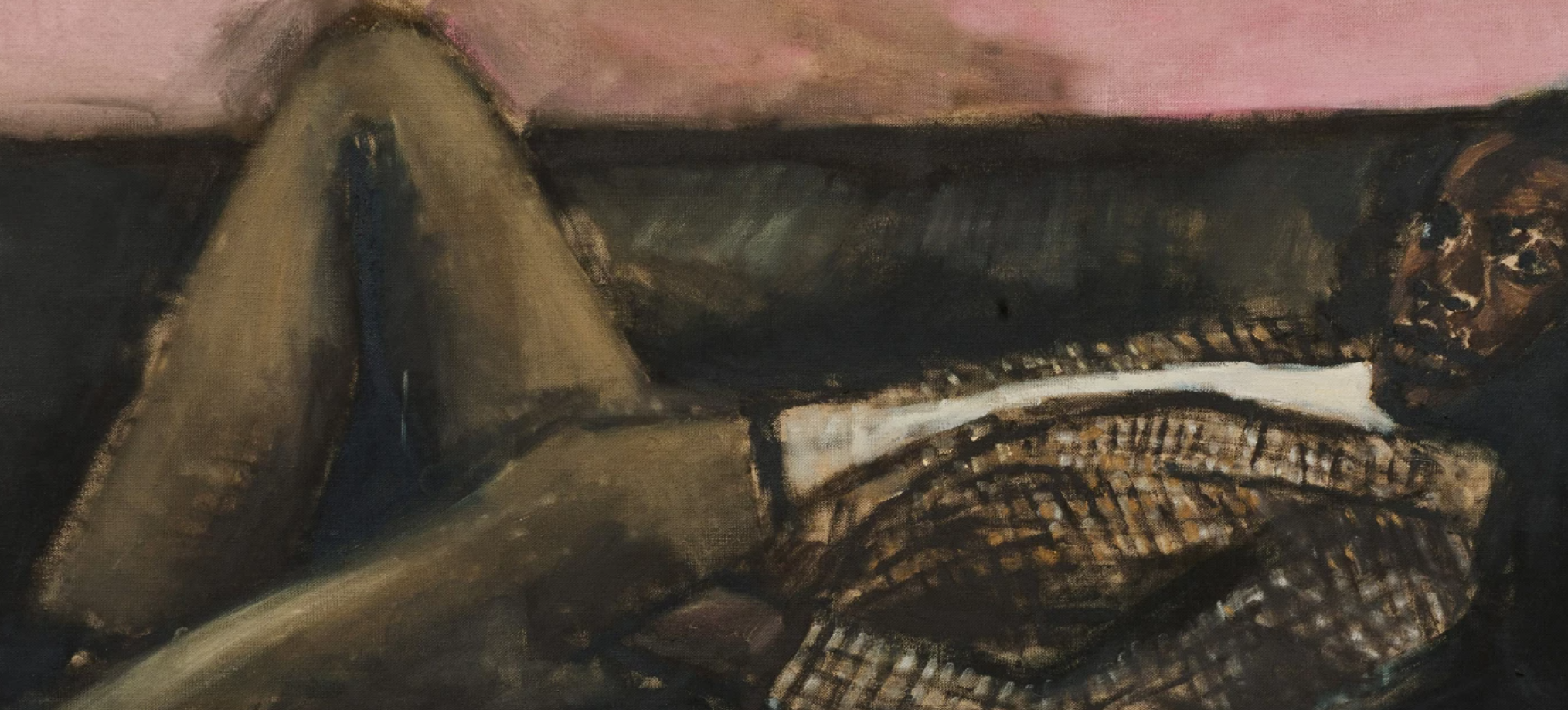
Resonating with the vivacious spontaneity of Franz Hals’ unrestrained brushwork and the profound insight into the human spirit that Anthony van Dyck ‘s portraits exude, each intimate moment brought to life by Yiadom-Boakye engages in a profound dialogue between the underpinnings of European portraiture and her virtuosic propensity for infusing art history’s most enduring themes into her expansive visual repertoire. Created over a century and a half after Édouard Manet’s seminal Olympia, A Focus For The Cavalry adeptly reimagines and reenergizes a genre that was originally intended for memorializing social class, and instead offers a contemporary reassessment of the reclining figure. Central to the composition of Manet’s magnum opus, Olympia confidently assumes a nude pose with an unabashed gaze that defied traditional portrayals of women, and offers a self-aware subject, embodying notions of female autonomy and empowerment, and challenging the 19th-century French bourgeoisie’s hypocritical views on sexual taboos. In striking opposition, Laure, the obscured figure occupying the background, assumes a dual role, representing both the explicit and metaphorical embodiment of the prevailing racial hierarchy and colonial past of that era. Laure’s placement at the foot of the composition emphasizes the racial dynamics and how they affected portraiture, including color palette, hierarchical arrangement, and posture.
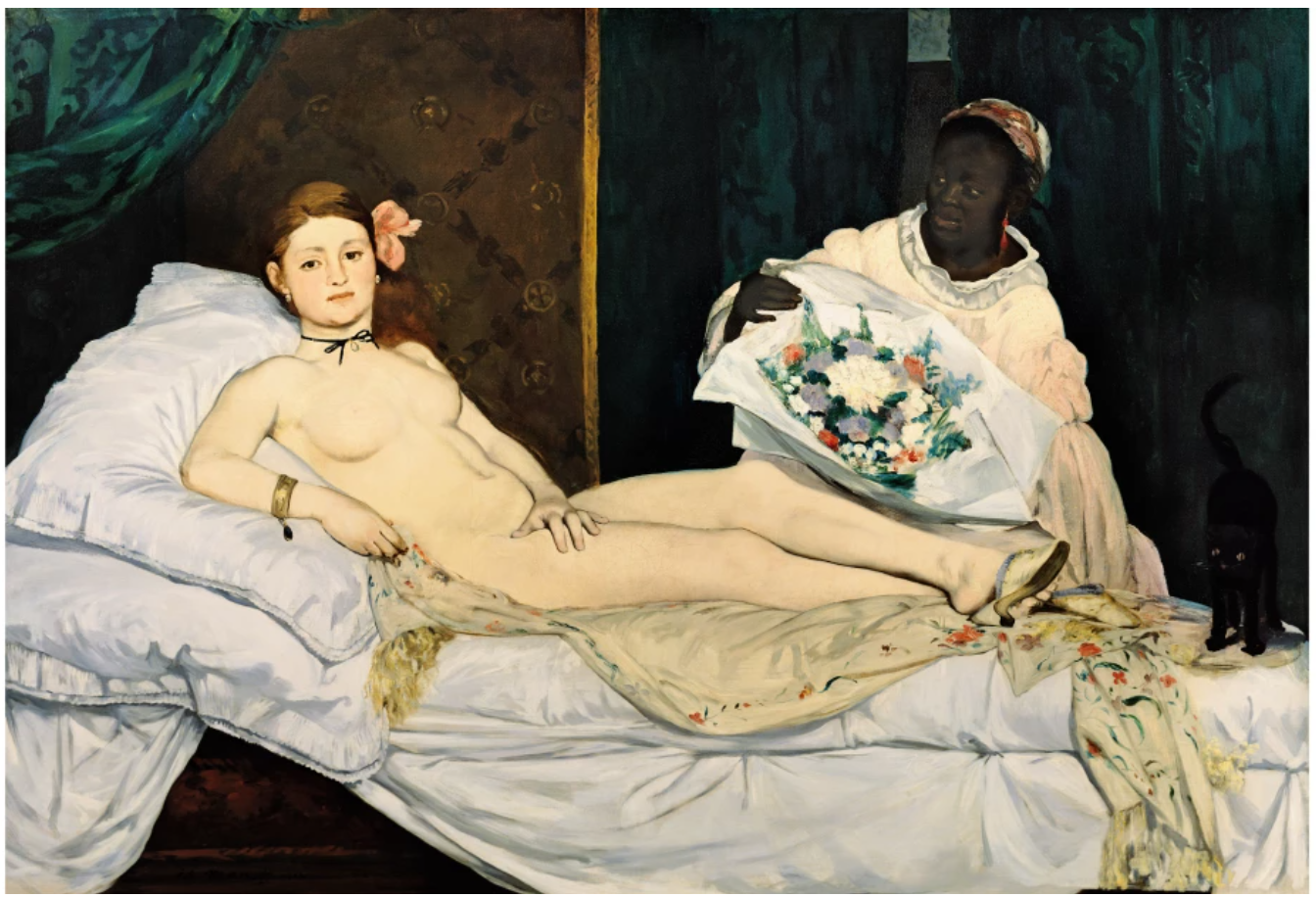
EDOUARD MANET, OLYMPIA, 1865. IMAGE © MUSÉE D’ORSAY, DIST. RMN-GRAND PALAIS / PATRICE SCHMIDT
Balancing the realms of both universes, the central figure in A Focus For The Cavalry assumes the allure and palpable individuality of Olympia, all the while affectionately embracing a comparable brown color scheme of Laure. Deconstructing the airs of nobility once assumed by the individuals who traditionally served as the sitters, the subject of the current lot asserts his position within the heritage of European portraiture. Lynette Yiadom-Boakye’s exploration within the realm of art history have become a permanent fixture, as her works share the walls with luminaries such as Peter Paul Rubens and Caravaggio, as her paintings have been enshrined in the esteemed collections of The Museum of Modern Art (New York), Tate (London), Dallas Museum of Art, and The Los Angeles County Museum of Art, among many others.
Nearer than Kith, Further from Kind, 2018
Sotheby’s London: 29 June 2022
Estimated: GBP 400,000 – 600,000
GBP 1,220,800 / USD 1,487,890
LYNETTE YIADOM-BOAKYE (b. 1977)
Nearer than Kith, Further from Kind, 2018
Oil on linen
Each: 110.5 x 60.5 cm (43 1/2 x 23 7/8 inches)
Titled Nearer Than Kith, Further from Kind and dated 2018 (on the reverse of both canvases)
Executed in 2018, Nearer from Kith, Further than Kind is an exquisite double portrait embodying Lynette Yiadom-Boakye’s painterly oeuvre. Each occupying their own half of the diptych, the two figures fill the picture plane, relaxed and at ease as they smoke in a world of gentle idleness. Tranquil and unperturbed, the two figures emanate a subtle mixture of vulnerability and strength, dignity and grace. In shades of grey and white, the uncluttered interior space is full of subtle modulations in tone, colour and feeling. Both dressed in simple white T-shirts, the eye is drawn to the sophistication and nuances that radiate from each gesture and glance, the way their hands hold the cigarettes and their shallowed cheeks breathing in the smoke. Yiadom-Boakye captures a provisional state, the evanescence of a mood, hinting at the universal human experiences.
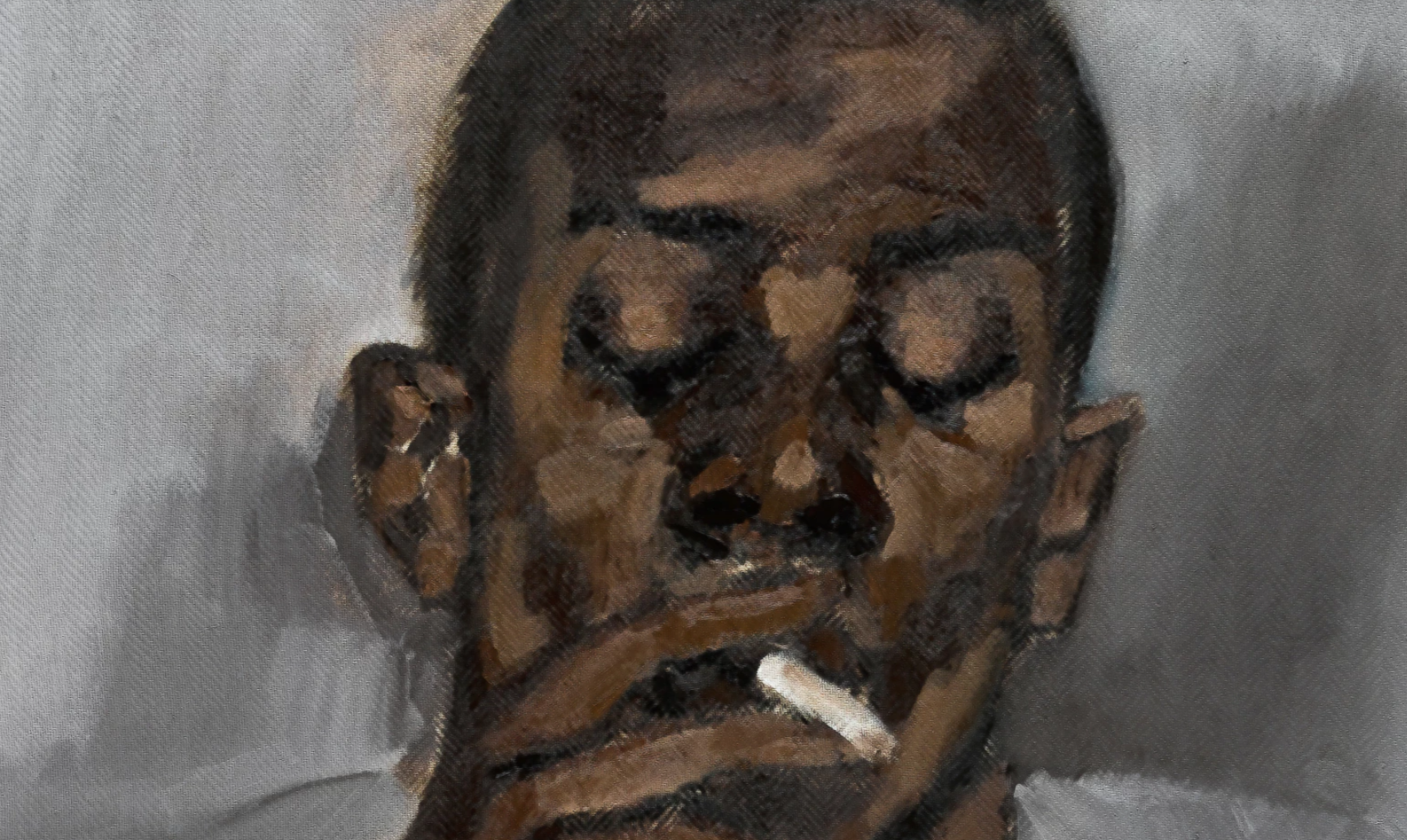
Whereas Yiadom-Boakye’s early portraits are coarsely painted with a cartoonish humour, the later works are rigorous exercises in the monochrome, exploring chiaroscuro that recall Rembrandt van Rijn, or the black paintings of Francisco de Goya, endowing the portraits with a greater sense of solemnity. This shift in style is reflective of a transition in Yiadom-Boakye’s painterly preoccupation; the early foregrounding of narrative makes way in her later works for more formal concerns of paint as a medium. Yiadom-Boakye had said of this transition: “Over time I realised I needed to think less about the subject and more about the painting. So I began to think seriously about colour, light and composition.” (Lynette Yiadom-Boakye quoted in: Antwaun Sargent, “Lynette Yiadom-Boaye’s fictive Figures,” Interview, 13 May 2017, online). Yiadom-Boakye’s painterly process is akin to that of ancient fresco techniques. Paint is applied fast, wet on wet, and thinly, so that the herringbone texture of the linen she began using in recent years remains clearly visible. Her use of linen, which is coarser than canvas, allows different mark-making: As the fabric’s textured surface reacts to the pigment, a greater sense of improvisation is facilitated within the painting process. The two canvases of the present diptych are painted on different linen surfaces, with a clear herringbone texture on the right canvas and a coarse pattern on the left.
Yiadom-Boakye’s paintings are a celebration as well as an interrogation of the genre of portraiture. Since the Renaissance, the genre has been used to convey class and rank, bestowing the sitter with a sense of importance, wealth and beauty through the inclusion of symbolic objects. The stripped-back paintings of Yiadom-Boakye eschew grandeur for a sense of modesty, resisting any definition of social class. Rather they share what Erwin Panofsky described as the central desire of Renaissance artists: “to being whatever the sitter has in common with the rest of humanity.” (Erwin Panofsky quoted in: Sherer West, Portraiture, Oxford, 2004, p. 4). However, unlike Renaissance portraits, Yiadom-Boakye’s sitters are imagined people. Referencing her own scrapbooks of magazine and newspaper cut-outs, family snapshots and details of old master paintings, Yiadom-Boakye finds a starting point from which her imagination fills in the rest. Created through a complex psychological layering of personalities, the fictional subjects emanate an arresting sense of self-possession. In the age-old canon of Western painting where black subjects have been relegated to marginalised and subservient roles, Yiadom-Boakye rejects the stereotype. The artist said of her fictional sitters: “If they are pathetic, they don’t survive – if I feel sorry for someone, I get rid of them. I don’t like to paint victims.” (Lynette Yiadom-Boakye quoted in: Exh. Cat., London, Tate (and travelling), Lynette Yiadom-Baokye: Flying In League With The Night, November 2020 – September 2022, p. 14). Indeed, Yiadom-Boakye’s subjects are empowered, their gaze powerful and introspective, resisting the stereotypical ideas of black identity as one of hyper-masculinity, or the cliched presentation of black people as angry and wild. Confident, reflective, and empowered, Yiadom-Boakye’s subjects reimagine the representation of the black body.