
Yayoi Kusama is widely regarded as one of the most influential and recognizable artists of the postwar and contemporary period. Born in 1929 in Matsumoto, Japan, Kusama has developed an artistic universe unlike any other—one built upon repetition, pattern, immersive environments, and the dissolution of the individual within an infinite visual field. Across more than seven decades of production, her work has encompassed painting, drawing, sculpture, installation, performance, fashion, and public art.
Her artistic vocabulary is immediately recognizable: polka dots, infinite nets, pumpkins, flowers, mirrored spaces, and organic proliferations appear repeatedly throughout her practice. Yet behind this visual clarity lies a deeply philosophical project. Kusama’s work explores themes of infinity, self-obliteration, psychological obsession, and cosmic interconnectedness. Through repetition and pattern, she dissolves the boundary between self and universe, transforming both objects and spaces into endless visual continuums.
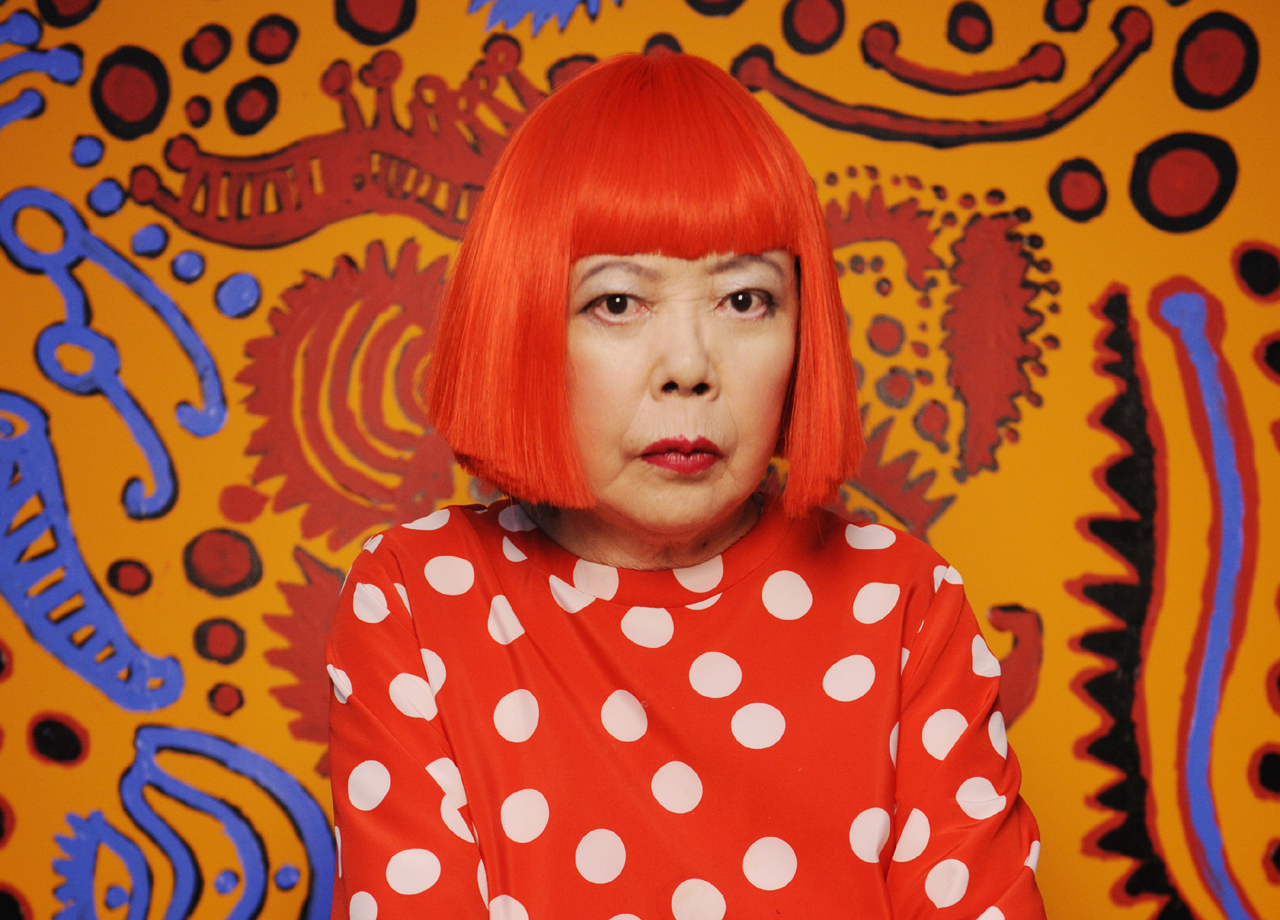
Today Kusama occupies a unique position in the global art world. She is simultaneously a major historical figure of the postwar avant-garde and one of the most celebrated living artists, whose immersive installations attract record museum attendance across the world.
Introduction
Yayoi Kusama was born in 1929 in Matsumoto, Nagano Prefecture, Japan. From an early age she experienced vivid hallucinations and recurring visions of fields of dots, flowers, and patterns that seemed to expand endlessly across surfaces and space. These visions would later become the conceptual and visual foundation of her entire artistic practice. She studied painting at the Kyoto Municipal School of Arts and Crafts from 1948 to 1951, where she trained in traditional Japanese Nihonga painting. Dissatisfied with the conservative structure of the Japanese art establishment, Kusama soon began experimenting with abstraction and new materials.
In 1957 she made the decisive move to the United States, first arriving in Seattle before relocating to New York in 1958. The city’s vibrant avant-garde scene provided the ideal environment for her radical artistic ideas. During the late 1950s and 1960s she produced many of the works that would later define her importance in postwar art, including the early Infinity Net paintings, large-scale installations, soft sculptures, and experimental performances.
During these years Kusama exhibited alongside leading figures of the American avant-garde and participated in the artistic dialogue surrounding Minimalism, Pop Art, and conceptual practices. Her work from this period demonstrates that she was not merely influenced by these movements but often anticipated or paralleled their formal innovations. After returning to Japan in 1973, Kusama continued to expand her practice across painting, sculpture, literature, and installation. Over the following decades her reputation steadily grew internationally, culminating in the global recognition she enjoys today.
Core Concepts: Repetition, Infinity, and Self-Obliteration
At the heart of Kusama’s work lies the concept of infinity. Through obsessive repetition of forms—dots, nets, cells, and organic shapes—she creates surfaces and environments that appear to extend beyond physical limits.
The polka dot is perhaps her most famous motif. For Kusama, the dot functions as a fundamental unit of existence, representing both the smallest element of matter and the possibility of infinite expansion. When multiplied across surfaces or environments, dots dissolve hierarchy and structure, creating a continuous field without beginning or end.
This approach relates to what Kusama has described as “self-obliteration”, a state in which the individual merges with the surrounding universe. In her work, repetition becomes a psychological and philosophical device: the viewer is invited to lose themselves within fields of pattern and light.
The tension between control and excess is crucial. Kusama’s works are often meticulously crafted, yet their visual effect suggests boundless proliferation. This duality—discipline and infinity—gives her art its extraordinary visual and emotional power.
Kusama’s technique varies widely across media but is always rooted in repetition and accumulation. Her paintings rely on meticulous manual labor, often involving thousands of repeated brushstrokes. Sculpture and installation works combine industrial materials, reflective surfaces, lighting systems, and architectural design to create immersive environments. One of Kusama’s greatest strengths is her ability to translate a single conceptual language across multiple scales—from intimate drawings to monumental public sculptures and immersive architectural installations. This coherence across mediums is a defining characteristic of her artistic achievement.
Major Series and Motifs
The Infinity Net paintings, begun in the late 1950s in New York, represent one of Kusama’s most important artistic breakthroughs. These canvases are composed of countless small arcs or loops meticulously painted across large surfaces, creating shimmering fields of white or subtle color. From a distance the paintings appear calm and minimalist. Up close, however, they reveal a dense accumulation of individual marks. Each brushstroke records time and physical labor, turning the painting into both an image and a record of obsessive repetition. The Infinity Nets place Kusama in dialogue with postwar abstraction and Minimalism while remaining unmistakably distinct. Their endless surfaces evoke cosmic space, microscopic structures, and psychological landscapes simultaneously.
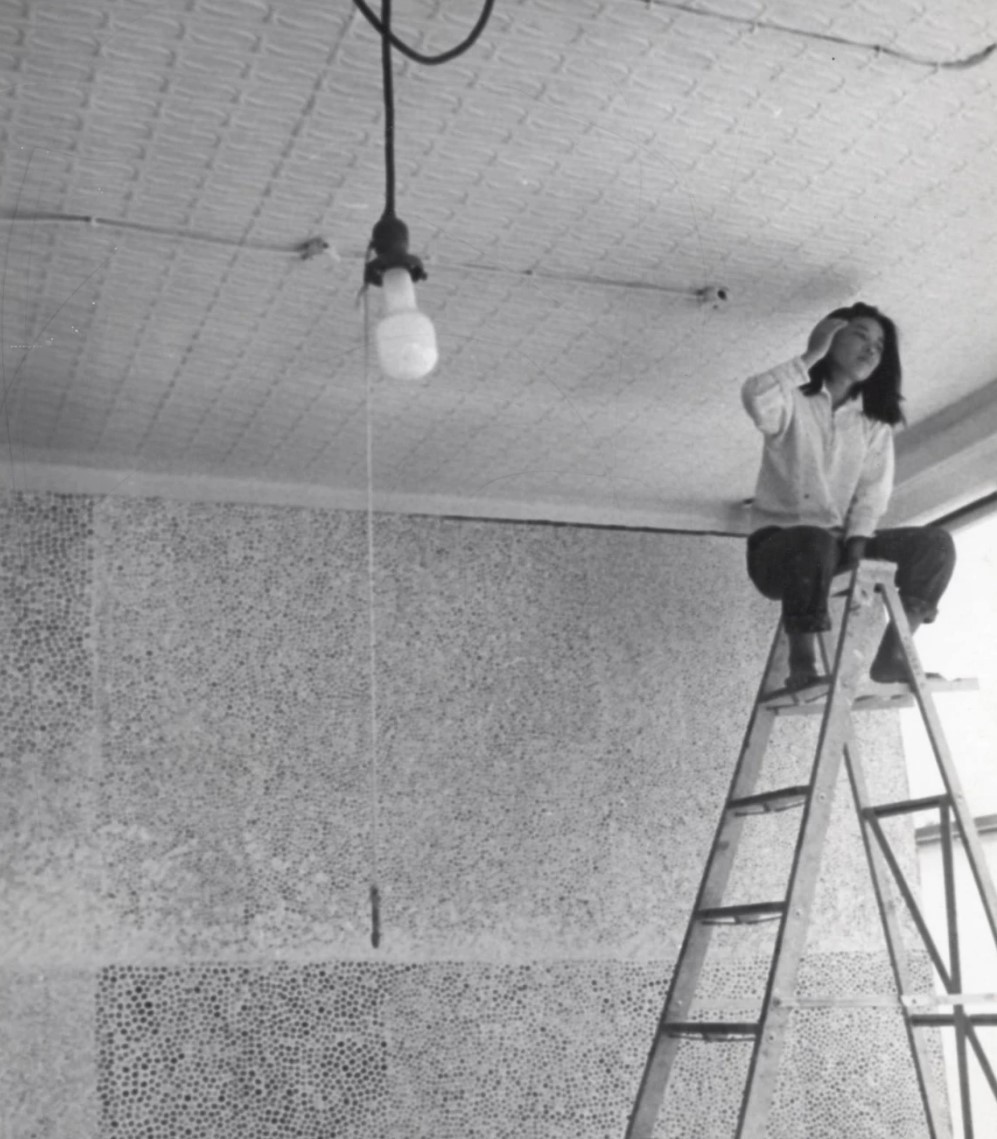
In the early 1960s Kusama expanded her language of repetition into three dimensions through the Accumulation sculptures. Everyday objects such as chairs, sofas, shoes, and boats were covered with hundreds of sewn fabric protrusions resembling organic growths. These works transform familiar domestic objects into uncanny, surreal forms. At once humorous, sensual, and slightly unsettling, the Accumulations explore themes of obsession, bodily anxiety, and the transformation of the everyday through repetition. They also challenge traditional notions of sculpture, introducing soft materials and domestic references into a field historically dominated by monumental forms.
Perhaps Kusama’s most celebrated works are the Infinity Mirror Rooms, immersive installations composed of mirrored walls, lights, sculptural elements, and reflective surfaces. The first of these environments, Infinity Mirror Room – Phalli’s Field (1965), used mirrors to multiply a field of soft sculptures infinitely, creating the illusion of endless space. Later mirror rooms incorporated light, color, and suspended forms to create dazzling environments in which viewers experience the sensation of being suspended within an infinite universe. These installations transformed Kusama into a pioneer of immersive installation art. Rather than observing a work from outside, viewers enter the work itself and become part of its visual structure.
Originally presented in 1966, Narcissus Garden consists of hundreds of mirrored stainless-steel spheres arranged across a surface or landscape. The mirrored balls reflect viewers, surroundings, and each other, creating a shifting field of reflections. The work is both visually seductive and conceptually sharp, reflecting on themes of vanity, spectacle, and the commodification of art. Over time the installation has been restaged in numerous museums and international exhibitions, becoming one of Kusama’s most recognizable conceptual works.
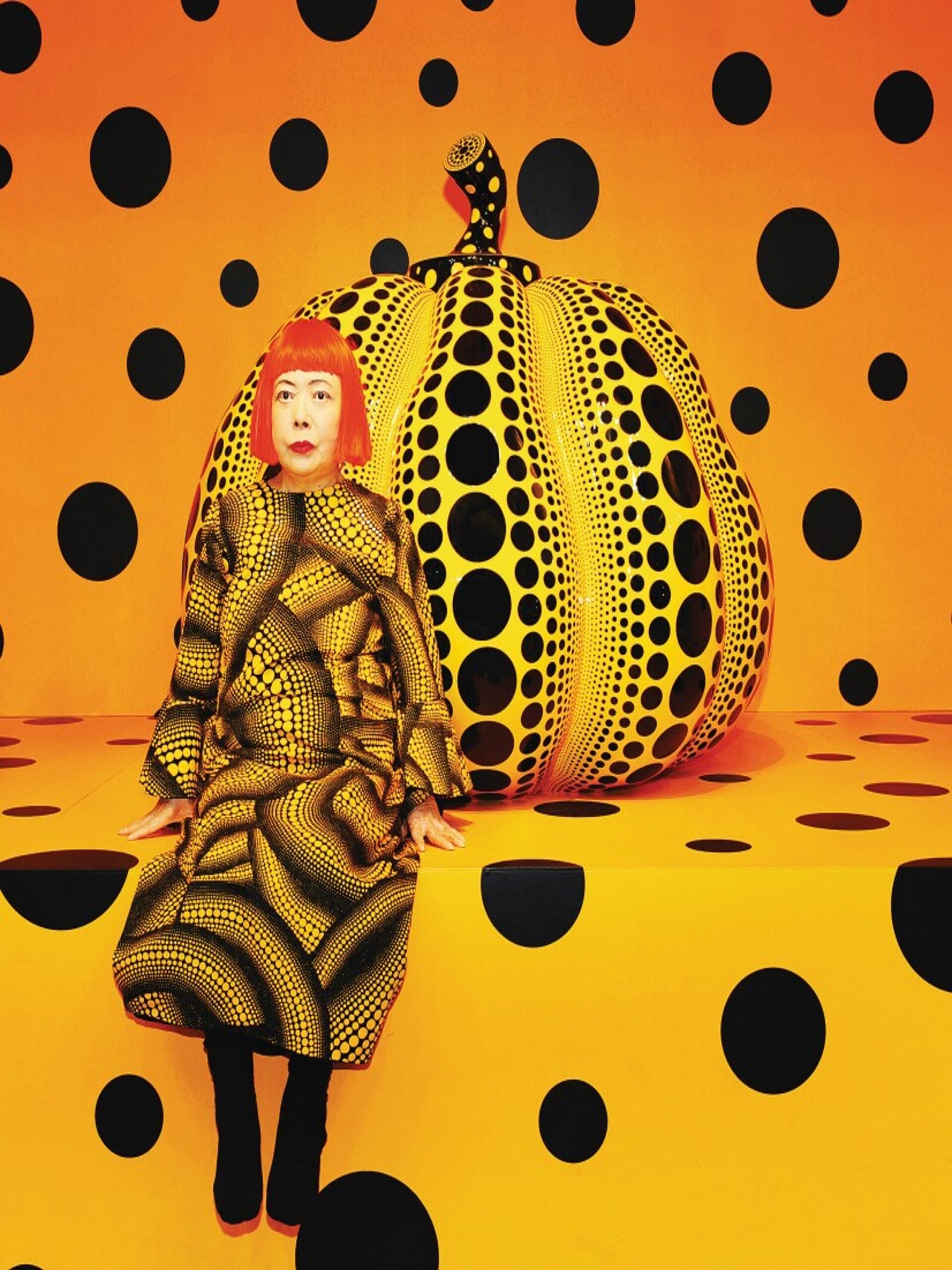
The pumpkin has become one of Kusama’s most iconic motifs. Inspired by memories of her family’s seed nursery during childhood, the pumpkin represents comfort, humor, and organic vitality within her artistic universe. Kusama’s pumpkins appear in paintings, sculptures, prints, and monumental public installations. Covered with polka dots and bold color contrasts, they transform a humble vegetable into a surreal and joyful symbol. These works perfectly illustrate Kusama’s ability to merge playfulness with deeper psychological resonance.
Flowers also occupy a central place in Kusama’s work. Often enlarged to monumental scale, they combine vibrant color with unsettling visual intensity. Like the pumpkins, these flowers represent organic growth and endless proliferation. Petals become patterns, patterns become environments, and the viewer becomes immersed in fields of vibrant color and form. In recent exhibitions, floral imagery has remained a central theme in Kusama’s ongoing artistic production.
One of Kusama’s most significant recent bodies of work is the monumental painting series My Eternal Soul, begun in 2009. These large canvases are filled with bold color, biomorphic shapes, faces, eyes, and abstract symbols arranged in complex compositions. The paintings combine the visual language Kusama developed over decades into dense, energetic constellations of imagery. Despite her age, Kusama continues to produce these works with remarkable energy, demonstrating an artistic vitality that has persisted for more than seventy years.
Museum Collections and Institutional Presence
Kusama’s work is in the collections of leading museums throughout the world, including the Museum of Modern Art, New York; Los Angeles County Museum of Art, Los Angeles; Walker Art Center, Minneapolis; Tate Modern, London; Stedelijk Museum, Amsterdam; Centre Pompidou, Paris; and the National Museum of Modern Art, Tokyo.
Major retrospectives and international exhibitions have confirmed her status as one of the most important artists of the postwar era. Museum exhibitions dedicated to Kusama frequently attract record attendance, reflecting both the accessibility and the intellectual depth of her work. Institutions continue to acquire her paintings, sculptures, and installations, ensuring that her work remains central to the narrative of modern and contemporary art.
Museum Exhibitions and Global Impact
Major exhibitions of her work include Kitakyushu Municipal Museum of Art, Kitakyushu, Japan, 1987; Center for International Contemporary Arts, New York, and the Museum of Modern Art, Oxford, 1989; “Love Forever: Yayoi Kusama, 1958–1969”, Los Angeles County Museum of Art, Los Angeles, 1998 (traveled to the Museum of Modern Art, New York; Walker Art Center, Minneapolis; and Museum of Contemporary Art, Tokyo, 1998–99); Le Consortium, Dijon, 2000 (traveled to Maison de la Culture du Japon, Paris; Kunsthallen Brandts, Odense, Denmark; Les Abattoirs, Toulouse; Kunsthalle Wien, Vienna; and Artsonje Center, Seoul, 2001–03); KUSAMATRIX, Mori Art Museum, Tokyo, 2004 (traveled to Art Park Museum of Contemporary Art, Sapporo Art Park, Hokkaido); Eternity’s Modernity, National Museum of Modern Art, Tokyo, 2004 (traveled to the National Museum of Modern Art, Kyoto and other venues in Japan, 2004–05); and “The Mirrored Years,” Museum Boijmans Van Beuningen, Rotterdam, 2008 (traveling to Museum of Contemporary Art, Sydney, and City Gallery, Wellington, New Zealand, 2009).
Kusama’s exhibitions regularly rank among the most visited museum shows worldwide. Large-scale presentations in major institutions across Europe, North America, and Asia have demonstrated the extraordinary public fascination with her immersive environments. Her Infinity Mirror Rooms in particular have become cultural landmarks, often drawing long lines of visitors eager to experience the illusion of infinite space created through mirrors and light.
These exhibitions demonstrate that Kusama’s work operates simultaneously on multiple levels: as serious conceptual art, as immersive sensory experience, and as one of the most recognizable visual languages in contemporary culture.
Gallery Representation
Yayoi Kusama is represented internationally by several leading galleries, including: David Zwirner, Victoria Miro, and Ota Fine Arts. These galleries manage her global exhibition program and collaborate with museums and collectors worldwide. Their international presence across Asia, Europe, and the United States reflects the truly global demand for Kusama’s work.
Yayoi Kusama’s influence on contemporary art is profound. Her exploration of repetition, immersive environments, and psychological experience has reshaped the possibilities of installation and spatial art. Few artists have created a visual language as instantly recognizable as hers. Even fewer have succeeded in maintaining such conceptual coherence across seven decades of artistic production. Through dots, mirrors, pumpkins, flowers, and infinite fields of pattern, Kusama has constructed an artistic universe that is at once playful, philosophical, and deeply personal. Her work invites viewers to step beyond the boundaries of the self and enter a world where art becomes a boundless field of imagination.
PART I: SUMMARY
Auction Market Overview
Yayoi Kusama is a very prolific artist, she created a large number of works in a multitude of medium, including painting, sculpture, together with a very extensive print-making production. However, there are two major types of paintings the artist has been very consistent in producing during her entire career, and those are the most sought-after by art collectors worldwide: Pumpkins, and Infinity Nets.
The highest price ever paid for a Pumpkin is just over USD 8 million, for Pumpkin (LPASG), sold at Christie’s in Hong-Kong in November 2021, whereas the highest price paid for Infinity Nets is just over USD 10 million, for INFINITY-NETS (OQABT) dated 2007, sold at Est-Ouest Auctions in Hong-Kong in May 2023.
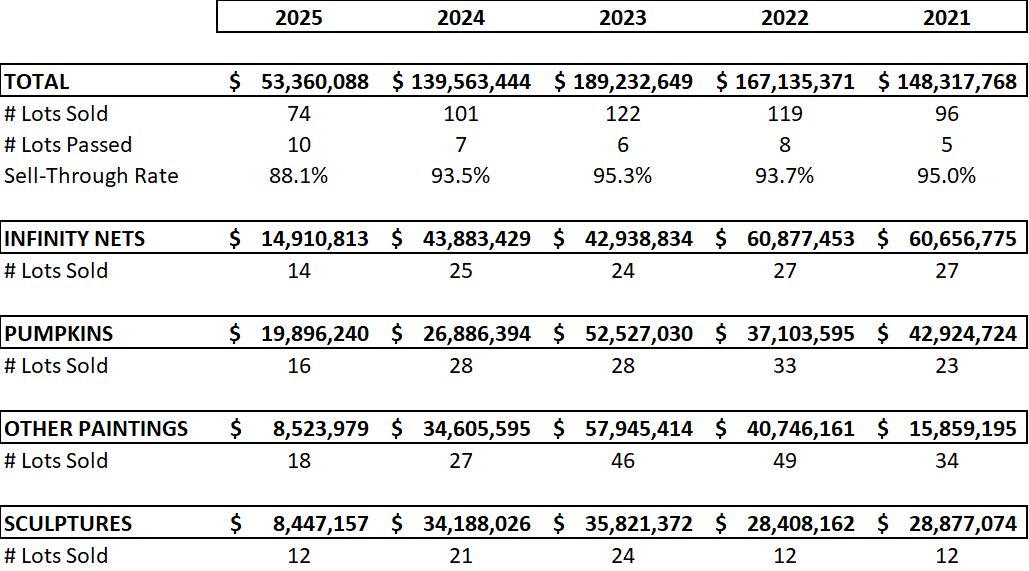
The market for Yayoi Kusama’s works is truly global spread between Hong-Kong, London, and New-York. Sell-Through Rates are extremely strong, consistently over 90%, which shows the continued interest for her art from global art collectors.
Nota Bene: This excludes Works on Paper that are work on progress
Auction Summary
2025 Auction Highlights
74 lots sold at auction in 2025 for a total turnover of USD 53,360,088. With 10 lots failing to sell, the sell-through rate is 88.1%. The highest price for 2025 has been achieved by PUMPKIN (HRU), a large PUMPKIN painting dated 2014, that sold at Christie’s in Hong-Kong, on 28 March 2025, for HKD 39,095,000 (USD 5,025,064).
2025 Top 6 Lots
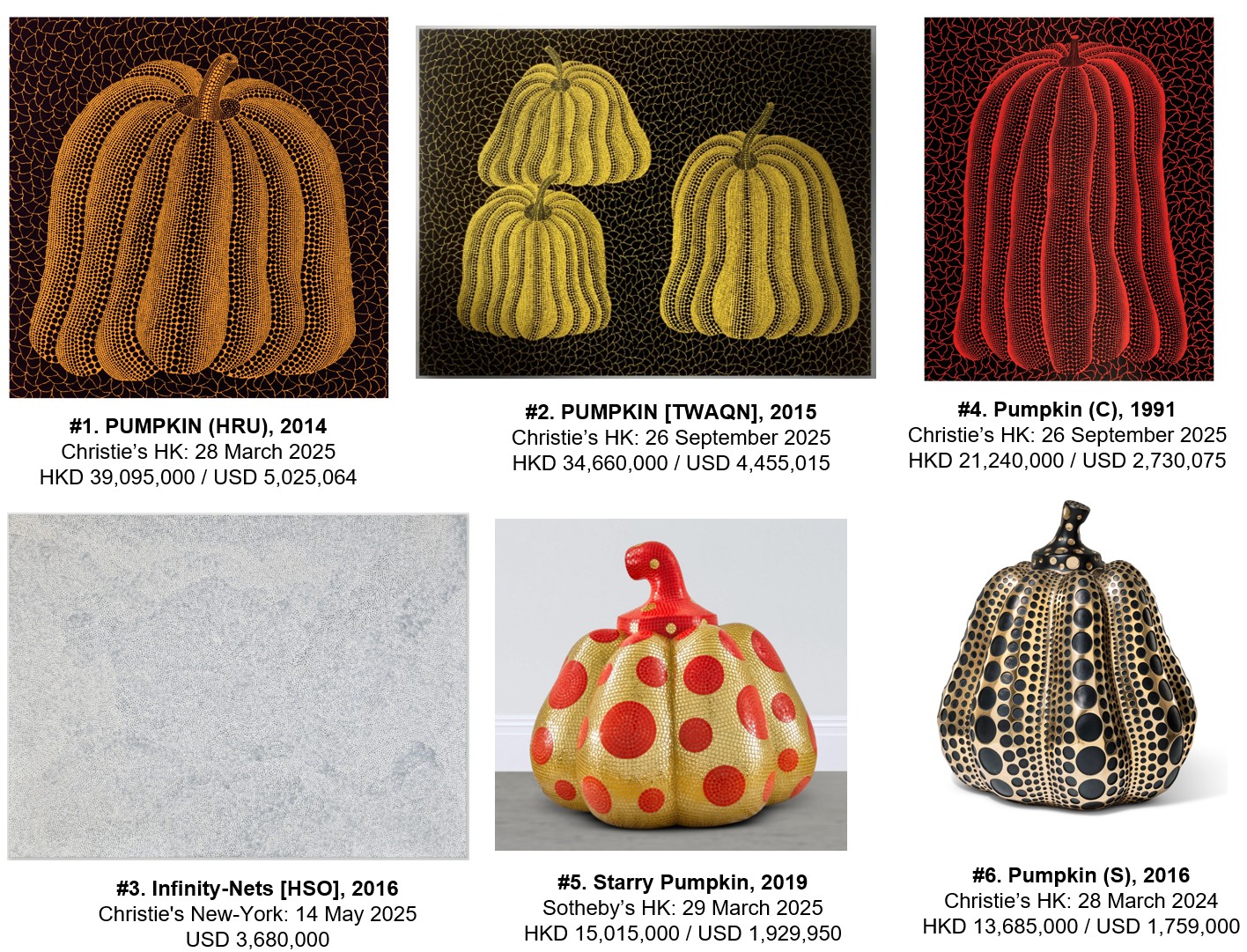
12 lots sold for more than USD 1 million, generating a cumulative turnover of USD 28,262,871, representing 53% of the total turnover for 2025.
2024 Auction Highlights
101 lots sold at auction in 2024 for a total turnover of USD 139,563,444. With 7 lots failing to sell, the sell-through rate is 93.5%. The highest price was achieved at Christie’s in New-York on 21 November 2024, when Pumpkin, a large sculpture dated 2022 sold for USD 6,826,000.
2024 Top 6 Lots
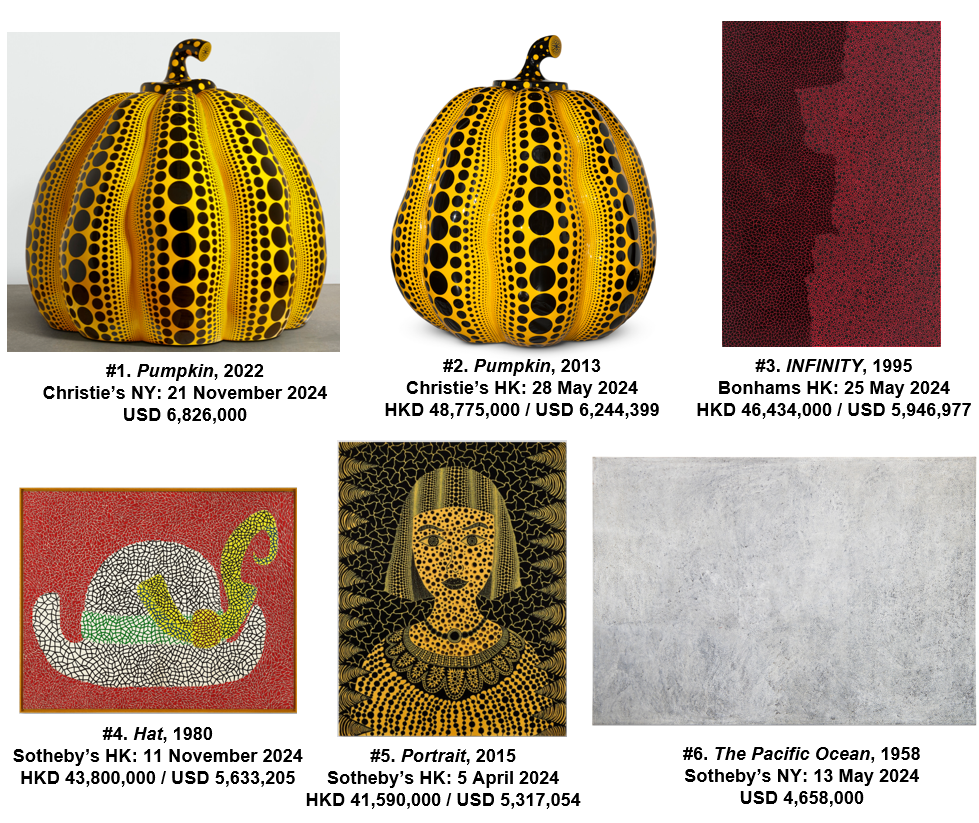
44 lots sold for more than USD 1 million generating a cumulative turnover of USD 113,862,645, representing 83% of the total turnover for 2024.
2023 Auction Highlights
122 lots sold at auction in 2023 for a total turnover of USD 189,232,649. The top price was achieved at Est-Ouest Auctions in Hong-Kong on 28 May 2023 for the immense INFINITY-NETS (OQABT) dated 2007 that sold for USD 10,707,500, a new auction record for the artist. It had last sold at Sotheby’s in London on 25 June 2009 for GBP 337,250.
2023 Top 5 Lots
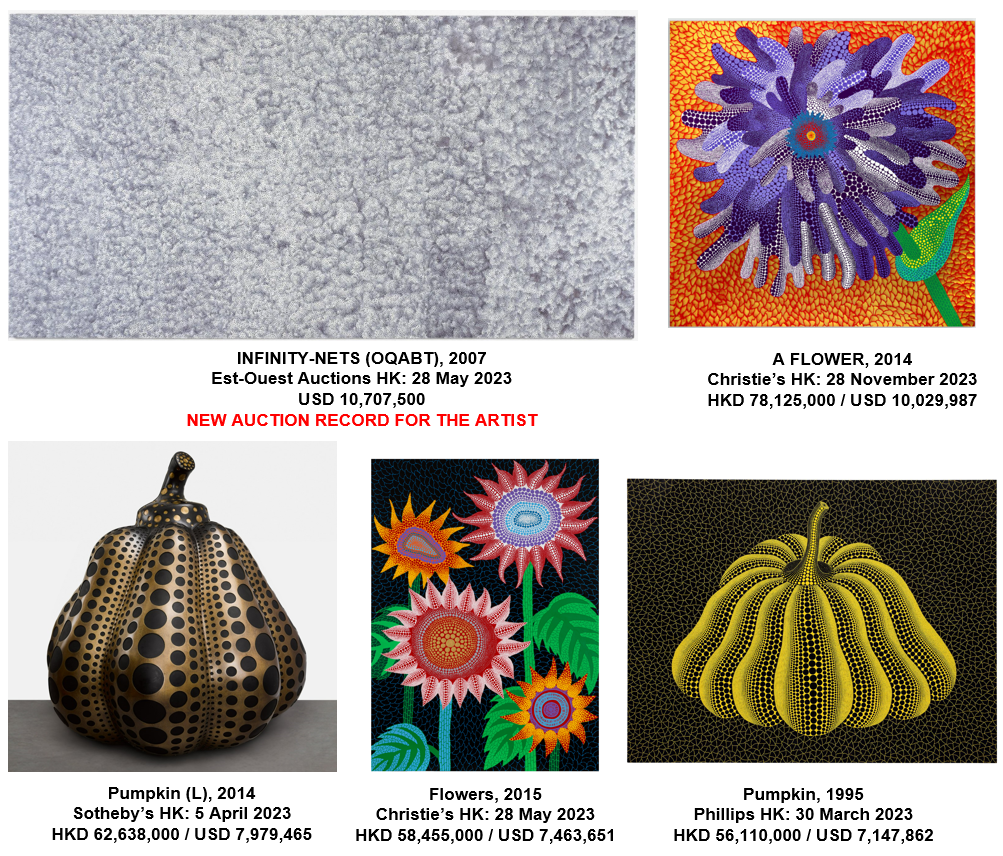
Another lot sold for more than USD 10 million, at Christie’s in Hong-Kong on 28 November 2023, for A FLOWER, a painting dated 2014, that sold for HKD 78,125,000 (USD 10,019,365). 2 lots sold over USD 10 million, but 56 lots sold for more than USD 1 million generating a cumulative turnover of USD 161,724,138, representing 85.5% of the total turnover for 2023.
2022 Auction Highlights
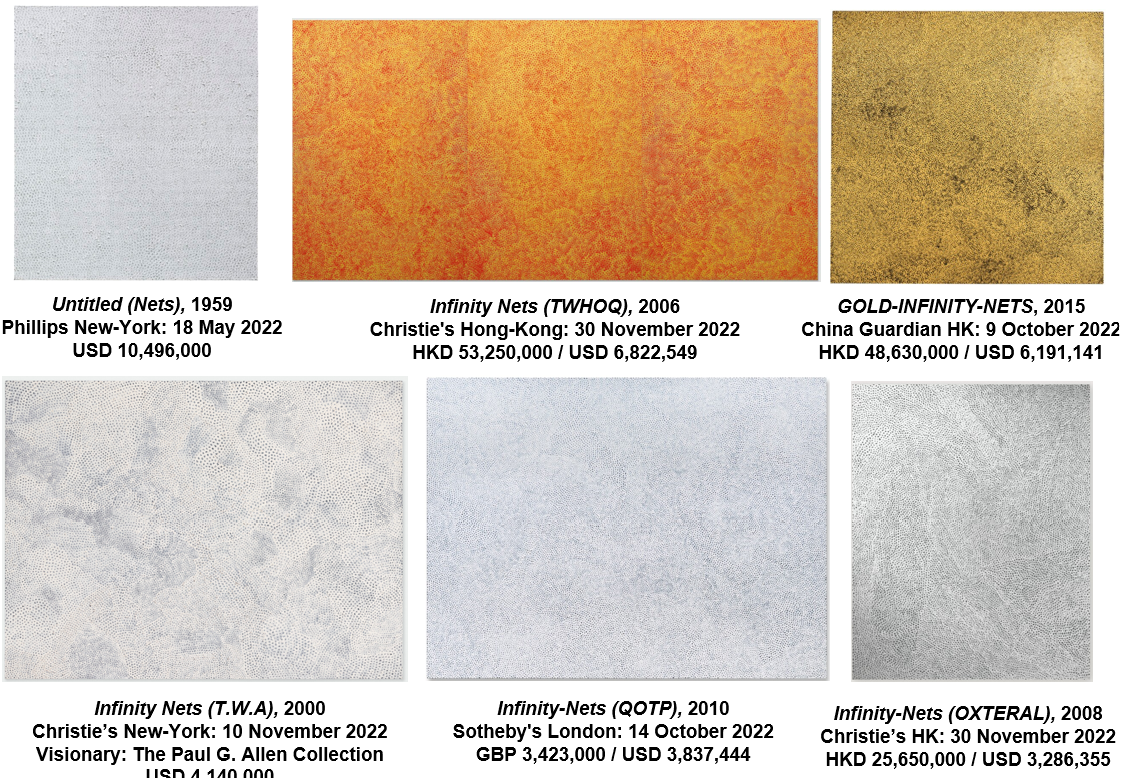
119 lots sold at auction in 2022 for a total turnover of USD 165,788,350. The top price was achieved at Phillips in New-York on 18 May 2022 for Untitled (Nets) dated 1959 that sold for USD 10,496,000. This is the highest price ever paid at auction for a work by the artist.
2022 Top 5 Lots
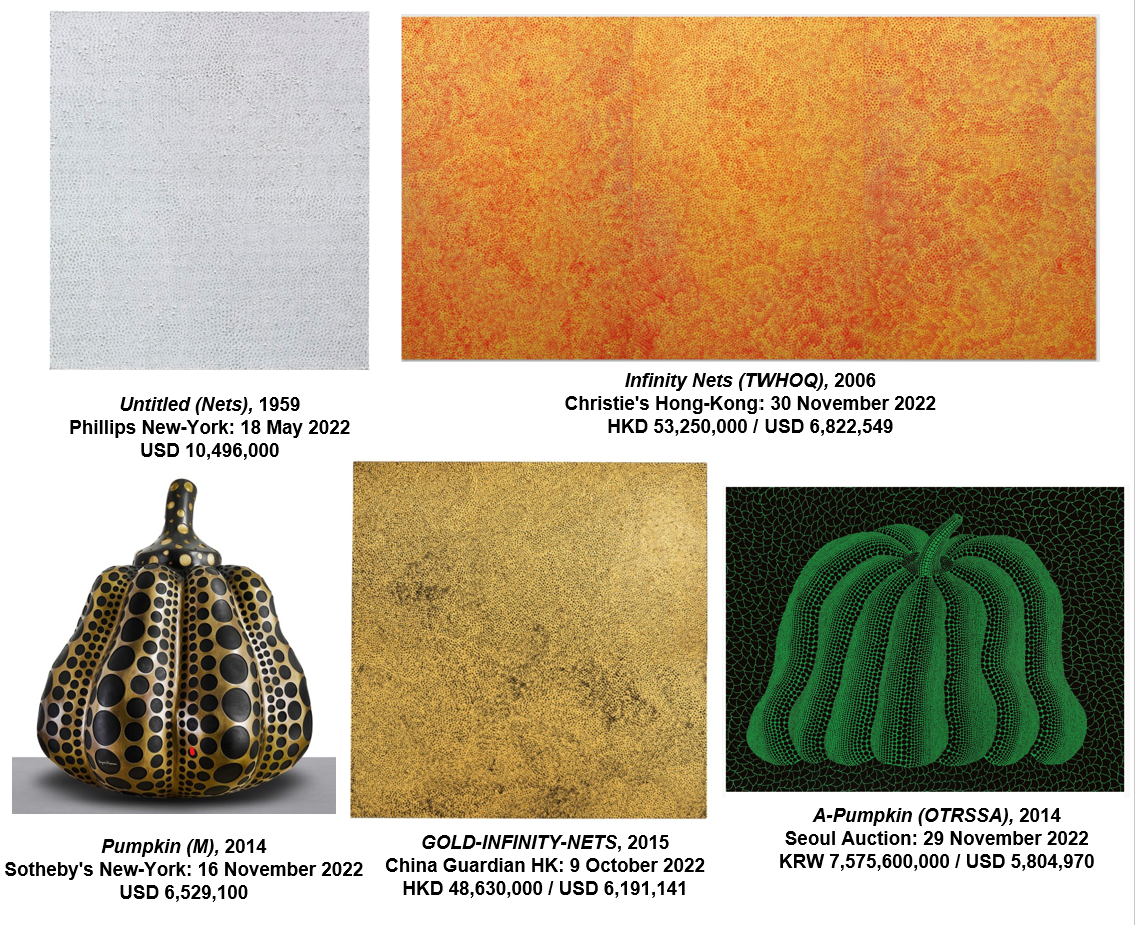
Only 1 lot sold for over USD 10 million, but 46 lots sold over USD 1 million, generating a cumulative turnover of USD 129,806,240, contributing 78.3% to the total turnover for 2022.
2021 Auction Highlights
96 lots sold at auction in 2021 for a total turnover of USD 146,637,206. The top price was achieved at Christie’s in Hong-Kong on 1 December 2021 for Pumpkin (LPASG) dated 2013 that sold for USD 10,496,000.
2021 Top 5 Lots
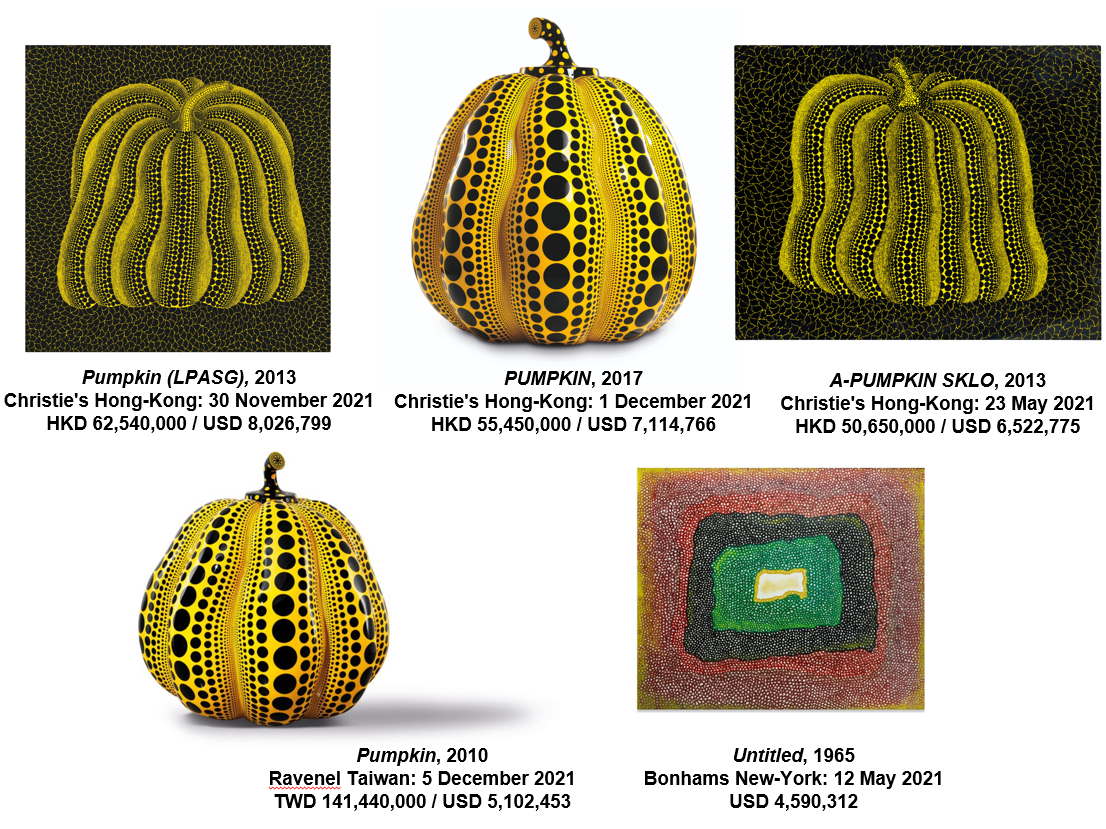
42 lots sold over USD 1 million for a cumulative turnover of USD 123,373,371, contributing 84.1% to the total turnover of 2021.
Pumpkin Paintings
Pumpkin Paintings are most probably Yayoi Kusama’s most celebrated and sought-after works. As such, they command high prices at auction, and there are very few lots passed.
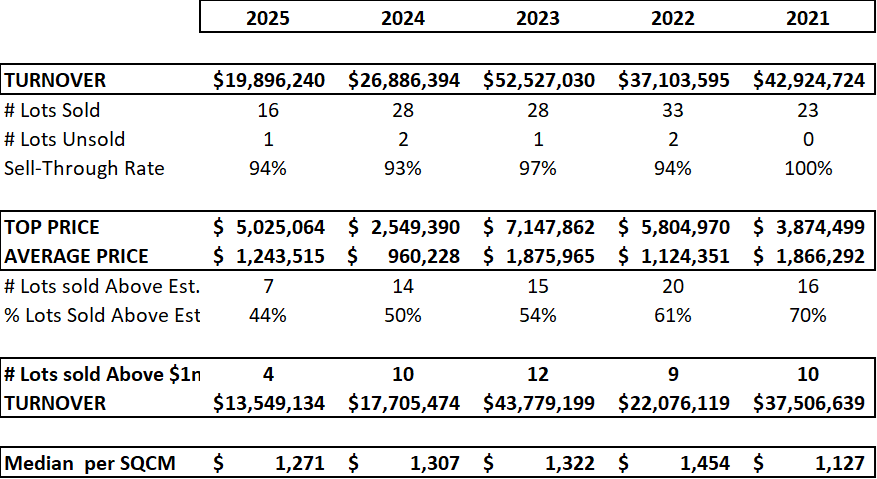
16 lots sold at auction in 2025 for a turnover of USD 19,896,240. With one lot failing to sell, the sell-through rate is 94.1%. The highest price has been achieved by PUMPKIN (HRU), a large PUMPKIN painting dated 2014, that sold at Christie’s in Hong-Kong, on 28 March 2025, for HKD 39,095,000 (USD 5,025,064). 4 lots sold for more than USD 1 million, generating a cumulative turnover of USD 13,549,134, representing 68% of the total turnover in 2025.
This compares to 28 Pumpkin paintings sold at auction in 2024 for a turnover of USD 26,886,394. With 2 lots failing to sell, the sell-through rate is 93%. The highest price paid for a Pumpkin painting in 2024 was achieved at Seoul Auction on 10 September 2024, when Pumpkin dated 1990 (53 x 45.5 cm) sold for KRW 4,422,000,000 (USD 2,549,390). 10 lots sold for more than USD 1 million, generating a cumulative turnover of USD 17,705,474, representing 66% of the total turnover for 2024.
PLEASE CLICK BELOW FOR A DETAILED MARKET OVERVIEW FOR PUMPKIN PAINTINGS
Infinity Nets
In 2021, Yayoi Kusama became the first female artist to ever join the top 10 of the most sold artists at auction. In 2022, Infinity Nets reached unprecedented heights including the new auction record set over USD 10 million by Phillips for a 1959 Infinity Nets.
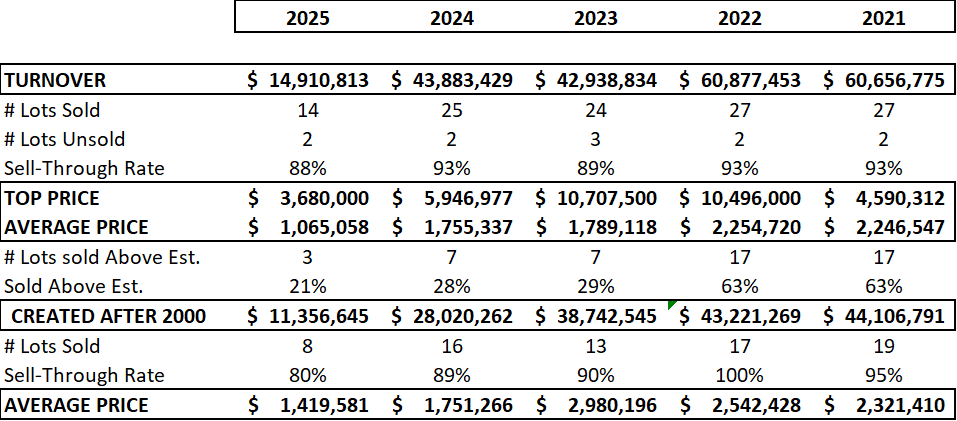
14 lots sold at auction in 2025 for a turnover of USD 14,910,813. With 2 lots failing to sell, the sell-through rate is 87.5%. Infinity-Nets [HSO], dated 2016 sold at Christie’s in New-York, on 14 May 2025, for USD 3,680,000, the highest price achieved so far for an Infinity Nets in 2025. 4 lots sold for more than USD 1 million, generating a cumulative turnover of USD 7,960,019, representing 53% of the total turnover in 2025.
This compares to 25 lots sold at auction in 2024 for a total turnover of USD 43,883,429. With 2 lots failing to sell, the sell-through rate is 93%. INFINITY, a painting dated 1995 sold at Bonhams in Hong-Kong on 25 May 2024 for HKD 46,434,000 (USD 5,946,977), the highest price paid for an Infinity Net painting in 2024.
READ ABOUT INFINITY NETS
(by color, size, period)
FIND ALL HISTORICAL AUCTION RESULTS
Top Lots
More Information available within the FOCUS sections
#1. INFINITY-NETS (OQABT), 2007
Est-Ouest Auctions Hong-Kong: 28 May 2023
Estimated: USD 10,000,000 – 12,000,000
USD 10,707,500
NEW AUCTION RECORD FOR THE ARTIST
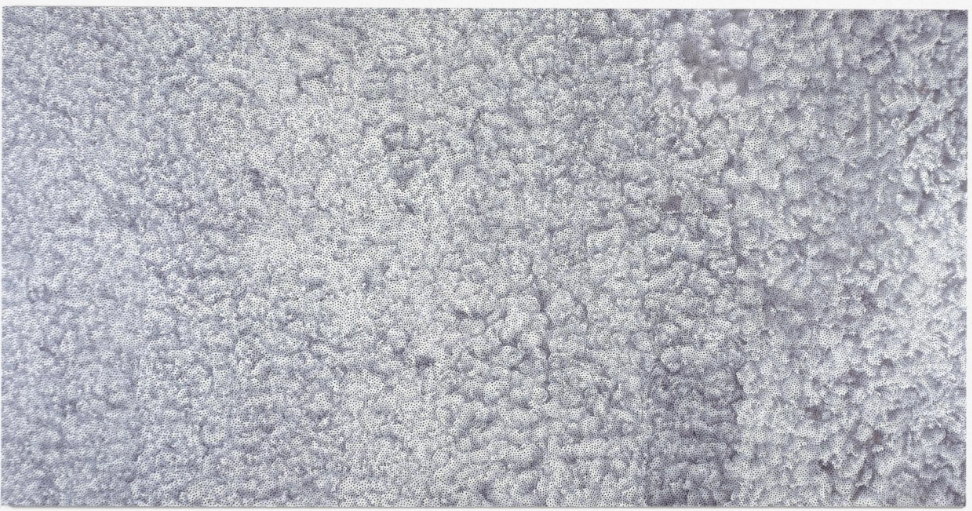
YAYOI KUSAMA
INFINITY-NETS (OQABT), 2007
Acrylic on canvas
287.5 x 556.5 cm (113 1/8 x 219 1/8 inches)
Signed, titled and dated on the reverse
#2. Untitled (Nets), 1959
Phillips New-York: 18 May 2022
Estimated: USD 5,000,000 – 7,000,000
USD 10,496,000
Yayoi Kusama – 20th Century & Contempora… Lot 11 May 2022 | Phillips
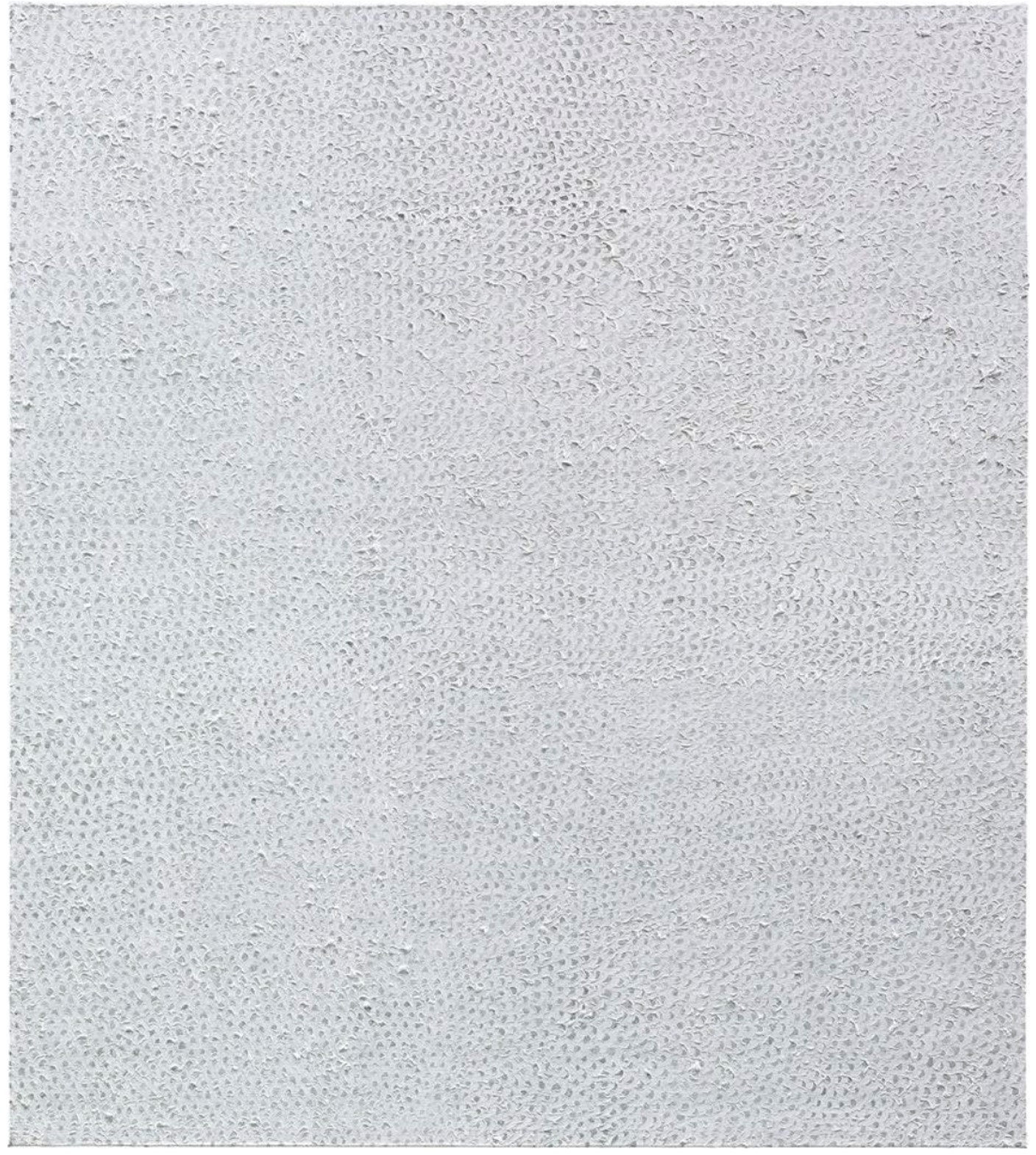
Untitled (Nets), 1959
Oil on canvas
130.8×116.5 cm (51.5×46 inches)
#3. A FLOWER, 2014
Christie’s Hong-Kong: 28 November 2023
Estimated: HKD 65,000,000 – 85,000,000
HKD 78,125,000 / USD 10,029,987
21391-yayoi-kusama-a-flower (christies.com)
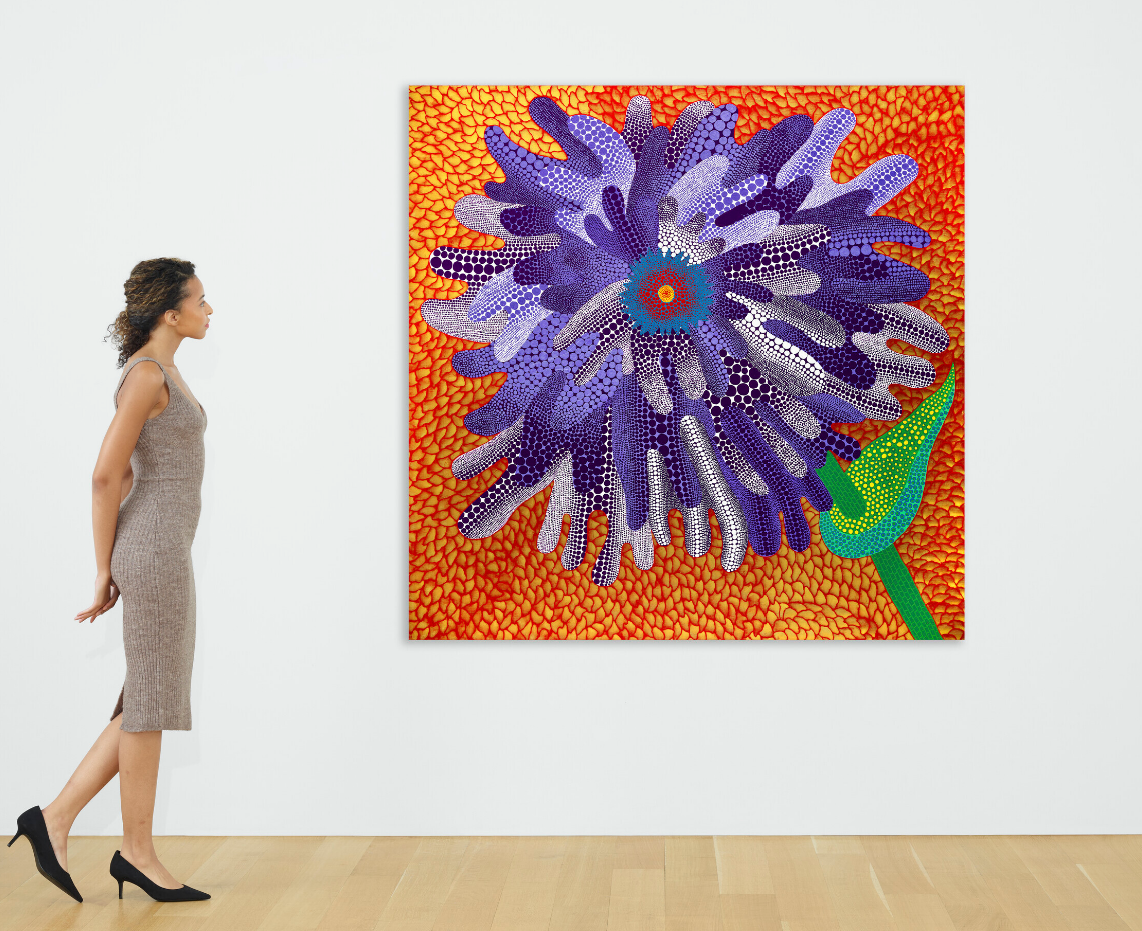
YAYOI KUSAMA (B. 1929)
A FLOWER, 2014
Acrylic on canvas
162.2 x 162.2 cm. (63 7/8 x 63 7/8 inches.)
titled in Japanese; signed, titled and dated ‘YAYOI KUSAMA 2014 A FLOWER’ (on the reverse)
#4. Pumpkin (LPASG), 2013
Christie’s Hong-Kong: 30 November 2021
Estimated: HKD 45,000,000 – 65,000,000
HKD 62,540,000 / USD 8,026,799
YAYOI KUSAMA (B. 1929) (christies.com)
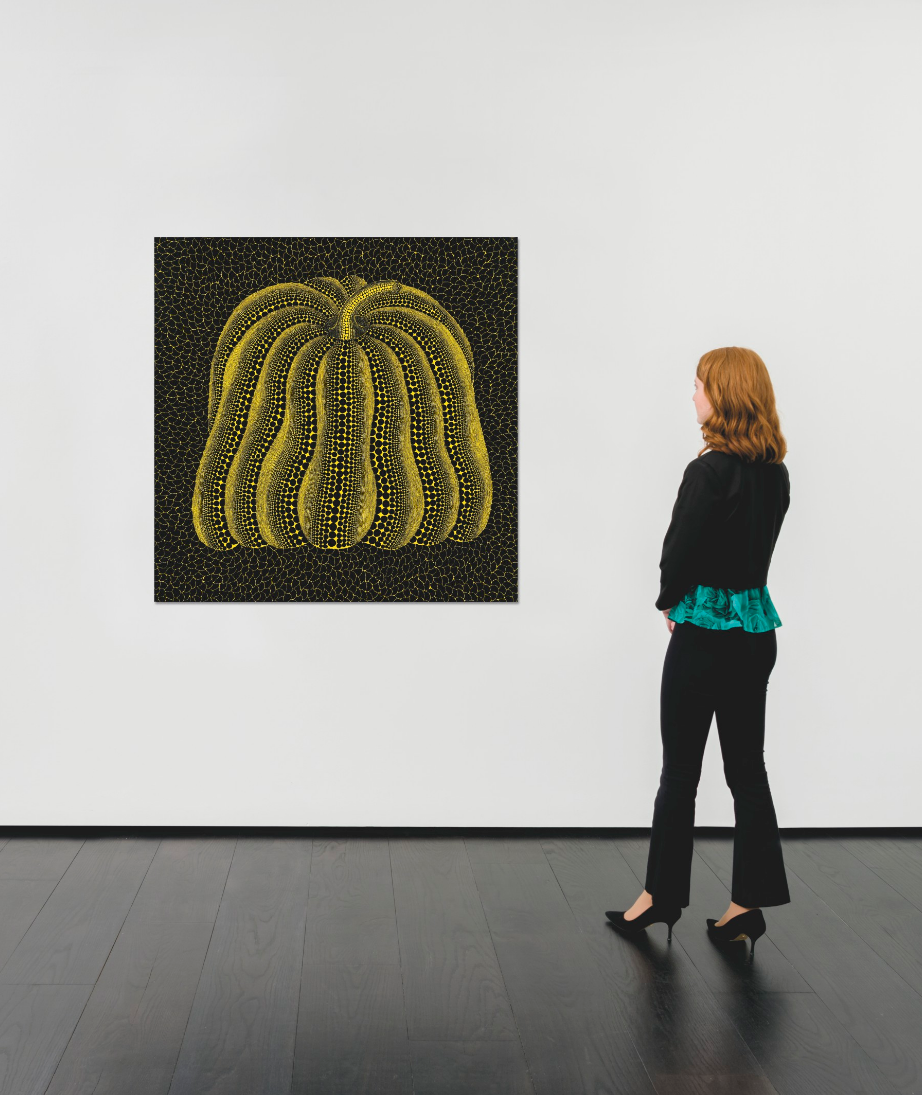
YAYOI KUSAMA
Pumpkin (LPASG), 2013
Acrylic on canvas
130.3 x 130.3 cm (51.2 x 51.2 inches)
#5. Pumpkin (L), 2014
Sotheby’s Hong-Kong: 5 April 2023
Estimated: HKD 40,000,000 – 60,000,000
HKD 62,638,000 / USD 7,979,465
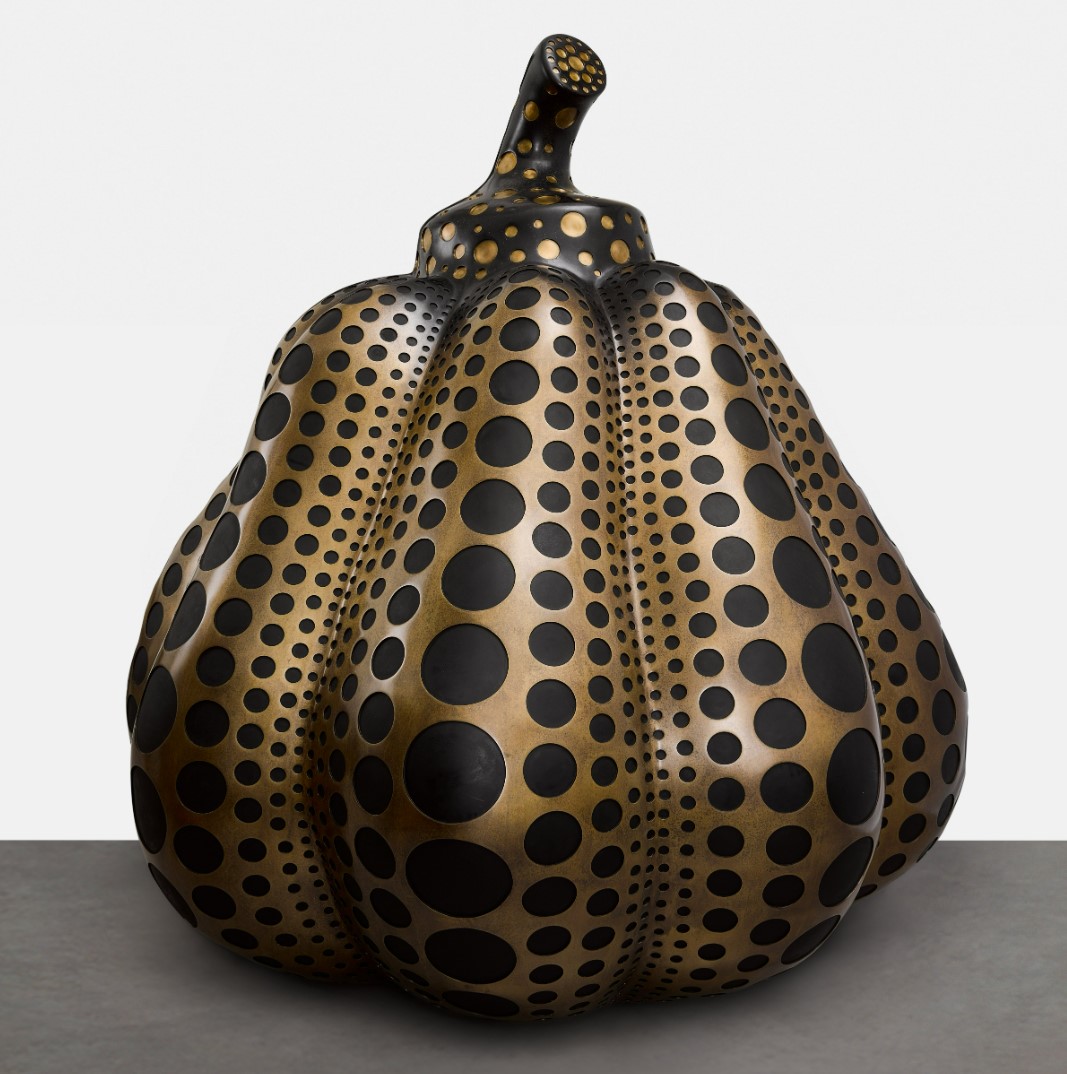
YAYOI KUSAMA (b. 1929)
Pumpkin (L), 2014
Bronze
241 x 235 x 235 cm (94 7/8 x 92 1/2 x 92 1/2 inches)
Incised Yayoi Kusama
This work is number 8 from an edition of 8, plus 2 artist’s proofs
#6. Interminable Net #4, 1959
Sotheby’s Hong-Kong: 1 April 2019
Estimated: HKD 50,000,000 – 70,000,000
HKD 62,433,000 / USD 7,953,526
(#1144) KUSAMA YAYOI | Interminable Net #4 (sothebys.com)
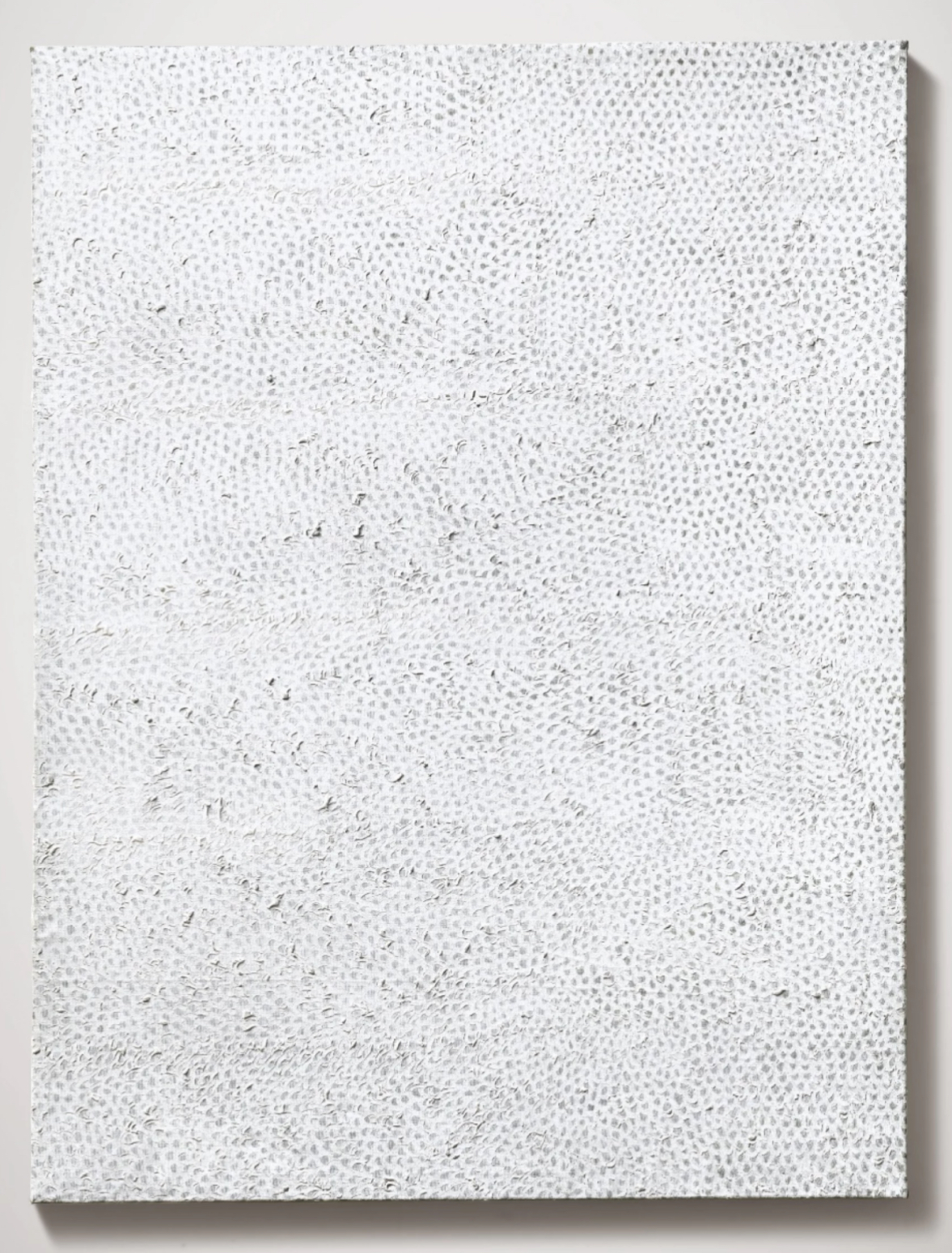
YAYOI KUSAMA
Interminable Net #4, 1959
Oil on canvas
143.5 x 108.6 cm (54 1/2 x 42 3/4 inches)
Signed in English, titled and dated 1959 on the reverse
#7. Flowers, 2015
Christie’s Hong-Kong: 28 May 2023
Estimated: HKD 32,000,000 -55,000,000
HKD 58,455,000 / USD 7,463,651
YAYOI KUSAMA (B. 1929) (christies.com)
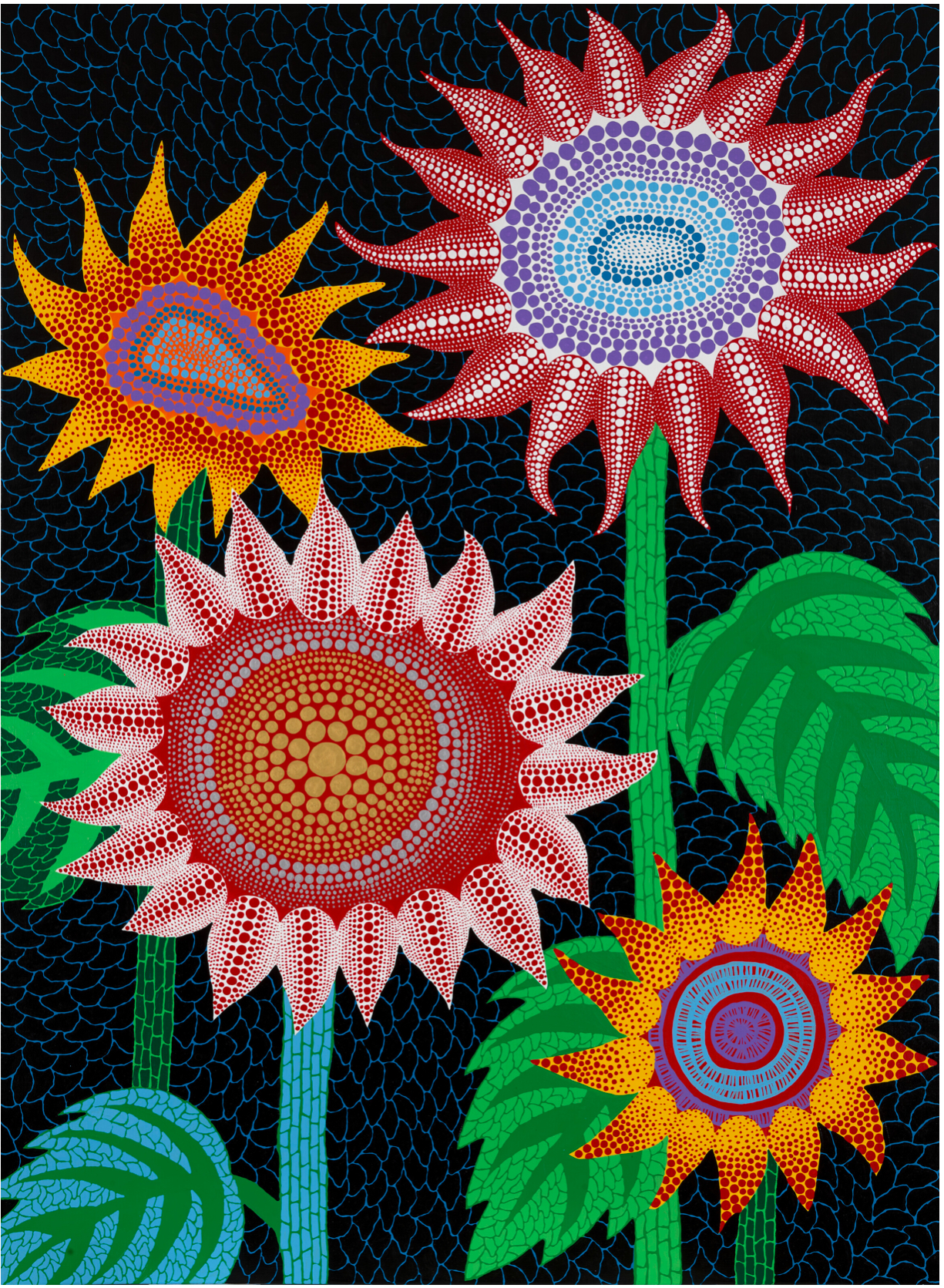
YAYOI KUSAMA (B. 1929)
Flowers, 2015
Acrylic on canvas
130.3 x 97 cm (51 1/3 x 38 1/5 inches)
Signed, titled and dated ‘FLOWERS 2015 YAYOI KUSAMA’ (on the reverse)
#8. Pumpkin, 1995
Phillips Hong-Kong: 30 March 2023
Estimated: HKD 40,000,000 – 50,000,000
HKD 56,110,000 / USD 7,147,862
Yayoi Kusama – 20th Century & Contempo… Lot 10 March 2023 | Phillips
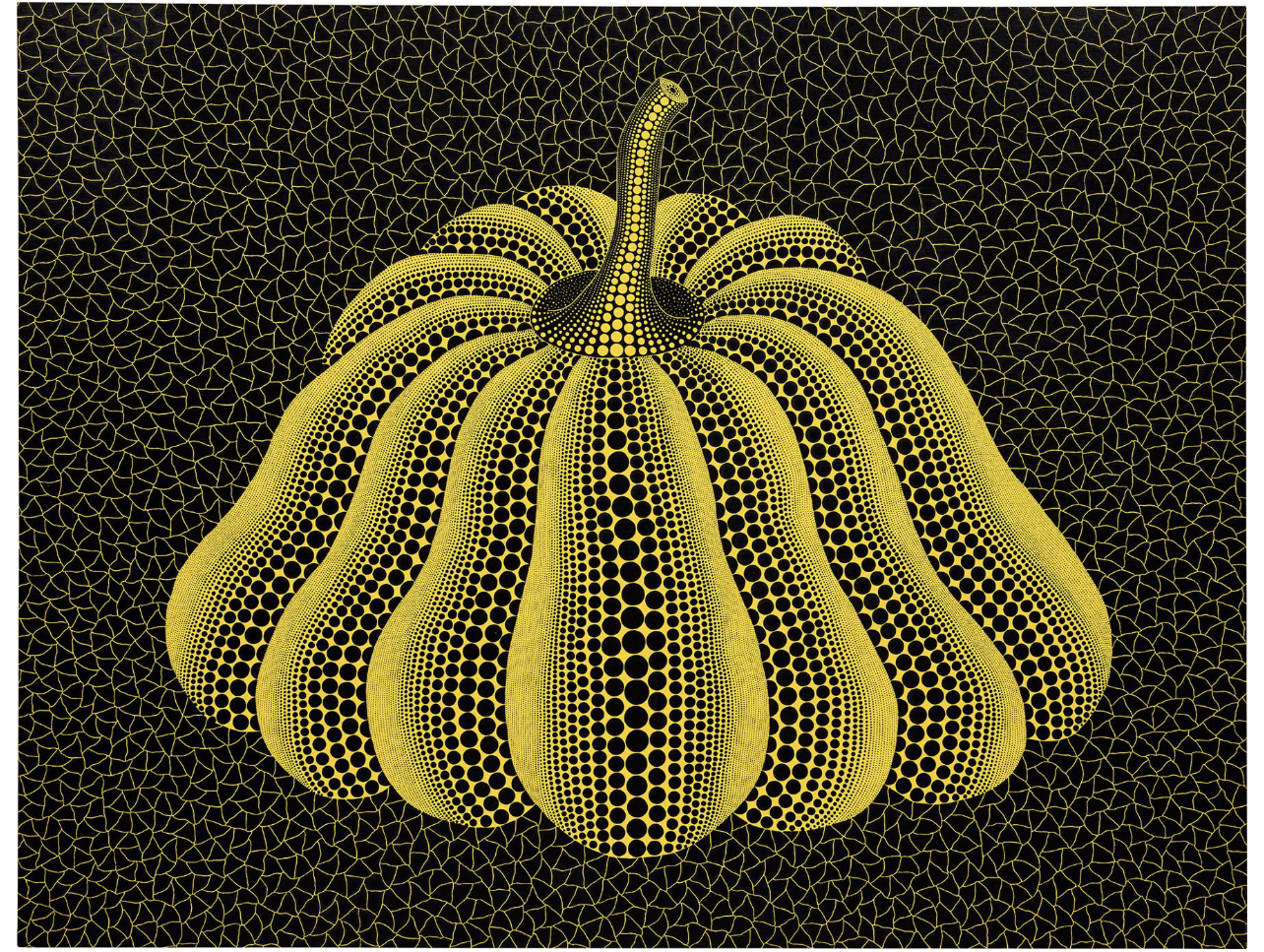
YAYOI KUSAMA
Pumpkin, 1995
acrylic on canvas
112.3 x 145.8 cm (44 1/4 x 57 3/8 inches)
Signed, titled and dated ‘Yayoi Kusama 1995 “Pumpkin” [in Japanese]’ on the reverse
#9. PUMPKIN, 2017
Christie’s Hong-Kong: 1 December 2021
Estimated: HKD 28,000,000 – 38,000,000
HKD 55,450,000 / USD 7,114,766
YAYOI KUSAMA (B. 1929) (christies.com)
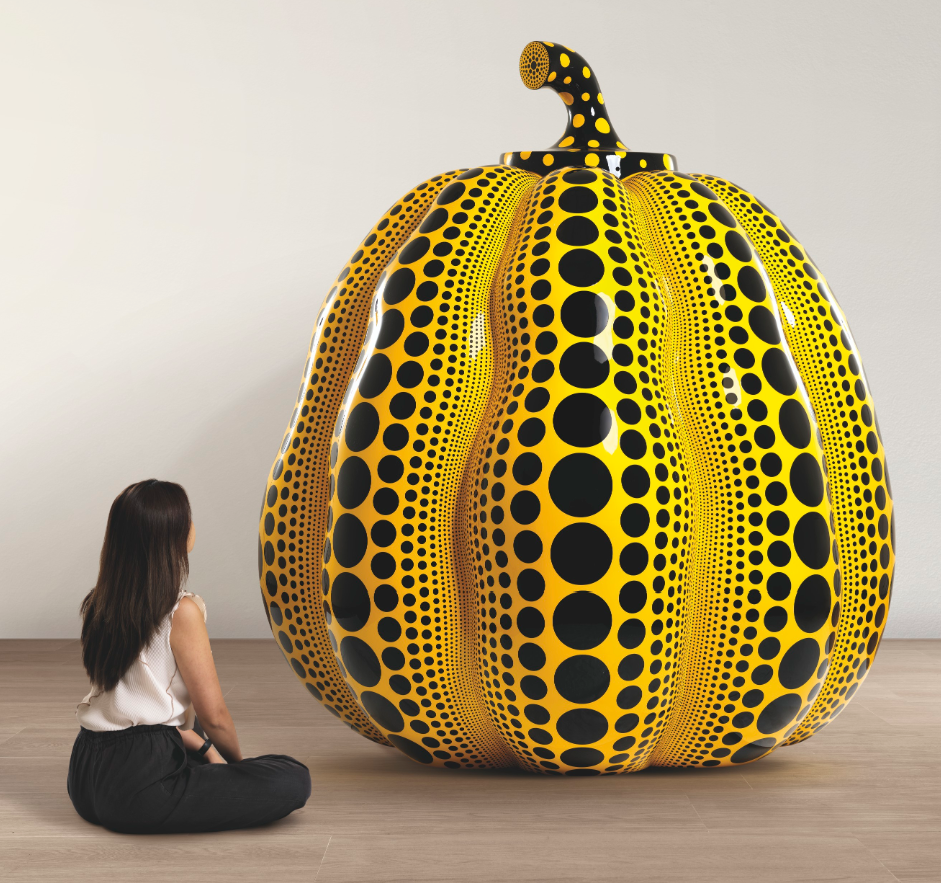
YAYOI KUSAMA (B. 1929)
PUMPKIN, 2017
Fiberglass-reinforced plastic and urethane paint sculpture in two parts
215 (H) x 180 x 180 cm (84 5/8 x 70 7/8 x 70 7/8 inches)
Signed and dated ‘YAYOI KUSAMA 2017’ (on the side)
#10. White No. 28, 1960
Christie’s New-York: 12 November 2014
Estimated: USD 1,500,000 – 2,000,000
USD 7,109,000
Yayoi Kusama (b. 1929) (christies.com)
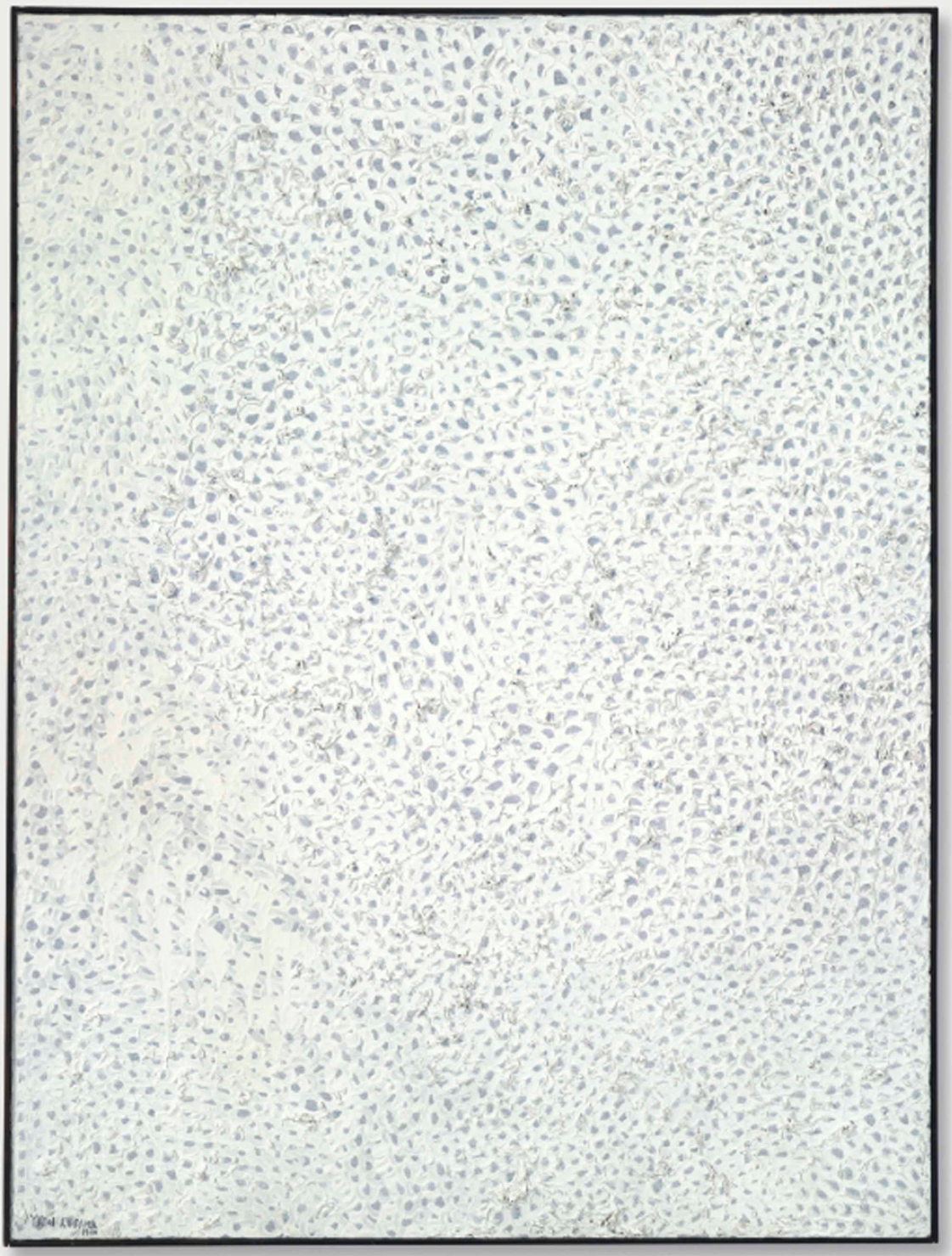
Yayoi Kusama (b. 1929)
White No. 28, 1960
Oil on canvas
147.6 x 111.1 cm (58 1/8 x 43 3/4 inches)
Signed and dated ‘YAYOI KUSAMA 1960’ (lower left)
PLEASE CLICK BELOW FOR MORE AUCTION RESULTS
Repeat Sales
PLEASE CLICK BELOW TO FIND YAYOI KUSAMA REPEAT SALES
PART II: AUCTION RESULTS
2026 Upcoming Lots
SEE ALL UPCOMING LOTS
2026 Auction Results
PLEASE CLICK BELOW TO SEE 2026 AUCTION RESULTS

2025 Auction Results
74 lots sold at auction in 2025 for a total turnover of USD 53,360,088. With 10 lots failing to sell, the sell-through rate is 88.1%. The highest price for 2025 has been achieved by PUMPKIN (HRU), a large PUMPKIN painting dated 2014, that sold at Christie’s in Hong-Kong, on 28 March 2025, for HKD 39,095,000 (USD 5,025,064).
2025 Top 6 Lots
12 lots sold for more than USD 1 million, generating a cumulative turnover of USD 28,262,871, representing 53% of the total turnover for 2025.
1. Pumpkin Paintings
16 lots sold at auction in 2025 for a turnover of USD 19,896,240. With one lot failing to sell, the sell-through rate is 94.1%. The highest price has been achieved by PUMPKIN (HRU), a large PUMPKIN painting dated 2014, that sold at Christie’s in Hong-Kong, on 28 March 2025, for HKD 39,095,000 (USD 5,025,064).
2025 Top 3 Lots
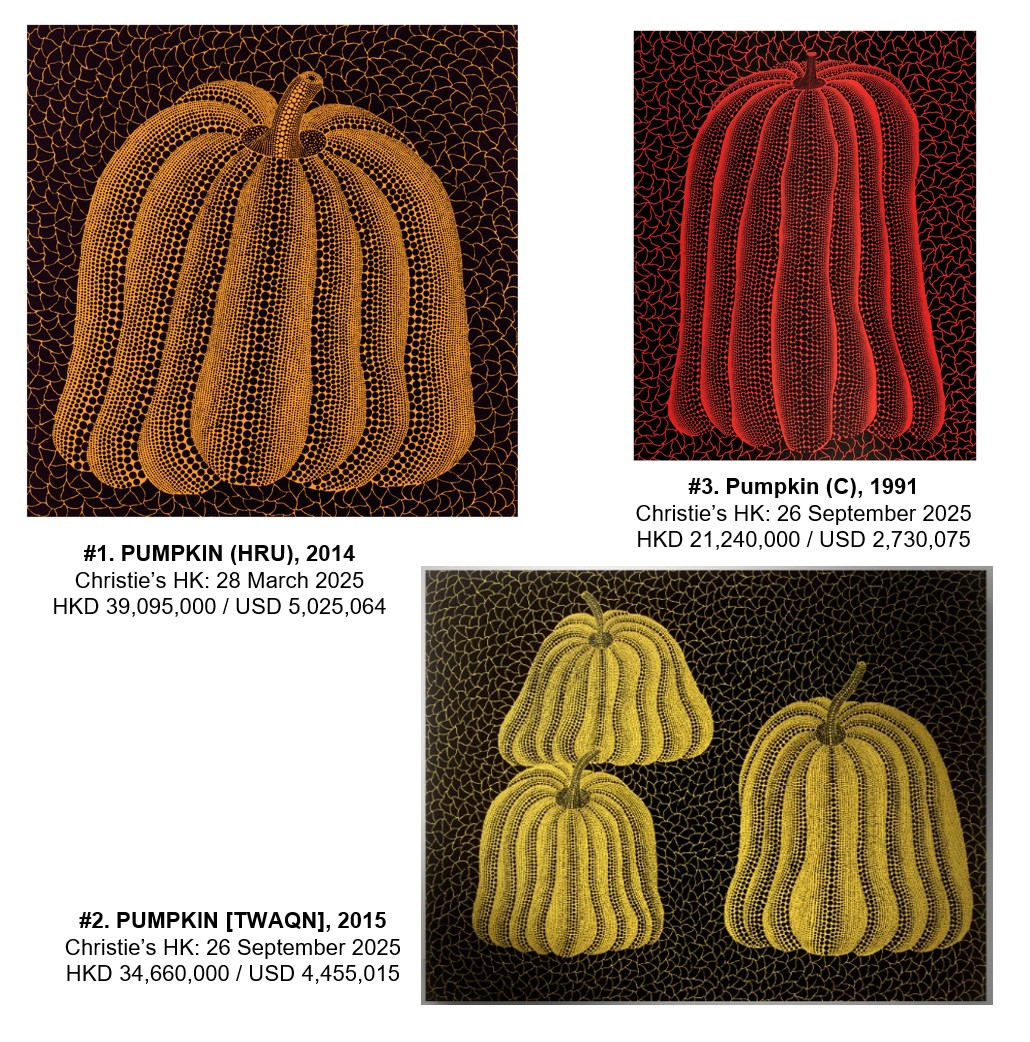
4 lots sold for more than USD 1 million, generating a cumulative turnover of USD 13,549,134, representing 68% of the total turnover in 2025.
2. Infinity Nets
14 lots sold at auction in 2025 for a turnover of USD 14,910,813. With 2 lots failing to sell, the sell-through rate is 87.5%. Infinity-Nets [HSO], dated 2016 sold at Christie’s in New-York, on 14 May 2025, for USD 3,680,000, the highest price achieved so far for an Infinity Nets in 2025.
2025 Top 3 Lots
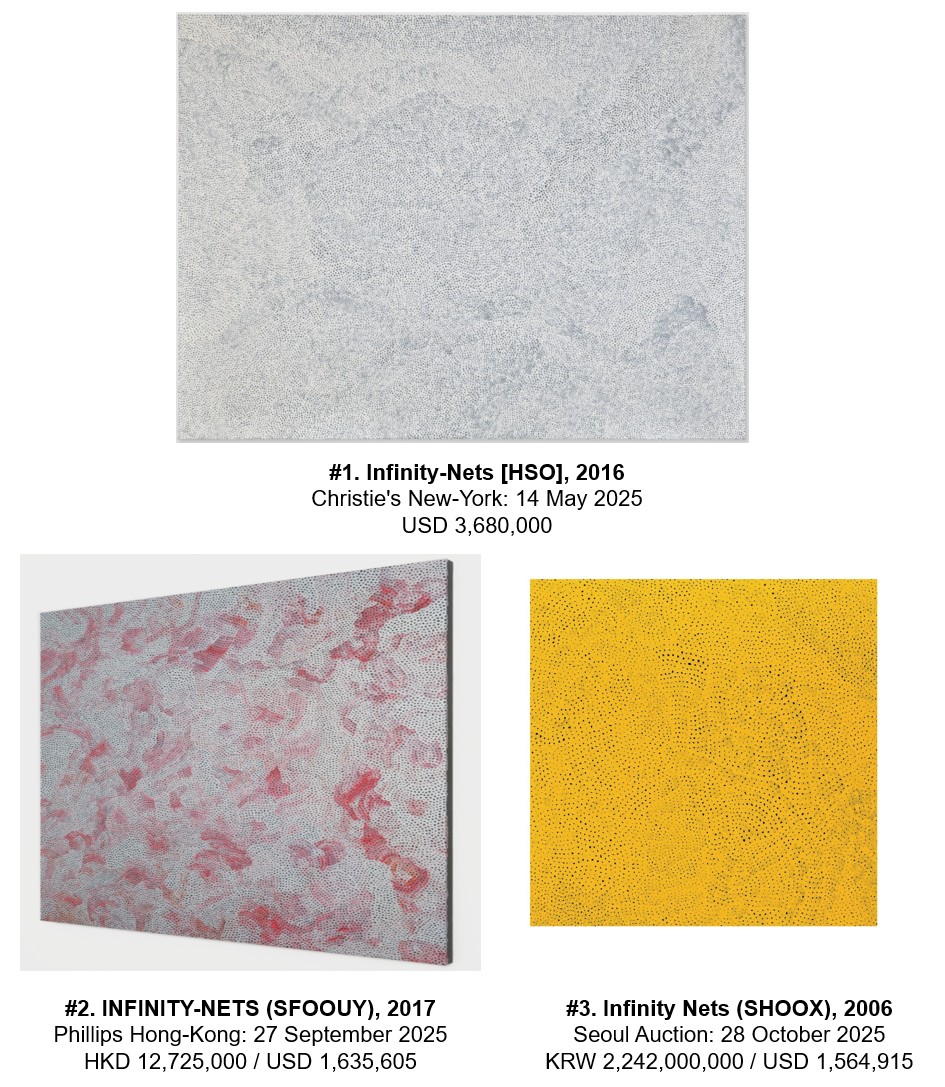
4 lots sold for more than USD 1 million, generating a cumulative turnover of USD 7,960,019, representing 53% of the total turnover in 2025.
3. Other Paintings
18 lots sold at auction in 2025 for a turnover of USD 8,523,979. With 3 lots failing to sell, the sell-through rate is 85.7%. The highest price has been achieved by Hat, a painting dated 1981, that sold at Christie’s in Hong-Kong, on 29 March 2025, for HKD 6,930,000 (USD 890,746).
2025 Top 3 Lots
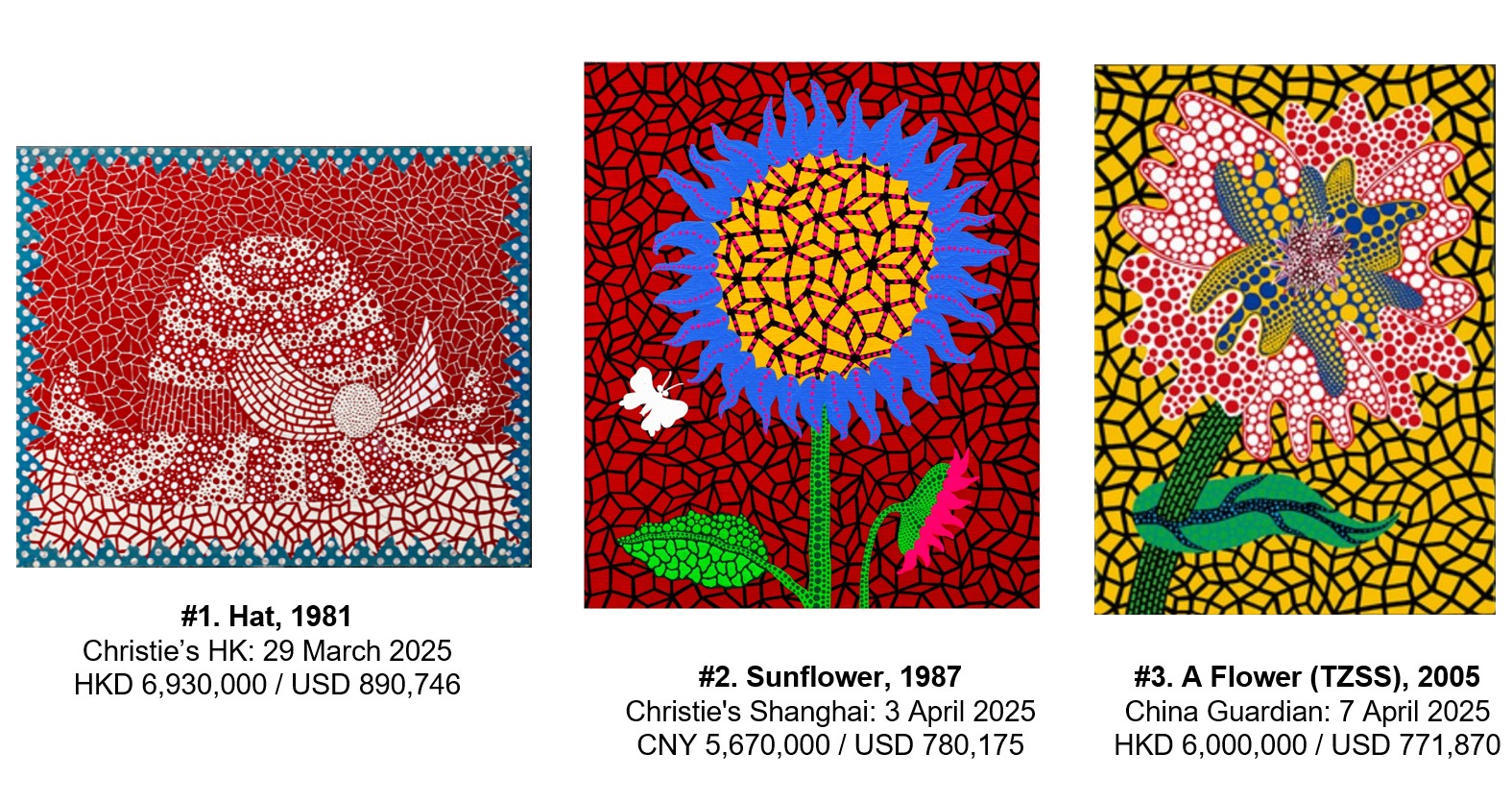
No lot sold for more than USD 1 million. 7 lots sold for more than USD 500,000, generating a cumulative turnover of USD 5,312,038, representing 62.3% of the total turnover for this category.
4. Sculptures
12 lots sold at auction in 2025 for a turnover of USD 8,447,157. With 2 lots failing to sell, the sell-through rate is 85.7%. The highest price has been achieved by Starry Pumpkin, a fiberglass and tile Pumpkin sculpture dated 2019, that sold at Sotheby’s in Hong-Kong, on 29 March 2025 for HKD 15,015,000 (USD 1,929,950).
2025 Top 3 Lots
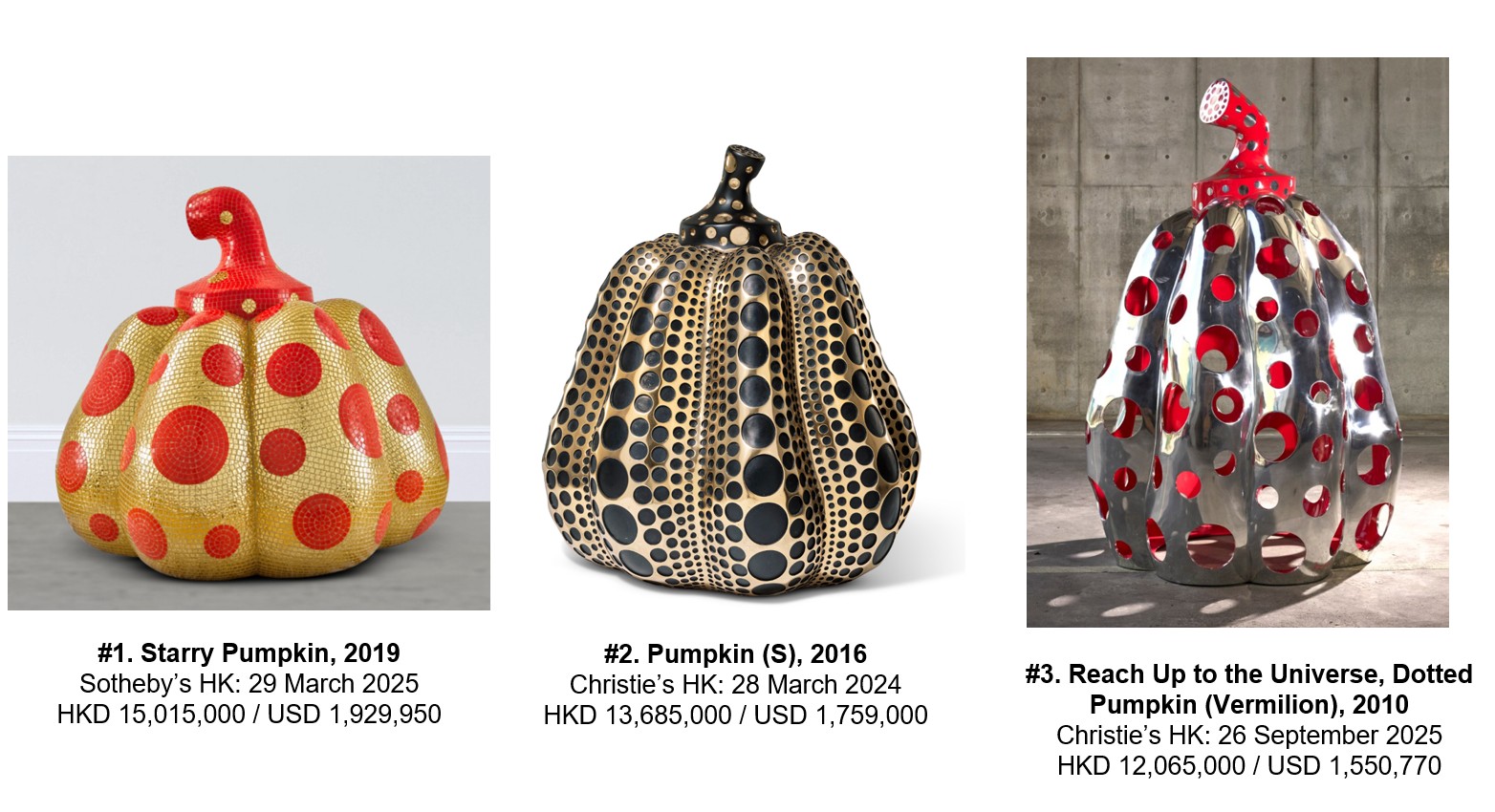
4 lots sold for more than USD 1 million, generating a cumulative turnover of USD 6,753,717, representing 80% of the total turnover of this category in 2025.
5. Works on Paper
14 lots sold at auction in 2025 for a turnover of USD 1,581,898. With 1 lot failing to sell, the sell-through rate is 93.3%. The highest price has been achieved by The Sea, a work on paper dated 1952, that sold at Phillips in New-York, on 14 May 2025, for USD 254,000. 8 lots sold for more than USD 100,000, generating a cumulative turnover of USD 1,231,739, representing 78% of the total turnover for 2025.
PLEASE CLICK BELOW FOR DETAILED 2025 AUCTION RESULTS

2024 Auction Results
101 lots sold at auction in 2024 for a total turnover of USD 139,563,444. With 7 lots failing to sell, the sell-through rate is 93.5%. The highest price was achieved at Christie’s in New-York on 21 November 2024, when Pumpkin, a large sculpture dated 2022 sold for USD 6,826,000.
2024 Top 6 Lots
44 lots sold for more than USD 1 million generating a cumulative turnover of USD 113,862,645, representing 83% of the total turnover for 2024.
PLEASE CLICK BELOW FOR DETAILED 2024 AUCTION RESULTS
2023 Auction Results
122 lots sold at auction in 2023 for a total turnover of USD 189,232,649. The top price was achieved at Est-Ouest Auctions in Hong-Kong on 28 May 2023 for the immense INFINITY-NETS (OQABT) dated 2007 that sold for USD 10,707,500, a new auction record for the artist. It had last sold at Sotheby’s in London on 25 June 2009 for GBP 337,250. Another lot sold for more than USD 10 million, at Christie’s in Hong-Kong on 28 November 2023, for A FLOWER, a painting dated 2014, that sold for HKD 78,125,000 (USD 10,019,365).
2023 Top 5 Lots
2 lots sold over USD 10 million, but 56 lots sold for more than USD 1 million generating a cumulative turnover of USD 161,724,138, representing 85.5% of the total turnover for 2023.
PLEASE CLICK BELOW TO FIND ALL AUCTION RESULTS FOR 2023

2022 Auction Results
119 lots sold at auction in 2022 for a total turnover of USD 165,788,350. The top price was achieved at Phillips in New-York on 18 May 2022 for Untitled (Nets) dated 1959 that sold for USD 10,496,000. This is the highest price ever paid at auction for a work by the artist.
2022 Top 5 Lots
PLEASE CLICK BELOW TO FIND ALL AUCTION RESULTS FOR 2022

2021 Auction Results
96 lots sold at auction in 2021 for a total turnover of USD 146,637,206. The top price was achieved at Christie’s in Hong-Kong on 1 December 2021 for Pumpkin (LPASG) dated 2013 that sold for USD 10,496,000. 42 lots sold over USD 1 million for a cumulative turnover of USD 123,373,371, contributing 84.1% to the total turnover of 2021.
2021 Top 5 Lots
PLEASE CLICK BELOW TO FIND ALL AUCTION RESULTS FOR 2021

PART III: FOCUS
Pumpkin Paintings
One of the most recognizable icons in contemporary art today, Kusama’s pumpkin is deeply central to the artist’s psyche, and its origins within her art can be traced back to her most early years. Kusama recalls having consumed the vegetable endlessly to the point of nausea in her childhood years during and after the war; in spite of this, she retains a fond attachment to its organic bulbous form, describing it as embodying a “generous unpretentiousness” and “solid spiritual balance.”
“I adore pumpkins. As my spiritual home since childhood, and with their infinite spirituality, they contribute to the peace of mankind across the world and to the celebration of humanity. And by doing so they make me feel at peace. Pumpkins bring about poetic peace in my mind. Pumpkins talk to me.”
Kusama’s obsession with pumpkins dates back to her childhood. The artist has since been captivated by the bulbous form after her visits to plant nurseries with her grandfather. Already experiencing hallucinations at the time, involving pumpkins that spoke to her in a most animated manner, Kusama found the gourd a benign and nurturing subject – as opposed to the more traumatic and menacing feelings she associates with flowers, plants and objects that plagued her throughout her life.
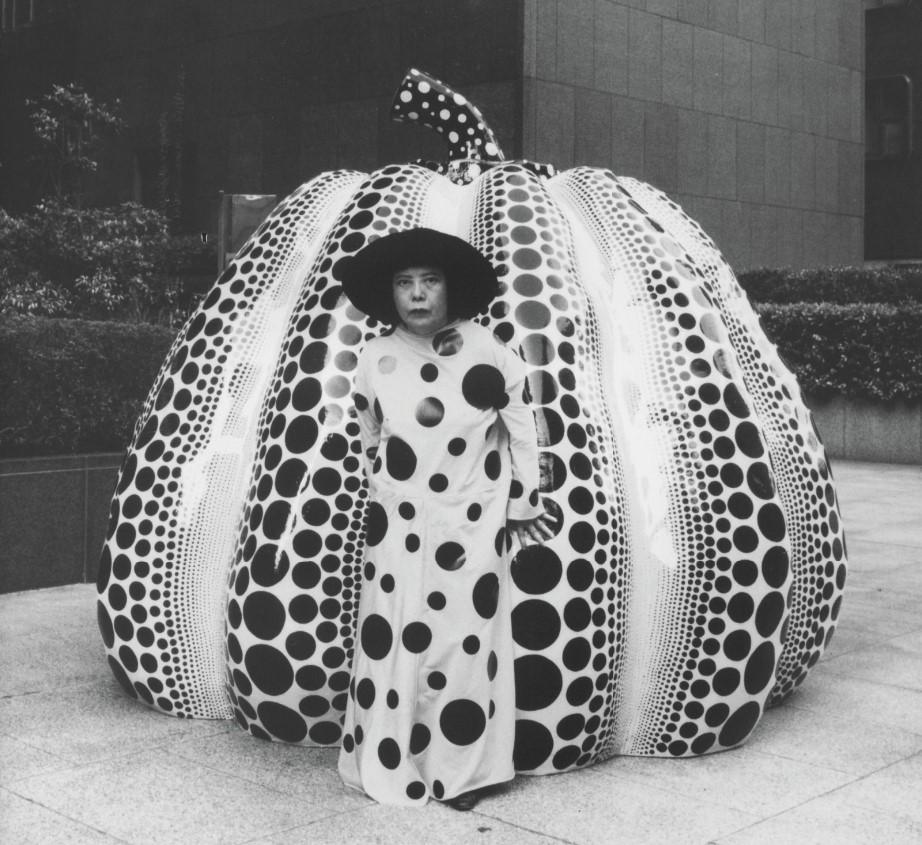
Pumpkins are a generator of passion. They do not present nets meant to capture; they conversely encourage us to feel the deepest emotions without allowing them to be lost to the demands of everyday life. A striking example of Kusama’s sought-after paintings of the 1990s, just as her career was reach the height Western critical acclaim. Each motif, such as the Pumpkin and the accompanying Infinity Nets, have their own inimitable presence that speaks both to their skilled making and the emotions they elicit. Pumpkins are also paintings that show light in relief, in three dimensions. They give us an illuminated path forward into a heretofore unknown and joyful space.
Pumpkins are most probably Yayoi Kusama’s most celebrated and sought-after works. As such, they command high prices at auction, and there are very few lots passed.
Auction Summary
2025 Auction Highlights
16 lots sold at auction in 2025 for a turnover of USD 19,896,240. With one lot failing to sell, the sell-through rate is 94.1%. The highest price has been achieved by PUMPKIN (HRU), a large PUMPKIN painting dated 2014, that sold at Christie’s in Hong-Kong, on 28 March 2025, for HKD 39,095,000 (USD 5,025,064).
2025 Top 3 Lots
4 lots sold for more than USD 1 million, generating a cumulative turnover of USD 13,549,134, representing 68% of the total turnover in 2025.
2024 Auction Highlights
28 Pumpkin paintings sold at auction in 2024 for a turnover of USD 26,886,394. With 2 lots failing to sell, the sell-through rate is 93%. The highest price paid for a Pumpkin painting in 2024 was achieved at Seoul Auction on 10 September 2024, when Pumpkin dated 1990 (53 x 45.5 cm) sold for KRW 4,422,000,000 (USD 2,549,390). 10 lots sold for more than USD 1 million, generating a cumulative turnover of USD 17,705,474, representing 66% of the total turnover for 2024.
The strong decrease in turnover from 2023 to 2024 is explained by the absence of large Pumpkin paintings sold at auction in 2024, in fact 4 Pumpkin paintings sold in 2023 for more than USD 5 million, generating a cumulative turnover of USD 25,272,373.
2023 Auction Highlights
30 lots sold at auction in 2023 for a turnover of USD 52,842,992. With only 1 lot unsold, the sell-through rate is a solid 97%. Pumpkin, a painting dated 1995, measuring 112.3 x 145.8 cm, sold at Phillips in Hong-Kong on 30 March 2023 for HKD 56,110,000 (USD 7,147,862), the highest price paid at auction for a Pumpkin painting in 2023.
2023 Top 6 Lots
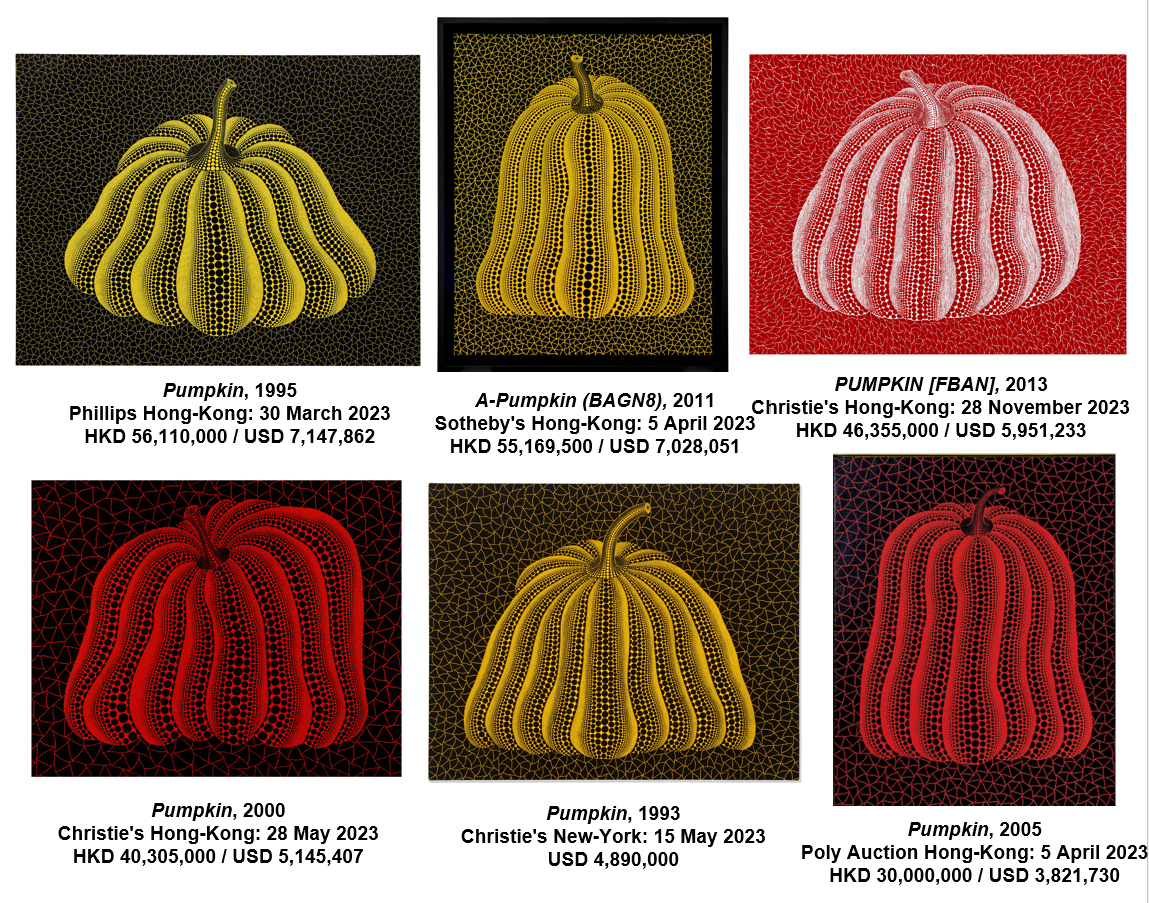
The average price is USD 7,147,862. Among the 10 most expensive lots sold in 2023, there are no less than 6 Pumpkin Paintings and 2 Pumpkin Sculptures.
2022 Auction Highlights
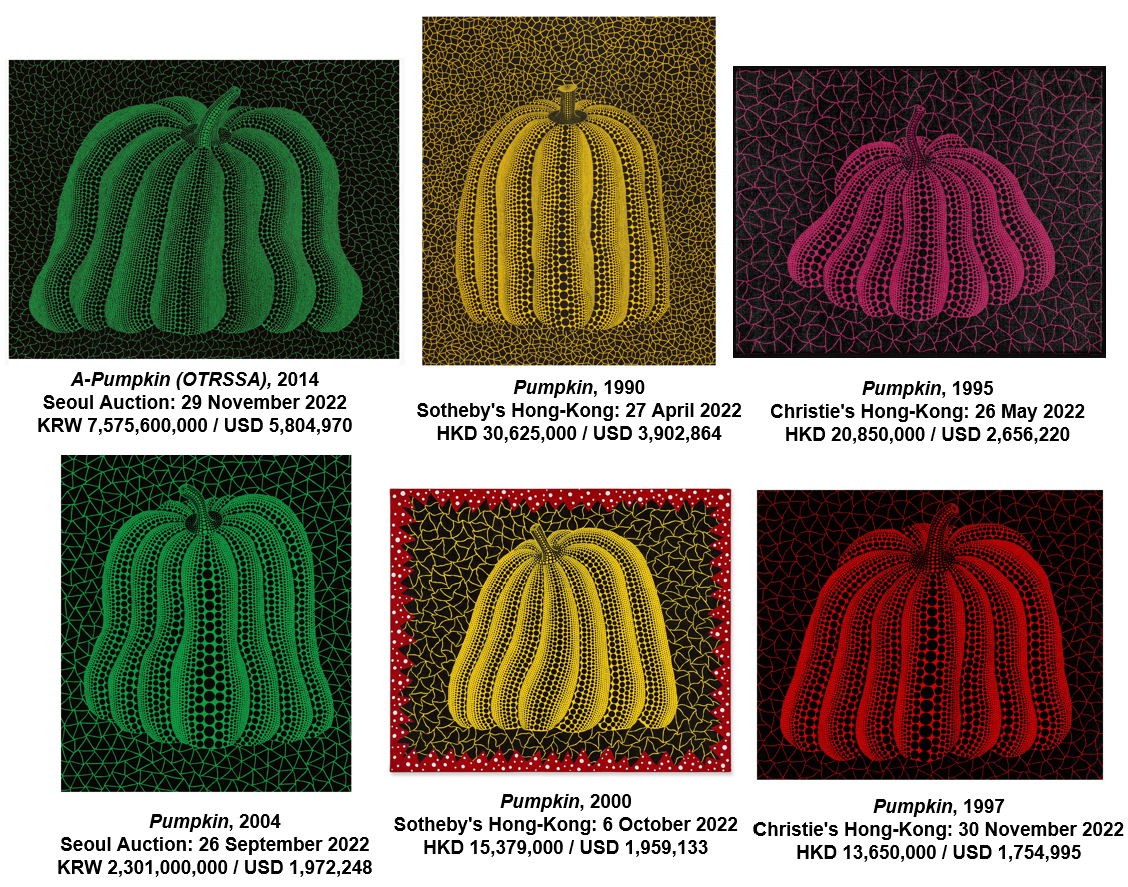
33 Pumpkin paintings sold in 2022 for a total turnover of USD 37,103,595. With only two paintings unsold, the sell-through rate is a solid 94%. 2021 was a record year with 23 Pumpkins selling at auction generating close to USD 43 million. Even though the market appears to have contracted in 2022, with a higher number of lots sold for a lower total revenues, the median price, adjusted by size, keeps on increasing to reach unprecedented levels.
Top 6 Lots sold in 2022
2021 Auction Highlights
23 Pumpkin Paintings sold at auction in 2021 for a record turnover of USD 42,924,724. With no lot failing to sell, the Sell-Through Rate is 100%. A new world record was set at Christie’s in Hong-Kong on 1 December 2021, when Pumpkin (LPASG), a large Pumpkin Painting dated 2013, sold for HKD 62,540,000 (USD 8,026,800).
#1. Pumpkin (LPASG), 2013
Christie’s Hong-Kong: 1 December 2021
Estimated: HKD 45,000,000 – 65,000,000
HKD 62,540,000 / USD 8,026,800
AUCTION RECORD FOR A PUMPKIN PAINTING
YAYOI KUSAMA (B. 1929) (christies.com)
YAYOI KUSAMA
Pumpkin (LPASG), 2013
Acrylic on canvas
130.3 x 130.3 cm (51.2 x 51.2 inches)
READ ABOUT PUMPKIN PAINTINGS
FIND ALL HISTORICAL AUCTION RESULTS
Pumpkin Sculptures
Without doubt one of the most immediately recognizable motifs in contemporary art, the polka-dot covered pumpkin sits at the very heart of Japanese artist Yayoi Kusama’s incredible 70-year practice, appearing across her work in paintings, sculpture, and immersive installations. Profoundly personal, Kusama’s affinity with the misshapen gourd is rooted deeply in the artist’s biography and is closely tied to the patterns of infinite repetition and accumulation that best define her practice. So deeply enmeshed with Kusama’s biography and practice, the pumpkin is utterly synonymous with the artist herself, employed both as a universally recognized signature and a richly rewarding mode of self-representation that is most readily evoked in the freestanding sculptures.
READ ABOUT PUMPKIN SCULPTURES
FIND ALL AUCTION RESULTS
Infinity Nets
With no definitive beginning or end to the composition, Infinity Nets are a dizzying journey into the infinite. The artist’s looping brush strokes ebb and flow across the canvas, creating a rising and falling effect like the ocean tide. The work is underpinned by an emotional intensity contained within the Kusama’s obsessive practice. In feats of remarkable stamina and focus, Kusama is known to labor for hours over her works to the point of exhaustion, meticulously repeating her looping brushstrokes in order to create the net’s rippling effect.
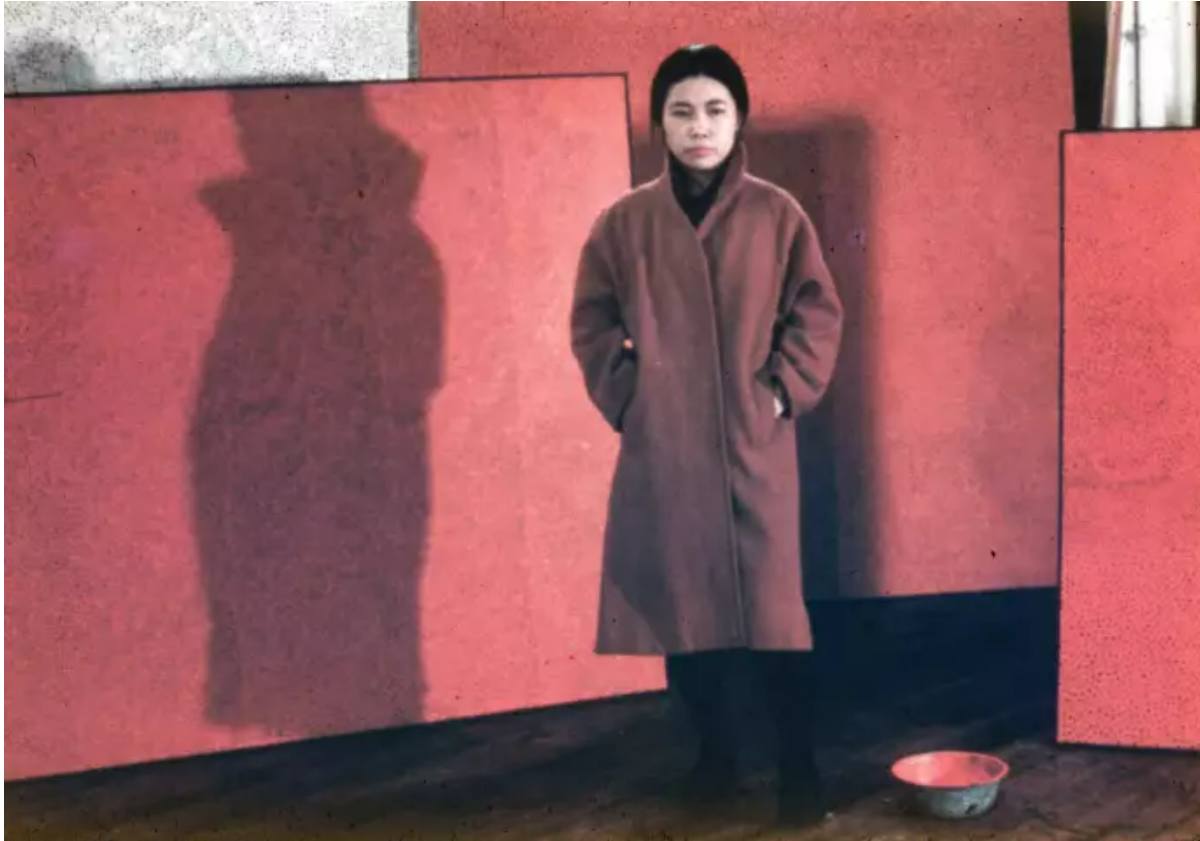
The process of painting becomes an all-consuming, almost spiritual experience, the world distilled to one simple form. Beginning at a single point on the canvas, Kusama applies her brushstrokes without any guidelines for the composition.
The patterns produced by her close working often only revealing themselves only after she has stood back from the painting. Because Kusama works so intently, the density of the individual loops changes over time as her brush runs dry of paint. This results in a surface that is rich in both visual and textural variety, and in which the artist’s technical skill and physical and mental stamina are very much on display.
Auction Summary
2025 Auction Highlights
14 lots sold at auction in 2025 for a turnover of USD 14,910,813. With 2 lots failing to sell, the sell-through rate is 87.5%. Infinity-Nets [HSO], dated 2016 sold at Christie’s in New-York, on 14 May 2025, for USD 3,680,000, the highest price achieved so far for an Infinity Nets in 2025.
2025 Top 3 Lots
4 lots sold for more than USD 1 million, generating a cumulative turnover of USD 7,960,019, representing 53% of the total turnover in 2025.
2024 Auction Highlights
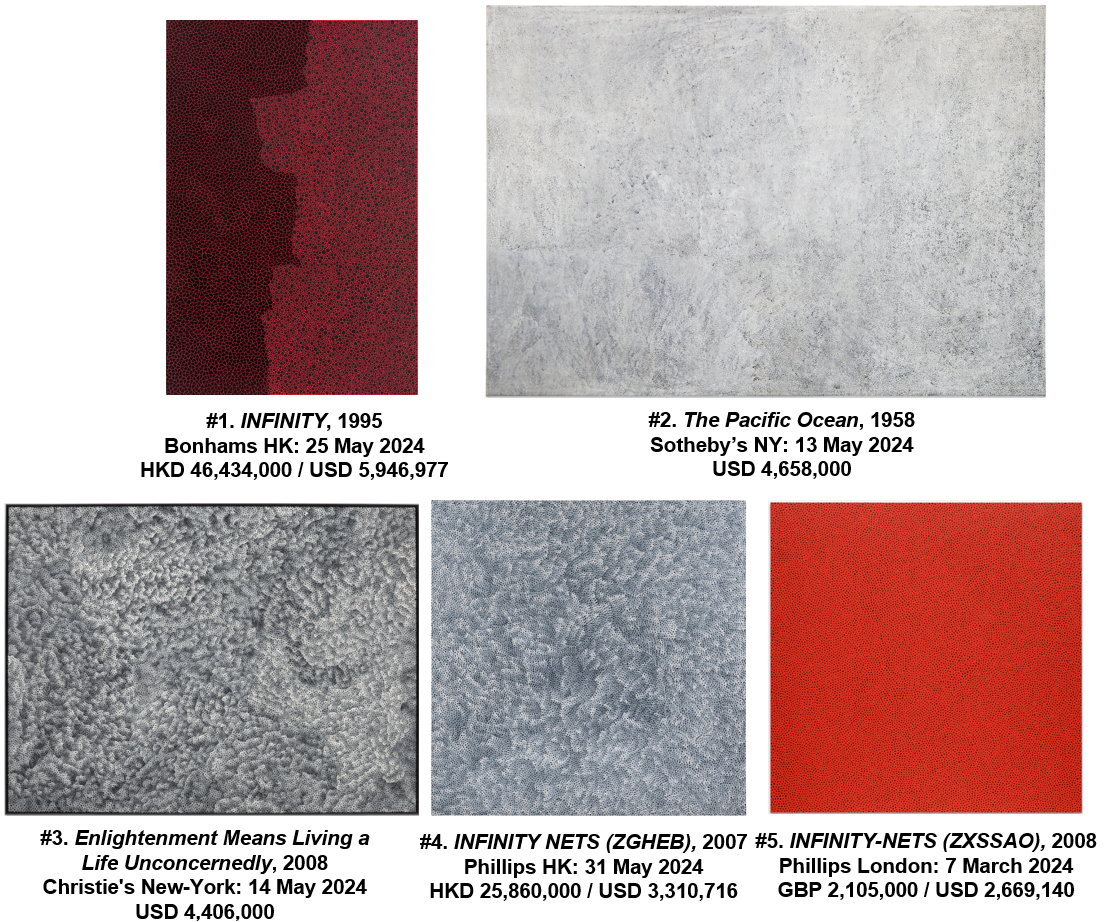
25 lots sold at auction in 2024 for a total turnover of USD 43,883,429. With 2 lots failing to sell, the sell-through rate is 93%. INFINITY, a painting dated 1995 sold at Bonhams in Hong-Kong on 25 May 2024 for HKD 46,434,000 (USD 5,946,977), the highest price paid for an Infinity Net painting in 2024.
2024 Top 5 Lots
2023 Auction Highlights
24 lots sold at auction in 2023 for a turnover of USD 42,938,834. With 3 lots unsold, the sell-through rate remains a solid 89%. This compares to 27 Infinity Nets selling at auction in 2022 for a total turnover of USD 60,877,453. This is not only due to a strong decrease in the number of lots sold in 2023, but also due to the fact that no major Infinity Nets from the 1960’s was presented at auction in 2023, even though a new world auction record was set for this series at Est-Ouest Auctions in Hong-Kong on 28 May 2023.
2023 Top 5 Lots
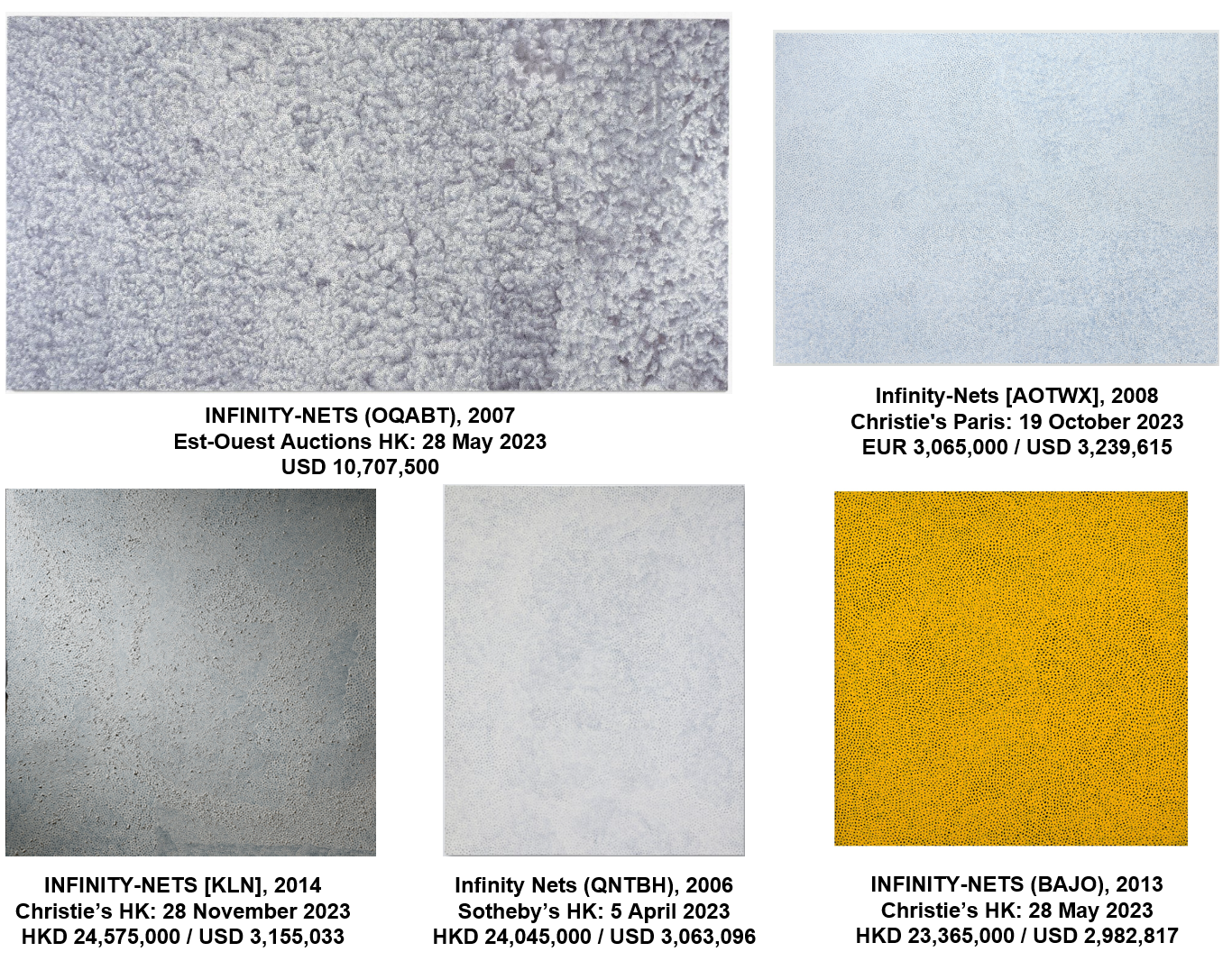
2022 Auction Highlights
27 lots sold at auction in 2022 for a total turnover of USD 60,877,453. With 2 lots failing to sell, the sell-through rate is 93%. Untitled (Nets) dated 1959 sold for a record price of USD 10,496,000 at Phillips in New-York on 18 May 2022.
2022 Top 6 Lots
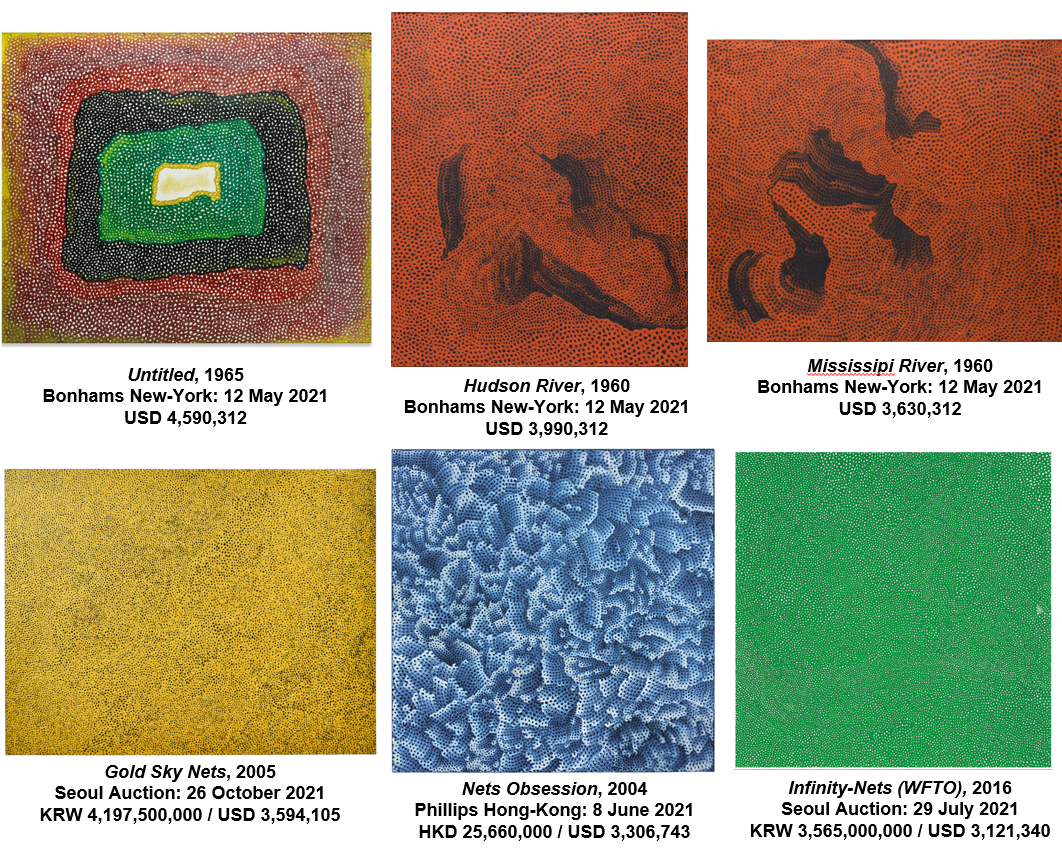
2021 Auction Highlights
28 lots sold at auction in 2021 for a total turnover of USD 60,656,775. With 2 lots failing to sell, the sell-through rate is 93%. The highest price was achieved by Untitled dated 1965 sold for USD 4,590,812 at Bonhams in New-York on 12 May 2021.
2021 Top 6 Lots
READ ABOUT INFINITY NETS
(by color, size, period)
FIND ALL HISTORICAL AUCTION RESULTS
Infinity Dots
As an inverse variation of Kusama’s celebrated Infinity Net paintings, dots and nets are two interchangeable motifs adopted by the artist to negate her neurosis.
“Our earth is only one polka-dot among a million stars in the cosmos. Polka-dots are a way to infinity. […] When we obliterate nature and our bodies with polka-dots, we become part of the unity of our environment. I become part of the eternal and we obliterate ourselves in love.”
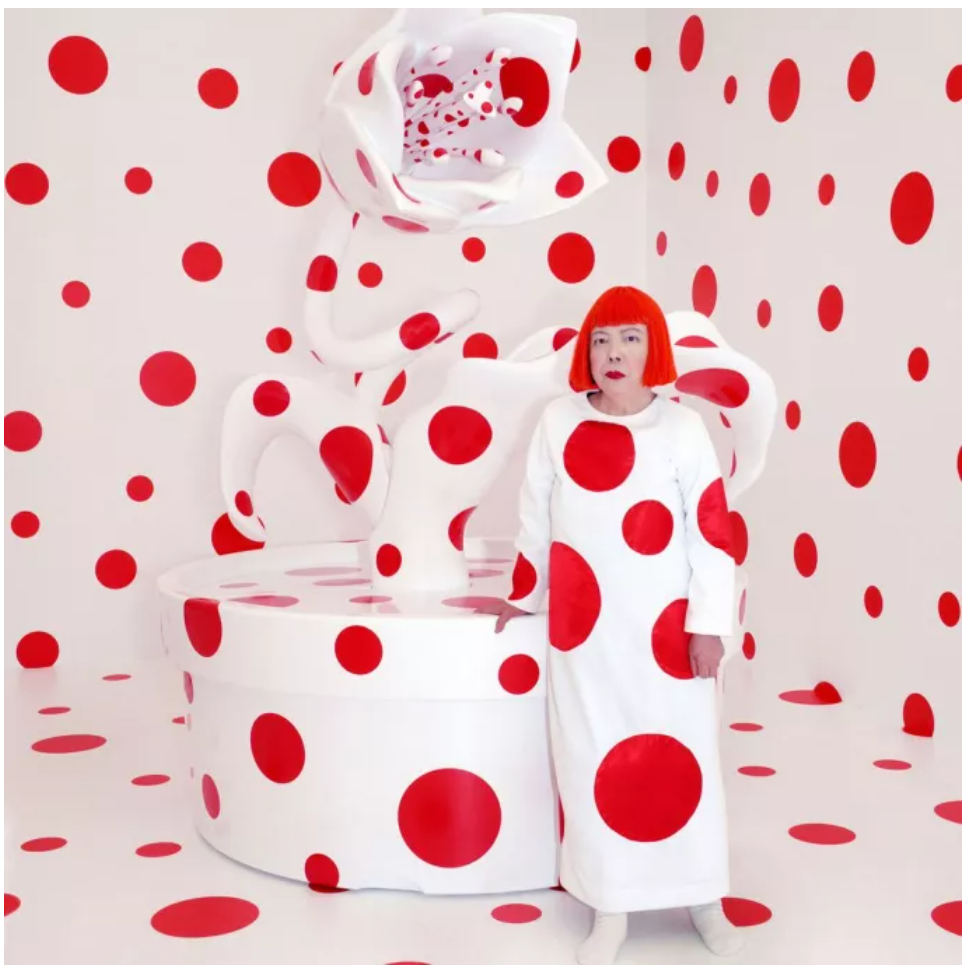
YAYOI KUSAMA PHOTOGRAPHED IN 2011 / OTA FINE ARTS, TOKYO / © YAYOI KUSAMA, YAYOI KUSAMA STUDIO INC.
As a visual motif, the polka dot evolved from its first appearances in the backgrounds of Kusama’s early drawings, to mirrored spheres in Narcissus Garden (1966) that was installed for the 33rd Venice Biennale, to an infinite pattern that sprawls across pumpkins, clothing, mirror rooms and beyond.
READ ABOUT INFINITY DOTS
FIND ALL AUCTION RESULTS
Flowers
Yayoi Kusama’s fascination with flowers is a recurring theme that has permeated her work throughout her long and illustrious career. For the artist, the representation of flowers is deeply symbolic, often intertwined with her personal experiences, cultural heritage, and broader artistic vision. Unpretentious and childlike, flowers likely speak to Kusama’s early memories of growing up in the rural provincial town of Matsumoto, and of formative visits to the botanical greenhouses and meadows of her grandparents’ plant nursery.
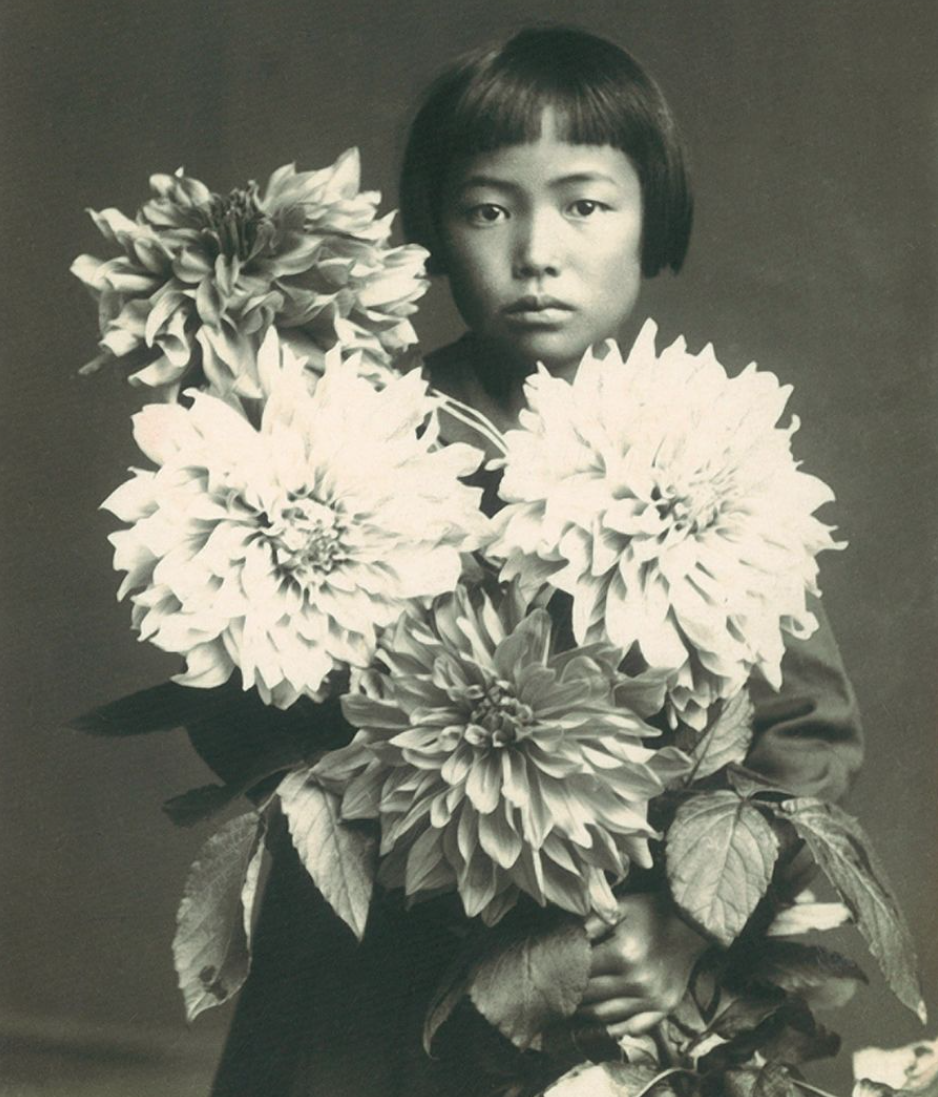
From the beginning of her career, Kusama has used flowers as a means of expressing both beauty and the psychological struggles she faced. Her early works often feature flowers in a way that reflects the intensity of her emotions, sometimes depicting them with obsessive repetition or in a surreal, almost dreamlike manner. These flowers, with their vibrant colors and unusual forms, seem to transcend mere representation and instead evoke a sense of otherworldliness or psychological depth.
READ ABOUT FLOWERS
FIND ALL AUCTION RESULTS
My Eternal Soul
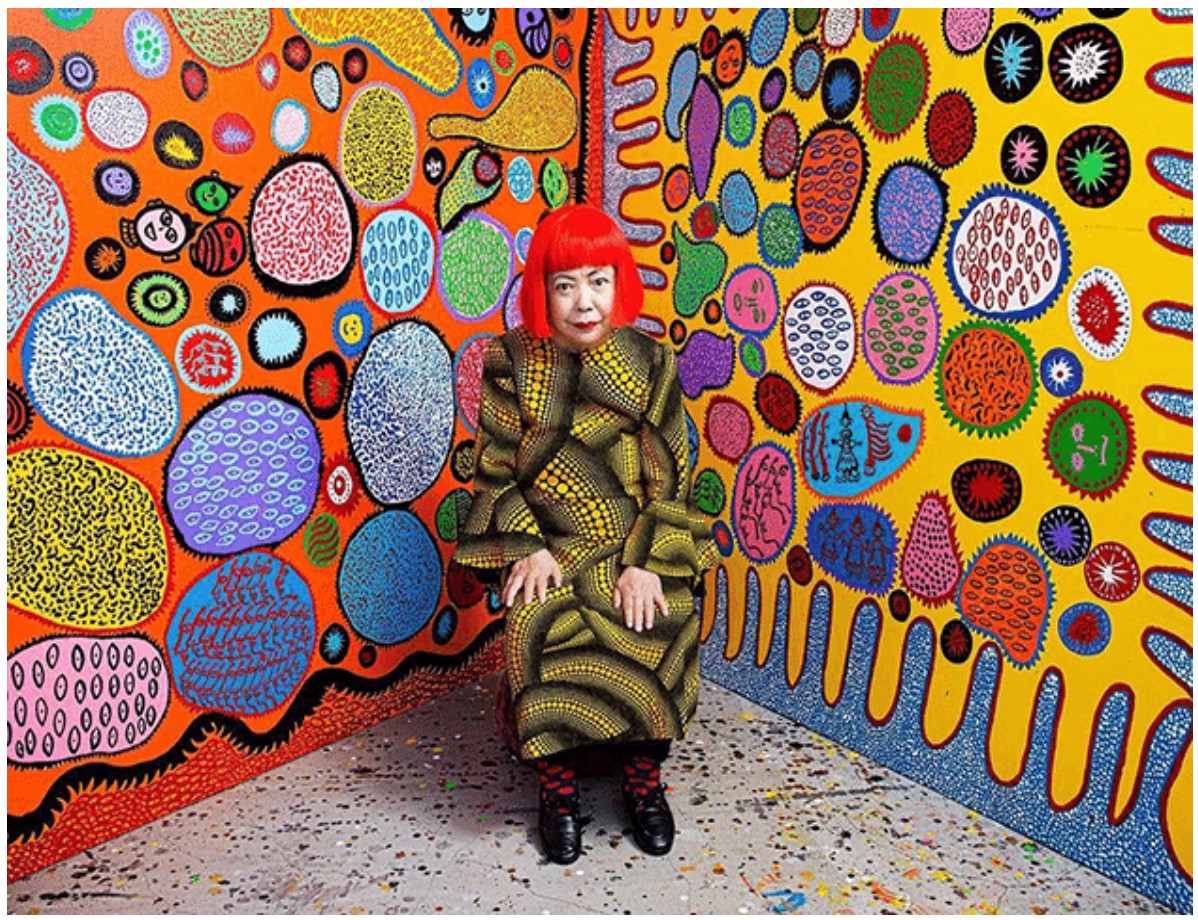
Yayoi Kusama’s My Eternal Soul series commenced in 2008. The series consists of vivid, kaleidoscopic paintings that showcase her remarkable skills as a color expert and signify the mature work of one of—if not the—most influential contemporary artists of our time. Featuring rich, saturated colors, these pieces represent a distinct departure from the monochromatic Infinity Nets. Now in her ninth decade, Kusama’s extensive and varied body of work—encompassing painting, sculpture, and performance art—has continued to develop and broaden with incredible ingenuity for over half a century. Representing Kusama’s most extensive series of paintings to date, My Eternal Soul delves into the artist’s previous themes and formal innovations using a strikingly vibrant palette.
I Who Sing in Celebration of Humanity, 2009
Phillips Hong-Kong: 25 May 2023
Estimated: HKD 7,500,000 – 9,500,000
HKD 8,509,000 / USD 1,086,065
Yayoi Kusama – Disruptors: Evening Sale… Lot 310 May 2023 | Phillips
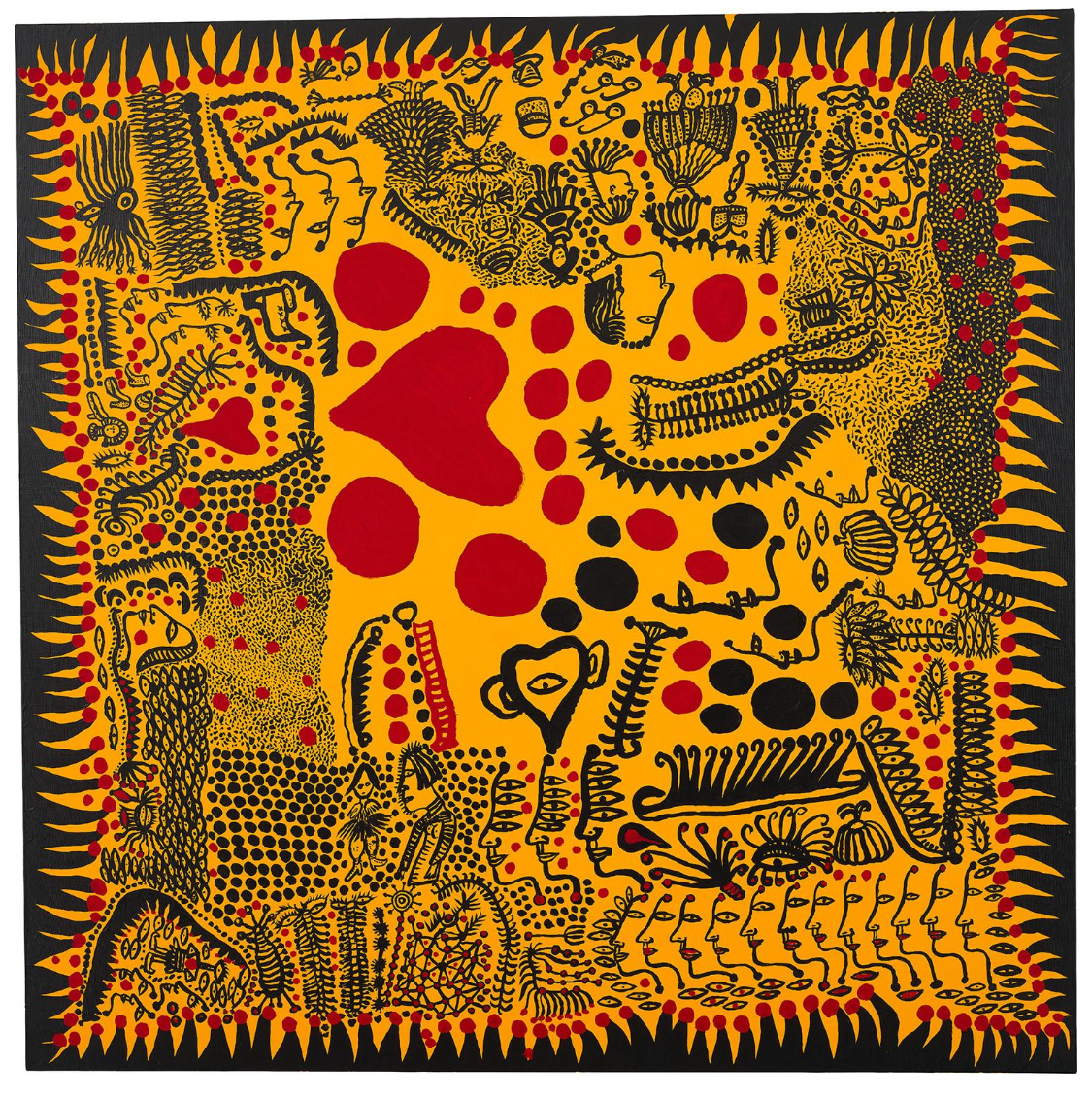
YAYOI KUSAMA
I Who Sing in Celebration of Humanity, 2009
Acrylic on canvas
162×162 cm (63 3/4 x 63 3/4 inches)
Signed, titled and dated ‘”I WHO SING IN CELEBRATION OF HUMANITY” [in English and Japanese] Yayoi Kusama 2009’ on the reverse
Representing Kusama’s most extensive series of paintings to date, My Eternal Soul delves into the artist’s previous themes and formal innovations using a strikingly vibrant palette. The present lot is a shining example of this series, and one of its earliest iterations. It features a visual language that recalls many of her iconographic innovations and formal inventions that are recognized as hallmarks of her career—repeating motifs that include flowers, eyes, pumpkins, the artist’s hieroglyphic self-portrait in profile, and, of course, dots and nets. The work has appeared various times in institutional exhibitions in the United Kingdom and Australia, and bears strong resemblance to some pieces recently exhibited within Hong Kong’s M+’s landmark retrospective, Yayoi Kusama: 1945 to Now.
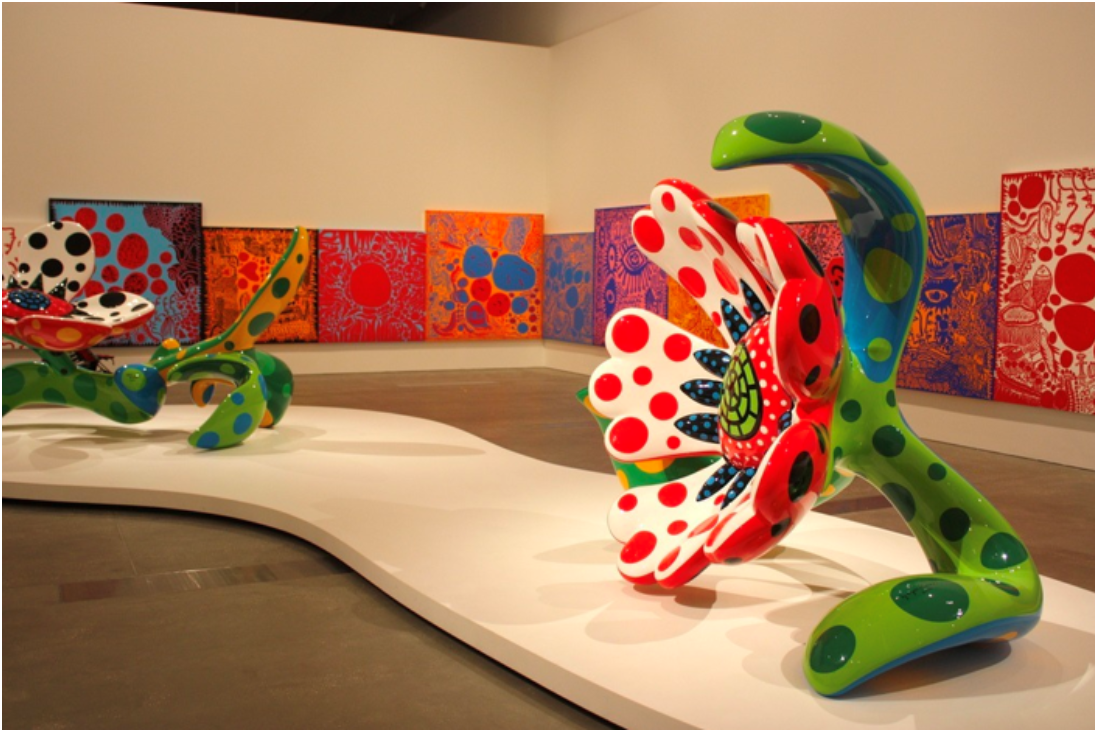
Installation shot of I Who Sing in Celebration of Humanity at Queensland Art Gallery’s Yayoi Kusama: Look Now See Forever exhibition in November 2011 – March 2012
Artwork: © YAYOI KUSAMA
A defining characteristic of Kusama’s My Eternal Soul paintings is her envelopment of the canvas in a single, saturated base color, which she later adorns with her intricate imagery. In I Who Sing in Celebration of Humanity, the artist tempers the field of ochre with tight, almost claustrophobic, application of black brushstrokes. Frontiers of palpable tentacles stretch out in grotesque horror and battle against the swarms of dots. Almost redolent of her net paintings, she provides a feast of form that draw witnesses into its porous center. There we find a respite from the traffic of the composition, a pool of free form, and as an act of assurance from Kusama, a red heart. I Who Sing in Celebration of Humanity, with its enveloping dimensional harmony, demands submission. Harnessing her generous creative spirit, as well as the generative potential of her art, Kusama confronts the void directly, and fills it with her love.
Soul, 2013
Sotheby’s Hong-Kong: 5 April 2023
Estimated: HKD 8,000,000 – 12,000,000
HKD 12,429,000 / USD 1,583,332
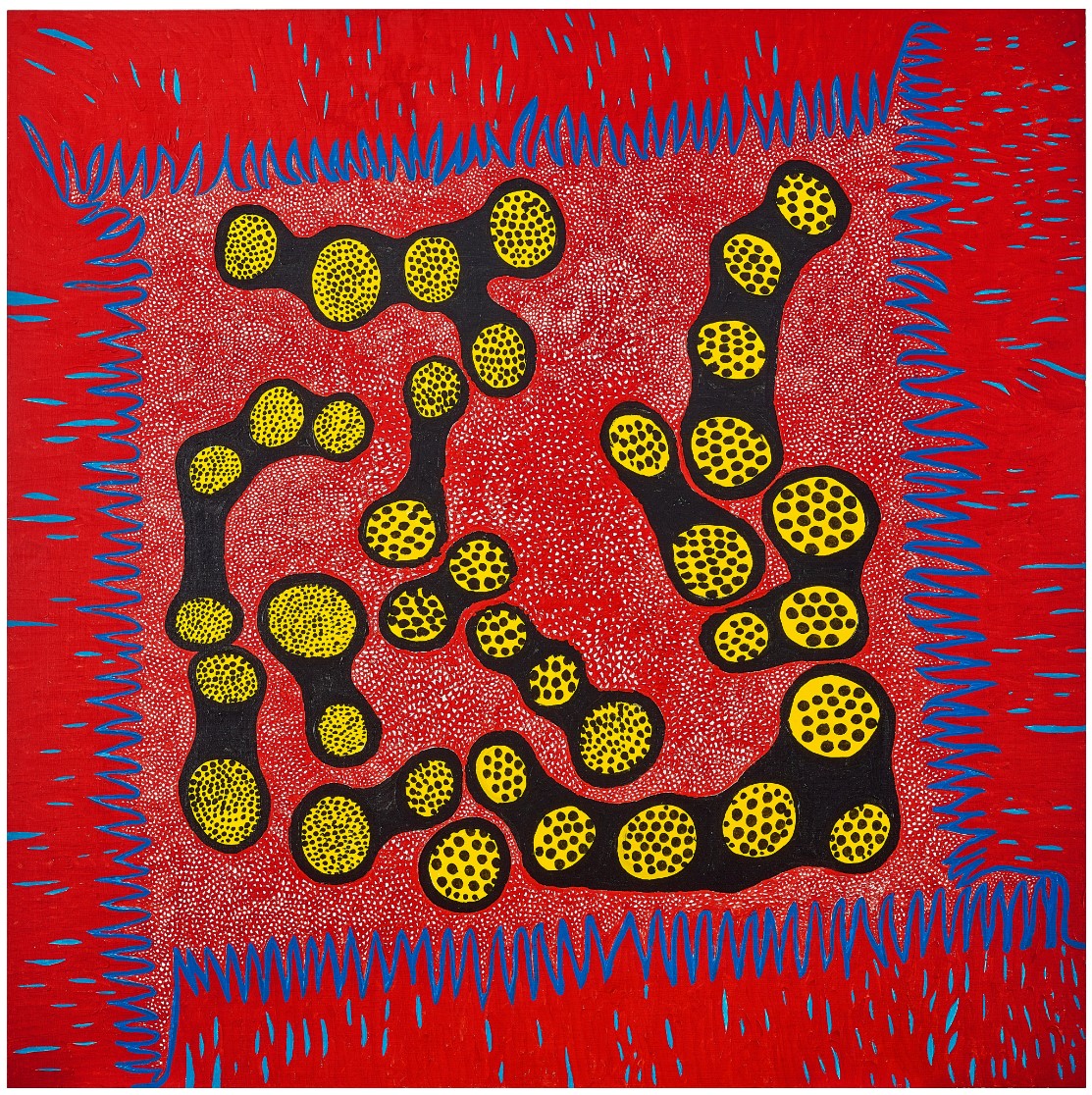
YAYOI KUSAMA (b. 1929)
Soul, 2013
Acrylic on canvas
194×194 cm (76 3/8 x 76 3/8 inches)
Signed, titled in English and Japanese and dated 2013 on the reverse
An explosion of visceral color, Soul (2013) is a brilliant example of Kusama’s unique style from the celebrated My Eternal Soul series of paintings. The present work is a rarity for the series, including not one but two of Kusama’s archetypal motifs within one composition; a meticulously rendered red Infinity Nets and the artist’s ubiquitous yellow and black colors of her pumpkin paintings and sculptures. The present work’s title pays homage to Kusama’s vision, imbuing the canvas with a spiritual and ontological connection with the artist herself and the joyful endeavor of the series.
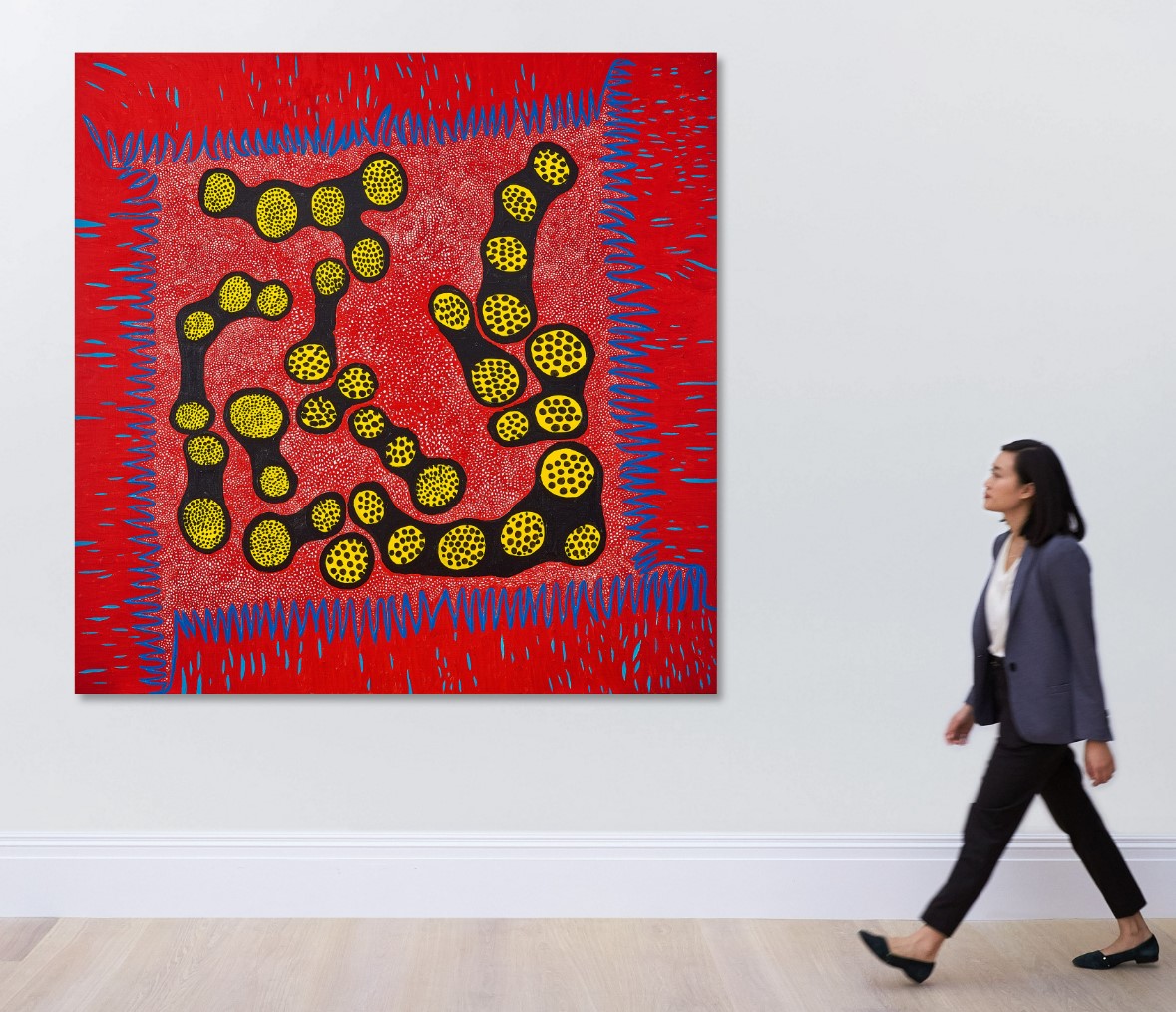
Kusama began her widely celebrated body of work, My Eternal Soul, in 2009, in which she explored past themes and formal innovations in an exuberant color palette. Bursting with an array of imagery and colors, Kusama’s acrylic paintings are produced by working on a flat, horizontal surface, moving around the border of the canvas to complete her compositions. She has become known for her trademark motifs of dots, nets and pumpkins and in the late 1940s began to experiment with Nihonga, a Japanese style of painting that emphasizes forms and subjects which are unique to native Japanese art. In Soul, Kusama has applied a base web of mesmeric pigment loops in a hypnotic red hue, a mesmerising example of her signature net paintings which were first exhibited in the late 1950s. The clusters black shapes of connective tissue overlain with yellow circles recall Kusama’s fantastical pumpkins, as if seen from above.
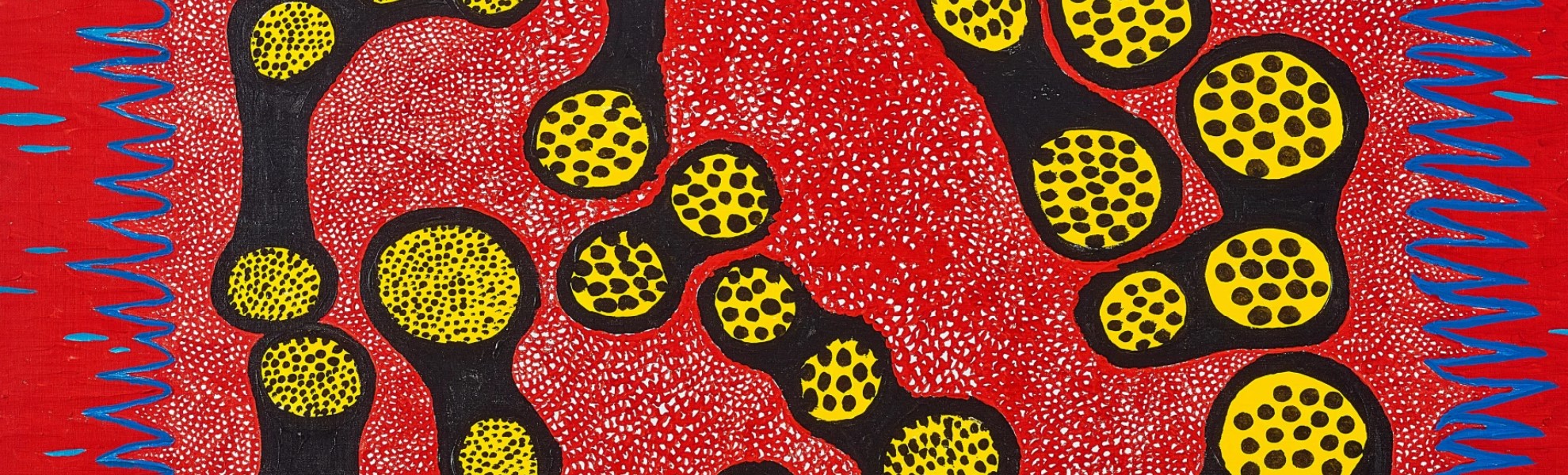
Featuring the emblematic dot pattern seen throughout the artist’s oeuvre, these yellow and black elements evoke memories of her family’s seed field where sketching in the open air and watching the cycle of growth and harvest she developed a love of drawing and a deeply felt connection to the Japanese pumpkin. In Soul, it is these black and yellow shapes that immediately captures the attention of the viewer, floating in the infinite space of Kusama’s red net.
All The Eternal Love, 2014
Phillips New-York: 15 November 2022
Estimated: USD 800,000 – 1,200,000
USD 1,966,000
Yayoi Kusama – 20th Century & Conte… Lot 21 November 2022 | Phillips
YAYOI KUSAMA
All The Eternal Love, 2014
Acrylic on canvas
194×194 cm (76 3/8 x 76 3/8 inches)
Signed, titled and dated “永遠の愛たち ALL THE ETERNAL LOVE 2014 YAYOI KUSAMA” on the reverse
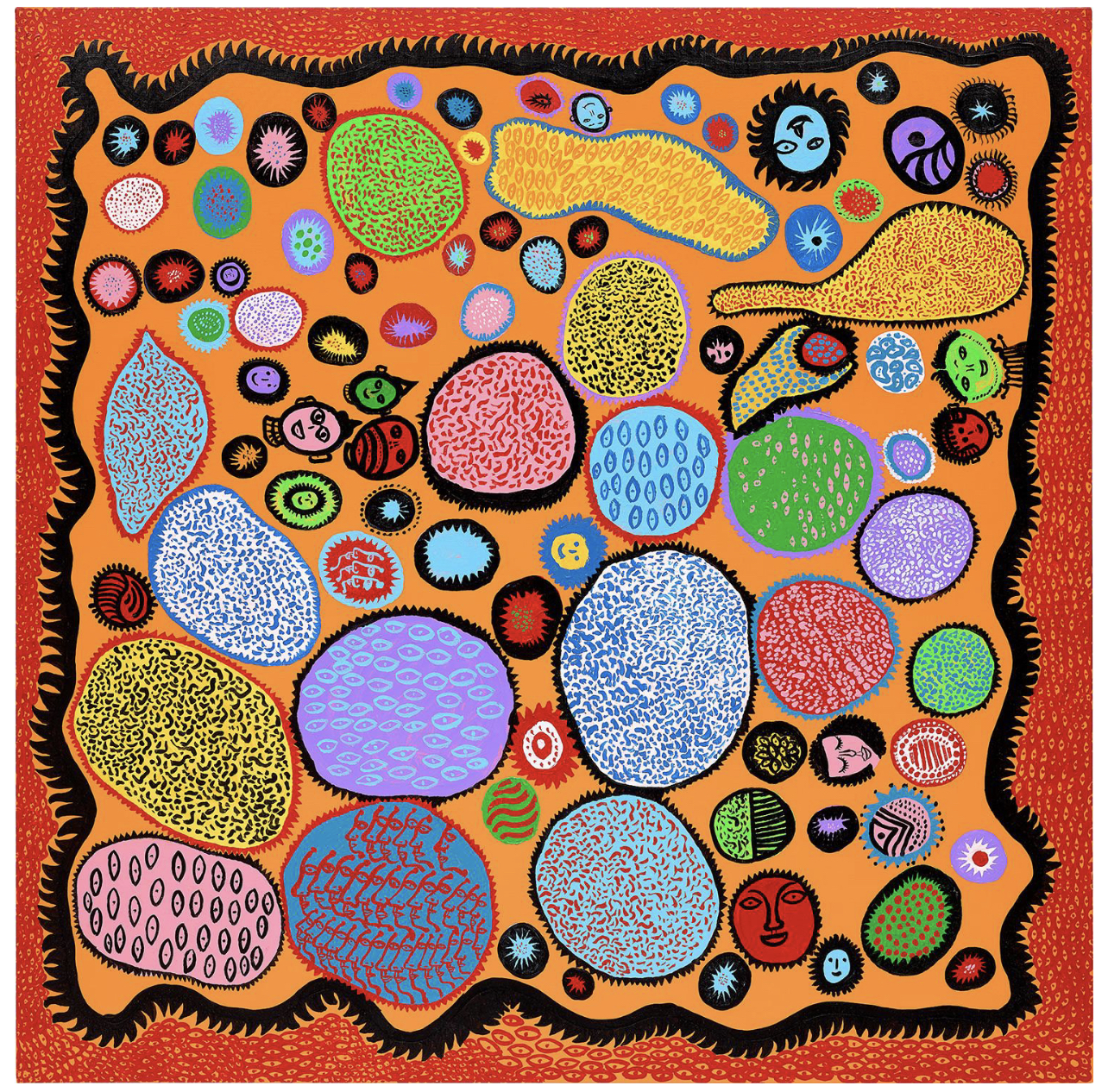
Yayoi Kusama’s All the Eternal Love, 2014, is an outstanding work from the artist’s ongoing series, My Eternal Soul (2009-the present). The squared canvas features an orange acrylic background covered in vibrant, amoeba-like sacs of repetitive visual motifs, including eyeballs, squiggles, loose Infinity Net-like patterns, and human faces. The sacs border each other, but do not overlap; their teeth overlap like gears. A black line crawls around the border like a millipede, licked with flaming, red eyes. Created and exhibited at the height of the artist’s career, All the Eternal Love records an artist at her fullest expression, in pursuit of self-obliteration through the expansion of form.
All the Eternal Love appeared in the artist’s second solo show at David Zwirner Gallery, New York, Yayoi Kusama: Give Me Love, 2015. The exhibition attracted crowds of visitors, who lined up for hours to see the artist’s My Eternal Soul paintings, silver-chrome pumpkin sculptures, and her seminal 2002 participatory work, The Obliteration Room.i The Art Newspaper declared Kusama the most popular artist in the world in 2014, the same year the artist executed All the Eternal Love. As 2014’s “poster girl for the globalization of contemporary art,” Kusama’s retrospective attracted over two million visitors in Latin America alone, not to mention record attendance at the concurrent retrospective travelling in Asia, and the David Zwirner exhibition in New York.
“I am now at an age that I never imagined I would reach. I think my time, that is the time remaining before I pass away, won’t be long. Then, what shall I leave to posterity? I have to do my very best…”
All the Eternal Love brings together visual motifs from across the artist’s career. The allover orange background, covered (or, one might say, obliterated) by a mass of repeated shapes follows the same basic formal structure that unites her work, from the Infinity Nets of the late 1950s, to 2002’s Obliteration Room. Kusama’s core visual elements, such as dots and nets, make their appearances in All the Eternal Love, but these elements shift and mutate across the canvas. Dots become eyeballs and ellipses; nets unravel into squiggles. All the Eternal Love is one in a series of “fluid, highly instinctual, and improvisatory works, which communicate a clear and active sense of [the artist] pushing out in every direction and making discoveries as she goes.
Message from Hades, 2014
Sotheby’s Hong-Kong: 26 April 2022
Estimated: HKD 5,500,000 – 7,000,000
HKD 13,685,000 / USD 1,744,023
YAYOI KUSAMA
Message from Hades, 2014
Acrylic on canvas
194×194 cm (76.4 x 76.4 inches)
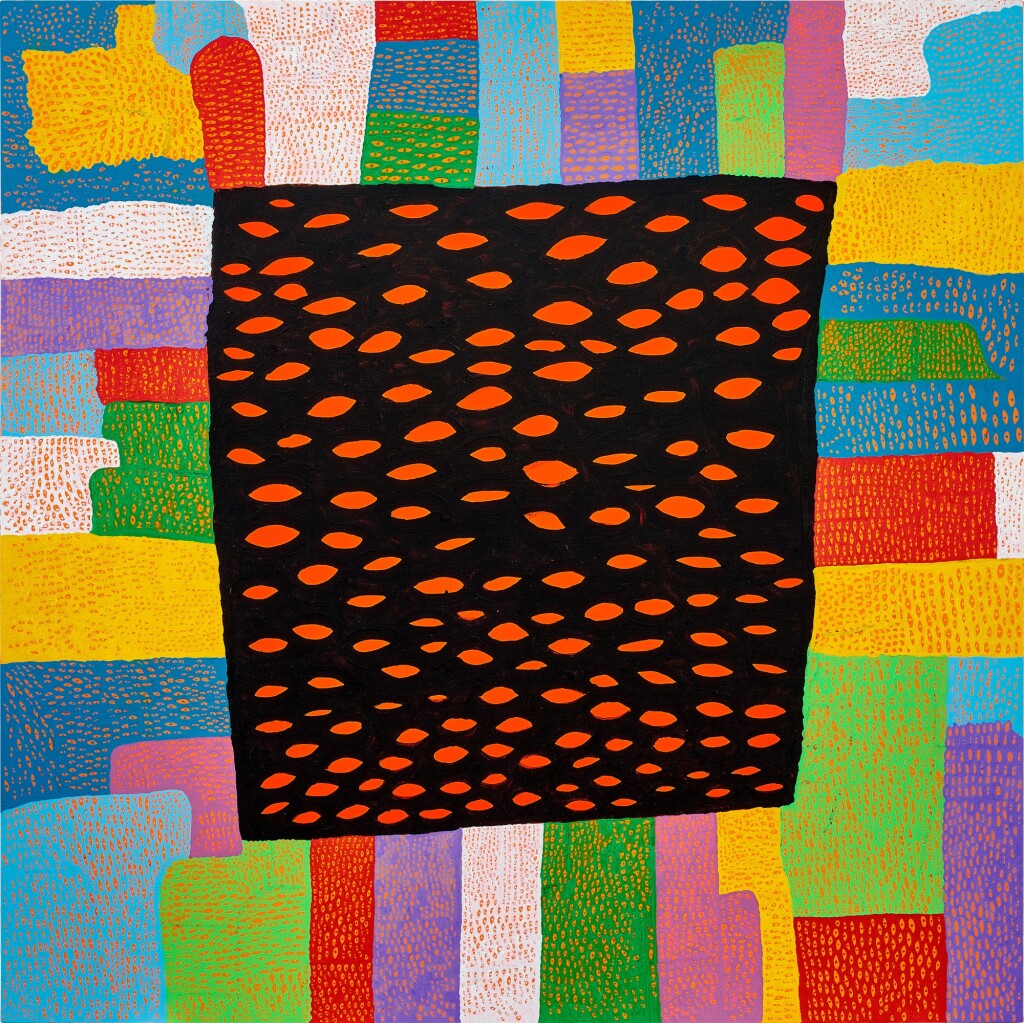
An explosion of color, Message from Hades is a brilliant example of Kusama’s unique style from the celebrated My Eternal Soul series of paintings, exhibited in her second solo show, Yayoi Kusama: Give Me Love in 2015, with David Zwirner in New York. The exhibition not only included new works from Kusama’s My Eternal Soul series, but also featured an array of silver coated pumpkins with multi-colored dots, and the landmark installation The Obliteration Room from 2002. Created and exhibited at the height of her career, Message from Hades is dominated by Kusama’s archetypal “eye” motif, executed in her signature style of repeated arches against the patchwork of color. Indeed, the eye motif is widespread amongst the works exhibited in the exhibition and is characteristic of many of the My Eternal Soul paintings created in 2014, of which Message from Hades is a beautiful example.
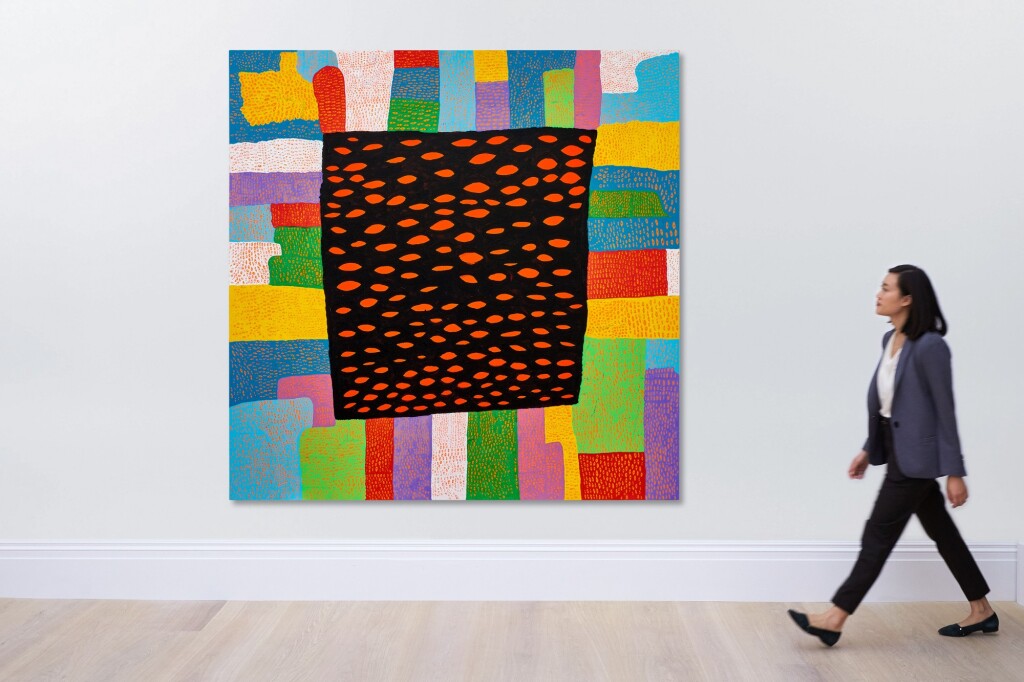
Bursting with an array of imagery and colors, Kusama’s acrylic paintings are produced by working on a flat, horizontal surface, moving around the border of the canvas to complete her compositions. She has become known for her trademark motifs of dots, eyes and pumpkins and in the late 1940s began to experiment with Nihonga, a Japanese style of painting that emphasizes forms and subjects which are unique to native Japanese art. In Message from Hades, Kusama has applied base color of blistering orange and overlaid the surface with a rainbow of chromatic patches. The addition of a vibrant array of pigments rendered with tight curled brushstrokes recalls her signature net paintings, first exhibited in the late 1950s. The seed-like shapes in the center of the canvas evoke memories of her family’s seed field where sketching in the open air and watching the cycle of growth and harvest she developed a love of drawing. In Message from Hades, it is the black center with its seed like forms that immediately captures the attention of the viewer.
My Life, 2014
Christie’s London: 16 October 2021
Estimated: GBP 300,000 – 500,000
GBP 1,222,500 / USD 1,676,954
YAYOI KUSAMA (B. 1929) (christies.com)
YAYOI KUSAMA (B. 1929)
My Life, 2014
Acrylic on canvas
194×194 cm (76 3/8 x 76 3/8 inches)
Signed, titled, titled in Japanese and dated ‘2014 YAYOI KUSAMA MY LIFE’ (on the reverse)
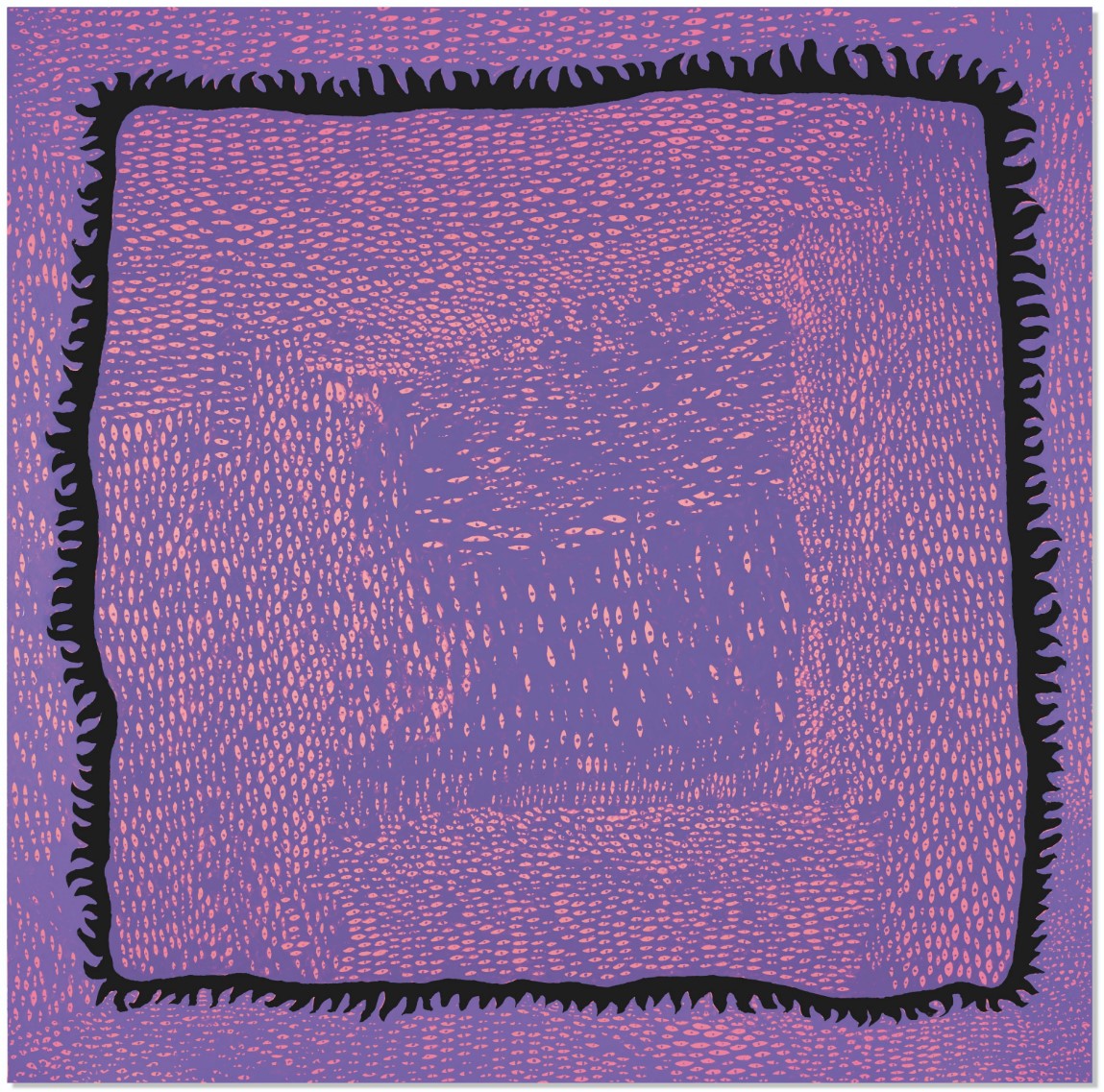
Painted in 2014, and acquired by the present owner the following year, Yayoi Kusama’s My Life casts a dazzling, lustrous web of purple across a monumental canvas. Peering through this shimmering surface are countless bright, coral-pink eyes, framed by a black rectangle whose flame-like edges vibrate with electric intensity. My Life forms part of Kusama’s ongoing series My Eternal Soul, which she began in 2009. With their lace-like patterning composed of eyes, cells, and other organic forms, these works possess a profound sense of autobiography. Like her iconic Infinity Nets, the series suggests an infinite sublime as the repetitive forms reach for an endless beyond, evoking the hallucinations that Kusama has experienced since childhood. ‘One day,’ she remembered, ‘looking at a red flower-patterned tablecloth on the table, I turned my eyes to the ceiling and saw the same red flower pattern everywhere, even on the window glass and posts. The room, my body, the entire universe was filled with it, my self was eliminated, and I had returned and been reduced to the infinity of eternal time and absolute space. This was not an illusion but reality’ (Y. Kusama, quoted in L. Hoptman et al. (eds.), Yayoi Kusama, London, 2000, pp. 35-36). The present work’s title pays homage to Kusama’s vision, and imbues the canvas with a sense of biographical truth.
Butterflies and Other Creatures
Butterflies, 2003
Christie’s London: 9 March 2024
Estimated: GBP 250,000 – 350,000
GBP 516,600 / USD 655,049
YAYOI KUSAMA (B. 1929)
Butterflies, 2003
Acrylic on canvas
24.2 x 33.3 cm (9 1/2 x 13 1/8 inches)
Signed, signed in Japanese, titled, titled in Japanese and dated ‘Yayoi Kusama 2003 “BUTTERFLIES”‘ (on the reverse)
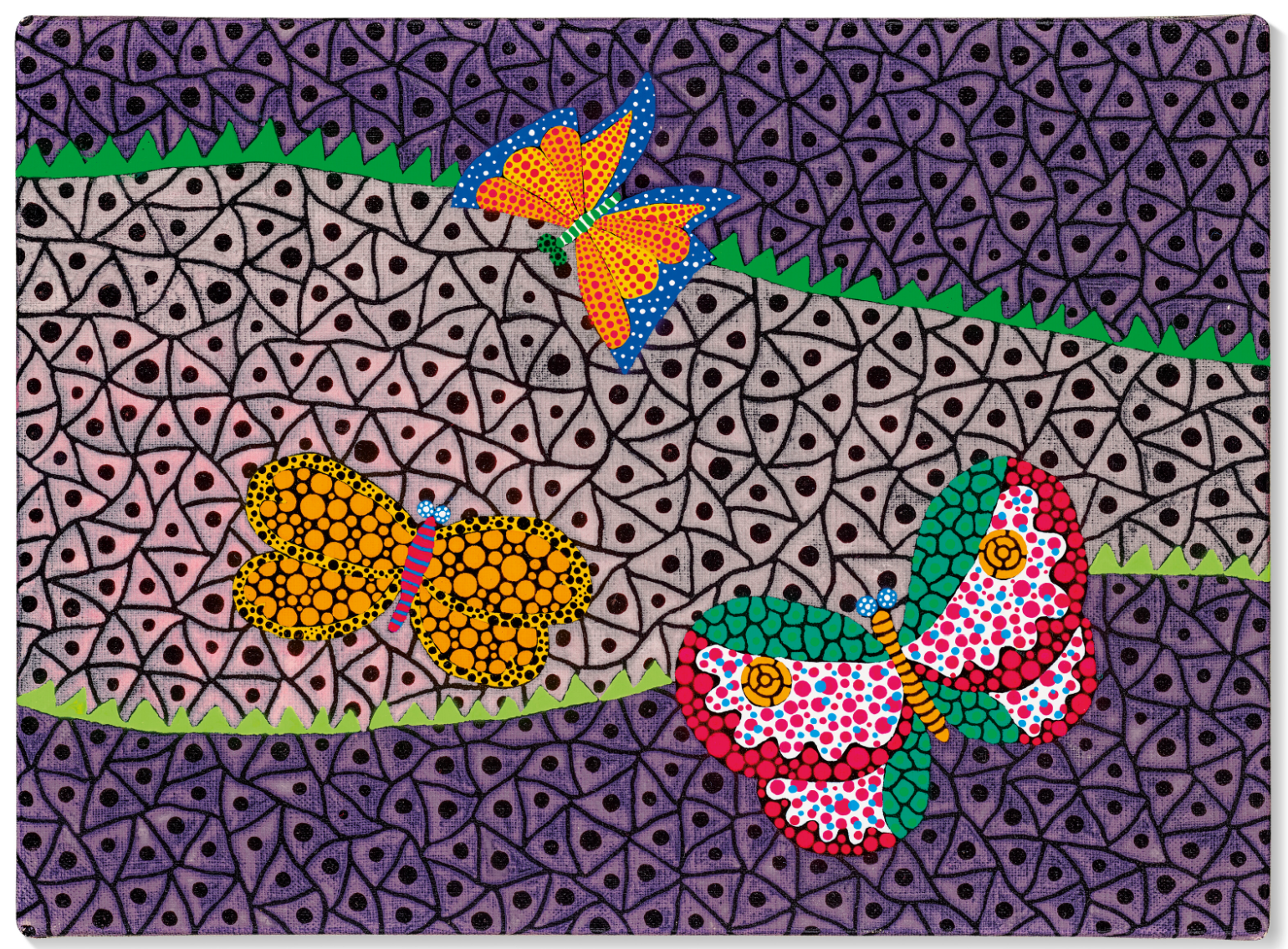
Three butterflies flutter over a surface of mosaic-like shards in Yayoi Kusama’s Butterflies (2003), their spread wings each revealing exquisite patterns of orange, red, white and blue spots. Like her ubiquitous, rotund pumpkin motif, the butterfly constitutes one of the subjects favored by the artist following her return to Japan in 1973. Admired for their fragile beauty and spiritual significance, the creatures’ wings in many ways fuse with Kusama’s own mesmeric style. Comprising an iridescent assortment of colors and hues, her paintings bear a similarly diaphanous and lustred quality. The present work’s intricately tessellated background—a flattened plane of biomorphic triangles and dots—sprawls and propagates into infinite space like cells under a microscope. Repeated in an ‘all-over’ method, the shapes evoke the artist’s celebrated polka dots, and exhibit the enduring legacy of her ‘Infinity Net’ paintings, which first won her critical acclaim in New York in the late 1950s. Famously inspired by the hallucinations she has experienced since her adolescence, Kusama’s paintings are alive with unique perceptual effects. In an intimate figurative scene, Butterflies presents the artist’s spectacular, pulsating vision.
Kusama’s fascination with the polka dot is inextricable from her experience and appreciation of the world. ‘Our earth is only one polka dot among millions of others’, she has said. ‘We must forget ourselves with polka dots. We must lose ourselves in the ever-advancing stream of eternity’ (Y. Kusama quoted in L. Hoptman et al., Yayoi Kusama, London 2001, p. 103). In the present painting, her pleasure in nature and its abundant variety of forms is palpable. Each individual butterfly wing is painstakingly rendered in acrylic. They open and unfurl into patches of exuberant, spotted technicolor.
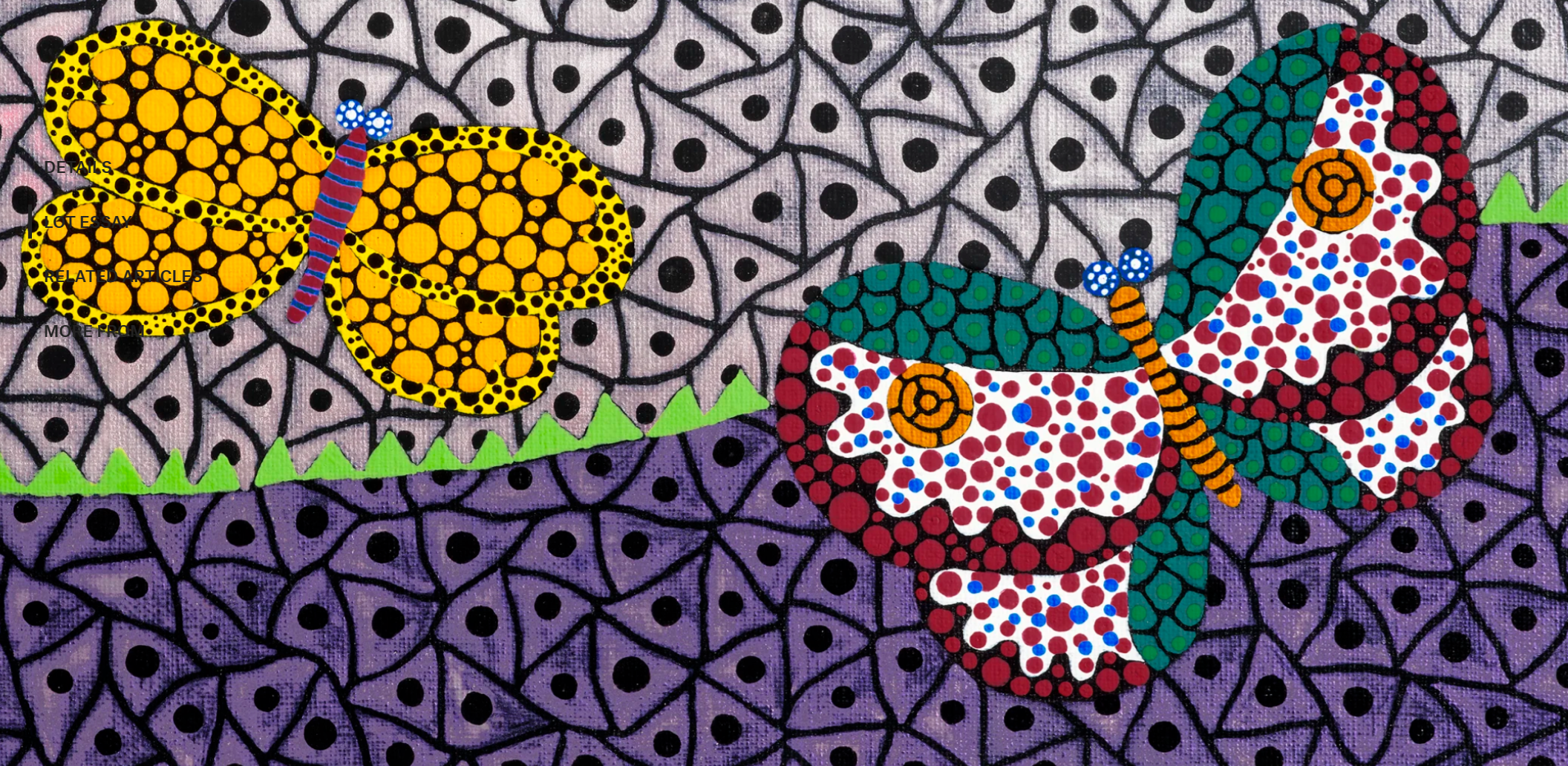
The creatures cluster around a leafy frond, delicately articulated with a jagged green border. Butterflies is characteristic of the artist’s later oeuvre. Art historian Lynn Zelevansky—curator of Kusama’s major retrospective exhibition that toured the United States and Japan in 1998-1999—noted that the artist’s work became smoother, more orderly, figurative, and ‘above all, more cheerful’ following her return to Japan in 1973 after sixteen years in America (L. Zelevansky quoted in Yayoi Kusama: A Retrospective. A Bouquet of Love I Saw in the Universe, exh. cat. Gropius Bau, Berlin 2021, p. 292). There is indeed a lightness to these subsequent paintings, which often feature joyful, concrete motifs: flowers, cherries, mushrooms, shells and fish.
Yayoi Kusama at the age of ten in 1939. Private collection. © 2024 YAYOI KUSAMA.
Unpretentious and childlike, these organic objects likely speak to Kusama’s early memories of growing up in the rural provincial town of Matsumoto, and of formative visits to the botanical greenhouses and meadows of her grandparents’ plant nursery. A particularly beloved subject from the 1980s onwards, the butterfly possesses spiritual significance in Japanese culture. A symbol of metamorphosis and transformation, it is believed by many to transport the soul between terrestrial and celestial realms after death. Its associated mythology pertains to Kusama’s own practice, her deep and enduring meditations on the self, the cosmos and eternity. Her sensitivity to the fragile creature is indeed a personal as well as artistic one. Just over thirty years before the execution of the present painting, she had titled a canvas of ten butterflies suspended around a single pink flower Self-Portrait (1972). Popularized in the Japanese nursery rhyme ‘Chōchō, chōchō’ (‘Butterfly, butterfly’), the brightly colored insect can be seen to further encapsulate childhood comfort and nostalgia. Combining meticulous, figurative elements with the hypnotic traces of her earlier abstract nets, Butterflies is a powerful example of Kusama’s late visual idiom, and her spellbound adoration of the natural world.
Summer and Butterfly, 1989
Christie’s Hong-Kong: 24 September 2023
Estimated: HKD 6,000,000 – 10,000,000
HKD 7,560,000 / USD 966,714
YAYOI KUSAMA (B. 1929) (christies.com)
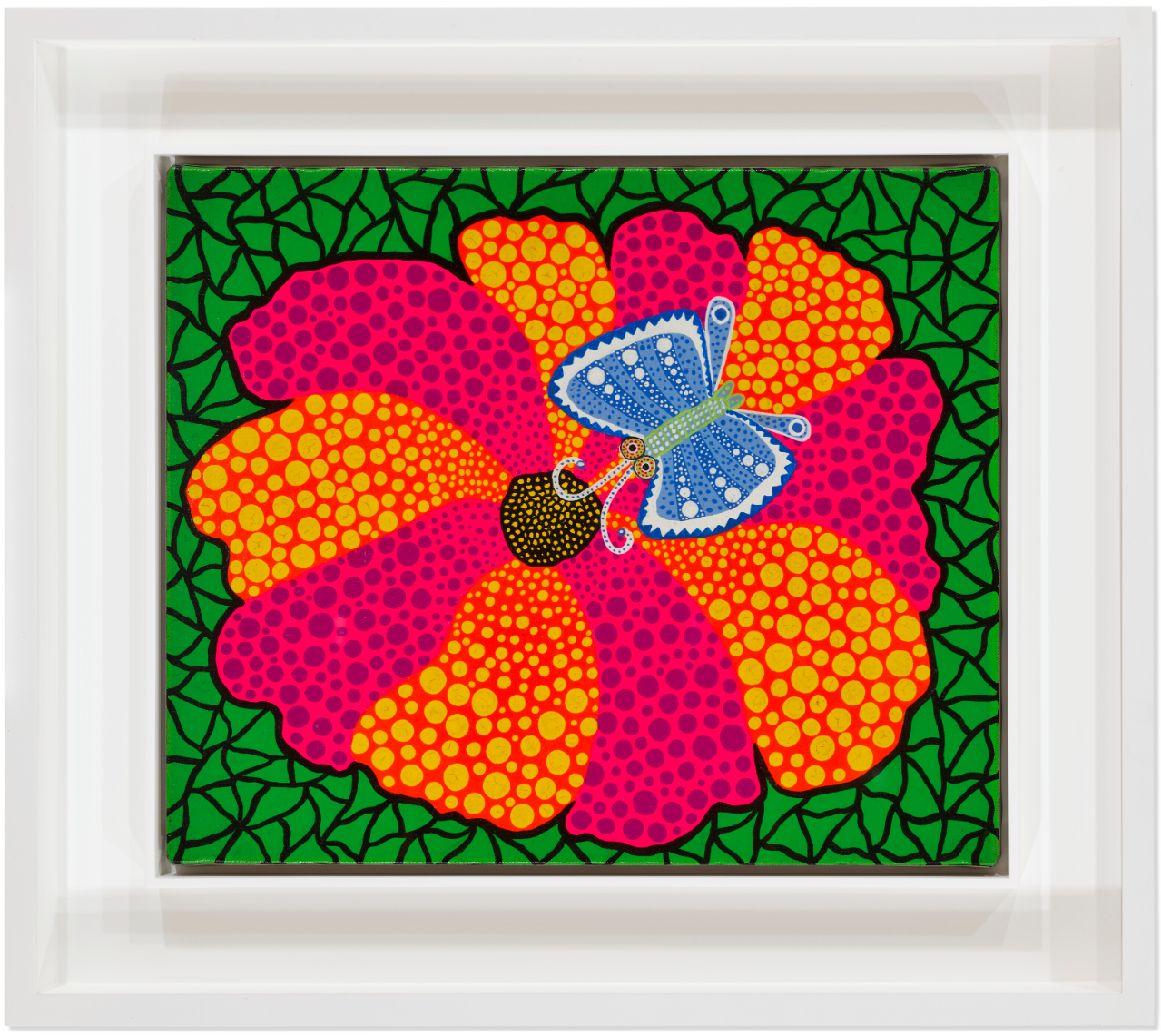
YAYOI KUSAMA (B. 1929)
Summer and Butterfly, 1989
Acrylic on canvas
38 x 45.5 cm (15 x 17 7/8 inches)
Signed and dated ‘1989 Yayoi Kusama’, titled in Japanese (on the reverse)
“I’m like a butterfly fluttering over hills and fields in search of a place to die, or a silkworm spinning silk, or a flower expressing its existence with a blush of red or purple. All I want is for human beings of every era to breathe the spirit and energy of their times and to face the future undaunted, with crimson flowers blooming.”
Butterfly, 1982
Christie’s Hong-Kong: 29 May 2023
Estimated: HKD 2,000,000 – 3,000,000
HKD 4,662,000 / USD 595,159
YAYOI KUSAMA (B. 1929) (christies.com)
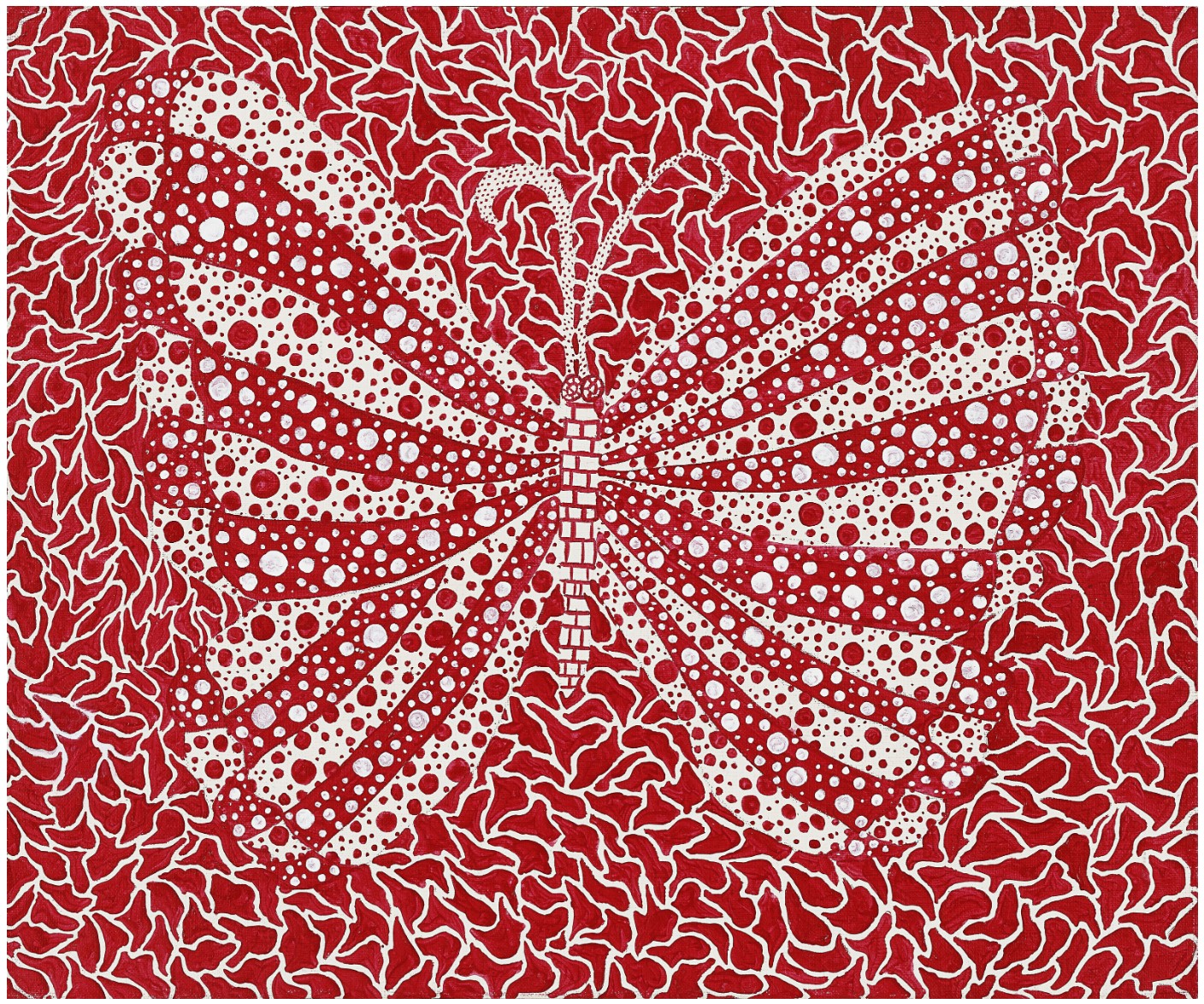
YAYOI KUSAMA (B. 1929)
Butterfly, 1982
Acrylic on canvas
38×46 cm (15 x 18 1/8 inches)
Signed and dated ‘1982 Yayoi Kusama’, titled in Japanese (on the reverse)
“I’m like a butterfly fluttering over hills and fields in search of a place to die… All I want is for human beings of every era to breathe the spirit and energy of their times and to face the future undaunted, with crimson flowers blooming.”
Bird, 1989
Sotheby’s Hong-Kong: 6 April 2023
Estimated: HKD 6,000,000 – 8,000,000
HKD 17,390,000 / USD 2,215,315
Yayoi Kusama 草間彌生 | Bird 鳥 | Contemporary Day Auction | 2023 | Sotheby’s (sothebys.com)
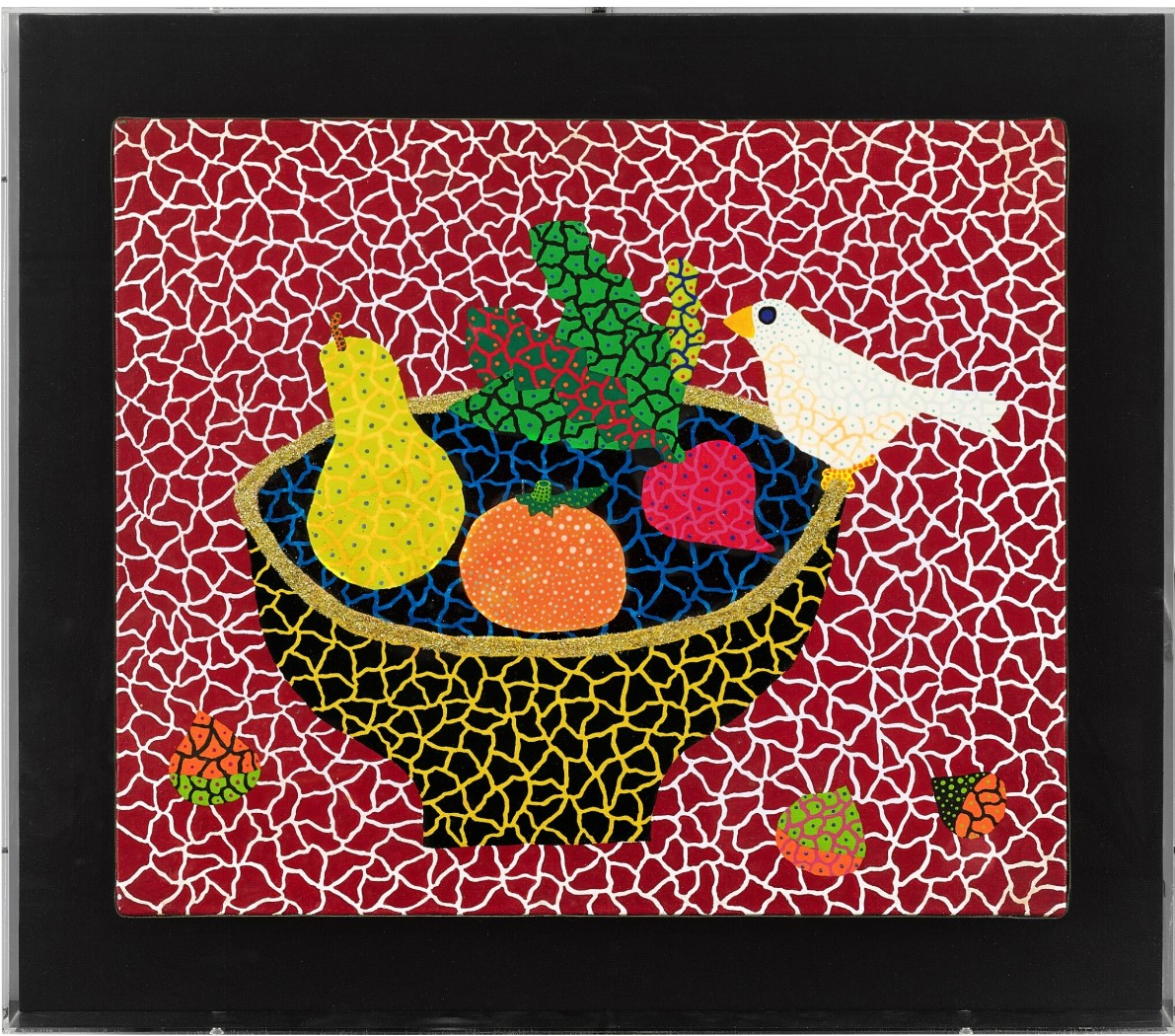
YAYOI KUSAMA (b. 1929)
Bird, 1989
Acrylic on canvas
38.3 x 46 cm (15 1/8 x 18 1/8 inches)
Signed in English, titled in Japanese and dated 1989 on the reverse
continuation from the artist’s fundamental concept of the fine mesh patterns derived from the artist’s hypnotic Infinity Nets series, Yayoi Kusama’s BIRD ventures into the artist’s exploration of the avant-garde. Executed in 1989, the present work depicts an addition of Kusama’s iconic dots and naturalistic imagery. With a combination of two signature forms: nets and dots, BIRD offers viewers a mirage of multiplication and repetition spread across the canvas. Beginning to paint fruit in the 1970’s, the present composition’s integration of an ethereal, white bird imparts an intriguing narrative complexity informed by the artist’s extensive writing during the 1970s and 80s. Having started writing from a young age, it was upon returning to Japan from America that the artist began to prolifically write, publishing several remarkable novels and poems. With the love for the natural world, BIRD projects the artist’s essence on a small but intimate scale. Utilizing an intricate geometric arrangement that sets as the background, the bowl of fruits in this painting further advocates Kusama’s strong understanding between perspective, space and composition. Nets and dots similar to dissections of plants could be seen through the artist’s widespread career, injecting a source of mystery and life into the rhythmic objects in her paintings. Creating a mosaic effect, the two-dimensional shapes of each individual fruit take shape in cracked, contrasting simplicity. Complementing the two-dimensional flatness of the nets, Kusama adds dimension and variance by echoing the roundness of some fruits with her iconic polka dots. The textural variation of the orange and pears create a visceral effect on the viewer, the bight orange and yellow hues springing forward from the blue infinity net behind, with the roundness of the fruit bowl similarly emphasized through a net of polka dots which combine to envelope the scattered fruits, drawing each of the seemingly antithetical compositional elements together in a harmonious confluence of divergent components.
A Butterfly, 2009
Christie’s Hong-Kong: 25 May 2022
Estimated: HKD 20,000,000 – 30,000,000
HKD 31,650,000 / USD 4,031,898
YAYOI KUSAMA (B. 1929) (christies.com)
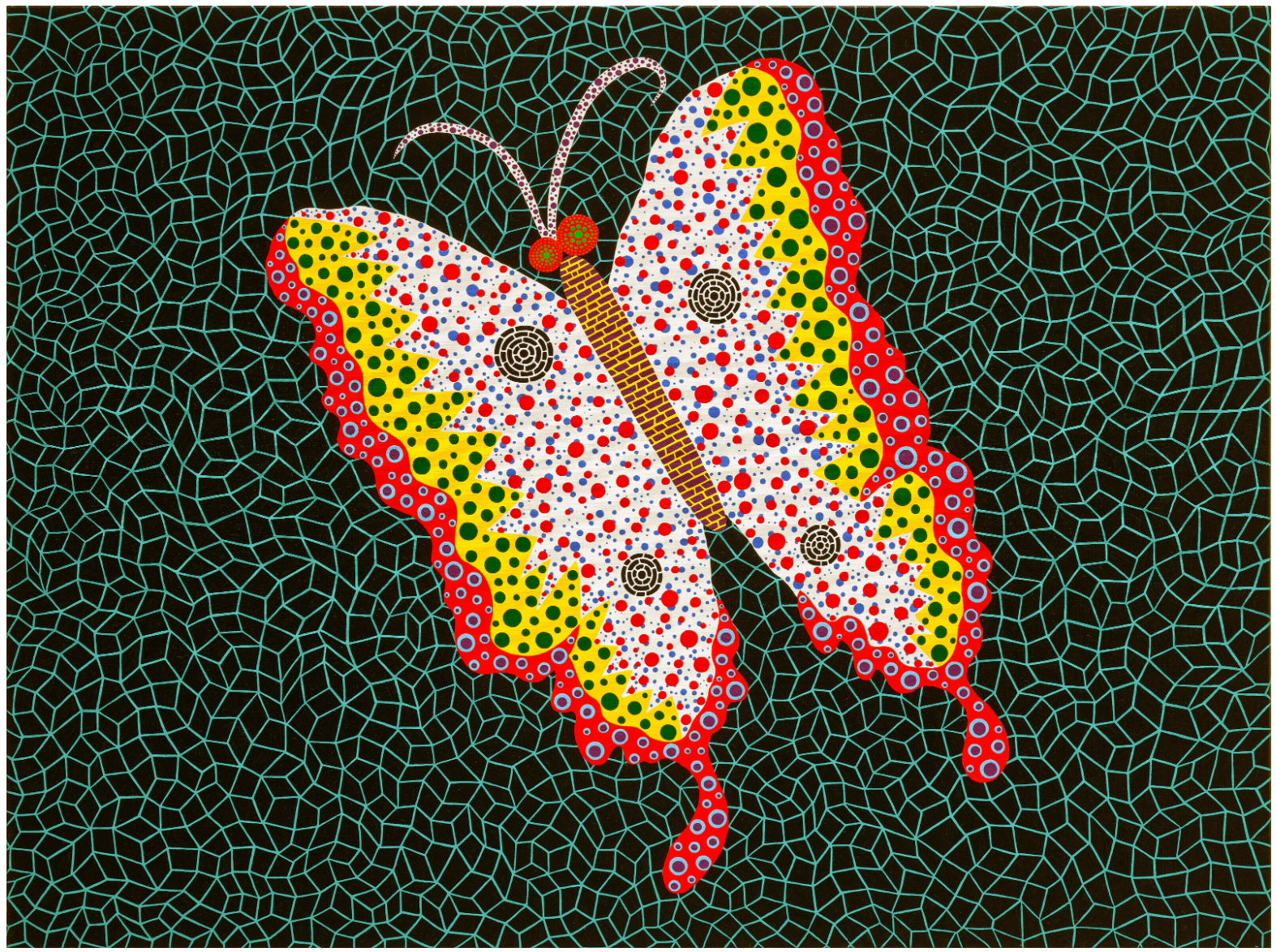
YAYOI KUSAMA
A Butterfly, 2009
Acrylic on canvas
97 x 130.3 cm (38.1 x 51.1 inches)
Portraits
Untitled, 1970
Sotheby’s Hong-Kong: 11 November 2024
Estimated: HKD 2,000,000 – 4,000,000
HKD 3,120,000 / USD 401,245
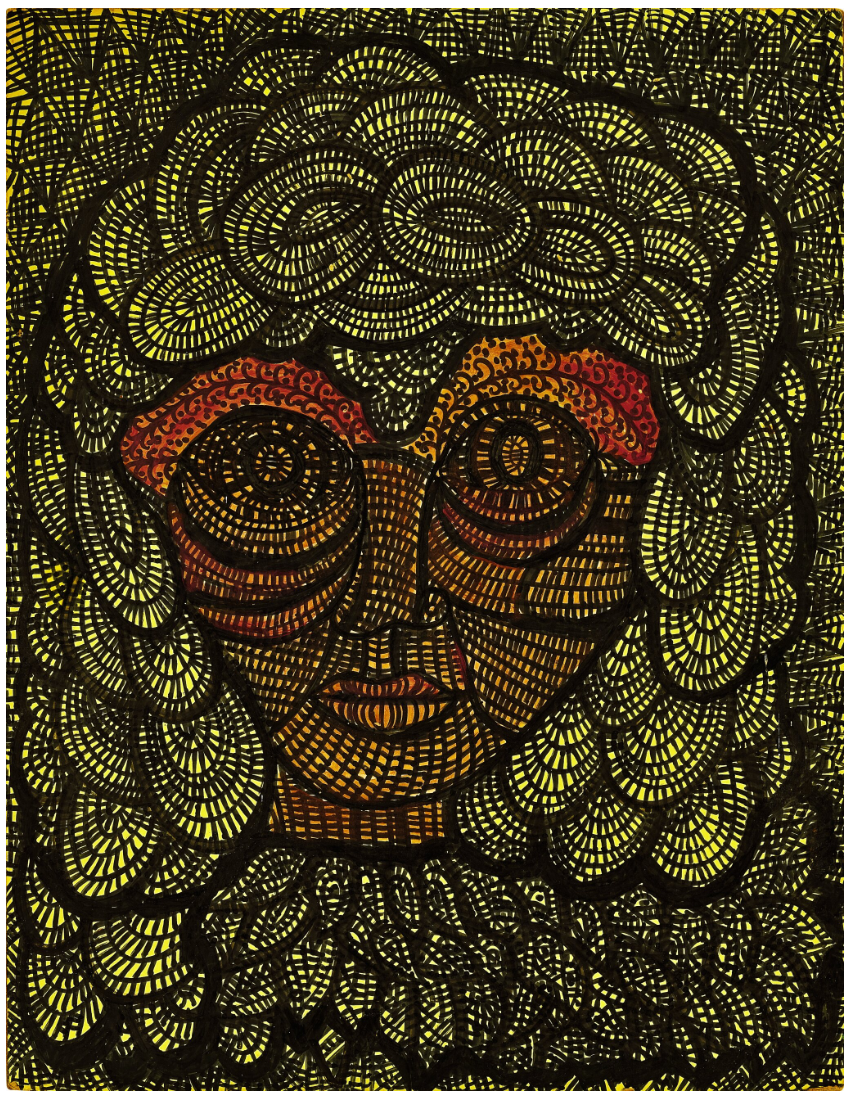
YAYOI KUSAMA (b. 1929)
Untitled, 1970
Ink and wash on card laid on board
64.9 x 50.2 cm (25 1/2 x 19 3/4 inches)
Rare, unique and historically significant, Yayoi Kusama’s Untitled is amongst the most important works by the artist to come to auction. Executed in 1970, the present work is a portrait of the former First Lady of the United States and style icon Jacqueline Kennedy Onassis conducted in the artist’s characteristically exuberant and idiosyncratic style.
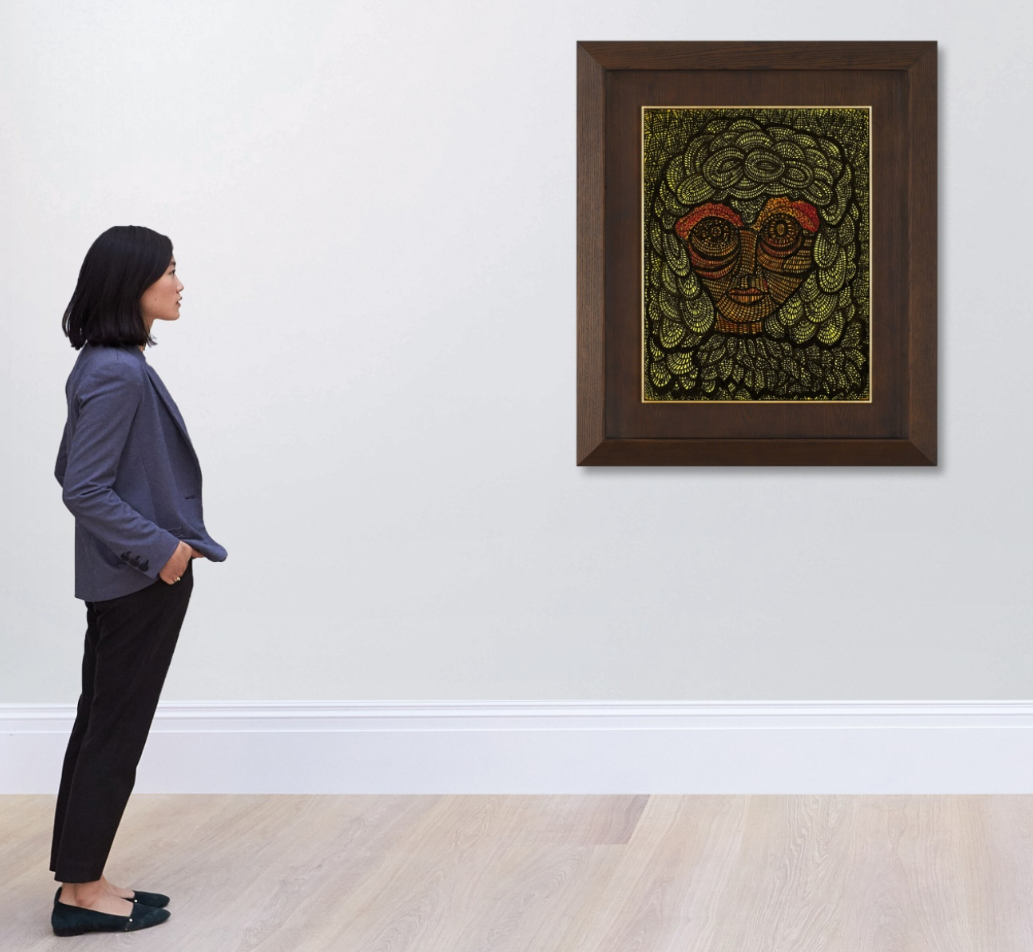
Belonging to a small series of fifteen portraits by the artist produced during her time in the Netherlands in the late 1960s, this series sees Kusama take the figures of Shirley MacLaine, Marilyn Monroe, Jacqueline Onassis and Elizabeth Taylor, amongst other monoliths of popular culture as her sources of inspiration. The recent 2024 exhibition Yayoi Kusama. The Dutch Years 1965-1970 at the Stedelijk Museum Schiedam has drawn renewed attention to this formative period in the artist’s career, placing particular emphasis on the primary patrons of Kusama in Europe; Orez International Gallery from the Hague. As Kusama’s sole representative in Europe, Orez played a decisive role in the artist’s success in the continent, cementing her place as one of the most notorious artists of the 1960s. A highly important and exceedingly rare early work by the artist, Untitled was acquired by Albert Vogel, one of the owners of Orez Gallery, the year it was created for the 1970 exhibition Cage/ Painting/ Women, and it has remained in the same family to this day.
“ The first thing I did in New York was to climb up the Empire State Building and survey the city. I aspired to grab everything that went on in the city and become a star. At the time, New York was inhabited by some 3,000 adherents of action painting. I paid no attention to them, because it was no use doing the same thing. As you said, I am in my heart an outsider.”

Jacqueline Kennedy Onassis, the central subject of the present work
Representing the crescendo of an explosive decade for the artist which saw Kusama gain considerable prominence in Europe as well as New York, Untitled was produced at the pivotal juncture before the artist’s return to Japan. As part of New York’s thriving art and countercultural scene of the 1960s, Kusama was swiftly embraced by the most pivotal artists of the era such as Claes Oldenburg, Andy Warhol, Barnett Newman, Mark Rothko, Donald Judd and Dan Flavin, whilst her infamous Happenings and anti-Vietnam war protests attracted notoriety in the press. During this era, she also expanded her art into a wider brand that included many business enterprises; along with her friendly competitor Andy Warhol, she investigated art as commerce and prefigured the merchandising efforts of artists such as Takashi Murakami. She hosted gay male sex parties, edited a weekly newspaper called Kusama Orgy, sold sex toys and porn as part of the Kusama Sex Company, and designed clothes that were mass-produced and sold in a “Kusama corner” of Bloomingdale’s, where Jackie O herself is said to have purchased from. As Kusama writes, at this time she was “reported on almost as much as Jackie O.” (Yayoi Kusama, translated by Ralph McCarthy, Infinity Net: The Autobiography of Yayoi Kusama, London 2011).
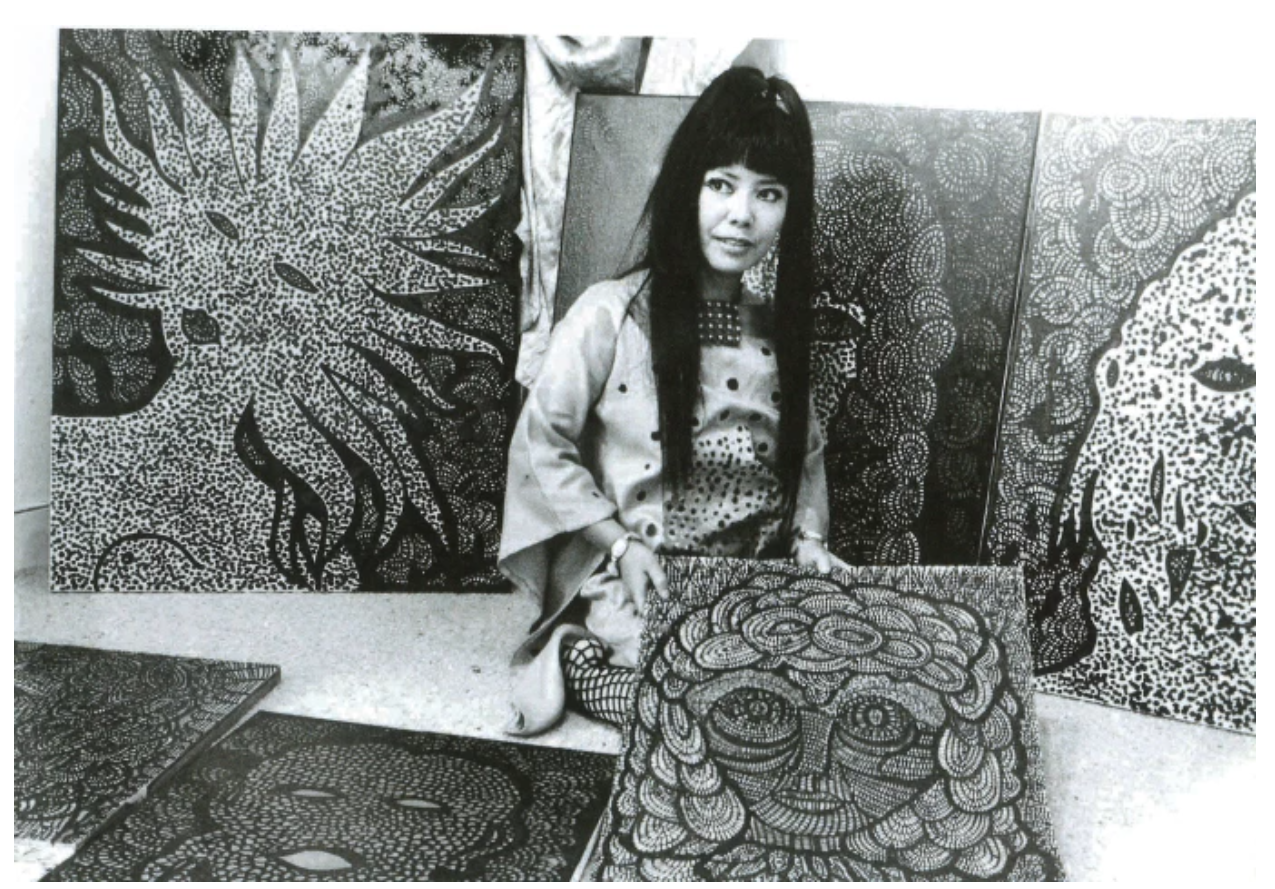
Yayoi Kusama holding the present work amongst other female portraits in International Gallery Orez, 1970. (Photography: Harrie Verstappen. Courtesy. 0-INSTITUTE.)
As the decade drew to a close, despite gaining considerable prominence and finding early supporters of her work in New York and Europe, Kusama remained unsatisfied with how the art world was receiving her; “When all was said and done, my pro-sex and anti-war ideas, and the Happenings that expressed them, went down like lead balloons in Japan. The mass media, the journalists, and the intellectuals all exhibited absolutely no comprehension of what I was about” (Yayoi Kusama,translated by Ralph McCarthy, Infinity Net: The Autobiography of Yayoi Kusama, London 2011, p. 153). It was through Orez Gallery and Holland that Kusama turned, finding more freedom of expression there than in Japan and the US. Significantly, her first fully nude Happening was conducted in Holland, an indicator of the support she felt during her time spent with Orez. Between 1965 and 1970, Kusama held five exhibitions at the gallery, the last being Cage/ Painting/ Women in 1970 where the present work made its debut. Upon the suggestion of Dutch psychiatrist Maarten Reinink, a friend and supporter who the artist stayed with at the time, Kusama began to work on a series of fifteen portraits in a pointillist style of international icons. Four of these works featured a metal caging overlaying the paintings, whilst the remaining eleven works were formal frontal portraits imagined through Kusama’s idiosyncratic patterning. This exhibition also marked an end to the avante-garde environment Kusama found in Europe during the 1960s, being amongst the very last Orez held before their closure in 1971 after a decade at the forefront of arts and culture. Through reimagining cultural icons of 1960s America in her own artistic vernacular of Infinity net patterning, Kusama’s portraits act as a powerful metaphor of personal and artistic struggle.
Determined to continue to thrive amongst her male cohorts – largely exempt from the kind of ridicule the artist experienced from the press – Kusama’s preoccupations with fame manifested not just in self-publicity but also in her works; notably, in her choice of portrait subjects. Andy Warhol, a contemporary of Kusama in New York and who she had exhibited with in multiple group exhibitions in Europe in the years preceding the creation of the present work, similarly saw the style icon and historic figure of Jackie O as offering the perfect study of 20th century image making. Warhol’s 1964 Jackie series, just as his images of Marilyn Monroe, speaks to a comparable desire to confront the icons and imagery of American consumer culture. As gallery director Emmanuel Di Donna explains at the 50th anniversary of the Warhol series, Jackie “wasn’t a movie star, but she was America’s royalty: young, glamorous, regal, and the most popular First Lady. One of the world’s greatest style icons, she influenced the way an entire generation of American women wanted to look, dress and behave. She was a visual metaphor for the youth and promise of the Kennedy administration.” (Emmanuel Di Donna, quoted in Alastair Sooke, Jackie Kennedy: Andy Warhol’s pop saint, BBC, 18 April 2014). As with Warhol, Kusama’s choice of subjects—all strong, iconic and controversial women — reveal not just her own relationship to ambition, but also an interest into the dynamics of fame itself. It is noteworthy that this is the only time in her career that Kusama painted portraits of other women, yet throughout her career Kusama has never taken men as her subjects, exclusively finding inspiration from herself and other female icons. Embodying the iconic, charismatic and highly personal motifs which have become synonymous with the artist herself, Untitled is a historic and significant example from the artist’s early career. Representing a pivotal moment in her legendary creative journey, the present work has remained unseen since it first appeared in 1970, an exceedingly rare work of Kusama’s before her return to Japan in the 1970s and a period of relative obscurity. Much like its subject, Kusama’s iconic approach to composition is here manifested in her treatment of Jackie, a testament to her dexterous skill as a painter as well as her innate understanding of the power of image making.
Portrait, 2015
Sotheby’s Hong-Kong: 5 April 2024
Estimated: HKD 38,000,000 – 48,000,000
HKD 41,590,000 / USD 5,317,054

YAYOI KUSAMA (b. 1929)
Portrait, 2015
Acrylic on canvas
146 x 112.8 cm (57 1/2 x 44 3/8 inches)
Signed, titled and dated 2015 on the reverse
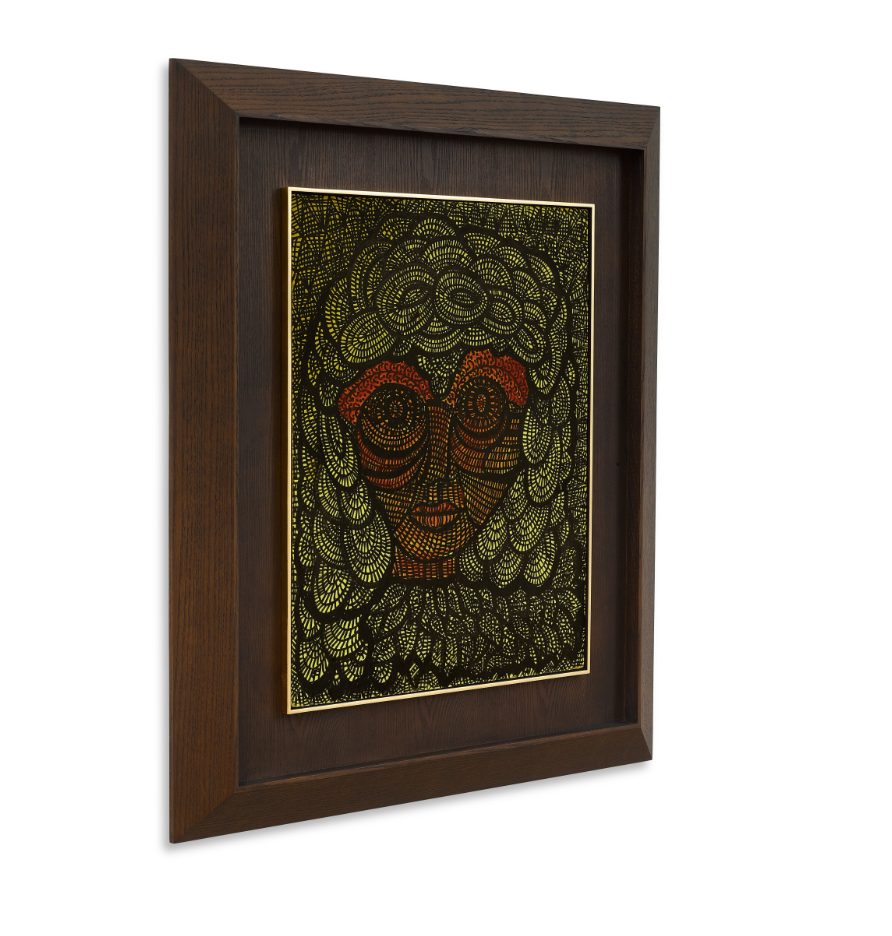
An exuberant and singularly iconic work, Yayoi Kusama’s Self-Portrait from 2015 epitomizes the cosmic ascent of one the 21st century’s most distinguished artists. Rare, unique and historically significant, Self-Portrait was the first work to be displayed upon entering the artist’s celebrated 2022 exhibition at M+ Museum, Hong Kong, Kusama’s largest and most prestigious retrospective to date. Although hung first, Self-Portrait stood alone as the emotional crescendo of the artist’s seven decade career. Among a small number of self-portraits by the artist, Kusama is instantly recognizable by her blunt bobbed hair, dissolving into the expansive universe and infinite space of her eponymous patterning. Immersed by her most characteristic motifs – from polka dots, Infinity Nets, pumpkins and tubular forms – Self-Portrait is the first yellow and black frontal portrait in acrylic, the artist’s chosen medium since the 1980s, to ever have been offered at auction.

Executed in the artist’s signature black and yellow colour palette, a visual echo of her Pumpkin paintings and sculptures, Self-Portrait exudes a luminous quality, the bright yellow of the figure’s surface cutting through the shadowy blackness of Kusama’s all-over scaled tessellations. An iconic iteration of another of the artist’s instantly recognisable motifs, the surrounding net patterning is so dexterously rendered that the canvas hums with a rhythmic intensity. The distinctive texture of Kusama’s polka-dots flow and recede hypnotically, submerging the figure’s face and torso beneath the ever expanding and almost limitless multiplicity of the artist’s practise. Kusama’s career-long investigation into cosmic infinity and painterly preoccupation with the push and pull between pictorial and cosmic space can be acutely felt in the present work. Repetition, she explains, allows for a kind of release: “I make them and make them and keep on making them, until I bury myself in the process. I call this ‘obliteration’ (Yayoi Kusama, Infinity Net: The Autobiography of Yayoi Kusama, trans. Ralph McCarthy, London 2011, p. 47).

RIGHT: YAYOI KUSAMA, SELF-PORTRAIT, 1950. COLLECTION OF THE ARTIST © YAYOI KUSAMA. LEFT: YAYOI KUSAMA AT THE AGE OF TEN IN 1939. © YAYOI KUSAMA
Despite their rarity, there are numerous examples that corroborate the significance of self-portraiture with the artist’s oeuvre. Even those works which do not depict the artist can ultimately be described as about Kusama, with her depictions and installation of pumpkins widely seen as functioning as both an allegory and a form of self-portraiture for the artist. In a formal studio photograph from around 1939, Kusama, aged about ten, faces the camera holding a bouquet of dahlias, each flower as large as her head. Born in Nagano in 1929 to a family of seedling merchants, Kusama has frequently spoken of and imitated through her art the permeable boundary between the artist’s self and her surroundings, an expression similarly conveyed in the 1950 work Self-Portrait. Amongst the earliest works to carry the title, Kusama portrays her face as a pink dot in the center of the canvas, surrounded by wavering, petal-like motifs – a pair of lips the only discernible human feature. In depicting herself as a sunflower in this early work, Kusama was establishing a view that the body is not fixed to a particular form, that it can be transformed and remade in various guises. During her time in New York City in the 1960s, as she was creating her breakthrough series of Infinity Net paintings and Accumulation sculptures, Kusama’s portraiture and self-presentation expanded upon her signature philosophical notion of self-obliteration, as these works were often titled. Underlining her expansive vision of the universe shown in the Infinity and Accumulation series, Kusama began to fashion a private subjectivity whilst promoting a public image, a persona which has become one the most instantly recognizable in the world.

FRIDA KAHLO, SELF-PORTRAIT WITH THORN NECKLACE AND HUMMINGBIRD, 1940 / COLLECTION OF THE HARRY RANSOM CENTER, TEXAS © 2024 BANCO DE MÉXICO DIEGO RIVERA FRIDA KAHLO MUSEUMS TRUST, MEXICO, D.F. / ARTISTS RIGHTS SOCIETY (ARS), NEW YORK
Frequently the title of a Kusama work does not include a first-person pronoun but rather a generic third person, such as ‘girl’ or ‘woman’, with these subjects often functioning or alluding to extensions, guises, or avatars of the artist. The archetypal figures in these paintings seem to be protected by flora and fauna-linking them back to the childhood photograph of Kusama surrounded by flowers, or engulfed and consumed by natural forces. Like Narcissus transformed into a garden of tiny flowers, Kusama disappears into another aspect of her manifold selves. Frontal images early in her career depict the point of merging between her vanished self and the object she became, most notably the flower. In later portraits, this would become a clearer transformation into a humanoid cat or monkey face. In recent years, a distinctive modality has emerged in the artist’s self-portraits that depict the artist squarely from the front, stoical yet bearing an emotional intensity. These works act as a symbolic substitute for the artist’s famed visage, hairstyle, and clothing as a composition of the artist’s signature motifs, such as polka dots, Infinity Nets, pumpkins and the tubular forms found in the artist’s earliest Accumulation sculptures. The present work typifies this late series of self-portraits, with Kusama shown submerging within the iconography and visual universe of her own work, becoming one with herself, the universe and her own artistic history over the last seven decades.

Self-portraiture is, of course, a well-established genre in art. In the visual lexicon of the last century, however, Kusama’s self-portraits find their equal with the most archetypal examples, which include those by artists who self-consciously portrayed themselves as revolutionaries resetting the course of the progress of art. Whilst Andy Warhol’s Marilyns, Elizabeth Taylors, self-portraits may be the most notorious of this kind, Kusama finds a closer comparison with Frida Khalo and Vincent van Gogh in terms of autographic and spiritual significance. What sets Kusama’s self-portraits apart is that there is a strong sense that the self is present but on the verge of disappearing and transforming into another being, all at once. As psychoanalyst Juliet Mitchel describes, “Kusama’s artworks show the oscillation, or even simultaneity, of her insistent, excessive presence either as herself as only an image of herself (often a photograph) or as some other object or image-an animal or a plant-and her obliteration of herself as a person” (Juliet Mitchell, ‘Portrait of the Artist as a Young Flower’, in Frances Morris, Ed. Yayoi Kusama, London 2012, pp. 192-197).

YAYOI KUSAMA WITH HER WORKS ‘RED STRIPES’ AND ‘BLUE SPOTS’ IN 1965 / PHOTO © MARIANNE DOMMISSE
ARTWORK © YAYOI KUSAMA
A glorious paradigm of Kusama’s legendary creative journey, Self-Portrait is magnificently emblematic of her radical, transformative and accomplished oeuvre. Embodying the iconic, charismatic and highly personal motifs which have become synonymous with the artist herself, Self-Portrait is a testament to decades of astonishing dedication to creation, technique, and a singular artistic vision. Vibrating with luminous energy, the Kusama of the present work is an amalgamation of the most-beloved pumpkin, the radical connectivity of the Infinity Nets series and the accumulated and expansive polka-dot pattern, submerging and emerging from a cosmic vision of her own making. Weaving together deeply imaginative iconography with a mediative exactitude, Kusama’s Self-Portrait is a consummate pinnacle of the career of one of the twenty-first century’s most iconic artists.
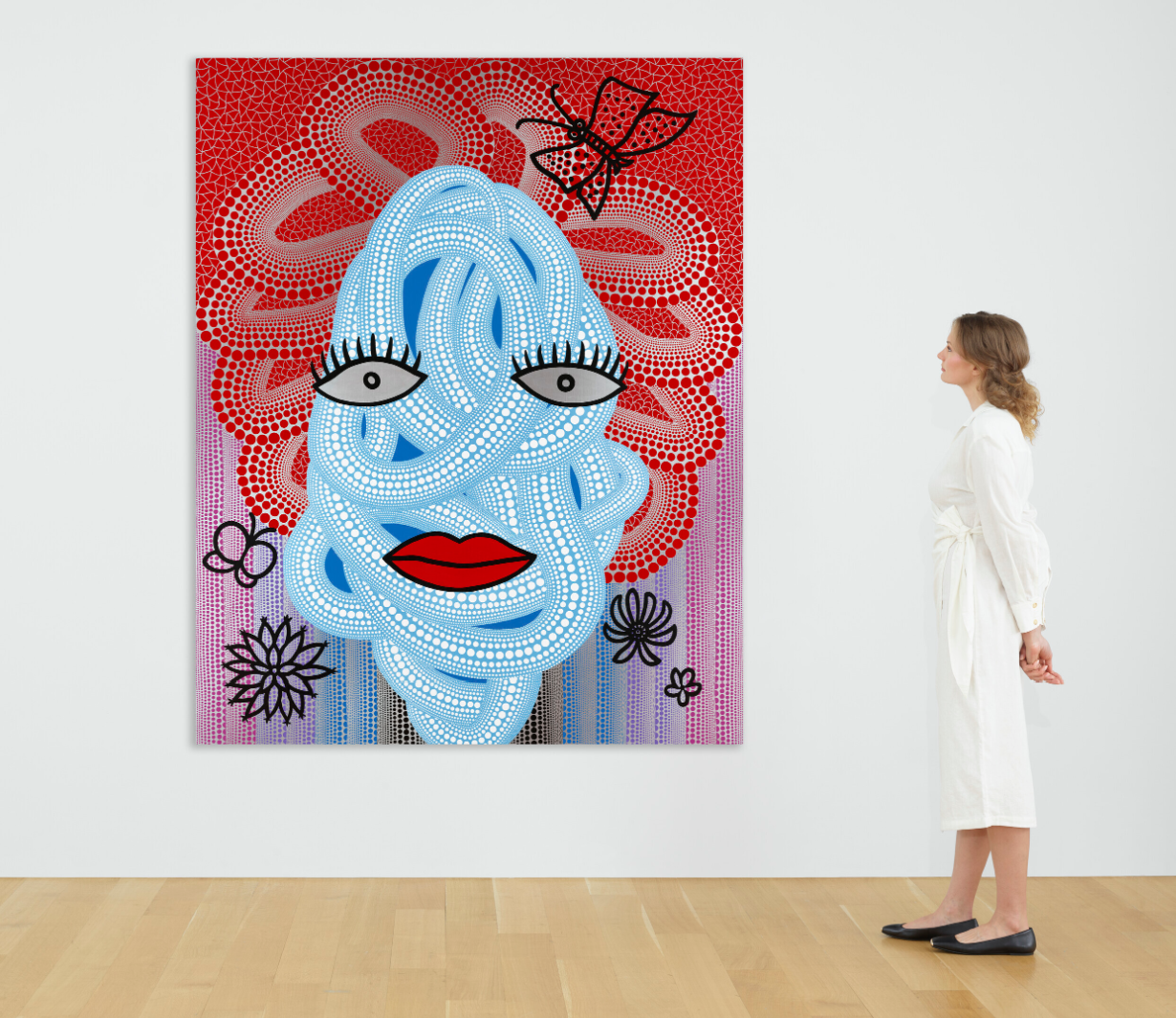
WOMAN, 2016
Christie’s Hong-Kong: 29 November 2023
Estimated: HKD 20,000, 000 – 30,000,000
HKD 20,340,000 / USD 2,608,561
YAYOI KUSAMA (B. 1929) (christies.com)
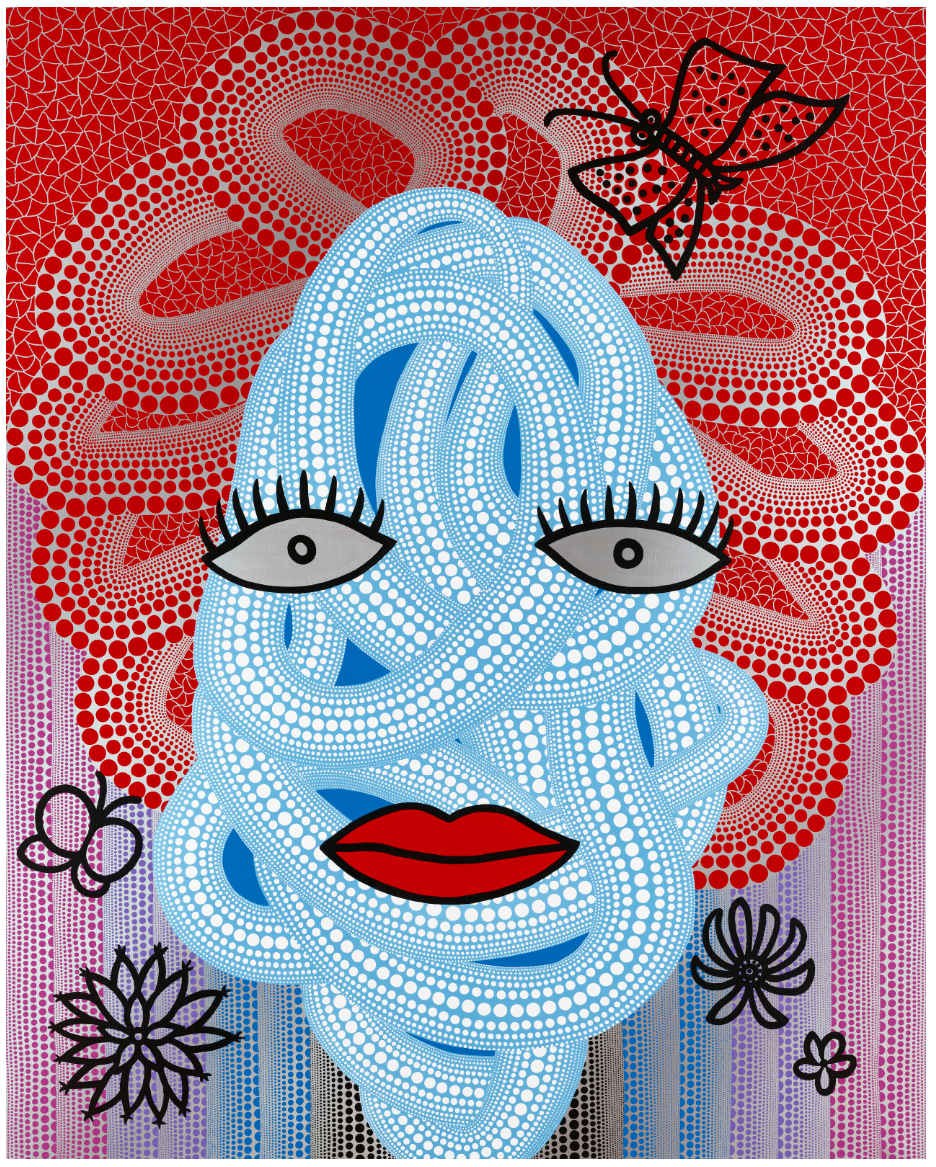
YAYOI KUSAMA (B. 1929)
WOMAN, 2016
Acrylic on canvas
227.3 x 181.8 cm (89 1/2 x 71 5/8 inches)
Signed, titled, and dated ‘WOMAN YAYOI KUSAMA 2016’ (on the reverse)
Still Lifes
Watermelon and Fork, 1989
Phillips Hong-Kong: 25 November 2024
Estimated: HKD 6,000,000 – 8,000,000
HKD 6,985,000 / USD 897,410
Yayoi Kusama – Modern & Contemporary… Lot 9 November 2024 | Phillips
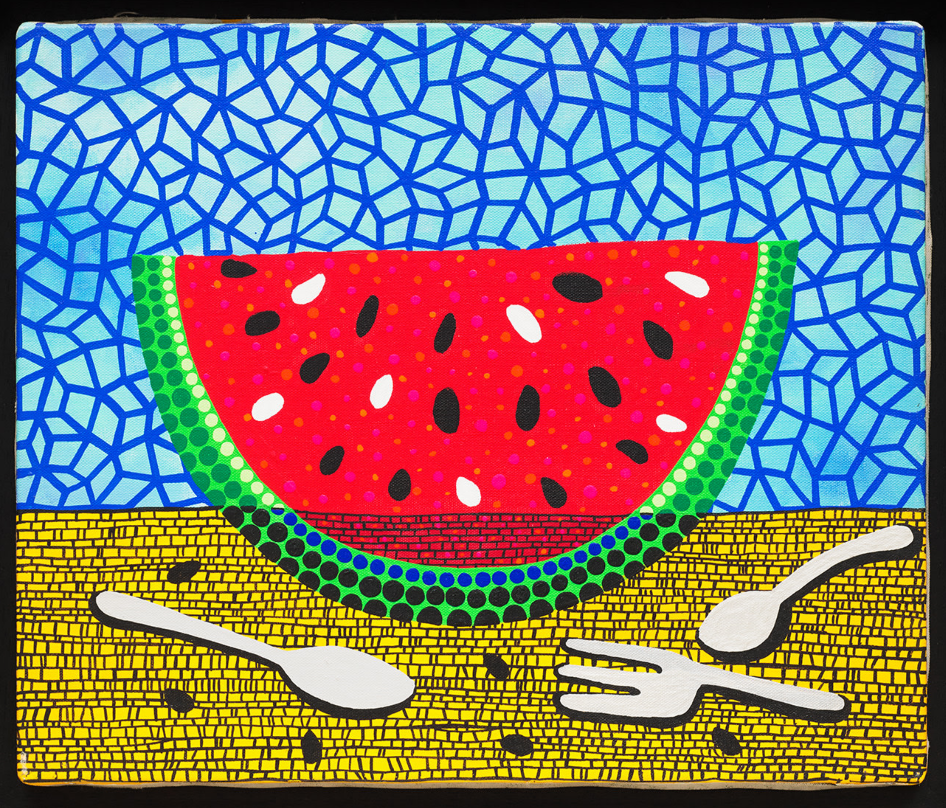
YAYOI KUSAMA
Watermelon and Fork, 1989
Acrylic on canvas
37.5 x 45 cm (14 3/4 x 17 3/4 inches)
Signed, titled and dated ‘”Suika to Fork” [in Kanji and Katakana], Yayoi Kusama 1989’ on the reverse
Born in 1929 in Matsumoto, Japan, Kusama grew up in a turbulent and emotionally fraught environment, with memories of her mother’s strained relationship with her father and her own struggles with mental health. The watermelon, as a subject, evokes a complex interplay between innocence, abundance, and the cyclical nature of life—elements that are deeply entwined with Kusama’s childhood memories of rural Japan.
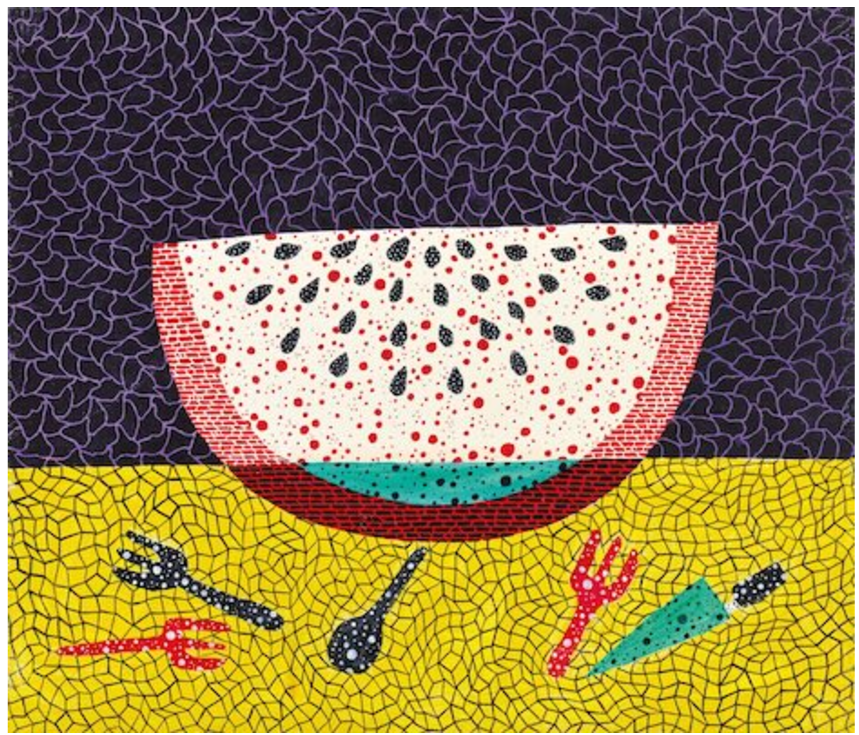
Yayoi Kusama, Watermelon, 1984
Watermelon and Fork is a vibrant amalgamation of all of Yayoi Kusama’s most signature motifs—from the pulsating infinity nets and dots, her earlier grid-like webs, to the figurative elements of the watermelon and cutlery. This dynamic composition exemplifies Kusama’s lifelong engagement with both the external world and her inner psychological landscape. Creating dialogue between the finite and the infinite, the real and the imagined, through the present lot, Kusama offers a visual language that transforms the ordinary into the extraordinary.
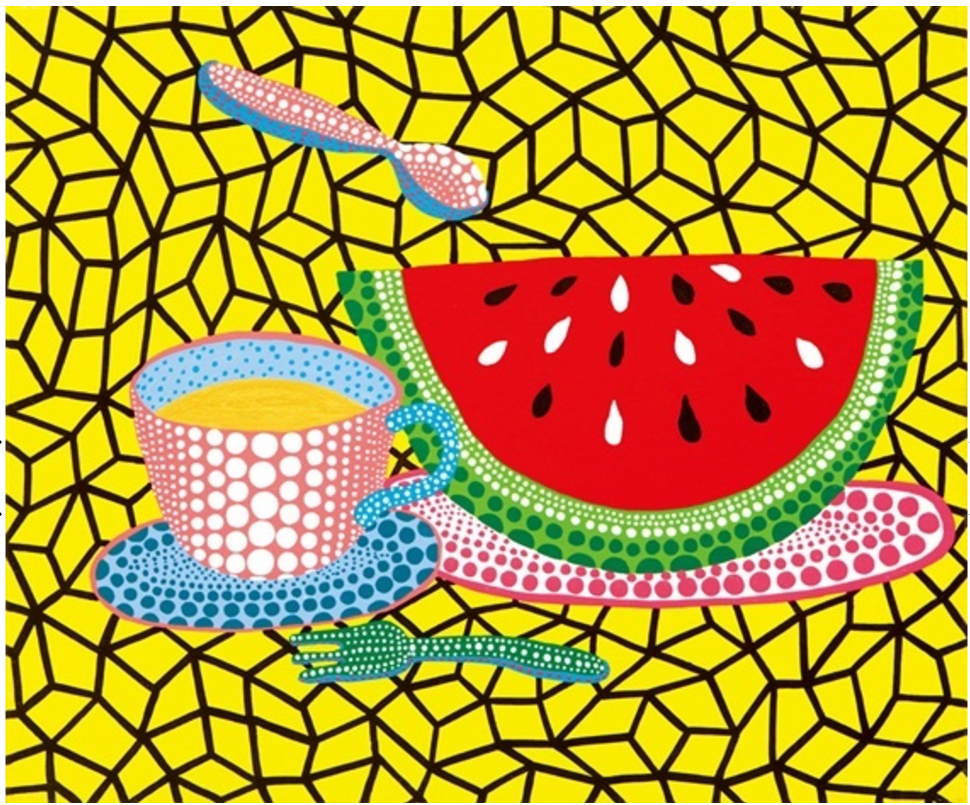
Yayoi Kusama, Watermelon, 1989
Kusama’s depiction of the watermelon—a quintessential still-life subject—takes on deep personal and symbolic resonance when placed in the context of her childhood. Born in 1929 in Matsumoto, Japan, Kusama grew up in a turbulent and emotionally fraught environment, with memories of her mother’s strained relationship with her father and her own struggles with mental health. The watermelon, as a subject, evokes a complex interplay between innocence, abundance, and the cyclical nature of life—elements that are deeply entwined with Kusama’s childhood memories of rural Japan.
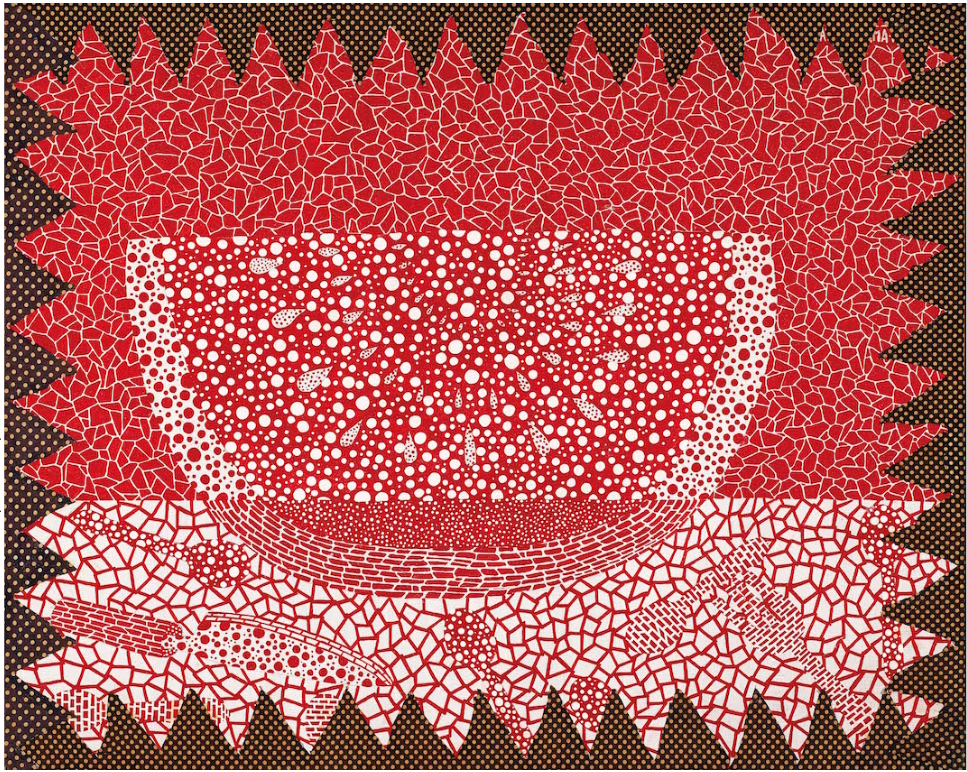
Yayoi Kusama, Watermelon, 1981
Painted in 1989, the present lot was created after Kusama’s return from the United States in 1973. Having spent much of the preceding decades in relative obscurity in Japan, by the late 1980s, the artist was experiencing a significant resurgence in recognition, particularly in the United States and Europe. Following Yayoi Kusama: A Retrospective at the Center for International Contemporary Arts in New York and In Context: Yayoi Kusama, Soul Burning Flashes at the Museum of Modern Art in Oxford, Kusama’s work garnered widespread acclaim. This period marked a profound shift in her career, which culminated in her representing Japan at the 1993 Venice Biennale, solidifying her place as one of the most prominent contemporary artists of her generation.
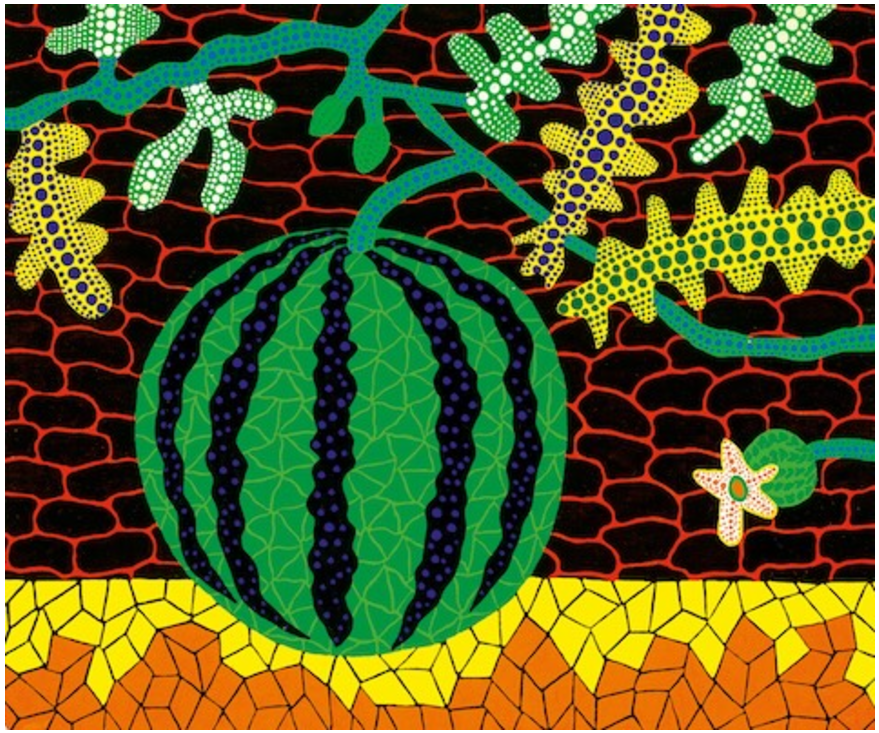
Yayoi Kusama, Watermelon, 1989
Watermelon and Fork, painted at this juncture, speaks to the artist’s sustained exploration of obsessive patterns and repetition, themes that had defined her artistic oeuvre for over four decades. This year also marked Kusama’s continued exploration of intimate and symbolic representations, often directly addressing her personal experiences and emotional states. In this context, the year encapsulates both a retrospective moment in Kusama’s ongoing engagement with her singular vision and moment of reinvention that would pave the way for her iconic evolution.
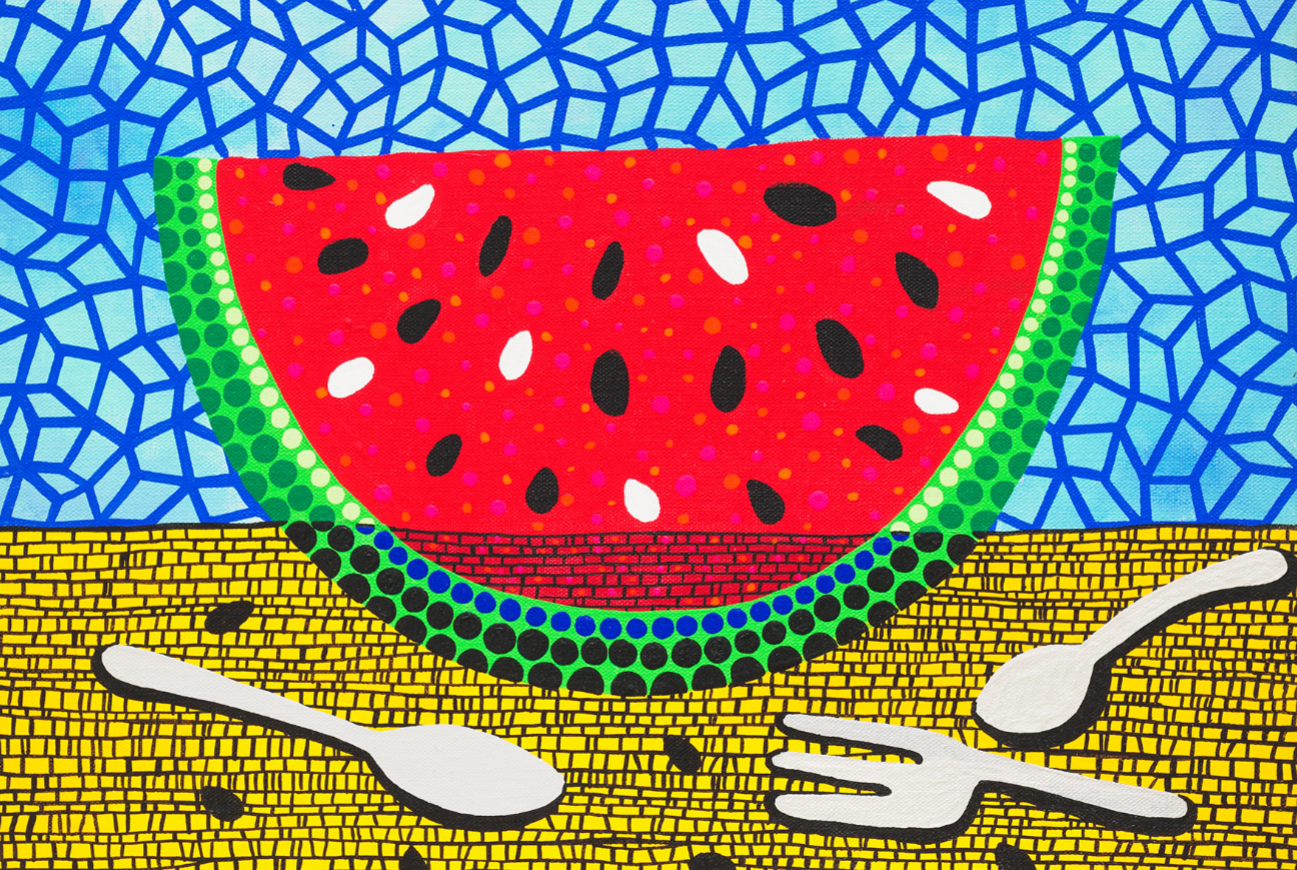
In Watermelon and Fork, Yayoi Kusama once again masterfully blends personal symbolism with universal themes, creating a visual language that speaks to the infinite. Much like Andy Warhol’s Campbell’s Soup Cans or Wayne Thiebaud’s brightly colored cakes, Kusama elevates the watermelon—a simple, natural object—into an icon of repetition and excess. However, while her Pop contemporaries appropriated mass culture in a more overtly commercial way, Kusama imbues her repetition with a deeper, introspective meaning. The watermelon here transcends its status as a still life subject, becoming a potent symbol of life’s fragility. In Kusama’s hands, the watermelon evokes both her psychological struggles with obsession and her ongoing quest for personal and artistic identity.
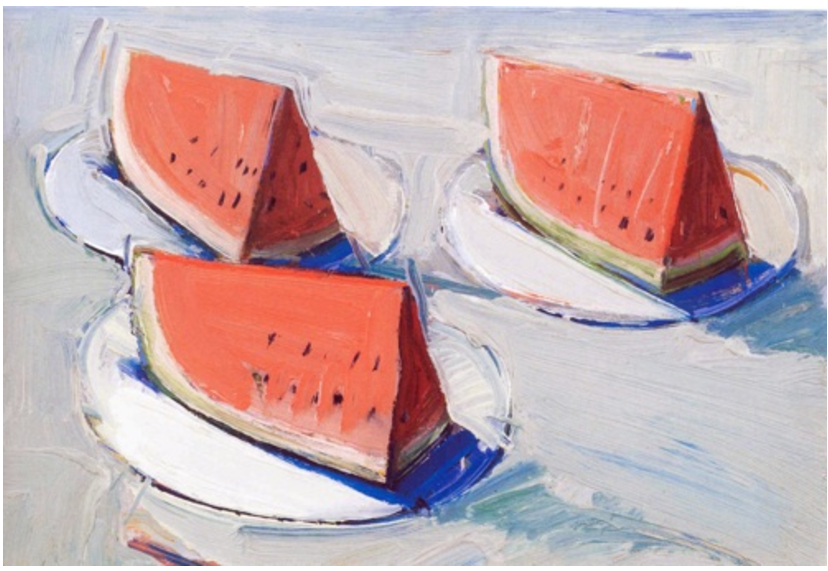
Wayne Thiebaud, Watermelon Slices, 1961.
Artwork: © 2024 Wayne Thiebaud Foundation / Licensed by VAGA at Artists Rights Society (ARS), NY
Her dots and nets, in turn, create a rhythmic, almost hypnotic repetition that draws the viewer deeper into an endless visual space. Here, absence and presence are intertwined, and the work becomes a portal into both the psychological and the cosmic, inviting a meditation on time, perception, and the infinite. Together, these themes of repetition, still life, and dimensionality create a rich, multifaceted work that is quintessentially Kusama. Watermelon and Fork encapsulates her lifelong engagement with both the external world of mass culture and the internal world of personal obsession, offering a unique reflection on life, death, and the infinite that transcends conventional still life or any art historical motifs. Through her distinctive use of pattern, space, and symbolism, Kusama transforms the familiar into something boundless, challenging the viewer to consider both the finite and the infinite in one glance.
Mushroom, 1980
Sotheby’s New-York: 20 November 2024
Estimated: USD 4,000,000 – 6,000,000
USD 3,360,000
Mushroom | The Now and Contemporary Evening Auction | 2024 | Sotheby’s
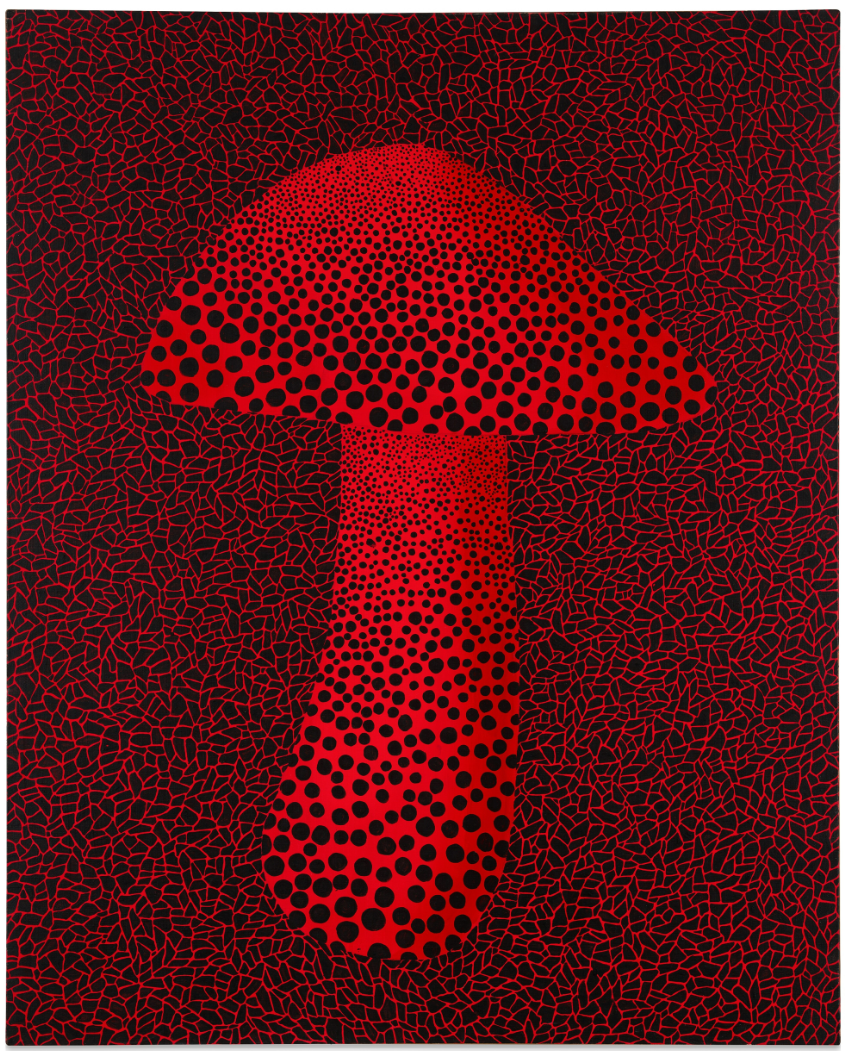
YAYOI KUSAMA (b. 1929)
Mushroom, 1980
Acrylic on canvas
162 x 130.5 cm (63 3/4 x 51 3/8 inches)
Signed, titled in Japanese and dated 1980 (on the stretcher)
Executed on an immersive scale and endowed with a humming and powerful presence, Yayoi Kusama’s Mushroom of 1980 is an exceptional example of the artist’s paradigmatic career. Black dots and polygons applied with punctilious care pulsate and dance across a canvas of rich scarlet. The mesmerizing, almost hypnotic mark-making converges in kaleidoscopic clusters, resulting in a mushroom humming with visual and psychological intensity. Featuring the iconic polka-dots that have come to define the artist’s prodigious interrogation of her own personal history, Mushroom underscores Kusama’s acute ability in profound contemplation of her own experience, which has solidified her status as one of the most iconic artists of the twentieth and twenty-first century.
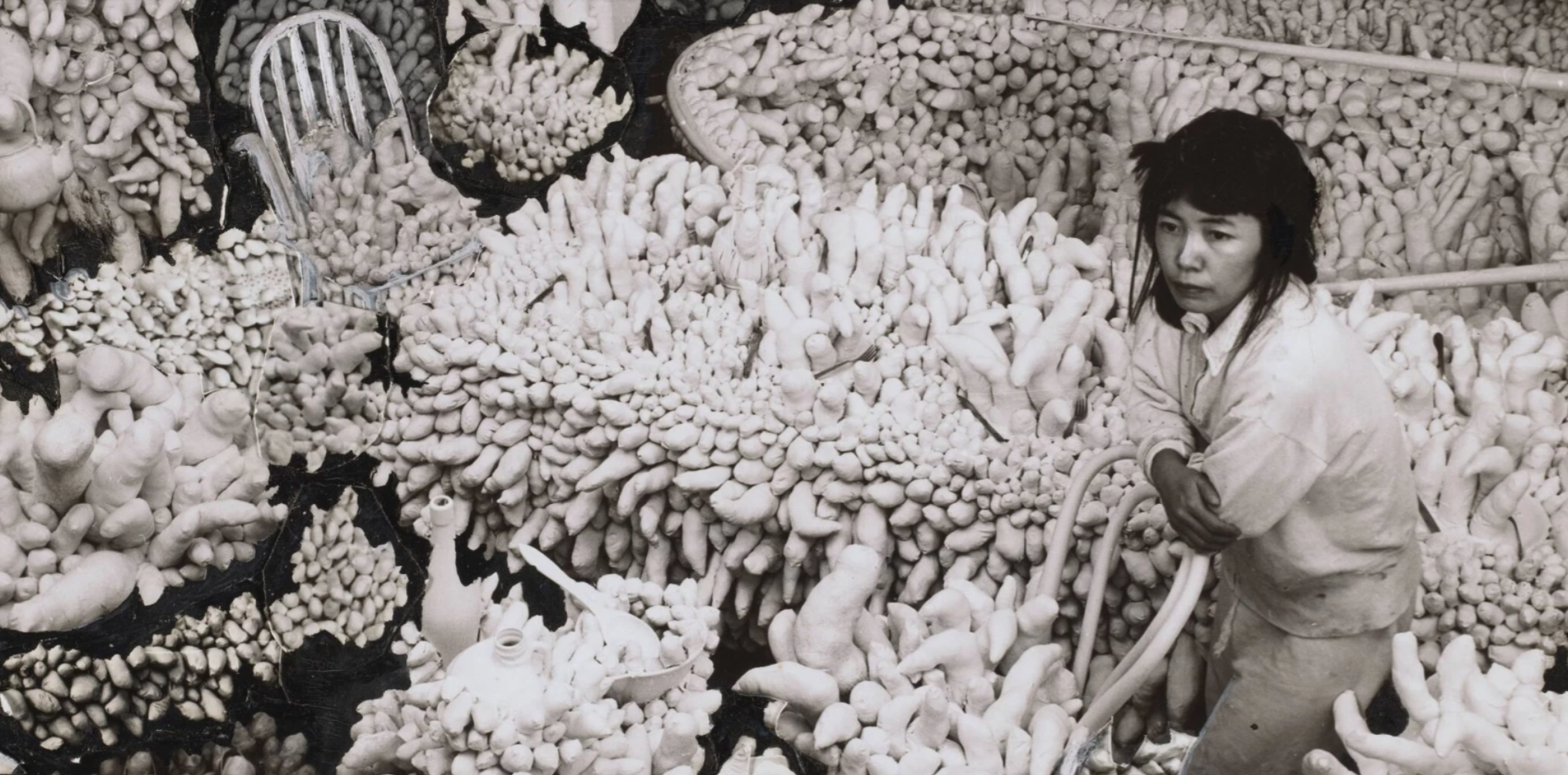
Yayoi Kusama pictured with her Compulsion Furniture (Accumulation), c. 1964. San Francisco Museum of Modern Art. Art © 2024 Yayoi Kusama
Kusama’s art, despite her disapproval, has been described at various times throughout her career as Surrealist, Minimalist, Monochrome, Pop, Psychedelic, and more. Regardless of these diverging accounts, what emerges is that her practice is defined by the exploration of obsessive repetition. The initial image of her dot motifs emerged from hallucinations Kusama experienced when she was ten years old: “One day, looking at a red flower-patterned table cloth on the table, I turned my eyes to the ceiling and saw the same red flower pattern everywhere, even on the window glass and posts. The room, my body, the entire universe was filled with it, my self was eliminated, and I had returned and been reduced to the infinity of eternal time and the absolute of space.” (the artist quoted in: Laura Hoptman, “Yayoi Kusama: A Reckoning” in: Yayoi Kusama, London, 2000, p.35) Repetition, infinity, self-obliteration, and obsessive patterning are themes and motifs that pervade Kusama’s oeuvre and are evident in the black dots and polygonal tessellations of Mushroom. Blurring the boundaries between illusion and reality, nothingness and infinity, selfhood and self-obliteration, Kusama’s hypnotic mark-making foregrounds an artist’s journey towards spiritual stability and respite from psychosomatic anxiety.
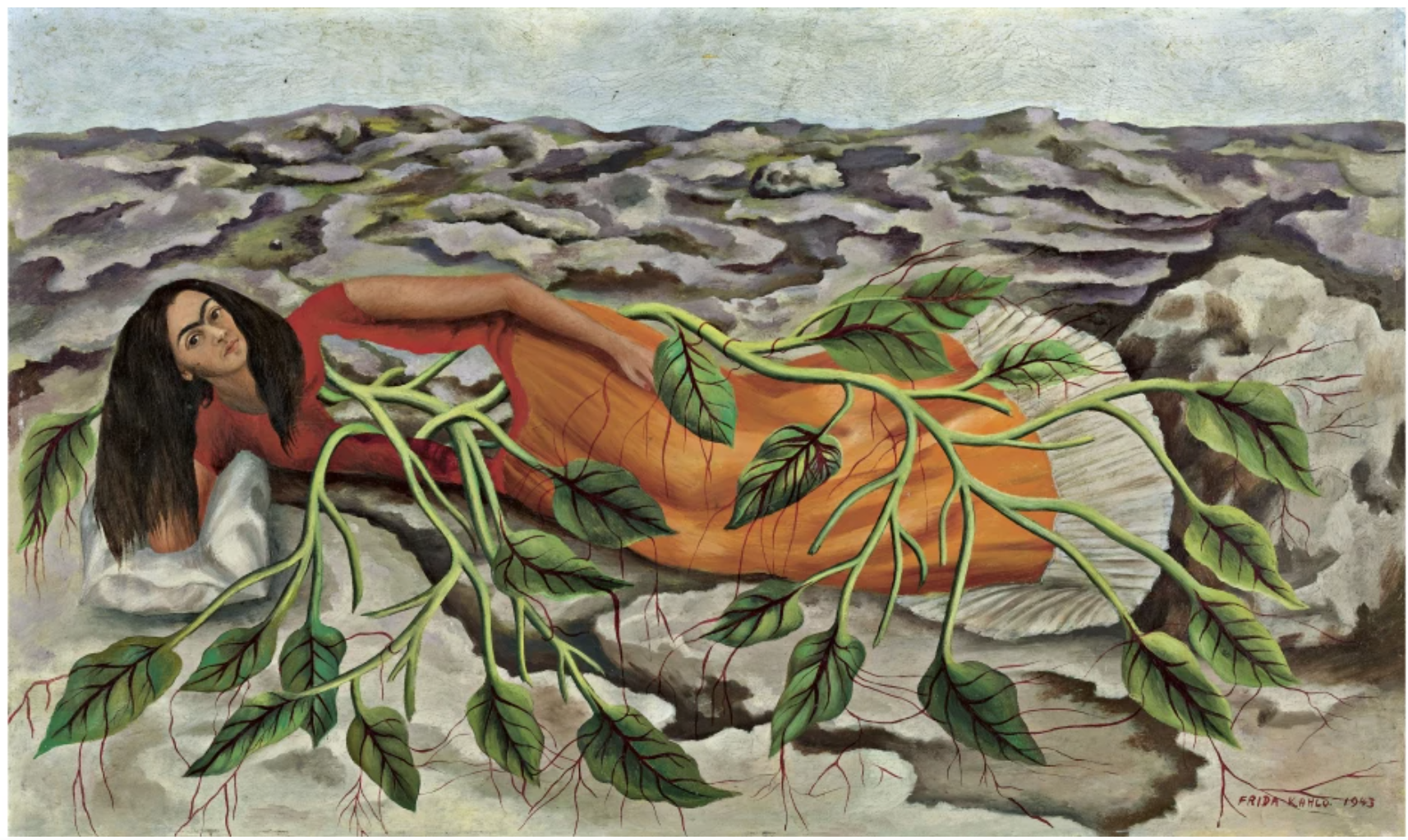
Frida Kahlo, Roots, 1943. Private Collection. Image © Sotheby’s / Bridgeman Images. Art © 2024 Banco de México Diego Rivera Frida Kahlo Museums Trust, Mexico, D.F. / Artists Rights Society (ARS), New York
Considering how personally resonant her practice is, it is difficult to separate the tumult of Kusama’s life from the works that she produced. As a young artist trained in both Western and Japanese traditions, she emigrated to the United States, arriving in New York City in 1958 where she would remain for a fifteen years. While many publications discuss the psychiatric histories of Kusama’s childhood, the artist’s time in New York was also riddled with hardship. Although she was incredibly productive and driven upon her arrival in New York and made important connections with artists such as Georgia O’Keeffe, Donald Judd, On Kawara, and Joseph Cornell, the racism and sexism prevalent in the white-male-dominated art world presented countless obstacles to the ambitious young artist. Her artworks from this period are widely considered transformative and pivotal to her career but were also a source of frustration and disappointment to Kusama, leading to her eventual return to Japan in 1973.
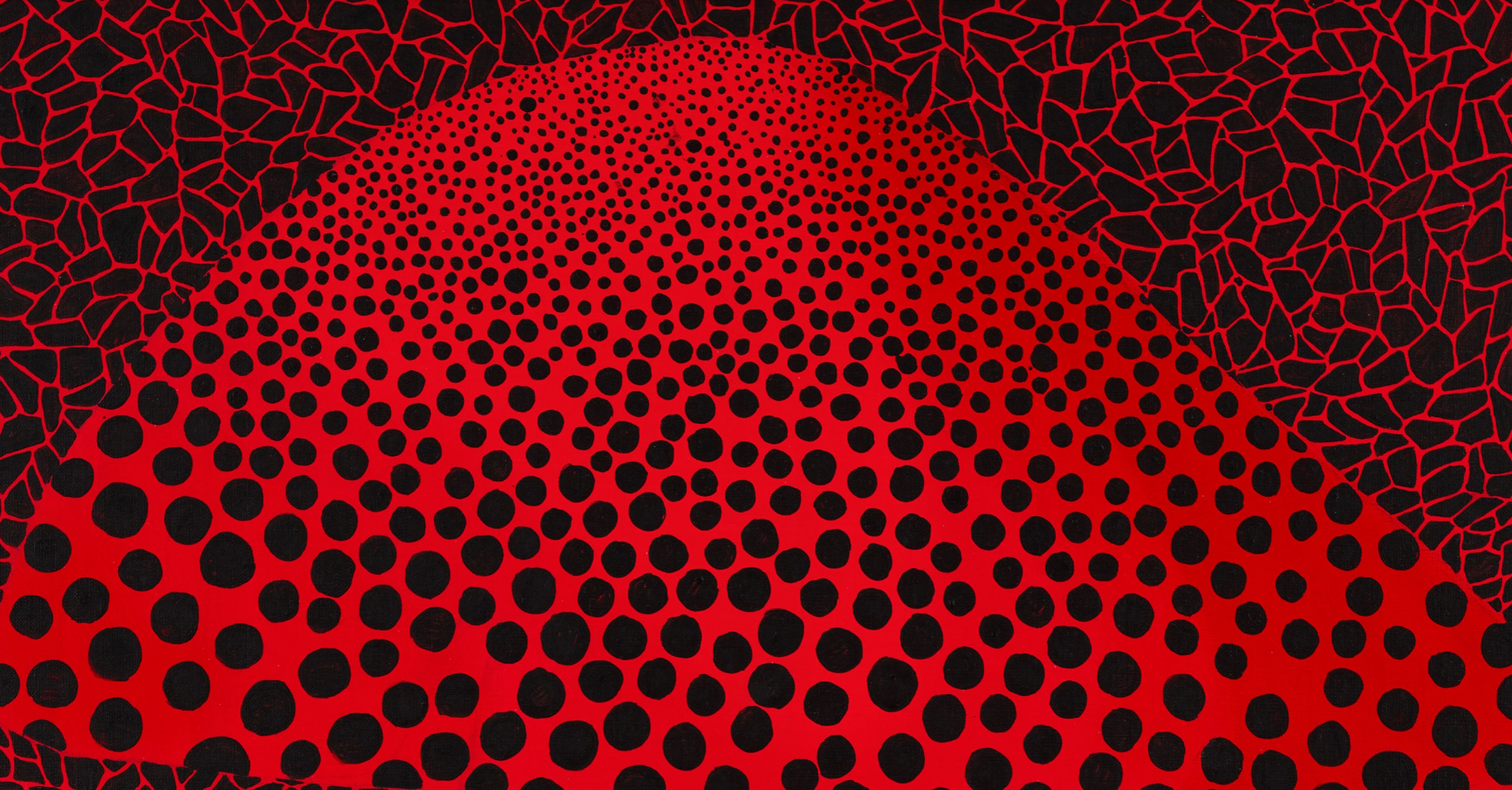
Kusama started working on the mushroom motif in 1977 and 1978, beginning with works on paper. Along with other iconic motifs such as the pumpkin, flower, and butterflies, Kusama’s mushroom embodies polka-dot patterns redolent with complex fragility and symbolic resonance. Mushroom further underscores the artist’s preoccupation with life, death, celebration, and mourning. After all, mushrooms grow upon a substrate of dead, decaying plant matter, and are thus a symbol of what grows after death. The fact that many mushrooms, when ingested, acts as a hallucinogenic incurring supernatural visions and illusions, also adds another layer of significance to the motif when put in parallel with Kusama’s condition. Visual associations with the mushroom—the phallic nature of the imagery, as explored in Kusama’s earlier Accumulation sculptures, or its similarities to the “mushroom” cloud of a nuclear bomb—also hint at the myriad ways Mushroom can be read as Kusama’s “attempt to flee from psychic obsession by choosing to paint the very vision of fear, from which one would ordinarily avert one’s eyes.” (Akira Tatehata, “Interview: Akira Tatehata in conversation with Yayoi Kusama” in: Yayoi Kusama, London, 2000, p.14) The resulting painting is an exemplar of Kusama’s fierce and relentless desire to collapse the division between her consciousness and the external world—a practice of intuitive translation into a visual lexicon that deciphers the complexity of her own mind.
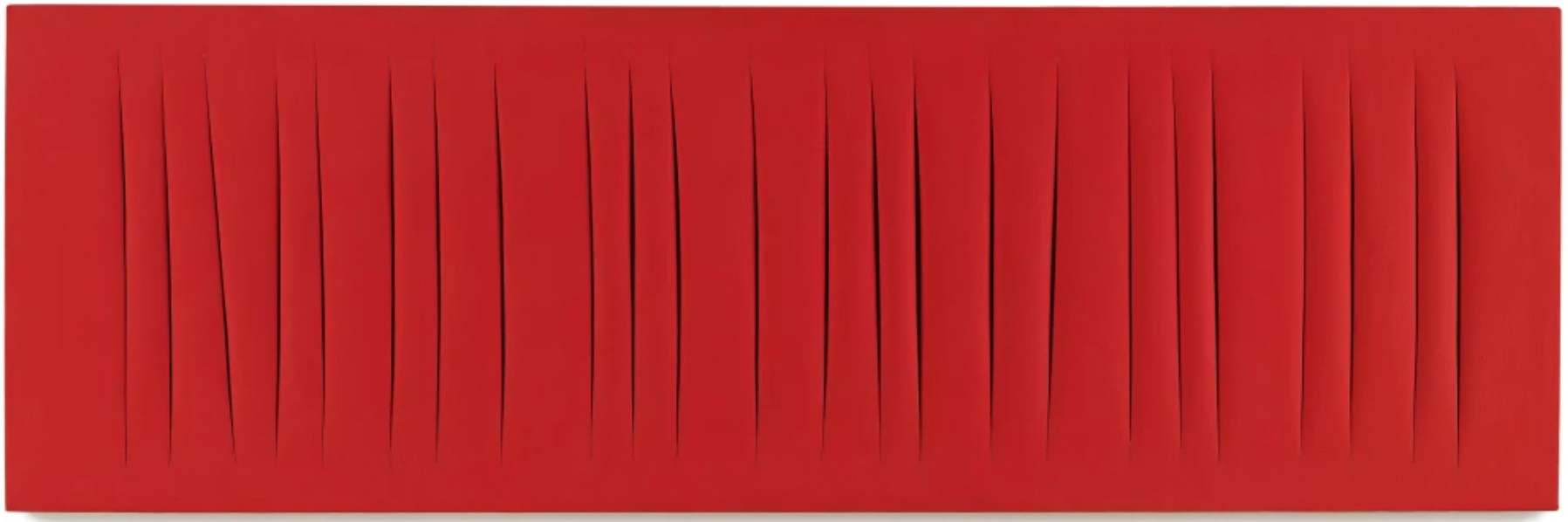
Lucio Fontana, Concetto Spaziale, Attese, 1965. Private Collection.
Sold at Sotheby’s New York in November 2015 for $16.2 million. Art © 2024 Fondation Lucio Fontana
With a process that is at once meditative and obsessive, Kusama demonstrates her singular devotion to artistic creativity and her interrogation of life, death, trauma, and infinity. Vast in scale and outstanding in intricacy, Mushroom presents a testament to the artist’s relationship with her own practice, how her art has been a vital form of personal therapy but also an expression of philosophical and aesthetic questions that have rewritten the grammar of contemporary art. Utterly spellbinding to artist and viewer alike, the present work’s elegant palette and intricate construction deliver an immersive experience for us to glimpse into Kusama’s fantastical spiritual dimension.
Fruits, 1992
Christie’s Shanghai: 7 November 2024
Estimated: CNY 3,500,000 – 5,000,000
CNY 4,410,000 / USD 619,480
YAYOI KUSAMA (B. 1929), Fruits | Christie’s
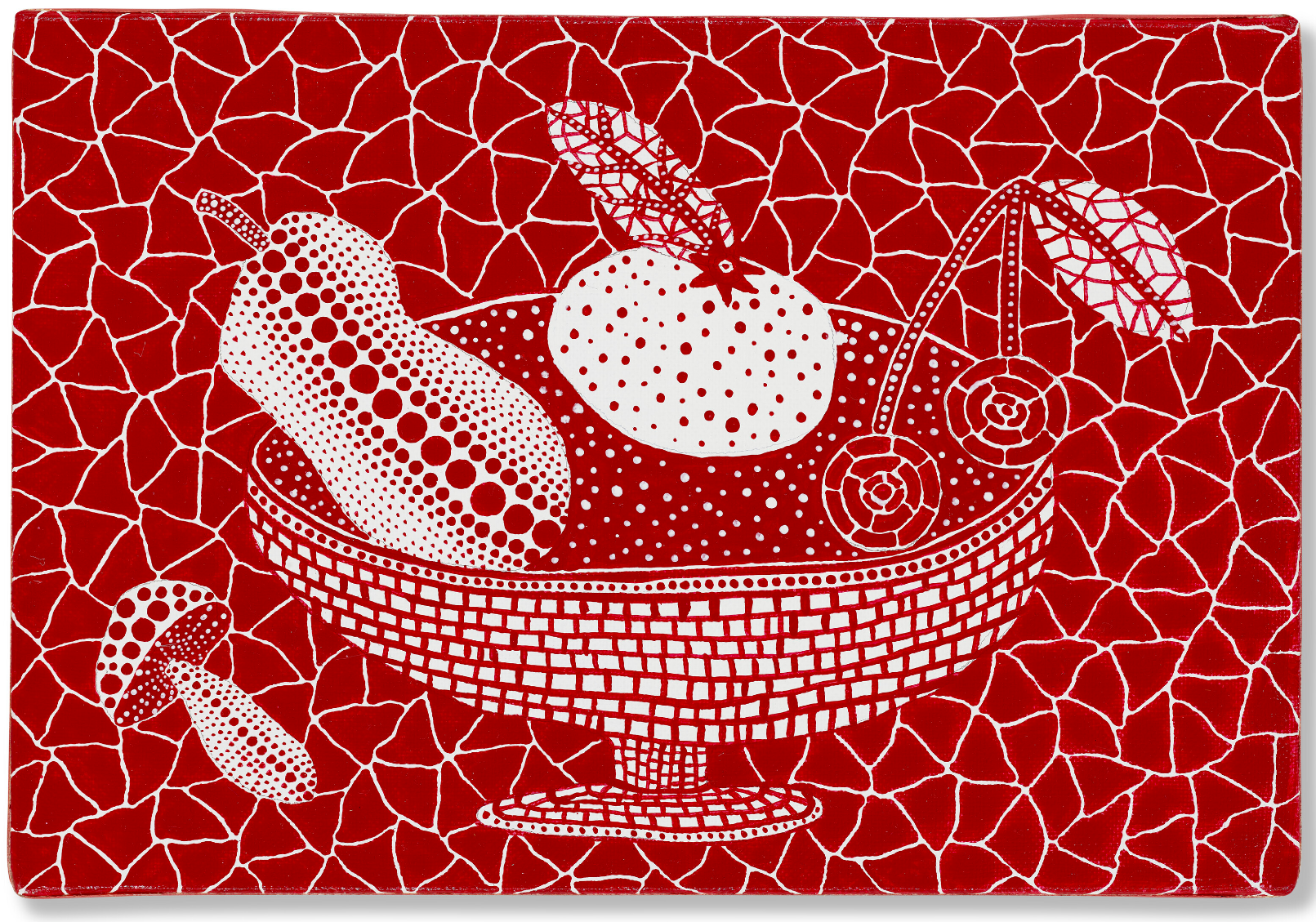
YAYOI KUSAMA (B. 1929)
Fruits, 1992
Acrylic on canvas
15.8 x 22.7 cm (6 1/4 x 8 7/8 inches)
Signed, titled in Japanese and dated ‘Kusama 1992’ (on the reverse)
In 1993, a year after Fruits (1992) was created, Kusama was selected to represent Japan for the first time at the Venice Biennale. Foretelling the first pinnacle of the artist’s career, Fruits unites Yayoi Kusama’s celebrated laborious, monochromatic Nets composition with her unparalleled interrogation of figuration. Profuse with lustrous red and organic forms that are at once majestic and captivating, the delicately scaled canvas also evidenced the artist’s newfound maturity on the subject matter that she has been exploring since the 1970s. Freeing from gravity, the fruits camouflaged in Kusama’s nets and dots are levitating and pulsating above the utensil, creating a sense of movement and energy, like dancers. Orchestrating the flow of energy and movement with her trademark motif, Kusama proposes an unorthodox way to perceive the world that is uniquely her own. Through conflating abstract forms with quotidian objects, Kusama’s Fruits creates a world of wonders in one of the most classical genres. Upon her return to Japan in 1973, Kusama started to develop prints that incorporated nets and dots as a scheme to illustrate different ordinary themes. Her highly stylized way of portraying still life and the arrangement of objects in the picture plane incidentally share a similar aesthetic with the Rinpa School, a historical school of Japanese painting dating back to the Edo period. Notably, Rinpa masters often depict their subjects without contours, a technique called mokkotsu (‘boneless’) where the physicality of an entity can be traced only through color instead of line. Such technique lends tactility to the objects while unfolding a realm of undefined space in between.
Fruits [EPSOB], 2011
Christie’s Hong-Kong: 28 May 2024
Estimated: HKD 20,000,000 – 30,000,000
HKD 23,365,000 / USD 2,991,294
Fruits [EPSOB] (christies.com)

YAYOI KUSAMA (B. 1929)
Fruits [EPSOB], 2011
Acrylic on canvas
112 x 145.5 cm (44 1/8 x 57 1/4 inches)
Signed, titled and dated ‘EPSOB FRUITS YAYOI KUSAMA 2011’ (on the reverse)
Painted in 2011, Fruits (EPSOB) unites Yayoi Kusama’s celebrated laborious, monochromatic Nets composition with her unparalleled interrogation of figuration. Profuse with luminous pigments and organic forms that are at once majestic and captivating, the nearly five-feet wide canvas also evidenced the artist’s newfound maturity at the turn of the millennium on the subject matter that she has been exploring since the 1970s. Freeing from gravity, the fruits camouflaged in Kusama’s nets and dots are levitating and pulsating above the utensil, calling to mind the rhythmic movement created by Matisse’s dancers; while the cherries, oscillating in the background, allude to shooting stars in the cosmos. Orchestrating the flow of energy and movement with her trademark motif, Kusama proposes an unorthodox way to perceive the world that is uniquely her own. The fruits are arranged in a way that creates a sense of movement and energy, as if they are dancing within the bowl and exuberated to the rhythmic background with the floating cherries. Through conflating abstract forms with quotidian objects, Kusama’s Fruit (EPSOB) creates a world of wonders in one of the most classical genres.

Left: Yayoi Kusama, Onion, 1948. Artist Collection. © YAYOI KUSAMA / Right: Paul Cezanne, Still Life with Fruit Dish, 1879-80. Museum of Modern Art, New York. © Digital image, The Museum of Modern Art, New York/Scala, Florence
Kusama began her career as an artist in the early 1960s in New York, a seedbed that fostered the Pop art movement centered with iconic figures like Andy Warhol and Roy Lichtenstein, yet Kusama paved a completely different path. Her aesthetics of representational objects, though similarly inspired by imageries from everyday life and carrying a similar flattening and graphical quality as the mass-inspired Pop, are innately different from the concept and execution of them. Her figurative works are instead closely tied to her early training in nihonga—a reinvented style of traditional Japanese painting that absorbs its techniques and materials. In 1948, Kusama studied nihonga at Kyoto City Senior High School of Art. She was greatly influenced by the master Gyoshu Hayami and created one of her earliest still lifes—Onions (1948). It demonstrates her early, unconventional understanding of spatial arrangement. In the 19th century, art historian Ernest Fenollosa succinctly summarized five aspects of nihonga: ‘do not pursue realism like photograph; no shadow; there is a koroku (outline); the colour tone is not deep; the expression is concise.’ Kusama’s still life integrates some of these logics yet rectifies them in her own way. By the time she returned to Japan in 1973, Kusama started to develop prints that incorporate nets and dots as a scheme to illustrate different ordinary themes. Her highly stylized way of portraying still life and the arrangement of objects in the picture plane incidentally share a similar aesthetic with the Rinpa School, a historical school of Japanese painting dating back to the Edo period. Known for its highly patterned and two-dimensional approach to depicting nature subject matters in vivid colour, Notably, Rinpa masters often depict their subjects without contours, a technique called mokkotsu (‘boneless’) where the physicality of an entity can be traced only through color instead of line. By doing so, she elevates the printmaking process to a form of art that transcends mere reproduction, offering a deeper exploration of her artistic vision. Such technique lends tactility to the objects while unfolding a realm of undefined space in between. Kusama’s Fruits (EPSOB), on the other hand, uses nets as her medium to explore the undefined space between objects, while her application of vivid palette brings out the intrinsic properties of the objects themselves.

Like the post-impressionist Paul Cezanne, Kusama utilizes still objects as a means to explore the relationship between form, space and color. Both Kusama’s and Cezanne’s works introduced new understandings of still life, shattered the conventions of traditional representation and paved the way for a more subjective and individualized approach to depicting the world around us. As for Kusama, she explores new avenues for traditional art, specifically nihonga, which resulted in an unparalleled and innovative perspective on still life. Through her meticulous application of brushstrokes, a sense of depth and dimension are established on the canvas. Kusama painterly skill with nets and dots, combined with her self-obliteration concept, adding another layer to her works—evoking a sense of infinity and transcendence.
The concept of ‘self-obliteration’ that threads through Kusama’s oeuvre is an oath of life where the negative and positive becoming one. It conveys the artist’s desire to dissolve the boundaries between the self and the universe, inviting viewers to contemplate their own existence and place within the infinite cosmos. Kusama’s artistic skill and concept of self-obliteration, intertwined with her mastery of nets and dots, allow her to triumphantly conquer the concept of infinity and create artworks that are both visually stunning and philosophically profound. Through the process of eliminating physical matter with ‘dots’ and ‘nets’, Kusama constructs a concept of perpetual repetition and reproduction that she consistently adheres to. Fruits (EPSOB) brims with dynamic lines and traces that are not deliberately pursued for their representational means, but rather serve as symbols of her innermost states. By embodying the process of dissolving the self and object, she returns to the natural state of the universe. Through her mysterious and persistent artistic creation process, she creates a visual variation that is reminiscent of the brilliance of the universe or the origin of life.
Japanese Radishes, 1981
Christie’s London: 9 March 2024
Estimated: GBP 250,000 – 350,000
GBP 277,200 / USD 351,490
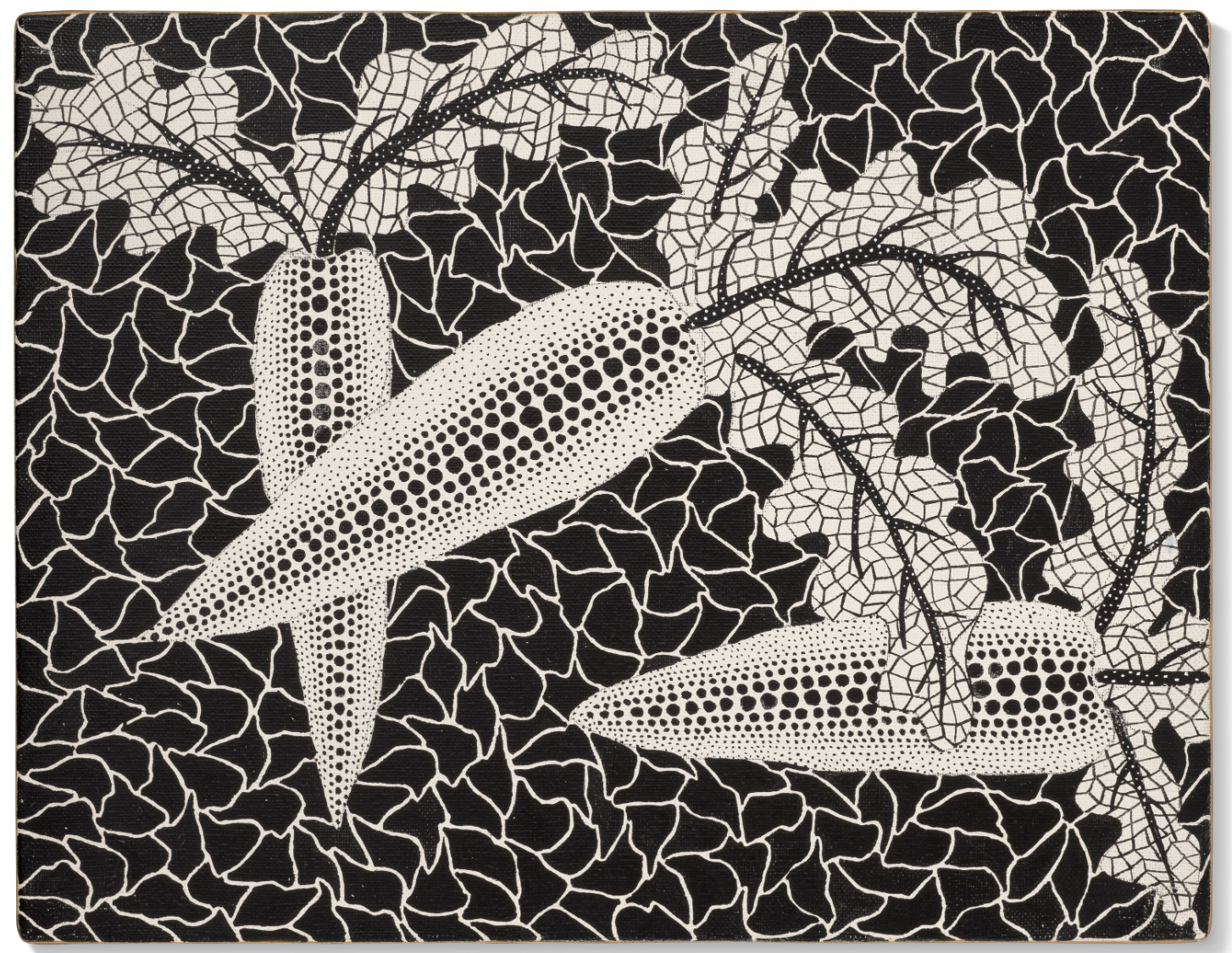
YAYOI KUSAMA (B. 1929)
Japanese Radishes, 1981
Acrylic on canvas
32×41 cm (12 1/2 x 16 1/8 inches)
Signed, inscribed, titled in Japanese and dated ‘Yayoi Kusama 1981 6F’ (on the reverse)
Yayoi Kusama’s Japanese Radishes (1981) is a paean to the natural world. The arresting monochrome depicts a series of Japanese radishes, or daikon, a distinctive subject within the artist’s rich oeuvre. Kusama has painted the three elongated vegetables against a tessellating black-and-white ground, and their bushy leaves and solarized forms, adorned with a deftly executed polka dot pattern, seem to simultaneously sink into and arise from the wavy, heady pattern. Both the dots and the infinity-net backdrop emerged from the hallucinations Kusama first experienced as a child and which have come to define her practice. Kusama has long been fascinated by the organic world. Growing up, Kusama passed much of her time at the plant nursery that her parents owned and operated. While out one afternoon with her grandfather, she found herself captivated by the solid, round pumpkins they came across during their walk, later making the protuberant vegetable a central—and now iconic—motif of her practice. Although Kusama has become indelibly linked to the pumpkin, she has, over the course of her long career, depicted other floral and vegetal motifs. Her earliest sketchbooks are filled with meticulous drawings of plants and flowers, and one of Kusama’s first paintings was a naturalistic still life of three onions, created while she was studying Nihonga, the neo-traditional Japanese style of painting, at the Arts and Crafts School in Kyoto. Japanese Radishes was painted in 1981, eight years after Kusama moved back to Japan after almost fifteen spent in New York City; her choice to paint a vegetable native to her homeland seems a fitting announcement—however belated—of her return. Japanese Radishes invokes the lessons Kusama had absorbed while living in New York, namely the ‘all over’ gestures of her Abstract Expressionist contemporaries and Pop art’s deadpan depictions of objects. The work filters these ideas through her own, decidedly personal practice and speaks to Kusama’s re-emergence within Japanese culture. Its crisp linearity underscores the graphic intensity of Kusama’s art. Despite the intense, almost space-age sense that imbues the work, it is inextricably tied to the earth, its land and vegetation, its seasons and cycles. The painting, in short, evokes an organic equilibrium.
A Field of Phantom, 1995
Phillips Hong-Kong: 7 October 2023
Estimated: HKD 2,000,000 – 3,000,000
HKD 4,445,000 / USD 567,572
Yayoi Kusama – 20th Century & Conte… Lot 138 October 2023 | Phillips
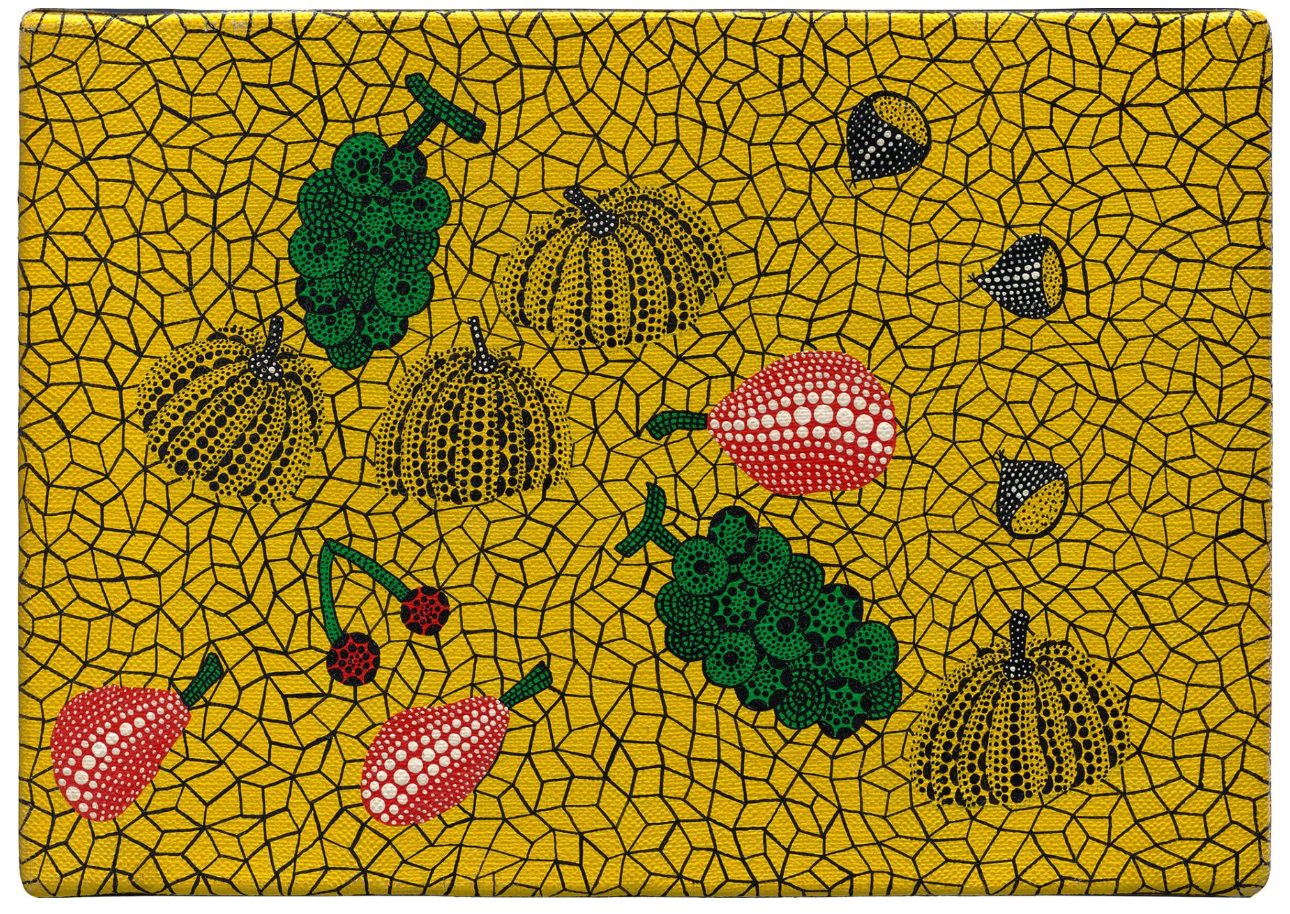
YAYOI KUSAMA
A Field of Phantom, 1995
Acrylic on canvas
16×23 cm (6 1/4 x 9 inches)
Signed, titled and dated ‘Yayoi Kusama “A Field of Phantom” [in Japanese] 1995 yayoi KUSAMA’ on the reverse
Intimate in scale yet visually complex, the present work reveals a combination of Kusama’s main pillars that define her praxis: polka dots, infinity nets, and the pumpkin. Rendered against a sprawling web of the artist’s most iconic black and yellow infinity nets, the artist has meticulously painted her fruits in bold colours with the use of striated dots. As a result, forming a hypotonic illusion whereby viewers are left in a trance between Kusama’s figurative and abstract representations. Born in Matsumoto where her family had earned their living cultivating plant seeds in a nursery, Kusama’s earliest formative years have been defined by her fascination of the natural world. Drawing from her affinity with nature – in particular vegetal and floral life – pumpkins and fruit baskets continue to occupy a special place in her iconography and serves as a recurring leitmotif within Kusama’s works. Rather than being confined to an individual basket here in the present work, the artist has radically arranged the positioning of her objects to reflect a perfectly balanced constellation of fruits and vegetables – bestowing upon viewers a brilliant spectacle of their five-a-day. Additionally, the striking contrast of natural forms juxtaposed against a geometric background illustrates Kusama’s technical ability in mastering spatial relationships.
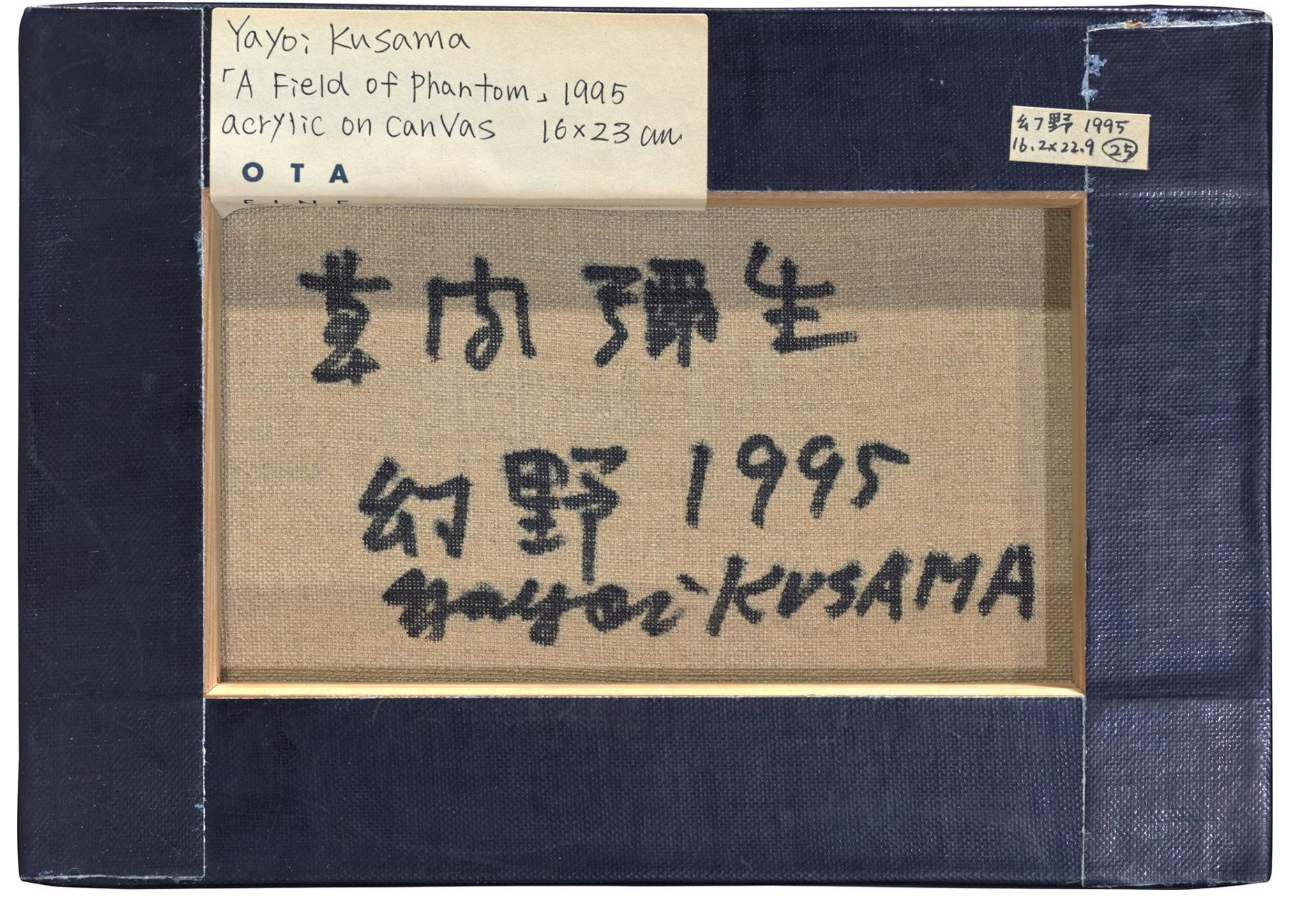
The title of the present work, A Field of Phantom overtly stems from Kusama’s mental health roots. The artist has frequently described her own creative process as a necessary escape from a lifetime of mental illness, as she began to experience vivid hallucinations of the fields around her home in Japan during her childhood. Surrounded by infinite rows of kabocha squash which her family often grew, Kusama is known to personify them by describing these bulbous forms as being morphed terrifyingly into a speckled pattern that threatened to engulf her. Although her psychological problems might be considered as traumatizing, the subjects rendered in the present work seem to hover in a jovial manner where the artist portrays them almost as caricatures dancing away to the beat of their own drum. Through A Field of Phantom, Kusama’s past can be viewed as a double-edged sword and understood as a way for her to be reengaging with and re-enacting this overwhelming experience. She reappropriates it to be shared with the viewer as an indication that perhaps nature, mental health, and the body are inexorably integrated. A Field of Phantom is the epitome of the artist’s individualistic expression via which she achieves self-obliteration through repetition. Thus, it stands as a unique and rare masterpiece to appear at auction.
Field, 1989
Christie’s Shanghai: 23 September 2023
Estimated: CNY 5,500,000 – 8,500,000
CNY 9,980,000 / USD 1,370,784
YAYOI KUSAMA (B. 1929) (christies.com)
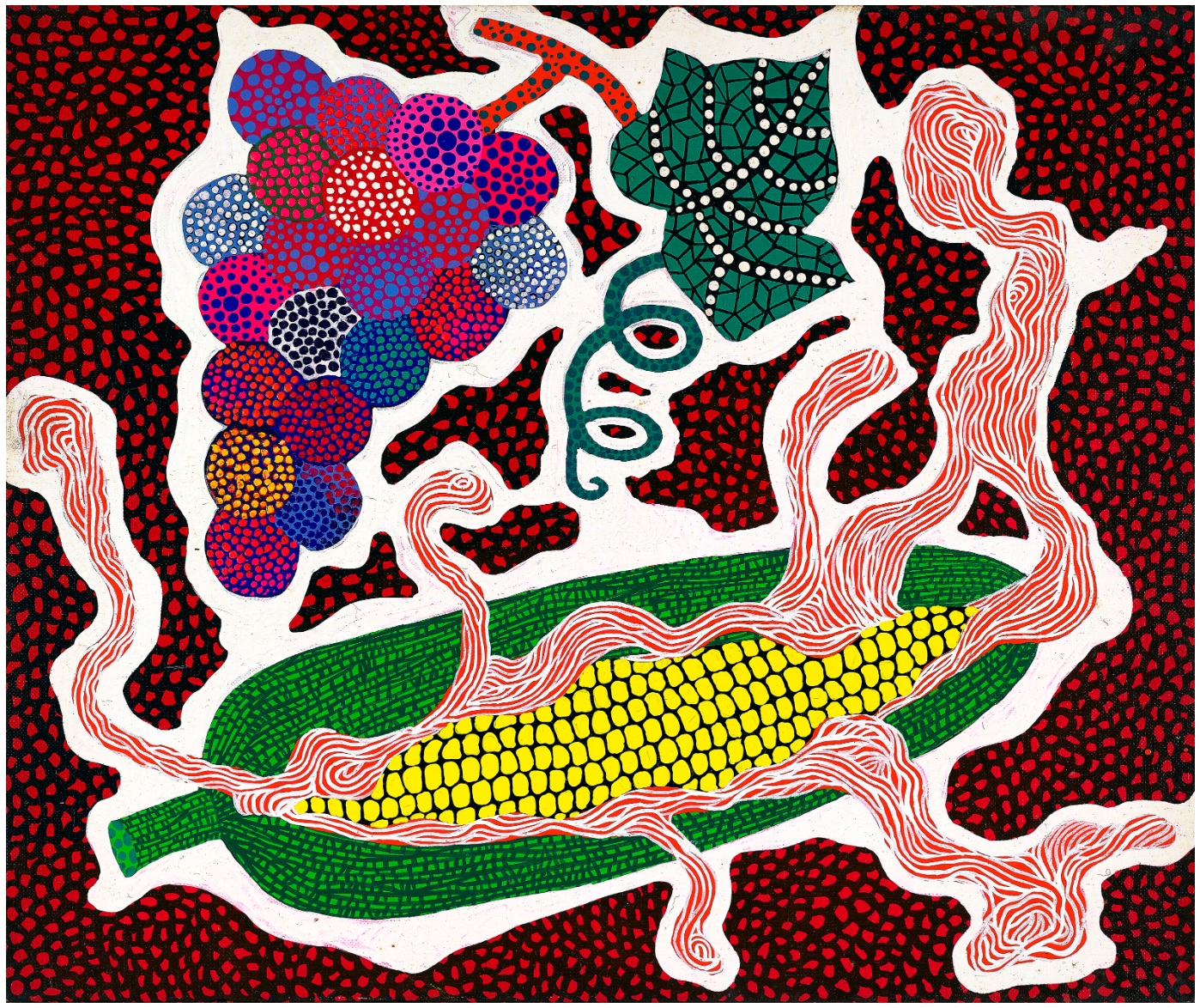
YAYOI KUSAMA (B. 1929)
Field, 1989
Acrylic on canvas
38 x 45.5 cm (15 x 17 7/8 inches)
Signed, titled in Japanese and dated ‘1989 Yayoi Kusama’ (on the reverse)
VERDANT EARLY SPRING, 2012
Christie’s Hong-Kong: 29 May 2023
Estimated: HKD 7,200,000 – 9,200,000
HKD 9,450,000 / USD 1,206,404
YAYOI KUSAMA (B. 1929) (christies.com)
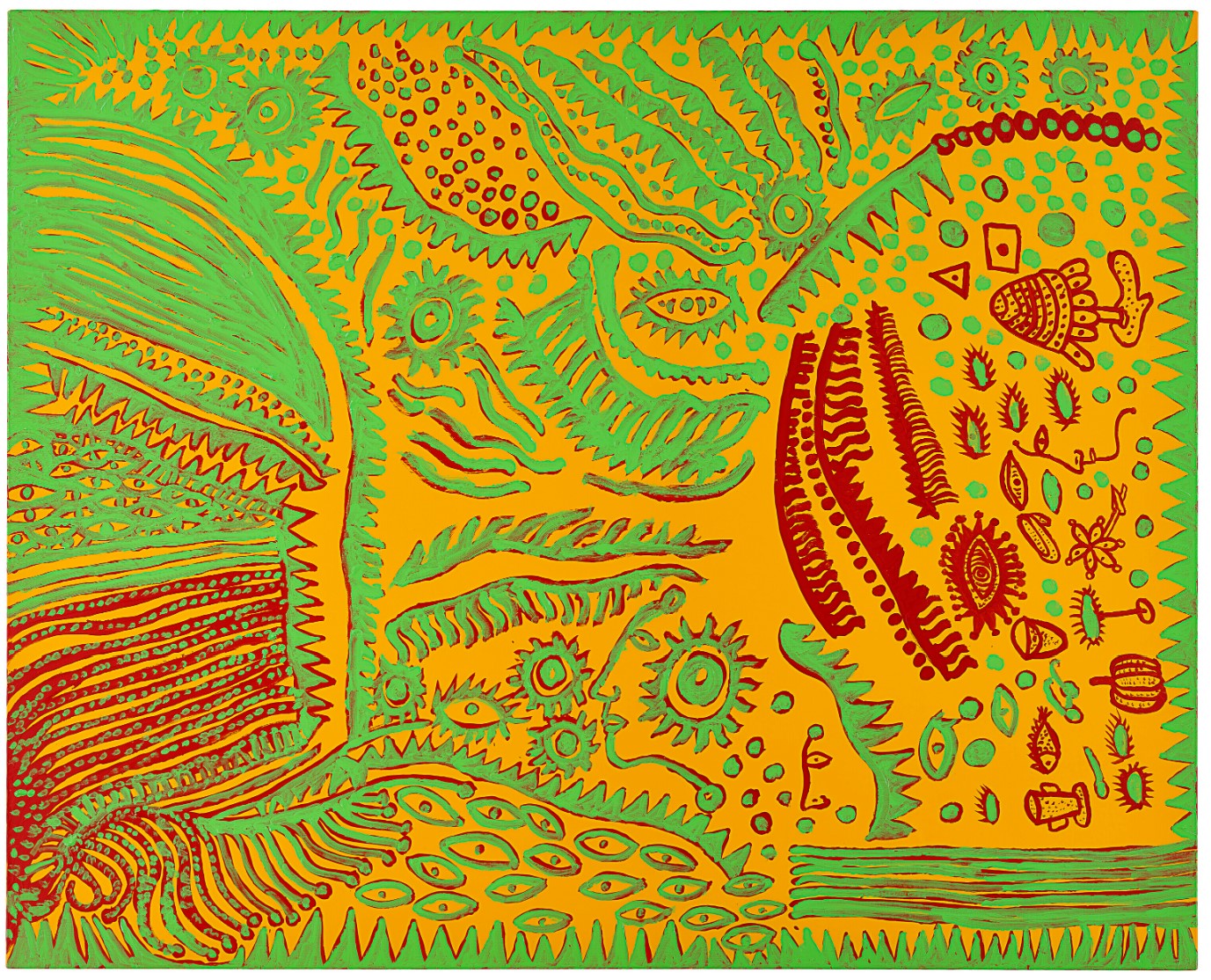
YAYOI KUSAMA (B. 1929)
VERDANT EARLY SPRING, 2012
Acrylic on canvas
130.3 x 162 cm (51 1/8 x 63 3/4 inches)
Signed, titled and dated ‘VERDANT EARLY SPRING Yayoi Kusama 2012’; titled again in Japanese
(on the reverse)
“Nature never grows old, endlessly unfurling her infinite beauty through the seasons.”
Fruits, 1996
Bonhams London: 24 March 2022
Estimated: GBP 300,000 – 500,000
GBP 598,750 / USD 789,386
Bonhams : YAYOI KUSAMA (B. 1929) Fruits 1996
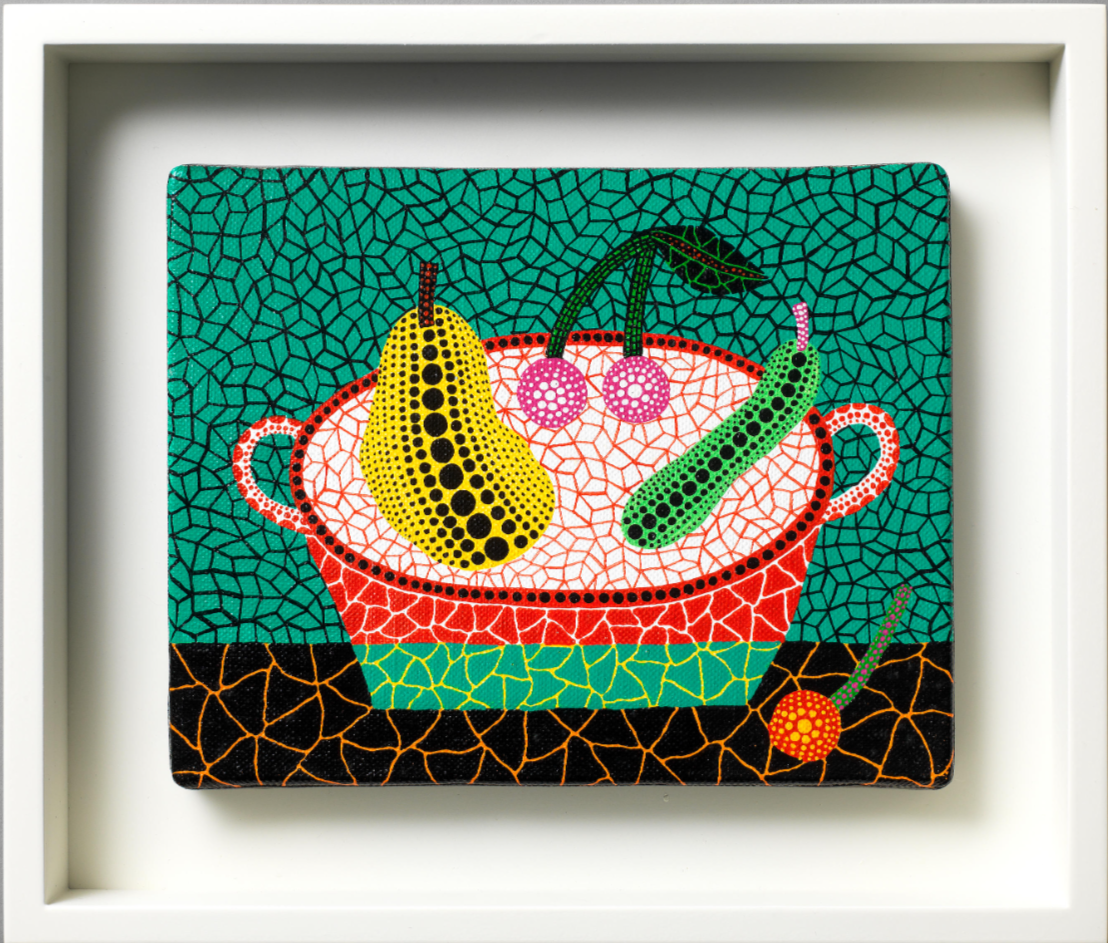
Acrylic on canvas
14.4 x 18.2 cm (5 11/16 x 7 3/16 inches)
Throughout the course of her distinguished career, Japanese artist Yayoi Kusama has developed a practice which, whilst sharing affiliations with Surrealism, Minimalism, Pop Art, ZERO and Nul, fights to resist any singular categorization. Fruit baskets have served as a recurring subject in Kusama’s works and Fruits, executed in 1996, follows her fundamental concept of Infinity Nets with the multiplex addition of her iconic dots and organic symbols. The intricate geometric arrangement of the background, fruit basket, and tabletop in the present painting illustrates her logic behind the spatial relationship. Fruits attests to her own artistic enhancement, while epitomizing her creative practice since its earliest days.
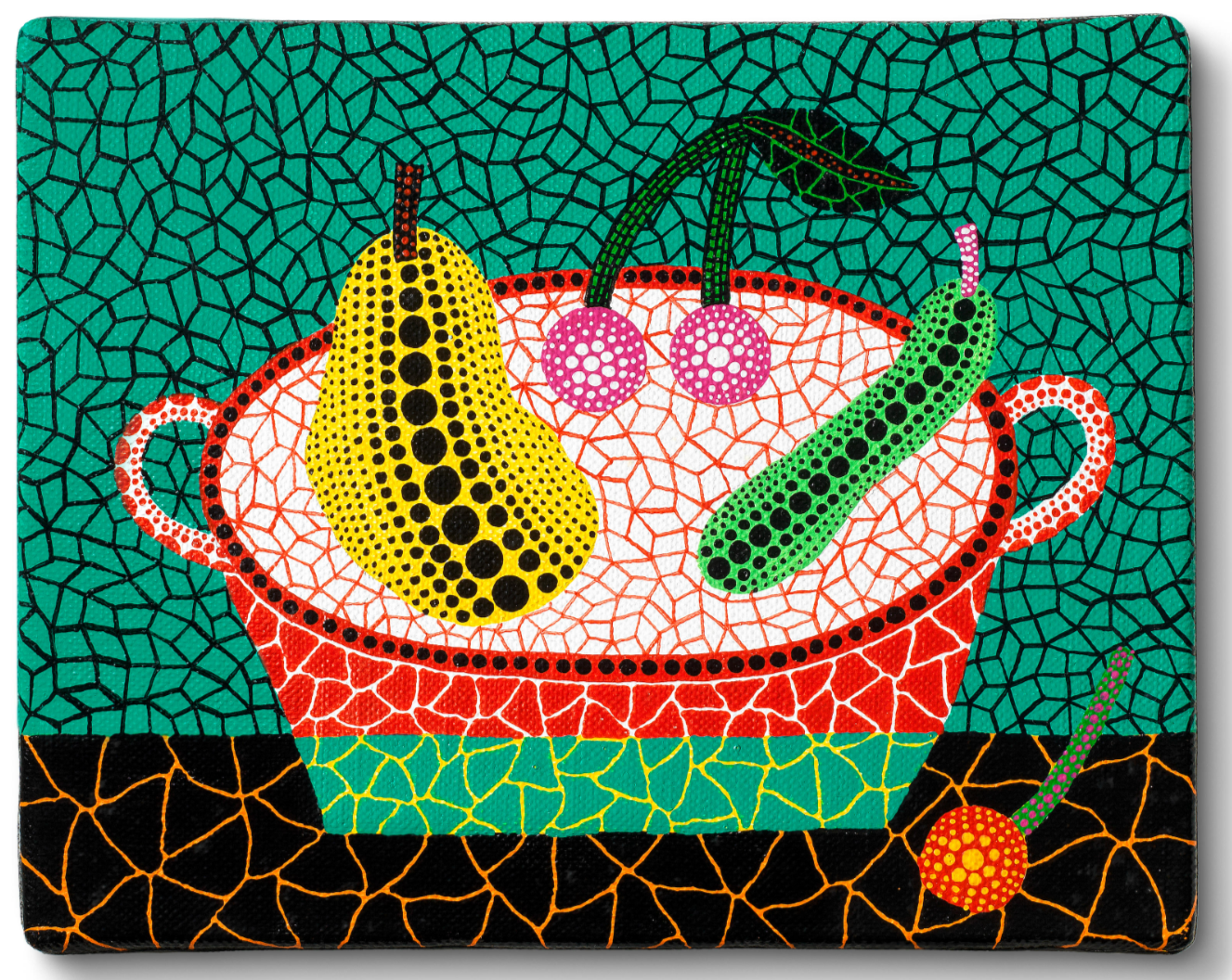
The basket is set against a turquoise background covered with an infinite net of black-outlined triangles. The delicate fine lines stretch and connect in a seemingly unconscious manner, leaving the viewer in a trance between figurative and abstract representations. The fruits in the basket are painted in bold colours using visually directional dots arranged in a concentric pattern, reminiscent of her widely identifiable Pumpkins. Kusama’s motif of the pumpkin form has achieved an almost mythical status in her art since the late 1940s. Coming from a family that made its living cultivating plant seeds, Kusama was familiar with the kabocha squash growing in the fields that surrounded her childhood home, and the pumpkin continues to occupy a special place in her body of work.
Still Life, 1996
Sotheby’s Hong-Kong: 10 October 2021
Estimated: HKD 2,500,000 – 4,500,000
HKD 5,015,000 / USD 644,228
Yayoi Kusama 草間彌生 | Still Life 靜物 | Contemporary Art Day Sale | 2021 | Sotheby’s (sothebys.com)
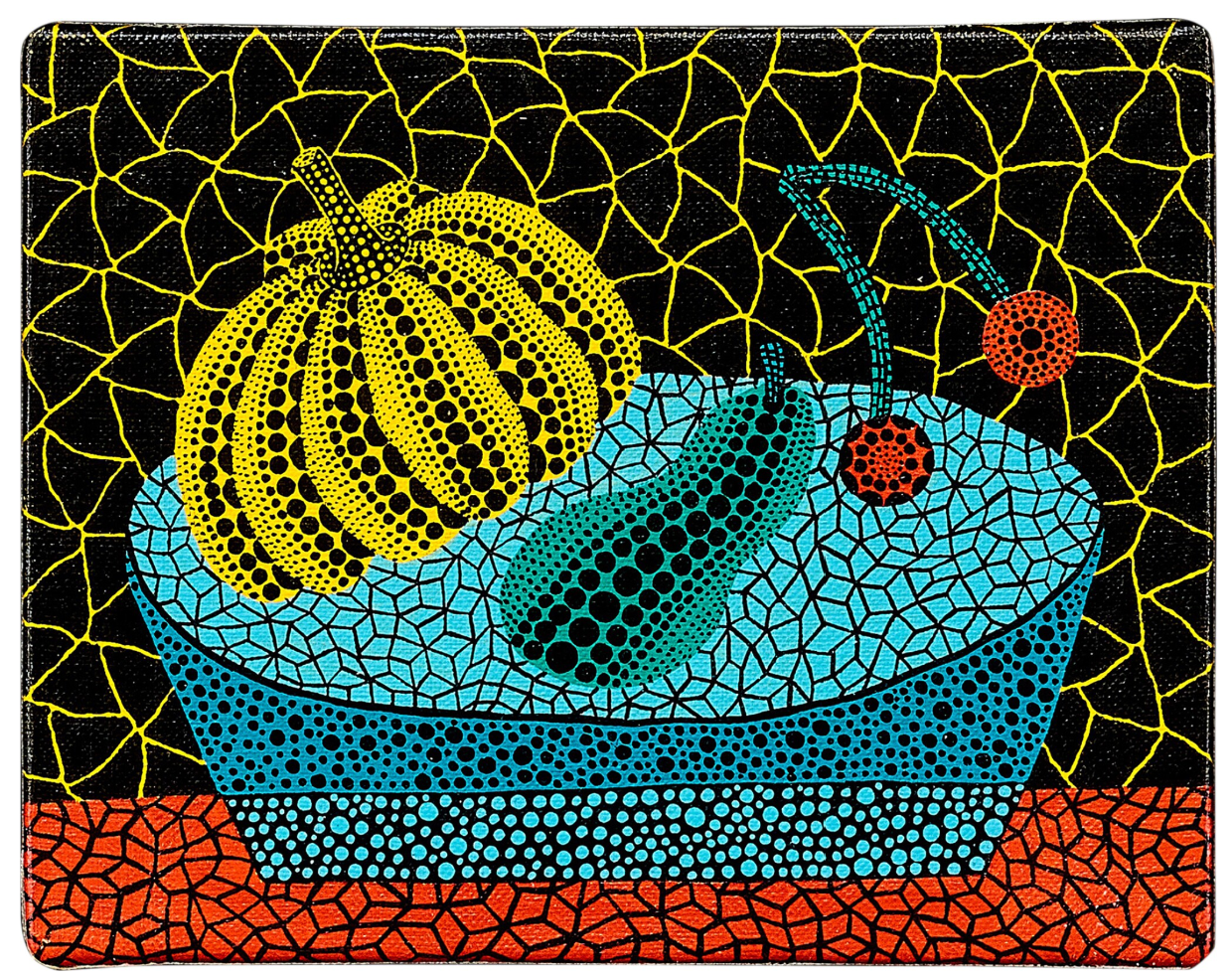
YAYOI KUSAMA (b. 1929)
Still Life, 1996
Acrylic on canvas
14×18 cm (5 1/2 x 7 1/8 inches)
Signed in English, titled in Japanese and dated 1996 on the reverse
A continuation from the artist’s fundamental concept of the fine mesh of patterns from her minimalistic series “Infinity Nets”, Yayoi Kusama’s Still Life ventures into the artist’s exploration of the avant garde, navigating between the East and West. Executed in 1996, the present lot depicts an addition of Kusama’s iconic dots and organic symbols. With a combination of two signature forms: nets and dots, Still Life offers viewers a mirage of multiplication and repetition spread across the canvas. Such composition is rare in Kusama’s fruit paintings, who began painting fruits in the 1970’s and only moved on to creating a larger scope of works after moving to a spacious studio in 2000.
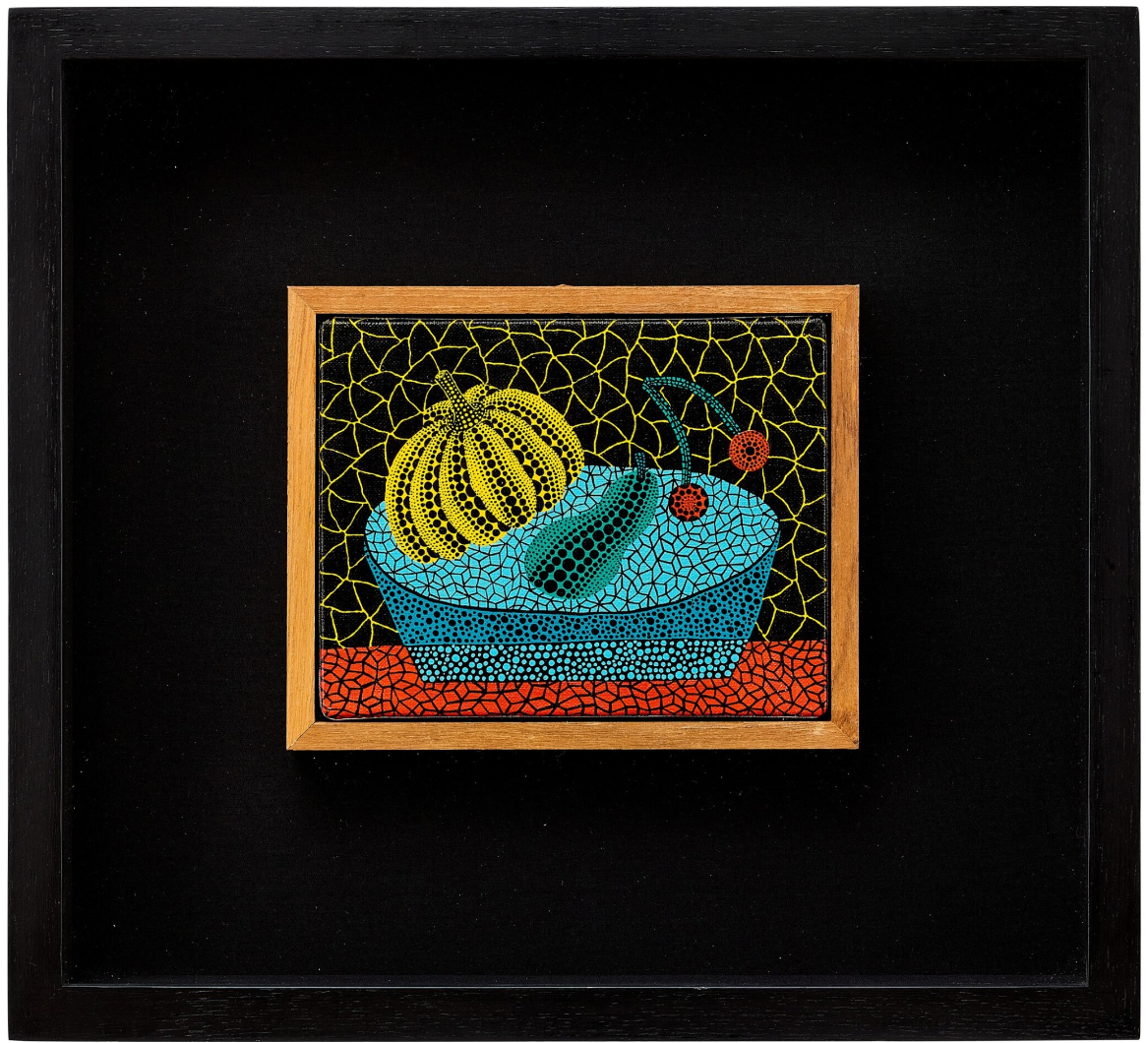
With the love for pumpkins and fruits, Still Life projects the artist’s essence on a small but intimate scale. Utilizing an intricate geometric arrangement that sets as the background, the bowl of fruits in this painting further advocates Kusama’s strong understanding between perspective, space and composition. The early hallucinations experienced by Kusama has given her an abundancy of inspirations in her creations. Nets and dots similar to dissections of plants could be seen through the artist’s widespread career, injecting a source of mystery and life into the rhythmic objects in her paintings, the act of painting enabled the artist to overcome the vehemence of her psychological traumas. The circular transformations of large dots to small dots transforms the three-dimensional object, focusing deeply on the structural relationship between shape and line. Still Life eliminates the banality in the space, pushing out vibrant, flat colors throughout the composition. Through this act of decoration, the idea of universal infinite is evident in the painting, exhausting an intensity of personal obsession and cosmic infinity.
Fashion (Hat, Dress, Shoes)
Hat, 1981
Christie’s Hong-Kong: 29 March 2024
Estimated: HKD 7,800,000 – 12,800,000
HKD 6,930,000 / USD 890,746
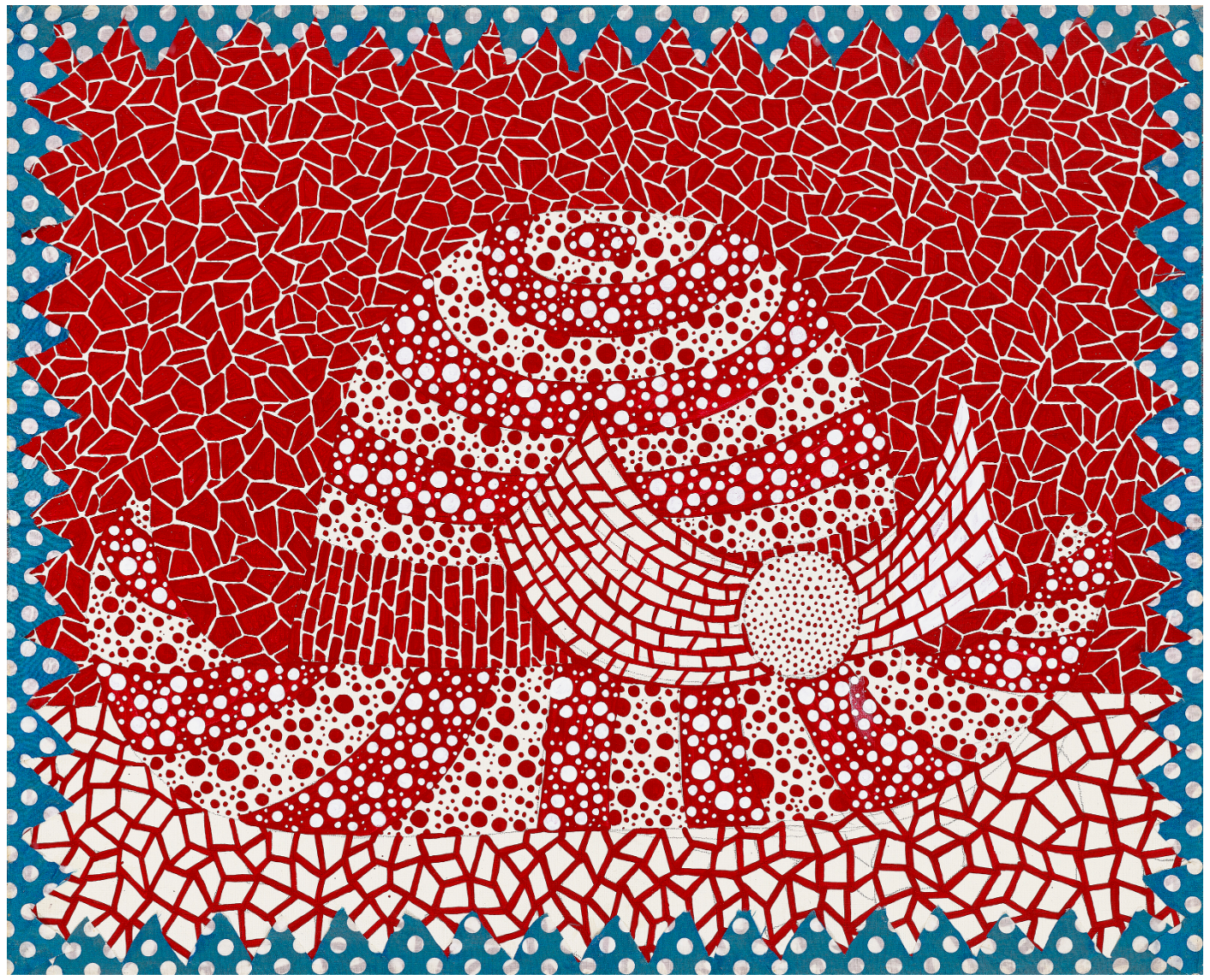
Hat, 1981
Acrylic, pencil, and cloth collage on canvas
53 x 65.2 cm (20 7/8 x 25 5/8 inches)
Signed and dated ‘YAYOI KUSAMA 1981’, titled in Japanese (on the reverse)
“I think fashion is very important for human beings because people can become happy and excited from fashion. I focused on that aspect and entered the fashion world, showing my fashion work to public.”
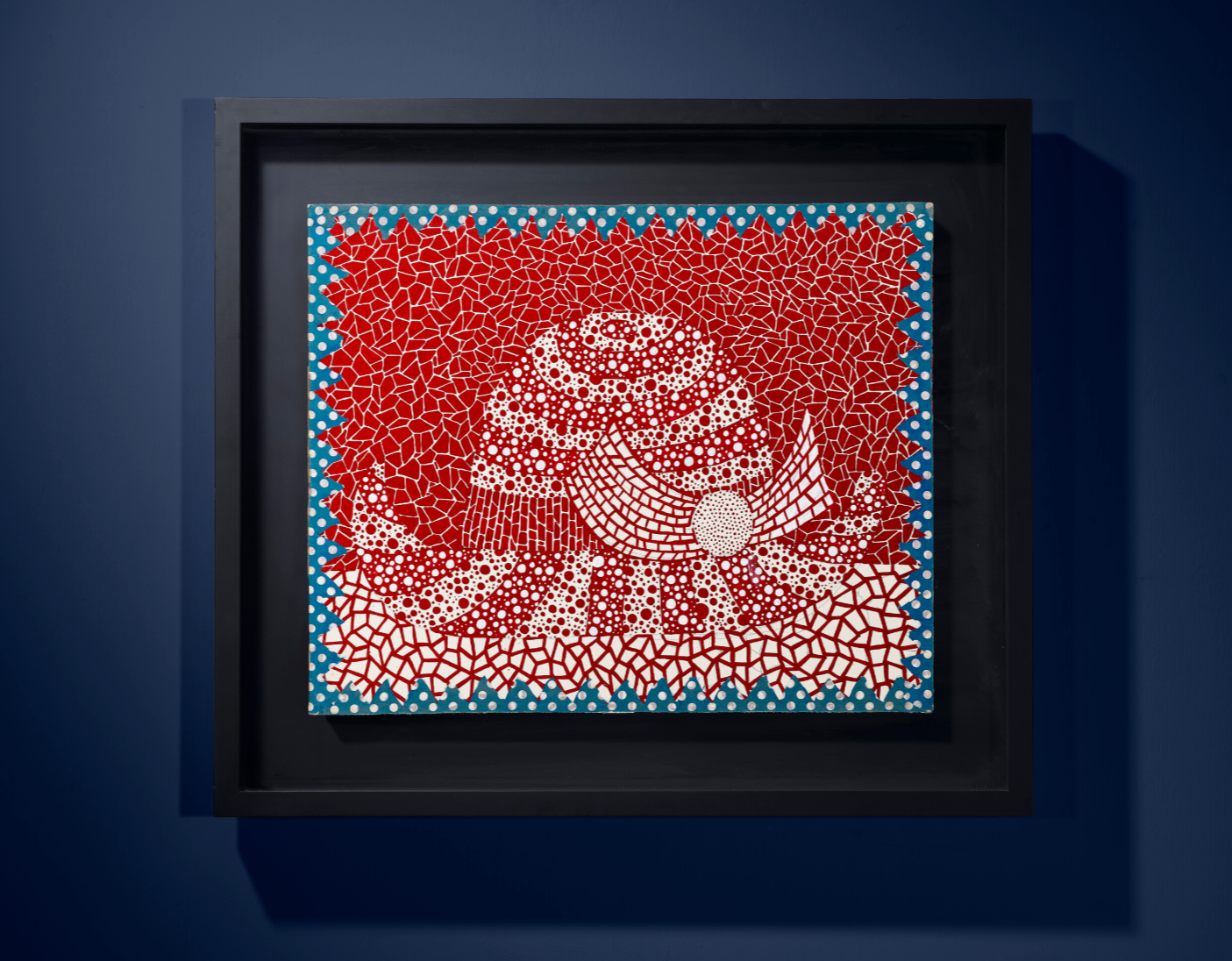
Hat, 1980
Sotheby’s Hong-Kong: 11 November 2024
Estimated: HKD 38,000,000 – 55,000,000
HKD 43,800,000 / USD 5,633,205
Yayoi Kusama 草間彌生 | Hat 帽子 | Modern & Contemporary Evening Auction | 2024 | Sotheby’s
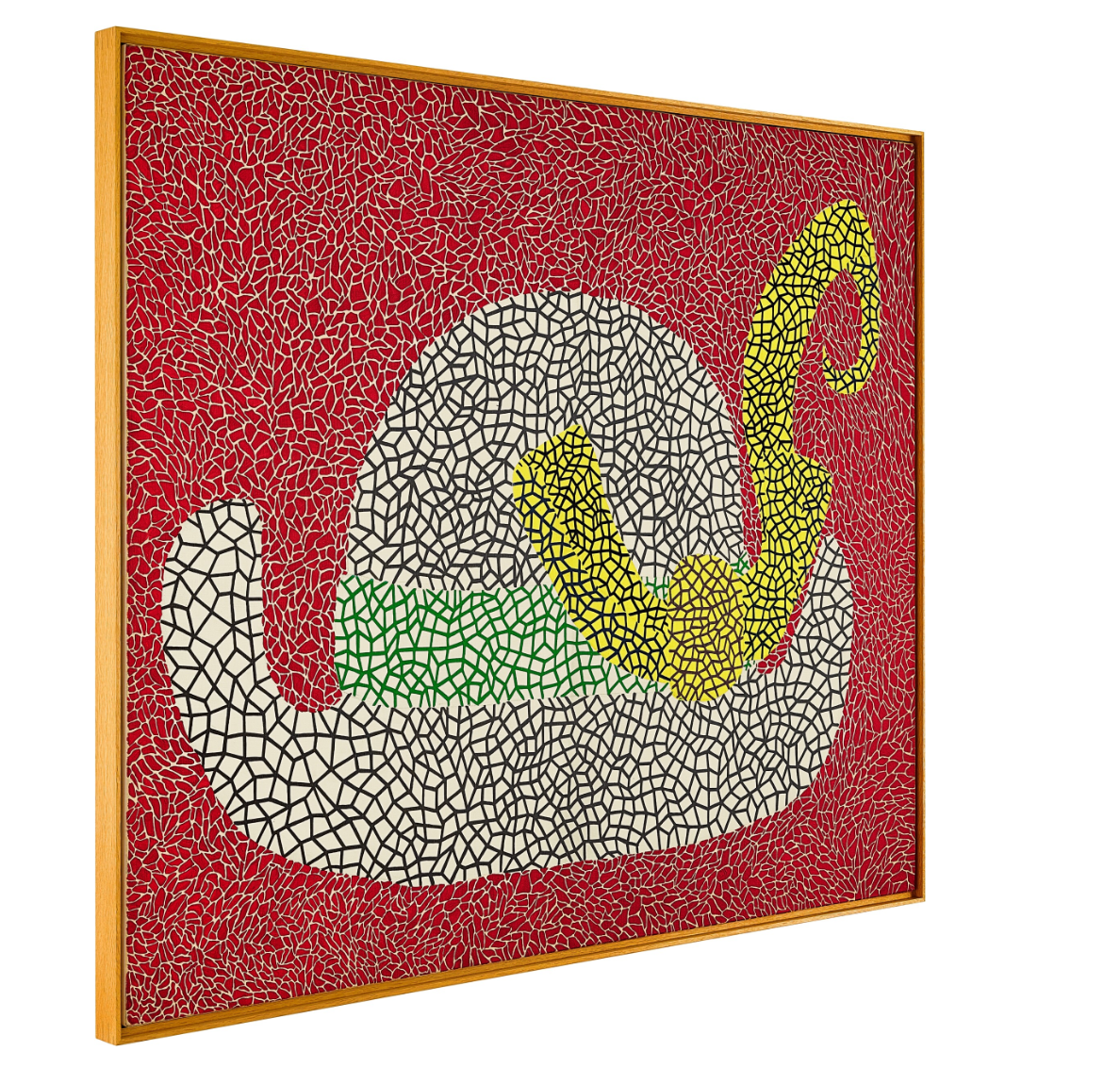
YAYOI KUSAMA (1929 – )
Hat, 1980
Acrylic on canvas
131×162 cm (51 5/8 x 63 3/4 inches)
Signed, titled in Kanji and dated 1980 (on the stretcher)
Spirited, strikingly majestic, exuding an enchanting whimsical charm, Yayoi Kusama’s Hat from 1980 is the first known work on canvas the artist created that features her iconic hat motif, as well as the largest known hat painting within the artist’s vast and universally resonant oeuvre. An exceedingly rare and historically significant work, Hat has not been seen in public for decades, having remained as a treasured anchor piece within the esteemed private collection of Dr. Ryutaro Takahashi, renowned patron of the arts and long-standing supporter of Kusama, for over twenty-five years. Rendered in exquisite detail, Hat is distinguished not only by its scale, rarity, and importance as Kusama’s first and largest known hat canvas, but furthermore by its unique ‘net-on-net’ composition. Whereas other hat paintings by Kusama exhibit a mixture of dots and nets, Hat is ‘netted’ vis-à-vis both object and background, with the background featuring a seldom-seen organic and densely webbed pattern that appears only a few times in the artist’s oeuvre. After Hat was created, Kusama would revisit the hat motif in the 1980s in numerous prints, drawings and paintings, but always in a much smaller domestic scale. Hat is thus a work of extraordinary significance—at once deeply personal and indexical to the artist, while representing a pivotal and defining era in the wider arc of her artistic production and journey towards becoming one of the most legendary artists of our generation.
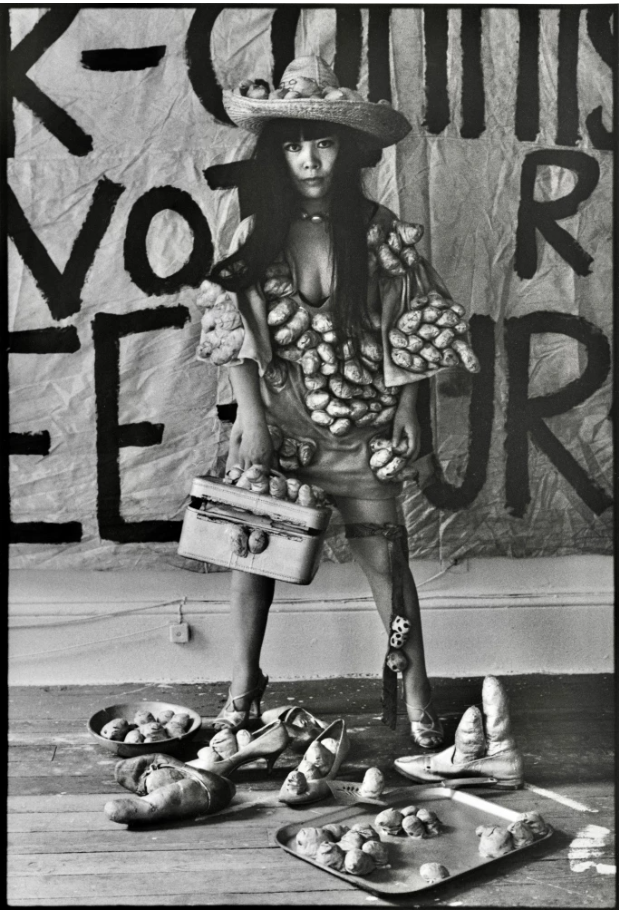
“Yayoi Kusama fashion”, photographed by Tom Haar in her New York studio.
A motif that is simultaneously intimate and universal, familiar yet idiosyncratic, the hat is central to Kusama’s psyche and inextricably linked to her personal and artistic identity. The origins of the motif can be traced back to her childhood—growing up in an agricultural family, Kusama would have been familiar with the simple functional kasa, the Japanese straw hat, worn by farmers while working in fields. Later in the 1960s in New York, Kusama frequently wore hats emblazoned with her own extravagant designs and bold patterns when attending exhibition openings and her early Happenings, merging art and performance with fashion. Indeed, in the 1960s, Kusama created the Yayoi Kusama Fashion Company in New York, bringing her designs to life in mass-produced commercial fashion items; in so doing, Kusama was a groundbreaking forerunner in fusing art, fashion, and commerce. Recalling her brand’s success, Kusama stated: “The mass media reported about us big time. We did fashion shows and had a Kusama corner at department stores. Buyers from big department stores came and selected 100 of this, 200 of that …” (the artist cited in Yayoi Kusama, London, 2000, p. 23). From the early Happenings of the 1960s to her numerous collaborations with major fashion houses in the last twenty years, fashion remained a prominent influence on Kusama, representing a personal partiality as well as her prescient artistic genius and determination to abolish established boundaries between art, fashion, and daily life.
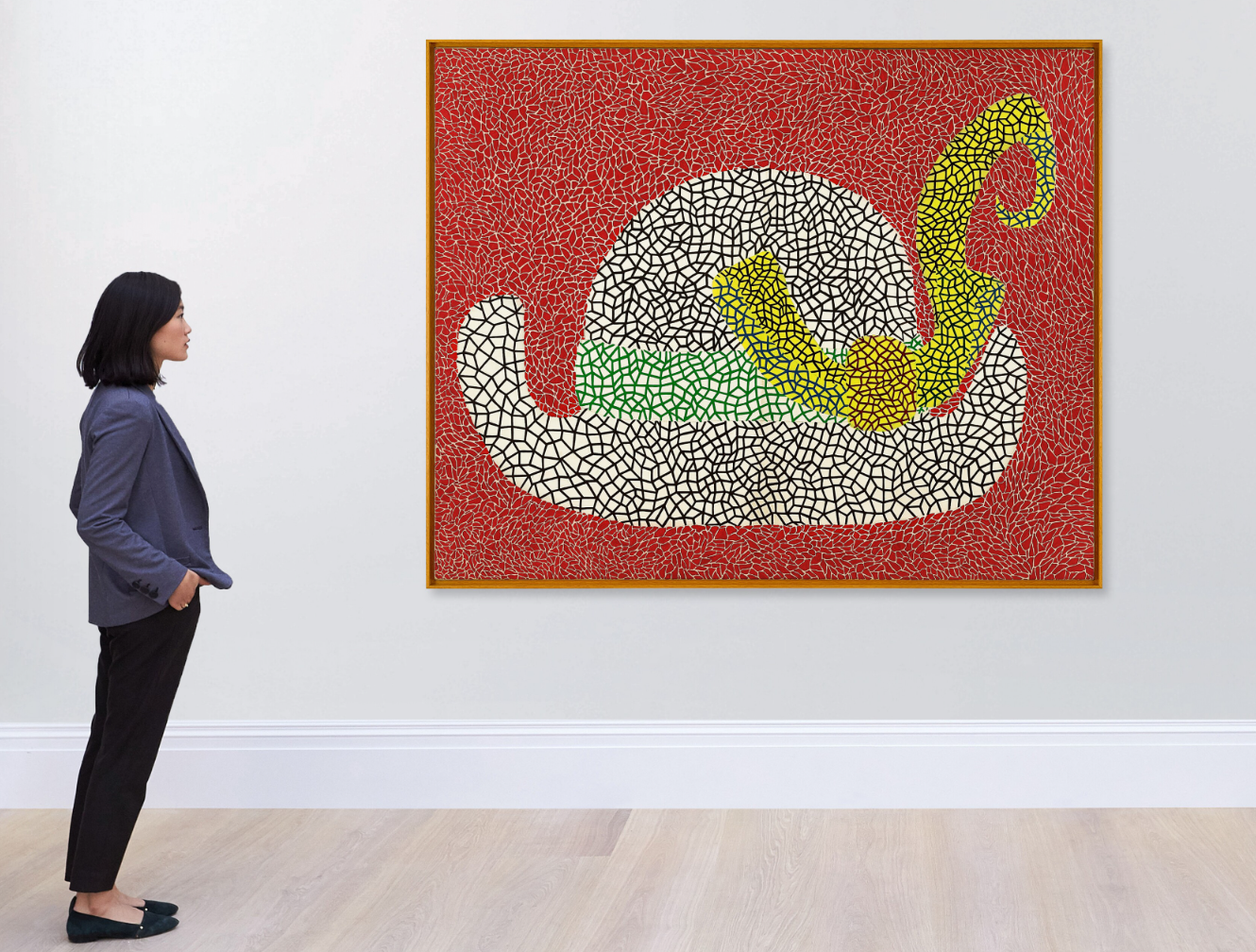
When it came to depicting hats in paintings, Kusama returns to the humble kasa from her childhood memory, adorning it with a simple unpretentious ribbon and weaving both hat and ribbon in vivid, mesmerizing patterns of her signature infinity nets, uniting past and present, as well as Kusama the artist and Kusama the person. The year 1980, the year Hat was created, hails from one of the artist’s most pivotal eras. After an explosive rise to global superstardom in New York in the 1960s, Kusama moved back to Tokyo in 1973 and underwent a creative renaissance while re-assimilating into Japanese society. The artist retreated into a psychiatric hospital in 1977 and commenced a diligent studio practice – one which involved not just painting but various other modes of creative production, publishing novels and poetry. It was during this period in the late-1970s that Kusama began to experiment with medium, color, and composition, producing paintings with vivid palettes and experimental collages that were marked departures from her earlier largely monochromatic works. Kusama’s return to art for healing and transformation resulted in steadily increasing recognition; between 1980 and 1981, she held seven solo exhibitions and was on the very cusp of resurgence and triumph. It was against this context that Hat was created; as such, the work embodies and symbolizes the renewed energy, experimentation, and buoyant optimism with which Kusama was approaching art and creation.
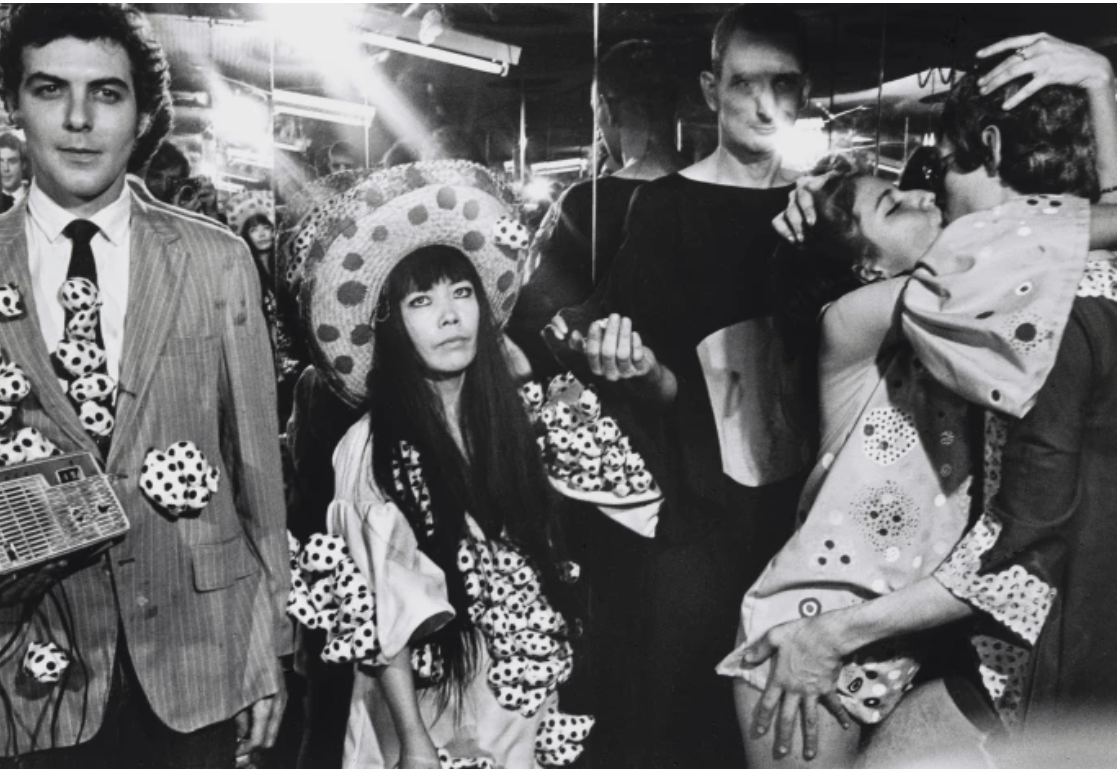
Yayoi Kusama with Harry Shunk and János Kender, Mirror Performance, New York, 1968.
As the first and largest known hat painting on canvas, Hat is entirely hand-painted by the artist, its vast, pulsating and meticulously intricate totality extremely rare in its deployment of “net-on-net” patterning, an effect seldom seen in Kusama’s other still life compositions. An extension of Kusama’s Infinity Net legacy, the ocean of jagged forms form a symphony of figuration and abstraction that subsumes the entire composition within an infinite space of repetition, such that colour, shape and line coalesce across the surface of the work to form object, background, and proliferating movement. The background net patterning of Hat corresponds to the artist’s earliest examples, bearing the biomorphic quality which defines the Nets inspired by the Pacific Ocean in the 1950s, while the hat itself is rendered in the geometric fishnet style pattern which began to proliferate throughout Kusama’s compositions in the 1980s and 1990s, bringing together the distinct modalities of two periods within one composition. Distinguished in its crisp vibrant intensity and expressive evocative power, Hat is undeniably a self-portrait in a sense similar to Kusama’s iconic Infinity Nets as well as pumpkin canvases; indeed, the hat’s grounded, rounded form somewhat resembles the figure of a pumpkin. Just as Kusama often posed in front of her nets or pumpkins dressed in clothes that mimic their colors or patterns, by painting a hat that represented singular and unparalleled personal significance, Kusama asserts the inextricable connection between her physical self and her artistic creation.
Dress (A), 1996
Poly Auction Hong-Kong: 7 April 2024
Estimated: HKD 1,800,000 – 2,800,000
HKD 2,040,000 / USD 260,803
Dress (A)|Poly Auction Hong Kong
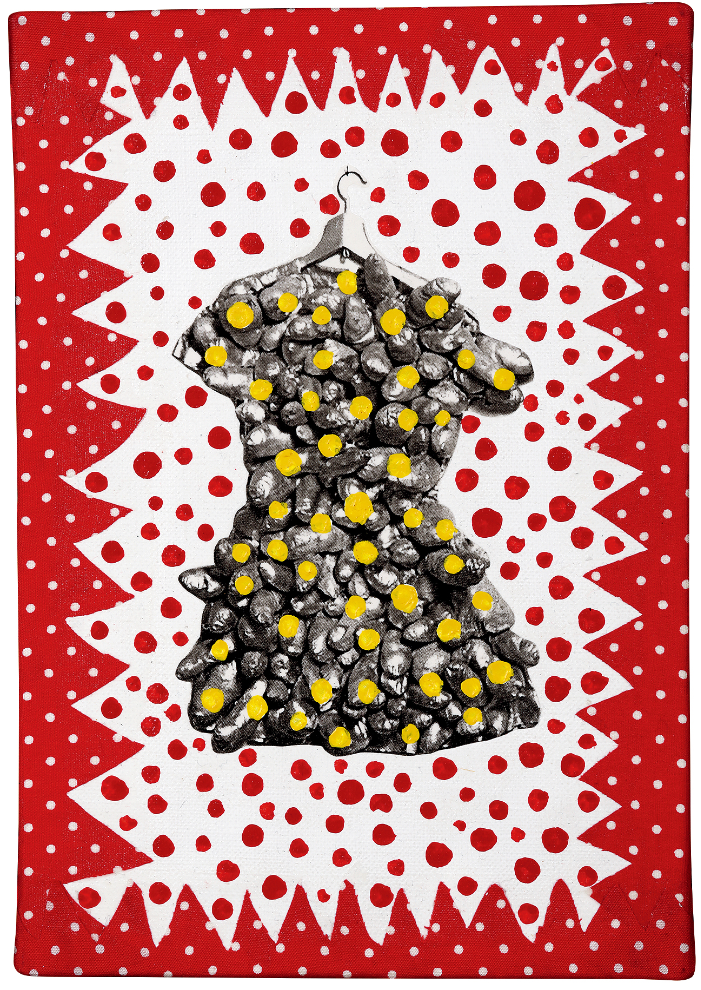
YAYOI KUSAMA
Dress (A), 1996
Acrylic, collage and fabric on canvas
22.9 x 16 cm (9 x 6 1/2 inches)
Signed and dated ‘YAYOI KUSAMA 1996’; titled in Japanese (on the reverse)
Dress (A) is a unique and significant work that exemplifies the artist’s technique mixing painting with collage elements. The collage elements can be seen on this work to create the triangular framing of the canvas and the dress. The dress is a nod to her soft-sculptures which were first developed by Kusama in 1961. Soft-sculptures were first created as a way for the artist to confront her ambiguous relationship and childhood fears associated with sex. Taking on a phallic form that is repetitively created, Kusama’s soft-sculptures are a large part of her decades-long practice, serving as a way for her to heal from her past trauma. Kusama noted in her autobiography that to her, reproducing objects again and again was her way of conquering fear.
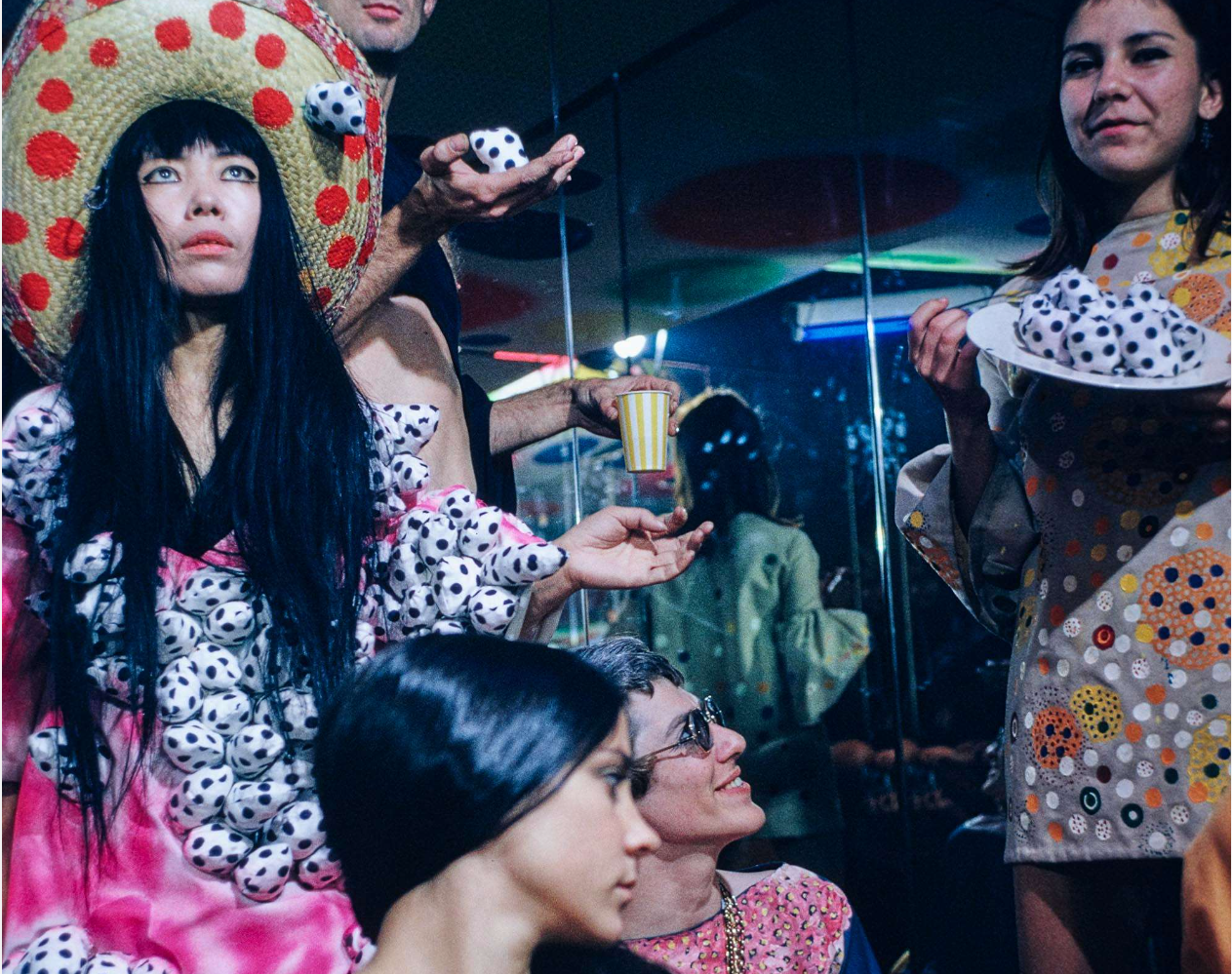
Yayoi Kusama wearing Kusama fashions in 1968
Dress (A) is a combination of Kusama’s famous motifs. By using a cut out of phallic sculptural forms to form the dress, Kusama sets out to challenge gender stereotypes imposed on her while growing up in a traditional Japanese household. This also echoes the artist’s involvement in the feminist movement that emerged while she was in New York in the 1960s. This work is a combination of various artforms that represents Kusama’s wide range of artistic practices, and more importantly, is a work that represents Kusama’s ongoing efforts to heal from past trauma. Yayoi Kusama sees her work as a “revolution of self,” finding meaning in both life and death through art. In her autobiography, she reflects on the process of creating art as a way to explore the beauty of colors and space in the face of mortality and the promise of “nothingness.” To her, life and death are two sides of the same coin. The three works presented in this upcoming Spring Auction exemplifies the artist’s ceaseless quest for the meaning of life, serving as a reminder that facing our fears directly is the key to overcoming them.
A Song in Praise of Hat, 1979
China Guardian Hong-Kong: 7 April 2024
Estimated: HKD 1,000,000 – 2,000,000
HKD 2,760,000 / USD 352,851
Auction | China Guardian (HK) Auctions Co., Ltd. (cguardian.com.hk)
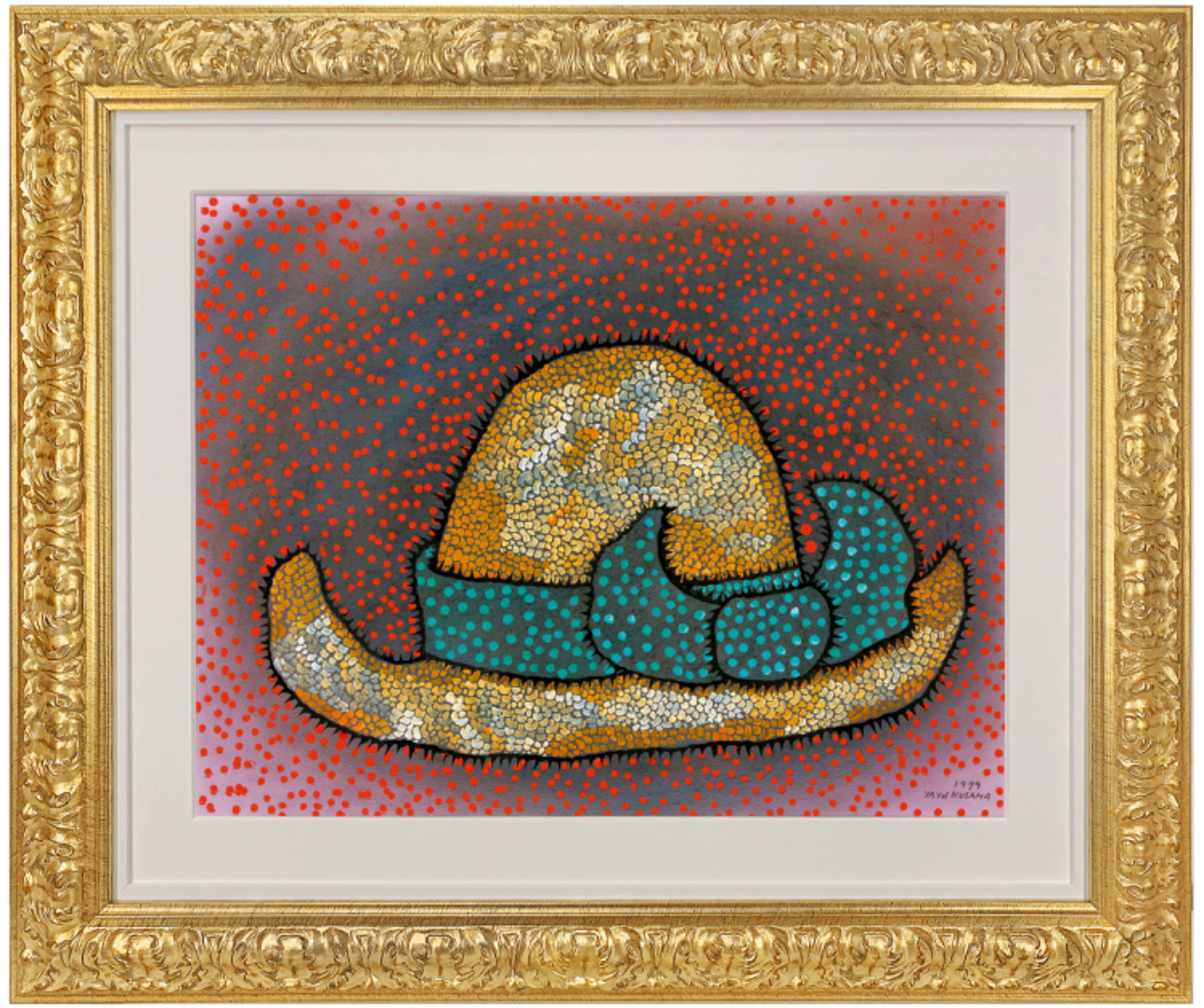
A Song in Praise of Hat, 1979
Gouache, pastel, ink on paper
51.3 × 66.3 cm (20 1/4 × 26 1/8 inches)
Signed in English and dated on bottom right; signed and titled in Japanese and dated on the reverse
A Song in Praise of Hat, completed in Tokyo in 1979, that combines the artist’s most iconic elements of polka dots, infinity nets and sawtooth, with her exploration of fashionable objects, is a work of extraordinary significance. In the 17th century, the color of hats was used to differentiate social status, and hats themselves became, to some extent, a representation of class. Later, the British royal family wore hats for a long time, which led to a fashion trend. Since the Meiji Restoration, Japan has been influenced by the West, and its citizens have also become more fond of wearing hats, with their clothes to show their personalities and tastes. Since she visited the United States in 1957, Kusama has been wearing hats on various important occasions, to show her love for hats as an accessory. In her graphic creations, she created several works on paper with the theme of hats, including A Song in Praise of Hat. Later in 1981, she released her first print Hat Left behind in the Field, and in the same year, she began to create works on canvas with the theme of hats, which demonstrated the profound significance of the theme to Kusama – hats are like a symbol of the artist’s “ego”, and it became the representative theme of her works in that period.
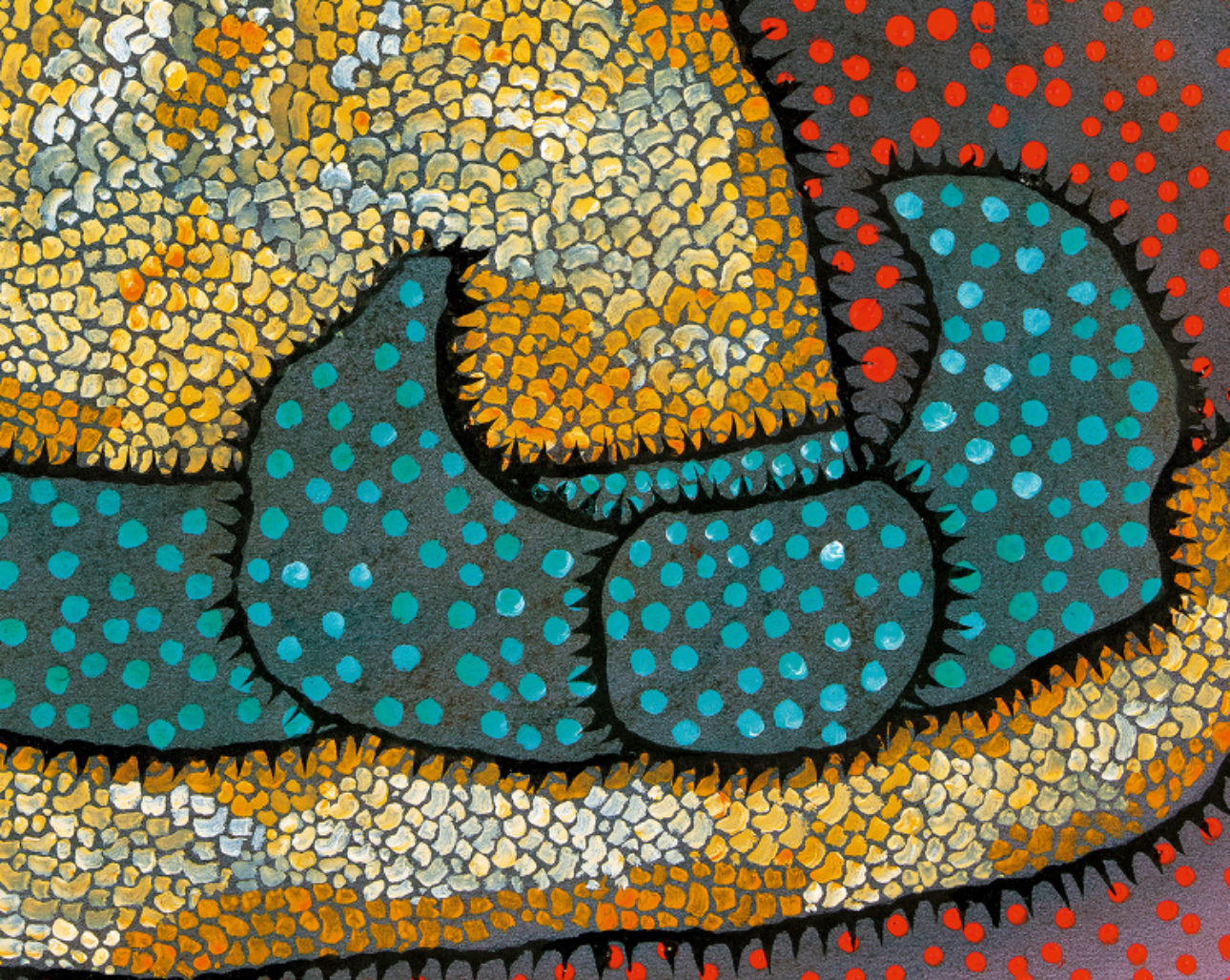
After living in New York for seventeen years, she returned to Japan in 1973 and began to create more works on paper, with A Song in Praise of Hat being one of her rare large-scale works on paper from the Tokyo period. The work combines the polka dots, which is her lifelong favorite element, with her special love for hats. One can see the spreading circular lines, like an organic “infinite net” in yellow, white and gradual silver, constantly extending and growing outwards. The entire hat is outlined by a jagged thick black line, demonstrating that what looks sweet and lovely also carries sharp claws, and to a certain extent, it also demonstrates the rise of women’s power in that era. The hood and bow are uniquely upturned, and the rounded curves resemble a smiling mouth, reflecting the spirit of Kusama’s upward mobility and indomitable will. She is active in the art world of Japan and the United States in her own way and is never afraid of other people’s judgments but continues to move forward with her strong will and artistic conviction. The artwork incorporates the artist’s signature infinity net, polka dots and sawtooth elements, making it display a unique rhythm that is dynamic and organic under the dramatic interpretation, focusing viewers’ attention on this rich visual illusion. The background of A Song in Praise of Hat goes from dark to light: dark grey watercolor changes from the center to pinkish purple, as if from night to day. The red polka dots pervade the background, dancing in the vastness of the universe, spreading outwards to form a majestic atmosphere, each flickering under the seemingly complex, but in fact, rhythmic movement, with the yellow hat on top of them like a glorious temple of gold, captivating the viewer’s attention.
Shoe, 1981
Christie’s Hong-Kong: 29 November 2023
Estimated: HKD 1,500,000 – 2,500,000
HKD 4,788,000 / USD 614,702
YAYOI KUSAMA (B. 1929) (christies.com)
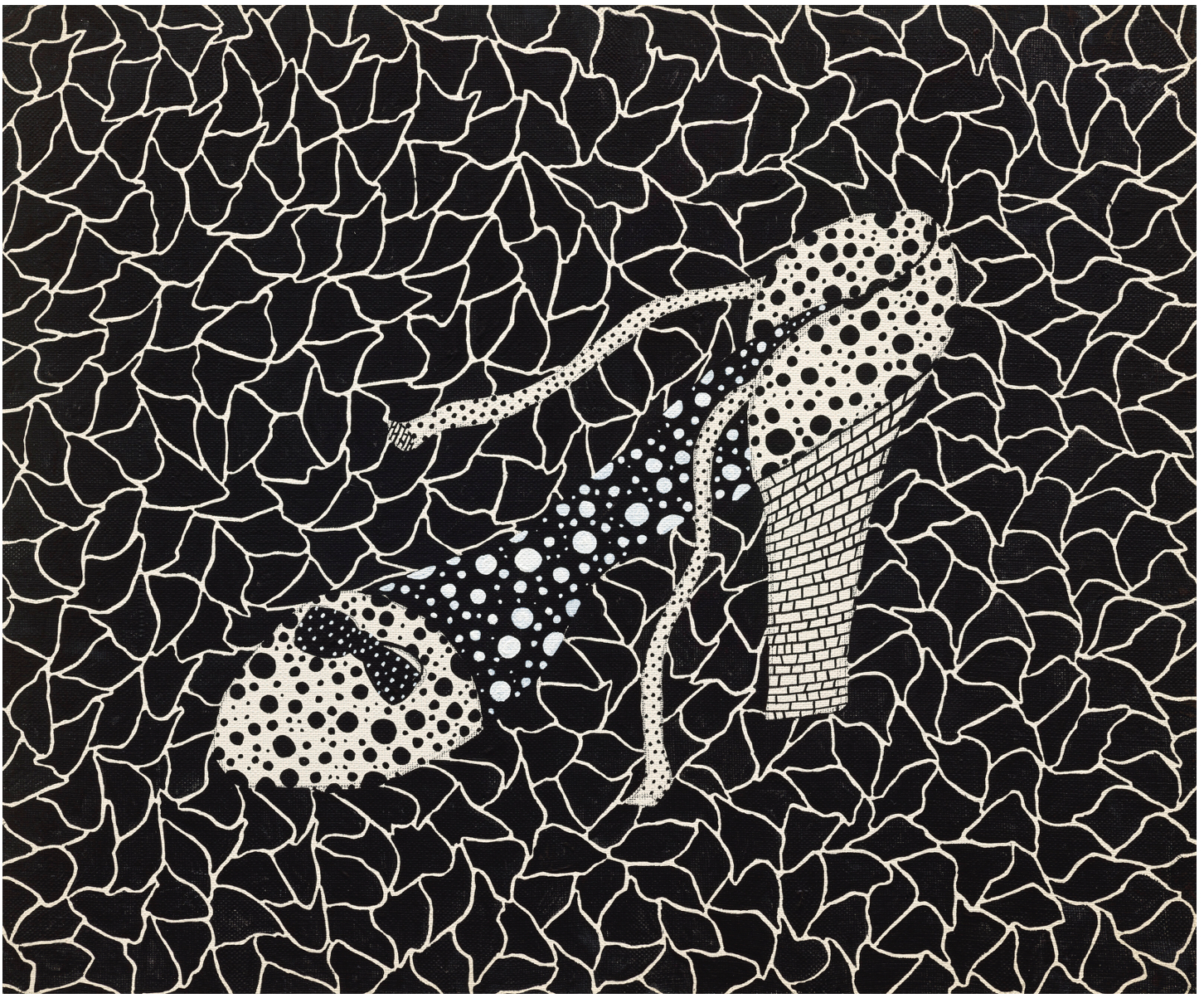
YAYOI KUSAMA (B. 1929)
Shoe, 1981
Acrylic on canvas
38×45 cm (15 x 17 3/4 inches)
Titled and inscribed in Japanese; signed and dated ‘Yayoi Kusama 1981’ (on the reverse)
Hat (A.B), 2002
Sotheby’s Hong-Kong: 6 October 2023
Estimated: HKD 2,400,000 – 3,500,000
HKD 3,048,000 / USD 389,192
Yayoi Kusama 草間彌生 | Hat (A.B) 帽子(A.B) | Contemporary Day Auction | 2023 | Sotheby’s (sothebys.com)
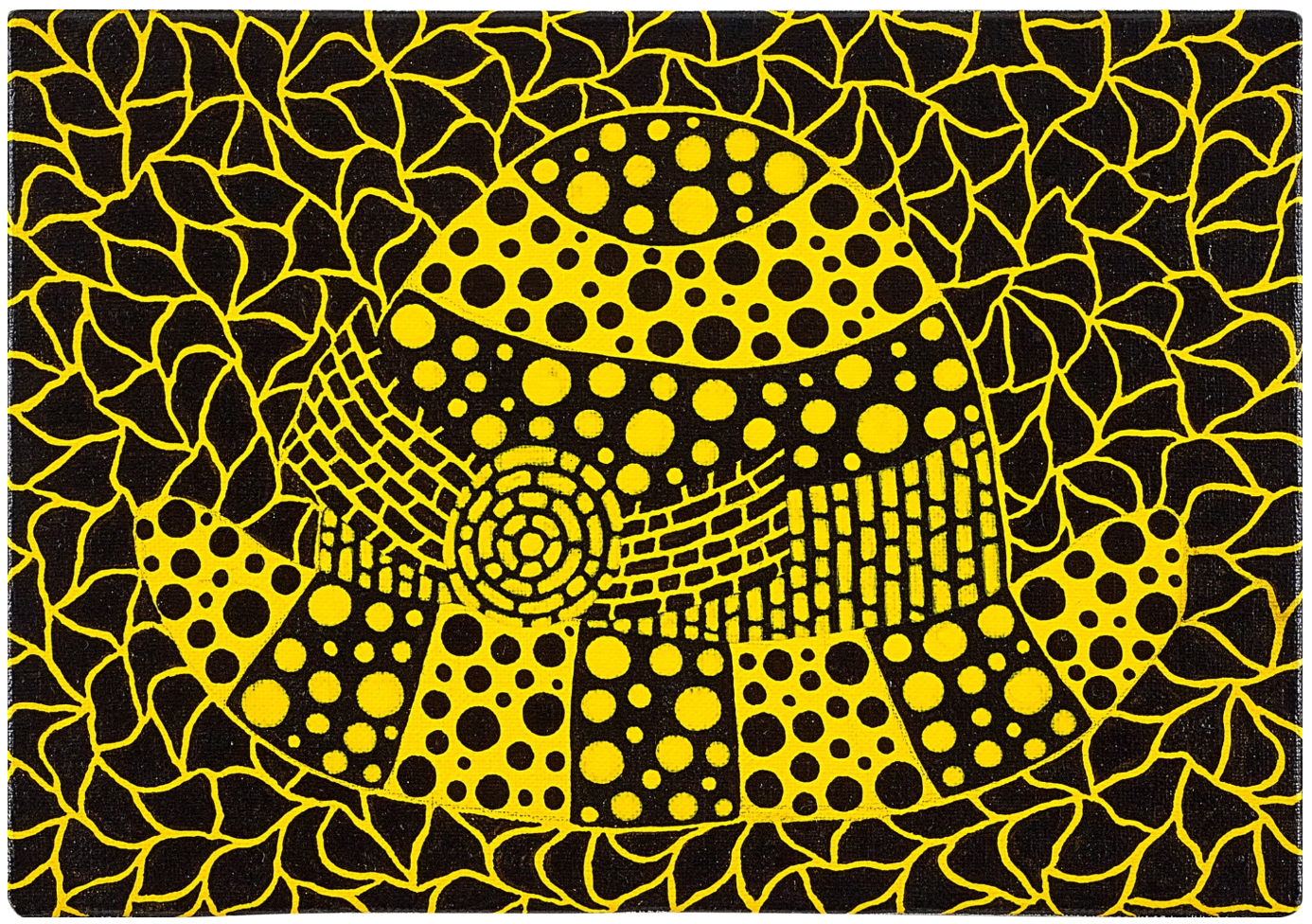
YAYOI KUSAMA (b. 1929)
Hat (A.B), 2002
Acrylic on canvas
15.8 x 22.7 cm (6 1/4 by 9 inches)
Signed, titled in Japanese, and dated 2002 on the reverse
Shoes, 1995
Christie’s New-York: 18 May 2023
Estimated: USD 200,000 – 300,000
USD 327,600
YAYOI KUSAMA (B. 1929), Shoes | Christie’s (christies.com)
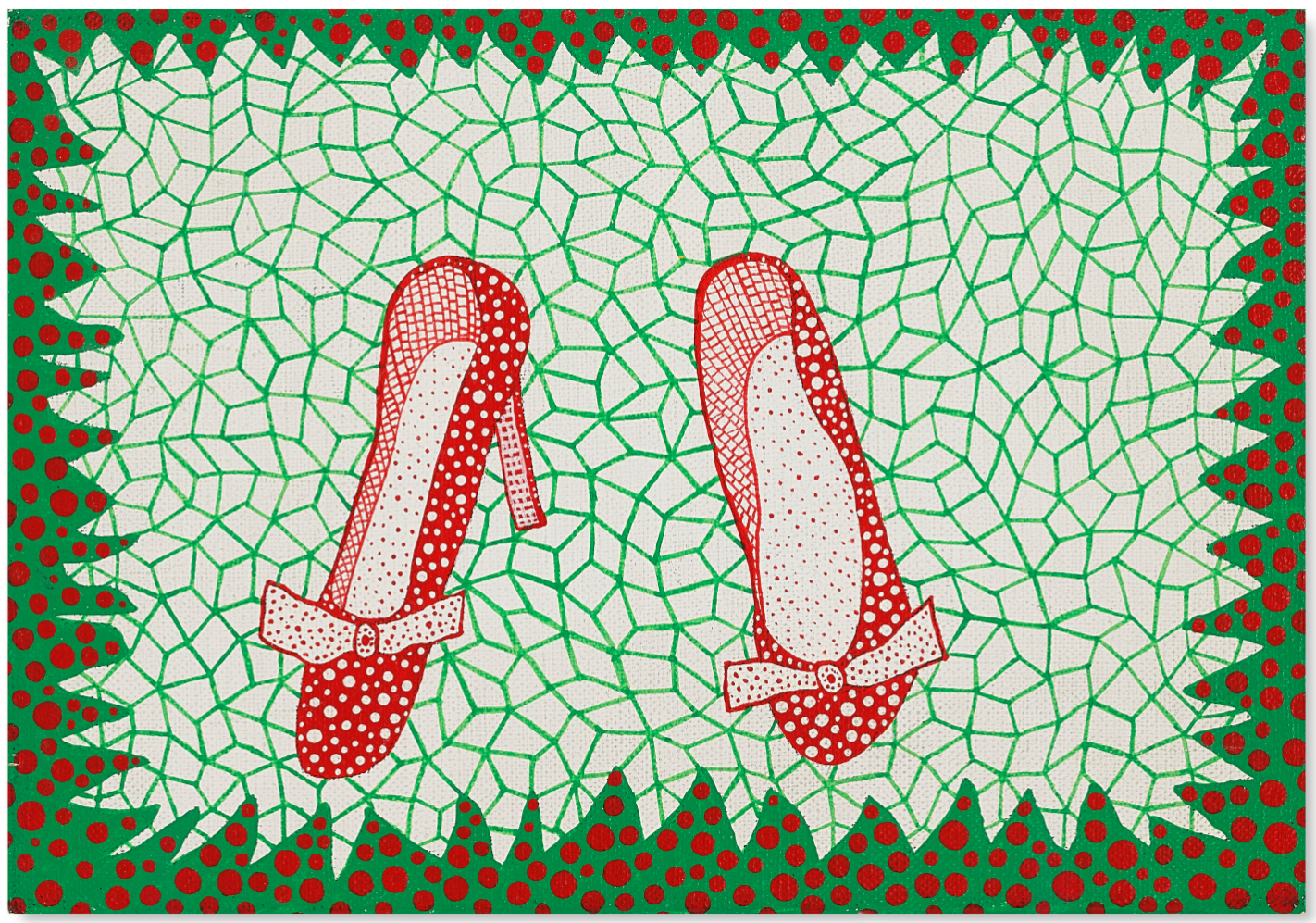
YAYOI KUSAMA (B. 1929)
Shoes, 1995
Acrylic on canvas
6×9 inches (15.2 x 22.8 cm)
Signed, titled in Japanese and dated ‘Yayoi Kusama 1995’ (on the reverse)
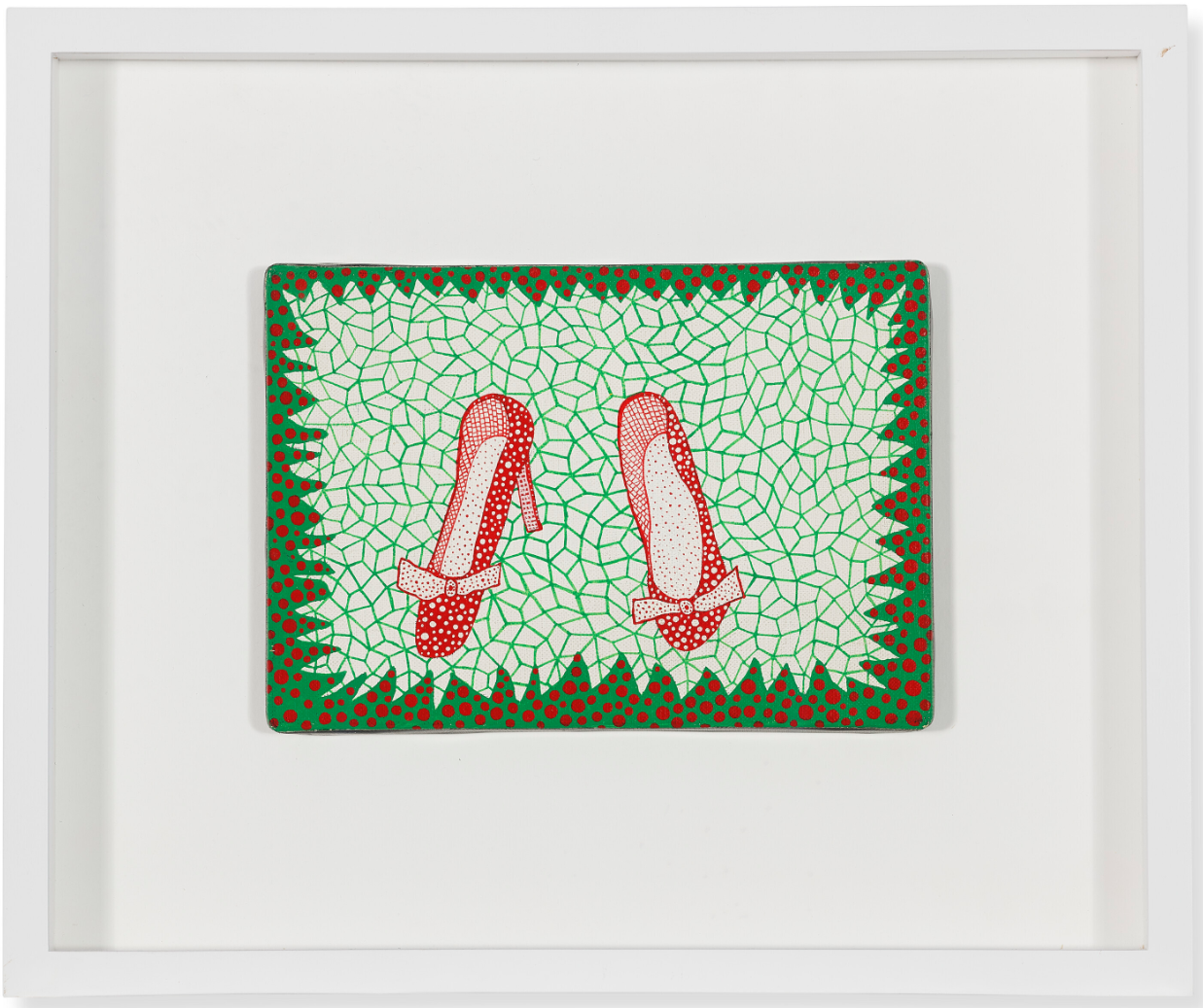
Hat, 1990
Phillips New-York: 28 September 2022
Estimated: USD 200,000 – 300,000
USD 277,200
Yayoi Kusama – New Now New York Lot 48 September 2022 | Phillips
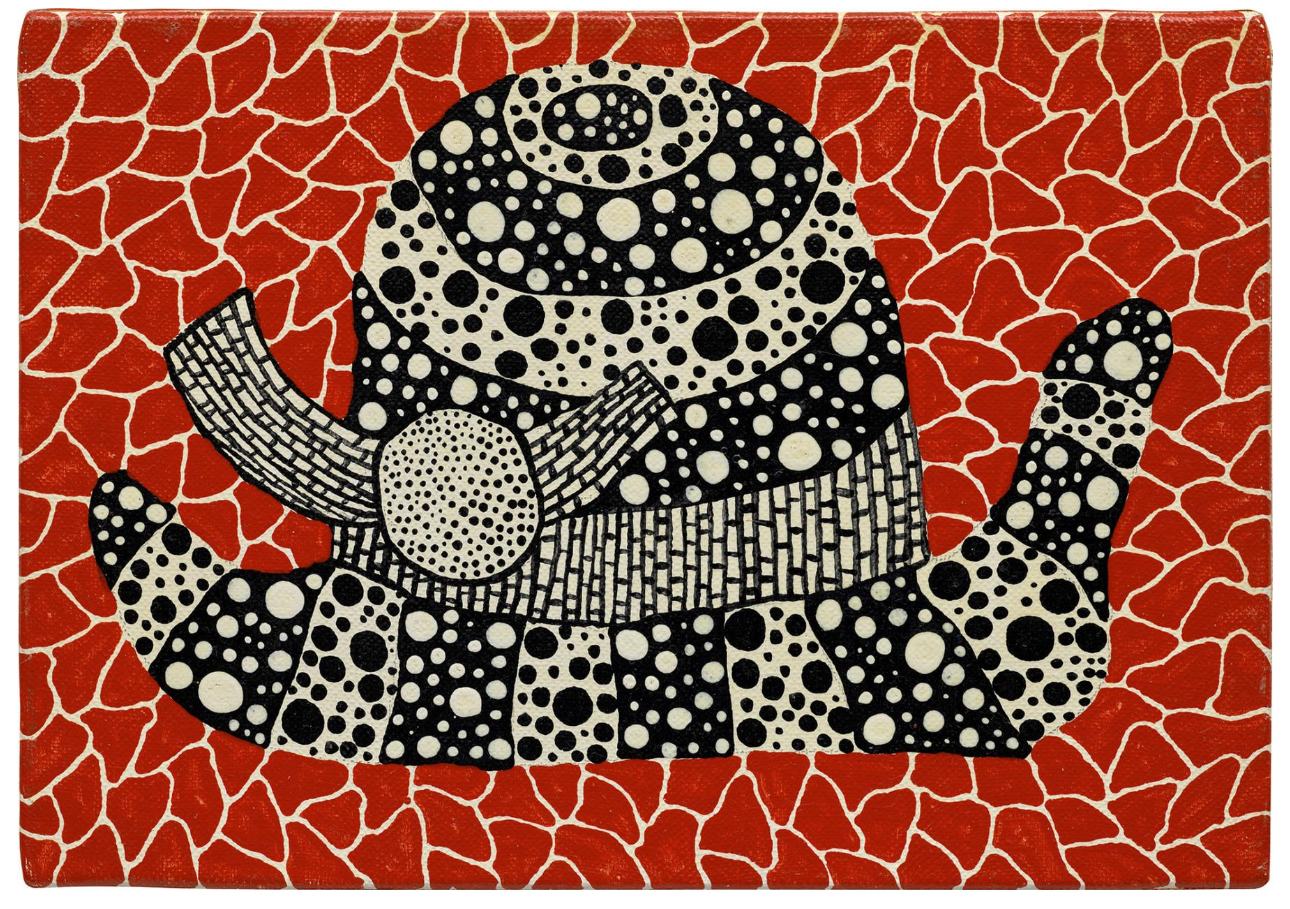
YAYOI KUSAMA
Hat, 1990
Acrylic on canvas
15.6 x 22.9 cm (6 1/8 x 9 inches)
Signed, titled [in Japanese] and dated “帽子 Yayoi Kusama 1990” on the reverse
Painted in 1990, Yayoi Kusama’s Hat belongs to an important series created from the 1980s to the 1990s that highlights motifs of social class and status. After training in traditional nihonga (日本画) in Kyoto, Kusama departed from academic techniques and embraced the avant-garde, soon energizing the 1960’s New York art scene with her whimsical, dotted, and often phallic artworks and garments. Combining elements of surrealism and impressionism, Hat is an exquisite example of the artist’s seven-decade long career. Kusama’s iconic circular imagery and pointillist sensibilities are reflected in Hat, merging dots of various sizes with a biomorphic rendition of a European-style summer hat. The artist’s choice of a hat as her subject matter stems from the rich cultural background of the accessory popularized in Japan by foreign influences at the end of the nineteenth century.i A status symbol across the globe, the hat has played a key role in elevating the image of its wearer across art historical periods. Claude Monet uses fashion as a tool to frame his subject in Springtime. Engulfed by her dress, with its billowing folds, the figure’s hat here completes her image. Both the garments and the greenery in Springtime are dappled by sunlight, showcasing Monet’s ability to portray his subjects as belonging to their environments. The same theme of belonging to one’s surroundings is alluded to in Hat, the unknown and absent owner left to the viewer to imagine. The present work, painted in 1990, was completed after Kusama moved back to Tokyo after her initial stay in New York City. Embodying the themes of travel, transitions and memory, the present work is a prompt to question the idea of representation and ownership, and whether this hat truly “belongs.”
Claude Monet, Springtime, 1872. Walters Art Museum, Baltimore.
In Hat, Kusama builds upon her established repertoire of dense, brightly hued patterns: concentric and alternating black and white dots form the abstracted hat, while a stylized bow constructed from a staggered, web-like grid imparts a playful, summery flair. The background visually echoes the artist’s celebrated Infinity Nets paintings, suspending the titular hat within a hypnotizing network of wine-colored lattices. This combined use of repeating patterns and a boldly contrasting color palette, two distinctive features of Kusama’s oeuvre, creates optical tension, resulting in a subject that seemingly pulsates against its two-dimensional plane. The repetitive dots and nets seen in Hat manifested in bespoke garments worn in Kusama’s earliest New York “happenings,” as well as in her very own clothing line, expanding the artist’s practice beyond the canvas. Combining her affinity for fashion with her most acclaimed painterly hallmarks, Hat thus reflects the impressive range of Kusama’s interdisciplinary career. Dots will also be a focal element of the artist’s highly anticipated collaboration with Louis Vuitton, due to be released in early 2023. The initial images of the line depict small handbags covered in two-and-three-dimensional dots, highlighting the artist’s lifelong and transcending devotion to surreality.
Lemon Squash
Lemon Juice, 1983
Christie’s Hong-Kong: 29 November 2023
Estimated: HKD 8,000,000 – 12,000,000
HKD 9,450,000 / USD 1,213,227
YAYOI KUSAMA (B. 1929) (christies.com)
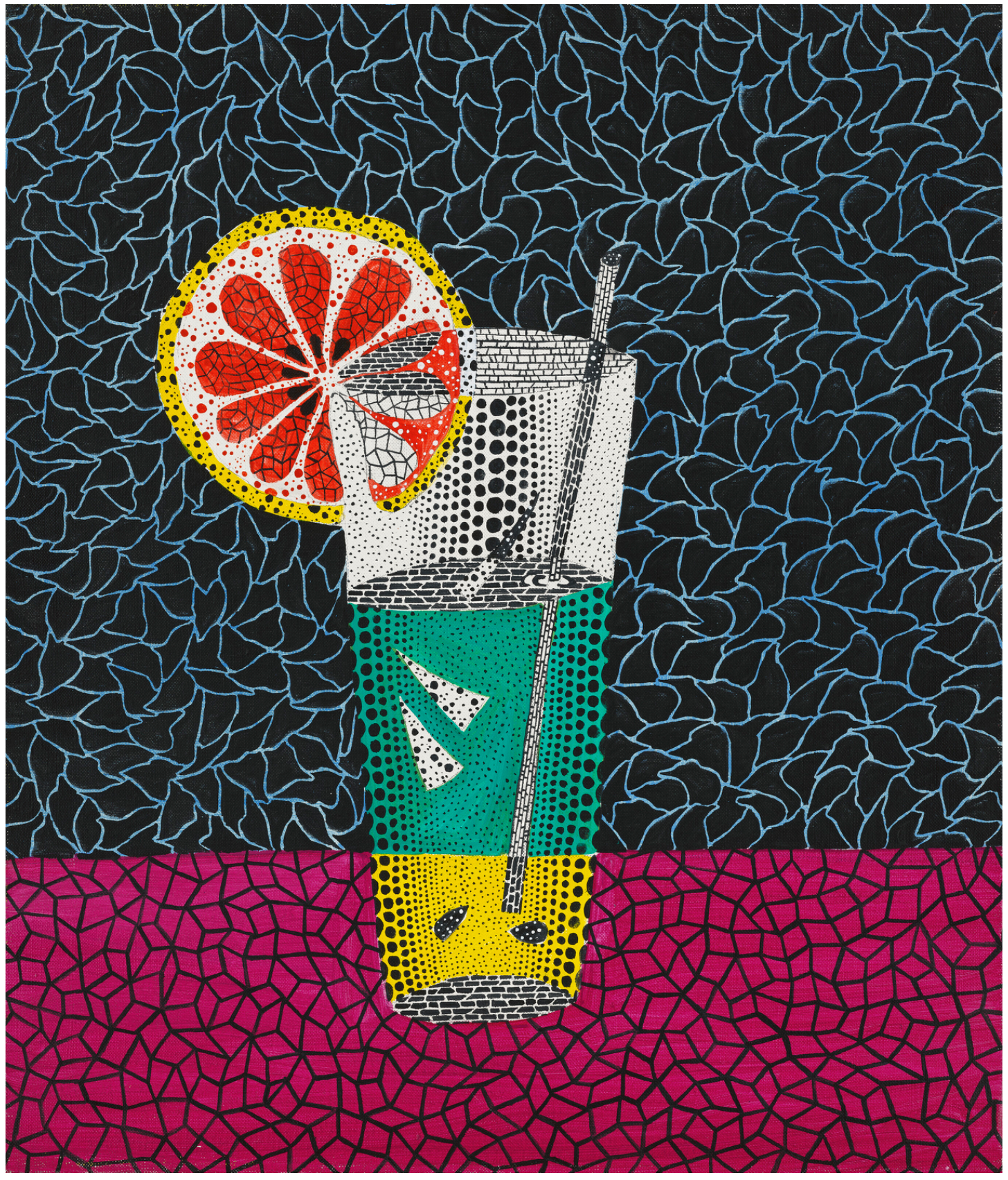
YAYOI KUSAMA (B. 1929)
Lemon Juice, 1983
Acrylic on canvas
53 x 45.5 cm (20 7/8 x 17 7/8 inches)
Titled in Japanese, signed and dated ‘Yayoi Kusama 1983’ (on the reverse)
Glass, 1981
Sotheby’s Hong-Kong: 28 April 2022
Estimated: HKD 1,800,000 – 2,800,000
HKD 2,268,000 / USD 289,049
Yayoi Kusama 草間彌生 | Glass 杯 | Contemporary Day Auction | 2022 | Sotheby’s (sothebys.com)
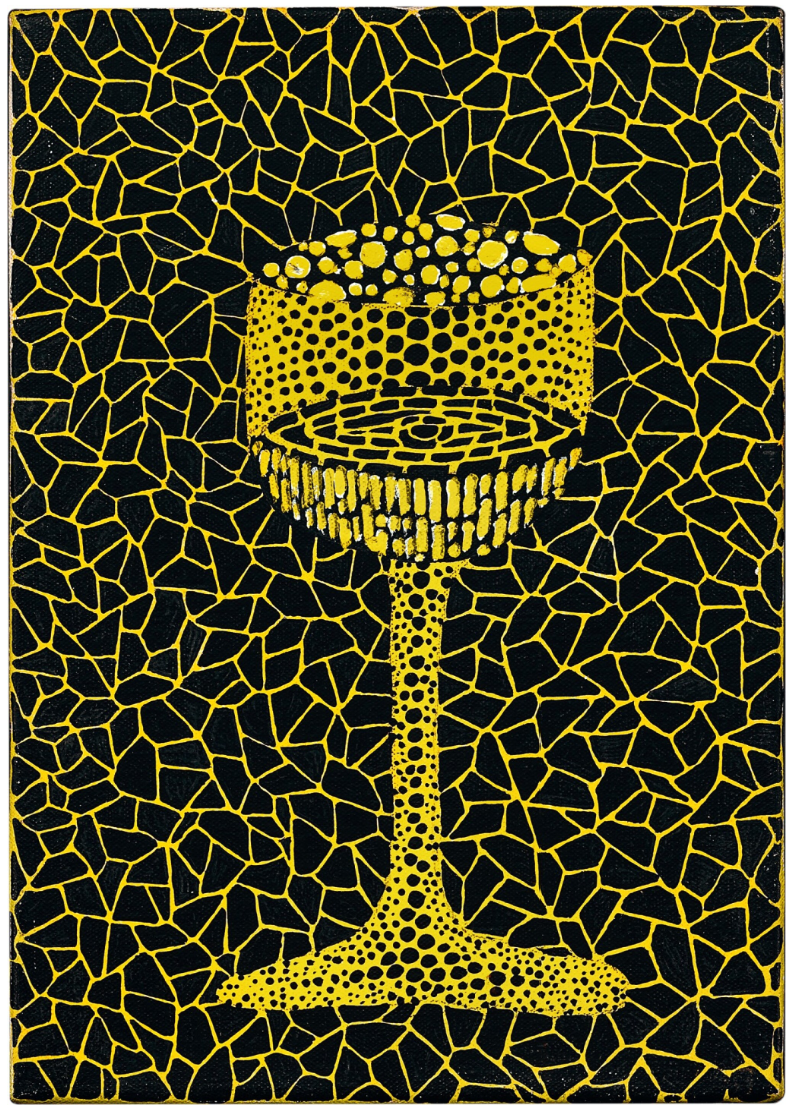
YAYOI KUSAMA (b. 1929)
Glass, 1981
Acrylic on canvas
22.8 x 16 cm (9 x 6 1/4 inches)
Signed, titled and dated 1981 on the reverse
Lemon Tea, 1980
Sotheby’s Hong-Kong: 27 April 2022
Estimated: HKD 3,500,000 – 5,500,000
HKD 11,507,000 / USD 1,466,457
Yayoi Kusama 草間彌生 | Lemon Tea 檸檬茶 | Contemporary Evening Auction | 2022 | Sotheby’s (sothebys.com)
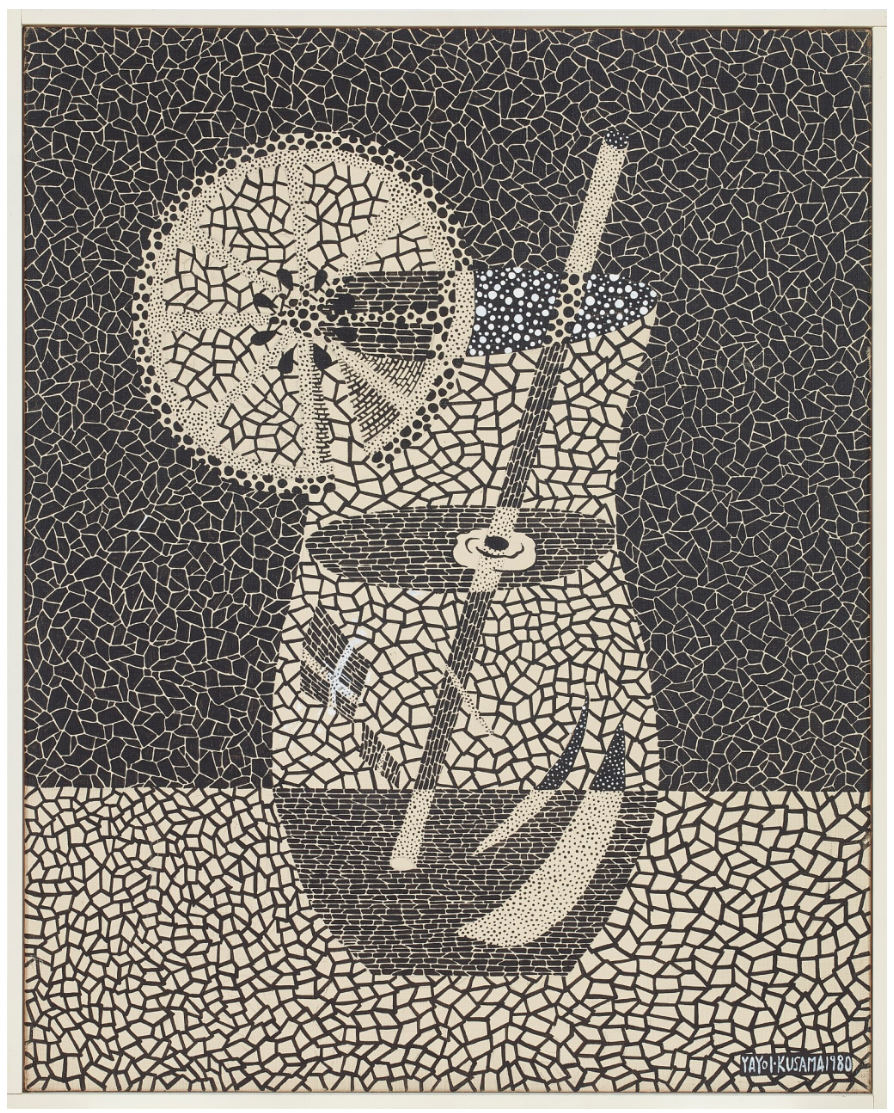
YAYOI KUSAMA (b. 1929)
Lemon Tea, 1980
Acrylic on canvas
91 x 72.5 cm (35 7/8 x 28 1/2 inches)
Signed and dated 1980; signed, titled in Japanese and dated 1981 on the stretcher
With a combination of two signature forms—nets and dots—Lemon Tea by Yayoi Kusama offers viewers a mirage of multiplication and repetition spread across the canvas. One of the most popular artists working today, Kusama holds an important place in the canon of art history, forging her own artistic path and visual language throughout her long, prolific career. A significant example of Kusama’s depiction of everyday objects, from coffee cups to high-heel shoes, in her signature aesthetic of nets and dots, Lemon Tea is definitive of Kusama’s ability to instill the typically mundane with a magical, hypnotic quality.
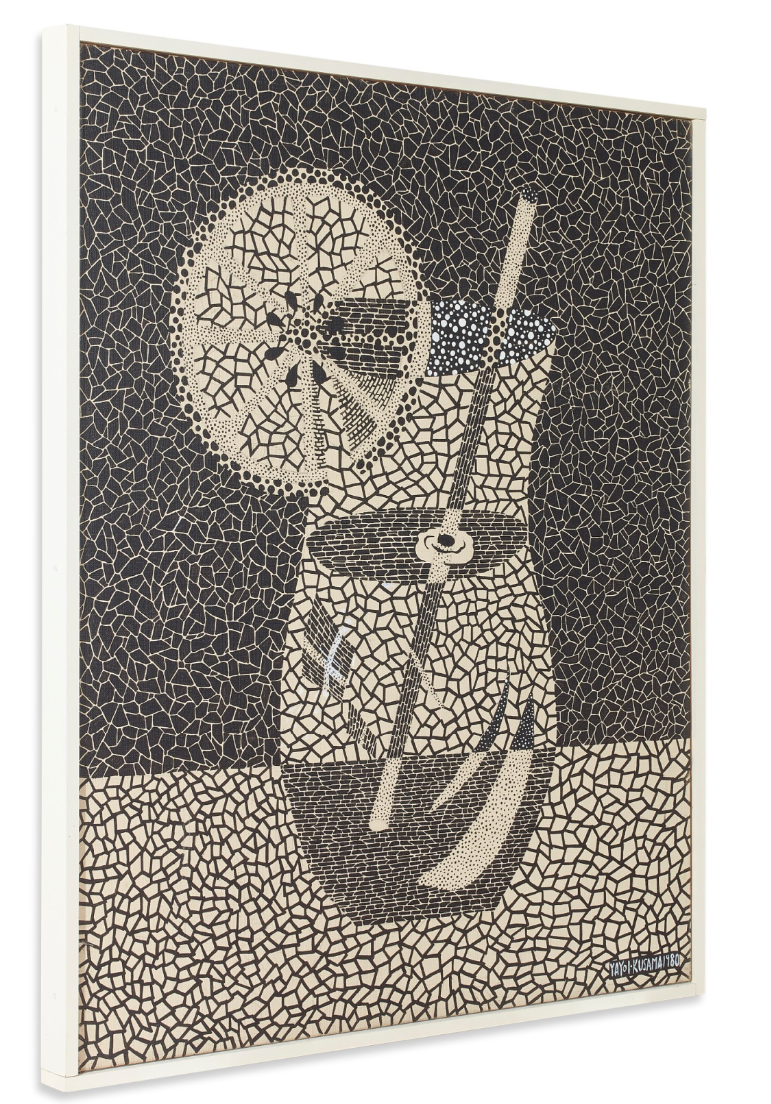
The fluctuation of large dots to small dots as seen in the straw and inside of the glass, transform the three-dimensional object, focusing deeply on the structural relationship between shape and line. Through works such as this, Kusama remodels the traditional notion of still life through abstraction, manipulating perspective through the flattening of space. To the artist, the repetition of forms in her paintings has provided a vital form of personal art therapy, a response to the hallucinations that she has had since her childhood and her method of self-obliteration. A dazzling patchwork of dots and nets that are harmoniously arranged to evoke the notion of three-dimensionality, the idea of universal infinite is also evident in the painting, exhibiting an intensity of personal obsession and cosmic infinity. While works such as Lemon Tea are expressive of Kusama’s unique artistic language and vision, their hypnotic qualities recall Bridget Riley’s Op art paintings and their resonant rhythmic effect, as well as the seriality of Andy Warhol’s Pop silkscreens.
Other Series
The Southern Country, 1978
Christie’s Hong-Kong: 28 March 2026
Estimated: HKD 4,500,000 – 7,500,000
HKD 5,461,000 / USD 697,445
YAYOI KUSAMA (B. 1929), The Southern Country | Christie’s
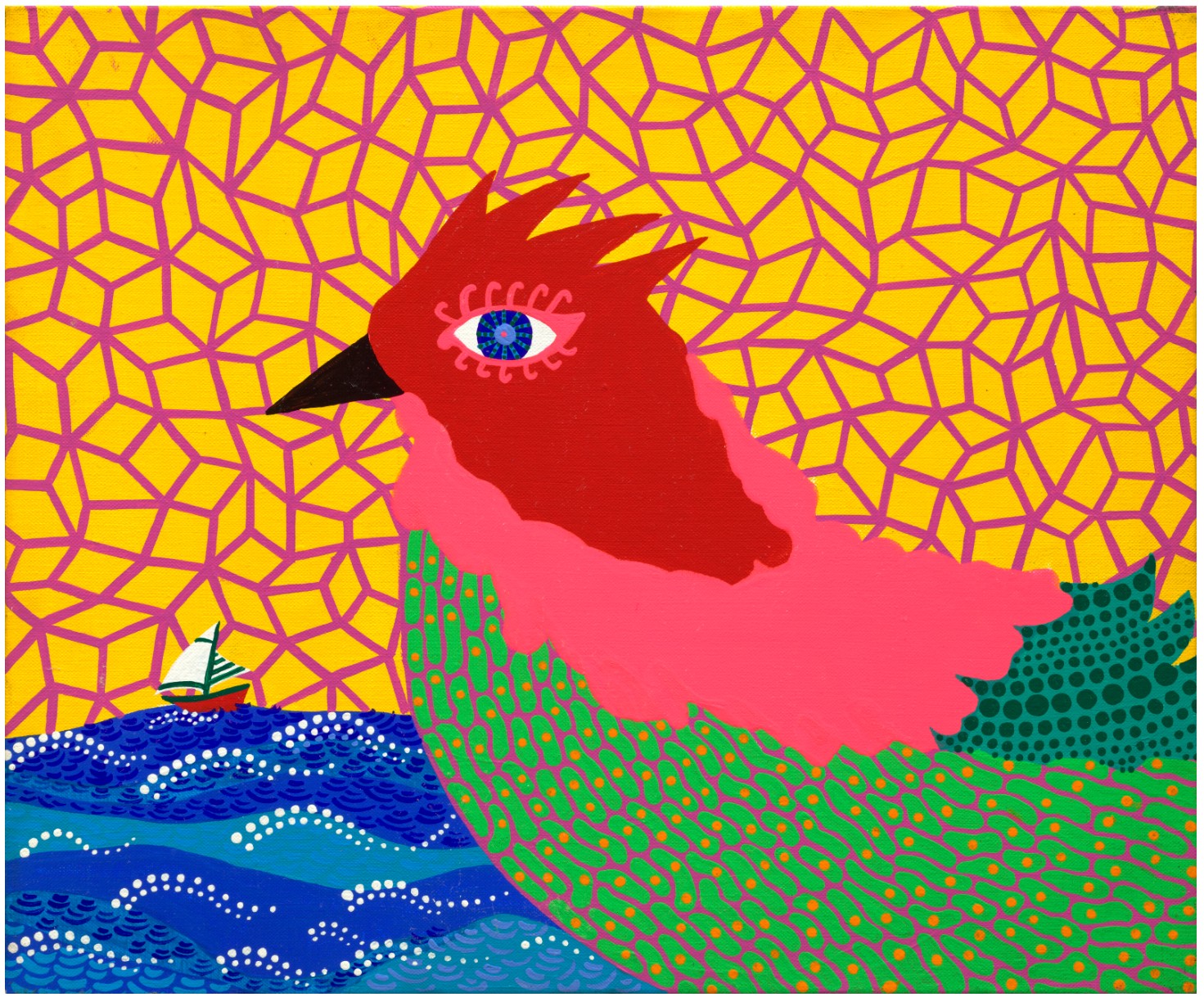
YAYOI KUSAMA (B. 1929)
The Southern Country, 1978
Acrylic on canvas
38 x 45.5 cm (15 x 17-7/8 inches)
Signed and dated ‘Yayoi Kusama 1978’
Titled in Japanese (on the reverse)
Painted in 1978, five years after Yayoi Kusama returned to Japan after living and working in New York for almost 16 years, The Southern Country signifies a shift in the artist’s oeuvre as she began a new journey in her home country. The work unites the rare bird motif with refined still-life sensibilities, all enlivened by a palette of radiant yellows, gentle blues, and lively pinks that radiate an atmosphere of dreamlike warmth. Among the nine known bird themed paintings that have appeared on the market, this work serves as both the earliest and the only example executed in the 1970s, underscoring its singular importance during a decade marked by profound shifts in Kusama’s personal life and creative direction.
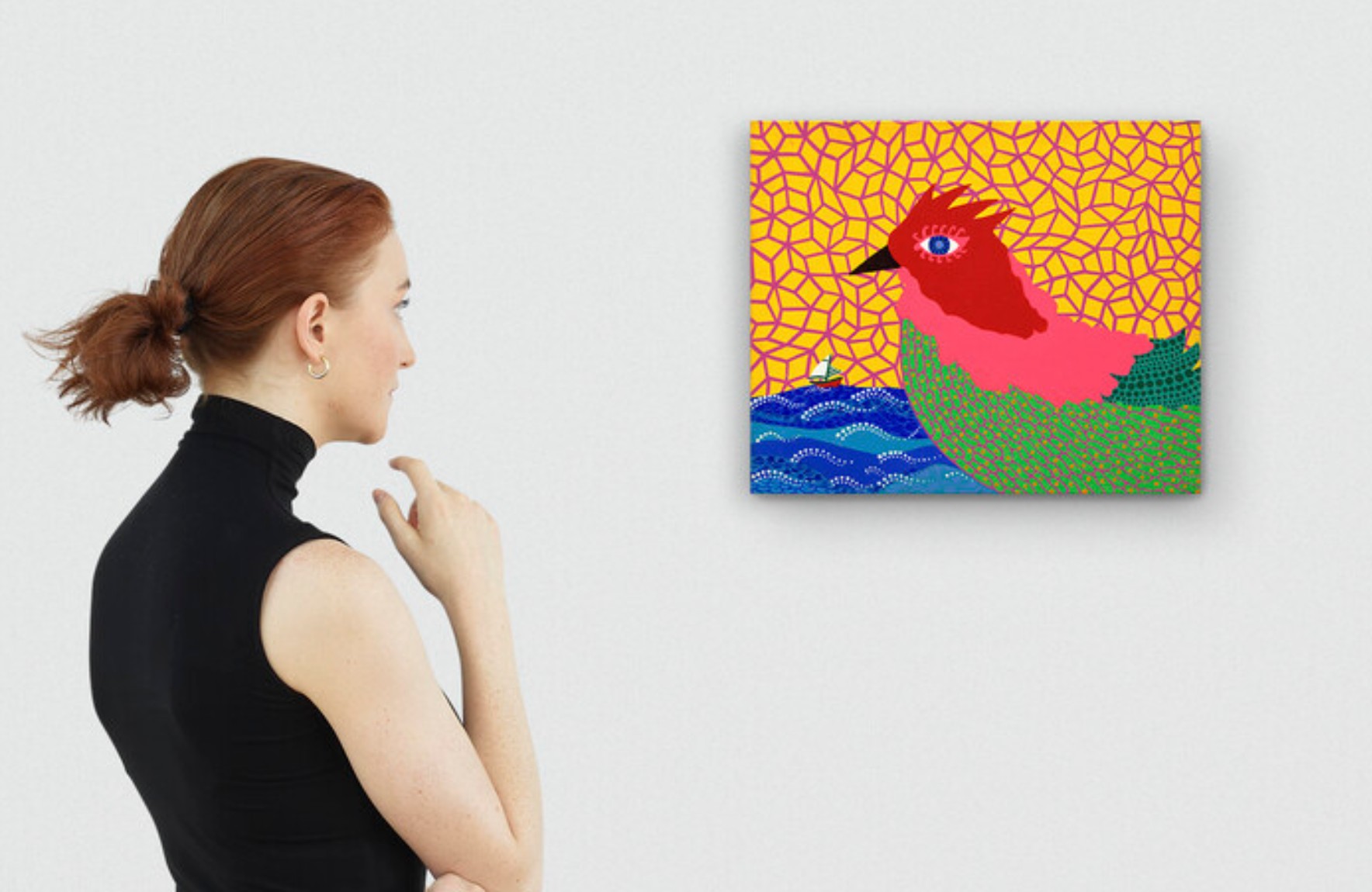
The 1970s represent a pivotal and deeply transformative chapter for Kusama. The deaths of two central figures—her close friend and artistic confidant Joseph Cornell in 1972, and her father in 1974—precipitated a period of emotional instability and introspection. These personal losses contributed to her permanent return to Japan from New York in 1973, marking the departure of her explosive large-scale happenings and installations that had shaped her prominence in the New York avantgarde scene. Back in Japan, confronted with new psychological and practical circumstances, Kusama recalibrated her artistic approach by gravitating toward more intimate, figurative, and introspective modes across painting, collage, screenprint, and writing. Works from the 1970s reflect emotional concentration, inward reflection, and a renewed focus on smaller formats and deeply personal symbols. The Southern Country embodies Kusama’s introspective sensibility: The stylized ocean wave and small sailboat evoke her own transoceanic journey—the adventurous creative expedition across the Pacific and the complex psychological terrain that accompanied it. The lone boat, with its delicate white sail, appears as a poignant metaphor for the artist herself: navigating the vast expanse between the place where she blossomed artistically and the homeland to which she returned—carrying both fond nostalgia and the weight of grievous loss.
What makes The Southern Country further compelling is its sophisticated synthesis of the artist’s most recognizable visual languages. Against the solitary figure of the bird, Kusama’s infinity-nets and infinity-dots drift and weave like breaths of light, forming a vision where freedom brushes against fragility, and transcendence shimmers at the edge of captivity and escape. Her lifelong obsessions—boundlessness, repetition, immersion—pulse through the scene, turning it into a quiet storm of yearning and infinite flight. Together, these themes align profoundly with Kusama’s introspective tendencies during this decade, as she negotiated personal difficulty and sought spiritual and emotional equilibrium. The Southern Country emerges as a superlative work—one that not only encapsulates the essence of Kusama’s iconic visual language but also illuminates a deeply human chapter of her artistic evolution, holding both significant historical and emotional weight within her oeuvre.
Hitomi (Eye), 1989
AN EYE FOR COLOUR: WORKS FROM A PRIVATE COLLECTION
Christie’s London: 7 March 2026
Estimated: GBP 300,000 – 500,000
GBP 406,400 / USD 542,910
YAYOI KUSAMA (B. 1929), Hitomi (Eye) | Christie’s
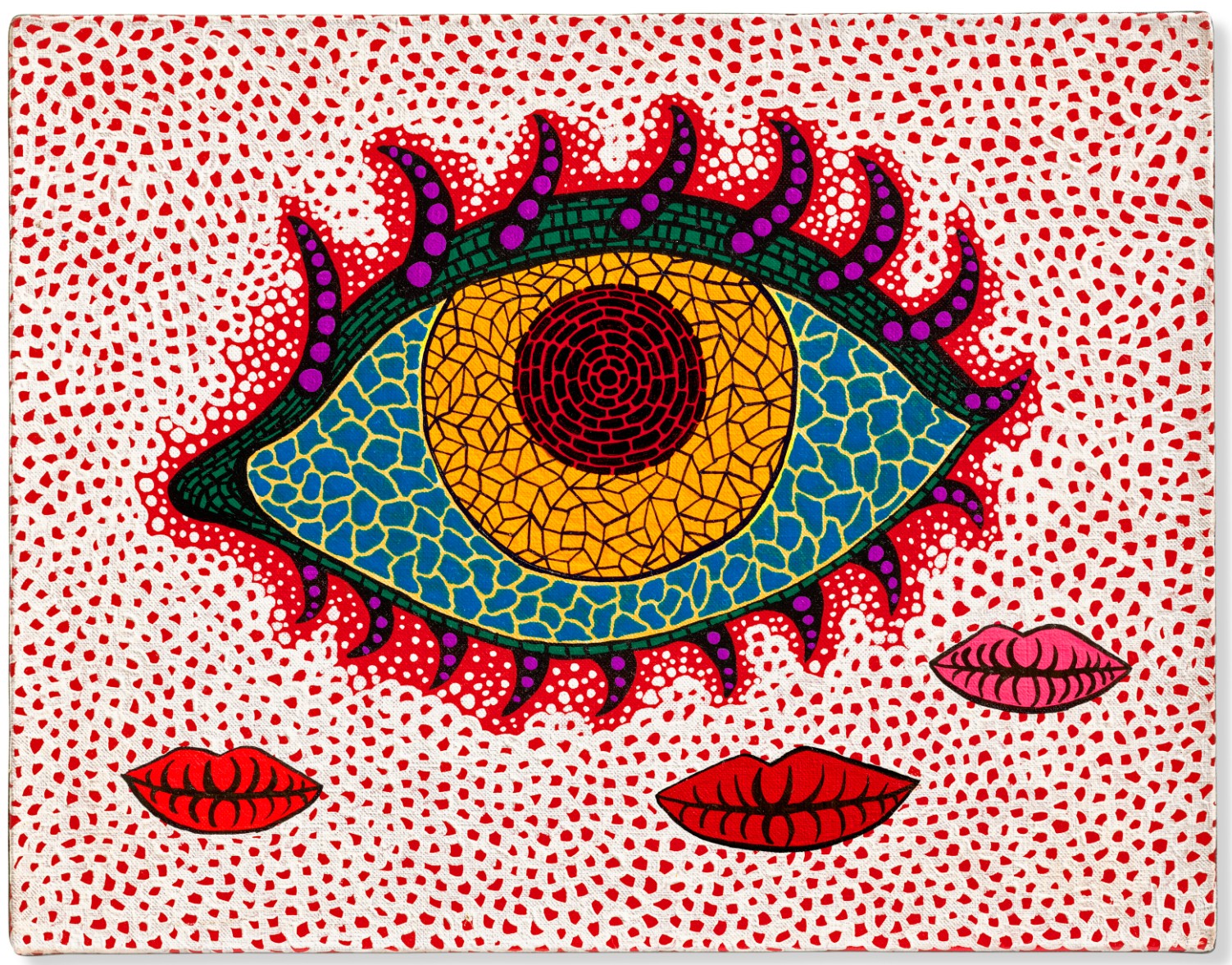
YAYOI KUSAMA (B. 1929)
Hitomi (Eye), 1989
Acrylic on canvas
32×41 cm (12-5/8 x 16-1/8 inches)
Signed, titled in Japanese and dated ‘1989 Yayoi Kusama’ (on the reverse)
With its solitary eyeball emblazoned against a field of dazzling red dots, Hitomi (Eye) (1989) is a hypnotic work that draws together some of Yayoi Kusama’s most important motifs. Rendered in luminous tones of neon and gold, the work combines the webbed structures of her celebrated early Infinity Nets with the iconic, Pop-like imagery that came to define her triumphant return to painting during the 1980s. As a child, Kusama experienced vivid hallucinations in which vast swathes of dots subsumed her entire being. In her paintings, she translated these visions into complex, optical fields, whose finely-wrought surfaces provided the artist with a cathartic outlet for her psychological turmoil. The eye became a central subject in Kusama’s art, gazing out at the viewer as if from the very depths of her soul. In the present work, its entire structure is awash with dots and lattices: a portrait, perhaps, of her own perceptual theatre. Three mouths float below, their lips tightly sealed.
René Magritte, Le faux mirroir, 1928. The Museum of Modern Art, New York. Artwork: © 2026 ADAGP, Paris and DACS, London. Digital image: ©2026 The Museum of Modern Art, New York/Scala, Florence.
Kusama’s practice took flight after she moved to the United States in 1957, arriving in Seattle before moving to New York the following year. Her Infinity Nets, first shown in 1959, propelled her to international acclaim. With their countless repetitive dots set in lacy arcs, these works were direct manifestations of her own interior world.
“The room, my body, the entire universe was filled with [patterns], my self was eliminated, and I had returned and been reduced to the infinity of eternal time and absolute space.”
Meticulous, repetitive and entirely absorbing, the process of making these works allowed Kusama to escape the painful trappings of her own body and mind. They were cosmological in scope, redolent of galaxies and constellations proliferating to infinity. Earth, she wrote, is but ‘one polka-dot among a million stars’.
Tom Wesselmann, Mouth No 8, 1966. Private Collection.
Artwork: © 2026 Estate of Tom Wesselmann/VAGA at ARS, NY and DACS, London. Digital image: Bridgeman Images.
The present work dates from a watershed moment in Kusama’s career. In 1973 she had returned to Japan, and largely withdrew from her studio practice following a period of protracted mental illness. Over the course of the 1980s, however, she returned to painting with renewed energy. Though still bound to the abstract language of her dots, webs and nets, Kusama also began to embrace bold figurative imagery, including plants and animals as well as eyes. She started to use acrylic paint, which lent her canvases a captivating shimmer. During this period the artist began to garner international recognition once more. Her work had not been widely exhibited in the United States until 1989—the year of the present work—when she mounted a retrospective at the Center for International Contemporary Arts, New York. The exhibition helped to reintroduce Kusama to the art world that she had previously left behind, as well as the wider American public.
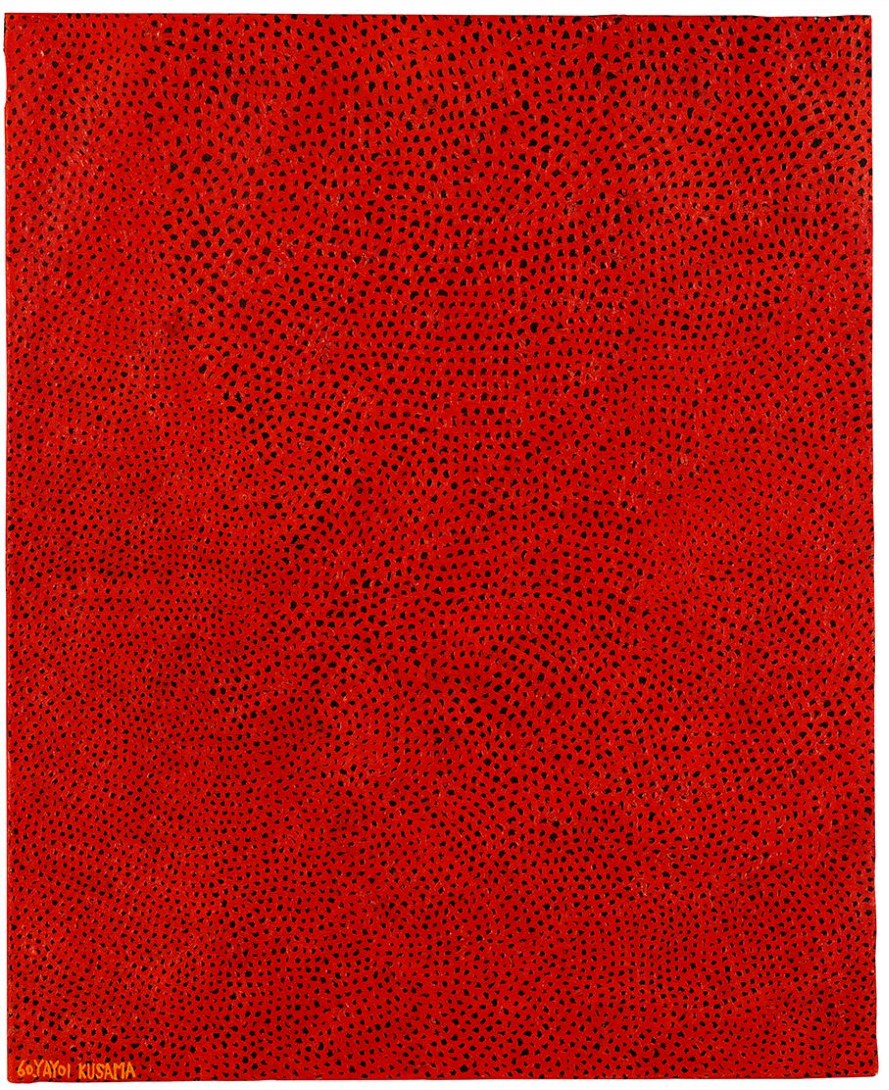
Yayoi Kusama, No. I.Z, 1960, The Art Institute of Chicago. Artwork: © YAYOI KUSAMA.
Digital image: © Art Institute of Chicago / Bridgeman Images.
Hitomi also invokes lessons Kusama had absorbed in New York, namely the ‘all-over’ gestures of her Abstract Expressionist contemporaries and Pop’s deadpan approach to its subjects. Looking back further still, the work is also decidedly surreal in its sensibilities. For the Surrealists, who sought to give image to veiled dreams and desires, eyes served as a window onto the unconscious. In their pictures, as in Hitomi, the eyeball functions both as an object to be looked at as well as a portal for viewing itself: a means of seeing and being seen simultaneously, and a tool for revealing the hidden. Hitomi filters these ideas through Kusama’s deeply personal practice to embrace the healing power of art. ‘By obliterating one’s individual self,’ she explains, ‘one returns to the infinite universe’ (Y. Kusama quoted in G. Turner, ‘Yayoi Kusama’, Bomb, vol. 66, Winter 1999).
Ashtray, 1981
China Guardian Hong-Kong: 6 April 2023
Estimated: HKD 1,800,000 – 2,800,000
HKD 2,160,000 / USD 275,155
Auction | China Guardian (HK) Auctions Co., Ltd. (cguardian.com.hk)
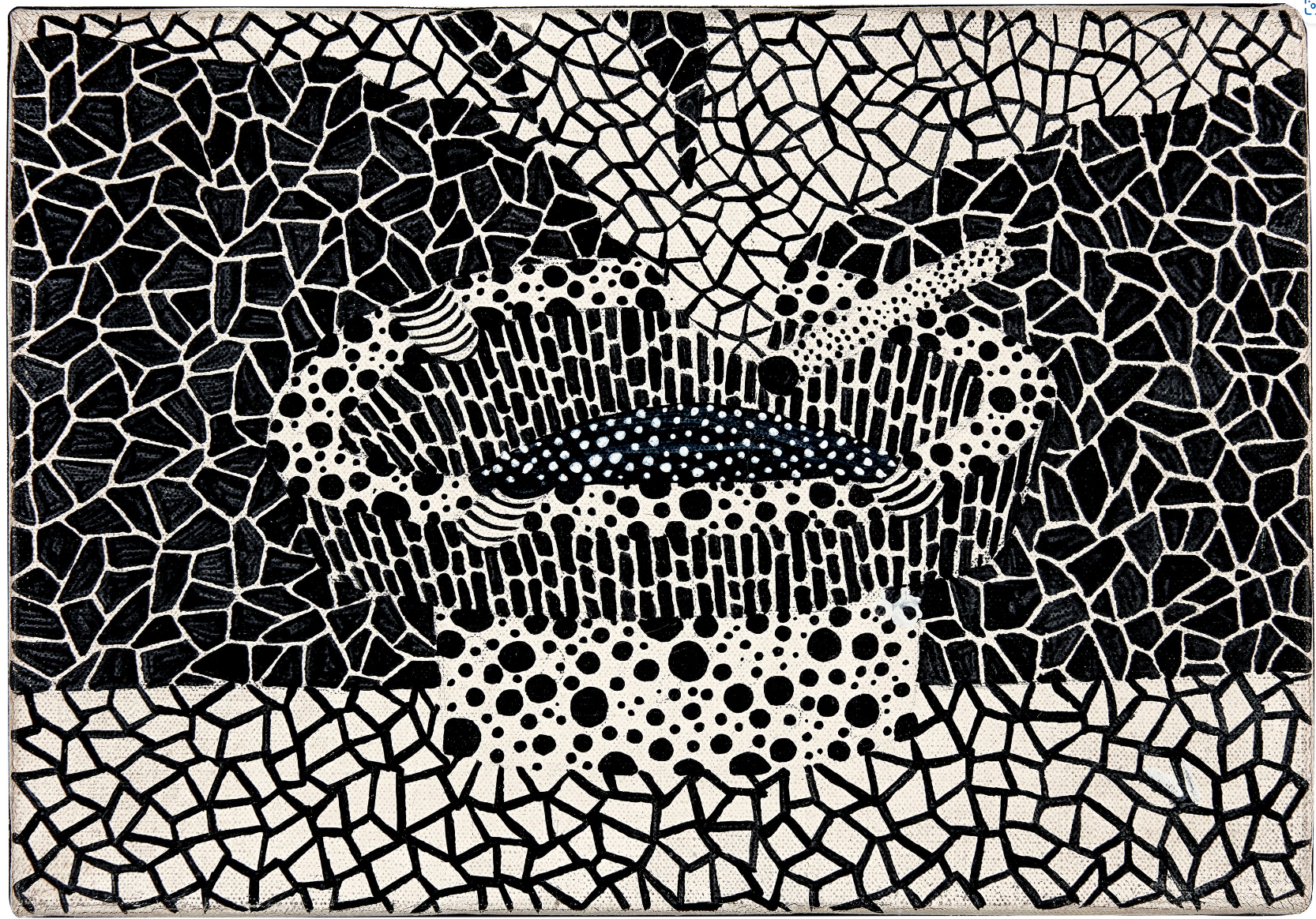
Ashtray, 1981
Acrylic on canvas
15.8 × 22.7 cm (6 1/4 × 8 7/8 inches)
Titled in Japanese, signed in English and dated on the reverse
After leaving the hustle and bustle of her New York days, Yayoi Kusama returned to Japan in 1973 to begin a new chapter in her artistic career. She voluntarily checked into a psychiatric facility in Tokyo, where she stayed for 34 years. During this period of deliberate self-imposed seclusion, Kusama created a large and diverse bunch of works, of which her paintings of everyday objects became the most important aspect of her creative process. From 1981 to 2006, she created a series of small oil paintings of 14×21 cm. Ashtray, the artist’s first small oil painting, was completed in 1981. Such a subject is one of the very few Kusama has ever created in her lifetime, and there are only 20 pieces of them, highlighting the rarity of this work. The size of this group of delicate works spans from the age of 52 to 77, and is a testament to the artist’s painting skills, as every detail of the structure must be carefully laid out. The Ashtray is a representative of Kusama›s delicate small-size works, and it is a work of determination in which Kusama concentrated her energy in her 60s.
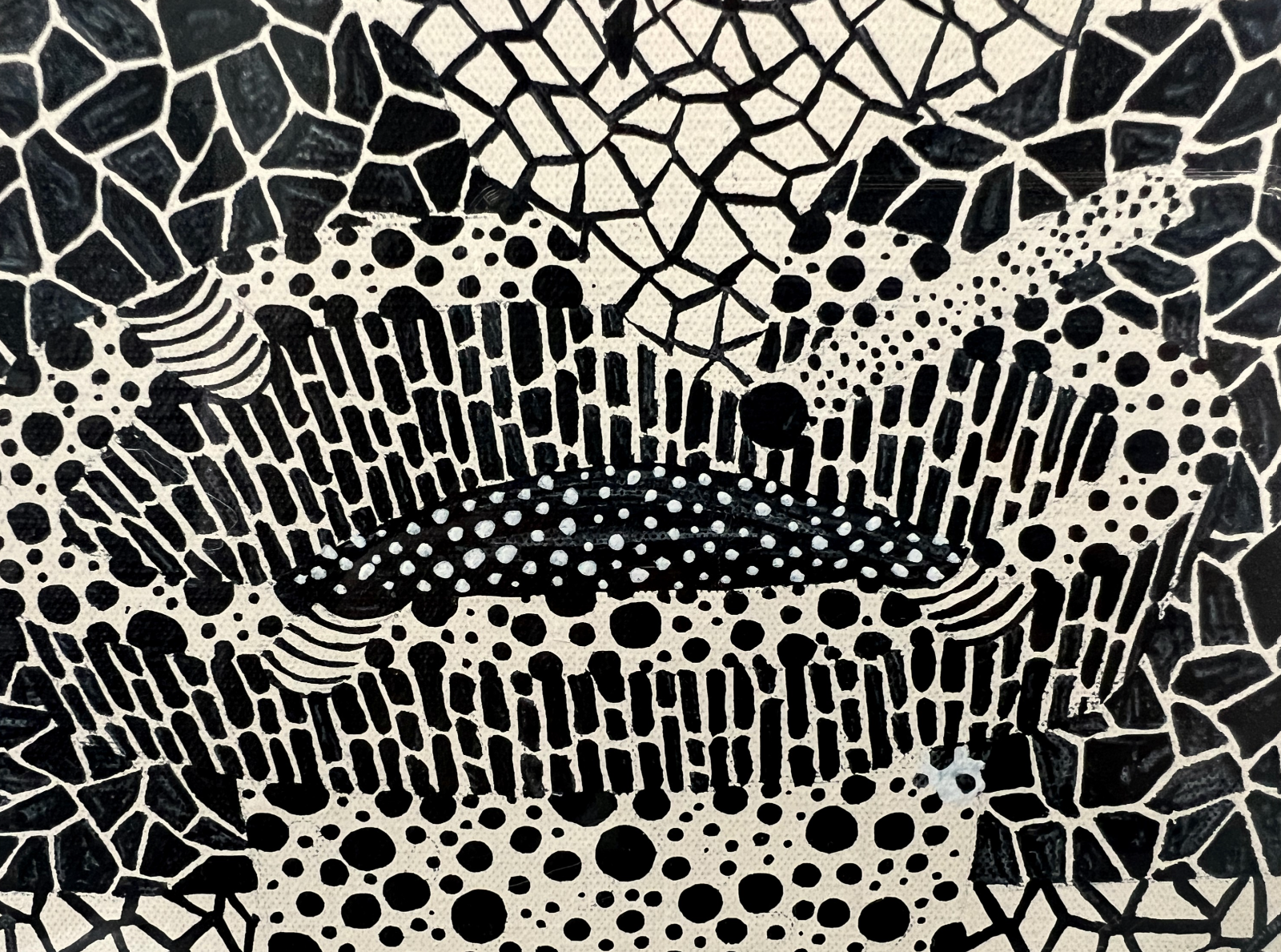
The Ashtray features two classic art elements, polka dots, and infinity nets, which are the most iconic elements of Kusama. The ashtray is made up of black polka dots, and the three-dimensional sense is created through the stacking of small geometric patterns. The polka dots of different sizes and staggered arrangements create a visual dynamic of reliefs, entering the infinite visual net. The net in the background and the texture of the table are in reverse color so that the work can present in three-dimensional and concavity in the seemingly flat expression. The smoke is a dynamic, hovering, intimate space that gives people a sense of wonder.
“When I first arrived in New York, I thought it was so different from Tokyo. I see people standing on the side of the road with cigarettes in their hands, and I sense freedom in the air.”
The lines in Ashtray show the artist’s extremely delicate brushwork. Some of them have a matte and soft texture, while others are thick and strong, reflecting the artist’s flexibility and versatility in the use of colour. The contrast between black and white is a metaphor for reality and the sense of imagination represented by the ashtray and the smoke, which serves as a reflection of Kusama’s thinking for life, where reality and imagination overlap. The lighted cigarette symbolizes freedom and the process of thinking, while the ashes in the ashtray are time faded, presenting the Japanese philosophy of “at the moment”. The cigarette that burns out is a manifestation of human life from birth to death, and no matter what, one should seize every second of the present moment, this is a statement of Kusama’s outlook on life.
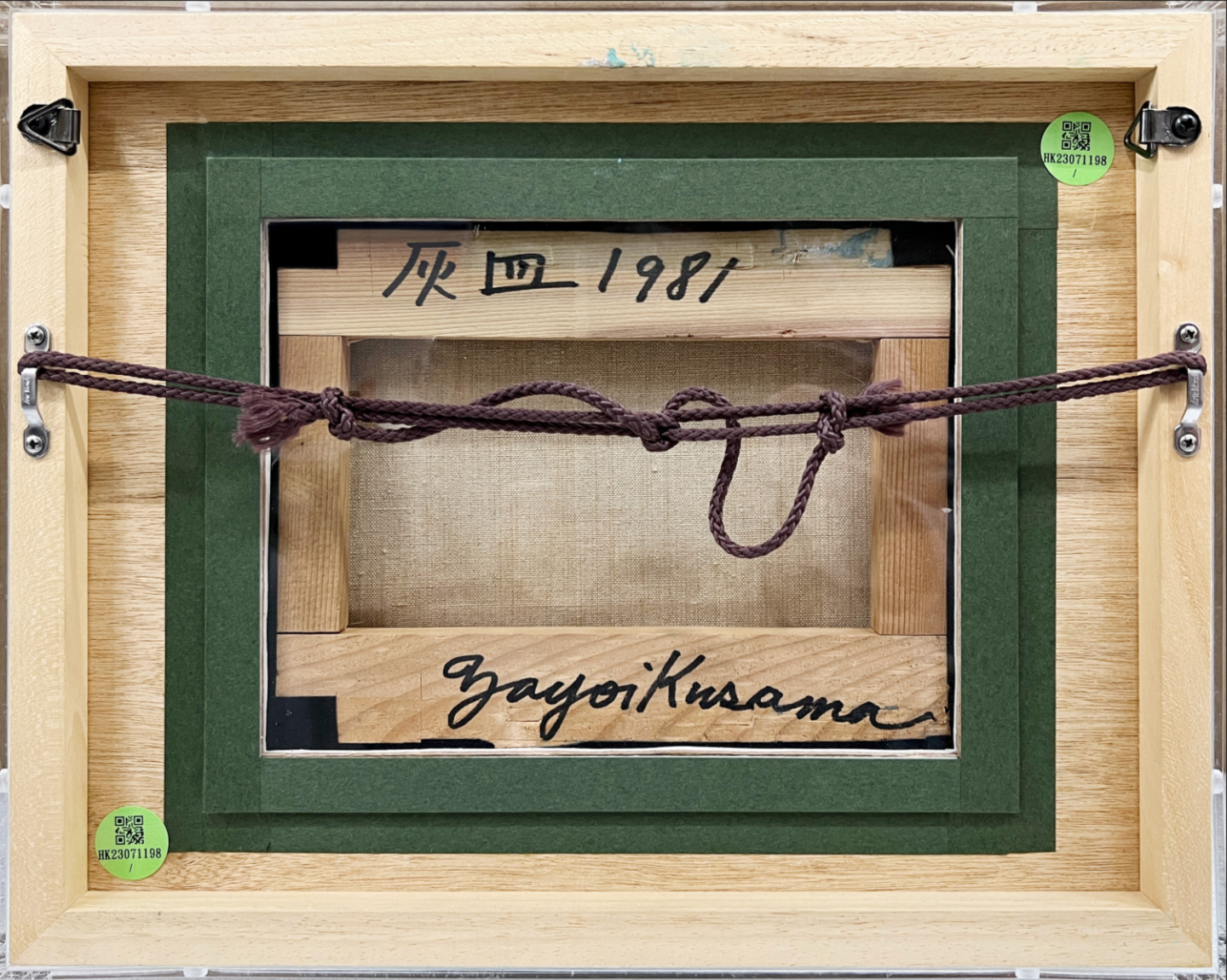
When creating an artwork, the artist first spreads a static, absolutely smooth plane on the canvas, and then adds as much texture as possible on top of it, organizing the color blocks one by one in a microscopic way, and repeating the whole process over and over again, adding brushstrokes one by one. Kusama’s original way of painting allows her to create an infinitely extended sense of solidity on the canvas. Kusama’s unique genius of combining rational thinking and sensual perception is also manifested.
A Gill, 1955
Sotheby’s Hong-Kong: 6 April 2023
Estimated: HKD 1,200,000 – 2,000,000
HKD 4,826,000 / USD 614,790
Yayoi Kusama 草間彌生 | A Gill 鰓 | Contemporary Day Auction | 2023 | Sotheby’s (sothebys.com)
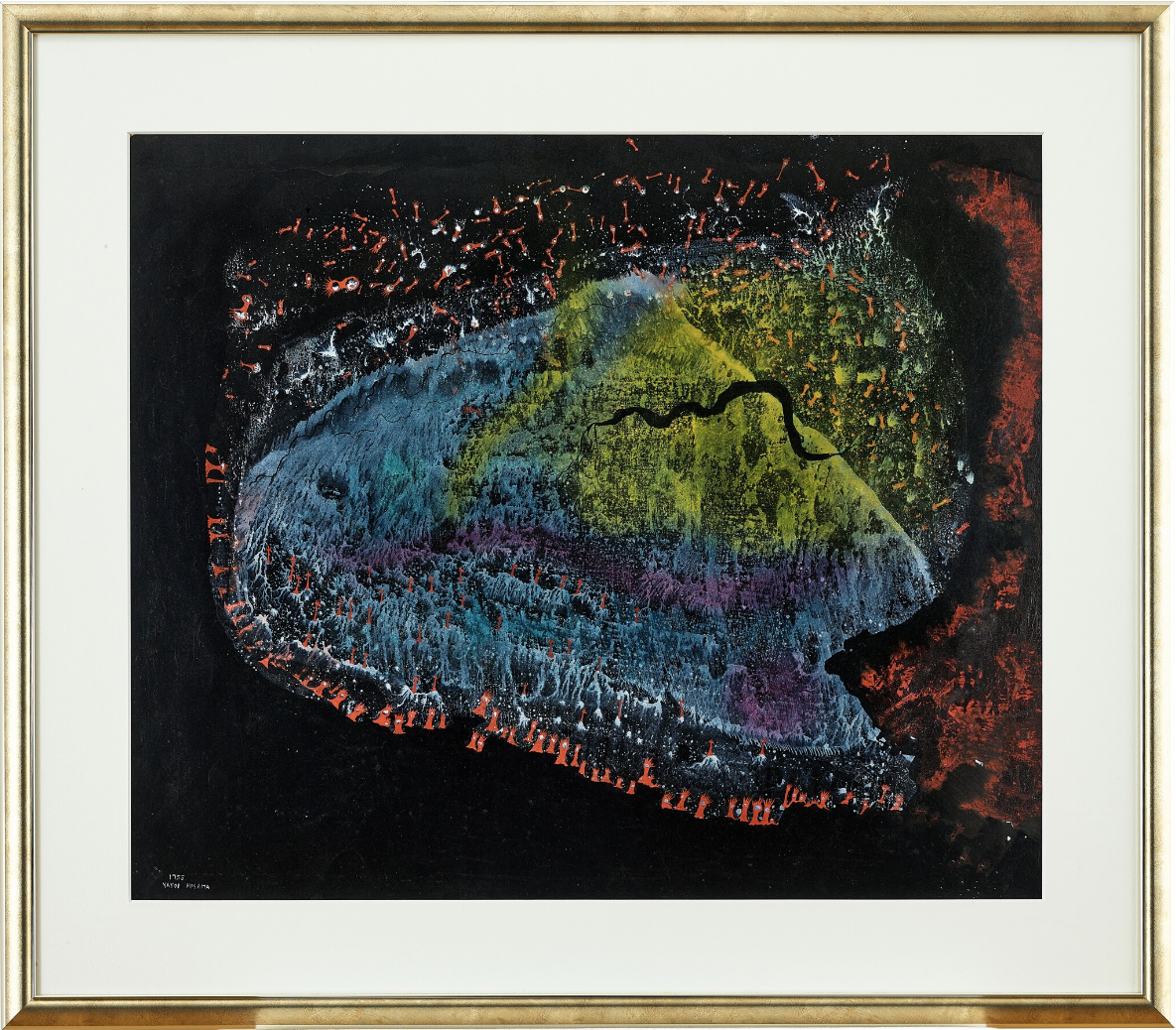
YAYOI KUSAMA (b. 1929)
A Gill, 1955
Gouache, India ink and oil on paper
60.4 x 72 cm (23 3/4 x 28 3/8 inches)
Signed and dated 1955
Signed in English, titled in English, dated 1955, and inscribed in Japanese on the reverse
Painted in 1955, A Gill is an exceptional early example of the artist’s indelible aesthetic, and one of only a few surviving works from the period. Replete with the endless repetitions of minuscule but meticulously articulated elements which have come to define the artist’s oeuvre, the present work is resplendent in Kusama’s use of color and painstaking approach to composition, representing Kusama at a foundational time. Significantly, A Gill was extensively exhibited throughout the course of the artist’s illustrious career, at the Tokyo Museum of Contemporary Art before the turn of the millennium through to the Tate Modern, London, and the Centre Pompidou, Paris, in 2012, amongst others. It was this work and this work alone from her time in Japan that Kusama borrowed from friend and art critic Shuzo Takiguchi to be displayed for her first exhibition in America, and has been subsequently passed down by decent in this family until the present day. A mesmeric work on paper which documents an early expression of Kusama’s indelible aesthetic.
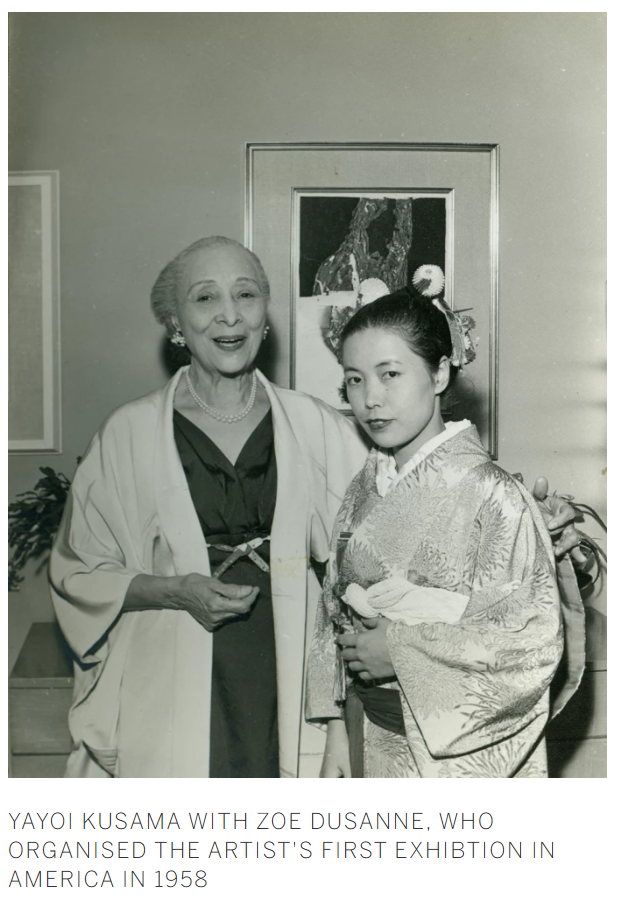
Anticipating her departure for Seattle in 1957 and vowing to “create better works when I got to New York” (the artist, quoted in Frances Morris, Ed., Yayoi Kusama, London 2012, p. 168), Kusama burnt most of her fledgling compositions. Mostly conducted in the traditional Japanese Nihonga style of which she was formally trained, Kusama kept only a few works from this emerging period of her career. For Kusama, A Gill was a proud achievement from her time in Japan that she wanted to display upon her arrival in Seattle, and the only work from close friend and supporter Shuzo Takiguchi that she brought with her to display. A numinous vista that incorporates the mystical and the scientific, A Gill conveys the vastness of the universe through the smallest details of nature, speaking to the philosophical depths of Kusama’s work. Using the technique of decalcomania, Kusama applied light blue gauche over a jet-black foundation built with sumi-ink. Over the central structure, Kusama painted a world of minutiae, selecting certain colors to impart meanings related to the earth’s basic elements, with the blue of this central aspect representing water. Creating a thermal chartography using oil paint, the vibrant red and yellow represents fire, light and heat. The emblazoned black line which cuts through the yellow seepage refers to the discharge of electricity, a moment which give life to countless red molecular figures depicted throughout the ink-blackness of the composition.
The microscopic red figures of varying sizes and movements emerge from the corner of the composition, eventually colonizing on the bottom of the blue aquatic space before releasing delicately articulated white roots. Suggesting a state of life akin to plants or bacteria, the primordial universe of A Gill indicates Kusama’s continuing interest in the life cycle and its mystery. The work’s scale and assorted media suggest at Kusama’s artistic growth beyond the confines of her formal training in Japan, the present work being a seminal piece within the artist’s oeuvre. Pushing herself to an extreme degree of concertation on minute details, Kusama obsessively added these red extra-terrestrial-like figures hoping to dislodge all control by reason, advocating for sublime spiritual transcendence through her meditative creative process.
The Girls, 2004
Phillips Hong-Kong: 31 March 2023
Estimated: HKD 800,000 – 1,200,000
HKD 1,778,000 / USD 226,496
Yayoi Kusama – 20th Century & Contemp… Lot 140 March 2023 | Phillips
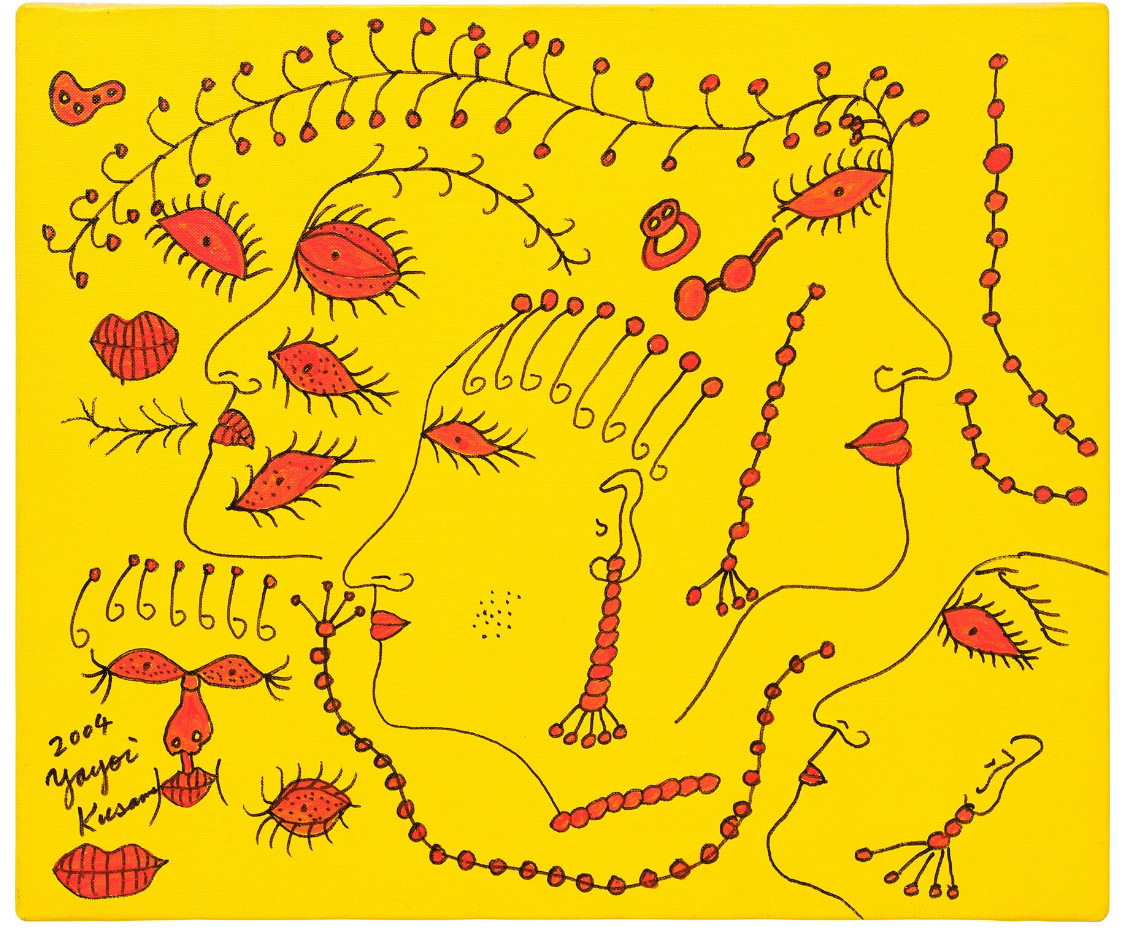
YAYOI KUSAMA
The Girls, 2004
Acrylic and felt pen on canvas
38.2 x 45.5 cm (15 x 17 7/8 inches)
Signed and dated ‘2004 Yayoi Kusama’ lower left
Executed in 2004, The Girls is a vibrant example of Japanese art world phenomenon Yayoi Kusama’s celebrated visual language that speaks to both her ongoing exploration into the concept of the infinite, as well as the power of femininity—a focus which has long been central to her art and continues to be one of her most central motifs. Masterfully rendered in acrylic and felt pen on canvas, the work features a captivating canary-yellow background onto which Kusama has drawn intricate black line with a doodle-like aesthetic. Interconnected female faces cover the painting, which have been detailed with blocks of ruby red that highlight the muses’ large eyes and lips, and long strands of beaded earrings.
“I believe that eyes are very important motifs. That’s something that can discern the peace and love.”
As the various elements come together, they create a vivid image that celebrates womanhood, as indicted by its title, The Girls. Just as the bold pattern and color can be seen as illustrating female strength, the intertwining shapes and line capture the both the interconnectedness and resilience of femininity; reminding us that we are stronger together than apart. Kusama’s largest retrospective in Asia, Yayoi Kusma: 1945 to Now, is currently on view at the M+ Museum in Hong Kong until 14 May 2023. The exhibition features over 200 works across various international collections, the M+ collection as well as the artist’s own collection. On show in the final gallery space are a number of artworks from Kusama’s mature period, which are comparable to The Girls.
A Dream I Dreamed Yesterday, 2006
Sotheby’s London: 2 March 2023
Estimated: GBP 100,000 – 150,000
GBP 152,400 / USD 183,288
A Dream I Dreamed Yesterday | Modern & Contemporary Day Auction | 2023 | Sotheby’s (sothebys.com)
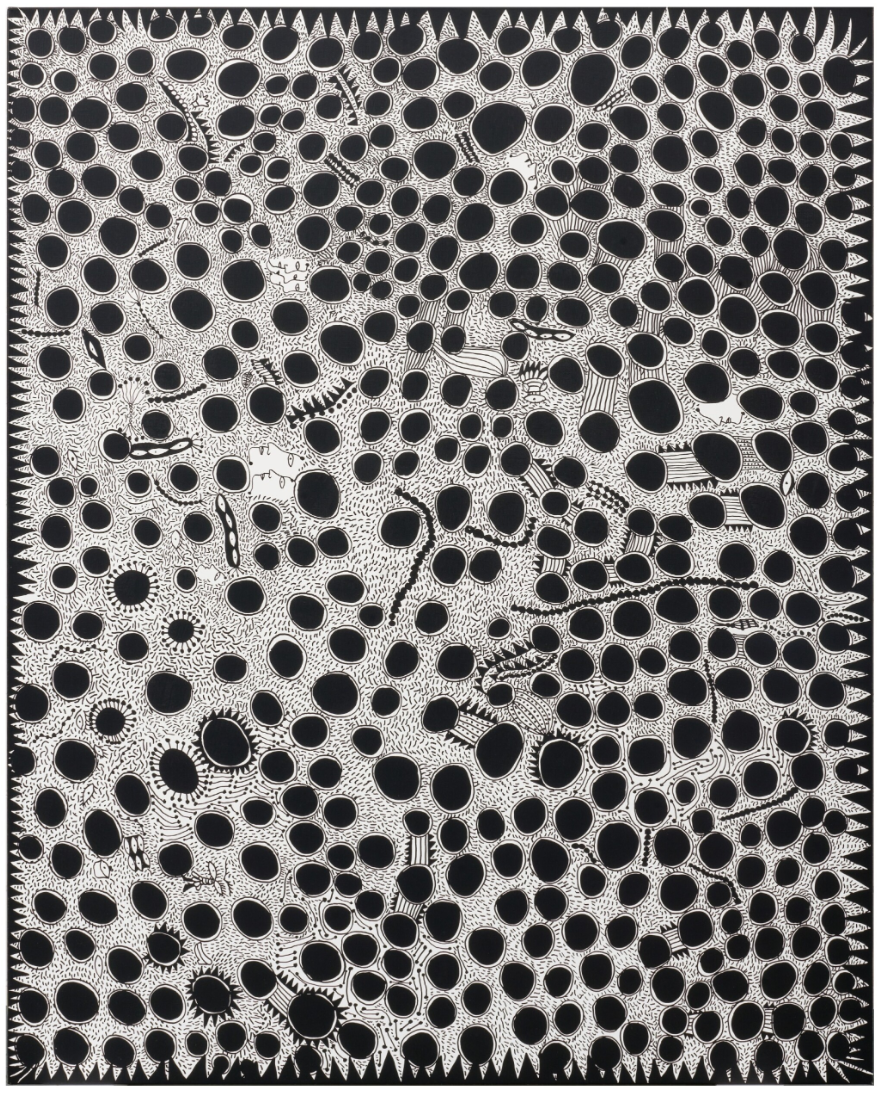
YAYOI KUSAMA (b. 1929)
A Dream I Dreamed Yesterday, 2006
Silkscreen on canvas
162 x 130.3 cm (63 3/4 x 51 1/4 inches)
Signed twice, titled, dated 2006 and numbered 2/5 on the reverse
Executed in 2006, this work is number 2 from an edition of 5
Yayoi Kusama’s transcendent A Dream I dreamed yesterday from 2006 is a scintillating example of the artist’s decades-long contemplation of the interconnectivity between the universe and the lives of the people who inhabit it. Between 2004 and 2007, Kusama created a series of 50 black and white works overflowing with whimsical flowing patterns, the strands and circles dotted with a melange of tiny faces and figures appearing like squirming microorganisms teaming under the lens of a microscope. Bursting with vivacity and organicism, small forms flow into each other, grow and diminish, with an undulating rhythm so deeply tuned to nature that the viewer. Freely alternating between abstraction and figuration, the obsessive and abundant imagery includes Kusama’s signature polka dot motif.
“Polka dots can’t stay alone, like the communicative life of people. Two and three and more polka dots become movement. Our earth is only one polka dot among the million stars in the cosmos. Polka dots are a way to infinity.”
The multitude of polka dots, with their small imperfections and undulations, emanate a vitality that demands singular attention. Starting with a single dot, Kusama encompasses deep contemplation on the individual, nature, and the universe in this masterful work. Diagnosed with an obsessional neurosis, Kusama has famously struggled with hallucinatory visions of infinitely oscillating, kaleidoscopic patterns since her earliest childhood in Japan. These hallucinations have fueled her unique pictorial idiom throughout her career. Kusama describes sessions where she would paint ceaselessly for forty to fifty hours, the act of painting becoming not only a mode of creative production but moreover an exercise of expressive necessity. For her, painting is catharsis. Kusama’s hallucinations and mental illness are like the engine to the grander machine that drives her creativity and artistic masterpieces. Her disorder is deeply entwined with the forms she creates, informing the subject matter of her work. A Dream I dreamed yesterday typifies Kusama’s practice, illustrating her ability to create brilliance and conjure a seemingly impossible sense of infinity.
Soul of the Night, 1990
China Guardian Hong-Kong: 9 October 2022
Estimated: HKD 5,000,000 – 8,000,000
HKD 6,000,000 / USD 764,360
Auction | China Guardian (HK) Auctions Co., Ltd. (cguardian.com.hk)
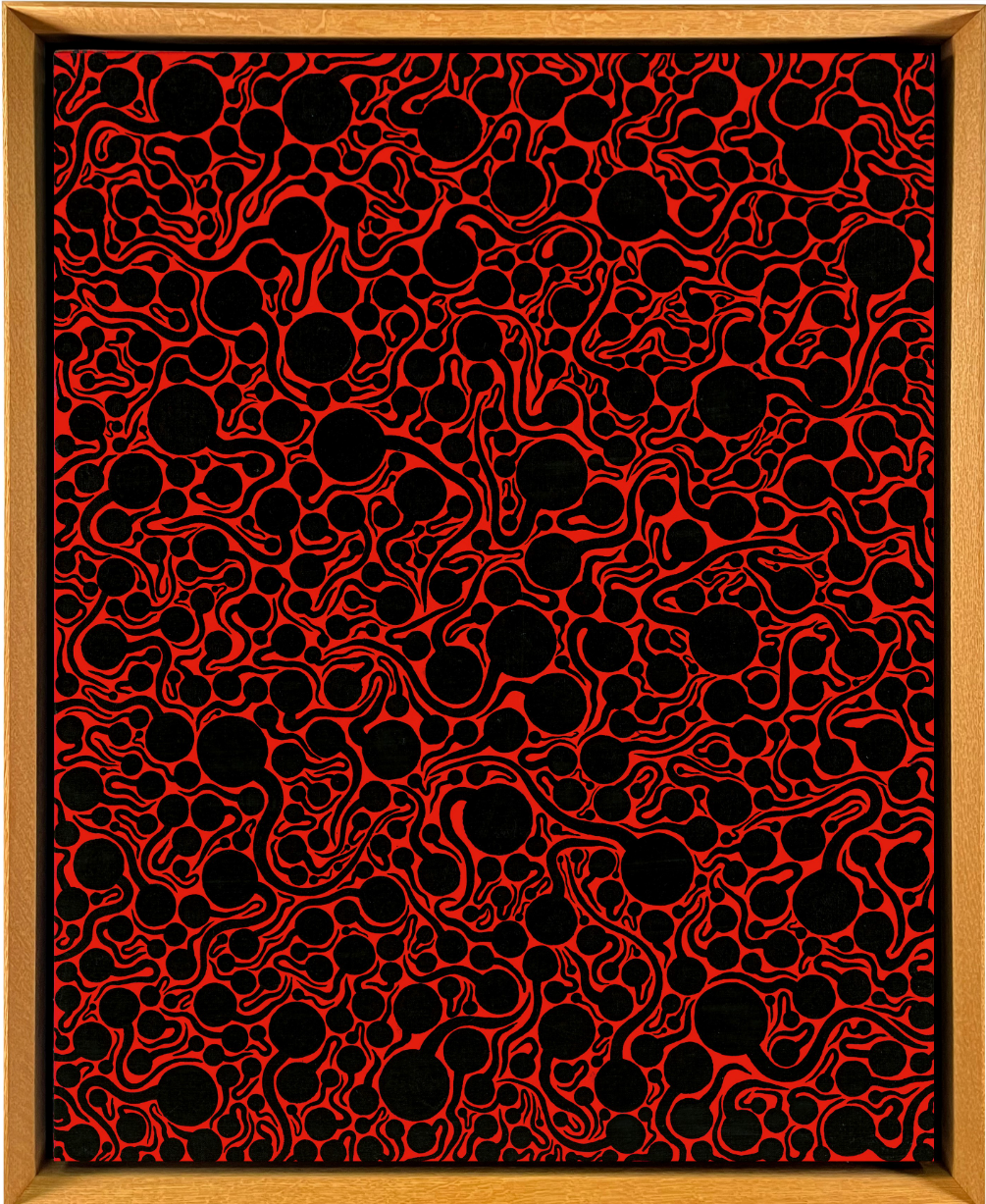
Soul of the Night, 1990
Acrylic on canvas
91 × 72.7 cm (35 7/8 × 28 5/8 inches)
Signed in English, titled in Japanese and dated on the reverse
In her works from the 1940s to the present, art has been, as she says, her “weapon in the face of life,” helping her to escape the pain of mental illness and recording her perceptions of life, nature, and her thoughts on social phenomena and art history. Through her diverse creative expressions such as paintings, performance art, installations, novels and poems, she expresses her manifesto to the world – a “manifesto of love”, hoping that she and the viewers will, in the illusion she has created, let go of their prejudices, and step into a world that is in harmony with nature, a world full of love and peace. Her works are a “love memo” that she leaves to the world.
Throughout her life, in addition to her specific depictions of tangible objects such as pumpkins and flowers, Yayoi Kusama has created many iconic personal elements in the field of abstraction, the most important of which is that since 1958, she has abandoned the visual focus and traditional forms of composition. Simply repeat single elements such as netting and polka dots, filling the entire canvas with them and leading the viewer into a state of what seems like weightlessness. The viewers are encouraged to reactivate all five senses to try to understand the unknown world in front of them. Most of the works in this category are named “Untitled”, “Infinity Nets”, and “Infinity Dots” in an attempt to eliminate the author’s subjective emotions. In Kusama’s repetition of single elements, between 1988 and 1992, one element emerged as a departure from the nets and dots: the tadpole-like symbols that combine dots and lines. In these five years, Kusama created no more than fifteen paintings with the repetitive tadpole symbols, making them a resounding rhythm. These works are given names about “Fire”, “Love” or “Soul”, reflecting another side of Kusama’s personality, showing her poetic soft heart. Among the works featured in this auction is Soul of the Night, completed in 1990. At the time of its creation, Kusama’s international reputation was on the verge of exploding, as in 1987 when she held her first major retrospective in Japan at the Kitakyushu Municipal Museum of Art, which received extensive coverage on Fuji TV, NHK, and Tokyo TV, and then Kusama’s whirlwind swept to the United States in 1989 when the International Center for Contemporary Art in New York invited her to hold a retrospective, and she was featured for the first time on the cover of the Art In America magazine. The first time a Japanese artist ever had this honor, and her work Soul of the Night, which was completed during this golden age, embodies, in a way, Kusama’s celebration of her artistic achievement at that time.
“My art is continuously created in the context of contemplating what it is to live and to die, confronting the theme of ‘what is human’, a matter of life and death.”
In Kusama’s performance in New York, Holland and Sweden in the late 1960s, she recruited nude models as performers and drew dots on their bodies in the street to match the music, thus making a declaration of “anti-war”, “love and peace” and “sexual liberation”. Her courage to face the autonomy of the body, the birth and death of the flesh, desire, and life, went beyond the world at an early stage. In Soul of the Night, she also boldly applied a red color like blood as the background with a pulsating force of life. In the process, she added rhythmic lines to the polka dots that previously carried “the same shape as the earth, the sun and the stars,” creating black organic plankton of varying sizes, like tadpoles or small bean sprouts with symbols of hope. In this hot red sea, the sky is covered with the different rhythms of life, and the twisting and turning lines point to the direction they are going. The black individuals in the painting move forward in all directions as if with consciousness, gathering into one dynamic, rhythmic, cyclical air after another, breaking through the boundaries in the invisible, expanding the limited canvas to infinity, in which the black individuals either strive and surge forward and try to leap out, or follow the footsteps of the former in search of an exit, or exchange secret messages in the encounter with each other, or go their separate ways, or wander, simply showing the nature of existence.
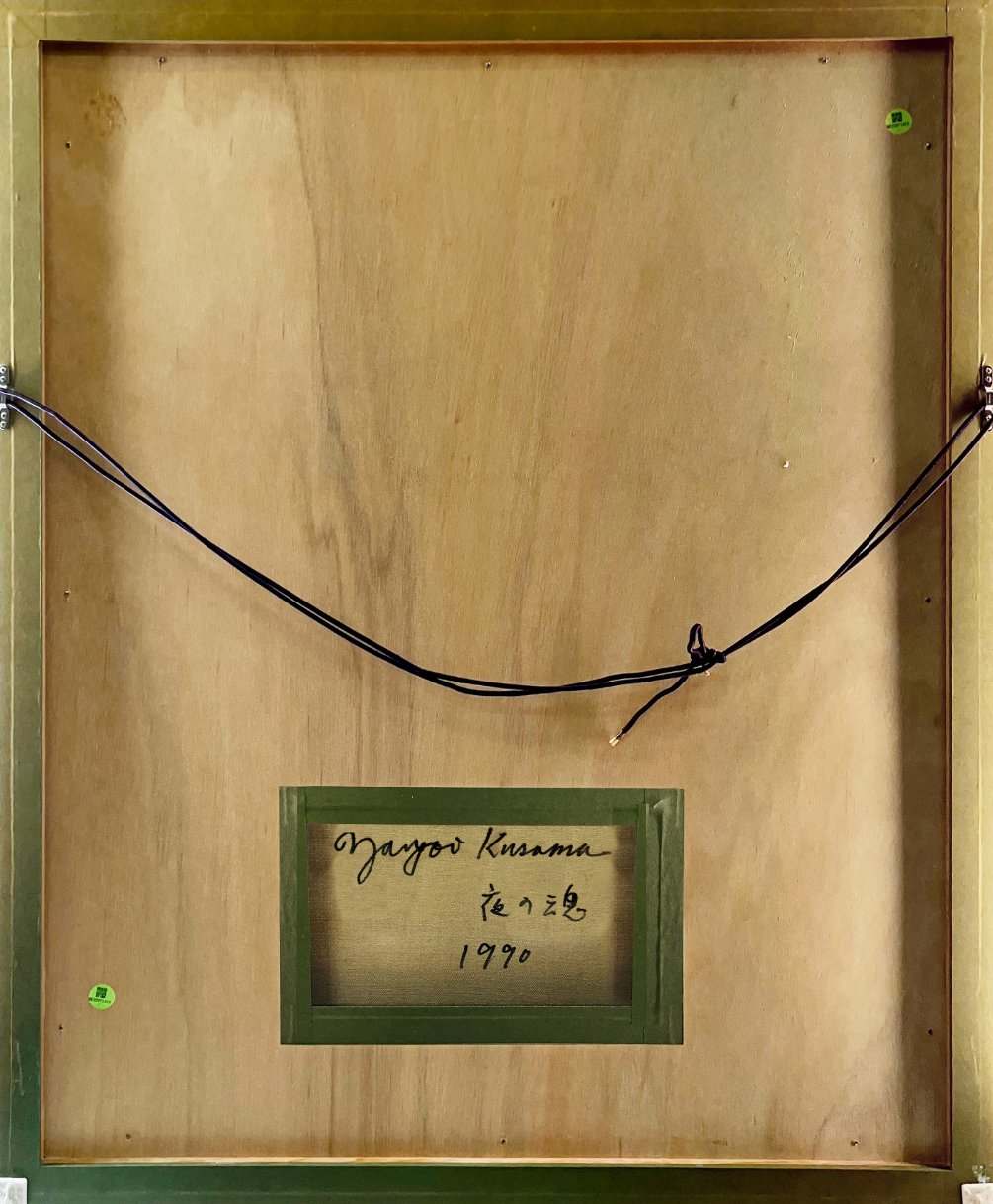
As the title of the painting suggests, these black living beings with souls are showing us a journey of life. Kusama used the most minimal colors, the dots and lines, and the repetition of a single element, allowing people to experience and feel life from its birth, and the complex interpersonal relationships that are woven into a vivid picture of life. This is perhaps Kusama’s most endless artistic charm – to tell the viewer the most intricate yet real story of life in the most condensed way.
The Waves of Midsummer, 1988
Ravenel Taipei: 5 December 2021
Estimated: TWD 9,000,000 – 15,000,000
TWD 11,400,000 / USD 411,255
Ravenel | Yayoi KUSAMA《The Waves of Midsummer》 Ravenel Autumn Auction 2021 Taipei Lot 219
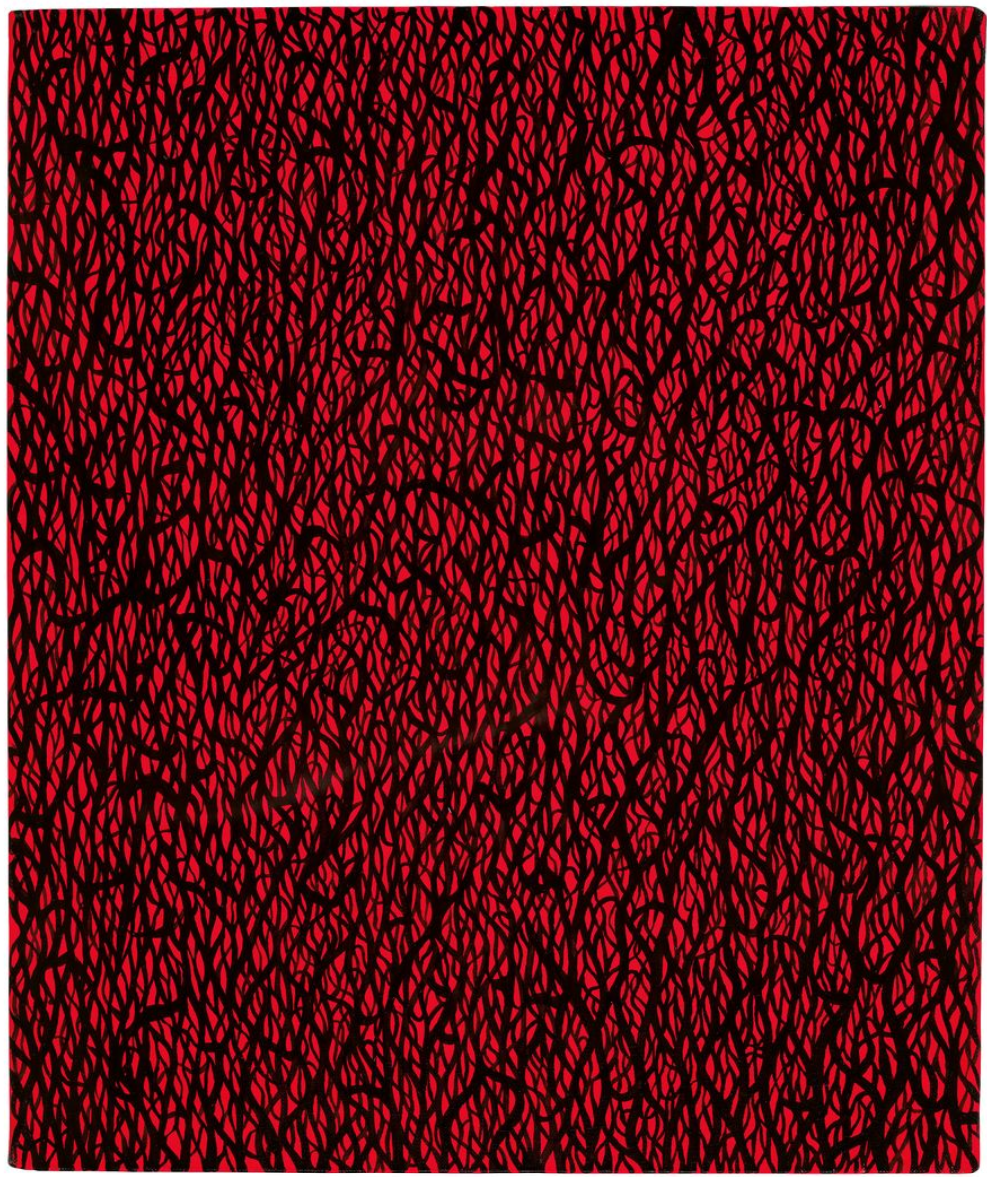
YAYOI KUSAMA (Japanese, 1929)
The Waves of Midsummer, 1988
Acrylic on canvas
45.5 x 38 cm
Signed Yayoi Kusama, titled The Wave of Midsummer in Japanese on the reverse and dated 1988
The origin of the infinite network of creations stems not only from the mental illness that has plagued Yayoi Kusama for many years, but was also inspired from a concept that the artist saw the Pacific Ocean on the flight when she traveled to New York, and then fluctu- ated and expanded the sea network. From the mind to the canvas: this is also the reason why we can see a lot of paintings in Japanese kanji “wave” (ie water surface) in her works today. This piece was created by Kusama Yayoi in 1988, The Wave of Midsummer, which is comprised entirely of the most popular colors of the artist – red and black, and is used as a memory for the midsummer ocean. If we compare the colors of the hot and the hot to the midsummer, the dense black lines of the full picture represent the surface of the ocean which is turbulent due to the tides. An “unlimited net” com- posed of black thin lines covers the black tide. The lay- ered fine composition brings not only a multi-level visual experience to the picture, but the overlapping ripples are even more awe-inspiring. The moment this thought rises in the brain, it is like returning to the era when the artist was exposed to the sun – the wave of the midsum- mer.
Petals in Early Summer, 1988
China Guardian Hong-Kong: 12 October 2021
Estimated: HKD 1,300,000 – 2,500,000
HKD 2,040,000 / USD 262,163
Auction | China Guardian (HK) Auctions Co., Ltd. (cguardian.com.hk)
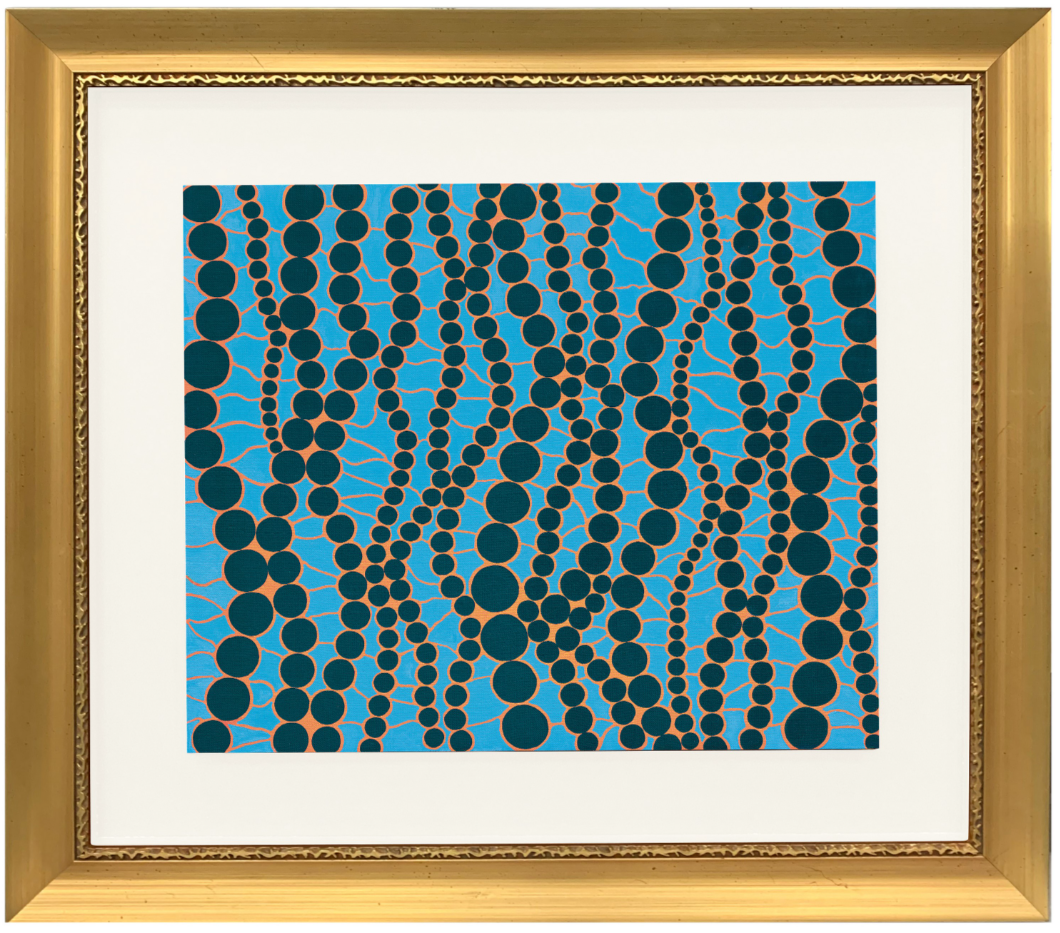
Petals in Early Summer, 1988
Acrylic on canvas
38 × 45.5 cm (15 × 17 7/8 inches)
Signed in English, titled in Japanese and dated on the reverse
Fiberglass Sculptures
Hi, Konnichiwa (Hello)! Goro, 2005
Christie’s Hong-Kong: 29 November 2023
Estimated: HKD 4,000,000 – 6,000,000
HKD 4,410,000 / USD 566,173
YAYOI KUSAMA (B. 1929) (christies.com)
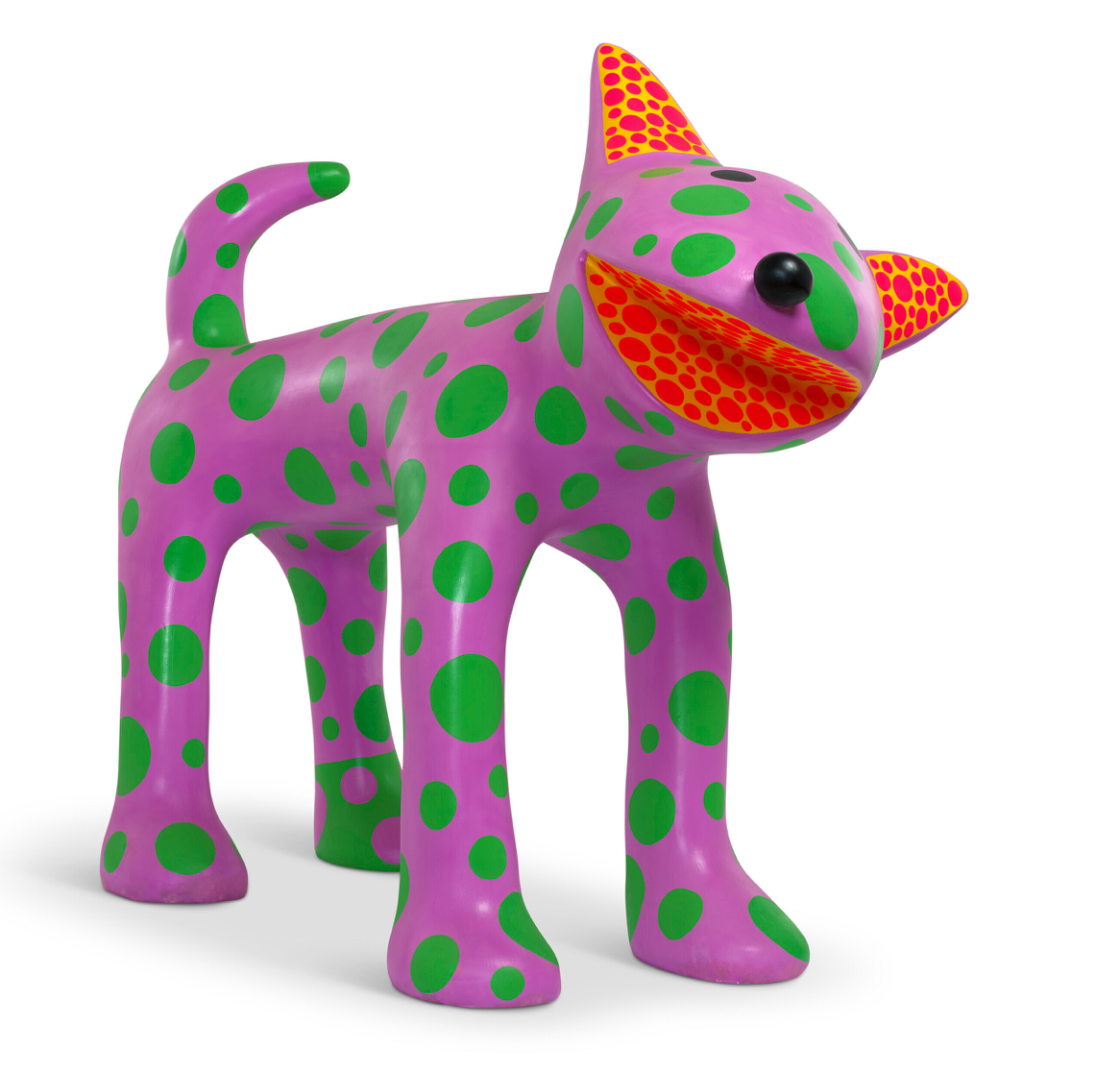
YAYOI KUSAMA (B. 1929)
Hi, Konnichiwa (Hello)! Goro, 2005
Painted styrofoam and urethane resin sculpture
136 (H) x 95 x 175 cm (53 1/2 x 37 3/8 x 68 7/8 inches)
Signed, titled and dated ‘Yayoi Kusama Goro 2005’ (on the underside of the torso)
Chii-chan, 2004
Sotheby’s Hong-Kong: 5 October 2023
Estimated: HKD 3,500,000 – 5,500,000
HKD 7,874,000
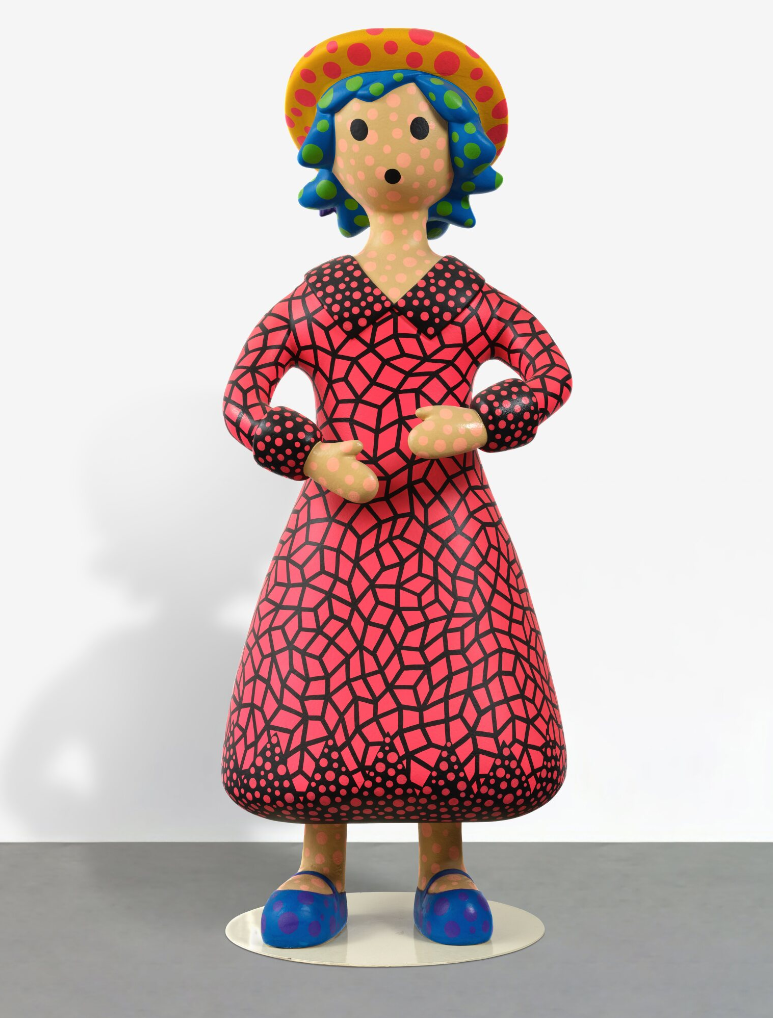
YAYOI KUSAMA (b. 1929)
Chii-chan, 2004
Mixed media
225 x 83.5 x 84.5 cm (88 5/8 x 32 7/8 x 33 1/4 inches)
Signed and dated 2004
Beautifully materialized in paradigmatic exuberant color, Chii-Chan (2004) is one in a series of girl sculptures adorned with Yayoi Kusama’s iconic dot pattern and ubiquitous infinity net motif. This body of work emanates from an intimate sentiment whereby each figure has been named individually, ending with the Japanese affectionate suffix ‘chan’, usually used to refer to children, female family members and friends, following their first names. Exuding a sense of tenderness and childlike innocence, this exemplary series brings together a number of notable elements from the artist’s psychedelic practice during the mid 1960’s to the present. The red and black Infinity Nets motif in this edition is particularly rare, as it highlights one of Kusama’s most popular colour palettes, as well as one of the most important and distinctive visual codes within contemporary art discourse. Exhibited as part of the installation “Hi, Konnichiwa!”? at the KUSAMATRIX exhibition at the Mori Museum, Tokyo, in 2004, Chii-Chan is a virtuosic and resplendent example of the artist’s iconic dot and infinity net-covered motif imagined in sculptural form.
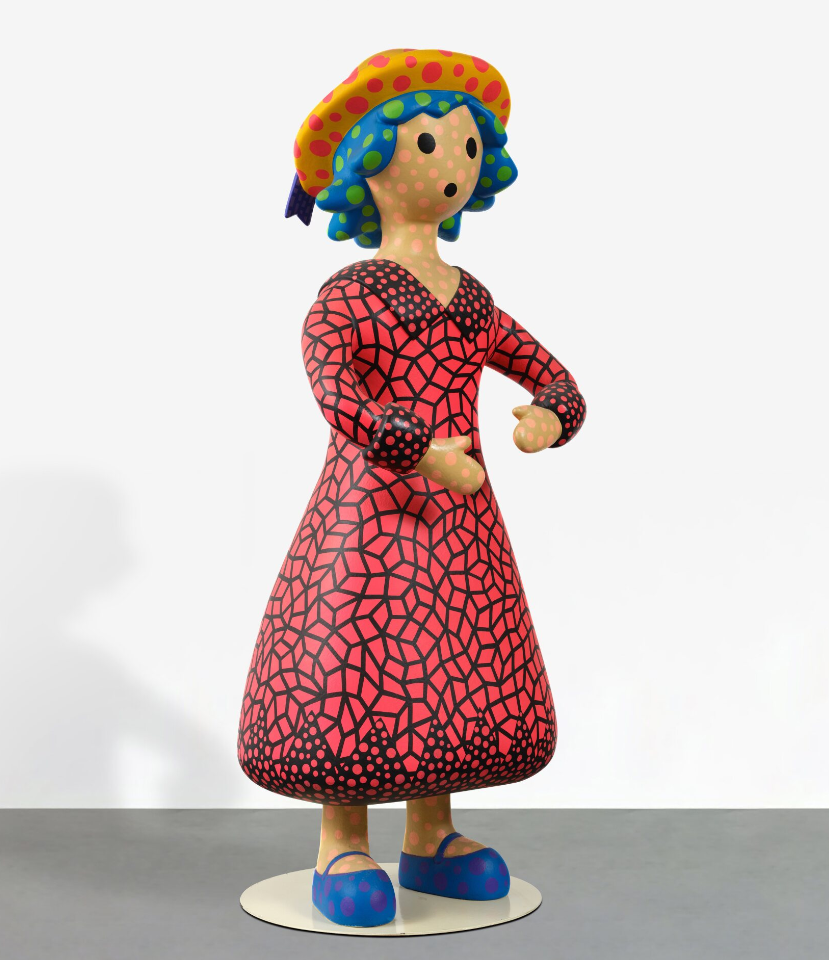
The repetitive scheme of polka-dots in dazzling shades of blue, orange and green, along with the Infinity Nets patterning, can be seen in the form of mirrored installation, soft sculptures, and notorious performance works throughout Kusama’s oeuvre, endlessly covering ready-made objects and performers. To describe this subsuming pattern, Kusama coined the phrase ‘obliteration’, with every available surface of the present work obliterated under Kusama’s accumulated patterning. The concept of “Self-obliteration” implies that in order to enter the ‘infinite’ universe, one must forgo their physical body and selfhood to become one with their surroundings and with nature. Aiming not at the annihilation of the self, the philosophy of self-obliteration is to blend in with the sublime of nature, to observe everything, and to realize how the self is finite, yet interconnected within an infinite universe.
Chin, 2004
Sotheby’s Hong-Kong: 5 October 2023
Estimated: HKD 3,000,000 – 5,000,000
HKD 4,064,000
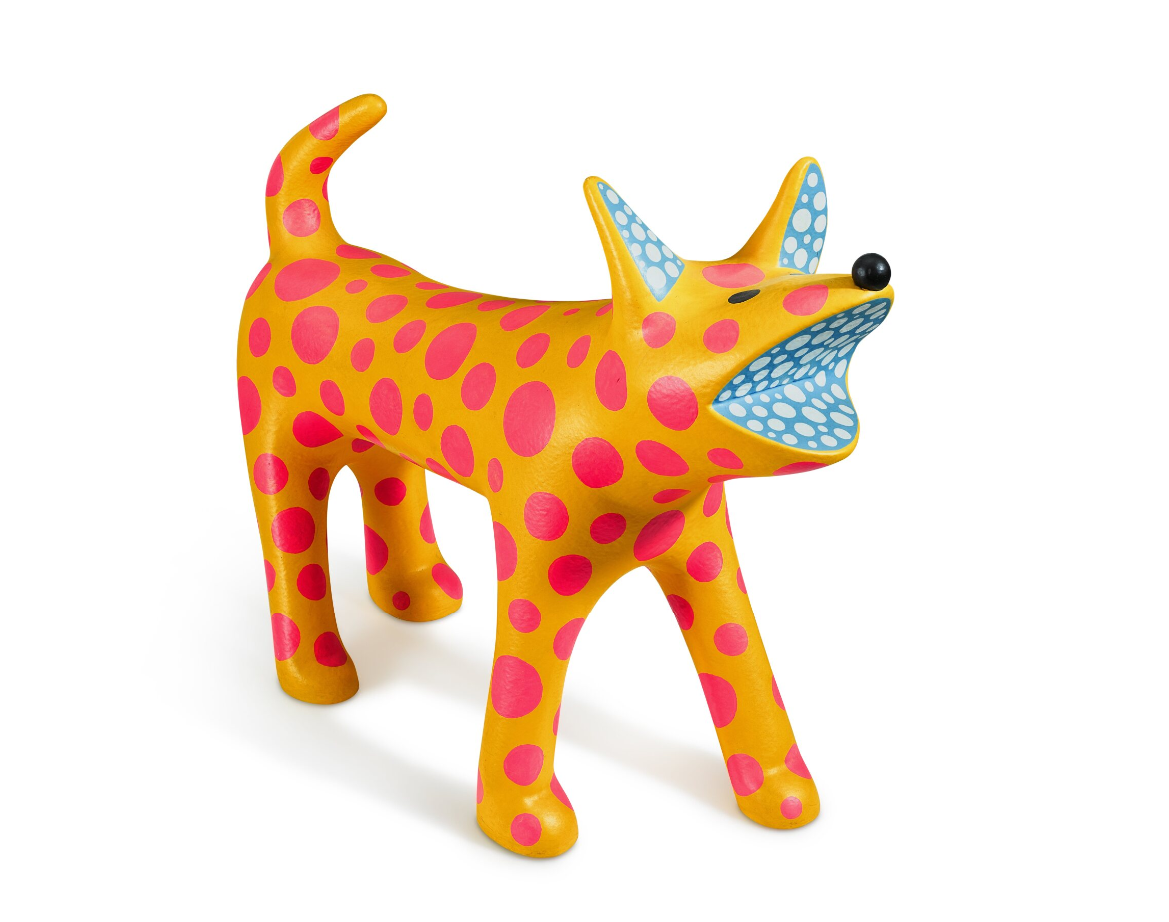
YAYOI KUSAMA (b. 1929)
Chin, 2004
Mixed media
71x94x38 cm (28x47x15 inches)
Signed and dated 2004
Celebrated for her unique aesthetic of ubiquitous polka dots, Kusama’s adaptation of the motif permeates her prolific oeuvre, ranging from drawings and prints to sizable paintings and sculptural endeavors. Chin (2004), is one of a series of dog sculptures adorned with Kusama’s iconic dots that she began producing in the early 2000s. Other examples from this series with various color combinations have been featured in the acclaimed exhibition A Dream I Dreamed which travelled through Korea, China and Taiwan. This sculptural corpus emanates an intimate sentiment whereby each dog has been named individually. Exuding a sense of tender fondness and love, Chin provides a cheerful counterpart to the more domineering plant and flower sculptures that have formed the majority of Kusama’s monumental outdoors works. Endowed with a sense of liveliness and gaiety, the tilted head and brightening smile of the dotted open-mouthed dog radiates exuberance, addressing and welcoming attention from viewers with an invigorating spirit. Exhibited as part of the installation “Hi, Konnichiwa!”? at the KUSAMATRIX exhibition at the Mori Museum, Tokyo, in 2004, Chin is a virtuosic and resplendent example of the artist’s iconic dot-covered motif imagined in sculptural form.
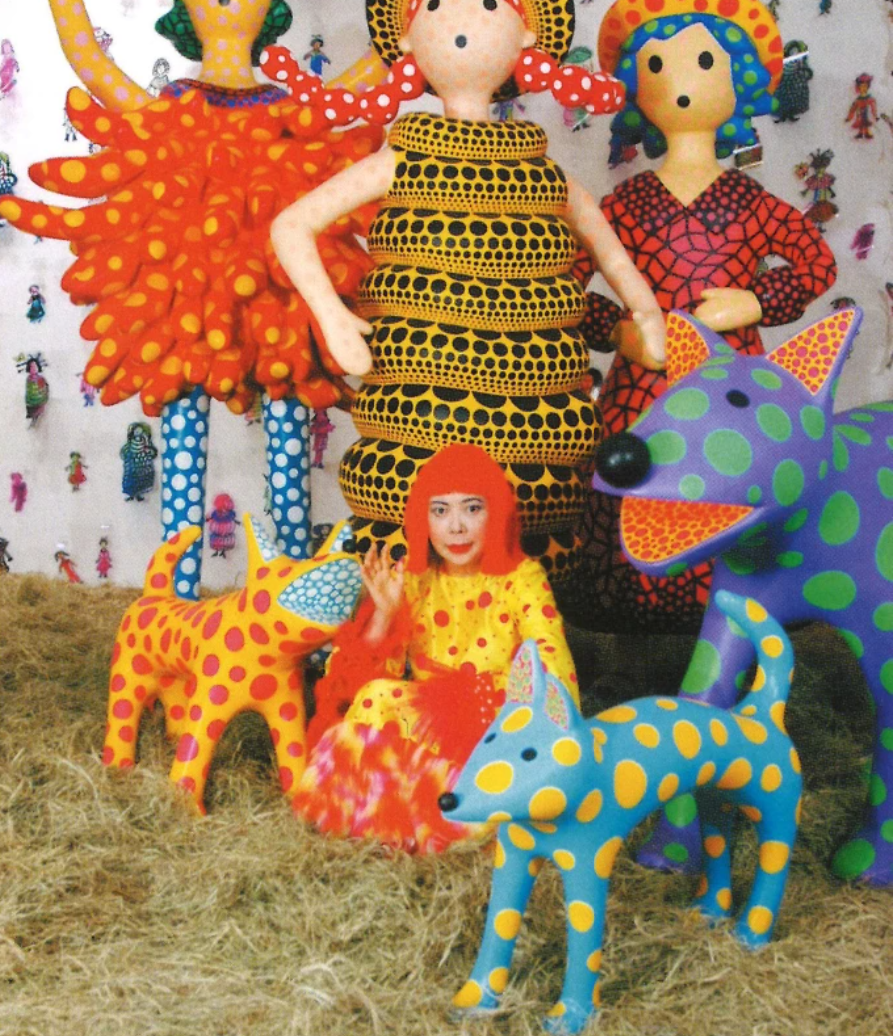
Animals are abundant in Japanese art history, demonstrating the significance of both real and mythical creatures in Japanese culture. Underpinned by Japan’s unique spiritual heritage of Shintō and Buddhism, the Japanese reverence for nature—and the place of animals within that realm—is expressed in sculpture, painting, lacquer-work, ceramics, metalwork, cloisonné, and woodblock prints. Naturalistic imagery and the relationship between humans and the natural world is a foundational source of inspiration for the artist, with motifs featuring plant and animal imagery appearing throughout her oeuvre, from polka-dotted pumpkins to larger-than-life flower sculptures. This observation of nature continued into her formal training in nihonga, the traditional style of Japanese painting that privileges drawing from life and the use of natural, mineral pigments. Marrying her own distinctive visual language rich in natural imagery with the familiar figure of the dog in the present work produces an effect that is at once heart-warming and instantly arresting as an example of Kusama’s indelible pop-aesthetics. Widely considered the most important artist to have emerged from Japan in the post-war period, Kusama has endured among the most emblematic and iconic artists of the last century and beyond. This year her work is being exhibited at Hong Kong’s M+ Museum in the artist’s largest retrospective in Asia outside of Japan, a testament to her enduring legacy as one of the greatest contemporary artists working today.
High Heels for Going to Heaven, 2013
Christie’s New-York: 12 May 2023
Estimated: USD 400,000 – 600,000
USD 882,000
YAYOI KUSAMA (B. 1929), High Heels for Going to Heaven | Christie’s (christies.com)
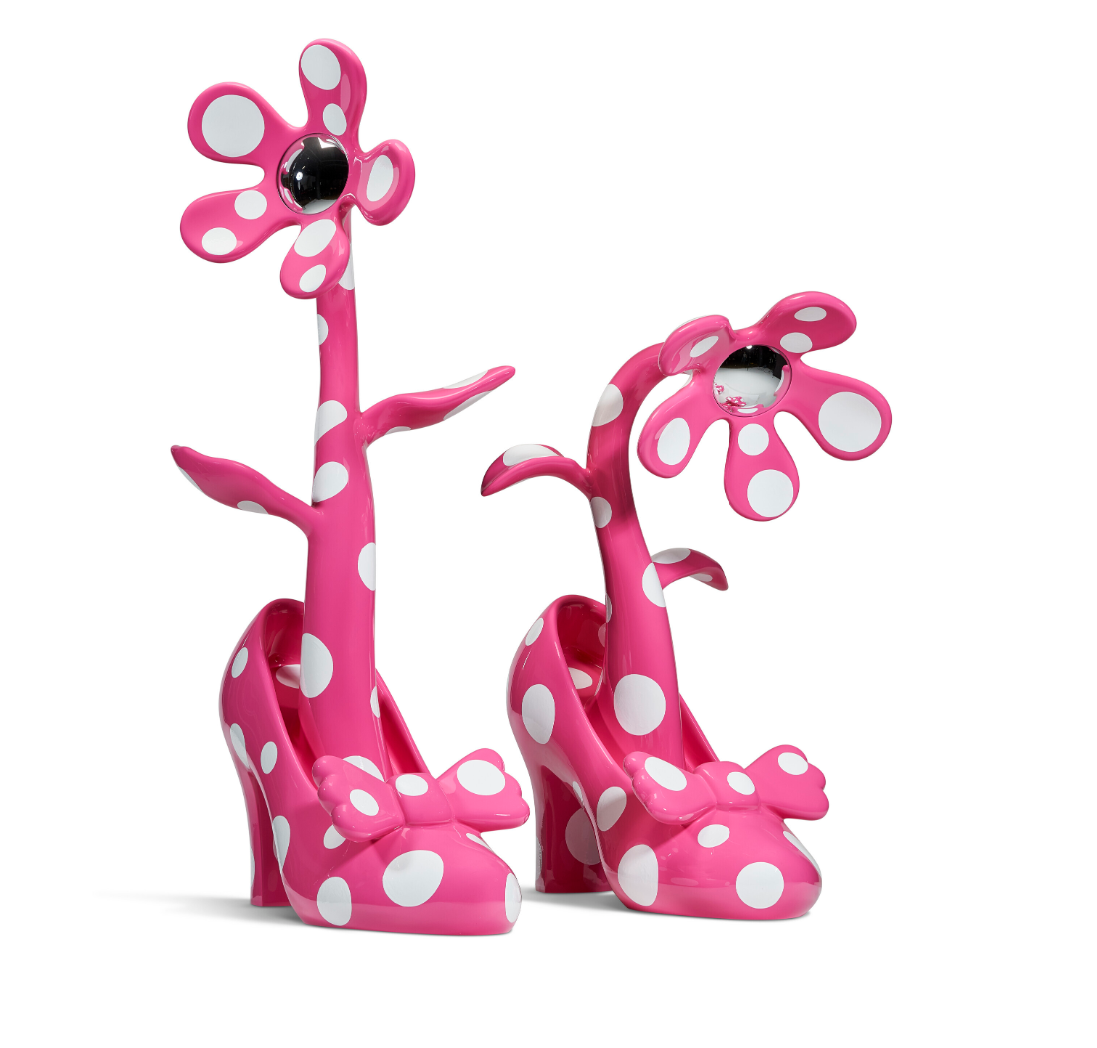
YAYOI KUSAMA (B. 1929)
High Heels for Going to Heaven, 2013
Urethane paint on FRP and stainless steel, in two parts
Left shoe: 47 1/4 x 25 1/8 x 38 1/2 inches (120 x 63.8 x 97.8 cm)
Right shoe: 67 x 26 3/8 x 37 3/8 inches (170.2 x 67 x 94.9 cm)
Signed and dated ‘YAYOI KUSAMA 2013’ (on the left shoe)
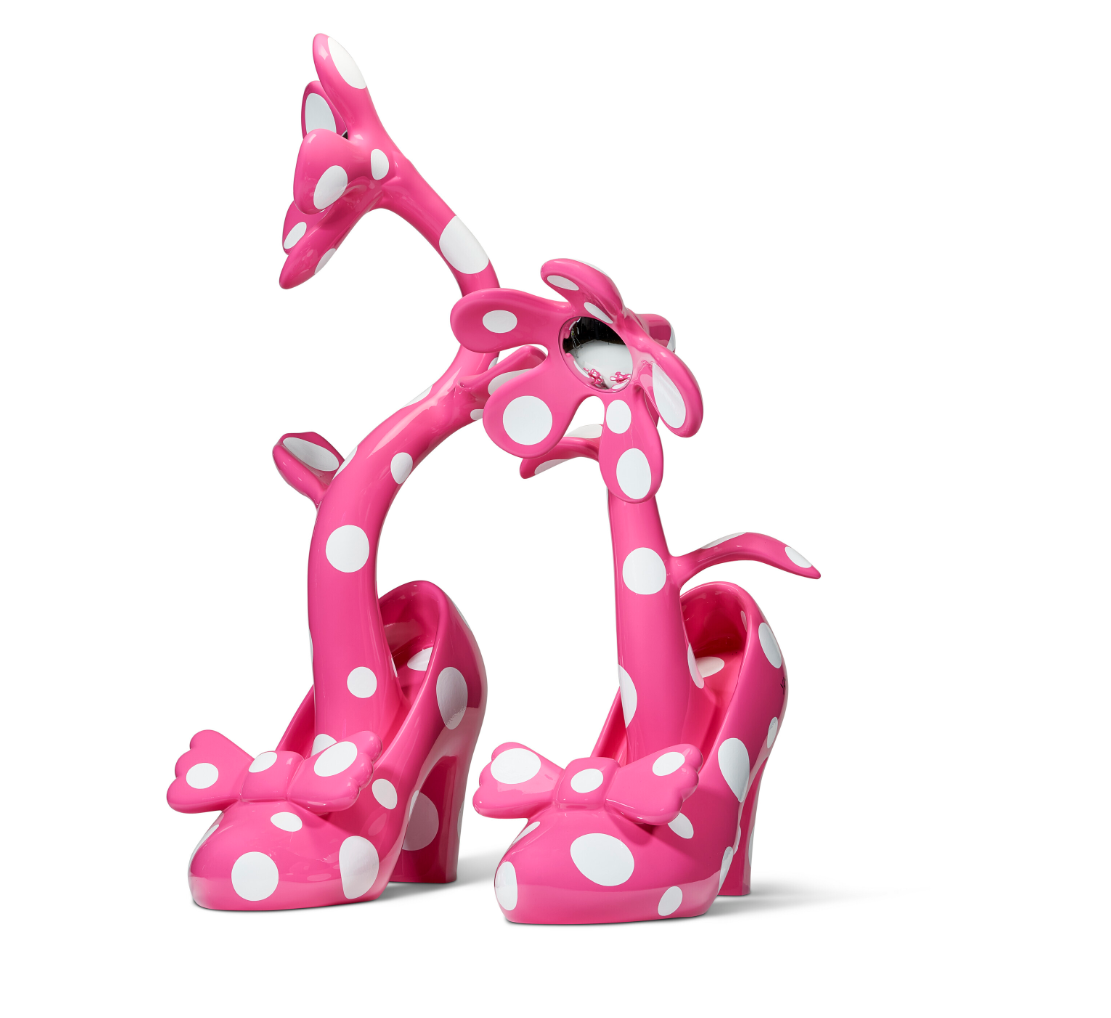
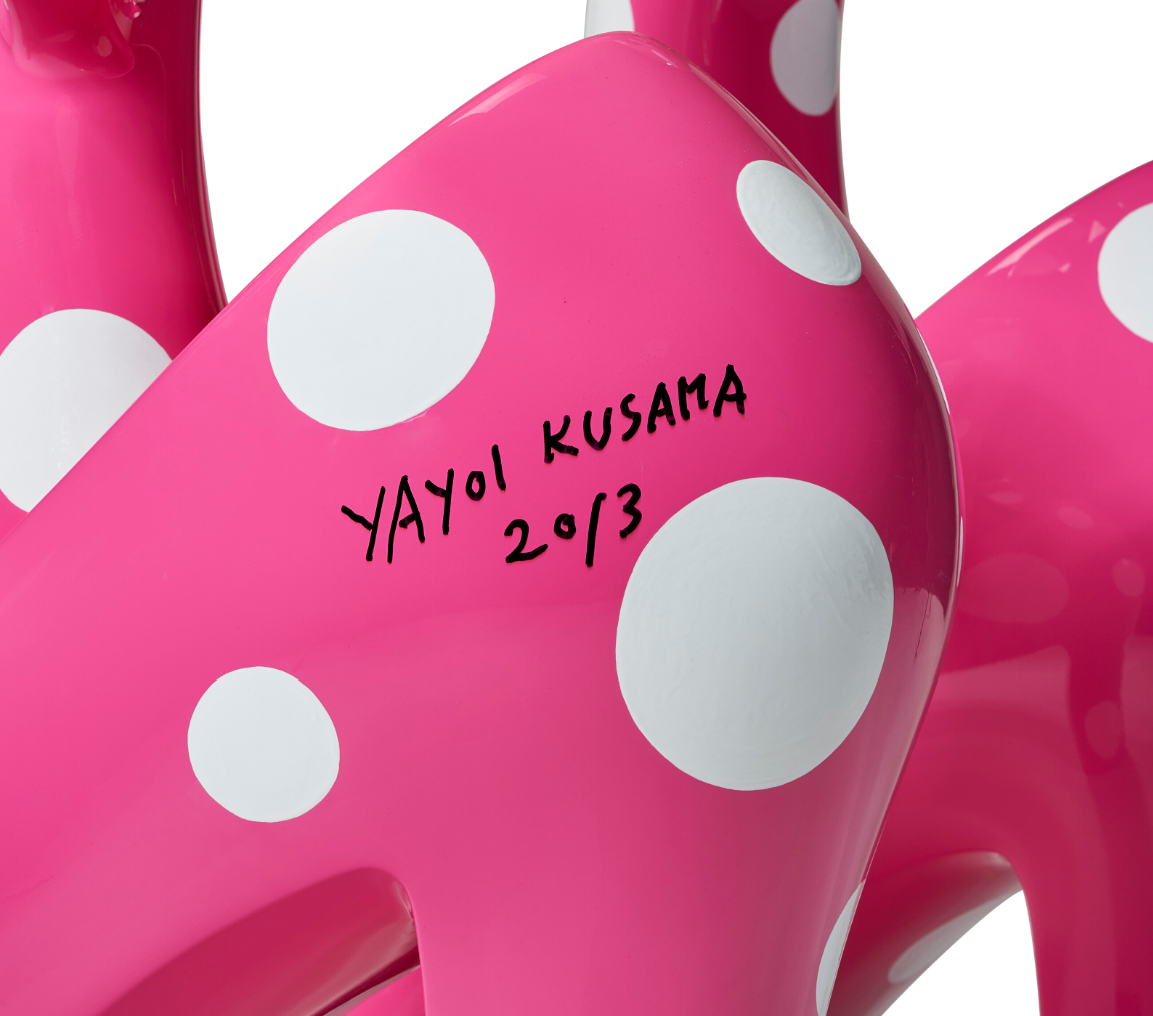
Sculpture Boxes / Dots / Spots
DOTS Accumulation, (ABC), 1999
Christie’s London: 10 October 2024
Estimated: GBP 120,000 – 180,000
GBP 151,200 / USD 198,072
YAYOI KUSAMA (B. 1929), DOTS Accumulation, (ABC) | Christie’s (christies.com)
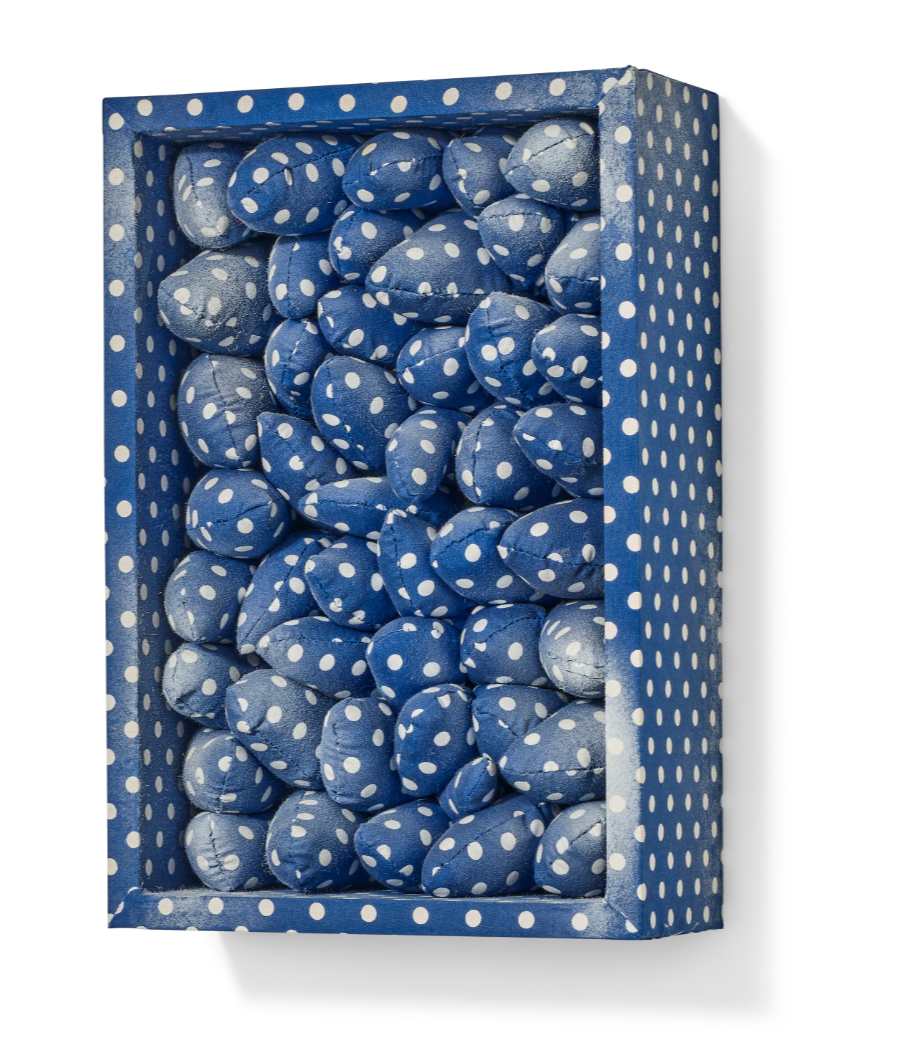
YAYOI KUSAMA (B. 1929)
DOTS Accumulation, (ABC), 1999
Sewn, stuffed fabric and spray paint in fabric-lined wooden box
31.3 x 21.1 x 9.7 cm (12 3/8 x 8 1/4 x 3 7/8 inches)
Signed, titled, titled in Japanese and dated ‘YAYOI KUSAMA 1999 (DOTS) (ABC)’ (on the underside)
Fusing the bright colors and alluring surfaces of Pop art with an evocation of the infinite, DOTS Accumulation, (ABC) (1999) is instantly recognizable as the work of the iconic Japanese artist Yayoi Kusama. It comprises a wooden box lined with fabric, filled with ovoid protrusions of stuffed fabric. It is compact as an ex-voto, and hung on the wall like an offering. Every visible surface is blue and covered in white polka-dots; a mist of white spray-paint accentuates its dimensional relief. Kusama is concerned with accumulations of repeated marks and forms, a practice inspired by the hallucinations she has experienced since childhood. In her sculptural ‘accumulations’, initiated in 1962, tuberous biomorphic forms proliferate over objects in a similarly psychedelic manner.
Polka dots are the symbol of the spiritual peace and love, and the starting point of all of hopes and thoughts. While there is Dots, there is Kusama”
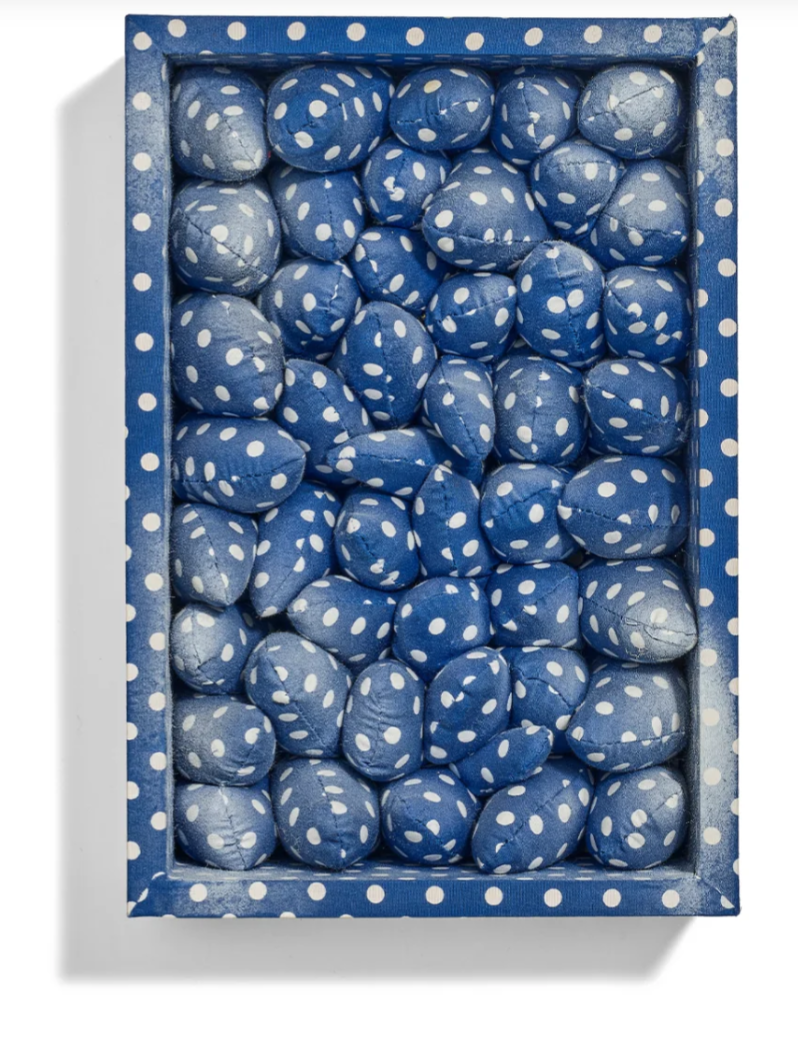
Polka-dots have been Kusama’s signature since the 1950s. She has since covered all manner of surfaces—canvases and paper, floors and walls, sculptures, chairs, household objects, and even naked human bodies—in its endless pattern. For Kusama, the dot is a rich, multi-faceted symbol. ‘A polka-dot,’ the artist says, ‘has the form of the sun, which is a symbol of the energy of the whole world and our living life, and also the form of the moon, which is calm. Round, soft, colourful, senseless and unknowing. Polka-dots become movement’ (Y. Kusama, Manhattan Suicide Addict, 1978, Tokyo, p. 124). DOTS Accumulation, (ABC) is a concentrated dose of Kusama’s cosmic practice.
Red Spots, 1965
Bonhams New-York: 15 May 2024
Estimated: USD 1,500,000 – 2,500,000
USD 1,512,500
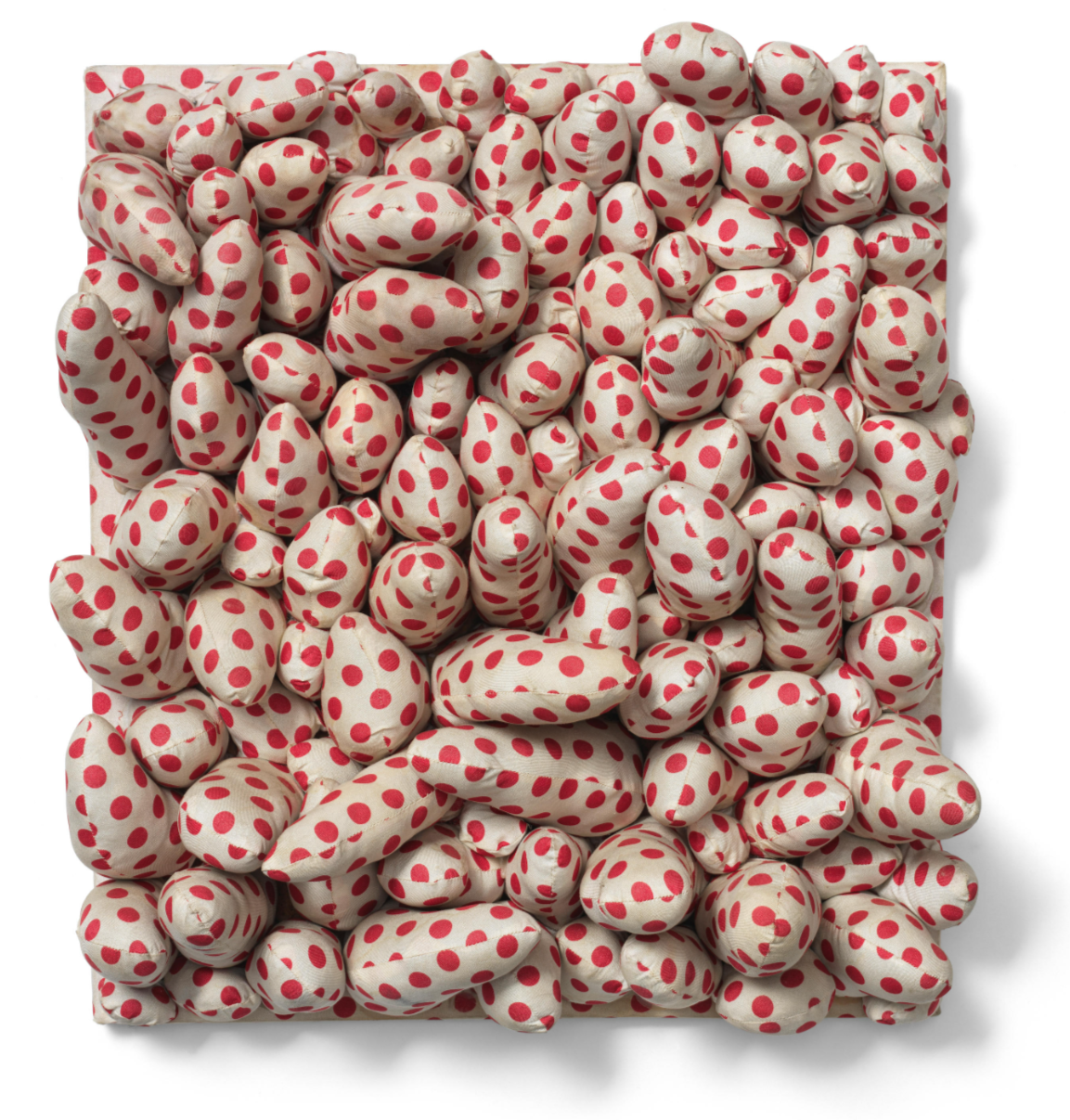
Stuffed cotton and kapok on wood
50.6 x 45.5 x 15.2 cm (20x18x6 inches)
Signed, inscribed and dated ‘Red Spots KUSAMA 1965’ (on the reverse)
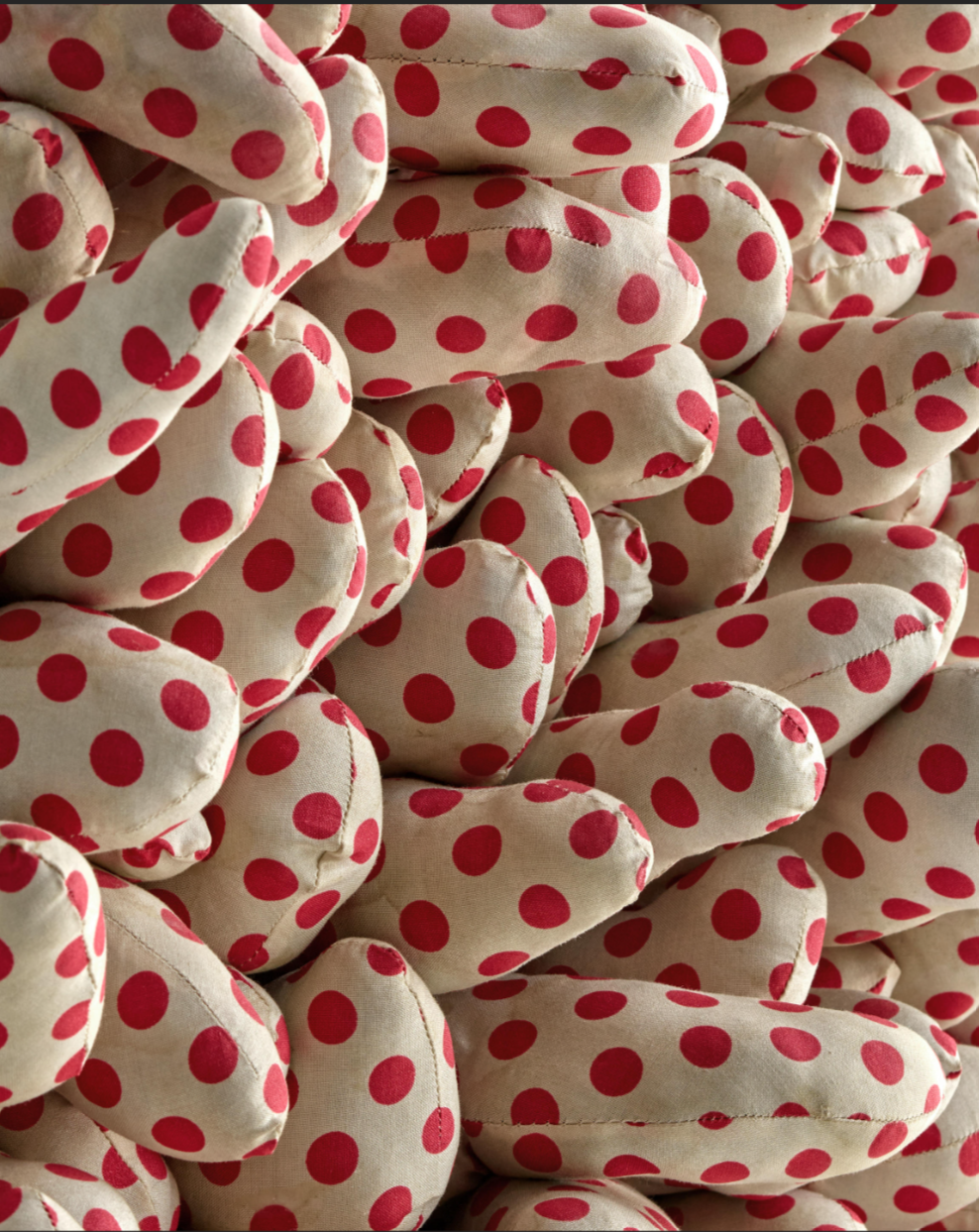
A harmony of forms in her signature red and white palette, Red Spots boasts the iconic polka dot motif that is synonymous with Kusama; it is a rare example of her soft sculpture and one of the few wall-based works she produced during her time in the Netherlands. It reveals Kusama’s remarkable ability to imbue the seemingly ordinary with a symbolism and raw psychology that makes it rousing to behold. Reflecting the artist’s radical sexual ‘Happenings’ – staging theatrical orgies in the MoMA Sculpture Garden and famously inviting Richard Nixon to ‘finally discover the naked truth’ of peace in 1968 – the present work undeniably, wittily nods to Kusama’s broader practice and persona. Initiated in 1962, her soft sculpture works debuted at the prestigious Green Gallery in New York that same year, alongside pieces by artists such as Claes Oldenburg, Robert Morris, and Andy Warhol. This pivotal exploration culminated in the groundbreaking installation, Phalli’s Field in 1965. Within this immersive environment, Kusama’s investigation into her signature form reached its peak, evolving from her earlier experimentation with the infinity net motif throughout the late 1950s and early 1960s.
Grapes, 1981
Christie’s New-York: 18 May 2023
Estimated: USD 150,000 – 200,000
USD 113,400
YAYOI KUSAMA (B. 1929), Grapes | Christie’s (christies.com)
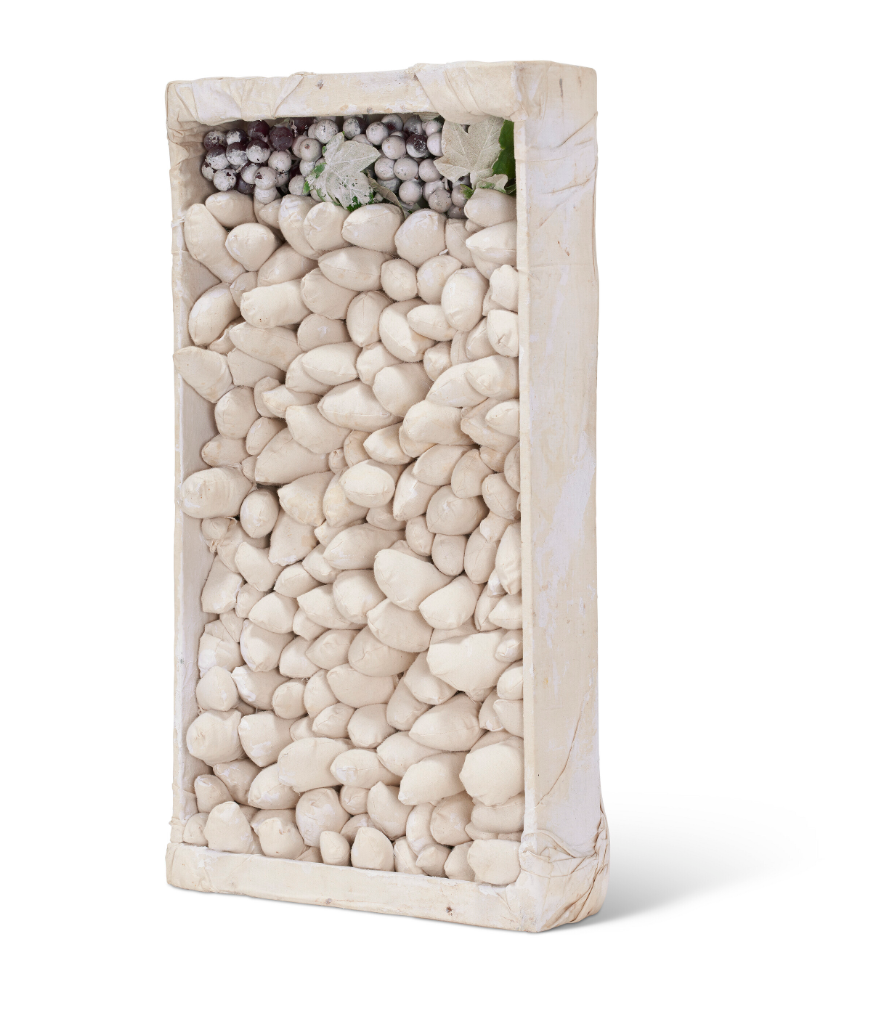
YAYOI KUSAMA (B. 1929)
Grapes, 1981
Wood box construction-sewn, stuffed fabric, canvas, plastic, oil and spray paint
59.7 x 31.8 x 10.8 cm (23 1/2 x 12 1/2 x 4 1/4 inches)
Signed, titled and dated ‘Yayoi Kusama 1981 GRAPES’ (on the underside)
Dated again ‘1981’ (on the reverse)
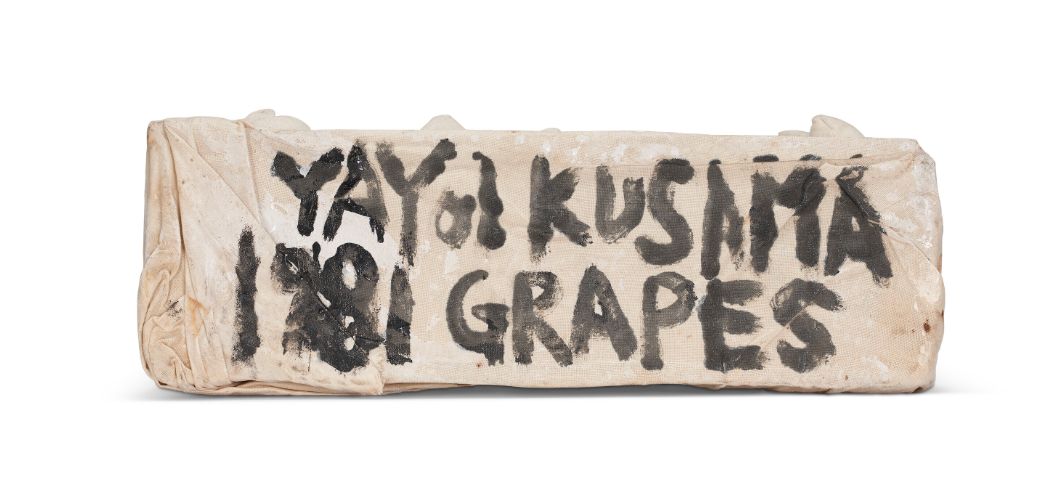
Polka Dot Accumulation, 1999
Sotheby’s New-York: 19 May 2023
Estimated: USD 150,000 – 200,000
USD 228,600
Polka Dot Accumulation | Contemporary Day Auction | 2023 | Sotheby’s (sothebys.com)
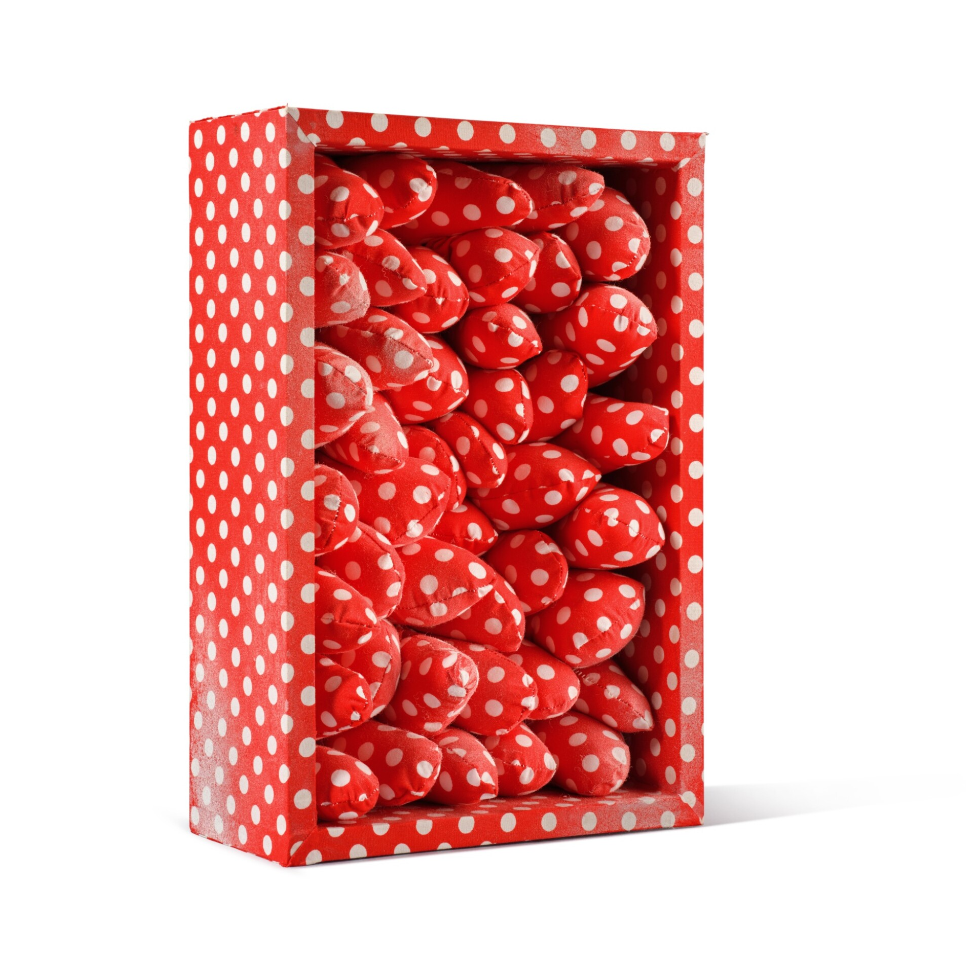
YAYOI KUSAMA (b. 1929)
Polka Dot Accumulation, 1999
Sewn, stuffed fabric and spray paint in fabric-lined wooden box
31.8 x 21.6 x 9.5 cm (12 1/2 x 8 1/2 x 3 3/4 inches)
Signed, titled in Japanese, partially titled DOTS and dated 1999 (on fabric affixed to the underside)
“Polka dots are the symbol of the spiritual peace and love, and the starting point of all of [my] hopes and thoughts. While there is Dots, there is Kusama.”
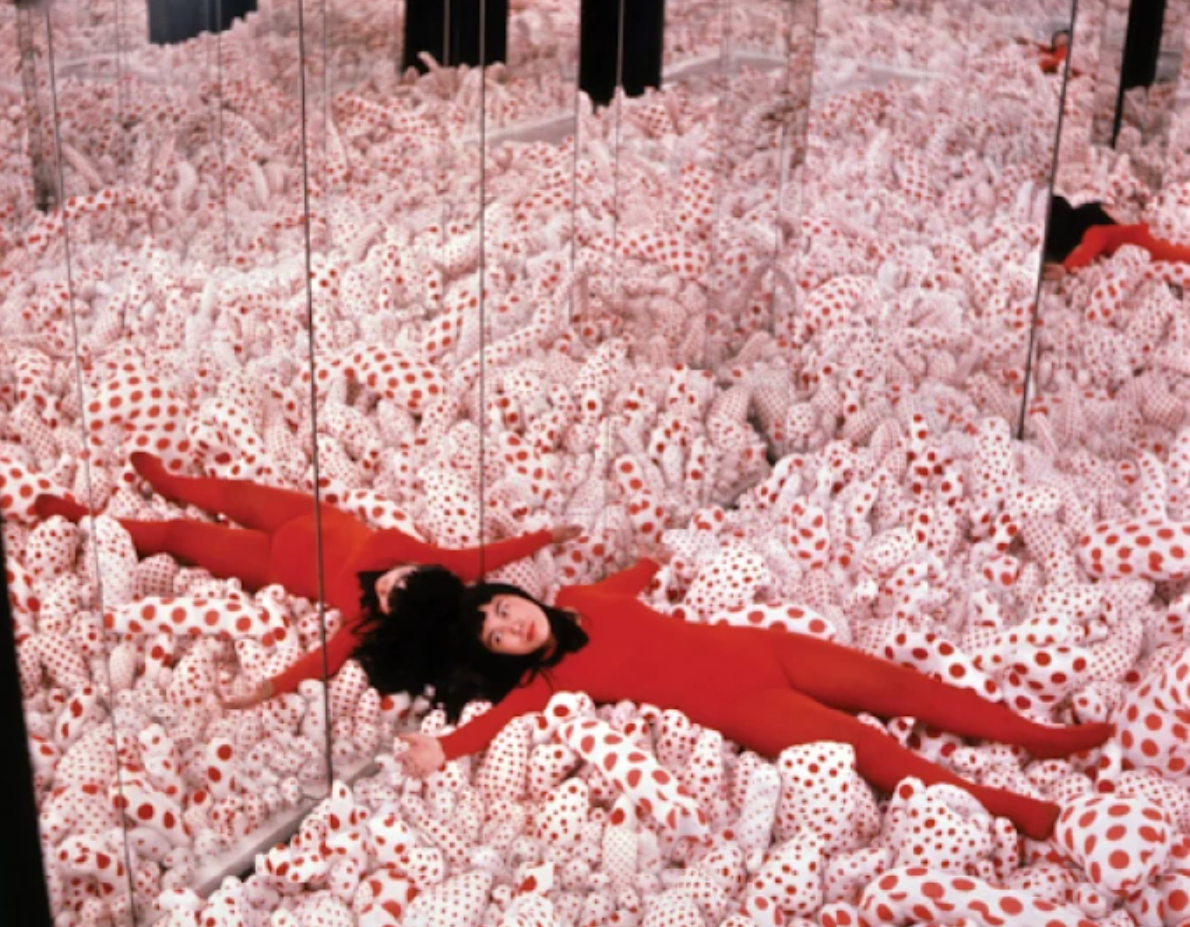
YAYOI KUSAMA WITH HER INFINITY MIRROR ROOM—PHALLI’S FIELD, 1965, AT CASTELLANE GALLERY, NEW YORK.
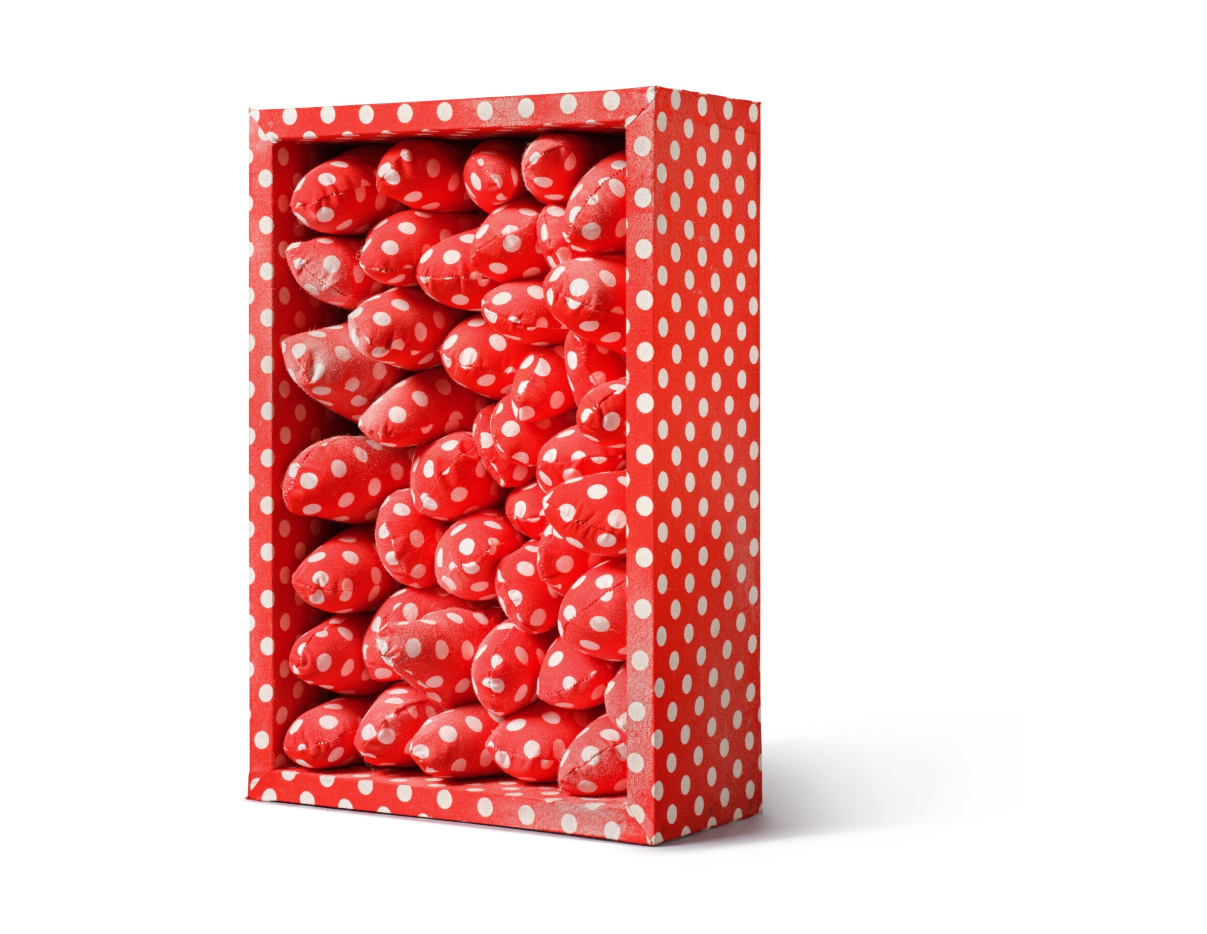
Blue Spots, 1965
Phillips New-York: 17 May 2023
Estimated: USD 2,500,000 – 3,500,000
USD 3,206,000
Yayoi Kusama – 20th Century & Contemporar… Lot 8 May 2023 | Phillips
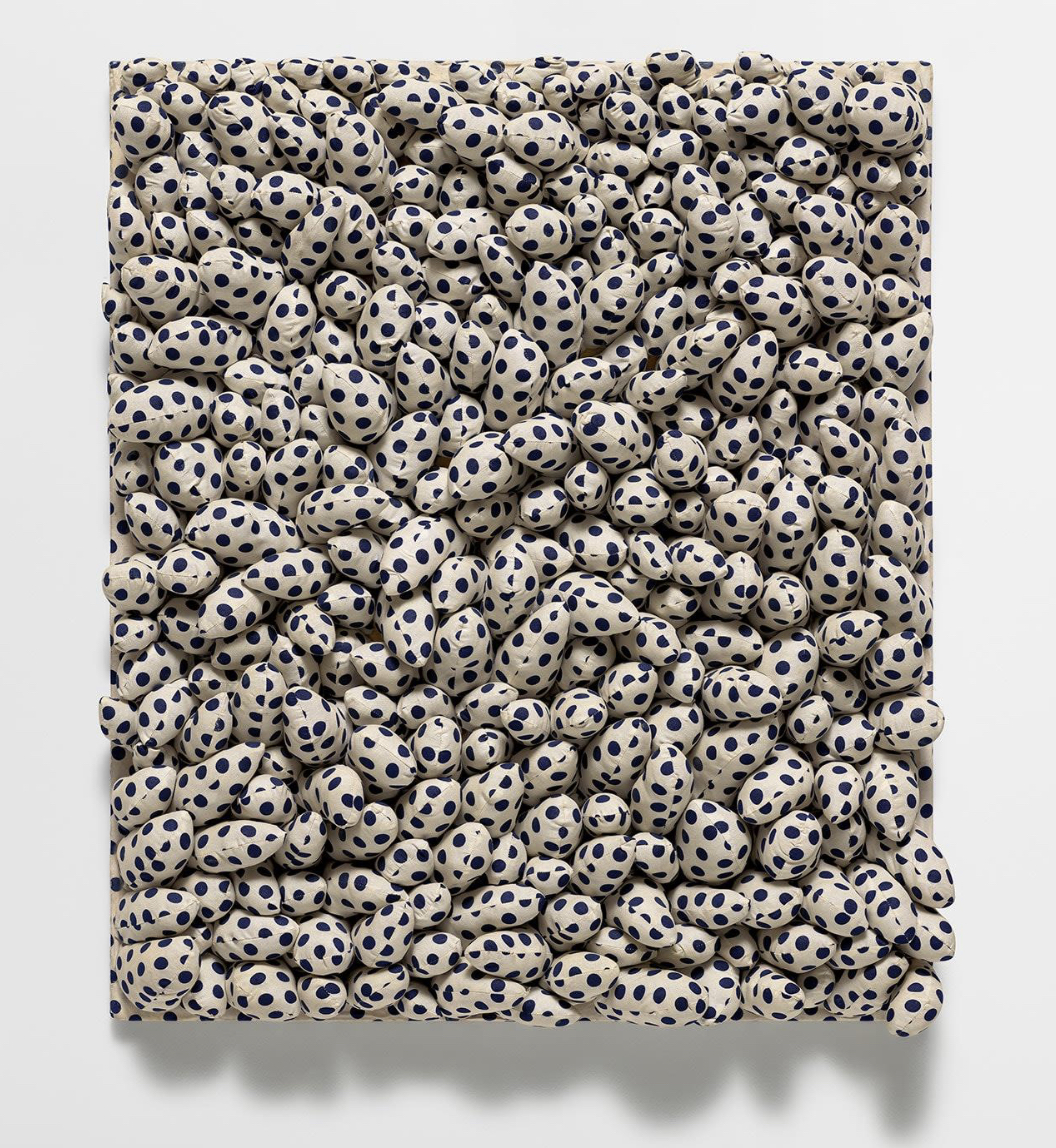
YAYOI KUSAMA
Blue Spots, 1965
Stuffed cotton and kapok on wood
80 x 68.3 x 10.2 cm (31 1/2 x 26 7/8 x 4 inches)
Signed, titled and dated “BLUE SPOTS KUSAMA 1965” on the reverse
Red Stripes and Blue Spots are some of Kusama’s earliest extant soft sculptures, and their tuberous motif anticipates her very first mirrored infinity room, Phalli’s Field, executed the same year as these two works. Recognizable worldwide, Red Stripes and Blue Spots are absolutely iconic early works by an international superstar.
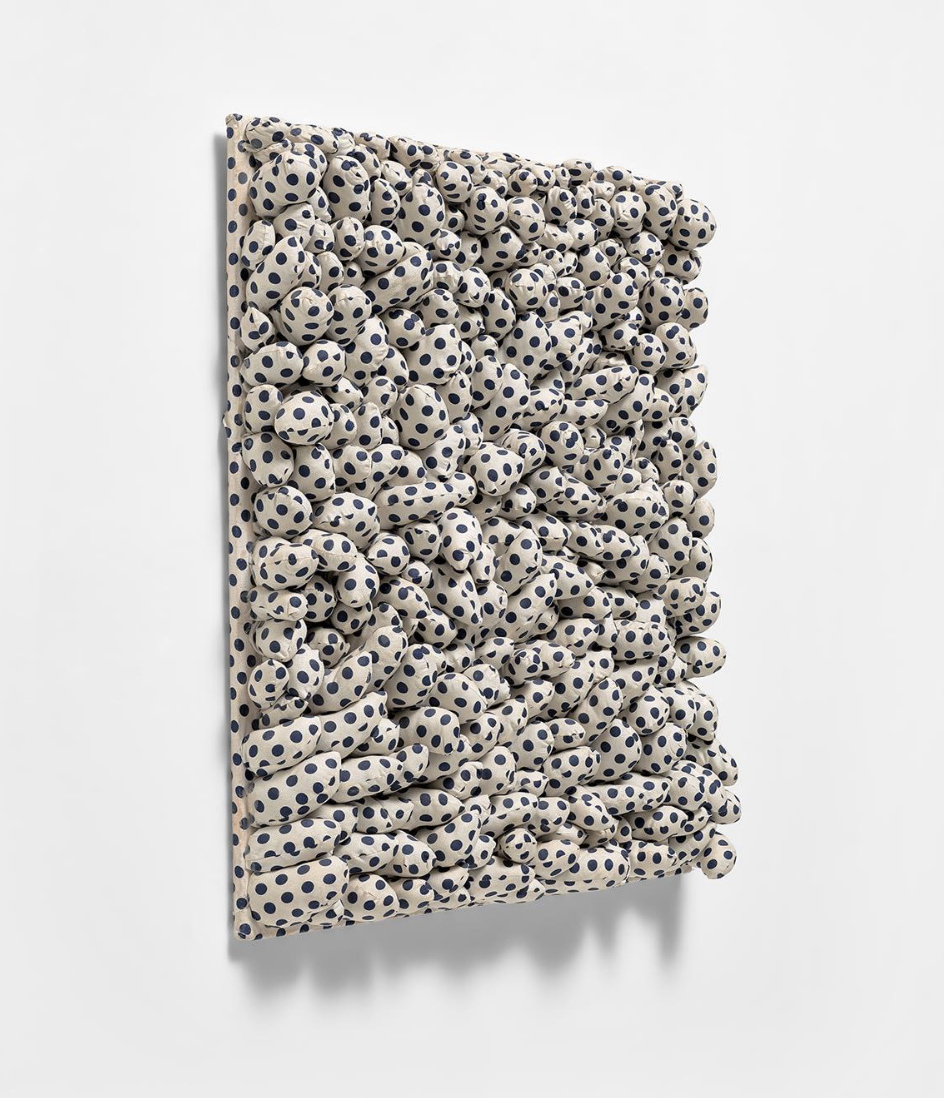
Red Stripes and Blue Spots have always toured as a set, from their earliest exhibition in 1968, up to their most recent turn in a Yayoi Kusama retrospective in Berlin and Tel Aviv last year. The pair have been part of many major Kusama exhibitions, including the blockbuster retrospective tours, Love Forever: Yayoi Kusama, 1958-1968, 1998-1999, and Yayoi Kusama: Infinity Mirrors, 2017-2019, which combined saw millions of visitors. Red Stripes and Blue Spots are iconic early Kusama works, recognizable worldwide, and they are an integral part of Kusama’s story as an artist.
Red Stripes, 1965
Phillips New-York: 17 May 2023
Estimated: USD 2,500,000 – 3,500,000
USD 2,722,000
Yayoi Kusama – 20th Century & Contemporar… Lot 7 May 2023 | Phillips
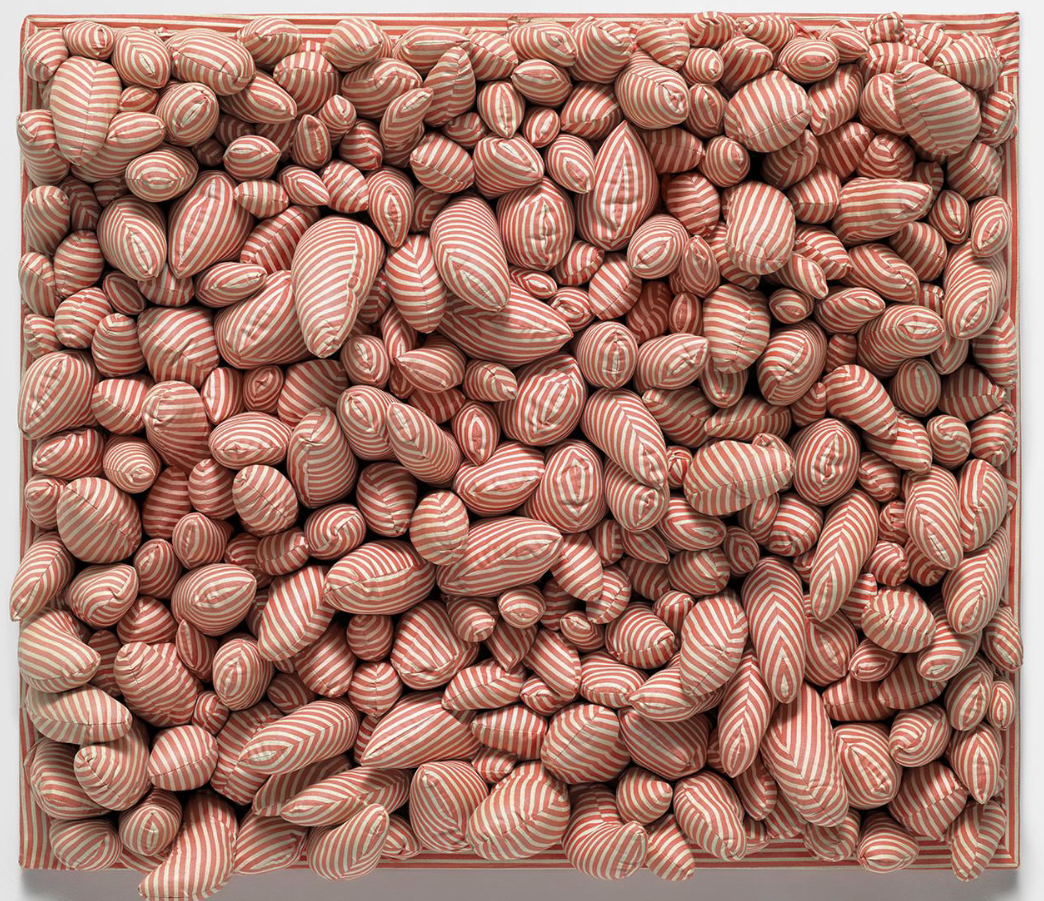
YAYOI KUSAMA
Red Stripes, 1965
Stuffed cotton and kapok on wood
67.9 x 79.1 x 16.5 cm (26 3/4 x 31 1/8 x 6 1/2 inches)
Signed, titled and dated “RED STRIPES KUSAMA 1965” on the reverse
Red Stripes and Blue Spots are some of the earliest extant examples of the artist’s soft-sculpture motif of tuberous forms that smother the surface, which she began exploring in 1962, and brought to infinite expression in her first mirrored infinity room, Phalli’s Field, 1965. Red Stripes and Blue Spots concentrate Phalli’s Field onto squared boards; hung on the wall like paintings, the soft, cloth-covered striped and spotted forms reach out towards the viewer. Red Stripes brings together perhaps her most iconic color combination of red and white, as seen in the contemporary Phalli’s Field, while Blue Spots provides an early example of the polka dots which would come to define Kusama’s career.
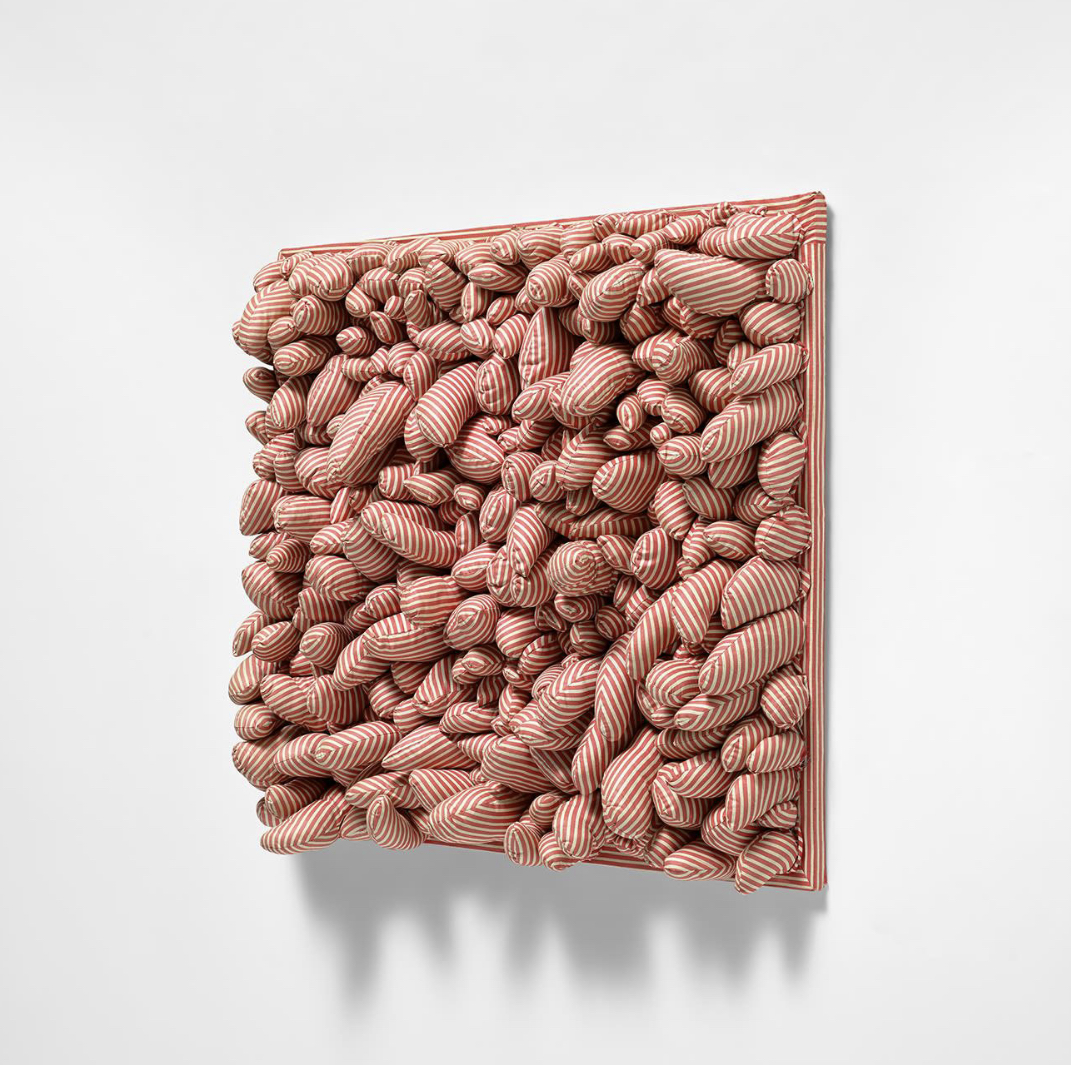
While some critics demur, and describe the shapes of Red Stripes and Blue Spots as resembling coral or sausages, the artist herself has explicitly stated their phallic referent. She explained that the work “thickly covered in phalluses was my psychosomatic work done when I had a fear of sexual vision.” Just as her use of dots and nets allows her to obliterate anxiety through repetition, so sewing endless phalluses enabled the artist to overwhelm her fear. In her autobiography, Kusama wrote that the process “turns the frightening thing into something funny, something amusing. I’m able to revel in my illness in the dazzling light of day.” The knowing, brave expansion of fear and anxiety into a repetitive, obliterative surface, as in Red Stripes and Blue Spots, is a hallmark of Kusama’s practice.
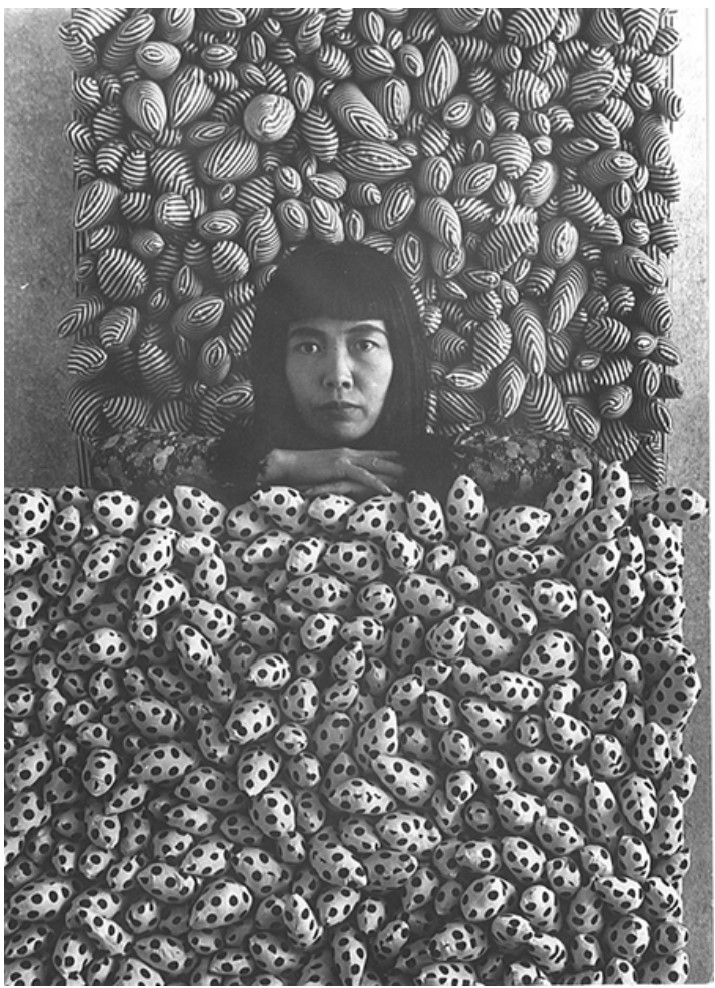
Kusama with Red Stripes and Blue Spots, 1965. Image: Marianne Dommisse / 0-INSTITUTE, Artwork: © YAYOI KUSAMA
Agnes and Frits Becht were not afraid of the avant-garde. The sole couple among their friends in the 1960s to collect work by an up-and-coming Japanese artist, Yayoi Kusama, the Dutch pair traveled to attend contemporary art events around Europe, from the Venice Biennale to conceptual gallery shows, including one of Kusama’s legendary naked Happenings, at the Birds Club in Amsterdam, in 1967. With a collection concentrated around Nouveau Réalisme, Pop Art, and Italian Conceptual Minimalism, the Bechts treasured personal relationships with the artists they collected, including Lucio Fontana, Jan Dibbets, and Kusama. As their granddaughter, Eline Becht, wrote in the curatorial note to accompany the exhibition, Personal Reflection: Works and Stories from the Agnes and Frits Becht Collection, The Parts Project, The Hague, 2022, Agnes and Frits took “a special approach to collecting, close to patronage, where the collector wishes to financially support the artist whilst giving them creative freedom and trusting their process. The two works have remained in the family collection ever since, an exceptional provenance for works by this artist, and they have featured in five major international Kusama retrospectives, among other exhibitions.
Repetition, 1998
Phillips Hong-Kong: 30 November 2021
Estimated: HKD 15,000,000 – 20,000,000
HKD 19,005,000 / USD 2,437,507
Yayoi Kusama – 20th Century & Conte… Lot 19 November 2021 | Phillips
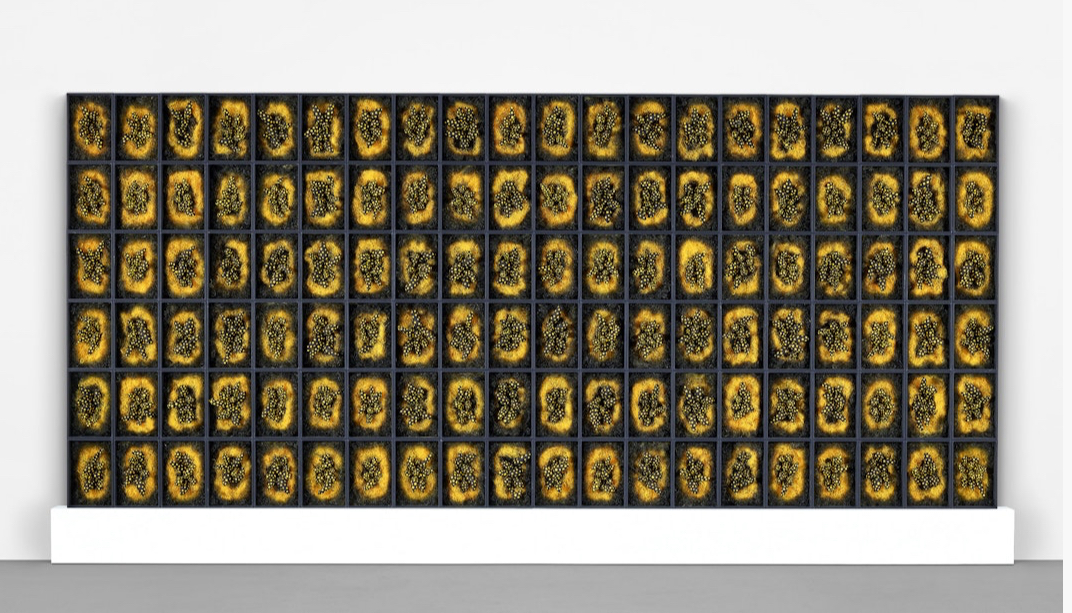
YAYOI KUSAMA
Repetition, 1998
Sewn stuffed fabric, wood and paint, in 120 parts
Each: 38 x 25.6 x 15 cm
Overall: 228x512x15 cm
Each signed, titled and dated ‘YAYOI KUSAMA 1998 “REPETITION”‘ on the underside
Created in 1998, Repetition is a rare, significant work from Kusama’s oeuvre, boasting a sophisticated combination of key motifs for which she is best known. Stemming from a smaller series whereby Kusama contains her iconic soft sculpture protrusions within wooden boxes, Repetition is one of only three exceptional examples that feature 120 individually crafted and signed components. Indicative of the present work’s historic importance, another 120-piece work, Stamens in the Sun, is now housed in the permanent collection of the Museum of Modern Art in Toyama, Japan. Other smaller works from Kusama’s box series can also be found in the collections of museums including the Niigata City Art Museum and the Matsumoto City Museum of Art. Fresh to the secondary market, Repetition was first shown at the at the Robert Miller Gallery in New York the year it was created, before being honored with presentation at the Bass Museum of Art in Miami in 2003, and the Moore Building in Miami in 2018.
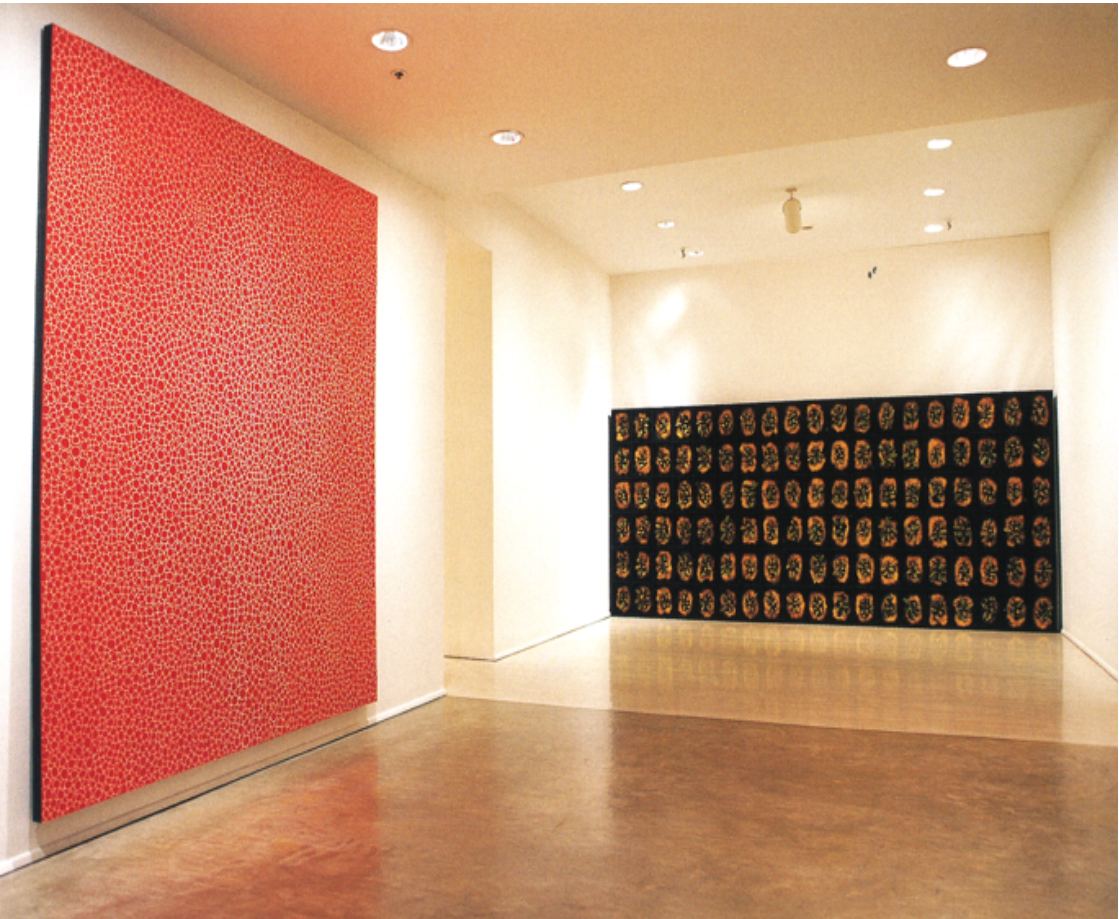
The present work exhibited at New York, Robert Miller Gallery, Yayoi Kusama: Now, 11 June – 7 August 1998
Simultaneously monumental and intimate in its execution, Repetition comprises of 120 boxes, each of which houses biomorphic polka-dotted protrusions that blossom out from their golden-orange and black, bristly nests. The pillowy phallic forms nod to Kusama’s hand-sewn Accumulations initiated in 1962, a playful yet menacing body of works created to ‘heal [her] feeling and disgust towards sex’. Contrasting these earlier compositions of all-over profusions, however, the familiar repetitive pattern of snake-like tubular shapes no longer connotes anger in Repetition, but rather abundant growth. Packed together in configurations that appear as flowerpots, incubators or cradles, their nestling organic forms further resemble embryos, stamens, or sprouting buds, thereby alluding to the potential for flourishing life, new beginnings, and unknown potential.
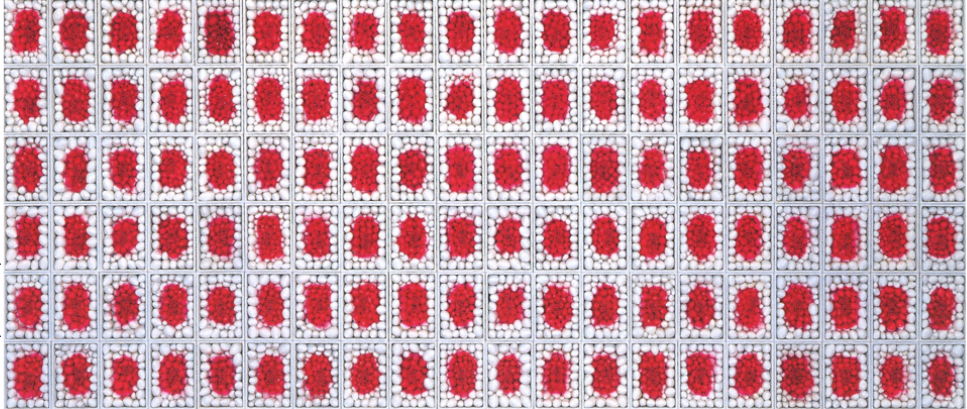
Stamens in the Sun, 1989 / Collection of The Museum of Modern Art, Toyama
And as our visual perception shifts from a microscopic vision of each cell-like component to a macroscopic view of an expanding universe, this melding of the physical and spiritual engulfs the viewer into a hypnotically meditative experience that stimulates introspection and transcendence.
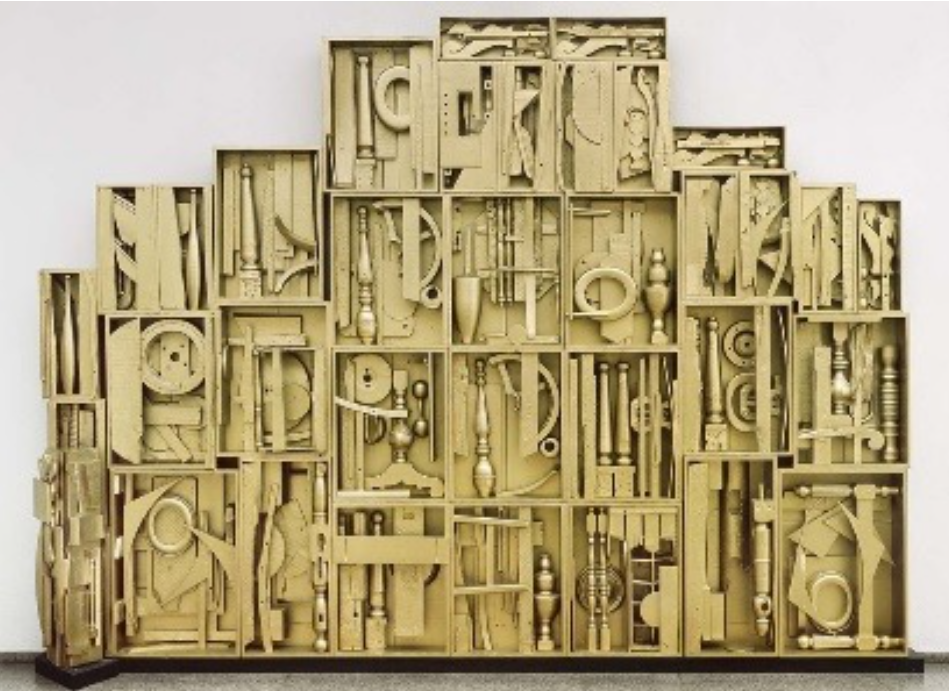
Louise Nevelson, Royal Tide IV, 1959-1960, Collection of the Museum Ludwig, Cologne
© 2021 Estate of Louise Nevelson / Artists Rights Society (ARS), New York
The gridded, sculptural format of the present work harkens back to Kusama’s egg-carton paintings of 1962, an example of which is now housed in the permanent collection of the Blanton Museum of Art in Texas. Formed of recycled material Kusama collected in a manner she likens to eminent American artist Louise Nevelson, who was known to scavenge the streets in search of wood, the series marked one of Kusama’s earliest experimentations into three-dimensionality. In fact, an interesting dialogue also occurs between Repetition and Nevelson’s monumental stacked wooden boxes holding abstract shapes. But whereas each box of Nevelson’s is characterized by variation, exalting the discarded aspects of bustling city life, Kusama’s artwork mirrors the quiet repetition that went into its making as she harnesses the manmade to quantify the abstract concept of infinity.
Contrasting her earlier box constructions of solitary pieces that can be understood as formed in response to her more contained, smaller studio environment, by the mid-1980s Kusama had re-established her studio practice with explosive creativity. Perhaps inspired by aspects of contemporary art in Japan and its embrace of spectacle, the scale of her multi-part installations grew in parallel to her confidence and restored ambition.
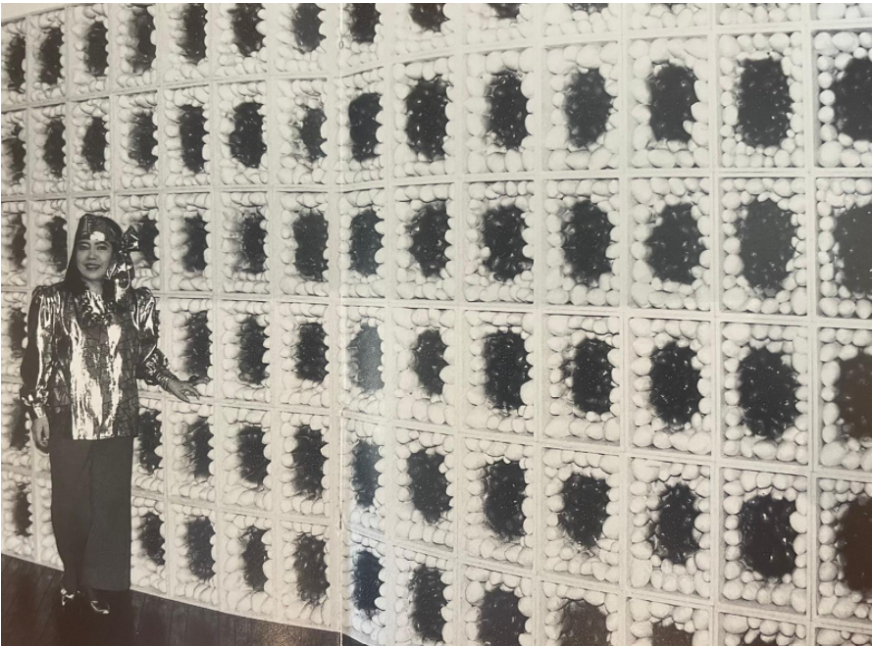
Yayoi Kusama at her solo exhibition at Fuji Television Gallery, Tokyo, 1991 ©YAYOI KUSAMA
Executed in 1998, the same year as her major landmark retrospective Love Forever: Yayoi Kusama, 1958-1969 which toured the USA and Japan, Repetition exemplifies this area of Kusama’s legendary oeuvre at its very best. In its simultaneously epic and personal scale, it is a masterpiece that challenges the possibilities of artistic expression, Illustrating in its maturity the remarkable evolution of Kusama’s authoritative visual world.
Infinity Rooms
My Heart is Flying to the Universe, 2018
Sotheby’s Hong-Kong: 5 April 2023
Estimated: HKD 20,000,000 – 30,000,000
HKD 25,860,000 / USD 3,294,309
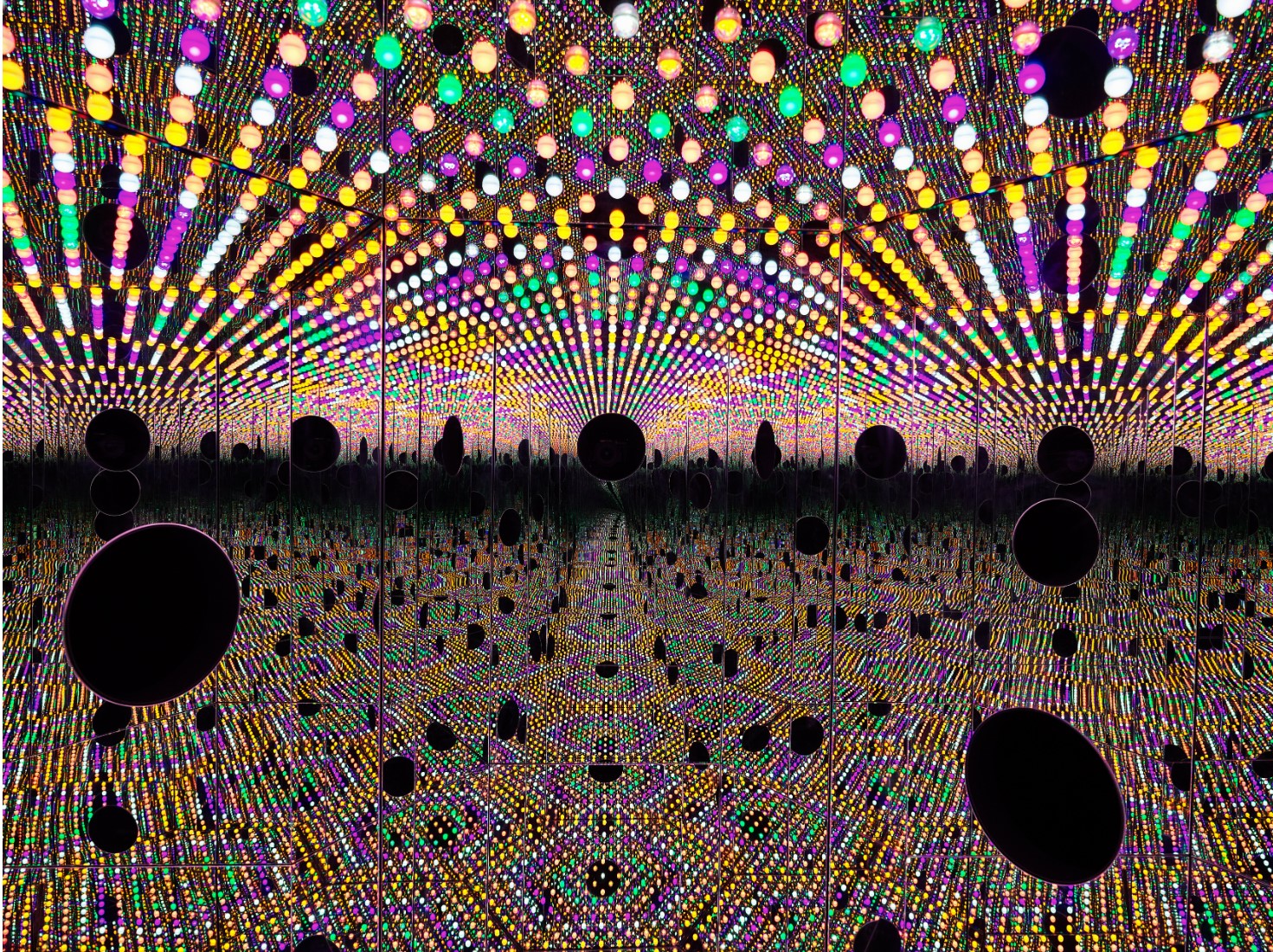
YAYOI KUSAMA (b. 1929)
My Heart is Flying to the Universe, 2018
Mirrored box and LED lighting system
220x214x185 cm (86 5/8 x 84 1/4 x 72 7/8 inches)
In her Mirror Rooms from the mid-1960s onwards, Yayoi Kusama is able to achieve all-encompassing repetitions that are, for the first time, truly infinite. My Heart is Flying to the Universe (2018) is a magnificent, sophisticated example of Kusama’s iconic Infinity Mirror Rooms, referencing her seminal early mirror installation in Peep Show or Endless Love Show in 1966. My Heart is Flying to the Universe is the first Mirror Room of this scale to be offered at auction in Asia and marks the second time that a Mirror Room of this size has ever come to auction, making it an incredibly rare, exciting work by the artist to be offered in Hong Kong. Towering over two metres in height, the present work allows viewers to peer into infinity and lose themselves in the vastness of the universe that Kusama creates using lights and mirrors. My Heart is Flying to the Universe visually immerses the viewer in a galaxy of shimmering LED lights that twinkle in a rhythmic pattern, creating a phenomenological experience that inspires a sense of boundlessness.
Ladder to Heaven, 2002
Sotheby’s London: 14 October 2022
Estimated: GBP 250,000 – 350,000
GBP 478,800 / USD 536,771
Ladder to Heaven | Contemporary Evening Auction | 2022 | Sotheby’s (sothebys.com)
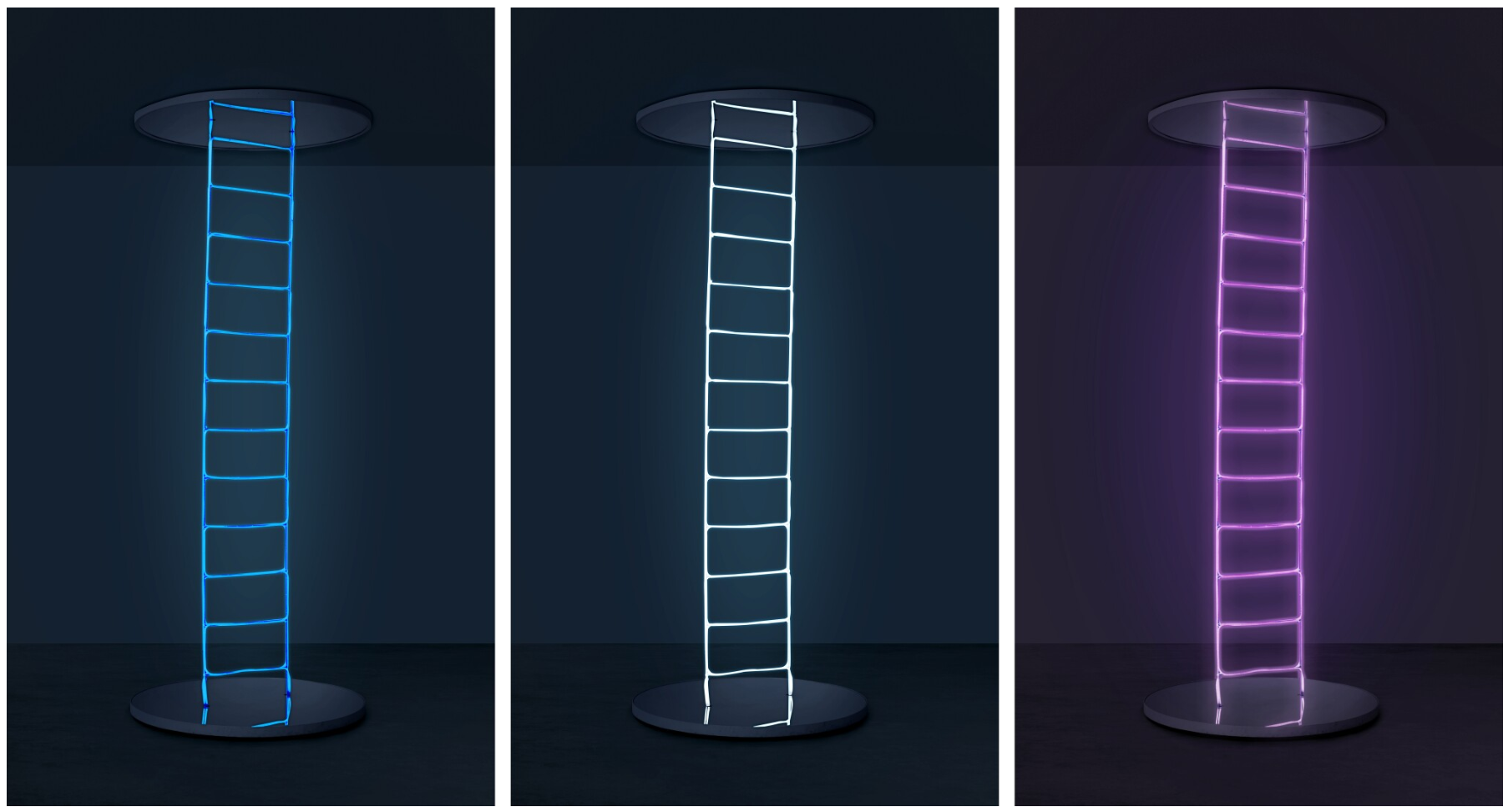
YAYOI KUSAMA (b. 1929)
Ladder to Heaven, 2002
Mirror, metal and lighting fiber tube
320 x 121.9 x 121.9 cm (126x48x48 inches)
Created in 2002, Yayoi Kusama’s Ladder to Heaven belongs to the artist’s extraordinarily popular and powerful suite of mirrored installations, works that provide immersive encounters through which the viewer is plunged into limitless space, color, and light. The present work belongs to a subset of installations that, contra to the self-contained gargantuan environments of the Infinity Mirror Rooms or the smaller microcosmic peep-show Infinity mirror boxes, are intended to transform pre-existing space and bestow a portal through to the infinite realm – a passageway to an experience of boundlessness that sits at the very core of Kusama’s life-long and endlessly inventive practice.
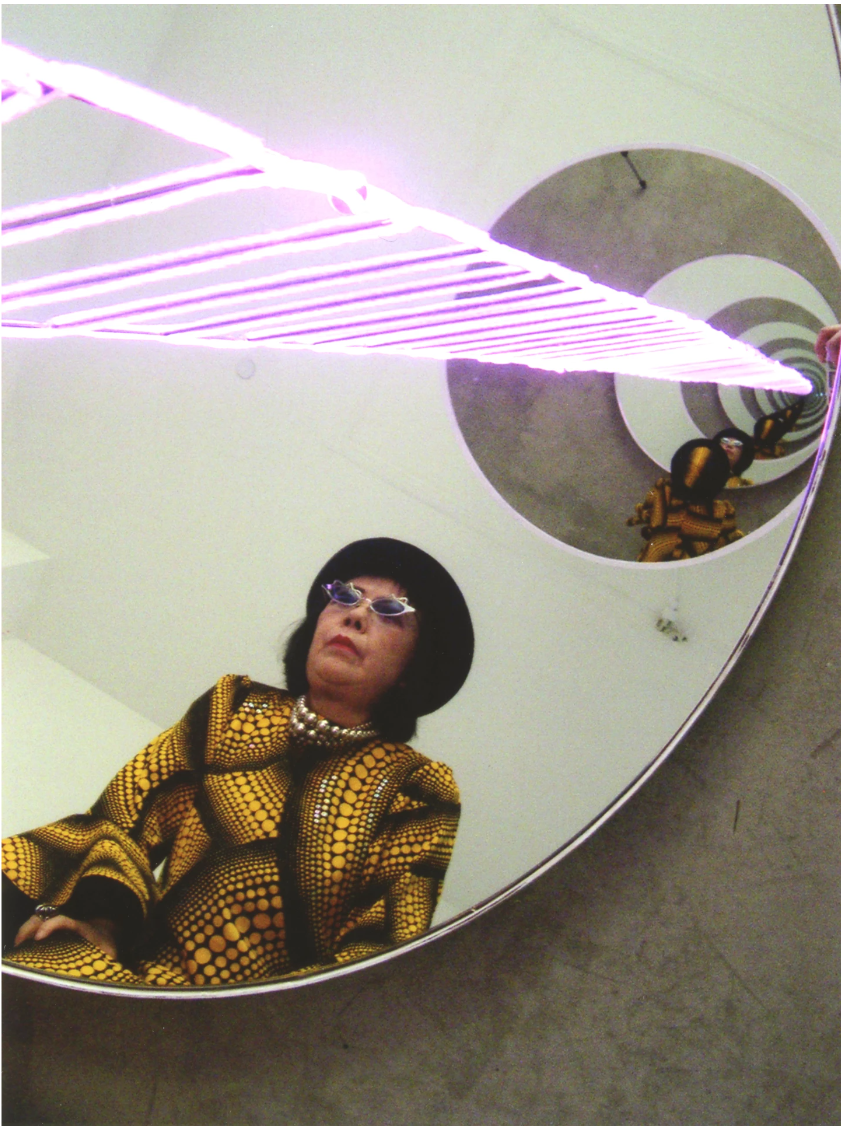
YAYOI KUSAMA WITH LADDER TO HEAVEN. IMAGE/ARTWORK: © YAYOI KUSAMA
Ladder to Heaven forms part of a series of works in which ladders, composed of glowing fibre optic light, form infinite and endless vertical tunnels. For the present work, a 10-foot-high ladder is bracketed by circular mirrored surfaces on the ceiling and floor, reflective pools that open-up the illusion of an infinite passage up or down. Peering into a depthless abyss or staring upwards at a limitless tower of ever-modulating light which traverses the colour spectrum, we are confronted with a powerful sense of vertigo, an overwhelming sensory experience that puts the viewer centre-stage within the work itself.

Spanning the early surreal paintings on paper made in Japan during late 1950s, the ambitious Infinity Net project begun upon her arrival in New York in 1958, through to the encompassing phallic soft-sculpture installations, the politically radical happenings of the late 1960s and immersive light-installations of the last 20 or so years, Kusama has always staged herself at the centre of her work – she has ceaselessly sought to replicate and translate experiences that are profound to her in ways that might also become profound to the viewer. Ever since childhood, Kusama has suffered a form of hallucinosis, a distressing psychological condition in which moving and multiplying patterns are perceived to engulf her body and surroundings. In its most extreme, this experience precipitates a state of ‘self-obliteration’ in which selfhood dissipates and is replaced by a boundless total environment. This is given visual expression in Kusama’s via her trademark use of nets, dots, flowers and spots. A unifying aesthetic and governing principle that unites the entirety of Kusama’s output, her obsessive drive to sublimate this annihilative mode finds its most immediate expression in the mise-en-abyme mirrored-light environments and installations such as Ladder to Heaven. In these pieces, space becomes truly boundless as we are transported into another realm and given a taste of our own insignificance within the infinite.
Infinity Mirror Room, 1993
Sotheby’s Hong-Kong: 6 October 2022
Estimated: HKD 2,000,000 – 3,000,000
HKD 3,780,000 / USD 481,534
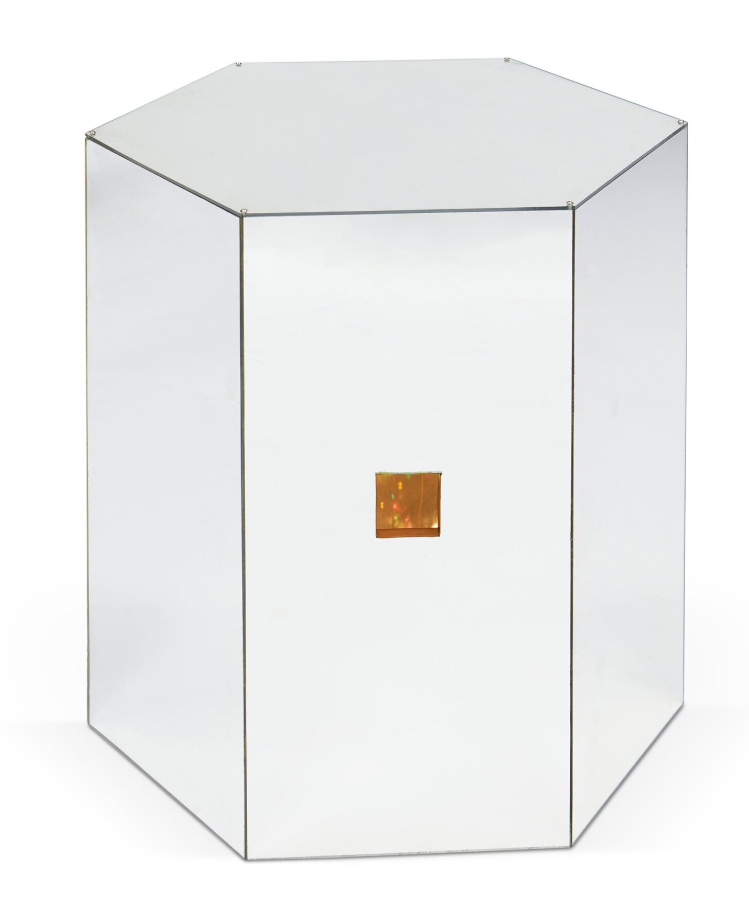
YAYOI KUSAMA (b. 1929)
Infinity Mirror Room, 1993
Wood, mirror, and light construction
60x52x52 cm (23 5/8 x 20 1/2 x 20 1/2 inches)
Signed, titled and dated 1993 on the underside
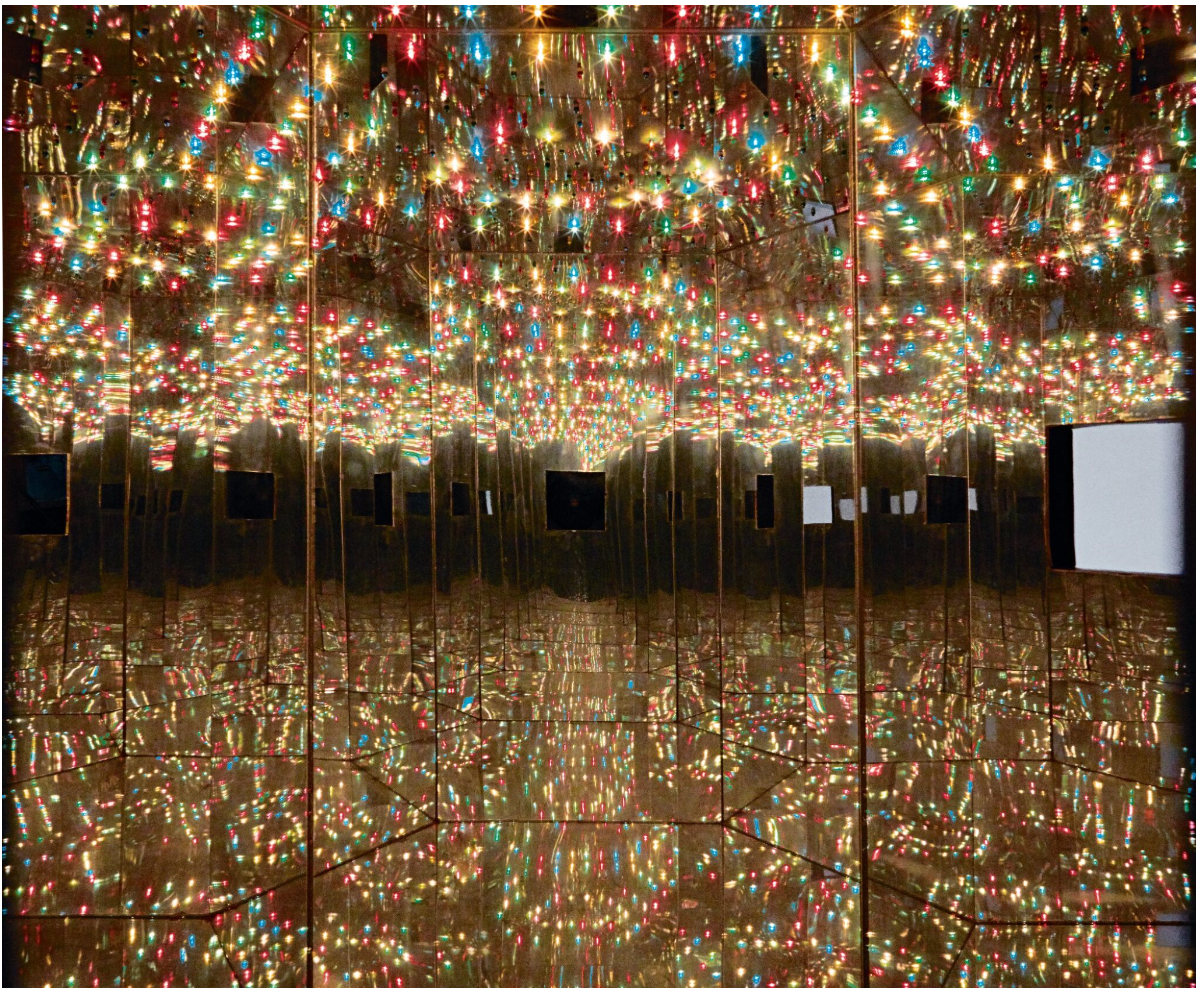
Other Sculptures / Installations
Untitled, 1983
China Guardian Hong-Kong: 8 October 2023
Estimated: HKD 900,000 – 1,500,000
HKD 960,000 / USD 122,575
Auction | China Guardian (HK) Auctions Co., Ltd. (cguardian.com.hk)
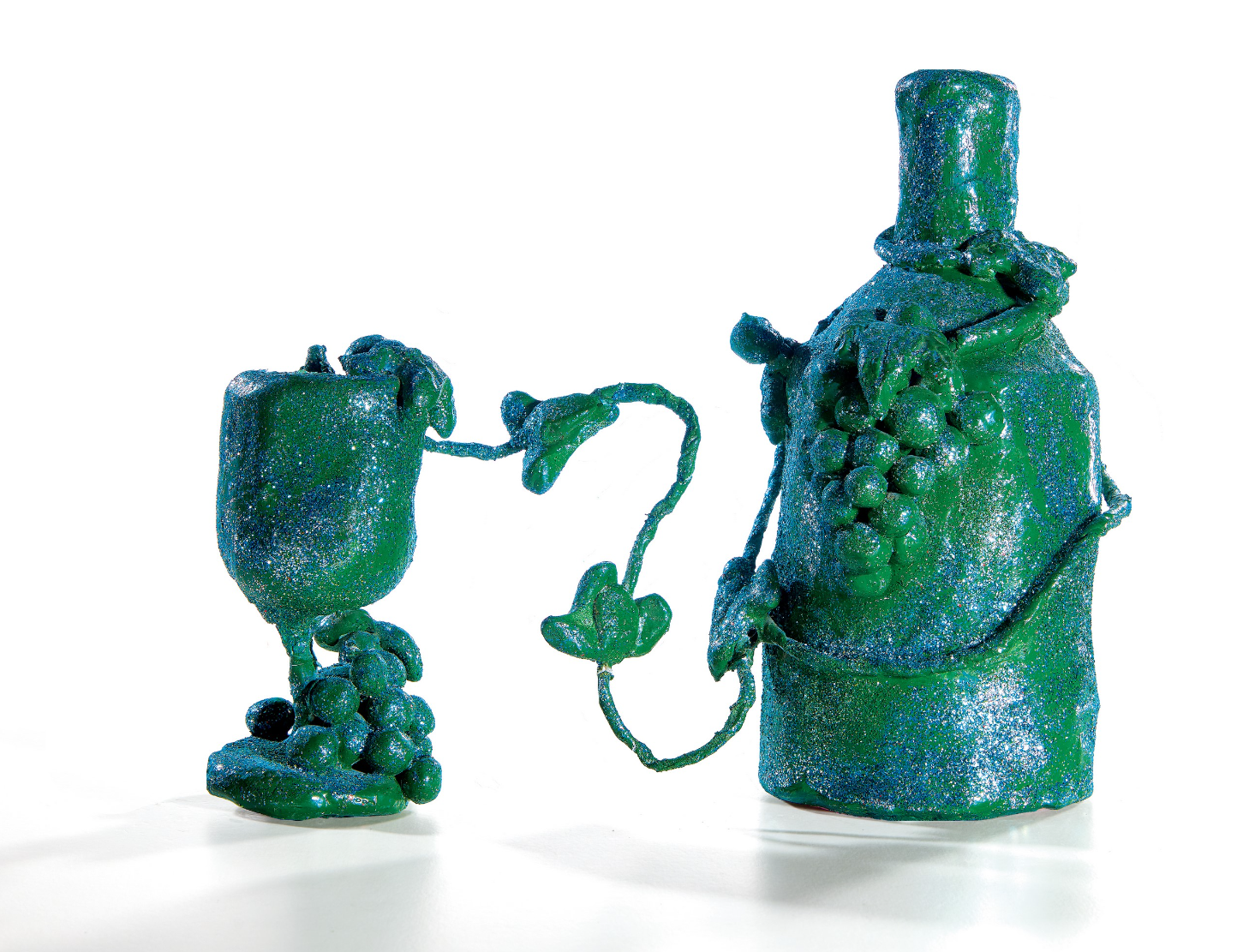
Untitled, 1983
Mixed media sculpture
25 x 14.8 x 11.5 cm (9 7/8 × 5 7/8 × 4 1/2 inches)
Signed in English an dated on the bottom of the bottle
Over the past 80 years, Yayoi Kusama has wholeheartedly dedicated herself to artistic creation, exploring a diverse range of expressive mediums including painting, collage, sculpture, film, performance, installation, and even novel writing. This multifaceted journey reflects the brilliant life of a prolific and gifted creator. Growing up in Matsumoto City, Nagano Prefecture, Japan, in the post-World War II era when Japan was striving to rebuild its society economically and culturally, she diligently honed her artistic skills. In the early 1960s, during her initial years in the United States, her works were exhibited alongside renowned figures such as Donald Judd and Andy Warhol, shining amidst an American art scene dominated by white male voices. In the 1970s, she boldly engaged in various body-centric performance arts, delving into themes of identity, anti-war sentiment, and feminism. Upon her return to Tokyo, starting in the 1980s, she seamlessly merged diverse media such as painting, sculpture, and installation, showcasing her abundant world of creativity. The presented piece, Untitled, completed in 1983, embodies Kusama’s unique contemplation of life through its distinct form.
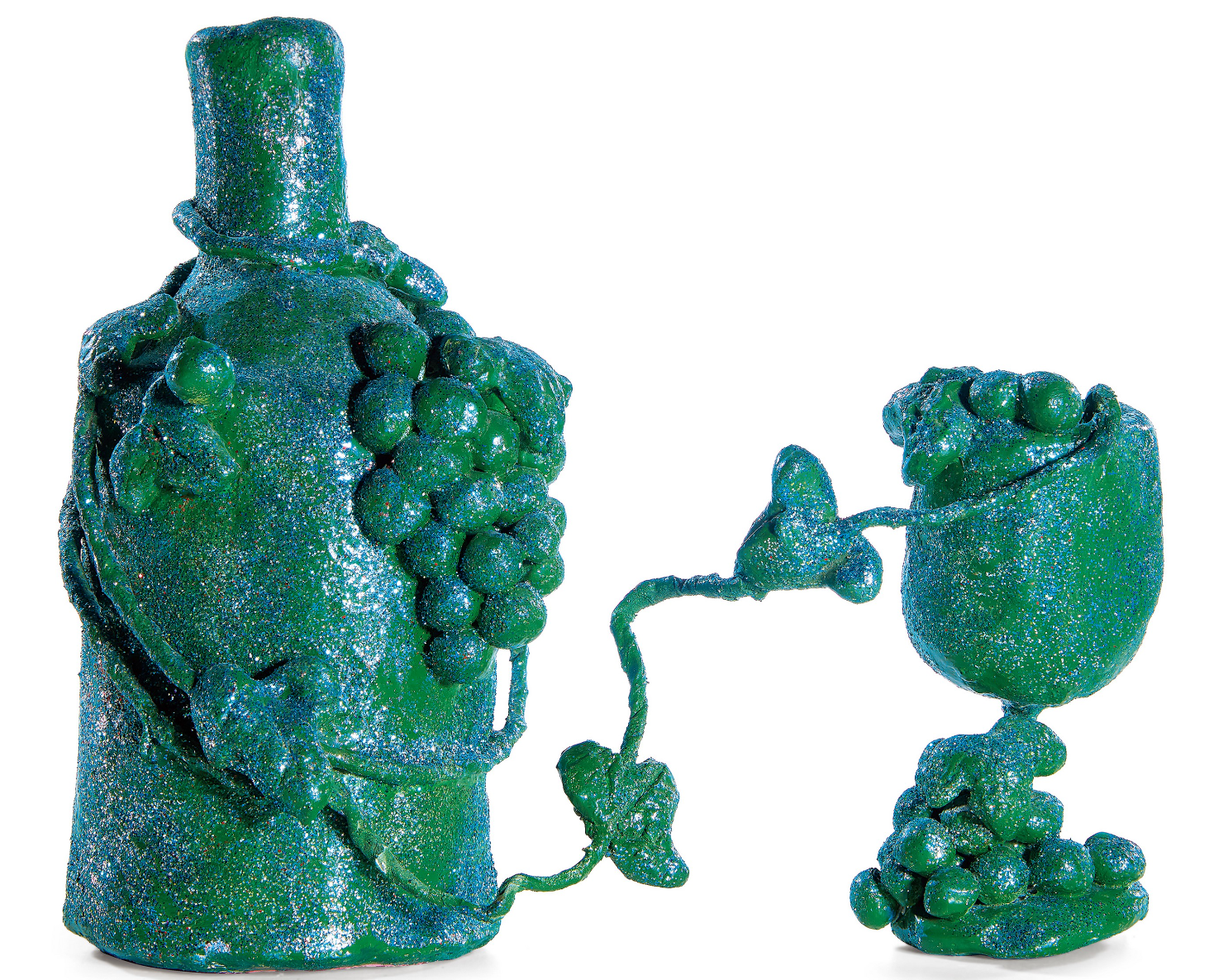
Untitled cleverly consists of two sculptural components – a wine bottle and a wine glass. The bottle narrows at the neck while maintaining a solid and weighty body, with bountiful grapes symbolizing abundance and prosperity growing along its edges. The smaller wine glass, with a shape widening at the top and narrowing towards the bottom, also features grape clusters at the rim and base, creating a harmonious connection with the wine bottle. This creative theme evokes associations with the renowned masterpiece Bacchus by the Italian Renaissance artist Michelangelo da Caravaggio. In ancient Greek and Roman mythology, the god of wine, Dionysus, was seen as a symbol of celebration. The sweetness and juiciness of grapes, the intoxicating effect of alcohol, and the allure and indulgence associated with them were all embraced to revel in the most fulfilling and abundant moments of life. In the East, there is also the poetic line “the radiant chalice of grape nectar,” symbolizing the joy of drinking to the fullest, celebrating life’s triumphs with utmost gusto. This artwork also resonates with Yayoi Kusama’s personal artistic journey. Just before creating Untitled, she held solo exhibitions at Kikusui Gallery in Boston and the Fuji Television Gallery in Tokyo. The following year, she was invited to exhibit in Milan, The Hague, and other places, leaving her footprints across three continents, earning growing acclaim and reaching new heights in both Eastern and Western worlds. The grapes and wine, symbolizing “hope” and “harvest,” found in Untitled, depict her recognized career and the gradual improvement in her personal life.
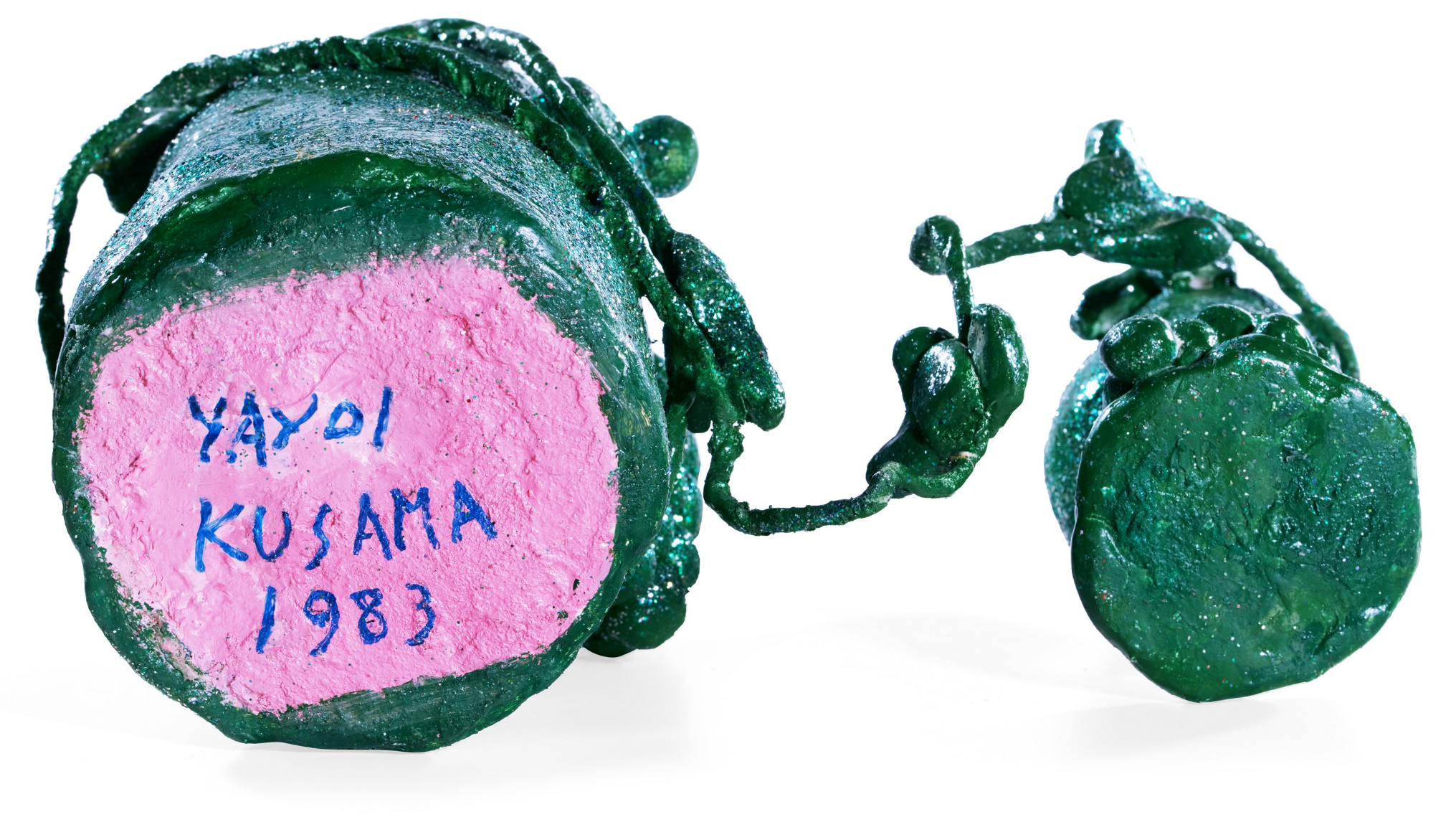 In terms of its artistic language, the artist deliberately connects the two main elements with a slender and elongated “vine,” delicately adorned with tiny branches and leaves. Together with the lush grapes, they construct an organic environment, infusing life into these simple objects. The bottle, carrying the wine, acts as a “womb,” intricately connected to its “offspring” – the wine glass. Nurtured within the womb, the wine glass thrives and blossoms with succulent grapes. The vine can be perceived as the “umbilical cord of life,” tightly linking the two, depicting the marvelous process of human development from cellular inception and reproduction to the growth of life. The artwork seeks to evoke attention to “body” and “feminism” in the conservative Japanese art scene of that time. Untitled is predominantly rendered in a vibrant peacock green monochrome, emphasizing its organic and botanical nature. The entire surface is sprinkled with shimmering silver powder, as if bestowing upon it an unreal and powerful energy. It not only showcases a vibrant aesthetic but also, through its sparkling visual experience, sings a hymn to life. The shapes of the wine glass and bottle, formed through the artist’s hand moulding and firing techniques, exhibit slight irregularities, further embodying the concept that life, though imperfect, is unique and precious, with each soul being one of a kind.
Statue of Venus Obliterated by Infinity Nets, 1998
Christie’s Hong-Kong: 28 May 2023
Estimated: HKD 7,000,000 – 16,000,000
HKD 20,340,000 / USD 2,596,640
YAYOI KUSAMA (B. 1929) (christies.com)
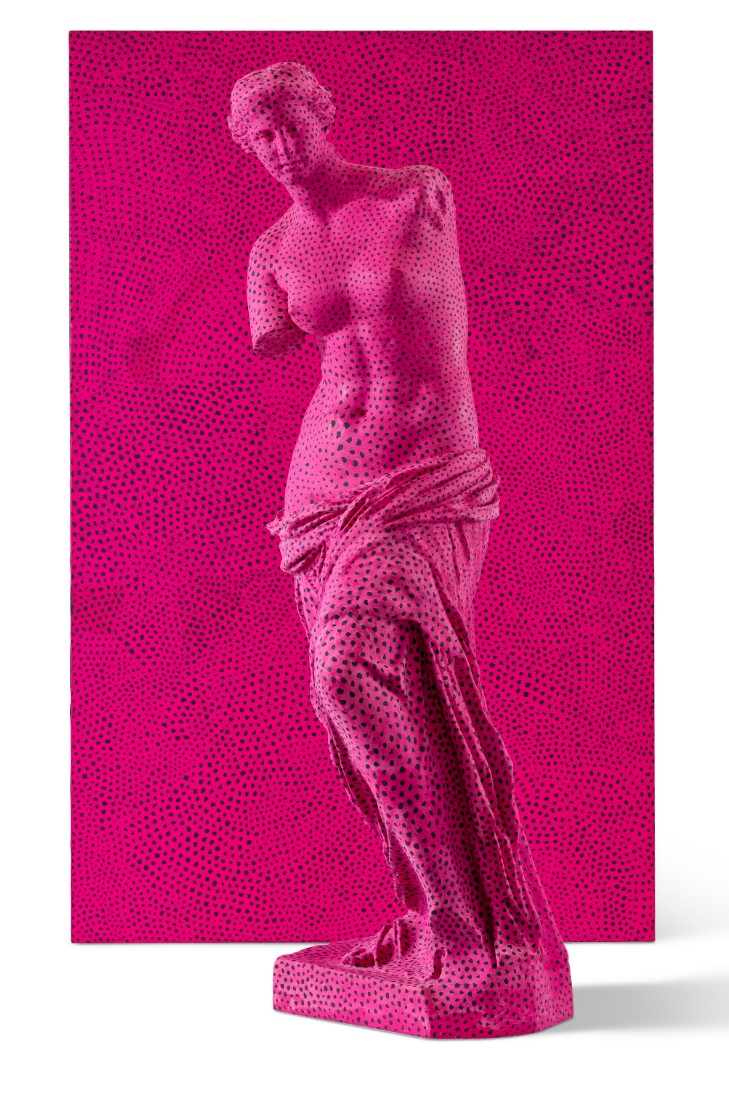
YAYOI KUSAMA (B. 1929)
Statue of Venus Obliterated by Infinity Nets, 1998
Acrylic on fiberglass and canvas
Statue: 216 (H) x 64 x 70 cm (85 x 25 1/4 x 27 1/2 inches)
Canvas: 227.5 x 145.8 cm. (89 5/8 x 57 3/8 inches)
Statue: signed, titled, numbered and dated ‘YAYOI KUSAMA STATUE OF VENUS OBLITERATED BY INFINITY NETS 9/10 1998’ (on the lower side)
Canvas: signed, titled and dated ‘Yayoi Kusama 1998 Nets No.9 (Venus)’ (on the reverse)
Edition: 9/10 (unique color variant)
Over two metres tall, Statue of Venus Obliterated by Infinity Nets debuted in 1998 at the exhibition YAYOI KUSAMA: NOW at Robert Miller Gallery, New York. Created in the pivotal year when Kusama concurrently had her momentous institutional retrospectives Love Forever: Yayoi Kusama, 1958-1968 at the Los Angeles County Museum of Art and Museum of Modern Art, the present work is one of the ten editions that Kusama amalgamates her iconic Infinity Nets painting with a life-size statue.
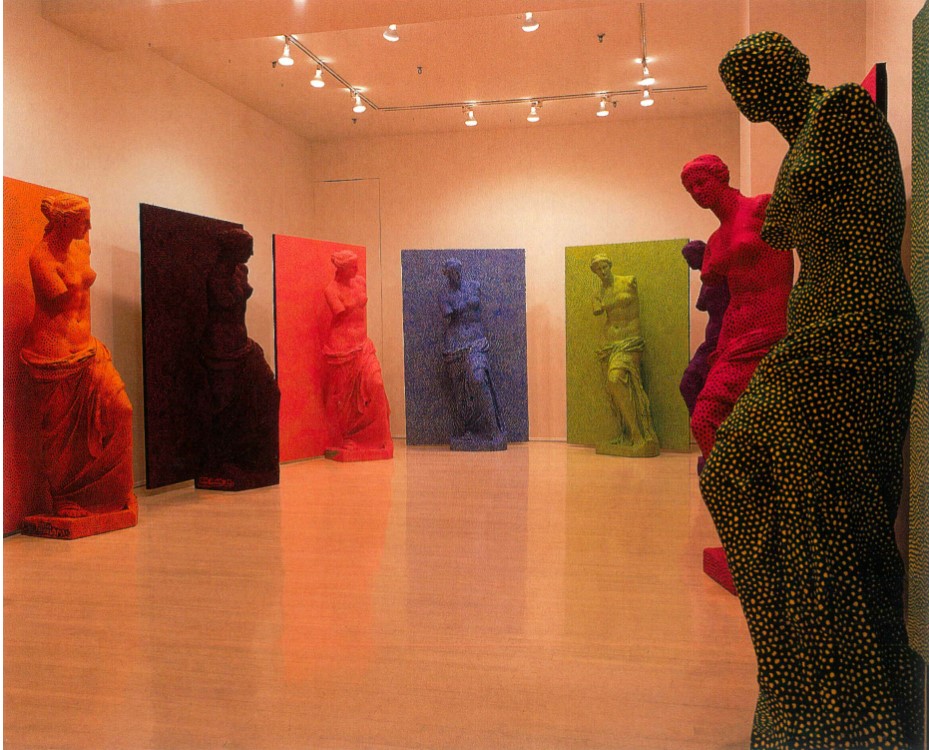
Among each unique edition that disguises the goddess statue in different palettes of Infinity Nets, the present work is the only edition rendered in vibrant magenta, a tint that is neither cool nor warm, and that stands for universal love and courage. Subjugating the divine statue of Venus de Milo with her signature hypnotic open loops, Kusama camouflaged the fluid and elegant contours of the Greek goddess against the dazzling infinity net canvas in the background. Here in myriad magenta loops sprawling across an underlayer of midnight black is an avant-garde intervention on a classical ideology through ‘obliteration’, a concept Kusama has spent her whole life exploring in many and various ways. ‘Polka dots can’t stay alone. When we obliterate nature and our bodies with polka dots we become part of the unity of our environments,’ Kusama famously affirmed.

Kusama’s Infinity Nets remains one of the most arresting visual lexicons that shapes the discourse of post-war and contemporary art, and its formation can be traced back to the ongoing hallucinations the artist has suffered since childhood. Born in 1929 to a well-to-do family that runs a plant nursery business in Matsumoto, Nagano Prefecture, Kusama began to experience hallucinations of seeing multiplying patterns on everything around her at the age of ten. Coping with this illness throughout her life, Kusama painted her vision in order to fight against her fear, which she later acknowledged as a process of ‘self-obliteration’.
“When I was a child, one day I was walking the field, then all of a sudden, the sky became bright over the mountains, and I saw clearly the very image I was about to paint appear in the sky.
I also saw violets which I was painting multiply to cover the doors, windows and even my body. It was then I learned the idea of self-obliteration.
I immediately transferred the idea onto a canvas. It was hallucination only the mentally ill can experience.”
By 1959 Kusama moved to New York and painted her seminal net-like painting titled Pacific Ocean, an archetype of her career-defining white Infinity Nets series that garnered modest praises by artists and critics. Kusama channels her ongoing hallucinations through perseveringly drawing those tiny loops with a discrete movement of her wrist, a gesture that is both obsessive and therapeutic. As Kusama further expanded her Infinity Nets in various scales, such repetitive paradigm evolves into the forms of mirrored installation, soft accumulated sculptures, self-obliteration mannequins as well as the notorious happenings she staged on the streets of New York City, all with one single goal: to unite with the universe through the means of obliteration.

Burgeoning from the artist’s pioneering self-obliterating body collages and happenings from the 60s, Statue of Venus Obliterated by Infinity Nets marks an unrivalled breakthrough as Kusama introduced an iconic cultural artefact into her ‘self-obliteration’ practices. By masking the timeless marble statue of Venus de Milo that symbolizes infinite beauty and love with her signature Infinity Nets, Kusama went from delineating her own ‘psycho-somatic art’ to probing into the historical paradox of this famous Greek statue housed in The Louvre since the early 19th century. First branded as a classical Greek sculpture of Venus by great sculptor Praxiteles to the public, it has successfully become an emblem of national pride when France was still recovering from Napoleonic wars. Though only by the 1950s has the museum revealed the statue was, in fact, a statue of Aphrodite made under the hands of little-known Hellenistic sculptor Alexandros of Antioch.
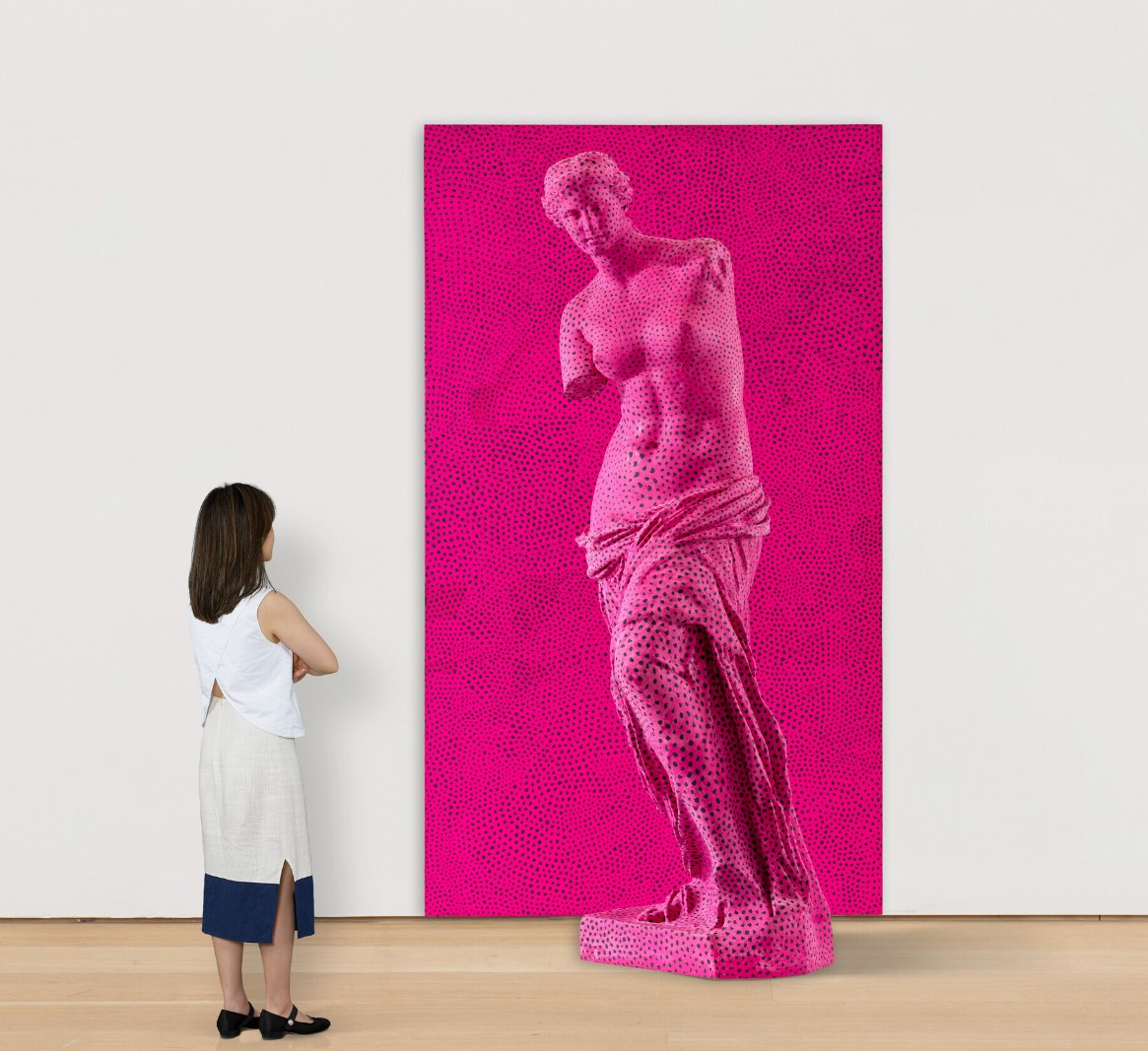
For Kusama who struggled her way in New York during the 60s in the realm of a male-dominated art world, Venus de Milo is not merely an emblem of Western divine art as it also exposes, though indirectly, the prejudices in the history of art connived by institutions. Such dimension of Venus de Milo resonates with Kusama as a female artist that fought hard to be treated the same during her early years. The saturated magenta pigment on the dark background reminisces the intimate tone that dominated an early Kusama’s self-portrait in a form of prickly pink seed, making the present work an aptly self-reflection of the artist at the pinnacle of her career where she is no longer the footnote but the subject in the discourse of contemporary art. Like the Venus in the present work, Kusama surrendered herself to her art by standing in front of her works in her polka-dot outfits. Here, an immortal figure of universal love and beauty that shields from the outer world in the Infinity Nets, is at once ‘herself’ and the universe. Statue of Venus Obliterated by Infinity Nets is a testimony of Kusama’s enduring avant-garde spirit that will continue to conquer our world with the self-manifesting power of Infinity Nets.
Walking on the Sea of Death, 1981
Christie’s Hong-Kong: 28 May 2023
Estimated: HKD 18,000,000 – 28,000,000
HKD 19,735,000 / USD 2,519,404
YAYOI KUSAMA (B. 1929), Walking on the Sea of Death | Christie’s (christies.com)
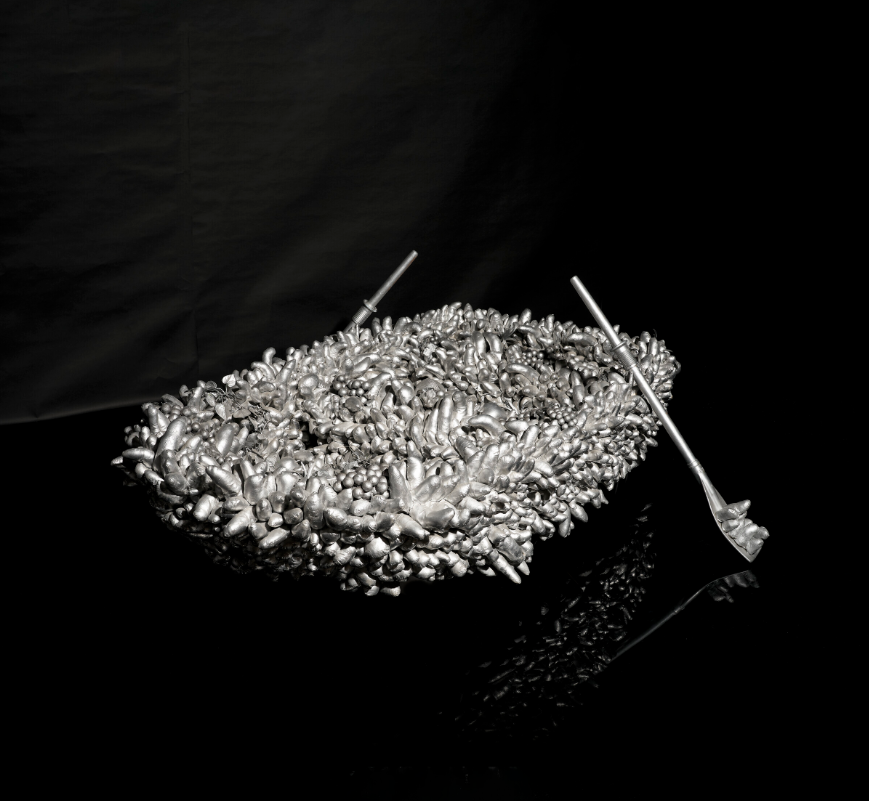
YAYOI KUSAMA (B. 1929)
Walking on the Sea of Death, 1981
Sewn stuffed fabric, plastic fruits, fiberglass rowboat, silver paint sculpture
Overall: 98 (H) x 236.5 x 231.5 cm (35 5/8 x 93 1/8 x 91 1/8 inches)
Boat: 58.4 (H) x 236.5 x 158.1 cm (23 x 93 1/8 x 62 1/4 inches)
Titled in Japanese; signed, titled and dated; ‘Walking on the Sea of Death YAYOI KUSAMA 1981’ (underside)
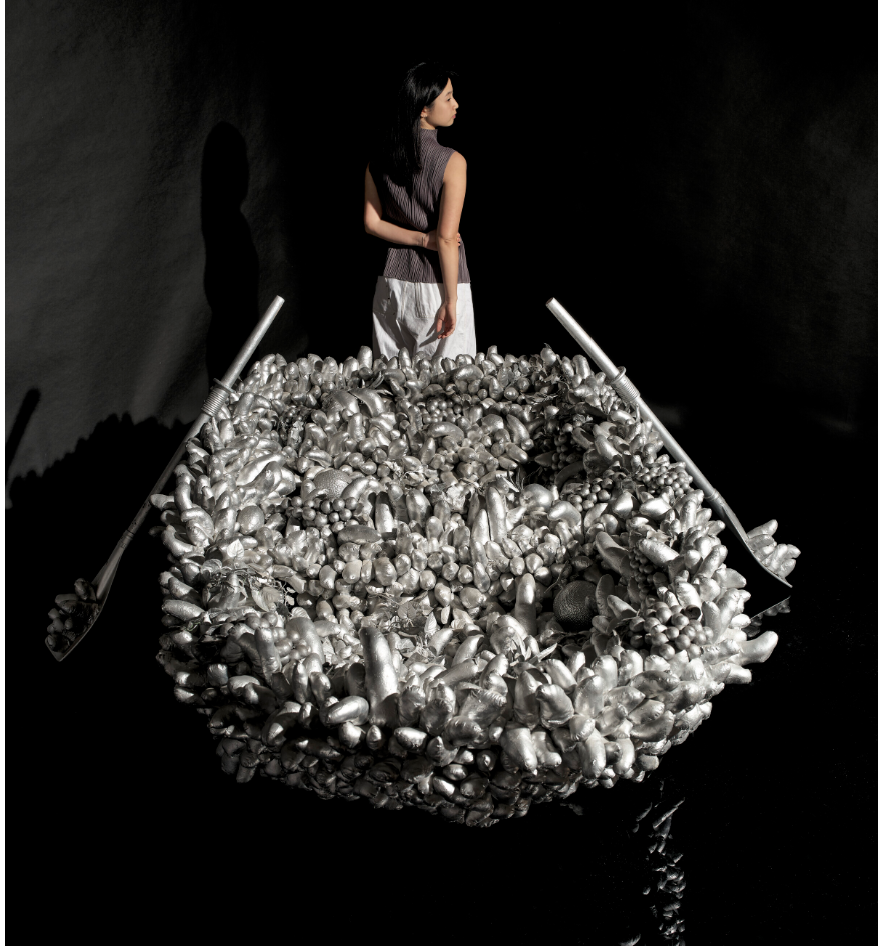
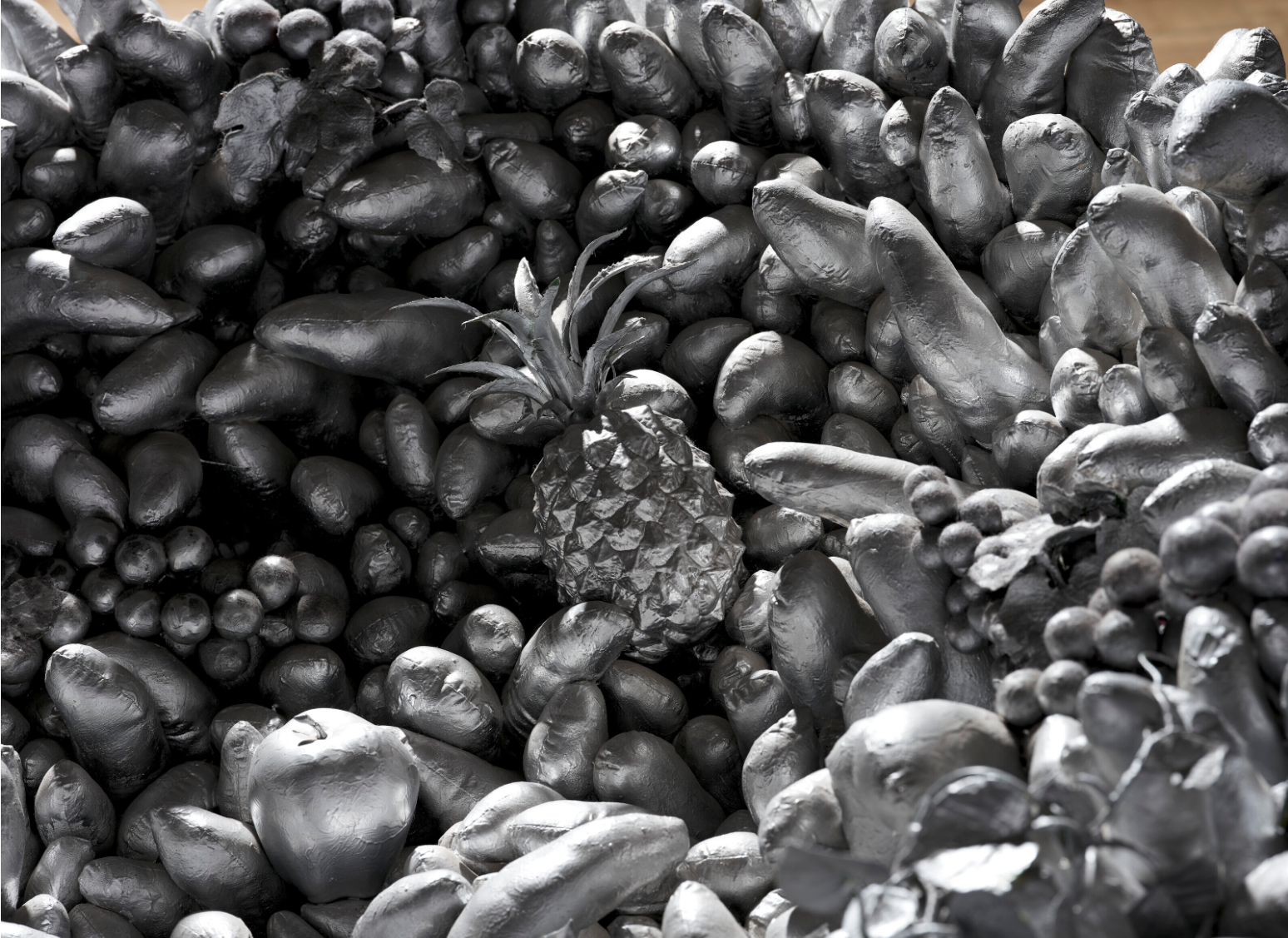
Untitled (Mannequin from The Driving Image Show), 1966
Phillips Hong-Kong: 30 March 2023
Estimated: HKD 1,500,000 – 2,300,000
HKD 2,032,000 / USD 258,855
Yayoi Kusama – 20th Century & Contempo… Lot 12 March 2023 | Phillips
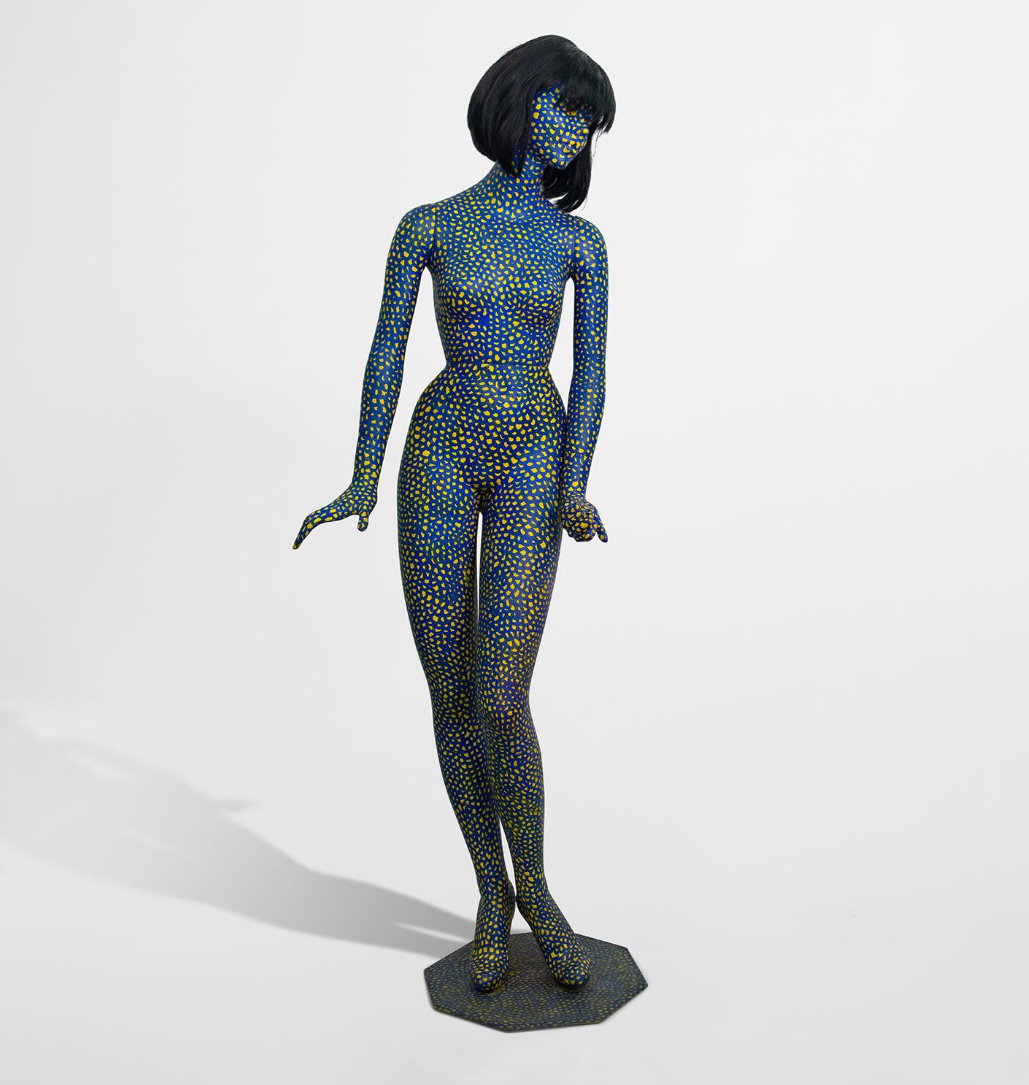
YAYOI KUSAMA
Untitled (Mannequin from The Driving Image Show), 1966
Acrylic on polyester mannequin, synthetic wig and base
173x64x40 cm (68 1/8 x 25 1/4 x 15 3/4 inches)
Signed and dated ‘KUSAMA 1966’ on the top
Part of a series of artworks on display at Yayoi Kusama’s The Driving Image Show, which was first presented at Castellane Gallery in New York in 1964, Untitled consists of a female mannequin that seems to have been caught in the act of shying away from an invisible object or subject, with the head turned to her left and the rest of the body curved to her right. The sculpture is painted in blue, and the entire surface of her naked figure is covered in Kusama’s signature infinity nets pattern – a shade of deep cobalt blue over an underlying layer of yellow. On top of her head is a black wig, which mimics the beauty trends of the 1960s.
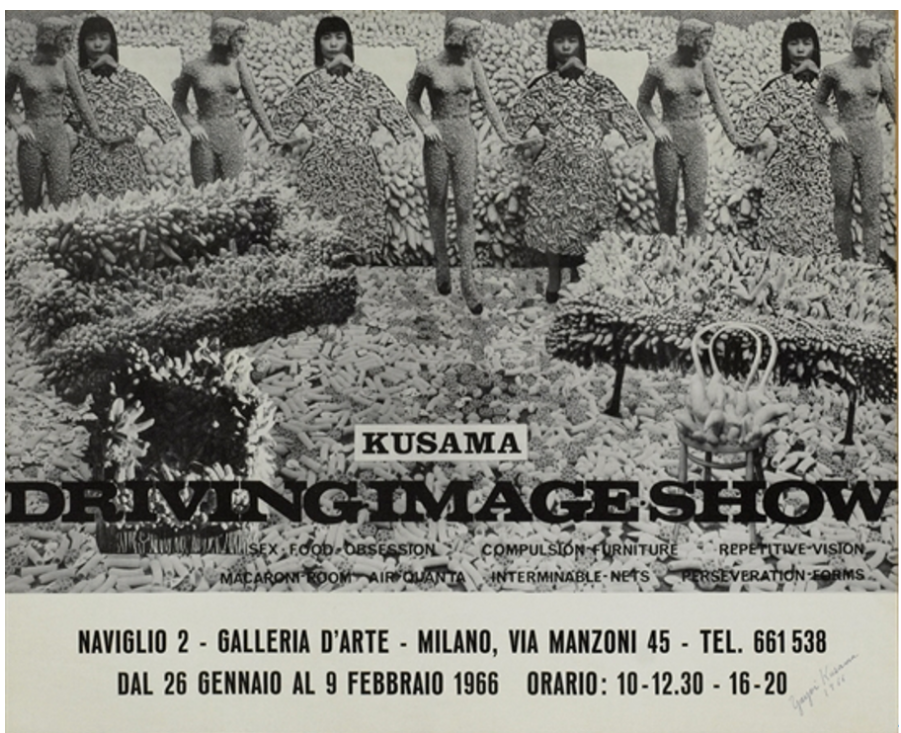
Driving Image Show poster for the 1966 Milan exhibition. © YAYOI KUSAMA
Among the objects that composed the installation, Kusama included several kitchen furniture pieces and utensils, a ladder, shoes, vases, books and flowers, some of which were dispersed throughout the years. The exhibition was so successful that it became itinerant, and it was later shown – with variations – at Galleria d’arte del Naviglio, Milan, between January and February 1966, and at Galerie M.E. Thelen in Essen, Germany, in April of the same year.
The fact that some of the sculptures which were exhibited at The Driving Image Show are now lost makes this 174 cm tall Untitled an incredibly rare, exceptional and historically relevant artwork. This blue, yellow-dotted mannequin survived several decades to testify to Kusama’s outstanding artistic achievements during her American period. ‘The first thing I did in New York’, declared Kusama in a recent interview, discussing her arrival in New York in 1958, ‘was to climb up the Empire State Building and survey the city. I aspired to grab everything that went on in the city and become a star’. i The New York years were certainly essential to her career, and played a fundamental role in helping Kusama establish her name among the most globally acclaimed artists.
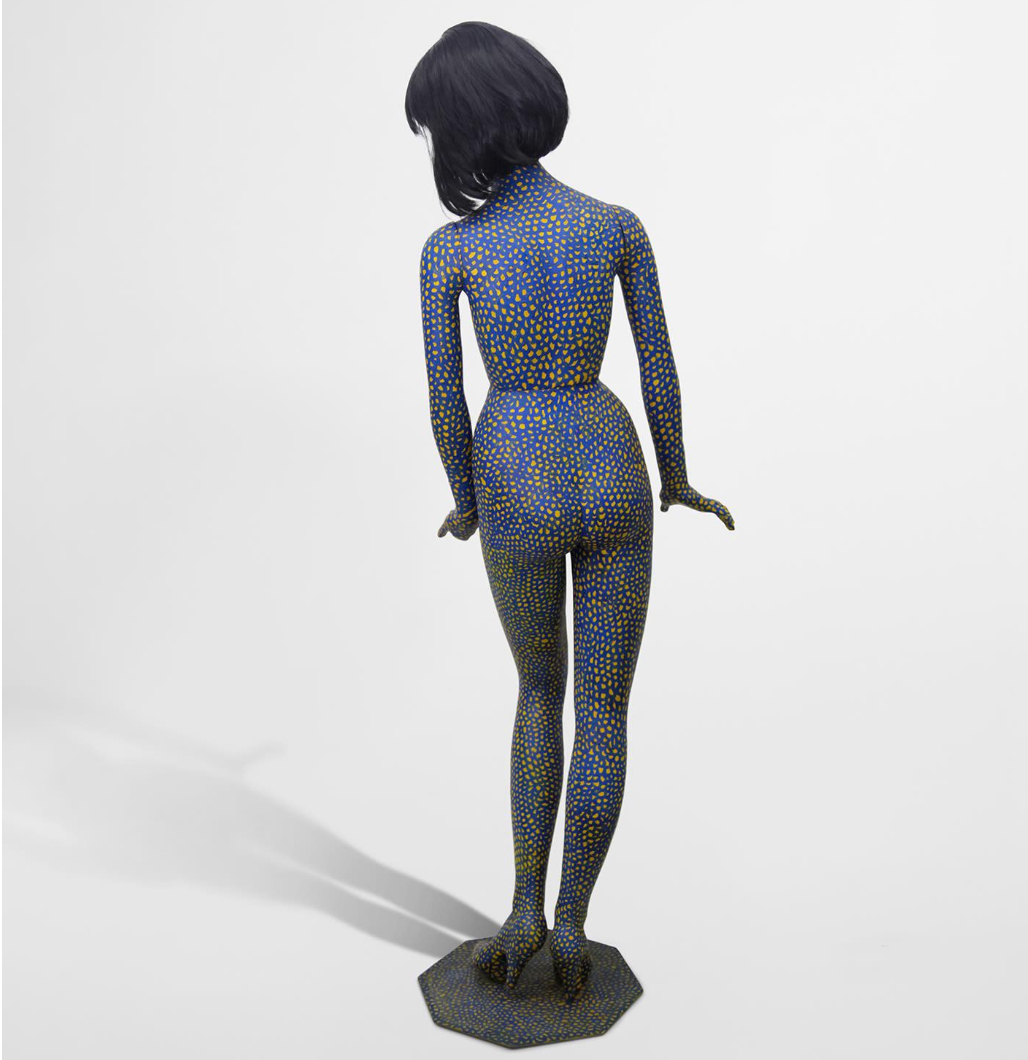
The Driving Image Show was revolutionary for its time, and had a radical impact on current and future generations of artists, art amateurs and gallery goers. Unlike nowadays, where they are a common and established practice in the art world, in the 1960s installations were still a very unusual form of exhibition. One of the most original aspects of The Driving Image Show (1964) was the fact that the entire gallery space was integrated within the installation: Kusama’s dotted pattern was painted not only on the mannequins, but also on household objects and furniture. The floor was covered in a bed of dry macaroni, so that anyone who would step on it would hear crackling sounds, and – instead of remaining a passive observer – would interactively participate in an immersive art experience.
In the course of her New York years, Kusama became famous for provoking the puritan American society with her irreverent Body Festivals or Happenings, during which she painted the bodies of naked men and women with her signature polka dots, while the participants were singing, dancing and taking part in orgies. These public celebrations of art and freedom were often interrupted by police interventions. Untitled is an evolution of these staged demonstrations; at first,she started to incorporate mannequins as sculptural works within her installations, then she gradually migrated this artistic expression onto living human bodies and animals. In these instances, the naked body is not alive and sexually active, but becomes an anonymous and robotic symbol of the modern industrial society.
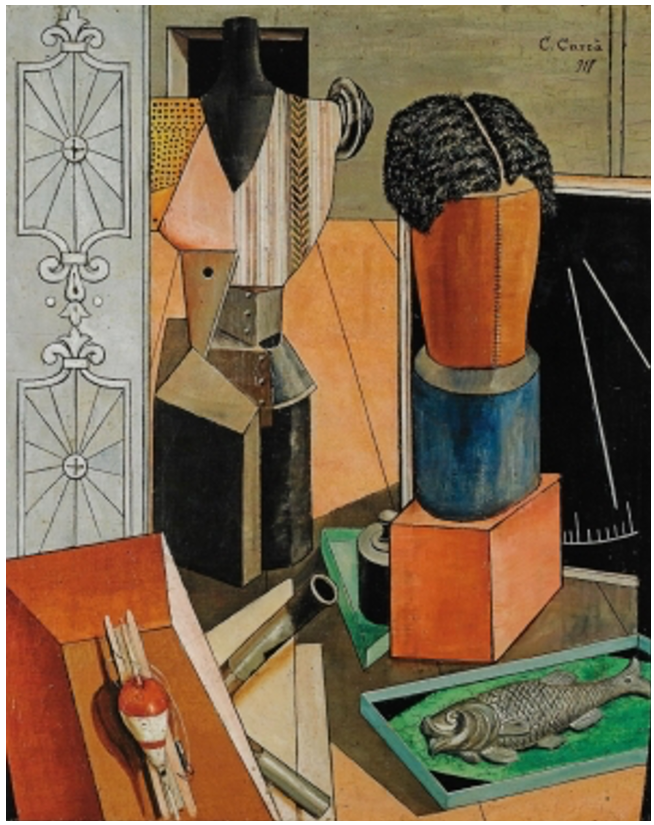
Carlo Carrà, The Enchanted Chamber, 1917, Brera Pinoteca.
Artwork: © 2023 Carlo Carrà / Artists Rights Society (ARS), New York / SIAE, Rome
Kusama’s Untitled can be fruitfully compared to the mannequin figures of the Italian Metaphysical Painting Movement led by Giorgio de Chirico and Carlo Carrà, whose school and principles were established in 1917. In Metaphysical paintings, the human figure is often absent, or, when present, it is depicted on a small scale or as a shadow. Mostly replaced by statues or mannequins which evoke the shape of a female or male body, humans do not seem to be crucial to the Metaphysical masters, who, through their work, intended to transmit the sense of isolation and alienation in which World War I left the European society. In particular, Untitled can remind viewers of Carrà’s painting The Enchanted Chamber (1917), in which a headless female mannequin is depicted near a tower of geometric objects, on top of which is a black wig. Representing a sort of mysterious and modern idol, Kusama’s and Carrà’s mannequins hint at the risks of dehumanization that are hidden behind mass-production and globalization.
Pumpkin Chess Set, 2003
Phillips Hong-Kong: 30 November 2022
Estimated: HKD 2,400,000 – 4,000,000
HKD 3,024,000 / USD 387,150
Yayoi Kusama – 20th Century & Cont… Lot 212 November 2022 | Phillips
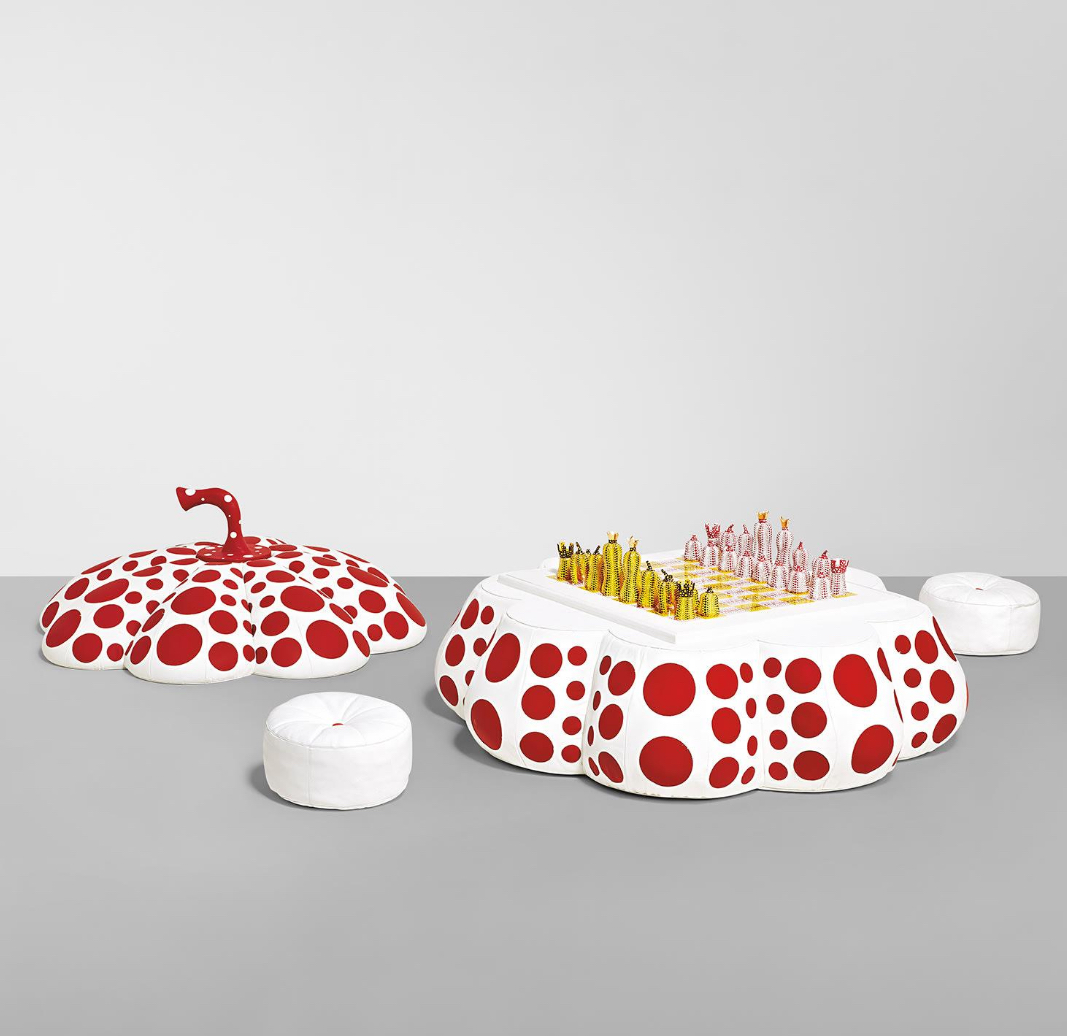
YAYOI KUSAMA
Pumpkin Chess Set, 2003
Porcelain, leather and wood
Overall: 75x100x100 cm (29 1/2 x 39 3/8 x 39 3/8 inches)
Installation dimensions variable
Signed ‘Yayoi Kusama’ and stamped by the German Porcelain factory Villeroy & Boch
On the underside of each chess piece
Executed in 2003, this work is number 2 from an edition of 7 plus 4 artist’s proofs
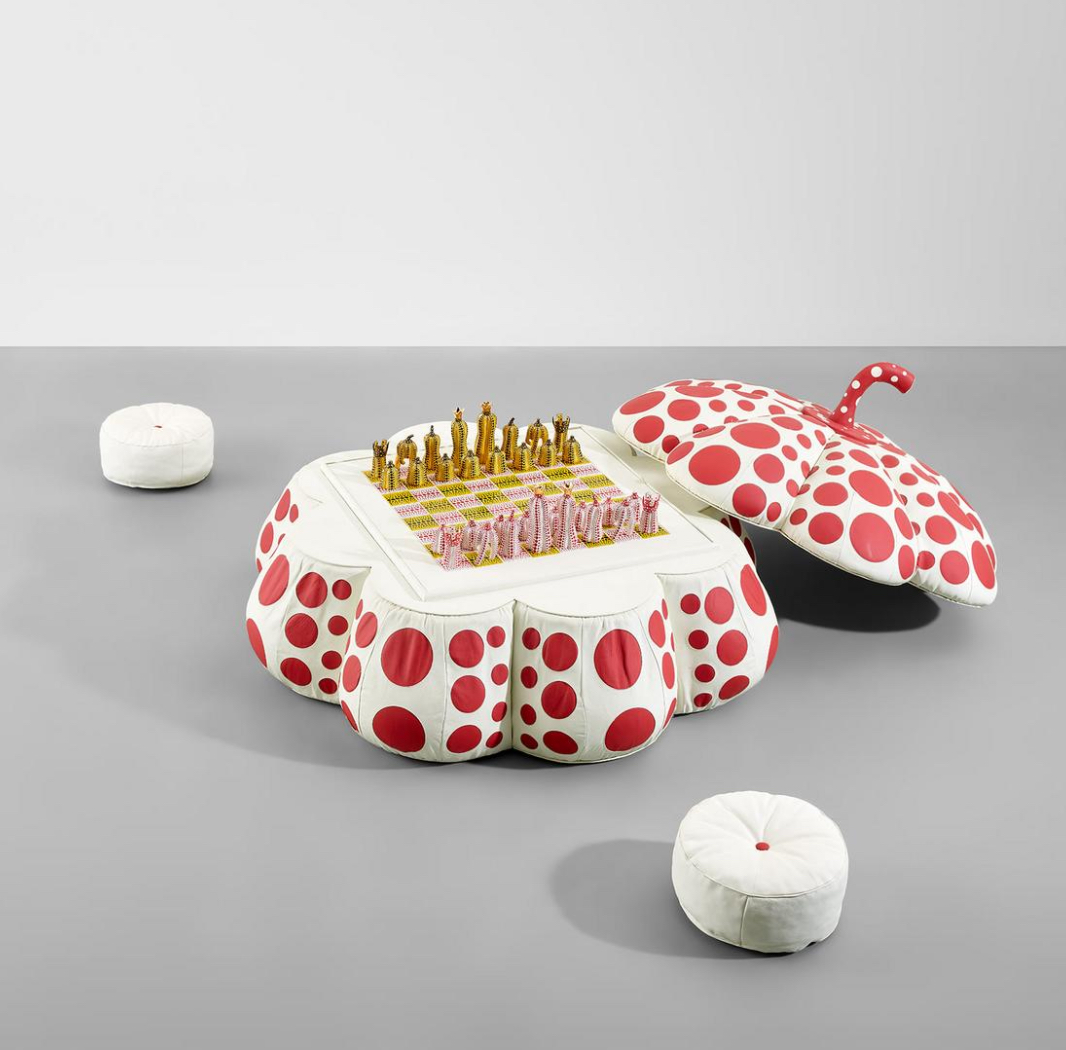
Yayoi Kusama. The name almost needs no further elaboration, such its power. An artist who has crossed, demolished and defined the boundaries of art for the last 70 years, her oeuvre has been hallmarked by a rejection of limitation to medium, generation or movement. Pumpkin Chess Set is a unique work in an artist’s career, stemming from a small edition of only 7 plus 4 artist’s proofs. Here, Kusama incorporates the most defining motifs of her practice: a dexterity of geometric patterns, and pumpkins. Taking basic concepts from her feted Infinity Nets series, she employs them within a three dimensional plane to supplant them onto the mimicked contours of a pumpkin.
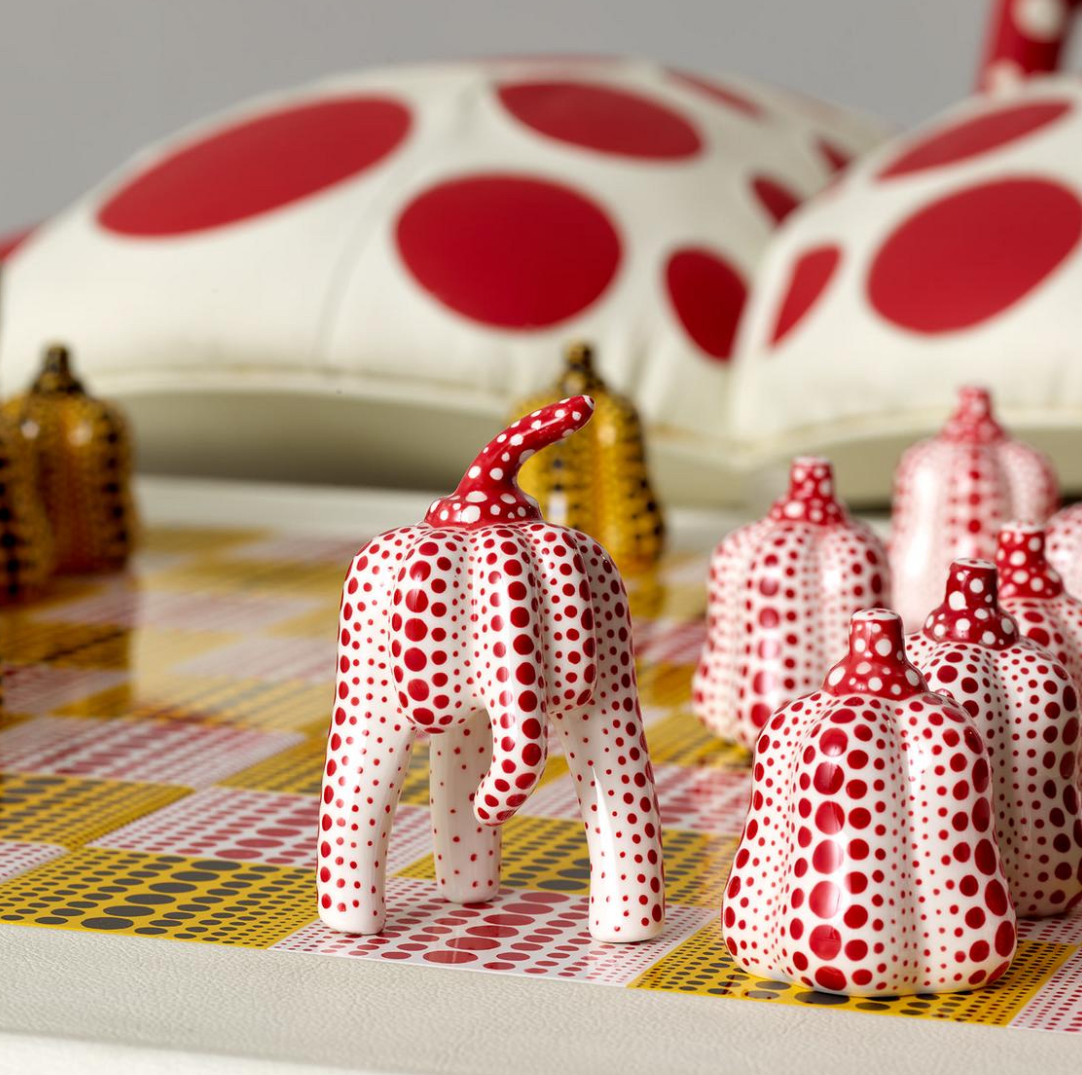
The repeated use of spots through the sculpture holds profound resonance, and functions as an organ for her automatic reactions between her psyche and the materiality of her work. A storied example of the thin line between genius and madness, Kusama is diagnosed with an obsessional neurosis; as such her world is populated with schizophrenic hallucinations, panic attacks, psychological distress, and suicide attempts. Her intensive art practice acts as a form of self-therapy, a way to mediate the trauma of the everyday and a process that she calls ‘self-obliteration’. Though important to note, understand, and internalize, relegating her work to the musings of a mental patient is reductive – wrong. What instead should be celebrated is Kusama’s ability to tap into the depths of her identity and open the door into a mind quite unlike any other in the world. This is a conversation within Kusama herself that we should feel privileged to attend, and in which to indulge; a conversation the present lot presents a lighter chapter.
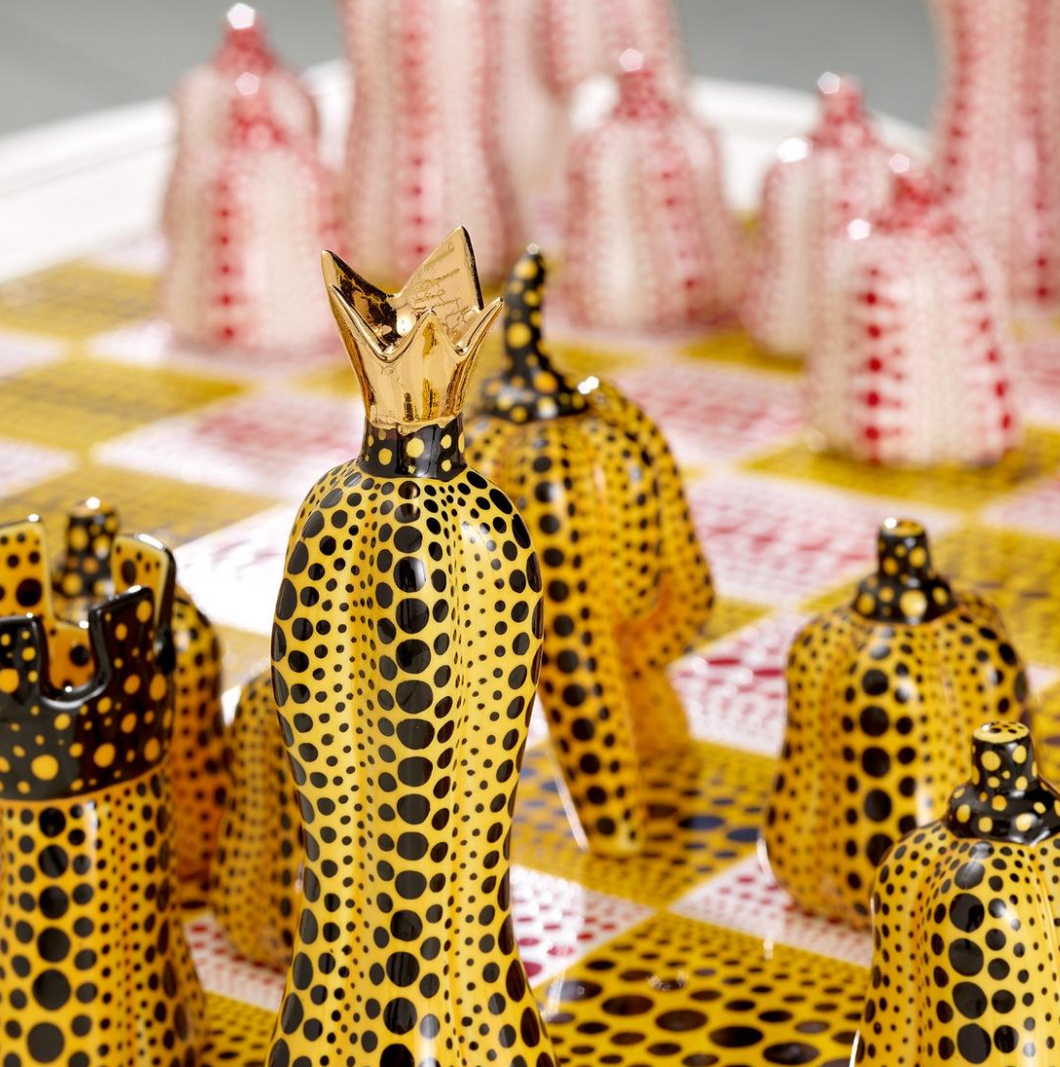
The inclusion of a chess board on top of the half-sliced pumpkin lends the work a mode of the surreal, as if it were a table set for two opponents to engage in strategic battle – the pieces remaining in their starting positions. Shades of absurdism creep into the sculpture as we picture ourselves sitting down to play a classic game of chess atop a pumpkin – embodying the father of conceptualism, Marcel Duchamp’s decree that, “while all artists are not chess players, all chess players are artists”.
Butterflies, 1998
China Guardian Hong-Kong: 12 October 2021
Estimated: HKD 1,300,000 – 2,300,000
HKD 1,560,000 / USD 200,475
Auction | China Guardian (HK) Auctions Co., Ltd. (cguardian.com.hk)
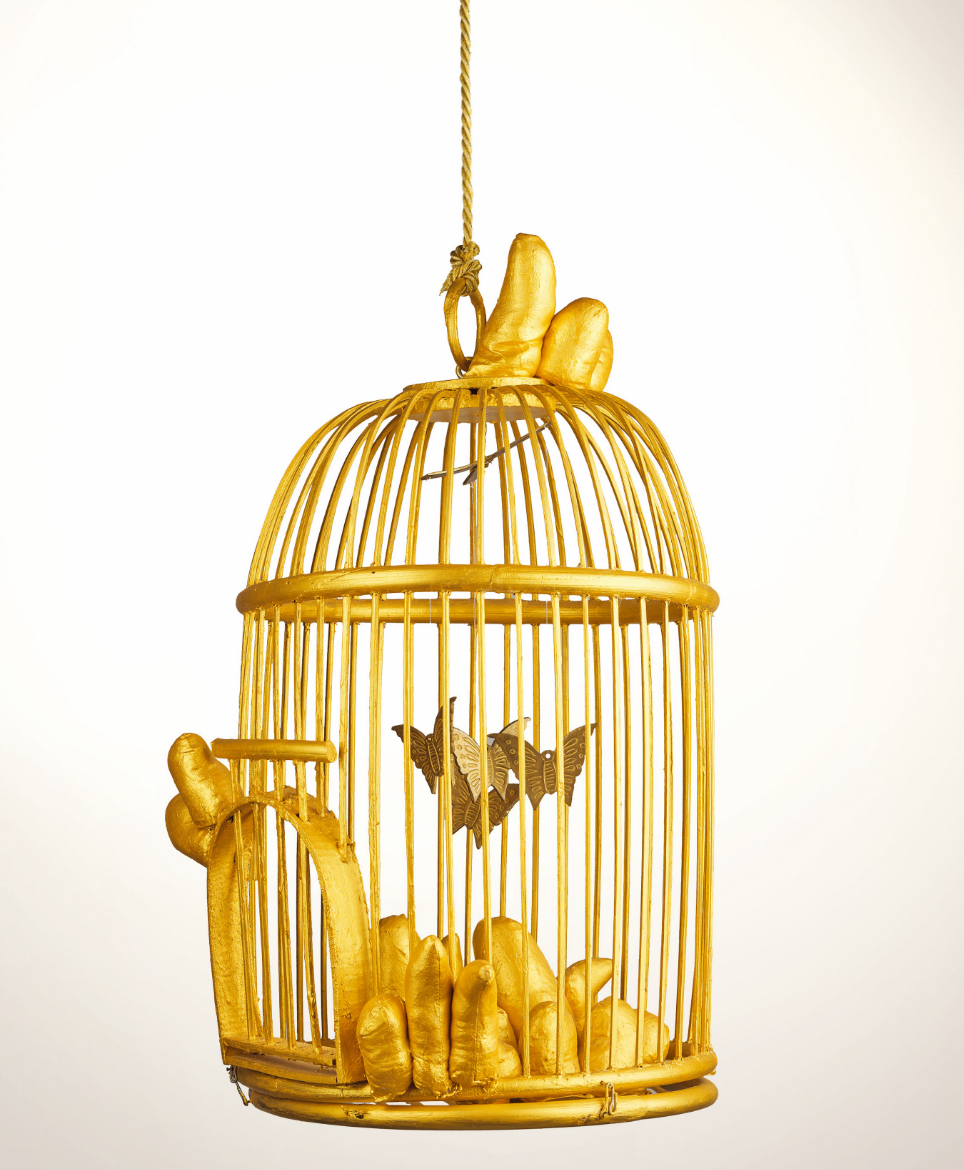
Butterflies, 1998
Painted, stuffed fabric, metal, rope and plastic filament sculpture
56×30×30 cm (22 × 11 3/4 × 11 3/4 inches)
Titled and signed in English and dated on the underside
1998 was a fruitful year for Yayoi Kusama. She held nearly 30 solo exhibitions around the world in that year and opened a landmark large-scale touring solo exhibition Love Forever: Yayoi Kusama, 1958-1968, pushing her reputation and artistic career to the pinnacle. Butterflies was completed this year and shown in her solo exhibition at the Robert Miller Gallery in New York, witnessing a key turning point in her return to the Western art scene.
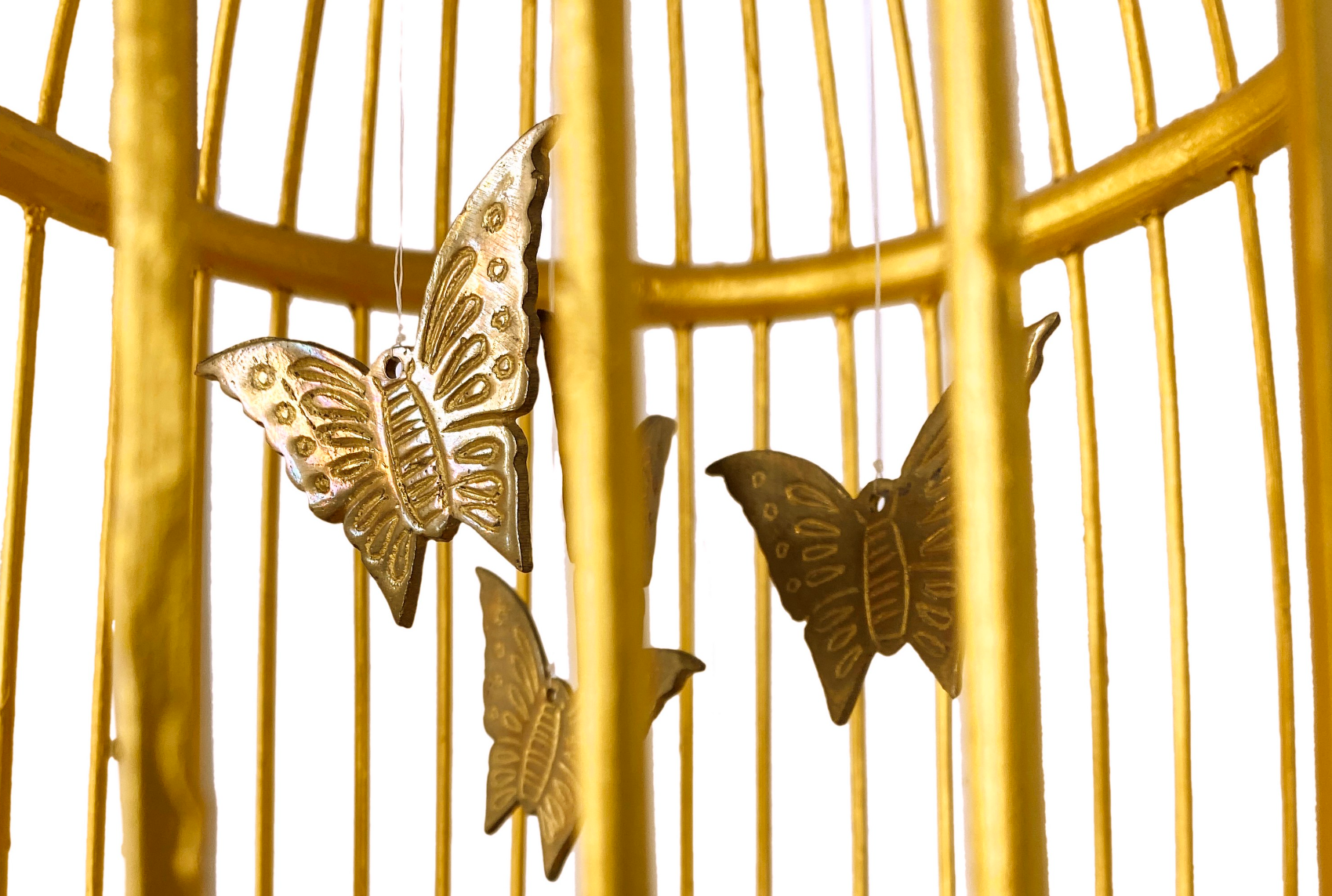
Butterflies is the only “hanging” wind chime installation of Kusama, combining the essence of the Japanese nation with the classic personal art characteristics. She takes the “birdcage” as the shell, the “butterflies” as the wind chime, and the antenna-shaped “soft sculpture” as the decoration, all humming in her favorite golden hue, conveying unique art and the words of the times.
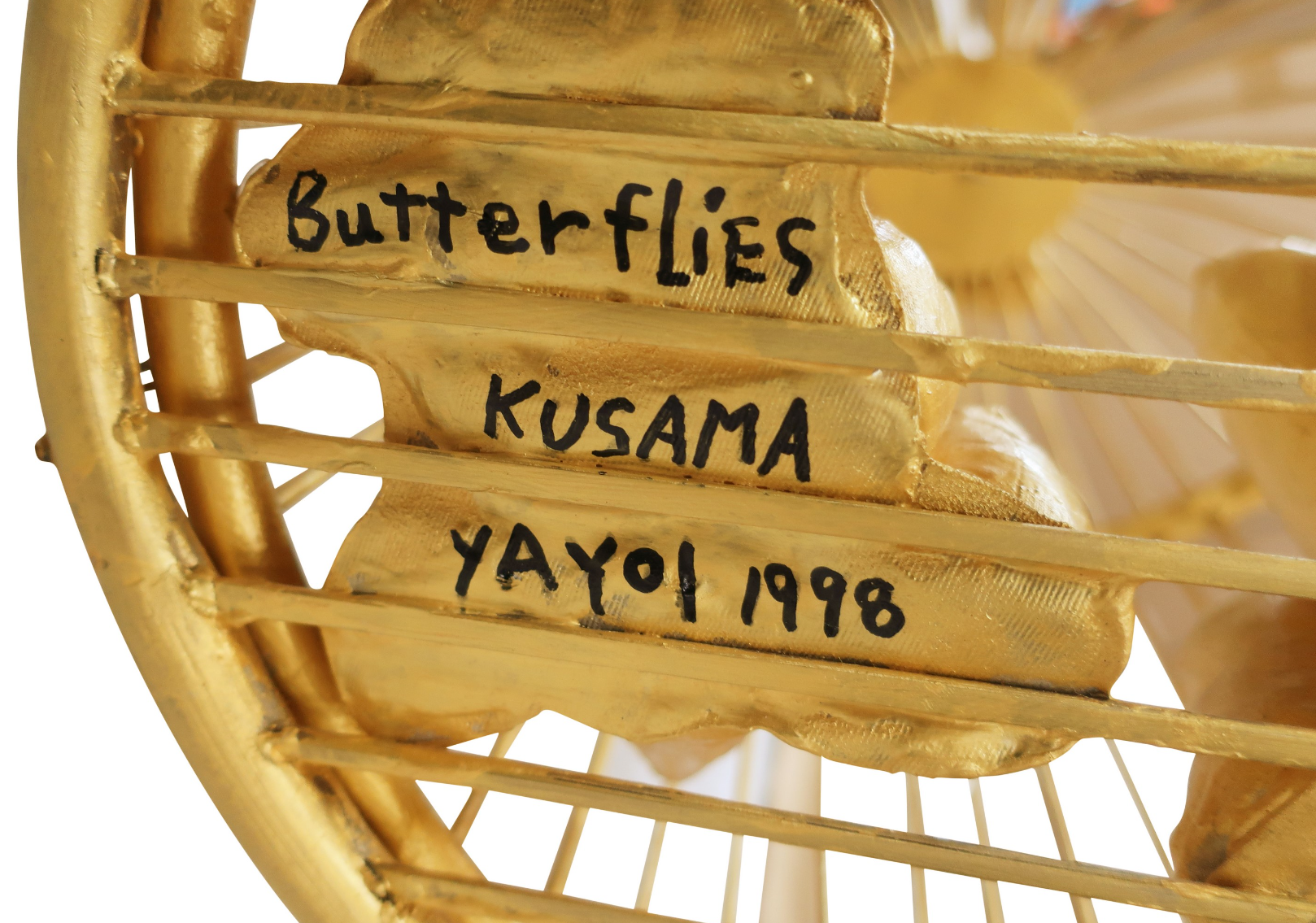
In the golden birdcage, two hanging butterflies collide with the pleasant bell sound of “dinging dinging”, demonstrating the powerful vitality of the individual. Below the butterfly, tentacles-like fillings are all over the birdcage, wrapping the limited space in the cage with infinite proliferation. The phallus-like soft sculpture firstly appeared in her solo exhibition at Green Gallery in New York in 1962, which established her status as the Avant-Garde Queen in New York in the 1960s. It composes the most frequently used art characteristics of her with “Infinity Net” and “Polka Dot”. In Butterflies, Kusama deliberately creates an unnatural living environment. The ubiquitous soft sculptures confront the butterflies, suggesting that the social structure is seriously inclined to male authority. The work is like a three-dimensional “Infinite Net”. No matter what environment it is placed in, the external world can be projected into the installation, so that the viewer can melt into the personal emotional experience and dissolve in this work.
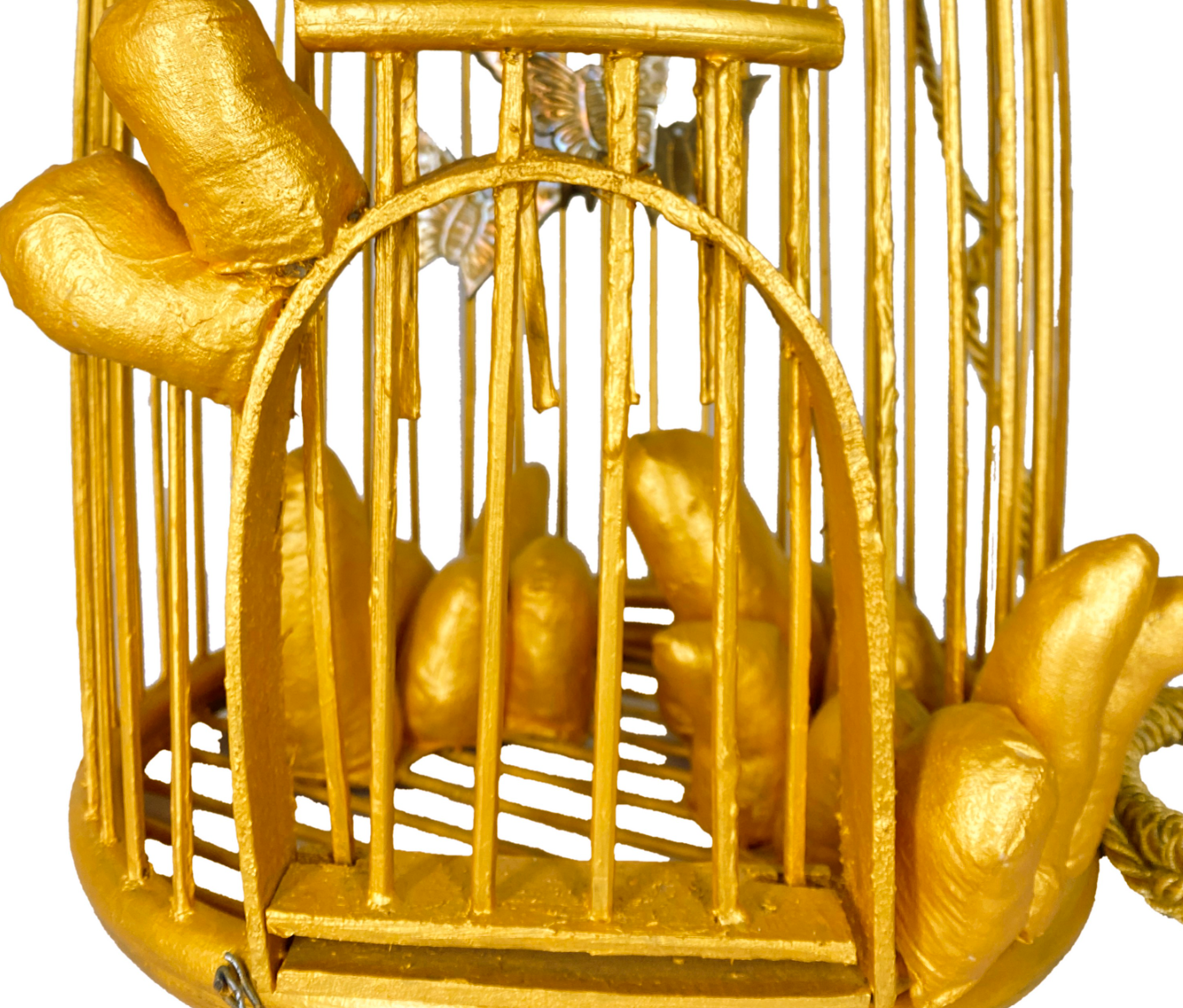
In her works from the 1970s to the 1990s, Kusama often uses bird cages to connect the oppressive feeling of individual experience with the oppression of female groups in contemporary social ideology. The most typical series among them is the Bird Cage series. She targets female celebrities and puts a layer of barbed wire on the canvas to make the person in the painting trapped in a “cage”, challenging the conservative atmosphere of the Japanese art scene with a clear sense of imprisonment. Once appeared, it became the focus of competition between the museum and the art market. Since then, Kusama created three three-dimensional works of cage construction in 1988, 1998, and 2001, with only the last two works can be seen in the shape of the “birdcage”. Butterflies is one of them, more precious than the Birdcage painting series. The sharp texture of the birdcage frame is in fierce contrast with the fragile life of the butterfly flying. The flake shape of the butterfly also creates a huge conflict with the three-dimensional space of the stone and the birdcage, but these external forces cannot shake the inner firmness. Even if the space for movement is restricted, it is still closely connected with the outside world through the transparent space around the cage through its ringing sound. The wind chimes originated from the ancient Chinese Zhanfengduo were originally introduced to Japan for “warding off evil spirits and resisting the wind with diseases and disasters.” The artist here deliberately combined the “butterfly” symbol with self-portrait meaning, grafted with the wind chime that has a long history in Japanese culture. Below the work, the slightly loose cage door seems to indicate the entrance to the new world, granting the flying butterflies with force in Kusama’s personal life and even her art, witnessing another career peak of Kusama at that time!