
Growing up with very humble means in Medellín, Colombia, Fernando Botero (Colombian, 1932-1923) enjoyed two passions as a child: art and bullfighting. At age 12, Botero enrolled in a local tauromaquia academy with hopes of one day becoming a bullfighter. After suffering a minor injury from the sport, Botero ended his brief bullfighting career. At age 15, Botero would sell watercolors by his hand at the Plaza de Toros in Medellín. Absorbing the lively happenings surrounding the bullfights, Botero would carry these memories into his practice in the years to come.
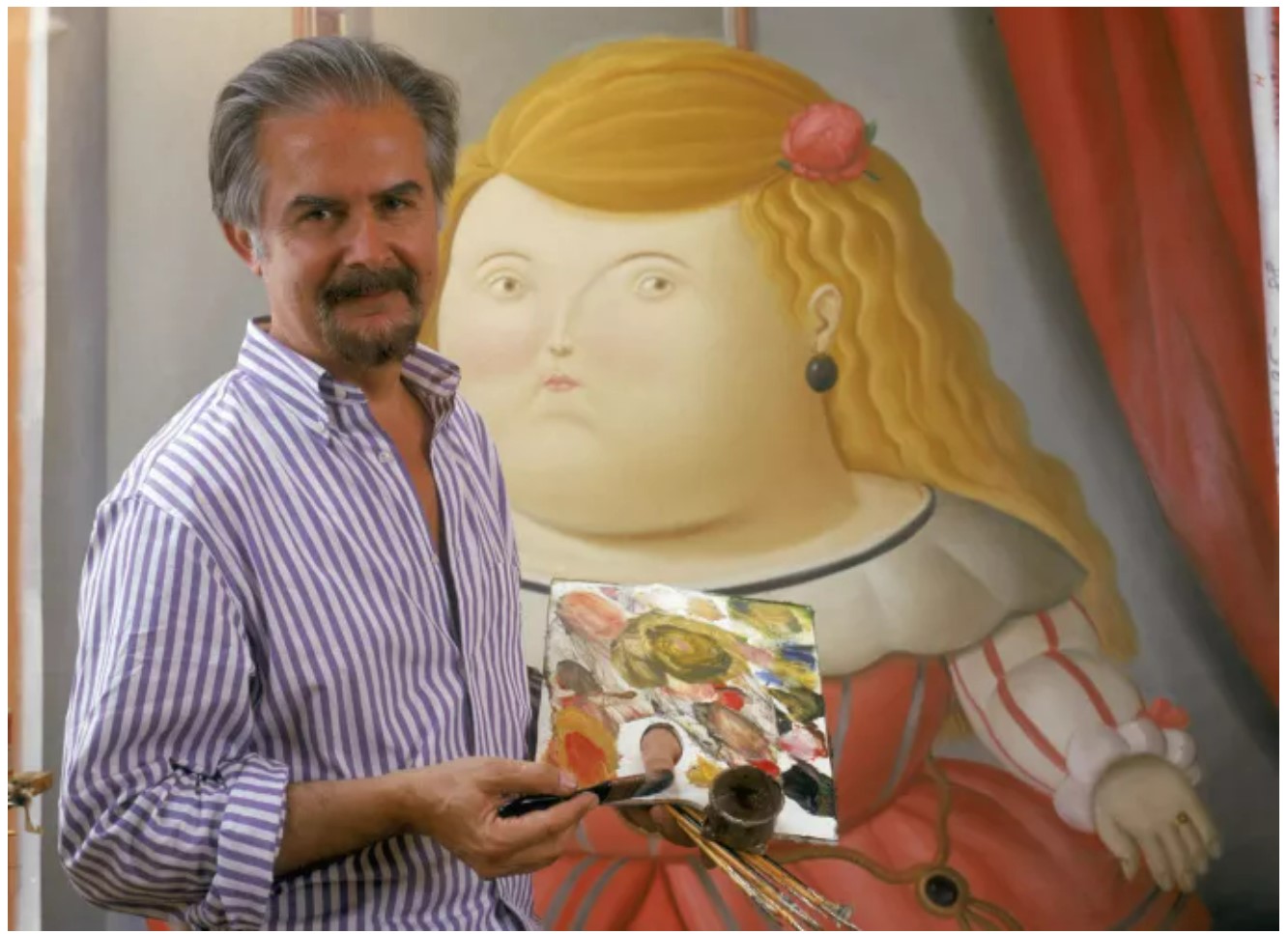
Renowned for his distinctive style of voluptuous and exaggerated forms, the Columbian artist Fernando Botero has left an indelible mark on the history of art. Acclaimed globally for his instantly recognizable paintings, Botero’s venture into sculpture has further enriched his artistic repertoire over course of his career. Under the tutelage of Robert Longhi, a distinguished specialist on Italian Renaissance and Baroque art, Botero obtained a remarkable art historical knowledge of Western Classicism that permeates much of his oeuvre. The canon of art history, especially the European one served as a rich source of inspiration, yet he shifts classical art historical topics into the realm of the everyday and the trivial, infusing them with his own personal experiences and the essence of his native Colombia.
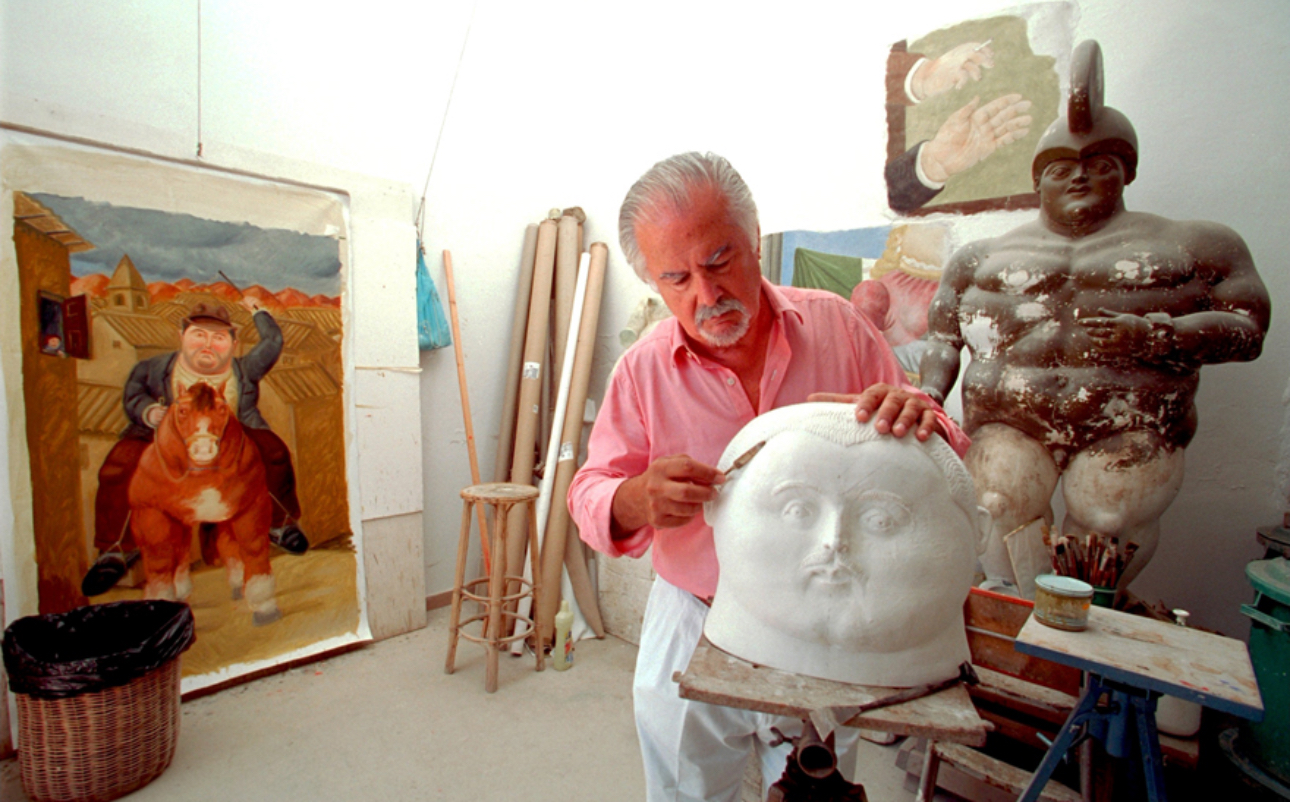
Today, Fernando Botero is recognized as one of the most important Colombian modern artists and his works are held in the collections of The Museum of Modern Art in New York, the Art Institute of Chicago, and the Museo Botero in Bogota. In 1958 and 1992, Botero also participated in the Venice Biennale and represented Colombia in the 5th São Paulo Biennial, Brazil. Inspired by the great classical masters, from Raphael, Peter Paul Rubens and Titian, to Giotto and Paolo Uccello, Fernando Botero’s style is a modern interpretation of the ever-evolving thread of form. After moving to New York in 1990, he continued to develop his trademark style of bulbous and exaggerated figures and animals, drawing inspiration from Rubens’ full-figured representations of female beauty. Often profoundly satirical, Botero asserts that his now iconic style – aptly termed ‘Boterismo’ – allowed him to explore mass and the sensuality of form, as well as to stress notable features in an almost caricature-like manner. ”
Fernando Botero passed away on 15 September 2023 in Monaco. He was 91. The artist, who was married for more than 40 years to the Greek sculptor and jewelry designer Sophia Vari, worked passionately at his craft up until his death. In his 50-year career, he produced a wide-ranging body of painting and sculpture that made a monumental impact on art and culture. At art institutions around the world and in the market, passion for his work remains stronger than ever.
Public Collections
Botero works are presently held in the collections of The Museum of Modern Art in New York, the Art Institute of Chicago, and the Museo Botero in Bogotá.
Public Exhibitions
In 1958 and 1992 Botero participated in the Venice Biennale and represented Colombia in the 5th São Paulo Biennial, Brazil. He has had major retrospectives at the Hirshhorn Museum and Sculpture Garden, Smithsonian Institution, Washington, DC (1979); Seibu Museum of Art, Tokyo (1981); Museo Nacional Centro de Arte Reina Sofía, Madrid (1987); Museo de Bellas Artes, Bilbao (2012); and many others.
PART I: SUMMARY
Auction Market Overview
2025 AUCTION STATISTICS
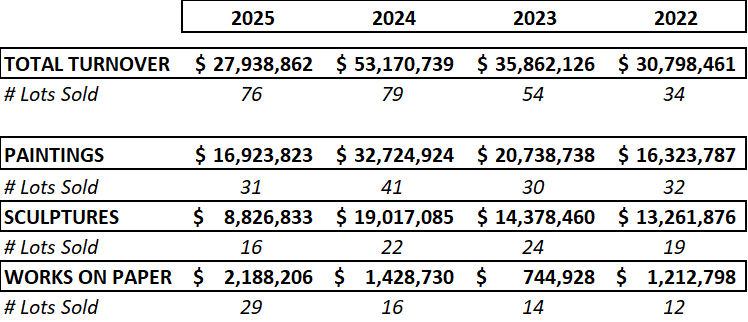
Turnover: USD 27,938,862
-47.5% vs. 2024
# of Lots sold: 76
Sell-Through rate: 88.4%
MARKET SEGMENTATION
Paintings (60.6%) / Sculptures (31.6%) / Works on Paper (7.8%)
(by value)
Highest Price achieved at Auction:
USD 5,132,000
Auction Summary
1. Paintings
2025 Auction Highlights
31 lots sold at auction in 2025 for a total turnover of USD 16,923,823. With 3 lots failing to sell, the sell-through rate is 91%. The highest price of USD 1,524,000 was achieved at Christie’s in New-York on 17 November 2025 by Florero, a painting dated 1970.
2025 Top 3 Lots
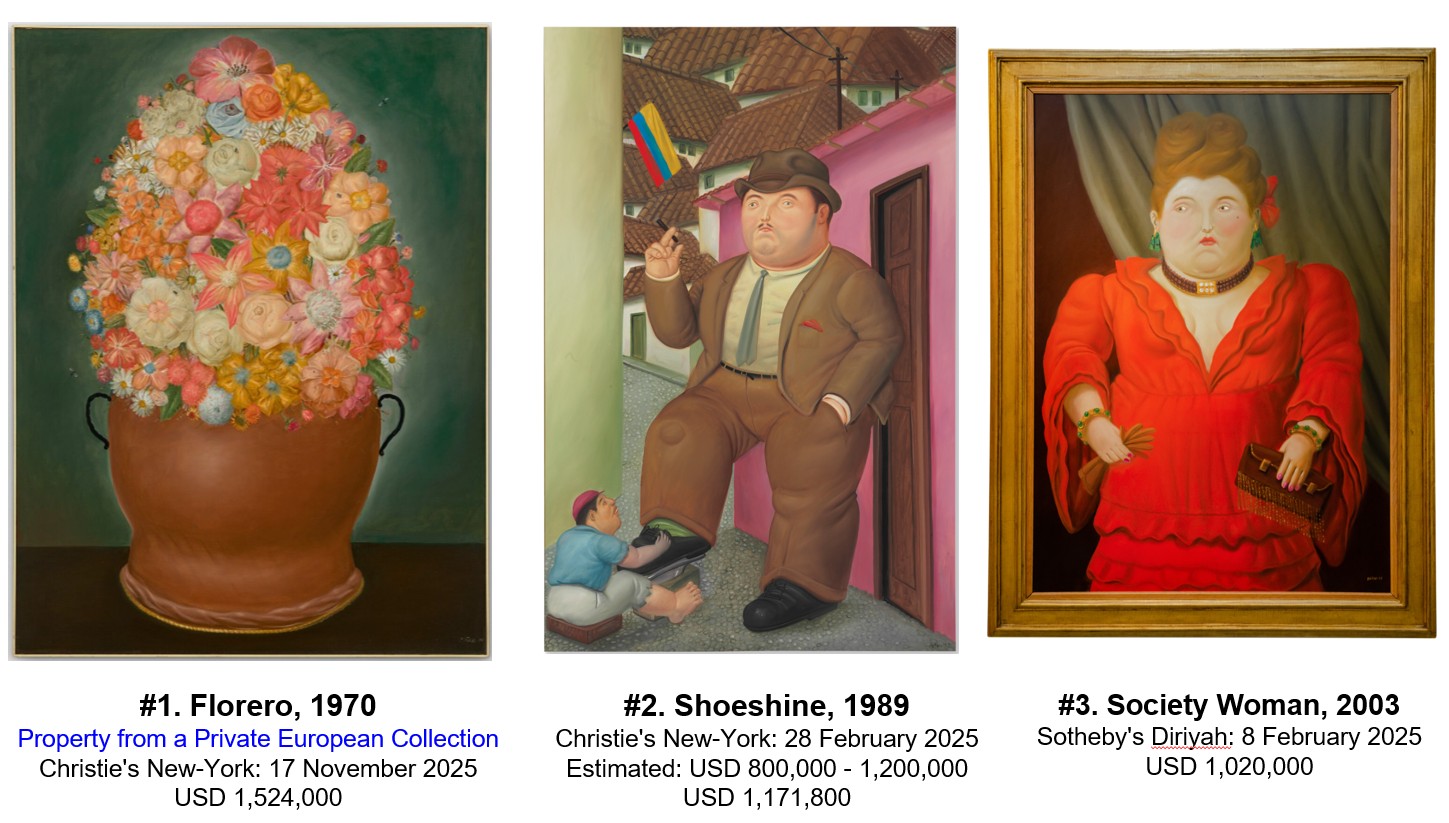
3 lots sold for more than USD 1 million, generating a cumulative turnover of USD 3,715,800, representing 22% of the total for 2025. 15 lots sold for more than USD 500,000, generating a cumulative turnover of USD 12,559,731, representing 74.2% of the total for 2025.
2024 Auction Highlights
41 lots sold at auction in 2024 for a total turnover of USD 32,724,924. 2024 is a record year for the artist at auction. With 2 lots failing to sell, the sell-through rate is 95%. The highest price has been achieved at Christie’s in New-York on 19 November 2024, when The Playroom, a painting dated 1970, sold for USD 3,680,000.
2024 Top 3 Lots
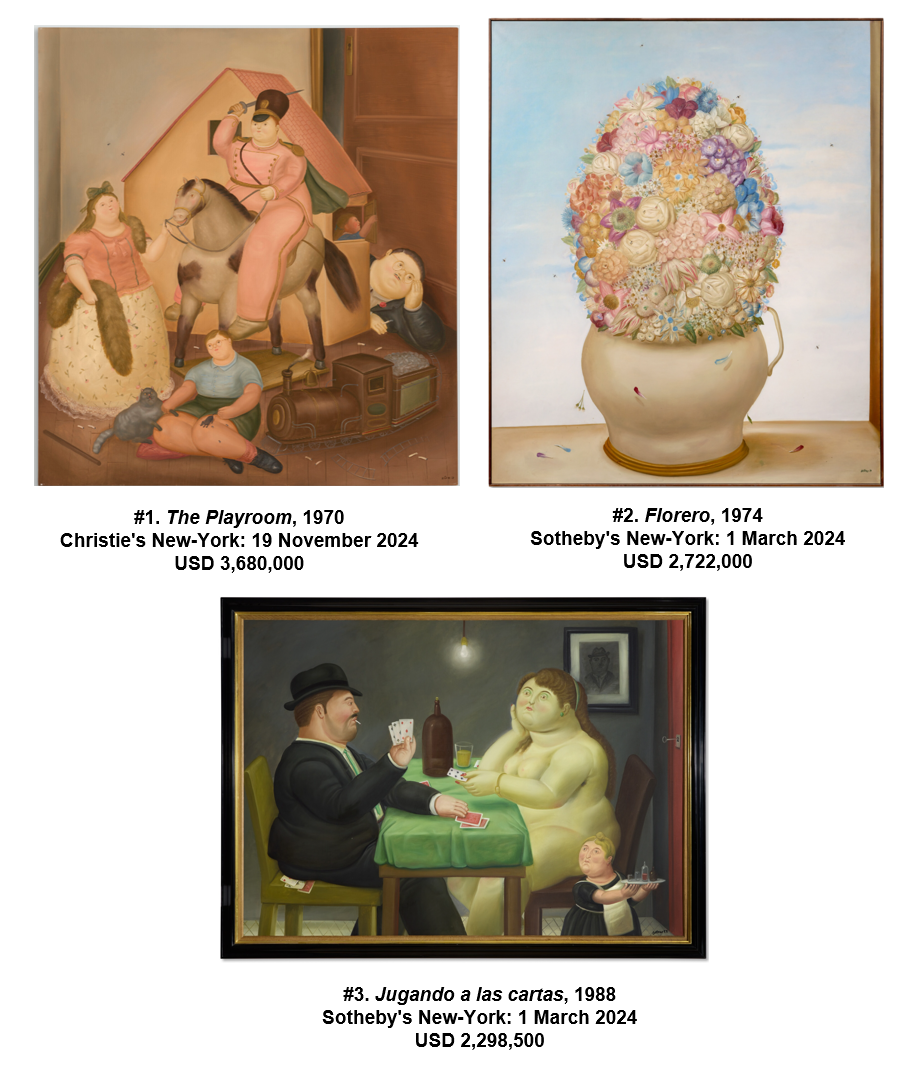
9 paintings sold for more than USD 1 million, generating a cumulative turnover of USD 17,136,579, representing 52.4% of the total turnover for 2024.
2023 Auction Highlights
30 paintings sold at auction in 2023 for a record turnover of USD 20,738,738. With only 4 lots unsold, the sell-through rate is a solid 88%. Furthermore, a new world record was set at Christie’s New-York on 9 November 2023 when The Musicians (1979) sold for USD 5,132,000.
2023 Top 3 Lots
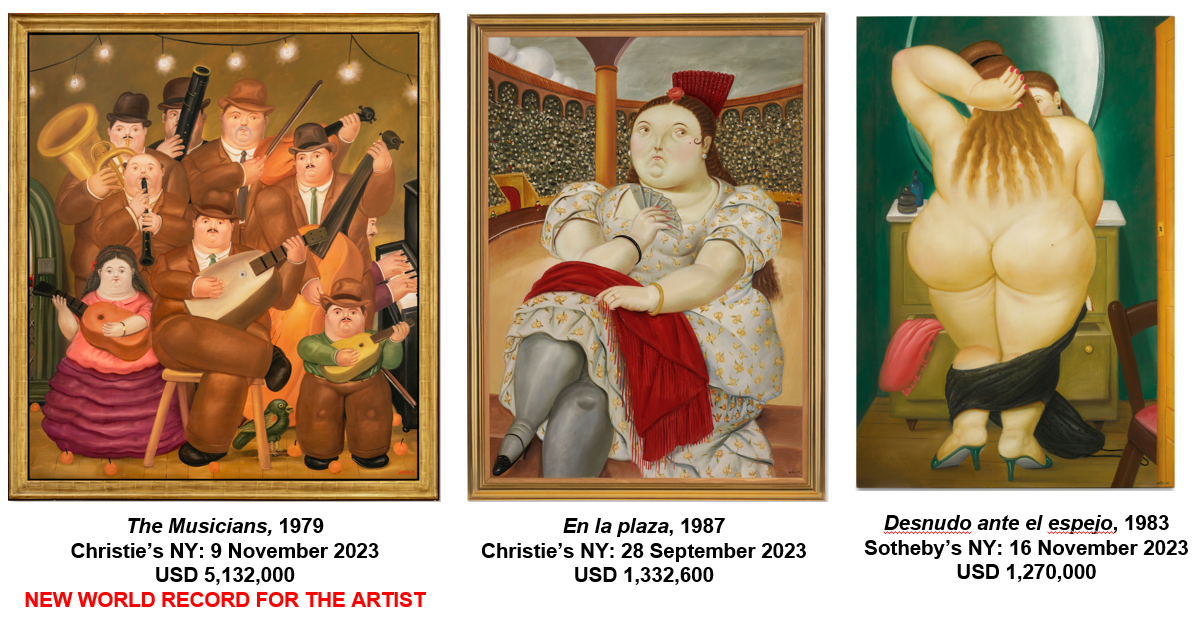
6 lots sold over USD 1 million for a total cumulative turnover of USD 10,830,100, representing 52.2% of the total turnover for 2023.
2022 Auction Highlights
32 paintings sold in 2022 for a total turnover of USD 16,323,787. With only 3 lots failing to sell, the Sell-Through rate is a strong 91%. The highest price was achieved at Bonhams in London on 24 March 2022 with La Casa de Rosalba Correa selling for GBP 922,750 (USD 1,216,545). Only 2 lots sold over USD 1 million.
2022 Top 3 Lots
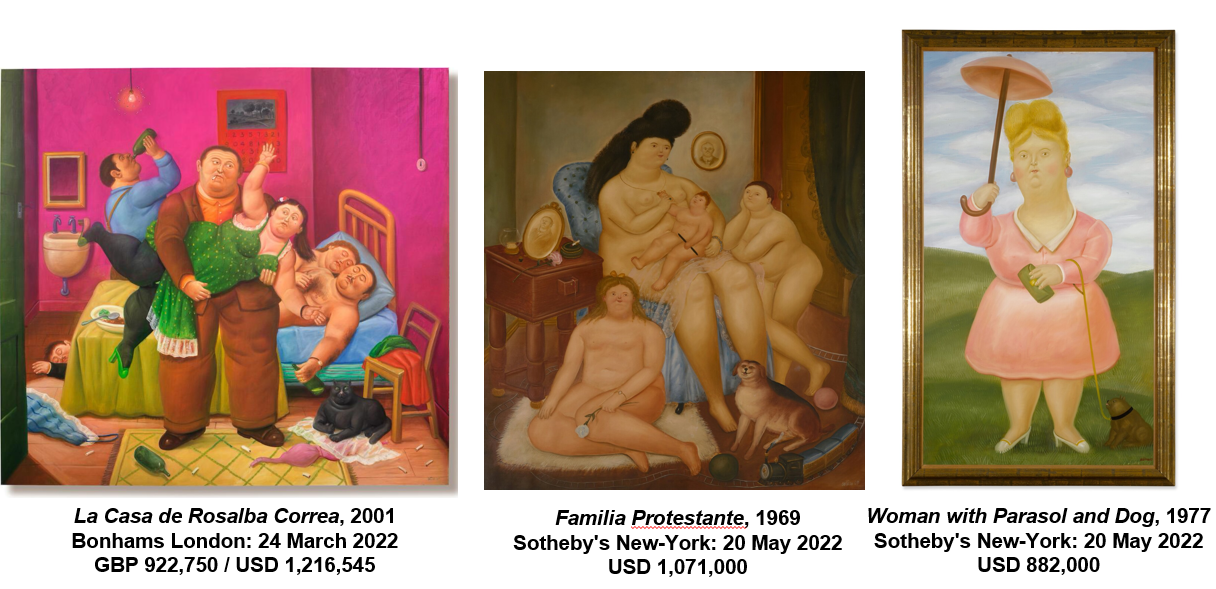
2. Sculptures
Fernando Botero’s sculptural repertoire faithfully echoes the subjects and motifs recurrent in his painted compositions: human figures, male and female, bathers, dancers, various animals, and mythological characters. The monumental quality and sheer physicality of the artist’s corpulent figures manifest most vividly within his sculptural work.
2025 Auction Highlights
16 lots sold at auction in 2025 for a total turnover of USD 8,826,833. With 4 lots failing to sell, the sell-through rate is 80%.
2025 Top 3 Lots
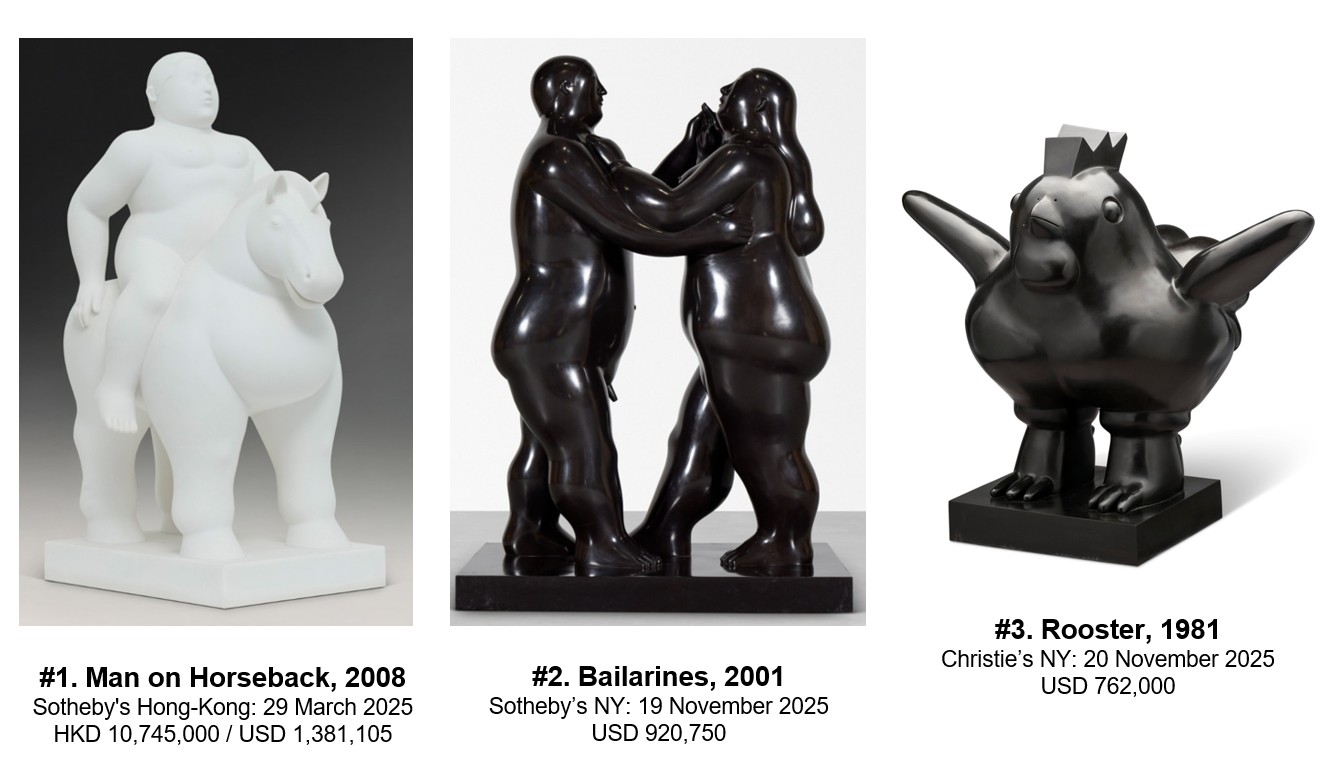
The highest price was achieved by Man on Horseback, a marble sculpture dated 2008 that sold at Sotheby’s in Hong-Kong on 29 March 2025 for HKD 10,745,000 (USD 1,381,105). Only 1 lot sold for more than USD 1 million. 8 lots sold for more than USD 500,000, generating a cumulative turnover of USD 6,171,800, representing 69.9% of the total turnover for 2025.
2024 Auction Highlights
22 lots sold at auction in 2024 for a total turnover of USD 19,017,085. With 7 lots failing to sell, the sell-through rate is 85%. The highest price has been achieved at Sotheby’s in New-York on 20 November 2024, when Horse, a Bronze dated 1992, sold for USD 4,920,000, a new world auction record for a sculpture of the artist.
2024 Top 3 Lots
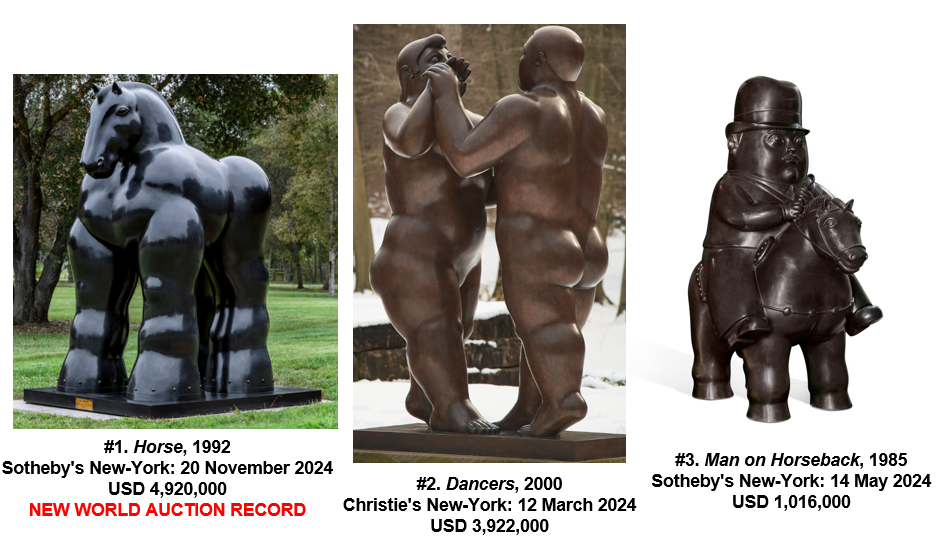
2023 Auction Highlights
24 lots sold at auction in 2023 for a total turnover of USD 14,378,460. With 2 lots failing to sell, the sell-through rate is a solid 92.3%. The highest price was achieved at Christie’s on 10 November 2023 for Parrot, sold for USD 1,865,000. 4 lots sold above USD 1 million generating a cumulative turnover of USD 5,452,500, representing 37.9% of the total turnover for 2023.
2023 Top 3 Lots
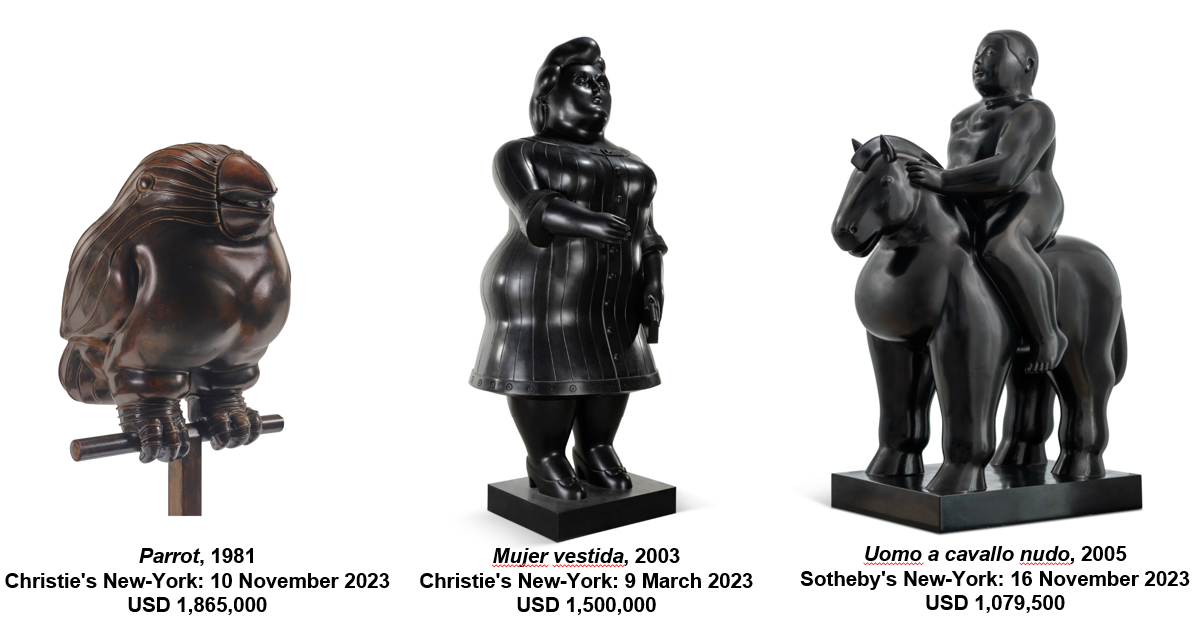
2022 Auction Highlights
19 lots sold at auction in 2022 for a total turnover of USD 13,261,876. With only 1 lot failing to sell, the sell-through rate is 95%. The highest price of USD 4,320,000 was achieved at Christie’s in New-York for Man on a Horse (1999). 8 lots sold over USD 500,000, generating a cumulative turnover of USD 9,518,653, representing 71.8% of the total turnover for 2022.
2022 Top 3 Lots
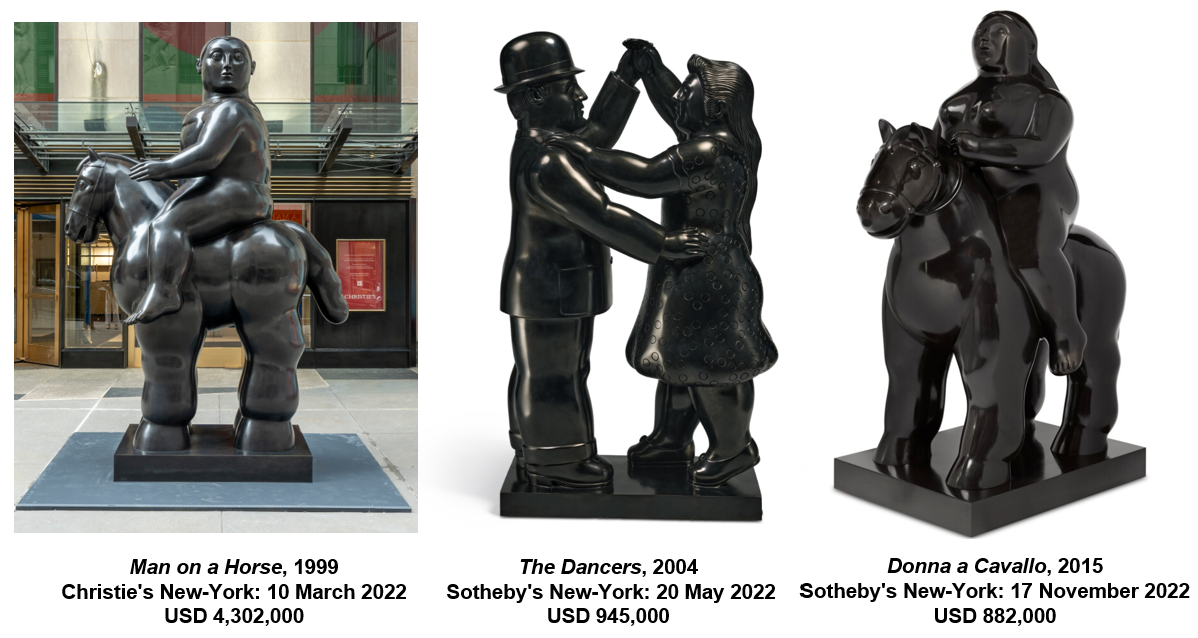
PLEASE CLICK BELOW TO FIND ALL AUCTION RESULTS FOR SCULPTURES
3. Works in Paper
WORK IN PROGRESS
2025 Auction Highlights
Lots sold for more than USD 20,000
29 lots sold at auction in 2025 for a total turnover of USD 2,188,206. With 3 lots failing to sell, the sell-through rate is 91%.
2025 Top 3 Lots
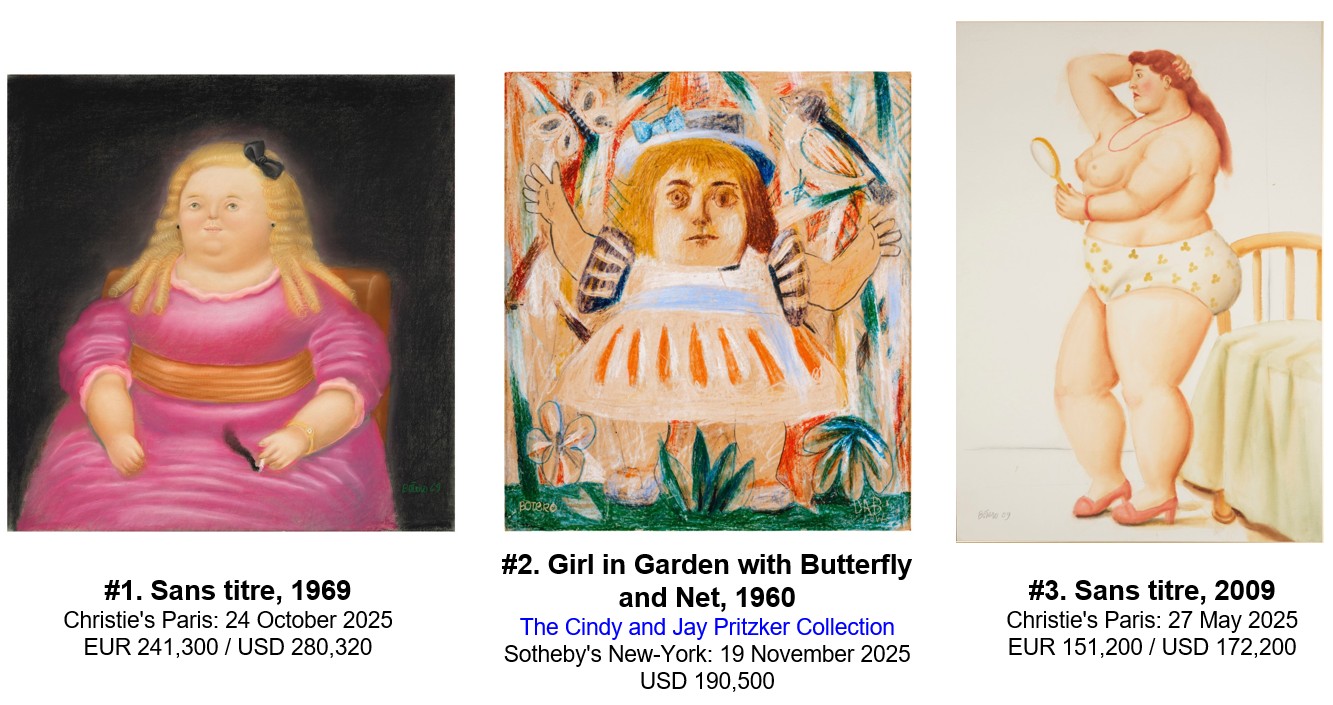
The highest price was achieved by an untitled drawing dated 1969, that sold at Christie’s in Paris on 24 October 2025 for EUR 241,300 (USD 280,320). 4 lots sold for more than USD 100,000, generating a cumulative turnover of USD 812,690, representing 37.1% of the total turnover for 2025.
2024 Auction Highlights
16 lots sold at auction in 2024 for a total turnover of USD 1,428,730. With 5 lots failing to sell, the sell-through rate is 76%. The highest price was achieved at Sotheby’s in New-York on 14 May 2024, when Pedro with Monkey, a work on paper dated 1972 sold for USD 698,500.
2023 Auction Highlights
14 lots sold at auction in 2023 for a total turnover of USD 744,928. With 2 lots failing to sell, the sell-through rate is 87.5%. The average price is 53,209. The highest price was achieved by a drawing executed in 2021, Men Drinking, that sold at Christie’s in New-York on 9 March 2023 for USD 88,200.
PLEASE CLICK BELOW TO FIND AUCTION RESULTS FOR WORKS ON PAPER
Top Lots
Narrative included within each relevant FOCUS section.
#1. The Musicians, 1979
Christie’s New-York: 9 November 2023
Estimated: USD 2,500,000 – 3,500,000
USD 5,132,000
FERNANDO BOTERO (1932-2023) (christies.com)
REPEAT SALE
Christie’s New-York: 24 May 2006
Estimate on Request
USD 2,032,000
Fernando Botero (Colombian B. 1932) , The Musicians | Christie’s
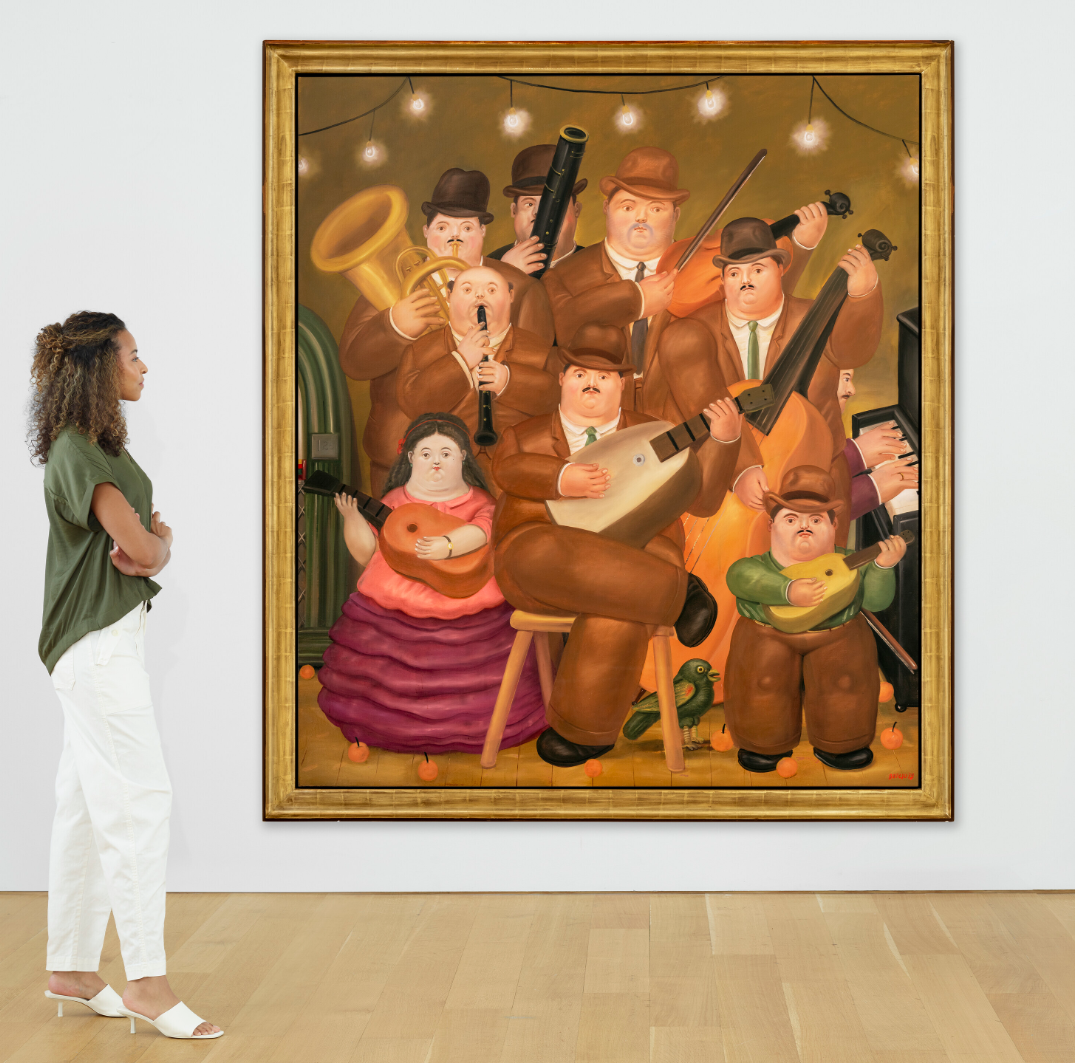
FERNANDO BOTERO (1932-2023)
The Musicians, 1979
Oil on canvas
217.2 x 189.9 cm (85 1/2 x 74 3/4 inches)
signed and dated ‘Botero 79’ (lower right)
USD 5 million
#2. The Playroom, 1970
Christie’s New-York: 19 November 2024
Estimated: USD 3,000,000 – 5,000,000
USD 3,680,000
FERNANDO BOTERO (1932-2023), The Playroom | Christie’s
FERNANDO BOTERO (1932-2023)
The Playroom, 1970
Oil on canvas
206.4 x 191.5 cm (81 1/4 x 75 3/8 inches)
Signed and dated ‘Botero 70’ (lower right)
Signed and dated again and titled ‘BOTERO 70 THE PLAYROOM’ (on the reverse)
#3. Florero, 1974
Sotheby’s New-York: 1 March 2024
Estimated: USD 1,000,000 – 1,500,000
USD 2,722,000
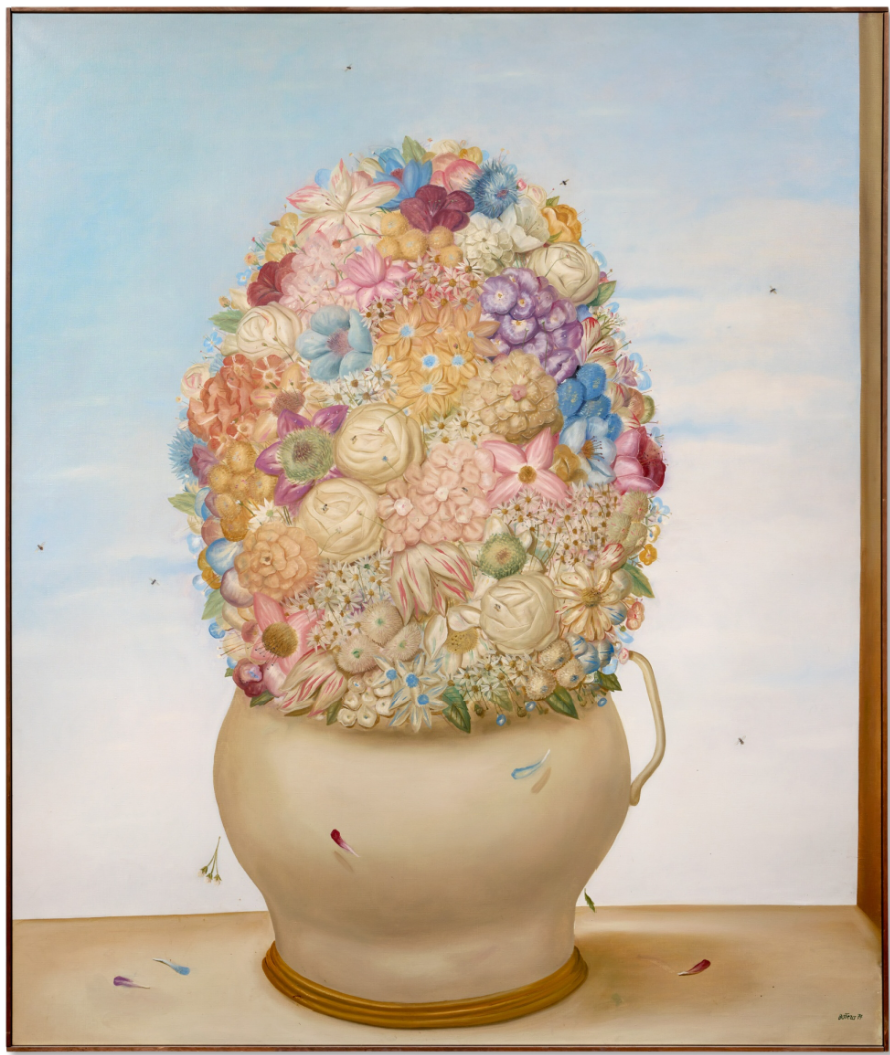
FERNANDO BOTERO (1932 – 2023)
Florero, 1974
Oil on canvas
226×191 cm (89 x 75 1/4 inches)
Signed Botero and dated 74 (lower right)
#4. Jugando a las cartas, 1988
Sotheby’s New-York: 1 March 2024
Estimated: USD 1,000,000 – 1,500,000
USD 2,298,500
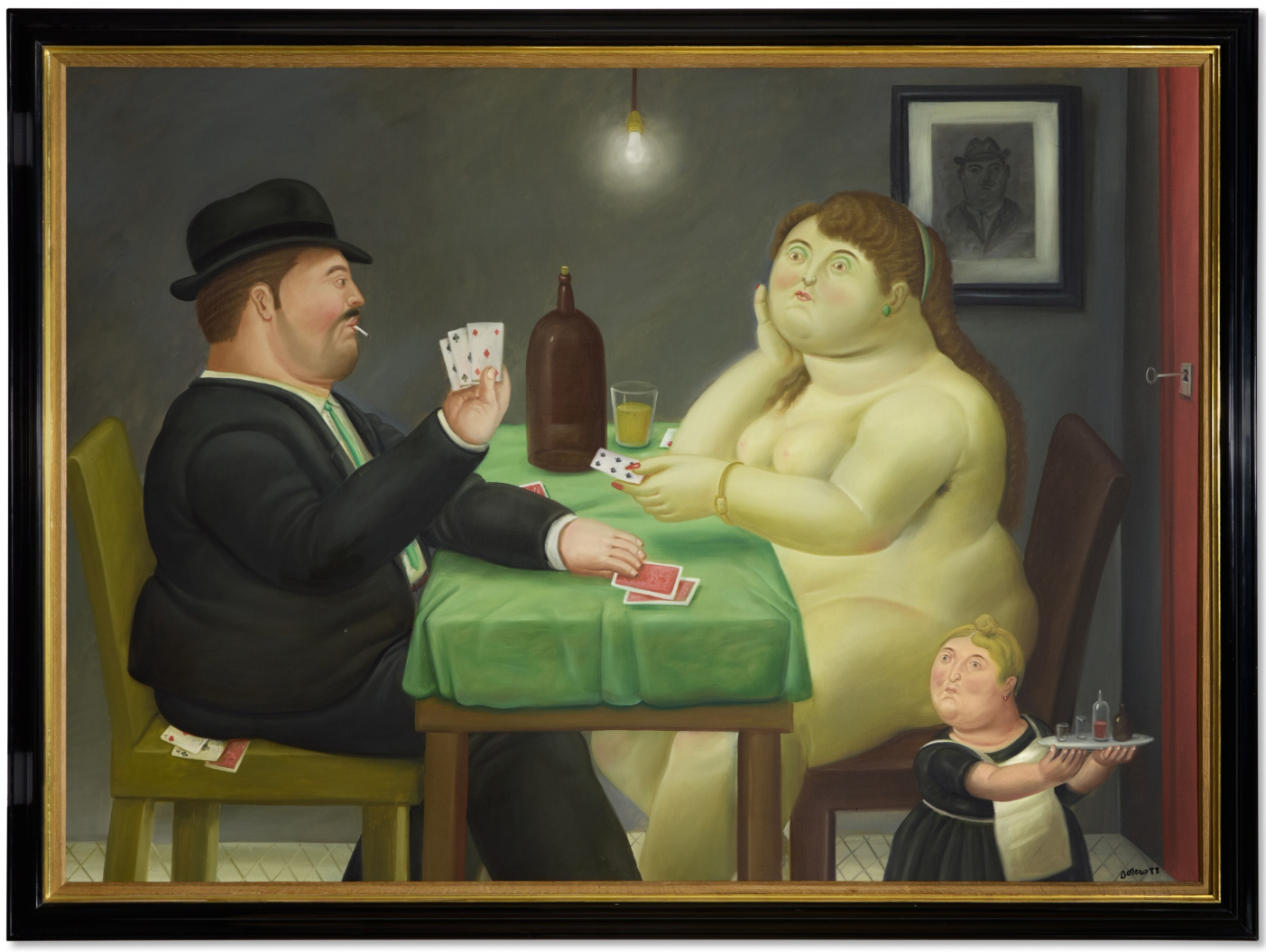
FERNANDO BOTERO (1932 – 2023)
Jugando a las cartas, 1988
Oil on canvas
130×188 cm (51 1/8 x 74 inches)
Signed Botero and dated 88 (lower right)
#5. Nightlife, 2017
Christie’s Paris: 18 October 2024
Estimated: EUR 850,000 – 1,250,000
EUR 2,036,500 / USD 2,121,829
Fernando Botero (1932-2023), Nightlife | Christie’s
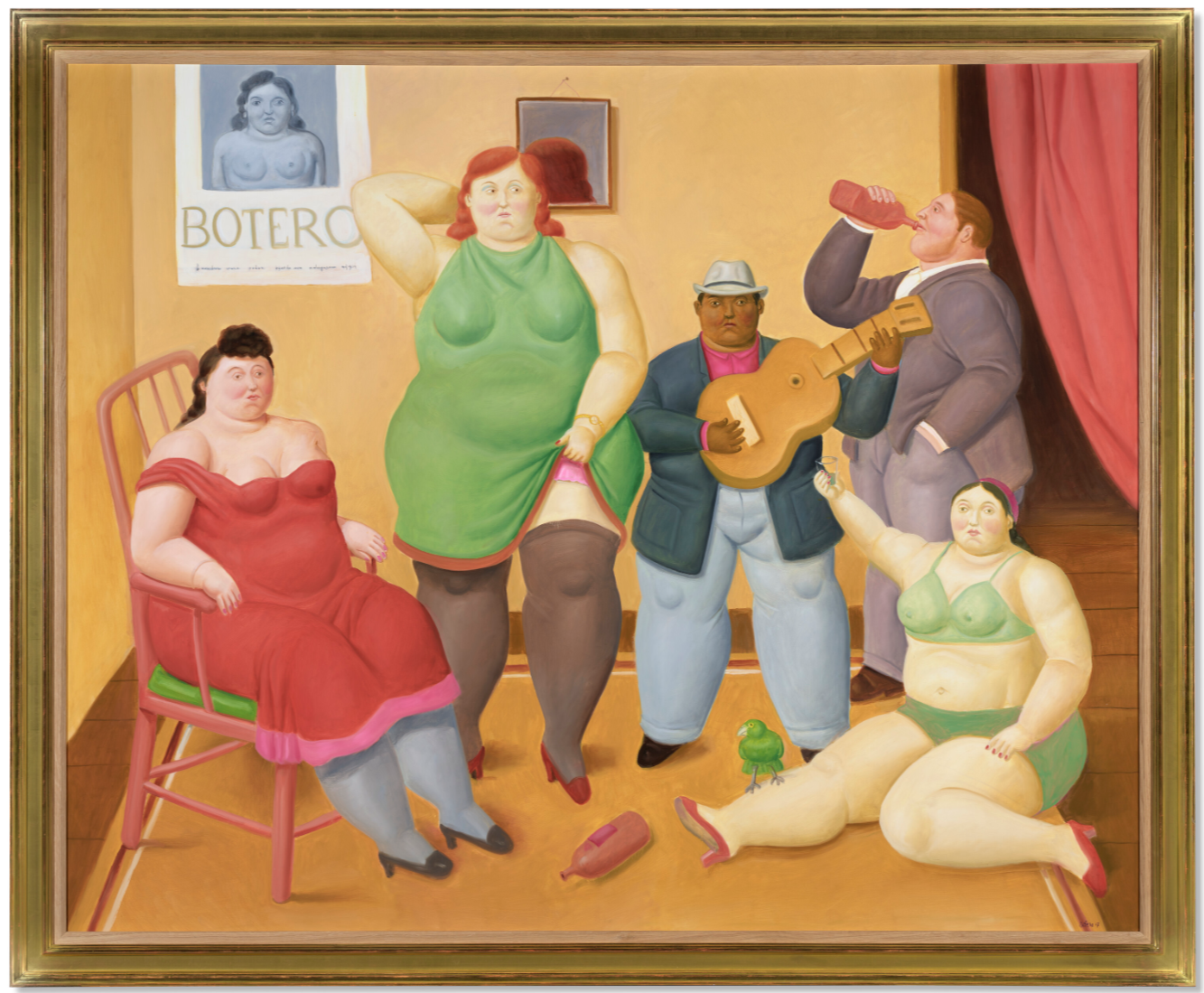
FERNANDO BOTERO (1932-2023)
Nightlife, 2017
Oil on canvas
167 x 206.5 cm (65 3/4 x 81 1/4 inches)
Signed ‘Botero 17’ (lower right)
#6. La Casa de las Gemelas Arias, 1973
Sotheby’s New-York: 25 November 2014
Estimated: USD 2,000,000 – 3,000,000
USD 2,105,000
(#56) Fernando Botero (b. 1932) (sothebys.com)
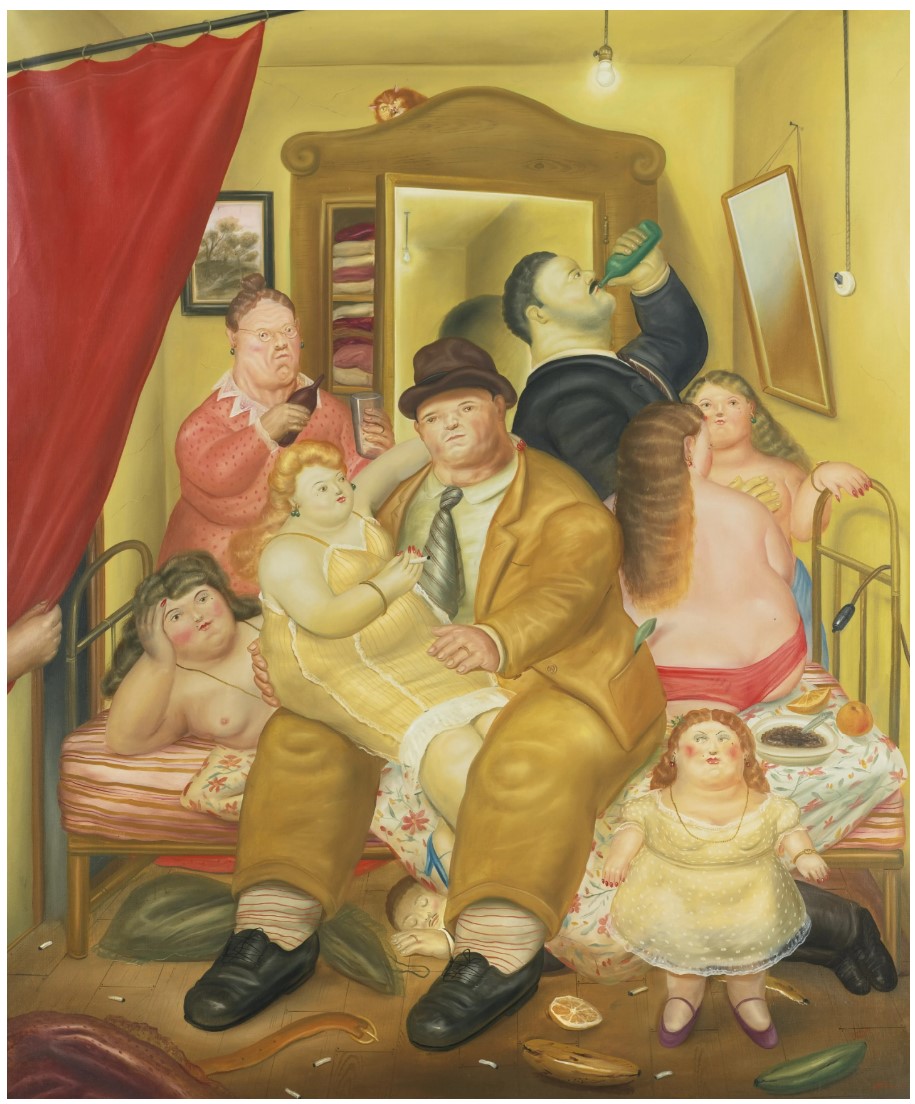
FERNANDO BOTERO
La casa de las gemelas Arias, 1973
Oil on canvas
227×187 cm (89 1/4 x 73 3/4 inches)
Signed and dated 73 lower right
#7. Tablao Flamenco, 1984
Christie’s New-York: 21 November 2019
Estimated: USD 1,500,000 – 2,000,000
USD 2,055,000
Fernando Botero (b. 1932) (christies.com)
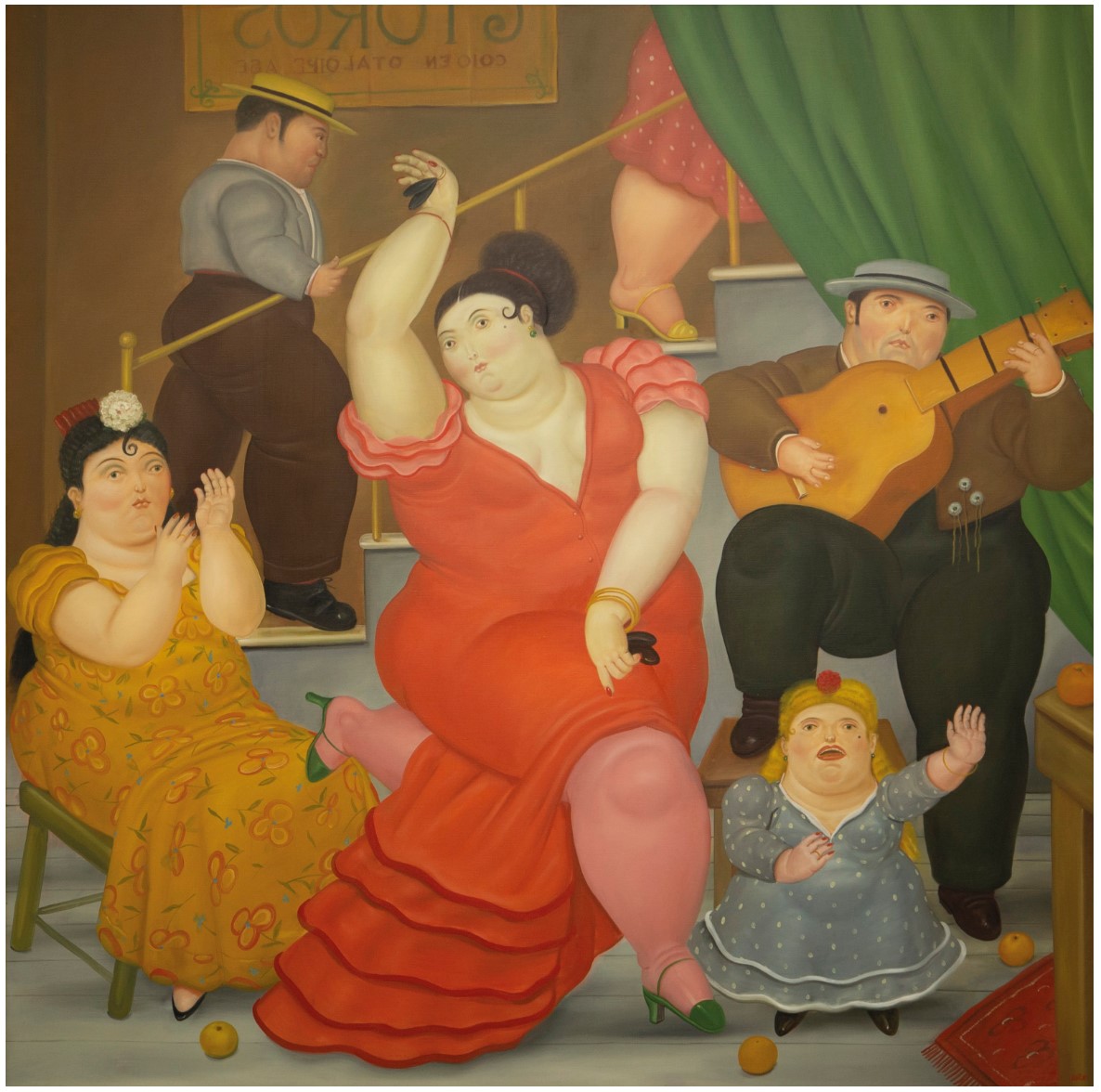
FERNANDO BOTERO (b. 1932)
Tablao Flamenco, 1984
Oil on canvas
201.3 x 202.6 cm (79 1/4 x 79 3/4 inches)
Signed ‘Botero’ (lower right)
#8. Cuatro Músicos (Four Musicians), 1984
Sotheby’s New-York: 24 May 2006
Estimated: USD 1,000,000 – 1,500,000
USD 2,024,000
(#14) Fernando Botero (B. 1933) (sothebys.com)
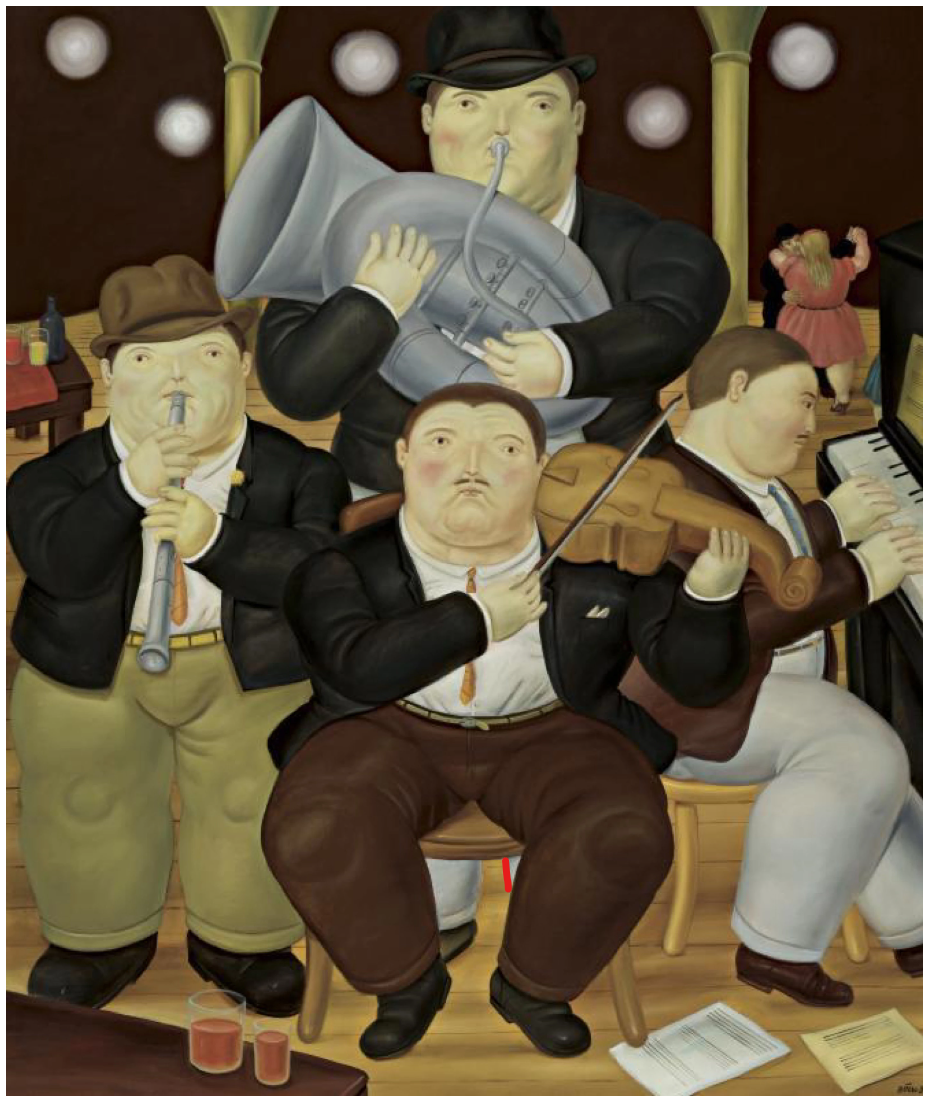
FERNANDO BOTERO
Cuatro Músicos (Four Musicians), 1984
Oil on canvas
221.3 x 185 cm (87 1/8 x 72 3/4 inches)
Signed and dated 84 lower right
#9. Card Players, 1986
Christie’s New-York: 13 November 2020
Estimated: USD 1,000,000 – 1,500,000
USD 2,010,000
Fernando Botero (b. 1932) (christies.com)
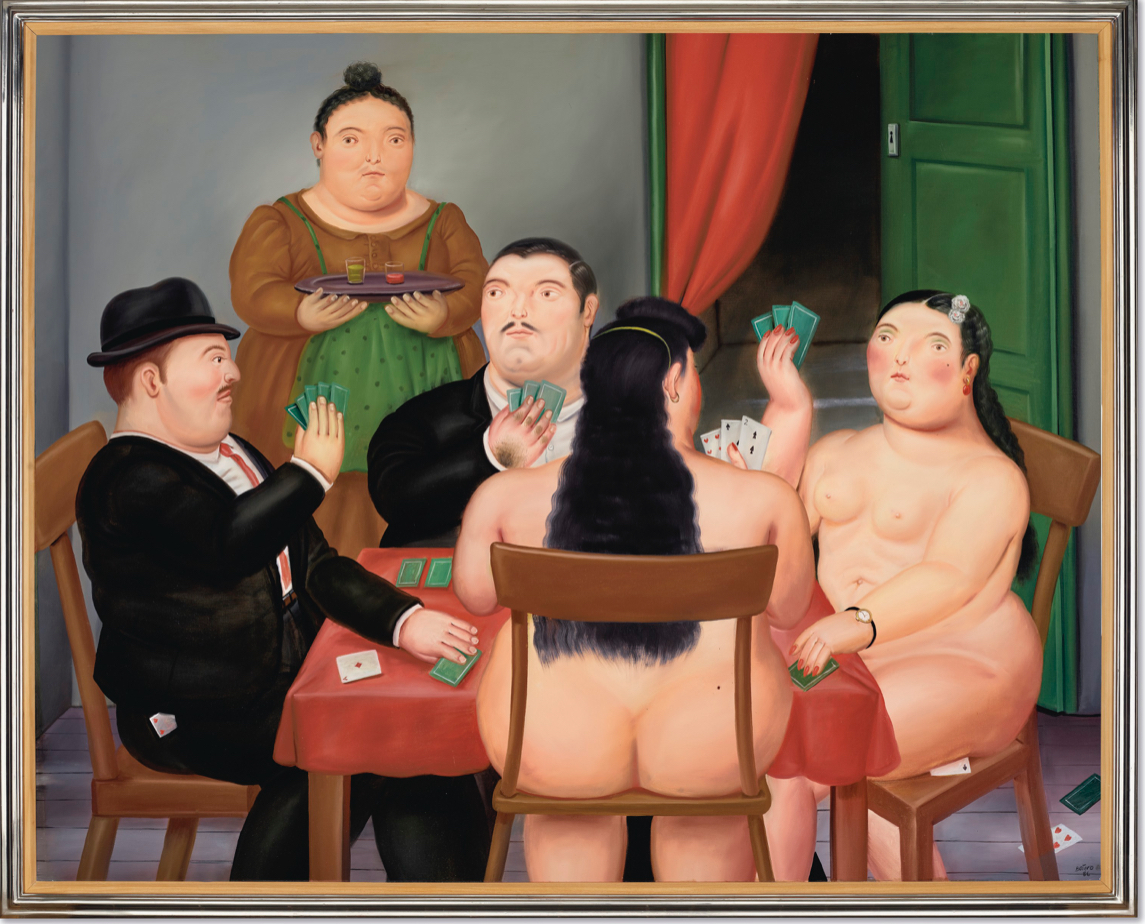
FERNANDO BOTERO (b. 1932)
Card Players, 1986
Oil on canvas
150.5 x 188.6 cm (59 1/4 x 74 1/4 inches)
Signed and dated ‘Botero 86’ (lower right)
USD 2 million
#10. Oranges, 1973
Christie’s New-York: 10 May 2018
Estimated: USD 300,000 – 400,000
USD 1,872,500
Fernando Botero (b. 1932) (christies.com)
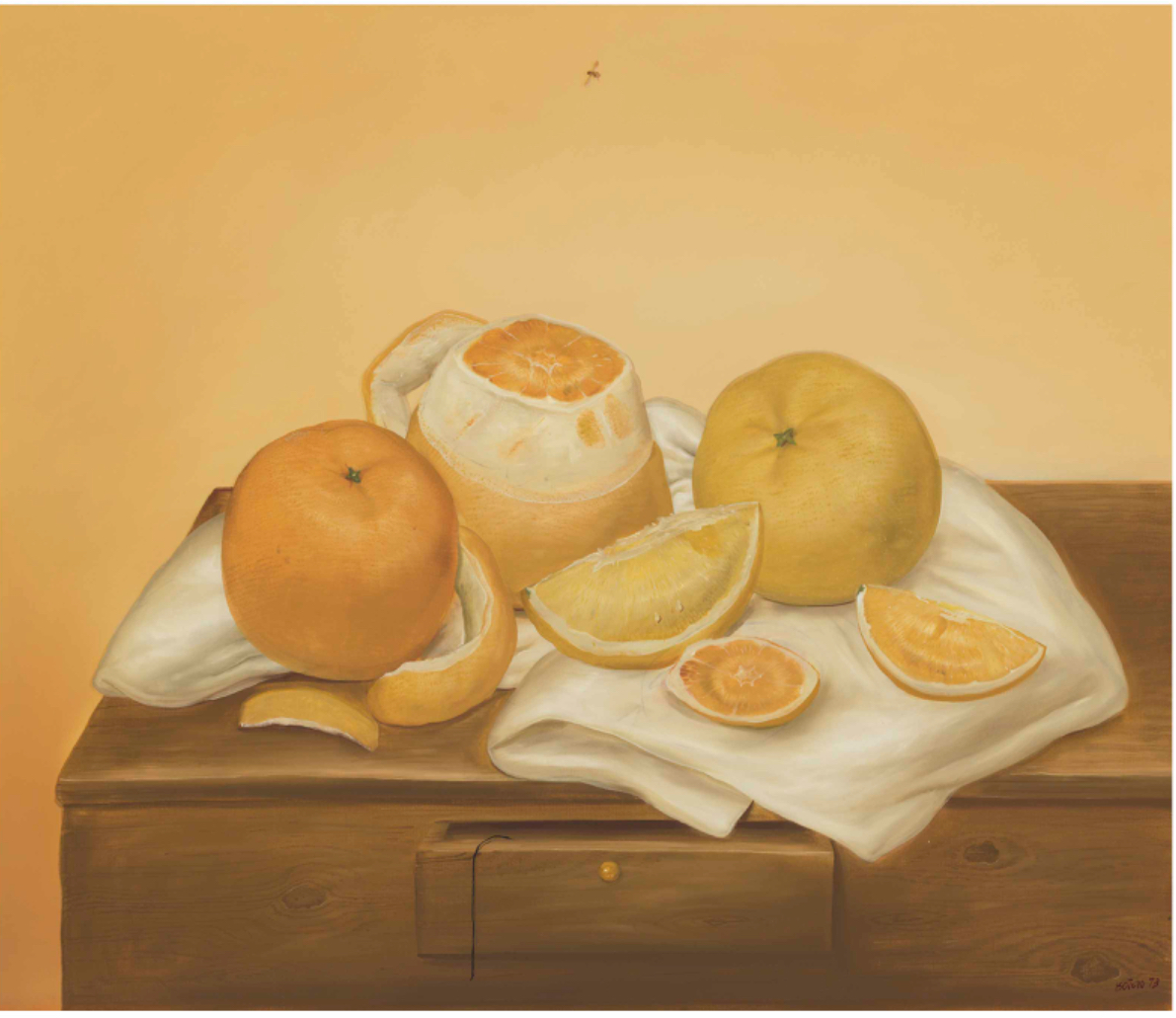
FERNANDO BOTERO (b. 1932)
Oranges, 1973
Oil on canvas
106.7 x 125.1 cm (42 x 49 1/4 inches)
Signed and dated ‘Botero 73’ (lower right)
#11. The Bather, 1975
Christie’s New-York: 19 May 2021
Estimated: USD 1,800,000 – 2,500,000
USD 1,830,000
Fernando Botero (b. 1932) (christies.com)
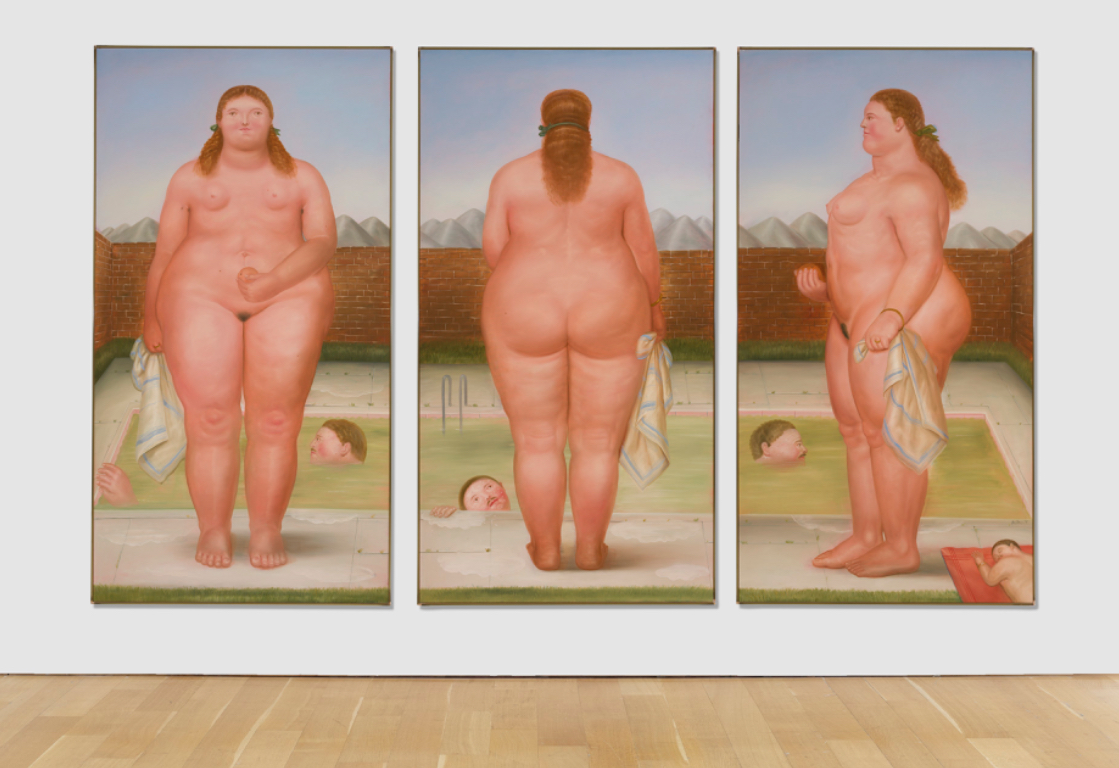
FERNANDO BOTERO (b. 1932)
The Bather, 1975
Oil on canvas in three parts
Each: 236.2 x 126 cm (93 x 49 1/2 inches)
Overall: 236.2 x 377.2 cm (93 x 148 1/2 inches)
Signed and dated ‘Botero 75’ (lower right, right panel)
#12. Hombre fumando, 1980
Christie’s New-York: 12 March 2024
Estimated: USD 500,000 – 700,000
USD 1,744,000
FERNANDO BOTERO (1932-2023), Hombre fumando | Christie’s (christies.com)
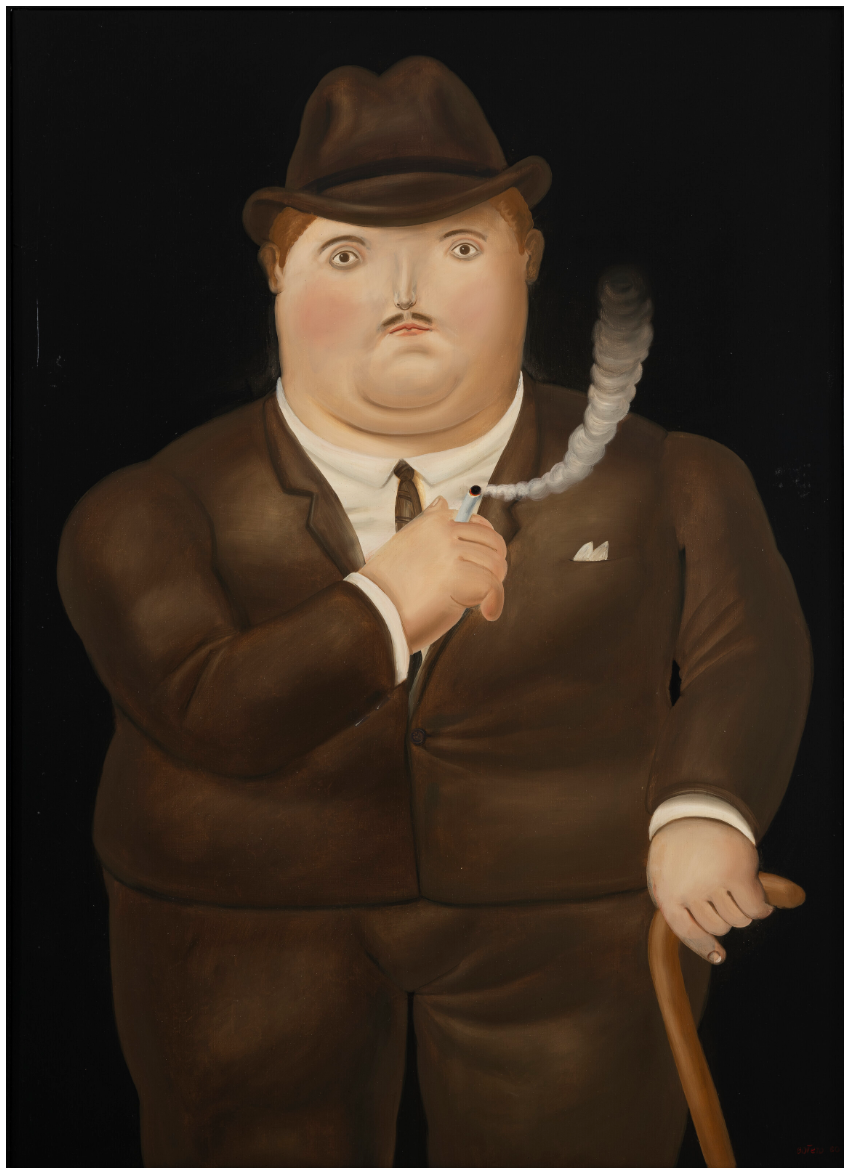
FERNANDO BOTERO (1932-2023)
Hombre fumando, 1980
Oil on canvas
189.8 x 136.2 cm (74 3/4 x 53 1/2 inches)
Signed and dated ‘Botero, 80’ (lower right)
#13. Family Scene, 1985
Christie’s New-York: 18 November 2010
Estimated: USD 1,000,000 – 1,500,000
USD 1,706,500
Fernando Botero (Colombian b. 1932) (christies.com)
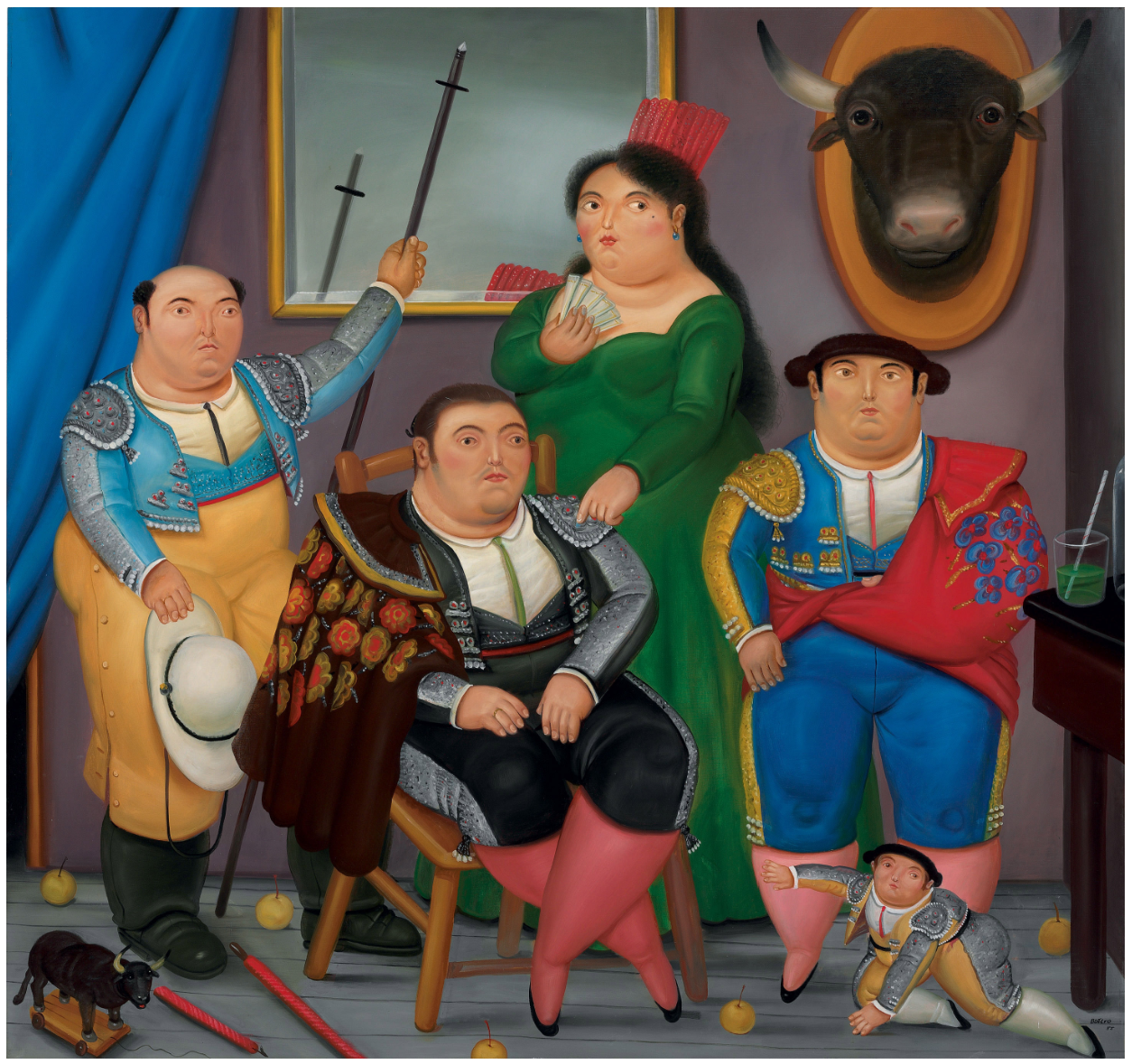
FERNANDO BOTERO (Colombian b. 1932)
Family Scene, 1985
Oil on canvas
169×179 cm (66 1/2 x 70 1/2 inches)
Signed and dated ‘Botero 85’ (lower right)
#14. Jugadoras de Cartas II, 1989
Sotheby’s New-York: 20 November 2006
Estimated: USD 1,500,000 – 1,800,000
USD 1,688,000
(#18) Fernando Botero (B. 1933) (sothebys.com)
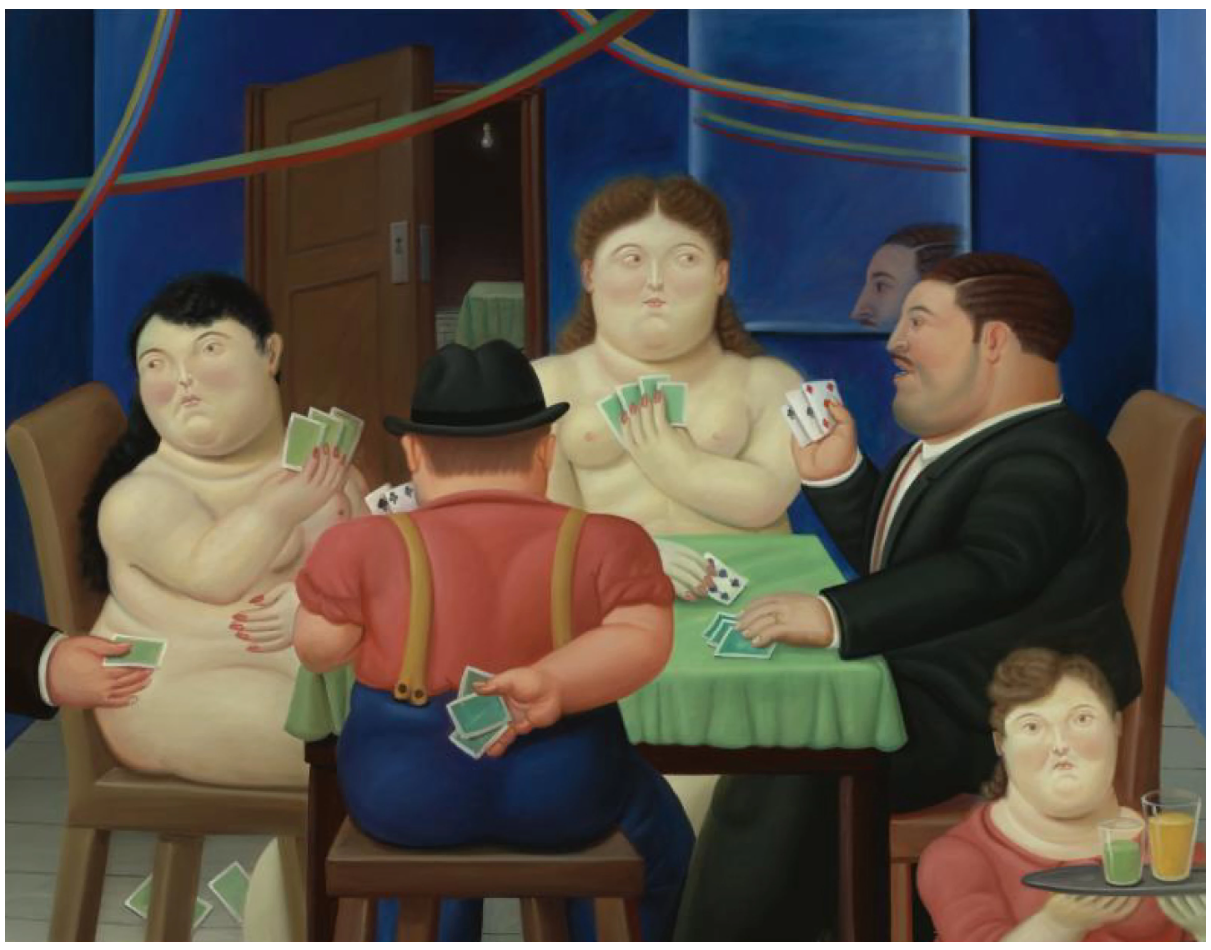
FERNANDO BOTERO
Jugadoras de Cartas II, 1989
Oil on canvas
159.4 x 201.6 cm (62 3/4 x 79 3/8 inches)
Signed and dated 89 lower right
#15. La Cantante, 2016
Christie’s Hong-Kong: 1 December 2021
Estimated: HKD 7,800,000 – 13,800,000
HKD 12,250,000 / USD 1,571,792
FERNANDO BOTERO (B. 1932) (christies.com)
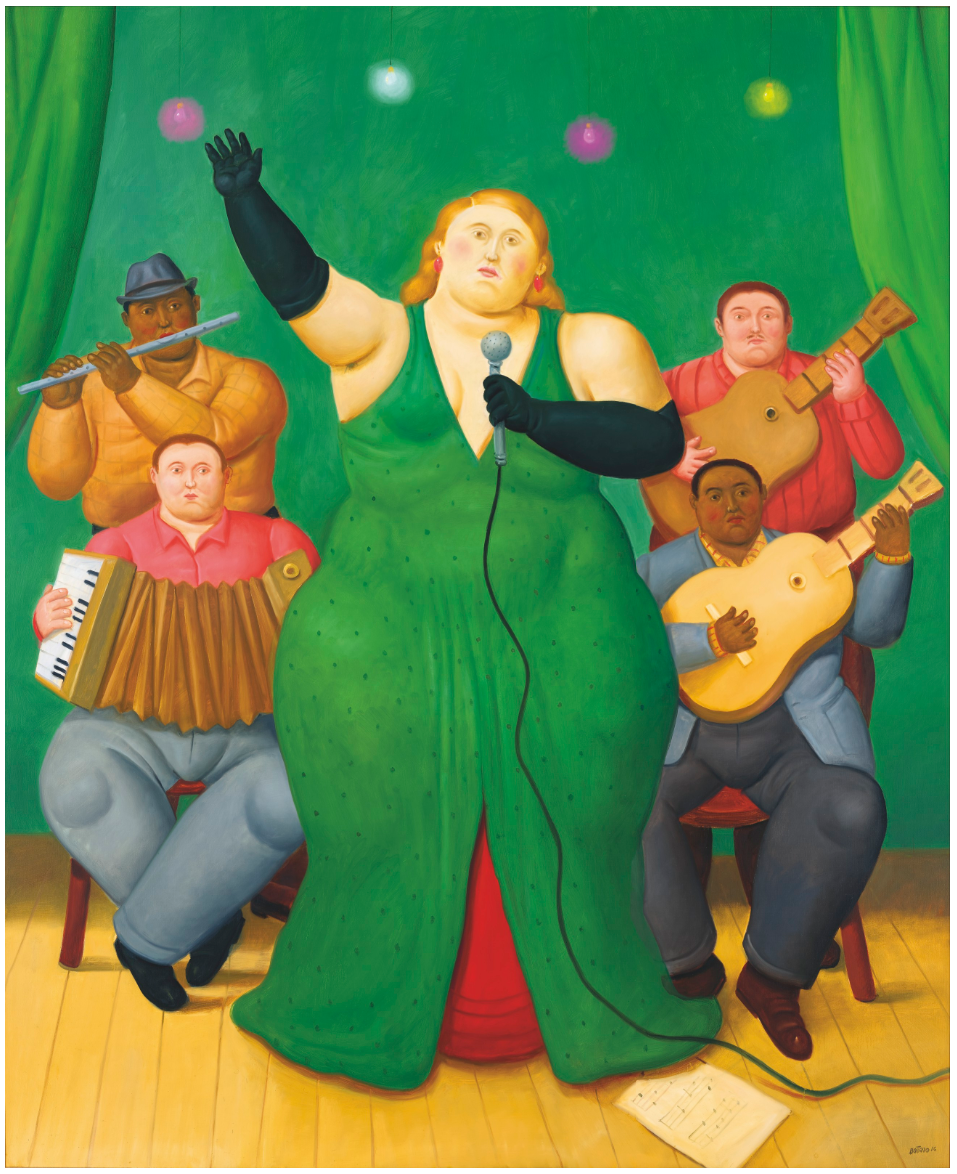
FERNANDO BOTERO (B. 1932)
La Cantante, 2016
Oil on canvas
189×155 cm (74 3/8 x 61 inches)
Signed and dated ‘Botero 16’ (lower right)
PLEASE CLICK BELOW TO FIND TOP LOTS FOR SCULPTURES
PART II: AUCTION RESULTS
2026 Upcoming Lots
MORE LOTS COMING SOON
2026 Auction Results
FOR PAINTINGS ONLY
PRELIMINARY AUCTION RESULTS
As of 1 June 2026
#1. El poeta, 1987
Christie’s New-York: 21 May 2026
Estimated: USD 800,000 – 1,200,000
USD 1,270,000
FERNANDO BOTERO (1932-2023), El poeta | Christie’s
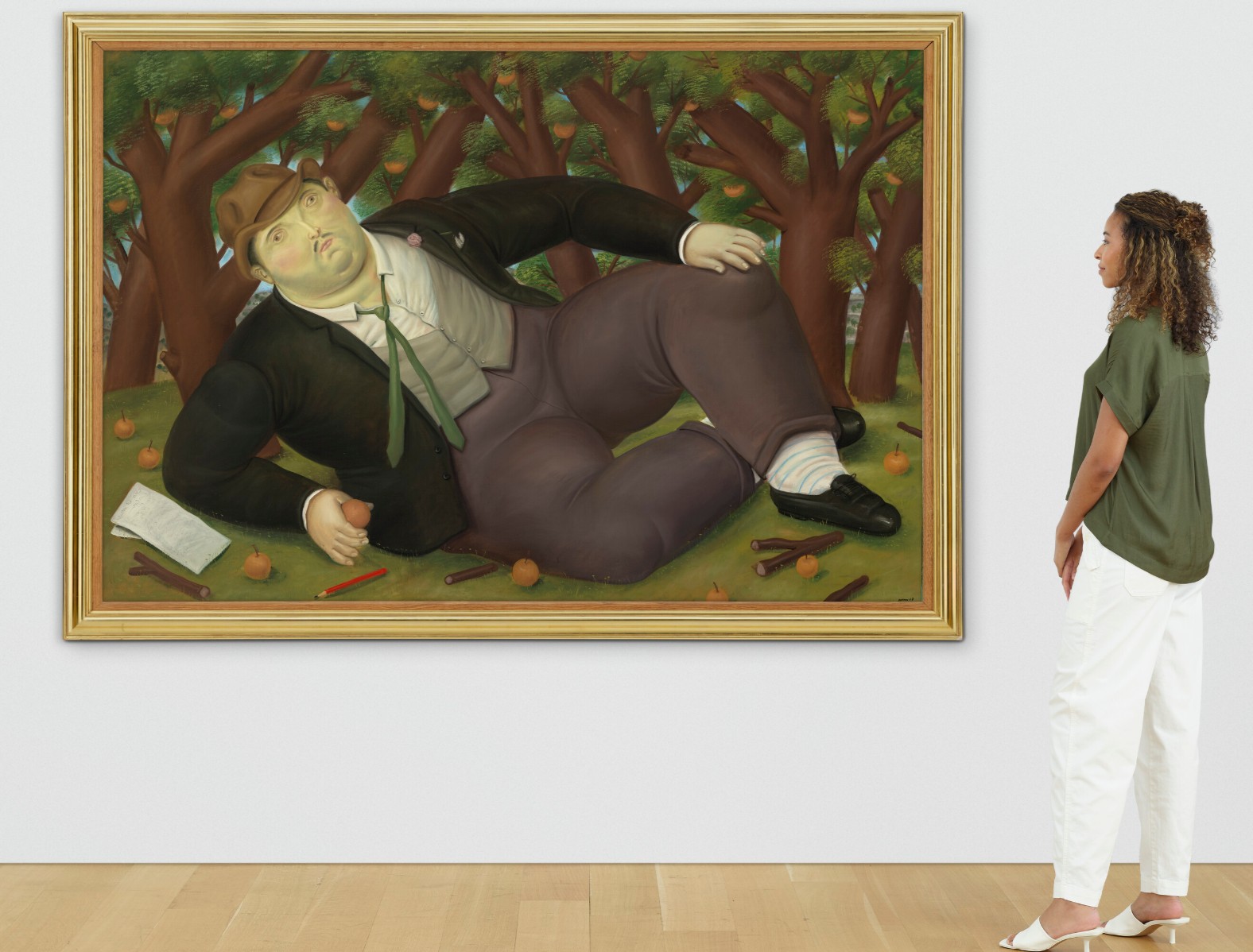
FERNANDO BOTERO (1932-2023)
El poeta, 1987
Oil on canvas
140×208 cm (55-1/8 x 81-7/8 inches)
Signed and dated ‘Botero 87’ (lower right)
USD 1 million
#2. La Dolorosa, 1967
Christie’s Paris: 15 April 2026
Estimated: EUR 250,000 – 350,000
EUR 762,000 / USD 899,135
Fernando Botero (1932-2023), La Dolorosa | Christie’s
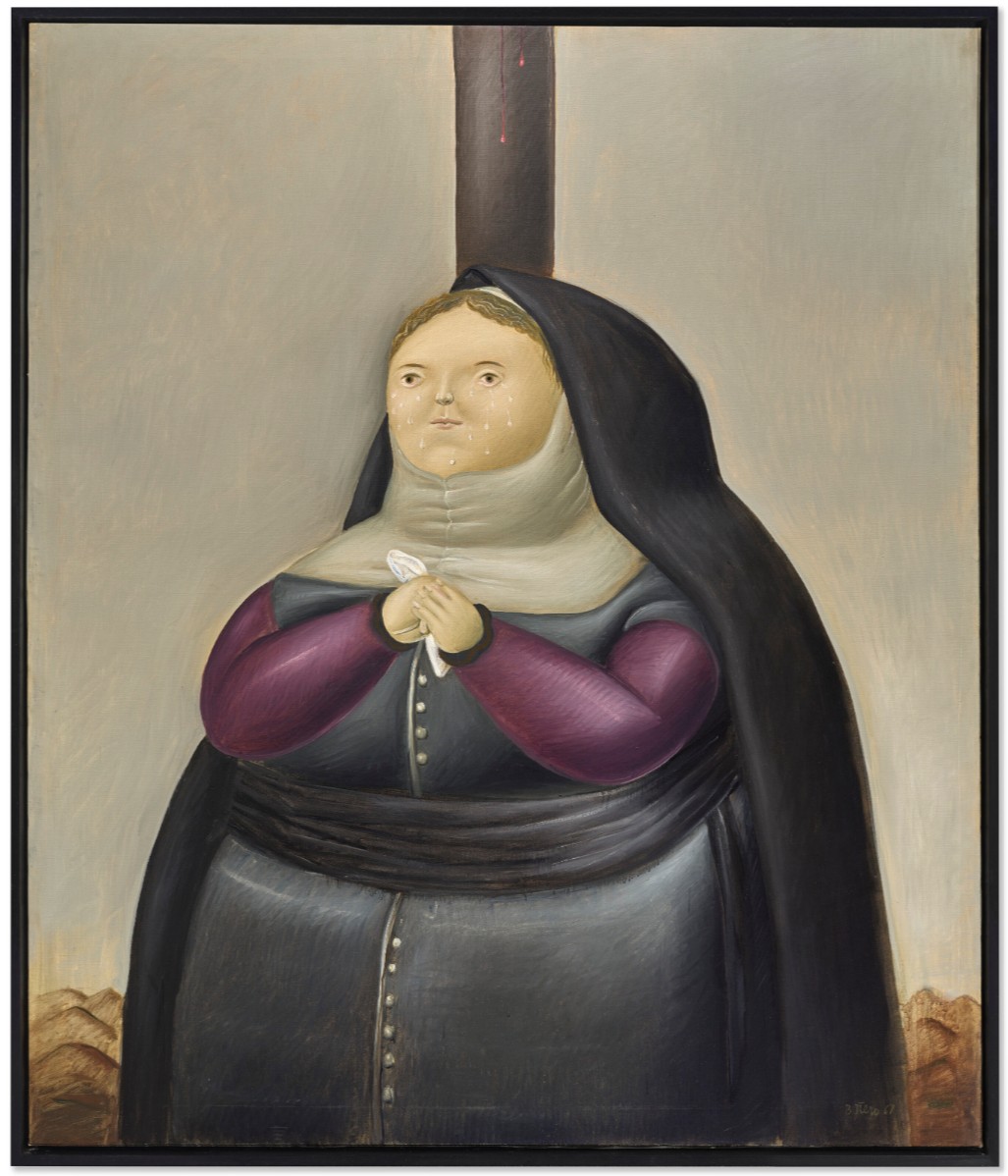
FERNANDO BOTERO (1932-2023)
La Dolorosa, 1967
Oil on canvas
155.8 x 131.8 cm (61-3/8 x 51-7/8 inches)
Signed and dated ‘Botero 67’ (lower right)
Signed and dated ‘Botero 67’ (on the reverse)
#3. The Street, 2013
Property from an Important Private Collection
Christie’s New-York: 21 May 2026
Estimated: USD 400,000 – 600,000
USD 889,000
FERNANDO BOTERO (1932-2023), The Street | Christie’s
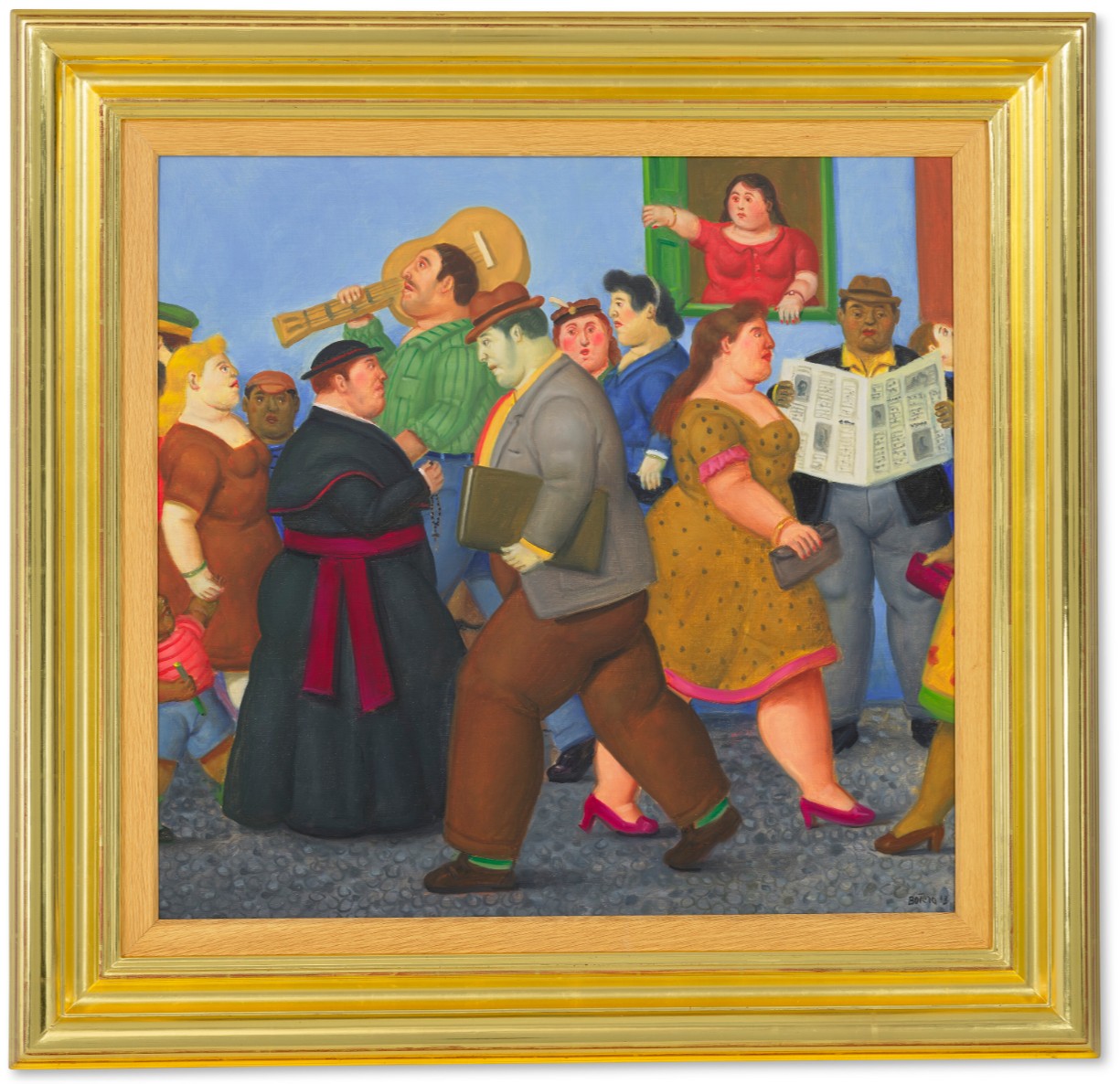
FERNANDO BOTERO (1932-2023)
The Street, 2013
Oil on canvas
68 x 71.1 cm (26-3/4 x 28 inches)
Signed and dated ‘Botero 13’ (lower right)
#4. The Bride, 2009
Property from a Distinguished Private Collection, Texas
Sotheby’s New-York: 15 May 2026
Estimated: USD 800,000 – 1,200,000
USD 870,400
Fernando Botero | The Bride | Contemporary Day Auction | 2026 |
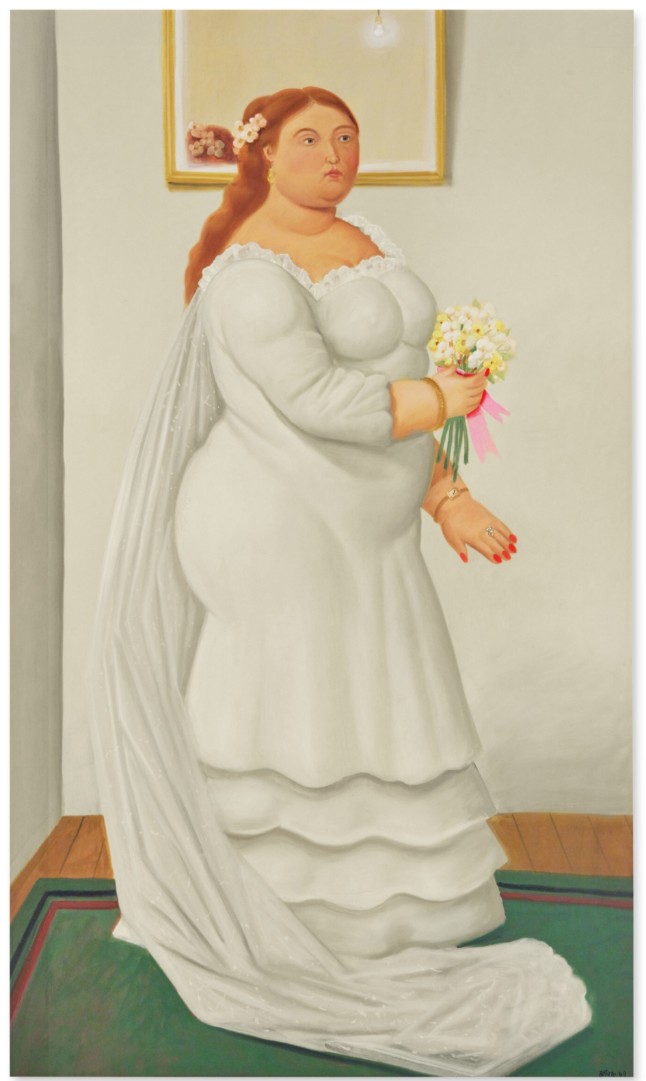
FERNANDO BOTERO (1932 – 2023)
The Bride, 2009
Oil on canvas
170.2 x 99.1 cm (67×39 inches)
Signed and dated 09 (lower right)
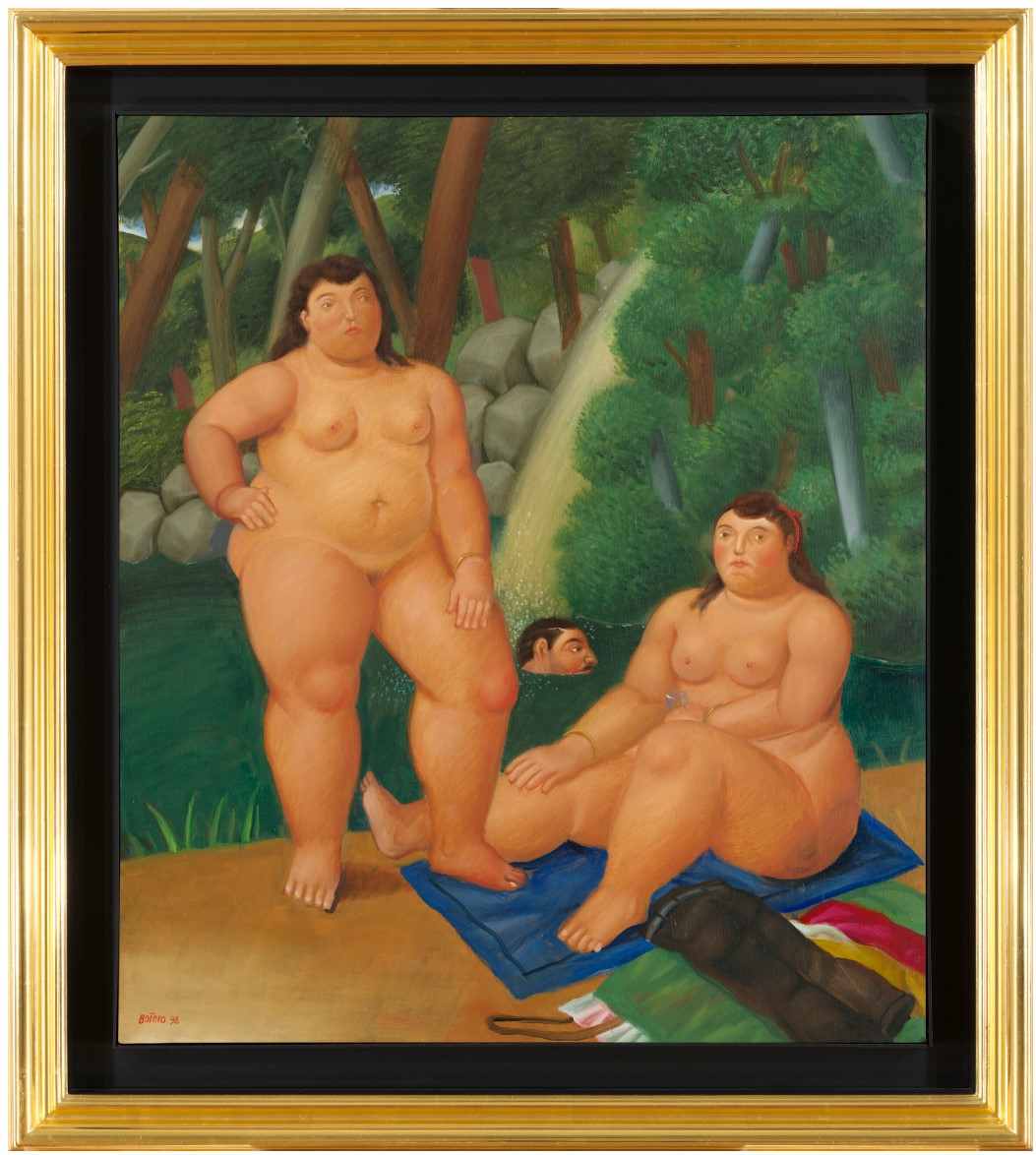
#5. The Picnic, 1994
Property from the Collection of Annabelle and Bernard Fishman
Sotheby’s New-York: 15 May 2026
Estimated: USD 300,000 – 500,000
USD 768,000
Fernando Botero | The Picnic | Contemporary Day Auction | 2026 |
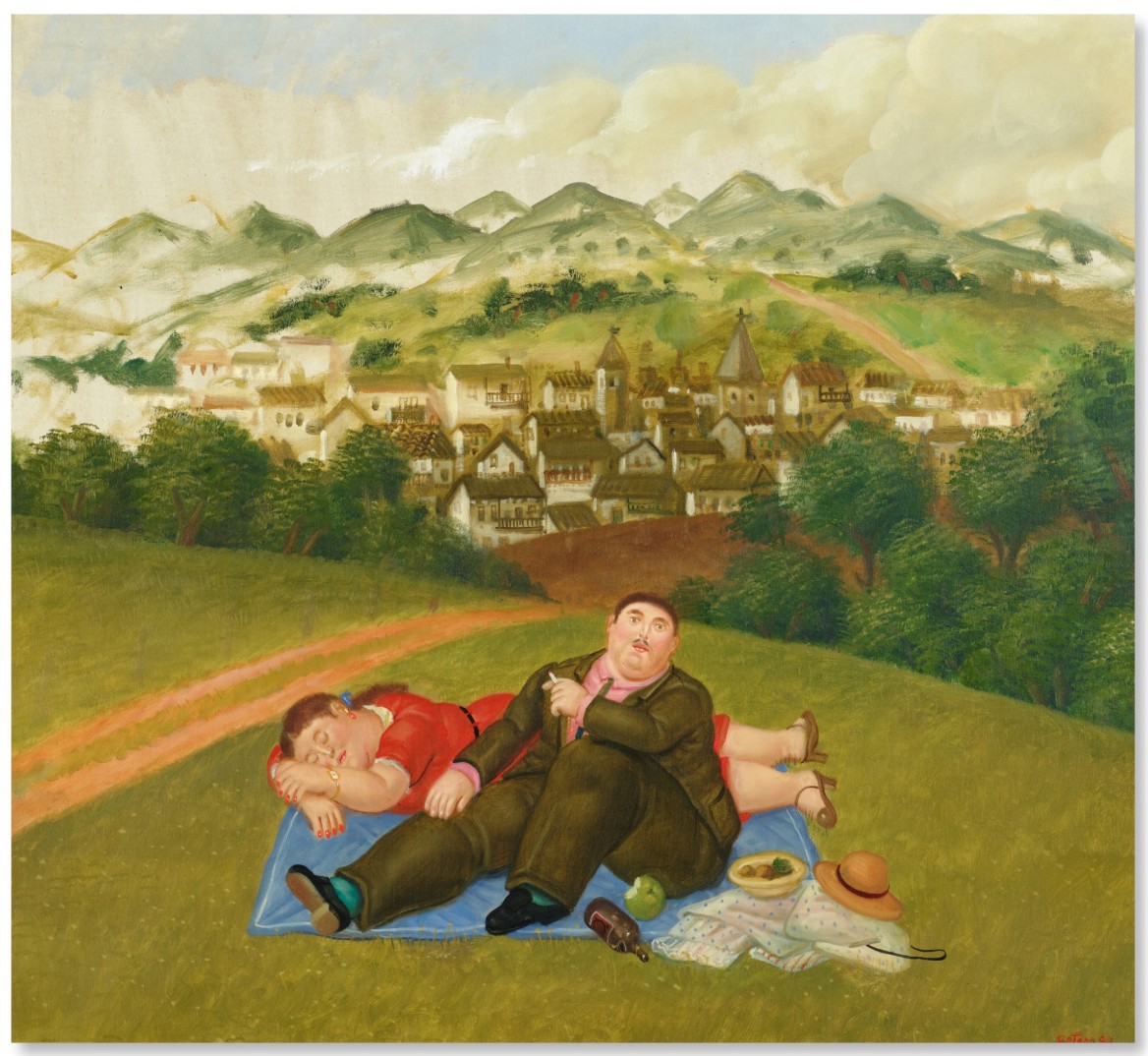
FERNANDO BOTERO (1932 – 2023)
The Picnic, 1994
Oil on canvas
73.7 x 80 cm (29 x 31-1/2 inches)
Signed and dated 94 (lower right)
#6. Variaciones sobre Cézanne, 1963
Sotheby’s New-York: 15 May 2026
Estimated: USD 450,000 – 650,000
USD 704,000
Fernando Botero | Variaciones sobre Cézanne | Contemporary Day
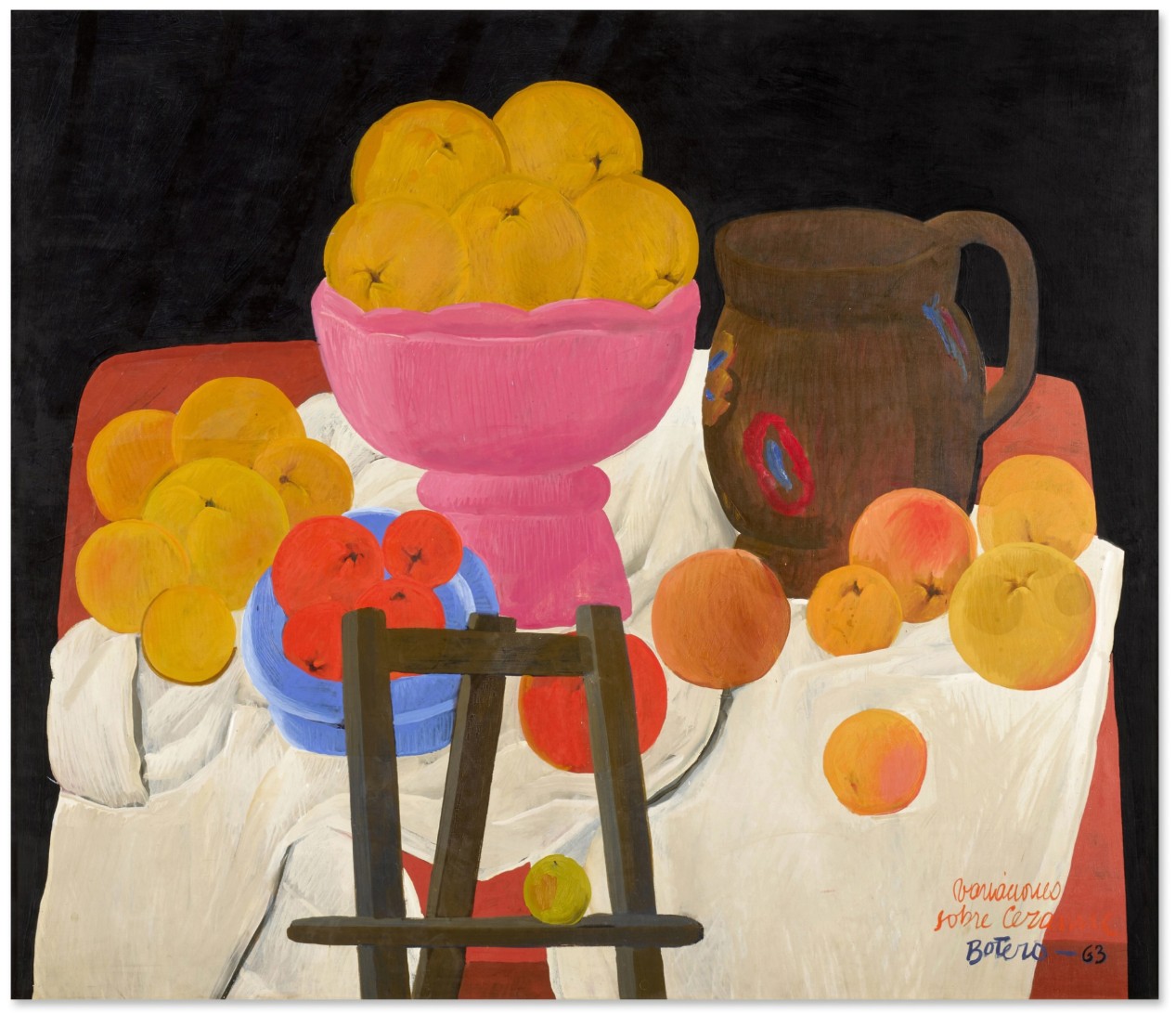
FERNANDO BOTERO (1932 – 2023)
Variaciones sobre Cézanne, 1963
Oil on canvas
129.5 x 151.1 cm (51 x 59-1/2 inches)
Signed, titled and dated 63 (lower right)
#7. The Balcony, 1999
Christie’s New-York: 21 May 2026
Estimated: USD 450,000 – 650,000
USD 660,400
FERNANDO BOTERO (1932-2023), The Balcony | Christie’s
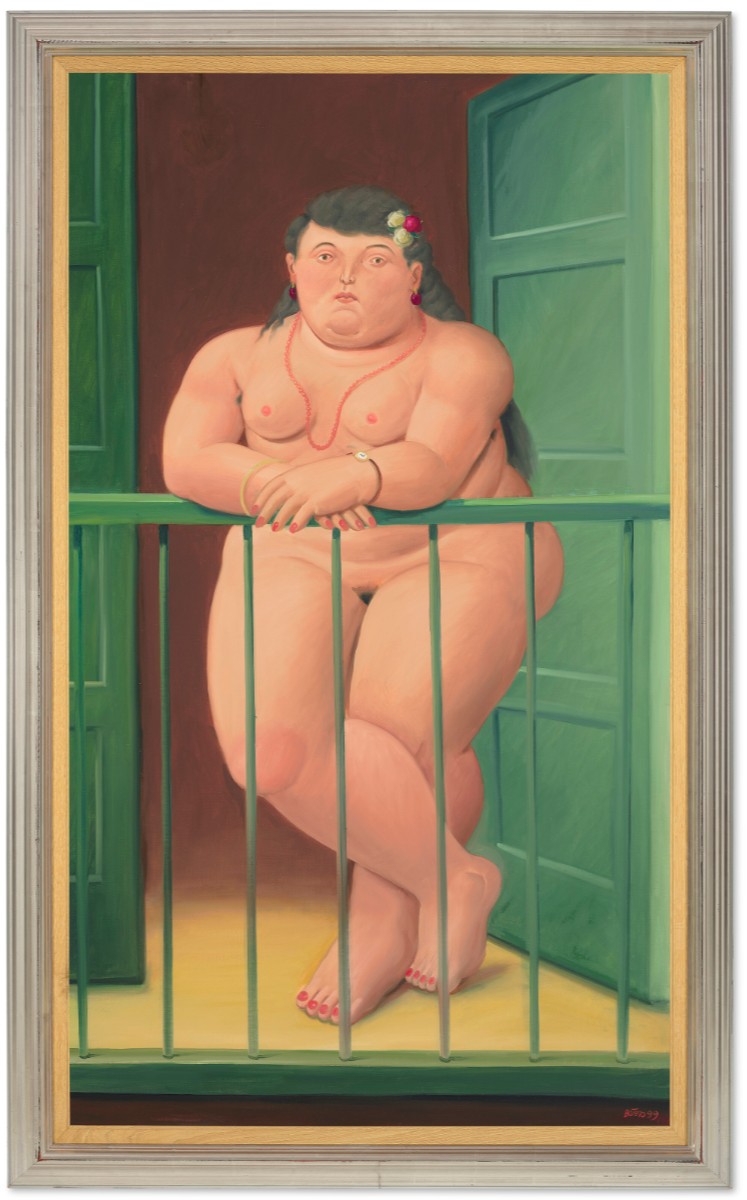
FERNANDO BOTERO (1932-2023)
The Balcony, 1999
Oil on canvas
161.9 x 93.3 cm (63-3/4 x 36-3/4 inches)
Signed and dated ‘Botero 99’ (lower right)
USD 500,000
#8. Catedral, 1963
Christie’s New-York: 26 February 2026
Estimated: USD 350,000 – 550,000
USD 381,000
FERNANDO BOTERO (1932-2023), Catedral | Christie’s
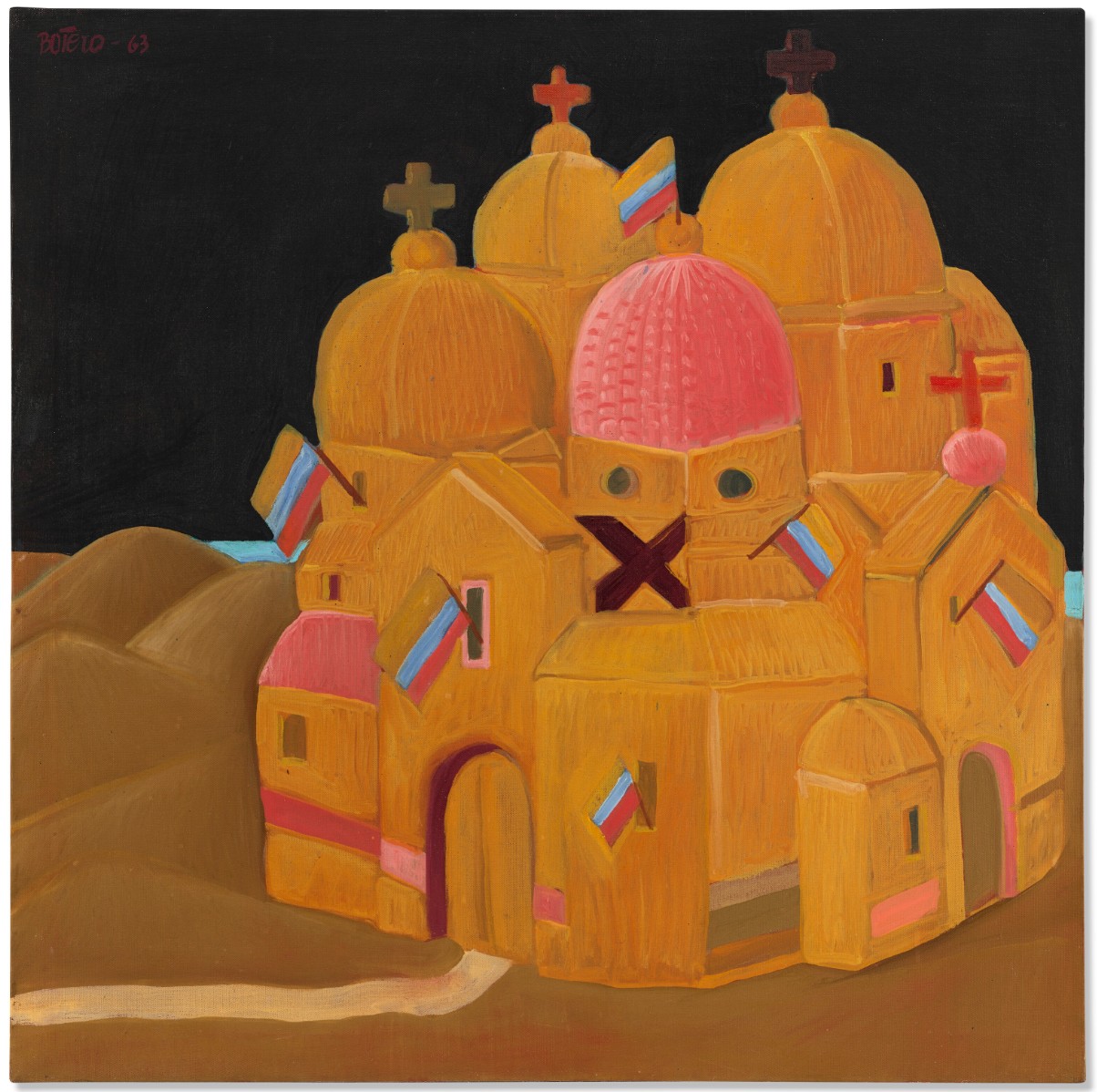
FERNANDO BOTERO (1932-2023)
Catedral, 1963
Oil on canvas
86.4 x 86.7 cm (34 x 34-1/8 inches)
Signed and dated ‘BOTERO-63’ (upper left)
#9. Naranjas y limones, 1968
Christie’s New-York: 26 February 2026
Estimated: USD 250,000 – 350,000
USD 330,200
FERNANDO BOTERO (1932-2023), Naranjas y limones | Christie’s
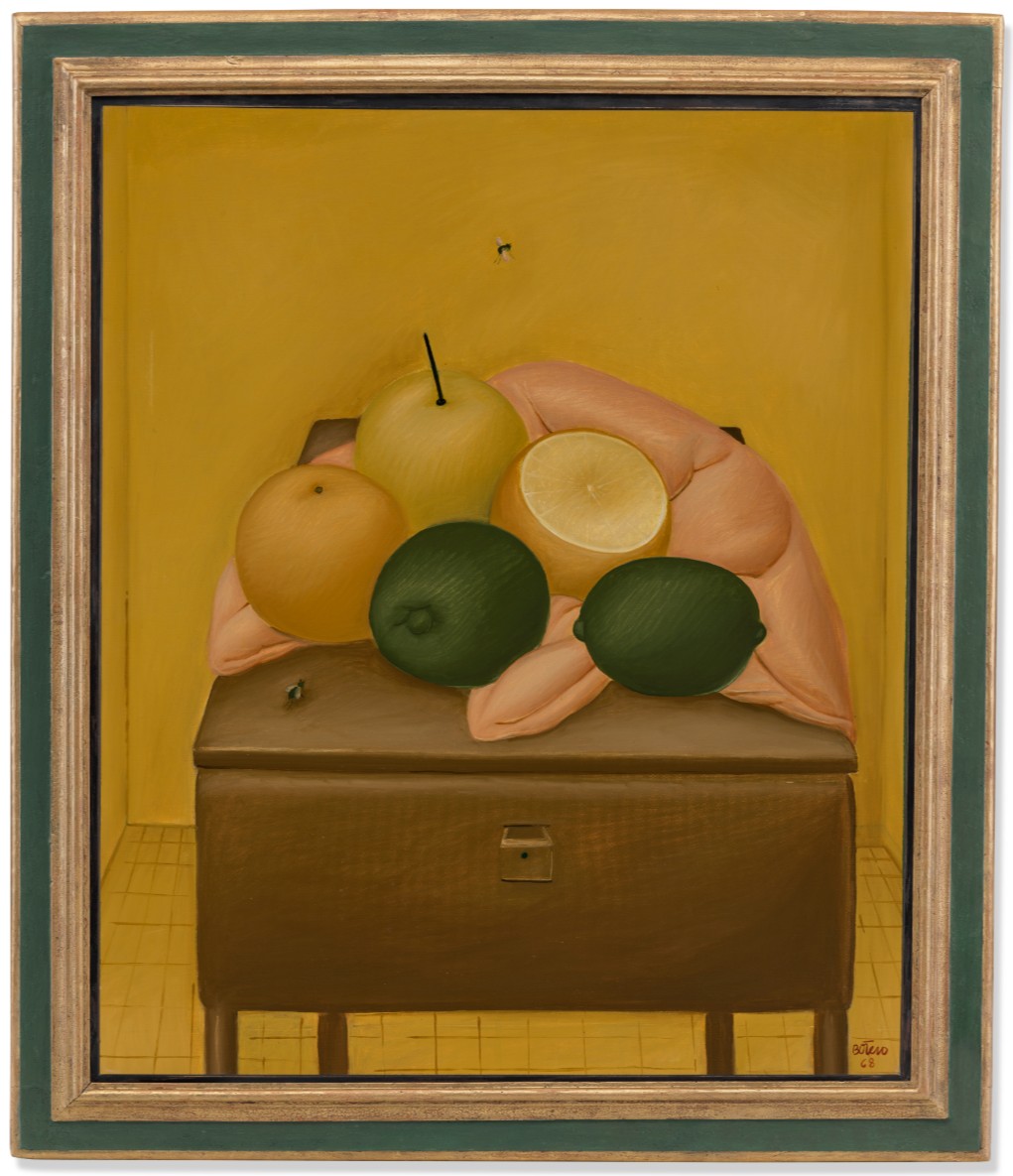
FERNANDO BOTERO (1932-2023)
Naranjas y limones, 1968
Oil on canvas
109.6 x 91.8 cm (43-1/8 x 36-1/8 inches)
Signed and dated ‘Botero 68’ (lower right)
Signed again, titled, and dated again ‘Botero naranjas y limones 68’ (on the reverse)
2025 Auction Results
FOR PAINTINGS ONLY
31 lots sold at auction in 2025 for a total turnover of USD 16,923,823. With 3 lots failing to sell, the sell-through rate is 91%. The highest price of USD 1,524,000 was achieved at Christie’s in New-York on 17 November 2025 by Florero, a painting dated 1970.
2025 Top 3 Lots
3 lots sold for more than USD 1 million, generating a cumulative turnover of USD 3,715,800, representing 22% of the total for 2025. 15 lots sold for more than USD 500,000, generating a cumulative turnover of USD 12,559,731, representing 74.2% of the total for 2025.
XXXXXXXXXX
#1. Florero, 1970
Property from a Private European Collection
Christie’s New-York: 17 November 2025
Estimated: USD 1,200,000 – 1,800,000
USD 1,524,000
FERNANDO BOTERO (1932-2023), Florero | Christie’s
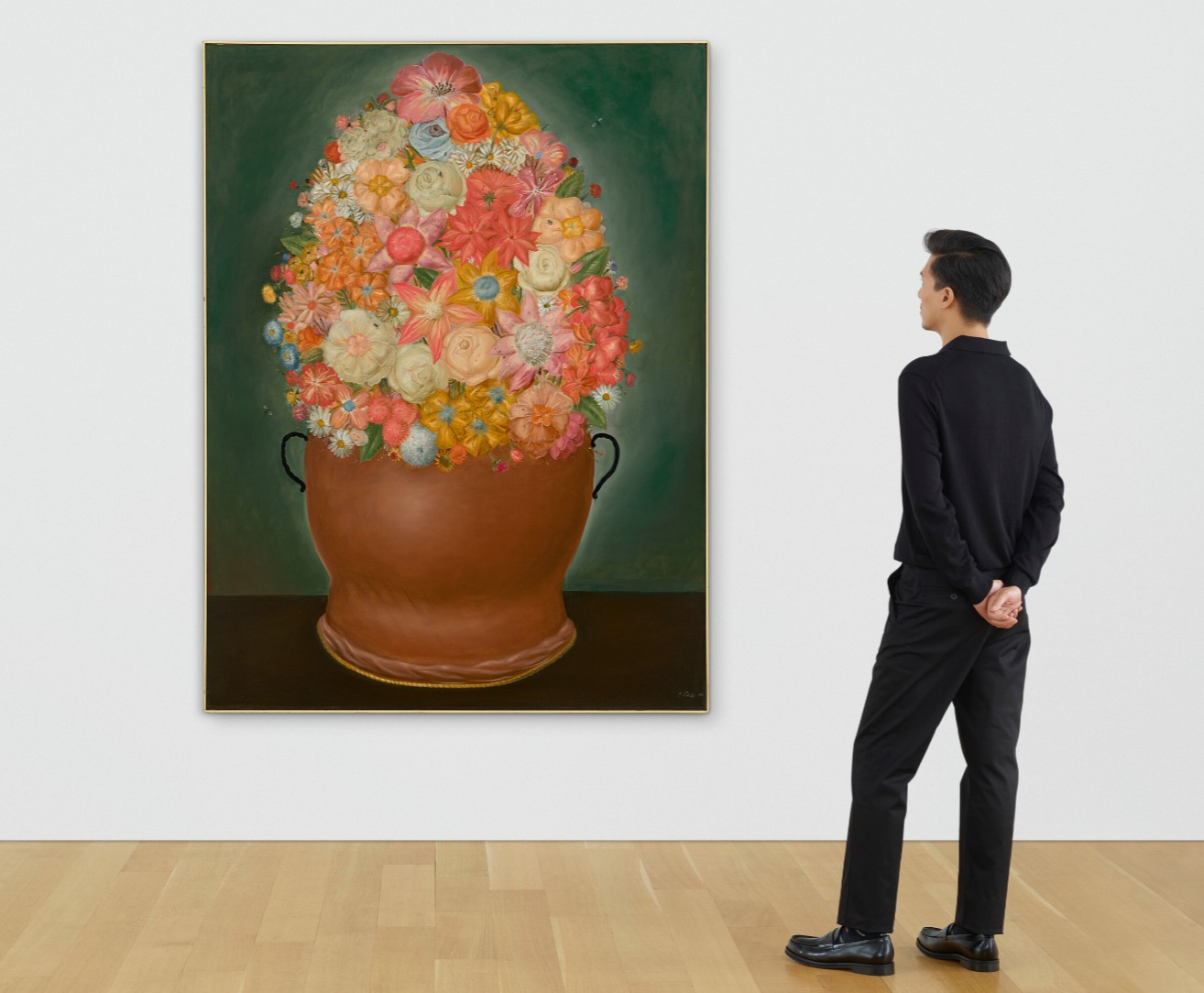
FERNANDO BOTERO (1932-2023)
Florero, 1970
Oil on canvas
193 x 144.8 cm (76×57 inches)
Signed and dated ‘Botero 70’ (lower right)
Signed, titled and dated twice ‘FLORERO Botero 70’ (on the reverse)
#2. Shoeshine, 1989
Christie’s New-York: 28 February 2025
Estimated: USD 800,000 – 1,200,000
USD 1,171,800
FERNANDO BOTERO (1932-2023), Shoeshine | Christie’s
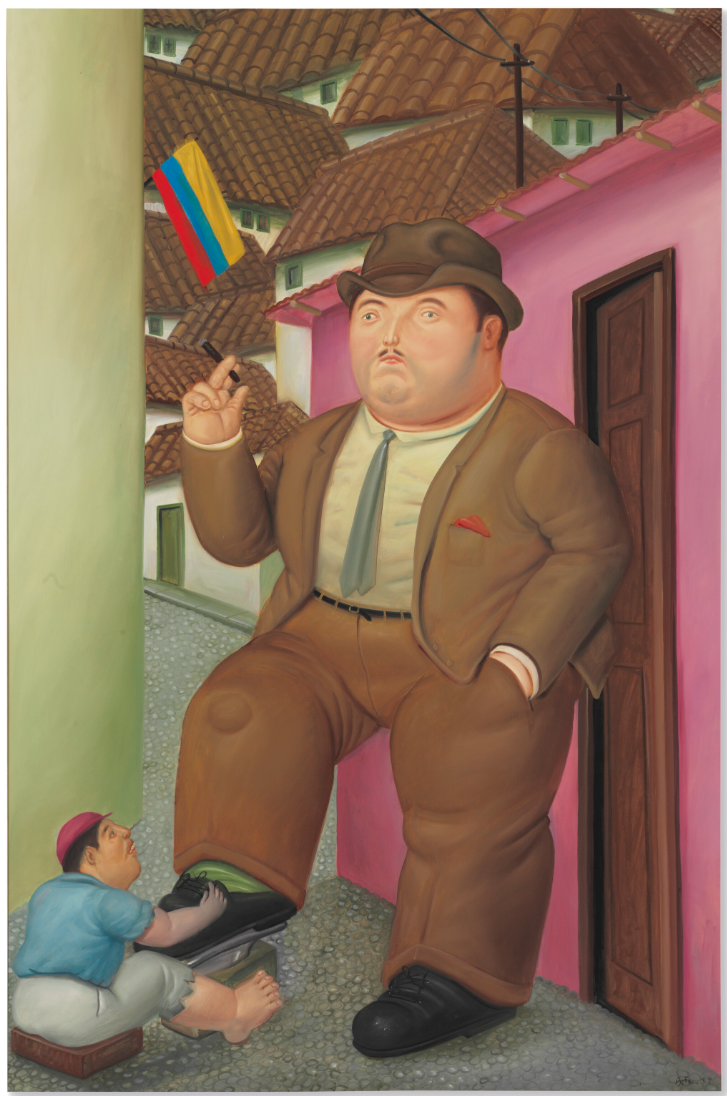
FERNANDO BOTERO (1932-2023)
Shoeshine, 1989
Oil on canvas
198.1 x 130.8 cm (78 x 51 1/2 inches)
Signed and dated ‘Botero 89’ (lower right)
#3. Society Woman, 2003
Sotheby’s Diriyah: 8 February 2025
Estimated: USD 800,000 – 1,200,000
USD 1,020,000
Society Woman | Origins | 2025 | Sotheby’s
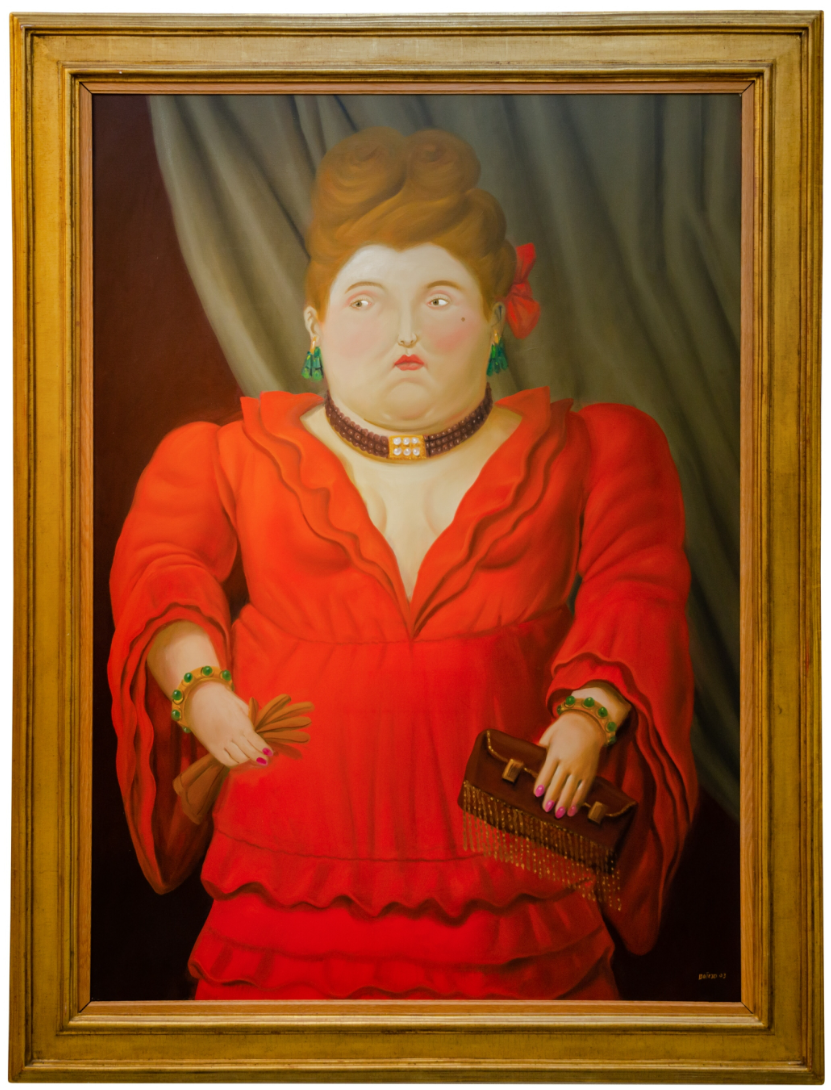
FERNANDO BOTERO (1932 – 2023)
Society Woman, 2003
Oil on canvas
155×122 cm (61×48 inches)
Signed Botero and dated 03 (lower right)
USD 1 million
#4. Arcángel, 1986
Christie’s New-York: 28 February 2025
Estimated: USD 800,000 – 1,200,000
USD 882,000
FERNANDO BOTERO (1932-2023), Arcángel | Christie’s
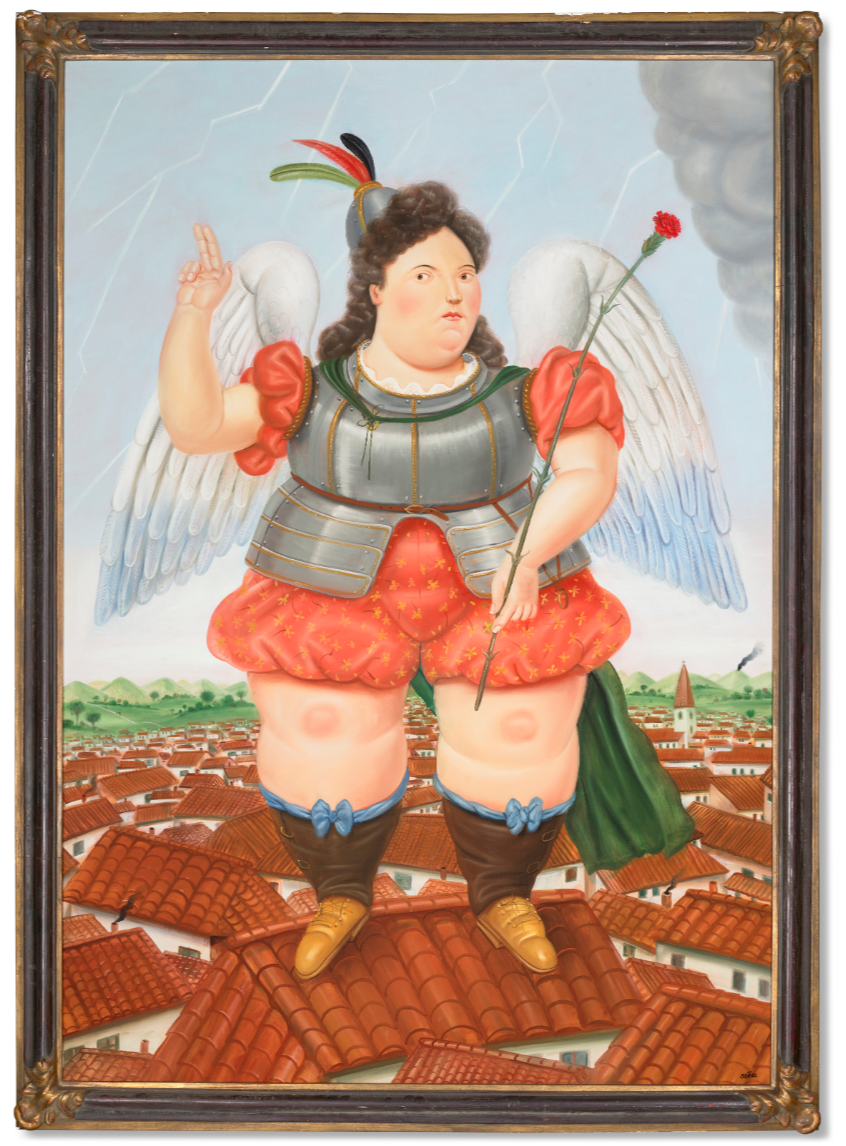
FERNANDO BOTERO (1932-2023)
Arcángel, 1986
Oil on canvas
200 x 136.5 cm (78 3/4 x 53 3/4 inches)
Signed ‘Botero’ (lower right)
#5. The Beach, 2006
Sotheby’s New-York: 19 November 2025
Estimated: USD 600,000 – 800,000
USD 857,250
The Beach | Contemporary Day Auction | 2025 | Sotheby’s
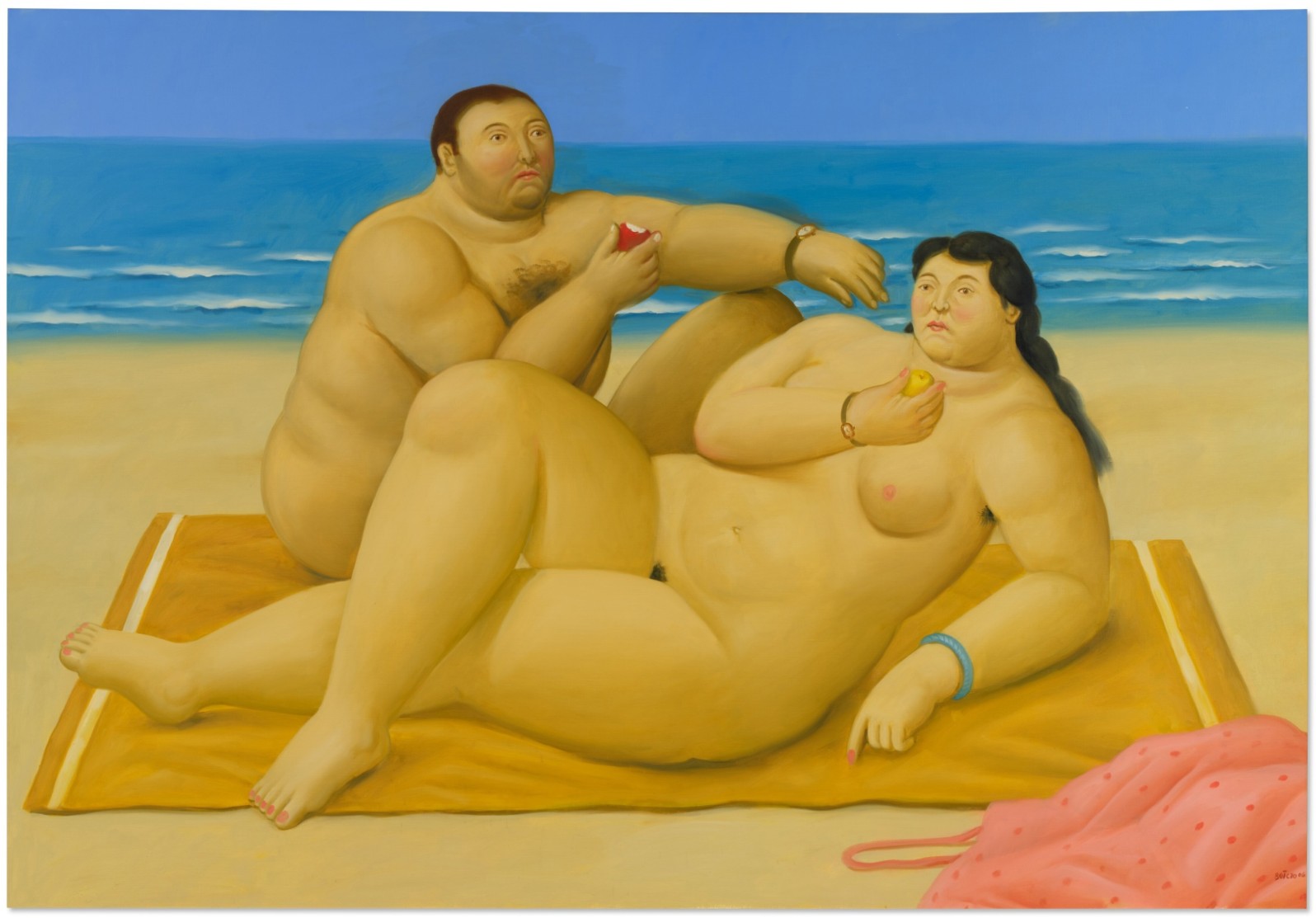 FERNANDO BOTERO (1932 – 2023)
The Beach, 2006
Oil on canvas
131.4 x 189.9 cm (51 3/4 x 74 3/4 inches)
Signed and dated 06 (lower right)
#6. El cuarto de baño, 1983
Bukowskis Stockholm: 21 May 2025
Estimated: SEK 6,000,000 – 8,000,000
SEK 6,500,000 (Hammer)
SEK 8,125,000 / USD 840,540
Fernando Botero, “El cuarto de baño”. – Bukowskis
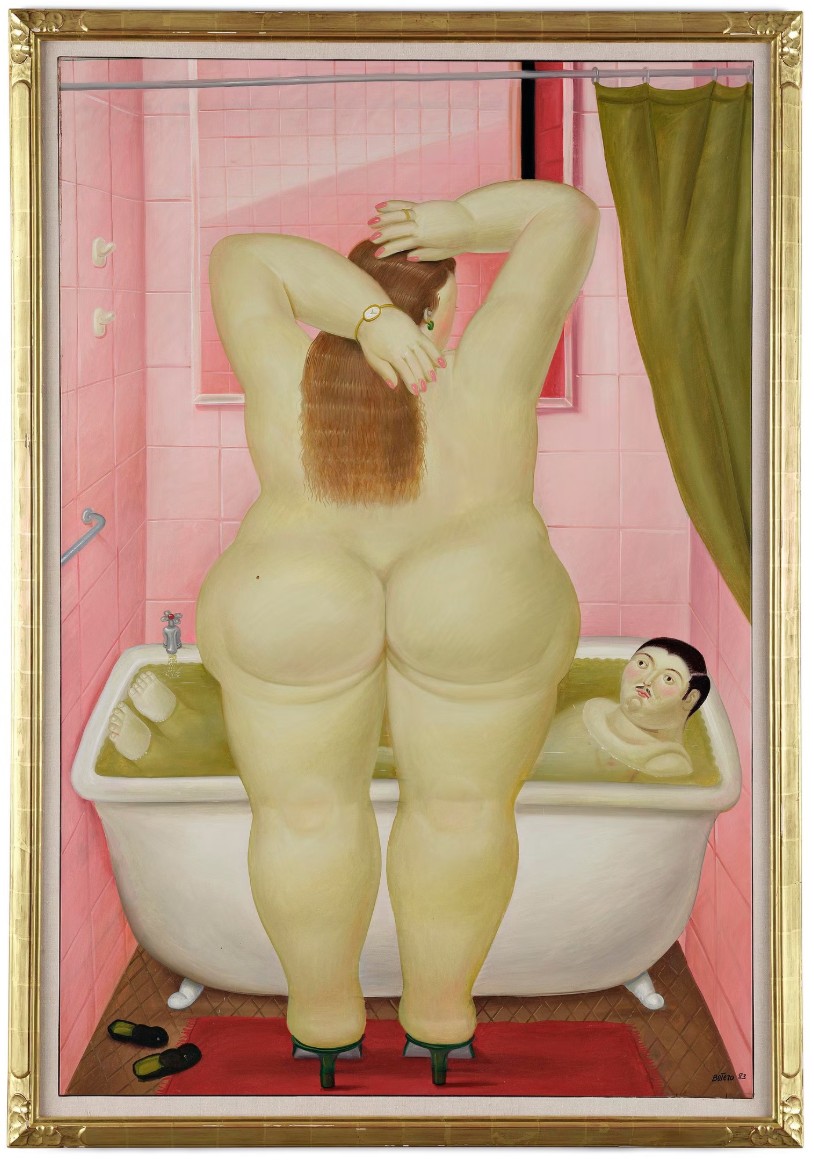
FERNANDO BOTERO (Colombia, 1932-2023)
El cuarto de baño, 1983
Oil on canvas
180×120 cm (70 7/8 x 47 1/8 inches)
Signed Botero and dated -83
#7. Still Life in front of a Window, 1979
Property from an Important American Collection
Phillips New-York: 19 November 2025
Estimated: USD 700,000 – 900,000
USD 838,500
Fernando Botero Modern & Contemporary Art Evening Sale featuring Cera the Triceratops
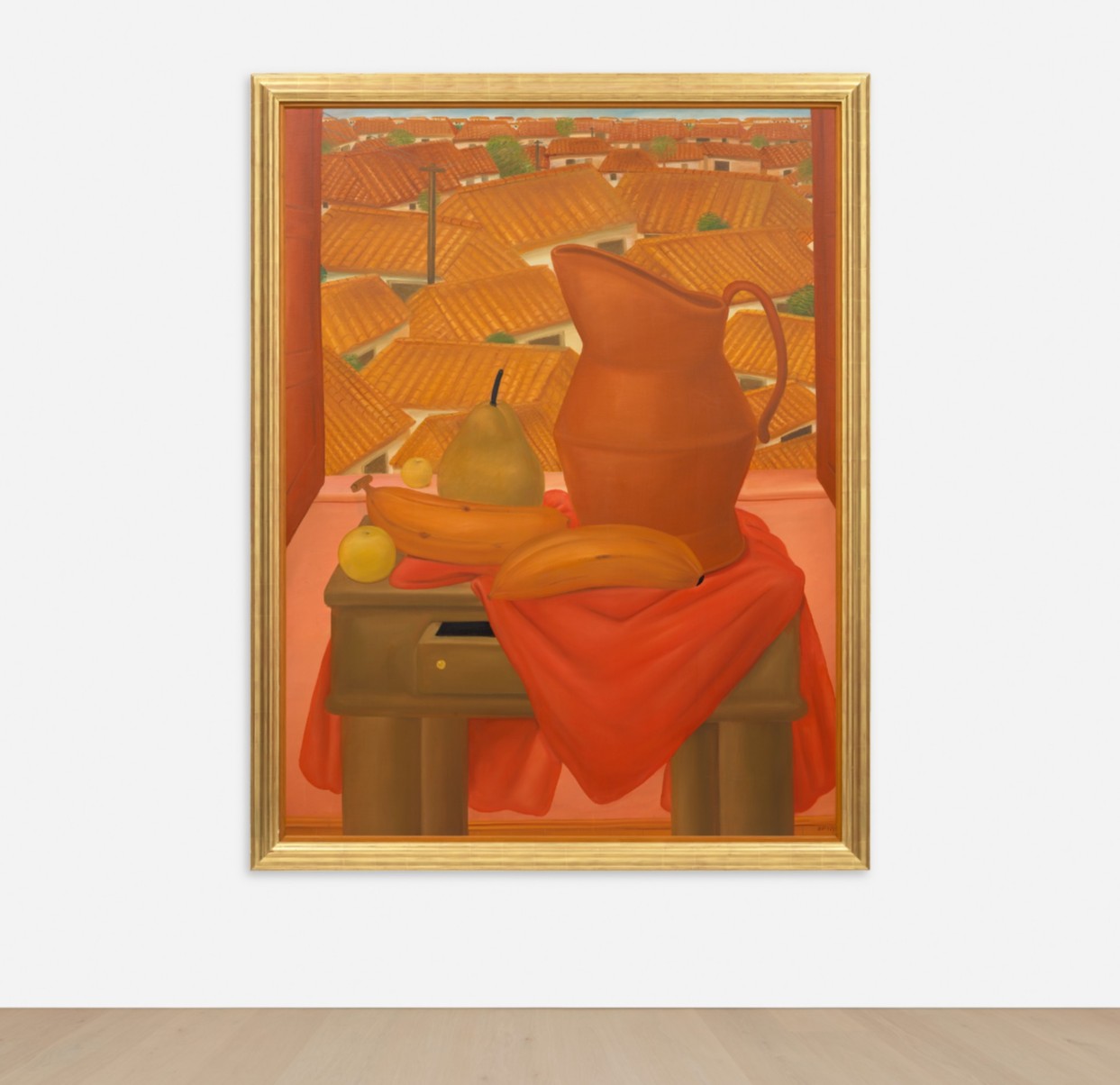
Oil on canvas
189.9 x 144.1 cm (74 3/4 x 56 3/4 inches)
Signed and dated “Botero 79” lower right
#8. The Bed, 1982
Bonhams New-York: 14 May 2025
Estimated: USD 700,000 – 1,000,000
USD 762,500
Bonhams : FERNANDO BOTERO (1932-2023) The Bed
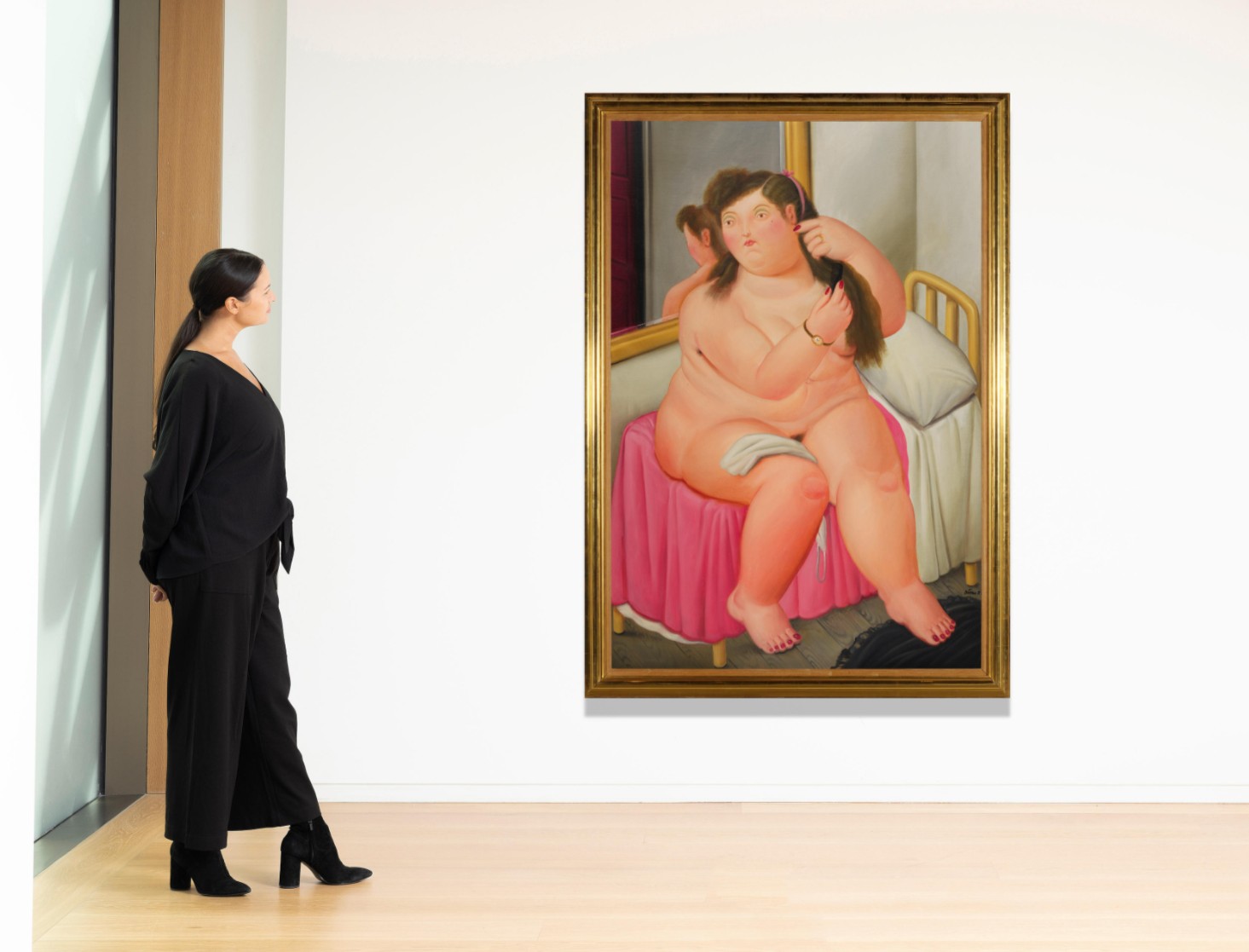
Oil on canvas
166×115 cm (65 3/8 x 45 1/4 inches)
Signed and dated ‘Botero 82’ (lower right)
#9. Nude on the Beach, 2000
Christie’s New-York: 30 September 2025
Estimated: USD 500,000 – 700,000
USD 762,000
FERNANDO BOTERO (1932-2023), Nude on the Beach | Christie’s
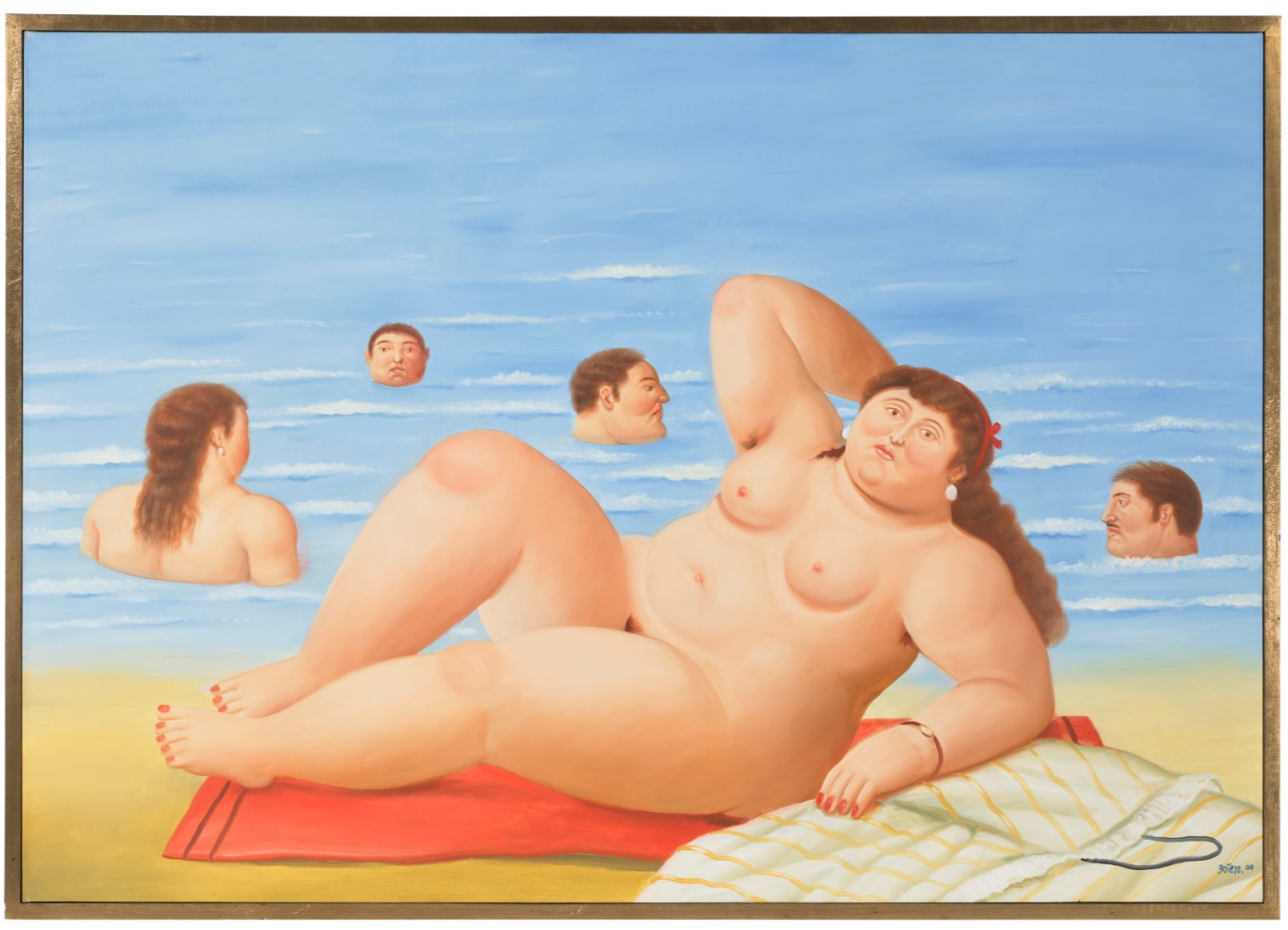
FERNANDO BOTERO (1932-2023)
Nude on the Beach, 2000
Oil on canvas
113 x 160.7 cm (44 1/2 x 63 1/4 inches)
Signed and dated ‘Botero, 00’ (lower right)
#10. La siesta, 1986
Property from a Private European Collection
Christie’s New-York: 20 November 2025
Estimated: USD 500,000 – 700,000
USD 762,000
FERNANDO BOTERO (1932-2023), La siesta | Christie’s
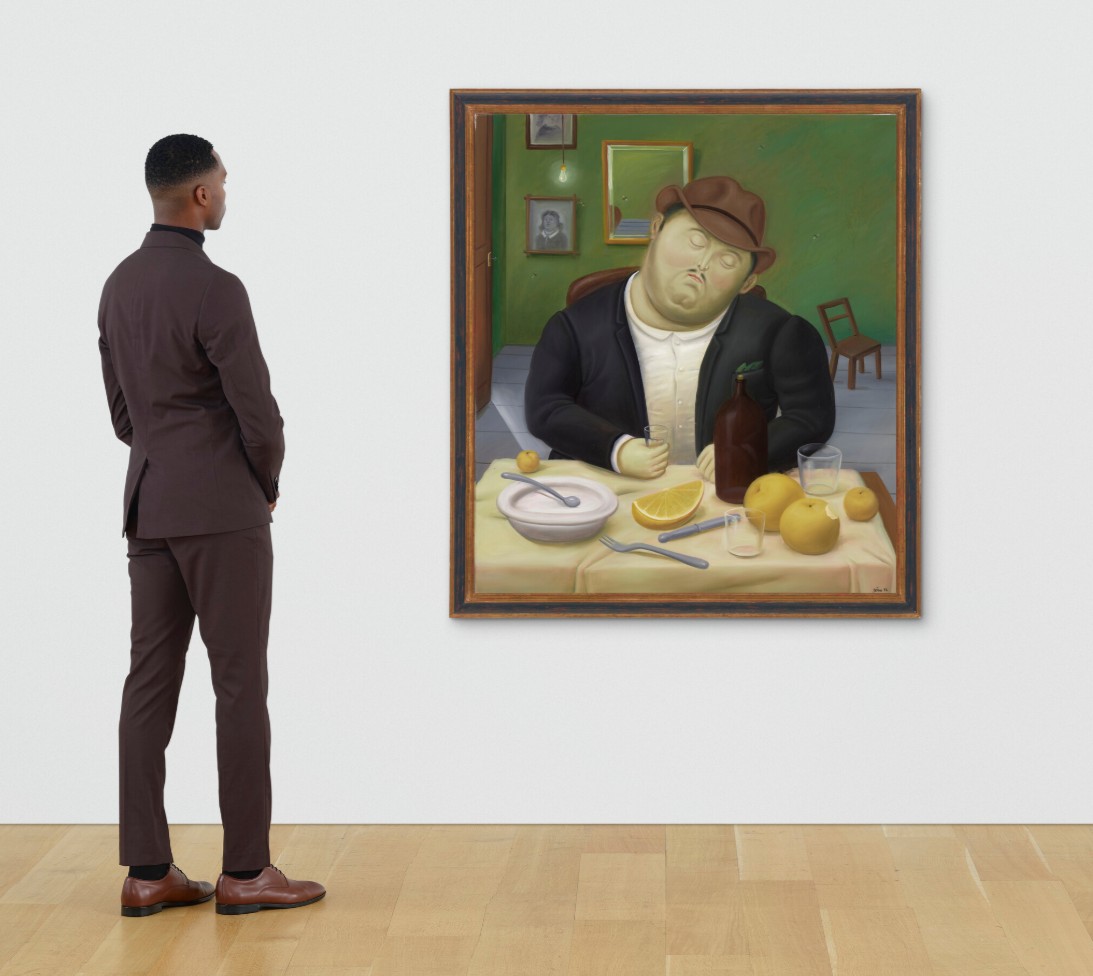
FERNANDO BOTERO (1932-2023)
La siesta, 1986
Oil on canvas
143.8 x 126.7 cm (56 5/8 x 49 7/8 inches)
Signed and dated ‘Botero 86’ (lower right)
“I create my subjects somehow visualizing them in my style. I start as a poet, put the colors and composition down on canvas as a painter, but finish my work as a sculptor taking delight in caressing the forms.”
#11. Monalisa, 1959
Koller Zurich: 26 June 2025
Estimated: CHF 250,000 – 350,000
CHF 460,000 (Hammer)
CHF 573,200 / USD 713,060
FERNANDO BOTERO Monalisa. 1959.
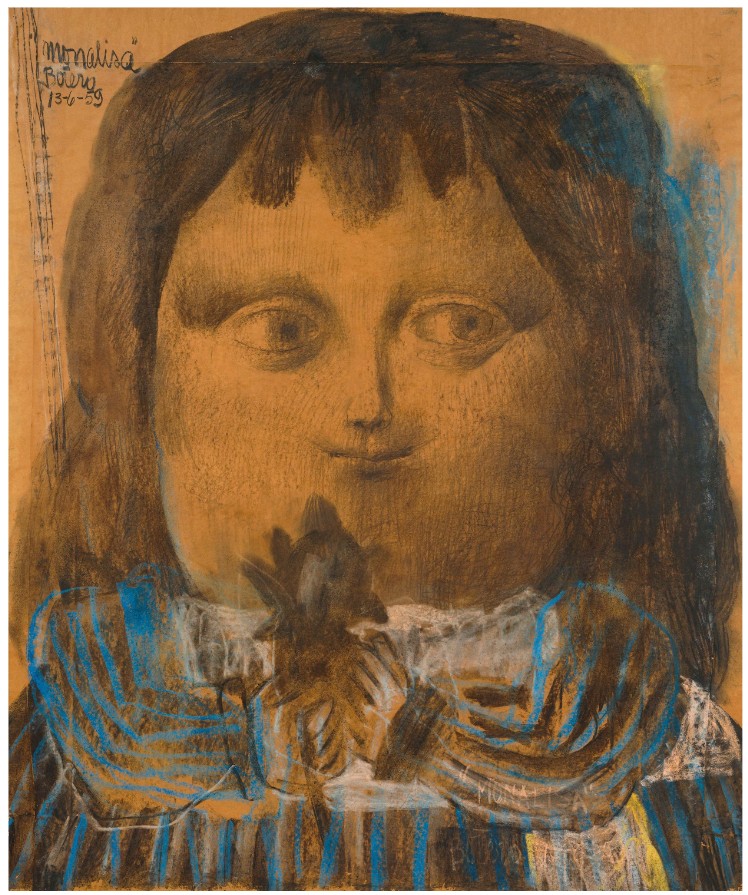
FERNANDO BOTERO (Medellín 1932–2023 Monaco)
Monalisa, 1959
Charcoal, color chalk and wax chalk on kraft paper, firmly laid on wood
144×122 cm (56 3/4 x 48 inches)
Upper left and lower right signed
Dated and titled: “monalisa” Botero 13-6-59 “MONALISA” Botero 13-6-59
#12. Woman In the Shower, 2005
Estimated: HKD 3,800,000 – 5,500,000
HKD 5,461,000 / USD 701,930
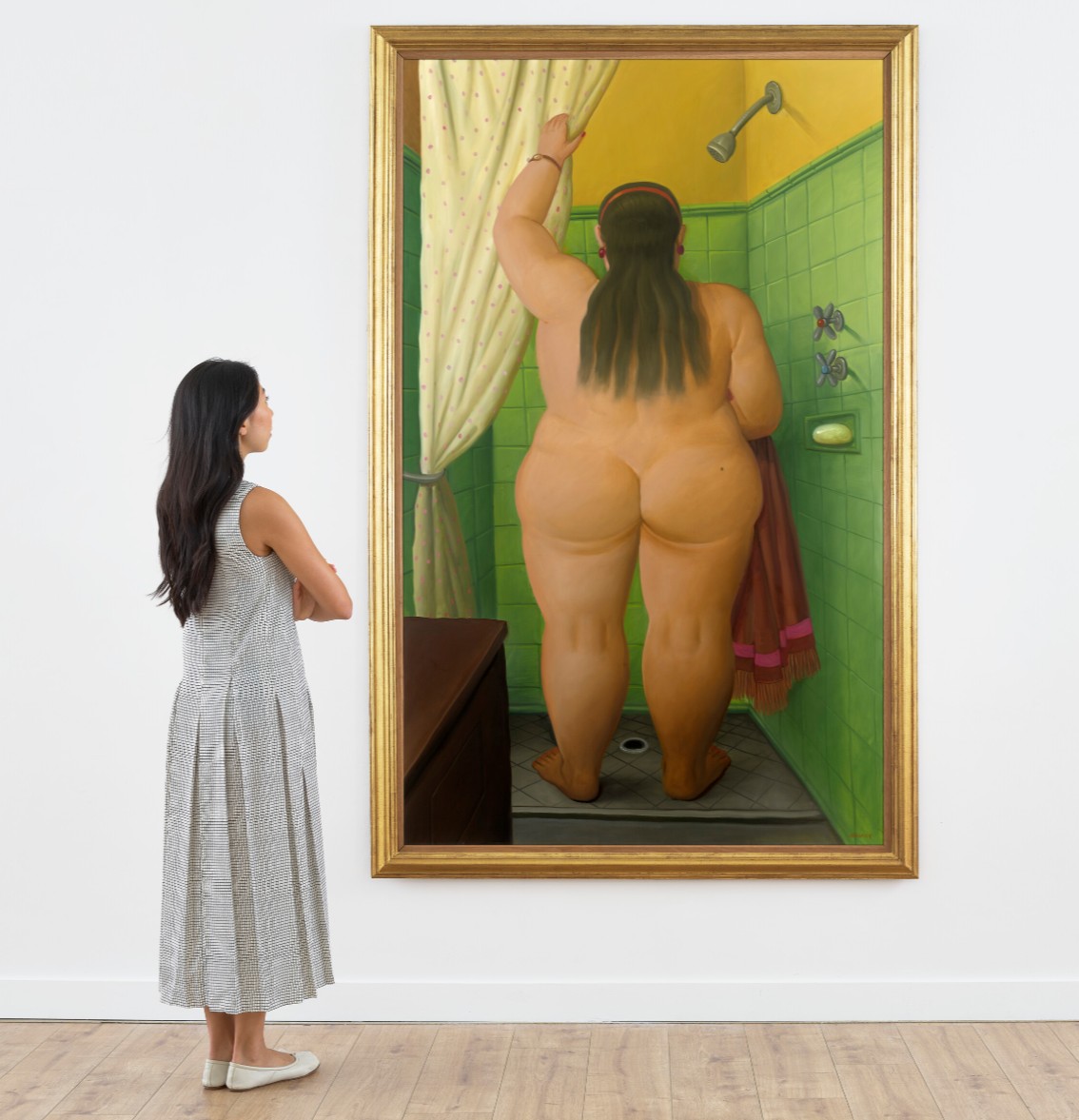
Woman In the Shower, 2005
Oil on canvas
201 x 123.5 cm (79 1/8 x 48 5/8 inches)
Signed and dated ‘Botero 05’ (lower right)
#13. Woman with Dog, 1997
Christie’s New-York: 28 February 2025
Estimated: USD 600,000 – 800,000
USD 630,000
FERNANDO BOTERO (1932-2023), Woman with Dog | Christie’s
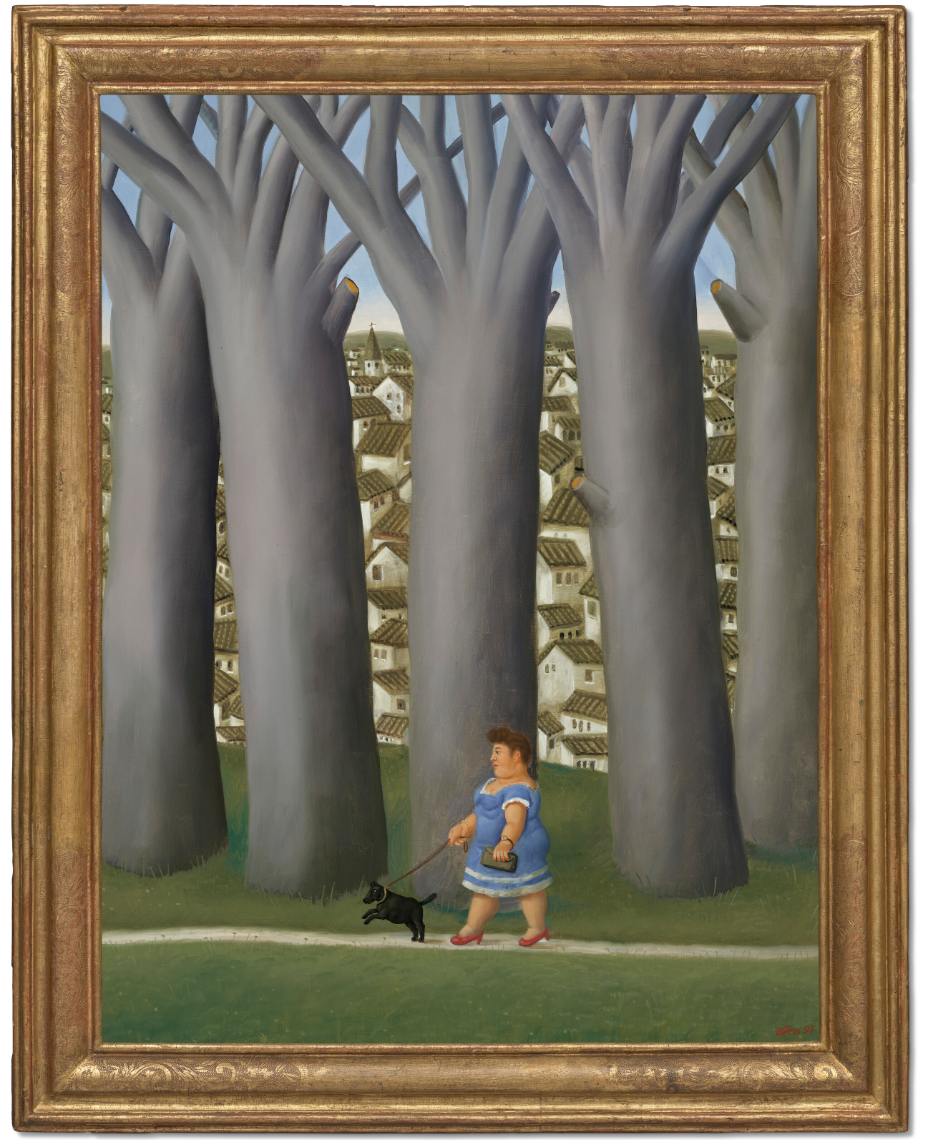
FERNANDO BOTERO (1932-2023)
Woman with Dog, 1997
Oil on canvas
130.8 x 100 cm (51 1/2 x 39 3/8 inches)
Signed and dated ‘Botero 97’ (lower right)
#14. Boterosutra 51, 2013
Sotheby’s Paris: 24 October 2025
Estimated: EUR 300,000 – 500,000
EUR 508,000 / USD 590,155
Boterosutra 51 | Modernités | 2025 | Sotheby’s
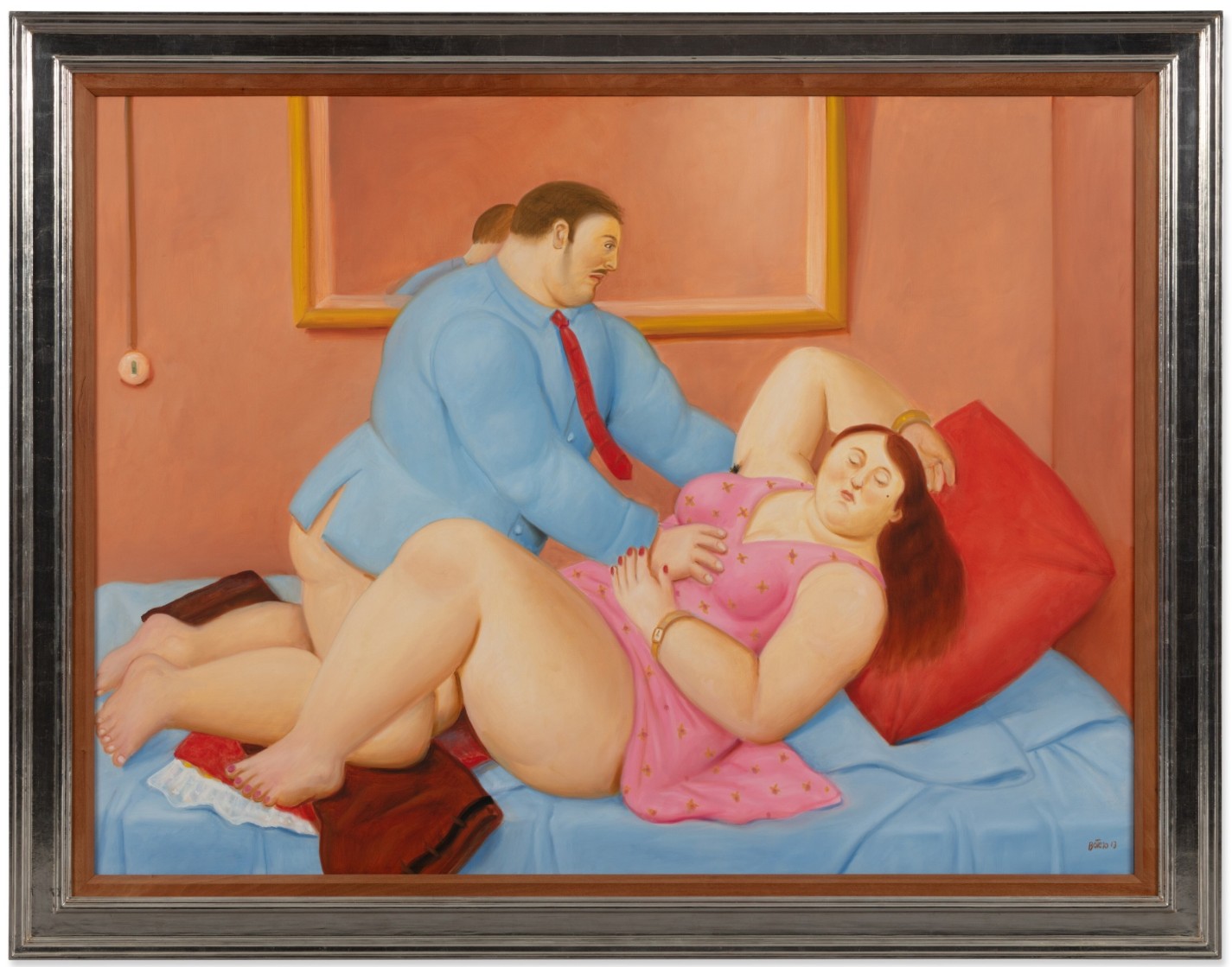
FERNANDO BOTERO (1932 – 2023)
Boterosutra 51, 2013
Oil on canvas
98.4 x 129.9 cm (38 3/4 x 51 1/8 inches)
Signed and dated 13 (lower right)
#15. Autorretrato, el día de mi primera comunión, 1970
Christie’s New-York: 28 February 2025
Estimated: USD 400,000 – 600,000
USD 504,000
FERNANDO BOTERO (1932-2023), Autorretrato, el día de mi primera comunión | Christie’s
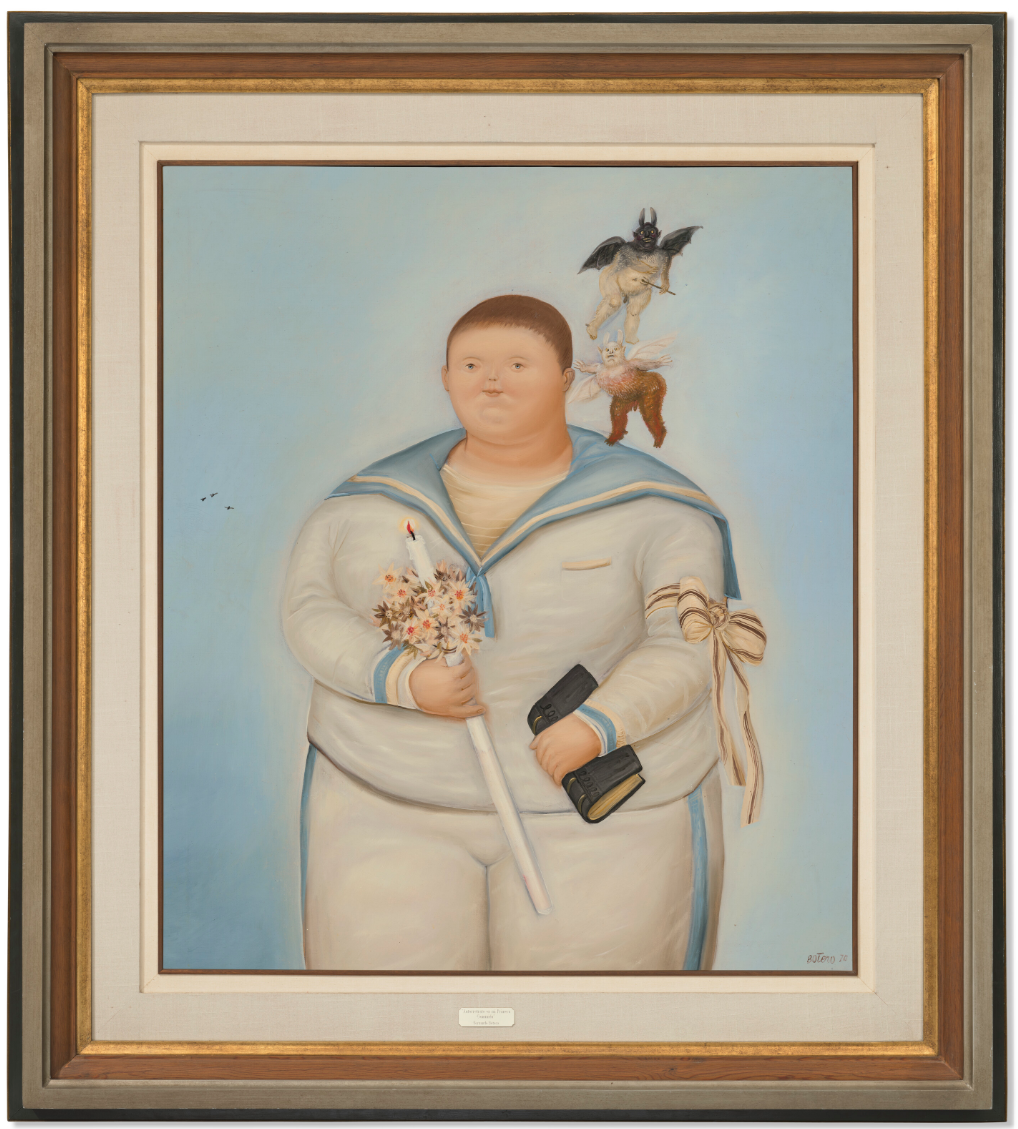
FERNANDO BOTERO (1932-2023)
Autorretrato, el día de mi primera comunión, 1970
Oil on canvas
108.9 x 94 cm (42 7/8 x 37 inches)
Signed and dated ‘Botero 70’ (lower right)
Signed and dated again, and titled ‘Botero 1970 ‘Autorretrato, el día de mi primera comunión” (on the reverse)
USD 500,000
#16. Portrait of Nadine Haim, 1977
Christie’s Hong-Kong: 28 March 2024
Estimated: HKD 2,500,000 – 3,500,000
HKD 3,402,000 / USD 437,275
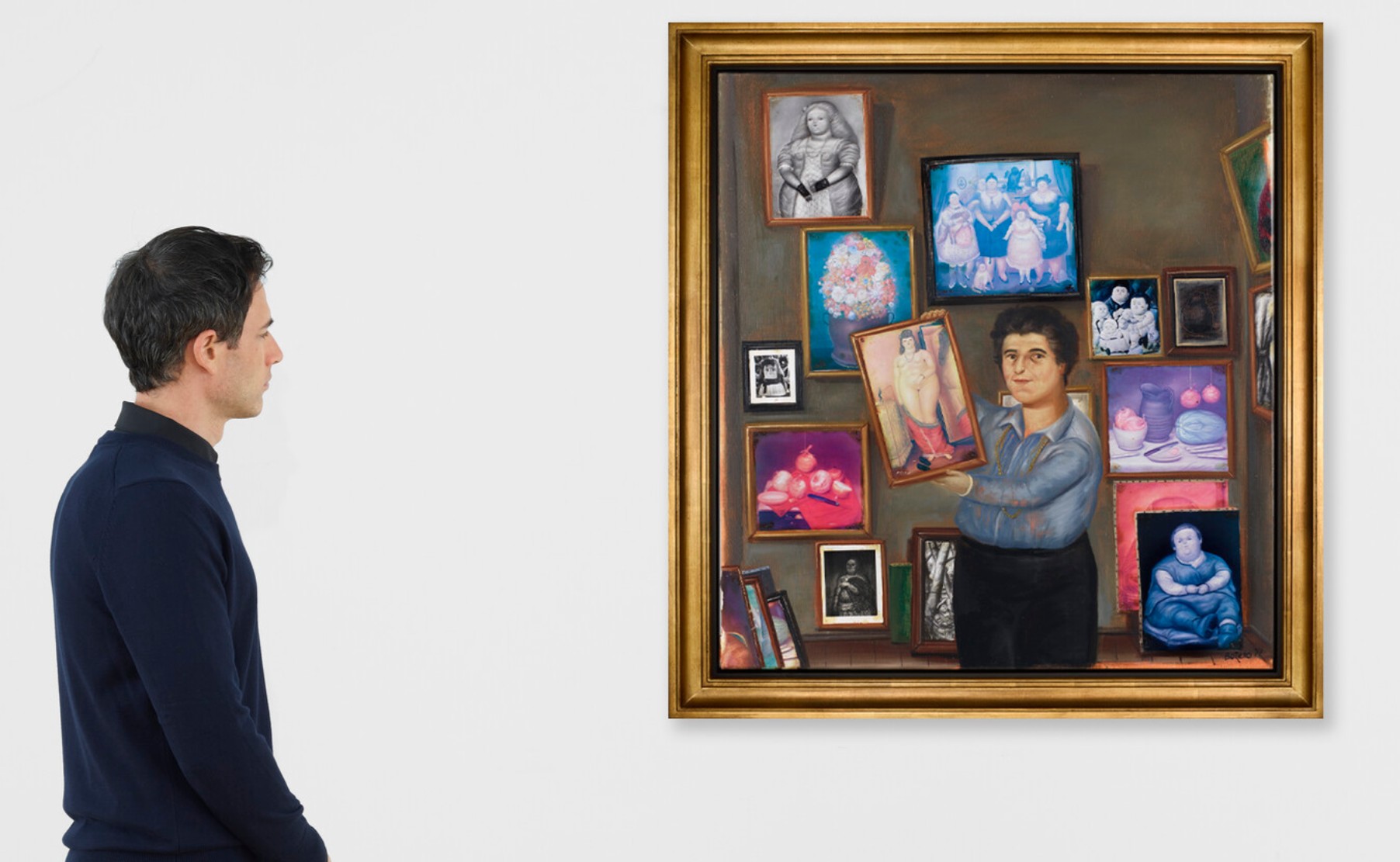
Portrait of Nadine Haim, 1977
Oil and photo collage on canvas mounted on board
88.5 x 83 cm (34 7/8 x 32 5/8 inches)
Signed and dated ‘Botero 77’ (lower right)
Signed, titled and dated ‘”NADINE HAIM” Botero 77’ (on the reverse)
#17. Niño comiendo helado, 1965
Christie’s New-York: 20 November 2025
Estimated: USD 250,000 – 350,000
USD 406,400
FERNANDO BOTERO (1932-2023), Niño comiendo helado | Christie’s
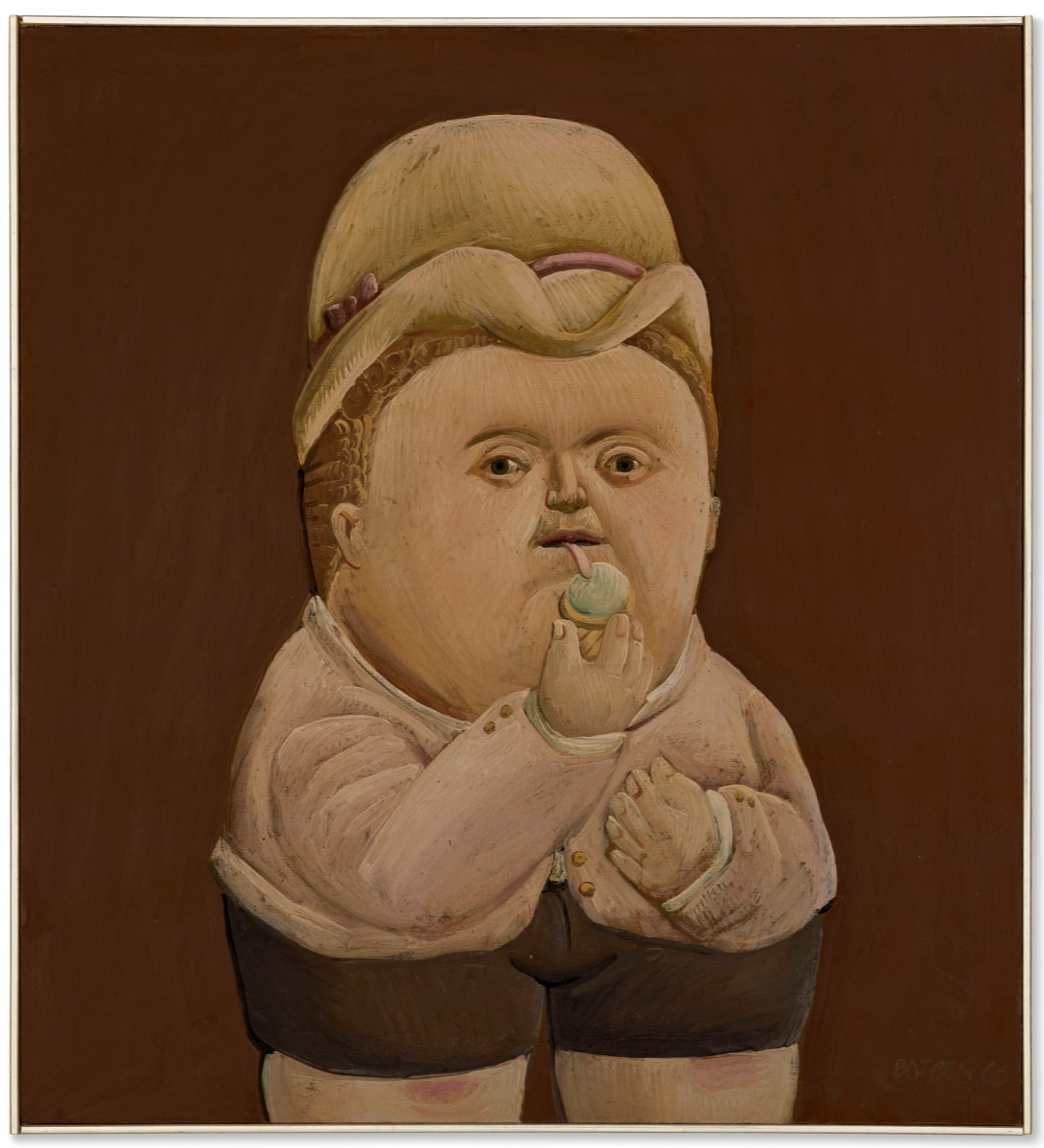
FERNANDO BOTERO (1932-2023)
Niño comiendo helado, 1965
Oil on canvas
86.4 x 86.4 cm (34×34 inches)
Signed and dated ‘Botero 65’ (lower right)
Signed again, titled and dated again ‘Botero 65 NIÑO COMIENDO HELADO’ (on the reverse)
#18. Man Eating, 1996
Dorotheum Vienna: 19 November 2025
Estimated: EUR 160,000 – 240,000
EUR 325,000 / USD 376,355
Fernando Botero * – Contemporary Art I 2025/11/19 – Realized price: EUR 325,000 – Dorotheum
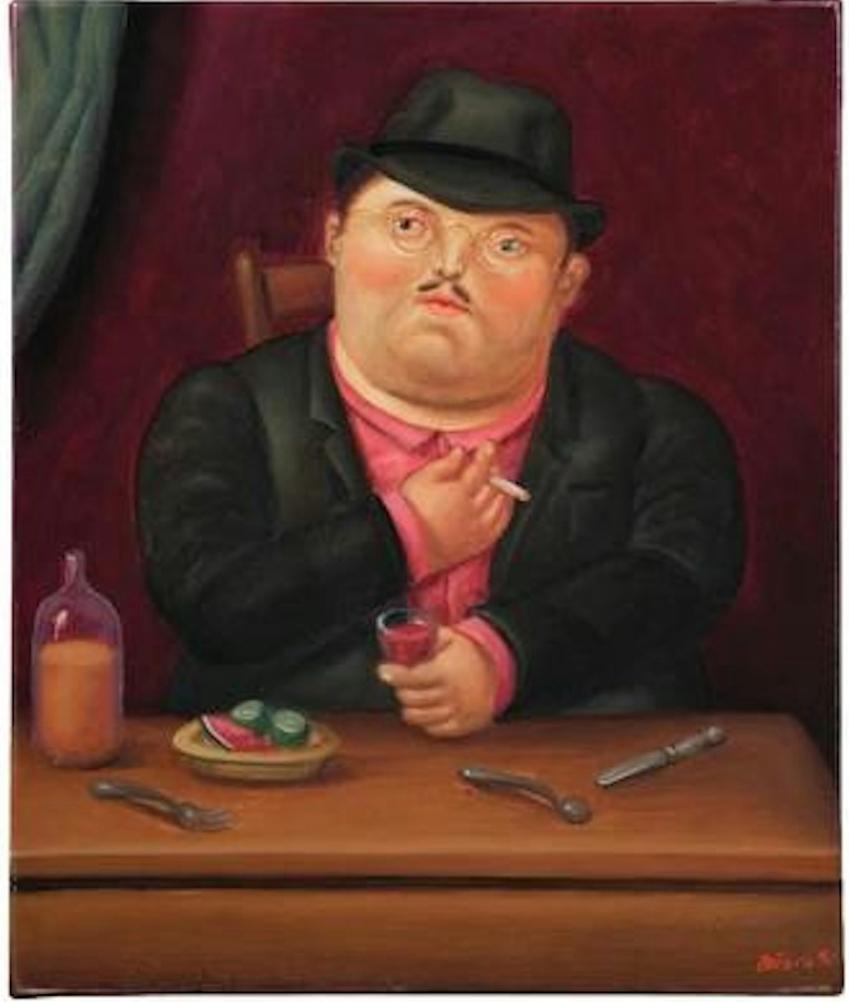
FERNANDO BOTERO (Medellin, Columbia 1932 – 2023 Monaco)
Man Eating, 1996
Oil on canvas
40×33 cm (15 3/4 x 13 inches)
Signed and dated
#19. Little Girl in Red, 1969
Estimated: USD 180,000 – 250,000
USD 371,700
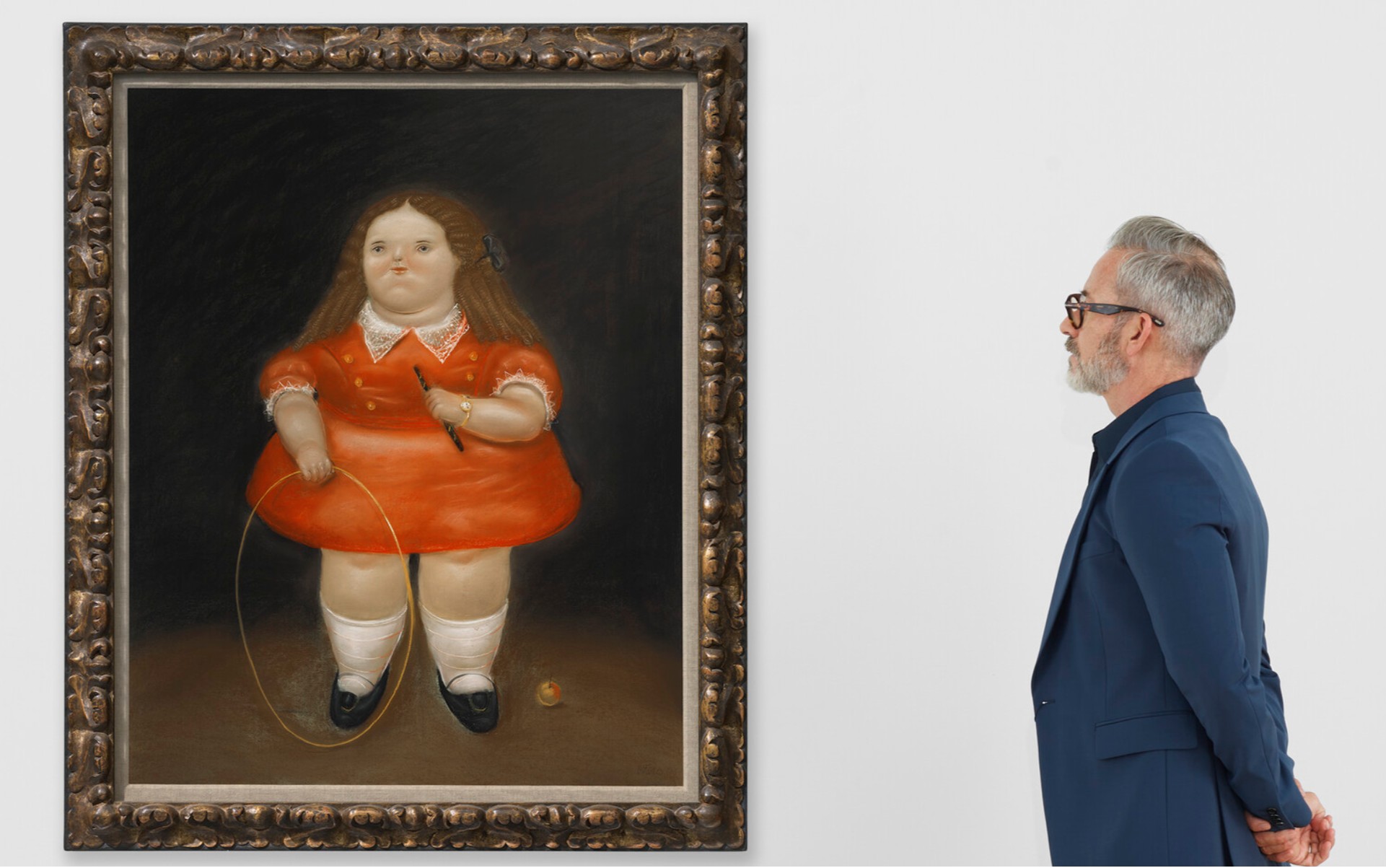
Little Girl in Red, 1969
Pastel on paperboard
101.6 x 80.5 cm (40 x 31 7/8 inches)
Signed and dated ‘Botero 69’ (lower right)
#20. Untitled, circa 1959
Christie’s New-York: 20 November 2025
Estimated: USD 350,000 – 450,000
USD 355,600
FERNANDO BOTERO (1932-2023), Untitled | Christie’s
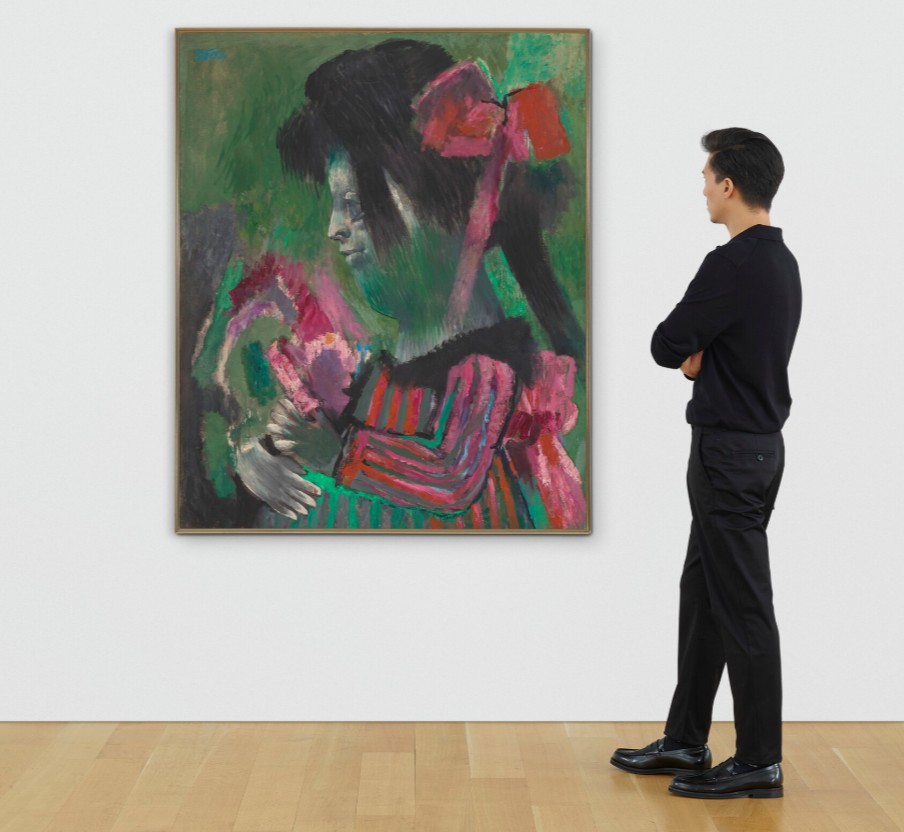
FERNANDO BOTERO (1932-2023)
Untitled, circa 1959
Oil on canvas
154.9 x 127 cm (61×50 inches)
Signed ‘Botero’ (upper left)
“I started to paint these volumetric figures when I was 17. I did it by intuition… because it said something to me. Then, of course, when I was in Europe, especially in Italy, I rationalized the importance of volume because I saw that all Italian painters like Michelangelo, Raphael, Giotto, Masaccio, Piero della Francesca made a celebration of volume.”
#21. Seated woman, 1990
Artcurial Paris: 25 October 2025
Estimated: EUR 250,000 – 350,000
EUR 304,520 / USD 354,655
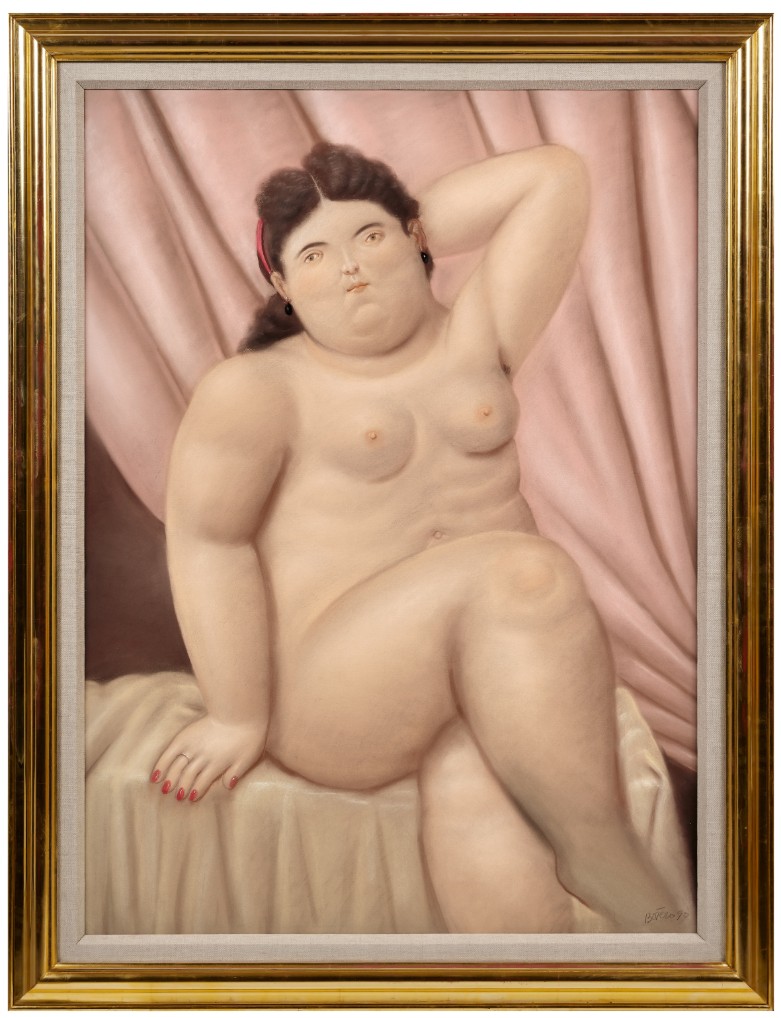
FERNANDO BOTERO
Seated woman, 1990
Pastel on paper laid down on canvas
123 x 89.5 cm (48 3/8 x 35 1/4 inches)
Signé et daté en bas à droite “Botéro 90”
Signed and dated lower right
#22. The Picador, 2018
Les Andelys Auction: 26 April 2025
Estimated: EUR 150,000 – 300,000
EUR 287,500 / USD 327,090
Fernando BOTERO (1932-2023) – Lot 64
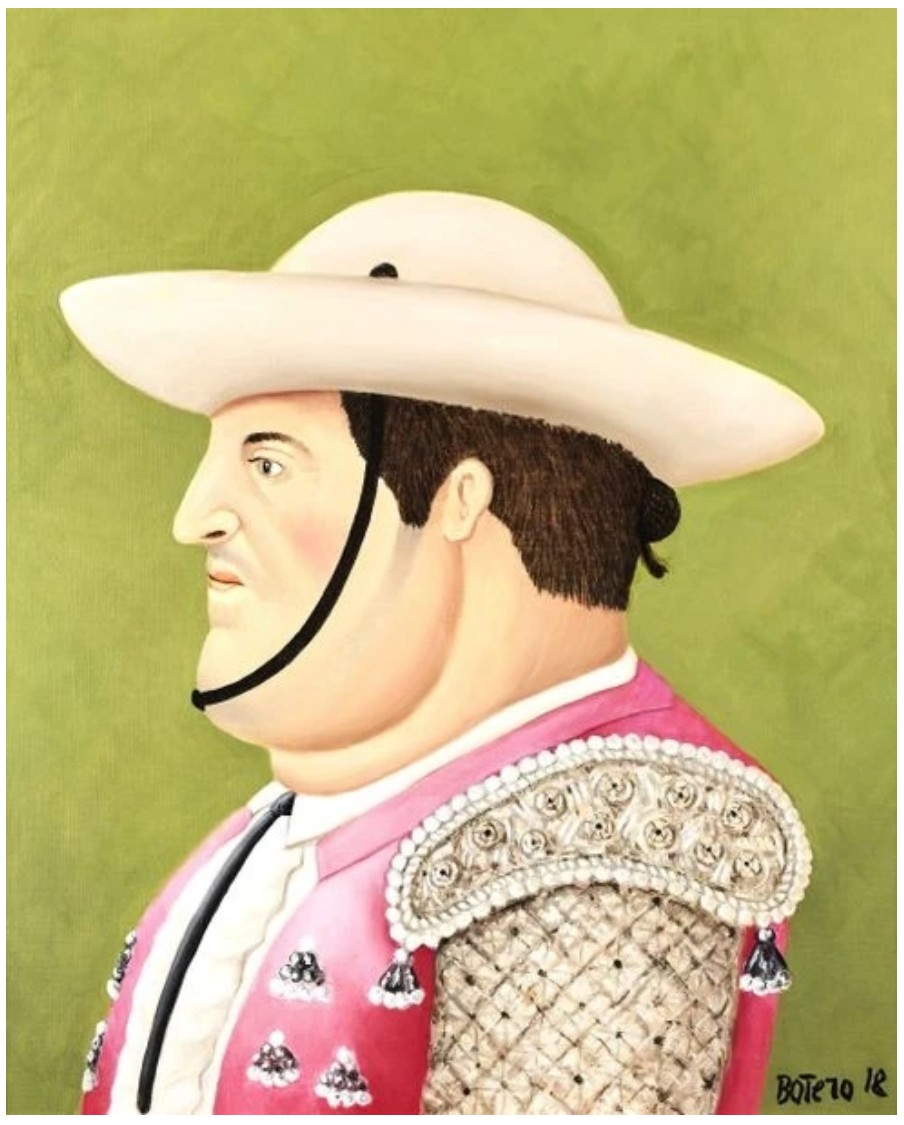
FERNANDO BOTERO (1932-2023)
The Picador, 2018
Oil on canvas
61×50 cm (24 x 19 5/8 inches)
Signed and dated lower right
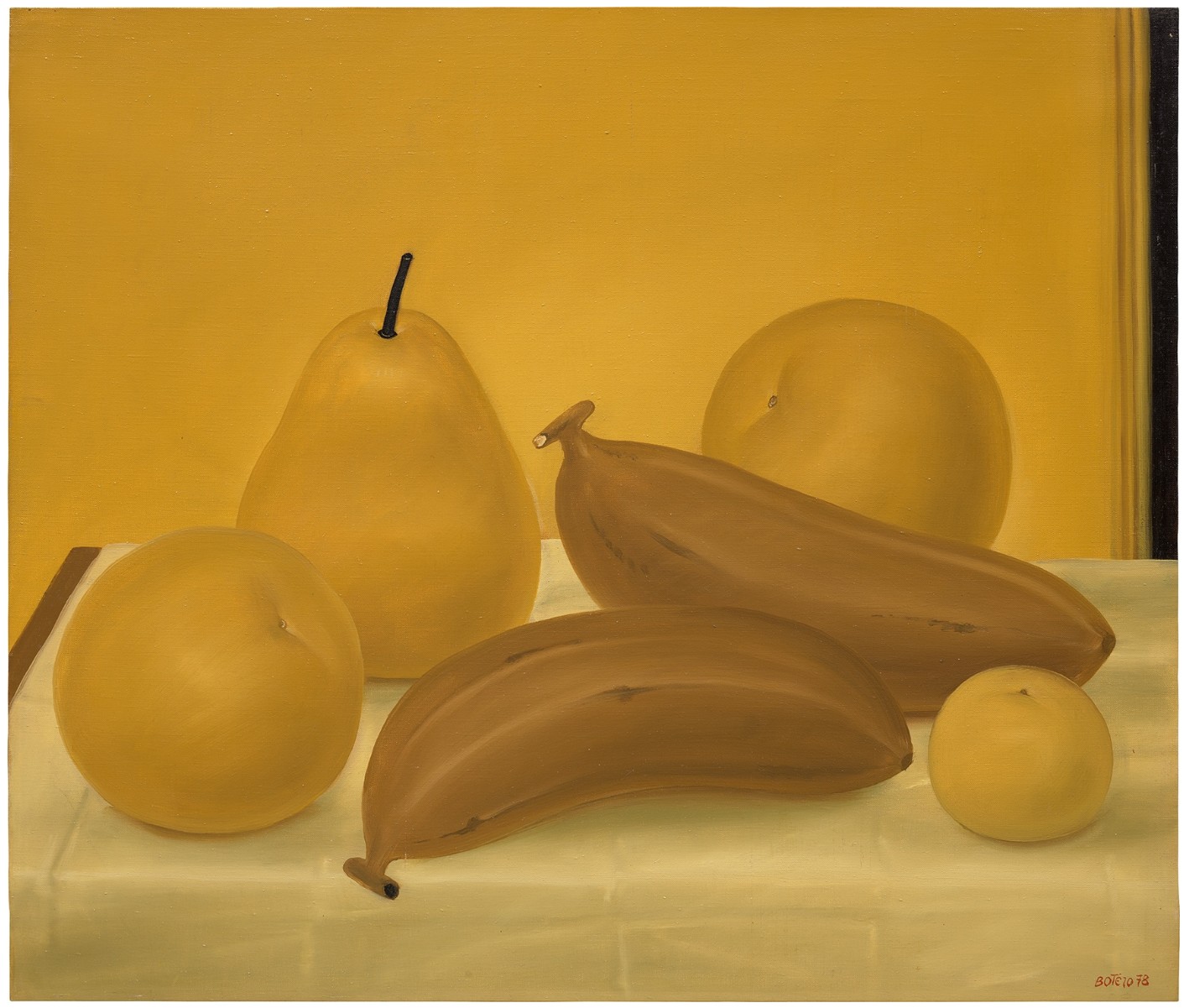
#23. Still Life with Bananas, 1978
Phillips New-York: 14 May 2025
Estimated: USD 220,000 – 320,000
USD 304,800
Fernando Botero Modern & Contemporary Art Day Sale, Morning Session
#24. Goya, 1997
Christie’s Paris: 11 April 2025
Estimated: EUR 180,000 – 250,000
EUR 239,400 / USD 269,500
Fernando Botero (1932-2023), Goya | Christie’s
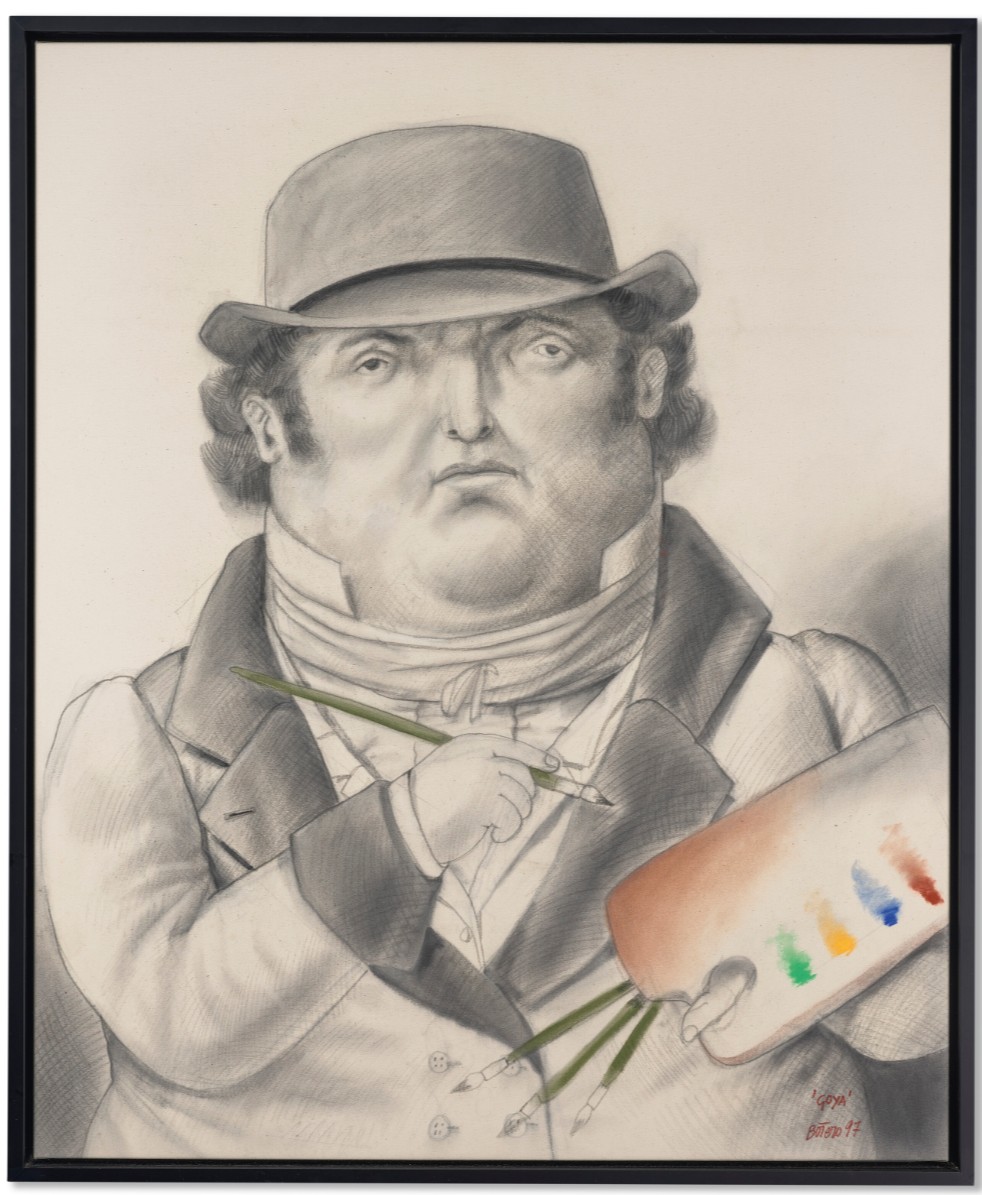
FERNANDO BOTERO (1932-2023)
Goya, 1997
Charcoal, graphite and pastel on canvas
122.9 x 100.8 cm (43 3/8 x 39 5/8 inches)
Signed, titled and dated ‘”Goya” Botero 97’ (lower right)
#25. Guitar Player, 2003
Estimated: HKD 1,200,000 – 2,200,000
HKD 1,778,000 / USD 228,550
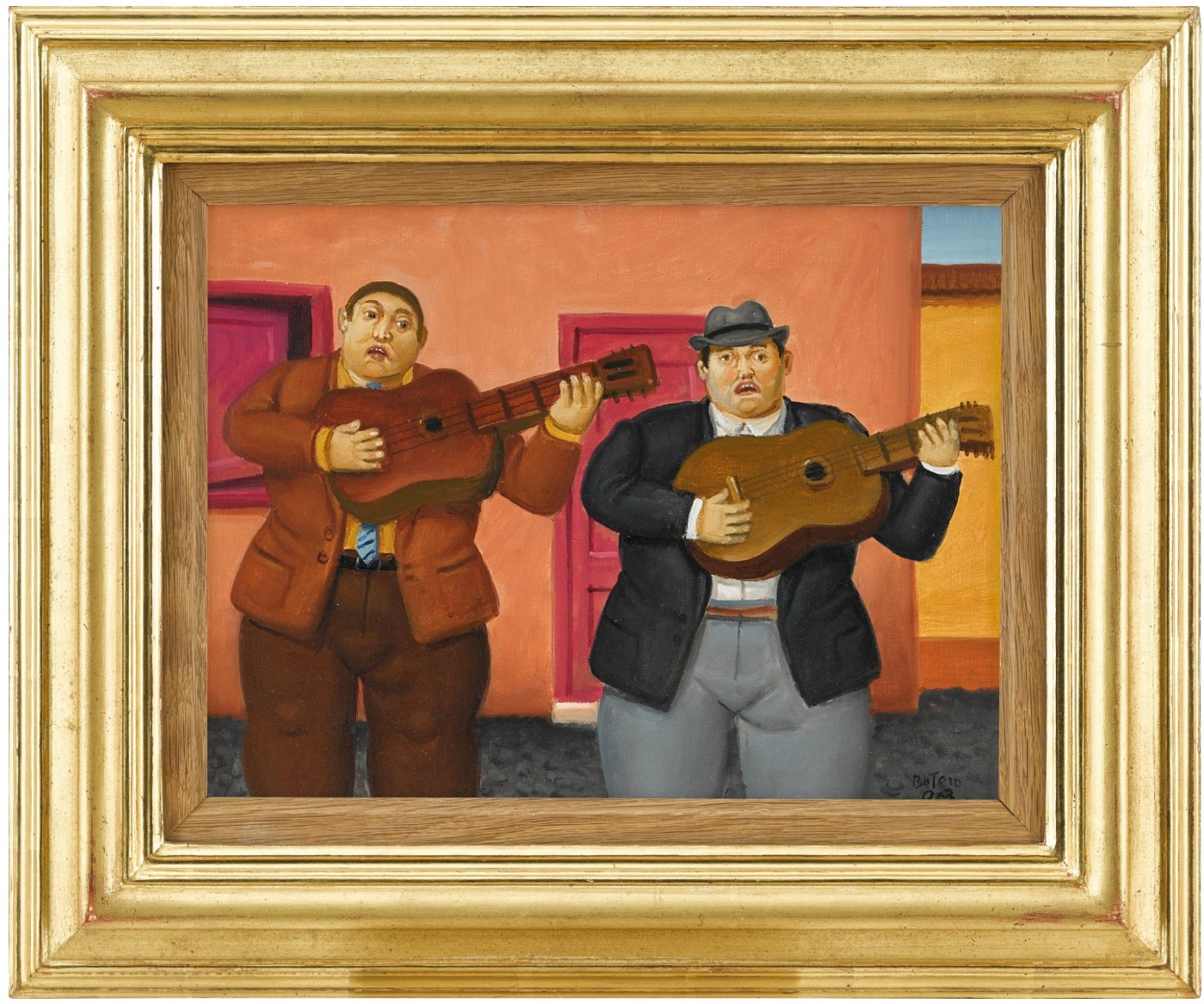
FERNANDO BOTERO (1932 – 2023)
Guitar Player, 2003
Oil on canvas
28.5 x 37.3 cm (11 1/4 x 14 5/8 inches)
Signed Botero and dated 003 (lower right)
#26. Portrait, 1966
Pandolfini Florence: 13 November 2025
Estimated: EUR 150,000 – 250,000
EUR 176,400 / USD 205,475
Fernando Botero : FERNANDO BOTERO – Auction MODERN AND CONTEMPORARY ART – Pandolfini Casa d’Aste
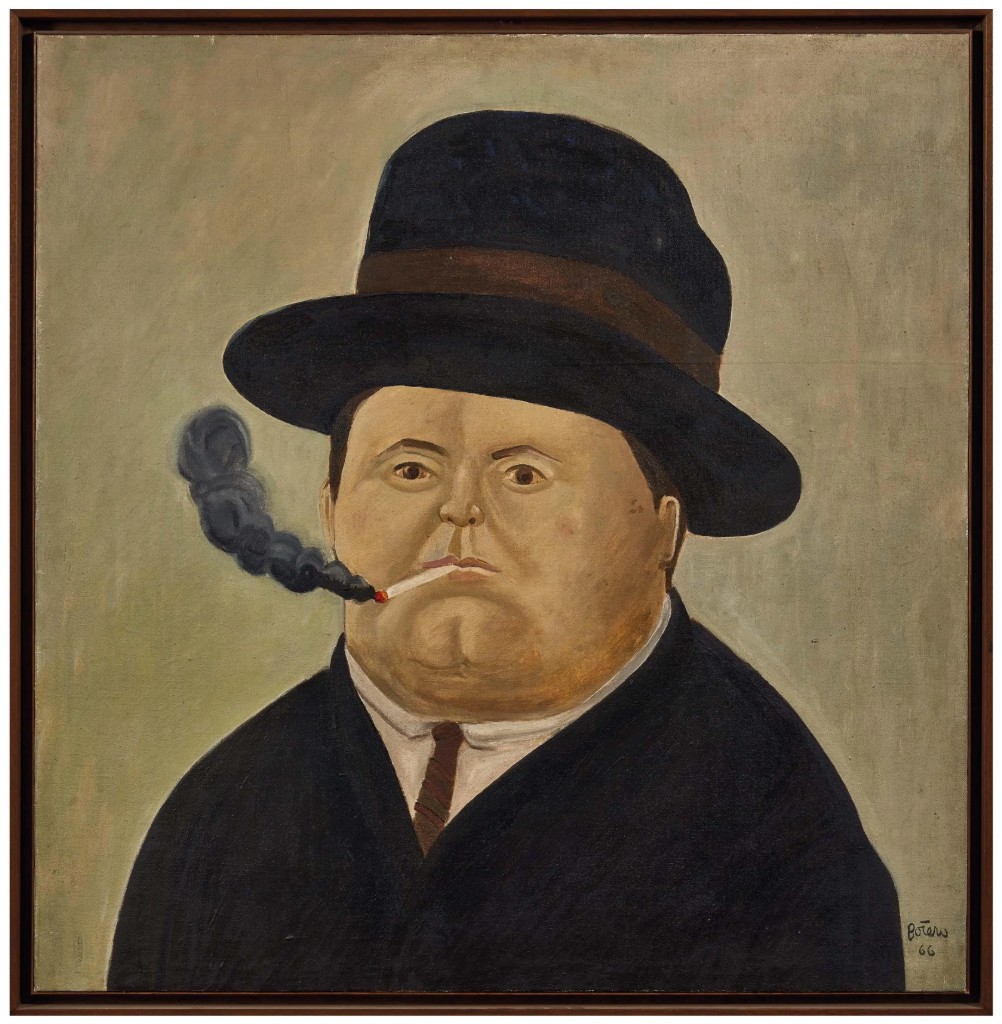
FERNANDO BOTERO (Medellin 1932 – Monaco 2023)
Portrait, 1966
Oil on canvas
86×84 cm (33 7/8 x 33 1/8 inches)
Signed and dated lower right
#27. Bolonbolo, 1993
USD 203,700
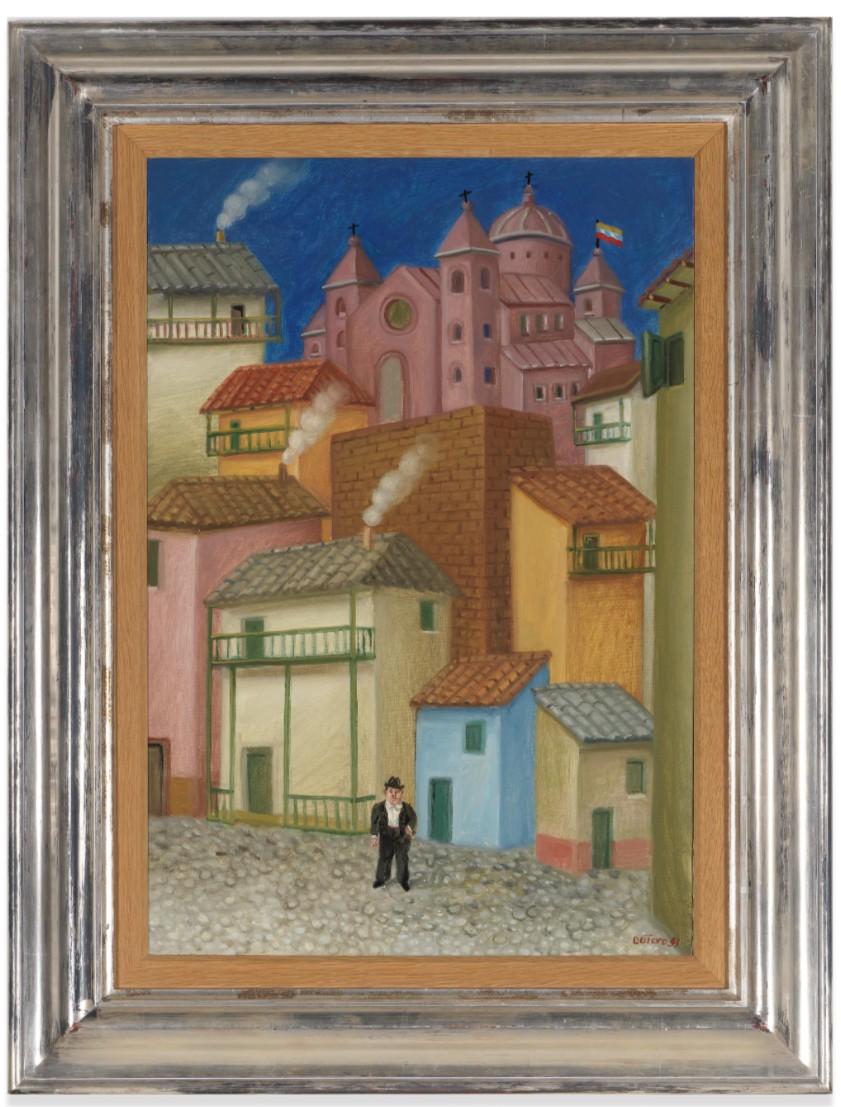
Oil on canvas
57×39 cm (22 1/2 x 15 1/2 inches)
Signed and dated ‘Botero 93’ (lower right)
#28. Old Lady, 1974
Christie’s New-York: 28 February 2025
Estimated: USD 250,000 – 350,000
USD 189,000
FERNANDO BOTERO (1932-2023), Old Lady | Christie’s
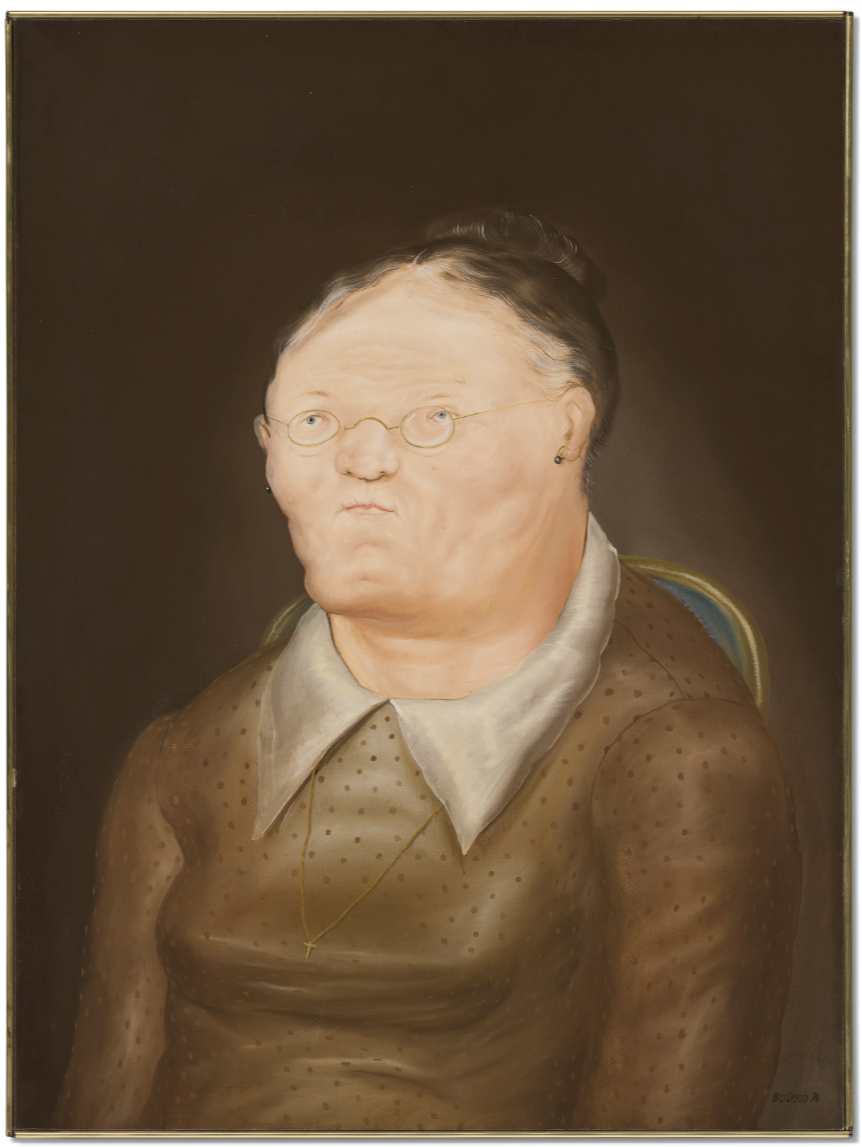
FERNANDO BOTERO (1932-2023)
Old Lady, 1974
Oil on canvas
127.6 x 95.3 cm (50 1/4 x 37 1/2 inches)
Signed and dated ‘Botero 74’ (lower right)
#29. Still Life with Violin and Sausages, 1999
Christie’s London: 6 March 2025
Estimated: GBP 80,000 – 120,000
GBP 107,100 / USD 138,159
FERNANDO BOTERO (1932-2023), Still Life with Violin and Sausages | Christie’s
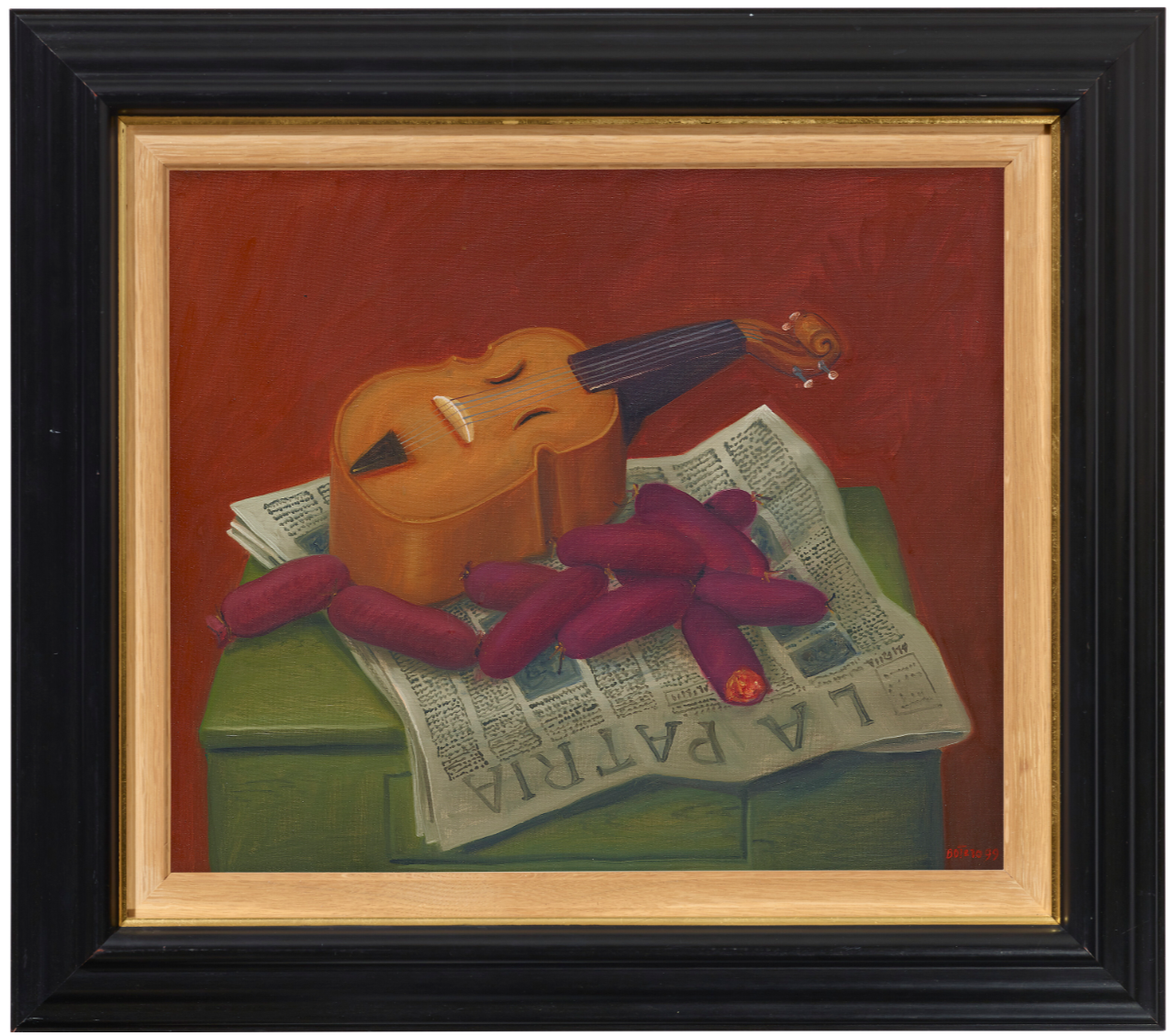
FERNANDO BOTERO (1932-2023)
Still Life with Violin and Sausages, 1999
Oil on canvas
44×52 cm (17 3/8 x 20 1/2 inches)
Signed and dated ‘BOTERO 99’ (lower right)
#30. Onions, 1973
Christie’s New-York: 28 February 2025
Estimated: USD 80,000 – 120,000
USD 100,800
FERNANDO BOTERO (1932-2023), Onions | Christie’s
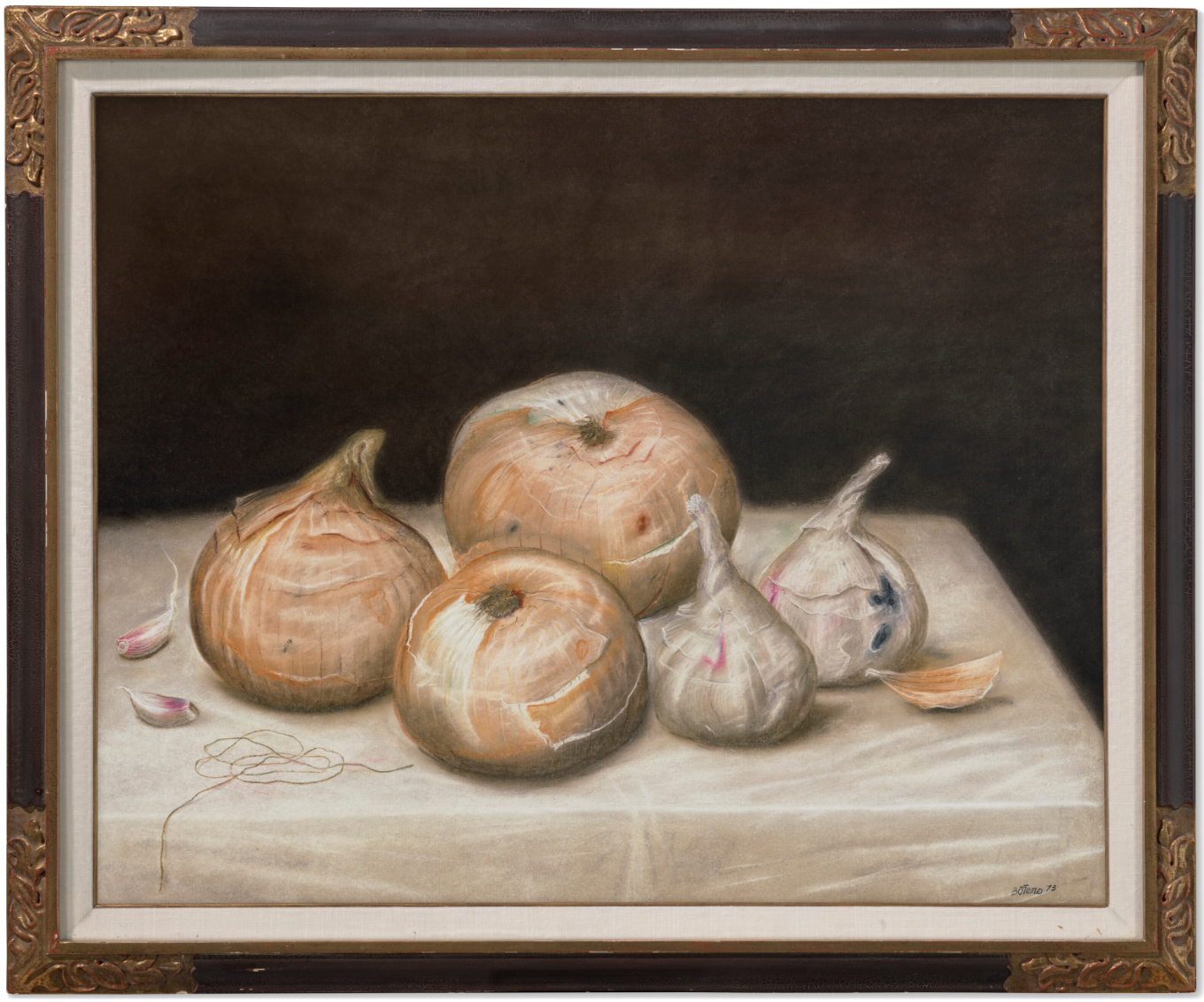
FERNANDO BOTERO (1932-2023)
Onions, 1973
Pastel on paper, laid on canvas
79.5 x 99.1 cm (31 3/8 x 39 inches)
Signed and dated ‘Botero 73’ (lower right)
USD 100,000
#31. Naturaleza muerta, 1963
Estimated: USD 50,000 – 70,000
USD 95,250
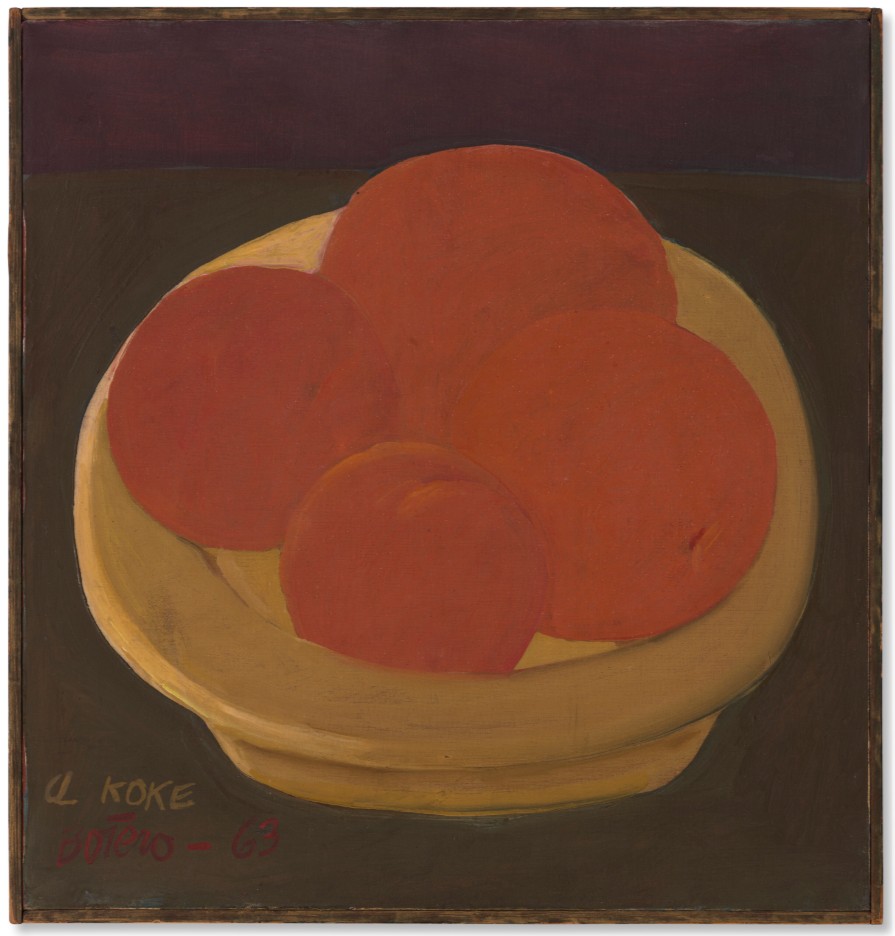
Naturaleza muerta, 1963
Oil on canvas
45.4 x 43.2 cm (17 7/8 x 17 inches)
Signed, dedicated and dated ‘A KOKE, Botero – 63’ (lower left)
Lots Passed
Bodegón con sandía, 1999
Christie’s New-York: 20 November 2025
Estimated: USD 200,000 – 300,000
PASSED
FERNANDO BOTERO (1932-2023), Bodegón con sandía | Christie’s
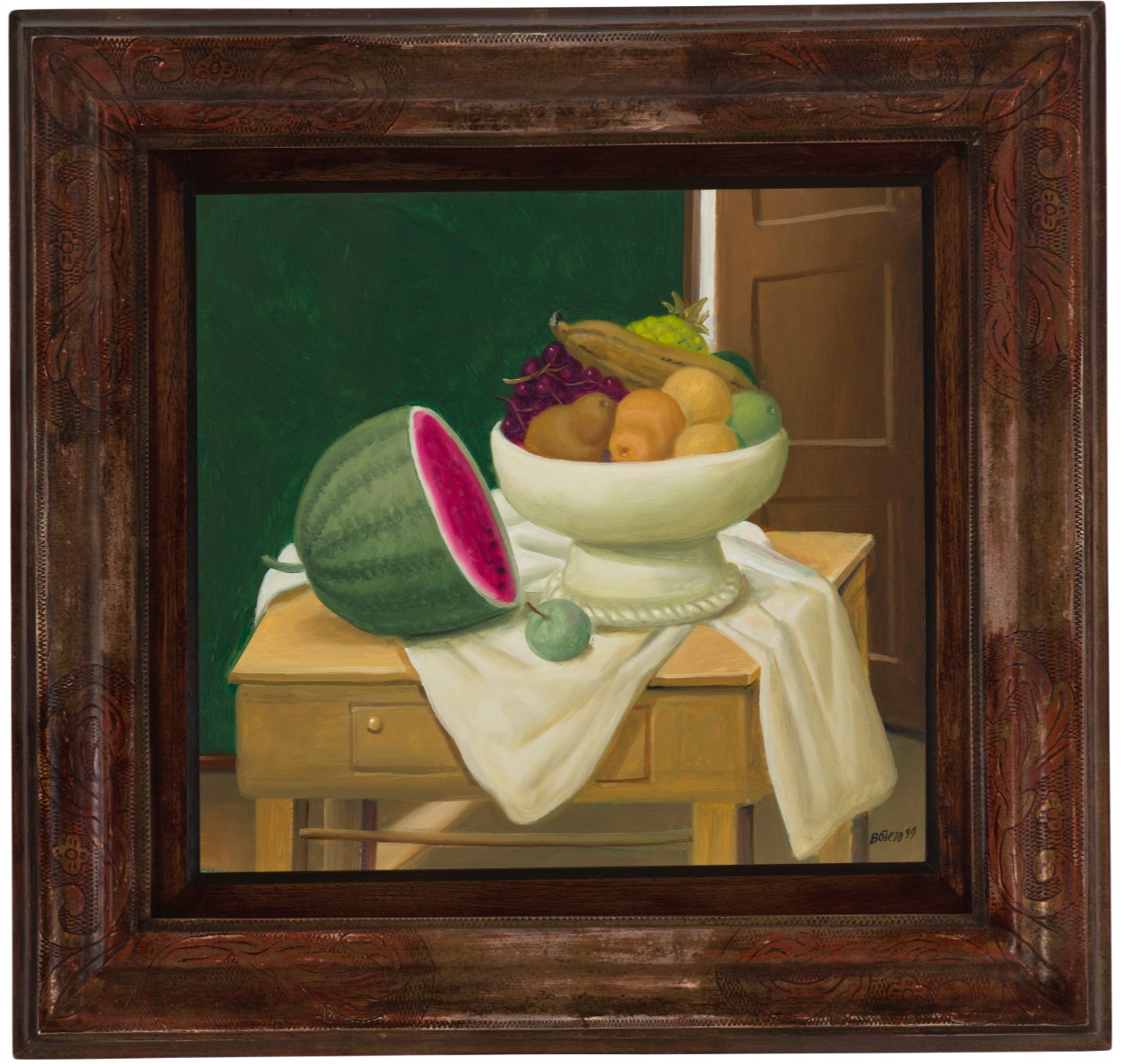
FERNANDO BOTERO (1932-2023)
Bodegón con sandía, 1999
Oil on canvas
36.2 x 39.1 cm (14 1/4 x 15 3/8 inches)
Signed and dated ‘Botero 99’ (lower right)
Manzanas, 1964
Sotheby’s New-York: 16 May 2025
Estimated: USD 250,000 – 350,000
PASSED
Manzanas | Contemporary Day Auction | 2025 | Sotheby’s
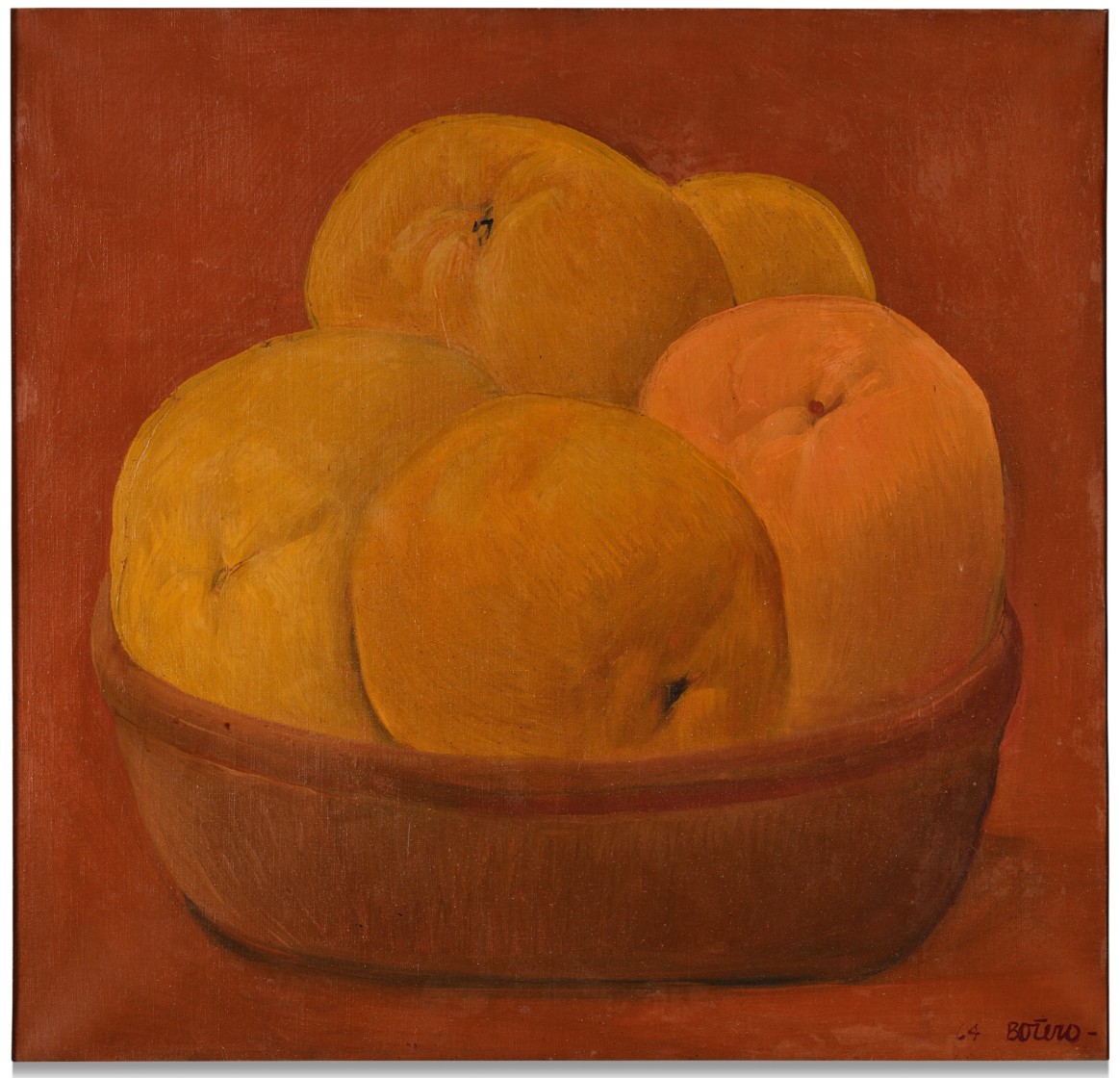
FERNANDO BOTERO (1932 – 2023)
Manzanas, 1964
Oil on canvas
90.5 x 94 cm (35 5/8 x 37 inches)
Signed and dated 64 (lower right)
Signed, titled and dated 1964 (on the reverse)
The Botero Exhibition, 1975
Christie’s London: 5 March 2025
Estimated: GBP 500,000 – 800,000
PASSED
FERNANDO BOTERO (1932-2023), The Botero Exhibition | Christie’s
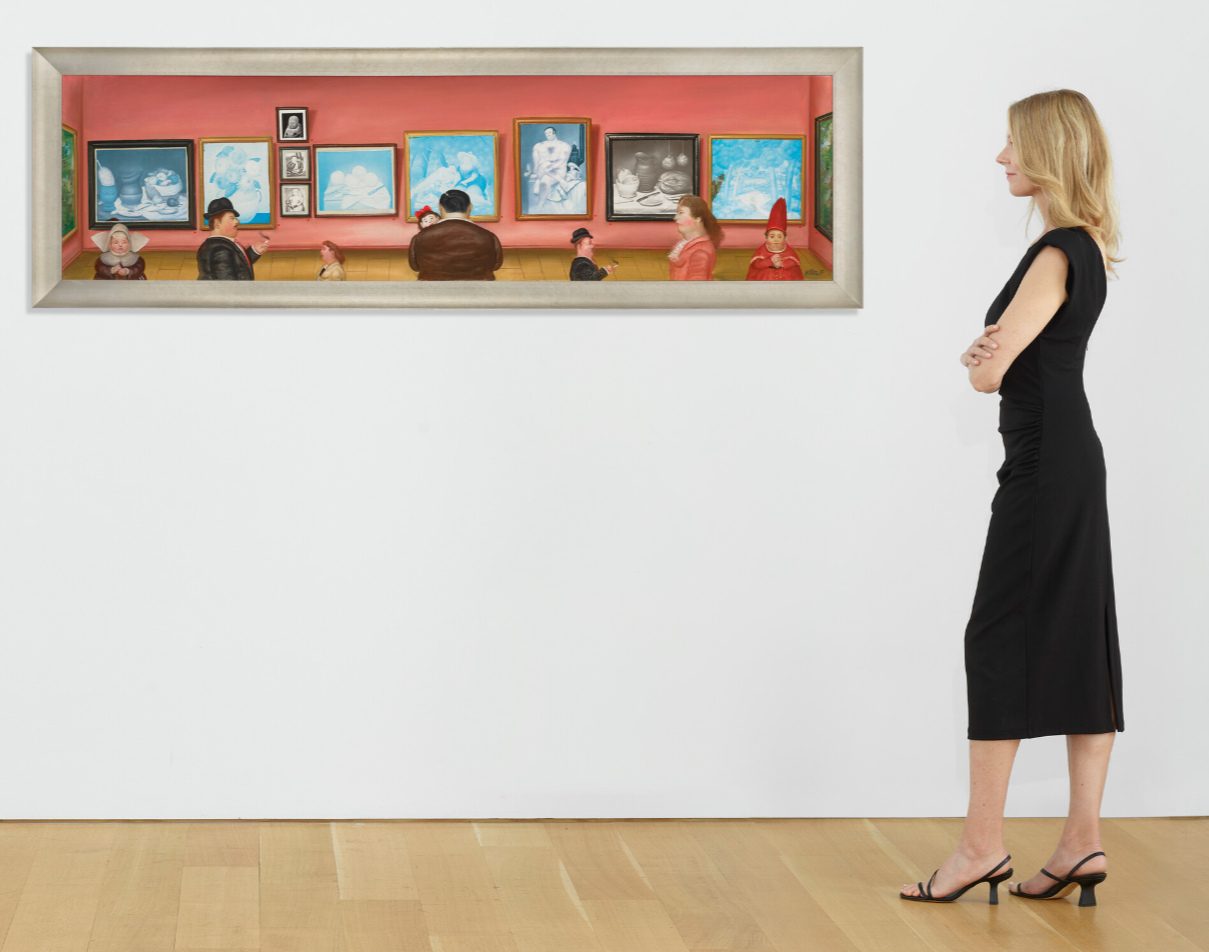
FERNANDO BOTERO (1932-2023)
The Botero Exhibition, 1975
Oil and photo collage on canvas
52.4 x 195.8 cm (20 5/8 x 77 1/8 inches)
Signed and dated ‘Botero 75’ (lower right)
Lots Withdrawn
Femme du Monde, 1974
Phillips New-York: 21 November 2025
Estimated: USD 350,000 – 450,000
WITHDRAWN
Fernando Botero Modern & Contemporary Art Day Sale, Morning Session
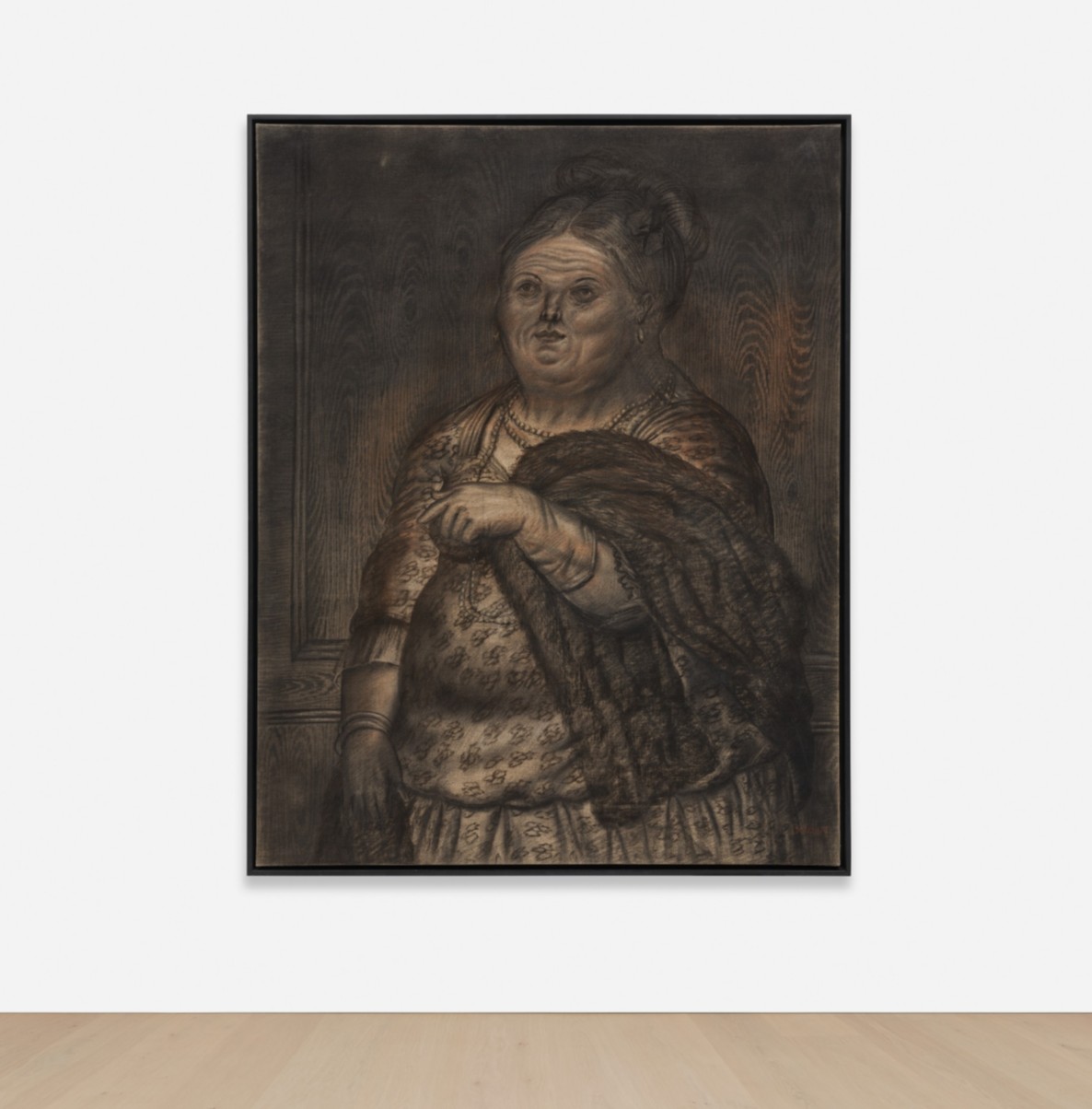
Charcoal and sanguine on canvas
179.1 x 141 cm (70 1/2 x 55 1/2 inches)
Signed and dated “Botero 74” lower right
2024 Auction Results
FOR PAINTINGS ONLY
41 lots sold at auction in 2024 for a total turnover of USD 32,724,924. 2024 is a record year for the artist at auction. With 2 lots failing to sell, the sell-through rate is 95%. The highest price has been achieved at Christie’s in New-York on 19 November 2024, when The Playroom, a painting dated 1970, sold for USD 3,680,000.
2024 Top 3 Lots
9 paintings sold for more than USD 1 million, generating a cumulative turnover of USD 17,136,579, representing 52.4% of the total turnover for 2024.
XXXXXXXXXX
#1. The Playroom, 1970
Christie’s New-York: 19 November 2024
Estimated: USD 3,000,000 – 5,000,000
USD 3,680,000
FERNANDO BOTERO (1932-2023), The Playroom | Christie’s
FERNANDO BOTERO (1932-2023)
The Playroom, 1970
Oil on canvas
206.4 x 191.5 cm (81 1/4 x 75 3/8 inches)
Signed and dated ‘Botero 70’ (lower right)
Signed and dated again and titled ‘BOTERO 70 THE PLAYROOM’ (on the reverse)
#2. Florero, 1974
Sotheby’s New-York: 1 March 2024
Estimated: USD 1,000,000 – 1,500,000
USD 2,722,000
FERNANDO BOTERO (1932 – 2023)
Florero, 1974
Oil on canvas
226×191 cm (89 x 75 1/4 inches)
Signed Botero and dated 74 (lower right)
#3. Jugando a las cartas, 1988
Sotheby’s New-York: 1 March 2024
Estimated: USD 1,000,000 – 1,500,000
USD 2,298,500
FERNANDO BOTERO (1932 – 2023)
Jugando a las cartas, 1988
Oil on canvas
130×188 cm (51 1/8 x 74 inches)
Signed Botero and dated 88 (lower right)
#4. Nightlife, 2017
Christie’s Paris: 18 October 2024
Estimated: EUR 850,000 – 1,250,000
EUR 2,036,500 / USD 2,121,829
Fernando Botero (1932-2023), Nightlife | Christie’s
FERNANDO BOTERO (1932-2023)
Nightlife, 2017
Oil on canvas
167 x 206.5 cm (65 3/4 x 81 1/4 inches)
Signed ‘Botero 17’ (lower right)
#5. Hombre fumando, 1980
Christie’s New-York: 12 March 2024
Estimated: USD 500,000 – 700,000
USD 1,744,000
FERNANDO BOTERO (1932-2023), Hombre fumando | Christie’s (christies.com)
FERNANDO BOTERO (1932-2023)
Hombre fumando, 1980
Oil on canvas
189.8 x 136.2 cm (74 3/4 x 53 1/2 inches)
Signed and dated ‘Botero, 80’ (lower right)
#6. Dancers, 2010
Christie’s New-York: 12 March 2024
Estimated: USD 1,000,000 – 1,500,000
USD 1,197,000
FERNANDO BOTERO (1932-2023), Dancers | Christie’s (christies.com)
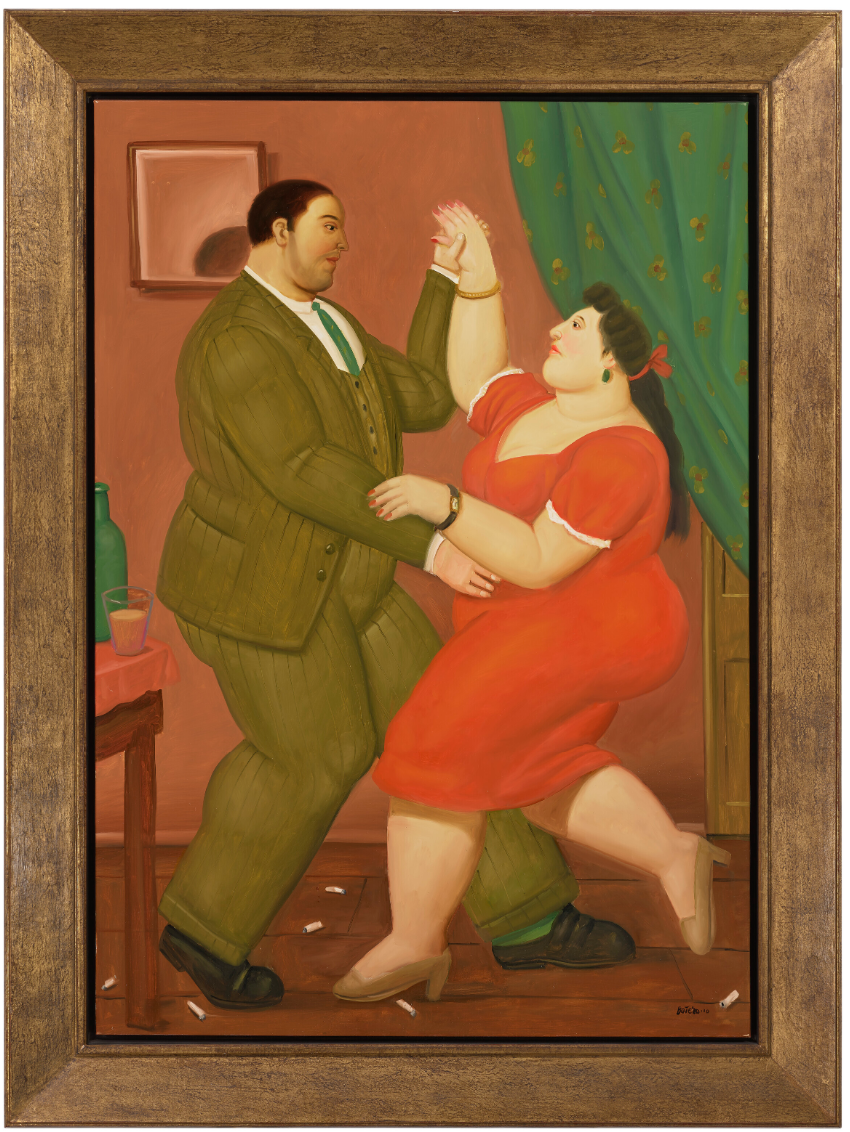
FERNANDO BOTERO (1932-2023)
Dancers, 2010
Oil on canvas
144.2 x 100.3 cm (56 3/4 x 39 1/2 inches)
Signed and dated ‘Botero, 10’ (lower right)
#7. Cazador, 1982
Christie’s New-York: 2 October 2024
Estimated: USD 800,000 – 1,200,000
USD 1,134,000
FERNANDO BOTERO (1932-2023), Cazador | Christie’s (christies.com)
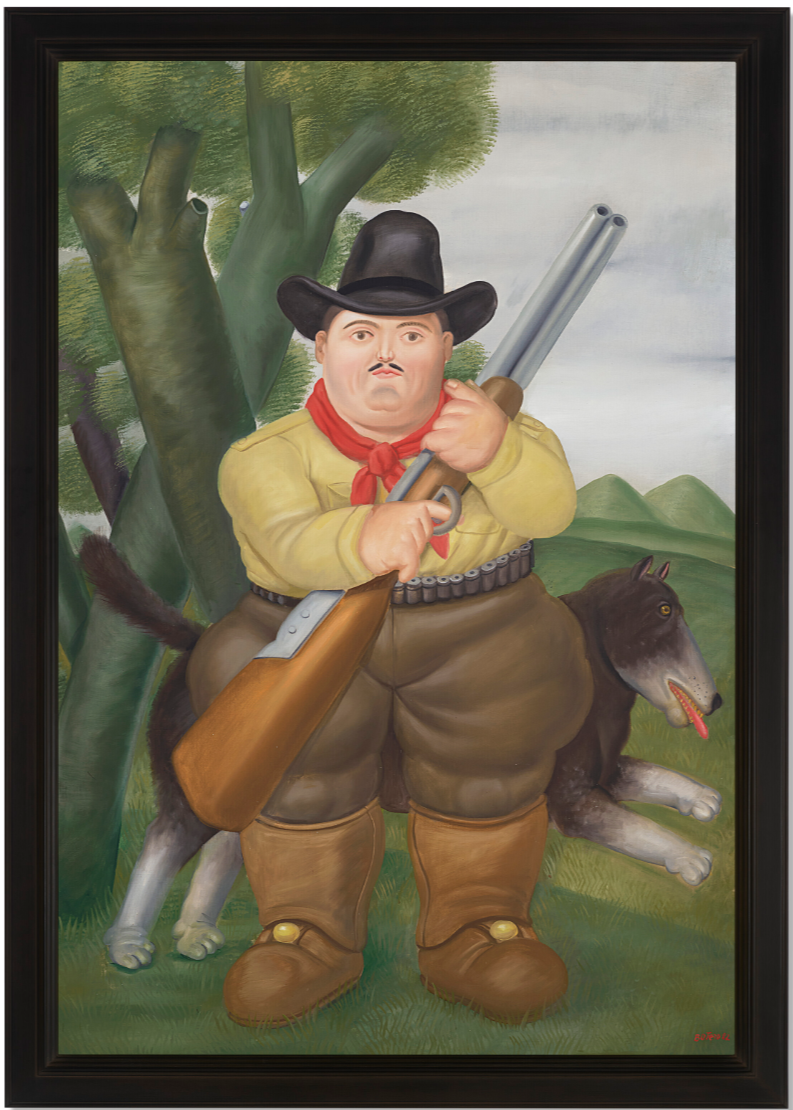
FERNANDO BOTERO (1932-2023)
Cazador, 1982
Oil on canvas
161.6 x 110.8 cm (63 5/8 x 43 5/8 inches)
Signed and dated ‘Botero 82’ (lower right)
#8. The House of Ana Molina, 1972
Sotheby’s New-York: 27 September 2024
Estimated: USD 400,000 – 600,000
USD 1,128,000
The House of Ana Molina | Contemporary Curated | 2024 | Sotheby’s (sothebys.com)
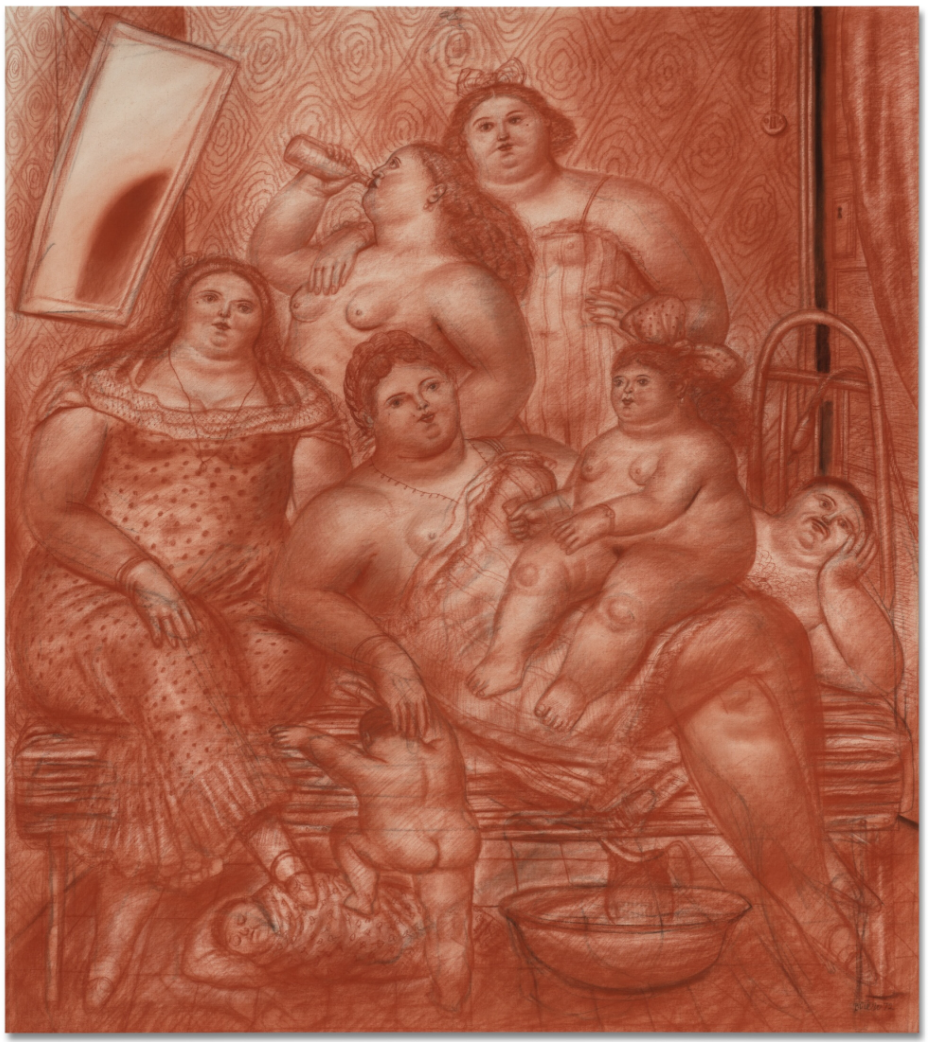
FERNANDO BOTERO (1932 – 2023)
The House of Ana Molina, 1972
Sanguine, charcoal and pastel on linen
205.1 x 182.9 cm (80 3/4 x 72 inches)
Signed and dated 72 (lower right)
#9. The Street, 2010
Sotheby’s New-York: 14 May 2024
Estimated: USD 600,000 – 800,000
USD 1,111,250
The Street | Contemporary Day Auction | 2024 | Sotheby’s (sothebys.com)

FERNANDO BOTERO (1932 – 2023)
The Street, 2010
Oil on canvas
185×140 cm (72 3/4 x 55 1/8 inches)
Signed and dated 10 (lower right)
USD 1 million
#10. Aurora, 1993
Sotheby’s New-York: 21 November 2024
Estimated: USD 700,000 – 1,000,000
USD 960,000
Aurora | Contemporary Day Auction | 2024 | Sotheby’s
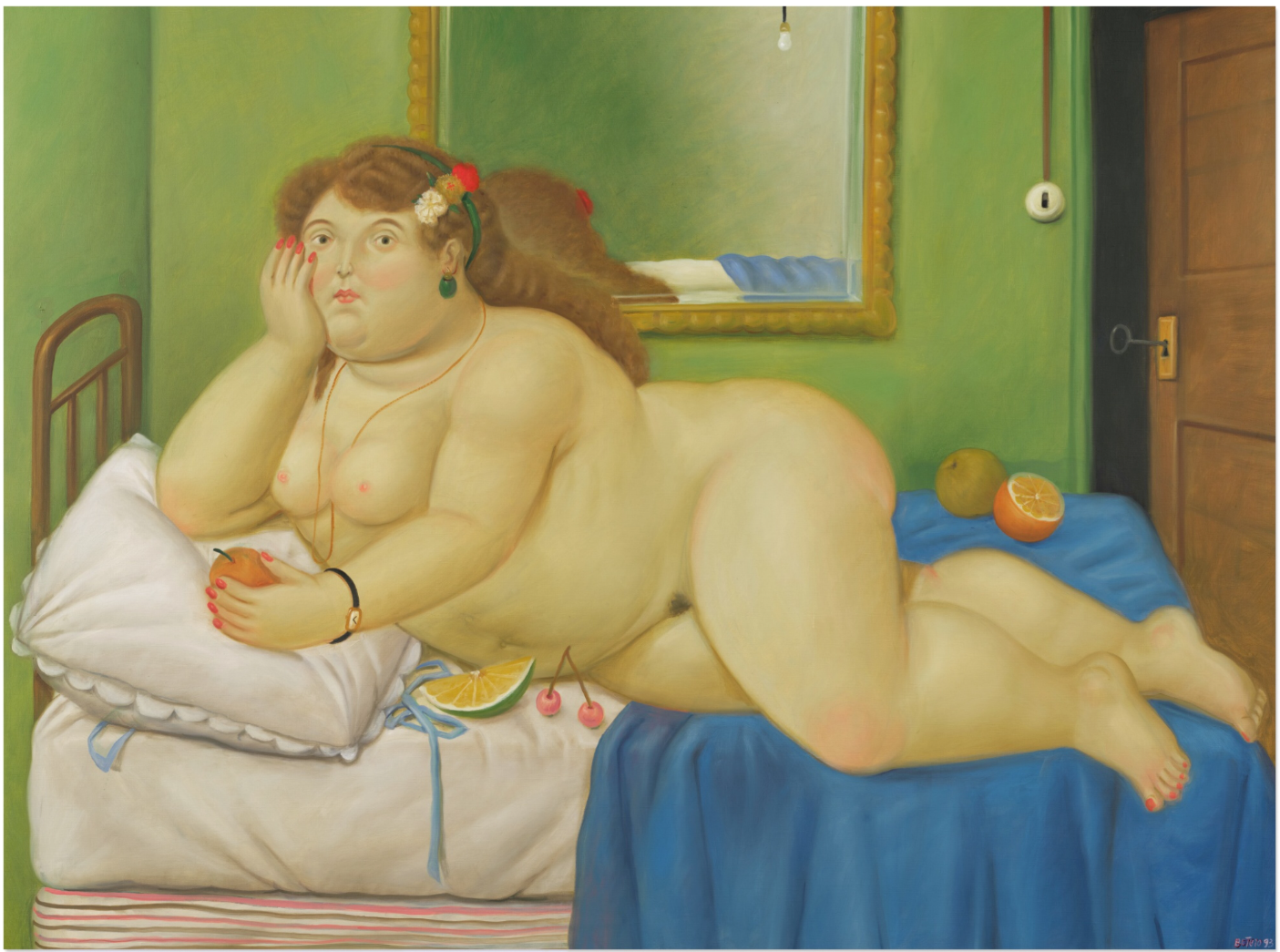
FERNANDO BOTERO (1932 – 2023)
Aurora, 1993
Oil on canvas
142.2 x 192.4 cm (56 x 75 3/4 inches)
Signed and dated 93 (lower right)
#11. El Cardenal, 1977
Sotheby’s New-York: 27 September 2024
Estimated: USD 700,000 – 1,000,000
USD 936,000
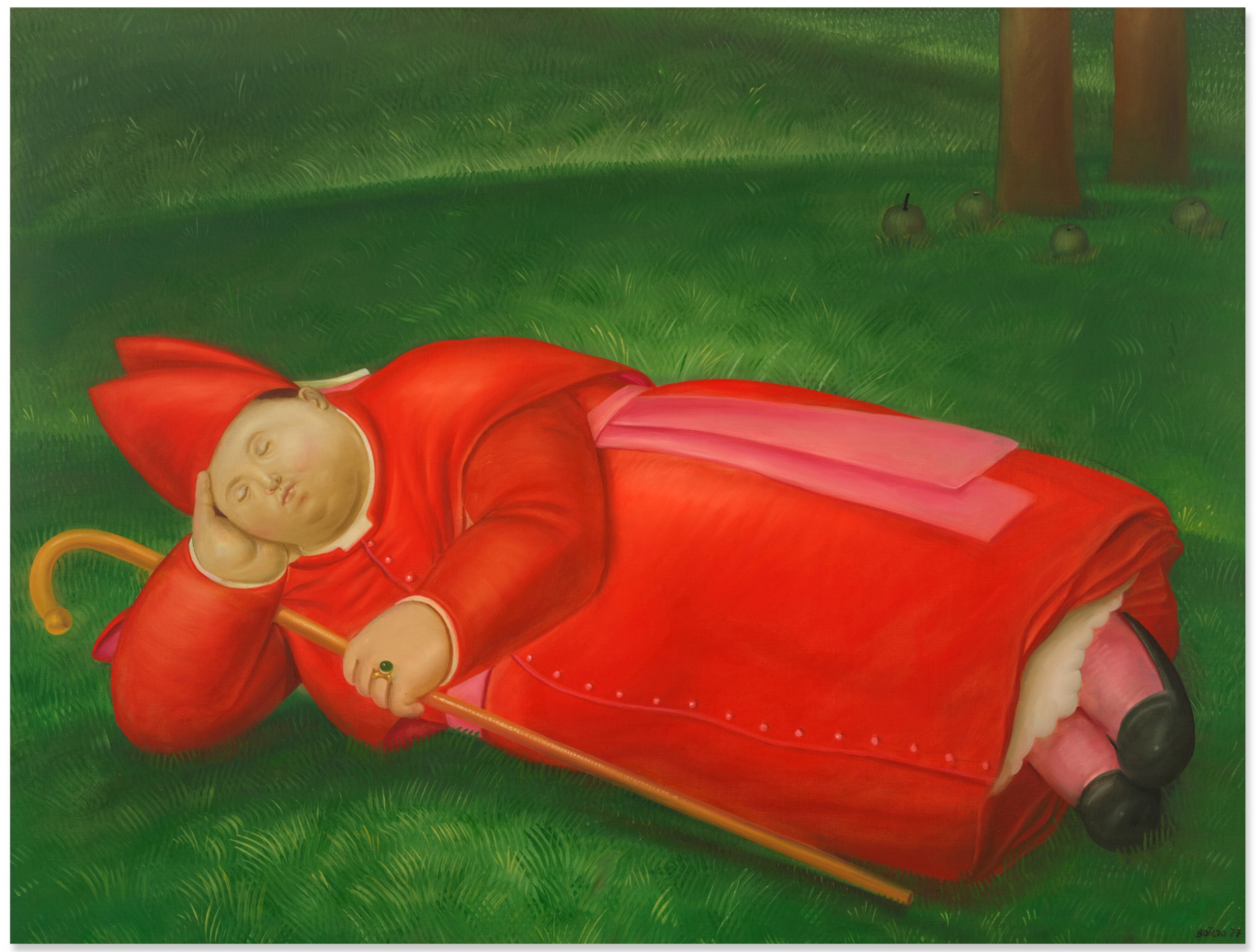
FERNANDO BOTERO (1932 – 2023)
El Cardenal, 1977
Oil on canvas
145.7 x 193 cm (57 3/8 x 76 inches)
Signed and dated 77 (lower right)
#12. Circus Act, 2007
Christie’s New-York: 12 March 2024
Estimated: USD 600,000 – 800,000
USD 850,500
FERNANDO BOTERO (1932-2023), Circus Act | Christie’s (christies.com)
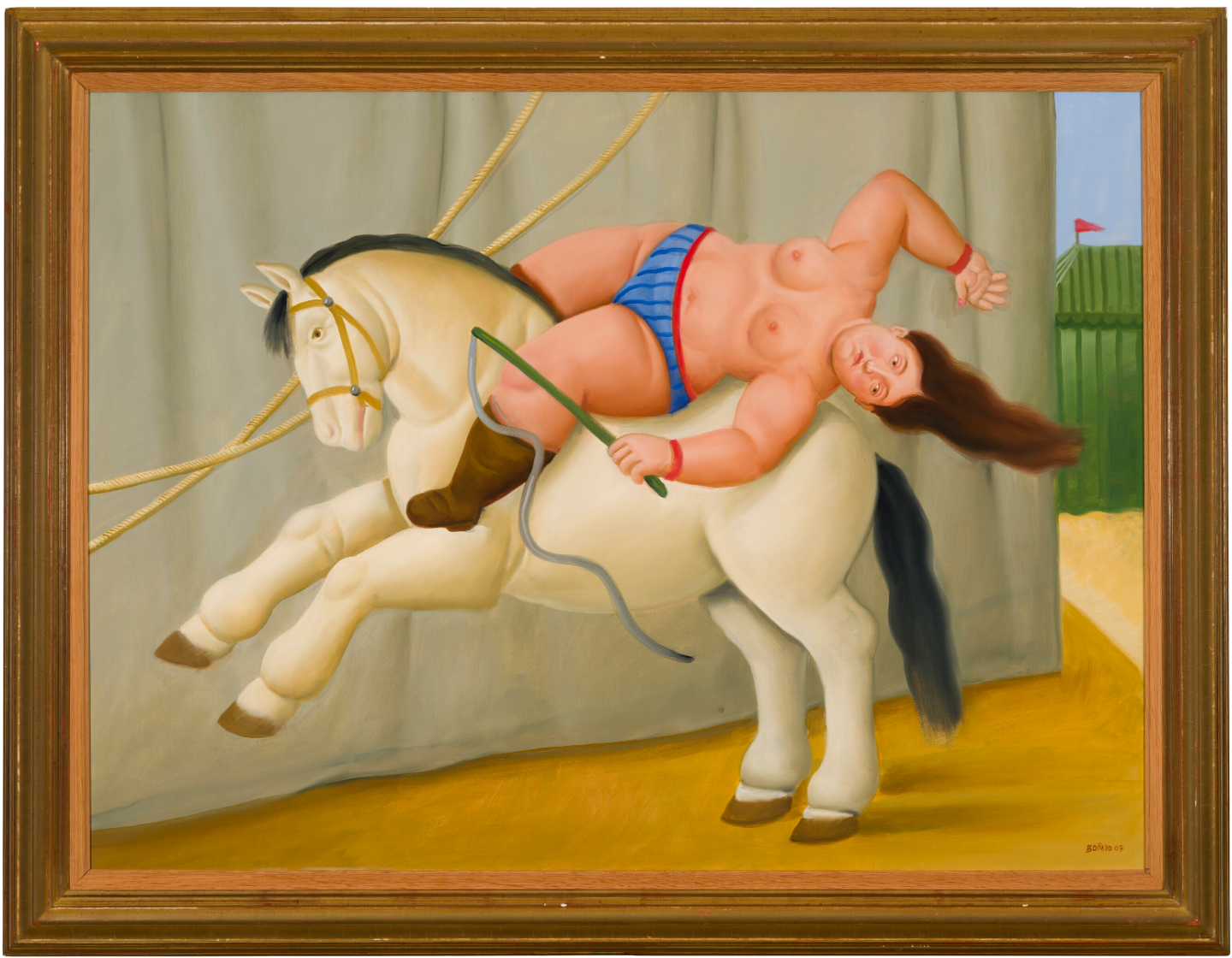
FERNANDO BOTERO (1932-2023)
Circus Act, 2007
Oil on canvas
83.2 x 112.1 cm (32 3/4 x 44 1/8 inches)
Signed and dated ‘Botero, 07’ (lower right)
#13. La Chambre, 1998
Christie’s New-York: 22 November 2024
Estimated: USD 400,000 – 600,000
USD 806,400
FERNANDO BOTERO (1932-2023), La Chambre | Christie’s
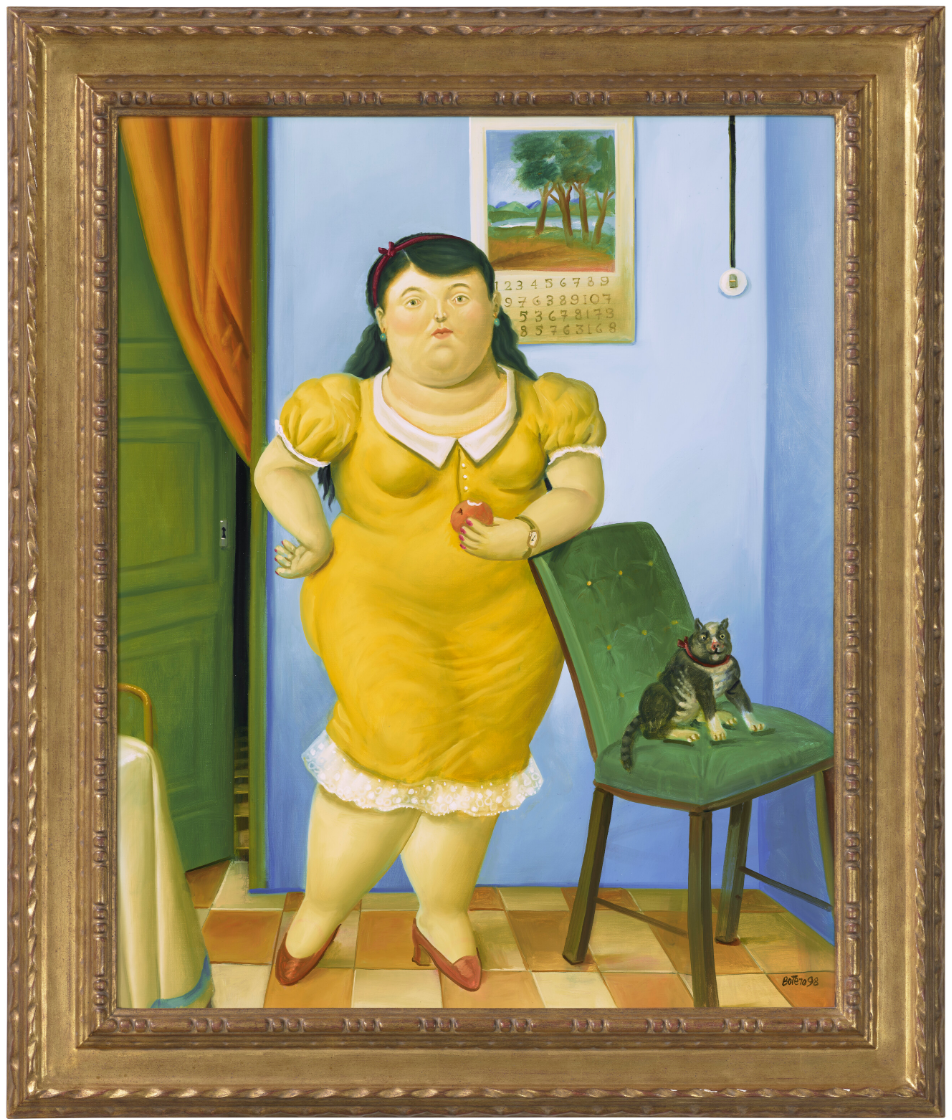
FERNANDO BOTERO (1932-2023)
La Chambre, 1998
Oil on canvas
100×80 cm (39 x 31 5/8 inches)
Signed and dated ‘Botero 98’ (lower right)
#14. La coleccionista, 1974
Sotheby’s New-York: 1 March 2024
Estimated: USD 400,000 – 600,000
USD 762,000
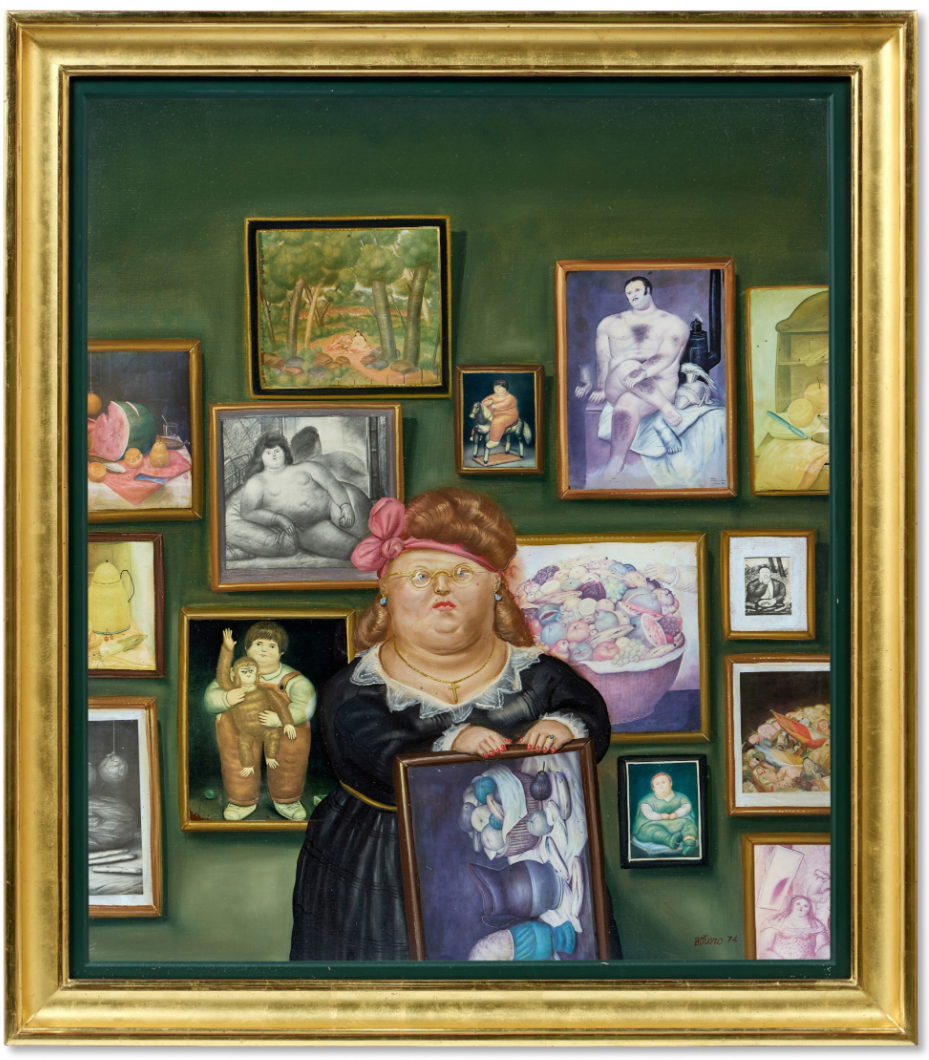
FERNANDO BOTERO (1932 – 2023)
La coleccionista, 1974
Oil and collage on canvas
91×79 cm (35 3/4 x 31 inches)
Signed Botero and dated 74 (lower right)
#15. Standing Woman in a Bedroom, 2004
Christie’s New-York: 2 October 2024
Estimated: USD 600,000 – 800,000
USD 693,000
FERNANDO BOTERO (1932-2023), Standing Woman in a Bedroom | Christie’s (christies.com)
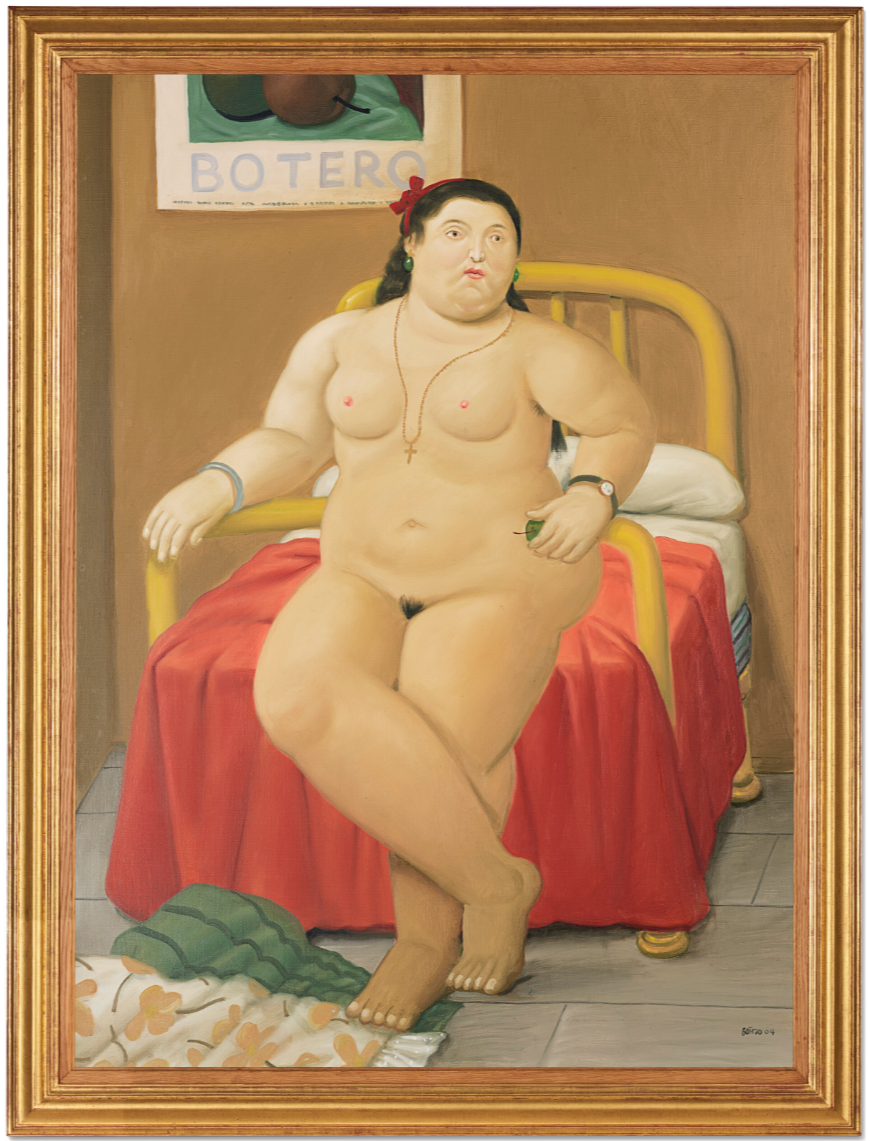
FERNANDO BOTERO (1932-2023)
Standing Woman in a Bedroom, 2004
Oil on canvas
131.4 x 95.6 cm (51 3/4 x 37 5/8 inches)
Signed and dated ‘Botero 04’ (lower right)
#16. Woman on a Balcony, 1979
Christie’s New-York: 2 October 2024
Estimated: USD 350,000 – 450,000
USD 680,400
FERNANDO BOTERO (1932-2023), Woman on a Balcony | Christie’s (christies.com)
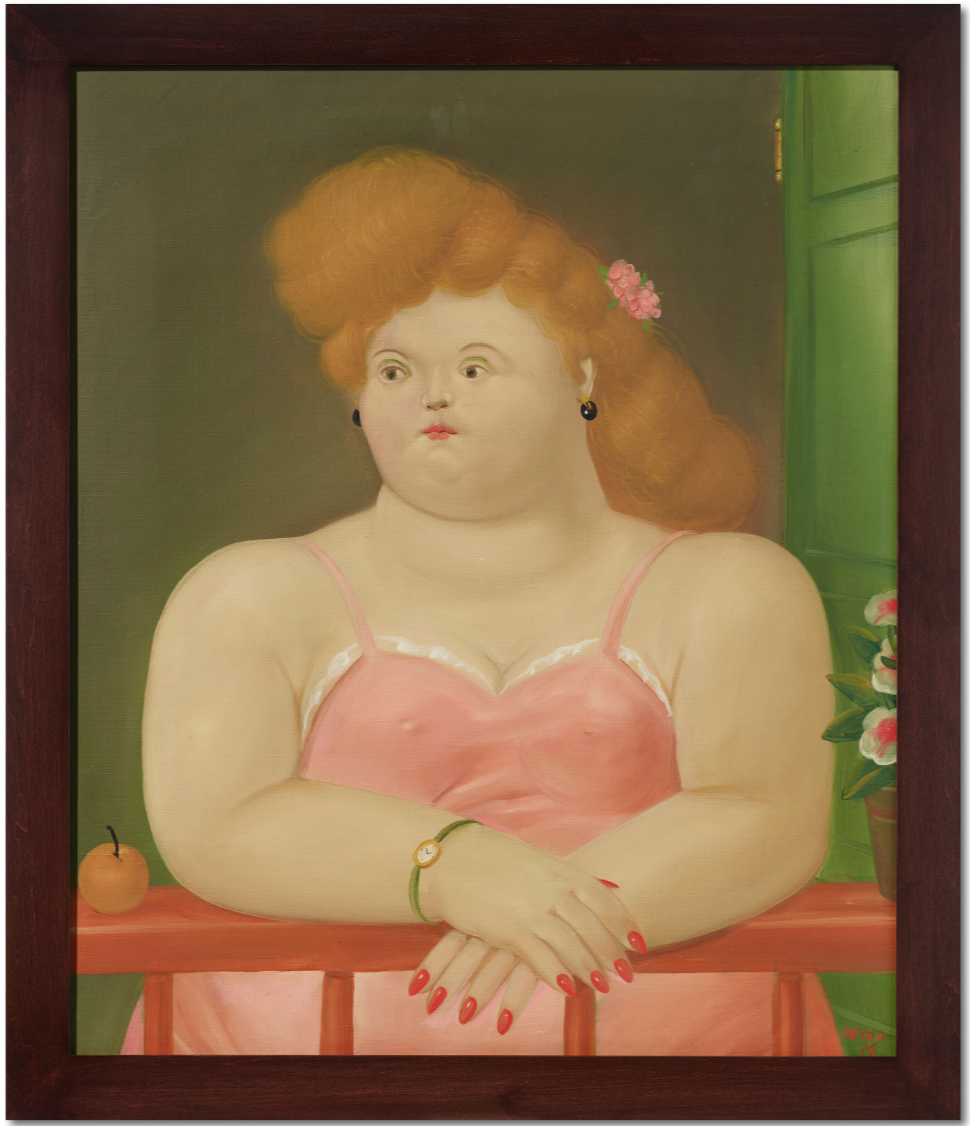
FERNANDO BOTERO (1932-2023)
Woman on a Balcony, 1979
Oil on canvas
94.6 x 78.7 cm (37 1/4 x 31 inches)
Signed and dated ‘Botero 79’ (lower right)
#17. Hombre a caballo, 1990
Sotheby’s New-York: 1 March 2024
Estimated: USD 250,000 – 350,000
USD 647,700
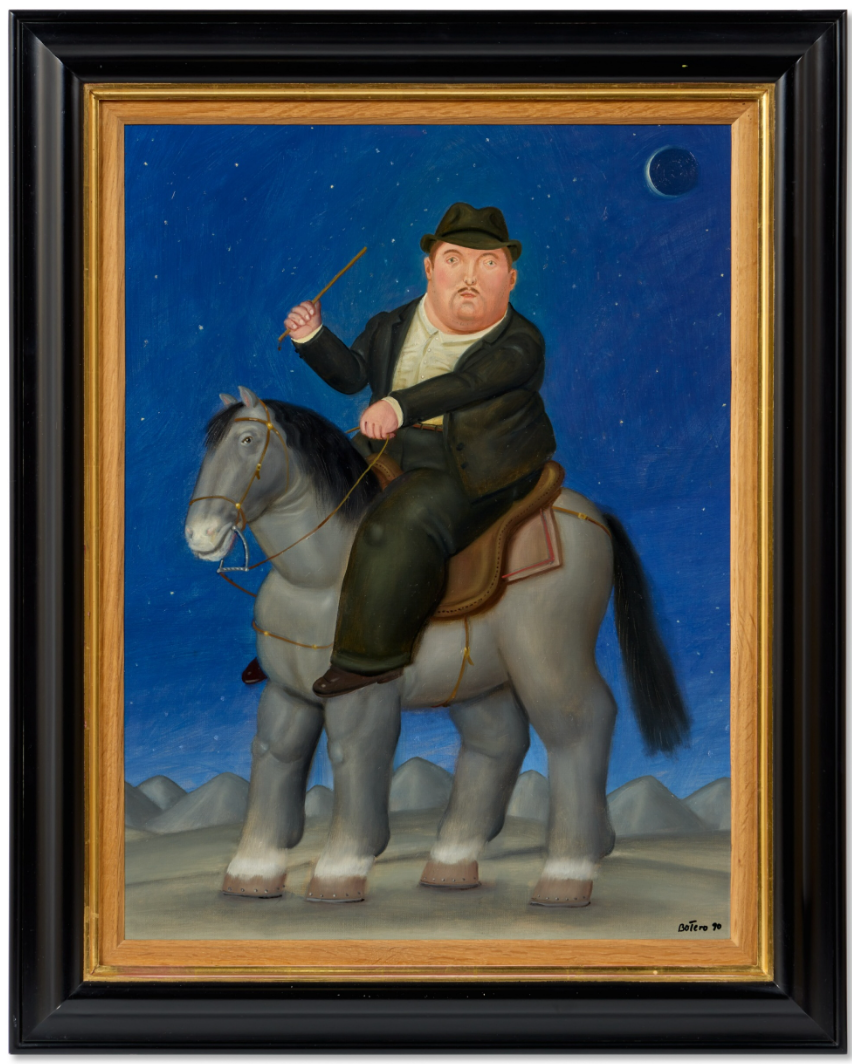
FERNANDO BOTERO (1932 – 2023)
Hombre a caballo, 1990
Oil on canvas
68×51 cm (26 3/4 x 20 inches)
Signed Botero and dated 90 (lower right)
#18. Naturaleza muerta, 2000
Sotheby’s New-York: 21 November 2024
Estimated: USD 350,000 – 450,000
USD 576,000
Naturaleza muerta | Contemporary Day Auction | 2024 | Sotheby’s
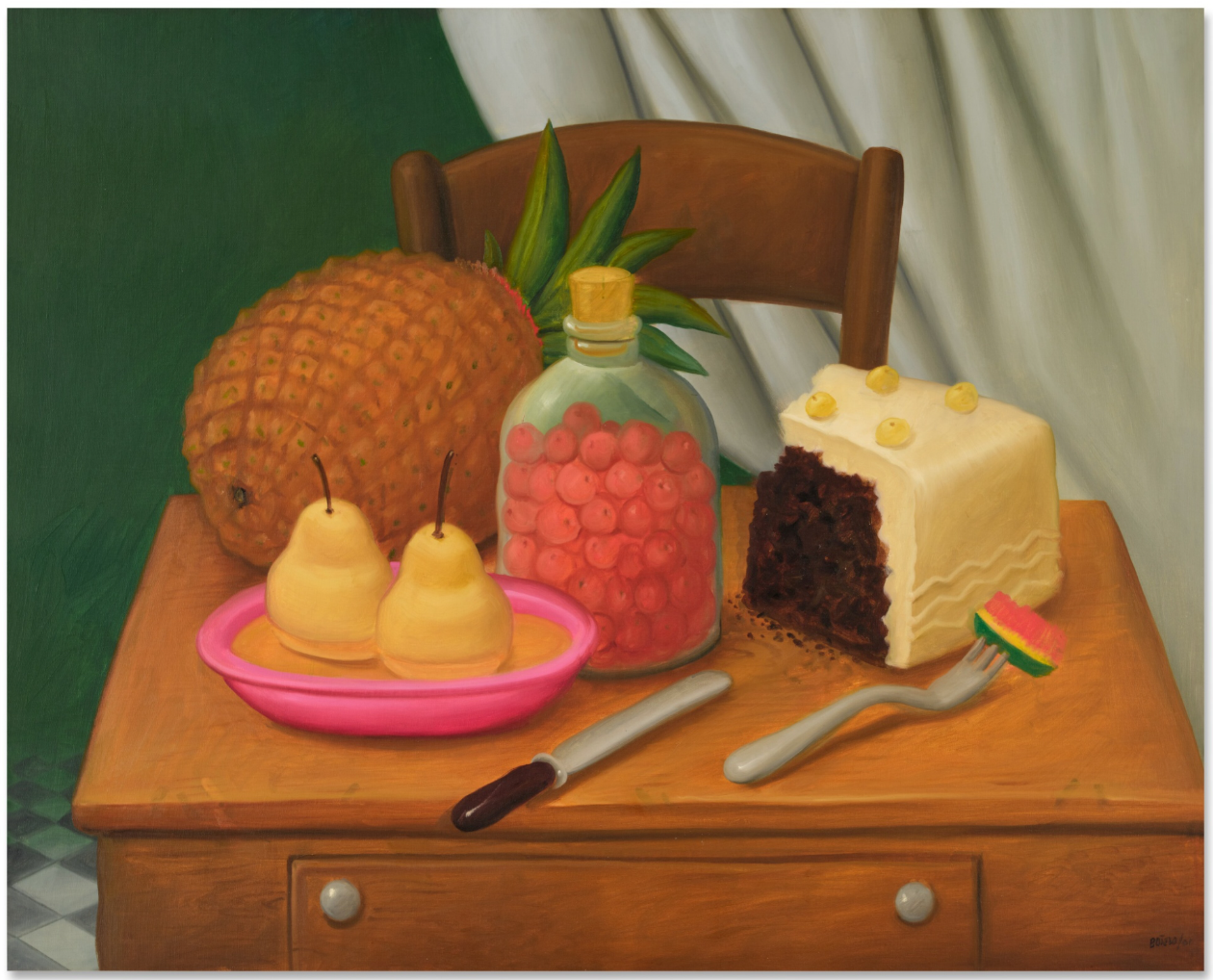
FERNANDO BOTERO (1932 – 2023)
Naturaleza muerta, 2000
Oil on canvas
96×119 cm (37 7/8 x 46 3/4 inches)
Signed and dated /00 (lower right)
#19. Still Life with Onions, 1974
Christie’s New-York: 2 October 2024
Estimated: USD 300,000 – 500,000
USD 567,000
FERNANDO BOTERO (1932-2023), Still Life with Onions | Christie’s (christies.com)
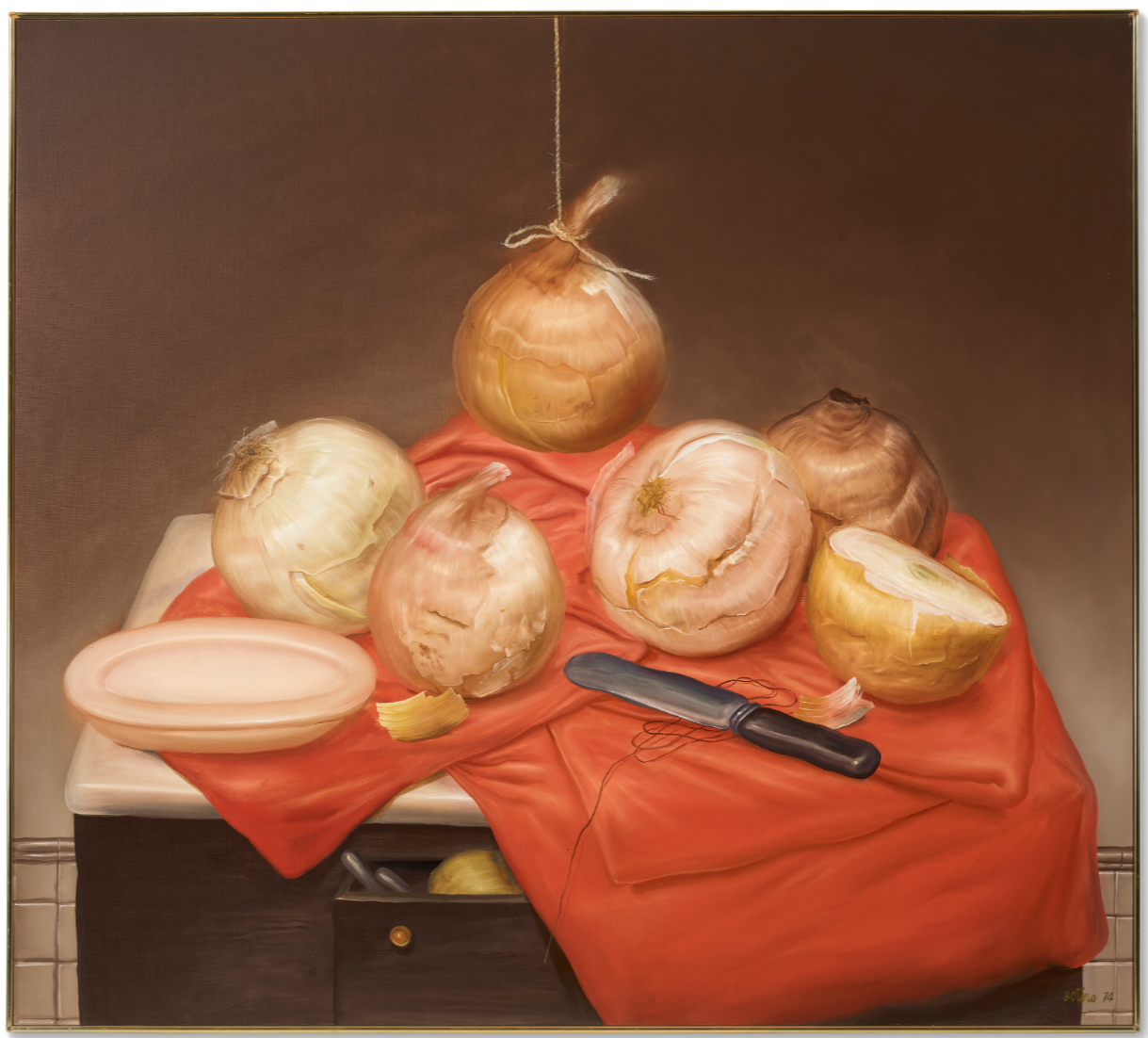
FERNANDO BOTERO (1932-2023)
Still Life with Onions, 1974
Oil on canvas
138.8 x 153 cm (54 5/8 x 60 1/4 inches)
Signed and dated ‘Botero 74’ (lower right)
#20. En la arena, 1986
Sotheby’s New-York: 1 March 2024
Estimated: USD 150,000 – 200,000
USD 533,400
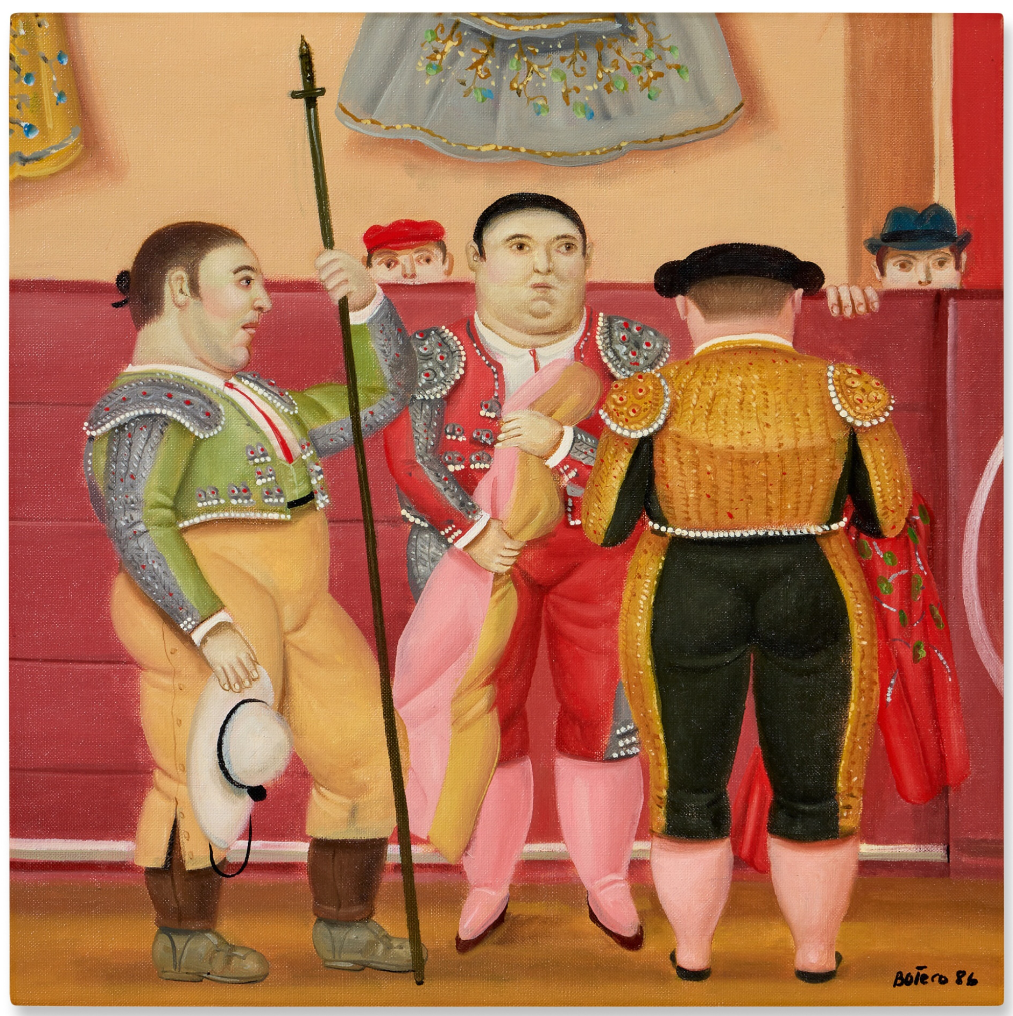
FERNANDO BOTERO (1932 – 2023)
En la arena, 1986
Oil on canvas
40×50 cm (15 3/4 x 19 3/4 inches)
Signed Botero and dated 86 (lower right)
#21. Men Drinking, 2011
Seoul Auction: 29 March 2024
Estimated: KRW 550,000,000 – 800,000,000
KRW 719,800,000 / USD 532,650
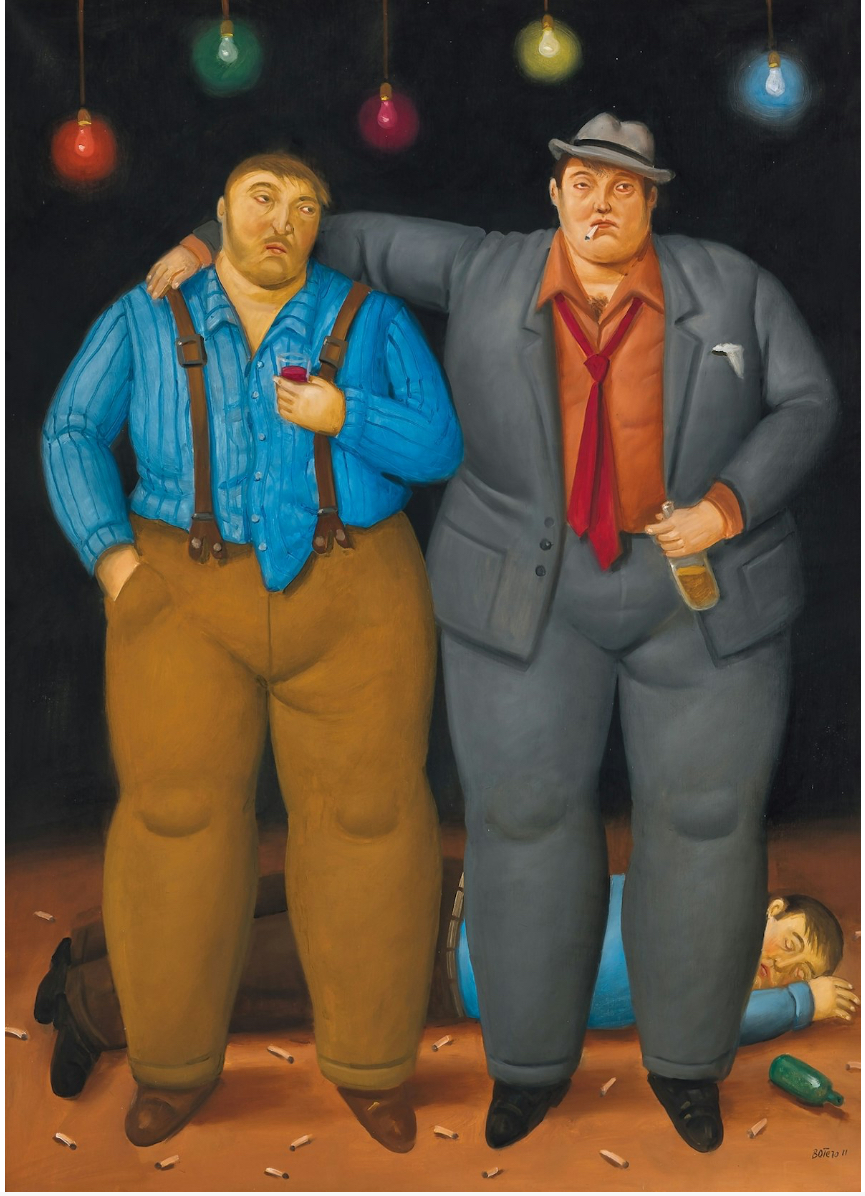
FERNANDO BOTERO (1932-2023)
Men Drinking, 2011
Oil on canvas
72.3 x 99.3 cm (28 3/8 x 39 1/8 inches)
Signed and dated ‘Botero 11’ (lower right)
#22. People Drinking, 2015
Christie’s Hong-Kong: 29 May 2024
Estimated: HKD 3,000,000 – 5,000,000
HKD 4,032,000 / USD 516,195
FERNANDO BOTERO (1932-2023), People Drinking | Christie’s (christies.com)
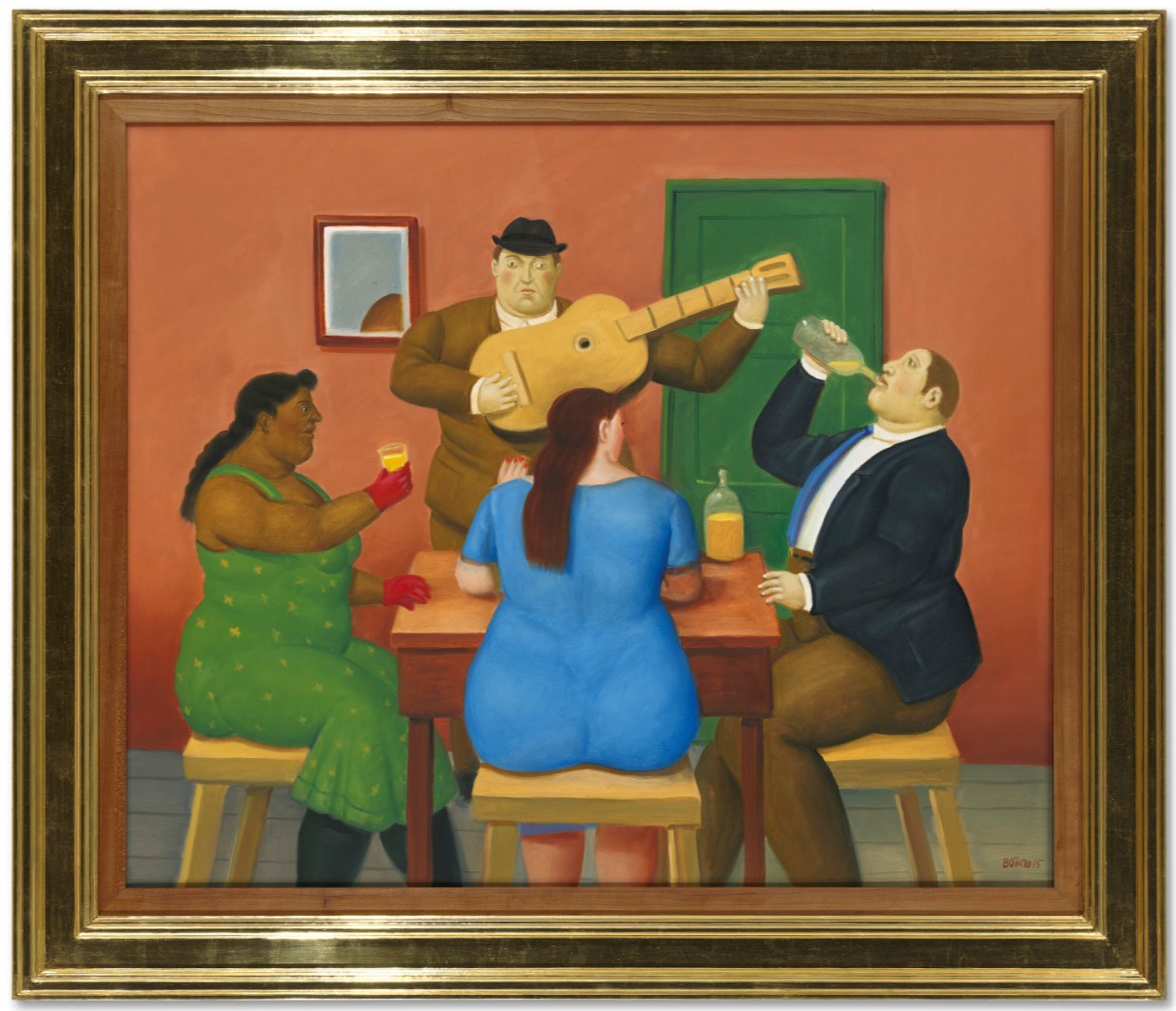
FERNANDO BOTERO (1932-2023)
People Drinking, 2015
Oil on canvas
72×87 cm (28 3/8 x 34 1/4 inches)
Signed and dated ‘Botero 15’ (lower right)
#23. Hombre y caballo, 1997
Sotheby’s New-York: 14 May 2024
Estimated: USD 250,000 – 350,000
USD 508,000
Hombre y caballo | Contemporary Day Auction | 2024 | Sotheby’s (sothebys.com)

FERNANDO BOTERO (1932 – 2023)
Hombre y caballo, 1997
Oil on canvas
61.3 x 48.9 cm (24 1/8 x 19 1/4 inches)
Signed and dated 97 (lower right)
#24. Obispo perdido en el bosque, 1970
Sotheby’s New-York: 14 May 2024
Estimated: USD 250,000 – 350,000
USD 508,000
Obispo perdido en el bosque | Contemporary Day Auction | 2024 | Sotheby’s (sothebys.com)

FERNANDO BOTERO (1932 – 2023)
Obispo perdido en el bosque, 1970
Oil on canvas
119.8 x 91.8 cm (47 1/8 x 36 1/8 inches)
Signed and dated 70 (lower right); signed and titled (on the reverse)
#25. Untitled, 1962
Christie’s New-York: 12 March 2024
Estimated: USD 400,000 – 600,000
USD 504,000
FERNANDO BOTERO (1932-2023), Untitled | Christie’s (christies.com)
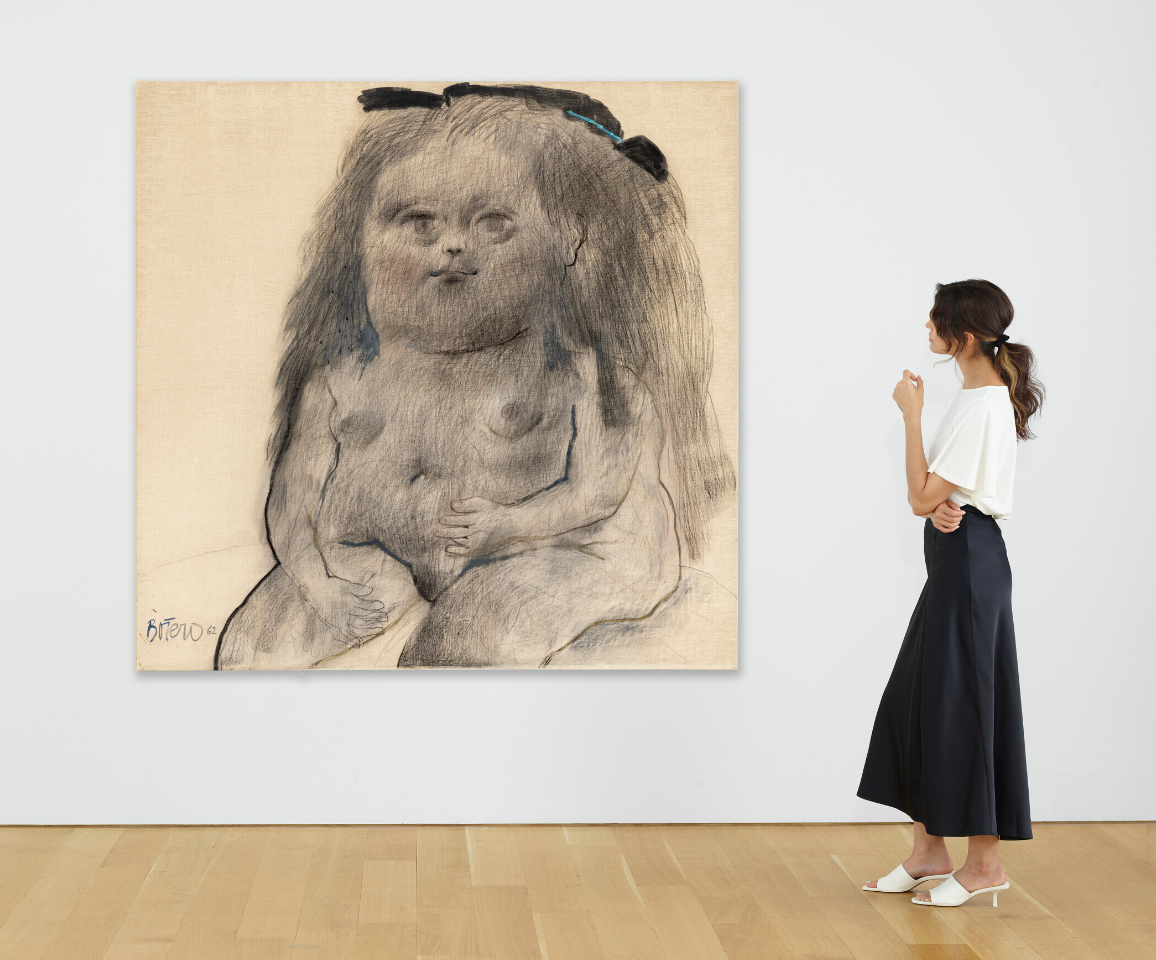
FERNANDO BOTERO (1932-2023)
Untitled, 1962
Charcoal and pastel on canvas
179.7 x 184.2 cm (70 3/4 x 72 1/2 inches)
Signed and dated ‘Botero, 62’ (lower left)
USD 500,000
#26. Colombiana comiendo banana, 1982
Sotheby’s New-York: 14 May 2024
Estimated: USD 350,000 – 450,000
USD 444,500
Colombiana comiendo banana | Contemporary Day Auction | 2024 | Sotheby’s (sothebys.com)

FERNANDO BOTERO (1932 – 2023)
Colombiana comiendo banana, 1982
Oil on canvas
110.2 x 79.1 cm (43 3/8 x 31 1/8 inches)
Signed and dated 82 (lower right)
#27. La costurera, 1997
Sotheby’s New-York: 14 May 2024
Estimated: USD 600,000 – 800,000
USD 444,500
La costurera | Contemporary Day Auction | 2024 | Sotheby’s (sothebys.com)

FERNANDO BOTERO (1932 – 2023)
La costurera, 1997
Oil on canvas
117.2 x 98.1 cm (46 1/8 x 38 5/8 inches)
Signed and dated 97 (lower right)
#28. El presidente, 1990
Sotheby’s New-York: 1 March 2024
Estimated: USD 200,000 – 300,000
USD 444,500
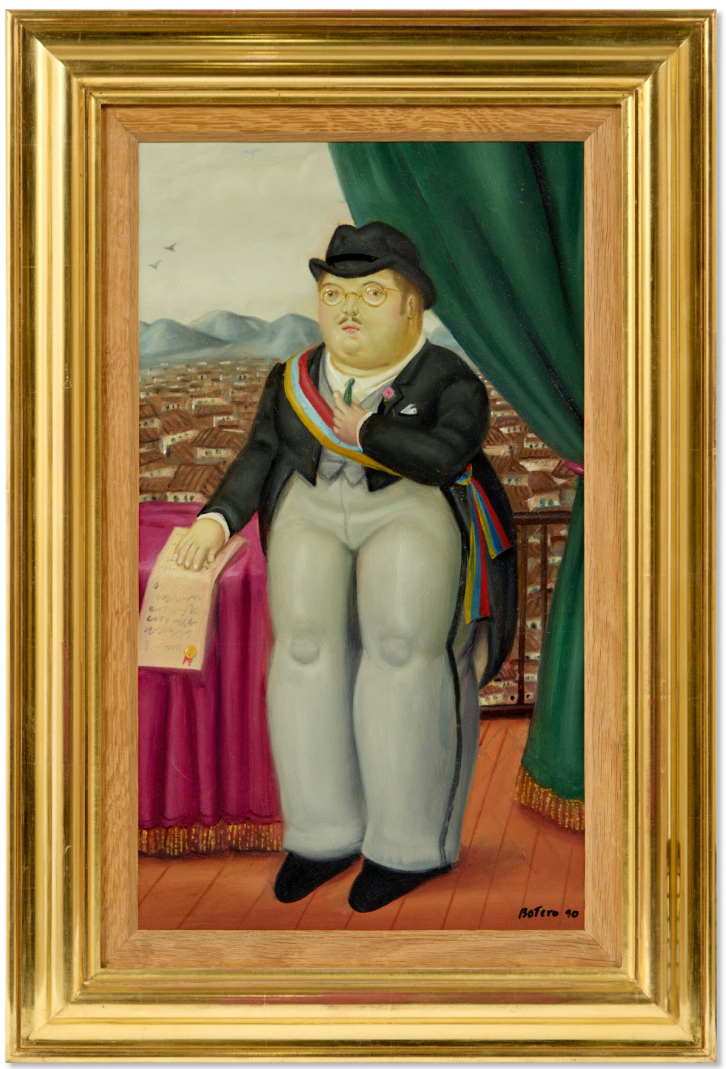
FERNANDO BOTERO (1932 – 2023)
El presidente, 1990
Oil on canvas
52×30 cm (20 1/2 x 11 7/8 inches)
Signed Botero and dated 90 (lower right)
#29. Mesa de cocina, 1967
Christie’s New-York: 2 October 2024
Estimated: USD 300,000 – 500,000
USD 403,200
FERNANDO BOTERO (1932-2023), Mesa de cocina | Christie’s (christies.com)
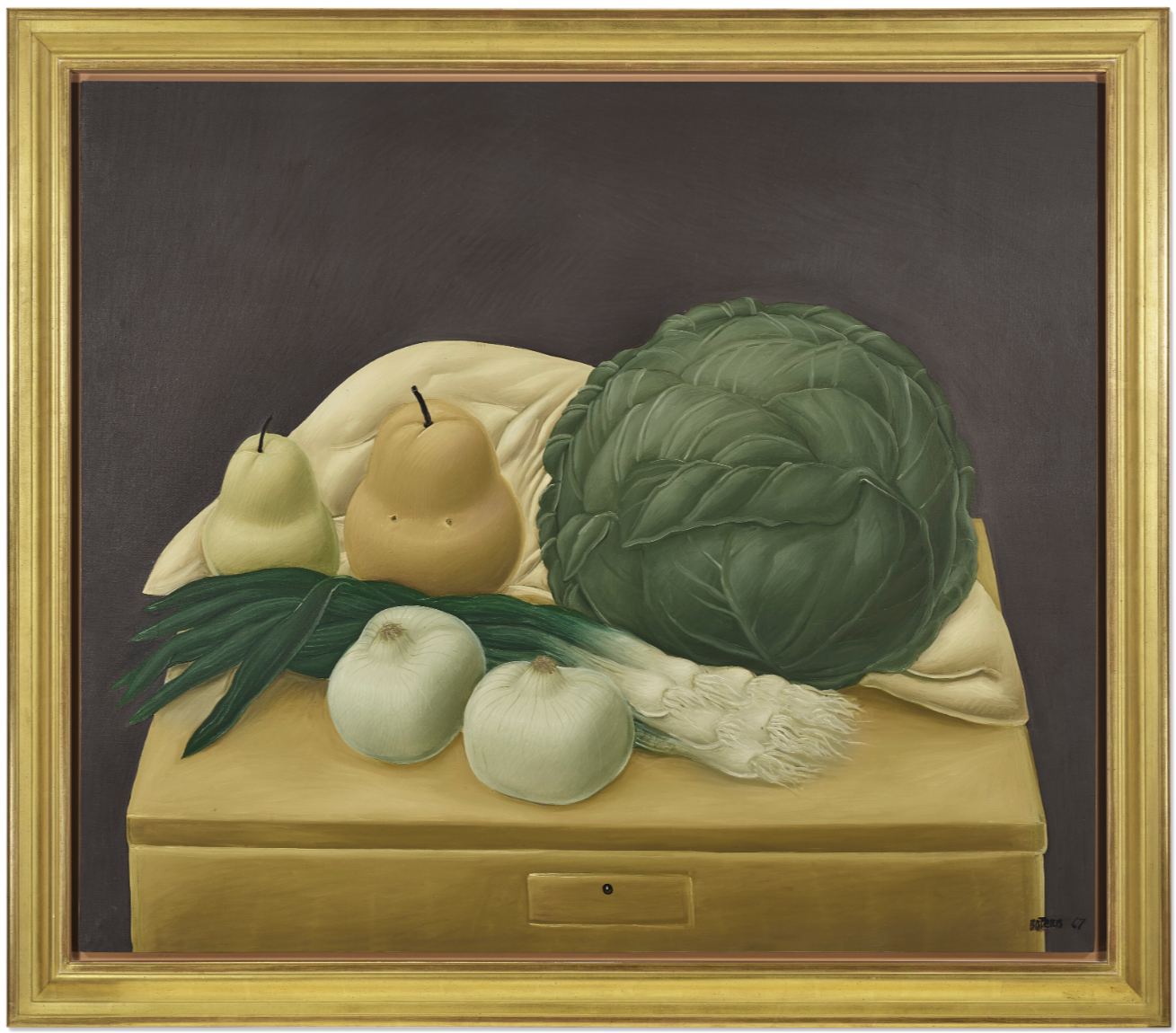
FERNANDO BOTERO (1932-2023)
Mesa de cocina, 1967
Oil on canvas
138.1 x 160.7 cm (54 3/8 x 63 1/4 inches)
Signed and dated ‘Botero 67’ (lower right and twice on the reverse)
Titled ‘MESA DE COCINA’ (on the reverse)
#30. Untitled, 1979
Christie’s New-York: 2 October 2024
Estimated: USD 300,000 – 500,000
USD 378,000
FERNANDO BOTERO (1932-2023), Untitled | Christie’s (christies.com)
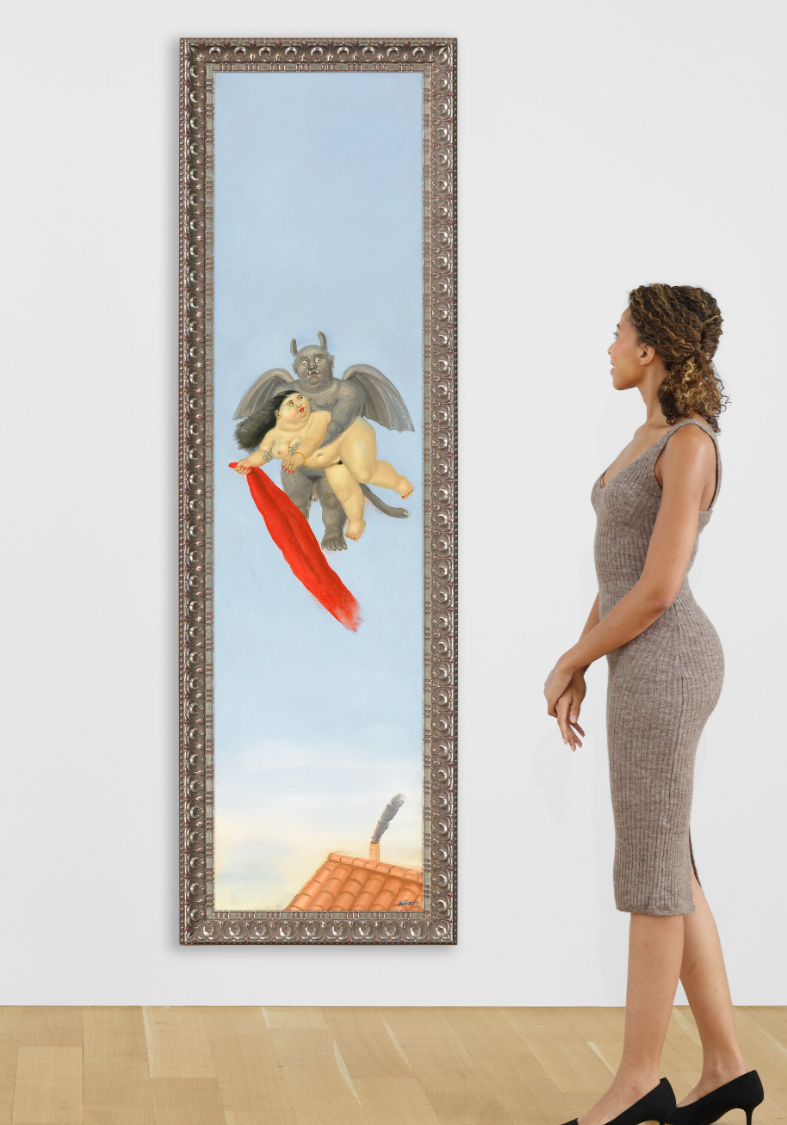
FERNANDO BOTERO (1932-2023)
Untitled, 1979
Oil on canvas
195.6 x 49.5 cm (77 x 19 1/2 inches)
Signed and dated ‘Botero 79’ (lower right)
#31. Niña roja, circa 1960
Sotheby’s New-York: 19 November 2024
Estimated: USD 400,000 – 600,000
USD 360,000
Niña roja | Modern Day Auction | 2024 | Sotheby’s
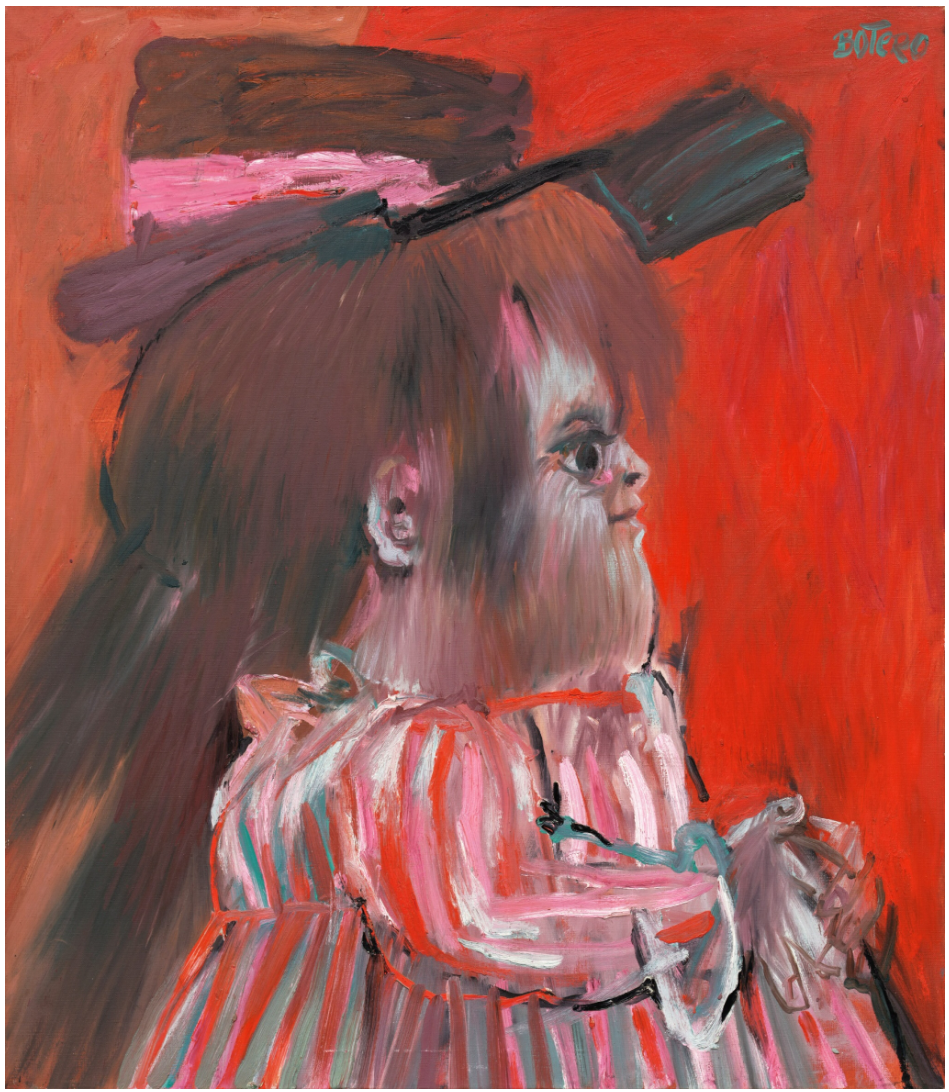
FERNANDO BOTERO (1932 – 2023)
Niña roja, circa 1960
Oil on canvas
120 x 104.1 cm (47 1/4 x 41 inches)
Signed Botero (upper right)
#32. Naranjas, 1970
Christie’s New-York: 20 November 2024
Estimated: USD 300,000 – 400,000
USD 352,800
FERNANDO BOTERO (1932-2023), Naranjas | Christie’s
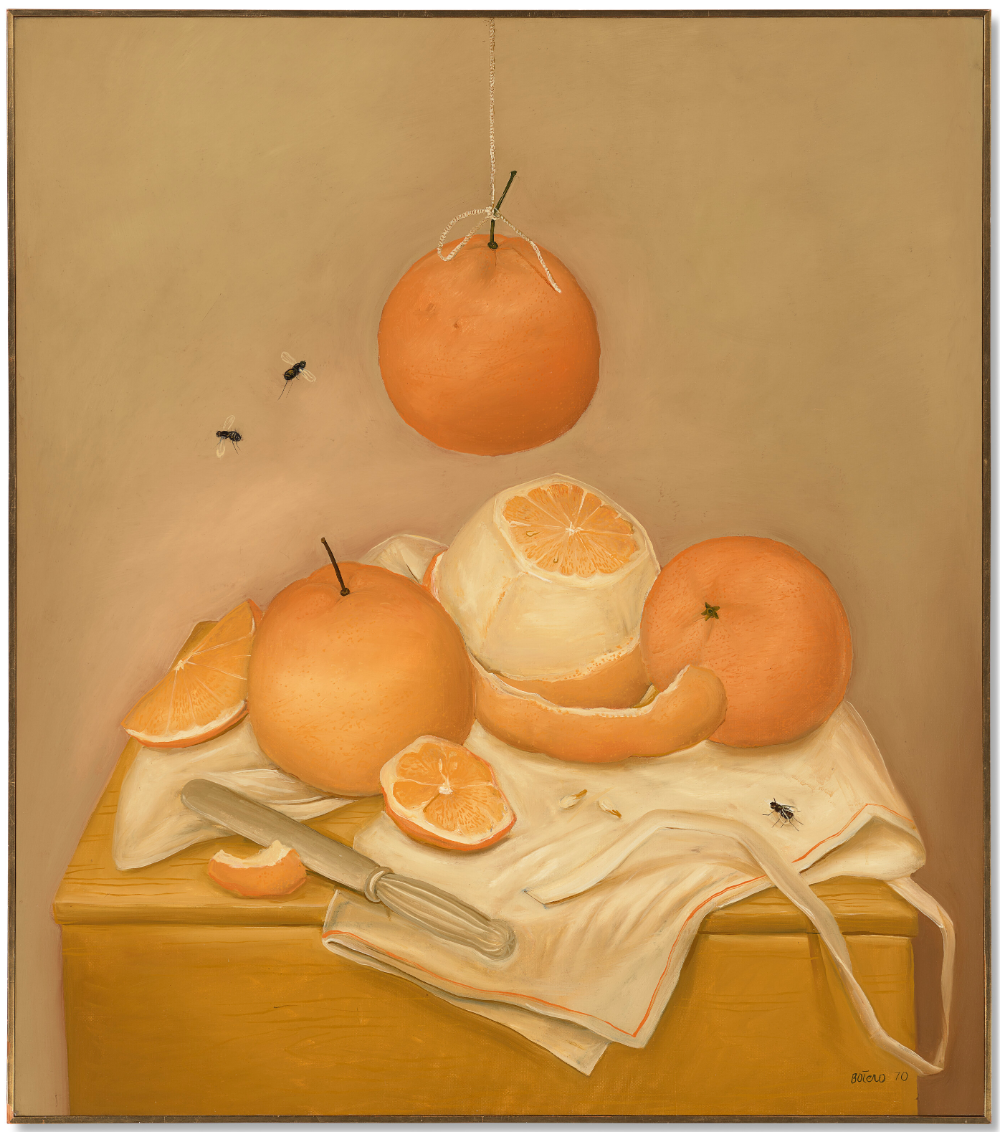
FERNANDO BOTERO (1932-2023)
Naranjas, 1970
Oil on canvas
106×94 cm (41 3/4 x 37 inches)
Signed and dated ‘Botero 70’ (lower right)
Signed and dated again and titled ‘Botero 70 ‘NARANJAS” (on the reverse)
#33. Adam and Eve [Diptych]
Sotheby’s New-York: 1 March 2024
Estimated: USD 150,000 – 200,000
USD 342,900
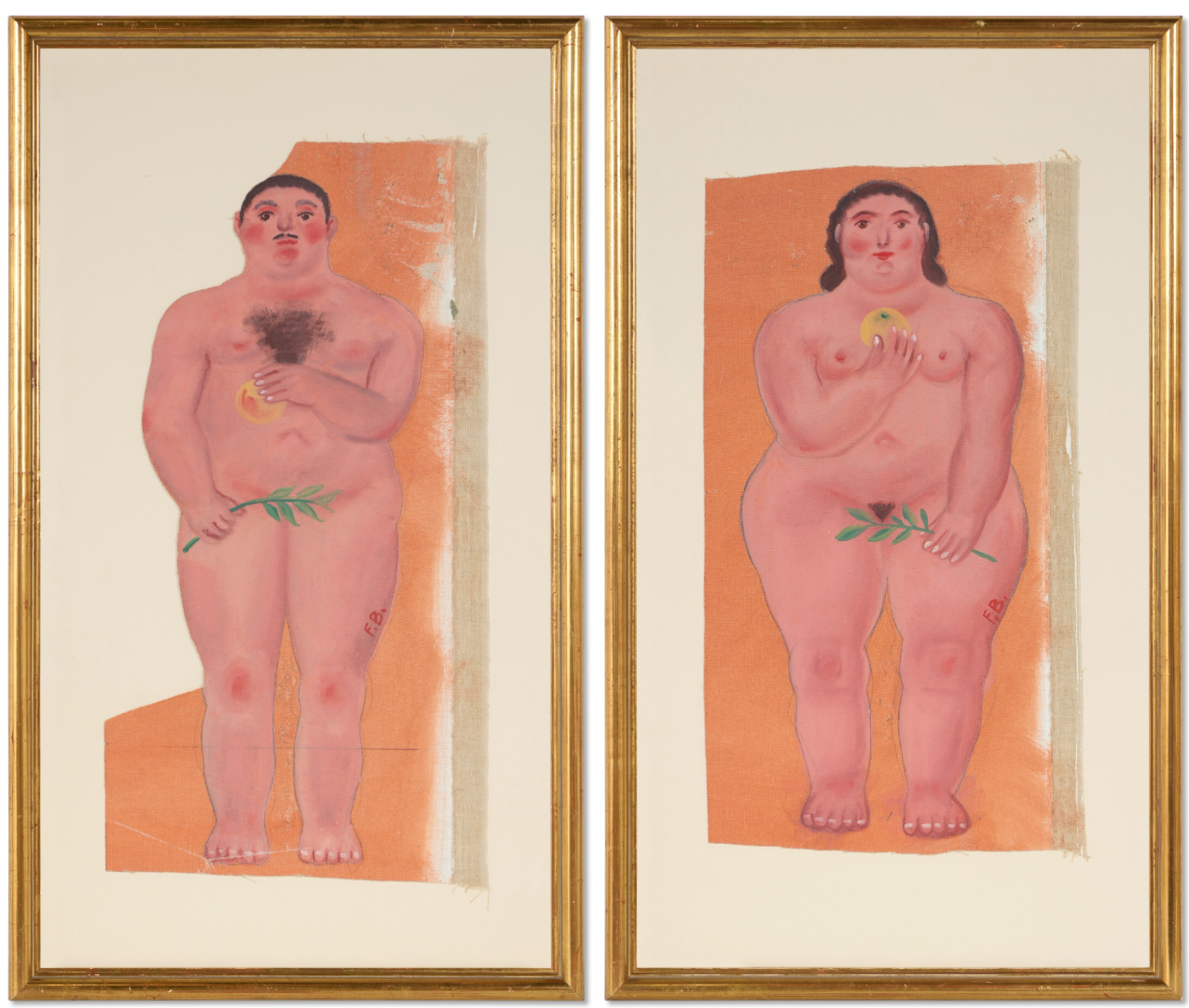
FERNANDO BOTERO (1932 – 2023)
Adam and Eve [Diptych]
Oil on canvas, in two parts
60×35 cm (23 3/4 x 13 3/4 inches)
Each: signed with the initials F.B. (center right)
#34. El baño, 1998
Christie’s New-York: 12 March 2024
Estimated: USD 250,000 – 350,000
USD 302,400
FERNANDO BOTERO (1932-2023), El baño | Christie’s (christies.com)
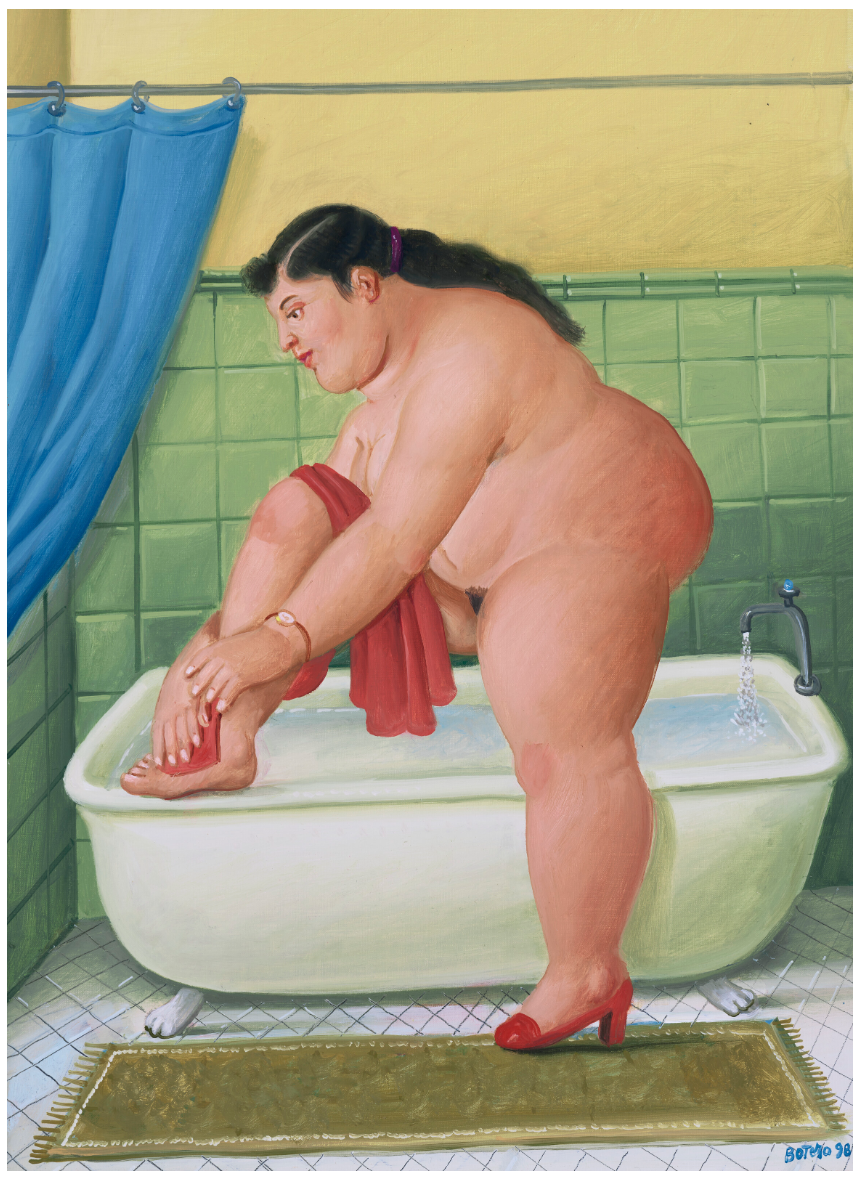
FERNANDO BOTERO (1932-2023)
El baño, 1998
Oil on canvas
48.3 x 35.6 cm (19×14 inches)
Signed and dated ‘Botero, 98’ (lower right)
#35. Standing Nude, 1993
Sotheby’s New-York: 21 November 2024
Estimated: USD 180,000 – 220,000
USD 276,000
Standing Nude | Contemporary Day Auction | 2024 | Sotheby’s
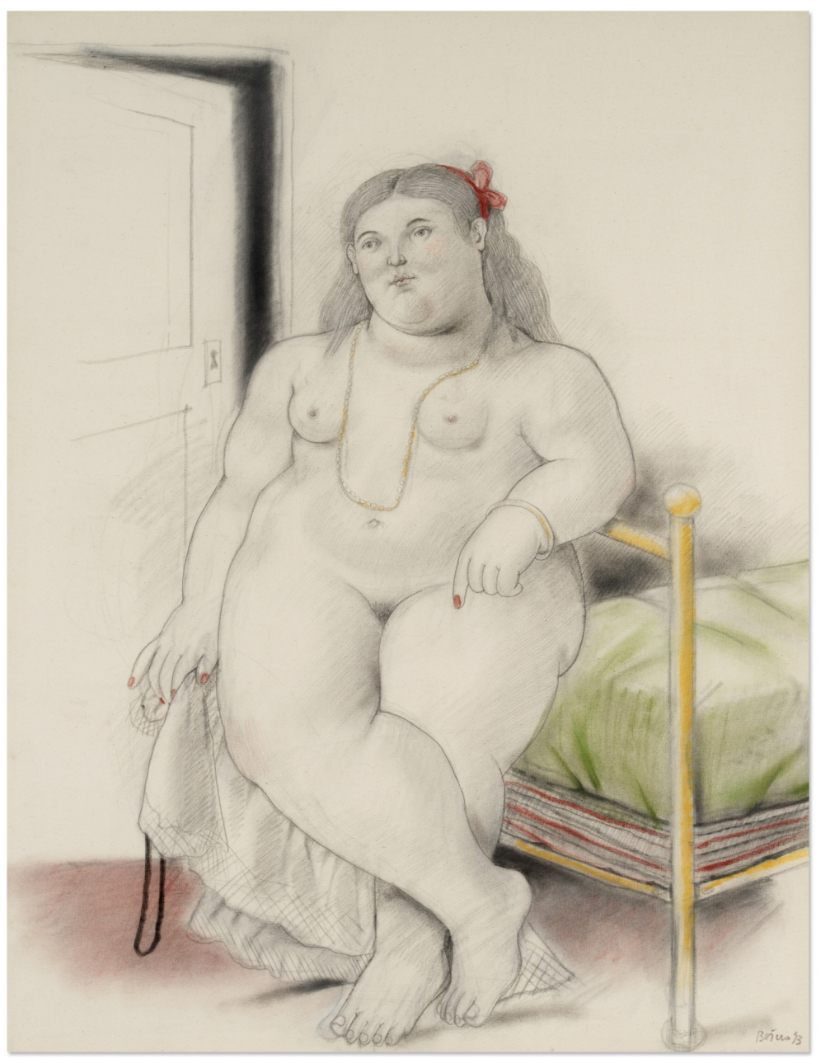
FERNANDO BOTERO (1932 – 2023)
Standing Nude, 1993
Watercolor and graphite on canvas
129.5 x 101.6 cm (51×40 inches)
Signed and dated 93 (lower right)
#36. El viaje, 1961
Sotheby’s New-York: 16 May 2024
Estimated: USD 180,000 – 220,000
USD 268,000
El viaje | Modern Day Auction | 2024 | Sotheby’s

FERNANDO BOTERO (1932 – 2023)
El viaje, 1961
Oil on canvas
50.5 x 263.5 cm (19 7/8 x 10 3/4 inches)
Signed Botero and dated 61 (lower right)
#37. Woman, 1993
Sotheby’s New-York: 14 May 2024
Estimated: USD 250,000 – 350,000
USD 266,700
Woman | Contemporary Day Auction | 2024 | Sotheby’s (sothebys.com)

FERNANDO BOTERO (1932 – 2023)
Woman, 1993
Charcoal, graphite and pastel on canvas
122.2 x 105 cm (48 1/8 x 41 3/8 inches)
Signed and dated 93 (lower right)
#38. The Departure, 1953
Christie’s New-York: 12 March 2024
Estimated: USD 120,000 – 180,000
USD 226,800
FERNANDO BOTERO (1932-2023), The Departure | Christie’s (christies.com)
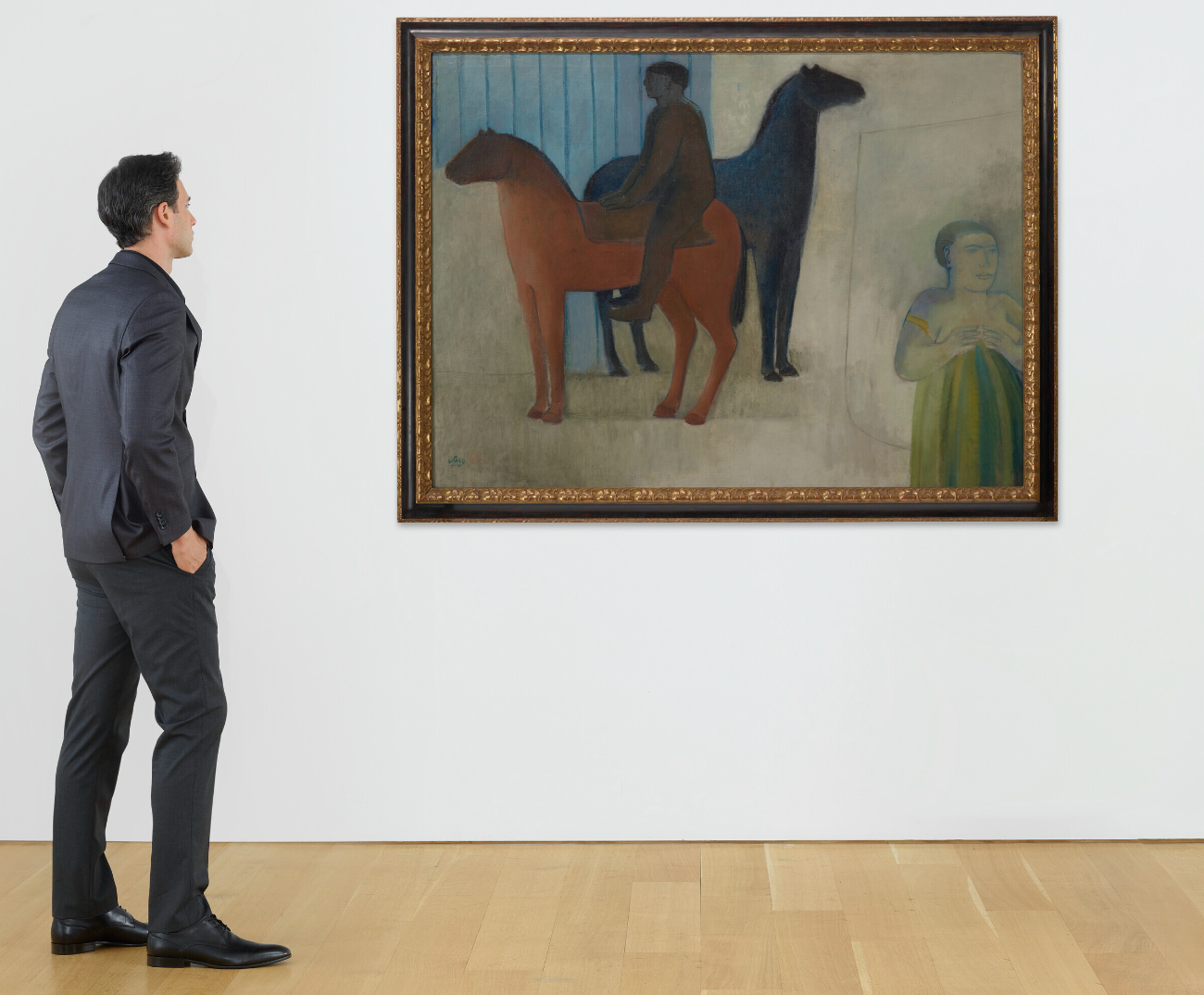
FERNANDO BOTERO (1932-2023)
The Departure, 1953
Oil on canvas
109.2 x 148.6 cm (43 x 58 1/2 inches)
Signed and dated ‘Botero 10-53, 53’ (lower left)
#39. Poodle on a Cushion, 1980
Christie’s New-York: 12 March 2024
Estimated: USD 150,000 – 250,000
USD 214,200
FERNANDO BOTERO (1932-2023), Poodle on a Cushion | Christie’s (christies.com)
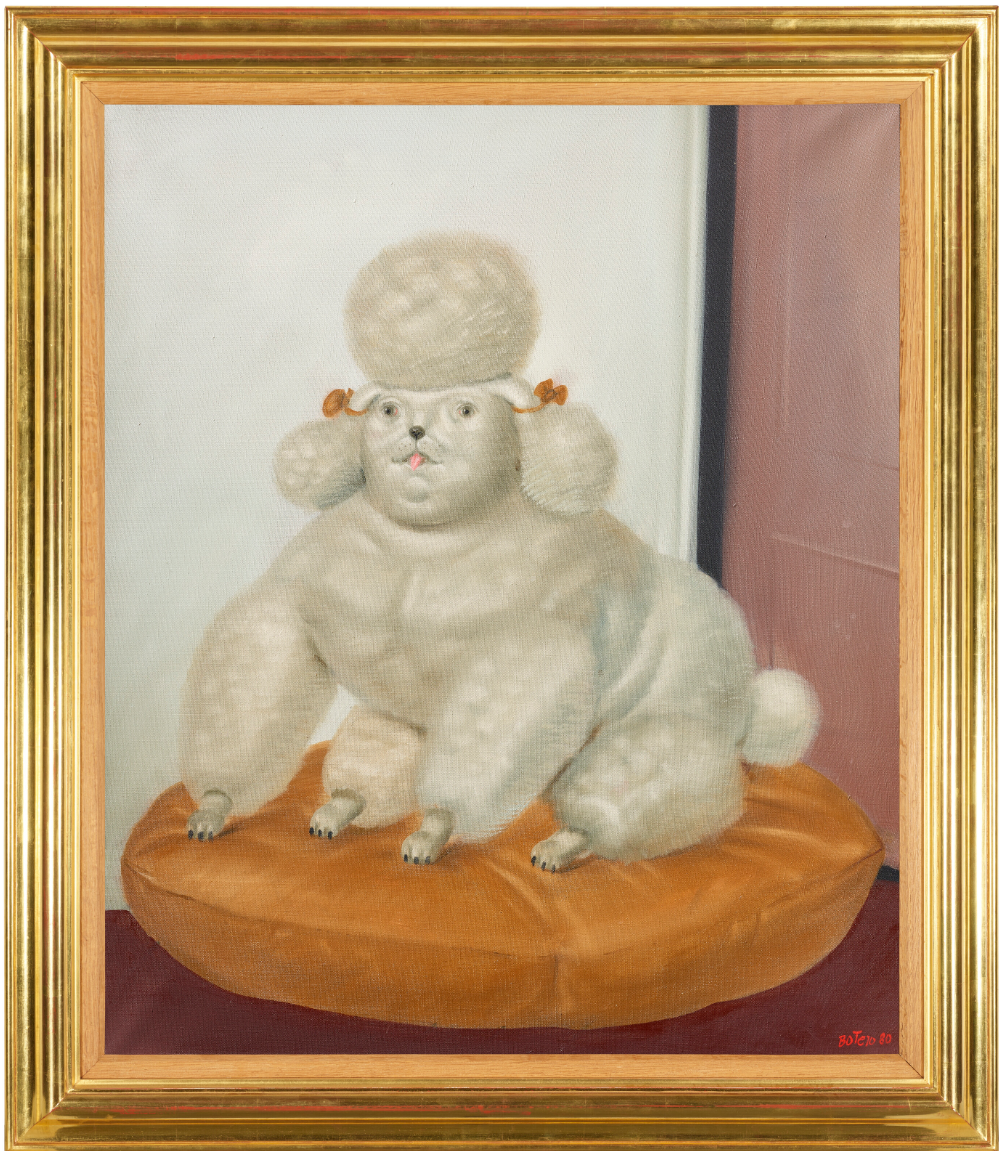
FERNANDO BOTERO (1932-2023)
Poodle on a Cushion, 1980
Oil on canvas
91.4 x 76.8 cm (36 x 30 1/4 inches)
Signed and dated ‘Botero, 80’ (lower right)
#40. Still Life with Sausages, 1981
Sotheby’s New-York: 21 November 2024
Estimated: USD 180,000 – 250,000
USD 144,000
Still Life with Sausages | Contemporary Day Auction | 2024 | Sotheby’s
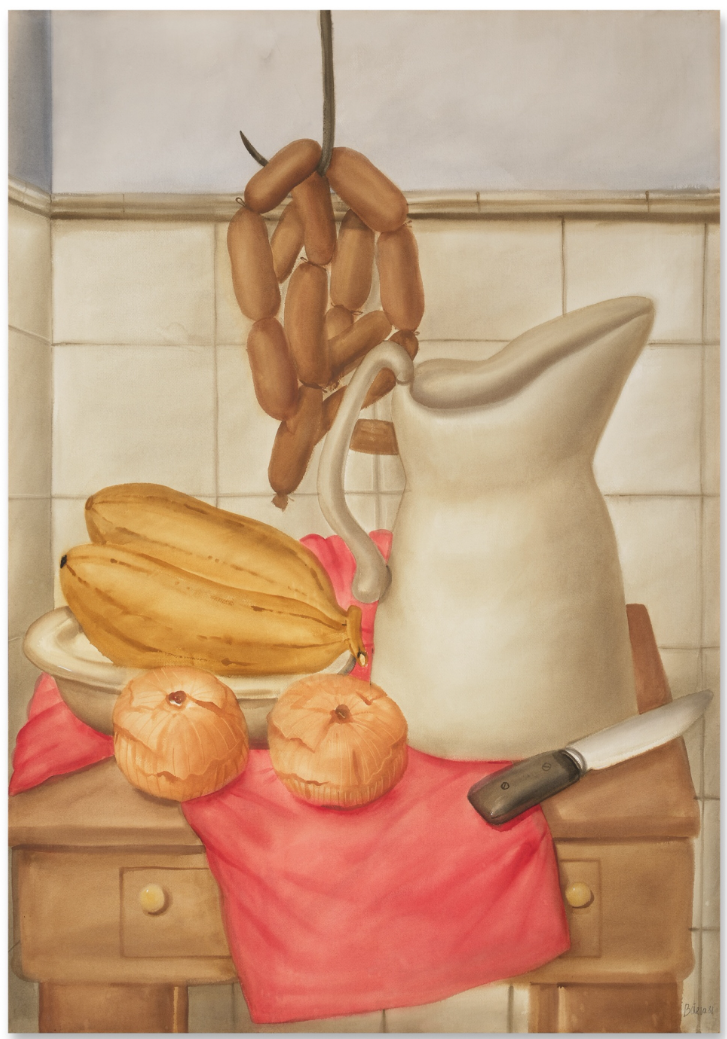
FERNANDO BOTERO (1932 – 2023)
Still Life with Sausages, 1981
Watercolor on paper laid down on canvas
160.3 x 112.7 cm (63 1/8 x 44 3/8 inches)
Signed and dated 81 (lower right)
#41. Untitled, 1956
Christie’s New-York: 12 March 2024
Estimated: USD 120,000 – 180,000
USD 138,600
FERNANDO BOTERO (1932-2023), Untitled | Christie’s (christies.com)
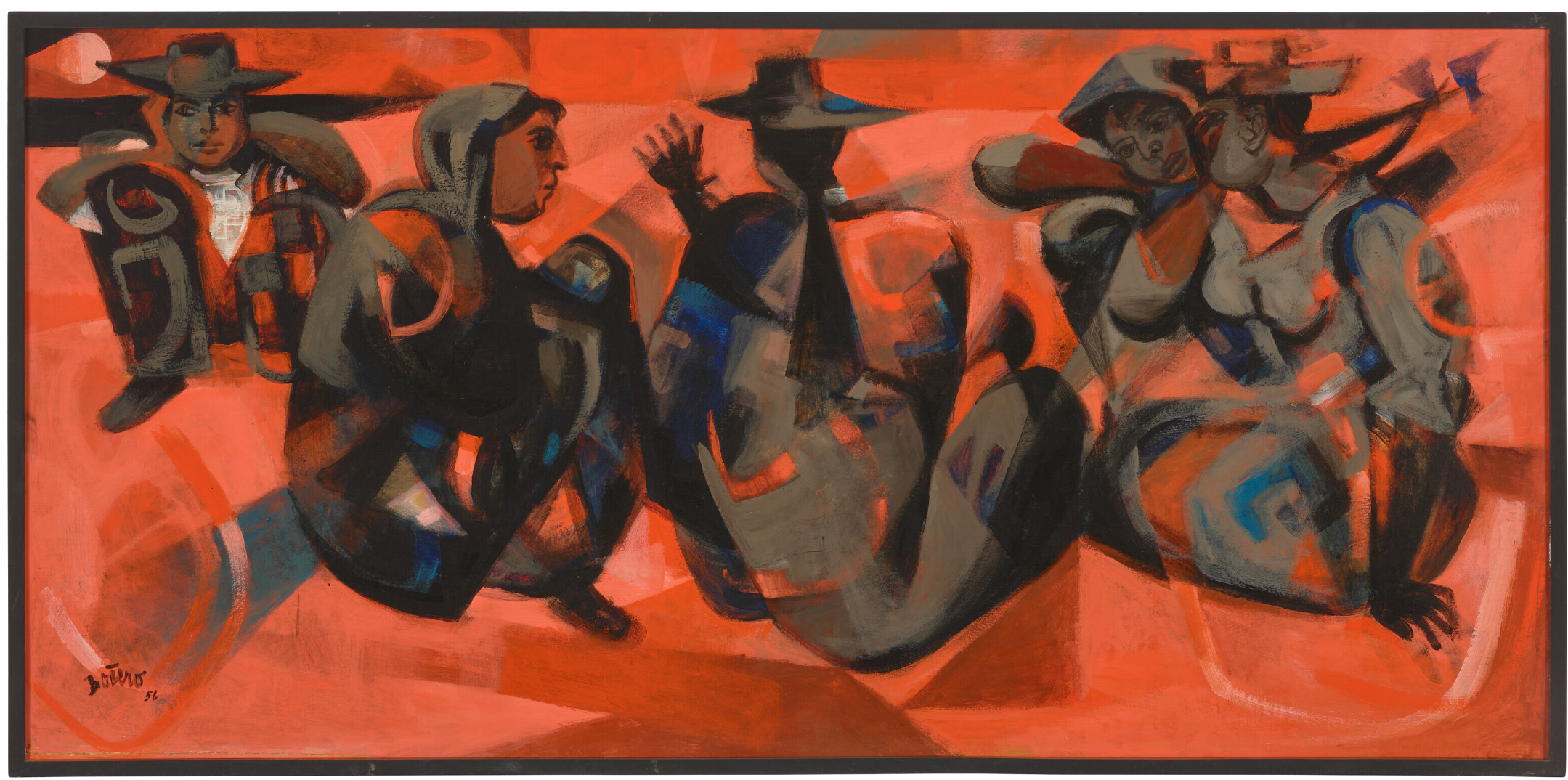
FERNANDO BOTERO (1932-2023)
Untitled, 1956
Oil on board
82.6 x 167.6 cm (32 1/2 x 66 inches)
Signed ‘Botero, 56’ (lower left)
Lots Passed
Untitled (Beach Scene), 1952
Christie’s New-York: 8 October 2024
Estimated: USD 40,000 – 60,000
PASSED
FERNANDO BOTERO (1932-2023), Untitled (Beach Scene) | Christie’s
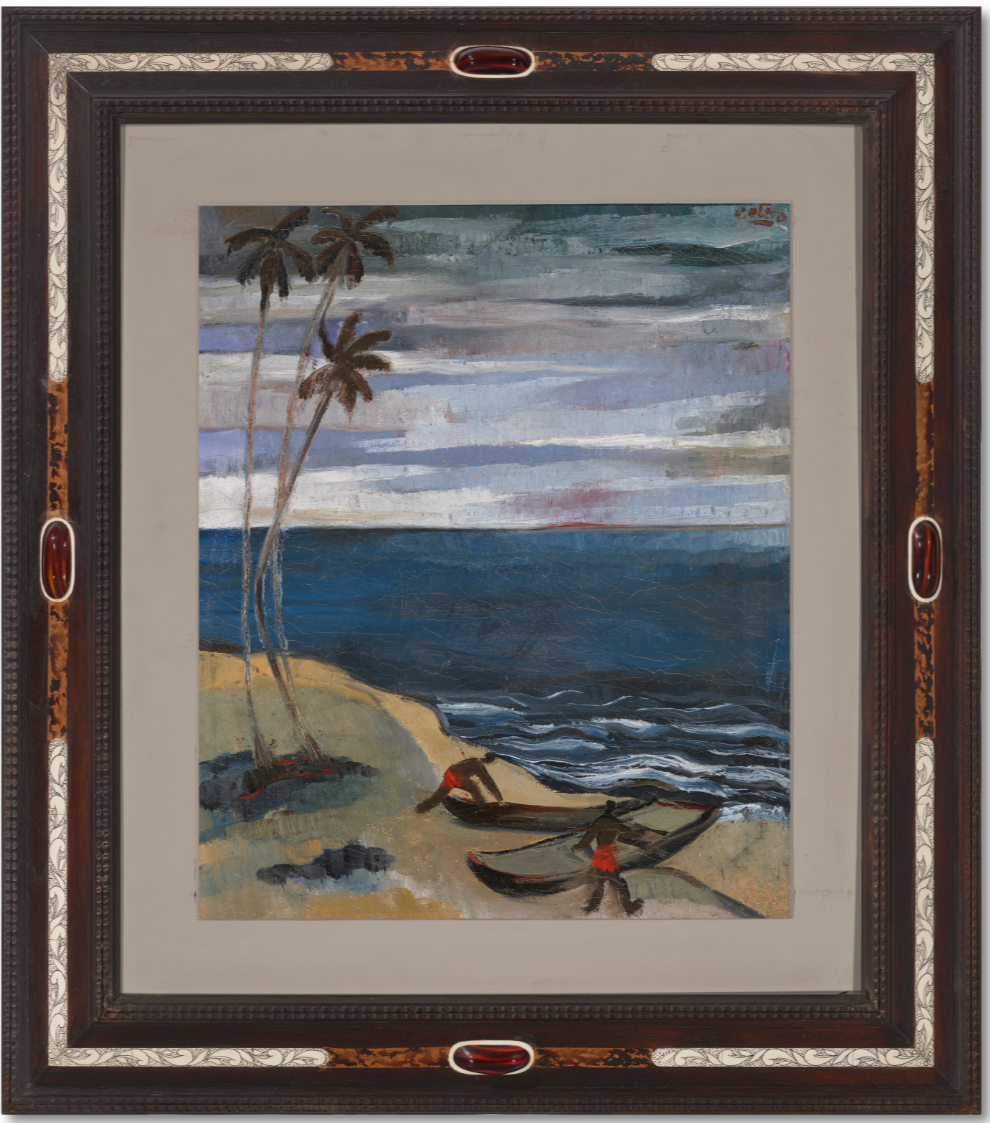
FERNANDO BOTERO (1932-2023)
Untitled (Beach Scene), 1952
Oil on canvas
247/8 x 20 7/8 inches (63.2 x 53 cm)
Signed ‘Botero’ (upper right)
Signed and dated ‘Botero 52’ (on the reverse)
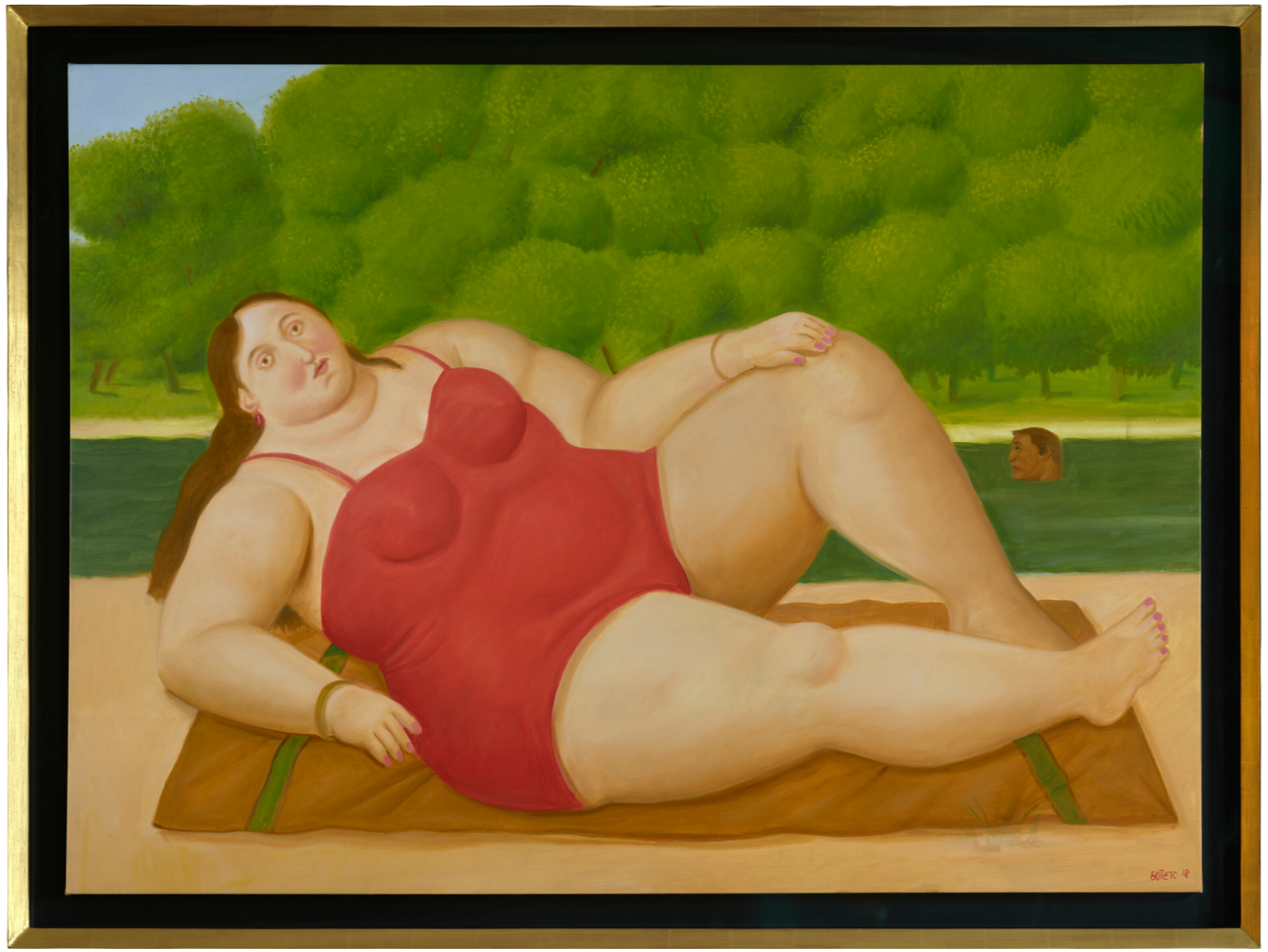
Bather in the River, 2018
Christie’s New-York: 12 March 2024
Estimated: USD 800,000 – 1,200,000
PASSED
https://www.christies.com/en/lot/lot-6471177
FERNANDO BOTERO (1932-2023)
Bather in the River, 2018
Oil on canvas
97.2 x 134 cm (38 1/4 x 52 3/4 inches)
Signed and dated ‘Botero, 18’ (lower right)
Lots Withdrawn
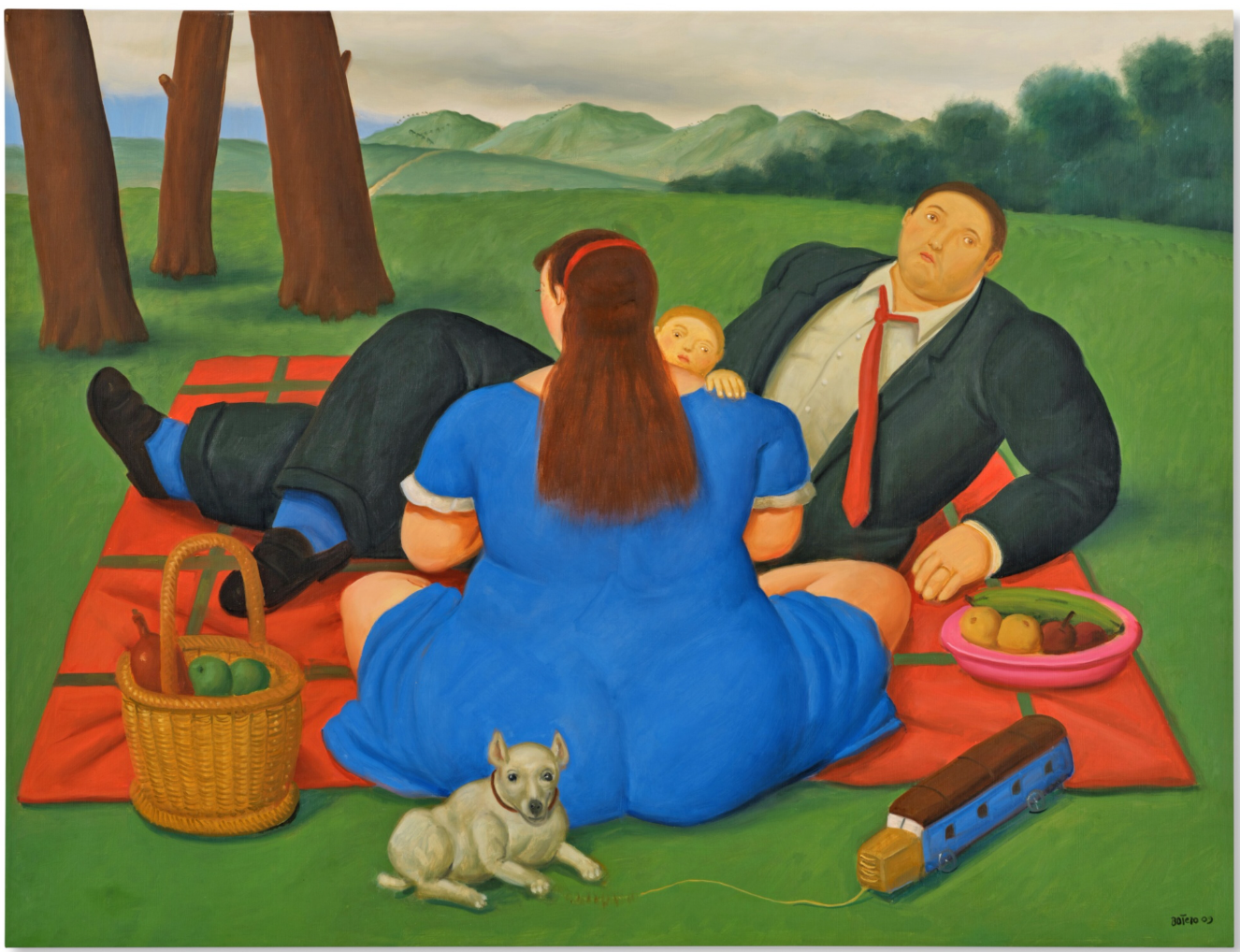
Picnic, 2009
Sotheby’s New-York: 21 November 2024
Estimated: USD 800,000 – 1,200,000
WITHDRAWN
Picnic | Contemporary Day Auction | 2024 | Sotheby’s
FERNANDO BOTERO (1932 – 2023)
Picnic, 2009
Oil on canvas
98.4 x 129.2 cm (38 3/4 x 50 7/8 inches)
Signed and dated 09 (lower right)
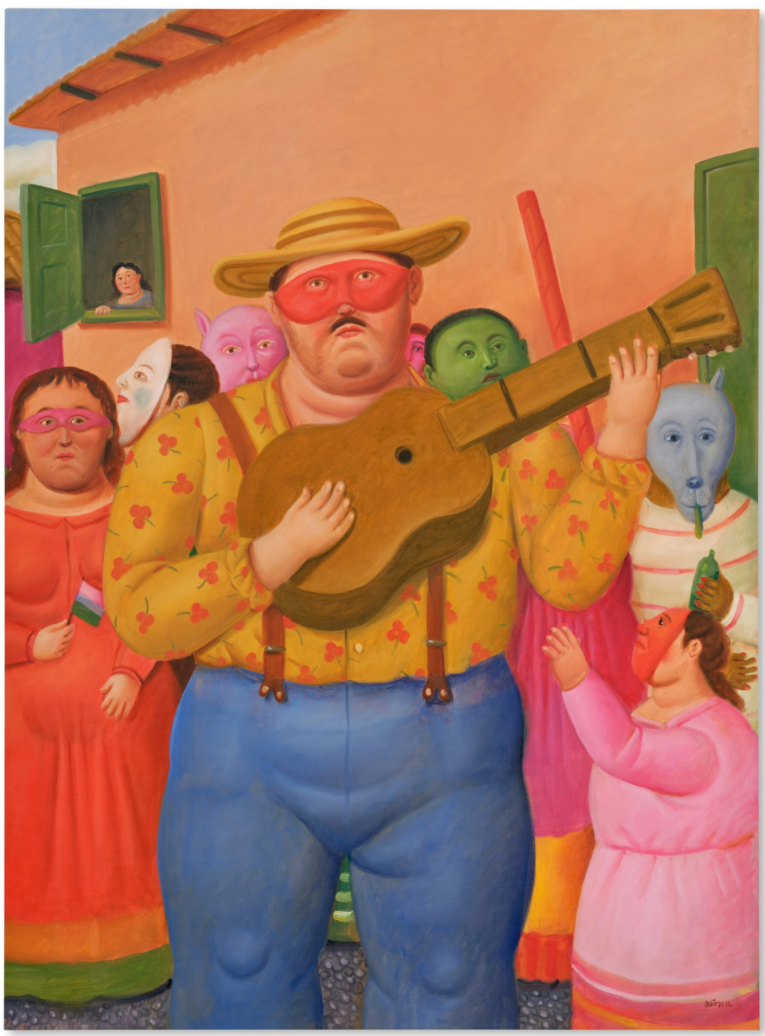
Carnaval, 2012-13
Sotheby’s New-York: 21 November 2024
Estimated: USD 700,000 – 900,000
WITHDRAWN
Carnaval | Contemporary Day Auction | 2024 | Sotheby’s
FERNANDO BOTERO (1932 – 2023)
Carnaval, 2012-13
Oil on canvas
150×111 cm (59 x 43 3/4 inches)
Signed and dated 12 (lower right)
2023 Auction Results
FOR PAINTINGS ONLY
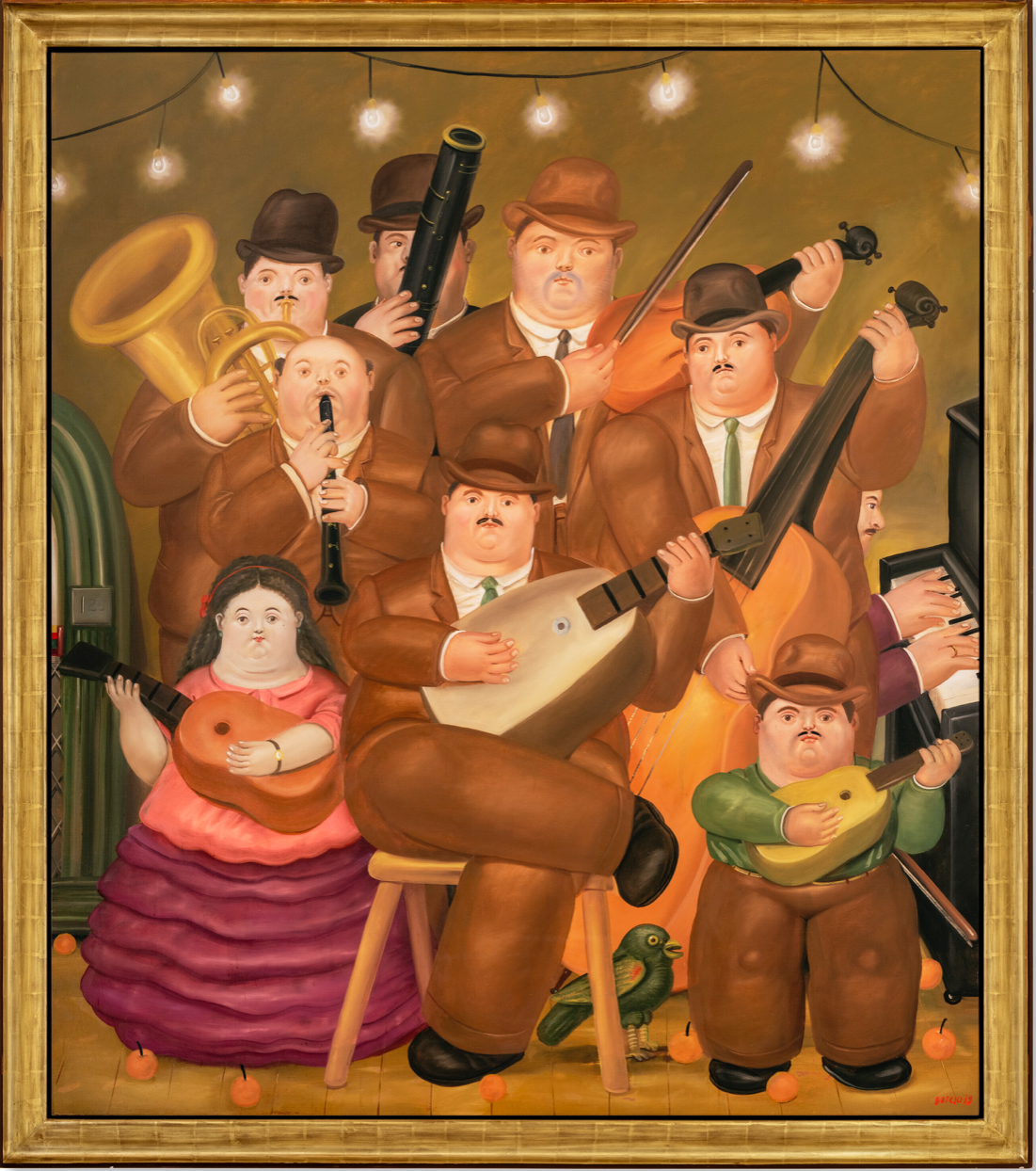
30 paintings sold at auction in 2023 for a record turnover of USD 20,738,738. With only 4 lots unsold, the sell-through rate is a solid 88%. Furthermore, a new world record was set at Christie’s New-York on 9 November 2023 when The Musicians (1979) sold for USD 5,132,000.
2023 Top 3 Lots
6 lots sold over USD 1 million for a total cumulative turnover of USD 10,830,100, representing 52.2% of the total turnover for 2023.
XXXXXXXXXX
#1. The Musicians, 1979
Christie’s New-York: 9 November 2023
Estimated: USD 2,500,000 – 3,500,000
USD 5,132,000
NEW WORLD RECORD FOR THE ARTIST
FERNANDO BOTERO (1932-2023)
The Musicians, 1979
Oil on canvas
217.2 x 189.9 cm (85 1/2 x 74 3/4 inches)
signed and dated ‘Botero 79’ (lower right)
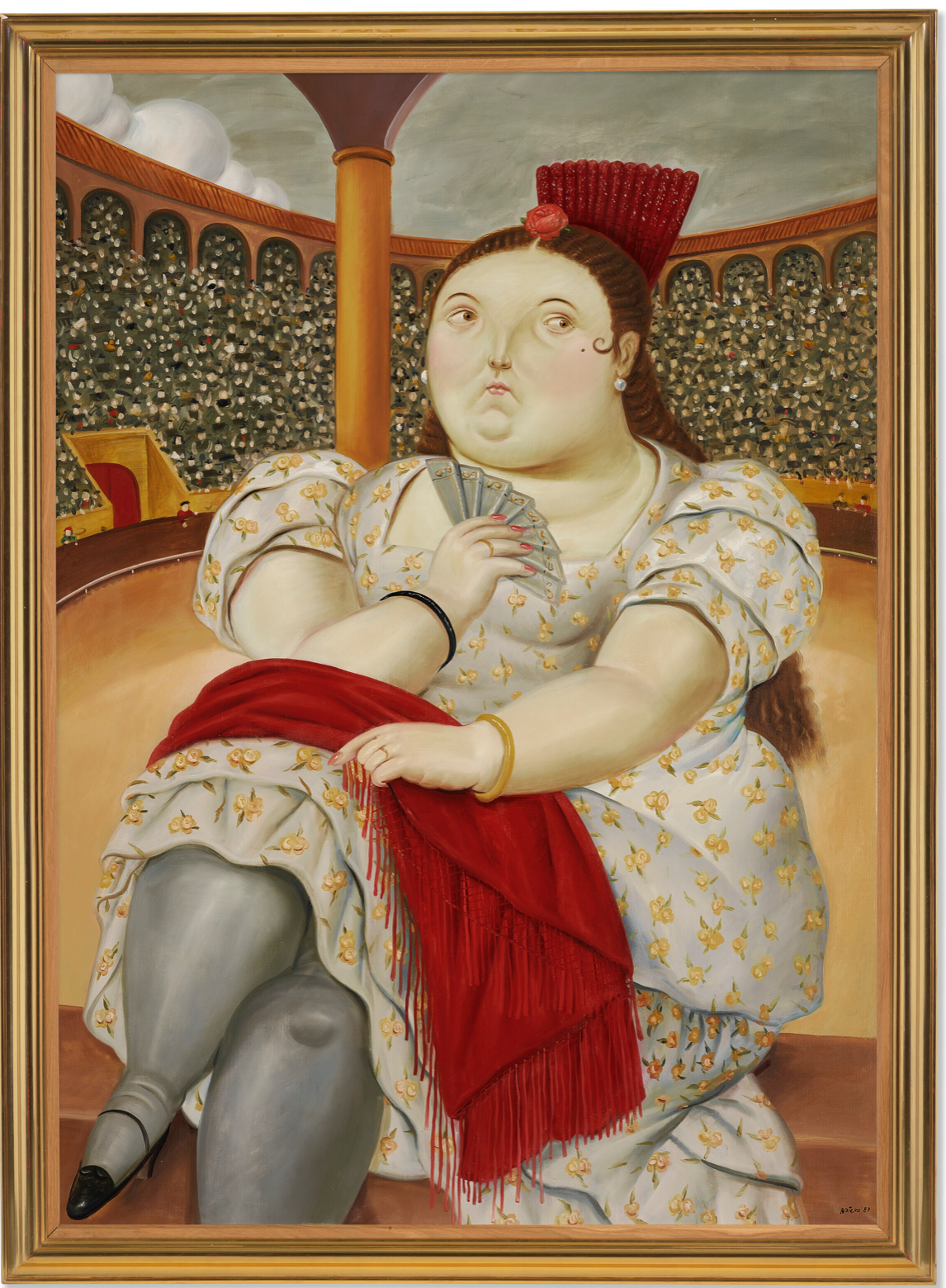
#2. En la plaza, 1987
Christie’s New-York: 28 September 2023
Estimated: USD 800,000 – 1,200,000
USD 1,332,600
FERNANDO BOTERO (1932-2023)
En la plaza, 1987
Oil on canvas
182.9 x 130.5 cm (72 x 51 3/8 inches)
Signed and dated ‘Botero 87’ (lower right)
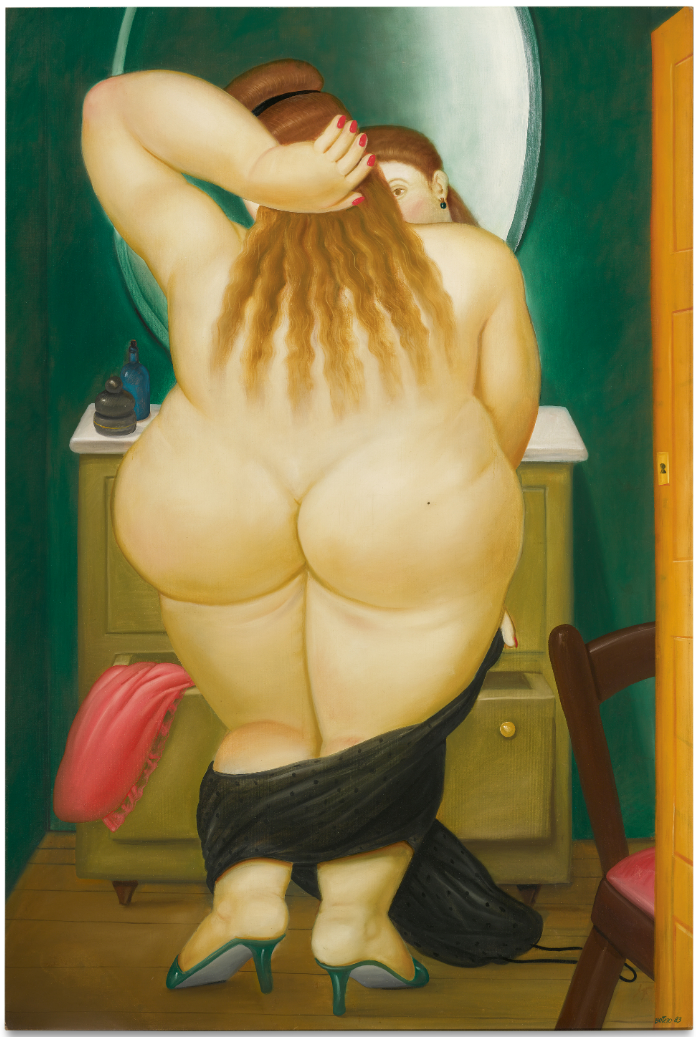
#3. Desnudo ante el espejo, 1983
Sotheby’s New-York: 16 November 2023
Estimated: USD 600,000 – 800,000
USD 1,270,000
FERNANDO BOTERO (1932 – 2023)
Desnudo ante el espejo, 1983
Oil on canvas
181.6 x 120.3 cm (71 1/2 x 47 1/2 inches)
Signed and dated 83 (lower right)
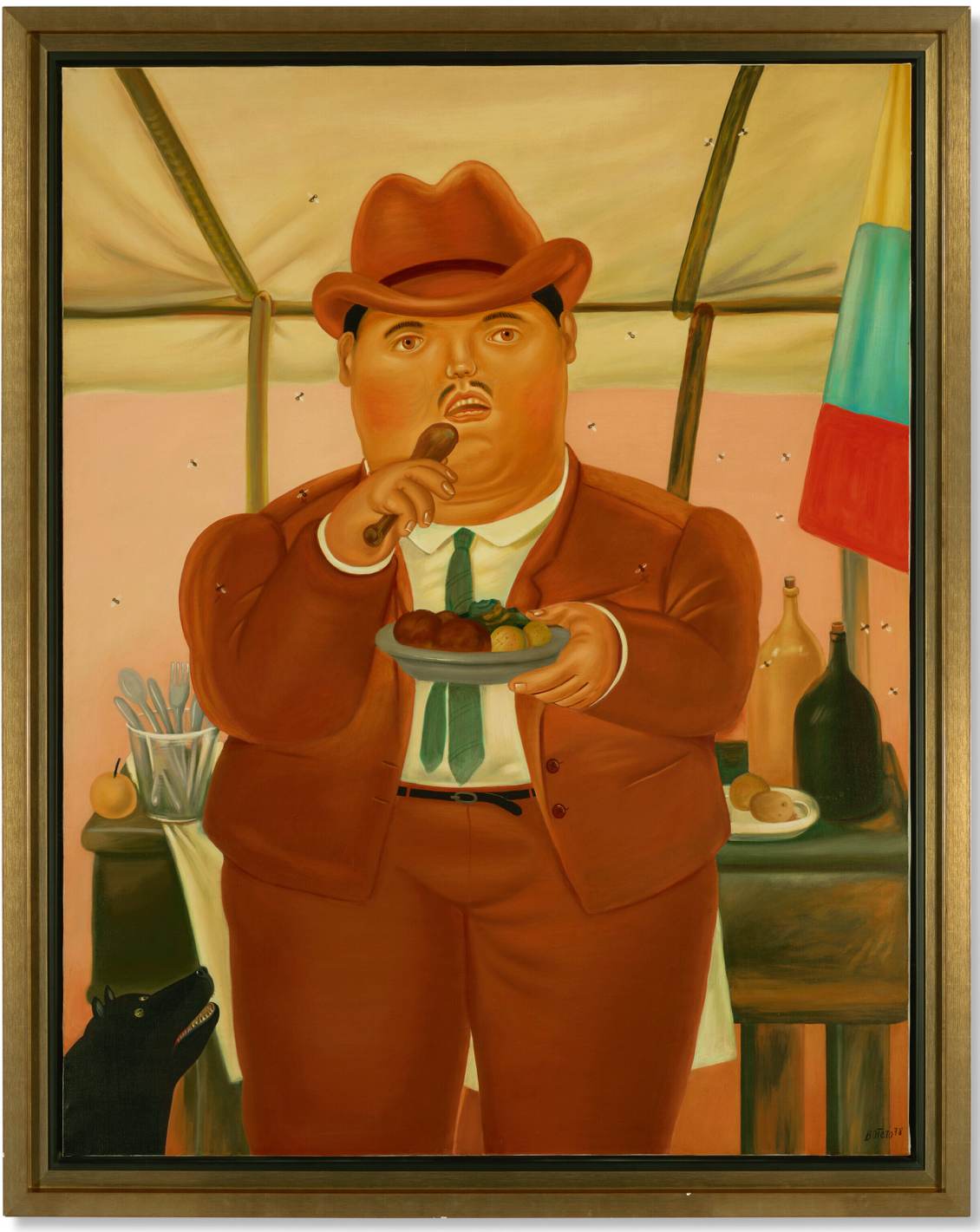
#4. Man Eating, 1978
Christie’s New-York: 28 September 2023
Estimated: USD 900,000 – 1,200,000
USD 1,071,000
FERNANDO BOTERO (1932-2023)
Man Eating, 1978
Oil on canvas
71×55 inches (180.3 x 139.7 cm)
Signed and dated ‘Botero 78’ (lower right)
#5. Sobre Cézanne, 1963
Bonhams New-York: 16 November 2023
Estimated: USD 800,000 – 1,200,000
USD 1,016,500
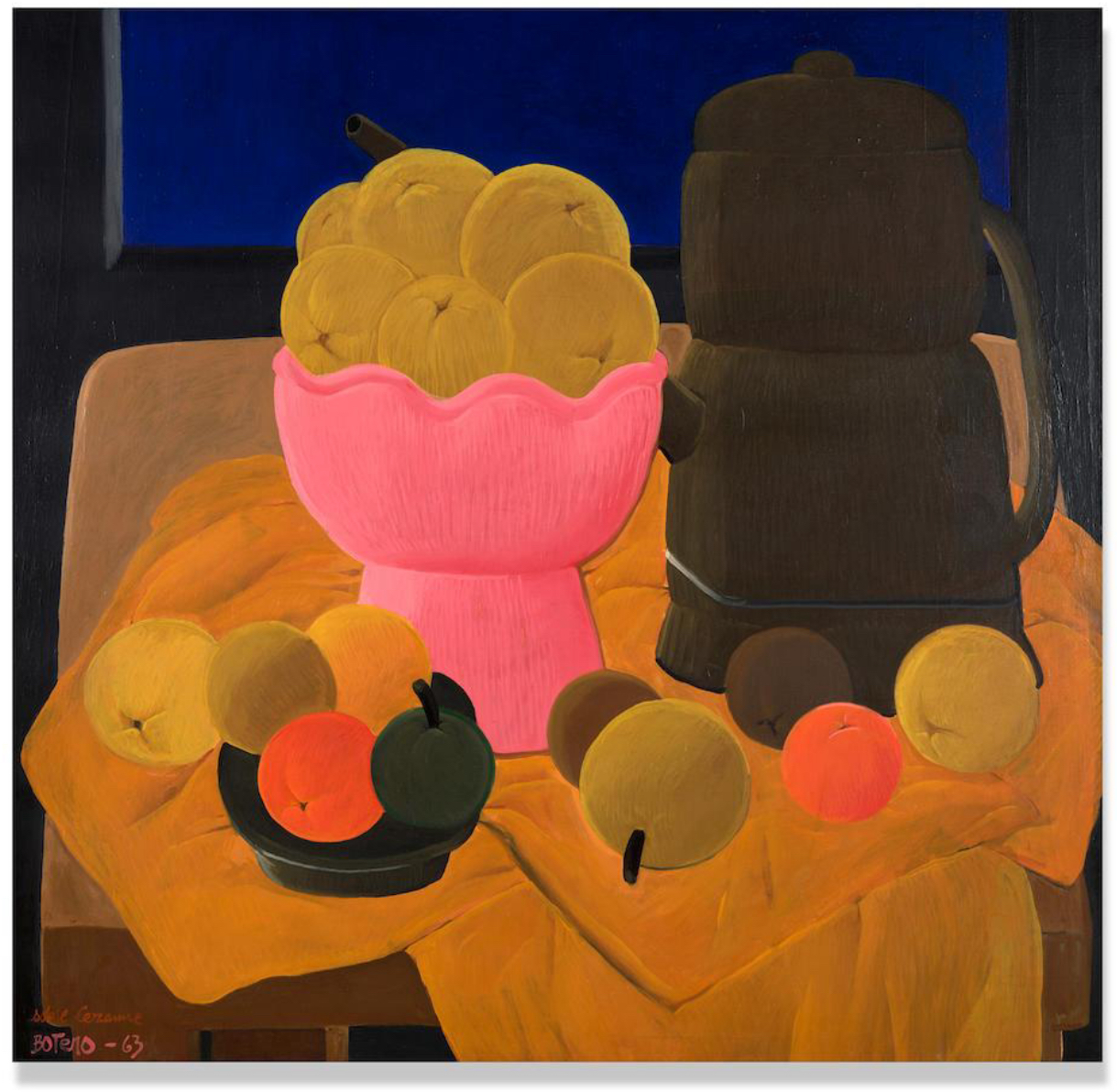
Oil on canvas
170.2 x 174.6 cm (67 x 68 3/4 inches)
Signed, titled and dated 63
#6. Dancing Couple, 1982
Christie’s New-York: 9 March 2023
Estimated: USD 800,000 – 1,200,000
USD 1,008,000
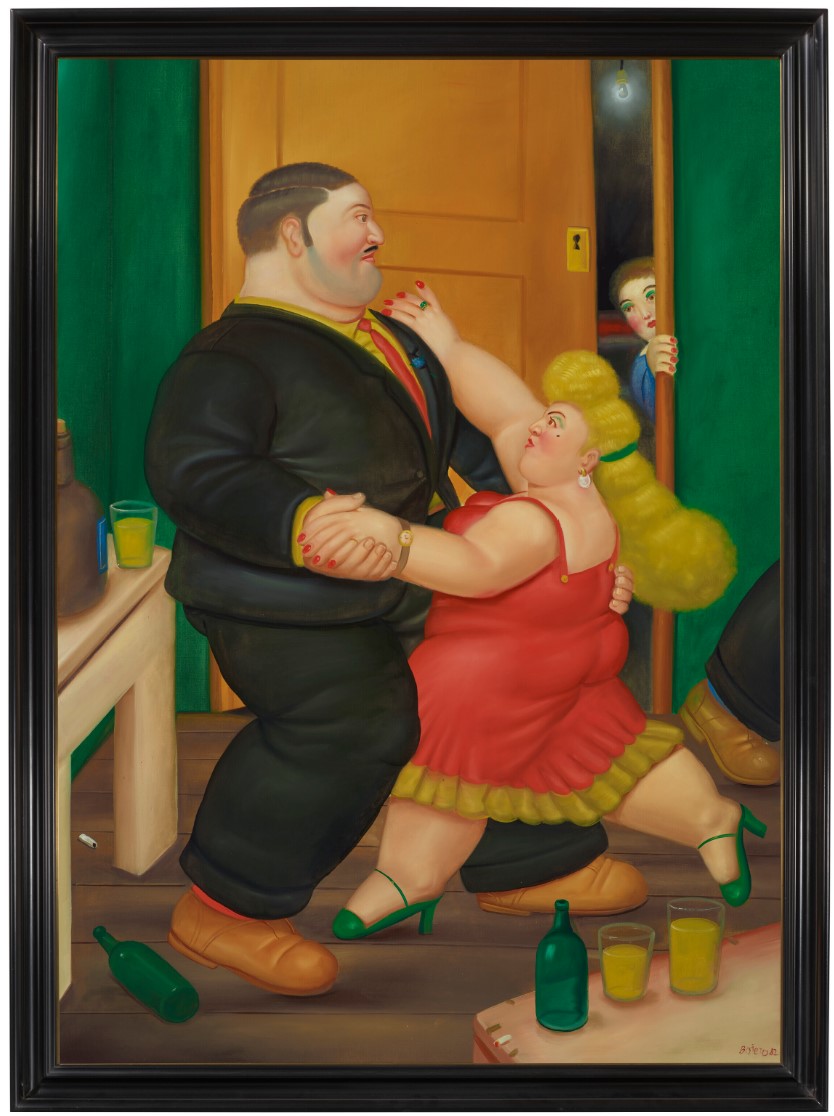
FERNANDO BOTERO (b. 1932)
Dancing Couple, 1982
Oil on canvas
149.9 x 108 cm (59 x 42 1/2 inches)
Signed and dated ‘Botero 82’ (lower right)
#7. Rosalba, 1969
Sotheby’s New-York: 16 November 2023
Estimated: USD 800,000 – 1,200,000
USD 952,500
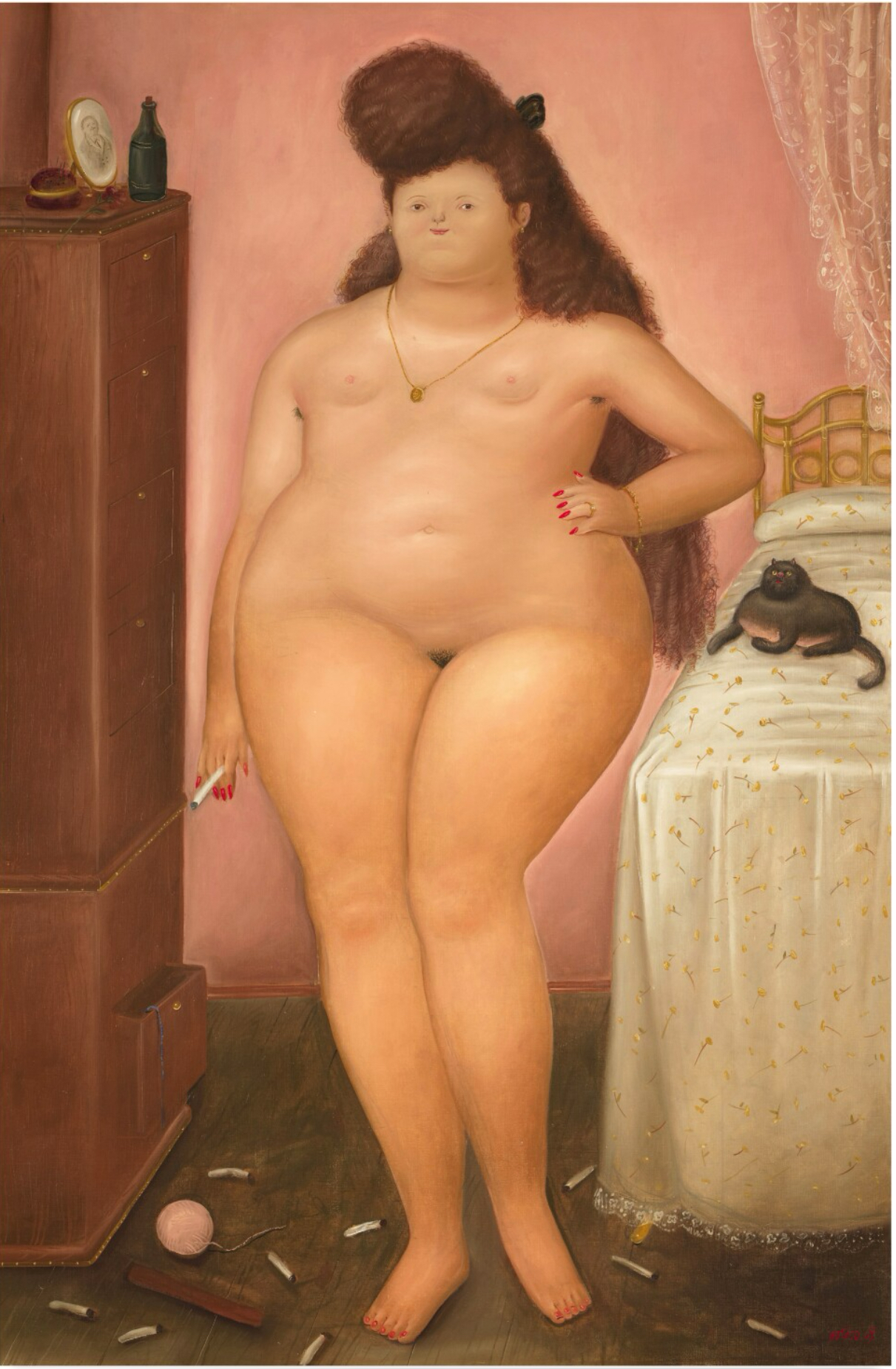
FERNANDO BOTERO (1932 – 2023)
Rosalba, 1969
Oil on canvas
193 x 125.7 cm (76 x 49 1/2 inches)
Signed and dated 69 (lower right)
#8. Il nuncio, 1967
Sotheby’s New-York: 14 November 2023
Estimated: USD 350,000 – 450,000
USD 749,300
Il nuncio | Modern Day Auction | 2023 | Sotheby’s (sothebys.com)
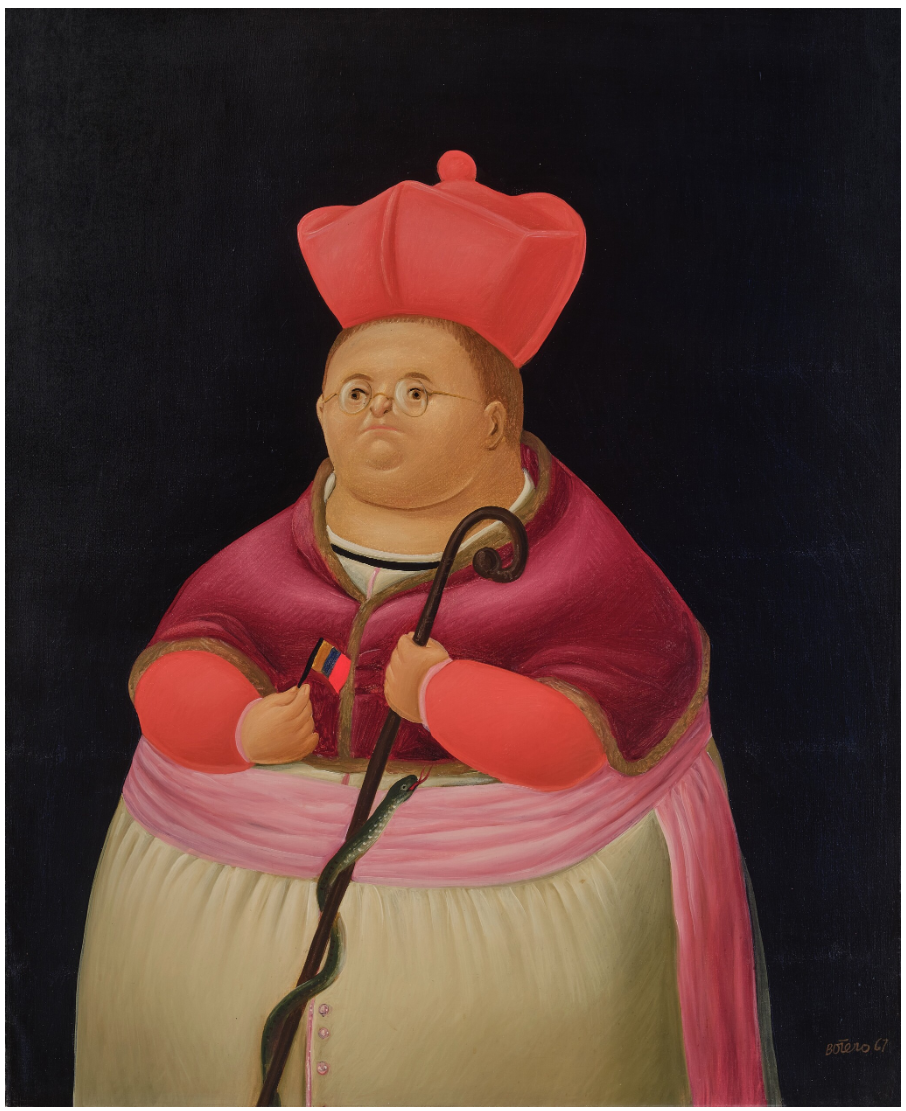
FFERNANDO BOTERO (1932 – 2023)
Il nuncio, 1967
Oil on canvas
135×114 cm (53 1/8 x 44 7/8 inches)
Signed Botero and dated 67 (lower right)
Signed Botero, titled and dated 67 (on the reverse)
#9. Adam and Eve, 1993
Sotheby’s New-York: 19 May 2023
Estimated: USD 550,000 – 750,000
USD 698,500
Adam and Eve | Contemporary Day Auction | 2023 | Sotheby’s (sothebys.com)
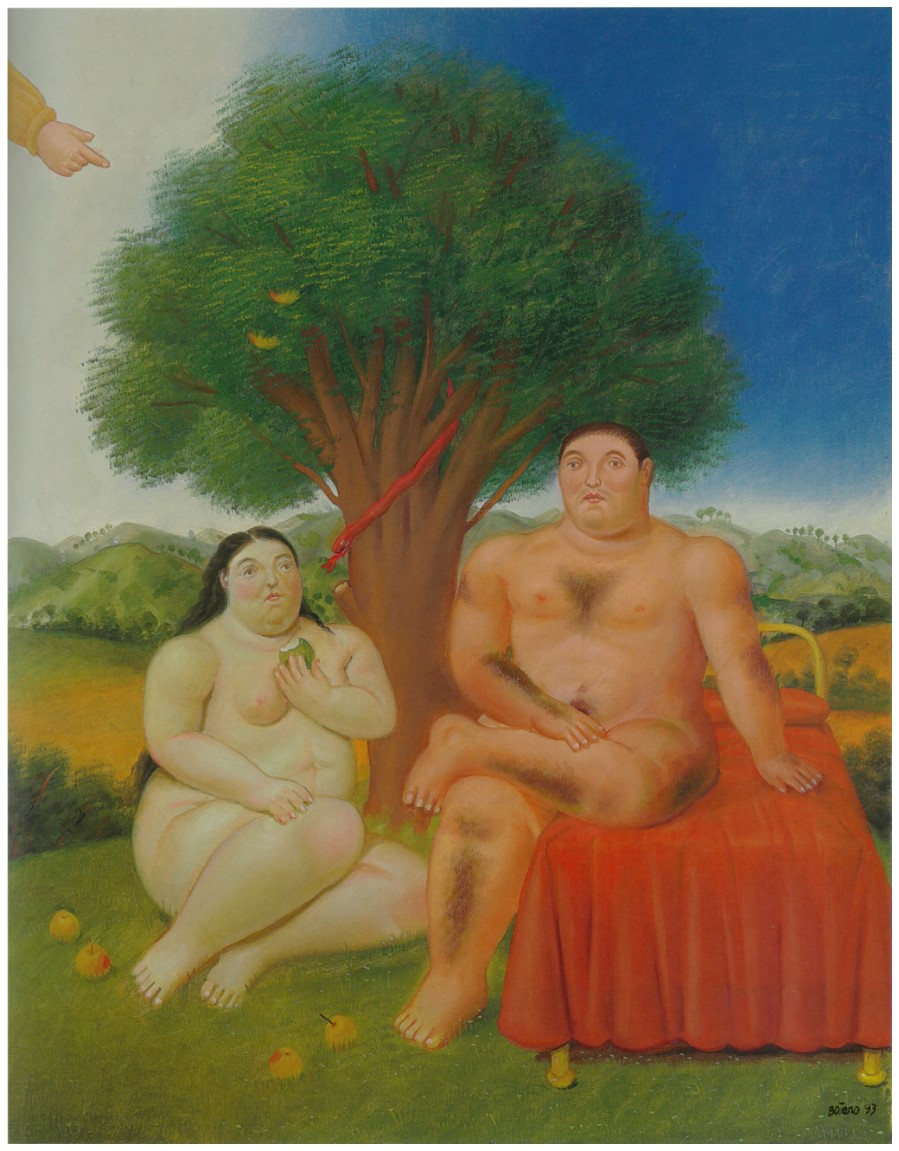
FERNANDO BOTERO (b. 1932)
Adam and Eve, 1993
Oil on canvas
114.3 x 89.5 cm (45 x 35 1/4 inches)
Signed and dated 93 (lower right)
#10. Waterfall, 1998
Christie’s Hong-Kong: 28 May 2023
Estimated: HKD 5,000,000 – 8,000,000
HKD 5,292,000 / USD 675,586
Fernando Botero (B. 1932) (christies.com)
FERNANDO BOTERO (B. 1932)
Waterfall, 1998
Oil on canvas
93×81 cm (36 5/8 x 31 7/8 inches)
Signed and dated ‘Botero 98’ (lower left)
#11. Eva, 2017
Artcurial: 5 December 2023
Estimated: EUR 500,000 – 700,000
EUR 590,400 / USD 639,837
Impressionist & Modern Art – Evening Sale | Sale n°4384 | Lot n°20 | Artcurial
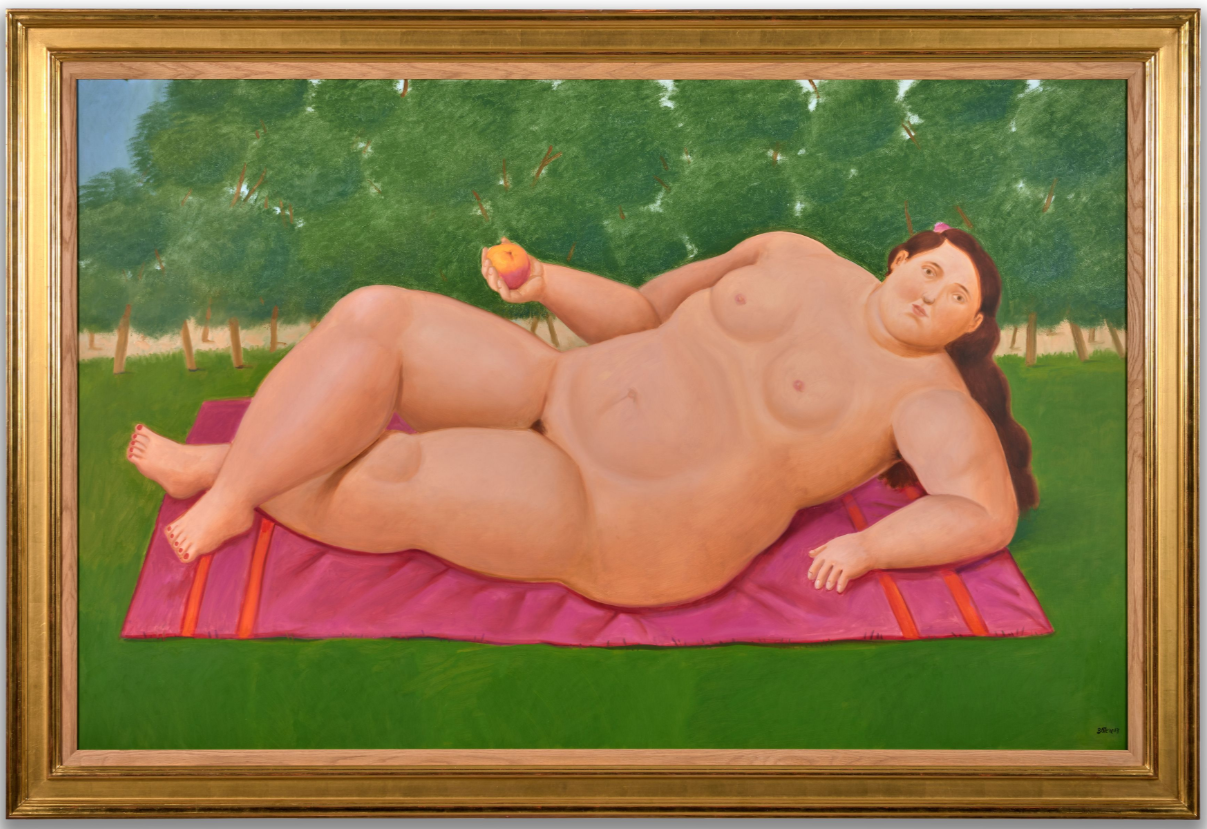
FERNANDO BOTERO (1932-2023)
Eva, 2017
Oil on canvas
100×156 cm
Signed and dated, lower right
#12. Bodegón en homenaje a Cézanne, 1963
Sotheby’s New-York: 14 November 2023
Estimated: USD 350,000 – 450,000
USD 584,200
Bodegón en homenaje a Cézanne | Modern Day Auction | 2023 | Sotheby’s (sothebys.com)
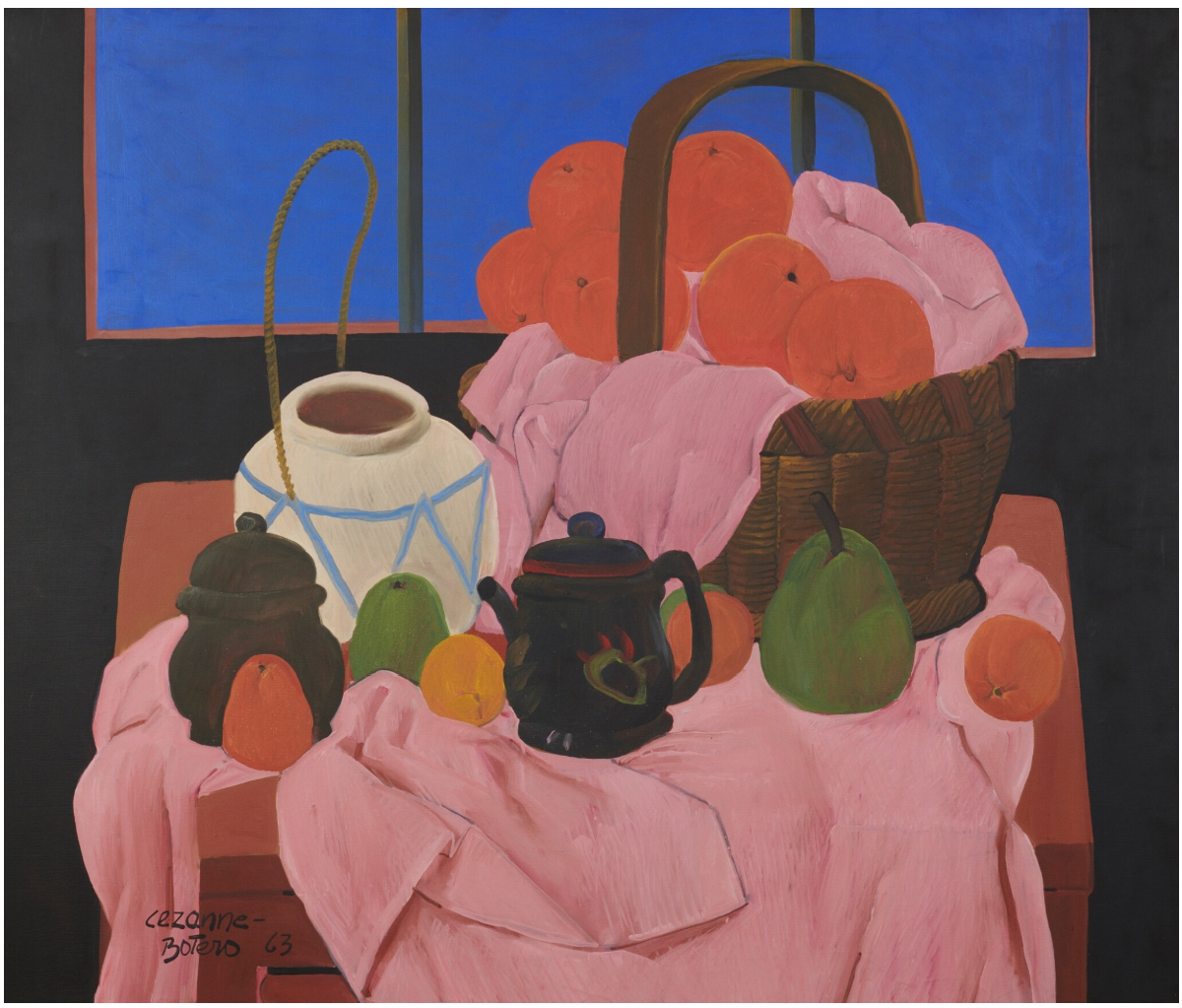
FERNANDO BOTERO (1932 – 2023)
Bodegón en homenaje a Cézanne, 1963
Oil on canvas
129.5 x 152.4 cm (51×60 inches)
Signed Botero, inscribed Cézanne and dated 63 (lower left)
#13. Madame Ingres, 1967
Christie’s Paris: 7 June 2023
Estimated: EUR 250,000 – 350,000
EUR 504,000 / USD 539,325
Fernando Botero (né en 1932) (christies.com)
FERNANDO BOTERO
Madame Ingres, 1967
Oil on canvas
160 x 149.6 cm (63 x 58 7/8 inches)
Signed and dated ‘Botero 67’ (lower right)
#14. Still Life with Watermelon, 1994
Sotheby’s New-York: 16 November 2023
Estimated: USD 300,000 – 400,000
USD 508,000
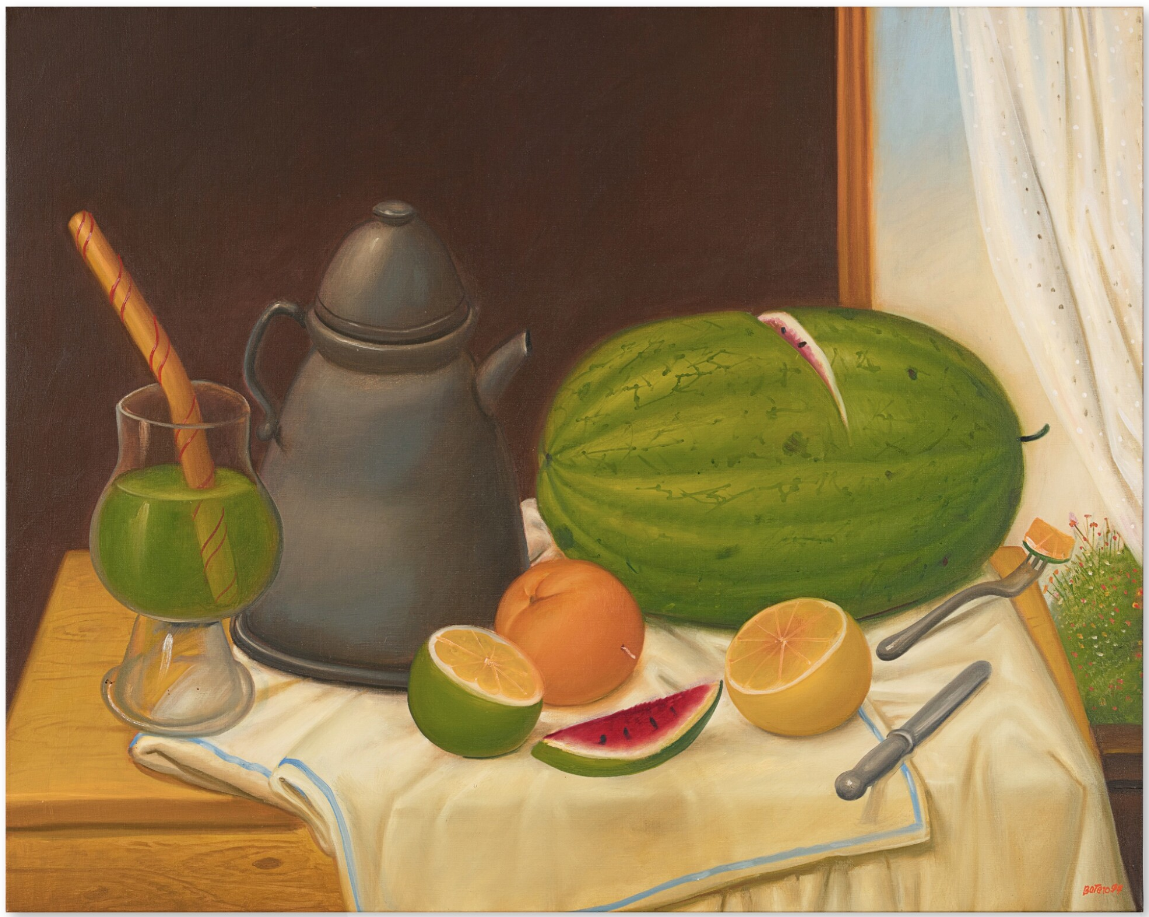
FERNANDO BOTERO (1932 – 2023)
Still Life with Watermelon, 1994
Oil on canvas
99.4 x 124.8 cm (39 1/8 x 49 1/8 inches)
Signed and dated 94 (lower right)
#15. Rape of Europa, 1991
Doyle New-York: 11 October 2023
Estimated: USD 300,000 – 500,000
USD 478,800
Lot 141 – Fernando Botero (doyle.com)
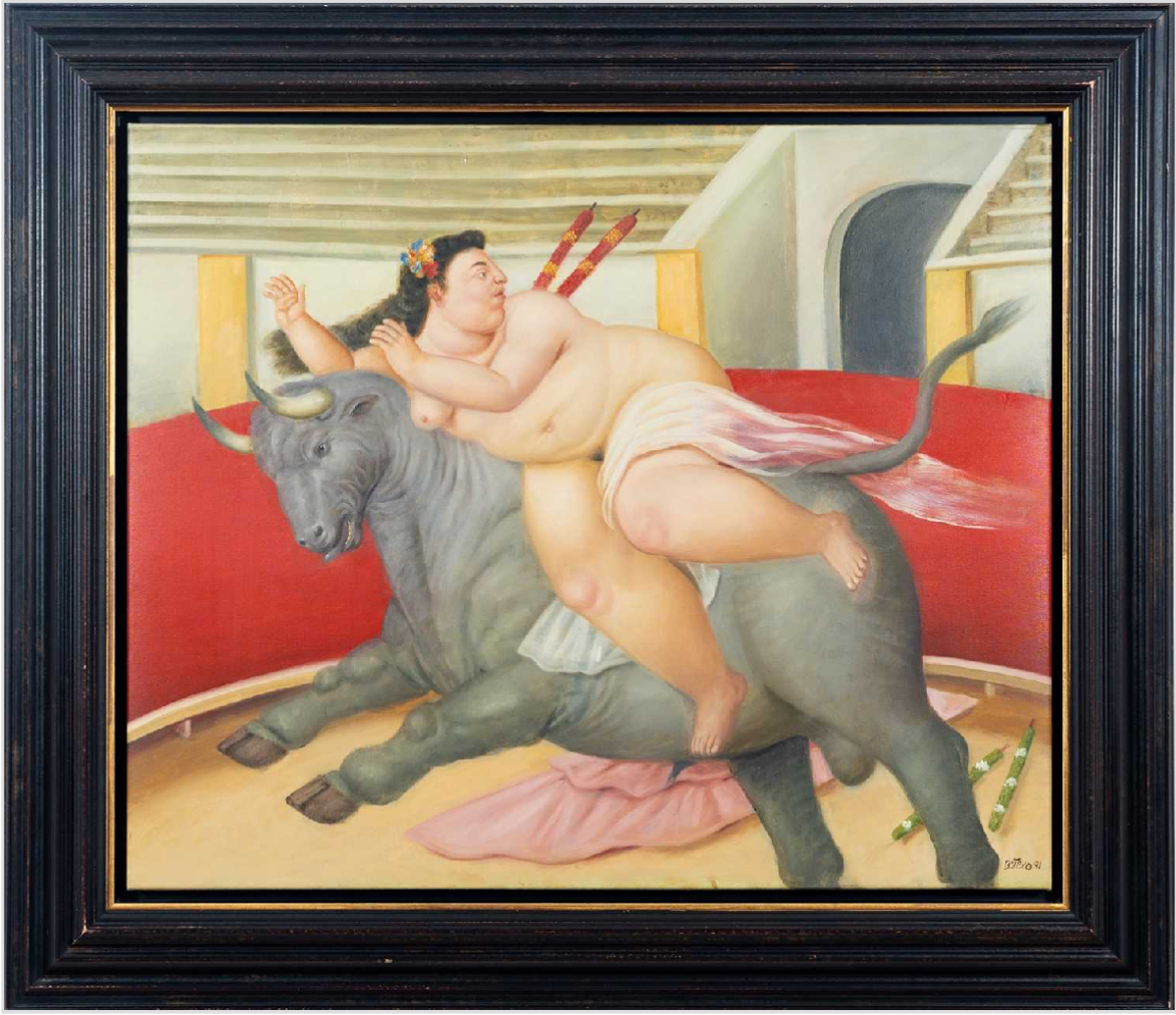
FERNANDO BOTERO (Colombian, 1932-2023)
Rape of Europa, 1991
Oil on canvas
83×100 cm (32 1/2 x 39 1/2 inches)
Signed and dated Botero 91 (lr)
#16. Stilleben mit Lampe, 1965
Sotheby’s New-York: 19 May 2023
Estimated: USD 150,000 – 200,000
USD 457,200
Stilleben mit Lampe | Contemporary Day Auction | 2023 | Sotheby’s (sothebys.com)
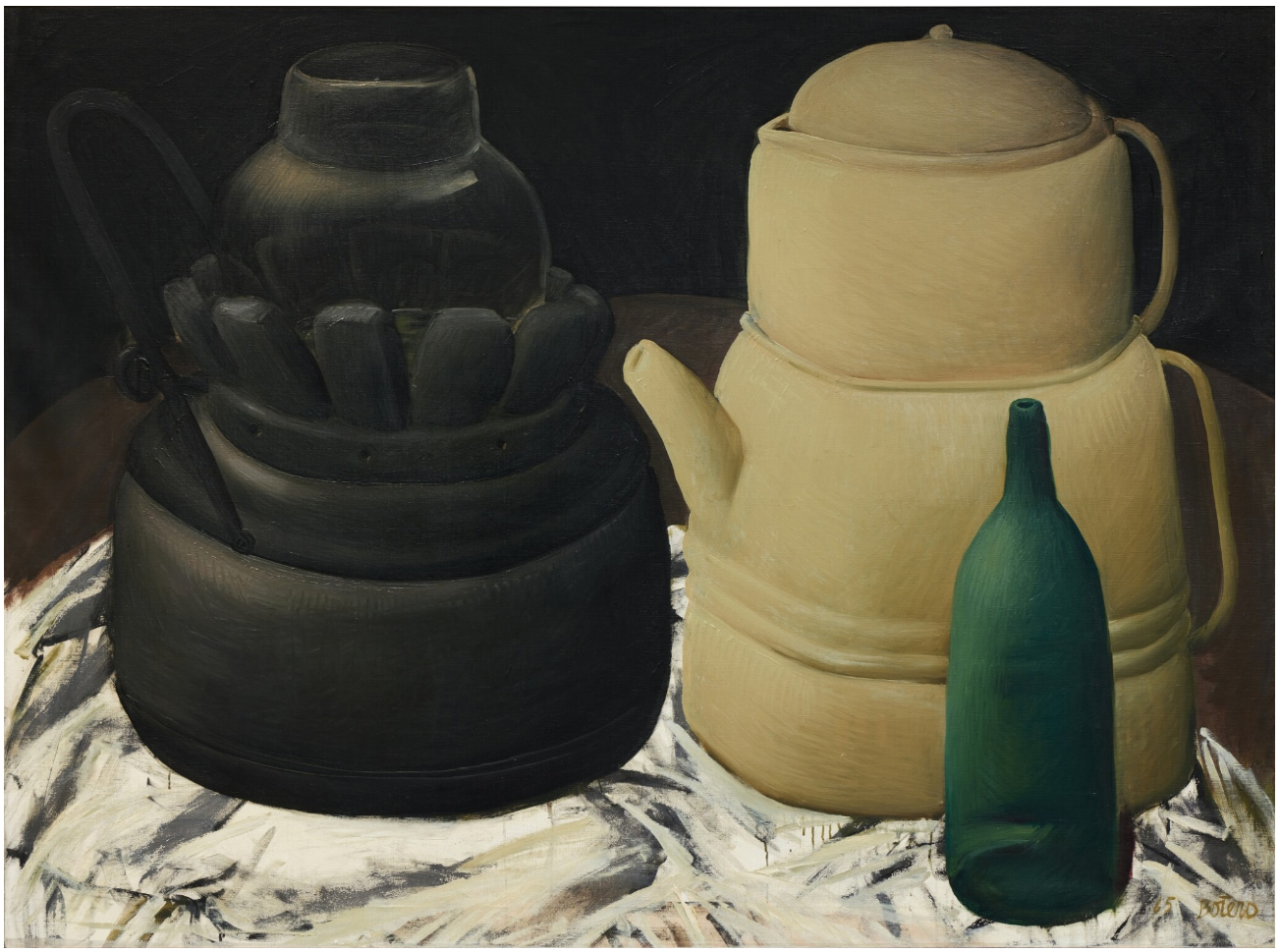
FERNANDO BOTERO
Stilleben mit Lampe, 1965
Oil on canvas
141×191 cm (55 1/2 x 75 inches)
Signed and dated 65 (lower right)
#17. The Kitchen, 1994
Cowley Abbott: 8 June 2023
Estimated: CAD 350,000 – 450,000
CAD 468,000 / USD 454,708
‘The Kitchen’ by Fernando Botero at Cowley Abbott
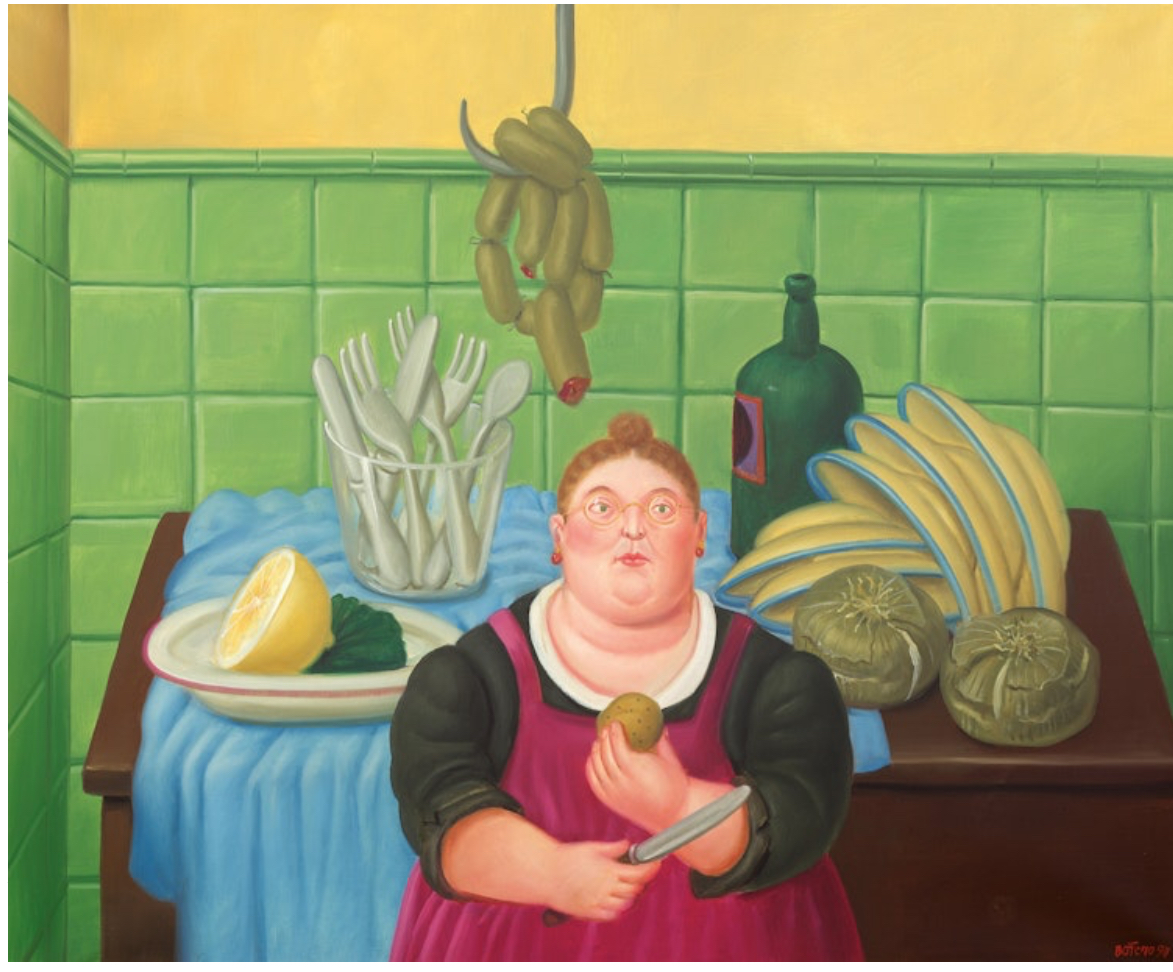
FERNANDO BOTERO
The Kitchen, 1994
oil on canvas
101 x 123.2 cm (3/4 x 48 1/2 inches)
Signed and dated 1994 lower right; titled and dated on a gallery label on the frame on the reverse
#18. Canasta de frutas, 1975
Sotheby’s New-York: 16 November 2023
Estimated: USD 300,000 – 400,000
USD 431,800
Canasta de frutas | Contemporary Day Auction | 2023 | Sotheby’s (sothebys.com)
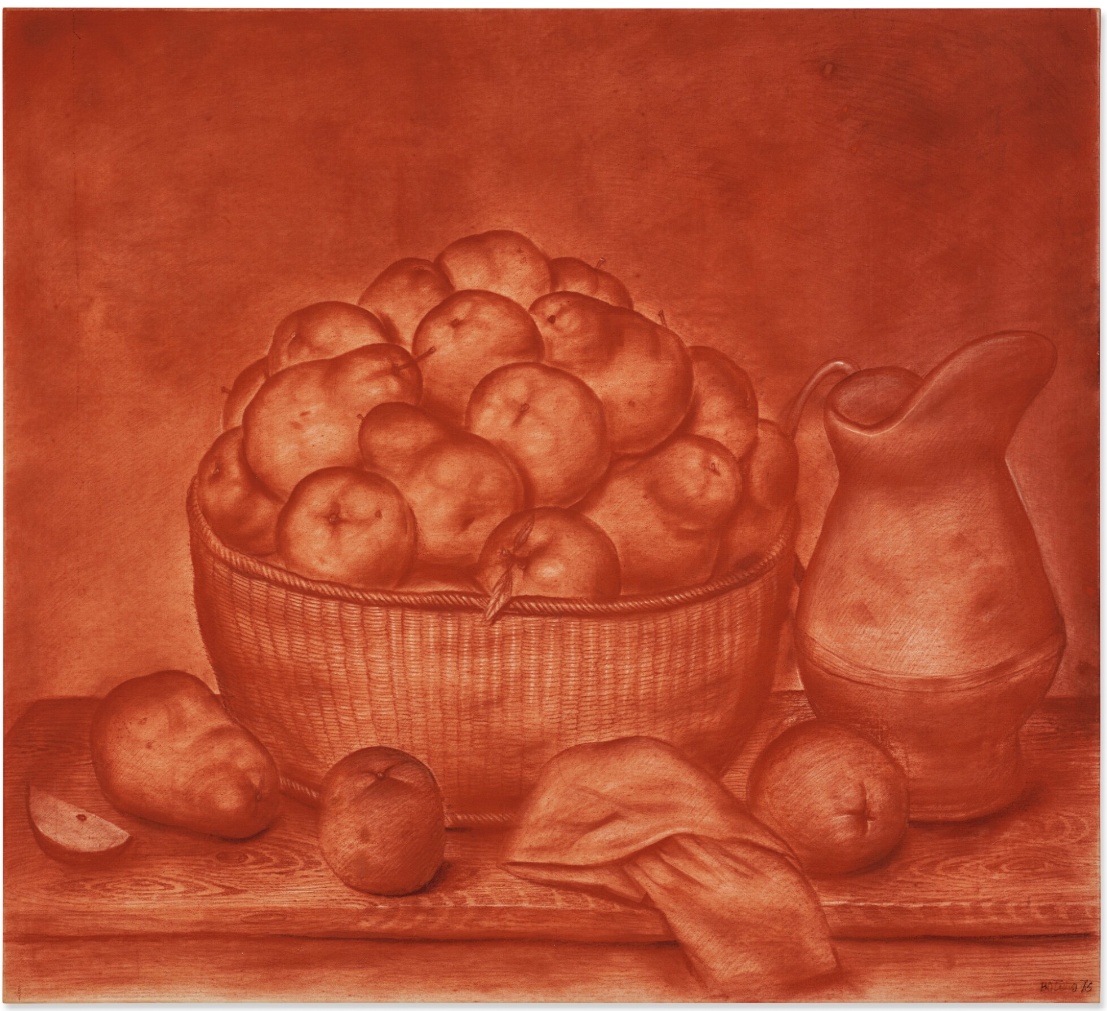
FERNANDO BOTERO (1932 – 2023)
Canasta de frutas, 1975
Sanguine on canvas
162.9 x 179.1 cm (64 1/8 x 70 1/2 inches)
Signed and dated 75 (lower right)
#19. Still Life with Banana, 1977
Sotheby’s New-York: 19 May 2023
Estimated: USD 350,000 – 450,000
USD 381,000
Still Life with Banana | Contemporary Day Auction | 2023 | Sotheby’s (sothebys.com)
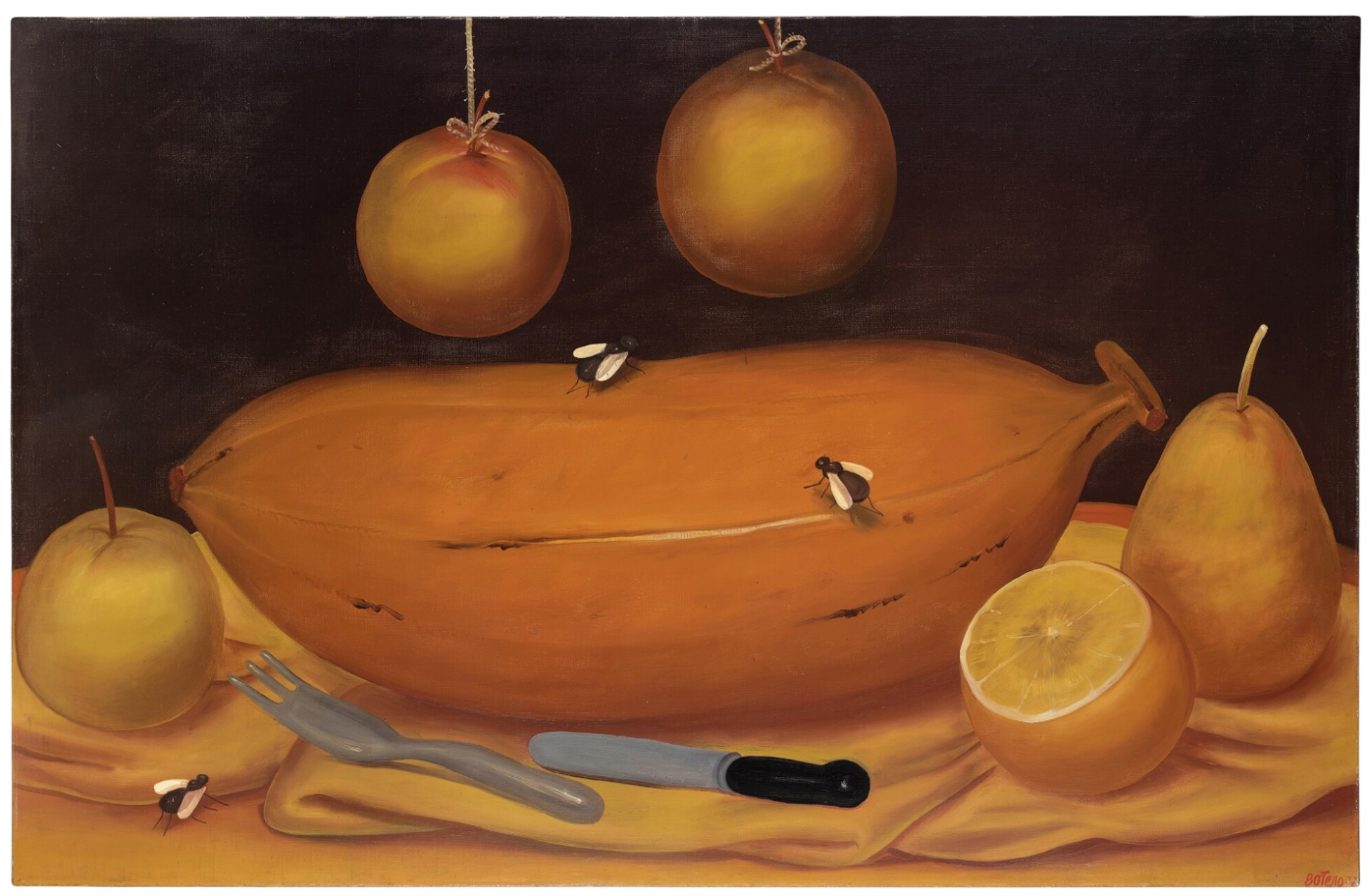
FERNANDO BOTERO
Still Life with Banana, 1977
Oil on canvas
124.5 x 192.7 cm (49 x 75 7/8 inches)
Signed and dated 77 (lower right)
#20. Circus Performer with Monkey, 2007
Sotheby’s New-York: 19 May 2023
Estimated: USD 280,000 – 350,000
USD 381,000
Circus Performer with Monkey | Contemporary Day Auction | 2023 | Sotheby’s (sothebys.com)
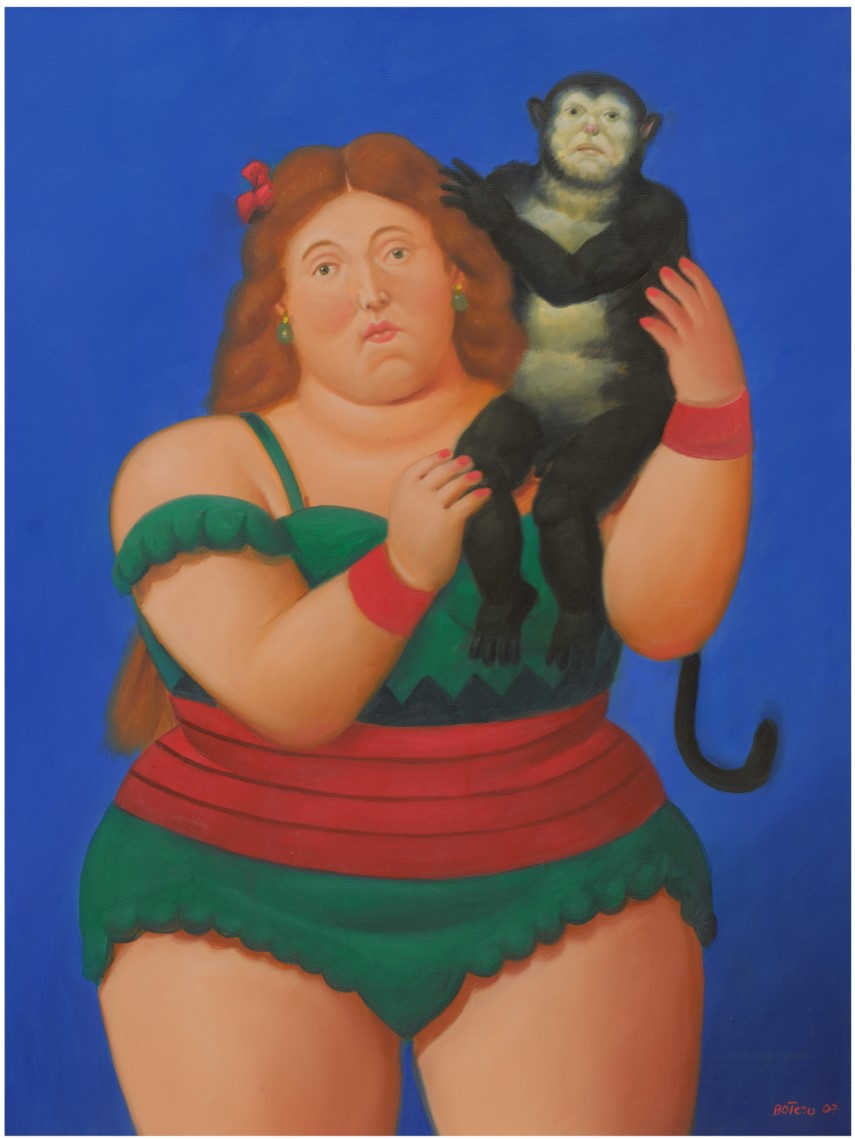
FERNANDO BOTERO (b. 1932)
Circus Performer with Monkey, 2007
Oil on canvas
78.4 x 59.4 cm (30 7/8 x 23 3/8 inches)
Signed and dated 07 (lower right)
#21. Lady in Profile, 1987
Christie’s New-York: 28 September 2023
Estimated: USD 250,000 – 350,000
USD 352,800
FERNANDO BOTERO (1932-2023) (christies.com)
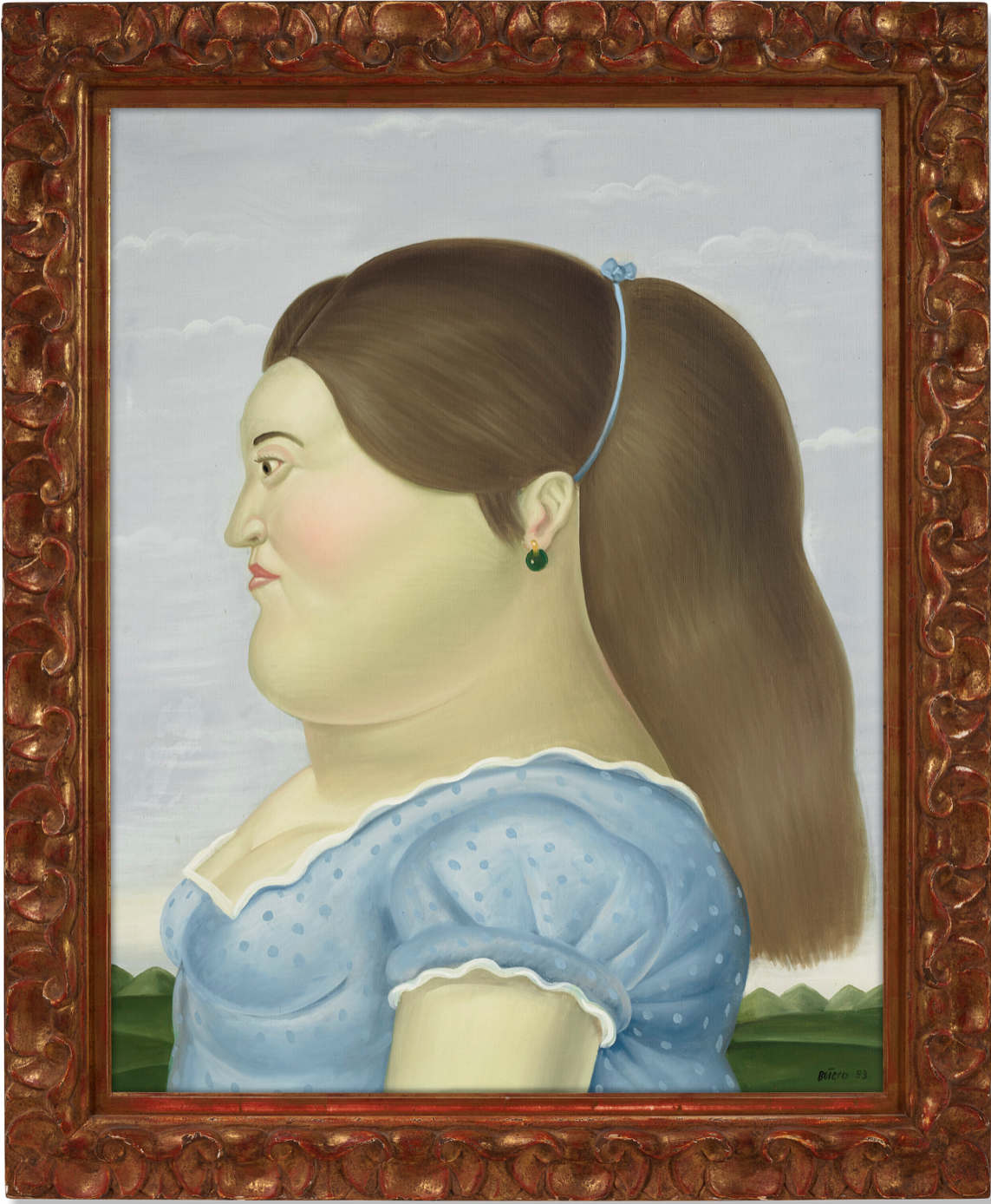
FERNANDO BOTERO (1932-2023)
Lady in Profile, 1983
Oil on canvas
88.9 x 70.2 cm (35 x 27 5/8 inches)
Signed and dated ‘Botero 83’ (lower right)
#22. A Family, 2012
Doyle New-York: 11 October 2023
Estimated: USD 150,000 – 250,000
USD 289,800
Lot 142 – Fernando Botero (doyle.com)
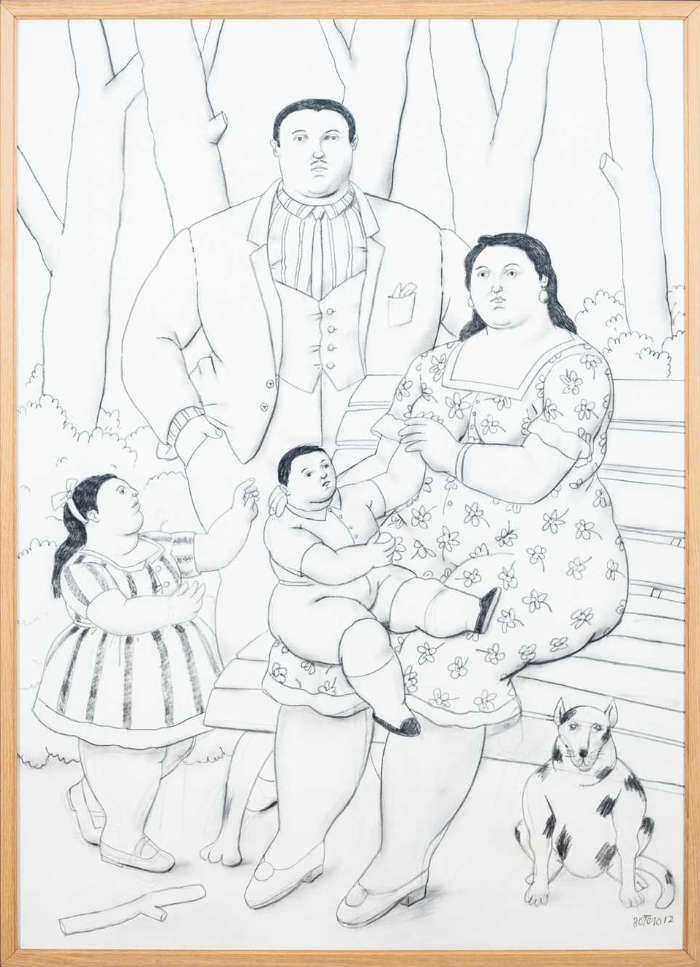
FERNANDO BOTERO (Colombian, 1932-2023)
A Family, 2012
Charcoal on canvas
136 x 97.7 cm (53 1/2 x 38 1/2 inches)
Signed and dated Botero 12 (lr)
#23. La fille du régiment, 1996
Sotheby’s New-York: 9 March 2023
Estimated: USD 200,000 – 300,000
USD 279,400
La fille du régiment | Contemporary Curated | 2023 | Sotheby’s (sothebys.com)
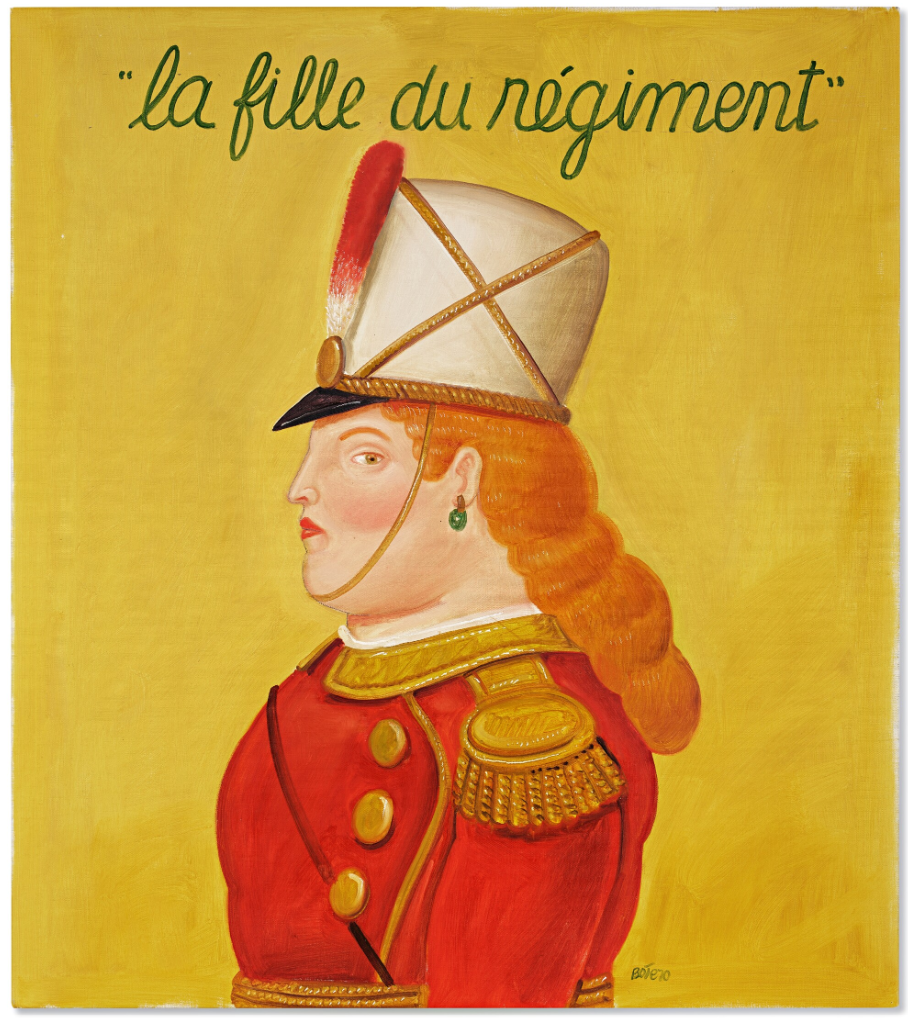
FERNANDO BOTERO
La fille du régiment, 1996
Oil on canvas
100.3 x 89.2 cm (39 1/2 x 35 1/8 inches)
Signed Botero (lower right); titled (upper center)
#24. Vase with Flowers, 1960
Christie’s New-York: 9 March 2023
Estimated: USD 200,000 – 300,000
USD 277,200
FERNANDO BOTERO (b. 1932) (christies.com)
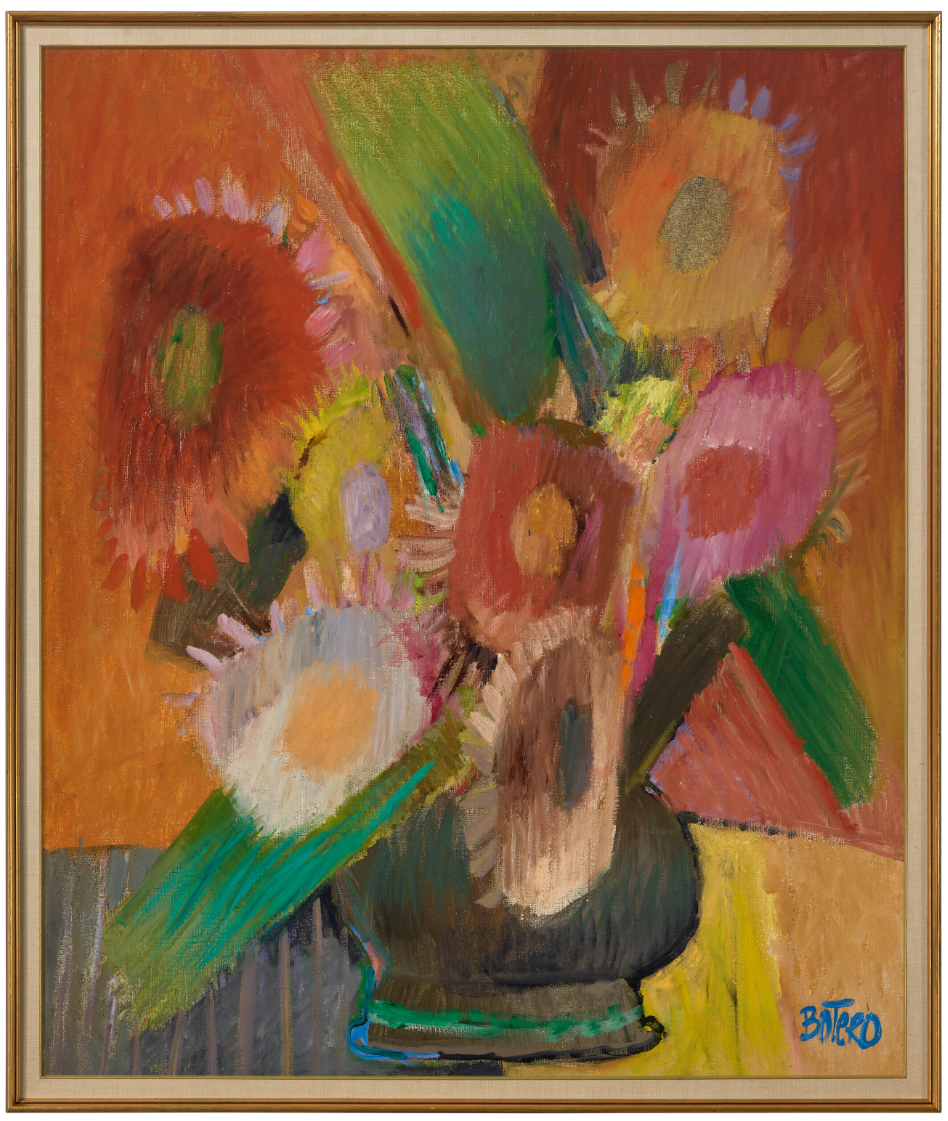
FERNANDO BOTERO (b. 1932)
Vase with Flowers, 1960
Oil on canvas
152.4 x 128.3 cm (60 x 50 1/2 inches)
Signed ‘Botero’ (lower right)
#25. L’atelier de Vermeer, 1963
Christie’s New-York: 9 March 2023
Estimated: USD 350,000 – 450,000
USD 277,200
FERNANDO BOTERO (b. 1932) (christies.com)
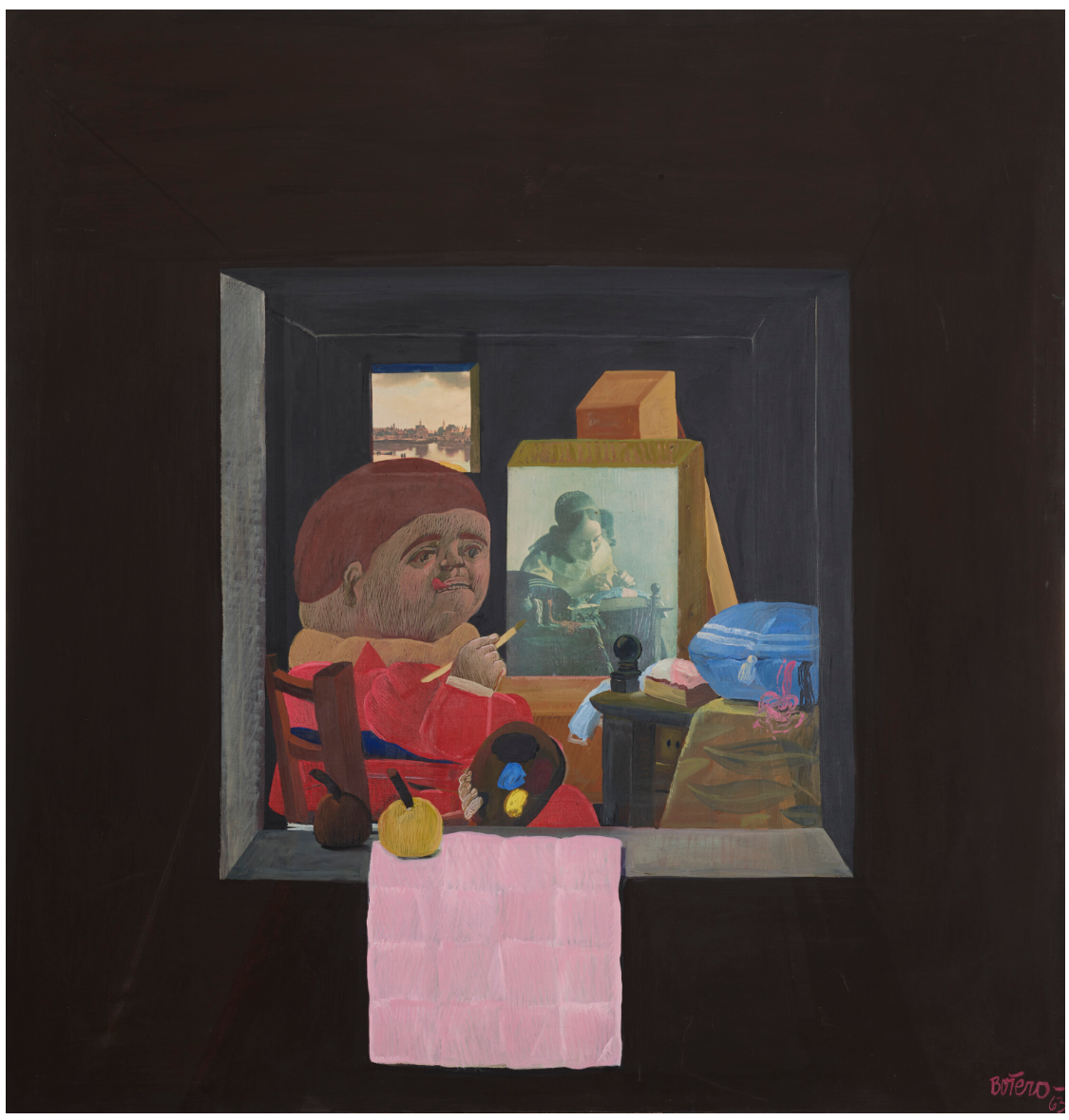
FERNANDO BOTERO (b. 1932)
L’atelier de Vermeer, 1963
Oil and collage on canvas
132.1 x 127 cm (52×50 inches)
Signed and dated ‘Botero-63’ (lower right)
Signed, dated and titled ‘Botero, 63, L’atelier de Veermer [sic]’ (on the reverse)
#26. The Gardener, 1963
Phillips New-York: 16 May 2023
Estimated: USD 70,000 – 100,000
USD 139,700
Fernando Botero – 20th Century & Contem… Lot 226 May 2023 | Phillips
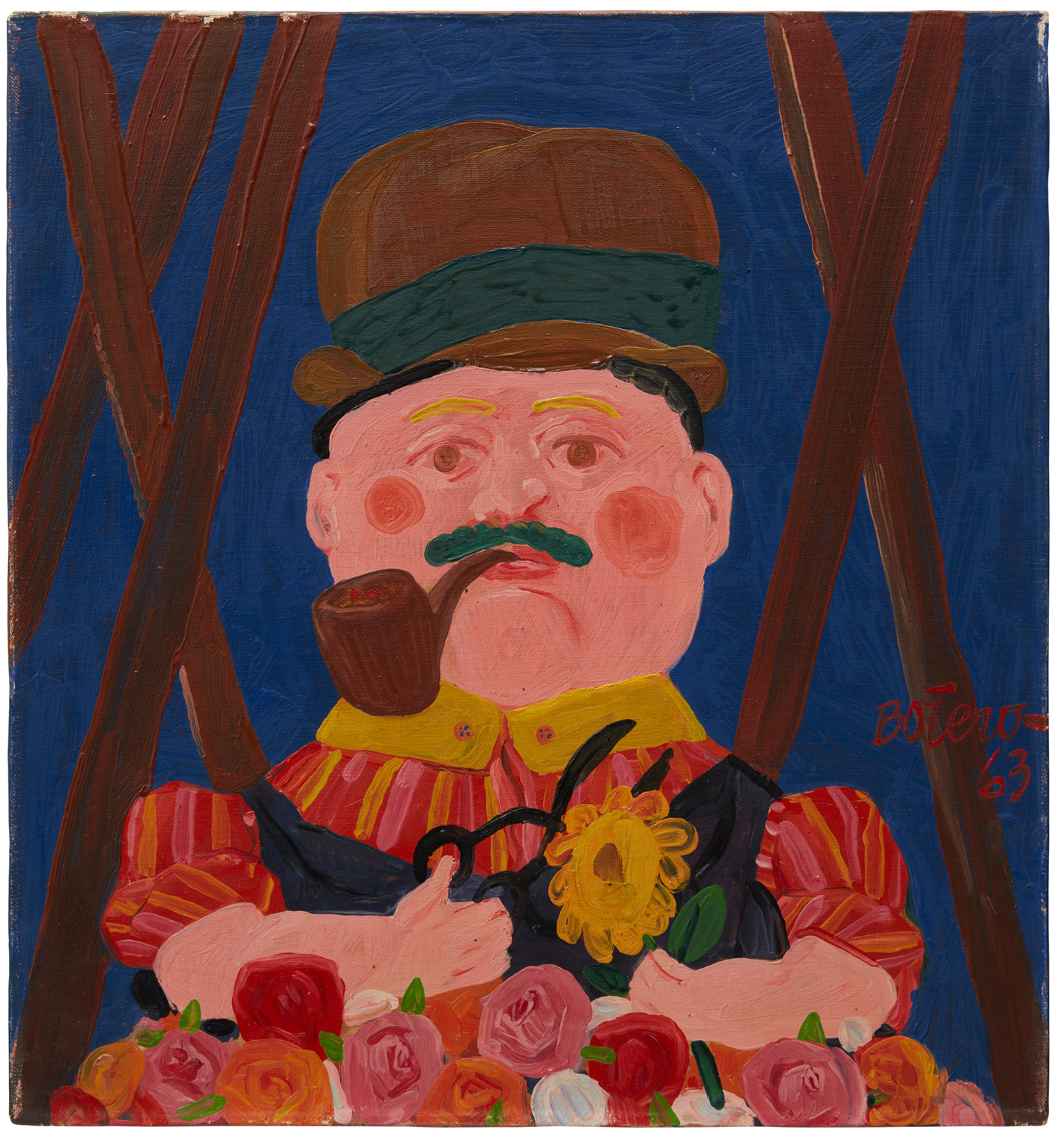
FERNANDO BOTERO
The Gardener, 1963
Oil on canvas
43.2 x 40.6 cm (17×16 inches)
Signed and dated “Botero 63” lower right
#27. Niña, 1960
Christie’s New-York: 28 September 2023
Estimated: USD 80,000 – 120,000
USD 119,700
FERNANDO BOTERO (1932-2023) (christies.com)
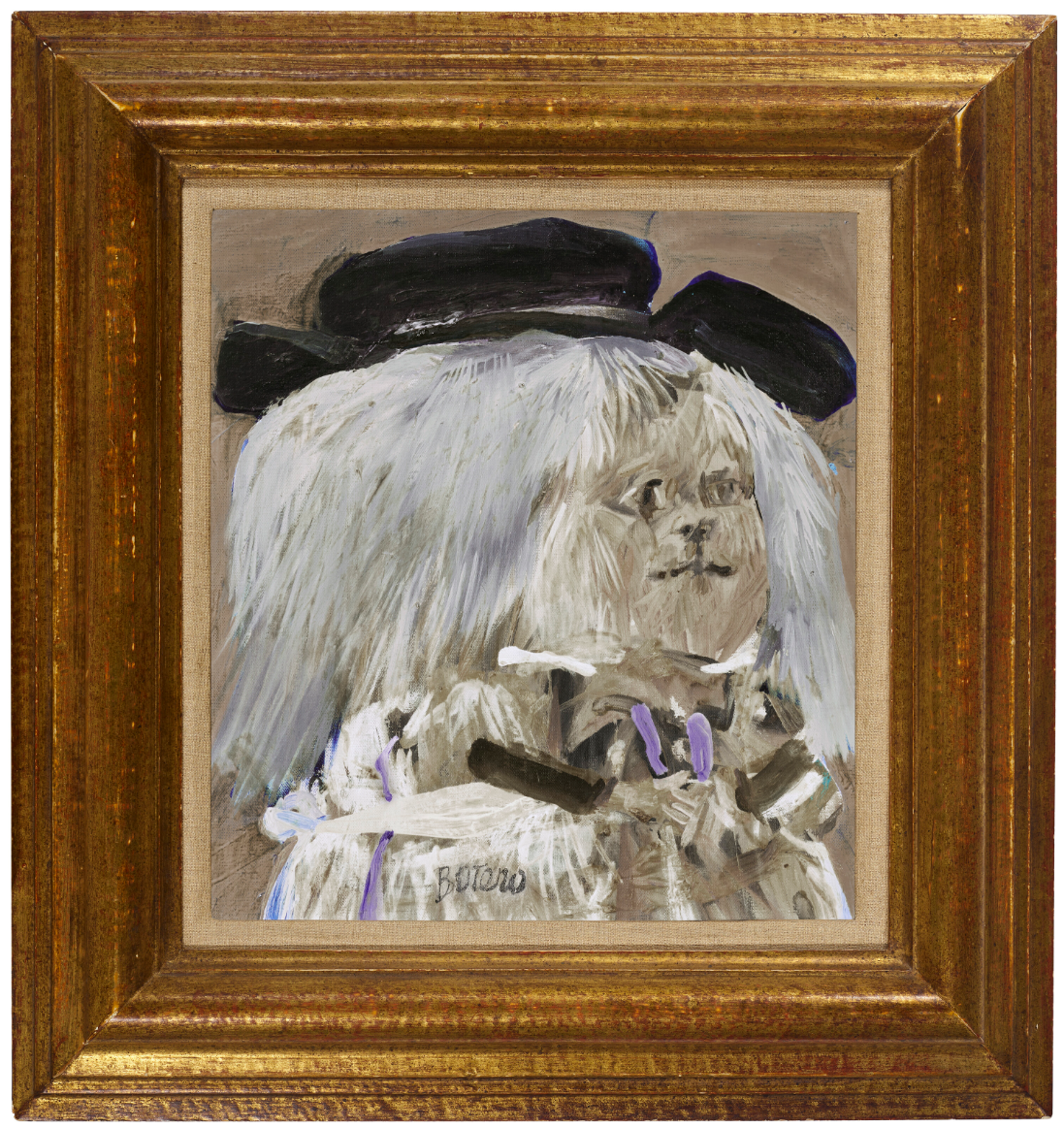
FERNANDO BOTERO (1932-2023)
Niña, 1960
Oil on canvas
30.5 x 33 cm (12×13 inches)
Signed ‘Botero’ (lower center)
#28. Diez de mayo, 1963
Sotheby’s New-York: 19 May 2023
Estimated: USD 100,000 – 150,000
USD 114,300
Diez de mayo | Contemporary Day Auction | 2023 | Sotheby’s (sothebys.com)
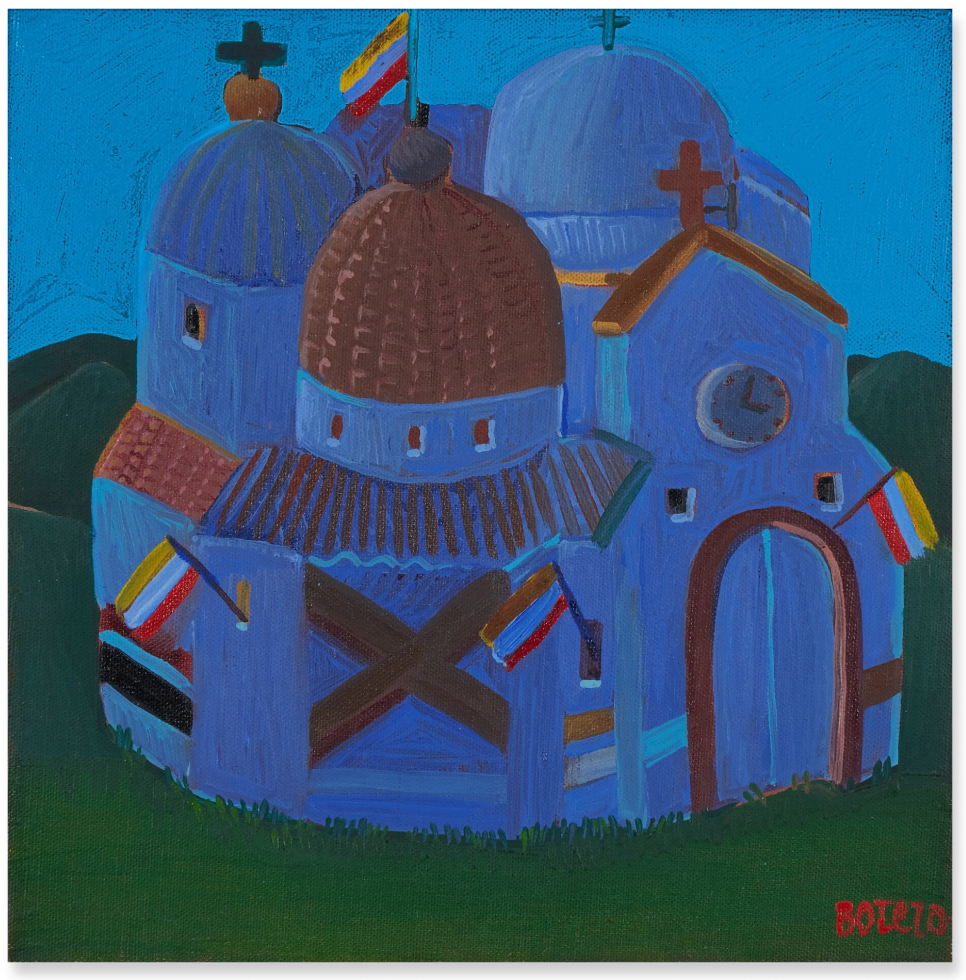
FERNANDO BOTERO
Diez de mayo, 1963
Oil on canvas
33.3 x 33 cm (13 1/8 x 13 inches)
Signed (lower right); signed, titled and dated 1963 (on the reverse)
#29. Bodegón de manzanas, 1957
Sotheby’s New-York: 14 November 2023
Estimated: USD 50,000 – 70,000
USD 76,200
Bodegón de manzanas | Modern Day Auction | 2023 | Sotheby’s (sothebys.com)
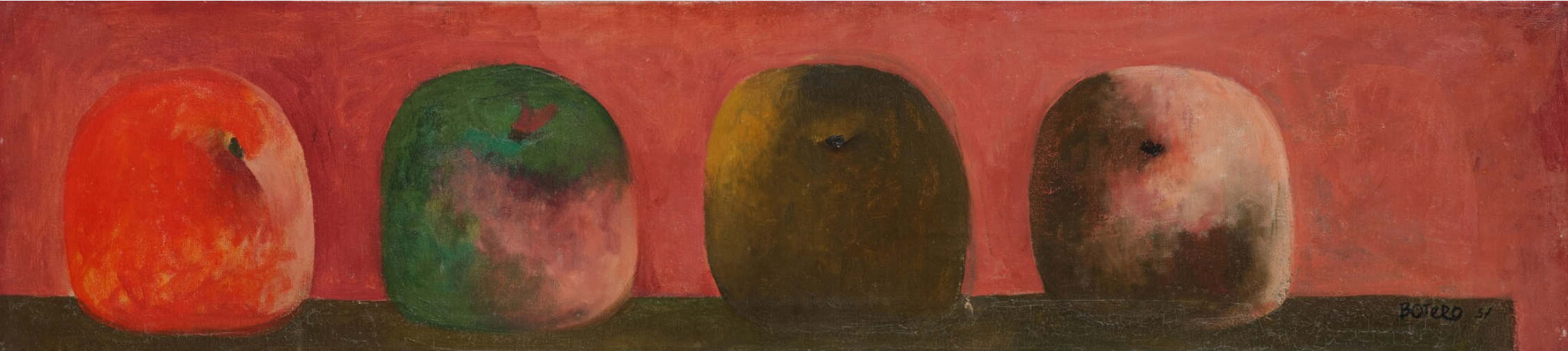
FERNANDO BOTERO (1932 – 2023)
Bodegón de manzanas, 1957
Oil on canvas
27.3 x 120.3 cm (10 3/4 x 47 3/8 inches)
Signed Botero and dated 57 (lower right)
#30. Sleeping Priests, circa 1950-1960
Christie’s London: 8 June 2023
Estimated: GBP 15,000 – 25,000
GBP 40,320 / USD 50,583
FERNANDO BOTERO (B. 1932), Sleeping Priests | Christie’s (christies.com)
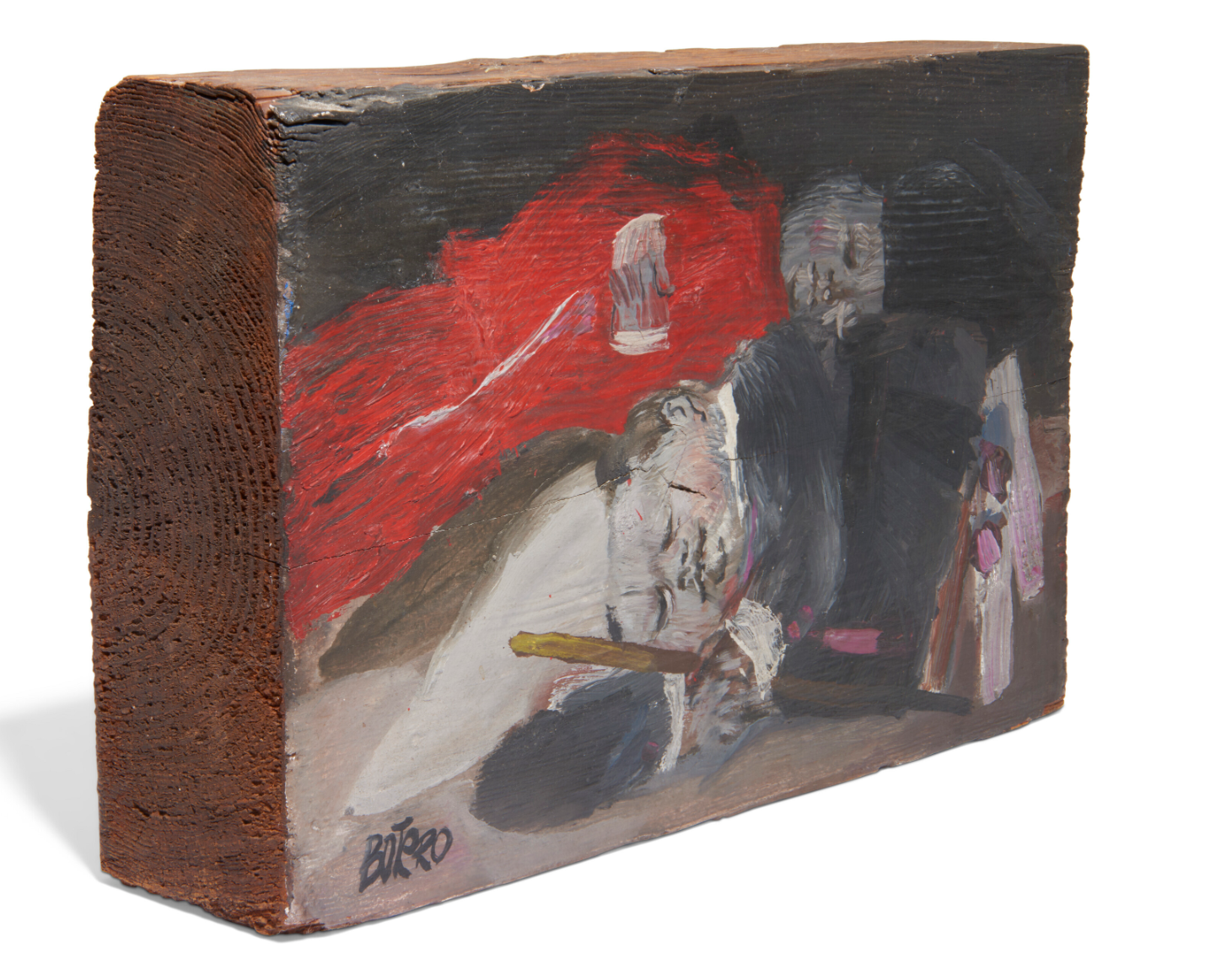
FERNANDO BOTERO (B. 1932)
Sleeping Priests, circa 1950-1960
Oil on woodblock
18.2 x 30.1 x 6.5 cm (7 1/8 x 11 7/8 x 2 1/2 inches)
Signed ‘BOTERO’ (lower left)
2022 Auction Results
FOR PAINTINGS ONLY
32 paintings sold in 2022 for a total turnover of USD 16,323,787. With only 3 lots failing to sell, the Sell-Through rate is a strong 91%. The highest price was achieved at Bonhams in London on 24 March 2022 with La Casa de Rosalba Correa selling for GBP 922,750 (USD 1,216,545). Only 2 lots sold over USD 1 million.
2022 Top 3 Lots
XXXXXXXXXX
#1. La Casa de Rosalba Correa, 2001
Bonhams London: 24 March 2022
Estimated: GBP 650,000 – 850,000
GBP 922,750 / USD 1,216,545
Bonhams : FERNANDO BOTERO (B. 1932) La Casa de Rosalba Correa 2001
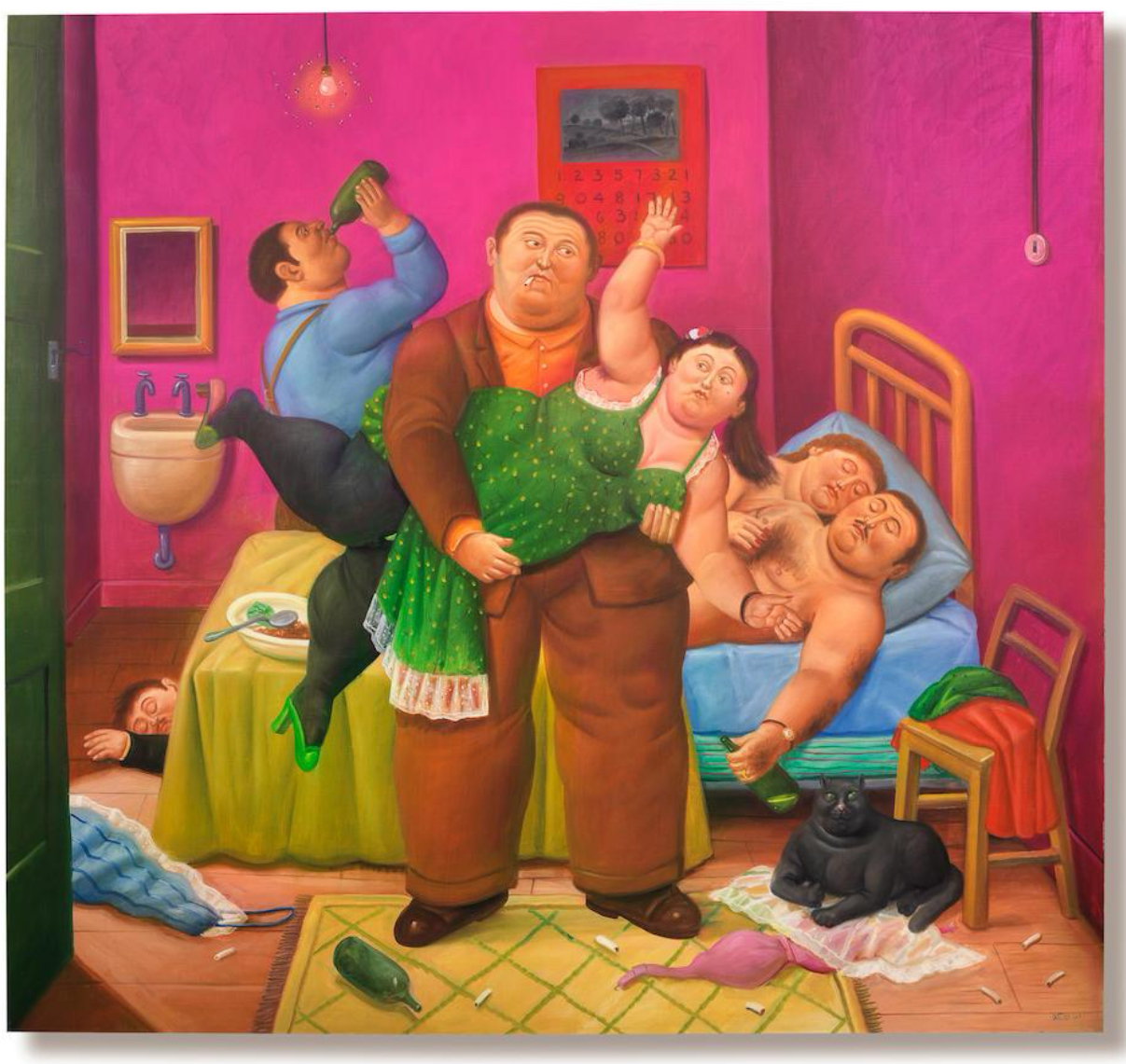
Oil on canvas
179.2 x 192 cm (70 9/16 x 75 9/16 inches)
Signed and dated 01
#2. Familia Protestante, 1969
Sotheby’s New-York: 20 May 2022
Estimated: USD 700,000 – 900,000
USD 1,071,000
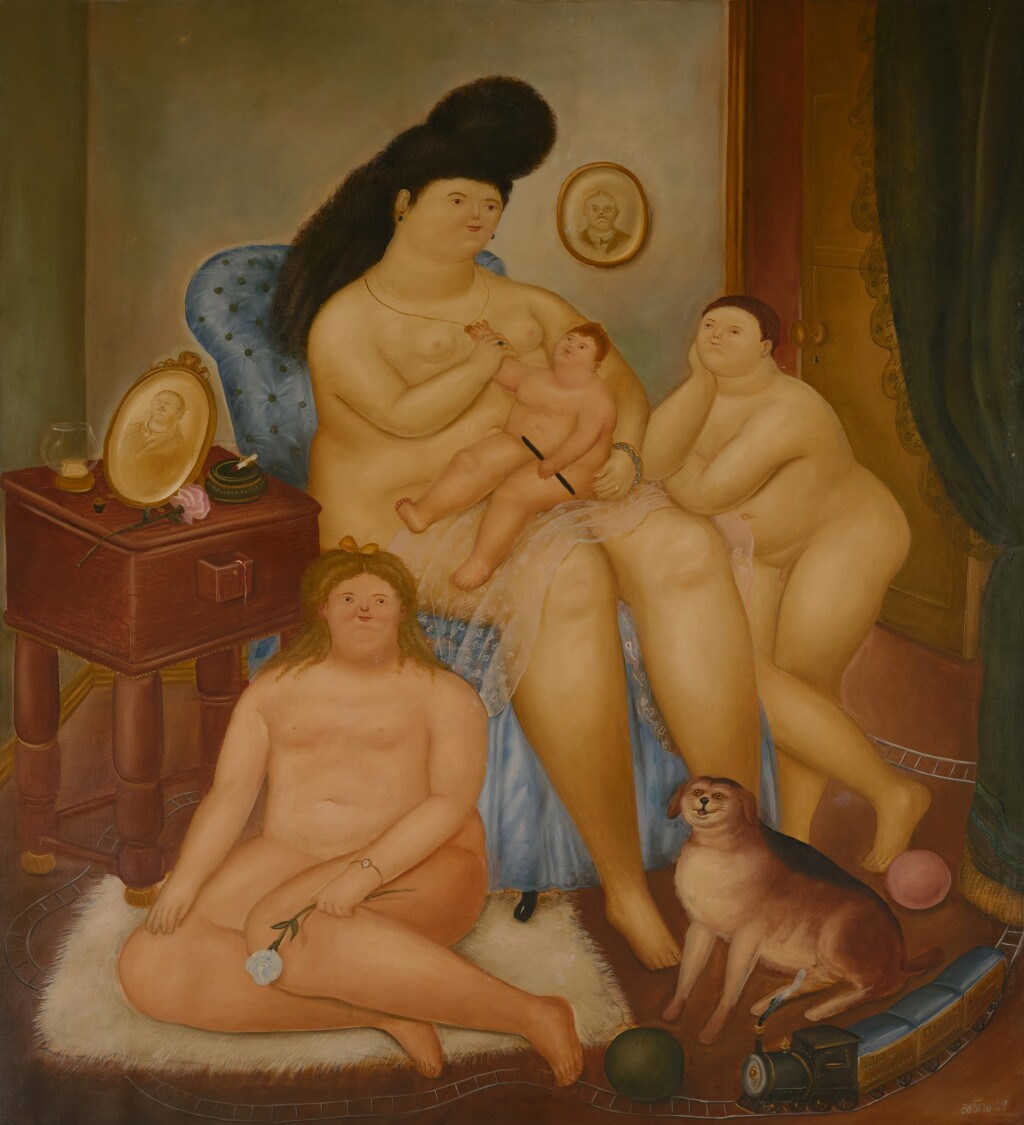
FERNANDO BOTERO (B. 1932)
Familia Protestante, 1969
Oil on canvas
210×175 cm (82 ¾ x 69 inches)
Signed Botero and dated 69 (lower right)
Signed Botero, titled and dated 1969 (on the reverse)
#3. Woman with Parasol and Dog, 1977
Sotheby’s New-York: 20 May 2022
Estimated: USD 700,000 – 900,000
USD 882,000
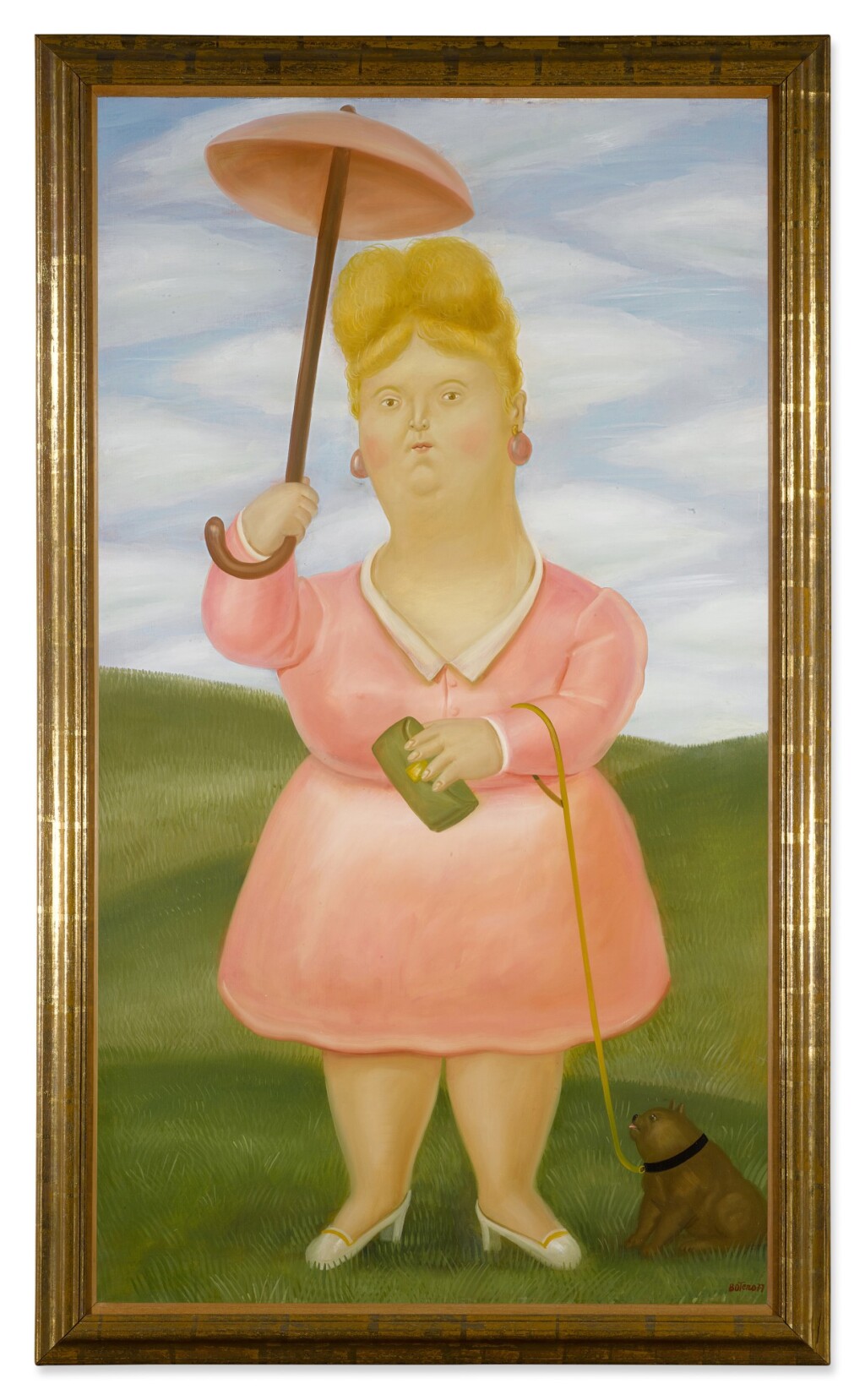
FERNANDO BOTERO (B. 1932)
Woman with Parasol and Dog, 1977
Oil on canvas
198.1 x 109.5 cm (78 x 43 ⅛ inches)
Signed Botero and dated 77 (lower right)
#4. Frente a la catedral, 1994
Christie’s New-York: 11 March 2022
Estimated: USD 700,000 – 1,000,000
USD 882,000
FERNANDO BOTERO (b. 1932) (christies.com)
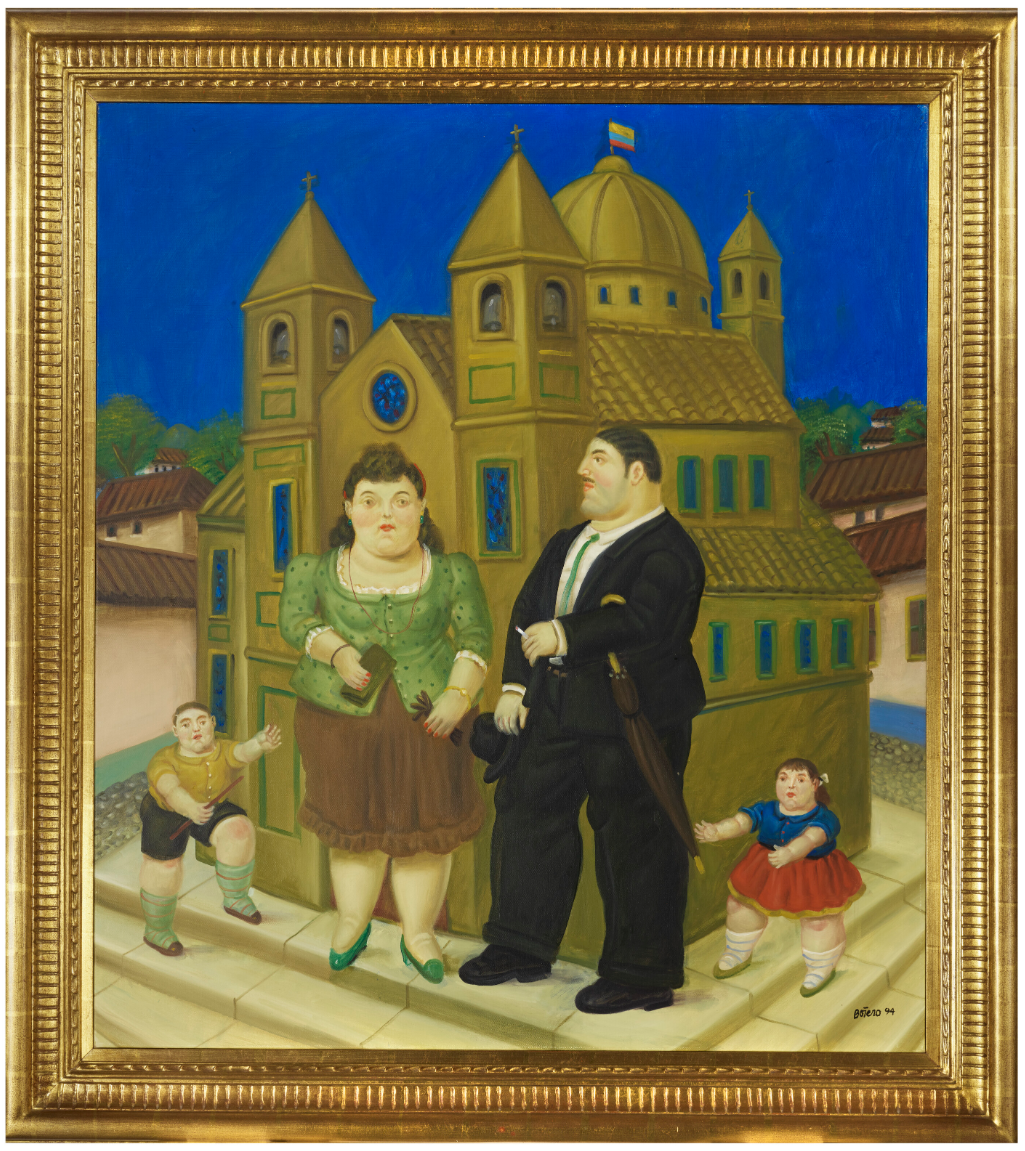
FERNANDO BOTERO (b. 1932)
Frente a la catedral, 1994
Oil on canvas
111.8 x 97.8 cm (44 x 38 1/2 inches)
Signed and dated ‘Botero 94’ (lower right)
#5. La Primera Dama, 1967
Bonhams New-York: 19 May 2022
Estimated: USD 600,000 – 800,000
USD 756,375
Bonhams : FERNANDO BOTERO (B. 1932) La Primera Dama 1967
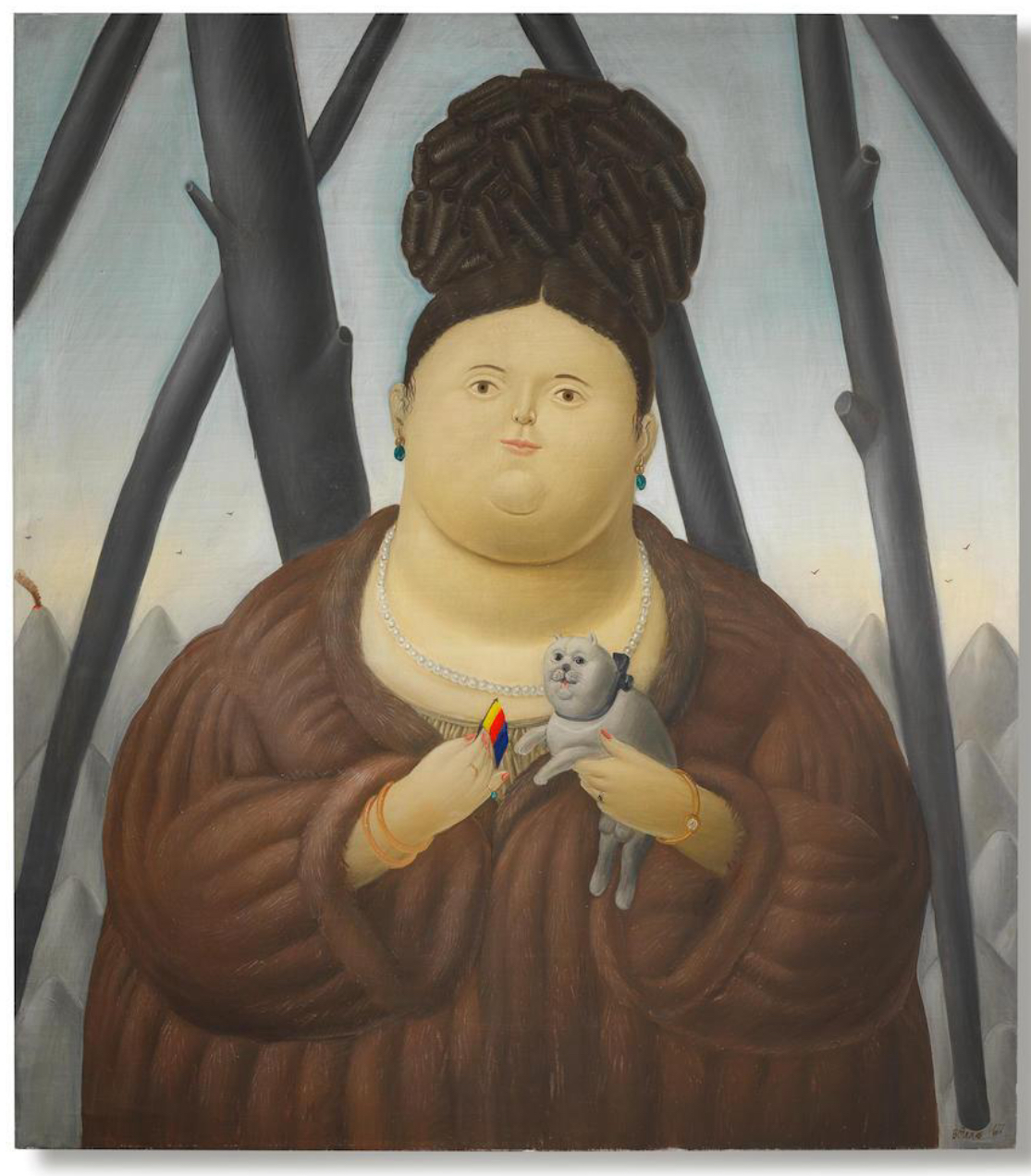
Oil on canvas
183×165 cm (72×65 inches)
Signed and dated 67; signed, titled and dated 67 on the reverse
#6. A Violinist, 1989
Christie’s New-York: 10 March 2022
Estimated: USD 400,000 – 600,000
USD 756,000
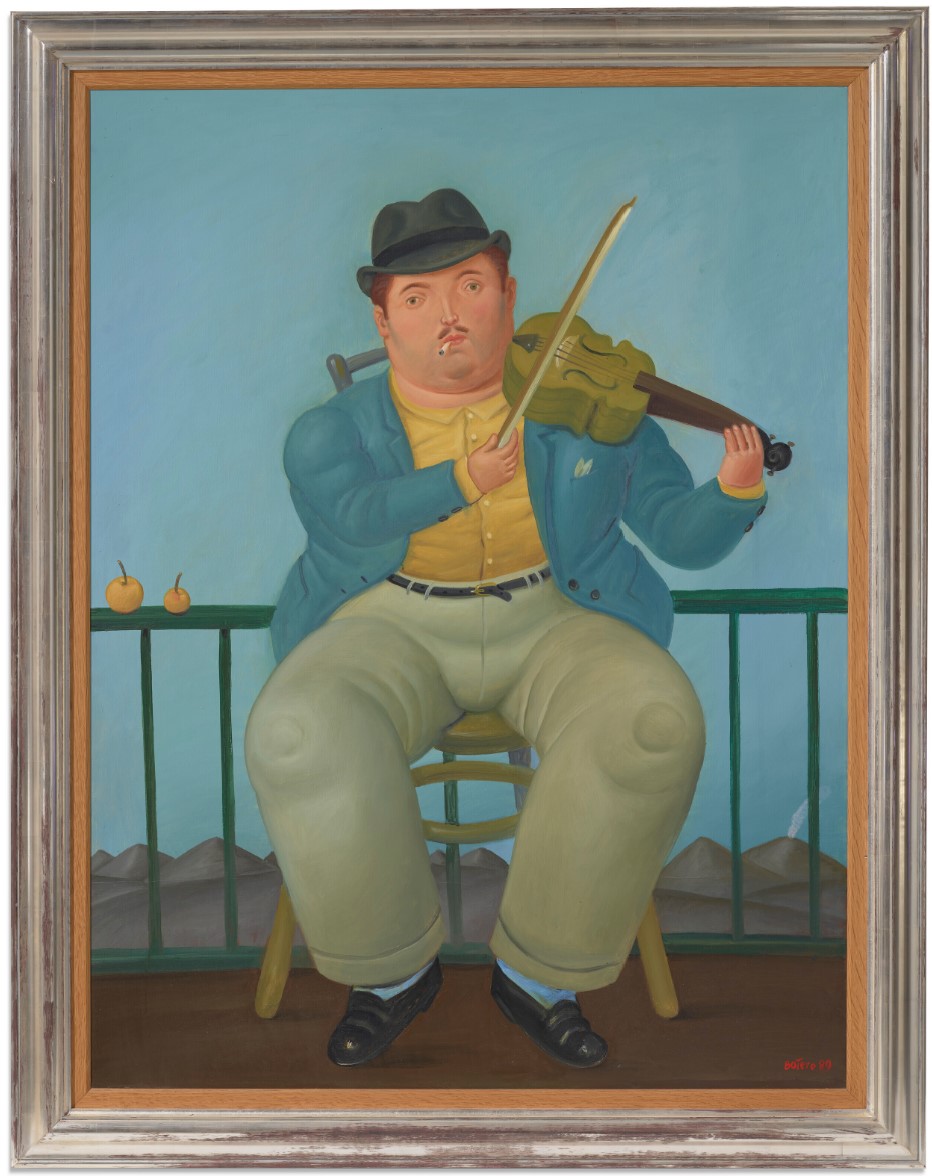
FERNANDO BOTERO (b. 1932)
A Violinist, 1989
Oil on canvas
124×94 cm (48 7/8 x 37 inches)
Signed and dated ‘Botero 89’ (lower right)
#7. Equilibrist, 2007
Christie’s Hong-Kong: 1 December 2022
Estimated: HKD 3,800,000 – 5,800,000
HKD 5,670,000 / USD 728,997
FERNANDO BOTERO (B. 1932) (christies.com)
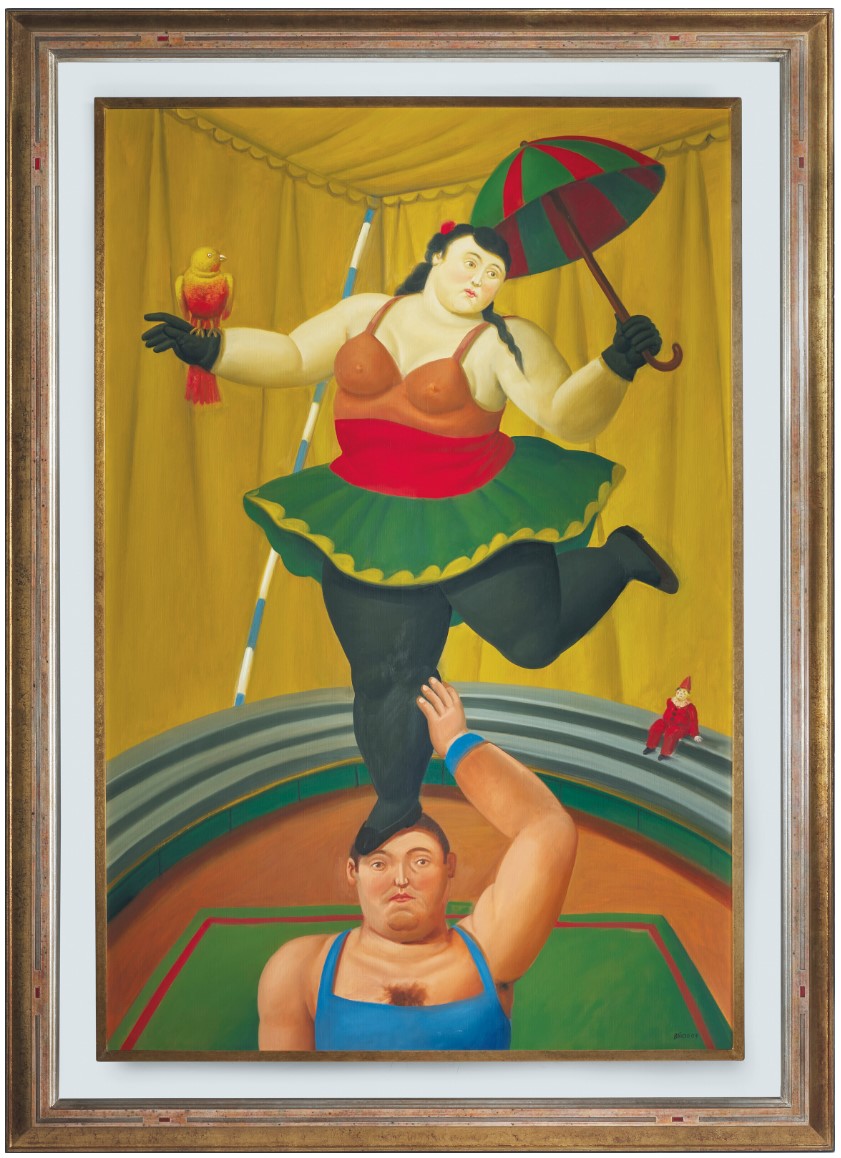
FERNANDO BOTERO (B. 1932)
Equilibrist, 2007
Oil on canvas
175 x 117.5 cm (68 7/8 x 46 1/4 inches)
Signed and dated ‘Botero 07’ (lower right)
#8. Picador in the Bullring, 1985
Sotheby’s New-York: 17 November 2022
Estimated: USD 600,000 – 800,000
USD 693,000
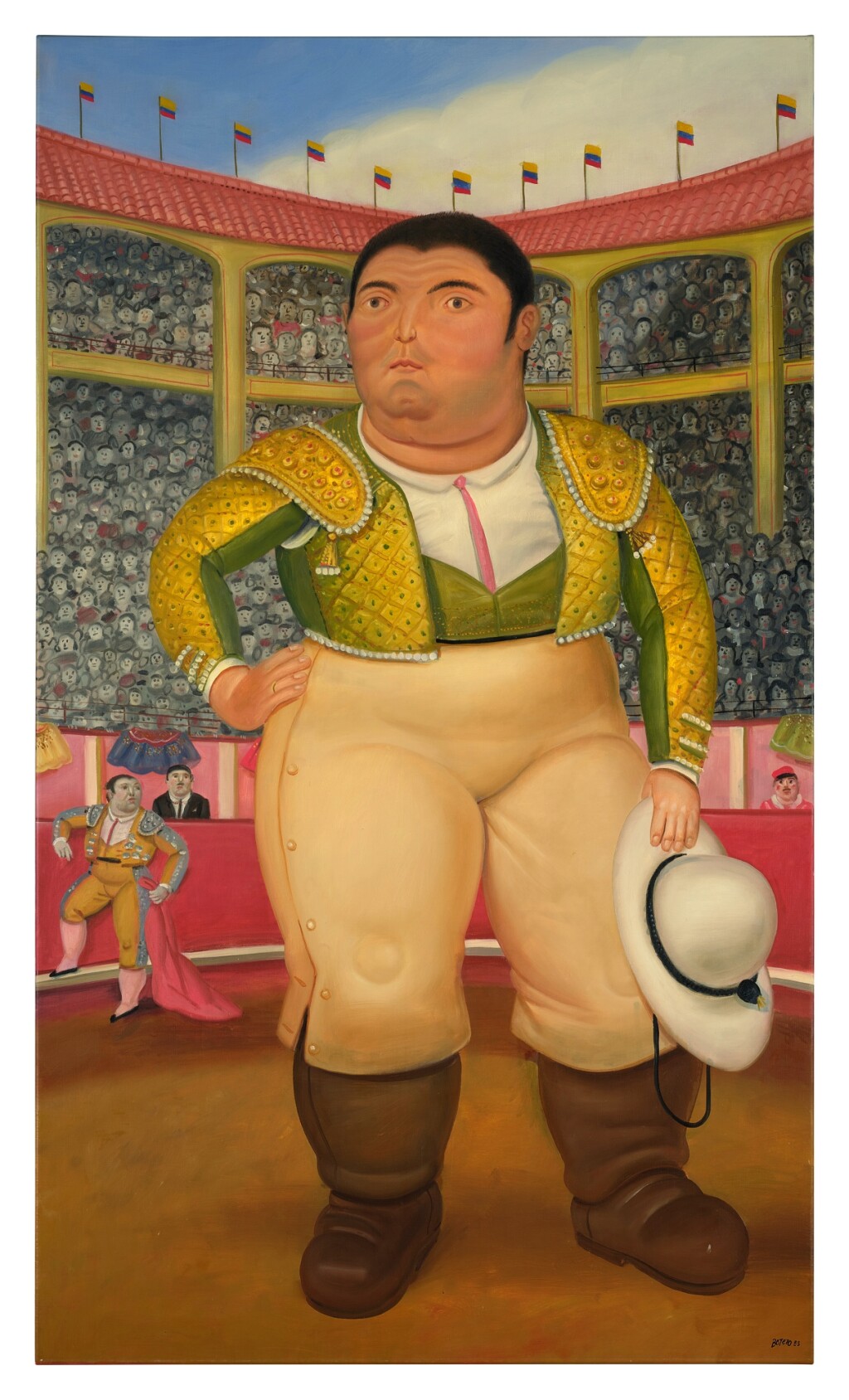
FERNANDO BOTERO (B. 1932)
Picador in the Bullring, 1985
Oil on canvas
168.9 x 99.1 cm (66 ½ x 39 inches)
Signed Botero and dated 85 (lower right)
#9. Interior, 1994
Christie’s New-York: 10 March 2022
Estimated: USD 500,000 – 700,000
USD 680,400
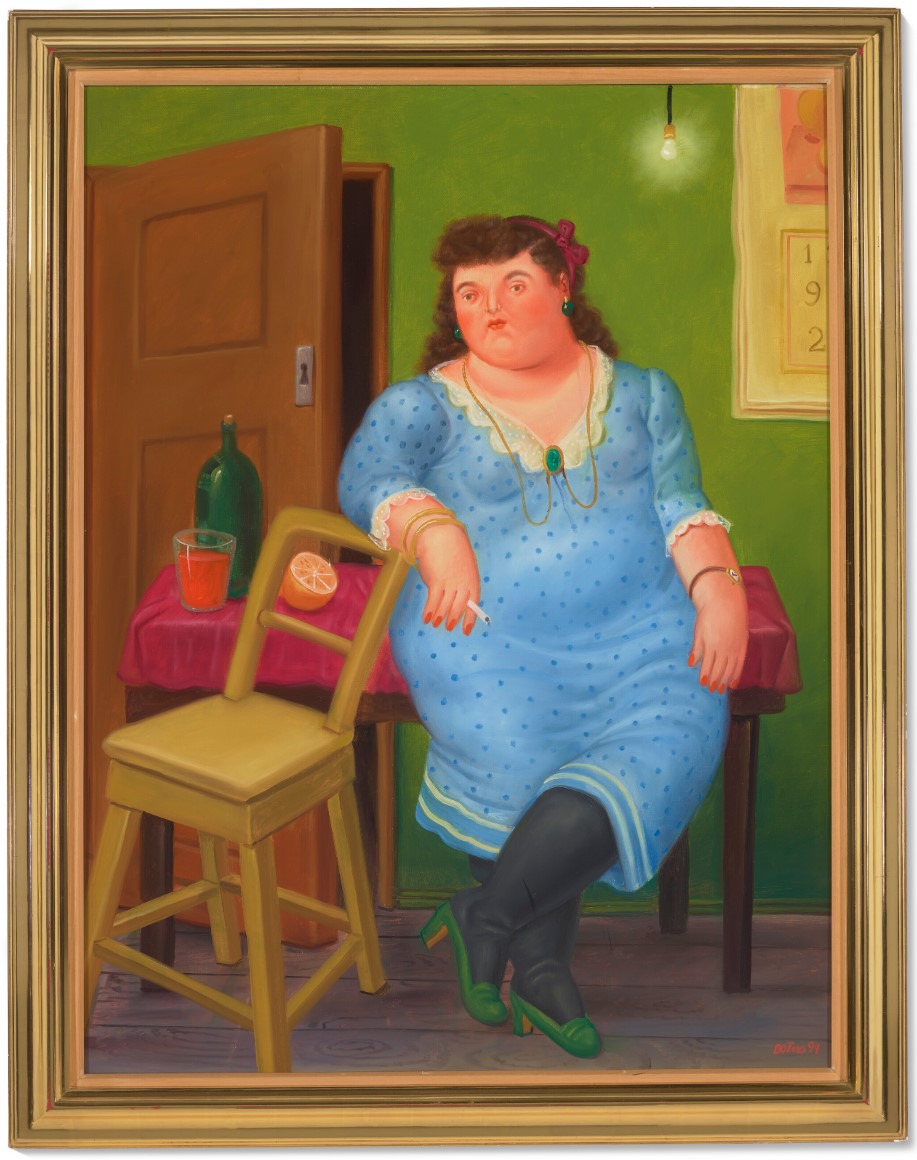
FERNANDO BOTERO (b. 1932)
Interior, 1994
Oil on canvas
120×91 cm (47 1⁄4 x 35 7⁄8 inches)
Signed and dated ‘Botero 94’ (lower right)
#10. Woman in Blue, 2002
Sotheby’s New-York: 11 March 2022
Estimated: USD 350,000 – 450,000
USD 592,200
Woman in Blue | Contemporary Curated | 2022 | Sotheby’s (sothebys.com)
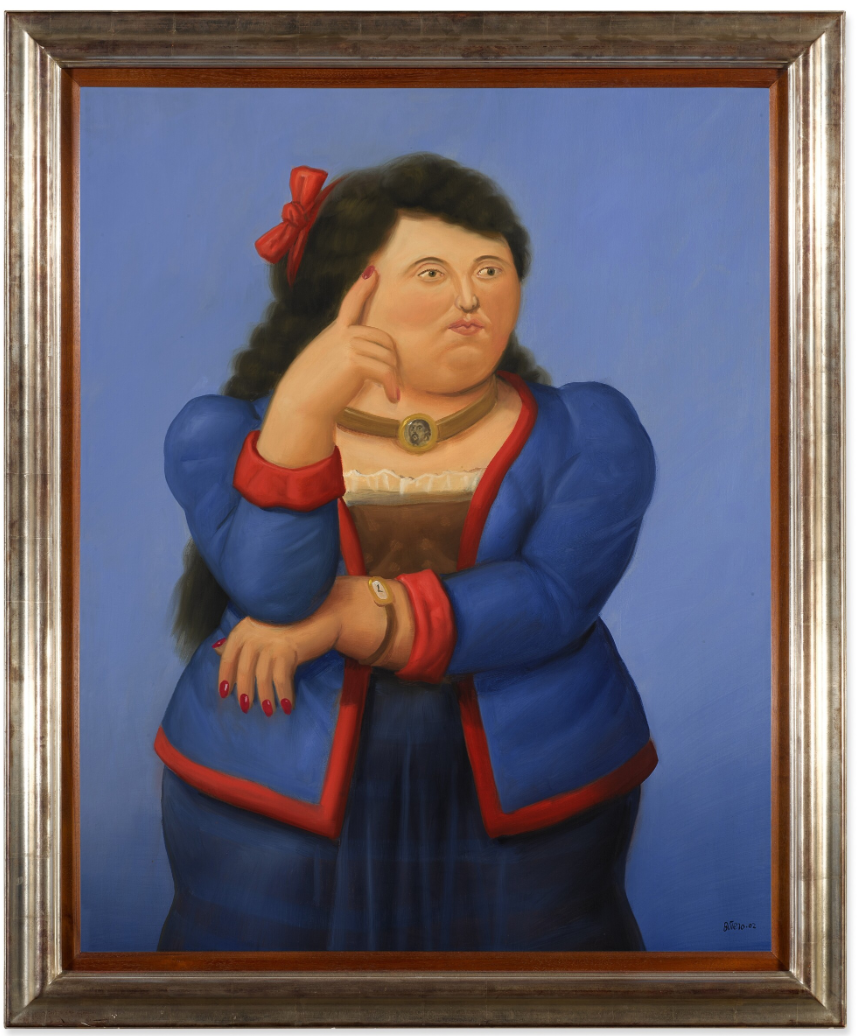
FERNANDO BOTERO (b. 1932)
Woman in Blue, 2002
Oil on canvas
114.3 x 91.5 cm (45×36 inches)
Signed Botero and dated 02 (lower right)
#11. Society Lady, 1997
Sotheby’s New-York: 17 November 2022
Estimated: USD 350,000 – 450,000
USD 567,000
Society Lady | Contemporary Day Auction | 2022 | Sotheby’s (sothebys.com)
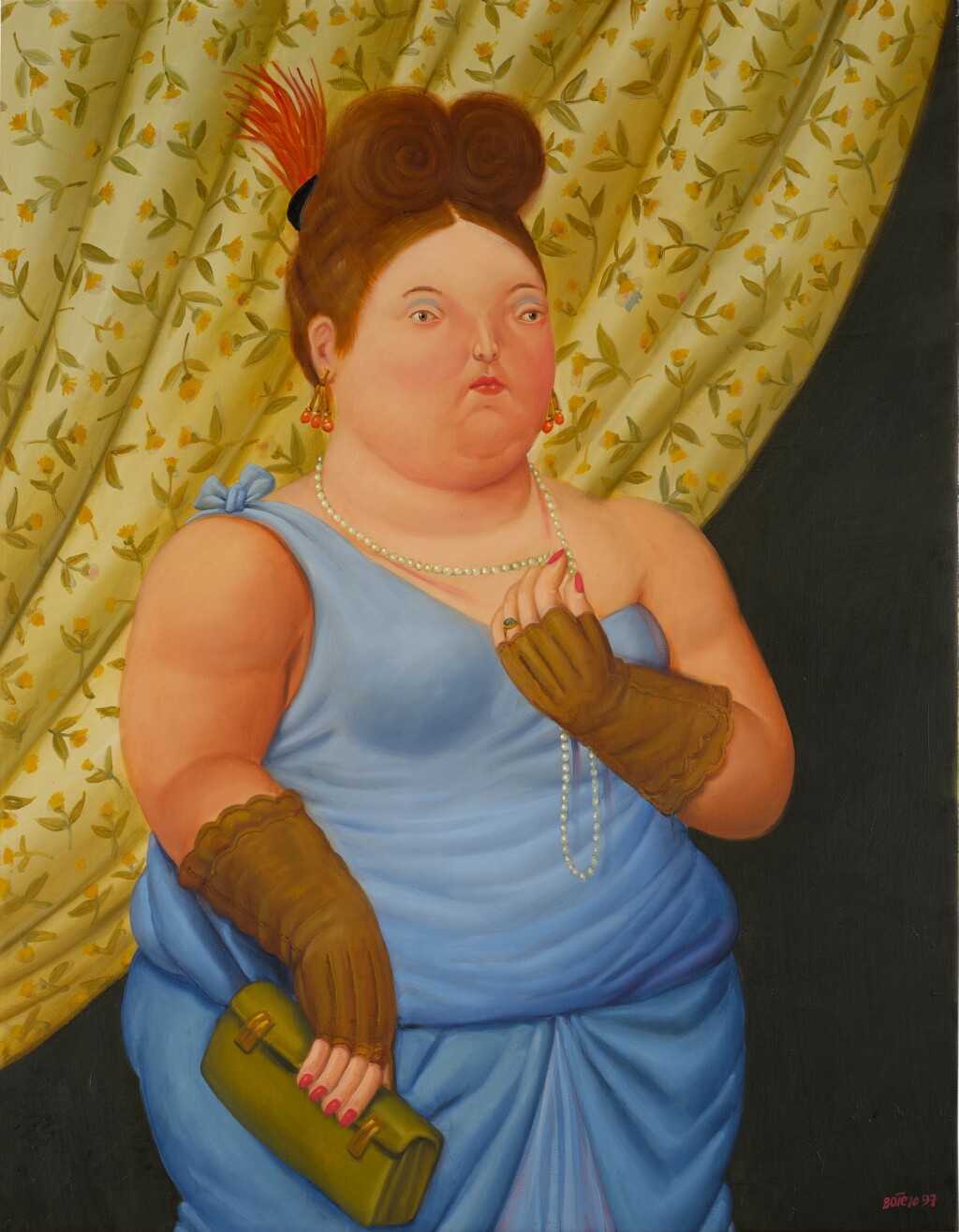
FERNANDO BOTERO (B. 1932)
Society Lady, 1997
Oil on canvas
125.7 x 97.8 cm (49 ½ x 38 ½ inches)
Signed Botero and dated 97 (lower right)
#12. Circus Woman, 2008
Christie’s Hong-Kong: 1 December 2022
Estimated: HKD 2,800,000 – 3,800,000
HKD 4,410,000 / USD 566,998
FERNANDO BOTERO (B. 1932) (christies.com)
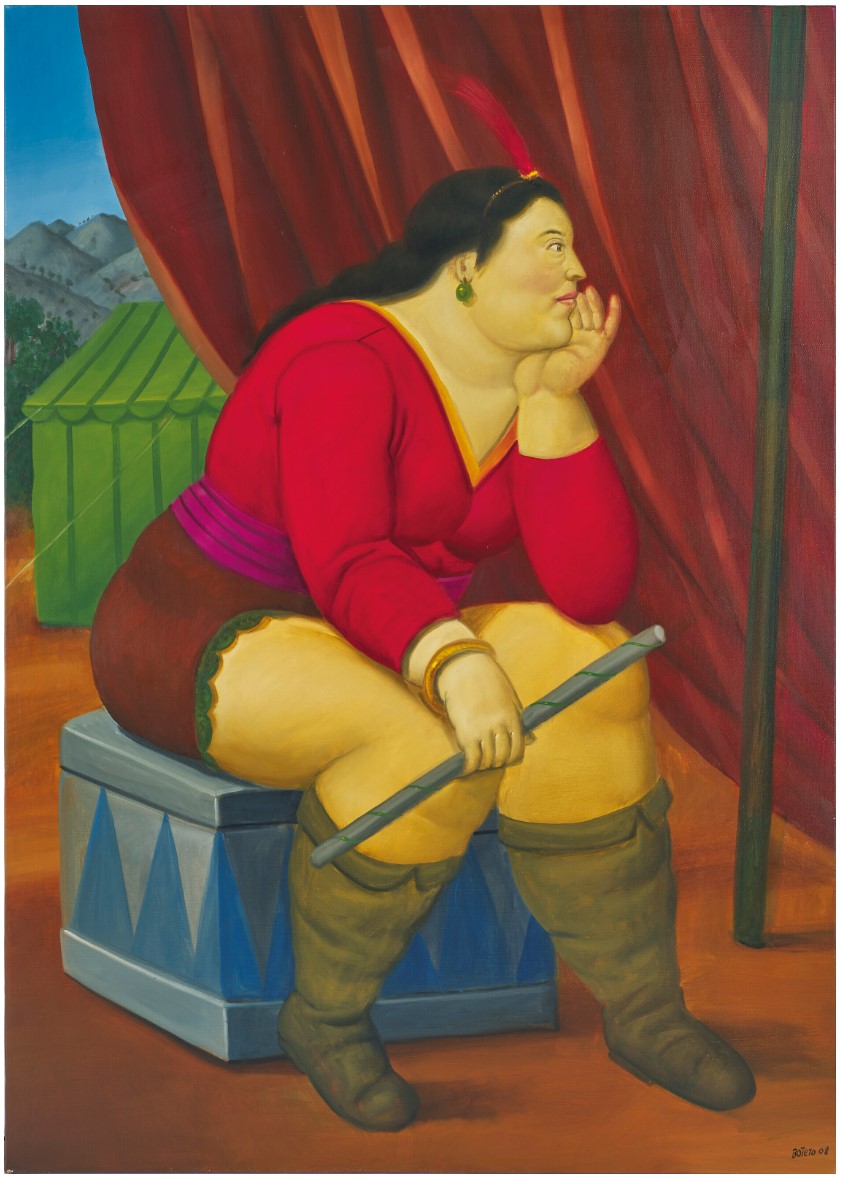
FERNANDO BOTERO (B. 1932)
Circus Woman, 2008
Oil on canvas
133×95 cm (52 3/8 x 37 3/8 inches)
Signed and dated ‘Botero 08’ (lower right)
#13. Bishop in the Forest, 1967
Christie’s New-York: 11 March 2022
Estimated: USD 300,000 – 400,000
USD 529,200
FERNANDO BOTERO (b. 1932), Bishop in the Forest | Christie’s (christies.com)
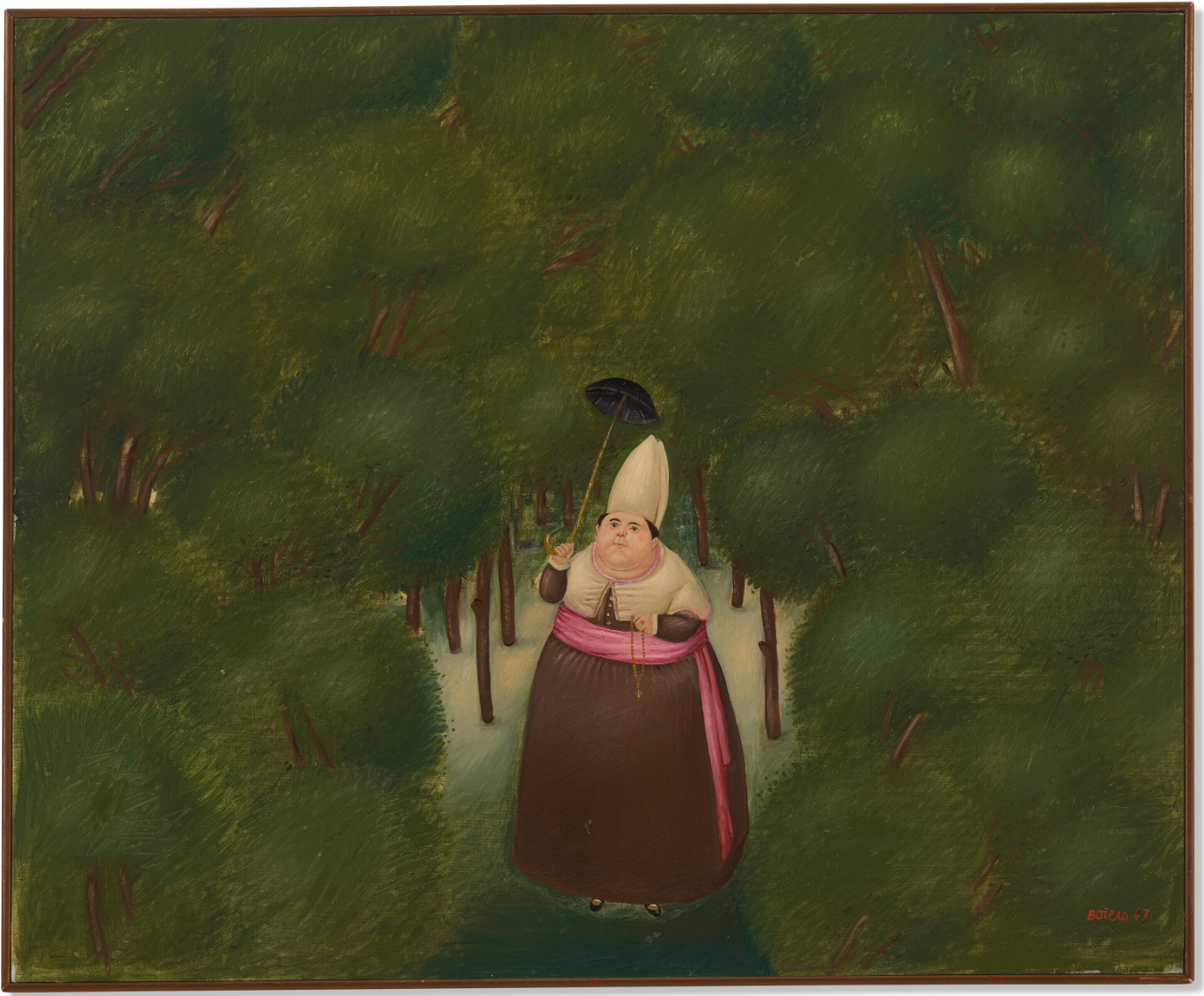
FERNANDO BOTERO (b. 1932)
Bishop in the Forest, 1967
Oil on canvas
95.3 x 116 cm (37 1/2 x 45 1/2 inches)
Signed and dated ‘Botero 67’ (lower right), and ‘Botero 67’ (on the reverse)
#14. Still Life with Green Soup, 1972
Christie’s New-York: 30 September 2022
Estimated: USD 350,000 – 450,000
USD 504,000
Fernando Botero (b. 1932) (christies.com)
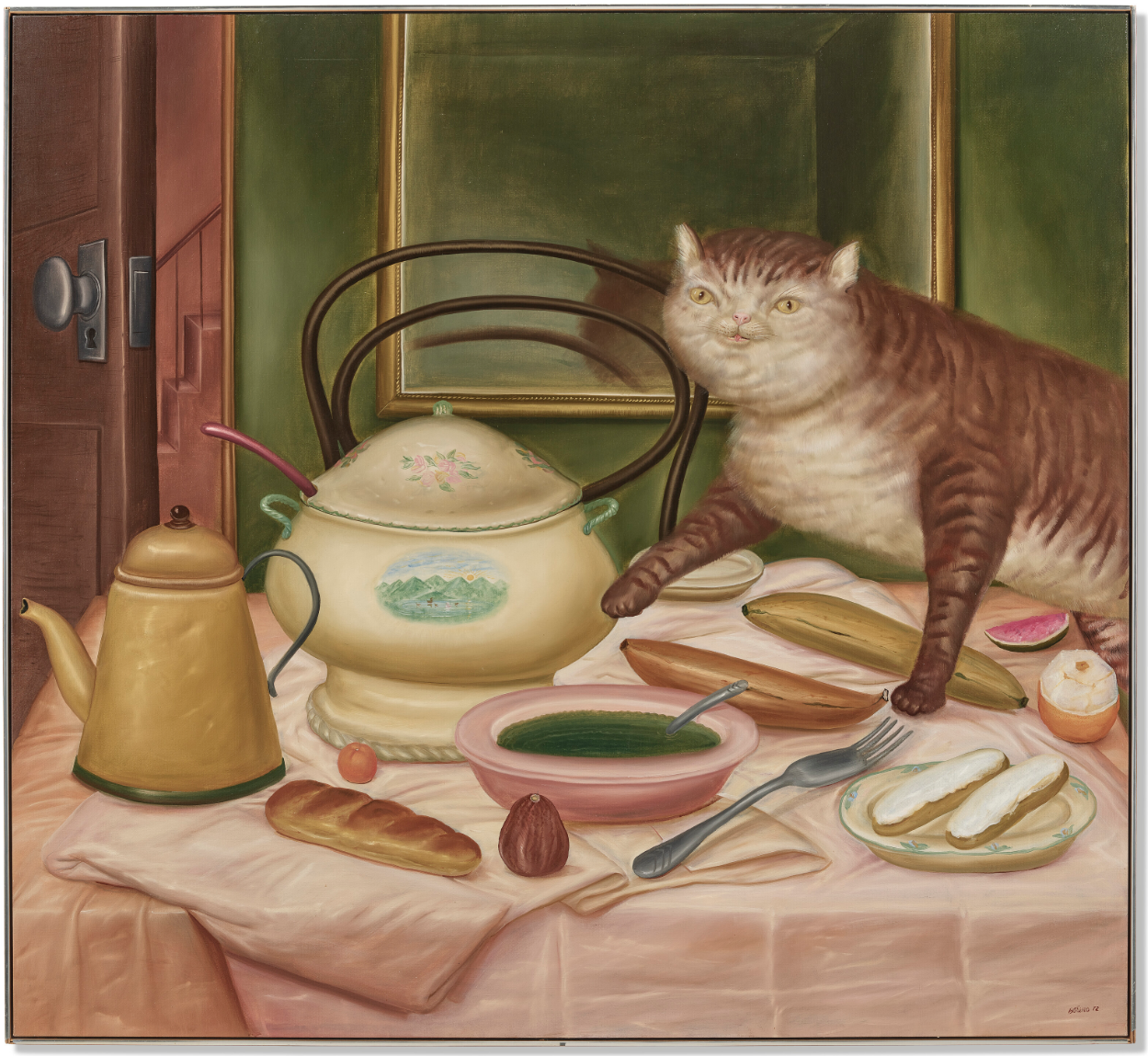
FERNANDO BOTERO (b. 1932)
Still Life with Green Soup, 1972
Oil on canvas
55 x 70 1/2 inches (139.7 x 179.1 cm)
Signed and dated ‘Botero 72’ (lower right)
#15. Painter of Still Lifes, 1994
Shapiro Auctions: 16 December 2022
Estimated: USD 350,000 – 450,000
USD 462,500
FERNANDO BOTERO (COLOMBIAN B. 1932) — FINE & DECORATIVE ART AUCTION – Shapiro Auctions
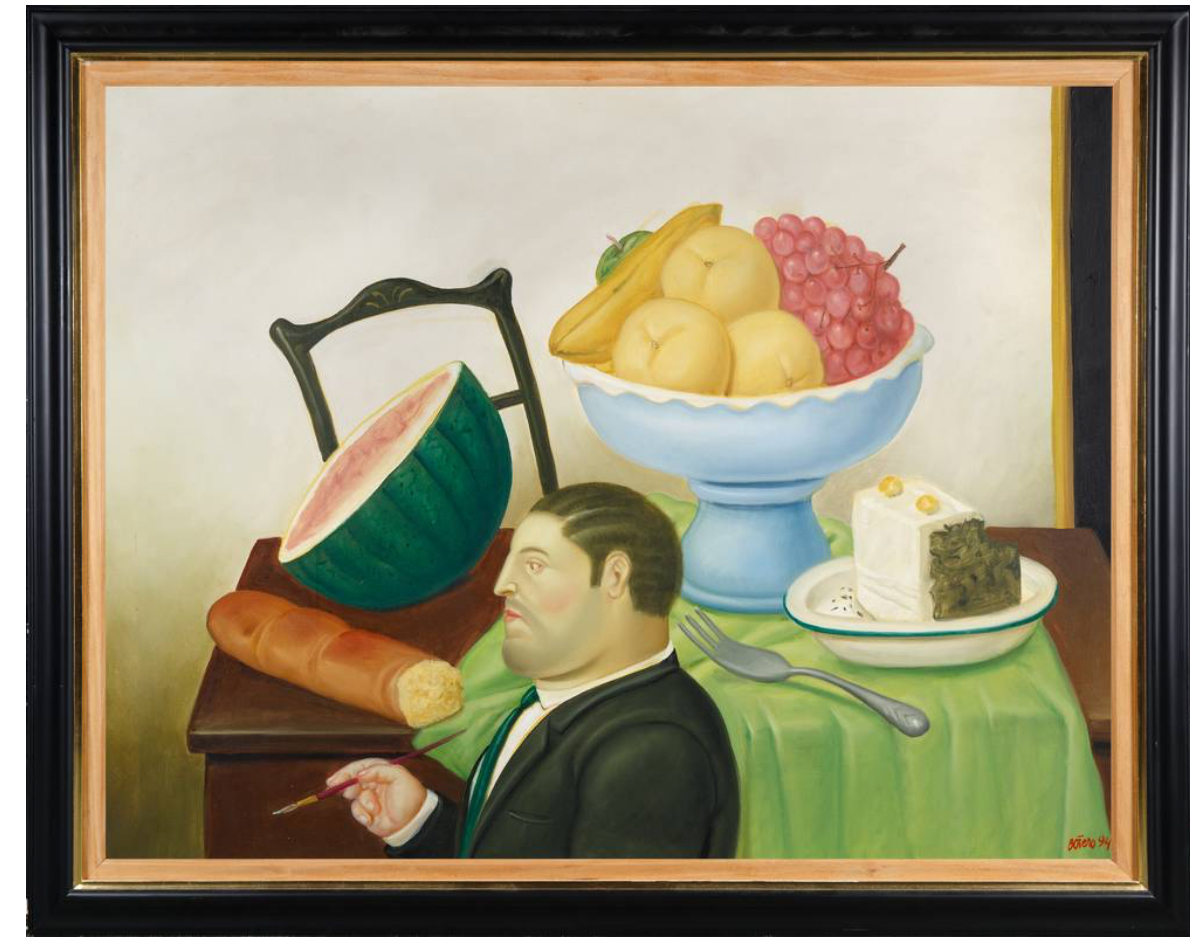
FERNANDO BOTERO (COLOMBIAN B. 1932)
Painter of Still Lifes, 1994
Oil on canvas
100×130 cm (39 3/8 x 51 1/8 inches)
Signed and dated lower right
#16. The Trapezist, 2007
Christie’s Hong-Kong: 1 December 2022
Estimated: HKD 1,800,000 – 2,800,000
HKD 3,276,000 / USD 421,198
FERNANDO BOTERO (B. 1932), The Trapezist | Christie’s (christies.com)
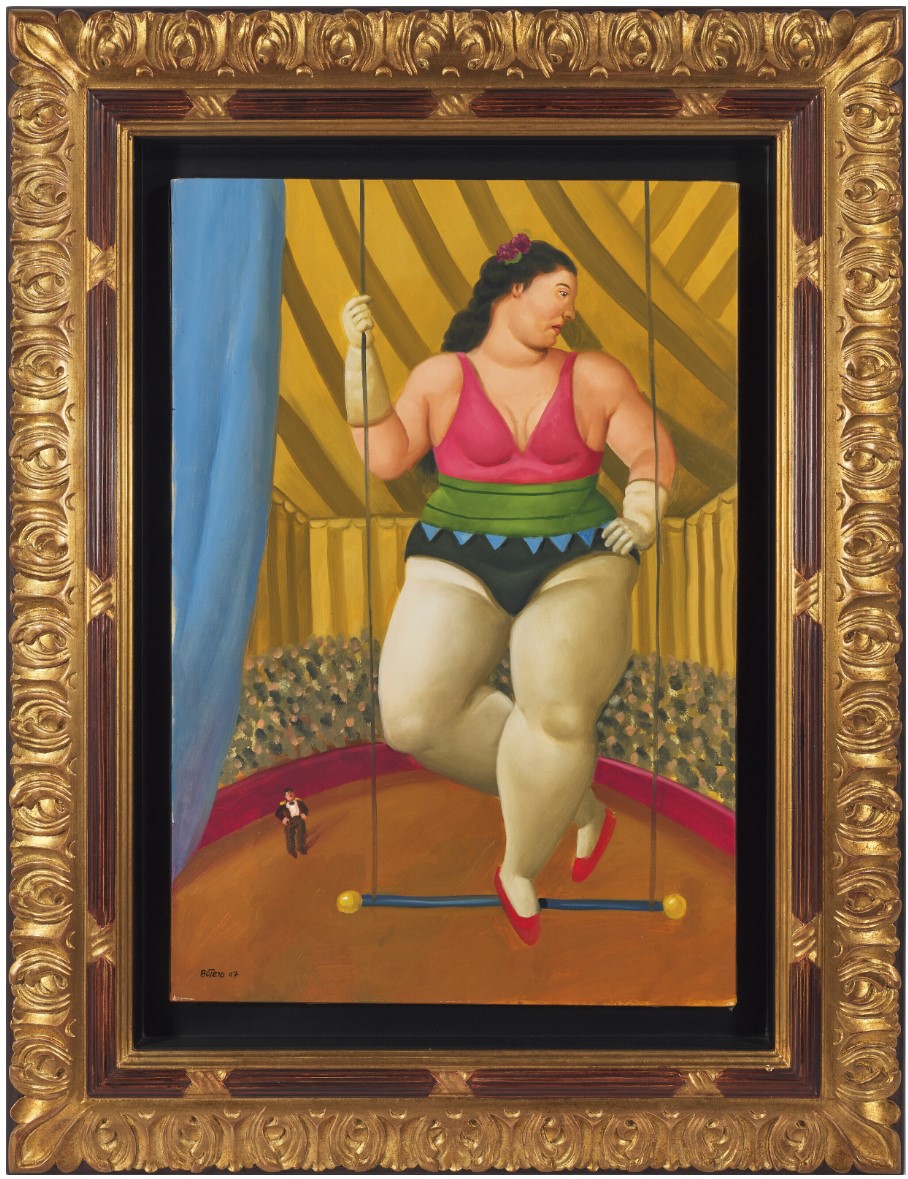
FERNANDO BOTERO (B. 1932)
The Trapezist, 2007
Oil on canvas
82 x 56.5 cm (32 1/4 x 22 1/4 inches)
Signed and dated ‘Botero 07’ (lower left)
#17. Niño, 1993
Christie’s New-York: 30 September 2022
Estimated: USD 250,000 – 350,000
USD 415,800
Fernando Botero (b. 1932), Niño | Christie’s (christies.com)
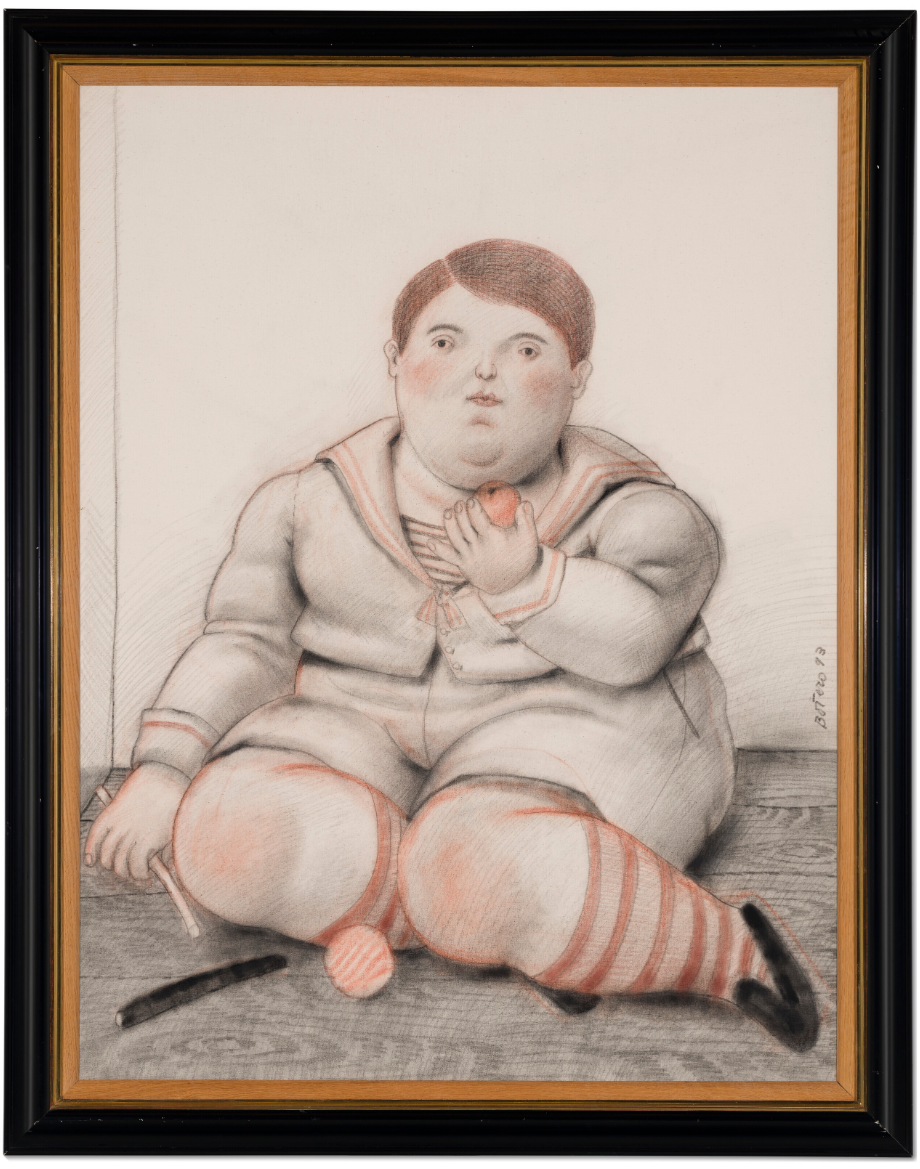
FERNANDO BOTERO (b. 1932)
Niño, 1993
Sanguine and charcoal on canvas
130×99 cm (51 1/2 x 39 3/4 inches)
Signed and dated ‘BOTERO 93’ (center right)
#18. Woman with a Mink Stole, 1971
Sotheby’s New-York: 17 November 2022
Estimated: USD 300,000 – 400,000
USD 403,200
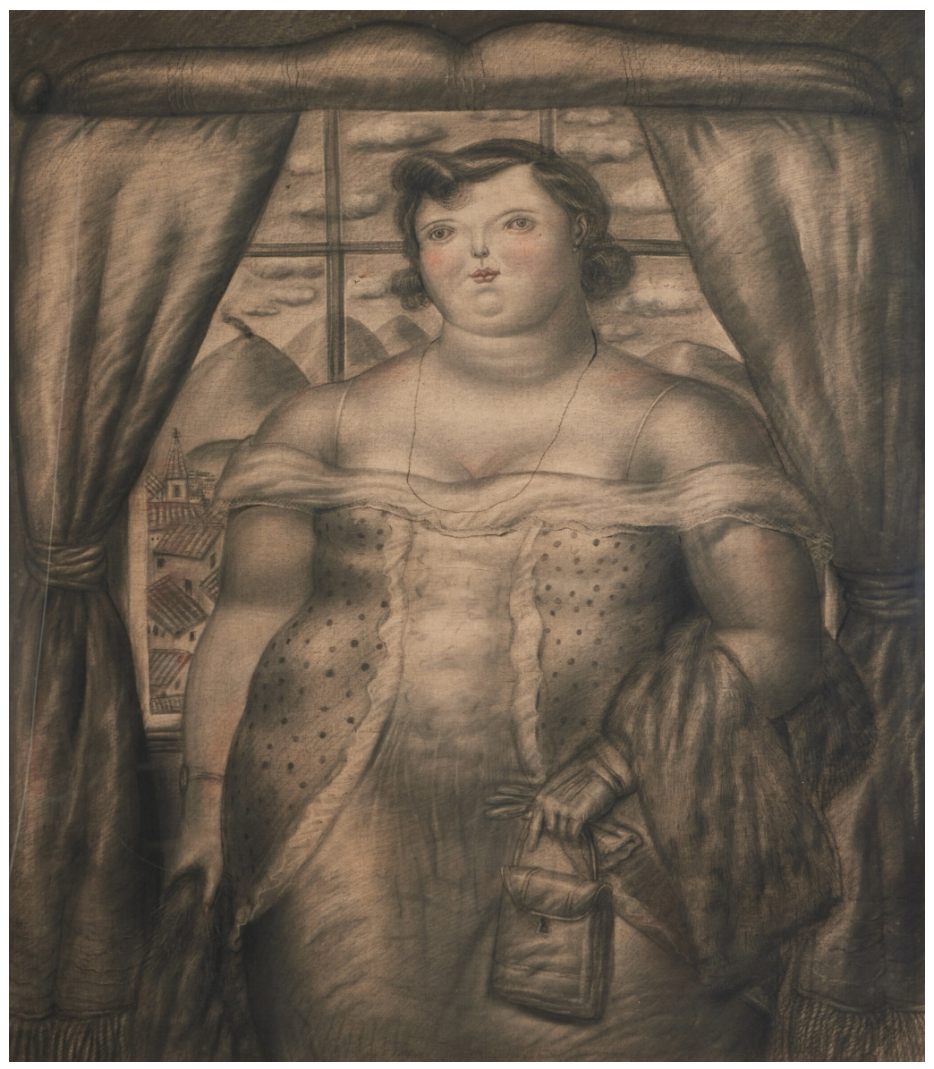
FERNANDO BOTERO
Woman with a Mink Stole, 1971
Charcoal and pastel on canvas
181.5 x 158 cm (71 1/2 x 62 1/4 inches)
Signed Botero and dated 71 (on the reverse)
#19. El taller de Vermeer, 1964
Sotheby’s New-York: 18 May 2022
Estimated: USD 300,000 – 400,000
USD 403,200
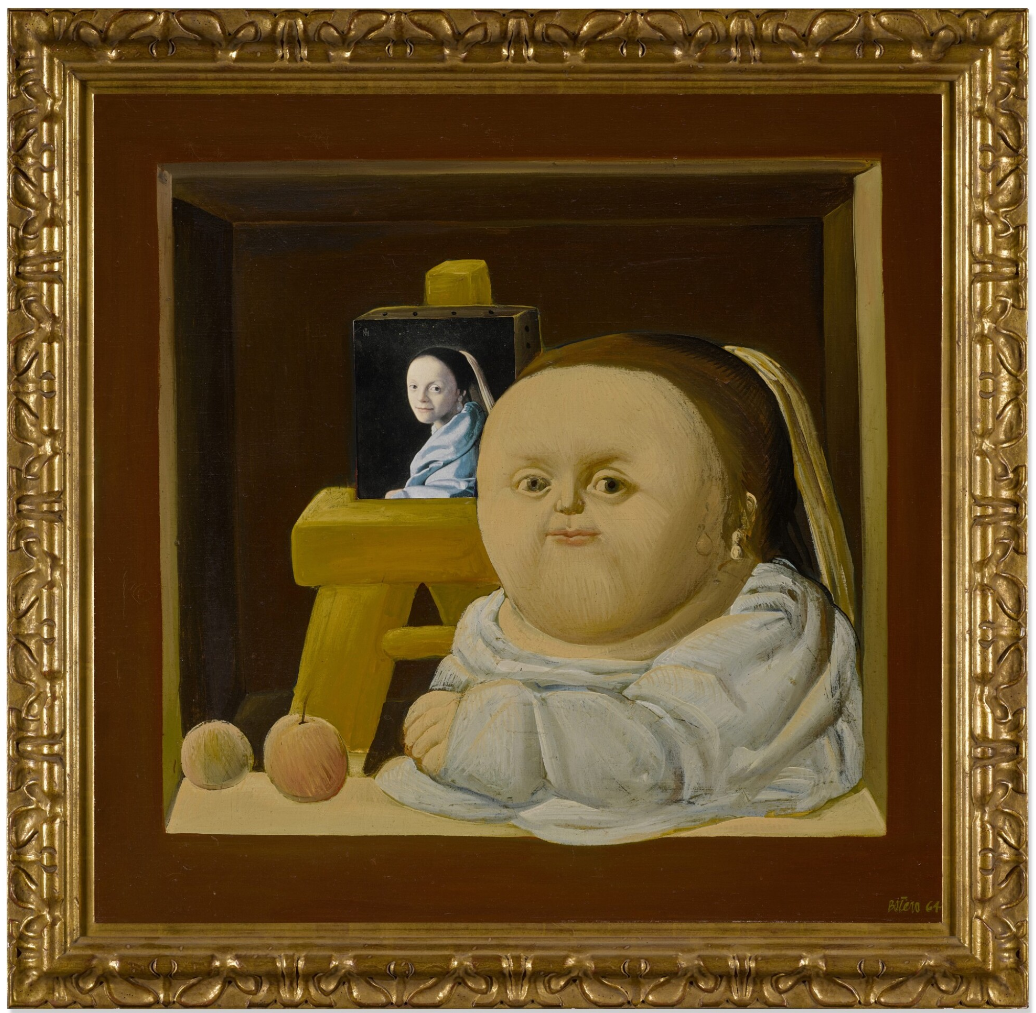
FERNANDO BOTERO
El taller de Vermeer, 1964
Oil and paper collage on canvas
104.4 x 106.7 cm (41×42 inches)
Signed Botero and dated 64 (lower right)
Signed Botero, titled and dated 64 (on the reverse)
#20. A Lawyer, 1998
Sotheby’s New-York: 20 May 2022
Estimated: USD 300,000 – 400,000
USD 378,000
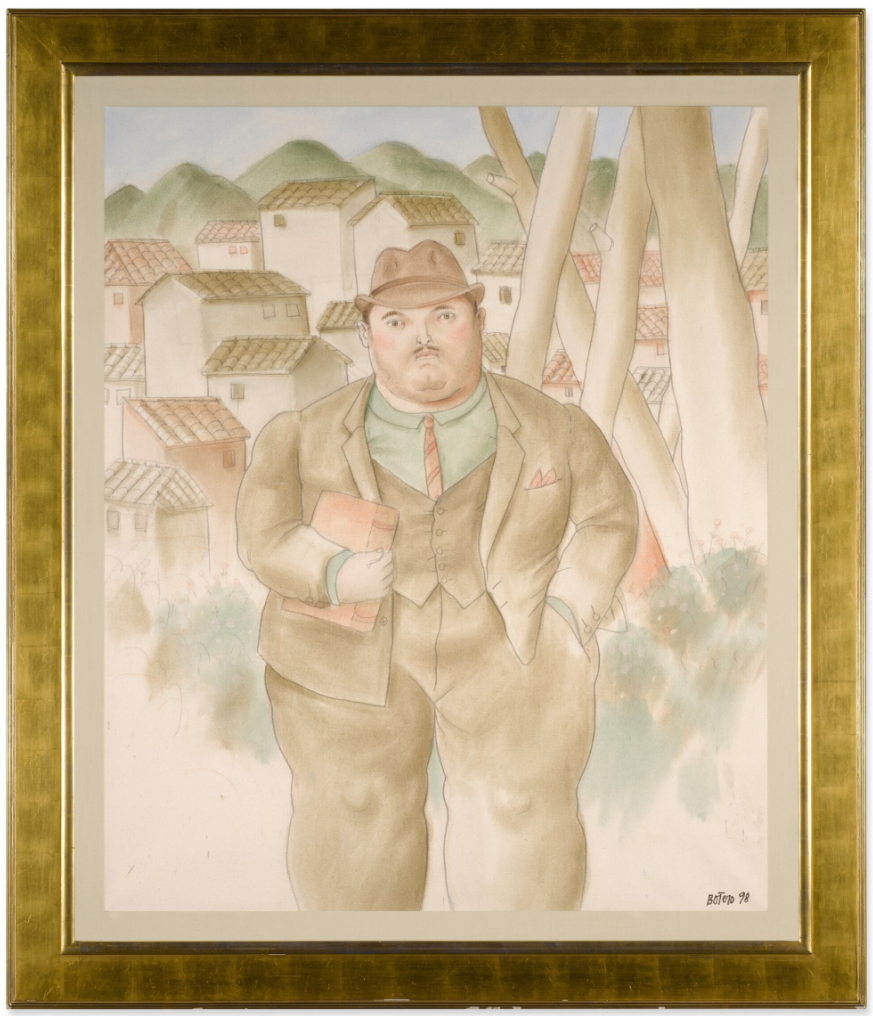
FERNANDO BOTERO
A Lawyer, 1998
Pastel, charcoal, watercolor and pencil on canvas
125.7 x 103.8 cm (49 1/2 x 40 7/8 inches)
Signed Botero and dated 98 (lower right)
#21. The Bedroom, 1997
Sotheby’s New-York: 20 May 2022
Estimated: USD 150,000 – 250,000
USD 352,800
The Bedroom | Contemporary Day Auction | 2022 | Sotheby’s (sothebys.com)
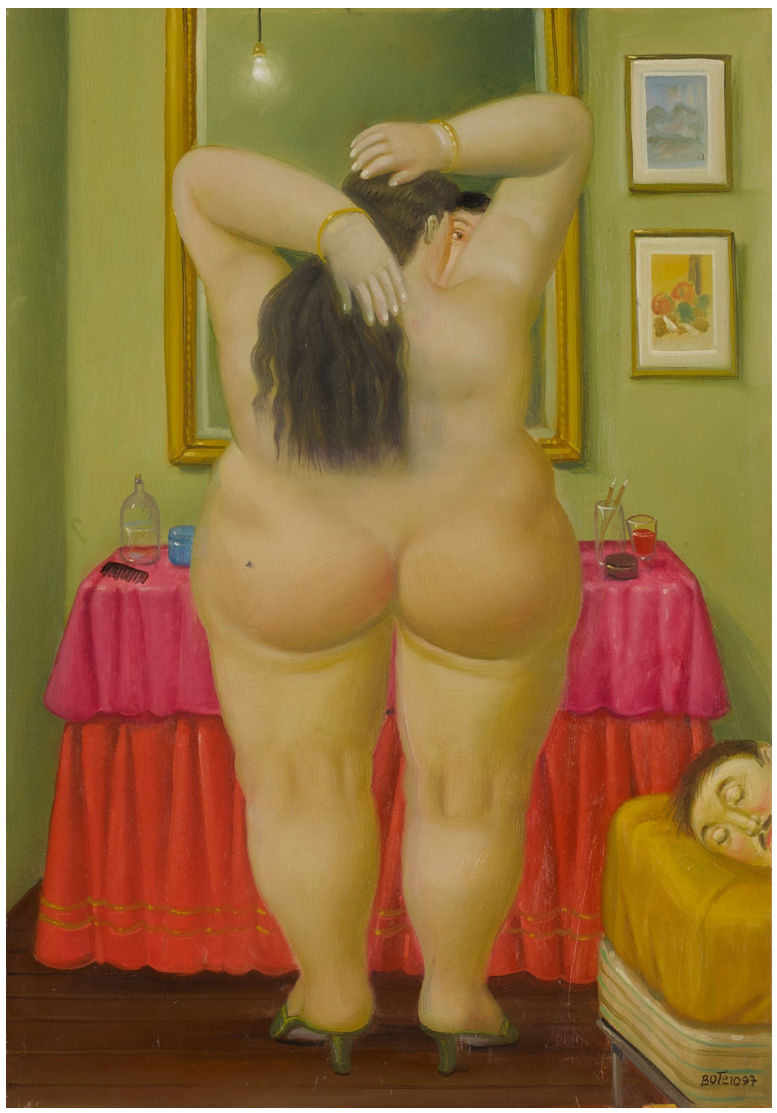
FERNANDO BOTERO
The Bedroom, 1997
Oil on canvas
57.2 x 40 cm (22 1/2 x 15 3/4 inches)
Signed Botero and dated 97 (lower right)
#22. Cebollas españolas, #2, 1969
Christie’s New-York: 30 September 2022
Estimated: USD 200,000 – 300,000
USD 352,800
Fernando Botero (b. 1932), Cebollas españolas, #2 | Christie’s (christies.com)
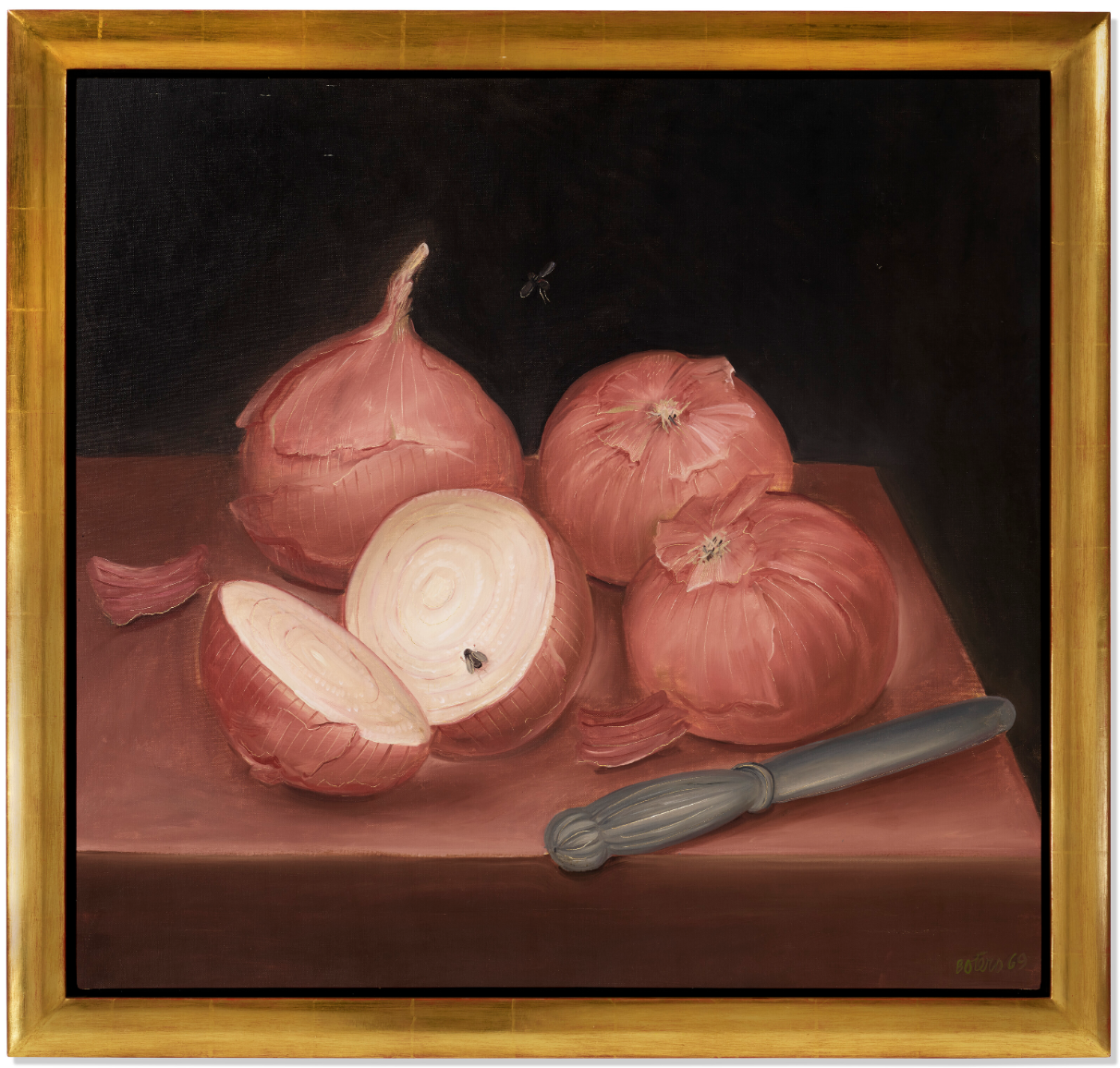
FERNANDO BOTERO (b. 1932)
Cebollas españolas, #2, 1969
Oil on canvas
87×92 cm (34 1/4 x 36 inches)
Signed and dated ‘Botero 69’ (lower right)
Titled and dated ‘Cebollas Españolas, #2, 69’ (on the reverse)
#23. Still Life with Fruits, 1998
Christie’s New-York: 11 March 2022
Estimated: USD 300,000 – 400,000
USD 327,600
FERNANDO BOTERO (b. 1932), Still Life with Fruits | Christie’s (christies.com)
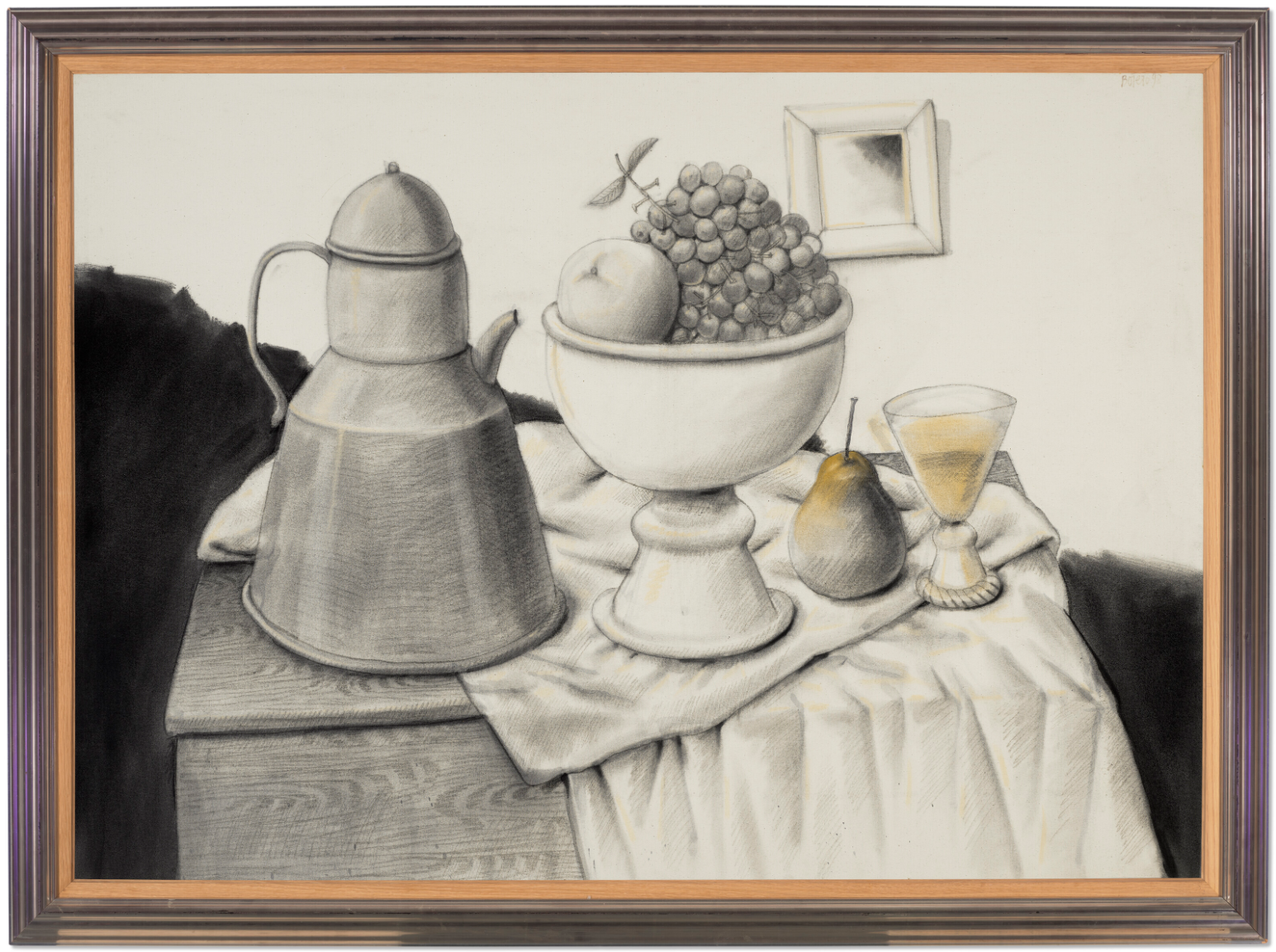
FERNANDO BOTERO (b. 1932)
Still Life with Fruits, 1998
Charcoal and chalk on canvas
118.1 x 164.7 cm (46 1/2 x 64 7/8 inches)
Signed and dated ‘Botero 98’ (upper right)
#24. El cuarto de baño, 2000
Christie’s New-York: 10 March 2022
Estimated: USD 150,000 – 200,000
USD 302,400
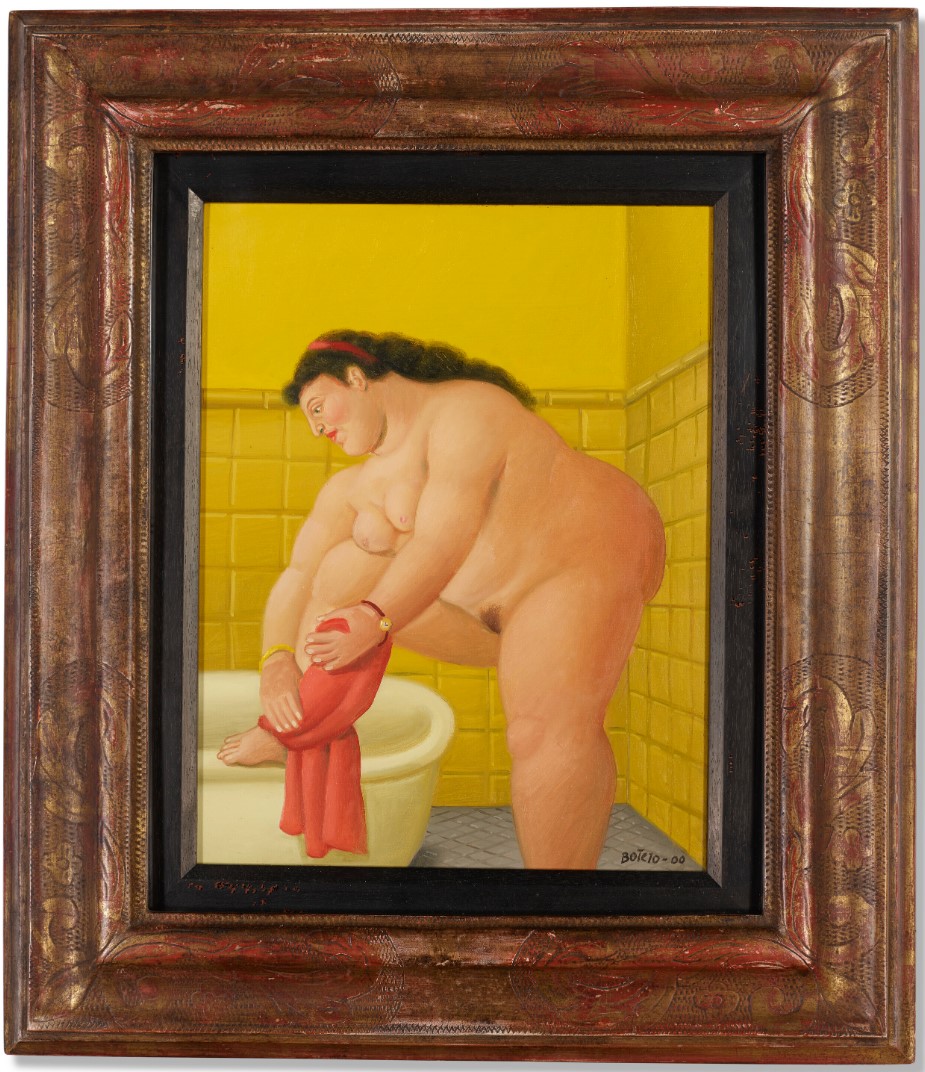
FERNANDO BOTERO (b. 1932)
El cuarto de baño, 2000
Oil on canvas
33.7 x 26 cm (13 1/4 x 10 1/4 inches)
Signed and dated ‘Botero 00’ (lower right)
#25. Woman Bitten by a Dog, 1994
Sotheby’s New-York: 17 November 2022
Estimated: USD 200,000 – 300,000
USD 277,200
Woman Bitten by a Dog | Contemporary Day Auction | 2022 | Sotheby’s (sothebys.com)
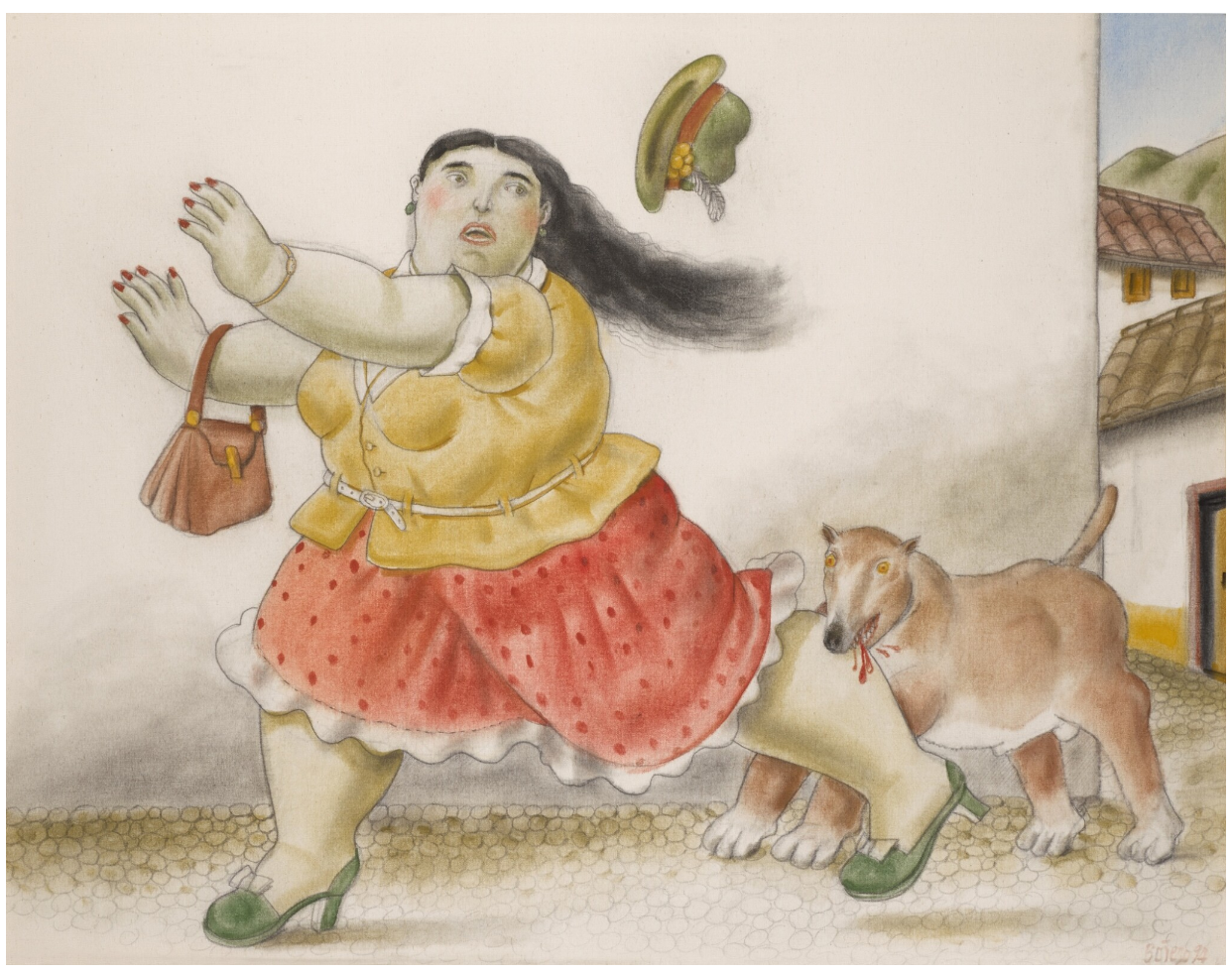
FERNANDO BOTERO
Woman Bitten by a Dog, 1994
Pastel, charcoal, watercolor and pencil on canvas
98.4 x 125 cm (38 3/4 x 49 1/4 inches)
Signed Botero and dated 94 (lower right)
#26. Desnudo, 1994
Sotheby’s New-York: 20 May 2022
Estimated: USD 200,000 – 300,000
USD 277,200
Desnudo | Contemporary Day Auction | 2022 | Sotheby’s (sothebys.com)
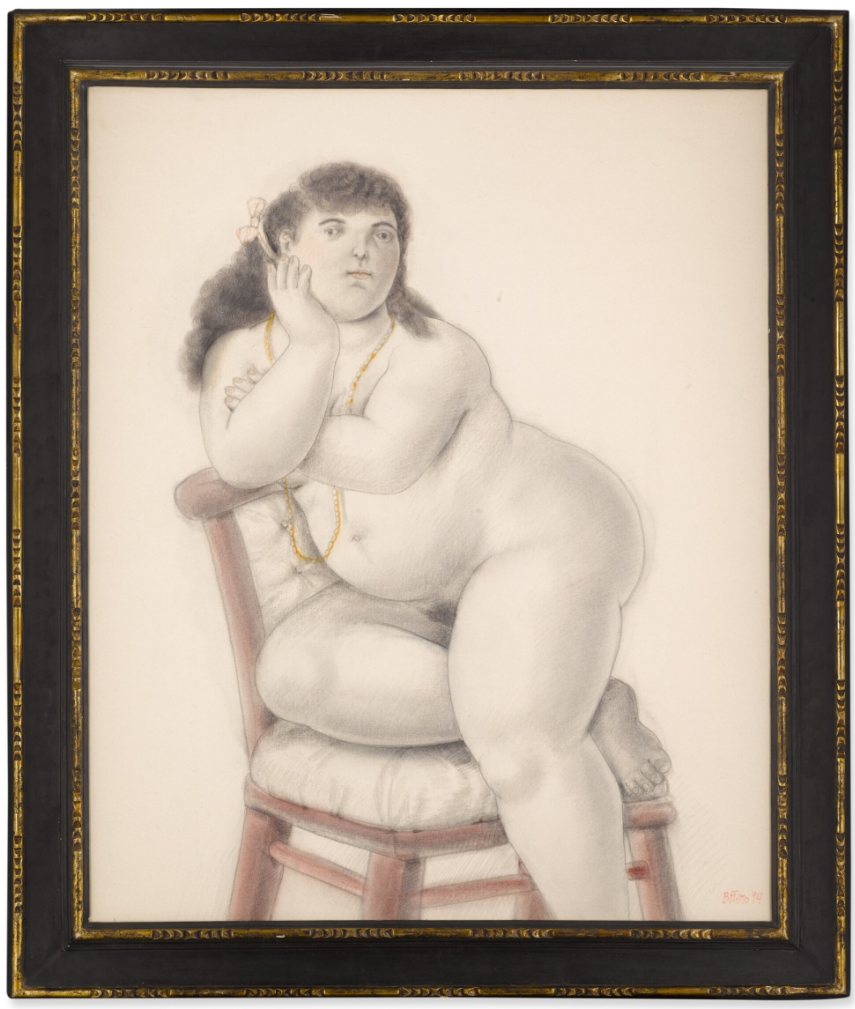
FERNANDO BOTERO
Desnudo, 1994
Charcoal and pastel on canvas
124.8 x 103.2 cm (49 1/8 x 40 5/8 inches)
Signed Botero and dated 94 (lower right)
#27. Le chapeau bleu, 1962
Sotheby’s New-York: 15 November 2022
Estimated: USD 300,000 – 400,000
USD 277,200
Le chapeau bleu | Modern Day Auction | 2022 | Sotheby’s (sothebys.com)
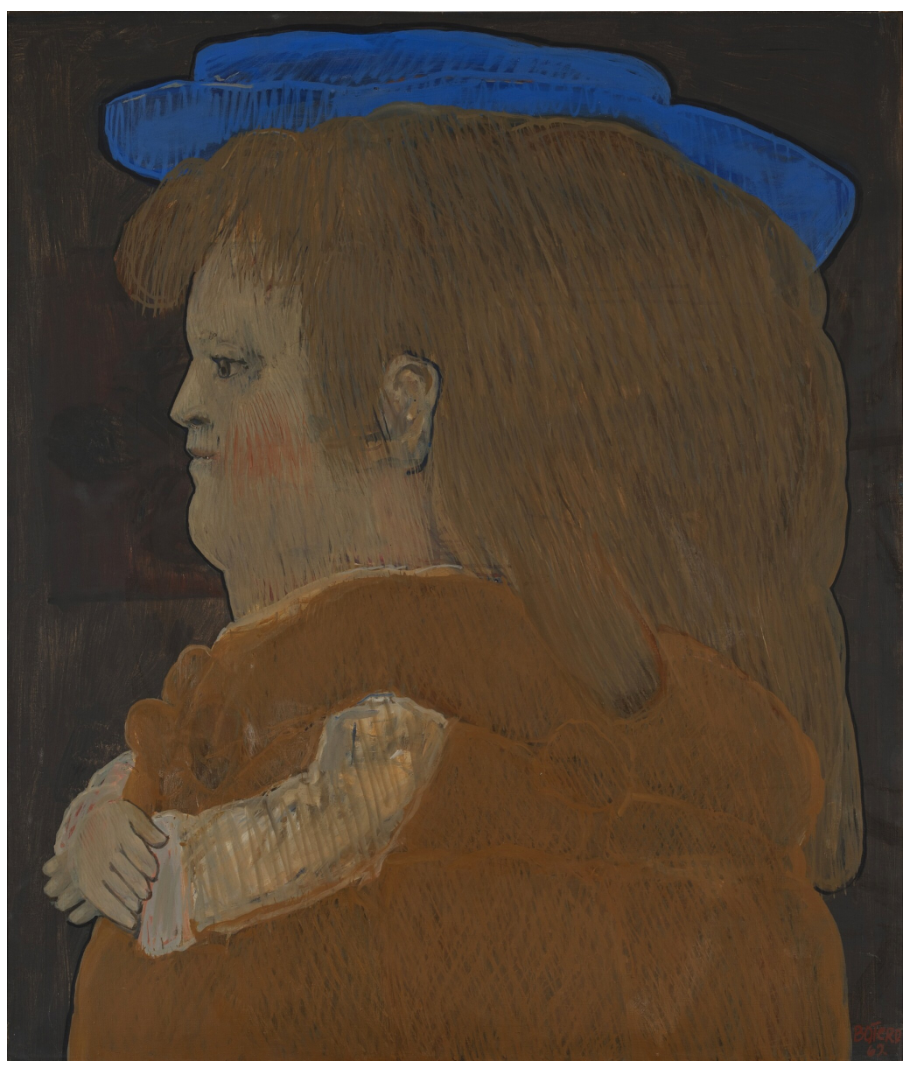
FERNANDO BOTERO
Le chapeau bleu, 1962
Oil on canvas
107 x 91.4 cm (42 1/8 x 36 inches)
Signed Botero and dated 62 (lower right)
#28. Basket of Fruit, 1993
Christie’s New-York: 11 March 2022
Estimated: USD 180,000 – 200,000
USD 277,200
FERNANDO BOTERO (b. 1932), Basket of Fruit | Christie’s (christies.com)
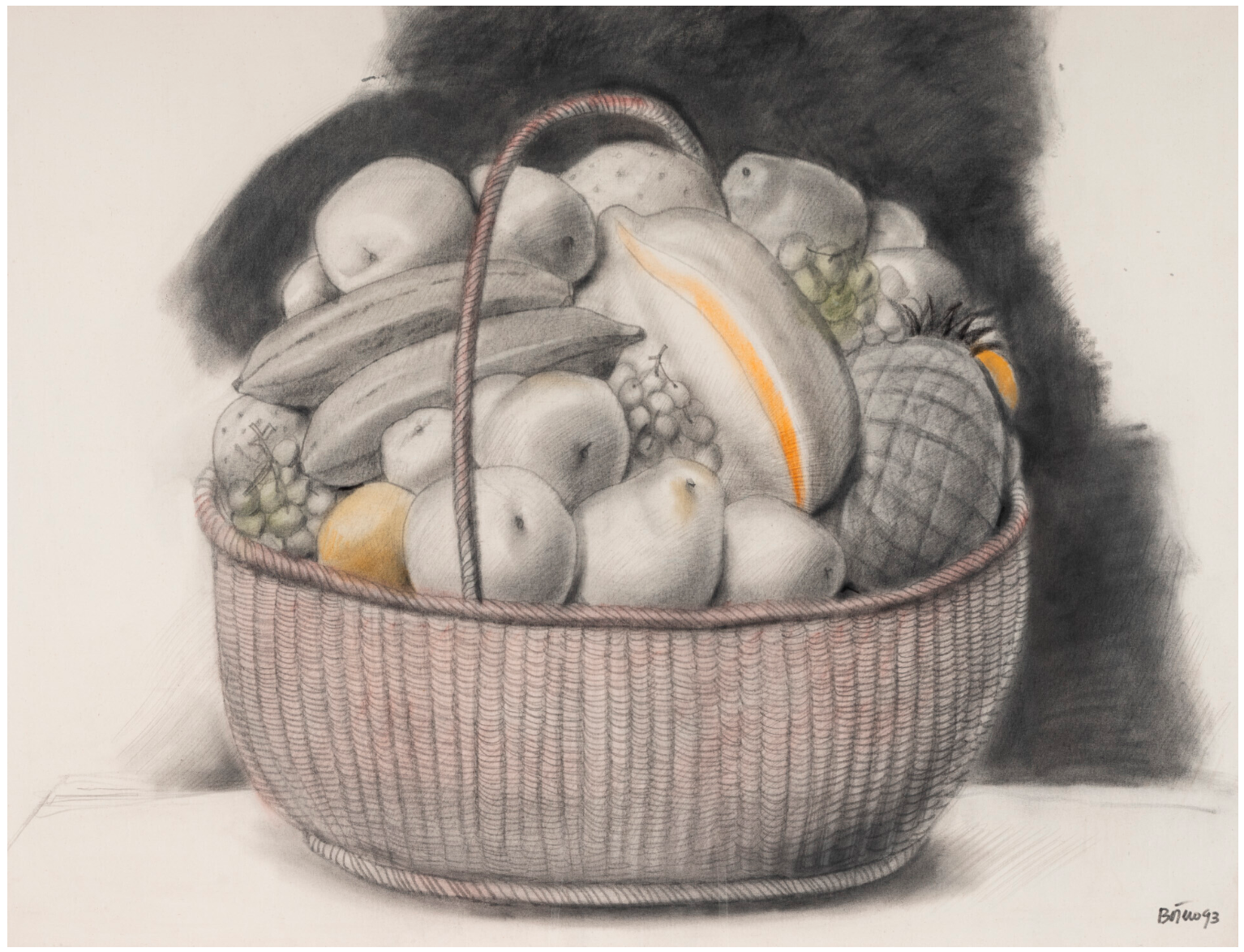
FERNANDO BOTERO (b. 1932)
Basket of Fruit, 1993
Watercolor and pencil on canvas
100.3 x 131 cm (39 1/2 x 51 1/2 inches)
Signed and dated ‘Botero 93’ (lower right)
#29. Femme Buvant, 1999
Sotheby’s New-York: 30 September 2022
Estimated: USD 200,000 – 300,000
USD 252,000
Femme Buvant | Contemporary Curated | 2022 | Sotheby’s (sothebys.com)
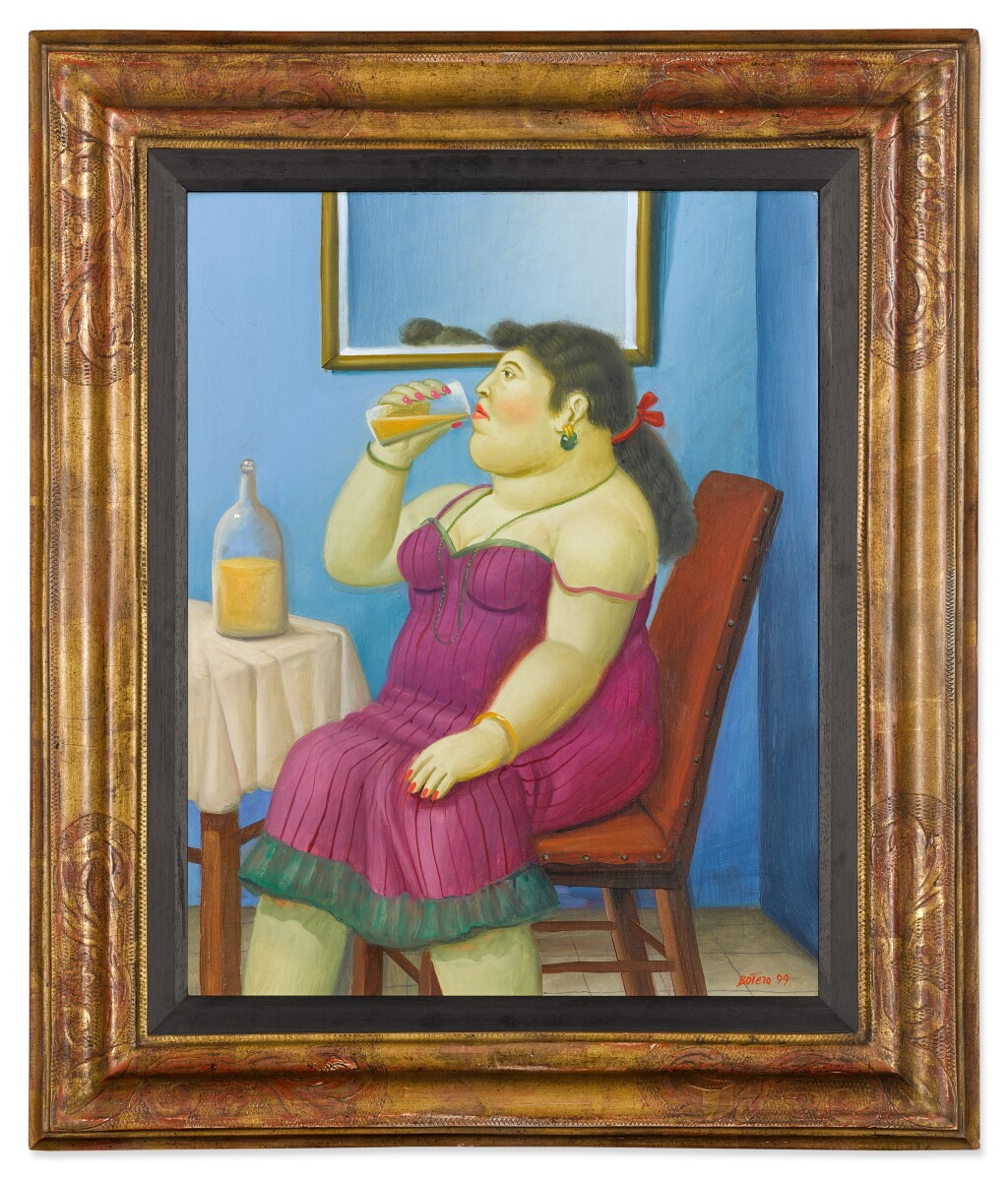
FERNANDO BOTERO (b. 1932)
Femme Buvant, 1999
Oil on canvas
50.2 x 39.6 cm (19 4/5 x 15 3/5 inches)
Signed Botero and dated 99 (lower right)
#30. The Musicians, 2013
Christie’s Hong-Kong: 28 April 2022
Estimated: HKD 1,500,000 – 2,000,000
HKD 1,890,000 / USD 240,874
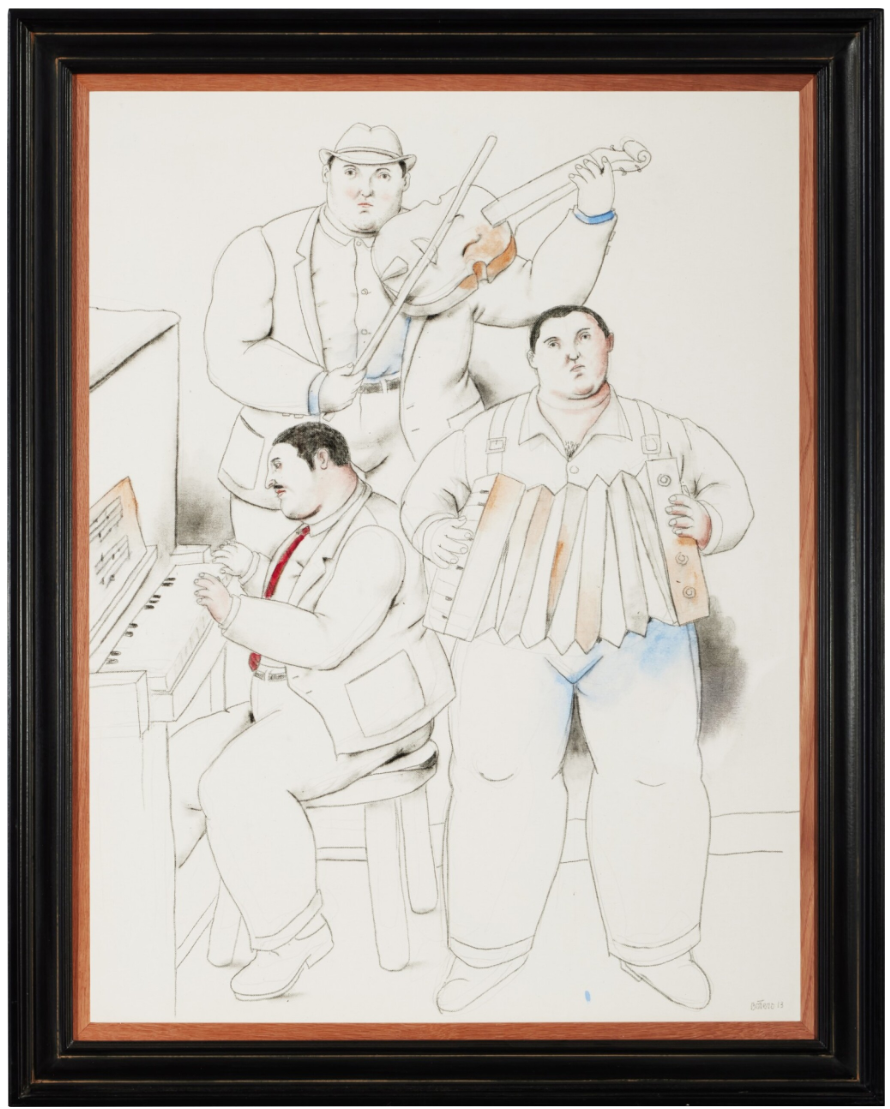
FERNANDO BOTERO (b. 1932)
The Musicians, 2013
Charcoal and watercolor on canvas
123.8 x 95.3 cm (43 3/4 x 37 1/2 inches)
Signed and dated 13
#31. El nuncio, 1962
Sotheby’s New-York: 15 November 2022
Estimated: USD 200,000 – 300,000
USD 239,400
El nuncio | Modern Day Auction | 2022 | Sotheby’s (sothebys.com)
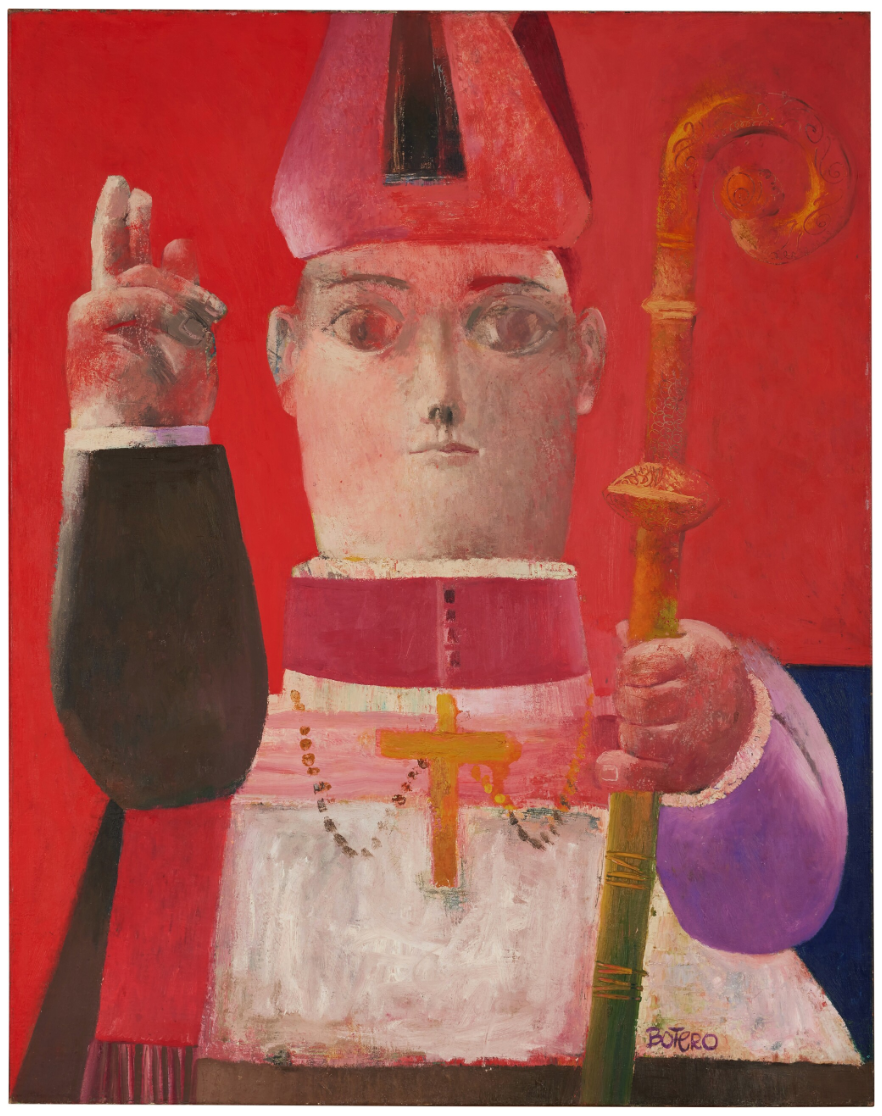
FERNANDO BOTERO
El nuncio, 1962
Oil on canvas
119.7 x 94.3 cm (47 1/8 x 37 1/8 inches)
Signed Botero (lower right)
#32. The Supper, 1993
Shapiro Auctions: 16 December 2022
Estimated: USD 200,000 – 300,000
USD 237,500
FERNANDO BOTERO (COLOMBIAN B. 1932) — FINE & DECORATIVE ART AUCTION – Shapiro Auctions
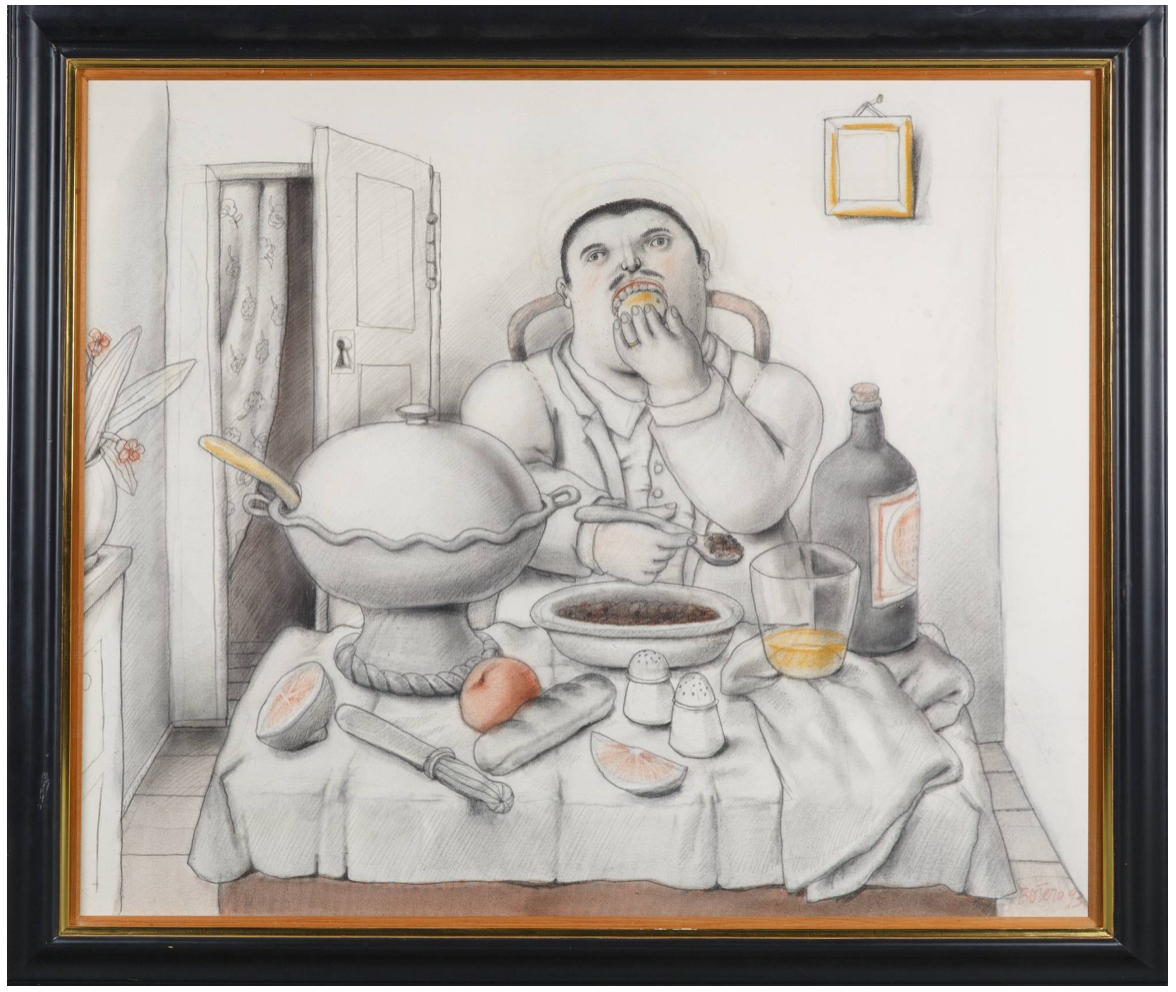
FERNANDO BOTERO (COLOMBIAN B. 1932)
The Supper, 1993
Pencil, charcoal and watercolor on canvas
100×120 cm (39 3/8 x 47 1/4 inches)
Signed and dated lower right
2021 Auction Results
WORK IN PROGRESS
#1. The Bather, 1975
Christie’s New-York: 19 May 2021
Estimated: USD 1,800,000 – 2,500,000
USD 1,830,000
Fernando Botero (b. 1932) (christies.com)
FERNANDO BOTERO (b. 1932)
The Bather, 1975
Oil on canvas in three parts
Each: 236.2 x 126 cm (93 x 49 1/2 inches)
Overall: 236.2 x 377.2 cm (93 x 148 1/2 inches)
Signed and dated ‘Botero 75’ (lower right, right panel)
#2. La Cantante, 2016
Christie’s Hong-Kong: 1 December 2021
Estimated: HKD 7,800,000 – 13,800,000
HKD 12,250,000 / USD 1,571,792
FERNANDO BOTERO (B. 1932) (christies.com)
FERNANDO BOTERO (B. 1932)
La Cantante, 2016
Oil on canvas
189×155 cm (74 3/8 x 61 inches)
Signed and dated ‘Botero 16’ (lower right)
#3. Femme à la guitare, 1988
Christie’s Paris: 13 October 2021
Estimated: EUR 500,000 – 700,000
EUR 920,000 / USD 1,063,705
Fernando Botero (né en 1932), Femme à la guitare | Christie’s
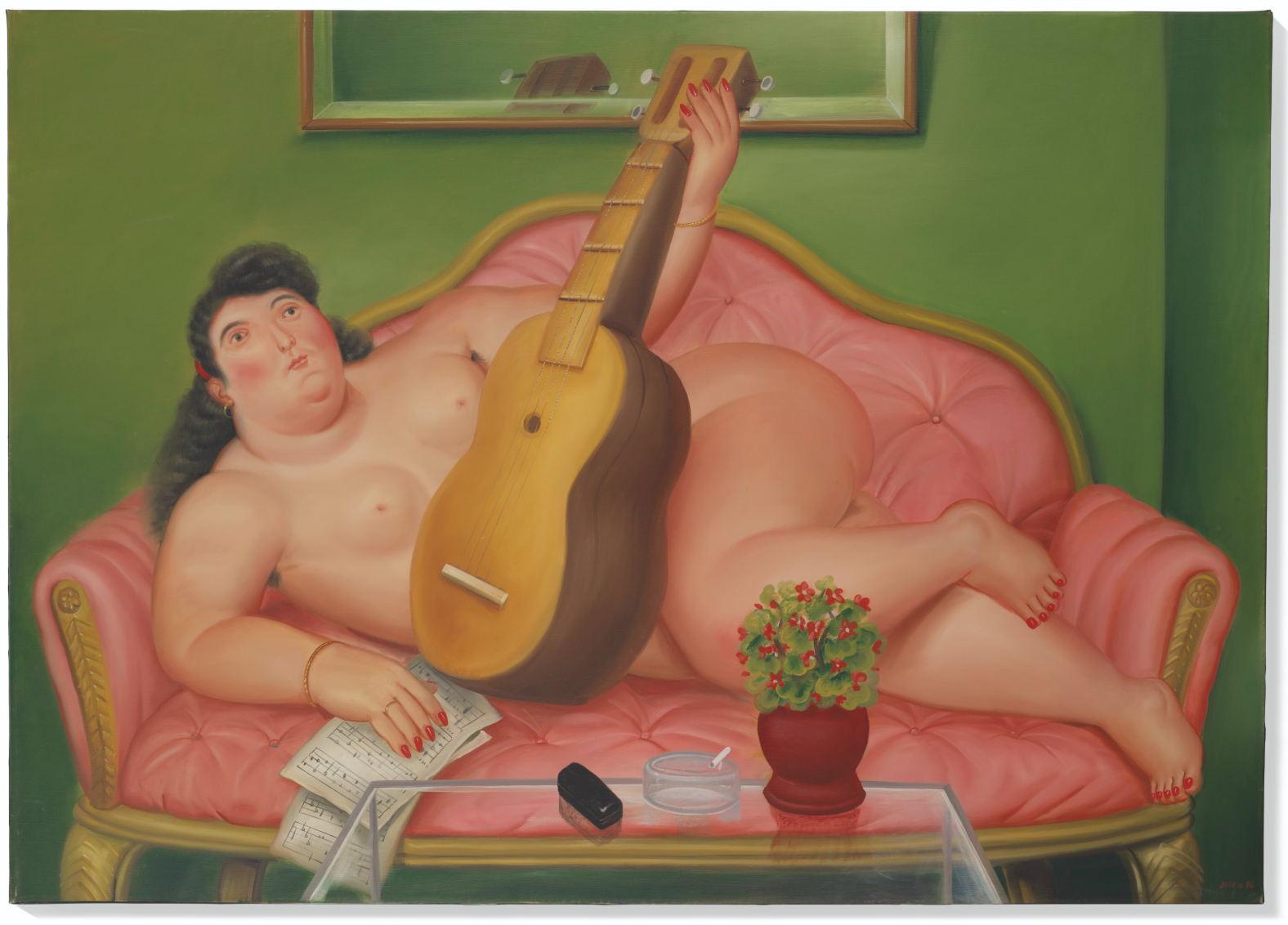
FERNANDO BOTERO
Femme à la guitare, 1988
Oil on canvas
130×183 cm (51 1/8 x 72 inches)
Signed and dated ‘BOTERO 88’ (lower right)
PART III: FOCUS
Musicians and Dancers
Dancers, 2010
Christie’s New-York: 12 March 2024
Estimated: USD 1,000,000 – 1,500,000
USD 1,197,000
FERNANDO BOTERO (1932-2023), Dancers | Christie’s (christies.com)
FERNANDO BOTERO (1932-2023)
Dancers, 2010
Oil on canvas
144.2 x 100.3 cm (56 3/4 x 39 1/2 inches)
Signed and dated ‘Botero, 10’ (lower right)
Dancers belongs within a long lineage of dancing couples in Botero’s oeuvre that extends from canvas to monumental bronze sculpture. Some pairs perform in public spaces—as in Dancing in Colombia (1980), at the Metropolitan Museum of Art—and others privately, both alone and in bacchanalian company. The present couple appear regularly in Botero’s work, their features—five o’clock shadow; dark, pleated hair; impassive gazes—as familiar as their matching steps and flaunted, shapely forms. The sensuality of Dancers derives as much from the measured intensity and equilibrium of its color as from its romantic innuendo. The saturated red of the woman’s dress stands out against the muted, rosewood wall and floor, as do the bright accents of her hair ribbon and painted nails. The painting’s allover rubescence is offset by complementary shades of green: the flower-specked curtain that drapes before a door; the man’s tie and sock, as well as his olive-toned suit; the woman’s earring; the bottle atop the table. Additional contrast comes from the six cigarette butts scattered on the floor, familiar embellishments in Botero’s painting. The provisional intimacy of Botero’s Dancers is inseparable from this resonant world in which its subjects move, their bodies in chromatic concert as they perform a dance of seduction.
The Musicians, 1979
Christie’s New-York: 9 November 2023
Estimated: USD 2,500,000 – 3,500,000
USD 5,132,000
NEW WORLD RECORD FOR THE ARTIST
FERNANDO BOTERO (1932-2023) (christies.com)
FERNANDO BOTERO (1932-2023)
The Musicians, 1979
Oil on canvas
217.2 x 189.9 cm (85 1/2 x 74 3/4 inches)
signed and dated ‘Botero 79’ (lower right)
Lit from above by a constellation of lights, a group of musicians are neatly arranged, each poised at the ready, in picture-perfect position, about to impress their audience with an undoubtedly well-rehearsed tune. Musicians take pride of place in Botero’s oeuvre as one of the artist’s most celebrated subjects. The present work, with its grand scale and complex composition, can be counted as one of the artist’s greatest achievements in oil, alongside such masterpieces as Dancing in Colombia from 1980 (The Metropolitan Museum of Art, New York) and Tablao flamenco from 1984. What makes these works truly exceptional is their ability to both parody and honor everyday life in Colombia, elevating the subject to the monumental dimensions of history painting.
Drawing from a range of artistic influences, Botero approaches the time-honored theme of the musical performance from both local and international perspectives. Musicians, central to the cultural identity of Botero’s nativeColombia, can also be seen as an essential motif within the broader context of 20th-century Latin American art as explored by modern masters such as Diego Rivera and Rufino Tamayo. This theme furthermore recalls the legacy of early-20th-century European artists who depicted musical motifs from contemporary life, particularly in Picasso’s and Braque’s guitar players and saltimbanques.
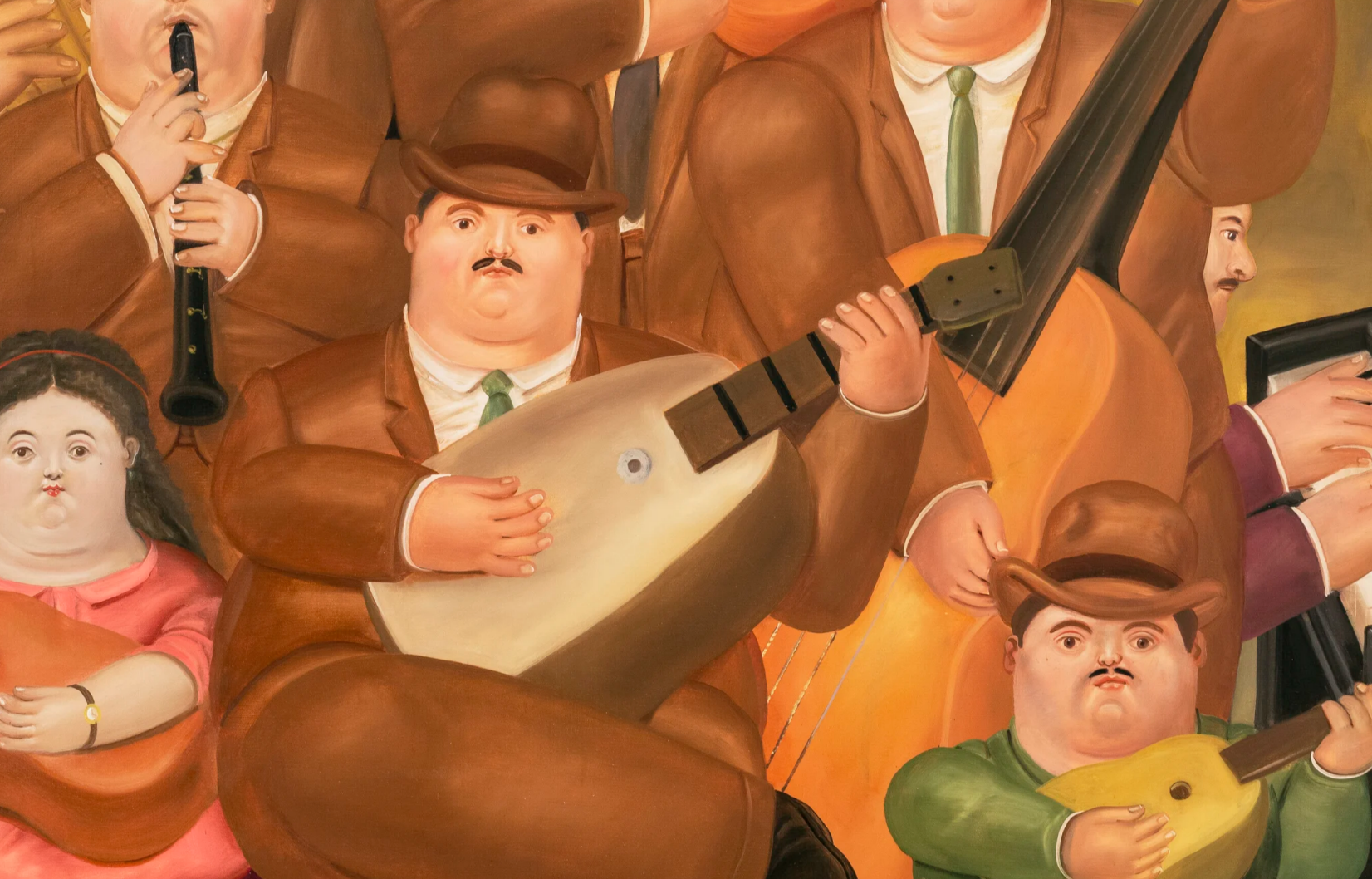
Botero’s trademark voluminous figures arrive from similar origins, initiated by the artist’s earliest experiences in Colombia, but also steeped in European art history. Born in Medellín, Botero spent his early years surrounded by Catholic churches full of Baroque polychrome wooden sculptures that at times resembled porcelain. These colonial sculptural forms captured his imagination and contributed to the development of his rounded and monumental figural types. A serious student of art history, Botero later traveled to Italy and admired the volumetric figures of Piero della Francesca and other artists of the Quattrocento. He continued his studies of the old masters in European museum collections and particularly admired the court portraits of Diego Velázquez and the sensuous, grand-scale works of Peter Paul Rubens.
“I started to paint these volumetric figures when I was 17. I did it by intuition… because it said something to me. Then, of course, when I was in Europe, especially in Italy, I rationalized the importance of volume because I saw that all Italian painters like Michelangelo, Raphael, Giotto, Masaccio, Piero della Francesca made a celebration of volume.”
These myriad of influences led Botero to define his distinctive figurative style, which he modernized with subjects from local Colombian life. With The Musicians, Botero finds the perfect melody between past and present, humor and celebration, reflecting on the enduring pastimes that sustain community.
Dancing Couple, 1982
Christie’s New-York: 9 March 2023
Estimated: USD 800,000 – 1,200,000
USD 1,008,000
FERNANDO BOTERO (b. 1932) (christies.com)
FERNANDO BOTERO (b. 1932)
Dancing Couple, 1982
Oil on canvas
149.9 x 108 cm (59 x 42 1/2 inches)
Signed and dated ‘Botero 82’ (lower right)
Like many of his paintings from the 1980s that show people at leisure, Botero’s dancing couples appear in a variety of places including dance halls, outdoor fairs, bars, and other social spaces. Other works in this grouping include musicians, card players, and people smoking, eating, drinking or partaking of the landscape. This grouping is typical of Botero’s imagery, which often draws from popular culture and magnifies the figure not only physically but also as an image in itself. The paintings of dancers transform the couples into icons and emphasize the clear movements that imply tango or other popular dance forms. Dances, in particular, have been used in visual art in many countries as signifiers of cultural identity. In Medellín, Botero’s birthplace, the tango has an important trajectory, as Medellín is also the place where Carlos Gardel tragically died in 1935. This history has inspired a particular affection for the tango, which seems to be the dance presented in this painting. The angle of the woman’s bent leg, the placement of her left leg between his legs, and her hand on his shoulder, with its back visible to the viewer and even the motion in her hair, would imply the precision movements, intricate positions and speed of the tango. Like the tango, other dance rhythms in Colombia have developed from varied and sometimes fused sources, including African and Andean rhythms, marking the character of a dance as a reflection of the larger developments of cultural history and social realities. Botero understands the significance of the dance as a cultural symbol and the relationship created by the figures in a dance and continues to use it as an important subject.
La Cantante, 2016
Christie’s Hong-Kong: 1 December 2021
Estimated: HKD 7,800,000 – 13,800,000
HKD 12,250,000 / USD 1,571,792
FERNANDO BOTERO (B. 1932) (christies.com)
FERNANDO BOTERO (B. 1932)
La Cantante, 2016
Oil on canvas
189×155 cm (74 3/8 x 61 inches)
Signed and dated ‘Botero 16’ (lower right)
Suspended in crescendo, a glamorous singer in an emerald green dress faces us, her arm raised as her voice soars, flanked by her band on a stage. The full body of Botero’s songstress perfectly fills the centre of the composition, statuesque in her abundant size, her brightly coloured musical troupe diminutive behind her. Lit by a constellation of candy coloured lights above, the musicians are arranged in a neat U-shape, each poised in picture-perfect position to represent their musical roles. They are dressed for the occasion and without hearing their tune, it can be assumed that their act is wellrehearsed and they are ready to impress their audience, whomever may be listening and watching. This magnificently vibrant, sonorous display on a grand scale perfectly characterises Botero’s key theme of the musical performance, alluding to the opportunity for communal merriment and all that might come with it, which takes pride of place as one of the most celebrated subjects in his oeuvre. A modern take on the genre scene, La Cantante, aligns with the artist’s greatest achievements in oil as represented in such works as Dancing in Colombia from 1980 (Metropolitan Museum of Art, New York) Tablao flamenco from 1984 and The Musicians from 1979 which both parody and honour the activities of everyday life in Colombia, elevating them to the monumental dimensions of history painting.
Tablao Flamenco, 1984
Christie’s New-York: 21 November 2019
Estimated: USD 1,500,000 – 2,000,000
USD 2,055,000
Fernando Botero (b. 1932) (christies.com)
FERNANDO BOTERO (b. 1932)
Tablao Flamenco, 1984
Oil on canvas
201.3 x 202.6 cm (79 1/4 x 79 3/4 inches)
Signed ‘Botero’ (lower right)
The performative passions of bullfighting and flamenco are inseparable in Spanish culture, and Tablao flamenco takes its place within Botero’s tauromachian universe alongside dashing matadors and elegant majas. Here in a ruffled red dress, the bailaora raises her arms with dramatic flair, clicking castanets dangling from her thumbs. The sinuous shape of her body sweeps into an arabesque, balanced on a dainty green heeled shoe, as she moves to the rhythm of the music. Performing in the intimate space of a traditional tablao, she is encircled by a guitar player and two hand-clapping dancers, one seated and the other diminutive; a couple exits the club behind her, their limbs mirroring the curves of her torso. Tablao flamenco doubtless nods to John Singer Sargent’s monumental tribute to the dance, El Jaleo (1882; Isabella Stewart Gardner Museum), a scene of raw, frenetic energy and eros. Yet Botero’s tableau is comparatively, and characteristically composed; the figures revolve around the central bailaora in musical and chromatic harmony, accenting the rubescence of her costume with visual grace notes of yellow ocher and complementary green. Flamenco’s twirling, percussive movement suggestively simulates the bravura choreography of the bull ring, and Botero posits the dance as a florid sublimation of the bullfight’s mortal danger.
Cuatro Músicos (Four Musicians), 1984
Sotheby’s New-York: 24 May 2006
Estimated: USD 1,000,000 – 1,500,000
USD 2,024,000
(#14) Fernando Botero (B. 1933) (sothebys.com)
FERNANDO BOTERO
Cuatro Músicos (Four Musicians), 1984
Oil on canvas
221.3 x 185 cm (87 1/8 x 72 3/4 inches)
Signed and dated 84 lower right
Cuatro Músicos, painted in 1984, depicts four men playing the tuba, flute, violin, and piano, in a salon in which couples dance in the background. Sheets of music have fallen to the floor as the musicians furiously carry on their beat. In the foreground are two glasses, supposedly there for the musicians to sip between songs. Clearly there is a party going on in a bar or ballroom decorated with lights and pillars. In this work the instruments are as much a subject of the painting as are the musicians themselves. The artist has dedicated equal space, ensuring that proper homage is rendered to both. Many of Botero’s works have Colombia as a background. As he has said, “You always paint whatever you know best, what you experienced as a child and teenager. The world I work with is the one I knew in Medellín, and I have never painted anything but that.” In painting diverse genre scenes located against the backdrop of its landscapes, cityscapes and interiors, it is clear that the artist’s final intention is to catch the soul of his country.
Card Players
Jugando a las cartas, 1988
Sotheby’s New-York: 1 March 2024
Estimated: USD 1,000,000 – 1,500,000
USD 2,298,500
FERNANDO BOTERO (1932 – 2023)
Jugando a las cartas, 1988
Oil on canvas
130×188 cm (51 1/8 x 74 inches)
Signed Botero and dated 88 (lower right)
In Jugando a las cartas, a man in a top hat and suit appears to be winning (and cheating at) a game of cards against his opponent, a well-coiffed and rather unimpressed nude woman. Although at first glance this is seemingly a game of strip poker, the absence of strewn clothing and the woman’s other adornments (bright earrings, a headband) suggest she is simply nude. Positioned in the bottom right corner at the edge of the picture plane stands another, older and much smaller woman in a server’s uniform, carrying a tray of drinks – her diminutive stature and sharp gaze offsetting the relaxed, transactional relationship of the other two characters. The interior is primarily dark, framed by a bare lightbulb in the upper center and a red door with the key in the lock to the right – evincing that this scene unfolds in a private backroom, and hinting at a more public spectacle just out-of-frame. Botero’s manipulation of space here is theatrical – these elements against the frame draw the viewer tantalizingly into this illicit, private game.
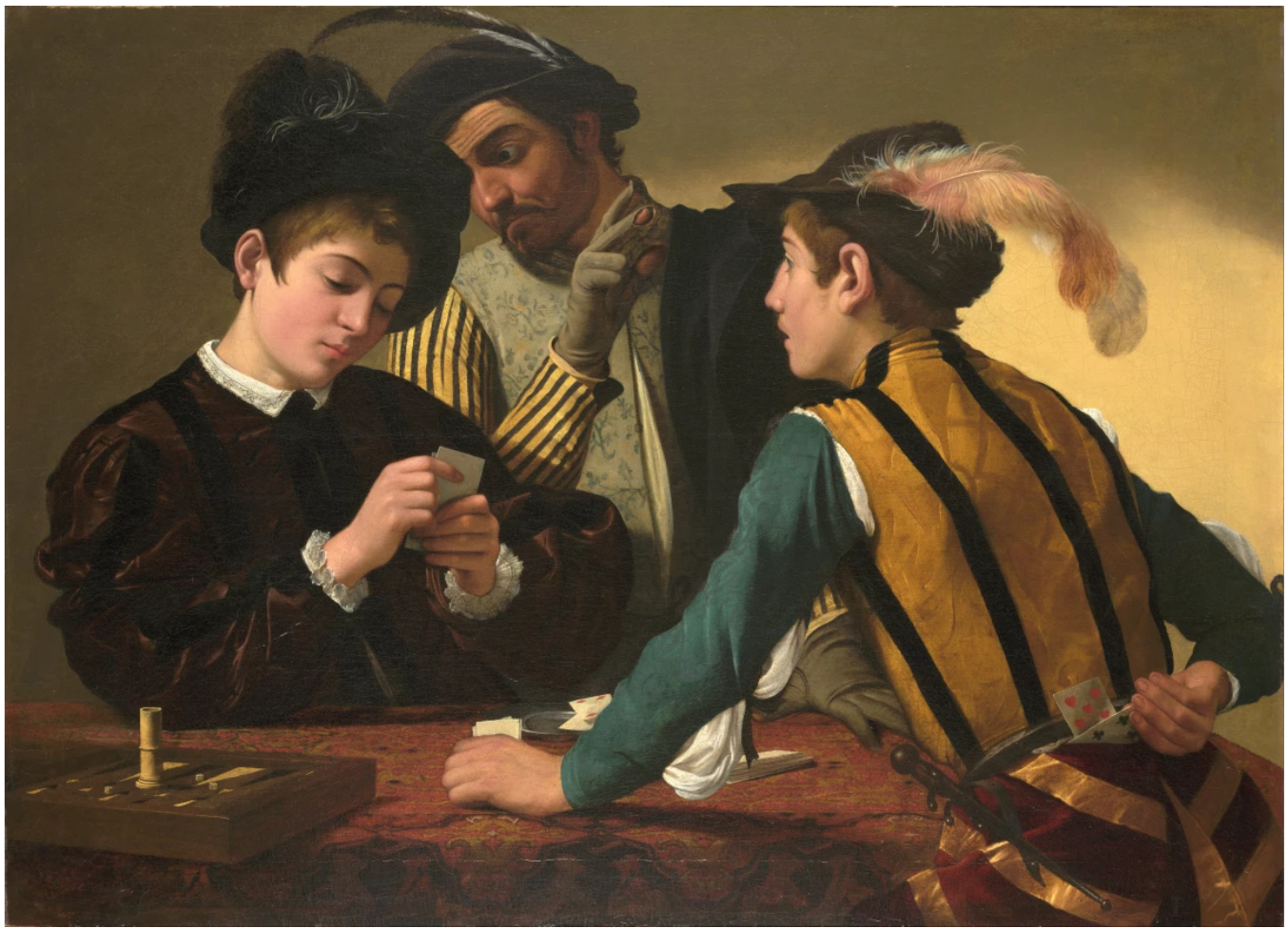
CARAVAGGIO, THE CARDSHARPS, CIRCA 1595, THE KIMBELL MUSEUM, FORT WORTH, TEXAS
Botero’s theatricality here pays clear homage to the first famous representation of a game of cards – Caravaggio’s Cardsharps of 1594. Considered radical in its day for its sympathetic treatment of the everyday vices of average people, Cardsharps depicts a group of figures engaged in an early version of poker. Unbeknownst to the player on the left, who blithely considers his next move, the two characters in yellow stripes conspire to cheat, one peeking at the player’s hand and signaling to the other, who holds several cards behind his back – just as Botero’s seated figure does in Jugando a las cartas. From its classical pyramidal composition to the dramatic irony of its staging, Jugando a las cartas engages with both the techniques and the themes of the Italian master.
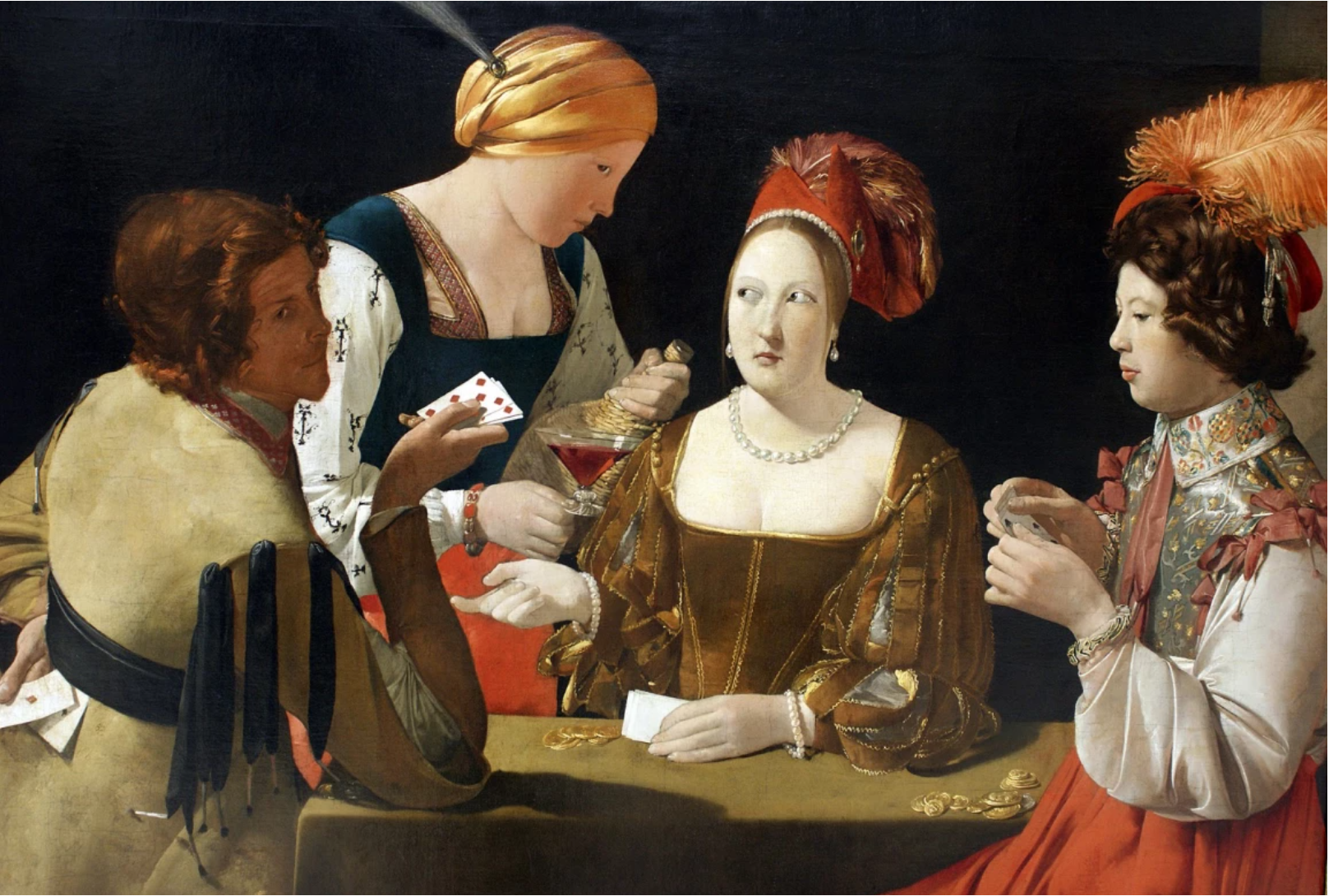
GEORGES DE LA TOUR, THE CHEAT WITH THE ACE OF DIAMONDS, 1636-38, THE LOUVRE, PARIS
Later treatments of this theme take a distinctly moralizing turn. Georges de la Tour, working about 50 years after Caravaggio, exploits similar dramatic framing tactics in The Cheat with the Ace of Clubs (1630-34). Here however the cheating figure tilts his hand and gaze to the viewer, implicating us in the wicked deed – a gesture that Botero echoes to a different end. Where de la Tour’s painting seems to draw a dark conclusion about the fundamental nature of man, implying that drink, card-playing, and consorting in mixed company can only lead to one’s downfall, Botero seems to reach a more ambivalent conclusion. His cheater tips his hand not only to the viewer, but to his opponent, insinuating that both card players are guilty of chicanery. The players in Botero’s universe seem to revel in loose morals, inviting viewers to speculate on their intentions and relationships.
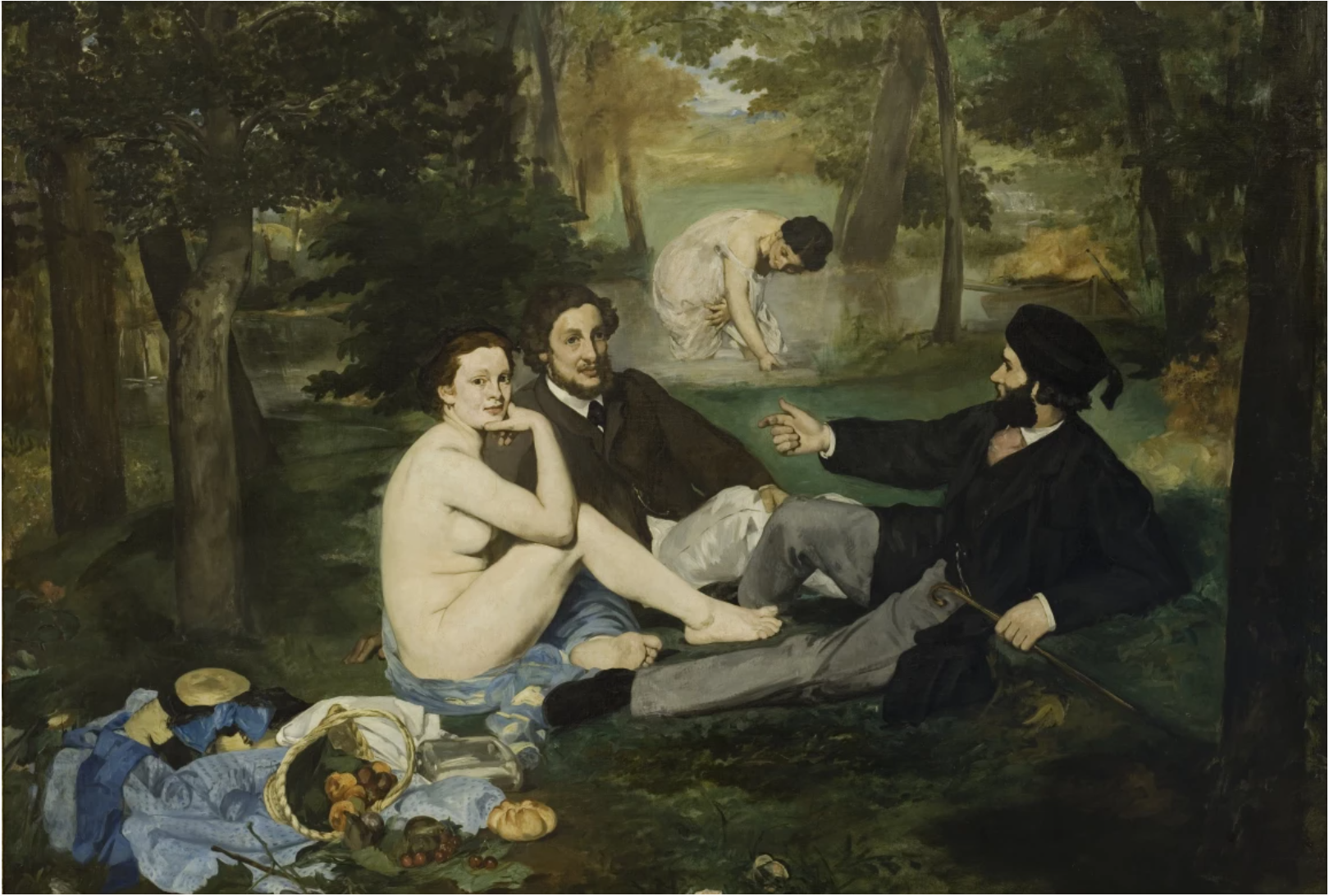
EDOUARD MANET, DEJEUNER SUR L’HERBE (LUNCHEON ON THE GRASS), 1863, MUSÉE D’ORSAY, PARIS
Crucially, Botero invites us to join the table and become participants of the game, in which we are also not innocent. Echoing voyeuristic elements famously present in Édouard Manet’s Le Déjeuner sur l’herbe (1862-63), the nude woman makes us conscious of our invasion into this private space. Botero crops his scene such that the perspective of the viewer is below the gaze of the sitter, furthering our sense of intrusion. Like Manet’s subject, Botero’s sitter is nude, but devoid of overt sexuality and shame, suggesting her state of undress is a regular occurrence (to both her and her opponent??), and that Botero’s model may have been a real prostitute.
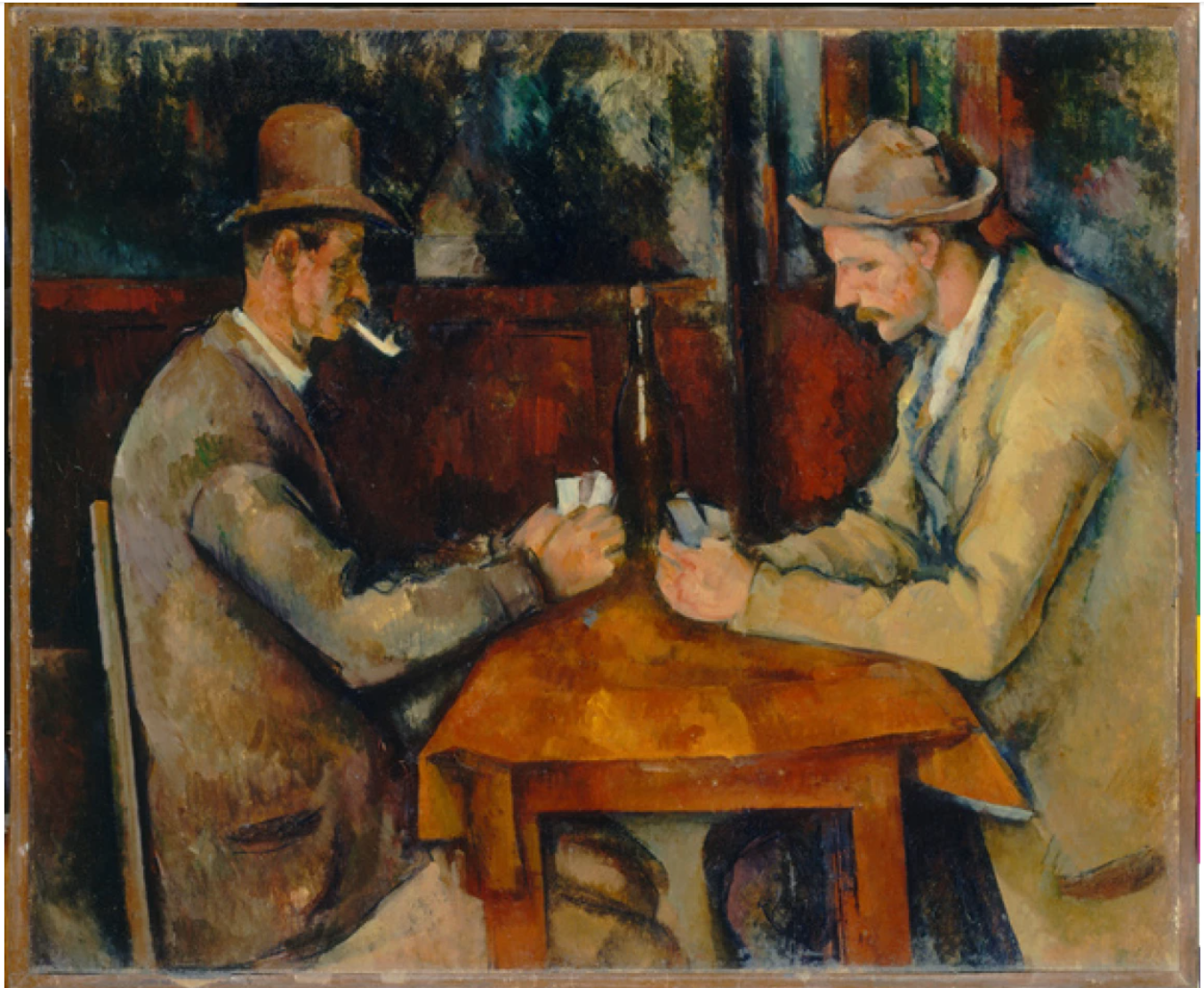
PAUL CÉZANNE, THE CARD PLAYERS, 1894-95, MUSÉE D’ORSAY, PARIS
As is typical of Botero’s strongest works, there are twin dynamics unfolding in Jugando a las cartas – at once a frank, bemused representation of daily life at the fringes of polite society in provincial Colombia, and a sharp nod to the Western canon of art history. Jugando a las cartas engagement with this canon extends through Carravagio and de La Tour’s scenes to dialogue with Paul Cézanne’s iconic Card Players (1894-95). Just as Cézanne revolutionized the portrayal of card players by distilling the scene into geometric components and conveying dramatic tension through the physicality of rough brushstrokes and stark atmosphere, Botero infuses his rendition with vibrant touches.
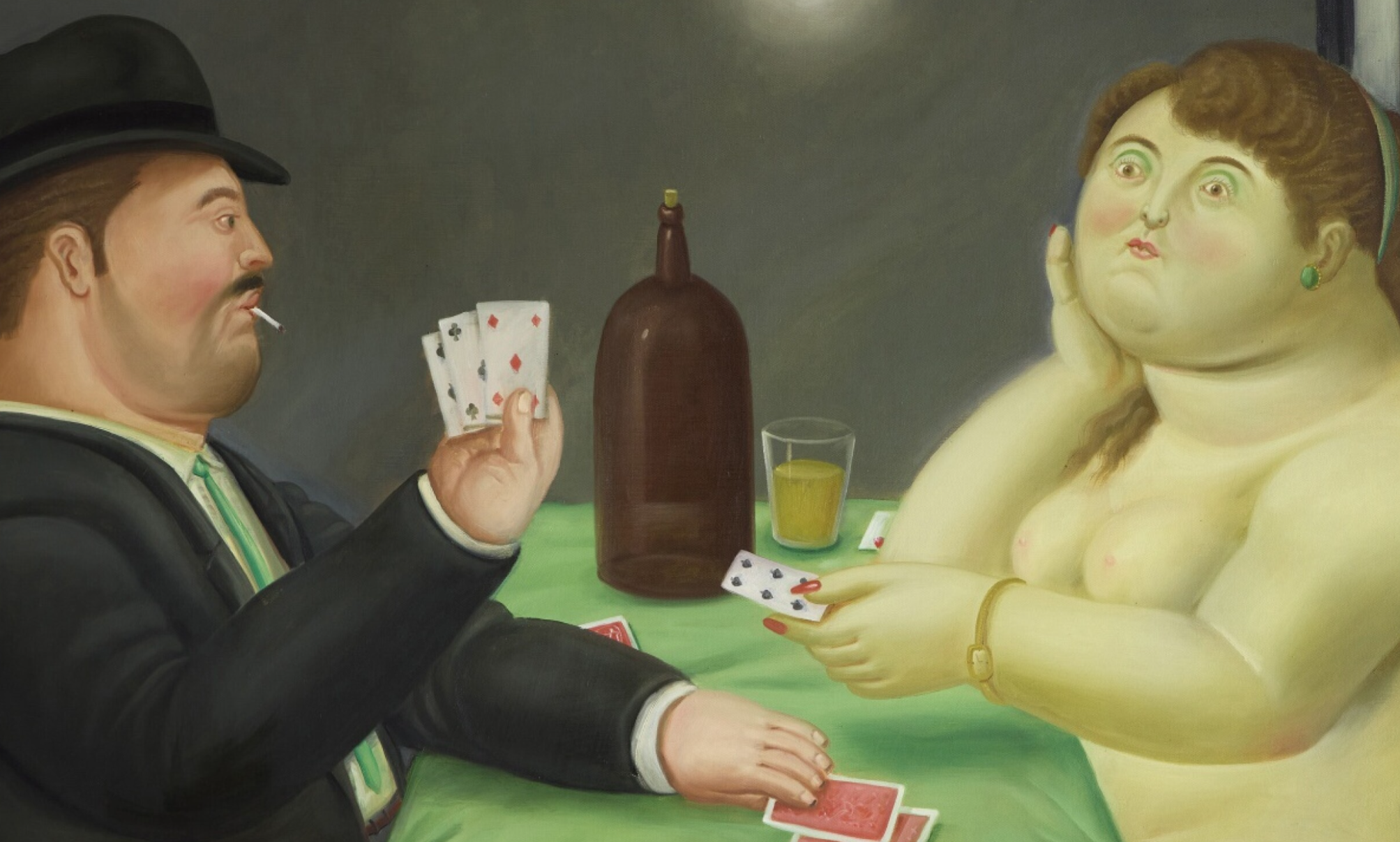
Botero transports the familiar scene to Medellín’s red-light district, a vital source of reportage for the young artist. The light-hearted mood and culturally nuanced portrayal of Latin American characters in Botero’s work add a playfulness and honesty that is absent in earlier, more serious versions of the scene — embracing the element of kitsch that has become attached to this theme by the twentieth century (as images like Cassius Coolidge’s Poker Game have entered popular culture). Echoing the traditional palette and framing, Botero infuses familiarity with his vibrant style and singular perspective, transforming the scene into a vibrant ode to daily life on the fringes of Latin American society.
Card Players, 1986
Christie’s New-York: 13 November 2020
Estimated: USD 1,000,000 – 1,500,000
USD 2,010,000
Fernando Botero (b. 1932) (christies.com)
FERNANDO BOTERO (b. 1932)
Card Players, 1986
Oil on canvas
150.5 x 188.6 cm (59 1/4 x 74 1/4 inches)
Signed and dated ‘Botero 86’ (lower right)
With wit and whimsy, astute focus and dogged dedication to his own idiosyncratic artistic principles for nearly seven decades, Fernando Botero has created an immediately recognizable body of work that has made him an almost universal icon. Fêted the world over for his formidable figures who flaunt their voluptuous curves, Botero is a keen observer of the human spirit and an insatiable student of art history. From Jan Van Eyck and Velázquez to Ingres and Manet, the European canon of art history has always been a rich source of inspiration for Botero. In The Card Players, Botero addresses the theme of the cardsharp who has appeared in paintings from the Renaissance to the present day. Perhaps the most famous card player paintings are those by Paul Cézanne. While the art-historically erudite Botero is surely aware of the Cézanne series, his own musings on the subject, of which there are just a handful of examples, are more akin to the droll renderings of such artists as Caravaggio or Georges de La Tour. In lieu of Cézanne’s gravitas, there is a joie de vivre that pervades Botero’s card player scenes. In the present work, two men in suits appear to be winning a game of strip poker against their very naked opponents, who we can assume, based on the entirety of Botero’s oeuvre, to be well-coiffed sex workers. Behind them, the matronly madame of the house plies her customers with spirits. To her left, a door opens and a red curtain is pulled back, giving the impression that we are privy to a backstage view, while just beyond this private room a more public spectacle plays out. The theatricality of the revealing red curtain is a recurrent motif not only in Botero’s paintings, but in many artists’ works, Cézanne’s The Card Players being just one of innumerable examples.
Jugadoras de Cartas II, 1989
Sotheby’s New-York: 20 November 2006
Estimated: USD 1,500,000 – 1,800,000
USD 1,688,000
(#18) Fernando Botero (B. 1933) (sothebys.com)
FERNANDO BOTERO
Jugadoras de Cartas II, 1989
Oil on canvas
159.4 x 201.6 cm (62 3/4 x 79 3/8 inches)
Signed and dated 89 lower right
Nudes
The Balcony, 1999
Christie’s New-York: 21 May 2026
Estimated: USD 450,000 – 650,000
USD 660,400
FERNANDO BOTERO (1932-2023), The Balcony | Christie’s
FERNANDO BOTERO (1932-2023)
The Balcony, 1999
Oil on canvas
63-3/4 x 36-3/4 inches (161.9 x 93.3 cm)
Signed and dated ‘Botero 99’ (lower right)
“If women are often my subjects, it’s because they have been one of the main subjects of paintings for centuries. What really guides me above all, when I sculp or paint men, women, animals, or objects, is the plastic aspect of beings and things. Plasticity exists indiscriminately in a woman, a still life, or a landscape.”
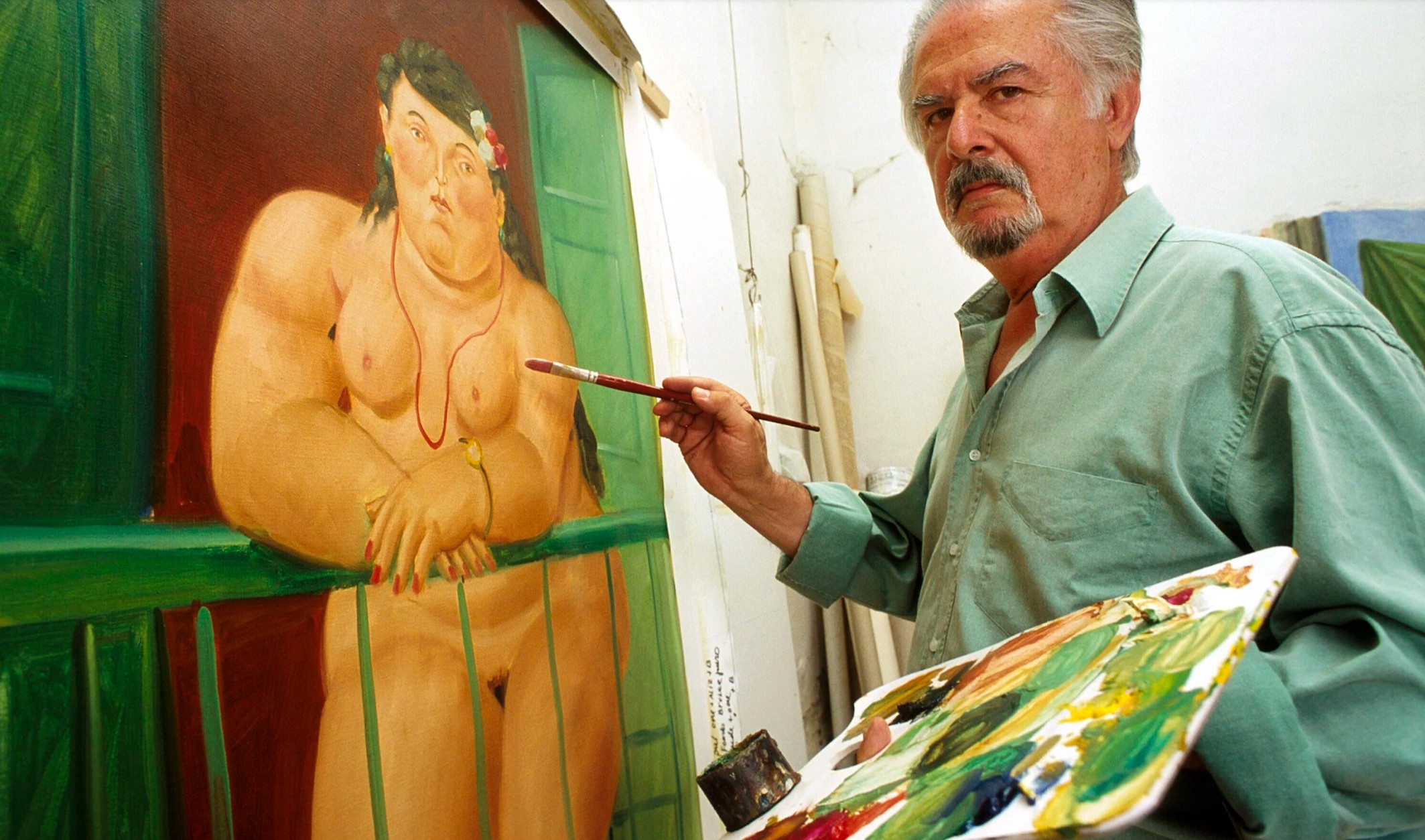
Fernando Botero painting the present lot at his home in Pietrasanta, June 1999. Photo: Eric Vandeville / Gamma-Rapho via Getty Images.
El cuarto de baño, 1983
Bukowskis Stockholm: 21 May 2025
Estimated: SEK 6,000,000 – 8,000,000
SEK 6,500,000 (Hammer)
SEK 8,125,000 / USD 840,540
Fernando Botero, “El cuarto de baño”. – Bukowskis
FERNANDO BOTERO (Colombia, 1932-2023)
El cuarto de baño, 1983
Oil on canvas
180×120 cm (70 7/8 x 47 1/8 inches)
Signed Botero and dated -83
Fernando Botero described himself as a “post-abstractionist realist,” an artist who paints memories in a realist idiom. His canvases are populated by voluminous figures engaged in scenes of everyday life from his native Colombia. To Botero, these ample bodies are not exaggerated but rather elegant in their sensuality.
“It’s to make them sensual that I let my figures swell.”
Historical references in his work are unmistakable. After abandoning an early career as a matador in the early 1950s, Botero traveled to Europe, where he immersed himself in the traditions of the Renaissance, copying the works of old masters such as Goya, Velázquez, Uccello, and Piero della Francesca in Florence and Madrid. His artistic breakthrough came during the 1960s while living in New York, where he exhibited seminal works such as Mona Lisa (1961) and The Presidential Family (1967). During this period, Botero solidified the painterly style that would become his hallmark: a visual language now widely recognized as “Boterismo.” Before the advent of modernism in the early 20th century, religious iconography dominated the visual culture of both Latin America and Europe. These sacred images continue to resonate in contemporary art. Botero’s childhood in Medellín, Colombia, was steeped in the Catholicism that has shaped Latin American society, culture, and politics for over four centuries.
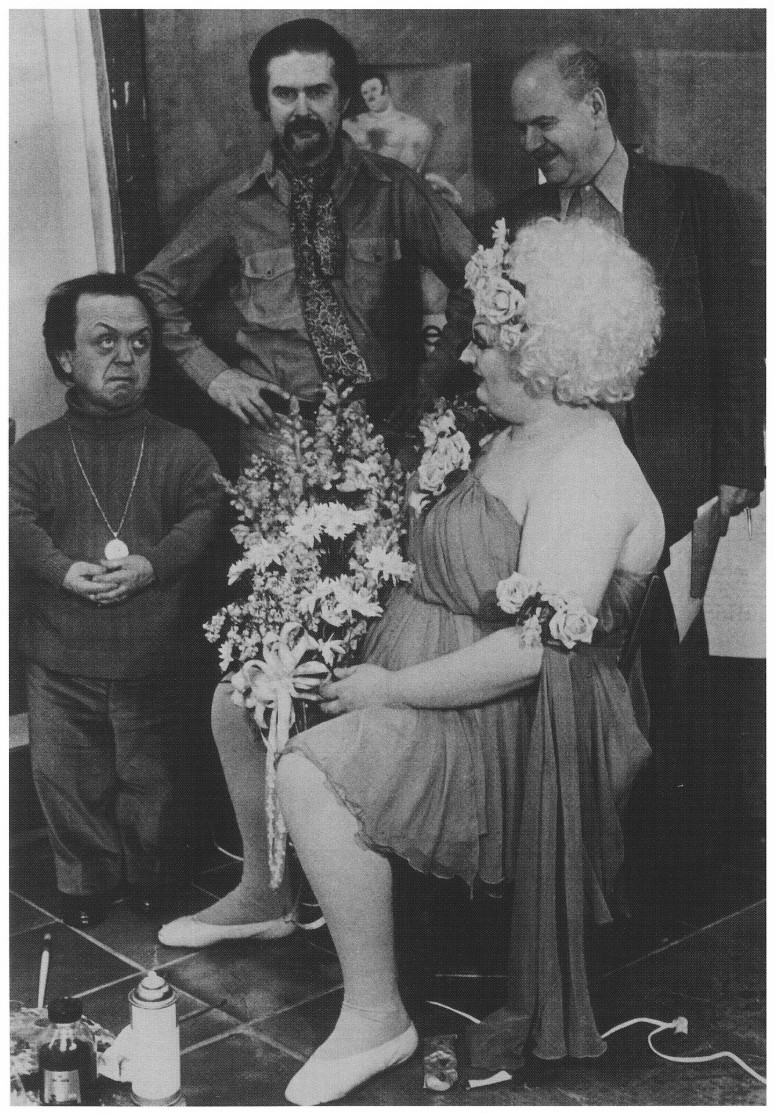
Fernando Botero with filmmaker Erwin Leiser and actors, 1980
Botero’s oeuvre is deeply entwined with Colombian and broader Latin American identity. Through humor and a subtle irony, he constructs a magical world in which angels and sinners play out familiar narratives. One of his greatest artistic contributions lies in his distinctive exploration of genre, often incorporating satirical imagery as a commentary on contemporary social phenomena. The female figure in El cuarto de baño exemplifies Botero’s signature sculptural and voluptuous form. Rendered with both wit and reverence, she appears as a modern-day Venus emerging from the bath, or perhaps as a biblical Susanna, spied upon by a diminutive male figure in the tub. She proudly presents herself with all her splendor, unashamed and unapologetic.
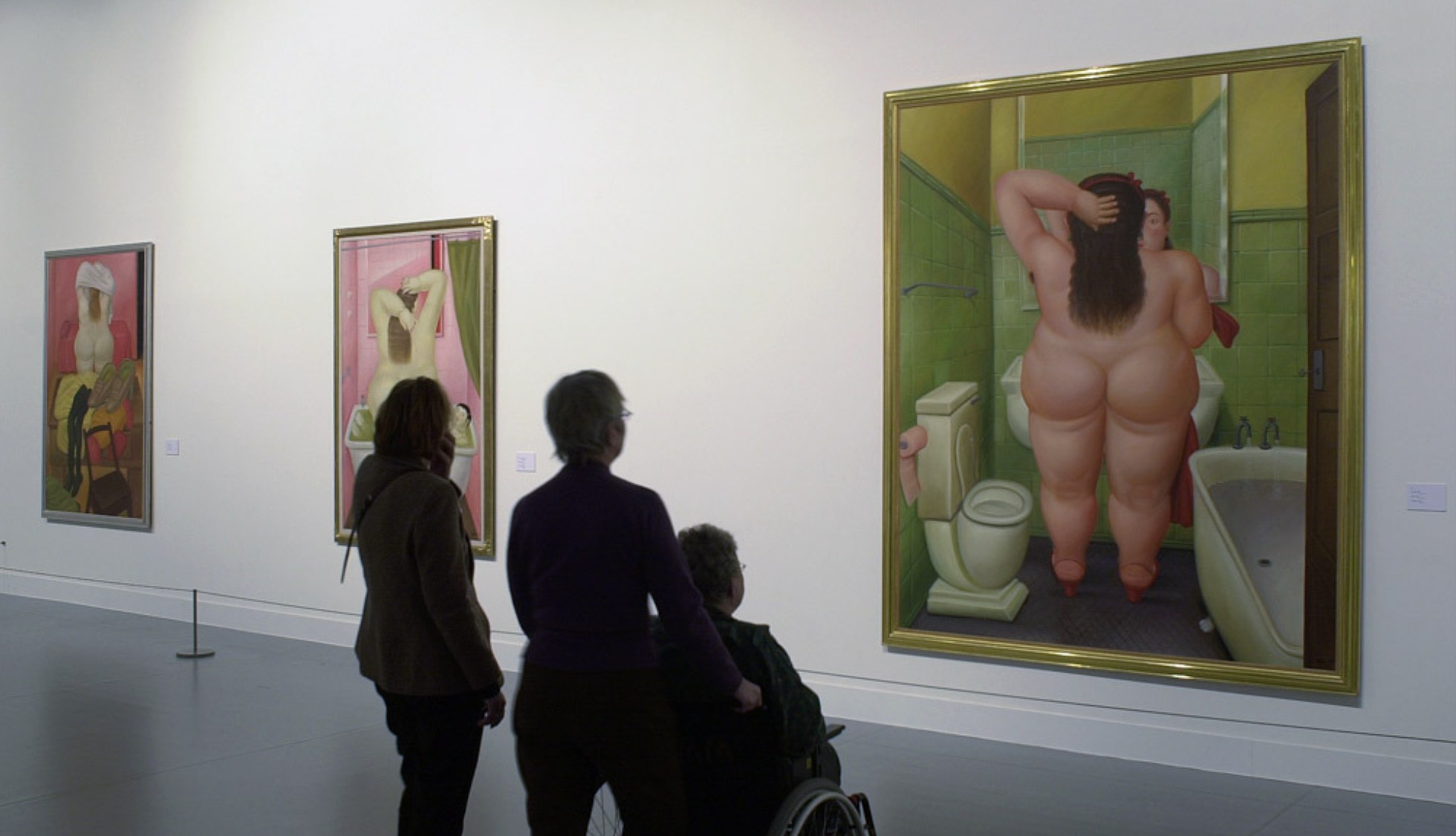
”El cuarto de baño” at the exhibition ”Fernando Botero” at Moderna Museet, Stockholm, 29 September 2001 – 13 January 2002.
El cuarto de baño was featured in the exhibition at Moderna Museet from September 29, 2001, to January 13, 2002, curated by the museum’s then-director David Elliott in collaboration with Botero himself. The exhibition then traveled to ARKEN Museum for Samtidskunst, Coptenhagen, ”Fernando Botero”, 2 February – 2 June 2002.
The Bed, 1982
Bonhams New-York: 14 May 2025
Estimated: USD 700,000 – 1,000,000
USD 762,500
Bonhams : FERNANDO BOTERO (1932-2023) The Bed
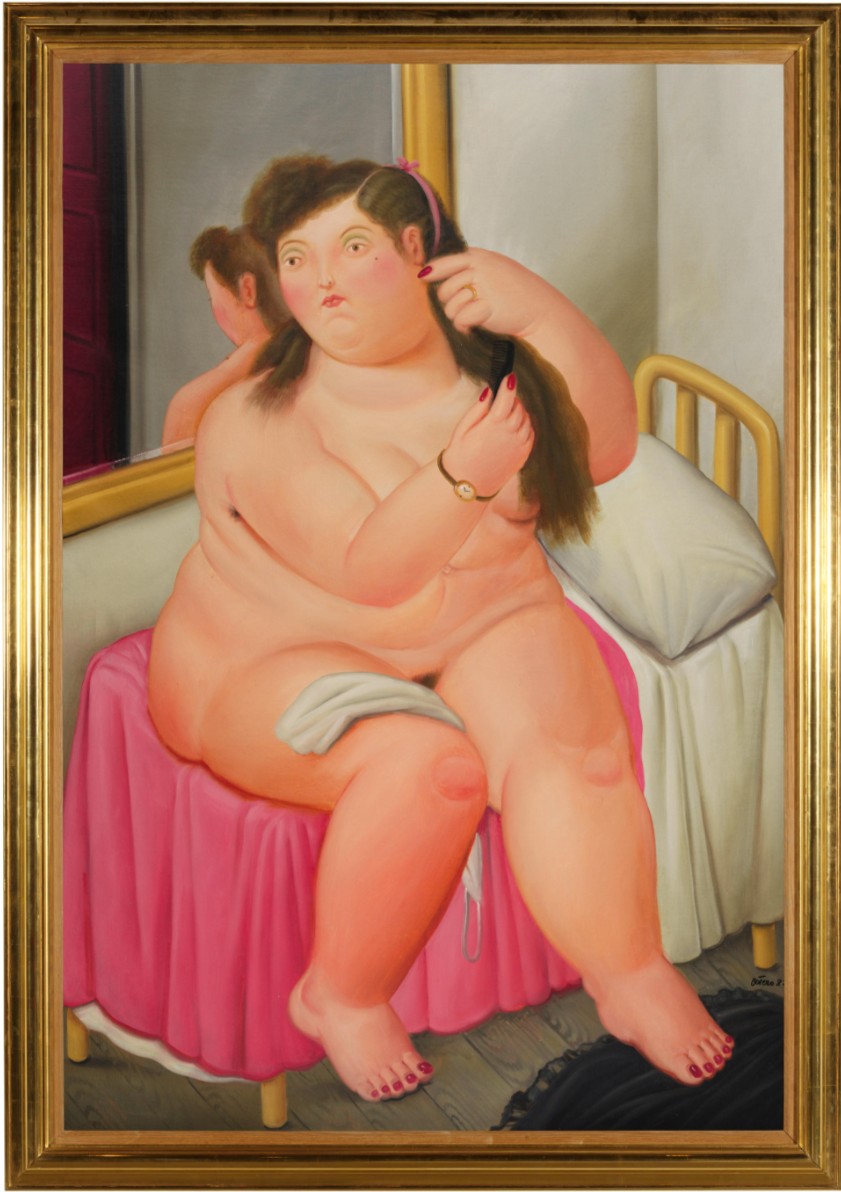
Oil on canvas
166×115 cm (65 3/8 x 45 1/4 inches)
Signed and dated ‘Botero 82’ (lower right)
Botero’s history of including courtesans in his body of work stems from the prevalence of sex workers in public spaces in mid-century Medellín, said to have expanded to serve the increasing city population as it underwent industrialization.
“When I was about thirteen years old, I would go to several of the whorehouses in the red district in Medellín. I would talk to the prostitutes—who all seemed very old to me then (they were probably in their twenties). I was fascinated by them and really liked them. Many years later, when I had a large show of my work in Colombia, I received a letter from one of them with whom I had been particularly friendly. It was a love letter! I was thrilled and touched and it made me remember every moment of those days.”
Much like the female nudes in art historical precedents such as Tintoretto’s Susanna and the Elders and Velázquez’s The Toilet of Venus (‘The Rokeby Venus’) Botero’s protagonist in The Bed acts as a symbol for desire itself. While Tintoretto’s depicts the biblical story whereby respected elders lusted after a married woman and Velázquez’s depicts the mythological figures of love Cupid and Venus, Botero’s 20th century adaptation takes the personification of desire into the form of a courtesan. In all three works, a mirror is crucially present, reminding the viewer of their voyeurism. Critically, in The Bed, Botero articulates this complexity and nuance with a sense of visual delight that celebrates the figure in all her beauty and grace, elevating her to the same stature of mythological and biblical symbols of beauty and desire. By creating a sense of grandeur, Botero gives meaning to everyday moments and people, celebrating the figure as the main character in their world.
Aurora, 1993
Sotheby’s New-York: 21 November 2024
Estimated: USD 700,000 – 1,000,000
USD 960,000
Aurora | Contemporary Day Auction | 2024 | Sotheby’s
FERNANDO BOTERO (1932 – 2023)
Aurora, 1993
Oil on canvas
142.2 x 192.4 cm (56 x 75 3/4 inches)
Signed and dated 93 (lower right)
Fernando Botero’s Aurora (1993) challenges our aesthetic expectations for the Roman goddess of dawn, embodying the artist’s inimitable approach to the female figure. Executed in his signature “Boterismo,” the painting masterfully renders the mythological figure of Aurora in Botero’s instantly recognizable voluminous form. His exaggerated, rounded figures have become synonymous with a unique blend of humor, irony, and aesthetic opulence, often challenging conventional depictions while maintaining a whimsical accessibility. The present work is a quintessential display of Botero’s whimsy and intellect, presented at a monumental scale that captivates and beguiles.
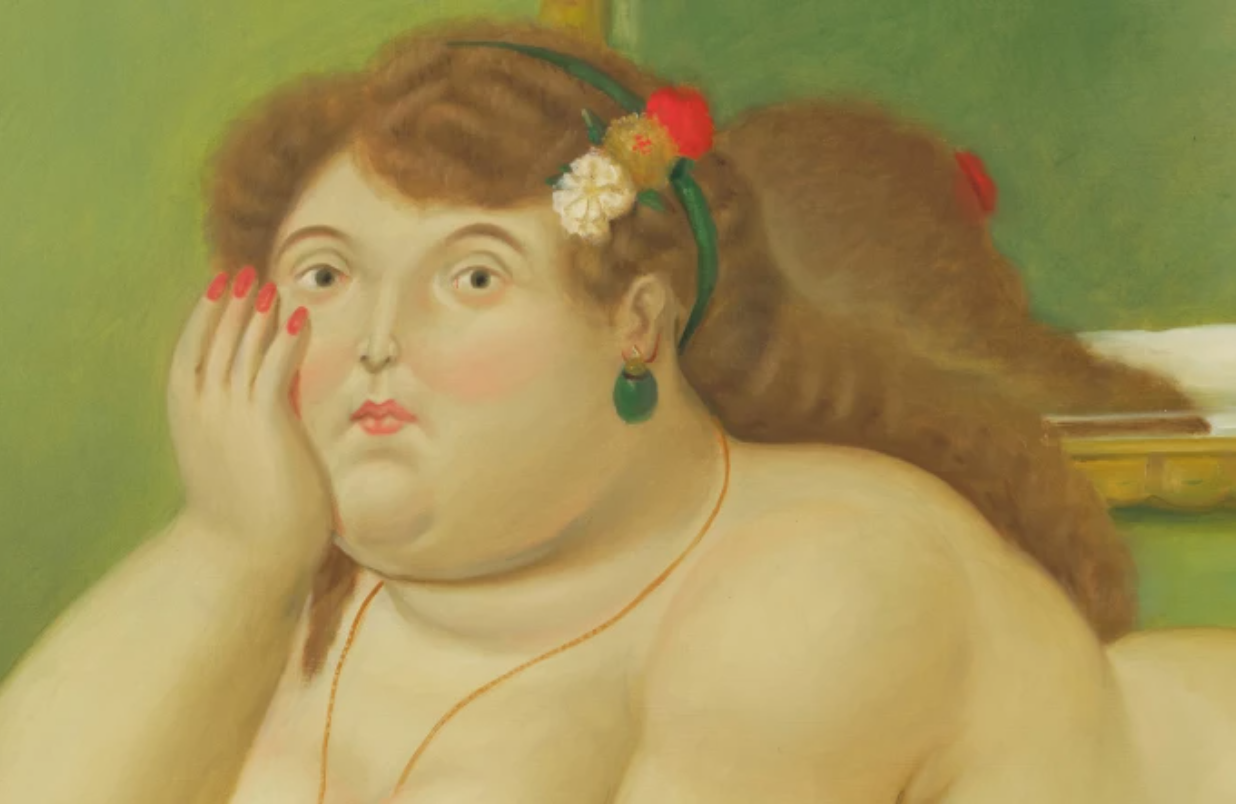
In Aurora, Botero revisits a classic mythological subject, grounding it firmly within his modern, stylized lexicon. The goddess, traditionally portrayed as a slender and graceful figure, is here transformed into one of Botero’s signature corpulent forms, her ample presence a striking contrast to more conventional depictions of the divine. By reimagining Aurora in this manner, Botero infuses the work with a playfulness that transcends mere representation, inviting viewers to engage with the figure not only as a symbol of dawn but as an embodiment of Botero’s larger commentary on form, beauty, and the human experience.
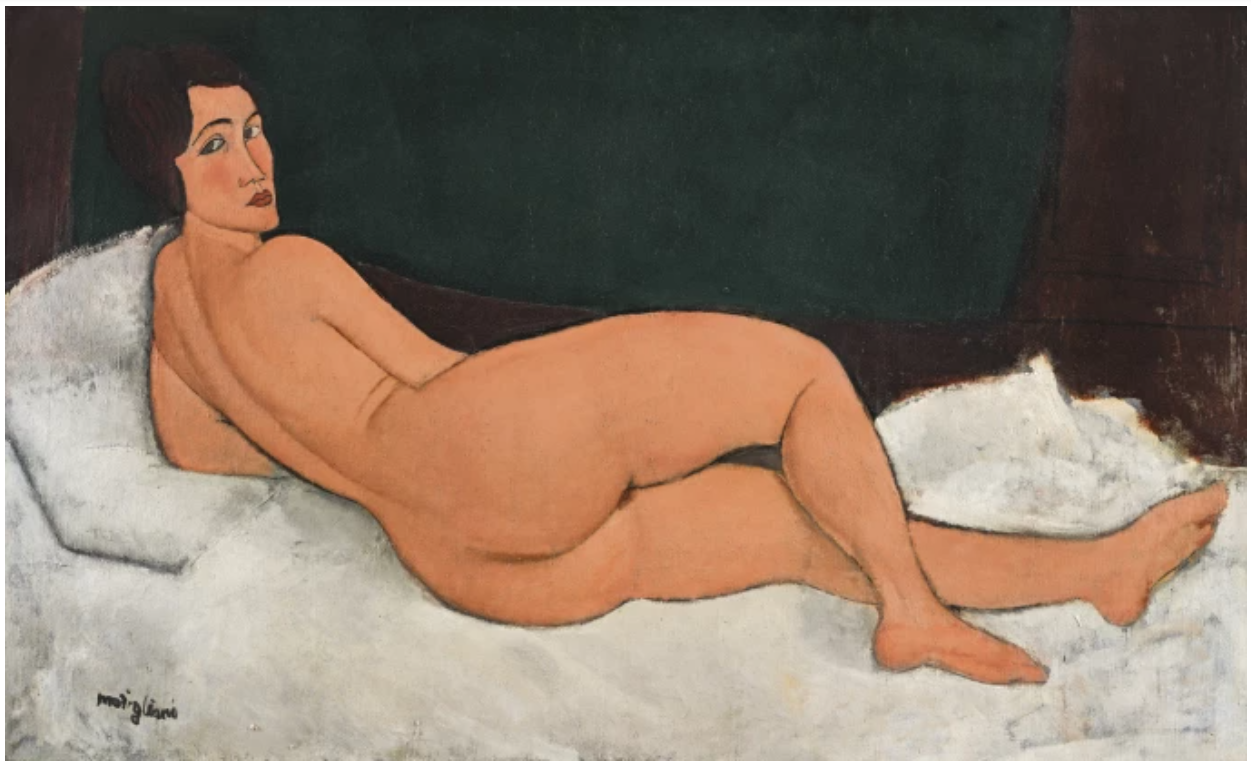
Amedeo Modigliani, Nu couché (sur le côté gauche), 1917, sold: Sotheby’s New York, May 2018, $157,159,000
The present work is also an example from Botero’s Bordello series, which he began in the early 1970s. The theme of the Bordello, which Botero revisited throughout his career, was inspired by his time studying in Europe as a young artist, where he absorbed diverse art traditions, as well as by the gritty reportage he observed while growing up in Medellín, Colombia. The present work dialogues pointedly with the Modern Western tradition of brothel scenes, though Botero makes several careful, intentional edits to the canonized genre. By imbuing his figures with a sense of empowerment and whimsy, Botero reimagines the female subjects as self-assured and non-objectified, subtly subverting the traditional passive roles assigned to women in such scenes.
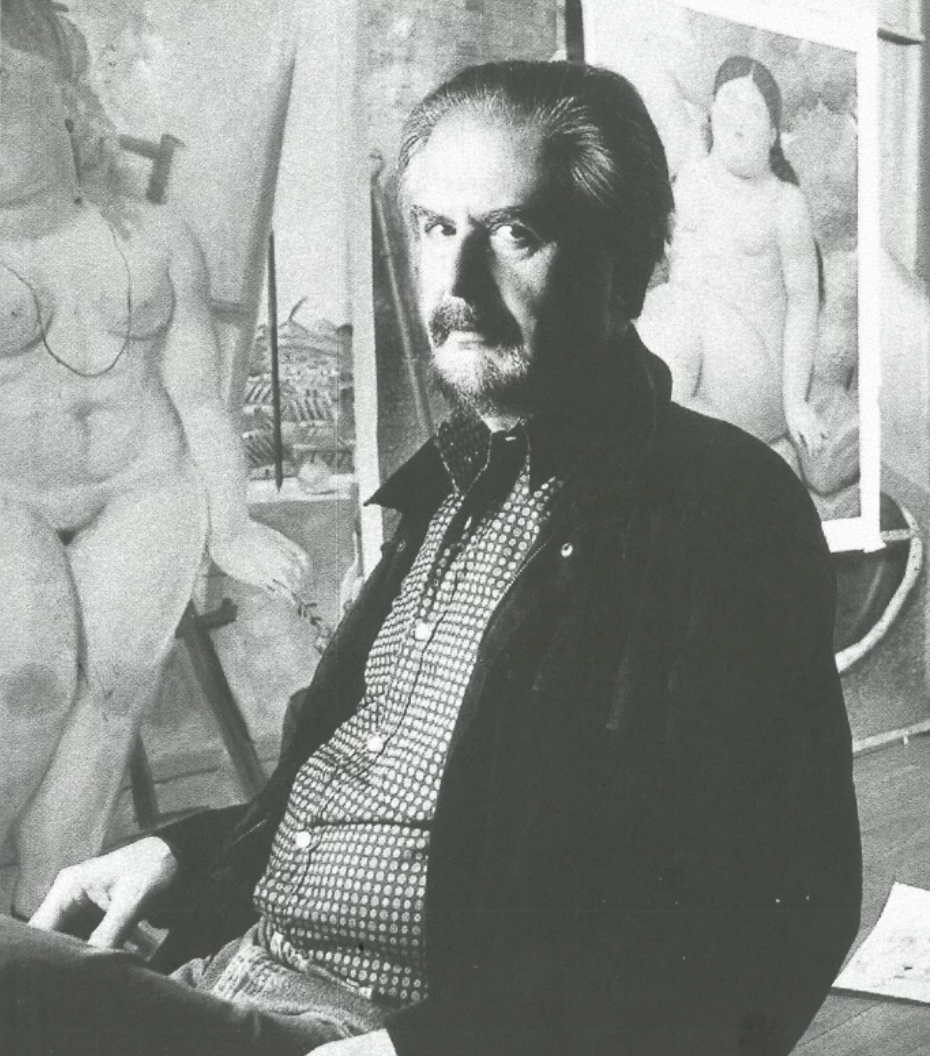
Botero in his studio, Paris, 2001
Presented in repose, Aurora’s sheer physicality commands attention. The fleshiness of her body, rendered with a soft, rounded tactility, commands the central portion of the canvas. Through his distortion of proportions, such as the lengthening of her torso and enlarging her limbs, Botero challenges traditional ideals of beauty and the classical nude. Botero emphasizes Aurora’s feminine beauty with her red lacquered nails, the gentle flush of her cheeks, the jewelry adorning her wrist, arm, and chest, and the trio of flowers placed behind her ear. The artist imbues his present subject with grace, feminine allure and self-assuredness, celebrating her fullness of form.
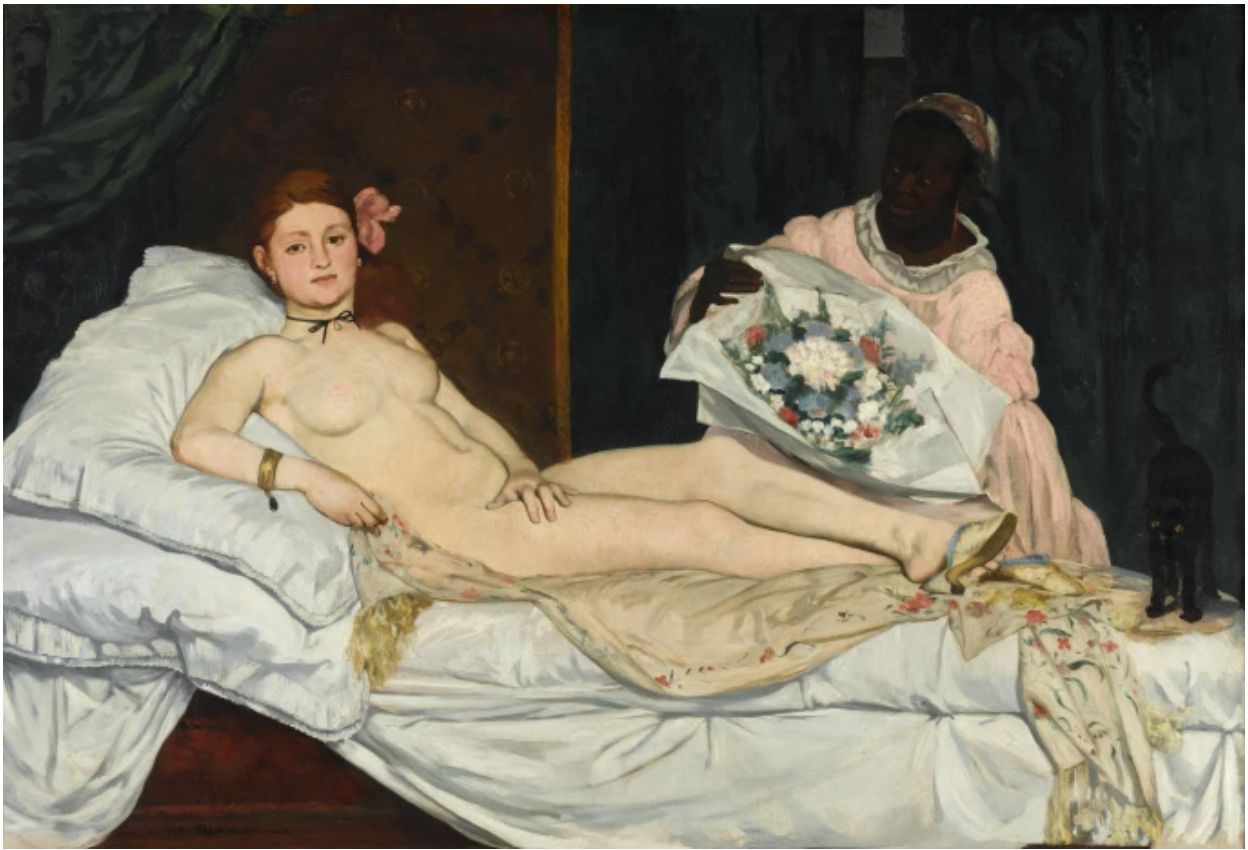
Édouard Manet, Olympia, 1863, Musée d’Orsay, Paris Musée d’Orsay. © Musée d’Orsay, Dist, RMN-Grand Palais / Patrice Schmidt
Aurora’s environs contain a similarly light-hearted yet symbolically-charged iconography. The lighting of Aurora’s bedroom provides a subtle nod to the ethereal and transient nature of dawn. The fruits surrounding Aurora’s figure enhance the playfulness and surreality of the present work. Botero seeks to reflect Aurora’s femininity in the scalloped edge of the pillow upon which she rests and the soft blues and pink stripes of the bedding. It is in this delicate balance between historical allusion and light-hearted motifs that Botero’s genius is most evident. The result is a work both familiar and fantastical, capturing the viewer’s imagination and offering a fresh interpretation of a popular mythological theme.
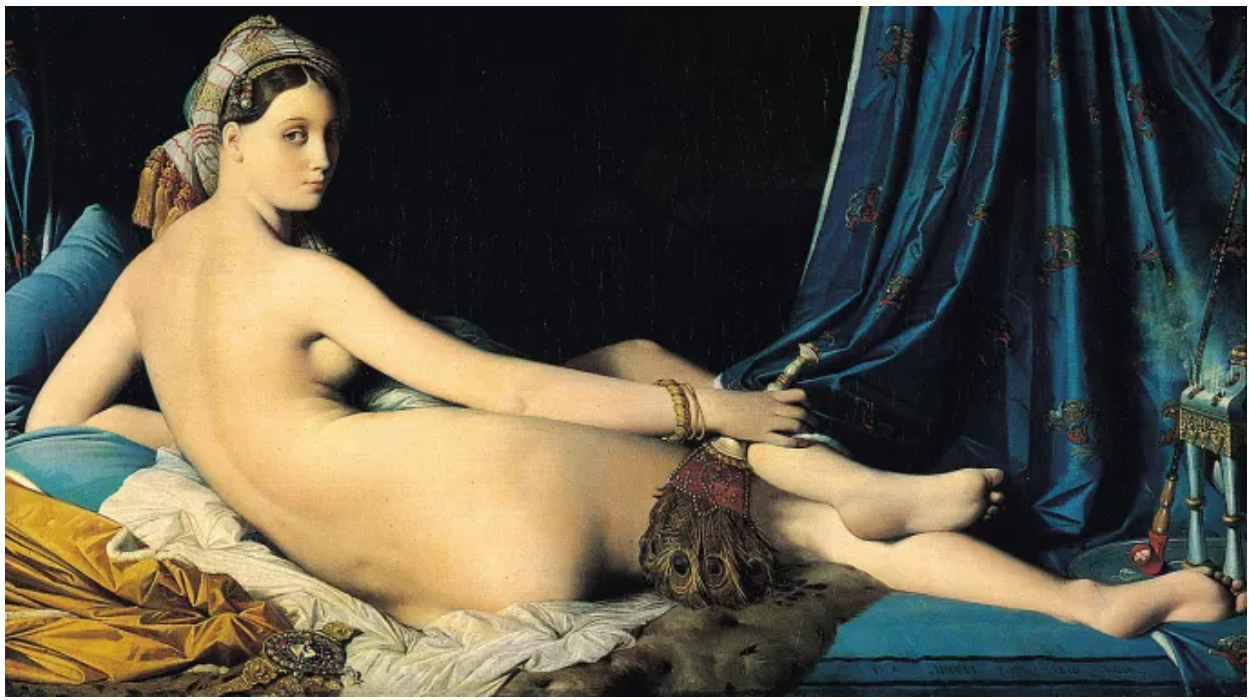
Jean Auguste Dominique Ingres, Grande Odalisque, 1814, Louvre, Paris
Botero’s reexamination of the female nude holds significant art historical relevance, expanding upon a long-standing tradition within Western art. By referencing iconic works such as Ingres’ Grande Odalisque, Manet’s Olympia, and Modigliani’s Reclining Nude, Botero positions himself within this established canon. However, in contrast to the passive, idealized figures often associated with these predecessors, Botero’s Aurora confronts the viewer with a gaze marked by confident ambivalence, challenging conventional representations of female sexuality and objectification. This shift in perspective signals a critical departure from the traditional portrayal of the nude as a passive object of desire.
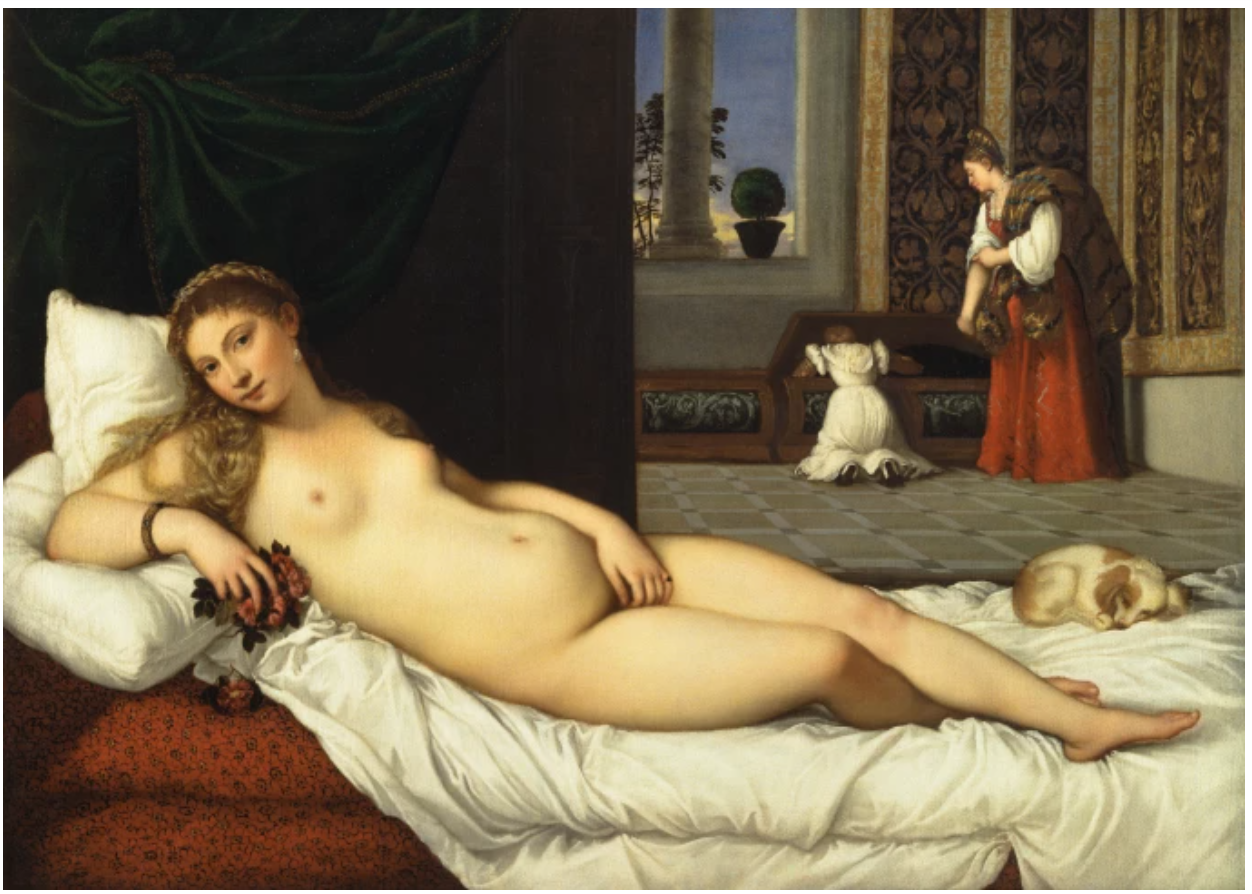
Titian, Venus of Urbino, 1538, Le Gallerie Degli Uffizi
Botero’s Aurora elevates a classical mythological narrative into a modern exploration of aesthetics. Through his distinctive style, the artist creates a work that is both humorous and subversive, challenging traditional depictions while engaging the viewer on multiple levels. His evocative approach has earned widespread admiration from private collectors and prestigious institutions alike, with works by Botero held in renowned collections such as the Museum of Modern Art and the Museo Nacional Centro de Arte Reina Sofía.
Desnudo ante el espejo, 1983
Sotheby’s New-York: 16 November 2023
Estimated: USD 600,000 – 800,000
USD 1,270,000
Desnudo ante el espejo | Contemporary Day Auction | 2023 | Sotheby’s (sothebys.com)
FERNANDO BOTERO (1932 – 2023)
Desnudo ante el espejo, 1983
Oil on canvas
181.6 x 120.3 cm (71 1/2 x 47 1/2 inches)
Signed and dated 83 (lower right)
Desnudo ante el espejo engages one of the most significant genres throughout the History of Art and Fernando Botero’s oeuvre: the female nude. In the monumental painting, a long-haired woman stands with her back to the viewer while gazing into a large round mirror. She is completely nude, save for the dark dress clinging to her calves, shiny green high heels and festive earrings dangling from her ears. These details, together with her freshly polished scarlet fingernails and unorganized open dresser suggest Botero’s subject had been getting ready – or unready – for a party – and may have brought the viewer home with her.
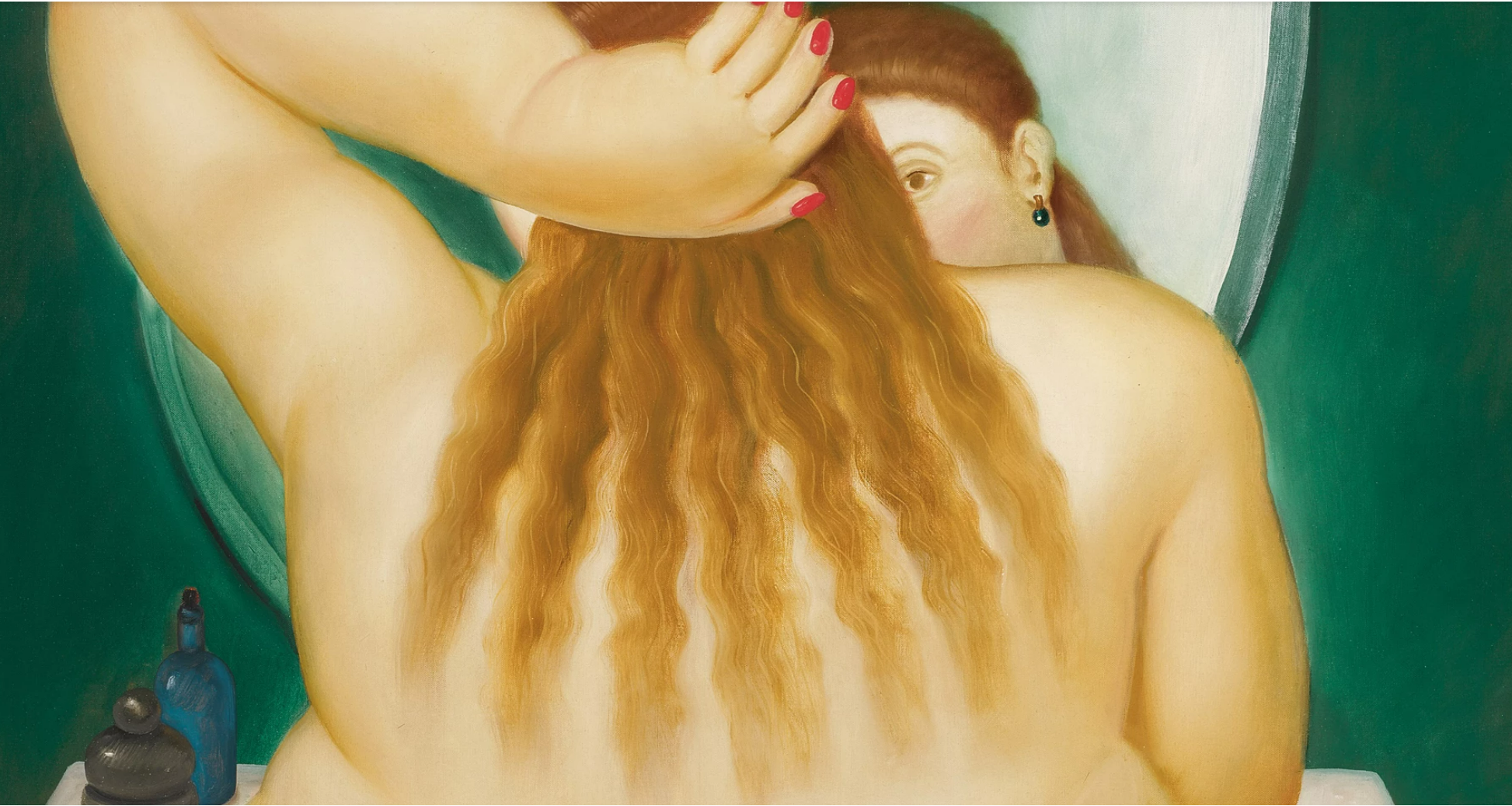
The woman appears either unaware or indifferent to our gaze – and Botero’s – which penetrates the intimate space of her bedroom. The sense of intrusion into her privacy is heightened by the door left ajar, that frames the figure along her right side. This architectural setting draws awareness to our encroachment into the physically enclosed bedroom, possibly adding to the thrill of impermissible desirability by interrupting the voyeuristic fantasy of the viewer. The general intimacy of the atmosphere is enhanced by the disproportionately large amount of space filled by the woman’s body in relation to the rest of the room. Ballooning with volume, the woman’s hips and backside expand outwards from the center of the composition so much that she begins to appear crammed into the space as if she were in a dollhouse. Through these formal elements, Desnudo ante el espejo participates in a dialogue with traditional patterns of looking and being looked at present in representations of women by men throughout history and the History of Art. By depicting this dynamic in what is arguably considered to be the most private of all settings, Botero proposes the possibility that for women, there is no escape from the reality of being turned into an object of consumption and spectacle. The under-clothed woman’s weary expression as she looks at herself in the mirror while sweeping her hair across her shoulder certainly suggests that her being stared at is a common occurrence and voices the possibility of her bitter resignation.
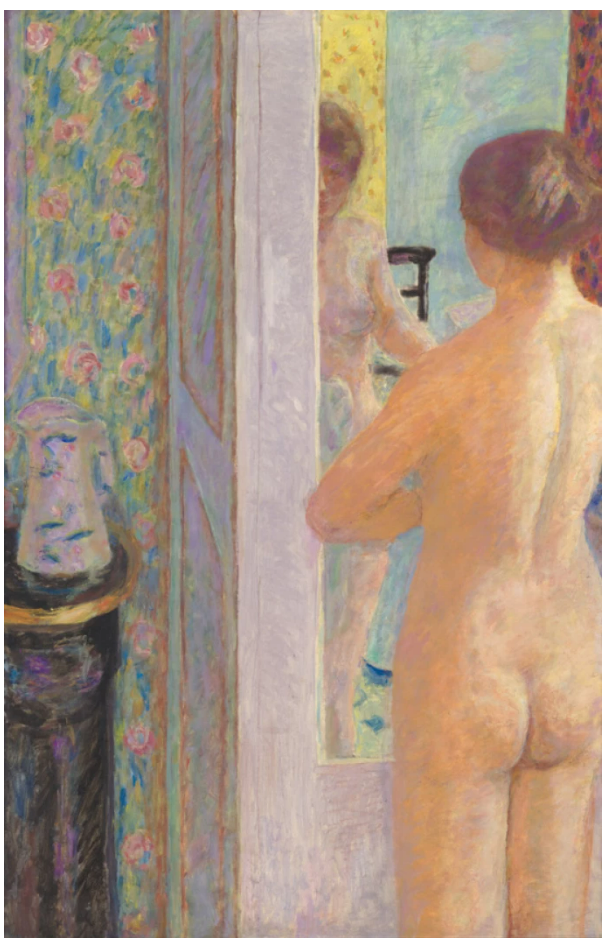
PIERRE BONNARD, LA TOILETTE, 1914, MUSÉE D’ORSAY COLLECTION
If public life has become a matter of spectatorship, Desnudo ante el espejo makes clear that the work of getting ready to go out into the world and “present” oneself is deliberate and active on the part of the women. By depicting the preparation for this spectacle, Botero reminds us of the mechanics of public life in general and implies that for modern women, leisure is still work.The parallel between the artificial nature of his media and the artificial nature of his subject’s presentation adds a provocative irony to Desnudo ante el espejo. The precisely executed painting, like its subject’s getting ready routine, emphasizes the intentional contrivement integral to its creation process. In doing so, Desnudo ante el espejo voices an awareness and possible disillusionment with modern culture’s institutional objectification of the female body. This awareness allows us, the viewer, to take on the position of the artist – or voyeur – and engage with the socially and historically charged dynamic at hand. The middle ground Botero stands on between engagement and awareness with this dynamic complicates the traditional narrative surrounding the act of looking and traditional relationships of power in Western visual culture.
Rosalba, 1969
Sotheby’s New-York: 16 November 2023
Estimated: USD 800,000 – 1,200,000
USD 952,500
Rosalba | Contemporary Day Auction | 2023 | Sotheby’s (sothebys.com)
FERNANDO BOTERO (1932 – 2023)
Rosalba, 1969
Oil on canvas
193 x 125.7 cm (76 x 49 1/2 inches)
Signed and dated 69 (lower right)
Women – of all ages, social classes, mythological traditions and levels of undress – are a defining presence throughout the oeuvre of Fernando Botero. Rosalba, an iconic, consummate example from one of the Colombian artist’s earliest and most important series – stands out for its technical brilliance, pointed social engagement, and dialogue with the visual tradition of the female nude in the Western European canon.
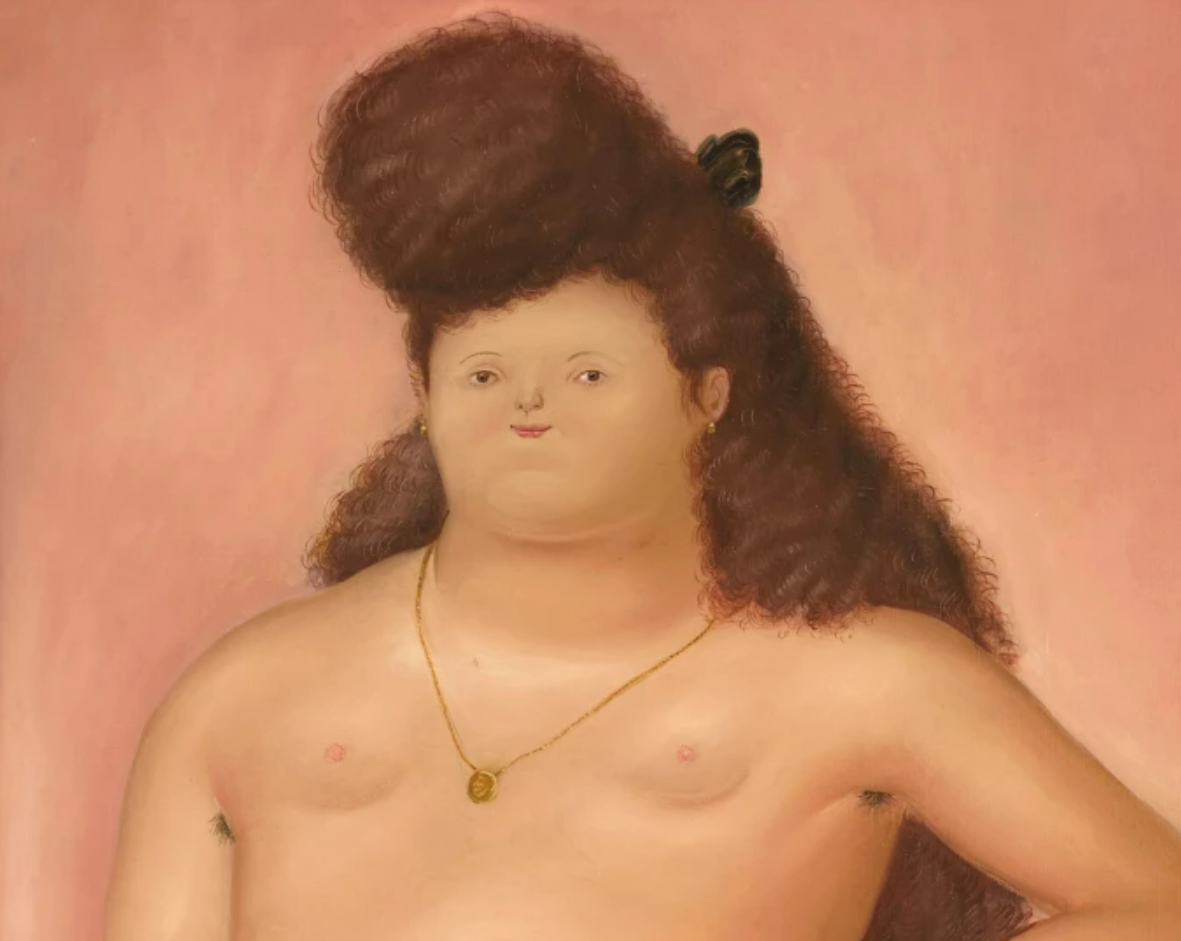
In the monumental portrait, a nude woman poses languidly with one hand on her hip and an unlit cigarette dangling from her other in a girlishly decorated bedroom. Although she is wearing no clothing, her delicately rendered hair is coiffed into an impossibly voluminous style, her nails and toes are freshly polished bright red and she wears gold earrings, a necklace, a bracelet, and a diamond ring on her ring finger. Strewn around Rosalba’s feet are nine discarded cigarettes, but interestingly no clothing, suggesting that she has been undressed in this room for quite some time. On the tidily made-up bed behind her, a chocolate-colored cat stares at us with piercing green eyes, keenly reminding us we are trespassing into this scene. Through these pictorial elements, a narrative story unfolds: we are in a brothel, and Rosalba is looking at us, maybe her next client, asking us to light her 10th cigarette. Executed in 1969, the present work stands as one of the earliest examples from Botero’s Bordello series from the early 1970s. The theme, which he continued to visit through his career, was absorbed by Botero during his studies in Europe as a young artist and the reportage he undertook while growing up in Medellín, Colombia.
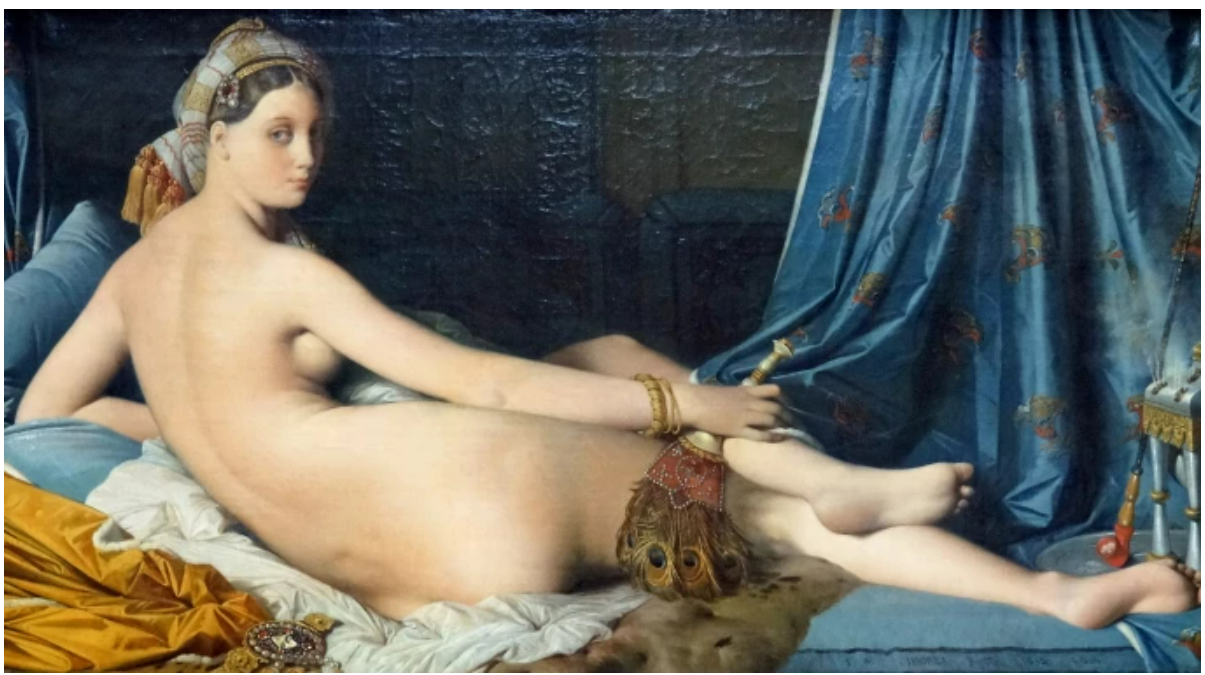
JEAN AUGUSTE DOMINIQUE INGRES, GRANDE ODALISQUE, 1814, LOUVRE
The present work dialogues pointedly with the Modern Western tradition of brothel scenes – though Botero makes several careful, intentional edits to the canonized genre. In Jean Auguste Dominique Ingres famous Grande Odalisque (1814), for example, his nude subject is vulnerable, idealized, and in a horizontal (available) position, making her saccharinely packaged for easy consumption by the viewer. She is also exoticized, her setting references some distant “East,” further allowing for a certain kind of unproblematized voyeurism. Rosalba, on the other hand, is neither exoticized, nor mythologized – though she reflects a certain idealized beauty, she is very much of our world. Like Toulouse-Lautrec’s depictions of sex worker scenes that followed the Grand Odalisque by about 80 years, Botero’s painting strikes one as a frank, even friendly image of business as usual in the bordello. As Manet does in his Olympia, whose black cat Rosalba’s clearly echoes, Botero engages here with gender and social class dynamics by depicting a female sex worker looking pointedly back at us – rather than just being looked at. It is impossible to hide from Olympia or Rosalba’s gaze – they make us aware of the act of visual consumption (and perhaps of our enjoyment of it), and direct us to reflect on our role in that dynamic.
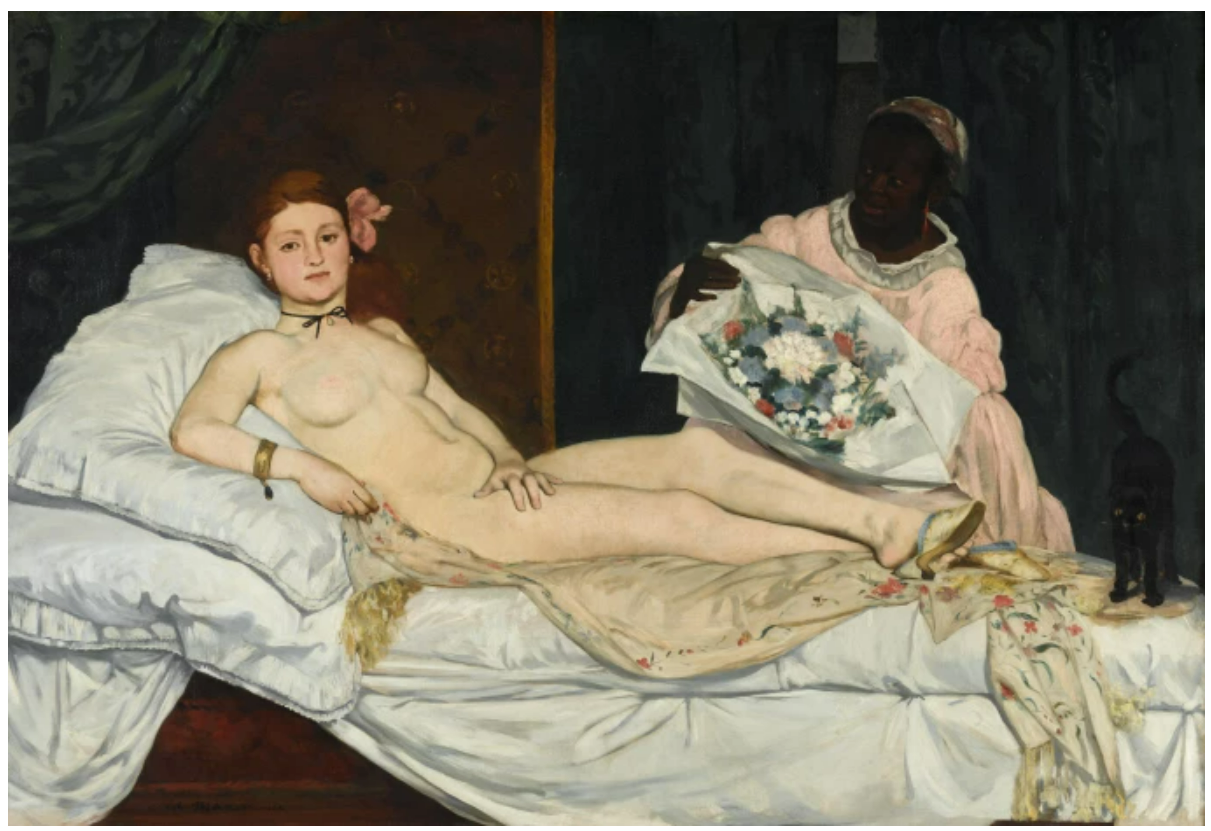
EDOUARD MANET, OLYMPIA, 1963, MUSEE D’ORSAY
Botero’s handling of Rosalba from a technical perspective and her large-scale format further unsettles art historical – and urban bourgeois – conventions. The bedroom’s gleaming surfaces, the painstaking rendering of each strand of Rosalba’s hair and cool-toned veins reflect Botero’s command of Old Master painting techniques. Botero’s signature, technically intensive sfumato style of the 1960s gives the work its compellingly hazy atmosphere, as if clouded with Rosalba’s perfume and the heavy smoke of her cigarettes. This devotion to the present work’s precise execution – a level of care historically unfit for a character of Rosalba’s station in society – is enhanced by her monumental proportions. Her voluminous figure – and hair – dominate the composition’s pictorial space, and her contrapposto mimics the gestural language of male heroes like Michelangelo’s David, demanding our attention. Alongside her heroic size, the strewn cigarettes depicted around Rosalba, the portrait on her nightstand, the carefully selected floral bedspread and curtain, the goofy cat – all contribute to offer up a charming, human portrait of a real woman. Where other artists approached the bordello and its workers with a dour, moralizing gaze (all the while exploiting these images for pleasure), Botero lends characters like Rosalba a sense of both whimsy and dignity. Rendered in the same monumental scale as his priests, presidents, and other patriarchal authorities, Rosalba is an essential character in Botero’s pictorial universe – where no one is spared a friendly lampooning.
Femme à la guitare, 1988
Christie’s Paris: 13 October 2021
Estimated: EUR 500,000 – 700,000
EUR 920,000 / USD 1,063,705
Fernando Botero (né en 1932), Femme à la guitare | Christie’s
FERNANDO BOTERO
Femme à la guitare, 1988
Oil on canvas
130×183 cm (51 1/8 x 72 inches)
Signed and dated ‘BOTERO 88’ (lower right)
By creating this Woman with a Guitar, Botero revisits a classic theme of art history, which can be found notably in the Orientalist movement (Reclining Odalisque by Théodore Chassériau, private collection) or even in Picasso, who interprets it as a Cubist version in the early 1910s (Woman with a Guitar, Kunstmuseum Basel). The subject offers to the artist a particularly fertile field of expression giving free rein to his stylistics: excess of voluptuousness in the treatment of curves and shapes; sensuality heightened by the languid posture of the woman with her red nails, holding the vertical guitar against her, while a cigarette is consumed in the ashtray; games of correspondence between the body of the character and the folded tension of the pink sofa; inclusion of deliberately kitsch elements like the flowerpot in the foreground. The formal treatment of the scene — frontal point of view and the perspective in flat areas, the use of the transparent coffee table in front and the reflection of the mirror as a window in the background— also inscribe Woman with a Guitar in a certain figurative pictorial tradition, recalling in particular portraits by David Hockney, such as those of Henry Geldzahler and Christopher Scott (1969).
The Bather, 1975
Christie’s New-York: 19 May 2021
Estimated: USD 1,800,000 – 2,500,000
USD 1,830,000
Fernando Botero (b. 1932) (christies.com)
FERNANDO BOTERO (b. 1932)
The Bather, 1975
Oil on canvas in three parts
Each: 236.2 x 126 cm (93 x 49 1/2 inches)
Overall: 236.2 x 377.2 cm (93 x 148 1/2 inches)
Signed and dated ‘Botero 75’ (lower right, right panel)
Famed for the lushly proportioned, pillowy bodies of his now-eponymous nudes, Botero has applied his facetious wit to subjects spanning Colombia’s military junta and its red-light district, Catholic clergymen and the bourgeoisie. Since his first departure for Europe in 1952, he has drawn from myriad art-historical sources—Titian and Velázquez; Giotto and Masaccio; Rubens and Ingres—and embraced the classical sensuality of volume, space, and color in legions of stylized “Boteromorphs.” Enamored as a boy of the glamorous “Vargas girls” that he saw in Esquire magazine, Botero has long since cultivated an aesthetics of abundance in figures whose amplitude defies fashionable conventions of beauty. In The Bather, he explained, “an immense female nude holding an apple distracts and visually overwhelms a repeated, small male swimmer of Magrittean propriety. Echoing the corpulent munificence and promise of the earth mother colossus is a Freudian landscape of volcano cones. Botero’s women, with their perms, their scarlet nails and their boneless, luxuriant forms, are not only a stylized fantasy of the ‘ideal woman’ in the Latin American world of the 1940s and 1950s. Their thick figures embody, above all, the mother/woman, the supreme taboo, which gives life, suckles the species and is the backbone of the home.” Placid and majestic, the subject of The Bather contains this feminine ideal within the salmon-colored folds of her flesh and her stolid, matronly pose, seen from front, back, and side. “In Botero’s fat ladies there is no lasciviousness and the sexual component is miniscule, if not non-existent. Here cupping an orange in her hand (in lieu of the biblical apple), the bather channels Eve, the first and eternal mother and among Botero’s iconic and recurring subjects. A paradigmatic Botero woman, she exists in a modern Eden, standing beside a swimming pool of pistachio-green water framed by a lush rectangle of grass, a red-brick wall, and finally a serene horizon of Colombian mountains and sky.
Tauromachy and Circus
Circus Act, 2007
Christie’s New-York: 12 March 2024
Estimated: USD 600,000 – 800,000
USD 850,500
FERNANDO BOTERO (1932-2023), Circus Act | Christie’s (christies.com)
FERNANDO BOTERO (1932-2023)
Circus Act, 2007
Oil on canvas
83.2 x 112.1 cm (32 3/4 x 44 1/8 inches)
Signed and dated ‘Botero, 07’ (lower right)
Fernando Botero discovered his passion for the circus in 2006, on a trip to Zihuatanejo, a small Mexican town.
“There is something in the background of the circus that is also very attractive. I went to see a circus in Mexico, and I had the chance to meet these people… and I was fascinated by the possibilities and the poetry of the subject.”
This travelling troupe brought back memories of his childhood in Medellín, and this fascination inspired him to create a whole series of very personal paintings imbued with that world. Jugglers, acrobats, animal trainers, colorful costumes: rotund, jolly forms with, beneath the surface, a palpable melancholy. This series, which he began in 2007, presented a whole world of color, filled with the monumental and exaggerated forms that characterized the artist’s work.
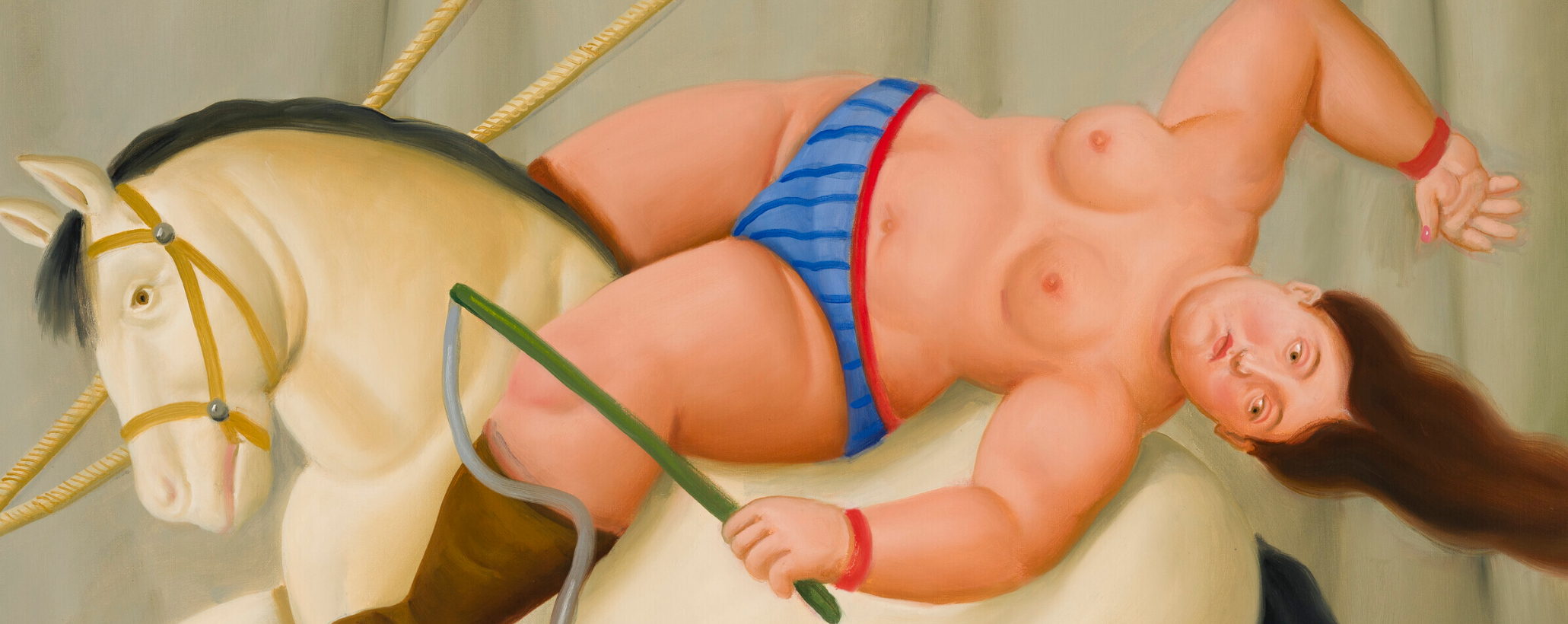
The circus has a long tradition in art history, and Botero was preceded by many great masters who were drawn to its great pictorial potential: Seurat, Picasso, Calder, Chagall, and Léger – to name only the most famous – have dignified this world, in some cases with a realist approach, and in others with an allegorical or symbolic treatment. The circus certainly offers artists a rich seam of possibilities for studies, not only in terms of the colors and extraordinary body movements, but also the philosophy of life that accompanies this world. In Circus Act, a voluptuous rider performs contortions on her horse, almost to the point of falling, determined not to let any emotion show in her act despite its bizarreness. As in the artist’s best works, the viewer can barely believe their eyes as they takes in this spectacle and the disproportion between the rider’s feat and her impassive demeanor. There is a fondness in Botero’s depiction of this character, reflected in the way her rotundity and bright colors fill the canvas.
En la plaza, 1987
Christie’s New-York: 28 September 2023
Estimated: USD 800,000 – 1,200,000
USD 1,332,600
FERNANDO BOTERO (1932-2023) (christies.com)
FERNANDO BOTERO (1932-2023)
En la plaza, 1987
Oil on canvas
182.9 x 130.5 cm (72 x 51 3/8 inches)
Signed and dated ‘Botero 87’ (lower right)
Famed for the lushly proportioned, pillowy bodies of his now-eponymous nudes, Botero has for decades applied his facetious wit to subjects spanning Colombia’s military junta and its red-light district, Catholic clergymen and the bourgeoisie. Since his departure for Europe in 1952, he has drawn from myriad art-historical sources—Titian and Velázquez; Giotto and Masaccio; Rubens and Ingres—and embraced the classical sensuality of volume, space, and color in legions of stylized “Boteromorphs.” Enamored as a boy of the glamorous “Vargas girls” that he saw in Esquire magazine, Botero has long since cultivated an aesthetics of abundance in figures whose proportions defy fashionable conventions of beauty. Formidable and yet charmingly naïve, Botero’s characters play out scenes and drollery from everyday life from the church to the circus and even the bullring, as portrayed in En la plaza with the artist’s customary élan.
In bullfighting Botero found a profound and enduring subject, its ritualized spectacle of life and death memorialized in a now iconic series of paintings and sculptures, among them the present work. A modern-day maja, in the great Spanish tradition, the elegant sitter in En la plaza perches daintily on a balcony at the bullring, framed by crowds of aficionados that fill the open-air stands behind her. A red peineta rises high behind her rows of tightly permed auburn hair, in place to hold a mantilla; she plays with the fringes of a red shawl that falls across her lap, perhaps a nod to the muleta, the bullfighter’s storied red cape. She faces away from the action, seemingly detached from the existential drama unfolding behind her; pale, placid, and imperturbable, she sits serenely in her floral dress and high-heeled shoes, fanning herself against the fray.
Picador in the Bullring, 1985
Sotheby’s New-York: 17 November 2022
Estimated: USD 600,000 – 800,000
USD 693,000
FERNANDO BOTERO (B. 1932)
Picador in the Bullring, 1985
Oil on canvas
168.9 x 99.1 cm (66 ½ x 39 inches)
Signed Botero and dated 85 (lower right)
Fernando Botero’s Picador in the Bullring from 1985 presents a portrait of a bullfighter standing triumphantly among a cheering crowd. Depicting one of the artist’s favorite subjects, Picador in the Bullring is testament to Botero’s passion and curiosity for the sport of bullfighting that has remained with him throughout his illustrious career. Inspired by the sheer spectacle of the bullring — the vivacious crowds, vivid colors, and fine line between life and death— bullfighting provides a vehicle for Botero to showcase his greatest strengths as an artist. Bursting with juicy color and subtle humor, the work is marked by the charming sense of wit that characterizes Botero’s mature painting. Laden with art historical references, Picador in the Bullring recalls Francisco Goya’s La Tauromaquia series and Edouard Manet’s renderings of bullfighters.
Family Scene, 1985
Christie’s New-York: 18 November 2010
Estimated: USD 1,000,000 – 1,500,000
USD 1,706,500
Fernando Botero (Colombian b. 1932) (christies.com)
FERNANDO BOTERO (Colombian b. 1932)
Family Scene, 1985
Oil on canvas
169×179 cm (66 1/2 x 70 1/2 inches)
Signed and dated ‘Botero 85’ (lower right)
Executed in 1985, Family Scene is inspired by Botero’s fascination with the artistry and sport of tauromachy. An avid student of visual culture and the history of representation, Botero’s interest in the subject, although clearly linked to his personal memories, may also be seen within the context of the history of art and its repertoire of imagery spanning from pre-Hellenic times to the work of Francisco Goya, Édouard Manet, and Pablo Picasso. But as is typical in Botero’s oeuvre, these antecedents are merely a point of departure from which to reinvent and refashion a new lexicon of meaning and representational conventions. Accordingly in the Family Scene, Botero removes the ritual from its traditional context–the arena of competition–and places the familiar cast of characters–toreros, picadores, banderilleros, monosabios, and the rest of their extended clan in a domestic setting. In the process, Botero succeeds in providing the viewer with a fresh and thought-provoking approach to this perennial subject. Moreover in the process Botero humanizes the valiant heroes while reminding us of the precarious nature of life. Indeed the familial group portrait, the woman’s gentle placement of her hand on her husband’s or lover’s shoulder, the sitters’ firm and stoic glances, the ornate, formal costumes, the strewn banderillas, the torero’s grip of his lance, the child bullfighter in waiting barely walking but already following in his father’s footsteps, and the taxidermy bull’s head all serve to codify the scene and reveal the dynamics and interrelationships of the family business while imbuing the protagonists with a sense of immortality and reverence. Indeed by relocating the characters from the bullring to the bullfighter’s home, Botero effectively shifts the discourse from one centered on the pageantry and mythic struggle inherent in this timeless ritual to a highly emotive narrative that is at once deeply personal and intimate, yet infinitely more universal in its revelation of the depth of familial bonds and the fleeing nature of life.
Portraits
El poeta, 1987
Christie’s New-York: 21 May 2026
Estimated: USD 800,000 – 1,200,000
USD 1,270,000
FERNANDO BOTERO (1932-2023), El poeta | Christie’s
FERNANDO BOTERO (1932-2023)
El poeta, 1987
Oil on canvas
140×208 cm (55-1/8 x 81-7/8 inches)
Signed and dated ‘Botero 87’ (lower right)
Botero long worked within the venerable canons of art history, with what he once called a “very strange mixture of admiration and criticism.” Acknowledging that “an artist is always a critic of earlier artists,” he explained, “You think you must, and can, improve on earlier ages,” but at the same time “you must have this critical attitude to art of the past. . . . You can take the same subject and create a totally different painting. That’s where real originality lies, in taking something that’s already been done by someone and doing it differently” (in W. Spies, “‘I’m the most Colombian of Colombian artists’: A Conversation with Fernando Botero,” Fernando Botero: Paintings and Drawings, Munich, 1992, pp. 155-56).
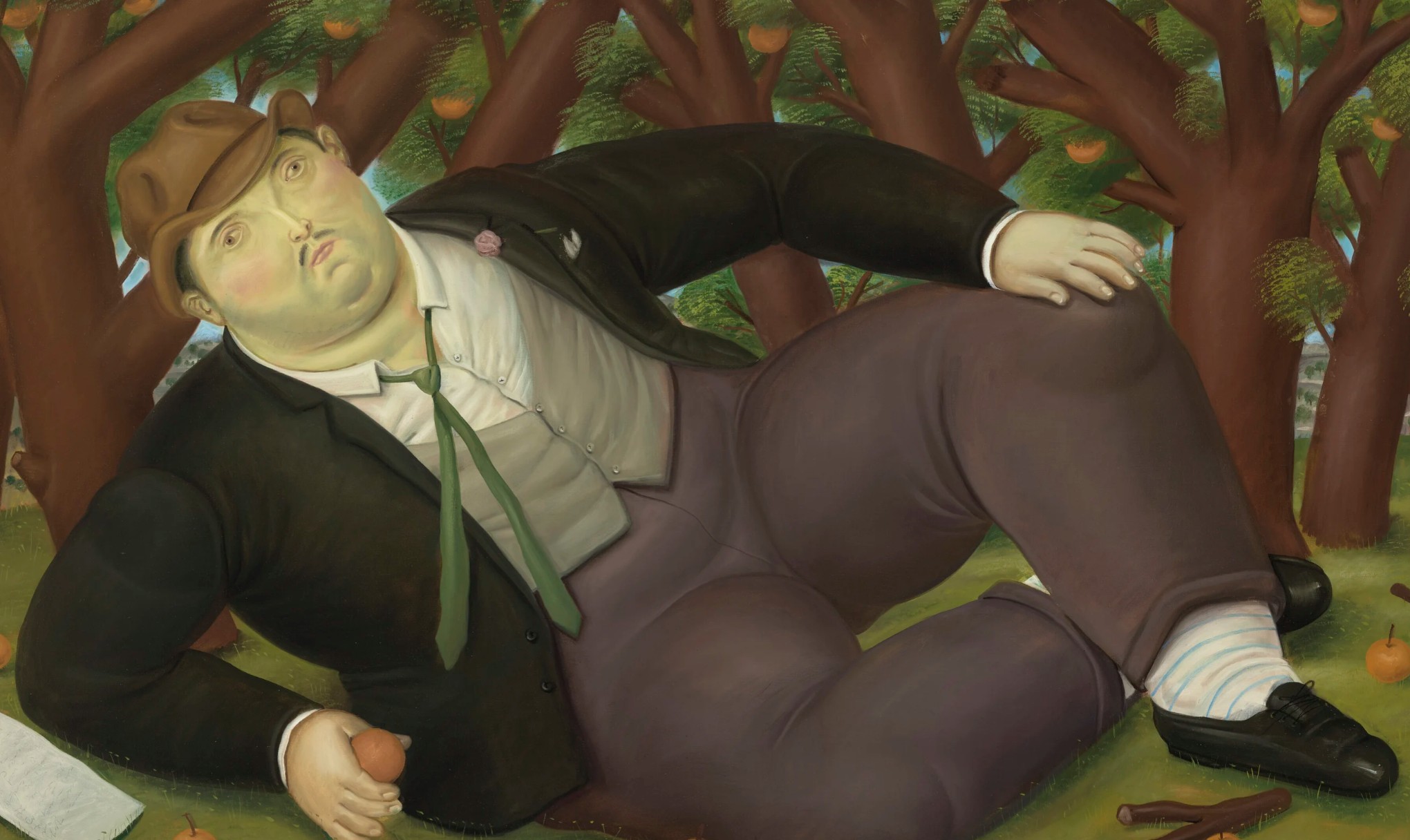
Since first departing for Europe in 1952, Botero drew from and critically reinterpreted myriad art-historical sources—Titian and Velázquez; Giotto and Masaccio; Rubens and Ingres—and embraced the classical sensuality of volume, space, and color in legions of stylized “Boteromorphs.” In El poeta Botero revisited an early and enduring source—Édouard Manet—in a delightful meditation on the genre of pastoral scenes, the stakes of modernism, and the art of homage.
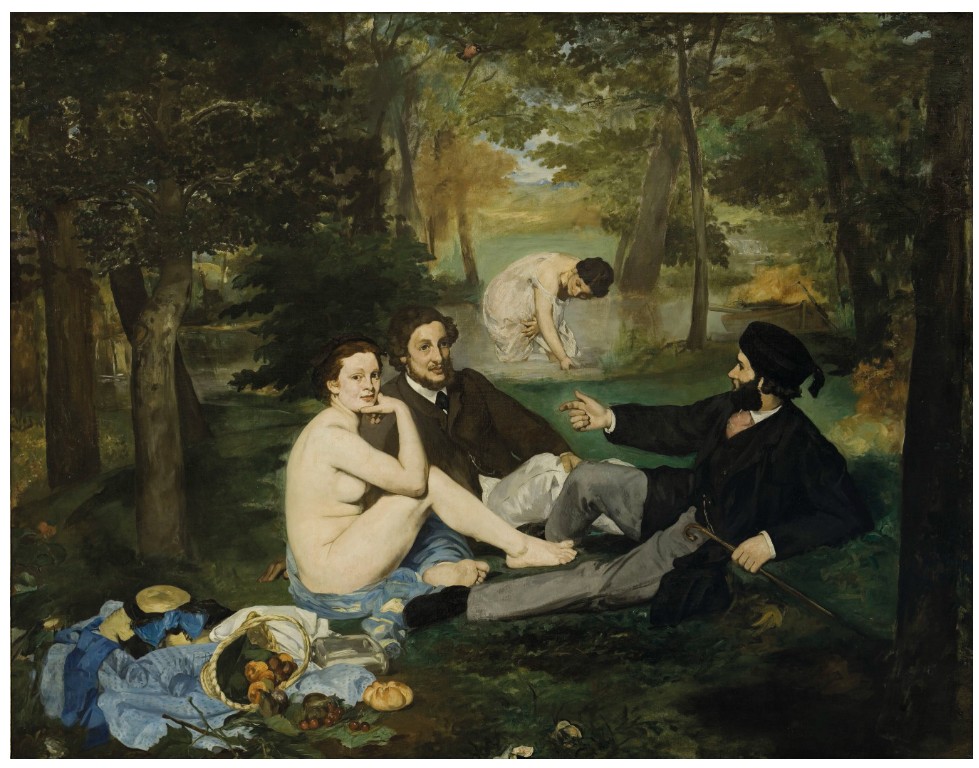
Édouard Manet, Le Déjeuner sur l’herbe, 1862-1863. Musée d’Orsay, Paris.
Botero persistently engaged with Manet’s iconoclastic painting, Le Déjeuner sur l’Herbe (1863), which scandalized contemporary audiences with its frank depiction of working-class sexuality and its non-illusionistic flatness, both of which defied classicizing Renaissance values. Beginning with Picnic in the Mountains (1966) and continuing in “Le Déjeuner sur l’Herbe” (1969) and El poeta, among other works, Botero reimagined the scene, “remak[ing] Manet’s even balance between landscape and figures,” as critic Carter Ratcliff explains. “They completely Botero-ize all there is of tradition in Manet’s style.” Manet had himself upended academic tradition, riffing on historical exemplars—notably, Titian’s Concert Champêtre (c. 1509) and Marcantonio Raimondi’s engraving after Raphael’s The Judgement of Paris (c. 1510-20). Botero turned the tables a century later, “Botero-iz[ing] Manet’s homage to the Renaissance” in his own revisitation of the Old Masters and the subsequent development of his eponymous style. “The massive weight of Boteromorphic plasticity expunges all hints of modernist formal play from pictorial space,” Ratcliff continues. “The unity of this painting requires Botero’s style to stand at a border and look two ways at once—toward Raphael’s Renaissance and toward the twentieth-century modernism which Manet did so much to instigate” (Botero, New York, 1980, pp. 117-23).
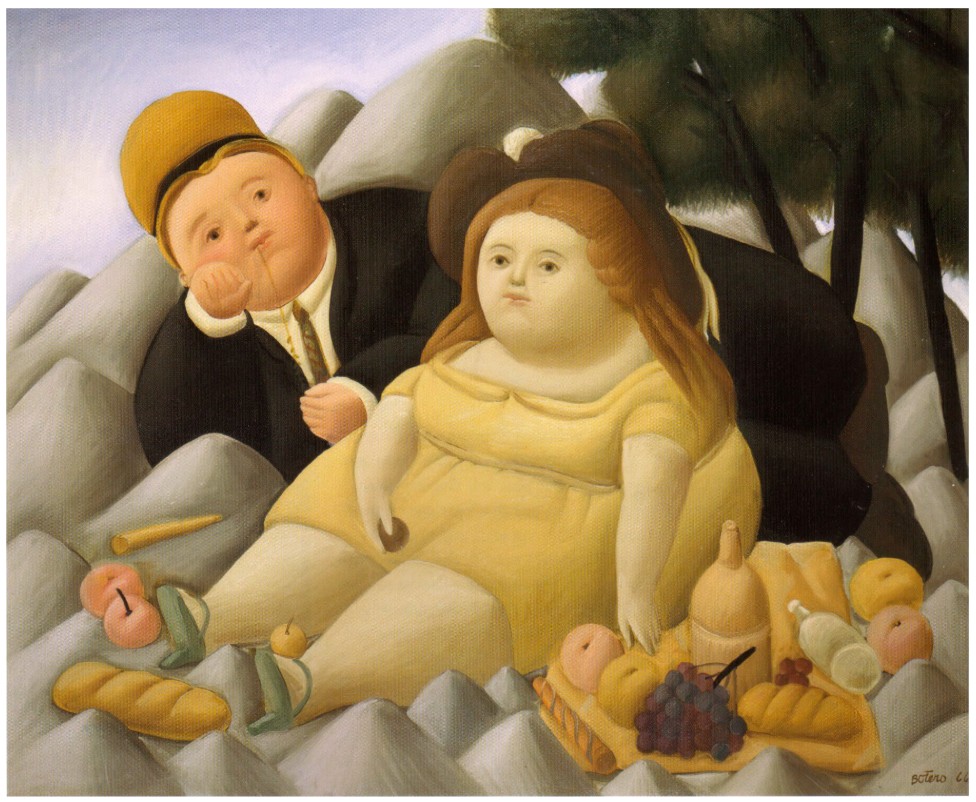
Fernando Botero, Picnic in the Mountains, 1966. © The Estate of Fernando Botero.
The dapper gentleman portrayed in El poeta nods to his modernist predecessor in Le Déjeuner sur l’Herbe, but in Botero’s revisioning he projects a benign, verdant serenity as reclines against a grove of apple trees. In the present painting as well as an earlier Poet (1970), Botero monumentalizes his subject, his pillowy body—jauntily dressed in a three-piece suit that clings to his curves—at rest as he takes a break from his poetic musings. A notepad rests alongside his right forearm just to the side of a bright red pencil, which floats at the edge of the canvas in a subtle homage to the age-old trompe-l’oeil tradition. The apples, a recurrent motif across Botero’s paintings, suggestively transport the figure to a modern-day Garden of Eden—a snake similarly appears in his “Le Déjeuner sur l’Herbe”—and in that way return the painting to a timeless and eternal subject. “An artist is able to let people experience the past with the feeling of the present,” Botero reflected. “You can’t escape from your own time, so you’re creating something that belongs to the present moment—because once art has gone through an experience it never returns to its previous position. That’s why it’s impossible to fake Quattrocento or nineteenth-century paintings—they’ll always be twentieth-century paintings” (in W. Spies, op. cit., p. 155).
The Bride, 2009
Property from a Distinguished Private Collection, Texas
Sotheby’s New-York: 15 May 2026
Estimated: USD 800,000 – 1,200,000
USD 870,400
Fernando Botero | The Bride | Contemporary Day Auction | 2026 |
FERNANDO BOTERO (1932 – 2023)
The Bride, 2009
Oil on canvas
67×39 inches (170.2 x 99.1 cm)
Signed and dated 09 (lower right)
Fernando Botero’s The Bride is among the most tender and ceremonially charged works of the artist’s late career, a monumental and quietly radiant image of feminine ritual. A solitary figure dominates the picture plane, her voluminous white gown cascading to the floor in rippling tiers, a bouquet of pale yellow flowers gathered loosely in her hands. Flowers adorn her chestnut hair, and a long veil trails behind her with quiet monumentality. The palette, cream, ivory, and soft sage, is restrained and luminous, suffusing the composition with an air of dignified solemnity. The figure gazes outward with the composed, slightly enigmatic expression characteristic of Botero’s figural work, at once intimate and hieratic.
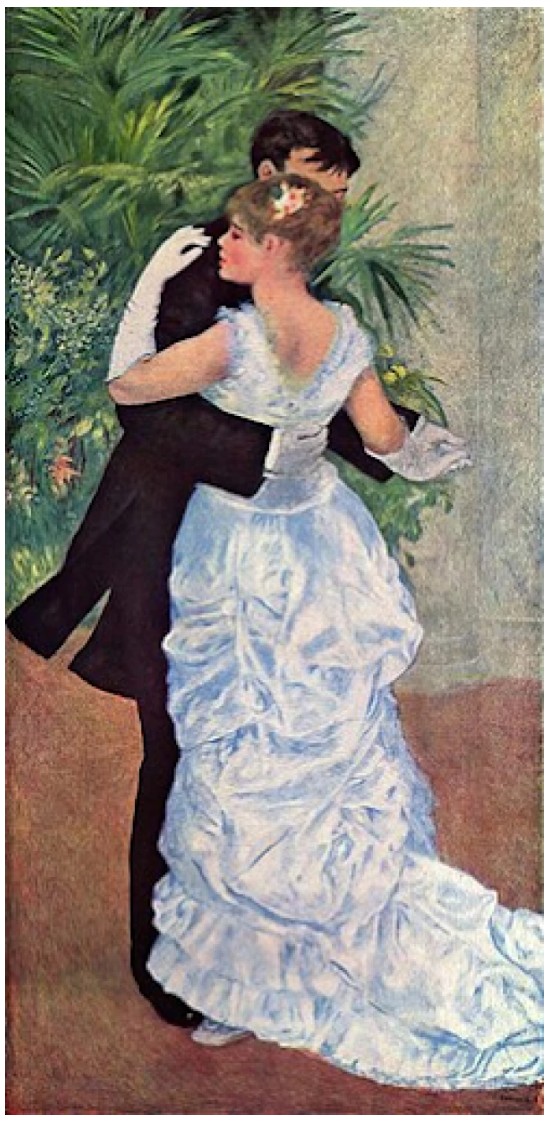
Pierre-Auguste Renoir, Dance in the City, 1883, Musée d’Orsay, Paris
The painting exemplifies the formal vocabulary Botero had refined over six decades: his celebrated volumetría, a system of pronounced, spherical amplification through which every form, human, animal, or inanimate, acquires an almost sculptural weight and presence. This approach was never intended as social commentary or caricature. Rather, Botero understood volume as the fundamental language of sensuality and beauty, an inheritance from the great Flemish and Italian masters he studied assiduously during formative years in Florence and Madrid. The influence of Piero della Francesca and Mantegna is palpable in the stillness and frontality of figures such as this bride.
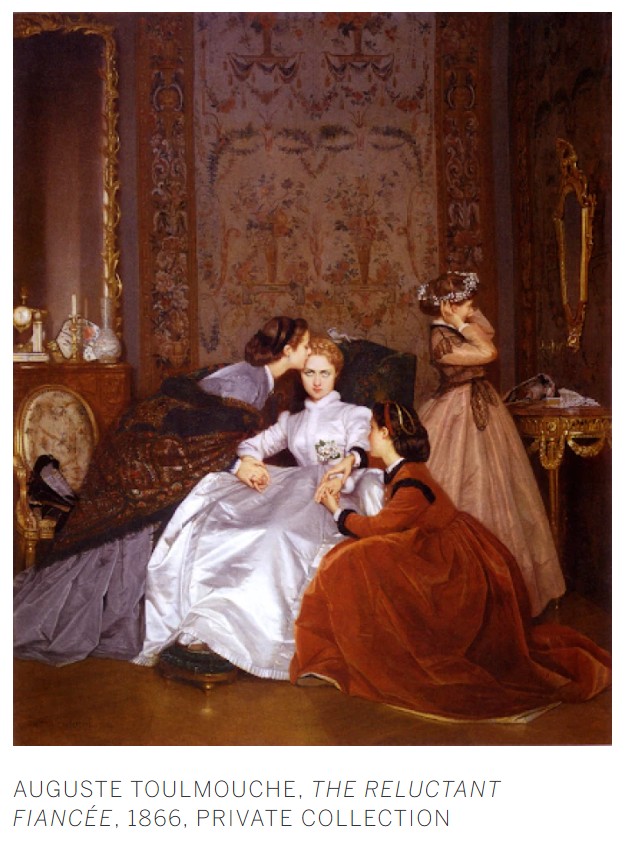
Where Lucian Freud excavated the psychological and corporeal rawness of his sitters, and John Currin engaged figuration through a lens of irony and art-historical pastiche, Botero’s relationship to the human form was one of unambiguous celebration. He shares with Freud a preoccupation with bodily mass as an expressive vehicle, yet his figures inhabit a world of warmth and archetype rather than existential unease. Closer perhaps to the earthy humanism of Fernand Léger — whose tubular, monumental figures similarly defied prevailing abstraction — Botero nonetheless carved out a position entirely his own, rooted in the cultural memory of Latin America and the classical traditions of the European Renaissance.
“If women are often my subjects, it’s because they have been one of the main subjects of paintings for centuries. What really guides me above all, when I sculpt or paint men, women, animals, or objects, is the plastic aspect of beings and things. Plasticity exists indiscriminately in a woman, a still life, or a landscape.”
Born in Medellín, Colombia in 1932, Botero became the most internationally celebrated Latin American artist of his generation, a distinction underscored by major retrospectives across Europe, the Americas, and Asia. His work occupies a singular position in art history — resistant to the dominant currents of Abstract Expressionism and Minimalism that defined his era, he pursued a resolutely figurative practice of extraordinary consistency and ambition. The Bride stands as a luminous late affirmation of that lifelong commitment.
La siesta, 1986
Property from a Private European Collection
Christie’s New-York: 20 November 2025
Estimated: USD 500,000 – 700,000
USD 762,000
FERNANDO BOTERO (1932-2023), La siesta | Christie’s
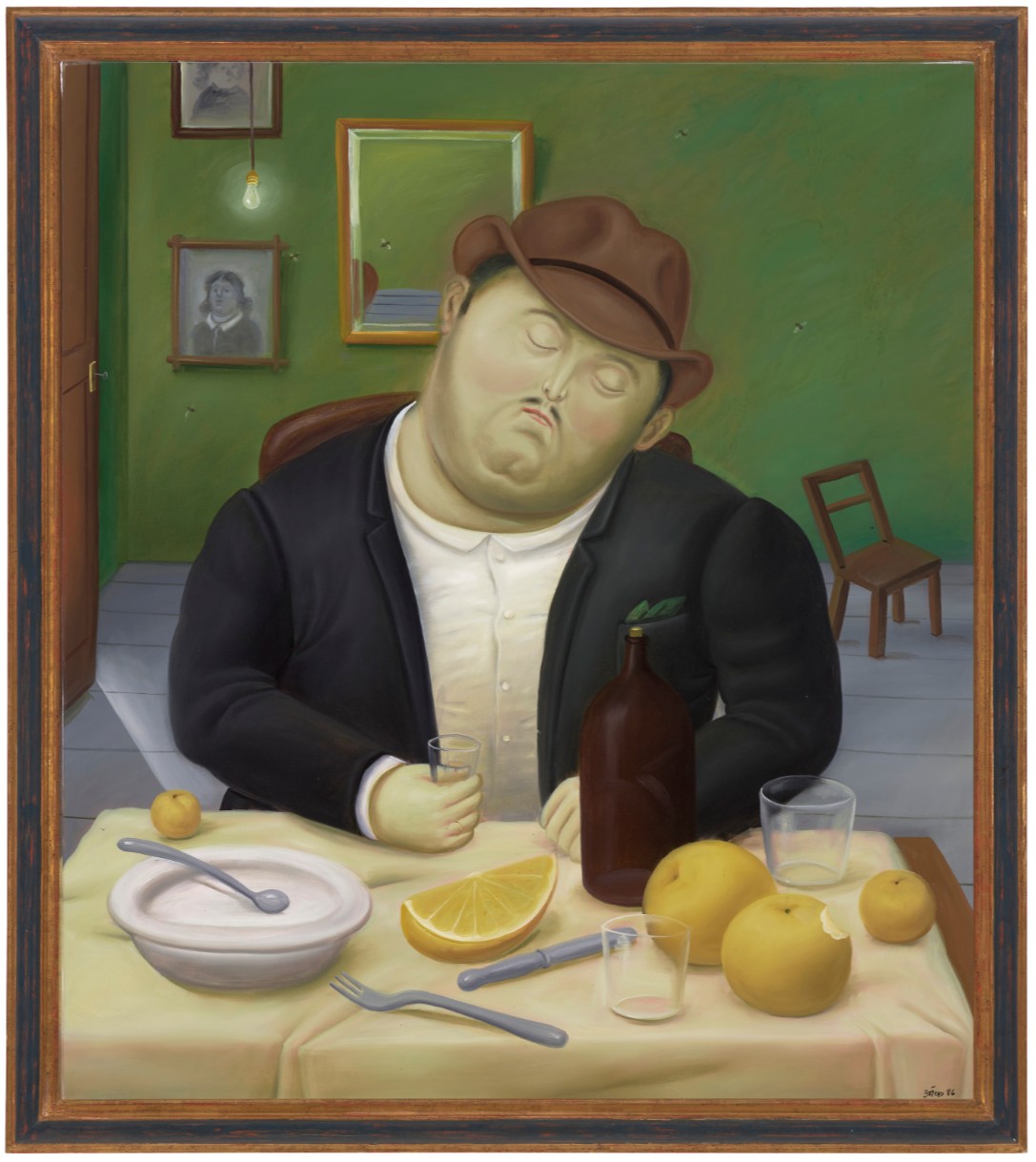
FERNANDO BOTERO (1932-2023)
La siesta, 1986
Oil on canvas
143.8 x 126.7 cm (56 5/8 x 49 7/8 inches)
Signed and dated ‘Botero 86’ (lower right)
“I create my subjects somehow visualizing them in my style. I start as a poet, put the colors and composition down on canvas as a painter, but finish my work as a sculptor taking delight in caressing the forms.”
Portrait of Nadine Haim, 1977
Christie’s Hong-Kong: 28 March 2024
Estimated: HKD 2,500,000 – 3,500,000
HKD 3,402,000 / USD 437,275
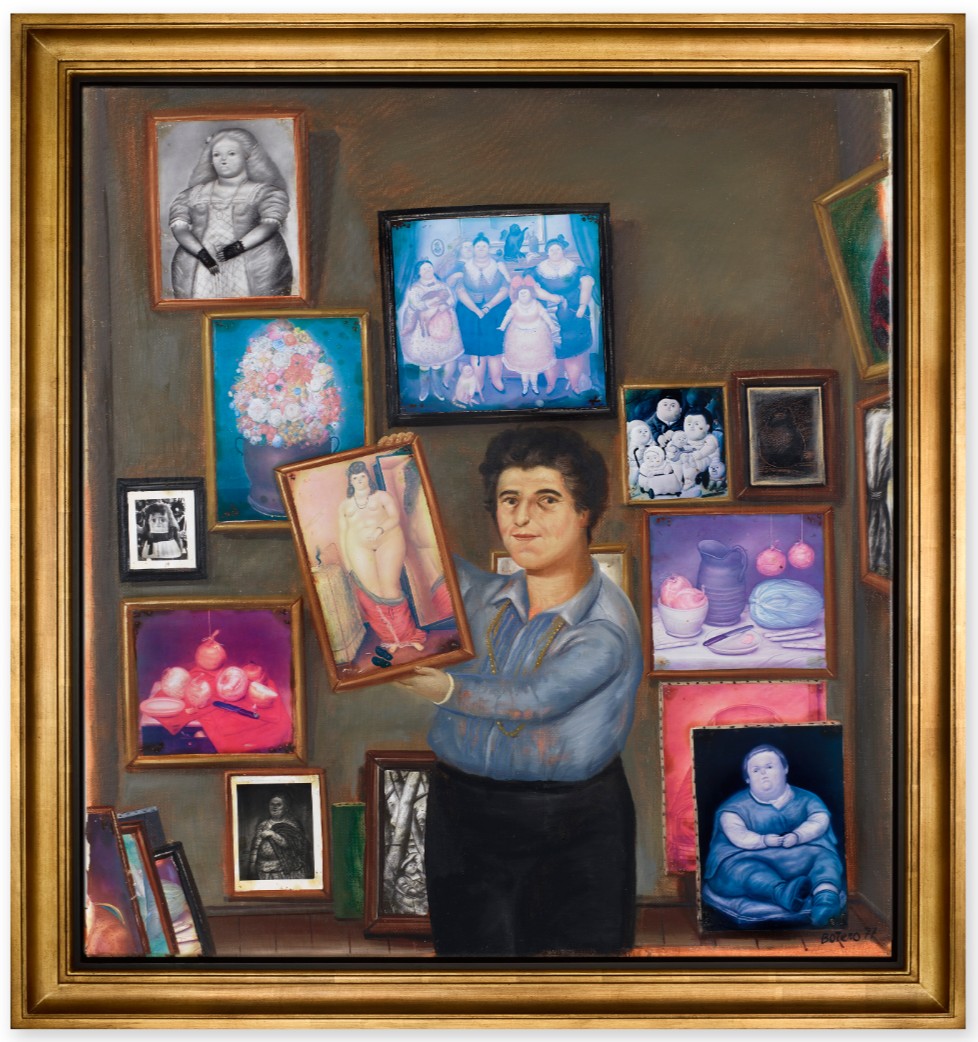
Portrait of Nadine Haim, 1977
Oil and photo collage on canvas mounted on board
88.5 x 83 cm (34 7/8 x 32 5/8 inches)
Signed and dated ‘Botero 77’ (lower right)
Signed, titled and dated ‘”NADINE HAIM” Botero 77’ (on the reverse)
Portrait of Nadine Haim pays homage to the tradition of Kunstkammer paintings, which showcased an individual’s collection with replicas of the artworks they owned displayed together. In the present work, Botero has used printed images of his own paintings, collaging the cut-outs onto the canvas. These juxtaposed reproductions are not reflective of the scale of their original counterparts, should they be hung together, which imbues the work with a surreal quality. Botero took the print copies from contemporary literature and exhibition catalogues featuring his works, some of which were reproduced in print in monochrome. Yet, some of these figures were finalised after the addition of the collage elements, as the peak of a hat, or a lock of hair, skirts onto the reproduced image. For the artist, whose recognisably voluptuous figures have always attracted attention, volume and depth were of incessant significance, and he sought to ‘create a language of plasticity that would be effective and that people would be touched by’ (Botero, quoted in an interview with I. Sischy, ‘An Interview with Fernando Botero’, Artforum, May 1985, p. 72). In Portrait of Nadine Haim, the artist’s inventive use of media not only acts as modernising take on an art historical tradition, but furthers his exploration of plasticity in his work. A vivid three-dimensionality is created by the dialogue between the glossy sheen of the collaged reproductions, and the rich, curving brushstrokes of the oil paint.
The portrait, Nadine Haim, emerges from a serene, neutral background—her figure rendered with the tender monumentality that defines Botero’s oeuvre. Her composed expression and elegantly coiffed hair suggest an inner world of quiet confidence, while the meticulous detailing of her attire conveys a sense of timeless sophistication. The subtle interplay of light and shadow accentuates the rounded contours of her face and hands, lending the work an almost sculptural quality. Botero’s portrayal of Haim transcends mere likeness, inviting the viewer into a realm where beauty is redefined through the artist’s singular vision. The gentle exaggeration of form is not a caricature but rather a celebration of fullness, vitality, and the human condition. As with his finest portraits, the sitter’s gaze—calm, self-assured, and enigmatic—imbues the painting with an air of intimacy and quiet reverence. Executed during a period when Botero’s international reputation was firmly established, Portrait of Nadine Haim stands as a testament to the artist’s ability to fuse technical virtuosity with profound psychological insight. The inclusion of printed paper collage elements adds a unique dimension, reinforcing the painting’s significance within Botero’s body of work. The painting is not only a tribute to its subject but also an enduring reflection of Botero’s belief in the power of art to transform reality into a world of heightened grace and beauty.
Woman with Dog, 1997
Christie’s New-York: 28 February 2025
Estimated: USD 600,000 – 800,000
USD 630,000
FERNANDO BOTERO (1932-2023), Woman with Dog | Christie’s
FERNANDO BOTERO (1932-2023)
Woman with Dog, 1997
Oil on canvas
130.8 x 100 cm (51 1/2 x 39 3/8 inches)
Signed and dated ‘Botero 97’ (lower right)
Woman with Dog is a prime example of Botero’s images of quiet moments borrowed from every day life. With his immortal words about style, “realism is the true vanguard,” he borrows incessantly from real life to transform ordinary moments into subjects worthy of painting (Botero quoted in 1958, having won a prize at the Salón Nacional de Artistas in Bogotá). The unmistakable and archetypical figure of Botero’s work appears here in the foreground of the work: a plump woman moves across the bottom of the image as she walks her dog. Looming large in the background of the work is the ever-present Colombian landscape, stacked with tiny homes and a church in the distance. Botero’s admiration of painters such as Ingres and Delacroix are evident as much in his careful use of line and coloration as in his meticulous devising of the landscape. This construction of the landscape is inspired by his studies of the compositions of Velázquez, whose work he admired while in Spain at the Academy of San Fernando in the early 1950s. The interest in the recession and imposition of space seen in Velázquez’s works is also present in Botero’s. A metaphor for Colombian cultural nationalism, the landscape and its manipulation becomes an important signifier in all of Botero’s works.
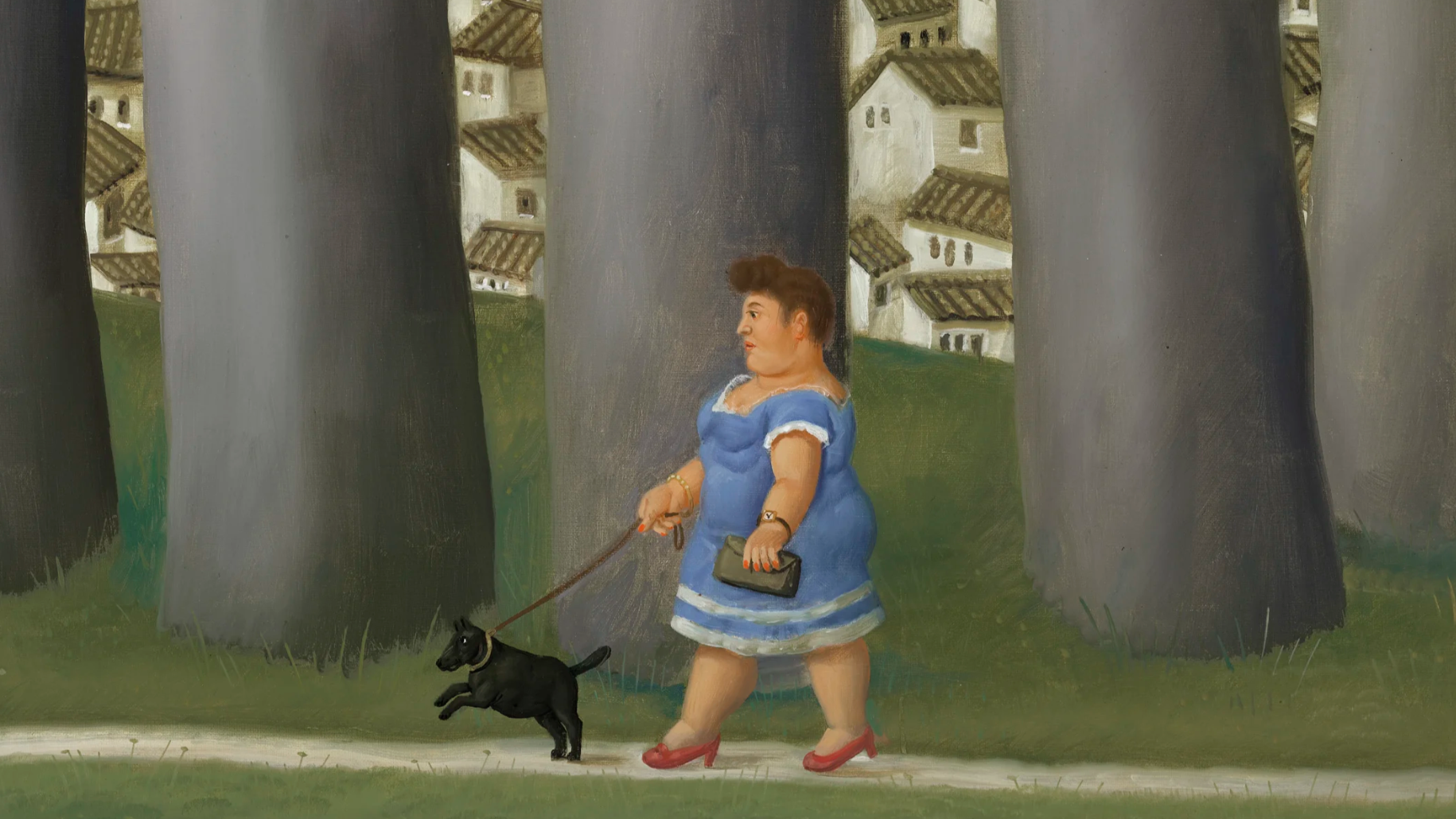
The perspective of the painting allows us to see the woman walking her dog from a vantage point just above her. This, in turn, allows for a grandiose, dramatic view of the town in the distance. Botero’s personal history, growing up very near the Andes, suggests a familiarity with this theatrical landscape in which the partially seen is combined with vertiginous perspectives. Stacked one atop the other, the little adobe homes – each with its typical red, terra cotta-tiled roof – denote an area of personal space within the larger landscape. Squeezed as they are between the monumental tree trunks, they become like metaphors for individuals crowding in the distance. At the very rear, the unmistakable steeple of a church is visible, underscoring the relationship between religion and space, between secular and religious architecture.
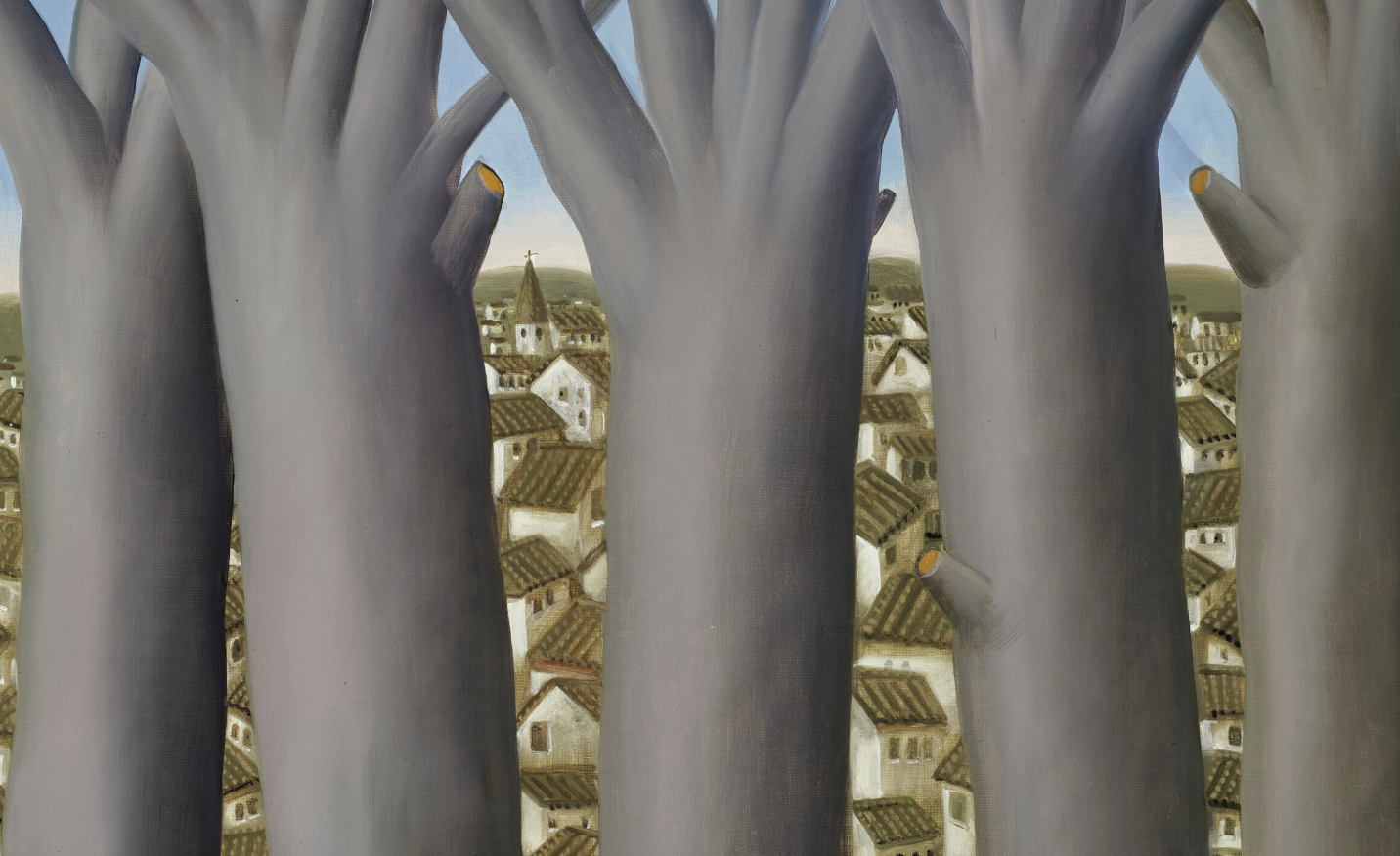
The gentle curvature of the earth is carefully and diligently rendered, reminding us of the immensity of the planet and the relative insignificance of man. Underscoring this view of man and nature are the gargantuan trees in the middle of the painting. These large, leafless and branchless trunks become the barriers between our view of the woman and the town in the distance. Pruned down to their very essence, they become like formal gestures that also make reference to architectural structures. As the stubby branches fan out overhead, the viewer is reminded of baroque structure and its ornamentation. This richness is reiterated by the abundant homes visible through the schematic trees. The figure herself is also of interest and presents somewhat of an anomaly among her surroundings. She is clothed simply in a dress with rucles at the hem, sleeves, and neckline. Her bright red high-heeled pumps and her modern little handbag seem inconsistent with the mere act of walking a dog. Though it is a well-worn path, its presence on a hill suggests the ecort required to walk here. Despite this, she dominates the path, her energetic and elegant little dog leading the way. The possibilities linked to her walk and where it may lead are many, implying perhaps a clandestine meeting with a lover, the walk of the dog becoming a mere pretext.
Society Woman, 2003
Sotheby’s Diriyah: 8 February 2025
Estimated: USD 800,000 – 1,200,000
USD 1,020,000
Society Woman | Origins | 2025 | Sotheby’s
FERNANDO BOTERO (1932 – 2023)
Society Woman, 2003
Oil on canvas
155×122 cm (61×48 inches)
Signed Botero and dated 03 (lower right)
Executed in 2003, Society Woman stands as a superlative example of Fernando Botero’s iconic portraits of women, underscoring the artist’s quest to impose his signature voluminous figures within the annals of art history. Here, Botero showcases an upper-class woman in her finest clothes and jewelry, recalling the regal portraits of Renaissance masters like Goya, Titian and da Vinci. By positioning his figure within the context of this specific genre of portraiture, Botero reaffirms his place within art history. Testament to the present work’s singular importance within the artist’s career, Society Woman boasts exceptional provenance, coming from the collection of Fernando Botero Jr., the artist’s son.
A voluptuous female figure dominates the expansive canvas of Society Woman, her size, presence, and elegant attire commanding the viewer’s attention. Dressed in a sumptuous red gown further complemented by gleaming jewels and a luxurious clutch, she exudes both affluence and power. Her hair is neatly styled with a matching red bow, and her gaze, directed off to the side, conveys an air of pomposity and self-assurance. The figure’s exaggerated proportions, with an emphasis on her rounded, curvaceous form, are quintessentially Botero, inviting both admiration and contemplation of the human body in its most indulgent and sensual form. In Society Woman, Botero imbues his subject with grace, feminine allure, and confidence, celebrating the fullness of her form.
“If women are often my subjects, it’s because they have been one of the main subjects of paintings for centuries. What really guides me above all, when I sculpt or paint men, women, animals, or objects, is the plastic aspect of beings and things. Plasticity exists indiscriminately in a woman, a still life, or a landscape.”
Known for his iconic depictions of rounded, voluminous figures, Botero has spent decades blending humor and social commentary across a wide range of subjects, from Colombia’s political turmoil to its cultural undercurrents, and from the clergy to the elite. Since relocating to Europe in 1952, Botero has looked to an eclectic mix of art-historical influences, drawing on the classical elegance of Titian and Velázquez, the vivid sensuality of Rubens, and the solid formalism of Giotto and Masaccio. His distinctive “Boteromorphs”—figures marked by exaggerated volumes and soft, sensual lines—resist conventional standards of beauty, creating a world where excess and grace coexist. Botero’s early fascination with the glamorous “Vargas girls” in Esquire magazine fueled his lifelong exploration of abundance in art. In works like Society Woman, this obsession manifests in a portrait that defies the ideals of traditional portraiture. The subject, poised and opulent in her rich red gown and sparkling jewelry, is rendered with the artist’s signature exaggerated proportions, offering a playful yet powerful statement on beauty, power, and societal expectations. Her formidable presence, combined with her charm, embodies Botero’s signature approach to combining monumental forms with wit and subtle critique.
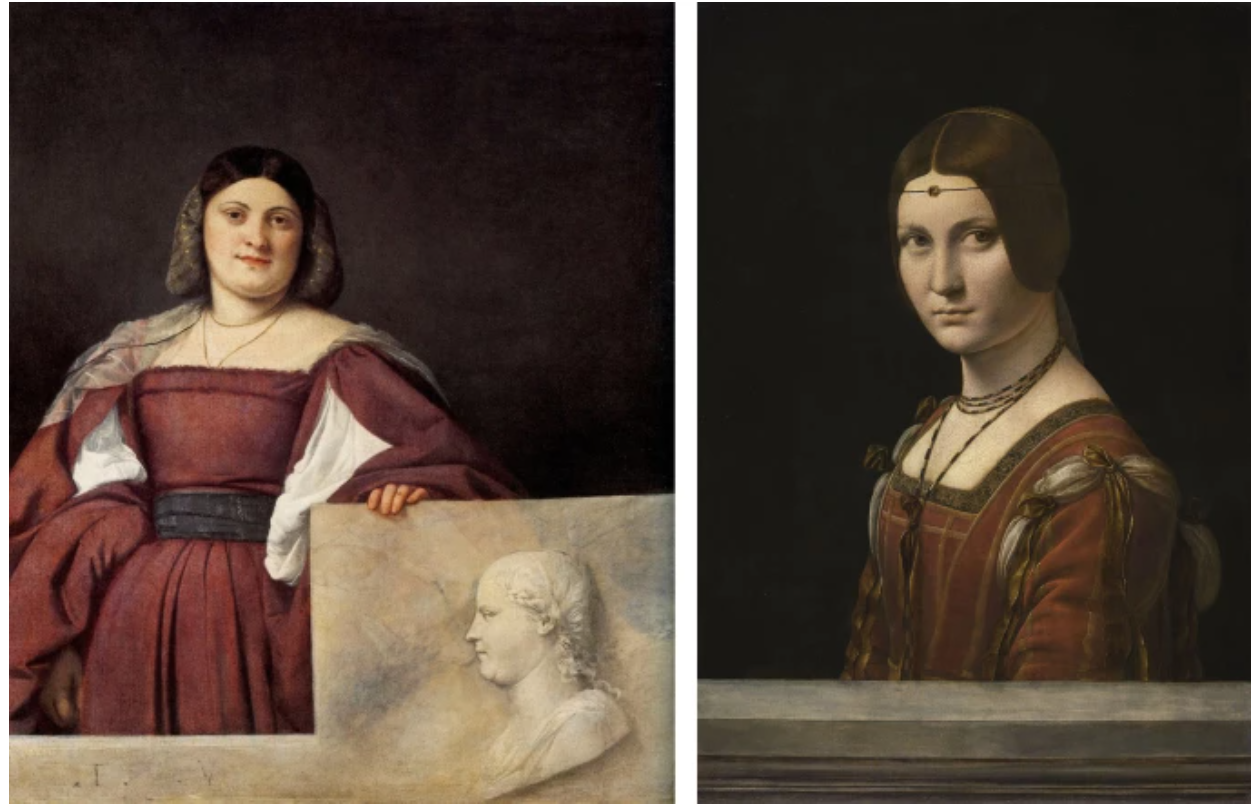
LEFT: Titian, Portrait of a Lady (‘La Schiavona’), 1510-1512. The National Gallery, London.
RIGHT: Leonardo da Vinci, La Belle Ferronnière, 1490–1496. The Louvre Museum, Paris.
Society Woman further exemplifies Botero’s ongoing exploration of the female figure, a subject that has been central to his oeuvre for decades. From his early depictions of women in everyday settings to his more recent portraits like Society Woman, Botero has consistently portrayed women with an emphasis on fullness, strength, and grandeur. His work often highlights the contrast between the soft sensuality of the body and the sculptural qualities of the human form, capturing a timeless beauty in exaggerated proportions. As a hallmark of his artistry, this approach creates a tension between realism and fantasy, making the viewer reconsider conventional ideals of beauty and proportion.
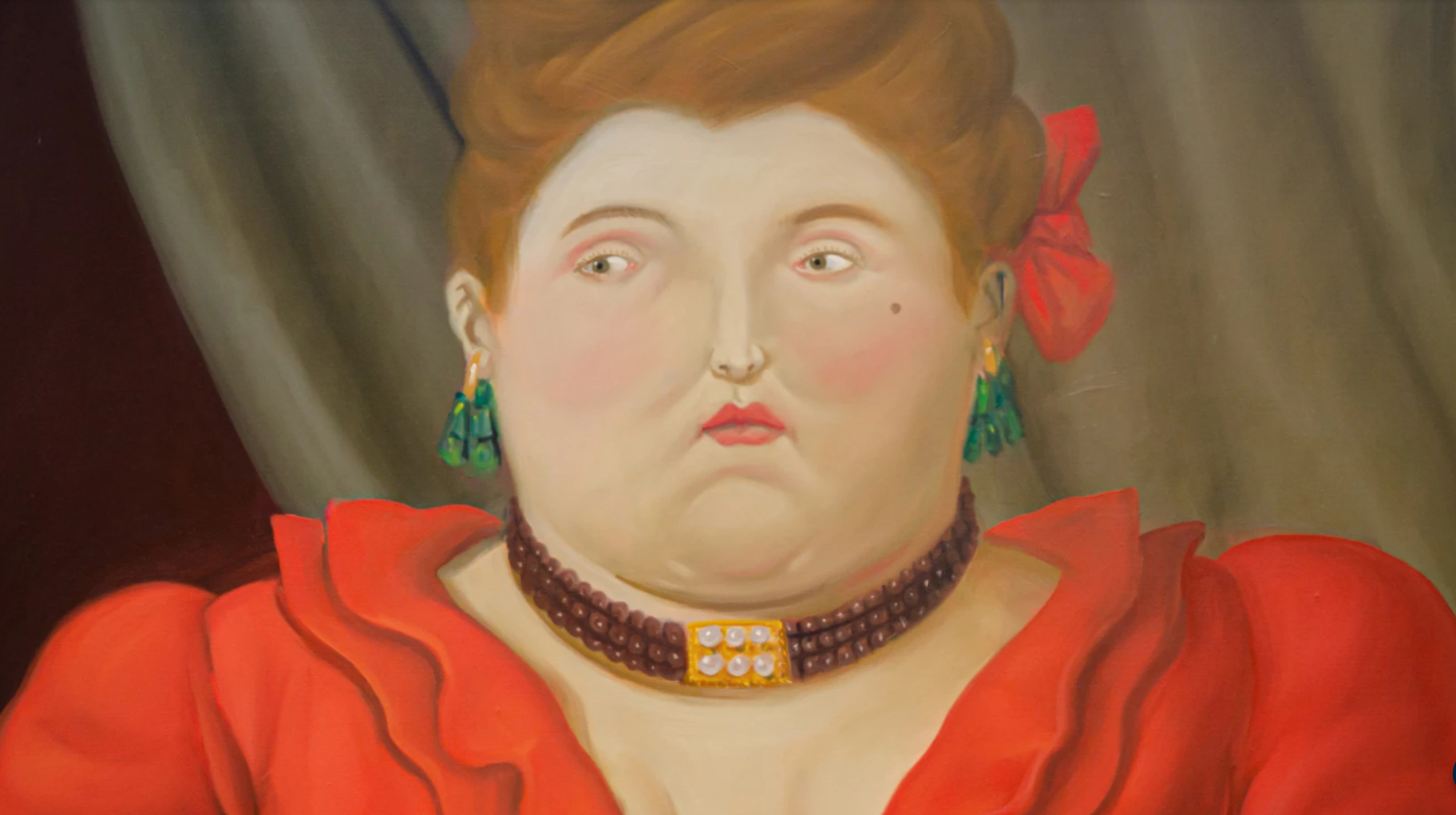
Positioned within the tradition of portraiture, Society Woman evokes the grandeur and sumptuousness of Renaissance and Baroque portraits while subtly subverting them. From Renaissance portraitists like Leonardo da Vinci and Titian, who defined an ideal of aristocratic portraiture, capturing their subjects in refined, dignified poses and clothing that conveyed wealth, status, and power to contemporary artists such as Andy Warhol, who reinvigorated the practice with his silkscreen portraits of socialites, business magnates and cultural icons in the 1980s, Botero similarly elevates and immortalizes the women of Latin America. By rendering his figure in his signature exaggerated, voluminous style, Botero distorts the idealized proportions of classical portraiture, turning the conventions of beauty and status on their head. His subject is not only larger than life in size but also in presence, with her rounded form defying the slender ideals seen in historical depictions of the aristocracy. In doing so, Botero critiques the cultural obsession with conventional beauty and societal norms, while simultaneously affirming the status and power of his subject. In this way, Society Woman is both a continuation and a subversion of the portrait tradition—one that reflects Botero’s unique ability to reimagine art historical precedents through his lens of sensuality, exaggeration, and playful critique.
La Chambre, 1998
Christie’s New-York: 22 November 2024
Estimated: USD 400,000 – 600,000
USD 806,400
FERNANDO BOTERO (1932-2023), La Chambre | Christie’s
FERNANDO BOTERO (1932-2023)
La Chambre, 1998
Oil on canvas
100×80 cm (39 x 31 5/8 inches)
Signed and dated ‘Botero 98’ (lower right)
“If women are often my subjects, it’s because they have been one of the main subjects of paintings for centuries. What really guides me above all, when I sculpt or paint men, women, animals, or objects, is the plastic aspect of beings and things. Plasticity exists indiscriminately in a woman, a still life, or a landscape.”
Cazador, 1982
Christie’s New-York: 2 October 2024
Estimated: USD 800,000 – 1,200,000
USD 1,134,000
FERNANDO BOTERO (1932-2023), Cazador | Christie’s (christies.com)
FERNANDO BOTERO (1932-2023)
Cazador, 1982
Oil on canvas
161.6 x 110.8 cm (63 5/8 x 43 5/8 inches)
Signed and dated ‘Botero 82’ (lower right)
Botero has long worked within the venerable canons of art history, with what he has called a “very strange mixture of admiration and criticism.” Acknowledging that “an artist is always a critic of earlier artists,” he explains, “You think you must, and can, improve on earlier ages,” but at the same time “you must have this critical attitude to art of the past… You can take the same subject and create a totally different painting. That’s where real originality lies, in taking something that’s already been done by someone and doing it differently” (in W. Spies, “‘I’m the most Colombian of Colombian artists’: A Conversation with Fernando Botero,” Fernando Botero: Paintings and Drawings, 1992, pp. 155-56). Since his first departure for Europe in 1952, Botero has drawn from (and critically reinterpreted) myriad art-historical sources—Titian and Velázquez; Giotto and Masaccio; Rubens and Ingres—and embraced the classical sensuality of volume, space, and color in legions of stylized “Boteromorphs.” In the present Cazador, Botero revisits an early and enduring source—Diego Velázquez—in a delightful meditation on the genre of hunting scenes and the art of homage.
“In the Madrid of those days it was possible to live at an inexpensive pension across from the Prado,” notes the historian and writer Germán Arciniegas. “Expenses could be cut down further by making copies of Titian and Velázquez. [Botero’s] most profitable friendship turned out to be with a man who knew all the tricks: the friend who copied Velázquez’s The Topers. The museum rules did not permit more than one copyist per room, and the time allotted each was twenty days. And he traded his right to the room with the inexperienced. Thus Botero was able to copy…” (Fernando Botero, 1977, pp. 26-7). Among the Velázquez paintings that Botero would have seen (and copied) at the Prado is Felipe IV, Cazador (1632-34), a dignified portrait of the “Planet King” in the countryside amid the Thirty Years’ War, whose conclusion in 1648 would see the balance of European power shift from Spain to France. If scenes of the hunt were generally understood as metaphors for war, Botero’s Cazador belies the imperial bellicosity of the original: in place of the Baroque king is a modern-day Latin American footsoldier, red bandana tied around his neck and bandolier wrapped around his (outsized) waist. Botero retains the essential iconography of the Velázquez—towering tree in the foreground, loyal canine companion, hilly landscape in the distance—but he renders his scene with (postcolonial) playfulness and humor, preferring an artful riposte to the seventeenth-century Spanish master.
Colombiana comiendo banana, 1982
Sotheby’s New-York: 14 May 2024
Estimated: USD 350,000 – 450,000
USD 444,500
Colombiana comiendo banana | Contemporary Day Auction | 2024 | Sotheby’s (sothebys.com)
FERNANDO BOTERO (1932 – 2023)
Colombiana comiendo banana, 1982
Oil on canvas
110.2 x 79.1 cm (43 3/8 x 31 1/8 inches)
Signed and dated 82 (lower right)
“Artists of all kinds have to say things that everybody would like to say but cannot express. I have the capacity to paint pictures, so it’s up to me to say those things, and not to copy the Americans or the French to produce fake American or French paintings. I must paint Colombian pictures. And the strange thing is that these impress people in France, Germany, Japan, and elsewhere. In a sense, the more parochial you are, the more universal you can become. Art has always been parochial in origin…Many artists fancy that universal art is produced by copying universally. I don’t believe that. You must be true to your roots; only then can you reach people all over the world”

BOTERO PICTURED WITH THE PRESENT WORK IN HIS STUDIO CIRCA 1982 IMAGES PRESS/GETTY IMAGES
La coleccionista, 1974
Sotheby’s New-York: 1 March 2024
Estimated: USD 400,000 – 600,000
USD 762,000
FERNANDO BOTERO (1932 – 2023)
La coleccionista, 1974
Oil and collage on canvas
91×79 cm (35 3/4 x 31 inches)
Signed Botero and dated 74 (lower right)
La coleccionista stands as a profound testament to Fernando Botero’s deliberate engagement with and positioning within the artistic discourse of the Western world. The grand oil on canvas, executed in 1974, presents a compelling narrative that intertwines and complicates the relationships between the artist, the artwork, La coleccionista (the collector) and us—the viewer. At the forefront of the composition, a squat middle-aged woman squarely faces the viewer. Her conservative black dress with lace finishings is at odds with the melodramatic pink ribbon around her head; round, gold-rimmed glasses and glimmering earrings complete the beguiling portrait of Botero’s imagined collector. She stands between us and the collection itself, a tightly clustered group of drawings and paintings hung salon-style on the wall behind her. The woman and the various framed works of art are unified by a distinctive style, characterized by dramatic distortions, glossy surfaces and voluminous forms — Botero’s instantly-recognizable signature.
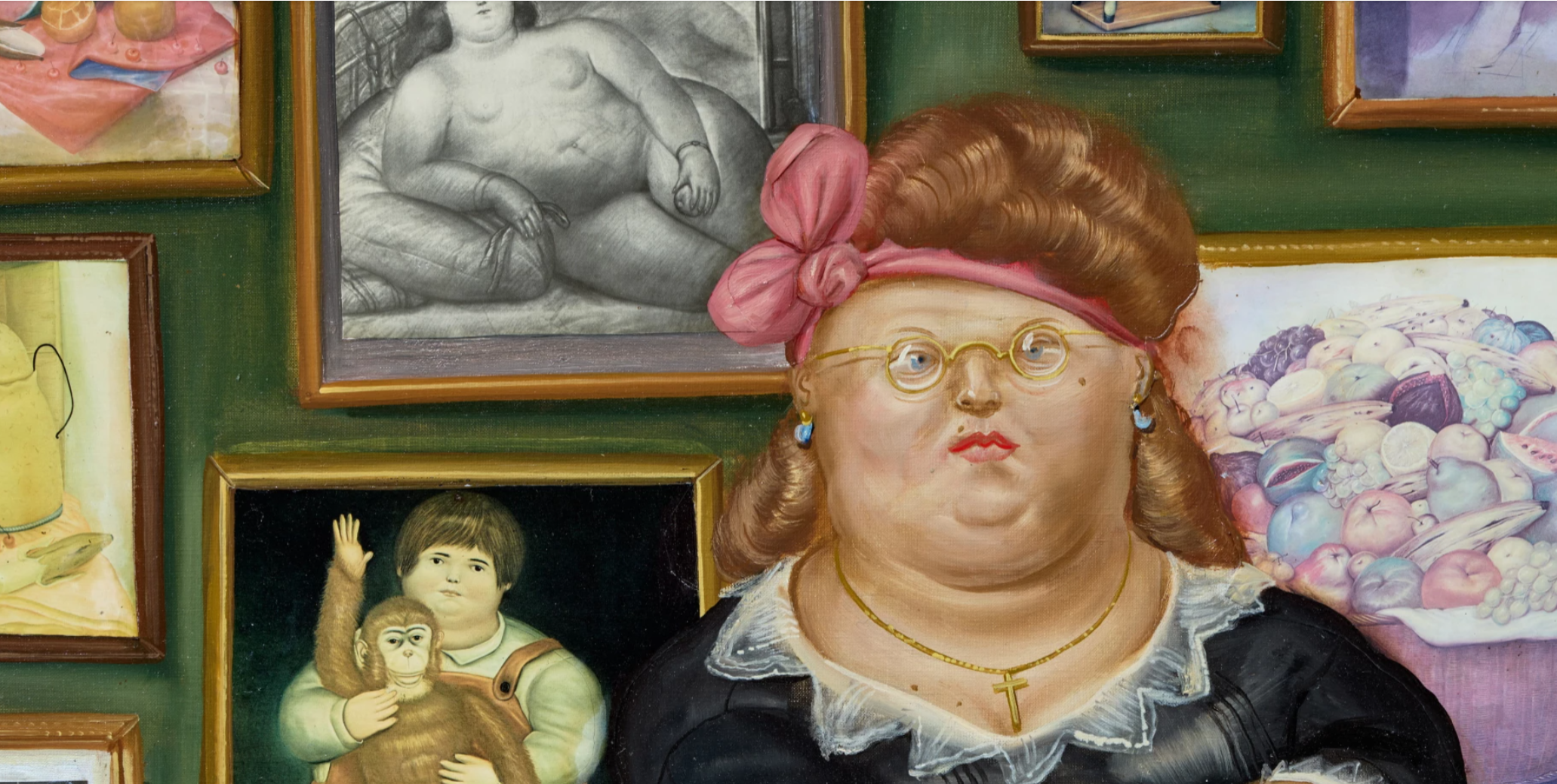
According to Mariana Hanstein, “hardly any other artist has reflected so consciously and clearly on his own work than Botero” (Mariana Hanstein, Fernando Botero, Cologne, 2003, p. 69). Traveling throughout Europe in the early 1950s, Botero frequented the great art museums of Italy, France, and Spain in particular. He studied and copied the paintings by Velázquez and David Teniers the Younger at the Prado during his time as a student at the prestigious Academia San Fernando in Madrid. In 1960, upon moving to New York, Botero began experimenting with the gestural brushstrokes of the New York School painter before establishing the stylistic uniformity for which he is now known and which the present work consummately expresses.
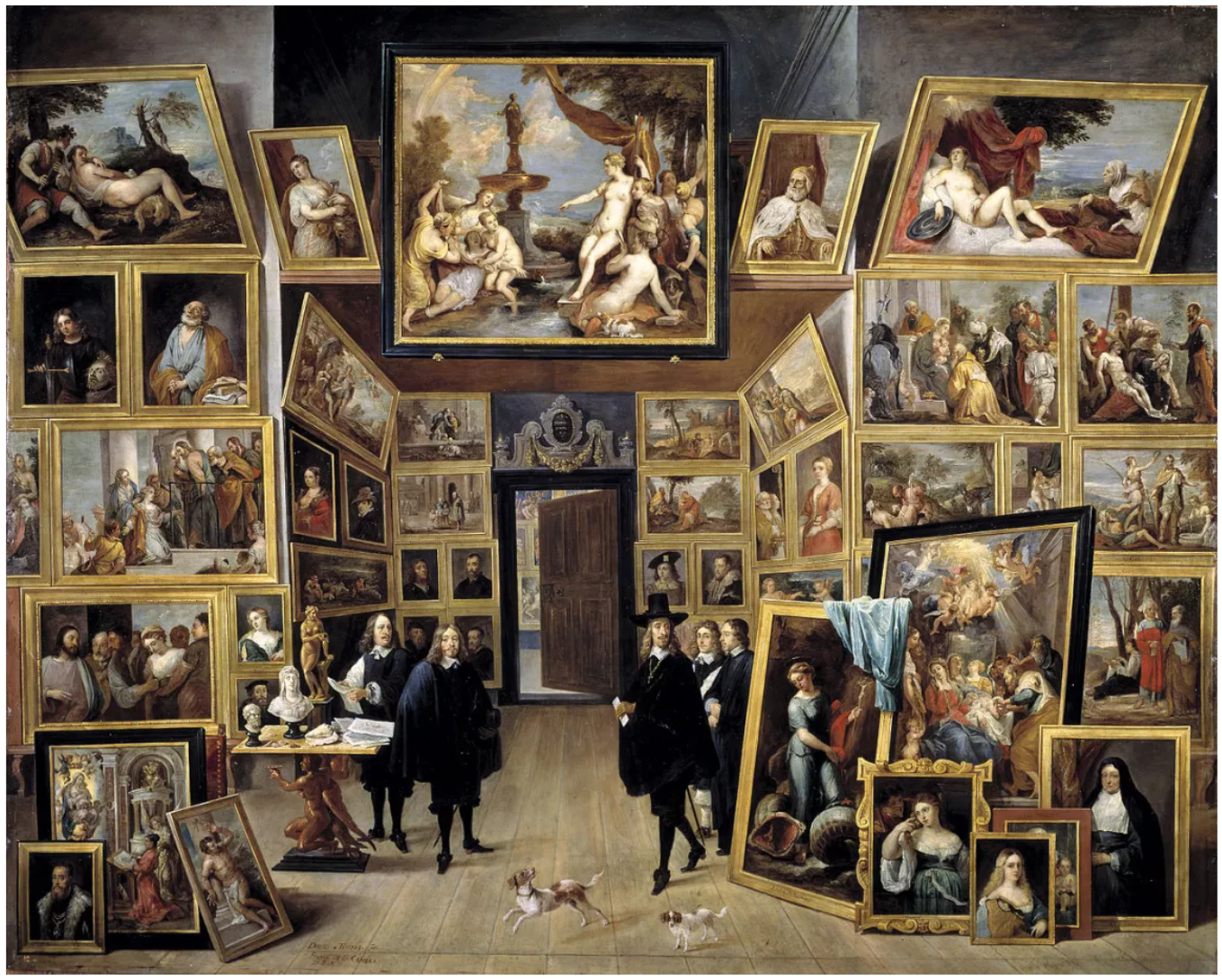
DAVID TENIERS THE YOUNGER, THE ARCHDUKE LEOPOLD WILLIAM IN HIS PICTURE GALLERY IN BRUSSELS, 1647-1651, MUSEO DEL PRADO
The display of Botero’s artwork presented in this collection serves as a manifesto of the artist’s connections and influences, unveiling his deep engagement with specific painters and broader awareness of his role in Western art history – dialoguing most closely with kunstkammer (cabinet of curiosities) paintings like David Teniers the Younger’s The Archduke Leopold William in his Picture Gallery in Brussels, in which a royal patron is both depicted within and represented by a painting of their wondrous collection of fine paintings, sculpture and other rare curiosities (precious stones, scientific specimens, and more.) In works like this, the intellect and wealth of the royal collector are represented by the size, breadth, and quality of their collection – and the painting functions as an assertion of royal power.
Man Eating, 1978
Christie’s New-York: 28 September 2023
Estimated: USD 900,000 – 1,200,000
USD 1,071,000
FERNANDO BOTERO (1932-2023) (christies.com)
FERNANDO BOTERO (1932-2023)
Man Eating, 1978
Oil on canvas
71×55 inches (180.3 x 139.7 cm)
Signed and dated ‘Botero 78’ (lower right)
Since his departure for Europe in 1952, Botero has drawn from myriad art-historical sources—Titian and Velázquez; Giotto and Masaccio; Rubens and Ingres—and embraced the classical sensuality of volume, space, and color in his now eponymous figures. His subjects have encompassed Colombia’s military junta and Abu Ghraib, Catholic clergymen and the bourgeoisie, and yet the idealized world of Medellín, his birthplace, remains a touchstone. The Colombian flag draped in the upper-right corner of Man Eating immediately places the painting’s subject in a scene from Botero’s adolescence, illuminating an arcadian world whose languid way of life and timeworn traditions he describes with characteristic humor and endearment. This vanishing local sensibility wafts through Botero’s quaint tableaux of everyday life, each painting a microcosm of olden Colombian mores. Just such a mustachioed gentleman lifts a chicken leg from his plate in Man Eating, his dapper attire a charming formality for an outdoor luncheon. The food and drink, from tabletop to plate, is cast in roseate hues—a familiar and characteristic palette for Botero—that extend to the man’s hat and suit, his ruddy complexion, and the warm gradient of the tent behind him. Accents of complementary green, from necktie to table, provide understated contrast; swarming flies and a sweetly beseeching dog complete the scene.
Madame Ingres, 1967
Christie’s Paris: 7 June 2023
Estimated: EUR 250,000 – 350,000
EUR 504,000 / USD 539,325
Fernando Botero (né en 1932) (christies.com)
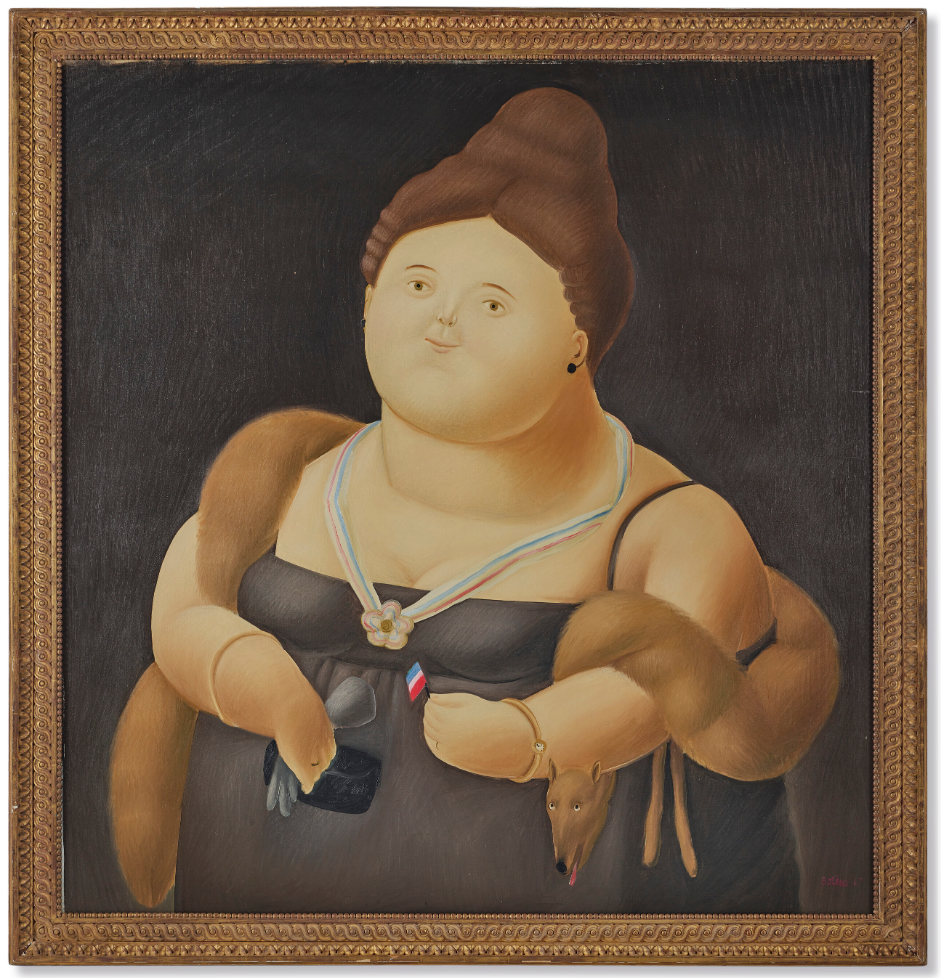
FERNANDO BOTERO
Madame Ingres, 1967
Oil on canvas
160 x 149.6 cm (63 x 58 7/8 inches)
Signed and dated ‘Botero 67’ (lower right)
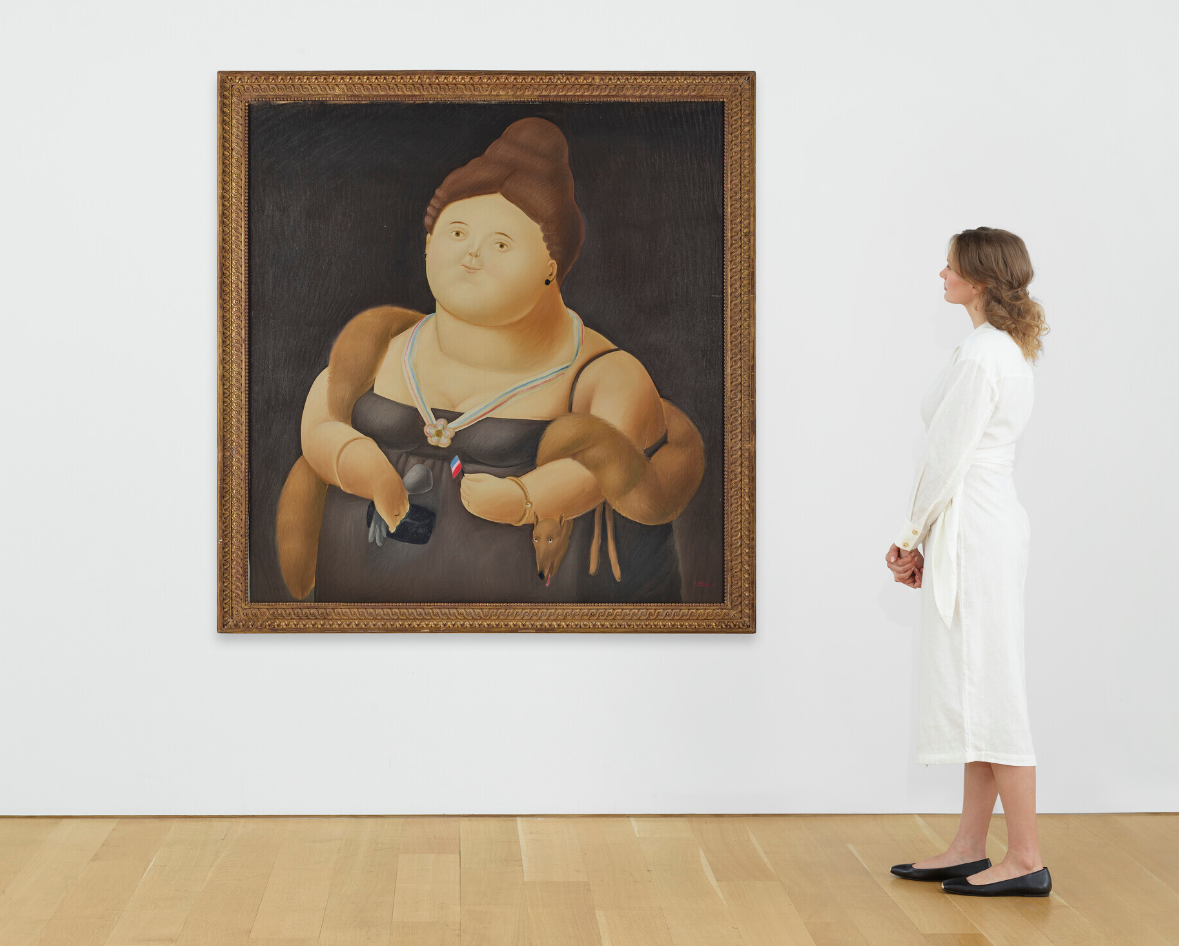
Woman with a Mink Stole, 1971
Sotheby’s New-York: 17 November 2022
Estimated: USD 300,000 – 400,000
USD 403,200
Woman with a Mink Stole | Contemporary Day Auction | 2022 | Sotheby’s (sothebys.com)
FERNANDO BOTERO
Woman with a Mink Stole, 1971
Charcoal and pastel on canvas
181.5 x 158 cm (71 1/2 x 62 1/4 inches)
Signed Botero and dated 71 (on the reverse)
Fernando Botero’s creative output has not slowed since he began his practice in the 1940s, yet despite decades of prolific painting, drawing, and sculpting, he has yet to return to the scale and nuance held in his large-scale, monochromatic works in charcoal and sanguine on canvas produced in the 1970s. In his 1971 Untitled, a woman dressed like a 1930s Hollywood actress stands centered against a window. Looking sweetly at her viewer, she holds her purse, gloves, and stole in her dainty hands. She blushes, hair coiffed, the contours of her figure visible through the diaphanous fabric of her dress. The surface of the present work possesses an incandescent quality: the curtains look to be satin, her dress silk, her skin velvet. The textures are rich and luminous, and Botero partakes in the revitalization of techniques attributed to the Old Masters. On display in the present work is not only Botero’s volumetric play on his subjects but also his remarkable proficiency as a draftsman.
A Lawyer, 1998
Sotheby’s New-York: 20 May 2022
Estimated: USD 300,000 – 400,000
USD 378,000
A Lawyer | Contemporary Day Auction | 2022 | Sotheby’s (sothebys.com)
FERNANDO BOTERO
A Lawyer, 1998
Pastel, charcoal, watercolor and pencil on canvas
125.7 x 103.8 cm (49 1/2 x 40 7/8 inches)
Signed Botero and dated 98 (lower right)
Rosy-cheeked, confident and charming, Fernando Botero’s A Lawyer is an excellent example of the artist’s signature style. Inviting, yet reserved, the present work portrays Botero’s unique style of witty, often satirical, and infectious ingenuous humor. Dressed in a light suit and tie, a handkerchief in his lapel and a hat atop his head, the central figure occupies the forefront of the composition. Holding a book, he proudly identifies himself as a learned professional and central figure of society. In so doing, he represents an archetype—an ongoing motif in Botero’s practice of portraying important figures of Latin American society: from presidents to bishops, dancers to bullfighters. Drawing on a variety of influences, he reclaims the techniques of his predecessors and contemporaries to present a work that offers a complex look at identity.
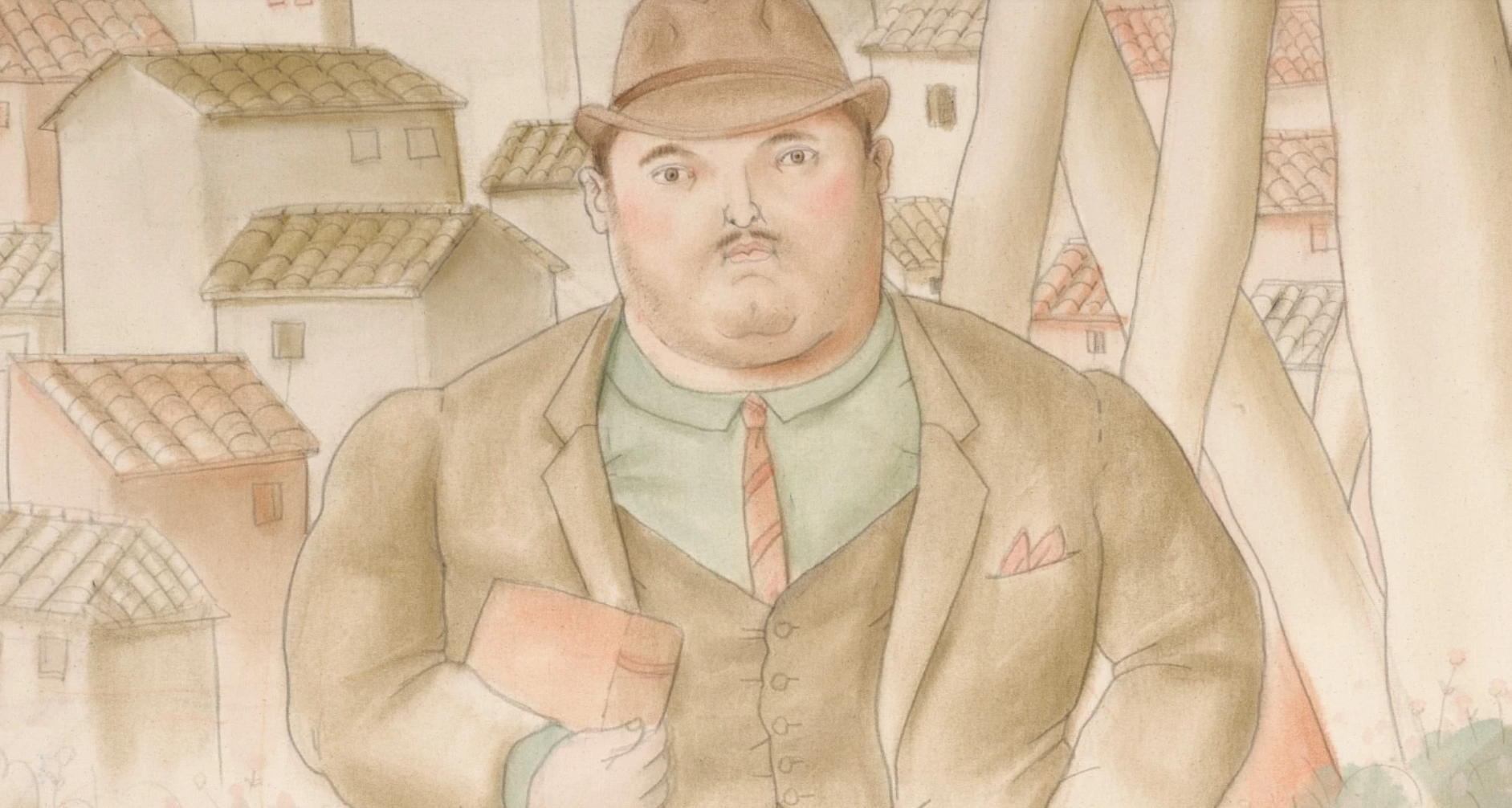
It can be said that Fernando Botero’s principal subjects have alternated between a reinterpretation of old masters and a celebration of common people lives in contemporary Colombia, his home country. Here Botero employs his signature technique of inflation, often used to satirize or lend levity to a composition, to instead dignify and monumentalize the figure. He renders his youthful face in sweet and skillful detail, complete with chubby cheeks and carefully balanced features. Botero’s use of active brushstrokes and a softly clashing color palette of marigold, taupe and sage creates a subtle but constant tension between the small town in the background and the more atmospheric foreground. Finally, the warmth and lively quality of this figure is undoubtedly enhanced by the masterful use of pastels; traditionally associated with works on paper of much smaller proportions. In this lovely and rare example on canvas, Botero contributes to the revitalization of a technique traditionally associated with Old Masters and 19th century painters.
Woman with Parasol and Dog, 1977
Sotheby’s New-York: 20 May 2022
Estimated: USD 700,000 – 900,000
USD 882,000
Woman with Parasol and Dog | Contemporary Day Auction | 2022 | Sotheby’s (sothebys.com)
FERNANDO BOTERO (B. 1932)
Woman with Parasol and Dog, 1977
Oil on canvas
198.1 x 109.5 cm (78 x 43 ⅛ inches)
Signed Botero and dated 77 (lower right)
In Woman with Parasol and Dog of 1977, Fernando Botero presents a tenderly rendered bucolic scene of a charming society woman in a field, accompanied by her canine companion. Imposing in scale and rendered in lush pastel tones, Woman with Parasol and Dog is a monumental exercise in the plasticity of form. Bursting with juicy color and subtle humor, the work is marked by the charming sense of wit that characterizes Botero’s mature painting. Notwithstanding the artist’s satirical commentary, it is his relentless admiration for the great masters of the past—and most precisely, the art historical achievement of Italian Renaissance painting—that has inspired his immediately identifiable and voluminous characters for over six decades. From the fluffy, geometric clouds that surround the figure to the receding hills that surround her and the gleaming pastel palette of the composition, the artist’s love for the quattrocento is on full display – in a fully contemporary context.
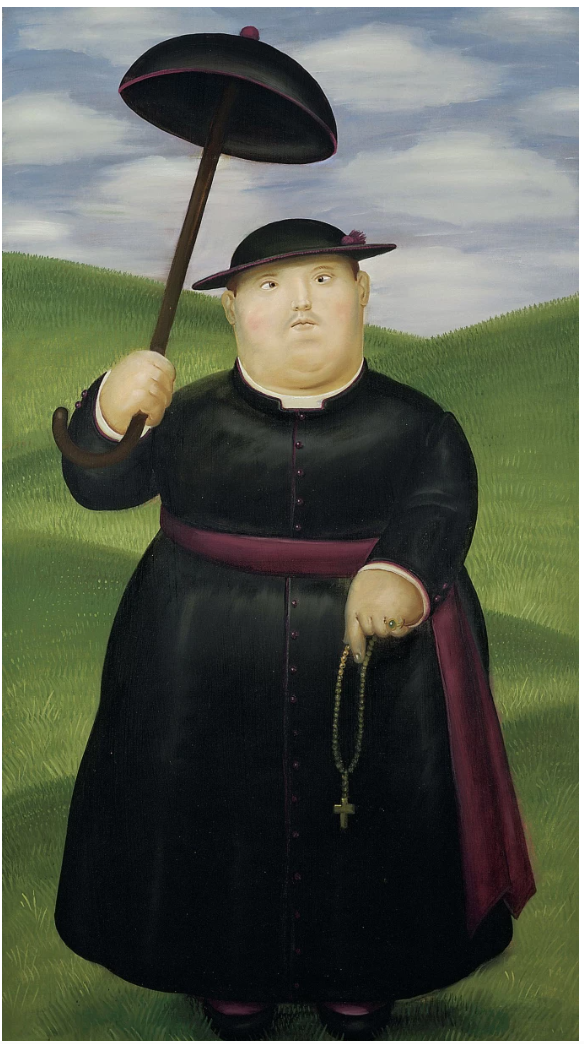
FERNANDO BOTERO, WALK IN THE HILLS, 1977
The present painting may present a humorous pendant portrait to Walk in the Hills of 1977, in which a cross-eyed priest likewise holding a parasol ambles through a similarly arcadian landscape. Particularly through the 1970s-80s, Botero delights in satirizing the wealthy and figures of authority in his paintings, imbuing them with a self-importance and silliness that is at once charming and sly. Priests, presidents and socialites are surrounded by the trappings of trumped-up grandeur; flies buzz around their heads, suggesting there may be something rotten beneath the luxury on display. Here, the subject tightly clutches a gleaming green pocketbook; her lustrous earrings, vivid pink dress and the glinting gold chain of her dog’s leash underscore her wealth and status. Stationed at the very edge of the canvas and meeting the viewer’s gaze directly, she seems just on the verge of speaking – or perhaps ready to bark at her stubborn little pet to hurry along. A tour-de-force of technical achievement and undeniably charming, Woman with Parasol and Dog is a paradigmatic example from this key period of the artist’s oeuvre.
La Primera Dama, 1967
Bonhams New-York: 19 May 2022
Estimated: USD 600,000 – 800,000
USD 756,375
Bonhams : FERNANDO BOTERO (B. 1932) La Primera Dama 1967
Oil on canvas
183×165 cm (72×65 inches)
Signed and dated 67; signed, titled and dated 67 on the reverse
Exuding a powerful authority and striking in both composition and scale, La Primera Dama (1967) is an outstanding and iconic work by one of the most important Latin American artists of our day. Incorporating Fernando Botero’s unique voluptuous signature style, the present work is a magnificently robust and distinctively Colombian painting, rendering it a highly personal and superlative portrait in the artist’s unmistakable hand. Originating from a prominent passage of Botero’s early practice, the present work engages deeply with his art historical academic training in Western Classicism and his enduring fascination for exaggerated elements. Botero’s paintings are as technically astute, as they are iconic, and his legacy as one of the principal artists of the last three decades is without question.
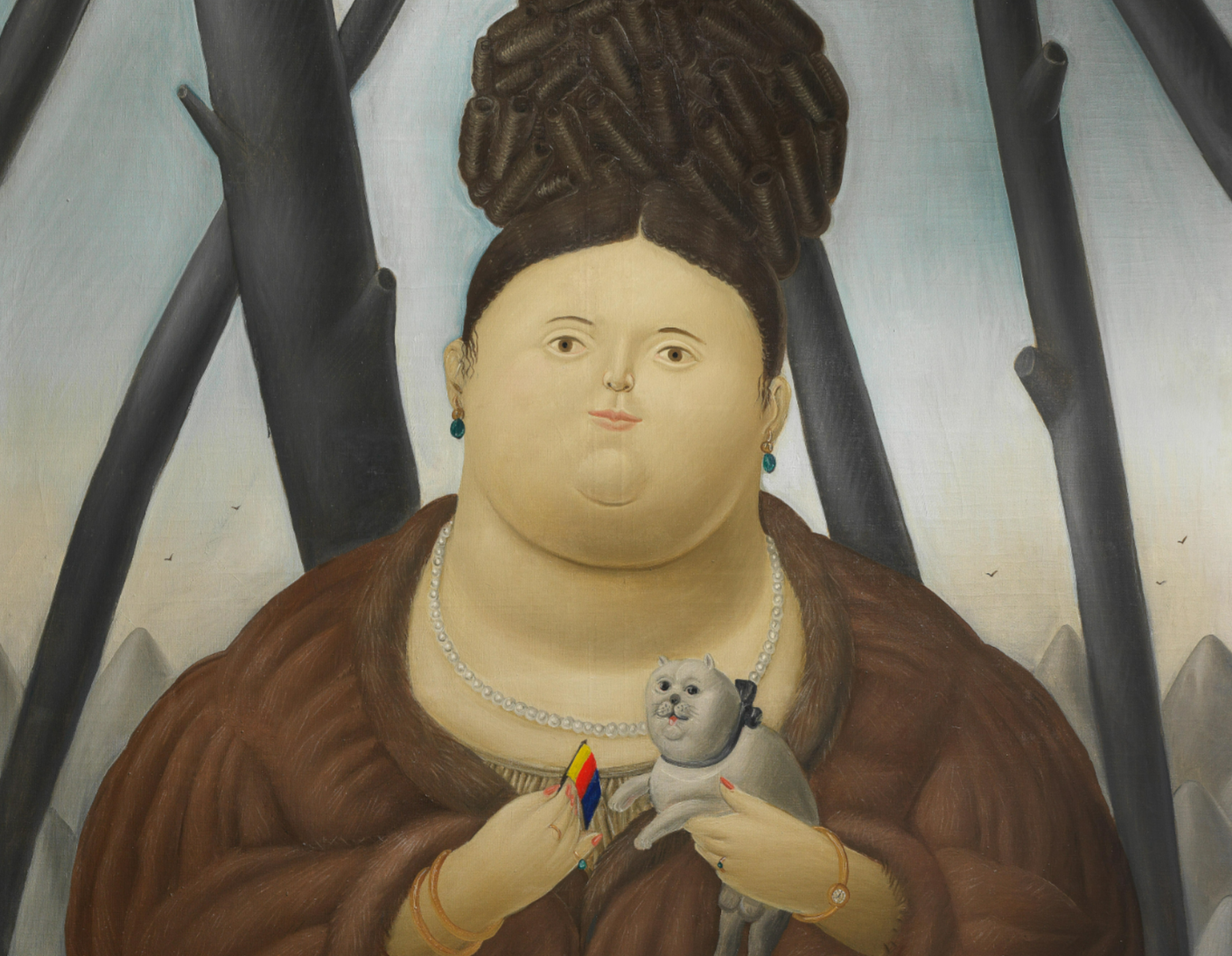
Painted during a seminal period of European travel for Botero, the influence of Italy’s Renaissance frescoes, Spain’s Golden Age masters, and France’s turn-of-the-century School of Paris, can be plainly seen in the present work. Having studied under Roberto Longhi, a renowned authority on Italian Renaissance and Baroque art, Botero obtained a remarkable art historical knowledge of Western Classicism. Viewed through the lens of art history, the present work draws certain inspirations, such as motifs, composition, and background settings, from archetypal masterpieces of the Italian Renaissance such as Leonardo Da Vinci’s Mona Lisa (1503). The smooth, sfumato-like blending around the sitter’s features elicit awe from the viewer and draw the audience into her dark brown eyes and delicately smiling lips. Characteristic of many of Botero’s portraits of women, La Primera Dama is a dominant matriarch; we the audience are merely basking in her voluptuous glory. Holding her small dog in her arms, on first look her body language echoes that of a Renaissance Virgin Mary, nurturing and protecting the people of Colombia. The small grey dog is emblematic of styles of regal and aristocratic portraits from the canon of Western art history, particularly in its use of canine pets as symbols of a sitter’s loyalty, courage, and guardianship. The present work and other portraits by Botero echo court paintings by Diego Velázquez, Francisco de Goya and Bronzino, and reference the plump, small, Pre-Columbian dog-shaped ceramic vessels from Colima, Mexico. The swift flash of the lap dog’s tongue give this canine companion a more playful, accessible quality than the regal magnificence of Cavalier King Charles Spaniels or the sculpted athleticism of Italian Greyhounds.
Clerical Figures
El Cardenal, 1977
Sotheby’s New-York: 27 September 2024
Estimated: USD 700,000 – 1,000,000
USD 936,000
FERNANDO BOTERO (1932 – 2023)
El Cardenal, 1977
Oil on canvas
145.7 x 193 cm (57 3/8 x 76 inches)
Signed and dated 77 (lower right)
Bursting with color and imposing in scale, El Cardenal from 1977 is a paragon of Fernando Botero’s oeuvre-defining approach to figuration. Drawing from his Colombian heritage and rich with art historical references, here Botero proffers a work that is as deeply personal and profound as it is universally resonant and playful. A seamless integration of the aesthetic principles of the Italian Renaissance with contemporary themes, El Cardenal exemplifies the superlative technical prowess, chromatic ability and mastery of composition, through which Botero has left an indelible mark in the canon of art history. El Cardenal was acquired in 1979 by the Abrams family, who published countless critical texts on Botero and one of the most significant monographs on the artist in 1997. Executed the very same year that Abbeville Press was founded, El Cardenal is testament to Abrams’ connoisseurship and collecting vision.
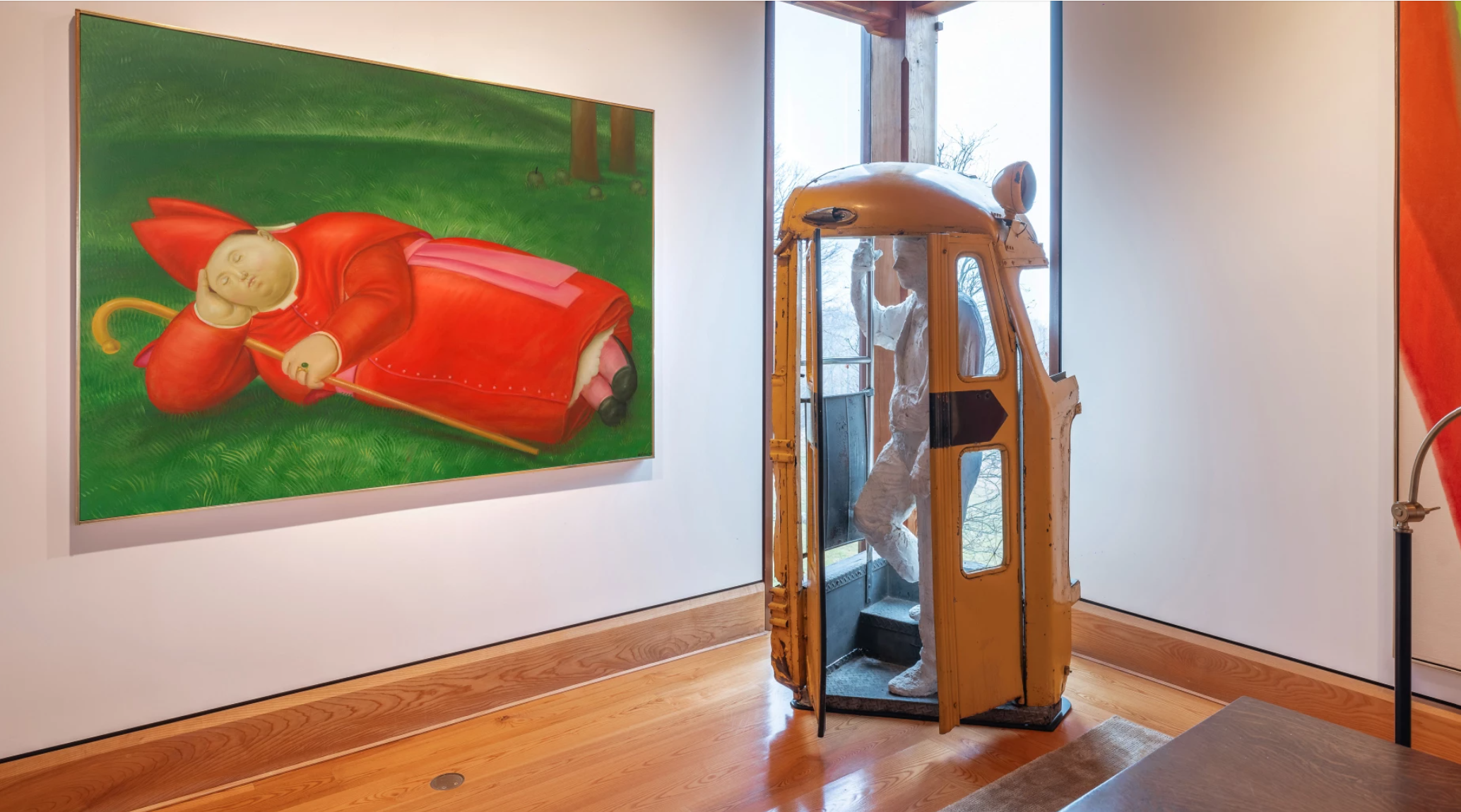
Julian Cassady Photography/Julian Cassady Photography / Ali
In El Cardenal, the eponymous subject is captured in an intimate moment of repose, in what is both an unusual outdoor setting and pose for a member of the clergy. With an emerald episcopal ring-adorned hand grasping its staff, a gleaming golden crozier pokes out from the crook of the Cardinal’s propped arm, as it runs the length of his ample frame. In this dynamic composition, commensurate with the Cardinal’s stature, Botero employs a triadic palette of resplendent hues—saturated reds, lush greens, and glimmering golds—suffusing El Cardenal with a sense of balance and harmony, complimentary of the serenity of the bucolic setting. Botero’s Colombian identity is inextricably linked to his painting, and rife with allusions to his home country, El Cardenal is no exception. The landscape evokes the sloping peaks of the Cordillera Central of the Andes mountains that surround his native city, Medellín. Although the Catholic Church, as Botero recalled in an interview in 1979, “has always been very powerful in Colombia and has done a lot of harm,” religious subjects are regular denizens of his whimsical world (Fernando Botero quoted in Exh. Cat., Washington D.C., Hirshhorn Museum and Sculpture Garden, Smithsonian Institution (and traveling), Fernando Botero, 1979-80, p. 13). Often presented in inane situations, yet always with the utmost decorum, the clerical figure reflects Botero’s nuanced view of religion, which lies somewhere within this balance.
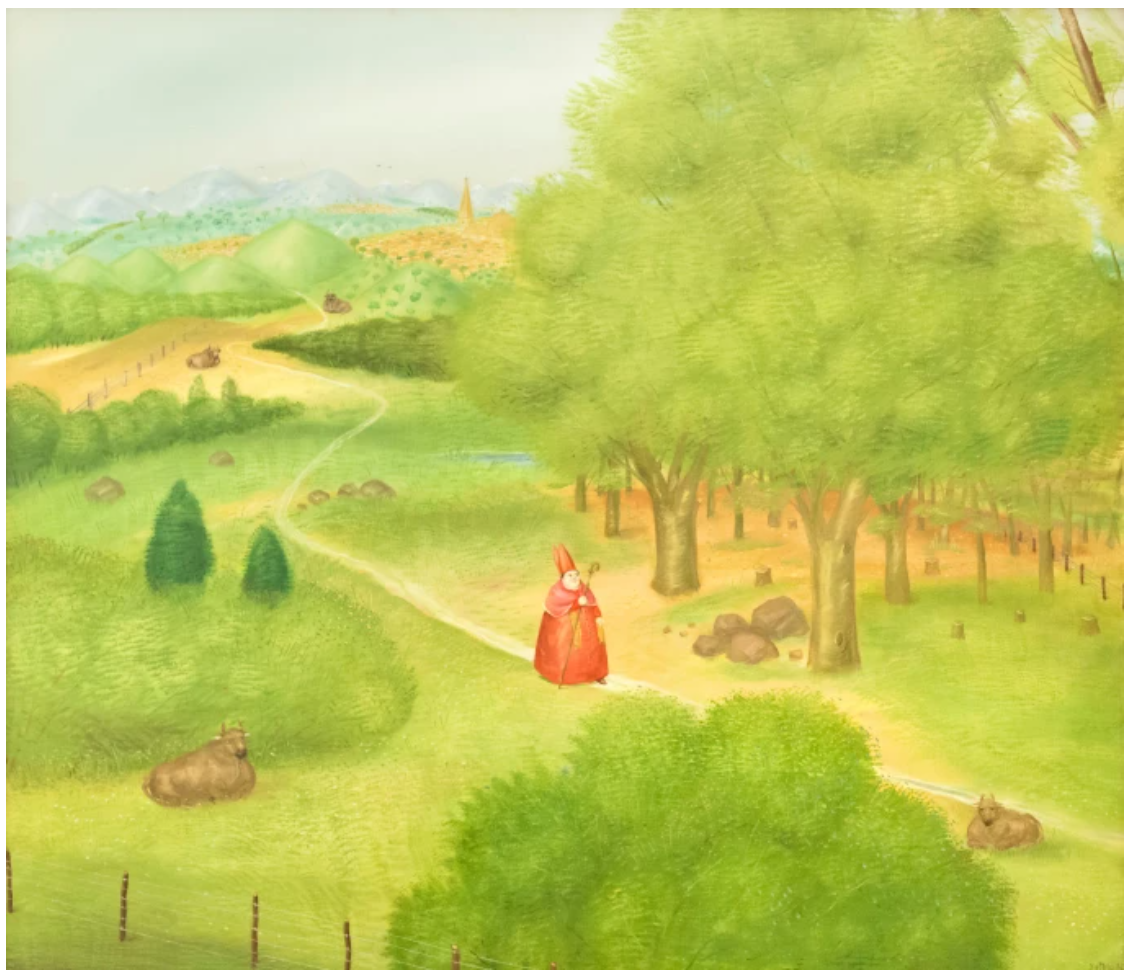
Fernando Botero, Trip to the Ecumenical Council, oil on canvas, 1972,
Vatican Museums and Galleries (Musei e Gallerie Pontificie), Vatican City
So tactful is Botero’s treatment of the religious figure, and so universal is his pictorial vocabulary, that the Vatican Museum, Rome is among the prestigious institutions that collect his work from this series; a 1972 oil of a Cardinal roving through the countryside forms part of the Vatican Museum’s Collection of Modern Religious Art. Remaining prolific in his depictions of religious subject matter throughout his career, critical compositions like El Cardenal function as touchstones for some of the most pivotal stylistic turning points in his oeuvre. Imbued with humor, elegance, and critical observation, El Cardenal transcends the mere depiction of religious figures. By integrating the aesthetic principles of the Italian Renaissance with contemporary themes, Botero creates a dialogue between past and present, inviting viewers to explore the complexities of identity, power, and tradition. With his ability to balance playful exuberance with formal clarity his art has remained both compelling and universally resonant.
Bishop in the Forest, 1967
Christie’s New-York: 11 March 2022
Estimated: USD 300,000 – 400,000
USD 529,200
FERNANDO BOTERO (b. 1932), Bishop in the Forest | Christie’s (christies.com)
FERNANDO BOTERO (b. 1932)
Bishop in the Forest, 1967
Oil on canvas
95.3 x 116 cm (37 1/2 x 45 1/2 inches)
Signed and dated ‘Botero 67’ (lower right), and ‘Botero 67’ (on the reverse)
Among Botero’s most enduring subjects are clerical figures—bishops and archbishops, cardinals and popes, priests and nuns—who descend from Old Master forebears but live, mostly peacefully, in Botero’s ageless Antioquian world.
“I started painting bishops because they provide an artist with wonderful coloristic and formal opportunities. There’s nothing less attractive to paint than contemporary dress. In the Quattrocento, say, things were quite different: people had one leg red, one green. There was a wealth of bold color which virtually painted itself: you just took your brush and reproduced the colors….To then see a bishop in his red vestments—that’s a wonderful sight! That’s abundance! So I became interested in bishops because they gave me a chance to use red. That allowed me greater freedom in the deployment of color….The various extravagant vestments of bishops and priests offer marvelous coloristic possibilities.”
A splendid example of Botero’s chromatic touch, Bishop in the Forest contrasts the rich erubescence of its titular subject against a dense forest of trees, leafy and luminously emerald-green. A wine-red cassock, tied with a pink sash, drapes around his stout figure; an ivory cape and mitre frame his rounded, rosy face. He stands preposterously tall, the top of his mitre rising above the tree canopy; a miniature umbrella provides the tiniest modicum of protection. The exaggerated volumes and disproportionate scale heighten the absurdity of the scene, cushioning its gentle social satire. The painting’s paradisiac setting suggests near incredulous innocence and peace at a time when the Church was implicated in the excesses of La Violencia (1948-58), a bloody period of political warfare and partisanship. Botero memorialized fallen clergy in The Dead Bishops (1965), a monumental portrayal of heaping bodies at rest, but his bishops generally fare far better, placidly dozing (The Sleeping Bishop, 1957), swimming (Bathing Bishops in a River, 1967), walking (Trip to the Ecumenical Council, 1972), or otherwise losing themselves in nature (Bishop Lost in the Woods, 1970). Taking his place among these serene brethren, the subject of Bishop in the Forest stands in timeless, beatific grace, his existence both a disquisition on the color red and a veiled commentary on the place, and complicity, of the Church.
“Family” Portraits
The Playroom, 1970
Christie’s New-York: 19 November 2024
Estimated: USD 3,000,000 – 5,000,000
USD 3,680,000
FERNANDO BOTERO (1932-2023), The Playroom | Christie’s
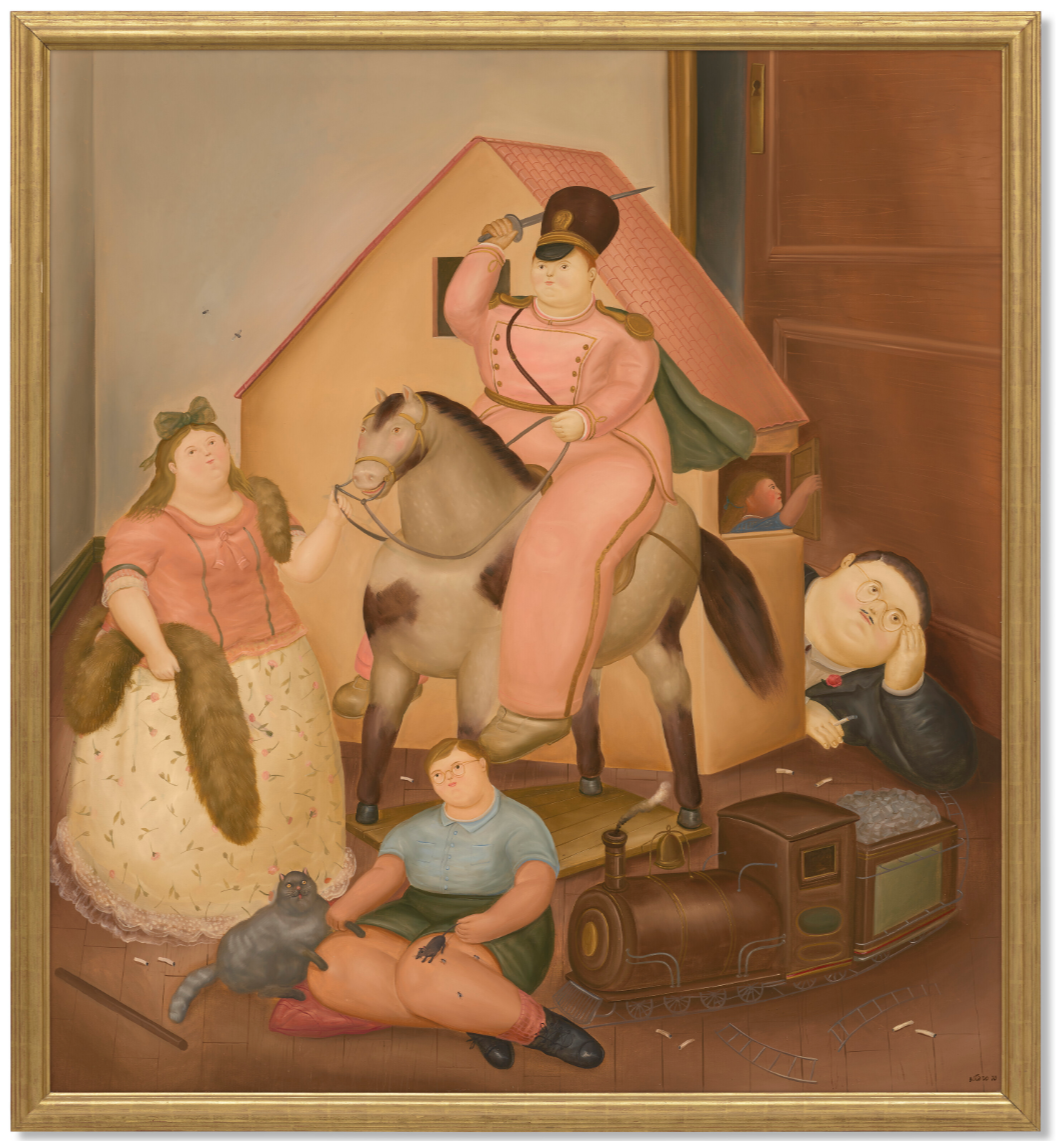
FERNANDO BOTERO (1932-2023)
The Playroom, 1970
Oil on canvas
206.4 x 191.5 cm (81 1/4 x 75 3/8 inches)
Signed and dated ‘Botero 70’ (lower right)
Signed and dated again and titled ‘BOTERO 70 THE PLAYROOM’ (on the reverse)
On October 1, 1960, a 28-year-old Fernando Botero arrived in New York City from Bogotá with three suits, $200 in his pocket and dogged ambition. He came with no family, no friends and no English. Quickly though, he found a small studio on MacDougal St. in Greenwich Village and set to work painting day in and day out. “En Nueva York, desde el comienzo trabajé todo el tiempo. Pinté y dibujé con una ferocidad grande porque esta ciudad, si uno no hace un esfuerzo mayor, lo aplasta. Yo soy un sobreviviente.” [In New York, from the beginning, I worked all the time. I painted and drew with a great ferocity because this city, if one does not make the most effort, it crushes you. I am a survivor.] (Fernando Botero in José Hernández, “Nueva York treinta años después” El tiempo, 1 de septiembre 1993). For the next twelve years, in a city where Abstract Expressionism and later Pop reigned supreme, Fernando Botero, who painted far outside the circumscribed lines of art history, did more than survive. After two years spent counting pennies, eating only hot dogs and eliminating red (the most expensive paint color, according to the artist) from his work, he had a major break. Dorothy Miller, a noted curator from the Museum of Modern Art, found her way to the maverick artist’s studio and immediately bought Mona Lisa, a los doce años for her storied institution.
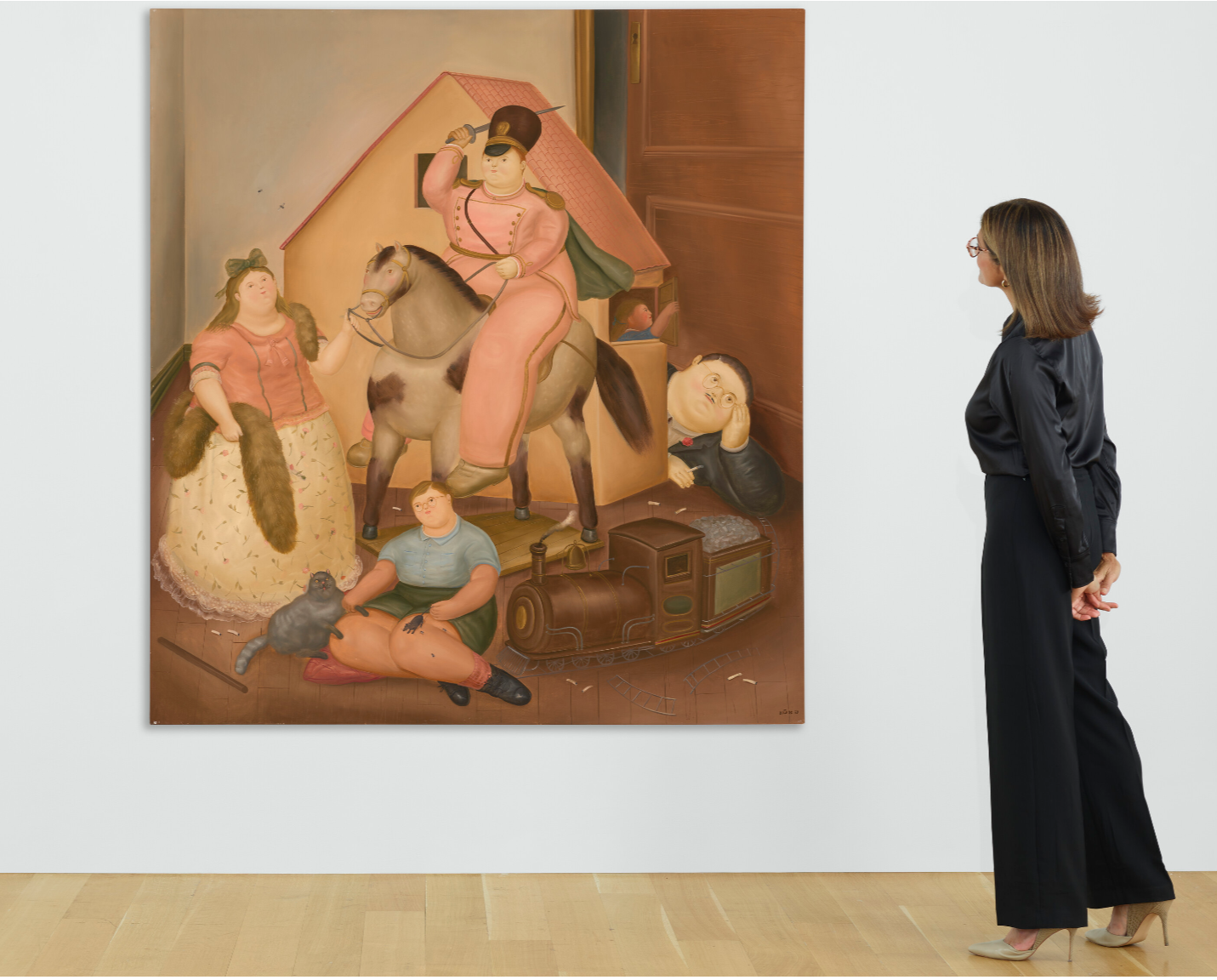
While Miller opened the door to the hallowed halls of modernism, a second encounter a few years later proved to be the turning point in Botero’s career. The wildly successful music publishing executive Jean Aberbach happened upon a group exhibition at MOMA that included Botero’s The Presidential Family, the second work by the artist to enter the museum’s collection. Aberbach would later describe his encounter with the painting as an almost transcendental experience. “[After leaving the painting], I walked back into the darkness and the rain, and my cheeks reached out for the raindrops and my heart was filled with happiness and expectation.” (Jean Aberbach in B.Biszick-Lockwood, Restless Giant: The Life and Times of Jean Aberbach & Hill and Range Songs, Chicago, 2010, p. 238). In the following months, Aberbach, already legendary in the music industry for helping to build the careers of Elvis Presley, Ray Charles, Johnny Cash and many others, relentlessly pursued the rising visual artist.
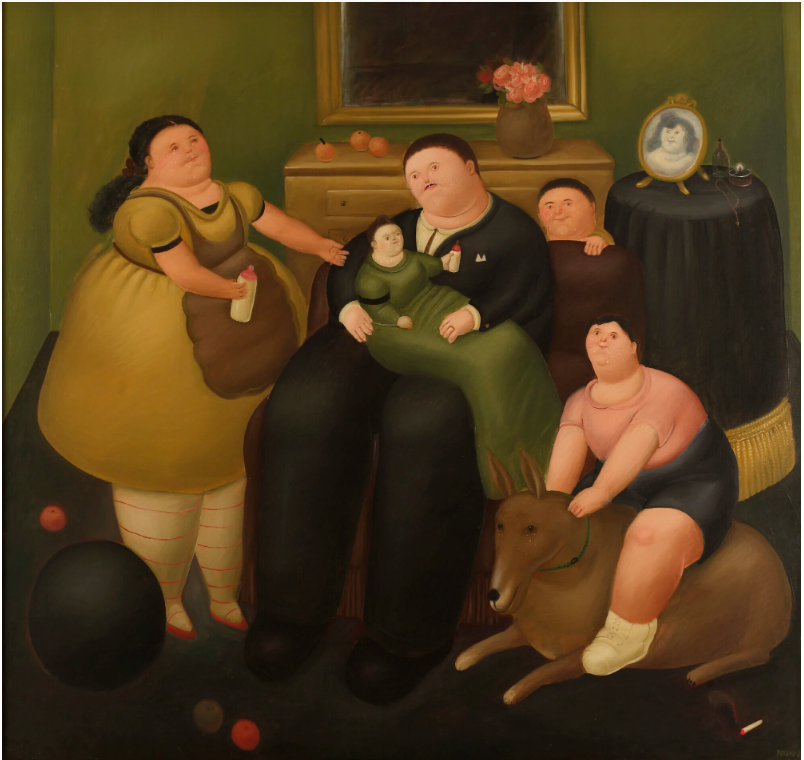
Fernando Botero, El viudo (The Widower), 1968, Museo de Arte Latinoamericano de Buenos Aires (MALBA). © The Estate of Fernando Botero.
Botero initially rebuffed Aberbach, telling him he had no works for sale and then eventually relenting and offering a still life, which Aberbach rejected. He wanted a family scene like the one he had seen in MOMA’s collection. Eventually, Aberbach succeeded, procuring his first work from the artist, The Widower, now in the collection of the Museo de Arte Latinoamericano de Buenos Aires.
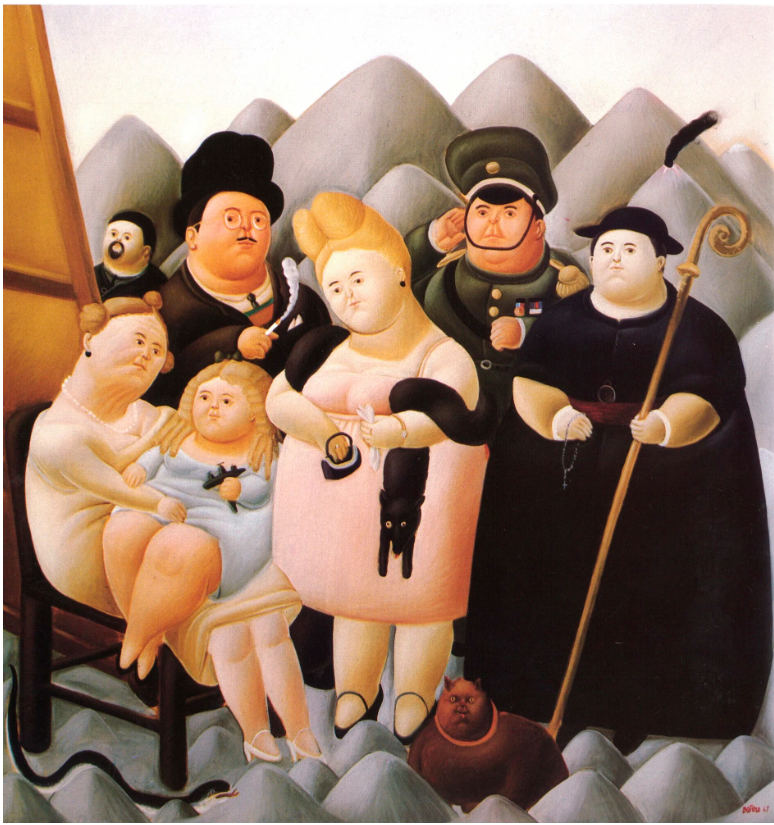
Fernando Botero, The Presidential Family, 1967, Museum of Modern Art, New York. © The Estate of Fernando Botero.
Family scenes, one of the most important subjects in the artist’s oeuvre, first emerged on a grand scale in Botero’s paintings in the late 1950s with masterpieces like Camera degli Sposi (Homenaje a Mantegna). For the next seven decades, Botero remained preoccupied with family subjects, exploring the theme in paintings, sculptures and drawings. In The Widower, Botero presents a tragicomedy, in which a father dominates a traditionally female space, a position he awkwardly assumes due to the death of his young wife who is shown in a portrait resting on the table This incongruous play of proportion is a hallmark of Botero’s singular style. In the best of the artist’s works, corpulent bodies squeeze into and push up against the picture plane, imbuing his figures with his now universally-recognized, signature monumentality. Any tension created by these distortions in scale are offset by Botero’s perfect palette pitch. A consummate colorist, Botero created chromatic harmony by utilizing a limited number of colors in each canvas that evenly reverberate across the composition. The Playroom, rendered in Botero’s classic pastel hues of the 1960s and 70s, is a concerto where soft rose and a mellow yellow dominate, accompanied by muted green and soothing blue. This restrictive repeating palette creates an overall feeling of balance and calm that Botero sought to achieve in his work.
“I am interested in quiet color, not excited or feverish color.
I have always considered that great art conveys tranquility and, in that sense, I seek that even in color.”
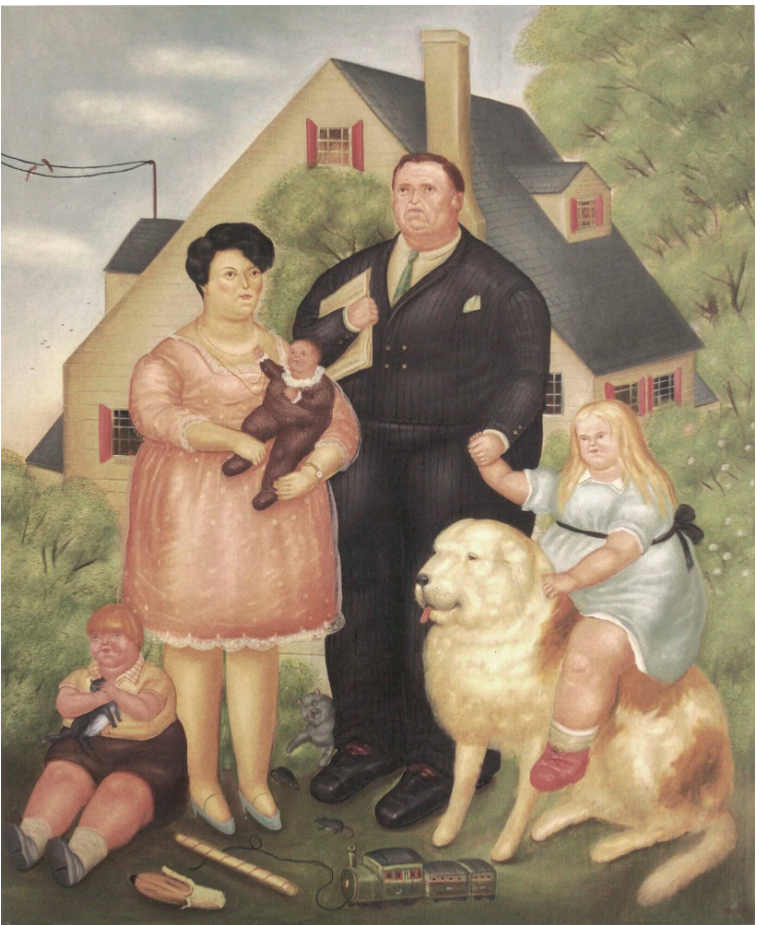
Fernando Botero, Joachim Jean Aberbach and His Family, 1970. Private collection. © The Estate of Fernando Botero.
The Playroom is fatherhood writ large and thus, it seems only fitting that this painting hung in Botero’s father figure’s home for decades. It was not necessarily Aberbach that Botero had in mind though when he painted The Playroom. In 1970, Botero was undoubtedly reflecting on his own role as a father as he welcomed his fourth child into the world. This new familial addition assuredly left him thinking of his older three children at home in Colombia as well.
Nightlife, 2017
Christie’s Paris: 18 October 2024
Estimated: EUR 850,000 – 1,250,000
EUR 2,036,500
Fernando Botero (1932-2023), Nightlife | Christie’s
FERNANDO BOTERO (1932-2023)
Nightlife, 2017
Oil on canvas
167 x 206.5 cm (65 3/4 x 81 1/4 inches)
Signed ‘Botero 17’ (lower right)
’The problem is to determine the source of the pleasure when one looks at a picture. For me, the pleasure comes from the exaltation of life, which expresses the sensuality of forms.’’ – Fernando Botero
In Fernando Botero’s Nightlife (2017), a motley crew of figures are arranged on a low stage. One woman in a red dress sits in a chair, perhaps tired from dancing. Another, redheaded and wearing green, hitches up her skirt. She locks eyes with a man in a suit, who swigs his drink from the bottle. A musician strums a guitar. A third woman sits on the floor in her underwear, raising her glass to be refilled: a green parrot perches on her leg. Playful self-referential details enliven the picture, including a poster for an exhibition of Botero’s own work, and a mirror that reflects the back of the redheaded woman’s hair. A curtain hangs down the right-hand side. It looks as if it has been a long night. With its musical premise, grand scale and complex composition, the work relates to Botero’s earlier masterpieces such as Dancing in Colombia (1980, Metropolitan Museum of Art, New York) and Tablao flamenco (1984). Peopled with the artist’s distinctive, larger-than-life figures, these works both parody and honour everyday life in Colombia, elevating the subject to the monumental dimensions of history painting.
Botero’s approach to the time-honoured bar or music-hall theme is both regional and universal. Central to the cultural identity of his native Colombia, the motif is also important within the broader context of twentieth-century Latin American art, as explored by modern masters such as Diego Rivera and Rufino Tamayo. The figures furthermore recall the legacy of early-twentieth-century European artists who observed the drinkers, performers and people of the night in their own locales, particularly Picasso’s and Braque’s guitar-players and saltimbanques. Like these painters, Botero was unafraid of incorporating an edge of social critique into his scenes of leisure and revelry.
Botero’s trademark voluminous figures first took shape in his early years in Colombia, but are also deeply conversant with European art history. Born in Medellín, the artist spent his early years surrounded by Baroque churches whose polychrome wooden sculptures captured his imagination. He later travelled to Italy, where he admired the work of Piero della Francesca and other artists of the Quattrocento. ‘I started to paint these volumetric figures when I was seventeen’, said Botero. ‘I did it by intuition … because it said something to me. Then, of course, when I was in Europe, especially in Italy, I rationalised the importance of volume because I saw that all Italian painters like Michelangelo, Raphael, Giotto, Masaccio, Piero della Francesca made a celebration of volume’ (F. Botero, quoted in T. Lehtikoski, ‘Botero – Interview with the Artist’, Zest & Curiosity, 3 January 2021).
These influences led Botero to define his characteristic style, which he used to explore broad, existential themes and different aspects of Colombian culture. In Nightlife, he casts his unique eye on a humorous, enduring and warmly human tableau.
The House of Ana Molina, 1972
Sotheby’s New-York: 27 September 2024
Estimated: USD 400,000 – 600,000
USD 1,128,000
The House of Ana Molina | Contemporary Curated | 2024 | Sotheby’s (sothebys.com)
FERNANDO BOTERO (1932 – 2023)
The House of Ana Molina, 1972
Sanguine, charcoal and pastel on linen
205.1 x 182.9 cm (80 3/4 x 72 inches)
Signed and dated 72 (lower right)
La casa de Ana Molina marks the apex of a brief, seminal series of works in sanguine or charcoal on canvas that Fernando Botero executed through the 1970s. Imposing in scale and breathtaking in detail, these works are drawn with an exacting technique last seen in the eighteenth century. Like Rosalba Carriera or Jean-Etienne Liotard before him, the Colombian artist exploits the malleability of these soft pigments to create a richly dimensional surface, with gleaming highlights and deep, lifelike shadows. In the present work, La casa de Ana Molina, Botero uses these tools to sly effect—revisiting the canonical theme of brothels and prostitution from a distinctly Latin American perspective. Emerging to auction for the first time from the esteemed collection of the Nassau County Museum of Art, La casa de Ana Molina is the finest of this series to appear in the market in decades. The work relates closely to La casa de las gemelas Arias, the prior world record for a painting by the artist—painted just a year earlier, it embodies the same fundamental themes around the image of the courtesan in history and in the Latin American imaginary explored in the text by Edward J. Sullivan that follows here below. However, La casa de Ana Molina seems to offer a more tender look at a moment of domestic life in this red-light district. Here, two children of the house doze and tumble peacefully at their mothers’ feet; the women repose languidly, drinking, embracing one another – their customer almost an afterthought. Botero joyfully renders society’s lowliest characters in heroic scale.
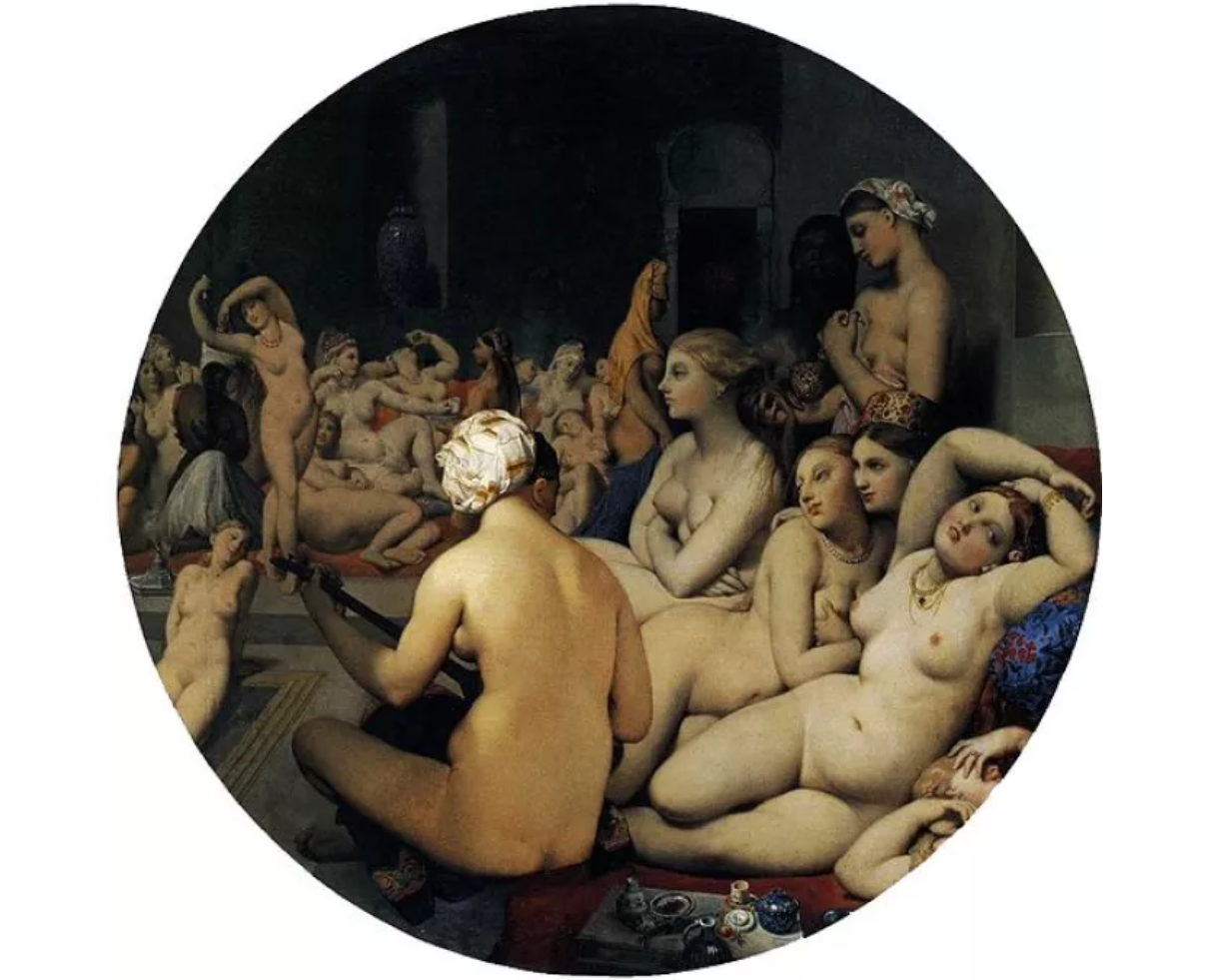
Jean-Auguste-Dominique Ingres, Le Bain turc, 1862, Musée du Louvre, Paris
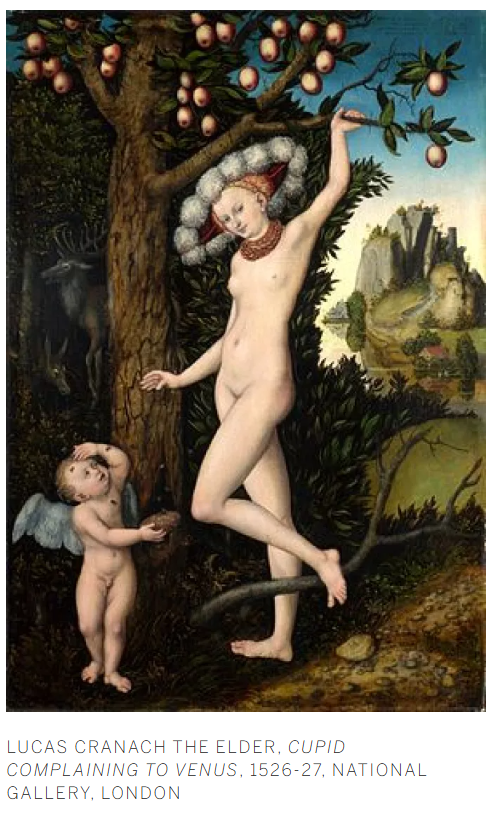
A number of years ago, while attending a reception given for Botero in Medellín to celebrate his donation of a number of his sculptures to the museum, the artists recounted to me an anecdote that bears an important relationship to this painting. “When I was about thirteen years old,” said the artist, “I would go to several of the whorehouses in the red district in Medellín. I would talk to the prostitutes—who all seemed very old to me then (they were probably in their twenties). I was fascinated by them and really liked them. Many years later, when I had a large show of my work in Colombia, I received a letter from one of them with whom I had been particularly friendly. It was a love letter! I was thrilled and touched and it made me remember every moment of those days.” Botero’s ability to recall the most powerful memories of his youth and depict them in his art is a pervasive quality in his work that lends to it a curious poignancy mixed at times with melancholy.
In his monograph on the artist, Carter Ratcliff links Botero’s representations of prostitutes to his interest in Lucas Cranach’s images of single standing courtesans. The artist has stated that “At the source of [my figures of prostitutes] is my love for Cranach. All his courtesans have so much going on in the dresses, the jewelry, the hats.” In [this suite of works, including] La casa de Ana Molina and La casa de las gemelas Arias, however, Botero has transcended his European inspiration and returned with affection to the brothels he knew in his youth. He has also created sculptural works with the theme of prostitution.
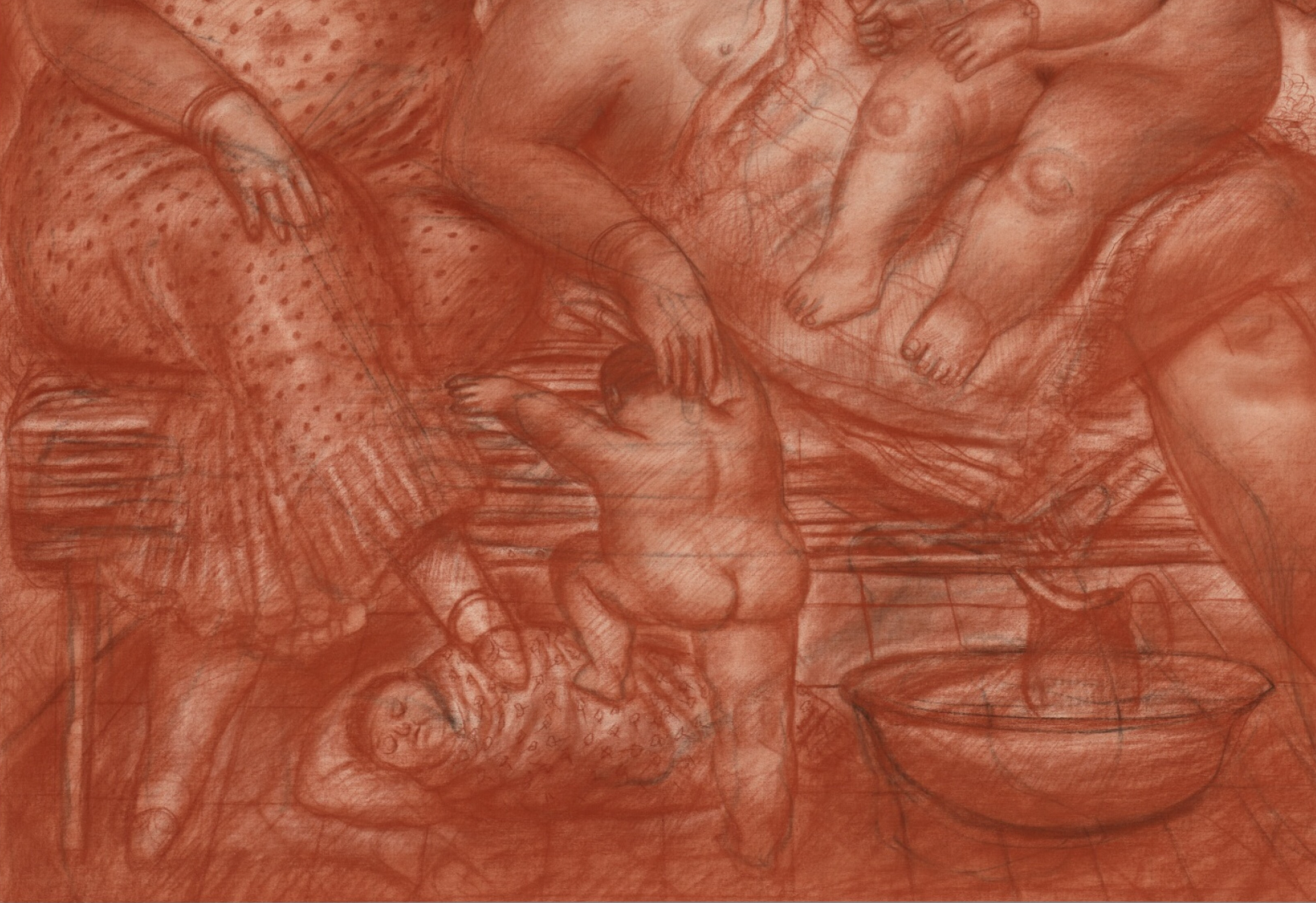
We have seen how Botero has connected his brothel pictures to the depictions of courtesans by Cranach. It is also significant to keep in mind that these works enter into an age-old dialogue with the many scenes of courtesans, prostitutes and brothel interiors in the Renaissance to the present. Works such as Carpaccio’s Courtesans of circa 1510, the various representation of similar figures by the anonymous painters of the School of Fontainebleau (mid 16th century), as well as the more famous nineteenth century images like Ingres’ harem scenes or Manet’s Olympia form important components of the visual heritage of which the La casa de Ana Molina partakes. In addition, we cannot discount the affinities with works of literary art that this important painting recalls. The parallel between the visual imagery of Botero and the sumptuously fertile description of this countryman and friend Gabriel Garcia Márquez have often been noted.
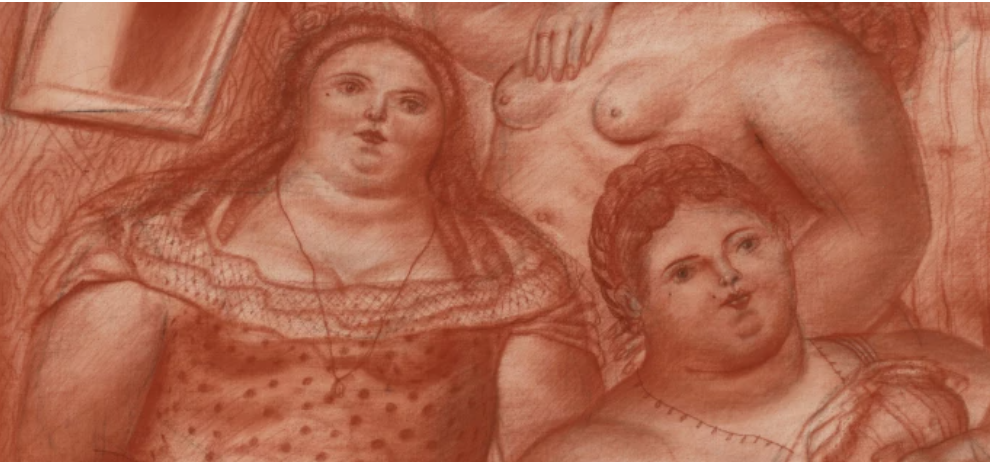
Finally, we must comment on the role of machismo in this work. Is Botero presenting us with a view of a place in which the male prerogative is dominant? Is this painting simply another image of male domination and subjugation of women? I believe that the truth is that the situation is just the opposite. While the men have come to the brothel to be sexually serviced by the woman, it is the women themselves who are in complete control. In fact, the males play a secondary role in the composition… The women are self-possessed, cool and alert to the situation. Thus the artist effects a gloss on the traditional machista aspect of his culture. While his self-proclaimed interest in sensual beauty and pleasure is suggested, his ability at wry social commentary (present in one form or another in nearly every image he creates) establishes this work as a masterpiece of ironic satire.
The Street, 2010
Sotheby’s New-York: 14 May 2024
Estimated: USD 600,000 – 800,000
USD 1,111,250
The Street | Contemporary Day Auction | 2024 | Sotheby’s (sothebys.com)
FERNANDO BOTERO (1932 – 2023)
The Street, 2010
Oil on canvas
185×140 cm (72 3/4 x 55 1/8 inches)
Signed and dated 10 (lower right)
“His artistic universe is constructed with memories of his childhood, and as a young man…The families in the provincial towns in Latin America lived their lives with strict rules: the men were well groomed, they wore a suit, a tie, and a hat when outdoors, and the women also were ladylike, with gloves, handbags, and flowery dresses. The children were well behaved and disciplined. The pleasures of daily life were—and are—predictable: an outing in the country with a picnic basket, a visit to a bullfight, a walk through the narrow streets with colorful houses in colonial style, or a romantic night of ballroom dancing…. It means working hard to keep up appearances in a society where even vice has a certain conformity.”

THE PRESENT WORK IN BOTERO’S PARIS STUDIO CIRCA 2010
La Casa de Rosalba Correa, 2001
Bonhams London: 24 March 2022
Estimated: GBP 650,000 – 850,000
GBP 922,750 / USD 1,216,545
Bonhams : FERNANDO BOTERO (B. 1932) La Casa de Rosalba Correa 2001
Oil on canvas
179.2 x 192 cm (70 9/16 x 75 9/16 inches)
Signed and dated 01
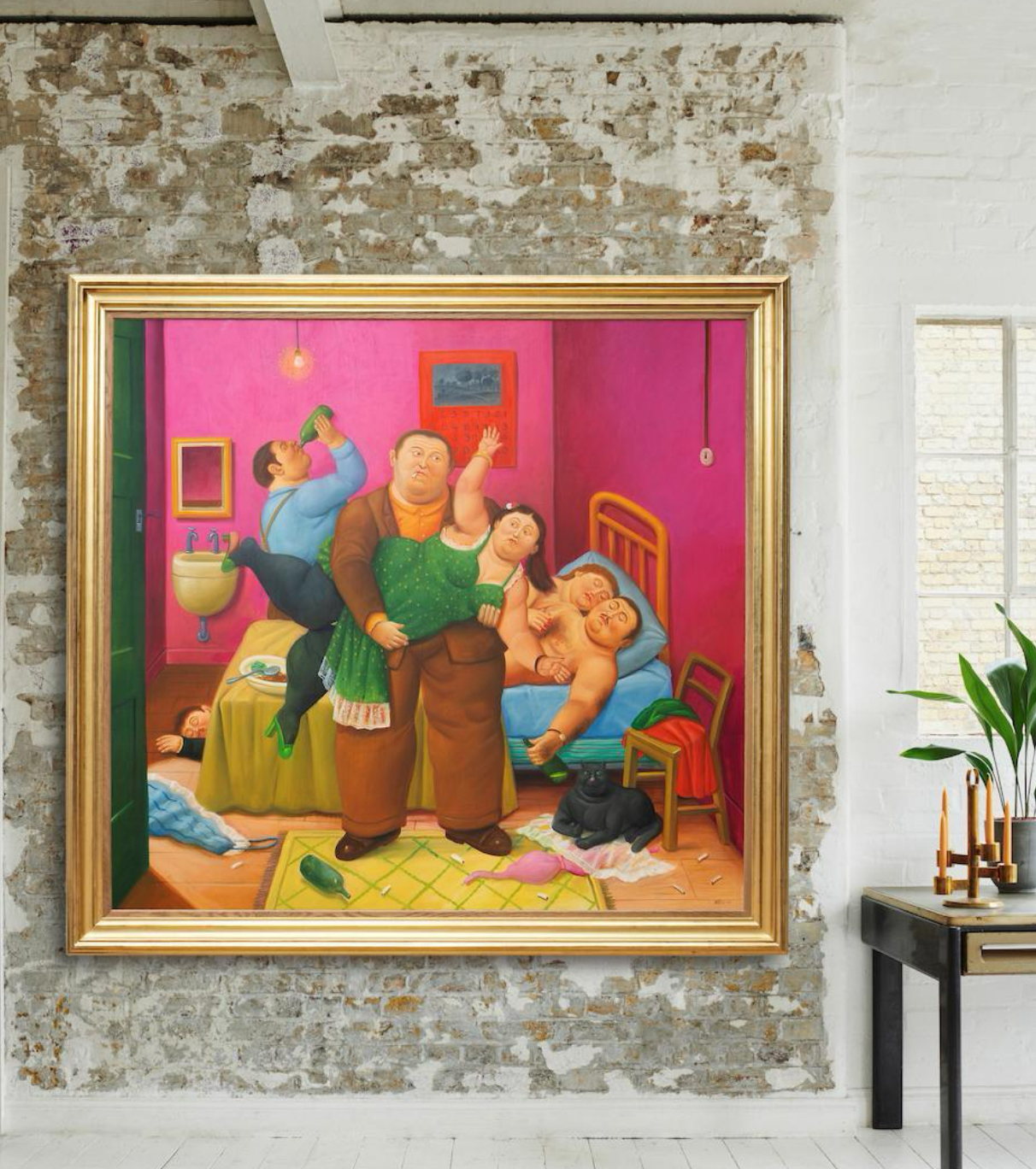
Well known for subjects ranging from the Old Masters to circus scenes, bullfights, domestic life and political satire, the present work falls into a theme of brothel scenes and bacchanalia that the artist revisited throughout his career.
“There was a red-light district in Medellín at the time. It was an easy-going place; class lines blurred in a sort of never-ending carnival, a permanent street party.”
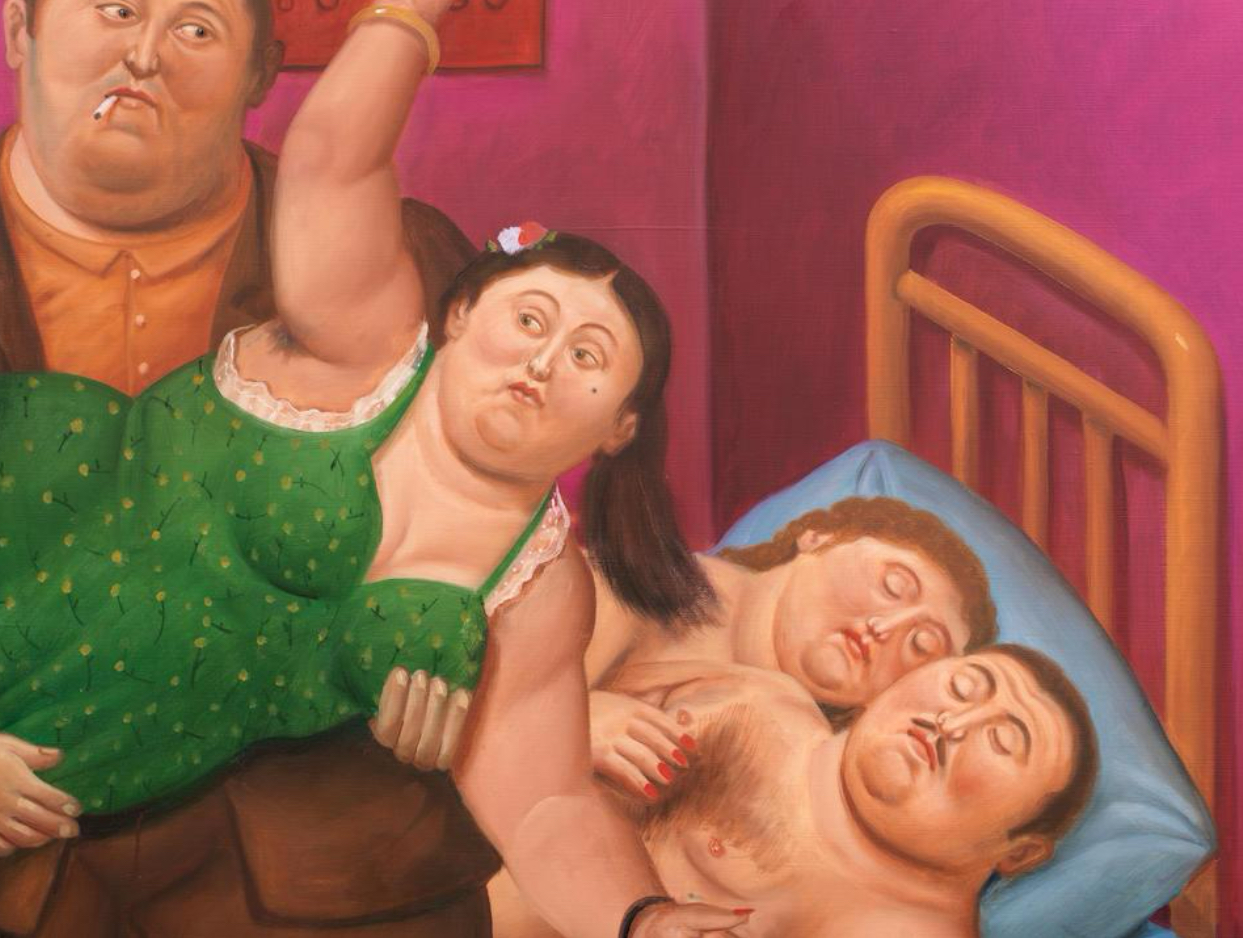
The vibrant, candy colored La Casa de Rosalba Correa shares clear characteristics with earlier depictions of the theme, notably La casa de Raquel Vega, from 1975 in the collection of Mumok, Vienna, House Mariduque from 1977 and The House of Amanda Ramírez of 1988 which is in the permanent collection of the Museo de Antioquia in Medellin. The latter, shows a similar rudimentary structure of the room, the stage if you will, whilst the protagonists and distinct elements of the scene differ. We appear to be privy to the final stages of a debauched evening in a room that seems too small to hold its curvaceous inhabitants. The smell of tobacco and stale alcohol lingers in the air, and a swarm of flies’ buzzes around a lone lightbulb. Much of the night’s events have unfolded but some protagonists are still awake and active. A nude couple shares a large bed in the centre of the room. They have fallen asleep in a loose embrace and only a half-eaten plate of food at the man’s feet and the green bottle clutched tightly in his hand hint at the preceding evening. He wears a wedding band suggesting an act of infidelity. Two men, one apparently passed out under the bed not unlike the array of discarded clothes around the room, the other taking a large swig from a bottle, along with a further empty bottle and cigarette buds strewn all over the floor tie in with the theme of a raucous party. In the foreground, a man has swept up a somewhat dispassionate woman in a luscious green dress and clutches her tightly in his arms.
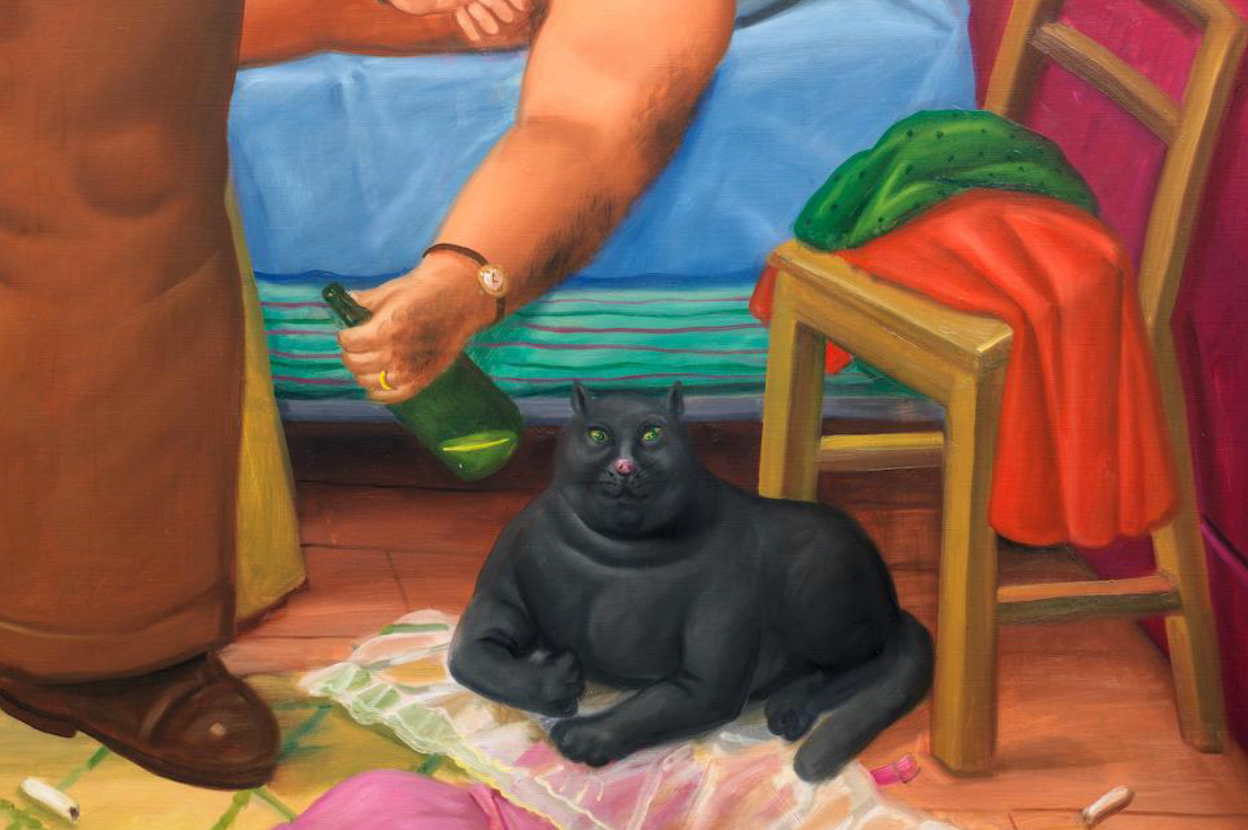
The only protagonist of the scene to look straight out that the viewer, to acknowledge our peeping eye without judgement, is a cat reclining elegantly in the lower right corner. Symbolic for femininity and domesticity, cats feature in much of Botero’s work, often accompanying a dominant matriarch or a sensual nude and in La Casa de Rosalba Correa, it is easy to draw on comparisons with Manet’s famous masterpiece Olympia. Despite the scene drawing up questions of male prerogative, Botero’s female protagonists tend to be strong, self-alert characters, in control of their situation and playing with their allure. The black feline with its piercing green eyes makes us keenly aware that we are trespassing into this scene, the viewer has become a voyeur, an active participant and we have been spotted. Using humorous and exaggerated elements in his work, Botero breaks with the established classical tradition of eternalizing the classically heroic and brave and adds a fresh approach to age old themes. Botero shifts classical art historical topics into the realm of the common and trivial, the realm of day-to-day life, often infused with a melange of his own lived experiences and the air of his native Colombia.
Familia Protestante, 1969
Sotheby’s New-York: 20 May 2022
Estimated: USD 700,000 – 900,000
USD 1,071,000
Familia Protestante | Contemporary Day Auction | 2022 | Sotheby’s (sothebys.com)
FERNANDO BOTERO (B. 1932)
Familia Protestante, 1969
Oil on canvas
210×175 cm (82 ¾ x 69 inches)
Signed Botero and dated 69 (lower right)
Signed Botero, titled and dated 1969 (on the reverse)
In the late 1960s, Latin America’s artistic production and the favor of the public was split: while a cadre of geometric, conceptual and concrete artists were establishing themselves as a mostly Parisian-inspired alternative to traditional figuration and lyrical abstraction, Fernando Botero rose as a dominant figure across not only the region but internationally. One of the twentieth century’s most cosmopolitan artists, his formational studies took place in Florence, Madrid, Mexico City, and New York, but the ethos of all of his work has always been infused with the spirit of his native Colombia. His finest paintings, including the Familia Protestante of 1969, present a unique mixture of his lived experience with exaggerated dramatic elements of life in South America and elements of European Master painting.
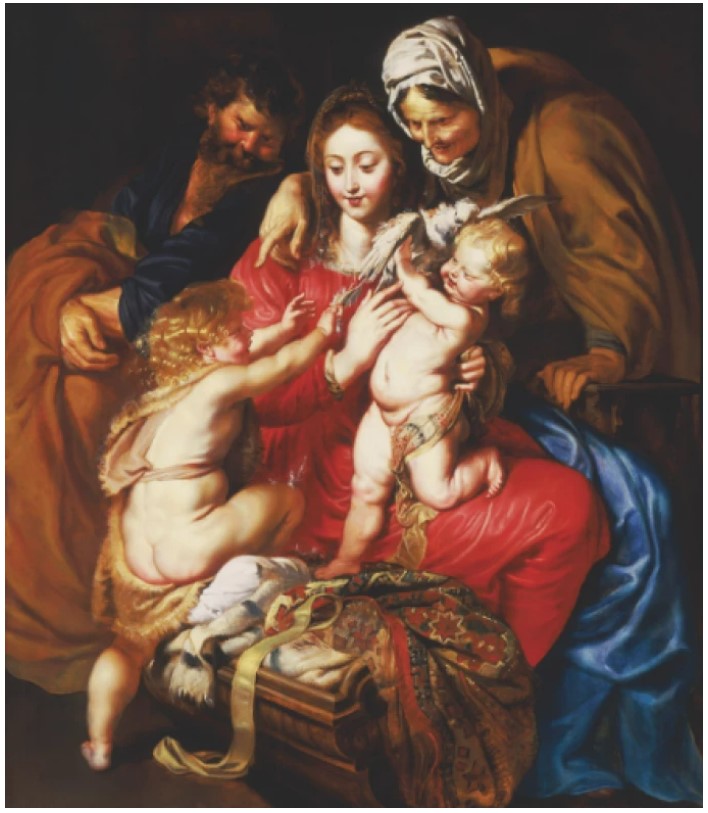
PETER PAUL RUBENS, THE HOLY FAMILY WITH ST. ELIZABETH, ST. JOHN, AND A DOVE, CIRCA 1609 LOS ANGELES COUNTY MUSEUM OF ART, COLONEL AND MRS. GEORGE J. DENIS FUND
As his painting attained maturity in this period, Botero executed a seminal series of monumental family group portraits, of which Familia Protestante is a critical example alongside works like The Bashful Family (1968) and Family Scene (1967). These works have pyramidal compositional structures derived from Renaissance and Dutch master paintings (one can find a close structural similarity here to Rubens’ Holy Family with St. Elizabeth, St. John, and a Dove of 1609, for example) but their characters are uniquely Boterian. A mother with a luscious, towering tangle of dark brown hair cradles a baby in her lap as an older boy looks on, nonchalantly resting his elbows on her ample thigh. In the foreground, she is flanked by a young girl with cascading gold ringlets who meets our gaze, a grinning beagle and a whirring little train whose track encircles the family group. Outfitted in the trappings of European colonial wealth and yet entirely naked (their nakedness underscored by the glinting jewelry that adorns mother and daughter), they seem to evoke a nod to the story of the emperor’s new clothes. The work is rendered with the technical brilliance for which Botero is renowned; he presents a symphony of carefully balanced olives, pinks, golds and chestnuts, and revels in details like the plush silk of the chair cover, the delicate lace of the mother’s shawl, and the fleecy softness of the rug.
Frente a la catedral, 1994
Christie’s New-York: 11 March 2022
Estimated: USD 700,000 – 1,000,000
USD 882,000
FERNANDO BOTERO (b. 1932) (christies.com)
FERNANDO BOTERO (b. 1932)
Frente a la catedral, 1994
Oil on canvas
111.8 x 97.8 cm (44 x 38 1/2 inches)
Signed and dated ‘Botero 94’ (lower right)
Botero left his native Medellín for Madrid in 1952 and has since led a peripatetic life—moving from Mexico to New York, between Italy and Paris—and yet he remains, by his own proclamation, “the most Colombian of Colombian artists.” His paintings betray his enduring affection for his country. In Frente a la catedral he portrays a quintessential Antioquian family with his characteristic humor and endearment. This vanishing local sensibility wafts through Botero’s quaint tableaux of everyday life, each painting a microcosm of olden Colombian mores. In the present work, the national flag waves from the dome of a cathedral suggestively modeled on the eighteenth-century Iglesia de La Candelaria, the oldest church in Medellín. Frente a la catedral describes a traditional family group: a moustached man in suit and tie gazes at his wife, decorous and matronly, as their children—stocky and marionette-like—reach toward them from either side. They present a familial panoply of complementary reds (headband, necklace, fingernails, skirt) and greens (blouse, heels, necktie, socks), colors echoed in the clay roof tiles and leafy treetops in the distance. Far from that chaos and the mayhem of “ugliness, vulgarity, and horror,” Botero’s Antioquian world ultimately countenances serenity and logic, an everyday order, love and confidence in life, and a sense of elegance and decoration.
La Casa de las Gemelas Arias, 1973
Sotheby’s New-York: 25 November 2014
Estimated: USD 2,000,000 – 3,000,000
USD 2,105,000
(#56) Fernando Botero (b. 1932) (sothebys.com)
FERNANDO BOTERO
La casa de las gemelas Arias, 1973
Oil on canvas
227×187 cm (89 1/4 x 73 3/4 inches)
Signed and dated 73 lower right
La casa de las gemelas Arias contains nine figures, all of whom from a seamless, intricately woven pattern of bulky yet delicate forms. Their sculptural plasticity is emphasized by the fact that they inhabit what appears to be a tiny room in which a bed and an armoire can barely fit. When crammed with people it appears nothing less than claustrophobic. It is a chamber redolent with the odors of tobacco, alcohol and the warmth of human bodies. In this steamy atmosphere the young women appear in various stages of undress. An older woman, the Celestina or madame of the house offers a glass of wine to her customers. One of the men drinks with great abandon, perhaps steeling his nerve in order to confront the experience of sexual union. His companion, the largest figure of the composition (around whose figure the rest of the painting literally revolves), appears vaguely sad as he holds a petite woman in his lap. She smokes a cigarette, remaining completely placid throughout the experience. The third male figure is all but imperceptible as he lies asleep under the bed, assuming virtually the same importance as the article of clothing and fruits that litter the ground.
Floreros
Florero, 1970
Property from a Private European Collection
Christie’s New-York: 17 November 2025
Estimated: USD 1,200,000 – 1,800,000
USD 1,524,000
FERNANDO BOTERO (1932-2023), Florero | Christie’s
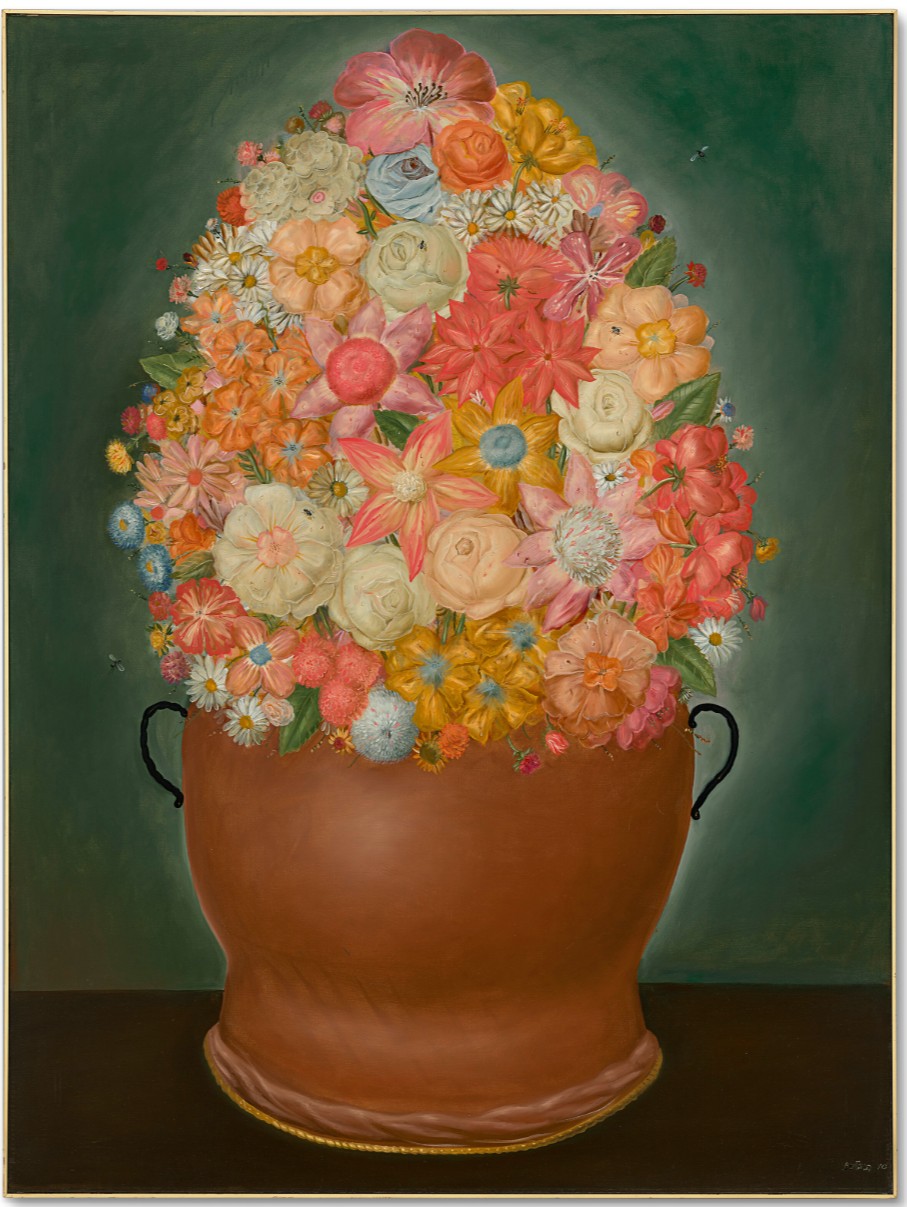
FERNANDO BOTERO (1932-2023)
Florero, 1970
Oil on canvas
193 x 144.8 cm (76×57 inches)
Signed and dated ‘Botero 70’ (lower right)
Signed, titled and dated twice ‘FLORERO Botero 70’ (on the reverse)
Fernando Botero’s Florero elevates the usually diminutive intimate genre of still life painting to a heroic scale. Pushed up against the picture plane, a startlingly large vase of flowers towers above the viewer and nearly bursts through the canvas. This tightly packed bouquet of more than twenty varieties of daisies, dahlias, peonies and camelias is an exuberant display of the artist’s painterly prowess. Rendered with acute attention to detail, the distinctive blooms include all parts of the flower: petals, sepals, stamens and pistils. Close observation reveals dewy droplets settling on petals and bees and flies buzzing amongst the floral array.
Botero manages a monumental still life that is both steeped in art historical tradition and definitively his own creation. As a young aspiring artist in the early 1950s, Botero ventured to Europe where he immersed himself in studying the Old Masters and 20th century modernists. Europe proved transformative for Botero, converting him into an insatiable student of art history. The lessons absorbed from wandering the Prado, Uffizi and Louvre in those early days would reverberate throughout his career. In Florero, Botero nods to the Golden Age of Dutch still life painting, with artists like Jan Davidsz de Heem, renowned for precise renderings of flowers, fruits and insects. De Heem’s opulent still lifes, in particular, often fill the entirety of his canvases and are notable for their brilliant use of varied color. Pop Art depictions of flowers may also have been on Botero’s mind at the time that he painted Florero in 1970. Having moved to New York in 1960 to immerse himself in the center of the art world, Botero would have had ample opportunity to see Andy Warhol’s Flowers series first on view at Leo Castelli Gallery in 1964.
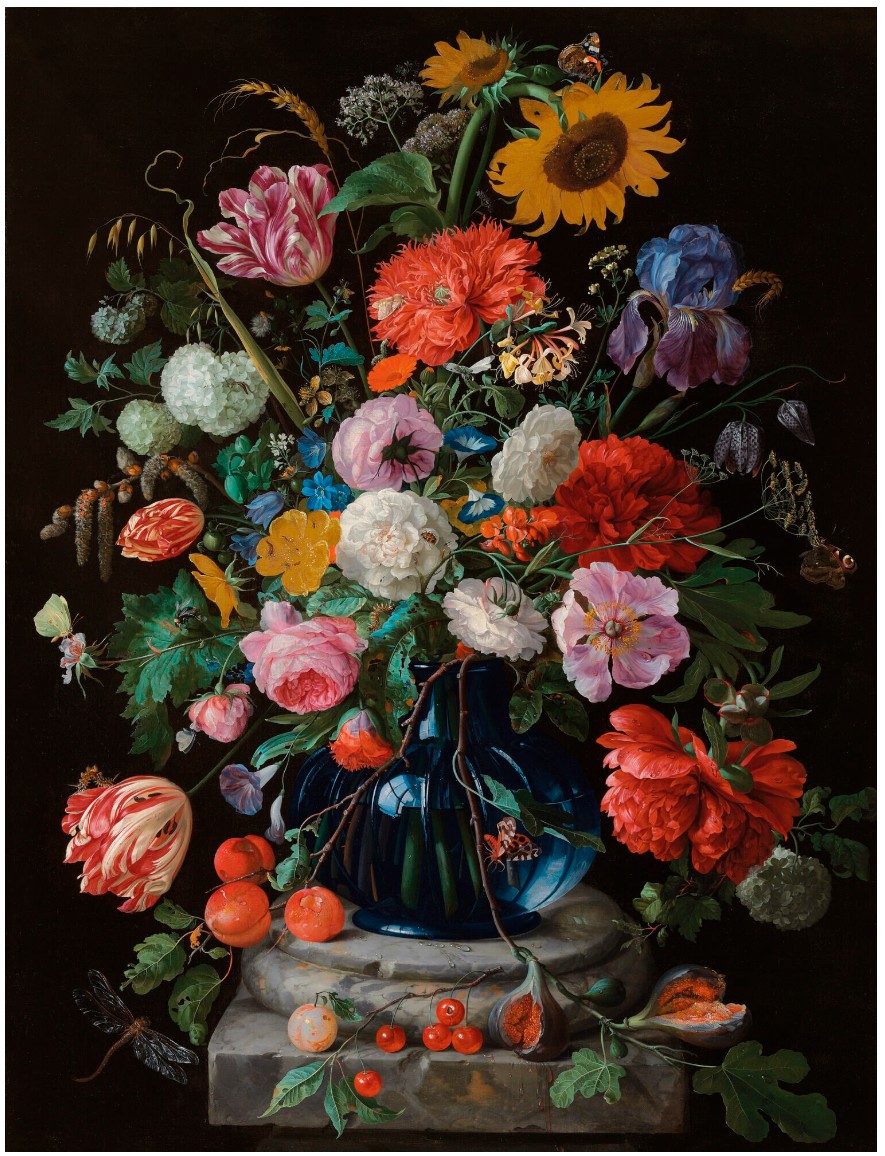
Jan Davidsz. de Heem, Tulips, a sunflower, an iris, hydrangeas, honeysuckle, willow catkins, carnations and other flowers in a glass vase on a marble pediment. Private collection.
Botero’s move to New York in 1960 was a big gamble. He left his family behind in Bogotá and moved to the city with no money, no friends and little English. In the twelve years that he lived in the city, however, he went from impoverished obscurity to meteoric success with the Museum of Modern Art acquiring two of his most significant paintings and prominent dealers supporting him and successfully promoting his work.
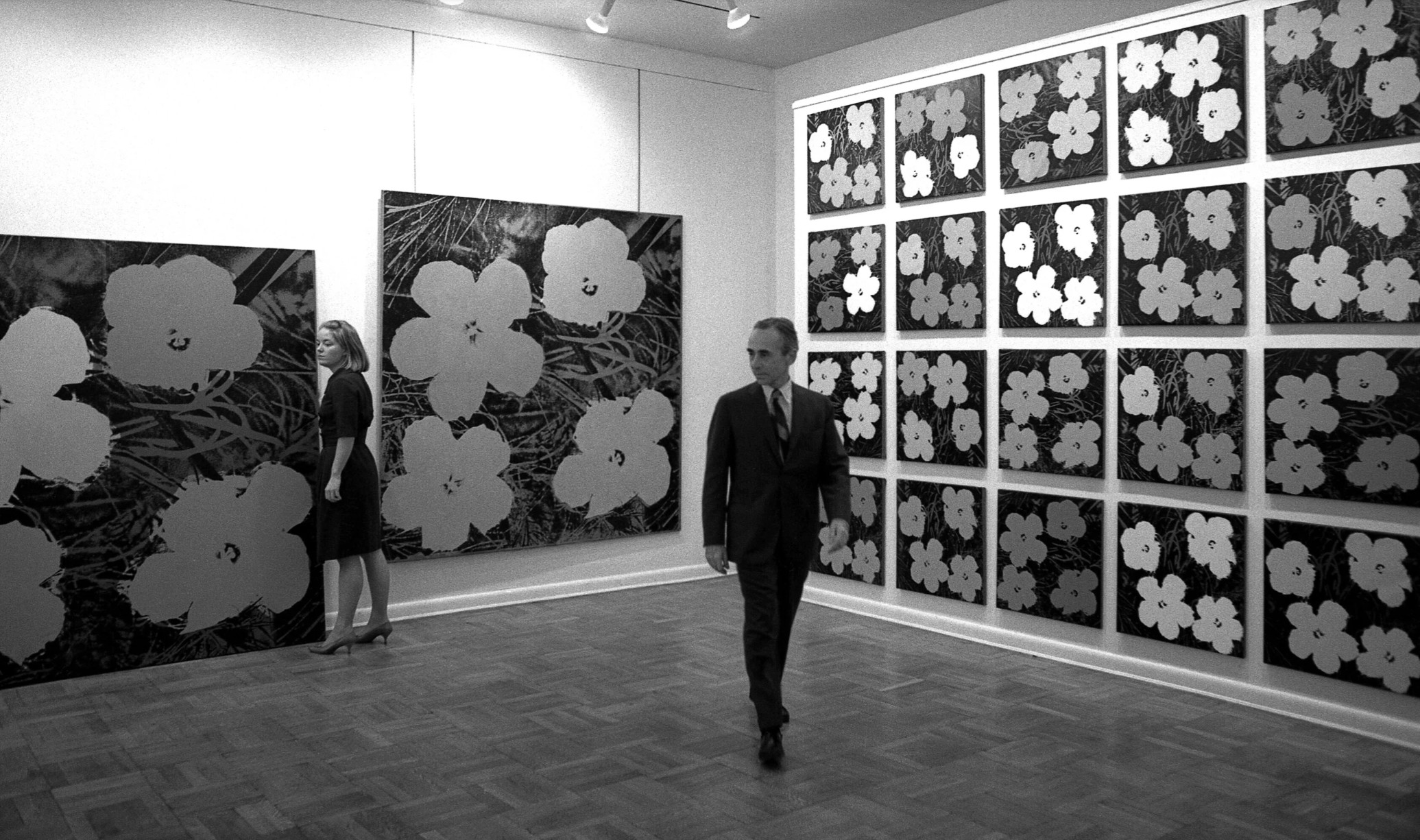
Leo Castelli at Andy Warhol: Flower Paintings, Leo Castelli Gallery, New York, 1964.
© 2023 The Andy Warhol Foundation for the Visual Arts, Inc. / Licensed by Artists Rights Society (ARS).
He also encountered racist criticism and remained ostracized by those who were part of the larger art movements in vogue at the time. While the New York years were fraught for the artist, it was also a period of tremendous growth. Botero came into his own in New York, finding his singular voice as an artist and producing some of his most significant works like Florero.
“I am interested in quiet color, not excited or feverish color. I have always considered that great art conveys tranquility and, in that sense,
I seek that even in color.”
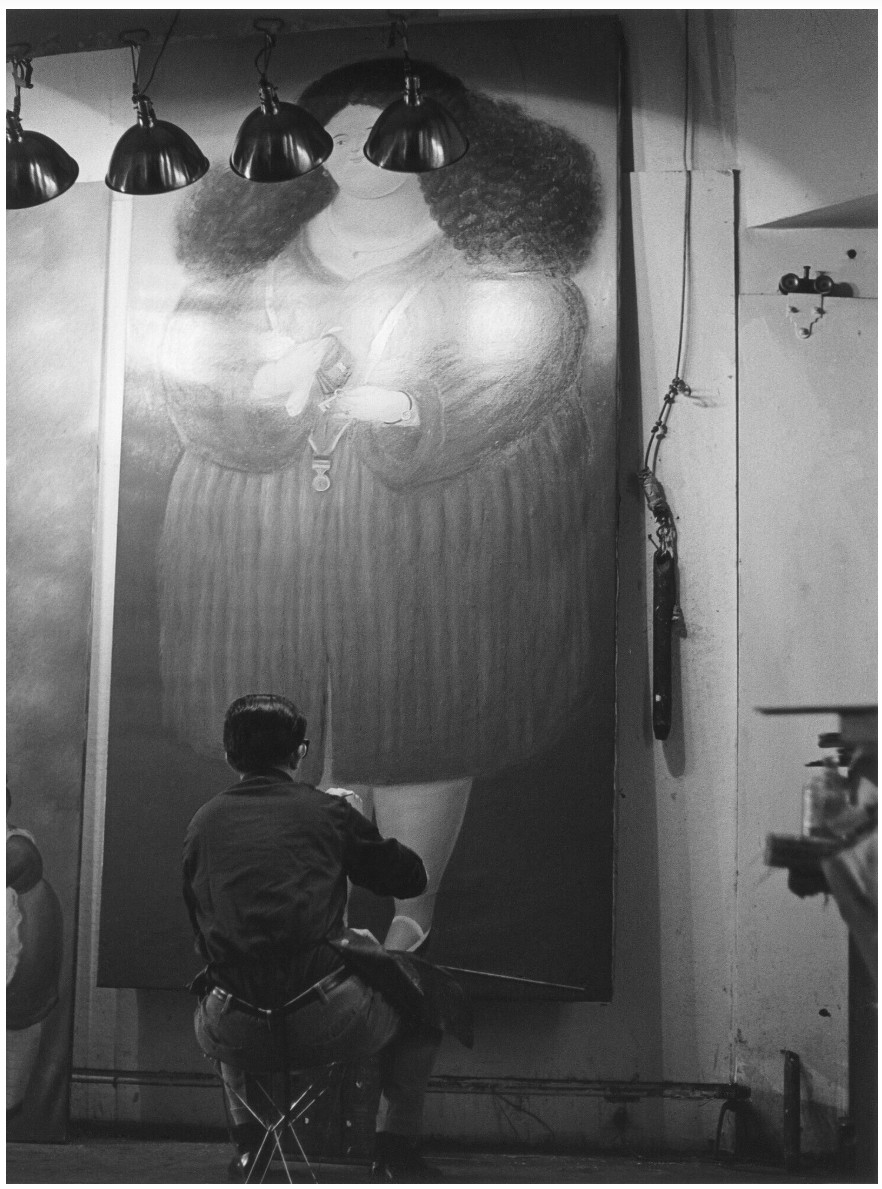
Fernando Botero in his studio in New York City, 1966. © The Estate of Fernando Botero.
Rendered in Botero’s signature pastel palette of the 1960s and 70s, Florero’s plentiful blooms appear in chromatic harmony. A consummate colorist, Botero usually painted with a restrictive palette, employing a limited number of colors in each canvas that evenly reverberate across his compositions. Florero, however, is striking for its sheer number of hues; rose, gold, auburn, cloudy blues and frosty whites are set against a backdrop of deep jade. Here the artist clearly reveled and succeeded in achieving a cohesive symphony in a great variety of color.
Florero, 1974
Sotheby’s New-York: 1 March 2024
Estimated: USD 1,000,000 – 1,500,000
USD 2,722,000
FERNANDO BOTERO (1932 – 2023)
Florero, 1974
Oil on canvas
226×191 cm (89 x 75 1/4 inches)
Signed Botero and dated 74 (lower right)
A consummate example of the vibrational, painterly style characteristic of Botero’s best work of the early 1970s, Florero is a triumph in the volumetric distortion and precise execution that defines Boterismo. The painting stands as a testament to Botero’s reimagining of still life, merging the dimensionality and delicate beauty of the Dutch tradition with the overblown iconography of Pop Art. The result is a unique plastic vocabulary that firmly establishes Botero’s presence in the canon of art history. Botero’s journey to artistic prominence began in humble circumstances near Medellín, Colombia in 1932. Fueled by artistic ambition and aided by a scholarship, he found himself at the Academia San Fernando in Madrid in 1952. In Europe, imbued with a deep-seated appreciation for art history, Botero immersed himself in the works of masters from Francisco de Goya to Piero della Francesca. The Dutch Golden Age painters, particularly Jan Davidsz. de Heem and Rachel Ruysch played a pivotal role in shaping Botero’s artistic sensibilities. Their still-life compositions, rich in fine detail and resonant symbolism, left an indelible mark on Botero’s love for the genre.
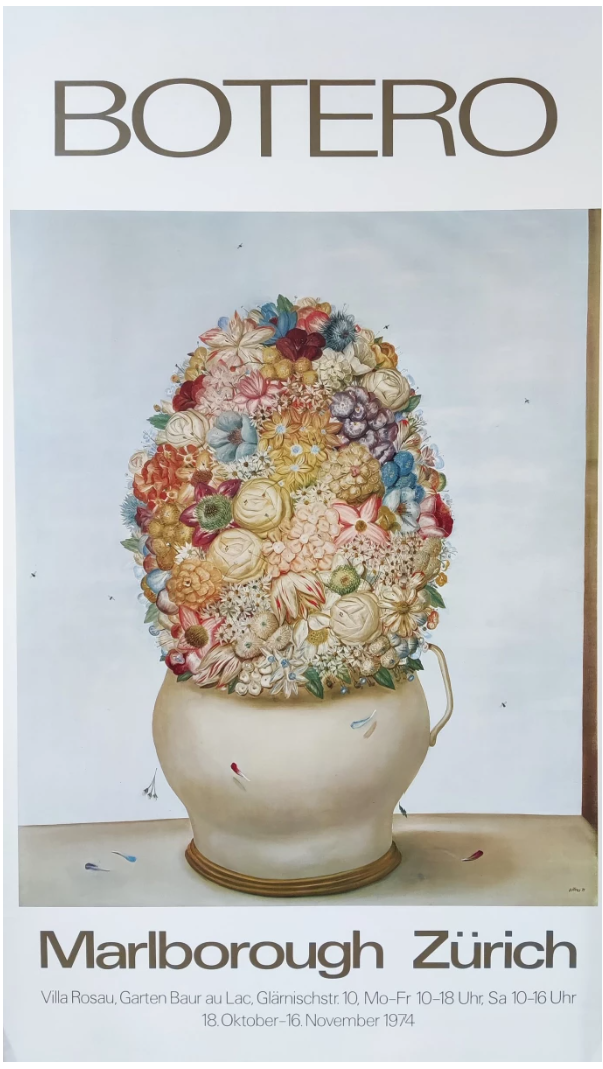
During a critical period in the late 1950s to early 1970s, marked by successful exhibitions in Bogotá, Mexico City, and Washington, D.C., Botero briefly settled in New York. Although a self-proclaimed “post-abstract realist” who remained dedicated to figuration, Botero was not unfazed by the expansive iconographies in New York at the time: Abstract Expressionism and Pop Art. His artistic output from the period, including Florero, demonstrates a careful balance between experimentation with the gestural aspects of Abstract Expressionism and, significantly, an alignment with the exaggerated and playful principles of Pop Art.
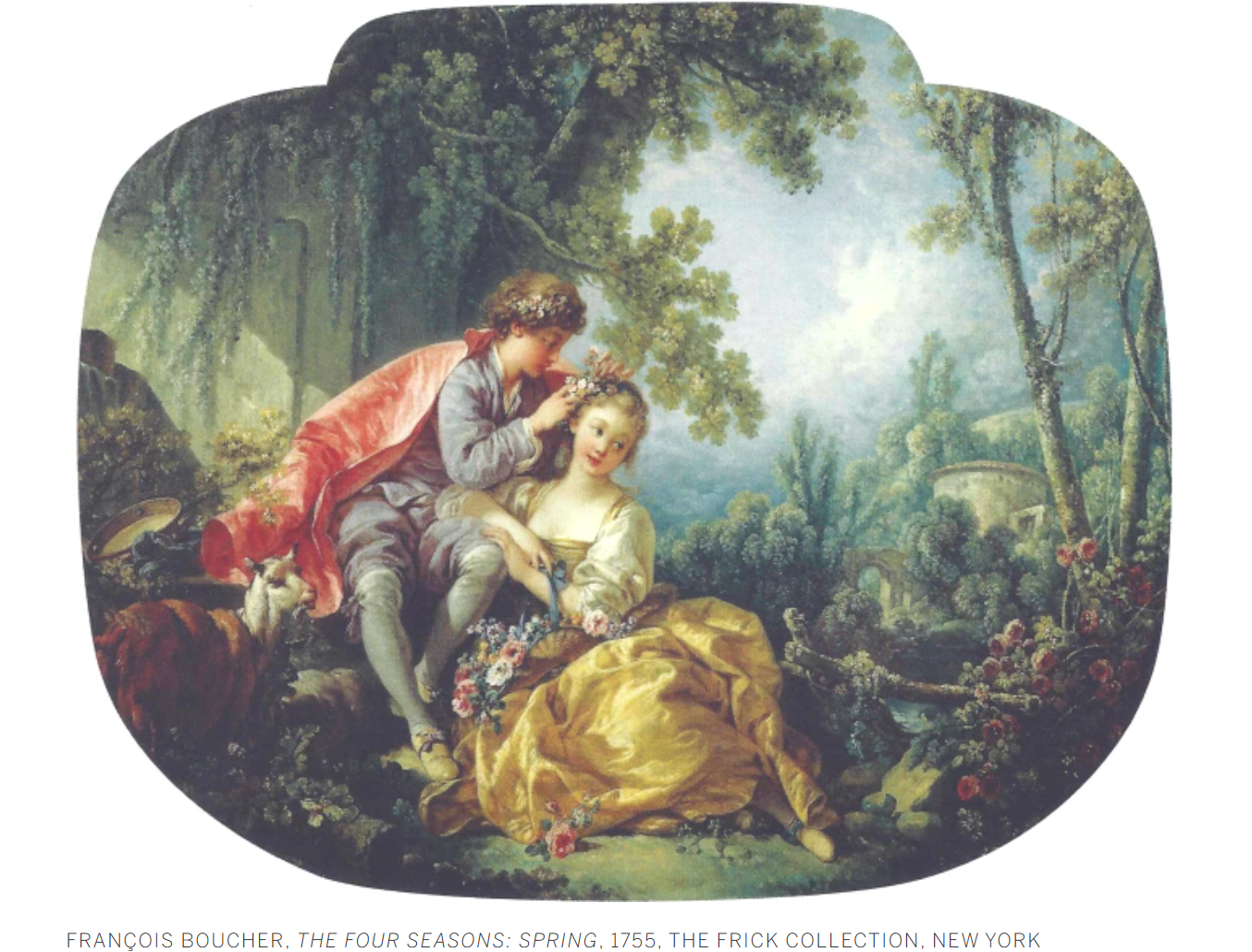
Playing with the sizes of objects and their proportions, Botero introduces elements that challenge the viewer’s perception of reality. The egg-shaped bouquet’s monumental scale has a commanding physical presence, filling almost the entirety of the ample canvas and challenging perception of scale. Space is distorted further by the inclusion of a slightly slanted wall edge, visible in the left corner of the composition, and a realistically-rendered blue sky in the backdrop. Six flies, buzzing in motion, are placed atop the picture frame, defying conventional notions of time and space – as well as coyly nodding to the insects depicted around flora by Dutch Masters as memento mori – reminders of the inevitability of death (and therefore the beauty and fragility of life).
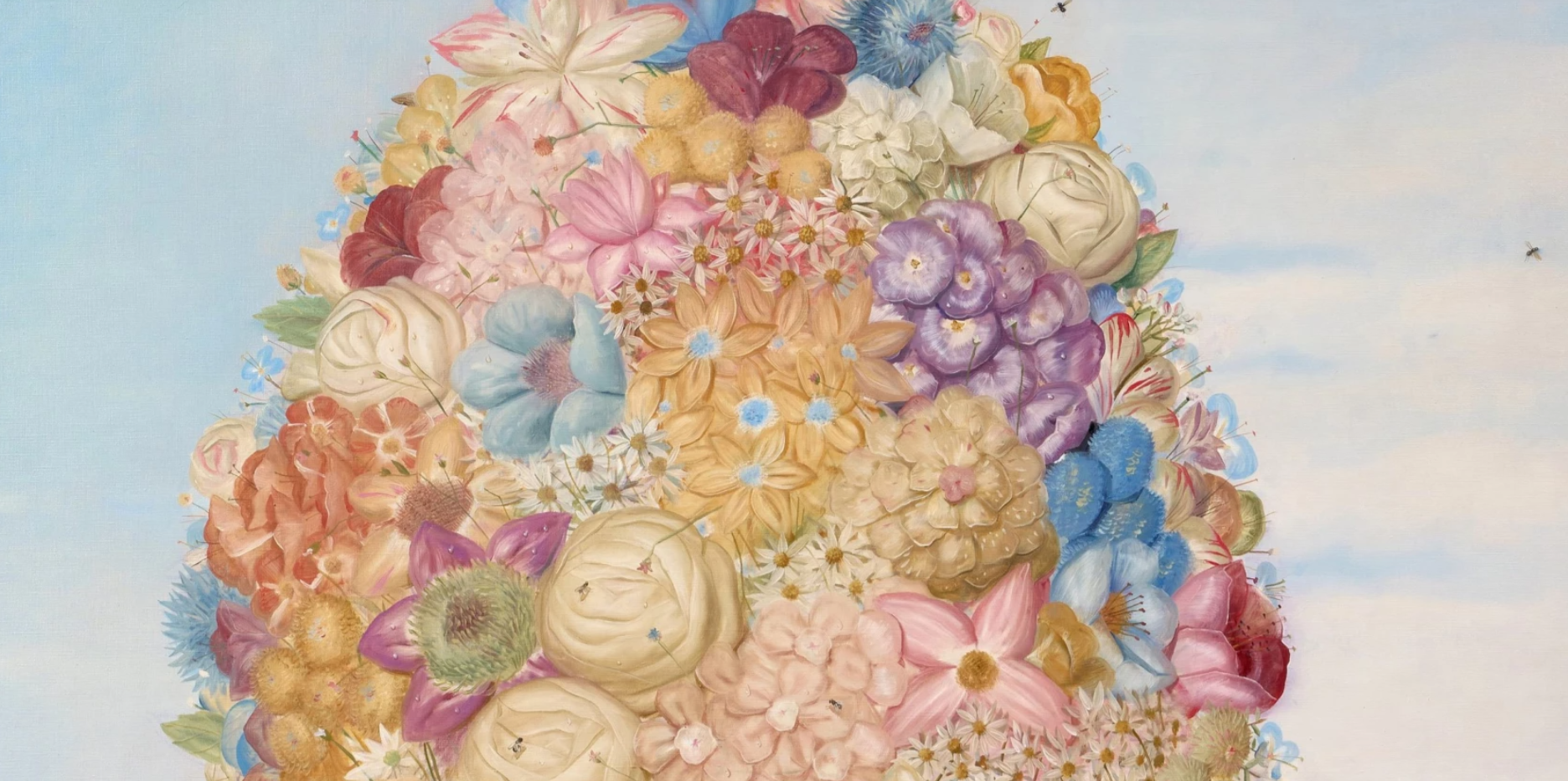
The color palette, however, is dreamlike; rendered without shadows or chiaroscuro in muted olive, mustard, sky-blue and rose, the chromatic vocabulary is a pure, Rococo confection – toying with the highbrow-lowbrow tension inherent to kitsch that preoccupied so many artists working in the Americas at the midcentury. The visual allure of Florero is further enhanced by each smooth brushstroke. Here, Botero commits to a careful, uniform execution of each stroke to ensure the overall coherence of the work across style and form. The tantalizing texture induced by Botero’s meticulous attention to detail adds a tactile dimension to the flat canvas, recalling the work of master technicians like Jean-Auguste-Dominique Ingres.
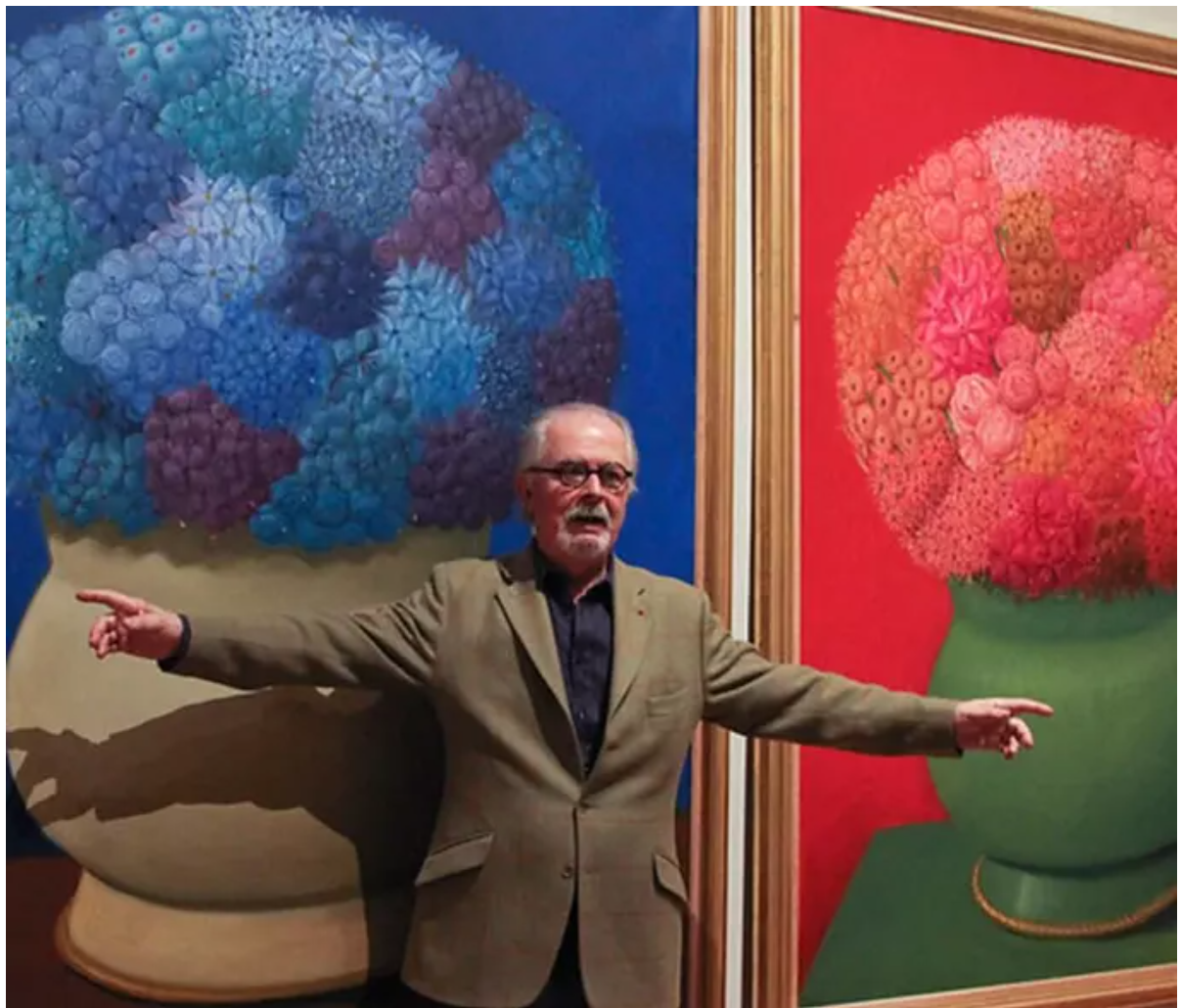
Florero, initially appearing as a simple grouping of flowers, evolves into a series of profound questions about the viewer’s connection to the presented reality. With its rotund egg shape, buzzing flies and distorted scale, Florero eloquently asserts Botero’s formidable presence in the ever-evolving landscape of art history.
Still Lifes
Variaciones sobre Cézanne, 1963
Sotheby’s New-York: 15 May 2026
Estimated: USD 450,000 – 650,000
USD 704,000
Fernando Botero | Variaciones sobre Cézanne | Contemporary Day
FERNANDO BOTERO (1932 – 2023)
Variaciones sobre Cézanne, 1963
Oil on canvas
129.5 x 151.1 cm (51 x 59-1/2 inches)
Signed, titled and dated 63 (lower right)
When Fernando Botero painted Variaciones sobre Cézanne in 1963, New York was in the grip of a cultural upheaval. Abstract Expressionism was loosening its stranglehold on the avant-garde, and a brash new movement — Pop Art — was exploding onto the scene, gleefully dismantling the boundaries between high culture and mass-produced imagery. Botero, a Colombian expatriate working stubbornly against the grain of both movements, found himself occupying a peculiar and revelatory middle ground: a figurative painter whose instincts, it turned out, rhymed deeply with the Pop sensibility he claimed never to have known.
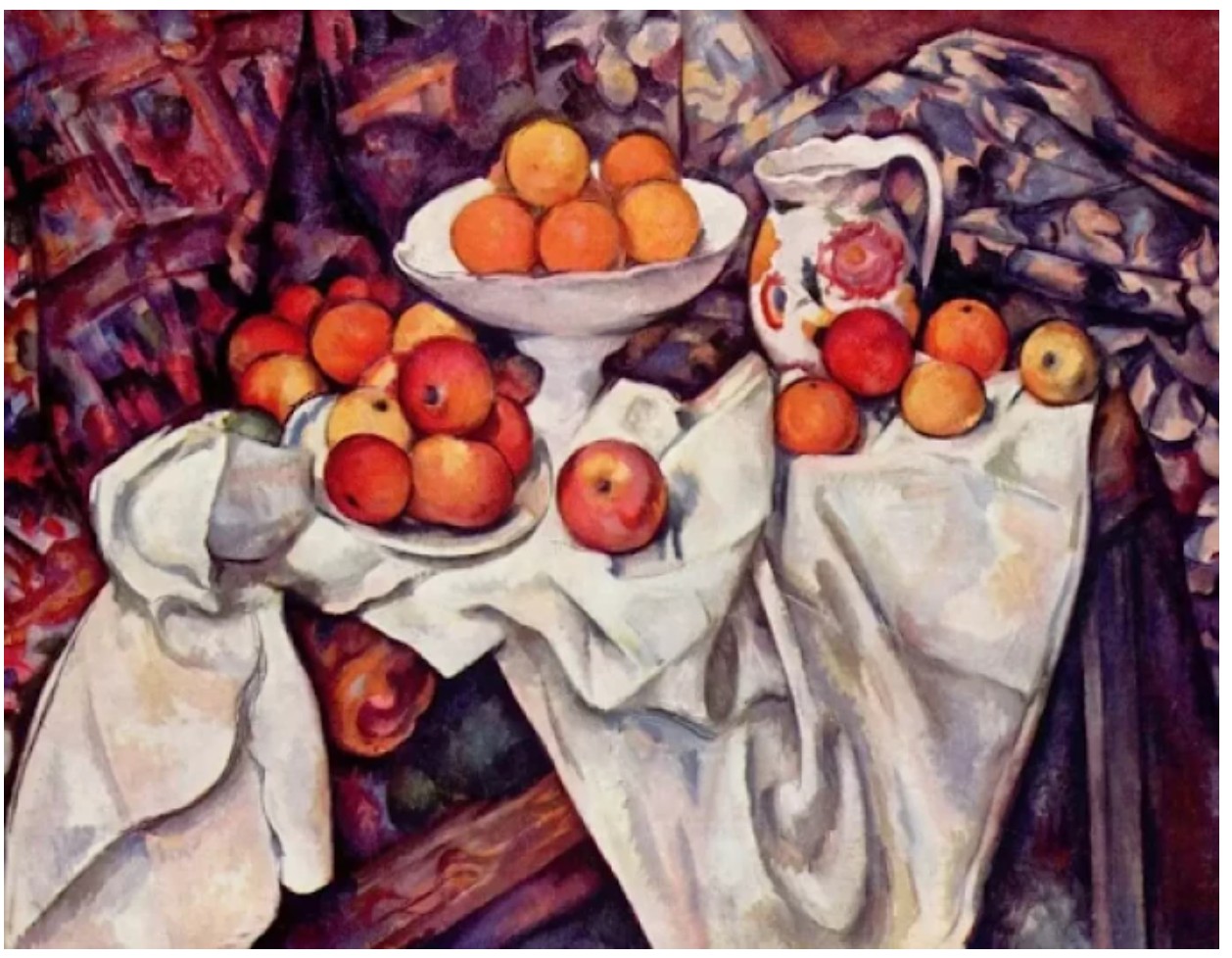
Paul Cézanne, Still Life with Apples and Oranges, 1895, Musée d’Orsay, Paris
Pop Art, as practiced by Roy Lichtenstein, Andy Warhol, and their contemporaries, was fundamentally an art of quotation and transformation. It took the icons of consumer culture, advertisements, comic strips, celebrity photographs, and subjected them to ironic reframing, asking the viewer to see the familiar as strange, the banal as monumental. Botero was doing something strikingly similar, only his source material was the Western canon rather than the supermarket shelf. His lifelong habit of repainting the Old Masters, Cézanne, Velázquez, Piero della Francesca, is, at its core, the same gesture of appropriation and defamiliarization that defined Pop. Where Lichtenstein blew up a comic-book panel to museum scale, Botero inflated Cézanne’s apples until they threatened to roll off the canvas entirely.
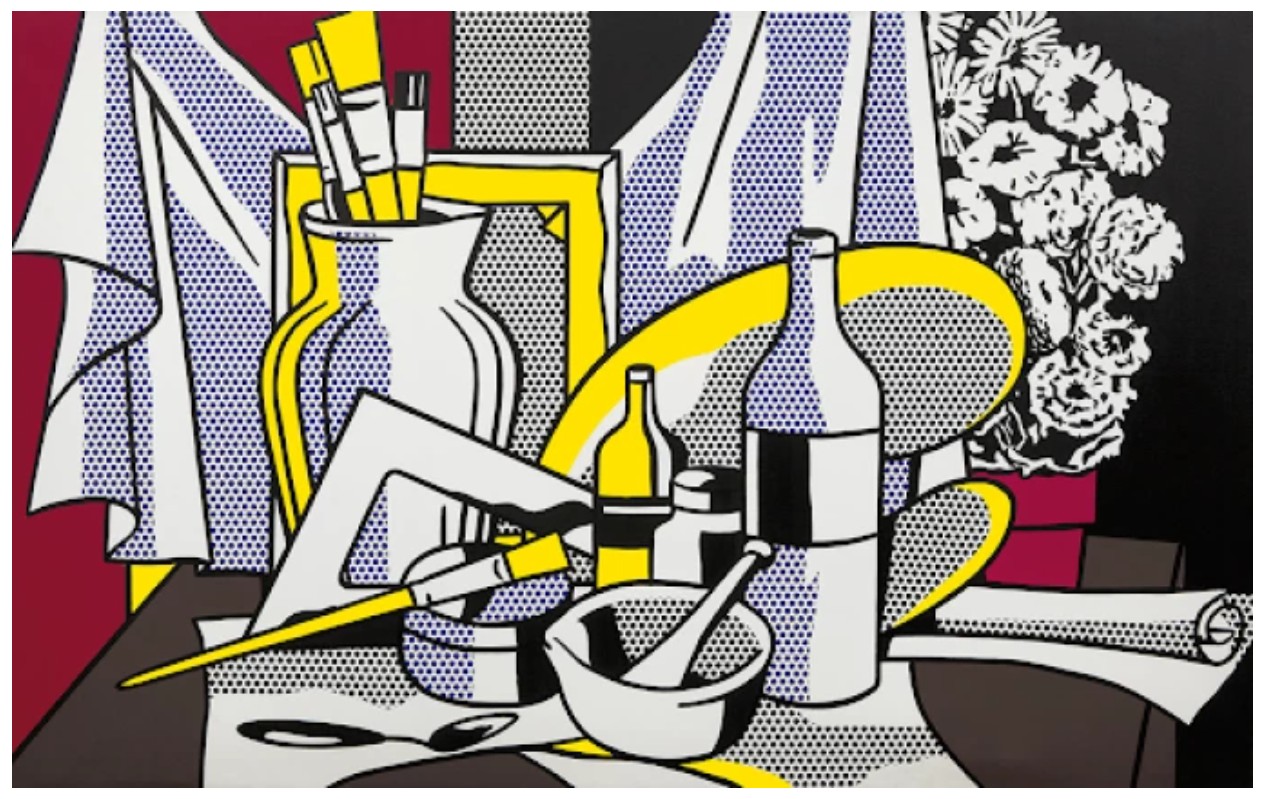
Roy Lichtenstein, Still Life with Palette, 1972, Private Collection
Variaciones sobre Cézanne makes this parallel impossible to ignore. The source painting, Cézanne’s Still Life with Apples and Oranges from 1895, is one of the most canonized images in Western art, the kind of work reproduced endlessly on posters, postcards, and textbook covers, already half-transformed into mass-media image by the time Botero encountered it. His response is characteristically layered. He strips away Cézanne’s Provençal tablecloth and replaces it with stark white linen; he swaps prim bone china for cheerful FiestaWare; and he pumps every piece of fruit to a scale so exaggerated, so voluminous, that the painting tips from homage into something closer to parody, or, more precisely, into the affectionate, knowing irony that Pop Art made its signature register. Even the title, scrawled with wild exuberance directly onto the canvas, has the irreverent energy of a Pop gesture, calling attention to the act of quotation itself.
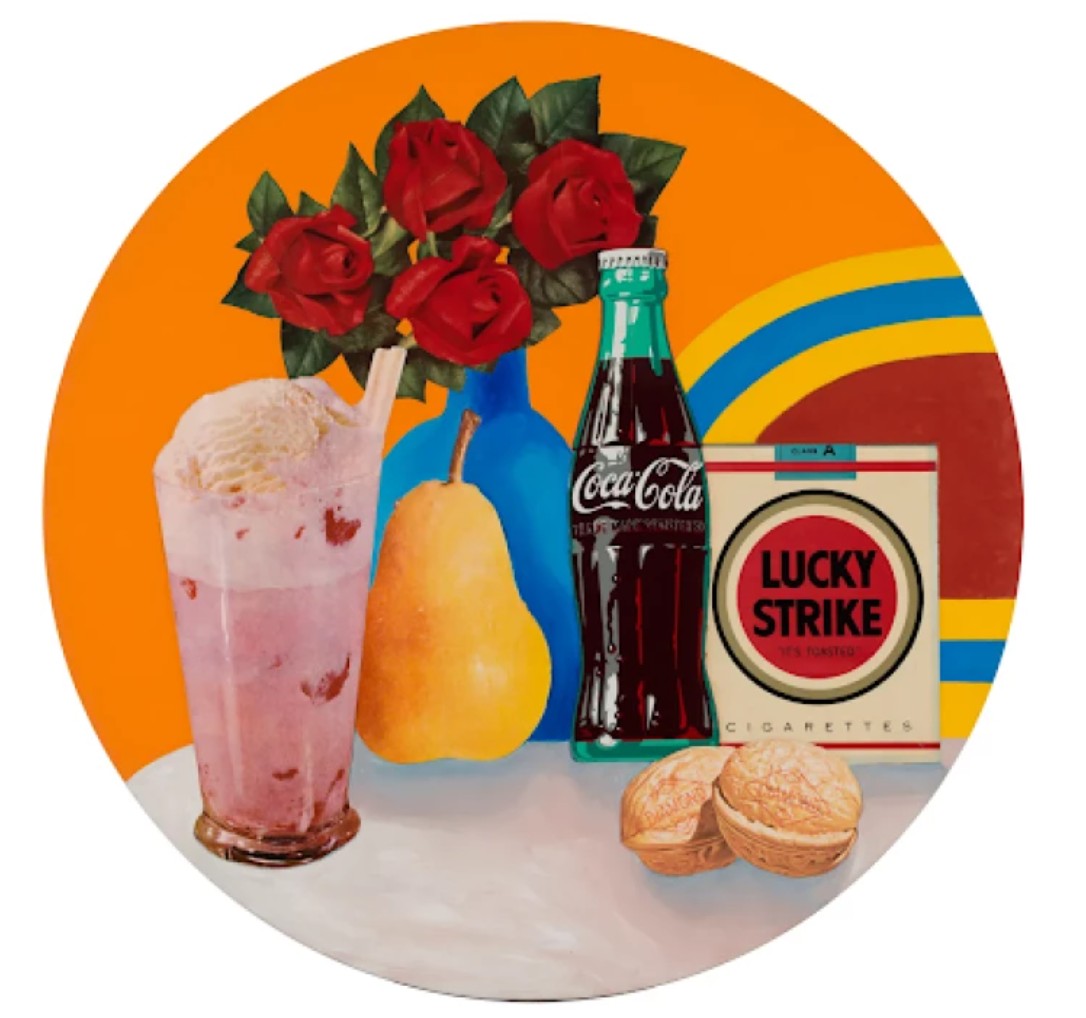
Tom Wesselmann Still Life #34, 1963, Private Collection
The most pointed move, however, is Botero’s addition of an easel in the foreground. Where Cézanne presented the still life as a self-contained world, Botero pulls back the curtain and reveals the studio, the machinery of art-making, lurking behind the composition. It is a deeply Pop maneuver: the exposure of artifice, the refusal to let the illusion of the image go unquestioned. In this single element, Botero does what Lichtenstein did with Ben-Day dots, he makes the construction of the image part of the image itself.

The artist in his studio.
Botero arrived in New York in 1960 and quickly earned recognition, most notably with the Museum of Modern Art’s acquisition of Mona Lisa, Age Twelve. But his years in the city were also marked by resistance. His unwavering commitment to figuration put him at odds with the dominant New York School, and critics were often dismissive. Yet as the decade progressed, the cultural tide was shifting in his direction — not toward traditional figuration, but toward Pop’s resurrection of the legible, the referential, the image-as-image. Botero’s mature style, with its jewel-toned fields of color and its boldly deformed volumes, was developing in parallel with Pop’s own aesthetic of flattened, intensified surfaces. In Variaciones sobre Cézanne, Botero answers that question with characteristic wit and confidence. The result is a work that is at once a love letter to the Western tradition and a gentle, irresistible subversion of it, joyfully, architectonically rigorous, and unmistakably alive to the transformative possibilities of its moment.
Still Life in front of a Window, 1979
Property from an Important American Collection
Phillips New-York: 19 November 2025
Estimated: USD 700,000 – 900,000
USD 838,500
Fernando Botero Modern & Contemporary Art Evening Sale featuring Cera the Triceratops
Oil on canvas
189.9 x 144.1 cm (74 3/4 x 56 3/4 inches)
Signed and dated “Botero 79” lower right
Fernando Botero’s Still Life in front of a Window, 1979 reimagines the classical still life through the artist’s distinctive formal vocabulary of exaggerated volume, flattened perspective, and stylized sensuality. Painted in oil on canvas, the work elevates an arrangement of everyday objects—a pair of ripe bananas, a pear, apples, a terracotta pitcher, and a draped red cloth—into something at once monumental and whimsical. Behind them, an open window reveals a jumbled cityscape of ochre rooftops, whose rhythmic curves mirror the rounded forms of the fruit in the foreground. The scene is both intimate and theatrical, imbuing the conventional still life format with warmth, density, and quiet drama.
“One day I painted a still life. That day I became an artist.”
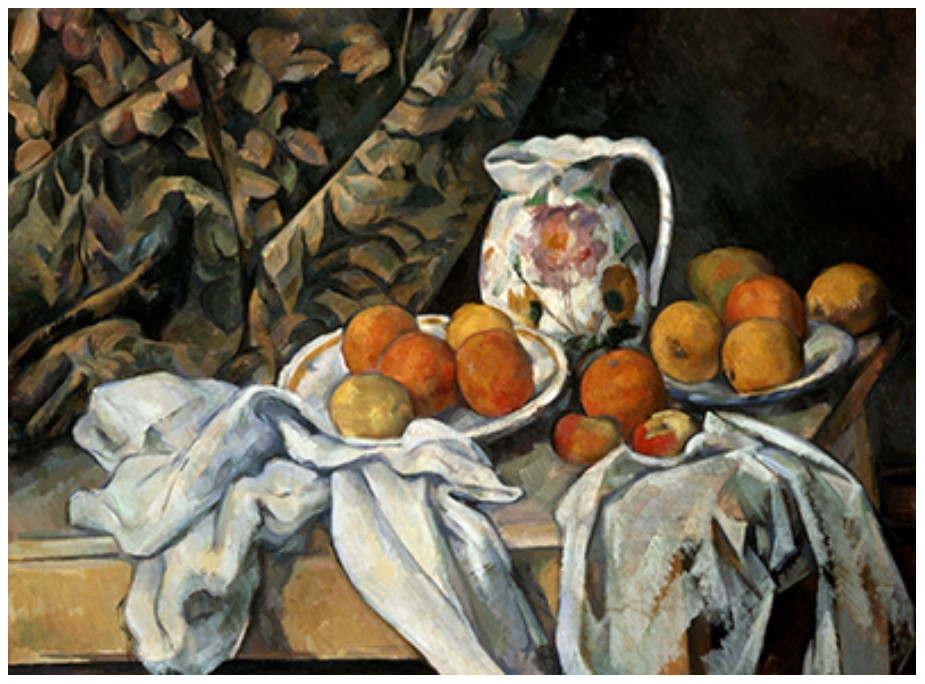
Paul Cézanne, Still Life with Drapery, c. 1895. Collection of the State Hermitage, St. Petersburg. Image: HIP / Art Resource, NY
Exhibited from December 1979 to March 1980 at the Hirshhorn Museum and Sculpture Garden in Washington, D.C., the painting featured in the first educational exhibition of Botero’s work in the United States. That landmark presentation drew on more than forty lenders, including major institutions, private collections, and the artist himself. In 1987, Still Life in front of a Window was included in a touring retrospective that traveled to leading institutions in Munich, Bremen, Frankfurt, and Madrid. Since its acquisition in the 1980s, this large-scale historical canvas has remained in the same private family collection and has never been offered publicly.
“I believe it is very important that stylistic coherence should dominate the form of the expression… When you see a still life of mine, you will notice that the knives and forks, the fruit, the table, the napkins, everything is rendered in the same fashion, therefore the whole work radiates a sense of unity, harmony and coherence. That is what communicates its essential truth.”
Botero’s breakthrough came in 1956, when painting his first still life he realized that “the forms became stronger and more sensual” through experiments with proportion. This discovery laid the groundwork for the artistic maturity he reached in the mid-1960s, when scale became his primary tool for conferring physical presence, testing the limits of improbability, and transforming people and objects into sculptural volumes. Guided by Bernard Berenson’s concept of “tactile value,” Botero developed the “Boterismo” style that defined his work in the decades to follow. In Still Life in front of a Window, each object appears voluptuous and overfull, its smooth contours and matte surfaces emphasizing mass rather than texture. Soft, even lighting and the absence of deep shadow lend the composition a sense of quiet solidity. A slightly open drawer and a lone apple left on the windowsill introduce a note of informality, as if the scene has been interrupted mid-arrangement. Botero’s warm, saturated palette visually links the foreground and background, creating an atmospheric cohesion that further lends a sense of whimsy.
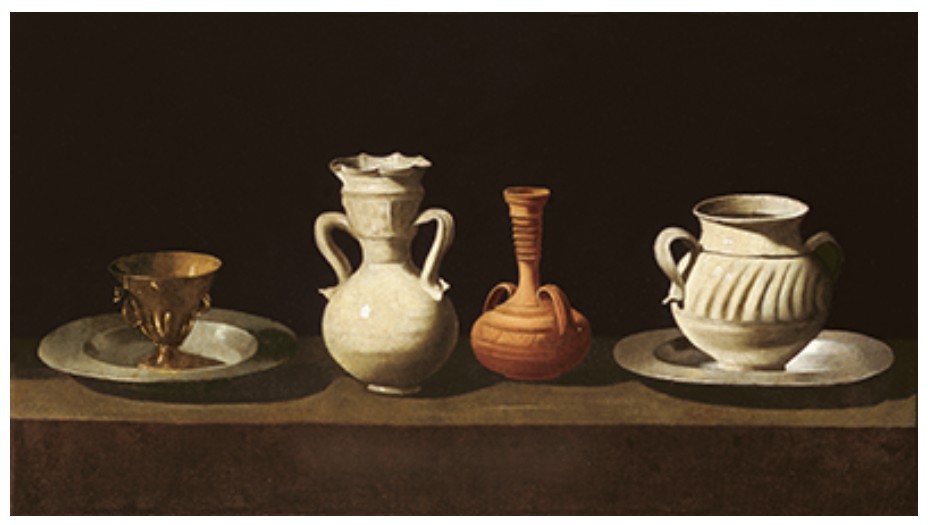
Francisco de Zurbarán, Still Life, c. 1660. Museo del Prado, Madrid. Image: © of the image Museo Nacional del Prado / Art Resource, NY
Though highly stylized, the painting is rooted in art historical precedent. During his studies in Madrid, Florence, and Paris, Botero immersed himself in the works of the Old Masters. He frequented the Museo del Prado, where he absorbed the Spanish still life tradition—particularly the bodegones of Juan Sánchez Cotán and Francisco de Zurbarán—and became familiar with the memento mori of Dutch Golden Age vanitas images, as well as the formal innovations of Paul Cézanne. These influences are evident in the clarity of composition and attention to spatial relationships between the table, the objects, and the architectural backdrop. Botero, however, deliberately resists illusionism. Brushwork is minimized, surfaces are flat and polished, and volume is built through color and contour rather than modeling.
“When I paint an apple or an orange, I know that it will be possible to recognize them, and that I am the one painting them, because I try to give each painted element, even the simplest one, a personality that comes from a deep conviction.”
Botero’s still lifes also reflect the social and cultural fabric of his native Colombia. Ordinary objects are imbued with presence and individuality, often referencing familiar settings, meals, or celebrations. In Still Life in front of a Window, the rooftops visible through the window resemble those of Medellín, his hometown, grounding the composition in lived experience. The effect is reverent rather than ironic; the fruit and pitcher seem less like props than figures, occupying space with sculptural gravitas.
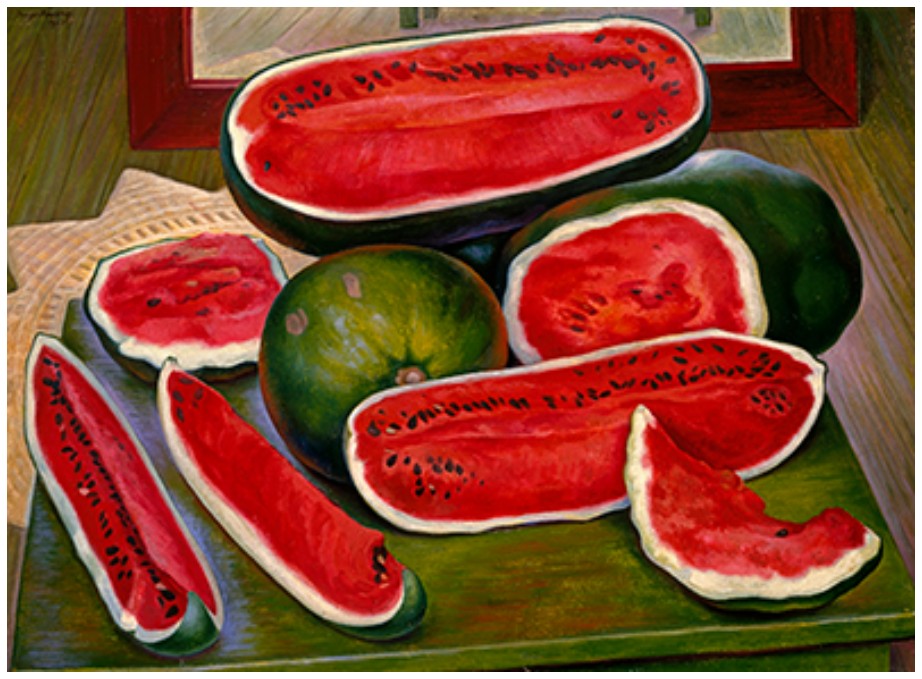
Diego Rivera, Watermelons (Las sandias), 1957. Museo Dolores Olmedo Patiño, Mexico City. Image: Schalkwijk / Art Resource, NY, Artwork: © 2025 Banco de México Diego Rivera and Frida Kahlo Museums Trust/ Artist Rights Society (ARS), New York
His time in Mexico City in the mid-1950s further shaped this vision. The lingering influence of muralists like Diego Rivera and José Clemente Orozco, particularly their monumental scale and humanist critique, encouraged Botero to enlarge his forms as a vehicle for commentary. In Still Life in front of a Window, the influence manifests as a reverence for ordinary objects presented at a monumental scale. The bananas, for example, may carry symbolic weight in the Latin American context, evoking the fraught legacy of “banana republics” and the extractive economies of colonialism and U.S. intervention. By presenting them with exaggerated scale and painterly care, Botero confers dignity and ambiguity, blending formal delight with subtle critique. Still Life in front of a Window enacts this philosophy with clarity and force.
Still Life with Bananas, 1978
Phillips New-York: 14 May 2025
Estimated: USD 220,000 – 320,000
USD 304,800
Fernando Botero Modern & Contemporary Art Day Sale, Morning Session
Fernando Botero’s Still Life with Bananas, 1978, reimagines a traditional genre through the lens of volume and sensuality. Rendered in the artist’s signature style of exaggerated, inflated forms, the composition elevates a simple arrangement of fruit – browning bananas, golden delicious apples, and a solitary pear – into something at once playful and reverent. Bathed in ochres, the work pulses with warmth, a nod to the Mexico City milieu that helped shape Botero’s early aesthetic sensibility. Botero’s now-iconic manipulation of form can be traced to a breakthrough moment in the mid-1950s, when, while painting a still life, he placed a disproportionately small sound hole in the body of a mandolin. That single distortion shifted the entire visual logic of the work, instantly transforming the instrument into something monumental. “After that mandolin,” he recalled, “my world began to expand. I went on to figures and soon was creating a formal universe that found its supreme expression in small detail.” From that point forward, Botero applied this philosophy of altered scale not only to people, but to objects; quotidian subjects reimagined through a lens of stylized, subjective space.
“When I paint an apple or an orange, I know you can tell it’s my painting and that I painted it, because what I’m looking for is to give every painted element, even the simplest one, a personality that comes from a deeply held conviction.”
In Still Life with Bananas, a creased tablecloth folds softly beneath the weight of the fruit, each form simplified to its essence. Botero’s use of a shallow depth of field, matte light, and minimal shadow conjures roundness through subtle suggestion rather than illusionism. These smoothed surfaces invite comparison to the quiet still lifes of Giorgio Morandi, though Botero replaces impasto with glazes, and contemplation with irony. “Art is deformation,” the artist noted, and here, the voluptuousness of the fruit echoes the sensuality of his most iconic figurative works. As with his reimagining of canonical paintings, Botero’s treatment is both reverent and revisionist. Here, traditional still life is not quoted but reinhabited, filtered through the artist’s idiosyncratic lens, where volume and color converge in a language uniquely his own. The composition is less a still life than a portrait – one that imbues its subjects with individuality and presence. In this way, Botero collapses the line between object and figure, rendering the fruit not simply as nourishment or symbol, but as beings with sculptural gravitas. Even in the quietest moments, Botero asserts a visual language where form speaks louder than narrative.
Naturaleza muerta, 2000
Sotheby’s New-York: 21 November 2024
Estimated: USD 350,000 – 450,000
USD 576,000
Naturaleza muerta | Contemporary Day Auction | 2024 | Sotheby’s
FERNANDO BOTERO (1932 – 2023)
Naturaleza muerta, 2000
Oil on canvas
96×119 cm (37 7/8 x 46 3/4 inches)
Signed and dated /00 (lower right)
Bodegón (2000) was generously gifted by the storied Colombian artist Fernando Botero to benefit the Fundación Reina Sofía in Spain, and as such proceeds from the sale of this exceptional painting will fund the Spanish Federation of Food Banks (FESBAL). A non-political and non-denominational entity, FESBAL, founded in 1995, promotes the fight against hunger, poverty and food waste thorugh adequate and sustainable distribution of food to the neediest. FESBAL is made up of 54 associated Food Banks throughout Spain that distribute food to 6,919 charities and over 1.2m beneficiaries in 2022. FESBAL is a member of the Federation of European Food Banks (FEBA) and the Global Foodbanking Network (GFN). An outstanding example from Botero’s mature period, painted in 2000, Bodegón alludes to the universal act of sharing a meal with family and friends. Here, the artist reminds the viewer of those less fortunate whose daily need for sustenance is not met by a table filled with exotic fruits and abundant cake.
Botero’s delectable still-lifes are deeply rooted in his admiration for Old Master Spanish painting. The artist’s early exposure to masterpieces at the Prado Museum in Madrid significantly influenced his artistic development and lifelong appreciation for Velázquez, Goya and other luminaries of Spanish art. Honing a style that blends volume and sensuality, reminiscent of those past masters but with a distinctive twist – his iconic ‘Boterismo’ – Botero produced still-lifes that sparked a dialogue between the past and the present. His fusion of old and new, traditional and contemporary, kept the genre relevant and dynamic, particularly in Latin America. Developing his own signature style, Botero eschewed stark realism in favour of a whimsical grandeur that, while playful, also served a deeper purpose – to magnify the inherent beauty and often-overlooked details of everyday objects, and elevate them to a status of prominence and reverence. Unlike the output of Luis Meléndez, a prominent figure in 18th-century Spanish painting whose dignified compositions are rendered with photographic precision, Botero filled his canvases with larger-than-life objects, creating a sense of abundance and opulence. With its grandiose tropical fruits and lush setting, Bodegón is a prime example.
Naranjas, 1970
Christie’s New-York: 20 November 2024
Estimated: USD 300,000 – 400,000
USD 352,800
FERNANDO BOTERO (1932-2023), Naranjas | Christie’s
FERNANDO BOTERO (1932-2023)
Naranjas, 1970
Oil on canvas
106×94 cm (41 3/4 x 37 inches)
Signed and dated ‘Botero 70’ (lower right)
Signed and dated again and titled ‘Botero 70 ‘NARANJAS” (on the reverse)
“I don’t paint apples anymore.
Oranges and bananas are the authentic fruits of the tropic. Apples are for snobs.”
Still Life with Watermelon, 1994
Sotheby’s New-York: 16 November 2023
Estimated: USD 300,000 – 400,000
USD 508,000
Still Life with Watermelon | Contemporary Day Auction | 2023 | Sotheby’s (sothebys.com)
FERNANDO BOTERO (1932 – 2023)
Still Life with Watermelon, 1994
Oil on canvas
99.4 x 124.8 cm (39 1/8 x 49 1/8 inches)
Signed and dated 94 (lower right)
Saturated with art historical references, Still Life with Watermelon stands out for its balance of the still-life tradition with Botero’s distinctive aesthetic language. Botero has cited a multitude of sources that have informed his still lifes. Exposed to the canonical genre while studying at the Academia de San Fernando in Madrid in 1952, Botero visited the Prado Museum often and absorbed its renowned 17th-century Spanish still lifes, or Bodegones. In 1953, the Colombian painter and sculptor traveled to Paris and familiarized himself with the Louvre’s Dutch Golden Age still lifes as well as the formal properties of modernist still lives in works by artists such as Cézanne.
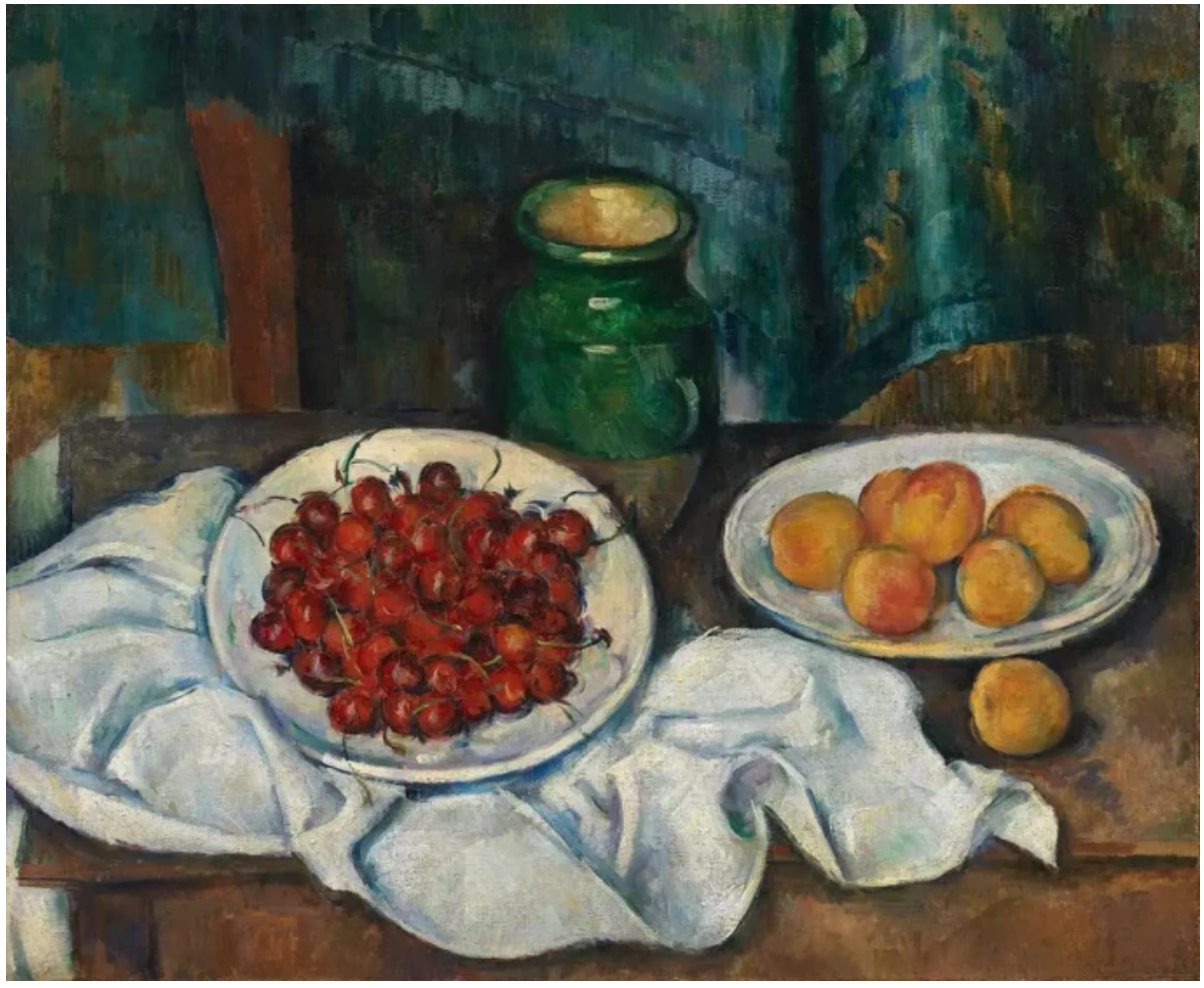
FIG 2. PAUL CÉZANNE, STILL LIFE WITH CHERRIES AND PEACHES, 1885-7, LOS ANGELES COUNTY MUSEUM OF ART (LACMA)
Three decades later, Botero’s engagement with these visual vocabularies is apparent in Still Life with Watermelon. Though inflected by a 20th-century sensibility for color and form, it largely follows the canonical conventions of the genre – from precision of detail to dynamic, narrative structure embedded in the composition. In particular, the influence of Cézanne is evident here – in the artist’s exploration of the spatial relations between the table, the fruit and the window. Crucially, Botero’s engagement with these established iconographies does not prevent him from transforming Still Life with Watermelon into a painting that is unequivocally and unquestionably his own. With his characteristic voluminous forms, bold colors, and clean invisible brushstrokes Botero offers a reinvention of the still-life tradition.
“To use a painting by another painter as a model, which I often do, is to measure yourself against the pictorial power of a work.
If your own aesthetic stand is altogether original with respect to the one you’ve decided to confront, the painting you make out of it is an original itself…
This sort of copy enables me to make a declaration of principles, a sort of manifesto.”
Restrained elegance and somber atmospheres are discarded and replaced with vivacity and playfulness. The disarrayed nature of the table helps produce this effect. Still Life with Watermelon feels like Botero stopped while in the process of a meal to paint. The slivered fruit, knife resting precariously on the edge of the table, fork spearing a chunk of orange not pictured in the composition, and full glass placed on half of the table cloth sliding off the table lend the work a spontaneity that upends the genre’s uptight history. The verdant color palette and vibrant large areas of flat color enhances this sense of whimsy. Unlike the muted palettes of the still lifes he studied as a young man, Still Life with Watermelon’s mix of cool and warm tones, arresting greens and shocking oranges proudly and energetically clash. Through these elements, Botero inserts his characteristic sly and slightly provocative voice into the genre’s canonical tradition.
Canasta de frutas, 1975
Sotheby’s New-York: 16 November 2023
Estimated: USD 300,000 – 400,000
USD 431,800
Canasta de frutas | Contemporary Day Auction | 2023 | Sotheby’s (sothebys.com)
FERNANDO BOTERO (1932 – 2023)
Canasta de frutas, 1975
Sanguine on canvas
162.9 x 179.1 cm (64 1/8 x 70 1/2 inches)
Signed and dated 75 (lower right)
Sobre Cézanne, 1963
Bonhams New-York: 16 November 2023
Estimated: USD 800,000 – 1,200,000
USD 1,016,500
Bonhams : FERNANDO BOTERO (1932-2023) Sobre Cézanne 1963
Oil on canvas
170.2 x 174.6 cm (67 x 68 3/4 inches)
Signed, titled and dated 63
Bodegón en homenaje a Cézanne, 1963
Sotheby’s New-York: 14 November 2023
Estimated: USD 350,000 – 450,000
USD 584,200
Bodegón en homenaje a Cézanne | Modern Day Auction | 2023 | Sotheby’s (sothebys.com)
FERNANDO BOTERO (1932 – 2023)
Bodegón en homenaje a Cézanne, 1963
Oil on canvas
129.5 x 152.4 cm (51×60 inches)
Signed Botero, inscribed Cézanne and dated 63 (lower left)
Juicy, sensual, architectonically harmonious yet bursting with energy, Fernando Botero’s monumental Bodegón en homenaje a Cézanne is a crowning achievement from one of the artist’s most celebrated series. For over seven decades, Fernando Botero’s still lifes have remained the body of works most rooted in the historic tradition of the genre. Charmingly bruised apples, homely vases and acid-toned table-settings populate his whimsical reimaginings of the Old Master paintings he eagerly studied as a young artist in Europe during the 1950s. His encounters with the masterworks of Giotto, Michelangelo and Piero della Francesca in Italy, with the paintings of Sanchez-Cotán and Velázquez in Spain, and (critically) with Cézanne in France, among many others, informed his reinterpretations of these works from his early career until today. In his still lifes, Botero intends to create a vibrant, otherworldly reality by dramatically exaggerating the shape and tonality of the chosen objects. Beginning in 1959, Botero began to exploit deformation as a formal solution to contemporary figurative painting; by the mid-1960s, he had developed an instantly recognizable, mature visual language of distortion. Here, the result is a larger-than-life, perfectly harmonious composition in which joyous volumes and rich, buoyant colors are united to present a remarkable whole.
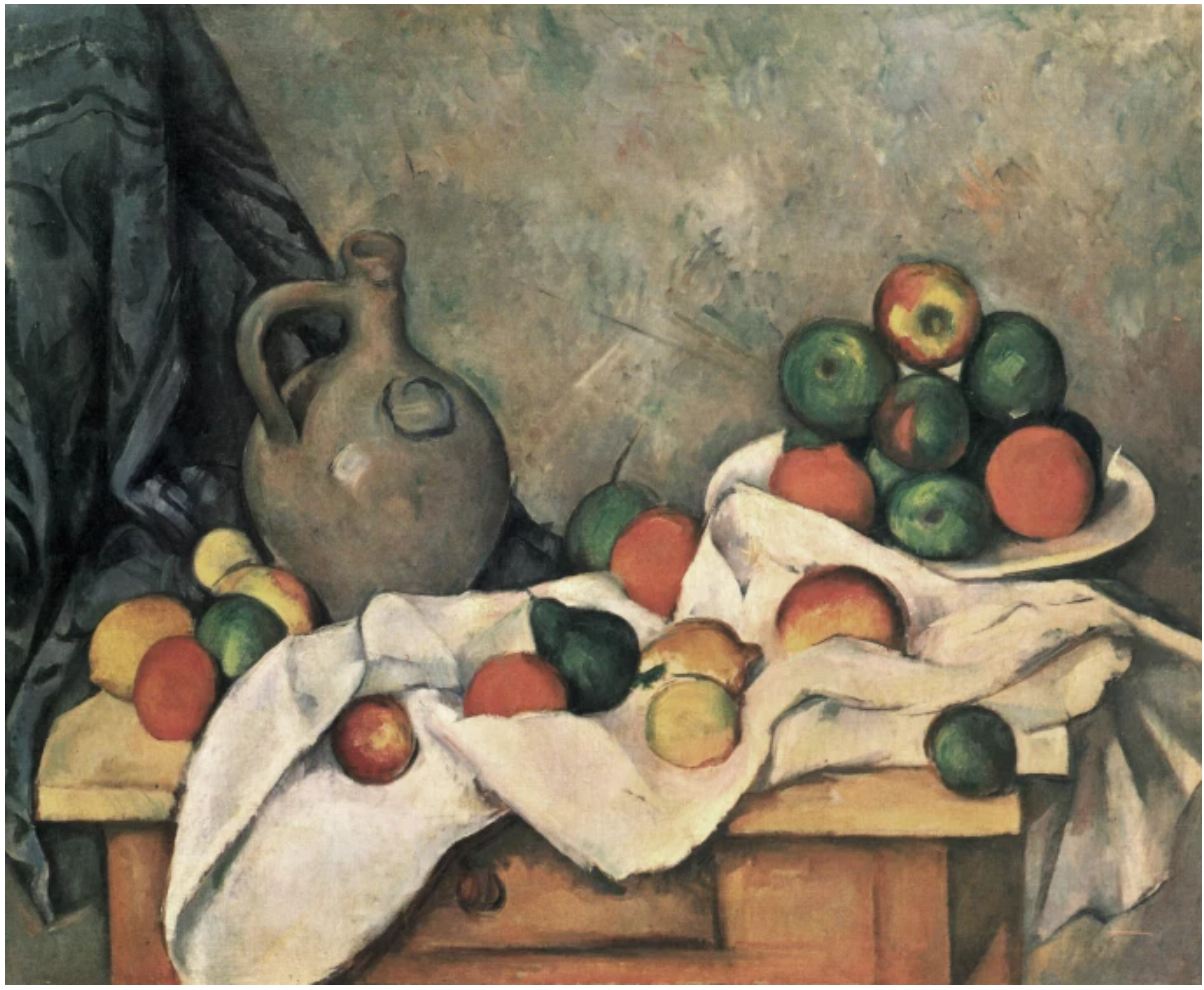
PAUL CÉZANNE, RIDEAU, CRUCHON ET COMPOTIER, 1893-1894, PRIVATE COLLECTION
Although the artist clearly references the work of Cézanne, uncharacteristically scrawling the title into the corner of the work itself with exuberance – he revises the master’s composition with his characteristic wit and sly humor. He abandons the stark white tablecloth of Cézanne’s work to focus on the bold pink of the cloth; prim bone china becomes FiestaWare, and each individual apple and orange among the abundant bevy of fruit is so inflated they seem poised to roll off of the tablecloth and into the lap of the observer. As the present work makes clear, Botero’s appropriation of works from the history of art served as an exercise to challenge his own imagery and make it enter into a dialogue with the imagery of other painters.
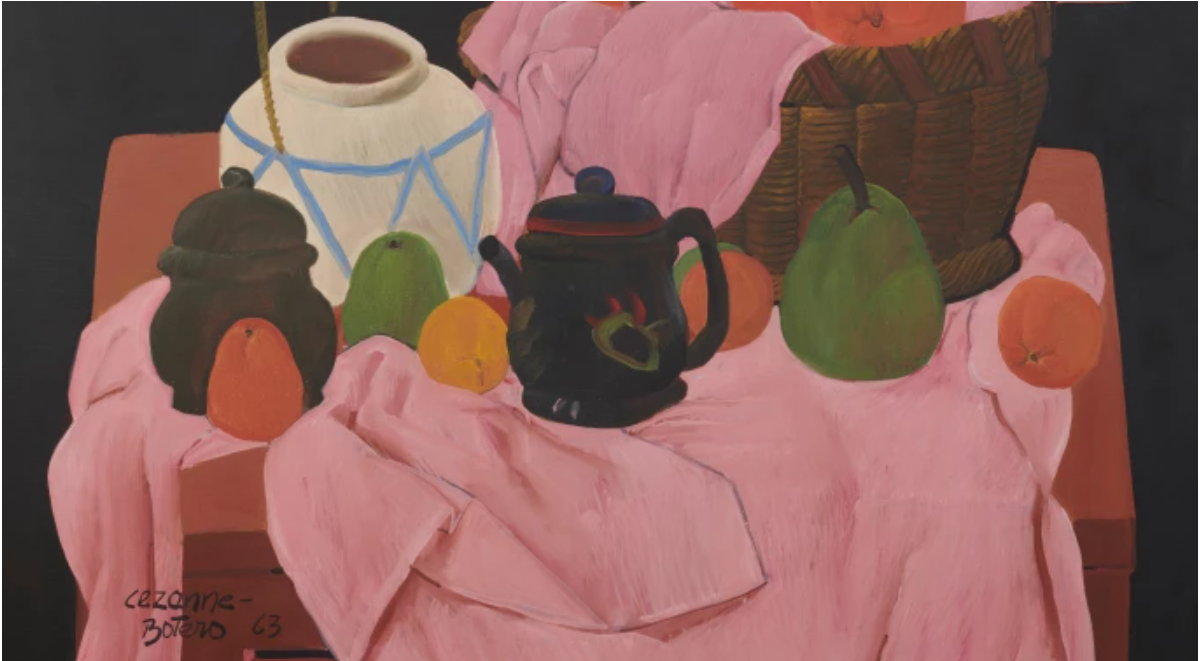
By the end of the 1950s, Fernando Botero had mastered the foundations of his own distinct style of volumetric exaggeration. Once settled in New York in 1960, he began to achieve notable successes such as the purchase of Mona Lisa, Age Twelve (1959) by the Museum of Modern Art. While promising, this was also a period marked by harsh external criticism given Botero’s unwavering commitment to figuration in the face of the dominant New York School. In these years Botero perfected his figurative process; gradually his brushstroke lost its previous emphasis and speed and turned delicate; vibrating striations of color give way to rich, jewel-toned fields. By the time he executed Bodegón en homenaje a Cézanne in 1963, the taste for Abstract Expressionism had begun to give way to a radically opposing movement that shared Botero’s affinity for a wink and a nod: Pop Art.
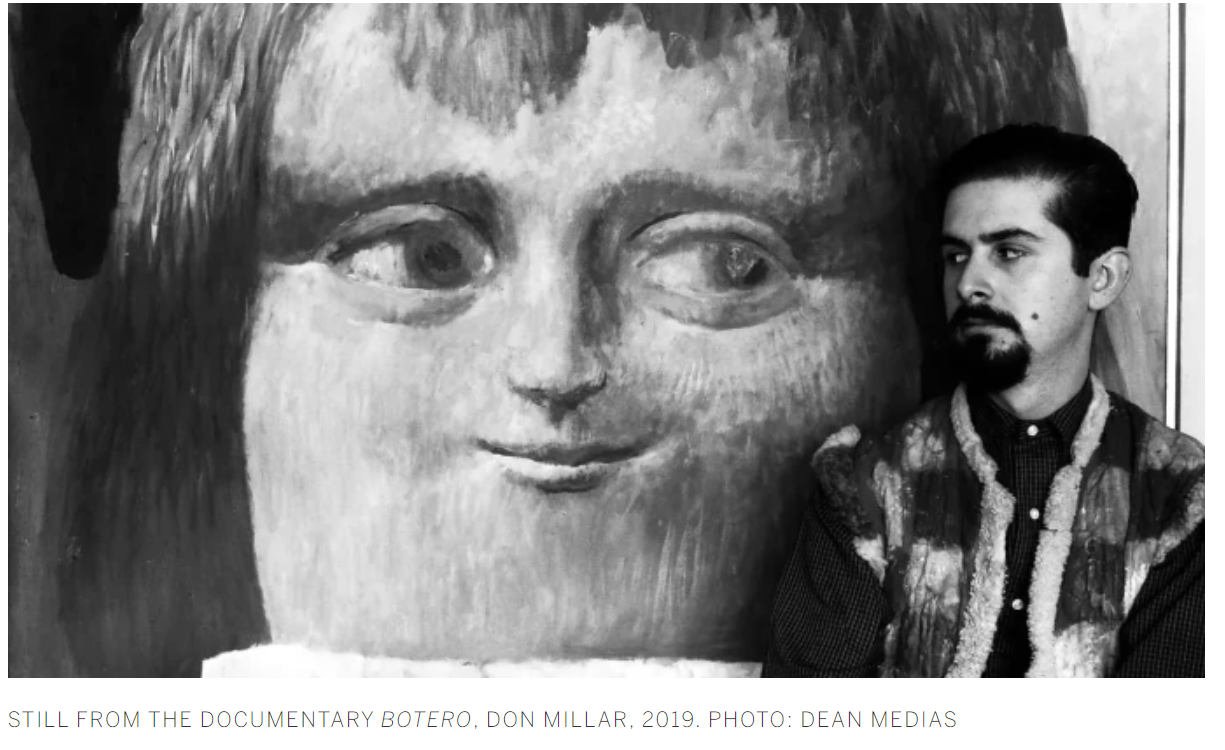
The appearance of Botero’s Variaciones sobre Cézanne series and Pop Art in New York in the early 1960s offers an interesting frame of comparison. Artists like Tom Wesselmann processed the relentless consumerism of midcentury America with a certain sarcasm, applying the gleaming, plastic aesthetic of advertising to everyday subjects. Likewise Botero applies a certain irony in his processing of celebrated works of the Western canon, with a kindred impulse to reveal (and revel in) the artifice of these works. While the early series to which Bodegón en homenaje a Cézanne belongs was executed prior to Botero’s knowledge of Pop Art, these works emerge from the same American zeitgeist, a shared impulse to reflect on the psychological impact of mass-produced images on Western culture in an era of rapid globalization.
Early Paintings
Untitled, circa 1959
Christie’s New-York: 20 November 2025
Estimated: USD 350,000 – 450,000
USD 355,600
FERNANDO BOTERO (1932-2023), Untitled | Christie’s
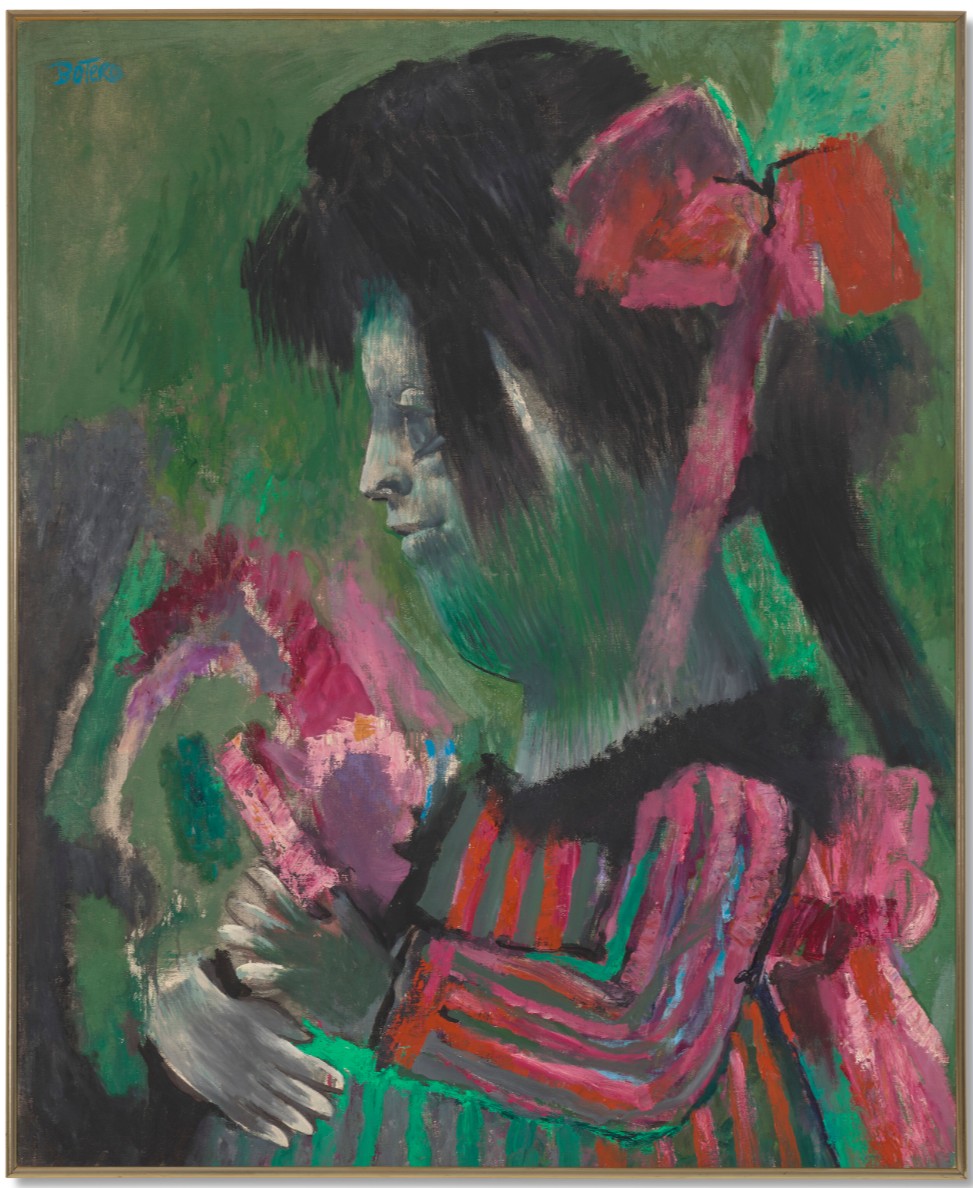
FERNANDO BOTERO (1932-2023)
Untitled, circa 1959
Oil on canvas
154.9 x 127 cm (61×50 inches)
Signed ‘Botero’ (upper left)
In the early 1950s, Fernando Botero was a young aspiring artist living in Bogotá, far removed from the epicenter of the art world in New York. While early success with his first solo exhibition at Galería Leo Matiz in Bogotá in 1951 brought him accolades in Colombia, he was a long way from achieving the international art stardom of his later years. His paintings from this decade seethe with energy, experimentation and expectation, much like, one can imagine, the ambitious artist himself at that time.
“I started to paint these volumetric figures when I was 17. I did it by intuition… because it said something to me. Then, of course, when I was in Europe, especially in Italy, I rationalized the importance of volume because I saw that all Italian painters like Michelangelo, Raphael, Giotto, Masaccio, Piero della Francesca made a celebration of volume.”
Buoyed by sales from his show at Leo Matiz as well as prize money for his winning submission to the Salón de Artistas Colombianos, Botero ventured to Europe in 1952 where he immersed himself in studying the Old Masters and 20th century modernists of Italy, Spain and France. Europe proved transformative for Botero, converting him into an insatiable student of art history. The lessons absorbed from wandering the Prado, Uffizi and Louvre in those early days would reverberate throughout his career. After Europe, Botero returned to Bogotá and then to Mexico City in 1956 where again he took to studying the masters, this time the muralists: Diego Rivera, José Clemente Orozco and David Alfaro Siqueiros. The monumental figures of Los Tres Grandes, as the trio became known, left another indelible impression on Botero that would prove a springboard for his lifelong investigation of volume and form.
Back home in Bogotá in the late 1950s, Botero set to work finding his own individual visual vocabulary that differentiated him from those eminent artistic predecessors. The body of work from this period is defined by vigorous brushstrokes, a deep, jewel-toned palette and an air of mystery. While markedly different from the paintings produced in the later six decades of his career, his 1950s work reveal the artist grappling with what would become the most significant principle of his practice—how to articulate volume and form.
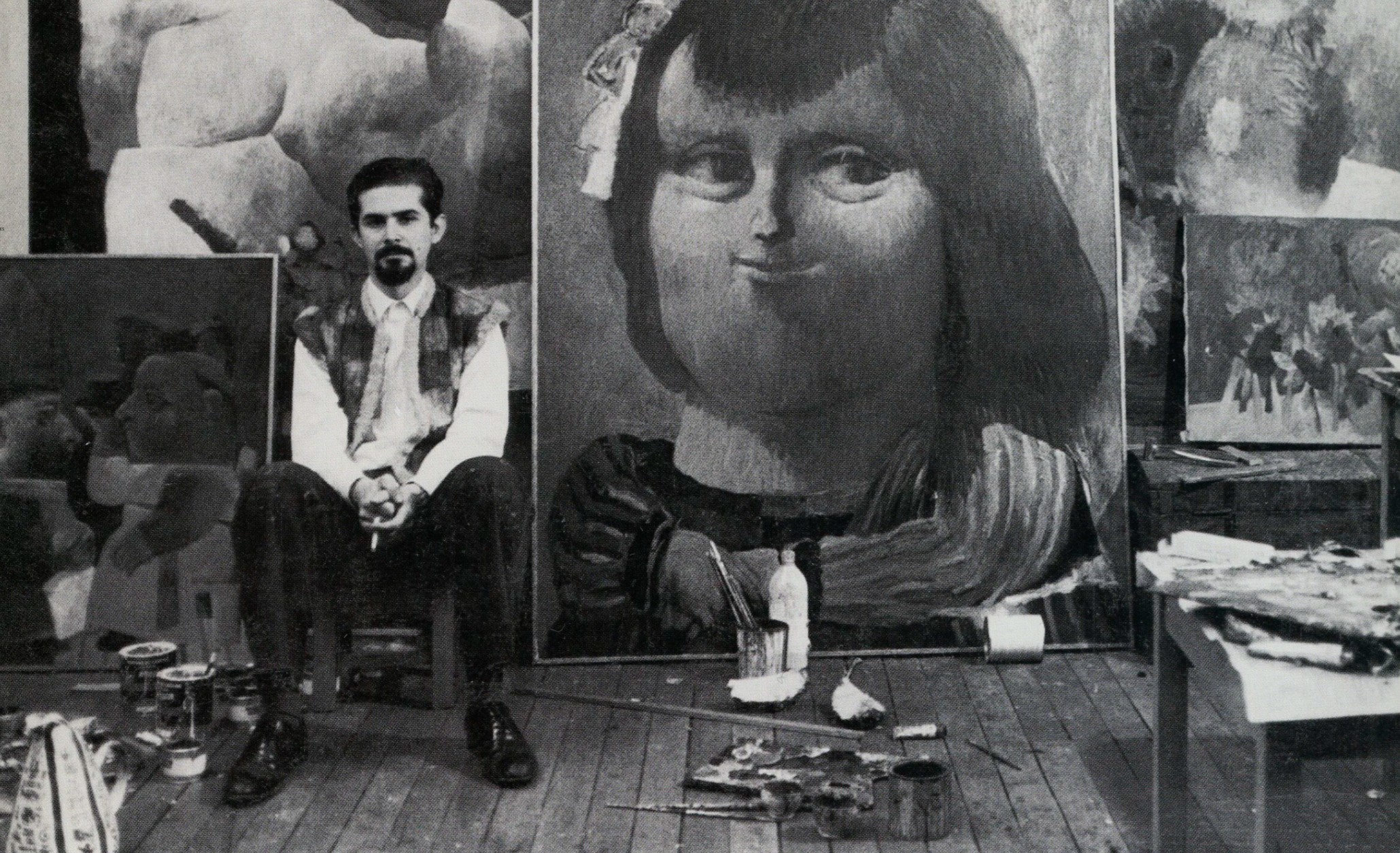
Fernando Botero in his studio, Bogotá, 1959. © The Estate of Fernando Botero.
Pushed up against the picture plane, the girl in the present painting takes on monumental proportions, the hallmark of Botero’s now immediately recognizable style. Her bulbous facial features and considerable coif of black hair foreshadow the voluptuous figures from the artist’s later years. The expressionistic brushstrokes rendered in intense shades of aquamarine, rose and black, sharply deviate, however, from Botero’s later polished style that masks the hand of the artist. There is also an experimental and enigmatic essence here that Botero later eschewed. The surface of the painting toggles between thickly applied impasto and passages of canvas left deliberately bare. Rather than the clearly defined narratives found in the paintings of the artist’s later years, here the subject is more inscrutable. Botero provides a minimal plot line—a girl holding flowers, the likes of which we have never seen—and leaves us to ask more questions: What are these flowers? Who is this girl? What is she thinking? Who is this artist? Who will he become?
Monalisa, 1959
Koller Zurich: 26 June 2025
Estimated: CHF 250,000 – 350,000
CHF 460,000 (Hammer)
CHF 573,200 / USD 713,060
FERNANDO BOTERO Monalisa. 1959.
FERNANDO BOTERO (Medellín 1932–2023 Monaco)
Monalisa, 1959
Charcoal, color chalk and wax chalk on kraft paper, firmly laid on wood
144×122 cm (56 3/4 x 48 inches)
Upper left and lower right signed
Dated and titled: “monalisa” Botero 13-6-59 “MONALISA” Botero 13-6-59
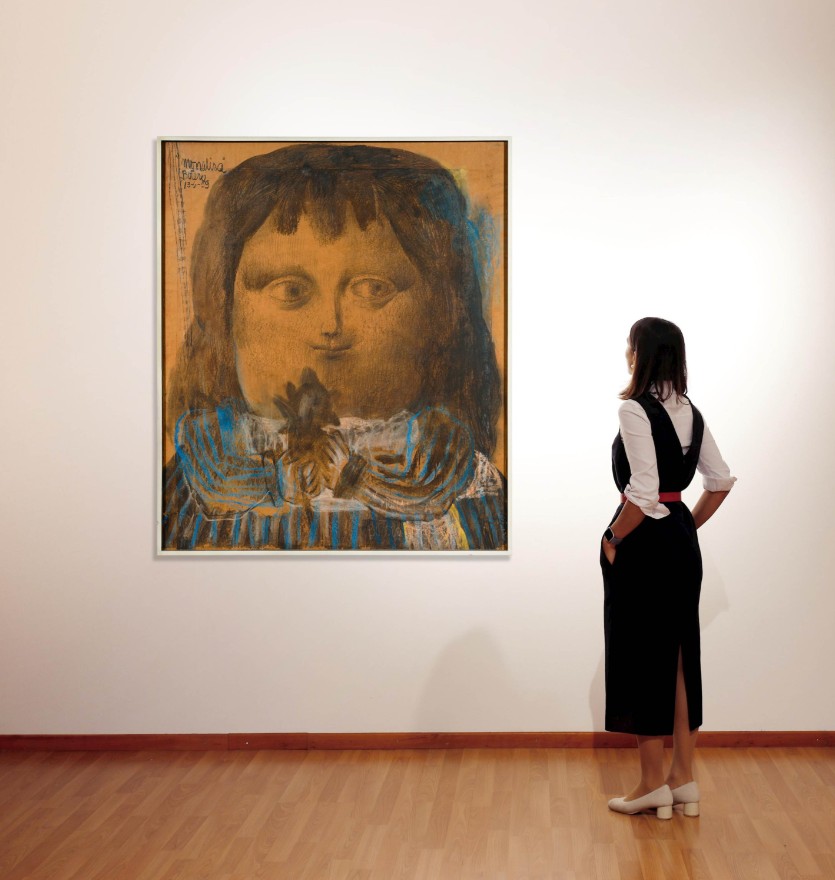
‘Mona Lisa’ is one of a small series of works in which Botero intensively explored the image of the ‘Gioconda’. In this phase, even before the final breakthrough of his ‘Boterism’, the motif served as a surface on which to project his formal and painterly experiments. As early as 1961, the related painting ‘Mona Lisa, Aged 12’ was purchased by the Museum of Modern Art in New York, a milestone in the international reception of the Colombian artist.
With subtle humor and formal rigor, in this work Botero combines an art historical reference with his personal signature. The drawing is emblematic of his early approach to the Western art tradition, which he adopted during his stay in Europe in 1953/54. He combines his exploration of the Old Masters – from Leonardo da Vinci to Velázquez and Piero della Francesca, with a modern, almost pop-cultural view of the icons of art history. Botero’s Mona Lisa refers not only to Leonardo, but also to the strategies of modernism: from Duchamp’s ironic ‘L.H.O.O.Q.’ to Warhol’s serial utilization of icons. Botero comments – with Latin American originality – on the commercialization of works of art and their status as common cultural property. This rare and early drawing documents a key artistic moment: the emergence of an unmistakable formal language – and a work that joins the long history of the reception of the Mona Lisa with subtle irony and painterly quality.
Niña roja, circa 1960
Sotheby’s New-York: 19 November 2024
Estimated: USD 400,000 – 600,000
USD 360,000
Niña roja | Modern Day Auction | 2024 | Sotheby’s
FERNANDO BOTERO (1932 – 2023)
Niña roja, circa 1960
Oil on canvas
120 x 104.1 cm (47 1/4 x 41 inches)
Signed Botero (upper right)
Fernando Botero’s Niña Roja (circa 1960) marks a critical juncture in the artist’s stylistic development, a period where he solidified the unique aesthetic that would come to define his career: the exaggerated, voluminous figures now synonymous with his name. Created in the early years of what would become known as “Boterismo,” Niña Roja exemplifies Botero’s early exploration of distortion and exaggeration as formal elements that simultaneously evoke humor, innocence, and a subtext of critique.
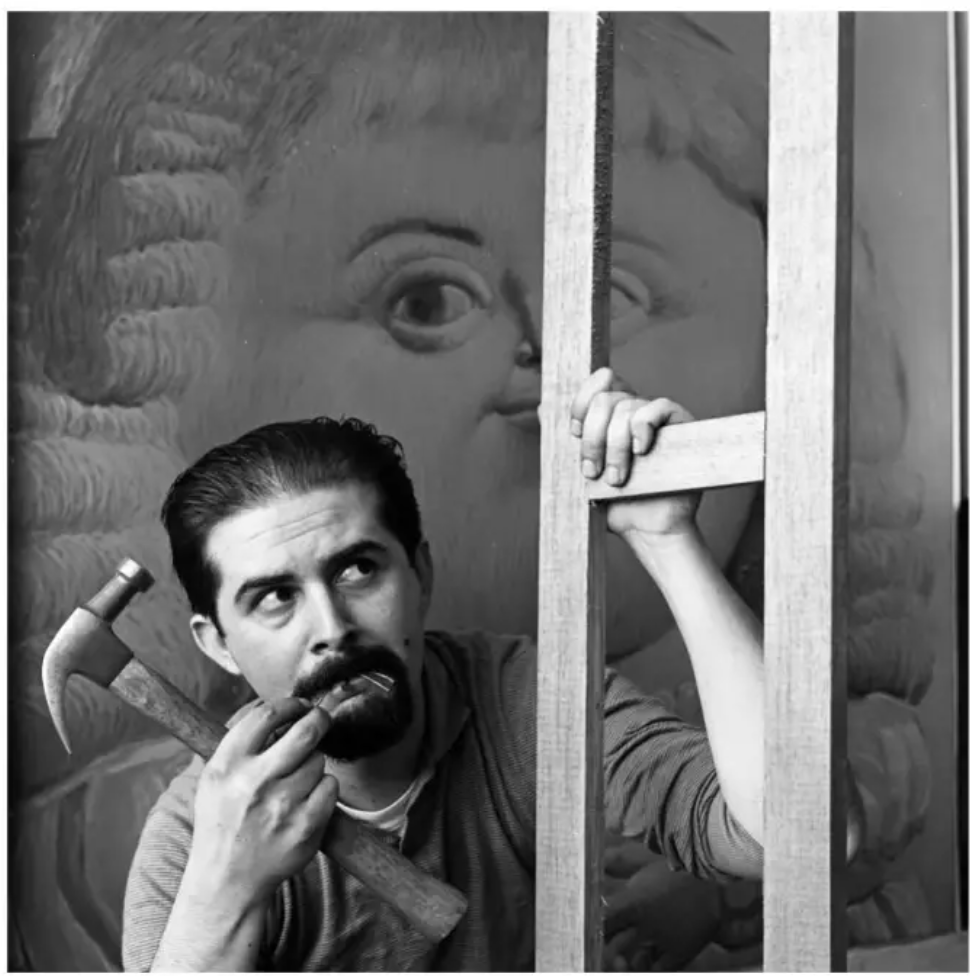
Fernando Botero in his New York studio, New York City, 1960.
Photo by Hernán Díaz Giraldo. Biblioteca Virtual del Banco de la República, Colombia.
The painting features a young girl in profile, rendered with strikingly disproportionate features. Her head and torso dominate the composition, while her facial expression is slightly contorted, seemingly caught between childish wonder and an enigmatic seriousness. Her red dress, executed in broad, painterly strokes, blends almost seamlessly into the fiery background, suggesting an aura of warmth but also an unsettling intensity. Botero’s palette here—vibrant reds with hints of pink and brown—creates a sense of immediacy, enveloping the viewer in the same boldness that characterizes his later works. This use of red is particularly potent, lending the scene an expressive intensity that goes beyond portraiture, hinting at a latent psychological depth that would become a hallmark of Botero’s mature style.
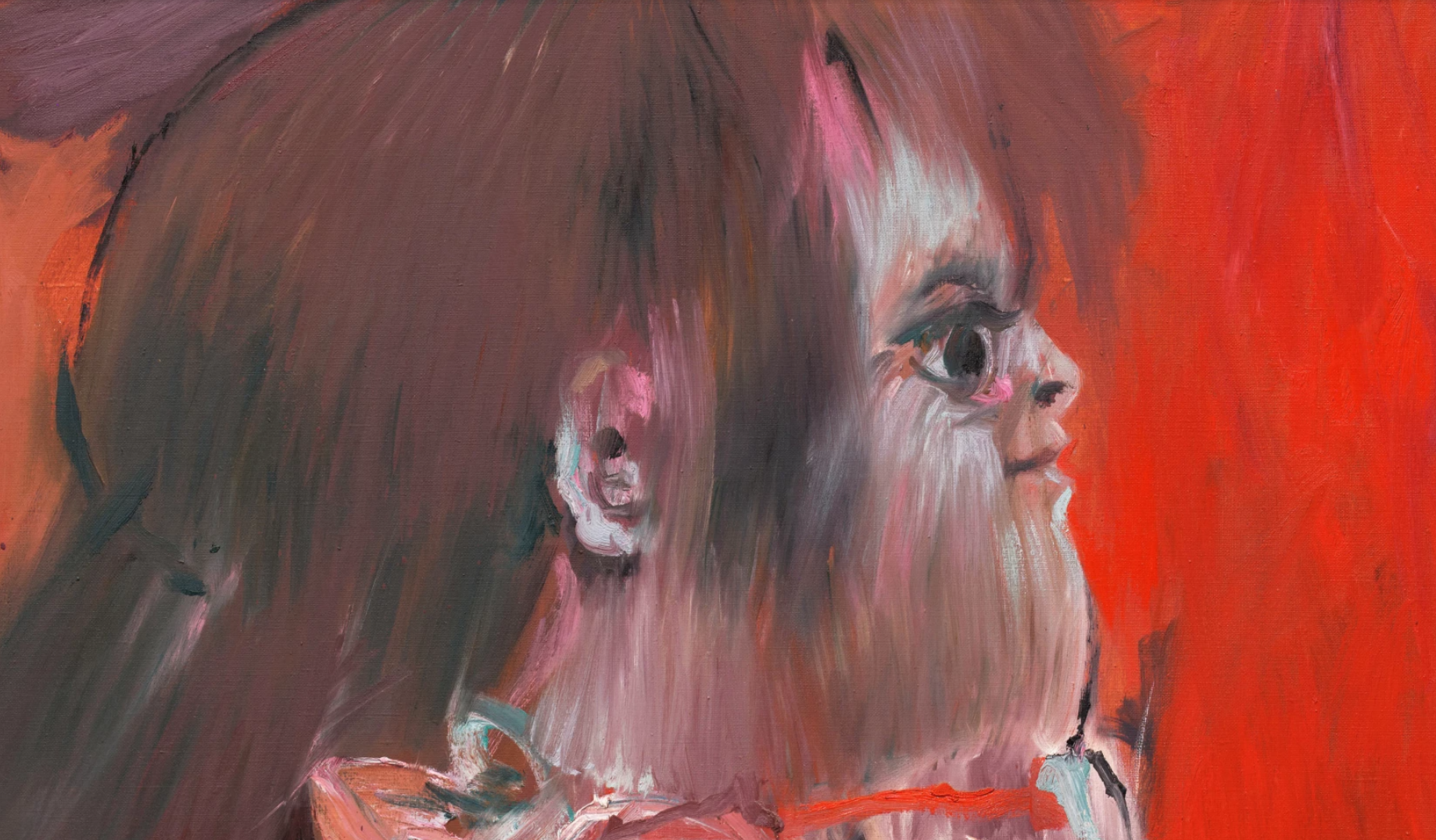
This seminal period, spanning roughly from 1958 to 1962, was one of both experimentation and critical acceptance for Botero. His Mona Lisa, Age Twelve (1959), acquired by MoMA in 1961, is a quintessential example of his burgeoning style and a significant turning point in his career. In Mona Lisa, Age Twelve, Botero reinterprets da Vinci’s iconic figure through his distinctive lens, enlarging and infantilizing her features while preserving the mystery and gravitas of the original. This playful subversion struck a chord with both audiences and critics, marking Botero’s entry into the international art scene and affirming his place within the modern art canon.
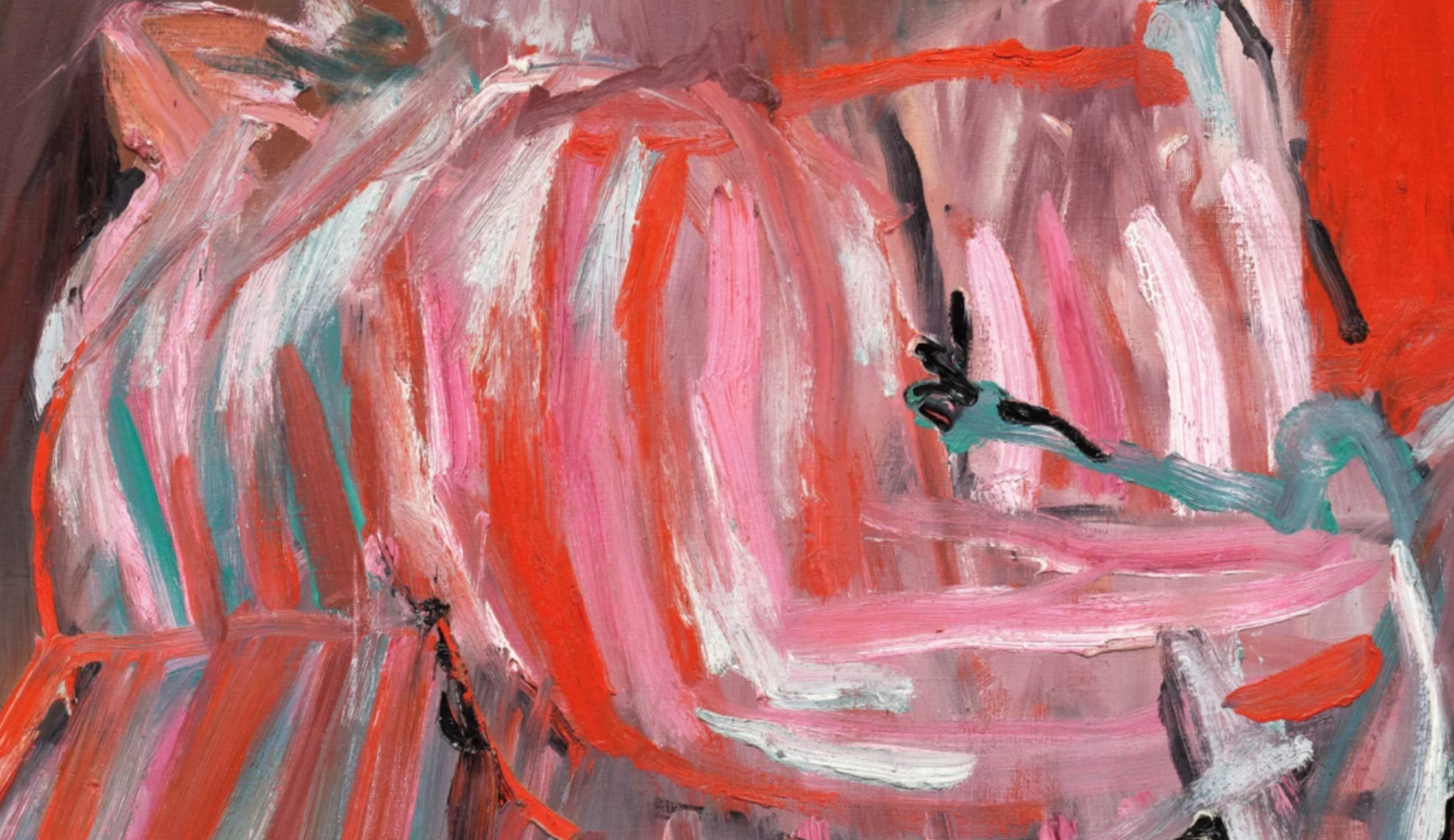
Niña Roja, shares a kinship with Mona Lisa, Age Twelve through its focus on exaggerated youthfulness and the blending of innocence with the surreal. In both works, Botero uses his bloated forms not merely for humor but as a means of creating an unsettling psychological atmosphere. The oversized proportions challenge conventional beauty and scale, encouraging viewers to look beyond superficial aesthetics and to confront a more profound, almost uncanny realism. Niña Roja thus serves as a precursor to Botero’s later portraits, where bloated forms become vehicles for exploring identity, culture, and society with both affection and satire.
In the broader context of Botero’s career, Niña Roja and other works from this period reflect his desire to break free from European influences while still acknowledging the tradition of contemporary figurative painting. Inspired by the European Old Masters but unbound by their constraints, Botero introduced a style that fused classical rigor with a distinctly modern, Latin American sensibility. This approach set him apart from his contemporaries, paving the way for his international recognition and shaping his subsequent body of work.
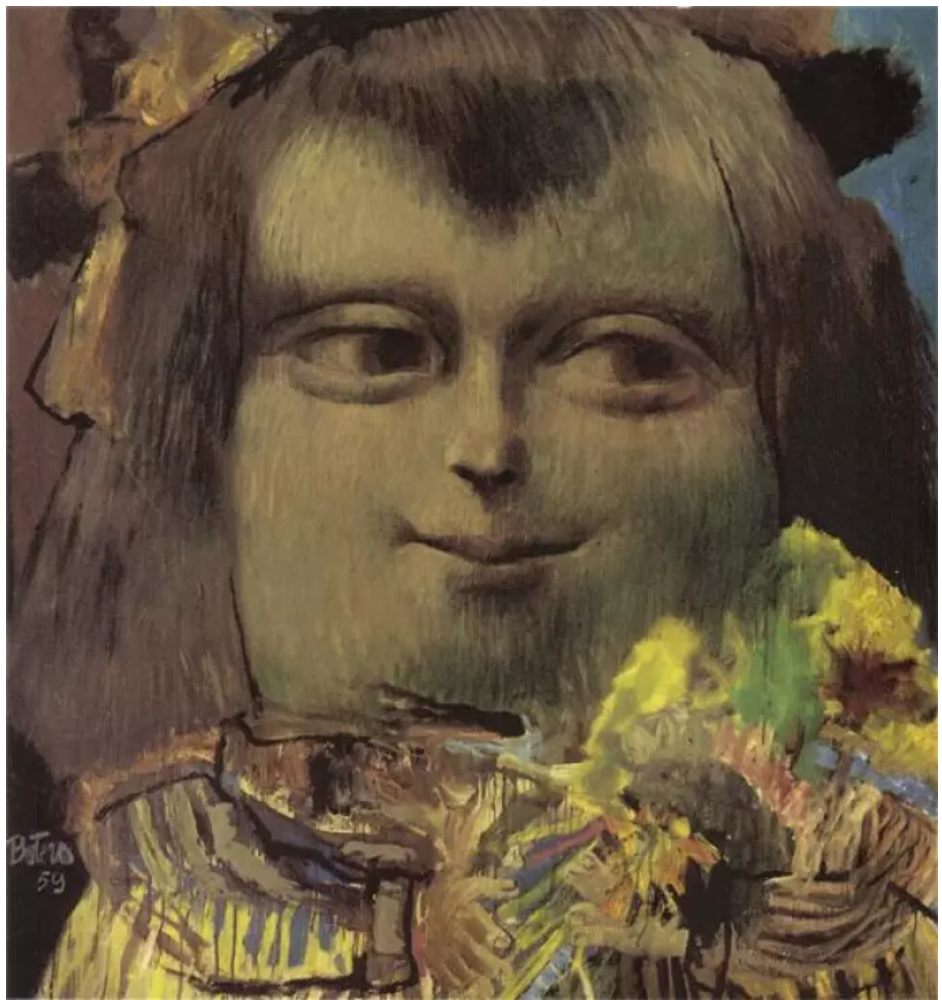
Fernando Botero, Mona Lisa Age Twelve, 1959. Museum of Modern Art, New York
An early and important example of Botero’s artistic vision, Niña Roja embodies a period of stylistic exploration where the artist began to fully embrace his now-iconic voluminous figures. This painting signals his early mastery in blending form and expressionist color with cultural critique, establishing a foundation for the enduring themes and aesthetics that would define his illustrious career.
El taller de Vermeer, 1964
Sotheby’s New-York: 18 May 2022
Estimated: USD 300,000 – 400,000
USD 403,200
El taller de Vermeer | Modern Day Auction | 2022 | Sotheby’s (sothebys.com)
FERNANDO BOTERO
El taller de Vermeer, 1964
Oil and paper collage on canvas
104.4 x 106.7 cm (41×42 inches)
Signed Botero and dated 64 (lower right)
Signed Botero, titled and dated 64 (on the reverse)
Informed by art historical influences ranging from Italian Renaissance and Dutch Golden Age Masters to the French Impressionists and even his New York School contemporaries, Fernando Botero has achieved a uniquely personal solution to bring figurative painting into the twentieth century: one that embraces both sharp societal critique and a sly sense of humor. Born to humble beginnings in the countryside near Medellin, Colombia in 1932, Botero’s artistic ambition (and a scholarship) took him to the prestigious Academia San Fernando in Madrid in 1952, where he funded his years of study and travel to Europe’s great museums by selling copies of Velazquez and Titian’s masterpieces to tourists, executed over painstaking hours of observation in the Prado. Successful exhibitions in Bogota, Mexico City and eventually Washington, D.C. led the artist to settle briefly in New York beginning in late 1959. In that critical year, he began to execute a series of reinterpretations of the most famous paintings of the Western canon, including the Mona Lisa – one of which was acquired by the Museum of Modern Art in New York (and was the only figurative work acquired by the museum that year). Of that work, Mona Lisa Age 12, Botero wrote:
“Leonardo’s Mona Lisa is so popular that perhaps it is no longer art. For me, it is just like a movie star or a football player.
Hence, an obvious satirical element in my painting. While doing the painting, I discovered that what is important is not the smile but the eyes.”
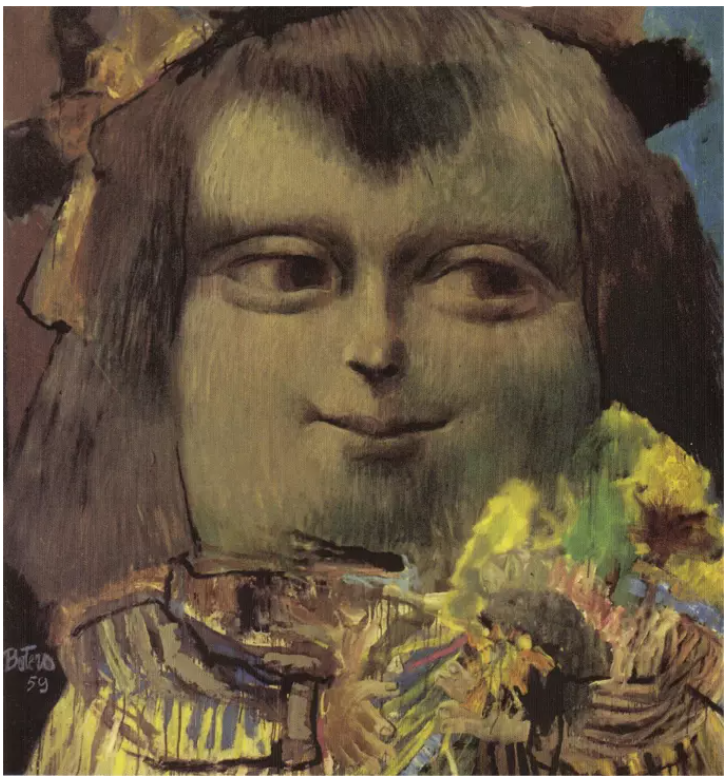
FERNANDO BOTERO, MONA LISA AGE TWELVE, 1959
While the early series to which El Taller de Vermeer belongs was executed prior to Botero’s knowledge of Pop Art, these works emerge from the same American zeitgeist, a shared impulse to reflect on the psychological impact of mass-produced images on Western culture in an era of rapid globalization. Where the Mona Lisas of 1959-60 offer an examination of the function of one specific iconic image, El Taller de Vermeer offers a complex reflection on artistic authorship and authenticity. Vermeer’s famed Girl with a Pearl Earring appears twice in this work – once in the form of a collaged image of the actual Dutch master painting, and then again in larger form as the composition’s primary (painted) subject, posed as if to model for a painter who is out of frame. Botero applies layers of echoing fiction and winking humor here, in a gesture whose profundity belies the whimsy with which it is rendered; the painting that is “real” in the world of the viewer is fictive in the world of this painting, and the model, the “real” subject, is a fabrication whose gown and elbows spill tantalizingly out of the frame. An intentional pentimento, where the figure’s famously adorned ear has been moved slightly to the right, further reveals the artifice inherent to painting – and introduces a warm, Boterian charm to Vermeer’s unblemished, otherworldly sitter.
JOHANNES VERMEER, GIRL WITH A PEARL EARRING, CIRCA 1665
A technical tour-de-force rendered in luscious, rich earth tones in the vibrational, painterly style that characterizes Botero’s best output of the early 1960s. Through the effects of both volumetric distortion and conceptual framing, Botero leads the viewer to a new understanding of the relationship between painting and looking. Presenting an image of Vermeer’s enigmatic model in a thoroughly Boterian world, where rotund apples seem ready to topple out of the picture plane and the figure meets our gaze with delightful impishness, Botero inserts himself into the Dutch Master’s place – and thus into the Western canon.
Other Paintings
The Beach, 2006
Sotheby’s New-York: 19 November 2025
Estimated: USD 600,000 – 800,000
USD 857,250
The Beach | Contemporary Day Auction | 2025 | Sotheby’s
FERNANDO BOTERO (1932 – 2023)
The Beach, 2006
Oil on canvas
131.4 x 189.9 cm (51 3/4 x 74 3/4 inches)
Signed and dated 06 (lower right)
In The Beach, Fernando Botero presents two of his most enduring subjects—the monumental nude and the couple of lovers—within a luminous seaside setting that exemplifies the artist’s unmistakable visual language. Two figures recline upon an ochre towel spread across a sun-drenched shore, their voluminous forms rendered with the velvety modeling that defines Botero’s mature style. The tranquil horizon stretches beyond them; the barren landscape at once peaceful and eerily timeless.

Botero in his studio
Executed in 2006, The Beach reflects the culmination of more than five decades of Botero’s exploration into the expressive potential of volume, proportion, and color, with a particular attention to how these formal elements pertain to the rendering of figures. From his early years in Medellín and Bogotá, Botero remained deeply engaged with art of the past. Following his first solo exhibition in 1951 and throughout the remainder of the 1950s, Botero spent many years in Spain, France and Italy. He immersed himself in the western art historical canon, studying Renaissance masters through modern luminaries. The artist’s extensive knowledge, spanning centuries of art, is expressed through his deliberate dialogue with European precedents and enduring motifs. By the 1960s and 70s, having established himself in both New York and Paris, Botero had developed his instantly recognizable style: figures of exaggerated scale yet delicate presence, each composed within harmoniously balanced spaces.
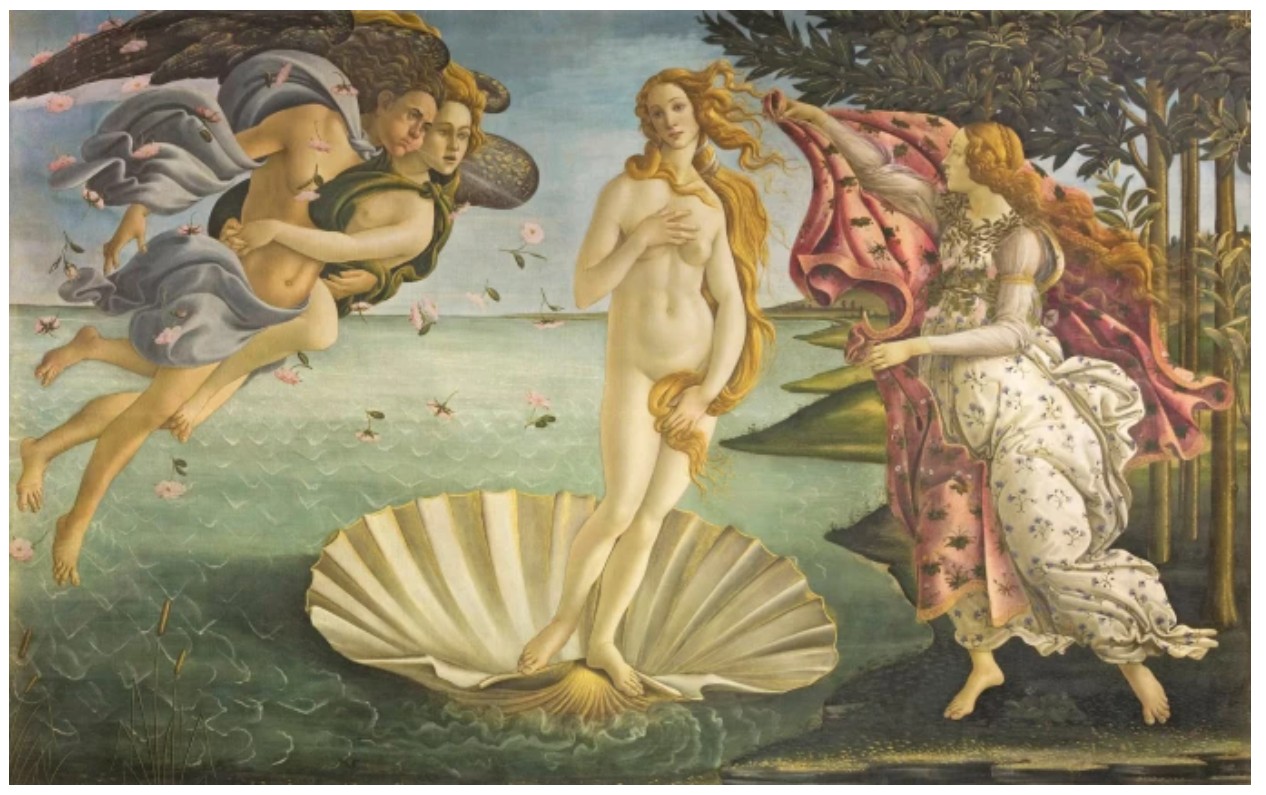
Sandro Botticelli, Birth of Venus, tempera on canvas, ca. 1485. The Uffizi, Florence
The reclining female nude, a motif to which Botero returned throughout his career, anchors the composition of the present work. The woman, in Botero’s signature exaggerated style, recalls centuries of history during which the female nude was of the most ubiquitous motifs. Most often applied to signify purity, canonical masterpieces such as Sandro Botticelli’s Birth of Venus and Titian’s Venus of Urbino situate the female nude in a mythological, idealized context, both of which Botero would have encountered during his time in Europe. Particularly of interest to the artist was the classical interest in volume, which Botero amplifies in his own figures. Beyond contributing to the tradition, Botero engages with the longstanding dialogue of modern and contemporary artists who call this lineage into question. In its frank presentation of the reclining female form, The Beach recalls the modern candor of Manet’s Olympia, where the nude confronts the viewer without mythological guise. Like Manet, Botero engages with the tradition of the female nude by subverting it, reimagining a classical subject through a distinctly modern lens.
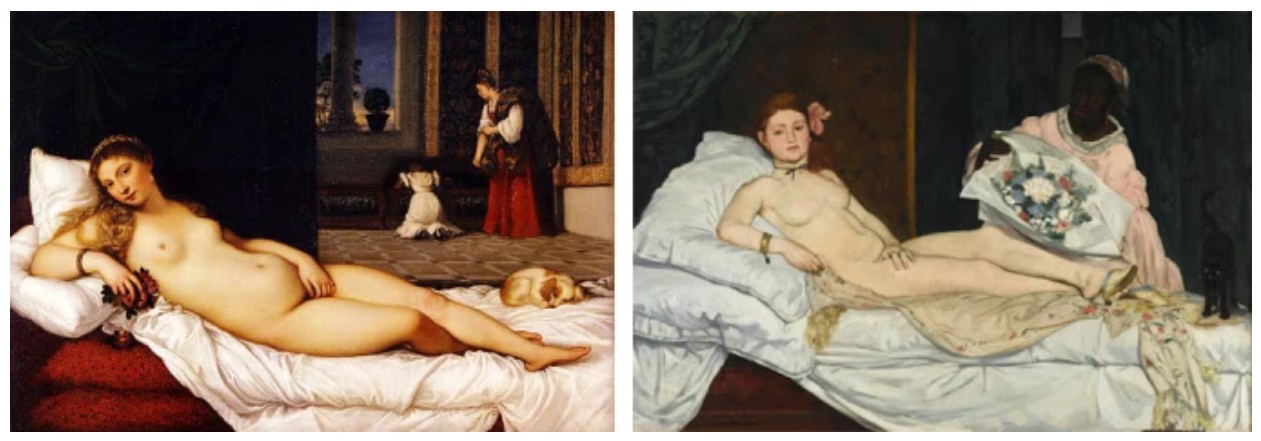
Left: Titian, Venus of Urbino, oil on canvas, 1538. The Uffizi, Florence
Right: Edouard Manet, Olympia, oil on canvas, 1863. Musée d’Orsay, Paris © Musée d’Orsay, Dist. RMN-Grand Palais / Patrice Schmidt
In The Beach, Botero strikes a balance between irony, sensuality, form, and tradition. The couple’s softly rounded bodies, non-conforming to idealized canons, propose an alternative beauty rooted in fullness, contentment, and self-possession. Furthermore, Botero’s oeuvre often returns to themes of intimacy and companionship between lovers. Despite their neutral expressions, consistent throughout Botero’s oeuvre, the figures demonstrate an endearing comfort and closeness that characterizes many of the relationships between the artist’s couples. The Beach exemplifies Botero’s continued refinement of his most iconic subjects. It stands as a testament to his enduring dialogue between sensuality and form, humor and reverence. Within its radiant simplicity and striking monumentality, Botero offers a world where the fullness of life, in all its human imperfection, attains the weight and grace of the classical ideal.
Boterosutra 51, 2013
Sotheby’s Paris: 24 October 2025
Estimated: EUR 300,000 – 500,000
EUR 508,000 / USD 590,155
Boterosutra 51 | Modernités | 2025 | Sotheby’s
FERNANDO BOTERO (1932 – 2023)
Boterosutra 51, 2013
Oil on canvas
98.4 x 129.9 cm (38 3/4 x 51 1/8 inches)
Signed and dated 13 (lower right)
Boterosutra reveals the artist’s major ambition: to depict the plasticity of beings and things. For Botero, this plasticity is the same whether applied to a female body, a still life, or a landscape. The monumental scale of these two figures accentuates the tangible dimension of their flesh. This exaggeration arises from the contrast in proportions, between the tiny details of eyes and mouths and the rest of the bodies. In the manner of Peter Paul Rubens, Botero celebrates the palpable, measurable tangibility of earthly existence.
A major figure on the international art scene of the 1950s, celebrated on at least three continents, Botero’s personality could be compared to that of a seventeenth-century artist whom he admired greatly: Rubens. Rubens embodies the very essence of classical notions of the “Baroque.” His fleshy, eroticized figures inhabit a world of exuberance and plenitude, both in sacred and profane spheres. From the beginning of his career, Botero made the female model his preferred subject, with voluptuousness or allusions to carnal pleasure at the heart of most of his compositions. La Maison de Raquel Vega (1975) and La Maison d’Amanda are among the most explicit references to sensuality, yet none of his works depict sexuality in a crude manner. Secondary details coexisting with the figures—such as remnants of food, cigarette butts, animals, or here, the light switch on the left—serve to temper the sexual dimension of the scene and place it within an everyday context.
Botero conceives his scenes as a simple acknowledgment of humanity’s natural attraction to earthly pleasures and as a social commentary on the vicissitudes of human existence. Beyond critique, his work is empathetic and tinged with a humor previously reserved for caricaturists and press illustrators. At the dawn of the 1950s, in an international context dominated by Abstract Expressionism, Botero asserts his commitment to social commentary and the legacy of centuries of Western art history.
Sculptures
Botero first began experimenting with sculpture in 1972, eventually expanding his métier from wood and clay to bronze, the medium in which has best translated the pillowy volumes of his paintings into three dimensions. Since the early 1980s, his summer were dedicated to sculpture, working from a studio in Pietrasanta, a small town on the Tuscan coast that has attracted many famed artist-residents from Michelangelo to Isamu Noguchi and Henry Moore. Botero’s sculptures are characterized by the same aesthetic principles that define his paintings – exaggerated volumes, harmonious proportions, and a playful approach to form. Transitioning from canvas to the three-dimensional, Botero has given his iconic subjects a tangible and interactive presence, encouraging viewers to engage on a more physical level. Whilst humor and irony are present in his work, the magnified proportions of Botero’s figures can be interpreted as an endearing nod to the pleasure of the tactility of life and beauty explored through the female form.
PLEASE CLICK BELOW TO FIND ALL AUCTION RESULTS FOR SCULPTURES
Works on Paper
PLEASE CLICK BELOW TO FIND AUCTION RESULTS
FOR WORKS ON PAPER