Banksy Prints
Image, Structure, and the Construction of a Market
WORK IN PROGRESS
Introduction
The Image as Strategy
In the work of Banksy, printmaking is neither an accessory nor a derivative practice. It is a strategic extension of an oeuvre originally conceived in the street, where images exist in a state of permanent instability—subject to removal, destruction, or displacement. The print intervenes precisely at this point of fragility. It captures, stabilizes, and redistributes images that were never meant to last, transforming acts of urban intervention into enduring objects of circulation.
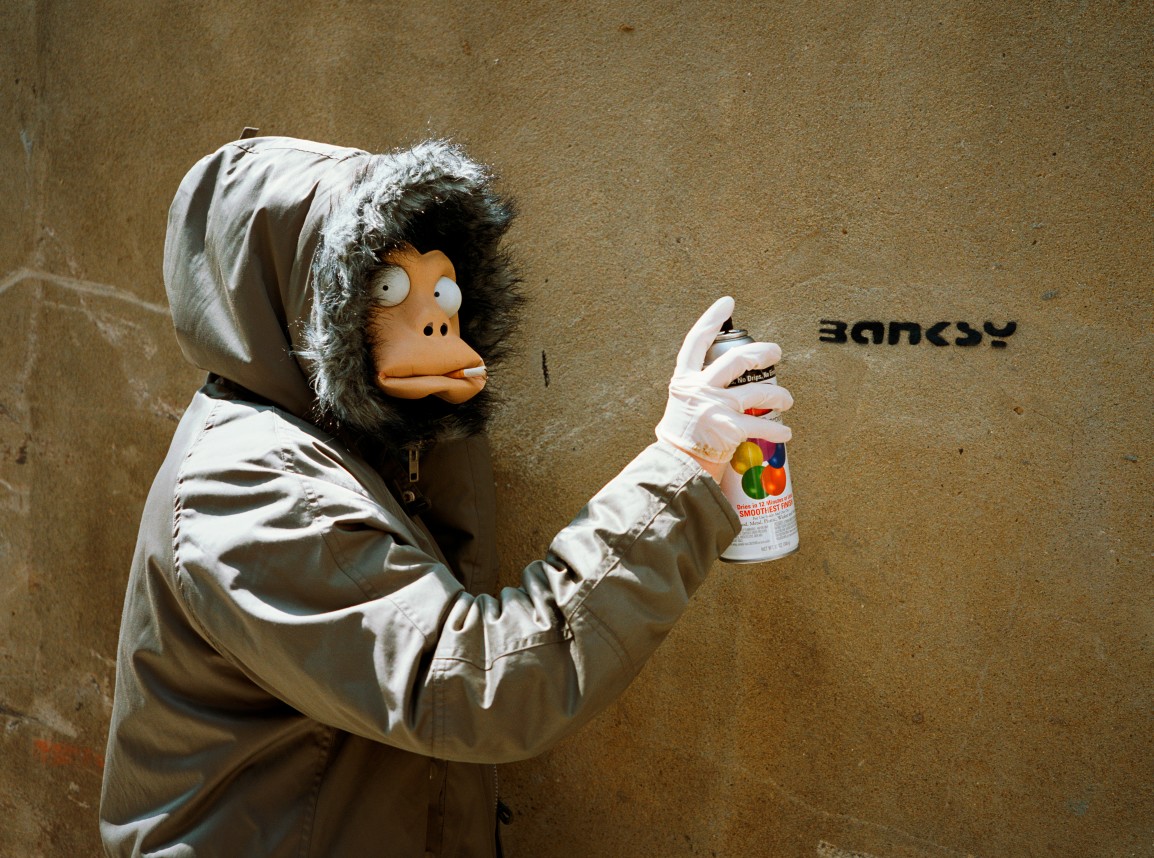
This transformation is not neutral. Banksy’s prints do not merely preserve imagery; they reorganize its conditions of visibility and ownership. They allow a work that was initially public, illegal, and context-dependent to become private, authenticated, and tradable. In doing so, they establish one of the most coherent and controlled print markets of the contemporary era, where accessibility, scarcity, and conceptual clarity are carefully balanced.
Technique: Reduction, Precision, and Impact
Banksy’s printmaking technique is rooted in screenprinting, a medium that aligns closely with his use of stencils in the street. The necessity of working quickly and efficiently in public space translates into a visual language defined by clarity and reduction. Forms are simplified, colors are limited, and compositions are constructed for immediate recognition.
This apparent simplicity is deceptive. Each image is carefully calibrated to achieve maximum impact with minimal means. The absence of unnecessary detail directs attention toward the central idea, allowing the work to function across different contexts and audiences.
Variations within editions, including colorways and artist’s proofs, introduce subtle distinctions without altering the core composition. These variations play a significant role in the market, creating hierarchies of rarity while maintaining the integrity of the image. The technique, in this sense, is not only a means of production but also a mechanism of differentiation.
Origins of the Print Practice
Banksy’s printmaking practice begins in 2002 with Rude Copper, a work that is already fully aligned with his visual and ideological language. The image of a police officer making an obscene gesture is immediate, legible, and confrontational. Produced in an edition of 250, with a smaller number of signed impressions and hand-finished variations, it establishes several principles that will remain constant: the use of bold, simplified imagery, the engagement with authority, and the dual structure of editions.
The year 2003 marks an extraordinary acceleration. Banksy releases a large number of prints that introduce many of his most enduring motifs. Flying Copper presents a police officer equipped with angel wings and a smiley face, combining authority, innocence, and absurdity within a single figure. Happy Chopper transforms a military helicopter into a decorative object adorned with a pink bow, collapsing the distance between warfare and consumer aesthetics. Love Is in the Air, perhaps one of his most widely recognized images, replaces a Molotov cocktail with a bouquet of flowers, creating a gesture that is at once confrontational and disarmingly poetic.
In the same year, Golf Sale offers a more subtle critique, depicting a figure interrupting a golf game, indirectly referencing historical protest imagery and social inequality. HMV appropriates a well-known commercial logo, replacing the listening dog with a weapon, suggesting a shift from passive consumption to confrontation.
By 2004, this visual vocabulary expands and consolidates. Girl with Balloon emerges as a central image, defined by its extreme simplicity: a child reaching toward a heart-shaped balloon carried away by the wind. The work’s power lies in its ambiguity. It does not resolve whether the gesture represents hope or loss, allowing it to function across emotional and cultural contexts. Alongside it, Pulp Fiction replaces guns with bananas in the hands of cinematic protagonists, introducing humor as a form of critique. Napalm presents one of Banksy’s most unsettling appropriations, juxtaposing a child fleeing war with figures drawn from consumer culture, forcing a confrontation between trauma and spectacle.
The rat imagery also becomes fully established during this period. Love Rat, Gangsta Rat, and the Placard Rat series translate earlier street interventions into print form, creating a symbolic system that is both personal and universal. These early years are not exploratory; they are definitive. They establish the entire framework upon which Banksy’s print market will be built.
Editions and Market Structure
The structure of Banksy’s print editions is remarkably consistent, typically consisting of a signed edition of around 150 and an unsigned edition of approximately 600. This dual system creates a clear hierarchy while maintaining accessibility. The absence of visual distinction between signed and unsigned works reinforces the conceptual integrity of the image, while the signature introduces a layer of rarity.
Additional variations, including artist’s proofs and colorways, provide further differentiation without complicating the overall structure. This clarity has contributed to the strength and liquidity of the market, allowing collectors to navigate it with relative ease.
Between Image and System
Banksy’s printmaking practice operates at the intersection of image and system. It transforms ephemeral interventions into enduring objects, while constructing a market that reflects and reinforces its conceptual framework. Through Pictures on Walls, Banksy redefined distribution. Through Pest Control, he established authority. Through his prints, he created a body of work that is both accessible and controlled, critical and complicit. The strength of this practice lies not in its ability to escape the system, but in its capacity to reveal it, to manipulate it, and ultimately, to exist within it on its own terms.
Pictures on Walls
A Radical Model of Distribution
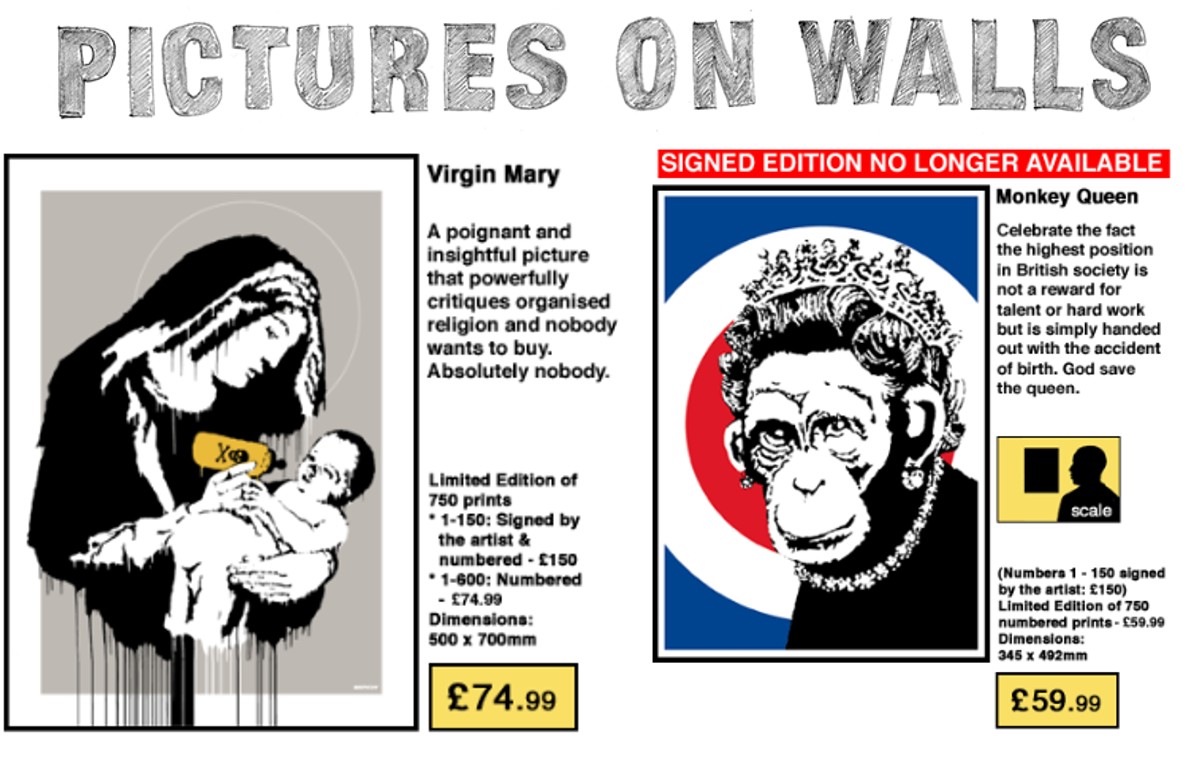
The emergence of Banksy’s prints is inseparable from Pictures on Walls, the artist-run platform that redefined the conditions of production and distribution for a generation of street artists. Founded in 2003, Pictures on Walls was conceived as a direct response to the exclusion of graffiti and urban art from traditional institutions. Rather than seeking validation from galleries, it created an alternative infrastructure in which artists could produce, publish, and sell their work independently.
Through Pictures on Walls, Banksy’s prints were made available directly to the public, often through online releases that bypassed the conventional mechanisms of the art market. This approach was both ideological and practical. It allowed for lower prices, wider access, and a level of immediacy that reflected the spirit of street art itself. At the same time, it ensured that production remained under the control of the artists, rather than external intermediaries.
Technically, Pictures on Walls also played a significant role in advancing print production. It introduced innovative techniques such as foil blocking and patterned embossing, and adopted environmentally conscious practices, including the use of non-solvent-based inks. These innovations were not merely technical enhancements; they contributed to the distinct material presence of the prints.
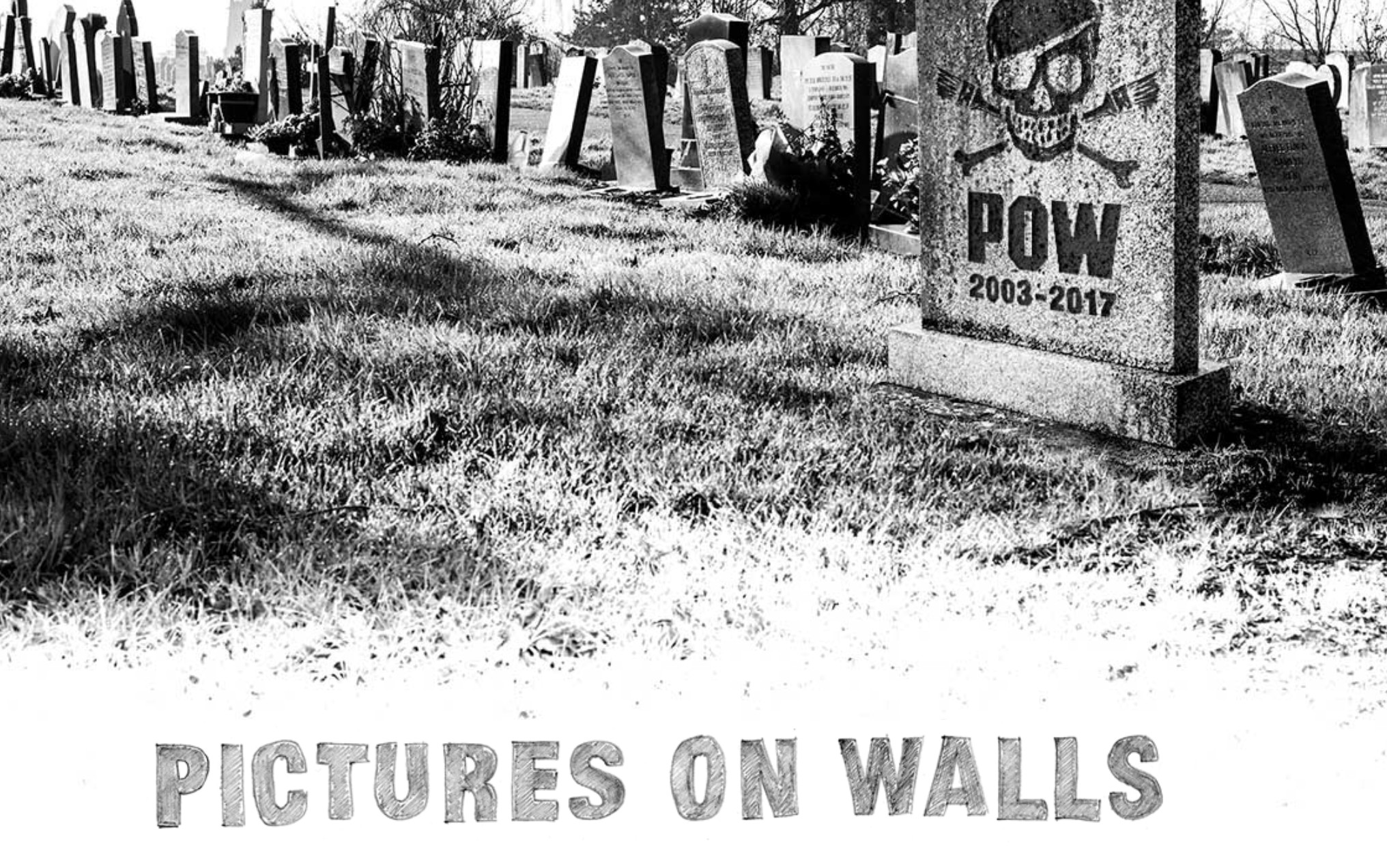
However, the success of this model introduced a fundamental tension. As Banksy’s visibility increased, so did the demand for his prints. What had been conceived as an accessible alternative to the art market gradually became one of its most dynamic sectors. Prices rose, scarcity increased, and the prints began to function as investment objects. When Pictures on Walls closed in 2017, it did so with a clear awareness of this contradiction, acknowledging that the system it had sought to bypass had, in many ways, absorbed it.
Pest Control Office
Authentication and Market Authority
The establishment of Pest Control Office in 2008 represents a decisive moment in the structuring of Banksy’s market. As the demand for his work grew, so did the risk of forgery, misattribution, and market fragmentation. Pest Control was created to address these issues by centralizing authentication within a single, artist-controlled entity. Unlike traditional authentication bodies, which often operate through committees or external experts, Pest Control functions as a direct extension of Banksy’s practice. It is the only authority capable of issuing certificates of authenticity, and its decisions are final. Without such certification, a work cannot be considered legitimate within the market, regardless of its provenance or visual characteristics.
This system introduces a high level of control, but also a degree of opacity. The authentication process is deliberately demanding, requiring detailed documentation, high-quality images, and proof of purchase. Street works, by their very nature, are generally excluded from certification, reinforcing the distinction between public intervention and collectible object. The existence of Pest Control is sometimes perceived as contradictory, given Banksy’s anti-establishment stance. Yet it is more accurately understood as a strategic adaptation. By creating his own system of authority, Banksy avoids dependence on the structures he critiques, while ensuring the stability and credibility of his market.
A Structured Vocabulary of Images
Warfare: Inversion and Displacement
Banksy’s engagement with warfare is defined by a strategy of inversion. Rather than depicting violence directly, he alters its symbols, creating images that are at once familiar and unsettling. In Bomb Love, a young girl embraces a bomb as if it were a toy or a companion, collapsing the boundary between innocence and destruction. In Love Is in the Air, the act of throwing a weapon is transformed into the act of offering flowers, introducing a moment of hesitation within an otherwise aggressive gesture.
Happy Chopper operates in a similar register, presenting a military helicopter adorned with a decorative bow. The image is almost absurd, yet it reveals the extent to which instruments of violence are integrated into everyday visual culture. Napalm, perhaps one of the most disturbing works in this category, appropriates a historical photograph and reframes it within a critique of consumerism and media representation. The work does not need to exaggerate; its power lies in the tension between recognition and discomfort.
Capitalism and Consumerism: The Spectacle of Desire
Banksy’s critique of capitalism is both direct and multifaceted. In Barcode, the visual language of commerce becomes a literal structure of confinement, from which a wild animal attempts to escape. The image suggests not only the commodification of nature but also the broader mechanisms through which value is assigned and controlled.
Christ with Shopping Bags presents a more overt collision between religious iconography and consumer culture, suggesting that systems of belief have been replaced by systems of consumption. Di-Faced Tenner intervenes directly in the realm of currency, replacing the image of authority with that of a cultural figure, thereby questioning the legitimacy and symbolism of money itself.
Sale Ends, released in the context of Barely Legal, pushes this critique further by depicting a crowd engaged in what appears to be an act of devotion toward a commercial sign. The work is not subtle, but it is precise. It mirrors the visual language of advertising while exposing its underlying logic.
Authority and Law Enforcement: Performance and Power
Authority in Banksy’s prints is rarely presented as stable. In Rude Copper, the figure of the police officer is immediately destabilized through a simple gesture, undermining the authority it represents. Flying Copper introduces an element of surrealism, transforming the figure into something both absurd and strangely familiar.
Stop and Search addresses the mechanisms of control more directly, presenting a scene that is both mundane and invasive. The power of the image lies in its banality, revealing how authority operates not only through spectacle but through routine.
These works do not seek to dismantle authority entirely. Instead, they reveal its dependence on perception, exposing the ways in which it is constructed and maintained.
Rats and Monkeys: Parallel Societies
The rat occupies a central position within Banksy’s symbolic system. In works such as Love Rat and Gangsta Rat, the animal becomes a figure of resilience and marginality, reflecting both the artist’s own position and the broader dynamics of urban life. The Placard Rat series introduces a textual element, allowing the figures to communicate directly with the viewer, often in a tone that is both humorous and confrontational.
Monkeys, on the other hand, are used to reflect human behavior more explicitly. In Laugh Now, a group of monkeys carries a message that suggests a future reversal of roles, while Monkey Queen combines satire and iconography to create an image that is both playful and critical.
Together, these figures create a parallel society, one that mirrors and critiques the structures of the human world.
Childhood and Innocence: Ambiguity and Projection
The use of children in Banksy’s work introduces a different register, one that is both emotional and conceptual. Girl with Balloon remains the most compelling example, precisely because it resists definitive interpretation. The image is simple, almost archetypal, yet its meaning remains open, allowing it to function across different contexts and audiences.
Other works, such as No Ball Games, extend this exploration by placing children within environments defined by restriction and control. The presence of childhood does not soften the critique; it intensifies it, revealing the extent to which social structures shape even the most fundamental experiences.
Barely Legal: Reflexivity and Market Awareness
The 2006 Barely Legal exhibition marks a turning point in Banksy’s relationship with the art market. The prints released in this context, including Morons, Trolleys, and Grannies, introduce a new level of reflexivity, addressing not only external systems but the mechanisms through which Banksy’s own work is being absorbed.
Morons stands as the clearest example. By depicting an auction scene in which bidders compete for a work that critiques their behavior, Banksy creates a loop of self-reference that is both humorous and incisive. The work does not position itself outside the market; it operates within it, revealing its contradictions.
Gross Domestic Product: The Artist as System
In 2019, Banksy extends this logic through the project Gross Domestic Product, which transforms the artist into a producer of goods within a controlled retail environment. The project responds to legal challenges by adopting the language of commerce, while simultaneously subverting it.
The distribution model, based on a lottery system rather than direct purchase, reinforces the tension between accessibility and exclusivity. The objects and prints associated with GDP are both products and statements, existing within the system they critique.
The Banksy Prints Catalogue
PLEASE CLICK ON THE PICTURE BELOW TO ACCESS THE BANKSY PRINTS CATALOGUE
Overview of Banksy Prints
2026 Upcoming Lots and Auction Results
2025 Auction Results
2023 Auction Results