Introduction
David Hockney’s prints form one of the most sustained and intellectually ambitious bodies of graphic work in contemporary art. Across more than six decades, he has used printmaking not as a secondary medium, but as a primary field of investigation, a place where images can be constructed, tested, and redefined. His work is rooted in observation, yet consistently challenges the conventions through which observation is translated into representation. Perspective is never fixed, time is never singular, and space is never stable. Each print becomes an argument about how we see.
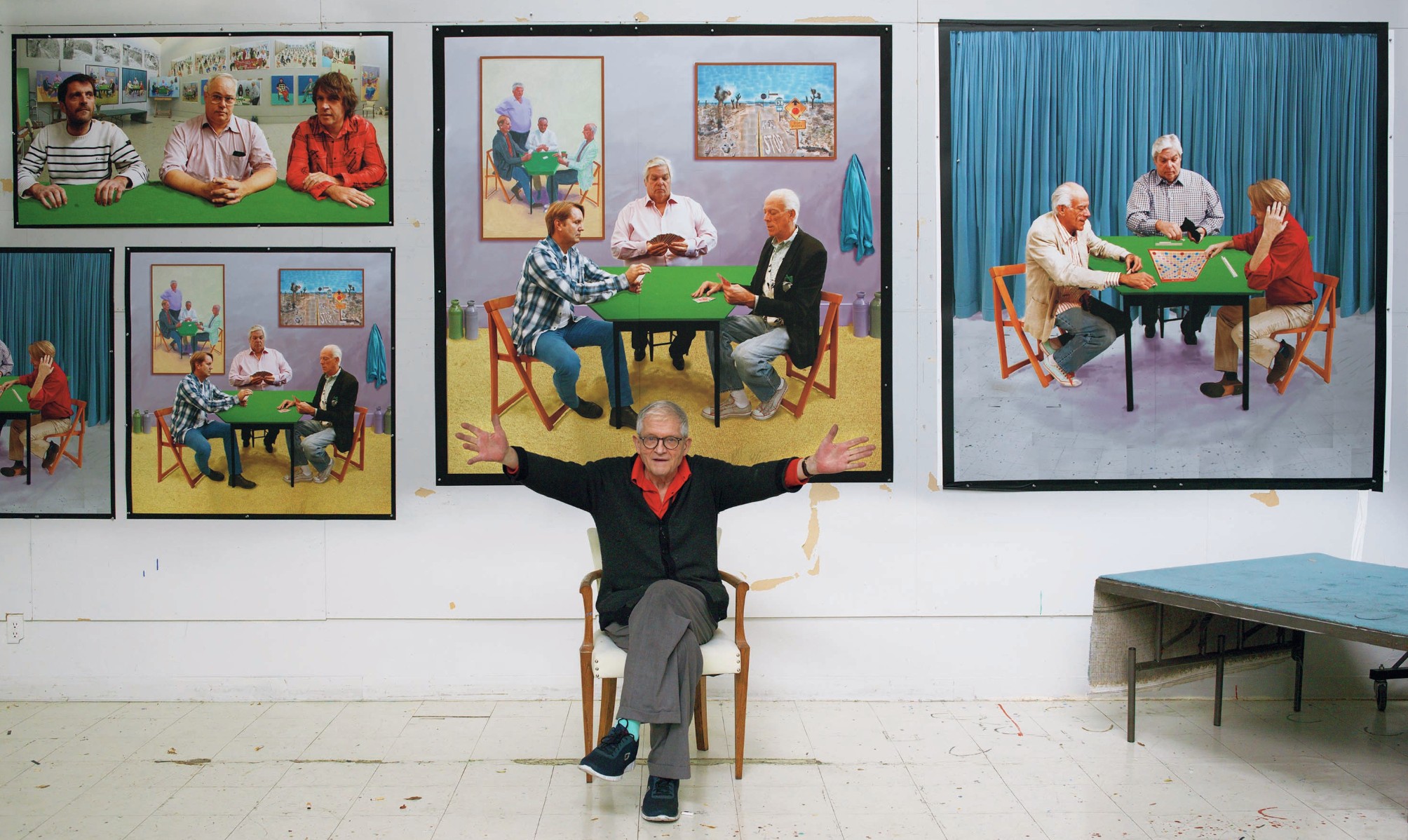
The breadth of Hockney’s print practice is exceptional. From early etchings to lithographs, from photographic collages to photocopy works, and later from iPad drawings translated into prints, each shift in medium corresponds to a new phase of inquiry. The continuity lies not in technique, but in intention. Hockney is not interested in reproducing reality; he is interested in reconstructing perception. His prints do not record the world as it appears. They reveal how it is experienced.
Taken together, David Hockney’s prints form a coherent and evolving system centered on perception. They move from narrative to structure, from representation to experience, from fixed viewpoint to multiplicity. Each series builds upon the previous one, not by repetition, but by refinement.
Hockney’s achievement lies in his ability to continuously reinvent the image while remaining faithful to a single, enduring question: how do we see? His prints do not offer a definitive answer. They offer something far more valuable—a method for looking.
Main Series
A Rake’s Progress (1961–63)
Autobiography Through Art History
Hockney’s first major print series, A Rake’s Progress, establishes the intellectual foundation of his practice with remarkable clarity. Drawing on William Hogarth’s eighteenth-century narrative, Hockney reimagines the story as a contemporary and deeply personal journey, reflecting his own experiences as a young artist navigating New York.
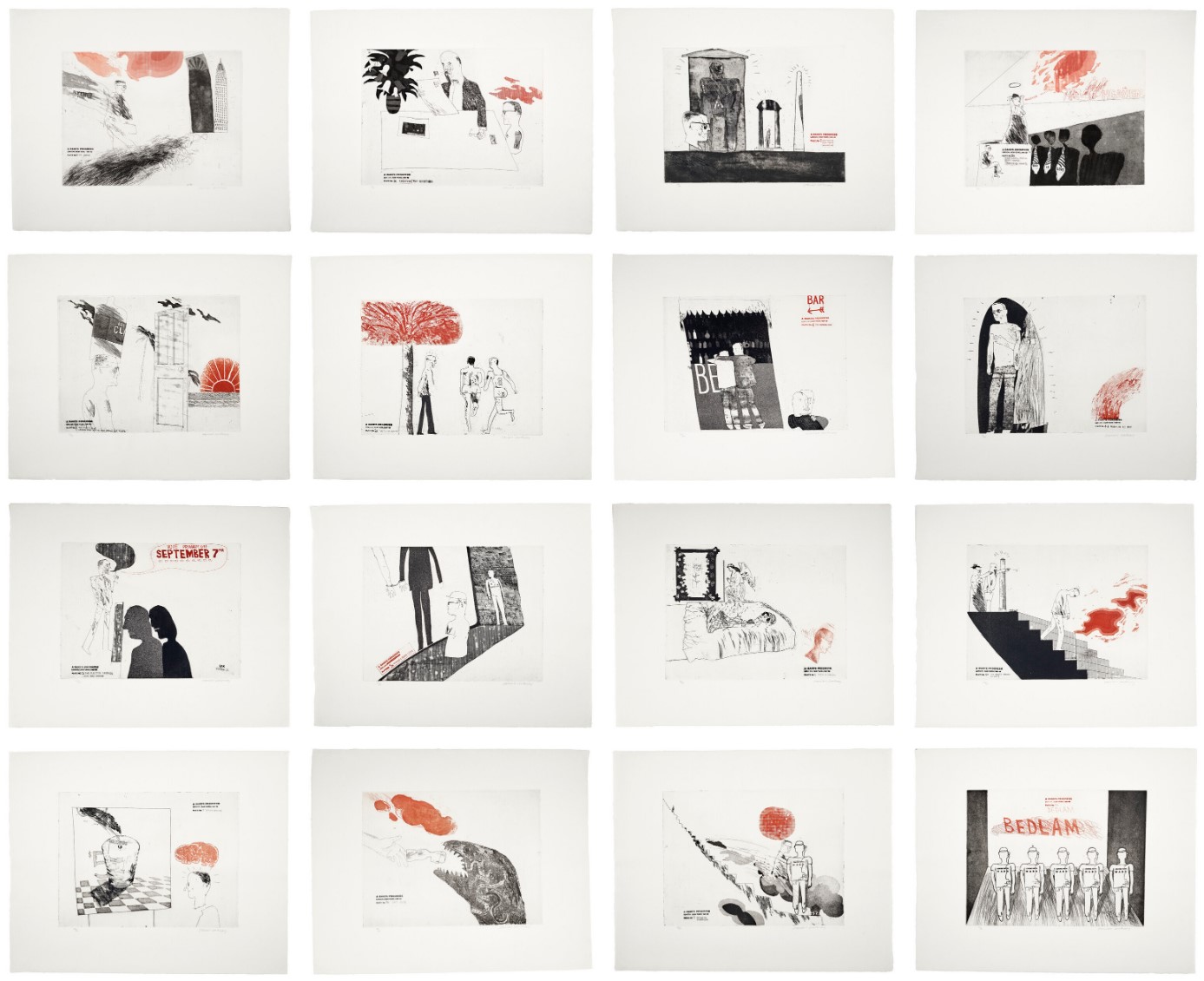
The etching medium allows for precision and discipline, yet the images resist rigidity. Figures, spaces, and sequences unfold with a sense of both control and instability. This is not a simple homage to Hogarth. It is a transformation. Hockney inserts himself into art history, not as a passive observer, but as an active participant, reshaping narrative into something fluid, modern, and psychologically charged. The series already introduces a key principle that will define his entire oeuvre: images are constructed, layered, and subjective. They are never neutral.
Grimm Fairy Tales (1969)
Line as Narrative, Line as Instability
In Illustrations for Six Fairy Tales from the Brothers Grimm, Hockney reaches a new level of technical and conceptual refinement. The etchings are delicate, precise, and often deceptively simple, yet they carry a deep psychological weight.
Rather than illustrating the stories in a literal sense, Hockney extracts moments of ambiguity, tension, and transformation. Space becomes uncertain, figures appear suspended between presence and absence, and narrative unfolds in fragments rather than sequences. The line itself becomes expressive, suggesting both clarity and doubt.
These works demonstrate Hockney’s ability to move beyond storytelling into something more elusive. The fairy tale becomes a framework through which perception, memory, and imagination intersect.
The Blue Guitar (1976–77)
Dialogue with Picasso, Translation of Poetry
The Blue Guitar stands as one of Hockney’s most sophisticated print portfolios. Inspired by Wallace Stevens’ poem and deeply informed by Picasso’s visual language, the series operates as a layered dialogue between literature, painting, and printmaking.
Hockney does not simply reference Picasso; he absorbs and reconfigures him. Forms shift, perspectives fracture, and objects seem to dissolve and reassemble within the same image. The prints explore the instability of representation itself, questioning how images can translate reality, and whether they ever truly do. The result is a series that feels both intellectual and playful, rigorous yet open. It marks a decisive moment in Hockney’s evolution, where the focus moves increasingly toward perception rather than narrative.
Lithographs of Water (1978–1980)
Drawing the Undrawable
The Lithographs of Water Made of Lines (1978–1980) represent one of the most conceptually precise moments in David Hockney’s print practice. Rather than depicting water as a reflective surface or atmospheric element, Hockney reduces it to its most essential visual components: lines. The series does not attempt to imitate water. It reconstructs it. Each composition is built through a controlled network of linear marks, carefully calibrated to suggest movement, depth, and distortion. The apparent simplicity of the image conceals a complex system of observation. Water, which by nature resists fixed form, is translated into a language that is both artificial and convincing. The viewer recognizes the subject immediately, yet remains aware that it is entirely constructed.
These works mark a decisive shift in Hockney’s thinking. The swimming pool, long associated with light, leisure, and Californian imagery, becomes a problem of representation. How can something that is constantly moving be fixed into an image? Hockney’s answer is not illusion, but structure. By reducing water to lines, he reveals that perception itself operates through abstraction. Within the broader arc of his printmaking, this series functions as a bridge. It moves away from narrative and toward a more analytical approach to vision, anticipating the later investigations of Moving Focus and the photographic collages. The instability of water becomes a model for the instability of seeing itself. What appears natural is, in fact, constructed—assembled line by line, moment by moment.
Moving Focus (1984–86)
The End of Single Perspective
With Moving Focus, Hockney directly confronts one of the central conventions of Western art: the fixed viewpoint. The portfolio dismantles Renaissance perspective and replaces it with a dynamic, shifting system that better reflects human vision.
Interiors unfold across multiple viewpoints. Mirrors and windows disrupt spatial continuity. Objects exist simultaneously in different positions. The viewer is no longer outside the image, observing it from a distance, but inside it, navigating a space that evolves over time. This is not distortion. It is correction. Hockney proposes that traditional perspective simplifies reality, while vision itself is inherently mobile, layered, and temporal.
Photo Drawings (1980s)
Time Assembled, Vision Fragmented
Hockney’s photographic collages, often referred to as photo drawings or joiners, represent one of the most radical developments in his practice. Composed of dozens or even hundreds of individual photographs, these works reject the idea of the single captured moment.
Each fragment records a slightly different angle and a slightly different instant. When assembled, they produce an image that vibrates with time. Faces shift, spaces expand, and the viewer becomes aware of perception as a sequence rather than a fixed point.
These works extend directly into his print logic. They are not simply photographic experiments. They redefine how images can hold duration.
Home Made Prints (1986)
Radical Economy, Absolute Control
The Home Made Prints represent one of Hockney’s most understated yet conceptually sharp gestures. Produced using a standard office photocopier, the series strips printmaking down to its most basic mechanics.
The choice of tool is deliberate. It removes any dependency on traditional printmaking infrastructure and places emphasis entirely on composition, line, and structure. The works retain Hockney’s clarity and precision, demonstrating that innovation lies not in complexity, but in intention. This series quietly redefines what printmaking can be. It is both modest and radical.
Woldgate & The Arrival of Spring (2011)
Drawing in Time, Nature as Sequence
In the Woldgate works and The Arrival of Spring in Woldgate, East Yorkshire in 2011, Hockney extends his investigation into digital media. Created on an iPad and later translated into prints, these works continue his exploration of time and observation.
The subject matter—trees, roads, seasonal change—is deceptively simple. Yet each image is part of a larger sequence, reflecting sustained attention rather than a single moment. The repetition becomes structure. The landscape is not captured; it is experienced over time. Color becomes more immediate, line more fluid, but the underlying inquiry remains unchanged: how can an image hold duration?
Yosemite, Normandy, and the Digital Expansion
Technology as Extension of Vision
Hockney’s later digital series, including The Yosemite Suite, My Window, My Normandie, 20 Flowers, and 220 for 2020, expand this logic further. The iPad becomes not a novelty, but a continuation of drawing by other means.
These works retain the intimacy of observation while embracing the possibilities of immediacy and repetition. A window, a table, a tree, a flower—each subject becomes a site of prolonged looking. The images accumulate, forming a body of work that is both personal and expansive.
Technology does not replace tradition. It extends it.
Twenty Flowers (2021)
Serial Observation, Intimacy at Scale
The Twenty Flowers series, produced in 2020, represents one of the most distilled expressions of Hockney’s late practice. Created on the iPad and later issued as prints, the works depict individual flowers isolated against flat, often vividly colored grounds. At first glance, the compositions appear simple, even decorative. In reality, they are the result of sustained observation and deliberate reduction. Each flower is treated as a singular event. There is no attempt at botanical accuracy in the scientific sense, nor any interest in symbolic narrative. Instead, Hockney focuses on presence. The contour, the color, the slight asymmetry of each bloom becomes a way to register attention. The repetition across the series is not mechanical. It is cumulative. Each image builds upon the previous one, forming a sequence of looking rather than a set of variations.
The use of digital tools allows for immediacy, yet the structure remains rooted in drawing. Line retains its authority, color its clarity, and composition its balance. The flat backgrounds eliminate depth in the traditional sense, pushing the image forward and reinforcing the objecthood of the flower while simultaneously abstracting it. The result is a tension between intimacy and monumentality, where a modest subject is given a presence that feels both direct and expansive. Within the broader arc of Hockney’s printmaking, Twenty Flowers stands as a quiet culmination. After decades of questioning perspective, assembling time, and expanding visual space, he arrives at a point of radical simplicity. The complexity has not disappeared. It has been resolved. What remains is the act of looking, distilled to its essence.
The David Hockney Prints Catalogue
PLEASE CLICK ON THE PICTURE BELOW TO ACCESS THE DAVID HOCKNEY PRINTS CATALOGUE
Overview of David Hockney Prints
2026 Upcoming Lots and Auction Results
2025 Auction Results
Auction Market Overview (2022-2025)