
David Hockney’s works on paper occupy a central position in his oeuvre, not as preparatory material or secondary production, but as a sustained, autonomous field in which his most radical ideas about seeing, space, and representation are tested with particular freedom. Paper allows speed, intimacy, and repetition; it accommodates both hesitation and decisiveness. In Hockney’s case, it also functions as a conceptual bridge between private observation and public dissemination, between the hand-drawn line and the reproducible image. From early etchings to paper-pulp experiments and digitally generated drawings later printed on paper, this body of work traces a continuous inquiry into how images are made, multiplied, and experienced.
Introduction
Hockney’s engagement with works on paper begins early and decisively. His printmaking career is not an appendix to painting but a parallel language, already fully articulated in the early 1960s with A Rake’s Progress, a suite that combines narrative sequencing, autobiography, and art-historical dialogue. From that point onward, paper becomes a site of constant experimentation, where technique and subject matter evolve together. The variety of media he adopts—etching, aquatint, lithography, photocopy, collage, paper pulp, and later digital drawing—reflects not eclecticism but a consistent refusal to accept any single system of representation as definitive.
Technically, Hockney’s works on paper are distinguished by their insistence on preserving the vitality of drawing within reproductive processes. In his etched and aquatinted prints, particularly from the 1970s onward, line retains a handwritten quality, resisting the rigidity often associated with printmaking. Color is handled not as surface embellishment but as a structural element, used to construct space, articulate rhythm, and guide perception. This is especially evident in complex color etchings such as The Blue Guitar, where the technical sophistication of the printing process serves the immediacy of the image rather than overwhelming it.
Main thematics
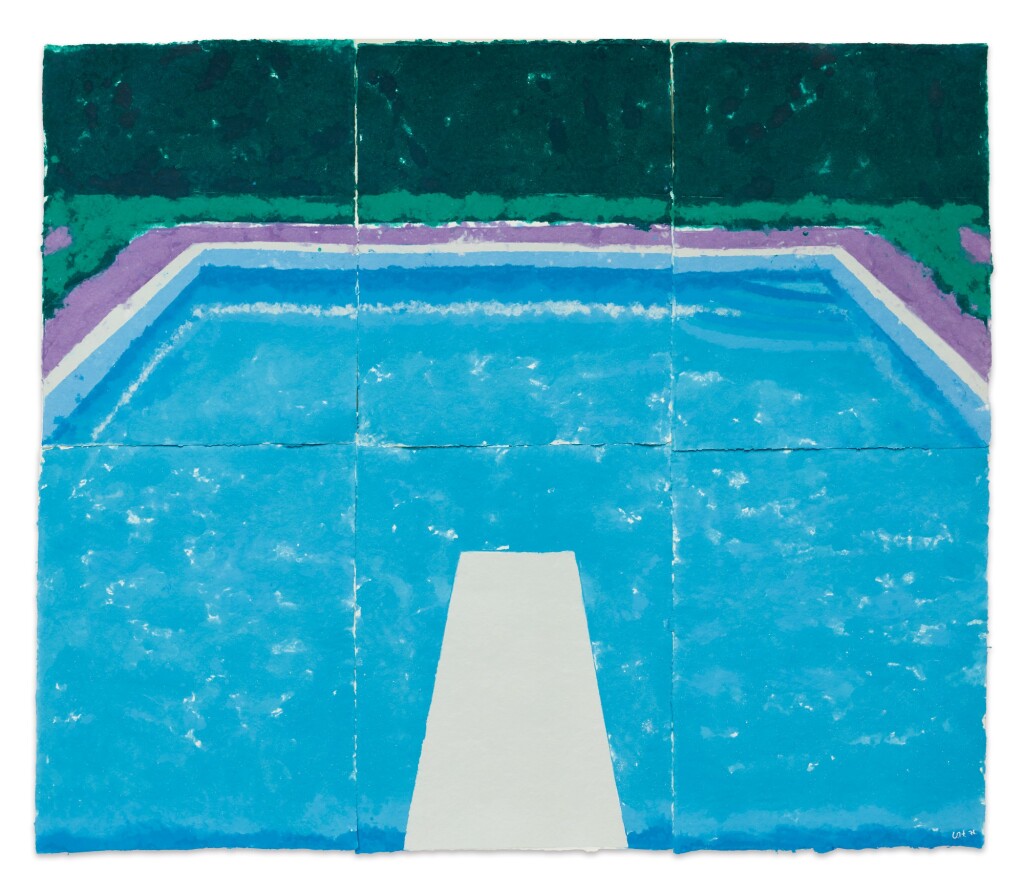
A pivotal moment in this technical exploration occurs with the Paper Pools of 1978. These works, made from dyed paper pulp poured and shaped by hand, dissolve the traditional distinction between drawing, painting, and print. Here, paper is no longer a passive support but the substance of the image itself. The subject matter—swimming pools, with their shimmering surfaces and shifting reflections—is inseparable from the medium. The works embody Hockney’s enduring fascination with water as a problem of vision: transparent yet reflective, flat yet deep, stable yet constantly in motion. By rendering water through liquid paper, Hockney aligns material process and optical inquiry with rare conceptual clarity.
Pools, more broadly, form one of the most recognizable thematic strands in Hockney’s works on paper. On paper, these images become more schematic and analytical than their painted counterparts. Tiles, splashes, and shadows are reduced to graphic elements that foreground structure over illusion. The pool is not merely a symbol of Californian leisure; it is a constructed visual field in which perspective, refraction, and surface tension are rigorously explored. Paper, with its capacity for flatness and repetition, sharpens this investigation.
Portraiture constitutes another major pillar of Hockney’s paper practice. His drawn and printed portraits are among his most psychologically acute works, marked by prolonged observation and an ethics of attention rather than idealization. On paper, Hockney’s portraits achieve an intimacy that large-scale painting sometimes resists. Line becomes a record of time spent looking, and composition reflects the dynamics between artist and sitter. These works form a social archive of friends, lovers, and collaborators, rendered without theatricality and with a clarity that is often disarming.
Travel imagery in Hockney’s works on paper reveals yet another dimension of his thinking. Rather than monumentalising place, Hockney treats travel as a sequence of visual encounters. Paper lends itself naturally to this episodic structure, allowing images to unfold as series rather than singular statements. The format of portfolios and suites becomes essential, reinforcing the idea that perception is cumulative and that understanding a place involves movement, memory, and return. This serial logic, established early, remains central throughout his career.
Still lifes, often underestimated within Hockney’s production, gain particular resonance on paper. Tables, flowers, interiors, and everyday objects are approached as exercises in looking rather than vehicles for symbolism. On paper, these subjects allow Hockney to concentrate on color relationships, spatial construction, and the quiet discipline of observation. They also provide a space for dialogue with art history, particularly with Picasso, whose presence is frequently felt not through quotation but through shared problems of form and representation.
In later decades, Hockney’s embrace of digital drawing technologies extends, rather than disrupts, his relationship with paper. iPhone and iPad drawings, when printed, reaffirm his long-standing interest in how tools shape perception. These works maintain the immediacy of drawing while introducing new possibilities of color, layering, and scale. Crucially, when transferred to paper, they enter the same material and conceptual lineage as his earlier graphic works, underscoring the continuity of his practice across technological shifts.
Institutional Recognition and Market
Recent exhibitions have decisively reinforced the importance of works on paper within Hockney’s oeuvre. Shows such as David Hockney: Paper Trails and large-scale institutional surveys culminating in David Hockney 25 have positioned drawings, prints, paper pulp works, and digital drawings at the core of his artistic narrative. This curatorial stance confirms what scholars and collectors have long recognized: that Hockney’s most sustained and revealing investigations often unfold on paper.
From a market perspective, Hockney’s works on paper occupy a particularly robust and nuanced segment. Their appeal lies in the combination of intellectual depth, visual recognizability, and relative accessibility compared to major paintings. However, the category demands careful differentiation. Early etching suites, complex colour prints, unique paper pulp works, and significant photographic or digital drawings operate according to different dynamics of rarity, demand, and institutional validation. The strongest results tend to be achieved by works that sit at key intersections of technique, subject matter, and historical moment.
Importantly, the growing institutional emphasis on works on paper has helped dissolve outdated hierarchies that once privileged painting above all else. In Hockney’s case, paper is increasingly understood as a primary site of innovation rather than a secondary medium. For collectors, this shift reinforces the long-term relevance of high-quality works on paper, provided that acquisitions are guided by connoisseurship, documentation, and a clear understanding of where each work sits within the artist’s broader trajectory.
Taken as a whole, David Hockney’s works on paper form a continuous, probing meditation on how we see and how images come into being. They are not merely records of ideas later realized elsewhere, but fully resolved works in which experimentation, observation, and pleasure converge. On paper, Hockney thinks aloud—and the results remain among the most intelligent and compelling contributions to postwar graphic art.
Top Lots
#1. Piscine de Medianoche (Paper Pool 30)
Estimated: USD 5,000,000 – 7,000,000
USD 11,743,800
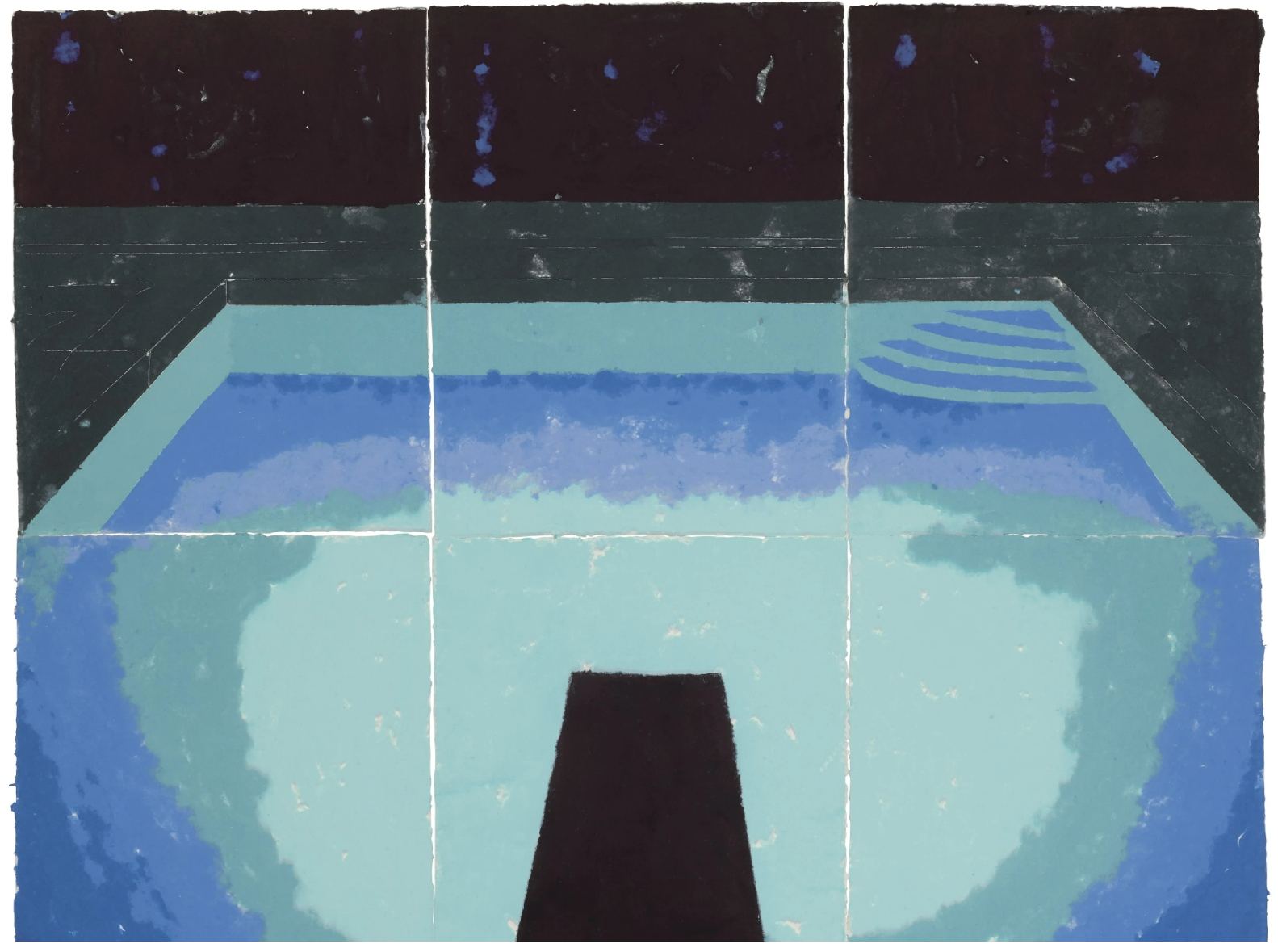
DAVID HOCKNEY
Piscine de Medianoche (Paper Pool 30), 1978
Colored and pressed paper pulp
72 x 85.5 inches (182.9 x 217.2 cm)
Signed and dated 78
#2. Day Pool with Three Blues (Paper Pool 7)
Christie’s New-York: 14 May 2019
Estimated: USD 9,000,000 – 12,000,000
USD 10,490,000
David Hockney (b. 1937), Day Pool with Three Blues (Paper Pool 7) | Christie’s
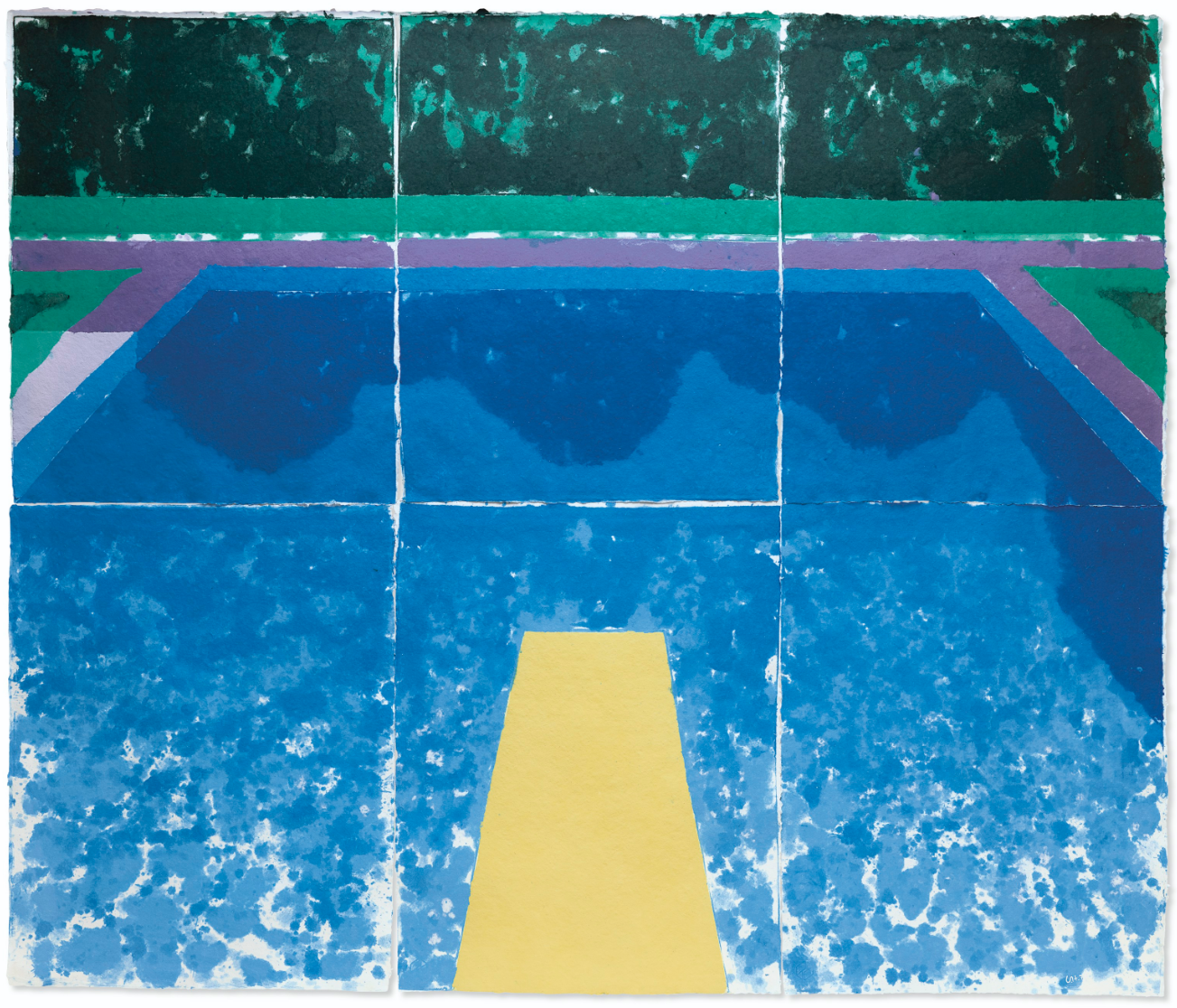
DAVID HOCKNEY
Day Pool with Three Blues (Paper Pool 7), 1978
Colored, pressed paper pulp
72 x 85.5 inches (182.9 x 217.2 cm)
Signed with the artist’s initials and dated ‘D.H. 78’ (lower right)
Signed again ‘David Hockney’ (on the reverse of the lower right sheet)
Inscribed ‘7’ (on the reverse of each sheet)
#3. Sprungbrett mit Schatten (Paper Pool 14)
Christie’s New-York: 14 November 2018
Estimated: USD 6,000,000 – 8,000,000
USD 7,287,500
David Hockney (b. 1937), Sprungbrett mit Schatten (Paper Pool 14) | Christie’s
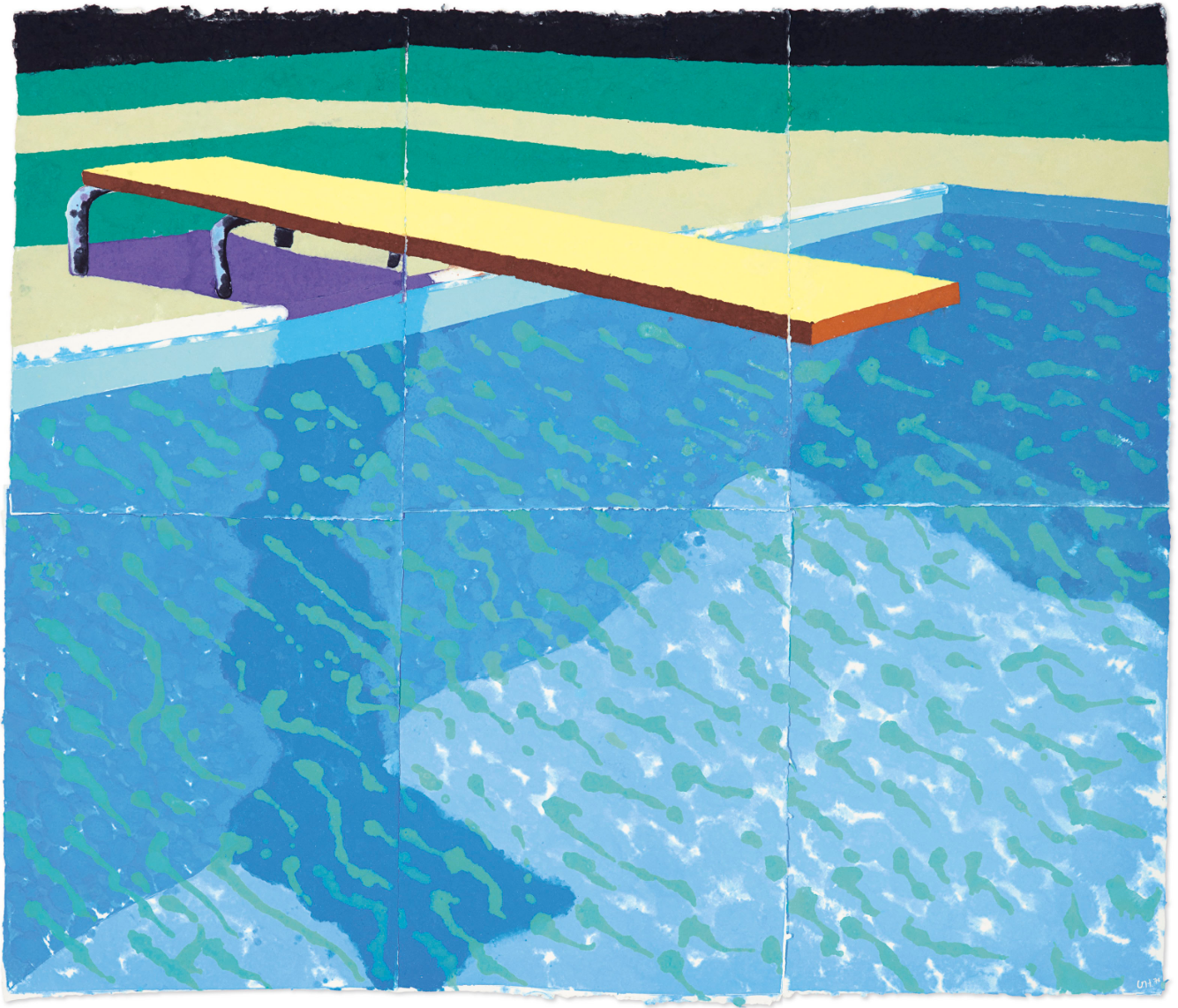
DAVID HOCKNEY
Sprungbrett mit Schatten (Paper Pool 14), 1978
Colored, pressed paper pulp
72 x 85.5 inches (182.9 x 217.2 cm)
Signed with the artist’s initials and dated ‘D.H. 78’ (lower right)
#4. View From Terrace III, 2003
Sotheby’s New-York: 15 November 2023
Estimated: USD 4,000,000 – 6,000,000
USD 7,228,500
WORK ON PAPER
View From Terrace III | Contemporary Evening Auction | 2023 | Sotheby’s
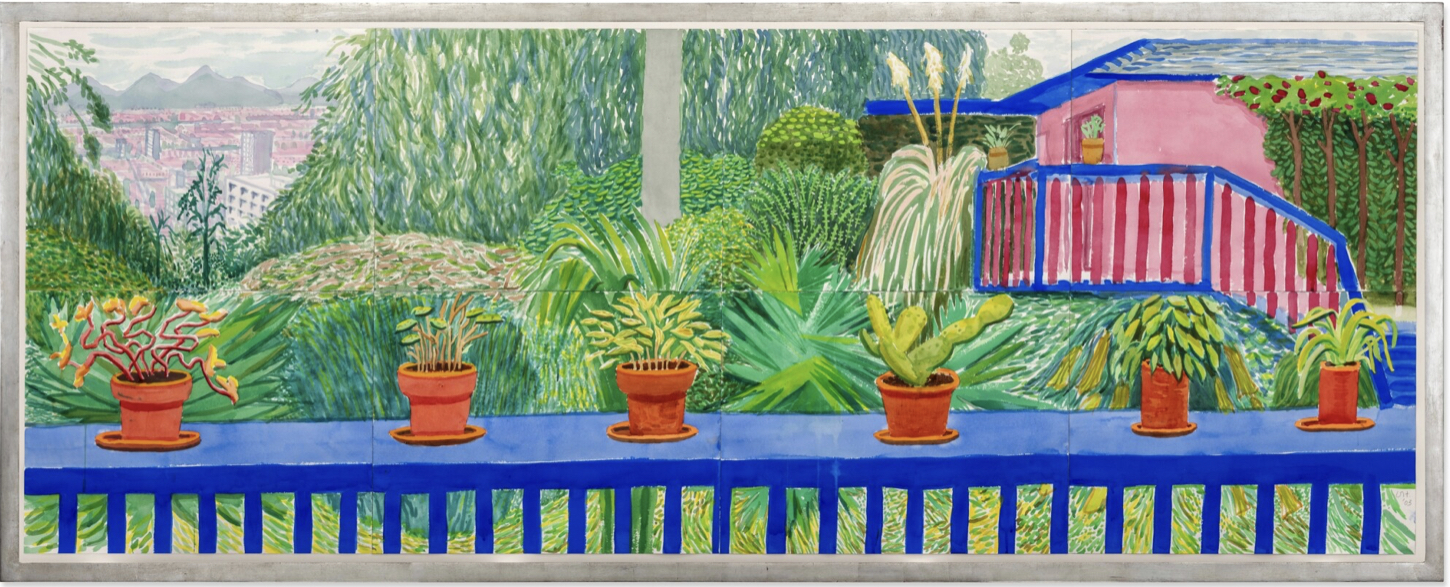
DAVID HOCKNEY (b. 1937)
View From Terrace III, 2003
Watercolor on paper, in eight sheets
Overall: 36 1/8 x 95 7/8 inches (91.8 x 243.5 cm)
Signed and dated 2003 (lower right)
#5. Pool on a Cloudy Day with Rain (Paper Pool 22)
Sotheby’s London: 28 July 2020
Estimated: GBP 4,000,000 – 6,000,00
GBP 4,867,900 / USD 6,302,055
WORK ON PAPER
DAVID HOCKNEY
Pool on a Cloudy Day with Rain (Paper Pool 22), 1978
Hand-colored and pressed paper pulp
72.4 x 85 inches (183.8 x 216 cm)
Signed with the artist’s initials and dated ’78
Auction Market Overview
2025 Auction Highlights
28 lots sold at auction in 2025 for a total turnover of USD 6,472,247. With 2 lots failing to sell, the sell-through rate is 93%. The highest price was achieved by Terrace Hollywood Hills House with Banana Tree, a drawing dated 1982, sold for USD 2,487,000 at Sotheby’s, in New-York, on 16 May 2025.
2025 top 5 Lots
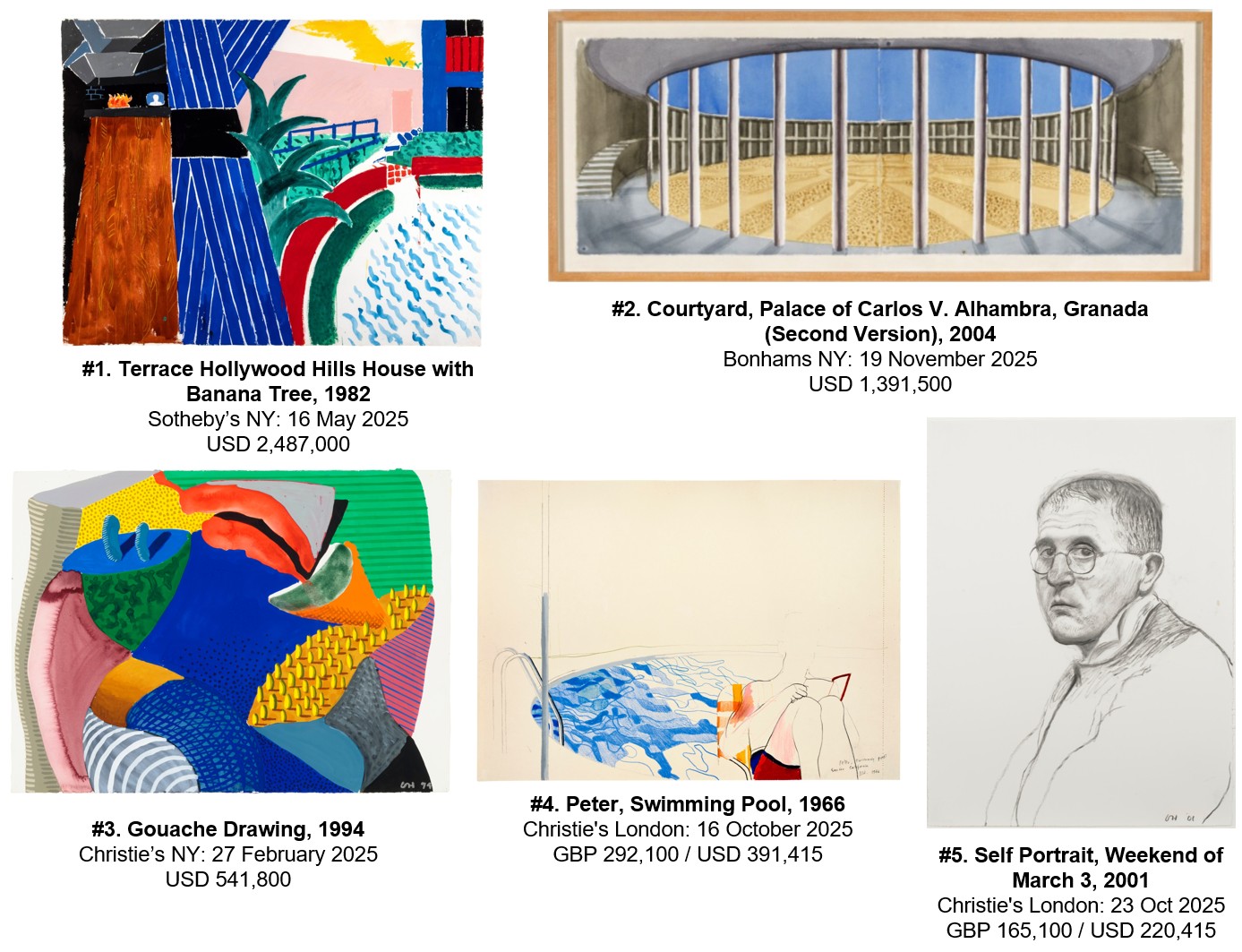
2 lots sold for more than USD 1 million, generating a cumulative turnover of USD 3,878,500, representing 59.9% of the total turnover for 2025. 9 lots sold for more than USD 100,000, generating a cumulative turnover of USD 5,565,561, representing 86% of the total turnover of 2025.
2024 Auction Highlights
19 lots sold at auction in 2024 for a total turnover of USD 6,136,299. With 2 lots failing to sell, the sell-through rate is 90%. The highest price was achieved by Andalucia. Fountains, Cordova, a drawing dated 2004, that sold at Sotheby’s, in London, on 6 March 2024, for GBP 1,863,000 (USD 2,362,285).
2024 Top 5 Lots
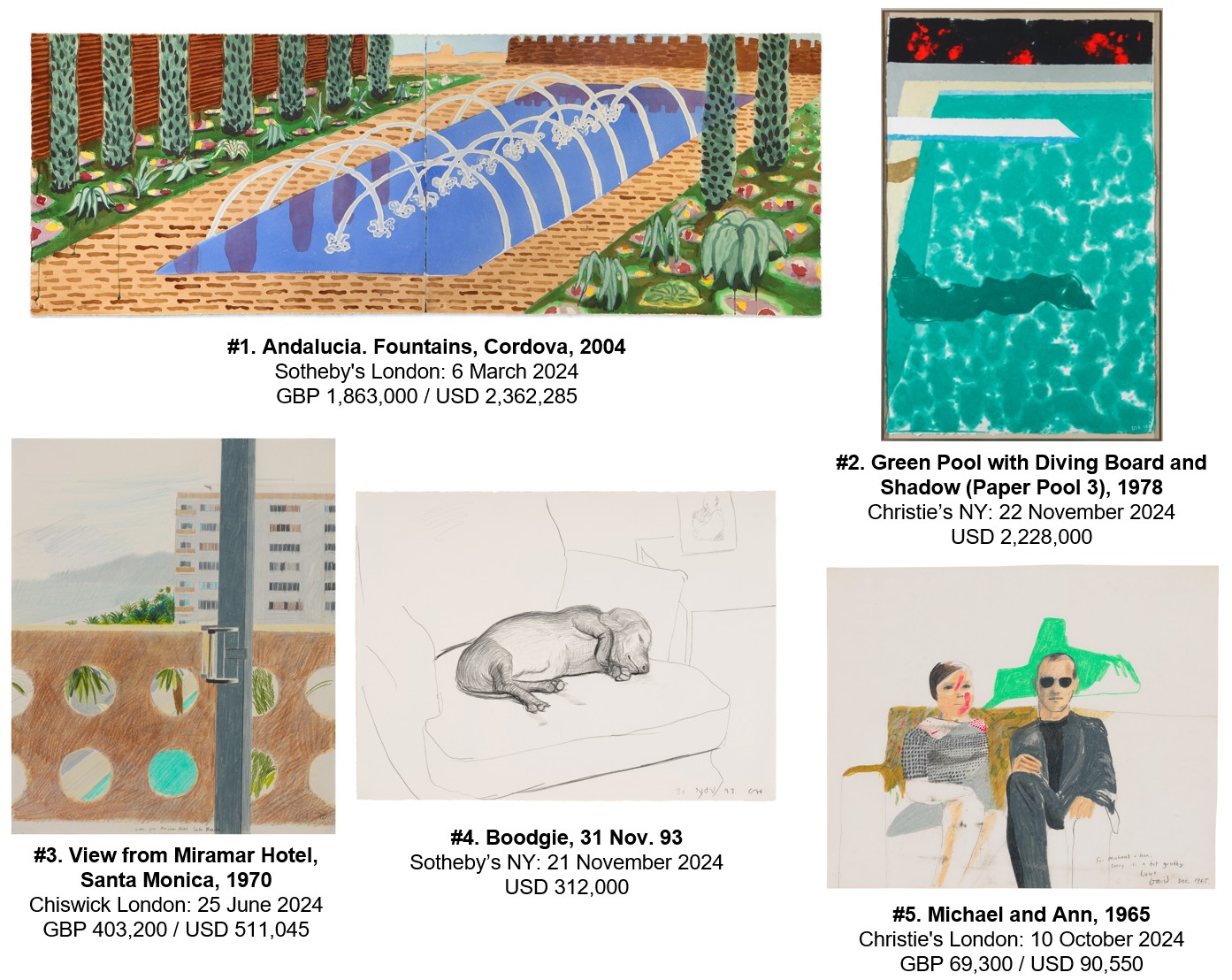
2 lots sold for more than USD 1 million, generating a cumulative turnover of USD 4,590,285, representing 74.8% of the total turnover for 2024. 4 lots sold for more than USD 100,000, generating a cumulative turnover of USD 5,413,330, representing 88.2% of the total turnover for 2024.
2023 Auction Highlights
21 lots sold at auction in 2023 for a total turnover of USD 20,198,725. With 4 lots failing to sell, the sell-through rate is 88.6%. The highest price was achieved by a drawing entitled View from Terrace III, executed in 2003, that sold at Sotheby’s, in New-York, for USD 7,228,500 on 15 November 2023.
2023 Top 5 Lots
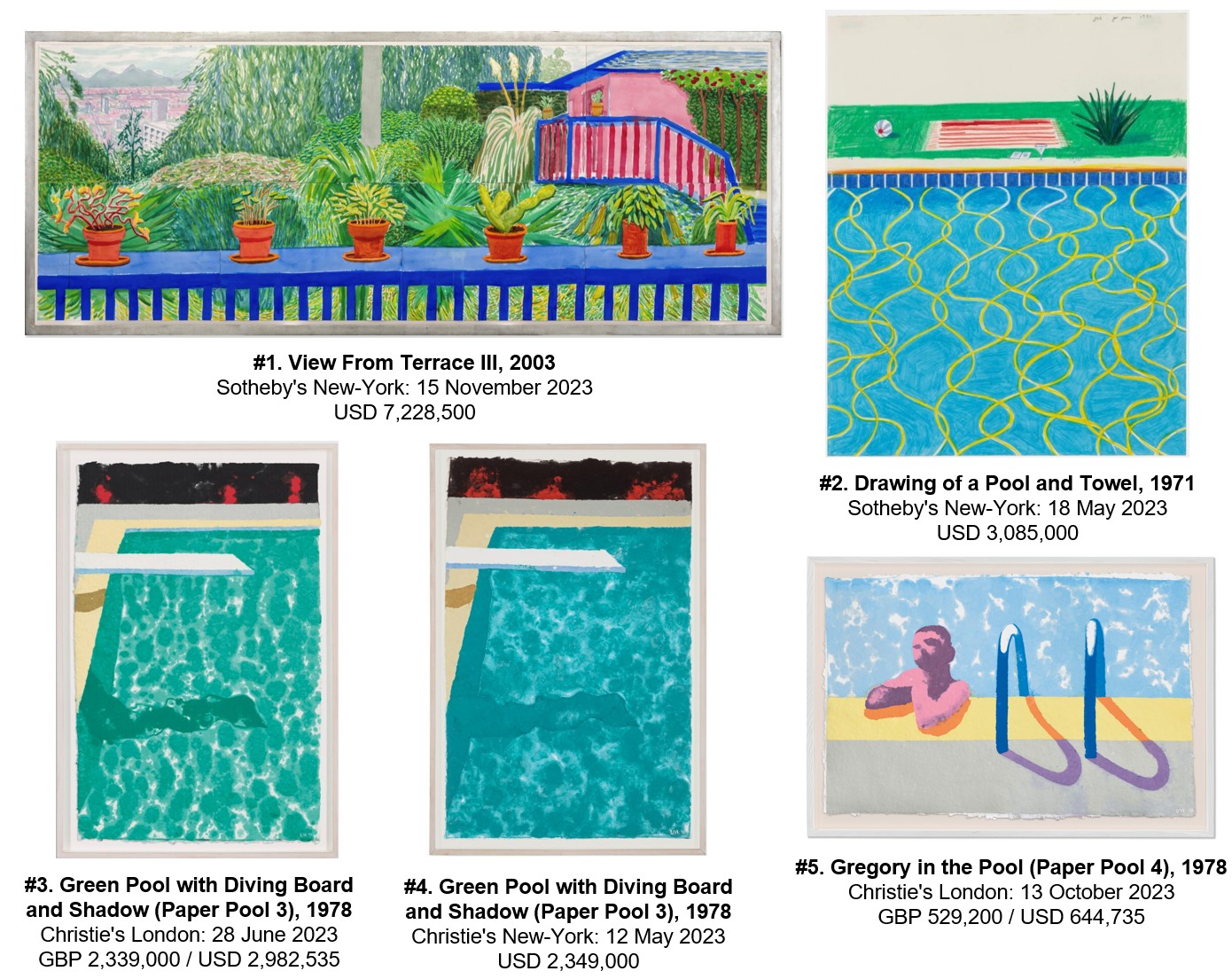
4 lots sold for more than USD 1 million, generating a cumulative turnover of USD 15,645,035, representing 77.4% of the total turnover for 2023. 18 lots sold for more than USD 100,000, generating a cumulative turnover of USD 19,540,545, representing 96.7% of the total turnover for 2023.
2022 Auction Highlights
30 lots sold at auction in 2022 for a total turnover of USD 5,196,763. With 3 lots failing to sell, the sell-through rate is 90.9%. The highest price was achieved by Arlington Hotel, Hot Springs, Arkansas, a drawing dated 1976, sold for USD 1,524,000 at Christie’s, in New-York, on 18 November 2022. This is the only lot that sold for more than USD 1 million.
2022 Top 5 Lots
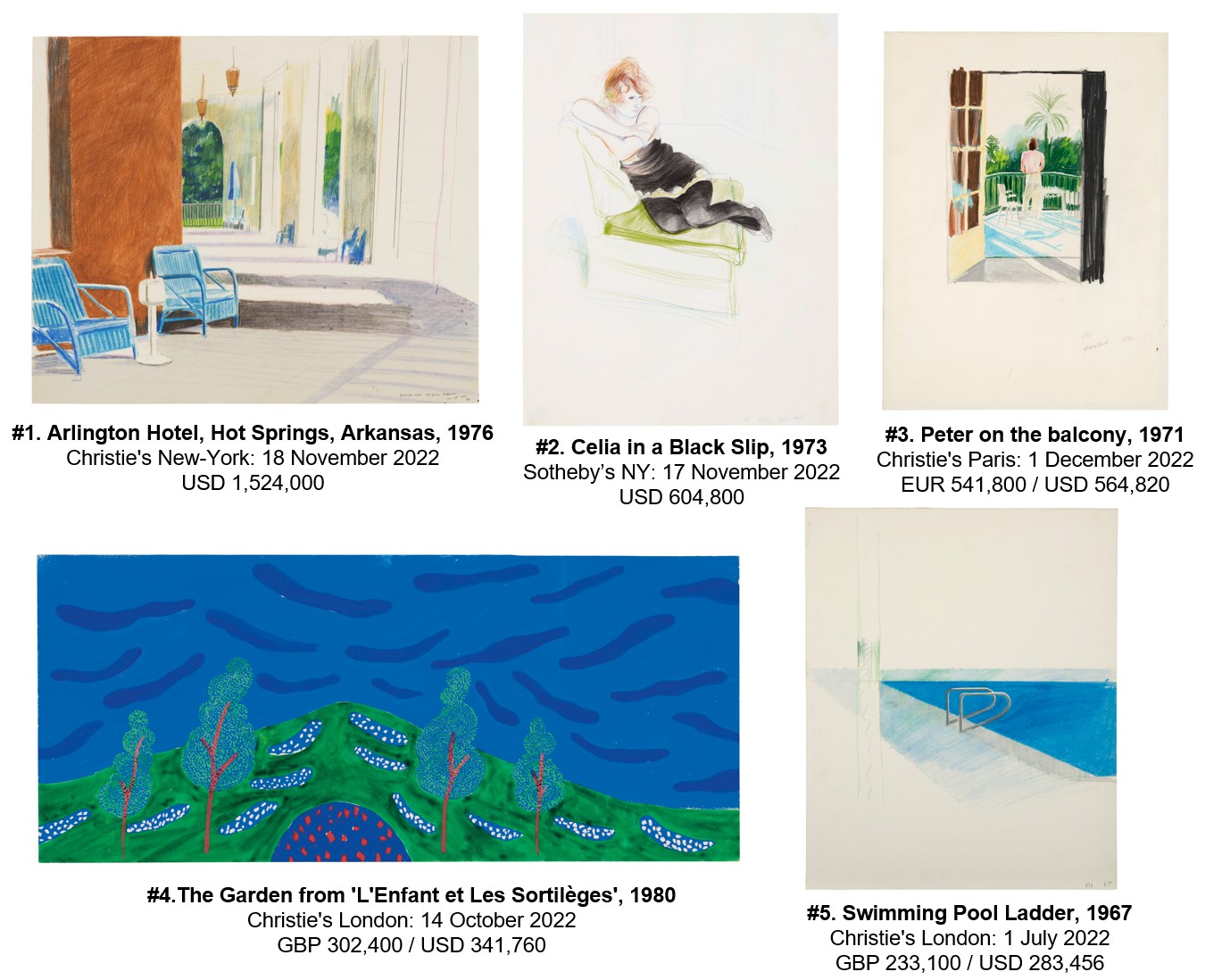
10 lots sold for more than USD 100,000, generating a cumulative turnover of USD 4,273,591, representing 82.2% of the total turnover for 2022.
2026 Auction Results
WORK IN PROGRESS
PRELIMINARY AUCTION RESULTS
As of 15 October 2026
#1. Red Leather Chair, 2003
Phillips London: 15 October 2026
Estimated: GBP 500,000 – 700,000
GBP 645,000 / USD 853,400
WORK ON PAPER
David Hockney Modern & Contemporary Art Evening Sale
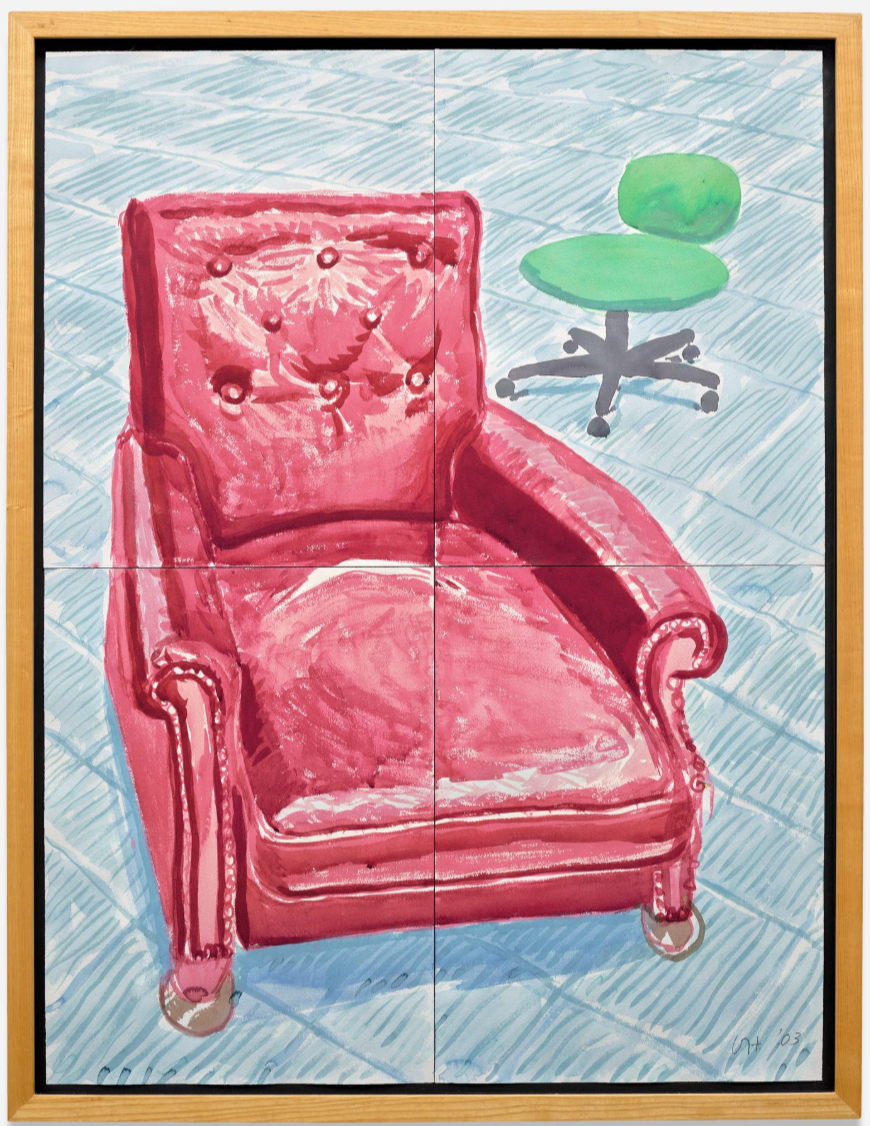
Watercolor on 4 joined sheets of paper
48 x 36-1/4 inches (122 x 92.2 cm)
Signed with the artist’s initials and dated ‘DH. ’03’ lower right
#2. Study for Olympic Poster, 1970
Christie’s London: 5 March 2026
Estimated: GBP 500,000 – 700,000
GBP 635,000 / USD 848,295
WORK ON PAPER
DAVID HOCKNEY (B. 1937), Study for Olympic Poster | Christie’s
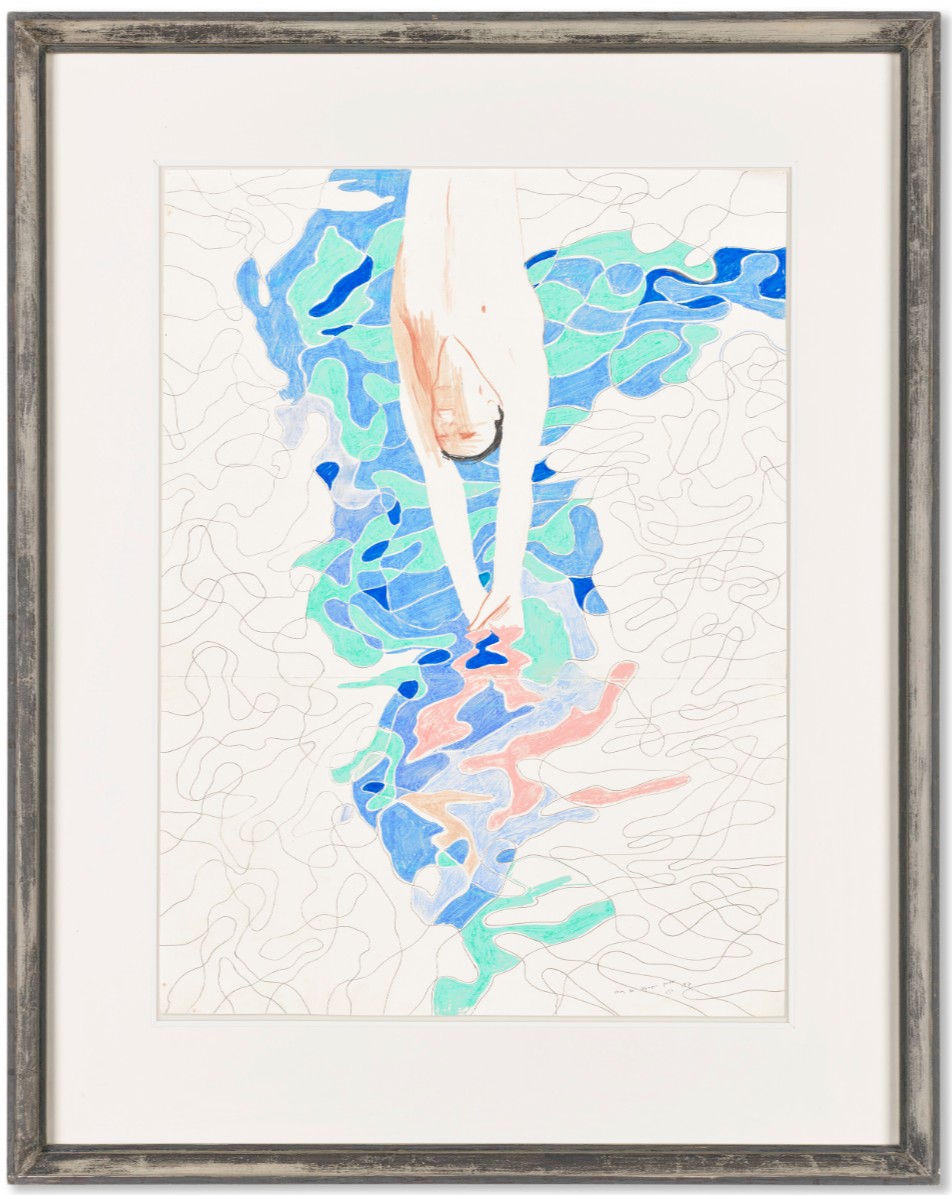
DAVID HOCKNEY (B. 1937)
Study for Olympic Poster, 1970
Colored pencil and graphite on two adjoined sheets of paper
33-5/8 x 24-3/4 inches (85.4 x 63 cm)
Signed with the artist’s initials, titled and dated ‘study for Olympic poster DH. 1970.’ (lower right)
USD 500,000
#3. Cataract Hotel Aswan, 1978
Bonhams London: 15 October 2026
Estimated: GBP 70,000 – 100,000
GBP 358,900 / USD 475,720
WORK ON PAPER
Bonhams : DAVID HOCKNEY (1937-2026) Cataract Hotel Aswan (Executed in 1978)
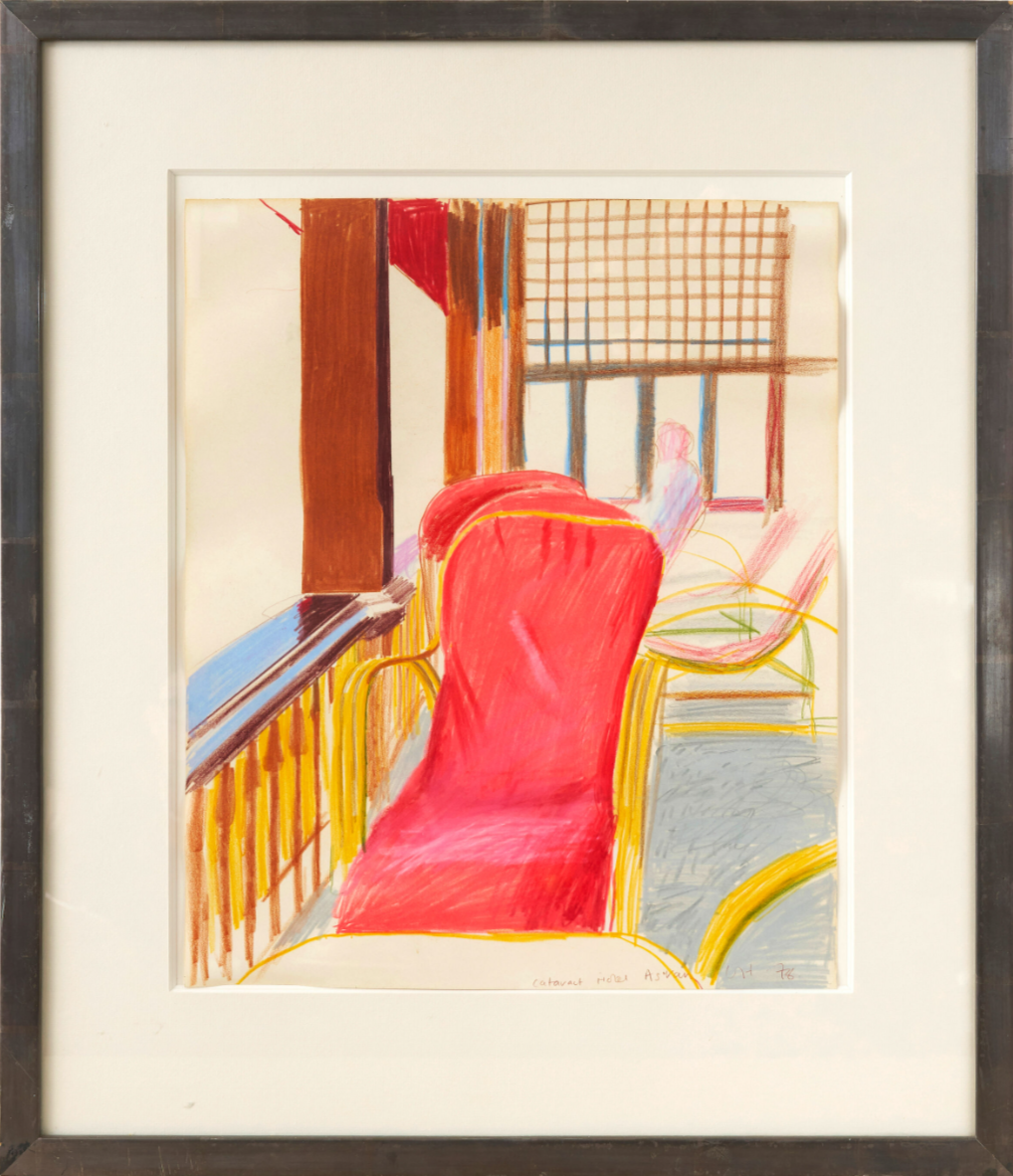
DAVID HOCKNEY (1937-2026)
Cataract Hotel Aswan, 1978
Colored pencil on paper
17 1/8 x 14 inches (43.5 x 35.5cm)
Signed with the artist’s initials, titled and dated ‘Cataract Hotel Aswan DH 78’ (lower right)
#4. Portrait of Peter Langan and Jean-Marc Moussis, 1975
Phillips London: 15 October 2026
Estimated: GBP 200,000 – 300,000
GBP 232,200 / USD 307,225
WORK ON PAPER
David Hockney Modern & Contemporary Art Evening Sale
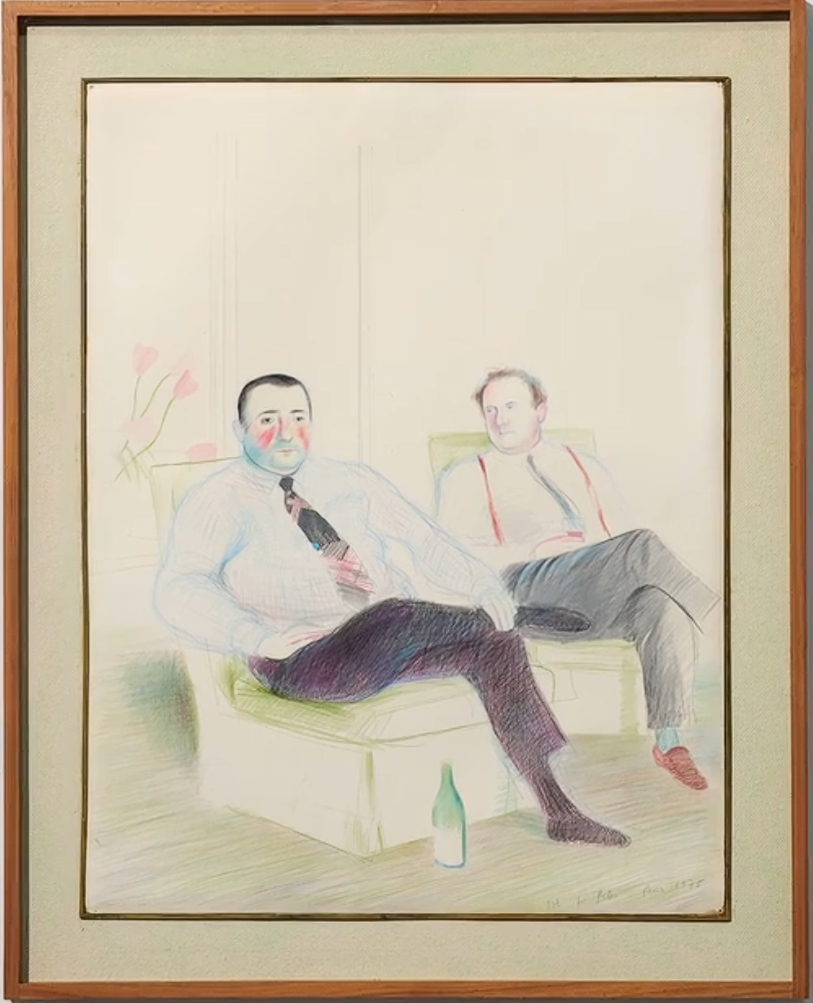
DAVID HOCKNEY
Portrait of Peter Langan and Jean-Marc Moussis, 1975
Crayon on paper
25 1/4 x 19 1/4 inches (64.2 x 49 cm)
Signed with the artist’s initials, inscribed, dedicated and dated ‘DH. for Peter Paris 1975’ lower right
#5. Sony TV, 1968
Phillips London: 17 October 2026
Estimated: GBP 100,000 – 150,000
GBP 232,200 / USD 206,330
WORK ON PAPER
David Hockney Modern & Contemporary Art
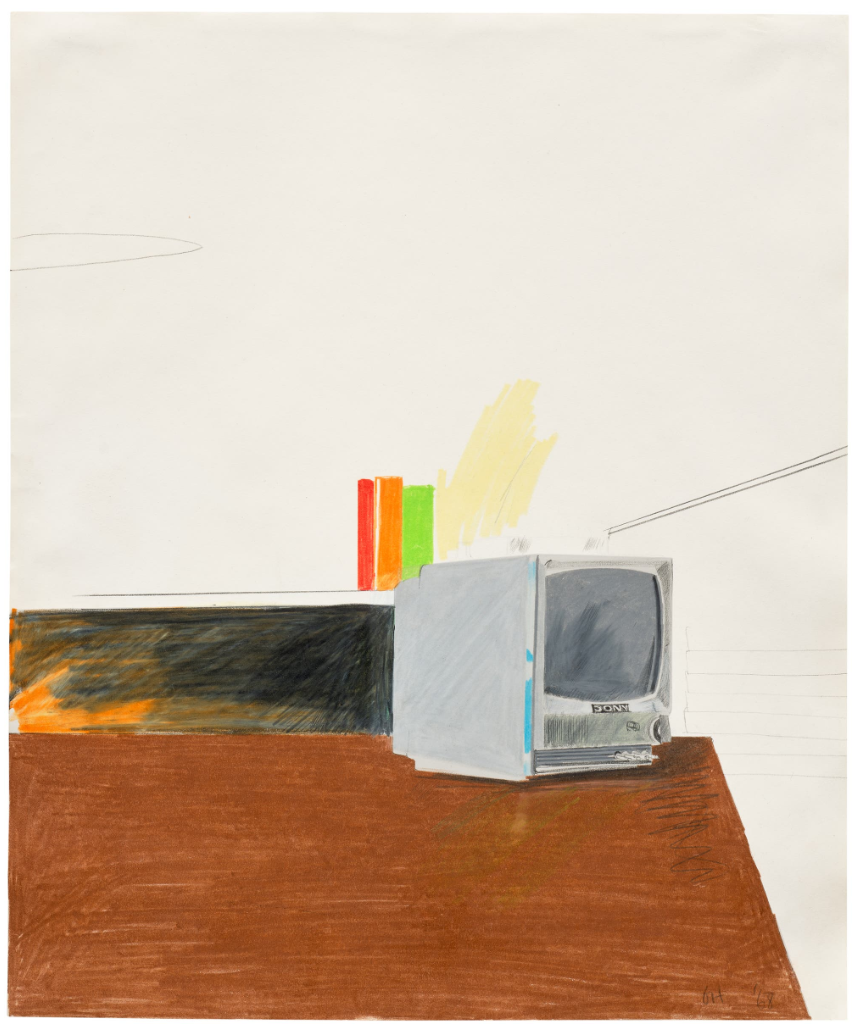
DAVID HOCKNEY
Sony TV, 1968
Crayon and pencil on paper
16-3/4 x 14 inches (42.6 x 35.6 cm)
Signed with the artist’s initials and dated ‘DH 68’ lower right
#6. Deck Gate, 2000
Phillips London: 17 October 2026
Estimated: GBP 100,000 – 150,000
GBP 232,200 / USD 206,330
WORK ON PAPER
David Hockney Modern & Contemporary Art Evening Sale
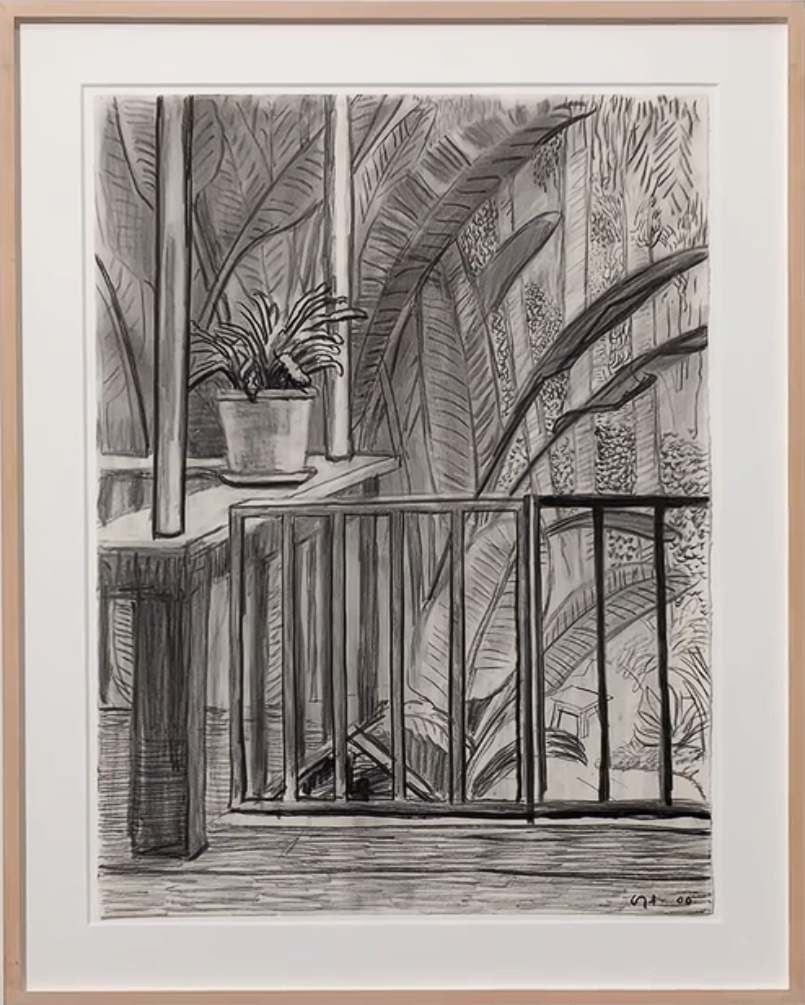
DAVID HOCKNEY
Deck Gate, 2000
Charcoal on paper
30 1/8 x 22 1/2 inches (76.4 x 57.1 cm)
Signed with the artist’s initials and dated ‘DH 00’ lower right
#7. Hotel Courtyard, 1984
Property from a Distinguished East Coast Collection
Sotheby’s New-York: 15 May 2026
Estimated: USD 60,000 – 80,000
USD 179,200
WORK ON PAPER
David Hockney | Hotel Courtyard | Contemporary Day Auction | 2026 |
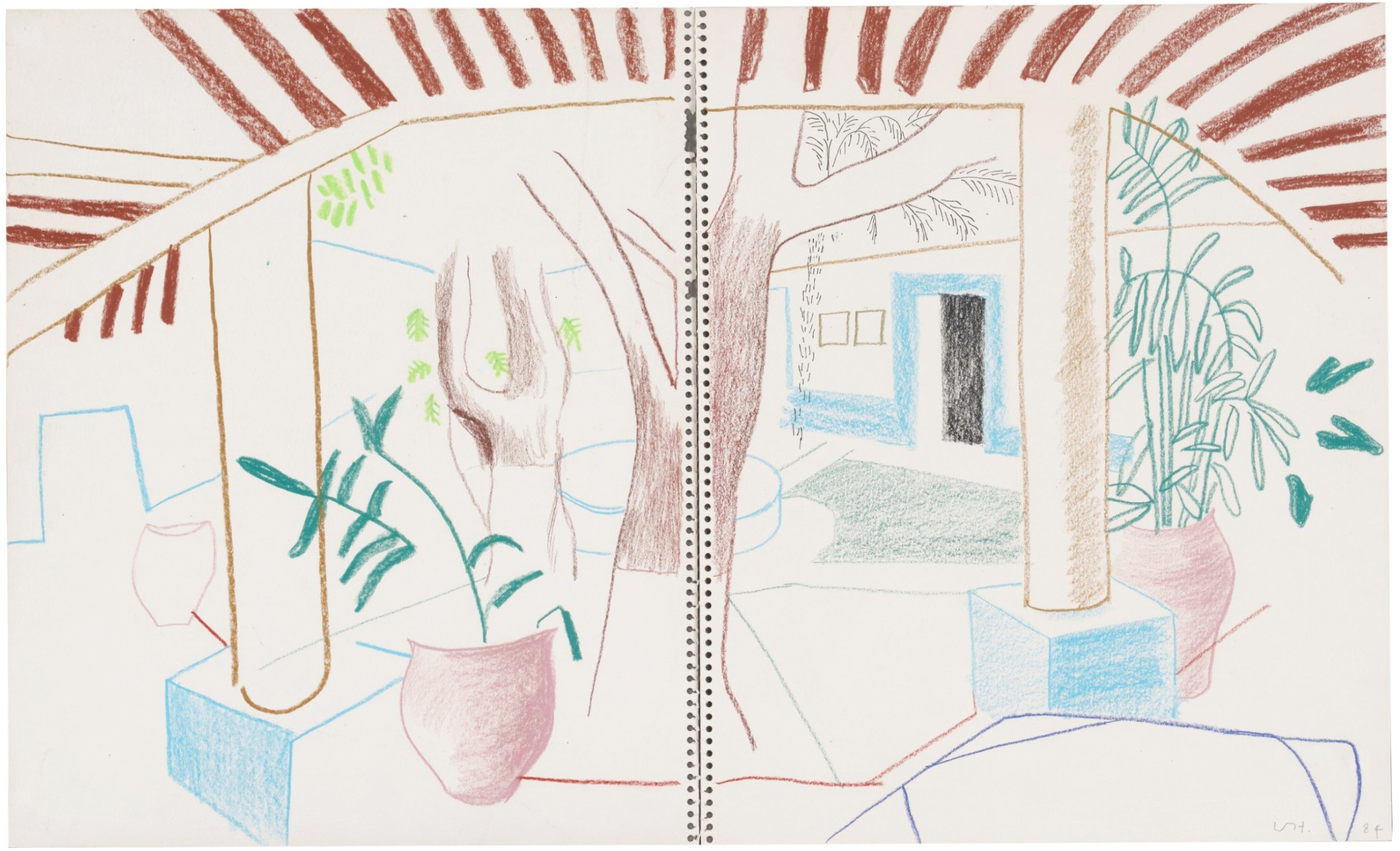
DAVID HOCKNEY (b. 1937)
Hotel Courtyard, 1984
Pastel and ink on paper in 2 parts
Each: 16×13 inches (40.6 x 33 cm)
Overall: 16×26 inches (40.6 x 67.3 cm)
Signed with the artist’s initials and dated 84 (lower right)
#8. Café with Palm Tree and Clouds …, 1979-80
Christie’s New-York: 1 October 2026
Estimated: USD 100,000 – 150,000
USD 153,600
WORK ON PAPER
DAVID HOCKNEY (1937-2026), Café with Palm Tree and Clouds Surrounded by a Curtain | Christie’s
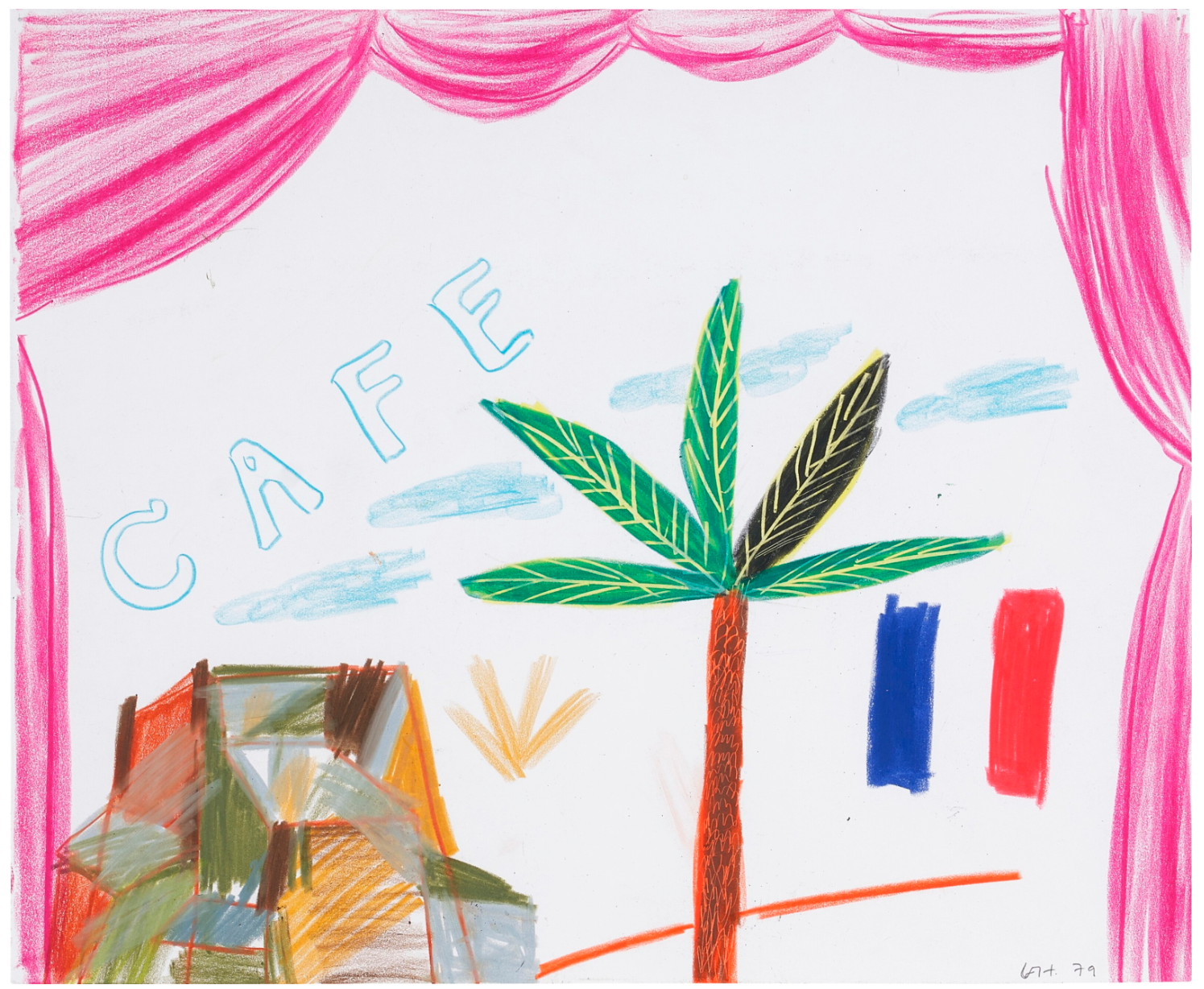
DAVID HOCKNEY (1937-2026)
Café with Palm Tree and Clouds Surrounded by a Curtain, 1979-80
Wax crayon on paper
14×17 inches (35.6 x 43.2 cm)
Signed with the artist’s initials and dated ‘DH. 79’ (lower right)
#9. Two Red Peppers, 1970
Chiswick Auctions: 30 June 2026
Estimated: GBP 60,000 – 80,000
GBP 107,100 / USD 141,980
WORK ON PAPER
Lot 99 – David Hockney O.M. C.H. R.A. (British,
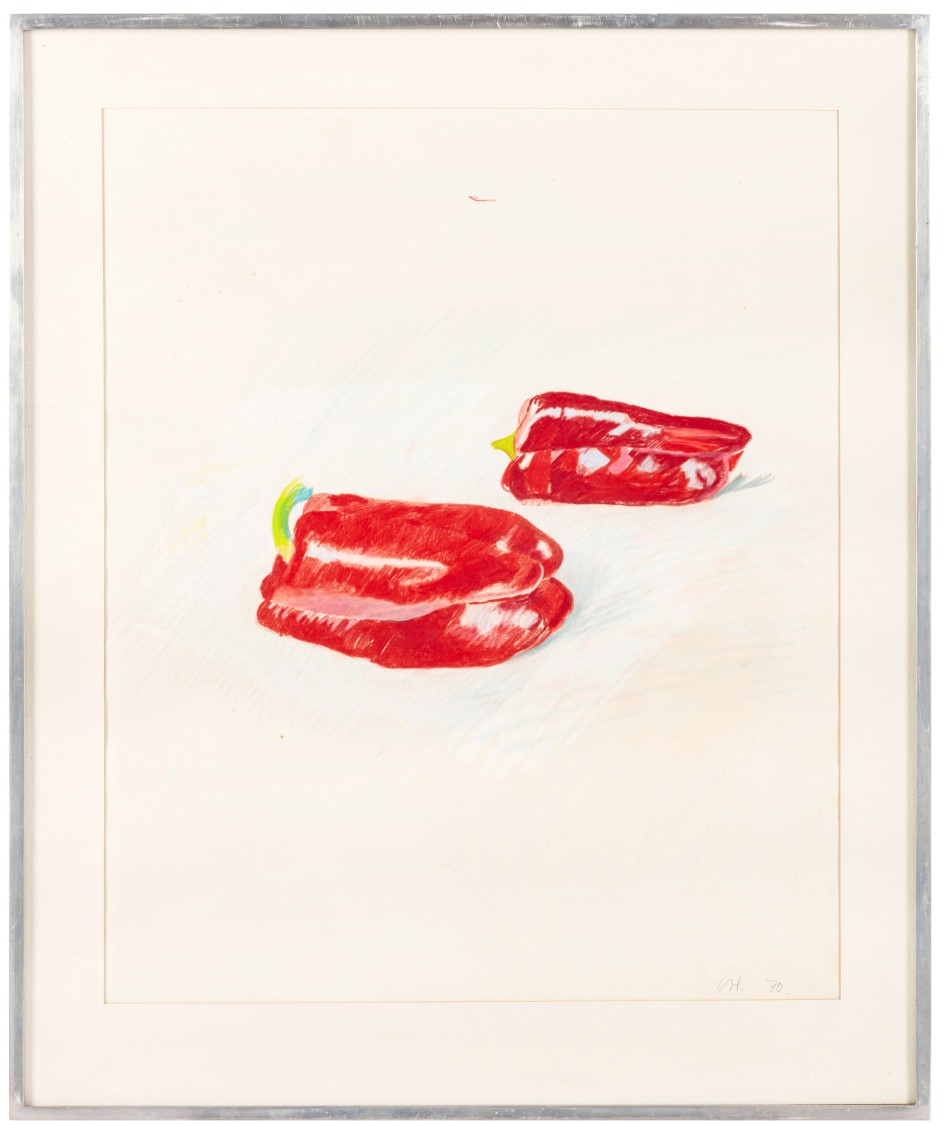
DAVID HOCKNEY (British, 1937-2026)
Two Red Peppers, 1970
Crayon and pencil
16-1/4 x 14 inches (42 x 35.5 cm)
Signed with initials and dated ‘DH 70’ (lower right)
#10. Robert Littman, Los Angeles, 3 September 1999
Christie’s London: 19 March 2026
Estimated: GBP 20,000 – 30,000
GBP 82,550 / USD 110,205
WORK ON PAPER
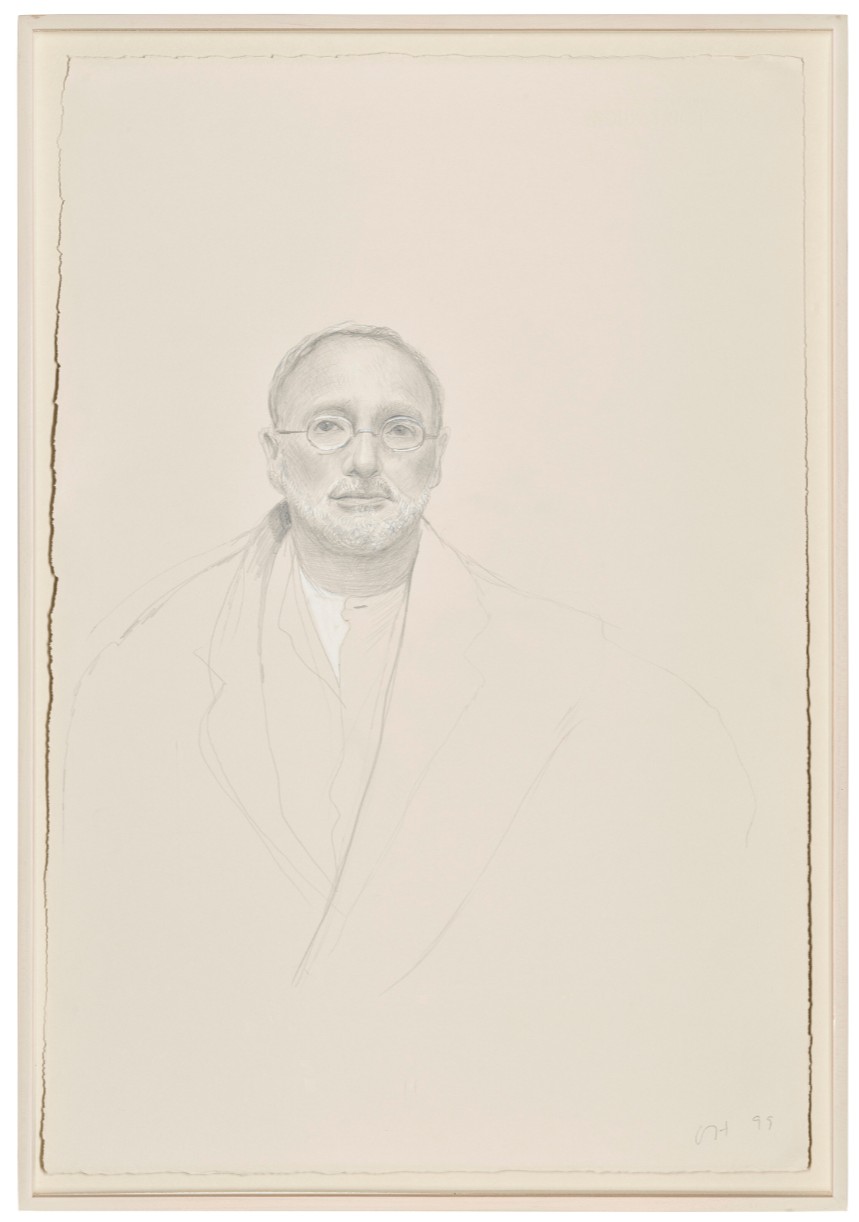
DAVID HOCKNEY, O.M., C.H., R.A. (B. 1937)
Robert Littman, Los Angeles, 3 September 1999
Pencil and white crayon on light grey paper, using a camera lucida
22×15 inches (55.9 x 38.1 cm)
Signed with initials and dated ‘DH 99’ (lower right)
USD 100,000
#11. Edward Who Has Cold Lips, 1961
Bonhams London: 24 June 2026
Estimated: GBP 25,000 – 35,000
GBP 70,250 / USD 92,440
WORK ON PAPER
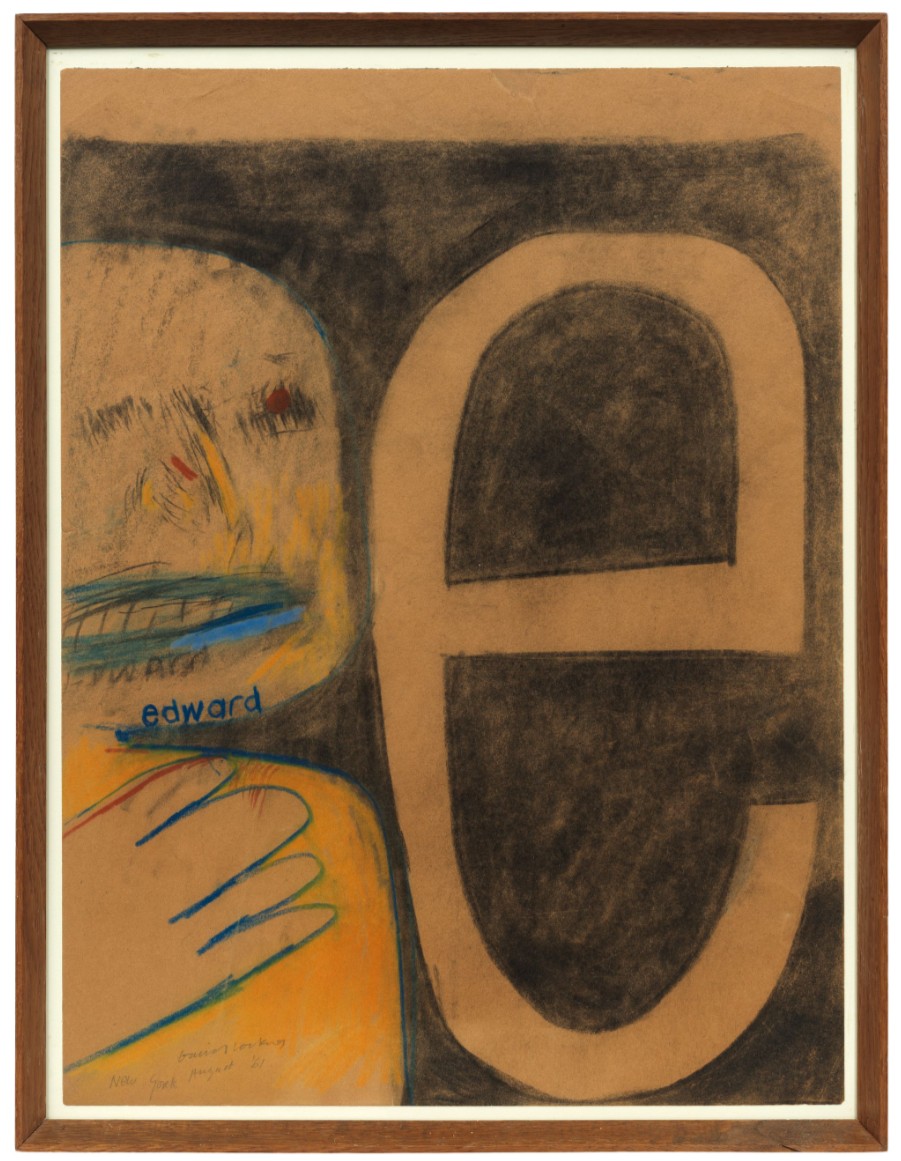
DAVID HOCKNEY (British, born 1937)
Edward Who Has Cold Lips, 1961
Charcoal and crayon
24×18 inches (60.8 x 45.7 cm)
Signed, inscribed and dated ‘David Hockney/New York. August ’61’ (lower left)
Gregory Evans, 2002
Christie’s New-York: 21 May 2026
Estimated: USD 30,000 – 50,000
USD 82,550
WORK ON PAPER
DAVID HOCKNEY (B. 1937), Gregory Evans | Christie’s
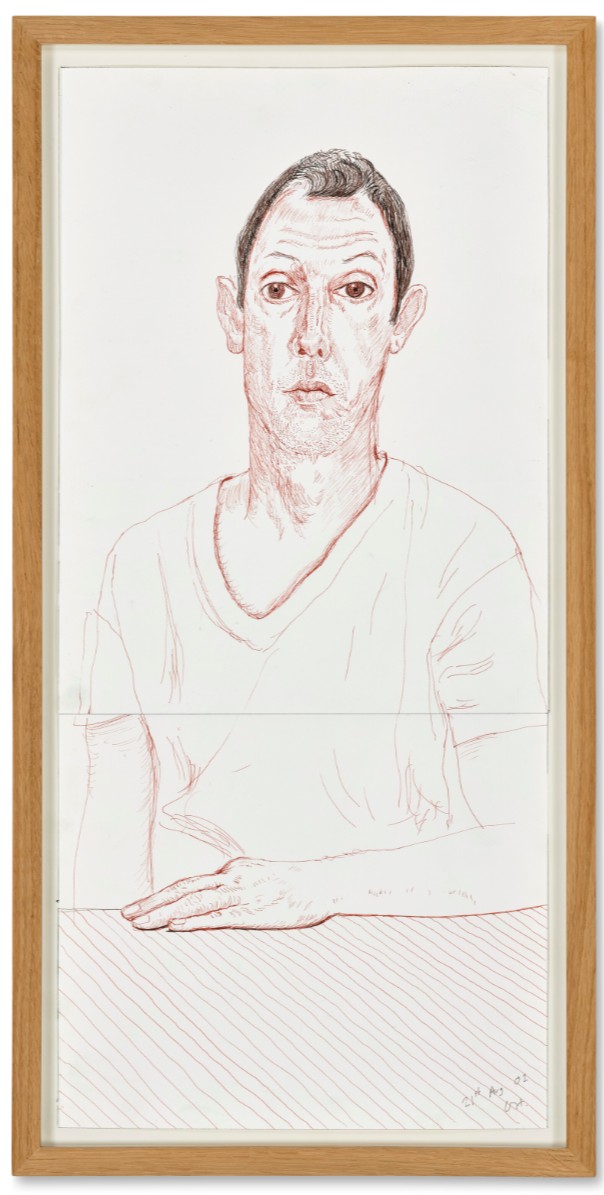
DAVID HOCKNEY (B. 1937)
Gregory Evans, 2002
Ink on two sheets of paper
26-1/2 x 12-1/4 inches (66.3 x 30.7 cm)
Signed with the artist’s initials and dated ’21st Aug 02 DH.’ (lower right)
Study of Apples, 1972
Sotheby’s Paris: 12 February 2026
Estimated: EUR 40,000 – 60,000
EUR 69,850 / USD 82,905
Study of apples | Contemporary Discoveries | 2026 | Sotheby’s
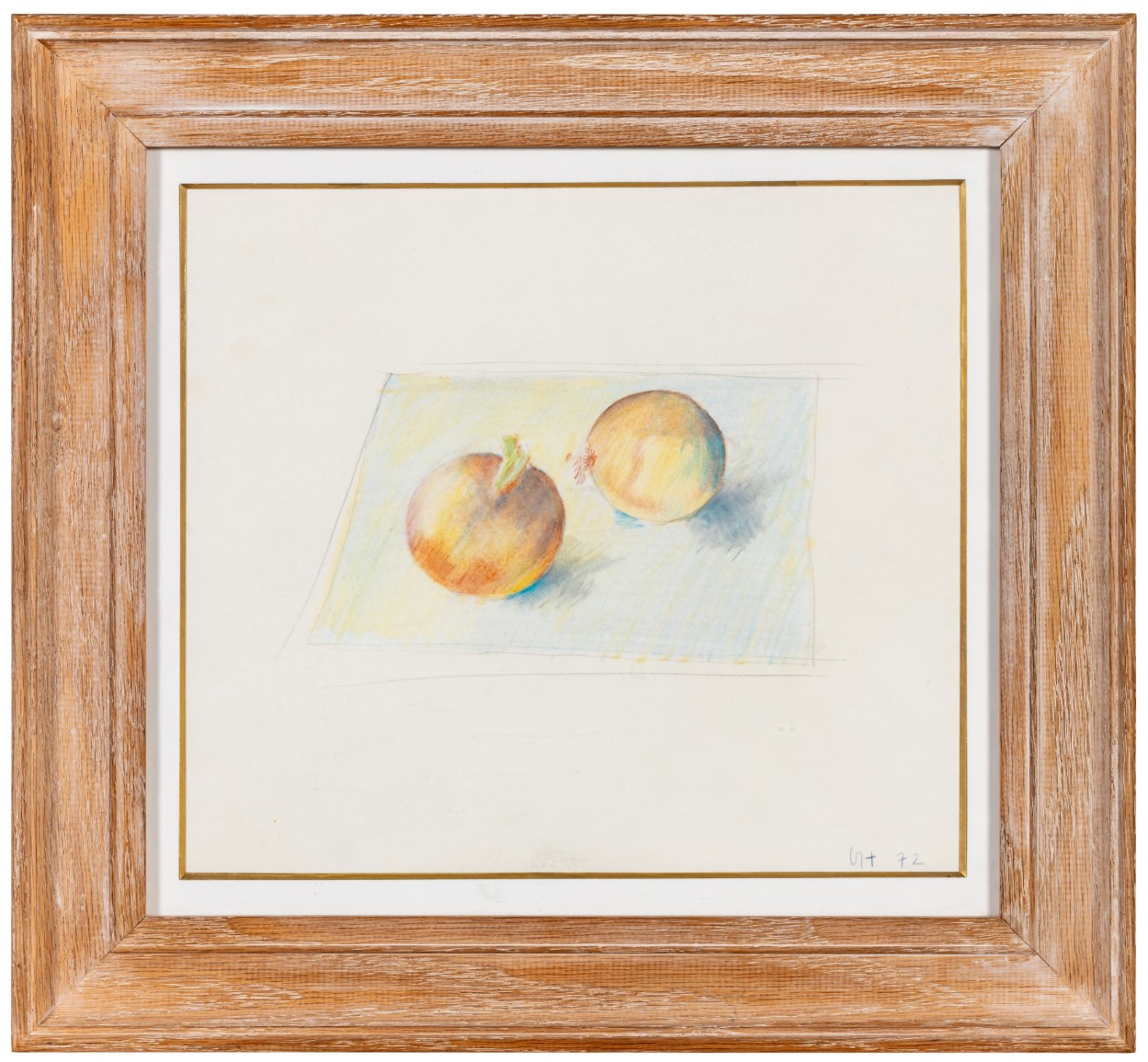
DAVID HOCKNEY (b. 1937)
Study of Apples, 1972
Graphite and color pencils
10-1/2 x 11-7/8 inches (26.5 x 30.4 cm)
Signed with the artist’s initials and dated 72 (lower right)
2025 Auction Results
28 lots sold at auction in 2025 for a total turnover of USD 6,472,247. With 2 lots failing to sell, the sell-through rate is 93%. The highest price was achieved by Terrace Hollywood Hills House with Banana Tree, a drawing dated 1982, sold for USD 2,487,000 at Sotheby’s, in New-York, on 16 May 2025.
2025 top 5 Lots
2 lots sold for more than USD 1 million, generating a cumulative turnover of USD 3,878,500, representing 59.9% of the total turnover for 2025. 9 lots sold for more than USD 100,000, generating a cumulative turnover of USD 5,565,561, representing 86% of the total turnover of 2025.
XXXXXXXXXX
#1. Terrace Hollywood Hills House with Banana Tree, 1982
Property from an Important Chicago Collection
Sotheby’s New-York: 16 May 2025
Estimated: USD 1,200,000 – 1,800,000
USD 2,487,000
WORK ON PAPER
Terrace Hollywood Hills House with Banana Tree | Contemporary Day Auction | 2025 | Sotheby’s
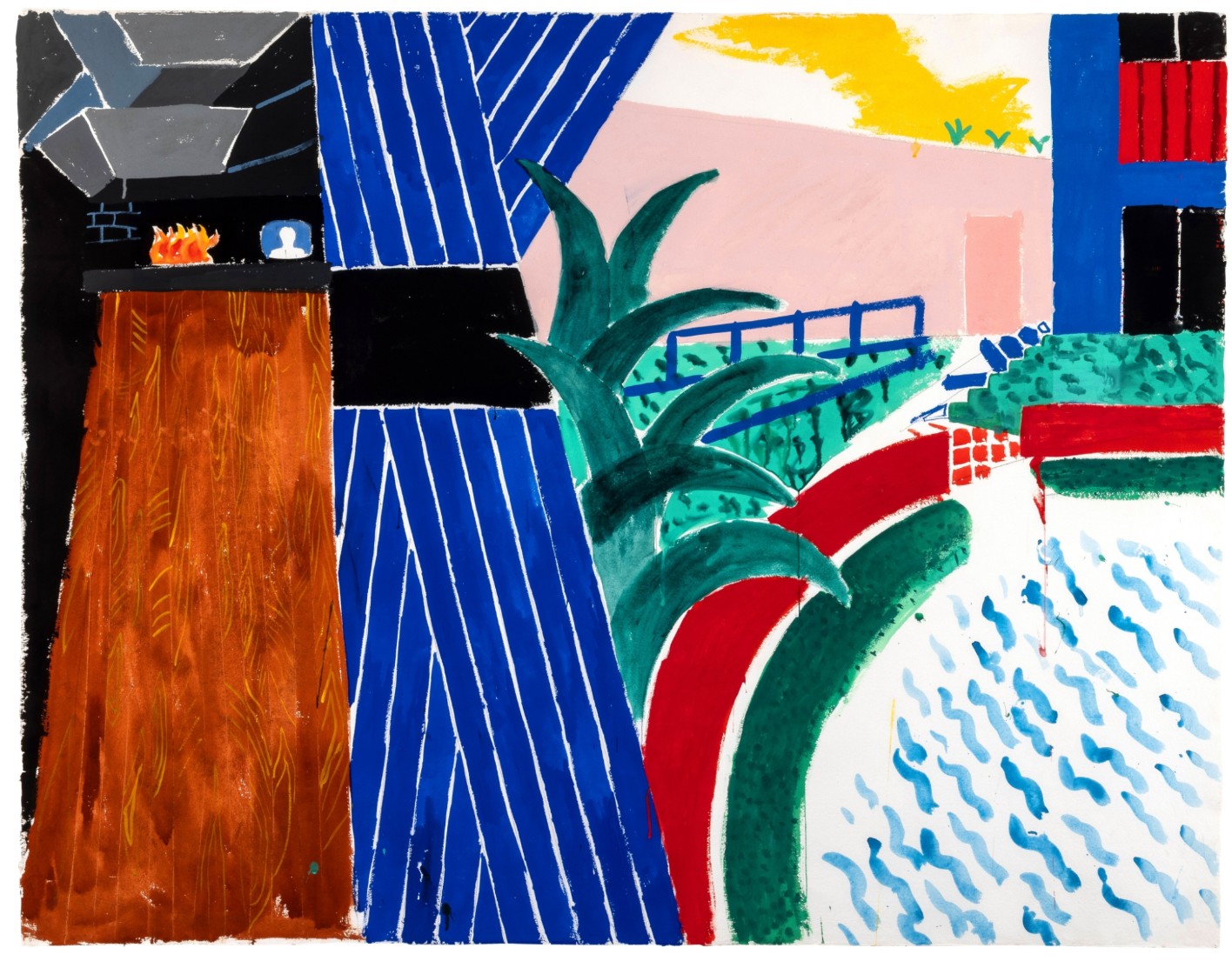
DAVID HOCKNEY (b. 1937)
Terrace Hollywood Hills House with Banana Tree, 1982
Gouache and graphite on paper
51 1/8 x 65 7/8 inches (129.8 x 167.3 cm)
#2. Courtyard, Palace of Carlos V. Alhambra, Granada (Second Version), 2004
Bonhams New-York: 19 November 2025
Estimated: USD 1,200,000 – 1,800,000
USD 1,391,500
WORK ON PAPER
Bonhams : DAVID HOCKNEY (B. 1937) Courtyard, Palace of Carlos V. Alhambra, Granada
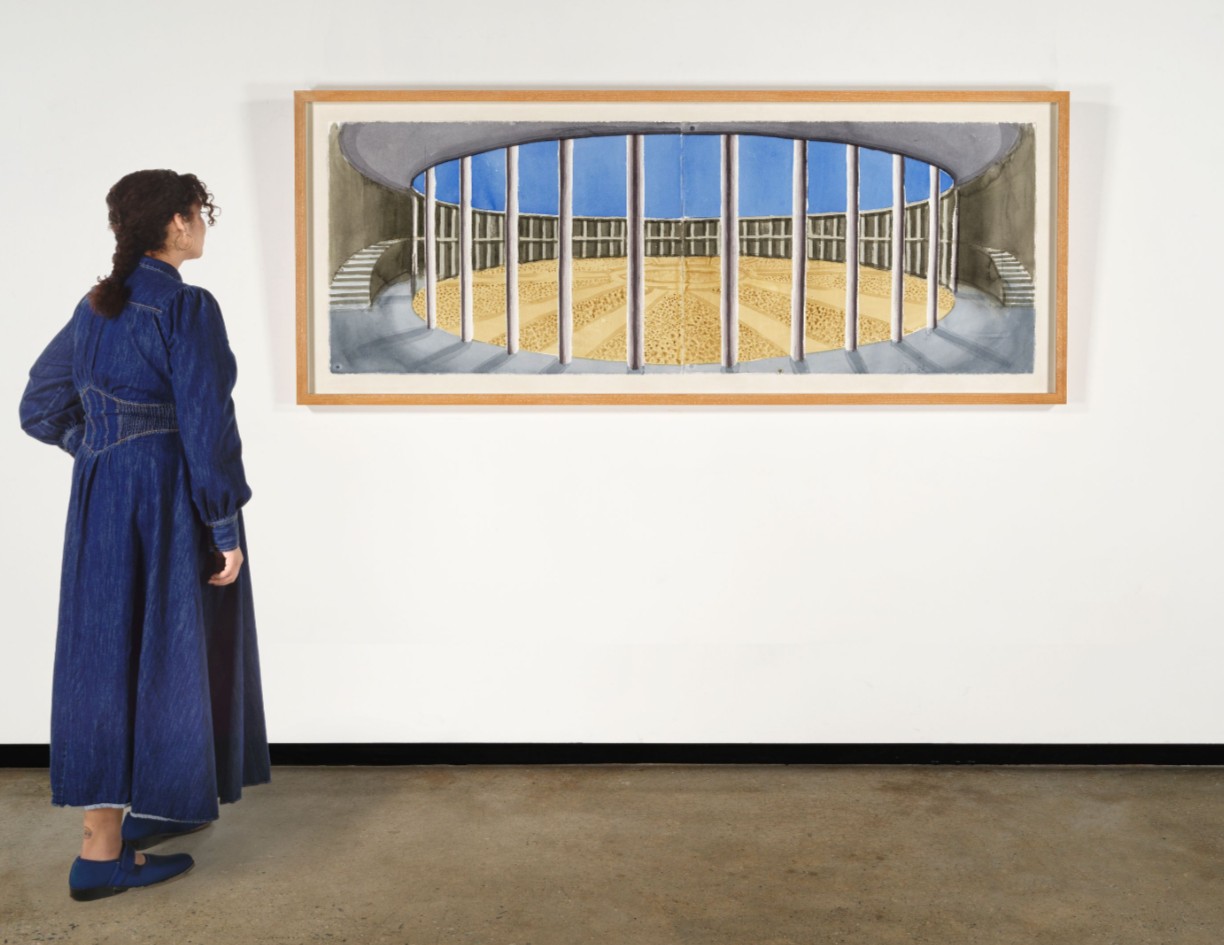
DAVID HOCKNEY (B. 1937)
Courtyard, Palace of Carlos V. Alhambra, Granada (Second Version), 2004
Watercolor on two sheets of paper
29 1/2 x 83 inches (74.9 x 210.8 cm)
Signed with the artist’s initials and dated ‘D.H. 04’ (lower right)
USD 1 million
#3. Gouache Drawing, 1994
Christie’s New-York: 27 February 2025
Estimated: USD 400,000 – 600,000
USD 541,800
WORK ON PAPER
DAVID HOCKNEY (B. 1937), Gouache Drawing, 1994 | Christie’s
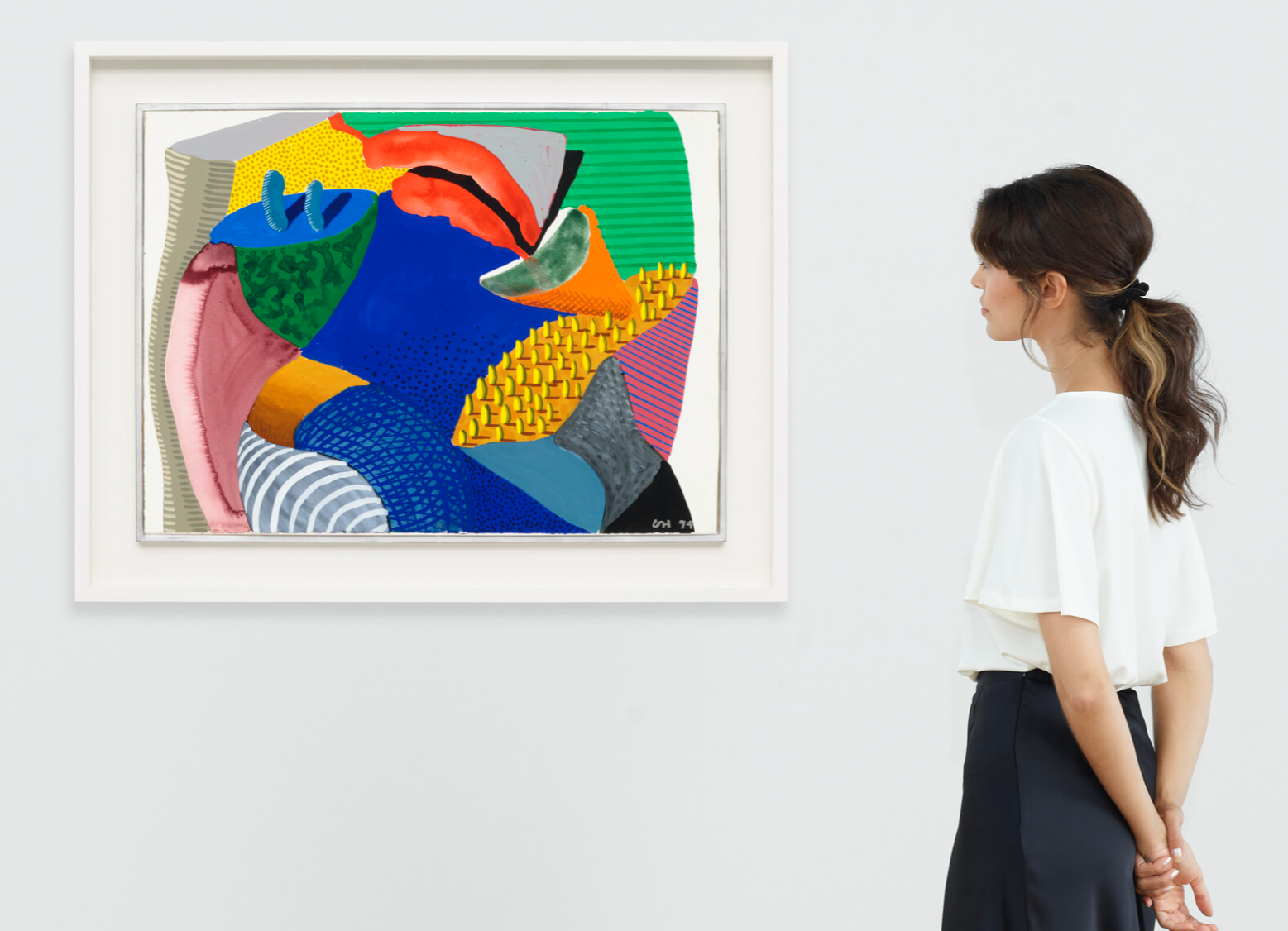
DAVID HOCKNEY (B. 1937)
Gouache Drawing, 1994
Gouache on paper
22 1/4 x 30 1/4 inches (56.5 x 76.8 cm)
Signed with the artist’s initials and dated ‘DH 94’ (lower right)
USD 500,000
#4. Peter, Swimming Pool, Encino, California, 1966
Christie’s London: 16 October 2025
Estimated: GBP 150,000 – 200,000
GBP 292,100 / USD 391,415
WORK ON PAPER
DAVID HOCKNEY (B. 1937), Peter, Swimming Pool, Encino, California | Christie’s
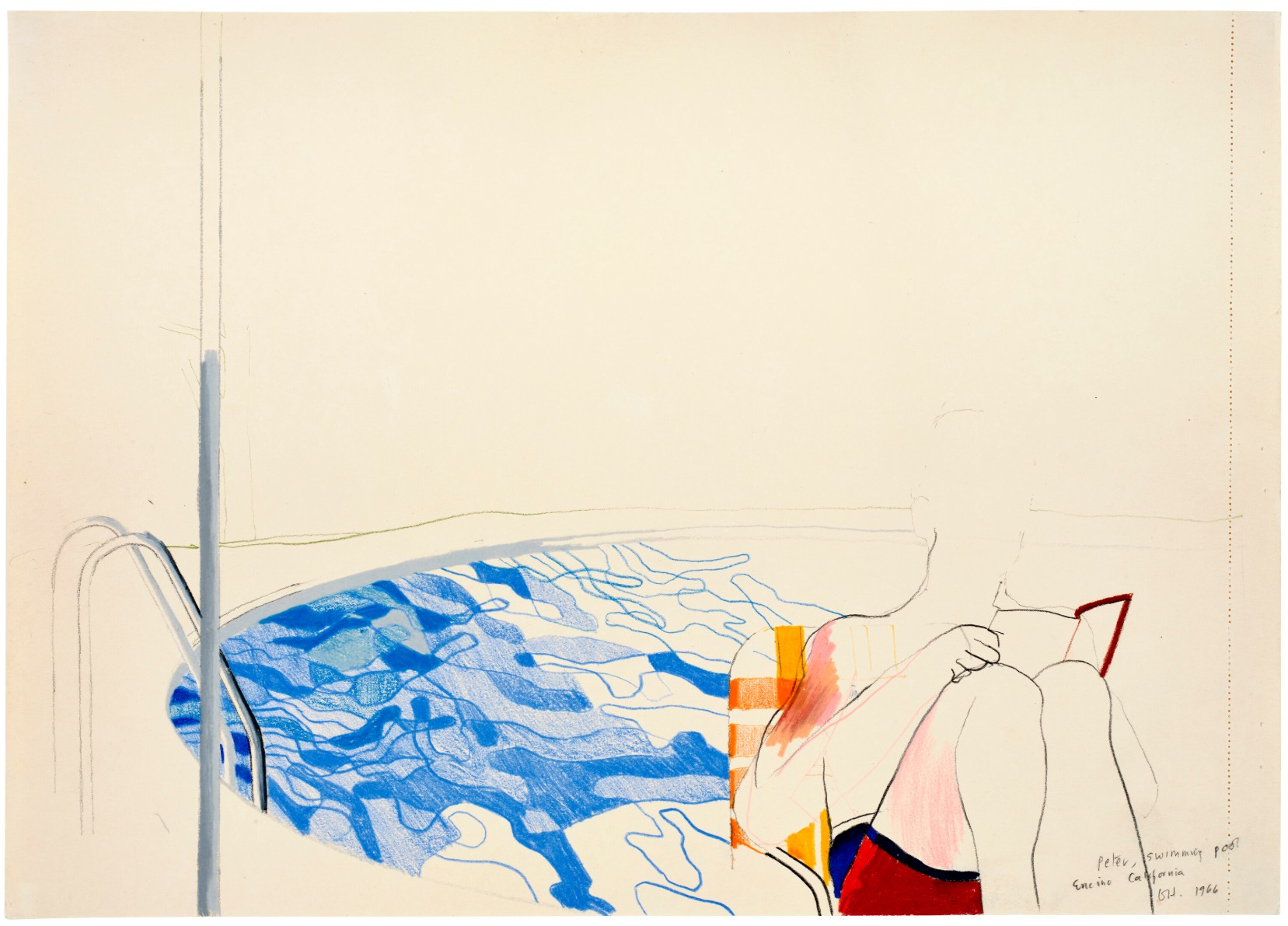
DAVID HOCKNEY (B. 1937)
Peter, Swimming Pool, Encino, California, 1966
Wax crayon, colored pencil and graphite on paper
12 x 16 3/4 inches (30.4 x 42.6 cm)
Signed with the artist’s initials
Titled and dated ‘Peter, swimming pool Encino California DH. 1966’ (lower right)
#5. Self Portrait, Weekend of March 3, 2001, 2001
PROPERTY FROM A DISTINGUINSHED WEST COAST COLLECTION
Christie’s London: 23 October 2025
Estimated: GBP 60,000 – 80,000
GBP 165,100 / USD 220,415
WORK ON PAPER
DAVID HOCKNEY, O.M., C.H., R.A. (B. 1937), Self Portrait, Weekend of March 3, 2001 | Christie’s
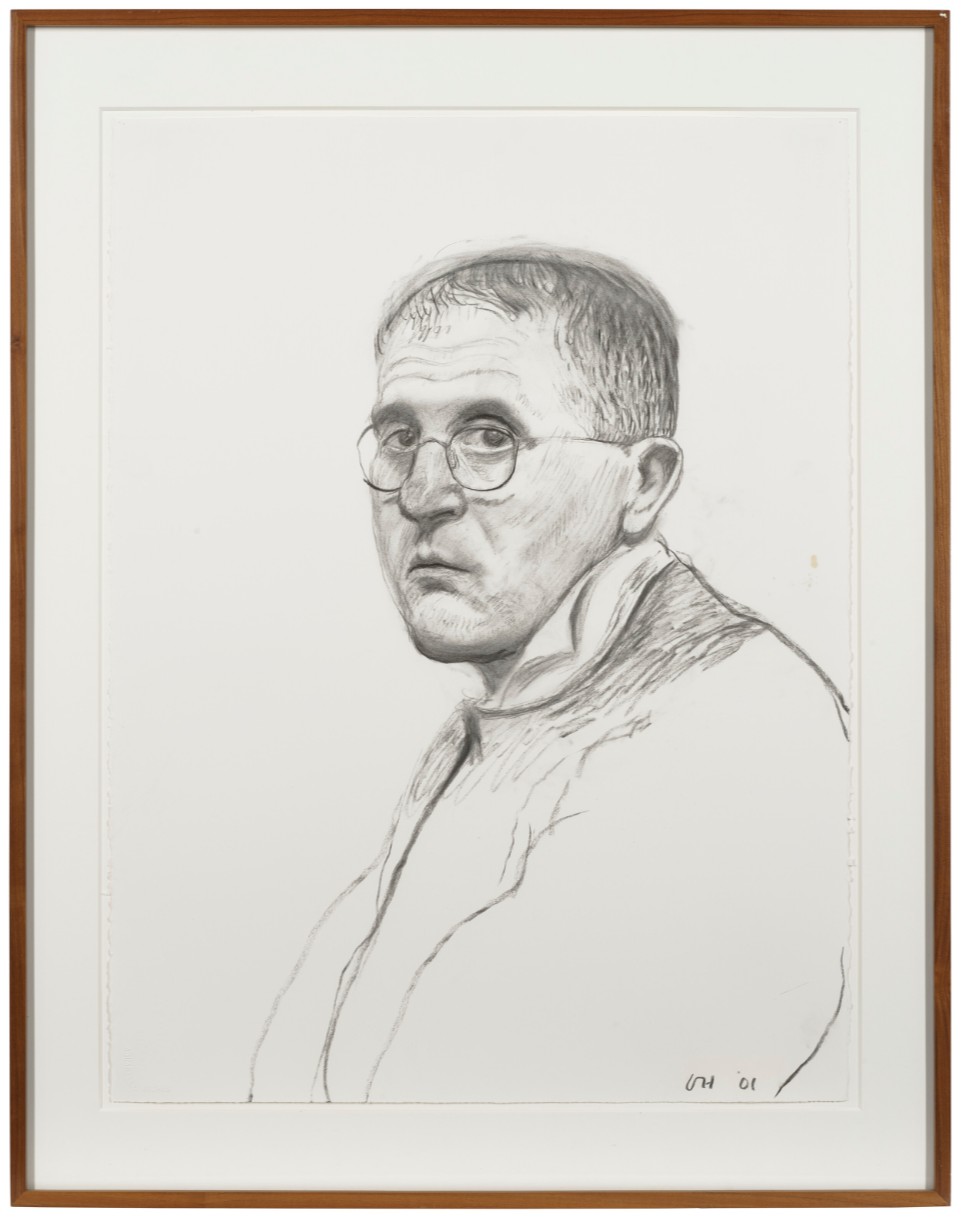
DAVID HOCKNEY, O.M., C.H., R.A. (B. 1937)
Self Portrait, Weekend of March 3, 2001, 2001
Charcoal on paper
30 x 22 1/2 inches (76.2 x 57.1 cm)
Signed with initials and dated ‘DH 01’ (lower right)
#6. House in Aswan, 1978
Christie’s London: 26 June 2025
Estimated: GBP 70,000 – 90,000
GBP 119,700 / USD 163,990
WORK ON PAPER
DAVID HOCKNEY (B. 1937), House in Aswan | Christie’s
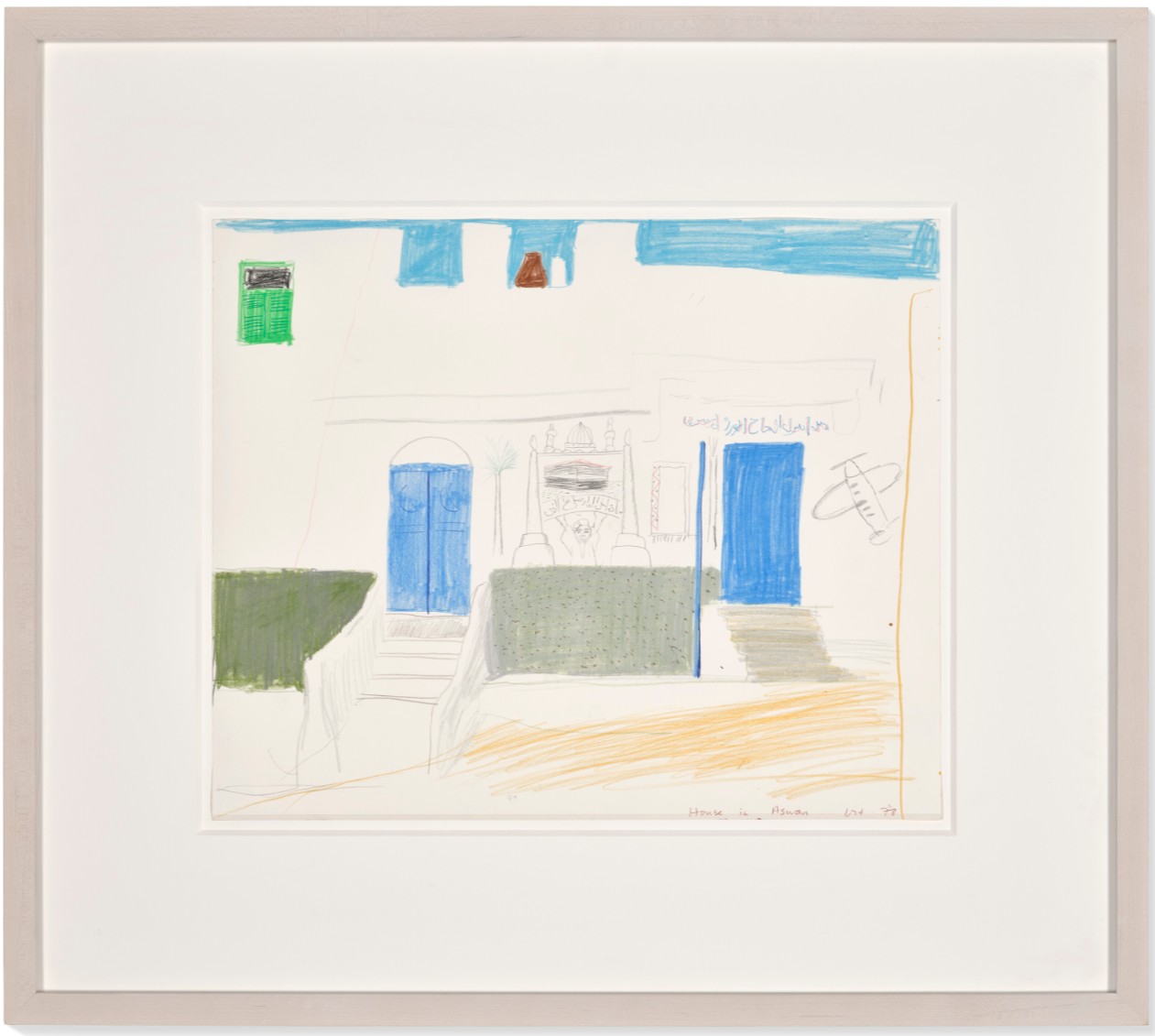
DAVID HOCKNEY (B. 1937)
House in Aswan, 1978
Wax crayon, color pencil and graphite on paper
14 x 16 7/8 inches (35.5 x 42.8 cm)
Signed with the artist’s initials, titled and dated ‘House in Aswan DH 78’ (lower right)
#7. Real Landscape, 1969
Sotheby’s New-York: 16 May 2025
Estimated: USD 150,000 – 250,000
USD 127,000
WORK ON PAPER
Real Landscape | Contemporary Day Auction | 2025 | Sotheby’s
DAVID HOCKNEY (b. 1937)
Real Landscape, 1969
Colored pencil and graphite on paper
Image: 16 x 24 2/4 inches (40.6 x 61.6 cm)
Sheet: 20 1/2 x 25 inches (52.1 x 63.5 cm)
#8. Water, 1966
Phillips London: 26 June 2025
Estimated: GBP 60,000 – 80,000
GBP 88,900 / USD 121,795
WORK ON PAPER
David Hockney Modern & Contemporary Art: Evening & Day Sale
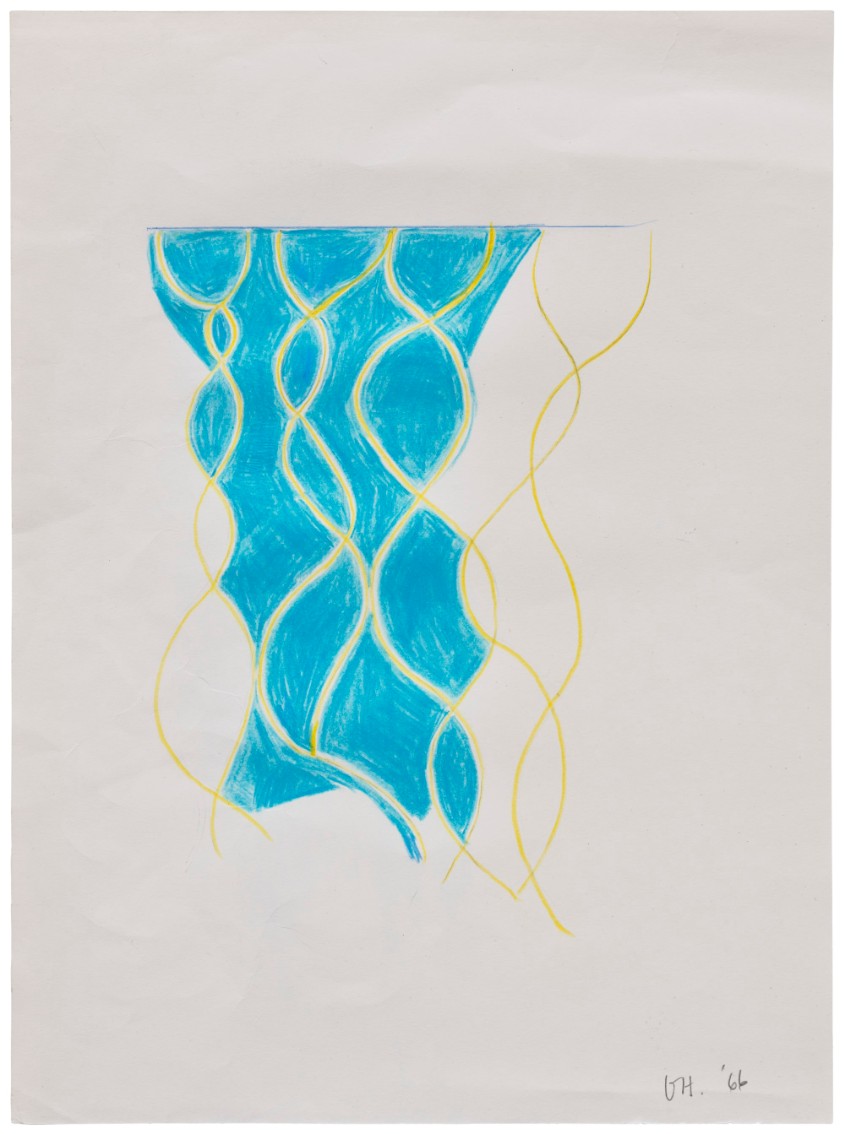
Water, 1966
Colored pencil on paper
#9. Untitled (Still Life with Flowers and Books), Fire Island, 1975
Sotheby’s New-York: 16 May 2025
Estimated: USD 60,000 – 80,000
USD 120,650
WORK ON PAPER
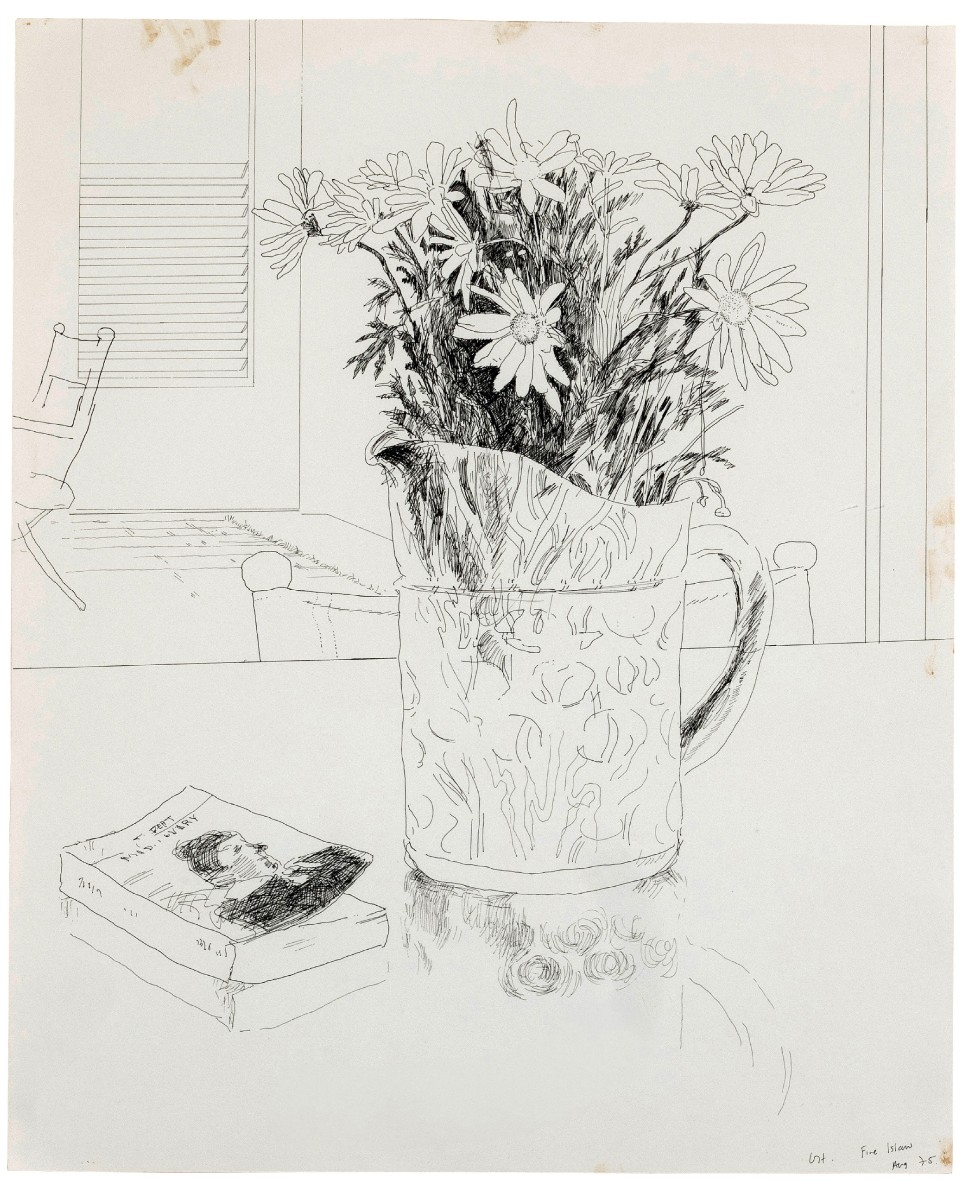
DAVID HOCKNEY (b. 1937)
Untitled (Still Life with Flowers and Books), Fire Island, 1975
Ink on paper
17×14 inches (43.2 x 35.6 cm)
Signed with the artist’s initials, partially titled and dated Aug 75. (lower right)
USD 100,000
#10. Jonathon Brown, Jan 2nd 1994, 1994
PROPERTY FROM A DISTINGUINSHED WEST COAST COLLECTION
Christie’s London: 23 October 2025
Estimated: GBP 30,000 – 50,000
GBP 63,500 / USD 84,775
WORK ON PAPER
DAVID HOCKNEY, O.M., C.H., R.A. (B. 1937), Jonathon Brown, Jan 2nd 1994 | Christie’s
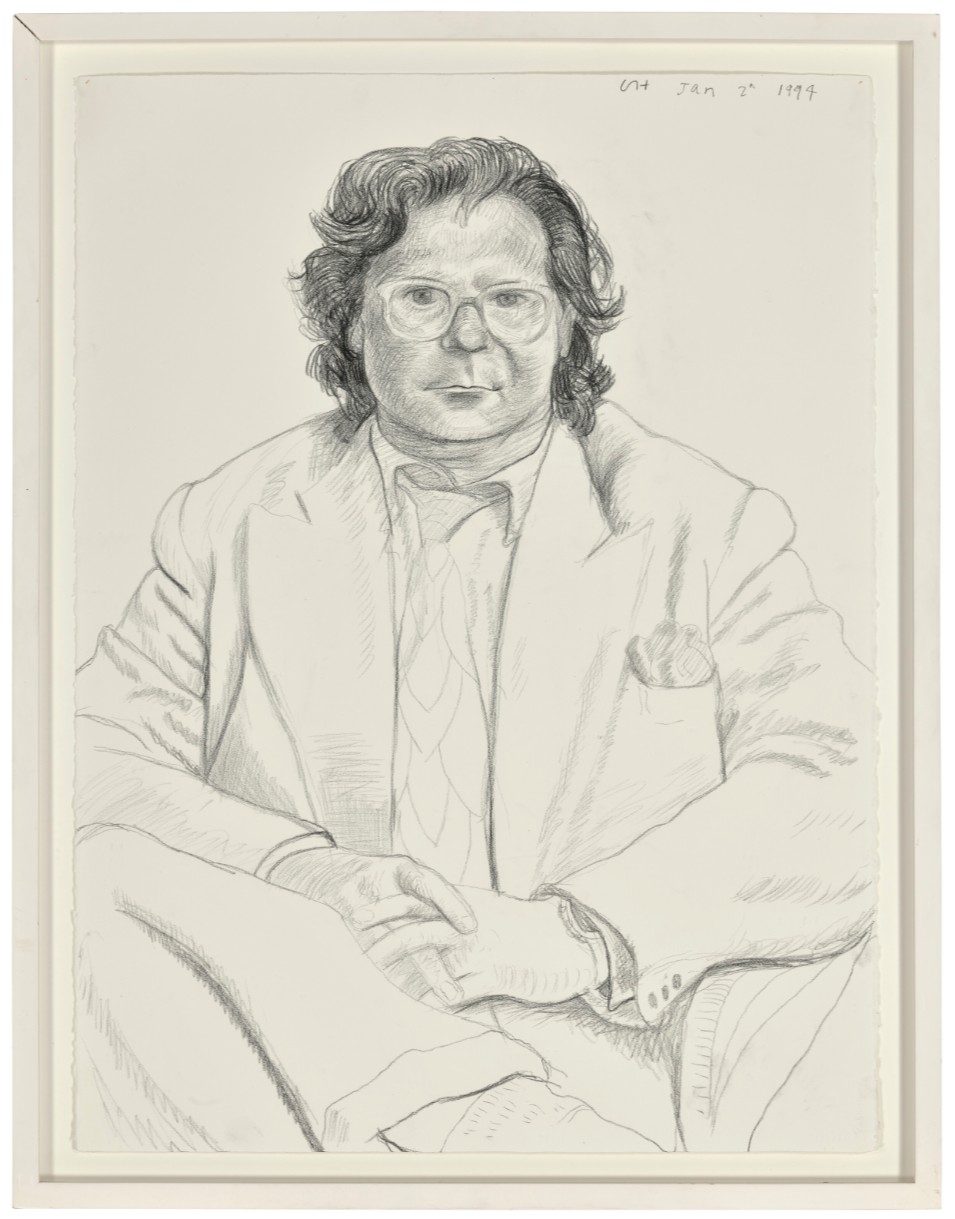
DAVID HOCKNEY, O.M., C.H., R.A. (B. 1937)
Jonathon Brown, Jan 2nd 1994, 1994
Pencil on paper
30 x 22 1/2 inches (76.2 x 57.2 cm)
Signed with initials and dated ‘DH Jan 2nd 1994’ (upper right)
#11. Henry Resting, Grand Hotel, Calvi, 1972
Christie’s New-York: 30 September 2025
Estimated: USD 40,000 – 60,000
USD 76,200
WORK ON PAPER
DAVID HOCKNEY (B. 1937), Henry Resting, Grand Hotel, Calvi | Christie’s
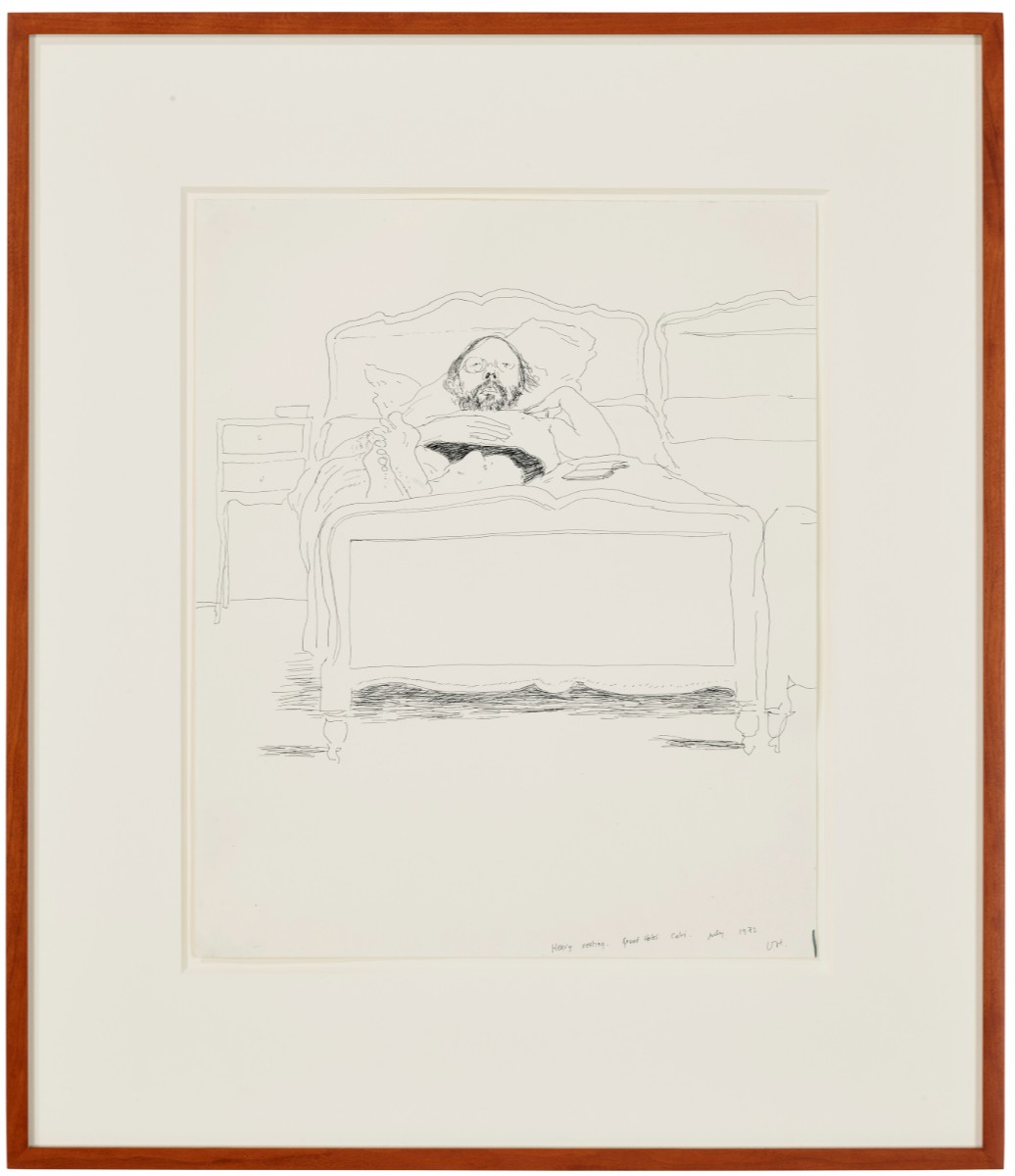
DAVID HOCKNEY (B. 1937)
Henry Resting, Grand Hotel, Calvi, 1972
Ink on paper
17 x 13 3/4 inches (43.2 x 34.9 cm)
Signed with the artist’s initials
Titled and dated ‘Henry resting. Grand Hotel. Calvi. July 1972 DH.’ (lower right)
#12. Courtiers on the stage, Drawing for Le Rossignol, 1981
Christie’s London: 12 March 2025
Estimated: GBP 15,000 – 20,000
GBP 56,700 / USD 73,385
WORK ON PAPER
DAVID HOCKNEY (B. 1937), Courtiers on the stage, Drawing for Le Rossignol | Christie’s
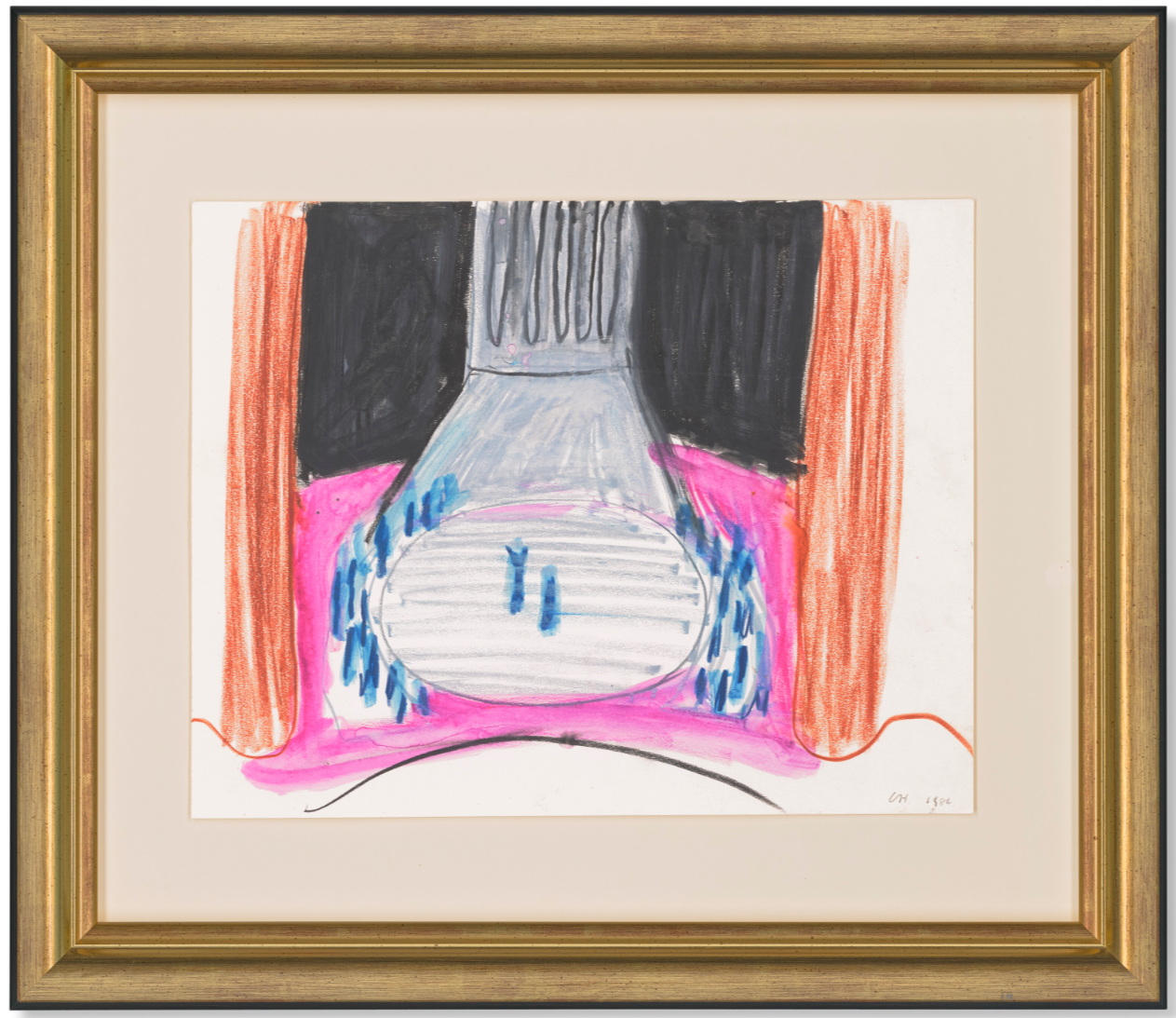
DAVID HOCKNEY (B. 1937)
Courtiers on the stage, Drawing for Le Rossignol, 1981
Crayon, colored pencil and watercolor on paper
11 x 14 1/8 inches (28 x 35.8 cm)
Signed with the artist’s initials and dated ‘DH. 1981’ (lower right)
#13. Study for Real and Mechanical Nightingale, Drawing for Le Rossignol, 1981
Christie’s London: 12 March 2025
Estimated: GBP 10,000 – 15,000
GBP 52,920 / USD 68,495
WORK ON PAPER
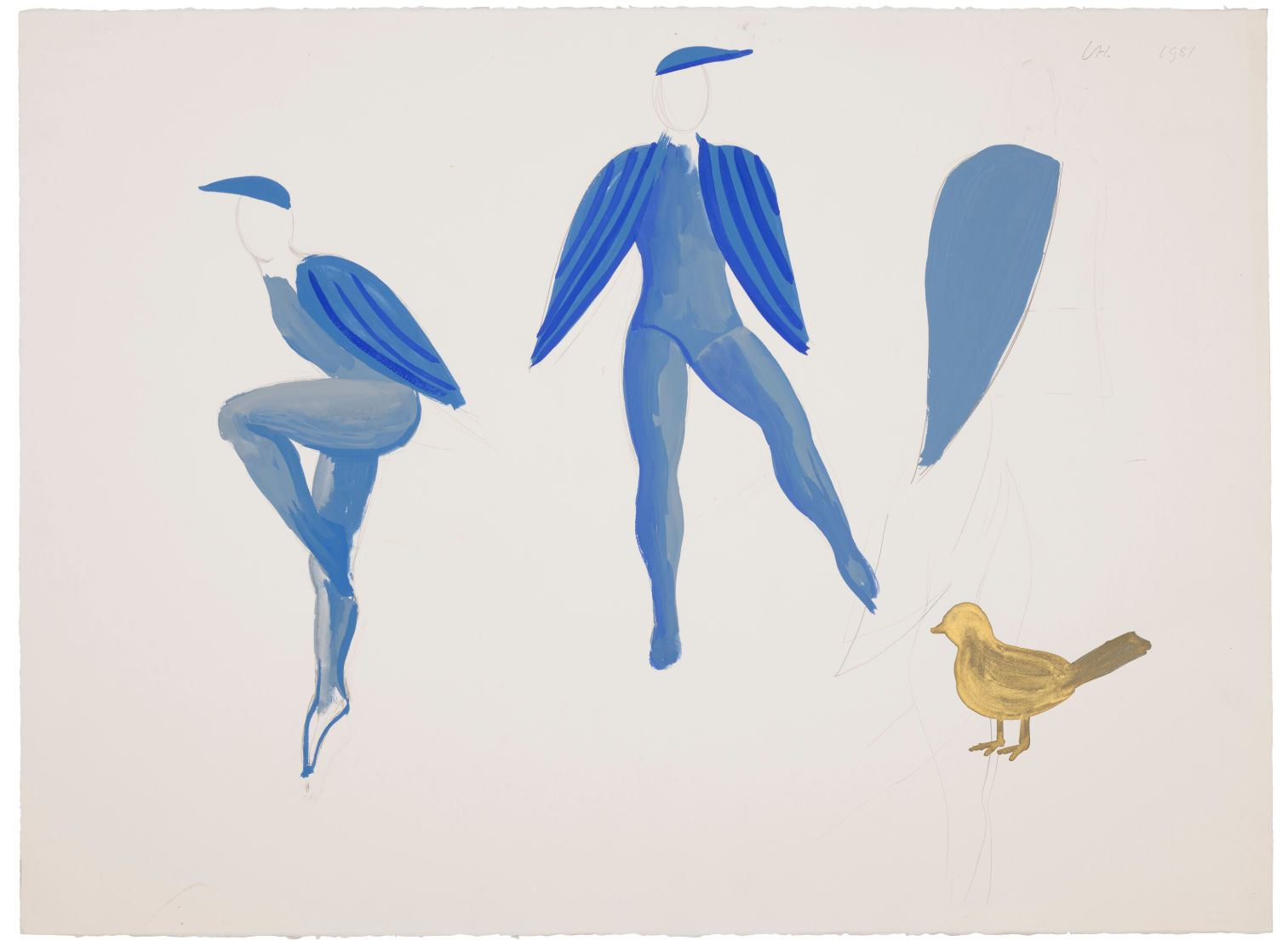
DAVID HOCKNEY (B. 1937)
Study for Real and Mechanical Nightingale, Drawing for Le Rossignol, 1981
Gouache, graphite and metallic marker on paper
22 1/2 x 30 1/4 inches (57×77 cm)
Signed with the artist’s initials and dated ‘DH. 1981’ (upper right)
#14. Randy Sleeping, 1976
Phillips London: 26 June 2025
Estimated: GBP 20,000 – 30,000
GBP 45,720 / USD 62,635
WORK ON PAPER
David Hockney Modern & Contemporary Art: Evening & Day Sale
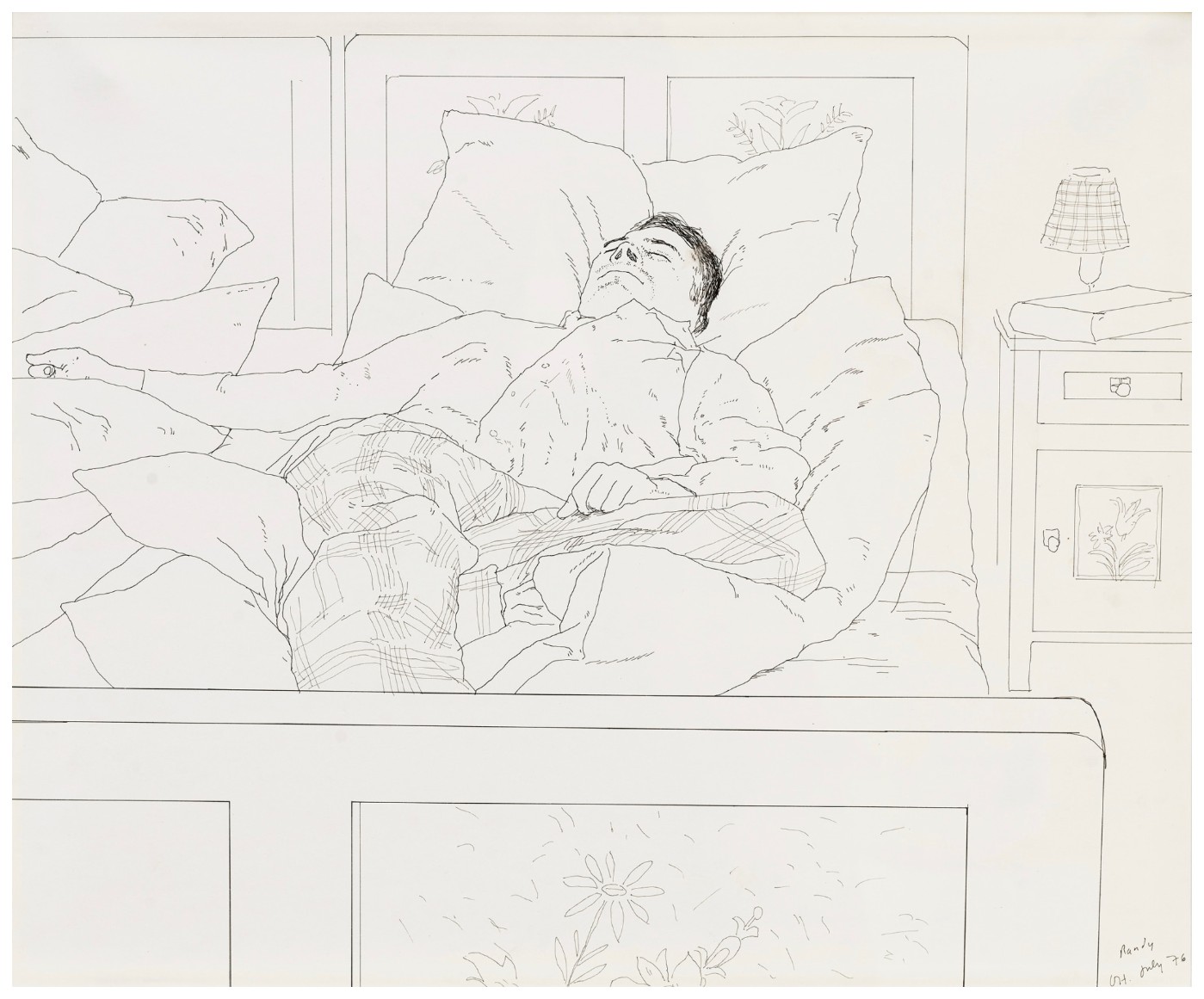
Randy Sleeping, 1976
Ink on paper
#15. Patrick Procktor in New York, 1966
Christie’s London: 20 March 2025
Estimated: GBP 20,000 – 30,000
GBP 44,100 / USD 57,375
WORK ON PAPER
DAVID HOCKNEY, O.M., C.H., R.A. (B. 1937), Patrick Procktor in New York | Christie’s
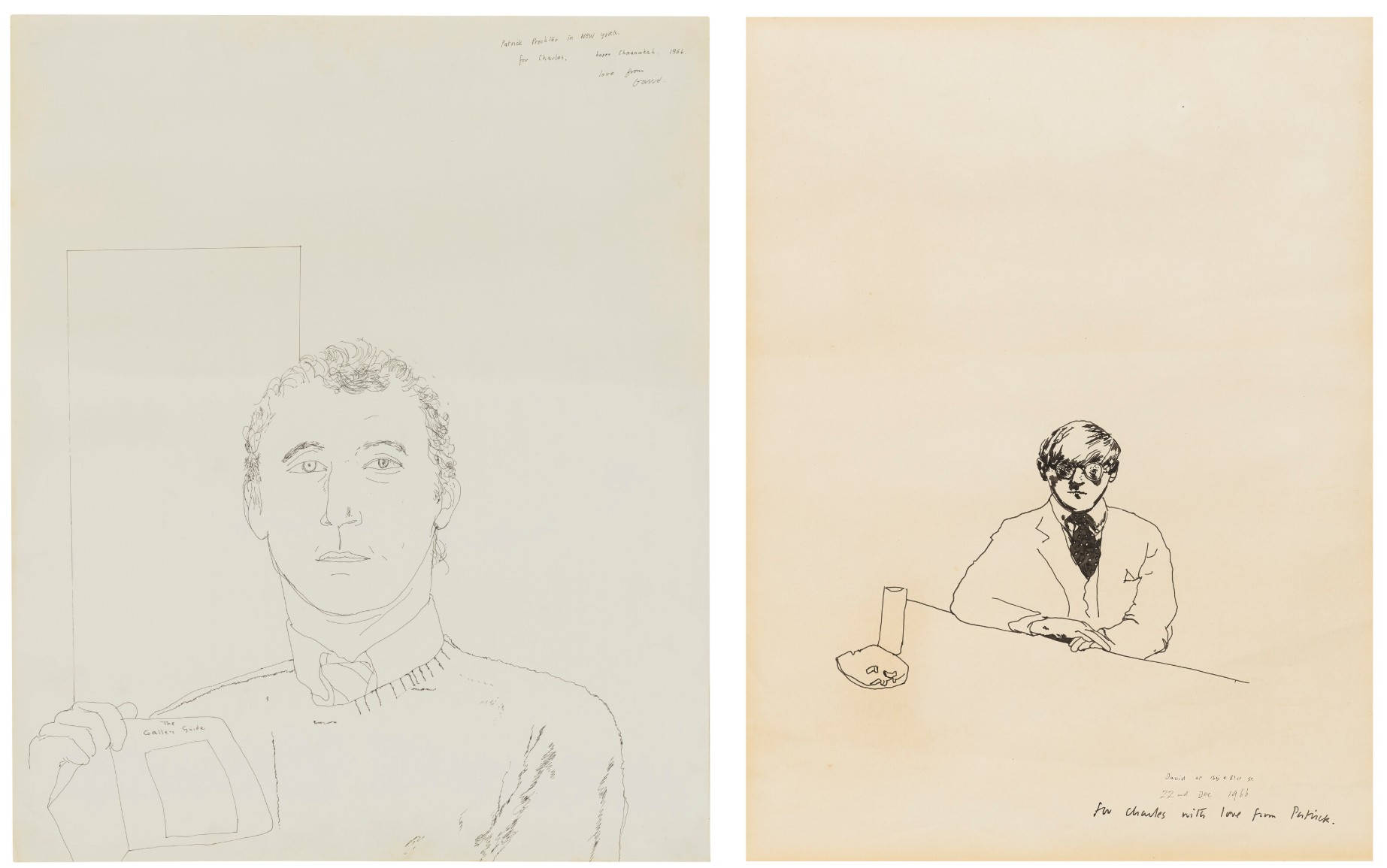
DAVID HOCKNEY, O.M., C.H., R.A. (B. 1937)
Patrick Procktor in New York, 1966
Ink on paper
16 3/4 x 13 3/4 inches (42.5 x 34.9 cm)
Signed, inscribed, dedicated and dated ‘Patrick Procktor in New York./for Charles, happy Channukah. 1966./love from/David.’ (upper right)
PATRICK PROCKTOR, R.A. (1936-2003)
David at 165 E 81st Street, 1966
Ink on paper
18 3/4 x 13 7/8 inches (46.3 x 35.2 cm)
Signed, inscribed, dedicated and dated ‘David at 165 e 81st St./22nd Dec. 1966/for Charles with love from Patrick.’ (lower right)
#16. Study for the stage, Drawing for Le Rossignol, 1981
Christie’s London: 12 March 2025
Estimated: GBP 20,000 – 30,000
GBP 44,100 / USD 57,080
WORK ON PAPER
DAVID HOCKNEY (B. 1937), Study for the stage, Drawing for Le Rossignol | Christie’s
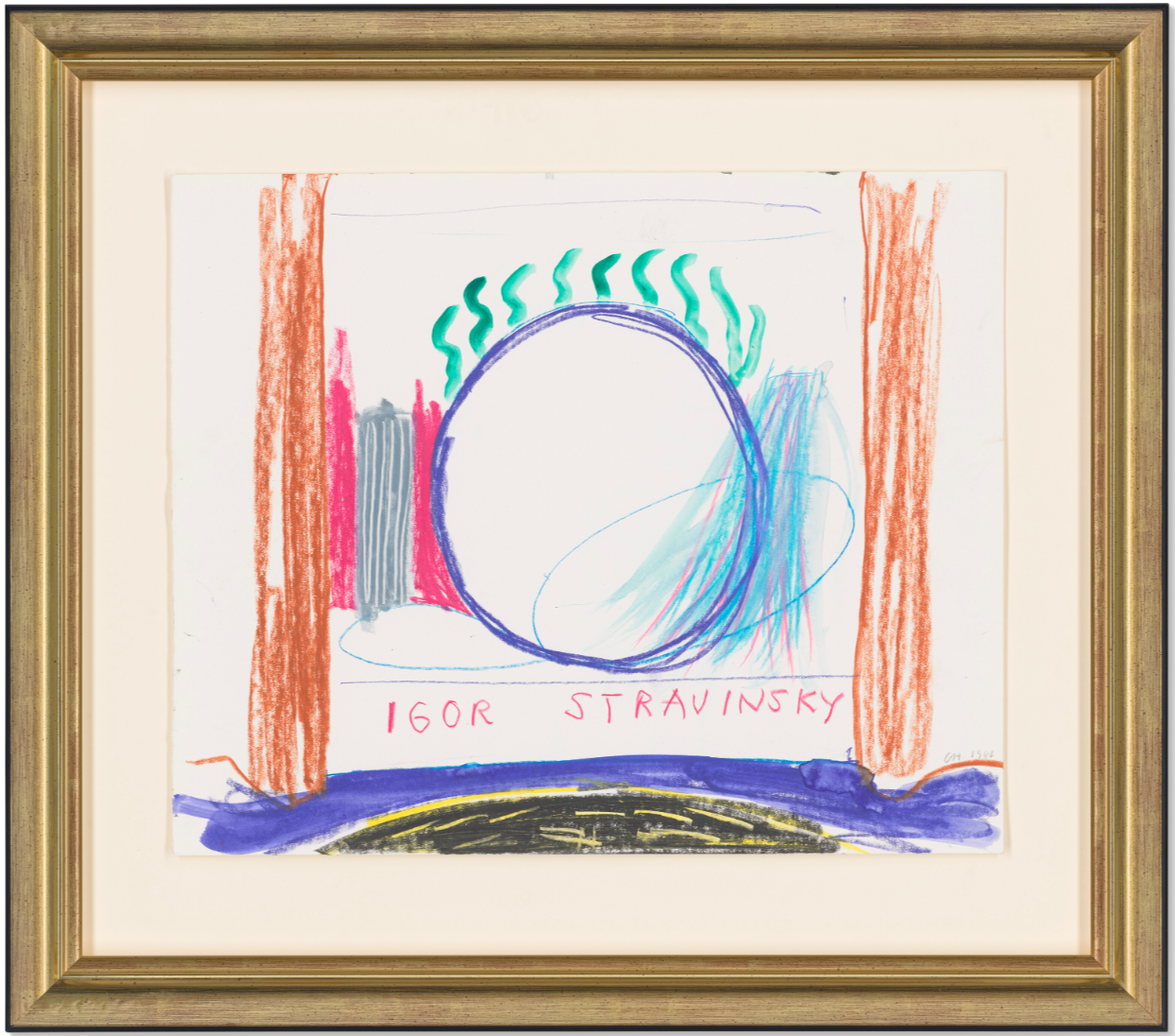
DAVID HOCKNEY (B. 1937)
Study for the stage, Drawing for Le Rossignol, 1981
Crayon and watercolor on paper
14×17 inches (35.6 x 43.3 cm)
Signed with the artist’s initials and dated ‘DH. 1981’ (lower right)
#17. Tony, 1969
Christie’s New-York: 15 May 2025
Estimated: USD 40,000 – 60,000
USD 56,700
WORK ON PAPER
DAVID HOCKNEY (B. 1937), Tony | Christie’s
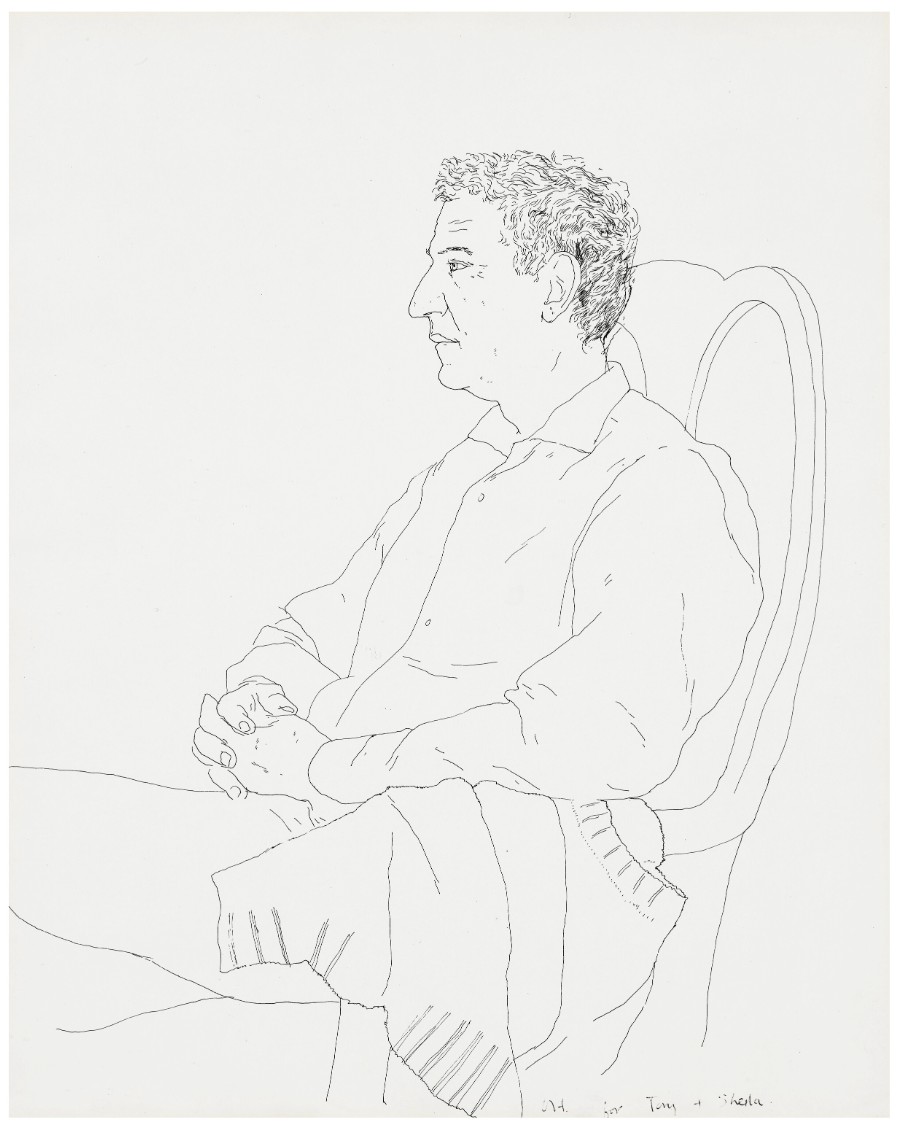
DAVID HOCKNEY (B. 1937)
Tony, 1969
Ink on paper
17 x 13 3/4 inches (43.2 x 33.8 cm)
Signed with the artist’s initials and dedicated ‘DH. for Tony + Sheila’ (lower right)
#18. Man Walking (Colored Head in Circle), 1964
Phillips London: 26 June 2025
Estimated: GBP 30,000 – 50,000
GBP 38,100 / USD 52,195
WORK ON PAPER
David Hockney Modern & Contemporary Art: Evening & Day Sale
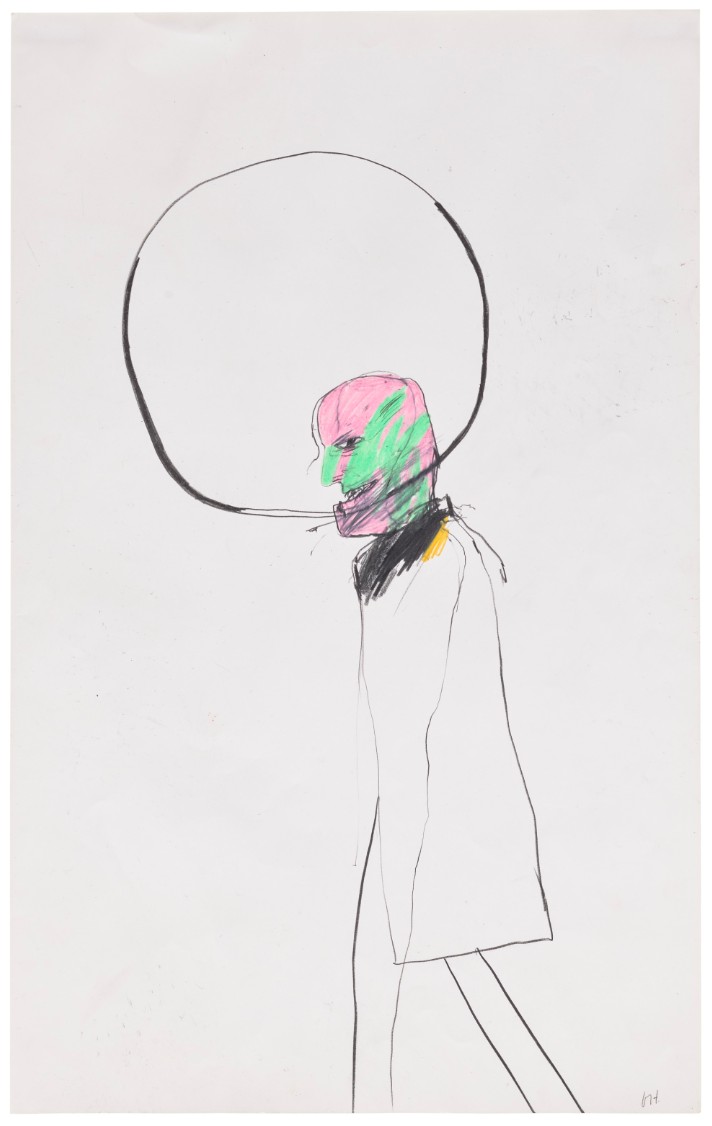
Graphite and colored crayon on paper
#19. Paul Bartel, 10 April 1994, 1994
PROPERTY FROM A DISTINGUINSHED WEST COAST COLLECTION
Christie’s London: 23 October 2025
Estimated: GBP 25,000 – 35,000
GBP 31,750 / USD 42,385
WORK ON PAPER
DAVID HOCKNEY, O.M., C.H., R.A. (B. 1937), Paul Bartel, 10 April 1994 | Christie’s
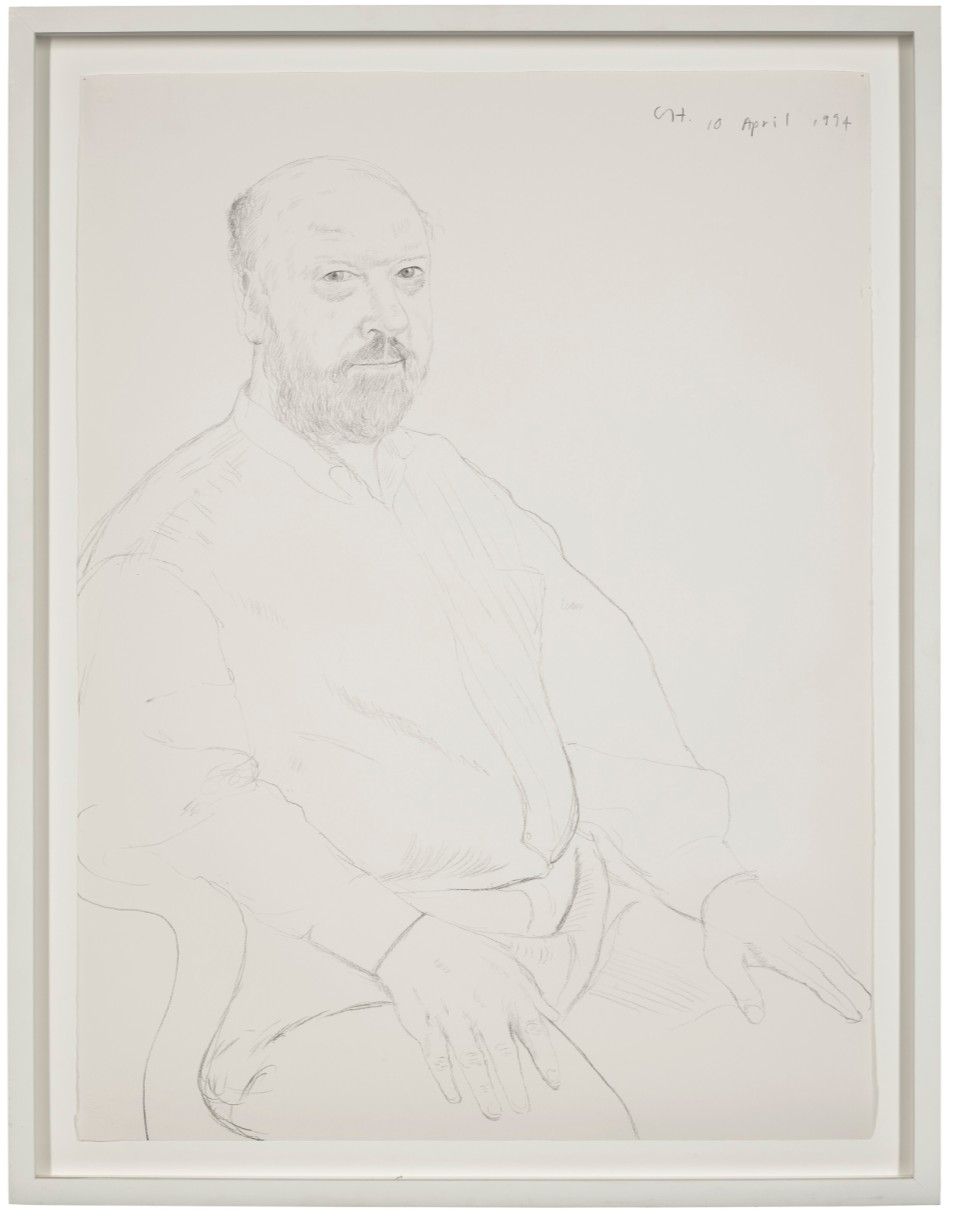
DAVID HOCKNEY (B. 1937)
Paul Bartel, 10 April 1994, 1994
Pencil on paper
30 x 22 1/4 inches (76.2 x 56.5 cm)
Signed with initials and dated ‘DH. 10 April 1994’ (upper right)
MORE LOTS COMING SOON…
2024 Auction Results
19 lots sold at auction in 2024 for a total turnover of USD 6,136,299. With 2 lots failing to sell, the sell-through rate is 90%. The highest price was achieved by Andalucia. Fountains, Cordova, a drawing dated 2004, that sold at Sotheby’s, in London, on 6 March 2024, for GBP 1,863,000 (USD 2,362,285).
2024 Top 5 Lots
2 lots sold for more than USD 1 million, generating a cumulative turnover of USD 4,590,285, representing 74.8% of the total turnover for 2024. 4 lots sold for more than USD 100,000, generating a cumulative turnover of USD 5,413,330, representing 88.2% of the total turnover for 2024.
XXXXXXXXXX
#1. Andalucia. Fountains, Cordova, 2004
Sotheby’s London: 6 March 2024
Estimated: GBP 1,500,000 – 2,000,000
GBP 1,863,000 / USD 2,362,285
WORK ON PAPER
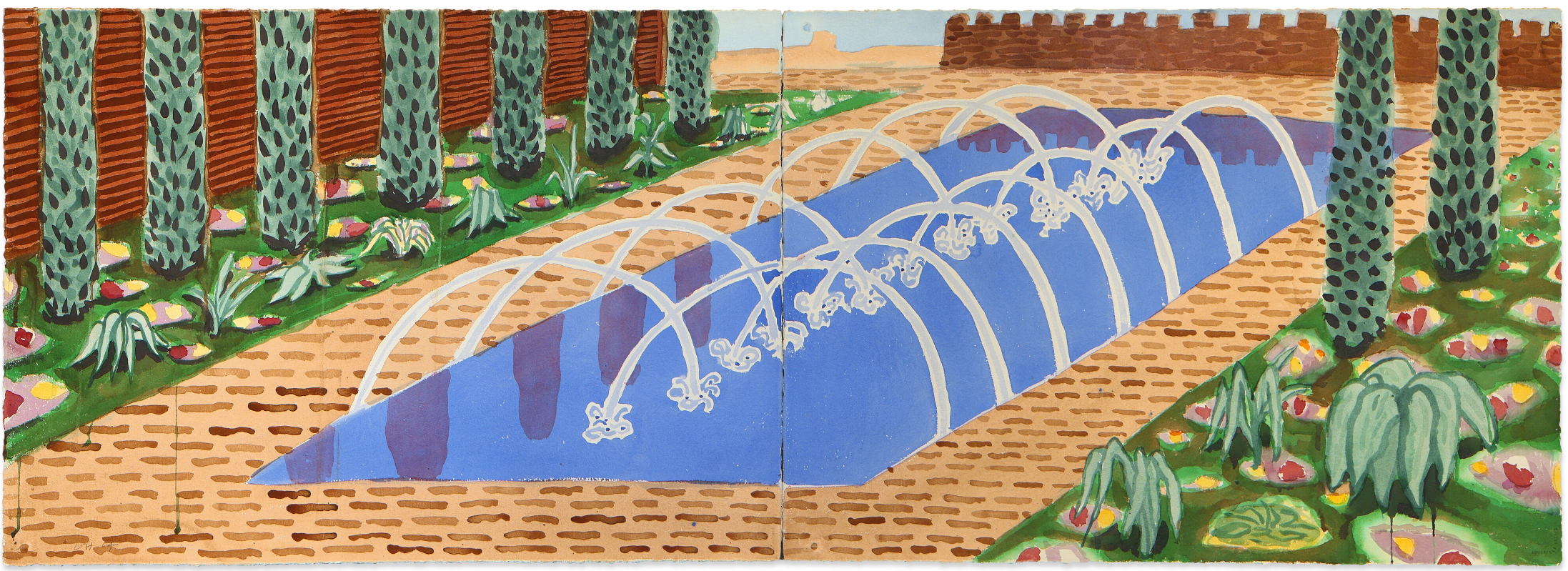
DAVID HOCKNEY (b. 1937)
Andalucia. Fountains, Cordova, 2004
Watercolor on paper, in two joined sheets
29 1/2 x 83 inches (74.9 x 210.8 cm)
Signed with the artist’s initials and dated 04 (lower left)
#2. Green Pool with Diving Board and Shadow (Paper Pool 3), 1978
Christie’s New-York: 22 November 2024
Estimated: USD 1,800,000 – 2,500,000
USD 2,228,000
PAPER POOLS
DAVID HOCKNEY (B. 1937), Green Pool with Diving Board and Shadow (Paper Pool 3) | Christie’s
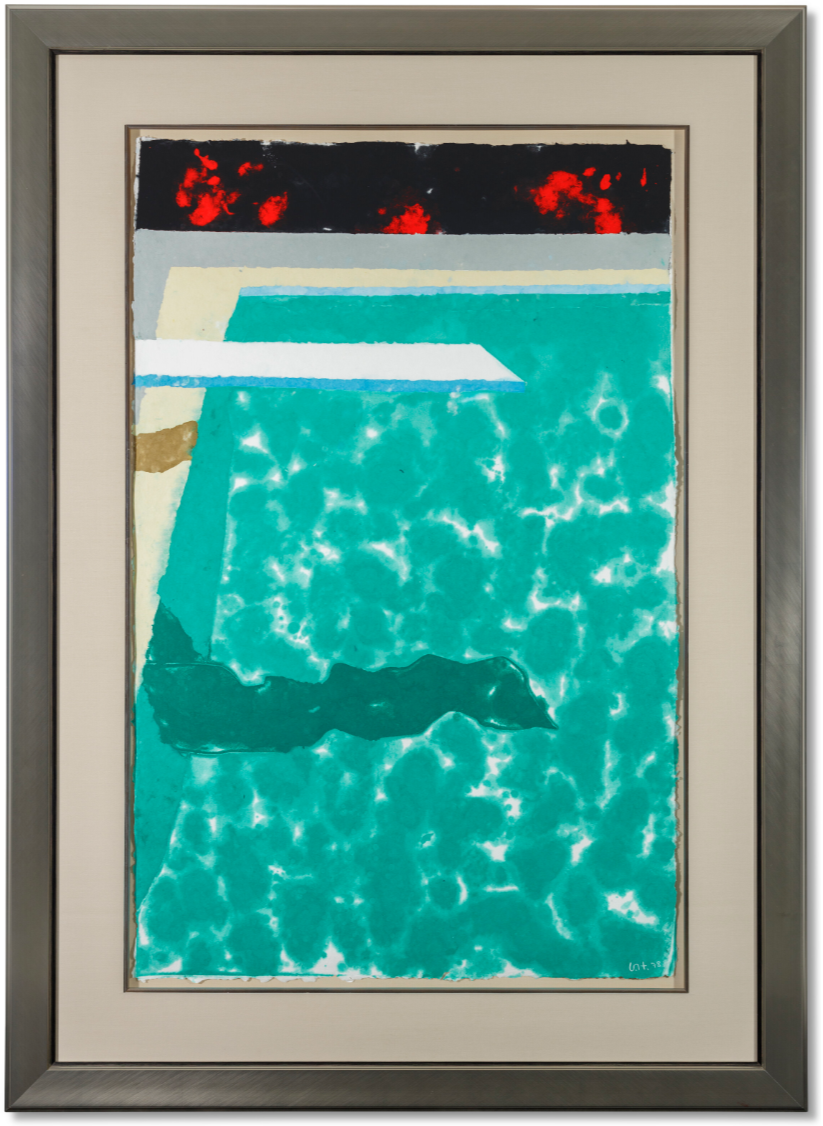
DAVID HOCKNEY (B. 1937)
Green Pool with Diving Board and Shadow (Paper Pool 3), 1978
Colored, pressed paper pulp
50 x 32 1/4 inches (127 x 81.8 cm)
Signed with the artist’s initials and dated ‘D.H. 78’ (lower right)
Signed and numbered ‘3-F David Hockney (on the reverse)
This work is one of fifteen unique variants
USD 1 million
#3. View from Miramar Hotel, Santa Monica, 1970
Chiswick Auction London: 25 June 2024
Estimated: GBP 200,000 – 300,000
GBP 403,200 / USD 511,045
Lot 35 – David Hockney O.M. C.H. R.A. (British,
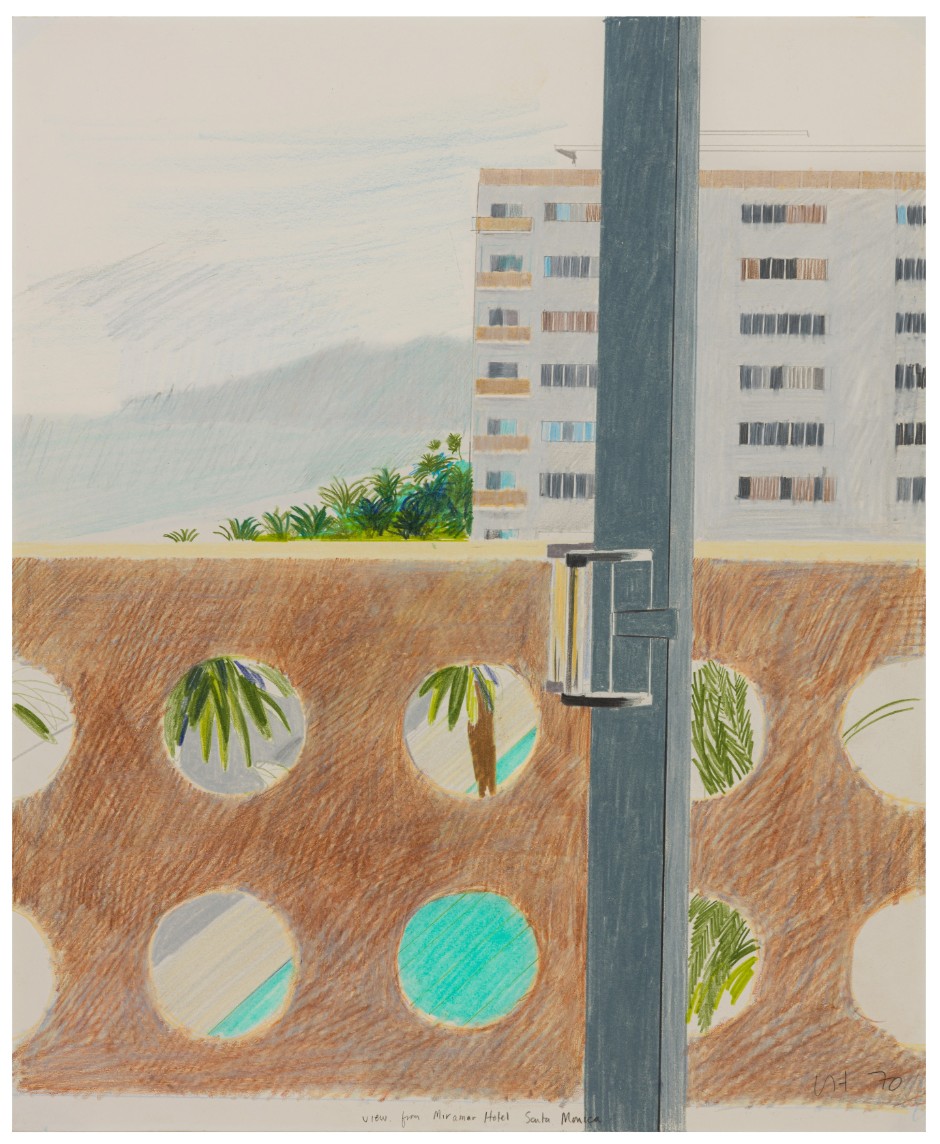
DAVID HOCKNEY (British, b.1937)
View from Miramar Hotel, Santa Monica, 1970
Crayon and pencil
17 x 13 7/8 inches (43.2 x 35.3 cm)
Signed with initials and dated ‘DH 1970’ (lower right)
Titled ‘View from Miramar Hotel, Santa Monica’ (lower centre)
USD 500,000
#4. Boodgie, 31 Nov. 93
Sotheby’s New-York: 21 November 2024
Estimated: USD 80,000 – 120,000
USD 312,000
Boodgie, 31 Nov. 93 | Contemporary Day Auction | 2024 | Sotheby’s
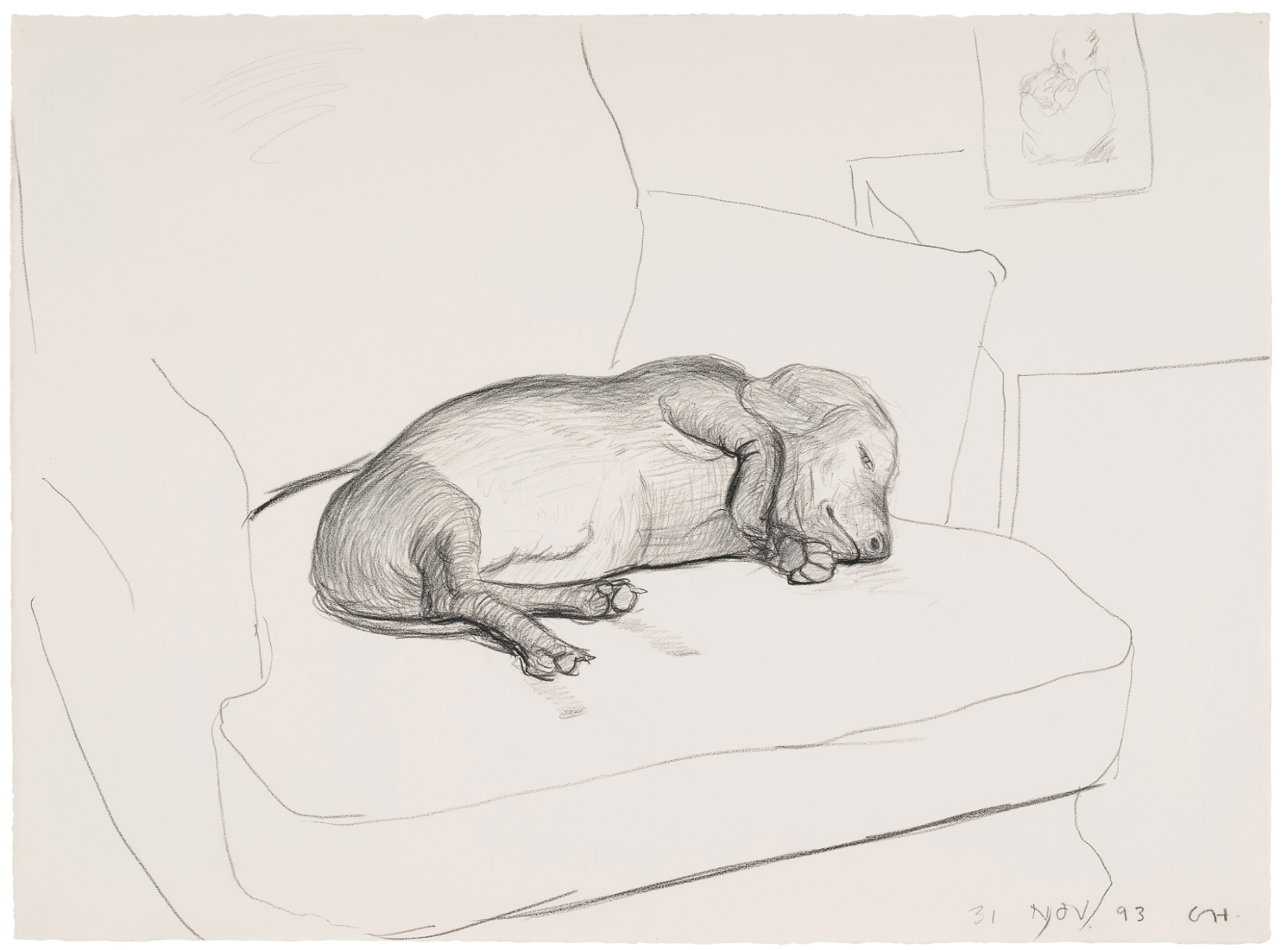
DAVID HOCKNEY (b. 1937)
Boodgie, 31 Nov. 93
Crayon on paper
22 1/2 x 30 1/4 inches (57.2 x 76.8 cm)
Signed with the artist’s initials and dated 31 Nov. 93 (lower right)
USD 100,000
#5. Michael and Ann, 1965
Christie’s London: 10 October 2024
Estimated: GBP 60,000 – 80,000
GBP 69,300 / USD 90,550
DAVID HOCKNEY (B. 1937), Michael and Ann | Christie’s
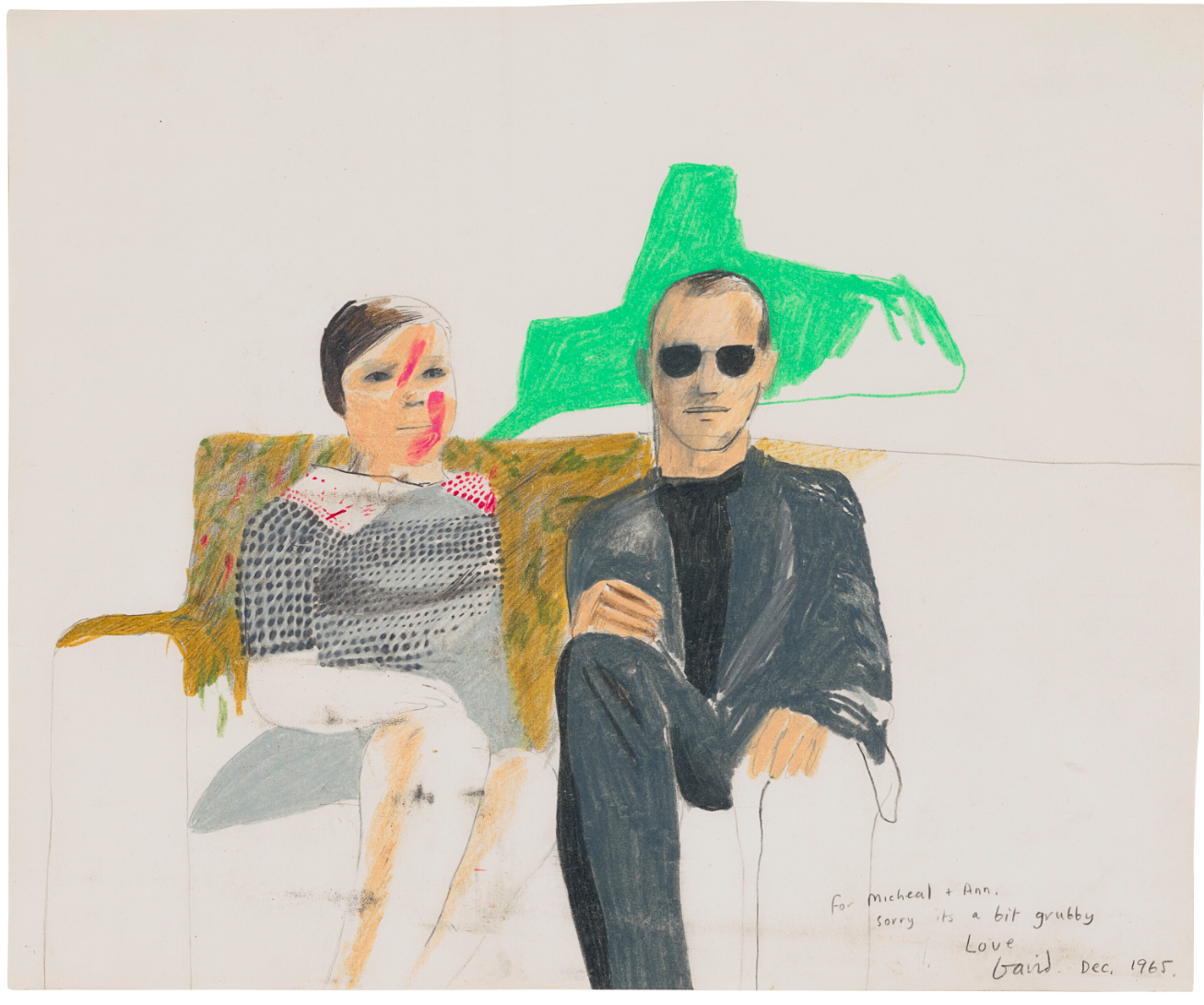
DAVID HOCKNEY (B. 1937)
Michael and Ann, 1965
Colored pencil and graphite on paper
10 3/4 x 13 1/8 inches (27.2 x 33.2 cm)
Signed, titled, inscribed, dedicated and dated ‘for Micheal [sic] + Ann. sorry its a bit grubby Love David. Dec. 1965’ (lower right)
#6. Shower Study II, 1963
Christie’s London: 10 October 2024
Estimated: GBP 40,000 – 60,000
GBP 68,040 / USD 88,905
DAVID HOCKNEY (B. 1937), Shower Study II | Christie’s
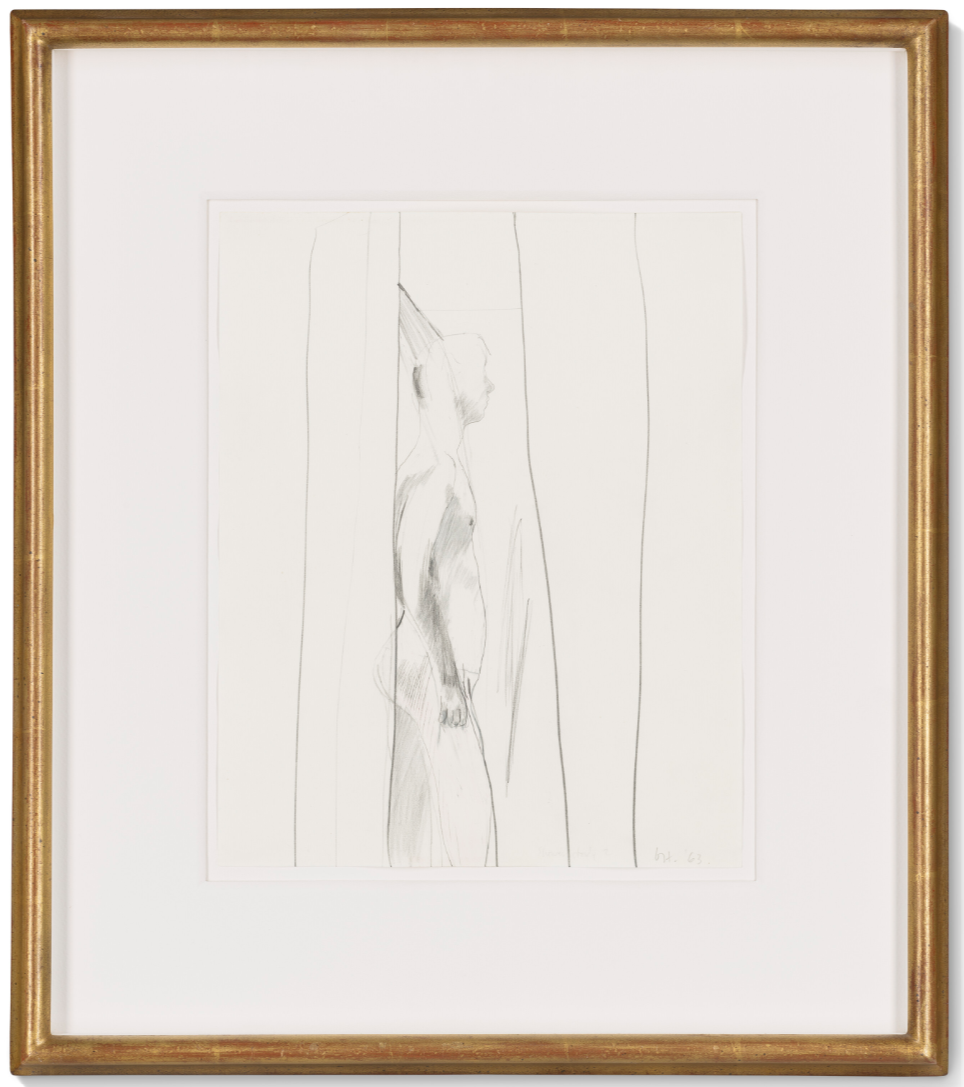
DAVID HOCKNEY (B. 1937)
Shower Study II, 1963
Graphite and wax crayon on paper
12 3/8 x 9 7/8 inches (31.4 x 25.1 cm)
Signed with the artist’s initials, titled and dated ‘Shower Study 2 DH. ’63.’ (lower right)
#7 Untitled, circa 1988
Sotheby’s New-York: 16 July 2024
Estimated: USD 40,000 – 60,000
USD 72,000
Untitled | Contemporary Discoveries | 2024 | Sotheby’s
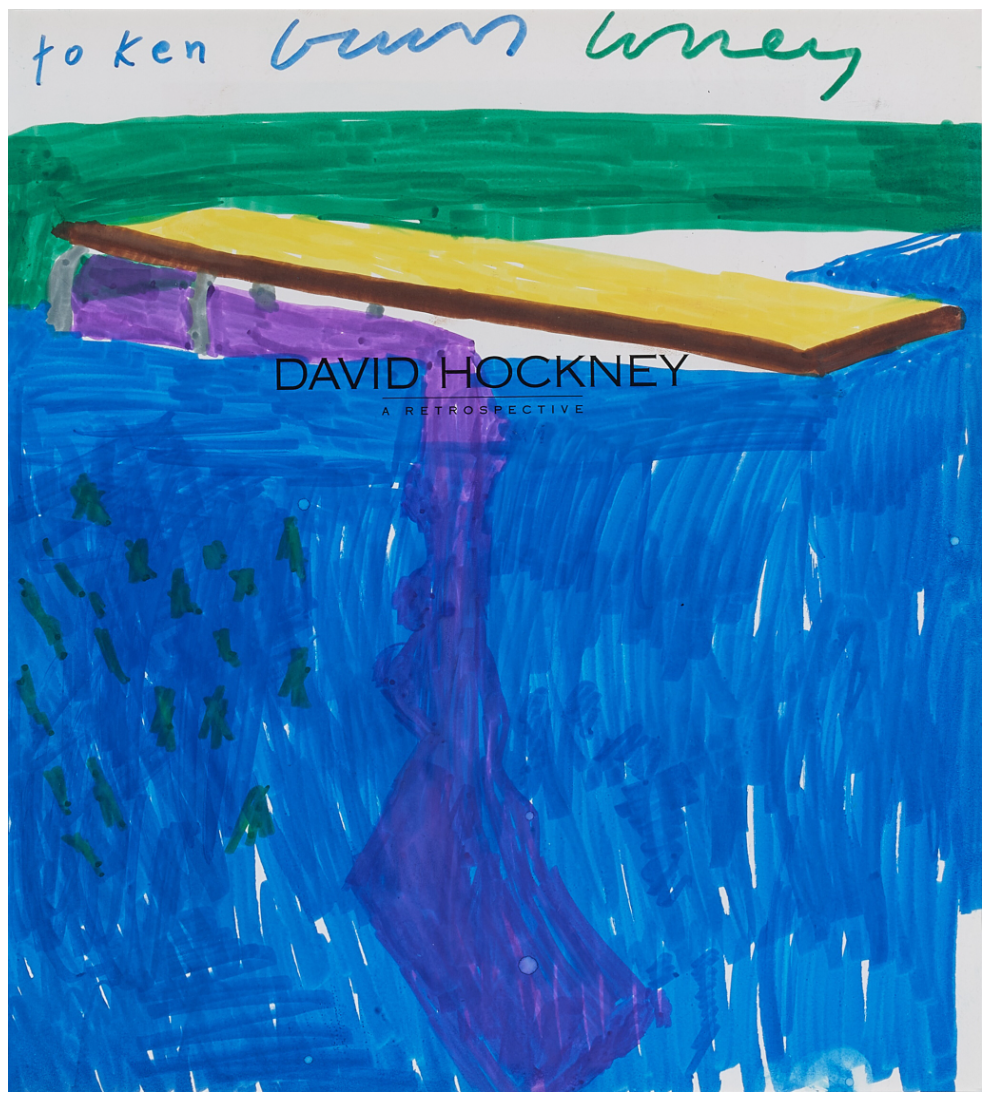
DAVID HOCKNEY (b. 1937)
Untitled, circa 1988
Ink on paper
11×10 inches (27.9 x 25.4 cm)
Signed and inscribed to ken (upper edge)
#8. Gregory in Sydney, 1976
Bonhams London: 11 October 2024
Estimated: GBP 50,000 – 70,000
GBP 53,740 / USD 70,190
Bonhams : DAVID HOCKNEY (B. 1937) Gregory in Sydney (Executed in 1976)
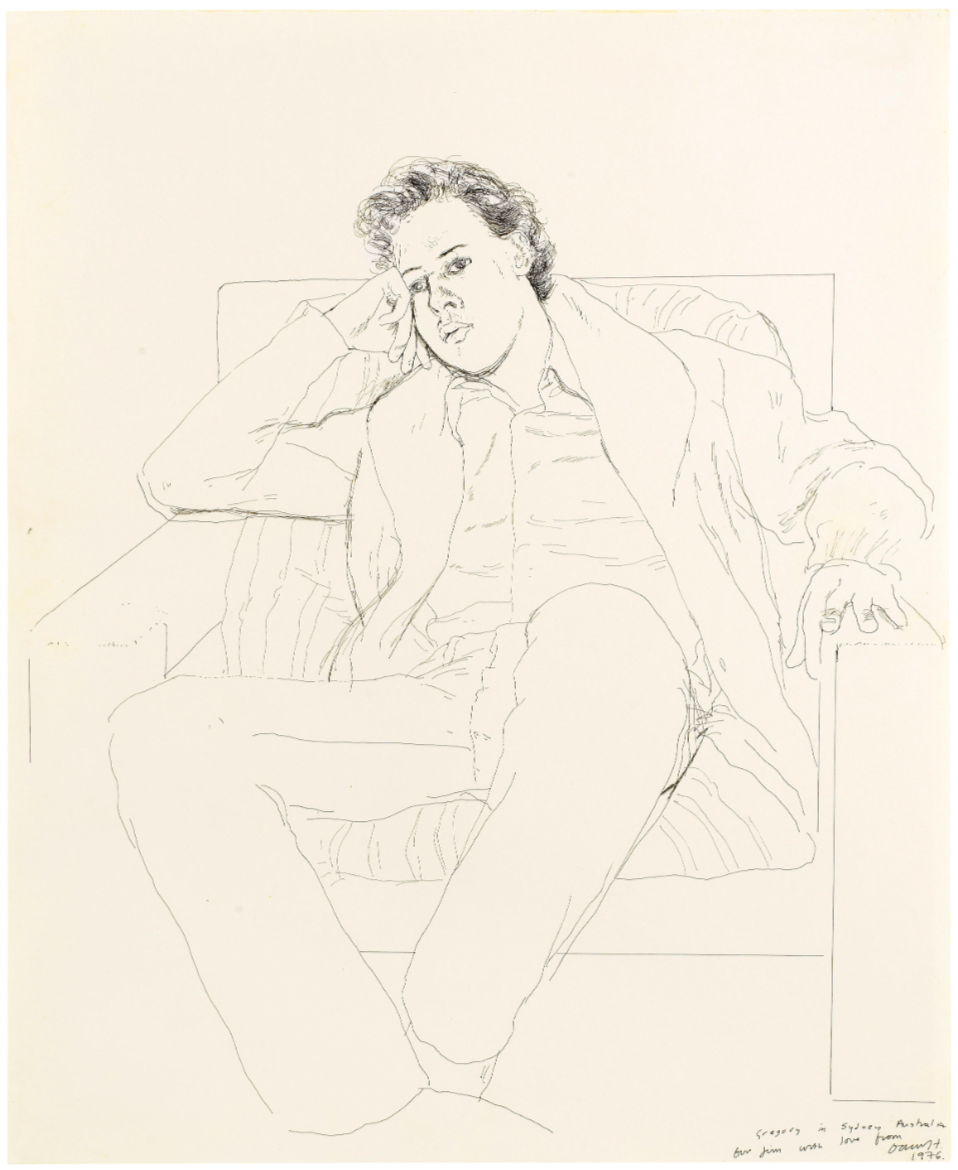
Pen and ink on paper
17 x 13 7/8 inches (43.2 x 35.3 cm)
Signed, inscribed and dated ‘Gregory in Sydney Australia for Jim with love from David H. 1976’ (lower right)
#10. Colonial Governor, 1962
Christie’s London: 10 October 2024
Estimated: GBP 30,000 – 60,000
GBP 37,800 / USD 49,390
DAVID HOCKNEY (B. 1937), Colonial Governor | Christie’s
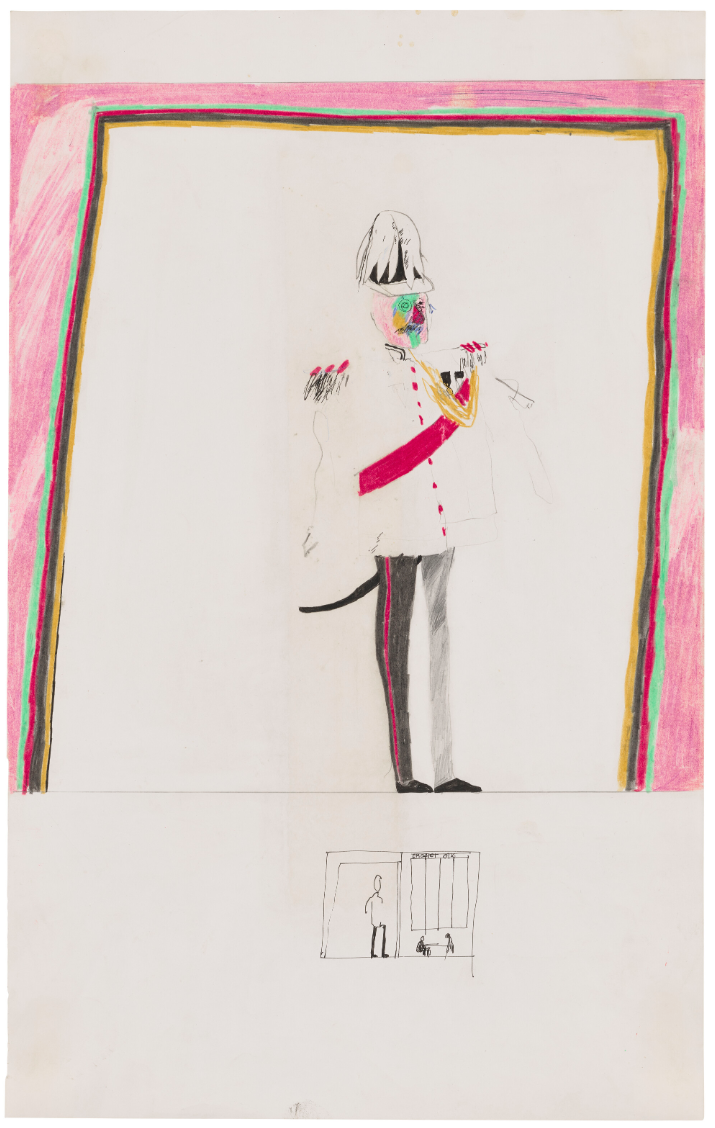
DAVID HOCKNEY (B. 1937)
Colonial Governor, 1962
Crayon, graphite and ink on paper
19 7/8 x 12 1/2 inches (50.6 x 31.9 cm)
#11. Untitled (Portrait of Johnny), 1979
Phillips London: 19 September 2024
Estimated: GBP 18,000 – 25,000
GBP 35,560 / USD 46,945
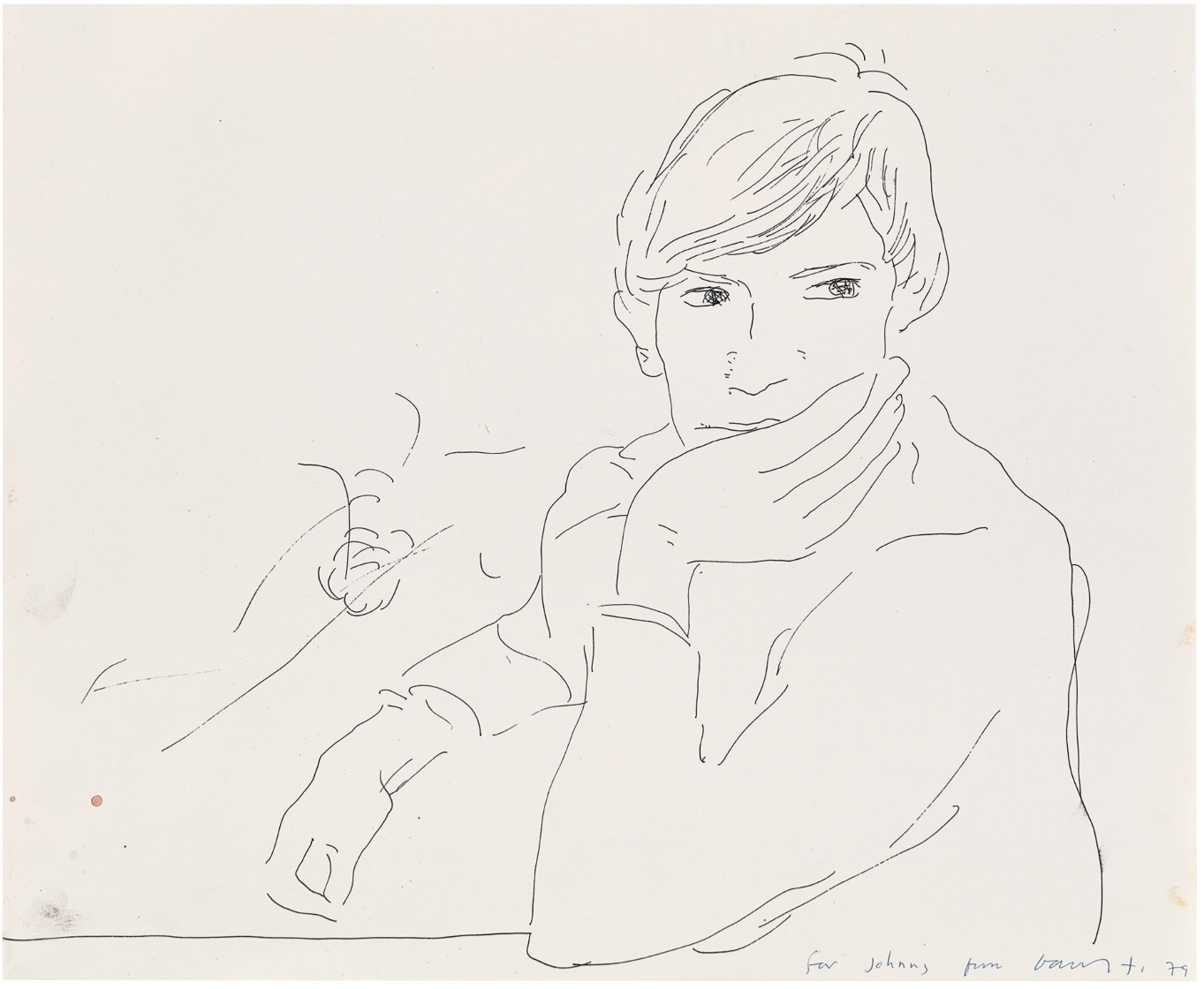
DAVID HOCKNEY
Untitled (Portrait of Johnny), 1979
Pen and ink drawing, on wove paper
13 7/8 x 17 inches (35.2 x 43.2 cm)
Signed, dated and dedicated ‘for Johnny from David’ in blue ballpoint pen
MORE LOTS COMING SOON
Lots Passed
Café with Palm Tree and Clouds Surrounded by a Curtain, 1979-80
Sotheby’s New-York: 14 May 2024
Estimated: USD 200,000 – 300,000
PASSED
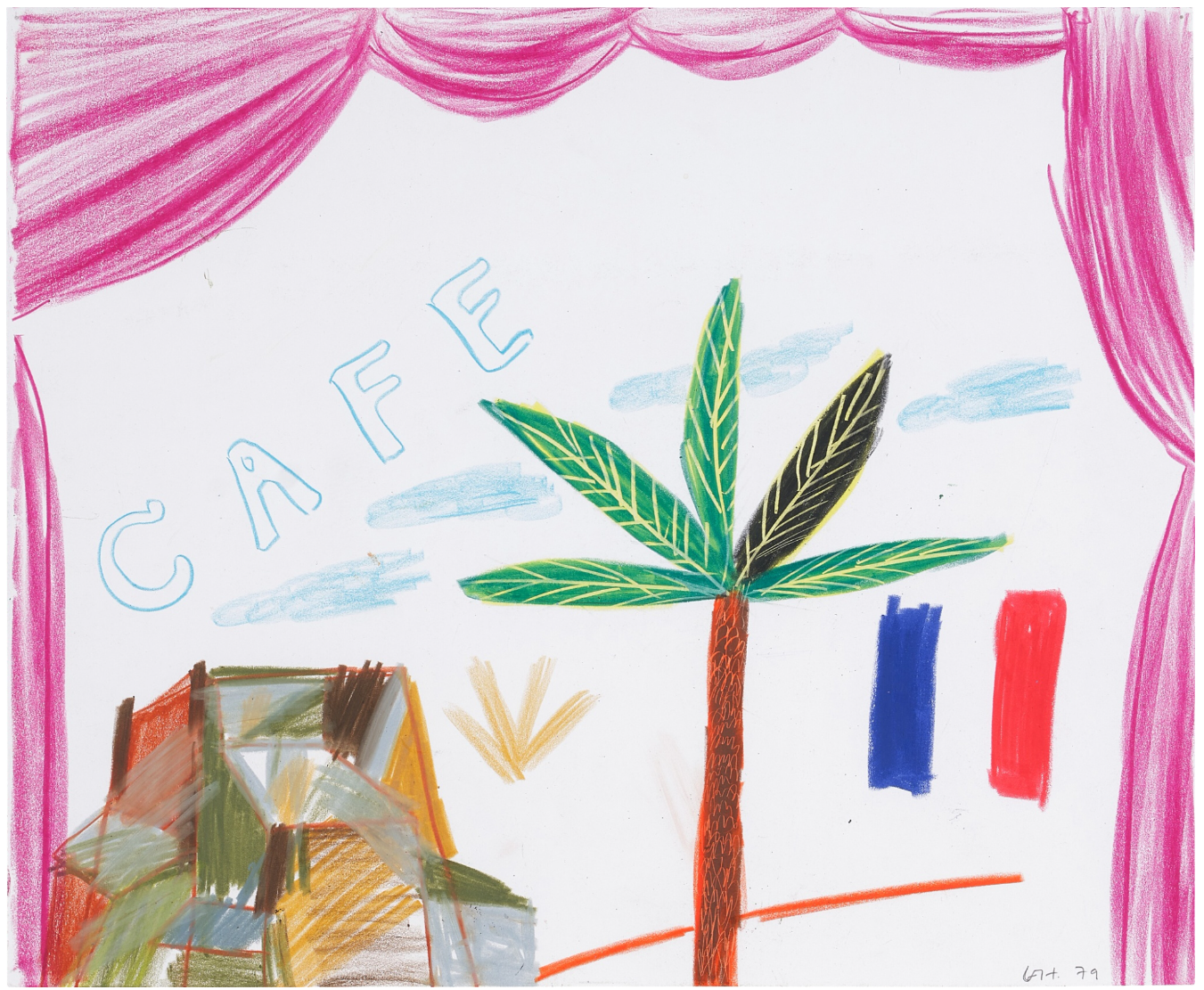
DAVID HOCKNEY (b. 1937)
Café with Palm Tree and Clouds Surrounded by a Curtain, 1979-80
Crayon on paper
14×17 inches (35.6 x 43.2 cm)
Signed with the artist’s initials and dated 79 (lower right)
2023 Auction Results
21 lots sold at auction in 2023 for a total turnover of USD 20,198,725. With 4 lots failing to sell, the sell-through rate is 88.6%. The highest price was achieved by a drawing entitled View from Terrace III, executed in 2003, that sold at Sotheby’s, in New-York, for USD 7,228,500 on 15 November 2023.
2023 Top 5 Lots
4 lots sold for more than USD 1 million, generating a cumulative turnover of USD 15,645,035, representing 77.4% of the total turnover for 2023. 18 lots sold for more than USD 100,000, generating a cumulative turnover of USD 19,540,545, representing 96.7% of the total turnover for 2023.
XXXXXXXXX
#1. View From Terrace III, 2003
Sotheby’s New-York: 15 November 2023
Estimated: USD 4,000,000 – 6,000,000
USD 7,228,500
WORK ON PAPER
View From Terrace III | Contemporary Evening Auction | 2023 | Sotheby’s
DAVID HOCKNEY (b. 1937)
View From Terrace III, 2003
Watercolor on paper, in eight sheets
Overall: 36 1/8 x 95 7/8 inches (91.8 x 243.5 cm)
Signed and dated 2003 (lower right)
#2. Drawing of a Pool and Towel, 1971
Sotheby’s New-York: 18 May 2023
Estimated: USD 1,000,000 – 1,500,000
USD 3,085,000
WORK ON PAPER
Drawing of a Pool and Towel | Contemporary Evening Auction | 2023 | Sotheby’s (sothebys.com)
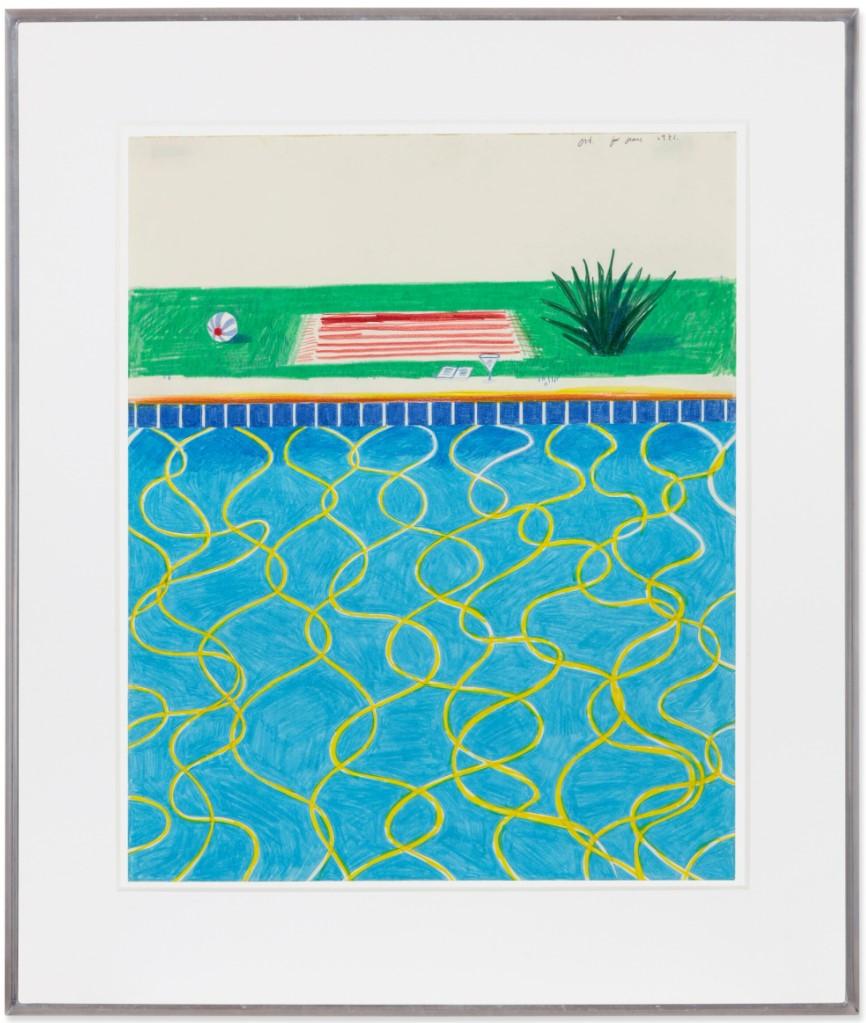
DAVID HOCKNEY (b. 1937)
Drawing of a Pool and Towel, 1971
Colored crayon, pencil and pastel on paper
43.2 x 35.2 cm (17 x 13 7/8 inches)
Initialed, dated 1971 and dedicated for Jean (upper right)
#3. Green Pool with Diving Board and Shadow (Paper Pool 3), 1978
Christie’s London: 28 June 2023
Estimated: GBP 1,200,000 – 1,800,000
GBP 2,339,000 / USD 2,982,535
DAVID HOCKNEY (B. 1937), Green Pool with Diving Board and Shadow (Paper Pool 3) | Christie’s
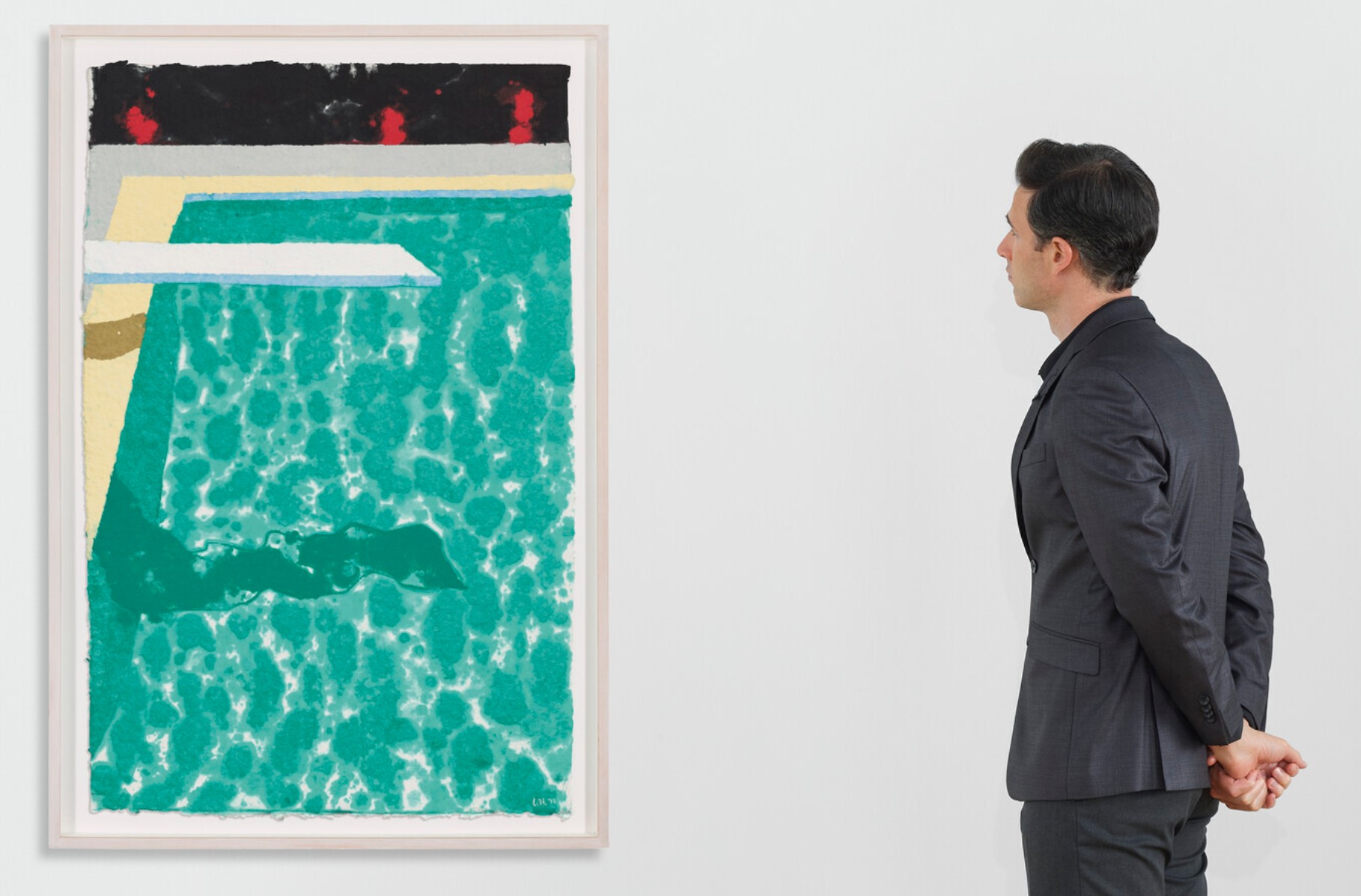
DAVID HOCKNEY (B. 1937)
Green Pool with Diving Board and Shadow (Paper Pool 3), 1978
Colored, pressed paper pulp
50 3/4 x 32 5/8 inches (128.8 x 82.8 cm)
Signed with the artist’s initials and dated ‘D.H. 78’ (lower right)
Signed and numbered ‘3 K David Hockney’ (on the reverse)
#4. Green Pool with Diving Board and Shadow (Paper Pool 3), 1978
Estimated: USD 1,800,000 – 2,500,000
USD 2,349,000
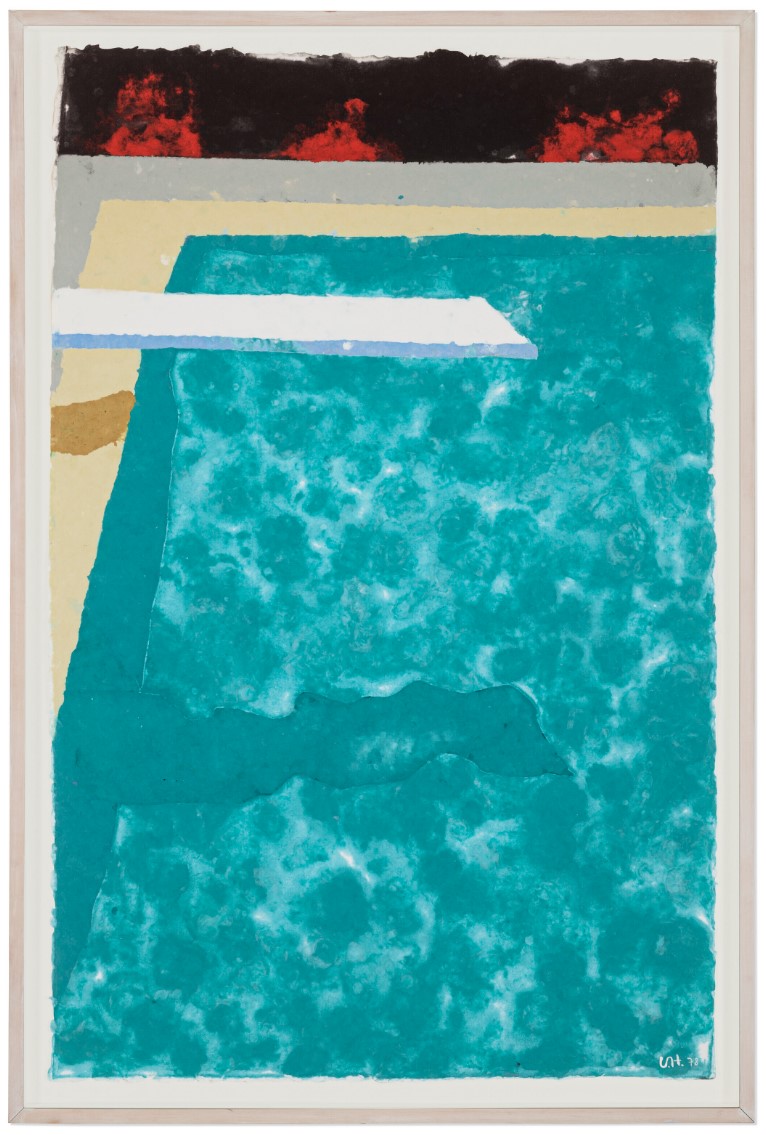
Green Pool with Diving Board and Shadow (Paper Pool 3), 1978
Colored, pressed paper pulp
50 x 32 1/4 inches (127 x 81.8 cm)
Signed again and numbered ‘David Hockney 3-D’ (on the reverse)
Executed in 1978. This work is one of fifteen unique variants
USD 1 million
#5. Gregory in the Pool (Paper Pool 4), 1978
Christie’s London: 13 October 2023
Estimated: GBP 400,000 – 600,000
GBP 529,200 / USD 644,735
WORK ON PAPER
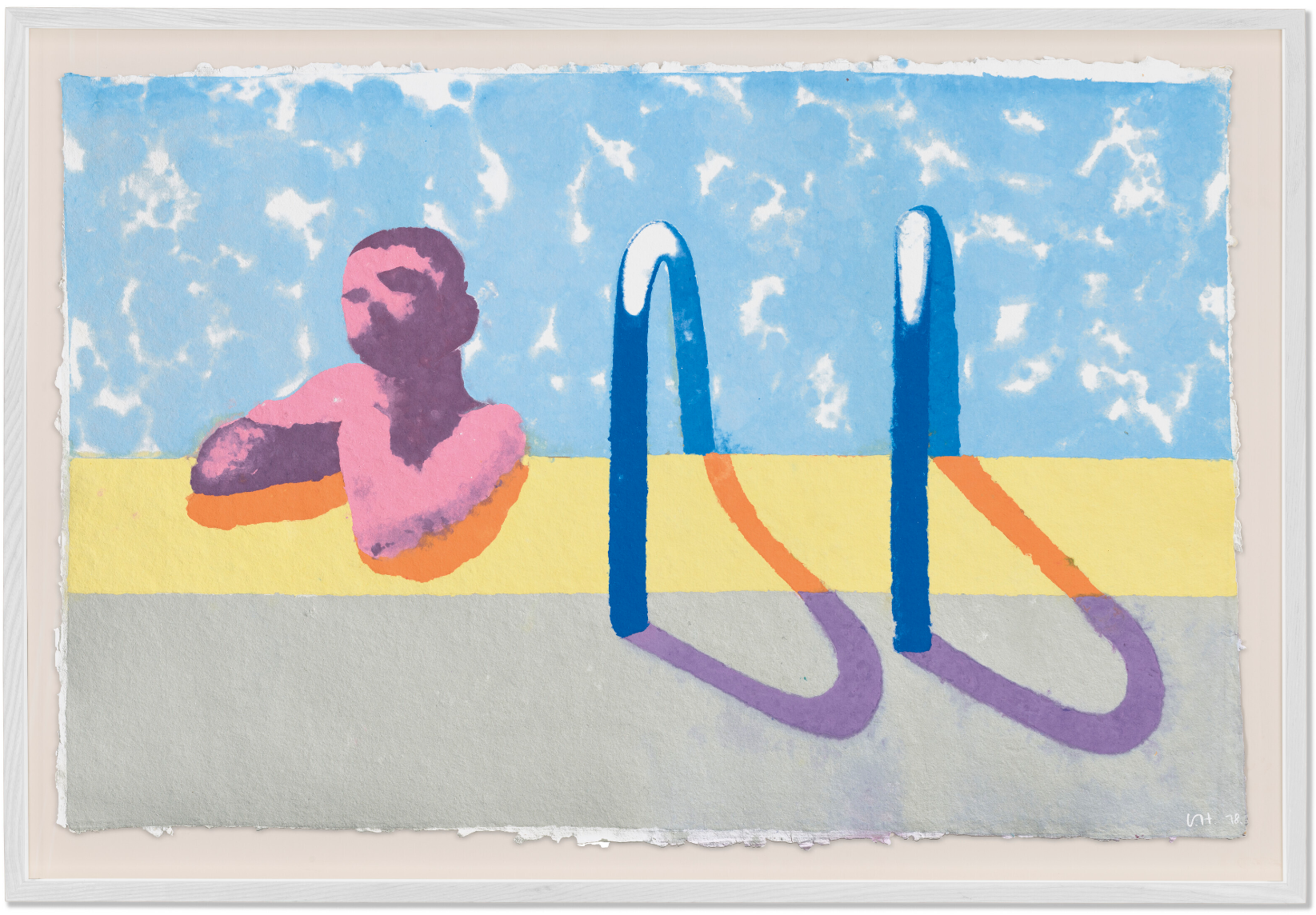
DAVID HOCKNEY (B. 1937)
Gregory in the Pool (Paper Pool 4), 1978
Colored, pressed paper pulp
33 1/4 x 50 5/8 inches (84.5 x 128.5 cm)
Signed with the artist’s initials and dated ‘D.H. 78.’ (lower right)
Signed and numbered ‘4-F (II) David Hockney.’ (on the reverse)
#6. Grand Hotel Terrace, Vittel, 1970
Lempertz Cologne: 1 December 2023
Estimated: EUR 300,000 – 400,000
EUR 554,400 / USD 603,840
Grand Hotel Terrace, Vittel – Lot 51 (lempertz.com)
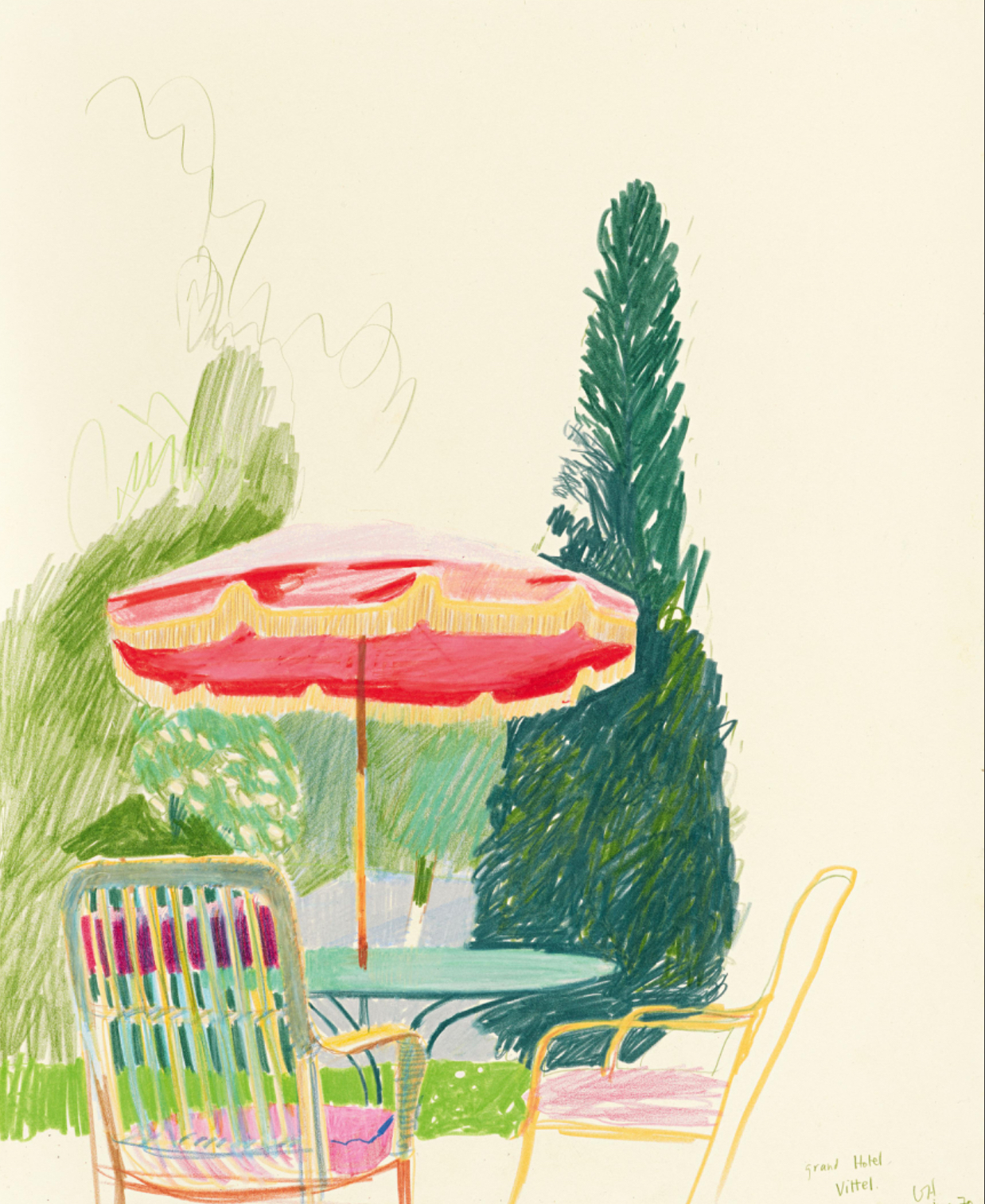
DAVID HOCKNEY
Grand Hotel Terrace, Vittel, 1970
Colored pencil and wax crayon on card
43.2 x 35 cm
Monogrammed, dated and titled ‘Grand Hotel, Vittel. DH june 70’
USD 500,000
#7. Armchair, Table and Lamp, 1972
Christie’s London: 1 March 2023
Estimated: GBP 300,000 – 500,000
GBP 352,800 / USD 424,522
DAVID HOCKNEY (B. 1937) (christies.com)
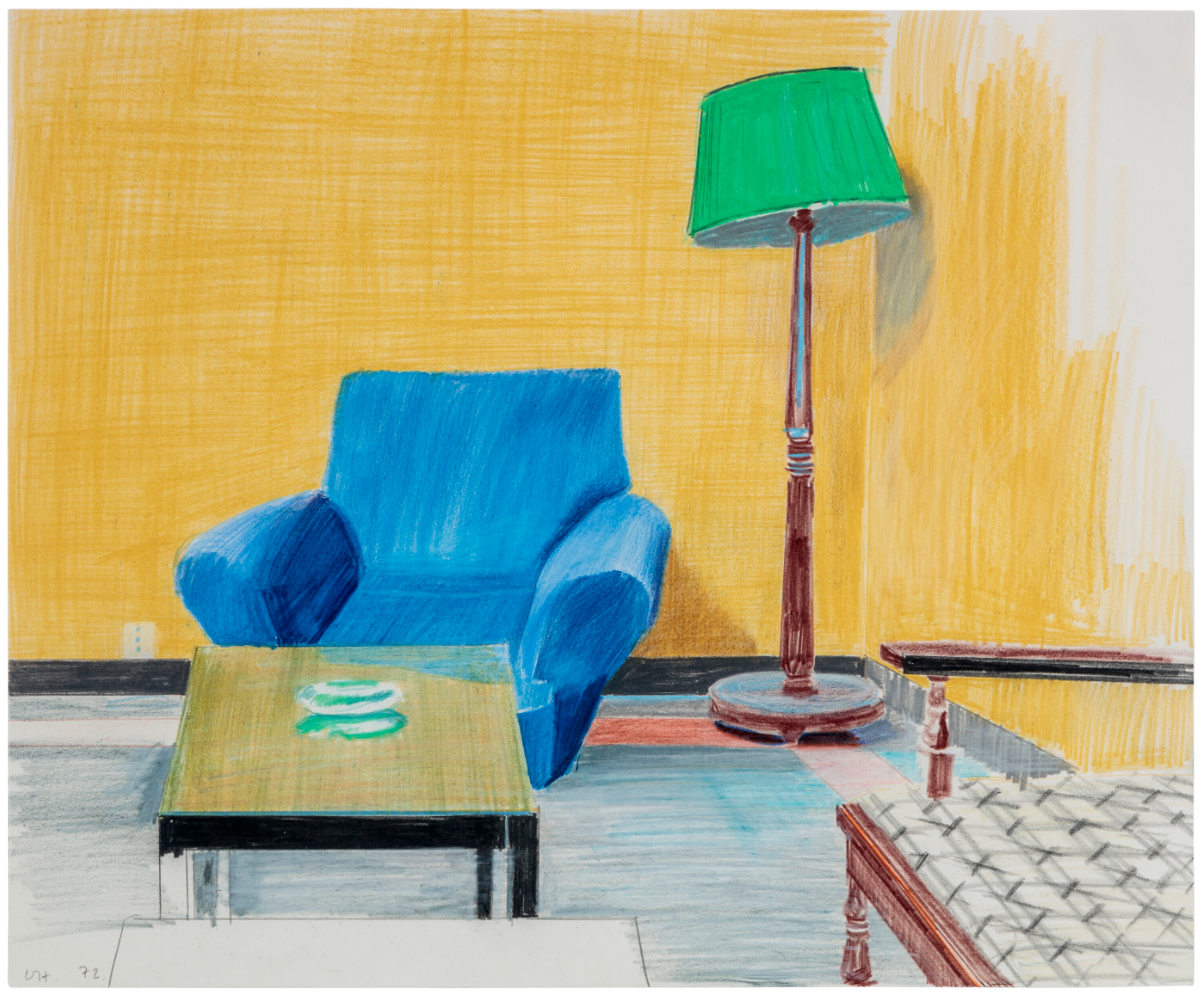
DAVID HOCKNEY (B. 1937)
Armchair, Table and Lamp, 1972
Colored crayon and graphite on paper
13 1/4 x 16 1/2 inches (34.9 x 41.9 cm)
Signed with the artist’s initials and dated ‘DH 72.’ (lower left)
#8. House, Olympic Boulevard, 1967
Sotheby’s New-York: 16 November 2023
Estimated: USD 250,000 – 350,000
USD 317,500
House, Olympic Boulevard | Contemporary Day Auction | 2023 | Sotheby’s (sothebys.com)
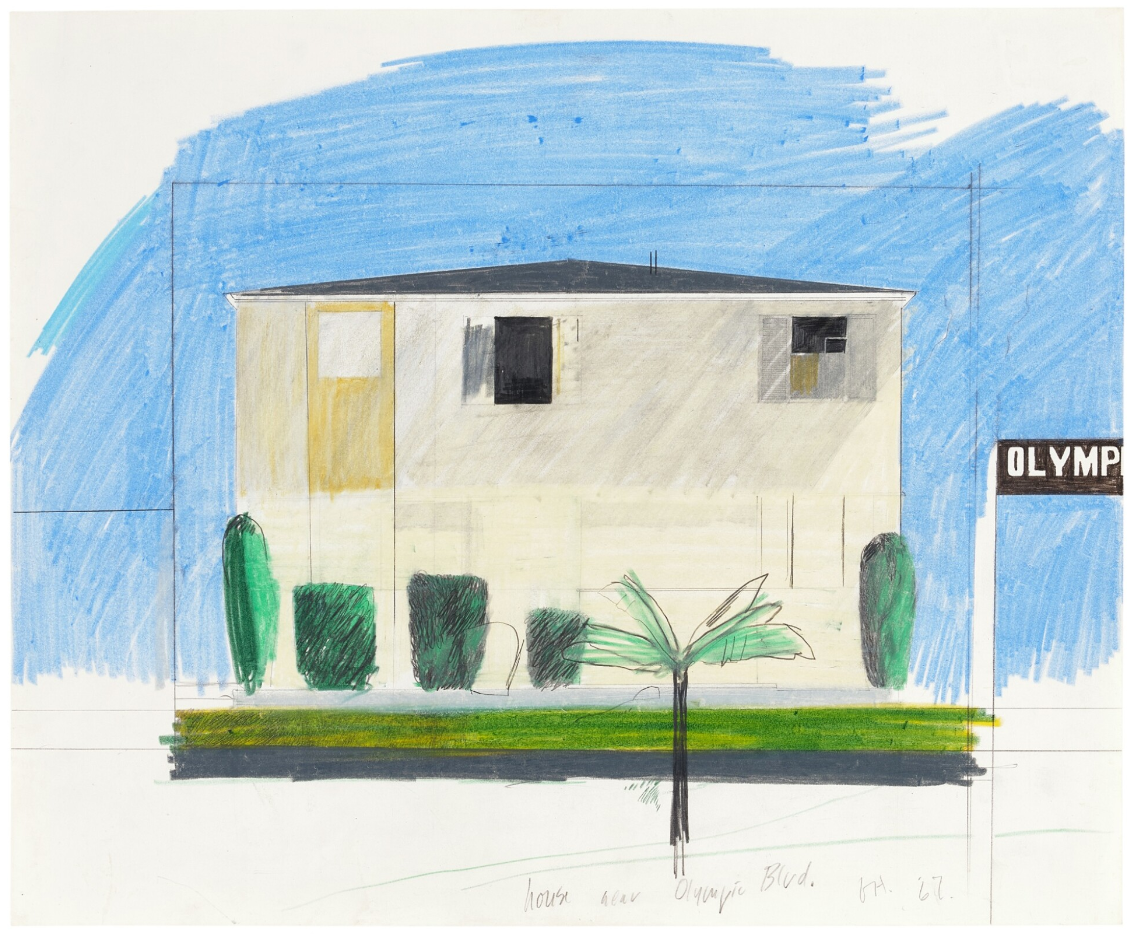
DAVID HOCKNEY (b. 1937)
House, Olympic Boulevard, 1967
Crayon, colored pencil and graphite on paper
13 3/4 x 16 3/4 inches (35 x 42.5 cm)
Signed with the artist’s initials, titled and dated 67 (lower center)
#9. Ouesten, 1994
Grisebach Berlin: 30 November 2023
Estimated: EUR 90,000 – 120,000
EUR 222,250 / USD 253,487
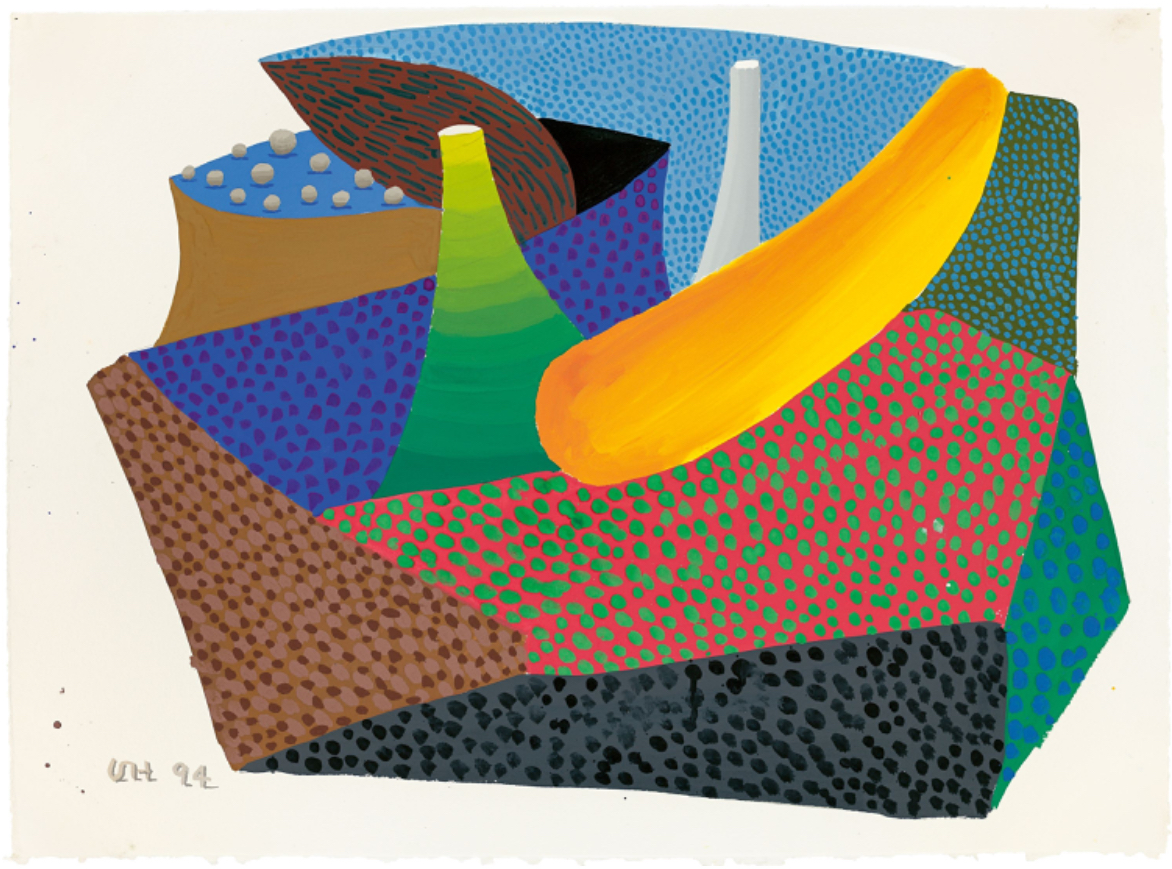
DAVID HOCKNEY (b. 1937)
Ouesten, 1994
Gouache on wove paper
22 x 30 1/8 inches (56 x 76.5 cm)
Signed with the artist’s initials and dated 94 (lower left)
#10. Celia, 1970
Christie’s London: 21 March 2023
Estimated: GBP 180,000 – 250,000
GBP 201,600 / USD 247,442
DAVID HOCKNEY, O.M., C.H., R.A. (B. 1937), Celia | Christie’s (christies.com)
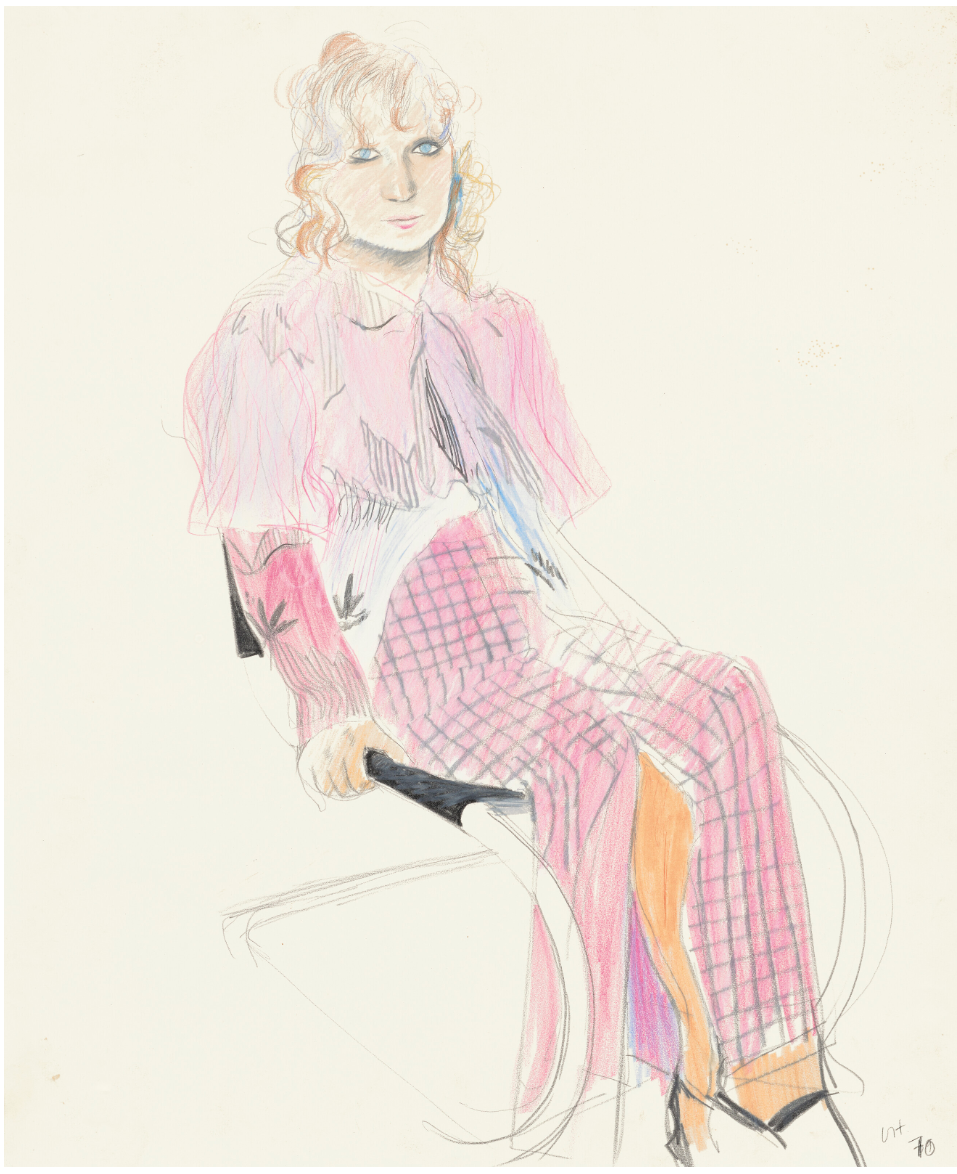
DAVID HOCKNEY, O.M., C.H., R.A. (B. 1937)
Celia, 1970
Pencil and colored pencil on paper
17×14 inches (43.2 x 35.6 cm)
Signed with initials and dated ‘DH./70’ (lower right)
#11. Los Angeles, 1964
Christie’s London: 21 March 2023
Estimated: GBP 100,000 – 150,000
GBP 189,000 / USD 231,976
DAVID HOCKNEY, O.M., C.H., R.A. (B. 1937), Los Angeles | Christie’s (christies.com)
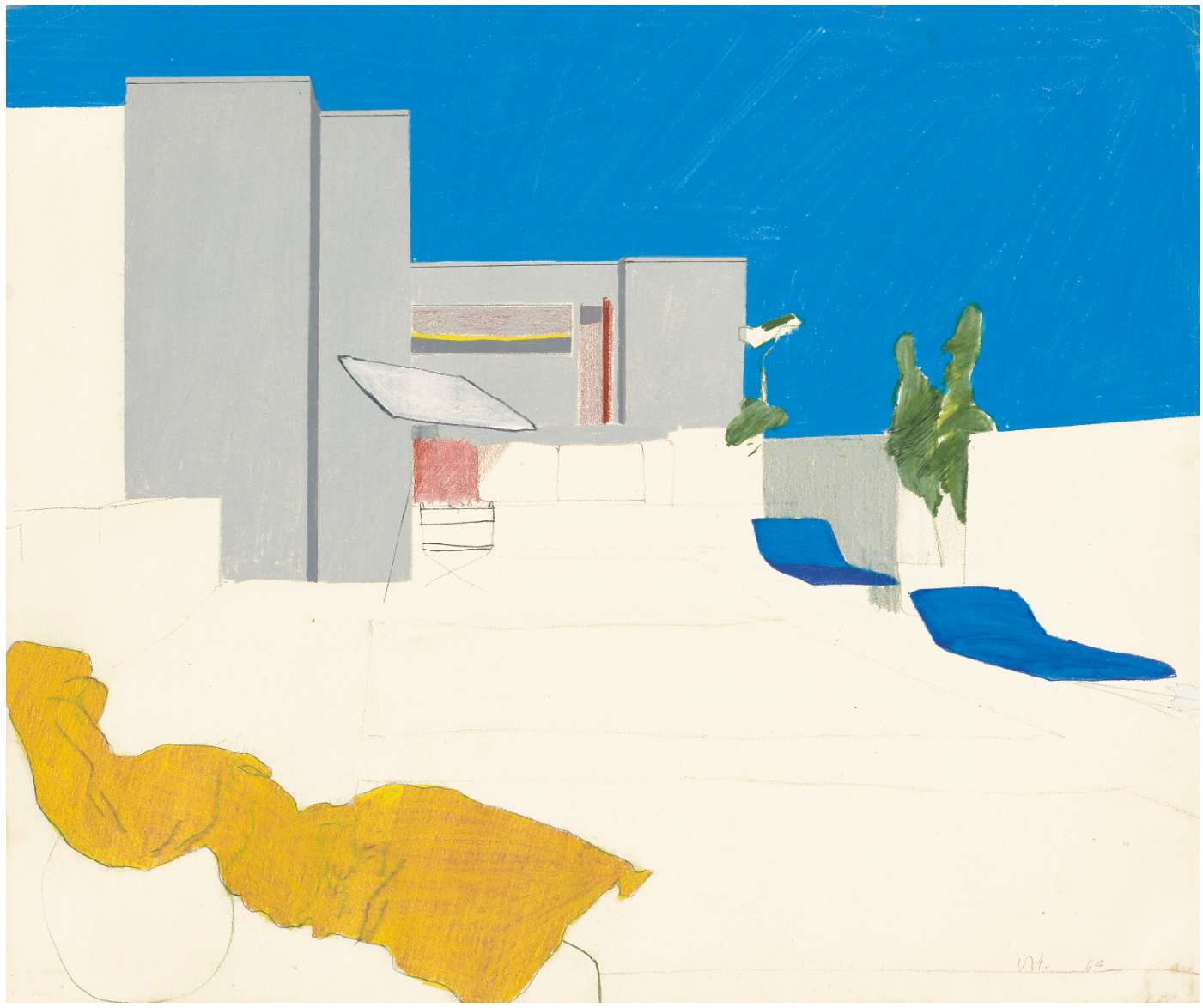
DAVID HOCKNEY, O.M., C.H., R.A. (B. 1937)
Los Angeles, 1964
Pencil, colored pencil and wax crayon on paper
14×17 inches (35.6 x 43.2 cm)
Signed with initials ‘DH. 64’ (lower right)
#12. A Glass Table with Still Life, 1969
Christie’s London: 21 March 2023
Estimated: GBP 80,000 – 100,000
GBP 176,400 / USD 212,261
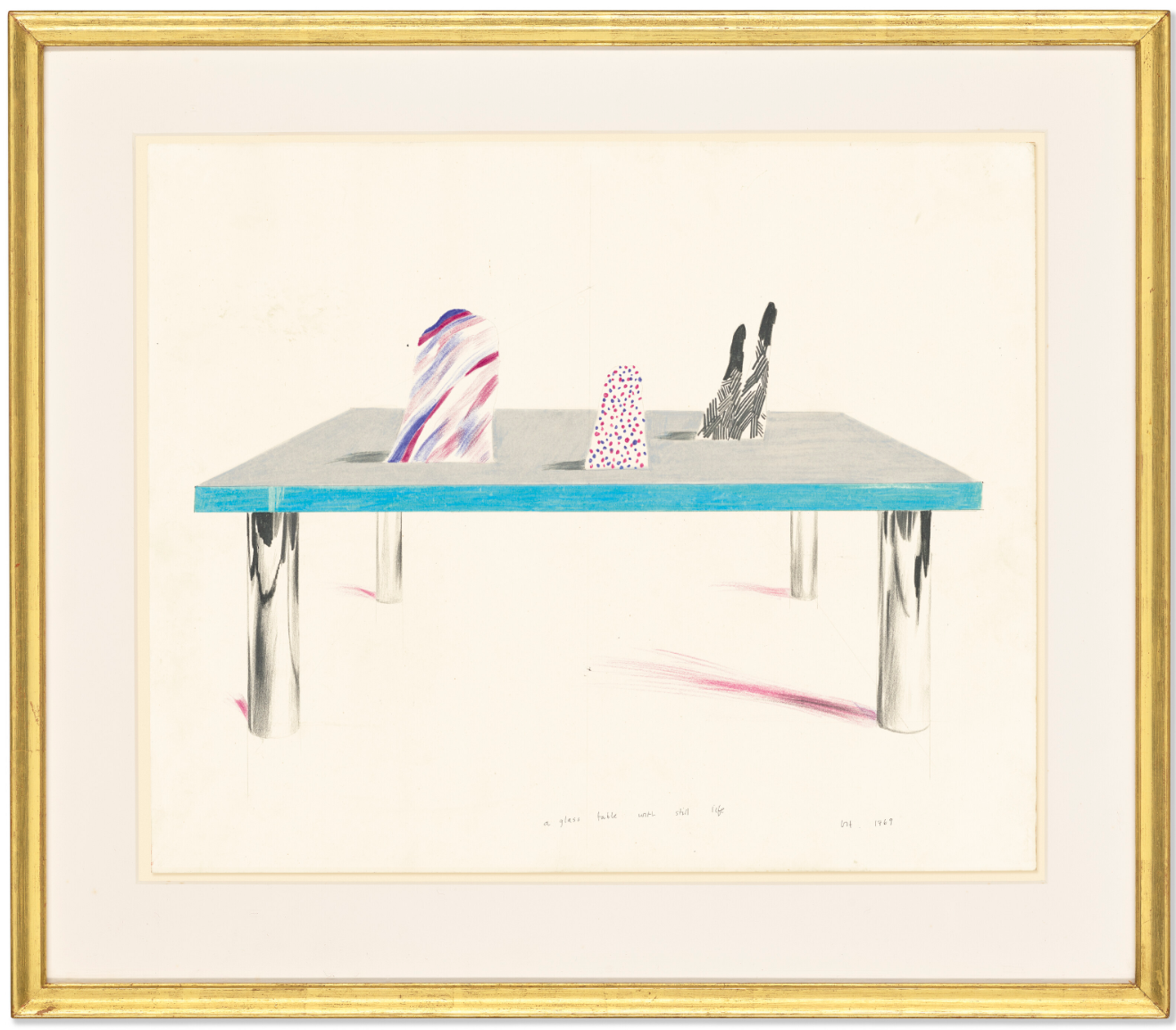
DAVID HOCKNEY, O.M., C.H., R.A. (B. 1937)
A Glass Table with Still Life, 1969
Pencil and colored crayon on paper
14×17 inches (35.6 x 43.2 cm)
Signed with initials, inscribed and dated ‘a glass table with still life/DH. 1969’ (lower right)
#13. Swimming Pool, Los Angeles, 1965
Christie’s London: 1 March 2023
Estimated: GBP 120,000 – 180,000
GBP 176,400 / USD 212,261
DAVID HOCKNEY (B. 1937), Swimming Pool, Los Angeles | Christie’s (christies.com)
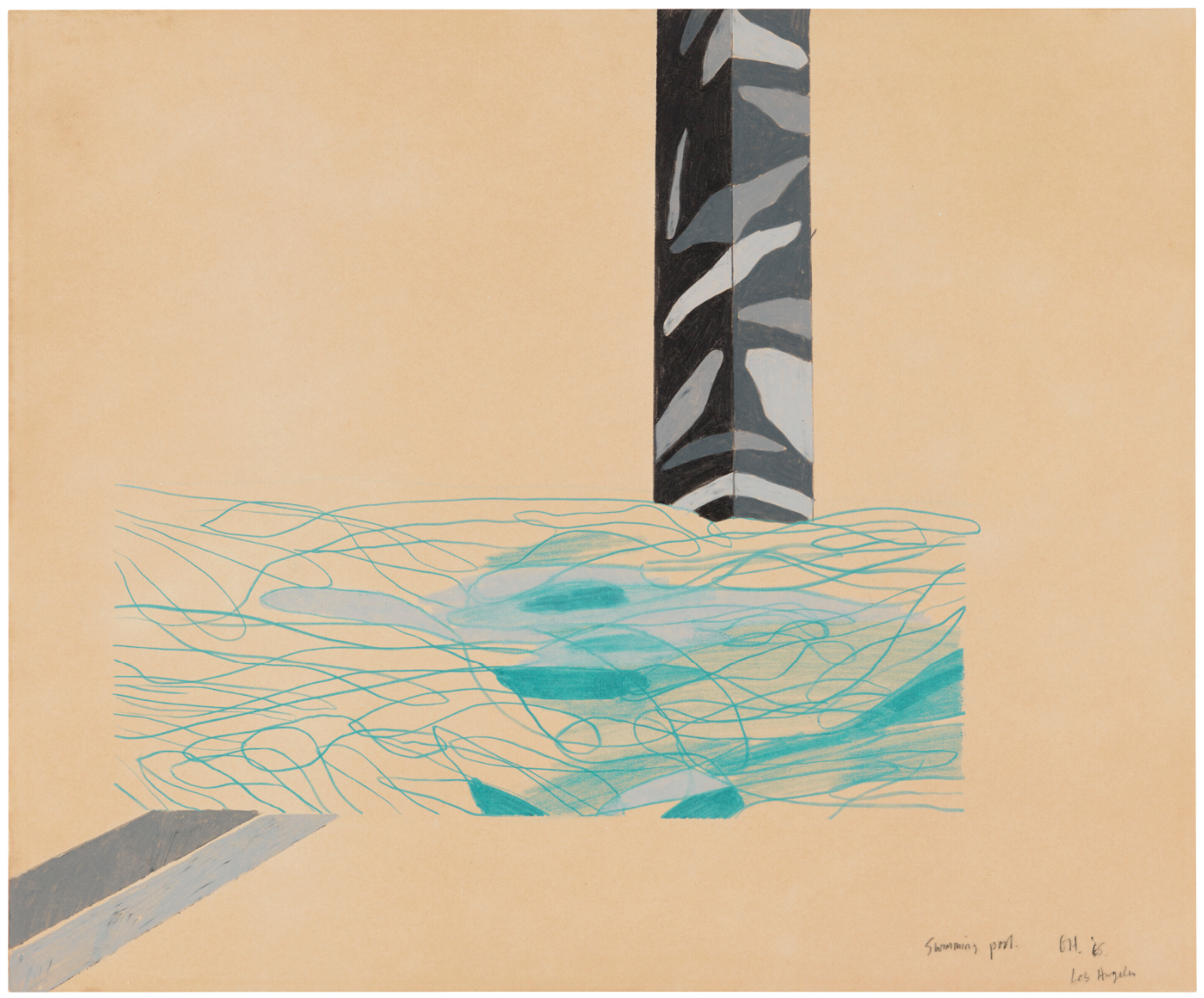
DAVID HOCKNEY (B. 1937)
Swimming Pool, Los Angeles, 1965
Colored pencil on paper
13 7/8 x 16 3/4 inches (35.4 x 42.7 cm)
Signed with the artist’s initials, titled and dated ‘Swimming pool DH. 65 Los Angeles’ (lower right)
#14. Boodgie and Stanley, 30 May 1994
Christie’s London: 1 March 2023
Estimated: GBP 30,000 – 50,000
GBP 163,800 / USD 197,099
DAVID HOCKNEY (B. 1937), Boodgie and Stanley, 30 May 1994 | Christie’s (christies.com)
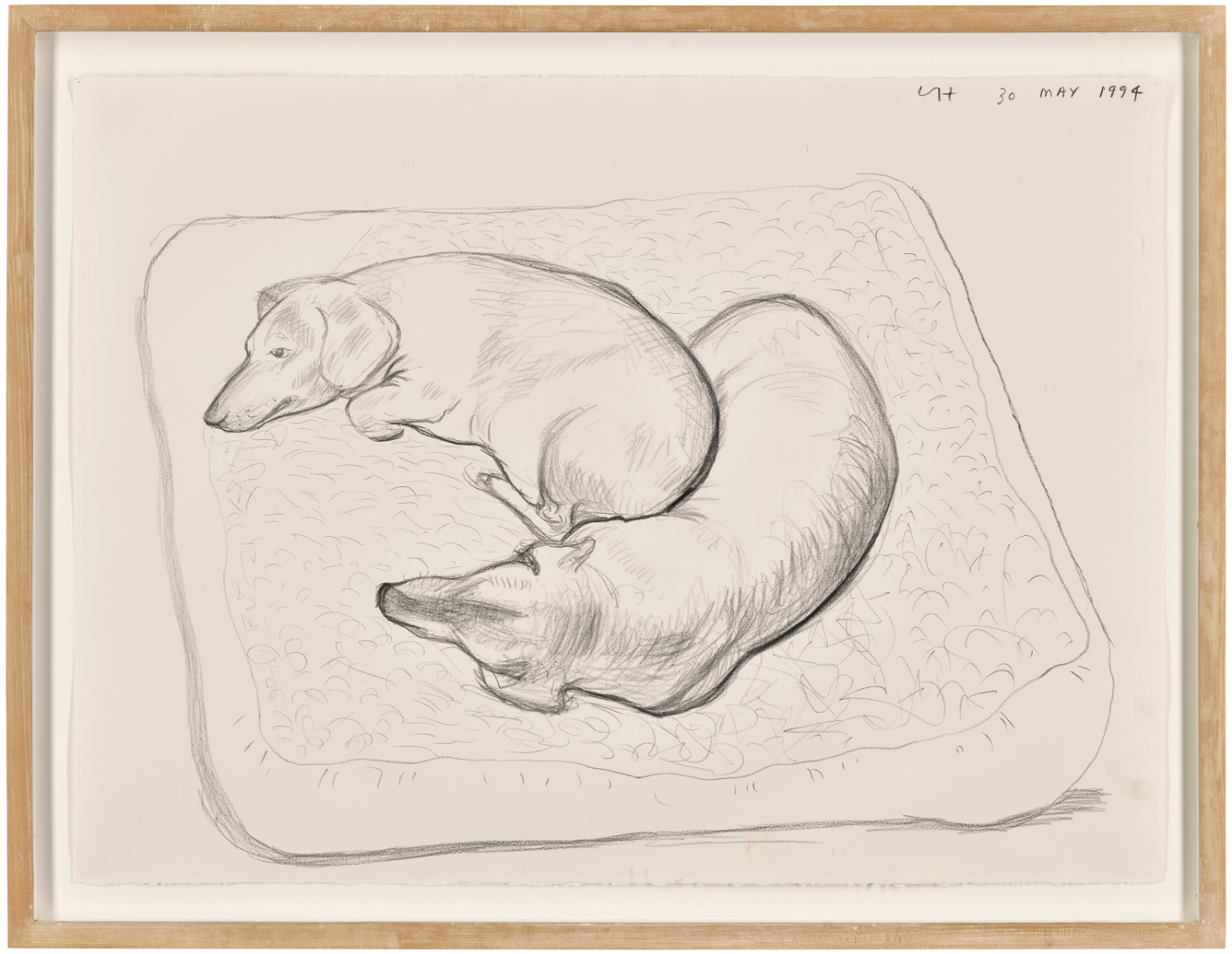
DAVID HOCKNEY (B. 1937)
Boodgie and Stanley, 30 May 1994
Graphite on paper
22 1/2 x 29 7/8 inches (57×76 cm)
Signed with the artist’s initials and dated ‘ DH 30 MAY 1994’ (upper right)
#15. Mo, Lucca, 1973
Christie’s London: 14 October 2023
Estimated: GBP 60,000 – 80,000
GBP 157,500 / USD 190,968
DAVID HOCKNEY (B. 1937), Mo, Lucca | Christie’s (christies.com)
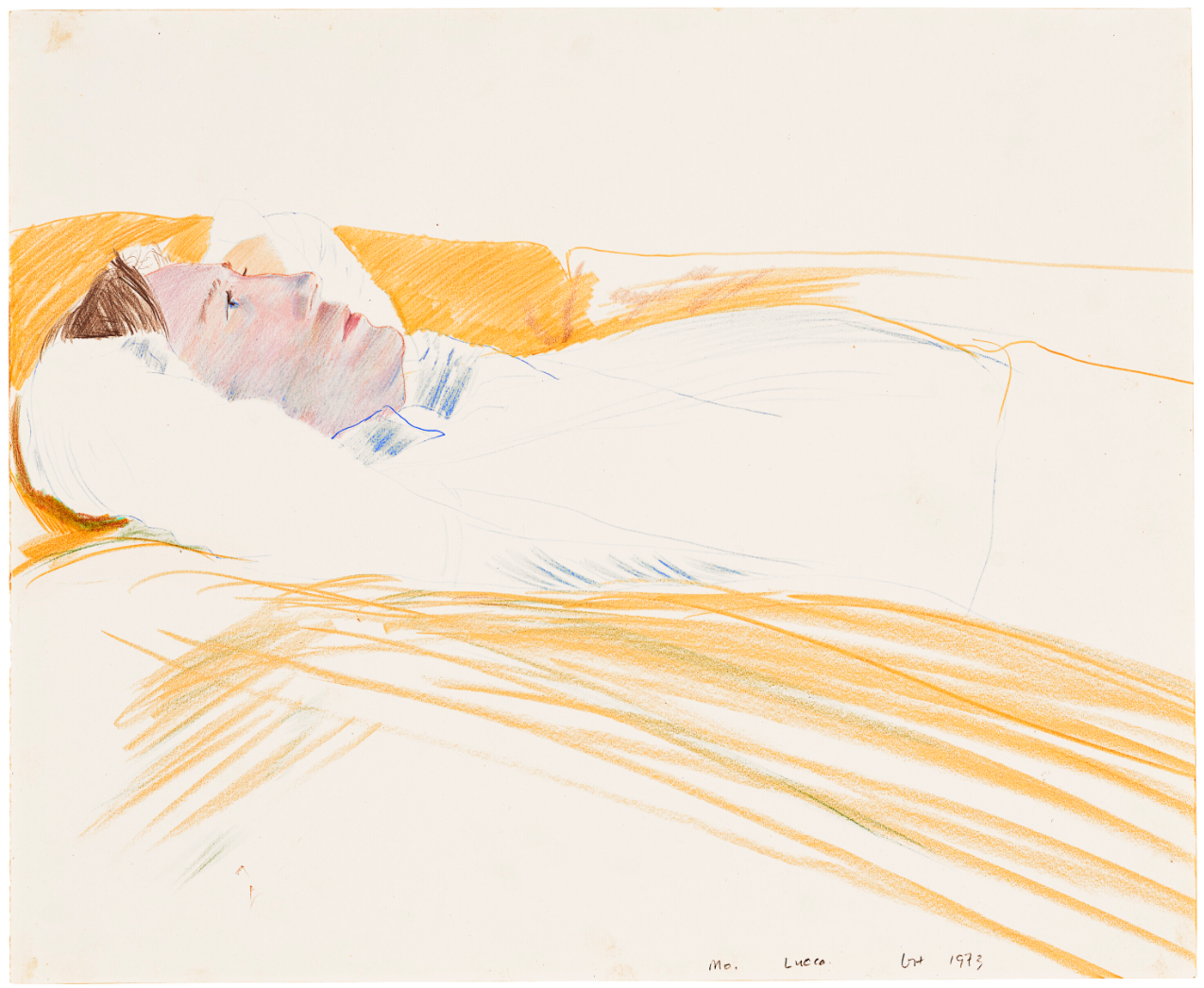
DAVID HOCKNEY (B. 1937)
Mo, Lucca, 1973
Colored pencil on paper
14 x 16 7/8 inches (35.6 x 42.9 cm)
Signed with the artist’s initials, titled and dated ‘Mo, Lucca DH 1973’ (lower right)
#16. The Director’s Chair, 1976
Christie’s New-York: 10 November 2023
Estimated: USD 100,000 – 150,000
USD 138,600
DAVID HOCKNEY (B. 1937), The Director’s Chair | Christie’s (christies.com)
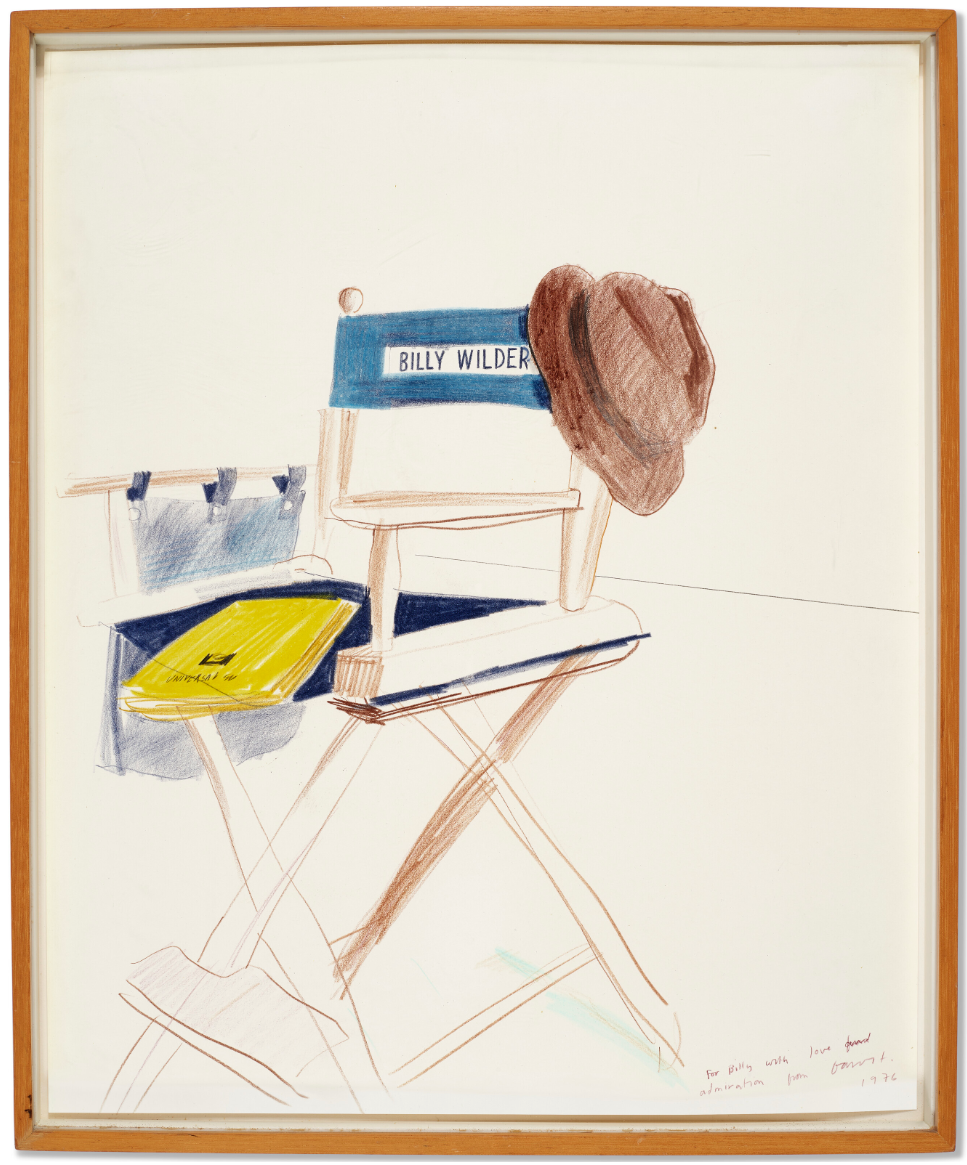
DAVID HOCKNEY (B. 1937)
The Director’s Chair, 1976
Colored pencil and graphite on paper
16 7/8 x 13 7/8 inches (42.4 x 34.8 cm)
Signed, dedicated and dated ‘For Billy with love and admiration from David H. 1976’ (lower right)
#17. Sir David Webster, 1971
Sotheby’s London: 28 June 2023
Estimated: GBP 70,000 – 90,000
GBP 88,900 / USD 113,310
Sir David Webster | Modern & Contemporary Day Auction | 2023 | Sotheby’s (sothebys.com)
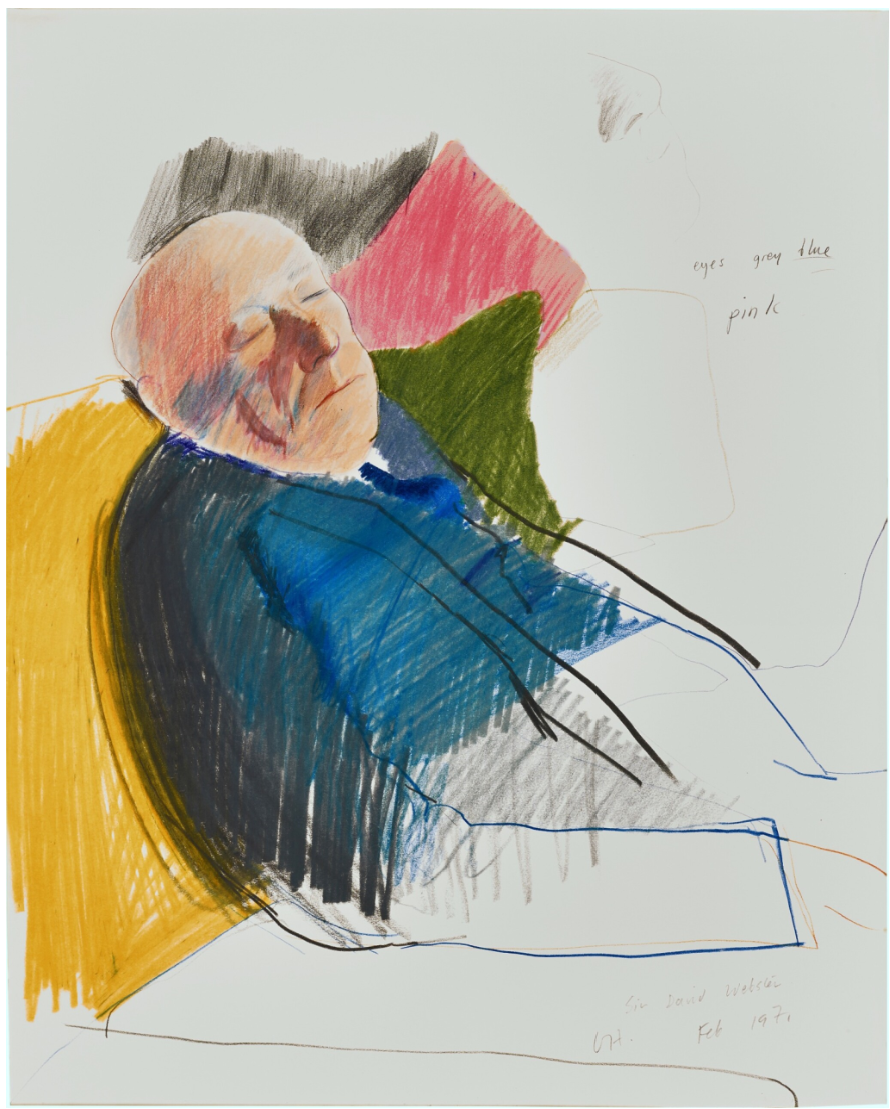
DAVID HOCKNEY (b. 1937)
Sir David Webster, 1971
Colored pencil and graphite on paper
17×14 inches (43.2 x 35.5 cm)
Signed with the artist’s initials, titled, dated Feb 1971 and variously inscribed
#18. Peter Drawing, 1970
Christie’s London: 22 March 2023
Estimated: GBP 70,000 – 100,000
GBP 63,000 / USD 77,350
DAVID HOCKNEY, O.M., C.H., R.A. (B. 1937), Peter Drawing | Christie’s (christies.com)
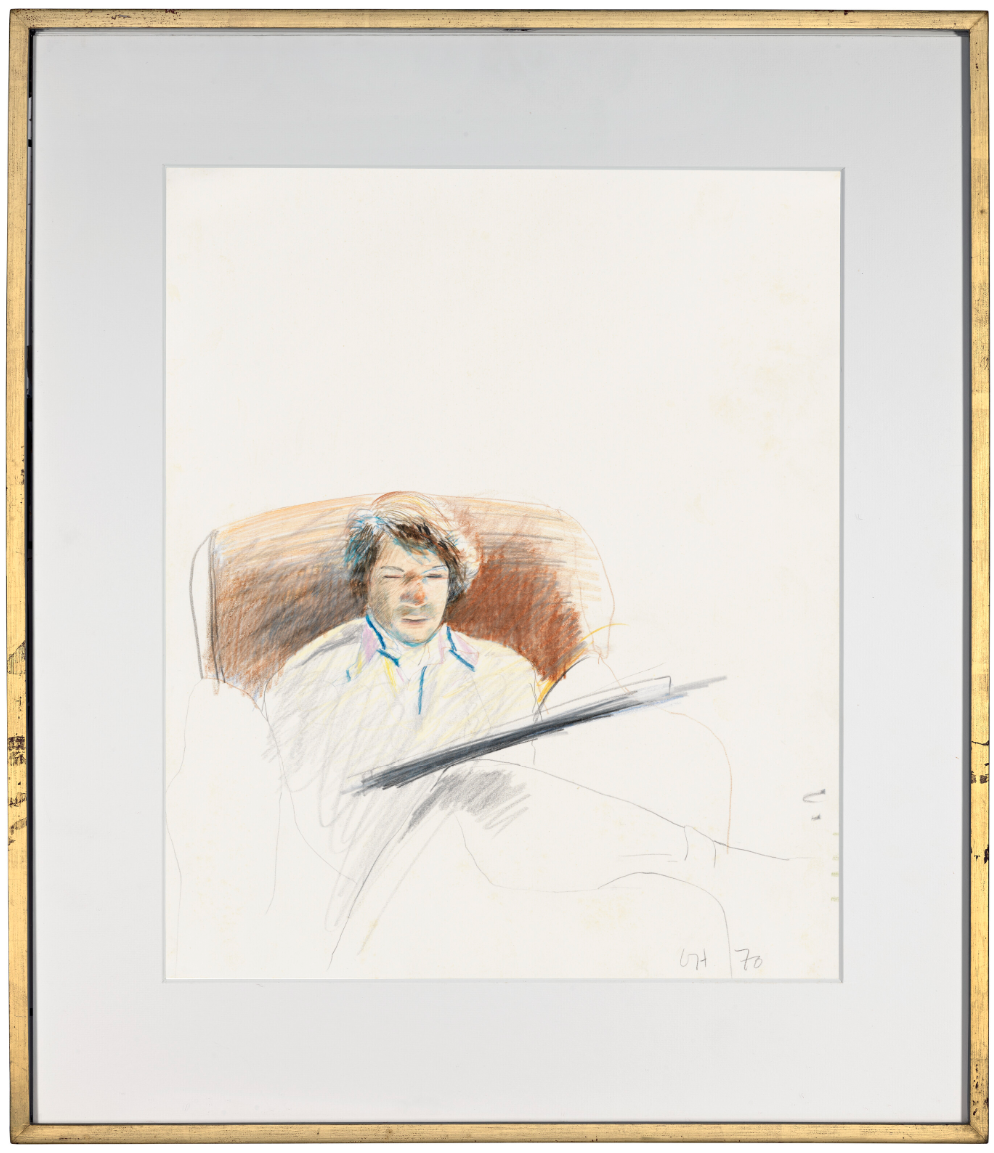
DAVID HOCKNEY, O.M., C.H., R.A. (B. 1937)
Peter Drawing, 1970
Pencil, colored pencil and crayon on paper
17×14 inches (43.2 x 35.5 cm)
Signed with initials and dated ‘DH 70’ (lower right)
#22. Cairo, 1978
Christie’s London: 14 October 2023
Estimated: GBP 18,000 – 25,000
GBP 32,760 / USD 39,776
DAVID HOCKNEY, O.M., C.H., R.A. (B. 1937), Cairo | Christie’s (christies.com)
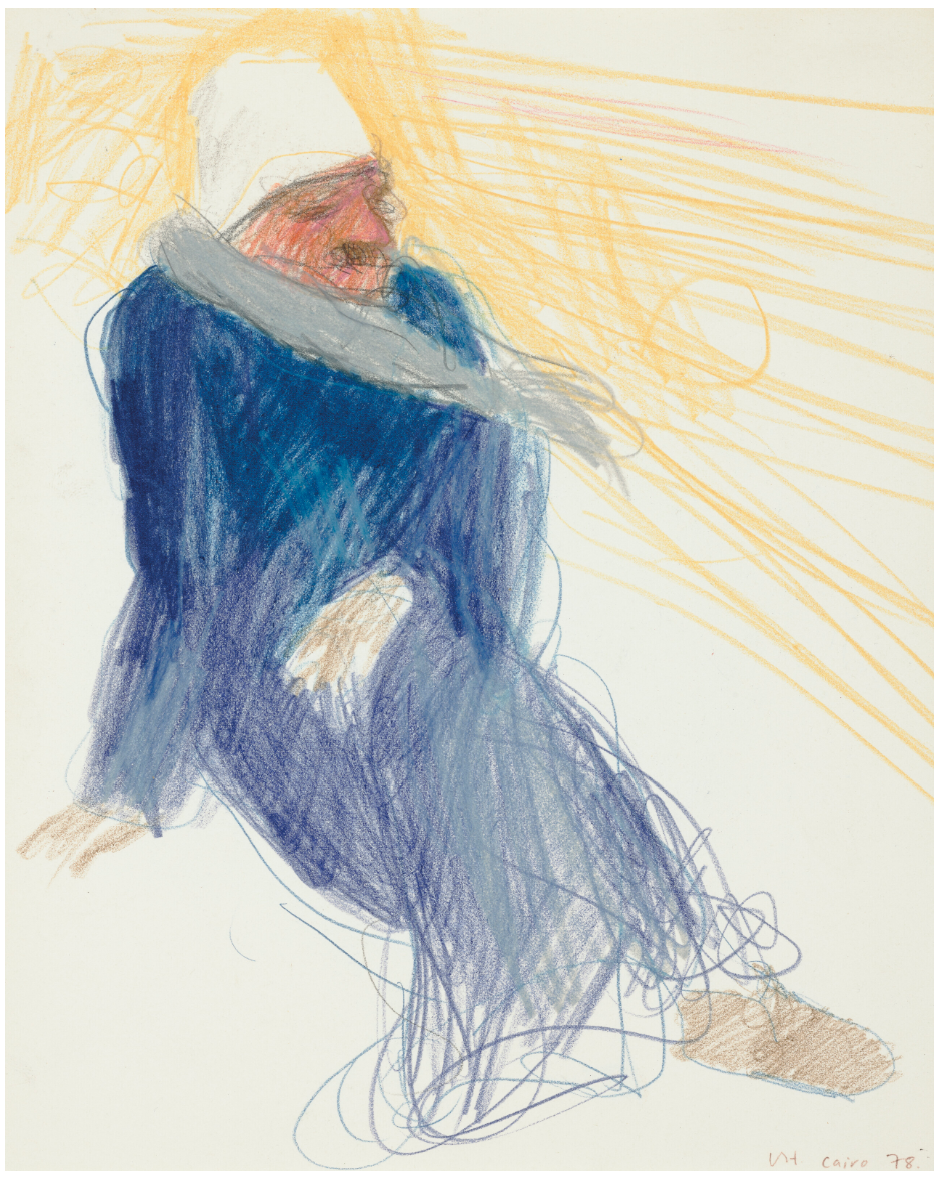
DAVID HOCKNEY, O.M., C.H., R.A. (B. 1937)
Cairo, 1978
Colored pencil on paper
10×8 inches (25.4 x 20.3 cm)
Signed with initials, inscribed and dated ‘DH Cairo 78’ (lower right)
2022 Auction Results
30 lots sold at auction in 2022 for a total turnover of USD 5,196,763. With 3 lots failing to sell, the sell-through rate is 90.9%. The highest price was achieved by Arlington Hotel, Hot Springs, Arkansas, a drawing dated 1976, sold for USD 1,524,000 at Christie’s, in New-York, on 18 November 2022. This is the only lot that sold for more than USD 1 million.
2022 Top 5 Lots
10 lots sold for more than USD 100,000, generating a cumulative turnover of USD 4,273,591, representing 82.2% of the total turnover for 2022.
XXXXXXXXXX
#1. Arlington Hotel, Hot Springs, Arkansas, 1976
Christie’s New-York: 18 November 2022
Estimated: USD 300,000 – 500,000
USD 1,524,000
WORK ON PAPER
DAVID HOCKNEY (B. 1937) (christies.com)
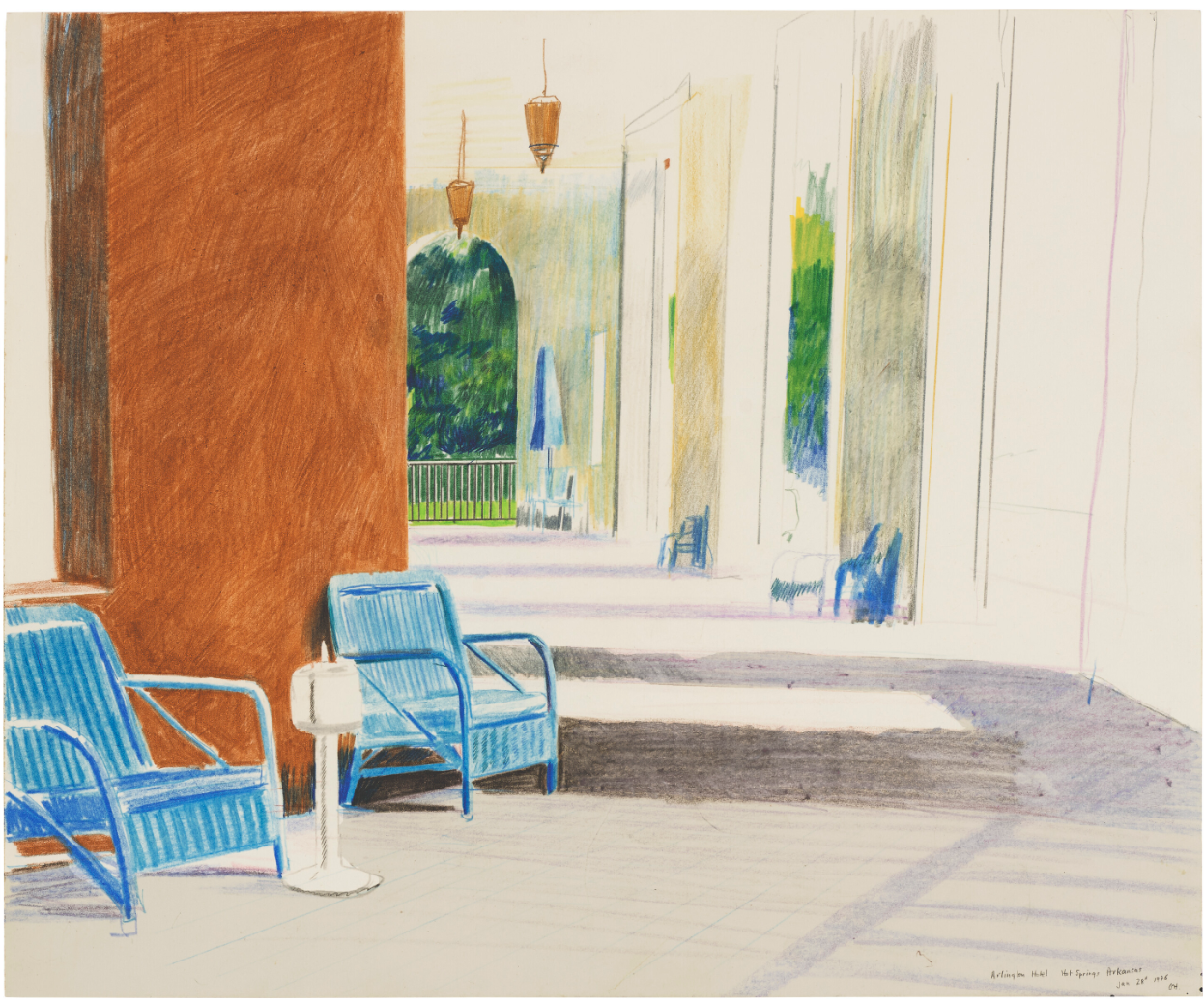
DAVID HOCKNEY (B. 1937)
Arlington Hotel, Hot Springs, Arkansas, 1976
Wax crayon, colored pencil and graphite on paper
14×17 inches (35.6 x 43.2 cm)
Signed with the artist’s initials, titled and dated ‘Arlington Hotel Hot Springs Arkansas Jan 28th 1976 DH’ (lower right)
USD 1 million
#2. Celia in a Black Slip, 1973
Sotheby’s New-York: 17 November 2022
Estimated: USD 250,000 – 350,000
USD 604,800
Celia in a Black Slip | Contemporary Day Auction | 2022 | Sotheby’s (sothebys.com)
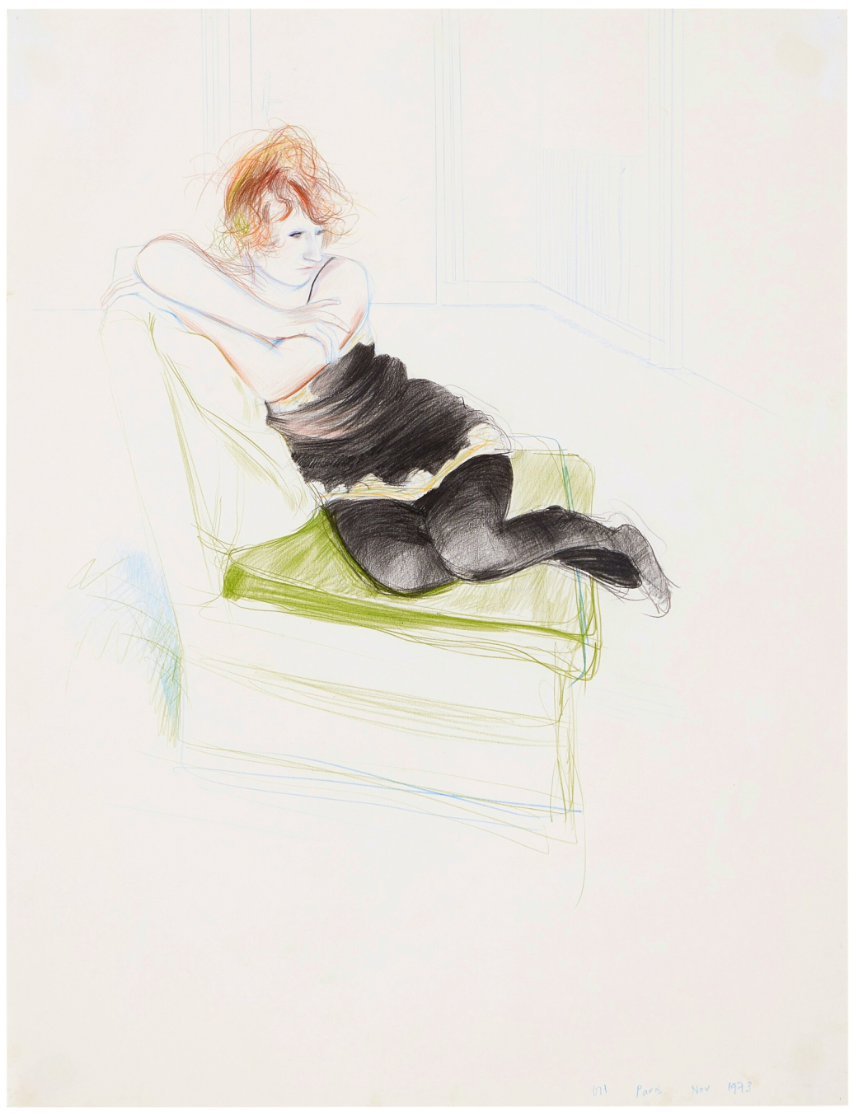
DAVID HOCKNEY (b. 1937)
Celia in a Black Slip, 1973
Colored pencil on paper
25 1/2 x 19 5/8 inches (64.8 x 49.8 cm)
Signed with the initials DH and dated Paris Nov 73 (lower right)
#3. Peter on the balcony, 1971
Christie’s Paris: 1 December 2022
Estimated: EUR 50,000 – 70,000
EUR 541,800 / USD 564,820
David Hockney (né en 1937), Peter on the balcony | Christie’s (christies.com)
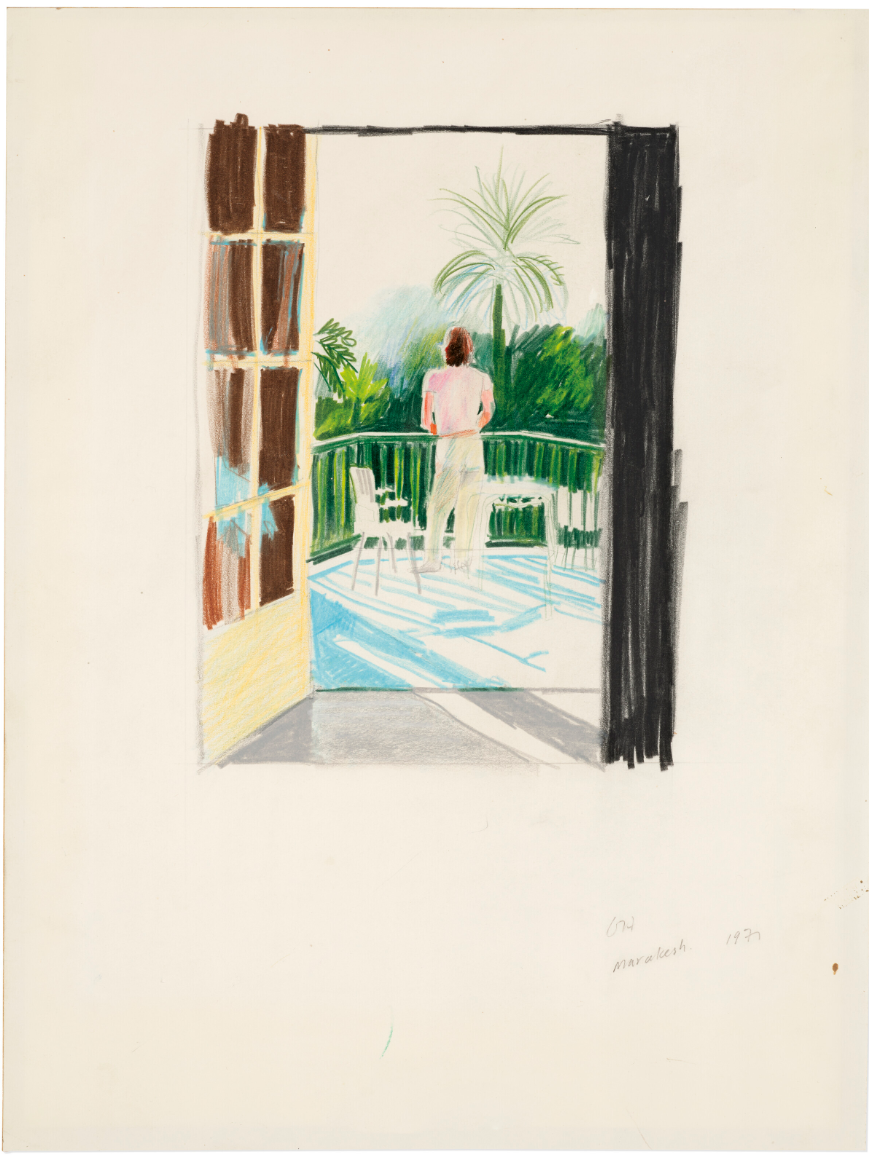
DAVID HOCKNEY (Born 1937)
Peter on the balcony, 1971
Pastel, color crayon, graphite and felt pen on paper
16 3/8 x 12 5/8 inches (41.5 x 32 cm)
Signed with the initials, dated and located ‘DH ‘’Marrakesh’’ 1971’ (lower right)
USD 500,000
#4. The Garden from ‘L’Enfant et Les Sortilèges’, 1980
Christie’s London: 14 October 2022
Estimated: GBP 100,000 – 150,000
GBP 302,400 / USD 341,760
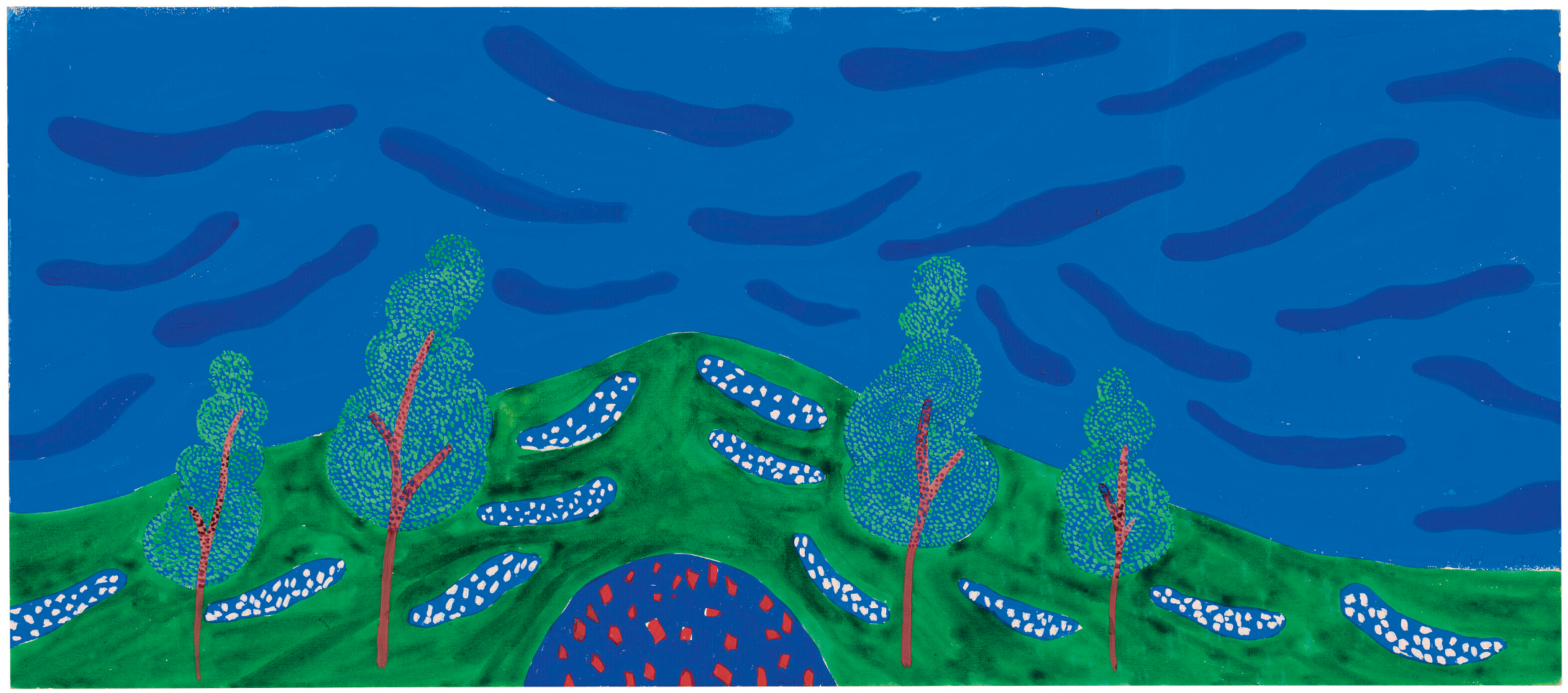
DAVID HOCKNEY (b. 1937)
The Garden from ‘L’Enfant et Les Sortilèges’, 1980
Gouache on paper
17 3/8 x 40 inches (44 x 101.5 cm)
Signed with the artist’s initials and dated ‘DH. 1980’ (lower right)
#5. Swimming Pool Ladder, 1967
Christie’s London: 1 July 2022
Estimated: GBP 150,000 – 200,000
GBP 233,100 / USD 283,456
DAVID HOCKNEY (B. 1937), Swimming Pool Ladder | Christie’s (christies.com)
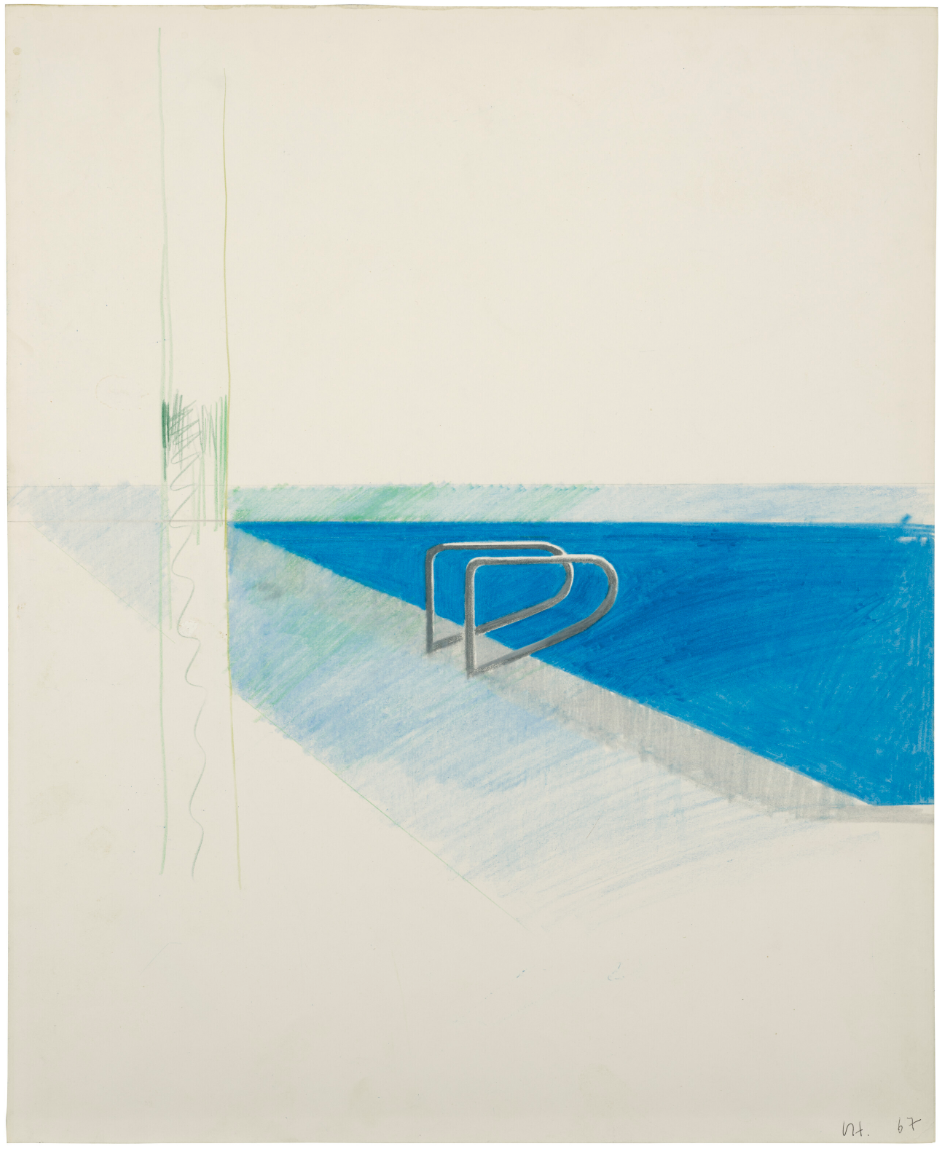
DAVID HOCKNEY (B. 1937)
Swimming Pool Ladder, 1967
Colored pencil and graphite on paper
17 x 13 7/8 inches (43.2 x 35.4 cm)
Signed with the artist’s initials and dated ‘DH. 67’ (lower right)
#6. Celia, 1978
Sotheby’s New-York: 20 May 2022
Estimated: USD 200,000 – 300,000
USD 252,000
Celia | Contemporary Day Auction | 2022 | Sotheby’s (sothebys.com)
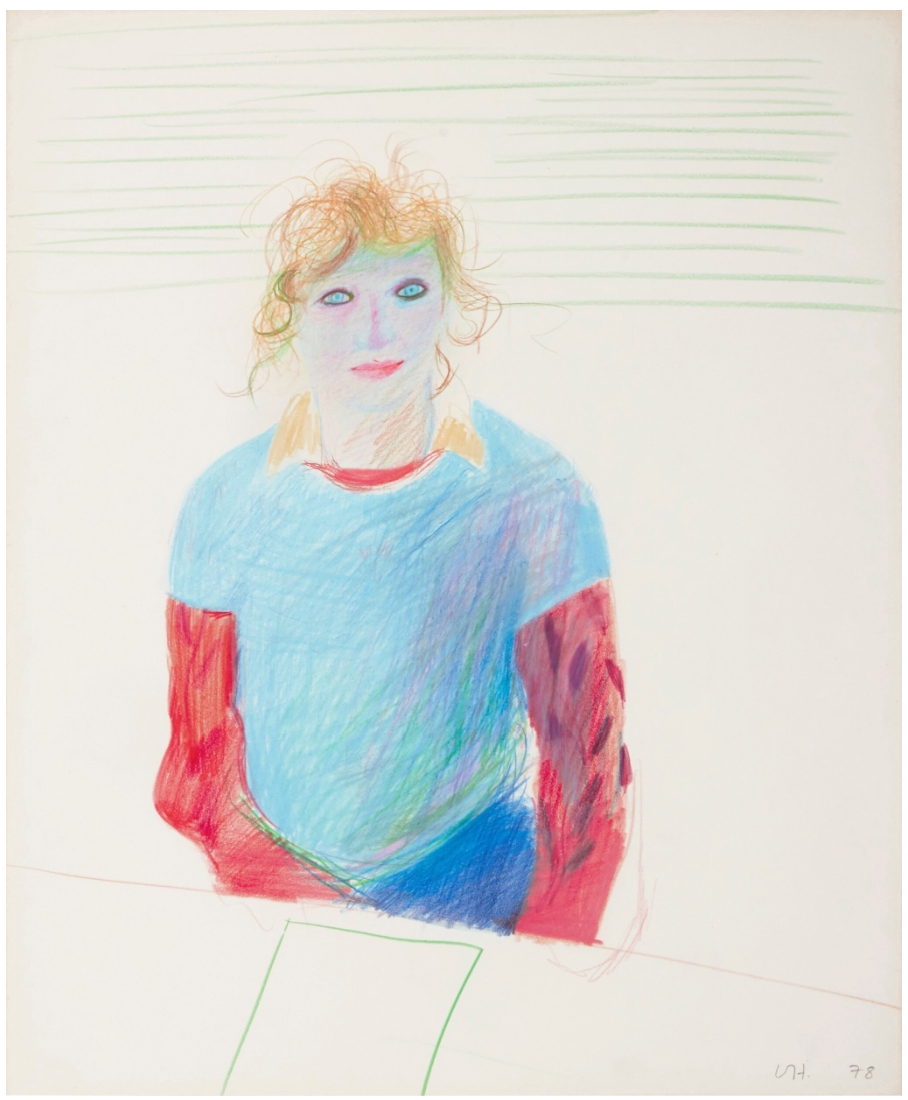
DAVID HOCKNEY (b. 1939)
Celia, 1978
Colored pencil on paper
17×14 inches (43.2 x 35.6 cm)
Signed with the initials DH and dated 78 (lower right)
#7. Waiter, Alexandria, 1963
Forum Auctions: 17 March 2022
Estimated: GBP 50,000 – 70,000
GBP 150,880 / USD 198,690
LOT:138 | David Hockney (b.1937) Waiter, Alexandria (forumauctions.co.uk)
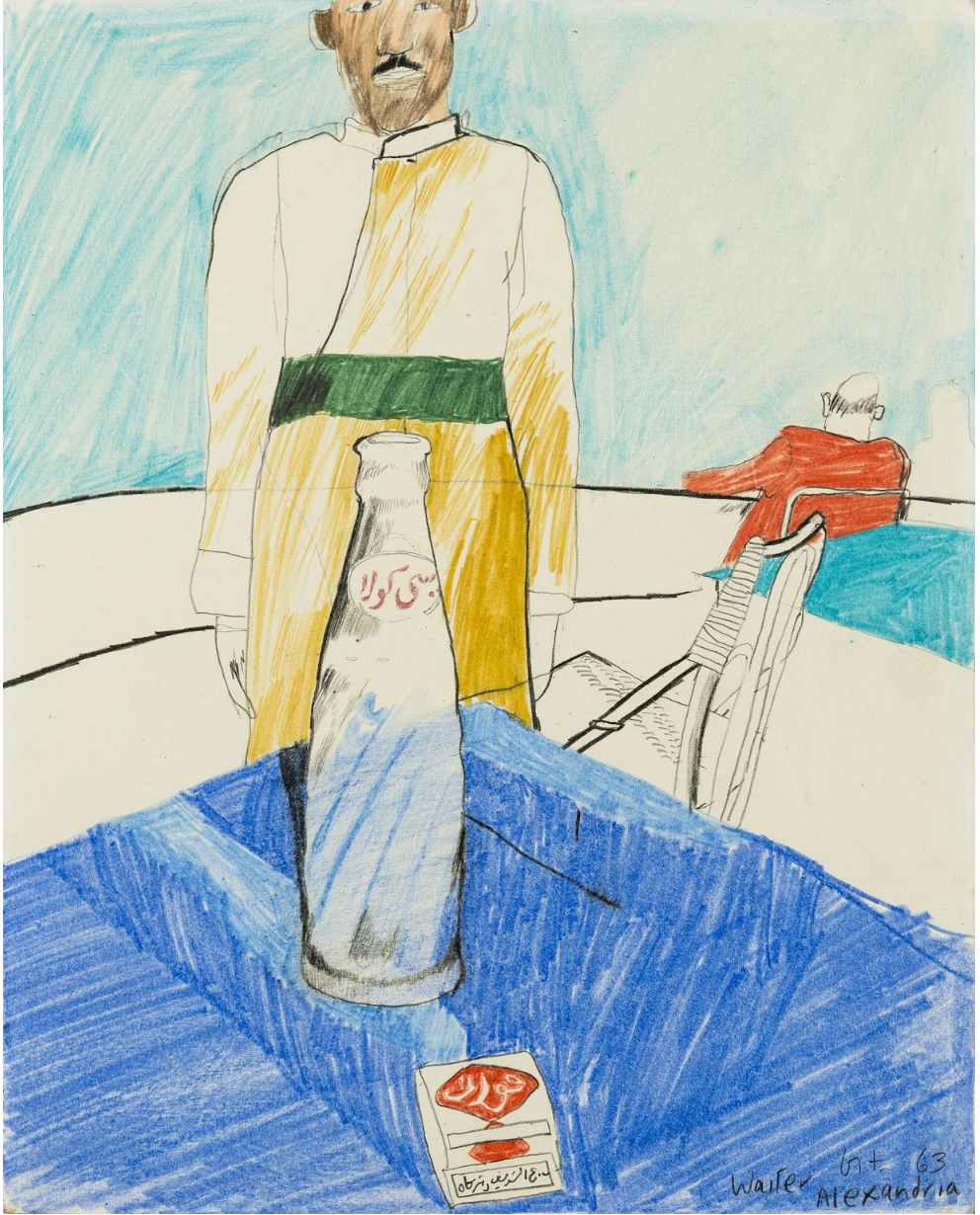
DAVID HOCKNEY (b.1937)
Waiter, Alexandria, 1963
Colored pencil and graphite on wove paper
12 x 10 5/8 inches (30.5 x 24.5 cm)
Initialed, dated and titled in pencil lower right
#8. Still-life (The History of Impressionism), 1974
Christie’s London: 23 March 2022
Estimated: GBP 30,000 – 50,000
GBP 151,200 / USD 198,320
DAVID HOCKNEY, O.M., C.H., R.A. (B. 1937), Still-life (The History of Impressionism) | Christie’s
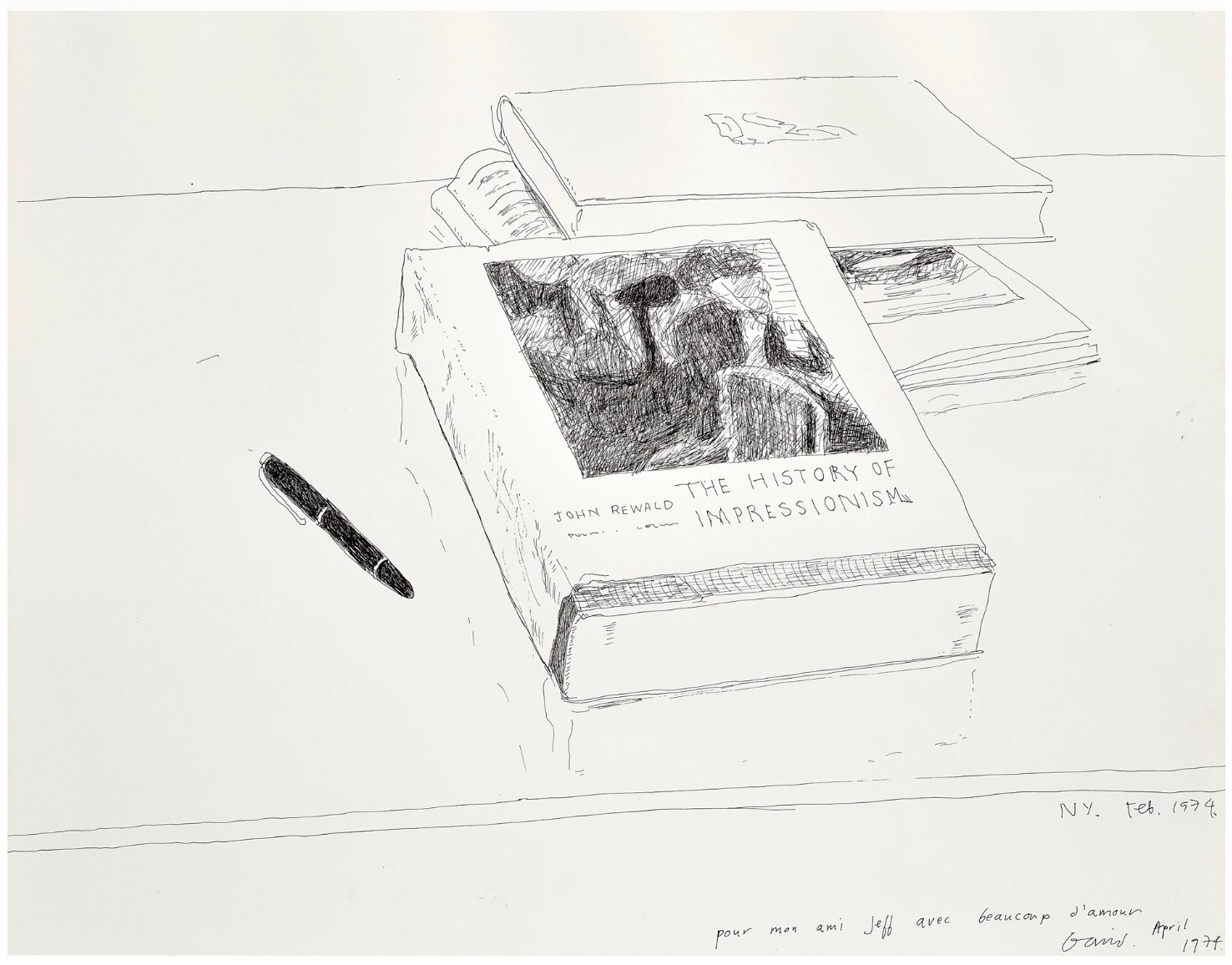
DAVID HOCKNEY, O.M., C.H., R.A. (B. 1937)
Still-life (The History of Impressionism), 1974
Ink on paper
10-3/4 x 13-5/8 inches (27.3 x 34.6 cm)
Signed, inscribed, dated and dedicated
‘NY. Feb. 1974./pour mon ami Jeff avec beaucoup d’amour/David./April/1974.’
(lower right)
#9. Linda Adams, Paris, 1975
Christie’s London: 22 March 2022
Estimated: GBP 50,000 – 80,000
GBP 138,600 / USD 181,795
DAVID HOCKNEY, O.M., C.H., R.A. (B. 1937), Linda Adams, Paris | Christie’s
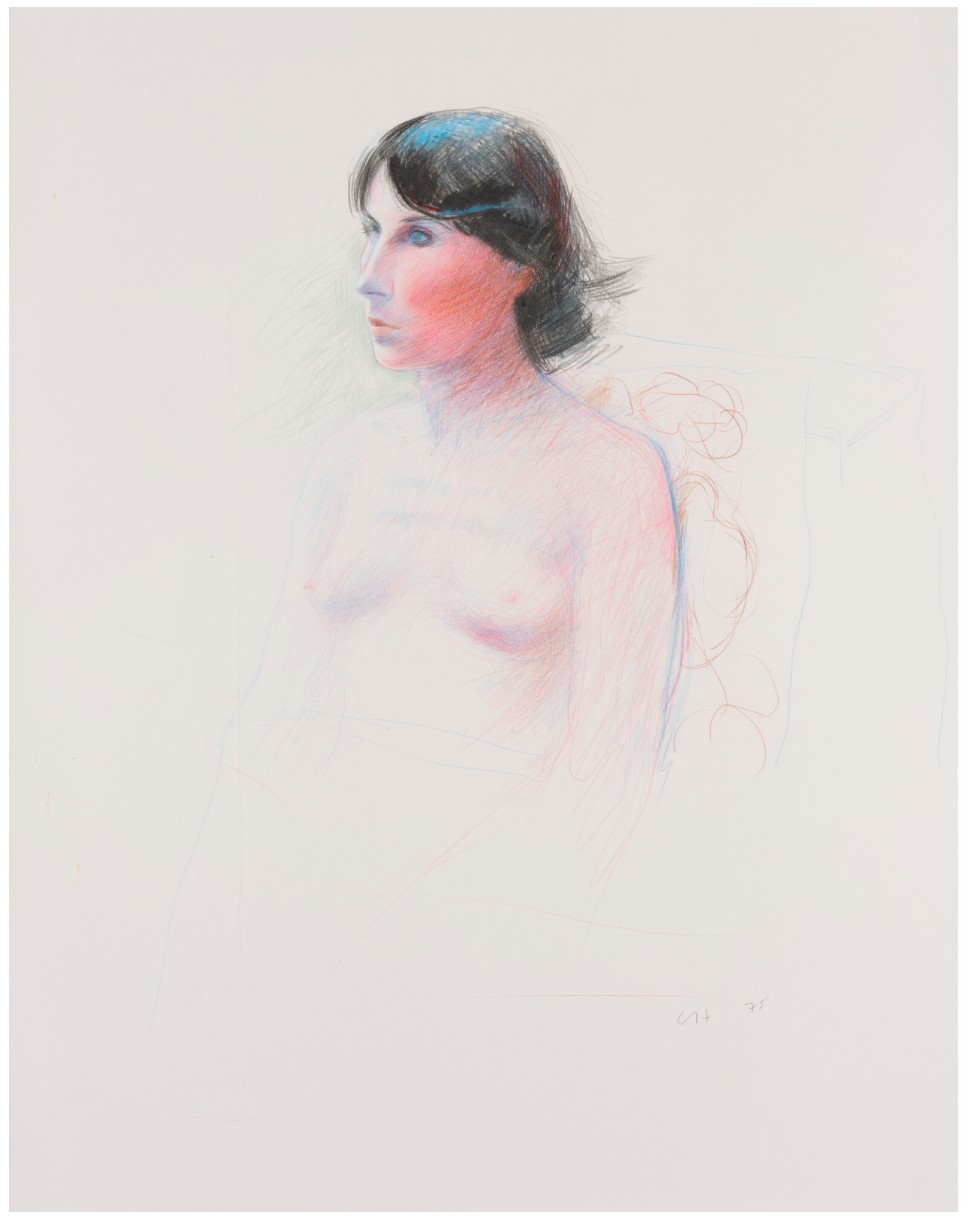
DAVID HOCKNEY (B. 1937)
Linda Adams, Paris, 1975
Colored pencil on paper
25 x 19-3/4 inches (63.5 x 50.2 cm)
Signed with initials and dated ‘DH 75’ (lower right)
#10. In Bombay Museum, 1977
Christie’s London: 23 March 2022
Estimated: GBP 30,000 – 50,000
GBP 94,500 / USD 123,950
DAVID HOCKNEY, O.M., C.H., R.A. (B. 1937), In Bombay Museum | Christie’s
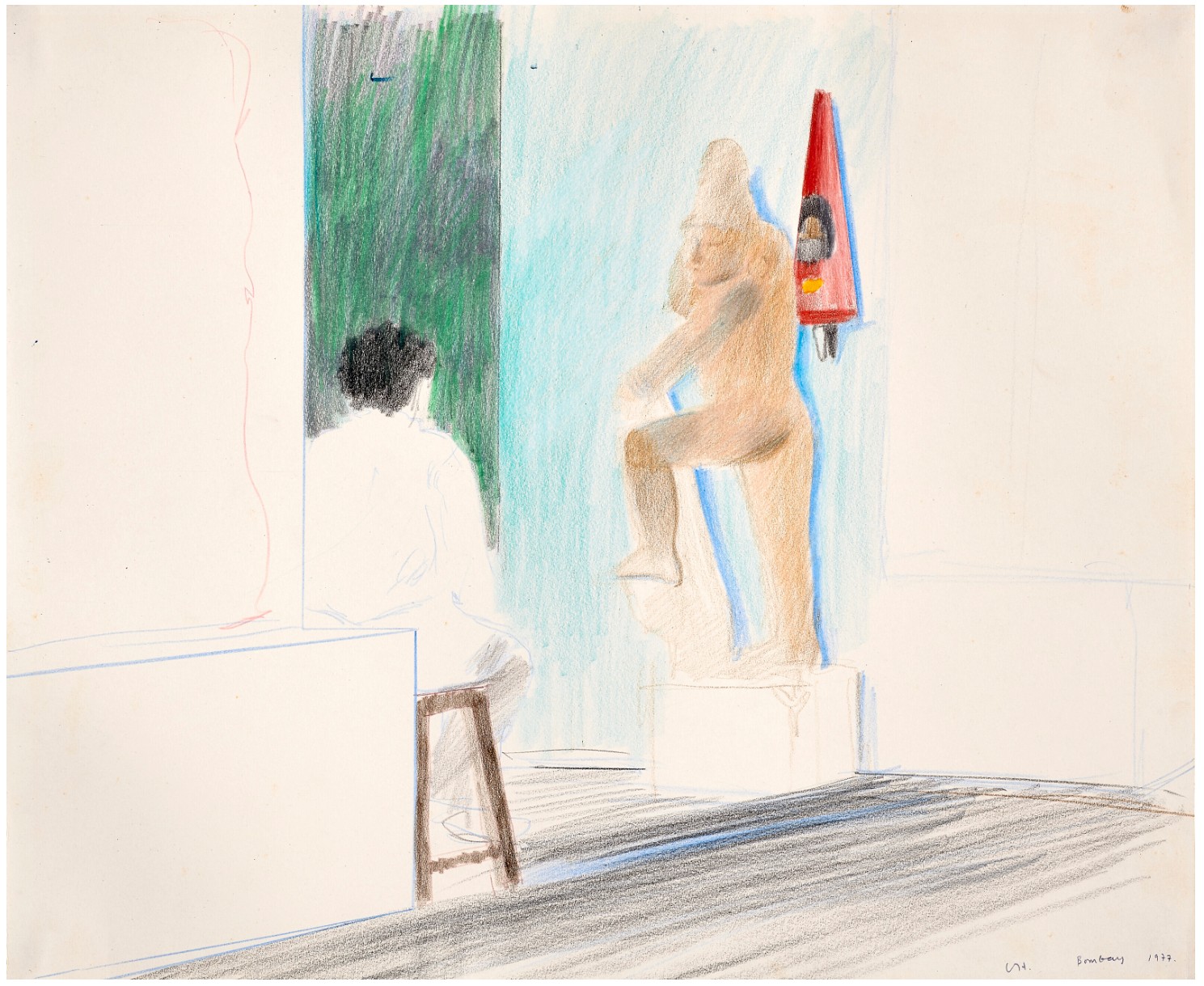
DAVID HOCKNEY (B. 1937)
In Bombay Museum, 1977
Colored pencil on paper
13-7/8 x 17 inches (35.3 x 43 cm)
Signed with initials, inscribed and dated ‘DH. Bombay 1977.’ (lower right)
2021 Auction Results
WORK IN PROGRESS
#1. Insurance Bldg L.A, 1966
Sotheby’s New-York: 19 November 2021
Estimated: USD 400,000 – 600,000
USD 2,803,000
WORK ON PAPER
Insurance Bldg L.A | Contemporary Day Auction | 2021 | Sotheby’s (sothebys.com)
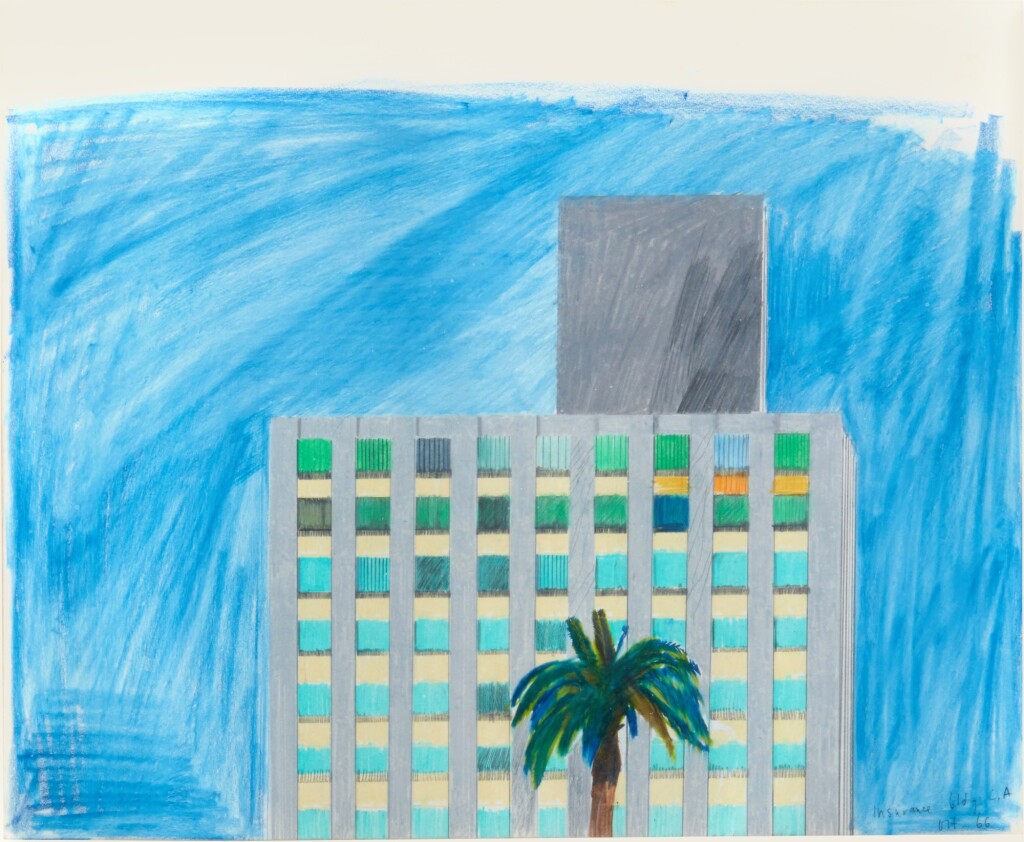
DAVID HOCKNEY
Insurance Bldg L.A, 1966
Crayon, colored pencil and graphite on paper
14×17 inches (35.6 x 43.2 cm)
#2. Still Life with Flowers and Lobster at Odin’s Restaurant, circa 1980
Christie’s London: 2 July 2021
Estimated: GBP 300,000 – 500,000
GBP 934,500 / USD 1,289,060
DAVID HOCKNEY (B. 1937), Still Life with Flowers and Lobster at Odin’s Restaurant | Christie’s
REPEAT SALE
Christie’s London: 12 December 2012
Estimated: GBP 50,000 – 80,000
GBP 97,250 / USD 156,895
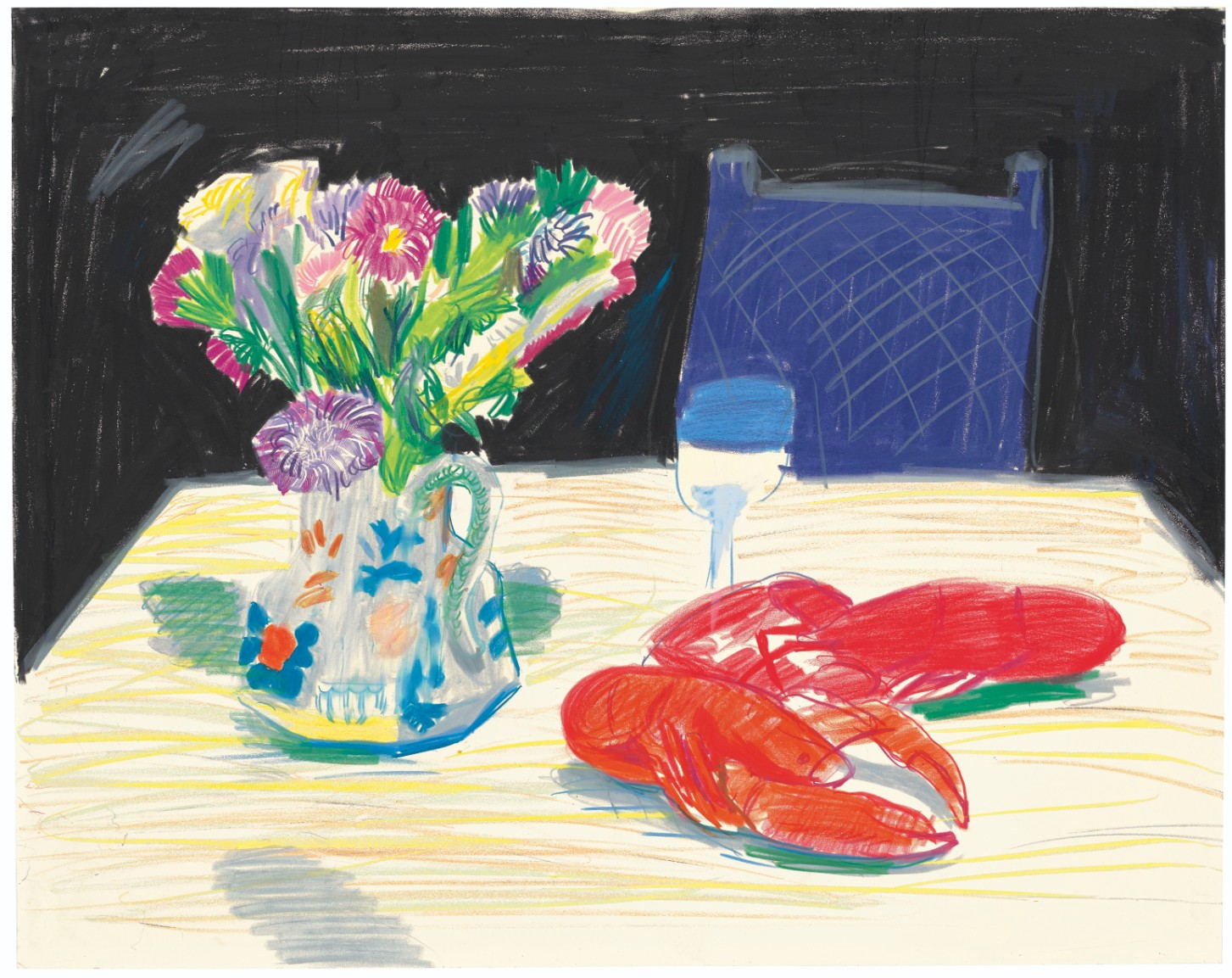
DAVID HOCKNEY (B. 1937)
Still Life with Flowers and Lobster at Odin’s Restaurant, circa 1980
Colored crayon on paper
19 1/8 x 24 inches (48.5 x 61 cm)
#3. House Palm and Pool, 1982
Property from the Collection of Robin Quist Gates
Phillips New-York: 24 June 2021
Estimated: USD 200,000 – 300,000
USD 1,022,200
David Hockney 20th Century & Contemporary Art Day Sale, Morning Session
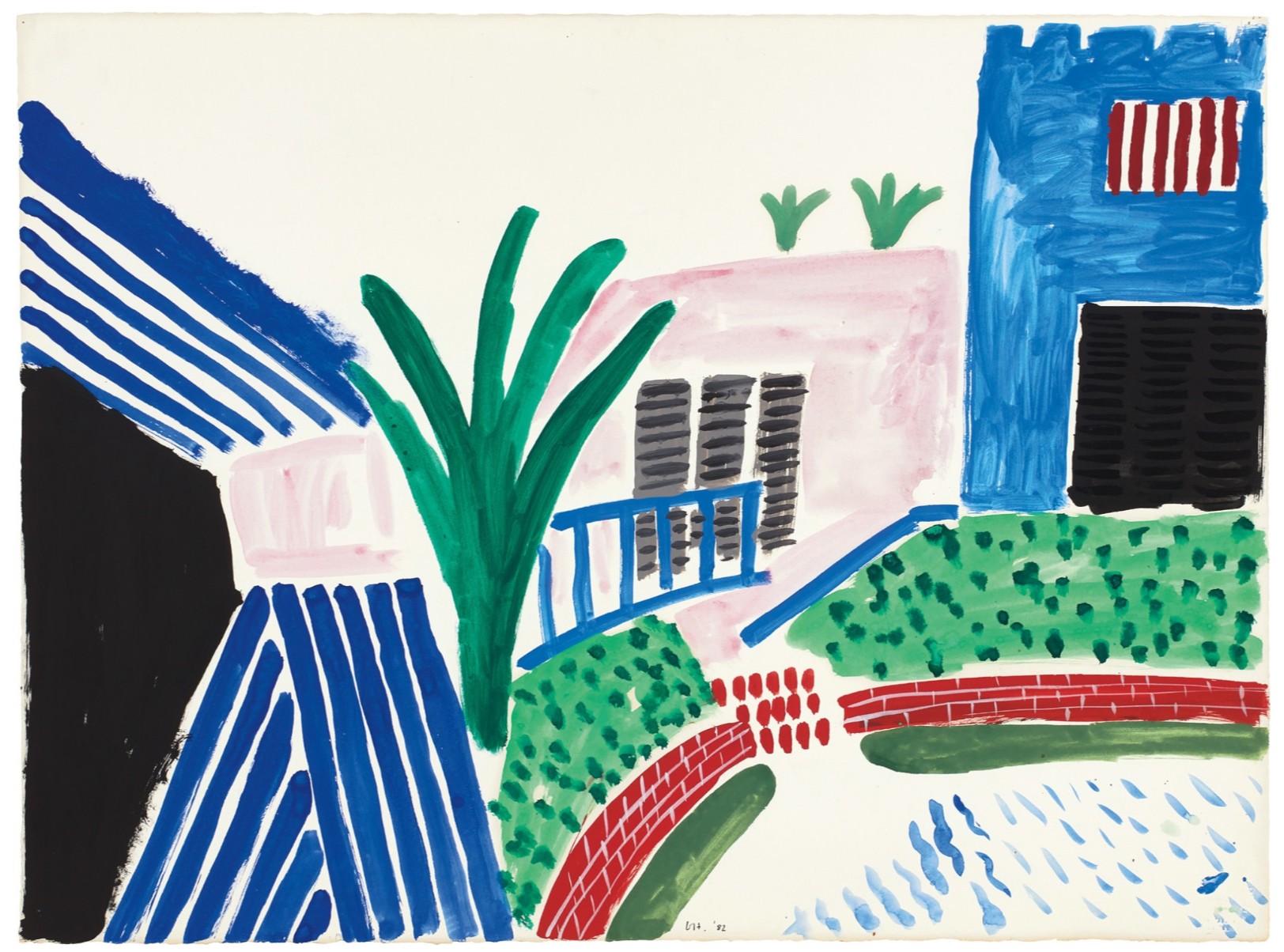
Gouache on paper
22 1/2 x 30 1/4 inches (57.2 x 76.8 cm)
Signed with artist’s initials and dated “DH. ’82” lower center
USD 1 million
#4. House Palm and Pool, 1982
Property from the Collection of Robin Quist Gates
Phillips New-York: 24 June 2021
Estimated: USD 200,000 – 300,000
USD 937,500
David Hockney 20th Century & Contemporary Art Day Sale, Morning Session
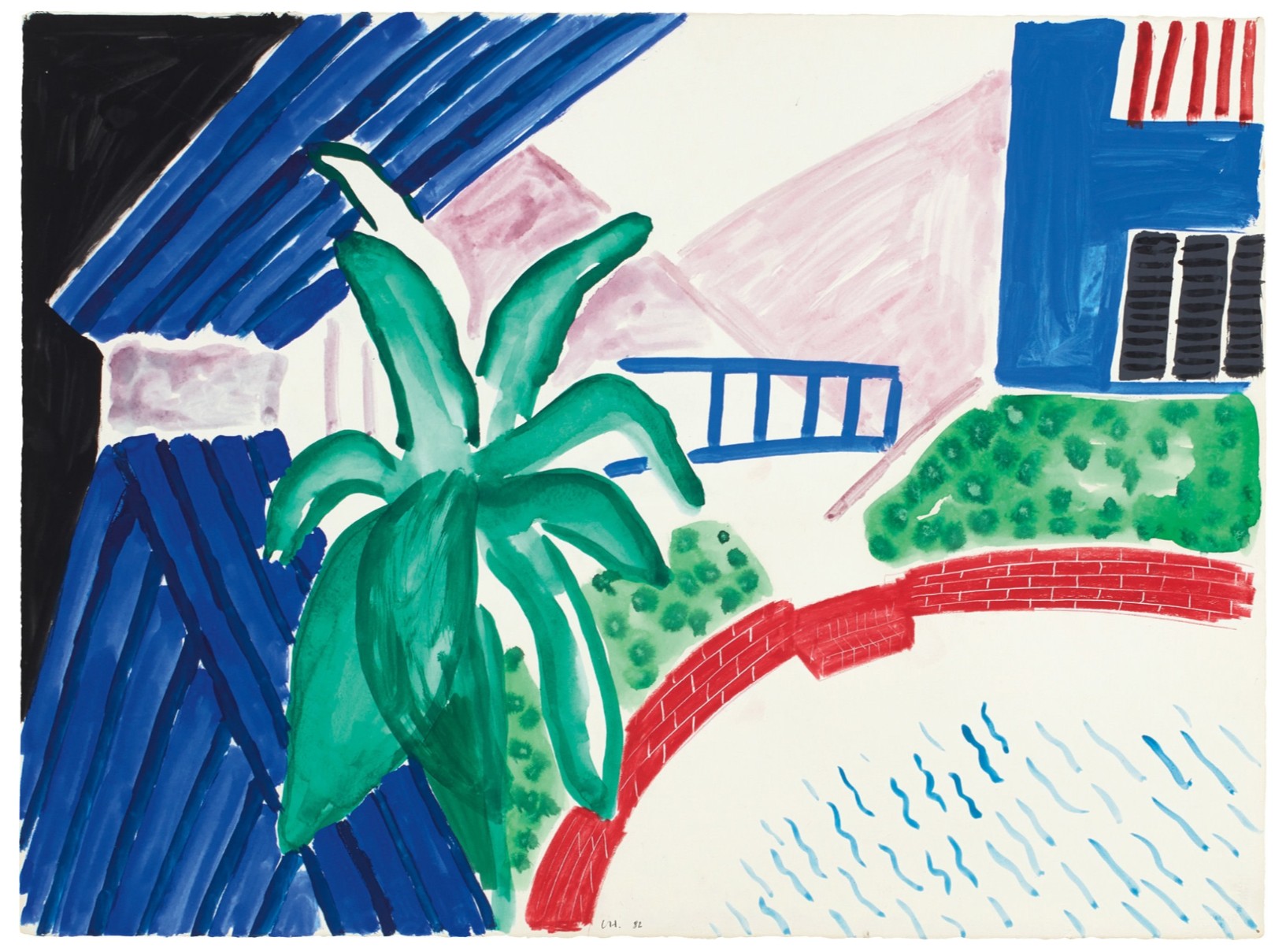
Gouache on paper
22 1/2 x 30 1/4 inches (57.2 x 76.8 cm)
Signed with artist’s initials and dated “DH. ’82” lower center
#5. The Luxor Hotel, 1978
Sotheby’s London: 29 June 2021
Estimated: GBP 150,000 – 200,000
GBP 512,500 / USD 708,870
The Luxor Hotel | British Art Evening Sale: Modern/Contemporary | 2021 | Sotheby’s (sothebys.com)
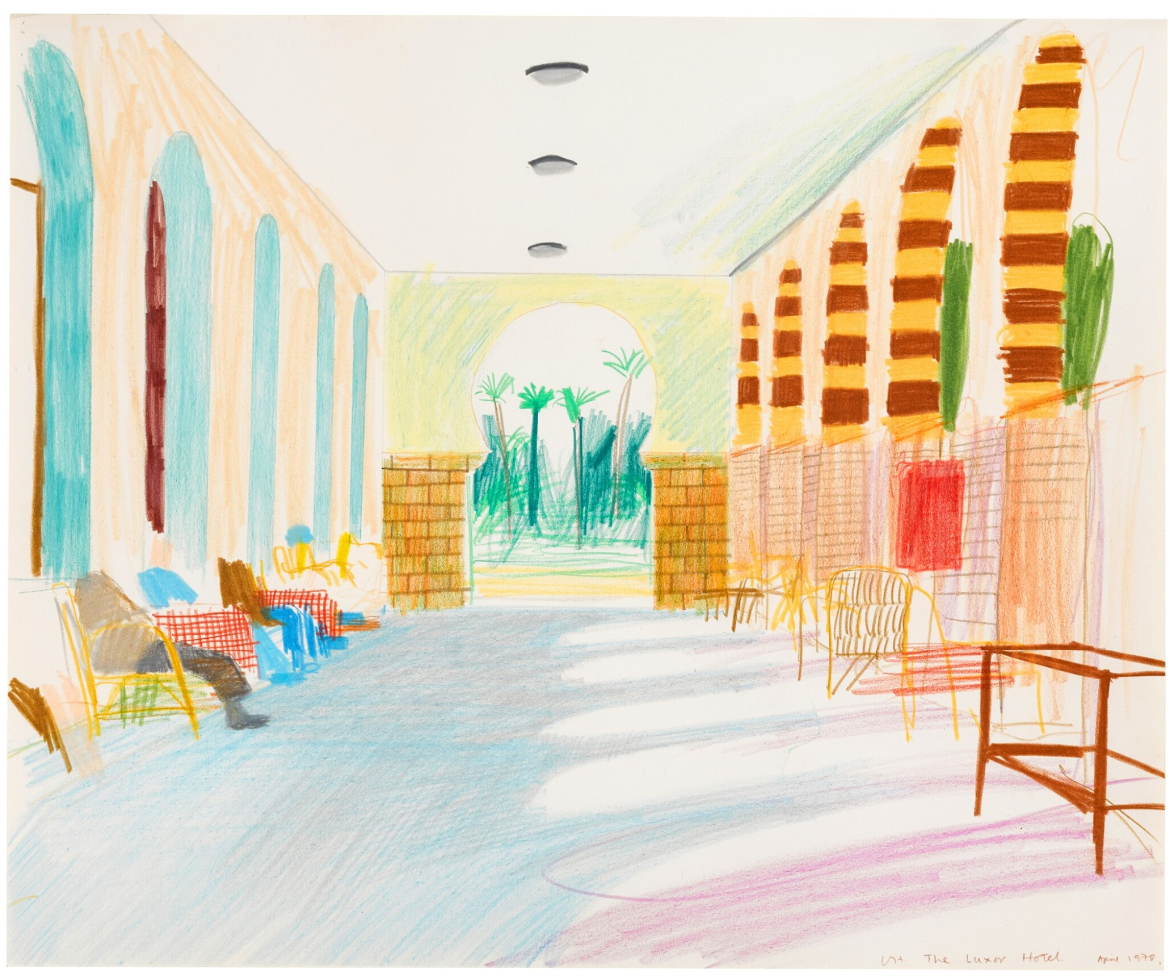
DAVID HOCKNEY (b. 1937)
The Luxor Hotel, 1978
Colored crayon on paper
14×17 inches (35.6 x 43.1 cm)
Signed with the artist’s initials, titled and dated April 1978
#6. Frogs in the Garden, 1980
Property from the Collection of Robin Quist Gates
Phillips New-York: 24 June 2021
Estimated: USD 60,000 – 80,000
USD 252,000
David Hockney 20th Century & Contemporary Art Day Sale, Morning Session
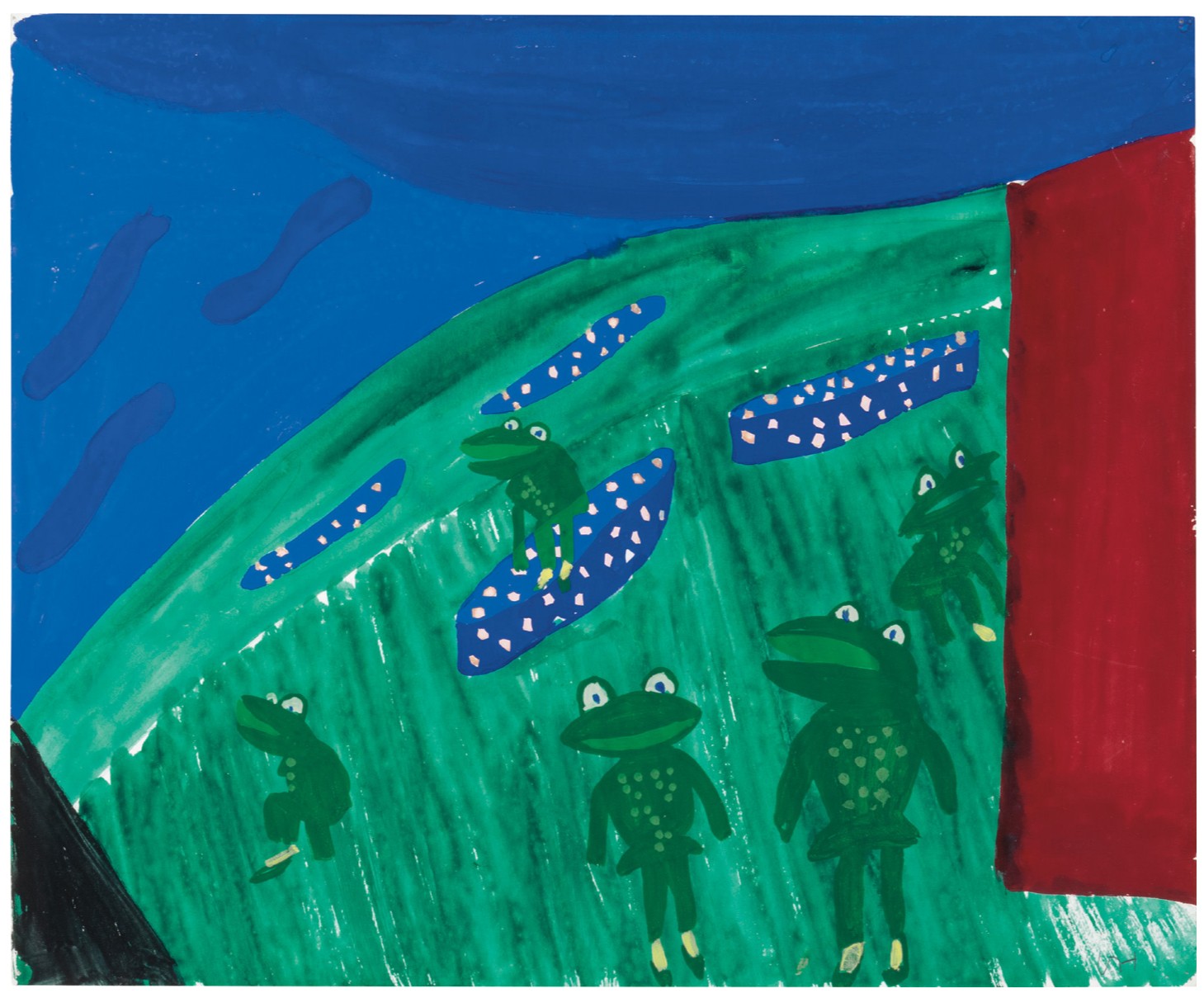
DAVID HOCKNEY
Frogs in the Garden, 1980
Gouache on paper
14×17 inches (35.6 x 43.2 cm)
Signed with artist’s initials “D.H.” lower right
#7. Yves-Marie in Wicker Chair, 1979
Ader Paris: 17 December 2021
Estimated: EUR 30,000 – 50,000
EUR 179,200 / USD 201,895
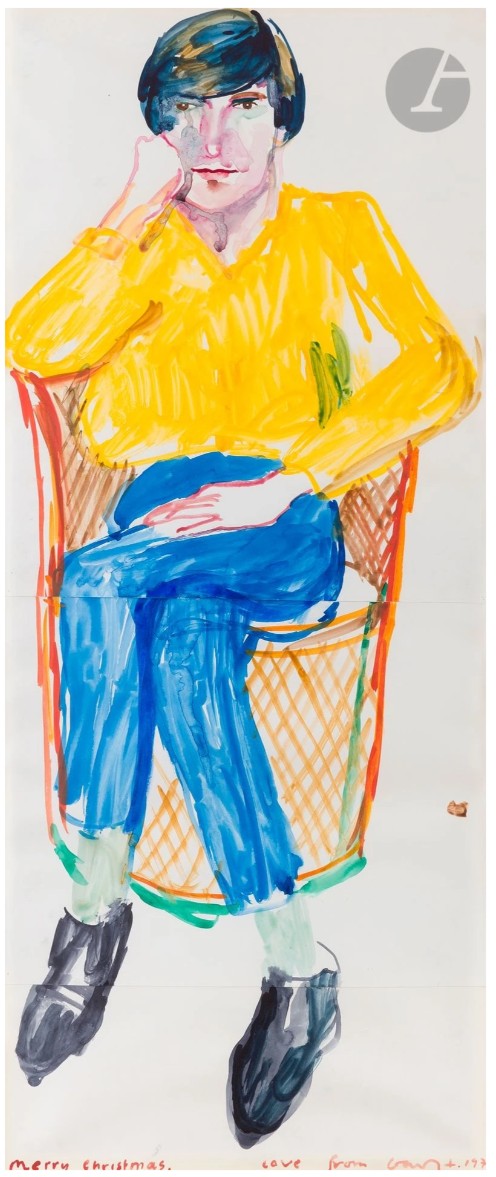
DAVID HOCKNEY
Yves-Marie in Wicker Chair, 1979
Acrylic and gouache on 3 sheets of paper
13.8 x 32.7 inches (83×35 cm)
Signed, dated and annotated ” Merry Christmas. – Love from David H. 1979 “
#8. Mark, 1975
Sotheby’s London: 15 October 2021
Estimated: GBP 50,000 – 70,000
GBP 100,700 / USD 145,975
Mark | Contemporary Art Day Auction | 2021 | Sotheby’s
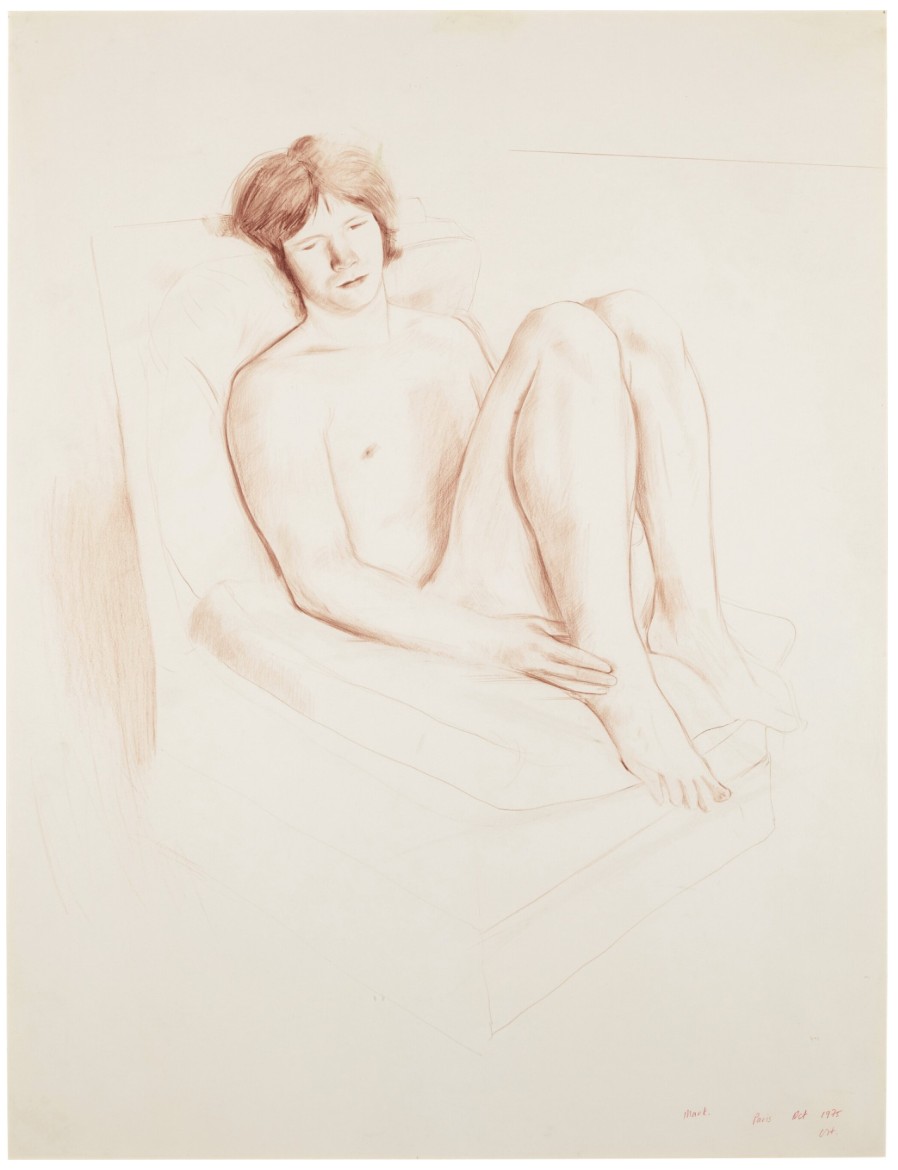
DAVID HOCKNEY (b. 1937)
Mark, 1975
Colored pencil on paper
25 1/2 x 19 1/2 inches (65 x 49.6 cm)
Signed with the artist’s initials, titled and dated Paris Oct 1975
#9. Landscape on a platform, 1976
Christie’s London: 16 October 2021
Estimated: GBP 60,000 – 80,000
GBP 100,000 / USD 137,180
DAVID HOCKNEY (B. 1937), Landscape on a platform | Christie’s
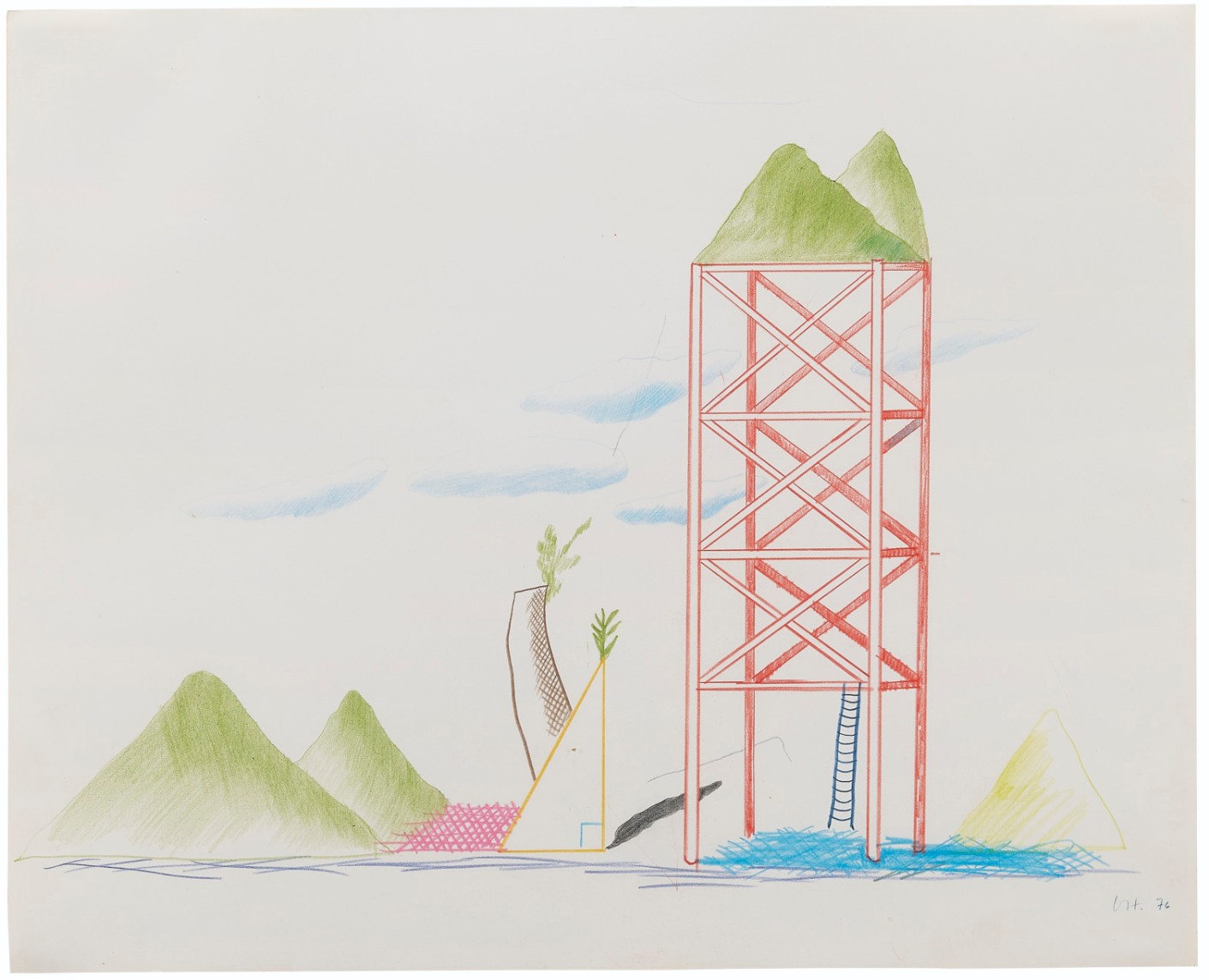
DAVID HOCKNEY (B. 1937)
Landscape on a platform, 1976
Colored pencil on paper
13 7/8 x 17 inches (35.2 x 43.2 cm)
Signed with the artist’s initials and dated ‘DH. 76’ (lower right)
#10. Henry, Reading, Paris, 1975
Living in Color: The Collection of Morris and Rita Pynoos
Sotheby’s New-York: 13 May 2021
Estimated: USD 100,000 – 150,000
USD 126,000
Henry, Reading, Paris | Contemporary Art Day Auction | 2021 | Sotheby’s
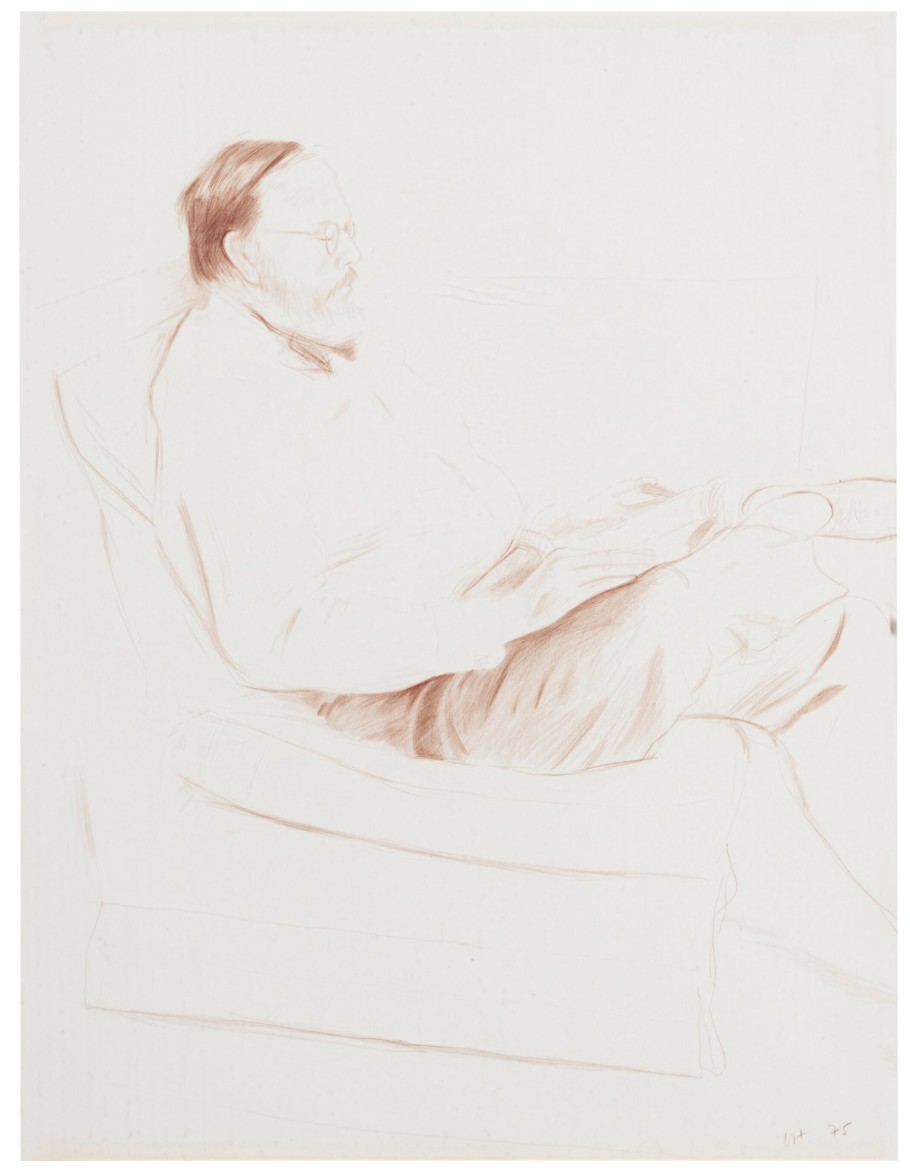
DAVID HOCKNEY (b. 1937)
Henry, Reading, Paris, 1975
Colored pencil on paper
25 1/2 x 19 5/8 inches (64.8 x 49.8 cm)
Signed with the artist’s initials and dated 75
#11. Pulchinellos with Garden Clouds, 1980
Property from the Collection of Robin Quist Gates
Phillips New-York: 24 June 2021
Estimated: USD 60,000 – 80,000
USD 126,000
David Hockney 20th Century & Contemporary Art Day Sale, Morning Session
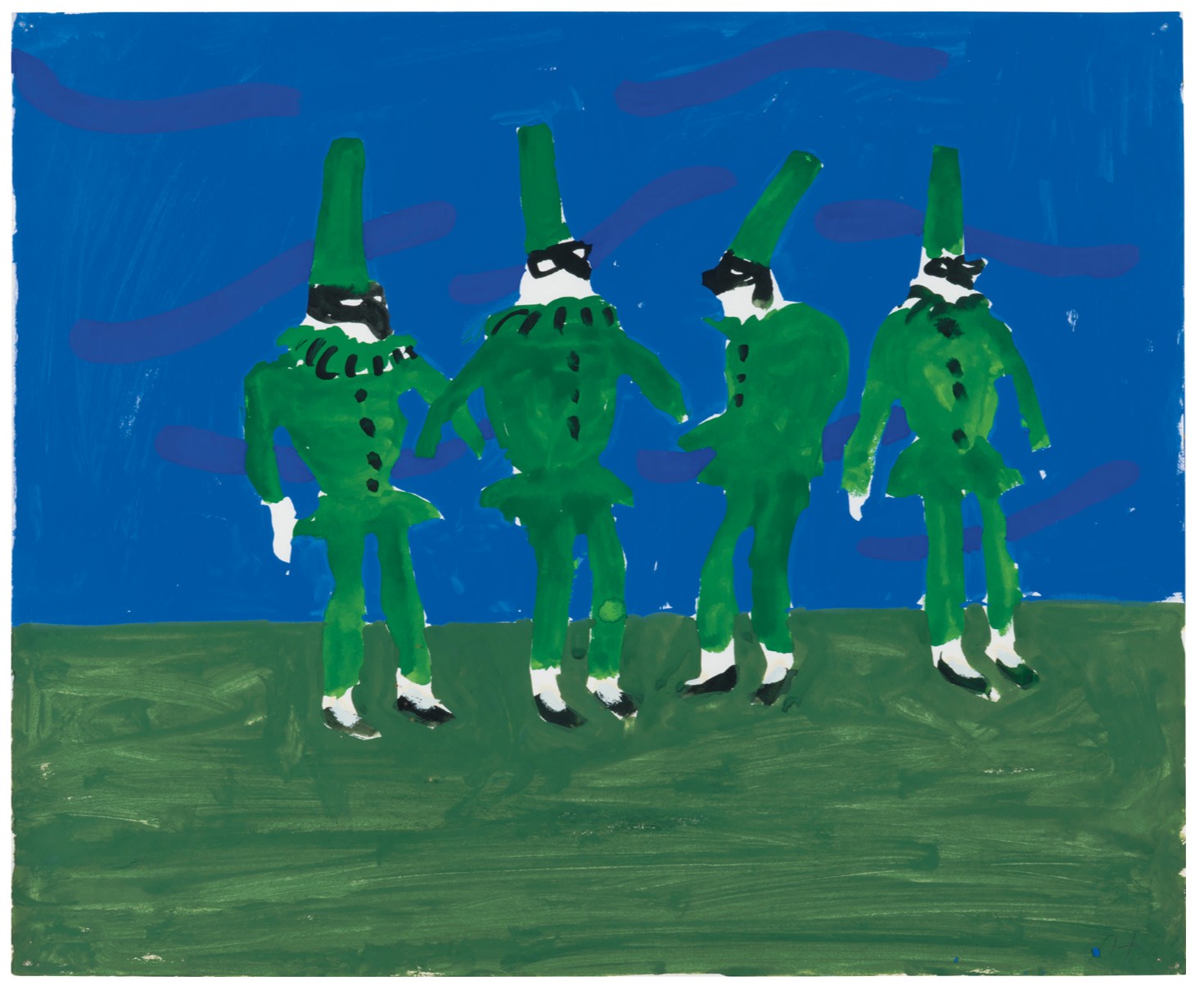
DAVID HOCKNEY
Pulchinellos with Garden Clouds, 1980
Gouache on paper
14×17 inches (35.6 x 43.2 cm)
Signed with artist’s initials “D.H.” lower right
#12. Study for Floor and Teapot, 1980
Christie’s London: 16 October 2021
Estimated: GBP 40,000 – 60,000
GBP 87,500 / USD 120,035
DAVID HOCKNEY (B. 1937), Study for Floor and Teapot | Christie’s
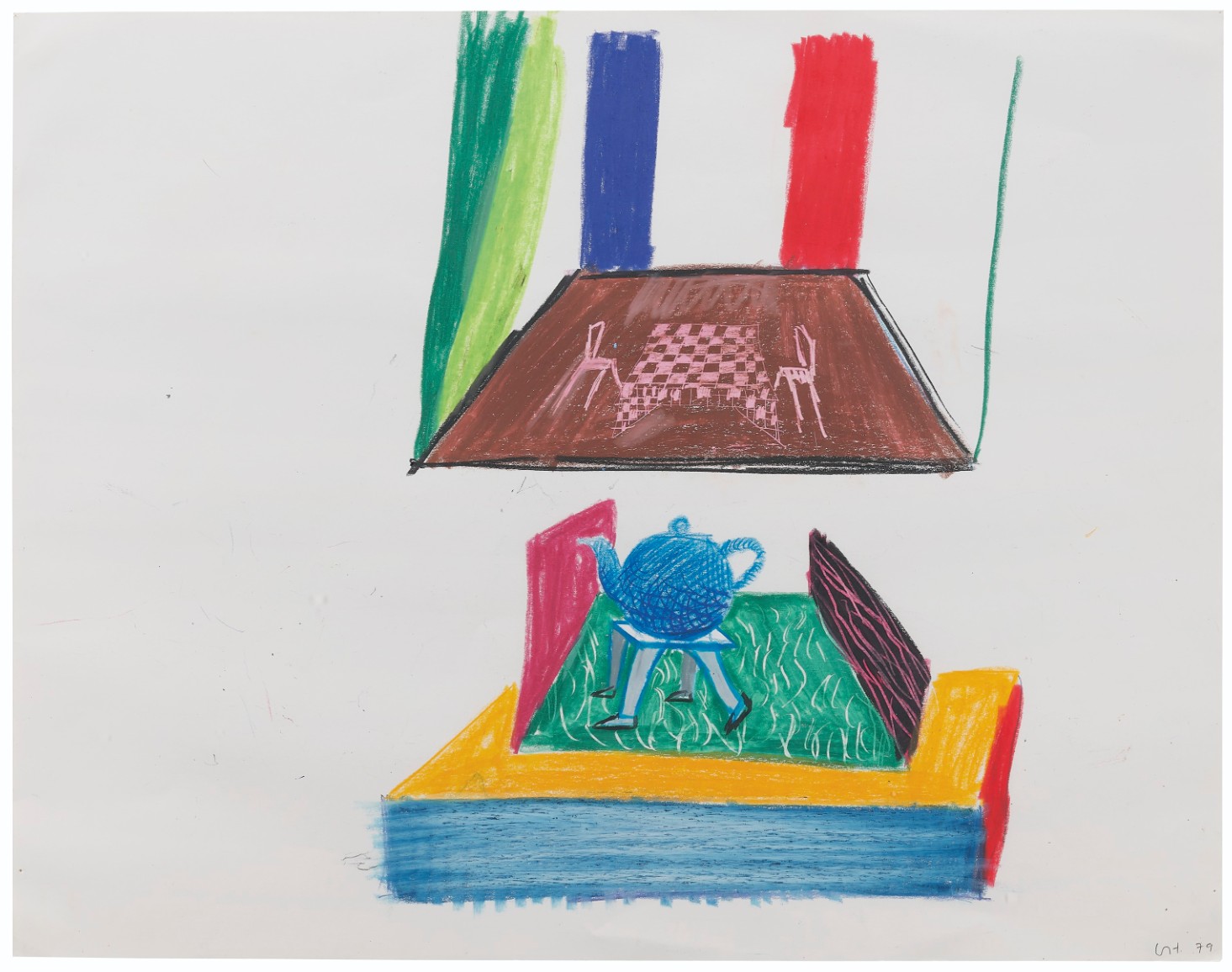
DAVID HOCKNEY (B. 1937)
Study for Floor and Teapot, 1980
Graphite and wax crayon on paper
19×24 inches (48.2 x 61 cm)
Signed with the artist’s initials and incorrectly dated ‘DH 79’ (lower right)
2020 Auction Results
WORK IN PROGRESS
#1. Pool on a Cloudy Day with Rain (Paper Pool 22)
Sotheby’s London: 28 July 2020
Estimated: GBP 4,000,000 – 6,000,00
GBP 4,867,900 / USD 6,302,055
WORK ON PAPER
DAVID HOCKNEY
Pool on a Cloudy Day with Rain (Paper Pool 22), 1978
Hand-colored and pressed paper pulp
72.4 x 85 inches (183.8 x 216 cm)
Signed with the artist’s initials and dated ’78
#2. Gregory in the Pool (Paper Pool 4), 1978
Estimated: USD 250,000 – 350,000
USD 692,000
WORK ON PAPER
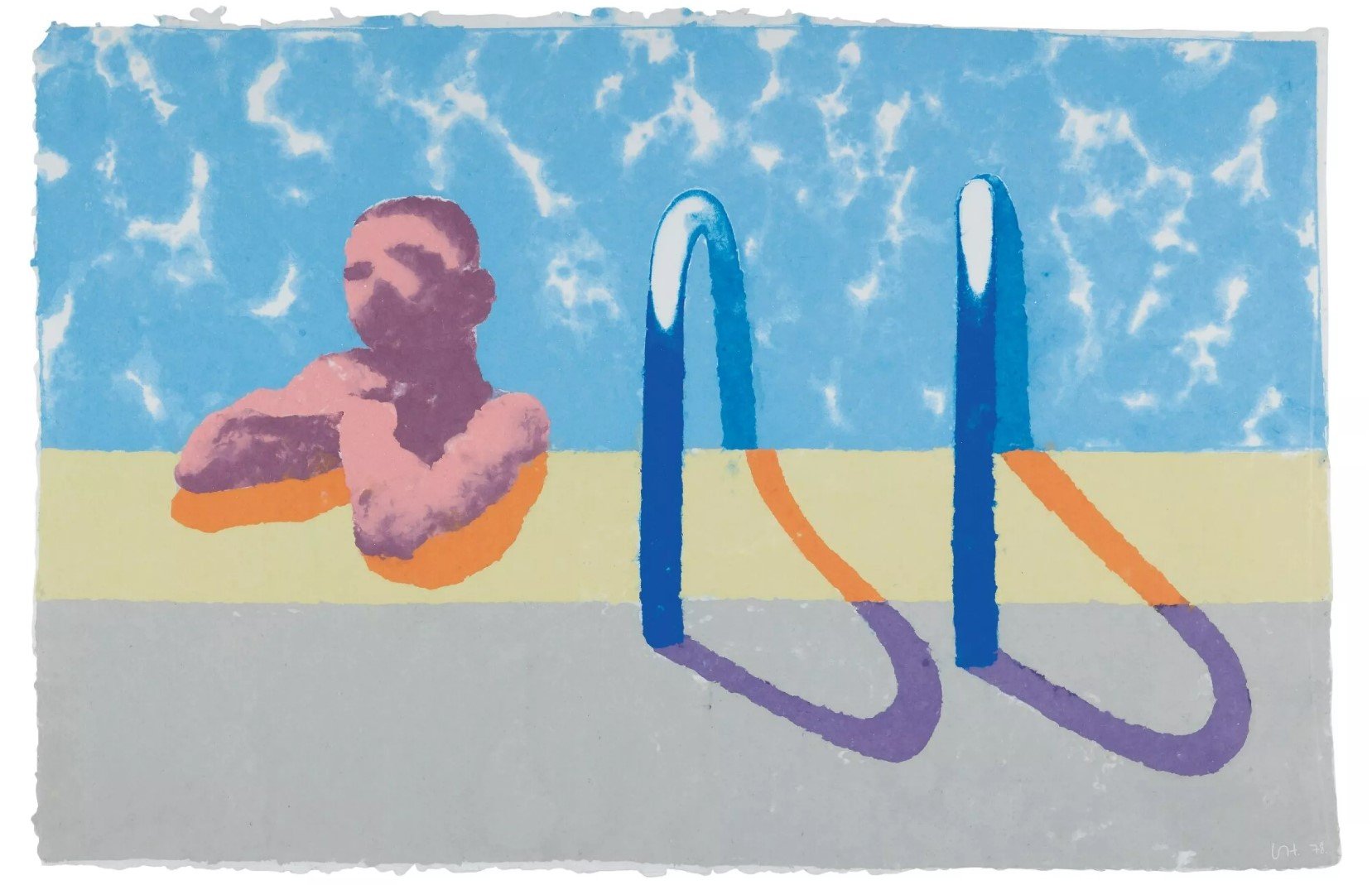
DAVID HOCKNEY
Gregory in the Pool (Paper Pool 4), 1978
Colored and pressed paper pulp
32×50 inches (81.3 x 127 cm)
Signed with artists initials and dated 78
Signed and numbered 4L on the reverse
#3. Lake House, Como, Rain, 2003
Sotheby’s New-York: 6 March 2020
Estimated: USD 250,000 – 350,000
USD 620,000
(#18) DAVID HOCKNEY | Lake House, Como, Rain
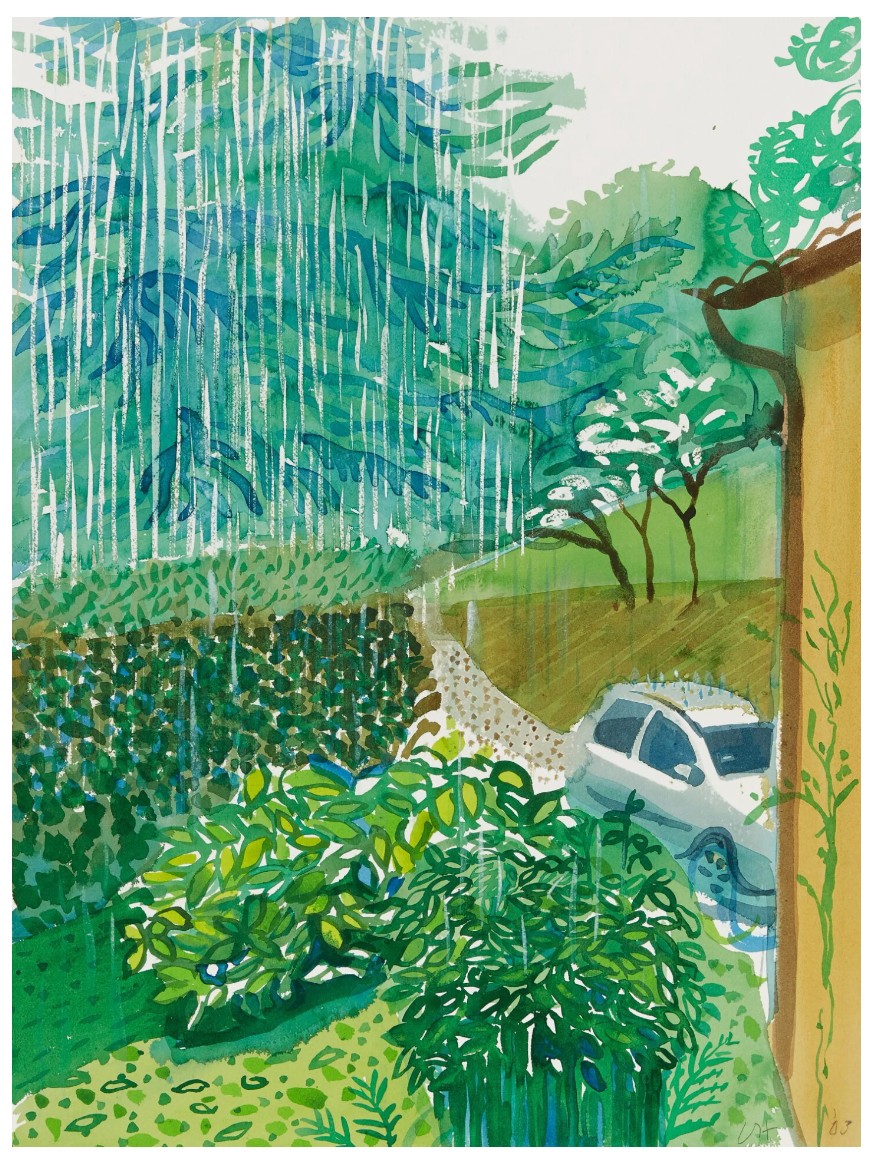
DAVID HOCKNEY
Lake House, Como, Rain, 2003
Watercolor on paper
24 x 18 1/8 inches (60.9 x 46 cm)
Signed with the artist’s initials and dated ’03
#4. Bora Bora, 1972
Christie’s New-York: 10 July 2020
Estimated: USD 100,000 – 150,000
USD 237,500
David Hockney (b. 1937), Bora Bora | Christie’s
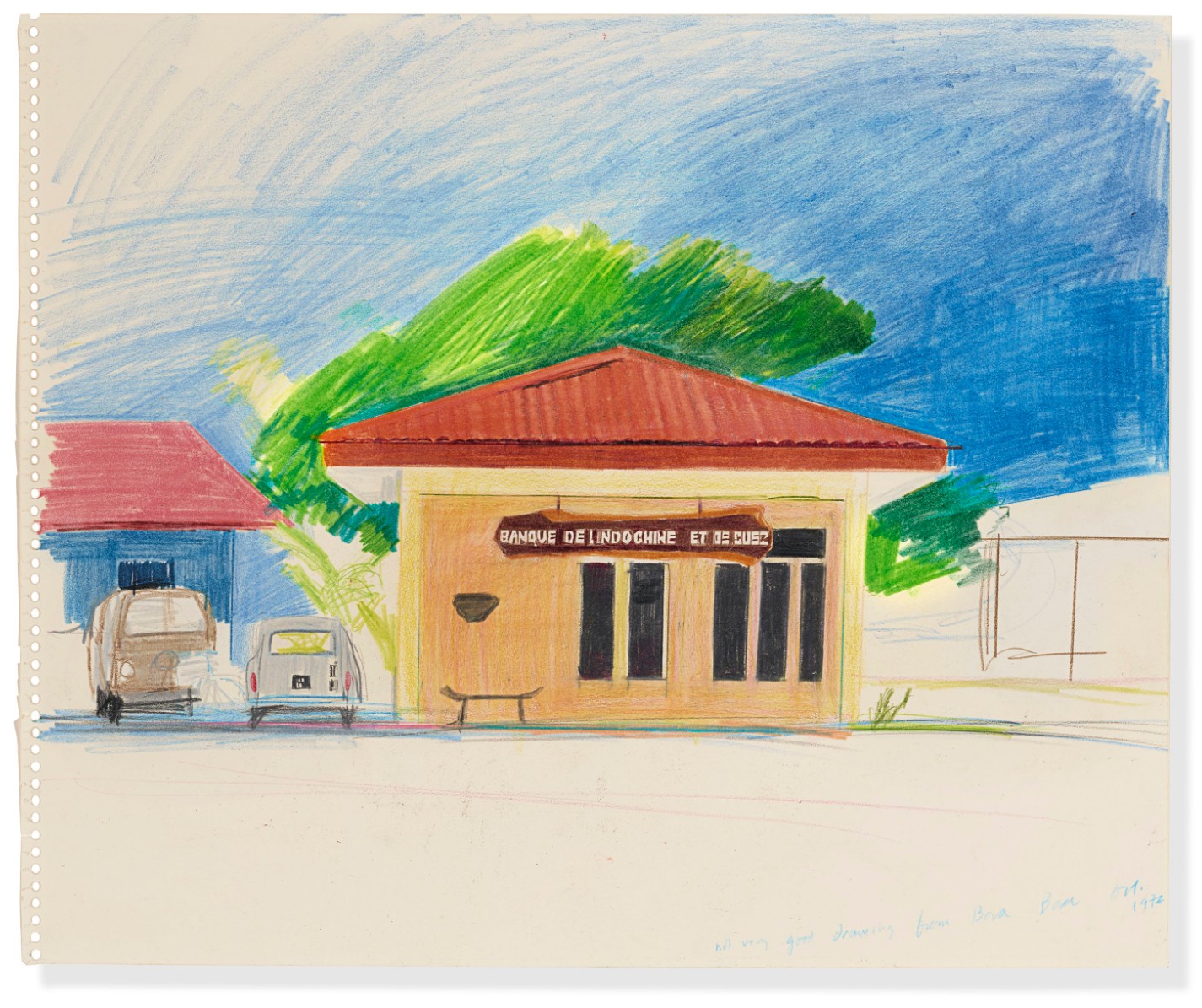
DAVID HOCKNEY (b. 1937)
Bora Bora, 1972
Colored pencil and graphite on paper
13 3/8 x 16 5/8 inches (34.9 x 42.2 cm)
Signed with the artist’s initials, inscribed and dated ‘not very good drawing from Bora Bora DH. 1972’ (lower right)
#5. Rue des Beaux-Arts, 1974
Phillips London: 21 October 2020
Estimated: GBP 50,000 – 70,000
GBP 100,800 / USD 132,475
David Hockney 20th Century & Contemporary Art Day Sale
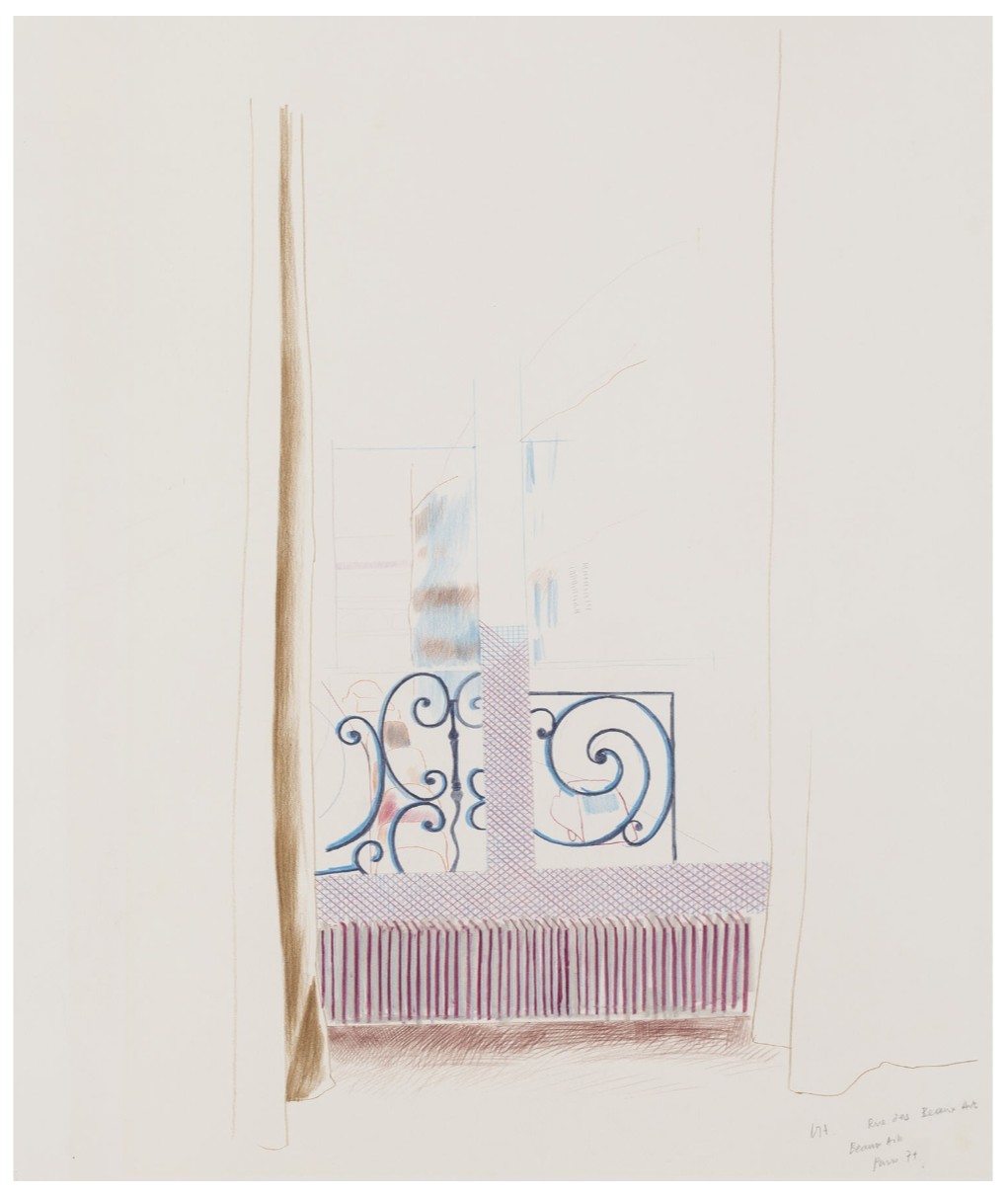
Colored pencil on paper
25 5/8 x 18 7/8 inches (65 x 48.2 cm)
Signed with the artist’s initials, titled, inscribed and dated ‘DH. Rue des Beaux Arts Beaux Arts Paris 74.’ lower right
Early Works
Real Landscape, 1969
Sotheby’s New-York: 16 May 2025
Estimated: USD 150,000 – 250,000
USD 127,000
WORK ON PAPER
Real Landscape | Contemporary Day Auction | 2025 | Sotheby’s
DAVID HOCKNEY (b. 1937)
Real Landscape, 1969
Colored pencil and graphite on paper
Image: 16 x 24 2/4 inches (40.6 x 61.6 cm)
Sheet: 20 1/2 x 25 inches (52.1 x 63.5 cm)
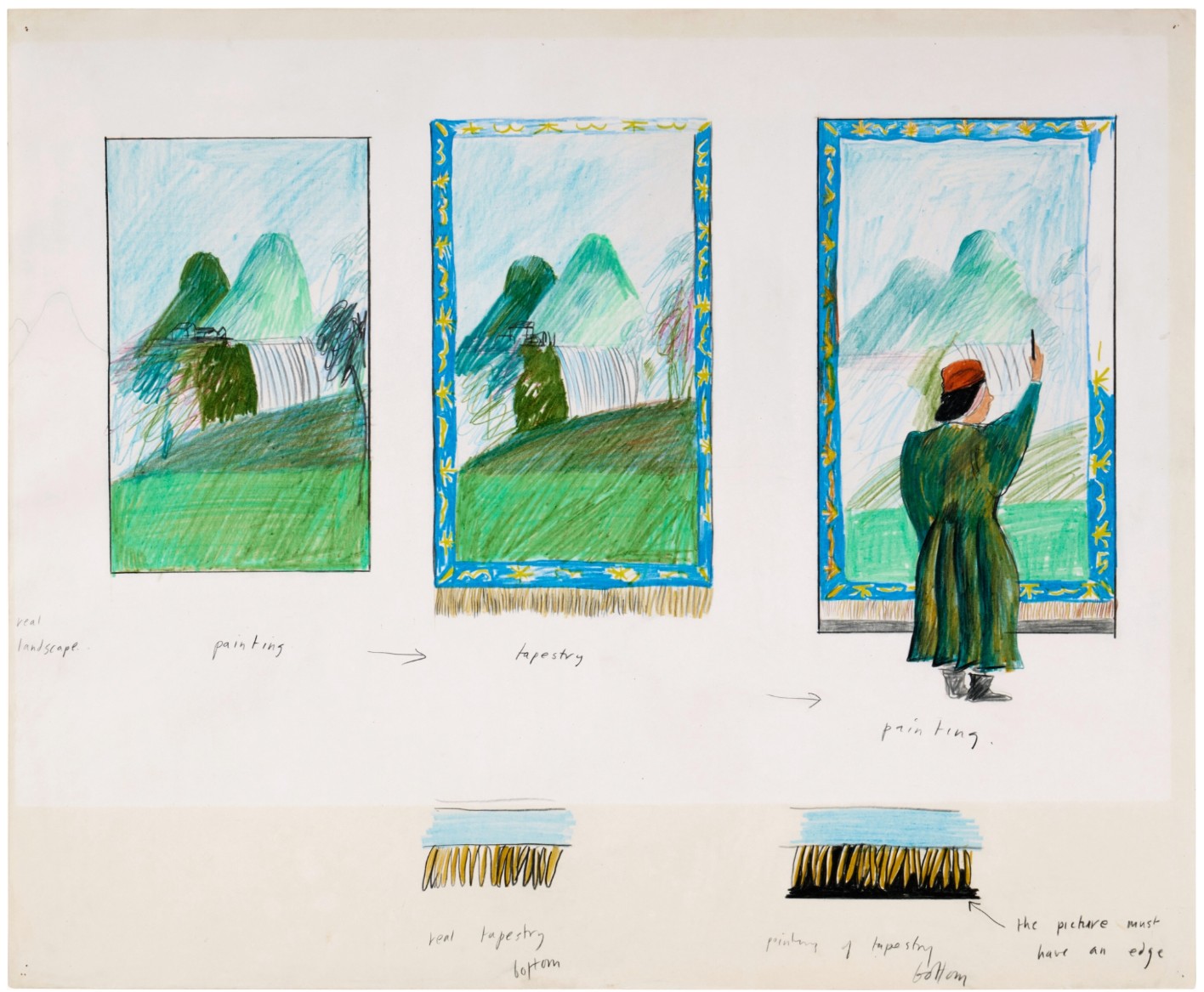
A striking example of the artist’s early interest in visual conceit and pictorial illusion, Real Landscape depicts David Hockney’s conception of three different stages of painting a landscape: from a painting, to a tapestry of the painting, to a painting of the tapestry of the painting. Initially used in an August 1969 episode of BBC’s Canvas series featuring Hockney, “The Frescoes: Domenichino,” the present work was then gifted to one of the show’s producers, Bill Furness, whose collection it remained in for nearly three decades before being acquired by the present owner.
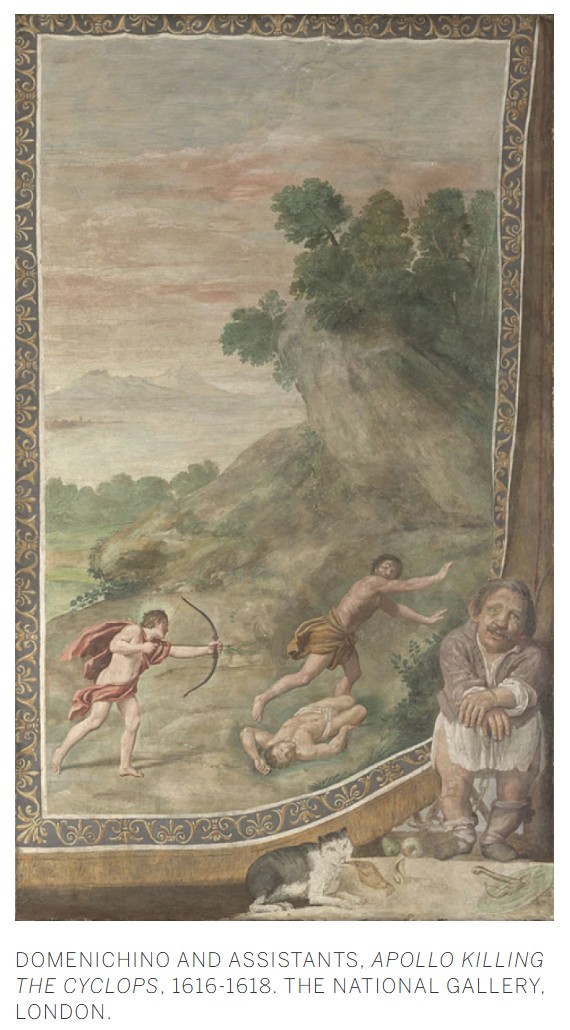
In the BBC episode, Hockney enthuses about examples of Domenichino’s frescoes in the National Gallery in London, paying particular attention to Apollo killing the Cyclops and its depiction of the Greek myth of Apollo killing two Cyclops, illustrated within a tapestry that is folded back in the bottom right-hand corner of the fresco to reveal a dwarf, a clever use of trompe l’oeil that blurs the “real” subject of the painting. Hockney, after visiting the National Gallery a few years earlier in 1963, remarked of Domenichino’s works that “They were paintings made to look like tapestries made from paintings, already a double level of reality. All of them had borders round and tassels hanging at the bottom and perhaps an inch of floor showing, making the illusionistic depth of the picture one inch.” (David Hockney, David Hockney by David Hockney, New York 1976, p. 90). Hockney’s interest in Domenichino’s rendition of the tapestries and their borders immensely inspired the artist and would later serve as the basis for his own experimentation with the subject of the tapestry.
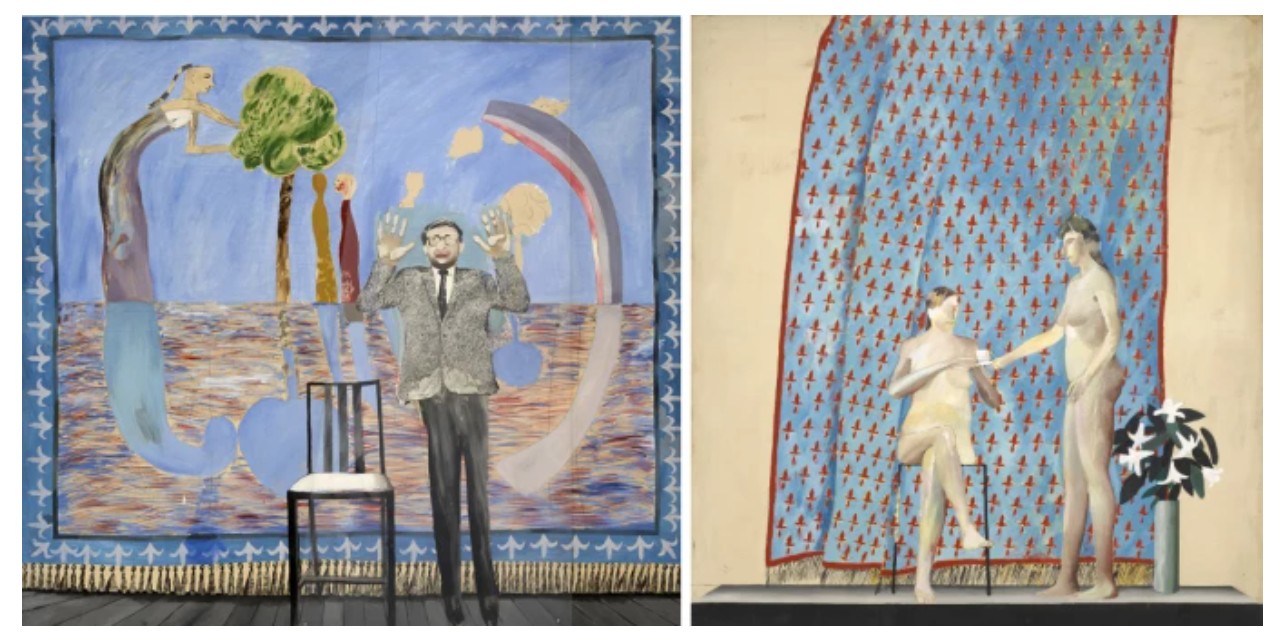
Left: David Hockney, Play Within a Play, 1963. Private Collection.
Right: David Hockney, Seated Woman Being Served Tea by Standing Companion, 1963. The Museum of Modern Art, New York.
In Real Landscape, the artist left notes in the lower margin outlining the ways that the landscape should be depicted across his three versions, paying particular attention to its borders and noting that the tapestry itself just has its loose fringe while “the picture must have an edge” in the painting of the tapestry. The third rendition of the landscape and the ostensible culmination of its stages features a small figure, seemingly Domenichino himself, hovering above the work with a brush in hand, another ploy of Hockney’s to play on the theme of a picture within a picture. The drawing, a masterful summation of many of Hockney’s most pressing interests, serves as a key vestige of the artist’s explorations into the very nature of the painted surface through one of his earliest inspirations, a source that would inspire his work for decades to come.
House, Olympic Boulevard, 1967
Sotheby’s New-York: 16 November 2023
Estimated: USD 250,000 – 350,000
USD 317,500
WORK ON PAPER
House, Olympic Boulevard | Contemporary Day Auction | 2023 | Sotheby’s (sothebys.com)
DAVID HOCKNEY (b. 1937)
House, Olympic Boulevard, 1967
Crayon, colored pencil and graphite on paper
13 3/4 x 16 3/4 inches (35 x 42.5 cm)
Signed with the artist’s initials, titled and dated 67 (lower center)
Cast in front of an expansive bright blue sky, baked in sun, the scene in David Hockney’s House, Olympic Boulevard appears almost dreamlike. The luminous blue sky evokes the warm sun of a California afternoon; sharp green hedges punctuate the foreground; a thinly veiled shadow grazes the upper level of the house. Immediately locating the viewer in the specificity of the California suburban ideal, Hockney renders a palm tree in the center of the composition. Suspended between reality, memory, and invention, this uncannily familiar glimpse of mid-century suburbia is amongst the earliest works that Hockney created after moving to Los Angeles in the mid 1960s. Hockney created an entirely unique response to dimensionality and the illusion of space, which would be manifested in a distinct repertoire of thematic exploration, including the ideal of California life. Upon traveling from England to the West Coast of the United States for the first time in 1963, Hockney was astounded by California’s relentless sunshine and the vibrant coloration of its environment. For the artist, California symbolized a newfound personal and creative freedom that propelled his career. House, Olympic Boulevard perfectly encapsulates Hockney’s fascination – his quiet exploration of the quotidian in Los Angeles and the distinctive color palette of California which would dramatically impact his work in the coming years. Evidence of the artist’s ongoing dialogue with abstraction and exploration of perspective and dimensionality, Hockney’s drawing is dominated by straight edges and simplified shapes. Hockney builds the composition from a series of chromatic planes in blue, green, and butter yellow, and bold, dynamic lines which accentuate the inherent flatness and two-dimensionality of the drawing. House, Olympic Boulevard captures an immediacy and intimacy intrinsic to Hockney’s oeuvre. By framing the central composition with graphite lines, Hockney creates a vignette which suggests the instantaneousness of a Polaroid photograph. Hockney masterfully subverts the viewers’ expectations of a single-perspective picture plane, constructing a beguiling illusionistic world, strikingly more entrancing and mesmerizing than actuality.
Los Angeles, 1964
Christie’s London: 21 March 2023
Estimated: GBP 100,000 – 150,000
GBP 189,000 / USD 231,976
WORK ON PAPER
DAVID HOCKNEY, O.M., C.H., R.A. (B. 1937), Los Angeles | Christie’s (christies.com)
DAVID HOCKNEY, O.M., C.H., R.A. (B. 1937)
Los Angeles, 1964
Pencil, colored pencil and wax crayon on paper
14×17 inches (35.6 x 43.2 cm)
Signed with initials ‘DH. 64’ (lower right)
Held in the same private collection since 1971, the present work marks one of the earliest depictions of David Hockney’s exotic and hedonistic place of fantasy: Los Angeles. Rendered in a vivid palette of contrasting colors, Los Angeles (1964) presents us with a quintessential Californian backyard, a sleek modern home appearing in the background of its sun-drenched patio. Against a large swath of virgin paper, two blue sun loungers appear, their floating forms lending them the appearance of flat paper cut-outs. The cloudless sky, also rendered in rich cobalt blue, floods the scene with glorious daylight, its dazzling rays bouncing off the sunshade beneath it. At its center, a faint rectangular form suggests the presence of a swimming pool, an implication furthered by the abandoned yellow towel to its left. Behind this, we notice what appears to be a film director’s chair, a device suggesting the context of a Hollywood Hills mansion. A splendid vista of West Coast luxury, Los Angeles is a glorious early depiction of the idealistic, sun-drenched landscapes that would come to lie at the core of David Hockney’s oeuvre. Hockney’s first depiction of Los Angeles was in the seminal painting Plastic Tree Plus City Hall (1964), a work in which he depicts an artificial palm tree in front of a clouded sky, the City Hall skyscraper featuring in the background. Defined by its reductive pictorial language, this painting marked the first in a series to depict the modernist buildings and artificially manicured gardens of California, their sleek, pared-back forms providing the ultimate outlet for the modernist techniques he was also developing in the mid-1960s. In its flat, stylized composition, the present work provides a poignant example of Hockney’s rich dialogue with modernism, its vividly colored, cut-out shapes recalling Henri Matisse’s Memory of Oceania (1952-1953). Indeed, Los Angeles marks a pivotal moment in the artist’s practice, showcasing an early fascination with both his new techniques and newfound place of fantasy.
Paper Pools
In the summer of 1978, while en route from England to Los Angeles, David Hockney stopped off and visited the upstate New York workshop of Kenneth Tyler, founder of the famous Tyler Graphics studio. During his stay, Tyler introduced Hockney to a new technique using handmade paper, colored with dye and pigmented pulp. Hockney thought the result was “stunningly beautiful,” and set about working on a new series of unique works that would become an important addition to the artist’s oeuvre. Paper Pools are rich and colorful renditions of one of the artist’s iconic swimming pools, paintings which have become some of the most celebrated images of the postwar period. This work, along with others such as A Bigger Splash (Tate Gallery, London) and Peter Getting out of Nick’s Pool (National Museums Liverpool, Walker Art Gallery), is synonymous with Hockney’s distinguished painterly style, and his constant quest to push the boundaries of art.
Green Pool with Diving Board and Shadow (Paper Pool 3), 1978
Christie’s New-York: 22 November 2024
Estimated: USD 1,800,000 – 2,500,000
USD 2,228,000
WORK ON PAPER
DAVID HOCKNEY (B. 1937), Green Pool with Diving Board and Shadow (Paper Pool 3) | Christie’s
DAVID HOCKNEY (B. 1937)
Green Pool with Diving Board and Shadow (Paper Pool 3), 1978
Colored, pressed paper pulp
50 x 32 1/4 inches (127 x 81.8 cm)
Signed with the artist’s initials and dated ‘D.H. 78’ (lower right)
Signed and numbered ‘3-F David Hockney (on the reverse)
This work is one of fifteen unique variants
Gregory in the Pool (Paper Pool 4), 1978
Christie’s London: 13 October 2023
Estimated: GBP 400,000 – 600,000
GBP 529,200 / USD 644,737
WORK ON PAPER
DAVID HOCKNEY (B. 1937)
Gregory in the Pool (Paper Pool 4), 1978
Colored, pressed paper pulp
33 1/4 x 50 5/8 inches (84.5 x 128.5 cm)
Signed with the artist’s initials and dated ‘D.H. 78.’ (lower right)
Signed and numbered ‘4-F (II) David Hockney.’ (on the reverse)
Green Pool with Diving Board and Shadow (Paper Pool 3), 1978
Estimated: USD 1,800,000 – 2,500,000
USD 2,349,000
WORK ON PAPER
Green Pool with Diving Board and Shadow (Paper Pool 3), 1978
Colored, pressed paper pulp
50 x 32 1/4 inches (127 x 81.8 cm)
Signed again and numbered ‘David Hockney 3-D’ (on the reverse)
Executed in 1978. This work is one of fifteen unique variants
Pool on a Cloudy Day with Rain (Paper Pool 22)
Sotheby’s London: 28 July 2020
Estimated: GBP 4,000,000 – 6,000,00
GBP 4,867,900 / USD 6,302,055
WORK ON PAPER
DAVID HOCKNEY
Pool on a Cloudy Day with Rain (Paper Pool 22), 1978
Hand-colored and pressed paper pulp
72.4 x 85 inches (183.8 x 216 cm)
Signed with the artist’s initials and dated ’78
Day Pool with Three Blues (Paper Pool 7)
Christie’s New-York: 14 May 2019
Estimated: USD 9,000,000 – 12,000,000
USD 10,490,000
David Hockney (b. 1937), Day Pool with Three Blues (Paper Pool 7) | Christie’s
DAVID HOCKNEY
Day Pool with Three Blues (Paper Pool 7), 1978
Colored, pressed paper pulp
72 x 85.5 inches (182.9 x 217.2 cm)
Signed with the artist’s initials and dated ‘D.H. 78’ (lower right)
Signed again ‘David Hockney’ (on the reverse of the lower right sheet)
Inscribed ‘7’ (on the reverse of each sheet)
Swimming Pools
Study for Olympic Poster, 1970
Christie’s London: 5 March 2026
Estimated: GBP 500,000 – 700,000
GBP 635,000 / USD 848,295
WORK ON PAPER
DAVID HOCKNEY (B. 1937), Study for Olympic Poster | Christie’s
DAVID HOCKNEY (B. 1937)
Study for Olympic Poster, 1970
Colored pencil and graphite on two adjoined sheets of paper
33-5/8 x 24-3/4 inches (85.4 x 63 cm)
Signed with the artist’s initials, titled and dated ‘study for Olympic poster DH. 1970.’ (lower right)
Study for Olympic Poster (1970) is a unique and beautiful work on paper that captures the genesis of one of David Hockney’s most iconic images. In a bold composition, Hockney pictures a diver at the moment he is about to break the surface of a pool. The figure is naturalistically rendered: the water, in contrast, is a kaleidoscopic mosaic of looping lines. It lights up around the diver in cells of cyan, ultramarine and two shades of pale blue. An area of pink captures his reflection, fractured by the water’s rippling motion. Elsewhere the lines are unfilled, revealing the delicacy of Hockney’s draughtsmanship. Related closely to his Californian swimming-pool paintings of the 1960s, the work is a celebration of color, light and movement.
“Water in swimming pools changes its look more than in any other form.”
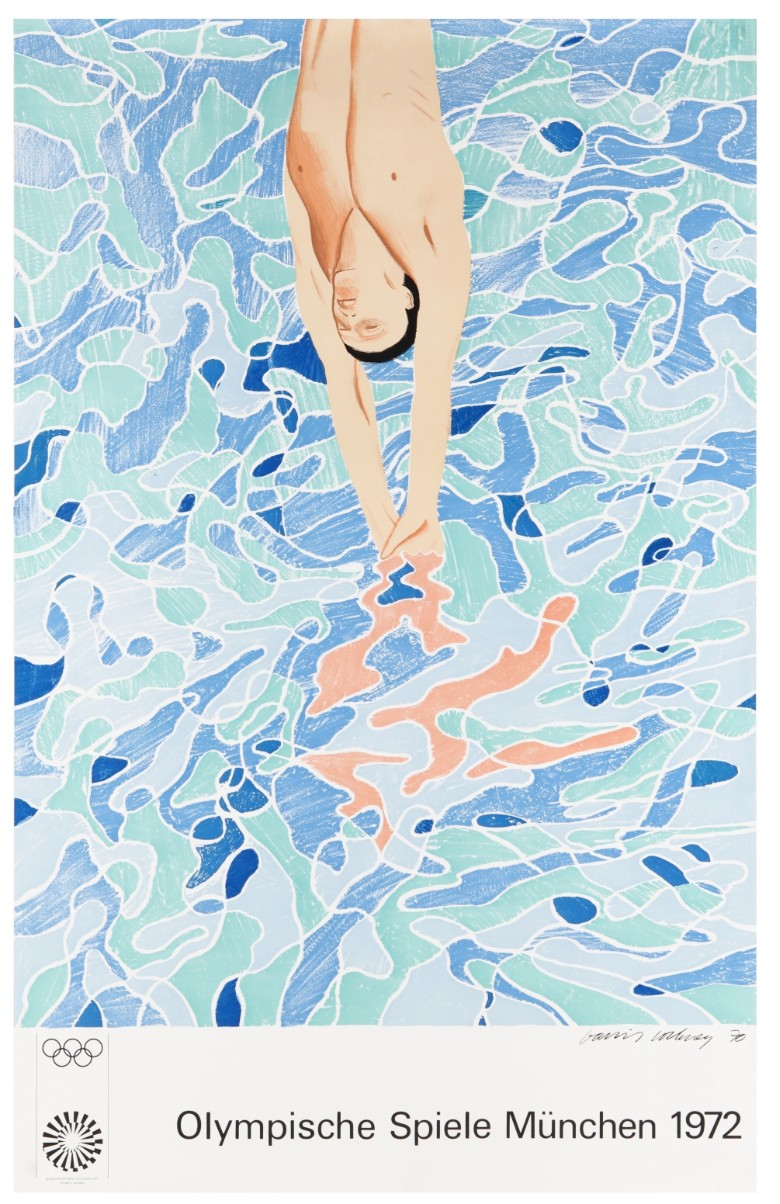
Hockney was among a group of twenty-eight artists tasked with creating posters to promote the 1972 Olympic Games in Munich. Others included Josef Albers, Eduardo Chillida, Victor Vasarely, Pierre Soulages, Tom Wesselmann and Hockney’s friend R. B. Kitaj. Their responses ranged from muscular depictions of athletic prowess to Op-Art visions of the Olympic rings and graphic abstractions that evoked the speed of the racetrack. Hockney, as was typical of his work, merged abstract and figurative languages, combining a stylized depiction of the water with the carefully observed physique of the plunging diver. The Munich project began an Olympic tradition of poster commissions. Joining Robert Rauschenberg, Roy Lichtenstein and others, Hockney would return with a photo-collaged swimming pool for the 1984 Los Angeles Olympics; British artists including Tracey Emin, Chris Ofili and Anthea Hamilton would create posters for the London games in 2012.
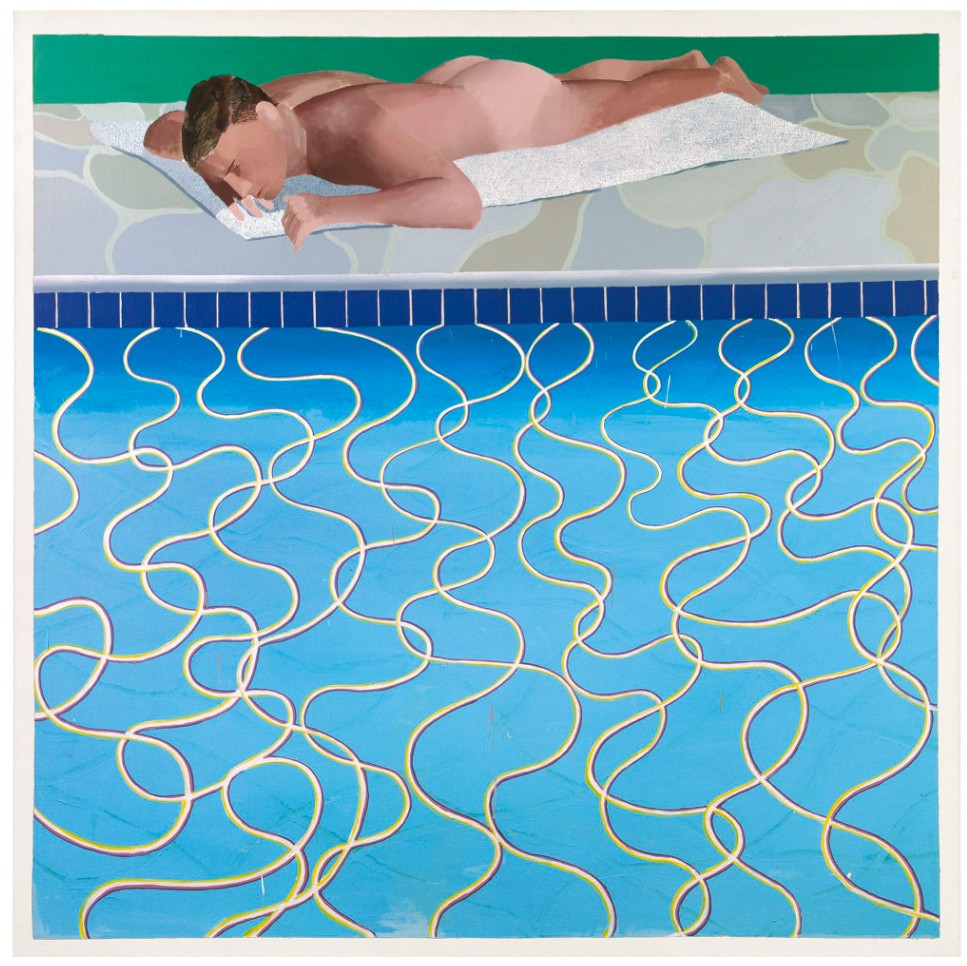
David Hockney, Sunbather, 1966. Museum Ludwig, Cologne. Artwork: © David Hockney.
Hockney had been painting swimming pools since 1964, when he first visited Los Angeles. The water—with its play of transparency, reflection, distortion and endless movement—sparked a career-long fascination with the nature of visual experience.
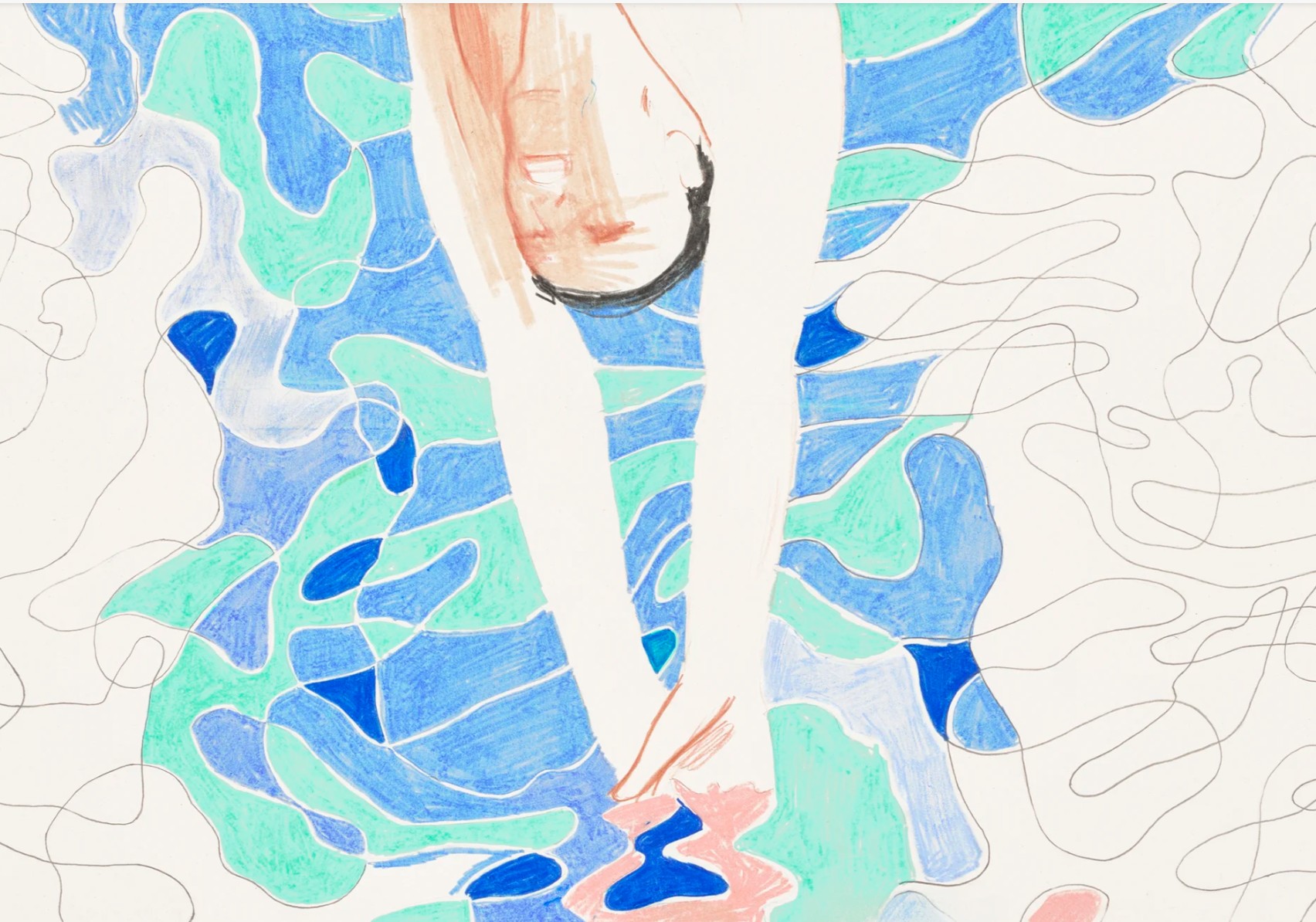
The present work’s meandering, jigsaw-like surface evokes the abstracted idiom of early examples such as California (1965), which were influenced by Jean Dubuffet’s Hourloupe paintings. The diver, meanwhile, echoes the sensuous male nudes of works such as Sunbather (1966, Museum Ludwig, Cologne). Elsewhere, as in A Bigger Splash (1967, Tate, London), Hockney had pictured a dive’s aftermath in exuberant splashes of paint. The present work is typical of this joyfully experimental period, predating the more naturalistic style that would emerge in the early 1970s.
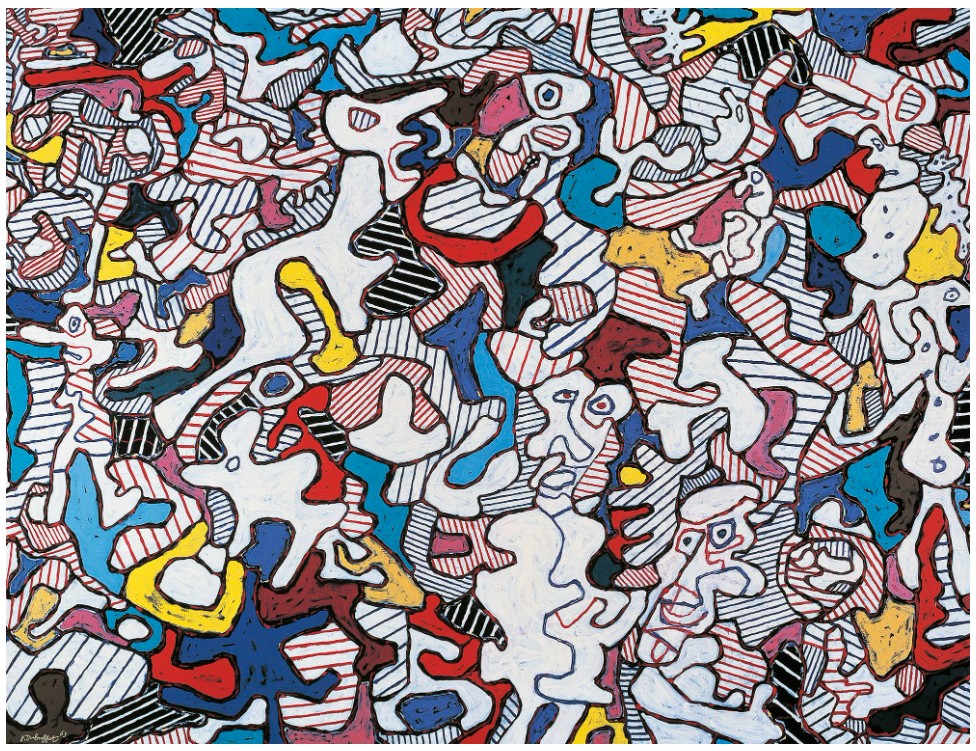
Jean Dubuffet, La Vie de Famille (Family Life), 1963. Musée des Arts Decoratifs, Paris.
Artwork: © 2026 Jean Dubuffet/DACS. Digital image: © 2026 DeAgostini Picture Library/Scala, Florence.
Tragically, the Munich games would be overshadowed by a terror attack at the Olympic Village, when five athletes and six coaches from the Israeli team were taken hostage and killed. The attack also claimed the lives of five of the perpetrators and a German police officer. The games would also be remembered, however, for scenes of sporting triumph, with the American swimmer Mark Spitz famously winning seven gold medals and setting seven world records in a spectacular run. Hockney’s poster has become an emblem of the Olympic spirit.
Drawing of a Pool and Towel, 1971
Sotheby’s New-York: 18 May 2023
Estimated: USD 1,000,000 – 1,500,000
USD 3,085,000
WORK ON PAPER
Drawing of a Pool and Towel | Contemporary Evening Auction | 2023 | Sotheby’s (sothebys.com)
DAVID HOCKNEY (b. 1937)
Drawing of a Pool and Towel, 1971
Colored crayon, pencil and pastel on paper
43.2 x 35.2 cm (17 x 13 7/8 inches)
Initialed, dated 1971 and dedicated for Jean (upper right)
Peter, Swimming Pool, Encino, California, 1966
Christie’s London: 16 October 2025
Estimated: GBP 150,000 – 200,000
GBP 292,100 / USD 391,415
WORK ON PAPER
DAVID HOCKNEY (B. 1937), Peter, Swimming Pool, Encino, California | Christie’s
DAVID HOCKNEY (B. 1937)
Peter, Swimming Pool, Encino, California, 1966
Wax crayon, colored pencil and graphite on paper
12 x 16 3/4 inches (30.4 x 42.6 cm)
Signed with the artist’s initials
Titled and dated ‘Peter, swimming pool Encino California DH. 1966’ (lower right)
Dating from a seminal moment in David Hockney’s practice, the present work is an exquisite drawing depicting two of his most important subjects: the swimming pool, and his first true love Peter Schlesinger. Executed in Encino, Los Angeles shortly after the two met, it is Hockney’s first drawing of the man who would transform his life and work. Schlesinger epitomized everything that the artist had dreamed of when he had arrived in California two years previously. So, too, did the swimming pool, its sun-kissed waters sparkling with the promise of new artistic challenges.
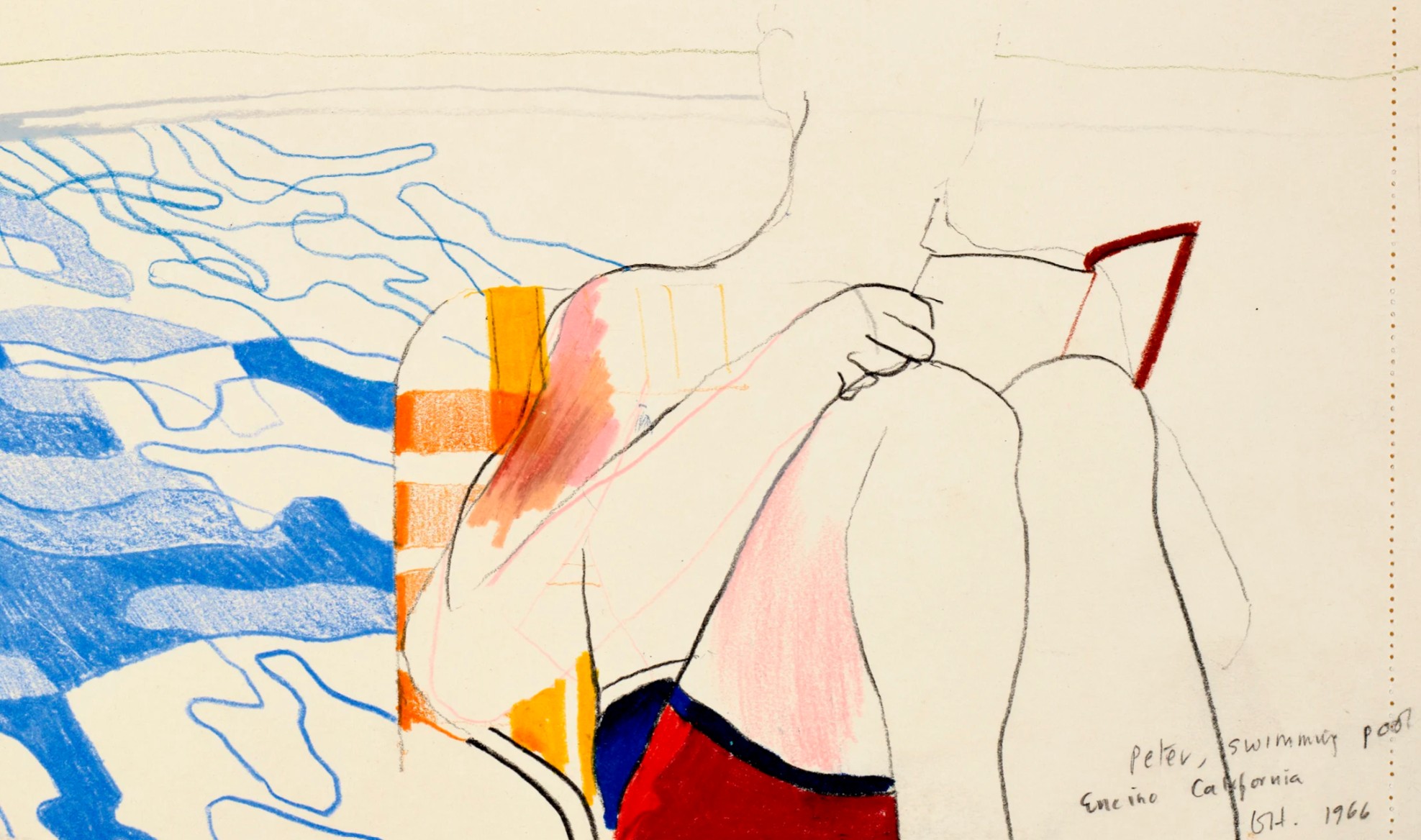
Hockney’s pairing of these two subjects would give rise to some of his greatest paintings, including the 1966 masterpiece Peter Getting Out Of Nick’s Pool (Walker Art Gallery, Liverpool) and the career-defining Portrait of an Artist (Pool with Two Figures) (1972). In Peter, Swimming Pool, Encino, California, Schlesinger’s lithe form comes to life against a backdrop of undulating blue, its looping, cellular jigsaw so distinctly characteristic of Hockney’s early pool paintings.
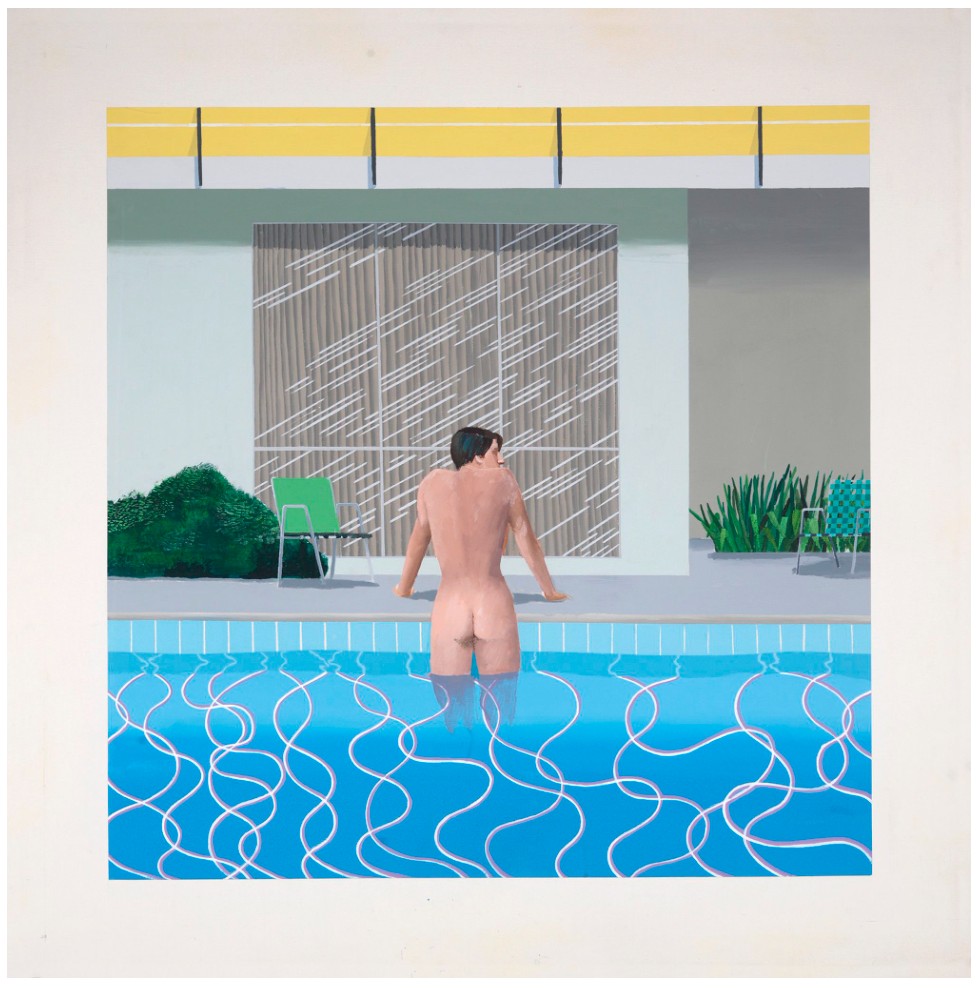
David Hockney, Peter Getting Out of Nick’s Pool, 1966. Walker Art Gallery, Liverpool. Artwork: © David Hockney 2025.
It was in the summer of 1966, while teaching a six-week drawing course at the University of California Los Angeles, that Hockney first encountered Schlesinger. He was a history student at the university’s Santa Cruz campus, and a promising young artist. ‘On the first day of class the professor walked in’, recalls Schlesinger; ‘—he was a bleached blond; wearing a tomato-red suit, a green and white polka-dot tie with a matching hat … I was drawn to him because he was quite different’ (P. Schlesinger, quoted in C. S. Sykes, Hockney: The Biography. Volume 1 1937-1975, London 2011, p. 180). The two became friends, then lovers. ‘It was incredible to me to meet in California a young, very sexy, attractive boy who was also curious and intelligent’, explained Hockney. ‘In California you can meet curious and intelligent people, but generally they’re not the sexy boy of your fantasy as well’ (D. Hockney, quoted in M. Livingstone and K. Haymer, Hockney’s Portraits and People, London 2003, p. 81). Their relationship etched its way into Hockney’s art over the following years. So, too, did their breakup in 1971, giving rise to devastating masterworks such as Sur la Terrasse and Still Life on a Glass Table.
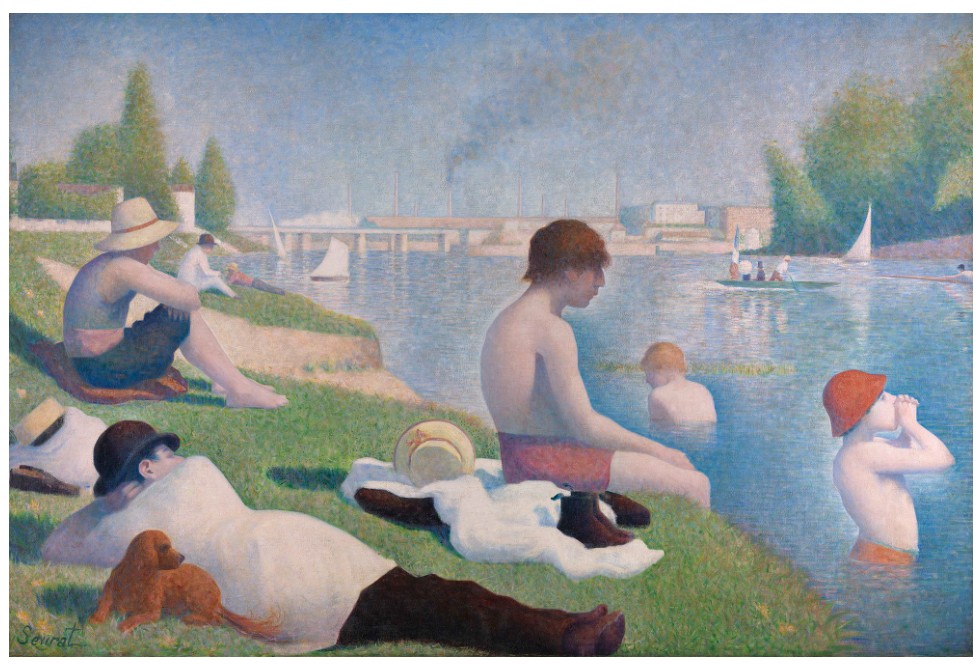
Georges Seurat, Bathers at Asnières, 1884. National Gallery, London. Digital Image: © 2025 The National Gallery, London/Scala, Florence.
Arriving in Los Angeles in 1964, Hockney was immediately captivated by the city’s swimming pools. He had first noticed them from the plane: tiny blue specks that spoke of affluence, leisure and a new life far from the dreary streets of post-war England. His attempts to depict the mercurial properties of water over the following years would breathe new life into his art.
“It is a formal problem to represent water, to describe water, because it can be anything, it can be any color, it’s movable, it has no set visual description.”
The present drawing shares much in common with Hockney’s very first pool paintings, such as California (1965), which drew upon the lessons of Jean Dubuffet’s Hourloupe works. There are echoes, too, of Matisse, Seurat and Cezanne, reflecting Hockney’s engagement with European Modernism. With its razor-sharp draughtsmanship, the work quivers with the joy of fresh inspiration, bathed in the glow of not one but two new loves.
Swimming Pool, Los Angeles, 1965
Christie’s London: 1 March 2023
Estimated: GBP 120,000 – 180,000
GBP 176,400 / USD 212,261
WORK ON PAPER
DAVID HOCKNEY (B. 1937), Swimming Pool, Los Angeles | Christie’s (christies.com)
DAVID HOCKNEY (B. 1937)
Swimming Pool, Los Angeles, 1965
Colored pencil on paper
13 7/8 x 16 3/4 inches (35.4 x 42.7 cm)
Signed with the artist’s initials, titled and dated ‘Swimming pool DH. 65 Los Angeles’ (lower right)
Executed in 1965, the present work marks one of the earliest depictions of what would soon become the defining image of David Hockney’s oeuvre: the swimming pool. Travelling to California for the first time in 1964, a trip which would spark a long-term love affair with the city of Los Angeles, Hockney became intoxicated by the sunshine and heady optimism of the West Coast and would settle there permanently three years later. Epitomizing the leisure and luxury of the Californian good-life, the swimming pool quickly became a recurring subject of the artist’s sketchbook drawings from the mid-1960s, marking a period of almost obsessive exploration of water’s unpredictable ebb and flow. Swimming Pool, Los Angeles represents a product of this experimentation, its meticulously rendered surface capturing Hockney’s formalist preoccupations of the period. Rendered in thin, tangled lines of turquoise, Swimming Pool, Los Angeles depicts an elusive, gently moving body of water, its sporadic bends evoking the ever-changing lap of the pool’s surface. Passages of light and dark blue pastel span its folds, evoking its delicate shimmering reflections and plunging depths: a swimming figure is perhaps implied beneath the surface. Behind its complex coiling of water, the artist depicts a stark black pillar, its pattern of shapes recalling the abstract canvases of Henri Matisse. In the lower left corner, he presents us with what appears to be a diving board, its diagonal shadow allowing the form to float above the water’s surface. Framed by a border of virgin paper, Hockney’s Swimming Pool, Los Angeles marks a pivotal moment in the artist’s practice, referencing an early fascination with both his new techniques and newfound place of fantasy.
Swimming Pool Ladder, 1967
Christie’s London: 1 July 2022
Estimated: GBP 150,000 – 200,000
GBP 233,100 / USD 283,456
WORK ON PAPER
DAVID HOCKNEY (B. 1937), Swimming Pool Ladder | Christie’s (christies.com)
DAVID HOCKNEY (B. 1937)
Swimming Pool Ladder, 1967
Colored pencil and graphite on paper
17 x 13 7/8 inches (43.2 x 35.4 cm)
Signed with the artist’s initials and dated ‘DH. 67’ (lower right)
The blue of David Hockney’s Swimming Pool Ladder is a brilliant, luminous blue: the blue of sultry summer evenings, warm breezes, azure skies and indulgent cool waters. It is the blue of Hockney’s swimming pools, the defining image of his oeuvre. Created in 1967, the same year as his iconic A Bigger Splash (Tate, London), the present work forms part of the artist’s almost obsessive exploration of water’s unpredictable ebb and flow. Hockney first became interested in swimming pools after he moved to Los Angeles in 1963: California, with all its glorious sunshine and heady optimism, enchanted the young artist.
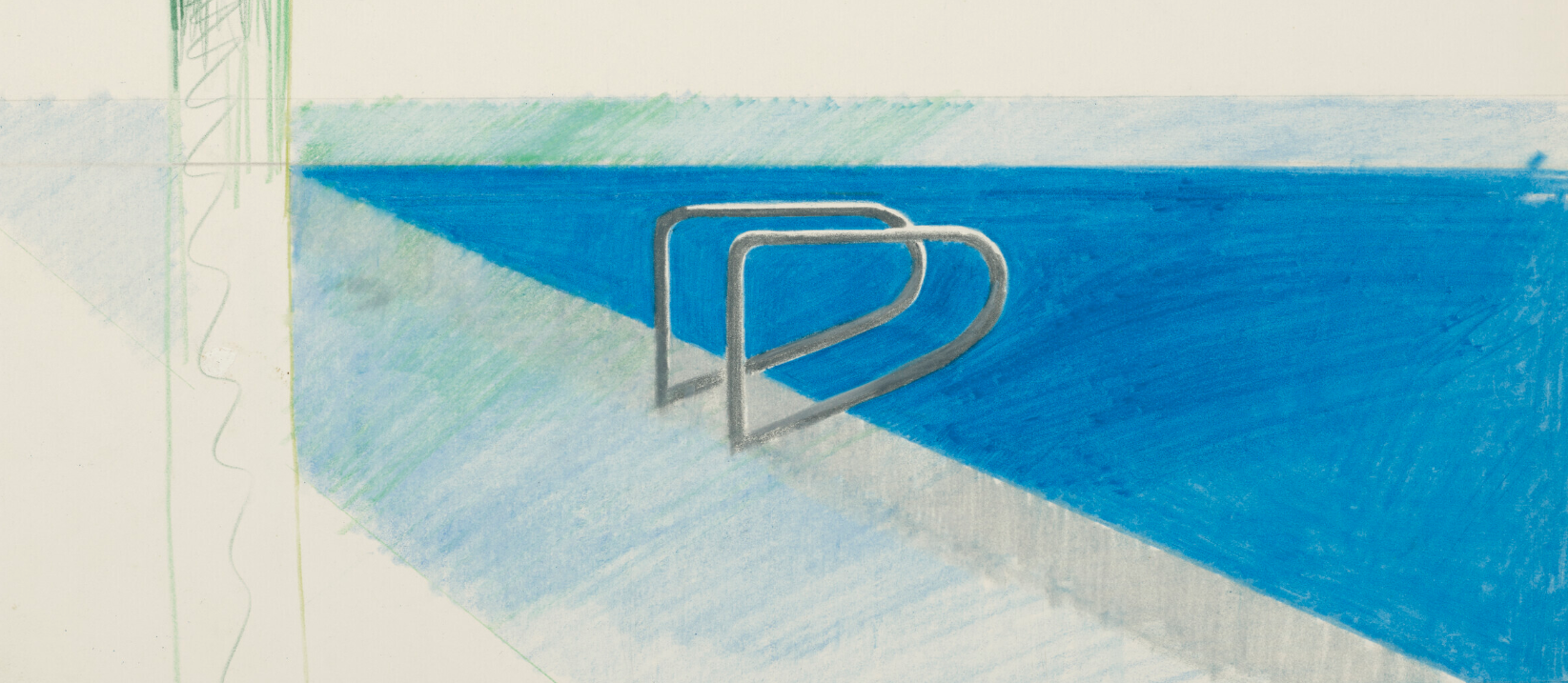
Hockney painted his first pool into the background of the 1964 painting California Art Collector. By the time he created Swimming Pool Ladder three years later, pools had moved from scene setting to the central preoccupation of his oeuvre, functioning as both a symbolic subject and a technical conundrum which he sought to overcome: how exactly, Hockney wondered, could one represent water graphically? Working in colored pencil, here Hockney meticulously observes the mercurial effects of light moving across the pool. The resulting work suggests a crystalline vision of the artist’s new home, an infinite boundless hope found in the dance of light upon water and the ever-changing lap of the swimming pool’s surface.
Portraits
Portrait of Peter Langan and Jean-Marc Moussis, 1975
Phillips London: 15 October 2026
Estimated: GBP 200,000 – 300,000
GBP 232,200 / USD 307,225
WORK ON PAPER
David Hockney Modern & Contemporary Art Evening Sale
DAVID HOCKNEY
Portrait of Peter Langan and Jean-Marc Moussis, 1975
Crayon on paper
25 1/4 x 19 1/4 inches (64.2 x 49 cm)
Signed with the artist’s initials, inscribed, dedicated and dated ‘DH. for Peter Paris 1975’ lower right
Minutely observed and rendered, Portrait of Peter Langan and Jean-Marc Moussis reveals the intricacies of David Hockney’s draughtsmanship. Created through indiscernible, translucent shades of coloured crayon, in 1975 Hockney drew the restauranteur Peter Langan and his wine merchant, Jean-Marc Moussis. An outrageous figure of the eighties culinary scene who opened the celebrity haunt Langan’s Brasserie in 1976 with the actor Michael Caine and later, chef Richard Shepherd, Hockney revisited the figure of Langan over several decades with varying degrees of scrutiny. Created among the consummate drawings that included fellow artists, friends and fashion designers after the artist moved to Paris in 1973, Portrait of Peter Langan and Jean-Marc Moussis belongs to Hockney’s celebrated double portraits that he began in the late 1960s and continued to produce throughout much of his lifetime.
“I’d done a drawing of Peter with a wine merchant in Paris […] and he’d written at the top in his kind of mad Irish handwriting ‘An evening of excess’, and I must say it was, a wonderful one.”
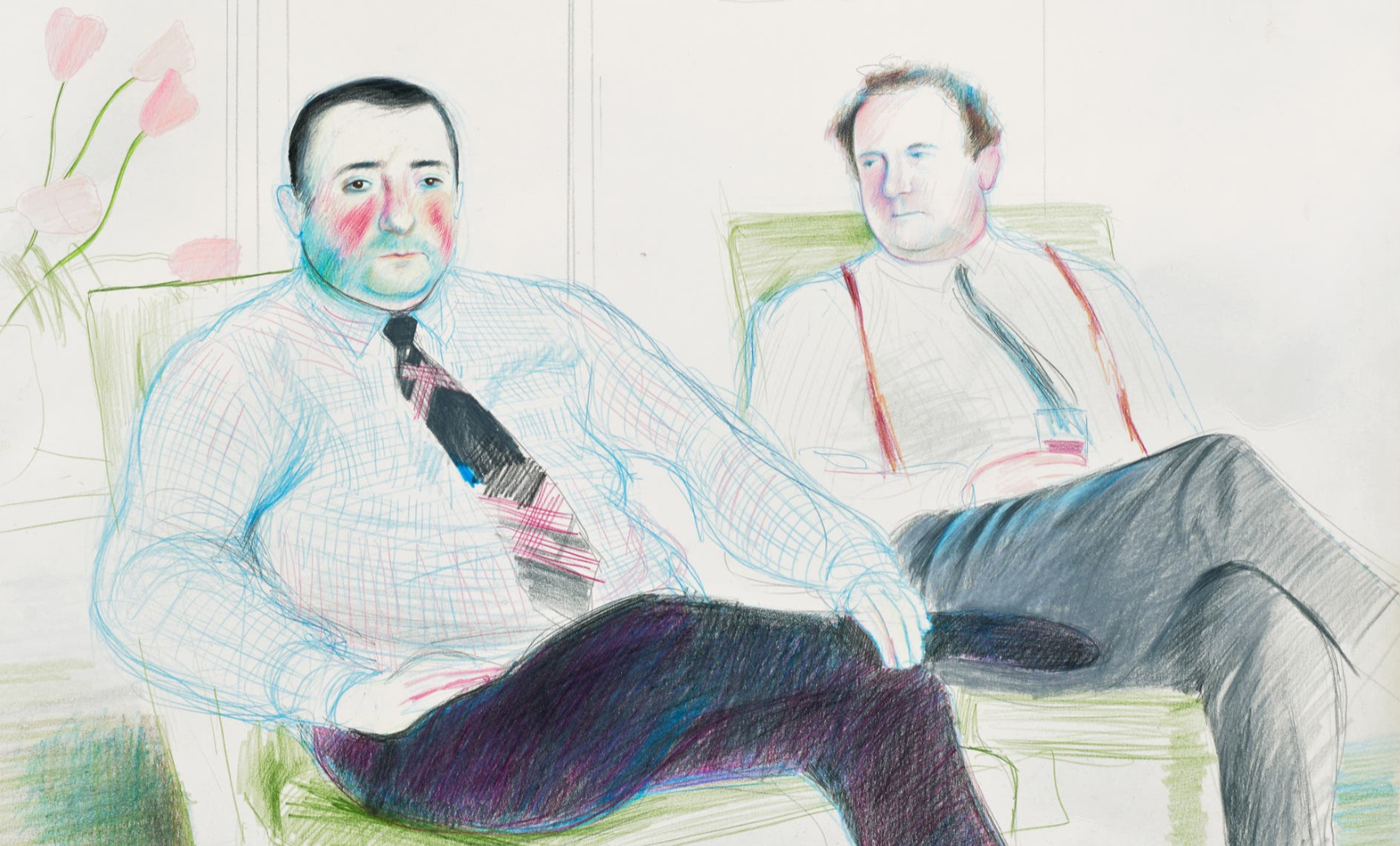
Hockney’s chosen subjects for his double portraits like with his landscapes or still lifes were often autobiographical — responding to his immediate surroundings and social circles. As with the accomplished drawings created following his move to the French capital in 1973, Hockney’s subjects were recent and old friends including designers Celia Birtwell and Jean Léger, fashion student Gregory Evans and Yves-Marie Hervé. At this time Hockney approached drawing as a lengthy and arduous exercise, a process that allowed him to closely study and capture the essence of his sitter’s likeness. ‘I did them slowly. I would spend two or three days drawing the person slowly, rather academically, sort of ‘accurately’ in an ordinary sense’, the artist noted. Hockney could examine through the portrait genre the human condition and in turn with the inclusion of two figures, relationships, with all their particularities. While in Paris, Hockney continued his development of the double portrait format, painting the two American artists Shirley Goldfarb and Gregory Masurovsky in 1974, a work now housed in the San Francisco Museum of Modern Art. Made the following year while still residing in France, for the present work Hockney paired Peter Langan alongside Jean-Marc Moussis.
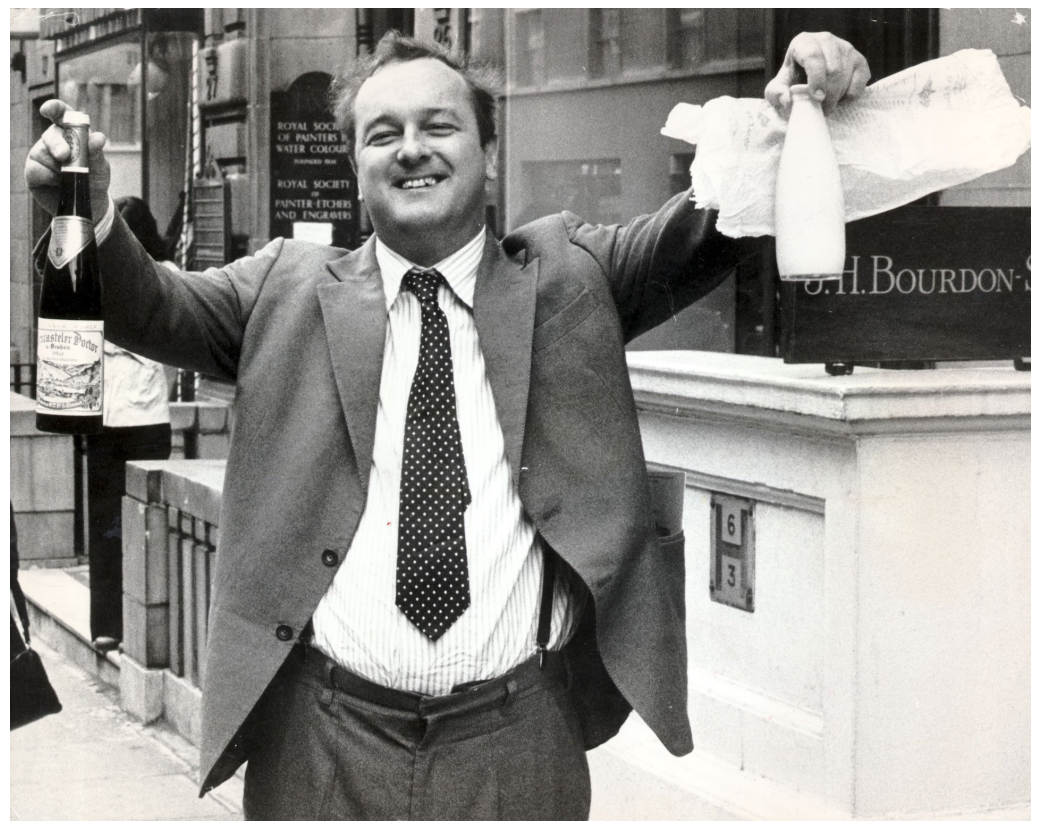
Peter Langan, co-owner of Odin’s and co-founder of Langan’s Brasserie, 1975. Image: Bill Cross/Daily Mail/Shutterstock
Hockney is first known to have drawn Peter Langan in the late sixties, before he had opened Langan’s Brasserie in 1976 yet was still involved in his first restaurant Odin’s located in Marylebone. Hockney was among the artists like Patrick Procktor who would at times exchange pictures with Langan for food: paintings and drawings that surrounded sitters of his brasserie. Langan became known as a wild, outrageous figure, simultaneously drawing in and horrifying clientele for his boorish behaviour that included sleeping under tables imbibed, biting customers ankles or trying to put out a kitchen fire with champagne. By the mid-1980s Langan’s Brasserie in Mayfair had nonetheless become one of London’s most in vogue and fashionable meeting points for celebrities, actors, musicians and artists from Princess Grace of Monaco, Elizabeth Taylor to Mick Jagger, Francis Bacon and Mohammed Ali. Recognising the talent of Langan, Hockney had him organise a celebratory picnic on the lawn of Glyndebourne for premiere of The Rake’s Progress which the artist designed the sets and costumes for in 1975. A decadent banquet on Midsummer Day, Hockney recalled ‘Peter Langan had realized […] he was bringing 120 bottles of champagne for about 30 people […] The food was marvellous and there was so much of it I invited the orchestra and chorus, after the performance’. Hockney also included the drawing of Langan and Moussis on the cover of the menu.
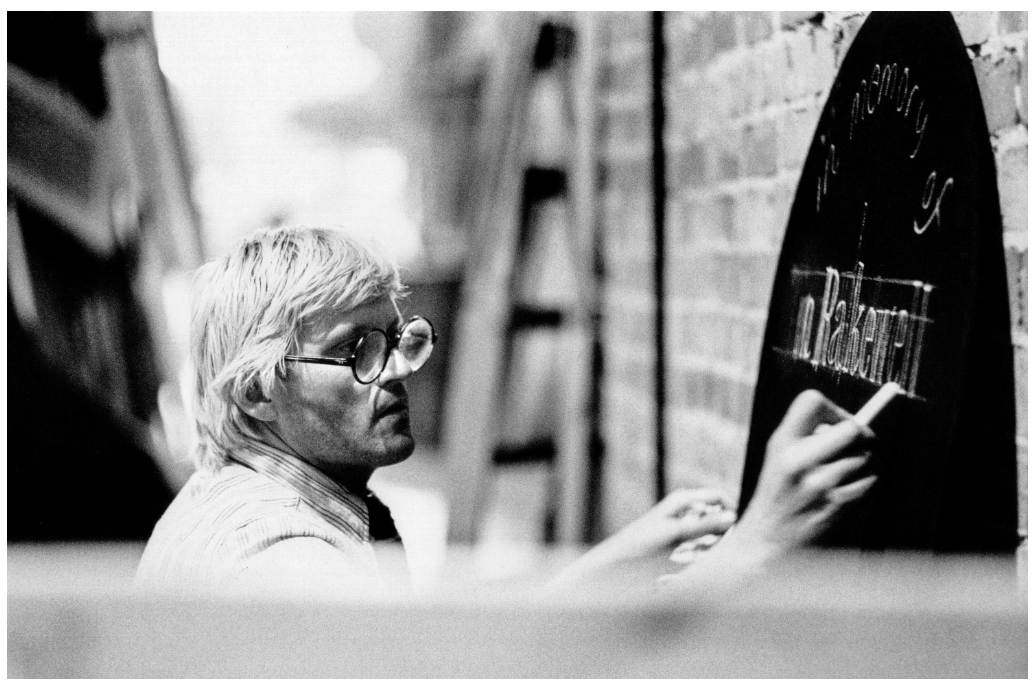
David Hockney working on stage designs for The Rake’s Progress at Glyndebourne Festival Opera, 1975. Image: Alamy/Donald Cooper
The present work memorializes the relationship between the Moussis and the restauranteur, around the time Langan was running his first restaurant Odin’s. During the summer of 1975 while Langan spent much of his time in France, he met in Paris the French wine merchant Jean-Marc Moussis through the sculptor Michael Goldman. Striking a deal for a house white for Odin’s despite Langan’s inability to speak French, Peter was nonetheless excited by the prospect Hockney might design the wine label. It was only when the first delivery arrived that Langan realised his unwitting expenditure, purchasing 30,000 bottles instead of 3,000. To make matters worse, the wine had not travelled well, becoming so sweet it could only be sold in Odin’s as a dessert wine while Hockney ultimately did not design the label. Alluding to this impasse, with Moussis’ bright red cheek and bottled wares centred beneath him, Hockney vividly captures the eccentric personalities of these two men. Despite the unfortunate predicament, the image seems to have been to Langan’s likeness as he also used the drawing for his menu of Odin’s.
Self Portrait, Weekend of March 3, 2001, 2001
PROPERTY FROM A DISTINGUINSHED WEST COAST COLLECTION
Christie’s London: 23 October 2025
Estimated: GBP 60,000 – 80,000
GBP 165,100 / USD 220,415
WORK ON PAPER
DAVID HOCKNEY, O.M., C.H., R.A. (B. 1937), Self Portrait, Weekend of March 3, 2001 | Christie’s
DAVID HOCKNEY (B. 1937)
Self Portrait, Weekend of March 3, 2001, 2001
Charcoal on paper
30 x 22 1/2 inches (76.2 x 57.1 cm)
Signed with initials and dated ‘DH 01’ (lower right)
Completed in March 2001, this self-portrait emerged at a time when David Hockney was fascinated by Renaissance and early modern portraiture, and the pose and direct gaze of the sitter is reminiscent of Jan van Eyck’s Portrait of a Man (Self Portrait?) (National Gallery, London). Hockney made another drawing in charcoal titled Self-Portrait, March 2 2001 (Centre Pompidou, Paris): clearly made simultaneously with the present work and echoing the exact same pose, details such as the absence of his glasses and the combed hair distinguish it from the present drawing, demonstrating his process of refining and modifying his subject. Hockney returned to Yorkshire from California in 1997 in order to look after his mother Laura, who died two years later. She was just one of many loved ones who Hockney had lost before the turn of the century. These circumstances might explain the trepidation in Hockney’s face: the pensiveness of an artist questioning his own methodology through the examination of older techniques and styles, as well as a broader meditation on loss and mortality.
Jonathon Brown, Jan 2nd 1994, 1994
PROPERTY FROM A DISTINGUINSHED WEST COAST COLLECTION
Christie’s London: 23 October 2025
Estimated: GBP 30,000 – 50,000
GBP 63,500 / USD 84,775
WORK ON PAPER
DAVID HOCKNEY, O.M., C.H., R.A. (B. 1937), Jonathon Brown, Jan 2nd 1994 | Christie’s
DAVID HOCKNEY (B. 1937)
Jonathon Brown, Jan 2nd 1994, 1994
Pencil on paper
30 x 22 1/2 inches (76.2 x 57.2 cm)
Signed with initials and dated ‘DH Jan 2nd 1994’ (upper right)
A Scottish artist, author, and teacher, Jonathon Brown met David Hockney in the 1970s. His text, I Don’t Know Much About Art But I Know David Hockney, is a memoir discussing their friendship. Brown spent his early life in Edinburgh, studying at The Edinburgh Academy before attending Cambridge to read Moral Sciences. Though initially devoted to writing, Hockney encouraged him to shift his focus to art. Brown’s self-proclaimed ‘creative self’ first emerged in the 1980s and, having moved to the Alps north of Nice in 1992, he entirely committed himself to his art. In his 25 years at the foot-hills of the Alps, Brown developed a complex style, completing paintings of flowers, his ‘Les Fleurs du Bien,’ graphite portraits, and dynamic landscape pieces. He is most renowned for the latter, which evoke the movement of personal vision and create a sense of travel. These dynamic scenes were shown in 2010 and 2015 at the Musée International d’Art Naïf, Nice, and in 2002 at Edinburgh’s Talbot Rice Art Gallery. More recently, Brown has written for newspapers including the Times Literary Supplement, The Sunday Times, and The Spectator, and taken part in interval talks for BBC Radio Three.
Paul Bartel, 10 April 1994, 1994
PROPERTY FROM A DISTINGUINSHED WEST COAST COLLECTION
Christie’s London: 23 October 2025
Estimated: GBP 25,000 – 35,000
GBP 31,750 / USD 42,385
WORK ON PAPER
DAVID HOCKNEY, O.M., C.H., R.A. (B. 1937), Paul Bartel, 10 April 1994 | Christie’s
DAVID HOCKNEY (B. 1937)
Paul Bartel, 10 April 1994, 1994
Pencil on paper
30 x 22 1/4 inches (76.2 x 56.5 cm)
Signed with initials and dated ‘DH. 10 April 1994’ (upper right)
The subject of this David Hockney portrait is Paul Bartel (1938-2000), the Hollywood director known for making humorous and often controversial cult films, including Eating Raoul (1982) and Death Race 2000 (1975). Bartel was a very private individual, but it is known that he collected many works by Hockney, including several dedicated ‘for Paul’ by the artist. At the time of completion, Hockney was busily creating art in Los Angeles; by contrast, Bartel had finished his directorial career just the year before.
Sir David Webster, 1971
Sotheby’s London: 28 June 2023
Estimated: GBP 70,000 – 90,000
GBP 88,900 / USD 113,310
WORK ON PAPER
Sir David Webster | Modern & Contemporary Day Auction | 2023 | Sotheby’s (sothebys.com)
DAVID HOCKNEY (b. 1937)
Sir David Webster, 1971
Colored pencil and graphite on paper
17×14 inches (43.2 x 35.5 cm)
Signed with the artist’s initials, titled, dated Feb 1971 and variously inscribed
Sir David Webster was the former General Administrator of the Royal Opera House, Covent Garden from 1945 to 1970. Webster was a visionary leader of the field, and under his administration, the Royal Opera House was restored from a wartime dance hall into a world-class institution that hosted the finest international singers, dancers and conductors of its time.
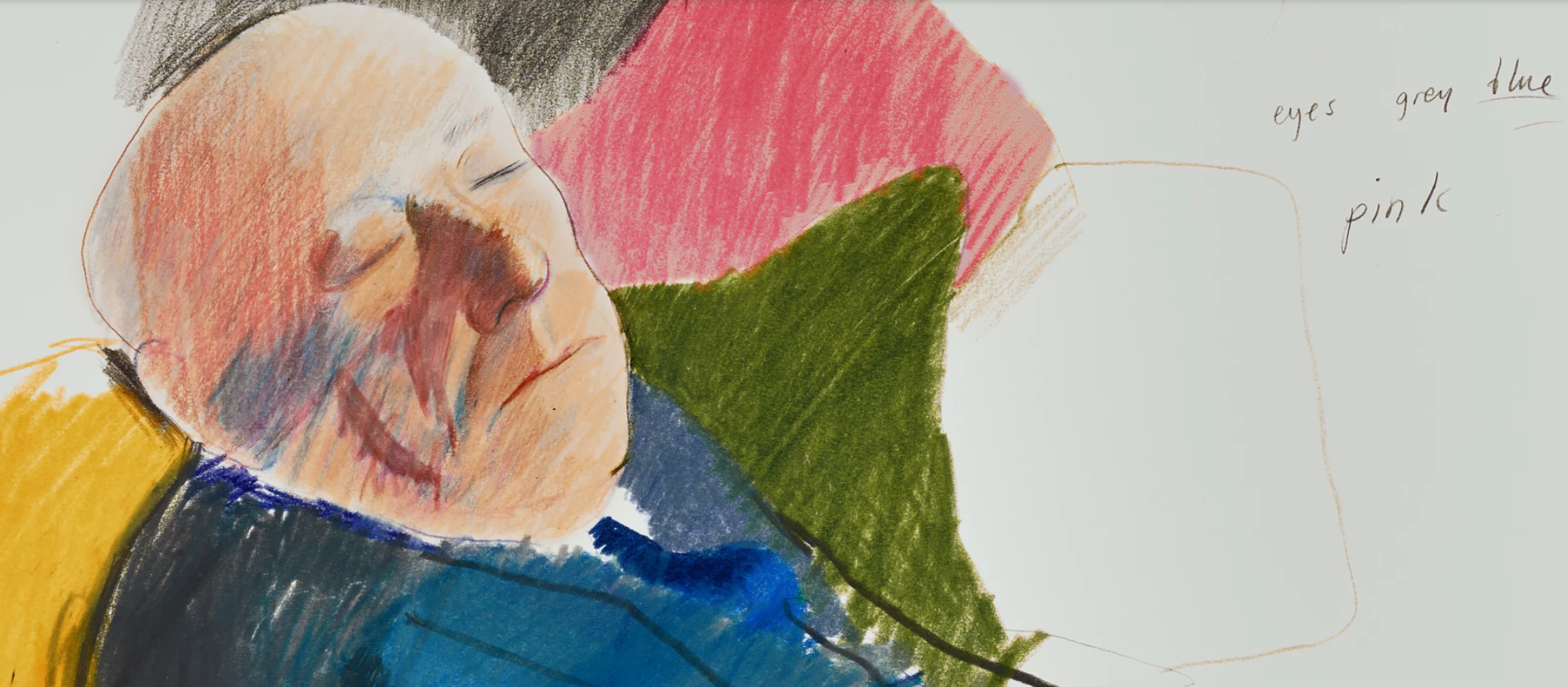
As one of the few portrait commissions that the artist accepted in his lifetime, Hockney created a large-scale painting Portrait of Sir David Webster, which the artist completed over the course of just two months. The work was created for Webster’s retirement from the Royal Opera House, and would hang in the halls at Covent Garden. Webster was very ill at the time and would die just one year after the work was completed. A recurring problem during Webster sitting for the portrait was his inability to stay awake during his sessions due to his illness, with much of the final painting completed from photographs. The present work remains an intimate portrait of a man at the finale of his life; a snapshot of a rare moment where the artist and the sitter were together. Rendered in vibrant blue, yellow and pink, the scene presents Webster at a moment of rest, serenely placed amongst a pile of pillows. His face hides his illness and pain, calm and at peace in Hockney’s presence. Charged with nostalgia and emotion, Portrait of David Webster remains a beautiful and poignant memento of a great man, as well as a testament to Hockney’s sensitive and expressive handling of his sitters.
Peter Drawing, 1970
Christie’s London: 22 March 2023
Estimated: GBP 70,000 – 100,000
GBP 63,000 / USD 77,350
WORK ON PAPER
DAVID HOCKNEY, O.M., C.H., R.A. (B. 1937), Peter Drawing | Christie’s (christies.com)
DAVID HOCKNEY, O.M., C.H., R.A. (B. 1937)
Peter Drawing, 1970
Pencil, colored pencil and crayon on paper
17×14 inches (43.2 x 35.5 cm)
Signed with initials and dated ‘DH 70’ (lower right)
Held in the same private collection since 1975, Peter Drawing (1970) is an intimate and evocative depiction of David Hockney’s greatest love and muse: Peter Schlesinger. Rendered in a delicate colour palette, Hockney presents us with Peter sat in a large brown armchair, his gaze directed towards what appears to be a sketchbook on his knee. Silent and pensive, he participates in a quiet act of drawing, perhaps creating his own portrait of the artist sat opposite him. Through soft lines of coloured pencil and crayon, the artist renders his profile in meticulous detail, a technique which manifests most poignantly in the fine, wispy strands of his hair. To his left, an area of exposed paper appears, its field of bright white suggesting a swath of daylight from the right of the picture plane. Executed in 1970, this work was created during a period where drawing had become a central preoccupation for Hockney, independent of the preparation of paintings. The artist’s portraits of Peter in particular had a transformative impact on his practice, his desire to capture his lover’s likeness prompting him to move away from his early stylised drawings towards a more naturalistic mode of representation. In Peter Drawing, Hockney presents us with a magnificent product of this period, inviting us into a quiet and intimate moment with his lover.
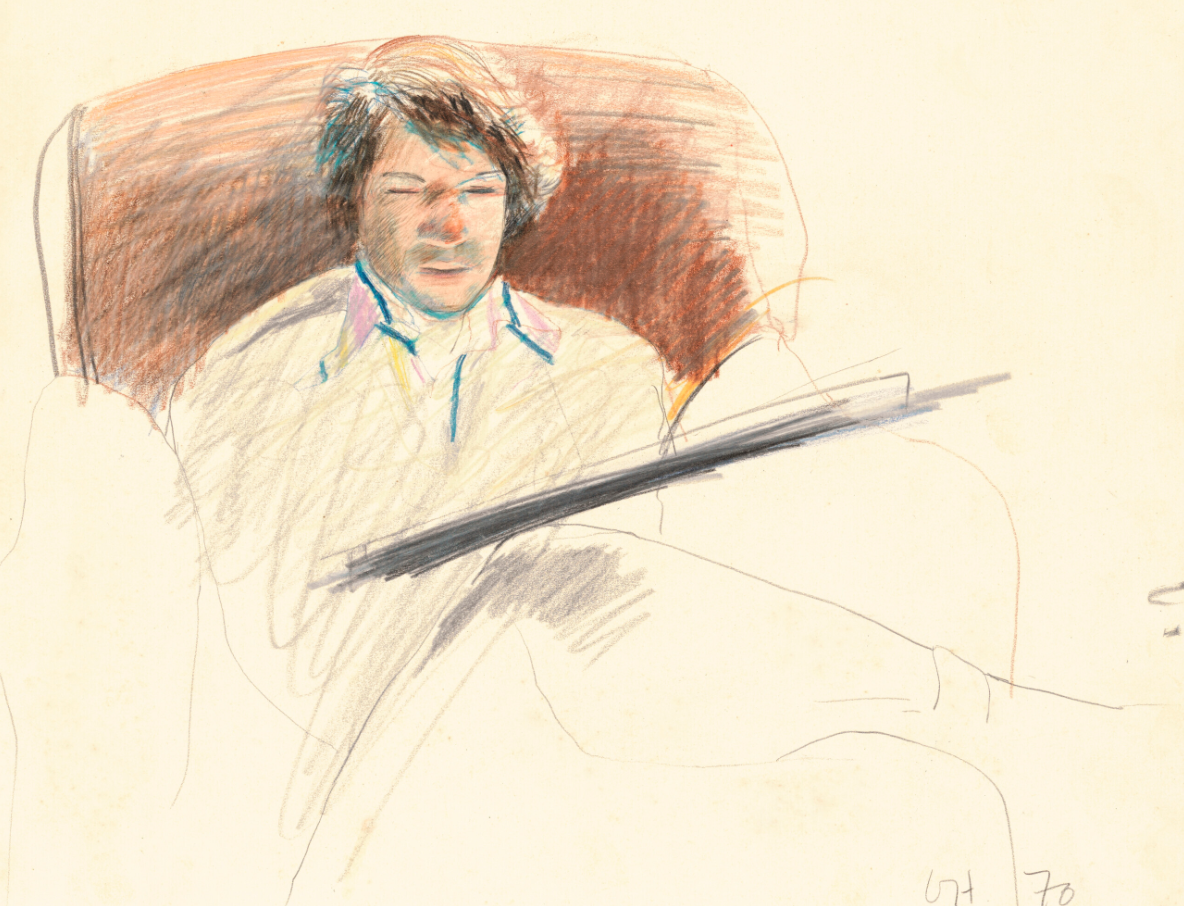
Hockney met the eighteen-year-old Peter in Los Angeles in 1966, where during his attempt to forge a career as an artist, he enrolled in Hockney’s six-week summer drawing course at UCLA. During this period, the two established a friendship that would outlive the course, and eventually develop into what would become both Hockney and Schlesinger’s first true romance. In 1967, Peter transferred permanently to the UCLA campus, a move which also led him to settle into Hockney’s rented studio on Pico Boulevard, where he would quickly immerse himself within the artist’s lively literary and artistic circle. As their relationship deepened in the late 1960s, so did Hockney’s desire to capture the intensity of his feelings for Schlesinger, a motivation which sparked a shift towards a more naturalistic drawing style. Deeply autobiographical, Hockney’s depictions of his lover would come to form some of the strongest works of his oeuvre, his sketchbook portraits in particular evoking an intimacy and immediacy that was unavailable through paint. Tender and captivating, and rendered in meticulous detail, Peter Drawing can be considered one of the artist’s most charming portrayals of his greatest muse.
Celia, 1970
Christie’s London: 21 March 2023
Estimated: GBP 180,000 – 250,000
GBP 201,600 / USD 247,442
DAVID HOCKNEY, O.M., C.H., R.A. (B. 1937), Celia | Christie’s (christies.com)
DAVID HOCKNEY, O.M., C.H., R.A. (B. 1937)
Celia, 1970
Pencil and colored pencil on paper
17×14 inches (43.2 x 35.6 cm)
Signed with initials and dated ‘DH./70’ (lower right)
Held in the same private collection since 1971, Celia (1970) is an intimate and tender portrait of one of David Hockney’s closest friends, the fabric designer Celia Birtwell. Here, Hockney presents us with Celia sporting one of her own designs, a pink palm tree print blouse with a pussycat bow, paired with a checked jersey skirt. Depicted in what she recalls as the artist’s flat in Powys Terrace, Notting Hill, she presses back against his Mies van der Rohe ‘MR’ chair, gripping firmly onto the edges of its seat. Silent and pensive, she flashes us a quiet stare from her piercing blue eyes. Through fine, fragile lines and a pastel color palette, Hockney skillfully captures his sitter’s elegant and graceful demeanor, a quality which manifests in the gently rendered strands of her wispy blonde hair. Created in single sessions lasting three to four hours, Hockney’s portraits of the early 1970s were characterized by their commitment to conveying the unique particularities of his subjects. In Celia, we are immediately drawn to the sitter’s glorious pink outfit, the patterns and folds of its fabric rendered in meticulous detail. Indeed, the work can be considered a testament to Celia’s celebrated career in textile design, highlighting her status at the top of London’s fashion industry in the Swinging Sixties. One of the earliest depictions of his muse, Celia offers a subtle and insightful representation of the sitter who would go on to fascinate Hockney for the next five decades.
Boodgie and Stanley, 30 May 1994
Christie’s London: 1 March 2023
Estimated: GBP 30,000 – 50,000
GBP 163,800 / USD 197,099
DAVID HOCKNEY (B. 1937), Boodgie and Stanley, 30 May 1994 | Christie’s (christies.com)
DAVID HOCKNEY (B. 1937)
Boodgie and Stanley, 30 May 1994
Graphite on paper
22 1/2 x 29 7/8 inches (57×76 cm)
Signed with the artist’s initials and dated ‘ DH 30 MAY 1994’ (upper right)
With outstanding provenance, Boodgie and Stanley, 30 May 1994 is offered from the collection of Hockney’s friend and collaborator Cavan Butler. Butler came to know Hockney through his role as Production Manager at Petersburg Press during the 1970s and early 1980s, and later worked for the artist’s UK office traDHart between 1983 and 1998. A typographic designer by trade, Butler was originally employed by Paul Cornwall-Jones—the founder of Petersburg Press—who published Hockney’s prints. The office was based on Portobello Road, near to the artist’s London studio on Powis Terrace: Butler recalls meeting Hockney for the first time when he went to deliver flight tickets to his home, and was invited up to the studio on the top floor. Over the following years Butler worked directly with the artist on the design and production of his exhibition posters, notably for shows at the Tate Gallery in 1980 and the Ashmolean Museum, Oxford in 1981, as well as the iconic poster for Hockney’s triple bill Parade at the Metropolitan Opera, New York that same year. Both of the present works were gifted to Butler by the artist and have remained in his personal collection ever since.
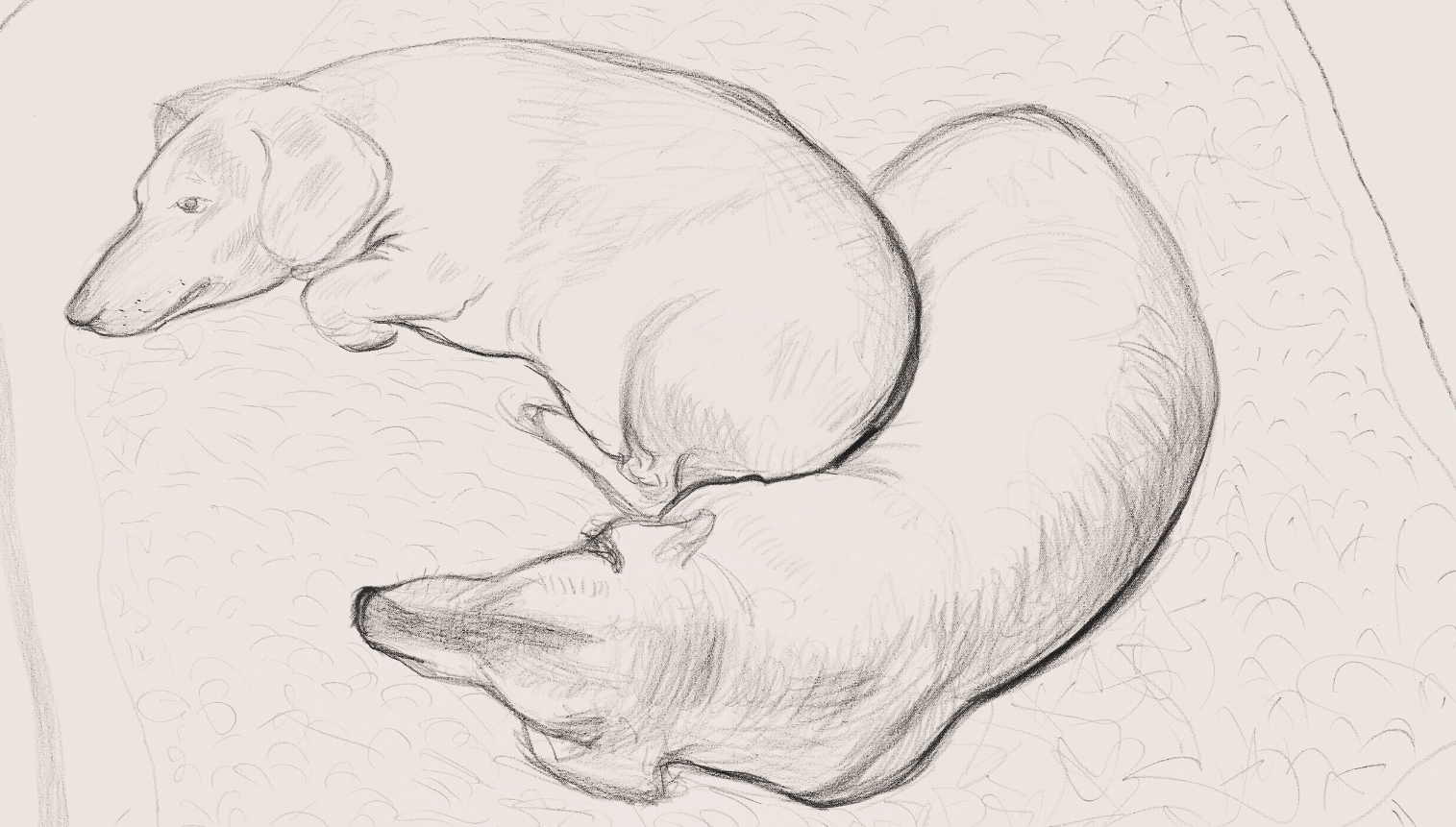
Stanley was adopted in 1987, followed by Boodgie two years later, and the pair became vital parts of Hockney’s life. They featured regularly in his art, with Hockney setting up easels around the house to capture them in their natural poses. Executed in 1994 and shown that year in an exhibition of Hockney’s drawings at Yorkshire’s Salt Mills, Boodgie and Stanley, 30 May 1994 captures the artist’s close focus on his dogs during a particularly mournful period in his life. As numerous friends passed away—among them his beloved comrade Henry Geldzahler—he found solace in painting the tiny living beings with whom he shared his world.
Celia, 1978
Sotheby’s New-York: 20 May 2022
Estimated: USD 200,000 – 300,000
USD 252,000
Celia | Contemporary Day Auction | 2022 | Sotheby’s (sothebys.com)
DAVID HOCKNEY (b. 1939)
Celia, 1978
Colored pencil on paper
17×14 inches (43.2 x 35.6 cm)
Signed with the initials DH and dated 78 (lower right)
Celia from 1978 is a transfixing and tender portrait of one of David Hockney’s dearest friends, the renowned designer Celia Birtwell. Portraiture has long been a linchpin of Hockney’s creative endeavor that depicts, with his signature characteristic flair, the environments, fashions and visages of the artist’s milieu. This vibrant portrait encapsulates not only Hockney’s technical mastery of color and form, but also permits us to see one of Hockney’s closest confidants as if looking through the artist’s own eyes. Hockney first met Celia in Los Angeles in 1964 and their friendship intensified in 1971 the wake of the artist’s break-up with his long-term partner Peter Schlesinger. In a series of portraits of Cecila, executed in Paris between 1973 and 1975, Hockney honed his drawing style by capturing the deeply personal idiosyncrasies that underpin the inner truths of his sitters all within an effeminate veil of colorful vivacity.
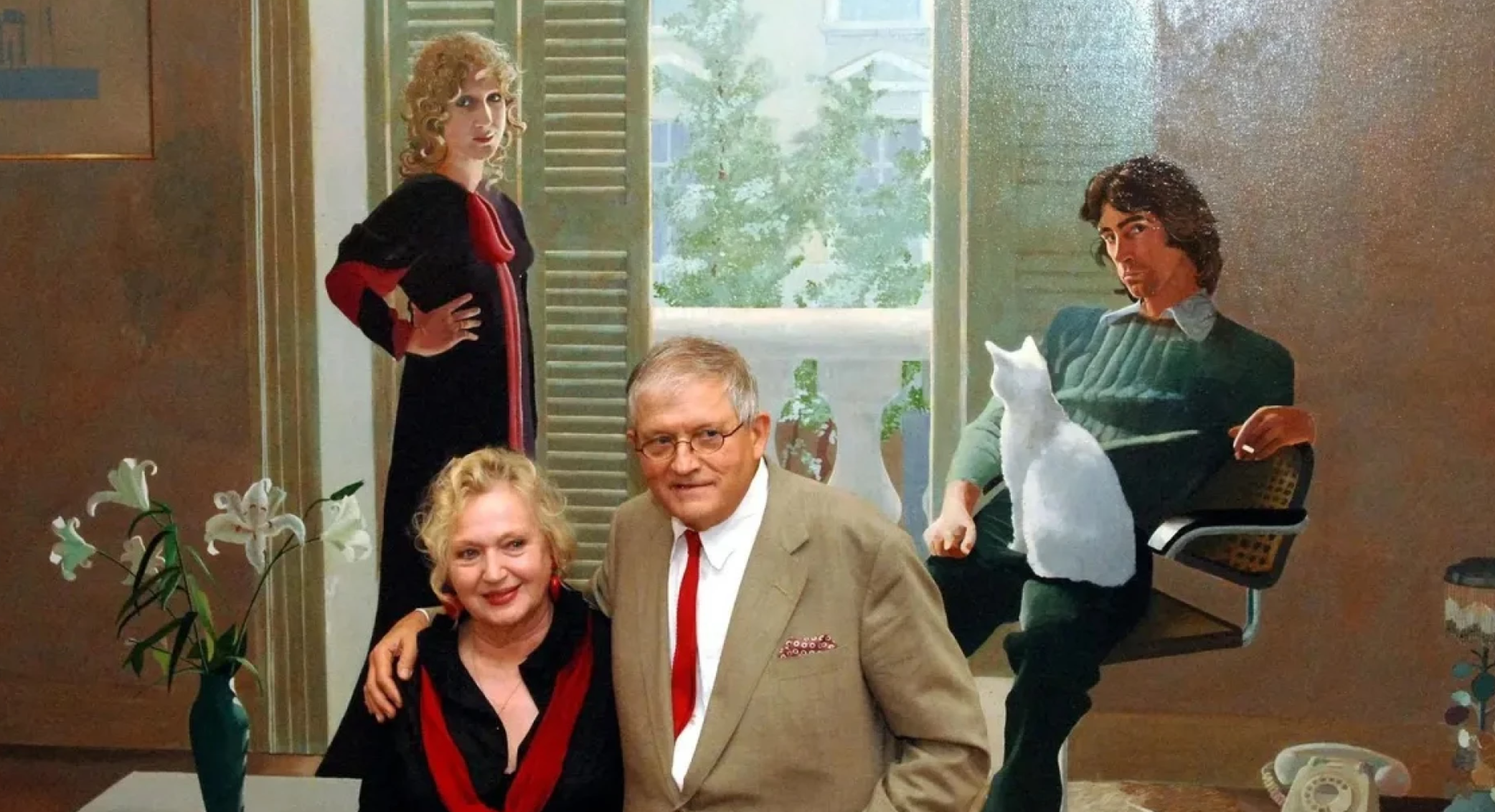
DAVID HOCKNEY AND CELIA BIRTWELL WITH HIS PAINTING OF HER, MR. AND MRS. CLARK AND PERCY
In the present work, Hockney fuses formal experimentation and intuitive execution, combining the artist’s art historical reference points with the candid and sensitive gaze that defines his remarkable freehand portraiture and the experience of sitting face to face with a dear friend. It is through this career-long examination of himself, his closest friends and family, and art world personalities, that Hockney’s portraits form a crucial element of his practice, integrated into his shifting palette, styles and modes of production across many mediums. Celia is most famously represented in Hockney’s large double portrait Mr. and Mrs. Clark and Percy, now held in the collection of the Tate in London, featuring Celia with her husband, Ossie Clark. The immediacy of the present work demonstrates the virtuosity of one of the most prodigious artists of the post-modern period. Held in private hands since it was acquired in 1980, Celia is an intimate portrayal of one of the artist’s most frequent and important sitters.
Travels
Cataract Hotel Aswan, 1978
Bonhams London: 15 October 2026
Estimated: GBP 70,000 – 100,000
GBP 358,900 / USD 475,720
WORK ON PAPER
Bonhams : DAVID HOCKNEY (1937-2026) Cataract Hotel Aswan (Executed in 1978)
DAVID HOCKNEY (1937-2026)
Cataract Hotel Aswan, 1978
Colored pencil on paper
17 1/8 x 14 inches (43.5 x 35.5cm)
Signed with the artist’s initials, titled and dated ‘Cataract Hotel Aswan DH 78’ (lower right)
David Hockney’s Cataract Hotel Aswan is a vivid testament to the artist’s enduring fascination with Egypt and with the possibilities of drawing as a means of translating visual experience into colour, line and memory. Executed in 1978, fifteen years after his first visit to the country, the work belongs to a small but significant group of drawings made during Hockney’s return to Egypt with his close friends Peter Schlesinger and Joe McDonald. Yet rather than depicting one of the ancient monuments for which the country is renowned, Hockney turns his attention to the interior of the historic Old Cataract Hotel. Through the immediacy of coloured pencil, an architectural interior becomes an intensely personal study of light, space and perception.
The Old Cataract Hotel, situated on the banks of the Nile in Aswan, had opened in 1900 and quickly established itself as an important destination for travellers on the river. Its commanding position and distinctive architecture contributed to its status as one of Aswan’s defining landmarks. For Hockney, however, the hotel provided more than a picturesque subject. Returning to Egypt after an absence of fifteen years, he was revisiting a landscape already embedded within his visual memory. The decision to record the interior of the hotel is therefore particularly revealing instead of seeking the monumental or the spectacular, Hockney finds visual richness in an inhabited, everyday space.
The composition is immediately animated by colour. Executed entirely in coloured pencil, the drawing is dominated by vivid reds, pinks and yellows, punctuated by cooler blues, ochres and pale greens. At its centre, a boldly outlined red chair acts as a powerful visual anchor. Its sweeping contours and emphatic colour distinguish it from the more loosely rendered elements around it, drawing the eye into the space while giving the composition a sense of rhythm. The chair is at once an ordinary piece of furniture and an almost abstract form, demonstrating Hockney’s ability to discover formal interest in the most familiar of subjects.
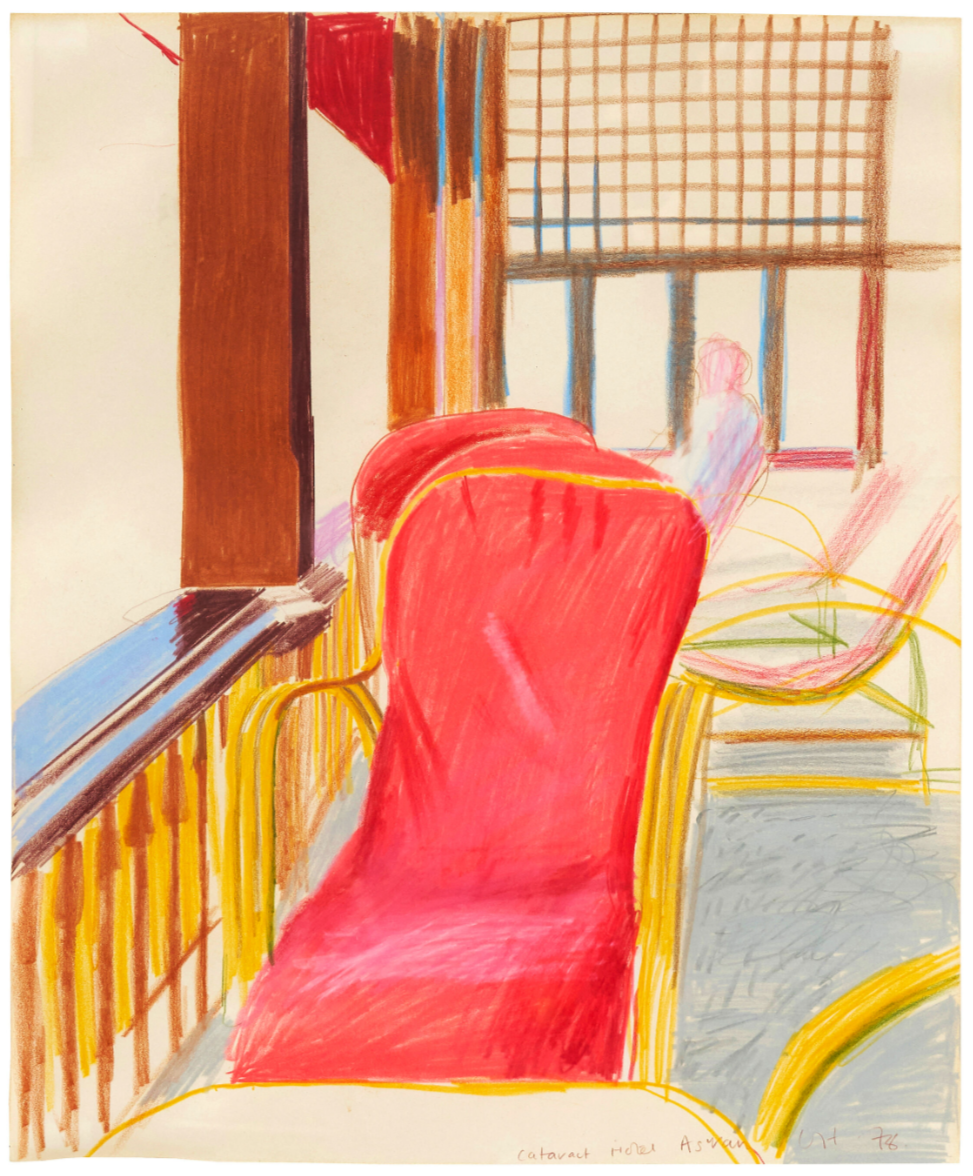
Around this focal point, the architecture establishes a contrasting sense of order. Strong verticals and the geometric divisions of the windows provide a rigorous framework, while the surrounding interior is described through quicker, more economical marks. Hockney does not attempt to render every detail with equal precision; instead, he allows certain areas to remain open and suggestive. The result is a compelling tension between the solidity of the architecture and the freedom of the artist’s hand. The building provides structure, but within that structure the drawing remains fluid and alive.
This balance is fundamental to the character of the work. Hockney’s lines vary from delicate, rapidly drawn marks to more emphatic passages in which form is asserted through colour and contour. The coloured pencil allows him to work with extraordinary immediacy, building saturated areas of pigment while retaining the freshness of the individual stroke. Rather than functioning simply as a descriptive medium, colour becomes a means of interpreting the space. The heightened reds and pinks, set against cooler passages, intensify the sensation of light and give the interior an atmosphere that is recognisably observed yet unmistakably transformed through the artist’s perception.
The importance of the work also lies in this distinction between recording and interpretation. Hockney’s second journey to Egypt followed almost a year of concentrated work on his stage designs for Mozart’s The Magic Flute at Glyndebourne. His return to the country brought him back into direct contact with a landscape and culture that had first made a strong impression on him in 1963. In Cataract Hotel Aswan, however, memory does not result in a nostalgic reconstruction. Instead, it becomes a catalyst for renewed looking. The familiar is re-encountered and reorganised through the immediacy of drawing
.
This makes the present work particularly revealing within Hockney’s broader practice. Perhaps best known for his pools, portraits and California landscapes, Hockney has consistently explored the relationship between perception and representation, questioning how an image can convey not simply what is seen but the experience of seeing. Cataract Hotel Aswan demonstrates this interest on an intimate scale. Its subject is precisely located, yet its vivid colour, abbreviated marks and carefully balanced geometry transform the particular into something more expansive: an exploration of how space, light and memory can be held within a single sheet of paper.
Ultimately, Cataract Hotel Aswan is a testament to Hockney’s ability to make the familiar appear newly discovered. The particularity of the setting gives way to something more universal: an image of the moment in which looking becomes experience, and observation becomes memory. In this sense, the drawing transcends its subject, capturing not simply a place, but the fleeting sensation of seeing it anew.
Courtyard, Palace of Carlos V. Alhambra, Granada (Second Version), 2004
Bonhams New-York: 19 November 2025
Estimated: USD 1,200,000 – 1,800,000
USD 1,391,500
WORK ON PAPER
Bonhams : DAVID HOCKNEY (B. 1937) Courtyard, Palace of Carlos V. Alhambra, Granada
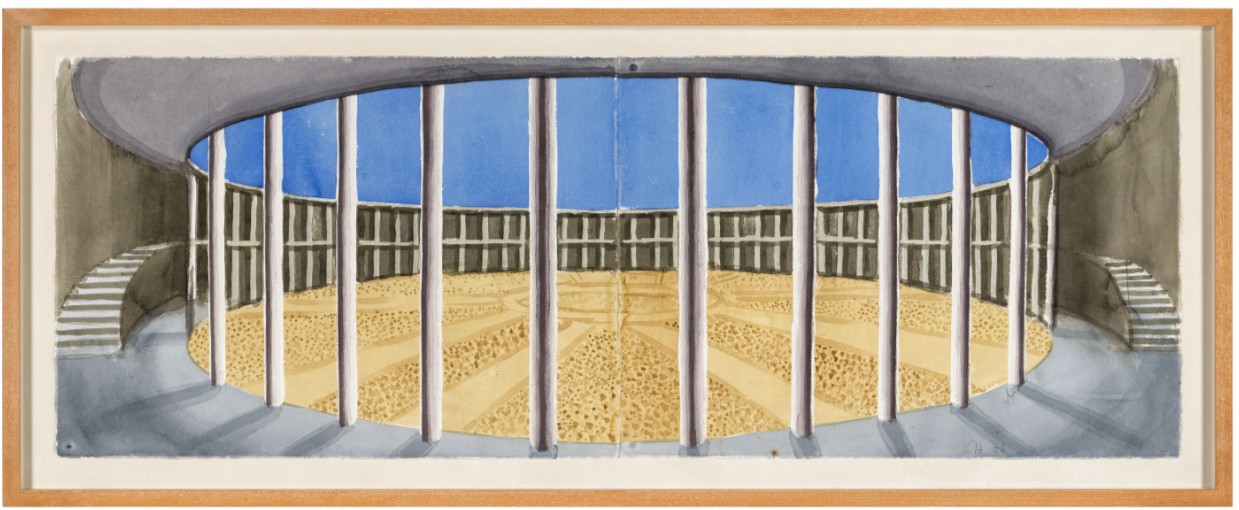
DAVID HOCKNEY (B. 1937)
Courtyard, Palace of Carlos V. Alhambra, Granada (Second Version), 2004
Watercolor on two sheets of paper
29 1/2 x 83 inches (74.9 x 210.8 cm)
Signed with the artist’s initials and dated ‘D.H. 04’ (lower right)
Executed during David Hockney’s travels through Spain in 2004, Courtyard, Palace of Carlos V. Alhambra, Granada stands among the artist’s most ambitious watercolors, a sweeping, panoramic meditation on space, light, and the architecture of vision itself. Completely fresh to market, it represents an opportunity to acquire one of the artist’s largest format watercolors, personally selected by Hockney for inclusion in The Royal Academy’s Summer Exhibition in 2004 that he co-curated with Allen Jones. The present work demonstrates his continued commitment to watercolor as a medium of immediacy and revelation, as well as his lifelong investigation into perspective and ocular machinations.
By 2004, David Hockney had long secured his place as one of the definitive British painters on the global stage. A key figure, loosely associated with the Pop generation of the 1960s but unquestionably an artist who stands apart from the homogeny of movements, his restless curiosity has continued to reinvent the language of representation. Moving between London, Los Angeles, and his native Yorkshire, Hockney had spent the previous decades re-examining the mechanics of perception, from his photographic ‘joiners’ of the 1980s to his theoretical writings on optical devices in Secret Knowledge (2001). His return to watercolor during the early 2000s marked both a personal and philosophical renewal, a move away from mediated vision toward direct experience. Travelling through Spain, he found in the architecture of Granada and Seville a perfect synthesis of order and sensuality, a living geometry through which to test his evolving ideas about space, color, and the act of seeing.
Hockney’s visit to the Alhambra that year was part of a broader return to direct observation, a phase that saw him abandon photography and reengage with plein-air drawing. The Andalusian light, the tiled geometry of Moorish architecture, and the rhythmic order of the Palace of Charles V all became stimuli for his renewed dialogue with perspective. In Courtyard, Palace of Carlos V. Alhambra, Granada, Hockney translates the concentric grandeur of the Renaissance colonnade into a fluid, transparent orchestration of color and line. The space appears both measured and elastic, its columns curving away from the viewer like a lens refocusing, suggesting not a static depiction of architecture but an event of seeing.
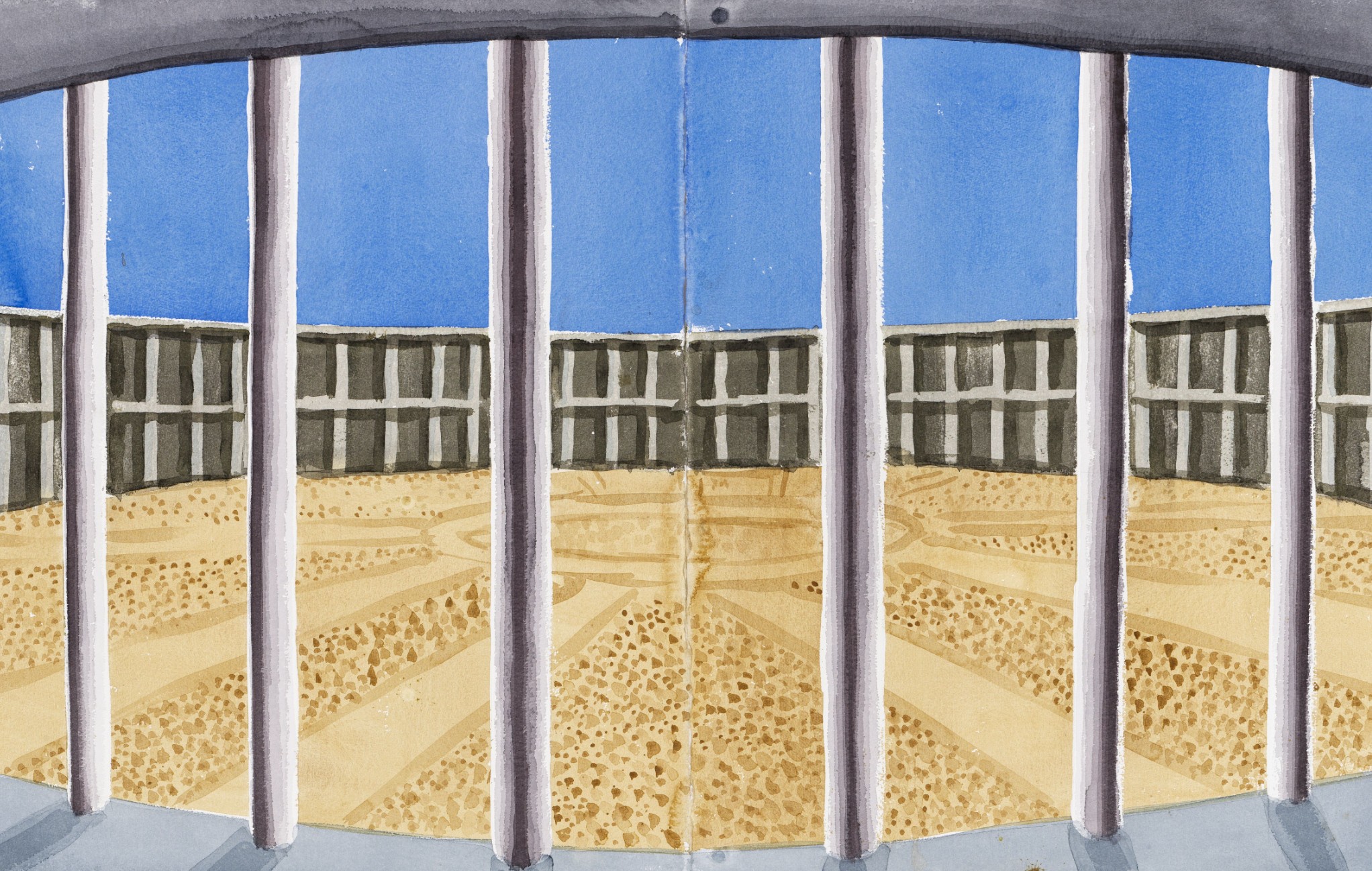
The setting, an open arena encircled by classical-style columns, invokes a lineage of painters who have looked to Spain’s amphitheaters as metaphors for spectacle, mortality, and the drama of creation. Picasso’s lifelong fascination with the bullring found in its circular stage an image of ritual combat and artistic performance. Francis Bacon, in turn, transformed the arena into a psychological theatre in his trio of bullfight paintings of 1969; a site where bodies dissolve into gesture and anguish. Hockney’s arena, by contrast, is emptied of struggle. His courtyard is serene, radiant, and analytical: a theatre of pure looking. By choosing the Palace of Charles V, a Renaissance structure embedded within the Islamic palimpsest of the Alhambra, Hockney also stages a dialogue between civilizations and time.
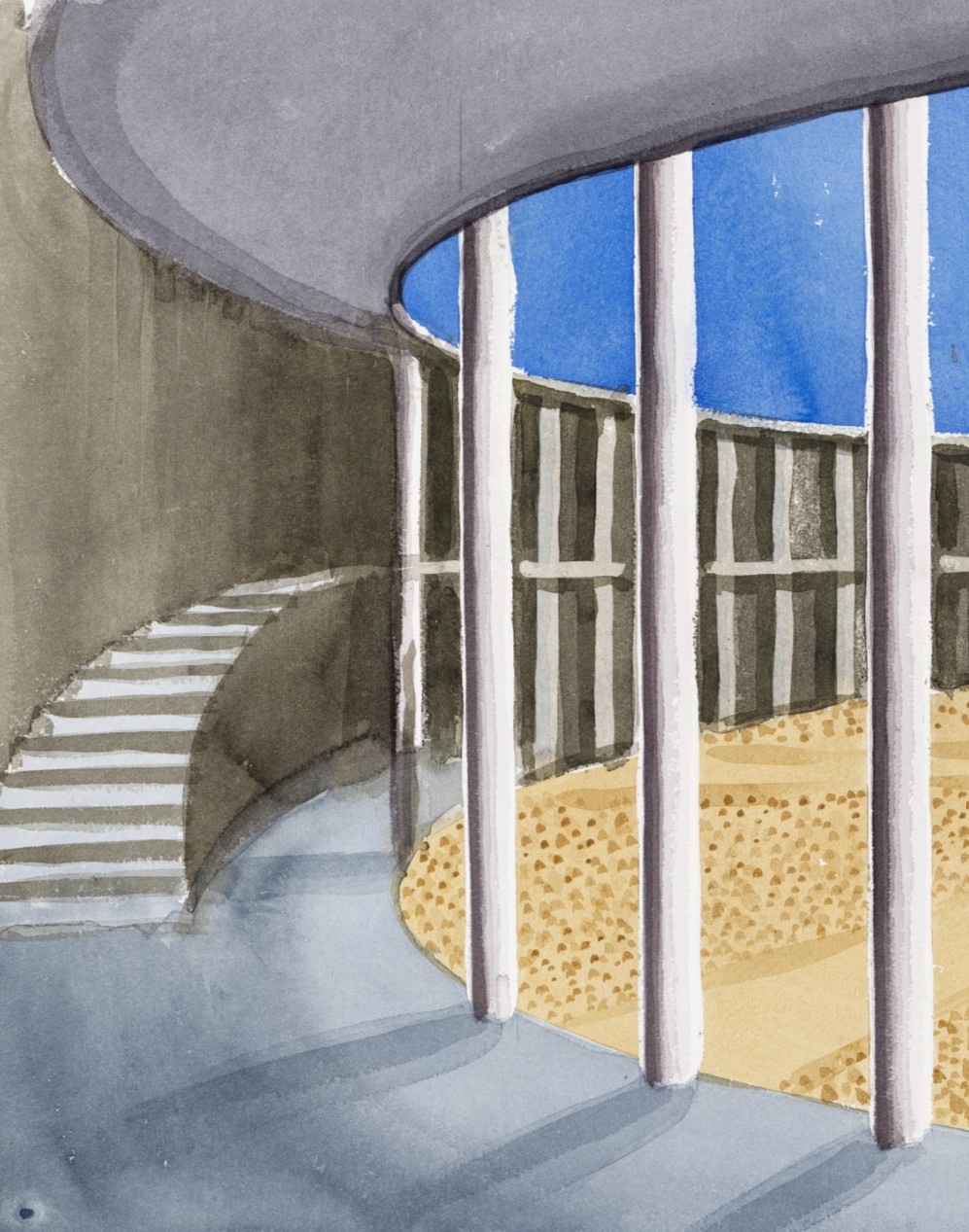
Composed across two joined sheets, the work achieves a cinematic breadth while preserving the delicacy of touch that defines Hockney’s mature draftsmanship. The ovoid washes of ochre and ultramarine generate an organic light that radiates from from the center of the work, evoking the dry Spanish heat. The artist’s handling of the medium imbues the work with a crisp, diagrammatic air; making the spectator keenly aware of the formality of the shapes and the rigor with which they are rendered. The visual congruity of the space of the work defies realist logic, even conjuring an air of Escher in the symmetry and spatial rhythm of the staircases and architectural details. In the wake of Hockney’s landmark retrospective at the Fondation Louis Vuitton in Paris, his place as one of the most inventive and lauded painters of the postwar period has been underscored. Presaging the multi-canvas landscapes of Yorkshire that would follow, in Courtyard, Palace of Carlos V. Alhambra, Granada, Hockney achieves something at once timeless and contemporary: a painting that unites the rational elegance of the Renaissance with the perceptual dynamism of modernity. Rendering the historic courtyard with austere lines and optical gamesmanship, the present work is a key to unlocking Hockney’s mastery across his career, through a deep knowledge of the visual sense and how painting can allow us to glimpse the perfection and serenity of our environment, natural and man-made.
Andalucia. Fountains, Cordova, 2004
Sotheby’s London: 6 March 2024
Estimated: GBP 1,500,000 – 2,000,000
GBP 1,863,000 / USD 2,362,284
DAVID HOCKNEY (b. 1937)
Andalucia. Fountains, Cordova, 2004
Watercolor on paper, in two joined sheets
29 1/2 x 83 inches (74.9 x 210.8 cm)
Signed with the artist’s initials and dated 04 (lower left)
David Hockney’s Andalucia. Fountains, Cordova belongs to a small group of six watercolors which the artist created following a trip to Spain in January of 2004. Hockney had spent the first half of the year on a number of trips to see the rural landscapes and architectural sites across France, Spain and Italy. Later in the summer of 2004, he exhibited a group of watercolors from his trip to Spain, including the present example at the Summer Exhibition at the Royal Academy of Art in London, which Hockney and Allen Jones co-curated. The lush garden and flowing fountain are sprawled across two sheets of paper, a format that is seen throughout Hockney’s watercolor landscapes. The perfectly arched streams cascade down the central pool, lined with a brick pathway and flowerbeds that lead onto a distant fortress wall. Reflecting his fascination with the fluid qualities of water and light, Andalucia. Fountains, Cordova wonderfully transposes a fragment of his travels into an impressively rendered large-scale painting.
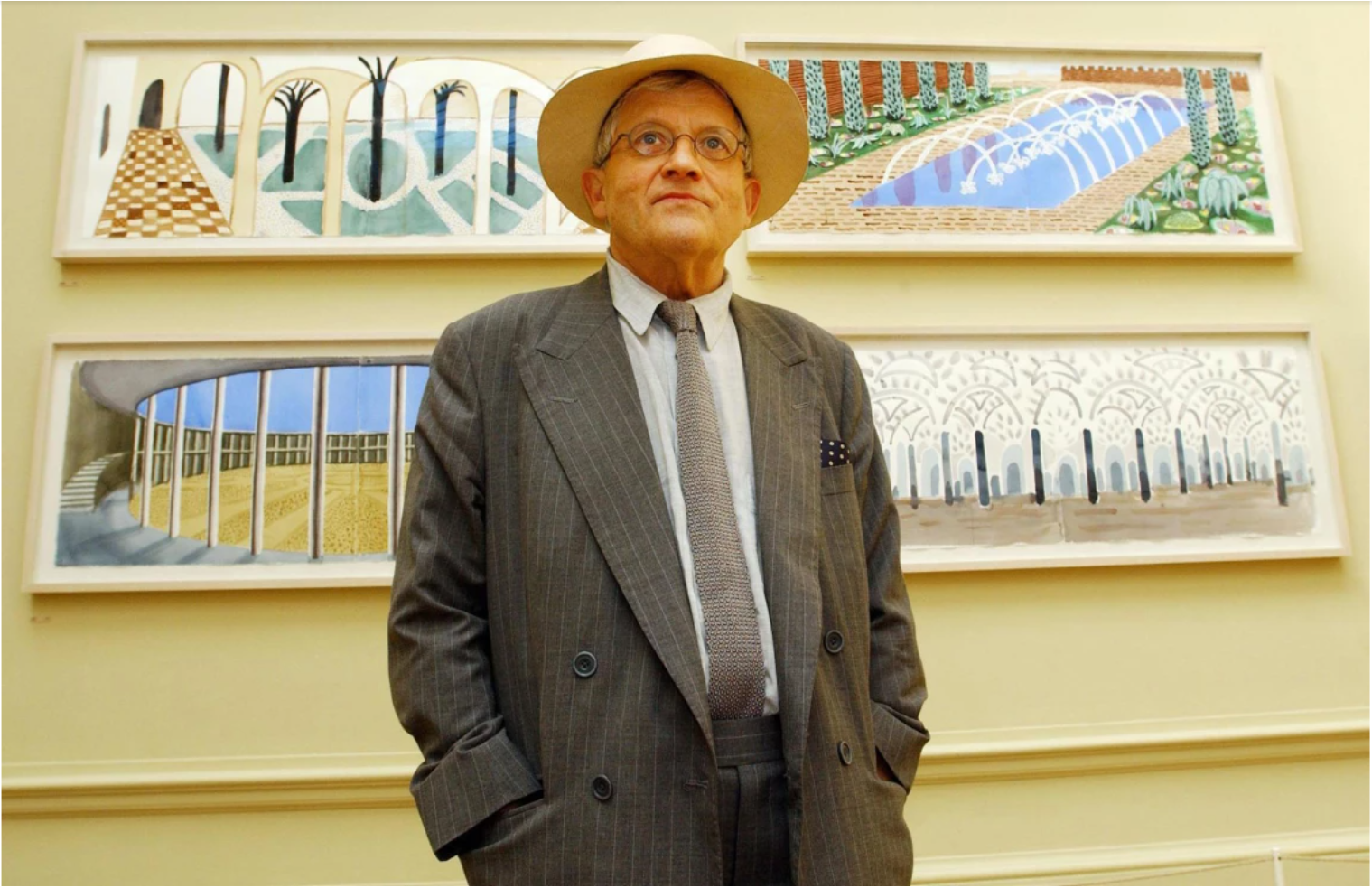
DAVID HOCKNEY WITH THE PRESENT WORK AT THE ROYAL ACADEMY’S SUMMER EXHIBITION IN 2004/ IMAGE: © ALAMY/ ARTWORK: © DAVID HOCKNEY FOUNDATION
Hockney spent the early years of the 2000s travelling and experimenting with painting landscapes in watercolor, including trips to France, Egypt, Norway and Iceland followed by Spain where the present work was created. Following this trip to Spain, he would go on to paint in Italy, creating watercolors of Lake Como, before returning to England, where he began the celebrated body of landscapes depicting the Yorkshire countryside. By the time the present work was painted, Hockney had fully immersed himself in the watercolor medium. He had begun experimenting with watercolors a few years earlier in London, but it was in the months following his move to California in the summer of 2003 that his love for the medium took full force. The nature of the paint application allowed for a sense of immediacy, unforgiving of any mistakes, and hence prompting a new mode of seeing and working. In Andalucia. Fountains, Cordova, Hockney brilliantly capitalizes on the fluid qualities of the medium, embracing the inherent ebb and flow of pigment to create a dynamic range of transparencies and sharpness. Pooling the watercolor to yield concentrated, vivid tones, he captures the cool reflections of the fountain and the glistening flowerbeds with exquisite fullness, whilst also creating areas of intricate detail indicative of his mastery. “Hockney’s fascination was in using a watery medium for the representation of a watery subject,” writes Nikos Stangos, “bringing together many of the themes he most loves: the paradox of freezing in a still image what is never still, water, the swimming pool, this man-made container of nature, set in nature which it reflects, the play of light on water…” (Nikos Stangos, David Hockney: Paper Pools, New York 1980, p. 6).
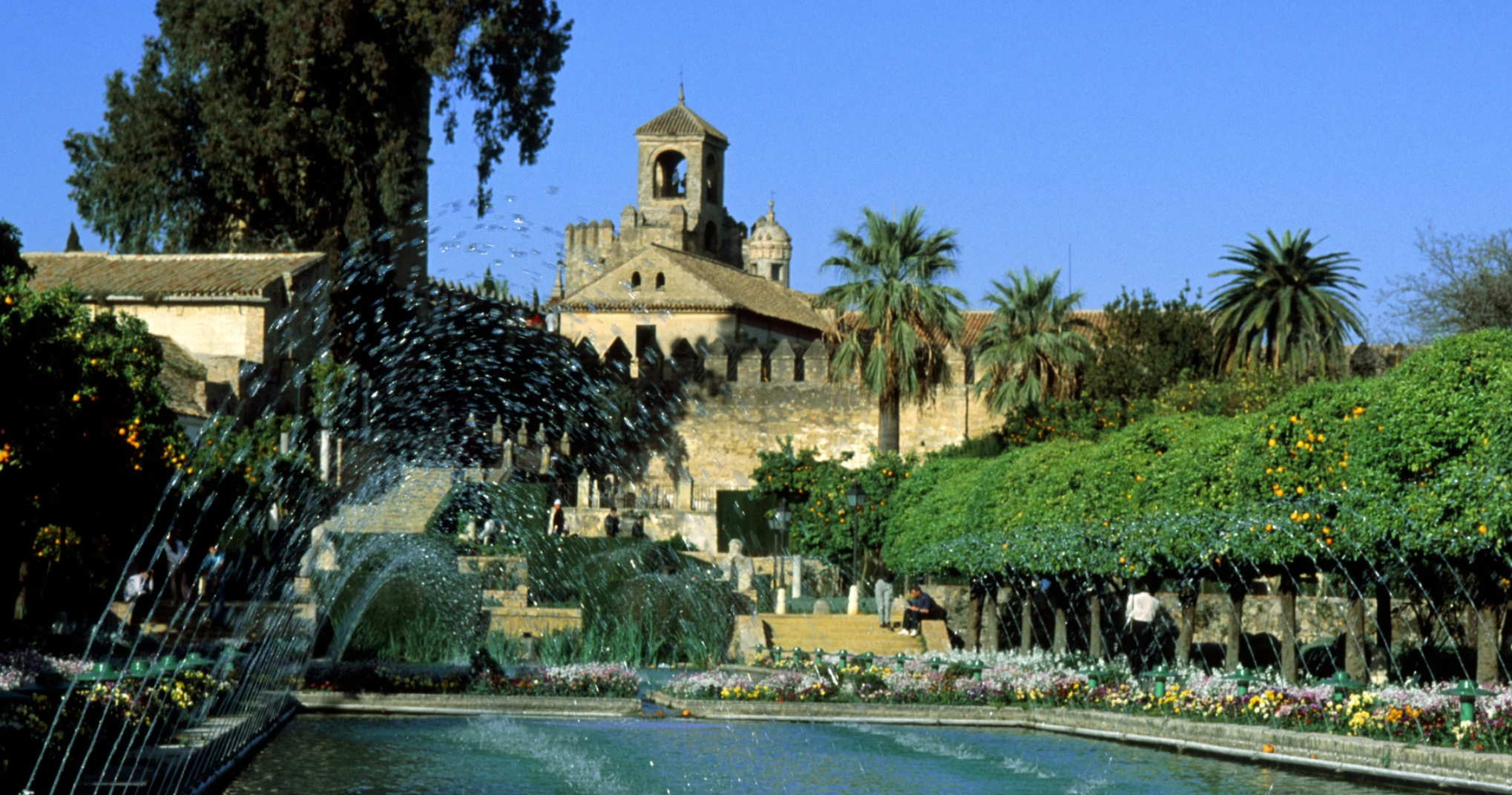
ALCAZAR GARDENS IN CORDOBA SPAIN / IMAGE: © ROGERPIX / ALAMY STOCK PHOTO
Light has always been one of Hockney’s greatest artistic preoccupations, and the pursuit of different lights has been a strong factor in his motivations to travel to the various destinations around the world. Indeed, light has long been a great source of inspiration for travelling artists, such as The Hamptons for Jackson Pollock and Tangier for Henri Matisse, the streaming sunlight in Window at Tangier capturing the luminous warmth of the North African light. Hockney has long been attracted to the sun and warmth of southern Europe, the strong, undiluted light being a constant inspiration. Hockney undoubtedly visited the Gardens of the Alcázar during his trip to Cordova, a complex of gardens and orchards dating back to the 10th century, famous for their elegant fountains and ponds. In Andalucia. Fountains, Cordova, Hockney captures the tree-lined fountains with the ancient walls of the Alcázar de los Reyes Cruistianos in the distance, the blazing Spanish sun shining onto the cool fountains. Speaking of his trip to Spain, Hockney reminisced: “I went to every place the tourists go. I went off season, so there were not too many tourists. You should go south in winter and north in summer, as Queen Victoria did, and she was right. You get great light” (David Hockney quoted in: David Hockney, Hockney’s Pictures, London, 2004, p. 294). Hockney painted from memory or on site, but refrained from painting from photographs, saying that “sometimes I painted from memory. Sometimes there, responding to the space. I wouldn’t look through cameras. I took a large brush and responded to the space” (David Hockney quoted in: Ibid, p. 295). Focusing on his own interpretation of the environment rather than creating a record of a place, paintings of Hockney’s travels are imbued with personal sentimentality, acting as a vessel in which his feelings and memories are held.
Grand Hotel Terrace, Vittel, 1970
Lempertz Cologne: 1 December 2023
Estimated: EUR 300,000 – 400,000
EUR 554,400 / USD 603,840
Grand Hotel Terrace, Vittel – Lot 51 (lempertz.com)
DAVID HOCKNEY
Grand Hotel Terrace, Vittel, 1970
Colored pencil and wax crayon on card
43.2 x 35 cm
Monogrammed, dated and titled ‘Grand Hotel, Vittel. DH june 70’
In the 1960s, David Hockney became known as a dazzling figure of “Swinging London” and chronicler of the “Californian Way of Life”. Yet as a painter, graphic artist, photographer, and stage designer with references to British Pop Art, he refused to be categorized as belonging to any of the 20th century’s styles. Hockney also loved variety in his choice of places to live and work – after years in London and California, he spent a long period of time in Europe in the early 1970s, mainly in France, and later in Morocco and Japan. The colored drawing “Grand Hotel Terrace, Vittel” originated in the luxury hotel of the same name in the Départment Vosges south of Nancy. Using colored wax chalks, he drew a table with parasol, 2 wicker armchairs and a park with pool in the background. As Hockney described a similar painting “Contre-jour in the French Style” from 1974, the paintings created in France are first and foremost a homage to French culture and to the country in which he lived from 1973-1975. “Grand Hotel Terrace, Vittel” is French in appearance due to the furniture, the traditional chairs, the dainty metal table, and the fringed parasol, but also due the color scheme of delicate rosé, coral, and the many shades of green. The backrest of the chair in the foreground invites the viewer to take a seat and keep the painter company.
The work does indeed pertain to a series of chalk drawings from the early 1970s, all of which have Hockney’s places of residence and holidays as their theme and were created in Marrakesh, Calvi, Vichy, Nice, or Kyoto.
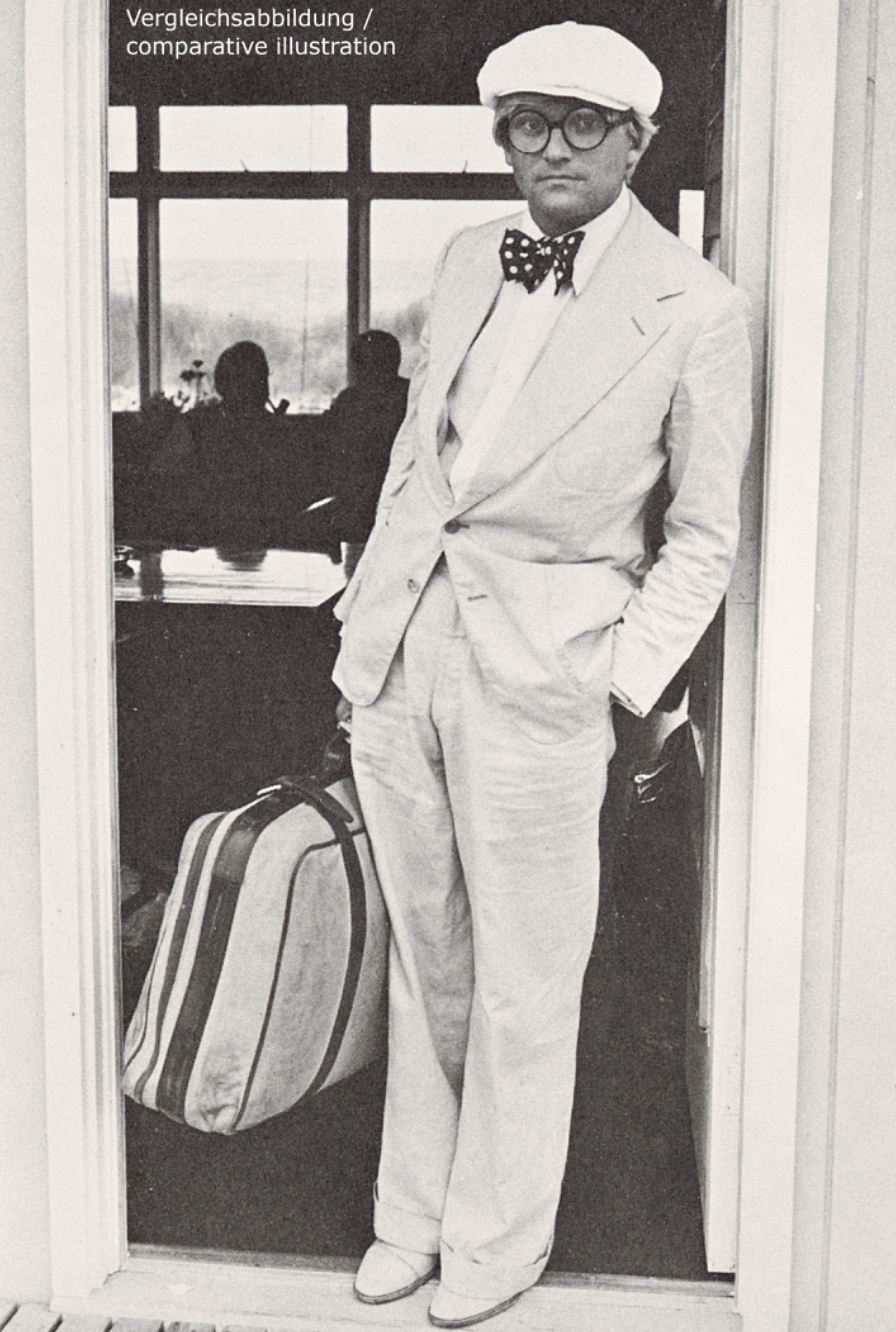
“I had fallen in love with Europe again in 1967; it had been four or five years since I travelled around. I’d been so full of America for five years but coming back to Europe you realize it’s certainly more interesting to drive around than America. America is wonderful as landscape, but every time you pull into a restaurant you know what the menu’s going to be. The thing is I love glamour places. I love going to places that have glamour. So any place that’s new for me is good. I like to travel…”
The series summarized under the title “Travels” always shows luxurious yet depopulated spaces or squares, often furnished with a parasol, which is the only motif that casts a shadow on this perfect world. He often resorted to wax chalks as a painting technique during this period and created the enchanting drawings which had long since ceased to serve him merely as a preparation for an oil painting.
The Luxor Hotel, 1978
Sotheby’s London: 29 June 2021
Estimated: GBP 150,000 – 200,000
GBP 512,500 / USD 708,870
The Luxor Hotel | British Art Evening Sale: Modern/Contemporary | 2021 | Sotheby’s (sothebys.com)
DAVID HOCKNEY (b. 1937)
The Luxor Hotel, 1978
Colored crayon on paper
14×17 inches (35.6 x 43.1 cm)
Signed with the artist’s initials, titled and dated April 1978
This exquisite and sophisticated colored-crayon rendering of the Old Winter Palace Hotel in Luxor shows David Hockney’s consummate skill as a draughtsman. Hockney is, essentially, an autobiographical artist; throughout his career his work has presented the people closest to him and places of his travels, those that in some way have touched his life. Hockney first travelled to Egypt in 1963 and it made a lasting impression.
“It was a marvelous three weeks. I didn’t take a camera, only drawing paper, so I drew everywhere and everything, the Pyramids, modern Egypt, it was terrific. I was very turned on by the place, and on your own you do a lot more work. I carried all my drawings everywhere and a lot of equipment, and I would get up very early in the morning. I loved the café life. Egyptians are very easy-going people, very humorous and pleasant, and I liked them very much. It was a great adventure.”
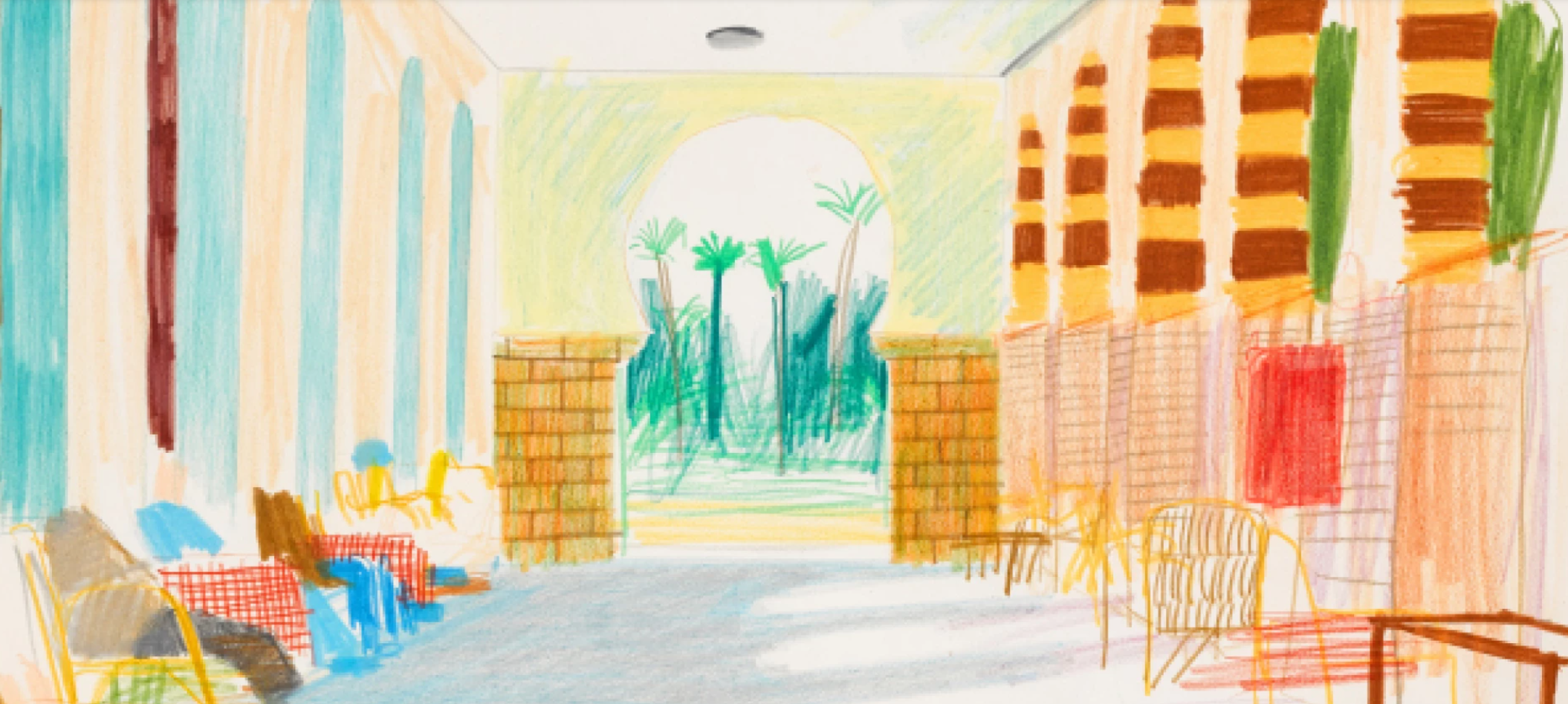
In April 1978, Hockney made his second visit to Egypt to finish his work on The Magic Flute having been commissioned to design the sets for Glyndebourne Opera (a project that occupied him for a year), and it was here that he was once again captivated by the country.
“You start thinking of things like this in Egypt, because of the very long historical periods involved. I always find this stimulating to my imagination. I drew all the time I was there.”
These drawings included masterly pen-and-ink studies of the Sphinx and pyramids at Giza and this exquisitely colored crayon drawing of the Old Winter Palace Hotel in Luxor. It wonderfully captures Egypt as Hockney saw it.
Lake House, Como, Rain, 2003
Sotheby’s New-York: 6 March 2020
Estimated: USD 250,000 – 350,000
USD 620,000
(#18) DAVID HOCKNEY | Lake House, Como, Rain
DAVID HOCKNEY
Lake House, Como, Rain, 2003
Watercolor on paper
24 x 18 1/8 inches (60.9 x 46 cm)
Signed with the artist’s initials and dated ’03
“I can get excitement watching rain on a puddle. And then I paint it. Now, I admit, there are not too many people who would find that exciting. But I would. And I want life thrilling and rich. And it is. I make sure it is.”
The artistic practice of David Hockney spans a comprehensive array of media and styles unified by a spirit of curiosity and intimacy. Spanning nearly four decades of Hockney’s career, this collection of works on paper is a testament to the virtuosity of his mediums and talents. All three—portrait, sketch and landscape—come from autobiographical sources, giving unmediated insight into Hockney’s perspective on the world. Together, they demonstrate a mastery of line, color, and figuration on par with the artist’s most accomplished paintings. Lake House, Como, Rain was painted during an Easter visit with his friend Drue Heinz, the widow of the heir to the Heinz food empire. Mrs. Heinz frequently hosted groups of writers and artists in her castello on the shore of Lake Como for a series of artistic discussions she called conversazioni. A fellow guest, the late biographer Jeremy Lewis, recalled that it was a cold, wet April. Yet “despite the rain, David Hockney painted every day on the terrace, perched under an umbrella, the occasional raindrop adding verisimilitude to his watercolors. He smoked incessantly, was deaf as a post, and talked wonderfully well about every subject known to man and wore flamboyant check suits with huge pockets in the lining from which he withdrew brushes, paints, a sketchbook and a collapsible canvas bucket […]” (Jeremy Lewis cited in: Christopher Simon Sykes, David Hockney: The Biography 1975-2012, New York 2012, p. 359).
The present work evokes the dramatic colors and landscapes of post-Impressionists like Henri Matisse and Vincent Van Gogh, with only the car and the drainpipe bringing the composition into the Twenty-First Century. The rolling hills, ancient trees, and lush gardens of the Heinz estate are depicted in countless shades of green. The multi-colored lawn to the right, with the strong delineation between yellow green and nearly brown green, is painted as if from far above; the left side is so detailed one can imagine Hockney leaning over the terrace, nearly in the shrubs himself. The rain is falling horizontally in the strong lines the artist had explored in his 1973 Weather Series. They cut straight through the organic brushes of paint that form the rest of the landscape, and, along with the corner house to the far right, provide the only straight lines in the flowing composition.
Ann Upton met Hockney in 1960 when she was sixteen and he was twenty-three. Hockney was a student at the Royal College of Art and she lived nearby; they became friends “because we both travelled the same way and we were both vegetarians” (Ann Graves cited in: Natalie Hanman, “He can see deeper than the skin,” The Guardian, 8 September 2006, p. 15). Ann soon began modelling for the Royal College and started modelling for Hockney in 1962. The artist was drawn to her long, fiery red hair, which was especially evocative as he wrote his 1962 thesis on Fauvism.
The deep, decades-long friendship between Ann and Hockney is evident in his portrayals of her. She is among a select few women in the artist’s life whom he has depicted multiple times, alongside his mother and textile designer Celia Birtwell. Hockney drew the present work as a Christmas gift in 1975, dedicating it to Ann and her future husband David Graves. David had met Hockney earlier in the year at the opening night of The Rake’s Progress at the Glyndebourne Opera, which Hockney had designed. David soon became Hockney’s assistant and, in 1983, Hockney was the couple’s impromptu wedding photographer when Ann and David decided to get married during a holiday in Hawaii. Ann is portrayed here affectionately, sitting casually on a couch looking away from the viewer. She smiles softly and her eyes are almost covered by the thick red hair that had enchanted Hockney fifteen years prior. Ann sits in various stages of completion, with zones of blue, black and green guiding the eye up to her carefully shaded face and red fringe. Portraits, especially those of close friends and family, have endured as a central tenet of Hockney’s oeuvre, and Portrait of Ann Upton, Christmas is an intimate portrayal of one of the artist’s oldest and dearest friends.
Hockney drew Beirut in early 1966 during a trip to the Lebanese capital. He was to create a set of etchings, Illustrations from Fourteen Poems from C. P. Cavafy, and needed to make preparatory sketches. Hockney had long adored the writings of the Greek Egyptian poet for their bold, unapologetic explorations of homosexual desire. Cavafy (1863–1933) had written in the cosmopolitan city of Alexandria; by 1966, Beirut had replaced it as the capital of sophistication in the region, and so Hockney thought it the best place to draw inspiration from Cavafy’s world. Homosexuality would not be decriminalized in England (where Hockney was still living at the time) for another year, and his illustrations of Cavafy’s erotic poems served as a defense of his own way of living.
The present preparatory drawing would come to serve as a backdrop for Hockney’s Portrait of Cavafy in Alexandria, the first work in the set of thirteen. The series “was conceived almost entirely in terms of line and contained some of the artist’s most accomplished line drawings to that date” (Terry Riggs, “David Hockney: Portrait of Cavafy in Alexandria,” Tate, November 1997 (online)). The drawing depicts a tall building, perhaps a hotel or an office, standing at the top of a hill. A wall with rounded openings stretches out from its side and the front is dotted by dark palm trees. More buildings to the right give a tantalizing glimpse of the city expanding behind it, waiting to be explored. The lines are evocative and pared down, alluring in their seeming simplicity. The artist once noted that “In drawing I’ve always thought economy of means was a great quality—not always in painting, but always in drawing. It’s breathtaking in Rembrandt, Picasso, and van Gogh. To achieve that is hard work, but stimulating: finding how to reduce everything you’re looking at to just lines—lines that contain volume in between them” (the artist cited in: Martin Gayford, A Bigger Message: Conversations with David Hockney, New York 2011, pp. 189-90). Hockney’s drawing is legible as an exotic, cosmopolitan city even without the portrait of beloved poet in the foreground, demonstrating again his mastery of line and form.
The intimacy of the present works offers direct access to Hockney’s creative process and conceptual framework. Their decades-long span bespeaks his lifelong exploration of friendship, love, cities, the countryside, art history, media and color.
Still Lifes
Two Red Peppers, 1970
Chiswick Auctions: 30 June 2026
Estimated: GBP 60,000 – 80,000
GBP 107,100 / USD 141,980
WORK ON PAPER
Lot 99 – David Hockney O.M. C.H. R.A. (British,
DAVID HOCKNEY (British, 1937-2026)
Two Red Peppers, 1970
Crayon and pencil
16-1/4 x 14 inches (42 x 35.5 cm)
Signed with initials and dated ‘DH 70’ (lower right)
Two Red Peppers stands as a brilliant testament to the artist’s unparalleled draughtsmanship and his enduring fascination with the quiet intimacy of everyday objects. Created during a period of immense critical and commercial success, punctuated by his major retrospective at the Whitechapel Art Gallery earlier that same year, this work captures a moment of both personal expansion and intense artistic focus. As Hockney’s world broadened through extensive travel across Europe and the Americas, his commitment to drawing remained an unwavering anchor. Two Red Peppers is a masterclass in this daily devotion, elevating a fleeting moment of observation into a profound meditation on form, color, and solitude.
The early 1970s marked a distinct transition for Hockney, characterized by a nomadic existence that deeply informed his artistic output. In the summer of 1970, he embarked on travels that included a stay at the Carennac chateau of his dealer, John Kasmin, a relationship directly reflected in the present work’s provenance, which traces back to the Kasmin Gallery in London. Whether traversing the south of France, returning to the bright light of California, or resting in luxury hotels, Hockney was rarely without his sketchbook. Unlike the sprawling, vibrant canvases of his Los Angeles swimming pools, his drawings from this period, such as Grand Hotel Terrace, Vittel (1970) and View from the Miramar Hotel, Santa Monica (1970), sold by Chiswick Auctions for £403,200, offer a more intimate, immediate processing of his surroundings. He famously asserted that he painted what he liked, when he liked, and where he liked; his drawing practice was the pure, unfiltered realization of that ethos. During this era, his sketchbooks functioned as an intimate visual diary, with his travels across France sparking highly celebrated portraits and still lifes that documented his closely-knit inner circle and his immediate reality.
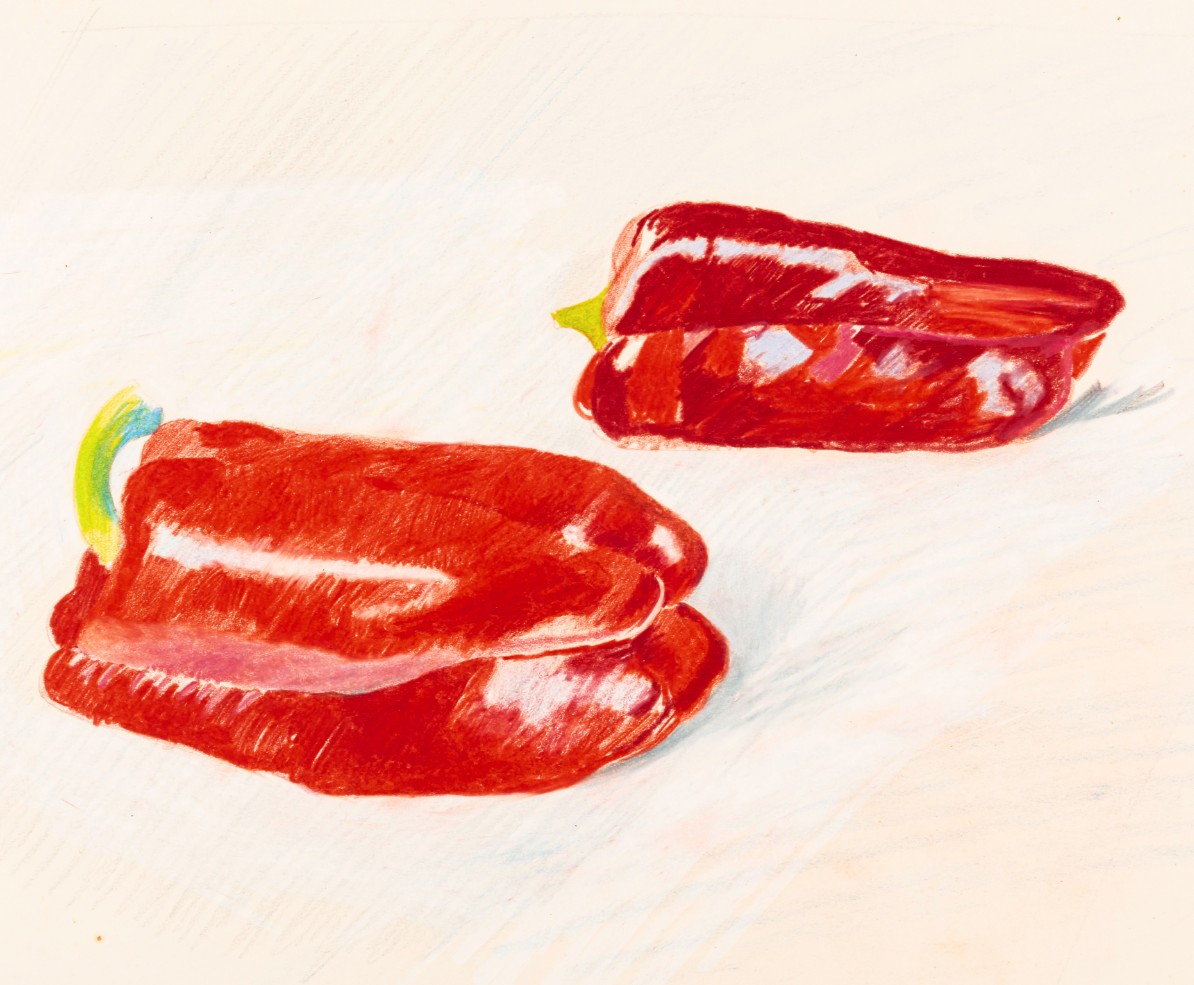
Central to the triumph of Two Red Peppers is Hockney’s masterful use of crayon and pencil. At a time when coloured pencils were frequently dismissed by professional artists as a rudimentary medium more suited to children, Hockney championed their potential. Having refined his technique throughout the 1960s, by 1970 his command over the medium was absolute. In the present work, he exploits the crayon and pencil to achieve an extraordinary degree of nuance. The medium allowed him to render the undulating textures, the glossy reflections, and the vibrant, fleshy skin of the peppers with remarkable precision. This meticulous application of fine, delicate lines transforms a humble vegetable into an object of intense scrutiny and tactile desire. Crucially, Hockney’s drawings from the early 1970s were never mere preparatory sketches; they were conceived as independent, highly finished works of art in their own right, reflecting hours of committed looking. He frequently labored over these pieces for two or three days, proving his belief that drawing is a fundamental aspect of his graphic approach.
Visually, the composition is striking in its elegant simplicity. The vegetables are isolated against the stark expanse of the paper, stripped of any distracting background or traditional domestic context. This deliberate isolation echoes the compositional strategies seen in similar still-life drawings from this era, such as Onions (1972), sold by Christie’s for £189,000 in 2023. By divorcing the subject from a busy setting, Hockney instils the composition with a sense of melancholic solitude, a recurring atmospheric motif in his work of the 1970s, frequently observed in his depictions of empty chairs and vacant hotel rooms. Yet, this solitude is not devoid of warmth; it is a playful, joyous celebration of the act of seeing. The peppers become an object lesson in formal beauty, their organic curves and brilliant red hues standing in quiet defiance of the empty space surrounding them.
The historical importance and aesthetic brilliance of Two Red Peppers are irrefutably cemented by its distinguished exhibition history and literature. The drawing was prominently featured in the definitive retrospective David Hockney: A Drawing Retrospective, which debuted at the Hamburger Kunsthalle in 1995 before travelling to the Royal Academy in London and the Los Angeles County Museum of Art in 1996. The accompanying 1995 exhibition catalogue, authored by curators Ulrich Luckardt and Paul Mella, serves as a monumental examination of his skills as a draughtsman. Bringing together his most vital works on paper, the publication emphasizes that drawing is not merely supplementary but sits at the very root of all Hockney’s work across every medium. Furthermore, the artwork’s illustration and inclusion in Nikos Stangos’s seminal 1976 publication, David Hockney by David Hockney, underscores its position within the core canon of the artist’s autobiographical and visual narrative. This work presents an exceptional opportunity to acquire a deeply personal, technically flawless, and historically significant piece by one of the modern era’s greatest draughtsmen.
Onions, 1972
Christie’s London: 8 June 2023
Estimated: GBP 70,000 – 100,000
GBP 189,000
DAVID HOCKNEY, O.M., C.H., R.A. (B. 1937), Onions | Christie’s (christies.com)
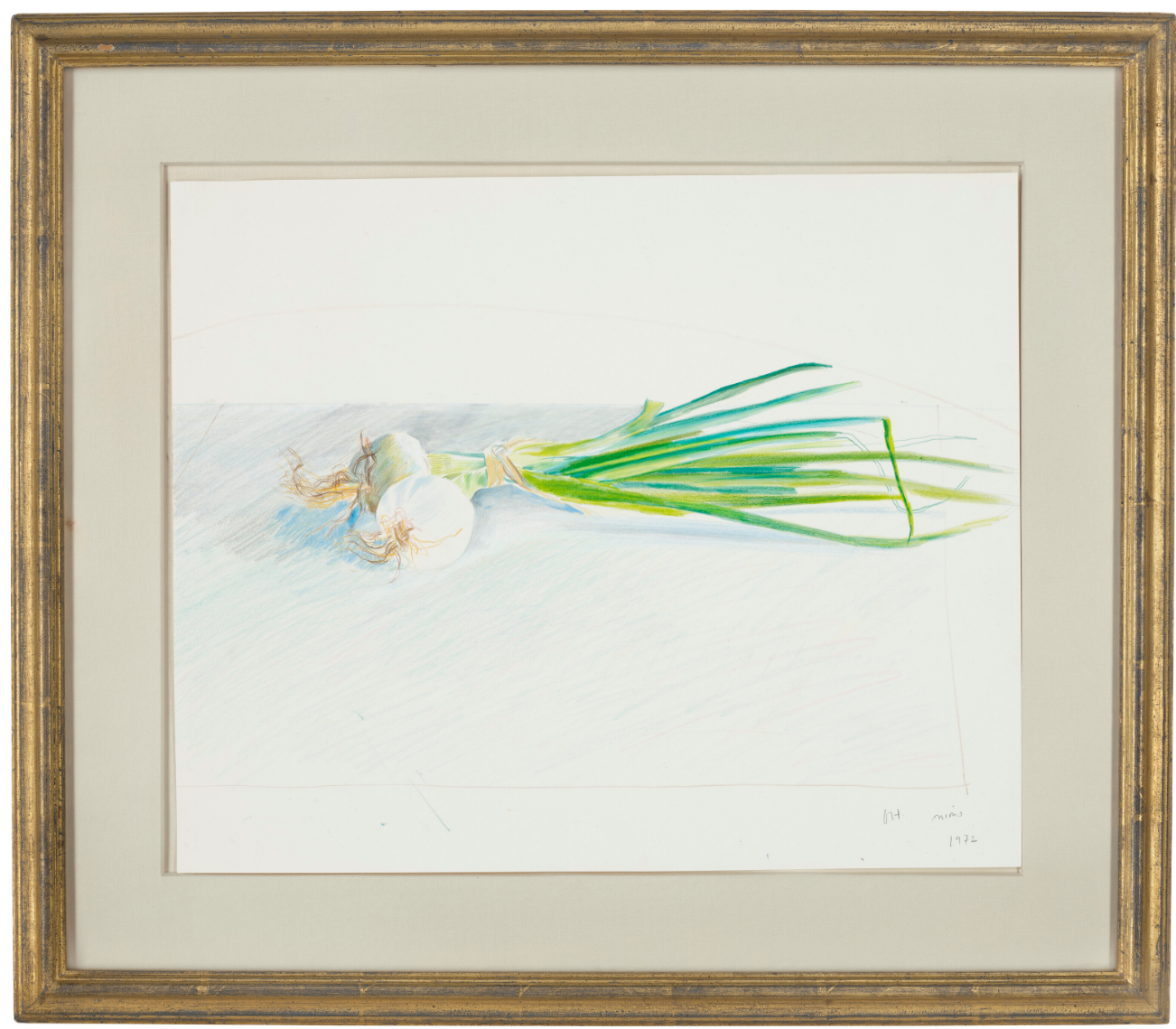
DAVID HOCKNEY, O.M., C.H., R.A. (B. 1937)
Onions, 1972
Colored pencil on paper
14×17 inches (35.5 x 43.2 cm)
Signed with initials, inscribed and dated ‘DH onions/1972’ (lower right)
Executed in 1972 and rendered in vibrant color and careful detail, Onions is a magnificent example of David Hockney’s still life drawings. In August 1970 in Carennac, while staying at the Kasmin’s chateau, and in July 1972 during a road trip through Corsica and Nice with Henry Geldzahler and Nicky Rea, Hockney spent many hours producing a series of colored pencil drawings of fruit and vegetables. During this period Hockney travelled almost constantly, relishing the unfamiliar surroundings and exotic locations that he experienced, and his devotion to drawing was such that he was rarely seen without a sketchbook in hand. Onions was produced during this period of intense drawing, following Hockney’s split from Peter Schlesinger in the previous year. The onions become an object lesson, allowing the artist to carefully scrutinize his subject’s undulating texture and brightly colored skin – executed in fine and delicate lines of colored crayon. The isolated nature of the onions also suggests an air of solitude; a common theme for the artist at this time, seen in his unpopulated rooms and empty chairs.
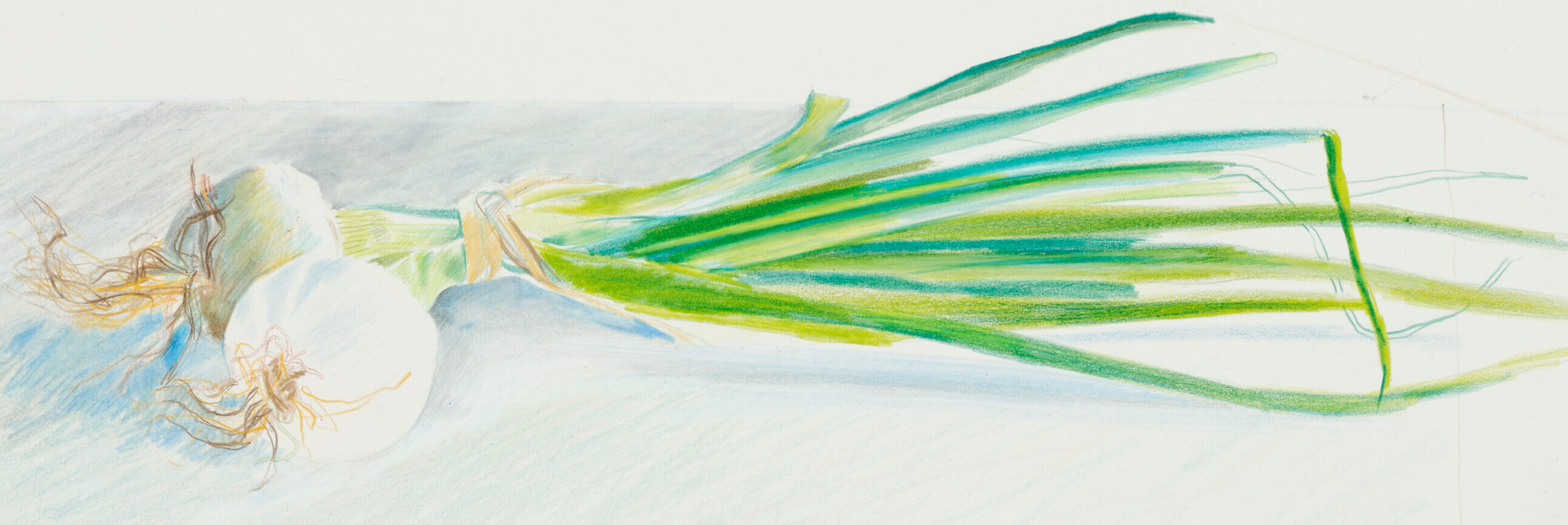
Hockney’s drawings, importantly, are not secondary works or preparatory drawings for paintings; rather, they are conceived as independent works of art in their own right, carefully executed over many hours. For Hockney, this committed looking is an important exercise in learning about and relating to the world around him, and drawing underpins all of his art. Onions perfectly illustrates Hockney’s delight in the detailed observation of the everyday, demonstrating his ability to notice and capture his surroundings in an act which, whether melancholy or joyous, is always playful and technically brilliant. Onions was a gift to Rupert and Robin Hambro from their friend, Annette de la Renta, Oscar de la Renta’s widow. A philanthropist, Mrs de la Renta serves on the board of the Metropolitan Museum, New York, amongst other major institutions.
Still Life with Flowers and Lobster at Odin’s Restaurant, circa 1980
Christie’s London: 2 July 2021
Estimated: GBP 300,000 – 500,000
GBP 934,500 / USD 1,289,060
DAVID HOCKNEY (B. 1937), Still Life with Flowers and Lobster at Odin’s Restaurant | Christie’s
REPEAT SALE
Christie’s London: 12 December 2012
Estimated: GBP 50,000 – 80,000
GBP 97,250 / USD 156,895
DAVID HOCKNEY (B. 1937)
Still Life with Flowers and Lobster at Odin’s Restaurant, circa 1980
Colored crayon on paper
19 1/8 x 24 inches (48.5 x 61 cm)
For decades, Odin’s was a chic, boisterous restaurant in the heart of Marylebone. Established by Peter Langan, the Irish restaurateur and bohemian bon-vivant, the restaurant had a certain joie de vivre, making it a destination where diners gathered for excellent food and great conversation. This charmingly unstudied ambience is superbly conjured in David Hockney’s Still Life with Flowers and Lobster at Odin’s Restaurant (circa 1980). Against a darkly shaded ground, Hockney captures his impressions of the restaurant in vibrant crayon: an empty wine glass, two large lobsters, and an abundant bouquet of magenta and purple blossoms, all delicately positioned atop a white tablecloth. Hockney is a vivid painter of flowers, and his depiction here of a ceramic jug brimming with posies and leaves is redolent of the scent of a fresh spring morning. The scene evokes an old-world atmosphere, the decadence of a late night out, gastronomical and convivial pleasure. It is tempting, too, to read Still Life with Flowers and Lobster at Odin’s Restaurant as a portrait of Langan himself, who seems to have just stepped away from the table. Indeed, the restaurateur famously required freshly cut flowers to be set at each table, playfully referenced here in the colourful bouquet.
Hockney met Langan at Odin’s at the end of the 1960s through the artist Patrick Procktor; they would later co-design the menu for another of Langan’s restaurants. Hockney became a frequent diner at the restaurant, which was a clubhouse of sorts for young artists. Like the great Modernists before him, he occasionally exchanged drawings and prints for meals. Langan became both a friend and a patron to the artist, championing his practice and amassing a large collection of Hockney’s works which he displayed on the walls of his restaurant. The two would overlap outside of Odin’s as well. In 1975, just after Hockney moved back to London from Paris, he was commissioned to design the costumes and sets for Igor Stravinsky’s The Rake’s Progress to be performed at Glyndebourne Festival. To celebrate Langan organised a now infamous banquet, which Hockney recalled as ‘spectacular’: ‘The picnic was supposed to be for about thirty people, but Peter took 120 bottles of champagne and none went back. I did point out to him, ‘That’s four bottles each, Peter!’ The food was fantastic, enormous lobsters, best hams, marvellous smoked salmon – he knew where to get the good stuff. It was spectacular’ (D. Hockney, quoted in C. Simon Sykes, David Hockney, A Rake’s Progress, The Biography, 1937-1975, New York 2011, pp. 325-326).
It was during this period that Hockney experimented with Caran d’Ache crayons to draw his exuberant, at times whimsical images; as a discipline, drawing has informed Hockney’s approach to all other mediums. Through crayon he pursued a rigorous interrogation of mark making, influenced in part by the French avant-garde. ‘I thought that the one thing that the French were marvellous at, the great French painters, was making beautiful marks,’ Hockney recalled. ‘Picasso can’t make a bad mark, Dufy makes beautiful marks, Matisse makes beautiful marks’ (D. Hockney, quoted in U. Luckhardt and P. Melia, David Hockney: A Drawing Retrospective, London 1996, p. 187). In expressive lines and richly worked colour, Hockney records the people and landscapes he comes across in his ever-present sketchbook. He is at heart an autobiographical artist. Responding to the artist’s 2020 solo exhibition Morgan Library & Museum in New York City, critic Roberta Smith wrote, ‘Mr. Hockney is essentially documenting his life as it has entwined with others’ (R. Smith, ‘A Poignant, Cozy Look at the Faces He Sees’, New York Times, 2 October 2020, p. C1). In Still Life with Flowers and Lobster at Odin’s Restaurant, he summons an entire world in bright, cheerful colour: the joy of a delicious meal, an evening spent with old friends, the smell of spring flowers.
Other Drawings
Red Leather Chair, 2003
Phillips London: 15 October 2026
Estimated: GBP 500,000 – 700,000
GBP 645,000 / USD 853,400
WORK ON PAPER
David Hockney Modern & Contemporary Art Evening Sale
Watercolor on 4 joined sheets of paper
48 x 36-1/4 inches (122 x 92.2 cm)
Signed with the artist’s initials and dated ‘DH. ’03’ lower right
In his observation of human nature, David Hockney’s series of double portraits stand among the greatest achievements of his career. Rendered with full and fluid brushstrokes of watercolour, Red Leather Chair calls to mind these celebrated portrayals with a surprising effect: the sitter is absent. Two chairs — crimson and bottle green — appear in an anonymous space, the trace of humankind betrayed only by the subtle impression across the larger chaises’ smooth leather surface. Conceived as a poignant homage, Red Leather Chair was created in 2003 by Hockney in memory of Eduardo Chillida who had died the year before. The painting belonged to a larger presentation of works produced by fellow artists from Cy Twombly and Ellsworth Kelly to Georg Baselitz in honour of the Basque sculptor’s legacy, celebrated in an exhibition held at the Guggenheim Bilbao in 2006. Exultated by Hockney’s talent for rendering light, colour and mood undiminished in his later years, Red Leather Chair is a tender tribute to the departed as it is a pithy re-interpretation of the venerable tradition of portraiture seen through the British painter’s eyes.
“It’s the most direct method of laying in a mark, flowing from the eye, the heart, down the arm to the hand […] Watercolour just flows.”
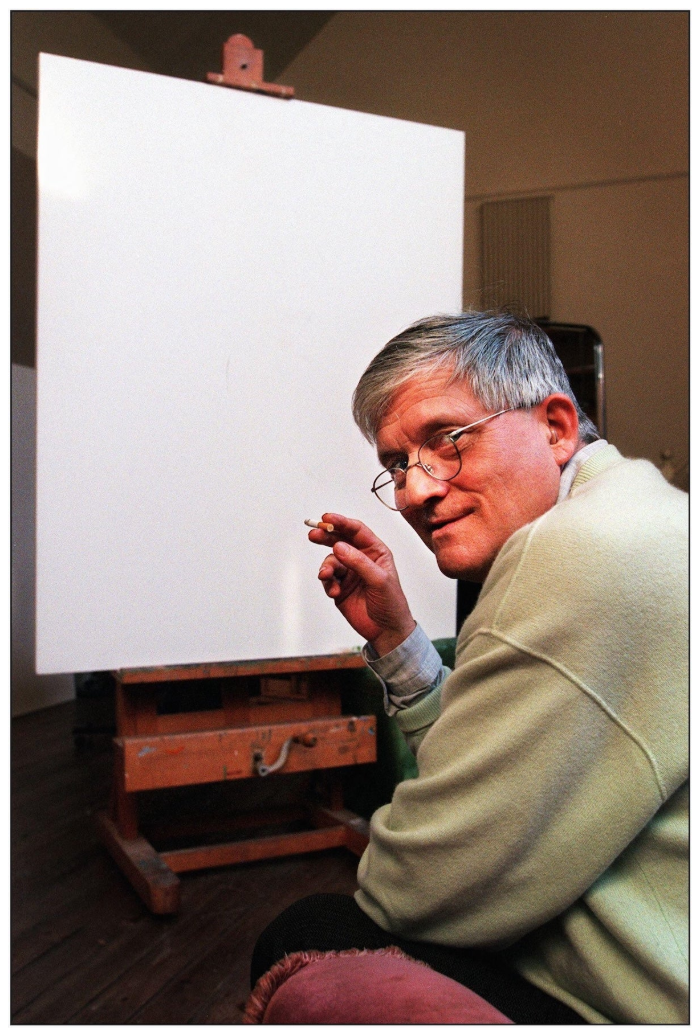
David Hockney in his studio, 2000. Image: Alamy / David Sandison
First began in 1968, Hockney’s double portraits have been celebrated for their cogent ability to reveal his sitter’s likeness and character. From his fashionable portrayals of his friends like Celia Birtwell and Ossie Clark now housed in the Tate in London to the commissions of the collectors Fred and Marcia Weisman displayed at the Art Institute of Chicago, these works are admired for their vividness, complexity and charisma, securing Hockney’s place as one of the most revered British painters. In the staging of the interiors or outside environments and subtle manipulations of his sitter’s stance or expression, Hockney was able to imbue his images with a psychological depth and charge. Painted over three decades later, in Red Leather Chair Hockney recalls the compositional devices and props of these great compositions, a topic that was on his mind following his exhibition of Five Double Portraits: New Work by David Hockney at the National Portrait Gallery in London. Occurring in 2003, the same year as Red Leather Chair’s execution, the sitters included in the presentation were depicted on office chairs across four-adjoined sheets. The forms of the chair — with their sloping arms, broad backs and full-bodied cushioning — functioned as the perfect object to lengthen Hockney’s exploration of the portrait genre. Typically fulfilling the roles as compositional devices that go unnoticed and are viewed as auxiliary, the chair is turned by Hockney into a deeply felt, emotional article. These pieces of furniture with their hard-worn creases allude to human contact, honouring Chillida here as they serve as a universal, anthropomorphic metaphor for absent sitters that when paired, can reflect on the hidden dynamics between two people.
“The perspective is terrific. It’s a very personal view. You couldn’t take a photograph like this. I’ve always loved this painting. Whenever my father came to London, he always wanted to see Van Gogh’s Chair. He thought it was marvellous.”
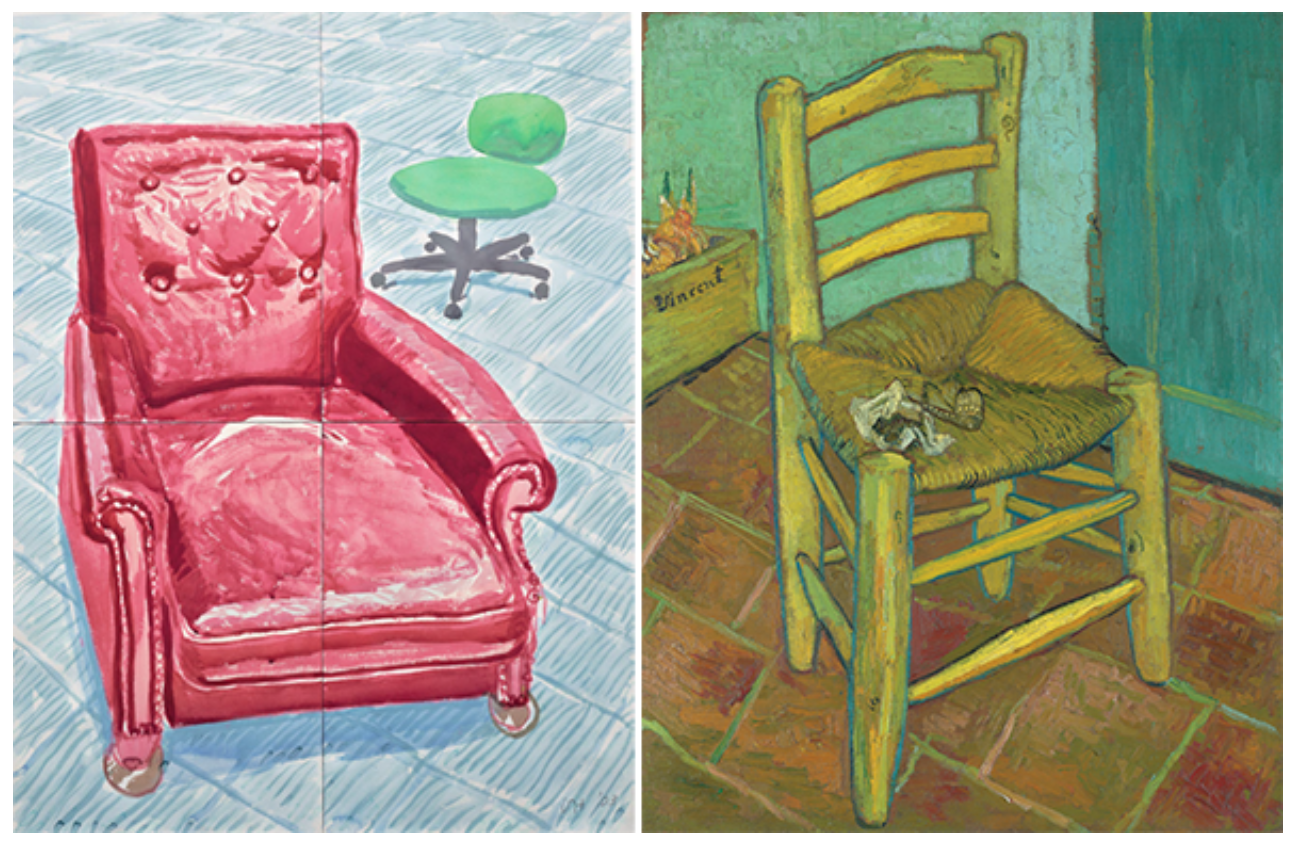
Left: The present work
Right: Vincent van Gogh, Van Gogh’s Chair, 1888, National Gallery, London. Image: Bridgeman Images
Having experimented with watercolour as early as 1961 and returning to the medium intermittently throughout his career, by the turn of the millennium Hockney experienced a surge of creativity and interest in the material. An exhibition of Chinese ink paintings at the Metropolitan Museum of Art in New York in 2002 brought its intricate qualities and optical play into greater focus, resulting in a renewed desire to harness the flows and amorphous properties of watercolour for an extended period. Reflecting on this experience, Hockney emphasised ‘Here was a medium I had been exploring for a few months, for the first time in my life. It required speed and discipline’.i By the time Hockney had painted Red Leather Chair, he had overcome the technical challenges of working with watercolour on scale, fully mastering the medium’s fluid and capricious qualities, from the elaborate detail of the chair’s studding, the mirrored shading of the leather surface, to pooling the medium to generate large sections of intense, fauve-like colouring. In the context of European painting, the subject of the chair particularly resonates with the unoccupied, roughly hewn frame of Van Gogh’s tour de force, Van Gogh’s Chair. Hockney had been profoundly moved by Van Gogh’s work that he ‘always loved’, re-interpreting the chair composition with his own canvases in 1988.ii As Van Gogh was inspired by domestic interiors and imbued the most humble and homespun with a sense of the sublime and personal resonance, Hockney worked with the same palpable materiality and symbolism, transforming in Red Leather Chair the functional into the poetic.
Gouache Drawing, 1994
Christie’s New-York: 27 February 2025
Estimated: USD 400,000 – 600,000
USD 541,800
DAVID HOCKNEY (B. 1937), Gouache Drawing, 1994 | Christie’s
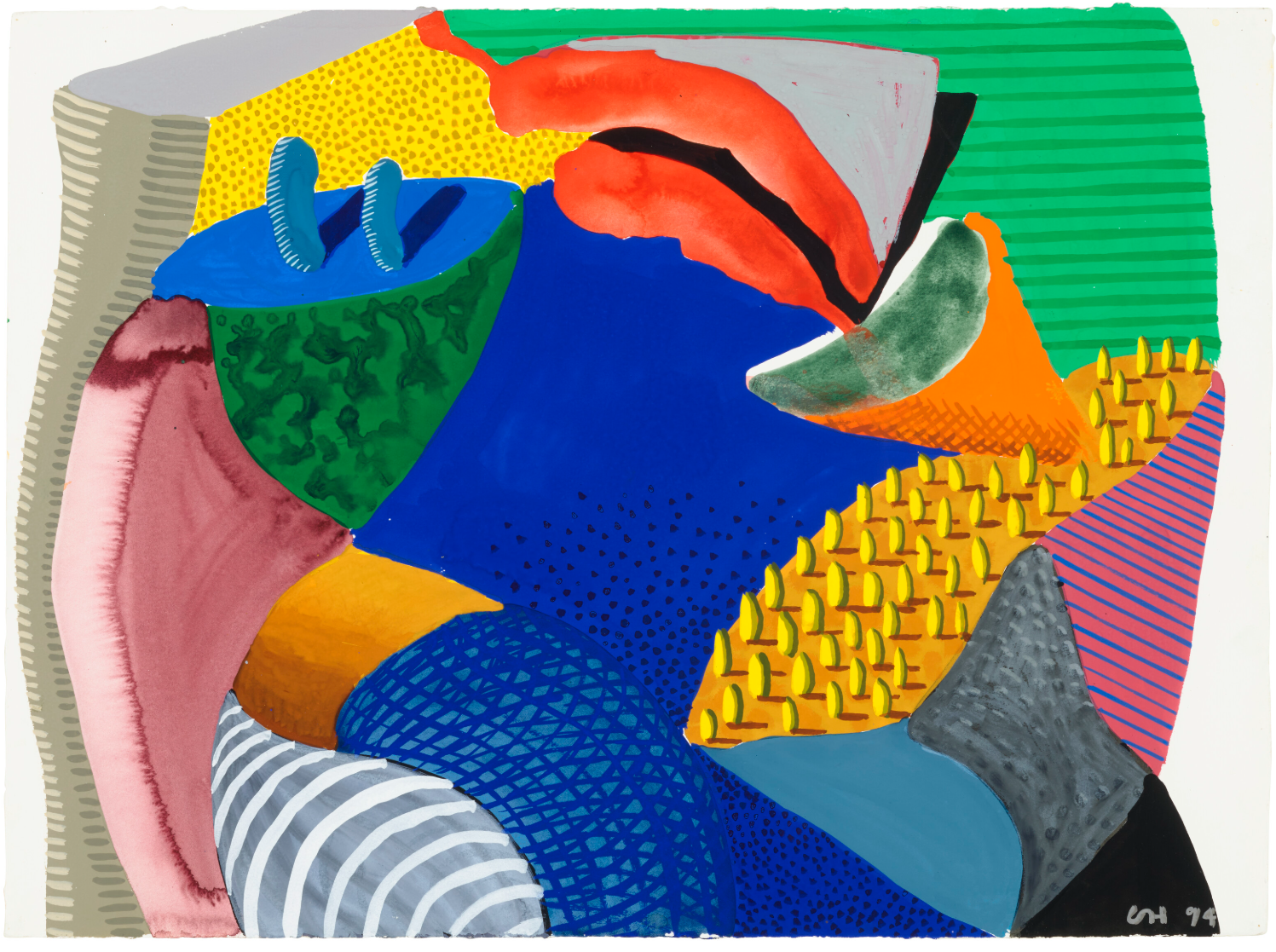
DAVID HOCKNEY (B. 1937)
Gouache Drawing, 1994
Gouache on paper
22 1/4 x 30 1/4 inches (56.5 x 76.8 cm)
Signed with the artist’s initials and dated ‘DH 94’ (lower right)
A vibrant array of exuberant color and spatial abstraction, David Hockney’s Gouache Drawing, 1994 is an exceptional example emerging out from the artist’s exploration of operatic production and his revolutionary Very New Paintings. Evacuated of the figures prominent in his earlier works, here, the artist employs a newfound abstract vernacular inspired by the great natural forces of the Santa Monica mountains and the Pacific Ocean which Hockney witnessed from his Malibu studio.
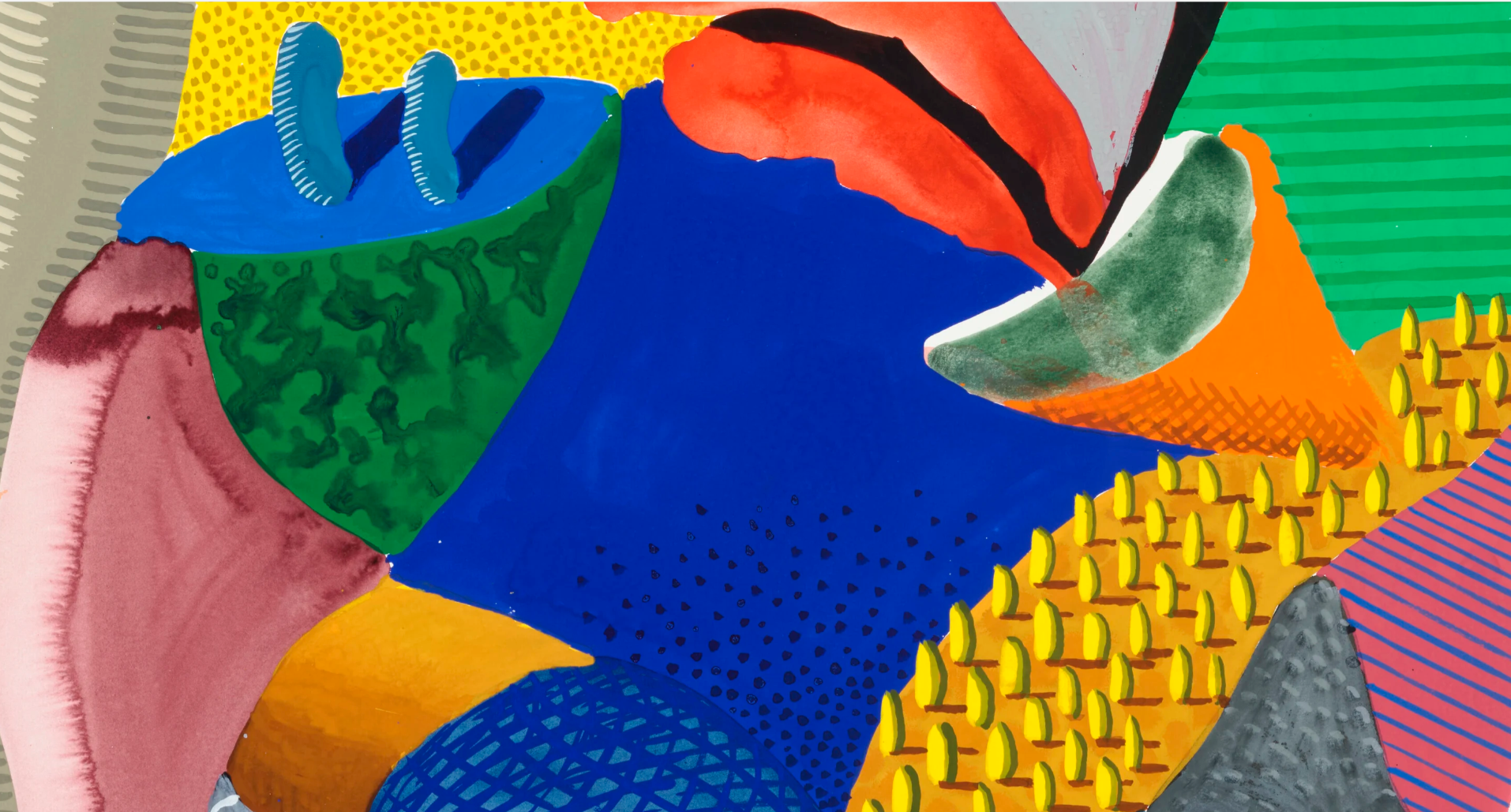
Carefully constructed, the vibrant yellow, red, and purple forms ebb and flow around a deep blue epicenter, with shading and hue and brushy crosshatched passages that emphasize a strong sense of spatial projection. Capturing the essence of landscape painting within an abstracted composition, some of Hockney’s forms appear almost natural, as with the yellow field populated with oblong forms that cast identical shadows like a whimsical forest. Here the master painter’s sense of realism and deep knowledge of lighting is revealed as he revels in a verisimilar abstraction, employing representational techniques in order to achieve a radically new abstract style.
Hockney had spent two years feverishly working on innovative and technically astounding opera productions, and his production of Richard Strauss’ Die Frau Ohne Schatten opened to much acclaim at The Royal Opera in Londo in 1992. For this production, Hockney evacuated his set of what he perceived as overly literal design resulting in a semi-abstract, beautifully vibrant space with grand, sweeping passages of solid colors, flowing forms, and evocative lighting effects. These idioms inspired Hockney to migrate his newly invented abstract mode to two dimensional works, creating the Very New Paintings.
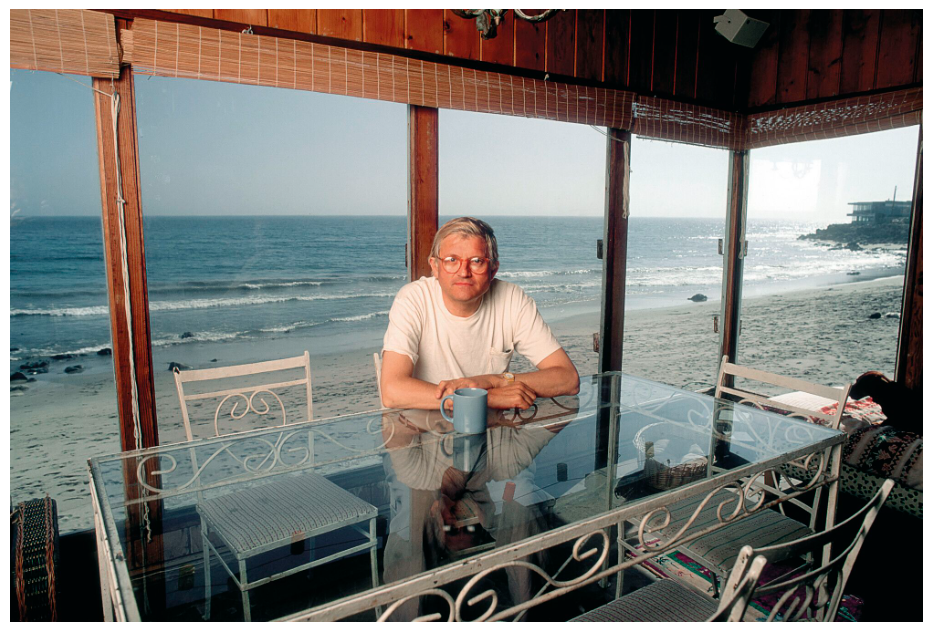
David Hockney, Malibu, 1991. Photo: Paul Harris / Getty Images.
Hockney eloquently describes the potency of these works:
“Someone said that Very New Paintings are abstract narratives. Certainly a great deal of thought and feeling have gone into them. For example, here at the beach I am between two great forces, the mountains and the sea. The mountains were made by a great force of nature, a thrusting force, which calmed in time, leaving them here, grand and peaceful. While below the other thrust continues, the endless movement of the sea. These forces are present, I believe, in the paintings. They are also quite sexual… Perhaps these paintings seem a jumble to the viewer at first. They take time to unfold. They’re a bit mind-boggling, but they are meant to be. The viewer can roam freely within them, finding his or her own space. That’s why there are no figures in them. You construct your own space mentally.”
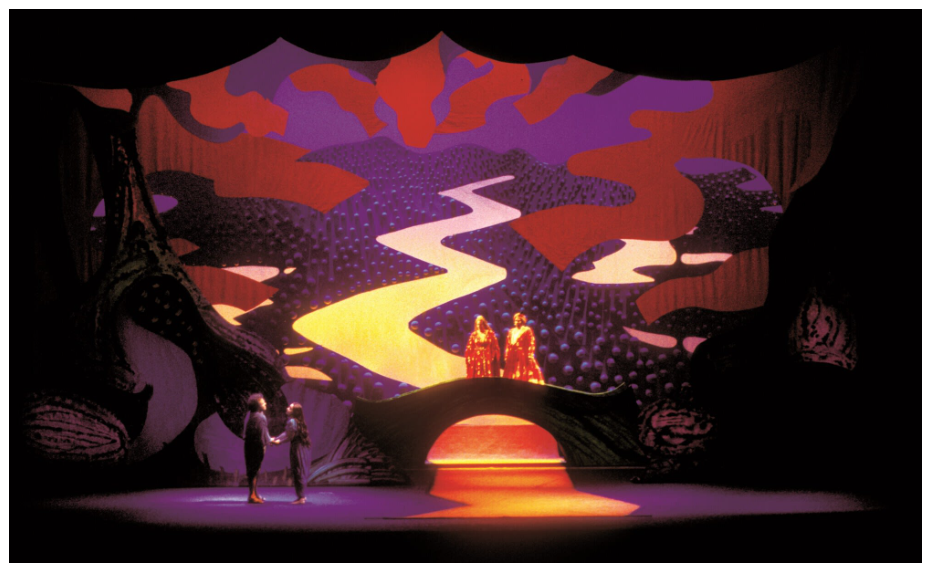
David Hockney’s set design for Richard Strauss’s Die Frau ohne Schatten (The Woman without a Shadow), performed at the Los Angeles Opera in 1993. Photo: Ken Howard, courtesy of the Los Angeles Opera. Artwork: © David Hockney.
Gouache Drawing, 1994 translates this potent paradigm into a smaller scale, demonstrating the flexibility of Hockney’s innovative aesthetic. The present work develops upon Hockney’s sense of natural thrusting forces, with the main elements flowing in a circular pattern around the midpoint of the composition. Gouache Drawing, 1994 develops the insights which Hockney gleaned from stage design, most notably the careful usage of lighting and attention to spatial recession, embodied by the atmospheric verticality in the work, which enables the top register to read like a mountainous plateau standing over the remainder of the sheet. Each form, meticulously rendered, exists in perfect cohabitation within the composition, Hockney’s famed draftsmanship employed here to create a powerful sense of space and energy first demonstrated at the opera. Acquired from L.A. Louver gallery in 1994 and held in the same collection ever since, Gouache Drawing, 1994 is an exciting, elemental work demonstrating Hockney at the height of his creative powers.
Armchair, Table and Lamp, 1972
Christie’s London: 1 March 2023
Estimated: GBP 300,000 – 500,000
GBP 352,800 / USD 424,522
DAVID HOCKNEY (B. 1937) (christies.com)
DAVID HOCKNEY (B. 1937)
Armchair, Table and Lamp, 1972
Colored crayon and graphite on paper
13 1/4 x 16 1/2 inches (34.9 x 41.9 cm)
Signed with the artist’s initials and dated ‘DH 72.’ (lower left)
Executed in 1972, Armchair, Table and Lamp is a magnificent example of David Hockney’s deeply personal and evocative interior drawings. Rendered in a vibrant palette of contrasting colours, Hockney presents us with an unoccupied living room, its empty blue armchair, abandoned ashtray, and tilted green lampshade suggesting a quiet yet palpable presence. The wallpaper, a glorious golden yellow, is rendered in meticulous detail, its rich, cross-hatched texture reflecting onto the mirrored coffee table beneath it. On the right-hand wall, an area of exposed paper appears, its field of bright white suggesting a swath of daylight entering from the left. Executed in coloured crayon on paper, this work was created during a period in which drawing became a central preoccupation for Hockney, independent of the preparation of paintings. During this time, the artist never travelled anywhere without his sketchbook, meticulously documenting the places and faces that he encountered. In Armchair, Table and Lamp, Hockney presents us with a vivid recollection of his travels, its sun-drenched interior, bold and colourful furnishings, and three-point plug socket in the lower left corner suggesting a memory from a European summer’s day. In its powerful psychological aura, the present work can also be aligned with the artist’s celebrated double portraits such as Henry Geldzahler and Christopher Scott (1968–1969), Mr and Mrs Clark Percy (1970-1971), and George Lawson and Wayne Sleep (1972-1975), canvases in which he represents the complex relationships between his paired sitters. Despite their absence of figures, Hockney awarded the same level of attention to his domestic interiors, deeming them more than a mere stage for human drama, and capitalising on their great representative potential. In Armchair, Table and Lamp, Hockney imbues his scene with a palpable, wistful emotional resonance that is deeply personal to him. Indeed, as Ulrich Luckhardt has astutely observed, the power of Hockney’s work often ‘is not the object or scene represented but something that is linked to the represented object or scene by association, or by a chain of associations. That “something” need not necessarily be another object or person; it could, for example, be a memory, a desire or a sense of longing. That empty chairs are among his favourite subjects does suggest that Hockney is disposed towards metonymy’ (U. Luckhardt, quoted in David Hockney: A Drawing Retrospective, exh cat. Royal Academy of Arts, London 1995, pp. 19-20).
House Palm and Pool, 1982
Property from the Collection of Robin Quist Gates
Phillips New-York: 24 June 2021
Estimated: USD 200,000 – 300,000
USD 1,022,200
David Hockney 20th Century & Contemporary Art Day Sale, Morning Session
Gouache on paper
22 1/2 x 30 1/4 inches (57.2 x 76.8 cm)
Signed with artist’s initials and dated “DH. ’82” lower center
House Palm and Pool, 1982
Property from the Collection of Robin Quist Gates
Phillips New-York: 24 June 2021
Estimated: USD 200,000 – 300,000
USD 937,500
David Hockney 20th Century & Contemporary Art Day Sale, Morning Session
Gouache on paper
22 1/2 x 30 1/4 inches (57.2 x 76.8 cm)
Signed with artist’s initials and dated “DH. ’82” lower center
David Hockney’s House Palm and Pool, two paintings on paper from 1982, exude the California Cool that the artist is so renowned for. Created soon after the artist bought his Hollywood Hills house, each presents a subtly different vignette of the artist’s lush backyard, rendered with the vibrant color and distilled lines that call Henri Matisse to mind. These works capture Hockney’s love affair with the city of Los Angeles, best epitomized in the subject matter of the swimming pool ever since his first visit in the 1960s. Ten years after completing the iconic painting Portrait of an Artist (Pool with Two Figures), 1972, Hockney continued to be fascinated with the motif, returning to it to revel in the immediacy of painting with three large-scale gouaches on paper titled House Palm and Pool, two of which Phillips is delighted to be offering.
“As I flew over San Bernardino and saw the swimming pools and the houses and everything and the sun, I was more thrilled than I have ever been in arriving in any city.”
As much as these works represent a continuation of Hockney’s early work, they also mark the important inflection point ushered in by his purchase of his Hollywood Hills home which would become a favored subject across the decades, as evidenced in such recent paintings as A Bigger Interior With Blue Terrace and Garden, 2017. With these works, Hockney presents us with intimate snapshots of the calm, yet vibrantly painted, sanctuary he was able to build in the sprawling metropolis of Los Angeles.
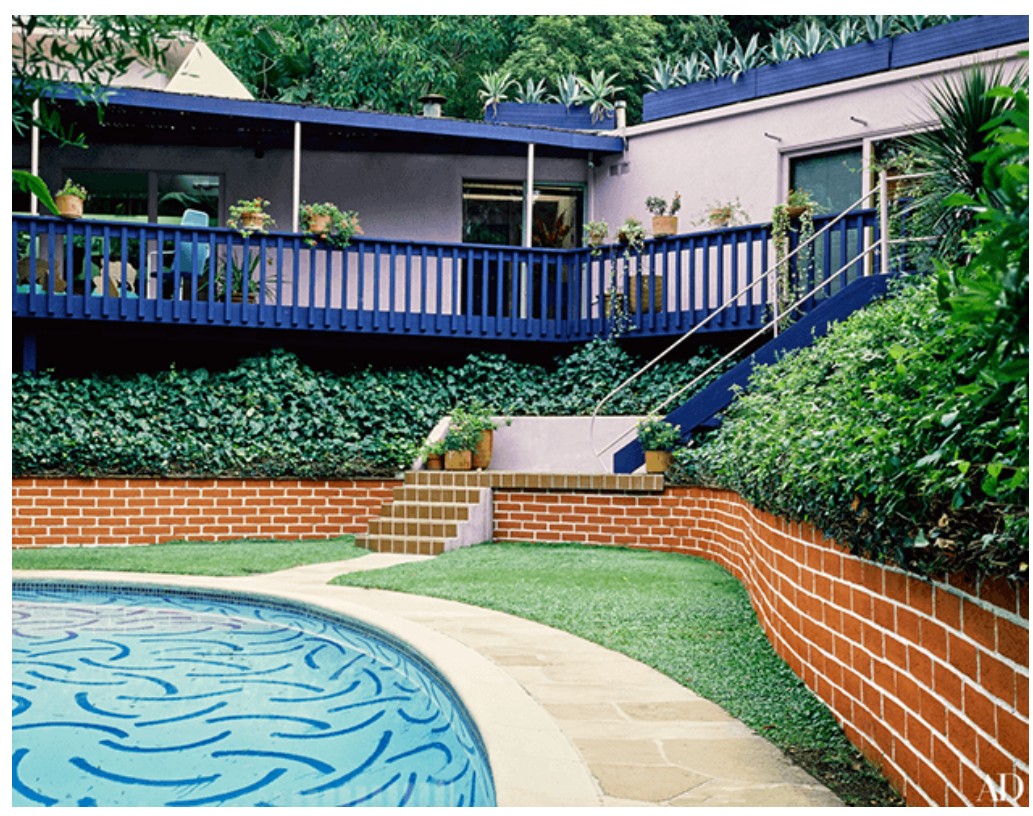
David Hockney’s backyard, pictured in Architectural Digest, April 1, 1983.
Hockney’s discrete House Palm and Pool series consists of just three large-scale gouaches, each presenting a similar view of Hockney’s property captured by the artist from a slightly elevated position en plein air on his terrace. In each work, Hockney distills the architecture, landscaping and colors through a remarkably economy of line and color: broad brushstrokes give form to the cobalt-blue slats of his terrace; blue squiggles capture the pool sparkling under the California light. Like Paul Cézanne’s repeated renderings of Mont Sainte-Victoire, Hockney in this way creates masterful studies of form, color, and perspective.
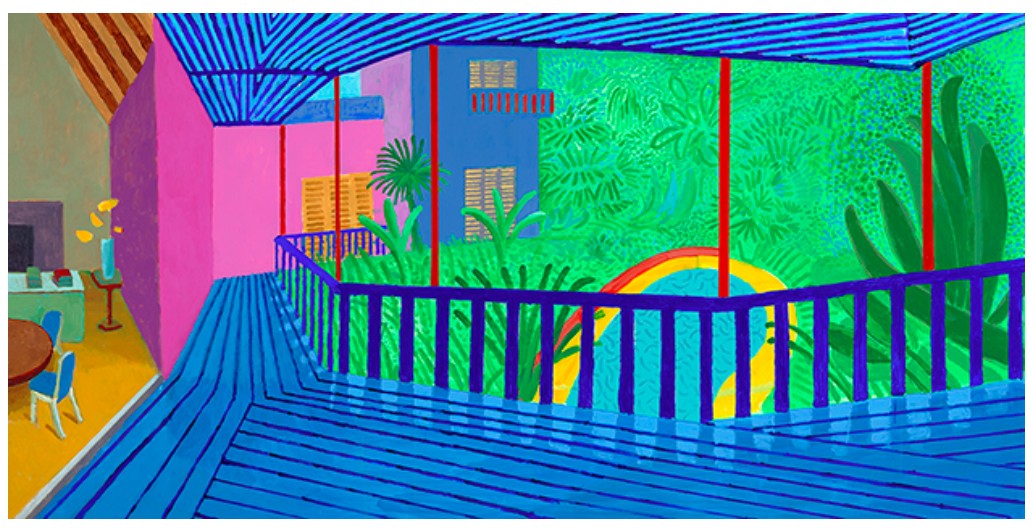
David Hockney, Interior with Blue Terrace and Garden, 2017
These two works powerfully exemplify Hockney’s interrogation of different modes of seeing and are closely related to his concurrent photographic practice. Viewed in tandem with Hockney’s composite Polaroid works of his property, they reflect Hockney’s ambition of making and viewing pictures more faithfully committed to the actual phenomena of seeing – thereby challenging the fixed viewpoint of the camera, and the Renaissance tradition of linear perspective more broadly. House Palm and Pool brilliantly captures our everyday experience of seeing, where the eye wanders and the body shifts, gaining different vantages of the same scene from one moment to the next.