Introduction
In the summer of 1978, while en route from England to Los Angeles, David Hockney stopped off and visited the upstate New York workshop of Kenneth Tyler, founder of the famous Tyler Graphics studio. During his stay, Tyler introduced Hockney to a new technique using handmade paper, colored with dye and pigmented pulp. Hockney thought the result was “stunningly beautiful,” and set about working on a new series of unique works that would become an important addition to the artist’s oeuvre. Paper Pools are rich and colorful renditions of one of the artist’s iconic swimming pools, paintings which have become some of the most celebrated images of the postwar period. This work, along with others such as A Bigger Splash (Tate Gallery, London) and Peter Getting out of Nick’s Pool (National Museums Liverpool, Walker Art Gallery), is synonymous with Hockney’s distinguished painterly style, and his constant quest to push the boundaries of art.
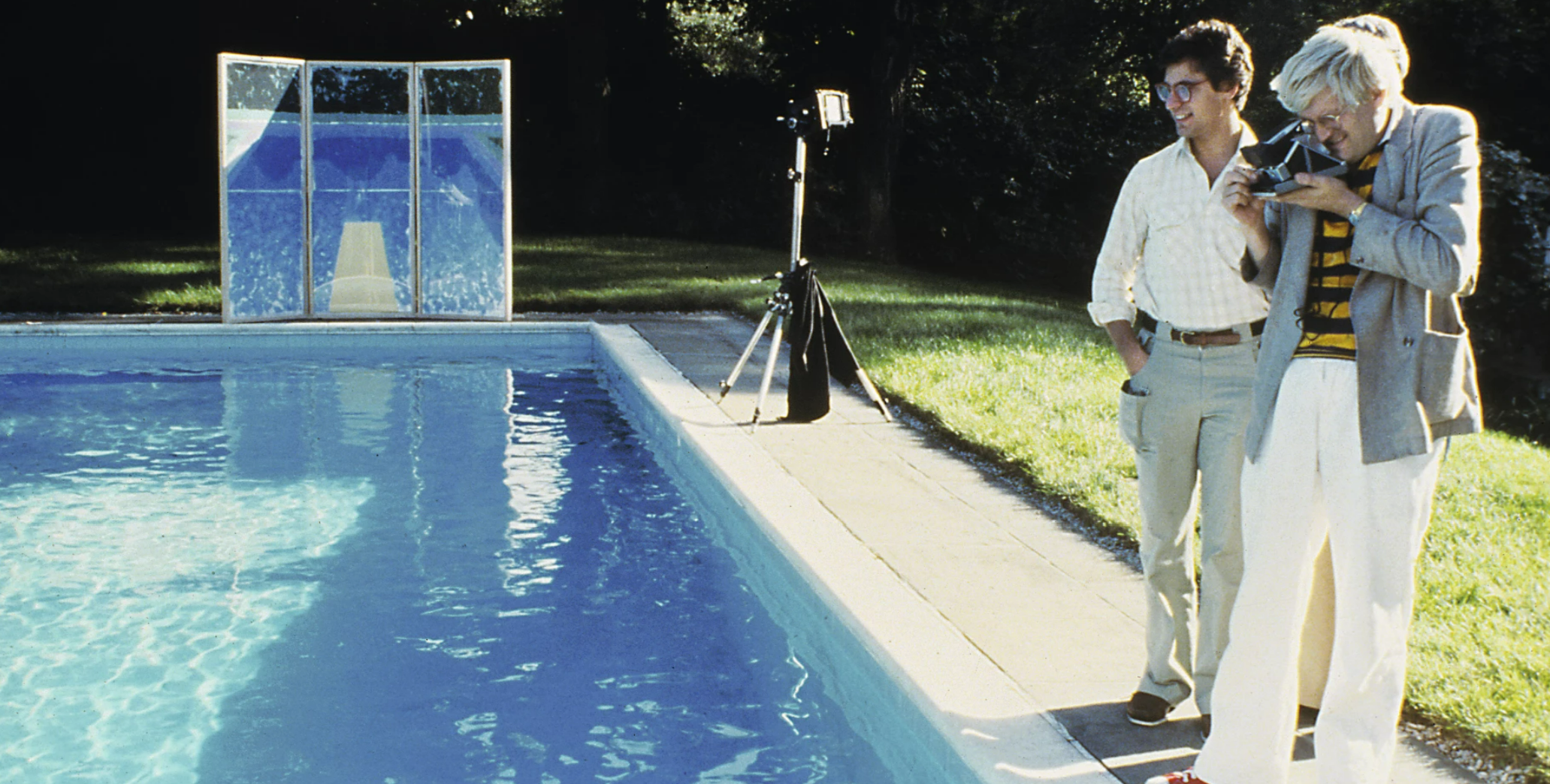
The elegant simplicity of the forms belies the thorough preparation and the density of art historical references that saturate the work. Hockney studied Tyler’s pool in New York at different times of day through both Polaroid shots and drawings, and thereby acquired a full and intimate understanding of the light and color changes on the water between dawn and dusk. The interest in reproducing variations on a scene under fluctuating atmospheric conditions has a canonical pedigree as the Impressionists’ calling-card, echoing Monet’s celebrated series of cathedrals, waterlilies and haystacks. Only three years earlier, Hockney stated in an interview that he was adamant about no longer working in series for fear of being stifled creatively; here, however, he found himself doing precisely that upon realizing the paper pulp method’s potential for innovation. The series also shows an affinity with the cut-outs of Hockney’s immediate predecessor, Matisse; both celebrate the exuberance of color and share a preoccupation with exploring the potential of paper that goes beyond being merely a surface to receive marks, and instead to bring it center-stage.
A playful self-referentiality that was to become a hallmark of postmodernist tendencies in art is employed in the present work. The paper pulp process was not only employed for its potential to stimulate and expand Hockney’s practice, but also because it was perfect for the pool theme, establishing an equivalence between the means of representation and the subject because of the considerable amounts of water involved in the method. Equally, the use of daringly simple shapes to evoke a quotidian subject suggests a ludic engagement with, and subversion of the frequent high-mindedness of abstraction, and particularly a subtle riposte to the works of the New York School.
In addition to the color that emanates from the surface of the work, the structure of the work itself is as important to Hockney’s artistic process as the finished composition. Using a series of photographs that the artist took of the swimming pool on Kenneth Tyler’s property, Hockney would produce metal ‘cookie-cutter’ molds into which he would pour the paper pulp. Then, by adding extra pigment, he would increase the concentration of the color of each section.
“You had to put on the color well, very carefully, and I couldn’t rely on someone else doing this… I could be freer…”
As well as color, the areas of raw paper that the artist leaves visible form an important part of the composition. They add depth and definition to the image, mimicking the sunlight dancing on the surface of the water, and offering up important clues as to how the work is made.
“The paper is very beautiful, the surface” Hockney adds, “there is no such thing as a flat color, and they are very subtle at times. They are like paintings, which is why I stayed; if they hadn’t been like paintings, I think I would have left after doing the first two or three small ones, I would have thought enough was enough”
Hockney’s Paper Pool paintings also helped to satisfy the artist’s technical interest in the nature of painting. They are an extension of his now iconic canvases of Californian swimming pools that he began in the 1960s, which—in addition to portraying the hedonistic West Coast lifestyle—also enabled him to investigate how to paint water, a form that is essentially formless and colorless.
The paper pulp technique was a denial of the line, heretofore Hockney’s greatest strength; it was instead a celebration of mass and color and light that brought the artist on par with Matisse, Rembrandt and van Gogh. The viewer may be directly reminded of Matisse’s own swimming pool masterpiece, executed twenty-six years before in the summer of 1952. La piscine was the culmination of Matisse’s paper cut-outs, resulting from a trip to a favorite pool in Cannes and an innovative study of light and movement. Matisse, observing the dynamism of the splashing water, populated the work with painted paper cut into shapes of divers, swimmers, and sea creatures. Hockney described the Museum of Modern Art’s exhibition of Matisse’s cut-outs, including La piscine, as “pure joy,” and this joy is clearly reflected in his own experimental paper pool.
Paper Pool 2, 1978
Steps with Shadow (Paper Pool 2), 1978
Sotheby’s New-York: 19 May 2019
Estimated: USD 1,000,000 – 1,500,000
USD 2,420,000
(#140) DAVID HOCKNEY | Steps with Shadow (Paper Pool 2)
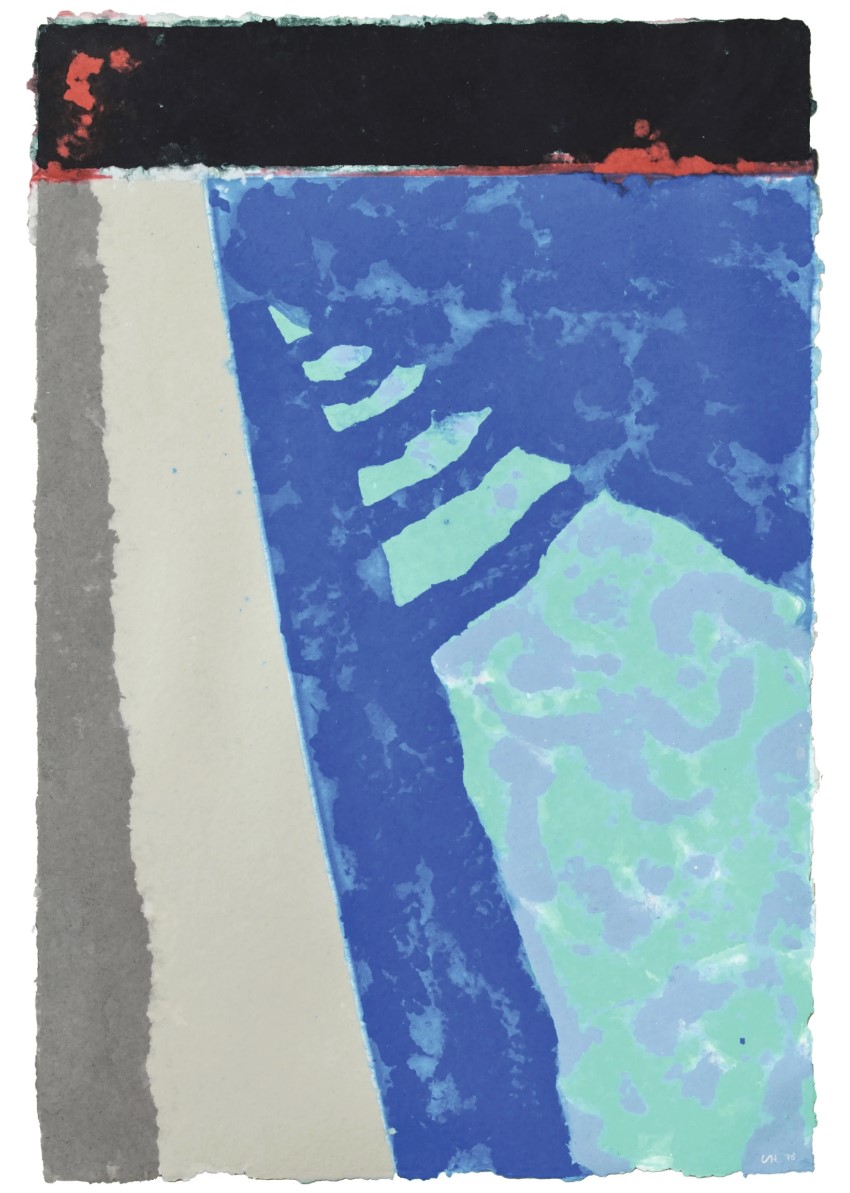
DAVID HOCKNEY
Steps with Shadow (Paper Pool 2), 1978
Colored and pressed paper pulp
50.7 x 33.5 inches (128.8 x 85.1 cm)
Signed with the artist’s initials and dated 78
The present work extends ideas acquired from the artist’s time in California: compared with the West Coast extroversion of the pools, exemplified by the exuberant dynamism captured in works such as A Bigger Splash, Steps with Shadow (Paper Pool 2) instead plays on ideas of reflection: of water’s physical properties but also to prompt the viewer to look inward. The opacity and clearly-defined borders of the California pictures exclude the viewer; the distressed edges and cropped viewpoint in the present work absorb them, inviting them to the pool’s edge.
Steps with Shadow (Paper Pool 2) is the result of an experimental technique that Hockney learned from Tyler and first used in the Paper Pools. It signifies a major shift in the artist’s subsequent work. Tyler had attended the Art Institute of Chicago and studied under the direction of Marcel Durassier, the French master printmaker who had worked with the titans of modernism, Joan Miró and Pablo Picasso; Hockney was ready to receive his expertise. The present work was produced by layering together individually-colored, hand-made pulped paper which would then be passed through a high-pressure hydraulic press, demonstrating a maturing of the artist’s processes and formal procedures. Through narrowing and brightening his palette, the outcome is a work that has much in common with the paintings of his revered contemporaries, Richard Diebenkorn and Art Informel artist Jean Dubuffet.
The present work can be summarily described as an extension of the acclaimed swimming pool imagery of the 1960s that decisively made Hockney a household name. Here, it is translated into a wholly new idiom through a remarkable economy of means, paying respect to canonical art history while simultaneously pre-empting several postmodernist tendencies in art. Hockney is a talented juggler, balancing the spinning plates of abstraction and representation; the influences of the East and West coasts and past and future in perfect equilibrium, all the while captivating his viewers.
Paper Pool 3, 1978
Green Pool with Diving Board and Shadow (Paper Pool 3), 1978
Christie’s New-York: 22 November 2024
Estimated: USD 1,800,000 – 2,500,000
USD 2,228,000
DAVID HOCKNEY (B. 1937), Green Pool with Diving Board and Shadow (Paper Pool 3) | Christie’s
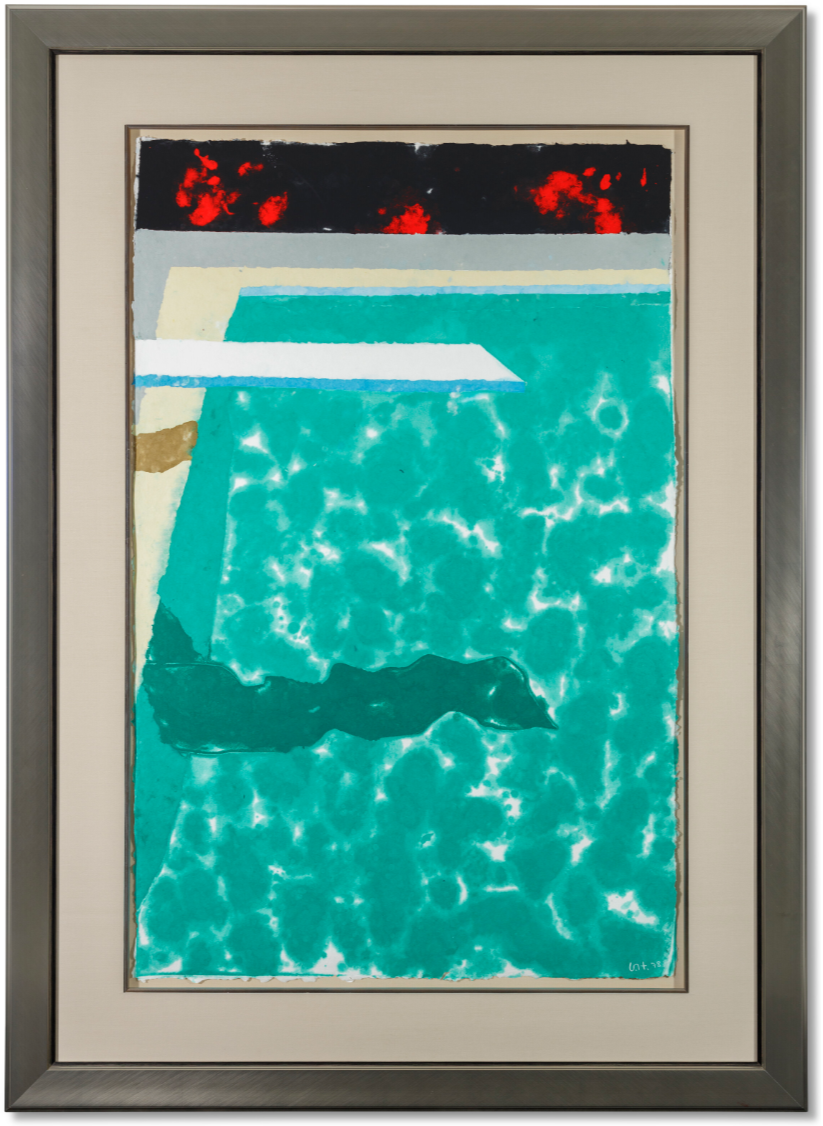
DAVID HOCKNEY (B. 1937)
Green Pool with Diving Board and Shadow (Paper Pool 3), 1978
Colored, pressed paper pulp
50 x 32 1/4 inches (127 x 81.8 cm)
Signed with the artist’s initials and dated ‘D.H. 78’ (lower right)
Signed and numbered ‘3-F David Hockney (on the reverse)
This work is one of fifteen unique variants
Provenance
Kasmin Ltd., London
Anon. sale; Sotheby’s, New York, 5 May 1994, lot 187
Acquired at the above sale by the present owner
A splendid thesis in light and shadow, David Hockney’s Green Pool with Diving Board and Shadow (Paper Pool 3) magisterially conveys the variegated effects of the late afternoon sun reflecting and refracting off a pool’s shimmering surface. Depicting the great British artist’s most famous motif, Green Pool with Diving Board and Shadow (Paper Pool 3) expands the possibilities of figuration available to Hockney through the adoption of a new working process and medium, establishing his definitive investigation of the pool. Residing in the same private collection for the past thirty years, this stunning example from Hockney’s pioneering paper pulp series demonstrates the artist at complete command of his unique mode of innovation.
Returning from a sojourn to England, Hockney stopped over in New York before returning to Los Angeles while waiting for a new driver’s license to arrive. This layover proved fortuitous for the artist, as it allowed him to accept an invitation from his friend Kenneth Tyler, a master printmaker with a studio just outside the city, to collaborate on a new series of works. Adamant that he wanted to paint and not make lithographs, Tyler then persuaded the artist to stay by showing him a revolutionary new artistic technique adding colored dyes to wet paper pulp before pressing into paper, a process which he had just worked on with the Color Field painter Ellsworth Kelly. The results “were stunningly beautiful,” writes Hockney (D. Hockney, Paper Pools, Abrams, 1980, pg. 9)
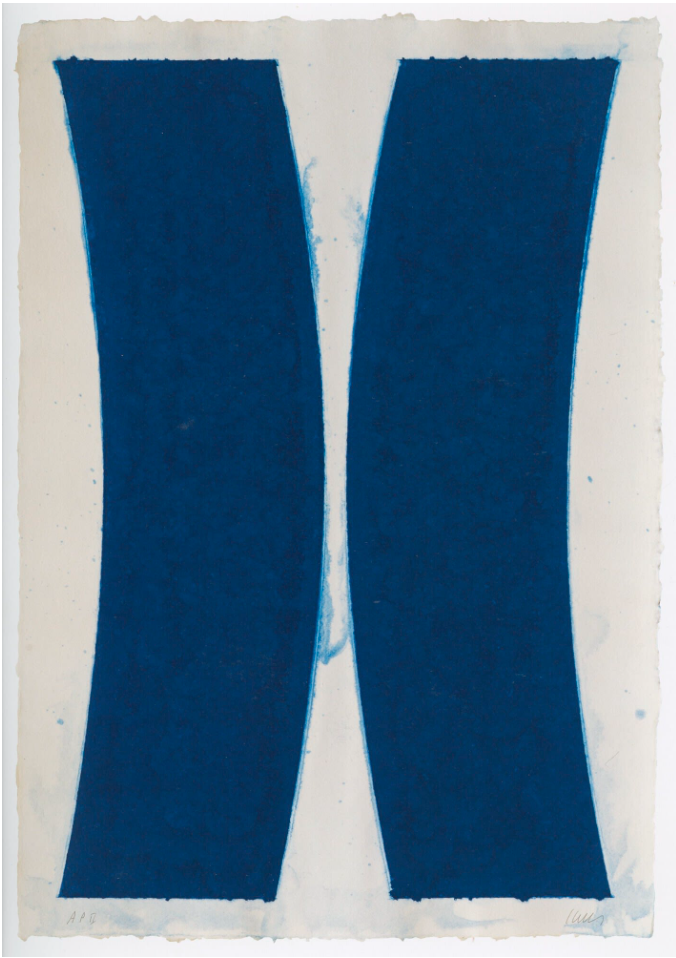
Ellsworth Kelly, Colored Paper Image V (Blue Curves), 1976. Museum of Modern Art.
© Ellsworth Kelly Foundation. Photo: © The Museum of Modern Art / Licensed by SCALA / Art Resource, NY.
Hockney was immediately infatuated with this technique.
“I love new mediums and this was something I had never seen or used before. I think mediums can turn you on, they can excite you; they always let you do something a different way, even if you take the same subject.”
Hockney immediately set to work, prolonging what was supposed to be a stay of a few days into a three-month residency at Tyler’s studio. After experimenting with a series of flowers, Hockney set upon the pool subject which he had famously explored the previous decade upon his first arrival in Los Angeles. Inspired by the way in which Henri Matisse’s paper cut out The Swimming Pool completely integrated line and color into a singular mesmerizing effect, the artist used his camera and drawing to meticulously study Tyler’s swimming pool, where he and the studio employees would lunch every day.
“I kept looking at the swimming pool; it’s a wonderful subject, water, the light on the water. And this process with paper pulp demanded a lot of water; you have to wear boots and rubber aprons. I thought, really I should do it, find a watery subject for this process, and here it is; here this pool, every time you look at the surface, you look through it, you look under it.”
The paper pulp technique was the perfect medium for Hockney to fully express the pool’s complicated effects, for it captures completely the paradox of freezing in time a subject always in motion, resolving within the man-made container of water the play of light against a natural backdrop. To create the work, Hockney poured liquid color pulp directly into molded sheet metal placed over a paper base, like casting bronze. Hockney then manipulated the still-wet pulp, carefully applying liquid dyes with a variety of self-invented tools and procedures, utilizing brushes, airbrushes, basters, and even spoons to achieve different densities and hues in his coloration. Hockney then further worked the surface of the paper, employing combs, toothbrushes, hoses, and his own fingers to achieve the perfect textured result before pressing the pulp together, fusing the work together into a singular sheet. The resulting achievement was less a work on paper than a work where form and texture elegantly inhere within the paper medium itself, line and color operating in tandem to create the vivid illusion of watery depths. This laborious process produces incredible surface effects where colors are deep and vivid, attaining subtle effects akin to painting with glazes.
Green Pool with Diving Board and Shadow (Paper Pool 3), 1978
Christie’s London: 28 June 2023
Estimated: GBP 1,200,000 – 1,800,000
GBP 2,339,000 / USD 2,982,535
DAVID HOCKNEY (B. 1937), Green Pool with Diving Board and Shadow (Paper Pool 3) | Christie’s
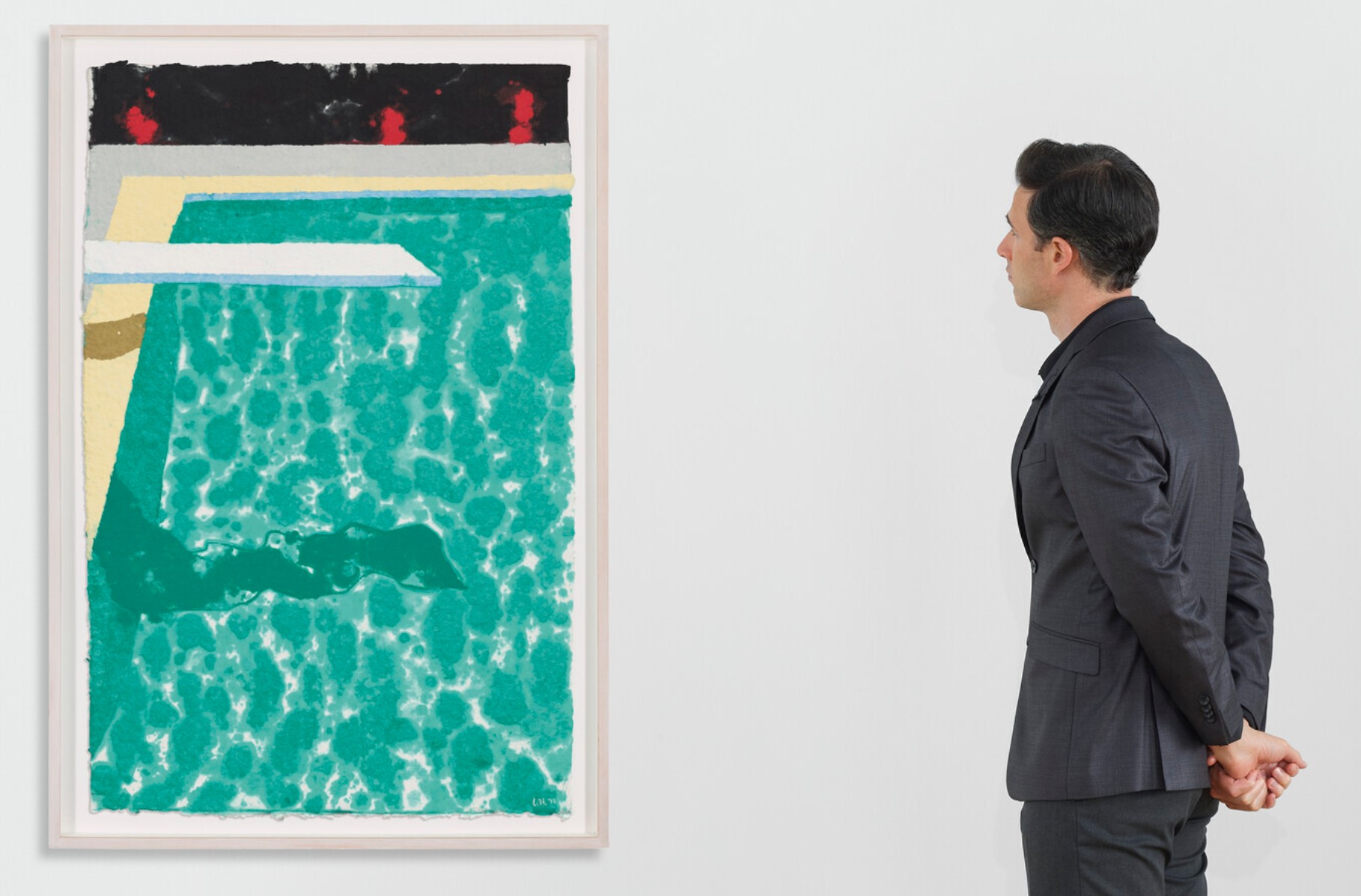
DAVID HOCKNEY (B. 1937)
Green Pool with Diving Board and Shadow (Paper Pool 3), 1978
Colored, pressed paper pulp
50 3/4 x 32 5/8 inches (128.8 x 82.8 cm)
Signed with the artist’s initials and dated ‘D.H. 78’ (lower right)
Signed and numbered ‘3 K David Hockney’ (on the reverse)
Provenance
Richard Gray Gallery, Chicago
Keitelman Gallery, Brussels
Acquired from the above by the present owner in 2002
Green Pool with Diving Board and Shadow (Paper Pool 3), 1978
Estimated: USD 1,800,000 – 2,500,000
USD 2,349,000
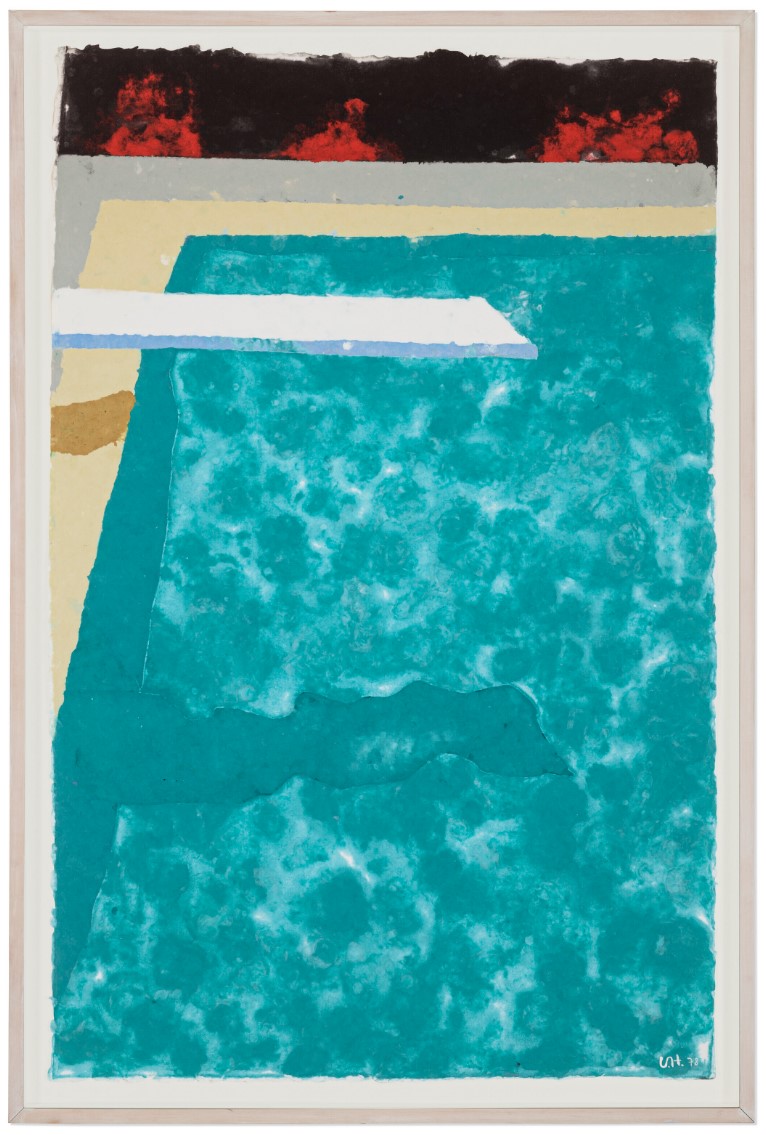
Green Pool with Diving Board and Shadow (Paper Pool 3), 1978
Colored, pressed paper pulp
50 x 32 1/4 inches (127 x 81.8 cm)
Signed again and numbered ‘David Hockney 3-D’ (on the reverse)
Executed in 1978. This work is one of fifteen unique variants
Acquired from the above by the late owner, 1983
Green Pool with Diving Board and Shadow (Paper Pool 3)
Estimated: USD 1,000,000 – 1,500,000
USD 2,892,500
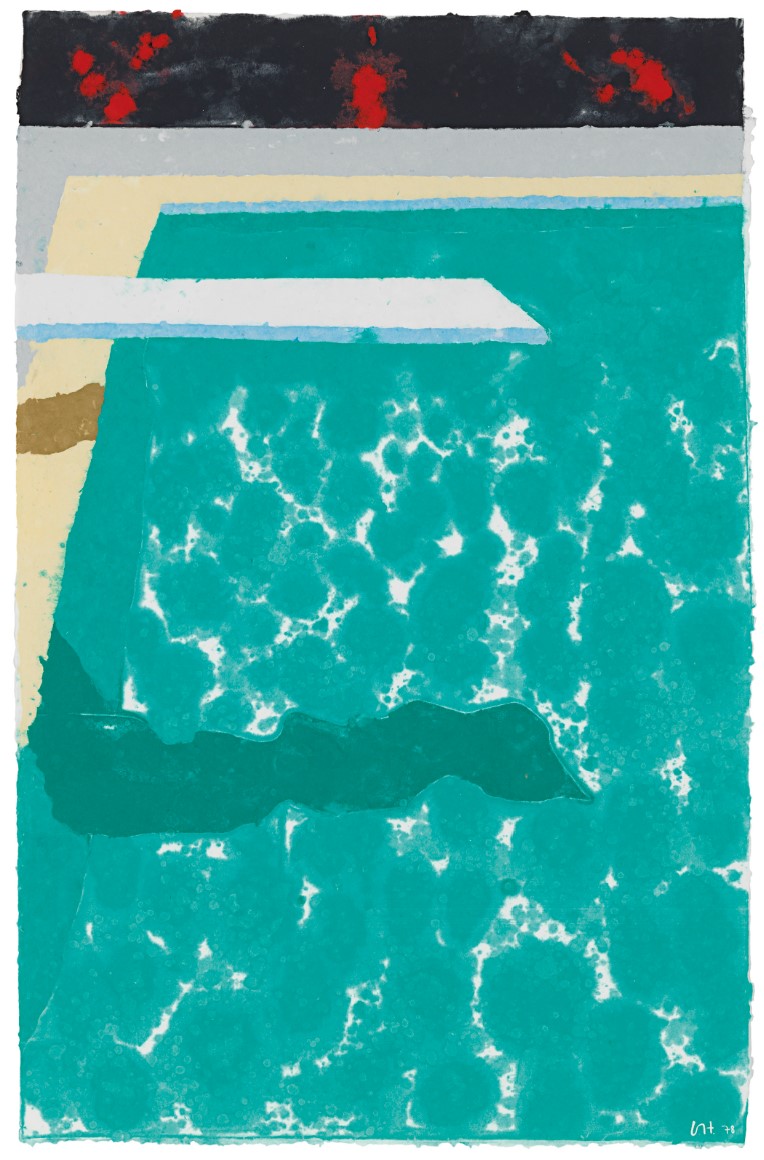
DAVID HOCKNEY
Green Pool with Diving Board and Shadow (Paper Pool 3), 1978
Colored, pressed paper pulp
50.2 x 32.2 inches (127.6 x 81.9 cm)
Signed with the artist’s initials and dated ‘D.H. 78’ (lower right)
Signed and numbered ‘3-L David Hockney’ (on the reverse)
This work is one of fifteen unique variants
Provenance
Mr. and Mrs. Jack N. Greenman II, Fort Worth
By descent from the above to the present owners
Paper Pool 4, 1978
Gregory in the Pool (Paper Pool 4), 1978
Christie’s London: 13 October 2023
Estimated: GBP 400,000 – 600,000
GBP 529,200 / USD 644,737
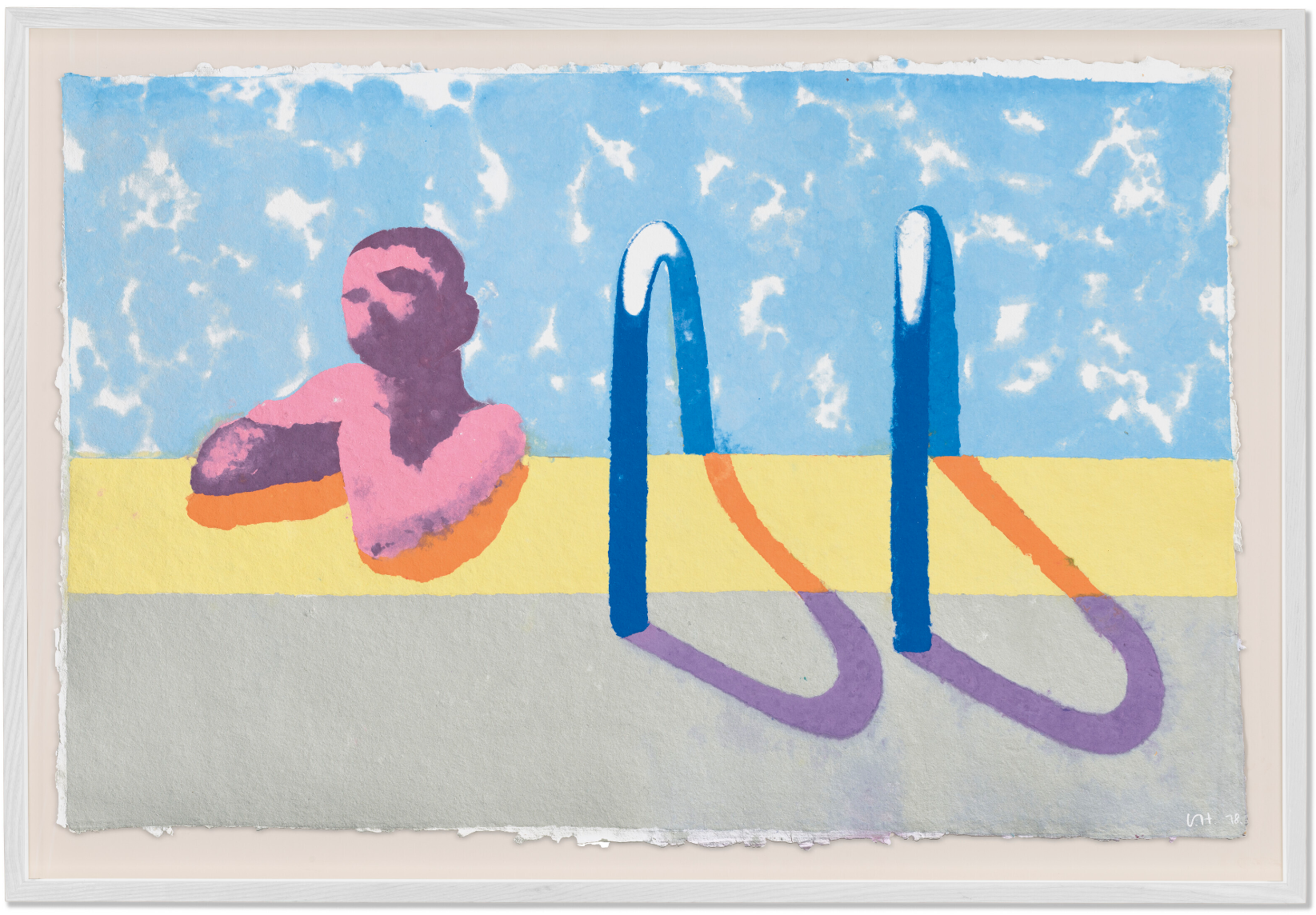
DAVID HOCKNEY (B. 1937)
Gregory in the Pool (Paper Pool 4), 1978
Colored, pressed paper pulp
33 1/4 x 50 5/8 inches (84.5 x 128.5 cm)
Signed with the artist’s initials and dated ‘D.H. 78.’ (lower right)
Signed and numbered ‘4-F (II) David Hockney.’ (on the reverse)
Alive with light, color and texture, the present work depicts two of David Hockney’s most treasured subjects: the swimming pool, and his lover and muse Gregory Evans. Executed in 1978, it belongs to the artist’s celebrated Paper Pools series, a radical suite of works in which Hockney used compressed, pulped paper to capture the elusive qualities of water. Within the sequence of thirty-one images that make up the series, Gregory in the Pool (Paper Pool 4) is the first of just five to feature a figure. Unlike subsequent examples—including A Large Diver (San Francisco Museum of Modern Art)—which depict him underwater, here he leans on the side of the pool, his face upturned to the viewer. Shadows of deep indigo and fiery orange animate his form. The pool’s sun-kissed waters sparkle behind him, collapsing all sense of perspective. Aglow with the joys of summer and love, the image featured in Paul Schrader’s 1980 film American Gigolo, as well as on the cover of Michael Cunningham’s 1984 novel Golden States.
Gregory in the Pool (Paper Pool 4), 1978
Estimated: USD 250,000 – 350,000
USD 692,000
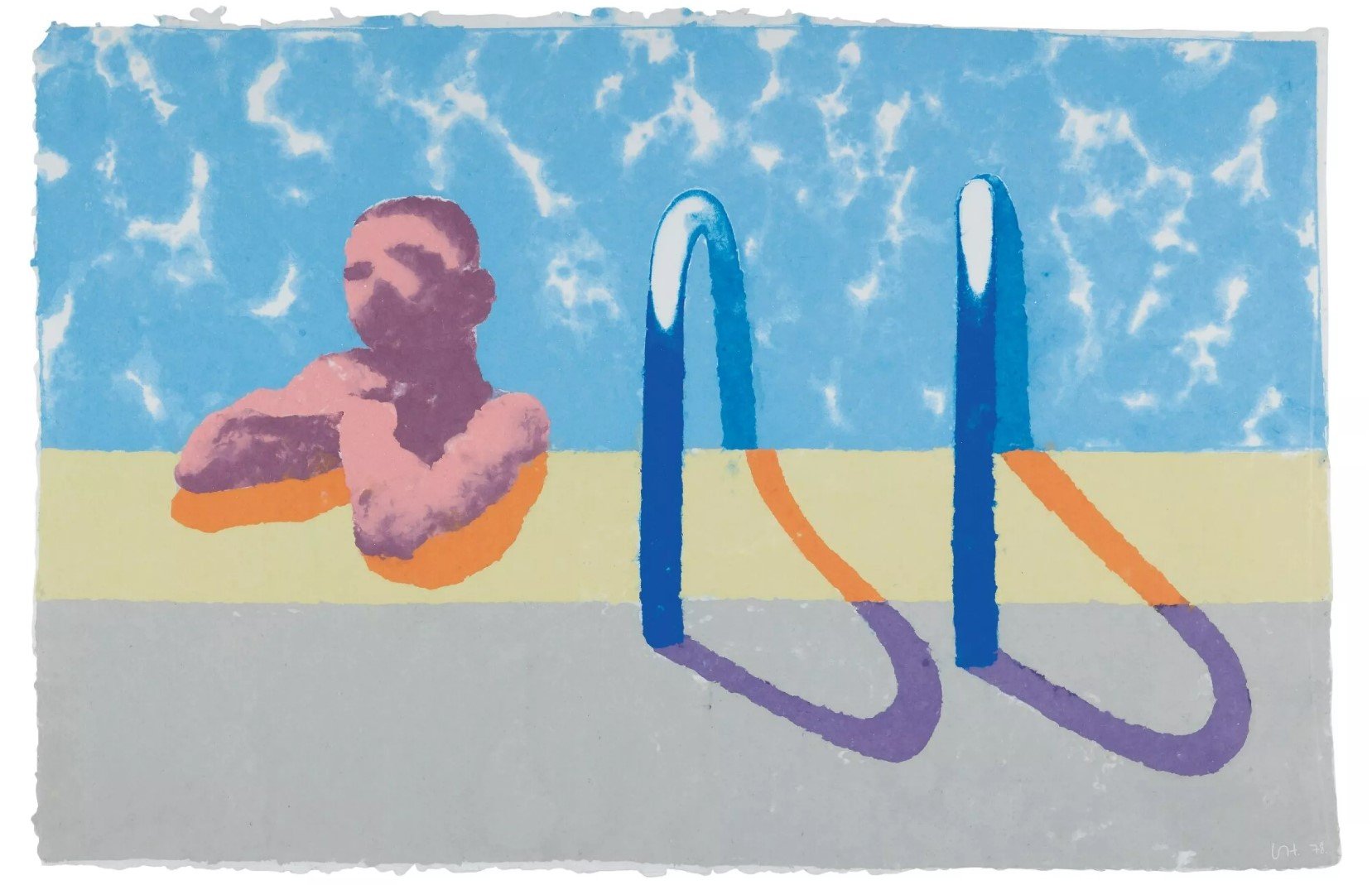
DAVID HOCKNEY
Gregory in the Pool (Paper Pool 4), 1978
Colored and pressed paper pulp
32×50 inches (81.3 x 127 cm)
Signed with artists initials and dated 78
Signed and numbered 4L on the reverse
Gregory in the Pool E (Paper Pool 4), 1978
Phillips London: 19 January 2017
Estimated: GBP 400,000 – 600,000
GBP 485,000 / USD 597,460
David Hockney Evening & Day Editions
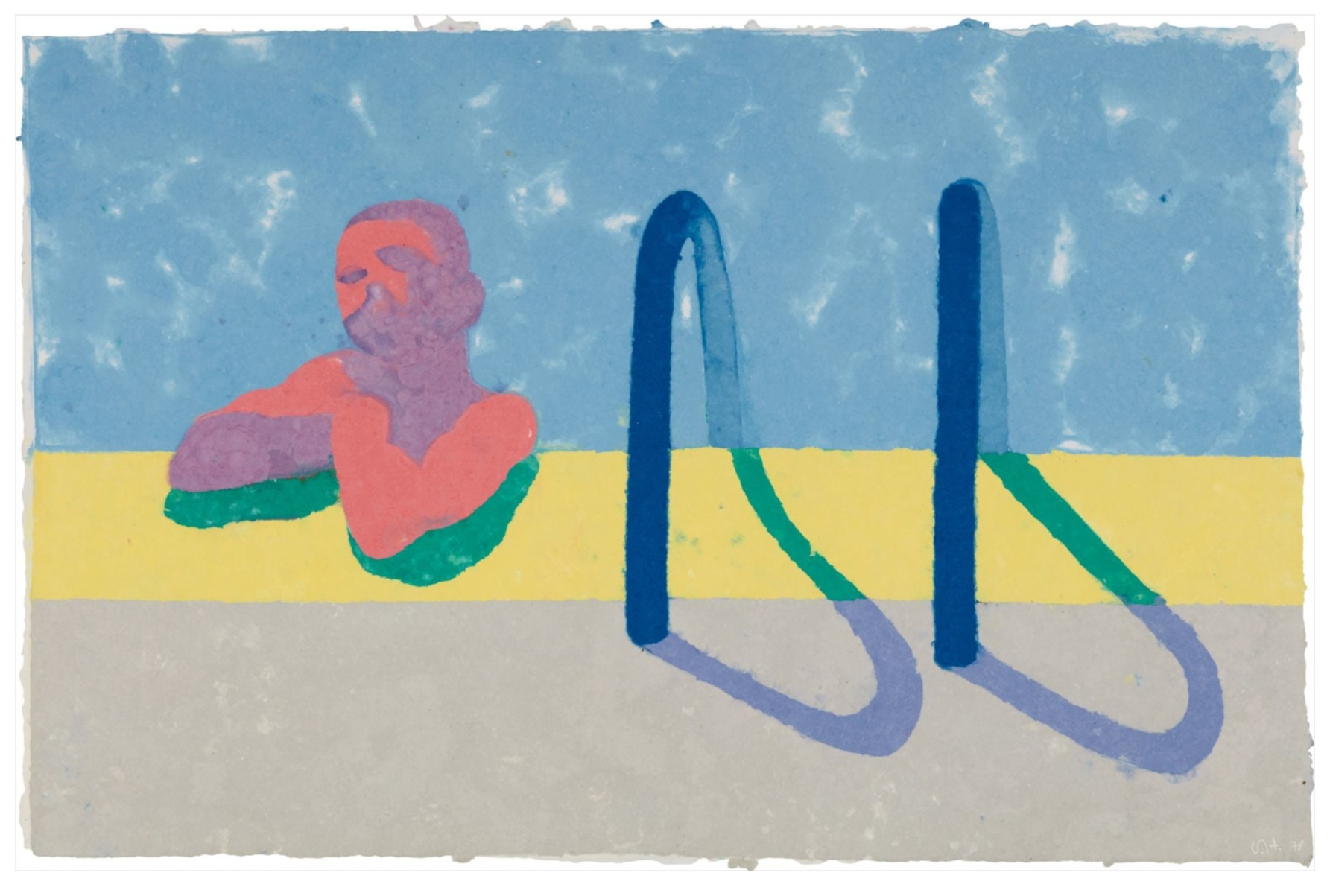
DAVID HOCKNEY
Gregory in the Pool E (Paper Pool 4), 1978
Unique hand-colored pressed paper pulp on white TGL handmade paper
32×50 inches (81.3 x 127 cm)
Signed with initials and dated in white ink on the front
Annotated ‘4-E’ in pencil on the reverse (one of 20 variants)
Gregory in the Pool (Paper Pool 4), 1978
Christie’s London: 30 June 2015
Estimated: GBP 300,000 – 400,000
GBP 482,500 / USD 758,735
David Hockney (b. 1937), Gregory in the Pool (Paper Pool 4) | Christie’s
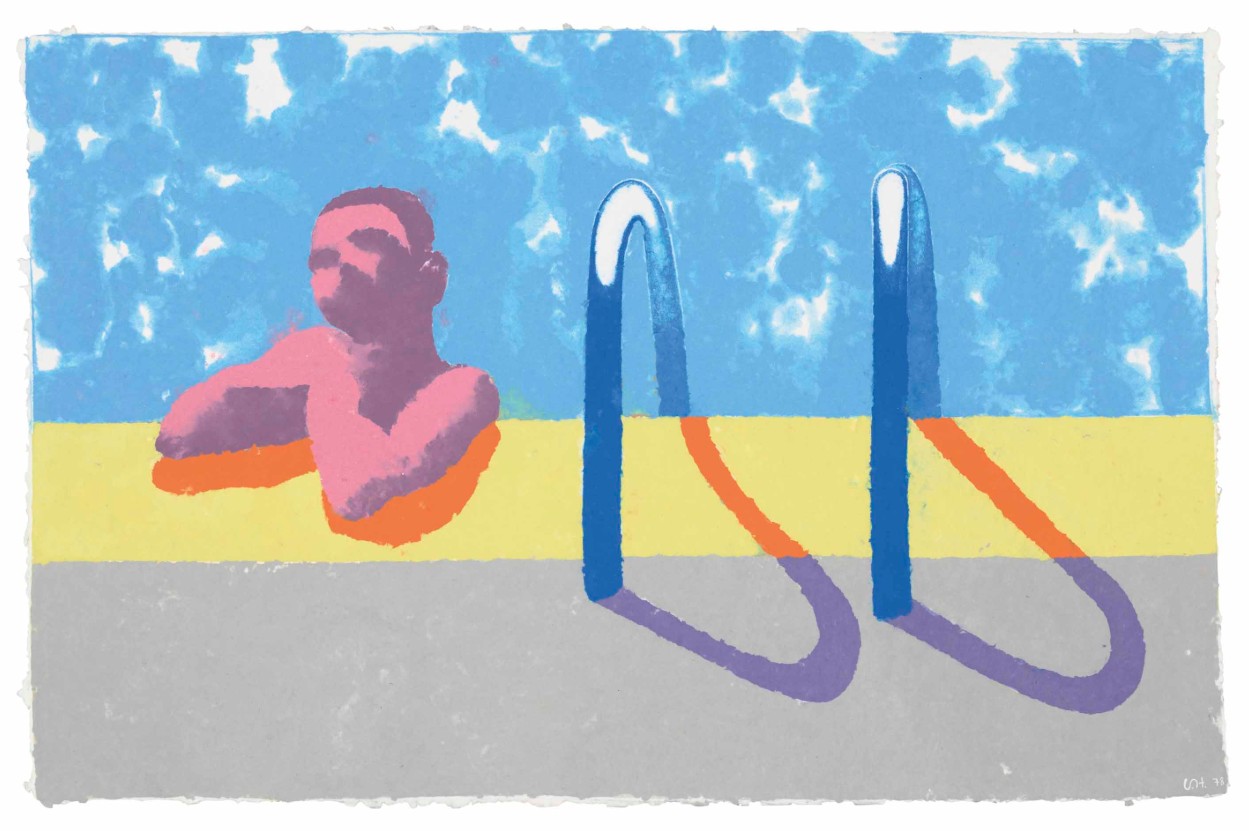
DAVID HOCKNEY (b. 1937)
Gregory in the Pool (Paper Pool 4), 1978
Hand-colored and pressed paper pulp
32×50 inches (81.3 x 127 cm)
Signed with the artist’s initials and dated ‘D.H. 78’ (lower right)
Signed and numbered ‘Hockney 4-K’ (on the reverse)
This work is one of twenty unique variations
Paper Pool 7, 1978
Day Pool with Three Blues (Paper Pool 7)
Christie’s New-York: 14 May 2019
Estimated: USD 9,000,000 – 12,000,000
USD 10,490,000
David Hockney (b. 1937), Day Pool with Three Blues (Paper Pool 7) | Christie’s
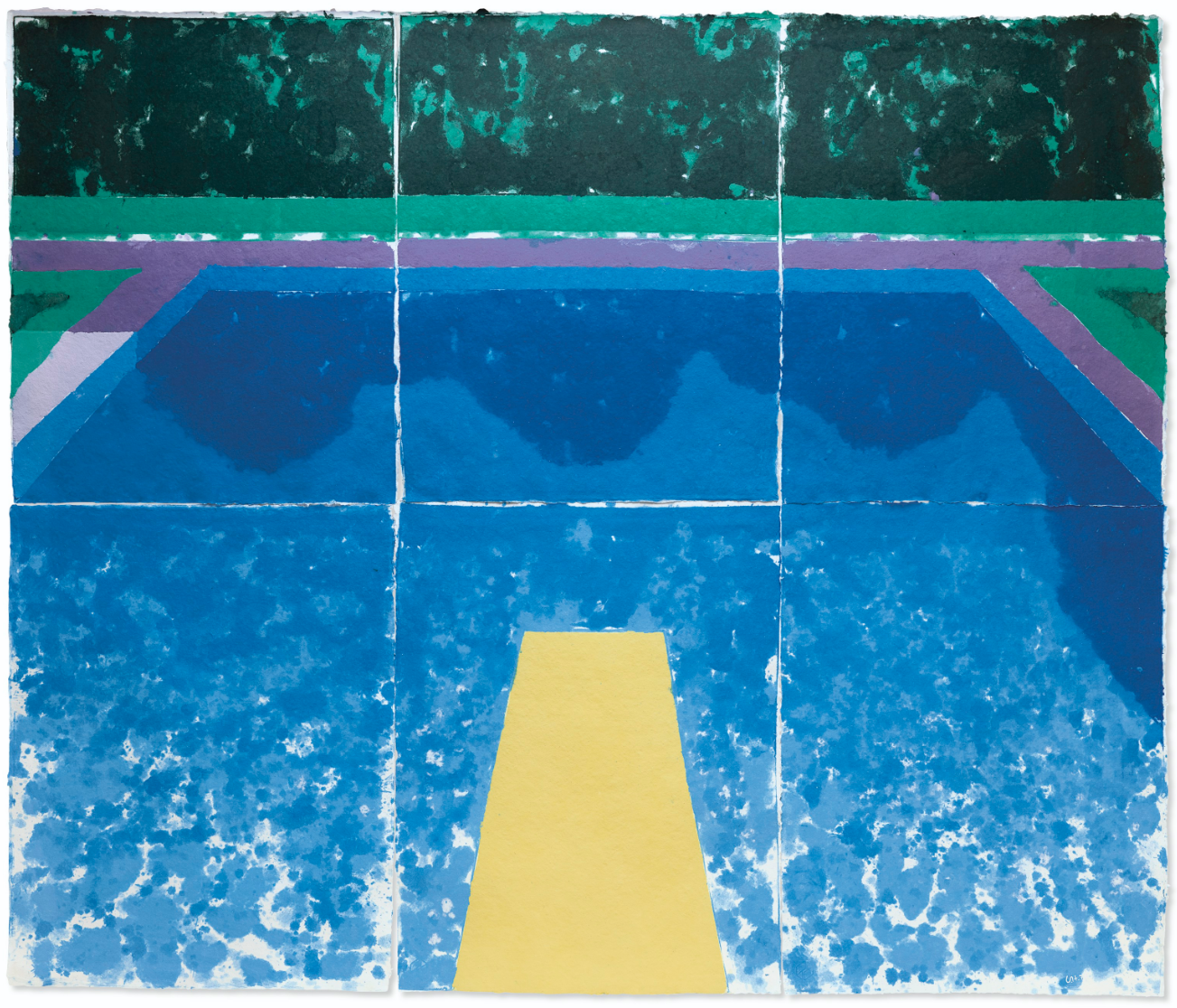
DAVID HOCKNEY
Day Pool with Three Blues (Paper Pool 7), 1978
Colored, pressed paper pulp
72 x 85.5 inches (182.9 x 217.2 cm)
Signed with the artist’s initials and dated ‘D.H. 78’ (lower right)
Signed again ‘David Hockney’ (on the reverse of the lower right sheet)
Inscribed ‘7’ (on the reverse of each sheet)
In the summer of 1978, while en route from England to Los Angeles, David Hockney stopped off and visited the upstate New York workshop of Kenneth Tyler, founder of the famous Tyler Graphics studio. During his stay, Tyler introduced Hockney to a new technique using handmade paper, colored with dye and pigmented pulp. Hockney thought the result was “stunningly beautiful,” and set about working on a new series of unique works that would become an important addition to the artist’s oeuvre. Day Pool with Three Blues (Paper Pool 7) is one of these works, a rich and colorful rendition of one of the artist’s iconic swimming pools, paintings which have become some of the most celebrated images of the postwar period. This work, along with others such as A Bigger Splash (Tate Gallery, London) and Peter Getting out of Nick’s Pool (National Museums Liverpool, Walker Art Gallery), is synonymous with Hockney’s distinguished painterly style, and his constant quest to push the boundaries of art. Previously in the personal collection of Kenneth Tyler, who helped Hockney develop the series, Day Pool with Three Blues (Paper Pool 7) is the physical manifestation of this highly creative period when Hockney harnessed his prolific creativity to produce large-scale and striking works that have become some of the most celebrated of his career.
Across conjoined sheets of handmade paper, Hockney composes an image of a swimming pool using different areas of colored paper. By mixing pigment directly into the raw paper pulp and then pressing it into a sheet of paper, Hockney builds up a surface that is rich in both color and texture. In this particular example, the artist uses three different tones of blue to depict the shifting tonality of the water; dark blue depicts the shadows cast by the sides of the pool, a mid-blue conveys the depth of the waters, and finally the dappled blue and white of the surface is portrayed by a variegated mixture of lighter blue and raw paper that occupies the lower register of the painting. This layering of color adds both depth and volume to the depiction of water, turning it from a flat uniform surface into a dynamic and seemingly constantly shifting form. In contrast to the dynamism of the pool, the rest of the paint is bordered by the strict geometry of a path and hedge that hugs the edge of the pool. Rendered in a dusky mauve, the walkway constrains the water, introducing order into the arrangement. Finally, passages of verdant green complete the composition as they indicate hedges and lawns, which act to soften the entire composition.
In addition to the color that emanates from the surface of the work, the structure of the work itself is as important to Hockney’s artistic process as the finished composition. Using a series of photographs that the artist took of the swimming pool on Kenneth Tyler’s property, Hockney would produce metal ‘cookie-cutter’ molds into which he would pour the paper pulp. Then, by adding extra pigment, he would increase the concentration of the color of each section, “You had to put on the color well, very carefully, and I couldn’t rely on someone else doing this… I could be freer…” Hockney said (D. Hockney, quoted by N. Stangos, David Hockney: Paper Pools, New York, 1980, p. 28). As well as color, the areas of raw paper that the artist leaves visible form an important part of the composition. They add depth and definition to the image, mimicking the sunlight dancing on the surface of the water, and offering up important clues as to how the work is made. “The paper is very beautiful, the surface” Hockney adds, “there is no such thing as a flat color, and they are very subtle at times. They are like paintings, which is why I stayed; if they hadn’t been like paintings, I think I would have left after doing the first two or three small ones, I would have thought enough was enough” (D. Hockney, ibid., p.100).
Hockney’s Paper Pool paintings also helped to satisfy the artist’s technical interest in the nature of painting. They are an extension of his now iconic canvases of Californian swimming pools that he began in the 1960s, which—in addition to portraying the hedonistic West Coast lifestyle—also enabled him to investigate how to paint water, a form that is essentially formless and colorless. “Hockney’s fascination,” writes Nikos Stangos, “was in using a watery medium for the representation of a watery subject, bringing together many of the themes he most loves: the paradox of freezing in a still image what is never still, water, the swimming pool, this man-made container of nature, set in nature which it reflects, the play of light in water…” A consummate student of art history, Hockney would also have been fully aware that it was a task that had also occupied the minds of many of his artistic heroes. “The challenge to his imagination and creative ability of mastering a new technique, learning its limitations, accepting these limitations and transcending them is the same as that which has provided the fuel in all new phases of his work,” Stangos continues. “It was perhaps a similar challenge… that led Matisse to his paper cut outs, of which especially relevant here is La Piscine (1952)… and which Hockney must have had in mind when he was making paper pools” (N. Stangos, ibid., p. 5 & p. 6).
Day Pool with Three Blues (Paper Pool 7) was acquired directly from the artist by Kenneth Tyler, the man who played an important role in the creation of the entire Paper Pool series. Tyler was a master printmaker who worked with many artists and transformed printmaking from a relatively simple process into a medium as important and valued as painting or sculpture. With these paintings, Tyler infused his innovative techniques onto Hockney’s bold imagination, resulting in a series of unique works that are some of the most exciting of the artist’s career. “I have never worked with anyone with more energy,” Hockney said. “It was fantastic. He was willing to work any hours. It didn’t matter… Working with someone who has an awful lot of energy is very thrilling. With Kenneth Tyler, nothing was impossible. If I said, could we, he said, yes, yes, it can be done” (D. Hockney, quoted by P. Gilmour, Ken Tyler Master Printer and the American Print Renaissance, New York, 1986, p. 97).
David Hockney’s paintings of swimming pools have become some of the most iconic images of postwar art; works such as A Bigger Splash, 1967 (Tate Gallery, London) and Portrait of an Artist (Pool with Two Figures) are some of the most loved canvases of his career. Day Pool with Three Blues (Paper Pool 7) takes the level of technical achievement of these paintings and builds on it a step further and in the process, introduces a whole new level of interest to these works. That this particular painting was in the personal collection of the man who helped Hockney achieve these heights makes this work a very personal record of this prolific and inventive period.
Paper Pool 14, 1978
Sprungbrett mit Schatten (Paper Pool 14)
Christie’s New-York: 14 November 2018
Estimated: USD 6,000,000 – 8,000,000
USD 7,287,500
David Hockney (b. 1937), Sprungbrett mit Schatten (Paper Pool 14) | Christie’s
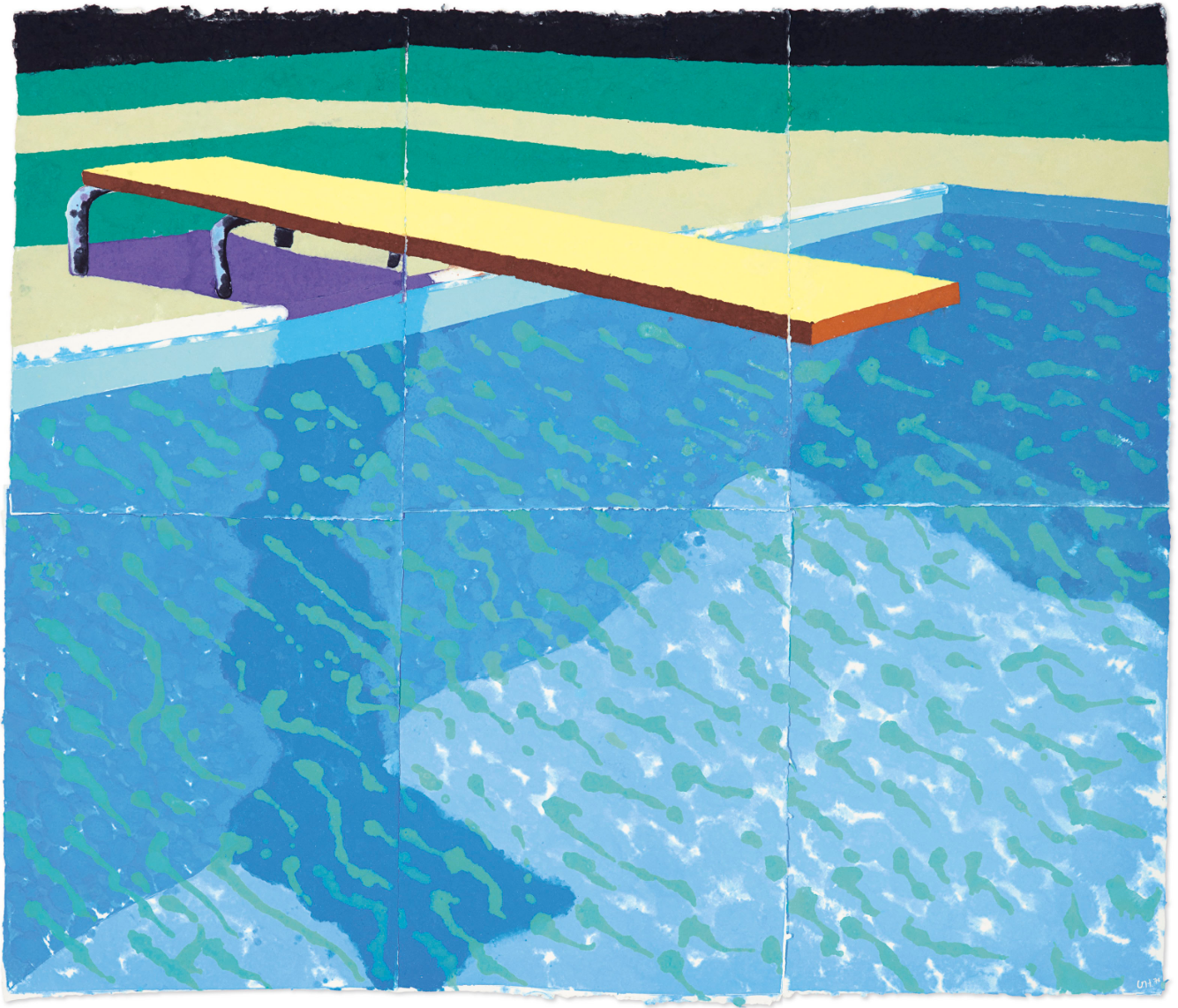
DAVID HOCKNEY
Sprungbrett mit Schatten (Paper Pool 14), 1978
Colored, pressed paper pulp
72 x 85.5 inches (182.9 x 217.2 cm)
Signed with the artist’s initials and dated ‘D.H. 78’ (lower right)
David Hockney’s paintings of swimming pools are among the most iconic and recognizable series of paintings in Post War art, as from the early 1960s onwards the artist captured the exoticism and eroticism of the California pool scene. In addition to the obvious attraction of the associated subject matter, Hockney was intrigued by the technical challenges of how to capture the constantly shifting bodies of water. The resulting paintings, such as A Bigger Splash, 1967 (Tate, London) and Peter Getting Out of Nick’s Pool, 1966 (National Museums Liverpool, Walker Art Gallery), have become part of the 60s cultural lexicon, but the following decade Hockney embarked on a new series of paintings that took his investigations even further. Known as his Paper Pool paintings, this small group of works included water as part of the creative process more than ever before. Springbrett mit Schatten (Paper Pool 14) is one of the central works from this series, an evocative painting that not only captured the energy of the swimming pool, but also satisfied the artist’s need to be challenged by his medium. With works such as this, he relished the creative ability of mastering a new technique, learning and accepting its limitations, and transcending them in the pursuit of a powerful new phases of his career.
Across six large conjoined sheets of handmade paper, Hockey produces a striking image of one of his iconic swimming pools. Through a series of simplified—almost abstracted—forms, the artist captures not only the physical features of the pool, but also the cooling sensation of the water on a hot summer’s day. Geometric planes of color denote solid forms—a diving board, the turf borders and hedges that surround the pool—while the clear water that fills the pools is rendered by a series of surface ripples and the shadows they create as they dance across the bottom of the pool. The technical difficulties of how to depict a colorless, formless material lies at the heart of this innovative series, and made the subject matter perfect for what the artist was trying to achieve. “Hockney’s fascination was in using a watery medium for the representation of a watery subject,” writes Nikos Stangos, “bringing together many of the themes he most loves: the paradox of freezing in a still image what is never still, water, the swimming pool, this man-made container of nature, set in nature which it reflects, the play of light on water…” (N. Stangos, David Hockney: Paper Pools, New York, 1980, p. 6).
Hockney achieved this perfect union using, what was for him, a radically new technique of combining painting and paper making. Influenced in part by Ellsworth Kelly, who had begun investigating a similar technique in 1976, Hockney worked with a longtime friend and expert papermaker, Kenneth Tyler, at his Tyler Graphics studio just north of New York City. Hockney used Tyler’s own pool as the motif for these new paintings, as “For days he [Hockney] studied the pool, drawing and photographing it extensively at different times of the day and night, observing the many light and colour changes” (ibid.). After a concerted period of study, Hockney made a series of drawings from which Tyler and his assistant made metal molds, each with a compartment that reflected an area of the drawing. These molds were then placed directly upon sheets of newly made, and still wet, paper before colored pulp was poured into each one. After each of the molds was filled, they were carefully removed, and Hockney hand finished the work by directly applying more colored pulp and liquid dyes to the sheet by hand. Once the composition was complete, the sheets were then pressed under high pressure to fuse together the layers of colored pulp and hand-made paper, and to speed up the drying process by squeezing the excess water. Hockney used lots of different techniques for applying this pulp and pigment to the surface of the paper. Stagnos observed that, “Liquid colour pulps were spooned, poured, painted and dropped onto the pieces. Sometimes Hockney found softened hard edges by blending and patting, coloured pulp areas with his fingers and hands. Dog combs, toothbrushes, fingers, a garden hose and working outside in the rain were used to obtain textural effects. He usually applied liquid dyes with a kitchen baster or a paint brush, but on several occasions sprayed it on with an airbrush” (Ibid, p. 7).
Paper Pool 22, 1978
Pool on a Cloudy Day with Rain (Paper Pool 22)
Sotheby’s London: 28 July 2020
Estimated: GBP 4,000,000 – 6,000,00
GBP 4,867,900 / USD 6,302,055
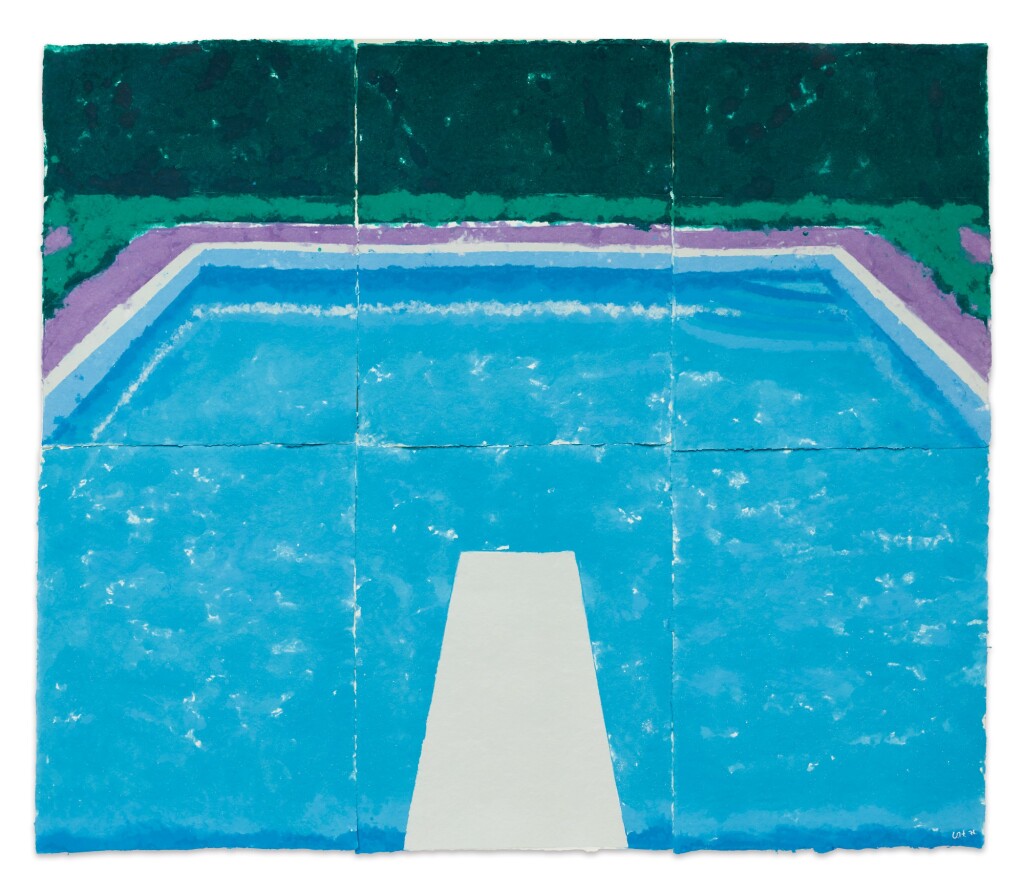
DAVID HOCKNEY
Pool on a Cloudy Day with Rain (Paper Pool 22), 1978
Hand-colored and pressed paper pulp
72.4 x 85 inches (183.8 x 216 cm)
Signed with the artist’s initials and dated ’78
Pool on a Cloudy Day with Rain (Paper Pool 22) is an outstanding iteration of David Hockney’s widely celebrated series, the Paper Pools of 1978. Imbued with the artist’s exquisite rendering of the transient, luminescent and vacillating qualities of light and water, the present work marks a significant shift within Hockney’s oeuvre. Inspired by his friend, artist Kenneth Tyler’s swimming pool in suburban New York, the Paper Pools series is comprised of a limited number of vibrant, unique works that marry Hockney’s most enduring and acclaimed motif with an entirely new artistic technique involving wet paper pulp and vivid coloured dye. Of this series, the present work belongs to a smaller and highly coveted subset of large-scale Paper Pools.
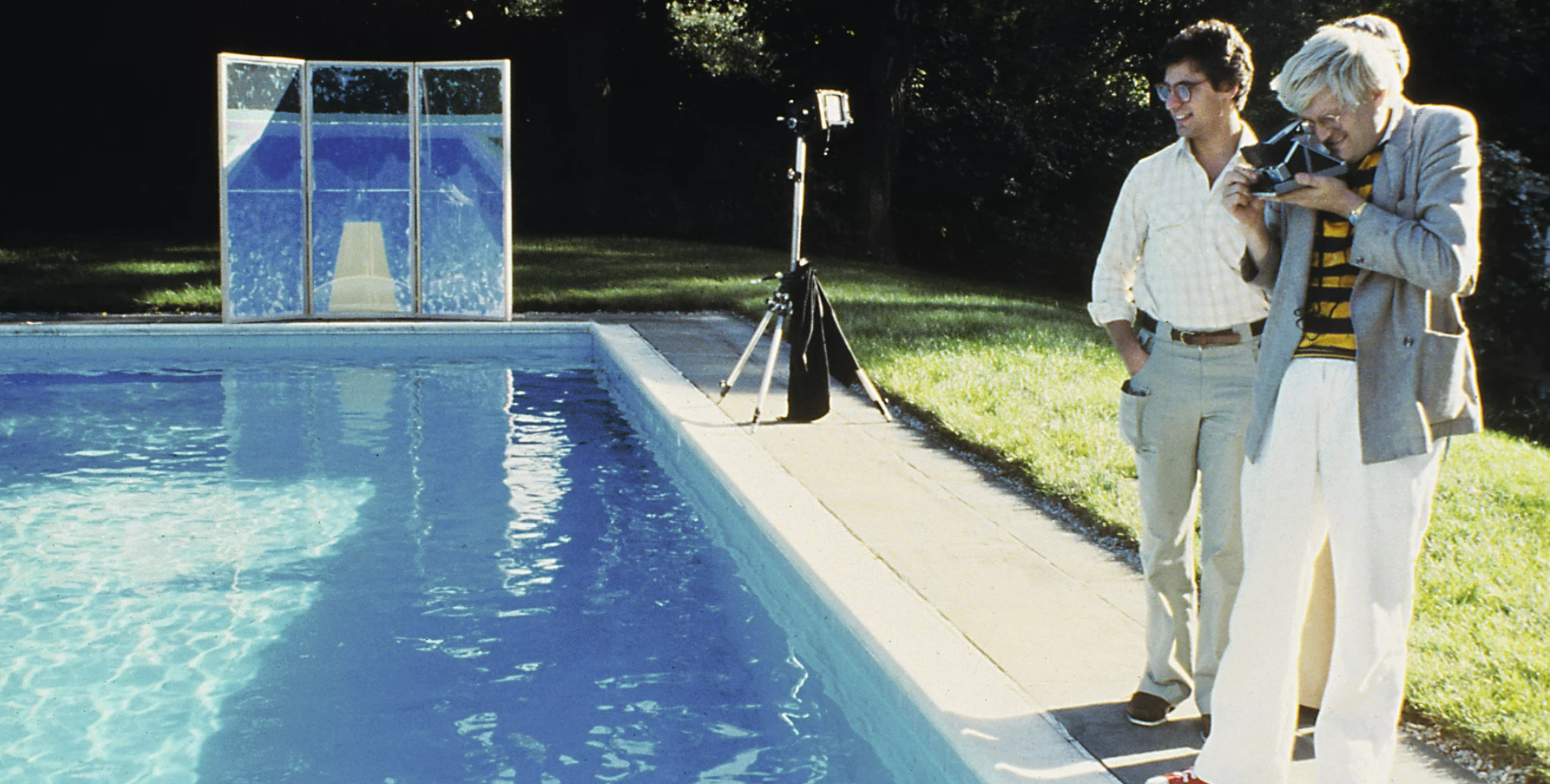
DAVID HOCKNEY TAKING POLAROID SHOTS OF TYLER’S POOL FOR THE PAPER POOLS SERIES IN BEDFORD VILLAGE, NEW YORK, 1979.
IMAGE: © KENNETH TYLER/ NATIONAL GALLERY OF AUSTRALIA, CANBERRA.
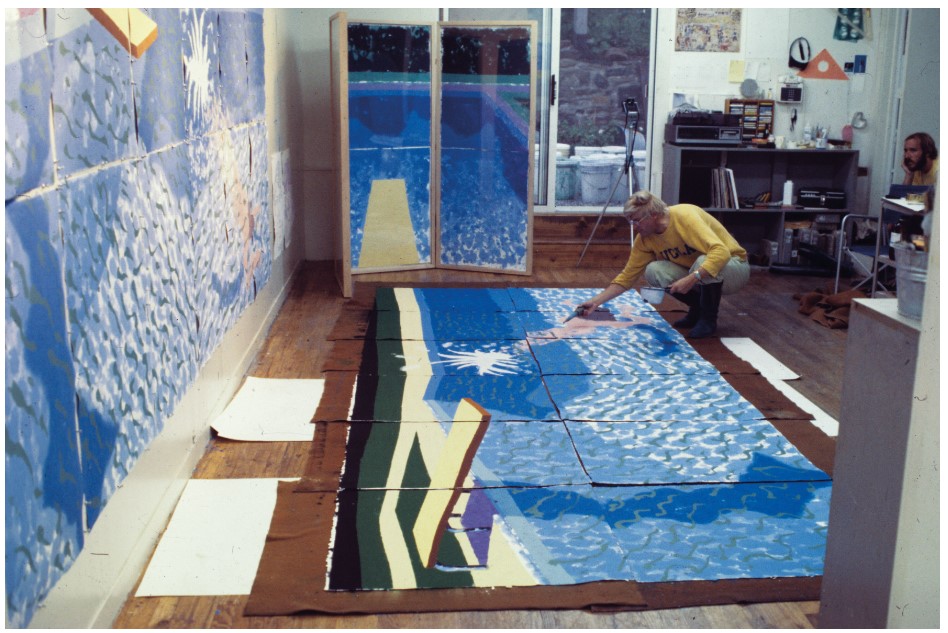
Between August and October 1978 Hockney recorded the impression of sunlight reflecting upon the water of Tyler’s pool amidst various weather conditions and at different times of day. Saturated hues of celestial blue, lavender and forest green pervade the surface of the present work, the overall tonality suggesting brooding clouds on a stormy summer day. Pool on a Cloudy Day with Rain (Paper Pool 22) is a dazzling testament to Hockney’s virtuosity in the medium of colour and form, and his unwavering receptivity to new stimuli: “The sheer bravura of David Hockney’s Paper Pools delights… They are joyous in colour and shape and monumental in scale. Enchanted with the elusive properties of light, Hockney has seized aspects of it, rippling it across and through his works with broad, fearless strokes. Whether in inky darkness or glimmering sunlight, his Pools refresh, please [and] recall the joyousness of Matisse” (J. Butterfield, ‘David Hockney: Blue Hedonistic Pools,’ The Print Collector’s Newsletter, Vol. 10, No. 3, July – August 1979, p. 74).
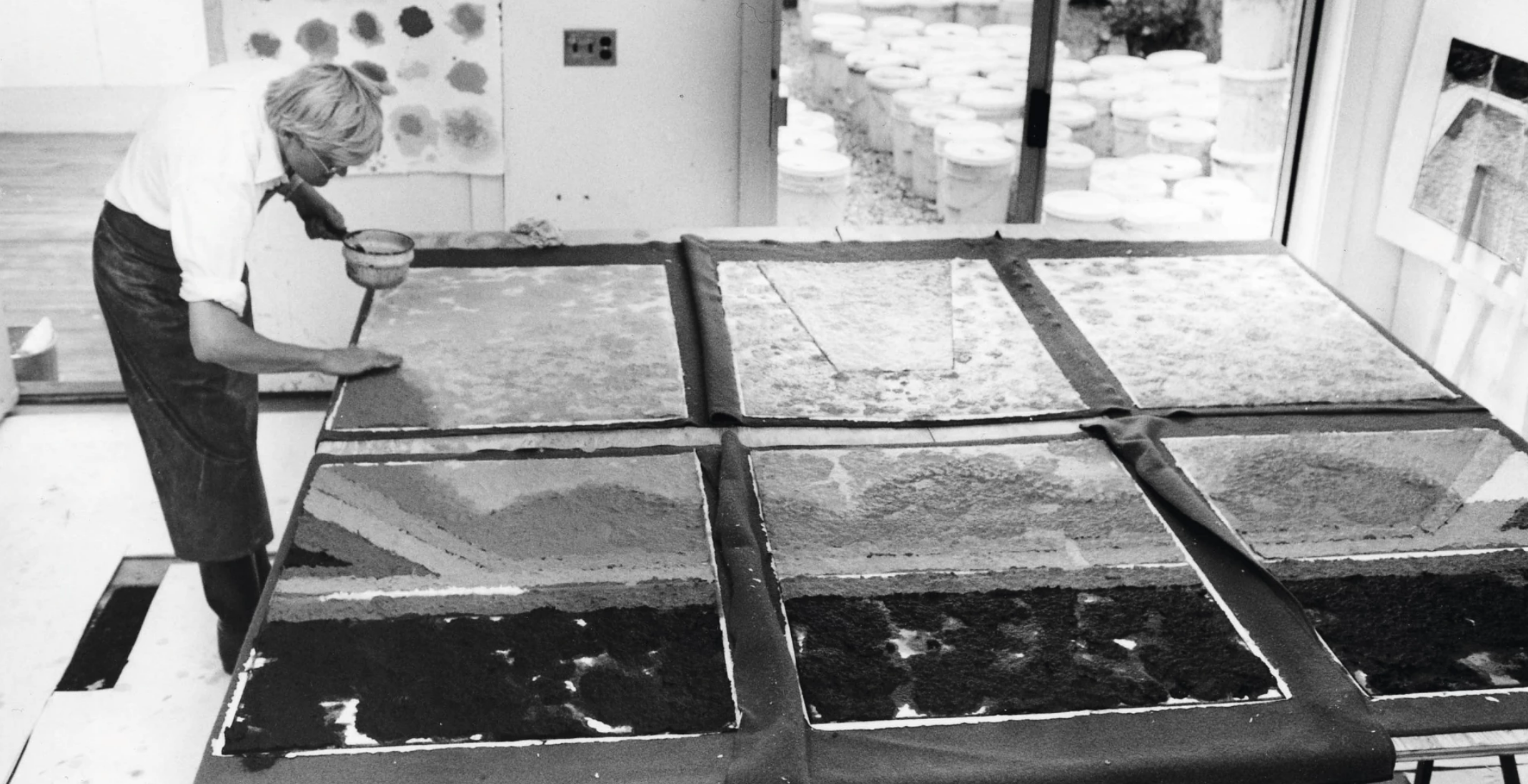
DAVID HOCKNEY WORKING ON THE PAPER POOLS SERIES IN BEDFORD VILLAGE, NEW YORK, 1978. IMAGE: © DAN FREEMAN/ NATIONAL GALLERY OF AUSTRALIA, CANBERRA. ARTWORK: © DAVID HOCKNEY 2020.
Sheer chance led Hockney to create the Paper Pools, and indeed to one of the most remarkable periods of experimentation of his career. Before returning to California in the summer of 1978, Hockney misplaced his driver’s license and was forced to stay in Westchester County, New York, for several weeks instead of what was initially intended to be a brief stopover. While stranded in New York, Hockney stayed with Tyler who introduced him to a ground-breaking technique. When asked how exactly the Paper Pools came about, Hockney claimed, “I didn’t intend for it to, actually… I arrived in New York on my way to California, and an old friend of mine, Ken Tyler, got in touch with me…. He started showing me some things he had been working with that had been made with paper pulp, that were done with Ellsworth Kelly and Kenneth Noland, and they were stunningly beautiful. They look so good physically that I really responded to them… well, the upshot of it was that he convinced me to stay three days, to give it a try, and in the end we found out that we had worked 45 days running with only one day off – it was that exciting, really. I think the way he got me interested in the beginning was through the process. I must confess that I love a new medium – especially if there is something about it I have never used before… I began to see there were real possibilities” (D. Hockney cited in: Ibid., p. 74). The beguiling, tactile quality of strikingly coloured liquid paper pulp resonated with Hockney, who employed this technique across the works in this series, all based on the glimmering pool at Tyler’s picturesque Bedford Village home.
This methodical process of image-making, which so fascinated Hockney, began with paper pulp that had been run through a machine and soaked in water. The pulp was then pressed into a thin mould made of wire, which was in turn dropped into a vat. When removed from the vat, the water would run through the wire leaving a thin layer of pulp on the surface of the mould. At this stage, Hockney would add vibrant dyes to the paper pulp, before drying the sheet between felts in a hydraulic press. Hockney explains, “The point of all this, really… is that you can put dyes and various things in the paper pulp… and the colour that you have made on the paper is much more vivid than paint on a surface…. The process seems to demand that you be very bold with it” (D. Hockney cited in: Ibid., p. 74). Hockney’s Paper Pools thus signify a major shift in his artistic process, in which paper trumps canvas in its compelling ability to absorb rich, saturated colour. Furthermore, the series demonstrates a playful self-referentiality due to the considerable amounts of water involved in the creative process: “In some of these pieces, [Hockney] was so concerned to emphasize the inherent wetness of water in a swimming pool (rather than, say, its transparency) that he used over a thousand gallons; ‘in a watercolor you only use a cupful,’ [Hockney] wryly remarked” (U. Luckhardt and P. Melia, Eds., David Hockney, 2011, p. 130).
Hockney’s consistent return to the theme of water and swimming pools is anchored to the artist’s beguilement with the innately American connotations of Hollywood, wealth and suburbia of the 1950s and 1960s. Upon arriving in the West Coast of America for the first time in 1964, Hockney was struck by the sheer ubiquity of swimming pools. The iconography of the pool introduced leisure, sensuality and optimism to his work, themes that were largely absent prior to leaving Britain.The swimming pools of Los Angeles presented a fresh challenge to Hockney in the early 1960s; that of depicting an object which is at once unfixed and entirely transparent to the eye. The medium of paper pulp and dye thus provided Hockey with unlimited potential for innovation, and the ability to capture the qualities of water and light always in flux. Hockney asserts, “I kept looking at the swimming pool. You know, it is a wonderful subject – water, and light on the water. Also, this process of making paper demands a lot of water… every time you look at a pool, it is a different blue, and each time you see it, it takes on a different character. You look at the surface, you look below it, you look through it; every day it looks different” (D. Hockney cited in: Op. cit.).
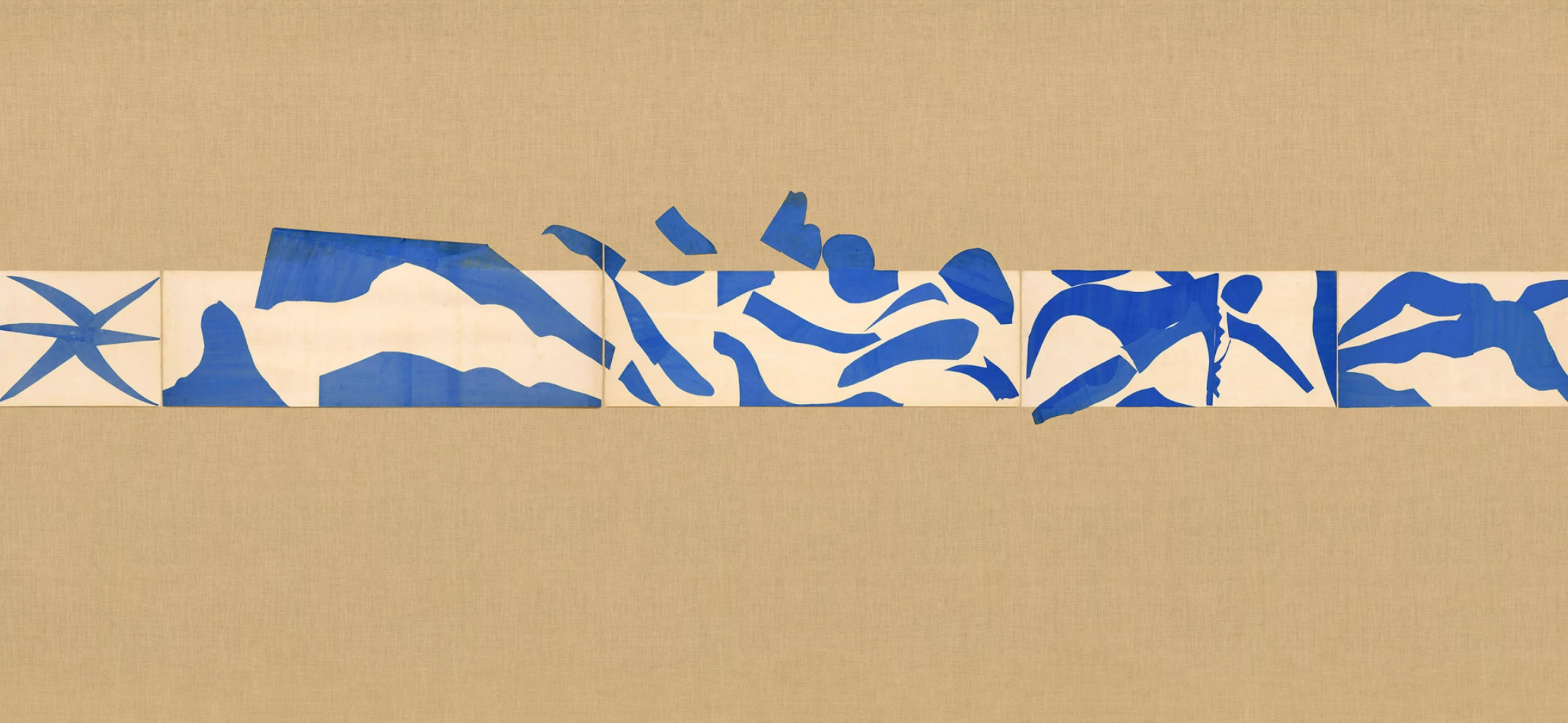
HENRI MATISSE, THE SWIMMING POOL (RIGHT SIDE), NICE-CIMIEZ, HOTEL REGINA, LATE SUMMER 1952, 1952. THE MUSEUM OF MODERN ART, NEW YORK. IMAGE: © 2020 THE MUSEUM OF MODERN ART, NEW YORK/SCALA, FLORENCE. ARTWORK: © SUCCESSION H. MATISSE/ DACS 2020.
Hockney’s fascination with perception and the interplay of light recalls those artists before him who were similarly preoccupied with changeable atmospheric conditions. Claude Monet’s ethereal treatment of sparkling light on the surface of the Seine in works such as Branch of the Seine near Giverny (1897) or Georges Pierre Seurat’s post-Impressionist seascapes such as The Channel of Gravelines, Petit Fort Philippe (1890) come to mind. Yet Hockney also draws upon twentieth century modernist influences, most importantly the dynamic cut-outs of Henri Matisse. Writer and critic Matthew Sperling asserts of Hockney’s Paper Pools, “The resulting images are not works on paper so much as works in which form and texture adhere in the paper itself, with line and color completely integrated in a manner that recalls the paper cut-outs of Matisse (who had made his own remarkable contribution to the genre of the pool picture in his 1952 cut-out, The Swimming Pool)” (M. Sperling, ‘The Pull of Hockney’s Pool Paintings’, Apollo Magazine, February 2017, online). The spectacular hues of aquamarine and sapphire on the flat picture plane of Matisse’s The Swimming Pool (right side) present a compelling parallel to the multifarious shades of blue throughout the Paper Pools series, the present work and Matisse’s cut outs both employing the medium of paper to exquisite effect.
Pool on a Cloudy Day with Rain (Paper Pool 22) is a pivotal extension of the acclaimed swimming pool imagery of the 1960s for which Hockney is so beloved. Here, channeled through a wholly new form of expression by means of paper pulp and dye, Hockney powerfully juxtaposes abstraction and representation, and the invariably different influences of the East Coast and West Coast. Of his deep, lush pools, Hockney summarizes “I will tell you something wonderful. In 1970 when I had a big show, somebody wrote, ‘Hockney paints Hollywood swimming pools because they are simply another version of the Mediterranean.’ I never thought of that before, but the Mediterranean is a blue hedonistic pool in a Matisse sense. In California it is the swimming pool, and not the ocean, that is the hedonistic pool. And my pools are that. Blue hedonistic pools” (D. Hockney cited in: Op. cit.).
Paper Pool 29, 1978
Autumn Pool (Paper Pool 29)
Phillips London: 13 October 2010
GBP 1,329,250
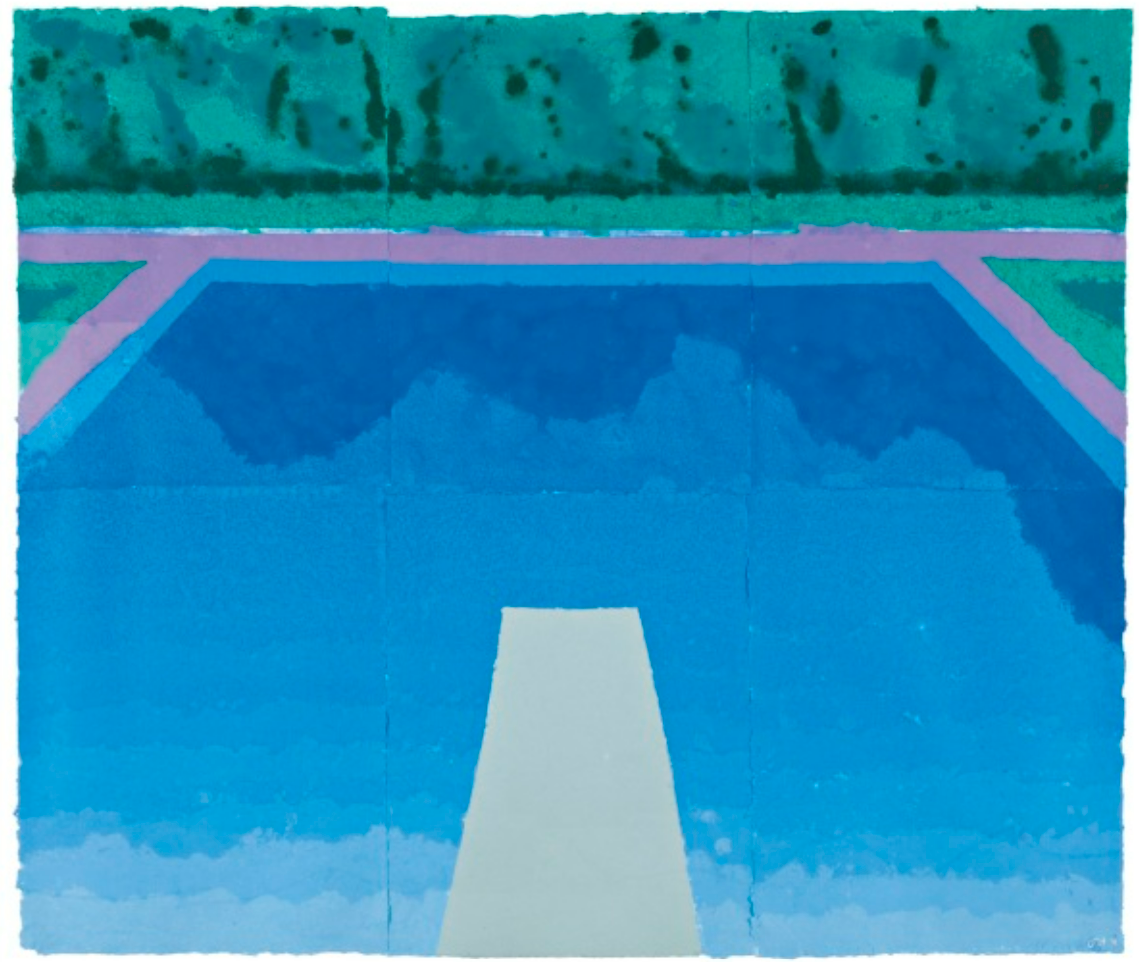
DAVID HOCKNEY
Autumn Pool (Paper Pool 29), 1978
Colored and pressed paper pulp in six parts.
182.9 x 215.9 cm (72 x 85.5 inches)
Initialed and dated ‘DH 78’ lower right
In 1978, David Hockney was travelling from London to Los Angeles, his second home, when he paid a visit to his friend, the lithographer Ken Tyler, in Bedford Village, New York. Having lost his driving license, Hockney extended what was originally a brief stop-over to a longer stay during which he collaborated with Tyler on what would become one of his most celebrated bodies of work, the Paper Pool series. As Hockney waited for his replacement license to arrive, Tyler showed him some works made with paper pulp using a revolutionary printing technique which produced brilliant and dazzling color. Hockney was so intrigued that he spent the next several months creating 29 works based on the motif of Tyler’s swimming pool of which Autumn Pool, the present lot, is an outstanding example.
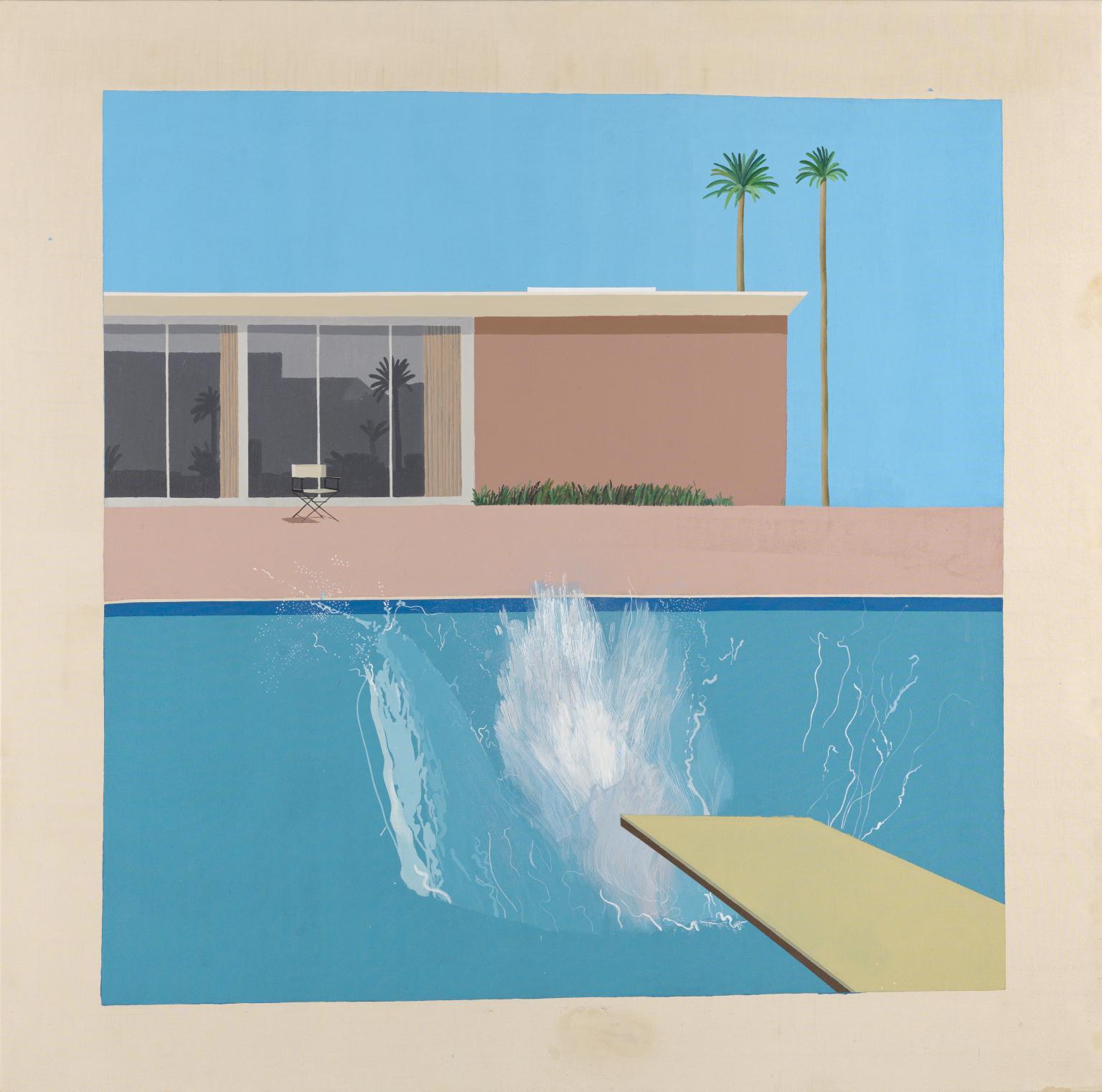
The swimming pool is without doubt the most recognizable motif in David Hockney’s oeuvre. Since the mid-1960s, Hockney has painted, drawn, photographed and printed the image of the swimming pool. Emerging out of the greyness of the post-war years, Hockney’s depictions of Californian swimming pools and their association with a glamorous and exotic life of sun, wealth and leisure, ushered in a period of renewed optimism, youthfulness and color in Britain. The Tate Gallery’s A Bigger Splash, arguably Hockney’s most famous painting, is an early work depicting a diver’s splash in a swimming pool in the garden of a modernist house under a typical warm, sunny, cloudless Southern California day. The culmination of a series of three paintings based on the same motif, A Bigger Splash sees Hockney engage with the age-old problem of how to create an illusion of light, space and volume. Using flat blocks of highly saturated colors, Hockney defined with unprecedented vitality and innovation a classic yet modern landscape.
Autumn Pool, executed 12 years later in an entirely different, radical medium, is a continuation and evolution of the themes and compositional devices Hockney first examined in A Bigger Splash. While the swimming pool and diving board remain, the house recedes into the background, leaving the focus of the image on the illusion of light, space and volume by the opposition of line and color and of surface and perspectival depth.
Autumn Pool is a tightly framed pictorial composition across six sheets of paper, with a composite, tessellated image of a pool and its diving board. The picture’s balanced layout is dominated by the strong vertical and horizontal lines of the jutting diving board and the edges on the pool. Accentuated by the protruding white board, the composition’s one-point perspective effortlessly draws the viewer’s eye across the brilliant, jewel-like tones of the pool’s water which reflects and refracts the luminous light drenching the outdoor scene. While the bold lines define a perspective, Hockney’s lack of formal tonal recession reinforces the abstract flatness of the picture plane. Simple and daring in its formal design, Autumn Pool is filled with a tension between the figuration of the composite image and the abstraction of each individual sheet.
This mode of representation has been an ongoing concern in Hockney’s work, especially in Polaroid photographic pieces in which the image is made up of a mosaic of accumulated detailed images. Another major formal influence are the Japanese woodblock prints, Thirty-six Views of Mount Fuji by Hokusai, with their sense of compressed space and emphasis on diagonal perspective – a visual and compositional effect clearly seen in Autumn Pool.
Paper Pool 30, 1978
Piscine de Medianoche (Paper Pool 30)
Estimated: USD 5,000,000 – 7,000,000
USD 11,743,800
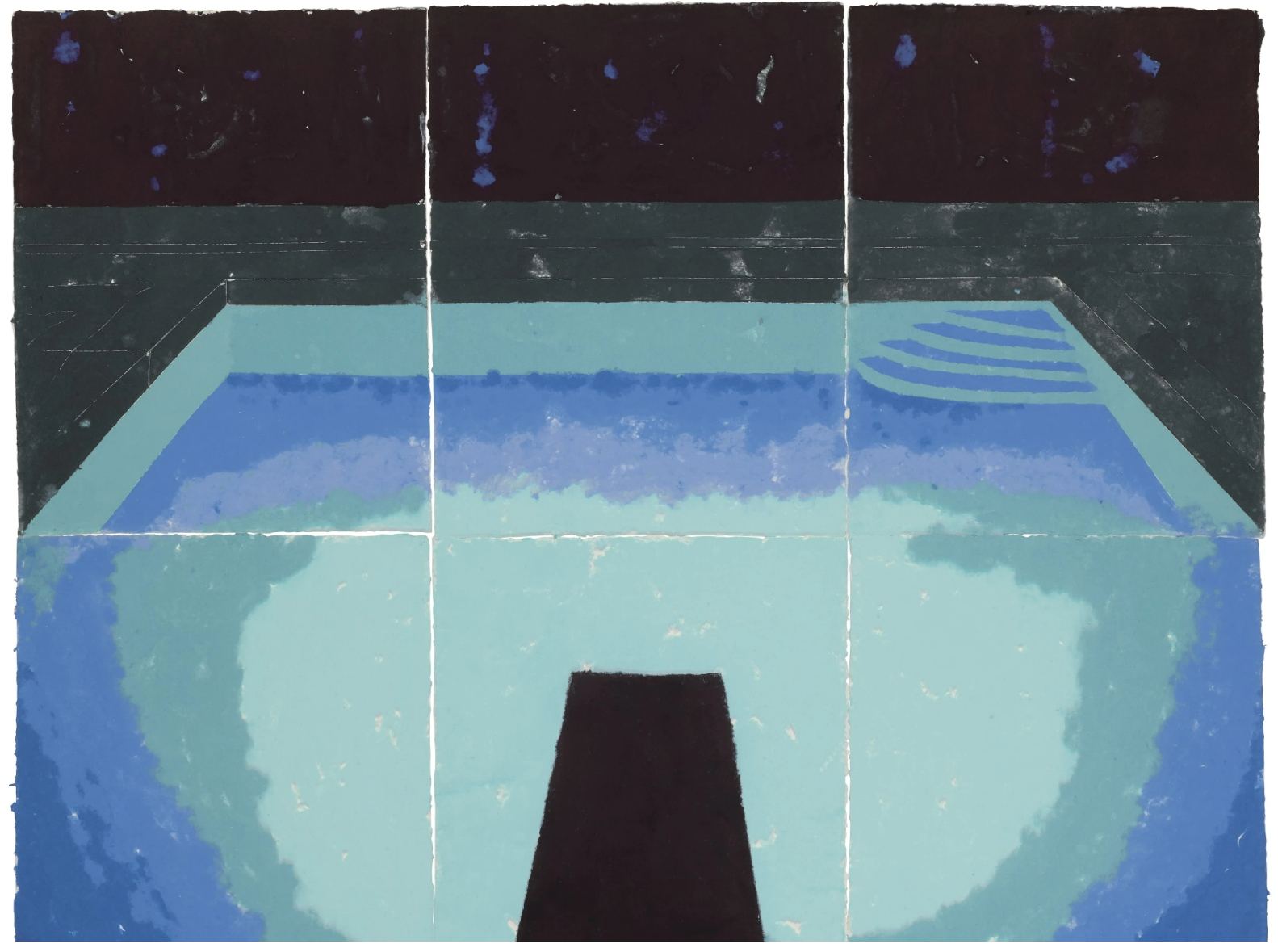
DAVID HOCKNEY
Piscine de Medianoche (Paper Pool 30), 1978
Colored and pressed paper pulp
72 x 85.5 inches (182.9 x 217.2 cm)
Signed and dated 78
“I like the night images very much, really. I think these images have the most mystery. The color is quite beautiful.”
Suffused with the luminous, jewel-like colors of turquoise, aquamarine, and jet-black, David Hockney’s Piscine de Medianoche (Paper Pool 30) is a brilliant iteration of the artist’s beloved series – the Paper Pools of 1978. Inspired by his friend Kenneth Tyler’s swimming pool in Westchester County, New York, this dazzling series reprises one of Hockney’s most iconic motifs. In the Paper Pools, Hockney recorded the effects of sunlight as it reflected upon the water of Tyler’s pool at various time of the day, creating a series of unique works on paper, in which dye-infused paper pulp was pressed into stunning, color-soaked sheets. Piscine de Medianoche (Paper Pool 30) belongs to a particular subset of Paper Pools, in its ravishing depiction of a swimming pool after dark. Never before had Hockney’s treatment of the ephemeral qualities of light on water met such a perfect marriage as in the Paper Pools, with the midnight swimming pools a particularly ravishing group. Taken from the vantage point of the diving board after nightfall, the intensity of the saturated colors and their midnight setting in Piscine de Medianoche (Paper Pool 30) is the perfect platform, allowing Hockney to wax poetic upon the qualities that linger just beneath the surface of the iconic swimming pools, with longing and desire at their forefront. Epitomizing the era of unabashed optimism in which they were created, Hockney’s swimming pools captured and distilled the particular essence of Southern California in the mid-1960s, and in the Paper Pools, they remain an enduring celebration of the artist’s highly-coveted and deeply personal theme.
Stretching across six panels, Hockney’s modernist precision is matched only by his flair for color in Piscine de Medianoche (Paper Pool 30), as softly radiant passages of turquoise and aquamarine encircle and envelop the viewer, giving the impression of a nighttime pool lit by an underwater light. The effect of the saturated bands of alternating color – extending outward in concentric rings from cool, crystalline waters to a shadowy marine blue – is altogether painterly, as Hockney’s innovative technique allows the intermingling of colors at an almost microscopic level. Set against a darkened backdrop of rich, inky blacks, the cooled tones of the swimming pool underlit by submerged electric light ‘pops’ out from the surface, lending a striking degree of depth and verisimilitude to this decidedly flattened, abstract depiction. Tiny pinpoints of bright white peek through the paper pulp, giving off the effect of sparkling light as it glistens across the surface of softly-dappled water. Bathed in the particular ‘aura’ the work emanates, one becomes acutely aware of standing before an empty swimming pool after nightfall, with the cool breeze of the evening air lending a sensuous quality to the otherwise pristine body of water.
Using a variety of tools, Hockney applied the colored paper pulp into cloisonné-type molds. Soup ladles, turkey basters, spoons and brushes allowed the artist to create the specific look he desired, and he particularly enjoyed the wet, messy process, which he felt was naturally suited to the liquid nature of the swimming pools. Spurred on by Tyler’s excitement for the new medium and the physicality of the process, Hockney became energized, working for forty-five days straight as late summer gradually turned to fall. As the project progressed, Hockney carefully recorded the effects of sunlight, shadow and other ephemeral effects of weather as they impacted the pool with his Polaroid camera. One evening, after a particularly productive day, Hockney was struck by the appearance of the swimming pool after dark, particularly when Tyler activated its underwater lights. “The light from within the pool stops at the surface of the water and everything above it is black,” Hockney described. “The diving board becomes black… And I thought that was very exciting, and I said, that’s what we will do tomorrow.” (David Hockney, quoted in Nikos Stangos, Ed., David Hockney: Paper Pools, New York, 1980, p. 48)
In Piscine de Medianoche (Paper Pool 30), Hockney employs the darkened diving board as a compositional device, drawing the eye upwards into the central action of the luminous swimming pool. One of approximately five unique works that feature the pool after dark, Piscine de Medianoche (Paper Pool 30) is a brilliant orchestration, in which the effects of light-dappled water set amidst a midnight scene break free from their representational role to become independent entities, their luxurious color harmonies on par with the best of the Color Field painters. The soft and subtle variations that Morris Louis and Helen Frankenthaler teased out from the thinned-down paint as it soaked and stained their raw, unprimed canvases is certainly evoked in the present work, as the individual colors sing and glow, especially when in concert together. In the present work, Hockney wields an impressive degree of control, as he allows the colors to seamlessly blend and pool into each other, compounded by the sheer scale of the six-panel work, which stretches over seven feet in width. Not unlike Mark Rothko’s saturated pillars of pure color, Hockney envelops his viewer in a painterly embrace, though its mood leans less toward Rothko’s sober pillars of color and more toward the splendor of Henri Matisse, as beautifully exemplified in Matisse’s late composition, Polynesia, the Sky, which features discrete passages of varied blue grounding a harmoniously choreographed dance of birds.