DAVID HOCKNEY (b. 1937)
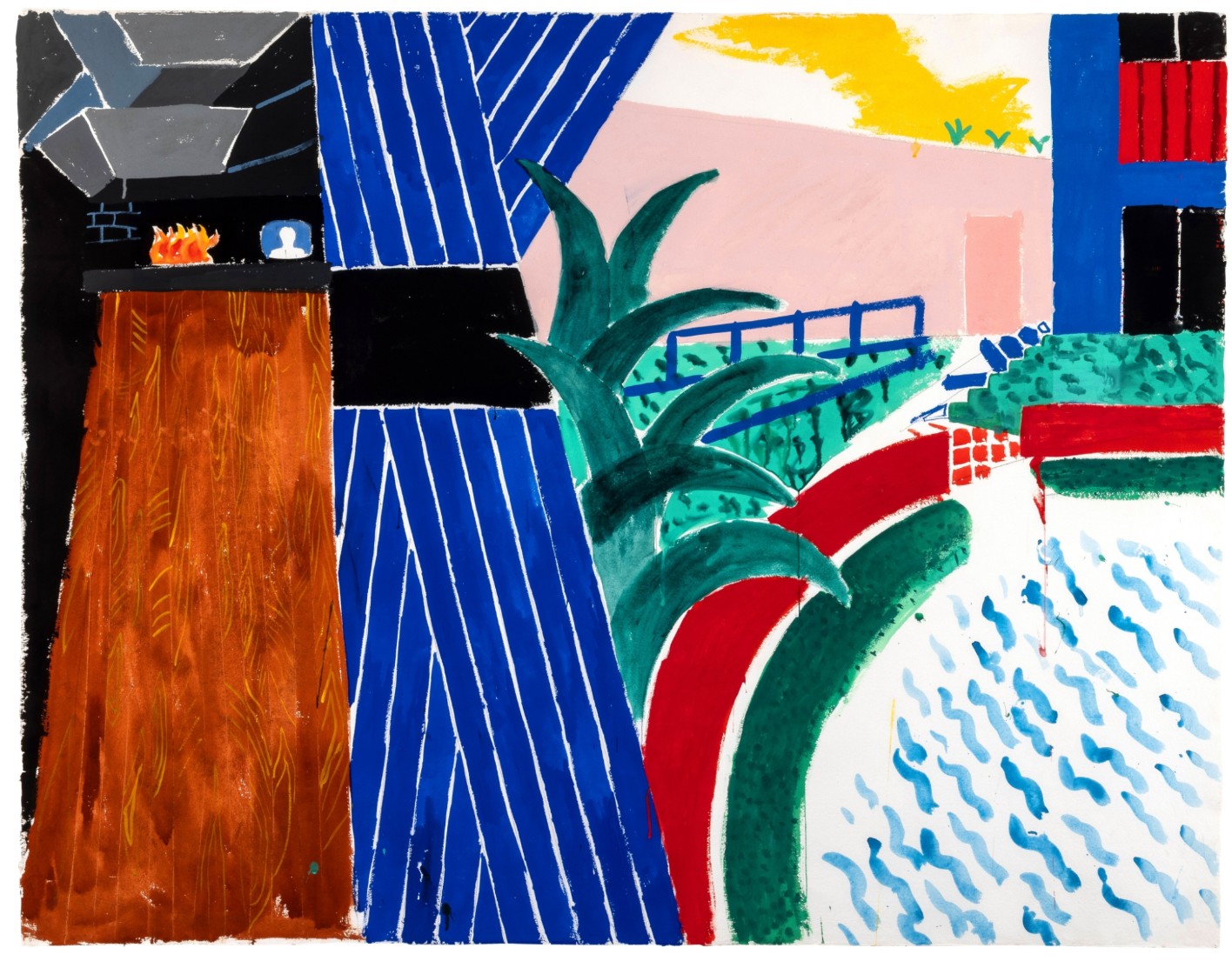
Terrace Hollywood Hills House with Banana Tree, 1982
Gouache and graphite on paper
51 1/8 x 65 7/8 inches (129.8 by 167.3 cm)
Provenance
Harriet Walker Henderson, Hillsborough (acquired directly from the artist)
Sotheby’s New York, 9 May 1990, lot 331 (consigned by the above)
André Emmerich Gallery, New York (acquired from the above)
Acquired from the above in December 1990 by the present owner
Auction History
Sotheby’s London: 16 May 2025
Estimated: USD 1,200,000 – 1,800,000
USD 2,487,000
WORK ON PAPER
Terrace Hollywood Hills House with Banana Tree | Contemporary Day Auction | 2025 | Sotheby’s
A radiant confluence of color, light, and structured play, Terrace Hollywood Hills House with Banana Tree is a resplendent example of David Hockney’s California-inspired period, one that captures the breezy optimism and architectural allure of Los Angeles in the early 1980s. Executed in 1982, the work reflects Hockney’s masterful command of composition, perspective, and atmosphere, uniting formal rigor with expressive ease. The work has remained in the same private collection for over three decades.
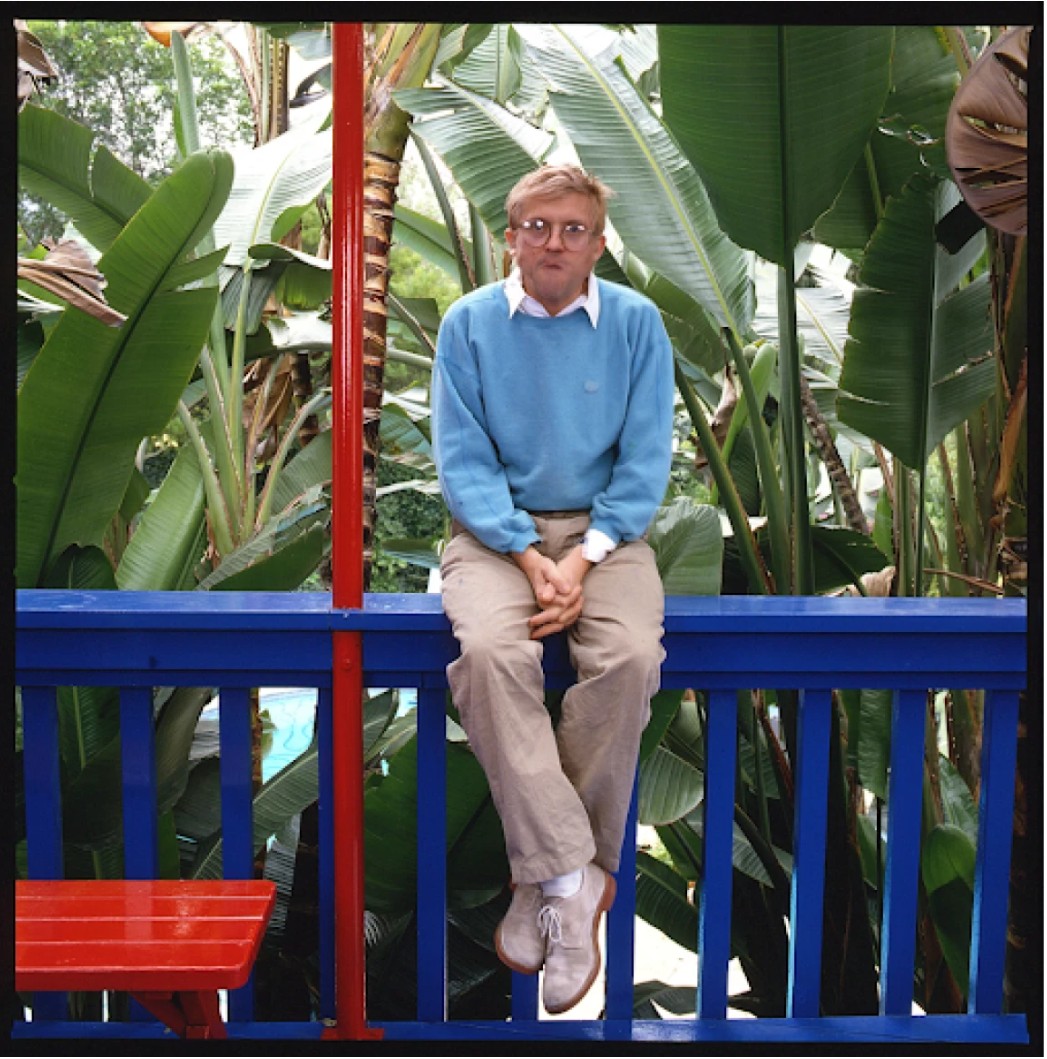
David Hockney on the porch of his Los Angeles home, 1987. Photo © Anthony Barboza/Getty Images
By this time, Hockney had long since relocated to Southern California, a landscape that had become both his muse and his adopted home. The Hollywood Hills, with their undulating terrain, mid-century homes, and technicolor skies, provided fertile ground for the artist’s pursuit of a uniquely Californian modernism. This work, originally exhibited in the groundbreaking traveling show Hockney Paints the Stage, radiates with that very luminance.
“California always affected me with color. Because of the light you see more color, people wear more colorful clothes, you notice it, it doesn’t look garish: there is more color in life here.”
The composition itself is a dialogue between interior and exterior, between natural and architectural elements. On the left, Hockney suggests the cozy interior of a modernist home—a sliver of wooden floorboards, a glowing fireplace, and a grey geometric ceiling above a dramatic blue curtain, rendered in bold diagonal lines. These vibrant theatrical stripes recall not only the artist’s enduring interest in stage design but also the dynamic interplay of movement and stasis that characterizes his best work. The curtains part to reveal a visual cascade of botanical and architectural forms: lush banana leaves thrust upward, while red and green arcs delineate the curve of a terrace leading toward the stylized undulations of a sunlit swimming pool.
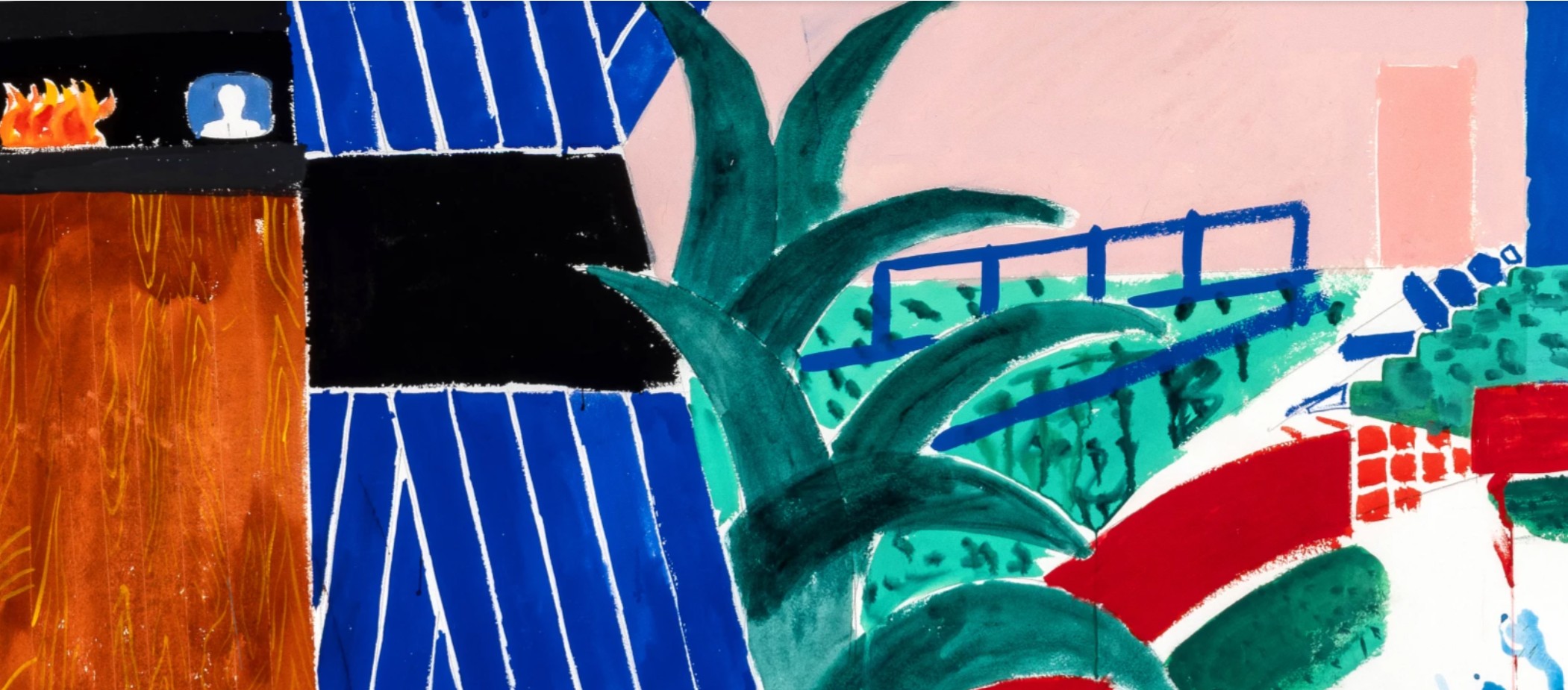
The viewpoint is deliberately fragmented and dynamic, merging multiple perspectives in a single frame—a visual strategy Hockney had been exploring since his photocollages and cubist-inspired experiments of the late 1970s. In this work, the juxtaposition of high and low vantage points serves to flatten the pictorial space while simultaneously suggesting a cinematic sweep across the domestic landscape. The pink stucco wall and blue railings evoke the quintessential aesthetics of Los Angeles domestic architecture, while the vibrant palette—cobalt blue, fire red, poolside aqua—underscores the artist’s confidence in color as a psychological and compositional tool.
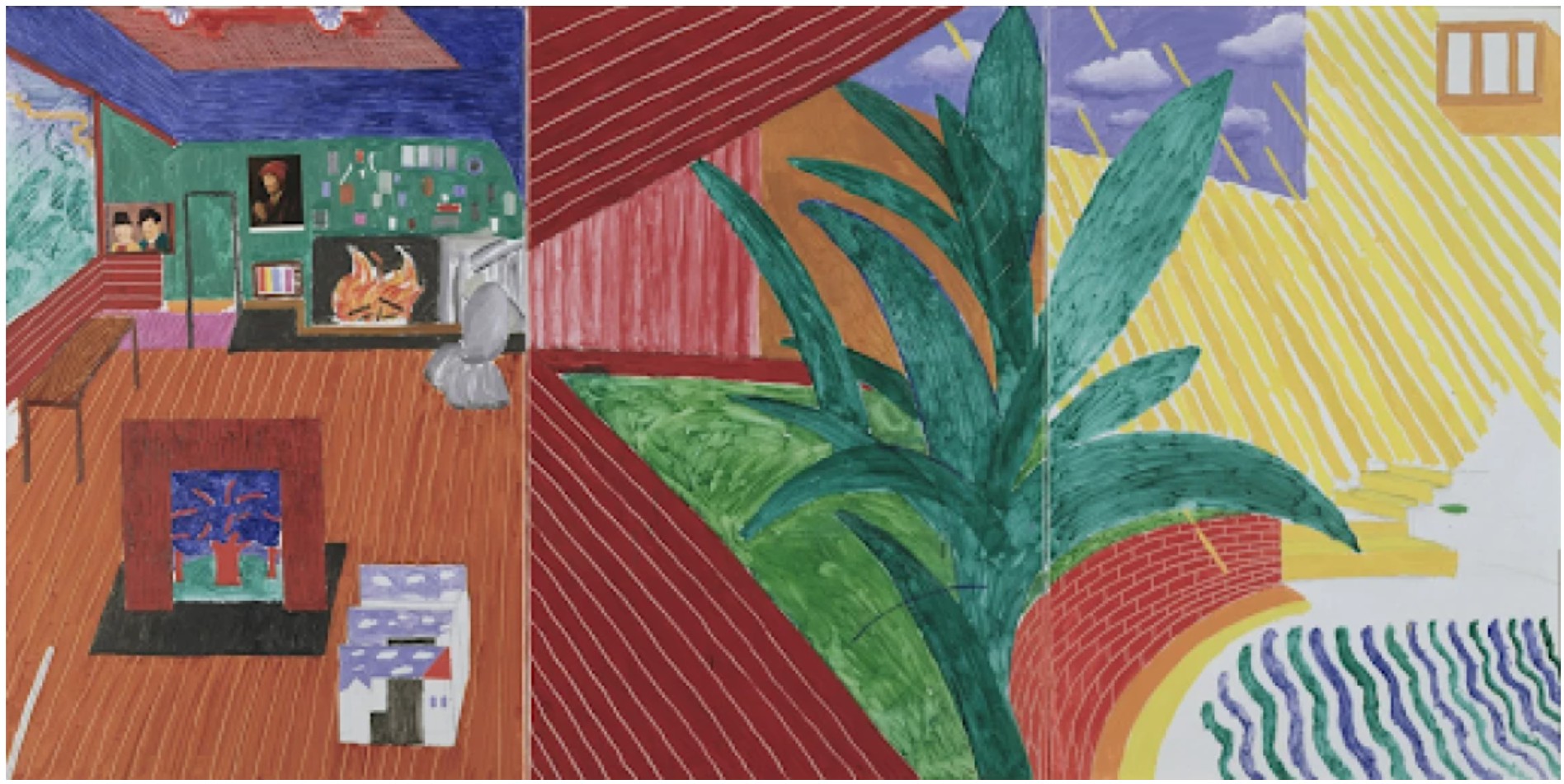
David Hockney, Hollywood Hills House, 1981-1982. Walker Art Center, Minneapolis.
This deliberate flattening and segmentation of space finds a potent art-historical echo in the works of Henri Matisse, whose own use of color fields and interior/exterior contrasts Hockney greatly admired. Yet, unlike Matisse’s often enclosed domestic views, Hockney’s composition opens outward—a gesture of expansiveness both physical and metaphorical. The gestural rendering of water in the pool, composed of rhythmic blue dashes, is one of Hockney’s signature motifs, referencing his iconic swimming pool paintings of the 1960s while recontextualizing them within a looser, more spontaneous medium. Indeed, Terrace Hollywood Hills House with Banana Tree occupies a fascinating midpoint between Hockney’s crisp early poolside paintings and his later, more abstracted landscapes of Yorkshire. It reflects the artist’s deep engagement with the lived environment, filtered through a modernist lens that combines personal observation with formal invention. The inclusion of the banana tree is more than botanical—it is symbolic, invoking the tropical luxuriance of California living while also serving as a compositional anchor, its sharp green fronds directing the eye back into the layered space of the image.
The theatricality of the composition—with its curtain-like blue stripes and spotlight-bright zones of color—reminds us of Hockney’s parallel career as a stage designer. The work was part of the Hockney Paints the Stage exhibition, a major survey of the artist’s set designs and scenographic sensibility. Considered within this context, Terrace Hollywood Hills House with Banana Tree becomes both a depiction of a lived-in space and a constructed mise-en-scène, a memory as much as a view.
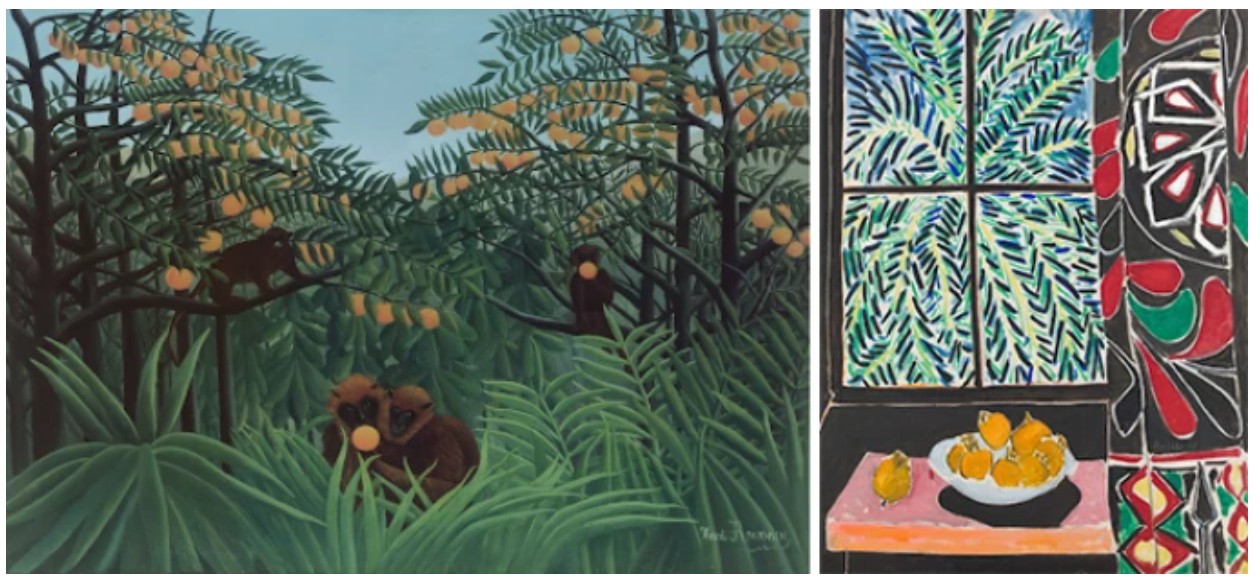
Left: Henri Rousseau, Monkeys in the Jungle (The Tropics), 1910. Private Collection. Image © Bridgeman Images
Right: Henri Matisse, Interior with Egyptian Curtain, 1948. The Phillips Collection, Washington D.C. © 2025 Succession H. Matisse / Artists Rights Society (ARS), New York.
Terrace Hollywood Hills House with Banana Tree captures Hockney at a moment of creative synthesis—where architecture, light, memory, and performance converge. Its layered perspective, chromatic bravura, and embrace of both the theatrical and the quotidian make it a standout among the artist’s celebrated explorations of life under the California sun. This is not merely a view; it is an experience refracted through Hockney’s singular vision, offering the viewer a portal into a world of vivid sensation and formal delight.