Roy Lichtenstein is one of the originators of the Pop Art movement, famed for paintings that take kitsch and transform it into culture. Lichtenstein was born in New York City in 1923. Growing up, he took art classes at the Art Student League where he created realist paintings. Lichtenstein continued his study of art at Ohio State University but, with the advent of World War II, he enlisted in the army in 1943. Lichtenstein returned to Ohio State after the war to finish his master’s degree in studio art. While Lichtenstein was teaching art at Rutgers University, he became close with fellow artist Allan Kaprow, who introduced him to Claes Oldenburg. It was during the 1960s that Lichtenstein began experimenting with what would become his signature style of taking images from comic books and newspapers and reproducing them on a large scale, calling attention to the flatness of the imagery with his Ben-Day technique of painting dots. In 1962, Lichtenstein got his first break with a one-man show at the Leo Castelli Gallery, which sold out before it opened.

SIMPLY CLICK ON THE PRINT IMAGE
TO PULL-OUT THE CATALOGUE ENTRY AND ALL AUCTION RESULTS
WORK IN PROGRESS
Early Prints, 1963-1969
Crying Girl, 1963
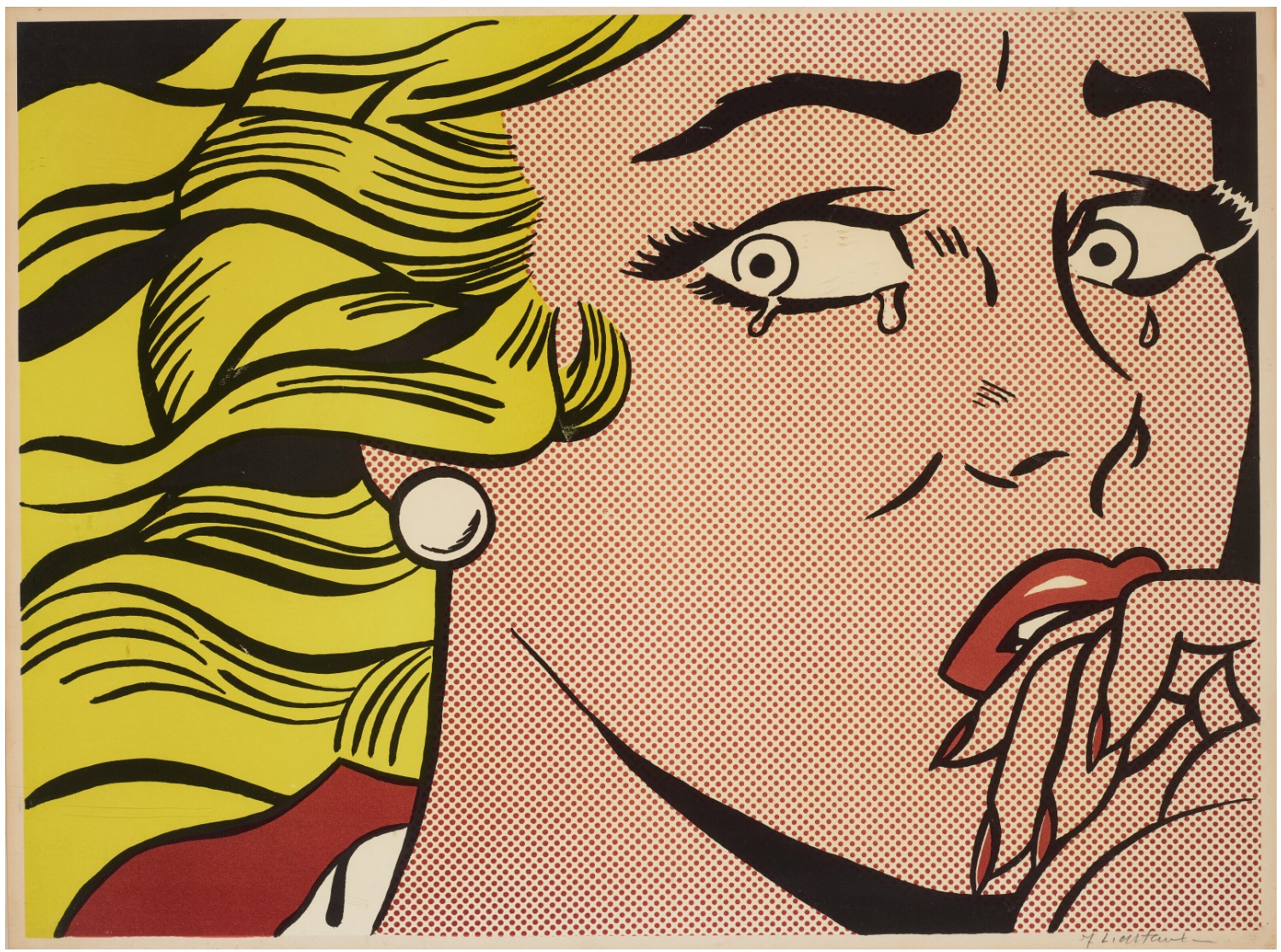
Crying Girl, 1963
Offset lithograph in colors, on wove paper
18×24 inches (45.8 x 61 cm)
Edition: Unknown size
Literature: Corlett II.1
Crying Girl may be the most iconic print created by Roy Lichtenstein. It was originally made as an invitation to Roy Lichtenstein’s show in New York at the Leo Castelli Gallery. Aside from the invitations which was folded in four, Lichtenstein kept some and signed them. Crying Girl looks out of the corner of her eyes to the right and holds her hands to her mouth as if muffling a gasp. Tears bead out of the corner of her eyes, leading the viewer to wonder why…
Crak!, 1963
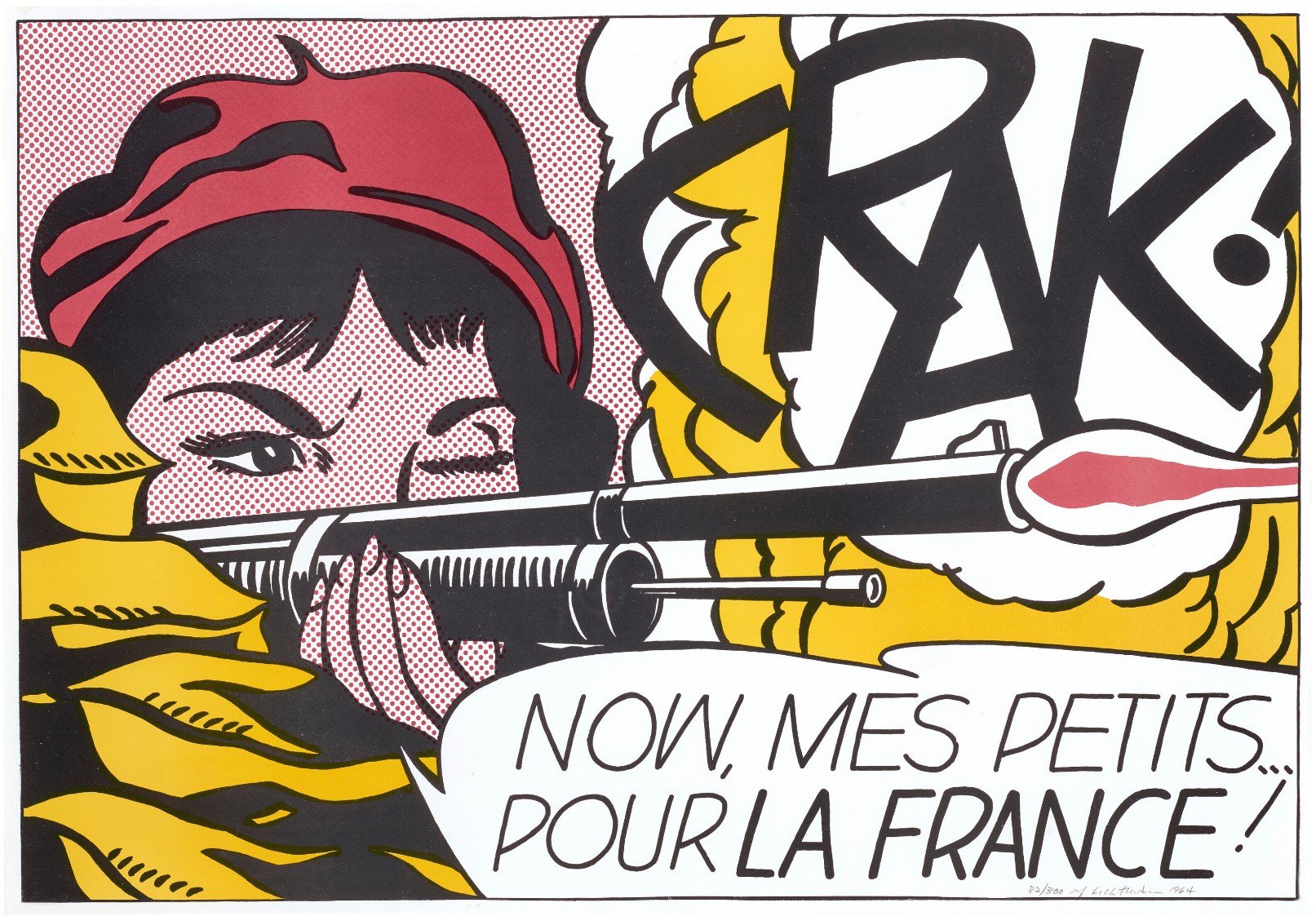
Crak!, 1963-1964
Offset lithograph in colors, on wove paper
Sheet: 19 1/4 x 27 1/2 inches (48.9 x 69.9 cm)
Edition: 300
Literature: Corlett II.2a
Foot and Hand, 1964
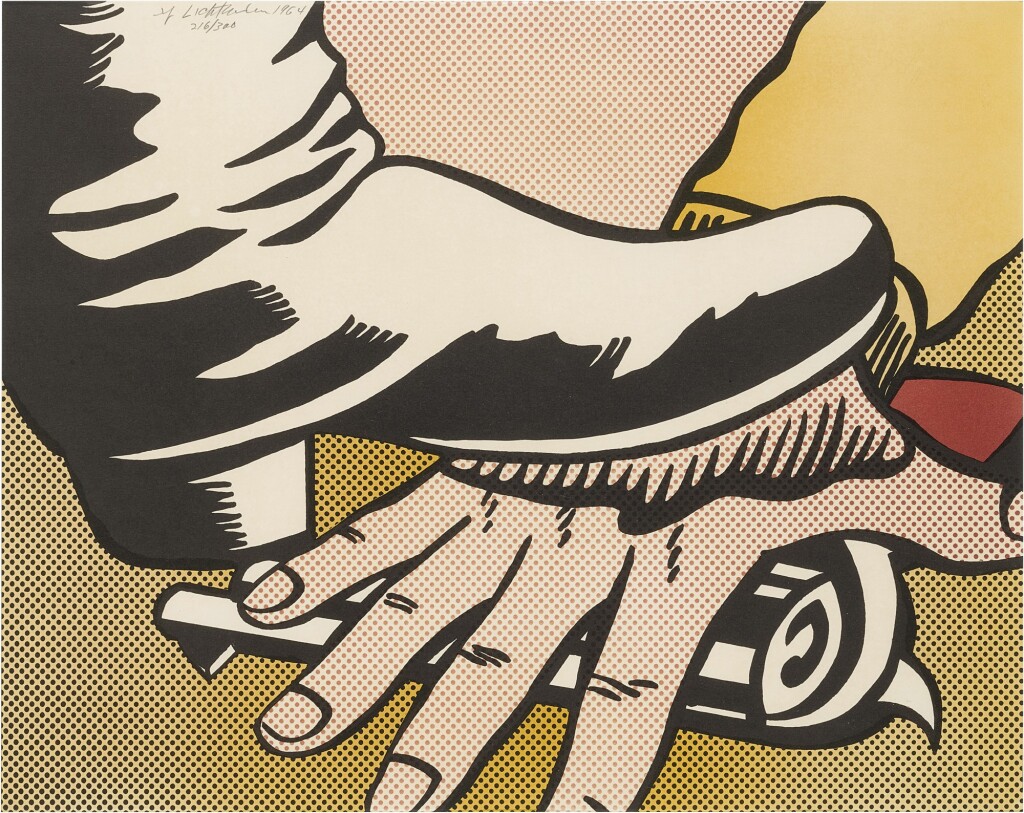
Foot and Hand, 1964
Lithograph printed in colors on white wove paper
Sheet: 17 1/4 x 21 1/2 inches (43.8 x 54.6 cm)
Edition: 300
Literature: Corlett II.4
Temple, 1964
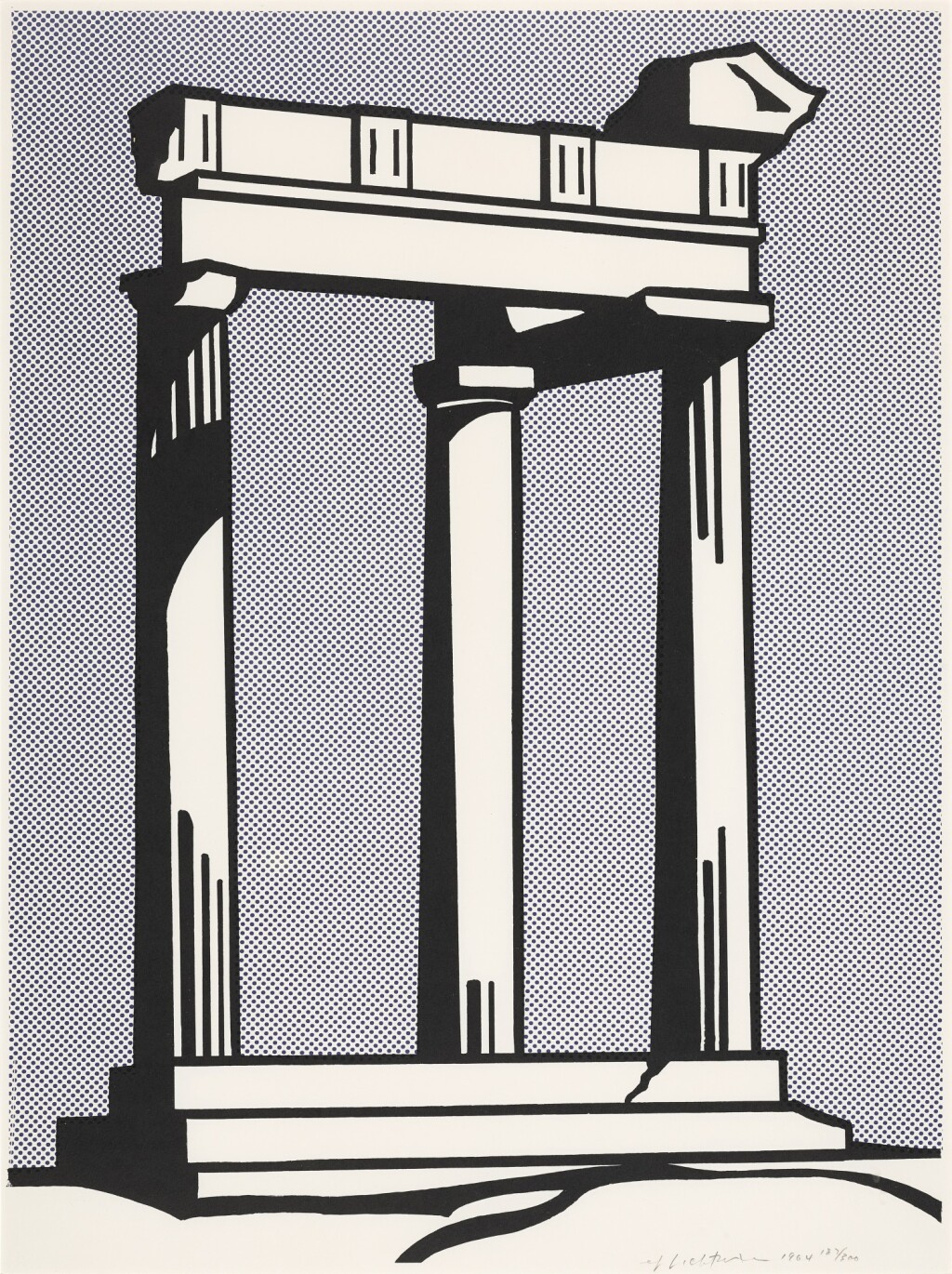
Temple, 1964
Color offset lithograph printed on smooth cream wove paper
Sheet: 23 3/4 x 17 3/4 inches (60.5 x 45 cm)
Edition: 300
Literature: Corlett II.3
Shipboard Girl, 1965
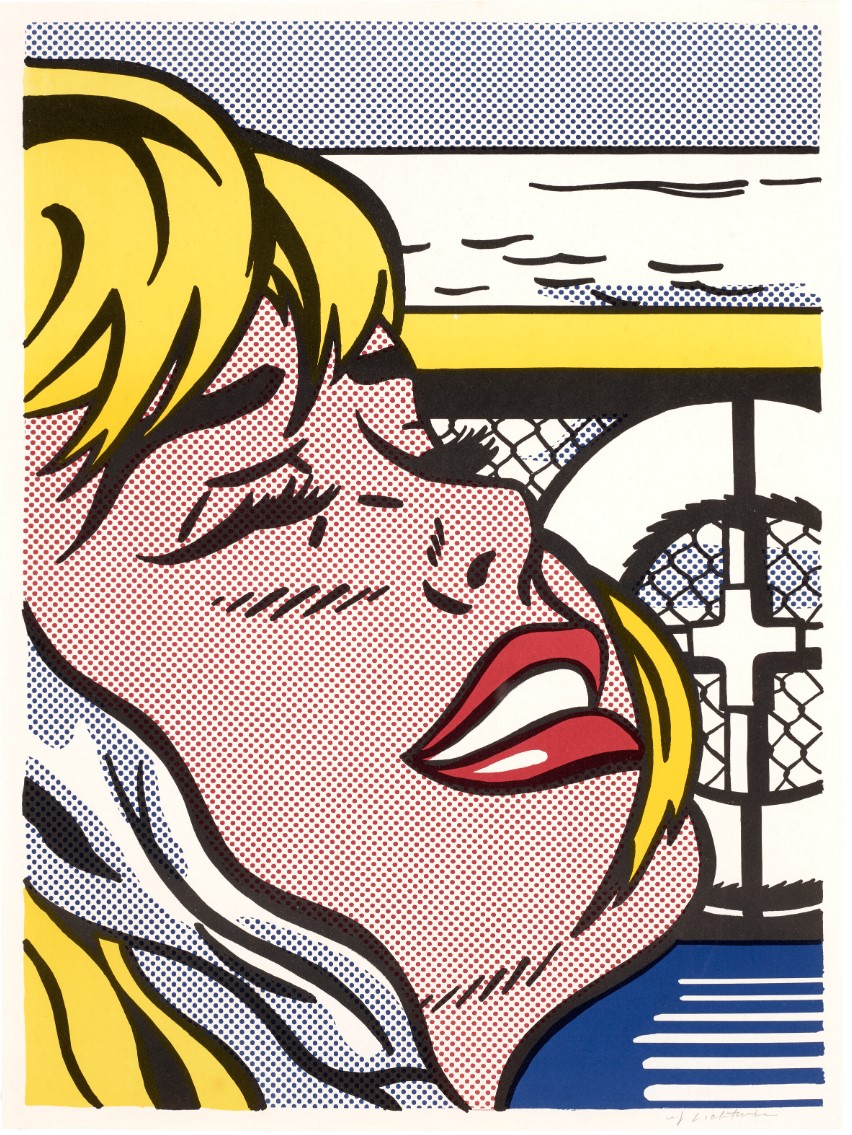
Shipboard Girl, 1965
Offset lithograph in colors, on wove paper
Sheet: 27 1/8 x 20 1/4 inches (69 x 51.5 cm)
Edition: Unknown size
Literature: Corlett II.6
Reverie, 1965
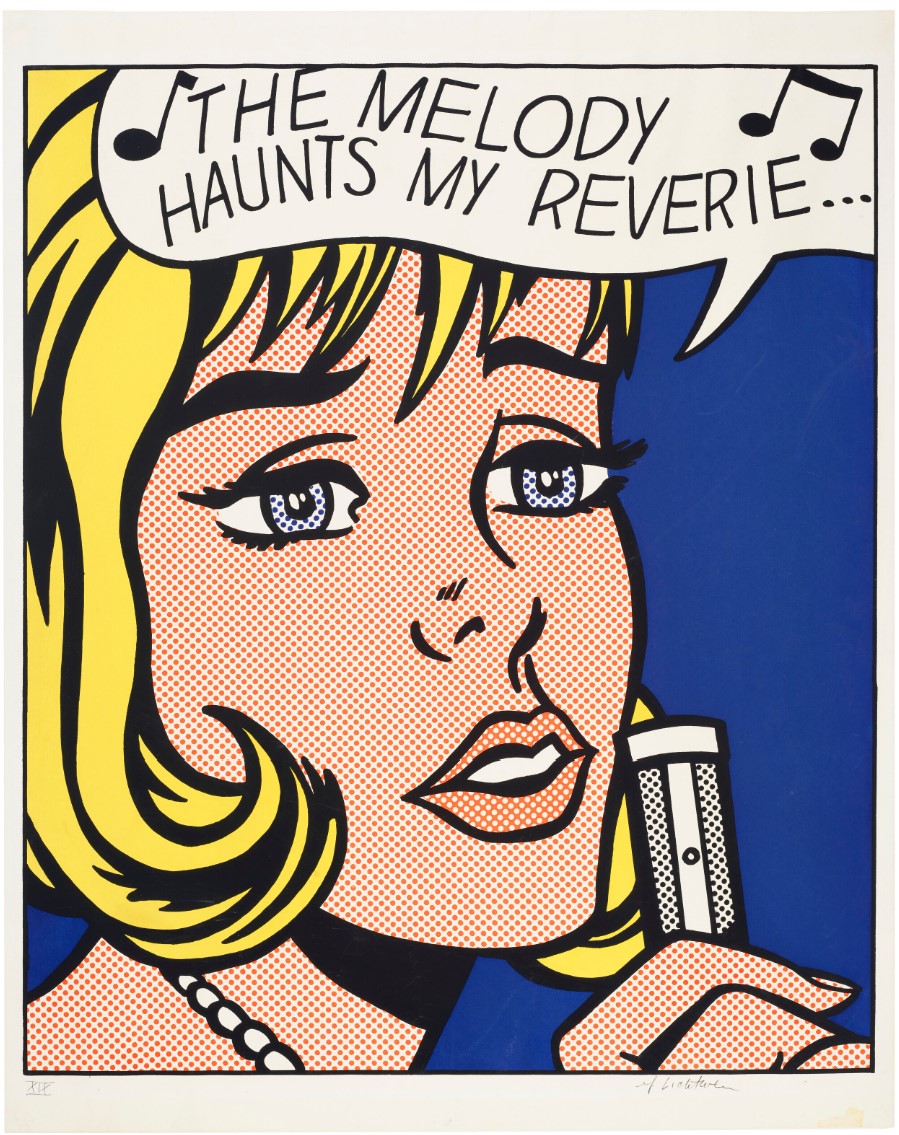
Reverie from 11 Pop Artists, Volume II, 1965
Screen-print in colors on smooth wove paper
Sheet: 30 1/8 x 24 inches (76.7 x 61 cm)
Edition: 200 + 50 (numbered in Roman numerals) + 5 AP
Literature: Corlett 38
Sweet Dreams Baby!, 1965
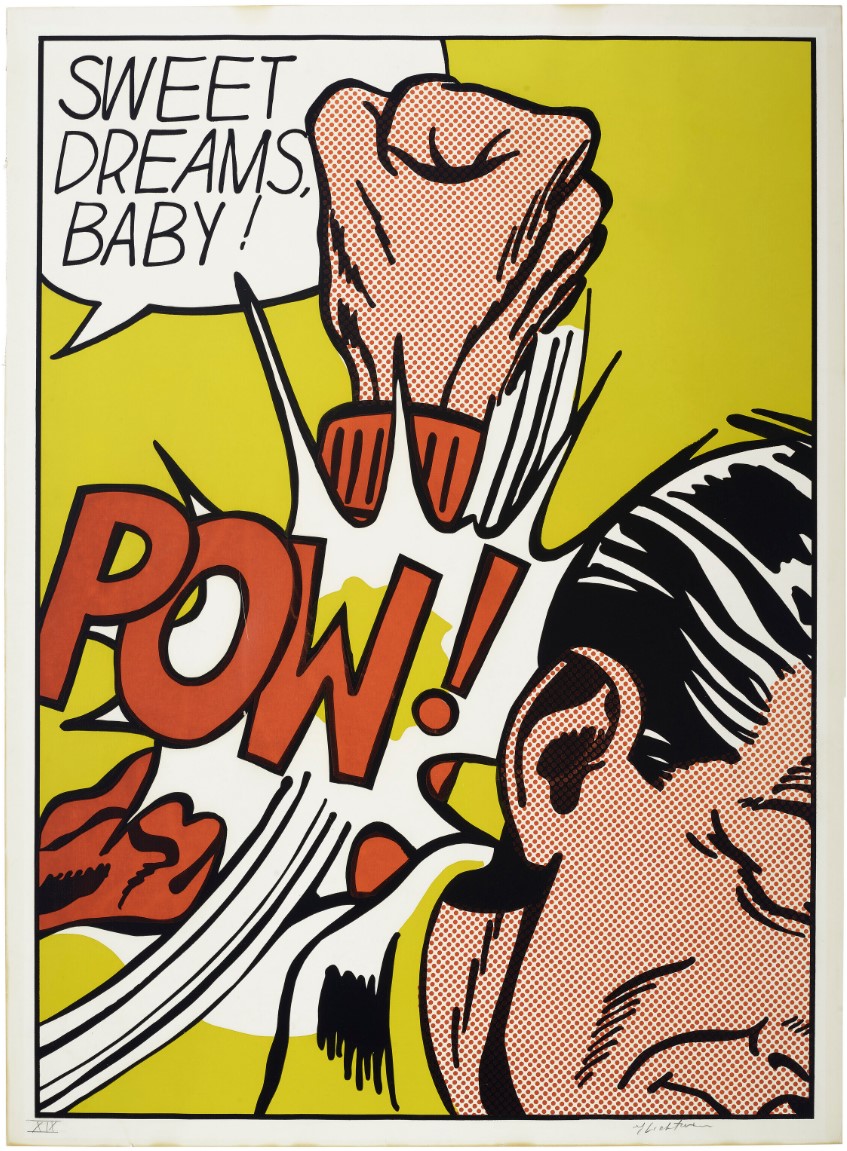
Sweet Dreams Baby! from 11 Pop Artists Portfolio, Volume III, 1965
Screen-print in colors on smooth wove paper
Sheet: 37 3/4 x 27 3/4 inches (95.6 x 70.2 cm)
Edition: 200 + 50 AP
Literature: Corlett 39
Brushstroke, 1965
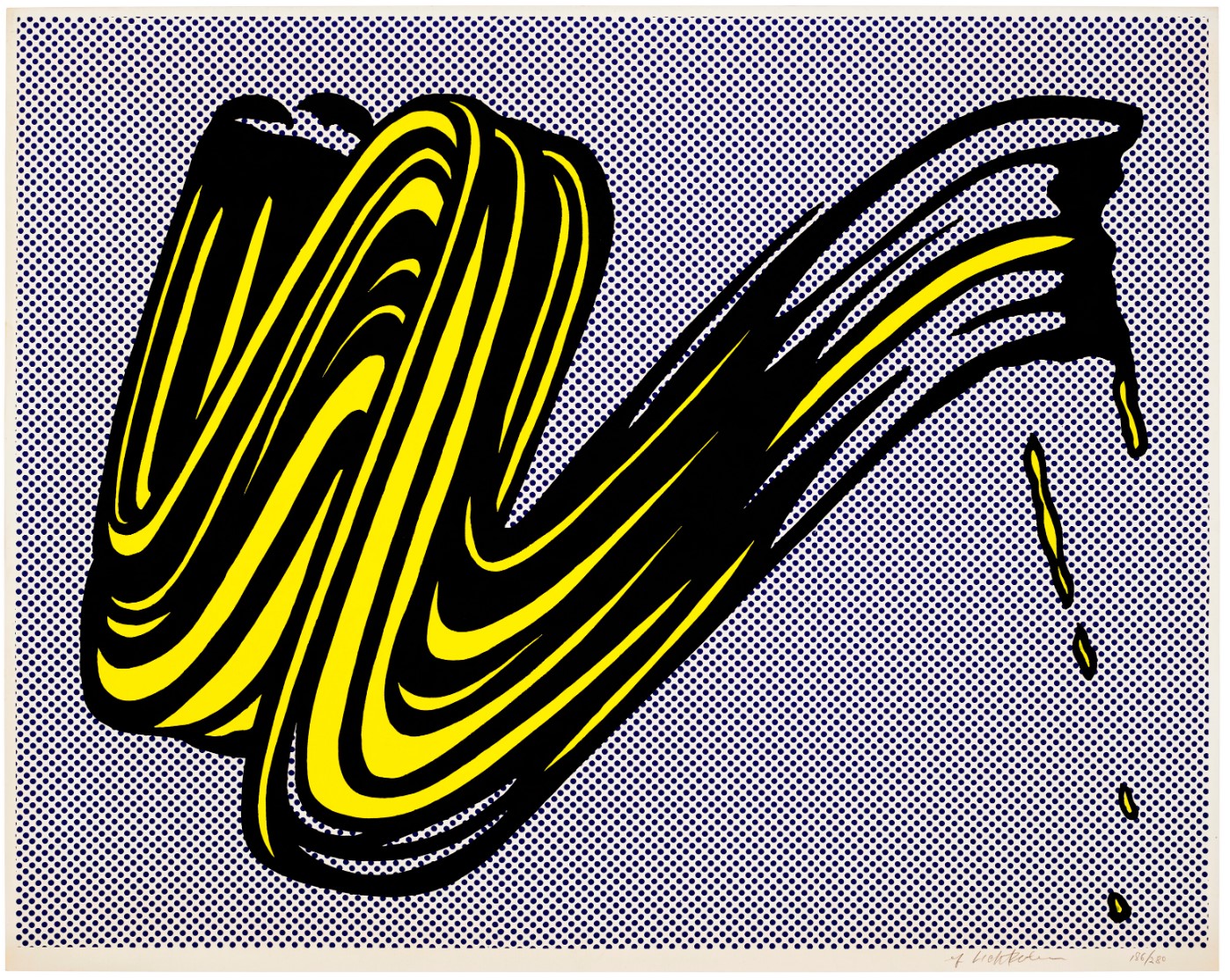
Brushstroke, 1965
Screen-print in colors on heavy wove paper
Sheet: 23 x 28 7/8 inches (58.4 x 73.3 cm)
Edition: 280 + 15 HC
Literature: Corlett II.5
Sunrise, 1965
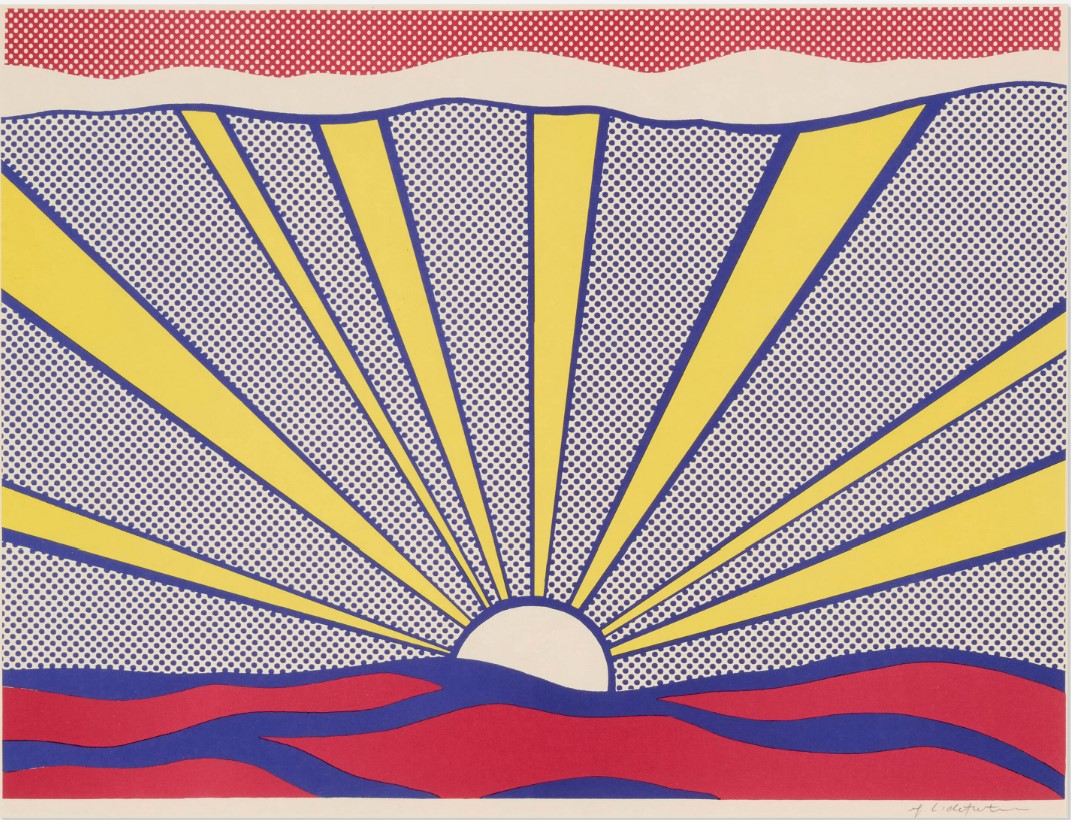
Sunrise, 1965
Offset lithograph printed in colors on lightweight white wove paper
Sheet: 18 1/4 x 24 1/4 inches (46.5 x 61.7 cm)
Edition: Unknown size
Literature: Corlett II.7
Brushstrokes, 1967
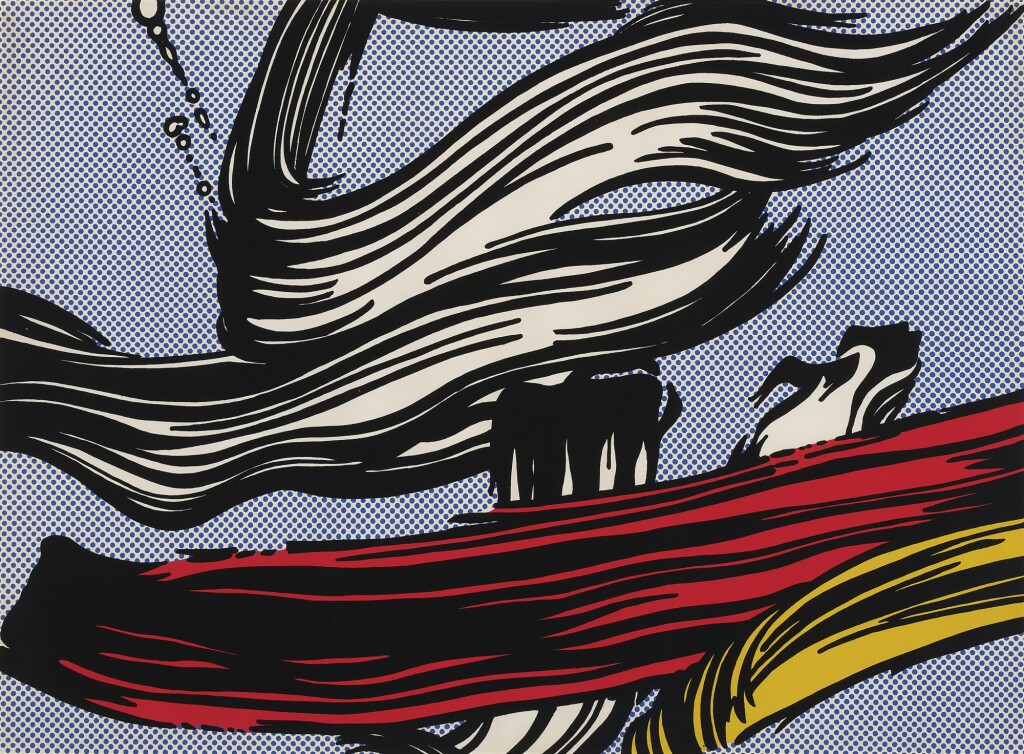
Brushstrokes, 1967
Screen-print on off-white wove paper
Sheet: 23 x 30 7/8 inches (58.5 x 78.4 cm)
Edition: 300
Literature: Corlett 45
Brushstrokes was created for Roy Lichtenstein’s 1967 exhibition at the Pasadena Art Museum. The artist created a series of brushstroke works as a satirical response to the emotion-laden gestural paintings of the dominant Abstract Expressionists. Lichtenstein was interested in creating an image of brushstrokes that looked as though they had been rendered by a commercial artist. The print’s composition is wonderfully formal, floating the reinterpreted painter’s brushstrokes on top of a blue Ben Day dot background. The artist now depersonalized the idea of painting as an action and took back the brushstroke as part of his own personal expression through printmaking.
Explosion, 1967
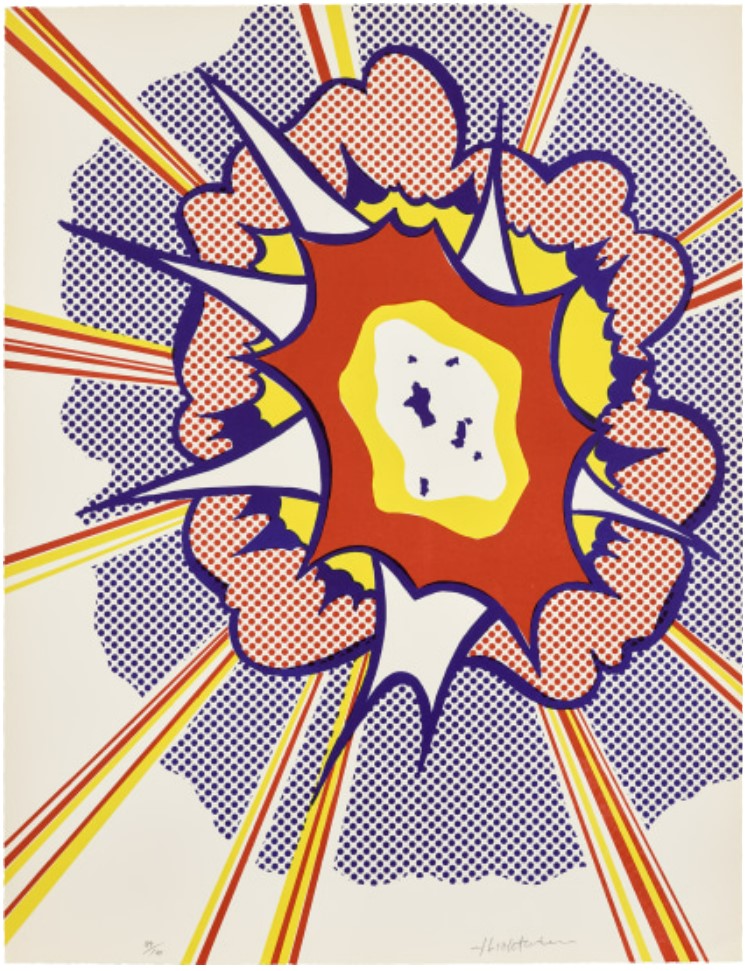
Explosion from Portfolio 9, 1967
Lithograph in colors on Rives BFK paper
Sheet: 22×17 inches (55.9 x 43.2 cm)
Edition: 100 + 20 AP (numbered in Roman numerals) + 10 (unnumbered)
Literature: Corlett 49
Modern Art Poster, 1967

Modern Art Poster, 1967
Screen-print in colors on wove paper
Sheet: 9×12 inches (23 x 30.4 cm)
Edition: 300
Literature: Corlett II.8
Haystacks and Cathedral Series, 1969
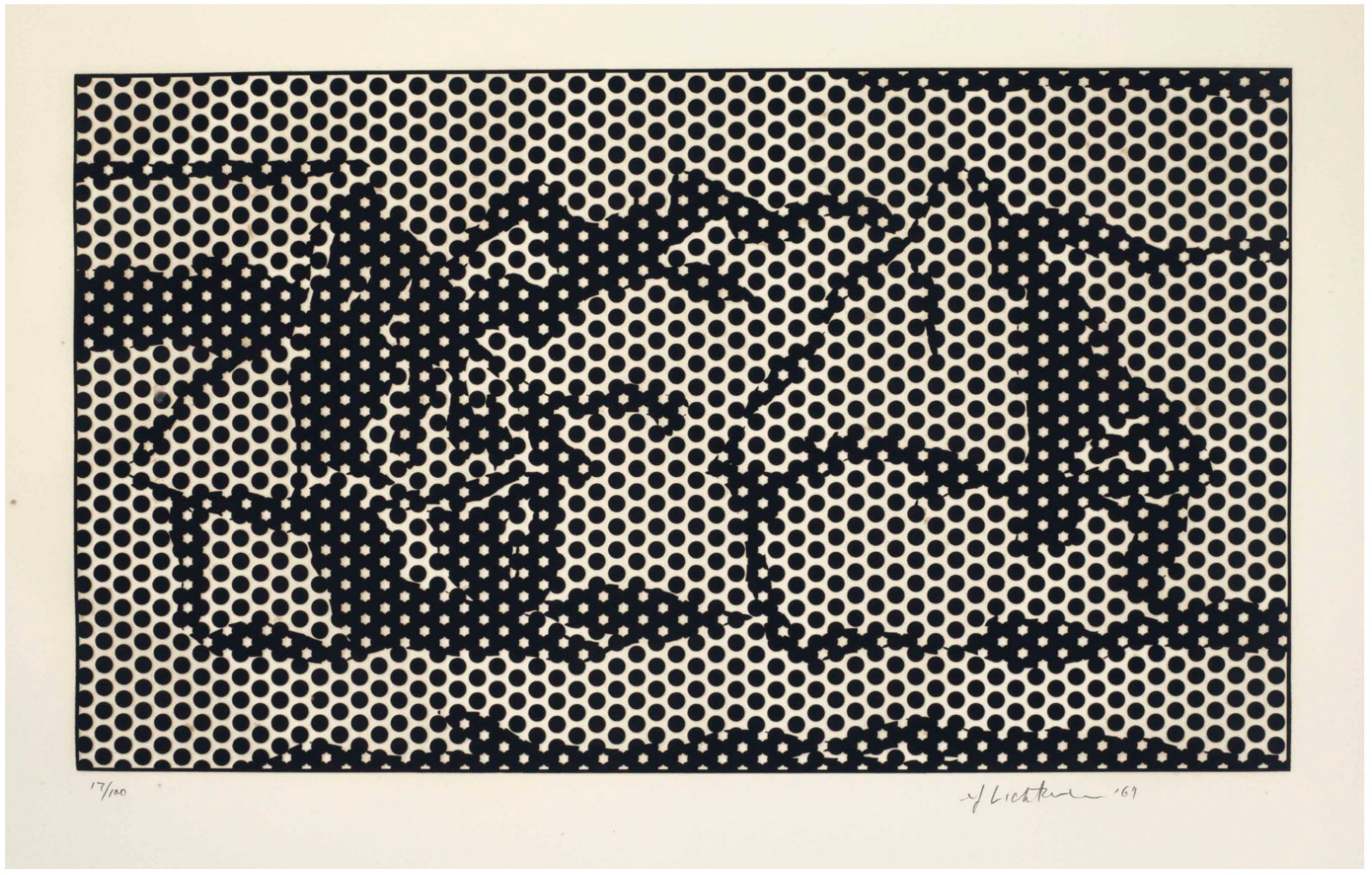
Haystack Series, 1969
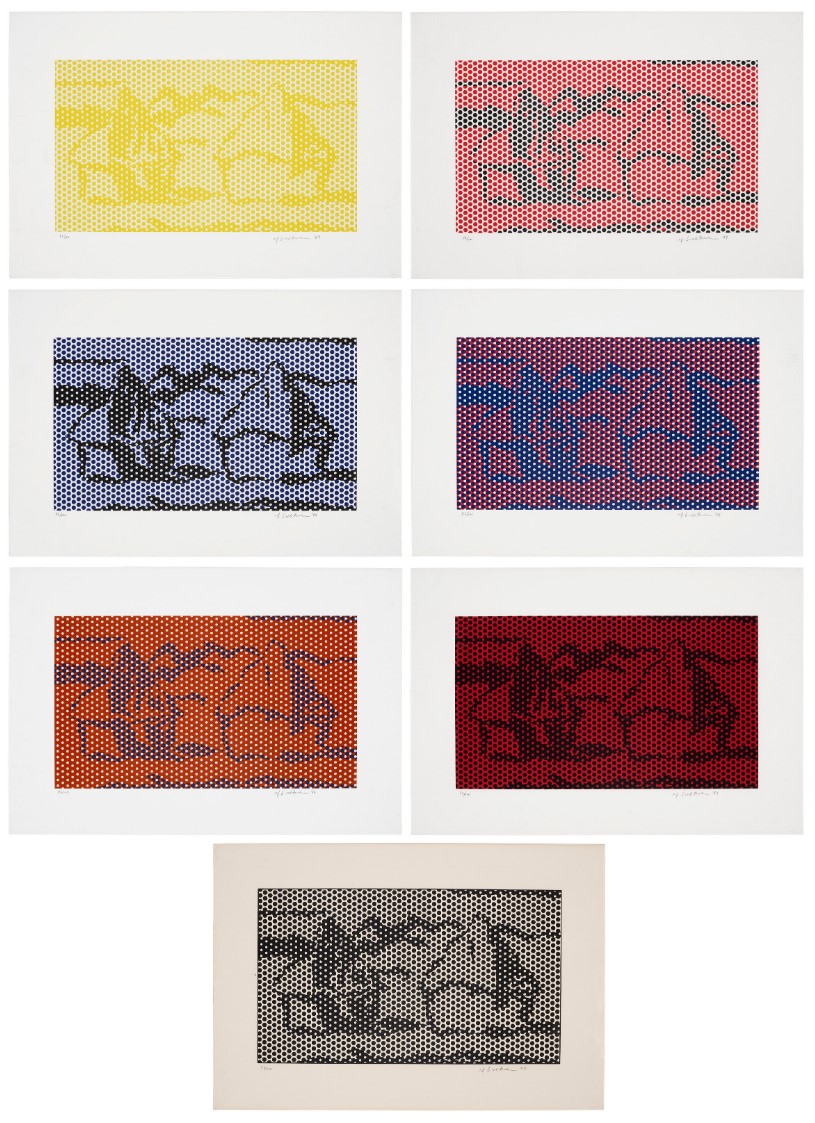
Haystack Series, 1969
The complete set of six lithographs and screen-prints in colors
Lithograph and screen-print in colors on Rives BFK paper, and one relief print on Special Arjomari paper
Sheet: 20 5/8 x 30 5/8 inches (52.5 x 77.7 cm)
Edition: 100 + 10 AP
Literature: Corlett 65-70, 74: Gemini 150-156, 159
1. Haystack #1 (C. 65)
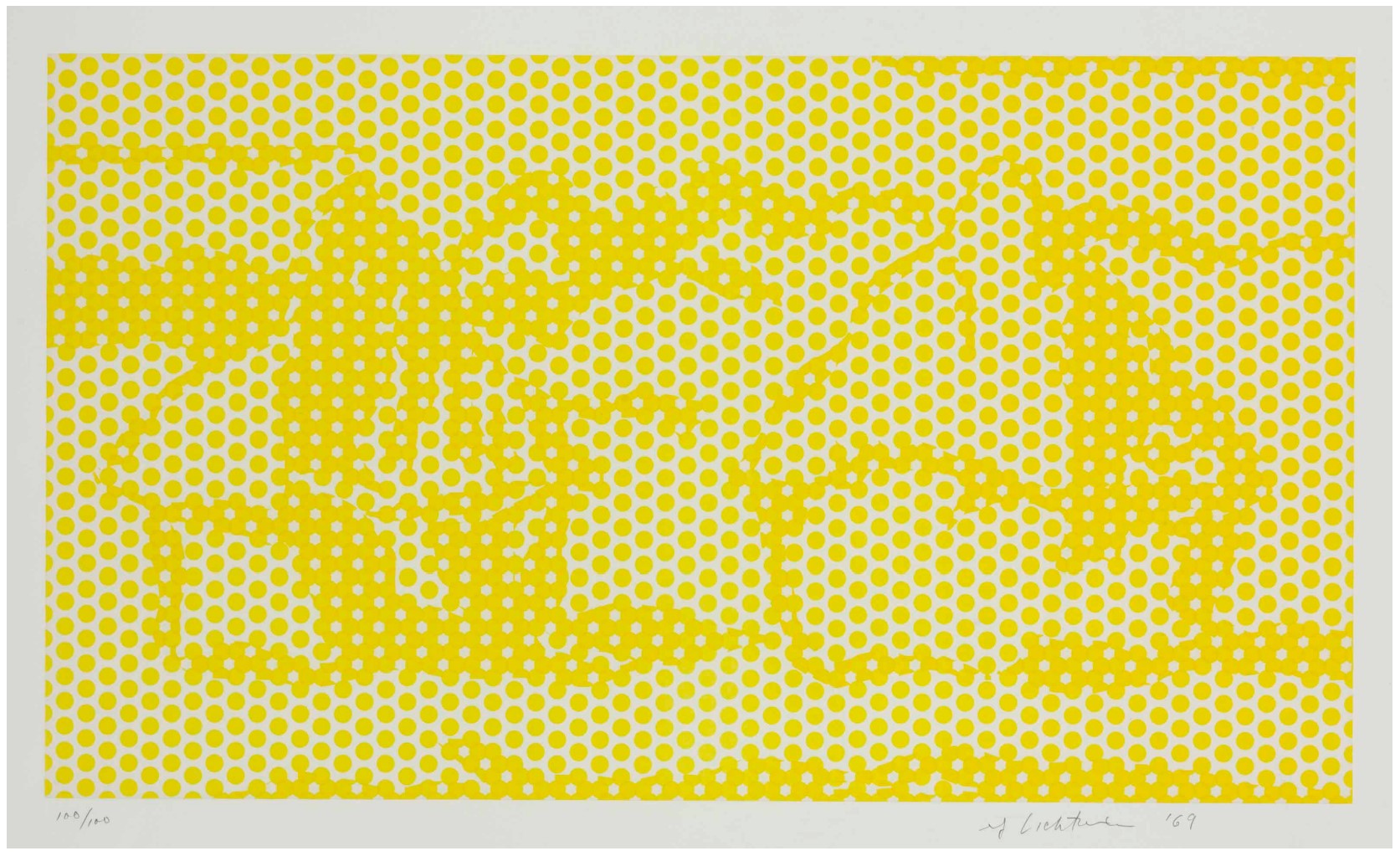
2. Haystack #2 (C. 266)
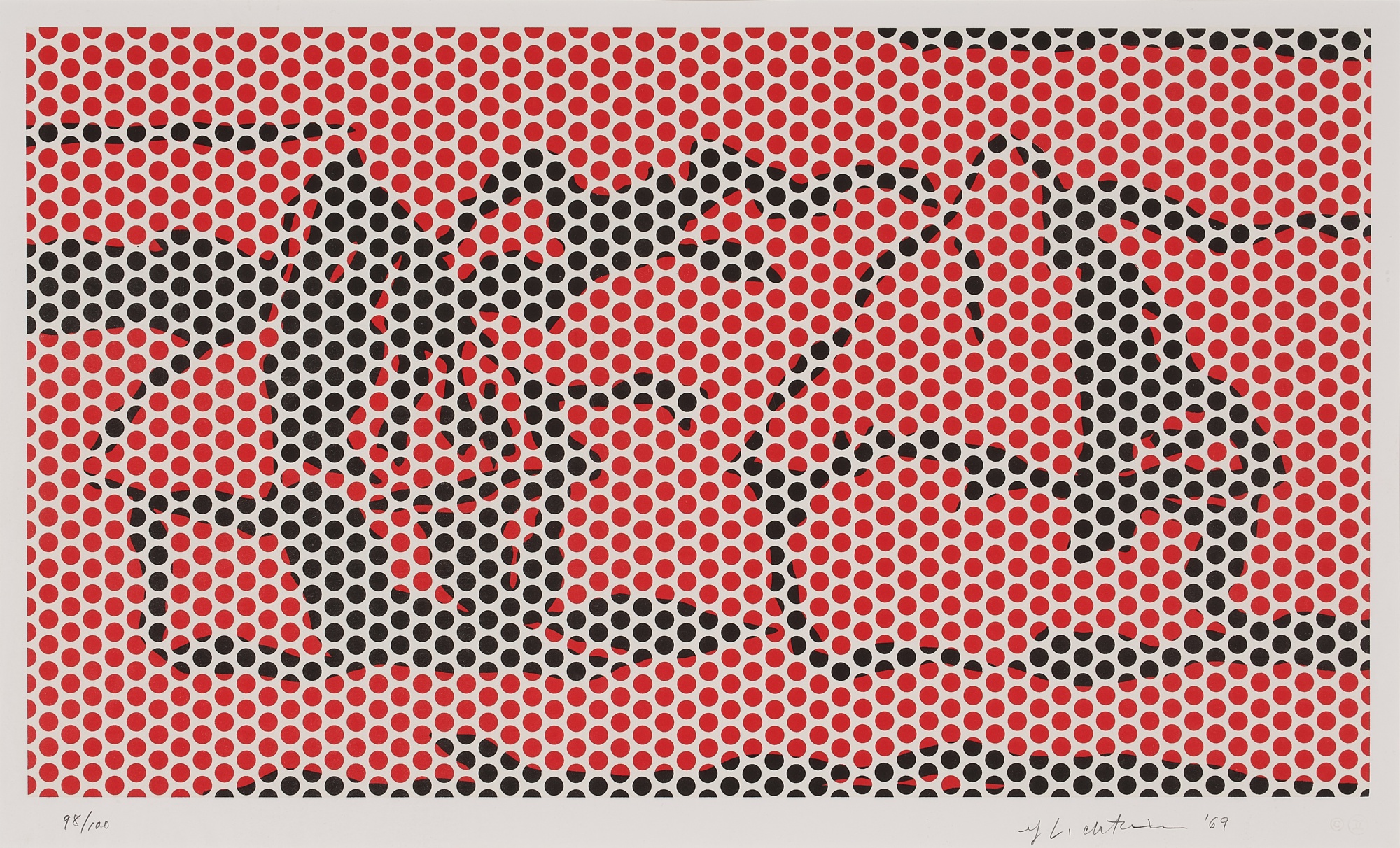
3. Haystack #3 (C. 67)
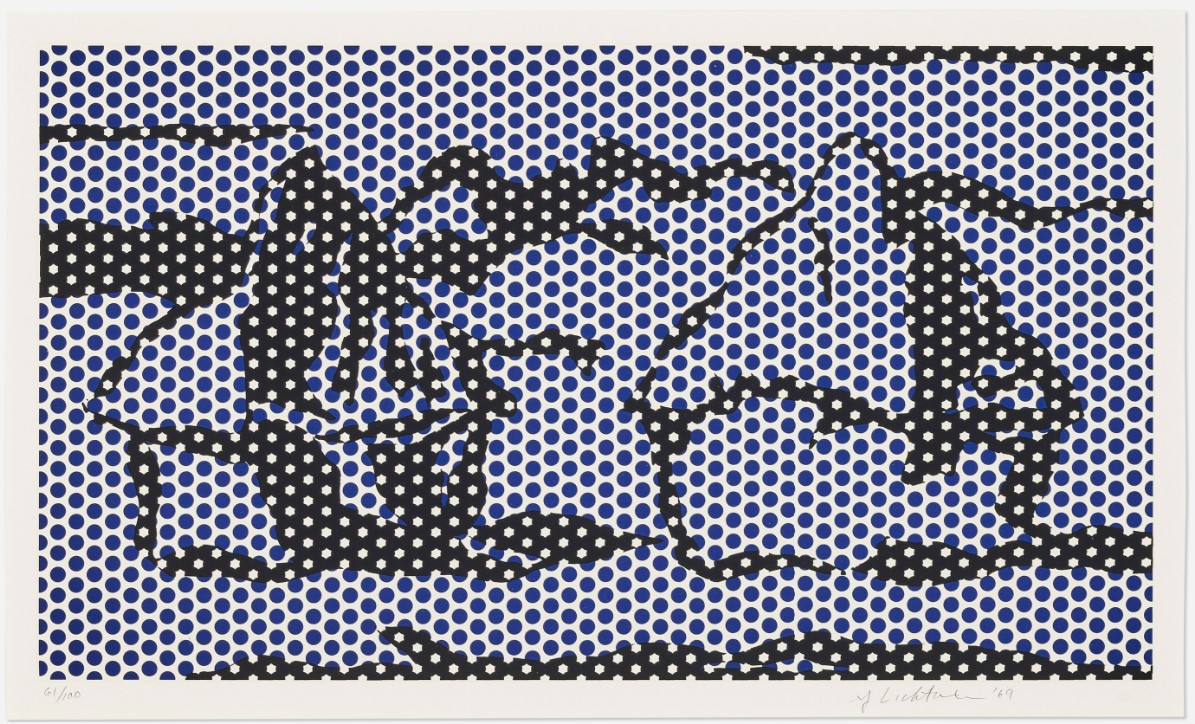
4. Haystack #4 (C.68)
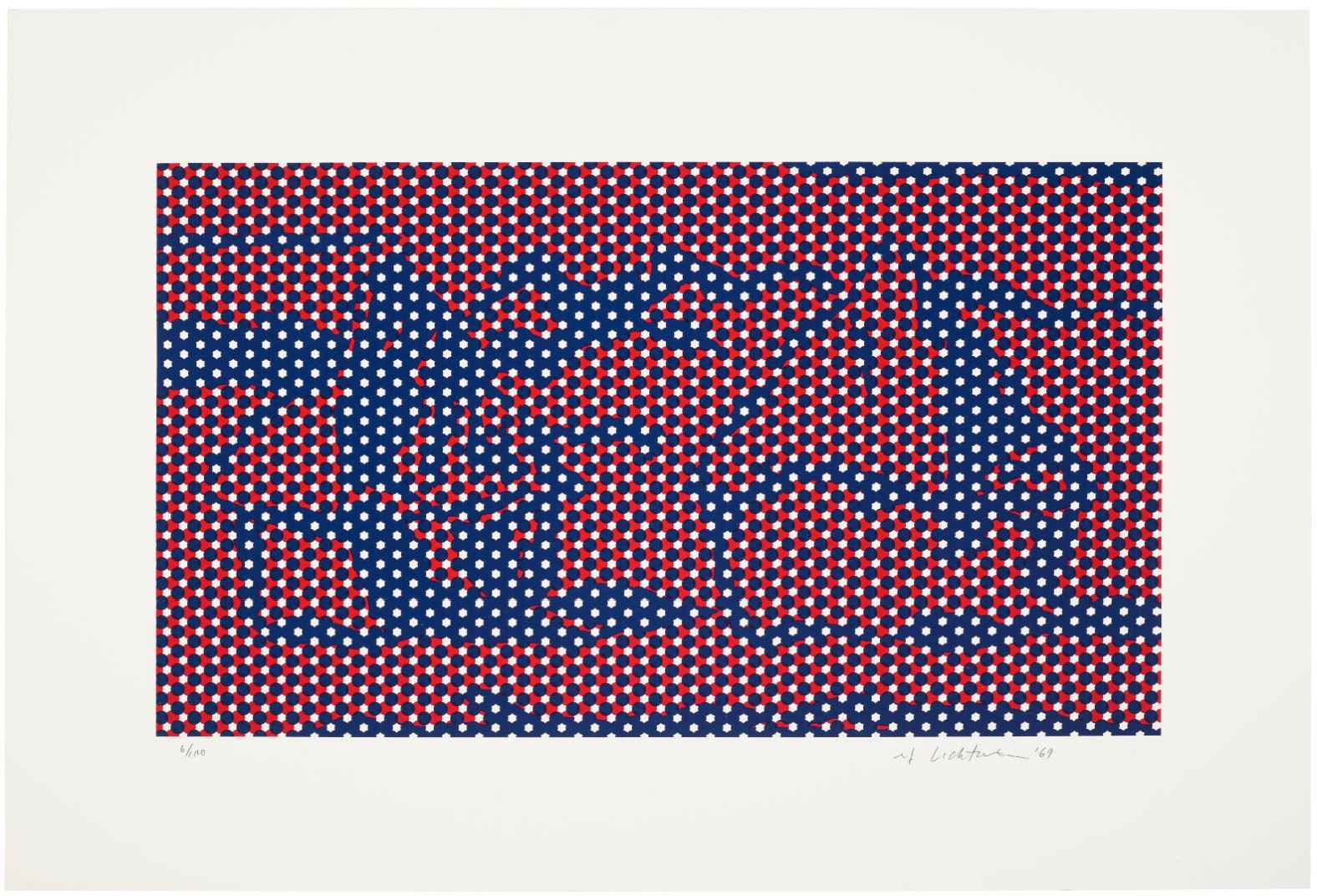
5. Haystack #5 (C. 69)
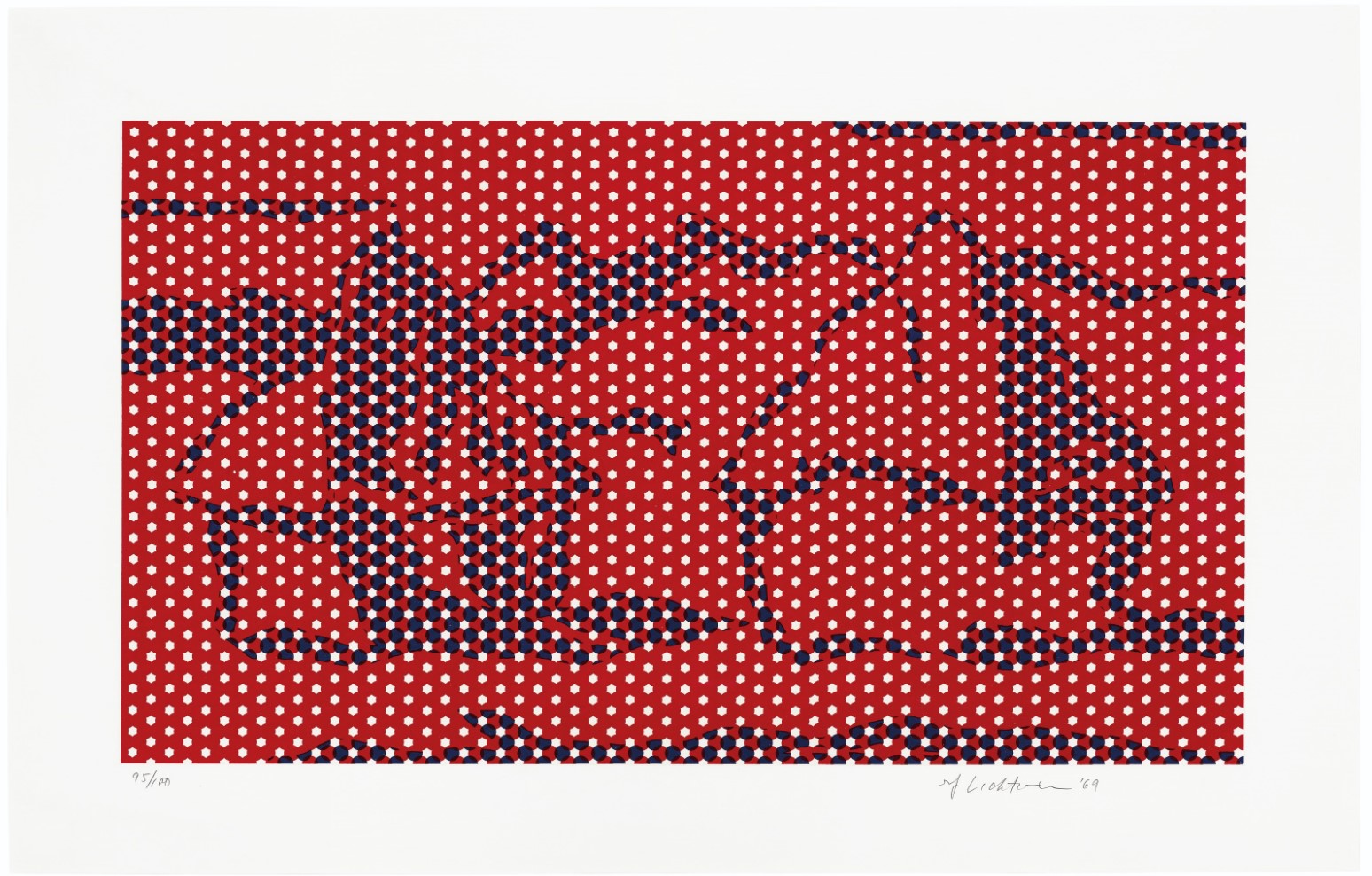
6. Haystack #6 (C. 70)
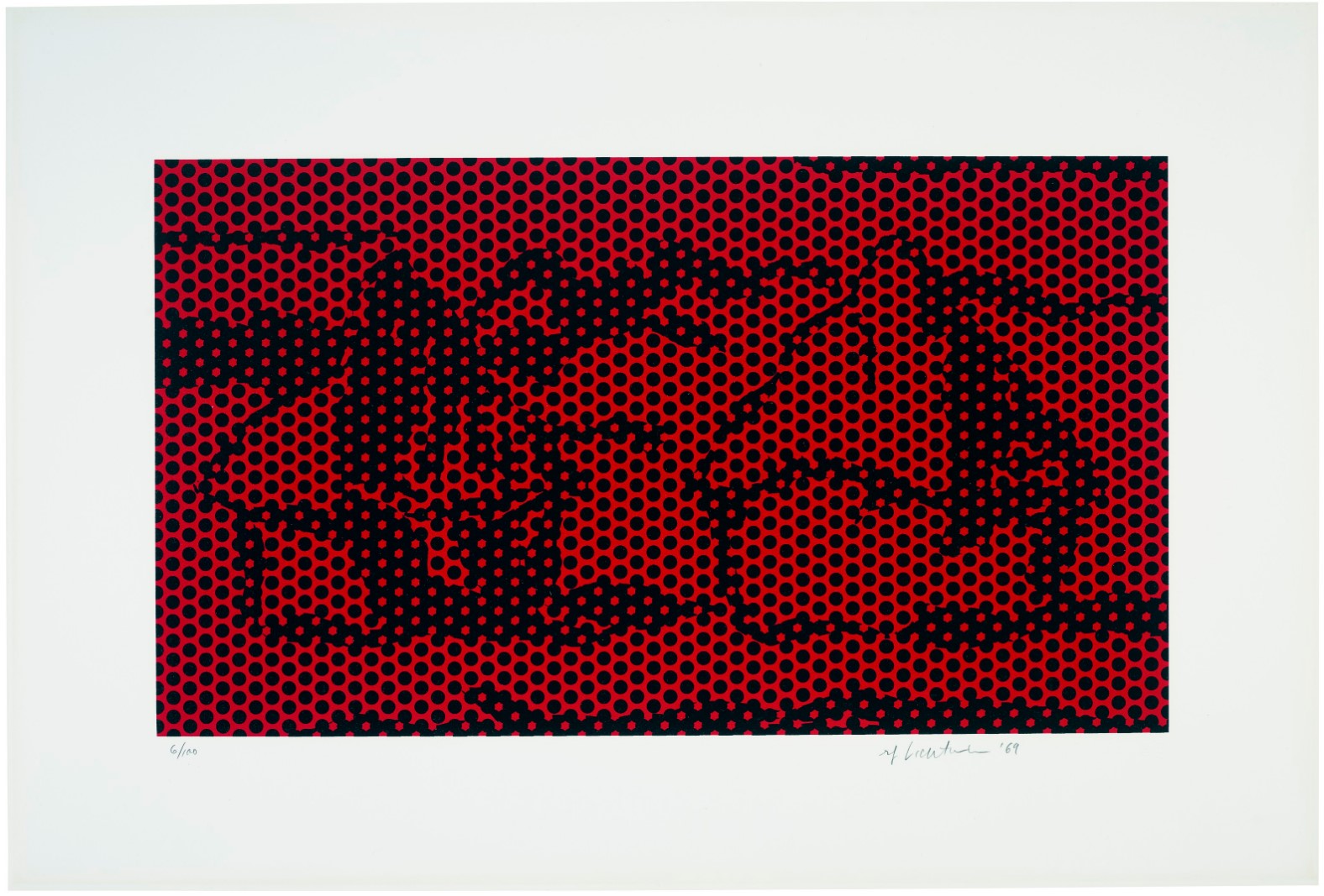
7. Haystack #7 (C. 74)
Cathedral Series, 1969
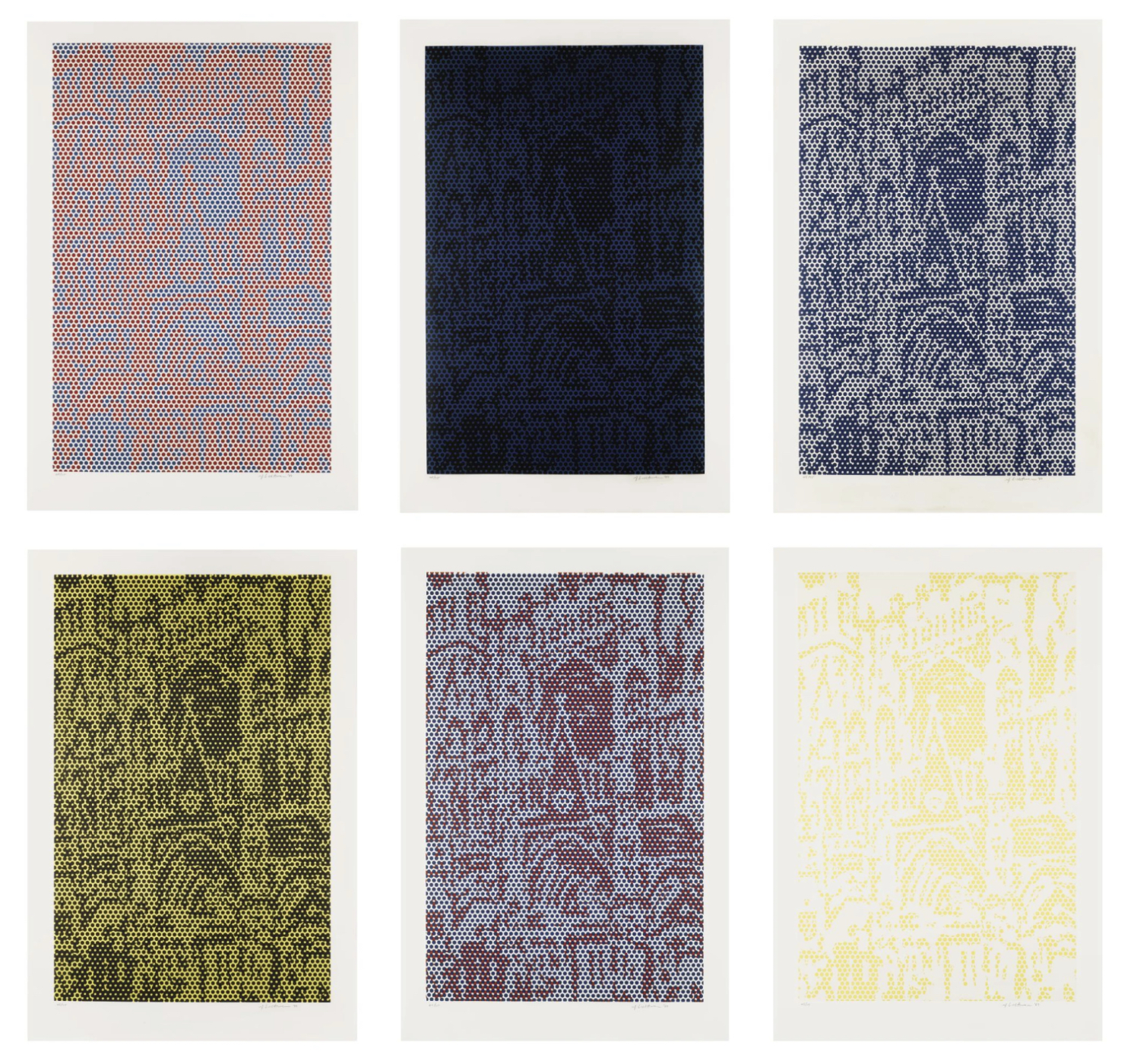
Cathedral Series, 1969
The complete series of six lithographs printed in colors on Special Arjomari paper
Each Sheet: 48 1/8 x 32 1/4 inches (122.3 x 81.8 cm)
Edition: 75 + 10 AP
Literature: Corlett 75-80
1. Cathedral #1 (C. 75)
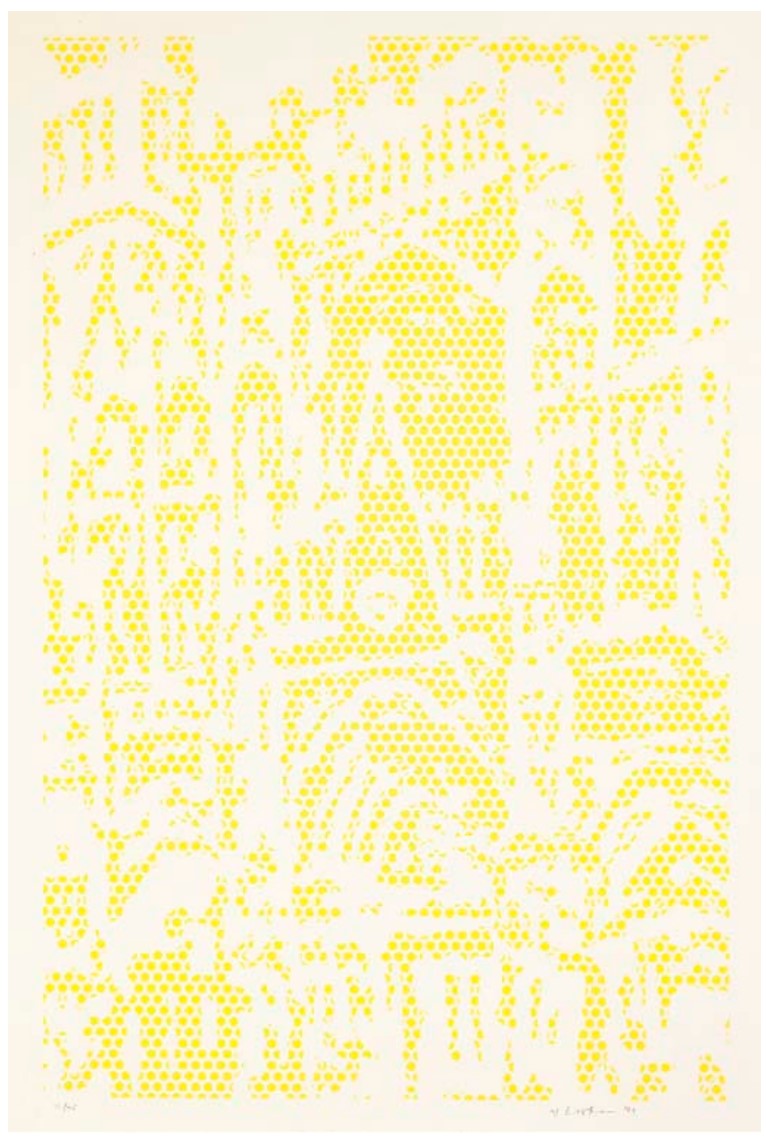
2. Cathedral #2 (C. 76)
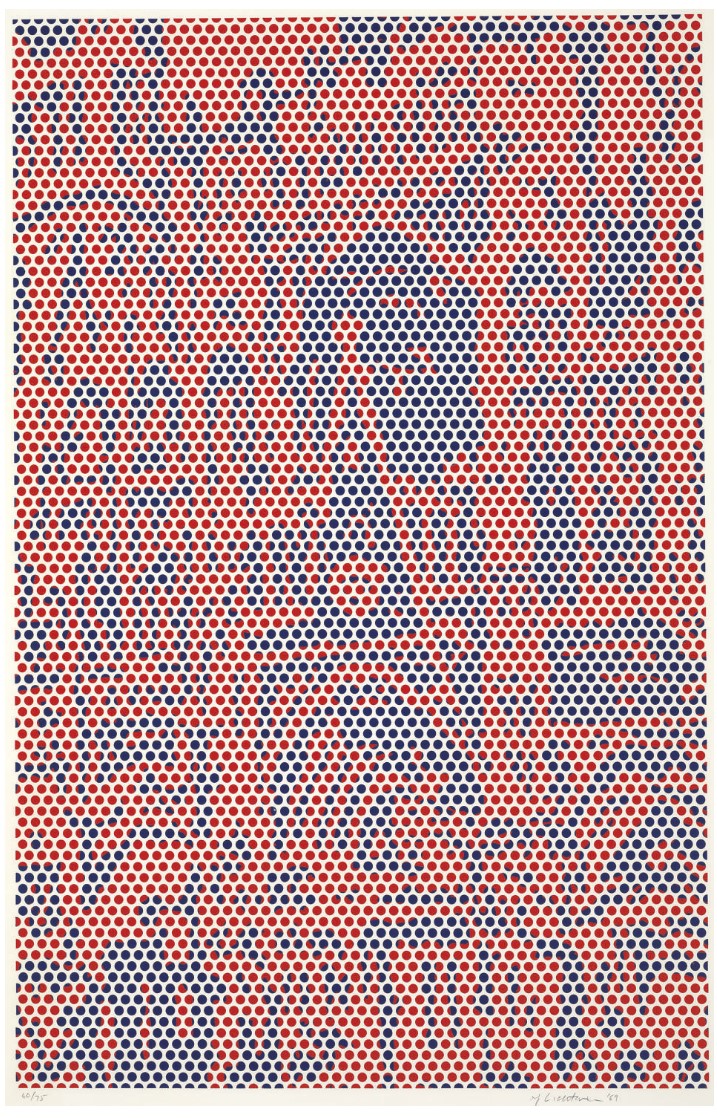
4. Cathedral #4 (C. 78)
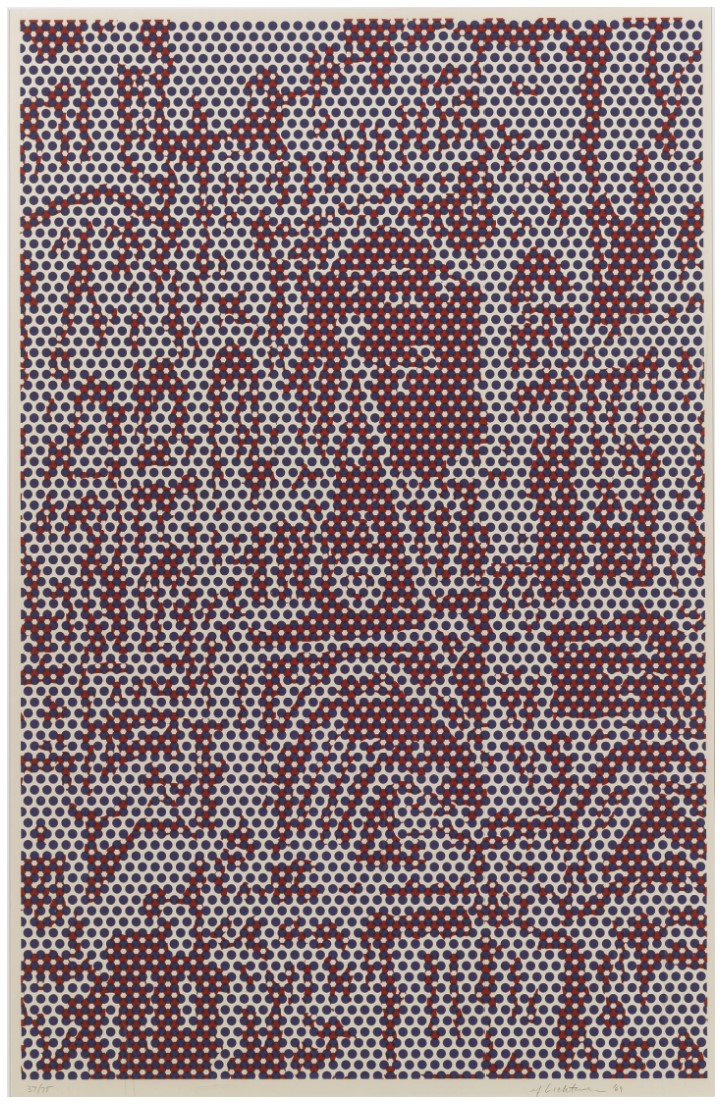
5. Cathedral #5 (C. 79)
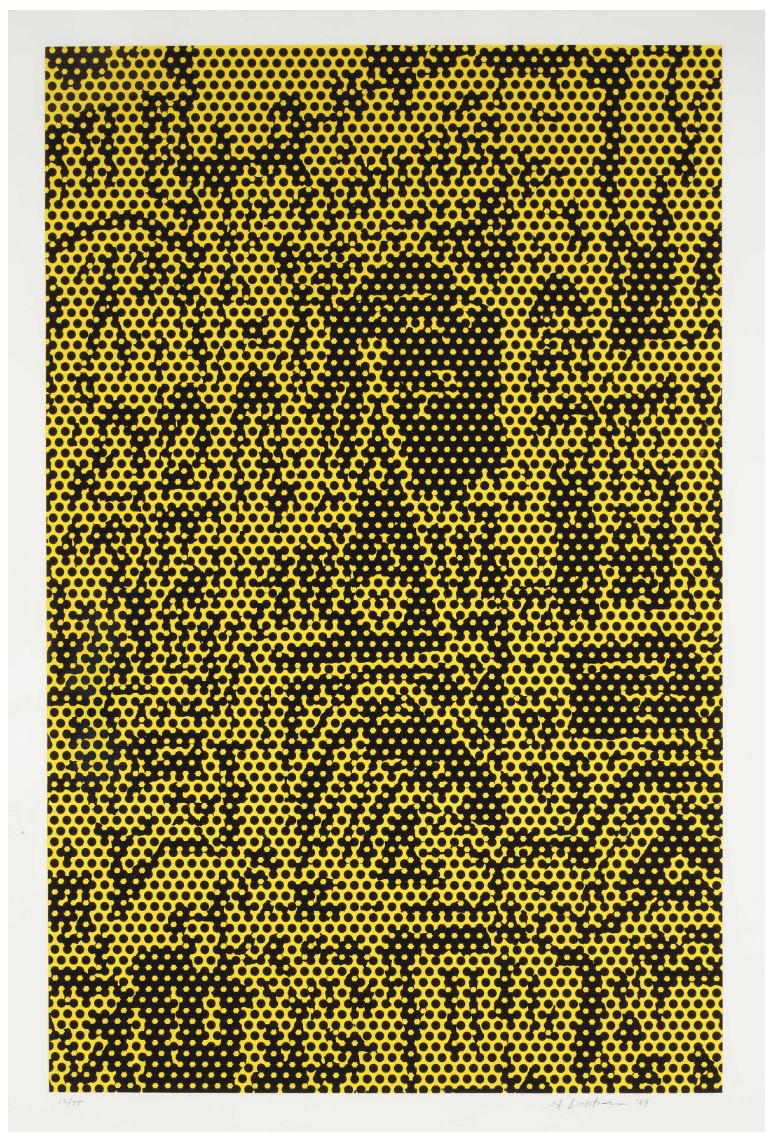
6. Cathedral #6 (C. 80)
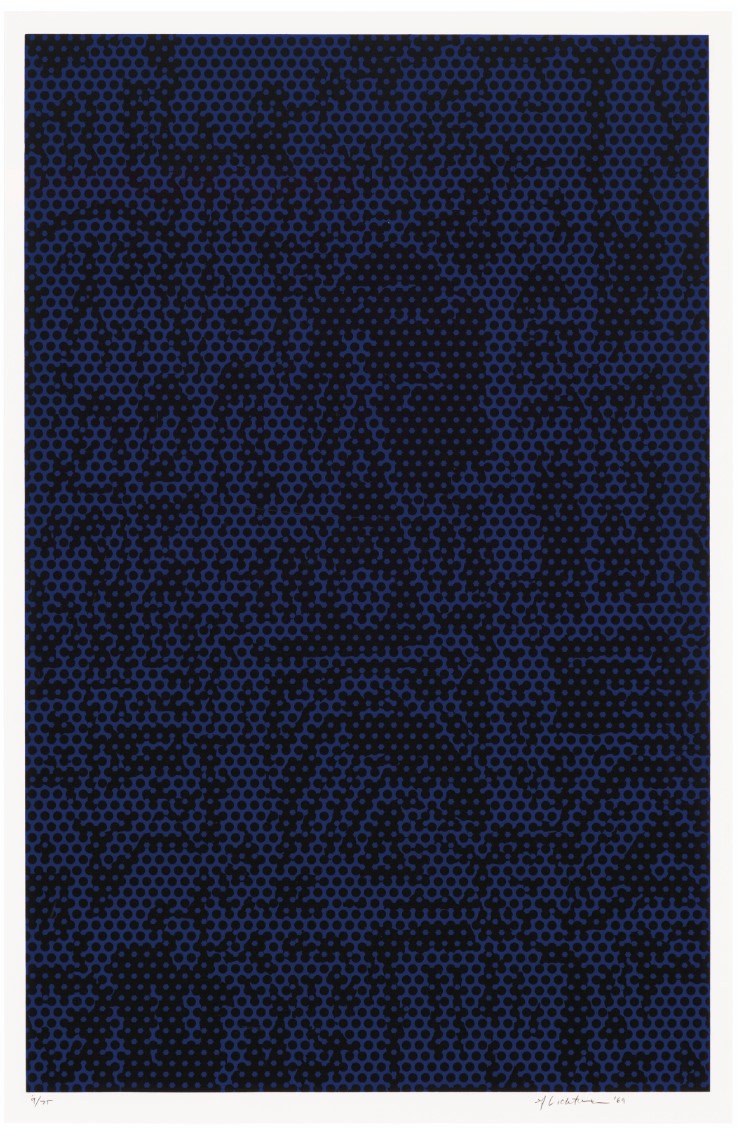
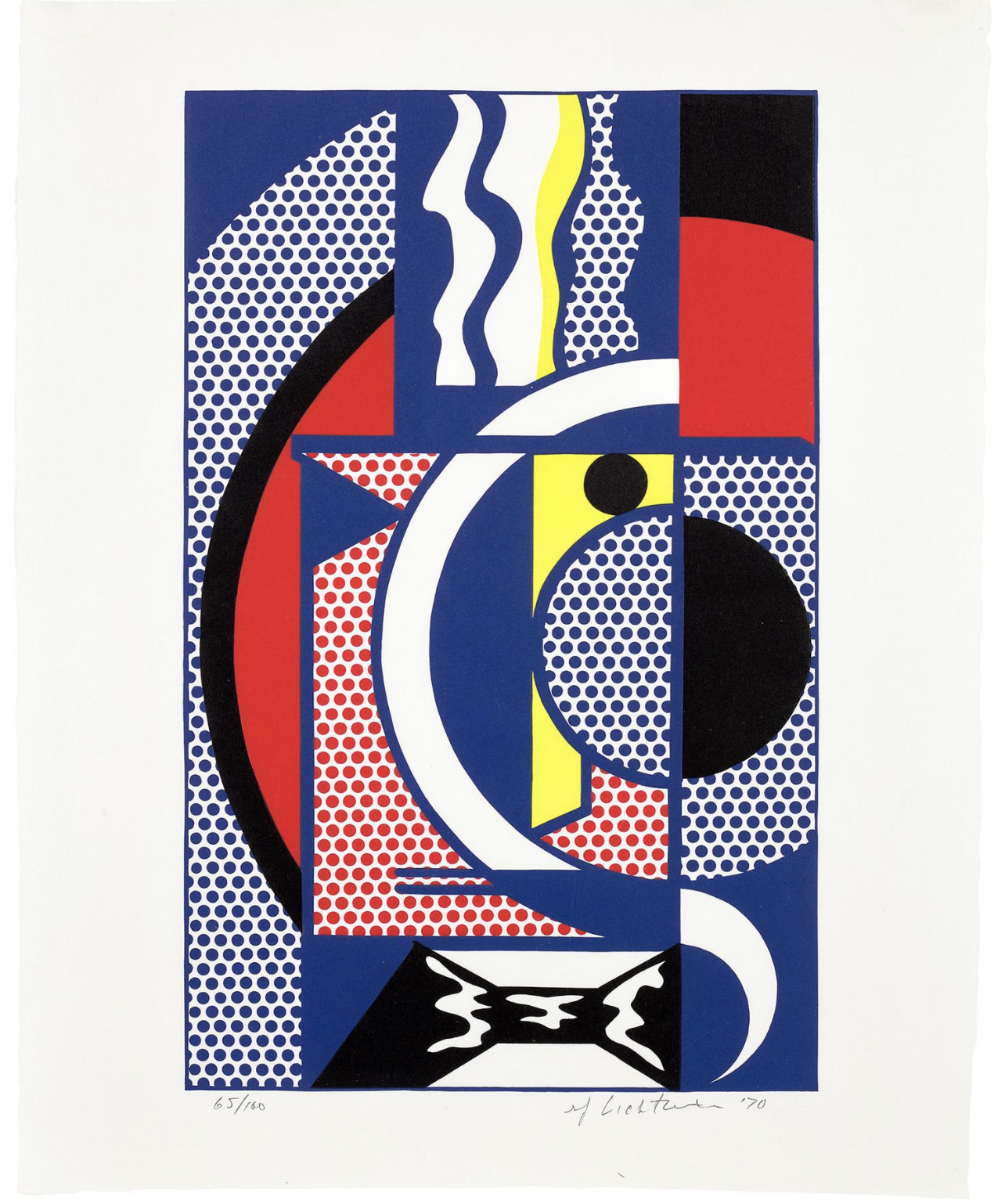
Modern Head Series, 1970
1. Modern Head #1
Modern Head #1 from Modern Head Series, 1970
Woodcut in colors on Japanese Hoshi paper
Sheet: 24 1/4 x 19 inches (61.5 x 48.3 cm)
Edition: 100 + 7 AP
Literature: Corlett 91, Gemini 242
2. Modern Head #2
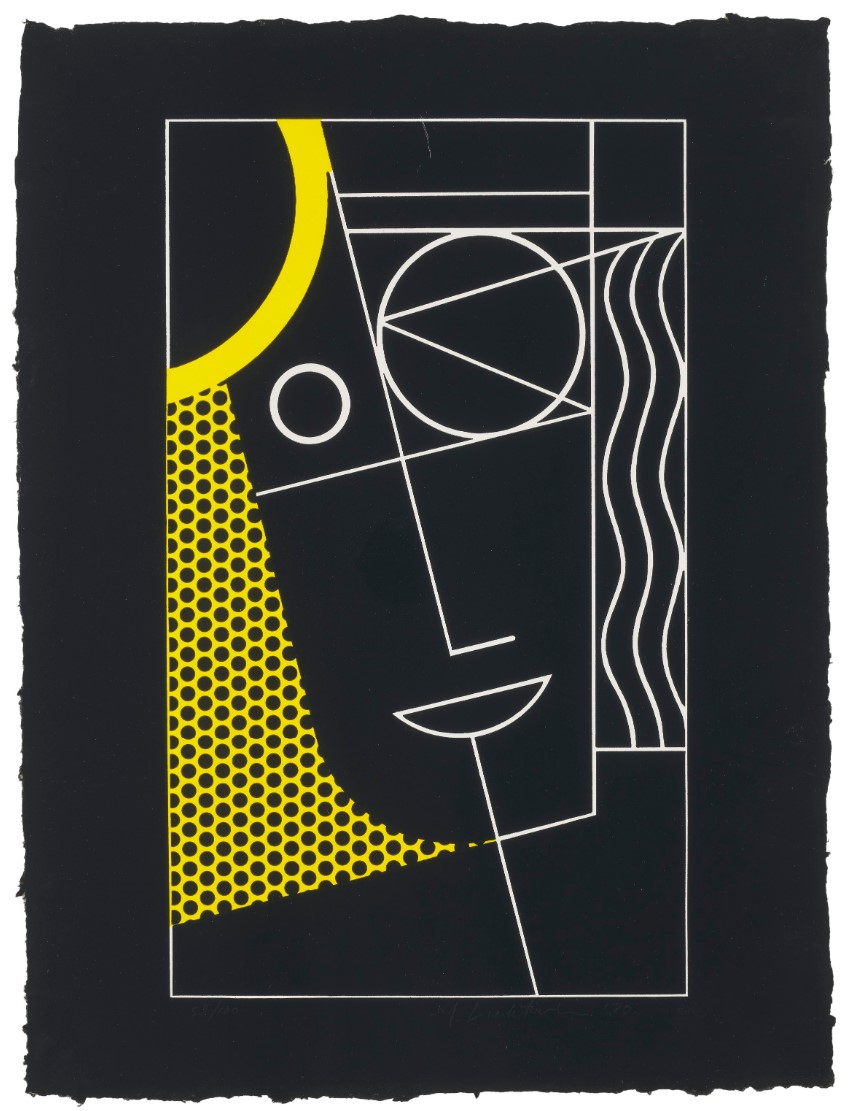
Modern Head #2 from Modern Head Series, 1970
Lithograph and linocut in colors with embossing on handmade Waterleaf paper
Sheet: 24 1/4 x 18 1/4 inches (61.6 x 46.3 cm)
Edition: 100 + 7 AP
Literature: Corlett 92, Gemini 243
3. Modern Head #3
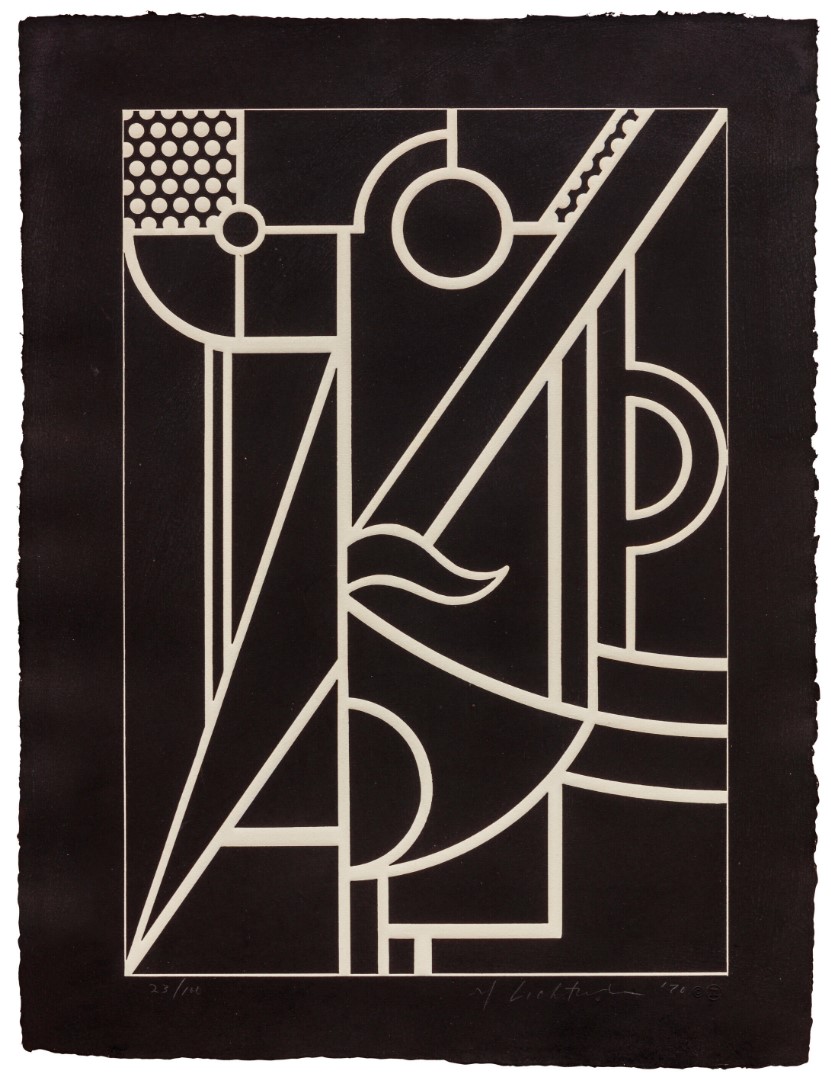
Modern Head #3 from Modern Head Series, 1970
Sheet: 24 x 18 1/8 inches (61×46 cm)
Edition: 100 + 7 AP
Literature: Corlett 93, Gemini 244
4. Modern Head #4
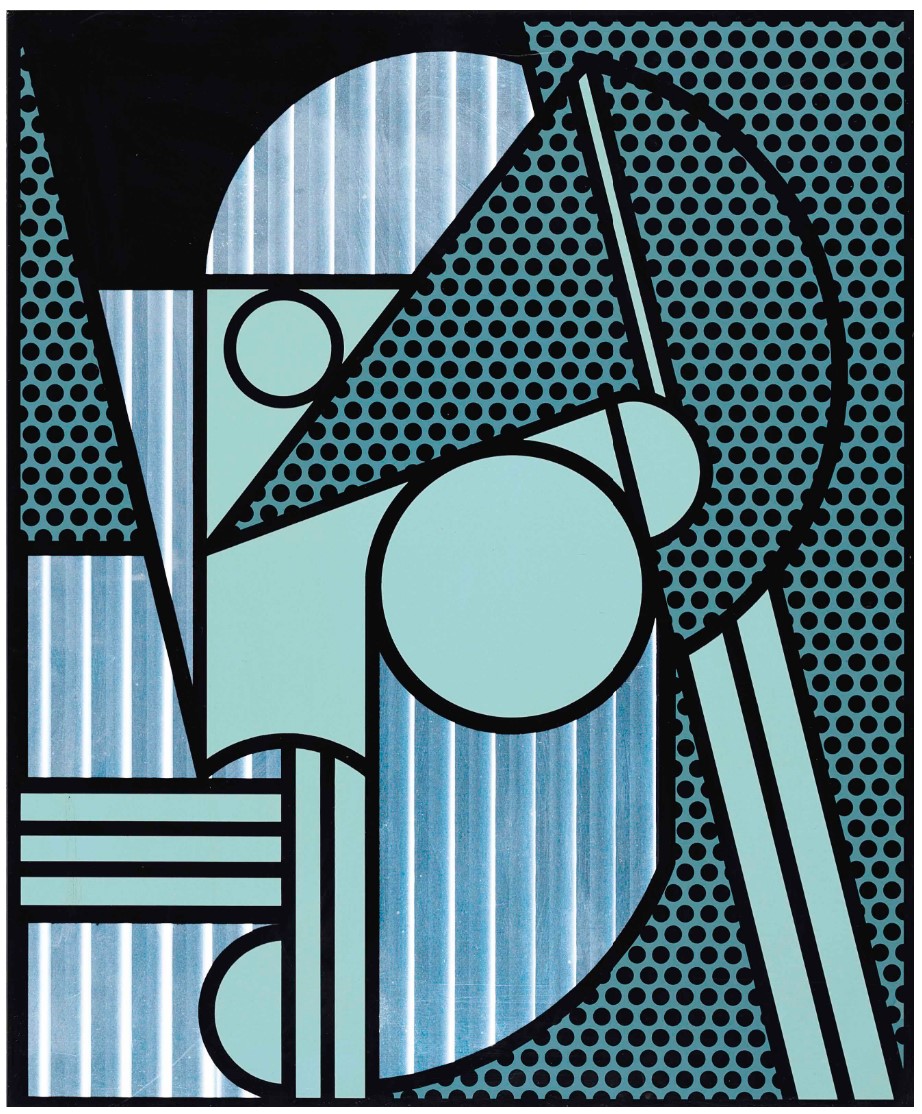
Modern Head #4 from Modern Head Series, 1970
Lithograph in colors on engraved and anodized aluminum
Sheet: 20 3/4 x 17 1/4 inches (52.4 x 43.8 cm)
Edition: 100 + 7 AP
Literature: Corlett 94, Gemini 245
5. Modern Head #5
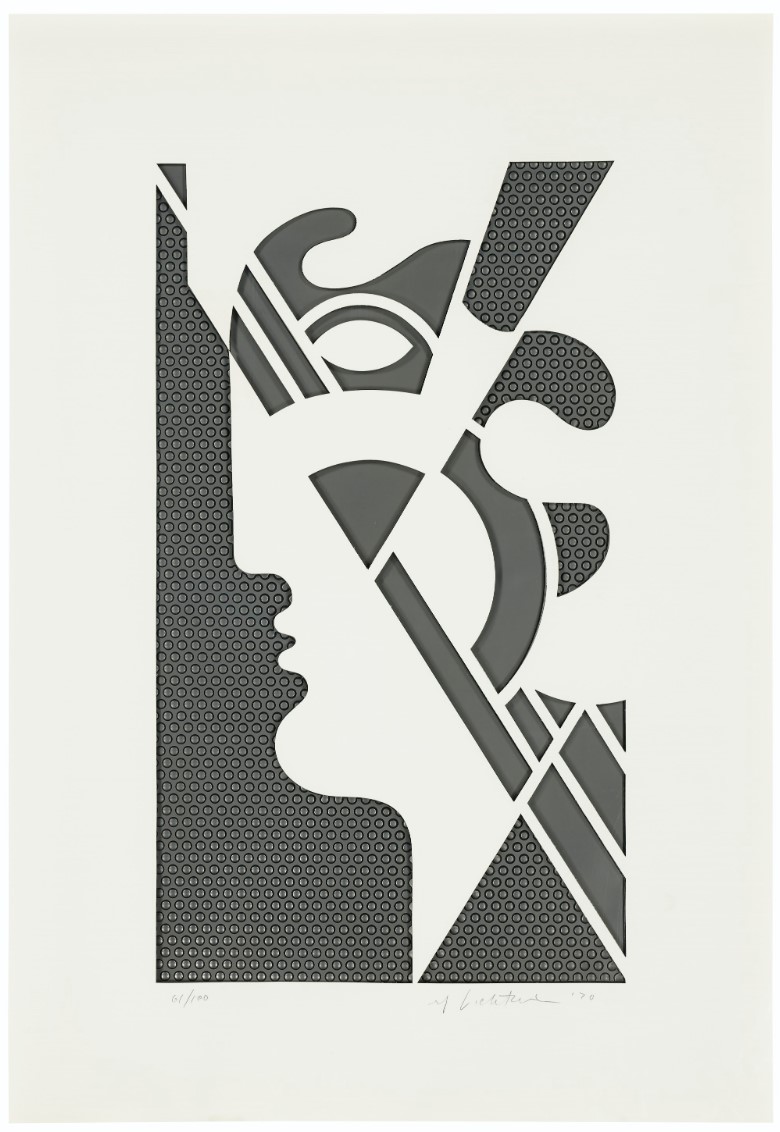
Modern Head #5 from Modern Head Series, 1970
Embossed graphite with Strathmore die-cut paper overlay
Sheet: 27 7/8 x 19 3/8 inches (70.8 x 49.2 cm)
Edition: 100 + 7 AP
Literature: Corlett 95, Gemini 246
6. Modern Head Relief

Brass multiple
Sheet: 24 x 17 3/4 x 3/4 inches (61 x 45.1 x 19 cm)
Edition: 100
Literature: Gemini 247
Mirror Series, 1972
The Mirror Series poignantly encapsulates Roy Lichtenstein’s capacity to engage with canonical art historical concerns through the signs and symbols of twentieth-century consumer culture and, in doing so, raise complex conceptual questions about art and illusion. Lichtenstein’s oeuvre is predicated on a semiotic investigation of the ways in which systems of representation allow us to conceptualize and interpret the world around us. Between 1969 and 1972, Lichtenstein produced a finite collection of Mirror paintings, and a series of prints, through which he engaged with the representational strategies and tropes of mirrored surfaces in art history and contemporary advertising.

In the latter half of the 1960s, Lichtenstein devoted his practice to reinterpreting icons of art history through his signature Pop Art lexicon, rooted in the aesthetic strategies of twentieth-century mass production and consumer branding. After exploring canonical art historical periods, such as Classical Antiquity, Impressionism, and Cubism, Lichtenstein considered one of the most iconic and technically challenging motifs of Western painting since the Renaissance: the mirror.
Mirror #1
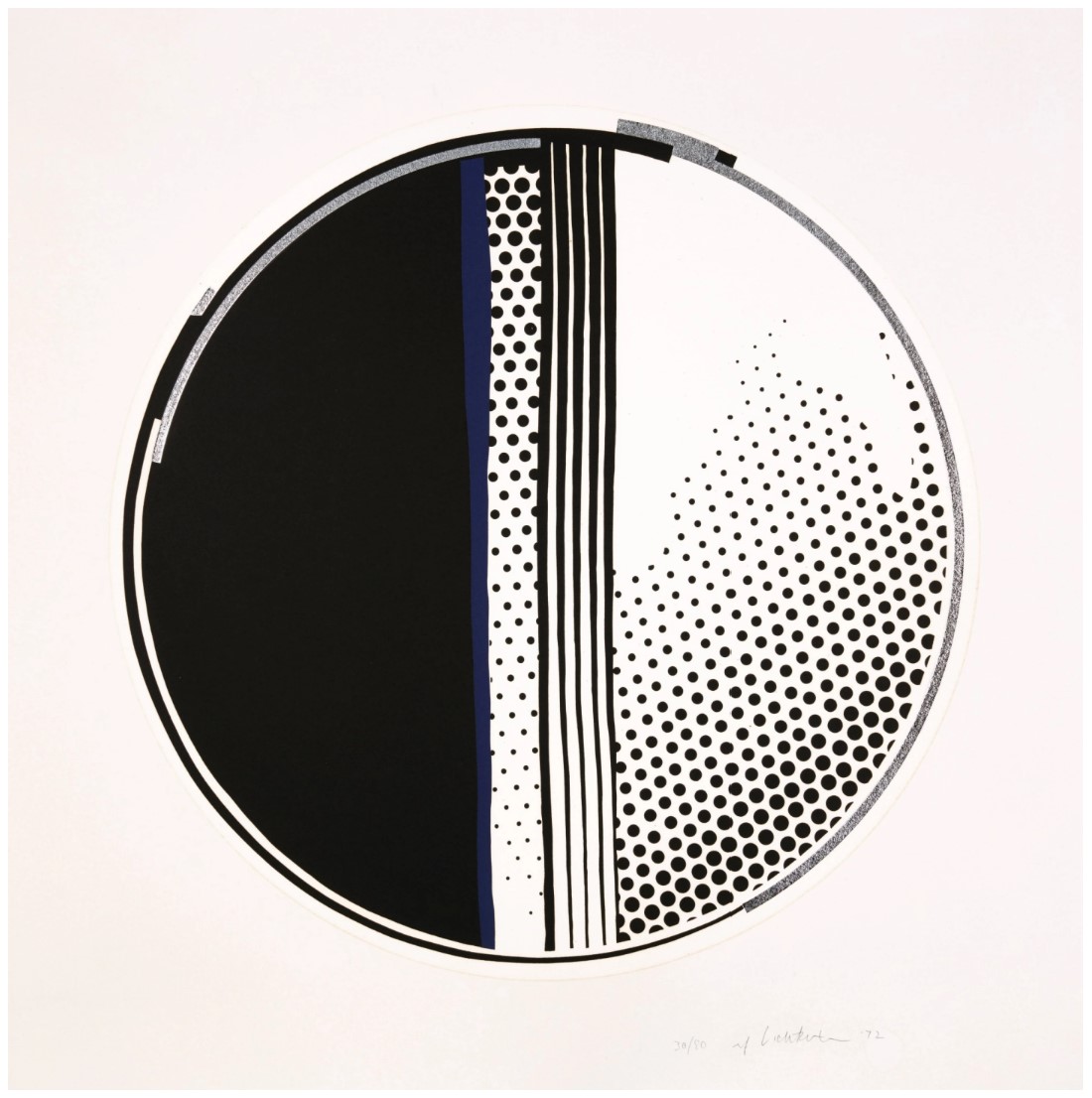
Mirror #1 from Mirror Series, 1972
Line-cut and screen-print in colors with embossing and silver foil on Arjomari paper
Sheet: 28×28 inches (71×71 cm)
Edition: 80 + 10 AP
Literature: Corlett 106
2. Mirror #2
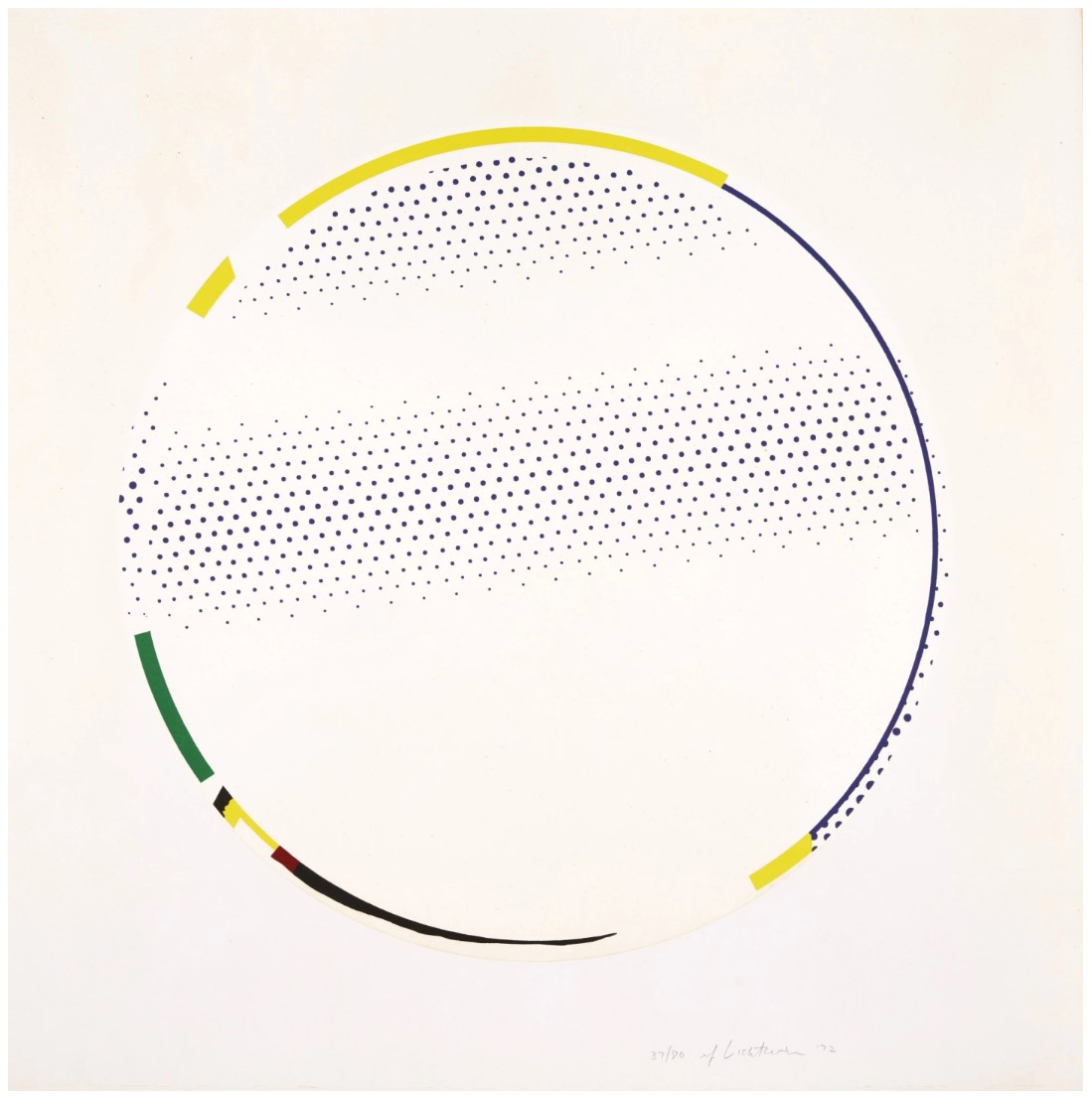
Mirror #2 from Mirror Series, 1972
Line-cut and screen-print in colors with embossing and silver foil on Arjomari paper
Sheet: 28×28 inches (71×71 cm)
Edition: 80 + 10 AP
Literature: Corlett 107
3. Mirror #3
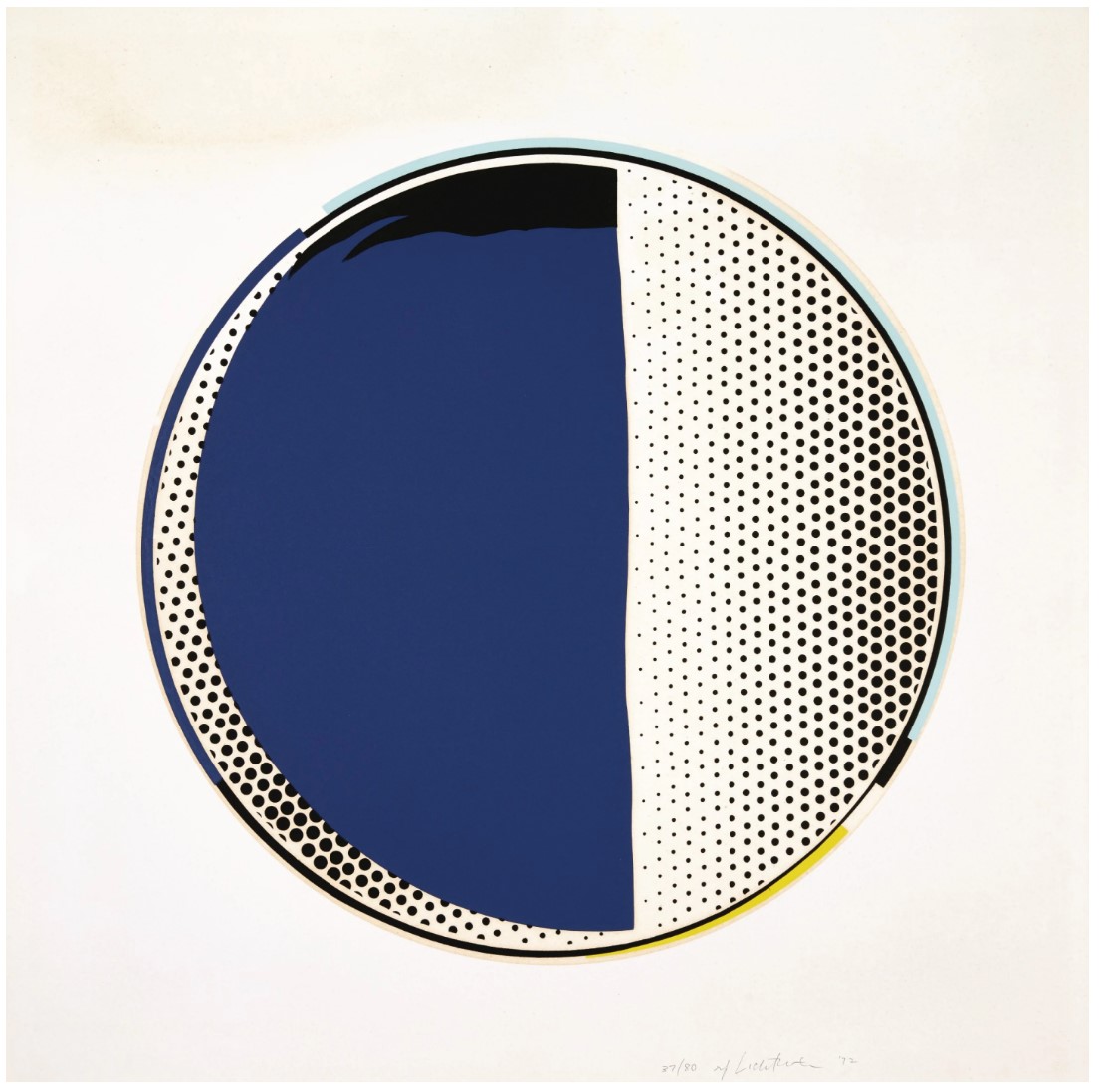
Mirror #3 from Mirror Series, 1972
Line-cut and screen-print in colors with embossing on Arjomari paper
Sheet: 28×28 inches (71×71 cm)
Edition: 80 + 10 AP
Literature: Corlett 108
4. Mirror #4
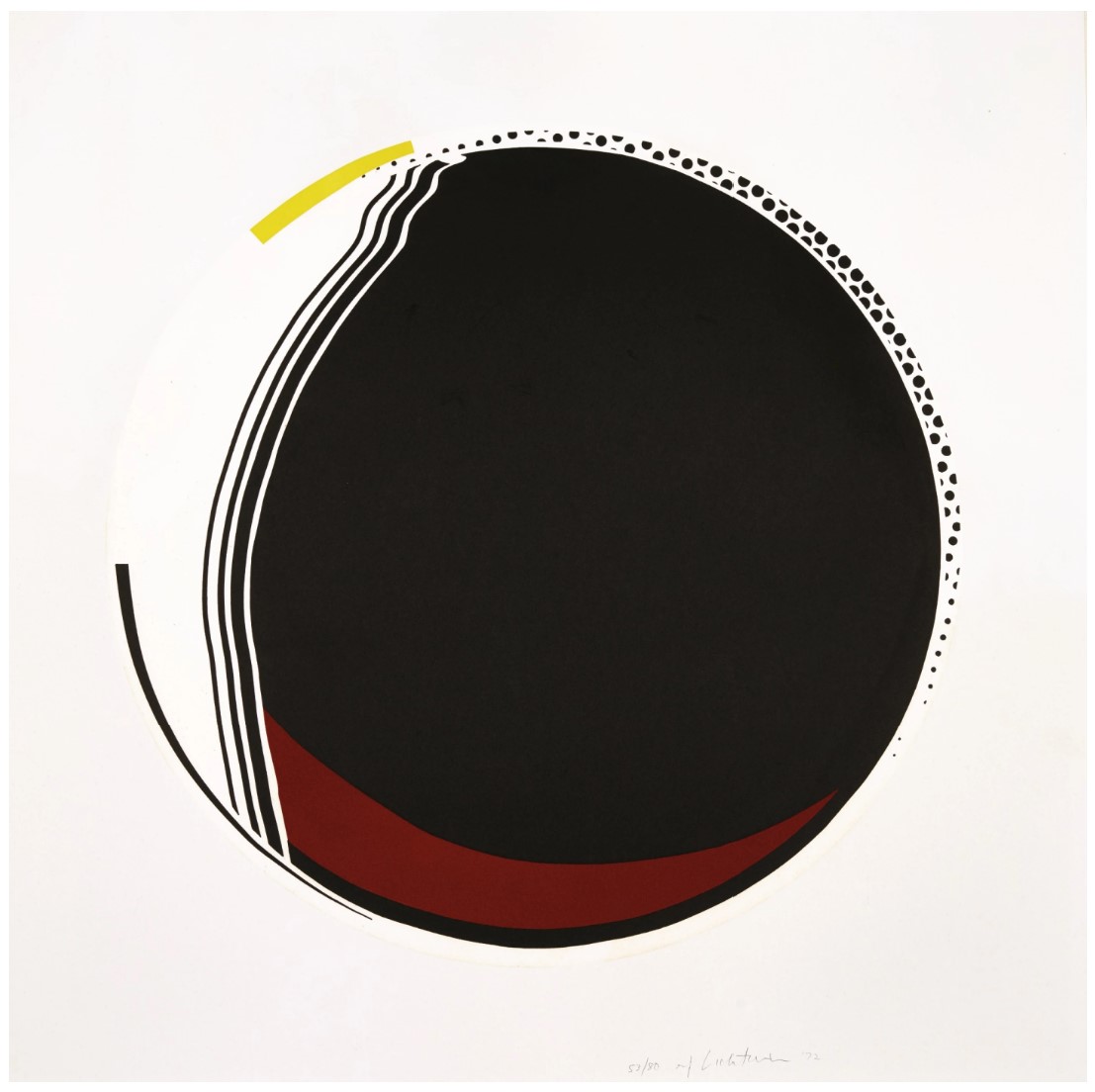
Mirror #4 from Mirror Series, 1972
Line-cut and screen-print in colors with embossing on Arjomari paper
Sheet: 28×28 inches (71×71 cm)
Edition: 80 + 10 AP
Literature: Corlett 109
5. Mirror #5
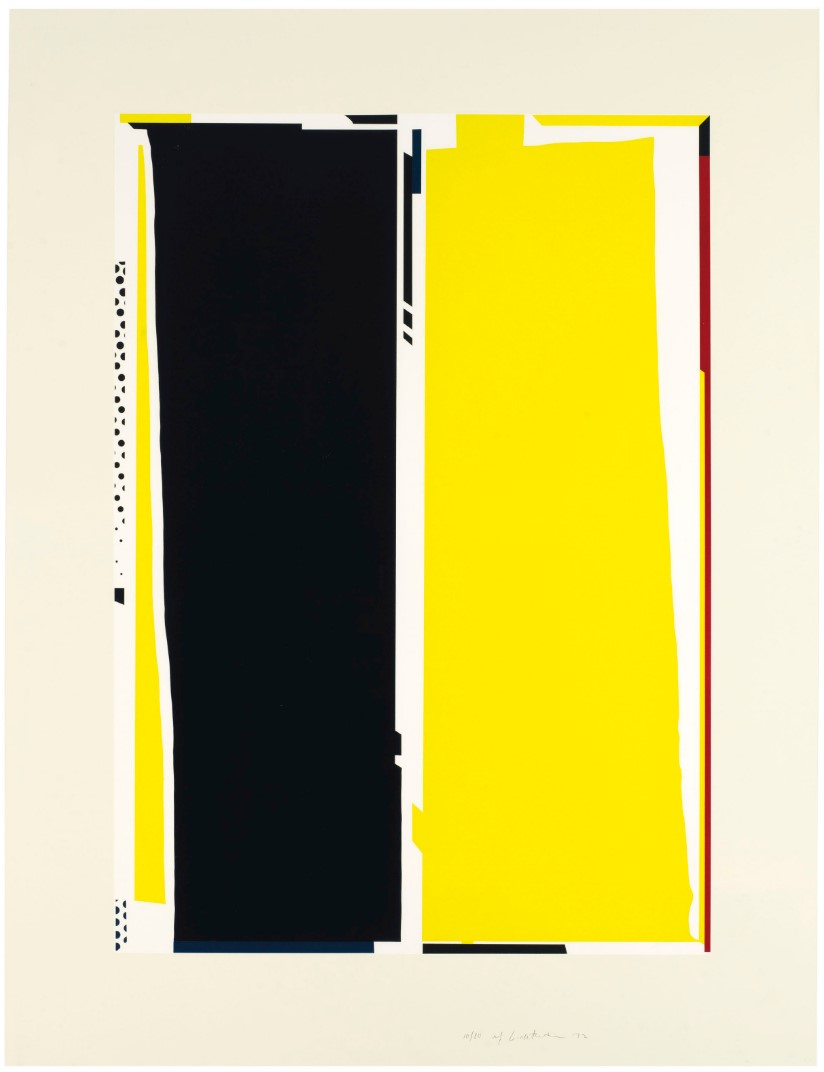
Mirror #5 from Mirror Series, 1972
Lithograph and screen-print in colors on Special Arjomari paper
Sheet: 43 5/8 x 33 1/4 inches (110.8 x 84.5 cm)
Edition: 80 + 10 AP
Literature: Corlett 110
6. Mirror #6
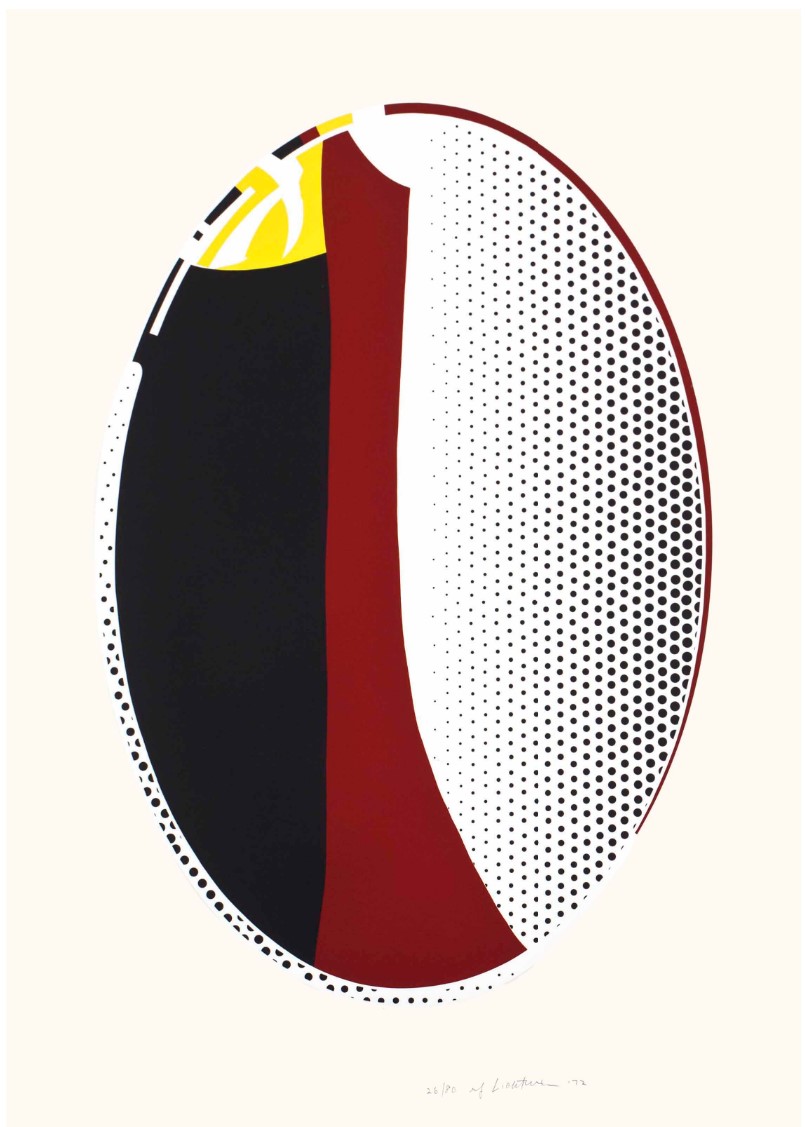
Mirror #6 from Mirror Series, 1972
Lithograph and screen-print in colors on Special Arjomari paper
Sheet: 40 ½ x 29 ¾ inches (102.9 x 75.6 cm)
Edition: 80 + 10 AP
Literature: Corlett 111
7. Mirror #7
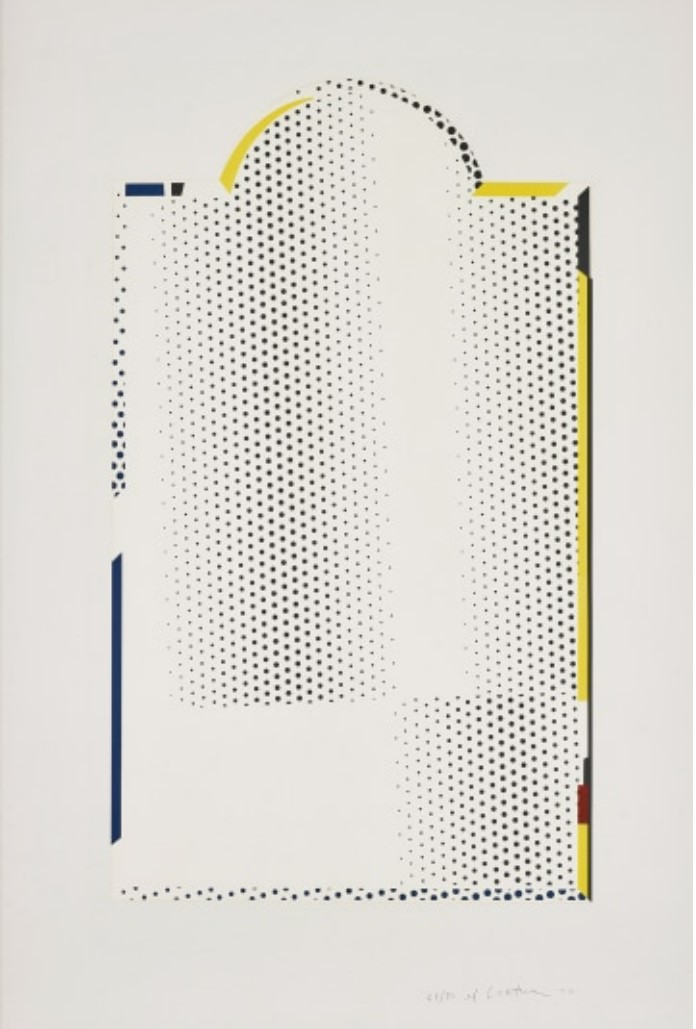
Mirror #7 from Mirror Series, 1972
Lithograph and screen-print in colors on Special Arjomari paper
Sheet: 38 7/8 x 25 3/8 inches (98.6 x 64.4 cm)
Edition: 80 + 10 AP
Literature: Corlett 112
8. Mirror #8
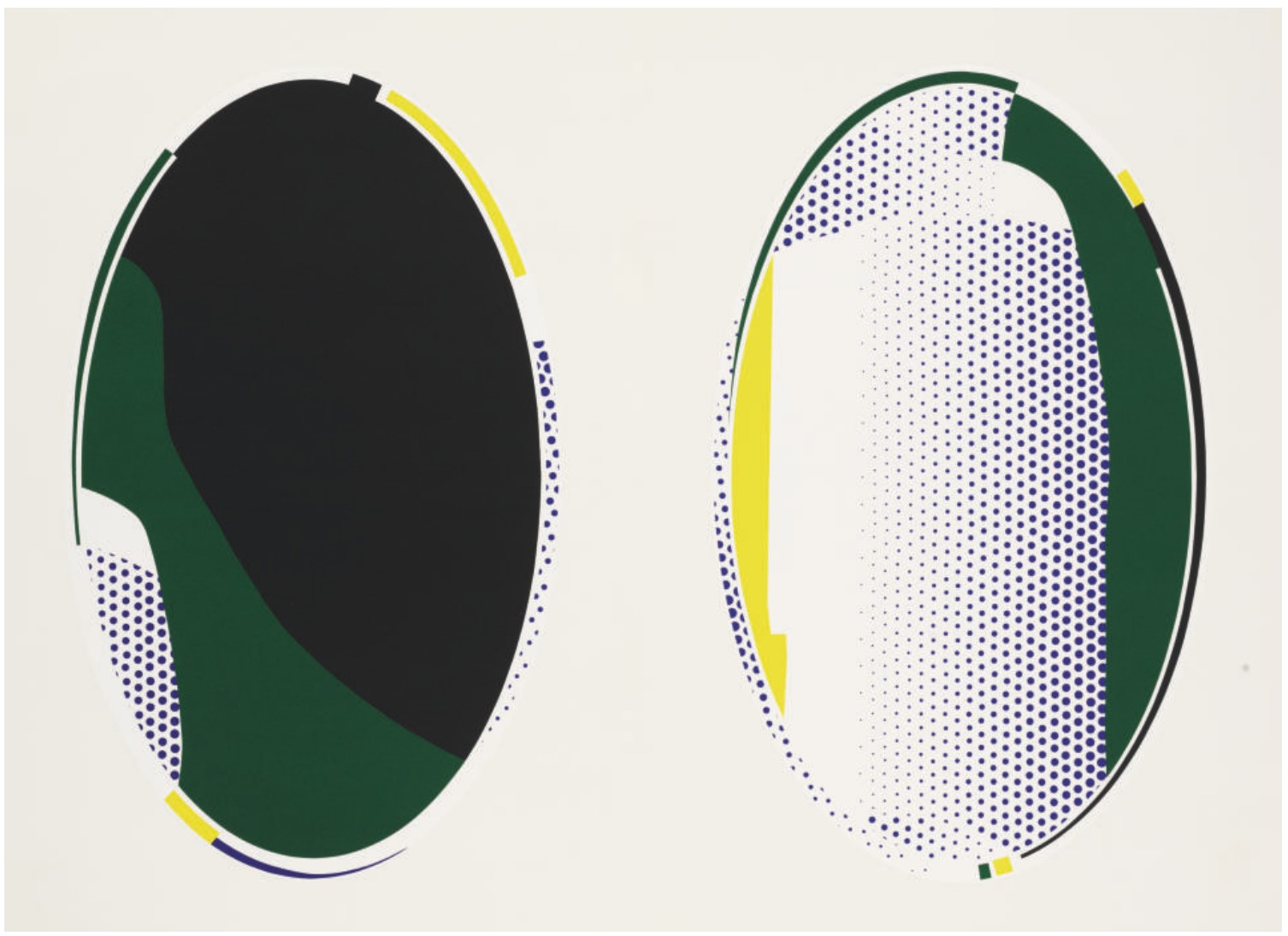
Mirror #8 from Mirror Series, 1972
Lithograph and screen-print in colors on Special Arjomari paper
Sheet: 40 3/4 x 53 inches (103.5 x 134.6 cm)
Edition: 50 + 9 AP
Literature: Corlett 113
9. Mirror #9
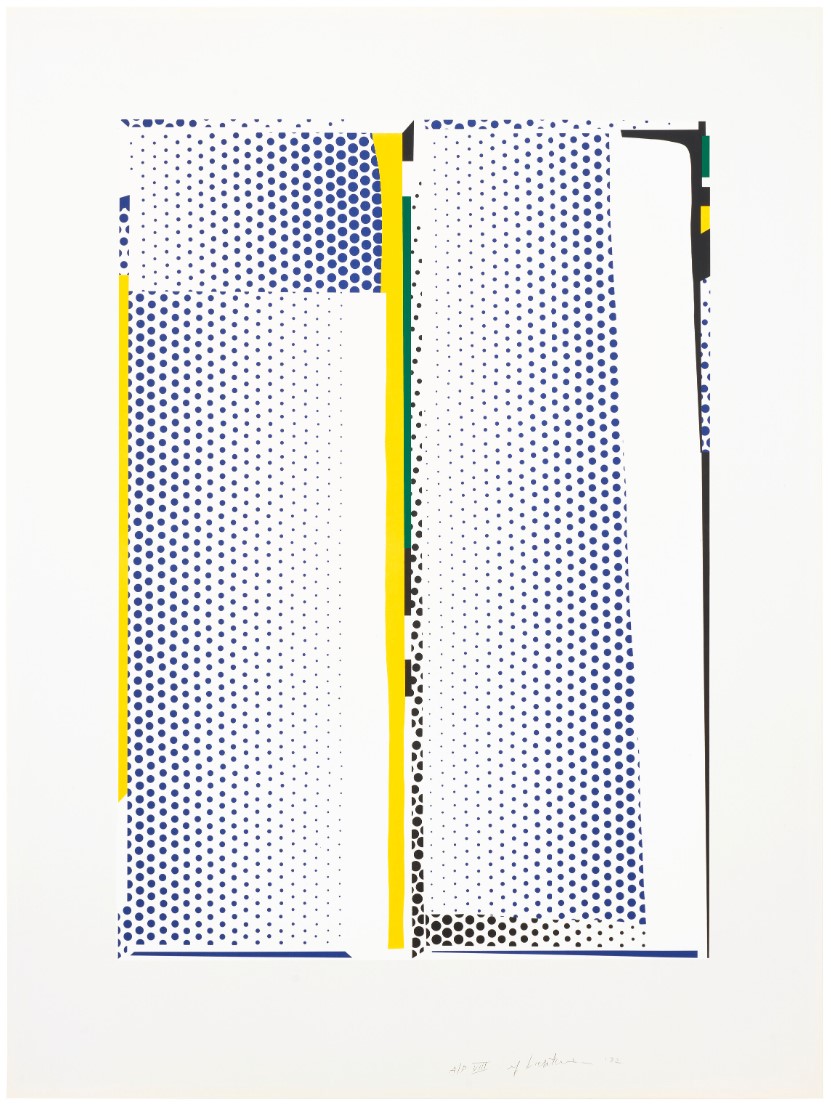
Mirror #9 from Mirror Series, 1972
Lithograph and screen-print in colors on Special Arjomari paper
Sheet: 39 x 29 1/4 inches (99.1 x 74.2 cm)
Edition: 80 + 9 AP
Literature: Corlett 114
10. Mirror
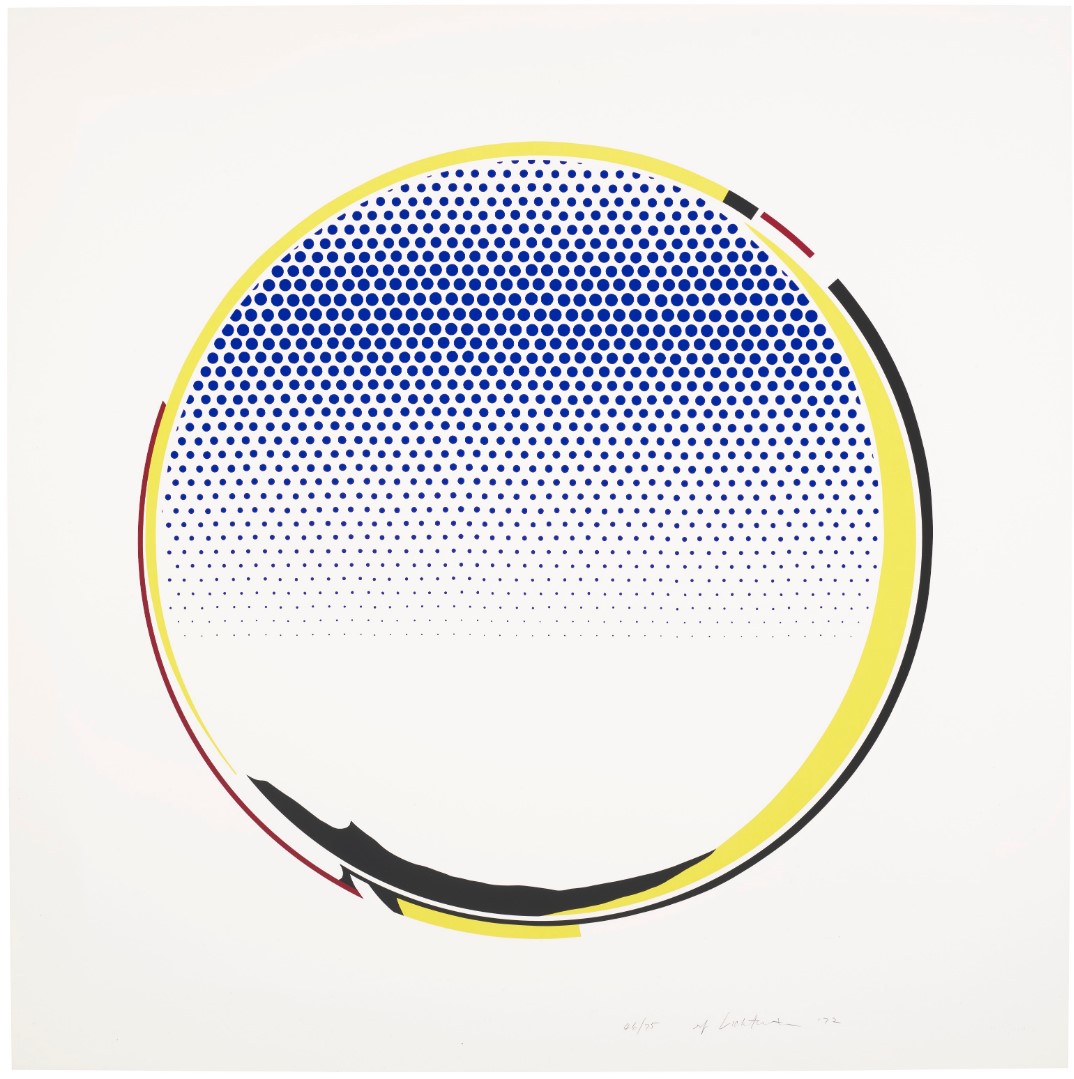
Mirror, 1972
Screen-print in colors with metal embossing on white wove paper
Sheet: 33 1/4 x 33 1/4 inches (84.6 x 84.5 cm)
Edition: 75
Literature: Corlett 115
Bulls and Cows, 1973
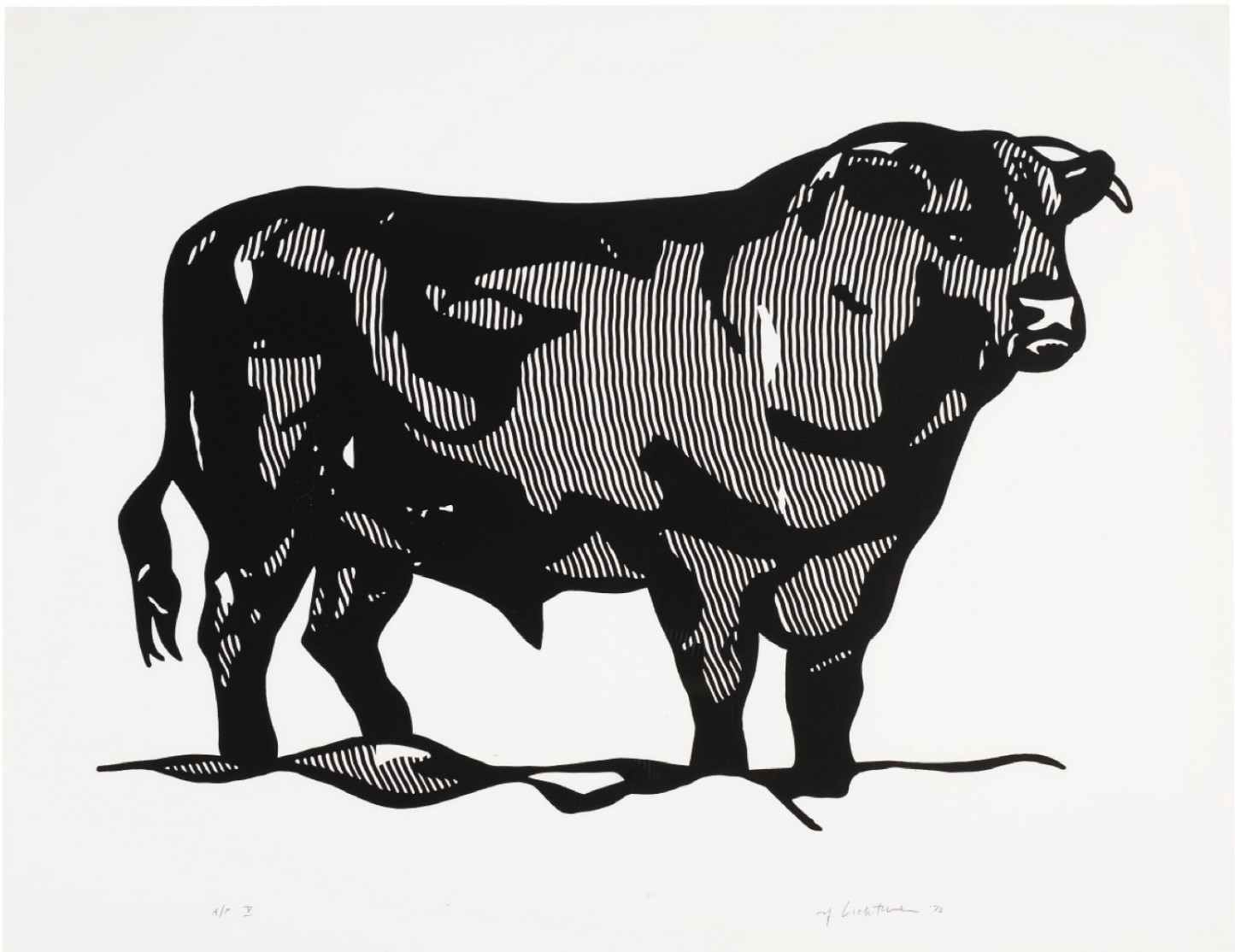
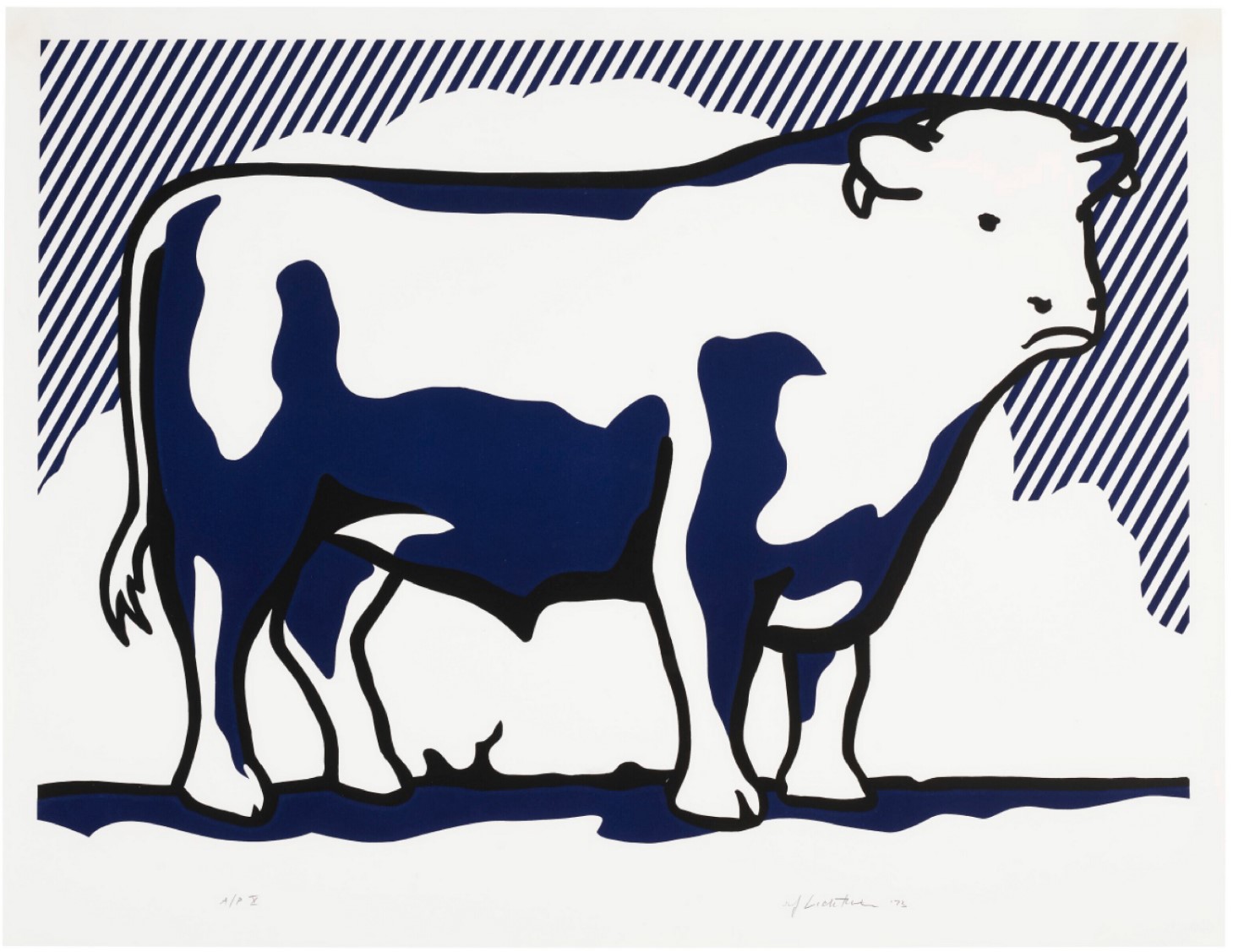
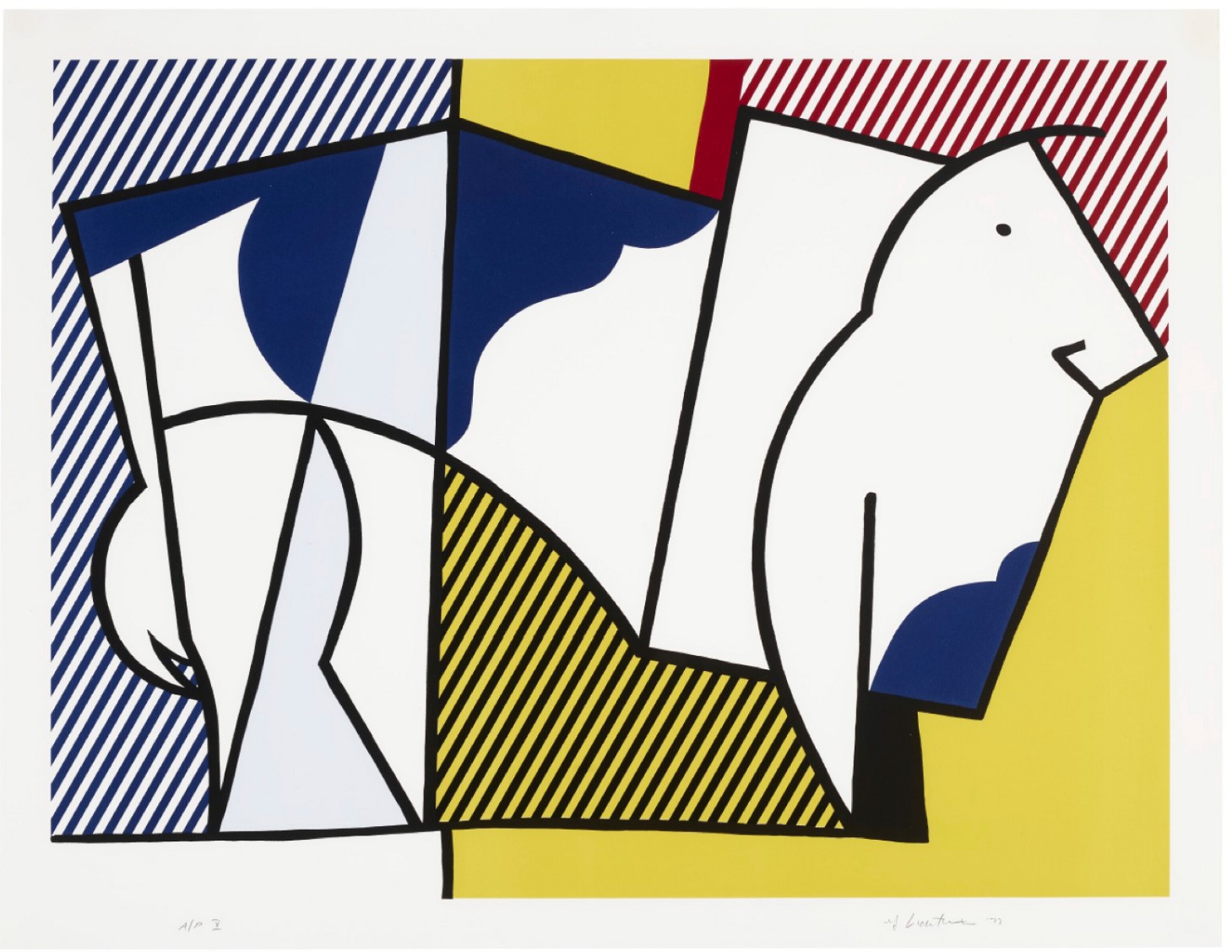
In this captivating series of six prints, Roy Lichtenstein progressively abstracts a solitary bull in profile. Lichtenstein directly references Pablo Picasso’s historic 1946 series on the same subject, The Bull (Le taureau), comprising eleven successive re-workings of a lithographic stone. Picasso began with a naturalistic depiction of the bovine in profile, then gradually contorts and pares down the animal into its most basic elements. The final impression is reduced to a near-hieroglyphic rendering of the original form. While Picasso investigates the modernist belief that universal truth could be discovered through distillation and abstraction, Lichtenstein responds through parodying this ideology and playfully questioning the presumed differences between ‘realistic’ and ‘abstract.’ Lichtenstein reflects on his own series that ‘nothing is more abstract than anything else to me. The first one is abstract; they’re all abstract.’ The stylized, curving lines in Bull I, reminiscent of Old Master engravings, straighten out into bold diagonal fields in Bull VI. Lichtenstein draws from his well-known practice of transforming his source image, in this case a 1970 cattle sales catalogue. At the renowned print workshop Gemini G.E.L in Los Angeles, he rendered this progression of the image through the combination of lithography, screen-print as well as line cut, a process more often associated with commercial printing. With each sequential print, Lichtenstein further tactically obscures the animal’s shape until it is nearly indecipherable, embedded within a harmoniously balanced composition of saturated shades of primary colors.
Bull Profile Series, 1973
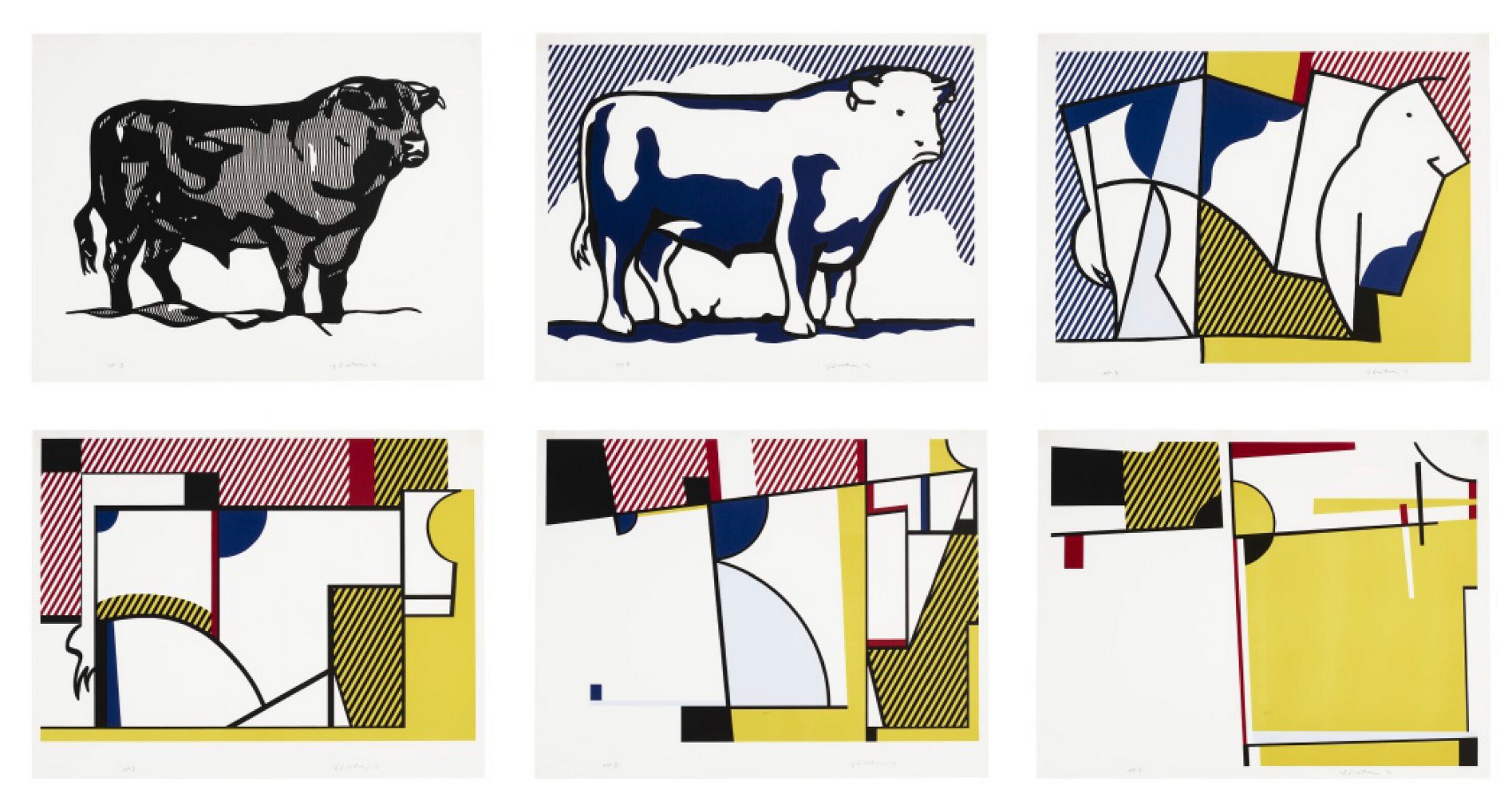
Bull Profile Series
The Complete Set of 6 works
Medium: One line-cut in black, one lithograph and line-cut in black and blue and four lithograph, line-cut and screen-prints in colors, on Arjomari paper
Year: 1973
Each Sheet: 27×35 inches (68.6 x 88.9 cm)
Edition: 100
Artist’s Proofs: Unknown number
Publisher: Gemini G.E.L., Los Angeles
Literature: Corlett 116-121, Gemini 466-471
Each signed, dated and numbered with the publisher’s and printer’s blindstamps and inkstamp on the reverse
Bull Profile #1
Bull Profile #2
Bull Profile #3
Bull Profile #4
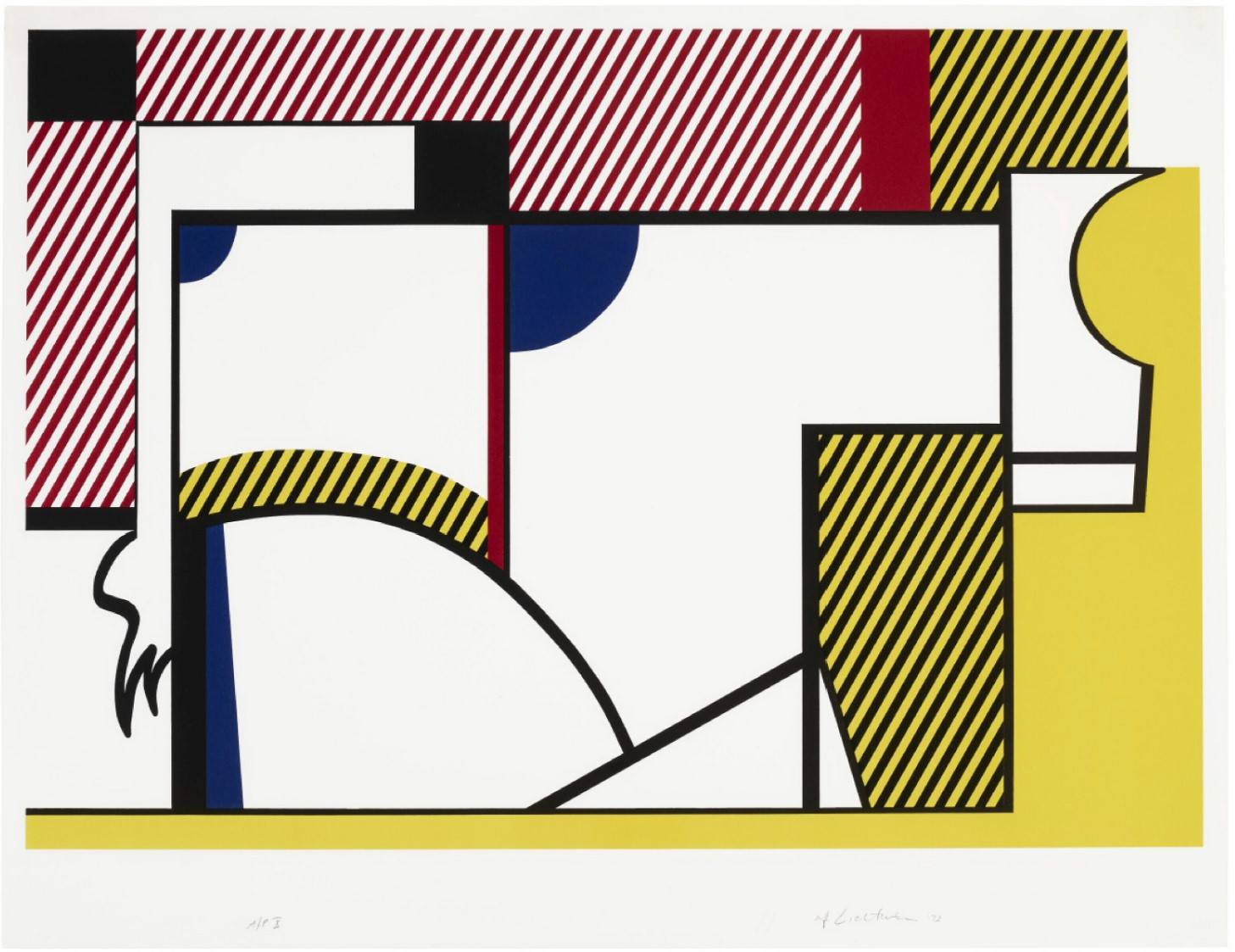
Bull Profile #5
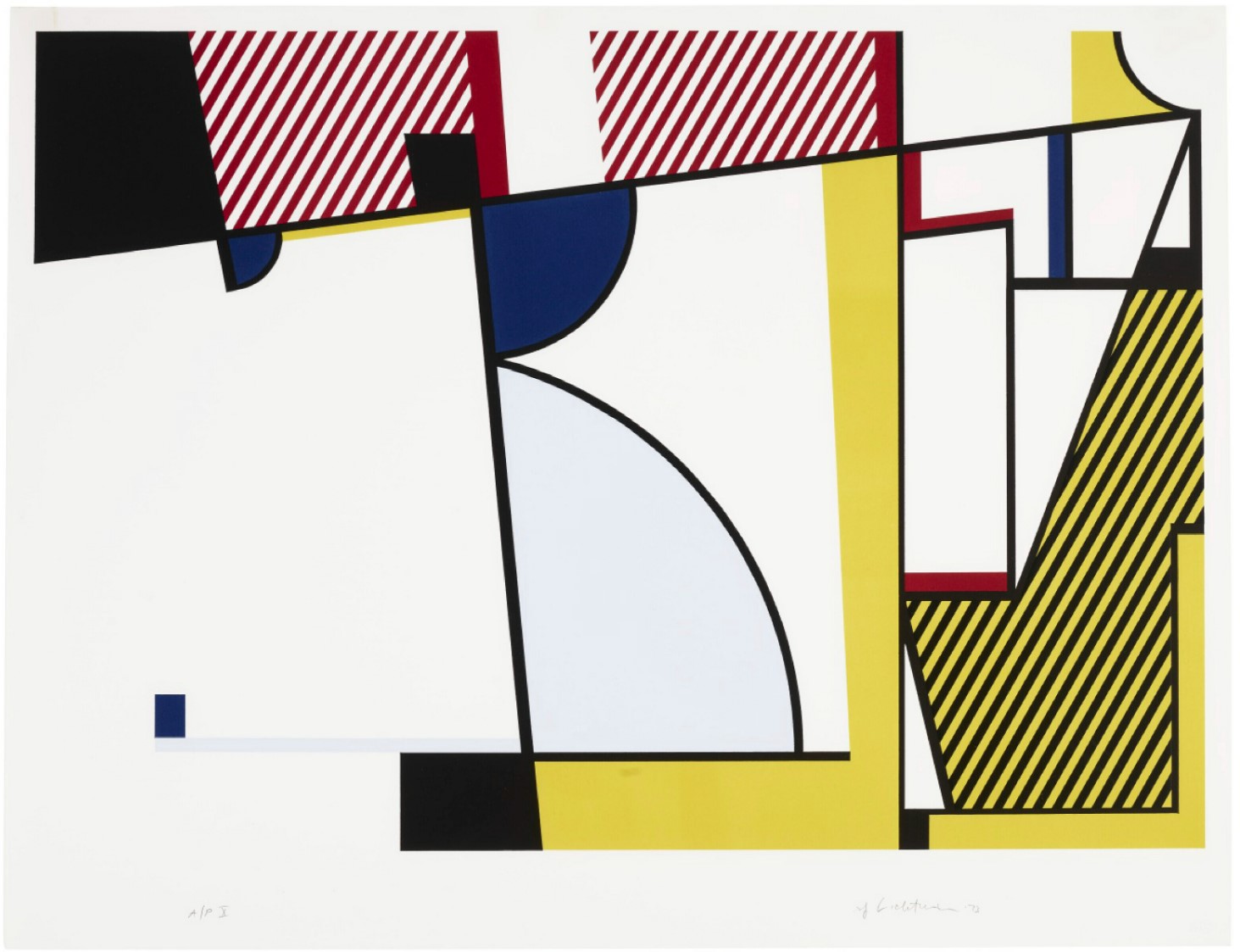
Bull Profile #6
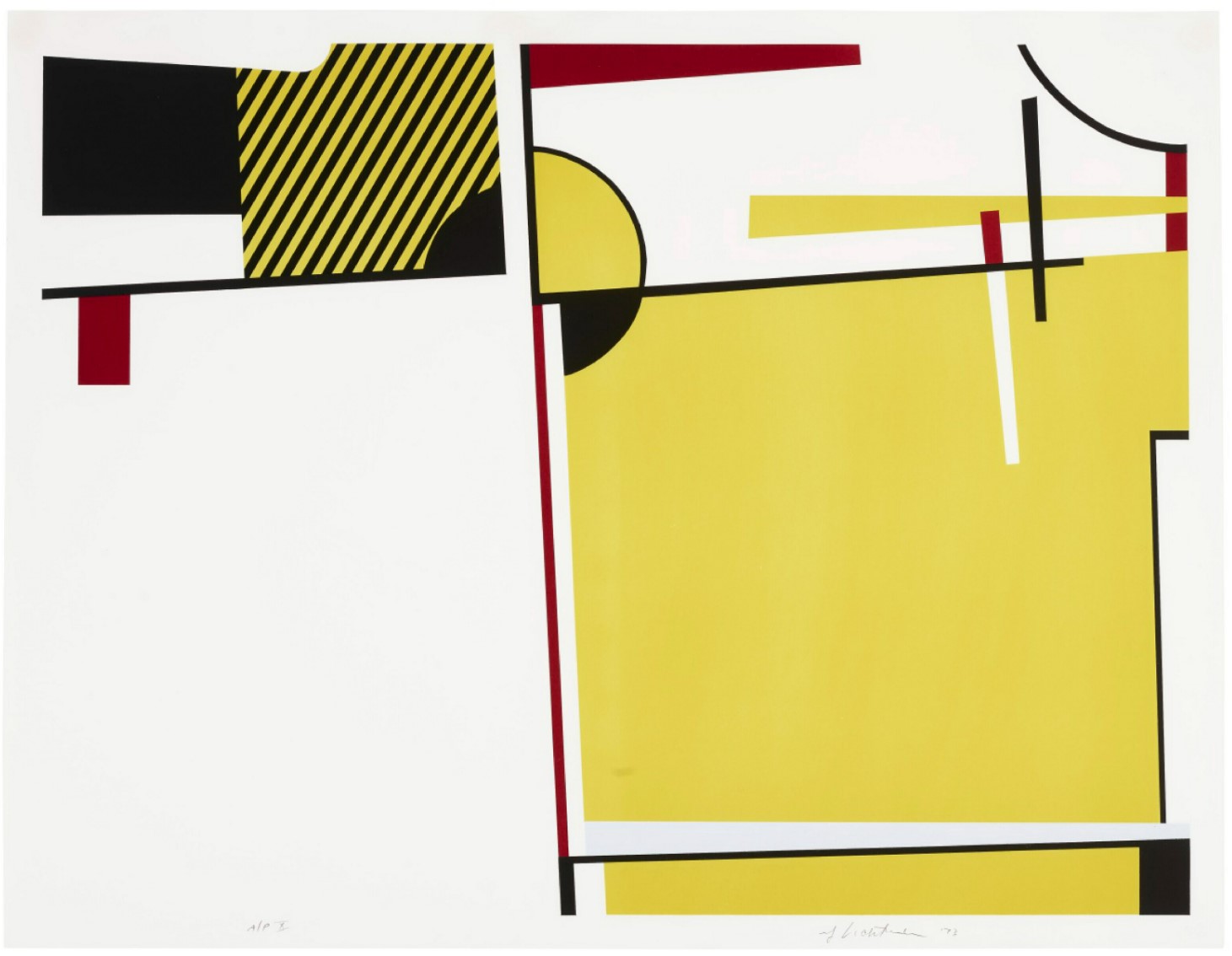
Six Still Lifes Series, 1974
Commandeering the lexicon of art history, Roy Lichtenstein’s Six Still Lifes series (1974), showcases the artist’s enduring dialogue with visual vocabulary of the past. The still life genre spans art history, from Egyptian tombs decorated with paintings of everyday objects, to Dutch Golden Age still lifes laden with allegory. Throughout the 1970s, Lichtenstein was consumed with the genre and completed many compositions echoing various still life ‘types’. Notably, Lichtenstein’s still lifes are devoid of the vanitas symbols that are so prolific within the still life genre. Certain symbols, such as skulls, candles and decaying fruit, which usually serve as reminders to the viewer of the unstoppable passage of time and the pervasive nature of their own mortality, are omitted. As a result, Lichtenstein’s still lifes are relieved of moral admonitions and memento mori, eschewing the gravitas of traditional still lifes. Instead, they playfully and self-referentially investigate notions of creation and, in the artist’s quintessential manner, reshape conceptions of artistic authorship.
1. Still Life with Figurine
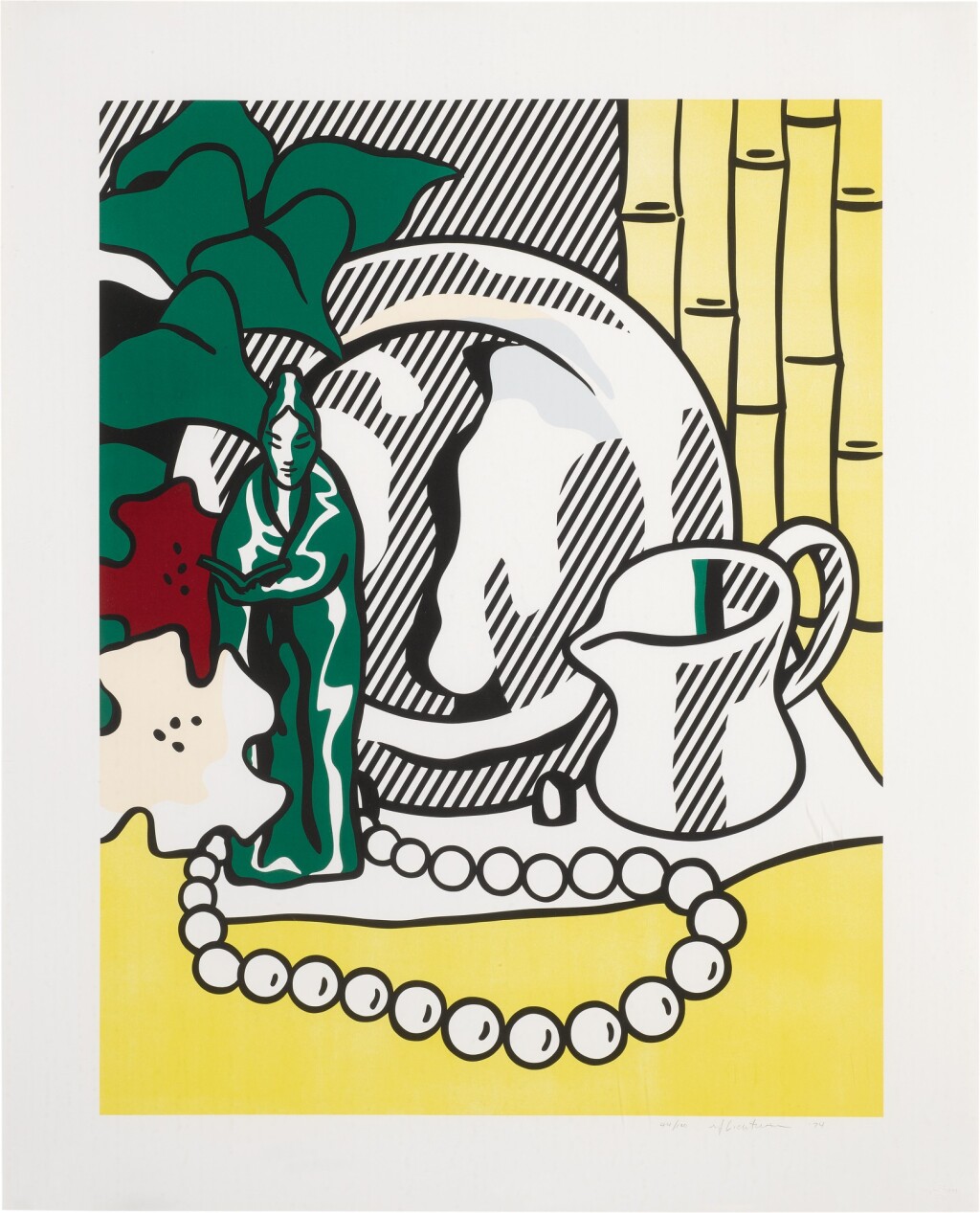
Still Life with Figurine from Six Still Lifes Series, 1974
Lithograph and screen-print in colors on BFK Rives wove paper
Sheet: 46 3/4 x 37 3/4 inches (118.5 x 95.7 cm)
Edition: 100 + 10 AP
Literature: Corlett 128
2. Still Life with Lobster
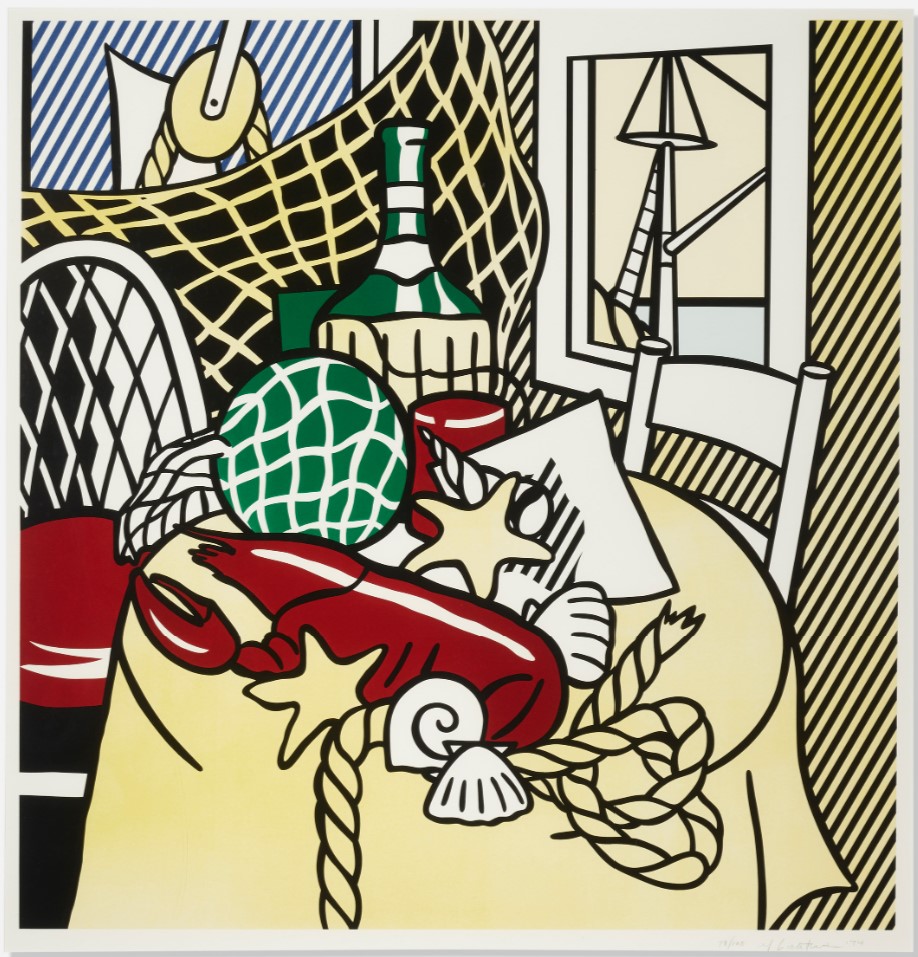
Still Life with Lobster from Six Still Lifes Series, 1974
Lithograph and screen-print in colors on BFK Rives wove paper
Sheet: 33 1/2 x 31 3/4 inches (85×81 cm)
Edition: 100 + 10 AP
Literature: Corlett 129
3. Still Life with Pitcher and Flowers
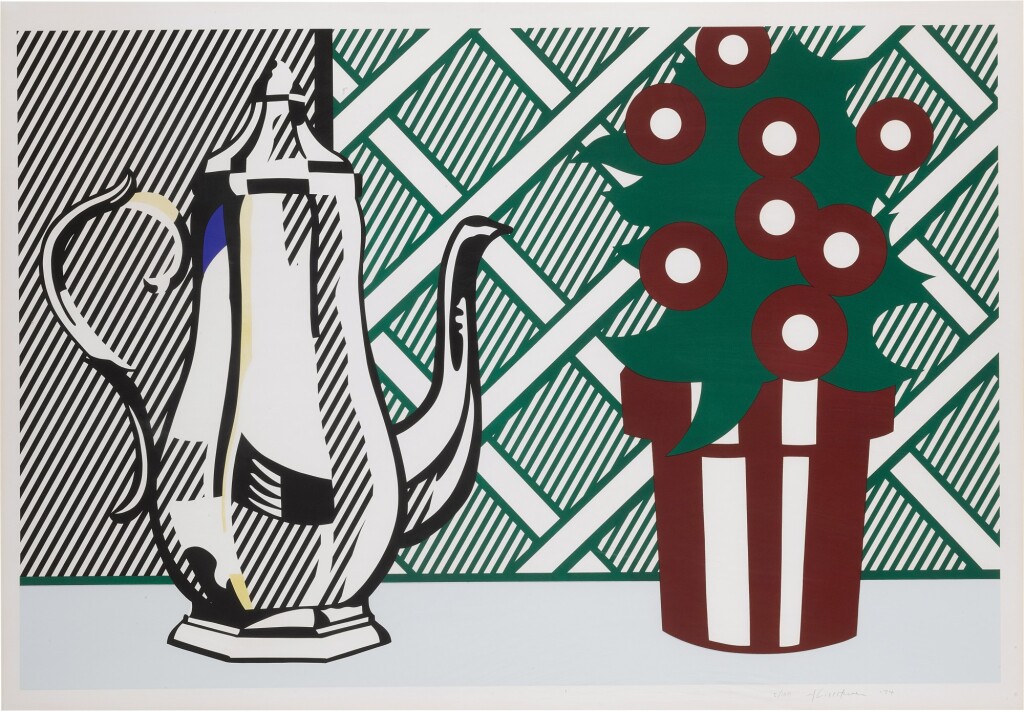
Still Life with Pitcher and Flowers from Six Still Lifes Series, 1974
Lithograph and screen-print in colors on Rives BFK paper
Sheet: 36 7/8 x 51 7/8 inches (93.8 x 131.8 cm)
Edition: 100 + 10 AP
Literature: Corlett 130
4. Still Life with Portrait
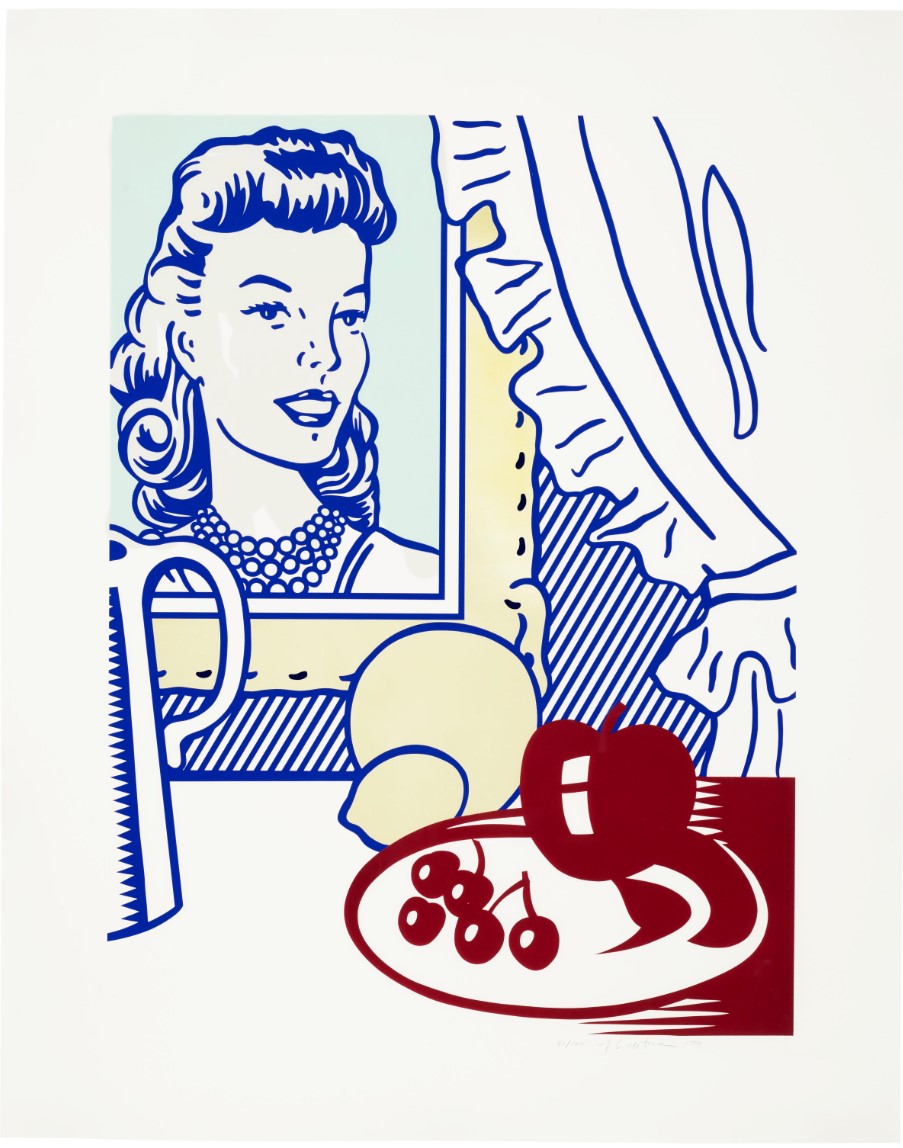
Still Life with Portrait from Six Still Lifes Series, 1974
Lithograph and screen-print in colors with debossing on Rives BFK paper
Sheet: 47 1/8 x 37 1/2 inches (119.7 x 95.3 cm)
Edition: 100 + 10 AP
Literature: Corlett 131
5. Still Life with Windmill
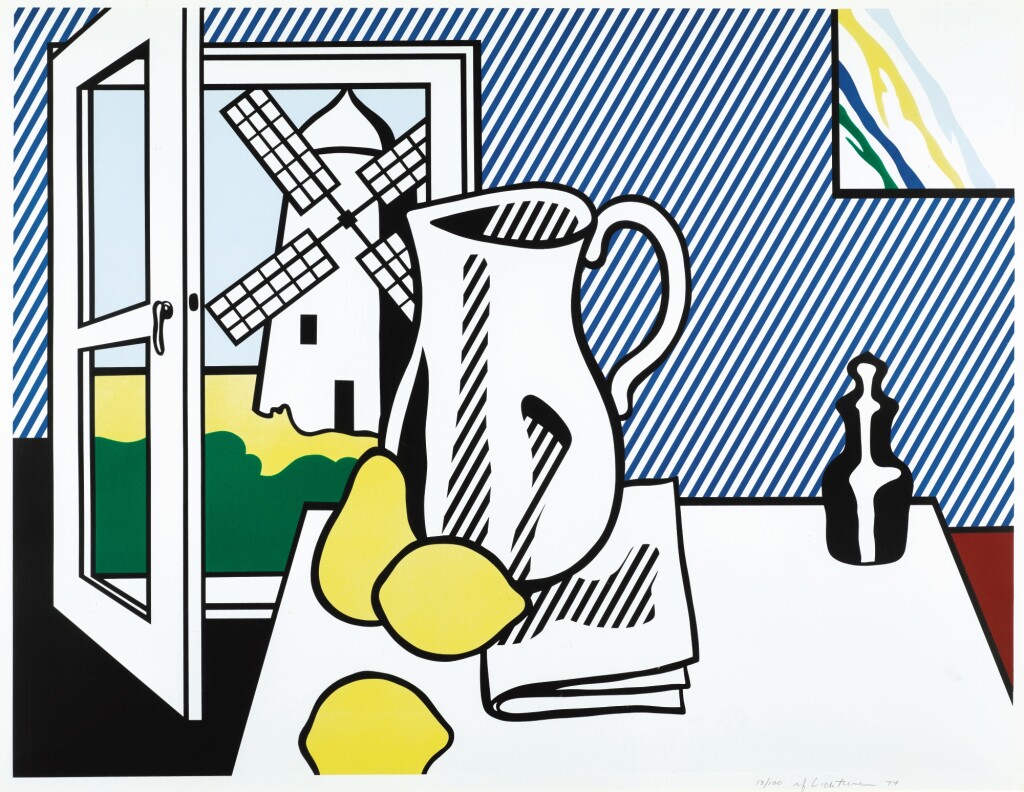
Still Life with Windmill from Six Still Lifes Series, 1974
Lithograph and screen-print in colors with debossing on Rives BFK paper
Sheet: 35 7/8 x 33 3/4 inches (91 x 113.5 cm)
Edition: 100 + 10 AP
Literature: Corlett 132
6. Yellow Still Life
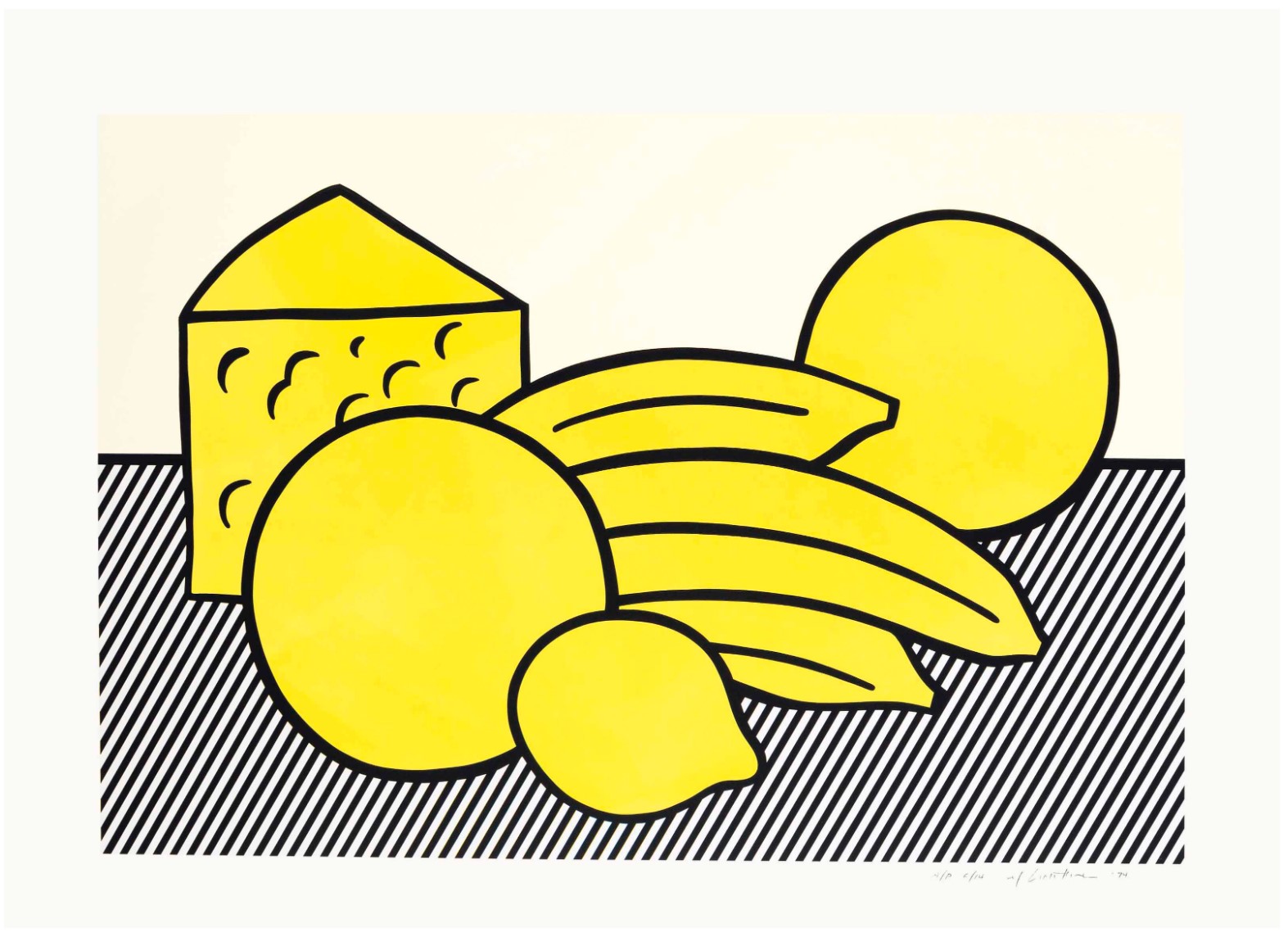
Yellow Still Life from Six Still Lifes Series, 1974
Lithograph and screen-print in colors on Rives BFK paper
Sheet: 33×44 inches (83.7 x 112.3 cm)
Edition: 100 + 10 AP
Literature: Corlett 133
Entablature Series, 1976
Inspired by the architectural facades and ornamental motifs Roy Lichtenstein encountered around Wall Street and elsewhere in Lower Manhattan, the Entablature Series addresses many of the artist’s central artistic themes while demonstrating a unique emphasis on texture, surface, relief and reflectivity. Named after the horizontal structures that sit atop the columns in Classical Greek architecture, Lichtenstein’s Entablatures represent a distinctively American derivative, one based in revivalist, industrialized architectural imitations that were built en masse in the early twentieth Century. By isolating cliched symbols of, in the artist’s words, “imperial power”, and “the establishment”, Lichtenstein traces the effect of mass production and replication on cultural forms. A sustained investigation into pattern and repetition, the Entablatures also underscore the echoes of Classical order embedded with Minimalist scultpture and Color Field painting.
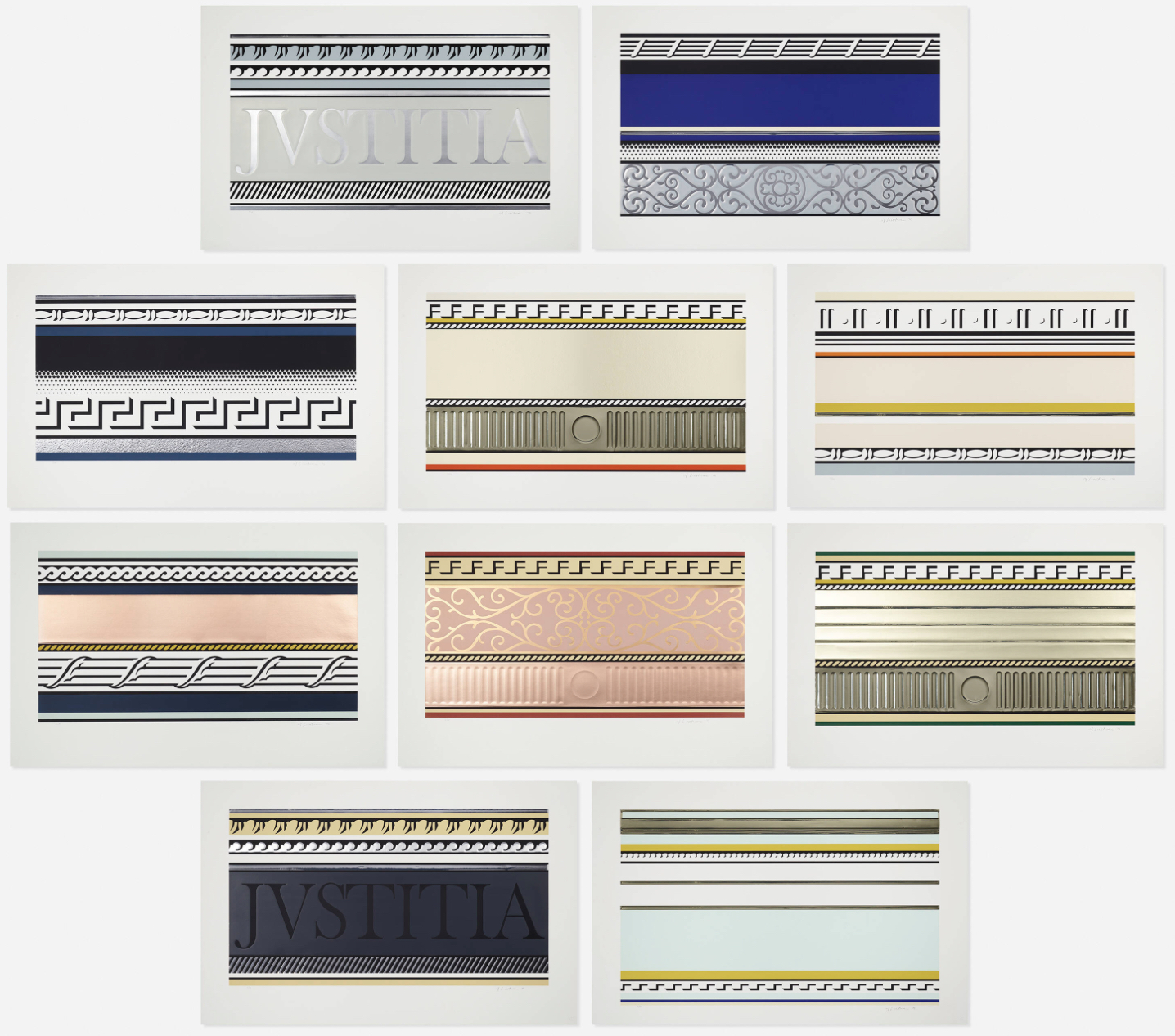
Medium: Screen-print in colors with collage and embossing on BFK Rives wove paper
Year: 1976
Image: 21 1/4 x 38 inches (54.1 x 96.4 cm)
Sheet: 29 1/8 x 45 inches (74 x 114.1 cm)
Edition: 16
Artist’s Proofs: 9
Publisher: Tyler Graphics, Ltd.
Literature: Corlett 138, Tyler 334
Signed, dated and numbered in pencil with the publisher’s blinstamp
Source: Whitney Museum of American Art
1. Entablature I (C. 138)
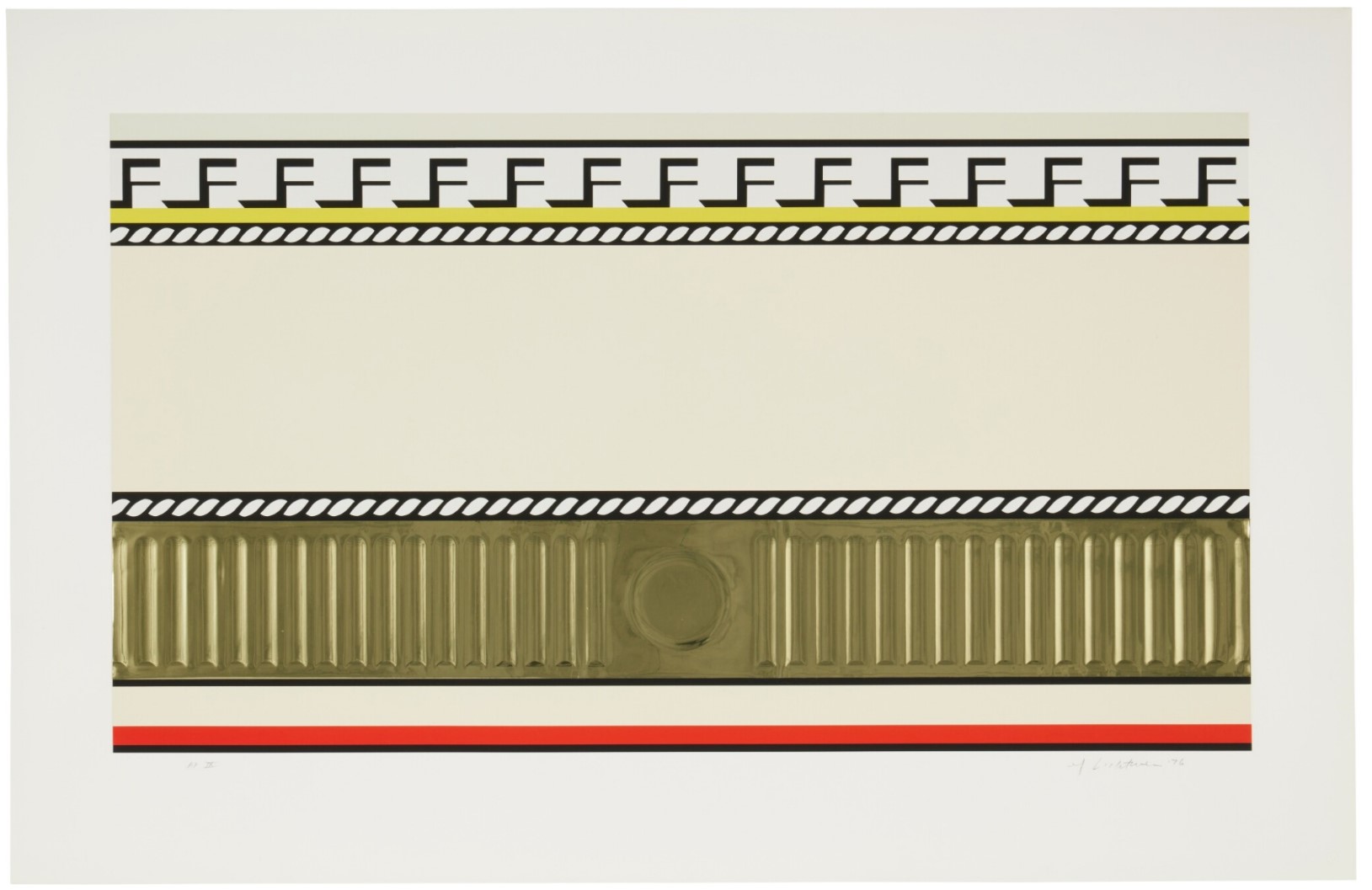
Entablature I from Entablature Series, 1976
Edition: 16 + 9 AP
Literature: Corlett 138, Tyler 334
2. Entablature II (C. 139)
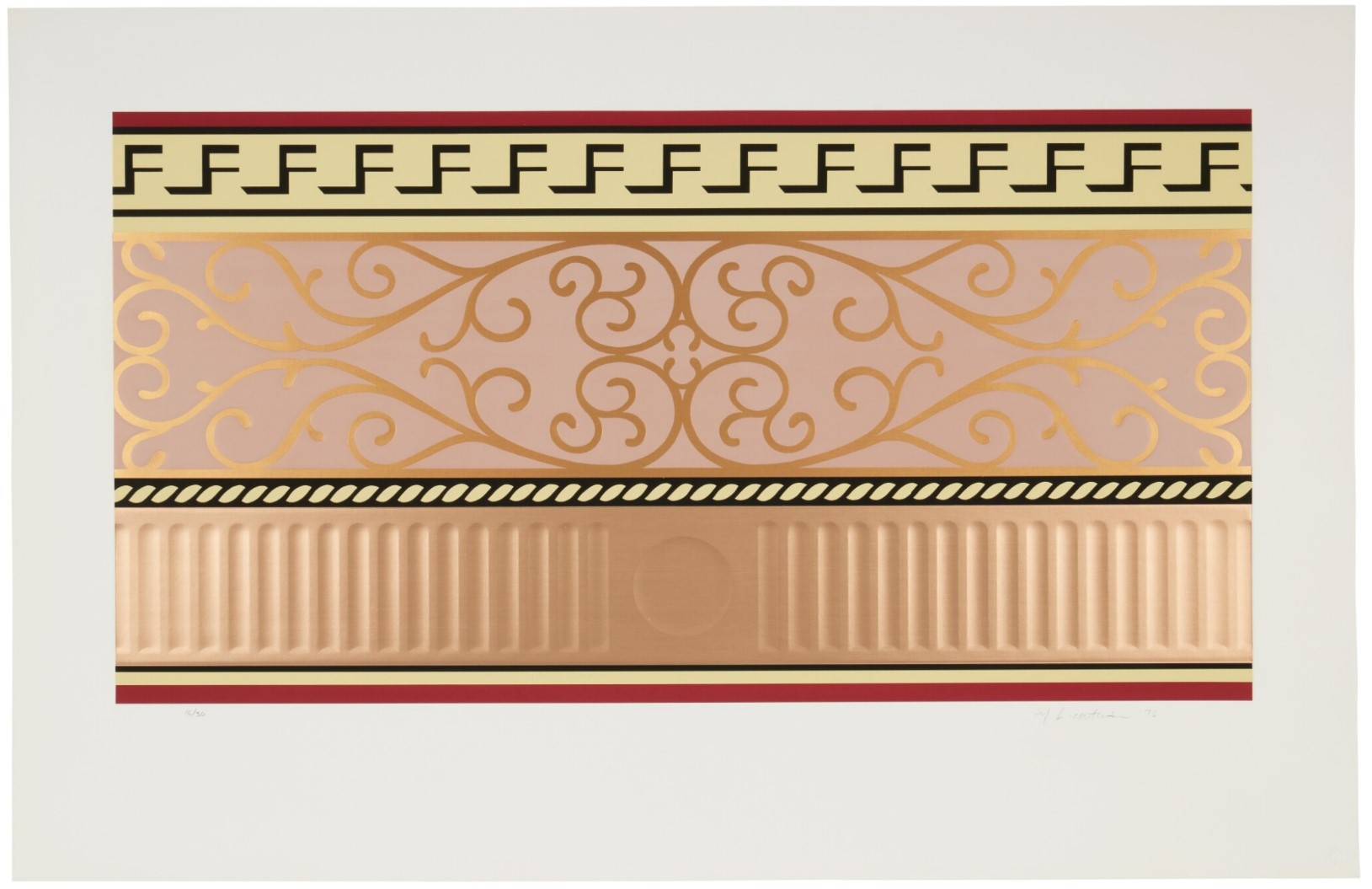
Entablature II from Entablature Series, 1976
Edition: 30 + 9 AP
Literature: Corlett 139, Tyler 335
3. Entablature III (C. 140)
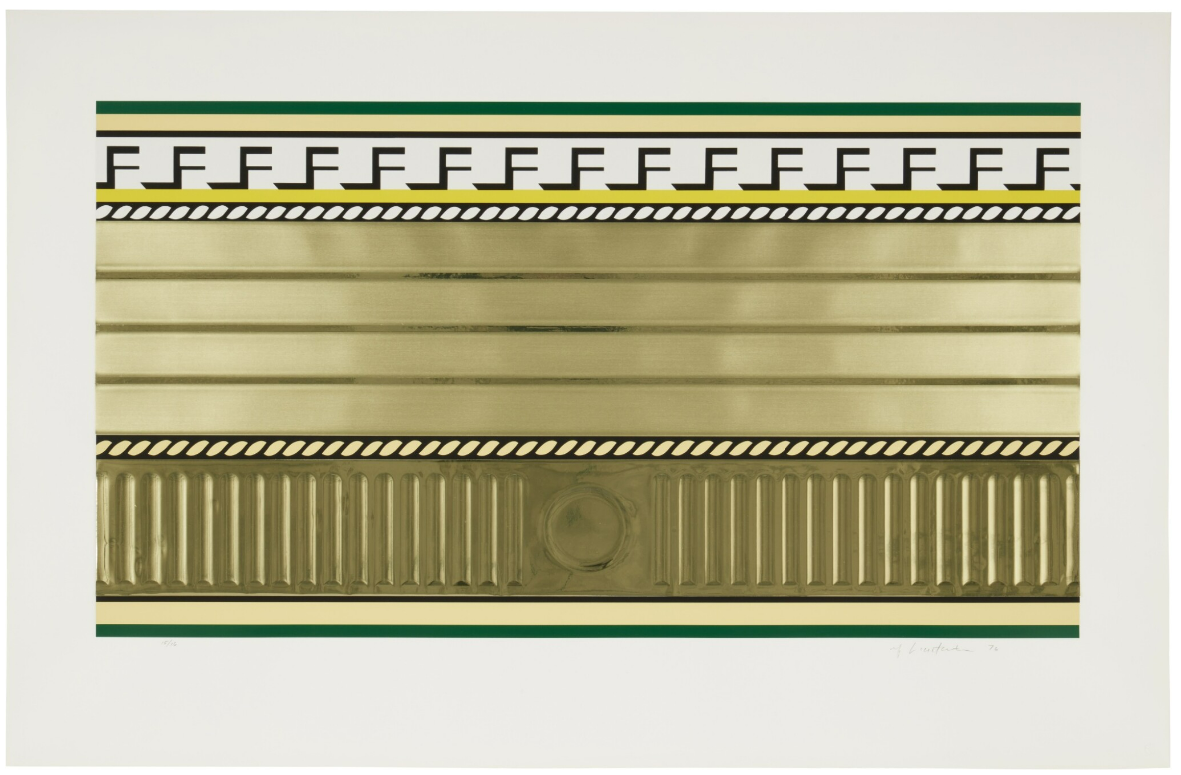
Entablature III from Entablature Series, 1976
Edition: 16 + 9 AP
Literature: Corlett 140, Tyler 336
4. Entablature IV (C. 141)
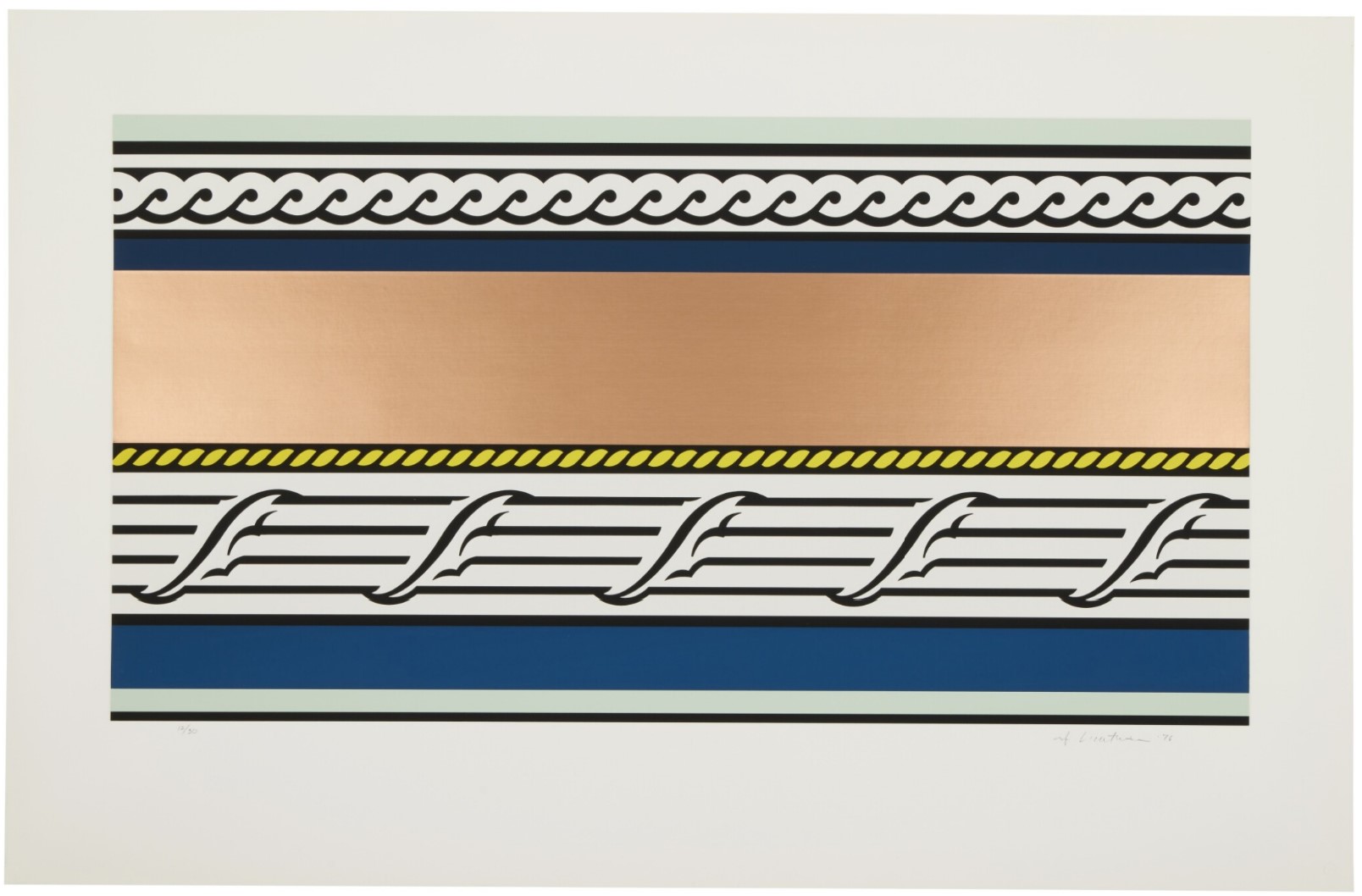
Entablature IV from Entablature Series, 1976
Edition: 30 + 9 AP
Literature: Corlett 141, Tyler 337
5. Entablature V (C. 142)
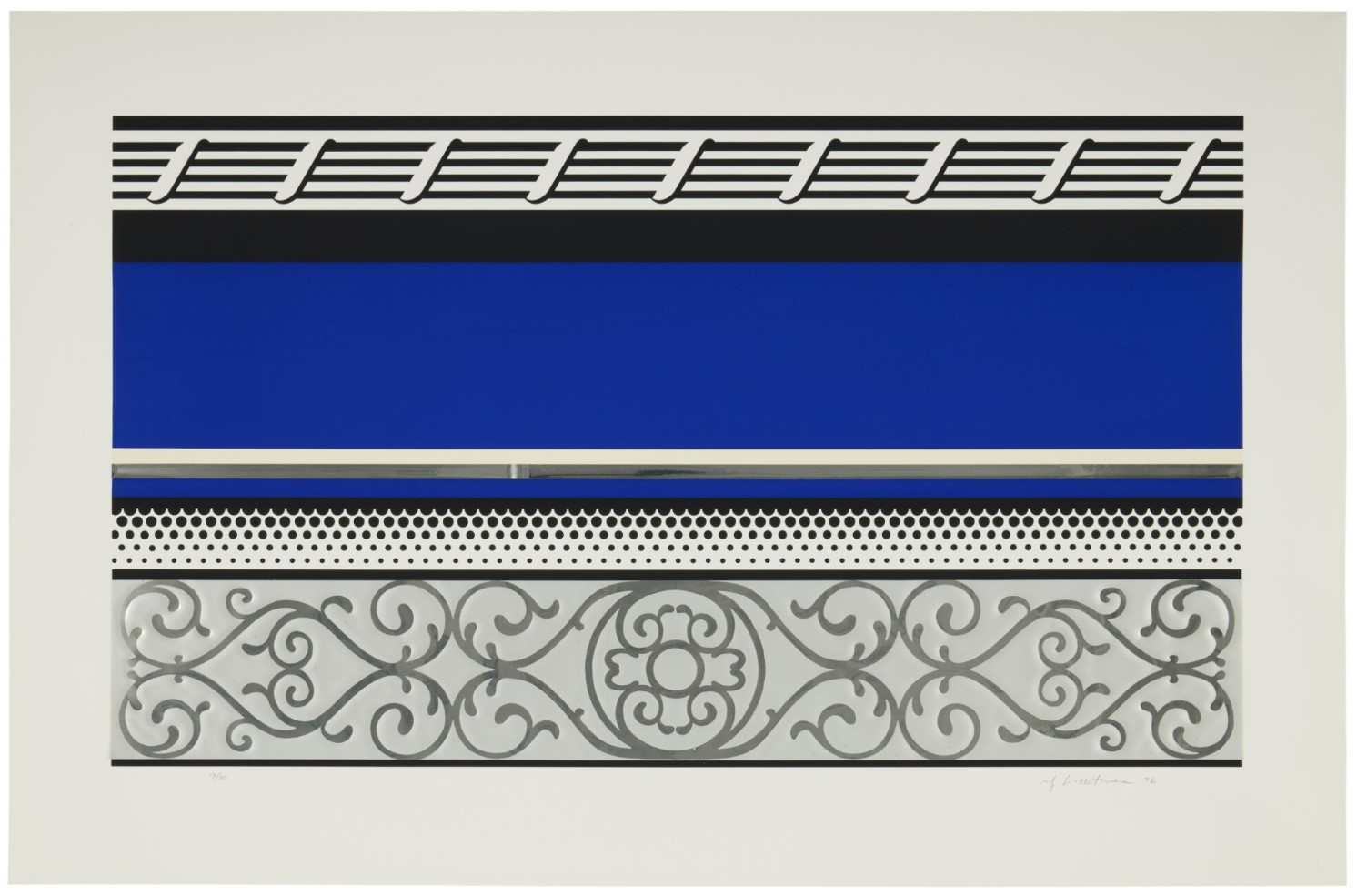
Entablature V from Entablature Series, 1976
Edition: 30 + 9 AP
Literature: Corlett 142, Tyler 338
6. Entablature VI (C. 143)
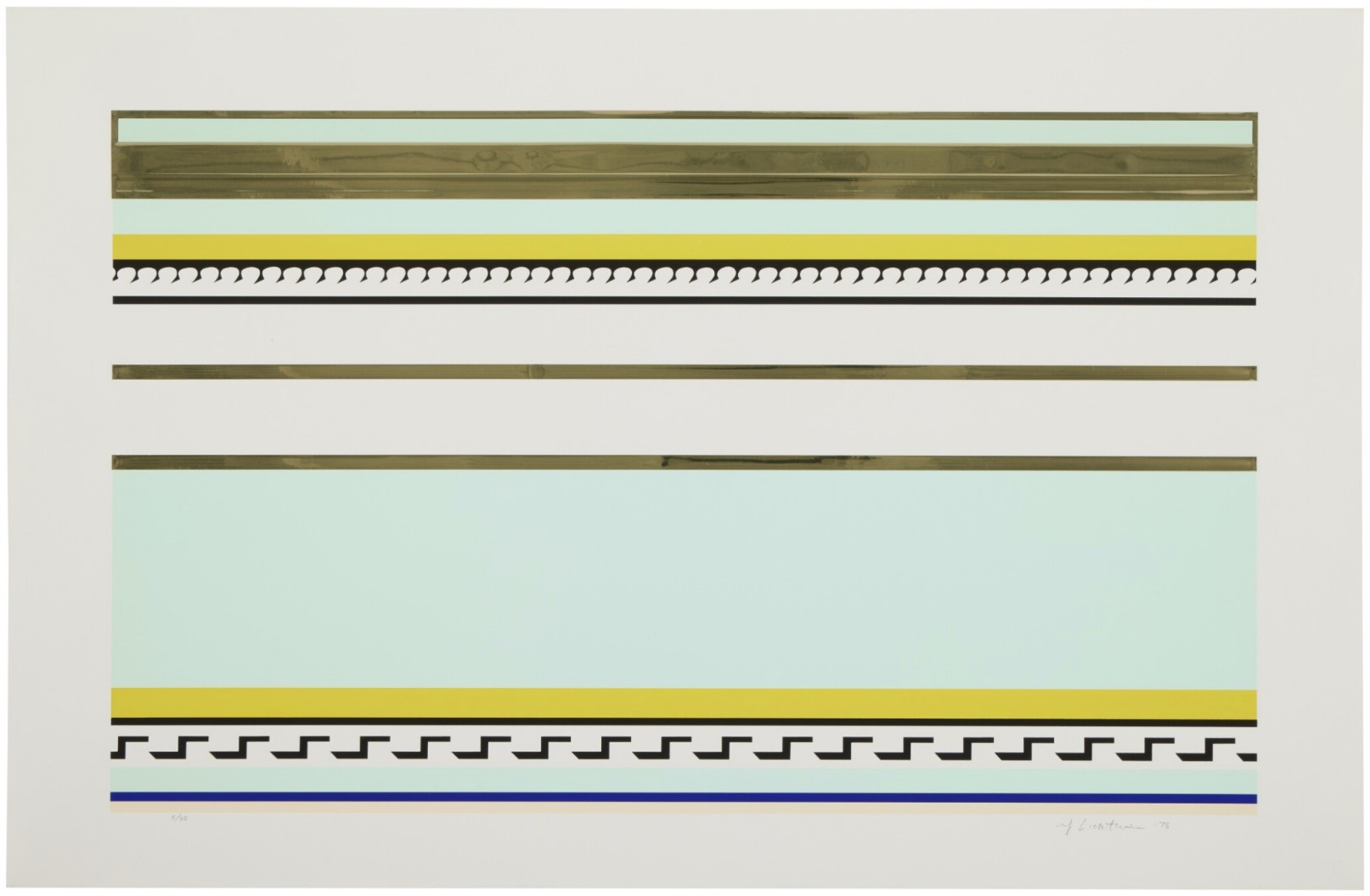
Entablature VI from Entablature Series, 1976
Edition: 30 + 9 AP
Literature: Corlett 143, Tyler 339
7. Entablature VII (C. 144)
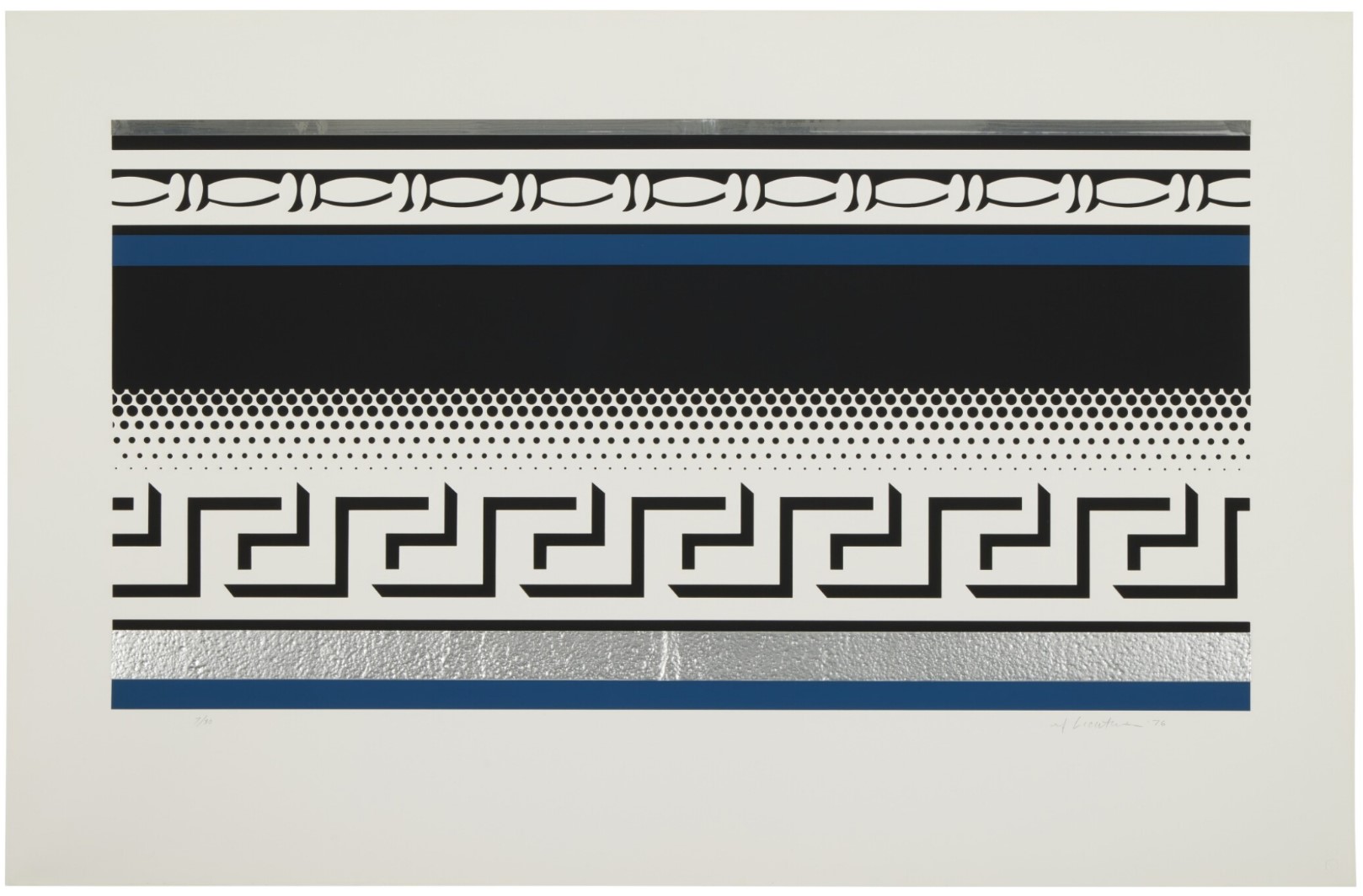
Entablature VII from Entablature Series, 1976
Edition: 30 + 9 AP
Literature: Corlett 144, Tyler 340
8. Entablature VIII (C. 145)
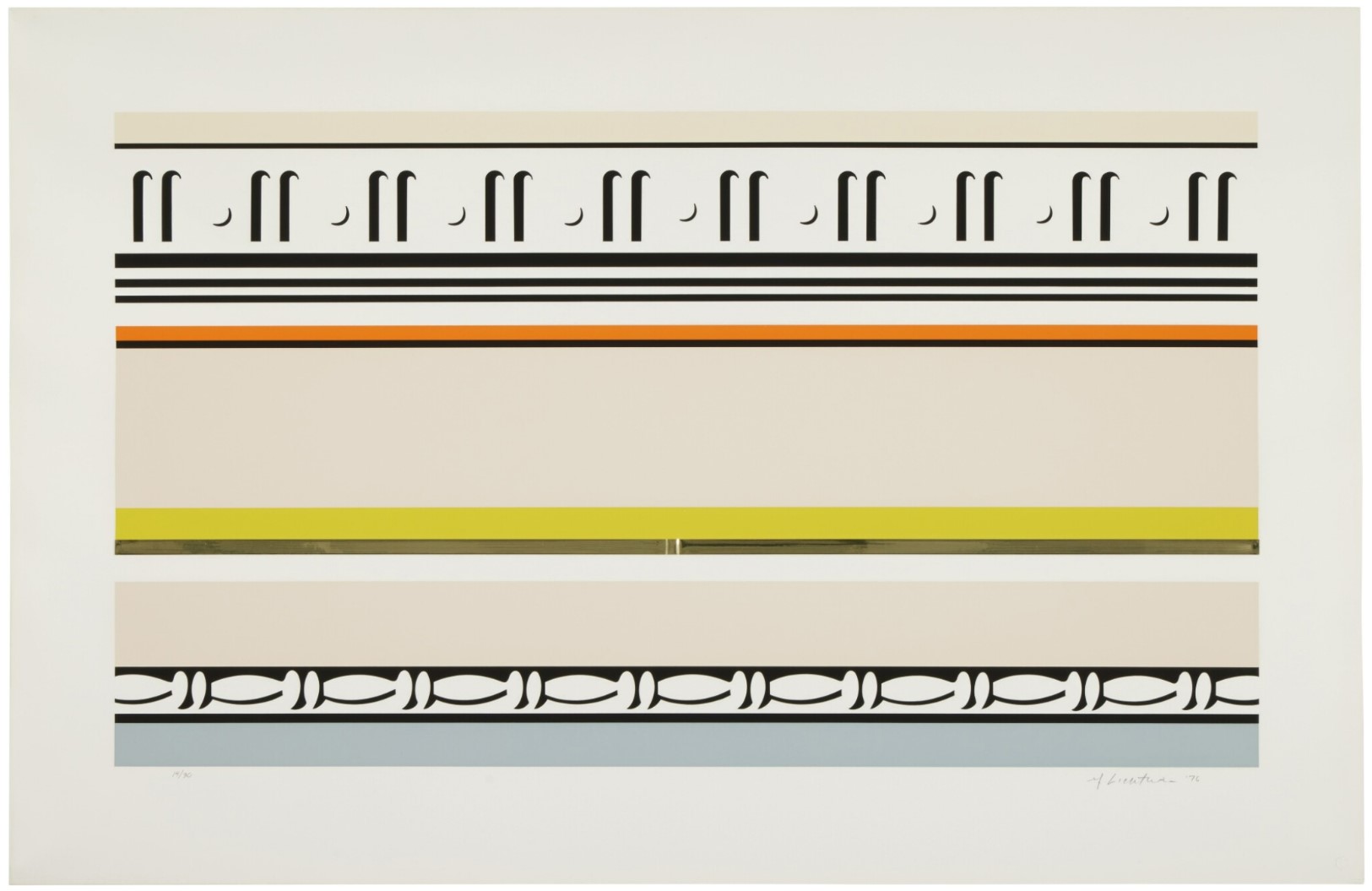
Entablature VIII from Entablature Series, 1976
Edition: 30 + 9 AP
Literature: Corlett 145, Tyler 341
9. Entablature IX (C. 146)
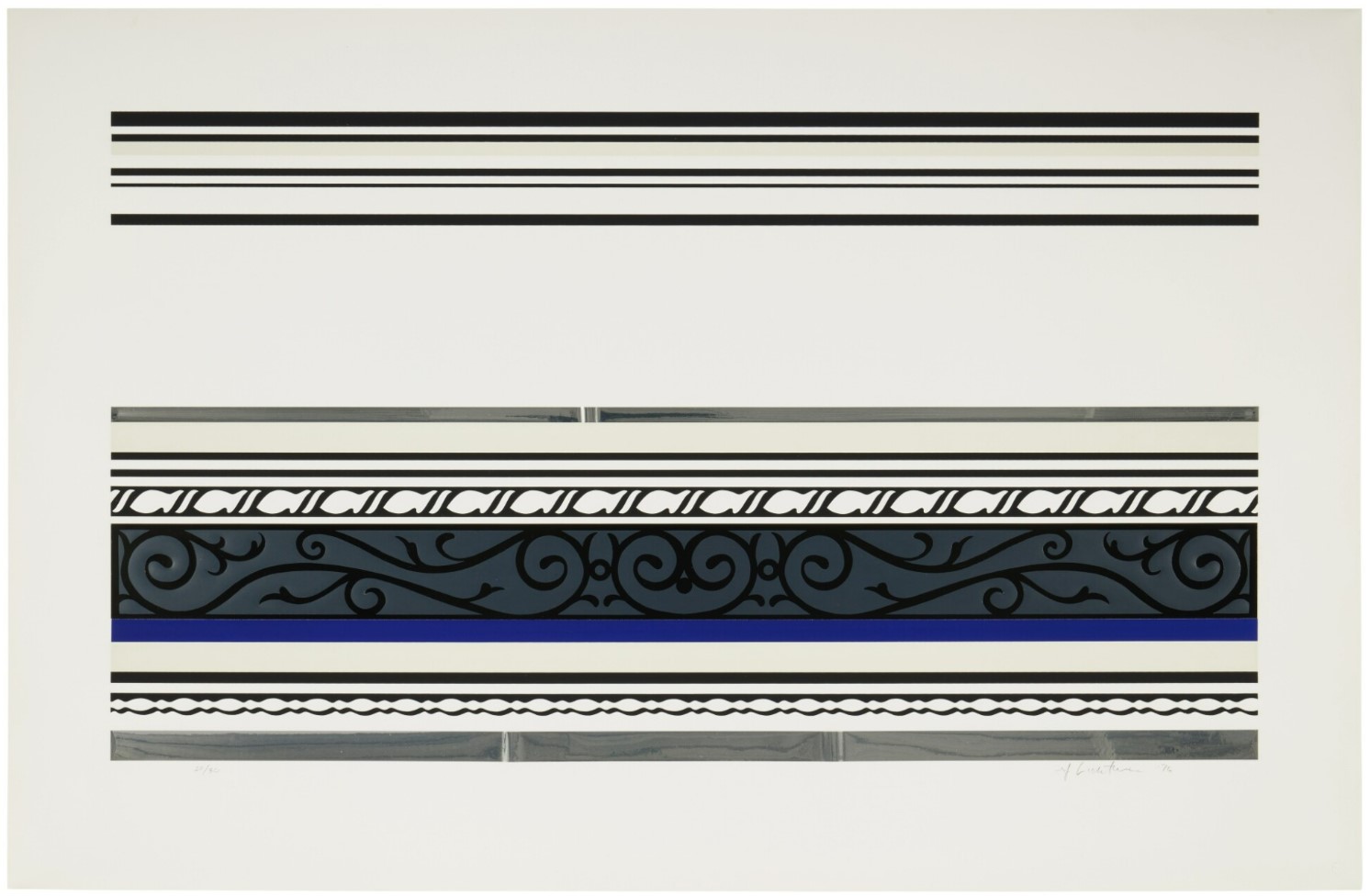
Entablature IX from Entablature Series, 1976
Edition: 30 + 9 AP
Literature: Corlett 146, Tyler 342
10. Entablature X (C. 147)
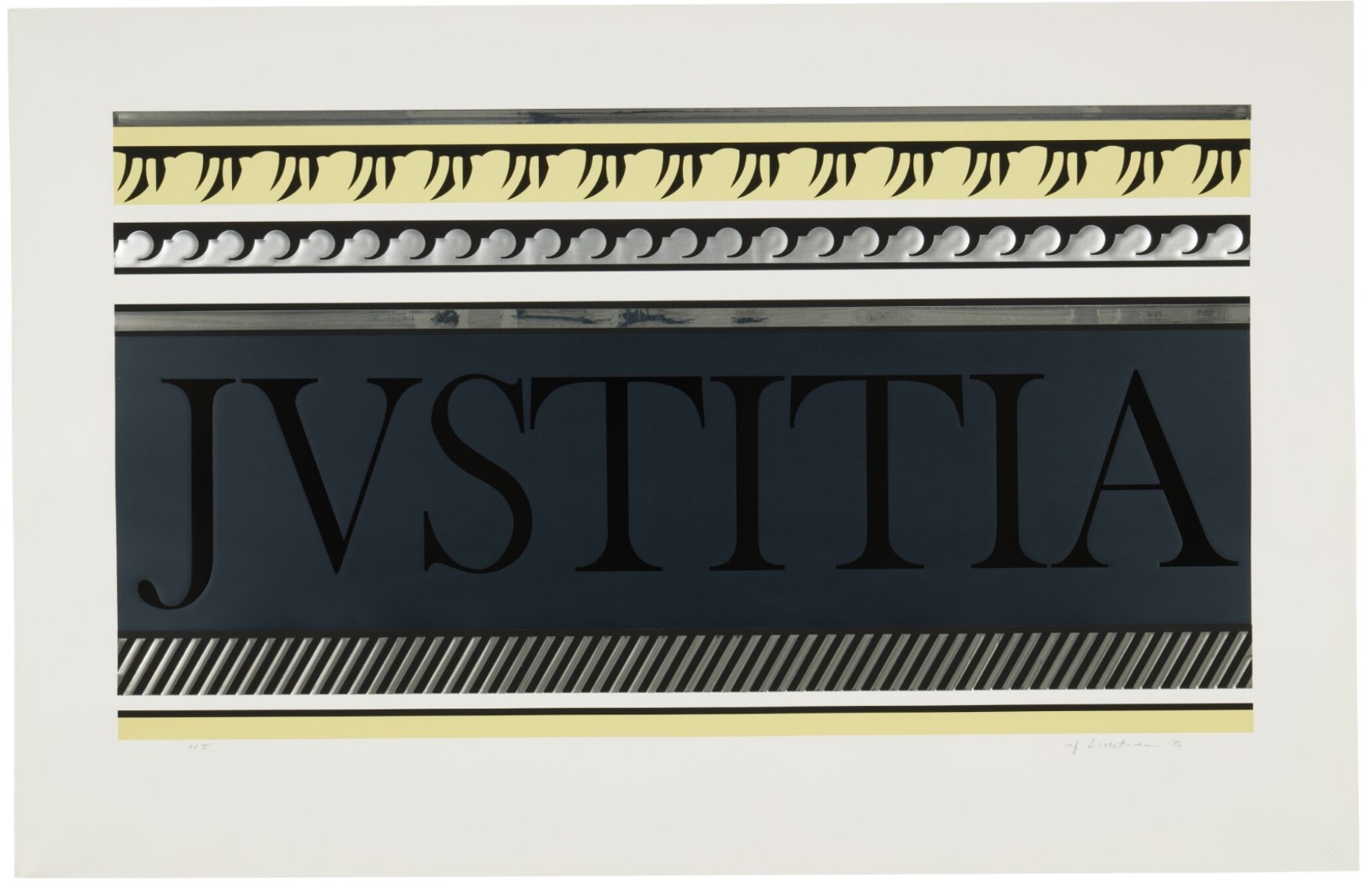
Entablature X from Entablature Series, 1976
Edition: 18 + 9 AP
Literature: Corlett 147, Tyler 343
11. Entablature X A (C. 148)
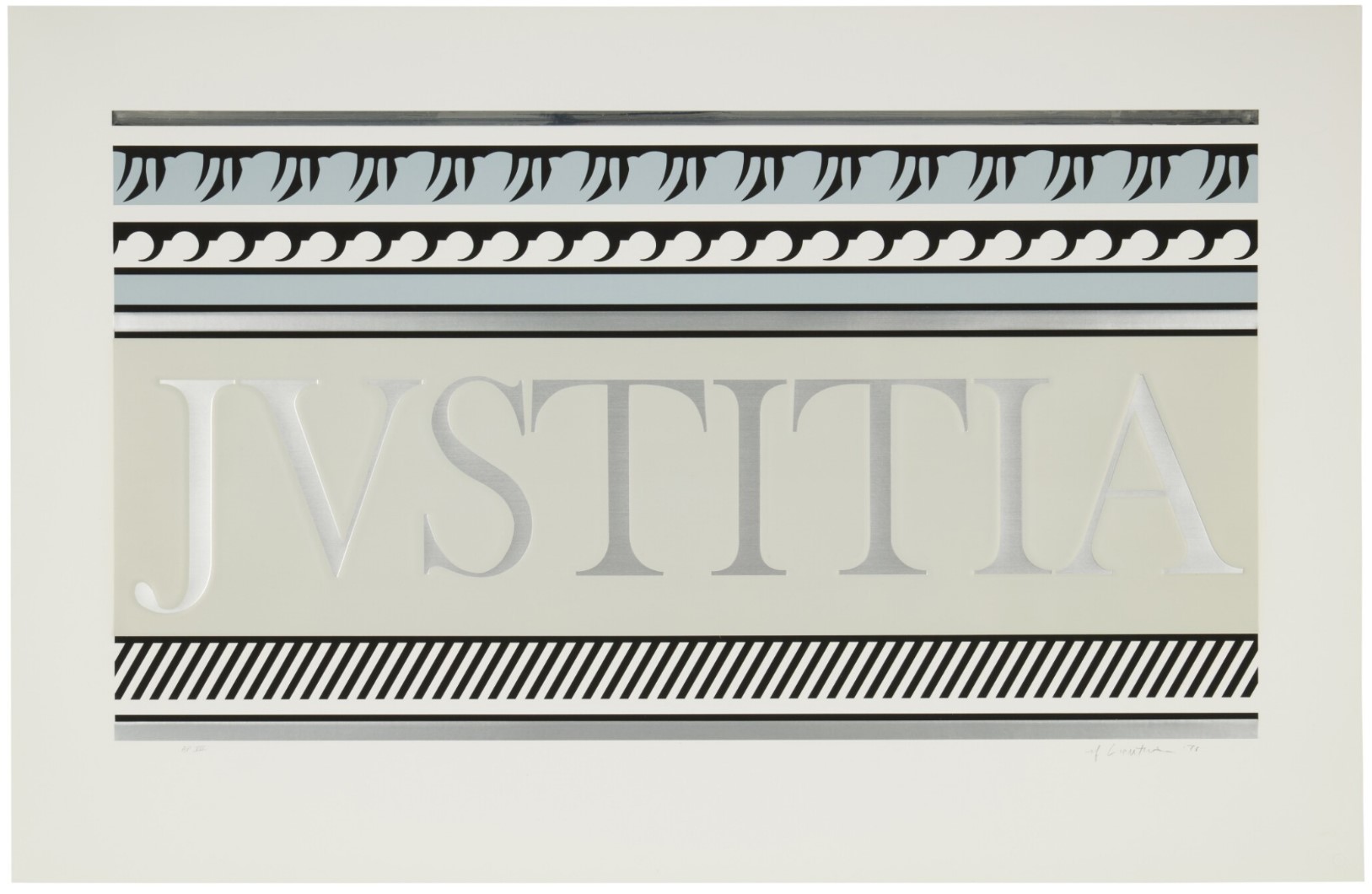
Entablature XA from Entablature Series, 1976
Edition: 18 + 9 AP
Literature: Corlett 148, Tyler 344
Surrealist Series, 1978
1. Figures with Rope
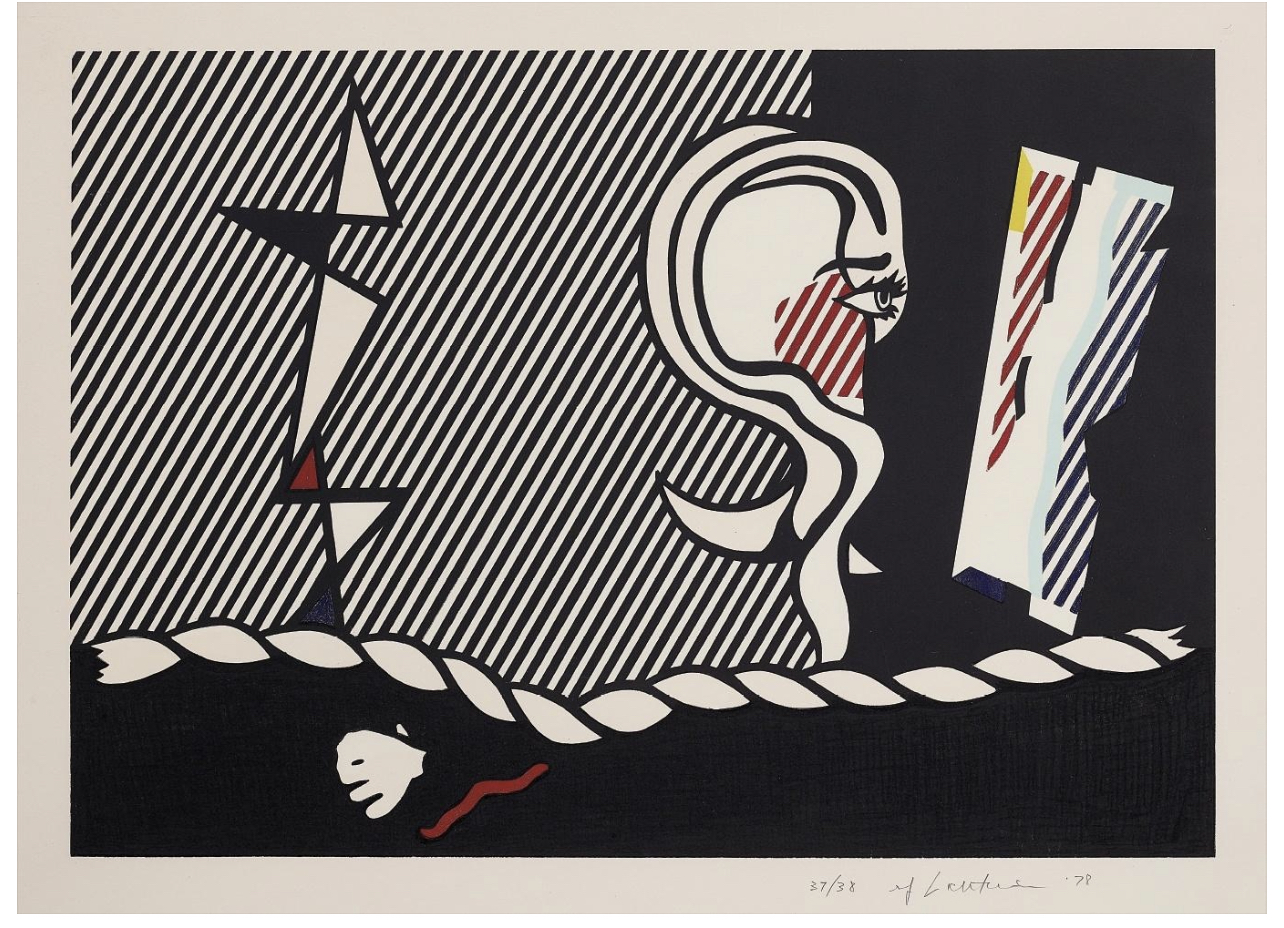
Figures with Rope from Surrealist Series, 1978
Lithograph in colors on Arches 88 paper
Sheet: 21 7/8 x 29 3/4 inches (55.6 x 75.6 cm)
Edition: 38 + 7 AP
Literature: Corlett 152, Gemini 790
2. Blonde
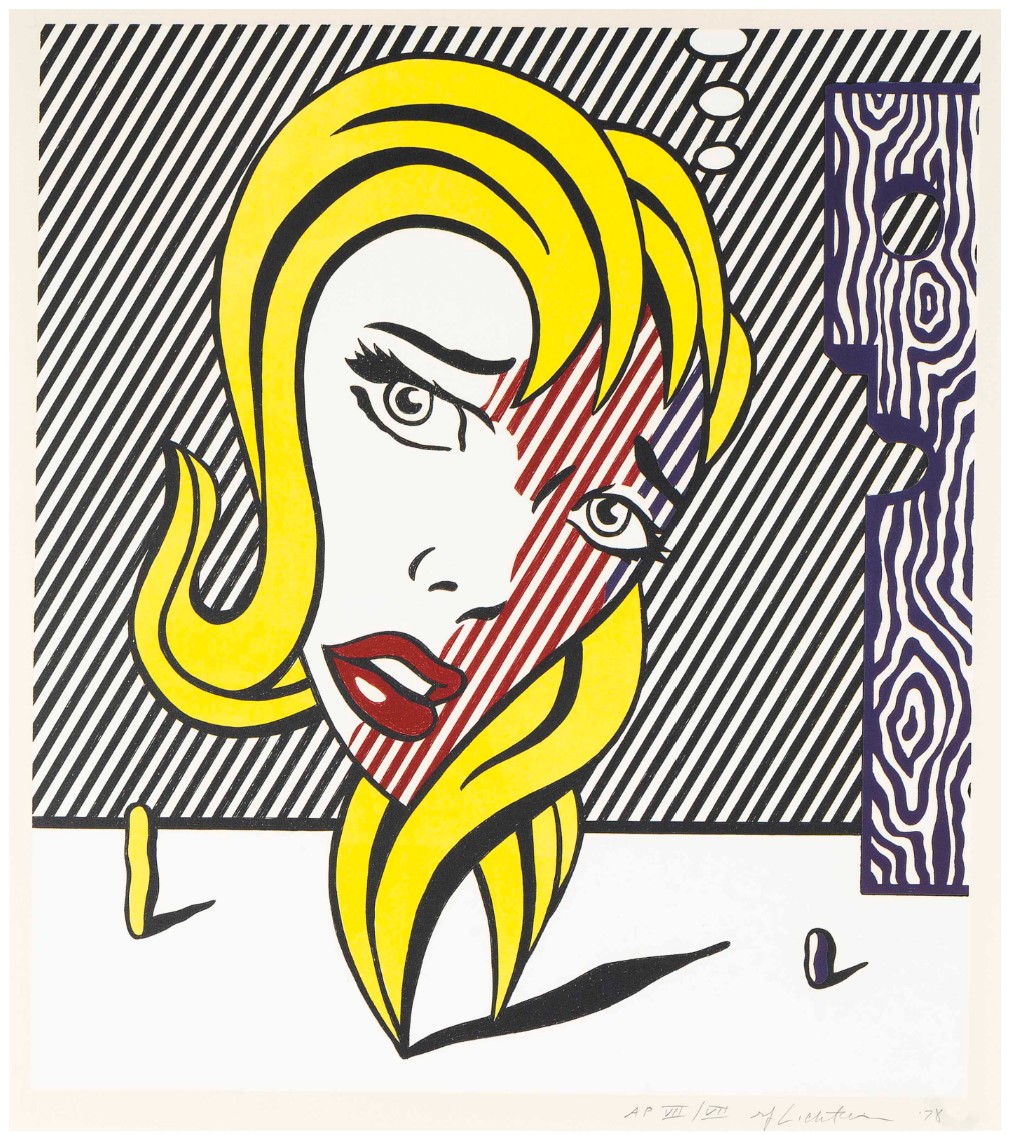
Blonde from Surrealist Series, 1978
Lithograph in colors on Arches 88 paper
Sheet: 26×29 inches (67 x 73.5 cm)
Edition: 38 + 7 AP
Literature: Corlett 153
3. Nude on Beach
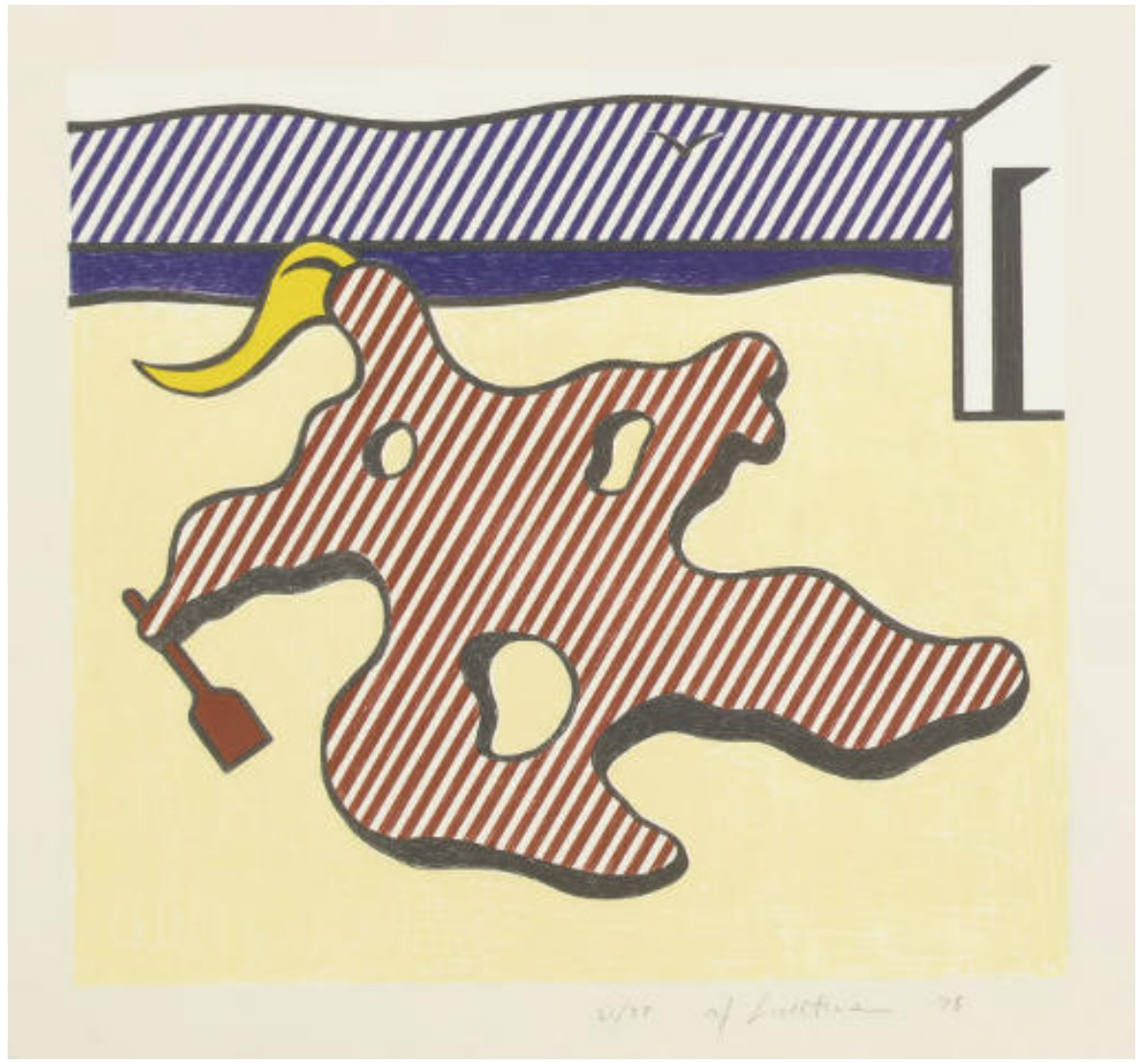
Nude on Beach from Surrealist Series, 1978
Lithograph in colors on Arches 88 paper
Sheet: 25 3/4 x 24 1/2 inches (65.4 x 62.2 cm)
Edition: 38 + 7 AP
Literature: Corlett 154
4. A Bright Night
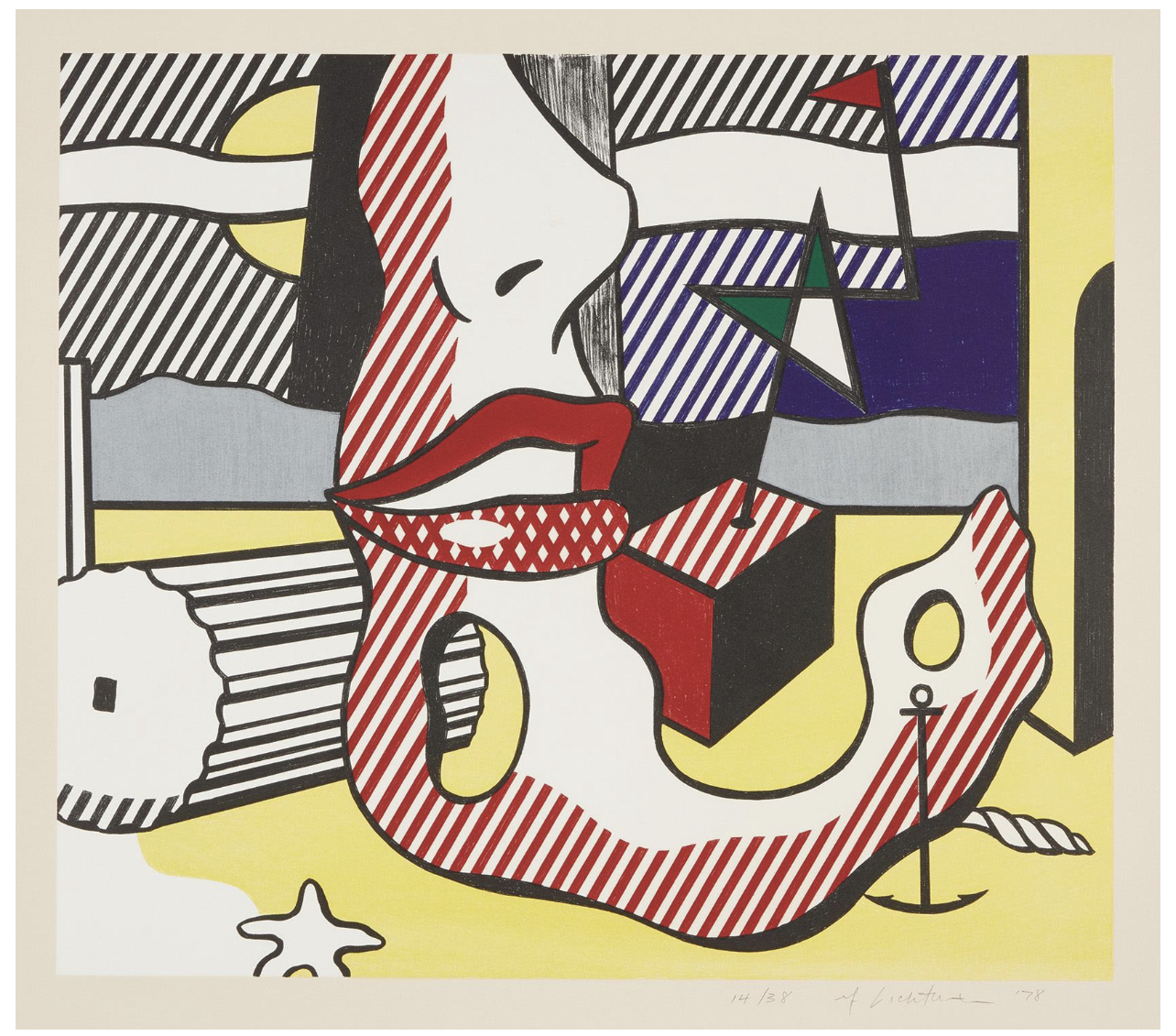
A Bright Night from Surrealist Series, 1978
Lithograph in colors on Arches 88 paper
Sheet: 26 1/4 x 29 inches (66.7 x 73.7 cm)
Edition: 38 + 7 AP
Literature: Corlett 155, Gemini 793
5. At The Beach
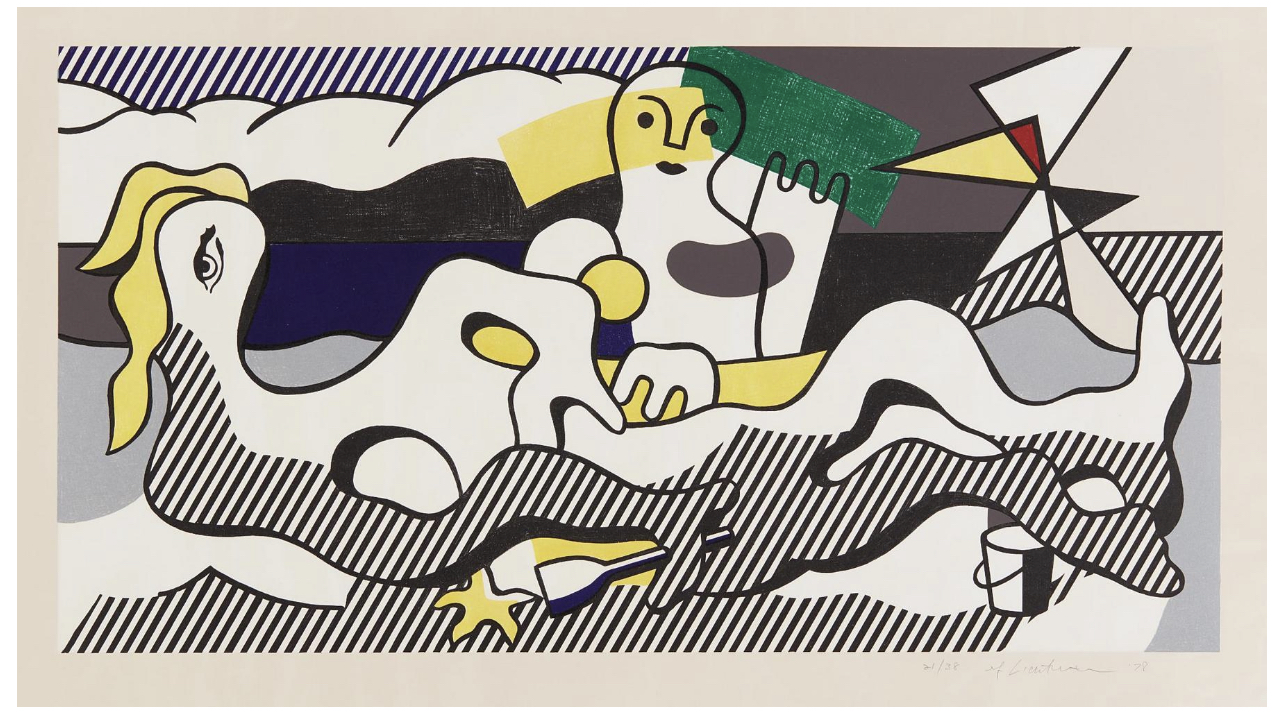
At The Beach from Surrealist Series, 1978
Lithograph in colors on Arches 88 paper
Sheet: 26×42 inches (66 x 106.7 cm)
Edition: 38 + 7 AP
Literature: Corlett 156, Gemini 794
6. Figures
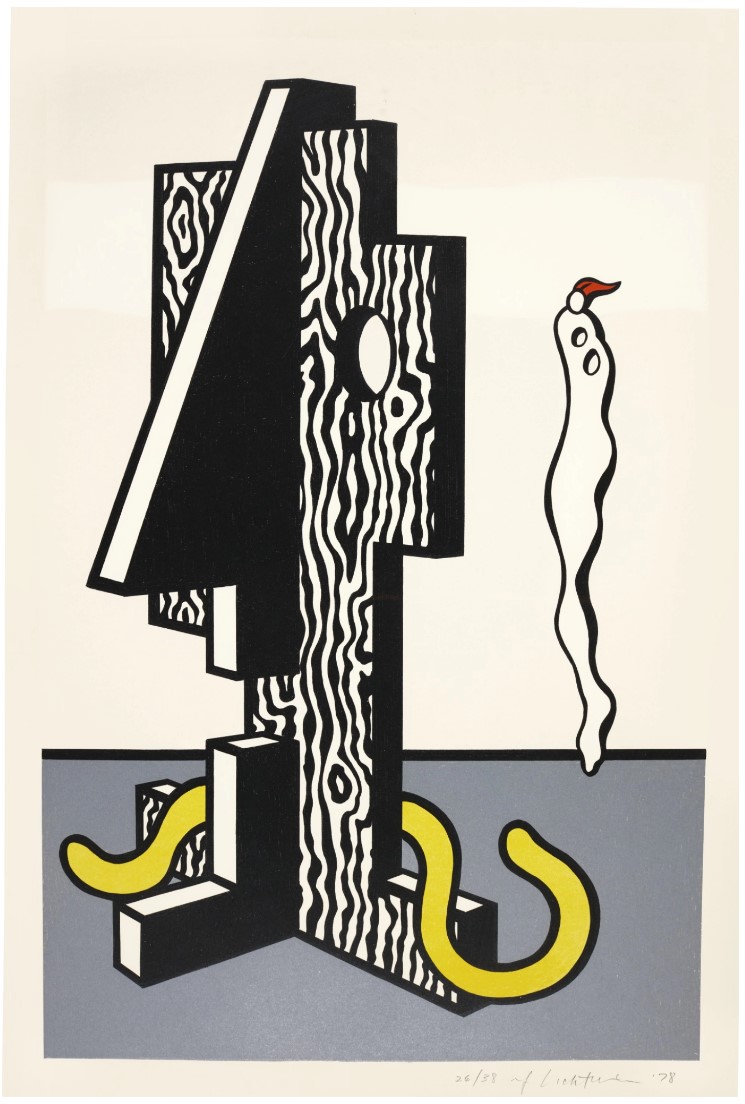
Figures from Surrealist Series, 1978
Lithograph in colors on Arches 88 paper
Sheet: 31 3/8 x 23 1/2 inches (79.7 x 59.7 cm)
Edition: 38 + 7 AP
Literature: Corlett 157, Gemini 795
7. Mermaid
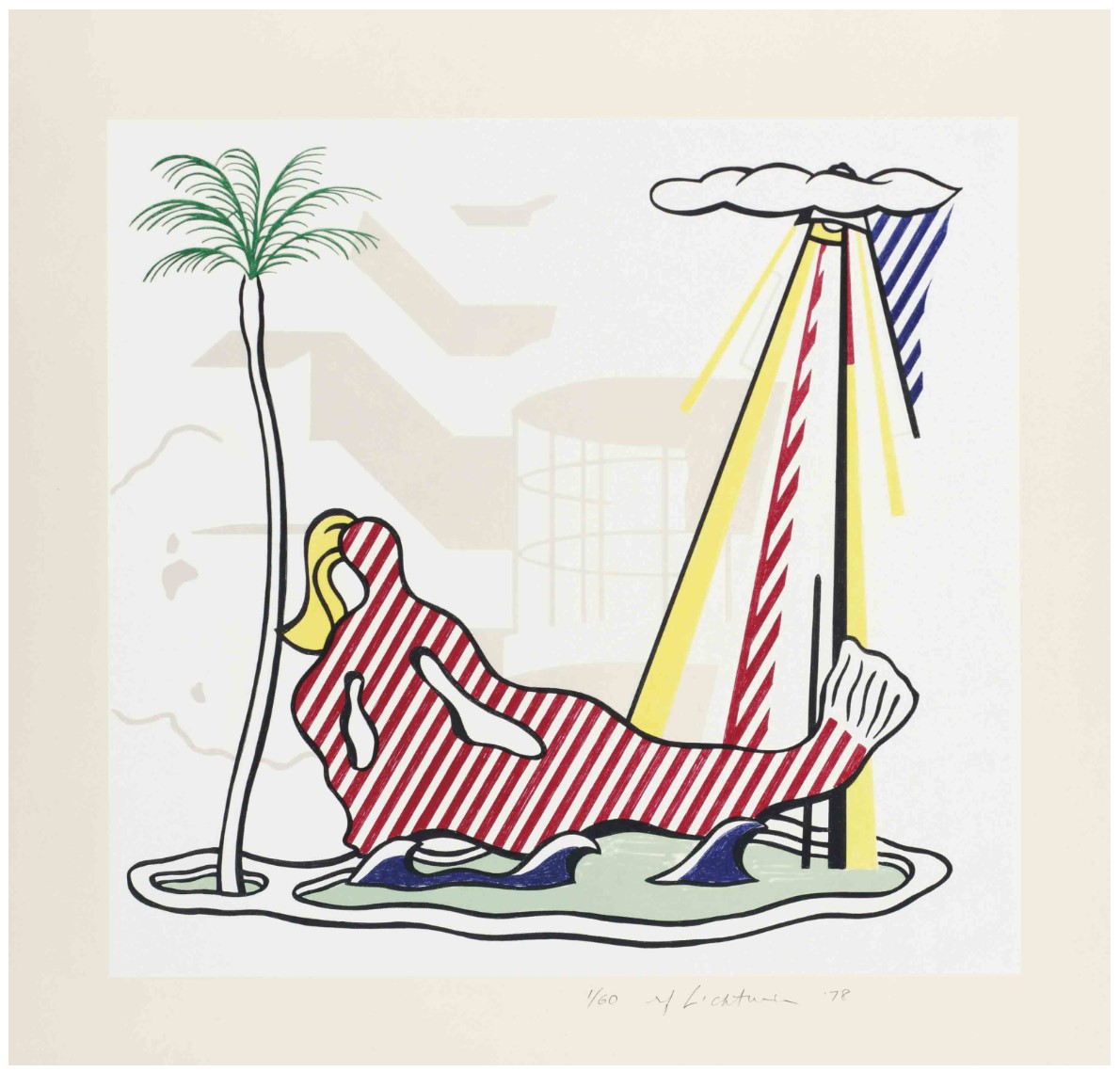
Mermaid from Surrealist Series, 1978
Lithograph in colors on Arches 88 paper
Sheet: 25 x 26 1/8 inches (63.5 x 66.4 cm)
Edition: 60 + 10 AP
Literature: Corlett 158
American Indian Theme Series, 1980
Growing up on the Upper West Side of Manhattan, Lichtenstein was a frequent visitor of the American Museum of Natural History. He showed particular interest in the Hall of Northwest Coast Indians from a young age. It wasn’t before the early 1950s, however, that he decided to expand on this fascination further, through his art. Employing a somewhat abstract, and at times even Cubist style, he revised the tribal myths and symbols he came upon.
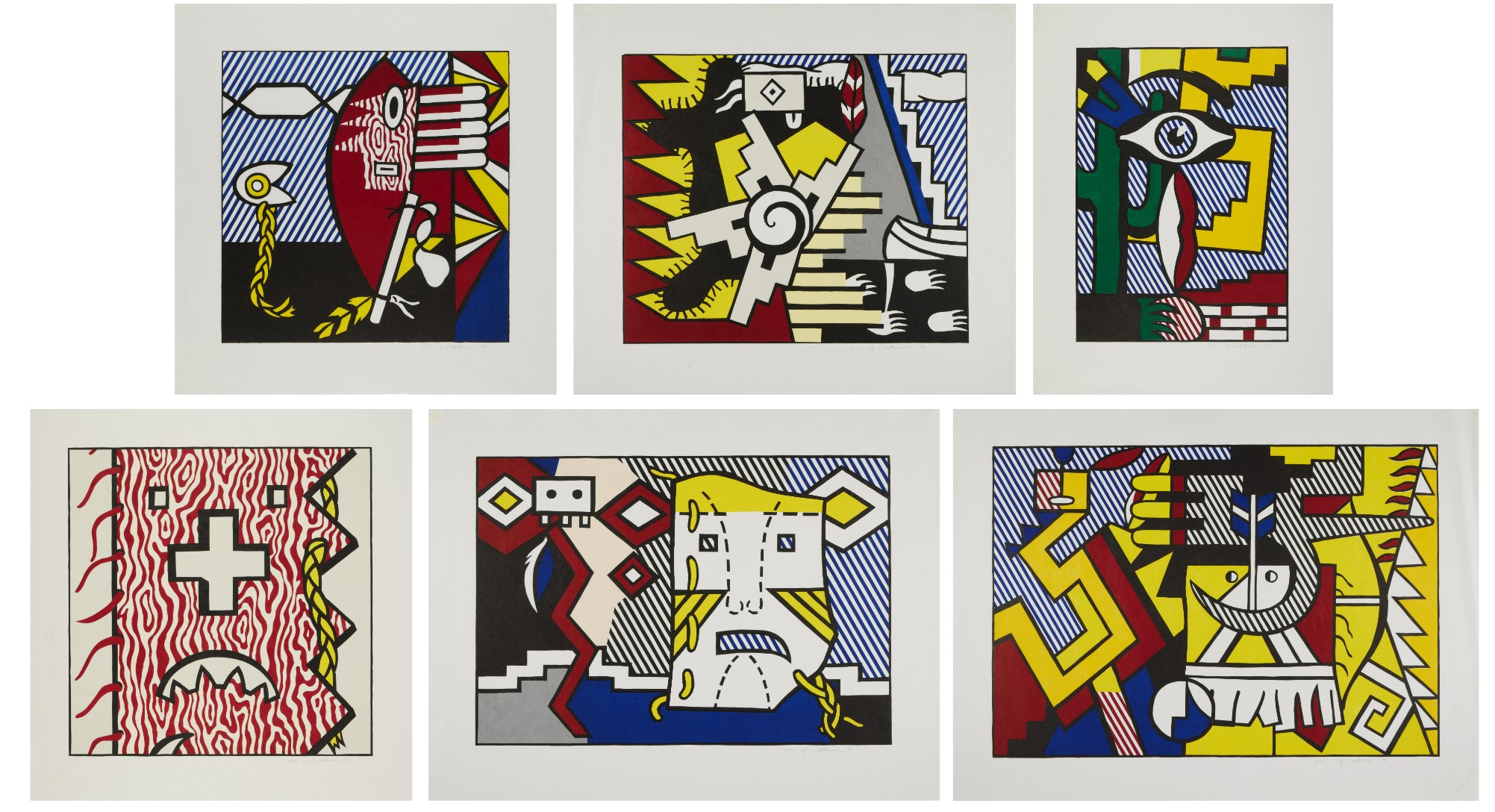
American Indian Theme I-VI, 1980
The complete set of six woodcuts printed in colors on handmade Suzuki paper
Largest Sheet: 37 3/8 x 50 3/8 inches (95×128 cm)
Edition: 50 + 19 AP
Literature: Corlett 160-165, Tyler 346-351
1. American Indian Theme I
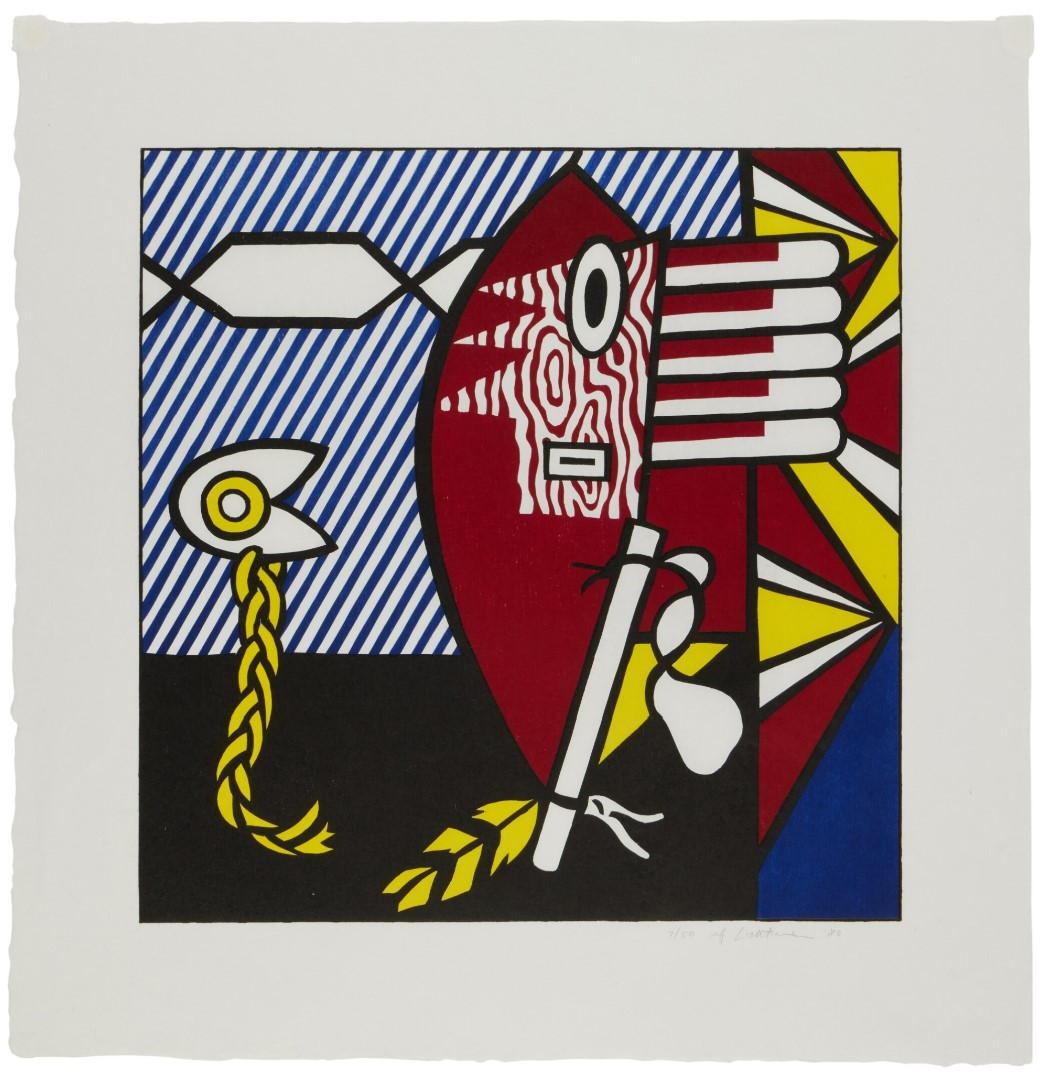
American Indian Theme I from American Indian Theme Series, 1980
Woodcut printed in colors on handmade Suzuki paper
Sheet: 32 3/4 x 32 inches (78.1 x 81.3 cm)
Edition: 50 + 18 AP
Literature: Corlett 160
2. American Indian Theme II
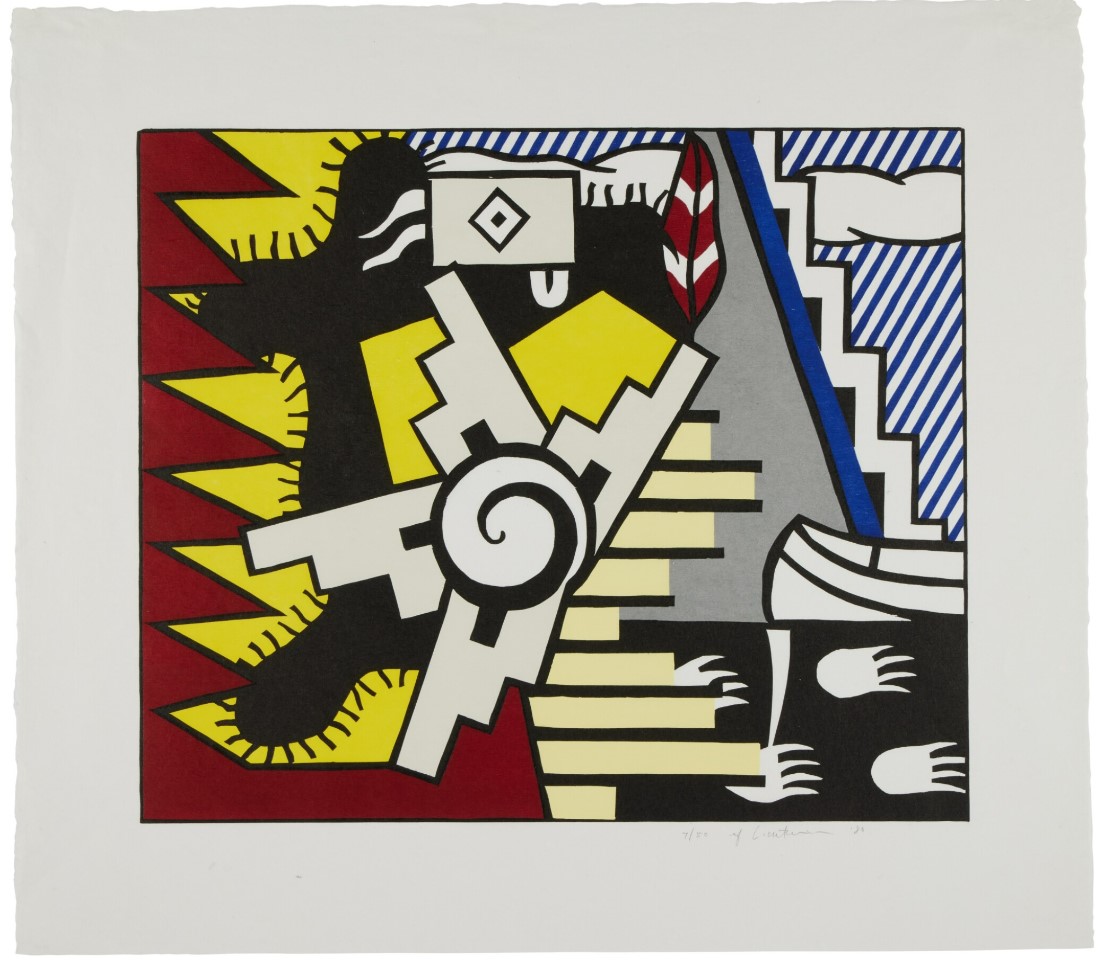
American Indian Theme II from American Indian Theme Series, 1980
Woodcut printed in colors on handmade Suzuki paper
Sheet: 32 3/4 x 37 3/4 inches (83.2 x 95.9 cm)
Edition: 50 + 18 AP
Literature: Corlett 161
3. American Indian Theme III
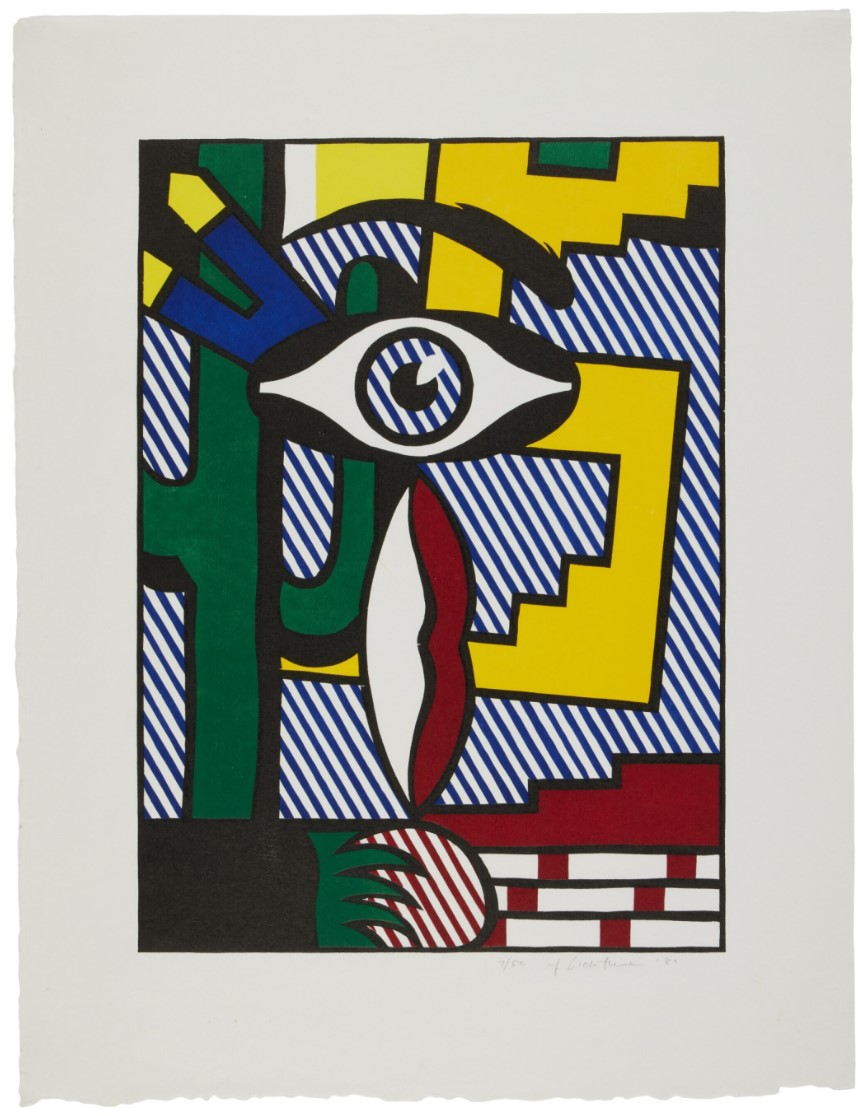
American Indian Theme III from American Indian Theme Series, 1980
Woodcut printed in colors on handmade Suzuki paper
Sheet: 35×27 inches (88.9 x 68.6 cm)
Edition: 50 + 18 AP
Literature: Corlett 162, Tyler 348
4. American Indian Theme IV
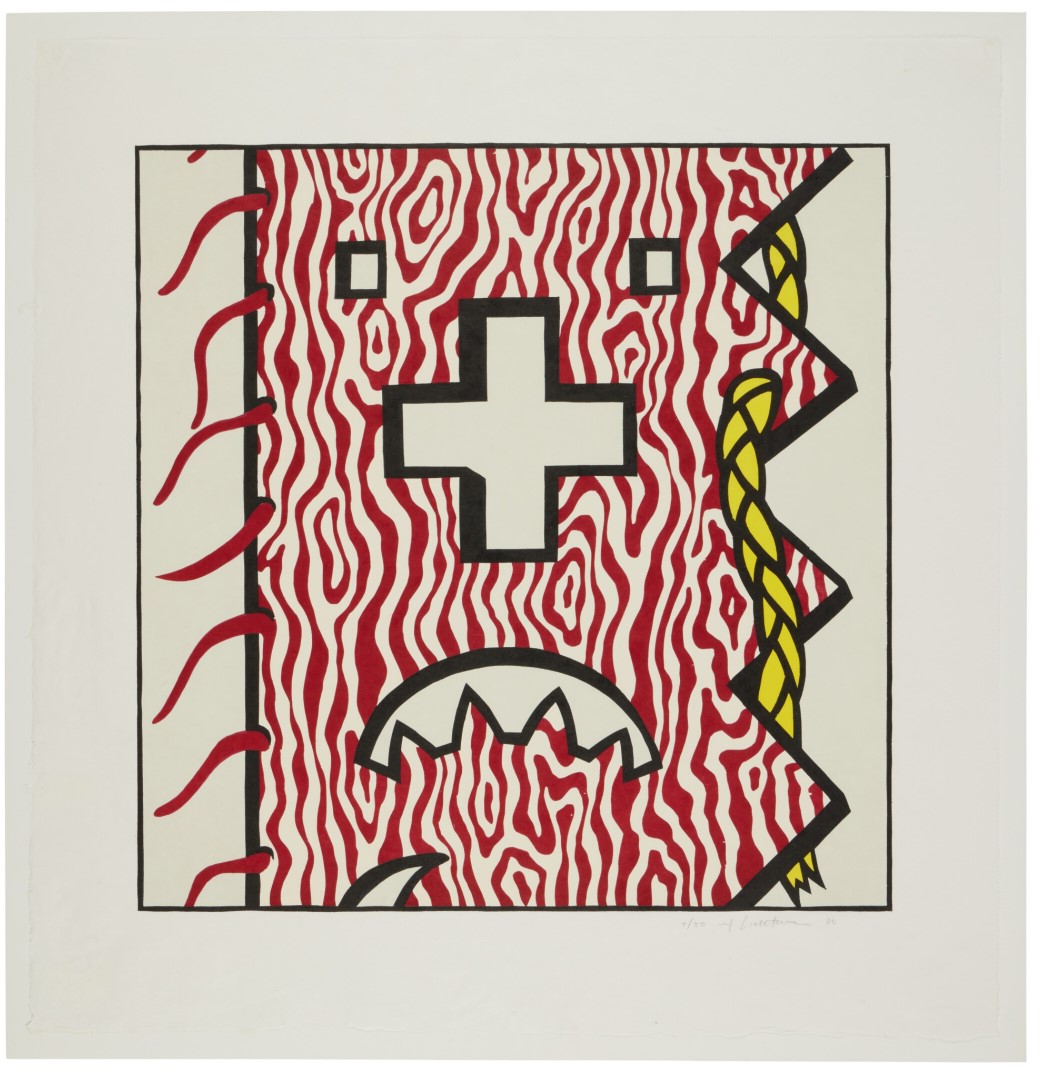
American Indian Theme IV from American Indian Theme Series, 1980
Woodcut and lithograph printed in colors on handmade Suzuki paper
Sheet: 37×36 inches (93.9 x 91.6 cm)
Edition: 50 + 18 AP
Literature: Corlett 163
5. American Indian Theme V
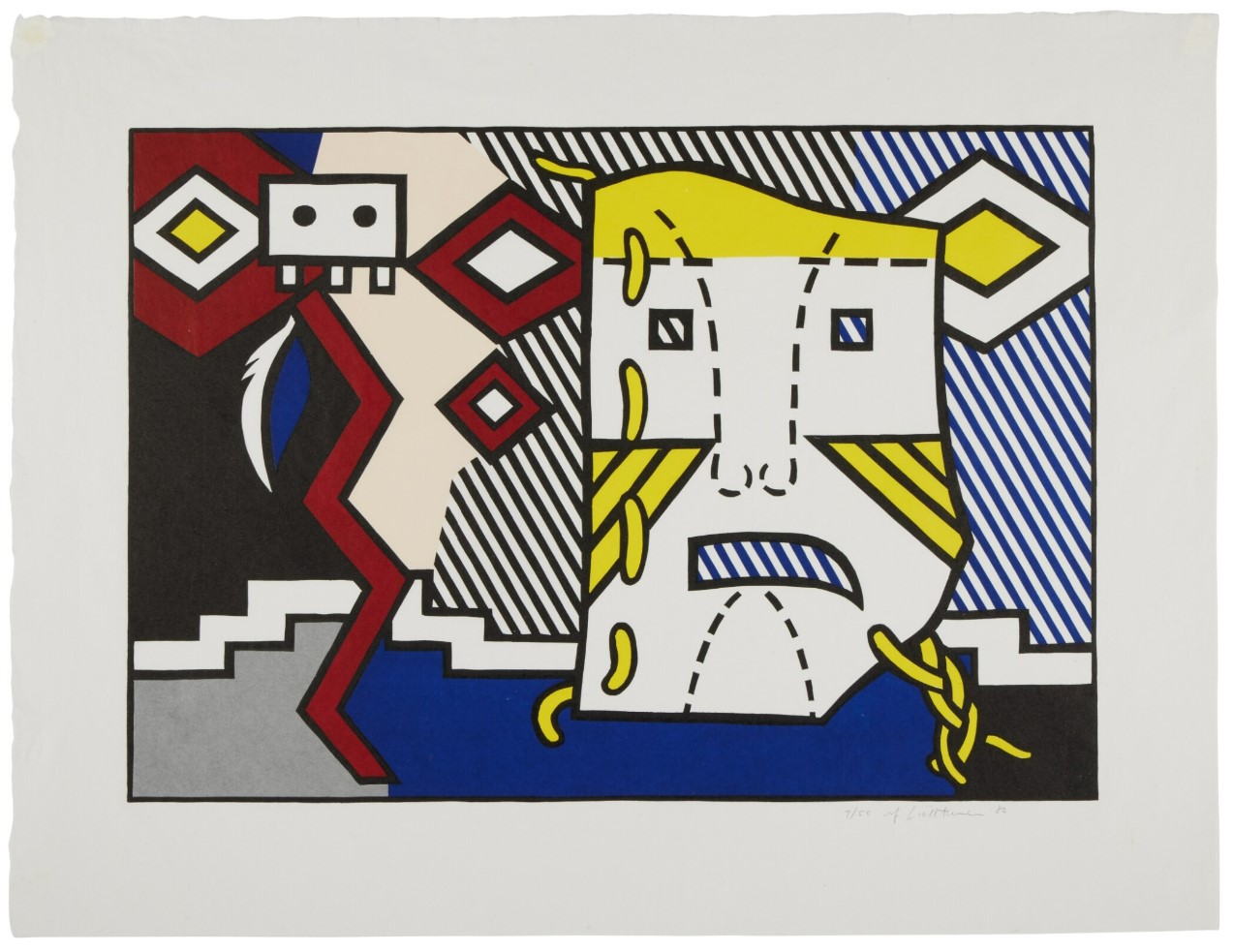
American Indian Theme V from American Indian Theme Series, 1980
Woodcut in colors on handmade Suzuki paper
Sheet: 30 3/8 x 39 3/8 inches (77.1 x 100 cm)
Edition: 50 + 18 AP
Literature: Corlett 164
6. American Indian Theme VI
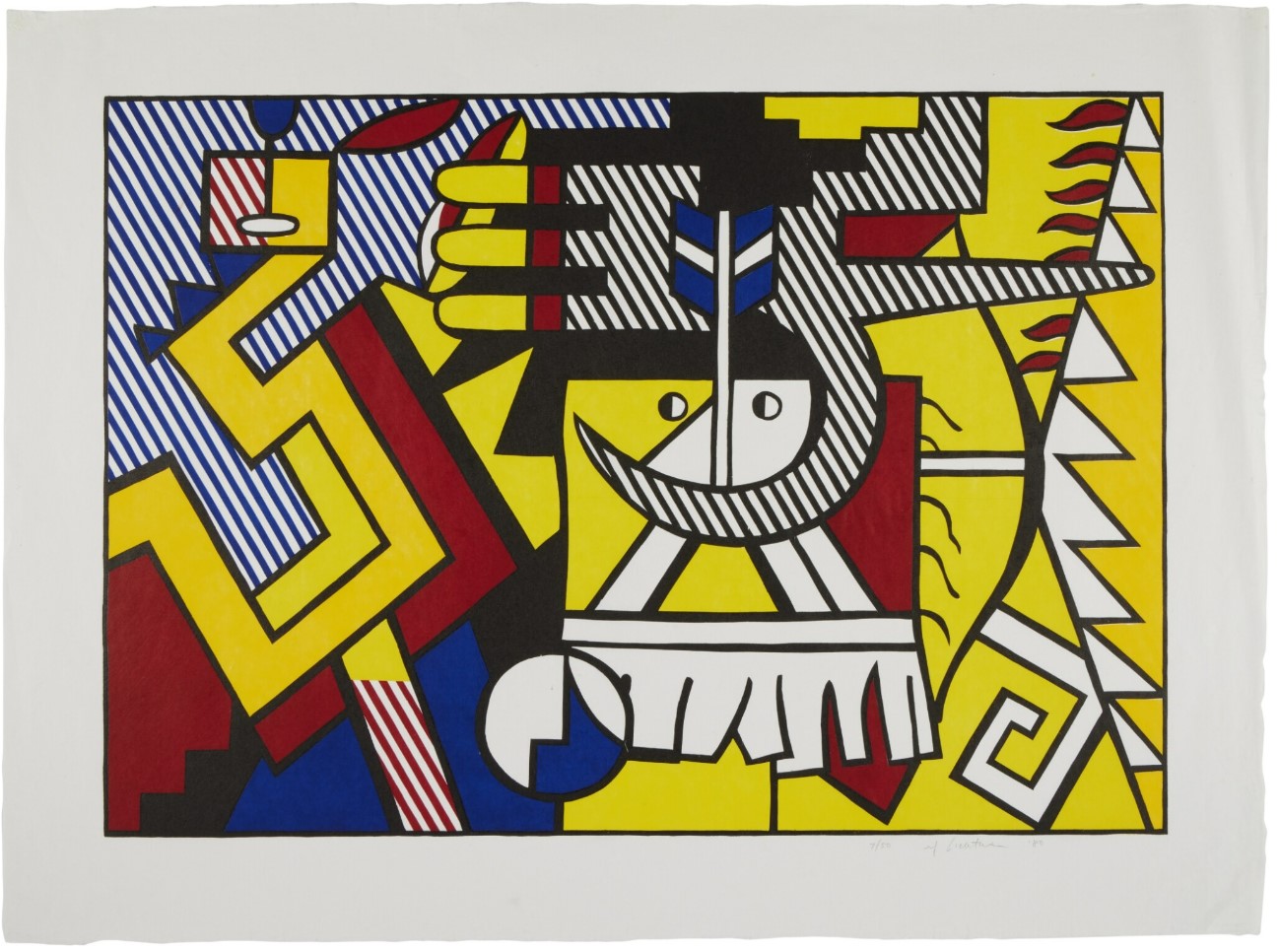
American Indian Theme VI from American Indian Theme Series, 1980
Woodcut printed in colors on handmade Suzuki paper
Sheet: 37 5/8 x 50 inches (95.6 x 127 cm)
Edition: 50 + 18 AP
Literature: Corlett 165
Expressionist Woodcuts Series, 1980
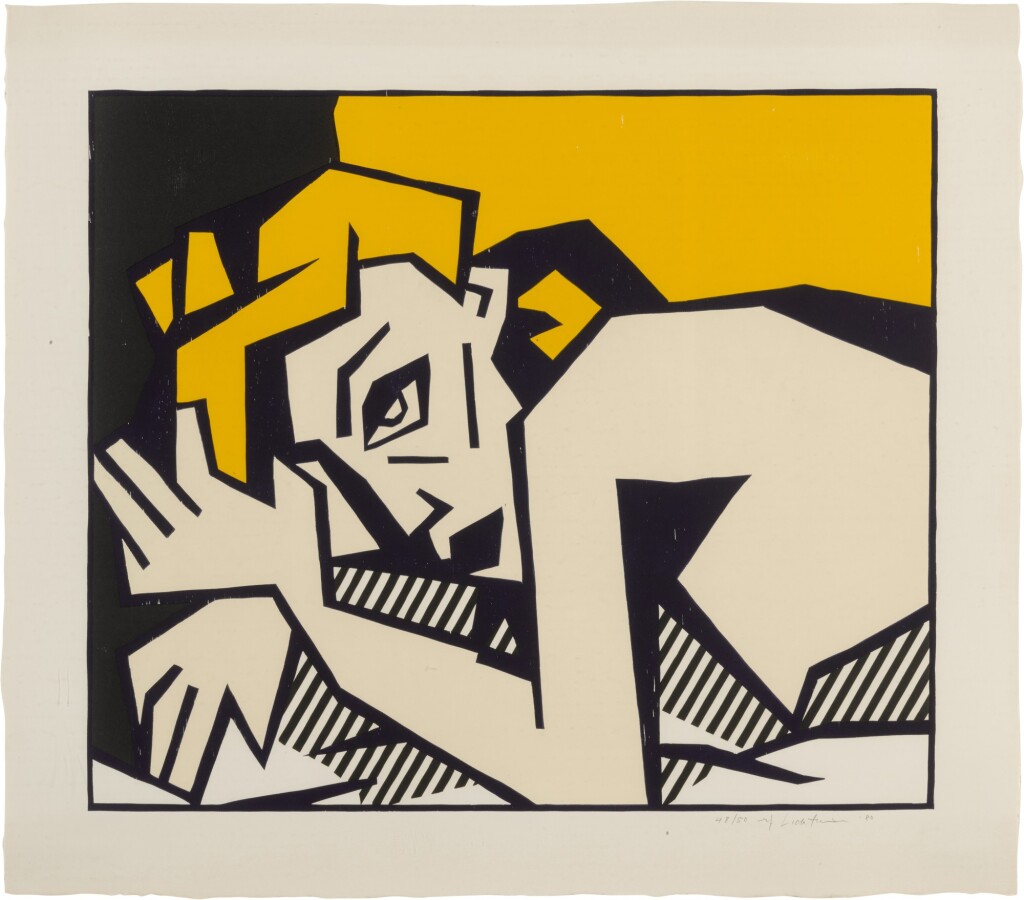
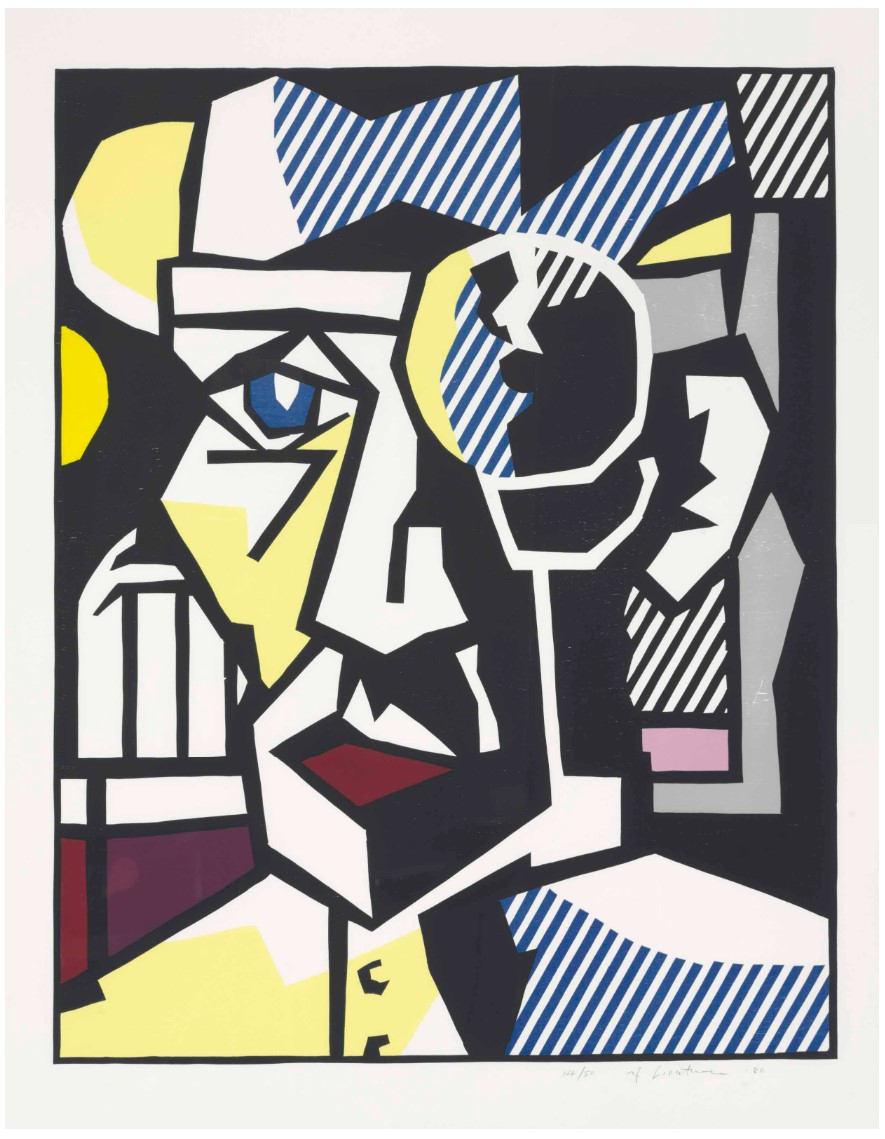
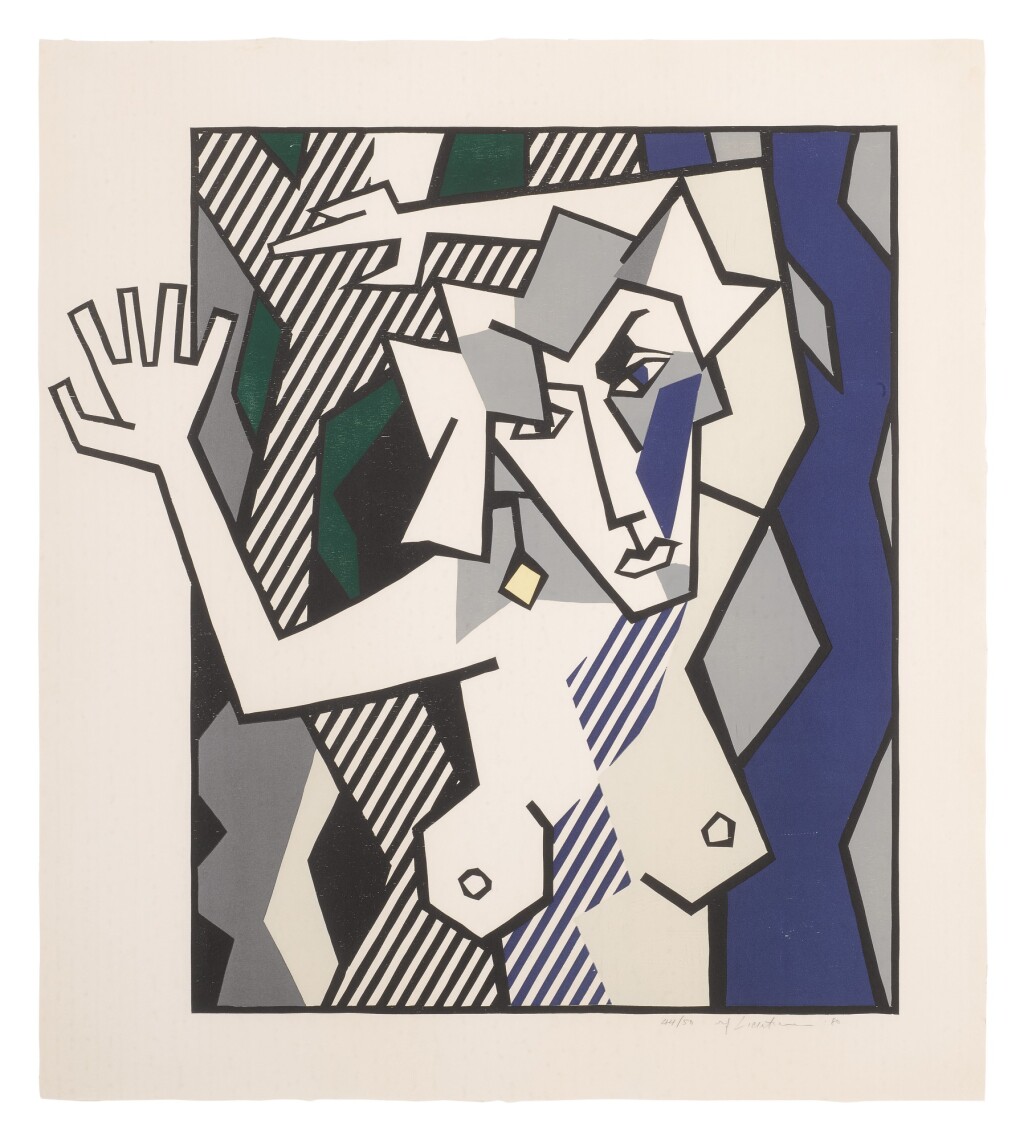
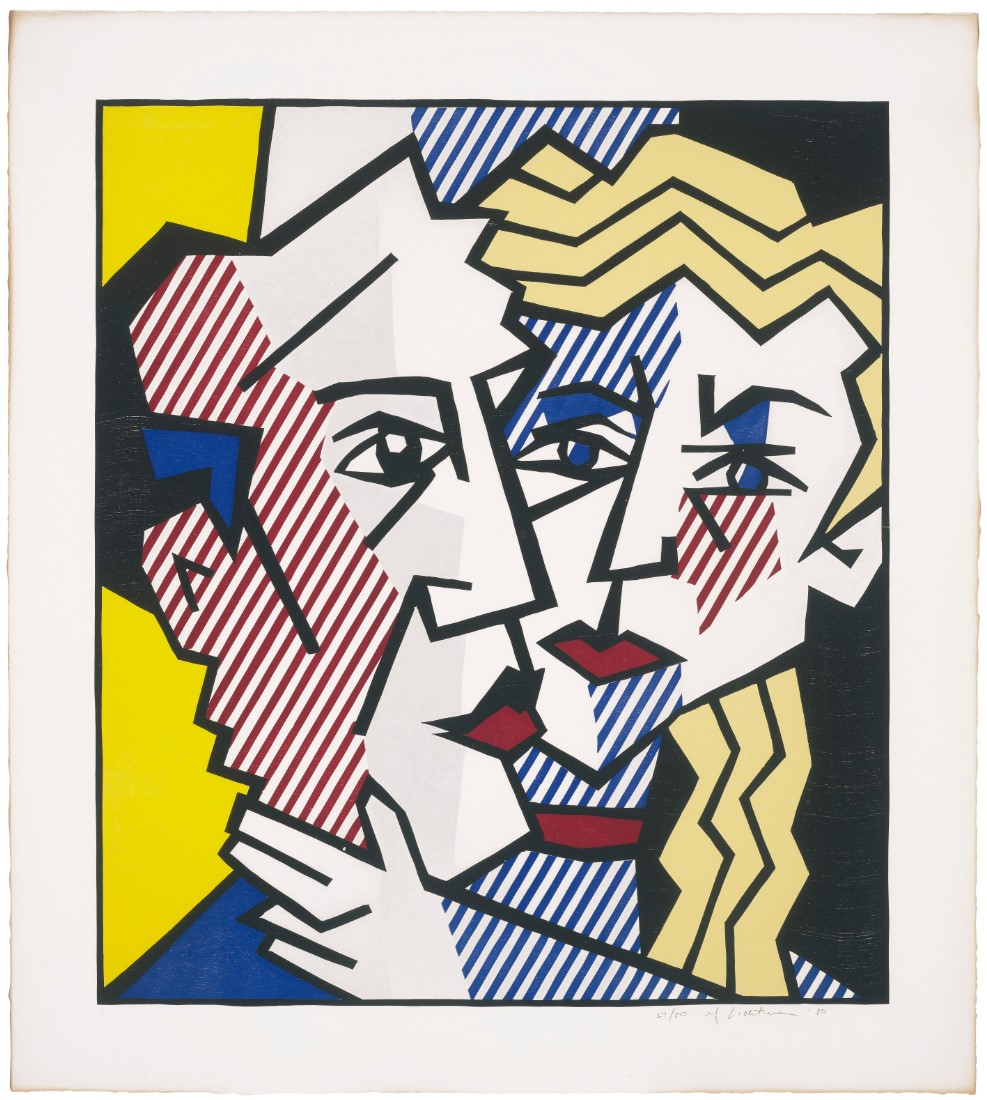
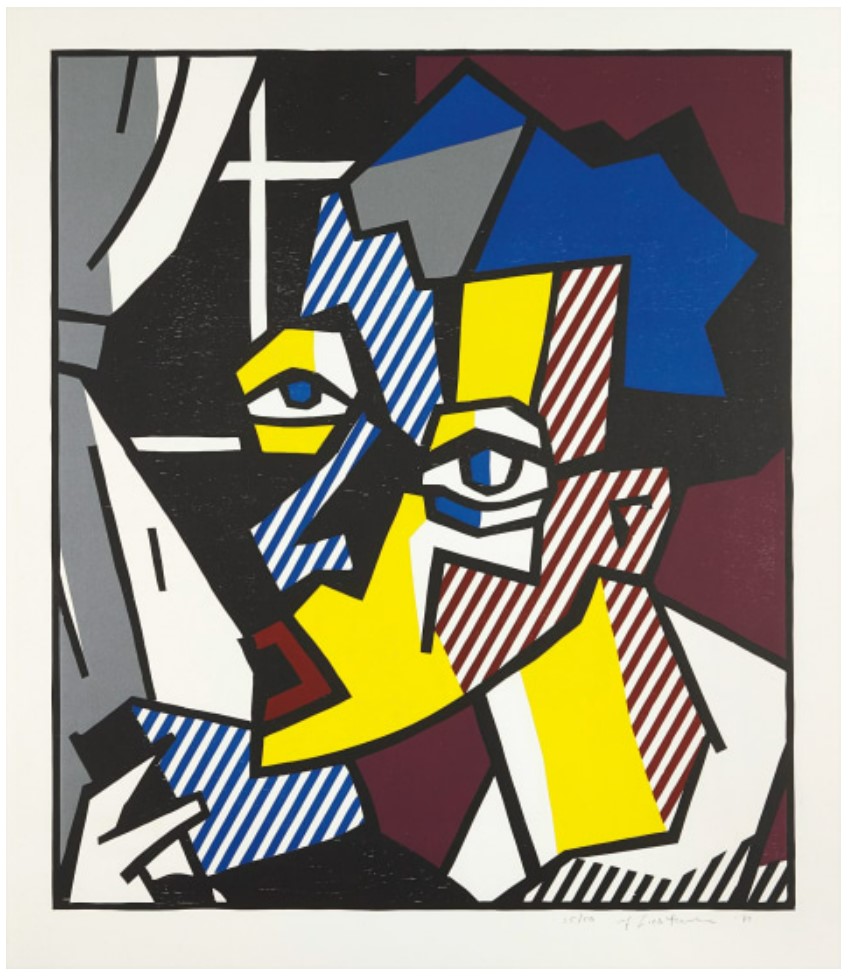
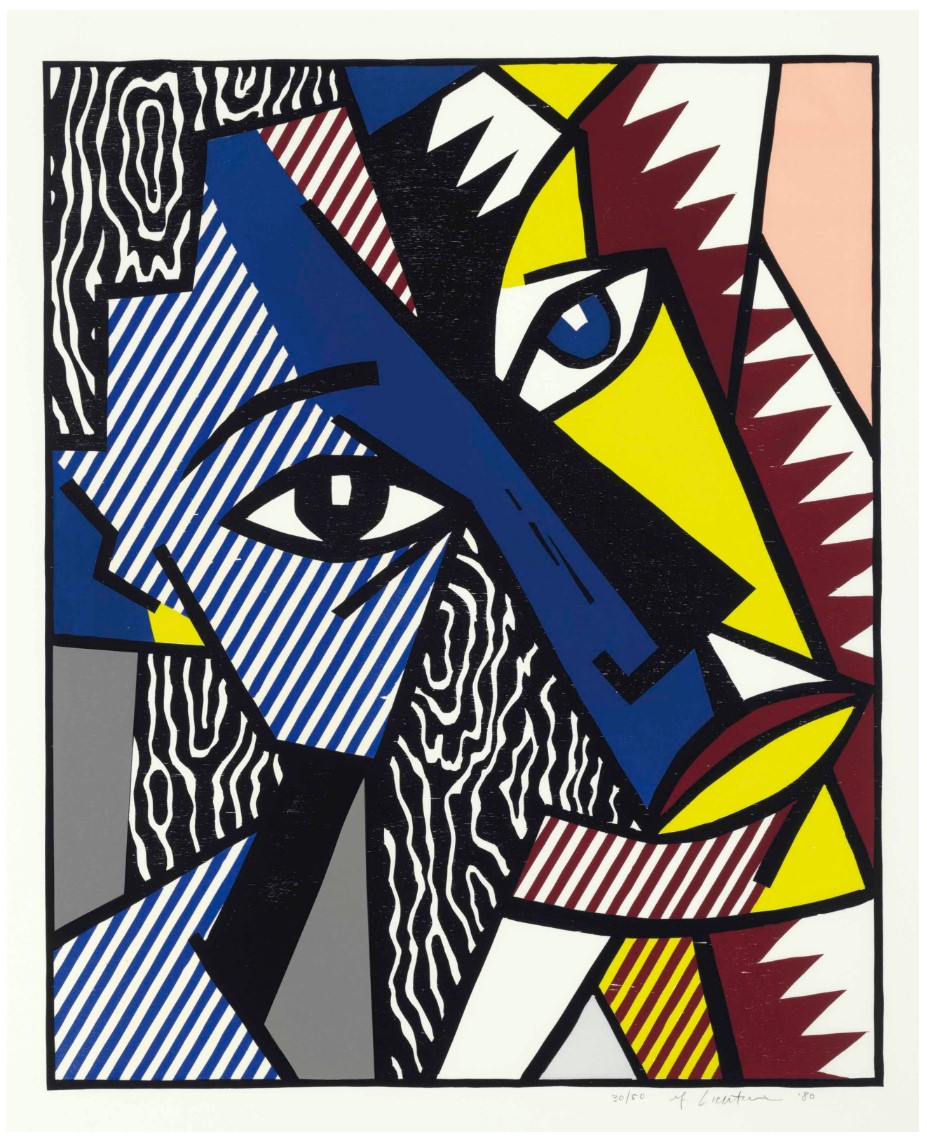
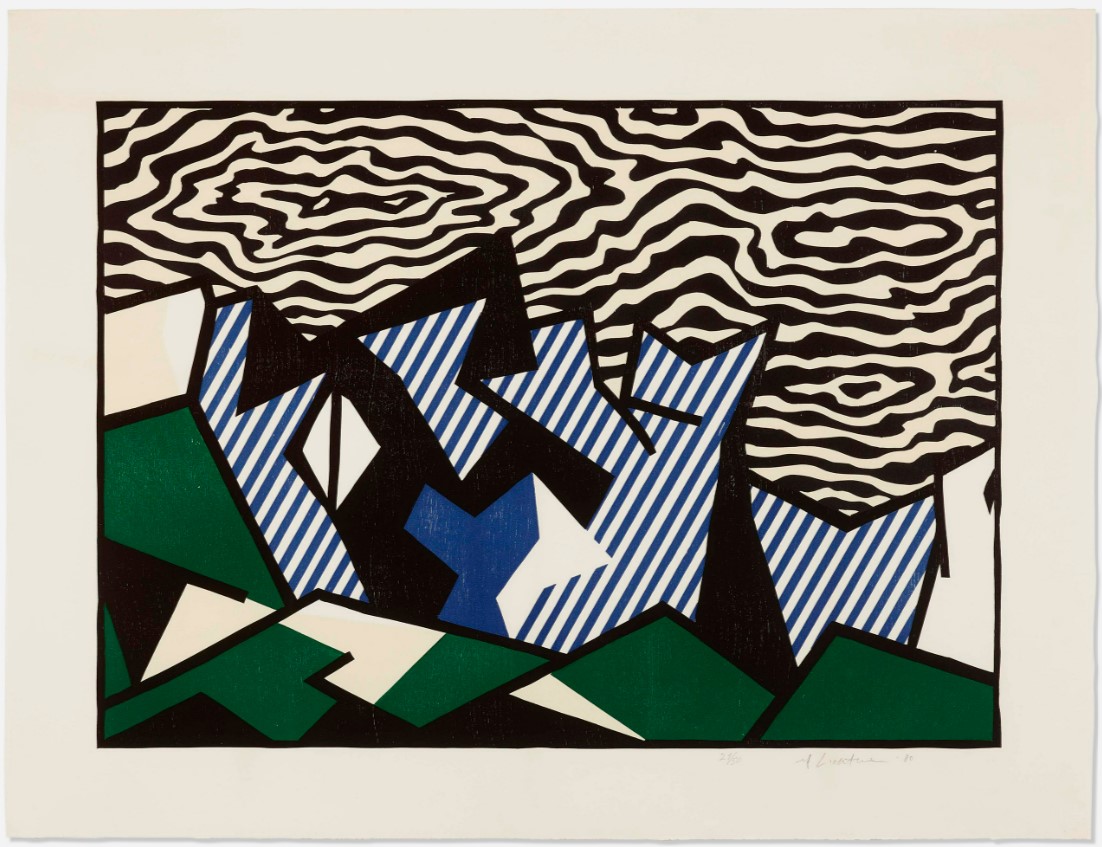
Lichtenstein’s interest in Expressionist subject matter first appeared in his 1950s pre-Pop American Indian woodcuts, a theme he readdressed during 1979 and 1980. Ultimately, however, it is the paintings and woodcuts of the German Expressionist artists who worked between 1906 and 1920 that served as the source for his explorations. In 1980, Lichtenstein created a group of seven “German Expressionist’’ woodcuts printed and published by the Gemini workshop. As a group, the images reflect subjects common to German Expressionism — portrait heads and nudes — although Lichtenstein conveys the emotional content in a contemporary manner, giving it a sleek, impersonal character. The exaggeratedly sharp angles, jagged fragments, and overdramatized gestures and expressions add an ironic twist to the splintered images of earlier German examples. Only an occasional glimpse of the close-grained surface with its embossed patches suggests the medium that is the oldest printmaking technique.
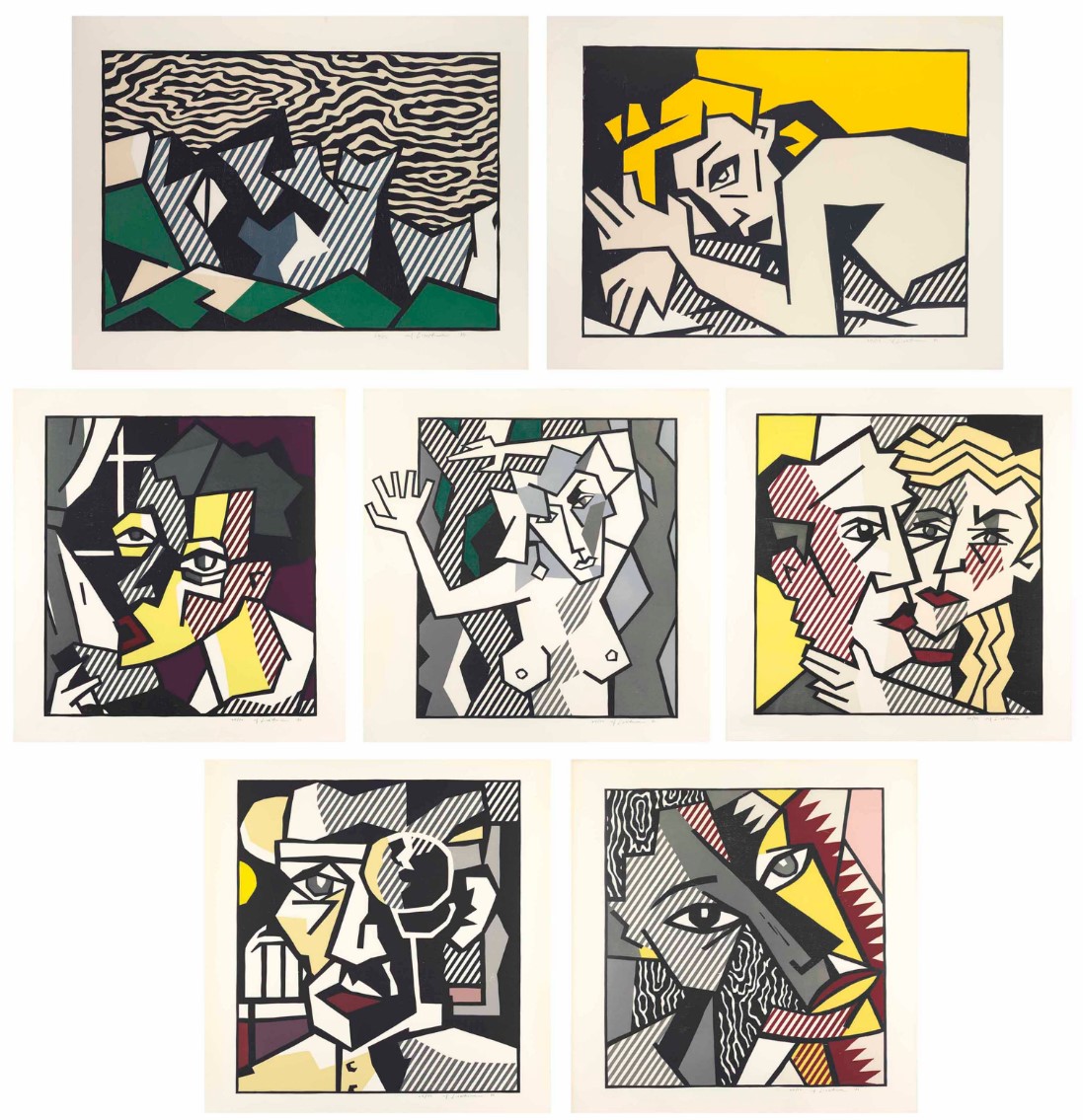
Expressionist Woodcut Series, 1980
The complete set of seven woodcuts with embossing in colors, on Arches paper
Varying dimensions
Largest Sheet: 41 1/2 x 34 inches (105.4 x 86.4 cm)
Edition: 50 + 13 AP
Literature: Corlett 172-178, Gemini 880-886
1. Reclining Nude
2. Dr. Waldman
3. Nude in The Woods
4. The Couple
5. The Student
6. Head
7. Morton A. Mort
Seven Apple Woodcut Series, 1983
The Seven Apple Woodcuts series takes as its subject one of those most familiar tropes immortalized by countless artists including Caravaggio, Cranach the Elder, Cézanne, Gaugin, Courbet, Magritte, rendering it in a dramatically new and energetic way. The Pop artist’s rendering of bold, graphic gestures and fluid brushstrokes defines what lies at the heart of his work—a thorough and systematic examination of how we look at objects, and how we then represent them in a visual medium. Rendered in a series of dramatic signs, Lichtenstein’s fruit appears out of a flurry of stylized brushstrokes. Solid black lines denote the outline of the fruit, while colorful passages of red and yellow make up their shiny surface. Large and imposing, these apples dominate the composition, pushing out the additional elements that, historically speaking at least, were often included in still life paintings. This this lack of extraneous material thereby focusing attention on the purely formal aspects of the fruit. Concentrating attention on optical nature of light and shadow, Lichtenstein’s dramatic style encourages us to decipher what we are seeing for ourselves, rather than presenting us with a straightforward, realistic depiction of the appearance of the fruit.
1. Apple and Lemon
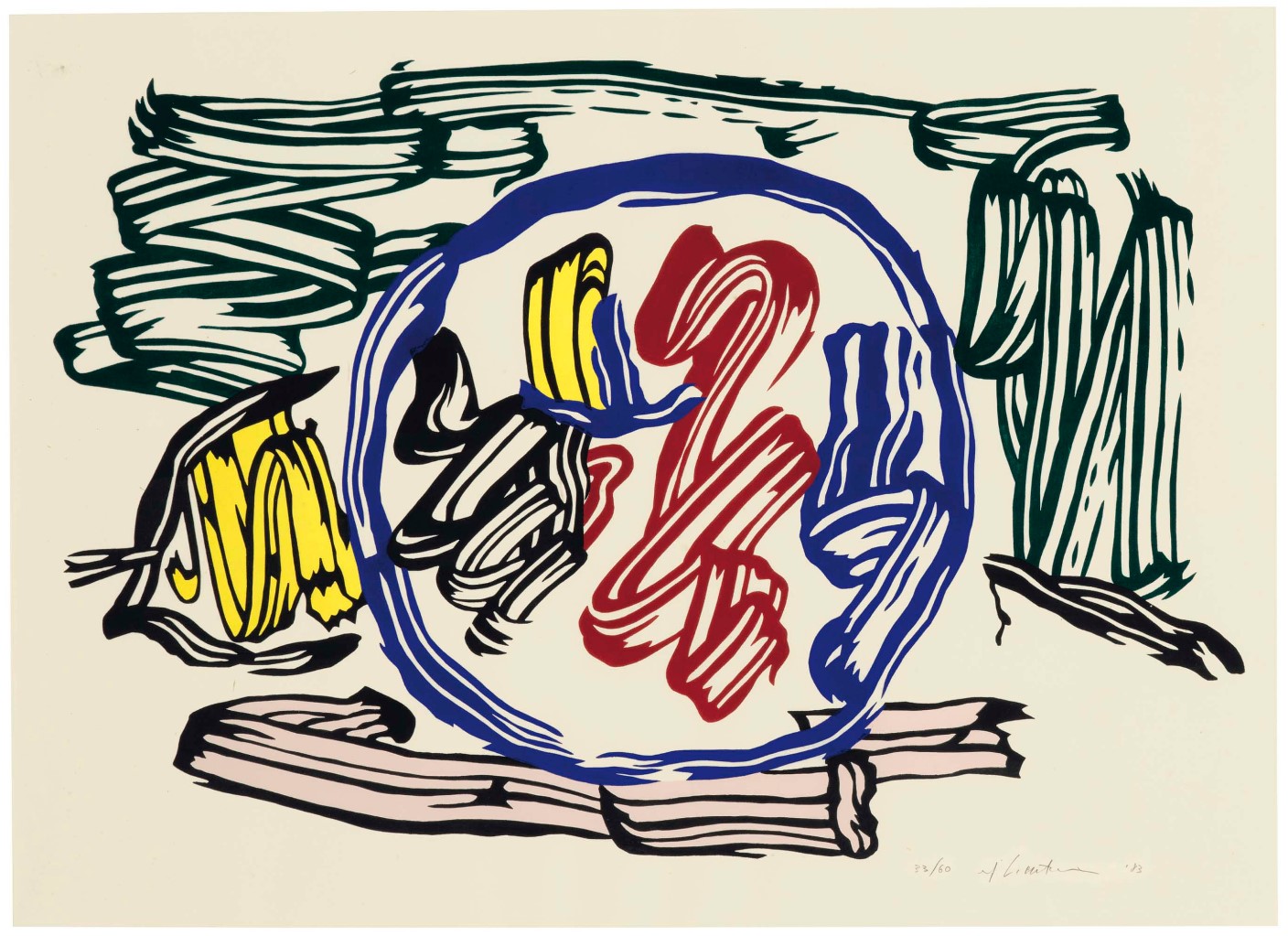
Apple and Lemon from Seven Apple Woodcut Series, 1983
Woodcut in colors on Iwano Kizuki Hosho paper
Sheet: 31 3/8 x 41 3/4 inches (79.7 x 106 cm)
Edition: 60 + 14 AP
Literature: Corlett 193
2. Apple with Gray Background
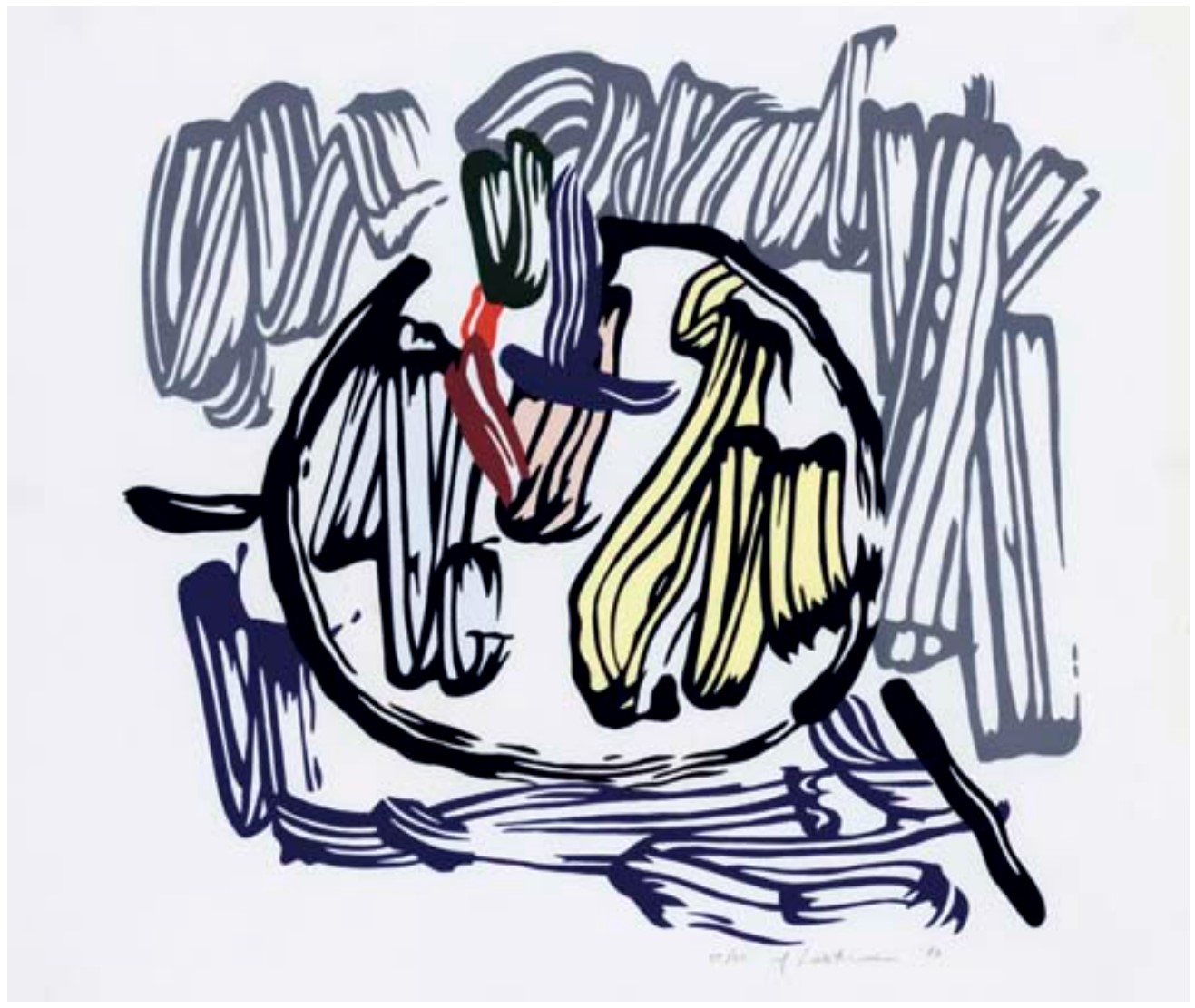
Apple with Gray Background from Seven Apple Woodcut Series, 1983
Woodcut in colors on Iwano Kizuki Hosho paper
Sheet: 30 1/8 x 33 inches (76.4 x 83.8 cm)
Edition: 60 + 14 AP
Literature: Corlett 194
3. Red and Yellow Apple
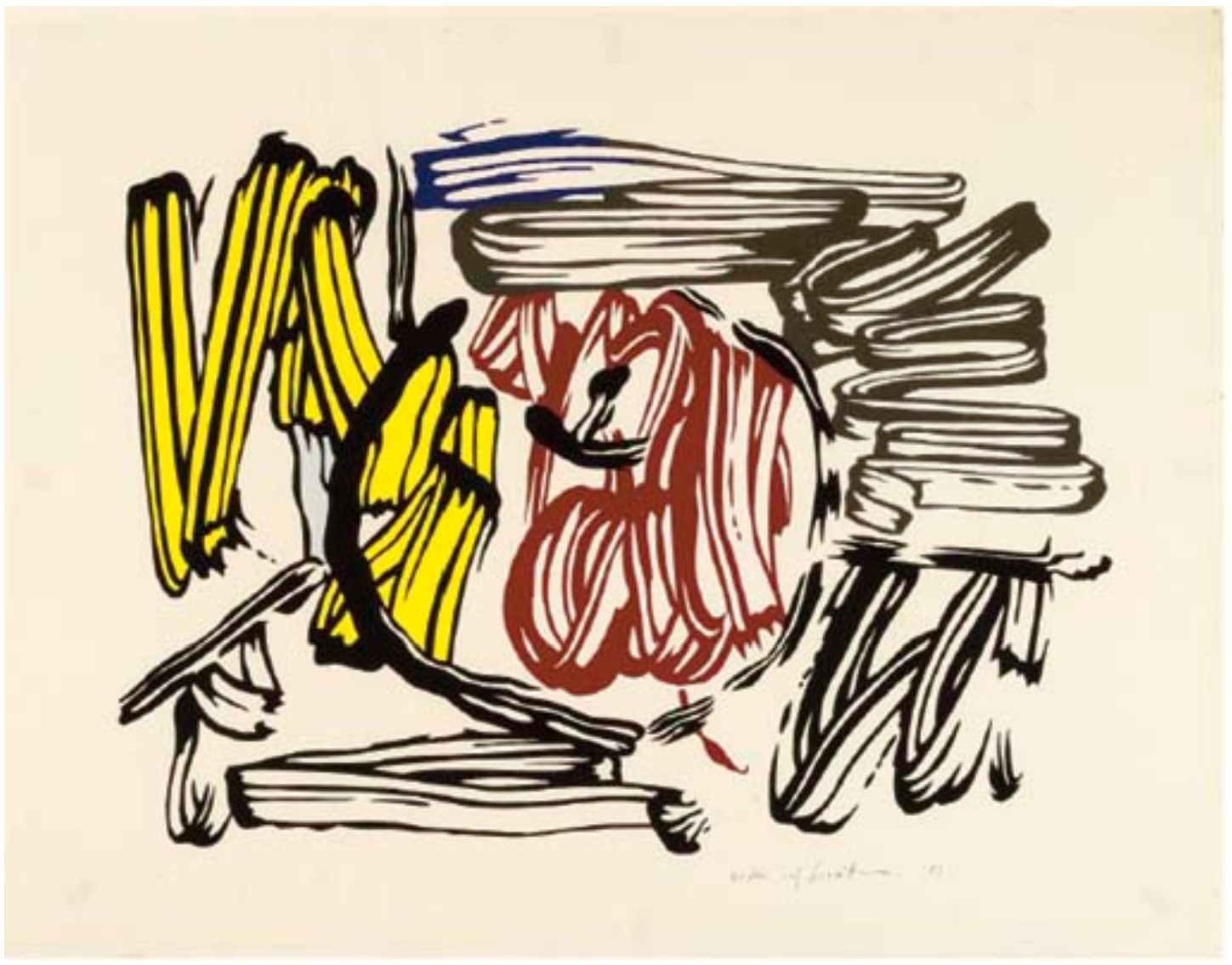
Red and Yellow Apple from Seven Apple Woodcut Series, 1983
Woodcut in colors on handmade Iwano Kizuki Hosho paper
Sheet: 28 1/2 x 37 3/8 inches (72.3 x 94.8 cm)
Edition: 60 + 14 AP
Literature: Corlett 195
4. Red Apple
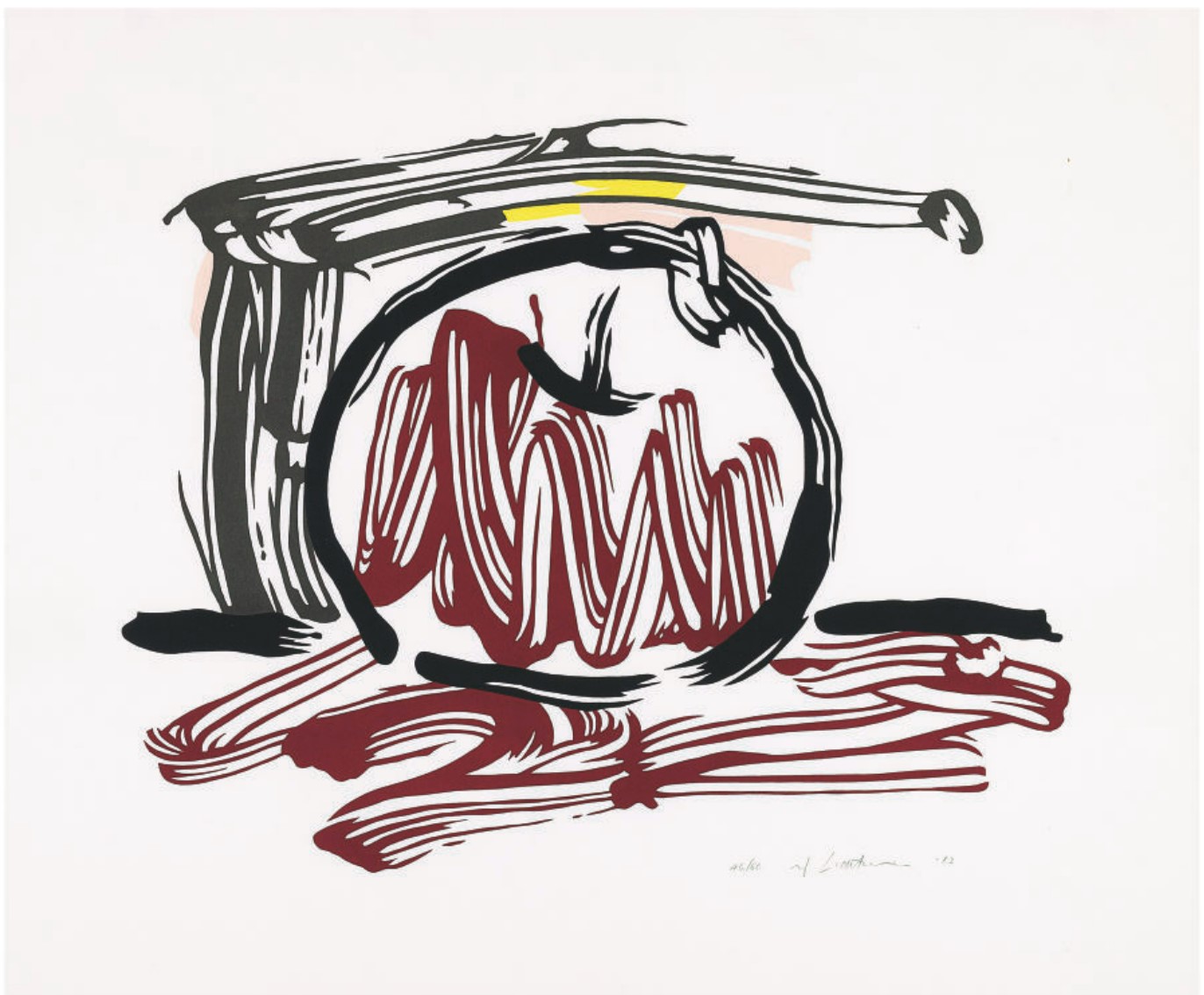
Red Apple from Seven Apple Woodcut Series, 1983
Woodcut in colors on Iwano Kizuki Hosho paper
Sheet: 30 3/8 x 37 inches (77.2 x 94 cm)
Edition: 60 + 14 AP
Literature: Corlett 196
5. Red Apple and Yellow Apple
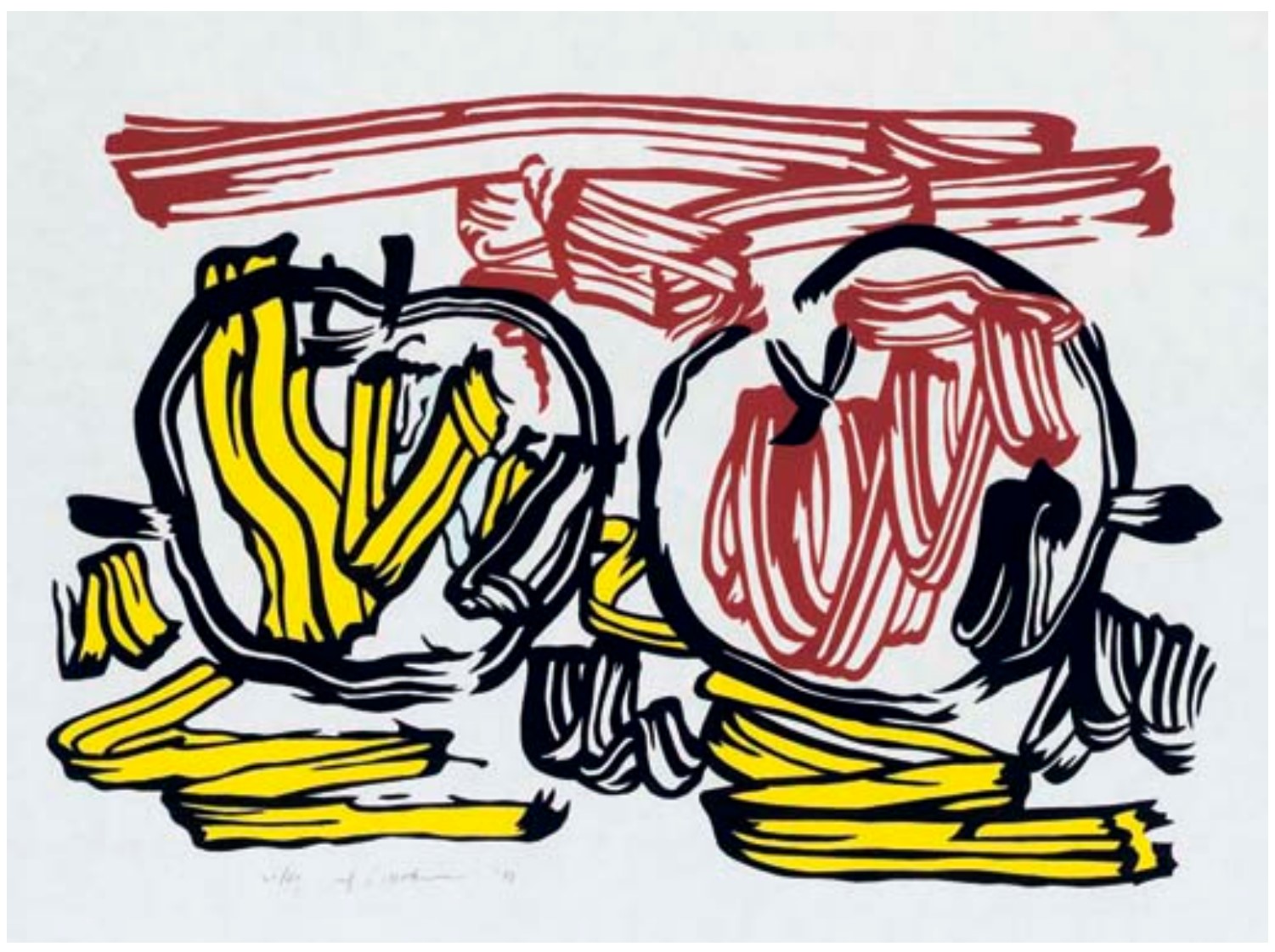
Red Apple and Yellow Apple from Seven Apple Woodcut Series, 1983
Woodcut in colors on handmade Iwano Kizuki Hosho paper
Sheet: 27 3/4 x 37 3/4 inches (71.4 x 95.8 cm)
Edition: 60 + 14 AP
Literature: Corlett 197
6. Two Apples
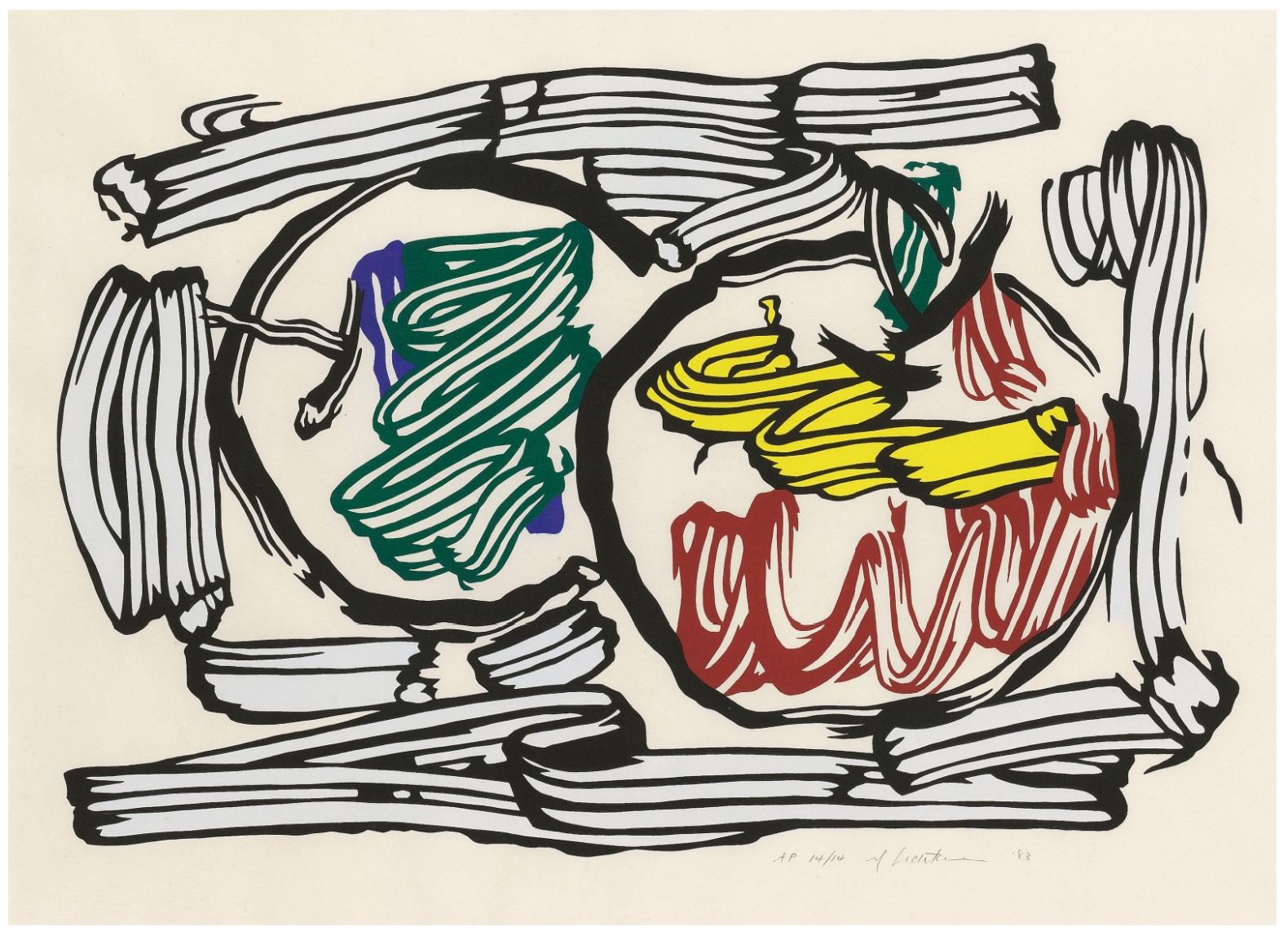
Two Apples from Seven Apple Woodcut Series, 1983
Woodcut in colors on Iwano Kizuki Hosho paper
Sheet: 75.7 x 99.7 cm
Edition: 60 + 14 AP
Literature: Corlett 198
7. Vertical Apple
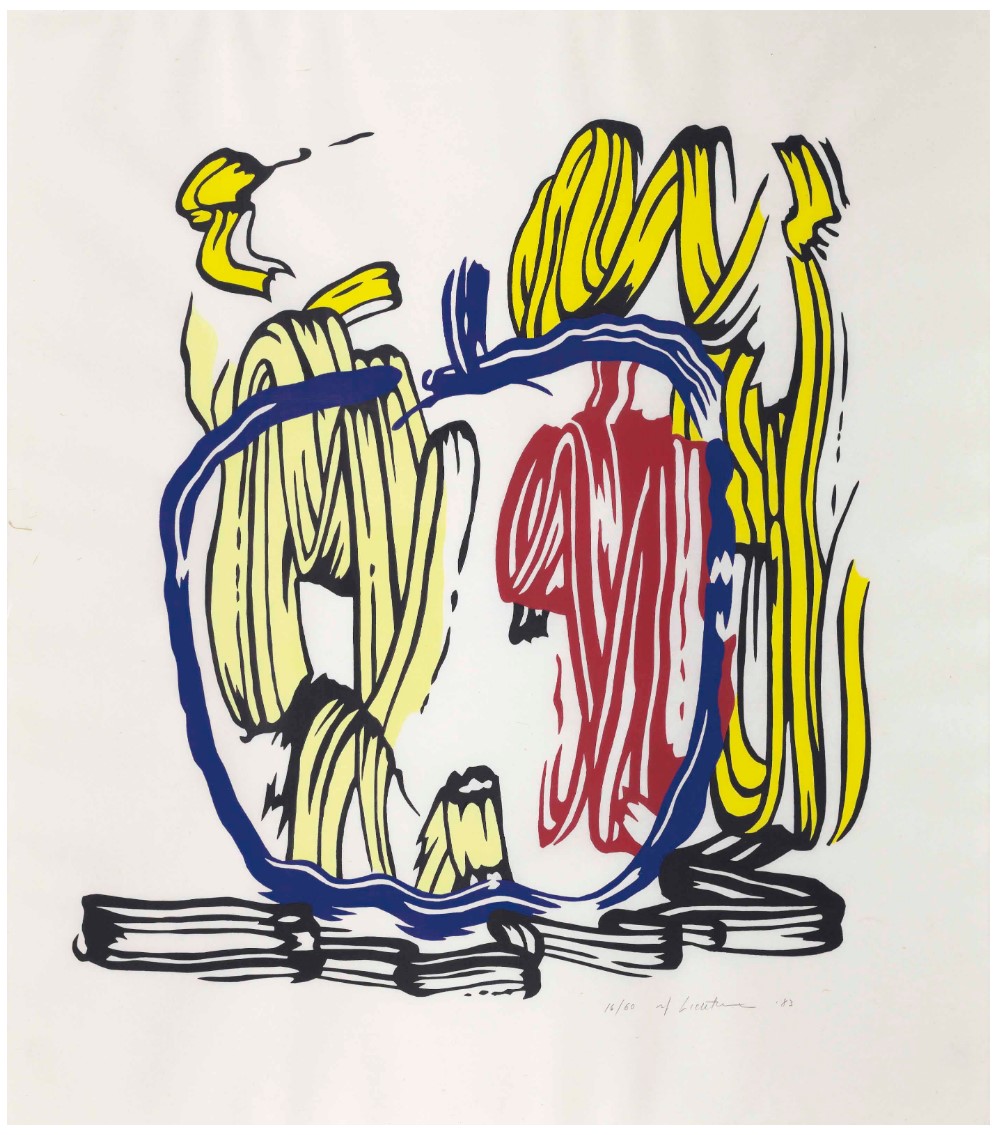
Vertical Apple from Seven Apple Woodcut Series, 1983
Woodcut in colors on Iwano Kizuki Hosho paper
Sheet: 94.8 x 83.2 cm
Edition: 60 + 14 AP
Literature: Corlett 199
Paintings Series, 1984
In his Paintings Series, Roy Lichtenstein demonstrates his outstanding ability to mix and reconcile contrasting subjects and styles. Challenging the very notion of artistic creation and originality, the artist combines variously framed paintings into his own language, allowing the flattening technique of his own to create a vivid and humorous dialogue with the viewer. In this Series, Lichtenstein depicts two paintings of iconic art images on a wall. While the appropriation of other artists is not new for the artist, this series portrays their work in a novel context, as framed pictures, close up and cropped to reveal only a section of the canvas. By cleverly juxtaposing familiar works from art history in an interior context, Lichtenstein creates an intriguing disjunction of reality at multiple levels, while paying homage to his predecessors who similarly grappled with the limits of human perception and of truthfully depicting of the material world.
1. Two Paintings: Green Lamp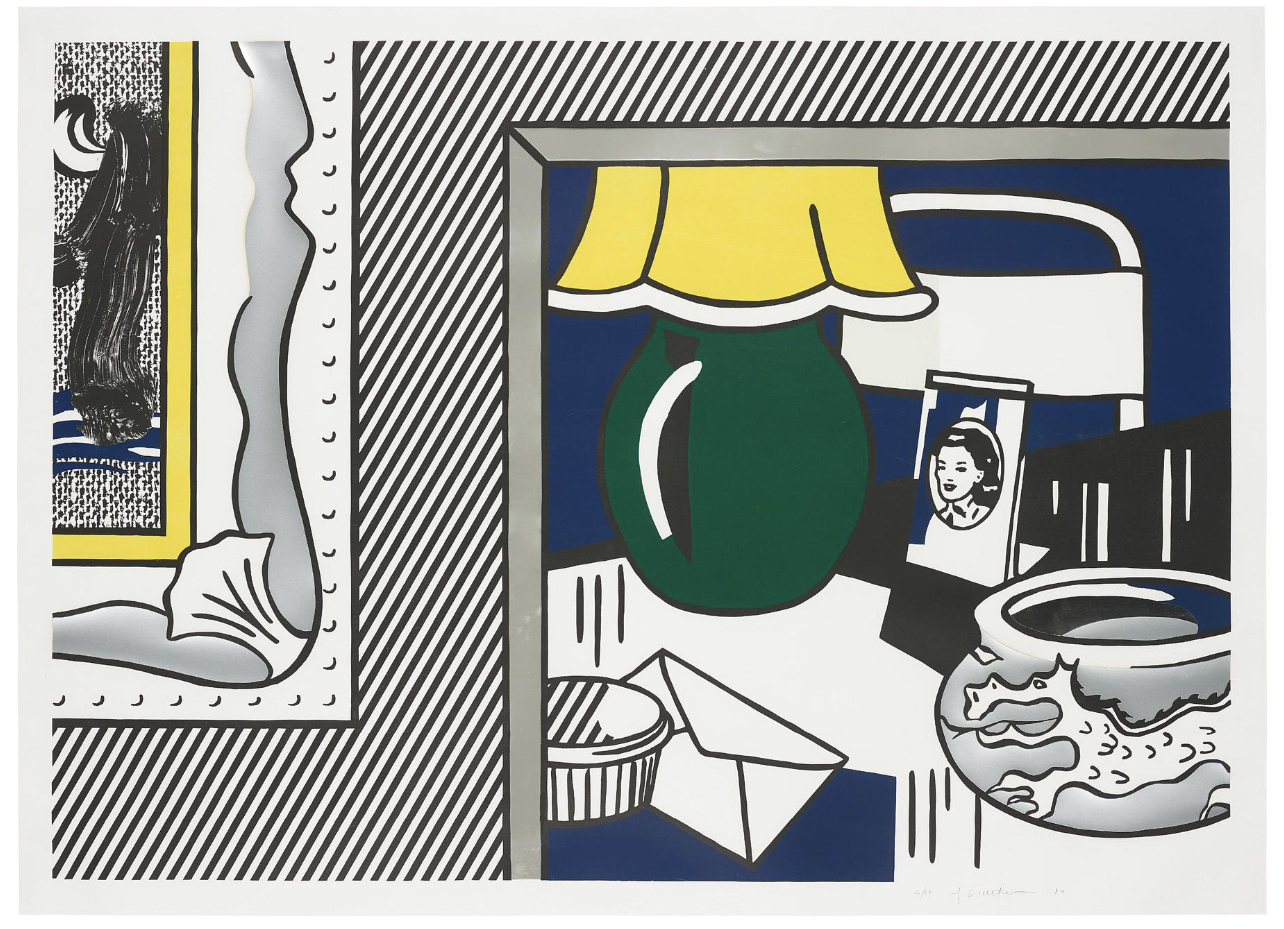
Two paintings: Green Lamp from Paintings Series, 1984
Woodcut, lithograph, screen-print and collage in colors on Arches 88 paper
Sheet: 38 5/8 x 53 inches (98 x 134.7 cm)
Edition: 60 + 11 AP
Literature: Corlett (201), Gemini G.E.L. (1140)
2. Painting on Canvas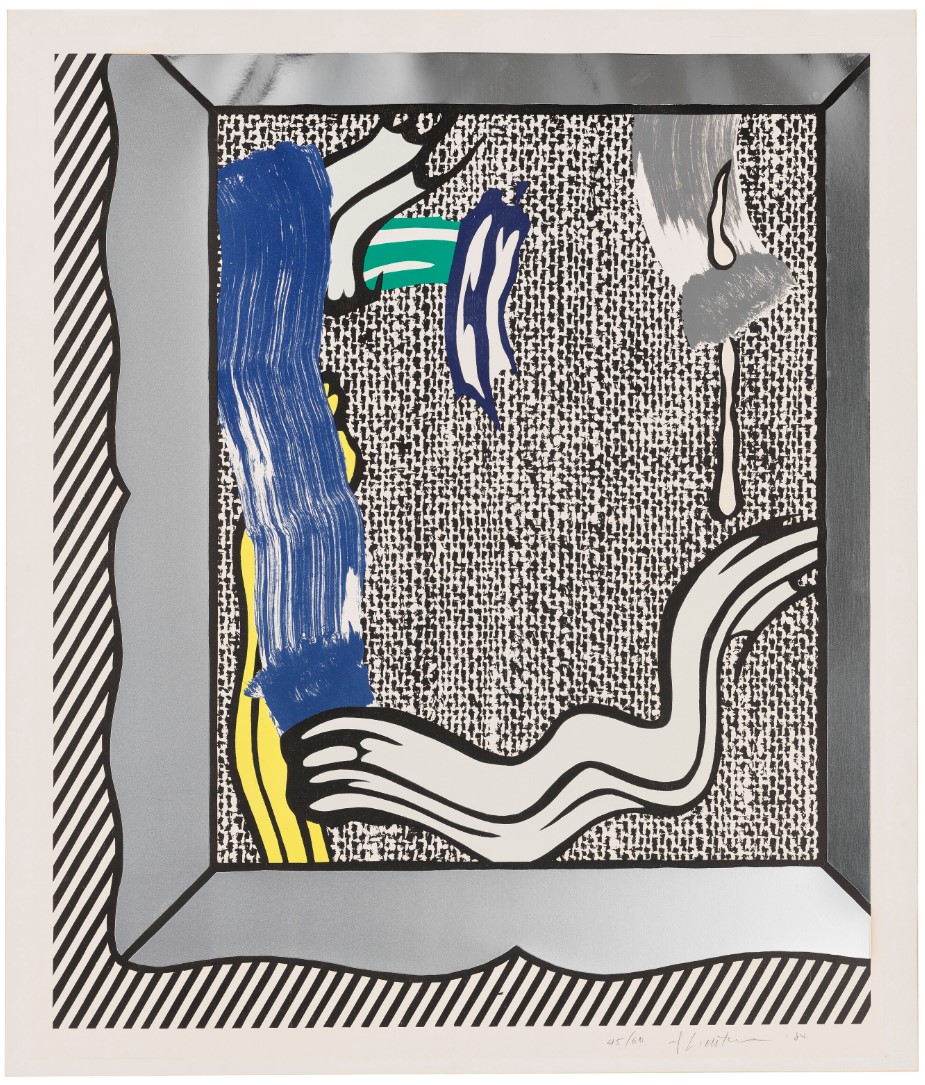
Painting on Canvas from Paintings Series, 1984
Woodcut, lithograph, screen-print and collage in colors on Arches 88 paper
Sheet: 86.2 x 73.5 cm
Edition: 60 + 11 AP
Literature: Corlett 202, Gemini 1141
3. Two Paintings: Sleeping Muse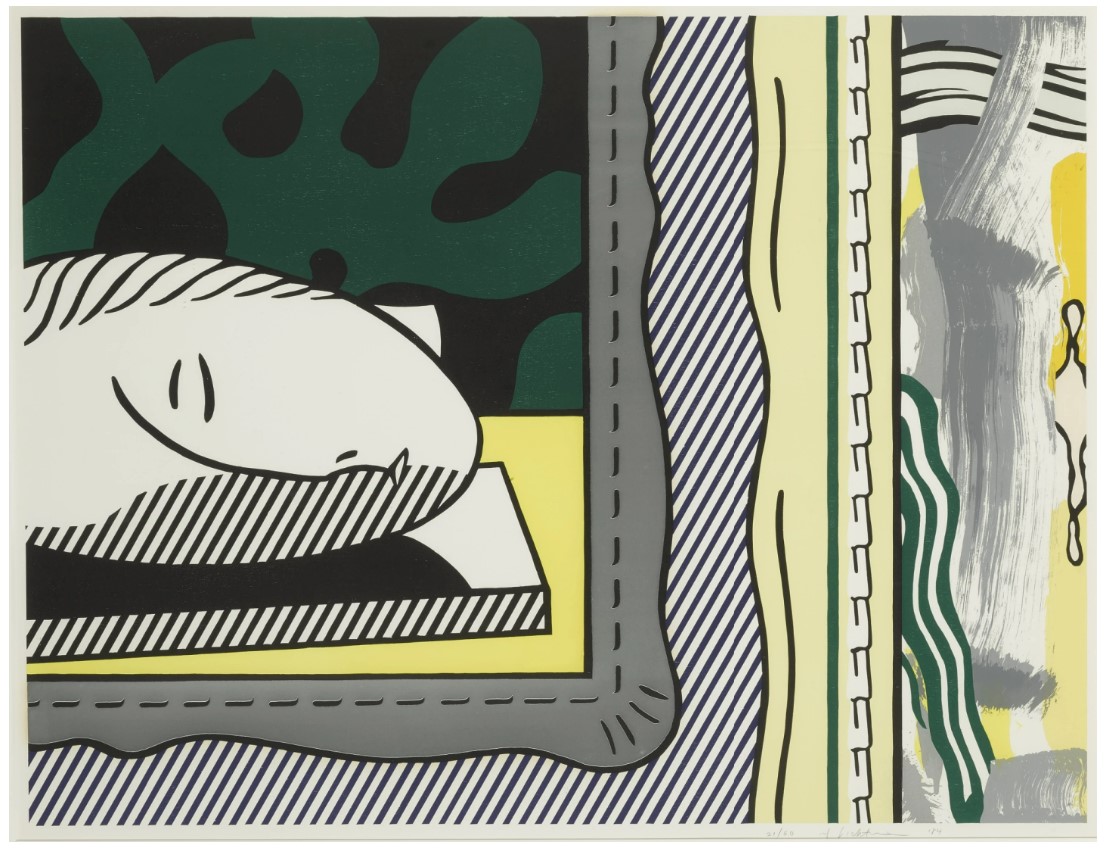
Two Paintings: Sleeping Muse from Paintings Series, 1984
Woodcut, lithograph, and screen-print in colors on Arches 88 wove paper
Sheet: 37 7/8 x 49 inches (96.2 x 124.3 cm)
Edition: 60 + 11 AP
Literature: Corlett 203, Gemini 1142
4. Two Paintings: Beach Ball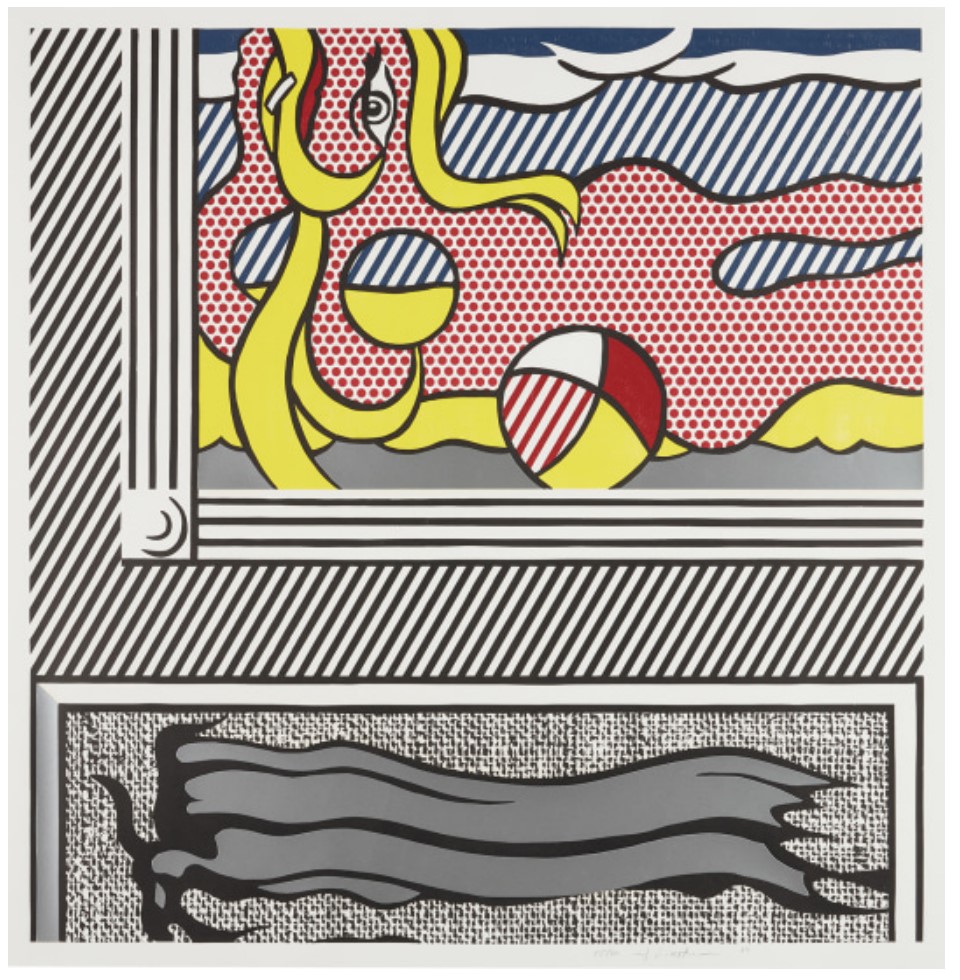
Two Paintings: Beach Ball from Paintings Series, 1984
Woodcut, lithograph, and screen-print in colors on Arches 88 wove paper
Sheet: 40×39 inches (101.6 x 99.1 cm)
Edition: 60 + 11 AP
Literature: Corlett 204, Gemini 1143
5. Two Paintings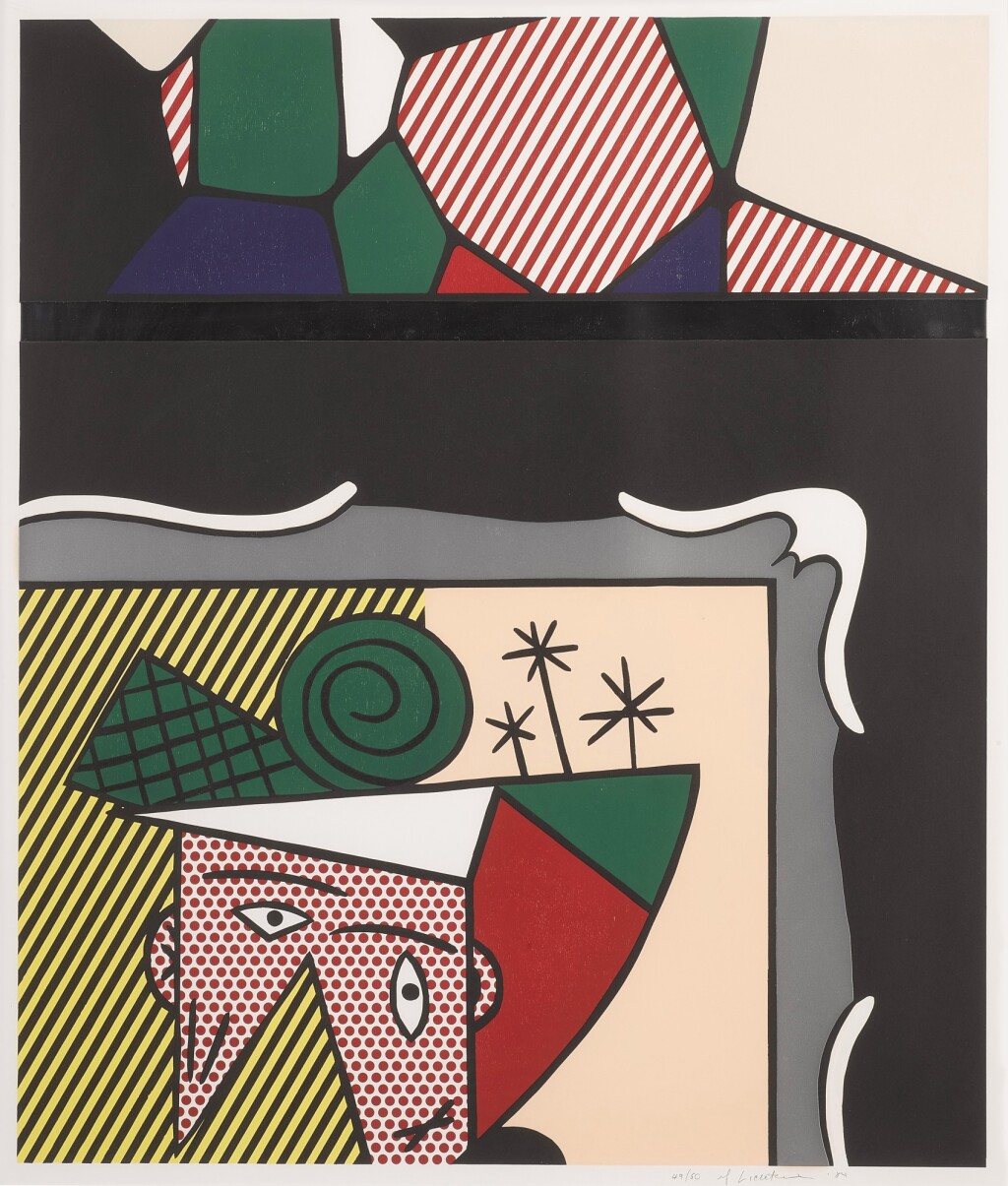
Two Paintings from Paintings Series, 1984
Woodcut, lithograph and screen-print in colors with collage on Arches 88 wove paper
Sheet: 41 7/8 x 38 7/8 inches (106.5 x 99 cm)
Edition: 60 + 11 AP
Literature: Corlett 205
6. Painting in Gold Frame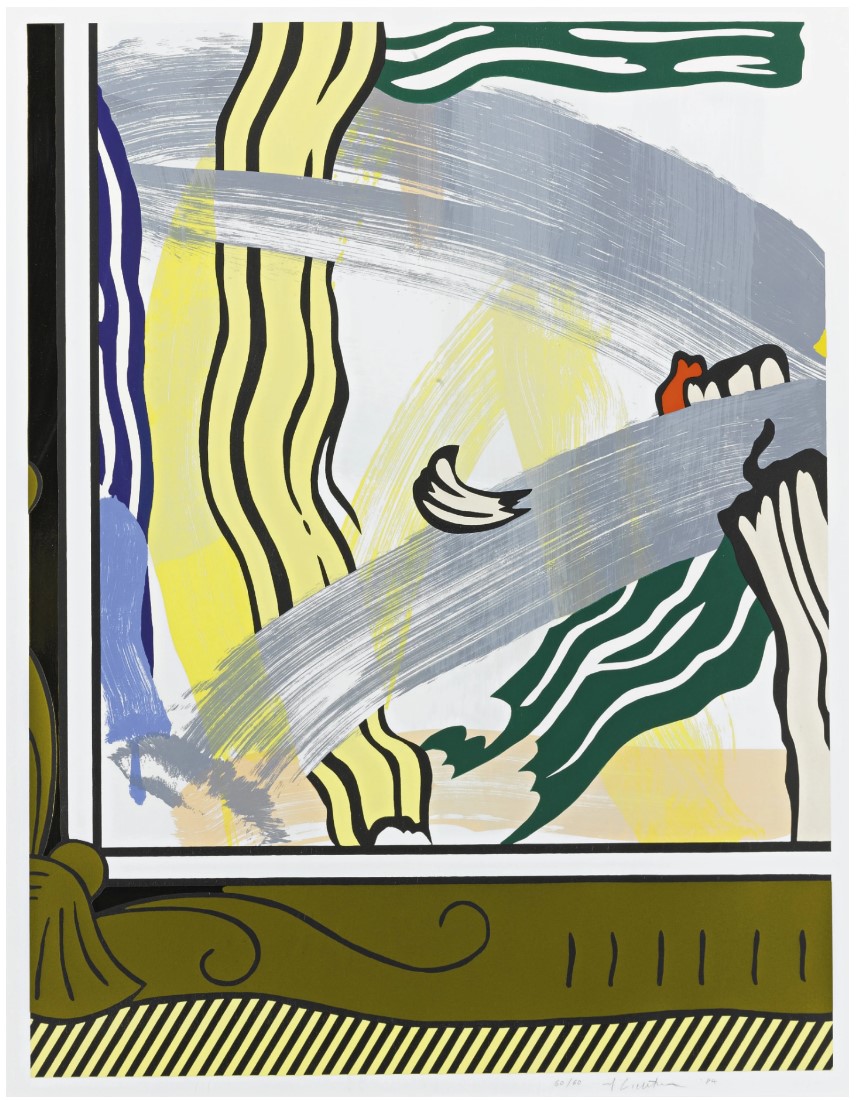
Painting in Gold Frame from Paintings Series, 1984
Lithograph, screen-print, woodcut and collage printed in colors on Arches 88 paper
Sheet: 46 1/4 x 36 inches (117.5 x 91.3 cm)
Edition: 60 + 11 AP
Literature: Corlett 206, Gemini 1145
7. Two Paintings: Dagwood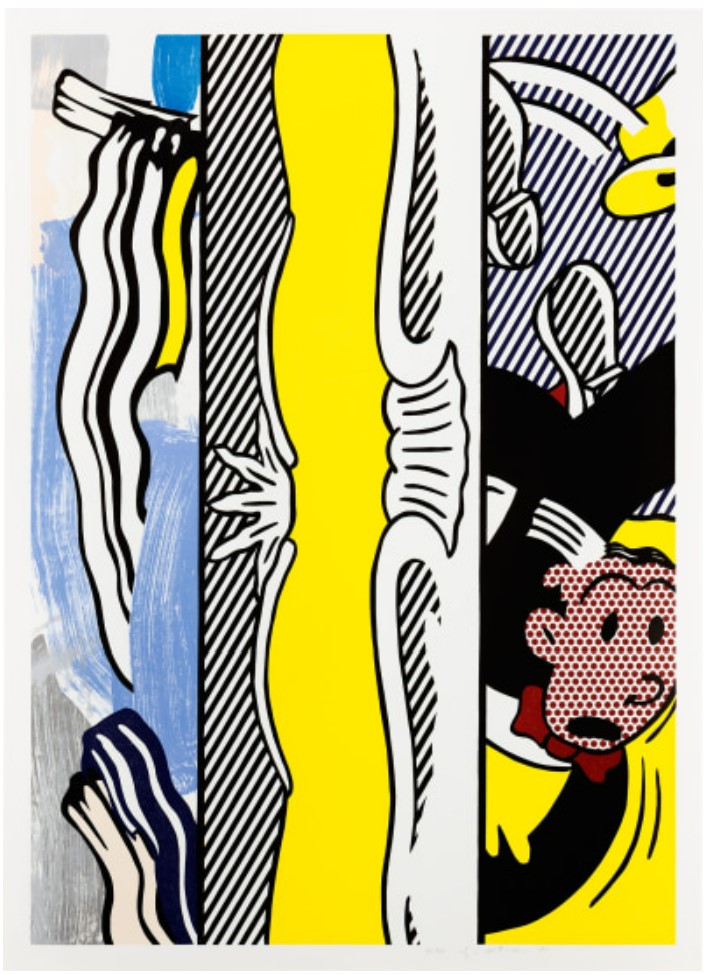
Two Paintings: Dagwood from Paintings Series, 1984
Woodcut and lithograph colors on Arches 88 wove paper
Sheet: 53 3/4 x 39 inches (136.5 x 99.1 cm)
Edition: 60 + 11 AP
Literature: Corlett 207, Gemini 1146
8. Painting on Blue and Yellow Wall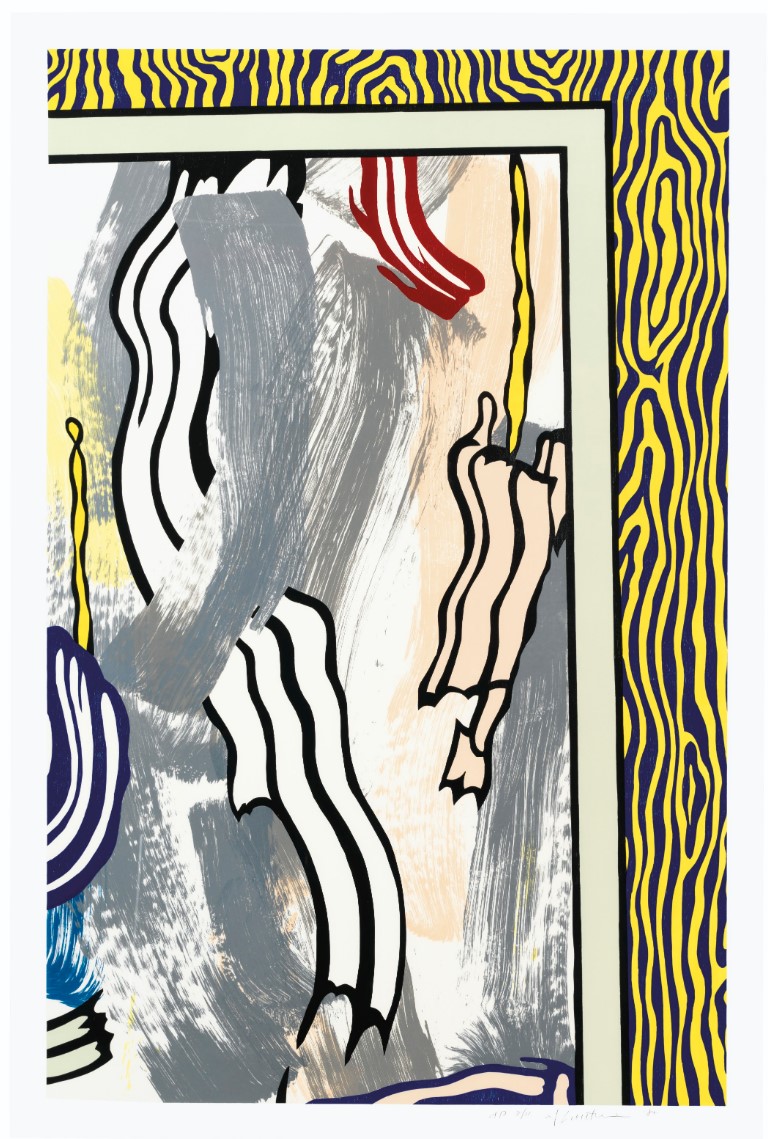
Painting on Blue and Yellow Wall from Paintings Series, 1984
Woodcut and lithograph in colors on Arches 88 paper
Sheet: 47 1/8 x 31 1/2 inches (119.7 x 80 cm)
Edition: 60 + 11 AP
Literature: Corlett 208, Gemini 1147
Landscapes Series, 1985
1. Seascape
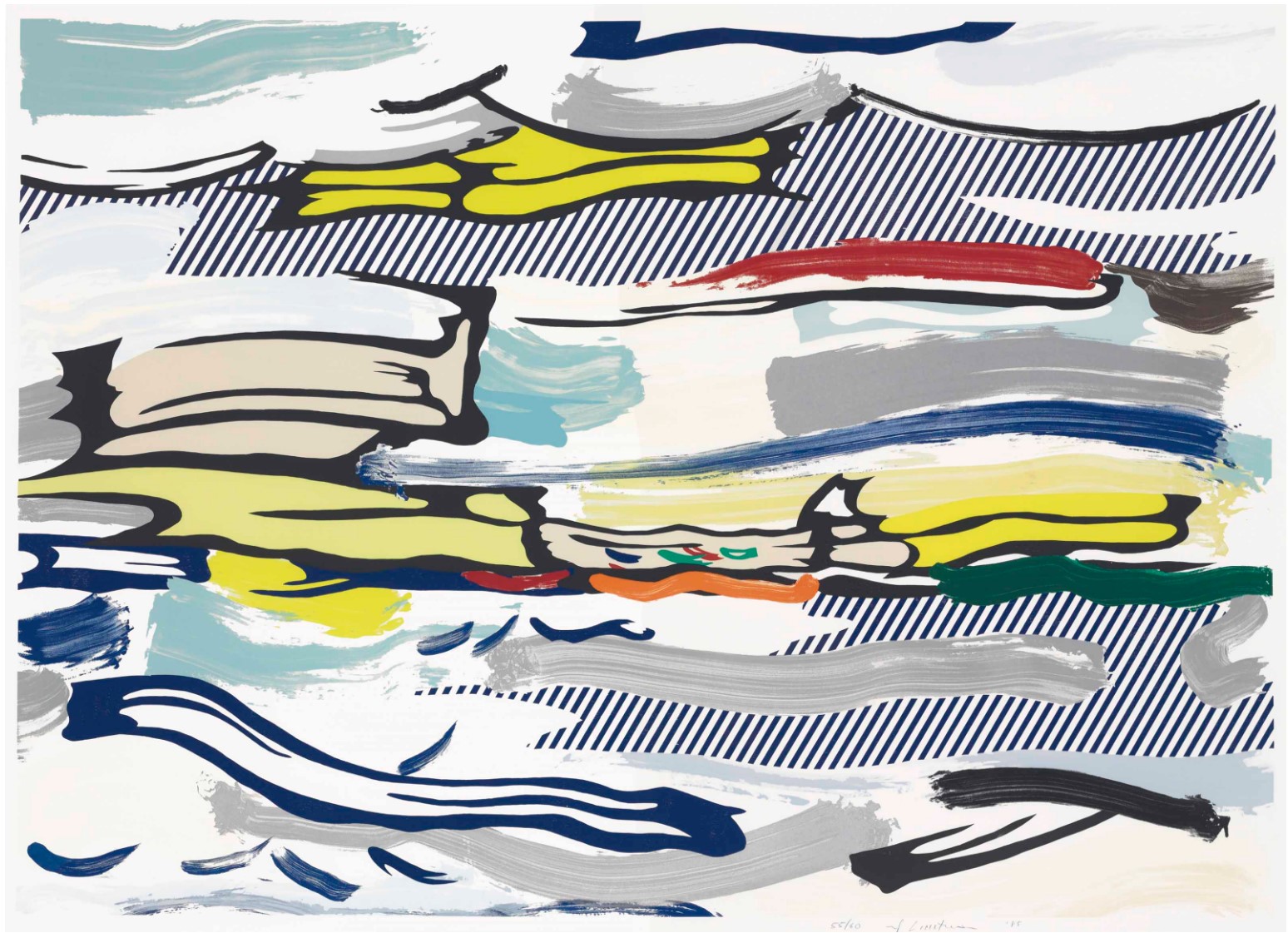
Seascape from Landscape Series, 1985
Lithograph, woodcut, and screen-print in colors on Arches 88 paper
Sheet: 40 1/4 x 55 3/8 inches (102.2 x 140.7 cm)
Edition: 60 + 11 AP
Literature: Corlett 210, Gemini 1252
2. The Sower
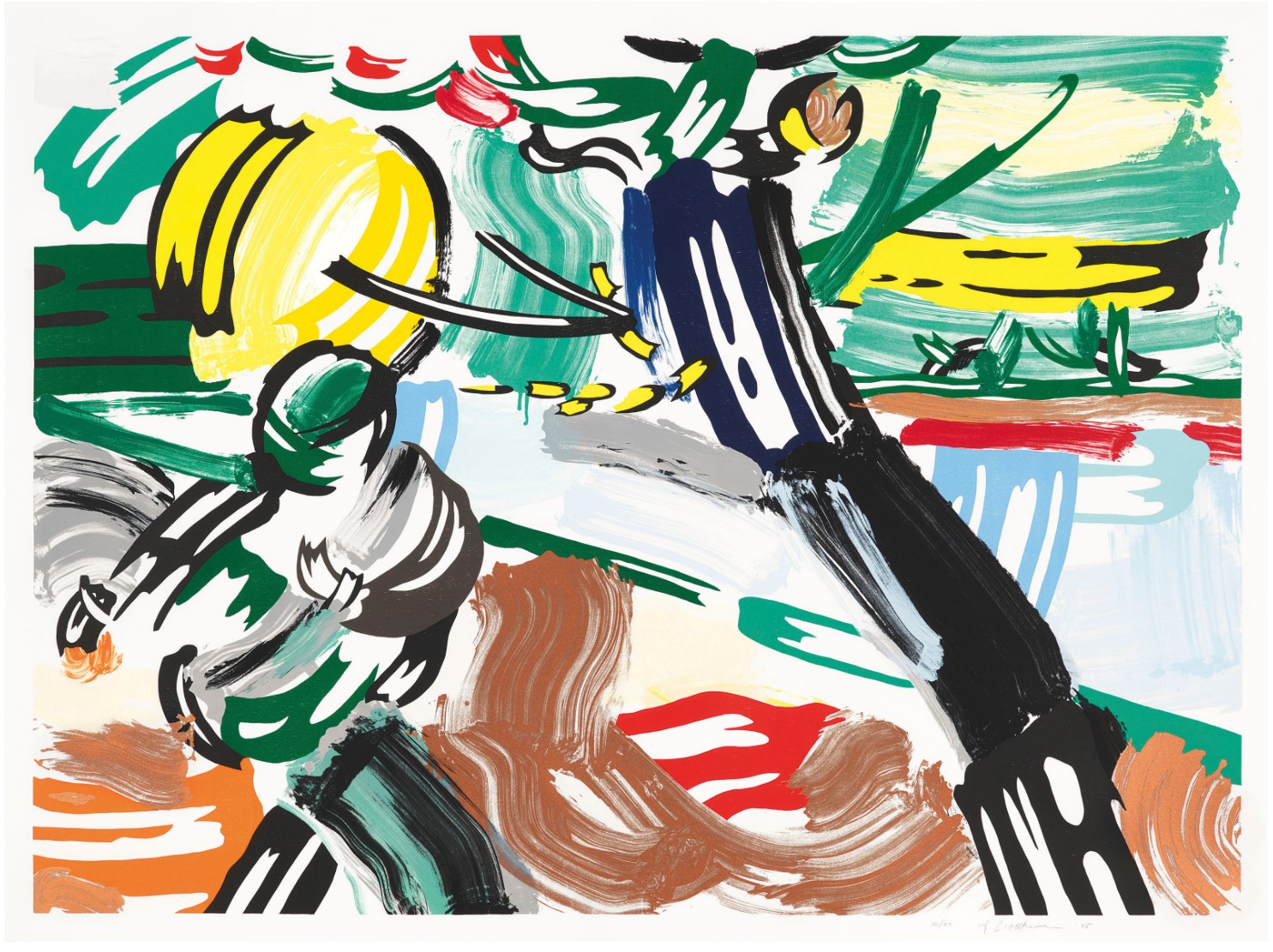
The Sower from Landscape Series, 1985
Lithograph, woodcut, and screen-print in colors on Arches 88 paper
Sheet: 41 x 55 1/2 inches (104.1 x 141 cm)
Edition: 60 + 11 AP
Literature: Corlett 211, Gemini 1253
3. Moonscape
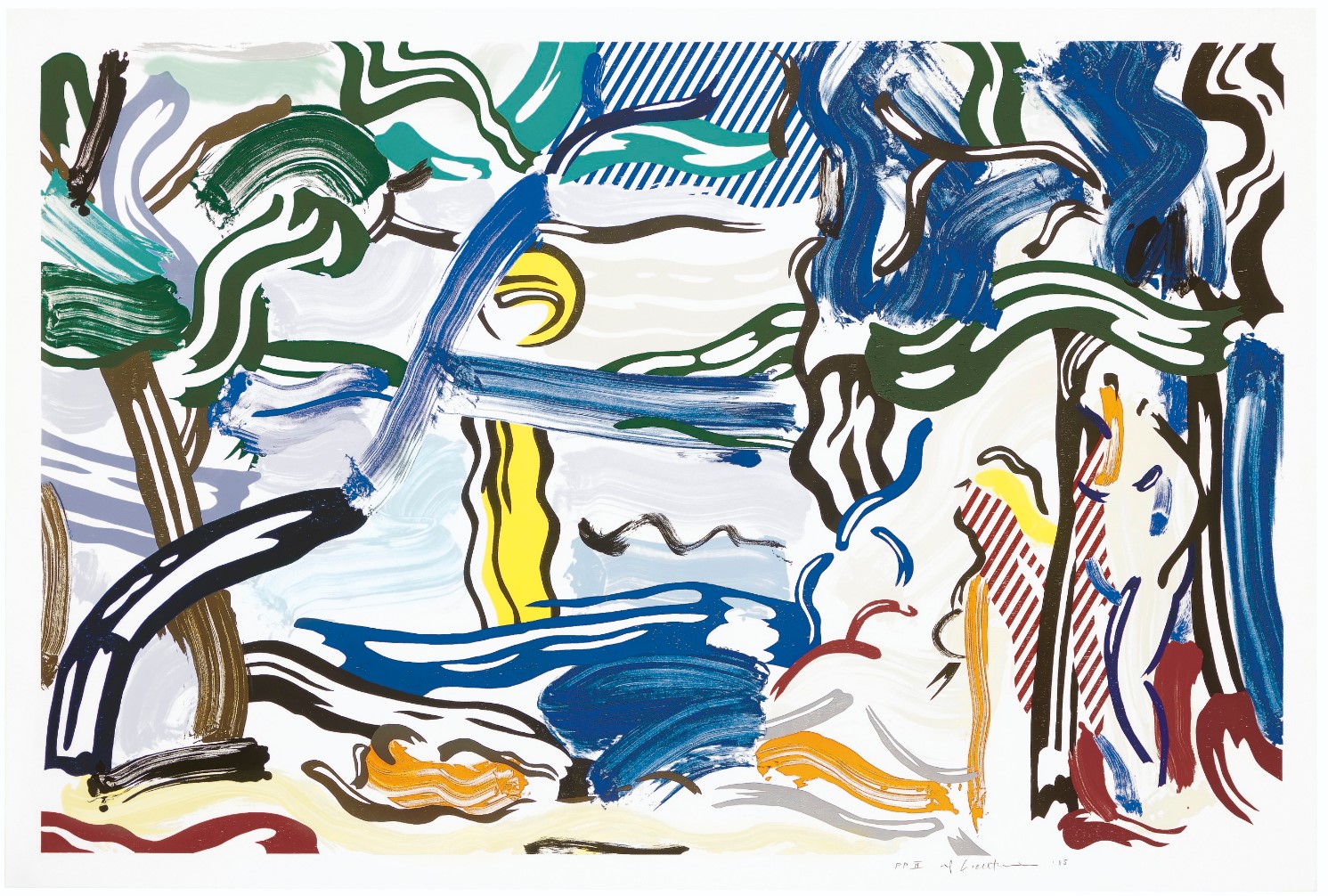
Moonscape from Landscape Series, 1985
Lithograph, woodcut, and screen-print in colors on Arches 88 paper
Sheet: 37 1/3 x 55 1/4 inches (94.6 x 140.3 cm)
Edition: 60 + 11 AP
Literature: Corlett 212, Gemini 1254
4. Road Before The Forest
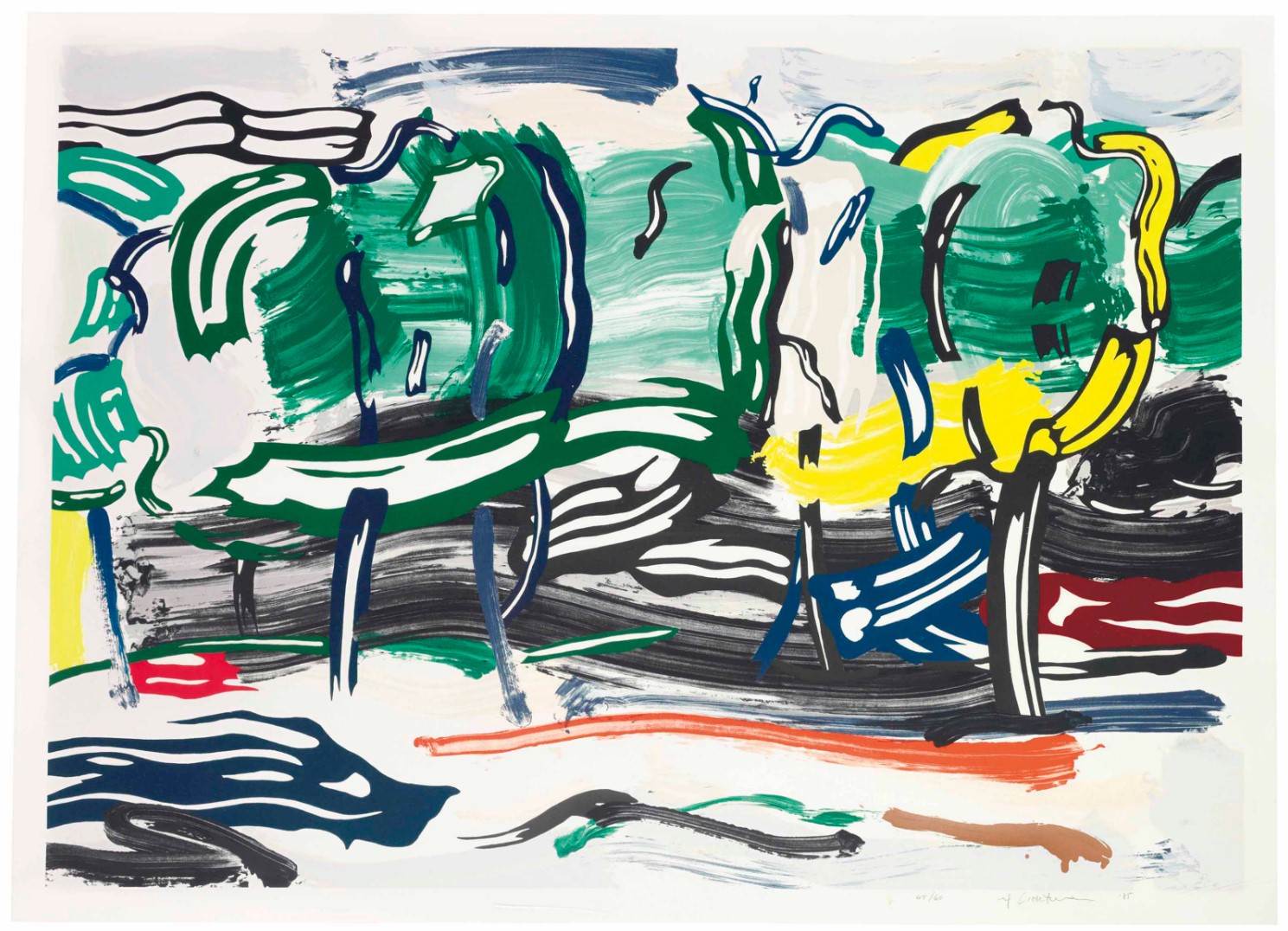
Road Before The Forest from Landscape Series, 1985
Lithograph, woodcut, and screen-print in colors on Arches 88 paper
Sheet: 40 x 55 1/2 inches (101.6 x 141 cm)
Edition: 60 + 11 AP
Literature: Corlett 213, Gemini 1255
5. The River
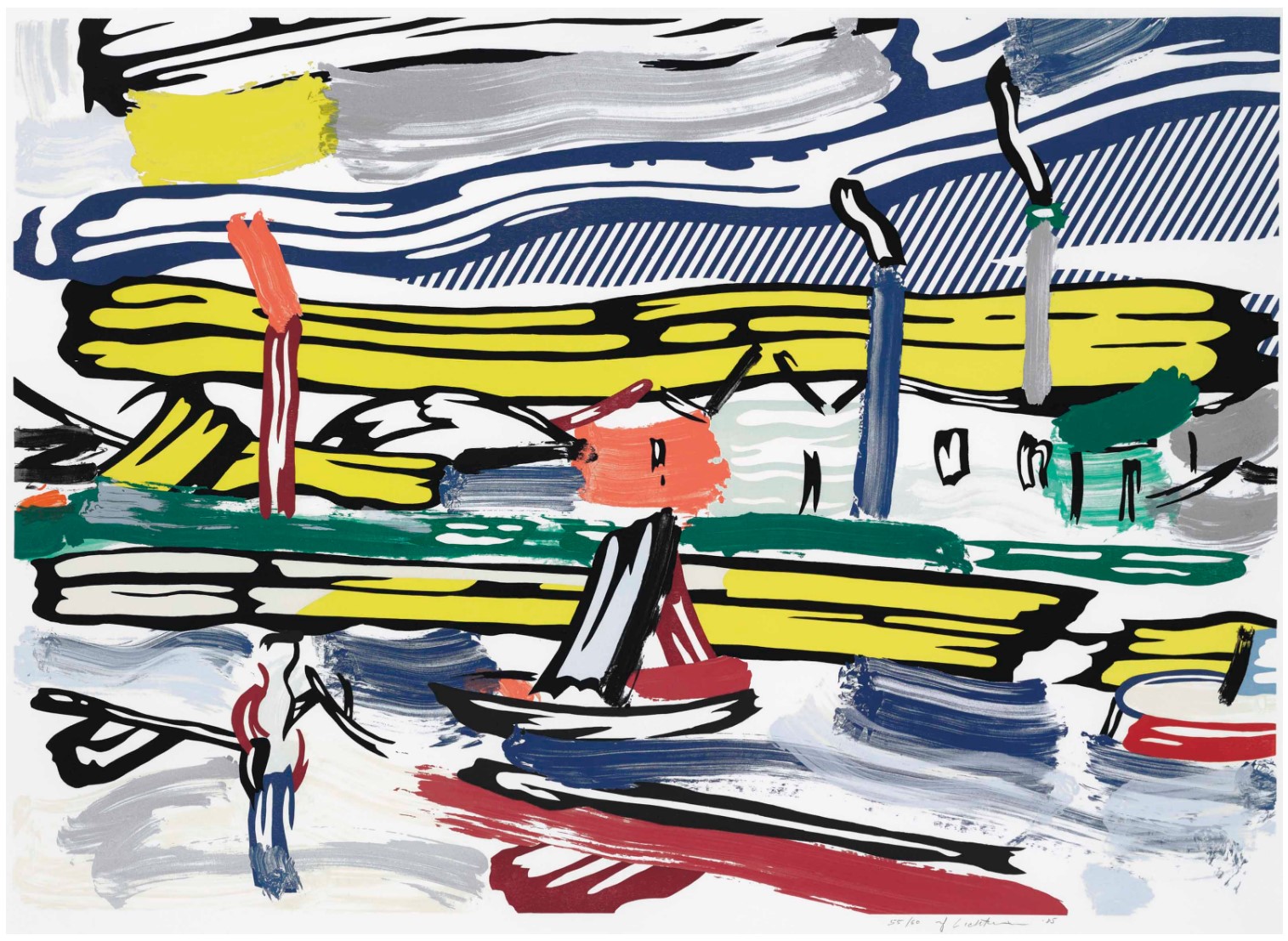
The River from Landscape Series, 1985
Lithograph, woodcut, and screen-print in colors on Arches 88 paper
Sheet: 40 1/8 x 55 1/2 inches (101.9 x 141 cm)
Edition: 60 + 11 AP
Literature: Corlett 214, Gemini 1256
6. View from the Window
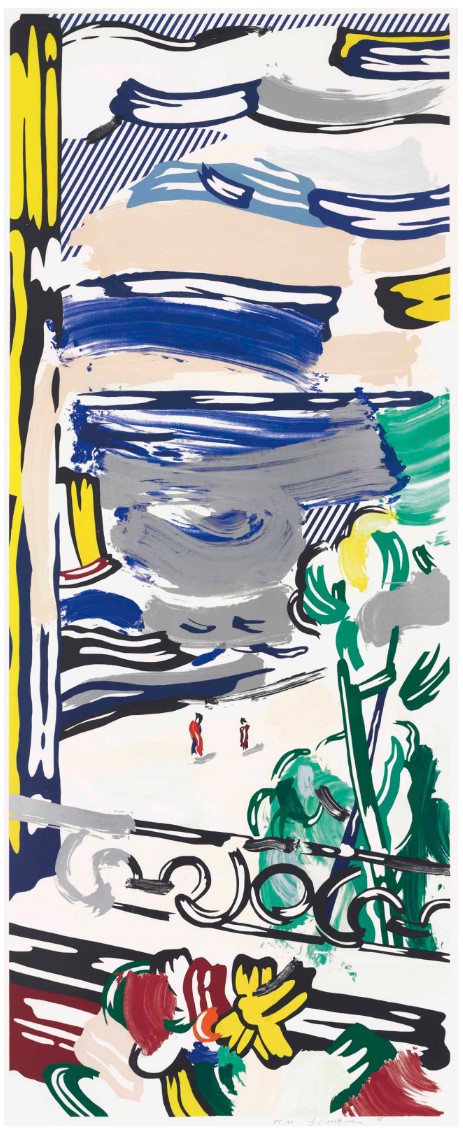
View from the Window from Landscape Series, 1985
Lithograph, woodcut, and screen-print in colors on Arches 88 paper
Sheet: 79 5/8 x 33 5/8 inches (202.2 x 85.4 cm)
Edition: 60 + 11 AP
Literature: Corlett 215, Gemini 1257
7. Sunshine Through the Clouds
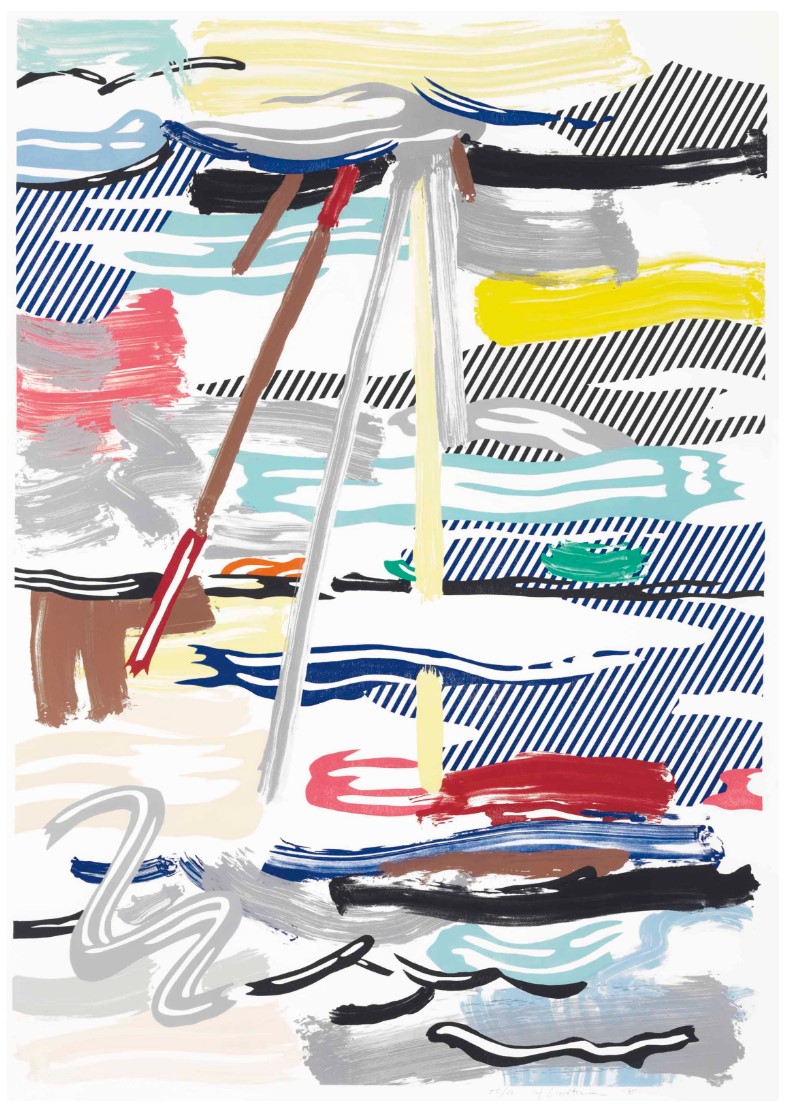
Sunshine Through the Clouds from Landscape Series, 1985
Lithograph, woodcut, and screen-print in colors on Arches 88 paper
Sheet: 55 1/2 x 40 inches (141 x 101.6 cm)
Edition: 60 + 11 AP
Literature: Corlett 216, Gemini 1258
Imperfect Series, 1988
With its dazzling geometries and lyrical approach to asymmetry, Roy Lichtenstein’s Imperfect Paintings combine pure visual spectacle with a sly tongue-in-cheek humor that exemplifies the artist’s unparalleled ability to think—quite literally—outside the box. Set against glossy silver panes and thrumming black-and-white lines, an array of angular, knifelike triangles cascades down the canvas, drawing the eye to and from with masterful precision. Like all of Lichtenstein’s Imperfect and Perfect paintings, the present work originated from a pencil sketch of a single line that the artist would zigzag and fold over itself multiple times across the page to create a prismatic matrix of polygons. While the Perfects featured geometric arrangements boxed neatly into their rectangular frames, the Imperfects would always purposely “miss” the mark; Lichtenstein would allow his line to jut out past the pre-drawn borders of the composition, transforming the traditionally dreaded notion of human error into a deliberate celebration of the artistic process. A testament to the centrality of draftsmanship to Lichtenstein’s practice, Imperfect Painting ignites a creative tension between the artist’s analog hand and the crispness of Pop art’s signature mass-media aesthetic. In this particular series, Lichtenstein explores the endless mutability of the drawn and painted form, charting out the new possibilities that unfold when artistic movements and visual motifs come loose from their conceptual origins and become reclaimed in popular culture as symbolic representations of a particular moment in time. Lichtenstein turns his meta-critical eye toward his own impressive oeuvre; diagonal lines take on a new meaning as they recall the hypnotic painted patterns of the Op Art movement, and Ben-Day dots break free from their printerly origins to become abstracted geometries in their own right.
1. Imperfect Diptych 46 1/4 x 91 3/8
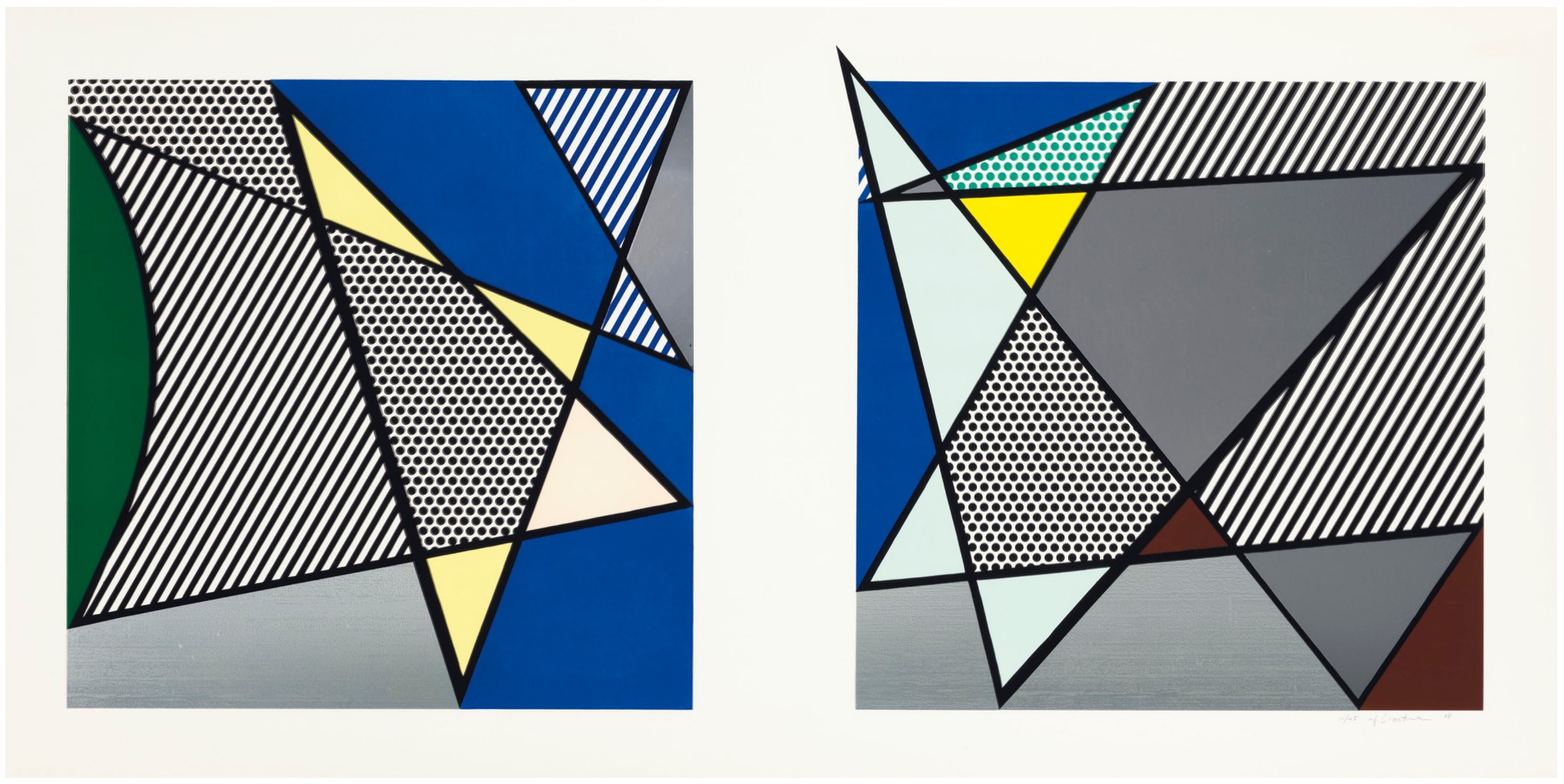
Imperfect Diptych 46 1/4 x 91 3/8 from Imperfect Series, 1988
Woodcut and screen-print with collage in colors on Archivart 4-ply Museum Board
Sheet: 46 1/4 x 91 3/8 inches (117.5 x 232.1 cm)
Edition: 45 + 14 AP
Literature: Corlett 219, Gemini 1360
2. Imperfect 44 3/4 x 103
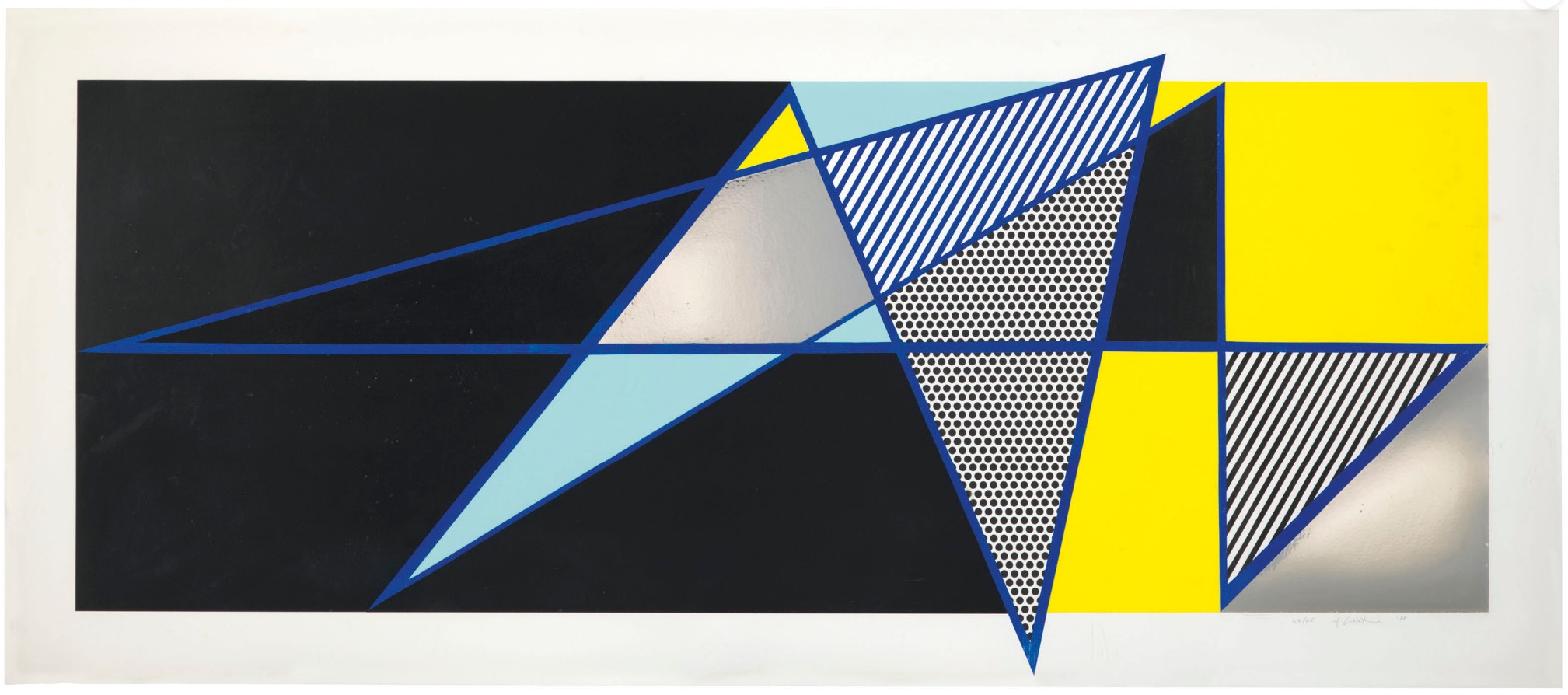
Imperfect 44 3/4 x 103 from Imperfect Series, 1988
Woodcut, screen-print and collage in colors on Archivart rag board
Sheet: 44 3/4 x 103 inches (113.7 x 261.6 cm)
Edition: 45 + 14 AP
Literature: Corlett 220, Gemini 1361
3. Imperfect 58 x 92 3/8
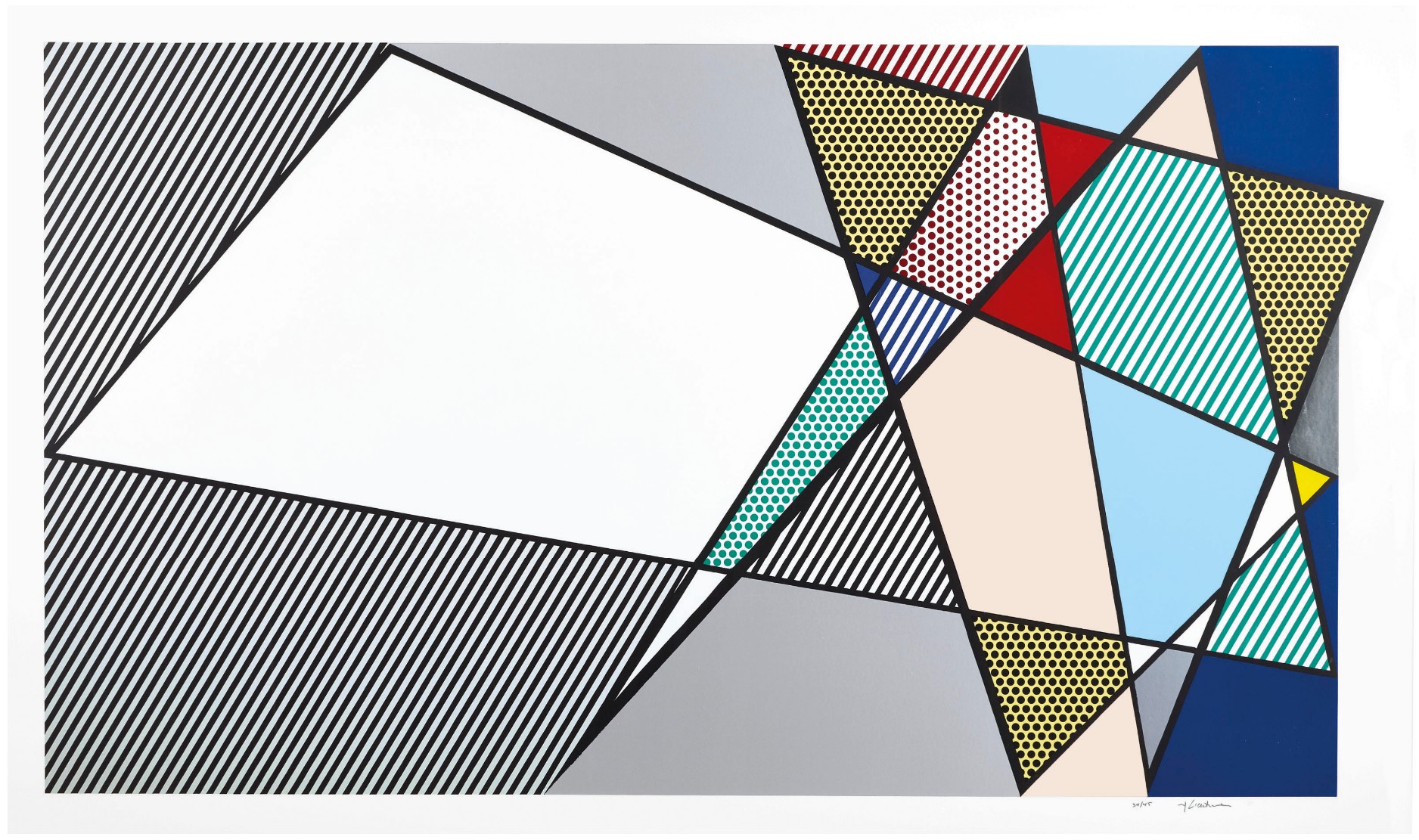
Imperfect 58 x 92 3/8 from Imperfect Series, 1988
Woodcut, screen-print and collage in colors on museum board
Sheet: 58 x 92 1/2 inches (147.3 x 234.9 cm)
Edition: 45 + 14 AP
Literature: Corlett 221, Gemini 1362
4. Imperfect 67 x 79 7/8
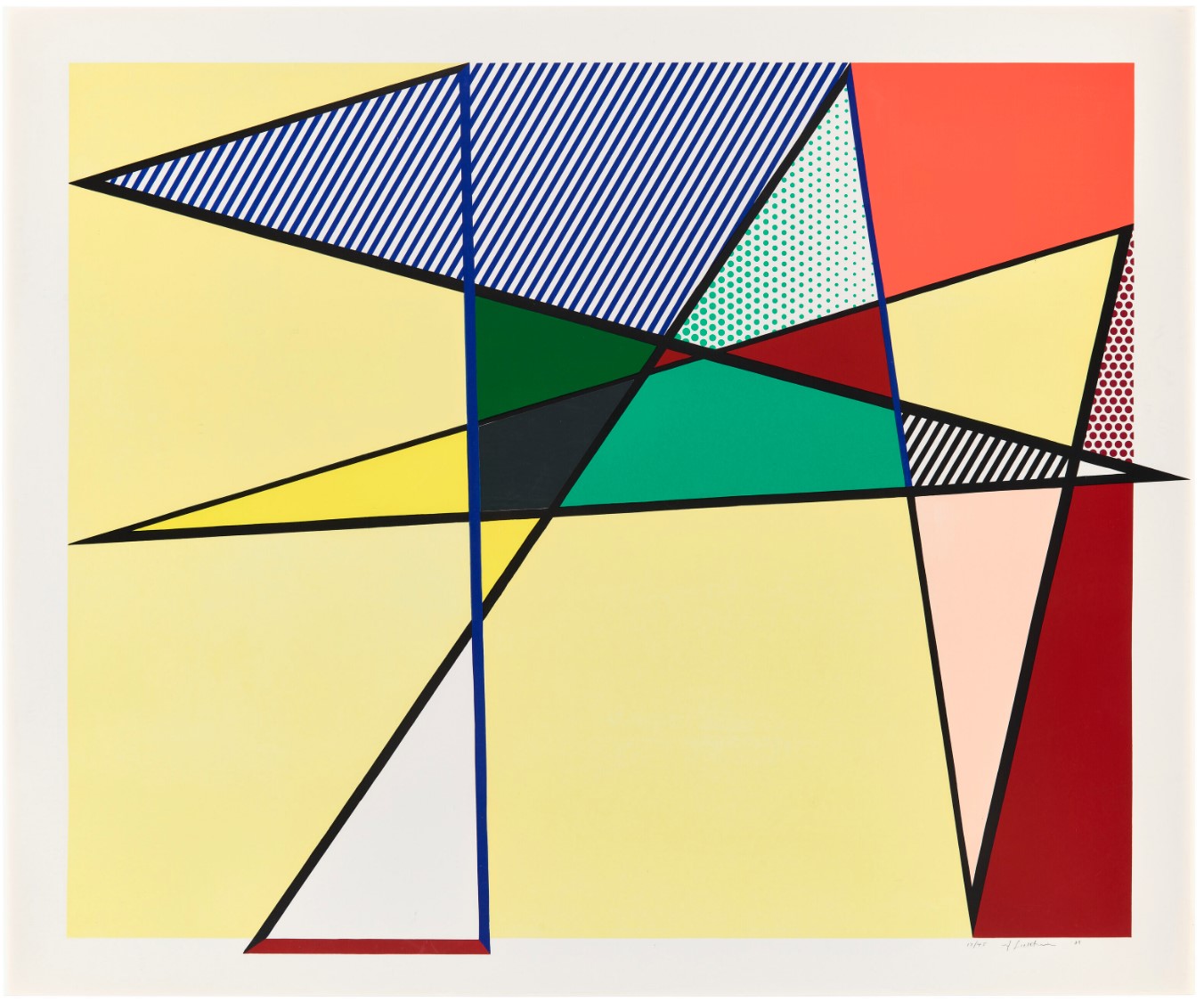
Imperfect 67 x 79 7/8 from Imperfect Series, 1988
Woodcut and screen-print in colors with collage on 3-ply Supra 100 paper
Sheet: 67 x 79 7/8 inches (170.2 x 202.9 cm)
Edition: 45 + 14 AP
Literature: Corlett 222, Gemini 1363
5. Imperfect 67 5/8 x 91 1/2
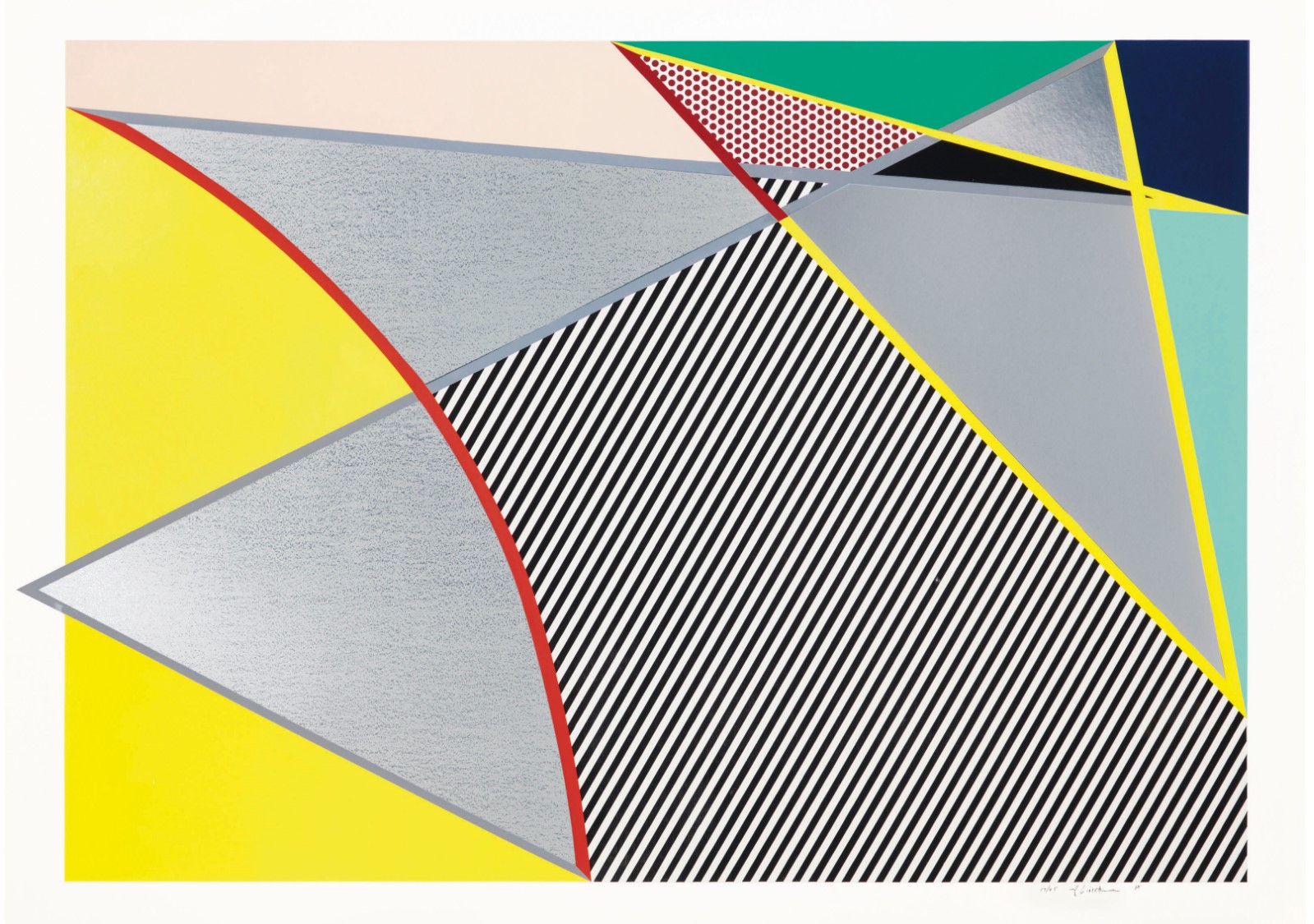
Imperfect 67 5/8 x 91 1/2 from Imperfect Series, 1988
Woodcut, screen-print and collage in colors, on Supra 100 paper
Sheet: 67 5/8 x 91 3/8 inches (171.8 x 232.1 cm)
Edition: 45 + 14 AP
Literature: Corlett 223, Gemini 1364
6. Imperfect 63 3/8 x 88 7/8
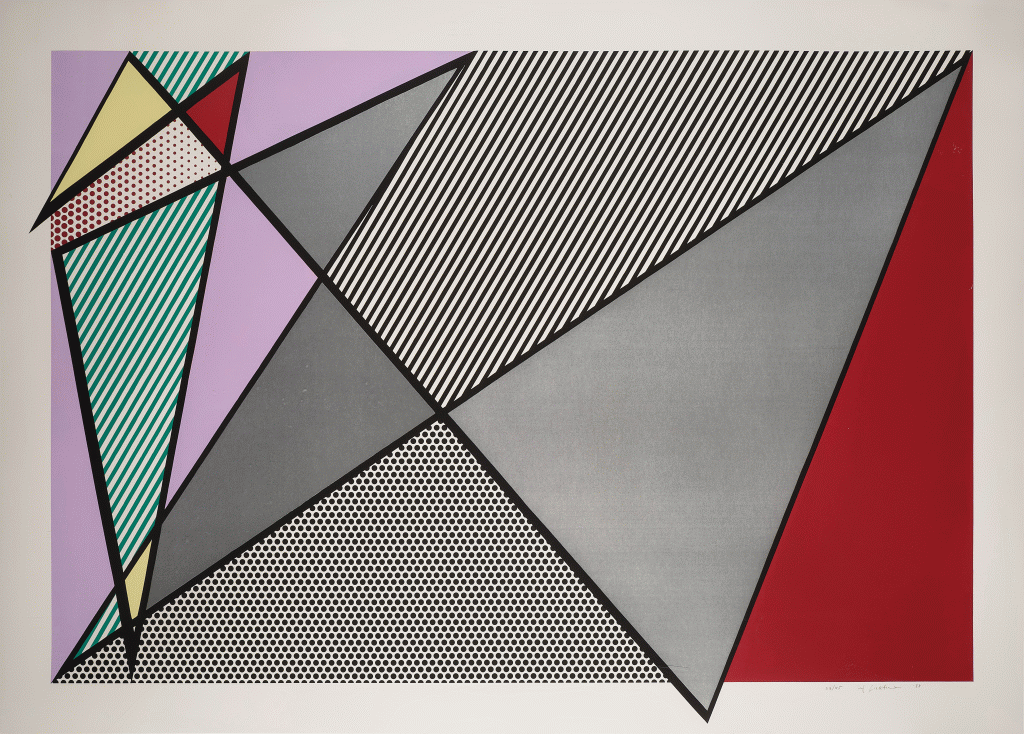
Imperfect 63 3/8 x 88 7/8 from Imperfect Series, 1988
Woodcut, screen-print, and collage in colors on Supra 100 paper
Sheet: 62 3/8 x 88 5/8 inches (158.4 x 225.1 cm)
Edition: 45 + 14 AP
Literature: Corlett 224
7. Imperfect Diptych 57 7/8 x 93 3/4
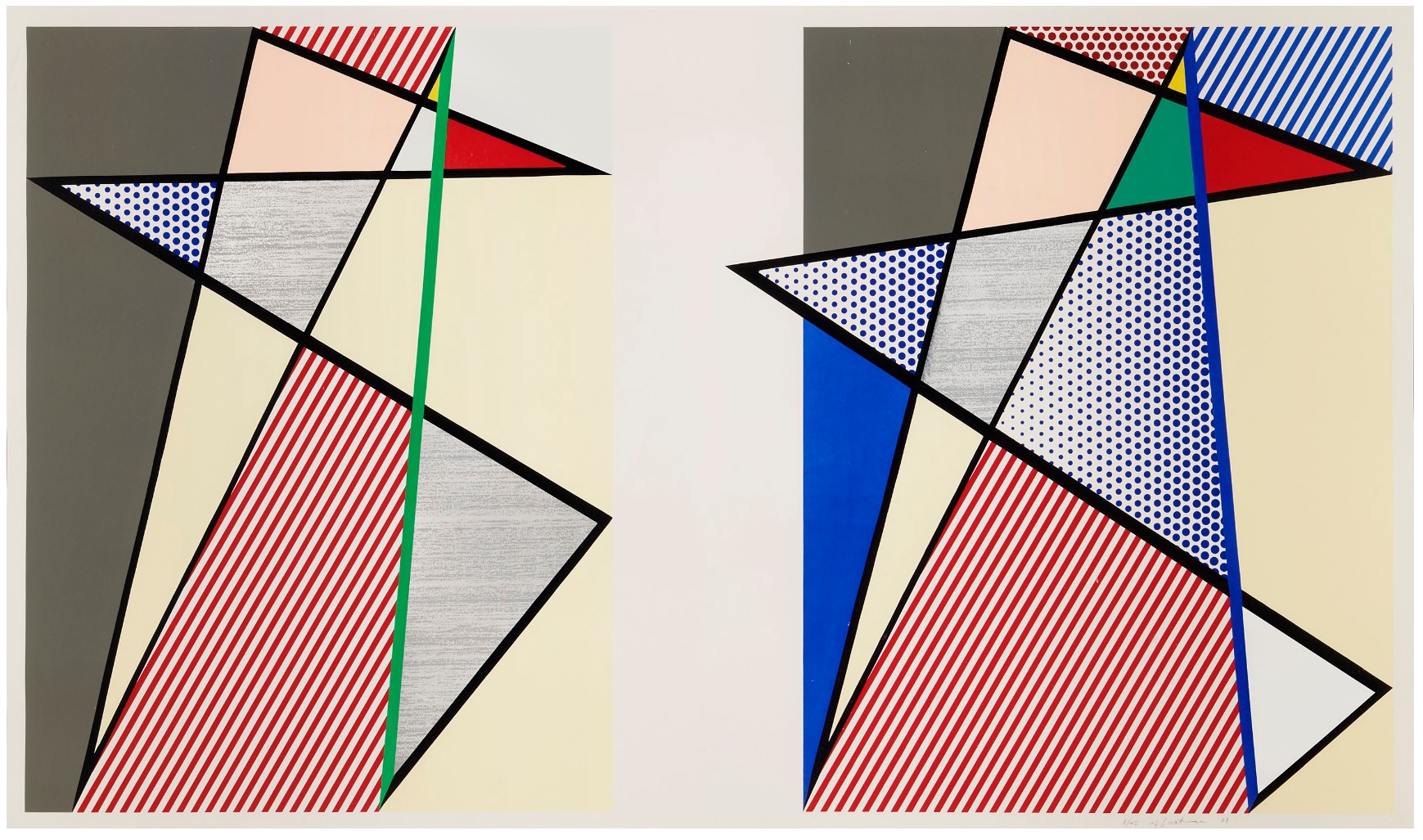
Imperfect Diptych, 57 7/8 x 93 3/4 from Imperfect Series, 1988Woodcut and screen-print with collage in colors on Archivart 4-ply Museum Board
Sheet: 147.2 x 238 cm
Edition: 45 + 14 AP
Literature: Corlett 225
Brushstroke Figures Series, 1989
The Brushstroke Figures seriesis a critical example of Roy Lichtenstein’s career-long investigation of the brushstroke. Early on, the artist began to explore and deconstruct the motif—what is, essentially, the building block of Western painting. Brushstrokes are conventionally conceived as vehicles of expression, but Lichtenstein made them into a subject of equal importance to his unnamed female muses, who stand as central protagonists to his diverse oeuvre. Modern artists have typically maintained that the subject of a painting is painting itself and Lichtenstein took this idea one imaginative step further turning it into a compositional element that could serve as a key subject matter of a work. His brushstroke is at once a playful yet serious exploration of key themes in art history: high culture and low art; abstraction and representation; and, of course, the artist’s ironic nod to the slashing painterly gesture so central to the style of the Abstract Expressionist painters. From the early stages of his career, Lichtenstein was openly comparative of his work in relation to Abstract Expressionism.
1. Blue Face
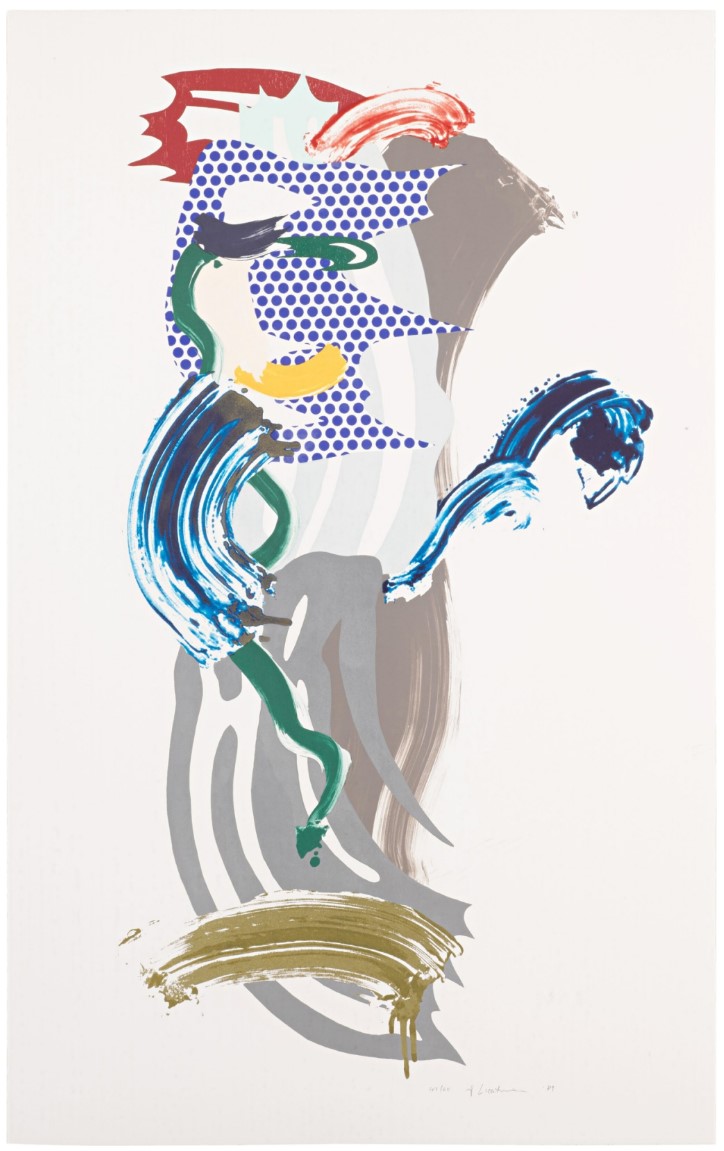
Blue Face from Brushstroke Figure Series, 1989
Lithograph, waxtype, woodcut, and screen-print in colors on Saunders Waterford paper
Sheet: 53 3/4 x 33 3/8 inches (136.6 x 84.7 cm)
Edition: 60 + 8 AP
Literature: Corlett 226
2. The Mask
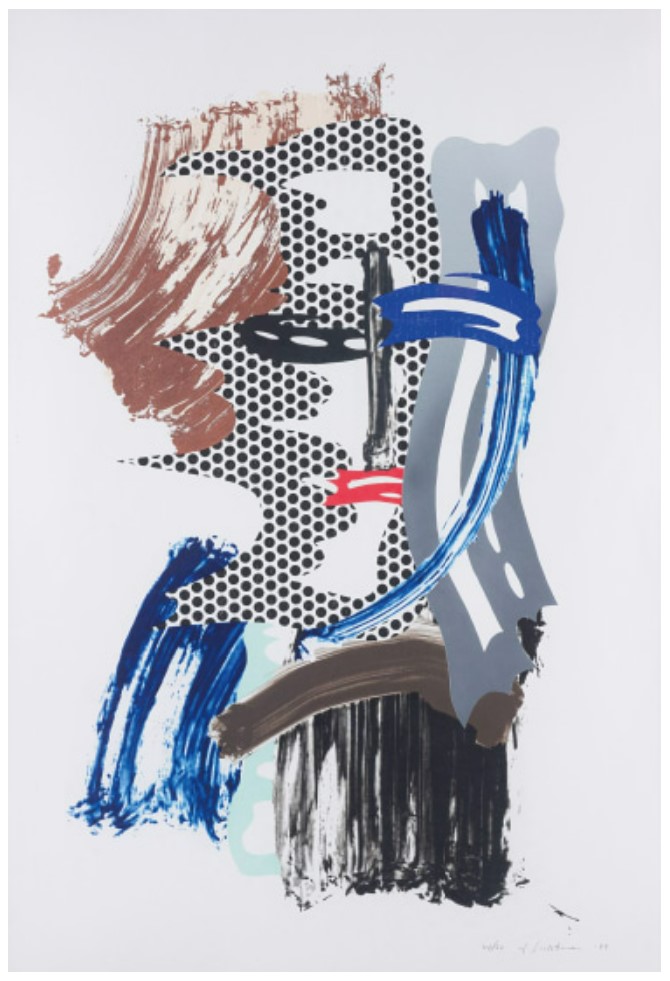
The Mask from Brushstroke Figure Series, 1989
Lithograph, waxtype, woodcut, and screen-print in colors on Saunders Waterford wove paper
Sheet: 54 3/8 x 35 7/8 inches (138×91 cm)
Edition: 60 + 8 AP
Literature: Corlett 227
3. Roads Collar
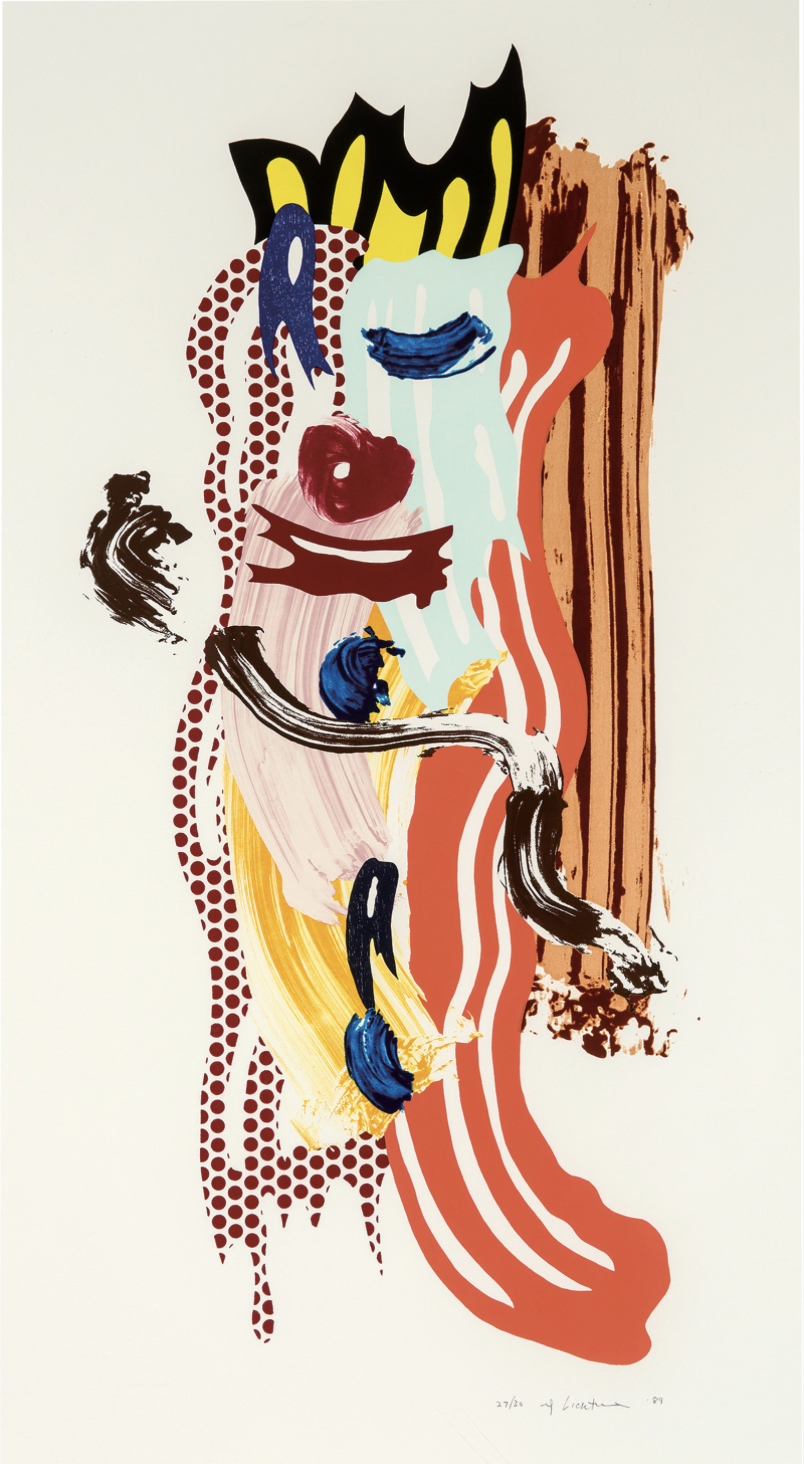
Roads Collar from Brushstroke Figure Series, 1989
14-color lithograph, waxtype, woodcut, and screen-print in colors on Saunders Waterford paper
Sheet: 52 1/2 x 28 7/8 inches (133.4 x 73.3 cm)
Edition: 60 + 8 AP
Literature: Corlett 228
4. Portrait
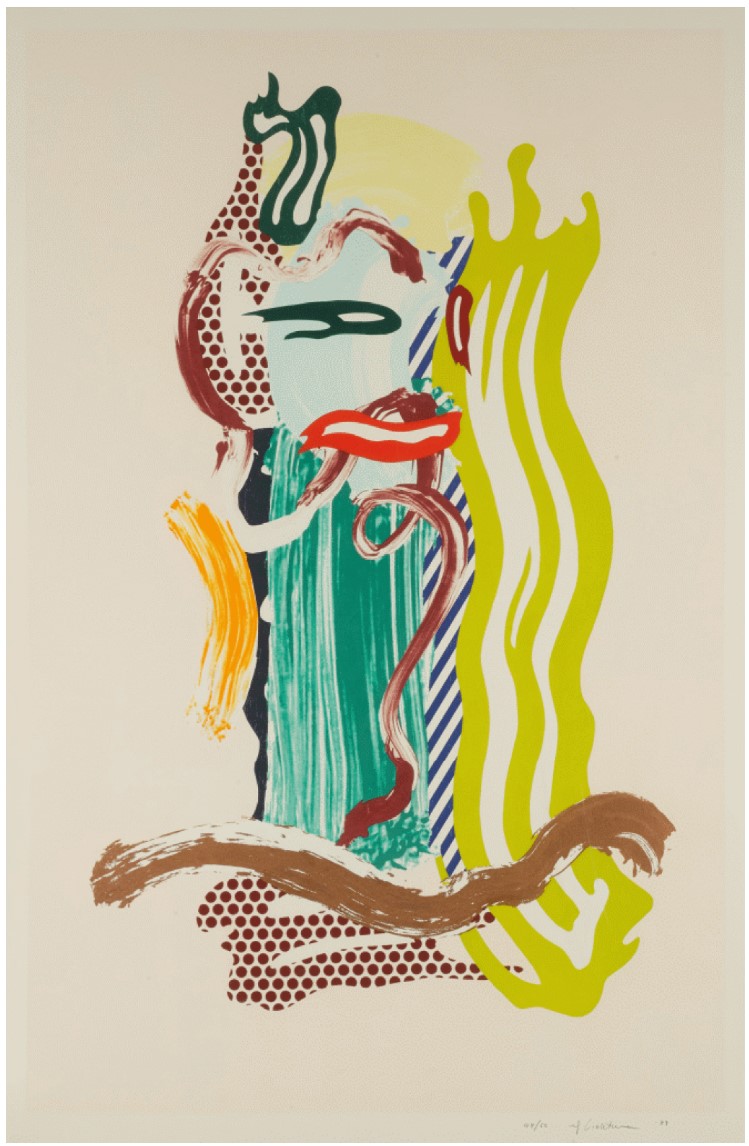
Portrait from Brushstroke Figure Series, 1989
Lithograph, waxtype, woodcut, and screen-print in colors on Saunders Waterford paper
Sheet: 52 1/2 x 34 1/8 inches (133.4 x 86.7 cm)
Edition: 60 + 8 AP
Literature: Corlett 229
5. Blonde
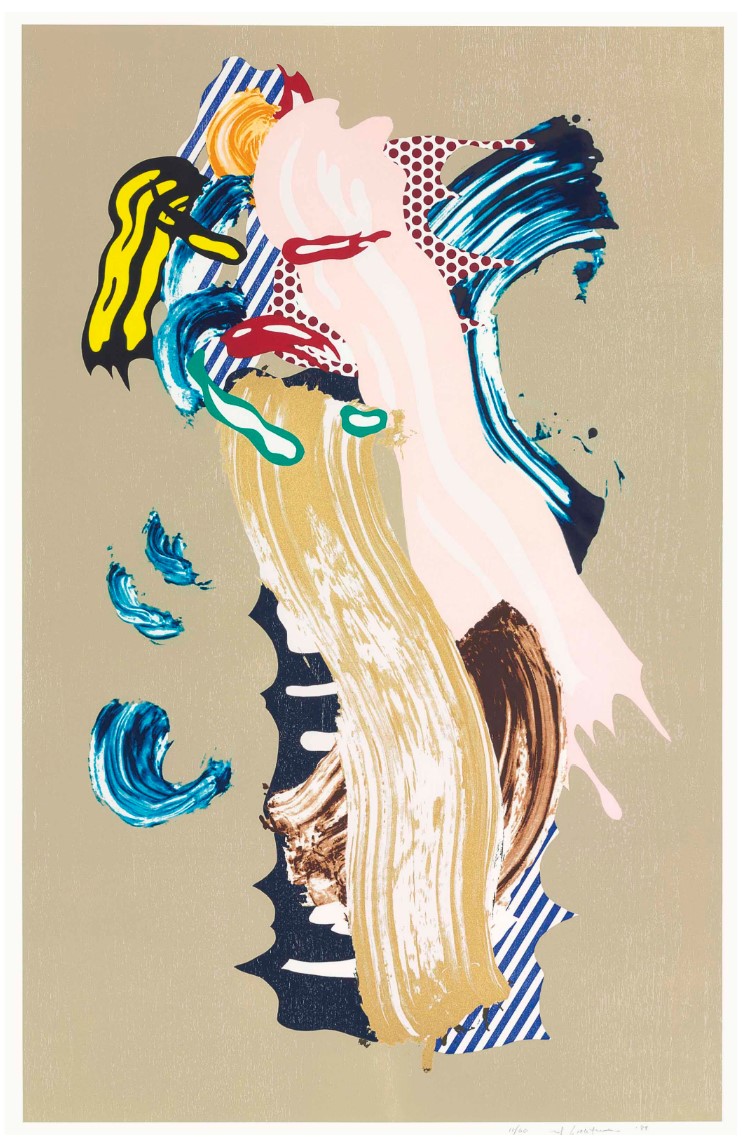
Blonde from Brushstroke Figure Series, 1989
Lithograph, waxtype, woodcut, and screen-print in colors on Saunders Waterford paper
Sheet: 57 3/4 x 37 1/4 inches (146.7 x 94.6 cm)
Edition: 60 + 8 AP
Literature: Corlett 230
6. Grandpa
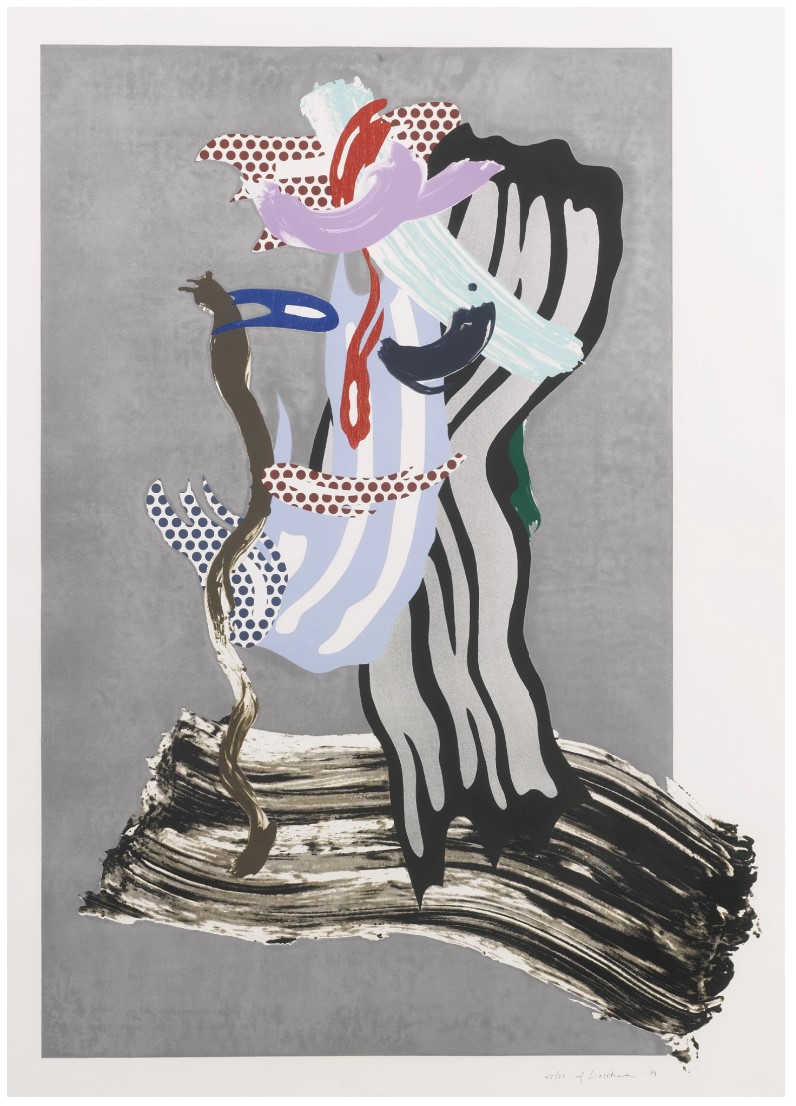
Grandpa from Brushstroke Figure Series, 1989
Lithograph, waxtype, woodcut, and screen-print in colors on Saunders Waterford paper
Sheet: 56 3/4 x 41 1/8 inches (144 x 104.5 cm)
Edition: 60 + 8 AP
Literature: Corlett 231
7. Green Face
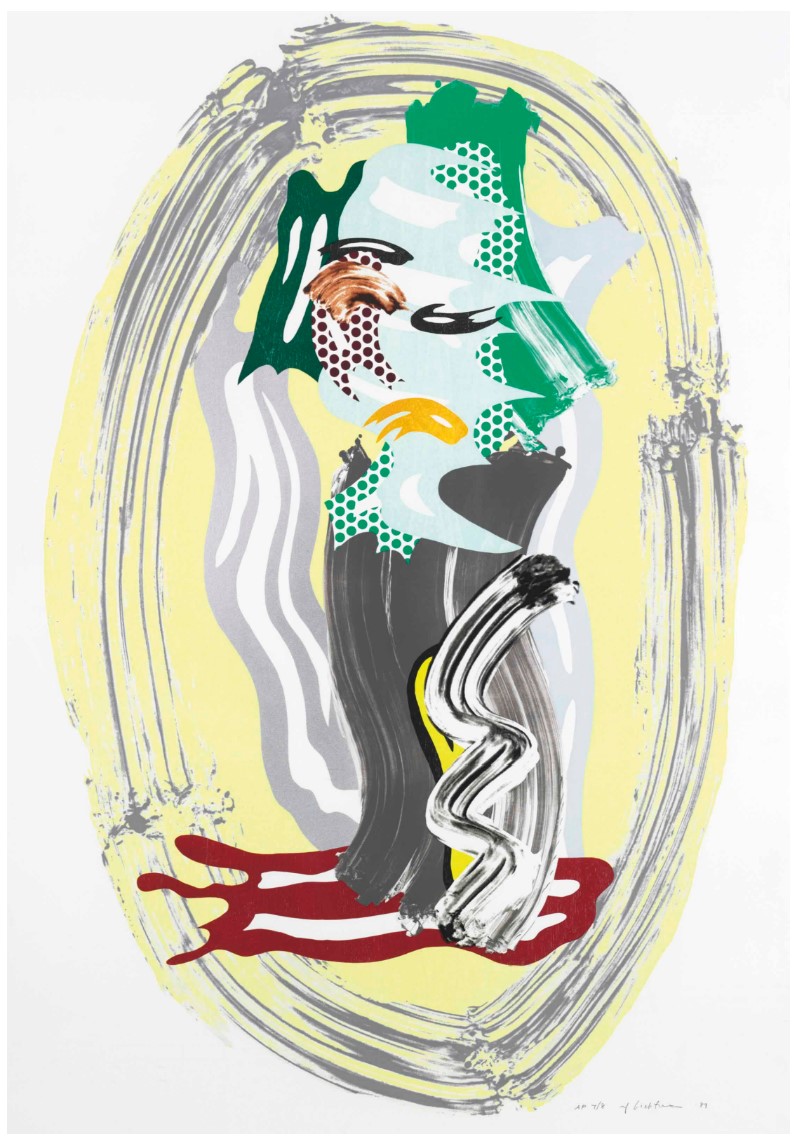
Green Face from Brushstroke Figure Series, 1989
Lithograph, waxtype, woodcut, and screen-print in colors on Saunders Waterford paper
Sheet: 58 3/4 x 40 7/8 inches (149.2 x 103.8 cm)
Edition: 60 + 8 AP
Literature: Corlett 232
8. Nude
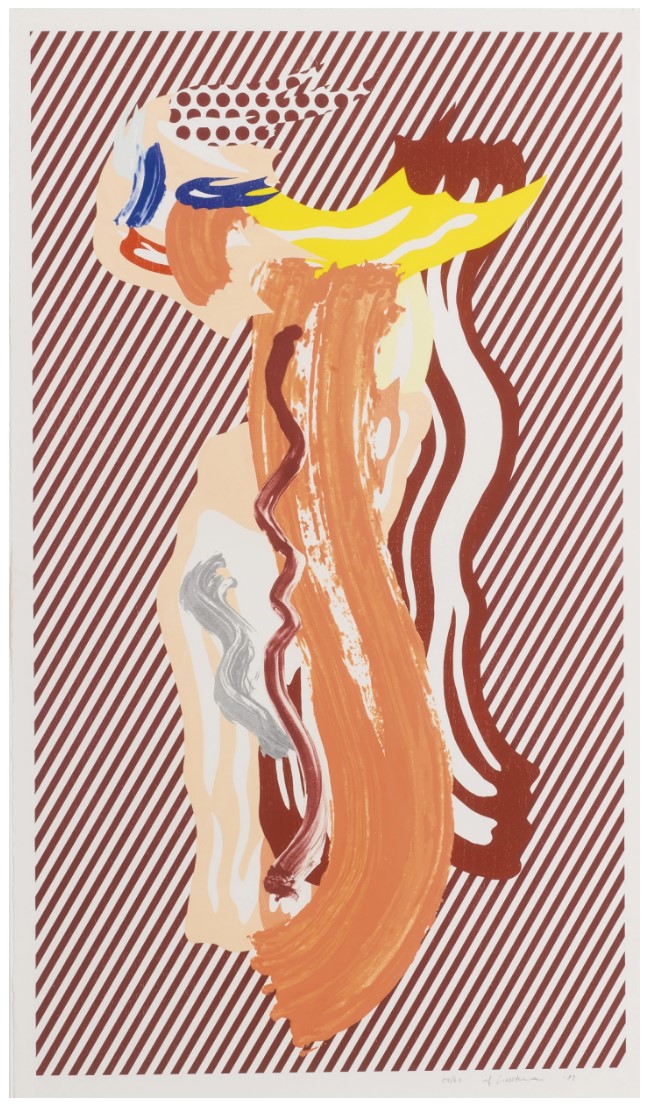
Nude from Brushstroke Figure Series, 1989
Lithograph, waxtype, woodcut, and screen-print in colors on Saunders Waterford paper
Sheet: 56 1/4 x 32 1/2 inches (142.9 x 82.6 cm)
Edition: 60 + 8 AP
Literature: Corlett 233
Interior Series, 1990
Unlike with most prints series, the prints of the Interior Series preceded, rather than followed, the paintings of similar subjects. Preliminary discussions about the prints began in the fall of 1989. Lichtenstein created eight small collages for the project in his New York studio, and in early 1990 he arrived at Gemini G.E.L to begin work. The Interiors are based on advertisements, most of which Lichtenstein cut from the Yellow Pages of telephone directories. The Interiors were the first major body of work undertaken by Roy Lichtenstein in the 1990s and are a caricature of the types of excessive interiors prevalent in the 1980s that graced the pages of Architectural Digest. Works such as Interior with Red Wall showcase uncluttered and idealized interiors in a highly graphic and stylized manner. The immense paintings from this series went through three stages of being – first a sketch, then a collage and lastly the final work on canvas. The collages were an invaluable tool, with their ease of adjustment providing a high degree of flexibility in the creation of compositions and balancing of color values. The ratio between the collages and the monumental paintings was an expansive one to four. In the process, Lichtenstein fine-tuned the compositions and made slight changes to the painting – repositioning objects, shifting color tones – in order to prevent the canvas from being a simple enlargement of the collage.
1. Bedroom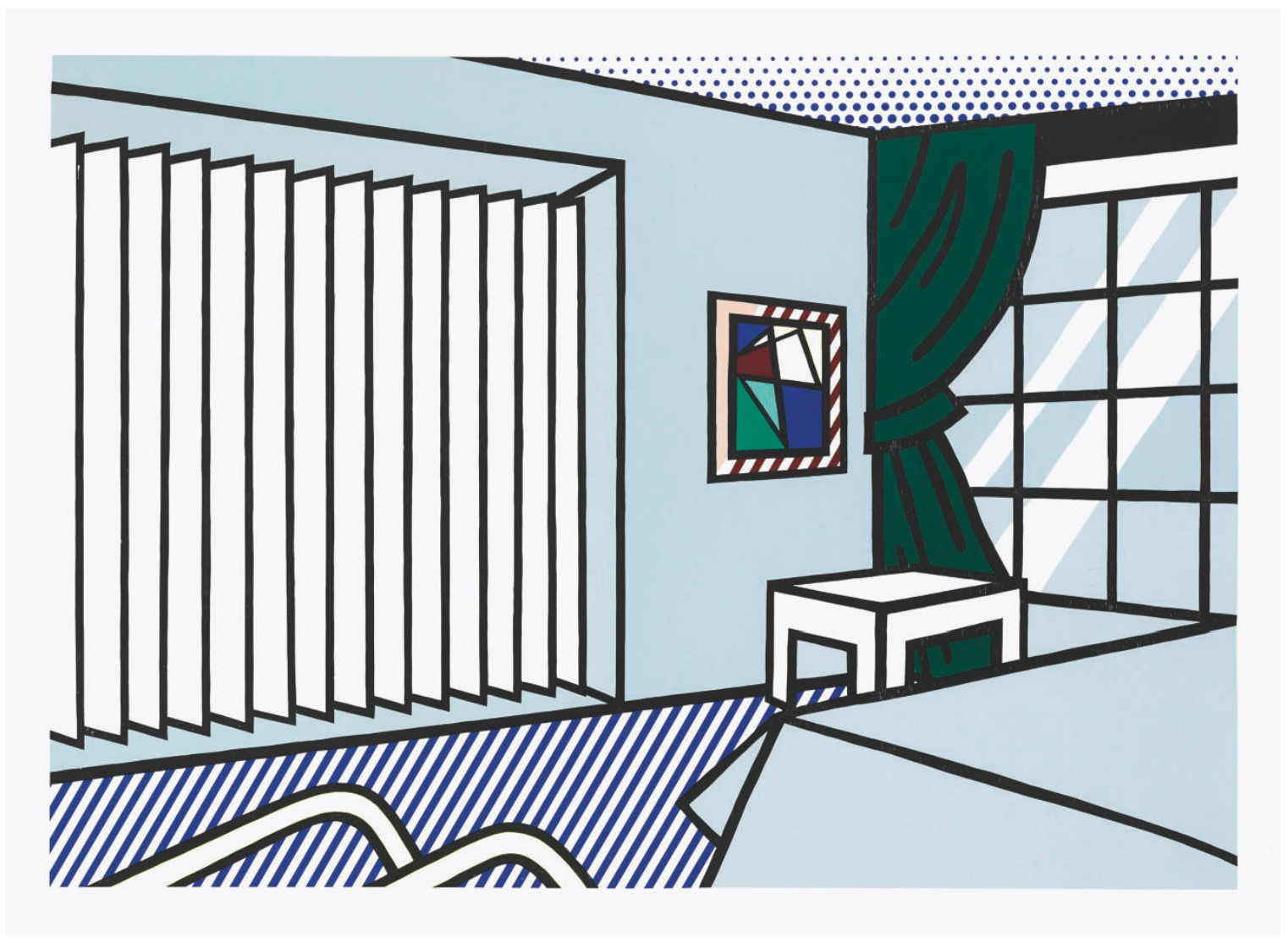
Bedroom from Interior Series, 1990
Woodcut and screen-print in colors on Museum Board
Sheet: 56 1/2 x 78 inches (143.5 x 198.1 cm)
Edition: 60 + 14 AP
Literature: Corlett 247, Gemini 1499
2. La Sortie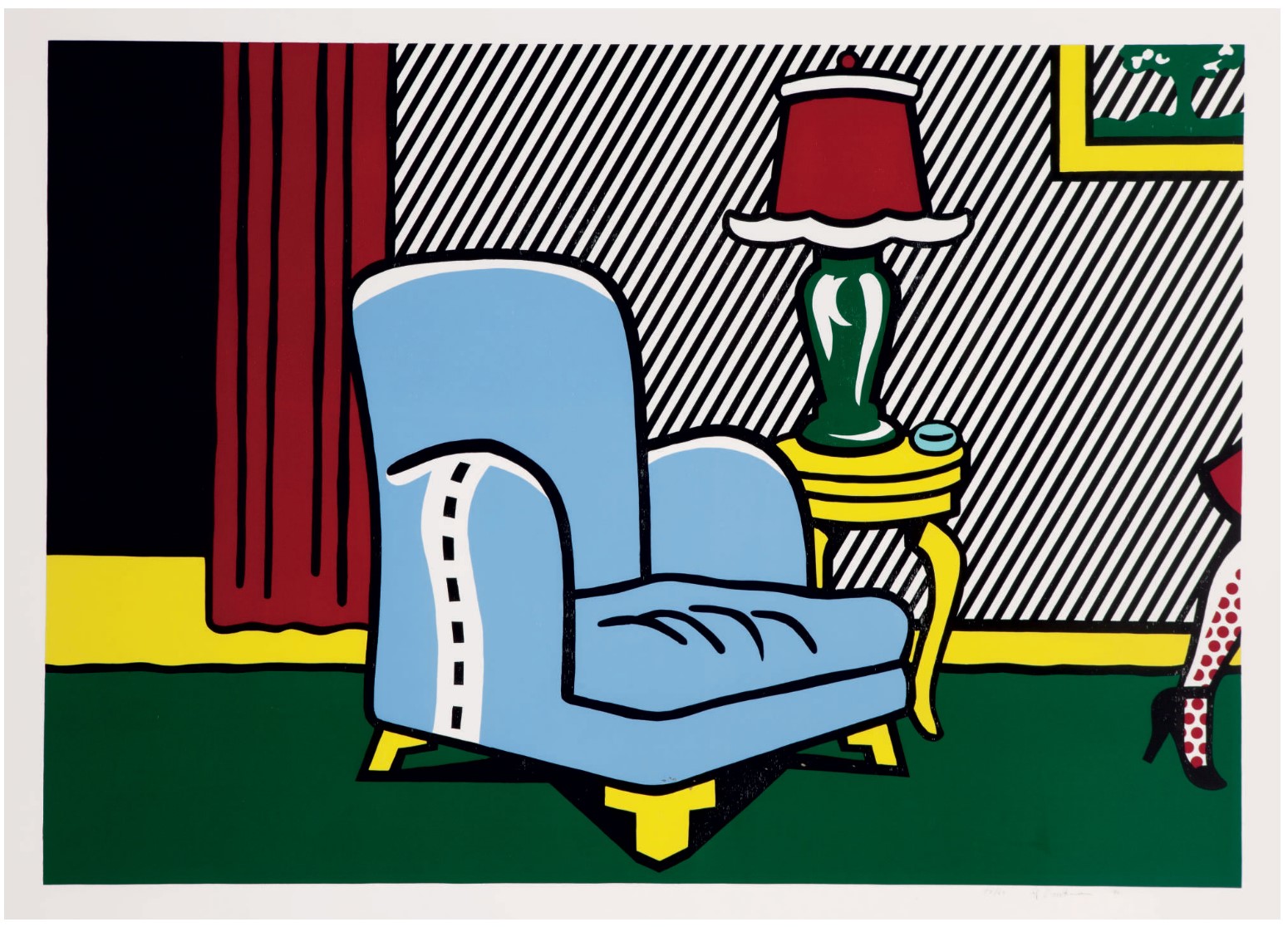
La Sortie from Interior Series, 1990
Woodcut in colors, on Museum Board
Sheet: 58 5/8 x 81 inches (148.9 x 205.7 cm)
Edition: 60 + 6 A
Literature: Corlett 248, Gemini 1500
3. The Den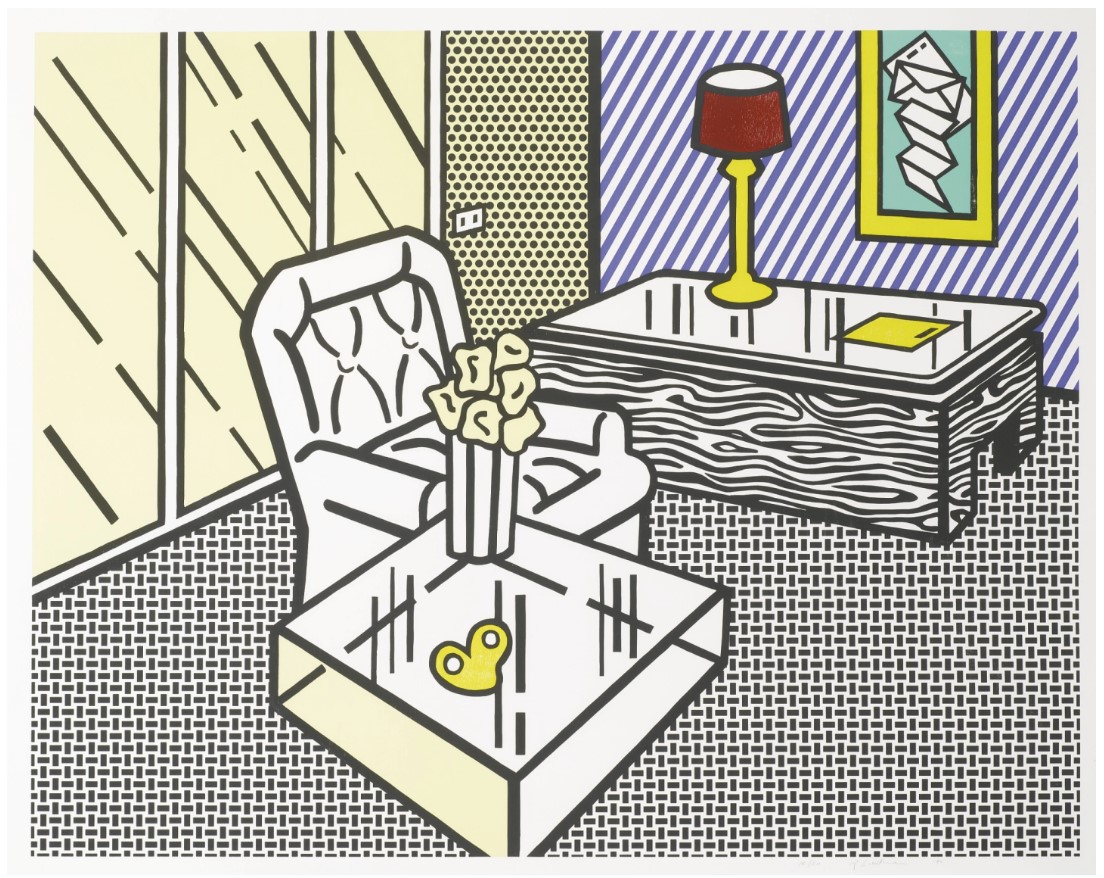
The Den from Interior Series, 1990
Woodcut and screen-print in colors on 4-ply Paper Technologies, Inc., Museum Board
Sheet: 57 7/8 x 71 3/4 inches (147 x 182.3 cm)
Edition: 60 + 14 AP
Literature: Corlett 249, Gemini 1501
4. Living Room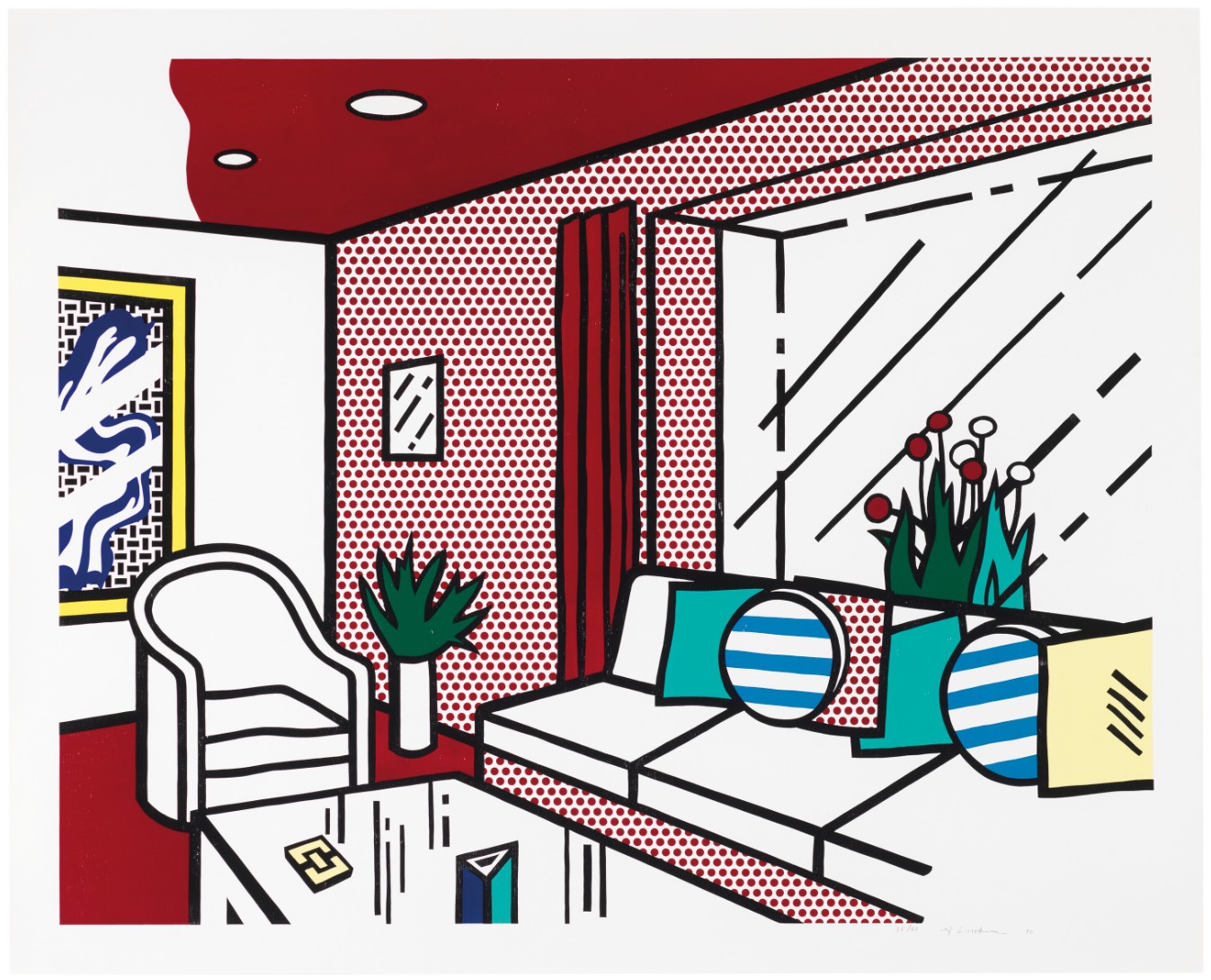
Living Room from Interior Series, 1990
Woodcut and screen-print in colors, on museum board
Sheet: 58 1/8 x 72 inches (147.6 x 182.6 cm)
Edition: 60 + 14 AP
Literature: Corlett 250, Gemini 1502
5. Red Lamps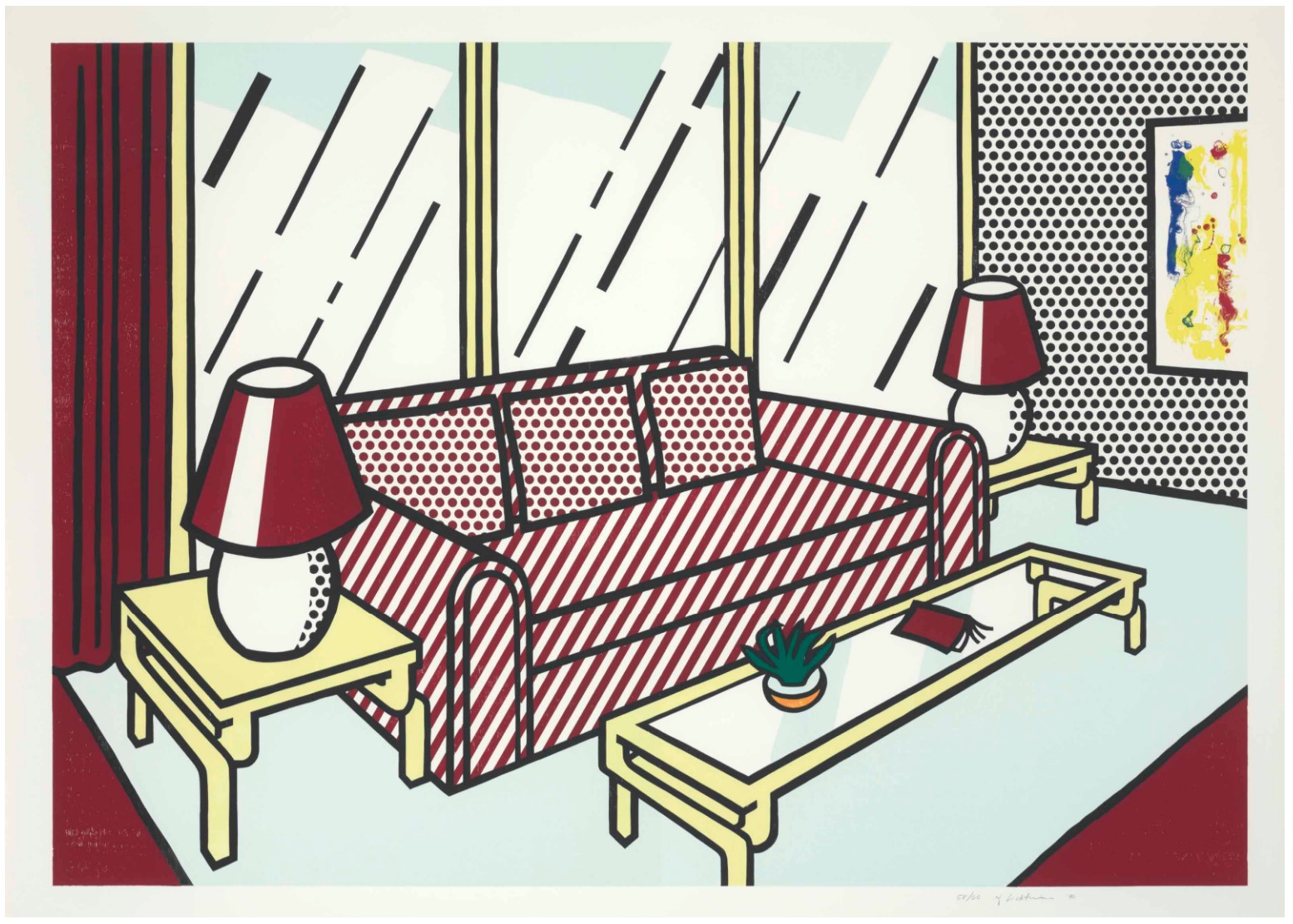
Red Lamps from Interior Series, 1990
Lithograph, woodcut and screen-print in colors on 4-ply Paper Technologies, Inc., Museum Board
Sheet: 57 3/8 x 78 3/4 inches (145.7 x 200 cm)
Edition: 60 + 14 AP
Literature: Corlett 251
6. Modern Room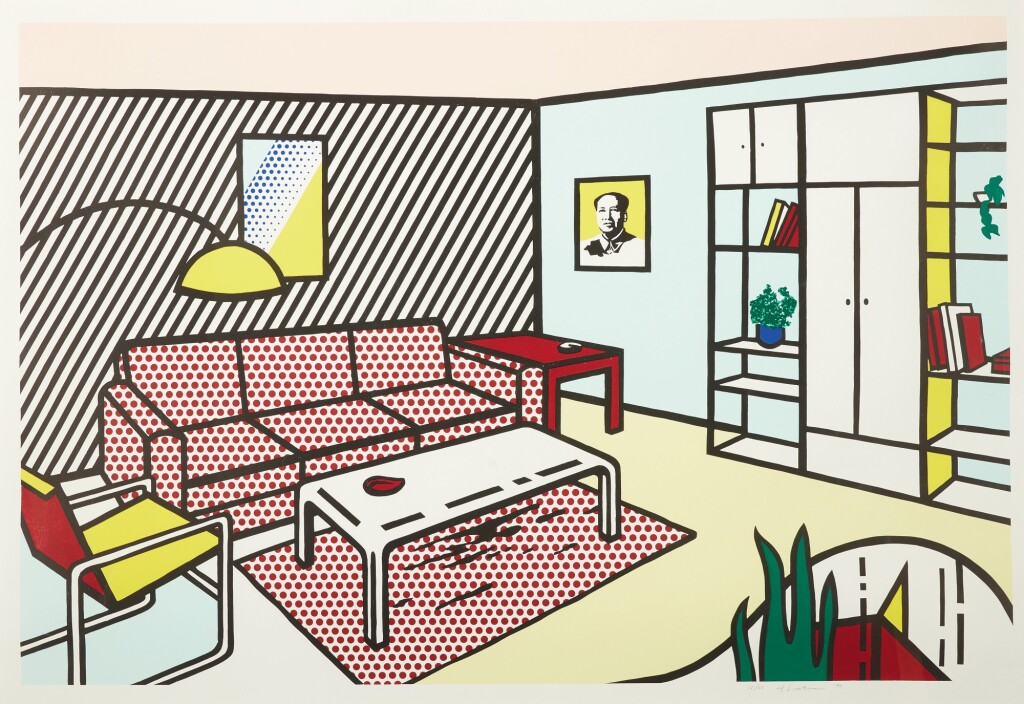
Modern Room from Interior Series, 1990
Lithograph, woodcut and screen-print in colors, on Museum Board
Sheet: 56 1/8 x 80 3/4 inches (142.8 x 205 cm)
Edition: 60 + 14 AP
Literature: Corlett 252
7. Yellow Vase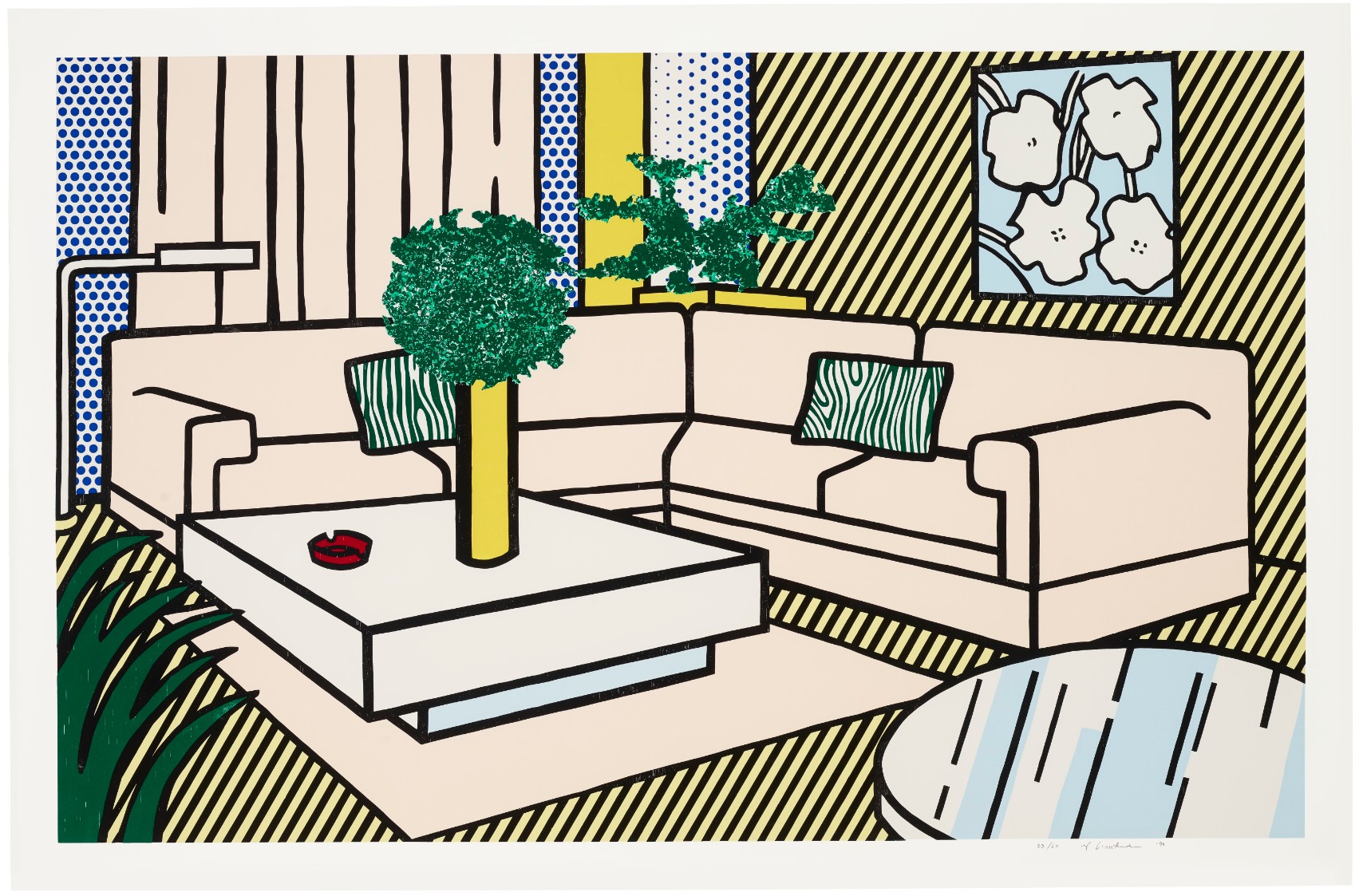
Yellow Vase from Interior Series, 1990
Lithograph, woodcut and screen-print in colors, on Museum Board
Sheet: 55 5/8 x 84 3/8 inches (141.3 x 214.3 cm)
Edition: 60 + 14 AP
Literature: Corlett 253, Gemini 1505
8. Blue Floor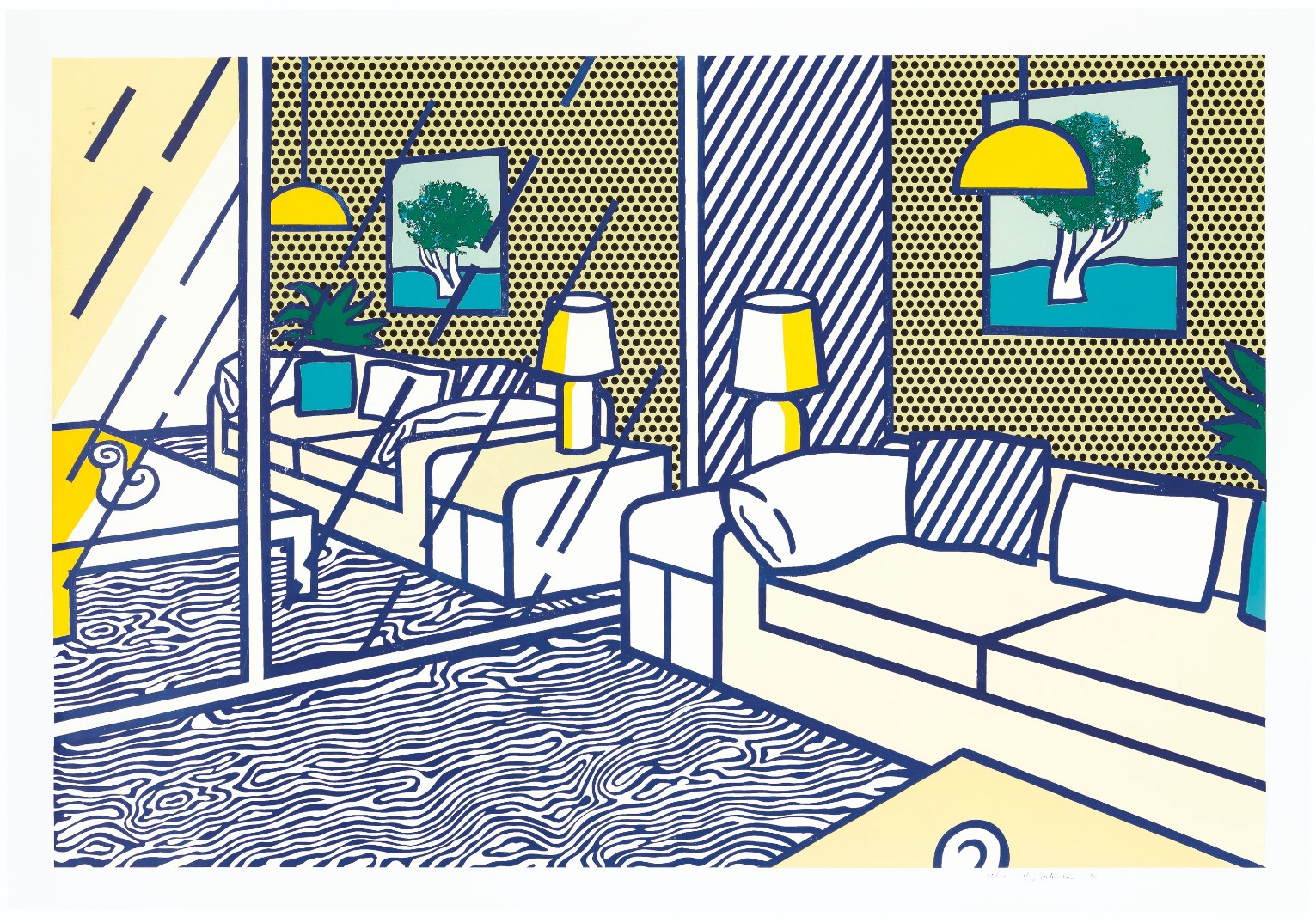 Blue Floor from Interior Series, 1990
Lithograph, woodcut and screen-print in colors, on Museum Board
Sheet: 57 3/4 x 83 1/2 inches (146.7 x 212.1 cm)
Edition: 60 + 14 AP
Literature: Corlett 254, Gemini 1506
Reflection Series, 1990
Roy Lichtenstein gained inspiration for the Reflections Series from photographs that he took of a glass-covered Robert Rauschenberg print: streaks of light obscured areas of the work but left enough of the print visible that the scene could be understood. Ben-Day dots, a signature of Lichtenstein’s work borrowed from mass-media cartoons, were also added to these images to foster a duality between Pop and Fine art. However, in each print, the focal illustration is partially concealed by smooth, mirror-like metalized PVC. The textural combination of collage, woodcut relief and embossing on top of screen-print and lithography constructs a methodical scene: one of certainty and ambiguity that invites the viewer to create his or her own interpretation.
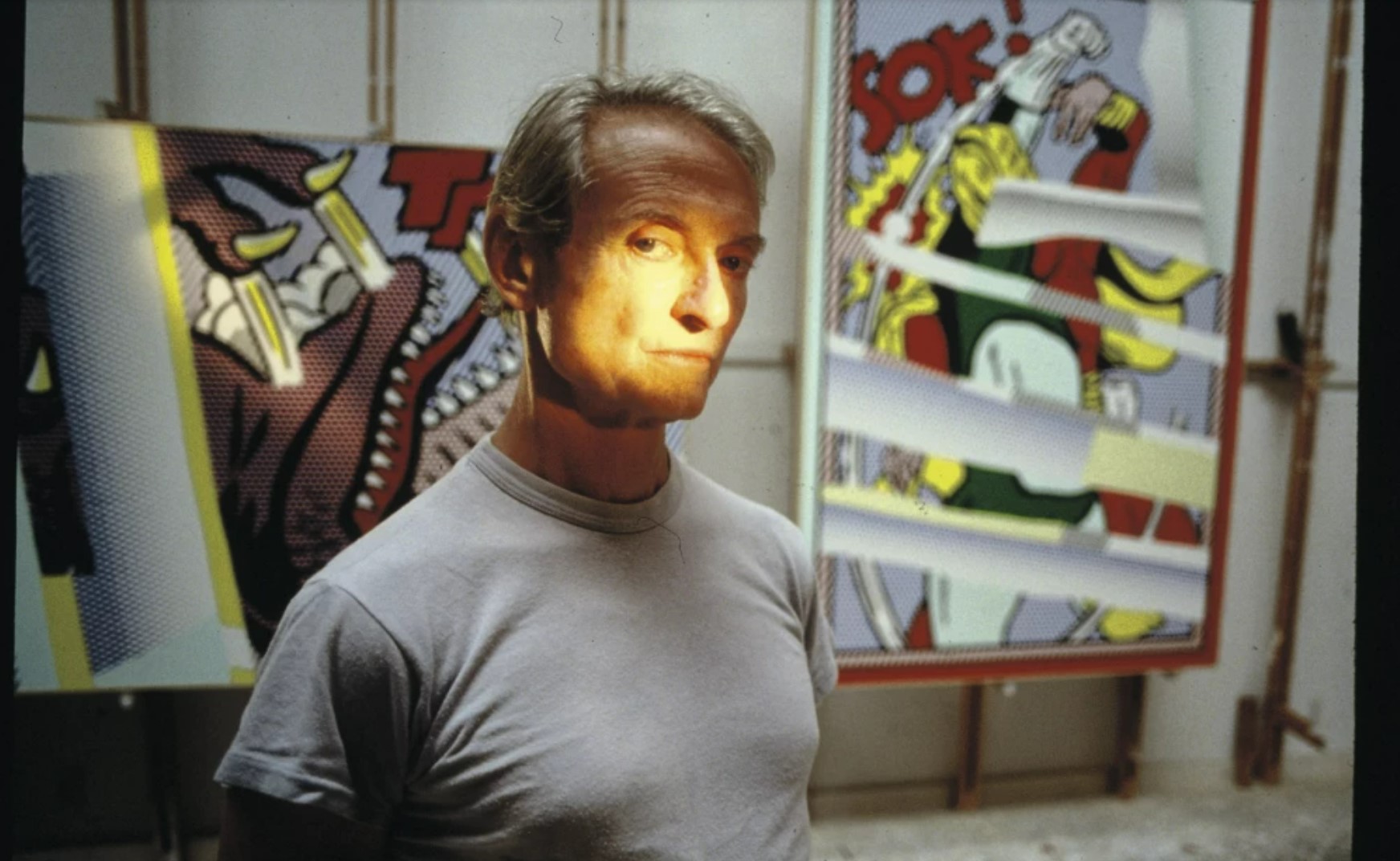
Lichtenstein’s Reflections began as a series of three paintings of the comic book character Wimpy in 1988 and evolved to reference some of the most iconic works of his own oeuvre. After working through his ideas on canvas, Lichtenstein took this concept to the printing press at Tyler Graphics, Ltd. in Mount Kisco, New York from 1989 to 1990. As a student at Ohio State University, Lichtenstein experimented with mixing several techniques into one print – developing a sophisticated understanding of the unique mark-making potential of each medium. It is no surprise that throughout his career he continued to use his deft understanding of printmaking to manipulate multiple techniques to obtain his desired visual effect.
1. Reflections on Crash
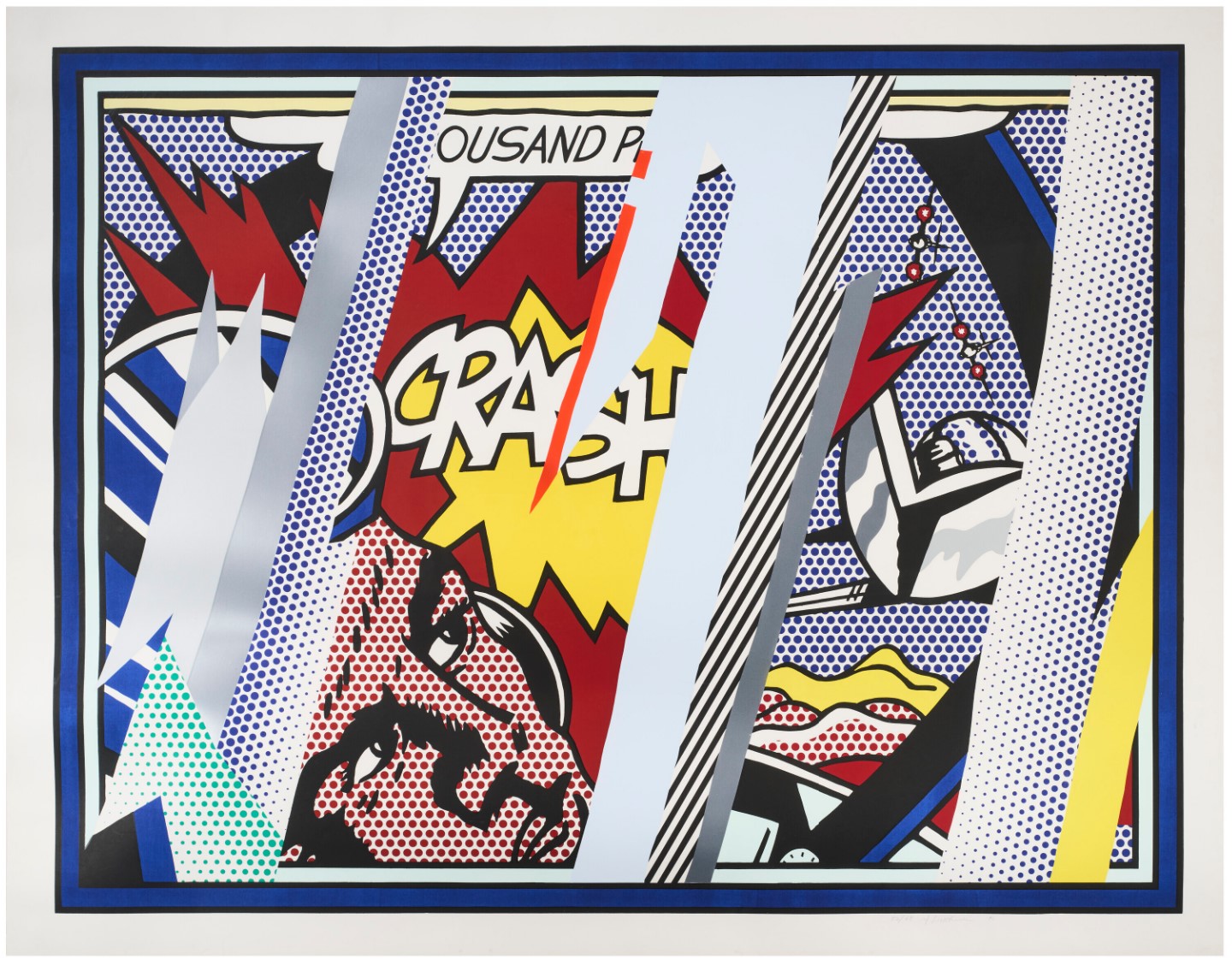
Reflections on Crash from Reflections Series, 1990
Lithograph, screen-print and relief print in colors with metallized PVC collage and embossing, on Somerset paper
Sheet: 59 1/8 x 75 inches (150.2 x 190.5 cm)
Edition: 68 + 16 AP
Literature: Corlett 239
2. Reflections on Conversation
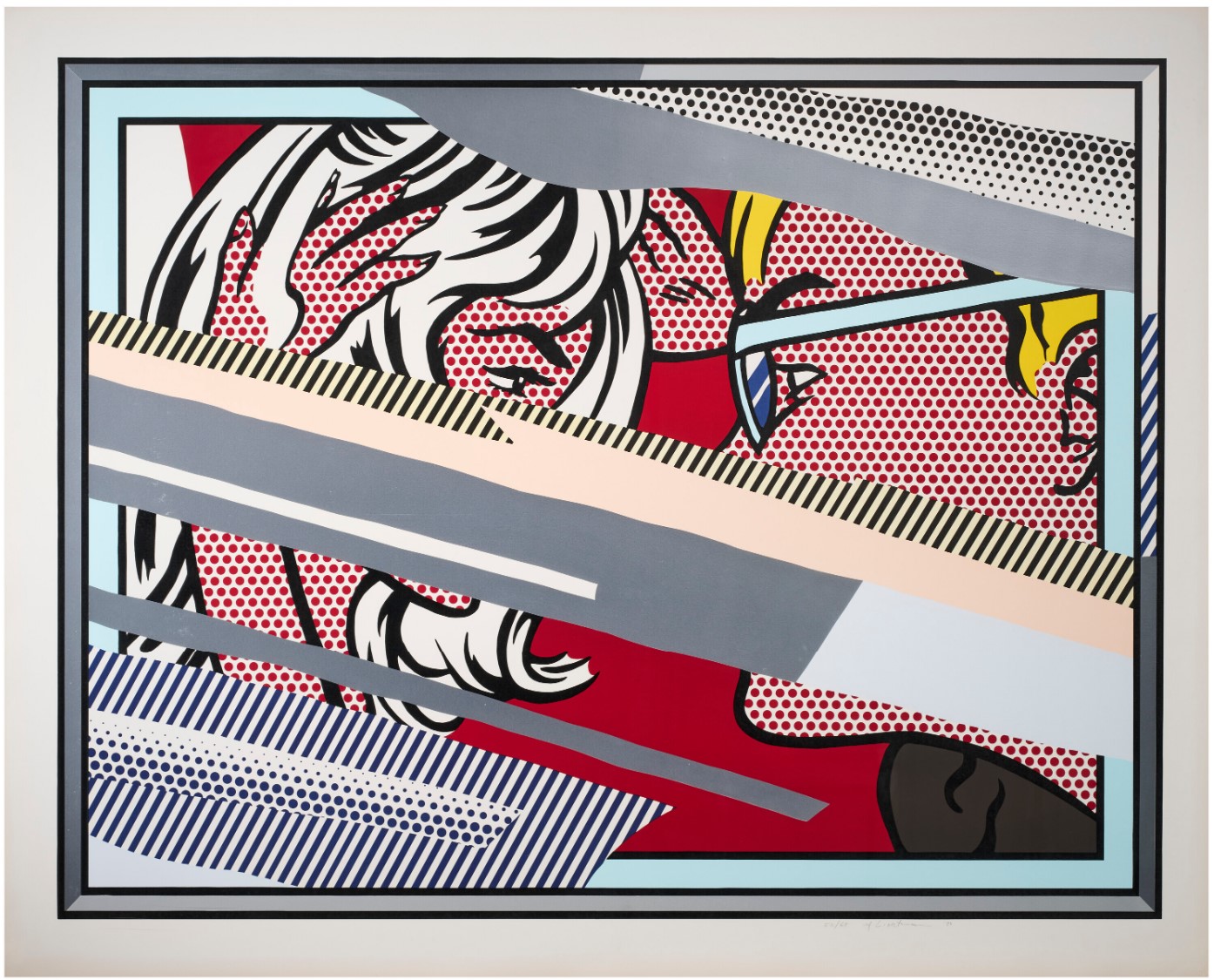
Reflections on Conversation from Reflections Series, 1990
Lithograph, screen-print and woodcut print in colors with metallized PVC collage and embossing, on Somerset paper
Sheet: 53 3/4 x 66 7/8 inches (126.5 x 169.9 cm)
Edition: 68 + 16 AP
Literature: Corlett 240
3. Reflections on Hair

Reflections on Hair from Reflections Series, 1990
Lithograph, screenprint and woodcut in colors with metallized PVC collage and embossing, on Somerset paper
Sheet: 56 1/8 x 45 inches (142.6 x 114.3 cm)
Edition: 68 + 16 AP
Literature: Corlett 241
4. Reflections on Brushstrokes
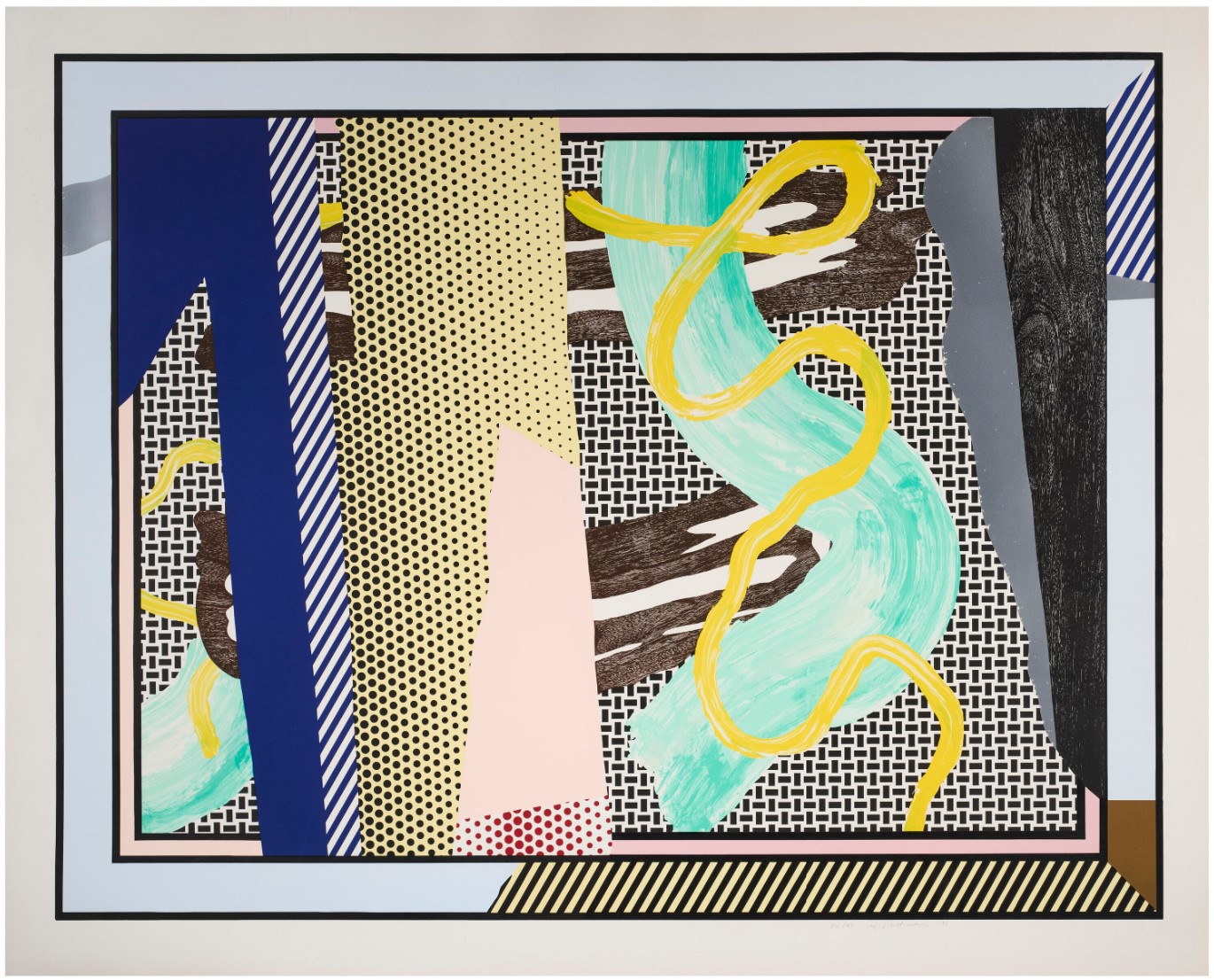
Reflections on Brushstrokes from Reflections Series, 1990
Lithograph, screen-print and woodcut in colors with metallized PVC collage and embossing, on Somerset paper
Sheet: 57 1/8 x 71 inches (145 x 180.3 cm)
Edition: 68 + 16 AP
Literature: Corlett 242
5. Reflections on The Scream
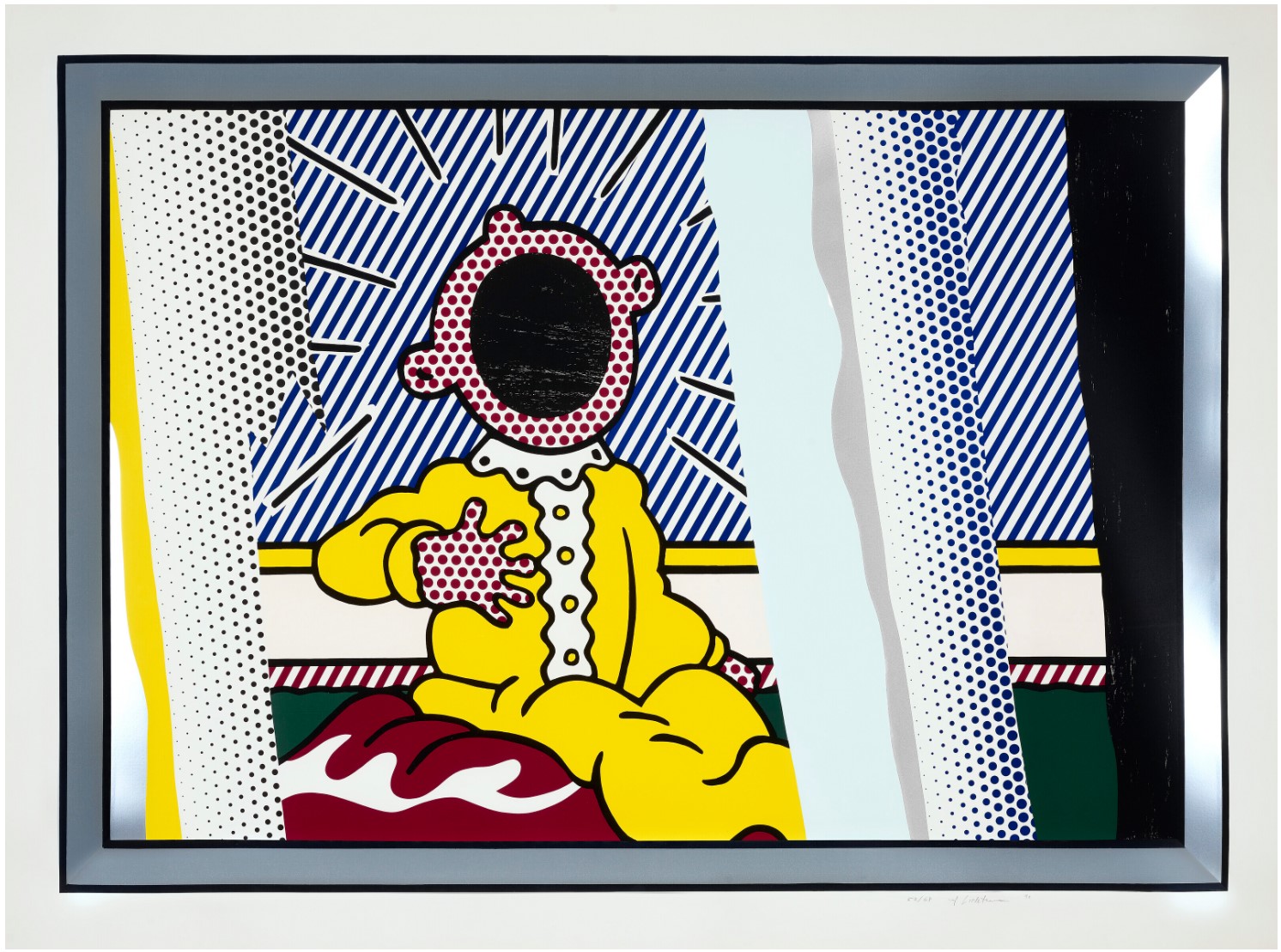
Reflections on The Scream from Reflections Series, 1990
Lithograph, screenprint and woodcut in colors with metallized PVC collage and embossing, on Somerset paper
Sheet: 48 3/4 x 65 3/8 inches (123.8 x 166.1 cm)
Edition: 68 + 16 AP
Literature: Corlett 243
6. Reflections on Minerva
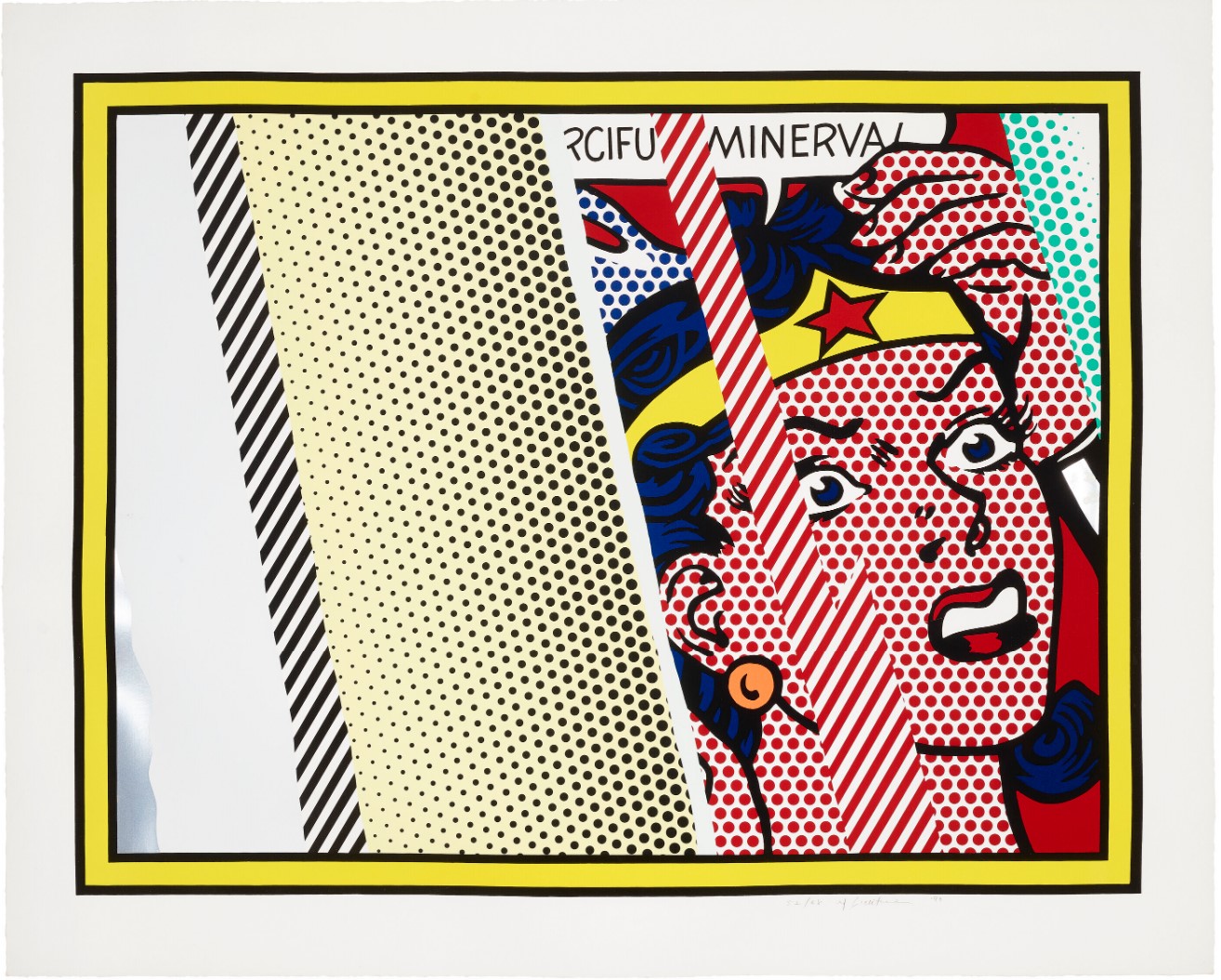
Reflections on Minerva from Reflections Series, 1990
Lithograph, screen-print and relief print in colors with metallized PVC collage and embossing, on Somerset paper
Sheet: 42 x 51 3/4 inches (106.7 x 131.4 cm)
Edition: 68 + 16 AP
Literature: Corlett 244
7. Reflections on Girl
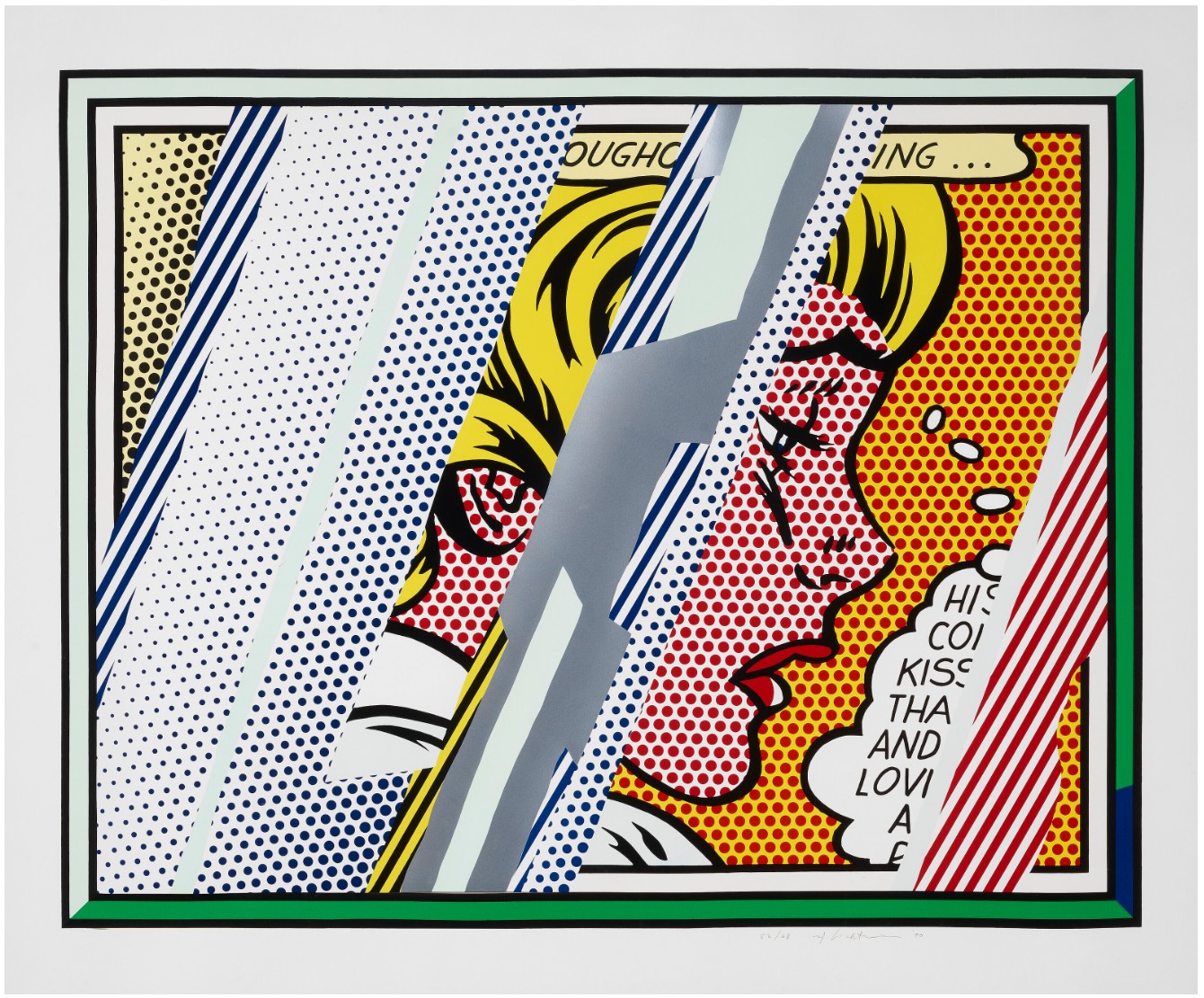
Reflections on Girl from Reflections Series, 1990
Lithograph, screen-print and relief print in colors with metallized PVC collage and embossing, on Somerset paper
Sheet: 45 1/8 x 54 3/4 inches (114.6 x 139.1 cm)
Edition: 68 + 16 AP
Literature: Corlett 245
Water LiLies Series, 1992
Roy Lichtenstein produced 6 screen-prints in 1992 in reference to Monet’s paintings – Lichtenstein parodies these iconic works of art history, translating them for the modern age through his Pop Art aesthetic. In doing so, Lichtenstein reveals some unexpected parallels between the two artists’ formal concerns, despite their drastically different artistic styles.
“When I did paintings based on Monet’s I realized everyone would think that Monet was someone I could never do because his work has no outlines and it’s so Impressionistic. It’s laden with incredible nuance and a sense of the different times of day and it’s just completely different from my art. So, I don’t know, I smiled at the idea of making a mechanical Monet.”
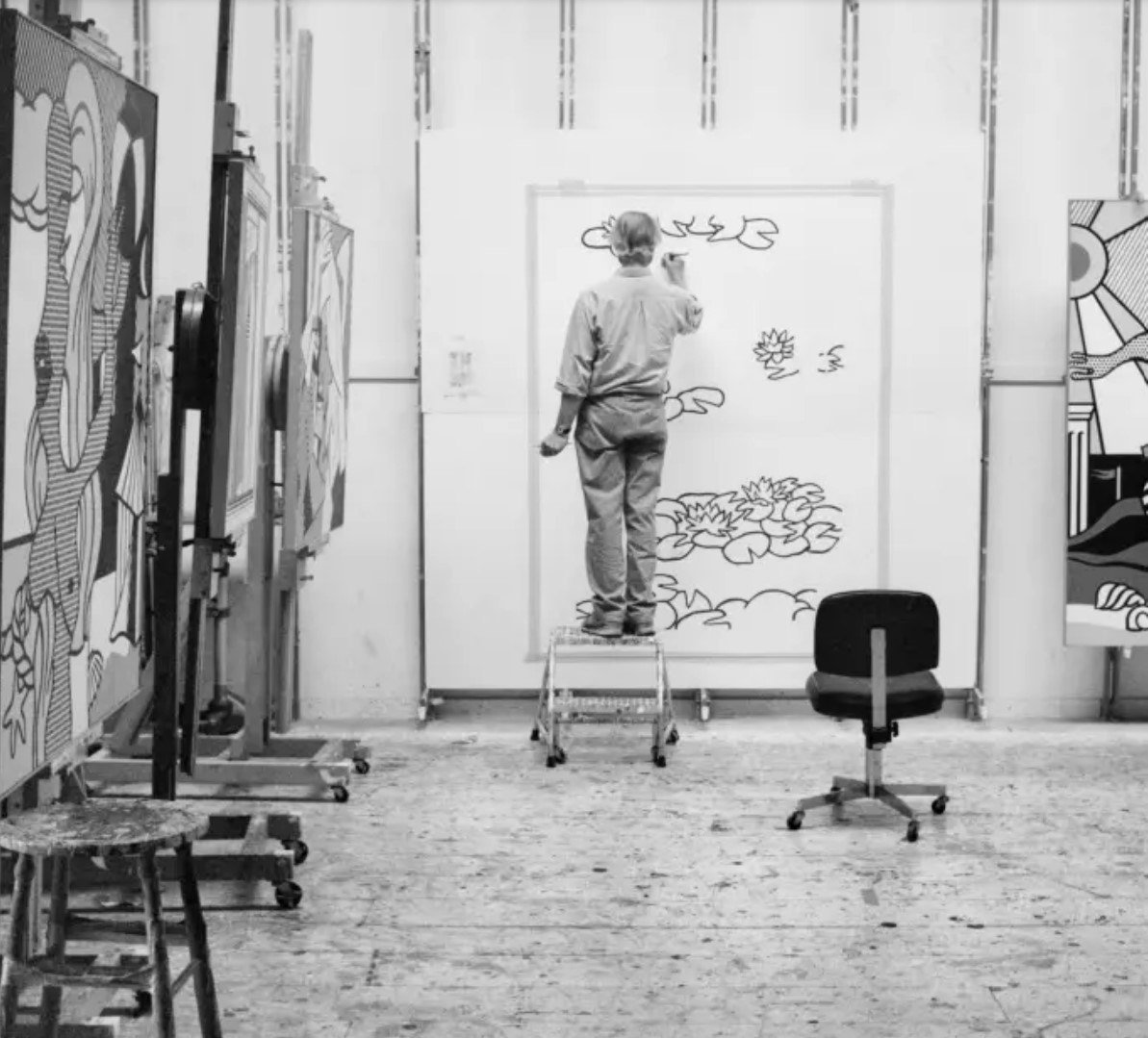
ROY LICHTENSTEIN IN HIS SOUTHAMPTON STUDIO IN 1992. PHOTO BY LAURIE LAMBRECHT. ARTWORK © ROY LICHTENSTEIN 2021.
A key priority in the works of Monet and the Impressionists was capturing the subtle changes in light conditions and that desire drove Monet to create over two hundred and fifty oil paintings of the water lilies at Giverny. His fascination with light and its reflections produced some of the most spectacular renderings of water within the art historical canon. Acknowledging that the rendering of such delicate nuance in thick oils worked against his clinical and mechanical aesthetic style, Lichtenstein explored alternative ways to replicate the subtilities in Monet’s composition. Constructed using sign painter’s enamel screen-printed on to stainless steel, Lichtenstein’s Water Lilies series reinforces the industrial essence of his practice. However, his innovative use of stainless steel as the surface for his works gives them a reflective quality, mirroring the lighting, colors, and contents of the room in which they are exhibited. As stated by Mary Lee Corlett, Lichtenstein’s Water Lilies “transmogrify”, constantly changing as they are viewed from different angles.
1. Water Lilies – Pink Flower
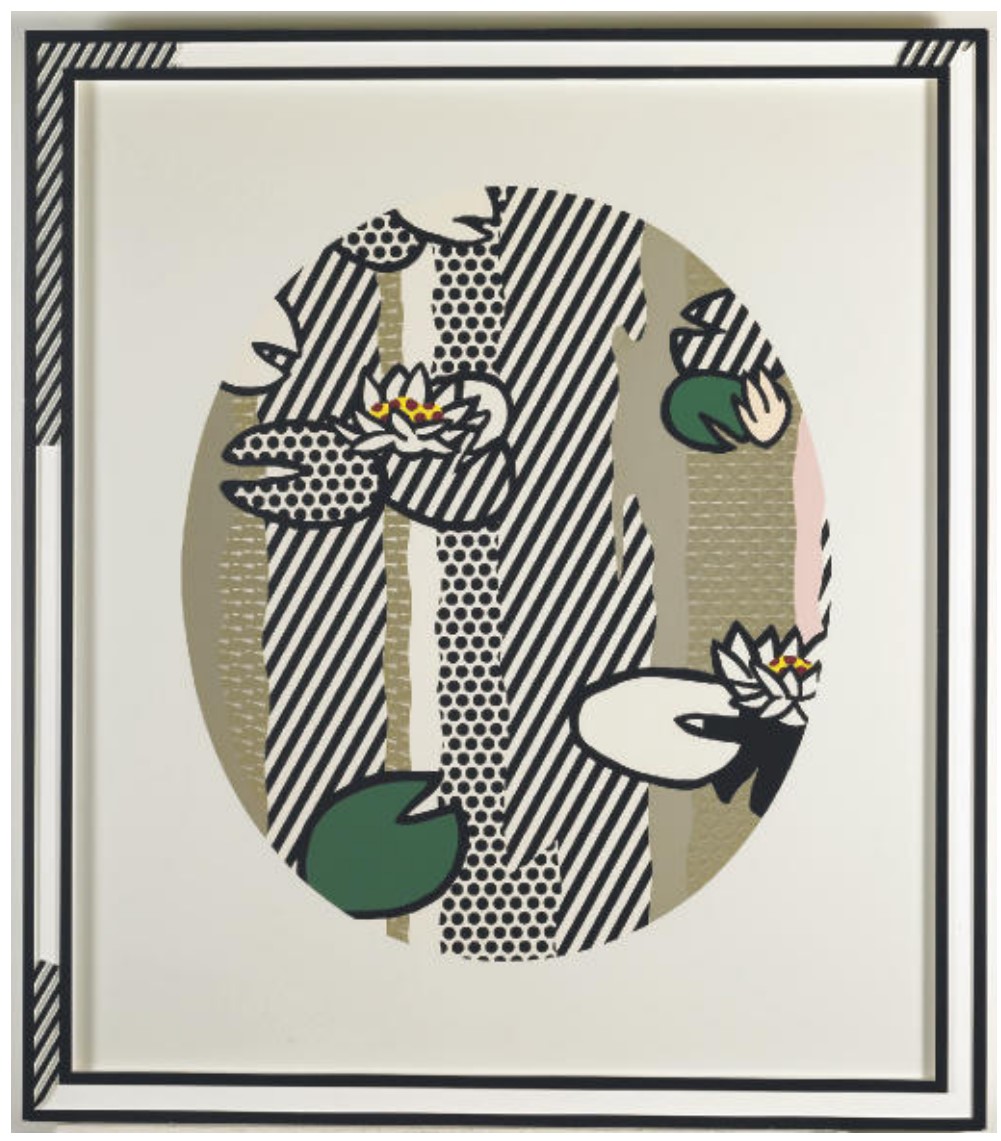
Water Lilies – Pink Flower from Water Lilies Series, 1992
Screen-printed enamel in colors on stainless steel with painted relief wood frame
Sheet: 110.5 x 76.7 cm
Edition: 23 + 6 AP + 3 PP
Literature: Corlett 261
2. Waterlilies – Blue Lily Pads
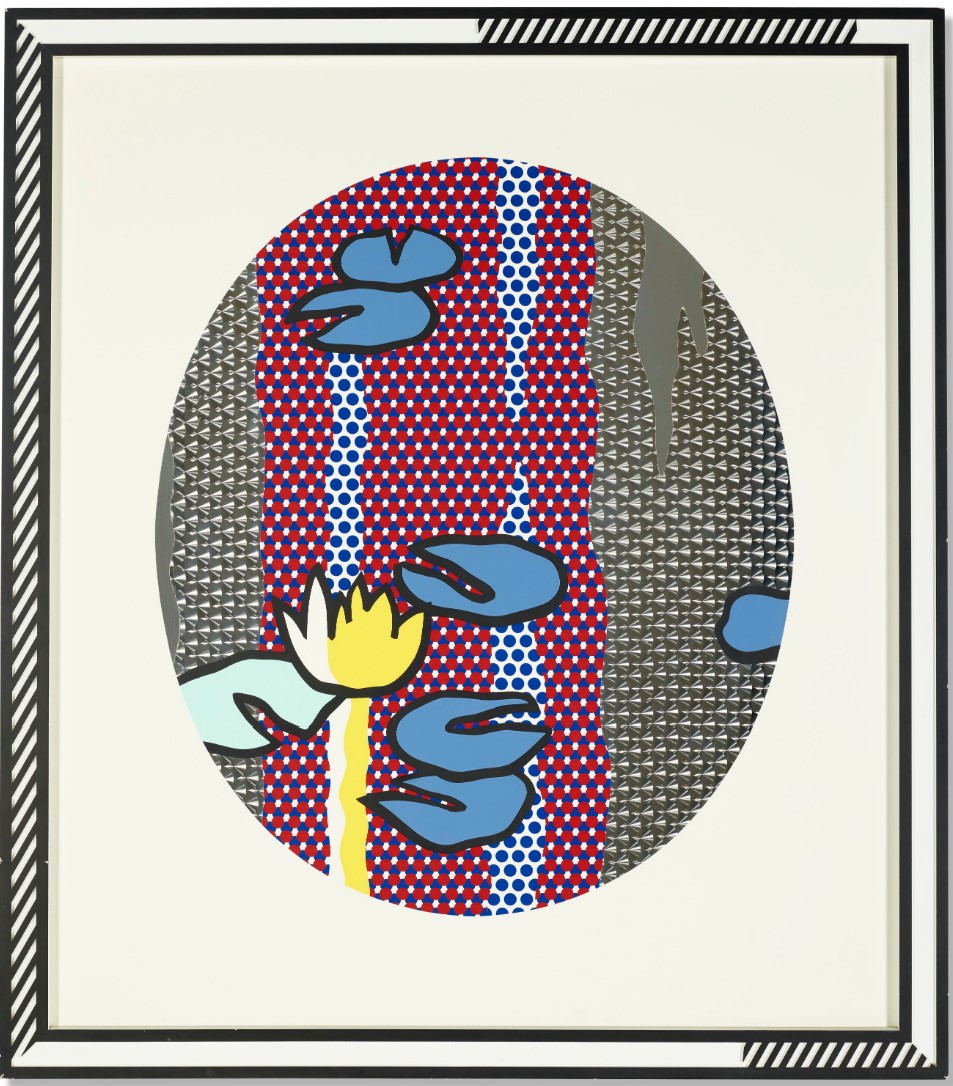
Waterlilies – Blue Lily Pads from Water Lilies Series, 1992
Color screen-printed enamel on processed and swirled stainless steel, contained in the artist’s painted relief wood frame.
Sheet: 43 3/8 x 38 1/4 inches (110.2 x 97.2 cm)
Edition: 23 + 6 AP + 3 PP
Literature: Corlett 262
3. Water Lilies with Cloud
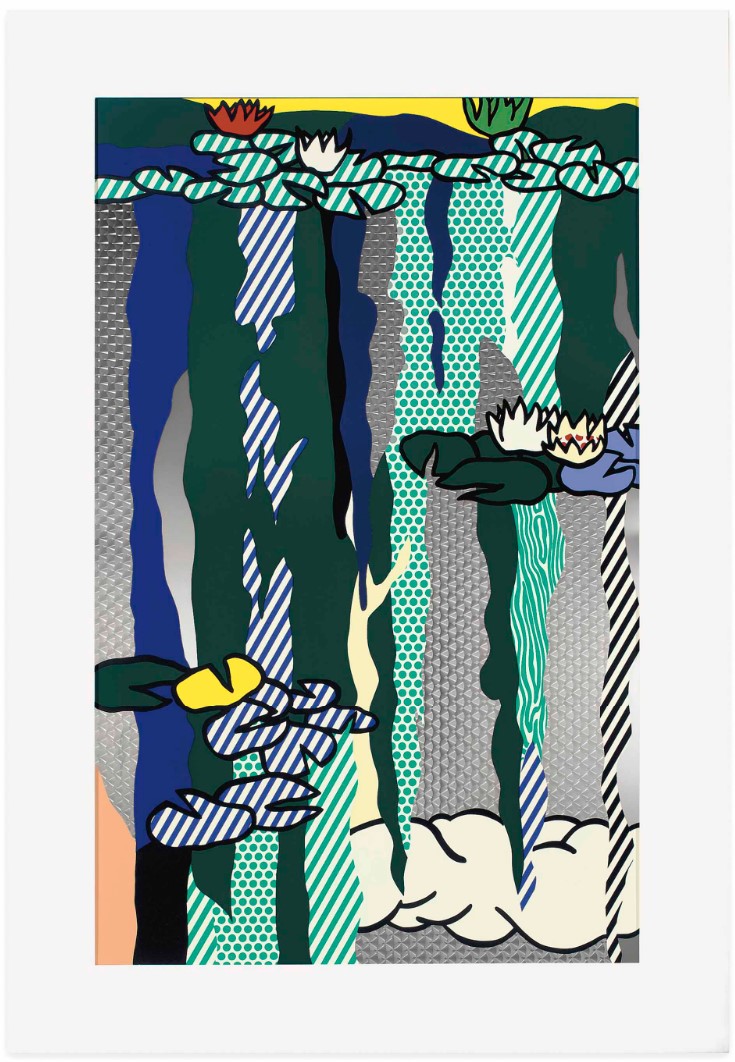
Water Lilies with Cloud from Water Lilies Series, 1992
Screen-printed enamel on processed and swirled stainless steel with painted artist’s frame frame
Sheet: 67 x 46 3/8 inches (170.2 x 117.8 cm)
Edition: 23 + 3 AP + 4 PP
Literature: Corlett 263
4. Water Lilies with Japanese Bridge
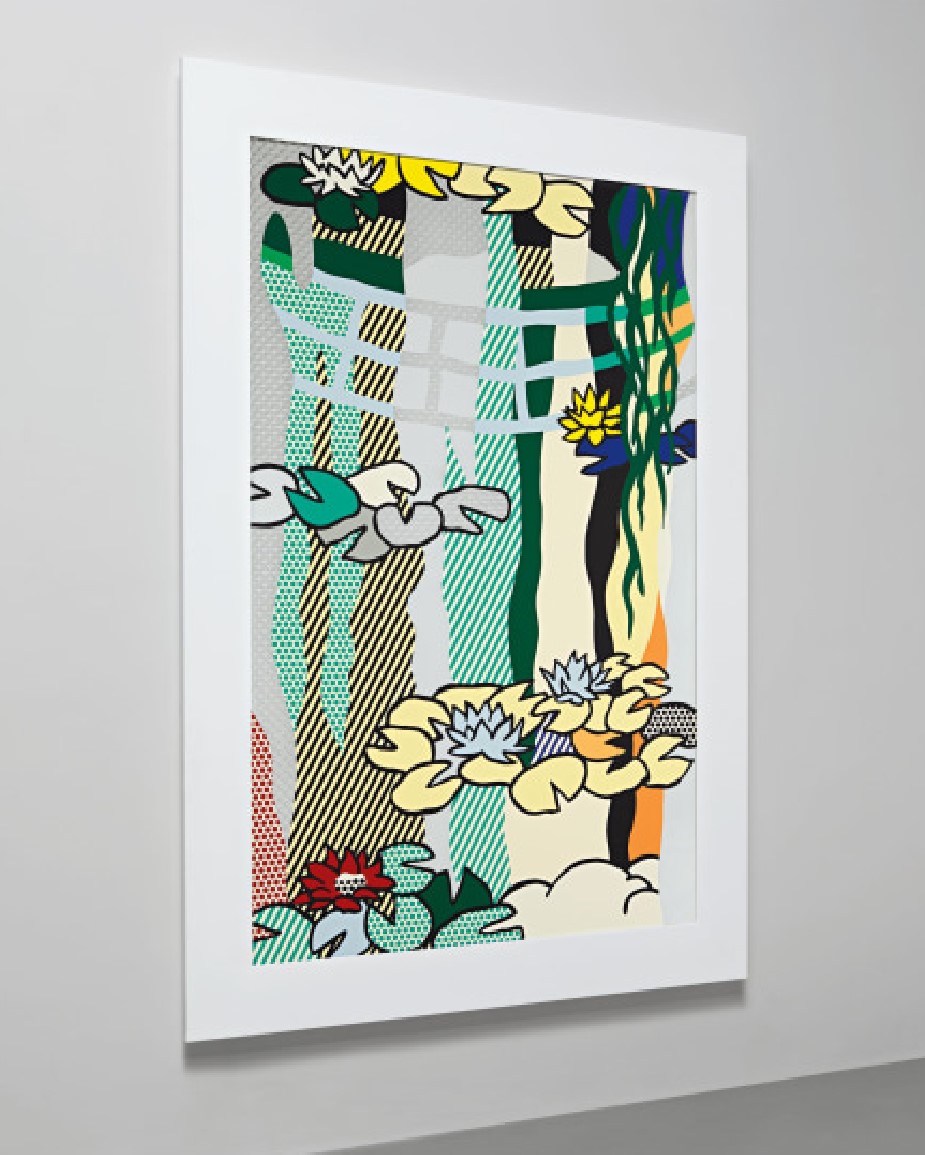
Water Lilies with Japanese Bridge from Water Lilies Series, 1992
Screen-printed enamel on processed and swirled stainless steel with painted wooden artist’s frame
Sheet: 83 1/4 x 58 inches (211.5 x 147.3 cm)
Edition: 23 + 7 AP + 4 PP
Literature: Corlett 265
5. Water Lily Pond with Reflections
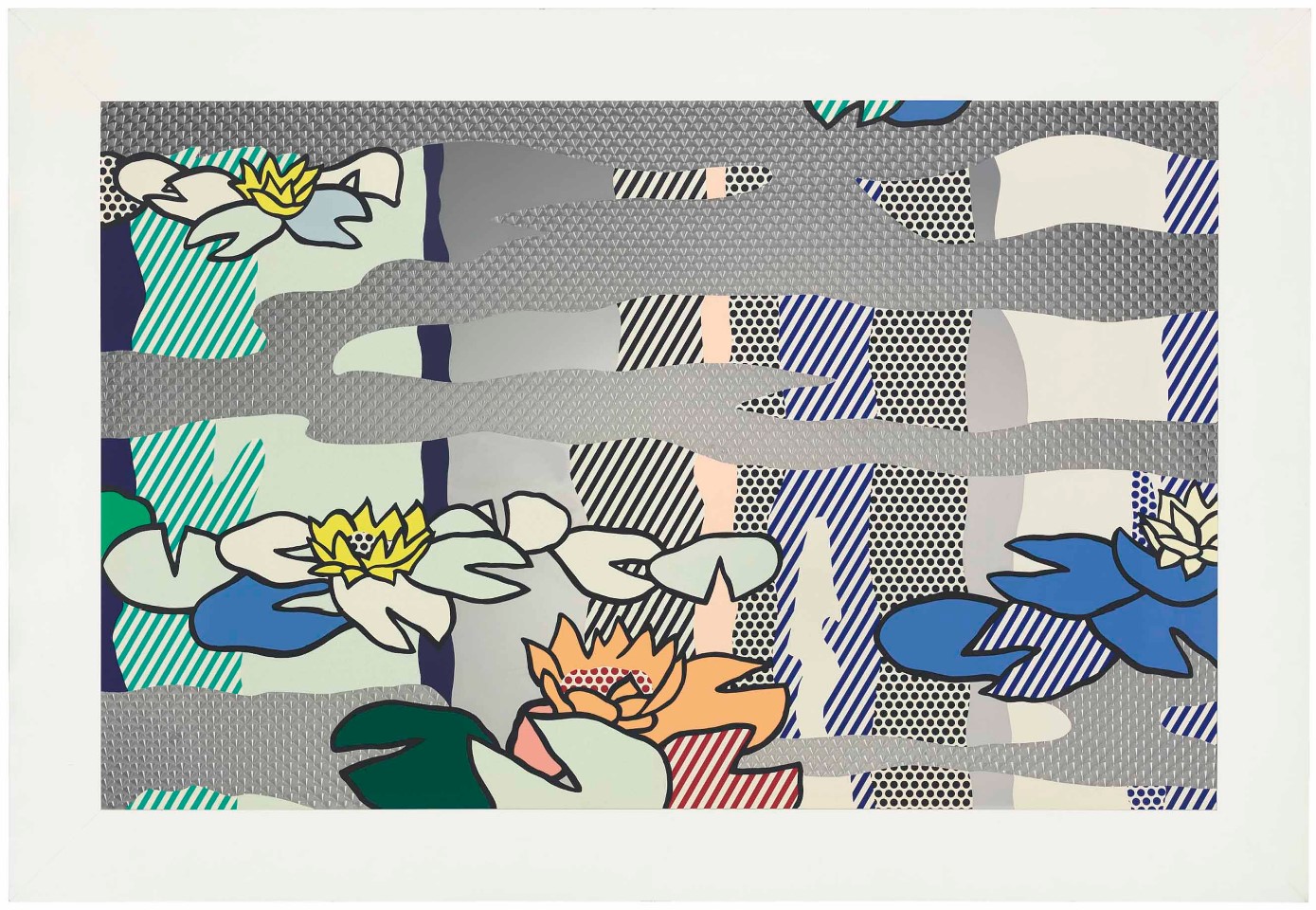
Water Lily Pond with Reflections from Water Lilies Series, 1992
Screen-printed enamel on processed and swirled stainless steel with painted wooden artist’s frame
Sheet: 58 x 84 1/2 inches (147.3 x 214.6 cm)
Edition: 23 + 7 AP + 4 PP
Literature: Corlett 265
6. Waterlilies with Willows
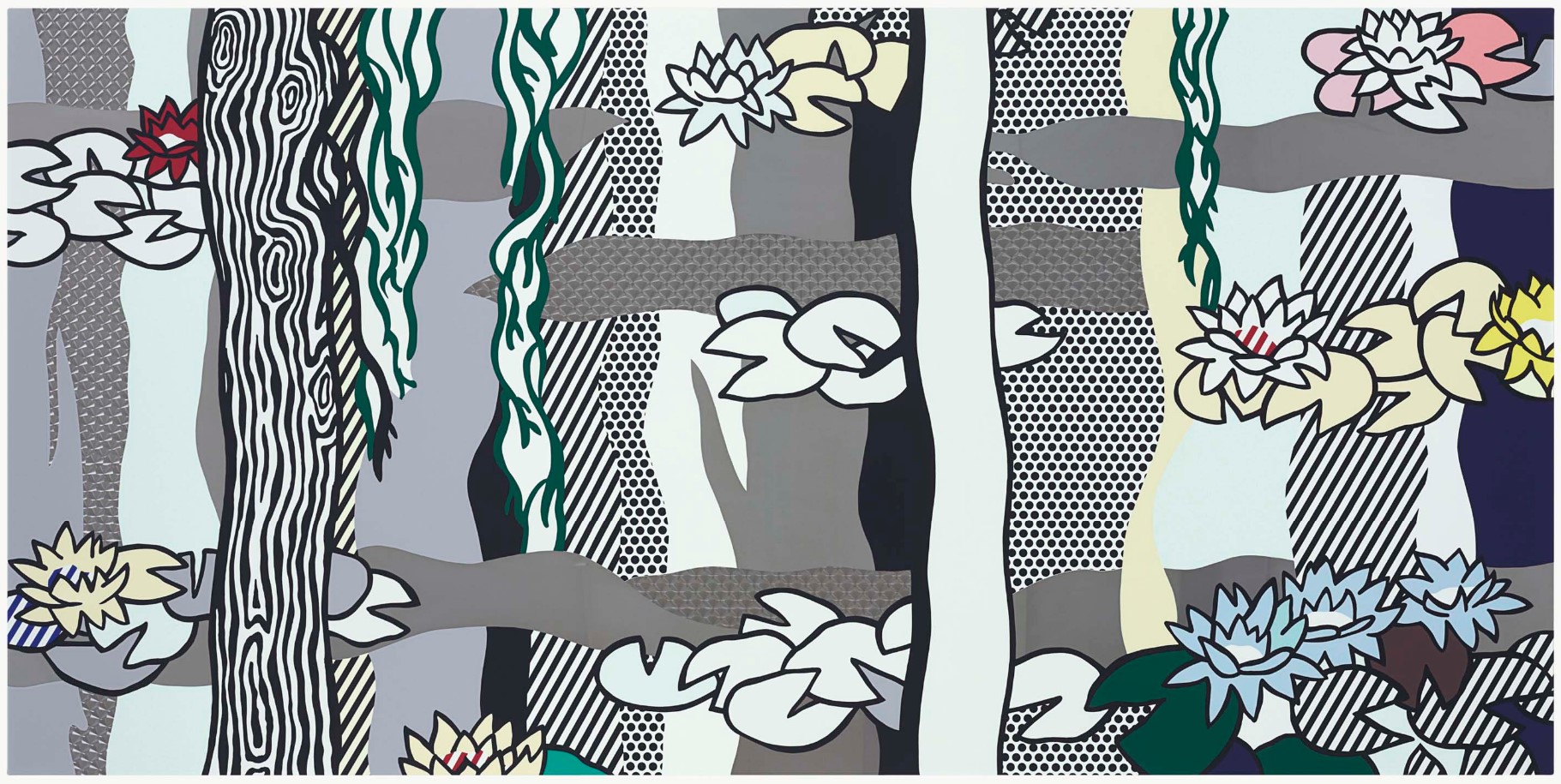
Waterlilies with Willows from Water Lilies Series, 1992
Screen printed enamel in colors on processed and swirled stainless steel in aluminum artist’s frame
Sheet: 58×104 inches (146.6 x 264.1 cm)
Edition: 23 + 7 AP + 3 PP
Literature: Corlett 266
Nude Series, 1994
Roy Lichtenstein’s Nudes Series was the final major series the artist produced before his death in 1997. The nine prints consider the traditional art historical genre of the female nude through the lens of Pop Art and mark Lichtenstein’s return to his iconic 1960s comic book style, consisting of Benday dot patterns, bright colors, and bold lines. Published and printed by Tyler Graphics Ltd., Mount Kisco, New York, Lichtenstein referenced his own oeuvre, integrating motifs found in earlier works from the Reflections, Imperfect, Water Lily, and Interiors Series. After four decades of radically probing fundamental questions of art and artmaking, it was apt for him to select the female nude as a symbol of returning to the beginning of both his oeuvre and art history.
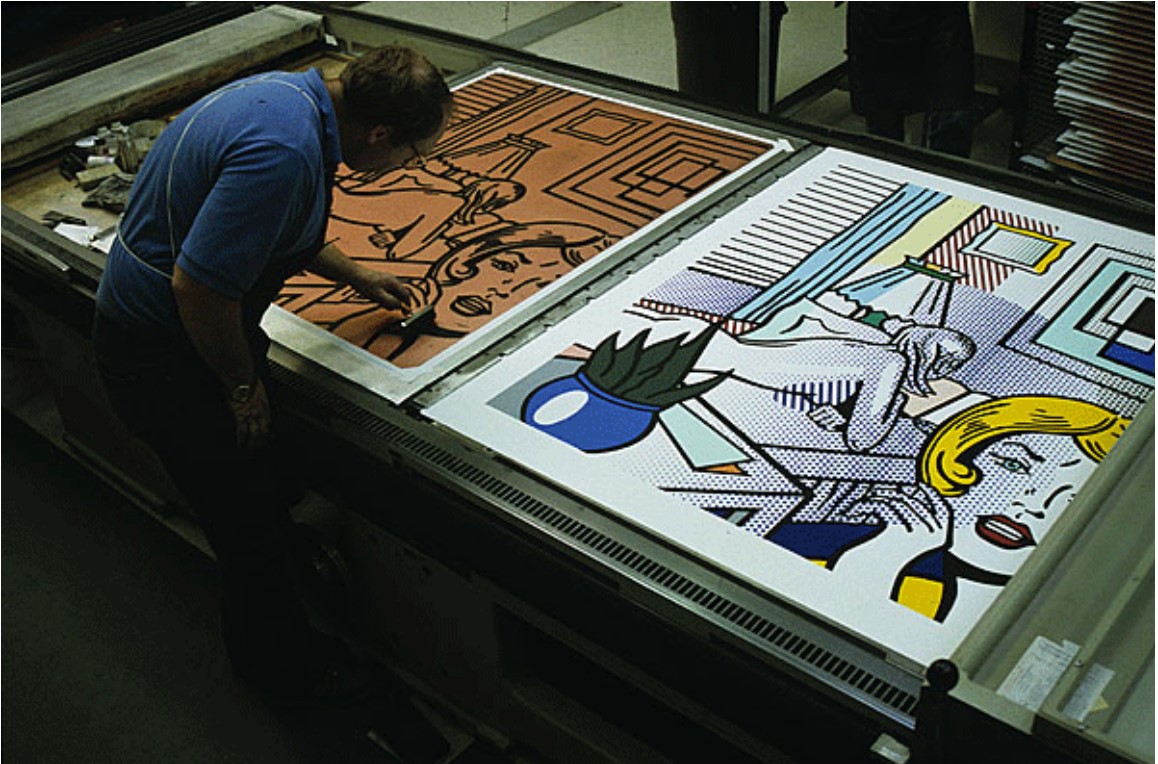
John Hutcheson using a brayer to ink the woodblock on the lithography offset press bed for the black print run of Roy Lichtenstein’s color relief print Roommates, Tyler Graphics Ltd. workshop, Mount Kisco, New York, 1994. Photograph by Marabeth Cohen-Tyler.
Roy Lichtenstein approached the distinguished artistic genre of the female nude late in his career, innovating on a classic subject with his Pop Art treatment. Developed from comic book figures which defined his early successful works, Lichtenstein’s Nudes series, comprised of nine prints, refined and expanded upon his distinctive dialect of bold patterns and bright colors. The use of Benday dots, generated by computer for the first time in Lichtenstein’s work, create a playful chiaroscuro. Expansion in palate, beyond the primary red, blues and yellows of his early style, mark Lichtenstein’s refinement of the Pop Art signature style. The final major series before his death in 1997, Lichtenstein’s Nudes exemplify his innovative spirit while remaining true to the bright, playful style he pioneered. Lichtenstein composed his nude figures from printed sources, taking comic book characters and removing their clothing. Removing the forms of his heroines from the confines of reality, Lichtenstein used the minimalistic detail of the nude figures as a foil to his more involved domestic interiors. The emphasis on background rather than human subject highlights his interest in in the genre of the nude as a space for further refining his color and pattern applications.
1. Roommates
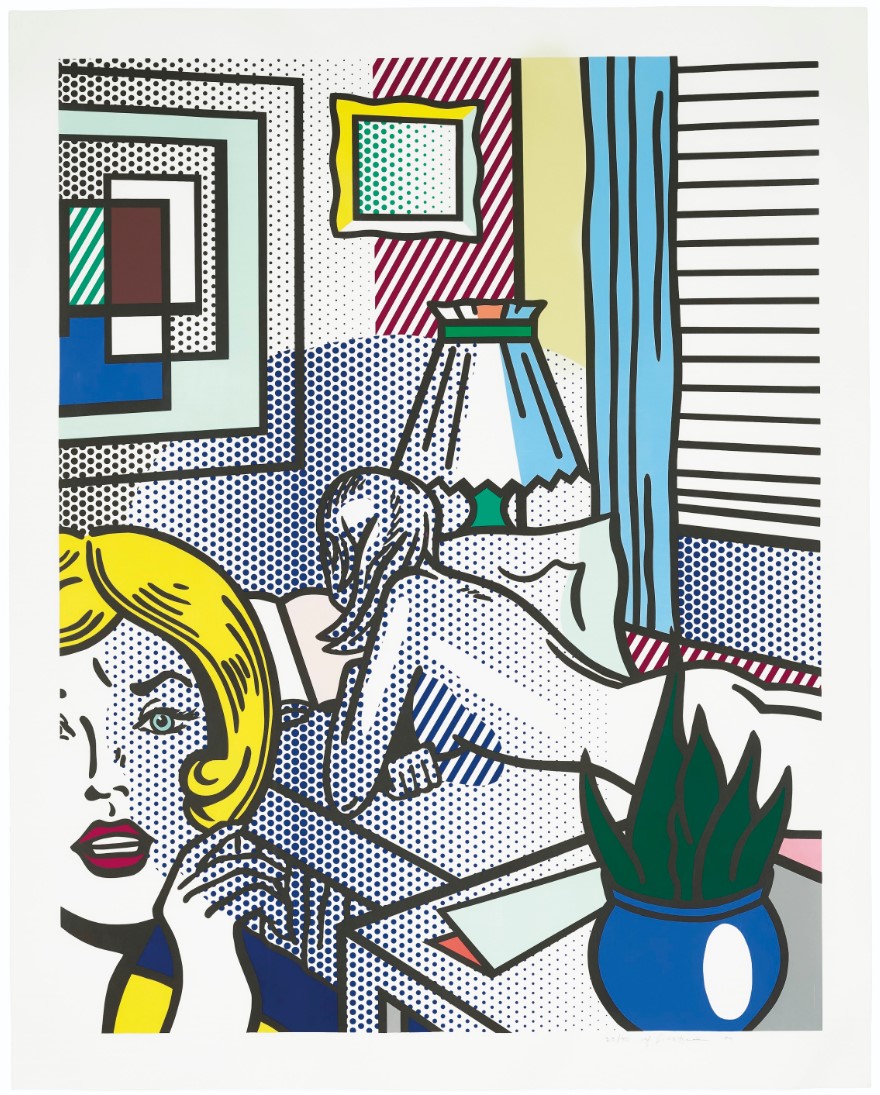
Roommates from Nude Series, 1994
Relief print in colors on Rives BFK mold-made paper
Sheet: 64 1/8 x 51 inches (162.9 x 129.5 cm)
Edition: 40 + 10 AP
Literature: Corlett 282
2. Nude with Yellow Pillow
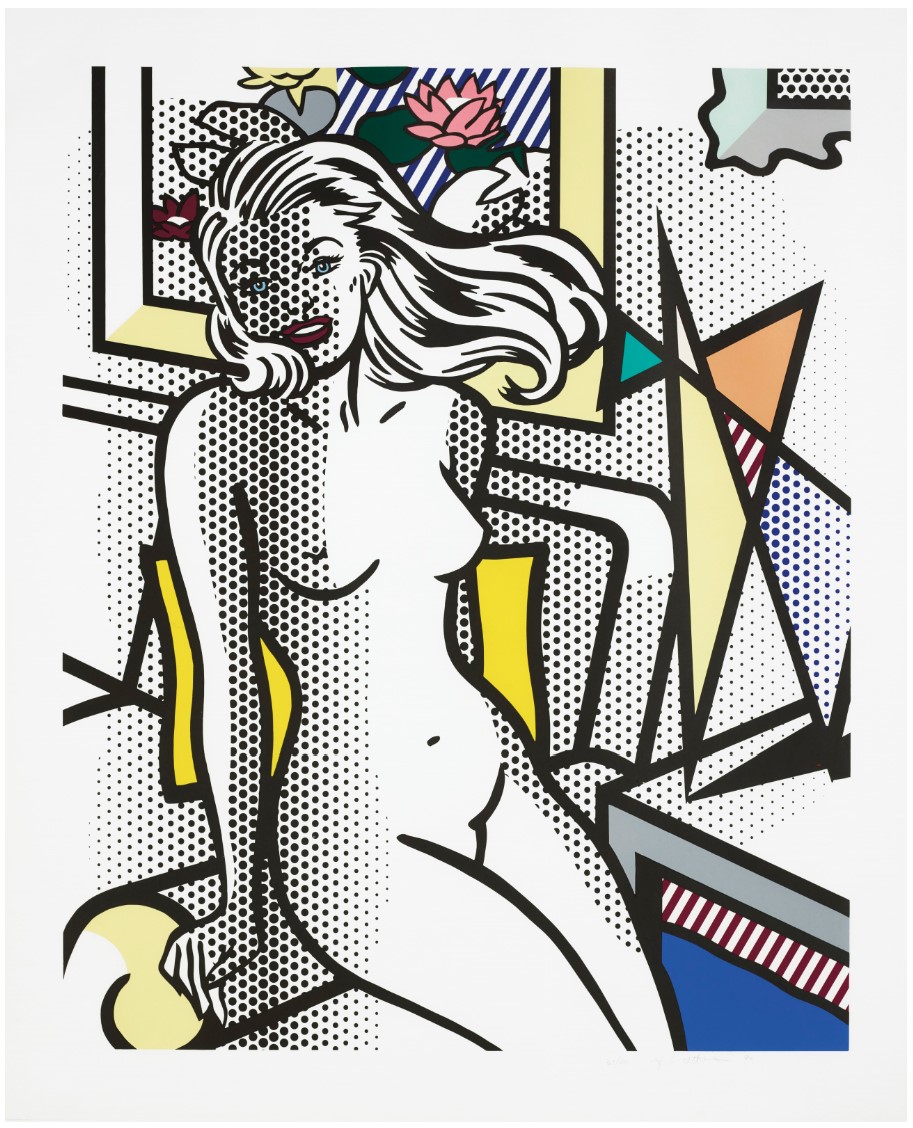
Nude with Yellow Pillow from Nude Series, 1994
Relief print in colors on Rives BFK mold-made paper
Sheet: 52 5/8 x 43 inches (133.7 x 109.2 cm)
Edition: 60 + 12 AP
Literature: Corlett 283
3. Two Nudes
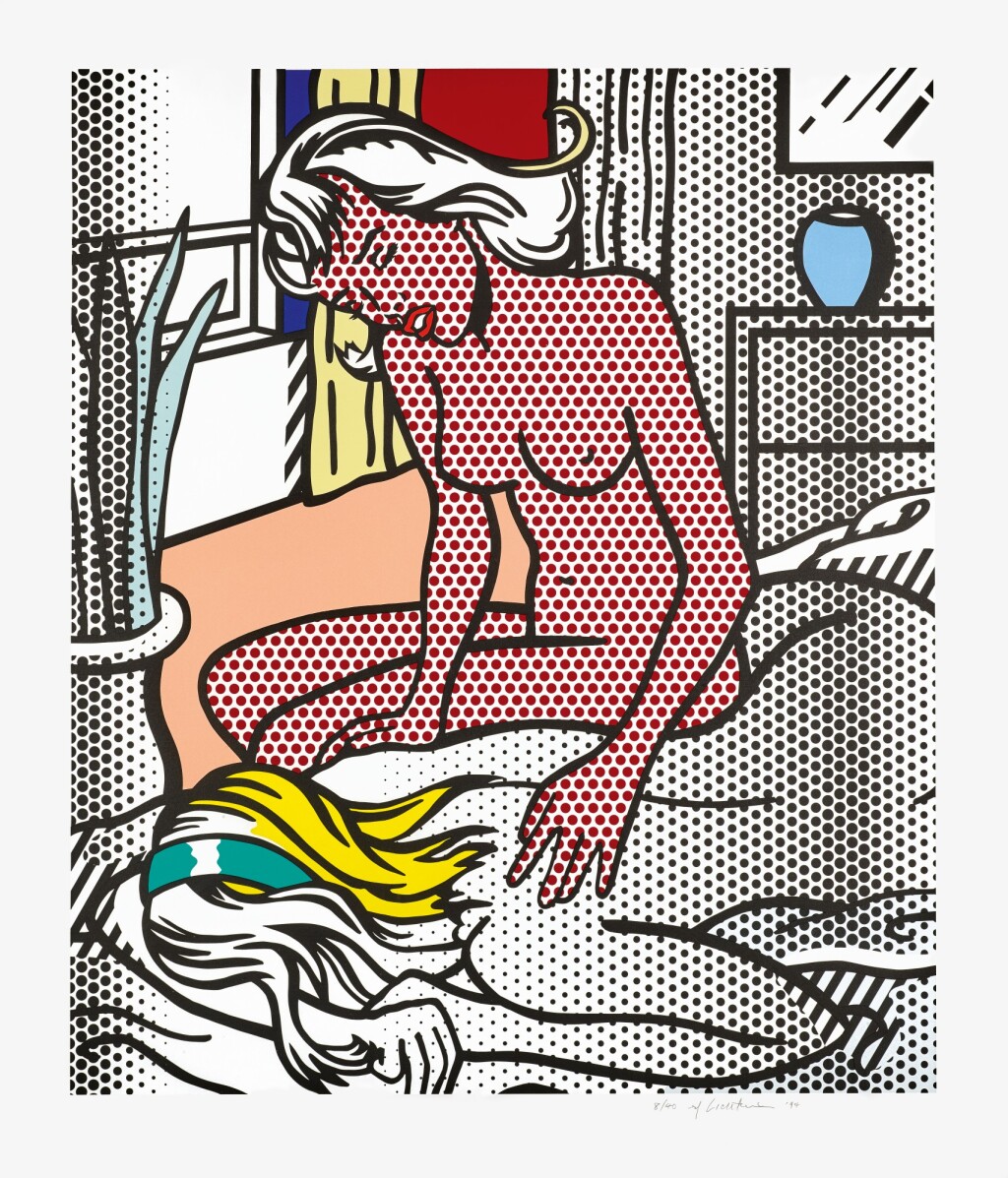
Two Nudes from Nude Series, 1994
Relief print in colors on Rives BFK mold-made paper
Sheet: 48×41 inches (121.8 x 104.2 cm)
Edition: 60 + 12 AP
Literature: Corlett 284
4. Two Nudes, State I
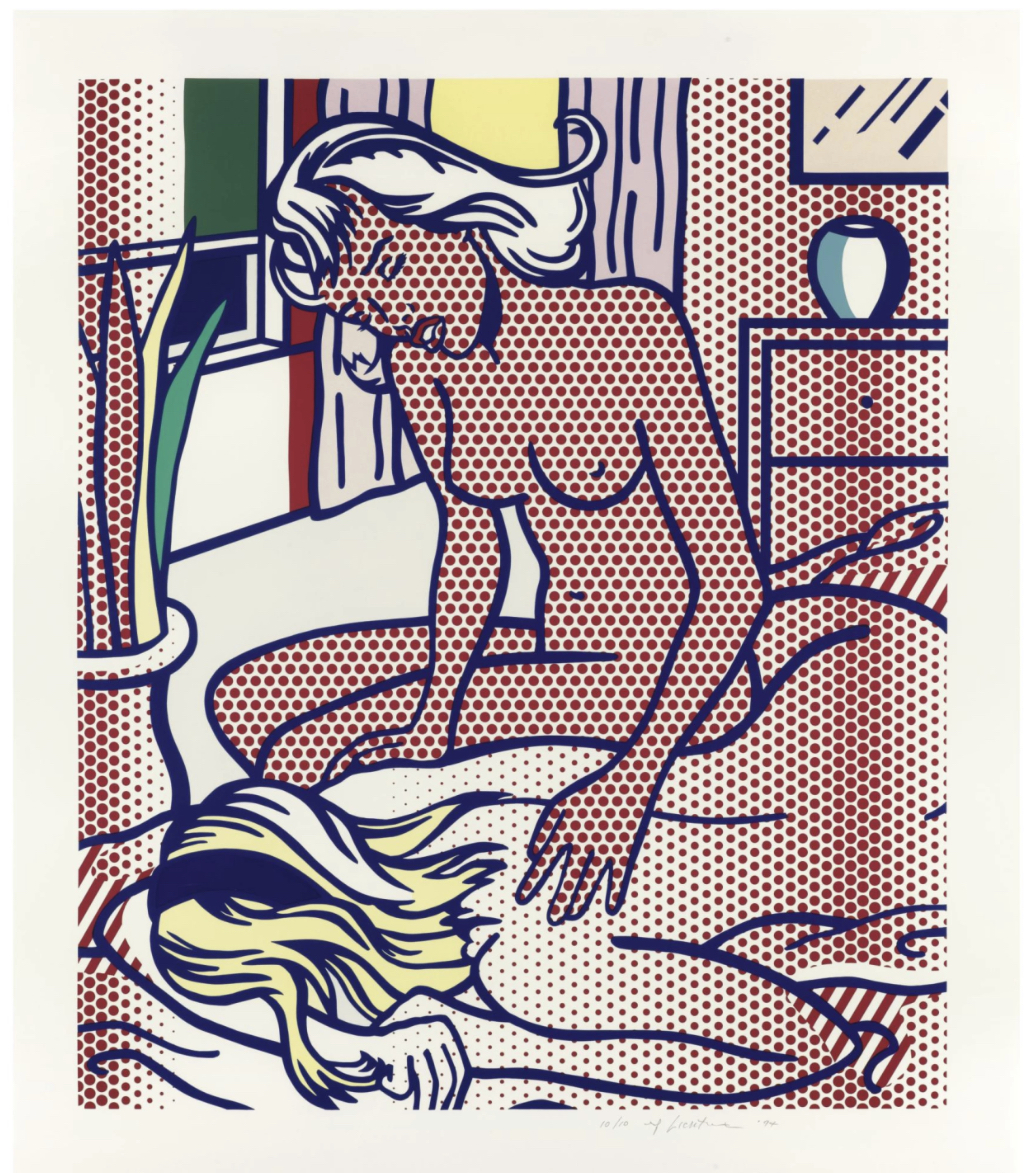
Two Nudes, State I from Nude Series, 1994
Relief print in colors on Rives BFK mold-made paper
Sheet: 47 7/8 x 41 inches (121.8 x 104.3 cm)
Edition: 10 + 6 AP
Literature: Corlett 285
5. Nude with Blue Hair
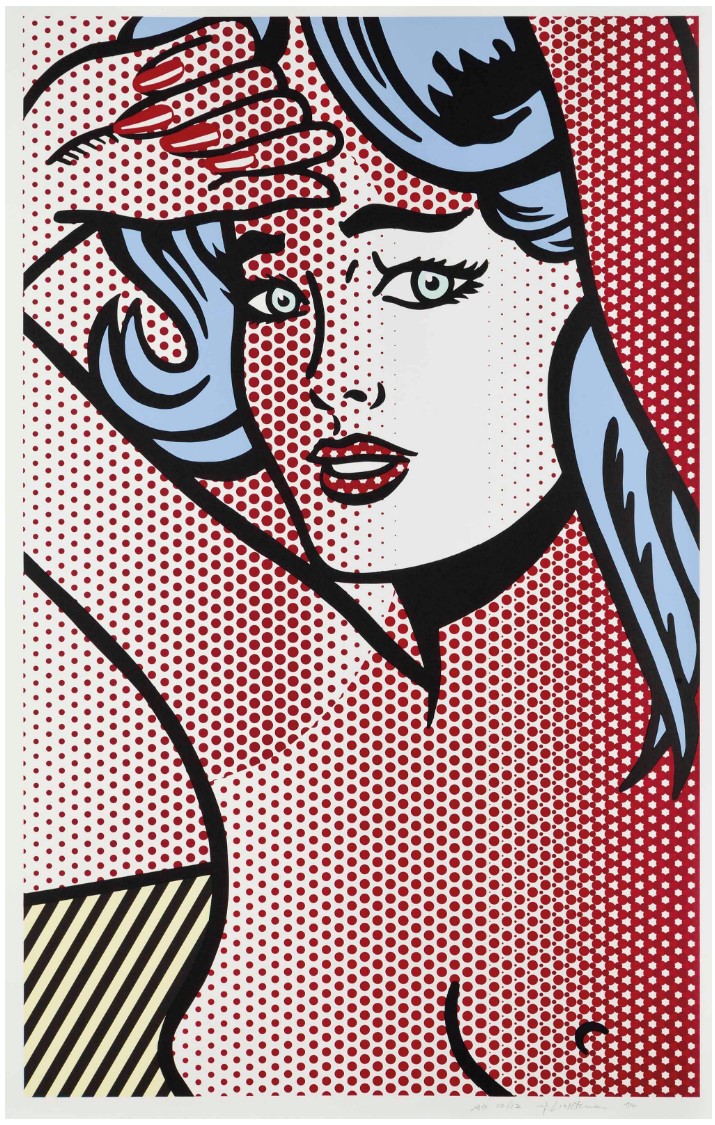
Nude with Blue Hair from Nude Series, 1994
Relief print in colors on Rives BFK mold-made paper
Sheet: 57 7/8 x 37 1/2 inches (147 x 95.3 cm)
Edition: 40 + 12 AP
Literature: Corlett 286
6. Nude with Blue Hair, State I
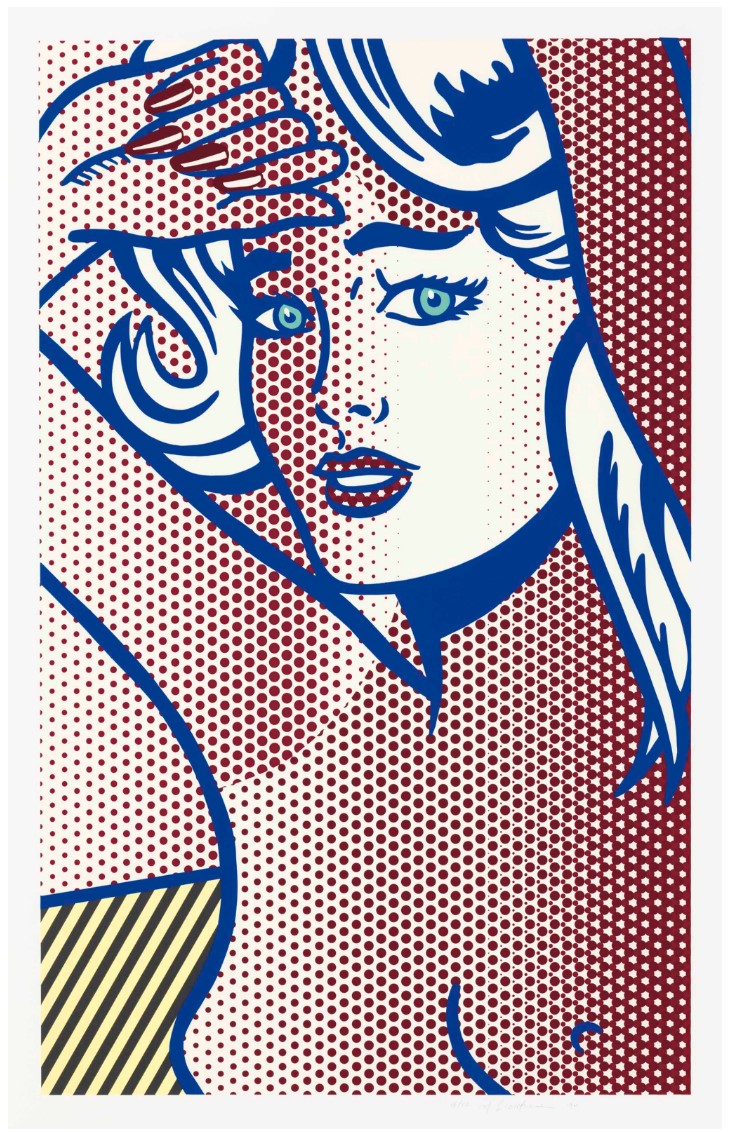
Nude with Blue Hair, State I from Nude Series, 1994
Relief print in colors on Rives BFK mold-made paper
Sheet: 57 3/4 x 37 1/2 inches (146.5 x 95.2 cm)
Edition: 10 + 6 AP
Literature: Corlett 287
7. Nude Reading
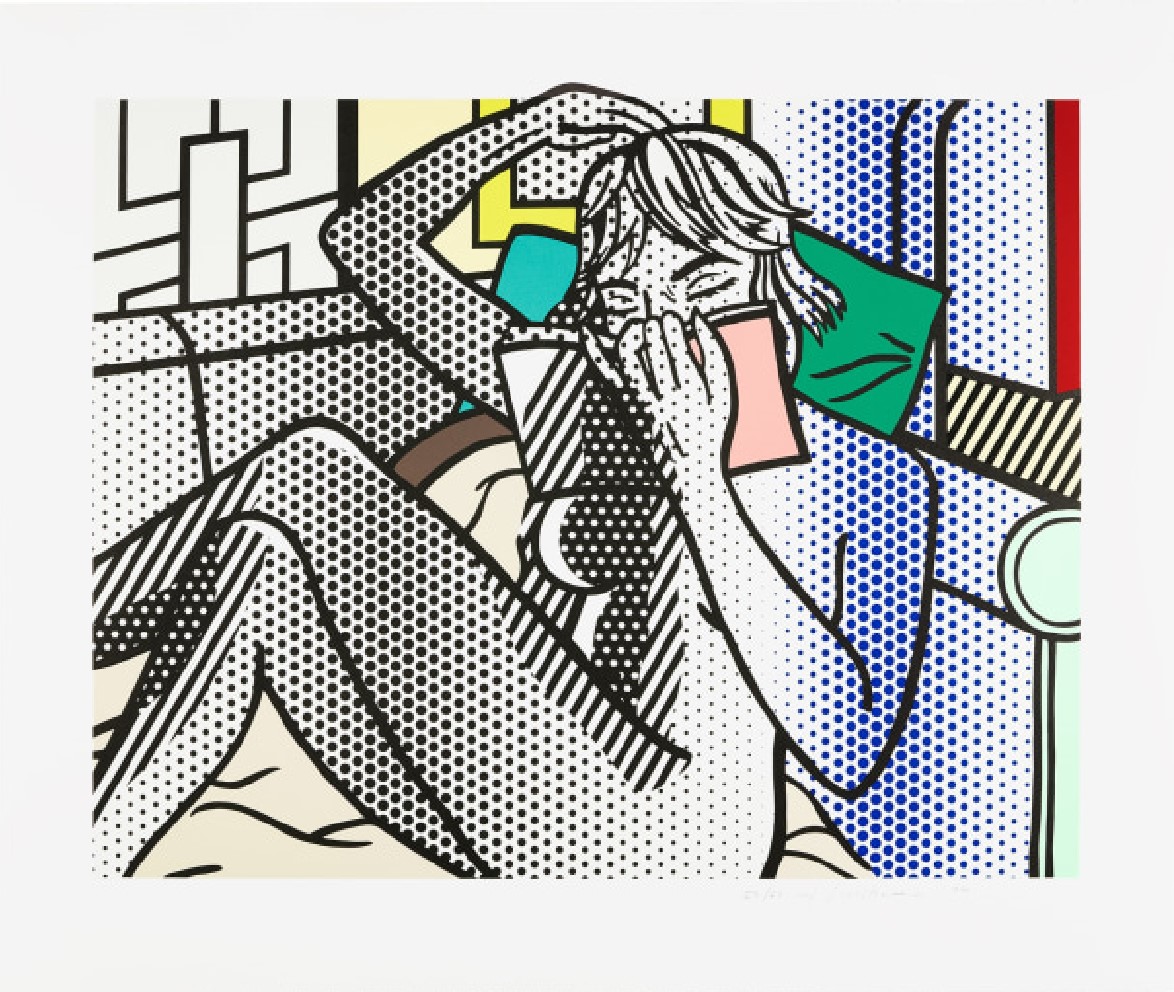
Nude Reading from Nude Series, 1994
Relief print in colors on Rives BFK mold-made paper
Sheet: 30 1/2 x 36 1/4 inches (77.5 x 92.1 cm)
Edition: 60 + 12 AP
Literature: Corlett 288
8. Thinking Nude
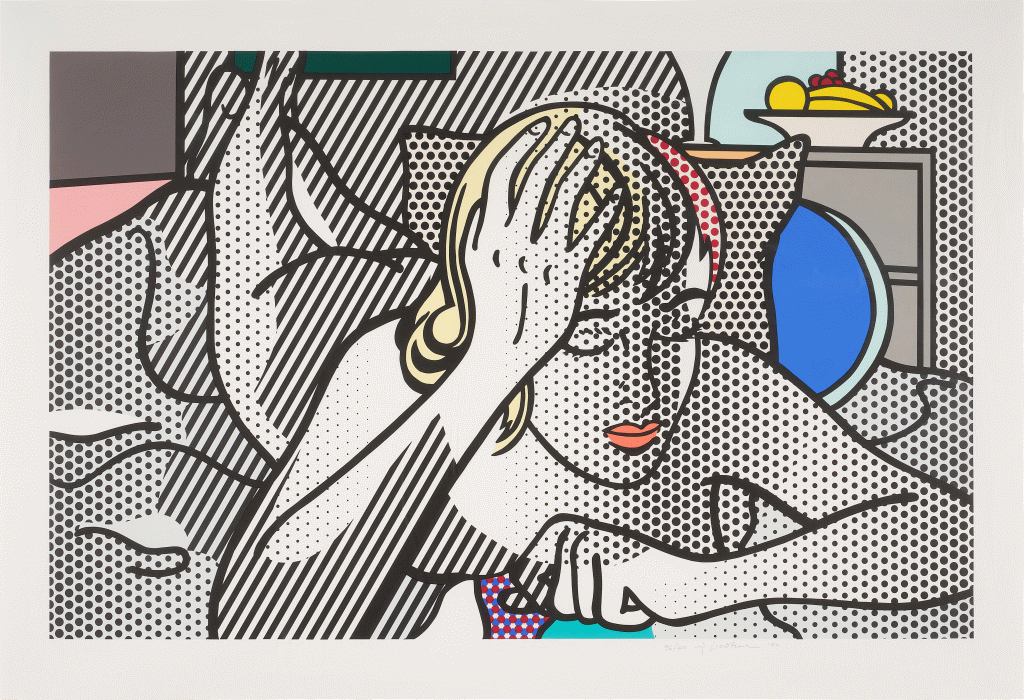
Thinking Nude from Nude Series, 1994
Screen-print in colors on Rives BFK mold-made paper
Sheet: 42×62 inches (106.7 x 157.4 cm)
Edition: 40 + 12 AP
Literature: Corlett 289
Late Prints, 1994-1997
Modern Art I
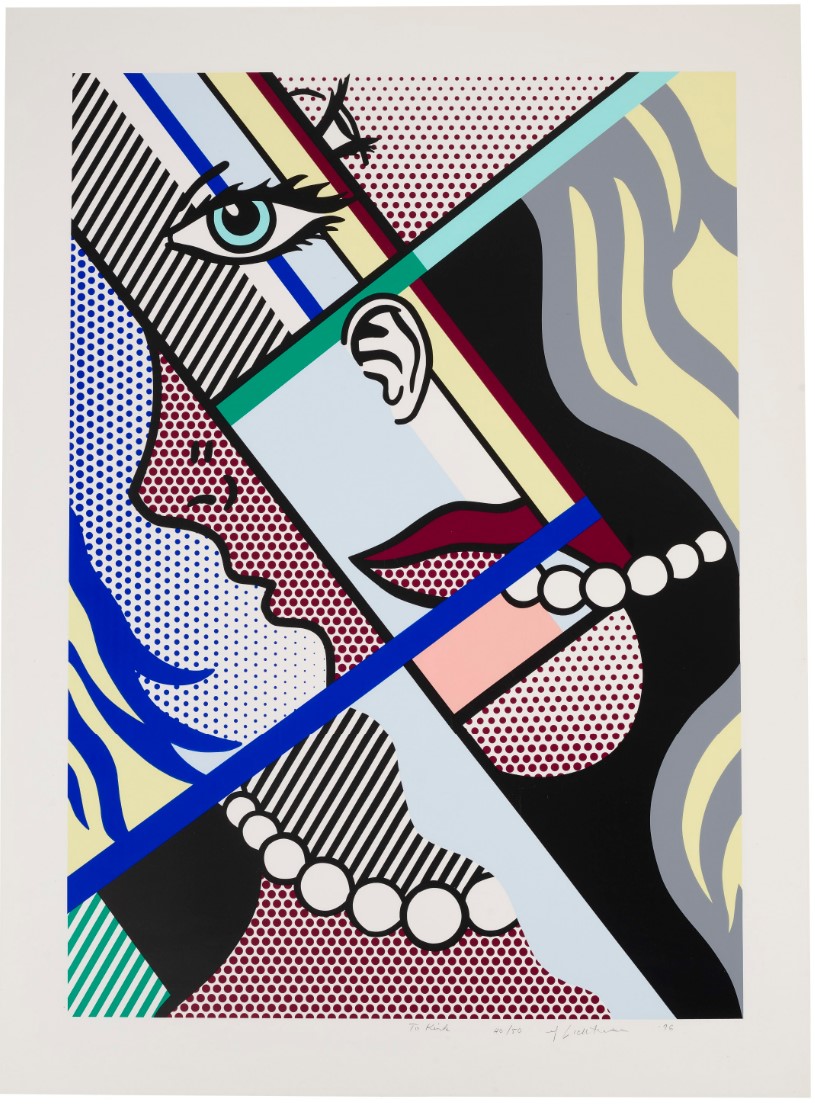
Modern Art I, 1996
Screen-print in colors on Lanaquarelle watercolor paper
Sheet: 51 1/4 x 37 3/4 inches (130.3 x 95.9 cm)
Edition: 50 + 10 AP
Literature: Corlett 300, Gemini 1670
Modern Art II
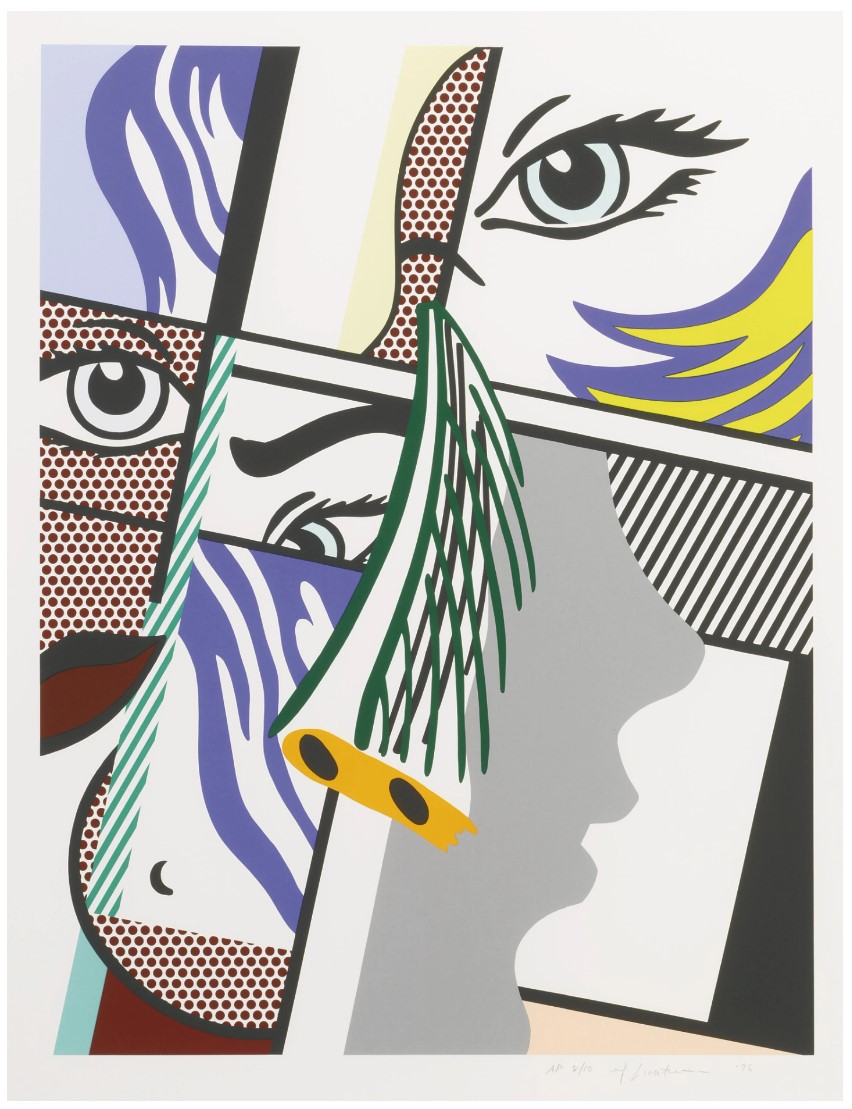
Modern Art II, 1996
Screen-print in colors on Lanaquarelle watercolor paper
Sheet: 48 1/4 x 38 3/8 inches (122.5 x 97.3 cm)
Edition: 50 + 10 AP
Literature: Corlett 301, Gemini 1671
Landscape with Boats, 1996
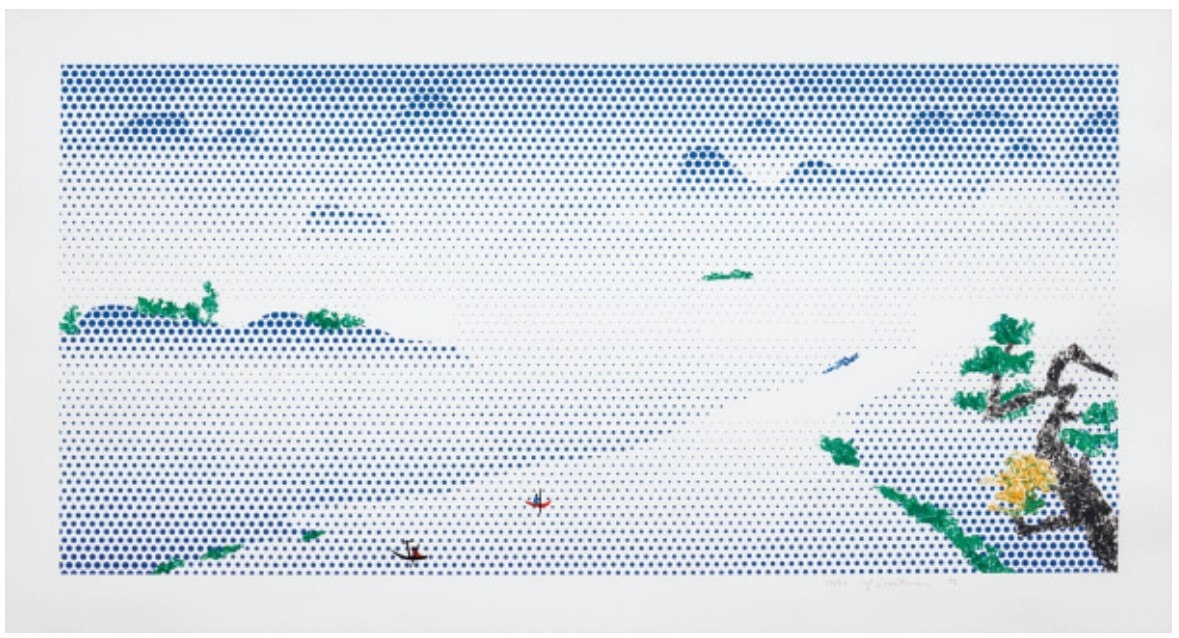
Landscape with Boats, 1996
Lithograph and screen-print in colors on Lanaquarelle watercolor paper
Sheet: 35 1/4 x 65 inches (89.5 x 165.1 cm)
Edition: 60 + 12 AP
Literature: Corlett 302, Gemini 1672
Landscape with Poet, 1996
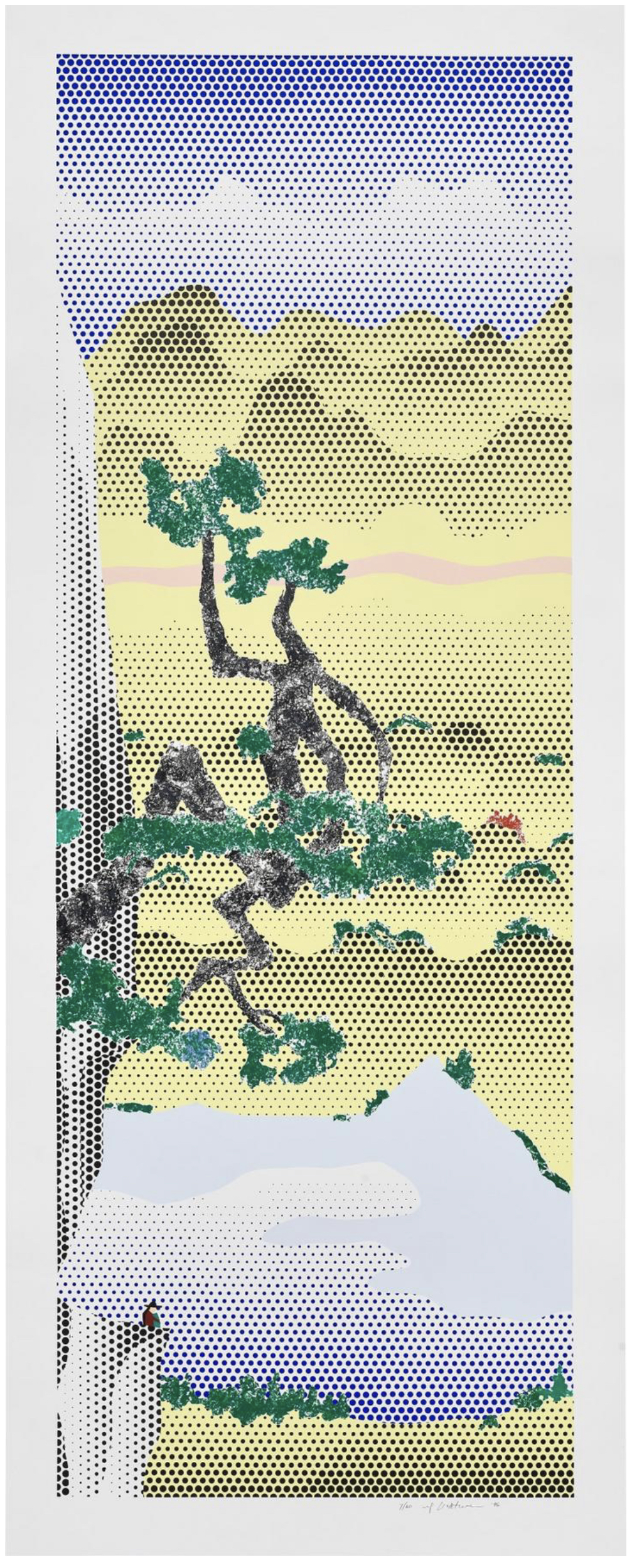
Landscape with Poet, 1996
Medium: Lithograph and screen-print in colors on Lanaquarelle paper
Sheet: 89 3/4 x 36 inches (228 x 91.4 cm)
Edition: 60 + 12 AP
Literature: Corlett 303, Gemini 1673
Art Critic, 1996
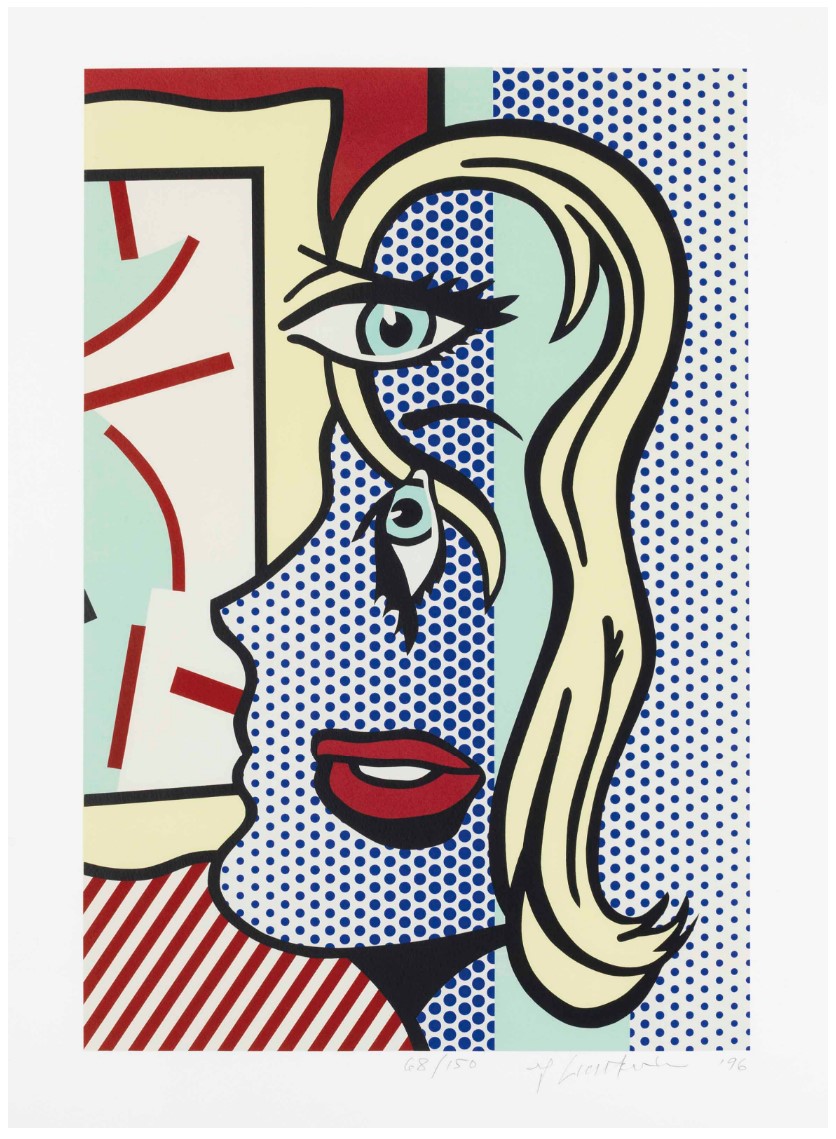
Art Critic, 1996
Screen-print in colors on Somerset paper
Sheet: 26 x 19 1/8 inches (65.7 x 48.2 cm)
Edition: 150 + 25 AP
Literature: Corlett 305
Virtual Interior with Book, 1996
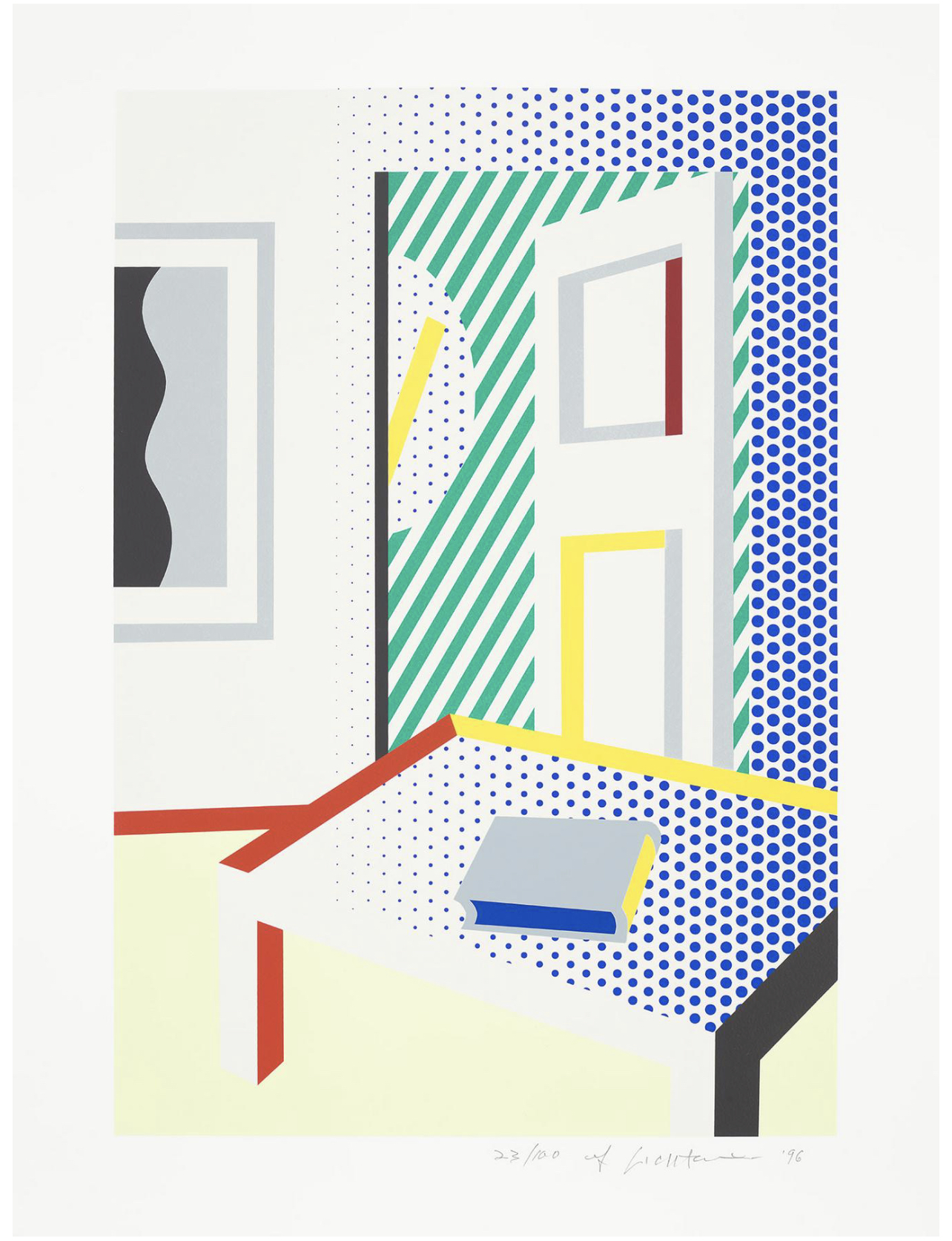
Virtual Interior with Book from The American Academy of Arts and Letters: Centennial Portfolio, 1996
Screen-print in colors on wove paper
Sheet: 24 x 18 1/8 inches (61×46 cm)
Edition: 100 + 25 AP
Literature: Corlett 306
Titled, 1996
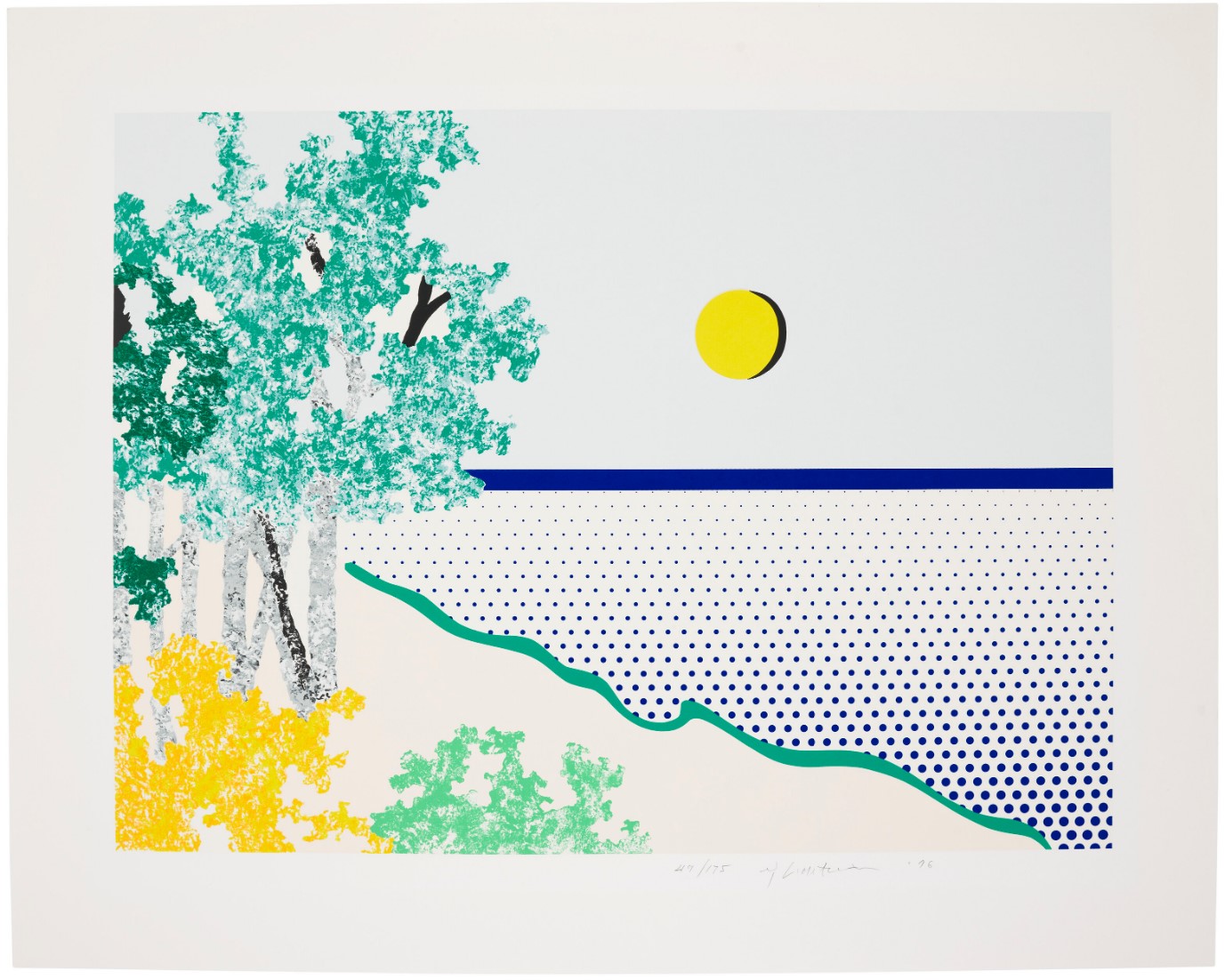
Titled, 1996
Screen-print in colors on Coventry rag paper
Sheet: 31 5/8 x 39 3/4 inches (80.4 x 101 cm)
Edition: 175 + 25 AP
Literature: Corlett 307
Brushstrokes Still Life with Lamp, 1997
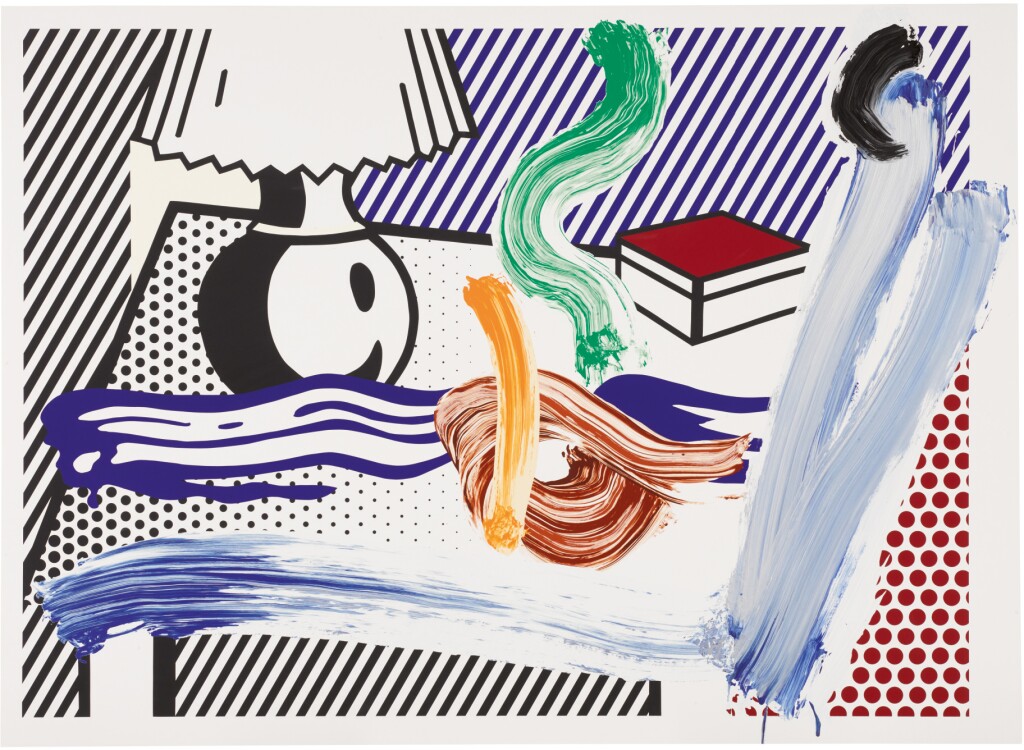
Brushstrokes Still Life with Lamp, 1997
Screen-print with hand-painted magna on honeycomb-core aluminum panel, in artist’s frame
Framed: 54 1/4 x 72 inches (137.5 x 183 cm)
Edition: 24 + 8 AP + 3 PP
Literature: Corlett 308
Interior with Chair, 1997-1998

Interior with Chair from the Leo Castelli 90th Birthday portfolio, -1998
Screen-print in colors on Somerset paper
Sheet: 37×27 inches (94 x 68.6 cm)
Edition: 90 (numbered in Roman numerals) + 15 AP
Literature: Corlett 309
Still Life, 1997
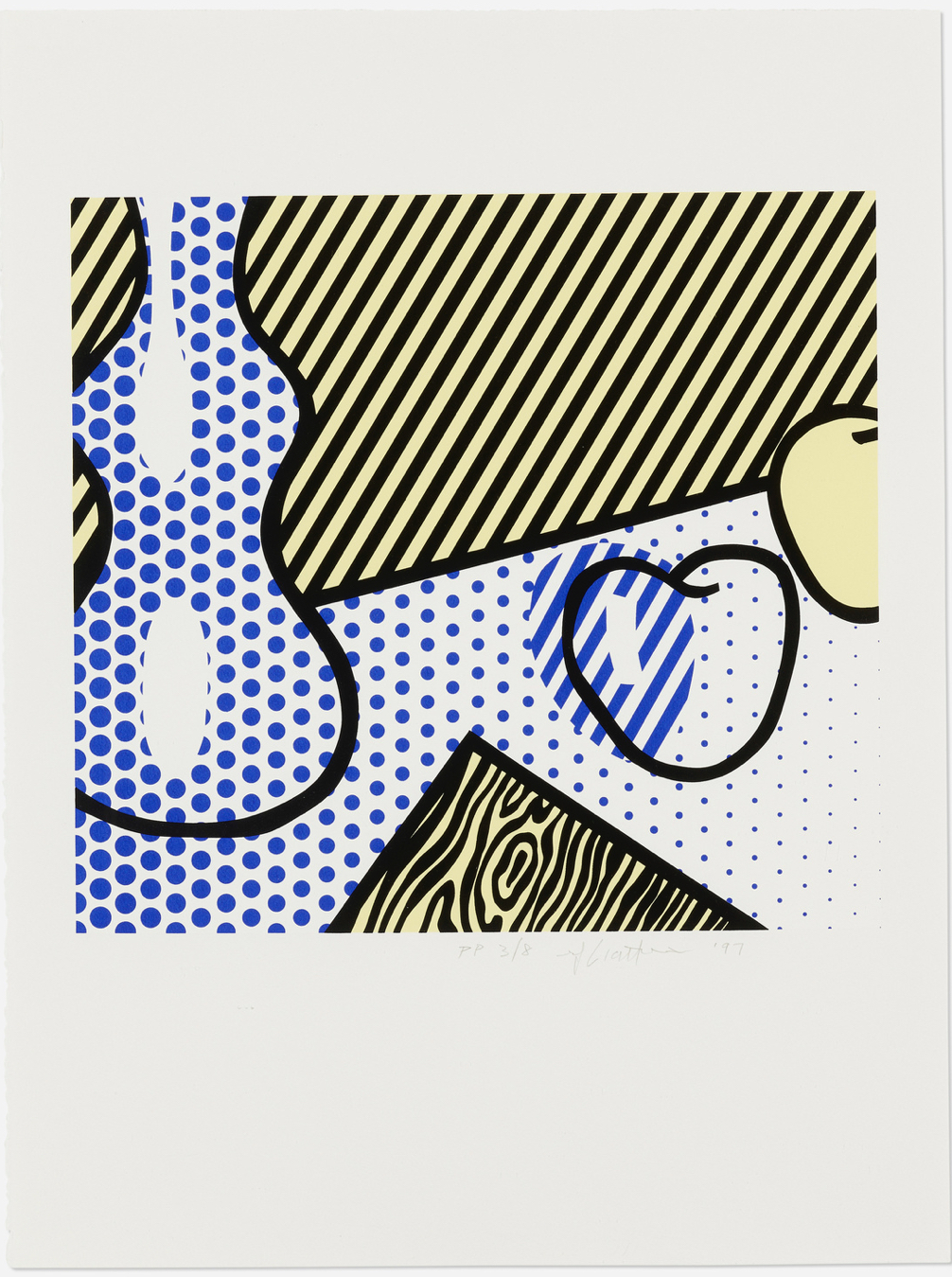
Still Life from The Geldzahler Portfolio, 1997
Screen-print in colors on Somerset 300 gsm
Sheet: 30×22 inches (76×56 cm)
Edition: 75 + 8 AP
Literature: Corlett 310
Cubist Cello, 1997-1998
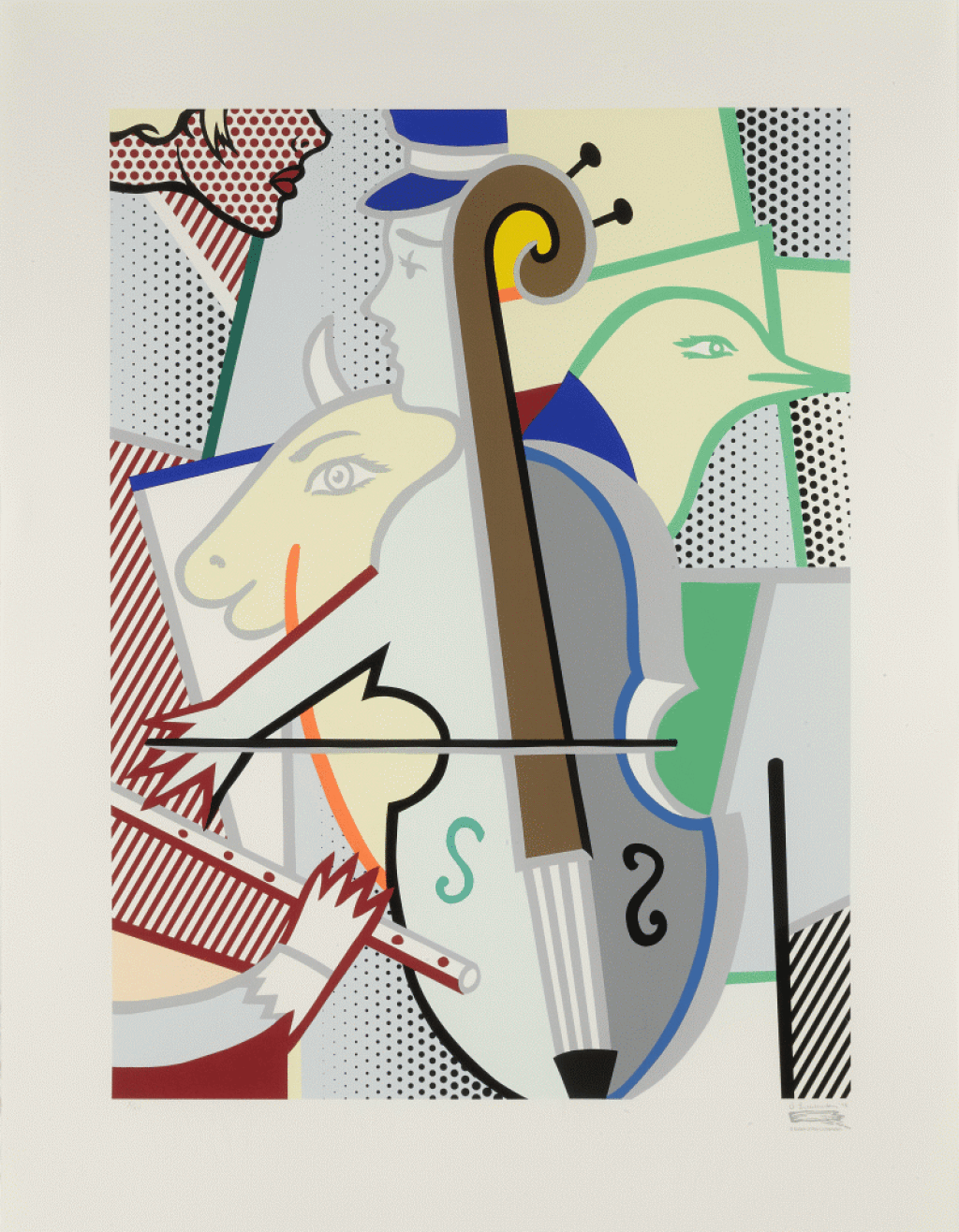
Cubist Cello, 1997-1998
Screen-print in colors on Somerset textured paper
Sheet: 50 7/8 x 39 5/8 inches (129.7 x 100.9 cm)
Edition: 75 + 25 AP + 15 (numbered in Roman numerals)
Literature: Corlett 311