WORK IN PROGRESS
Pablo Picasso is probably the most important figure of the 20th century, in terms of art, and art movements that occurred over this period. Before the age of 50, the Spanish born artist had become the most well-known name in modern art, with the most distinct style and eye for artistic creation. There had been no other artists, prior to Picasso, who had such an impact on the art world, or had a mass following of fans and critics alike, as he did.
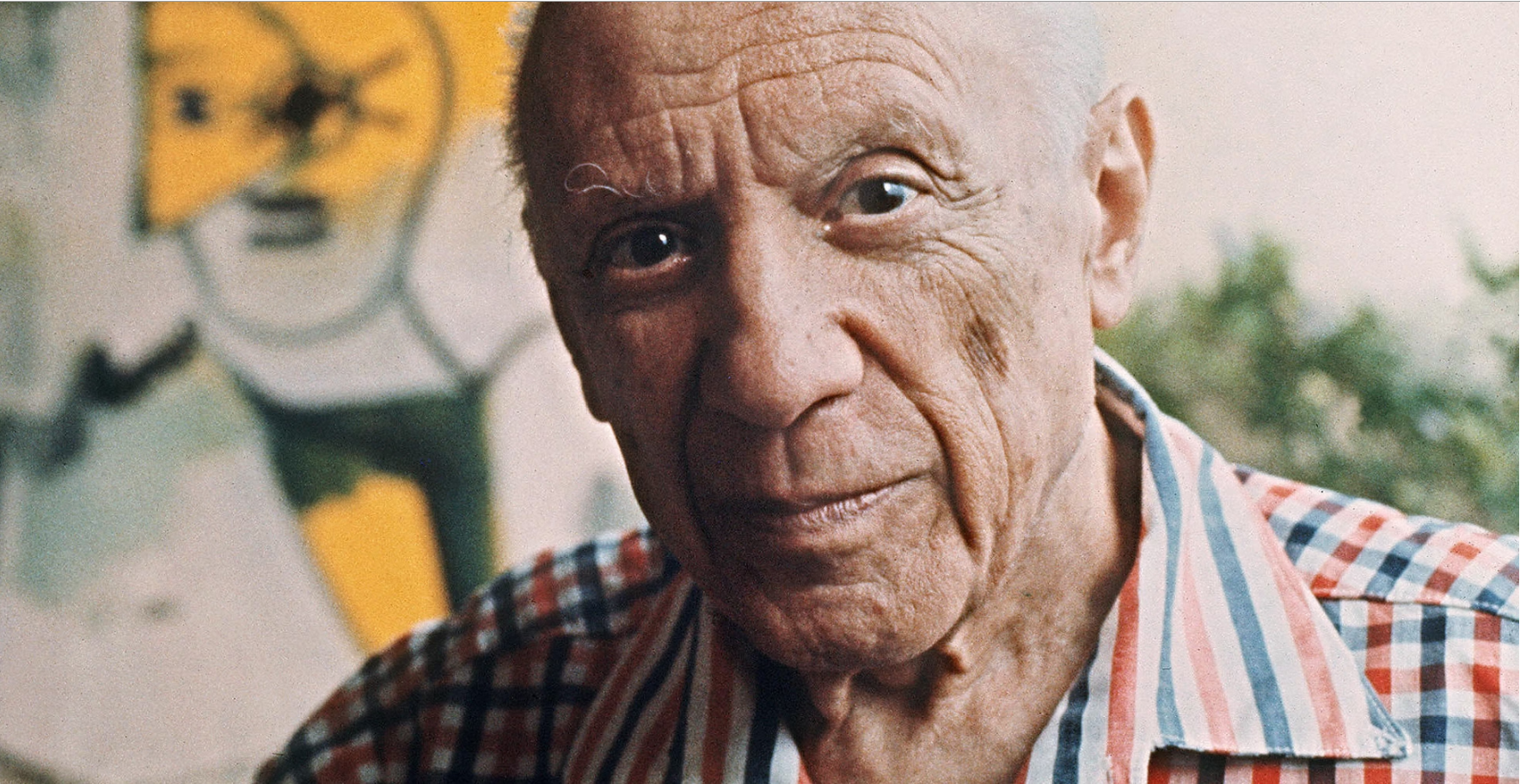
Pablo Picasso was born in Spain in 1881, and was raised there before going on to spend most of his adult life working as an artist in France. Throughout the long course of his career, he created more than 20,000 paintings, drawings, sculptures, ceramics and other items such as costumes and theater sets. He is universally renowned as one of the most influential and celebrated artists of the twentieth century.
As an artist and an innovator, he is responsible for co-founding the entire Cubist movement alongside Georges Braque. Cubism was an avant-garde art movement that changed forever the face of European painting and sculpture while simultaneously affecting contemporary architecture, music and literature. Subjects and objects in Cubism are broken up into pieces and re-arranged in an abstract form. During the period from approximately 1910-1920 when Picasso and Braque were laying the foundation for Cubism in France, its effects were so far-reaching as to inspire offshoots like the styles of Futurism, Dada, and Constructivism in other countries.
Picasso is also credited with inventing constructed sculpture and co-inventing the collage art style. He is also regarded as one of three artists in the twentieth century credited with defining the elements of plastic arts. This revolutionary art form led society toward societal advances in painting, sculpture, printmaking and ceramics by physically manipulating materials that had not previously been carved or shaped. These materials were not just plastic, they were things that could be molded in some way, usually into three dimensions. Artists used clay, plaster, precious metals, and wood to create revolutionary sculptural artwork the world had never seen before.
PART I: SUMMARY
Auction Market Overview
2025 Auction Highlights
29 lots sold at auction in 2025 for a total turnover of USD 229,672,736. With 3 lots failing to sell, the sell-through rate is 91%. The highest price for 2025 was achieved by La Lecture (Marie-Therese), a painting dated 1932, from The Collection of Robert F. and Patricia G. Ross Weis, that sold at Christie’s in New-York, on 17 November 2025, for USD 45,485,000.
2025 Top 3 Lots
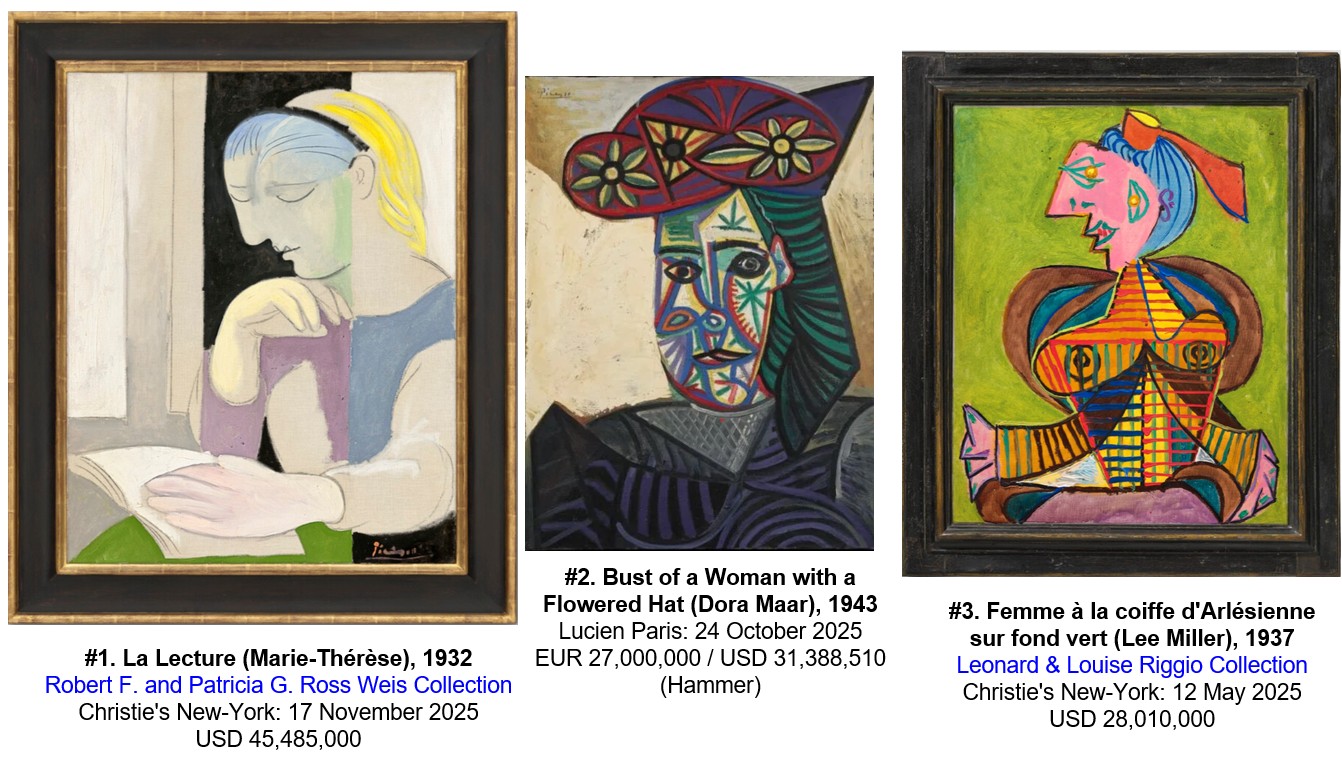
5 lots sold for more than USD 10 million, generating a cumulative turnover of USD 145,272,715, representing 63.3% of the total turnover for 2025.
2024 Auction Highlights
23 lots sold at auction in 2024 for a total turnover of USD 152,894,330. With 6 lots failing to sell, the sell-through rate is 79%. The highest price has been achieved at Sotheby’s in New-York, on 18 November 2024, for La Statuaire, a painting dated 1925, that sold for USD 24,800,000.
2024 Top 3 Lots
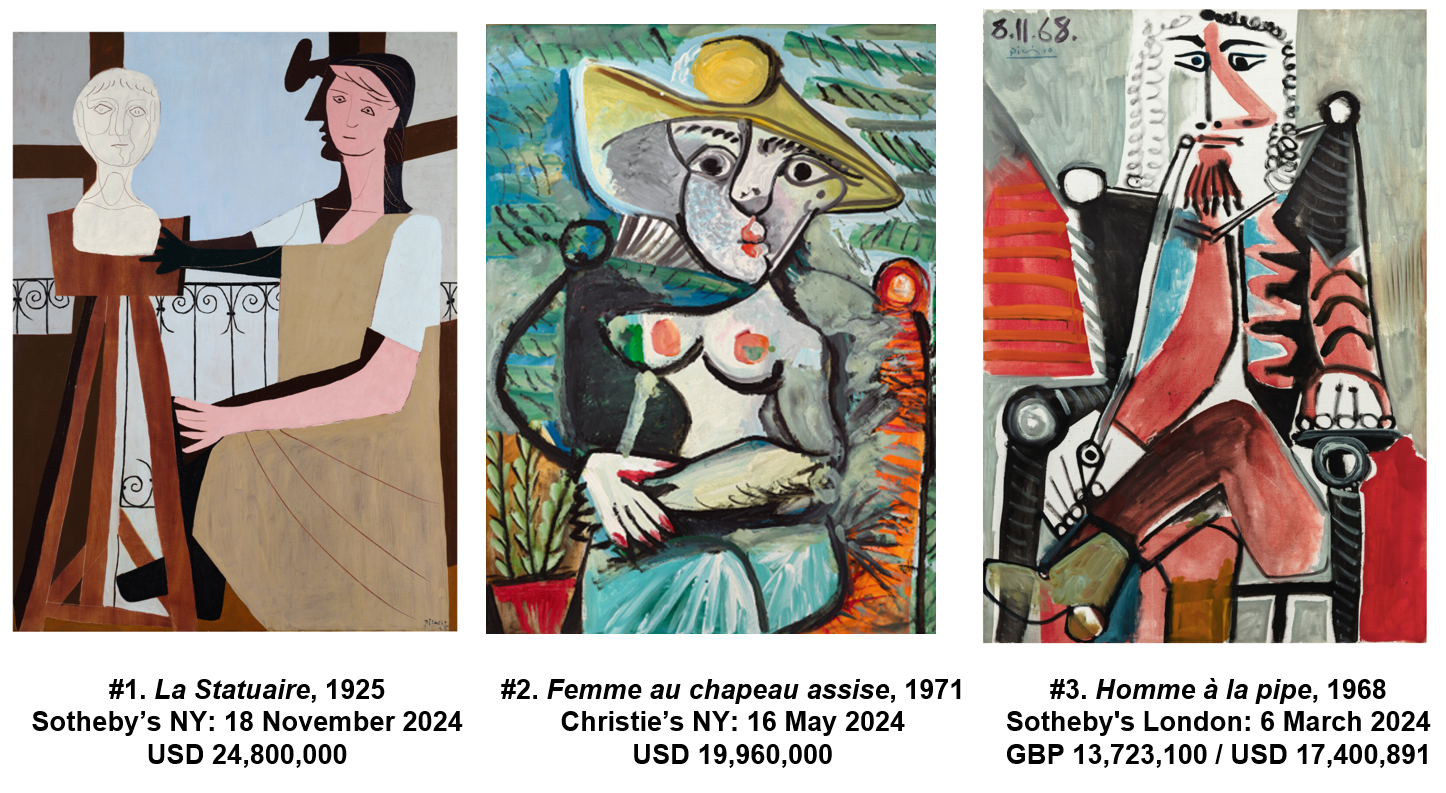
6 lots sold for more than USD 10 million, generating a cumulative turnover of USD 98,602,845, representing 64.5% of the total turnover for 2024. 20 lots sold for more than USD 1 million, generating a cumulative turnover of USD 150,240,120, representing 98.9% of the total turnover for 2024.
2023 Auction Highlights
43 lots sold at auction in 2023 for a total turnover of USD 609,126,000. With 3 lots failing to sell, the sell-through rate is 93%. The highest price has been achieved by Femme a la montre, a painting dated 1932, that sold at Sotheby’s in New-York on 8 November 2023 for USD 139,363,500.
2023 Top 3 Lots
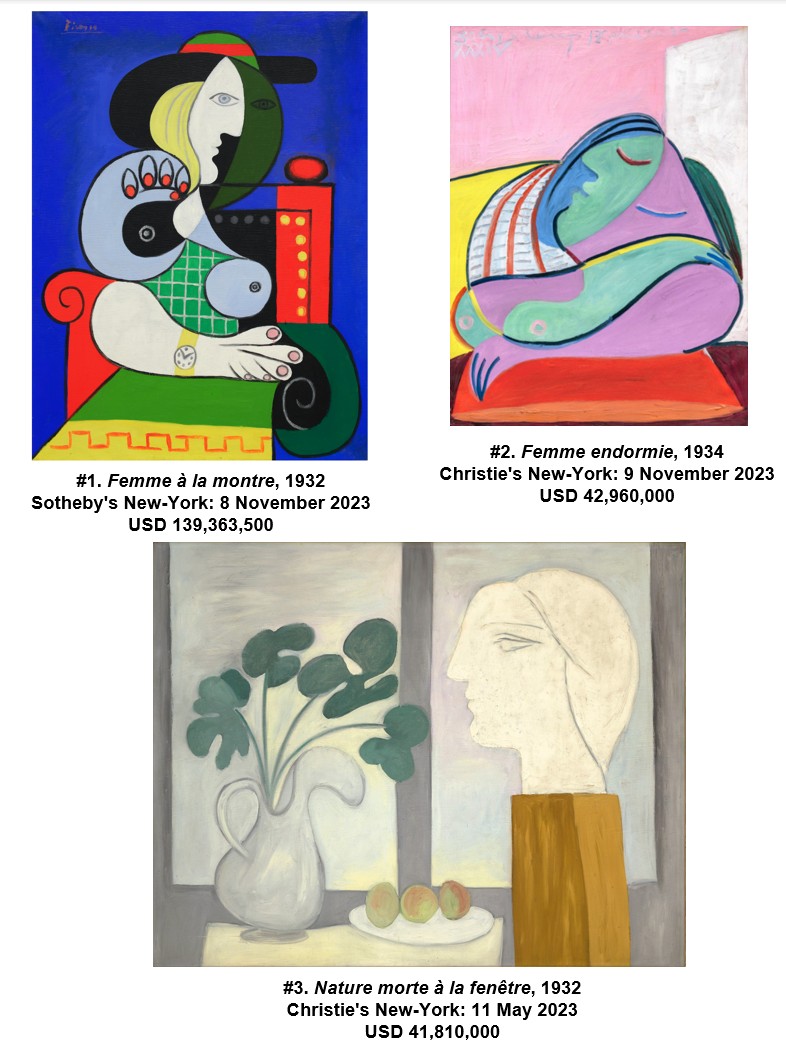
15 lots sold for more than USD 10 million, generating a cumulative turnover of USD 428,400,616, representing 70.3% of the total turnover for 2023.
Top Lots
#1. Les femmes d’Alger (Version ‘O’), 1955
Christie’s New-York: 11 May 2015
Estimate on Request
USD 179,365,000
https://www.christies.com/en/lot/lot-5895962
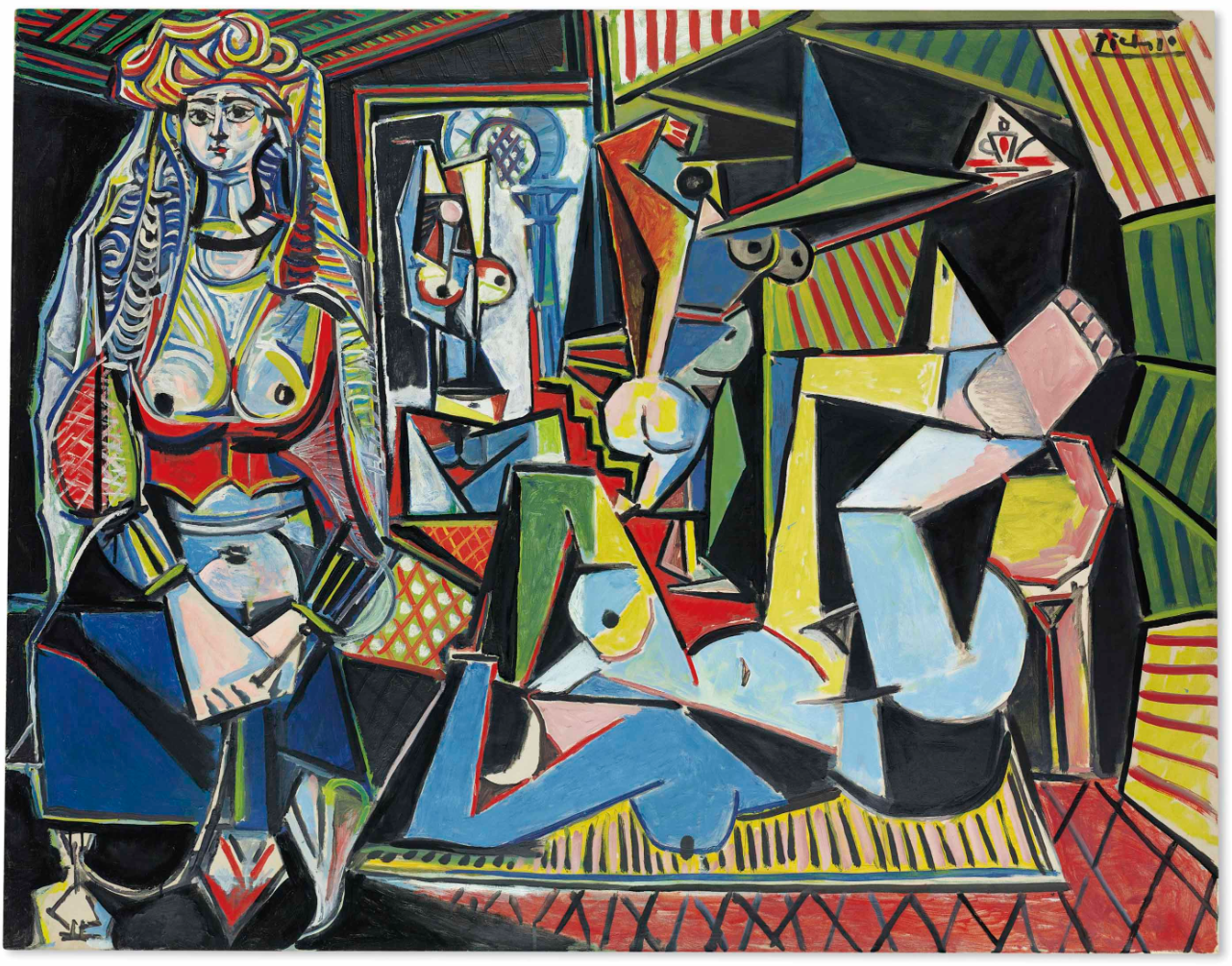
Pablo Picasso (1881-1973)
Les femmes d’Alger (Version ‘O’), 1955
Oil on canvas
114 x 146.4 cm (44 7/8 x 57 5/8 inches)
Signed ‘Picasso’ (upper right); dated ‘14.2.55.’ (on the reverse)
Painted on 14 February 1955
#2. Femme à la montre, 1932
Sotheby’s New-York: 8 November 2023
Estimate Upon Request
USD 139,363,500
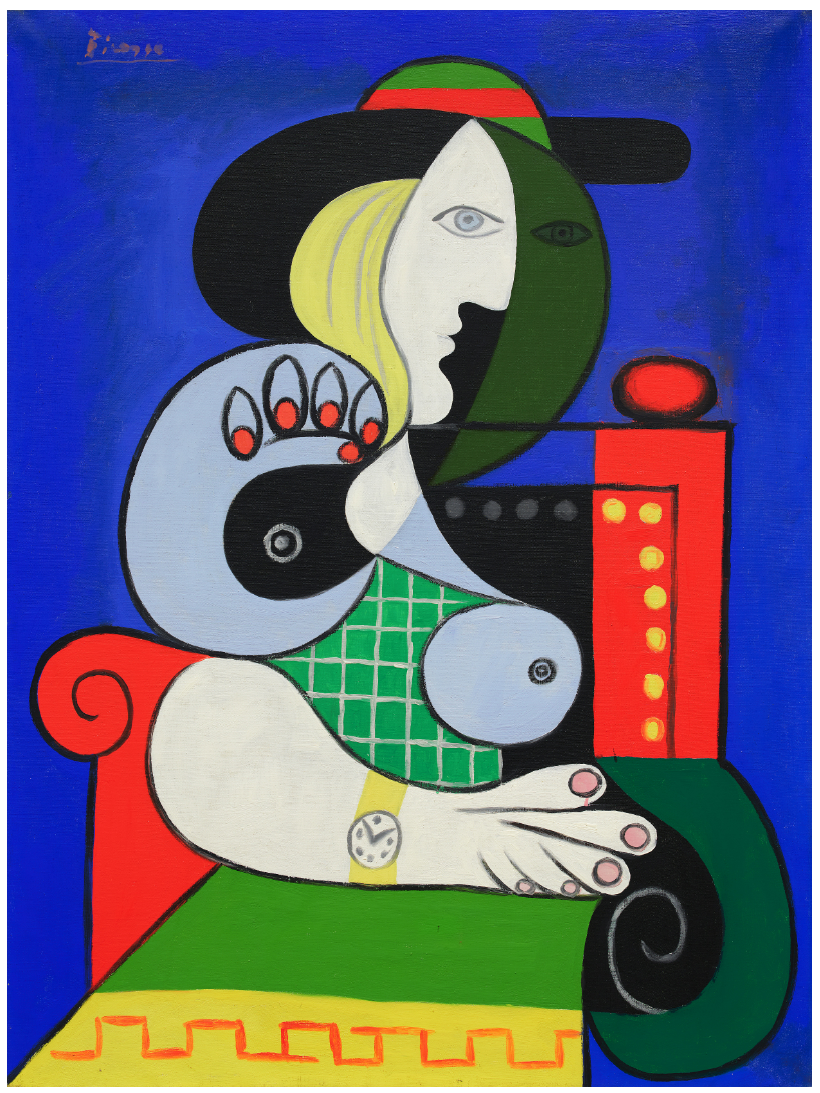
PABLO PICASSO (1881 – 1973)
Femme à la montre, 1932
Oil on canvas
130×97 cm (51 1/8 x 38 1/8 inches)
Signed Picasso (upper left)
Inscribed Boisgeloup and dated 17 Août XXXII. (on the stretcher)
Executed on 17 August 1932
#3. Fillette à la corbeille fleurie, 1905
Christie’s New-York: 8 May 2018
Estimate on Request
USD 115,000,000
https://www.christies.com/en/lot/lot-6134213
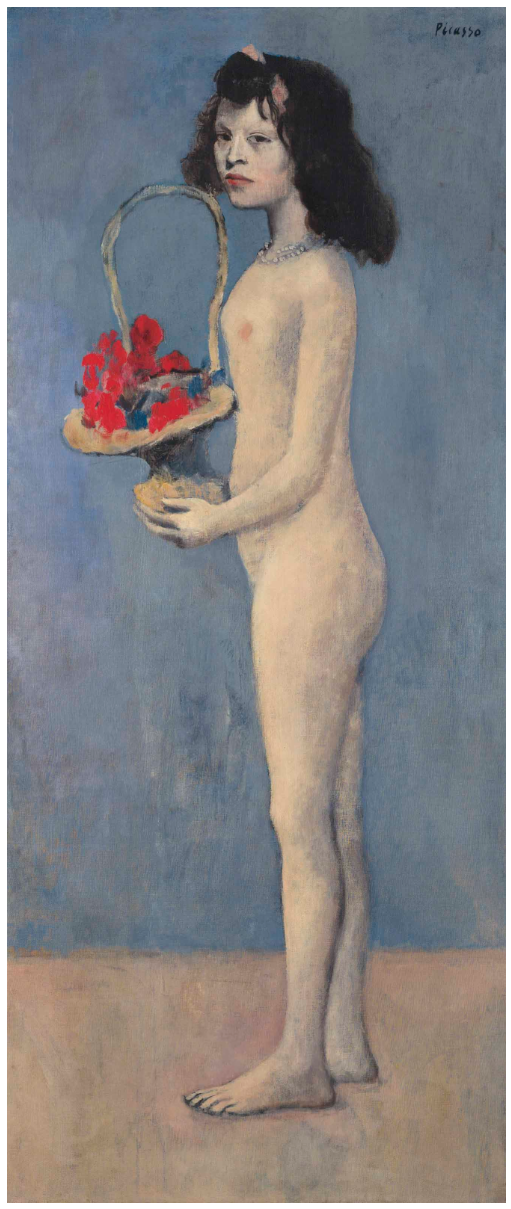
Pablo Picasso (1881-1973)
Fillette à la corbeille fleurie, 1905
Oil on canvas
154.8 x 66.1 cm (60 7/8 x 26 inches)
Signed ‘Picasso’ (upper right)
Signed again, dated and inscribed ‘Picasso 1905 13 Rue Ravignan’ (on the reverse)
#4. Nude, Green Leaves and Bust, 1932
Christie’s New-York: 4 May 2010
Estimate on Request
USD 106,482,500
https://www.christies.com/en/lot/lot-5313319
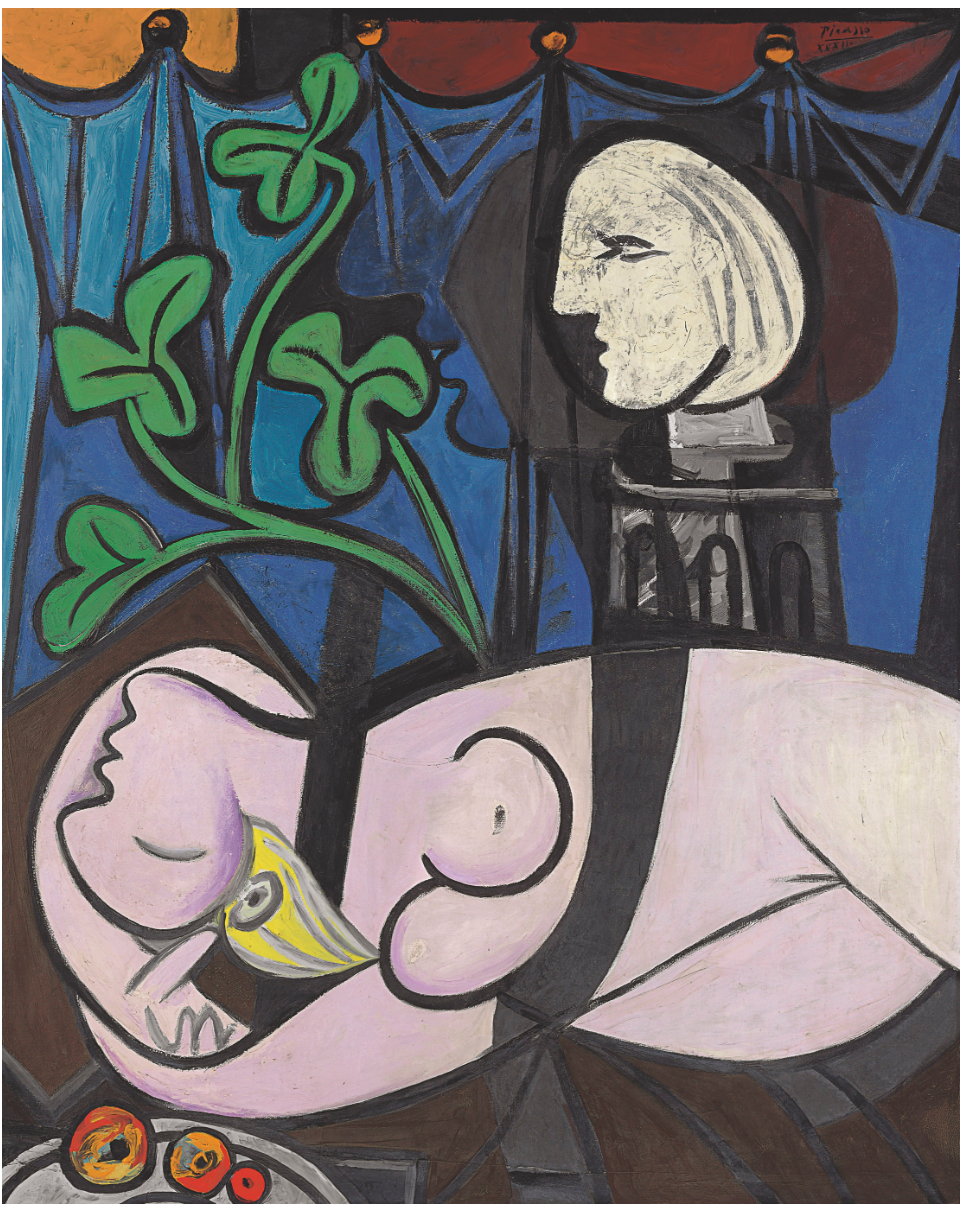
Pablo Picasso (1881-1973)
Nude, Green Leaves and Bust, 1932
Oil on canvas
162×130 cm (63 3/4 x 51 1/4 inches)
Signed and dated ‘Picasso XXXII.’ (upper right)
Painted on 8 March 1932
#5. Garçon à la pipe, 1905
Sotheby’s New-York: 5 May 2004
Estimated: USD 70,000,000
USD 104,168,000
(#7) Pablo Picasso (sothebys.com)
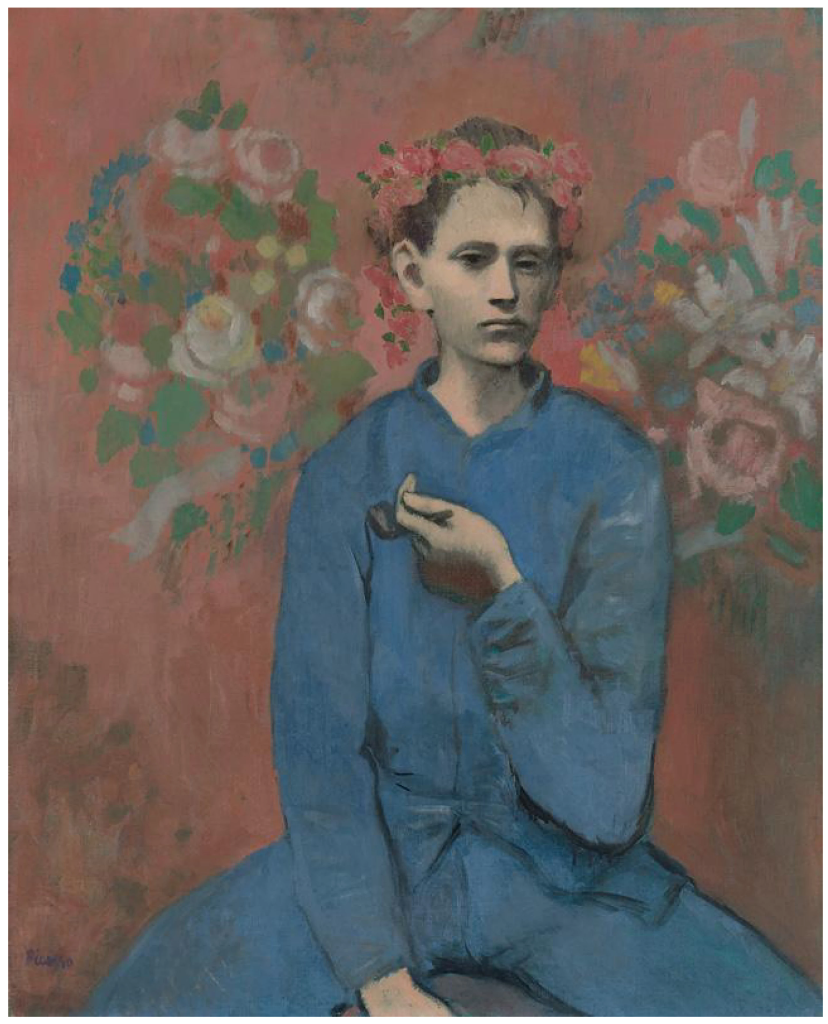
PABLO PICASSO
Garçon à la pipe, 1905
Oil on canvas
99.7 x 81.3 cm (39 1/4 x 32 inches)
Signed Picasso (lower left)
#6. Femme assise près d’une fenêtre (Marie-Thérèse), 1932
Christie’s New-York: 13 May 2021
Estimated: USD 55,000,000 – 70,000,000
USD 103,410,000
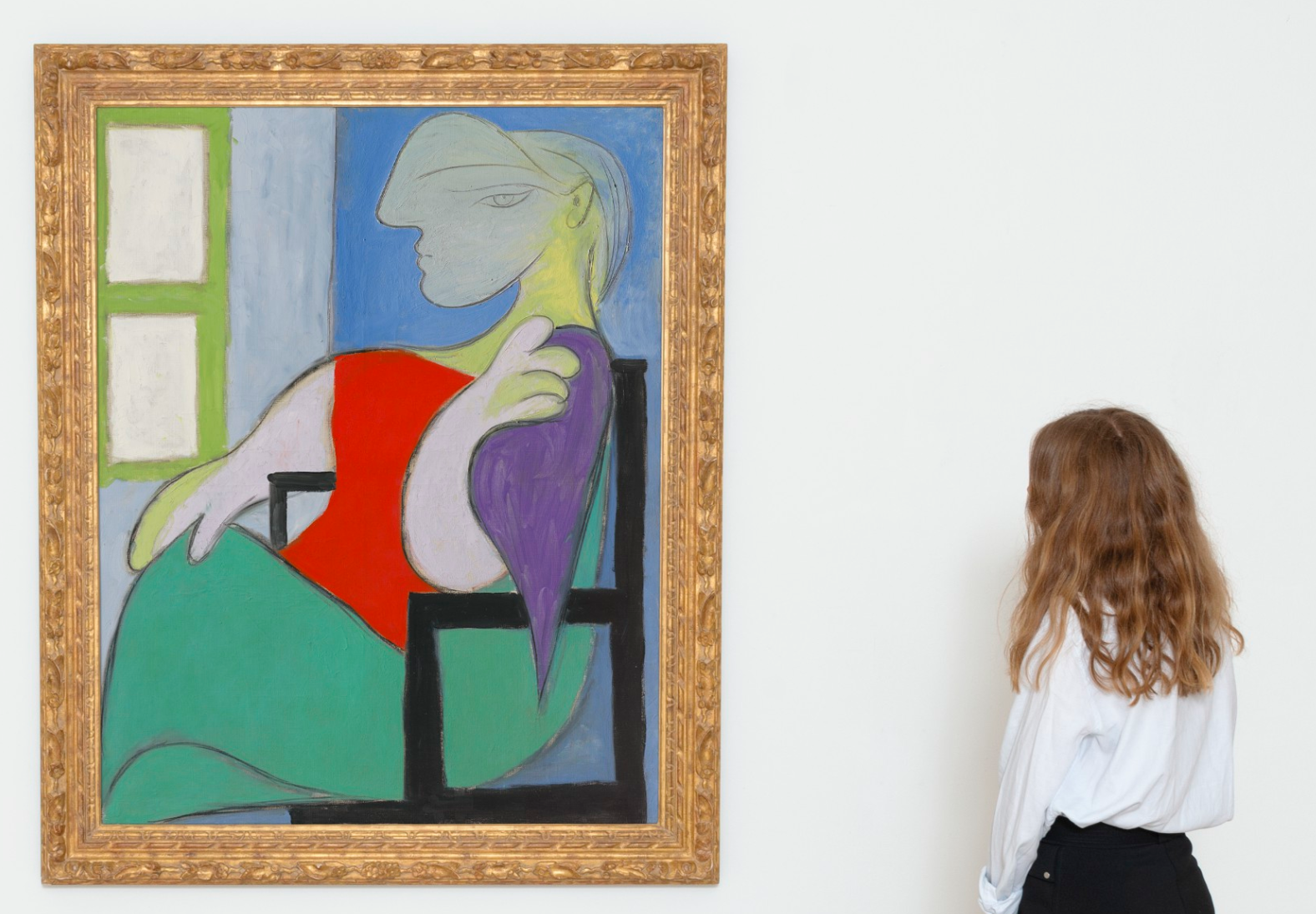
PABLO PICASSO (1881-1973)
Femme assise près d’une fenêtre (Marie-Thérèse), 1932
Oil on canvas
146×114 cm (57 1/2 x 44 7/8 inches)
Dated and inscribed ‘Boisgeloup 30 Octobre XXXII’ (on a piece of the original stretcher affixed to the stretcher)
Painted in Boisgeloup on 30 October 1932
#7. Dora Maar au chat, 1941
Sotheby’s New-York: 2 May 2006
Estimated: USD 50,000,000 – 70,000,000
USD 95,216,000
(#14) Pablo Picasso (sothebys.com)
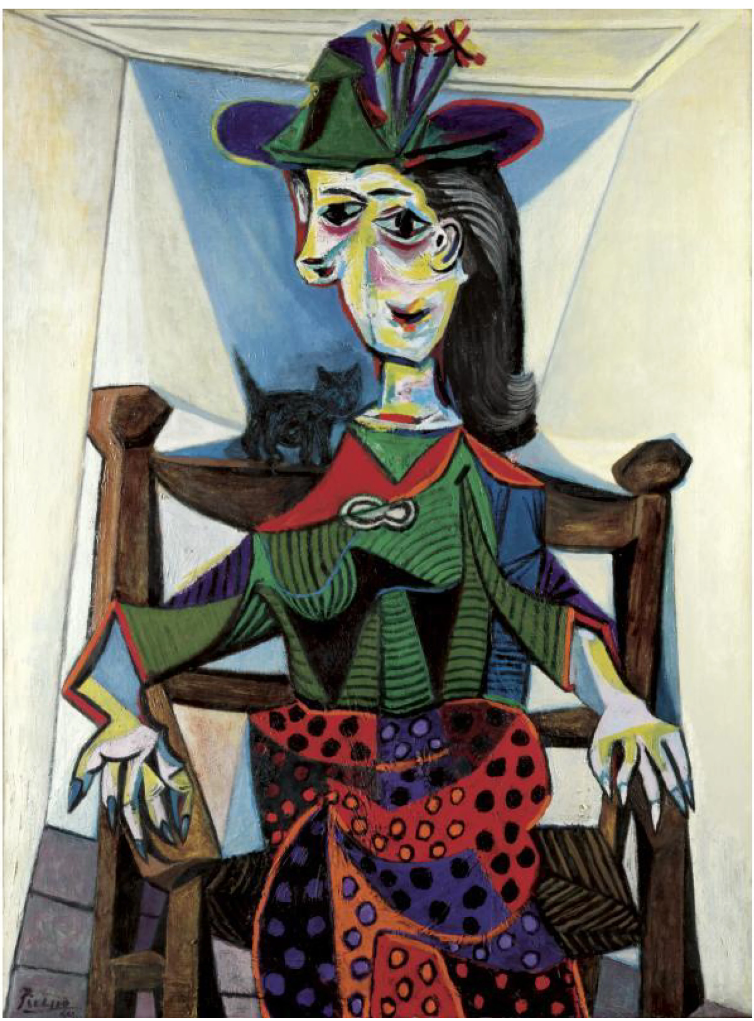 PABLO PICASSO
Dora Maar au chat, 1941
Oil on canvas
129.5 x 97 cm (51×38 inches)
Signed and dated Picasso 41. (lower left)
#8. Femme au béret et à la robe quadrillée, 1937
Sotheby’s London: 28 February 2018
Estimate upon Request
GBP 49,827,000 / USD 68,535,375
(#7) PABLO PICASSO | Femme au béret et à la robe quadrillée (Marie-Thérèse Walter) (sothebys.com)
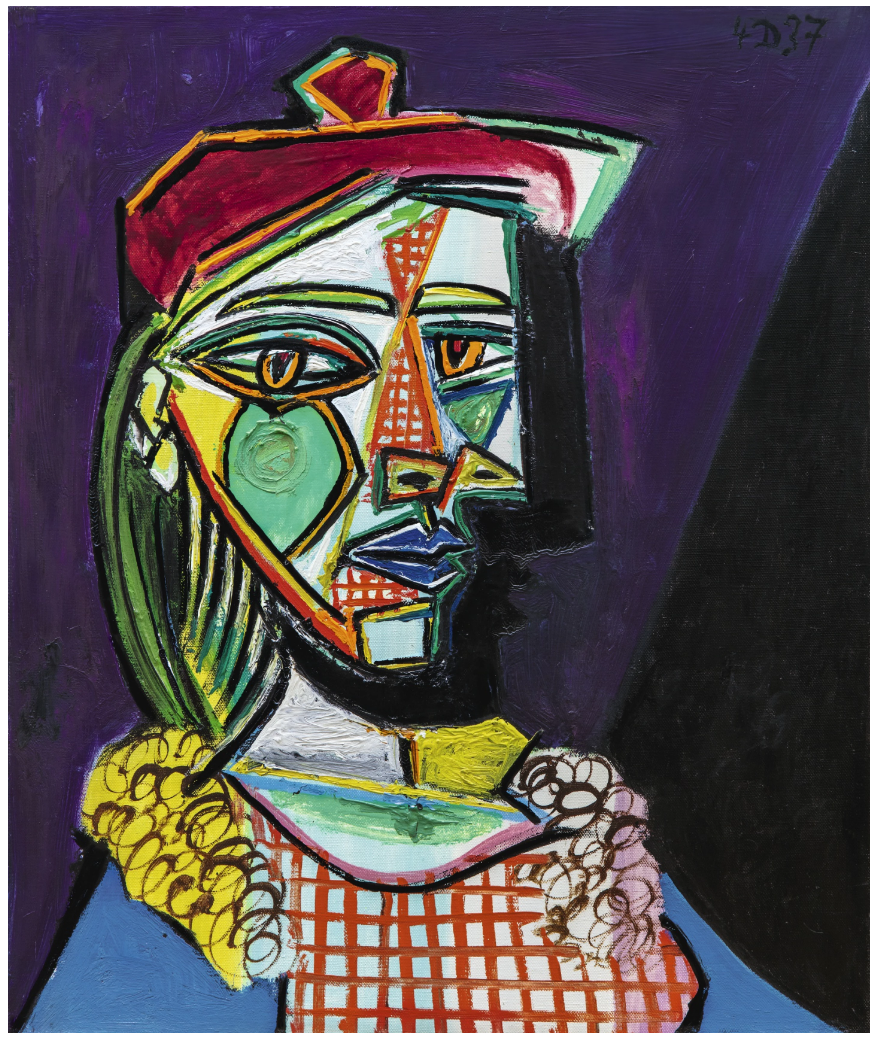
PABLO PICASSO
Femme au béret et à la robe quadrillée (Marie-Thérèse Walter), 1937
Oil on canvas
55×46 cm (21 5/8 x 18 1/8 inches)
Dated 4 D 37 (upper right)
Painted on 4th December 1937
#9. Femme nue couchée, 1932
Sotheby’s New-York: 17 May 2022
Estimate upon Request
USD 67,541,000
Femme nue couchée | Modern Evening Auction | 2022 | Sotheby’s (sothebys.com)
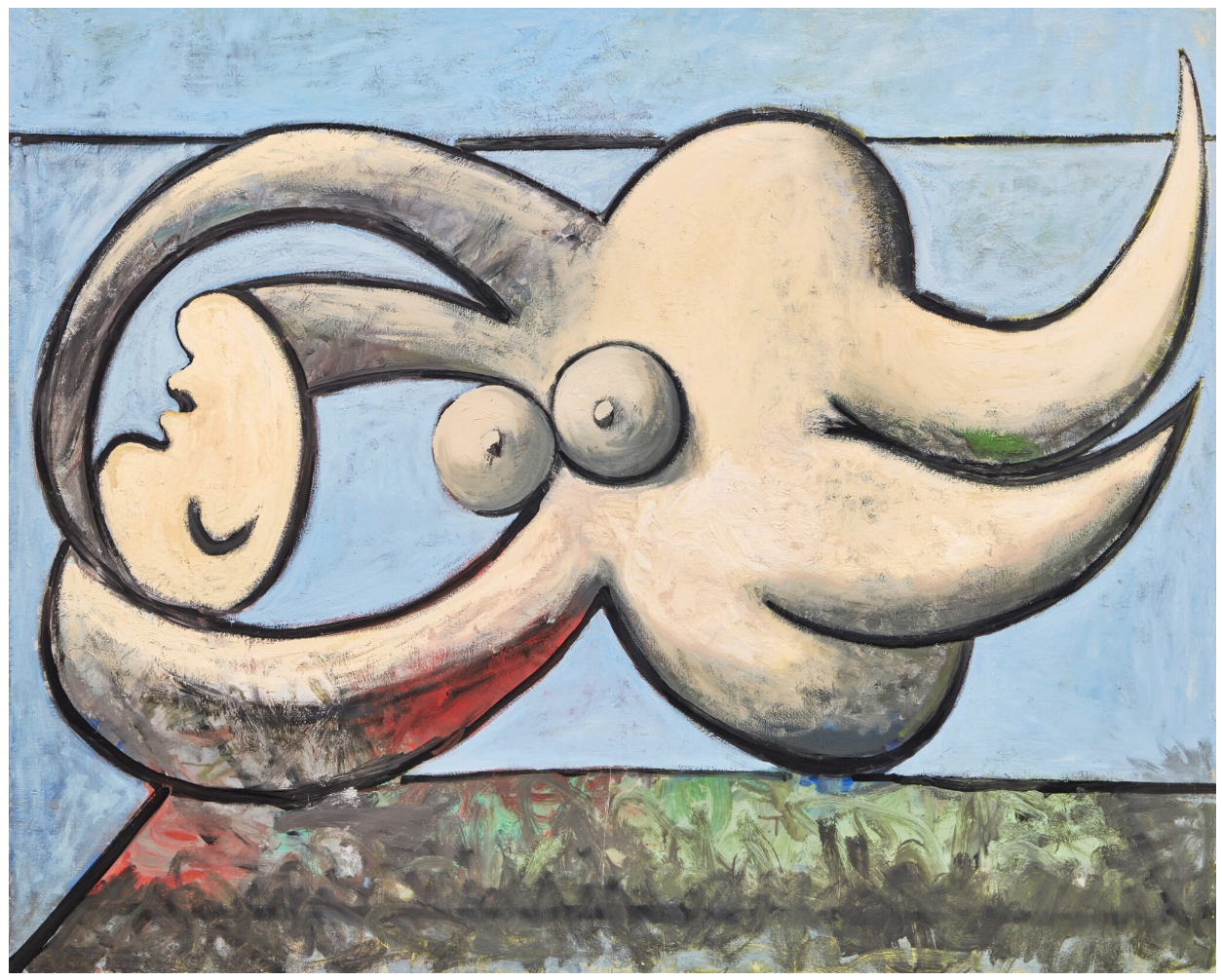
PABLO PICASSO (1881 – 1973)
Femme nue couchée, 1932
Oil and Ripolin on canvas
129.9 x 161.7 cm (51 1/8 x 63 5/8 inches)
Dated Boisgeloup 2 Avril XXXII (on the stretcher)
Executed in Boisgeloup on 2 April 1932
#10. La Gommeuse, 1901
Sotheby’s New-York: 5 November 2015
Estimated: USD 60,000,000
USD 67,450,000
(#26) Pablo Picasso (sothebys.com)
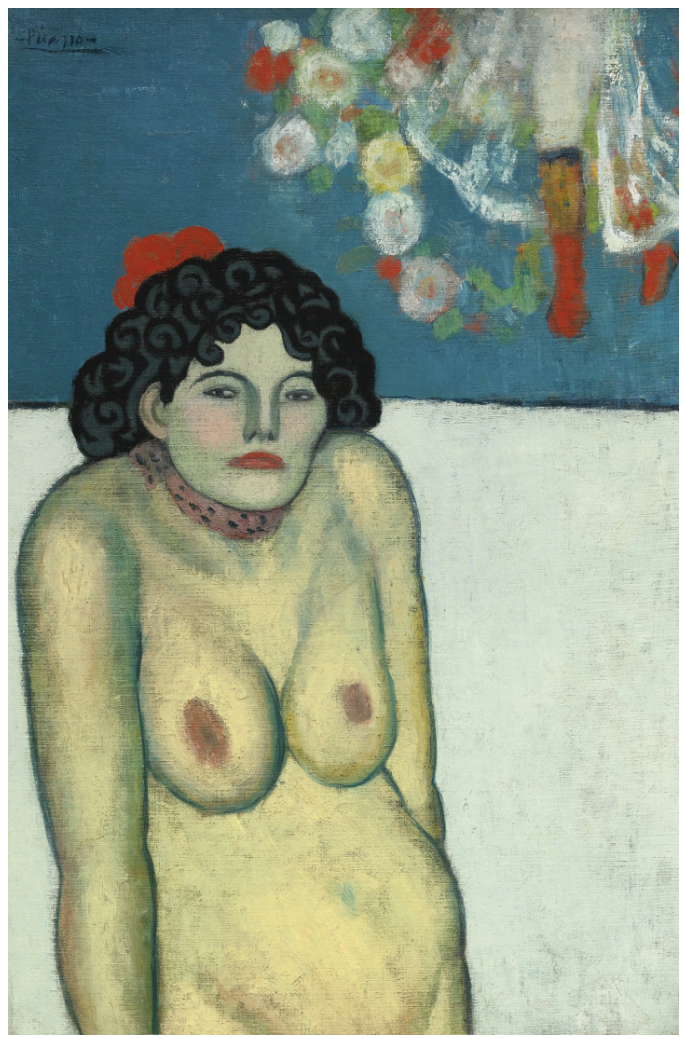
PABLO PICASSO
La Gommeuse, 1901
Oil on canvas
81.3 x 54 cm (31 7/8 x 21 1/4 inches)
Signed Picasso (upper left); inscribed Recuerdo a Mañach en el día de su santo and fully painted on the reverse
PART II: AUCTION RESULTS
2026 Auction Results
FOR PAINTINGS & SCULPTURES ONLY
PRELIMINARY AUCTION RESULTS
As of 30 June 2026
#1. Tête de femme (Fernande), 1909
Masterpieces: The Private Collection of S.I. Newhouse
Christie’s New-York: 18 May 2026
Estimated: USD 40,000,000 – 60,000,000
USD 48,360,000
PABLO PICASSO (1881-1973), Tête de femme (Fernande) | Christie’s
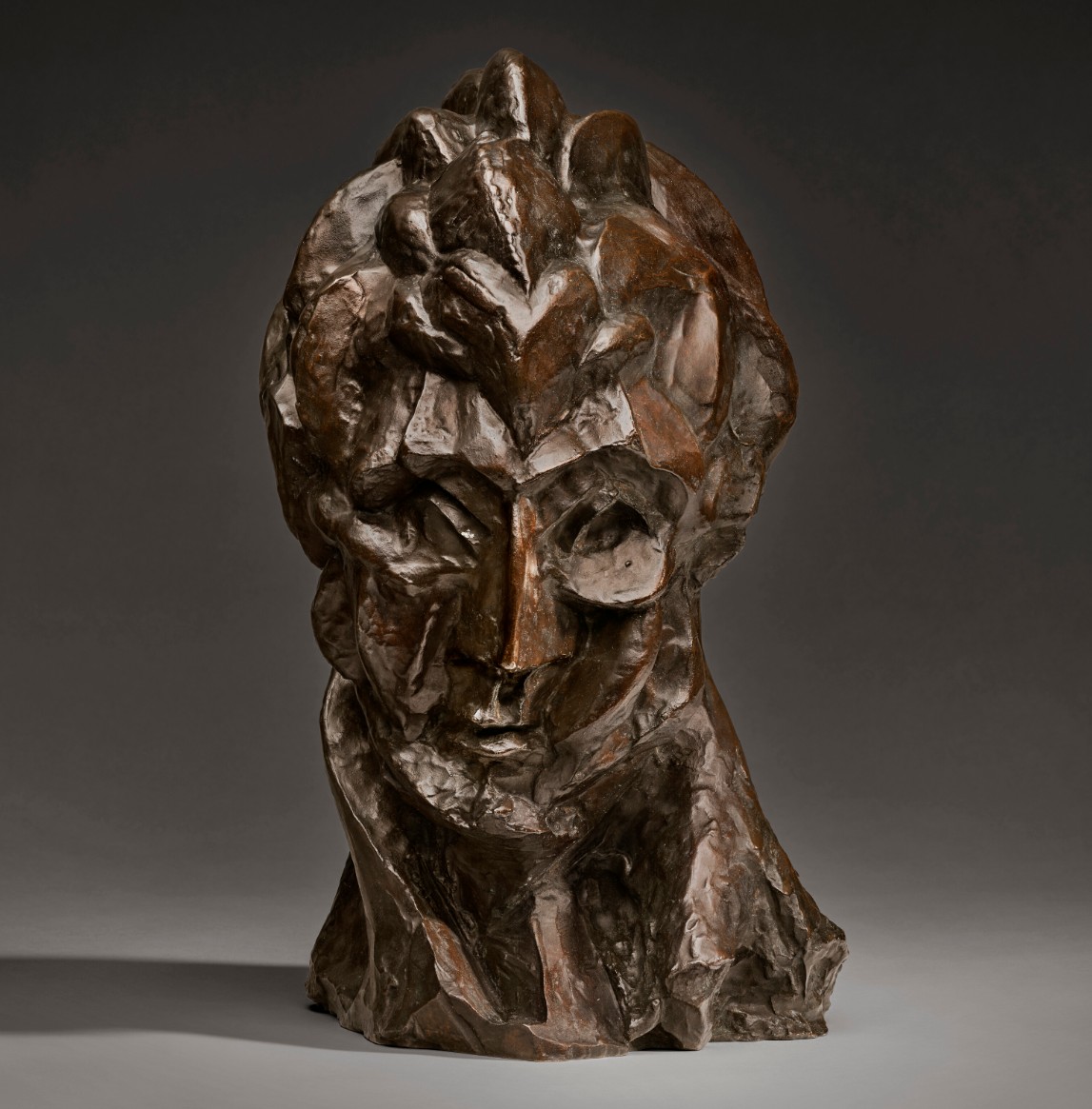
PABLO PICASSO (1881-1973)
Tête de femme (Fernande), 1909
Bronze with dark brown patina
Height: 40.8 cm (16-1/8 inches)
Signed ‘Picasso’ (on the side of the neck)
#2. Arlequin (Buste), 1909
A Night in May: The Collection of Adele & Enrico Donati
Sotheby’s New-York: 19 May 2026
Estimate on Request
USD 42,640,000
Pablo Picasso | Arlequin (Buste) | Modern Evening Auction | 2026 |
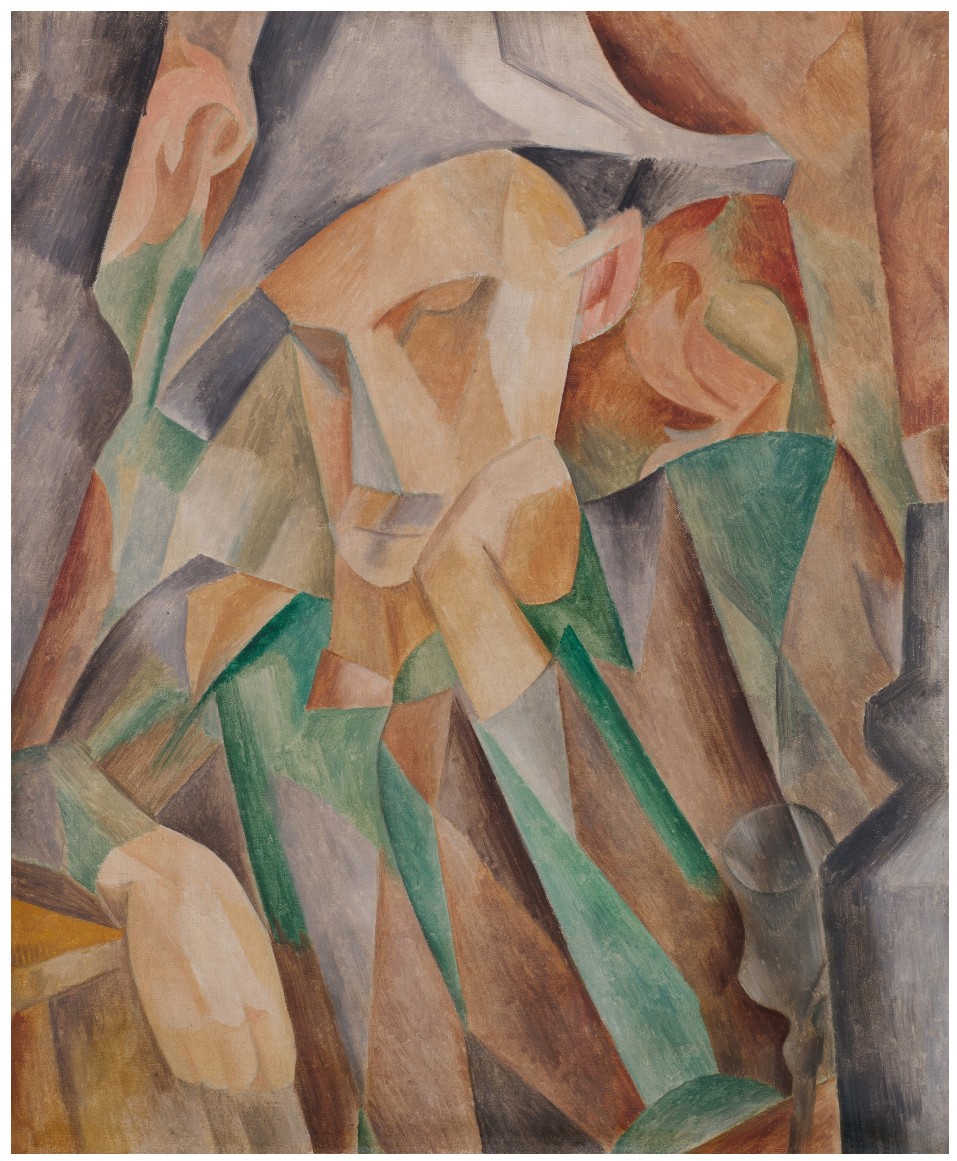
PABLO PICASSO (1881 – 1973)
Arlequin (Buste), 1909
Oil on canvas
73 x 60.3 cm (28-3/4 x 23-3/4 inches)
Signed Picasso (on the reverse)
Executed in spring 1909
#3. Homme à la guitare, 1913
Masterpieces: The Private Collection of S.I. Newhouse
Christie’s New-York: 18 May 2026
Estimated: USD 35,000,000 – 55,000,000
USD 40,885,000
PABLO PICASSO (1881-1973), Homme à la guitare | Christie’s
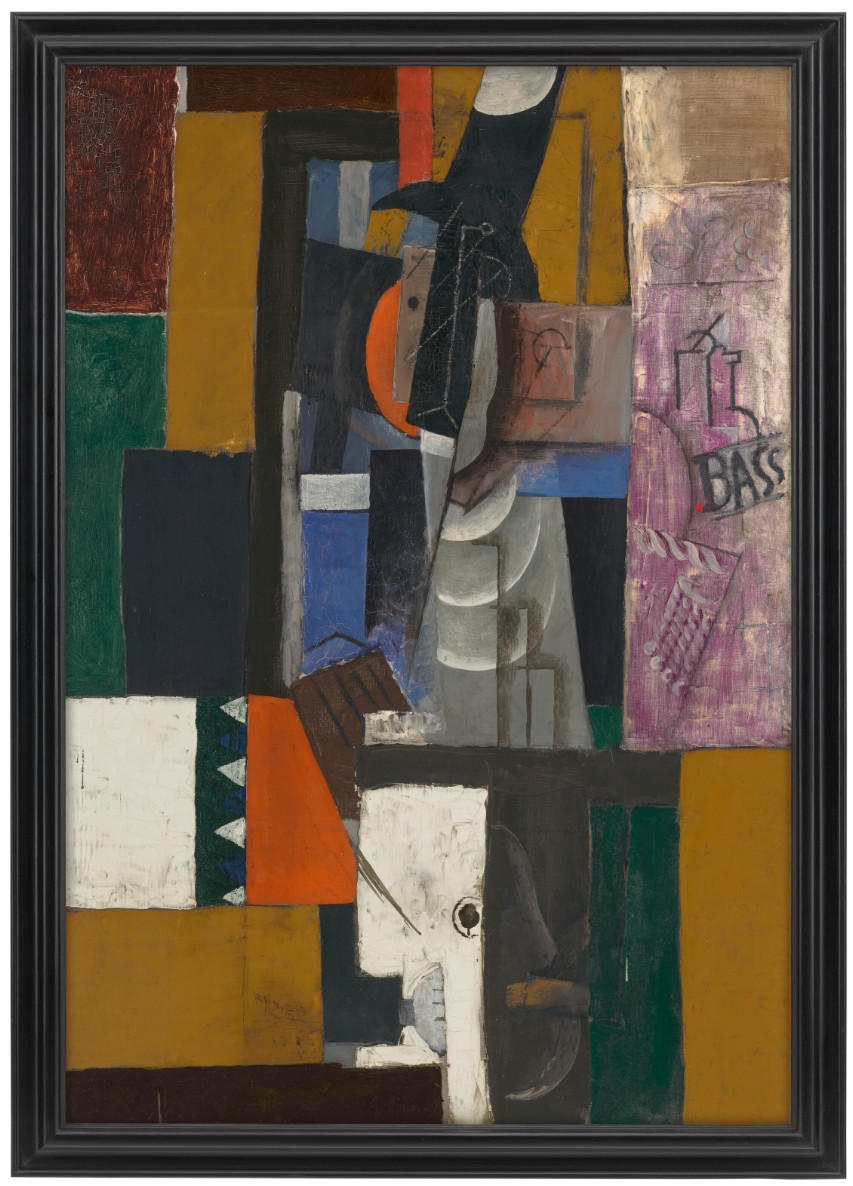
PABLO PICASSO (1881-1973)
Homme à la guitare, 1913
Oil, encaustic and sand on canvas
130.5 x 89.6 cm (51-3/8 x 35-1/4 inches)
Signed, dated and inscribed ‘PICASSO Céret 1913’ (on the reverse)
Painted in Céret in 1913
#4. Buste de femme, 1938
Masterpieces from the Lewis Collection
Sotheby’s London: 24 June 2026
Estimated: GBP 12,000,000 – 18,000,000
GBP 23,855,000 / USD 31,487,095
Pablo Picasso | Buste de femme | Masterpieces from the Lewis
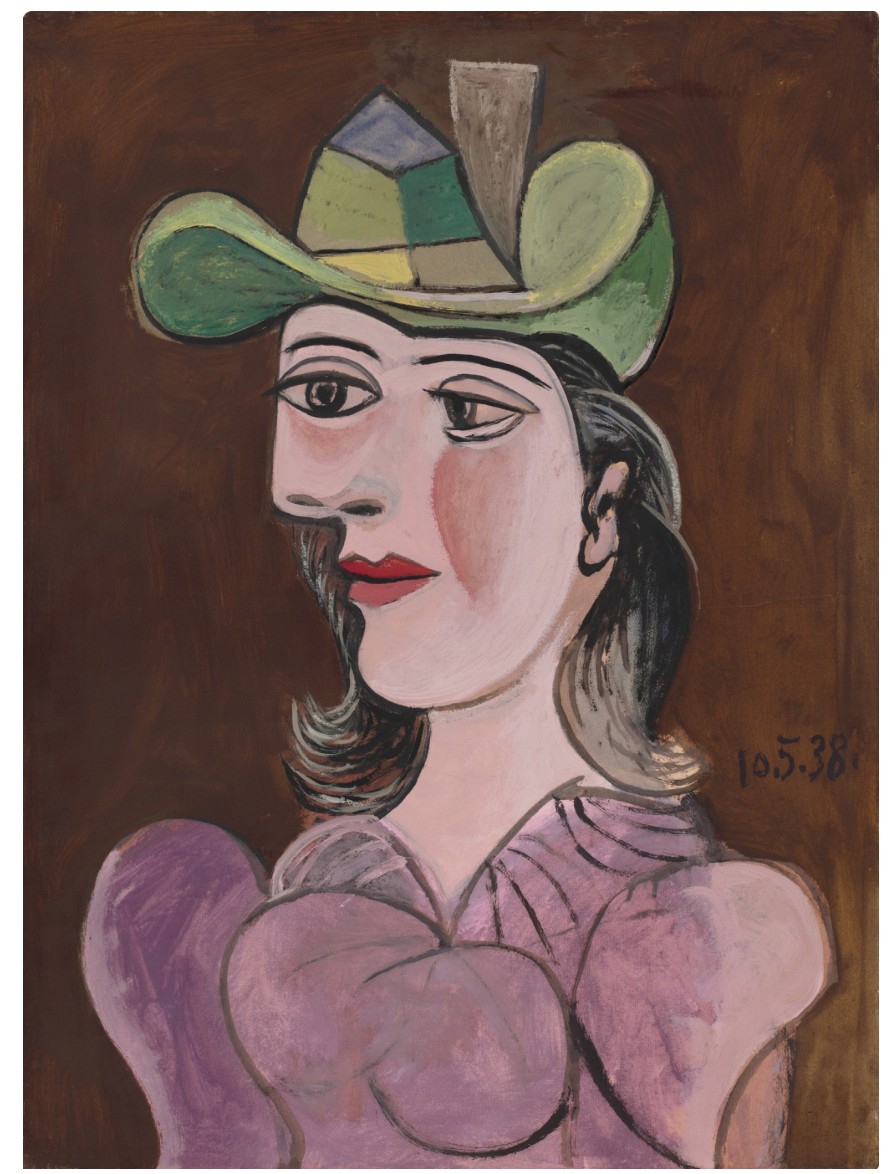
PABLO PICASSO (1881 – 1973)
Buste de femme, 1938
Oil on paper laid down on canvas
78.7 x 60.5 cm (31 x 23-7/8 inches)
Signed indistinctly Picasso (lower right)
Dated 10.5.38 (centre right)
#5. La femme enceinte, 1er état, 1950/1951-53
Masterpieces: The Private Collection of S.I. Newhouse
Christie’s New-York: 18 May 2026
Estimated: USD 18,000,000 – 25,000,000
USD 22,485,000
PABLO PICASSO (1881-1973), La femme enceinte, 1er état | Christie’s
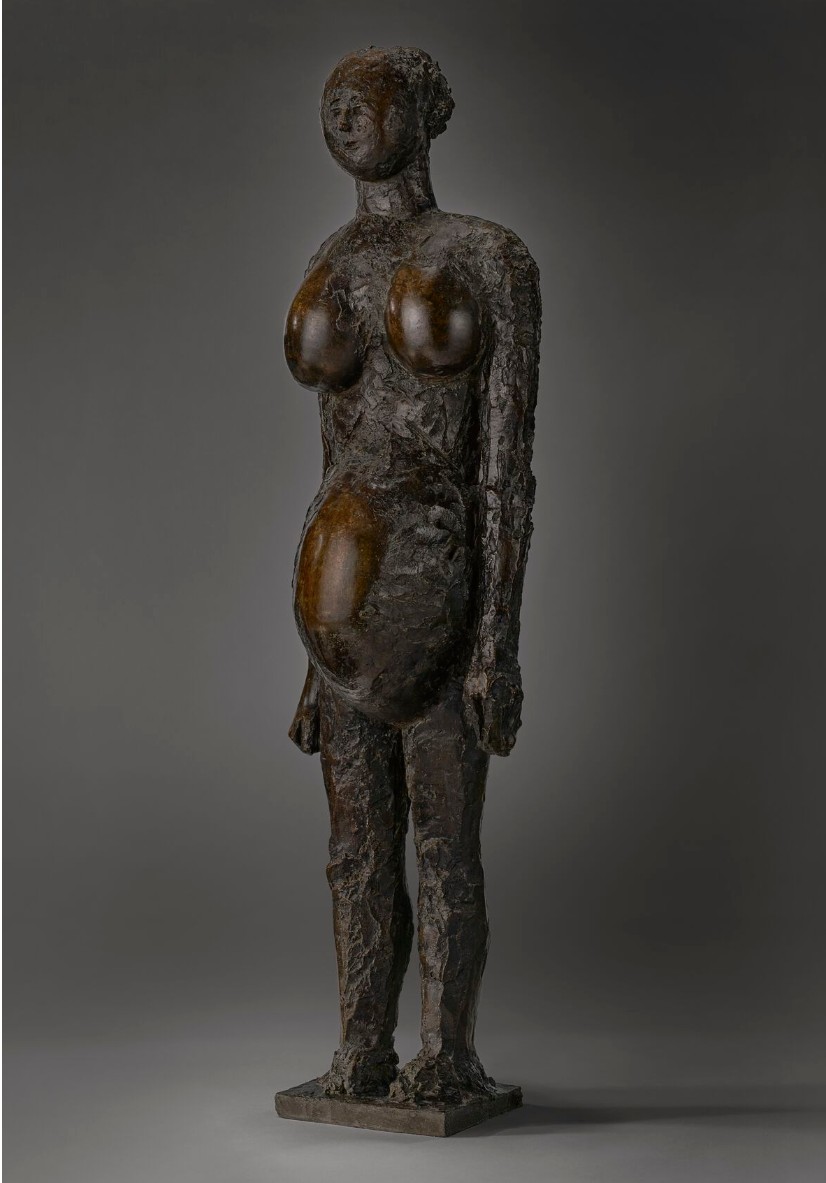
PABLO PICASSO (1881-1973)
La femme enceinte, 1er état, 1950/1951-53
Bronze with brown patina
Height: 104.7 cm (41-1/4 inches)
Stamped with foundry mark ‘C. VALSUANI CIRE PERDUE’ (on the top of the base)
Conceived in 1950; this bronze version cast circa 1951-1953
#6. Tête de femme, 1907
Masterpieces: The Private Collection of S.I. Newhouse
Christie’s New-York: 18 May 2026
Estimated: USD 6,000,000 – 8,000,000
USD 14,435,000
PABLO PICASSO (1881-1973), Tête de femme | Christie’s
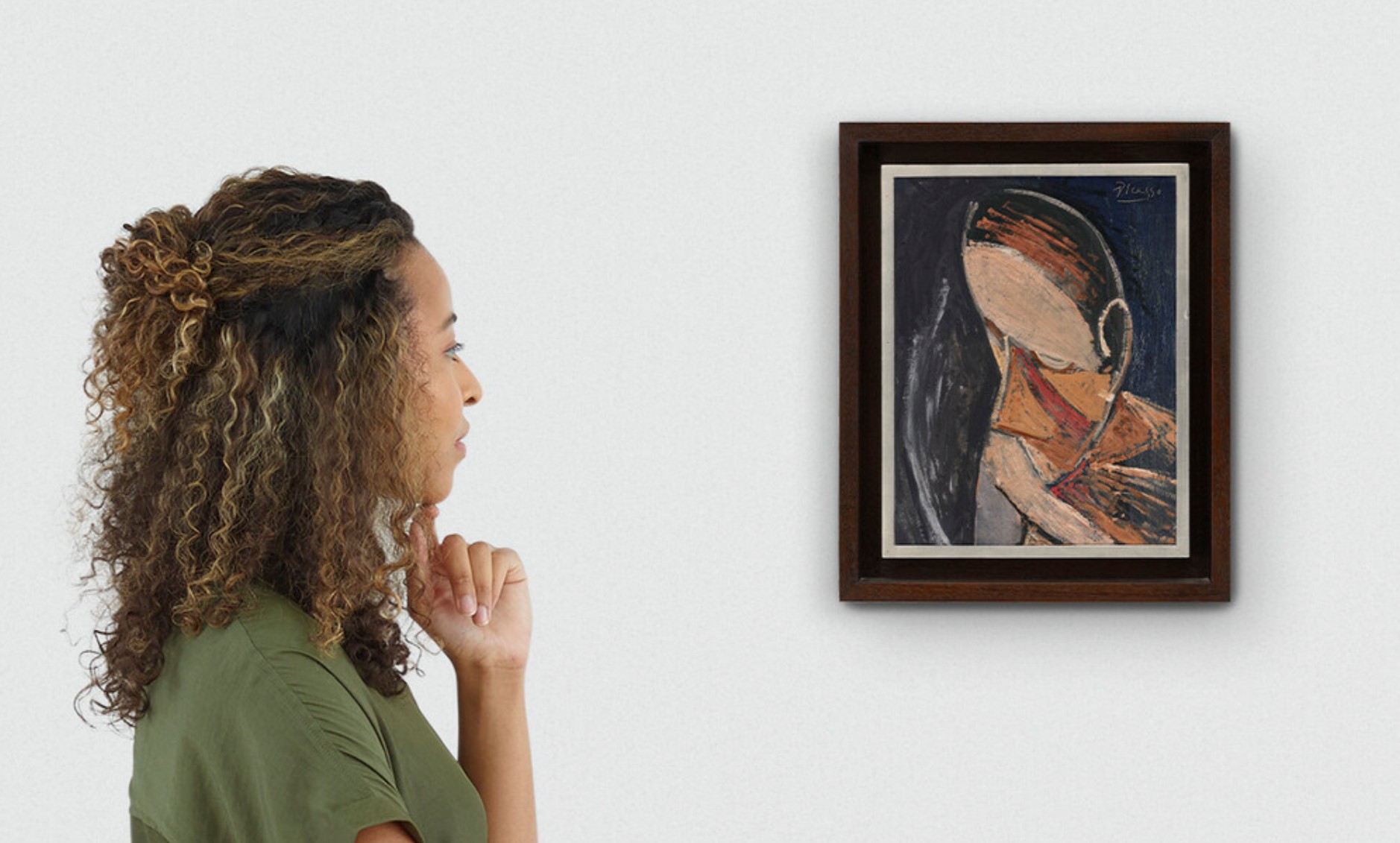
PABLO PICASSO (1881-1973)
Tête de femme, 1907
Oil on card laid down on canvas
35.1 x 27.1 cm (13-7/8 x 10-5/8 inches)
Signed ‘Picasso’ (upper right)
#7. Le peintre et son modèle, 1964
THE PROPERTY OF A DISTINGUISHED PRIVATE COLLECTOR
Christie’s London: 5 March 2026
Estimated: GBP 7,000,000 – 10,000,000
GBP 8,520,000 / USD 11,381,870
PABLO PICASSO (1881-1973), Le peintre et son modèle | Christie’s
REPEAT SALE
Christie’s New-York: 19 November 2022
Estimated: USD 8,000,000 – 12,000,000
USD 10,351,500
PABLO PICASSO (1881-1973), Le peintre et son modèle | Christie’s
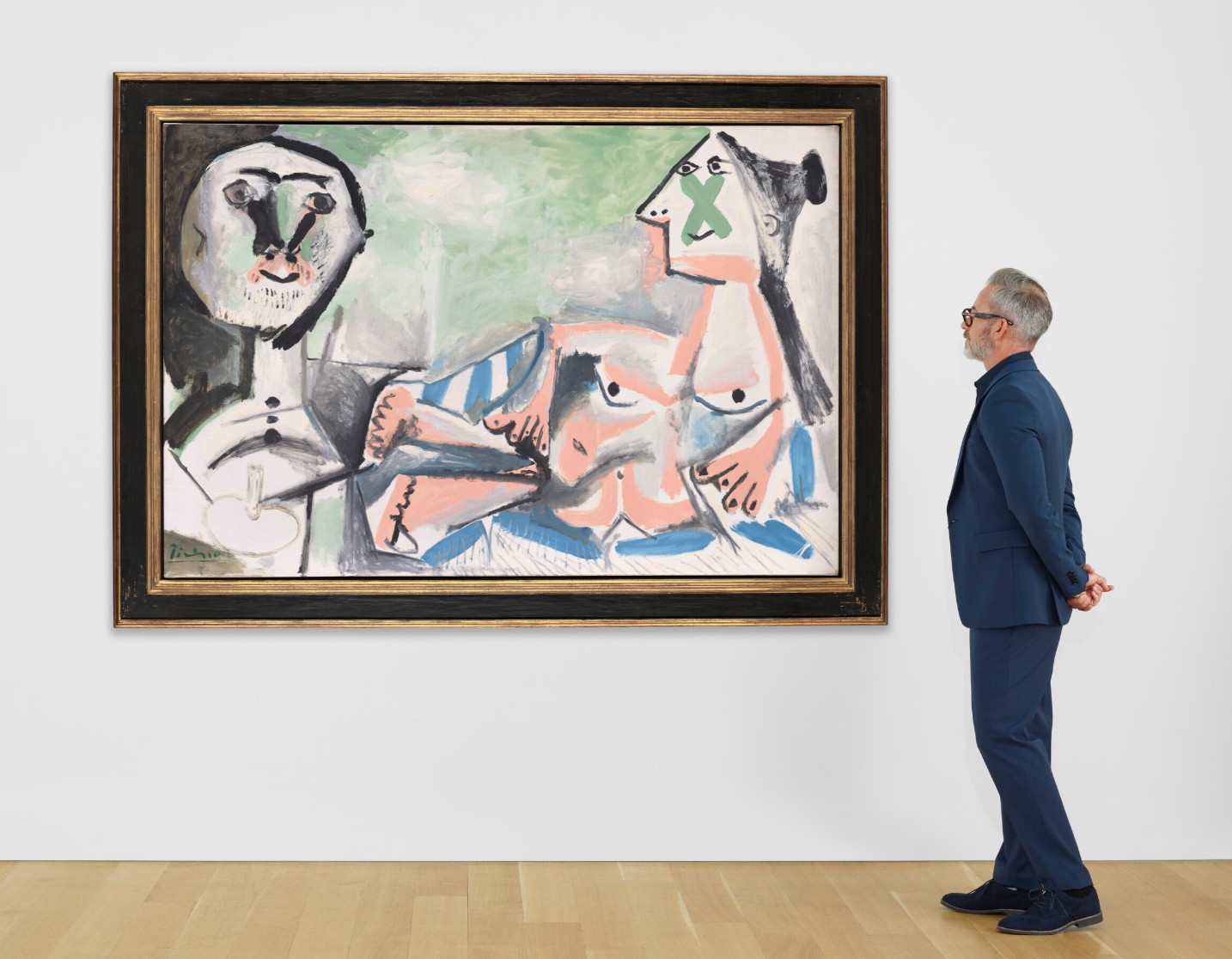
PABLO PICASSO (1881-1973)
Le peintre et son modèle, 1964
Oil and Ripolin on canvas
130×195 cm (51-1/8 x 76-3/4 inches)
Signed ‘Picasso’ (lower left)
Dated ‘8.9.11.64.’ (on the reverse)
Painted in Mougins on 8-9 November 1964
USD 10 million
#8. Baigneuses, sirènes, femme nue et minotaure, 1937
Masterpieces from the Lewis Collection
Sotheby’s London: 24 June 2026
Estimated: GBP 3,500,000 – 4,500,000
GBP 7,044,000 / USD 9,436,475
Pablo Picasso | Baigneuses, sirènes, femme nue et minotaure |
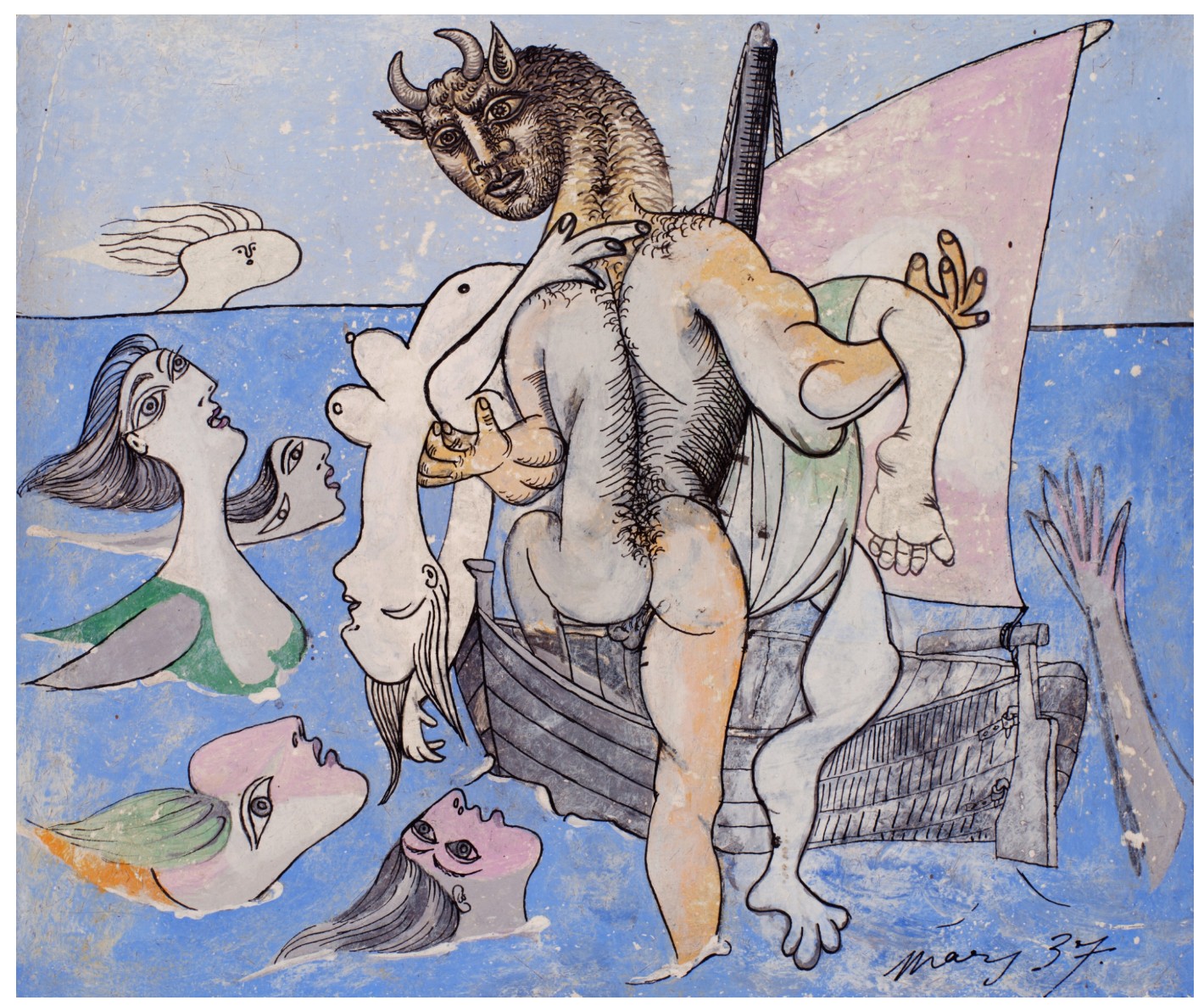
PABLO PICASSO (1881 – 1973)
Baigneuses, sirènes, femme nue et minotaure, 1937
Ripolin, gouache, pen and India ink on board
22.4 x 26.5 cm (8-3/4 x 10-1/2 inches)
Dated mars 37. (lower right)
Dated mars 37. (on the reverse)
#9. Nu debout et femmes assises, 1939
The Roger and Josette Vanthournout Collection
Christie’s London: 5 March 2026
Estimated: GBP 3,500,000 – 5,500,000
GBP 7,004,000 / USD 9,356,645
PABLO PICASSO (1881-1973), Nu debout et femmes assises | Christie’s
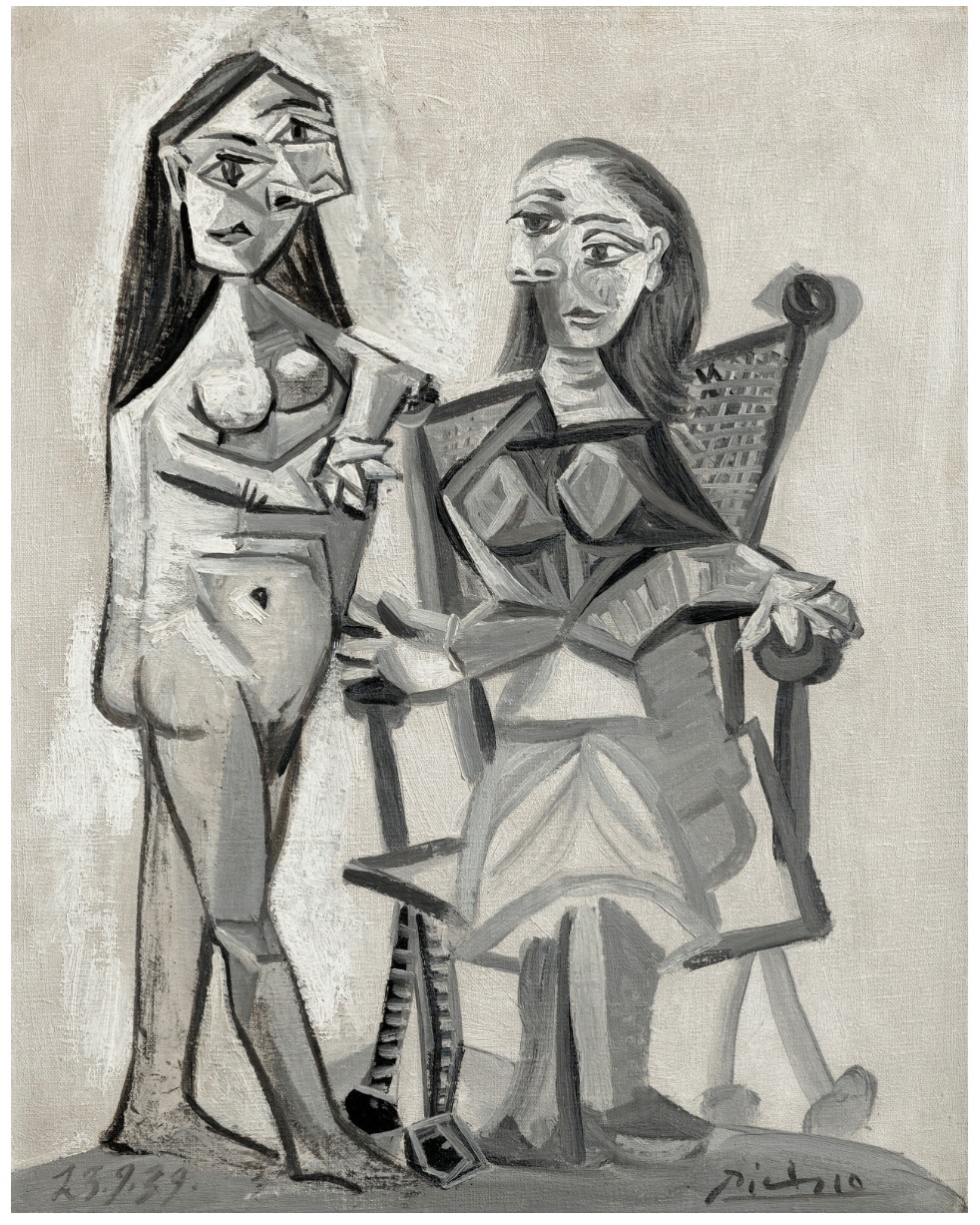
PABLO PICASSO (1881-1973)
Nu debout et femmes assises, 1939
Oil on canvas
41.5 x 33 cm (16-3/8 x 13 inches)
Signed ‘Picasso’ (lower right); dated ‘23.9.39.’ (lower left)
Dated again and inscribed ‘Royan 23 Septe 39.’ (on the reverse)
#10. Tête de femme, 1921
Masterpieces from the Lewis Collection
Sotheby’s London: 24 June 2026
Estimated: GBP 2,000,000 – 3,000,000
GBP 6,190,000 / USD 8,292,420
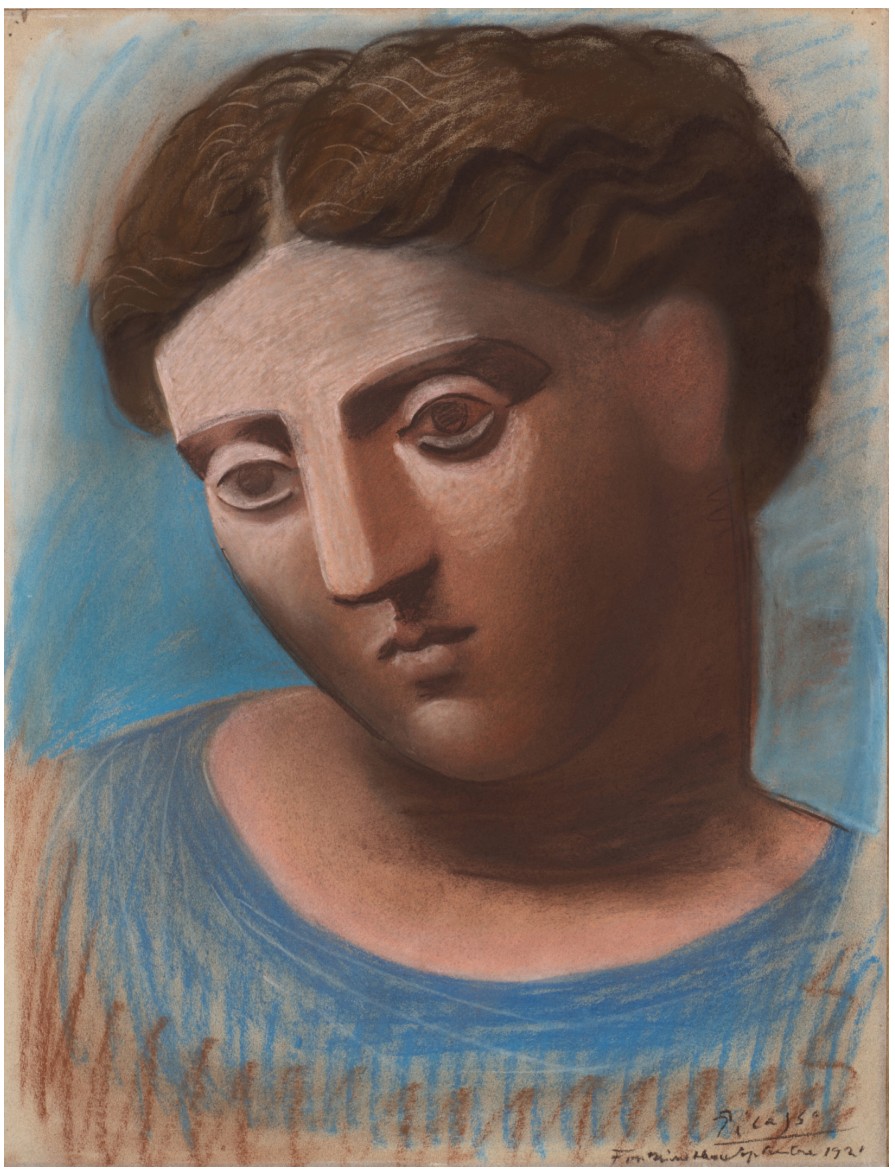
Tête de femme, 1921
Pastel on paper mounted on board
64.8 x 50.5 cm (25-1/2 x 19-7/8 inches)
Signed Picasso and dated Fontainebleau Septembre 1921 (lower right)
#11. Tête de femme sur fond jaune, 1934
Property from a Prestigious European Collection
Sotheby’s New-York: 19 May 2026
Estimated: USD 7,000,000 – 10,000,000
USD 7,745,000
Pablo Picasso | Tête de femme sur fond jaune | Modern Evening Auction

PABLO PICASSO (1881 – 1973)
Tête de femme sur fond jaune, 1934
Oil on canvas
64.8 x 46.2 cm (25-1/2 x 18-1/8 inches)
Dated Boisgeloup 18 juillet XXXIV (upper center)
#12. L’Atelier, 1955
Christie’s New-York: 18 May 2026
Estimated: USD 3,000,000 – 5,000,000
USD 6,907,000
PABLO PICASSO (1881-1973), L’Atelier | Christie’s

PABLO PICASSO (1881-1973)
L’Atelier, 1955
Oil on canvas
73 x 54.9 cm (28-3/4 x 21-5/8 inches)
Signed ‘Picasso’ (lower left)
Dated and numbered ‘28.10.55. II’ (on the reverse)
#13. Buste de femme, 1955
Collection of Jean & Terry de Gunzburg
Sotheby’s New-York: 19 May 2026
Estimated: USD 3,000,000 – 5,000,000
USD 5,610,000
Pablo Picasso | Buste de femme | Modern Evening Auction | 2026 |

PABLO PICASSO (1881 – 1973)
Buste de femme, 1955
Oil and Ripolin on canvas
92.1 x 73.1 cm (36-1/4 x 28-7/8 inches)
Signed Picasso (center left)
Dated 10.7.55. and numbered II (on the reverse)
#14. Le Petit déjeuner, 1960
Property from The Latner Family Art Collection
Sotheby’s New-York: 19 May 2026
Estimated: USD 5,000,000 – 7,000,000
USD 5,510,000
Pablo Picasso | Le Petit déjeuner | Modern Evening Auction | 2026 |
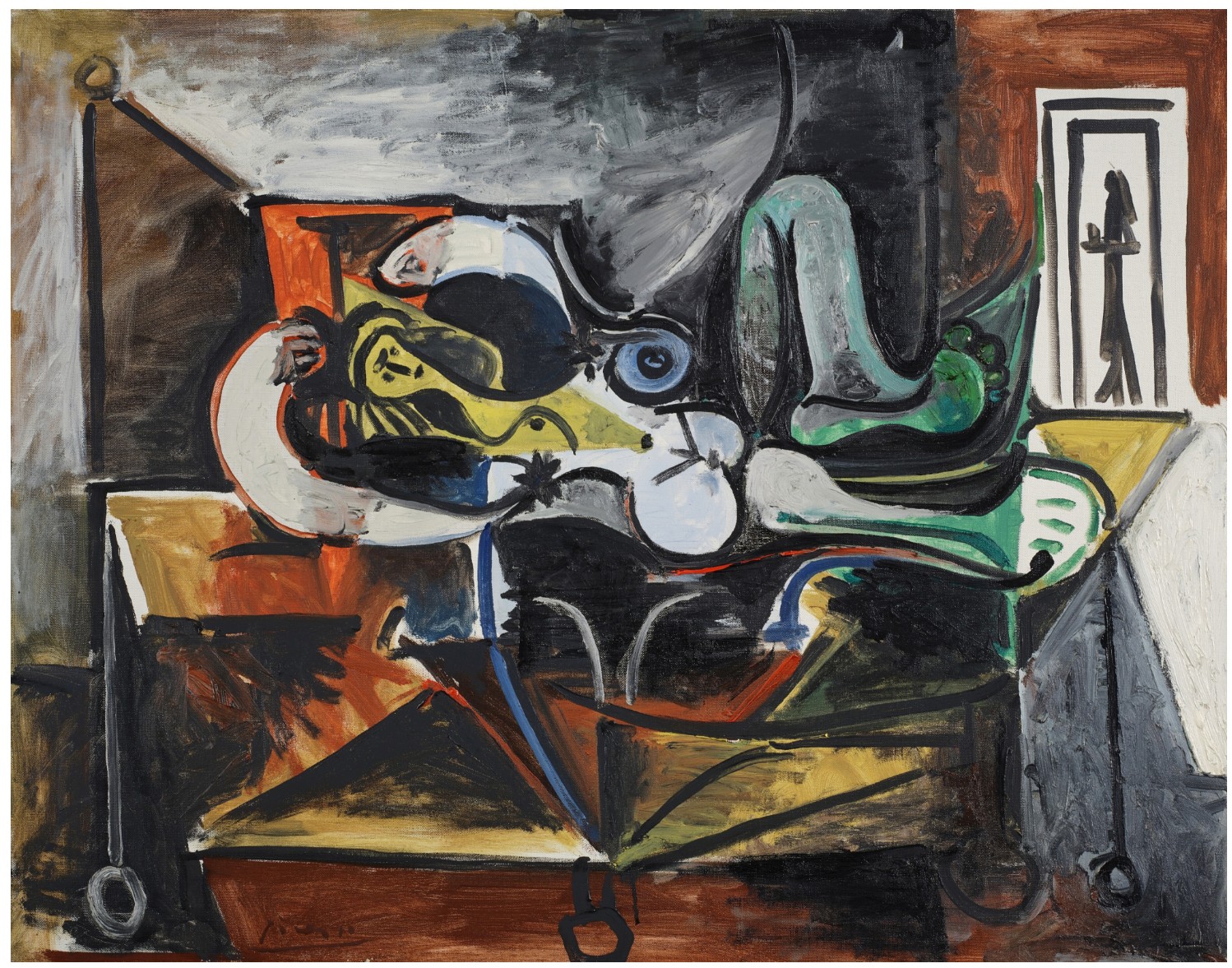
PABLO PICASSO (1881 – 1973)
Le Petit déjeuner, 1960
Oil and Ripolin on canvas
72.5 x 91.8 cm (28-1/2 x 36-1/8 inches)
Signed Picasso (toward lower left)
Dated 19.4.60. (on the reverse)
#15. Tête de femme, 1954
Property from a Distinguished Private Collector
Sotheby’s New-York: 19 May 2026
Estimated: USD 5,000,000 – 7,000,000
USD 5,488,000
Pablo Picasso | Tête de femme | Modern Evening Auction | 2026 |
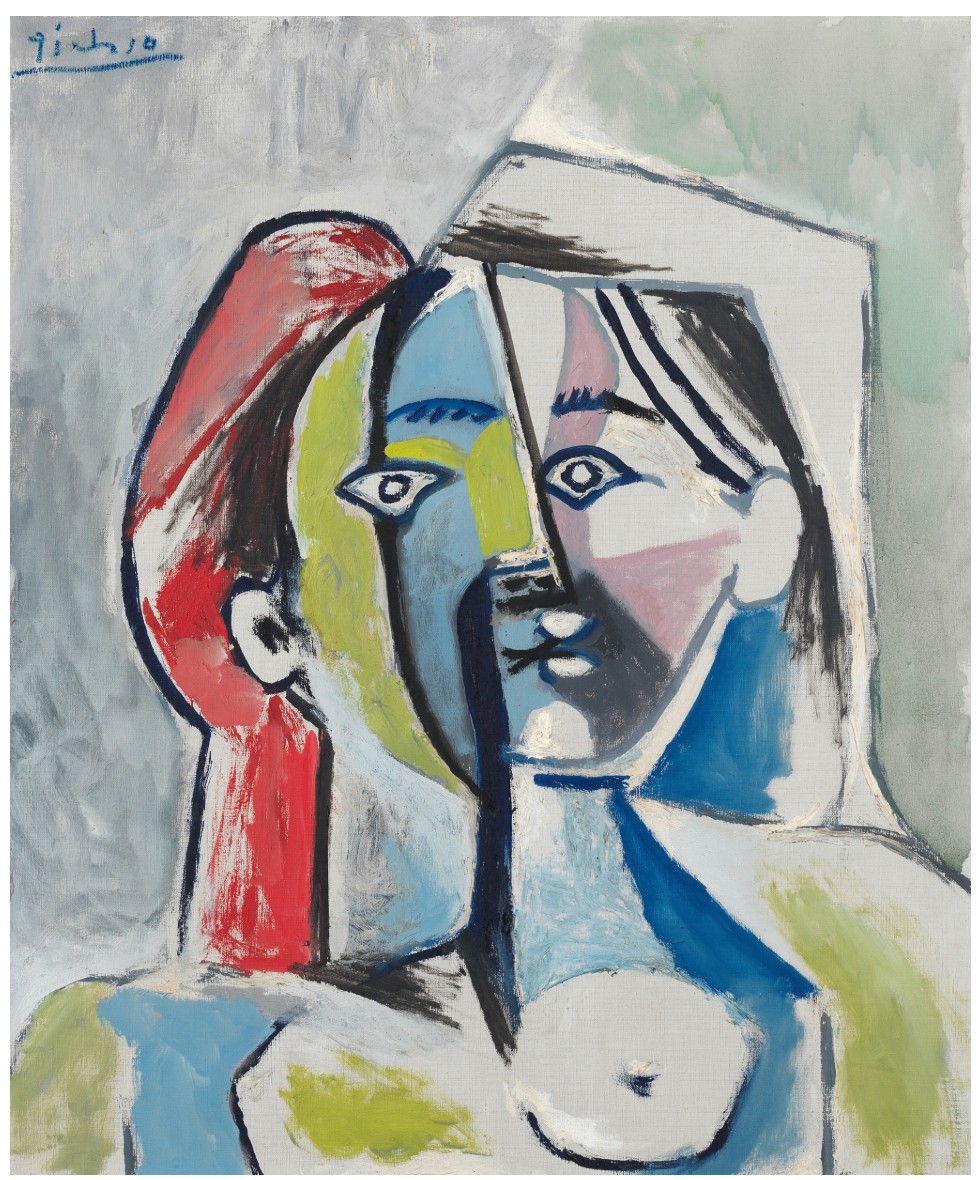
PABLO PICASSO (1881 – 1973)
Tête de femme, 1954
Oil on canvas
65.3 x 54.3 cm (25-3/4 x 21-3/8 inches)
Signed Picasso (upper left)
Dated Paris 27.10.54. (on the reverse)
#16. Angel Fernández de Soto, circa 1899
Masterpieces from the Lewis Collection
Sotheby’s London: 24 June 2026
Estimated: GBP 1,500,000 – 2,000,000
GBP 3,750,000 / USD 5,023,680
Pablo Picasso | Angel Fernández de Soto | Masterpieces from the Lewis
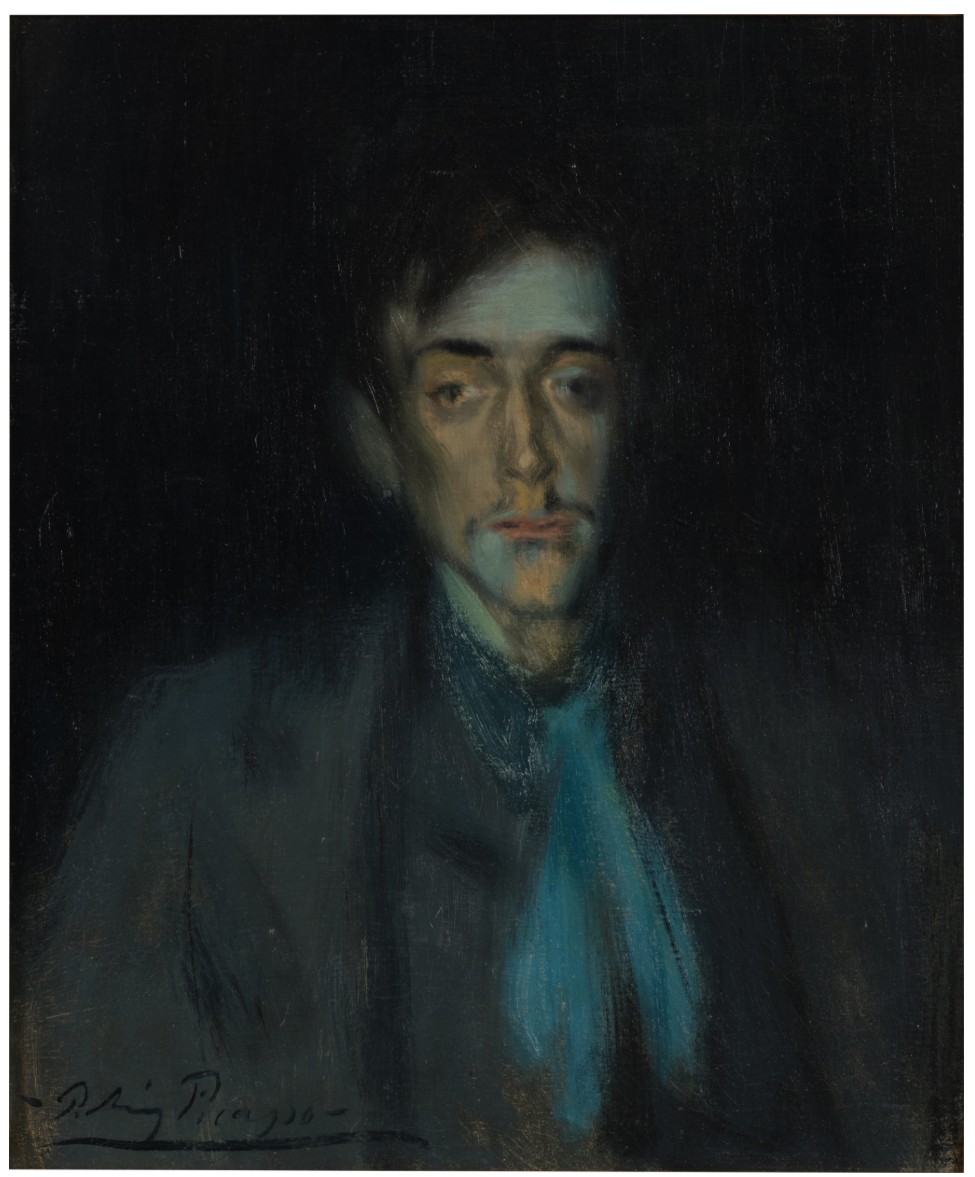
PABLO PICASSO (1881 – 1973)
Angel Fernández de Soto, circa 1899
Oil on canvas
61.6 x 51.4 cm (24-1/4 x 20-1/4 inches)
Signed -P. Ruiz Picasso- (lower left)
USD 5 million
#17. Crâne, lampe, poireaux, vase, 1945-46
Christie’s New-York: 18 May 2026
Estimated: USD 3,000,000 – 5,000,000
USD 4,101,000
PABLO PICASSO (1881-1973), Crâne, lampe, poireaux, vase | Christie’s
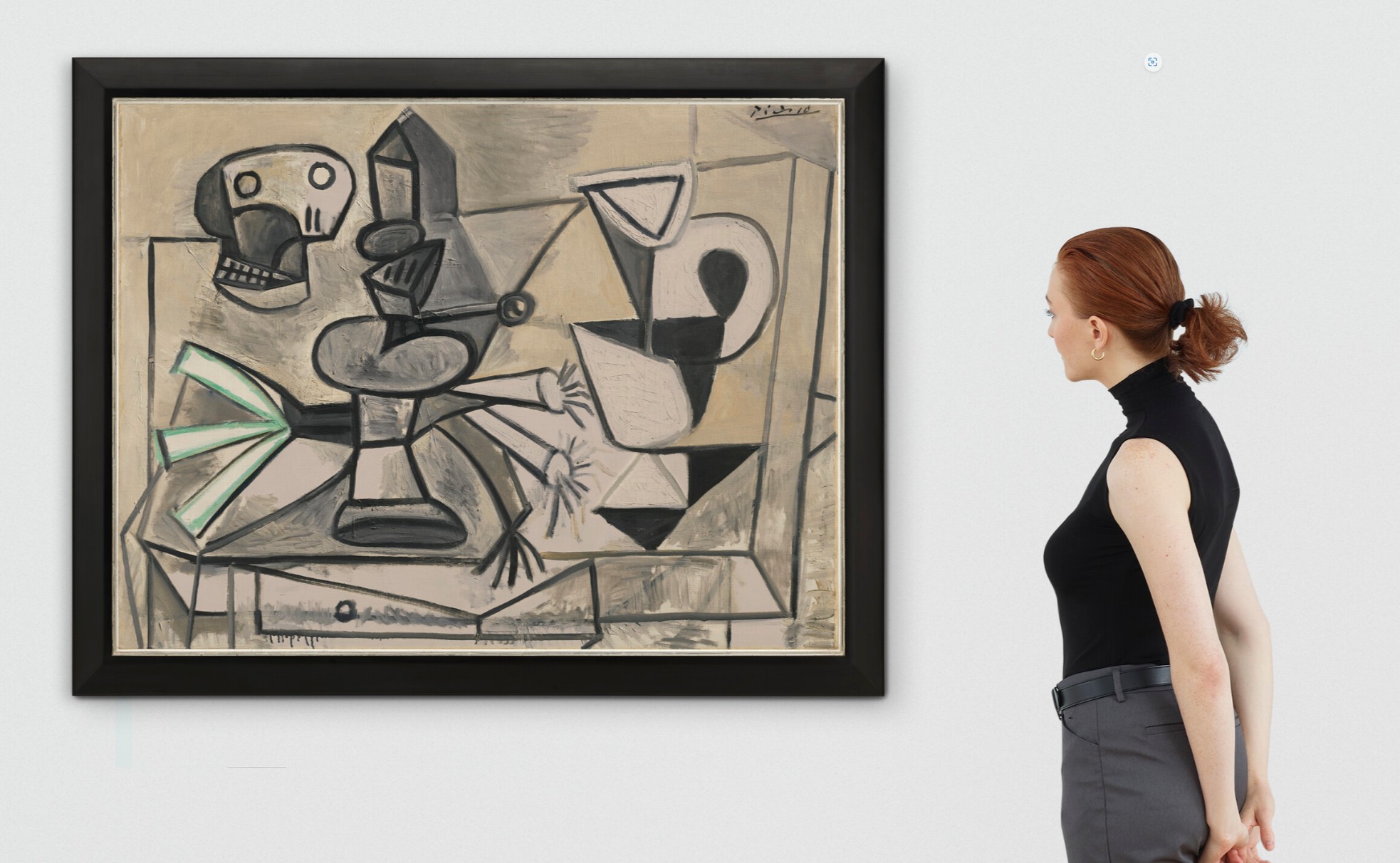
PABLO PICASSO (1881-1973)
Crâne, lampe, poireaux, vase, 1945-46
Oil on canvas
88.8 x 116.5 cm (35 x 45-7/8 inches)
Signed ‘Picasso’ (upper right)
Dated twice ‘6.5.45. 3.12.46.’ (on the reverse)
#18. Figure, 1929
AN EYE FOR THE SUBLIME: THE RENKER COLLECTION
Christie’s London: 5 March 2026
Estimated: GBP 600,000 – 800,000
GBP 2,612,000 / USD 3,478,445
PABLO PICASSO (1881-1973), Figure | Christie’s
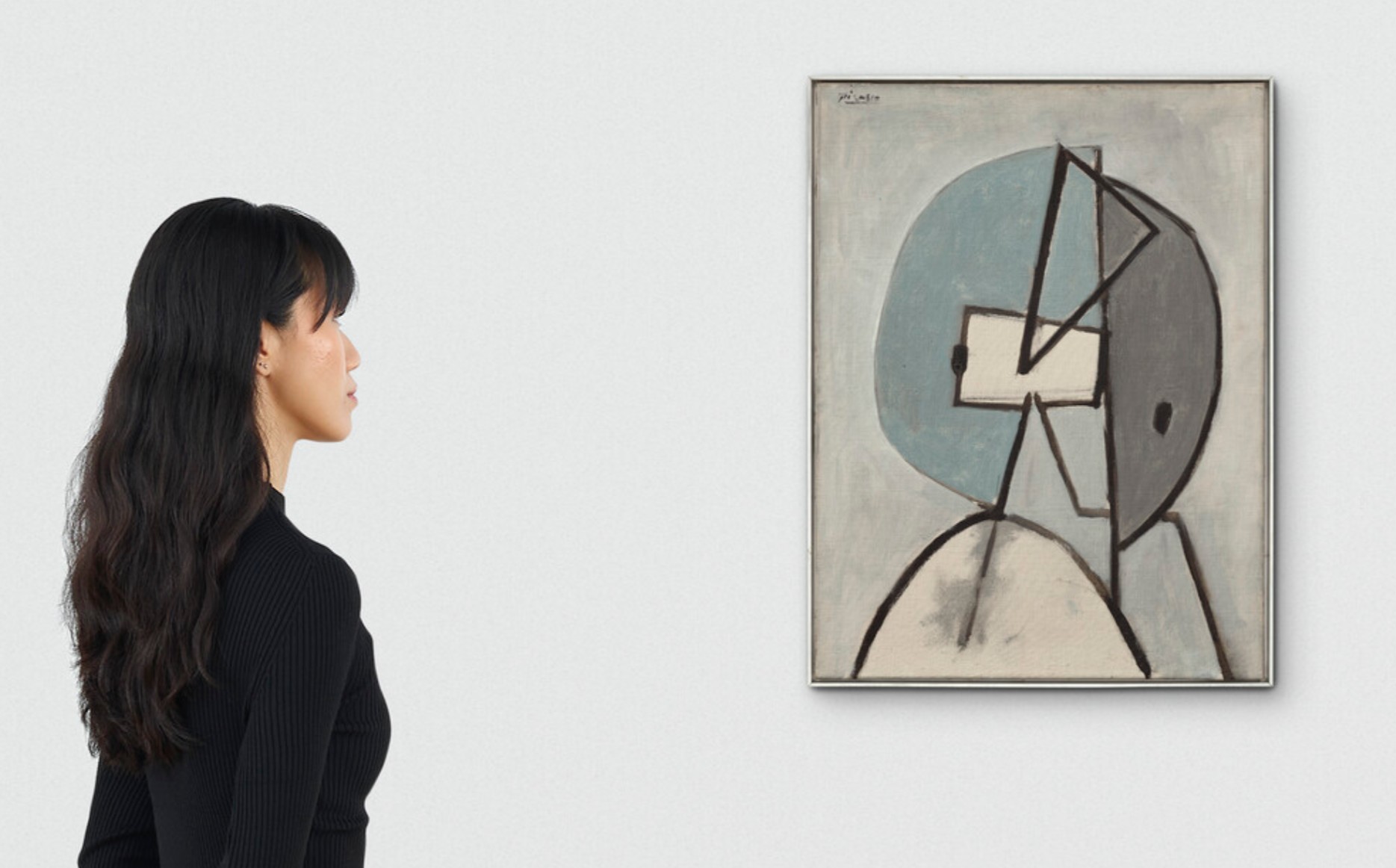
PABLO PICASSO (1881-1973)
Figure, 1929
Oil on canvas
60.5 x 45.6 cm (23-3/4 x 18 inches)
Signed ‘Picasso’ (upper left)
Le peintre et son modèle dans un paysage, 1963
Christie’s New-York: 18 May 2026
Estimated: USD 3,000,000 – 5,000,000
USD 3,369,000
PABLO PICASSO (1881-1973), Le peintre et son modèle dans un paysage | Christie’s
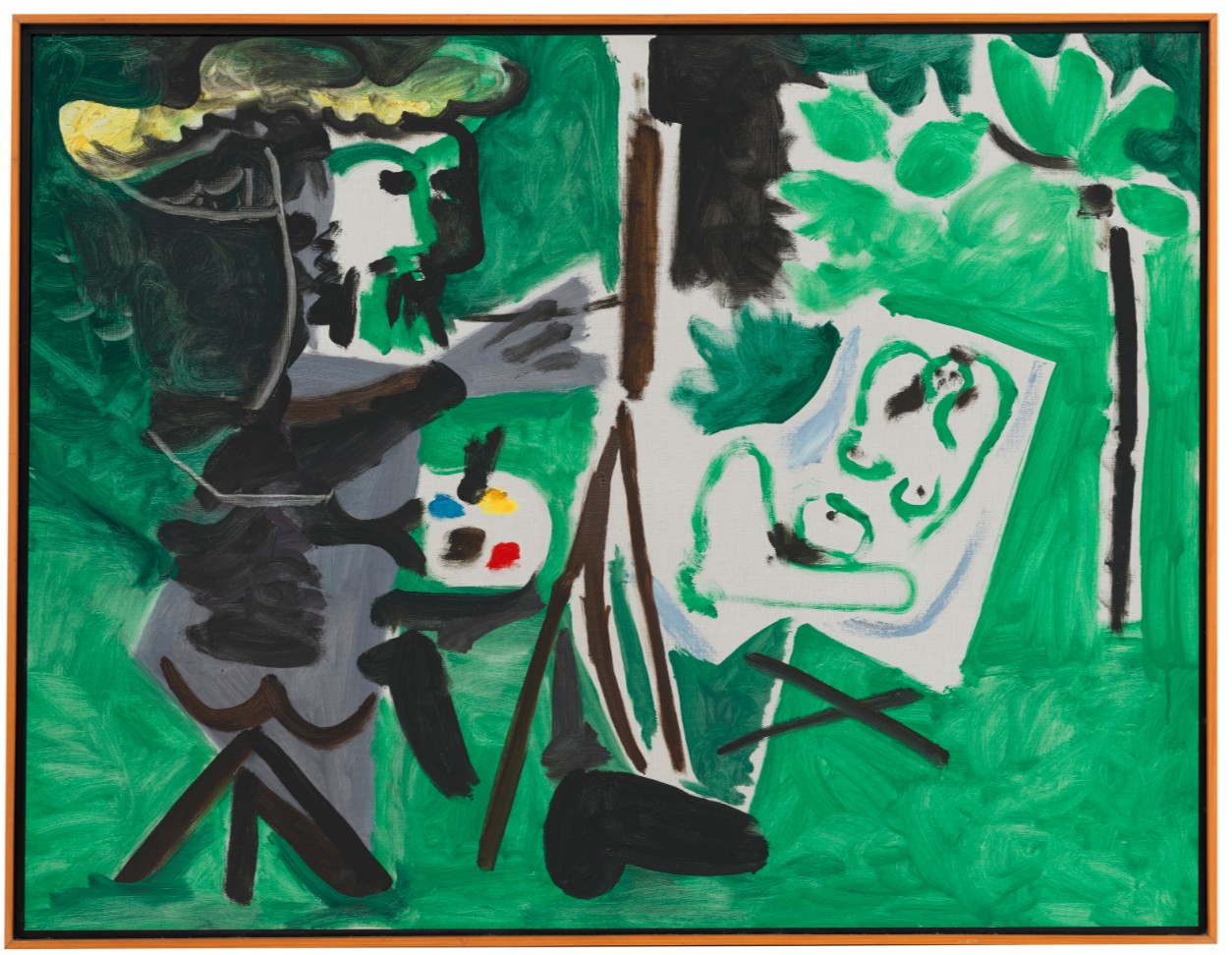
PABLO PICASSO (1881-1973)
Le peintre et son modèle dans un paysage, 1963
Oil on canvas
89×116 cm (35 x 45-5/8 inches)
Dated and numbered ‘10.5.63. I’ (on the reverse)
2025 Auction Results
FOR PAINTINGS AND SCULPTURES ONLY
29 lots sold at auction in 2025 for a total turnover of USD 229,672,736. With 3 lots failing to sell, the sell-through rate is 91%. The highest price for 2025 was achieved by La Lecture (Marie-Therese), a painting dated 1932, from The Collection of Robert F. and Patricia G. Ross Weis, that sold at Christie’s in New-York, on 17 November 2025, for USD 45,485,000.
2025 Top 3 Lots
5 lots sold for more than USD 10 million, generating a cumulative turnover of USD 145,272,715, representing 63.3% of the total turnover for 2025.
XXXXXXXXXX
#1. La Lecture (Marie-Thérèse), 1932
The Collection of Robert F. and Patricia G. Ross Weis
Christie’s New-York: 17 November 2025
Estimate on Request
USD 45,485,000
READ MORE IN FOCUS SECTION
PABLO PICASSO (1881-1973), La Lecture (Marie-Thérèse) | Christie’s
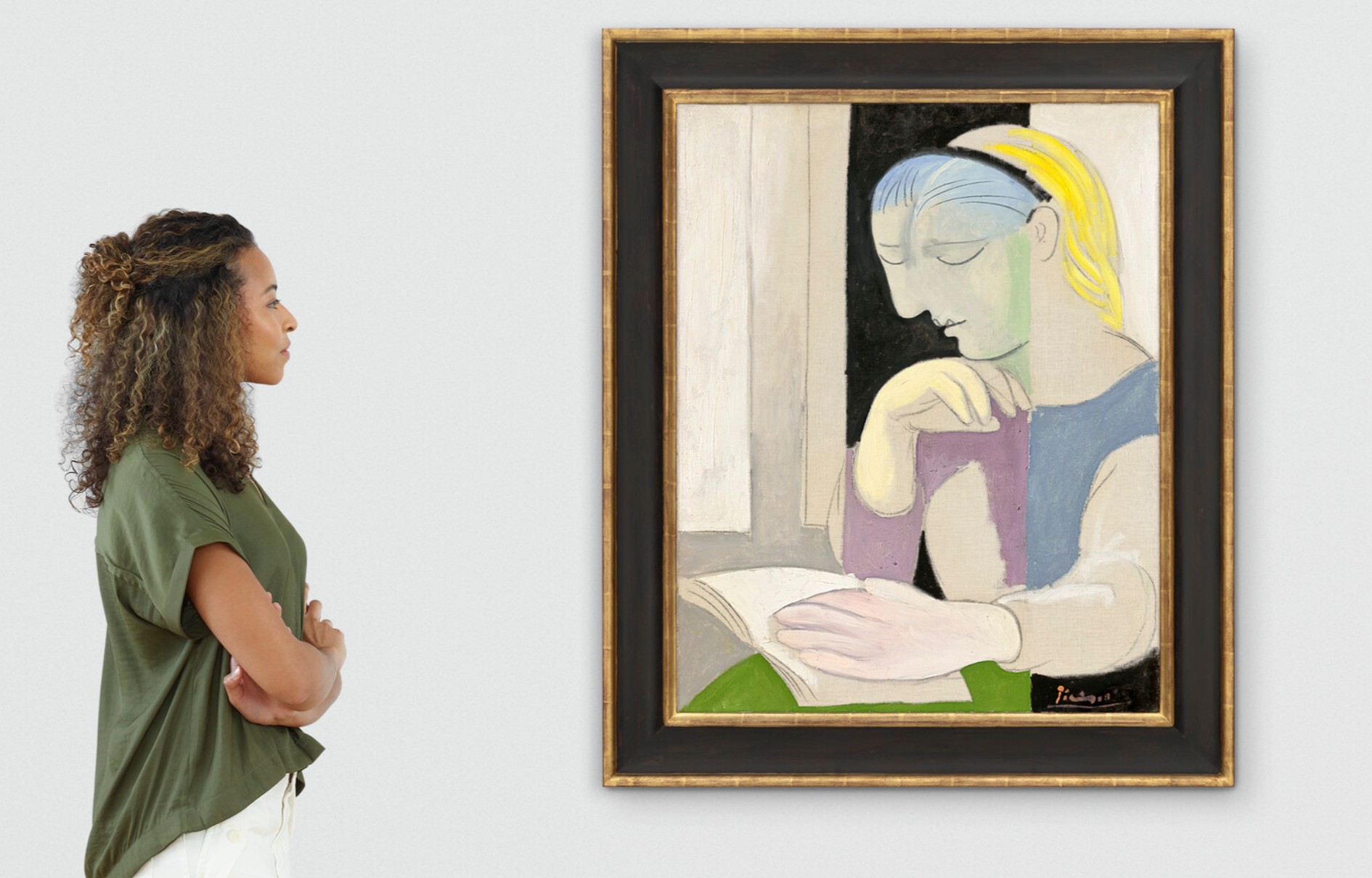
PABLO PICASSO (1881-1973)
La Lecture (Marie-Thérèse), 1932
Oil, Ripolin and charcoal on canvas
92.1 x 73 cm (36 1/4 x 28 3/4 inches)
Signed ‘Picasso’ (lower right)
Dated and inscribed ‘Boisgeloup 31 Août XXXII.’ (on the stretcher)
Painted in Boisgeloup on 31 August 1932
#2. Bust of a Woman with a Flowered Hat (Dora Maar), 1943
Lucien Paris: 24 October 2025
Estimated: EUR 8,000,000 – 10,000,000
EUR 27,000,000 / USD 31,388,510 (Hammer)
Bust of a Woman with a Flowered Hat (Dora Maar), 1943 – Lot 1
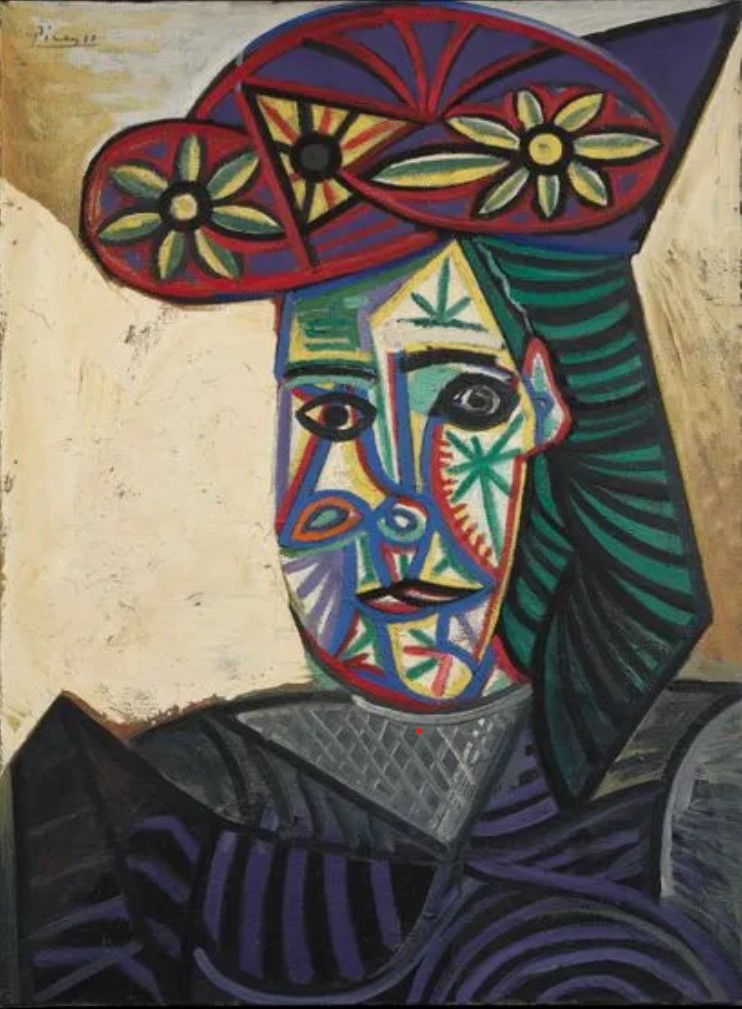
PABLO PICASSO
Bust of a Woman with a Flowered Hat (Dora Maar), 1943
Oil on canvas
81×60 cm (31.9 x 23.6 inches)
Signed upper left
Dated 11 July 43 on the reverse.
© Picasso Estate 2025
#3. Femme à la coiffe d’Arlésienne sur fond vert (Lee Miller), 1937
Leonard & Louise Riggio: Collected Works
Christie’s New-York: 12 May 2025
Estimated: USD 20,000,000 – 30,000,000
USD 28,010,000
READ MORE IN FOCUS SECTION
PABLO PICASSO (1881-1973), Femme à la coiffe d’Arlésienne sur fond vert (Lee Miller) | Christie’s
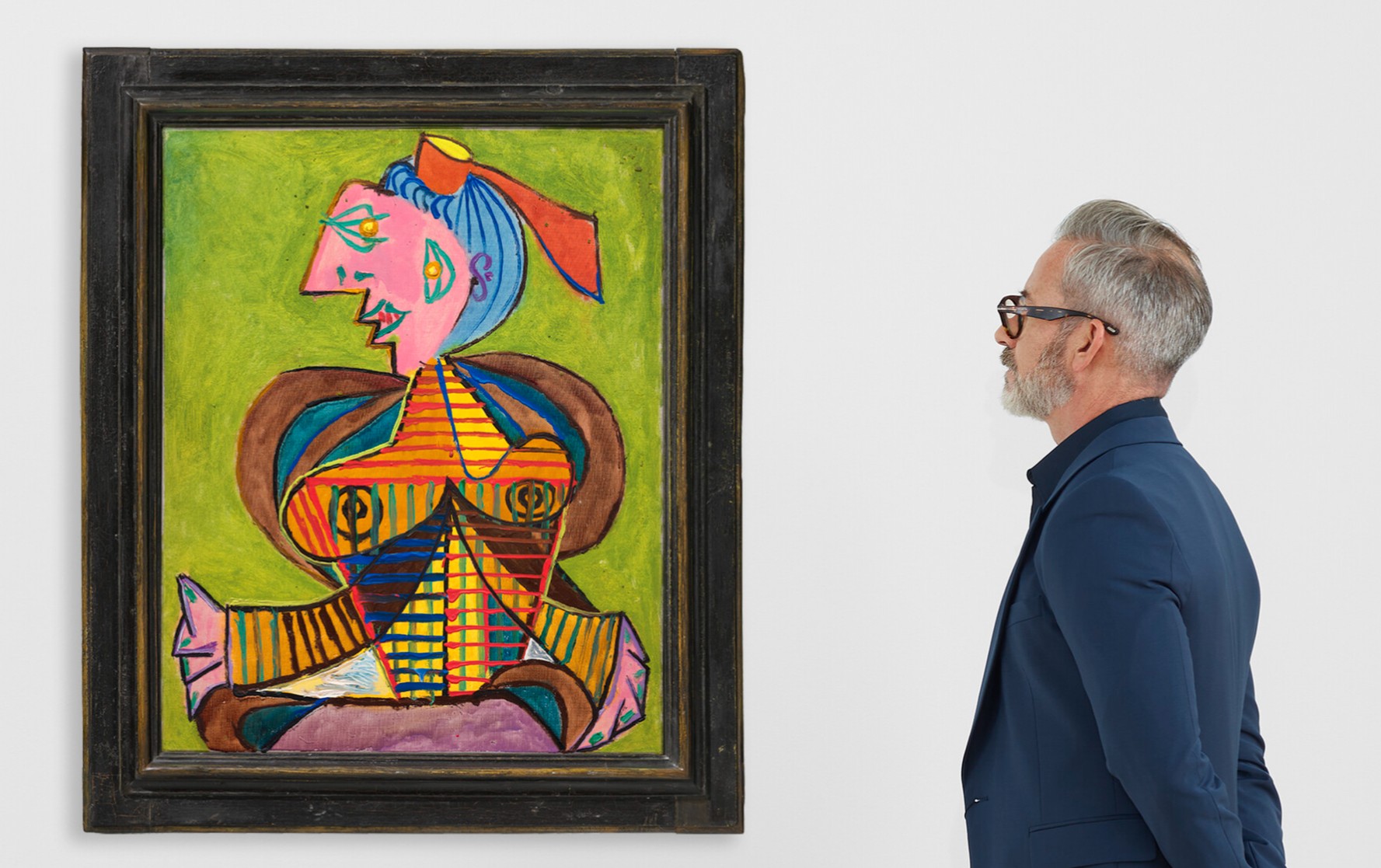
PABLO PICASSO (1881-1973)
Femme à la coiffe d’Arlésienne sur fond vert (Lee Miller), 1937
Oil and Ripolin on canvas
81 x 65.1 cm (31 7/8 x 25 5/8 inches)
Dated and numbered ‘2 septembre 37 II’ (on the stretcher)
Painted in Mougins on 2 September 1937
#4. Buste de femme, 1944
Christie’s Hong-Kong: 26 September 2025
Estimated: HKD 86,000,000 – 106,000,000
HKD 196,750,000 / USD 25,289,205
READ MORE IN FOCUS SECTION
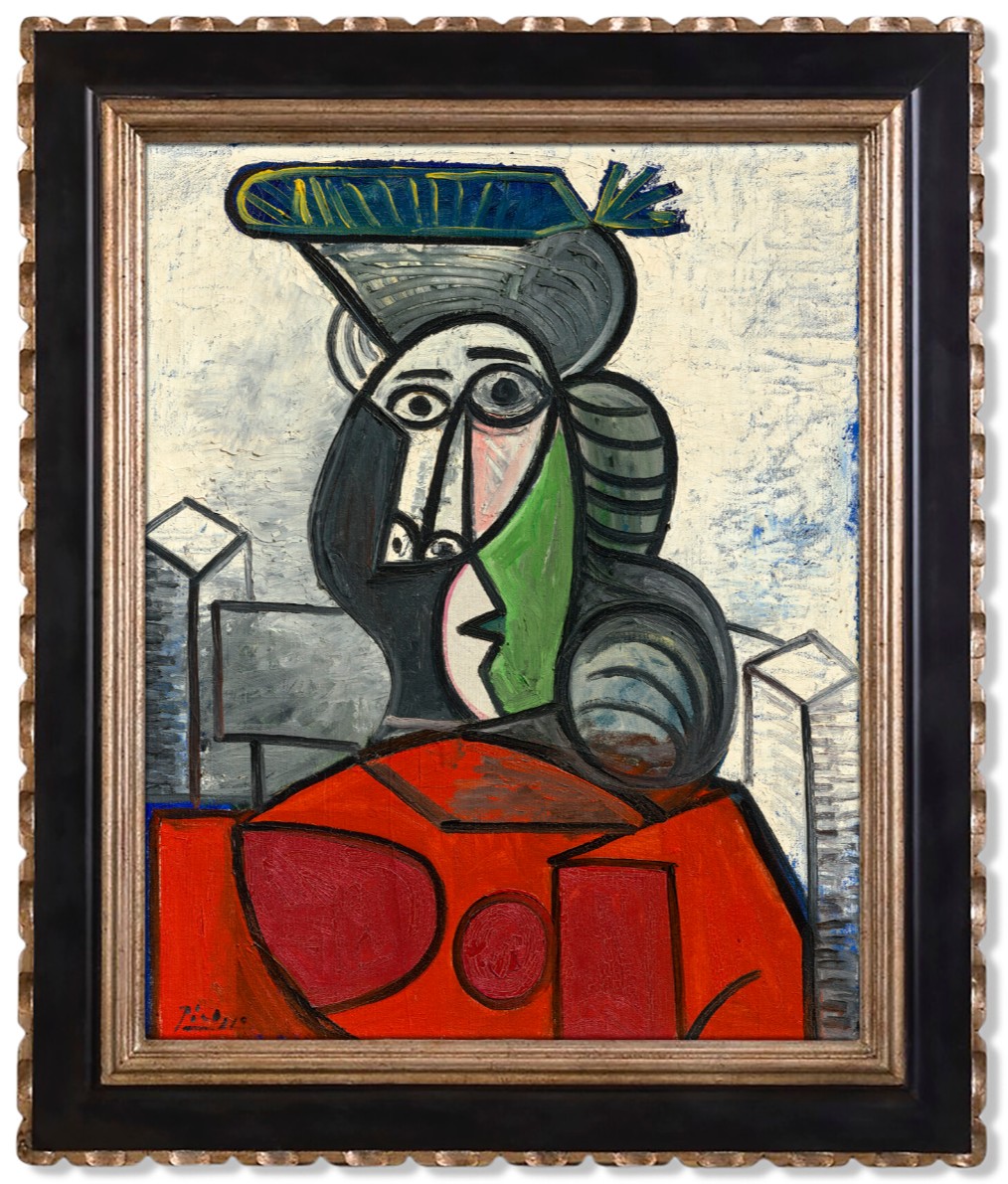
PABLO PICASSO (1881-1973)
Buste de femme, 1944
Oil on canvas
80.8 x 65 cm (31 7/8 x 25 5/8 inches)
Signed ‘Picasso’ (lower left)
Painted on 5 March 1944
#5. Homme assis, 1969
Sotheby’s New-York: 13 May 2025
Estimated: USD 12,000,000 – 18,000,000
USD 15,100,000
READ MORE IN FOCUS SECTION
Homme assis | Modern Evening Auction | 2025 | Sotheby’s
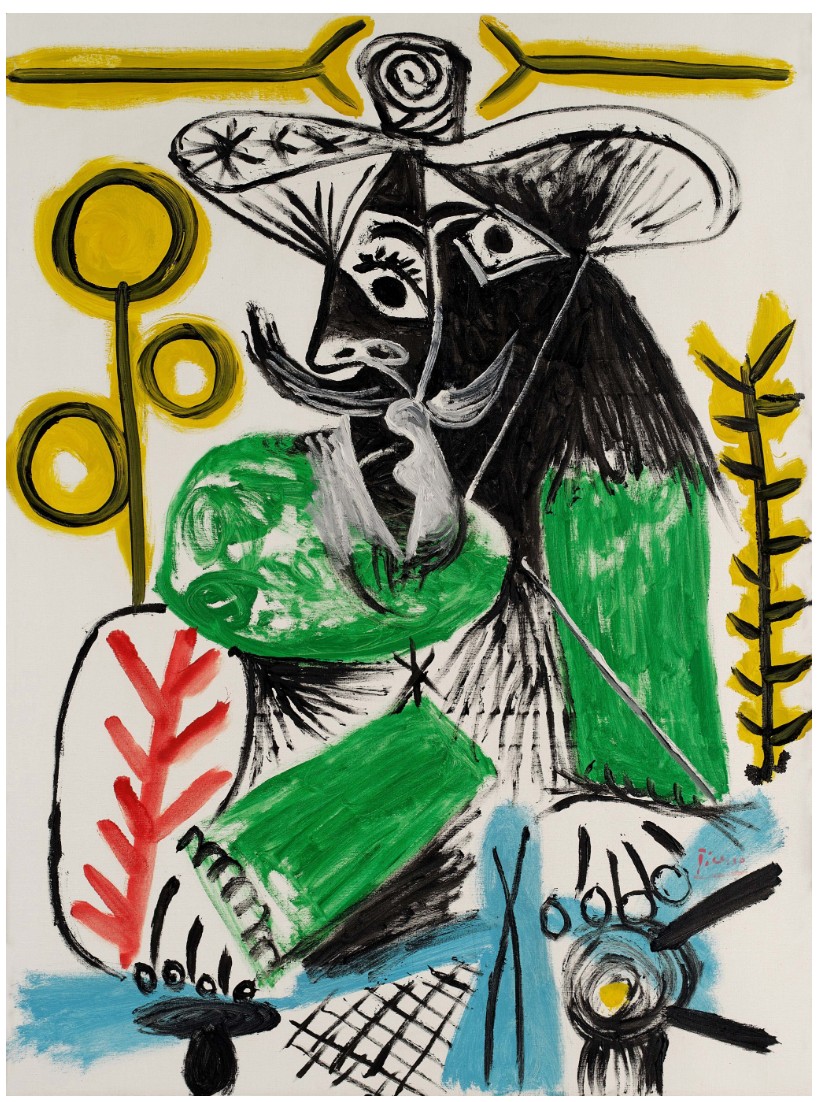
PABLO PICASSO (1881 – 1973)
Homme assis, 1969
Oil and Ripolin on canvas
129.9 x 97.2 cm (51 1/8 x 38 1/4 inches)
Signed Picasso (lower right)
Dated 10.12.69. (on the reverse)
USD 10 million
#6. Nu assis dans un fauteuil, 1964-65
Sotheby’s London: 26 June 2025
Estimated: 6,000,000 – 9,000,000
GBP 7,116,000 / USD 9,638,871
READ MORE IN FOCUS SECTION
Nu assis dans un fauteuil | Modern & Contemporary Evening Auction | 2025 | Sotheby’s
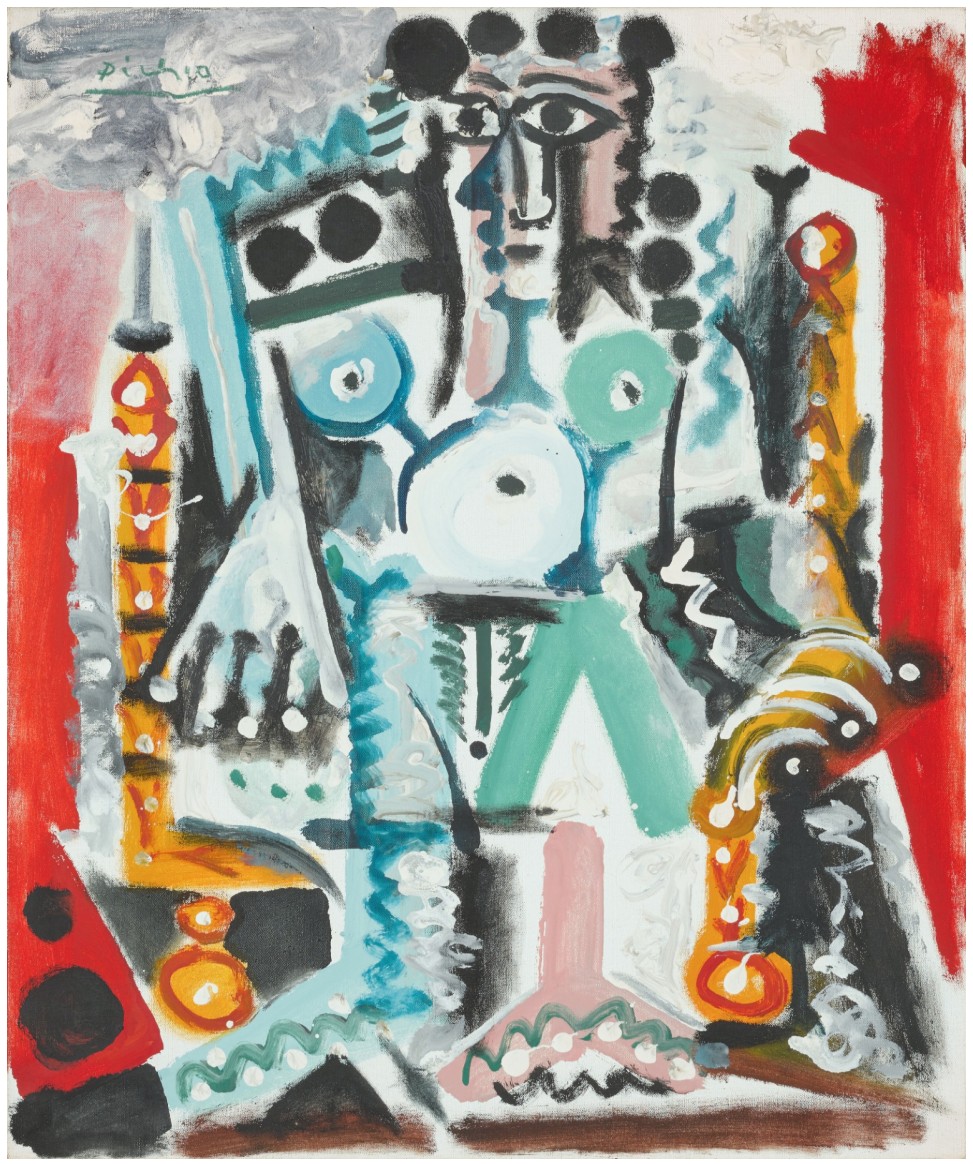
PABLO PICASSO (1881 – 1973)
Nu assis dans un fauteuil, 1964-65
Oil and Ripolin on canvas
65×54 cm (25 5/8 x 21 1/4 inches)
Signed Picasso (upper left)
Dated 30.12.64.; 2.1. 65. and 3.1.5. and numbered V (on the reverse)
#7. Mère et enfant, 1922
Leonard & Louise Riggio: Collected Works
Christie’s New-York: 12 May 2025
Estimated: USD 9,000,000 – 12,000,000
USD 7,310,000
READ MORE IN FOCUS SECTION
PABLO PICASSO (1881-1973), Mère et enfant | Christie’s
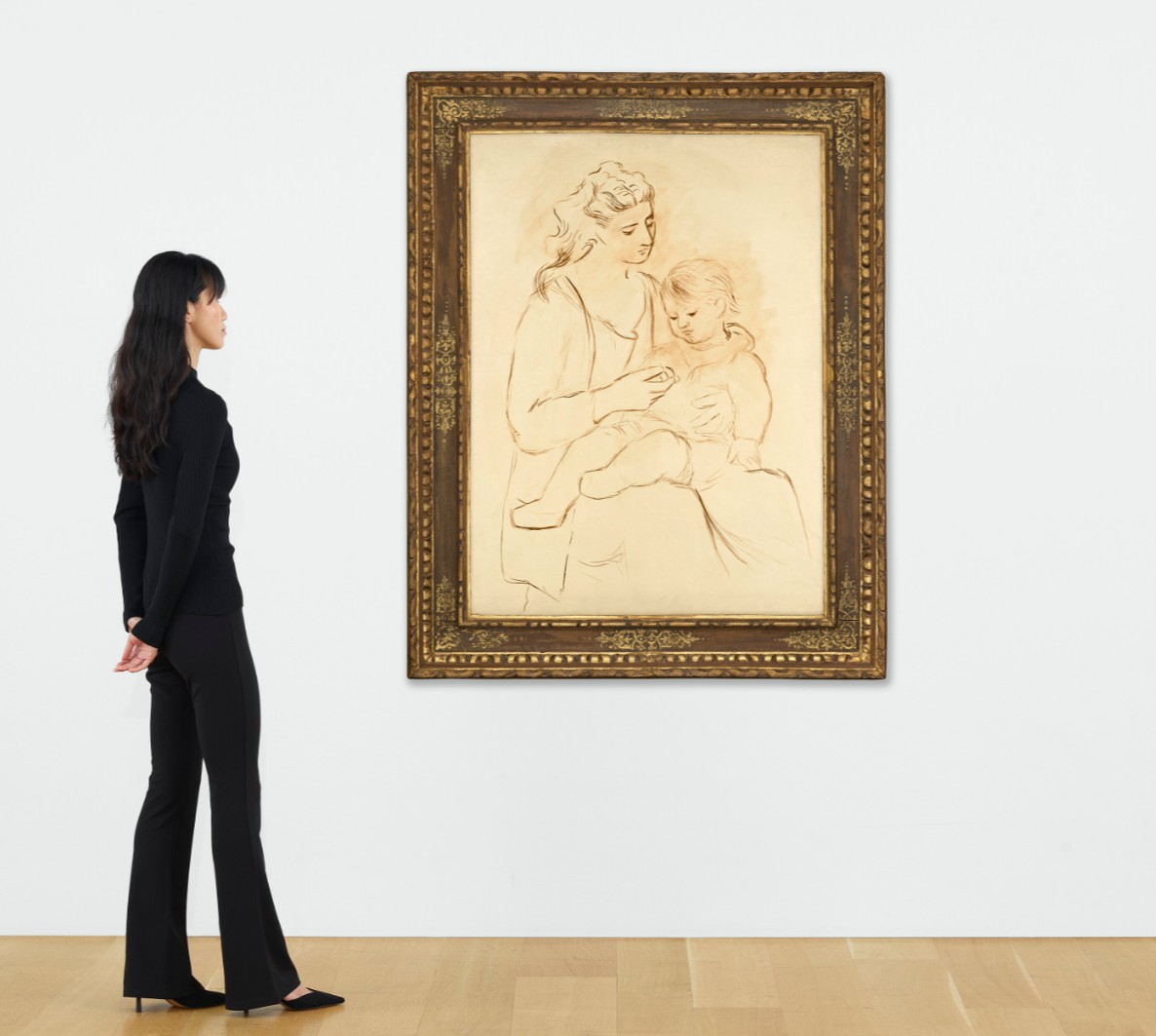
PABLO PICASSO (1881-1973)
Mère et enfant, 1922
Oil on canvas
130.2 x 96.8 cm (51 1/4 x 38 1/8 inches)
Painted in Dinard in summer 1922
#8. Buste de femme, 1953
Sotheby’s London: 4 March 2025
Estimated: GBP 4,000,000 – 6,000,000
GBP 4,310,000 / USD 5,470,000
Buste de femme | Modern & Contemporary Evening Auction | 2025 | Sotheby’s
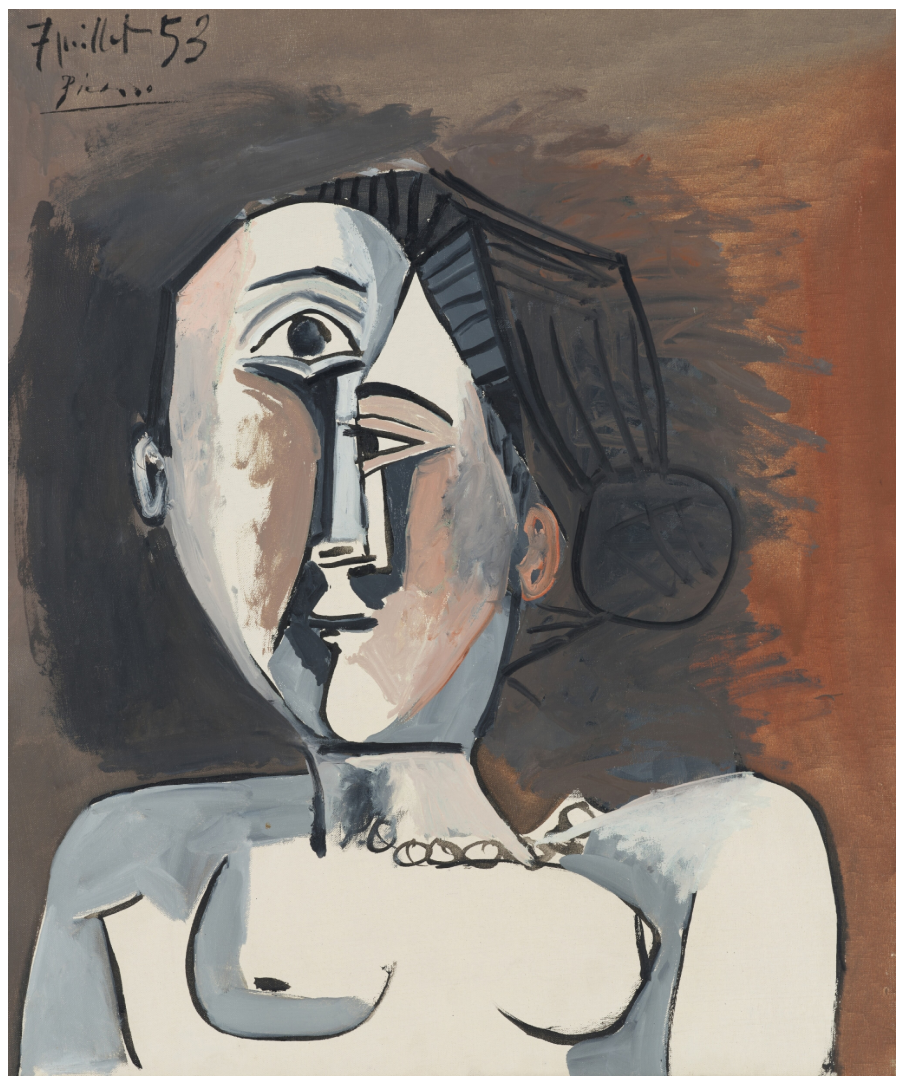
PABLO PICASSO (1881 – 1973)
Buste de femme, 1953
Oil on canvas
64.2 x 54 cm (25 1/4 x 21 1/4 inches)
Signed Picasso and dated 7 juillet 53 (upper left)
#9. Mère et enfant, 1965
Christie’s New-York: 17 November 2025
Estimated: USD 4,000,000 – 6,000,000
USD 5,077,000
PABLO PICASSO (1881-1973), Mère et enfant | Christie’s
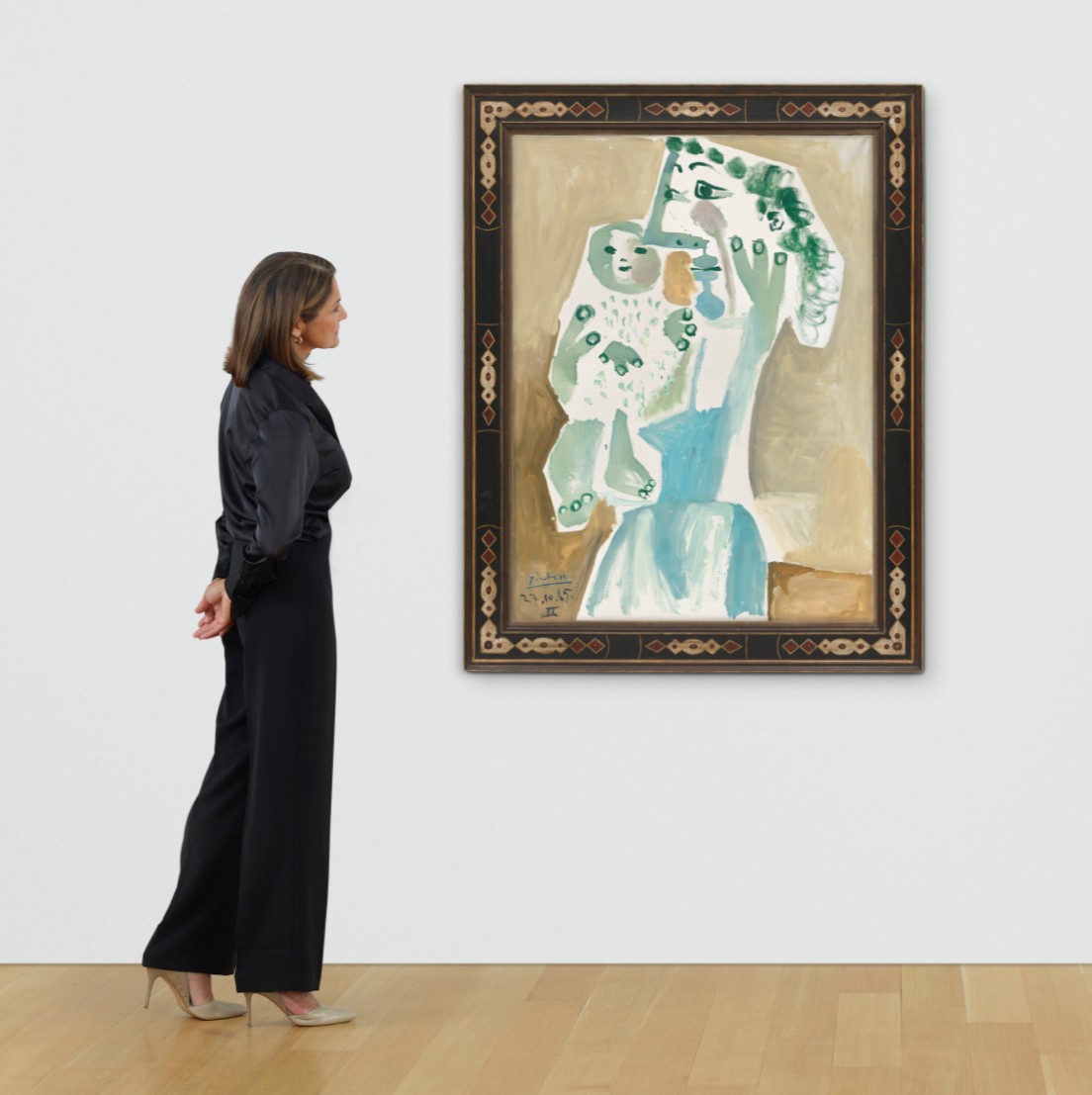
PABLO PICASSO (1881-1973)
Mère et enfant, 1965
Oil on canvas
130.2 x 97.2 cm (51 1/4 x 38 1/4 inches)
Signed, dated and numbered ‘Picasso 27.10. 65. II’ (lower left)
Painted in Mougins on 27 October 1965
USD 5 million
#10. La colline de la Californie, 1959
Christie’s London: 15 October 2025
Estimated: GBP 3,000,000 – 5,000,000
GBP 3,710,000 / USD 4,942,415
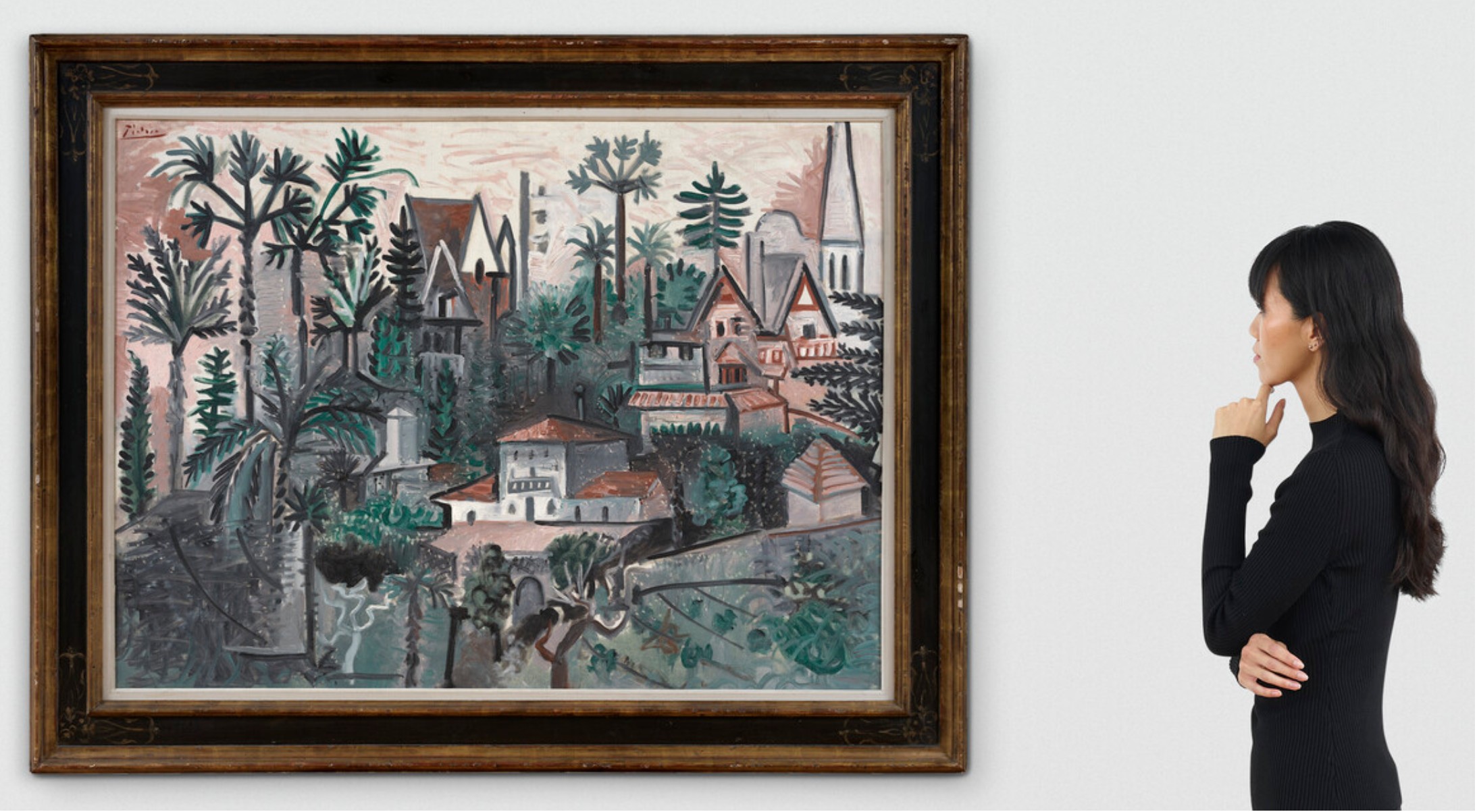
PABLO PICASSO (1881-1973)
La colline de la Californie, 1959
Oil on canvas
96.5 x 129.5 cm (38 x 51 1⁄8 inches)
Signed ‘Picasso’ (upper left)
Dated ‘20.2.59’ (on the reverse)
Painted in Cannes on 20 February 1959
#11. Vue de Notre-Dame de Paris, 1945
Christie’s New-York: 12 May 2025
Estimated: USD 3,000,000 – 5,000,000
USD 4,890,000
PABLO PICASSO (1881-1973), Vue de Notre-Dame de Paris | Christie’s
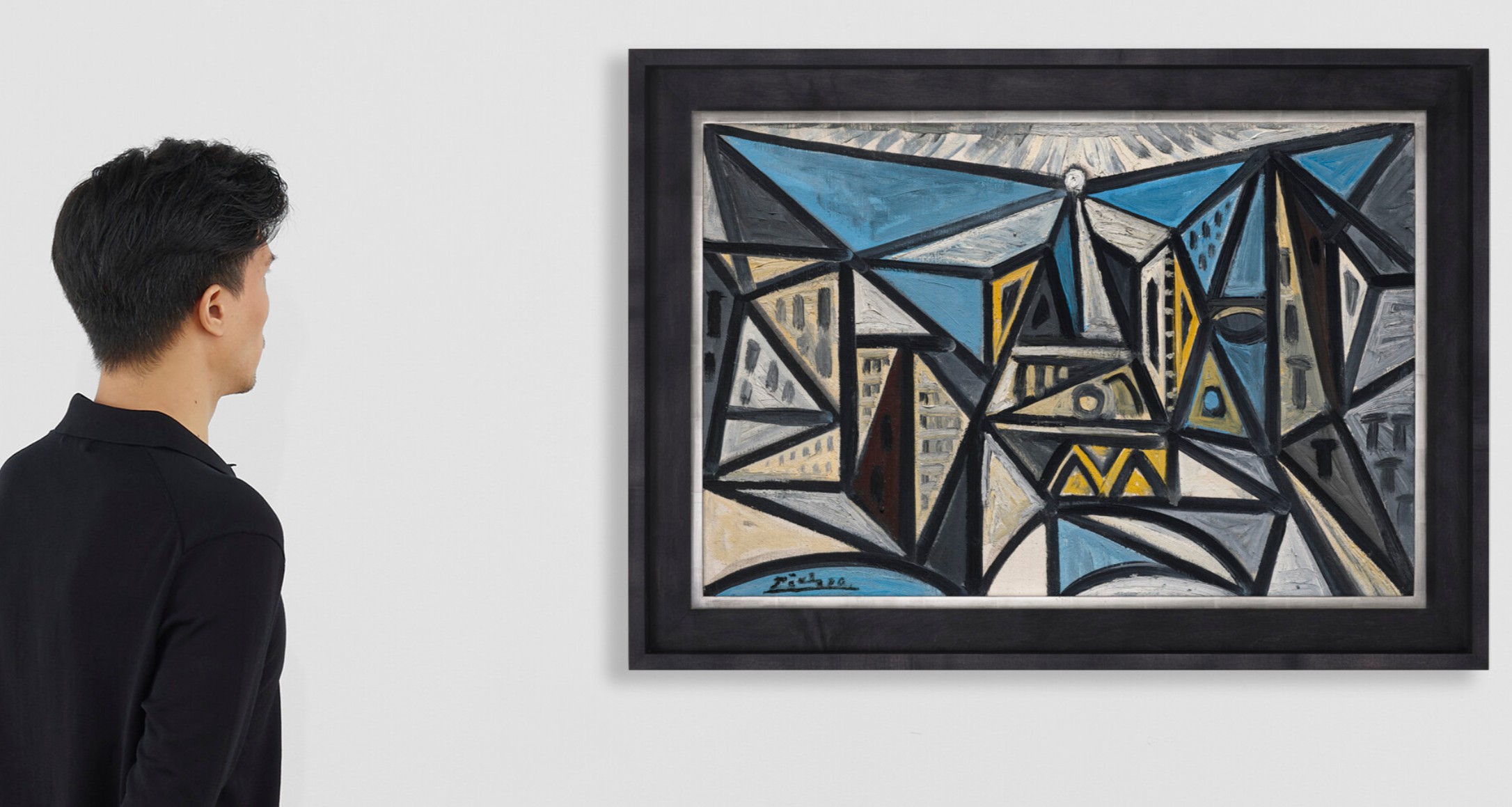
PABLO PICASSO (1881-1973)
Vue de Notre-Dame de Paris, 1945
Oil on canvas
54.6 x 81.3 cm (21 1/2 x 32 inches)
Signed ‘Picasso’ (lower left)
Dated and inscribed ‘1er mars 45 K’ (on the reverse)
#12. Tete de femme au chapeau, 1965
China Guardian Beijing: 10 November 2025
Estimated: CNY 23,500,000 – 33,500,000
CNY 29,900,000 / USD 4,199,575
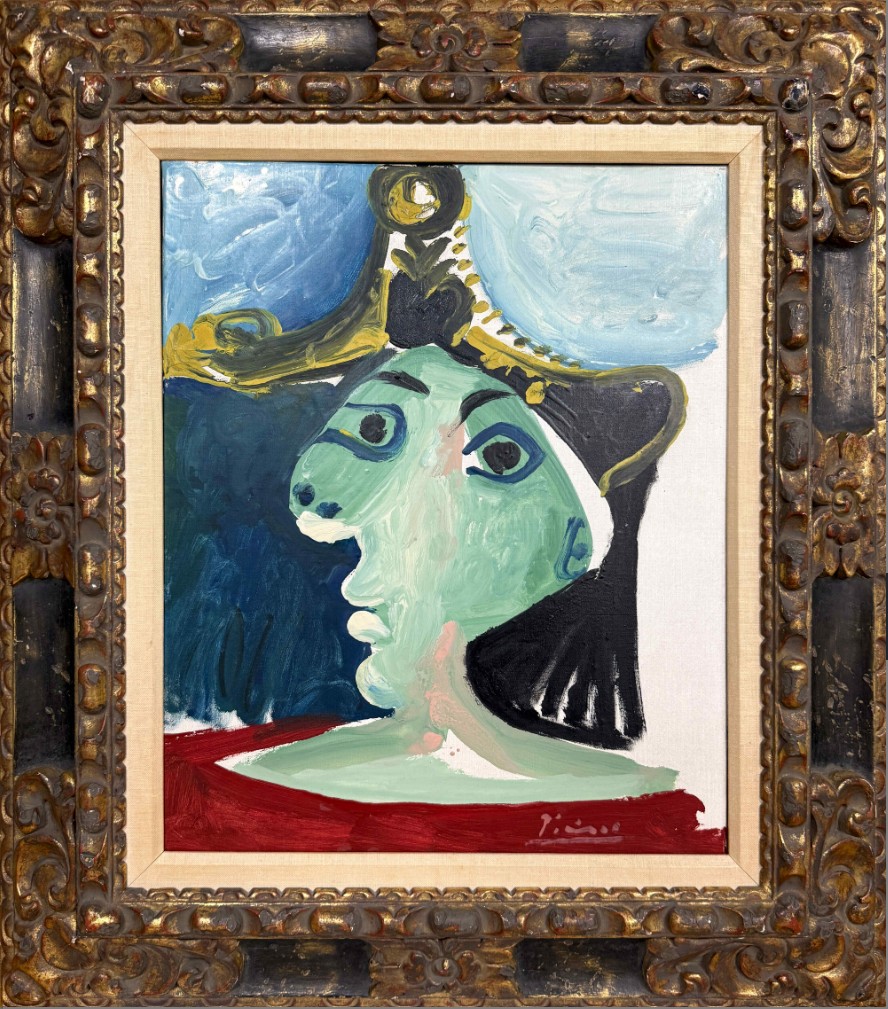
PABLO PICASSO (1881-1973)
Tete de femme au chapeau, 1965
Oil on canvas
58×49 cm (22.8 x 19.3 inches)
Signed in English and dated on the reverse
#13. Nu assis appuyé sur des coussins, 1964
Christie’s Hong-Kong: 26 September 2025
Estimated: HKD 20,000,000 – 30,000,000
HKD 32,220,000 / USD 4,141,390
READ MORE IN FOCUS SECTION
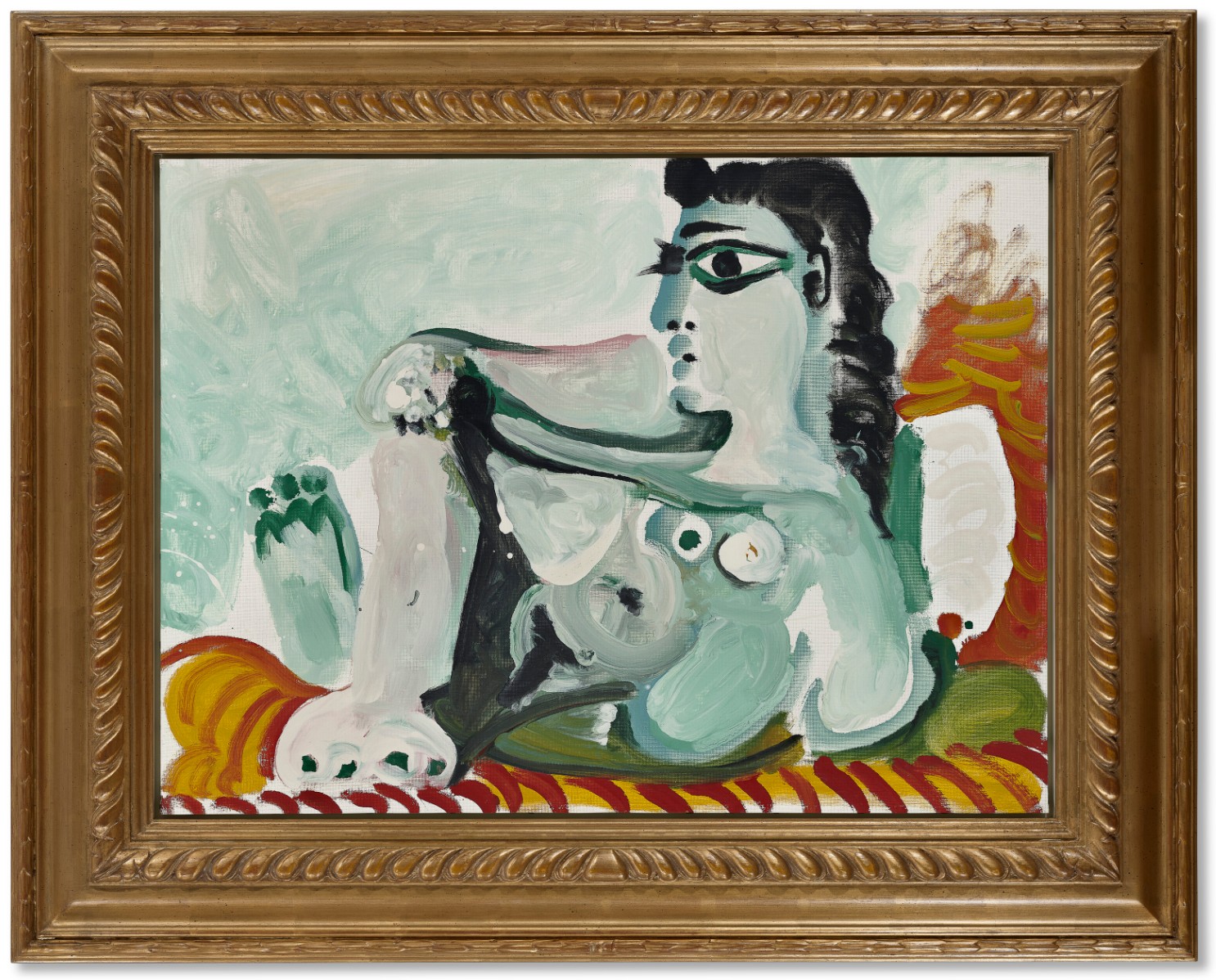
PABLO PICASSO (1881-1973)
Nu assis appuyé sur des coussins, 1964
Oil on canvas
54×73 cm (21 1/4 x 28 3/4 inches)
Dated and numbered ‘19.12. 64. III’ (on the reverse)
Painted on 19 December 1964
#14. Mousquetaire, tête, 1967
The Art of Collecting: Property from a Distinguished Private Collector
Christie’s New-York: 17 November 2025
Estimated: USD 3,000,000 – 5,000,000
USD 4,101,000
PABLO PICASSO (1881-1973), Mousquetaire, tête | Christie’s
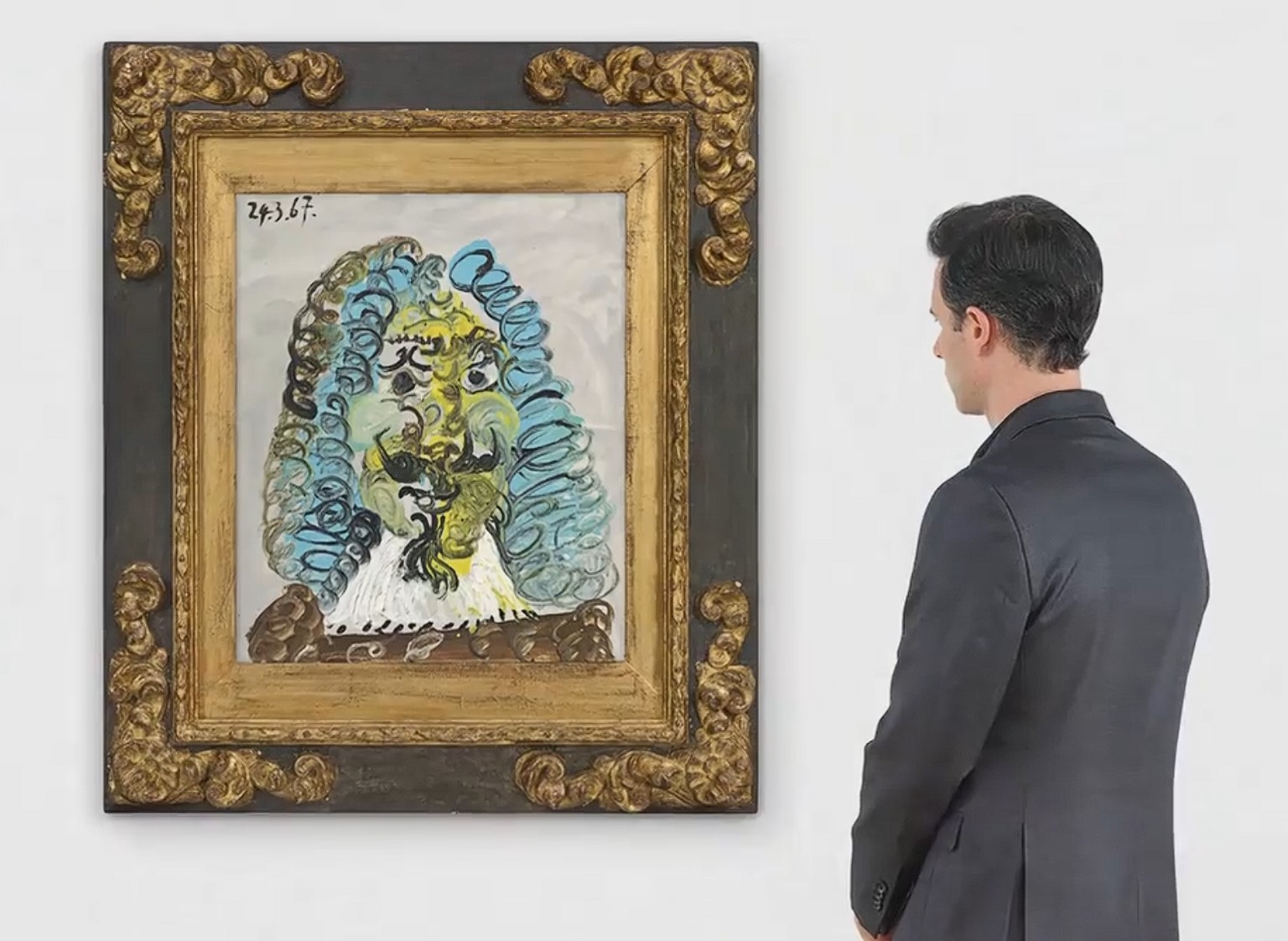
PABLO PICASSO (1881-1973)
Mousquetaire, tête, 1967
Oil on canvas
65×54 cm (25 5/8 x 21 1/4 inches)
Dated ‘24.3.67.’ (upper left)
Dated again and numbered ‘24.3.67. II’ (on the reverse)
#15. Femme dans un fauteuil, 1946
Birth of the Modern: The Arnold and Joan Saltzman Collection
Christie’s New-York: 17 November 2025
Estimated: USD 3,000,000 – 5,000,000
USD 3,979,000
PABLO PICASSO (1881-1973), Femme dans un fauteuil | Christie’s
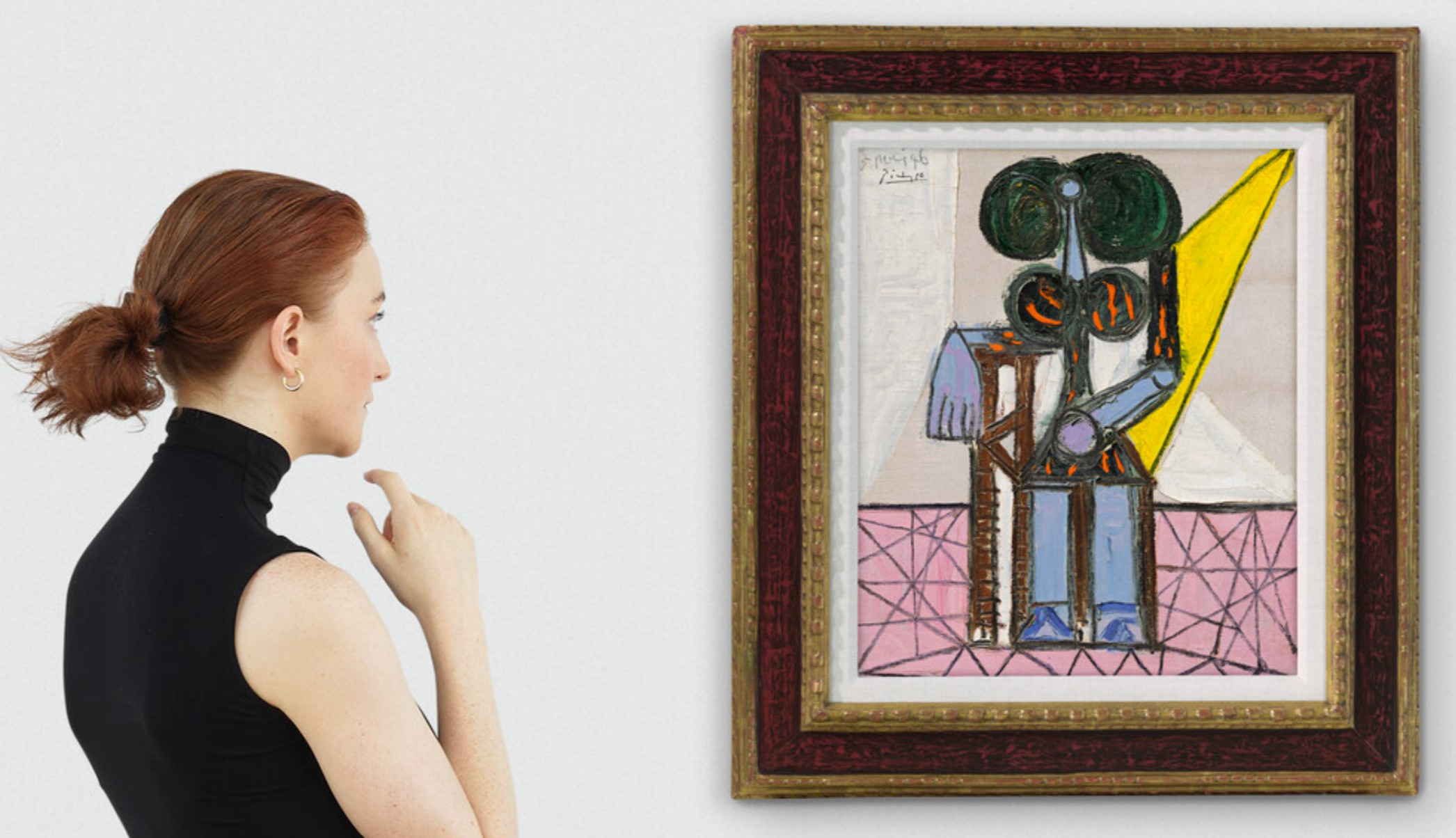
PABLO PICASSO (1881-1973)
Femme dans un fauteuil, 1946
Oil and charcoal on canvas
55.3 x 46.2 cm (21 5/8 x 18 1/8 inches)
Signed and dated ‘Picasso 5 mai 46’ (upper left)
Dated again ‘5 mai 46’ (on the reverse)
#16. Le Baigneur, 1957
Birth of the Modern: The Arnold and Joan Saltzman Collection
Christie’s New-York: 17 November 2025
Estimated: USD 3,500,000 – 5,500,000
USD 3,979,000
PABLO PICASSO (1881-1973), Le Baigneur | Christie’s
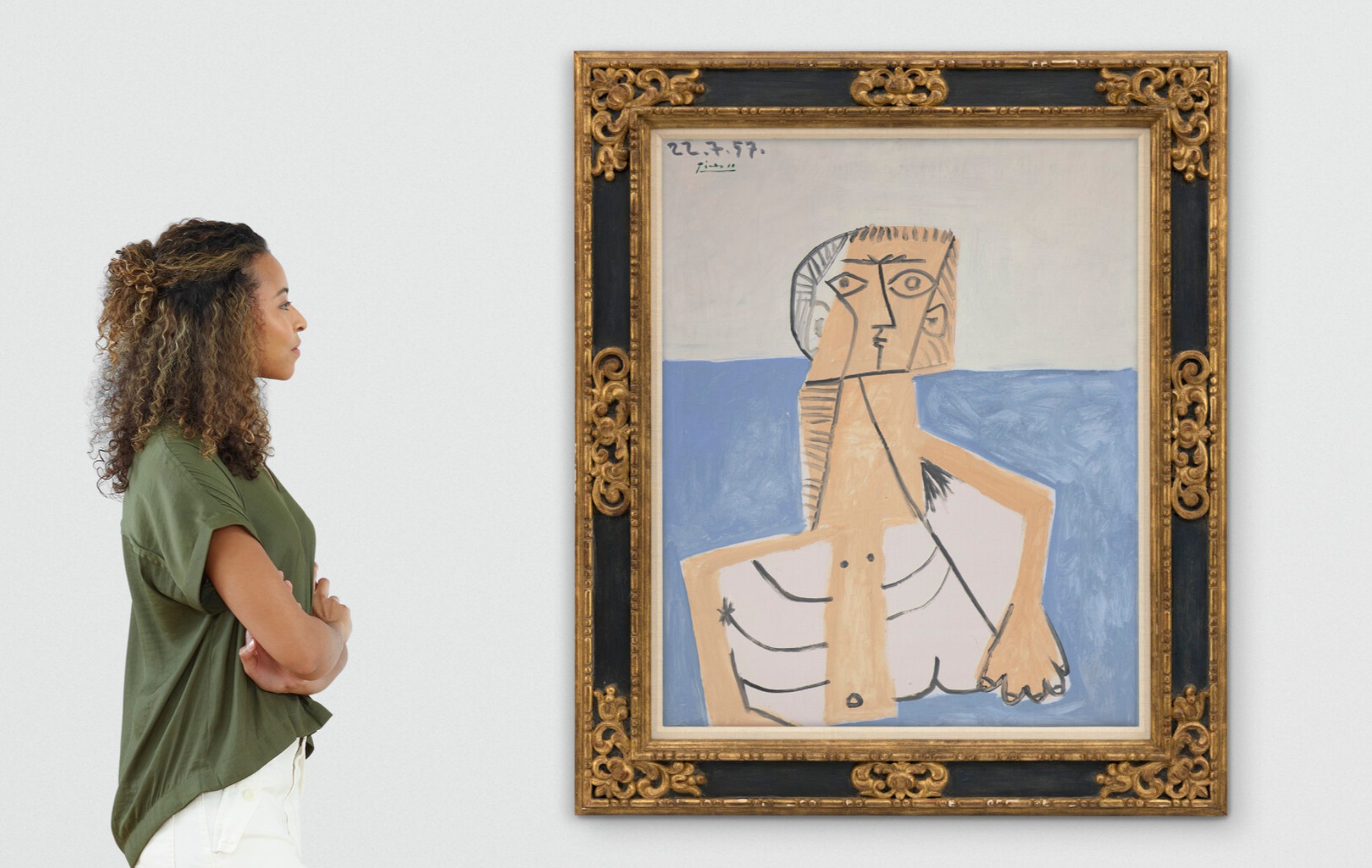
PABLO PICASSO (1881-1973)
Le Baigneur, 1957
Oil on canvas
100.5 x 81.4 cm (39 1/2 x 33 inches)
Signed and dated ‘Picasso 22.7.57.’ (upper left)
#17. Femme de profil dans un fauteuil (III), 1956
Christie’s London: 15 October 2025
Estimated: GBP 2,500,000 – 3,500,000
GBP 2,978,000 / USD 3,967,255
PABLO PICASSO (1881-1973), Femme de profil dans un fauteuil (III) | Christie’s
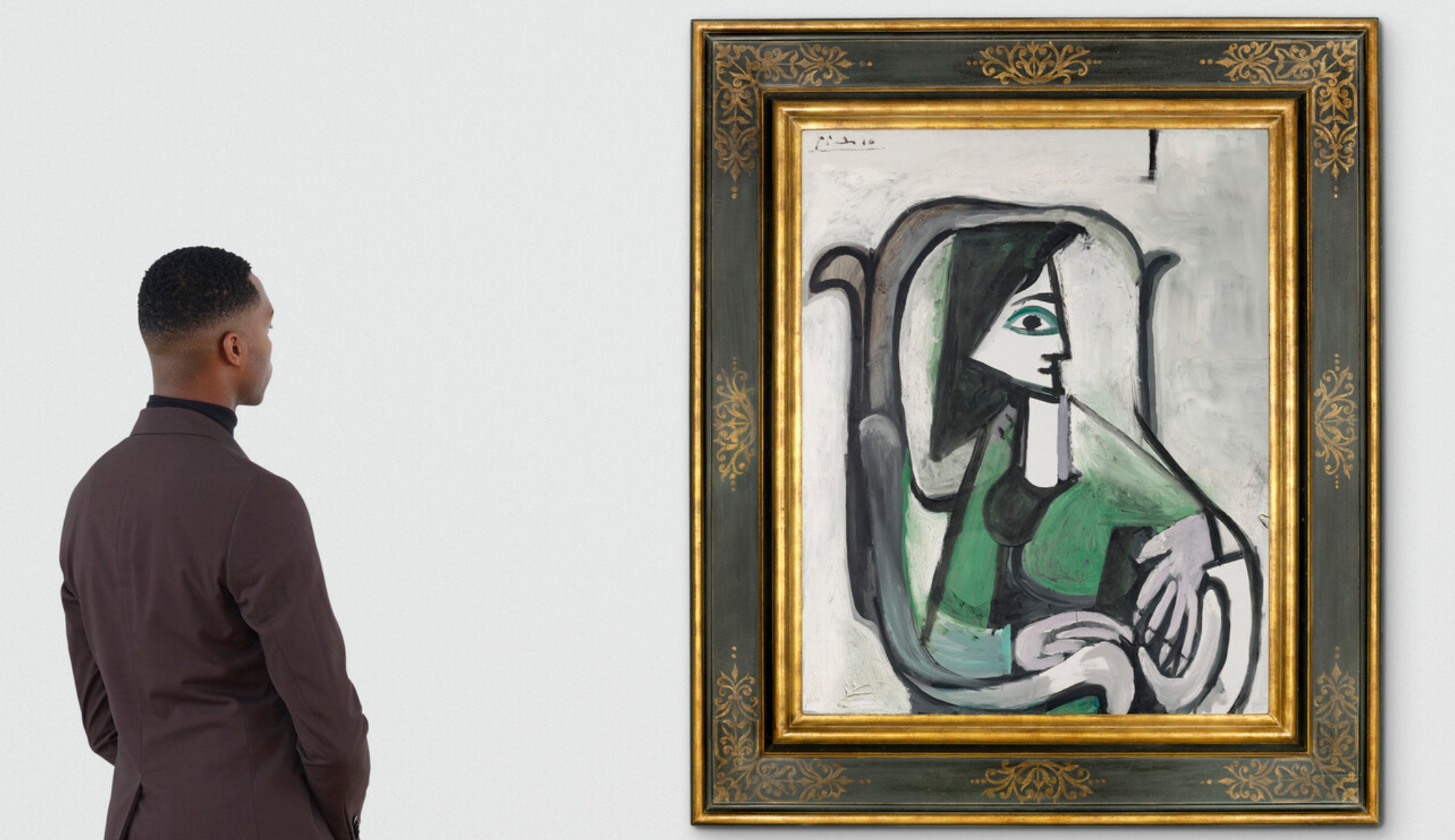
PABLO PICASSO (1881-1973)
Femme de profil dans un fauteuil (III), 1956
Oil on canvas
100.3 x 81 cm (39 1/2 x 31 7/8 inches)
Signed ‘Picasso’ (upper left)
Dated, numbered and inscribed ‘1er mai 56. III 12.’ (on the reverse)
Painted in Cannes on 1 May 1956
#18. Buste d’homme, 1968
Sotheby’s London: 17 September 2025
Estimated: GBP 1,500,000 – 2,500,000
GBP 2,480,000 / USD 3,386,050
Buste d’homme | Pauline Karpidas: The London Collection Evening Auction | 2025 | Sotheby’s
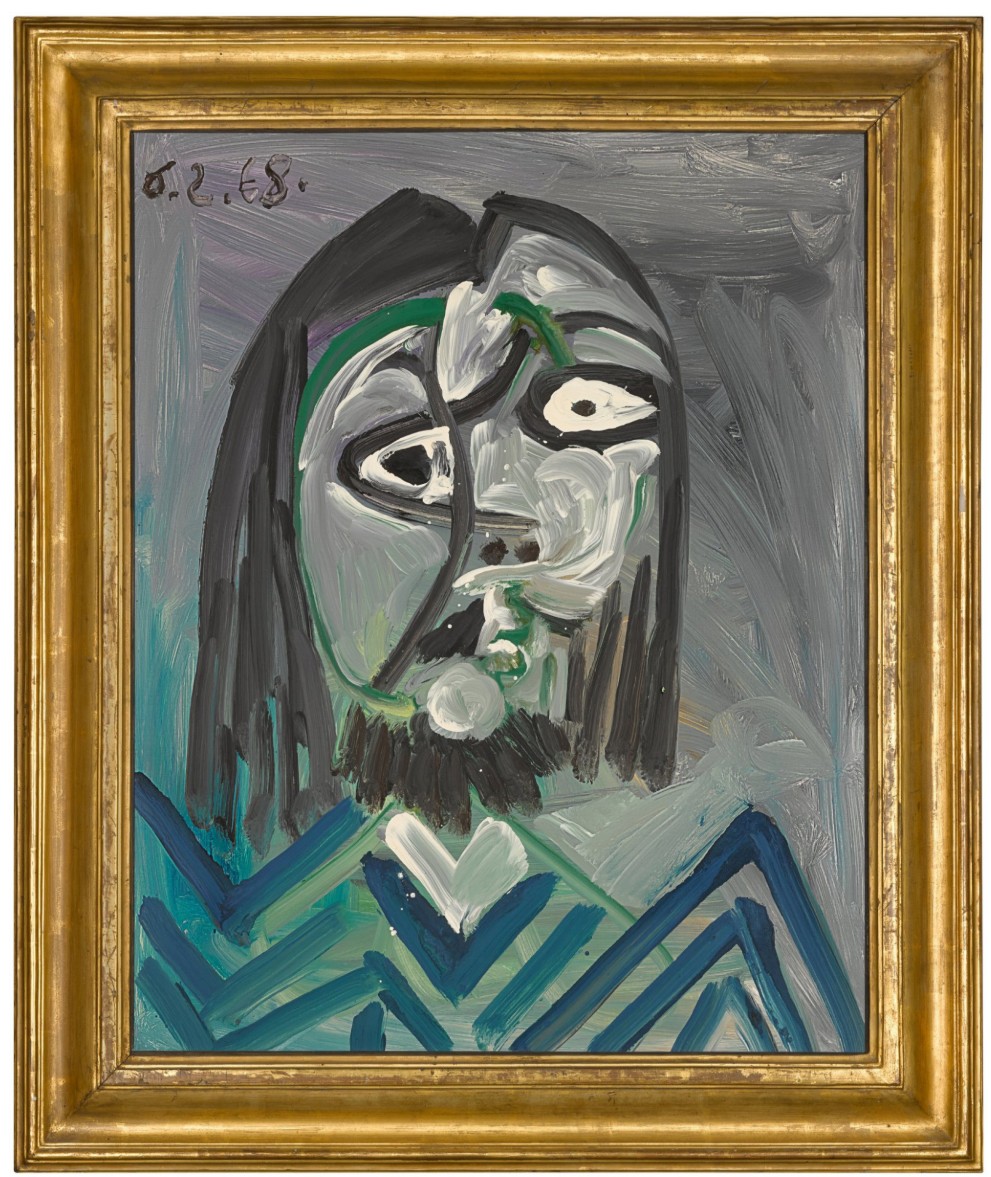
PABLO PICASSO (1881 – 1973)
Buste d’homme, 1968
Oil and Ripolin on canvas
81 x 64.8 cm (31 7/8 x 25 5/8 inches)
Dated 6.2.68. (upper left)
#19. Tête d’homme, 1964
Paintings by Pablo Picasso from the Collection of Marina Picasso
Sotheby’s New-York: 13 May 2025
Estimated: USD 2,000,000 – 3,000,000
USD 2,978,000
Tête d’homme | Modern Evening Auction | 2025 | Sotheby’s
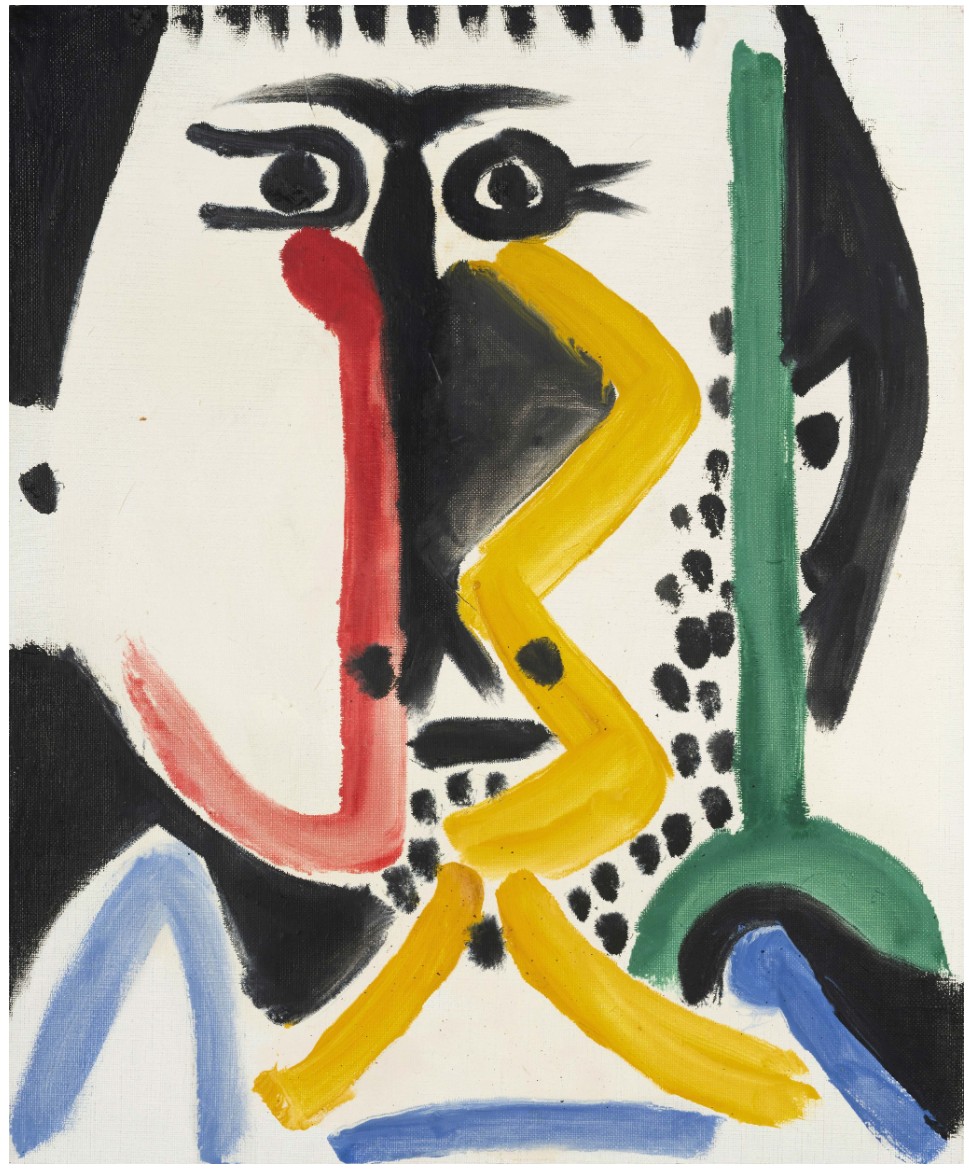
PABLO PICASSO (1881 – 1973)
Tête d’homme, 1964
Oil on canvas
46×38 cm (18×15 inches)
Dated 5.12.64. and numbered V (on the reverse)
#20. Homme et femme. Têtes, 1967
The Geri Brawerman Collection: A Tribute to Los Angeles and A Legacy of Giving
Sotheby’s New-York: 20 November 2025
Estimated: USD 3,000,000 – 5,000,000
USD 2,856,000
Homme et femme. Têtes | Modern Evening Auction | 2025 | Sotheby’s
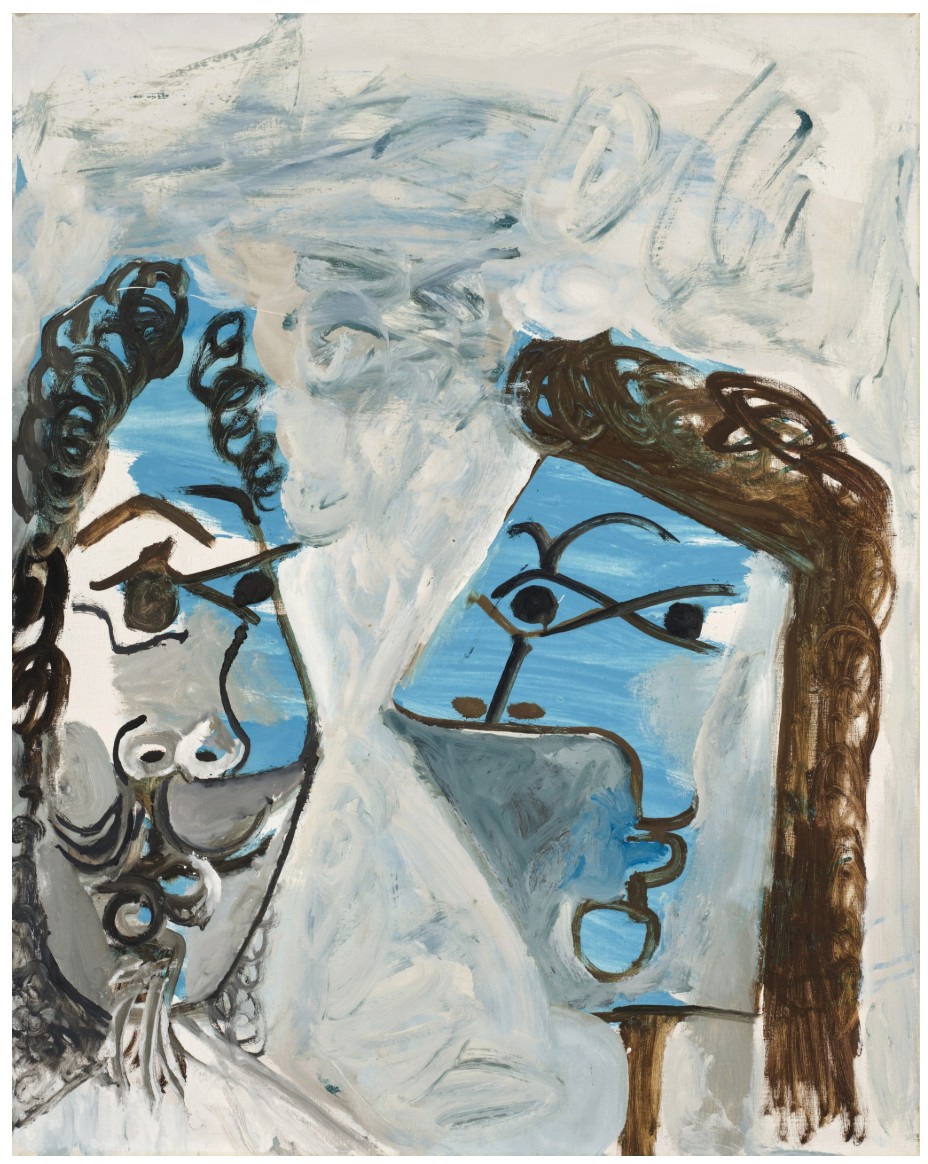
PABLO PICASSO (1881 – 1973)
Homme et femme. Têtes, 1967
Oil and Ripolin on canvas
92×73 cm (36 1/4 x 28 3/4 inches)
Dated 21.3.67 and numbered V (on the reverse)
#21. Buste d’homme, 1969
Sotheby’s Hong-Kong: 28 September 2025
Estimated: HKD 15,500,000 – 25,000,000
HKD 20,505,000 / USD 2,635,605
READ MORE IN FOCUS SECTION
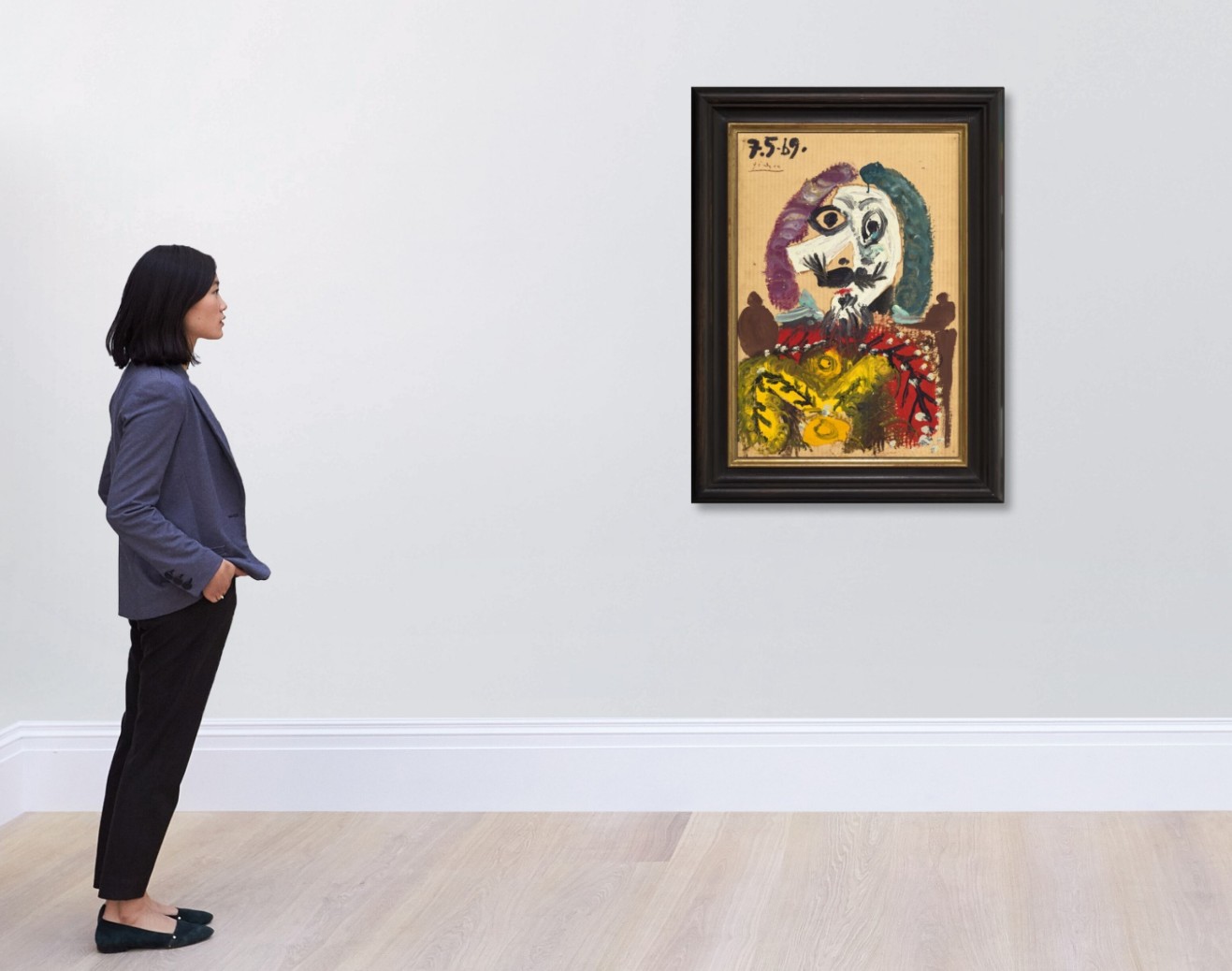
PABLO PICASSO (1881 – 1973)
Buste d’homme, 1969
Oil on corrugated cardboard
72.4 x 49.8 cm (28 1/2 x 19 5/8 inches)
Signed Picasso and dated 7.5.69 (upper left)
#22. Le miroir, 1947
Estimated: HKD 15,000,000 – 25,000,000
HKD 18,675,000 / USD 2,400,386
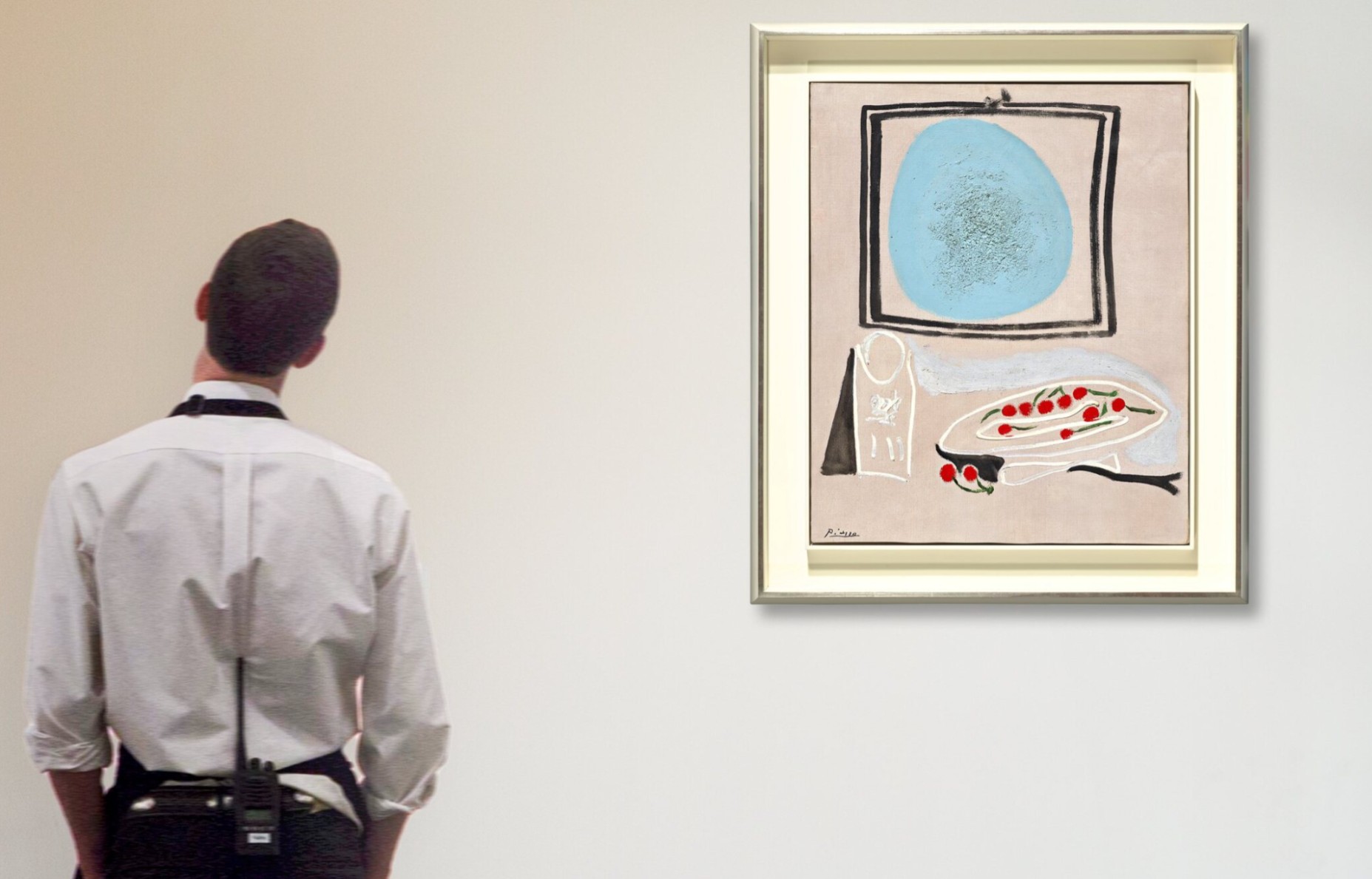
PABLO PICASSO (1881 – 1973)
Le miroir, 1947
Oil and sand on canvas
61 x 50.2 cm (24 x 19 3/4 inches)
Signed Picasso (lower left) and dated 23 juin 47 (on the reverse)
Executed on 23 June 1947
#23. Le Peintre. Tête de profil, 1967
Sotheby’s New-York: 13 May 2025
Estimated: USD 2,500,000 – 3,500,000
USD 2,112,200
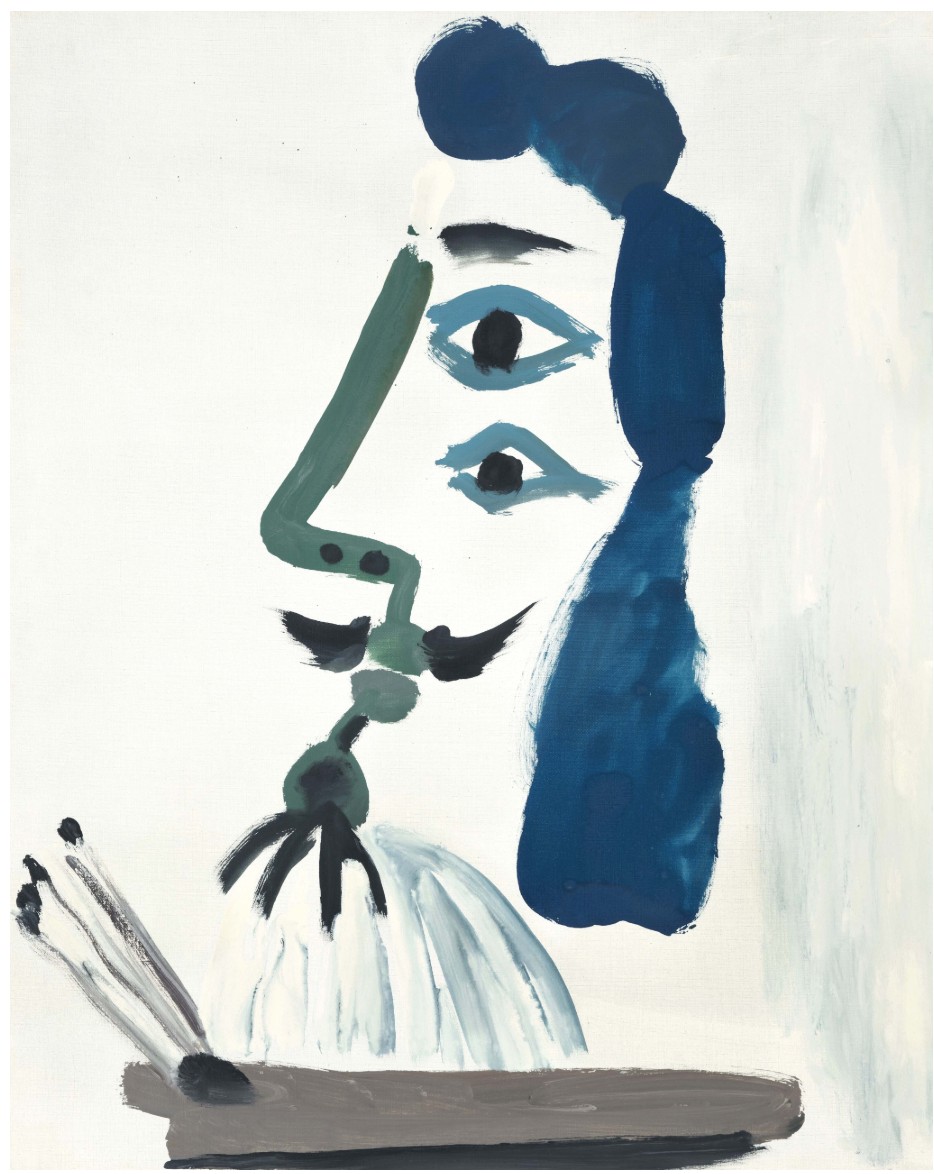
PABLO PICASSO (1881 – 1973)
Le Peintre. Tête de profil, 1967
Oil on canvas
91.6 x 73 cm (36 1/8 x 28 3/4 inches)
#24. Femme nue à la guitare, 1909
Sotheby’s Paris: 10 April 2025
Estimated: EUR 1,200,000 – 1,800,000
USD 1,506,500 / USD 1,649,570
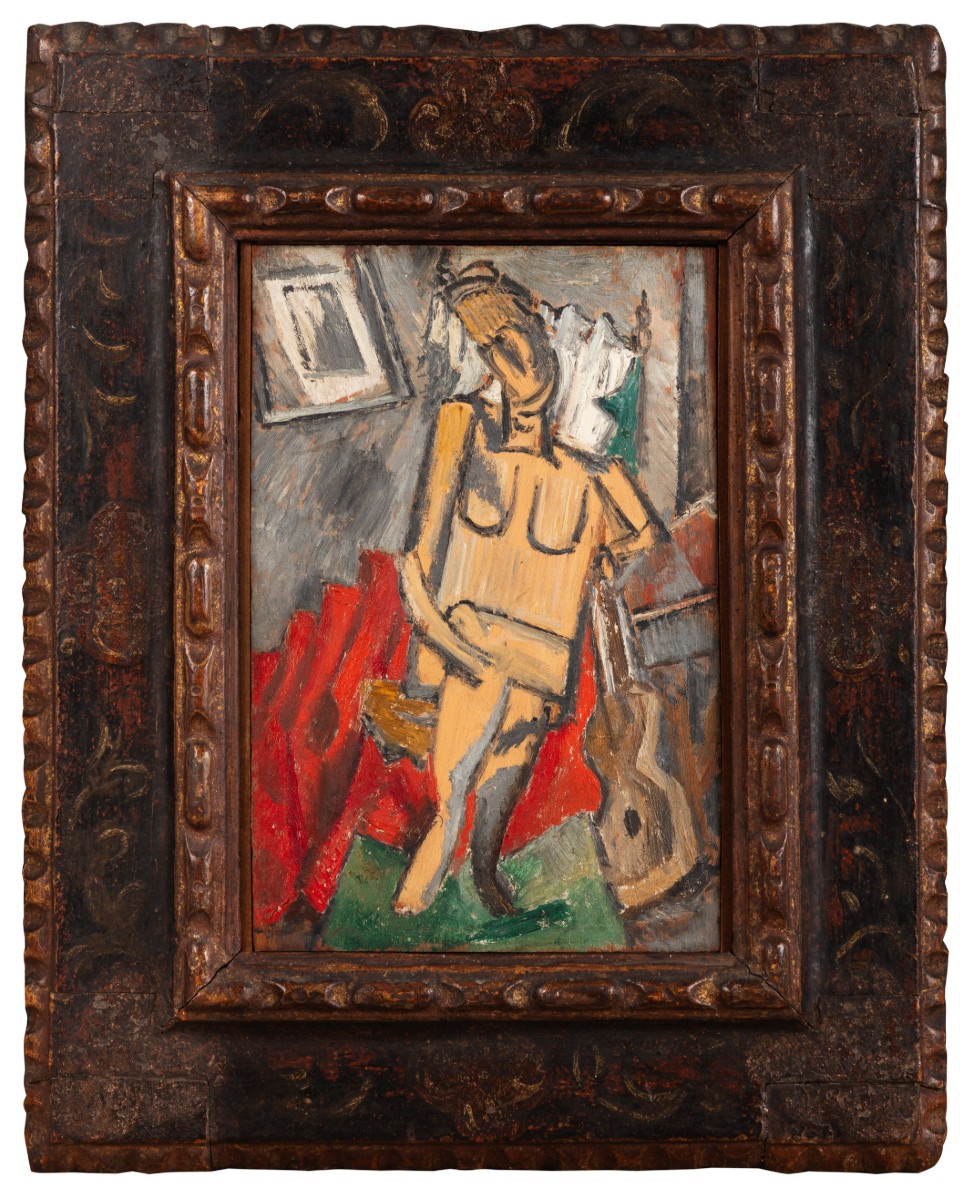
PABLO PICASSO (1881 – 1973)
Femme nue à la guitare, 1909
Oil on panel
26.8 x 17.8 cm (10 1/2 x 7 inches)
Signed Picasso (on the reverse)
#25. Le Peintre (Tête), 1964
Christie’s New-York: 13 May 2025
Estimated: USD 1,200,000 – 1,800,000
USD 1,562,500
PABLO PICASSO (1881-1973), Le Peintre (Tête) | Christie’s
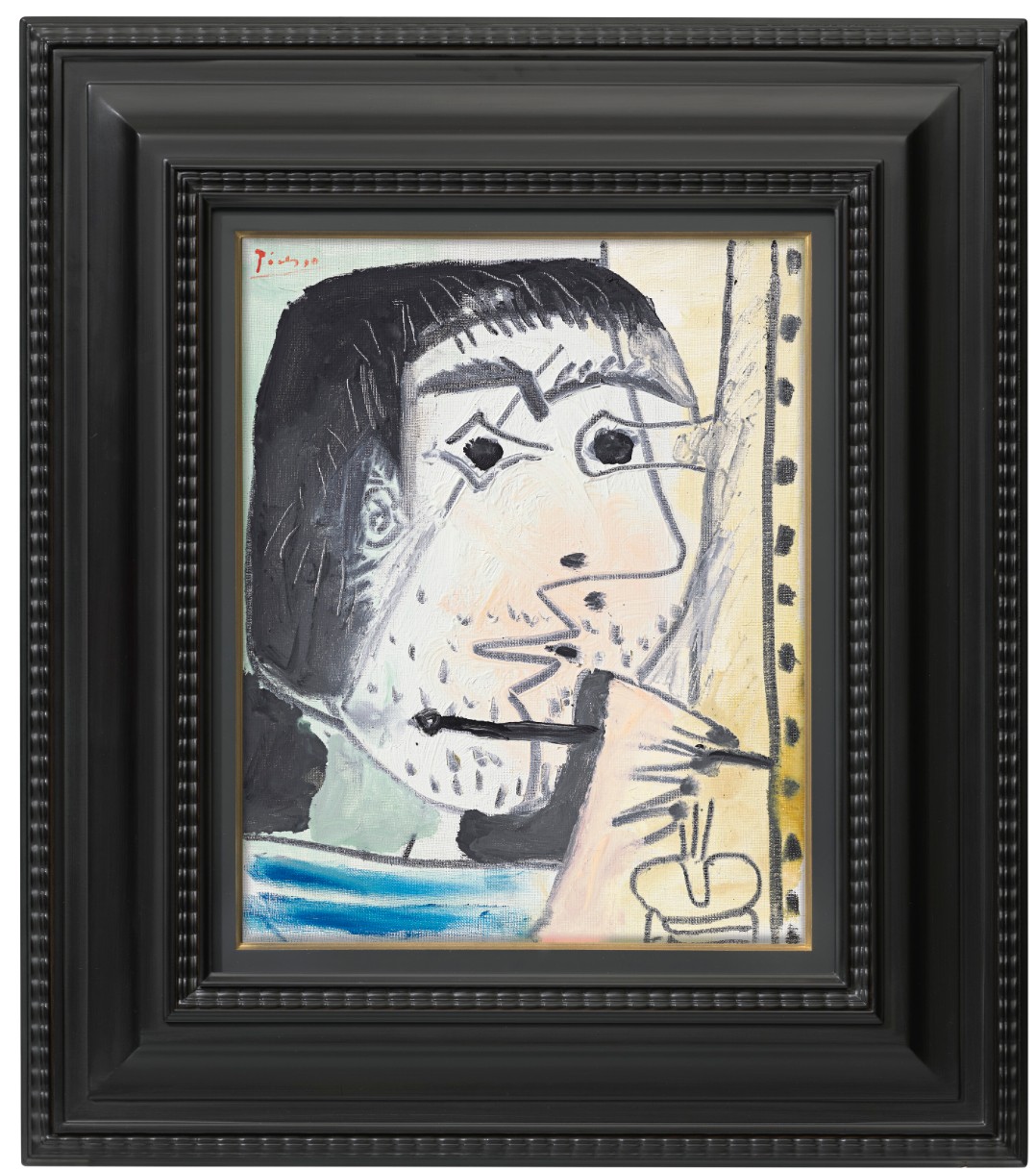
PABLO PICASSO (1881-1973)
Le Peintre (Tête), 1964
Oil on canvas
41×33 cm (16×13 inches))
Signed ‘Picasso’ (upper left)
Dated and numbered ‘I.II.64. IV’ (on the reverse)
#26. Femme nue assise III, 1959
Christie’s London: 5 March 2025
Estimated: GBP 600,000 – 800,000
GBP 844,200 / USD 1,080,630
PABLO PICASSO (1881-1973), Femme nue assise III | Christie’s
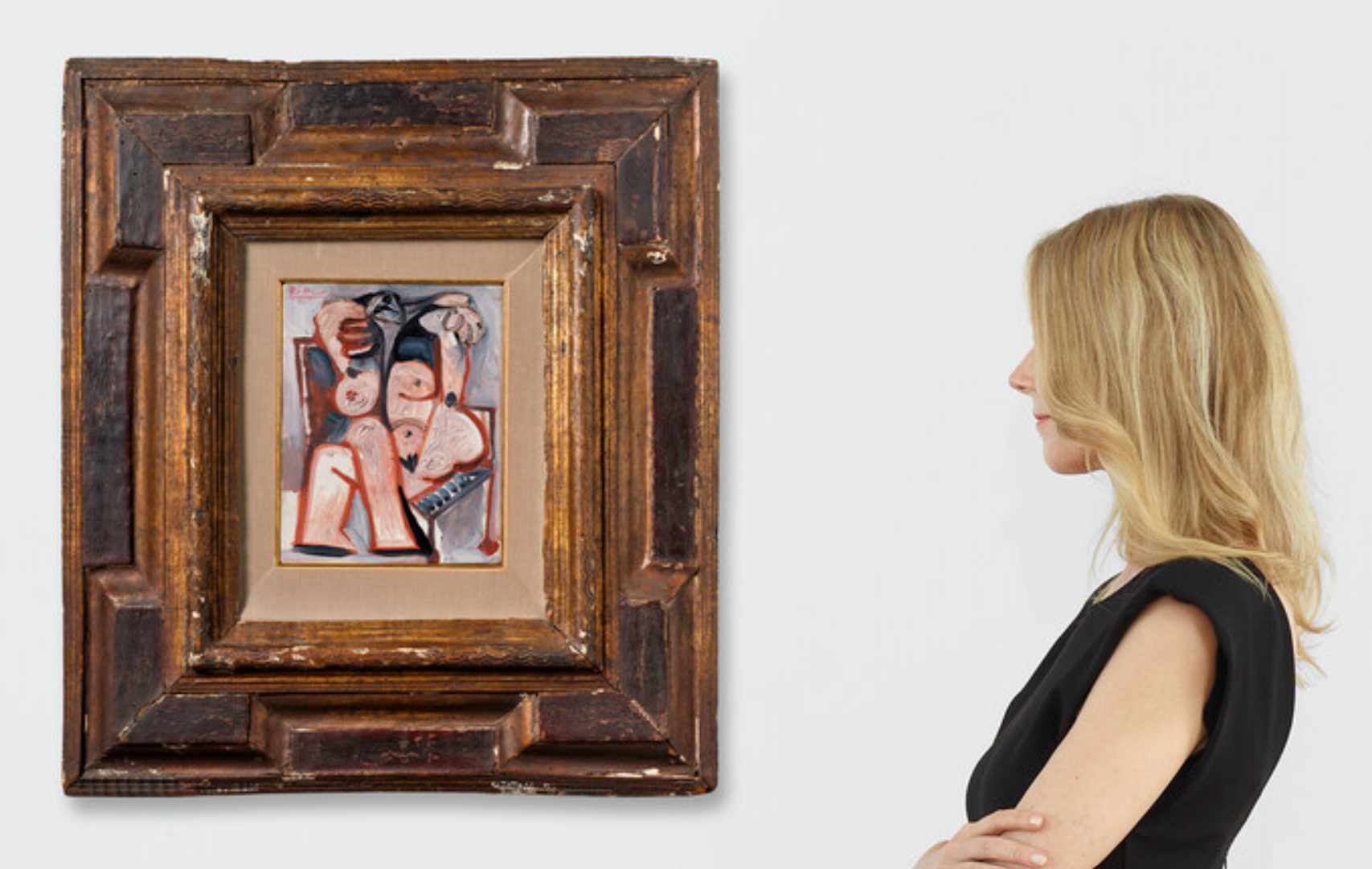
PABLO PICASSO (1881-1973)
Femme nue assise III, 1959
Oil on canvas
28.2 x 23.3 cm (11 1/8 x 9 1/8 inches)
Signed ‘Picasso’ (upper left)
Dated and numbered ’16.2.59. III’ (on the reverse)
#27. Modèle dans l’atelier, 1965
Sotheby’s London: 5 March 2025
Estimated: GBP 400,000 – 600,000
GBP 660,400 / USD 901,400
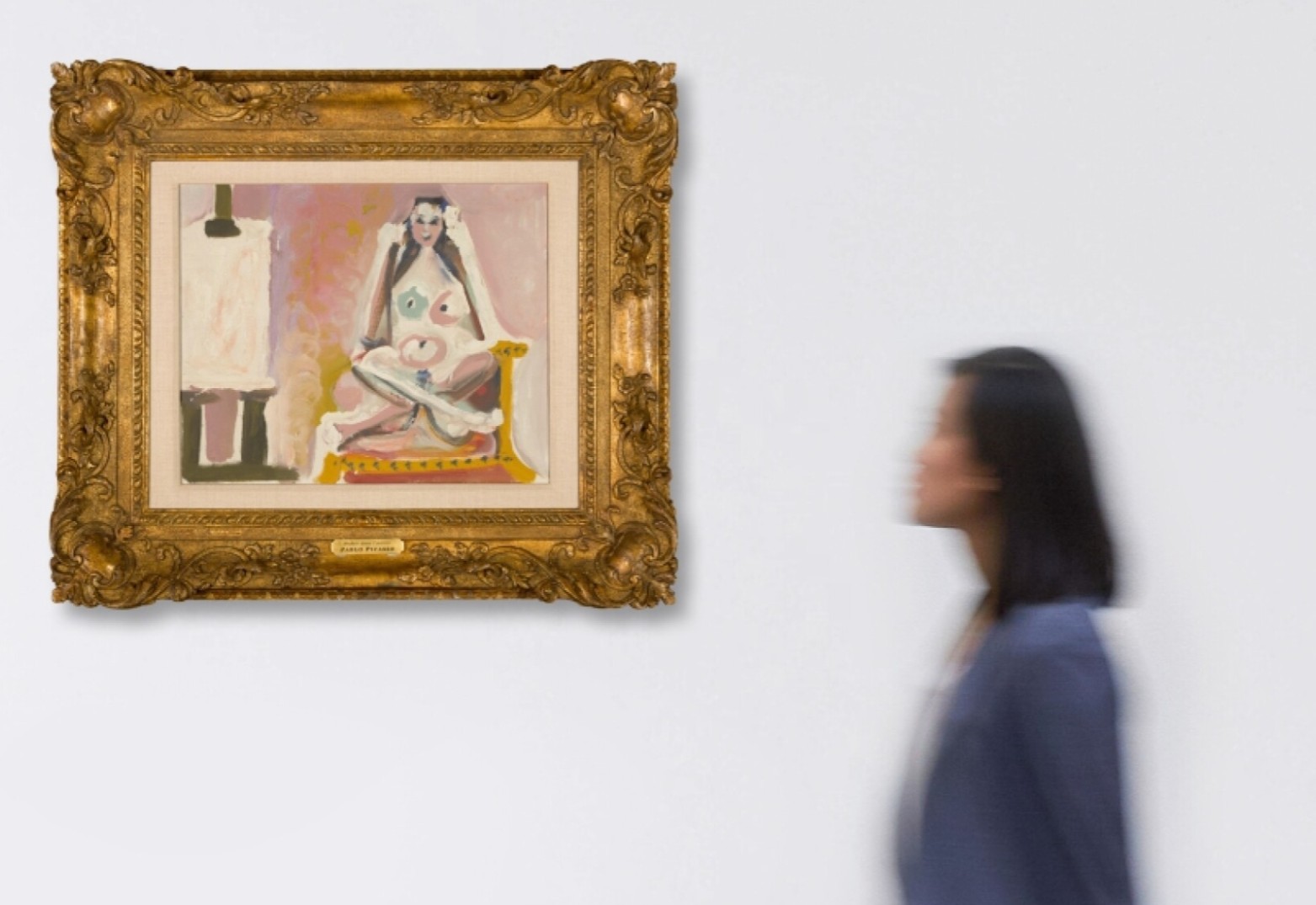
PABLO PICASSO (1881 – 1973)
Modèle dans l’atelier, 1965
Oil on canvas
38×46 cm (15 x 18 1/8 inches)
Signed indistinctly Picasso (upper right)
Dated 24.3.65. and numbered VI (on the reverse)
#28. Maison à Juan-les-Pins, 1931
Paintings by Pablo Picasso from the Collection of Marina Picasso
Sotheby’s New-York: 13 May 2025
Estimated: USD 700,000 – 900,000
USD 787,400
Maison à Juan-les-Pins | Modern Evening Auction | 2025 | Sotheby’s
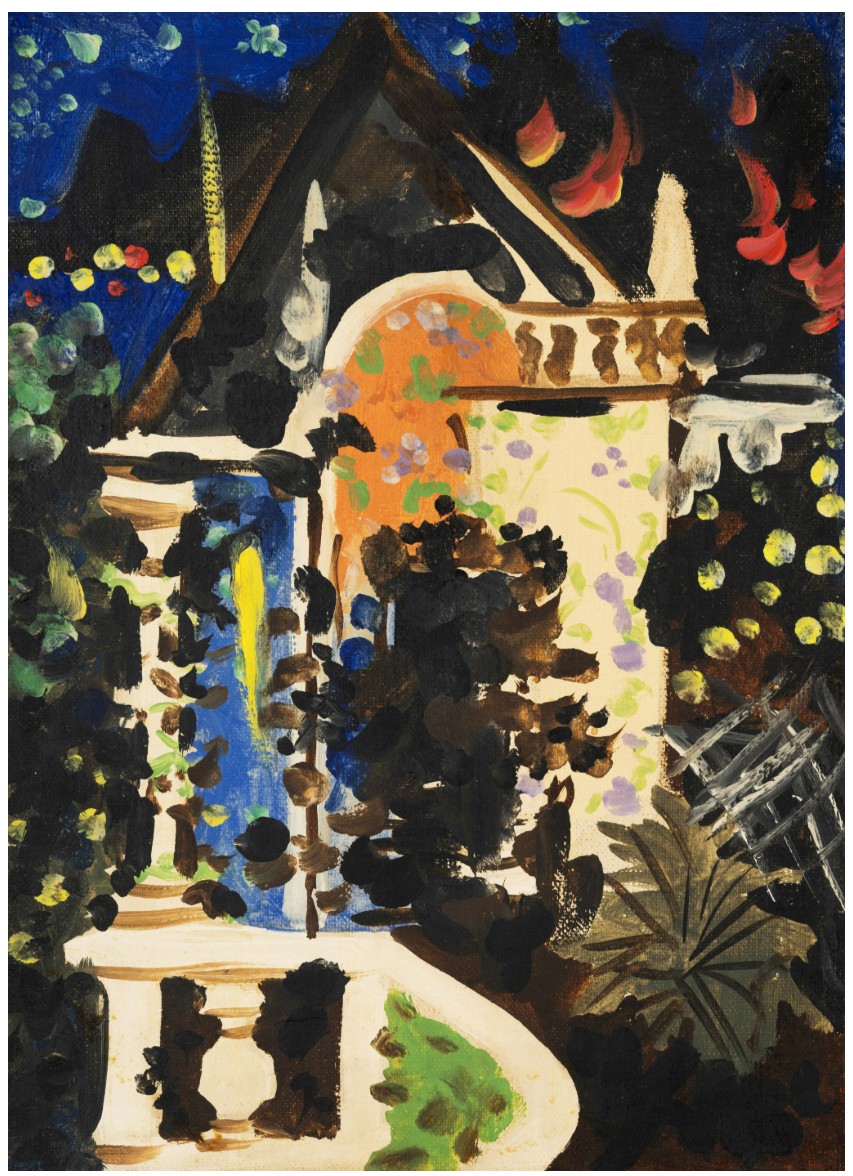
PABLO PICASSO (1881 -1973)
Maison à Juan-les-Pins, 1931
Oil on canvas
33×24 cm (13 x 9 1/4 inches)
#29. Oiseau et libellule, 1939
Christie’s New-York: 13 May 2025
Estimated: USD 200,000 – 300,000
USD 252,800
PABLO PICASSO (1881-1973), Oiseau et libellule | Christie’s
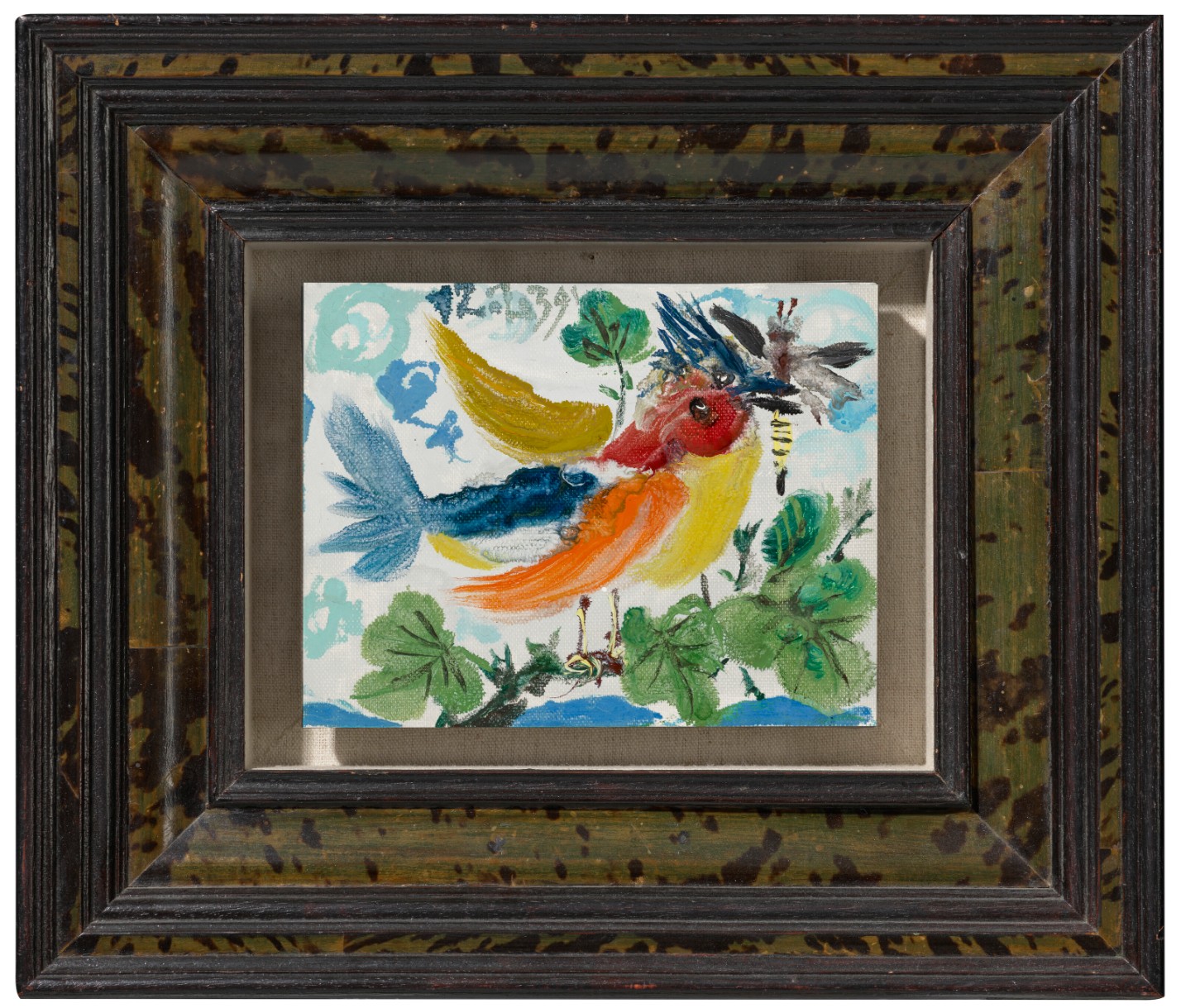
Oiseau et libellule, 1939
Oil on canvas
14×18 cm (5 1/2 x 7 1/8 inches)
Dated ‘12.2.39” (upper left)
2024 Auction Results
FOR PAINTINGS AND SCULPTURES ONLY
23 lots sold at auction in 2024 for a total turnover of USD 152,894,330. With 6 lots failing to sell, the sell-through rate is 79%. The highest price has been achieved at Sotheby’s in New-York, on 18 November 2024, for La Statuaire, a painting dated 1925, that sold for USD 24,800,000.
2024 Top 3 Lots
6 lots sold for more than USD 10 million, generating a cumulative turnover of USD 98,602,845, representing 64.5% of the total turnover for 2024. 20 lots sold for more than USD 1 million, generating a cumulative turnover of USD 150,240,120, representing 98.9% of the total turnover for 2024.
XXXXXXXXXX
#1. La Statuaire, 1925
A Legacy of Beauty: The Collection of Sydell Miller
Sotheby’s New-York: 18 November 2024
Estimate on Request
USD 24,800,000
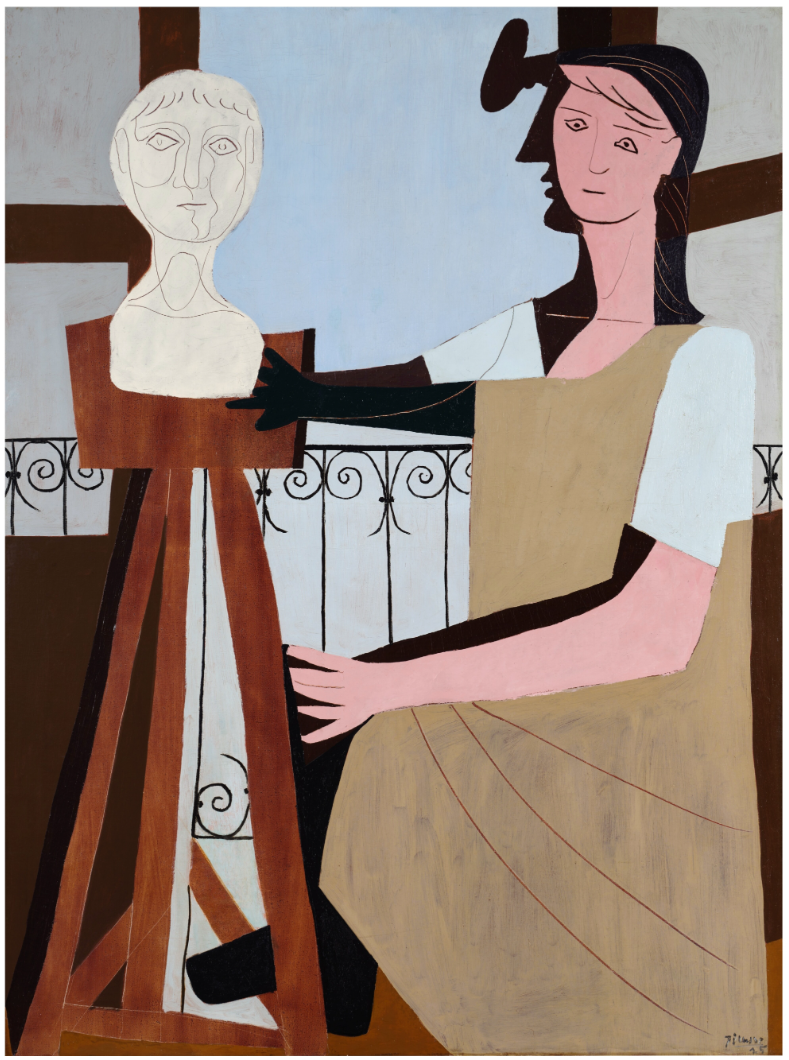
PABLO PICASSO (1881 – 1973)
La Statuaire, 1925
Oil on canvas
131 x 97.8 cm (51 5/8 x 38 1/2 inches)
Signed Picasso and dated 25 (lower right)
Dated XXV-II-XXV (on the stretcher)
#2. Femme au chapeau assise, 1971
Christie’s New-York: 16 May 2024
Estimated: USD 20,000,000 – 30,000,000
USD 19,960,000
PABLO PICASSO (1881-1973), Femme au chapeau assise | Christie’s (christies.com)
PABLO PICASSO (1881-1973)
Femme au chapeau assise, 1971
Oil and Ripolin on canvas
130 x 97,1 cm (51 1/8 x 38 1/4 inches
Dated and numbered ‘28.7.71. II’ (on the reverse)
Painted in Mougins on 28 July 1971
#3. Homme à la pipe, 1968
Sotheby’s London: 6 March 2024
Estimated: GBP 8,000,000 – 12,000,000
GBP 13,723,100 / USD 17,400,891
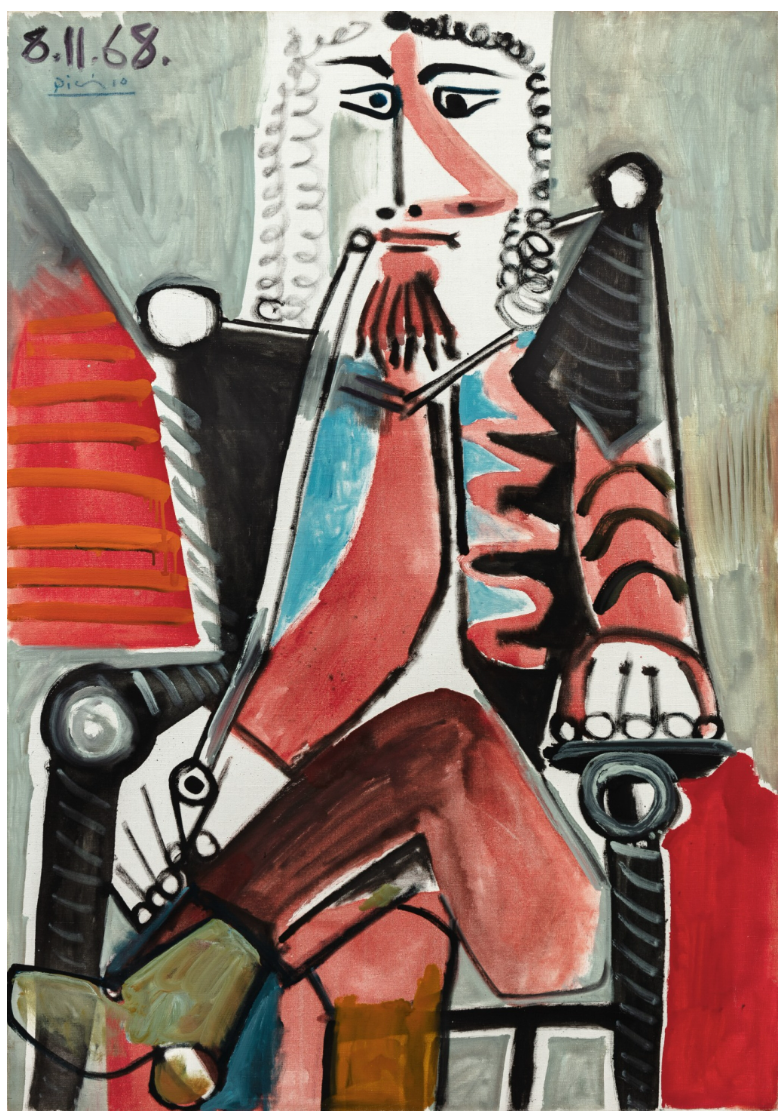
PABLO PICASSO (1881 – 1973)
Homme à la pipe, 1968
Oil on canvas
162.7 x 114.5 cm (64 1/8 x 45 1/8 inches)
Signed Picasso and dated 8.11.68. (upper left); dated 8.11.68. (on the reverse)
#4. Guitare sur un tapis rouge, 1922
Sotheby’s London: 25 June 2024
Estimated: GBP 10,000,000 – 15,000,000
GBP 10,730,000 / USD 13,605,040
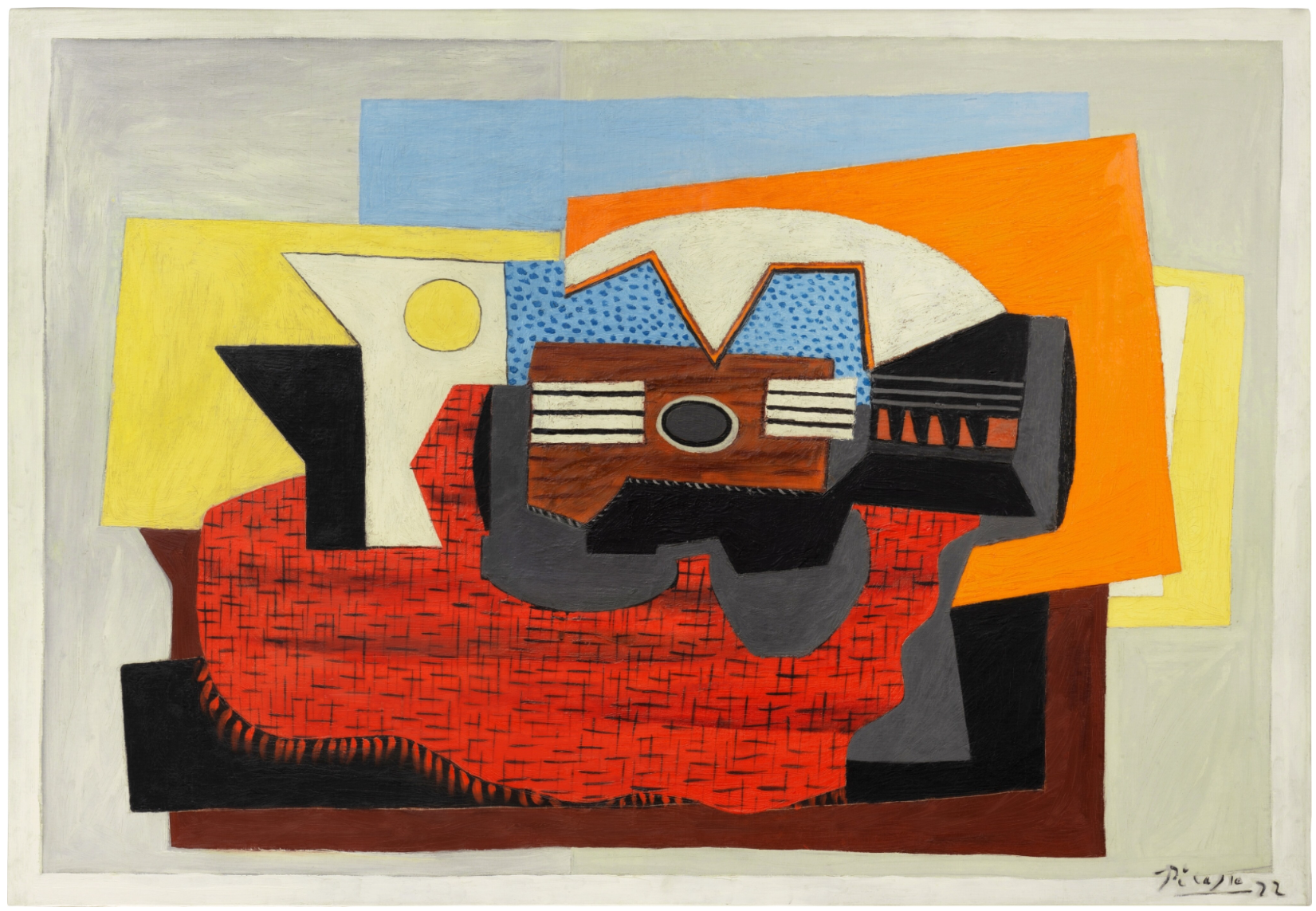
PABLO PICASSO (1881 – 1973)
Guitare sur un tapis rouge, 1922
Oil on canvas
80.7 x 116.3 cm (31 3/4 x 45 3/4 inches)
Signed Picasso and dated 22 (lower right)
#5. Buste d’homme, 1969
Sotheby’s New-York: 15 May 2024
Estimated: USD 8,000,000 – 12,000,000
USD 12,743,700
Buste d’homme | Modern Evening Auction | 2024 | Sotheby’s (sothebys.com)

PABLO PICASSO (1881 – 1973)
Buste d’homme, 1969
Oil and Ripolin on canvas
116.4 x 89.6 cm (45 7/8 x 35 1/4 inches)
Signed Picasso (lower left); dated 20.10.69. and numbered II (on the reverse)
Executed on 20 October 1969
#6. Le Peintre, 1963
Sotheby’s Hong-Kong: 5 April 2024
Estimated: HKD 66,000,000 – 90,000,000
HKD 78,724,000 / USD 10,064,434

PABLO PICASSO (1881 – 1973)
Le Peintre, 1963
Oil on canvas
92×60 cm (36 1/4 x 23 5/8 inches)
Signed Picasso (lower left)
Dated 8.6.63. III (on the verso)
USD 10 million
#7. Buste de femme, 1949
Sotheby’s New-York: 18 November 2024
Estimated: USD 9,000,000 – 12,000,000
USD 9,950,000
Buste de femme | Modern Evening Auction | 2024 | Sotheby’s
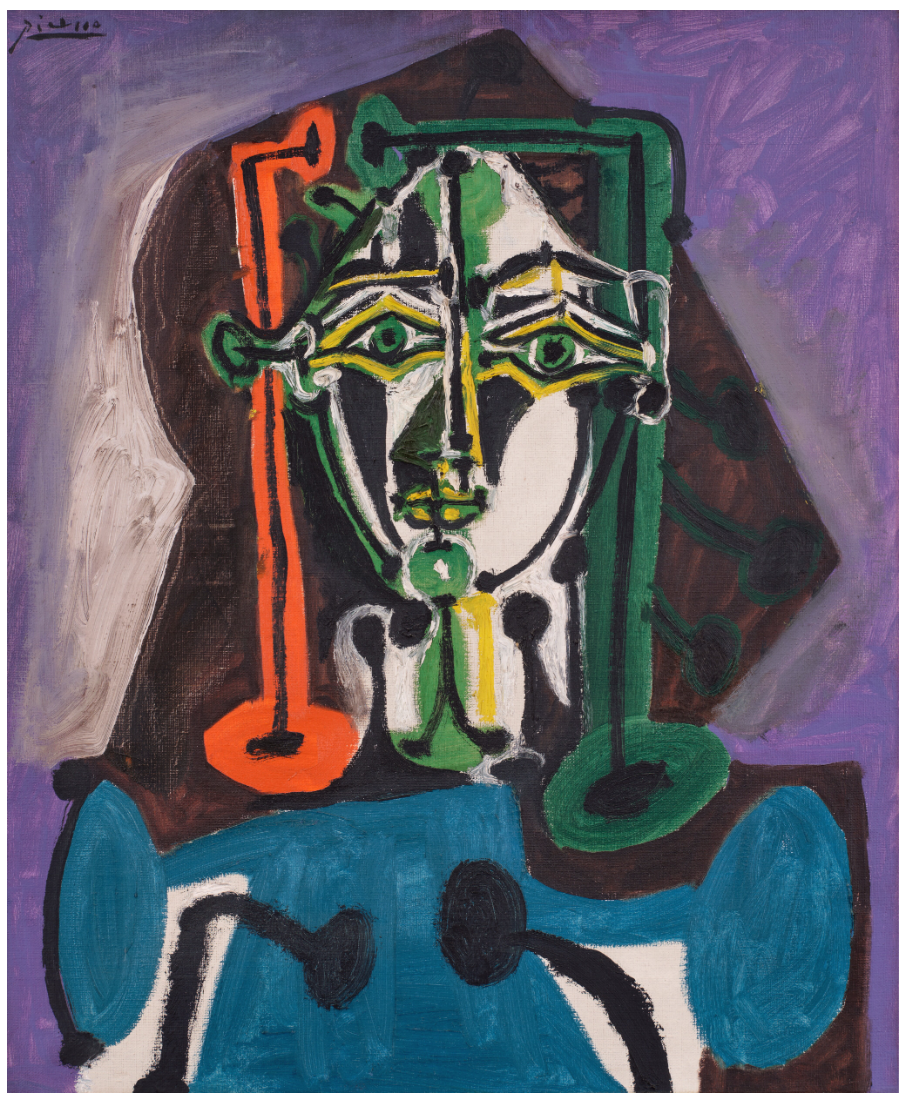
PABLO PICASSO (1881 – 1973)
Buste de femme, 1949
Oil on canvas
61×50 cm (24 x 19 5/8 inches)
Signed Picasso (upper left) and dated 24.3.49. (on the reverse)
Executed on 24 March 1949
#8. Nu assis, 1960
Sotheby’s London: 25 June 2024
Estimated: GBP 3,500,000 – 5,000,000
GBP 5,760,000 / USD 7,303,680
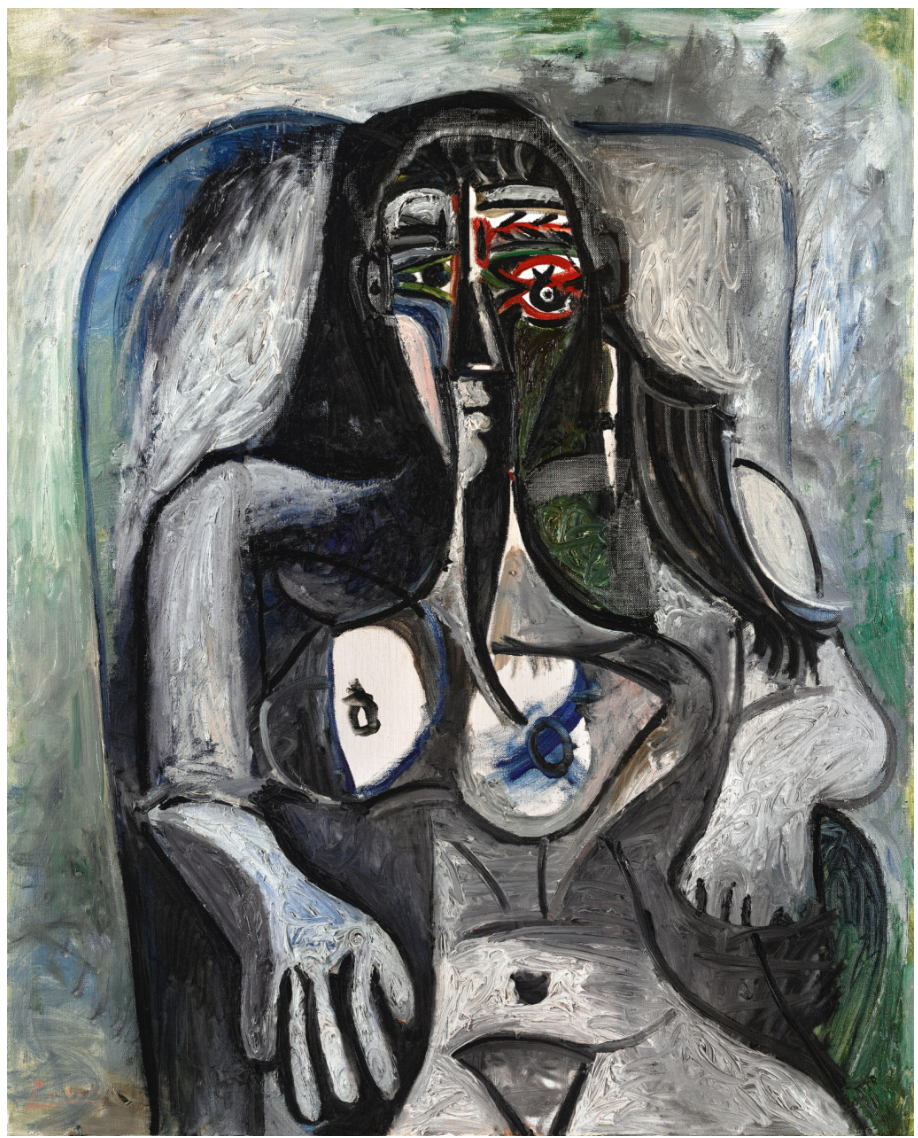
PABLO PICASSO (1881 – 1973)
Nu assis, 1960
Oil on canvas
100×81 cm (39 3/8 x 31 7/8 inches)
Signed Picasso (lower left); dated 23.4.60. (on the reverse)
#9. Tête de femme (Françoise), 1951
The Collection of Sydell Miller
Sotheby’s New-York: 18 November 2024
Estimated: USD 7,000,000 – 10,000,000
USD 6,900,000
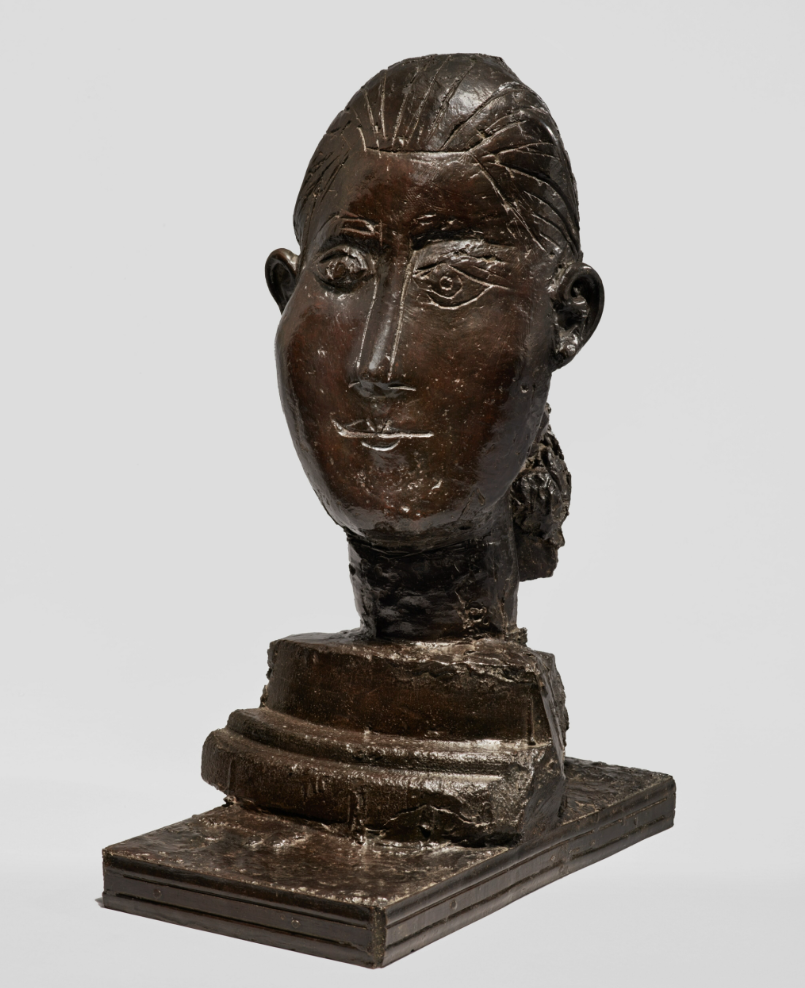
PABLO PICASSO (1881 – 1973)
Tête de femme (Françoise), 1951
Bronze
Height: 50 cm (19 5/8 inches)
Stamped with the foundry mark C. Valsuani Cire Perdue
Conceived in 1951 and cast in an edition of 2
#10. Buste de femme, 1960
Christie’s New-York: 16 May 2024
Estimated: USD 5,000,000 – 7,000,000
USD 5,132,000
https://www.christies.com/en/lot/lot-6482987
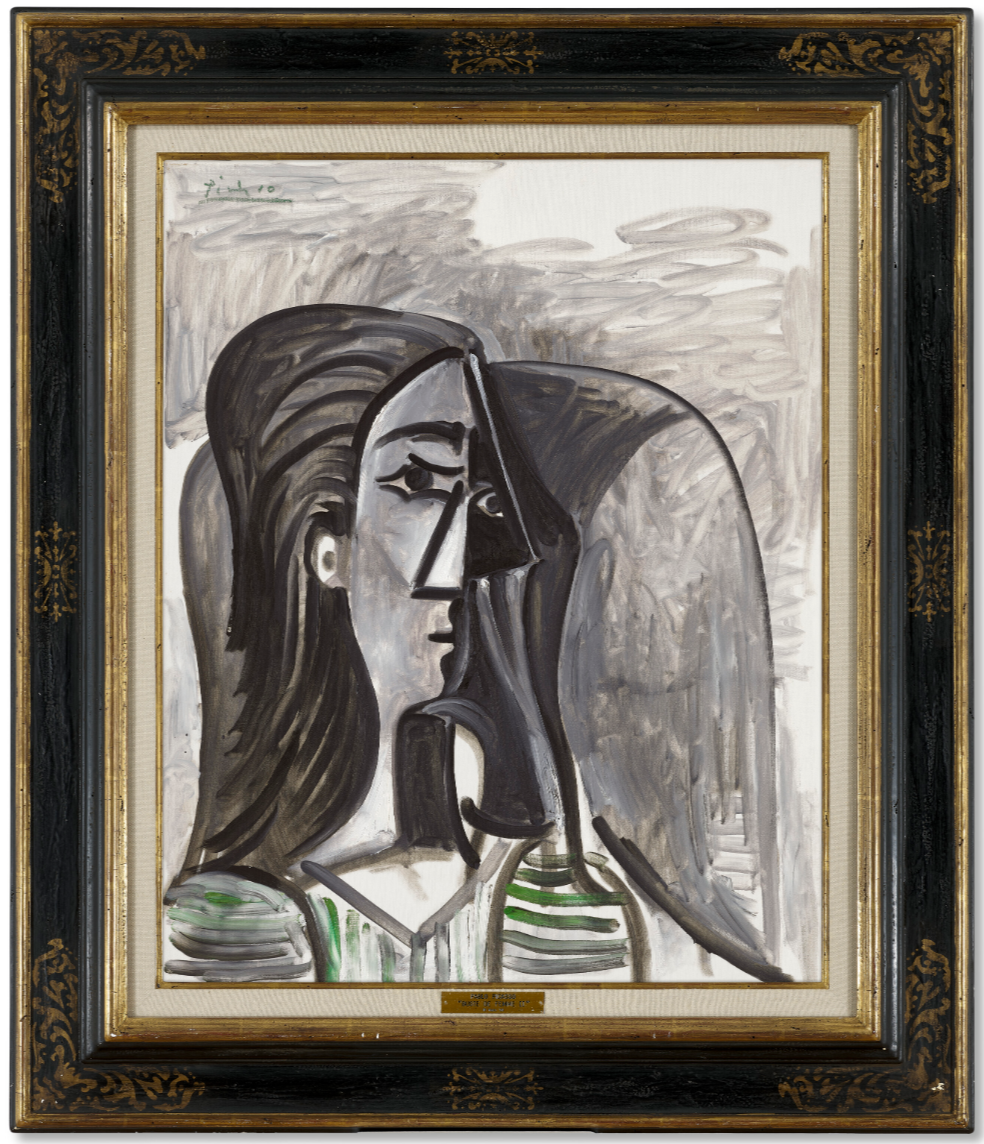
PABLO PICASSO (1881-1973)
Buste de femme, 1960
Oil on canvas
81 x 64.9 cm (31 7/8 x 25 5/8 inches)
Signed ‘Picasso’ (upper left); dated and numbered ‘10.3.60. II’ (on the reverse)
Painted on 10 March 1960
#11. Tête de femme, 1951
Sotheby’s London: 6 March 2024
Estimated: GBP 2,500,000 – 4,000,000
GBP 3,073,000 / USD 3,896,564
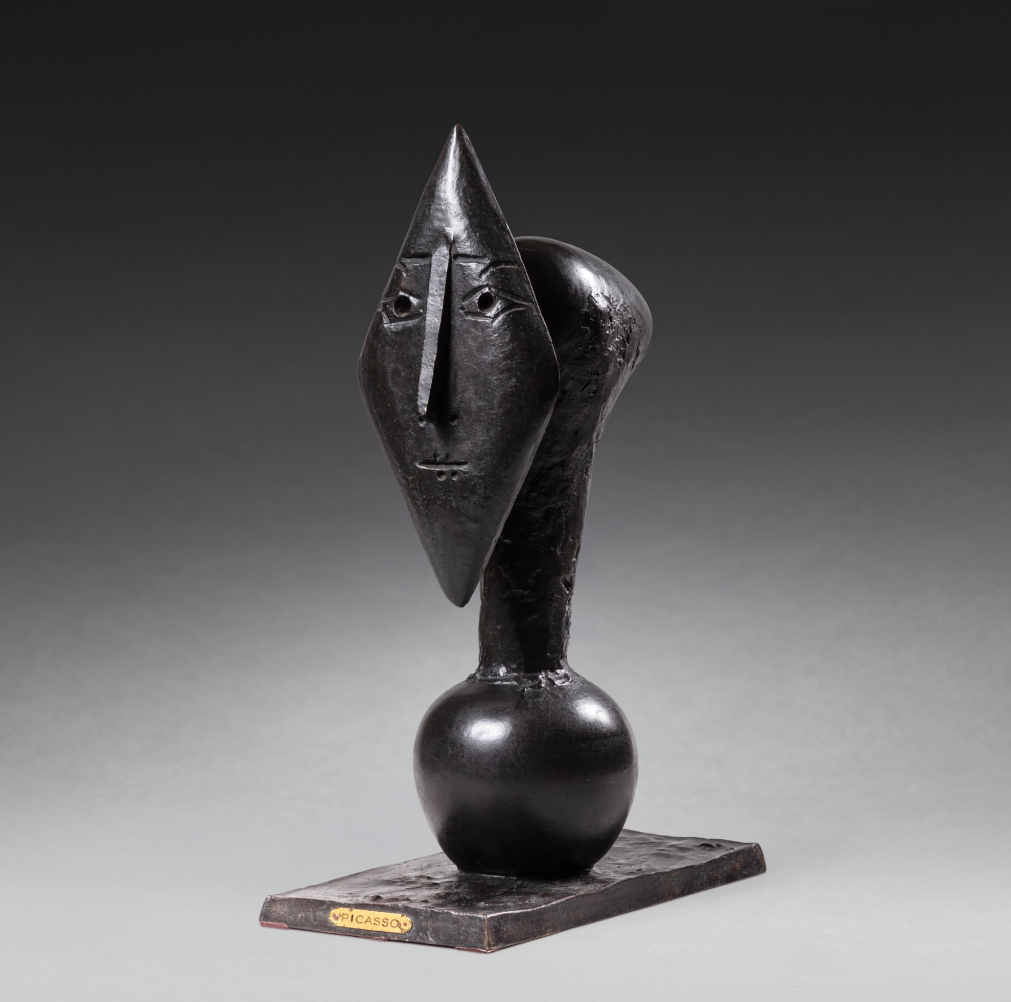
PABLO PICASSO (1881 – 1972)
Tête de femme, 1951
Bronze
Height: 54.1 cm (21 1/4 inches)
Numbered 1/6 (on the base)
Conceived in Vallauris in 1951 and cast in bronze by the Godard Foundry, Paris
This work is number 1 from an edition of 6 examples plus 1 artist’s proof
#12. Courses de taureaux, 1901
Sotheby’s New-York: 15 May 2024
Estimated: USD 5,000,000 – 7,000,000
USD 3,500,000
https://www.sothebys.com/en/buy/auction/2024/modern-evening-auction/courses-de-taureaux
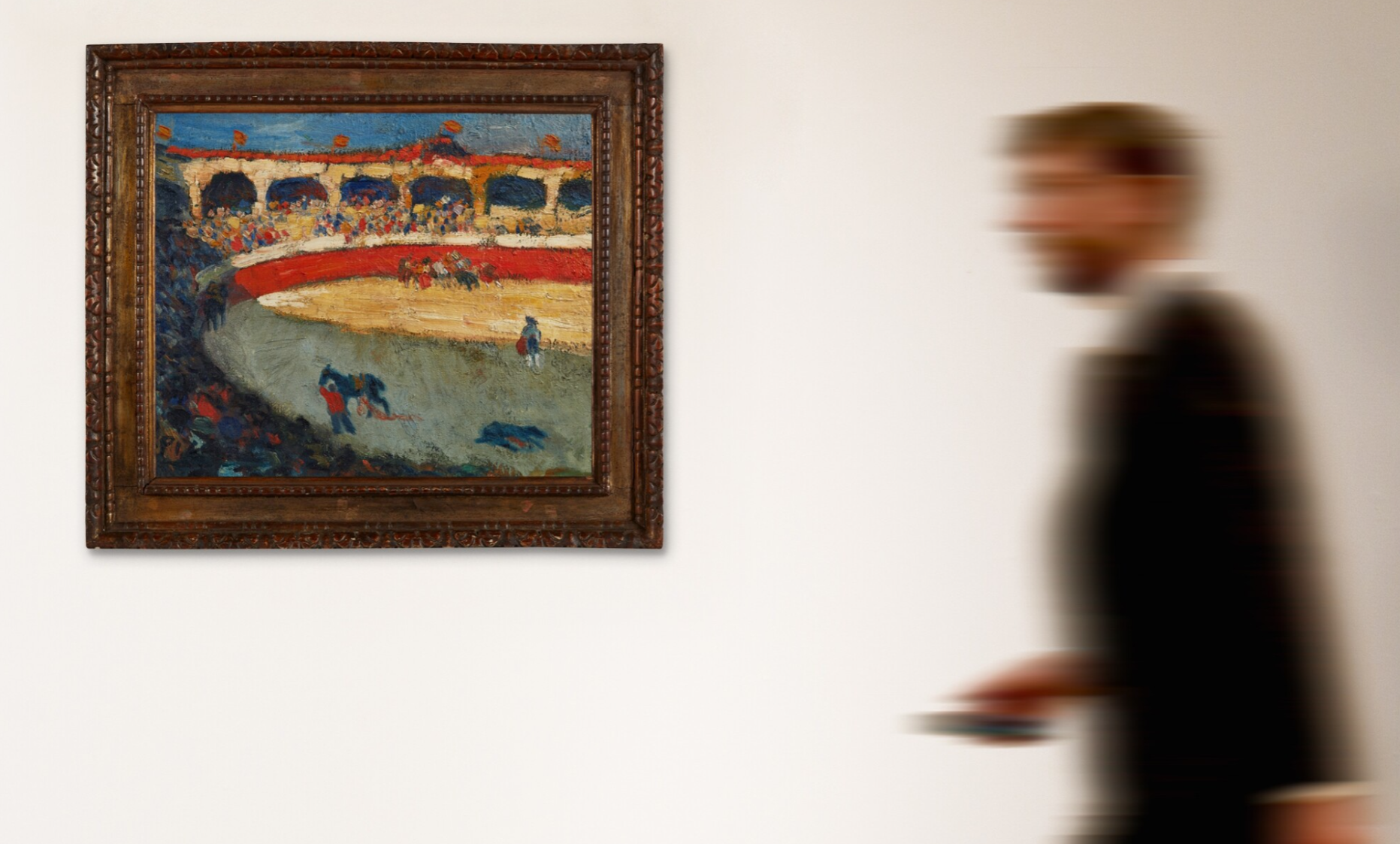
PABLO PICASSO (1881 – 1973)
Courses de taureaux, 1901
Oil on canvas
46.3 x 55.5 cm (18 1/4 x 21 7/8 inches)
Signed Picasso (lower left)
#13. Buste d’homme, 1964
Phillips New-York: 19 November 2024
Estimated: USD 3,000,000 – 5,000,000
USD 3,085,000
Pablo Picasso – Modern & Contempora… Lot 16 November 2024 | Phillips
PABLO PICASSO
Buste d’homme, 1964
Oil on canvas
28 3/4 x 21 inches (73 x 53.3 cm)
Signed “Picasso” upper left; inscribed and dated “15.12.64 I” on the reverse
Painted on December 15, 1964
#14. Nature morte à la bougie, 1944
Christie’s London: 7 March 2024
Estimated: GBP 2,500,000 – 3,500,000
GBP 2,157,500 / USD 2,735,710
PABLO PICASSO (1881-1973), Nature morte à la bougie | Christie’s (christies.com)
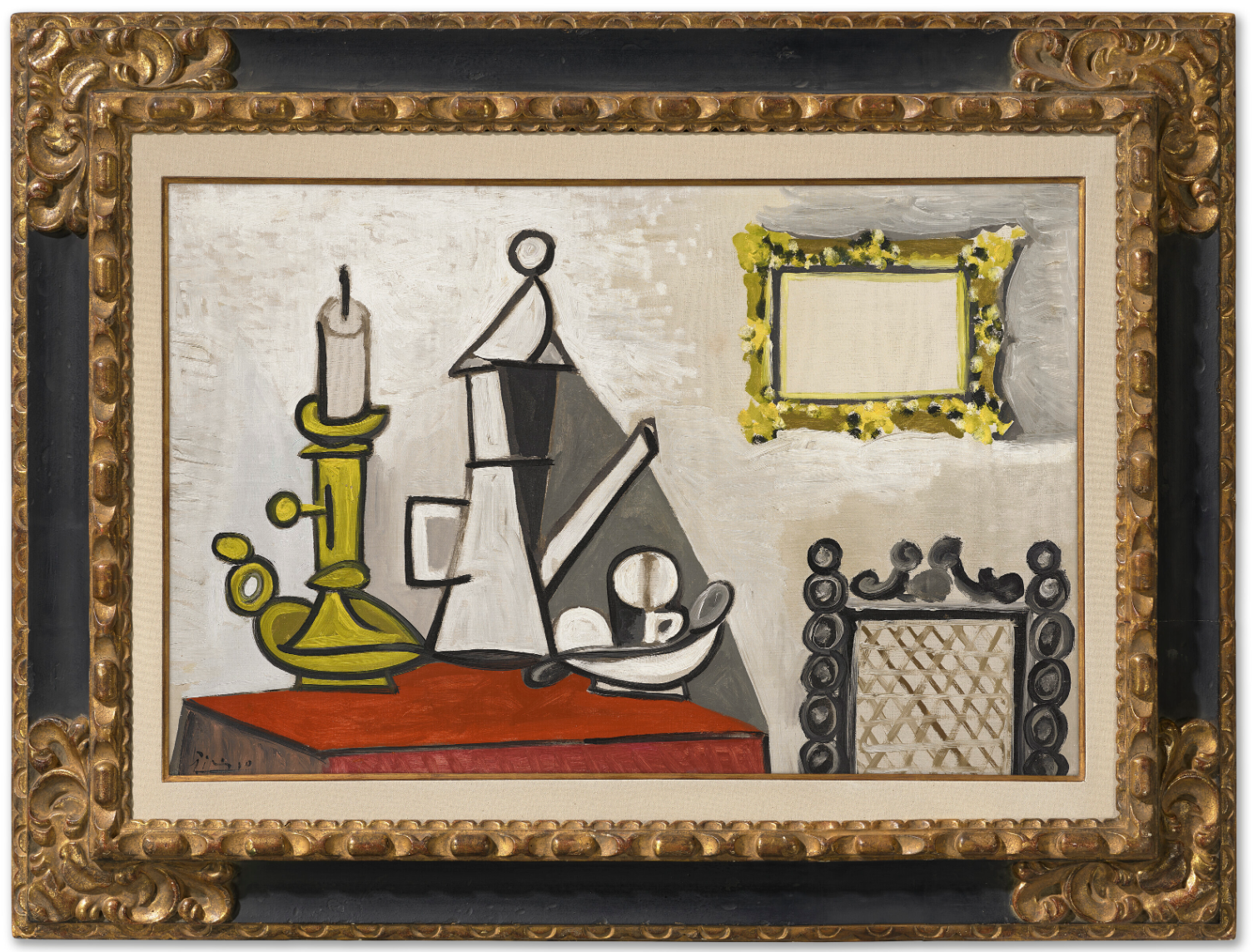
PABLO PICASSO (1881-1973)
Nature morte à la bougie, 1944
Oil on canvas
63.2 x 91.7 cm (24 5/8 x 36 1/8 inches)
Signed ‘Picasso’ (lower left) and dated ‘4 avl 44’ (on the reverse)
#15. Tête de femme, 1969
Sotheby’s New-York: 15 May 2024
Estimated: USD 1,200,000 – 1,800,000
USD 1,996,000
https://www.sothebys.com/en/buy/auction/2024/modern-evening-auction/tete-de-femme
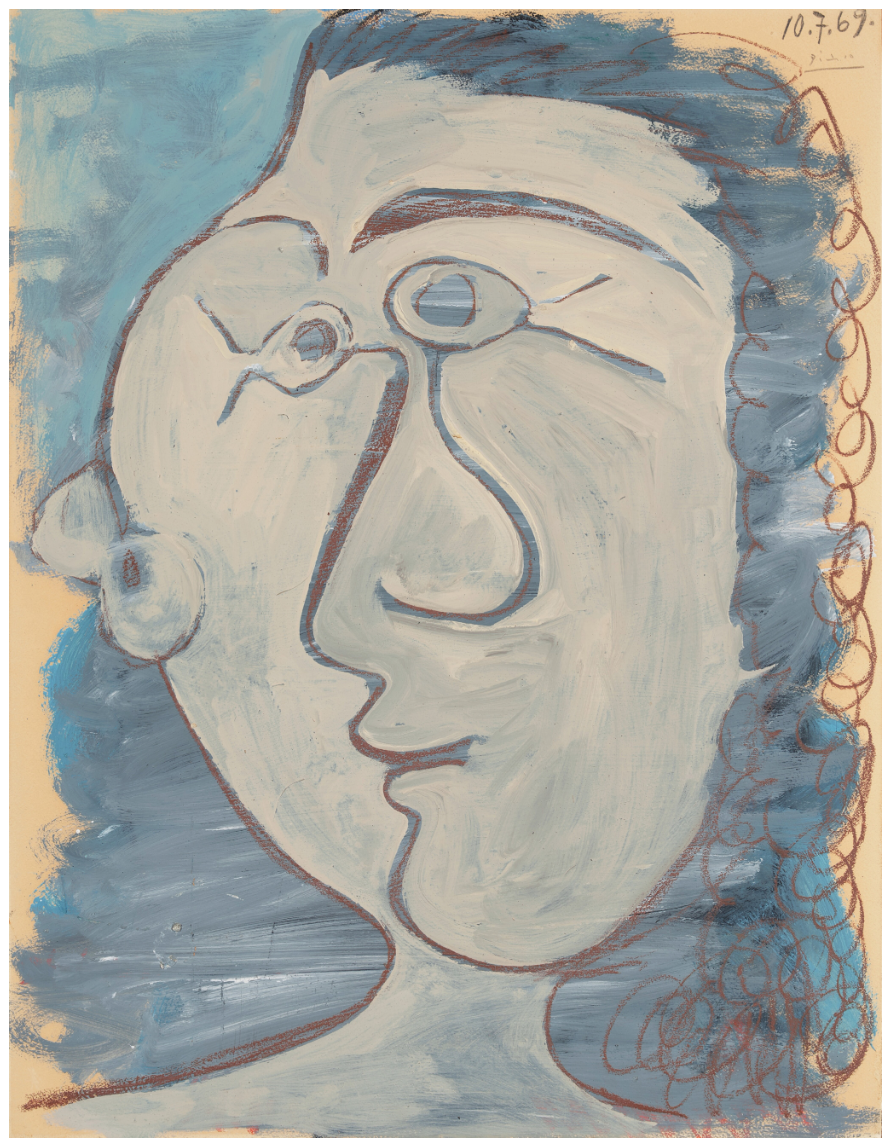
PABLO PICASSO (1881 – 1973)
Tête de femme, 1969
Oil, Ripolin and crayon on paper mounted on canvas
66.1 x 51.6 cm (26 1/8 x 20 3/8 inches)
Signed Picasso and dated 10.7.69. (upper right)
Executed on 10 July 1969
#16. Buste d’homme, 1969
Sotheby’s New-York: 18 November 2024
Estimated: USD 1,500,000 – 2,500,000
USD 1,920,000
Buste d’homme | Modern Evening Auction | 2024 | Sotheby’s
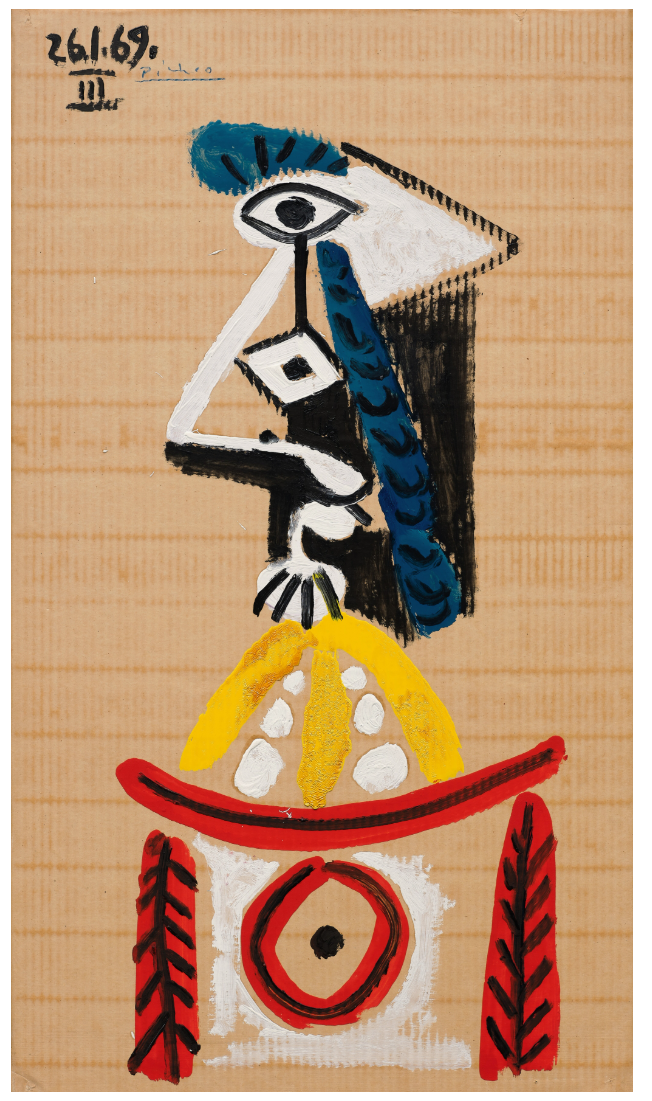
PABLO PICASSO (1881 – 1973)
Buste d’homme, 1969
Oil and Ripolin on cardboard
114.3 x 65.1 cm (45 x 25 5/8 inches)
Signed Picasso, dated 26.1.69 and numbered III (upper left)
Executed on 26 January 1969
#17. Tête à l’oiseau, 1971
Sotheby’s New-York: 15 May 2024
Estimated: USD 1,200,000 – 1,800,000
USD 1,814,500
https://www.sothebys.com/en/buy/auction/2024/modern-evening-auction/tete-a-loiseau
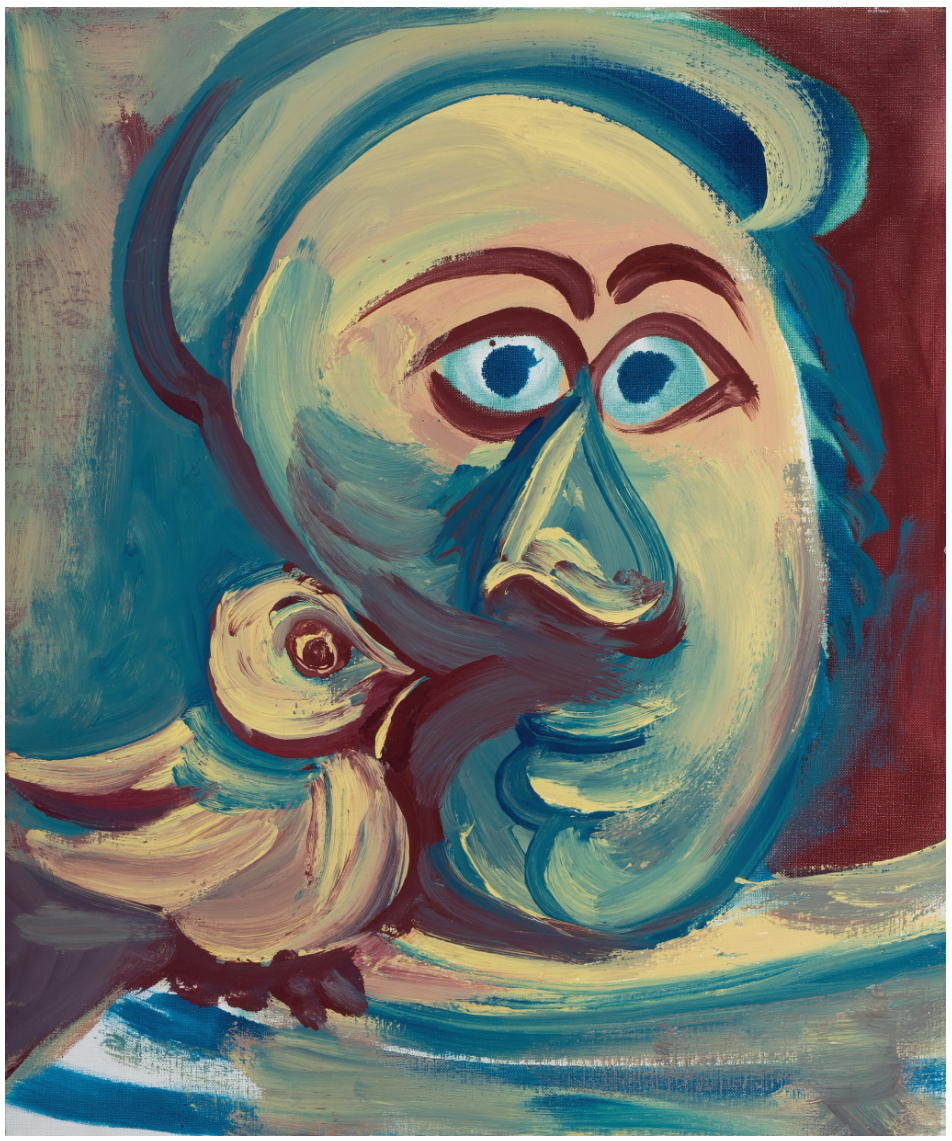
PABLO PICASSO (1881 – 1973)
Tête à l’oiseau, 1971
Oil and Ripolin on canvas
55.3 x 46.2 cm (21 3/4 x 18 1/4 inches)
dated 9.4.71. and numbered II (on the reverse)
Executed on 9 April 1971
#18. Fruits, journal, verre, pipe, 1917
Sotheby’s New-York: 18 November 2024
Estimated: USD 1,500,000 – 2,500,000
USD 1,800,000
Fruits, journal, verre, pipe | Modern Evening Auction | 2024 | Sotheby’s
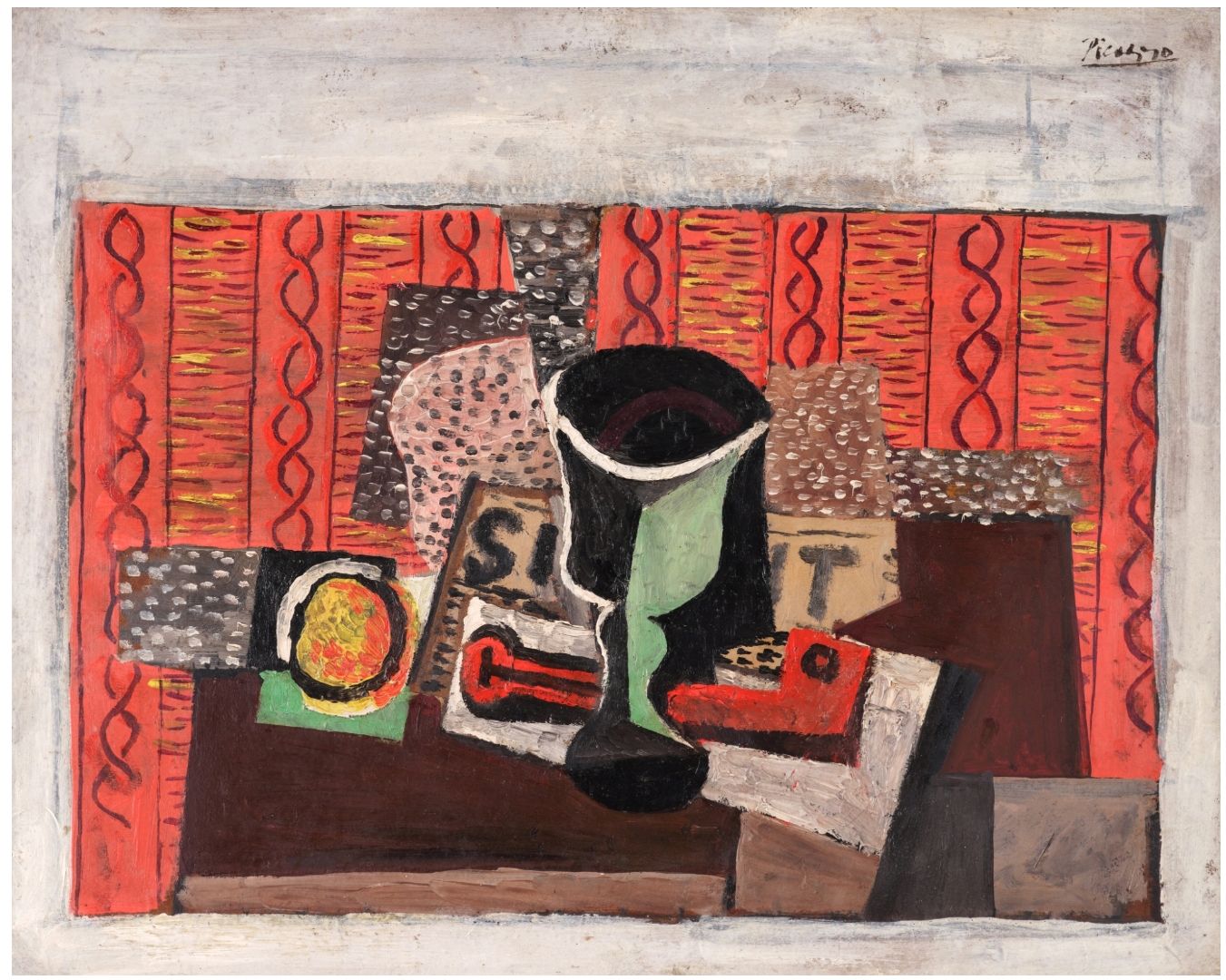
PABLO PICASSO (1881 – 1973)
Fruits, journal, verre, pipe, 1917
Oil on cradled panel
39.4 x 49.4 cm (15 1/2 x 19 1/2 inches)
Signed Picasso (upper right)
#19. Nature morte, pichet et fruits, 1939
Sotheby’s New-York: 16 May 2024
Estimated: USD 1,200,000 – 1,800,000
USD 1,512,000
https://www.sothebys.com/en/buy/auction/2024/modern-day-auction-3/nature-morte-pichet-et-fruits
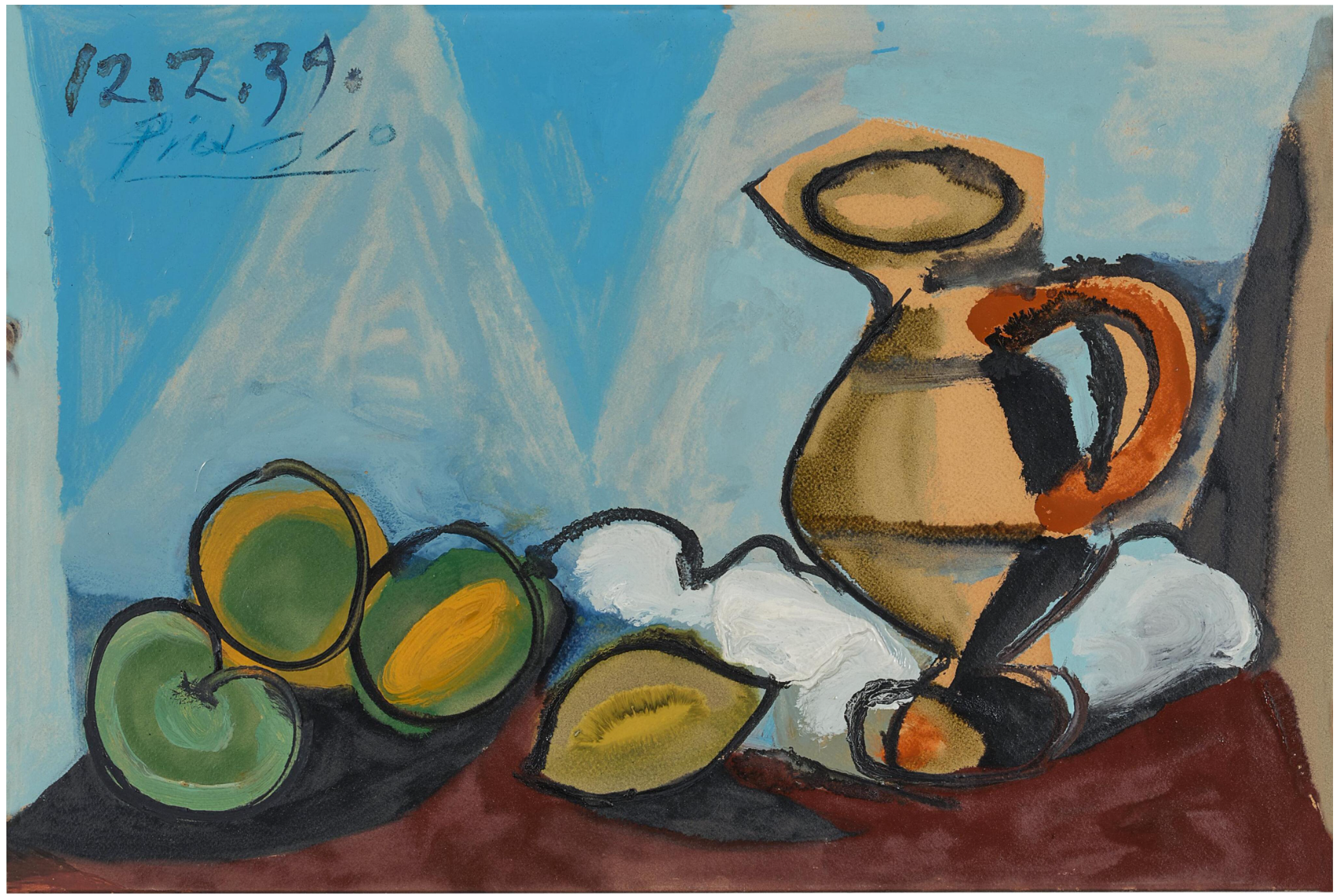
PABLO PICASSO (1881 – 1973)
Nature morte, pichet et fruits, 1939
Oil on paper laid down on board
28.8 x 43 cm (11 3/8 x 17 inches)
Signed Picasso and dated 12.2.39. (upper left)
Executed on 12 February 1939
#20. Citrons et verre, 1944
Christie’s New-York: 18 May 2024
Estimated: USD 1,000,000 – 1,500,000
USD 1,071,000
https://www.christies.com/en/lot/lot-6481453

PABLO PICASSO (1881-1973)
Citrons et verre, 1944
Oil on canvas
26.7 x 41.3 cm (10 5/8 x 16 1/4 inches)
Signed ‘Picasso’ (upper left)
Dated ‘14.1.44.’ (on the reverse)
Painted on 14 January 1944
#22. Le Déjeuner sur l’herbe, 1961
Sotheby’s London: 7 March 2024
Estimated: GBP 300,000 – 500,000
GBP 508,000 / USD 646,980
https://www.sothebys.com/en/buy/auction/2024/modern-contemporary-day-auction/le-dejeuner-sur-lherbe
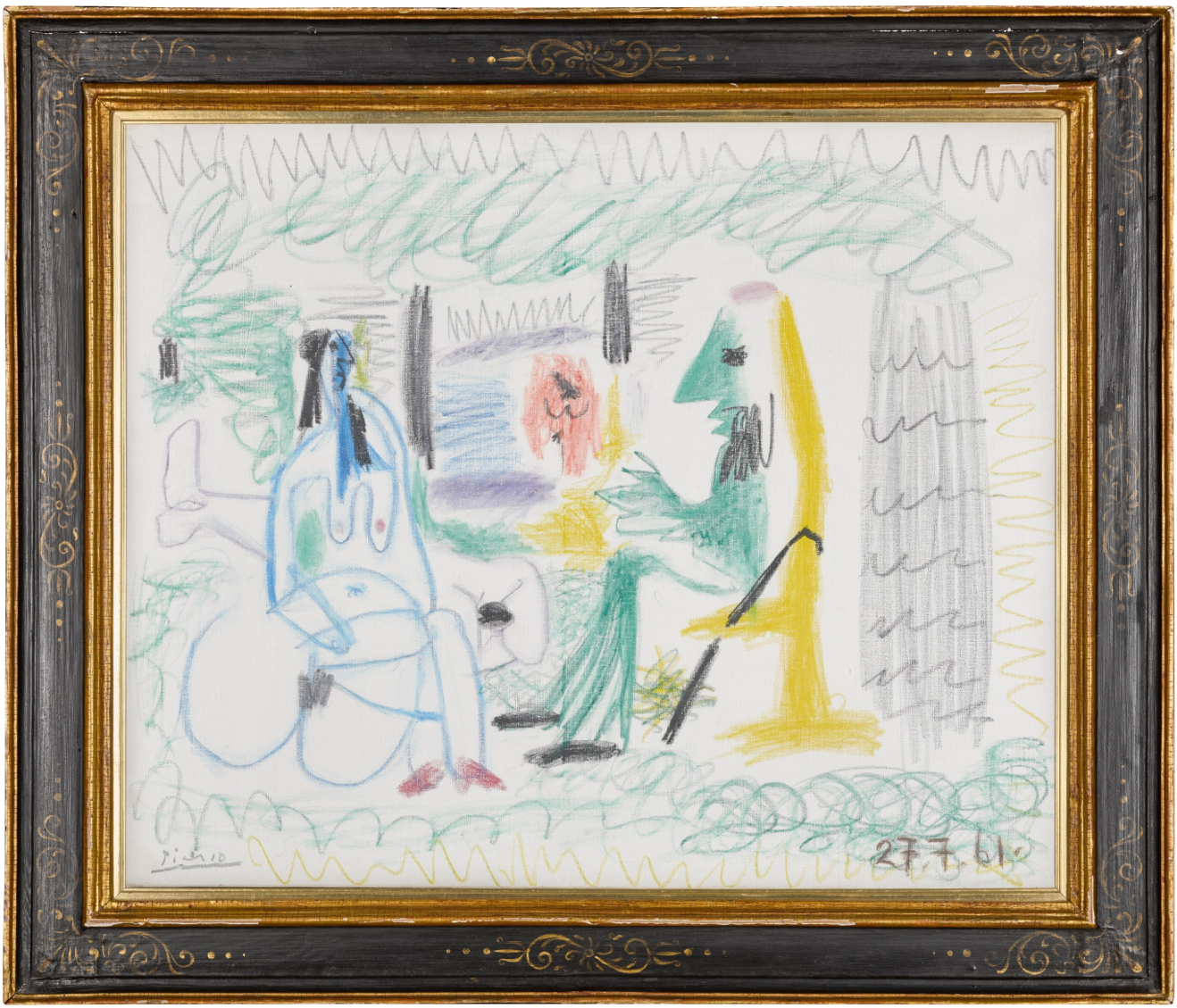
PABLO PICASSO (1881 – 1973)
Le Déjeuner sur l’herbe, 1961
Pastel on canvas
59.9 x 73 cm (23 1/2 x 28 1/8 inches)
Signed Picasso (lower left); dated 27.7.61. (lower right)
Executed in Mougins on 27 July 1961
Withdrawn Lots
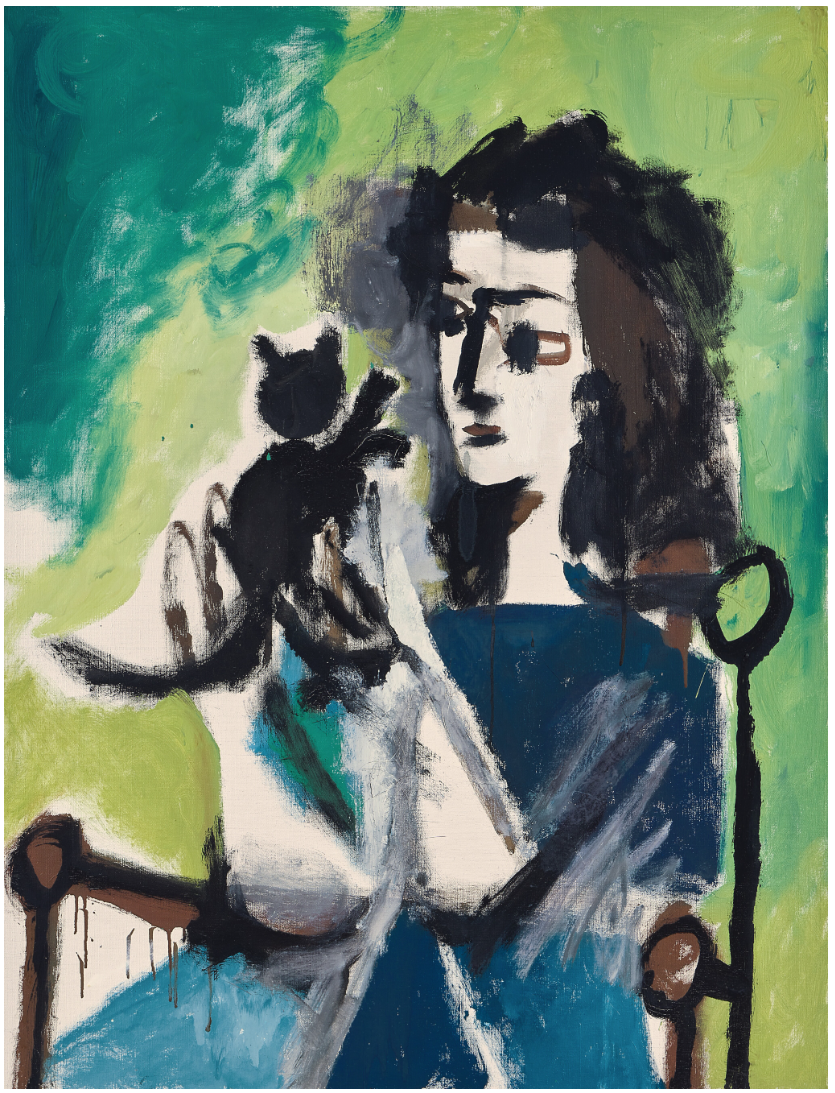
Femme au chat assise, 1964
Sotheby’s New-York: 18 November 2024
Estimated: USD 7,000,000 – 10,000,000
WITHDRAWN
Femme au chat assise | Modern Evening Auction | 2024 | Sotheby’s
PABLO PICASSO (1881 – 1973)
Femme au chat assise, 1964
Oil and Ripolin on canvas
116×89 cm (45 5/8 x 35 inches)
Dated 2. and 8.5.64. and numbered III (on the reverse)
Executed on 2 and 8 May 1964
Buste de femme au chapeau, 1939
Phillips New-York: 14 May 2024
Estimated: USD 12,000,000 – 18,000,000
WITHDRAWN
Pablo Picasso – Modern & Contemporary Ar… Lot 17 May 2024 | Phillips

PABLO PICASSO
Buste de femme au chapeau, 1939
Oil on canvas
61 x 38.1 cm (24×15 inches)
Dated “9.6.39.” upper left
Passed Lots
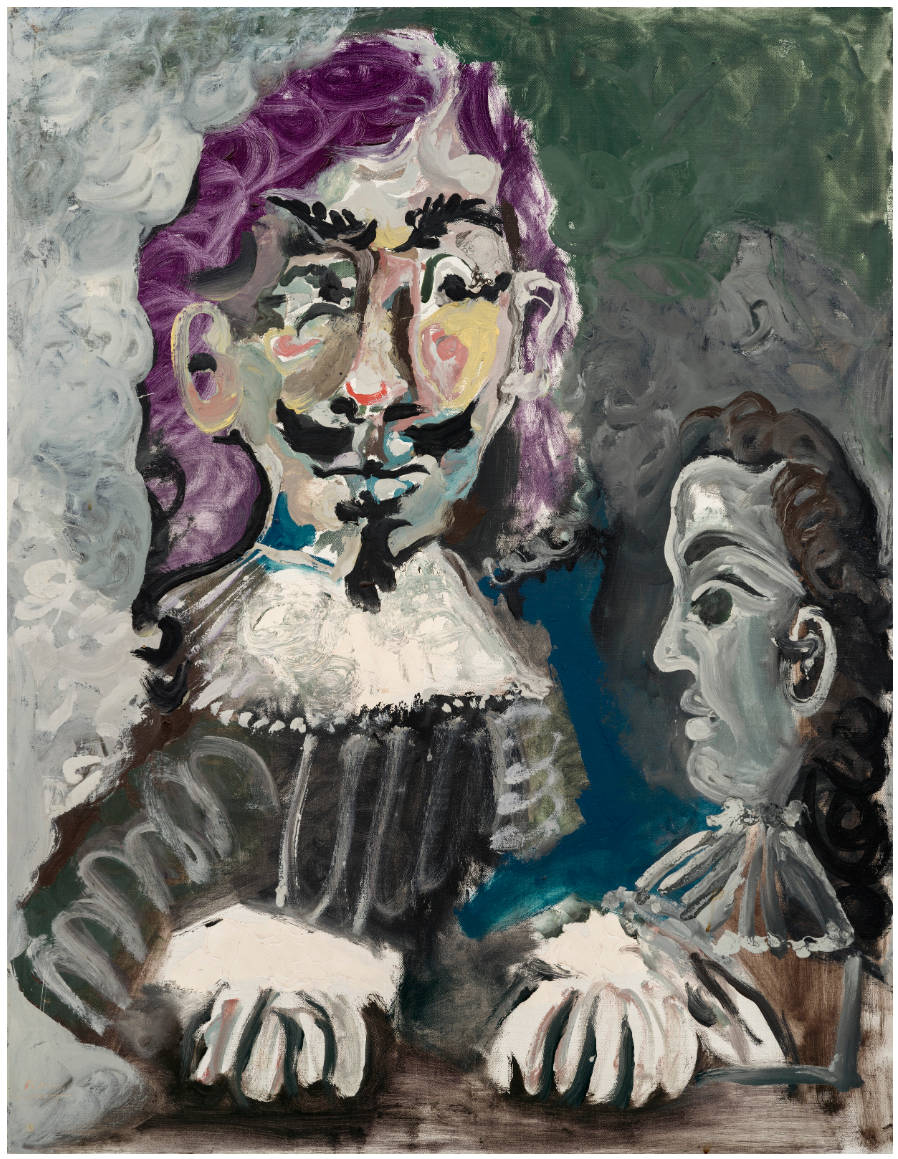
Mousquetaire et petit personnage, 1967
Christie’s New-York: 19 November 2024
Estimated: USD 8,000,000 – 12,000,000
PASSED
PABLO PICASSO (1881-1973), Mousquetaire et petit personnage | Christie’s
PABLO PICASSO (1881-1973)
Mousquetaire et petit personnage, 1967
Oil and Ripolin on canvas
115×89 cm (45 3/4 x 35 1/4 inches)
Signed ‘Picasso’ (lower left) and dated ‘16.5.67.’ (on the reverse)
Painted on 16 May 1967
Femme au chapeau, 1941
Sotheby’s New-York: 15 May 2024
Estimated: USD 6,000,000 – 8,000,000
PASSED
Femme au chapeau | Modern Evening Auction | 2024 | Sotheby’s (sothebys.com)

PABLO PICASSO (1881 – 1973)
Femme au chapeau, 1941
Oil on canvas
61×38 cm (24×15 inches)
Signed Picasso and dated 13 juin 41 (center left)
Executed on 13 June 1941
2023 Auction Results
FOR PAINTINGS AND SCULPTURES ONLY
43 lots sold at auction in 2023 for a total turnover of USD 609,126,000. With 3 lots failing to sell, the sell-through rate is 93%. The highest price has been achieved by Femme a la montre, a painting dated 1932, that sold at Sotheby’s in New-York on 8 November 2023 for USD 139,363,500.
2023 Top 3 Lots
15 lots sold for more than USD 10 million, generating a cumulative turnover of USD 428,400,616, representing 70.3% of the total turnover for 2023.
XXXXXXXXXX
#1. Femme à la montre, 1932
The Emily Fisher Landau Collection: An Era Defined
Sotheby’s New-York: 8 November 2023
Estimate Upon Request
USD 139,363,500
PABLO PICASSO (1881 – 1973)
Femme à la montre, 1932
Oil on canvas
130×97 cm (51 1/8 x 38 1/8 inches)
Signed Picasso (upper left)
Inscribed Boisgeloup and dated 17 Août XXXII. (on the stretcher)
Executed on 17 August 1932
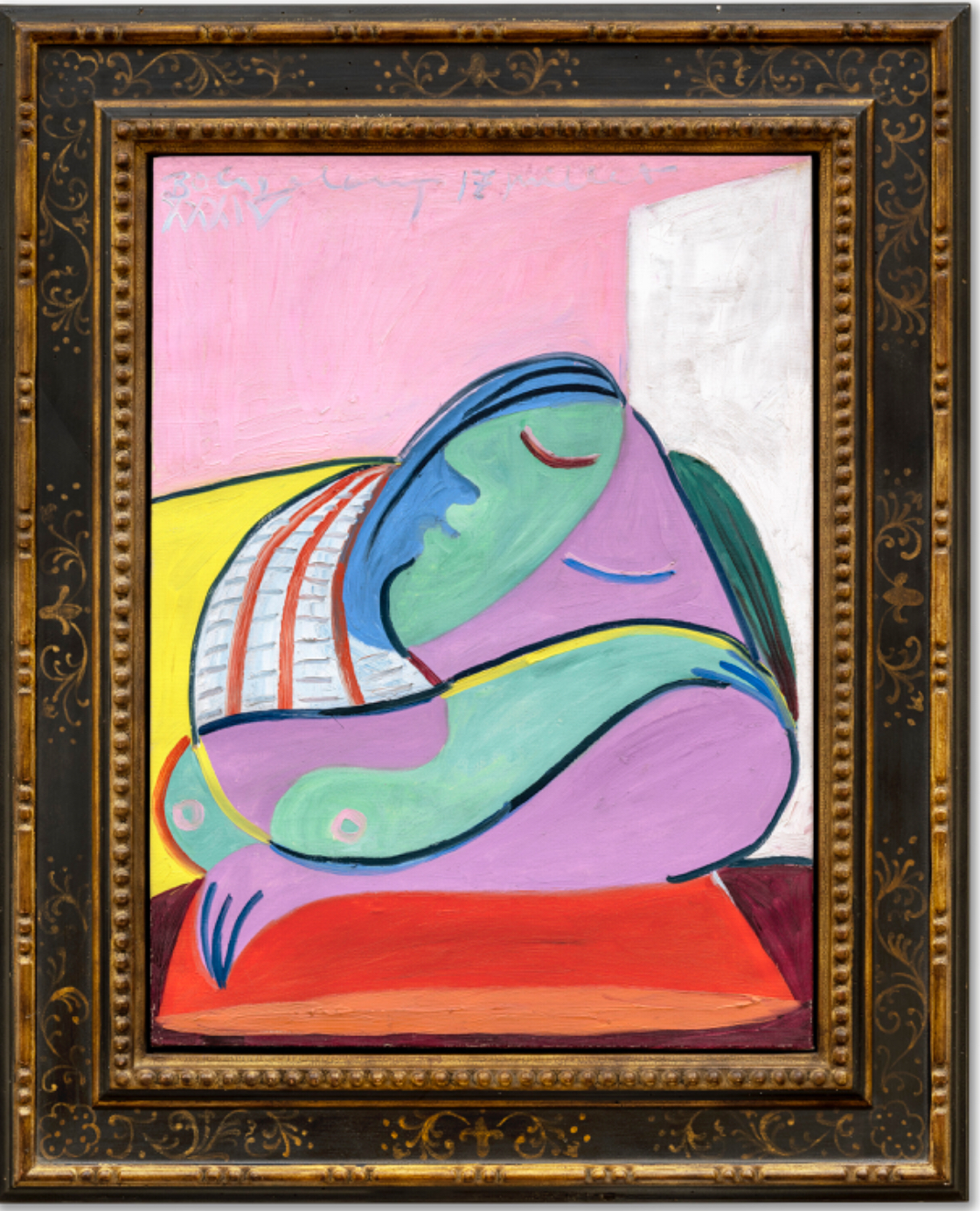
#2. Femme endormie, 1934
Christie’s New-York: 9 November 2023
Estimated: USD 25,000,000 – 35,000,000
USD 42,960,000
PABLO PICASSO (1881-1973) (christies.com)
PABLO PICASSO (1881-1973)
Femme endormie, 1934
Oil on canvas
72.4 x 54 cm (28 1/2 x 21 1/4 inches)
Dated and inscribed ‘Boisgeloup 17 Juillet XXXIV’ (upper left)
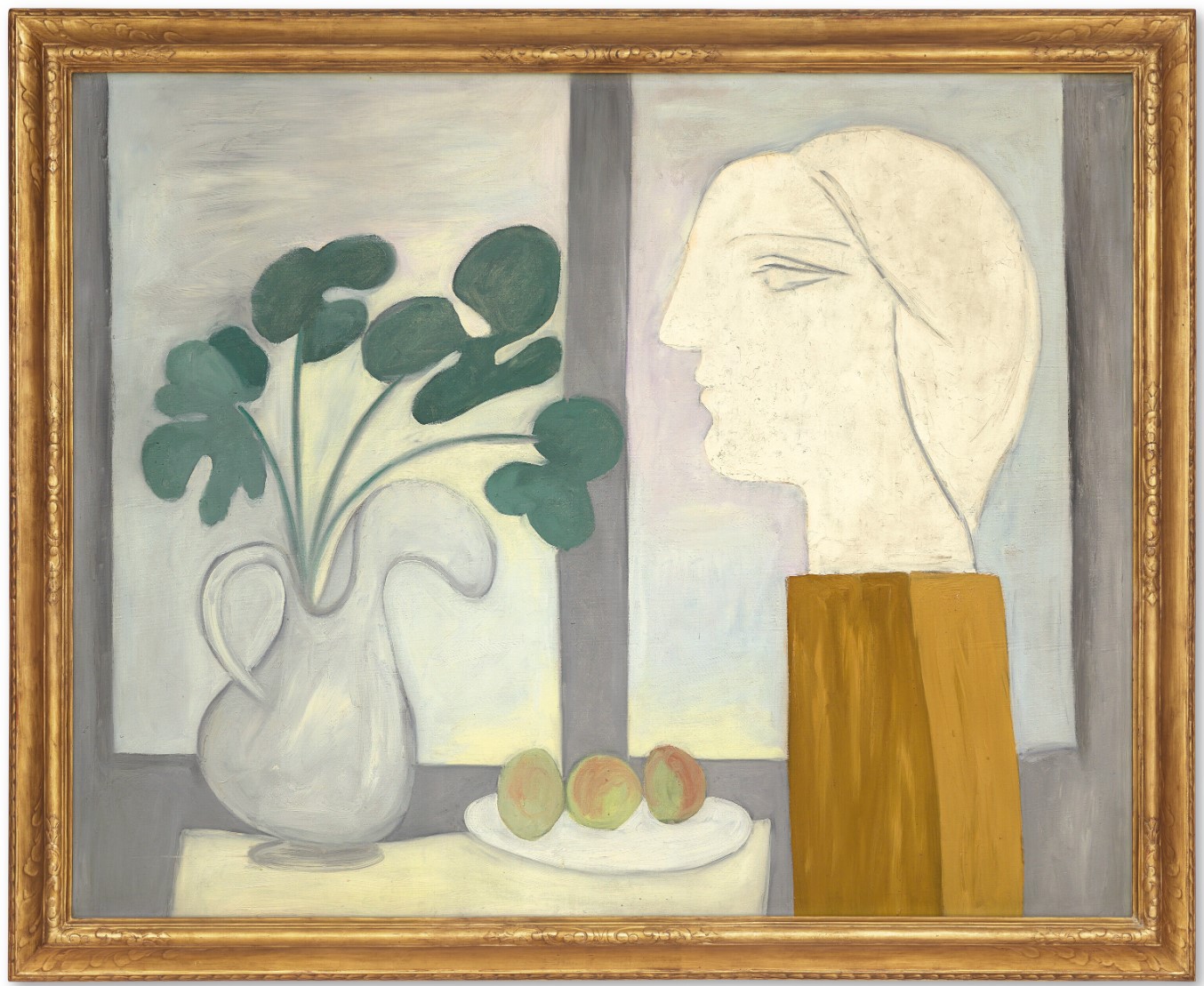
#3. Nature morte à la fenêtre, 1932
Christie’s New-York: 11 May 2023
Estimate on Request
USD 41,810,000
PABLO PICASSO (1881-1973)
Nature morte à la fenêtre, 1932
Oil on canvas
129.7 x 162.3 cm (51 x 63 7/8 inches)
#4. L’Arlesienne, 1937
Christie’s New-York: 11 May 2023
Estimated: USD 20,000,000 – 30,000,000
USD 24,560,000
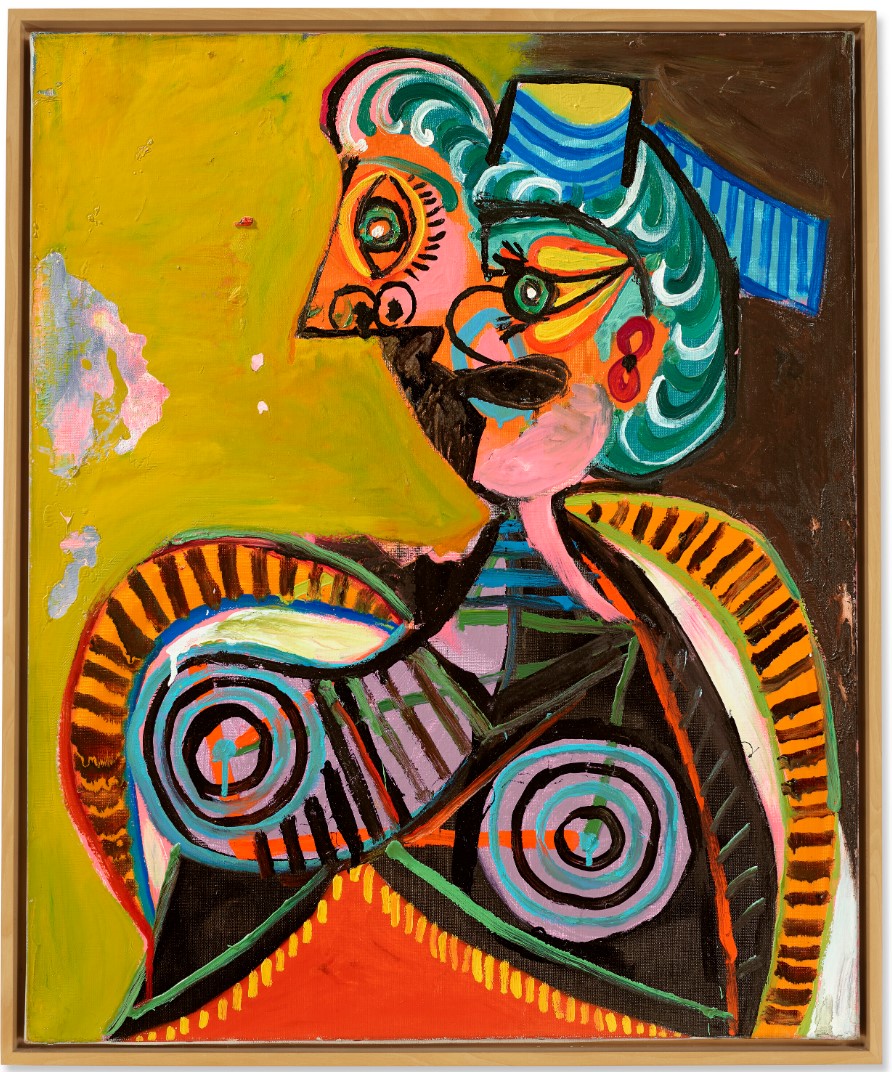
PABLO PICASSO (1881-1973)
L’Arlésienne (Lee Miller), 1937
Oil and Ripolin on canvas
72.7 x 59.8 cm (28 7/8 x 23 1/2 inches)
#5. Compotier et guitare, 1932
Sotheby’s New-York: 13 November 2023
Estimate on Request
USD 23,463,500
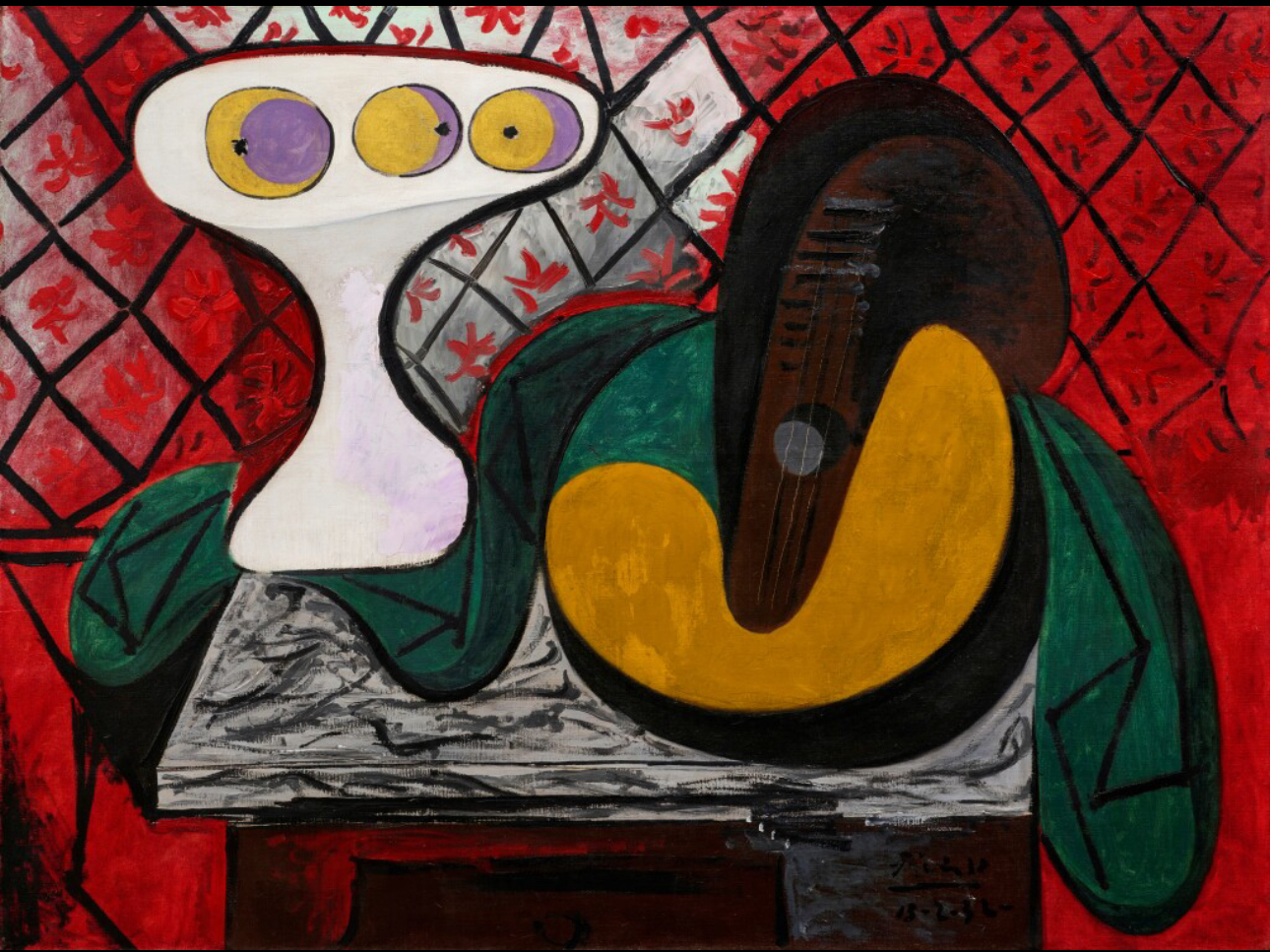
PABLO PICASSO (1881 – 1973)
Compotier et guitare, 1932
Oil on canvas
97.1 x 130.1 cm (38 1/4 x 51 1/4 inches)
Signed Picasso and dated 13.2.32 (lower right); dated and titled (on the stretcher)
#6. Fillette au bateau, Maya, 1938
Sotheby’s London: 1 March 2024
Estimated: GBP 12,000,000 – 18,000,000
GBP 18,089,300 / USD 21,567,438
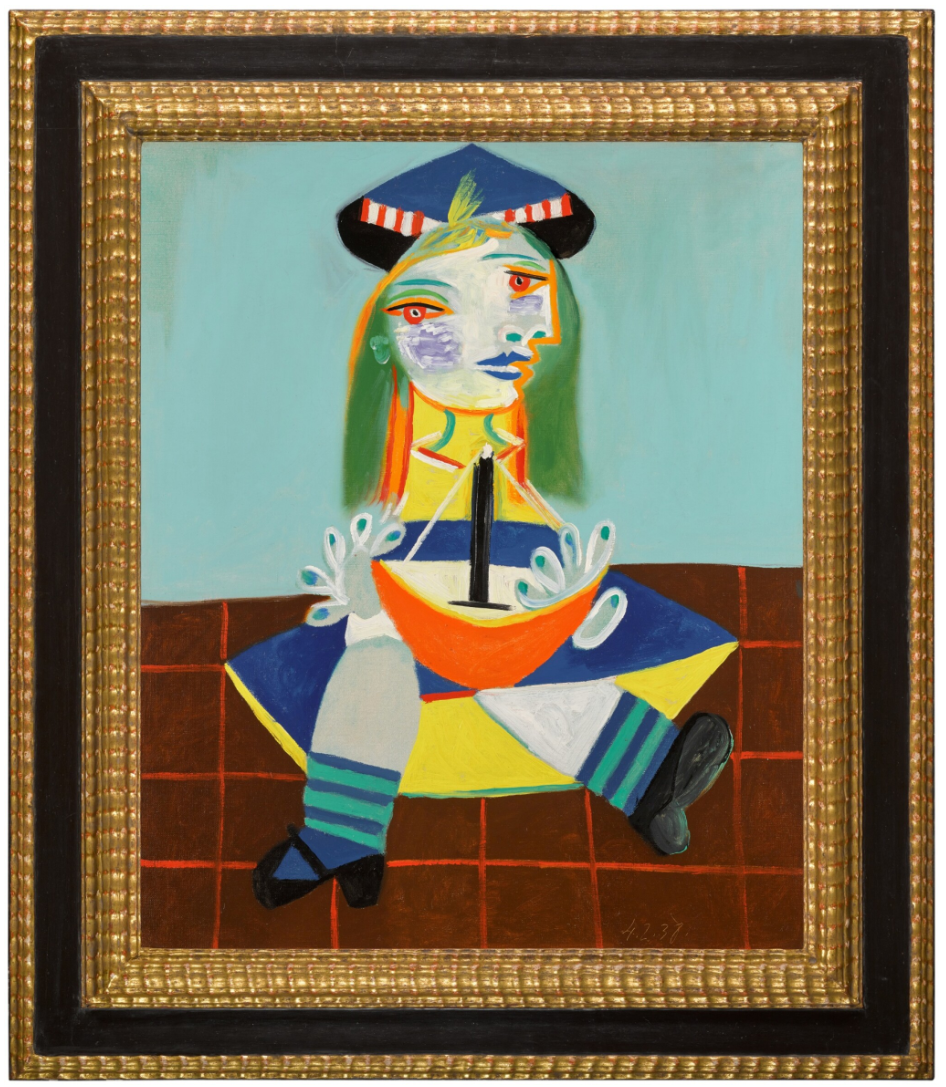
PABLO PICASSO (1881 – 1973)
Fillette au bateau, Maya, 1938
Oil on canvas
73.3 x 60 cm (28 7/8 x 23 5/8 inches)
Dated 4.2.38. (lower right)
Executed on 4 February 1938
#7. Femme nue couchee jouant avec un chat, 1964
Sotheby’s New-York: 16 May 2023
Estimated: USD 20,000,000 – 30,000,000
USD 21,240,000
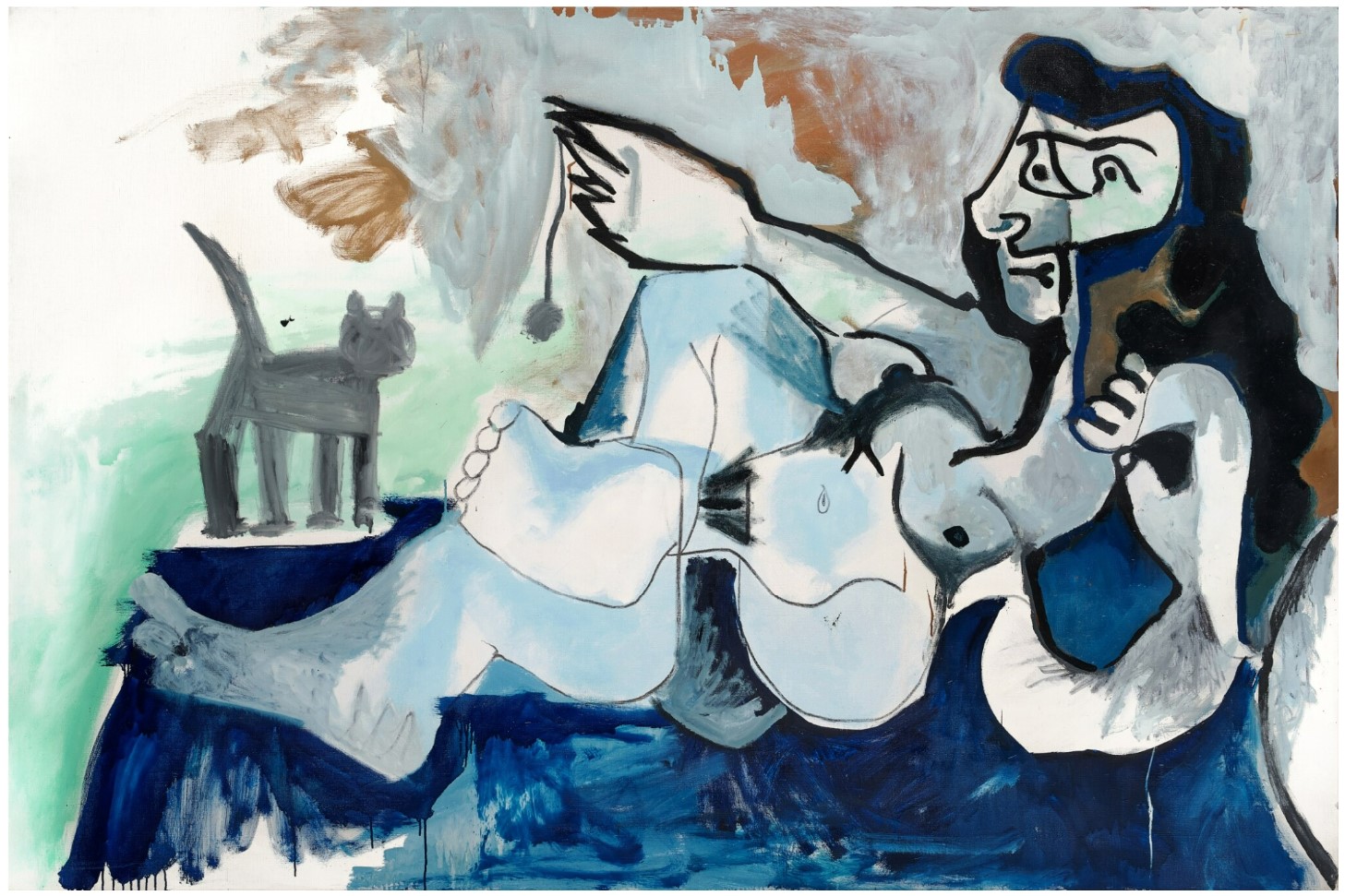
PABLO PICASSO (1881 – 1973)
Femme nue couchée jouant avec un chat, 1964
Oil and Ripolin on canvas
130 x 194.7 cm (51 1/8 x 76 5/8 inches)
#8. Femme dans un rocking-chair (Jacqueline), 1956
Christie’s London: 23 February 2023
Estimated: GBP 15,000,000 – 20,000,000
GBP 16,892,000 / USD 20,375,772
https://www.christies.com/en/lot/lot-6414663
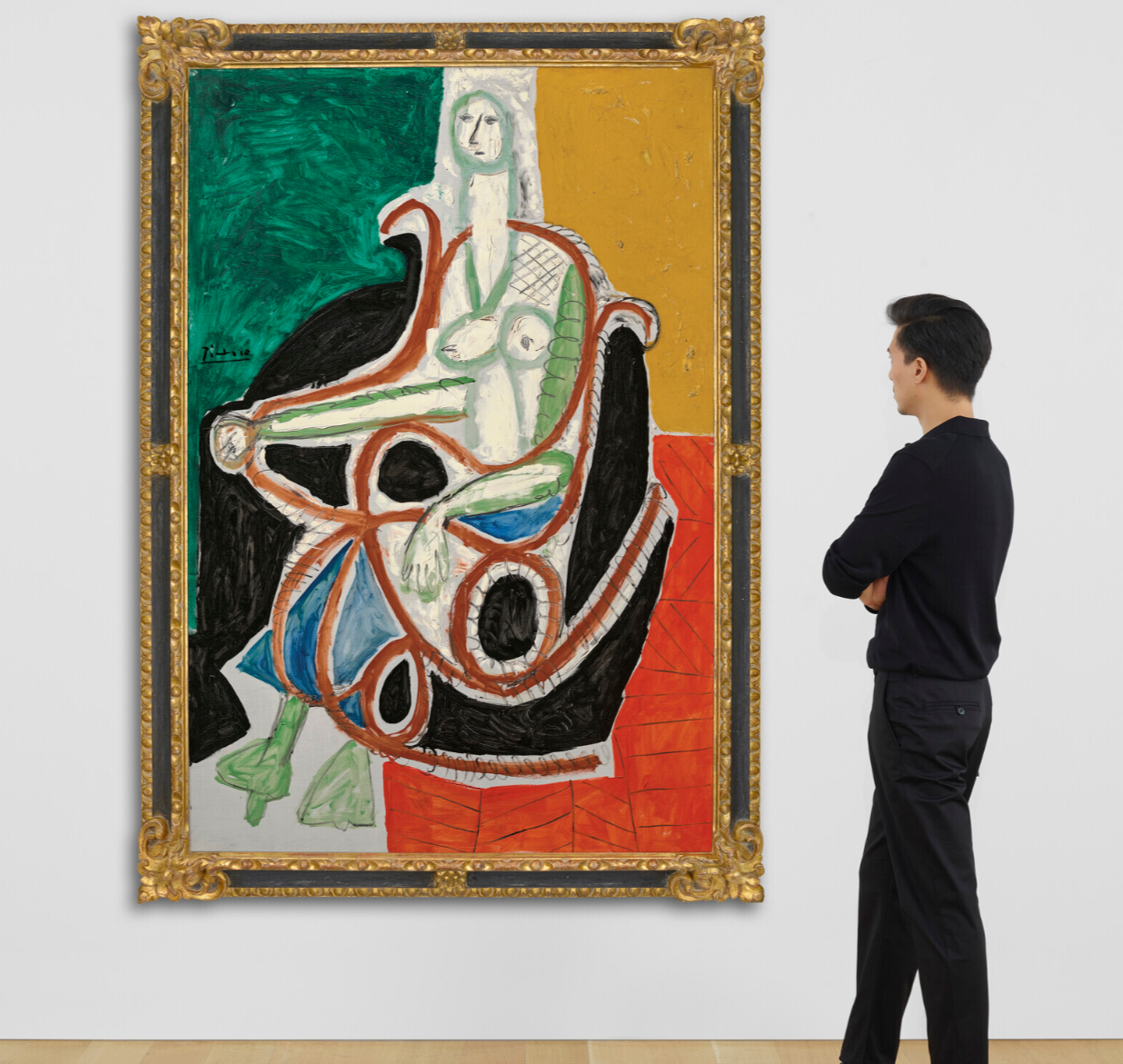
PABLO PICASSO (1881-1973)
Femme dans un rocking-chair (Jacqueline), 1956
Oil on canvas
194.5 x 130.1 cm (76 x 51 1/4 inches)
Signed ‘Picasso’ (centre left); indistinctly dated ‘25.3.56’ (on the reverse)
Painted at La Californie on 25 March 1956
#9. Femme au chapeau jaune, 1939
Sotheby’s New-York: 16 May 2023
Estimated: USD 15,000,000 – 20,000,000
USD 15,846,000
Femme au chapeau jaune (Dora Maar) | Modern Evening Auction | 2023 | Sotheby’s (sothebys.com)
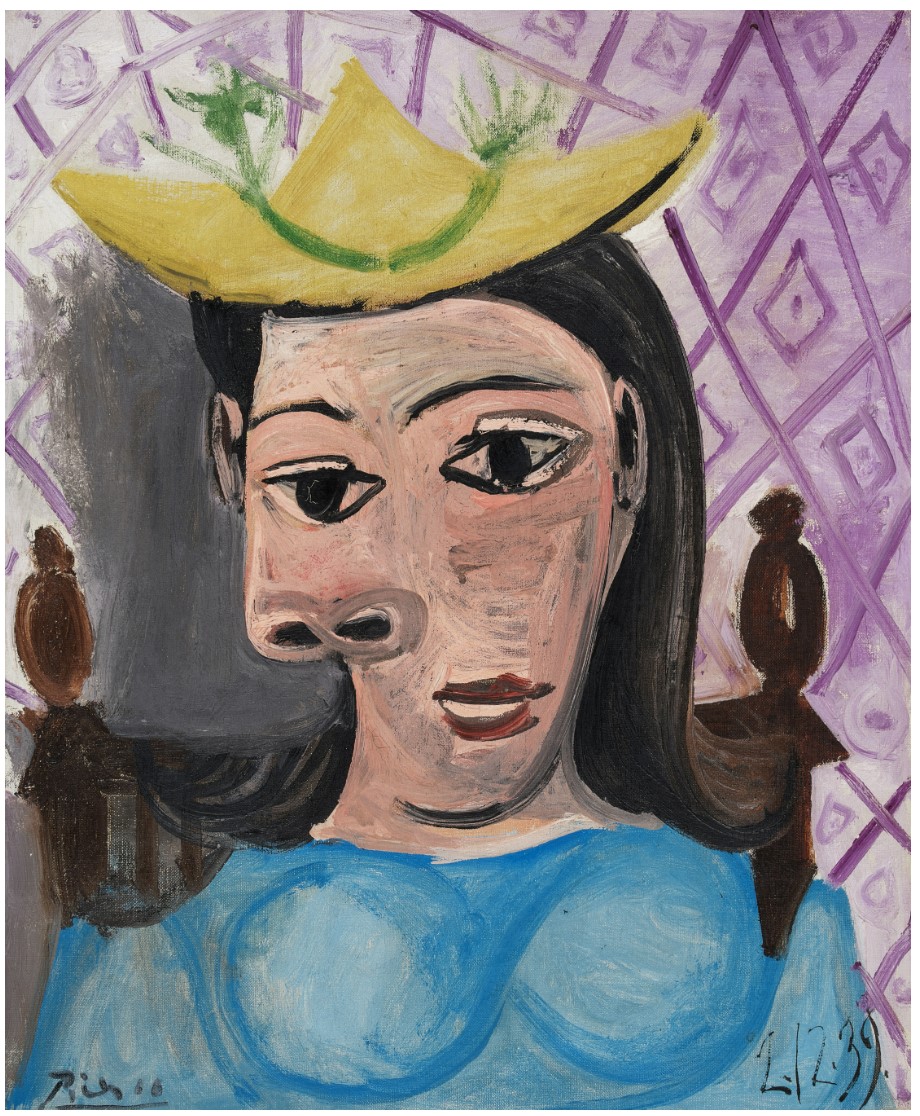
PABLO PICASSO (1881 – 1973)
Femme au chapeau jaune (Dora Maar), 1939
Oil on canvas
46.4 x 38.1 cm (18 1/4 x 15 inches)
#10. Femme en corset lisant un livre, 1914-1918
Phillips New-York: 14 November 2023
Estimated: USD 15,000,000 – 20,000,000
USD 14,762,500
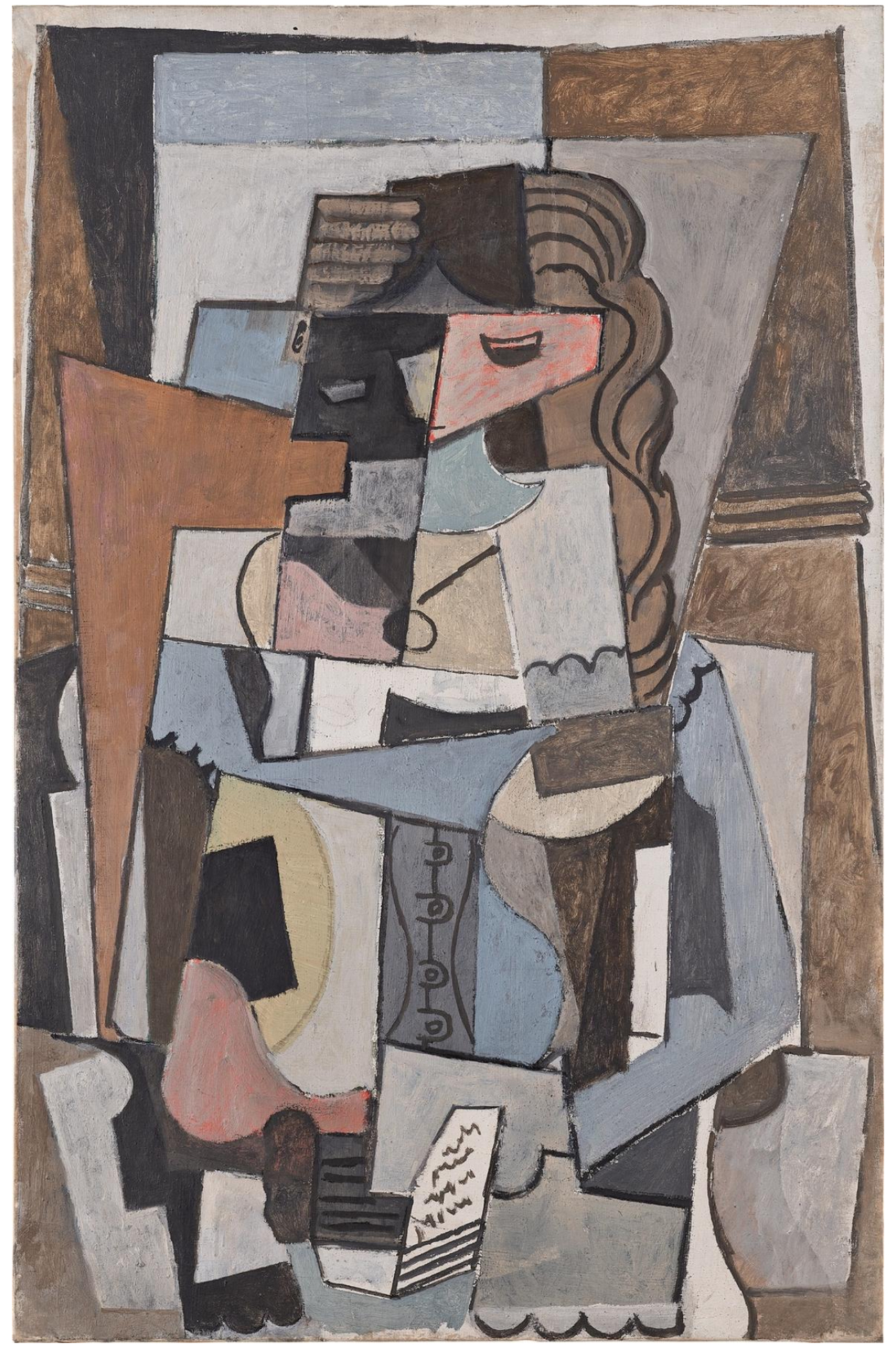
PABLO PICASSO
Femme en corset lisant un livre, 1914-1918
Oil and sand on canvas
91.8 x 60.3 cm (36 1/8 x 23 3/4 inches)
#11. Nu couché, 1968
Christie’s New-York: 9 November 2023
Estimated: USD 10,000,000 – 15,000,000
USD 13,635,000
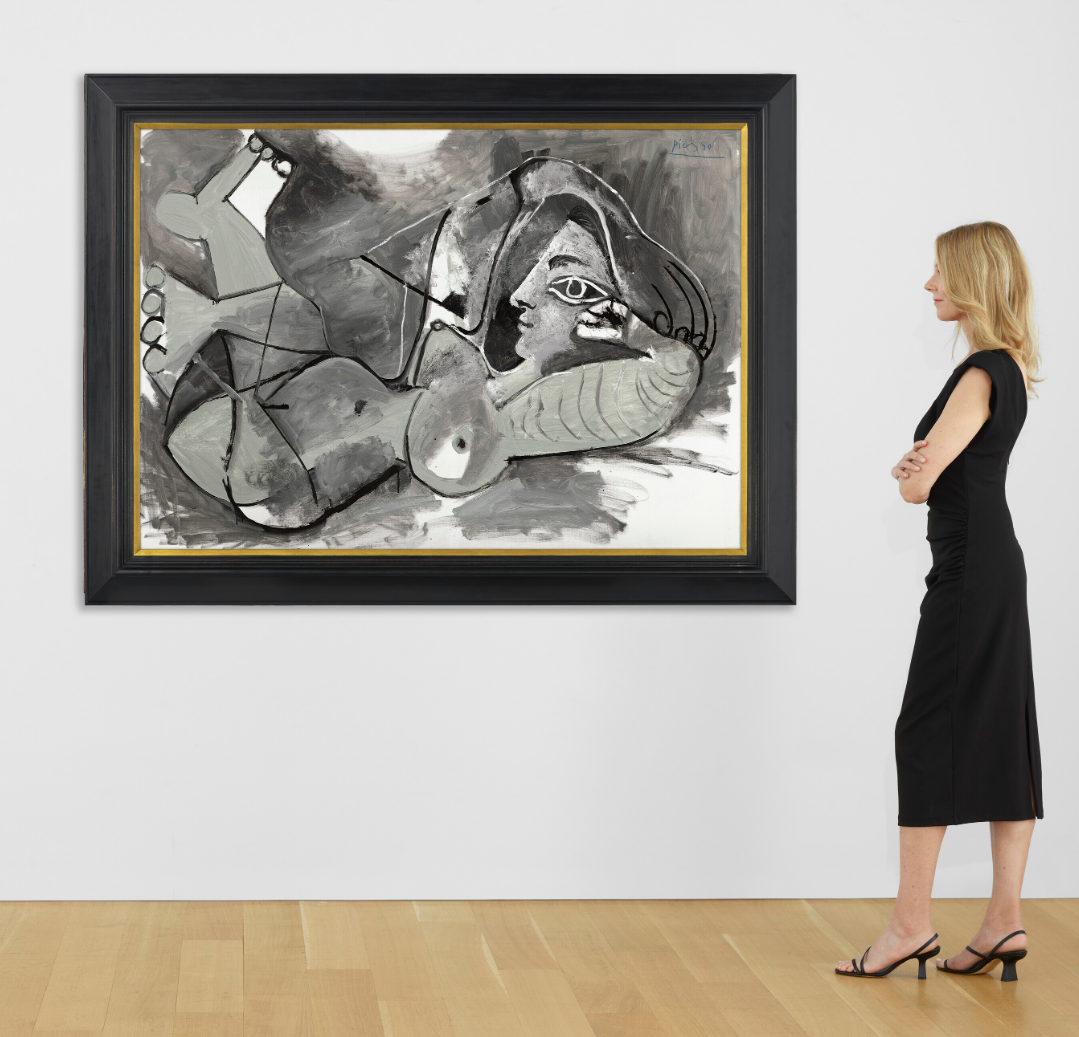
PABLO PICASSO (1881-1973)
Nu couché, 1968
Oil and Ripolin on canvas
114 x 162.5 cm (44 7/8 x 63 5/8 inches)
Signed ‘Picasso’ (upper right); dated and numbered ‘13.10.68. II’ (on the reverse)
#12. Buste de femme, 1909
Sotheby’s New-York: 13 November 2023
Estimated: USD 18,000,000 – 25,000,000
USD 13,622,500
https://www.sothebys.com/en/buy/auction/2023/modern-evening-auction-5/buste-de-femme
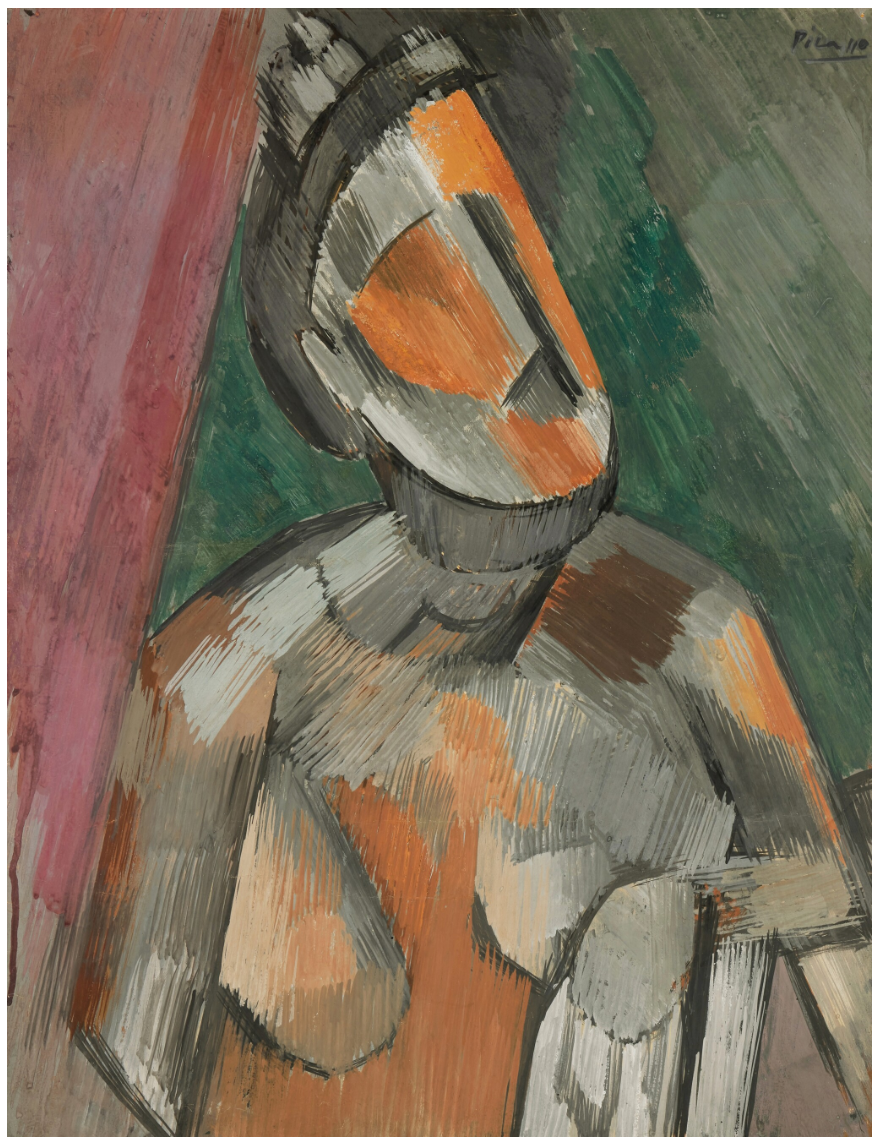
PABLO PICASSO (1881 – 1973)
Buste de femme, 1909
Gouache on paper mounted on board
63.7 x 49 cm (25 x 19 1/4 inches)
Signed Picasso (upper right)
#13. Femme dans un fauteuil, 1948
Sotheby’s Hong-Kong: 5 April 2023
Estimate on Request
HKD 93,086,500 / USD 11,859,405
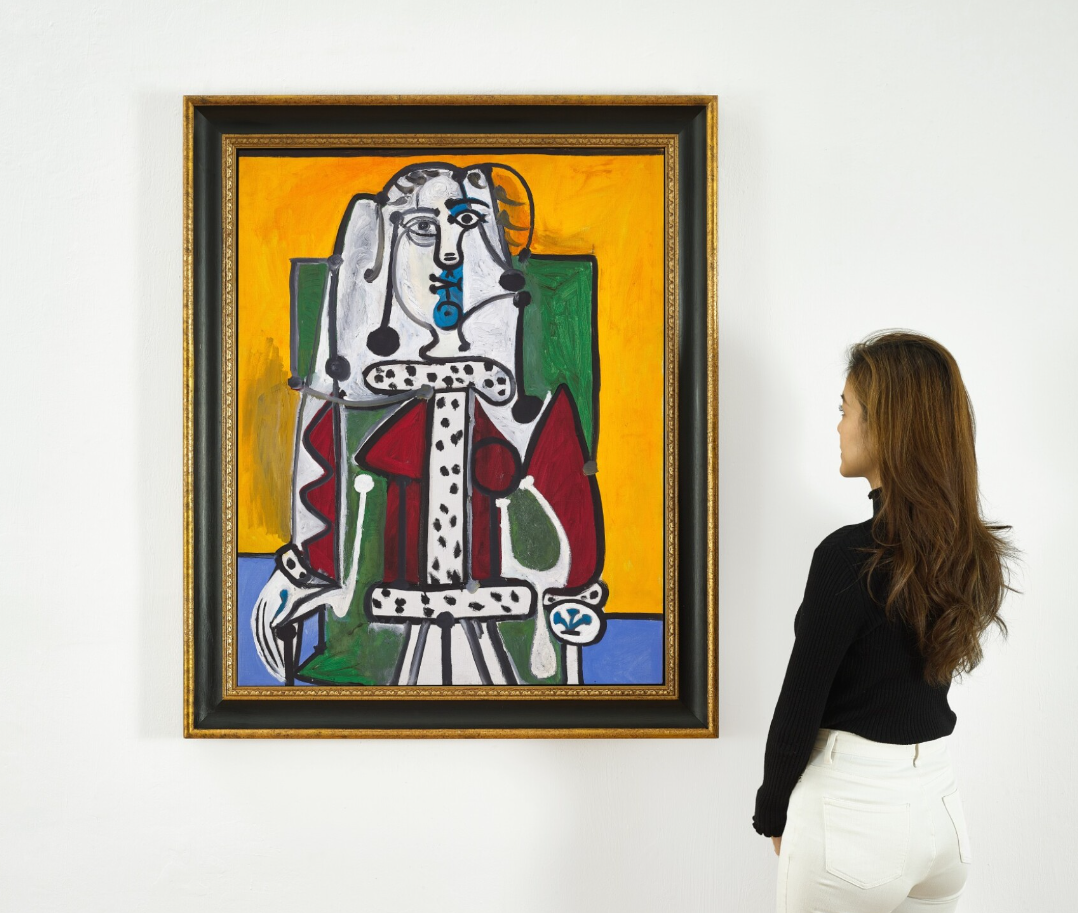
PABLO PICASSO (1881 – 1973)
Femme dans un fauteuil, 1948
Oil on canvas
92×73 cm (36 1/4 x 28 3/4 inches)
Dated 30.10.48. and 25.12.48. (on the verso)
Executed on 30 October and 25 December 1948
#14. Cafetiere, tasse, et pipe, 1911
Christie’s New-York: 11 May 2023
Estimated: USD 8,000,000 – 12,000,000
USD 11,335,000
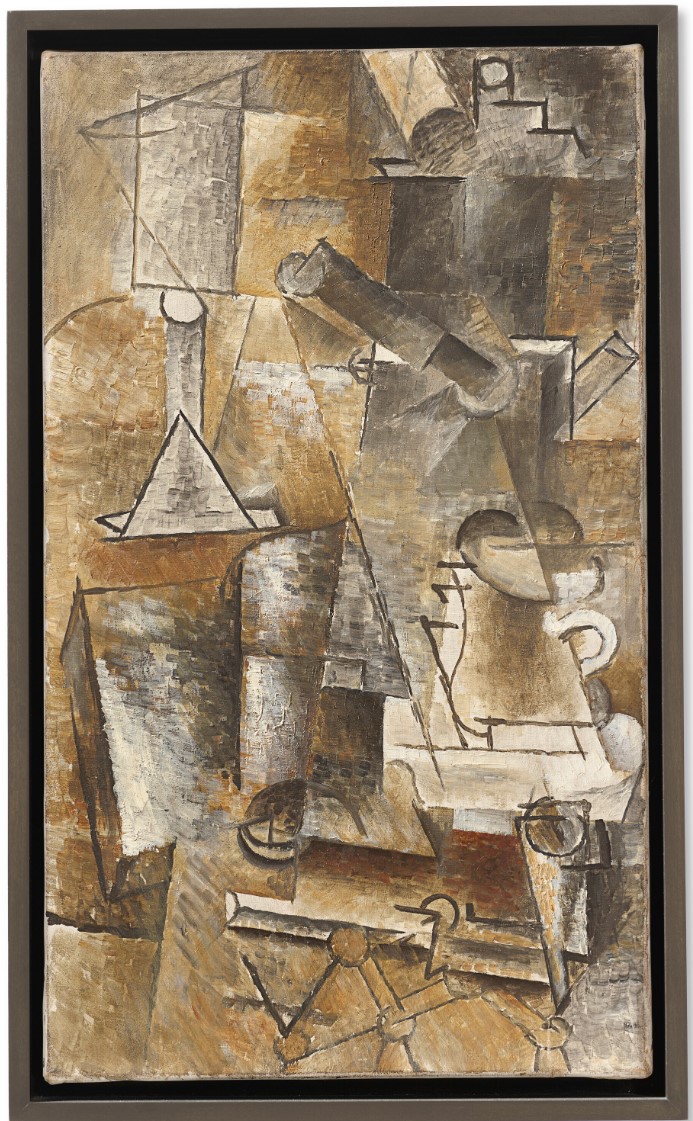
PABLO PICASSO (1881-1973)
Cafetière, tasse et pipe, 1911
Oil on canvas
46×27 cm (18 1/8 x 10 5/8 inches)
#15. Nu devant la glace, 1932
Sotheby’s New-York: 16 May 2023
Estimated: USD 12,000,000 – 18,000,000
USD 11,000,000
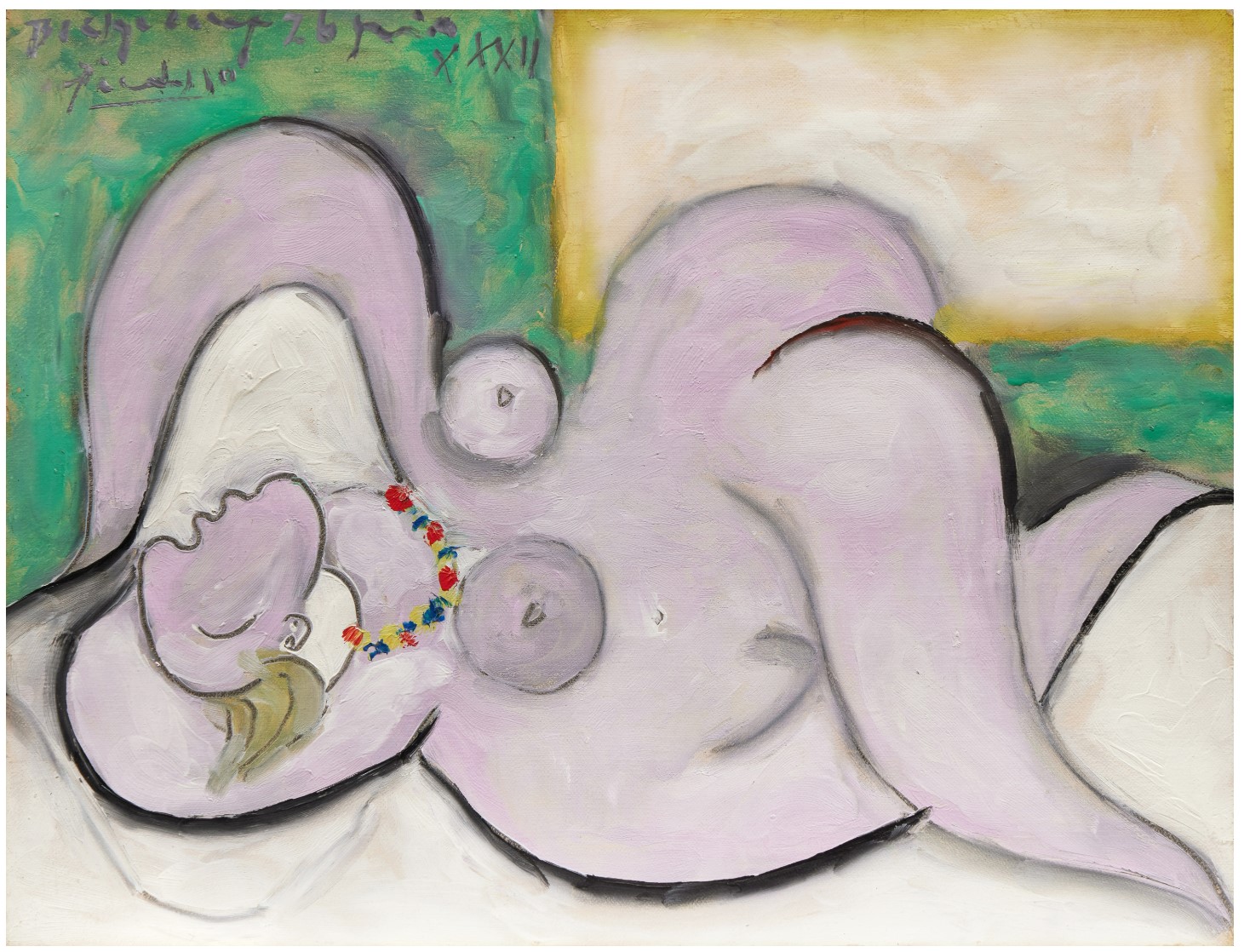
PABLO PICASSO (1881 – 1973)
Nu devant la glace, 1932
Oil and Ripolin on canvas
27×35 cm (10 5/8 x 13 3/4 inches)
USD 10 million
#16. Buste d’homme laure, 1969
Christie’s New-York: 17 May 2023
Estimated: USD 9,000,000 – 12,000,000
USD 8,460,000
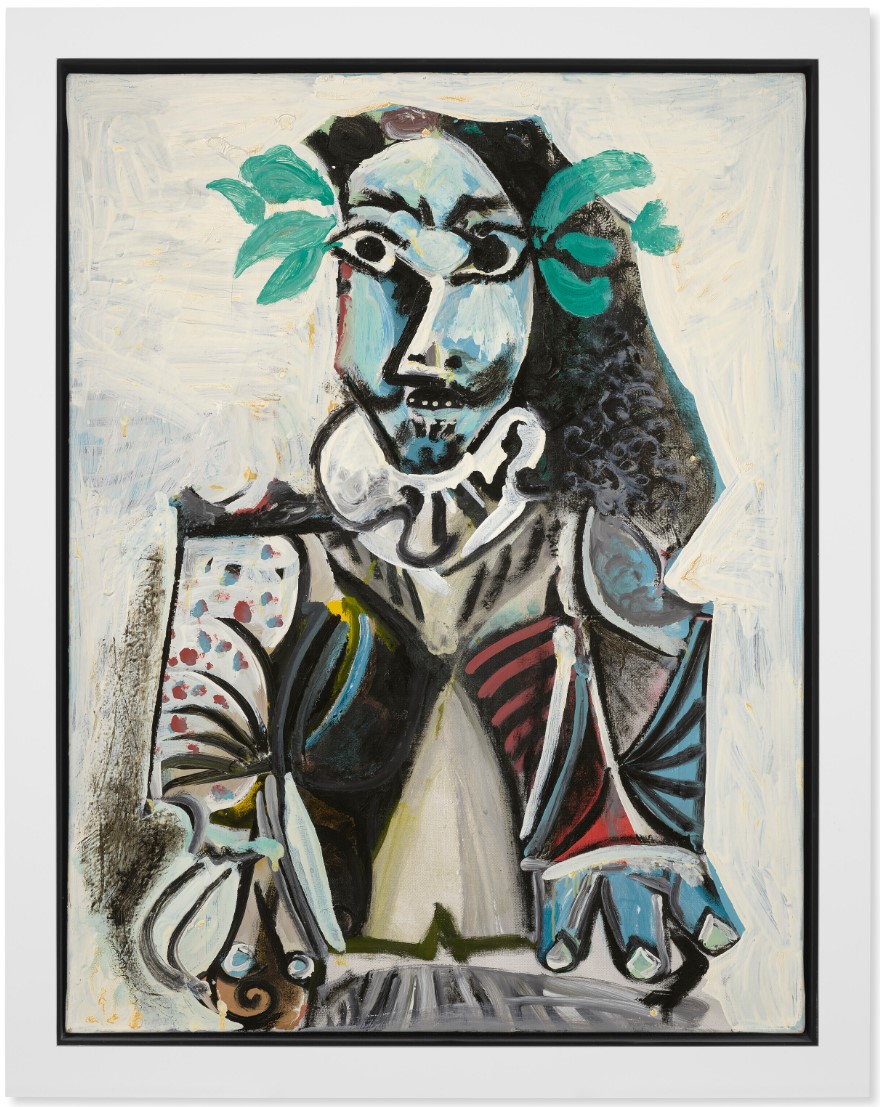
PABLO PICASSO (1881-1973)
Buste d’homme lauré, 1969
Oil and Ripolin on canvas
115.7 x 88.8 cm (45 5/8 x 35 inches)
#17. Paysage, 1965
Sotheby’s New-York: 16 May 2023
Estimated: USD 7,000,000 – 10,000,000
USD 7,803,000
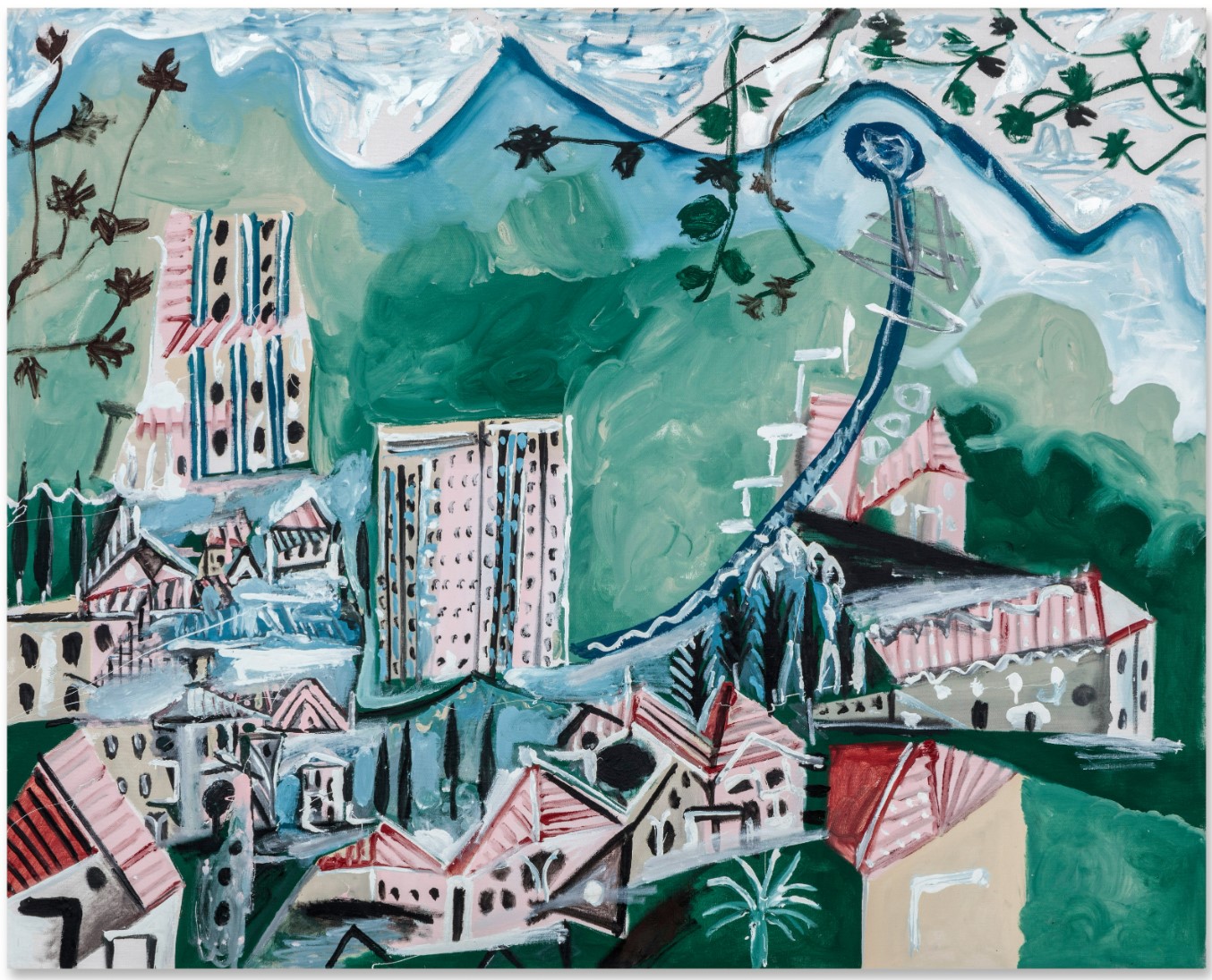
PABLO PICASSO (1881 – 1973)
Paysage, 1965
Oil and Ripolin on canvas
128.3 x 162 cm (50 1/2 x 63 3/4 inches)
#18. Tête de femme au chignon, 1952
Phillips New-York: 17 May 2023
Estimated: USD 6,000,000 – 7,000,000
USD 7,320,000
Pablo Picasso – 20th Century & Contempora… Lot 4 May 2023 | Phillips
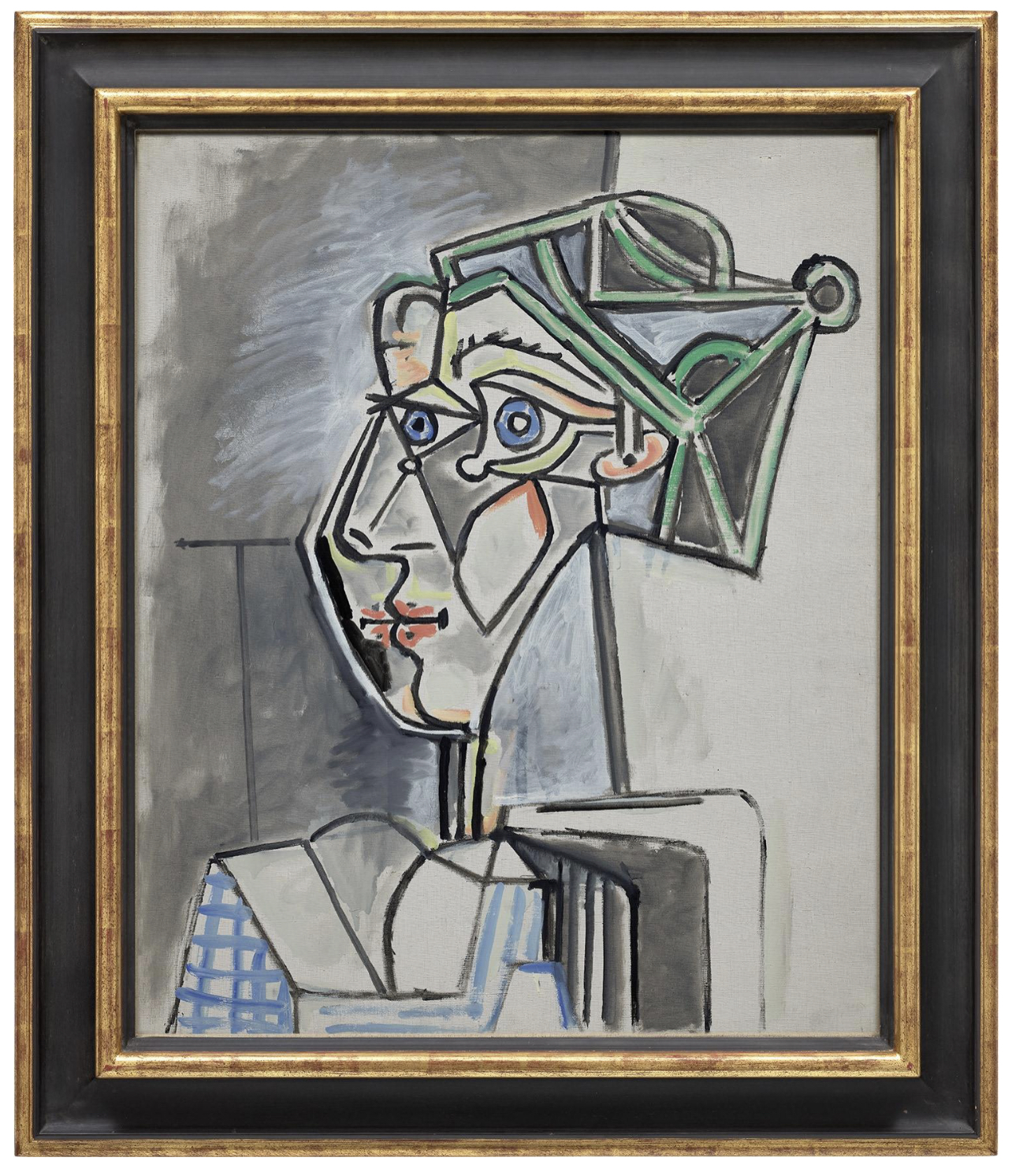
PABLO PICASSO
Tête de femme au chignon, 1952
Oil on canvas
73 x 59.7 cm (28 3/4 x 23 1/2 inches)
Dated “24 mai 52” on the reverse
#19. Mousquetaire I (Espagnol du XVllème siècle), 1967
Christie’s London: 28 February 2023
Estimated: GBP 4,500,000 – 6,500,000
GBP 5,442,000 / USD 6,564,350
https://www.christies.com/en/lot/lot-6414694
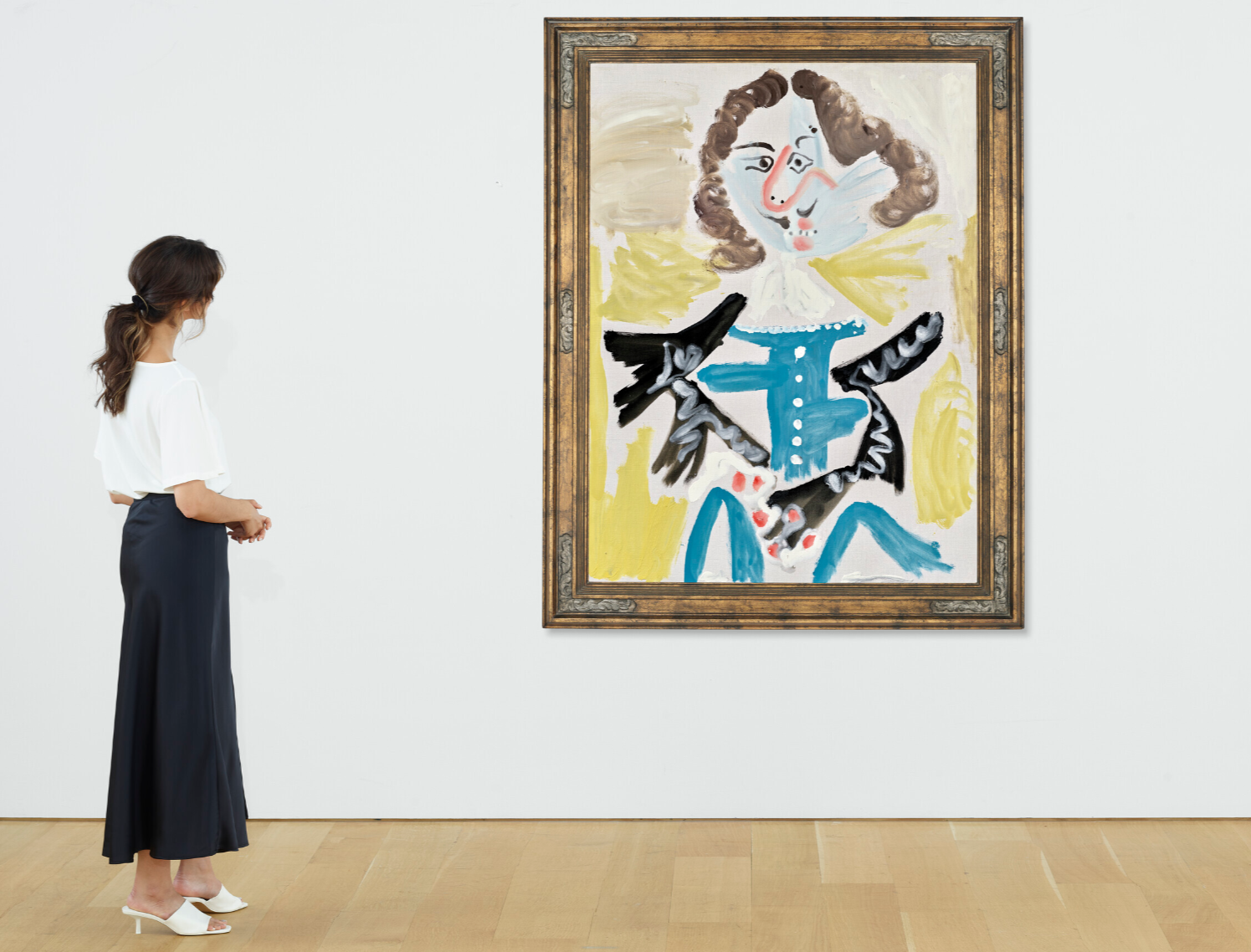
PABLO PICASSO (1881-1973)
Mousquetaire I (Espagnol du XVllème siècle), 1967
Oil on canvas
128.3 x 97.1 cm (51 x 38 1/4 inches)
Dated ‘21.4.67’ (on the reverse)
Painted on 21 April 1967
#20. Femme assise dans un fauteuil tressé, en gris, 1953
Christie’s London: 28 February 2023
Estimated: GBP 6,000,000 – 9,000,000
GBP 5,322,000 / USD 6,419,600
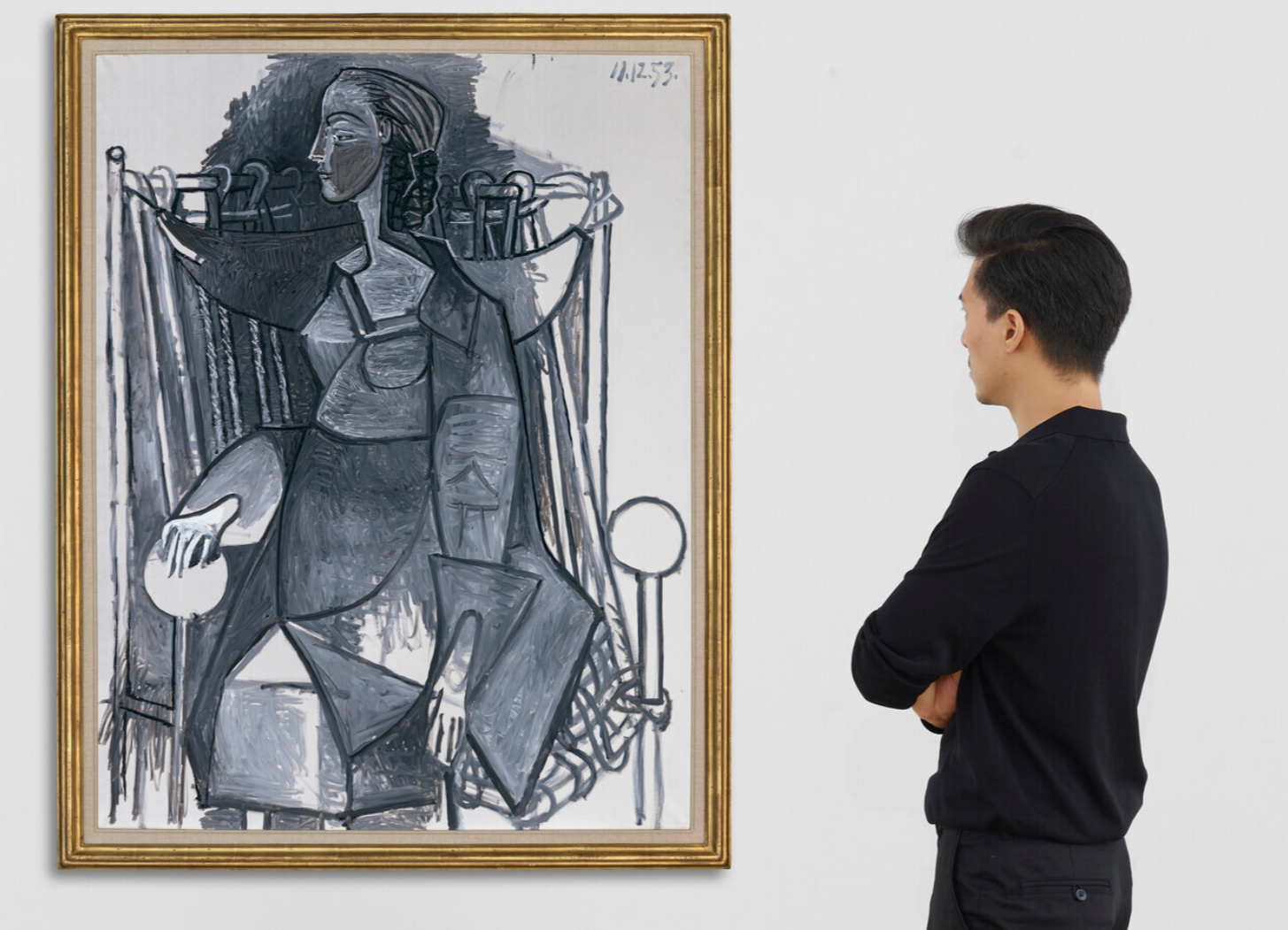
PABLO PICASSO (1881-1973)
Femme assise dans un fauteuil tressé, en gris (Françoise), 1953
Oil on canvas
116.2 x 88.9 cm (45 3/4 x 35 inches)
Dated ‘11.12.53.’ (upper right); dated again and inscribed ‘11.12.53. Vallauris’ (on the reverse)
Painted in Vallauris on 11 December 1953
#21. Buste d’homme, 1967
Sotheby’s New-York: 13 November 2023
Estimated: USD 4,000,000 – 6,000,000
USD 4,658,000
Buste d’homme | Modern Evening Auction | 2023 | Sotheby’s (sothebys.com)
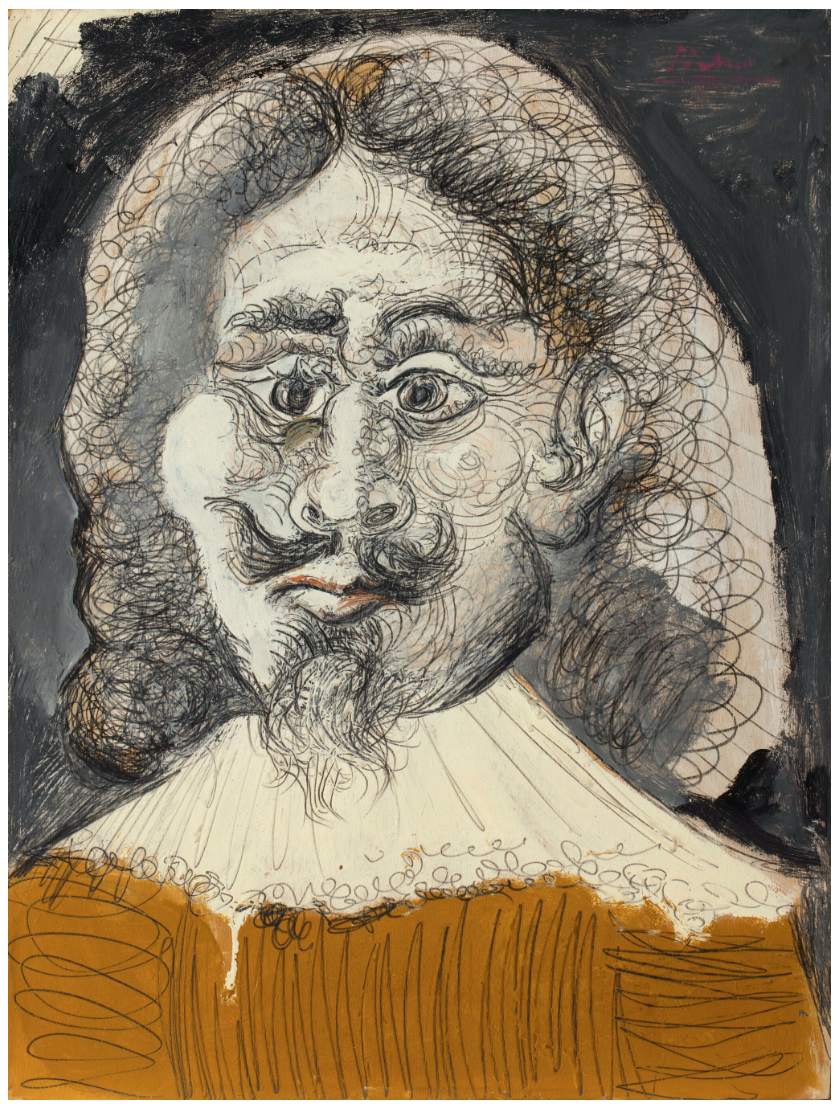
PABLO PICASSO (1881 – 1973)
Buste d’homme, 1967
Oil and black crayon on plywood
57 x 42.5 cm (22 1/2 x 16 3/4 inches)
Signed Picasso (upper right); dated 20.2.67 (on the reverse)
Executed in Mougins on 20 February 1967
#22. Homme portant un enfant, 1965
Sotheby’s Hong-Kong: 5 April 2023
Estimated: HKD 25,000,000 – 40,000,000
HKD 30,700,000 / USD 3,911,240
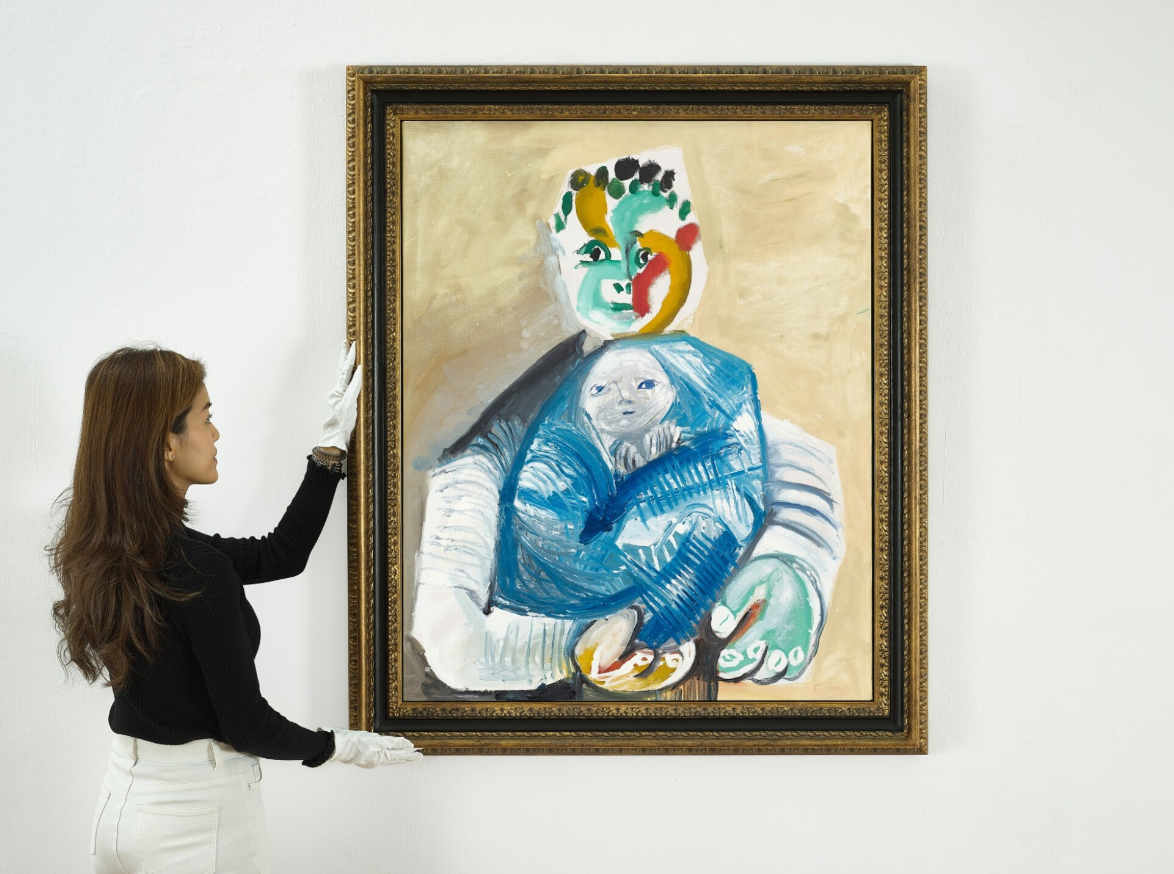
PABLO PICASSO (1881 – 1973)
Homme portant un enfant, 1965
Oil on canvas
100 x 81.5 cm (39 3/8 x 32 inches)
Signed Picasso (lower right)
Sated and numbered 22.2.65.IV (on the verso)
Executed on 22 February 1965
#23. Deux musiciens, 1965
Sotheby’s London: 27 June 2023
Estimated: GBP 2,500,000 – 3,500,000
GBP 3,012,500 / USD 3,835,524
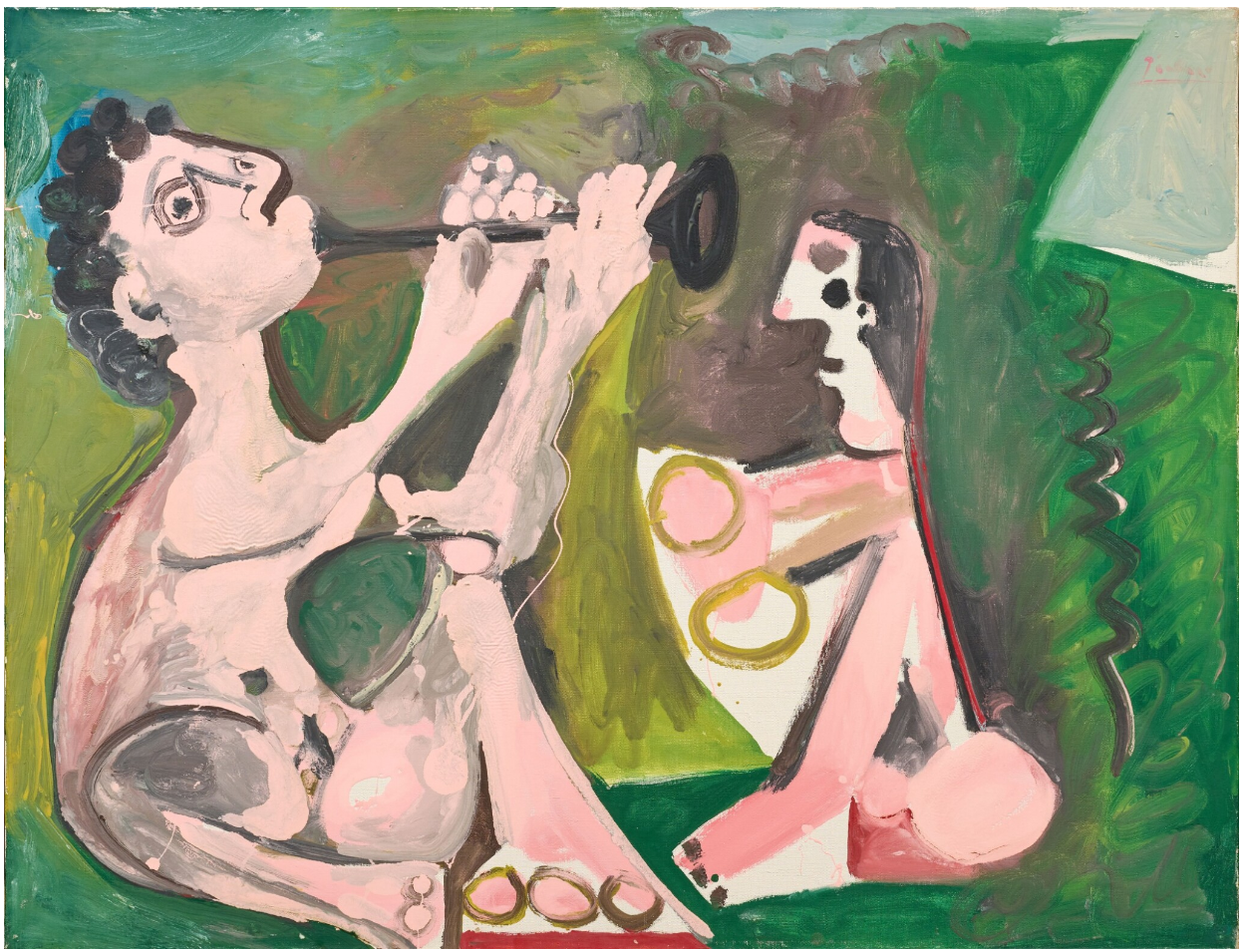
PABLO PICASSO (1881 – 1973)
Deux musiciens, 1965
Oil and Ripolin on canvas
89×116 cm (35 x 45 5/8 inches)
Signed Picasso (upper right); dated 21.5.65. and numbered II (on the verso)
Executed on 21 May 1965
#24. La Glace, 1912
Sotheby’s New-York: 13 November 2023
Estimated: USD 3,000,000 – 5,000,000
USD 3,811,000
La Glace | Modern Evening Auction | 2023 | Sotheby’s (sothebys.com)
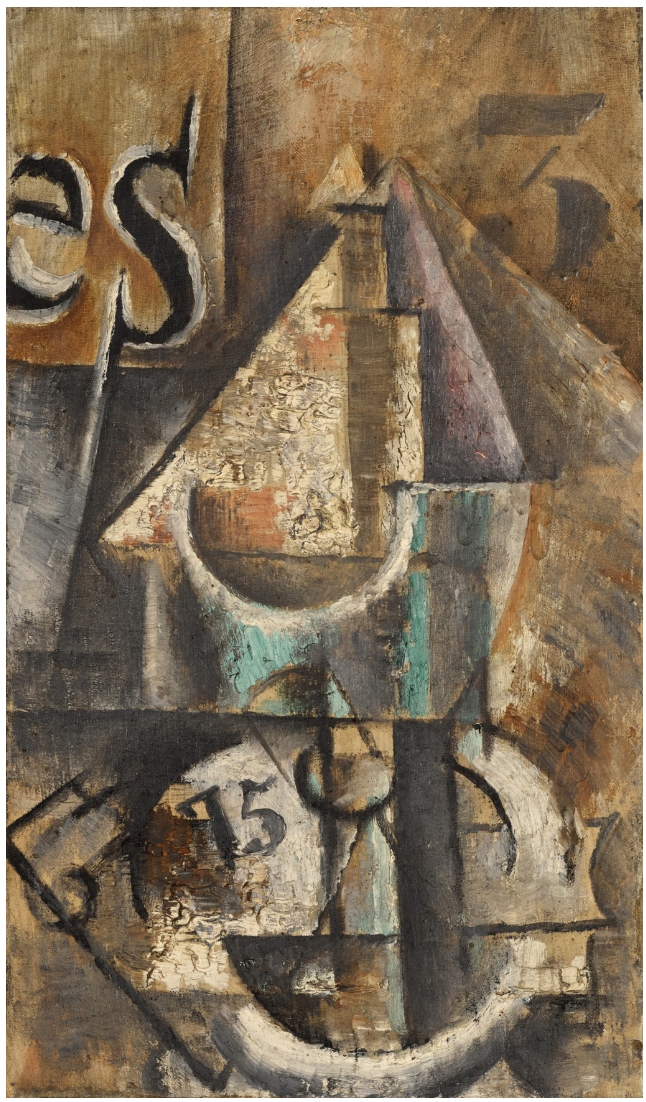
PABLO PICASSO (1881 – 1973)
La Glace, 1912
Oil on canvas
24×14 cm (9 1/2 x 5 1/2 inches)
Signed Picasso (on the reverse)
Executed in January-March 1912
#25. Le peintre et son modèle, 1963
Christie’s New-York: 13 May 2023
Estimated: USD 2,500,000 – 3,500,000
USD 3,317,000
PABLO PICASSO (1881-1973) (christies.com)
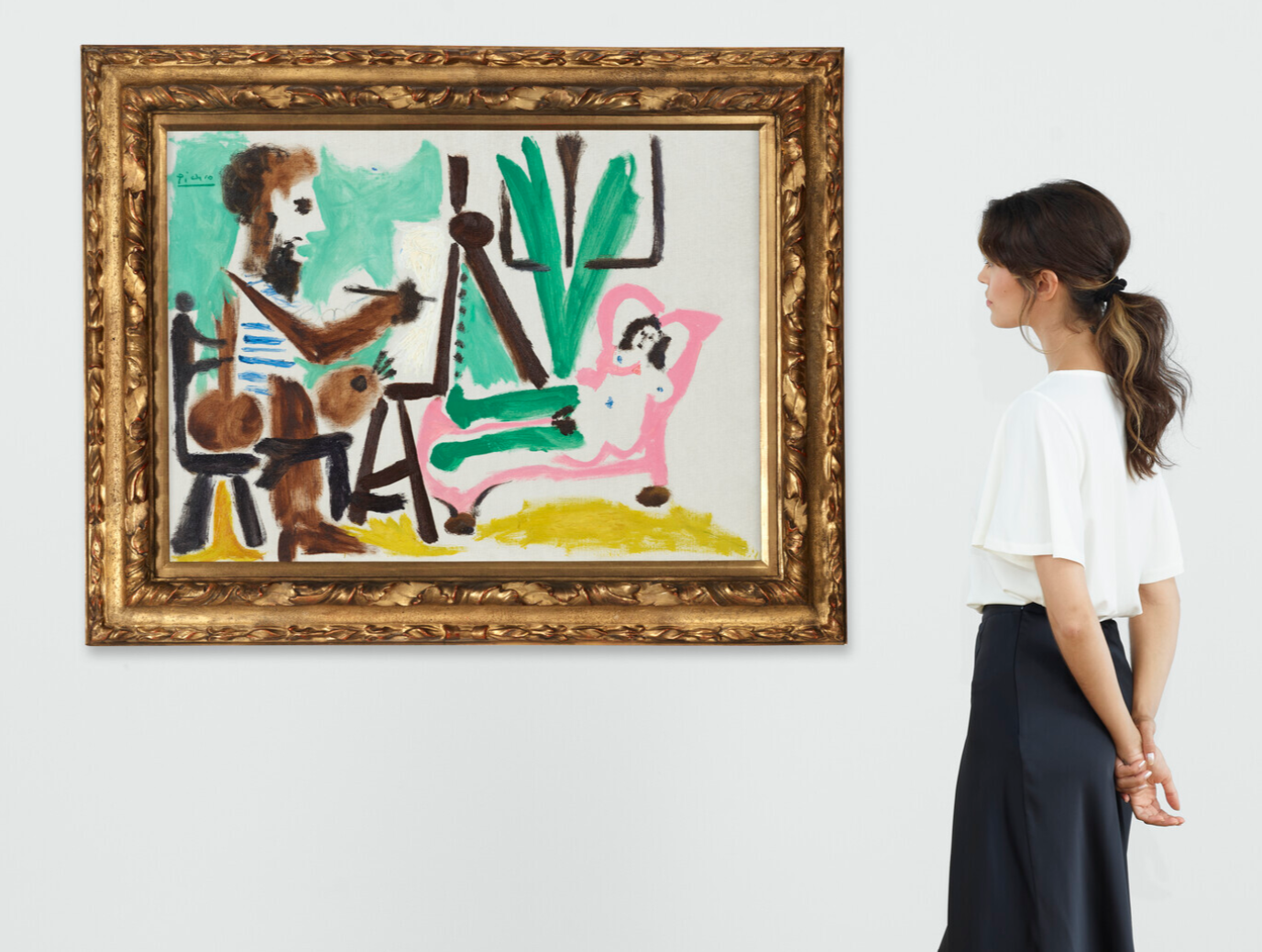
PABLO PICASSO (1881-1973)
Le peintre et son modèle, 1963
Oil on canvas
73×100 cm (28 3/4 x 39 3/8 inches)
Signed ‘Picasso’ (upper left)
#26. Nature morte, compotier avec fruits, pot avec fleurs, 1939
Christie’s New-York: 11 November 2023
Estimated: USD 800,000 – 1,200,000
USD 2,833,000
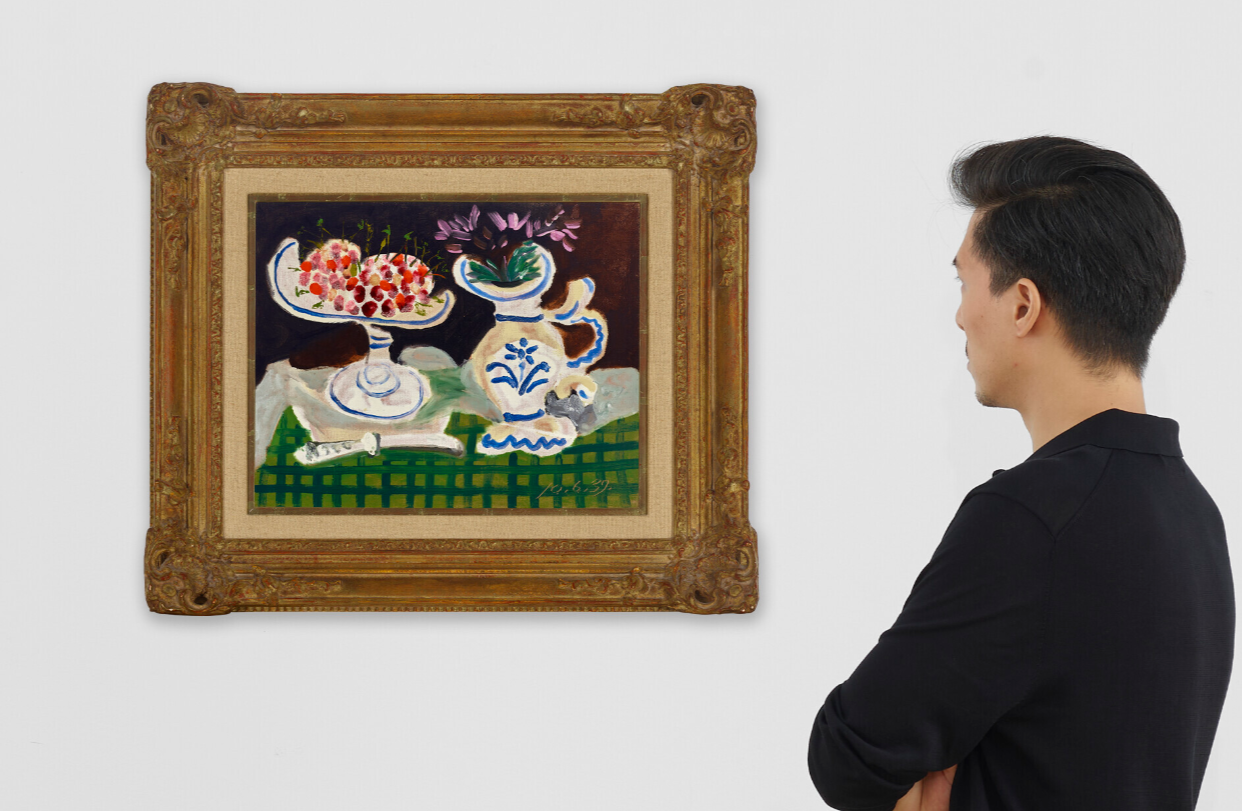
PABLO PICASSO (1881-1973)
Nature morte, compotier avec fruits, pot avec fleurs, 1939
Oil on canvas
33 x 41.3 cm (13 x 16 1/4 inches)
Dated ‘10.6.39.’ (lower right)
Painted on 10 June 1939
#27. Femme assise, 1937
Sotheby’s New-York: 16 May 2023
Estimated: USD 600,000 – 800,000
USD 2,419,500
Femme assise | Modern Evening Auction | 2023 | Sotheby’s (sothebys.com)
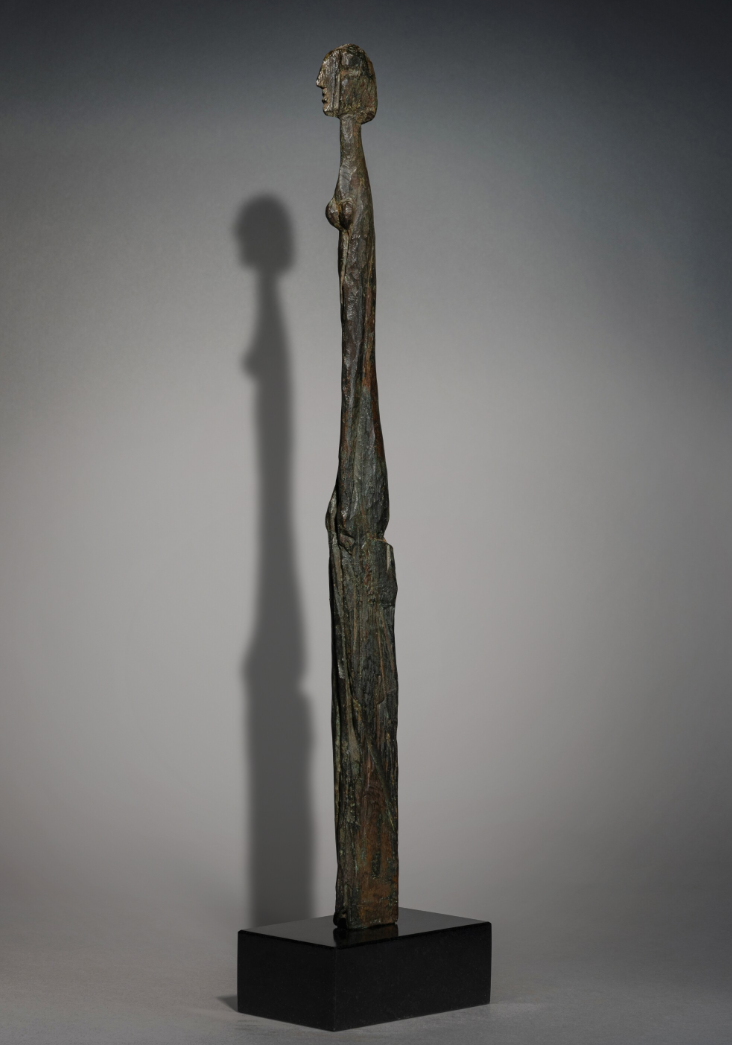
PABLO PICASSO (1881 – 1973)
Femme assise, 1937
Bronze
Height: 54.5 cm (21 1/2 inches)
Conceived in wood in Boisgeloup circa 1930-31 and cast in bronze in 1937 in an edition of 4
#28. Compotier et verres, 1943
Christie’s London: 28 February 2023
Estimated: GBP 1,200,000 – 1,800,000
GBP 1,962,000 / USD 2,366,640
PABLO PICASSO (1881-1973), Compotier et verres | Christie’s (christies.com)
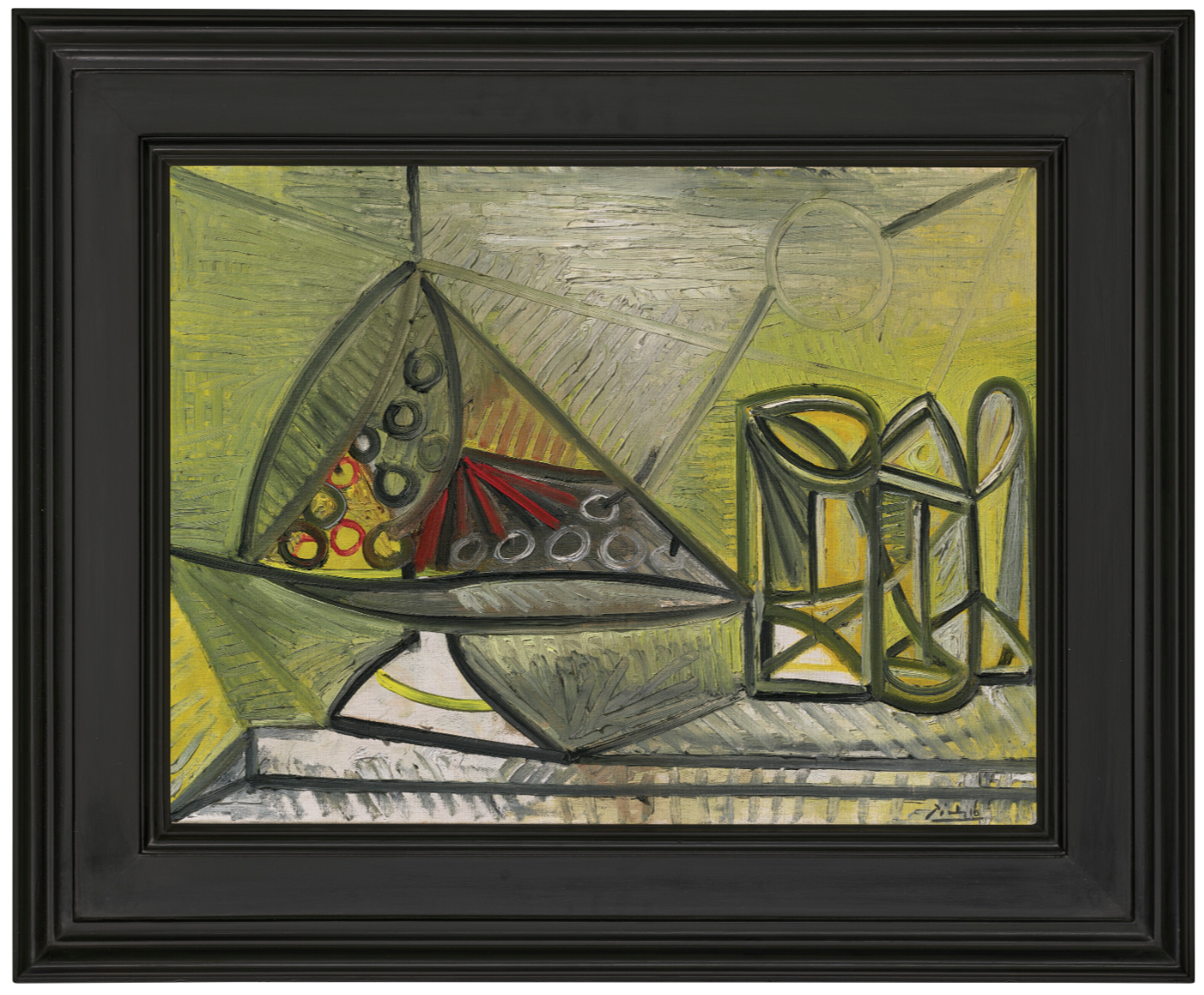
PABLO PICASSO (1881-1973)
Compotier et verres, 1943
Oil on canvas
46.5 x 61 cm (18 1/4 x 24 inches)
Signed ‘Picasso’ (lower right) and dated ’16 June 43′ (on the reverse)
Painted on 16 June 1943
#29. Tête d’homme et nu assis, 1964
Phillips New-York: 14 November 2023
Estimated: USD 1,800,000 – 2,500,000
USD 2,238,000
Pablo Picasso – 20th Century & Cont… Lot 41 November 2023 | Phillips
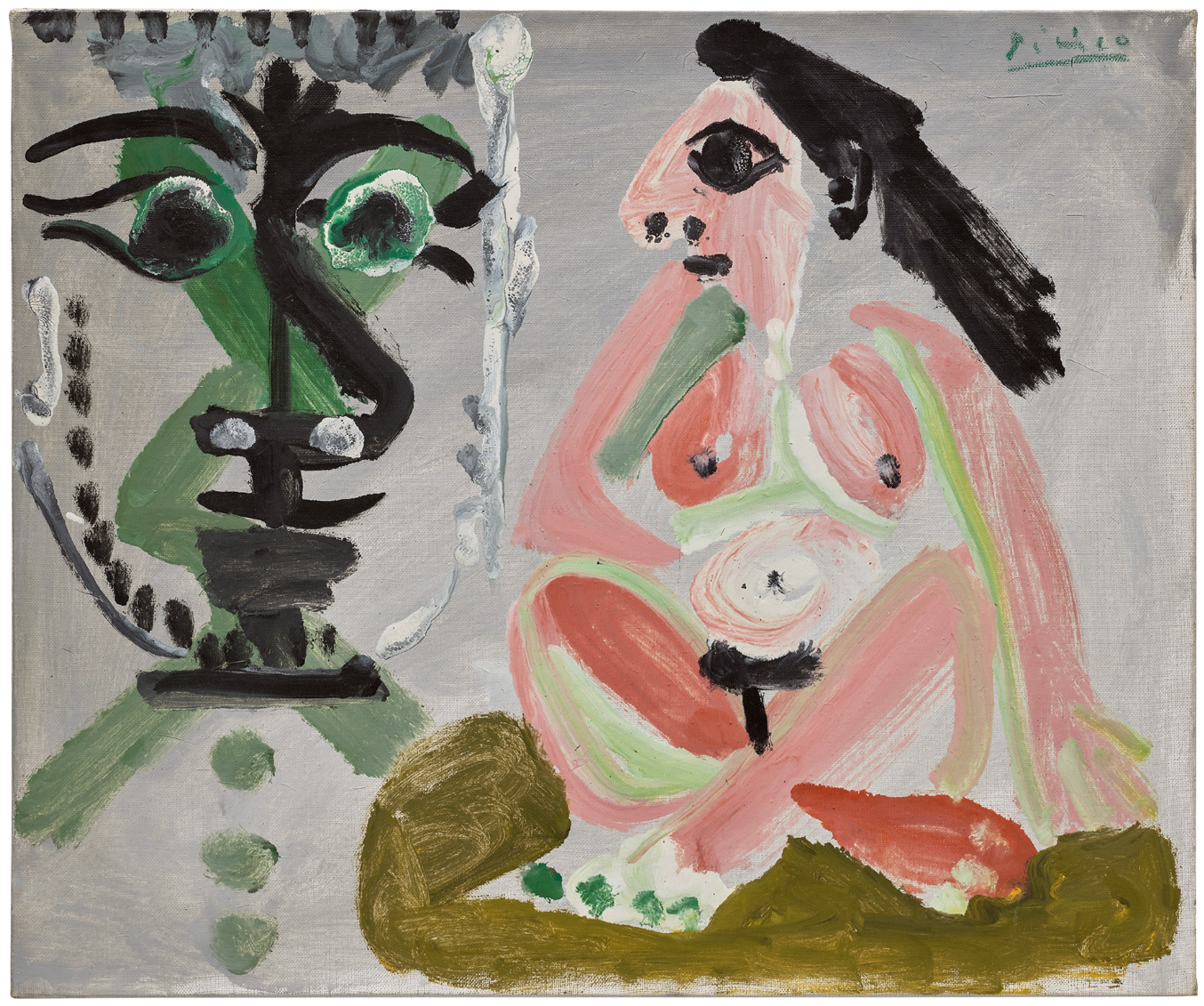
PABLO PICASSO
Tête d’homme et nu assis, 1964
Oil and Ripolin on canvas
45.4 x 54.9 cm (17 7/8 x 21 5/8 inches)
Signed “Picasso” upper right; inscribed and dated “3.12.64 II” on the reverse
Painted on December 3, 1964
#30. Tête d’homme (III), 1964
Christie’s Paris: 4 April 2023
Estimated: EUR 1,000,000 – 1,500,000
EUR 2,022,000 / USD 2,205,350
Pablo Picasso (1881-1973), Tête d’homme (III) | Christie’s (christies.com)
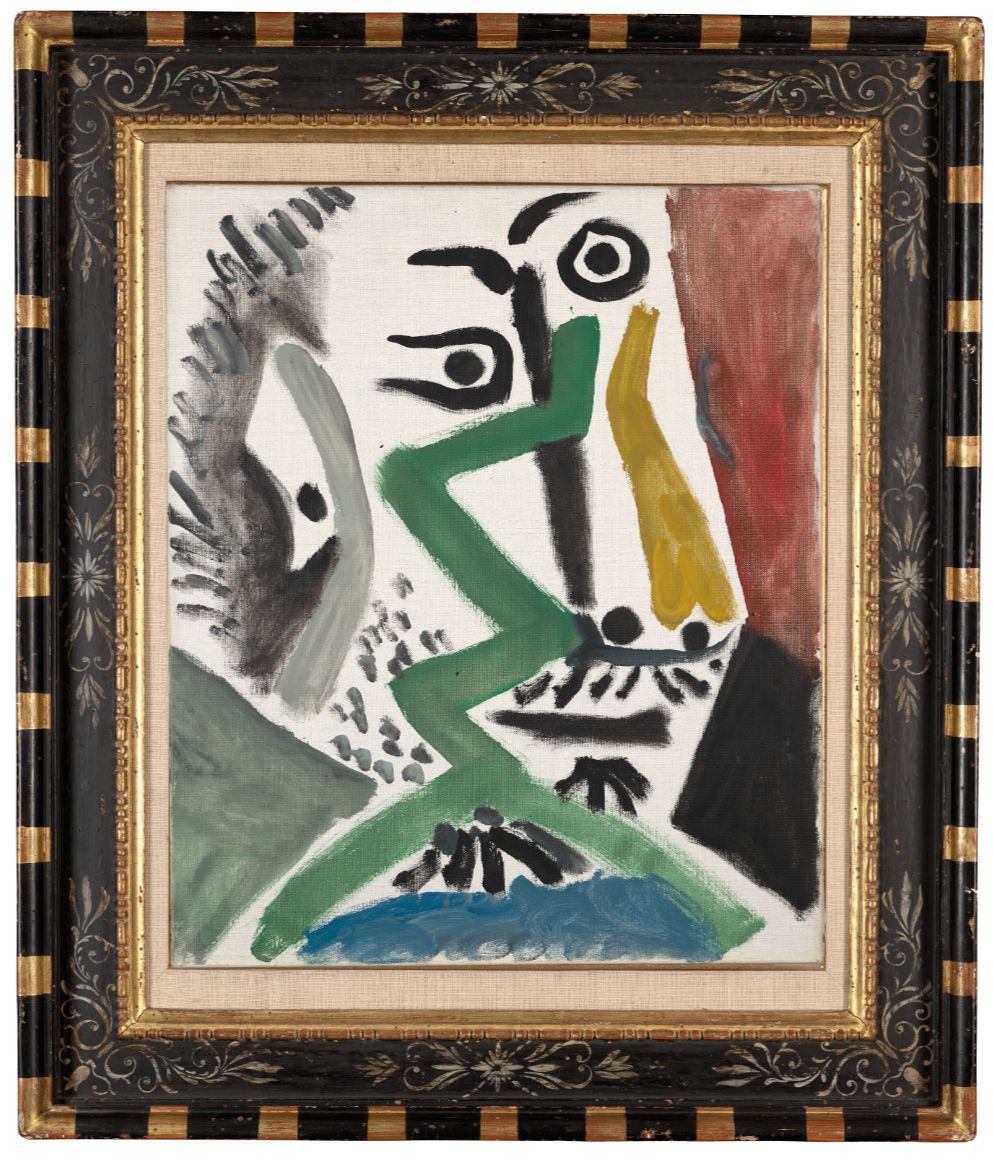
PABLO PICASSO (1881-1973)
Tête d’homme (III), 1964
Oil on canvas
55×46 cm (21 5/8 x 18 1/8 inches)
Dated and inscribed ‘4.12.64.III’ (on the reverse)
Painted in Mougins on 4 December 1964
#31. Buste de jeune fille (Paloma), 1951
Christie’s New-York: 13 May 2023
Estimated: USD 1,200,000 – 1,800,000
USD 1,925,500
PABLO PICASSO (1881-1973) (christies.com)
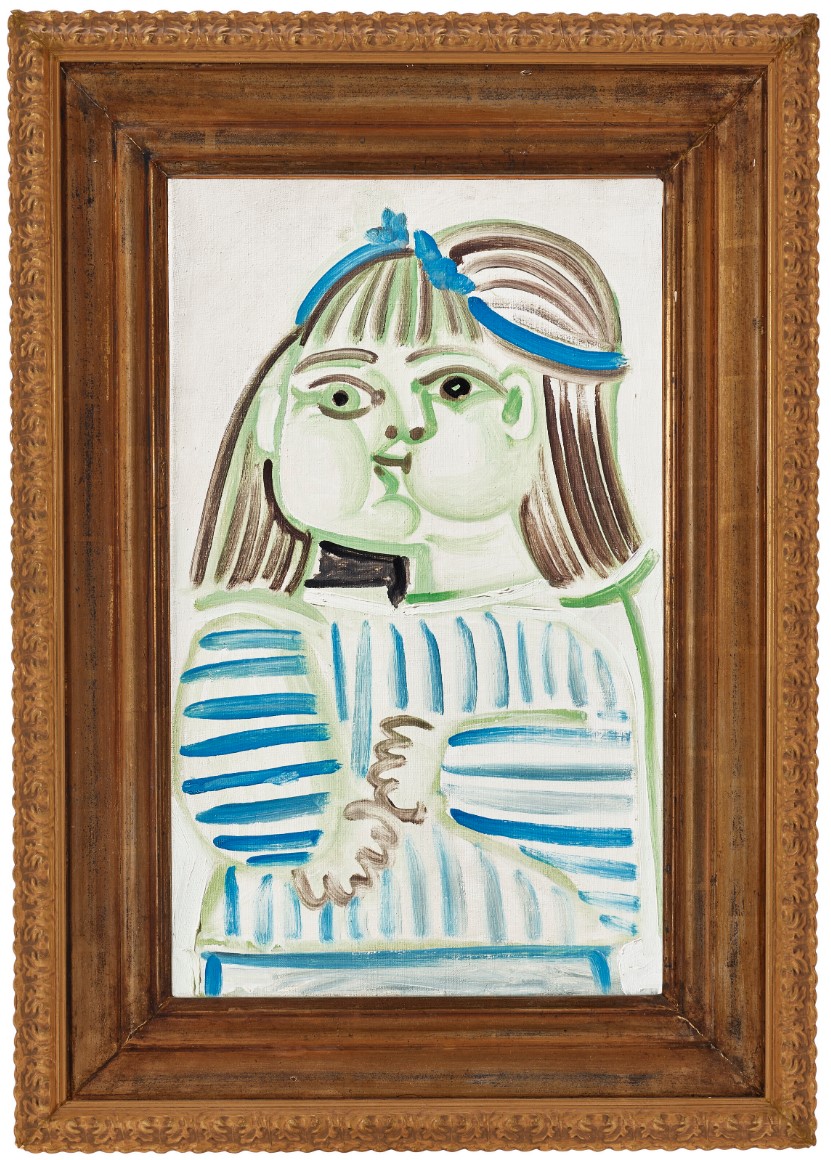
PABLO PICASSO (1881-1973)
Buste de jeune fille (Paloma), 1951
Oil and ripolin on canvas
54.6 x 33 cm (21 1/2 x 13 inches)
Sated ‘7.1.51’ (on the reverse)
#32. Nature morte, verre et compotier aux fruits, 1938
Sotheby’s New-York: 14 November 2023
Estimated: USD 1,500,000 – 2,000,000
USD 1,875,000
Nature morte, verre et compotier aux fruits | Modern Day Auction | 2023 | Sotheby’s (sothebys.com)
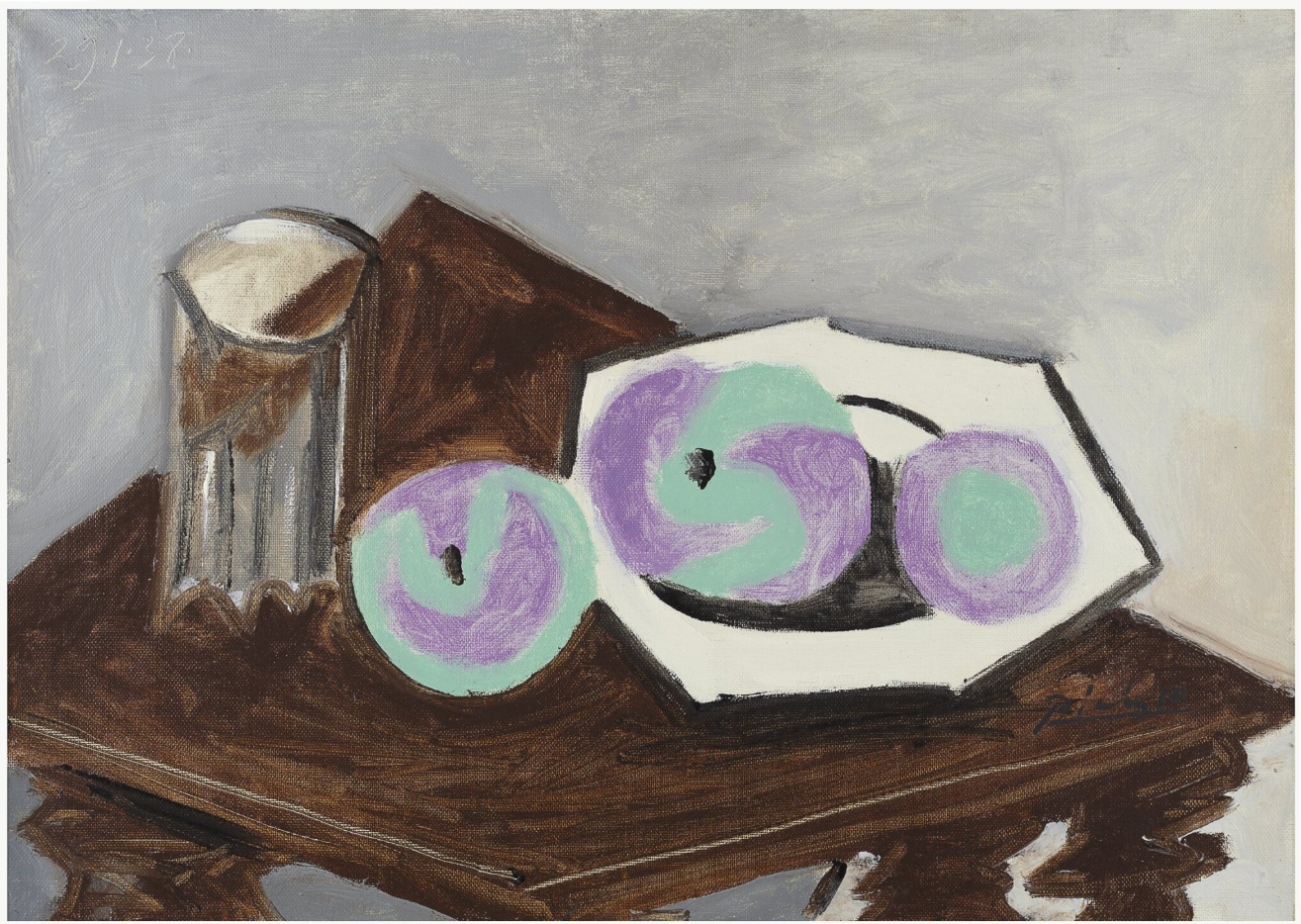
PABLO PICASSO (1881 – 1973)
Nature morte, verre et compotier aux fruits, 1938
Oil on canvas
34×46 cm (13 x 18 1/8 inches)
Signed Picasso (lower right); dated 29.1.38 (upper left)
Executed in Le Tremblay-sur-Mauldre on 29 January 1938
#33. Tête de femme, 1921
Christie’s London: 28 June 2023
Estimated: GBP 1,000,000 – 1,500,000
GBP 1,250,000 / USD 1,593,215
PABLO PICASSO (1881-1973), Tête de femme | Christie’s (christies.com)
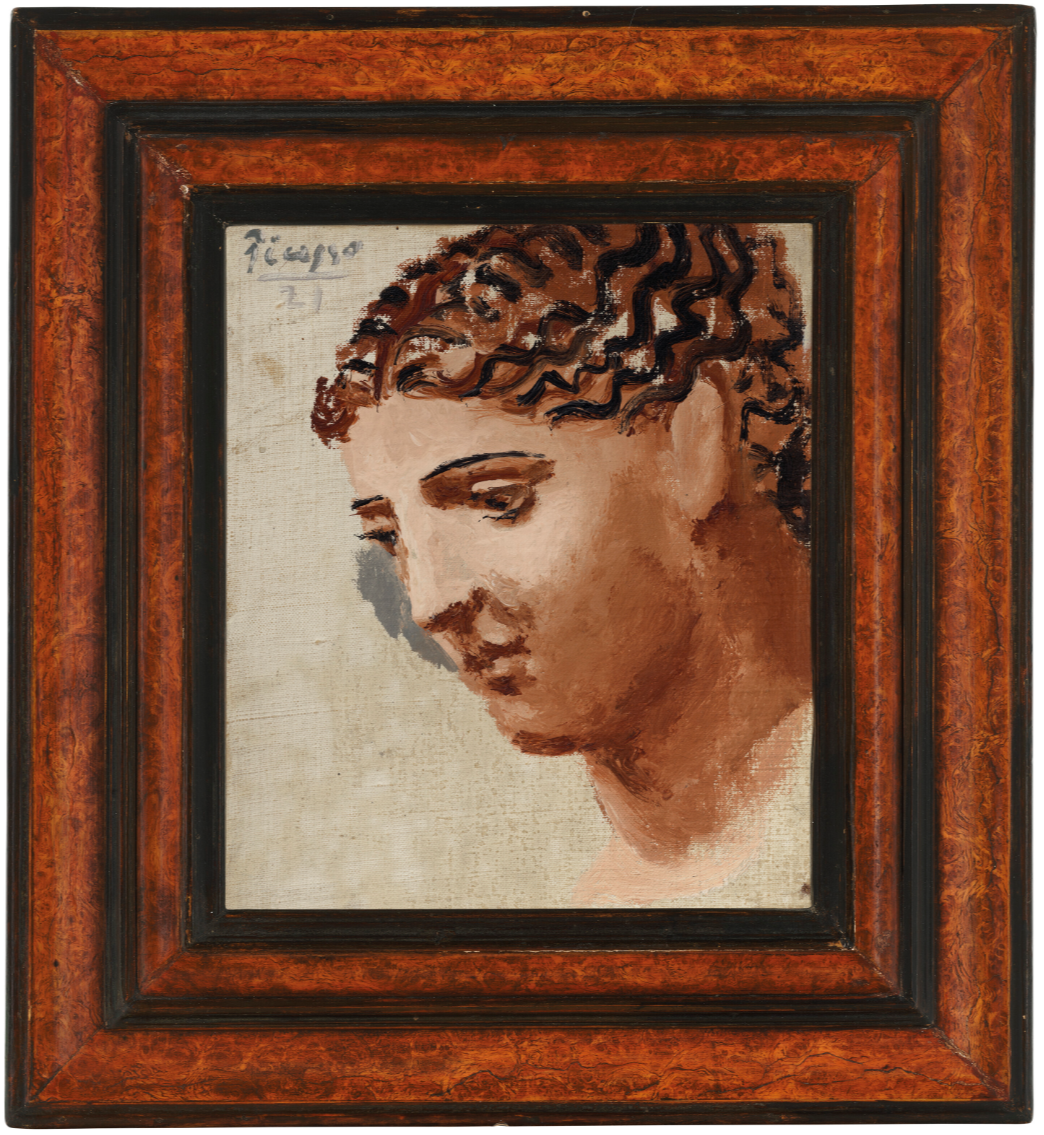
PABLO PICASSO (1881-1973)
Tête de femme, 1921
Oil on canvas
18.6 x 16 cm (7 3/8 x 6 1/4 inches)
Signed and dated ‘Picasso 21’ (upper left)
Painted in Fontainebleau in Summer 1921
#34. Nature morte à la cafetière, 1943
Sotheby’s Paris: 19 April 2023
Estimated: EUR 800,000 – 1,200,000
EUR 1,439,500 / USD 1,579,870
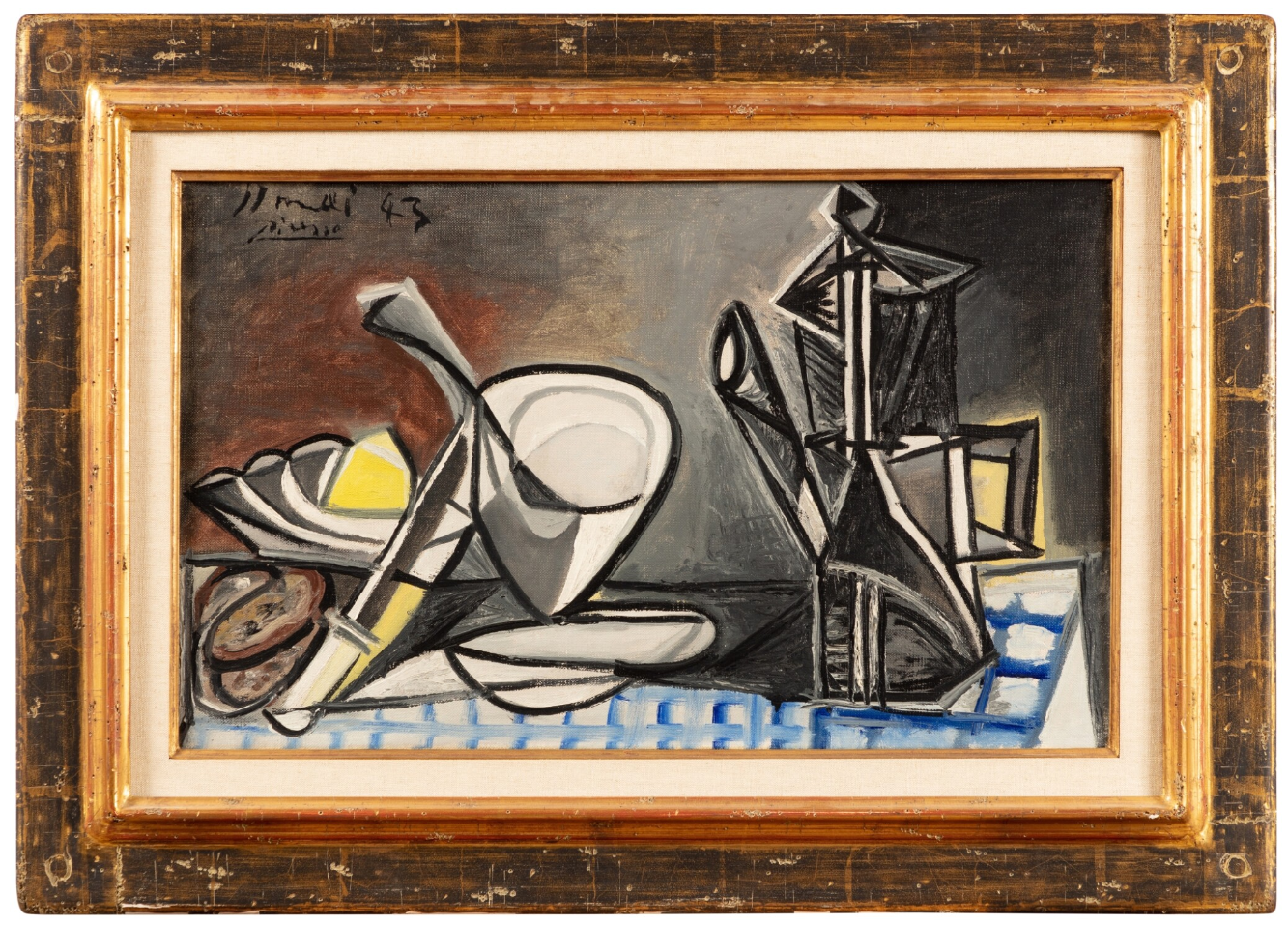
PABLO PICASSO (1881 – 1973)
Nature morte à la cafetière, 1943
Oil on canvas
33 x 54.7 cm (13 x 21 1/2 inches)
Signed Picasso and dated 11 mai 43 (upper left); dated 11 mAi 43 (on the reverse)
#35. Verre et Pichet, 1944
Sotheby’s Paris: 19 April 2023
Estimated: EUR 400,000 – 600,000
EUR 1,379,000 / USD 1,513,470
Verre et Pichet | Art Impressionniste et Moderne Evening Auction | 2023 | Sotheby’s (sothebys.com)
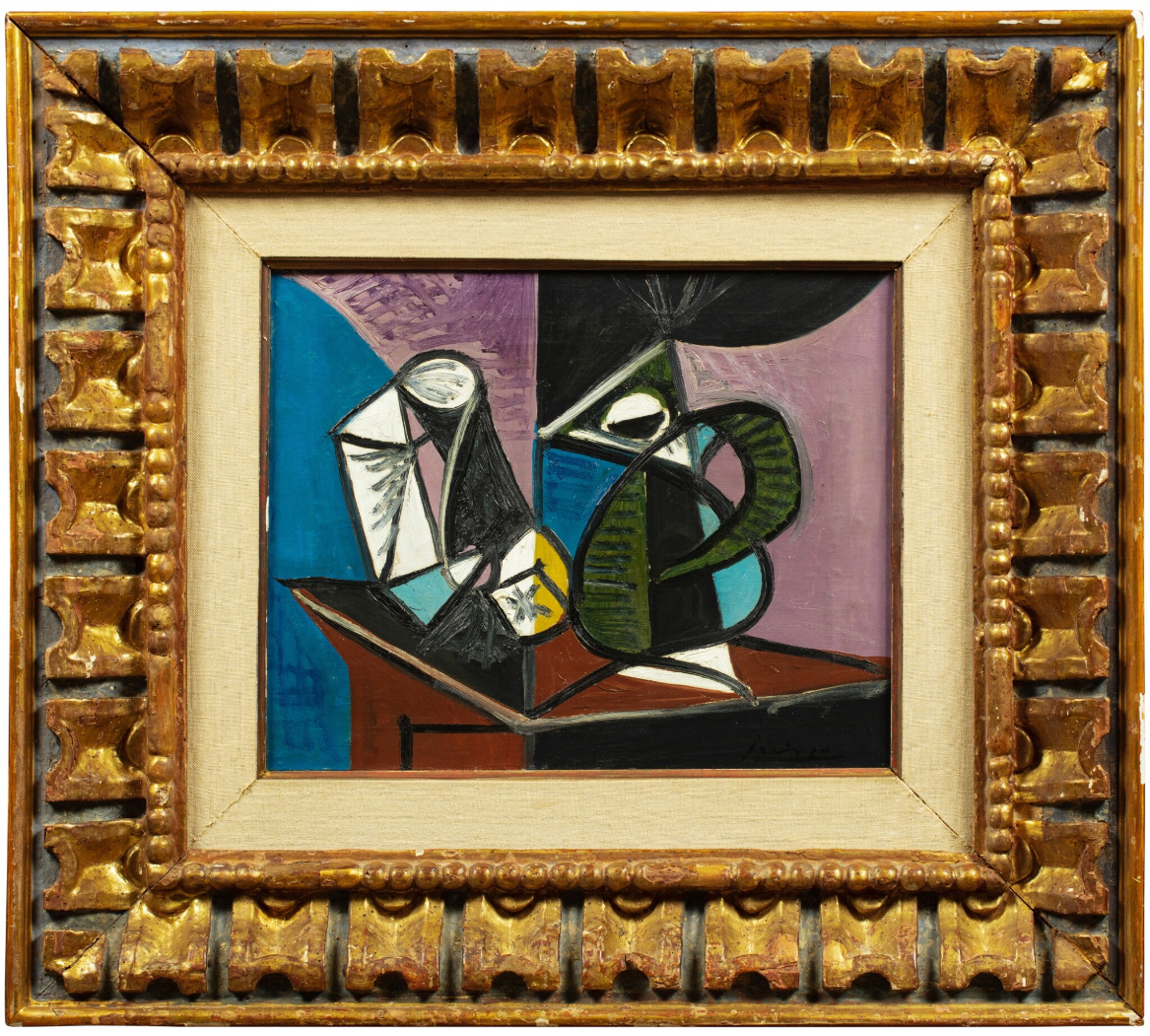
PABLO PICASSO
Verre et Pichet, 1944
Oil on canvas
33.2 x 41 cm (13 1/8 x 16 1/8 inches)
Signed Picasso (lower right); dated 24 juillet 44 and numbered III (on the reverse)
Painted on July 24th, 1944
2022 Auction Results
WORK IN PROGRESS
#1. Femme nue couchée, 1932
Sotheby’s New-York: 17 May 2022
Estimate upon Request
USD 67,541,000
Femme nue couchée | Modern Evening Auction | 2022 | Sotheby’s (sothebys.com)
PABLO PICASSO (1881 – 1973)
Femme nue couchée, 1932
Oil and Ripolin on canvas
129.9 x 161.7 cm (51 1/8 x 63 5/8 inches)
Dated Boisgeloup 2 Avril XXXII (on the stretcher)
Executed in Boisgeloup on 2 April 1932
#2. Tête de femme (Fernande), 1909
Christie’s New-York: 12 May 2022
Estimate on Request
USD 48,480,000
PABLO PICASSO (1881-1973), Tête de femme (Fernande) | Christie’s
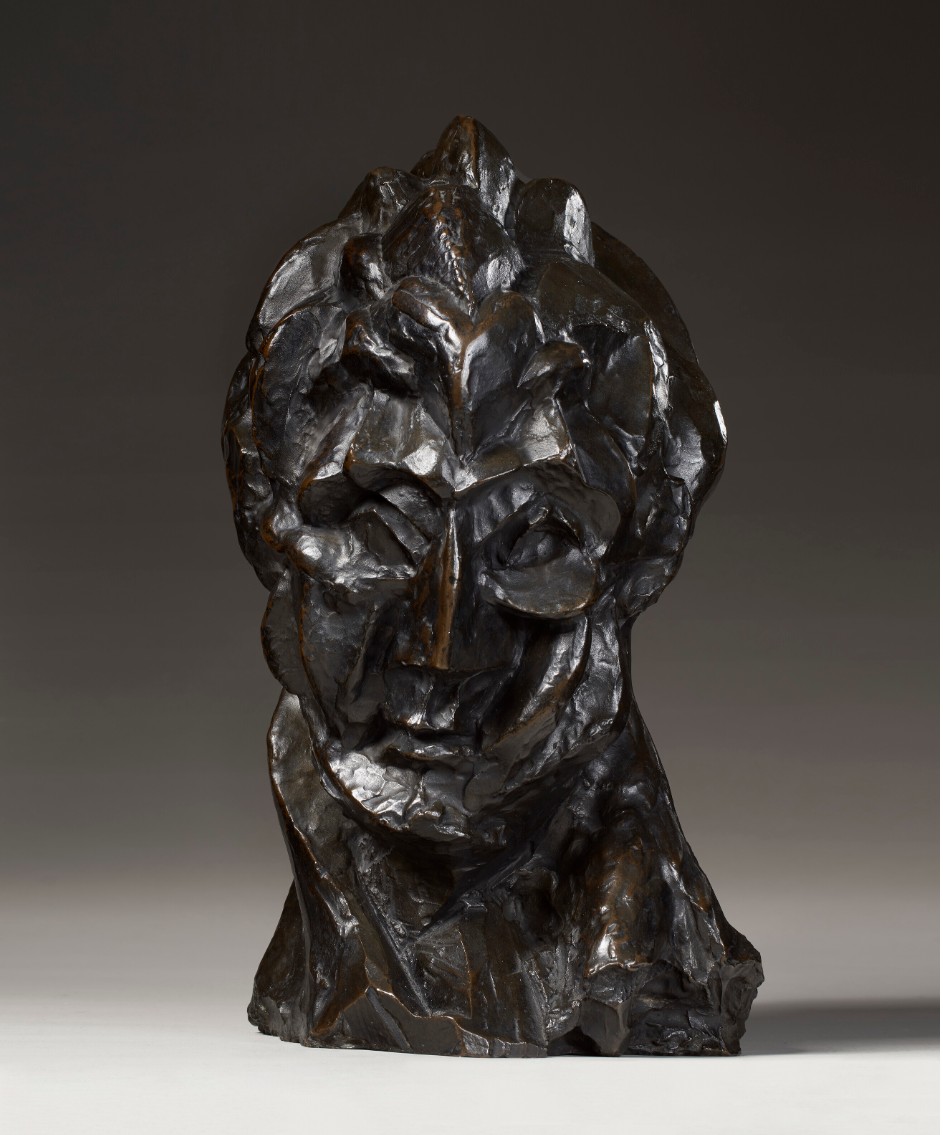
PABLO PICASSO (1881-1973)
Tête de femme (Fernande), 1909
Bronze with dark brown patina
Height: 41.9 cm (16 1/2 inches)
Signed ‘Picasso’ (on the side of the neck)
#3. Guitare sur une table, 1919
Sotheby’s New-York: 14 November 2022
Estimate on Request
USD 37,092,500
Guitare sur une table | Modern Evening Auction | 2022 | Sotheby’s
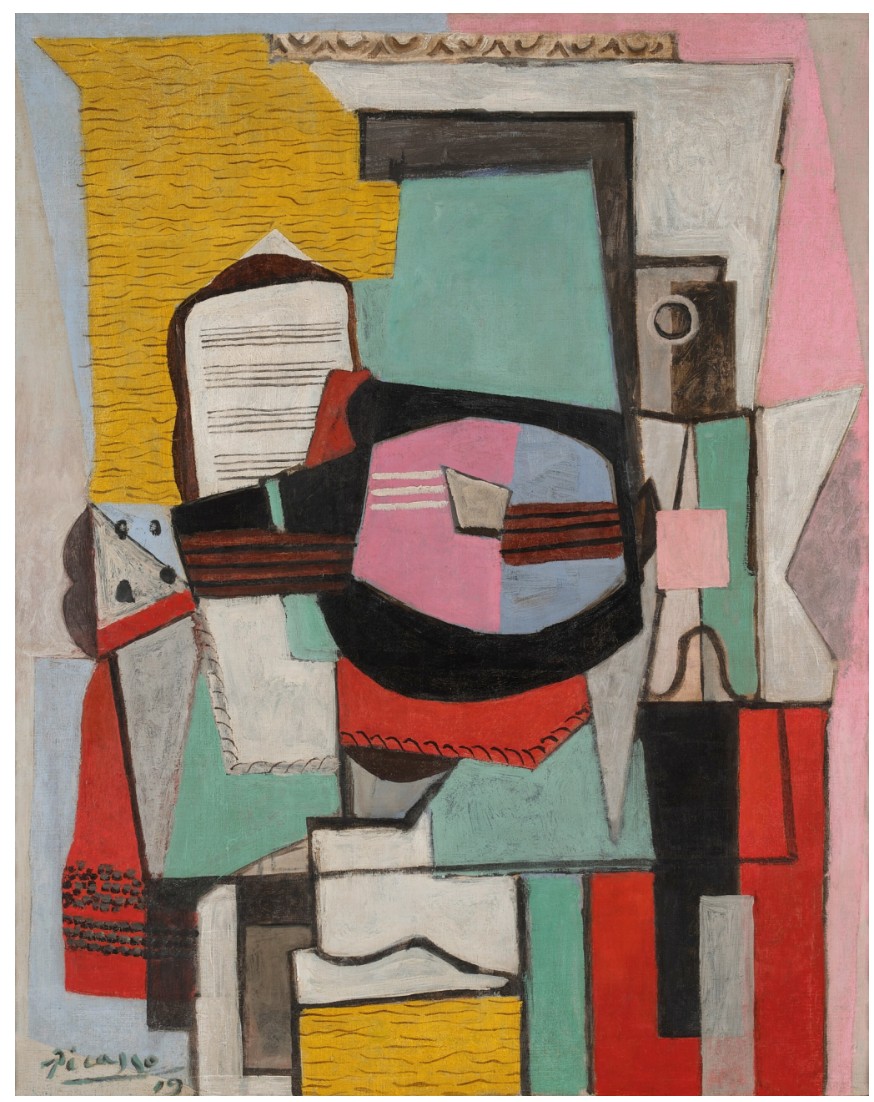
PABLO PICASSO (1881 – 1973)
Guitare sur une table, 1919
Oil on canvas
100 x 80.7 cm (39 3/8 x 31 3/4 inches)
Signed Picasso and dated 19 (lower left)
#4. Buste d’homme dans un cadre, 1969
Christie’s Hong-Kong: 26 May 2022
Estimates on Request
HKD 174,950,000 / USD 22,287,335
PABLO PICASSO (1881-1973), Buste d’homme dans un cadre | Christie’s
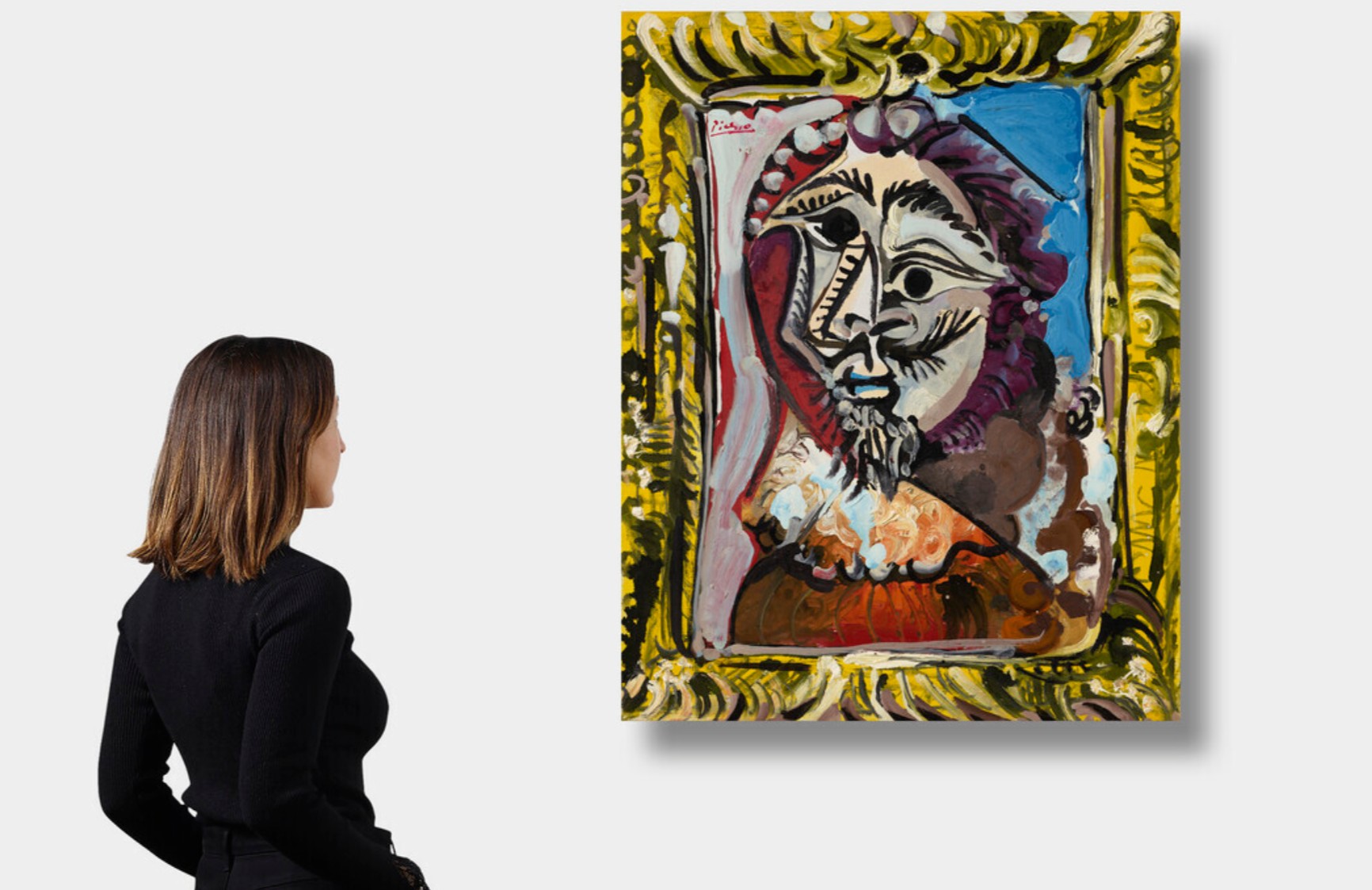
PABLO PICASSO (1881-1973)
Buste d’homme dans un cadre, 1969
Oil on canvas
92×73 cm (36 1/4 x 28 3/4 inches)
Signed ‘Picasso’ (upper left)
Dated ‘29.3.69.’ (on the reverse)
#5. La fenêtre ouverte, 1929
Christie’s London: 1 March 2022
Estimated: GBP 14,000,000 – 24,000,000
GBP 16,319,500 / USD 21,870,375
PABLO PICASSO (1881-1973), La fenêtre ouverte | Christie’s
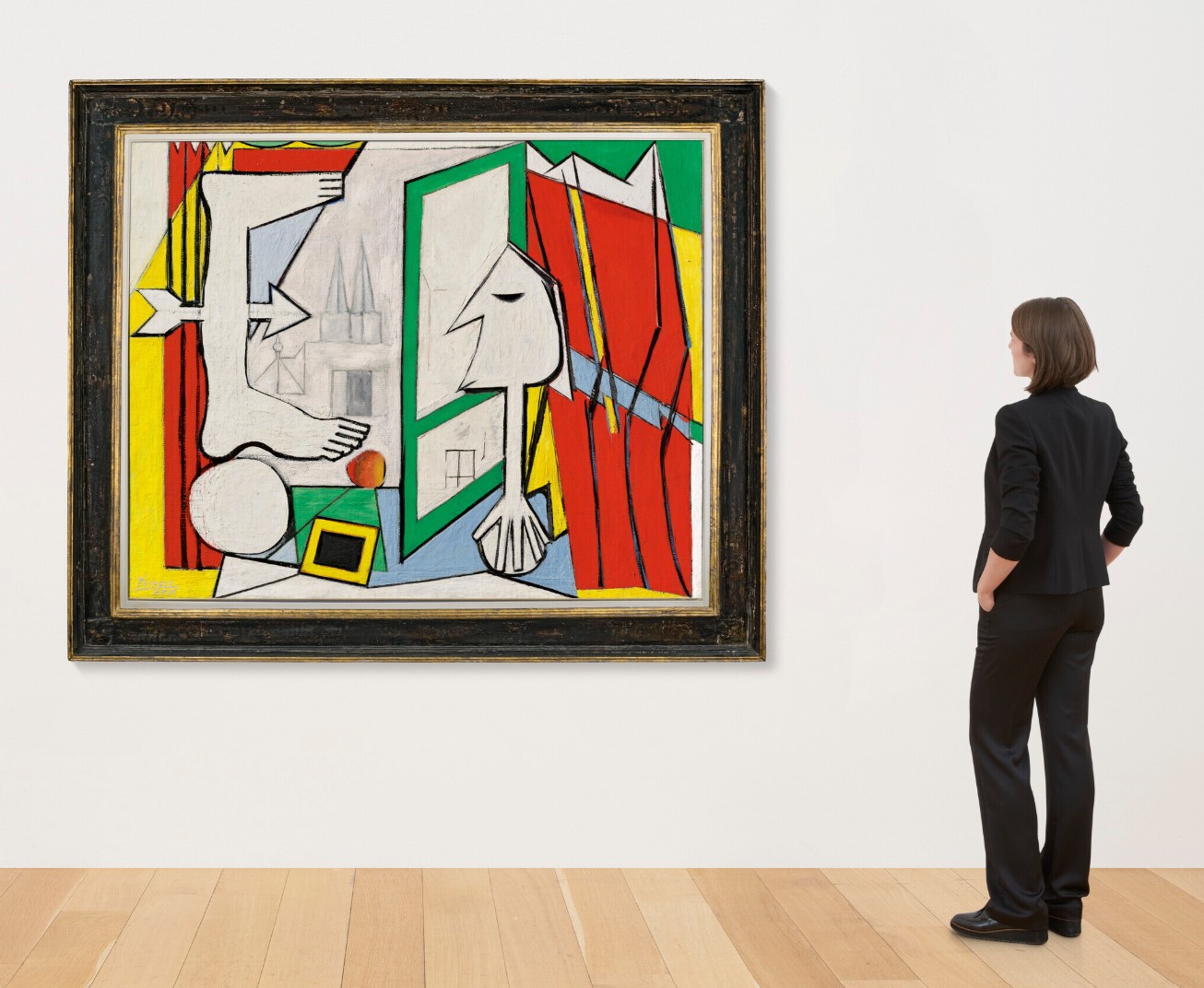
PABLO PICASSO (1881-1973)
La fenêtre ouverte, 1929
Oil on canvas
130.5 x 163.4 cm (51 3/8 x 63 3/8 inches)
Signed and dated ‘Picasso XXIX’ (lower left)
#6. Dora Maar, 1939
Sotheby’s Hong-Kong: 27 April 2022
Estimates on Request
HKD 169,420,000 / USD 21,594,395
Pablo Picasso 巴布羅・畢加索 | Dora Maar 多拉・瑪爾 | Modern Evening Auction | 2022 | Sotheby’s
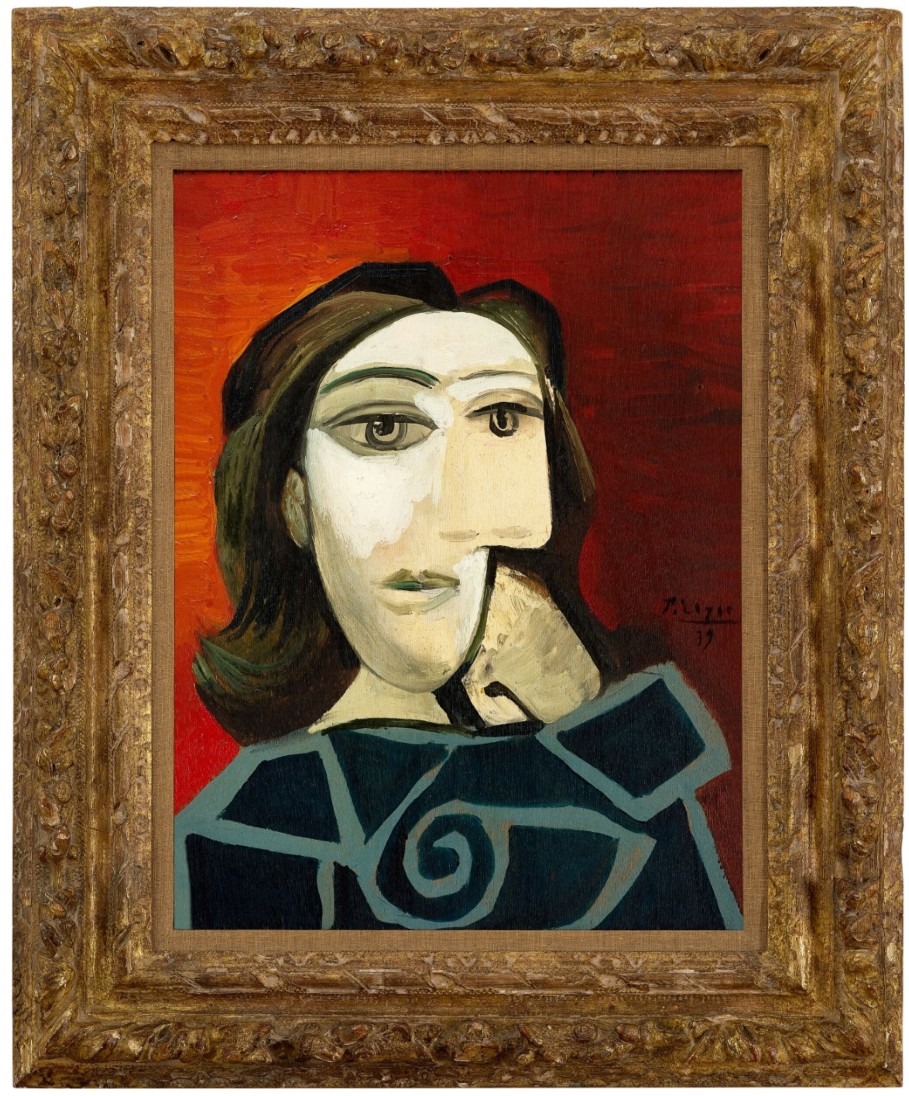
PABLO PICASSO (1881 – 1973)
Dora Maar, 1939
Oil on panel
60 x 45.5 cm (23 5/8 x 17 7/8 inches)
Signed Picasso and dated 39 (center right)
Dated 27.3.39. on the reverse
#7. Buste de femme accoudée, gris et blanc, 1938
Sotheby’s London: 2 March 2022
Estimated: GBP 10,000,000 – 15,000,000
GBP 11,968,300 / USD 21,870,375
Buste de femme accoudée, gris et blanc | Modern & Contemporary Evening Auction | 2022 | Sotheby’s
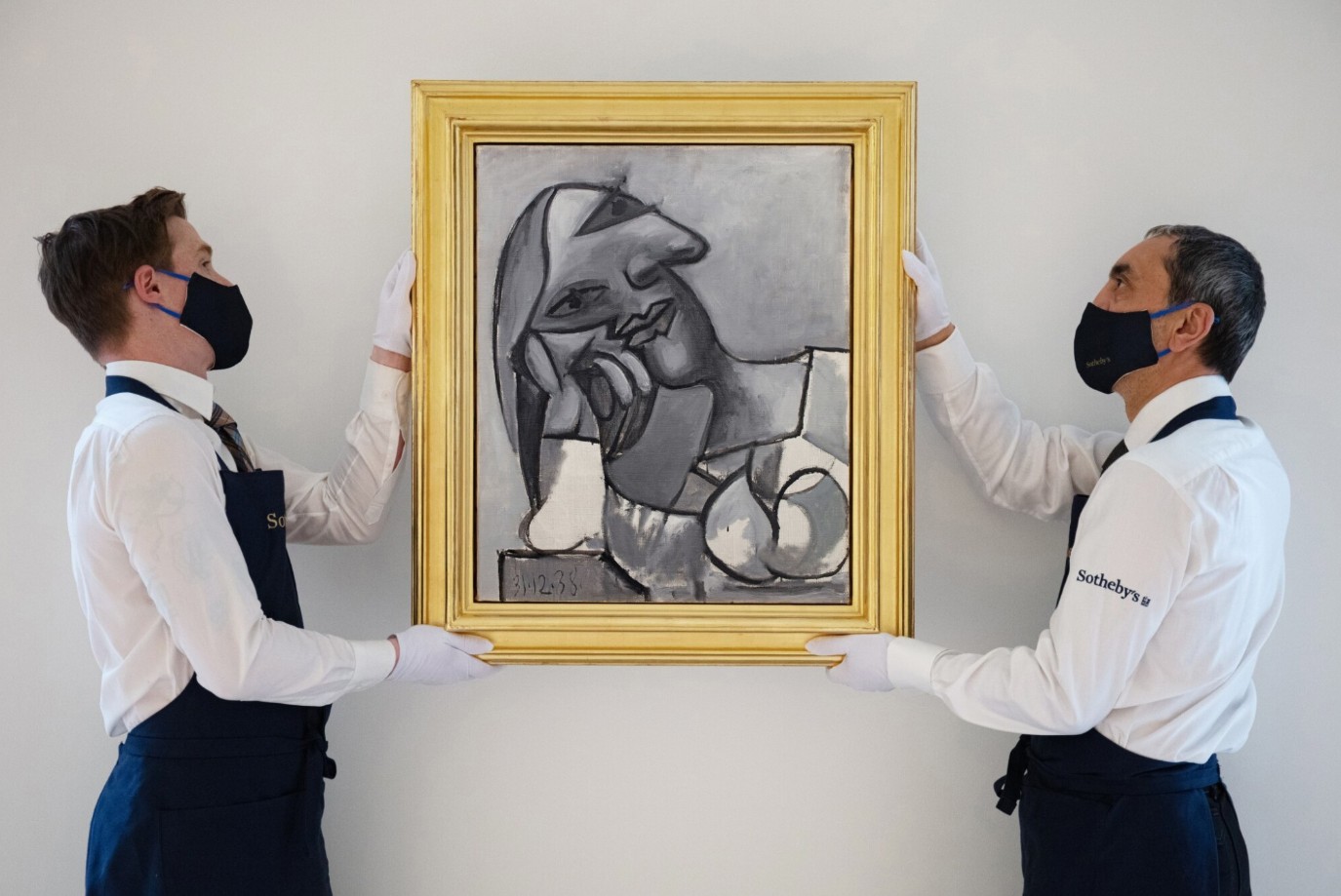
PABLO PICASSO (1881 – 1973)
Buste de femme accoudée, gris et blanc, 1938
Oil on canvas
61×50 cm (24 x 19 3/4 inches)
Dated 31.12.38. (lower left)
Dated 31.12.38. on the stretcher
#8. L’Étreinte, 1969
Sotheby’s New-York: 17 May 2022
Estimated: USD 12,000,000 – 18,000,000
USD 14,112,500
L’Étreinte | Modern Evening Auction | 2022 | Sotheby’s
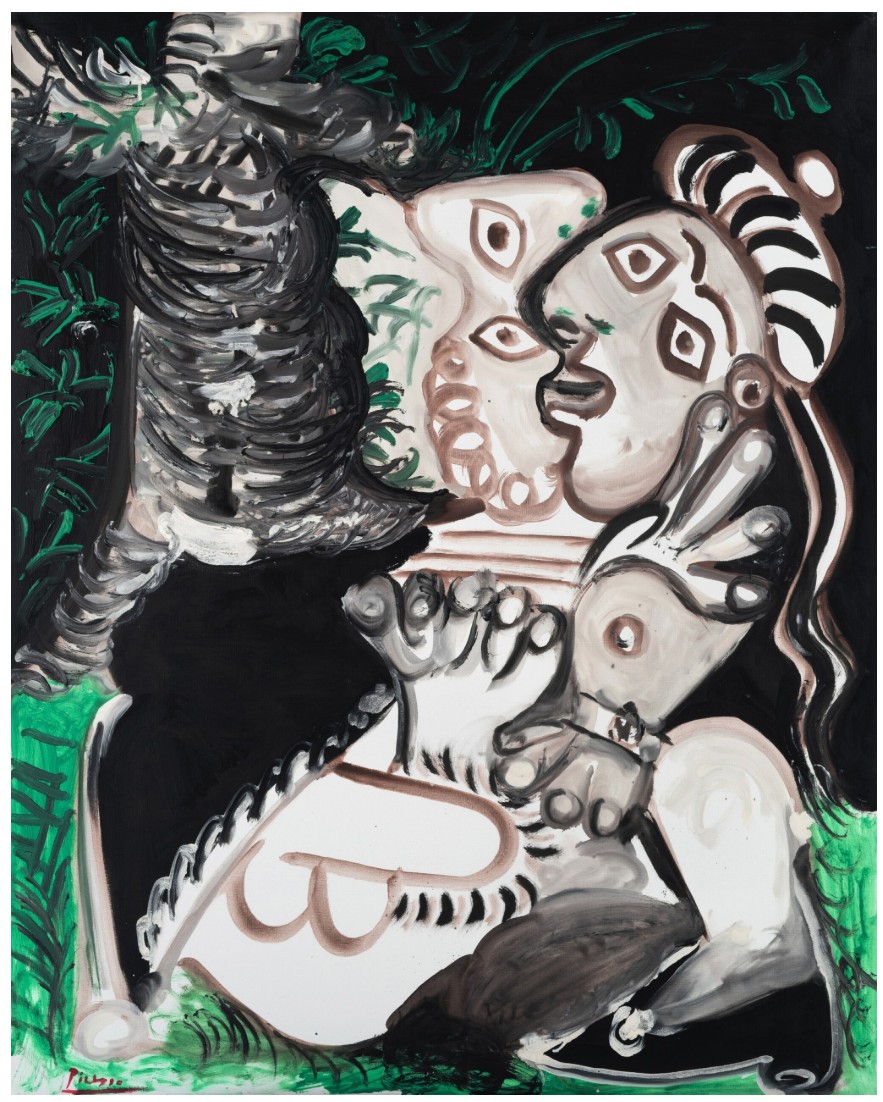
PABLO PICASSO (1881 – 1973)
L’Étreinte, 1969
Oil on canvas
162×130 cm (63 3/4 x 51 1/8 inches)
Signed Picasso (lower left)
Dated 19.11.69 (on the reverse)
#9. L’Arlésienne (Lee Miller), 1937
Christie’s New-York: 12 May 2022
Estimated: USD 10,000,000 – 15,000,000
USD 13,672,000
PABLO PICASSO (1881-1973), L’Arlésienne (Lee Miller) | Christie’s
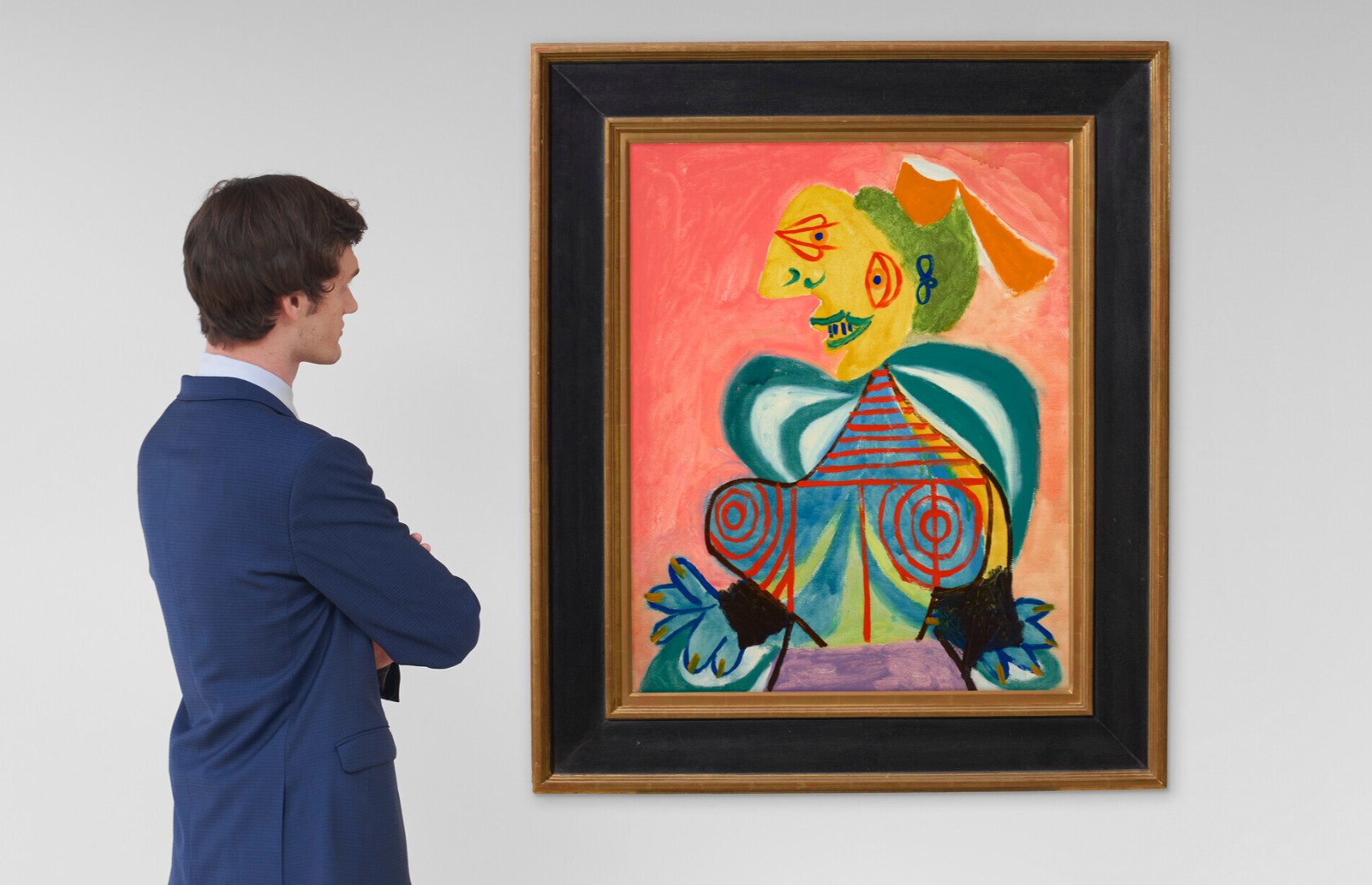
PABLO PICASSO (1881-1973)
L’Arlésienne (Lee Miller), 1937
Oil on canvas
81×65 cm (31 7/8 x 25 5/8 inches)
Dated and numbered ‘1er Septembre 37 (I)’ (on the stretcher)
#10. Buffalo Bill, 1911
Christie’s New-York: 12 May 2022
Estimated: USD 10,000,000 – 15,000,000
USD 13,672,000
PABLO PICASSO (1881-1973), Buffalo Bill | Christie’s
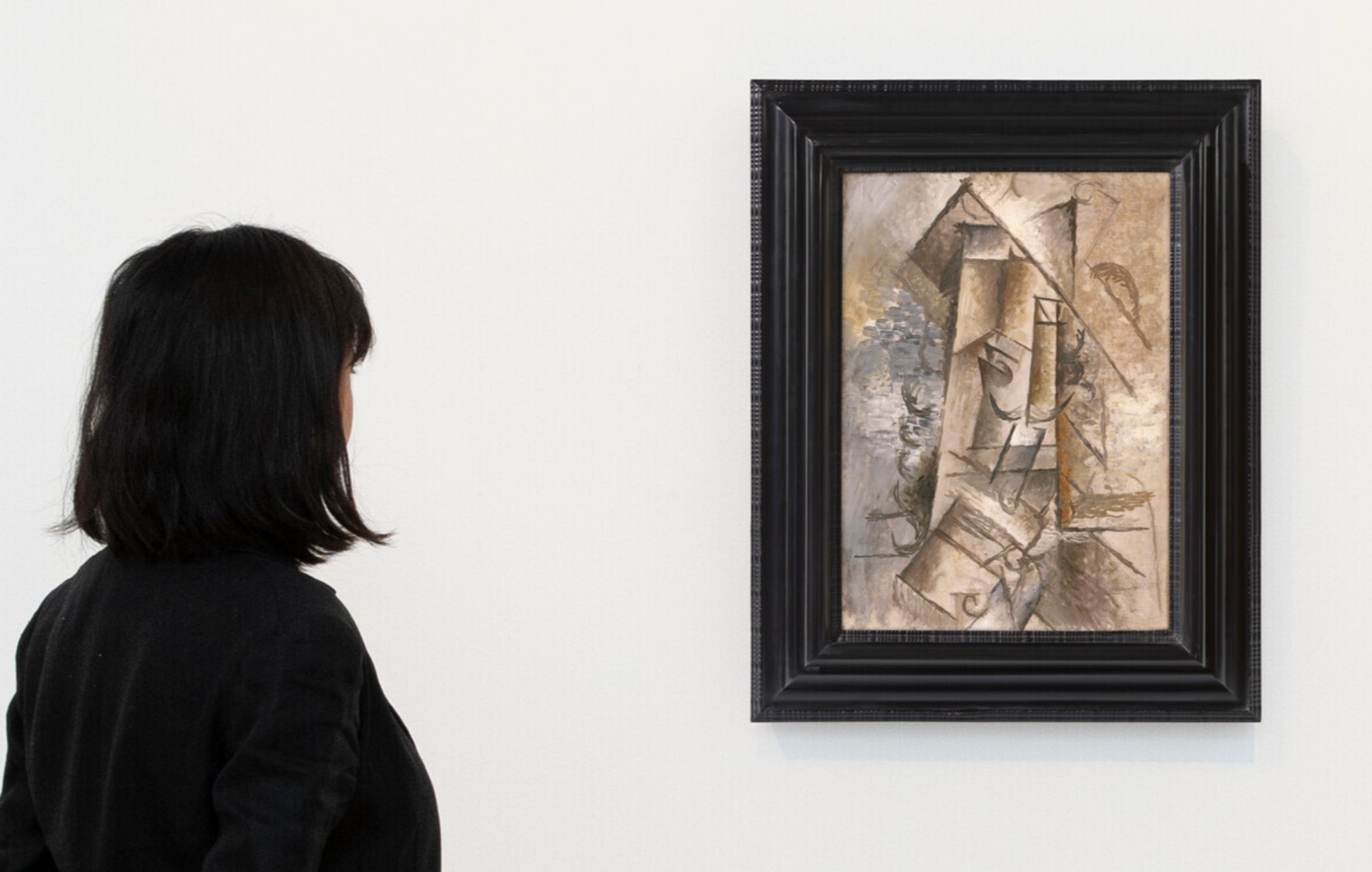
PABLO PICASSO (1881-1973)
Buffalo Bill, 1911
Oil and sand on canvas
46.3 x 33.3 cm (18 1/4 x 13 1/8 inches)
Signed ‘Picasso’ (on the reverse)
#11. Le peintre et son modèle, 1964
Christie’s New-York: 17 November 2022
Estimated: USD 8,000,000 – 12,000,000
USD 10,351,500
PABLO PICASSO (1881-1973), Le peintre et son modèle | Christie’s
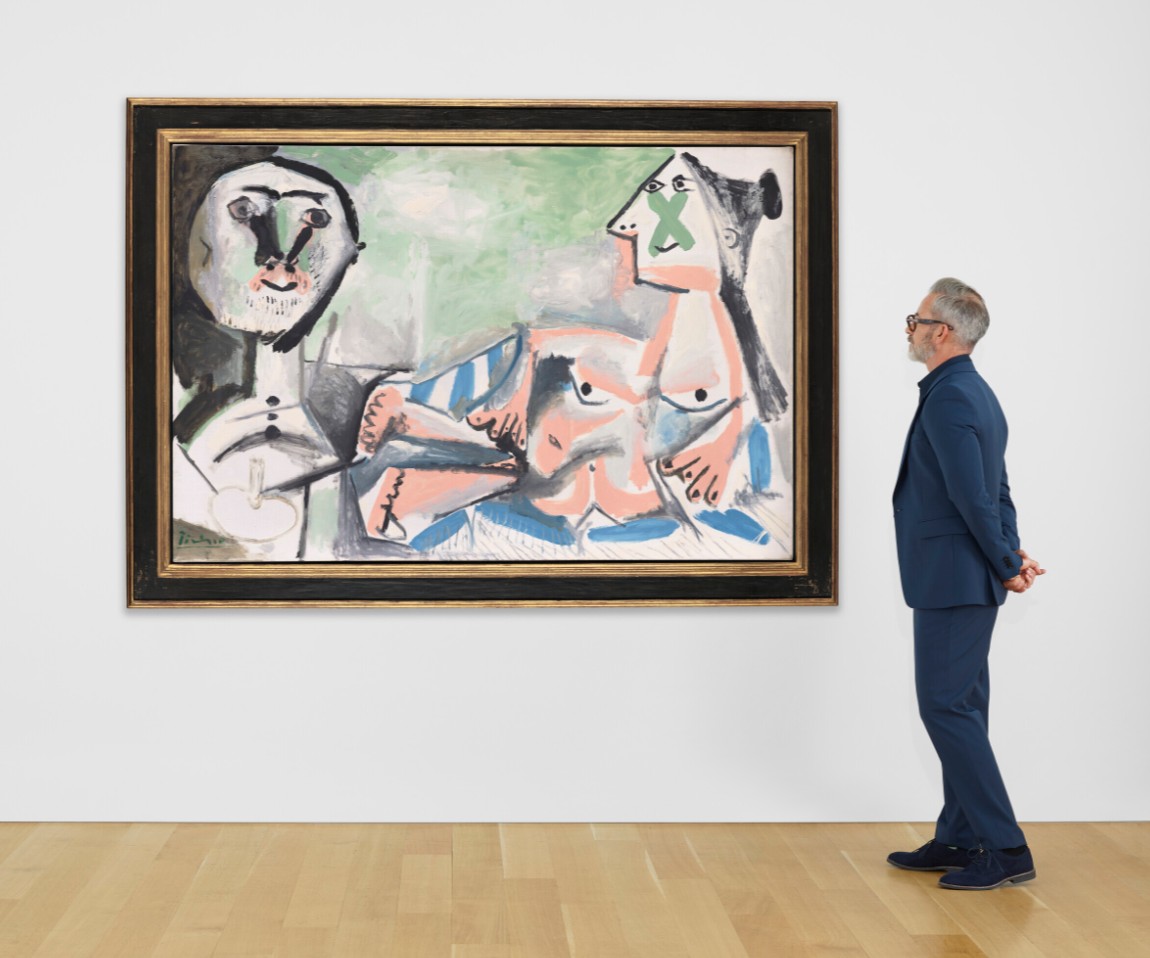
PABLO PICASSO (1881-1973)
Le peintre et son modèle, 1964
Oil and Ripolin on canvas
130×195 cm (51 1/8 x 76 3/4 inches)
Signed ‘Picasso’ (lower left)
Dated ‘8.9.11.64.’ (on the reverse)
#12. Figures et plante, 1932
Phillips New-York: 18 May 2022
Estimated: USD 4,000,000 – 6,000,000
USD 10,267,000
Pablo Picasso – 20th Century & Contempor… Lot 14 May 2022 | Phillips
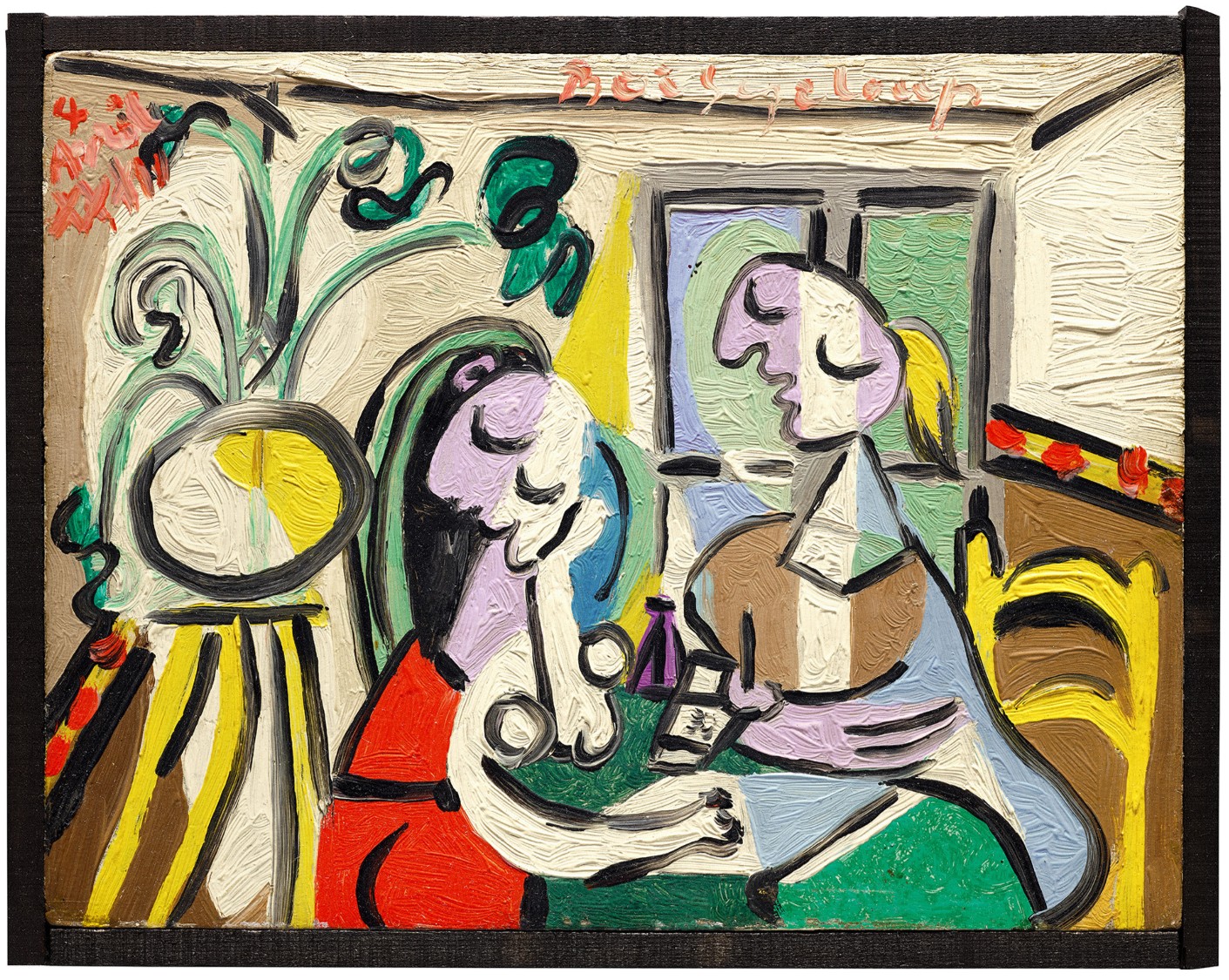
PABLO PICASSO
Figures et plante, 1932
Oil on panel
18.4 x 23.8 cm (7 1/4 x 9 3/8 inches)
Dated “4 Avril XXXII” upper left
Inscribed “Boisgeloup” upper right
PART III: FOCUS
The Blue Period (1901-1904)
Picasso’s Blue Period began in the aftermath of a personal tragedy: the suicide of his dear friend Carlos Casagemas in early 1901. Overwhelmed by grief and disillusioned with the world, the young Picasso—just 19 at the time—plunged into a melancholic artistic journey that would last until 1904. Executed primarily in shades of blue and blue-green, his canvases became meditations on sorrow, alienation, and the fragility of the human condition.
The emotional intensity of this period is reflected in the people he chose to depict—beggars, blind men, mothers and children, the elderly, prostitutes, and the poor. These subjects, rendered with elongated forms and somber expressions, seem to dissolve into the very atmosphere of the paintings, their souls submerged in the same cool, flat tones that dominate the background. Inspired in part by Spanish masters like El Greco and by Symbolist poetry, Picasso used the color blue not only symbolically but almost spiritually—to convey the emotional coldness and loneliness that haunted him.
This period, though deeply personal, marked the beginning of Picasso’s universal appeal: his sorrow became ours. The Blue Period not only reveals his emotional and psychological depth but also his early steps toward breaking from conventional academic painting and developing his voice as a modern master.
#1. La Gommeuse, 1901
Sotheby’s New-York: 5 November 2015
Estimated: USD 60,000,000
USD 67,450,000
(#26) Pablo Picasso (sothebys.com)
PABLO PICASSO
La Gommeuse, 1901
Oil on canvas
81.3 x 54 cm (31 7/8 x 21 1/4 inches)
Signed Picasso (upper left); inscribed Recuerdo a Mañach en el día de su santo and fully painted on the reverse
Picasso’s extraordinary La Gommeuse is among the rare and coveted pictures created during the artist’s Blue Period (1901-1904). The painting dates from the second half of 1901, following Picasso’s widely-praised exhibition at Vollard’s gallery that June and amidst the sobering aftermath of his friend Casagemas’ suicide earlier in the year. Just shy of 20, the artist was sharing an apartment in Paris with his Catalan anarchist friend Pere Mañach, and the two young men immersed themselves in the debauchery of the Parisian demi-monde. This dizzying mixture of professional success and personal tragedy, along with the carnal pleasures of youth and the inexorable sadness of mortality, brought Picasso’s creative genius to a climax. Central to this artistic narrative is La Gommeuse, a gorgeous cabaret performer whose very body defines the perverse beauty of the age. Portrayed in an absynthian haze of sexual ennui, she is both temptation and downfall incarnate, a high priestess of melancholy and a siren of joie de vivre. The depictions of syphilitic prostitutes and poverty-stricken mothers in his Blue Period of late 1901-1902 was in many ways anticipated in La Gommeuse and works related to it. Here the nude, who is placed at the left in the foreground, is enclosed with a strong defining outline to emphasize her self-containment within the composition. Her body, with its ochre and greenish hues, is set against a flat background divided between light and dark, in a way that is reminiscent of a similar formal device used by Gauguin to give emphasis to frontal figures. The slumped position of La Gommeuse, where her head obscures her neck and joins her rounded shoulders, is characteristic of a group of compositions by Picasso in which women, usually seated at café tables, are depicted alone.
The title La Gommeuse was probably given to this composition when it was exhibited, and the woman portrayed was presumably an entertainer. Around 1900 the word ‘gommeuse’ was popularly associated with sexily dressed – or underdressed – café-concert singers and with their songs. We know that in 1901 Picasso drew from life a number of such performers, including the celebrated singer Polaire, for the Paris journal Frou Frou, which published his drawings between February and September 1901. Polaire, who is easily identified by her wavy black hair and diminutive features and often wore plunging necklines and even patterned scarves around her neck, may have been the inspiration if not the real model for this composition. Around the turn of the century, when Polaire was performing in Paris, she was referred to as “la gommeuse épileptique” because of the way her body shook as she shifted her feet from one side to the other during her songs.
#2. Femme aux bras croisés, 1901-1902
Christie’s New-York: 7 November 2000
Estimated: USD 25,000,000 – 35,000,000
USD 55,006,000
Pablo Picasso (1881-1973) , Femme aux bras croisés | Christie’s
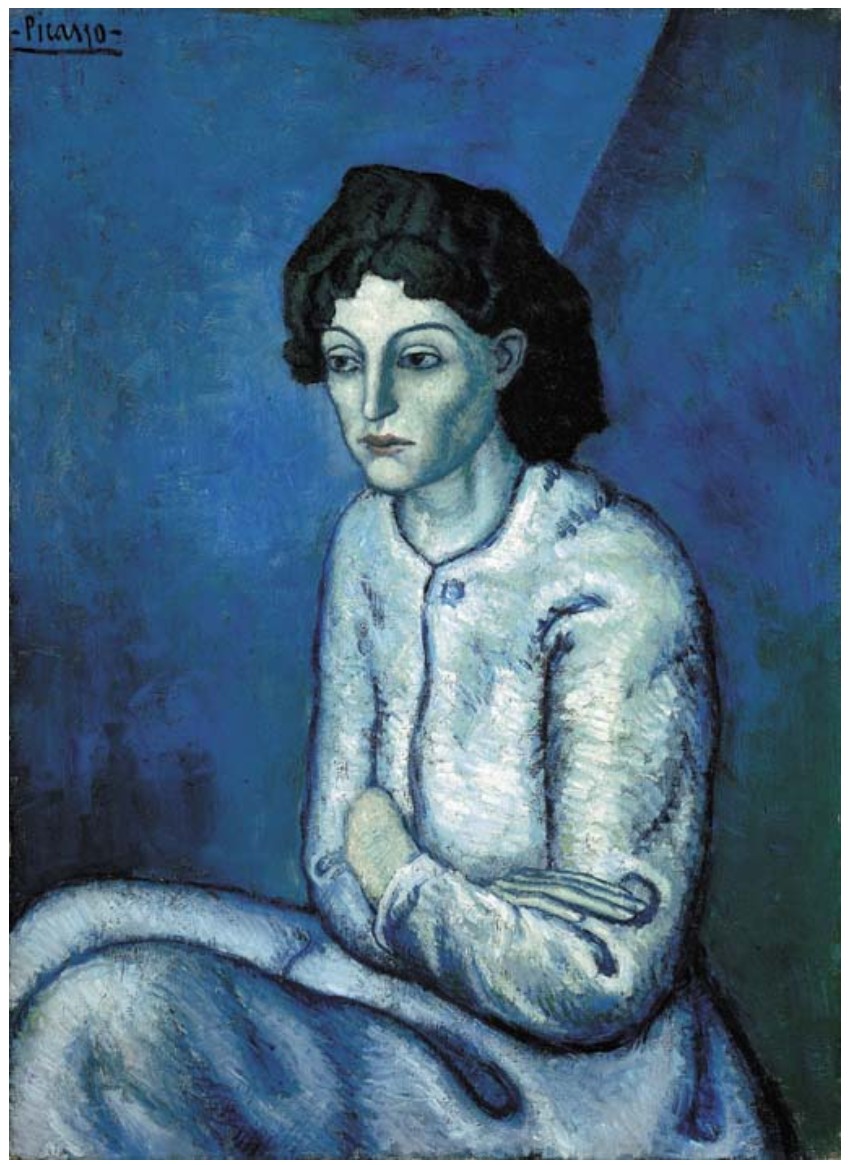
Pablo Picasso (1881-1973)
Femme aux bras croisés, 1901-1902
Oil on canvas
81.3 x 58.4 cm (32×23 inches)
Signed ‘Picasso’ (upper left)
The present painting is an important canvas from Picasso’s Blue period, arguably the artist’s first signature style. While the exact dates of this period have generated much debate–some scholars say that it began in Paris in the second half of 1901, while others claim that it started in Barcelona probably during the month (between May 15 and June 15) that the artist spent in Barcelona–it is generally agreed that the period ended in 1904, when Picasso’s palette changed from blue to rose. With his Blue period paintings, Picasso introduced a corpus of images related to sex and death, intertwined themes that would reappear in later seminal canvases like Les demoiselles d’Avignon (Zervos, I, 18); The Museum of Modern Art, New York) and that would ultimately inform Picasso’s art throughout his career. The Blue period represents Picasso most extensive experimentation with monochromes, and the present painting, one of the most outstanding works in this group, offers an extraordinarily poignant portrayal of soulful introspection.
The present painting is a seminal example of early works from Picasso’s Blue period, likely executed during the months when the artist moved between France and Spain. Its early execution could explain the discrepancies in dates that have been assigned to the picture, which range from 1901 to 1903. It is likely that the canvas was begun in France in the second half of 1901 and transported to Spain, where Picasso made additional changes to the composition. This probability has been confirmed by an x-ray (fig. 2) revealing that Picasso made specific changes to the composition, repainting the hair of this figure to remove her original hood. This reworking exemplifies Picasso’s distinctive method during this period, when he often altered canvases and even concealed entire compositions under later representations. One of his portraits of Sabartés, for instance, was executed over the image of a woman wearing a hood, a figure quite similar to Picasso’s original idea for the present painting.
The discovery of the original hood on this figure established a significant context within Picasso’s works of this period, relating undeniably to the works that Picasso executed after visiting the Saint-Lazare hospital-prison in Paris. In the second half of 1901, Picasso frequented this institution in search of models. The present painting is a paradigmatic expression of misery and torment, evident in the orientation of the woman’s body and in the austerity of the setting. With her arms crossed, she is related to those that Picasso sketched in several drawings from approximately the same period and used in an earlier image of an absinthe drinker, seated in a café. By contrast, her body posture, a clear gesture of self-enclosure, seems to reinforce a sense of isolation already intensified by her elusive gaze. Her solitude is palpable, and her setting is nebulous, conveying a physical and emotional disconnection that reflects her social alienation.
#3. Portrait d’Angel Fernández de Soto, 1903
Christie’s London: 23 June 2010
Estimated: GBP 30,000,000 – 40,000,000
GBP 34,761,250
Pablo Picasso (1881-1973) , Portrait d’Angel Fernández de Soto | Christie’s
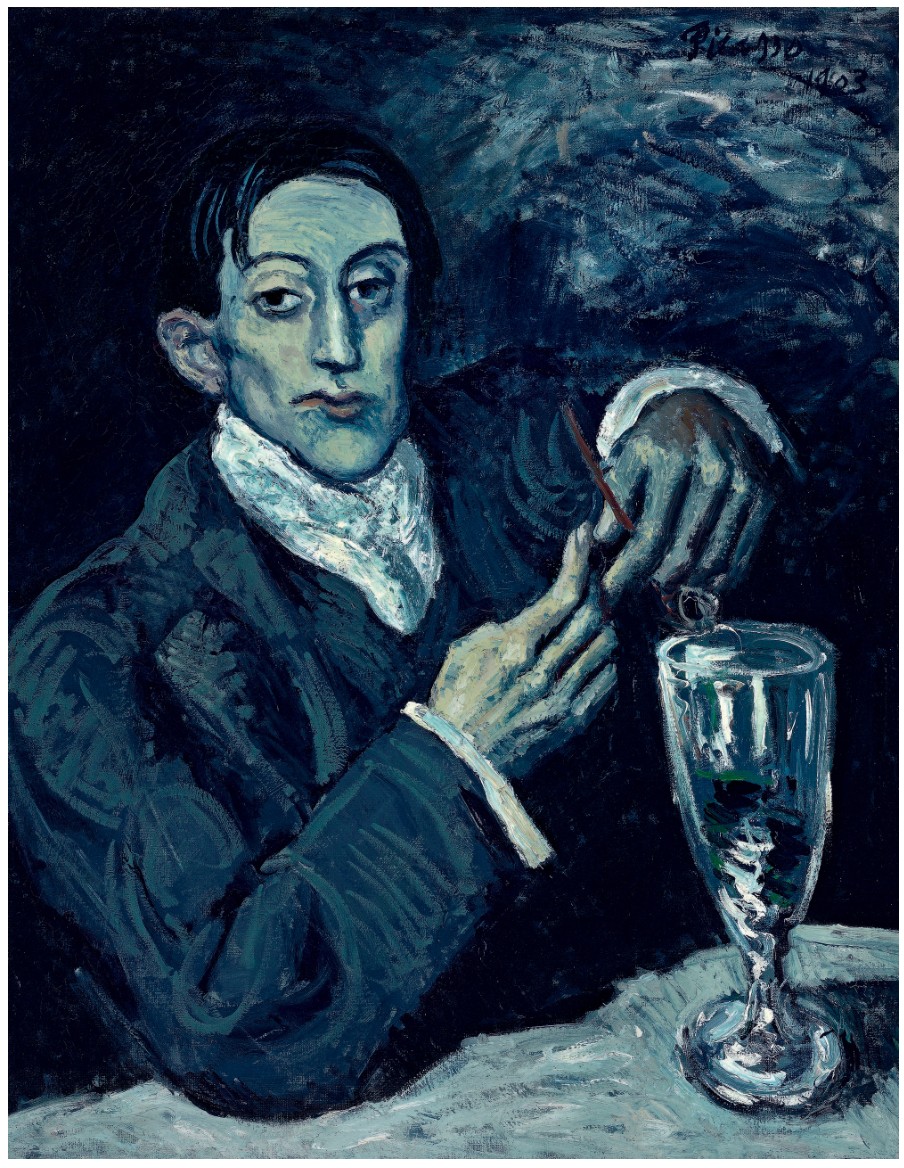
PABLO PICASSO (1881-1973)
Portrait d’Angel Fernández de Soto, 1903
Oil on canvas
70.3 x 55.3 cm (27 5/8 x 21 3/4 inches)
Signed and dated ‘Picasso 1903’ (upper right)
Painted in Barcelona in 1903
Painted in Barcelona in 1903, Portrait d’Angel Fernández de Soto is an historic picture dating from the pinnacle of Pablo Picasso’s celebrated Blue Period. Many of Picasso’s biographers and critics agree that it was during his 1903 stay in Barcelona, his last prolonged visit to Spain before he returned to Paris and essentially made France his home, that the Blue Period reached its peak. This is clear in this portrait of his friend Angel in the dominant colours, the ashen skin, the elongated features and hands and even the theme of absinthe hinted at by the curl of green paint in the glass. Picasso is presenting Angel as a dissipated flâneur, and also as a visionary seeking inspiration through his pipe and glass rather than the more ascetic methods favoured by the Christian saints presented in similar poses by the Old Masters. The importance of this painting is clear from both its extensive exhibition history, which features many instances where it was shown in significant retrospectives during the artist’s own lifetime, and by its distinguished provenance. It was formerly owned by Paul von Mendelssohn-Bartholdy, one of Picasso’s important pre-Second World War collectors, and was later in the collection of Donald and Jean Stralem, which featured a range of works by the artist alongside those of pillars of art such as Paul Cézanne, Alberto Giacometti, Vincent van Gogh, Fernand Léger, Henri Matisse and the Nabis among others. When their collection was offered at auction in 1995, Portrait d’Angel Fernández de Soto was purchased with funds donated by the famous composer Andrew Lloyd-Webber for the charitable foundation that bears his name; it is for the benefit of The Andrew Lloyd-Webber Foundation, which focuses on the promotion of the arts, culture and heritage in Great Britain, that it is now offered for sale. While the momentum of the Blue Period carried through to the early period of his stay in the Bateau Lavoir, the notorious and ramshackle warren of artists’ studios and apartments in Montmartre, it was in Barcelona that Picasso had truly taken the Blue Period to its culmination, be it in his portraits such as those of Sebastíe Junyer Vidal, of the poet Jaime Sabartés and this one of his old friend Angel, or in his more Mannerist images of blind men and beggars. Crucially, while some of those other works are almost idealised visions of human misery, Portrait d’Angel Fernández de Soto provides a personal and indeed searingly psychological insight both into the sitter’s character and into Picasso’s life during this crucial period, when he was still unrecognised by the wider world yet was gaining an increasing following amongst a small circle of friends and supporters. It is a tribute to the quality of the works from this important moment in his career that so many of them grace the walls of museums throughout the world and that as early as 1914, the critic Gustave Cocquiot, who had so favourably reviewed Picasso’s first Paris exhibition over a decade earlier, wrote that collectors sought them out especially; it was in that same text that Cocquiot identified the ‘période bleue’ for the first time in writing (G. Cocquiot, Cubistes, Futuristes, Passéistes: Essai sur la Jeune Peinture et la Jeune Sculpture, Paris, 1914, p. 147).
As well as marking the apogee of the Blue Period, Portrait d’Angel Fernández de Soto started a new chapter in the development of the portrait as a genre and a discipline. By the time he painted this work, Picasso had already been looking at the examples of Edvard Munch, Paul Gauguin and Vincent van Gogh; here, rather than imitating them, he was already bringing something new to portraiture, finding a manner in which he could express the state of both painter and subject alike, a notion perfectly suited to the Blue Period works. Picasso’s stylisation has allowed an expressive, and indeed expressionistic, quality to come to the fore, marking a milestone in his oeuvre. It is for this reason that, comparing this portrait to some of Picasso’s portraits of the Soler family painted only just prior to this, John Richardson has highlighted the leaps and bounds that were clearly evident in this bold and accomplished vision of his friend:
The Rose Period (1904-1906)
Emerging from the darkness of the Blue Period, the Rose Period introduced a palette suffused with warmth—soft pinks, terracottas, oranges, and gentle earth tones. This change was not just aesthetic but biographical. Having settled in Paris, surrounded by a circle of poets and bohemians, and newly in love with Fernande Olivier, Picasso’s outlook—and therefore his art—brightened.
Yet the Rose Period was not a leap into joy, but rather a tender thawing. Though color returns to his canvas, many of the figures he painted—circus performers, harlequins, acrobats—remain tinged with introspection and emotional subtlety. These figures, seen frequently around Montmartre or in the traveling troupes of the time, served as metaphors for the artist himself: outsiders, observers, and beings who perform despite a life of hardship.
Formally, Picasso’s figures became more sculptural and stable, and his treatment of space more refined. This transition laid the groundwork for his later experiments with form that would eventually lead to Cubism. The Rose Period is Picasso’s poetic interlude—a moment of grace between the Blue Period’s spiritual weight and the intellectual radicalism of Cubism. It reveals a painter who was evolving fast, absorbing life around him and translating it into a universal language of emotion, color, and character.
#1. Fillette à la corbeille fleurie, 1905
The Collection of Peggy and David Rockefeller
Christie’s New-York: 8 May 2018
Estimate on Request
USD 115,000,000
https://www.christies.com/en/lot/lot-6134213
Pablo Picasso (1881-1973)
Fillette à la corbeille fleurie, 1905
Oil on canvas
154.8 x 66.1 cm (60 7/8 x 26 inches)
Signed ‘Picasso’ (upper right)
Signed again, dated and inscribed ‘Picasso 1905 13 Rue Ravignan’ (on the reverse)
‘Picasso, the greatest artist of the 20th century, saw our future in 1905 when he painted Fillette à la corbeille fleurie,’ says Marc Porter, Chairman of Christie’s America. ‘She represents the themes that Picasso would wrestle with for his life — love, sex, beauty, tenderness, violence — and all that defines humanity. In this masterpiece, Picasso reveals his singular brilliance in a timeless, mesmerising goddess gazing on the universe.’
In the early months of 1905 the 23-year-old Pablo Picasso was one of many unknown bohemians living and working in Montmartre who could not be sure where their next meal might come from. By the end of the year, however, he had found a new love — Fernande Olivier — and had fallen in with two perceptive and dedicated collectors — Gertrude and Leo Stein — whose acquisition of three ‘Rose’ paintings in late 1905, the second of which was Fillette à la corbeille fleurie, helped to jumpstart his career.
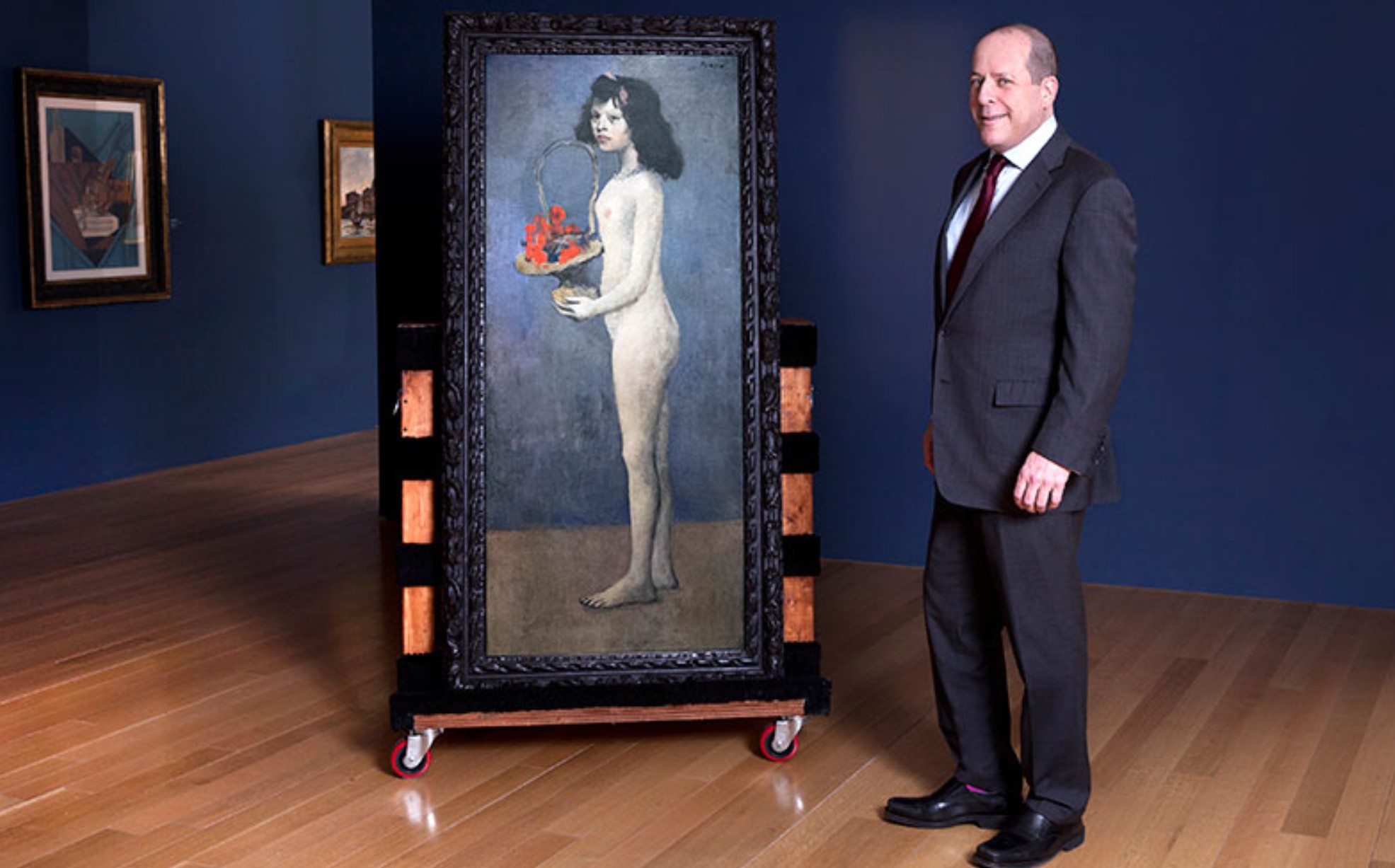
Marc Porter, Chairman of Christie’s America, with Pablo Picasso (1881-1973), Fillette à la corbeille fleurie, 1905. Oil on canvas. 60⅞ x 26 in (154.8 x 66.1 cm).
Picasso had put the hunger, poverty and sense of alienation that informed his ‘Blue’ paintings behind him, and was well into his Rose Period by this time. Among a series of important works he painted in his Rose manner is Fillette à la corbeille fleurie, which Gertrude Stein later described as ‘a charming thing, a lovely thing, a perplexing thing, a disconcerting thing, a simple thing, a clear thing, a complicated thing, an interesting thing’.
‘After a year of careful looking, I return again and again to her extraordinary face,’ agrees Marc Porter, who has led Christie’s global promotion of The Collection of Peggy and David Rockefeller, to which the painting was added in 1968. ‘She is beautiful and adorned only with a pink ribbon and a lustrous string of pearls. It is her knowing eye — at the very centre of the canvas — that captures me.’
When he painted this picture of ‘Linda la Bouquetière’, a teenage flower seller who also posed for Modigliani and Van Dongen, Picasso was working from a studio on the top floor of a dilapidated artist’s building known as the ‘Bateau Lavoir’. He had already tasted success in his debut exhibition in Paris in the summer of 1901, and was now making new friends — the poets Max Jacob, Guillaume Apollinaire and André Salmon, the Symbolist Jean Moréas, as well as the precocious playwright Alfred Jarry. These were relationships that broadened his intellectual interests and deepened his engagement with the cosmopolitan culture of the French capital.
In early summer of 1905 Picasso spent six weeks in northern Holland drawing and painting the countryside and its inhabitants, and rediscovering his enjoyment of looking at and painting female bodies. Picasso painted Fillette à la corbeille fleurie following his return to Paris from Holland, probably during the early autumn of 1905. The painting was acquired by the dealer Clovis Sagot, a former baker and circus clown, who took advantage of the fact that Picasso was more broke than usual to knock him down from 500 francs to 75.
The dealer initially advertised Picasso’s flower seller in a newspaper as La fleur de pavé (‘The Flower of the Cobblestones’ or ‘The Street’), a reference to the harsh reality of Linda’s life on the mean streets of Montmartre.
In a sketchbook Picasso used during 1905-06, there is a pen and black ink study of a young girl wearing a long white dress and holding a bouquet of flowers for her First Communion. This drawing probably represents the artist’s initial idea for the painting of Linda la Bouquetière. In the completed picture, her basket holds red poppies, a symbol of bread and wine as the body and blood of Christ in the Sacrament of the Holy Eucharist.
Such adolescent rites of passage, as a transition from innocence to experience, constitute an important theme in Picasso’s Rose Period. The classical treatment of Linda — manifested in the plain, simplified curves by which he drew the girl’s figure — is a veneer that he applied to provide an aura of innocence and purity, outwardly masking but nonetheless inferring the harsh reality of her life.
Gertrude and Leo Stein had bought their first important Impressionist and Post-Impressionist paintings in 1904. In October of the following year they acquired their first Matisse at the Salon d’Automne, the well-known Fauve canvas Femme au chapeau, which had been a lightning-rod for the withering criticism directed at the artist and his colleagues.
Not long afterwards, Leo stopped into Sagot’s gallery for the first time, purchasing a watercolour of a café scene by a Spanish painter. He returned a few days later to learn more about Picasso, at which point Sagot pulled out a recent acquisition, Famille d’acrobates avec singe (1905). Leo immediately bought the picture, which became the first Picasso to enter the Steins’ collection.
According to Picasso’s biographer, John Richardson, shortly after his initial purchase of the Famille d’acrobates avec singe, Leo returned to Sagot’s gallery with his sister Gertrude, at which point they were shown the painting just recently advertised in Le Courrier Français. Leo bought the painting for the equivalent of $30.
#2. Garçon à la pipe, 1905
Sotheby’s New-York: 5 May 2004
Estimated: USD 70,000,000
USD 104,168,000
(#7) Pablo Picasso (sothebys.com)
PABLO PICASSO
Garçon à la pipe, 1905
Oil on canvas
99.7 x 81.3 cm (39 1/4 x 32 inches)
Signed Picasso (lower left)
One of the iconic images of the Blue and Rose periods, Garçon à la pipe probably began as a study from life in Picasso’s immediate surroundings but was dramatically transformed in a moment of sudden inspiration. According to André Salmon: “After a delightful series of metaphysical acrobats, dancers like priestesses of Diana, delightful clowns and ‘wistful Harlequins,’ Picasso had painted, without a model, the purest and simplest image of a young Parisian working boy, beardless and in blue overalls: having indeed, more or less the same appearance as the artist himself during working hours. One night, Picasso abandoned the company of his friends and their intellectual chit-chat. He returned to his studio, took the canvas he had abandoned a month before and crowned the figure of the little apprentice lad with roses. He had made this work a masterpiece thanks to a sublime whim” (André Salmon, La jeune peinture française, Paris, 1912, pp. 41-42, quoted in Joseph Palau i Fabre, Picasso: The Early Years 1881-1907, New York, 1981, p. 428).
Picasso’s work of the Rose period has always been admired for its melancholy charm and haunting poetry, contrasting with the deep gloom of the immediately preceding Blue period, yet in both instances the source of inspiration was in his immediate surroundings. Since 1904 he had been living in the Bateau Lavoir in Montmartre, so named because of its resemblance to a Seine washing barge, and when not socializing there he would meet his friends in inexpensive restaurants and cabarets such as Le Zut and Le Lapin Agile. As described by Roland Penrose, Montmartre, “being a village within a city…was almost self-contained. Within a small distance a great variety of amusements and theatres were at hand. For some years the most popular place of entertainment was the Cirque Medrano, which to this day still continues to enchant successive generations of Parisians. Its clowns, acrobats and horses had delighted Degas, Toulouse-Lautrec, Forain, Seurat and many others. There, behind the scenes and outside among the sideshows of the fair that traditionally occupies the whole boulevard during the winter, Picasso made friends with the harlequins, jugglers and strolling players. Without their being conscious of it, they became his models” (Roland Penrose, Picasso: His Life and Work, 1981, p. 110). The entertainment provided by street fairs and the acrobats who performed there provided inspiration for many of the works created in 1905-1906, culminating in the great Saltimbanques in the National Gallery, Washington D.C (see fig. 1) .
Although the model for the present work has sometimes been identified as an actor, it seems likely that he was an adolescent known as “p’tit Louis,” who was frequently to be found at the Bateau Lavoir along with, in Picasso’s own words, other “local types, actors, ladies, gentlemen, delinquents…….He stayed there, sometimes the whole day. He watched me work. He loved that” (Hélène Parmelin, Picasso Says, London, 1969, p. 71, quoted in John Richardson, A Life of Picasso, vol. 1, 1881-1906, New York, 1991, p. 340). A number of preliminary studies for the present painting show Picasso depicting his model in a variety of different positions, standing, sitting, leaning against a wall, lighting a pipe or simply holding it in his hands (see figs. 2,3). The most painstakingly worked study depicts the boy seated in the pose utilized in the final composition, although he clasps his left elbow with his right hand (see fig. 4) instead of letting it hang down in front of him.
The painting differs radically from any of the preliminary studies, transforming the young boy who might light his pipe into a slightly more mature adolescent who gazes absently into space. Even before the addition of the garland of flowers, any trace of the anecdotal had been removed. The pipe is held in the left hand with the stem pointing away from the youthful smoker, as an emblem of maturity, perhaps, rather than a purveyor of tobacco smoke. “P’tit Louis” has become a mysterious presence, crowned with roses and framed with two large bouquets on the wall behind him. The effect is not unlike that of some of the late portraits of Odilon Redon who frequently surrounded his sitters with masses of flowers (see fig. 5). Roseline Bacou has remarked that, “On a few occasions Redon even created flowers for his sitters- not a bouquet in a vase, but a luminous floral mass, suspended in mid-air, such as that which enframes Mme. Arthur Fontaine; while flowers surge before the young Yseult Fayet and Violette Heyman. They appear as though a projection of the sitter’s dreams, or perhaps that of the artist-poet who captured them” (Roseline Bacou, Odilon Redon. Pastels, New York, 1987, p. 16).
John Richardson suggests that the present painting might have been inspired by a poem of Verlaine: “One of the most poetic Rose period images is the Boy with a Pipe. It conjures up Verlaine’s poem ‘Crimen Amoris,’ about a palace in Ecbatana where ‘adolescent satans’ neglect the five senses for the seven deadly sins, except for the most handsome of all these evil angels, who is sixteen years old under his wreath of flowers… and who dreams away, his eyes full of fire and tears” (John Richardson, A Life of Picasso, New York, 1991, p. 340).
The suggestion is plausible although it was precisely at this moment that Picasso began to show signs of dissatisfaction with the literary direction in his work, turning away from the stylization of his emaciated figures of the previous eighteen months in favor of a more harmonious classicism. Painted at the same time as Garçon à la pipe, Femme à l’eventail (see fig. 6) is evidence of a renewed interest in Egyptian bas-reliefs and the expression of volumes on a flat surface. Although not depicted in profile, the present work is related to Femme à l’eventail in its concentration on a single figure, mysterious in gesture and detached from the everyday world. It is this haunting ambiguity that has ensured for Garçon a la pipe its status as one of Picasso’s most celebrated images of adolescent beauty and as a masterpiece of his early years.
Cubist Period
Arlequin (Buste), 1909
A Night in May: The Collection of Adele & Enrico Donati
Sotheby’s New-York: 19 May 2026
Estimate on Request
USD 42,640,000
Pablo Picasso | Arlequin (Buste) | Modern Evening Auction | 2026 |
PABLO PICASSO (1881 – 1973)
Arlequin (Buste), 1909
Oil on canvas
73 x 60.3 cm (28-3/4 x 23-3/4 inches)
Signed Picasso (on the reverse)
Executed in spring 1909
In the summer of 1907, Picasso finalized his greatest breakthrough to date: Les Demoiselles d’Avignon, the triumphant declaration of a modern artistic mode that ranks among the most influential paintings created in the twentieth century. In the ensuing two years, Picasso pursued a radical reinterpretation of pictorial form with an intensity unlike that of any other time in his career. Executed in the spring of 1909, Arlequin (Buste) is among the most important portraits to emerge from this time, marking the threshold of one of the most important breakthroughs of modern art: the emergence of Cubism. Portraying one of the artist’s most storied subjects with both profound sensitivity and audacious formal innovation, the present work is an emblem of the epochal period in which Picasso revolutionized the rules of not just portraiture, but of two-dimensional representation itself.
Between late 1908 and early 1909, portraiture served as the primary genre through which Picasso developed a groundbreaking visual idiom. Portraiture served as the means through which he engaged with myriad influences—from African, Oceanic and Iberian artistic traditions to the work of Cézanne—to lay the revolutionary foundation for Cubism. The artist’s famed Bateau-Lavoir studio in Montmartre served as the nexus for a continuous exchange of ideas with Georges Braque.
“Almost every evening, either I went to Braque’s studio or Braque came to mine. Each of us had to see what the other had done during the day. We criticized each other’s work. A canvas wasn’t finished unless both of us felt it was … At that time our work was a kind of research laboratory from which every pretension or individual vanity was excluded.”
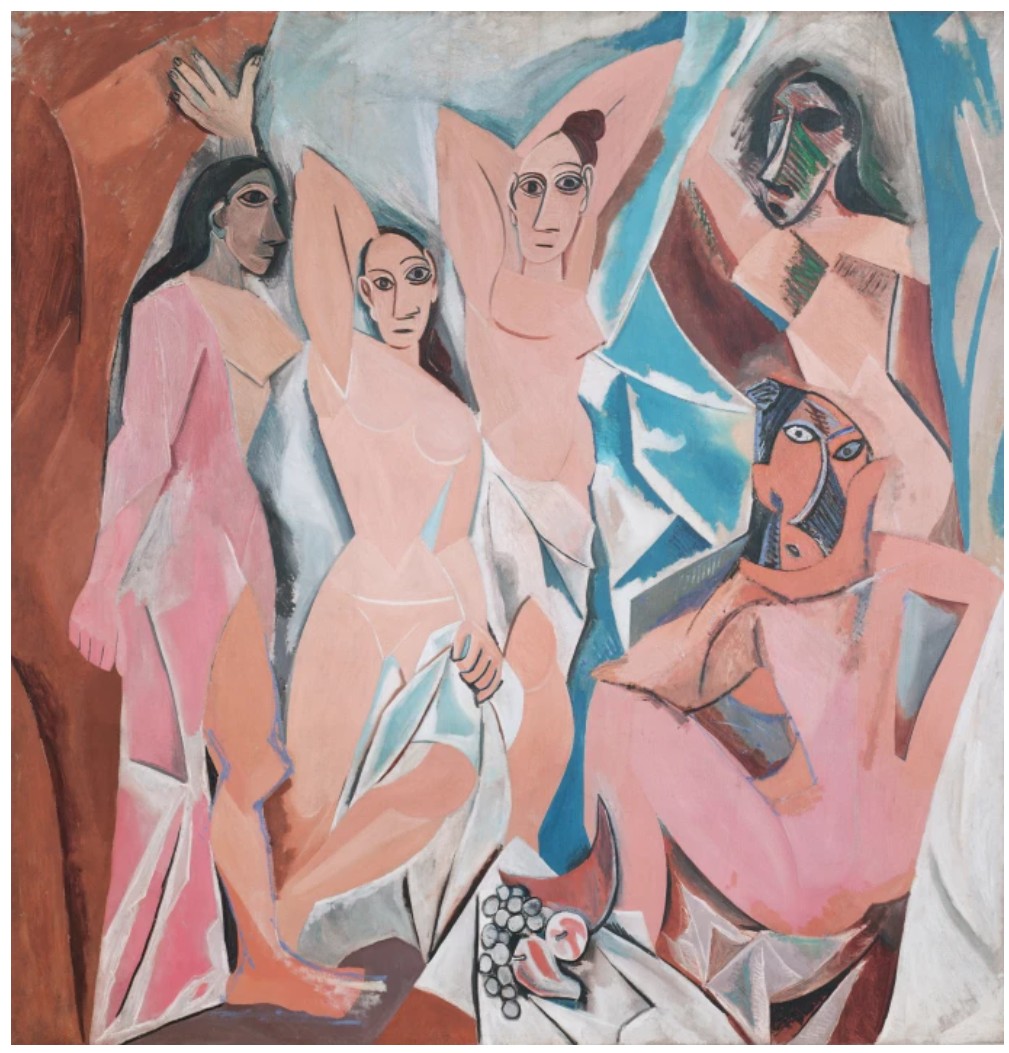
Pablo Picasso, Les Demoiselles d’Avignon, 1907, The Museum of Modern Art, New York.
Art © 2026 Estate of Pablo Picasso / Artists Rights Society (ARS), New York
The character of the harlequin is regarded as one of the most legendary of all personae within Picasso’s oeuvre. These itinerant circus performers, traditionally associated with the seventeenth century Commedia dell’Arte, recurred as central characters throughout the artist’s career. Ceaselessly fascinated with marginal individuals in society, Picasso found resonance with the harlequin’s myriad associations—from theatricality to alienation—and depicted these characters in early masterworks, such as Au Lapin Agile of 1905, as veiled self-portraits. Fernande Olivier wrote of Picasso’s early visits to Montmartre’s Cirque Medrano, “[He] would stay there all evening…talking with the clowns…He admired them and had real sympathy for them” (Fernande Olivier, Picasso and His Friends, London, 1964, p. 127).
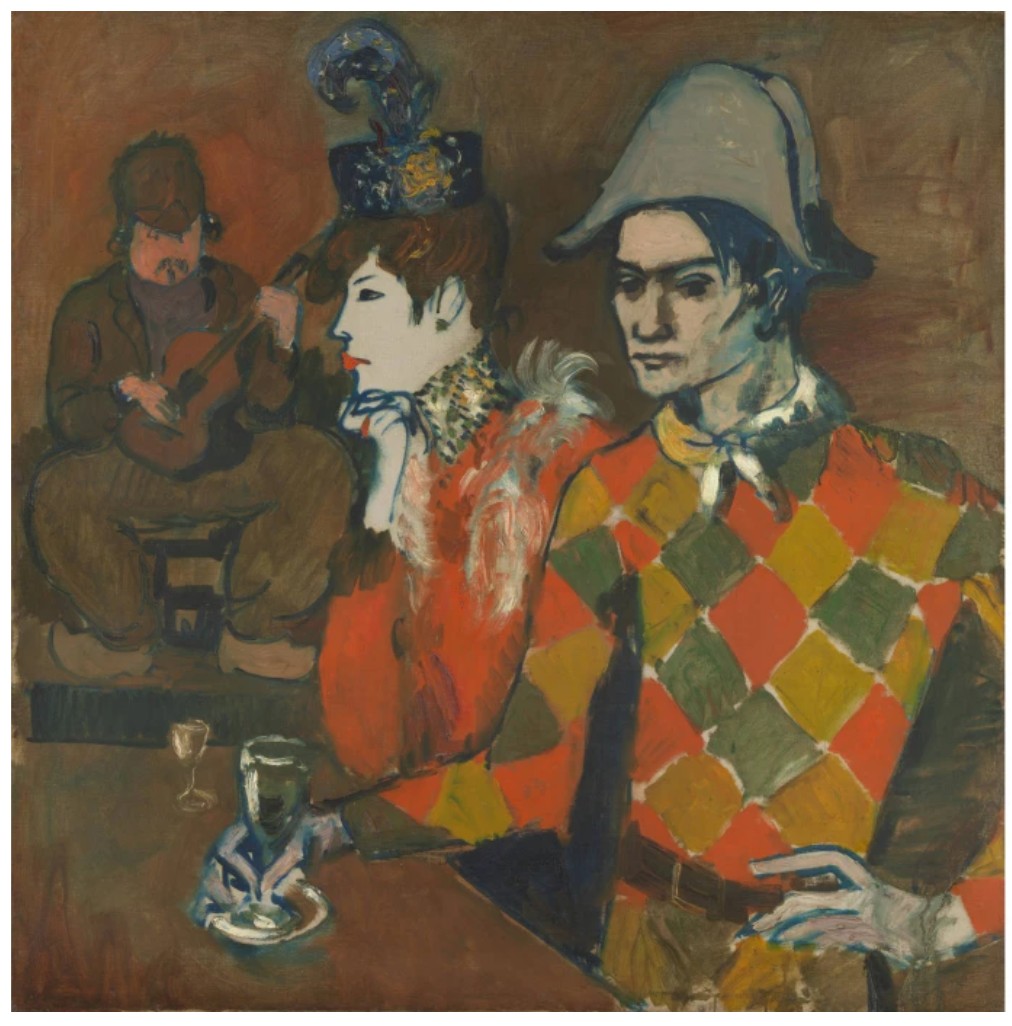
Pablo Picasso, Au Lapin Agile, 1905, The Metropolitan Museum of Art, New York.
Art © 2026 Estate of Pablo Picasso / Artists Rights Society (ARS), New York
Picasso wields the harlequin subject in Arlequin (Buste) as a vessel for his novel pictorial idiom, resulting in not only one of his most sensitive depictions of this legendary persona, but also one of his most revelatory early Cubist portraits. Theodore Reff observes, “More than the other costumed figures in his art, those of the circus and fair, and especially the ubiquitous Harlequins, are intimately related to Picasso’s most important formal invention, Cubism…For like a Cubist composition, the Harlequin’s costume of flat bright colors and strongly marked patterns both fragments and conceals the underlying forms, assimilating them to a surface design of great decorative brilliance. Symbolically, too, this interest in a form of concealment that is also a form of revelation, the familiar aspects of things disappearing while their normally hidden ones emerge, links Harlequin as a type and Cubism as a style.” (Theodore Reff, “Harlequins, Saltimbanques, Clowns, and Fools,” Artforum, October 1971, vol. 10, no. 2, p. 31). The radical modeling and liberties with spatial perspective found in Arlequin (Buste) would engender an entire retinue of groundbreaking harlequin pictures in the years to follow, from Synthetic Cubist compositions to the emphatic portraits of the artist’s final years.
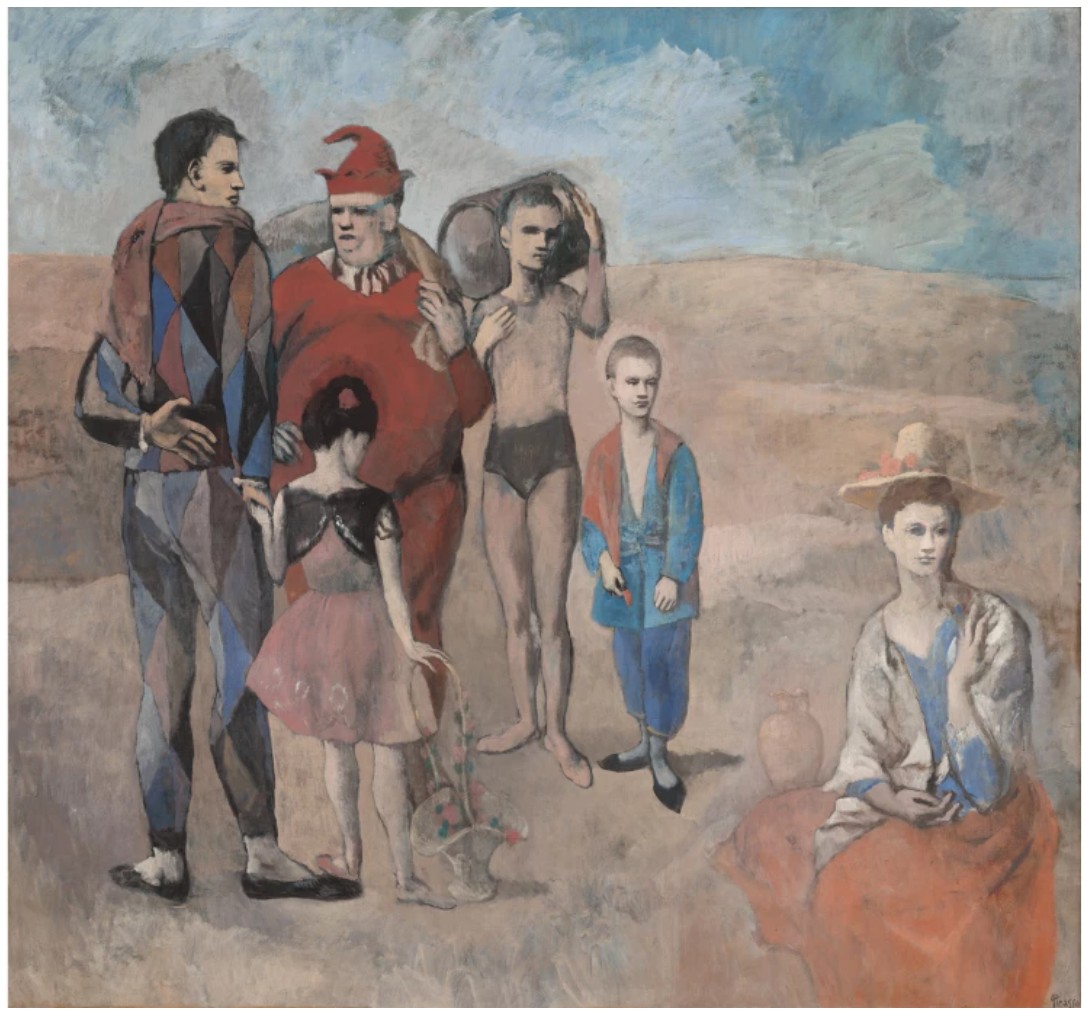
Pablo Picasso, Famille de saltimbanques, 1905, National Gallery of Art, Washington, D.C.
Art © 2026 Estate of Pablo Picasso / Artists Rights Society (ARS), New York
Arlequin (Buste) is among the most powerful testaments to Picasso’s probing dialogue with Paul Cézanne that allowed him to produce art unlike any ever before seen. Although Picasso first encountered the work of Cézanne in 1901, it was not until retrospective exhibitions at Bernheim Jeune and the Salon d’Automne following Cézanne’s death in 1906 that he became fully enthralled with the artist, considering himself heir to his forerunner’s revolutionary defiance of aesthetic mores. John Richardson notes: “Cézanne was the master of palpability… Henceforth, everything had to be tactile and palpable, not least space. Palpability made for reality, and it was the real rather than the realistic that Picasso was out to capture” (John Richardson, A Life of Picasso: The Cubist Rebel: 1907-1916, New York, 1996, pp. 52 and 103).
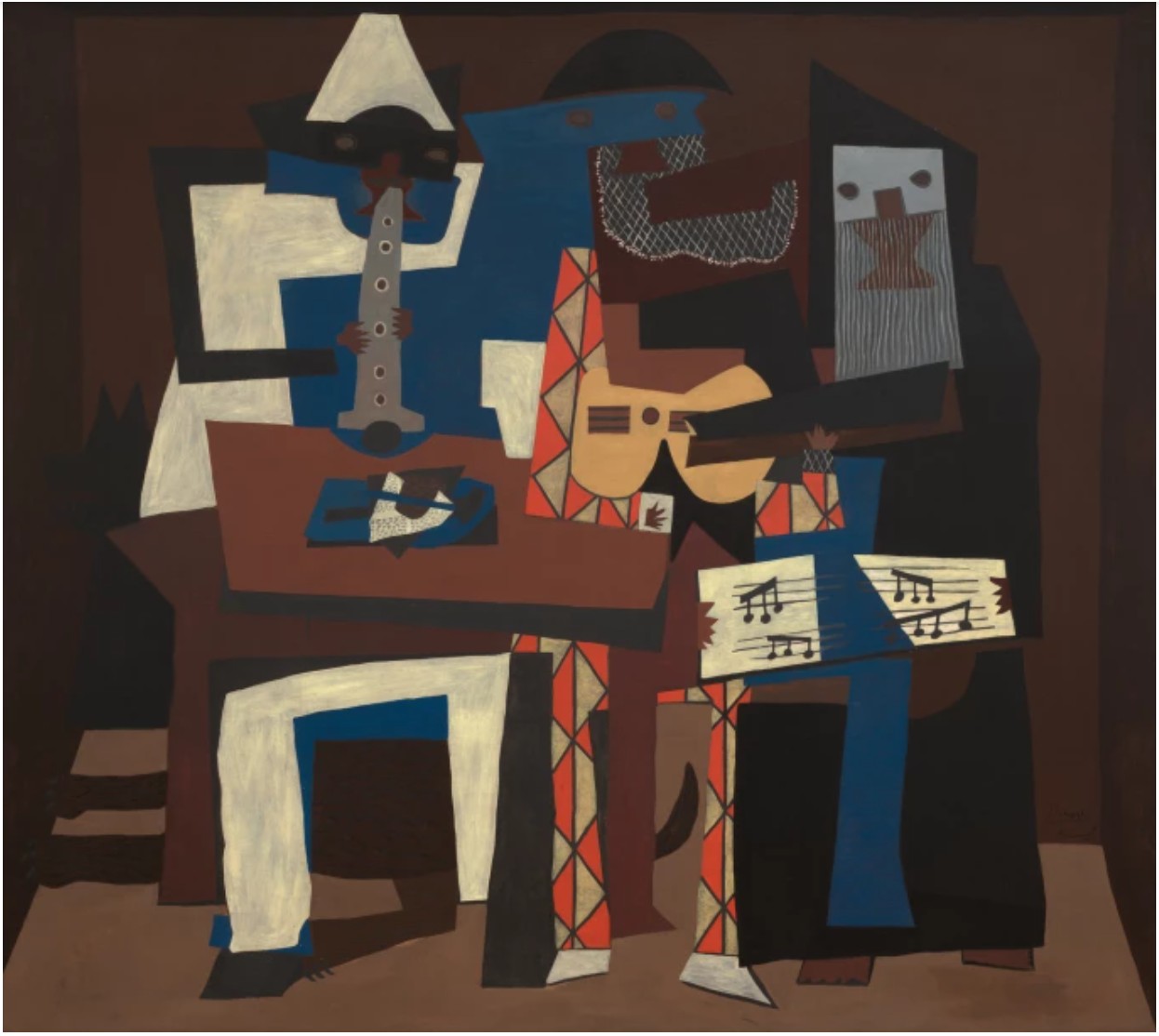
Pablo Picasso, Les Trois musiciens, 1921, The Museum of Modern Art, New York.
© 2026 Estate of Pablo Picasso / Artists Rights Society (ARS), New York
In the present work, Picasso assimilates Cézanne’s formal syntax to completely reinvent portraiture. Each element of the composition is distilled to its essence: the harlequin’s mask-like visage is anonymized as his body and environs are reduced to their most fundamental signifiers. The characteristic diamond-shaped pattern of the harlequin’s costume—rendered in a distinctively Cézannesque palette of grays, ambers and greens—reverberates in the faceted passages of his surroundings, endowing the pictorial surface with remarkable tangibility and sculptural heft. As with his predecessor’s constructive brushstroke, Picasso’s meticulous linear brushwork generates a unified luminosity through delicate interplays of light and shadow, as well as opacity and transparency, anticipating the dematerialized surfaces of his most accomplished Analytic Cubist works.
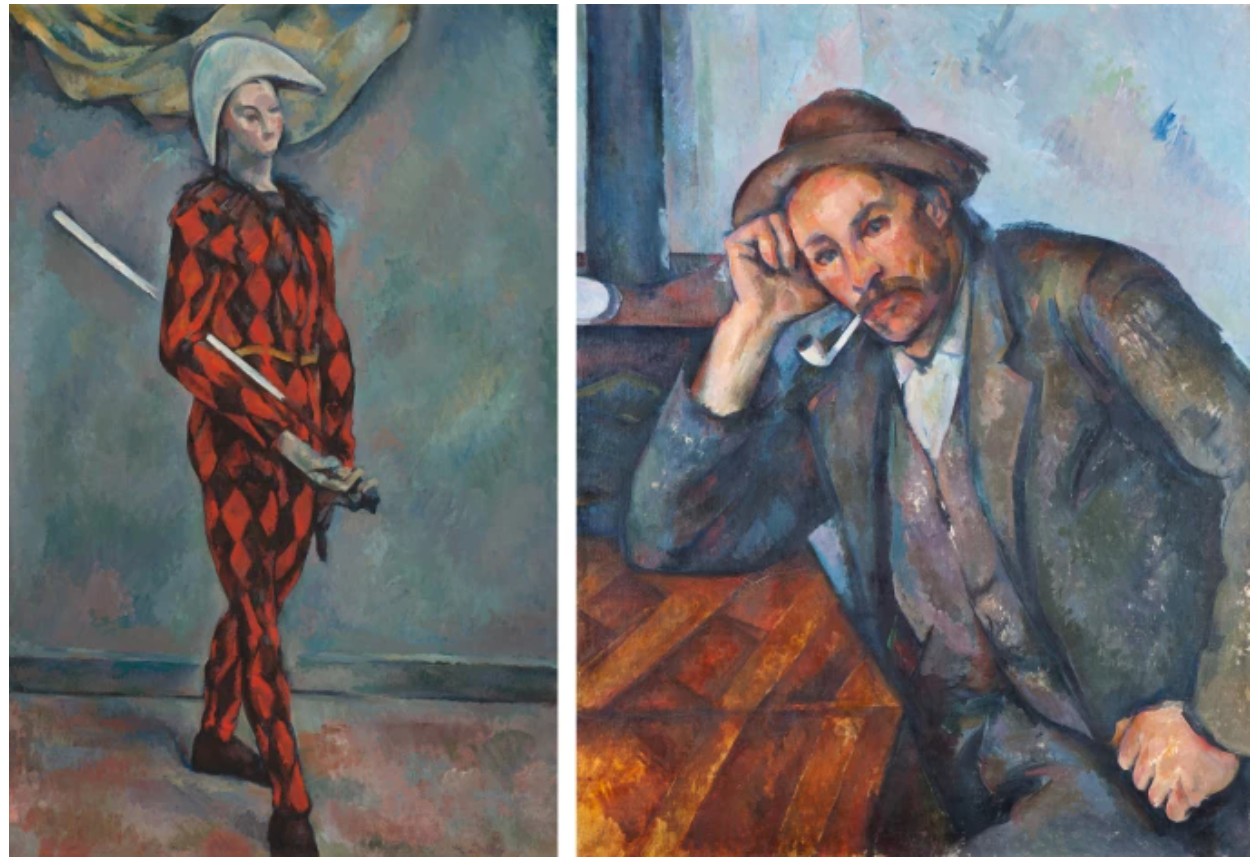
Left: Paul Cézanne, Arlequin, 1888-90, National Gallery of Art, Washington, D.C.
Right: Paul Cézanne, Le fumeur accoudé, 1890, Kunsthalle Mannheim
While evocative of Cézanne’s own engagement with the solitary harlequin character two decades prior, the present work likely derives from Picasso’s early 1909 adaptation in watercolor of Cézanne’s circa 1870 canvas La Tentation de Saint-Antoine, in which the nude figure at right is supplanted by a contemplative harlequin figure. Among Cézanne’s works, however, Arlequin (Buste) bears the closest affinity to his celebrated series of fumeurs, with the frontal pose of the harlequin—his left hand resting upon his chin and right arm leaning on a table—mirroring that of Cézanne’s pensive smokers. Radically rejecting illusionistic perspective, Cézanne tilts, crops and deconstructs the surrounding space, instilling his informal subject with a potent immediacy and presence. Picasso expands upon this defiance of spatial convention in the present work, revealing his early experiments with the multi-viewpoint perspective that would become a pillar of Cubism.
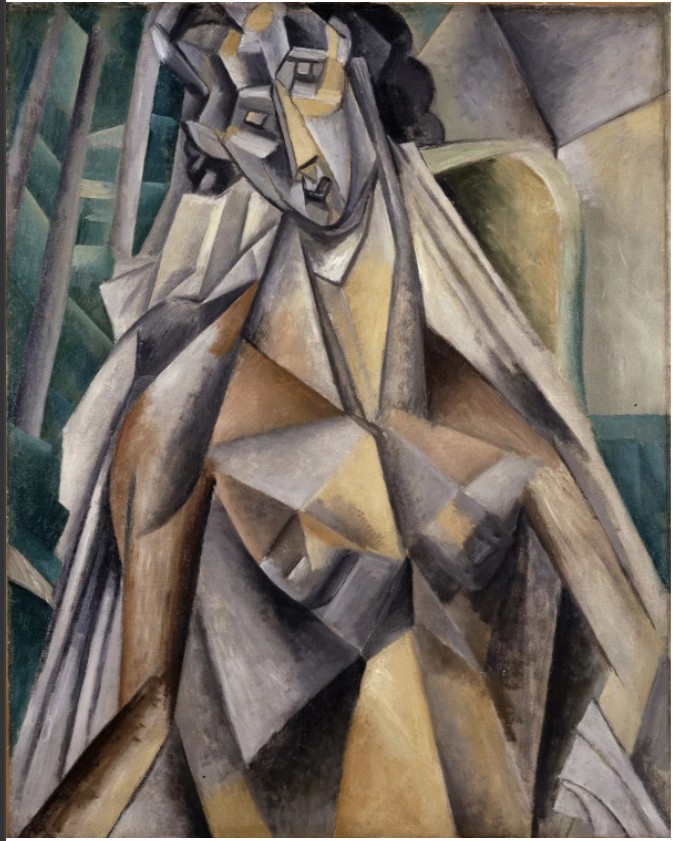
Pablo Picasso, Femme nue dans un fauteuil, 1909, The Metropolitan Museum of Art, New York.
Art © 2026 Estate of Pablo Picasso / Artists Rights Society (ARS), New York
This short yet momentous period of artistic growth in early 1909 propelled Picasso’s work toward its ultimate pre-World War I conclusion: that of an almost complete dissolution of the concrete object–whether in two or three dimensions, or across landscape, still life or body. Josep Palau i Fabre underscores Arlequin (Buste) as a cornerstone in the development of Cubism, declaring, “In all of Picasso’s periods, we find pieces that very smoothly crystallize the latent intentions of the whole. In Cubism, there are already early canvases that are ‘classics’ within the new style, because in this new language Picasso had actually worked unintentionally with one of the concepts found in Classicism: the saturation of intentions…[Arlequin (Buste)] from the spring can [be] placed under this heading” (Joseph Palau i Fabre, Picasso Cubism (1907-1917), New York, 1990, p. 131).
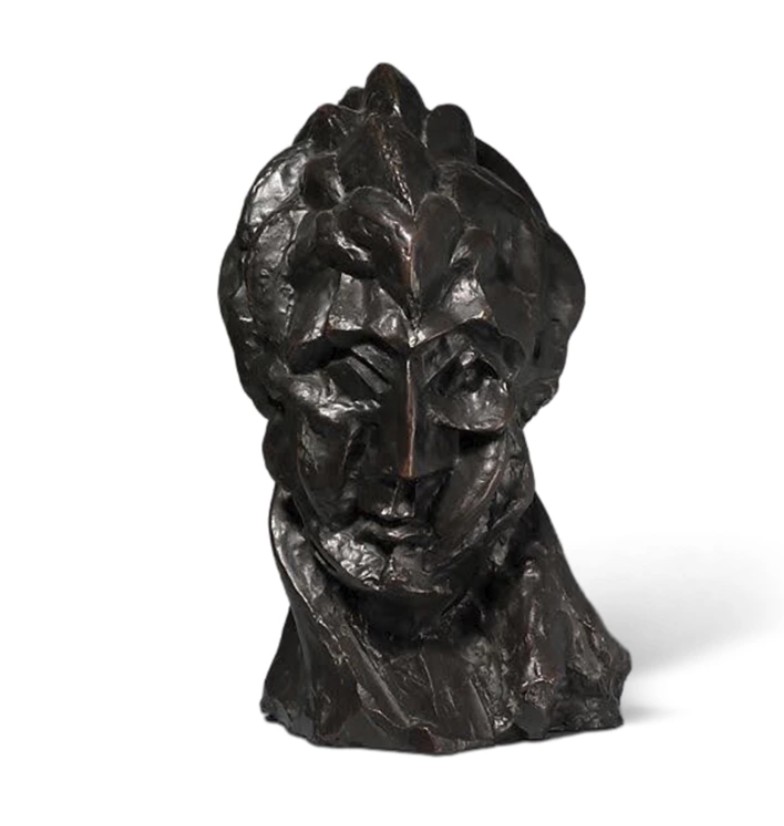
Pablo Picasso, Tête de femme (Fernande), 1909, The Metropolitan Museum of Art, New York.
Art © 2026 Estate of Pablo Picasso / Artists Rights Society (ARS), New York
The rejection of mimetic depiction of the human form seen in Arlequin (Buste) reached its apogee with Picasso’s travels to Horta de Ebro, Spain, in the summer of 1909. The portraits he completed there of his lover, Fernande Olivier, dissolved into fully fragmented pictorial surfaces, are widely recognized as the true beginnings of Cubism. Marking the most important upheaval of Western artistic principles since the Renaissance, this pioneering movement would underpin the development of art in the twentieth century and beyond.
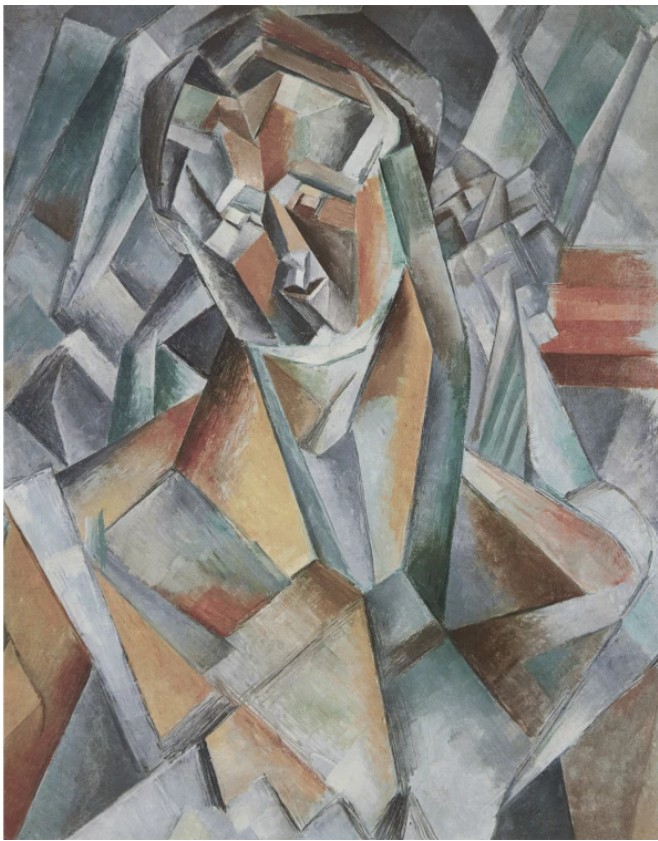
Pablo Picasso, Femme assise, 1909, Private Collection, sold: Sotheby’s, London, 21 June 2016, lot 8 for $63.5 million.
Art © 2026 Estate of Pablo Picasso / Artists Rights Society (ARS), New York
Arlequin (Buste) belonged to the collection of Adele and Enrico Donati for over sixty years. A highly important presence within the Surrealist milieu, Enrico Donati, often referred to as “the last Surrealist”, was at once an artist and trusted confidant to many of the movement’s leading figures, counting Marcel Duchamp, Max Ernst and André Breton among his close friends. Alongside him was his wife Adele Donati, a designer and artist, who viewed the collection with a discerning eye, informed by her work across advertising and fashion.
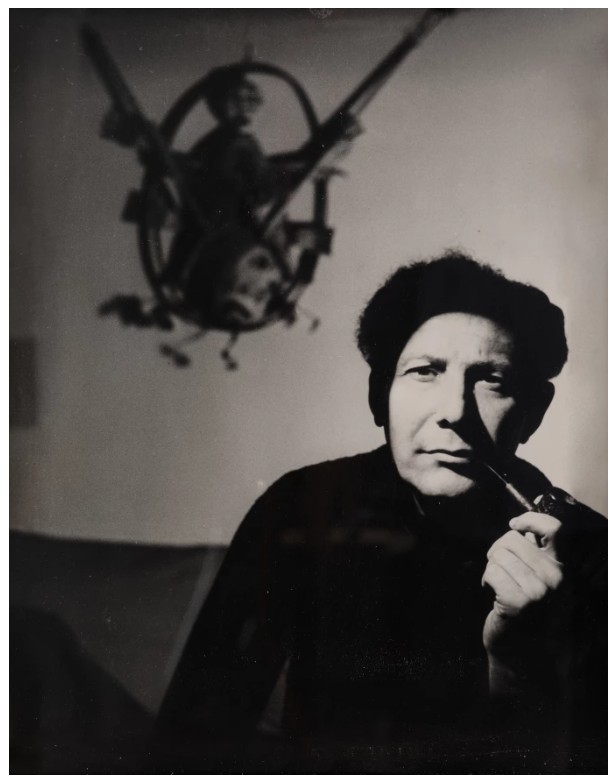
Enrico Donati
Heralded as one of the last members of the Surrealist movement, Donati’s career began in the 1930s in Paris, where he immersed himself in the city’s cultural avant-garde and he first encountered the work of the Surrealists. In 1939, with the threat of war rising in Europe, Donati relocated with his young family to New York, joining the wave of European artists and intellectuals fleeing the continent. In 1942 he held his first solo exhibition in the city at the New School for Social Research. It was seen by André Breton, who immediately proclaimed him to be a Surrealist, and welcomed Donati into the movement. Thereafter Donati became enmeshed with the close circle of European émigré artists and writers in New York, including Marcel Duchamp and Yves Tanguy, contributing to the city’s vibrant artistic life during the war years. Insatiably curious, Donati reinvented his style multiple times over his six-decade career, oscillating between the influences of Surrealism, Constructivism and Abstract Expressionism, yet always maintaining a uniquely Surrealist style.
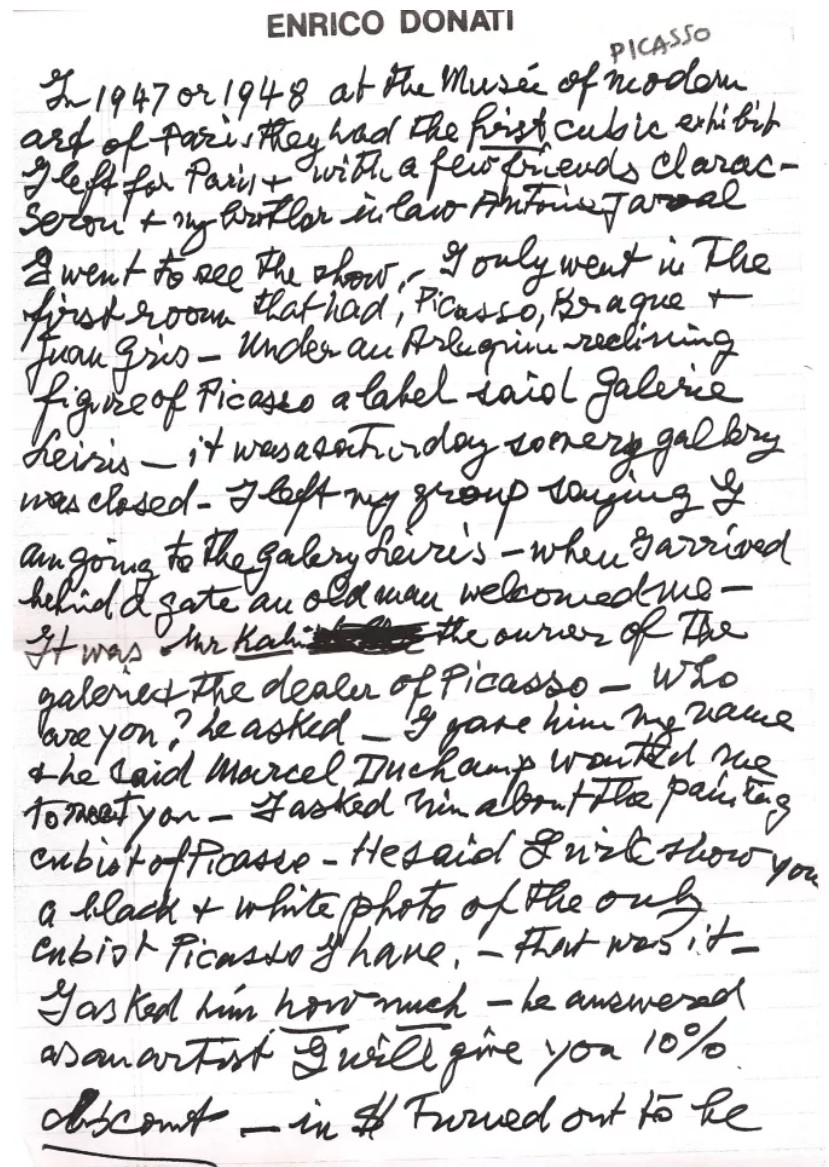
As the present work attests, Donati was a passionate promoter of twentieth-century art, collecting not only the work of friends but that of artists whose work showed the ever-changing landscape of modernism. Donati wrote of being immediately captivated by an encounter with a Picasso harlequin in a Cubist exhibition at the Musée National d’Art Moderne in Paris in 1953. He swiftly made a visit to the Galerie Louise Leiris, where he met the Picasso’s legendary dealer, Daniel-Henry Kahnweiler and promptly bought the the present picture for the money that he had in his pocket: “At the musée of Modern art they had the first Cubist exhibit…I only went in the first room that had Picasso, Braque and Juan Gris—under an Arlequin reclining figure of Picasso a label said Galerie Leiris ….When I arrived [at the Galerie Louise Leiris] an old man welcomed me. It was Mr. Kahnweiler, the owner of the gallery and the dealer of Picasso. “Who are you?” he asked—I gave him my name and he said Marcel Duchamp wanted me to meet you. I asked him about the Cubist painting of Picasso. He said, ‘I will show you a black-and-white photo of the only Cubist Picasso I have.’—that was it.”
Homme à la guitare, 1913
Masterpieces: The Private Collection of S.I. Newhouse
Christie’s New-York: 18 May 2026
Estimated: USD 35,000,000 – 55,000,000
USD 40,885,000
PABLO PICASSO (1881-1973), Homme à la guitare | Christie’s
PABLO PICASSO (1881-1973)
Homme à la guitare, 1913
Oil, encaustic and sand on canvas
130.5 x 89.6 cm (51-3/8 x 35-1/4 inches)
Signed, dated and inscribed ‘PICASSO Céret 1913’ (on the reverse)
Painted in Céret in 1913
Pablo Picasso painted Homme à la guitare in Céret in the summer of 1913, an important moment in the midst of the rapid series of pictorial revolutions that define Cubism. Composed of planes of vibrant color, pattern, and letters, combined with passages of highly textured paint, encaustic, and in places, sand, this large-scale portrait, formerly in the legendary collection of Gertrude Stein and subsequently, The Museum of Modern Art, New York, stands as a bold declaration of the new direction that Picasso’s art took at this time. Featuring one of his most beloved and important motifs—the man and the guitar—this work announces the arrival of Synthetic Cubism, the second stage of Picasso’s epoch-defining cubist adventure. “His only large canvas of the period,” John Richardson has described, it is also the last large-scale work from 1913 in private hands (quoted in A Life of Picasso, The Painter of Modern Life, 1907-1917, London, 2009, vol. II, p. 278).
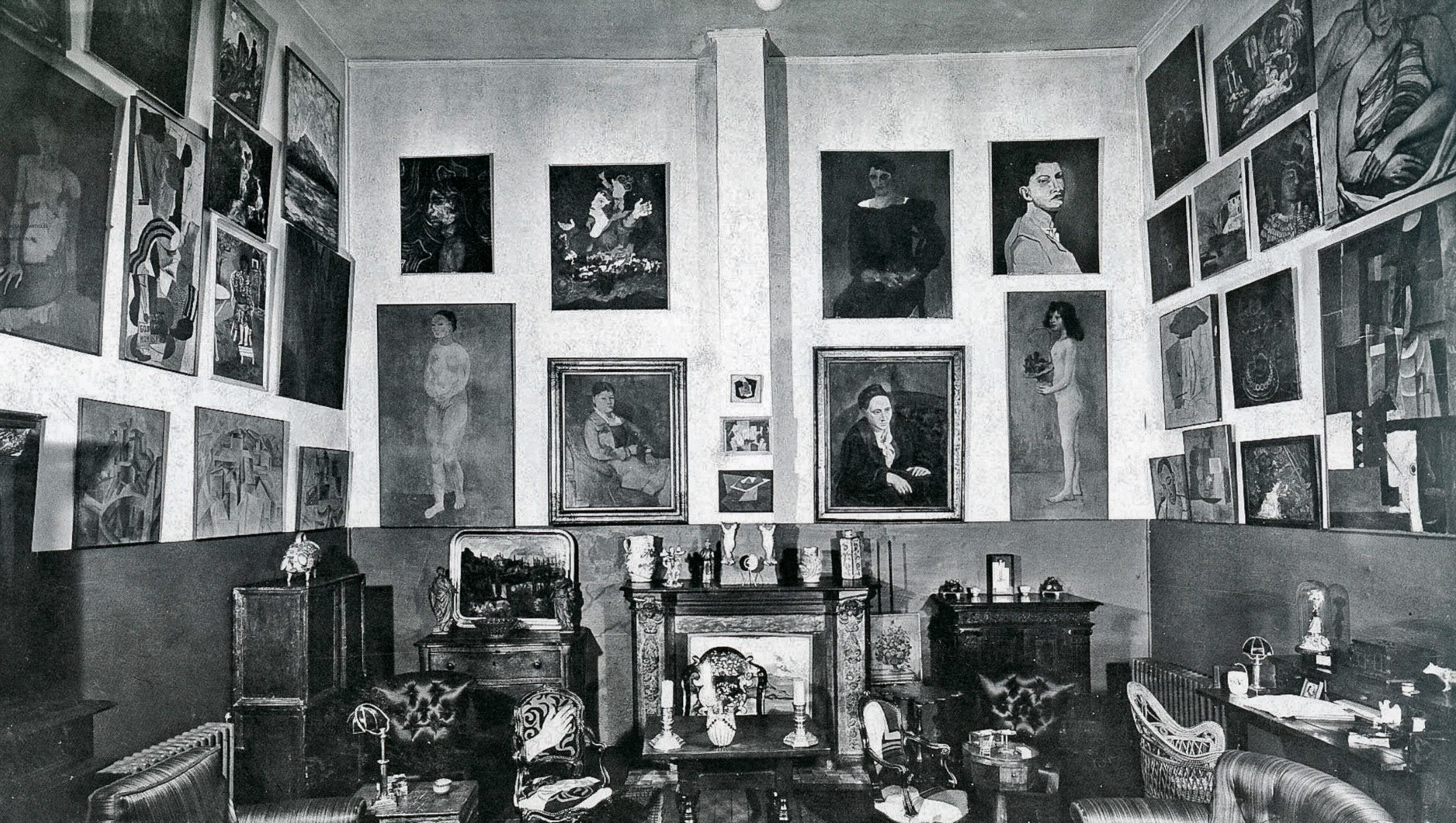
The present work, hanging on the far left, in the home of Gertrude Stein, 27 rue de Fleurus, Paris, winter 1914-1915. Artwork: © 2026 Estate of Pablo Picasso / Artists Rights Society (ARS), New York.
Over the course of the twelve months prior to his creation of this work, Picasso, together with his friend and cubist comrade, Georges Braque, had made a series of artistic leaps, integrating found objects in cubist collages, pasted paper pieces in their papier collés, and latterly, inventing three-dimensional cubist constructions and assemblages that once again radically redefined the parameters of artmaking. During his stay in Céret in the spring and summer of 1913, Picasso was exploring and experimenting with the artistic repercussions of these breakthroughs, scrutinizing form—both pictorial and material—as he moved effortlessly between painting, drawing, collage, and sculpture, each medium informing his work in the other. Homme à la guitare marks the synthesis of these different developments, as well as occupying a deeply personal place in the life of the artist.
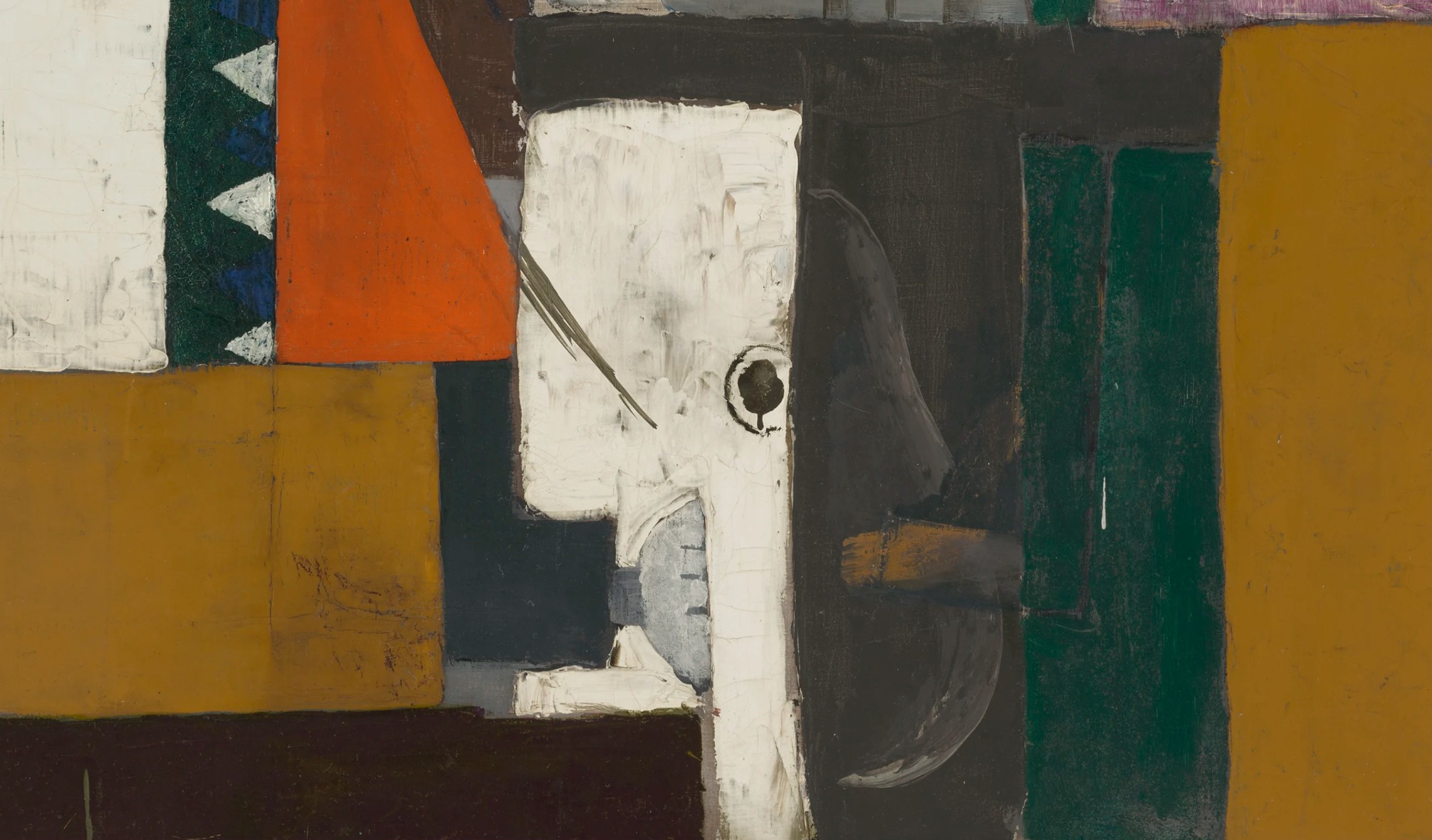
Picasso had arrived in Céret, a small town in the French Pyrenees in March 1913. On this, his third stay there, he traveled with his partner of the time, Eva Gouel, the enigmatic “ma jolie,” as he referred to her in his painting. In May 1912, his long-term relationship with Fernande Olivier had come to an explosive end when she left him for another artist. Picasso had already been enjoying a clandestine relationship with Eva, who would after this point, become the artist’s offical muse and lover. Returning to Céret, Picasso and Eva once again rented the ground floor of the Maison Delcros, and were soon joined by painter and poet, Max Jacob. Happy to be away from Paris and its demands, the artist set to work. “I’m behaving very badly towards all my friends,” Picasso wrote to his dealer, Daniel-Henry Kahnweiler on 11 April 1913. “I’m not writing to anyone, but I’m working; I’m working on projects and I’m not forgetting any one of you” (quoted in Picasso and Braque: Pioneering Cubism, exh. cat., The Museum of Modern Art, New York, 1989, p. 416).
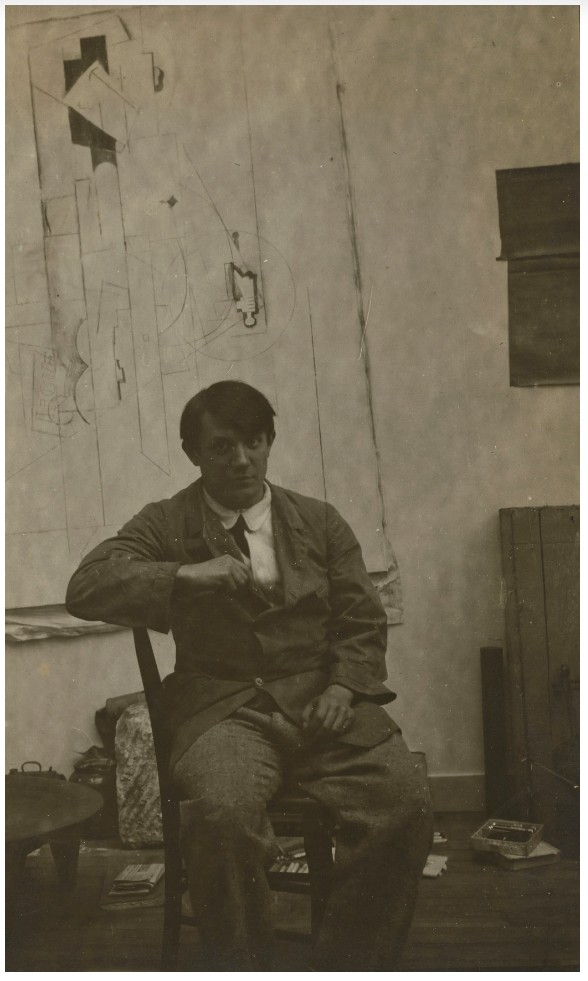
Self-portrait in front of the canvas, Construction with Guitar Player, Paris, winter or summer 1913. Musée national Picasso, Paris. © 2026 Estate of Pablo Picasso / Artists Rights Society (ARS), New York. Image: © RMN-Grand Palais / Art Resource, NY.
Notably for this sojourn, Braque was not present. In contrast to the previous years during which they were, as Braque later described, tethered together like mountain climbers, at this time he was happily ensconced in Sorgues. Though Picasso missed his company—“it’s really too bad that the telephone at your place doesn’t reach Céret,” he wrote to him (quoted in J. Richardson, op. cit., 2009, p. 276)—tellingly, unlike other trips he did not implore him to come and join him. Their art, which had in the past few years, been almost indistinguishable, was beginning to diverge, the pair no longer responding to the each other with the same sense of immediacy and intensity as previous years.
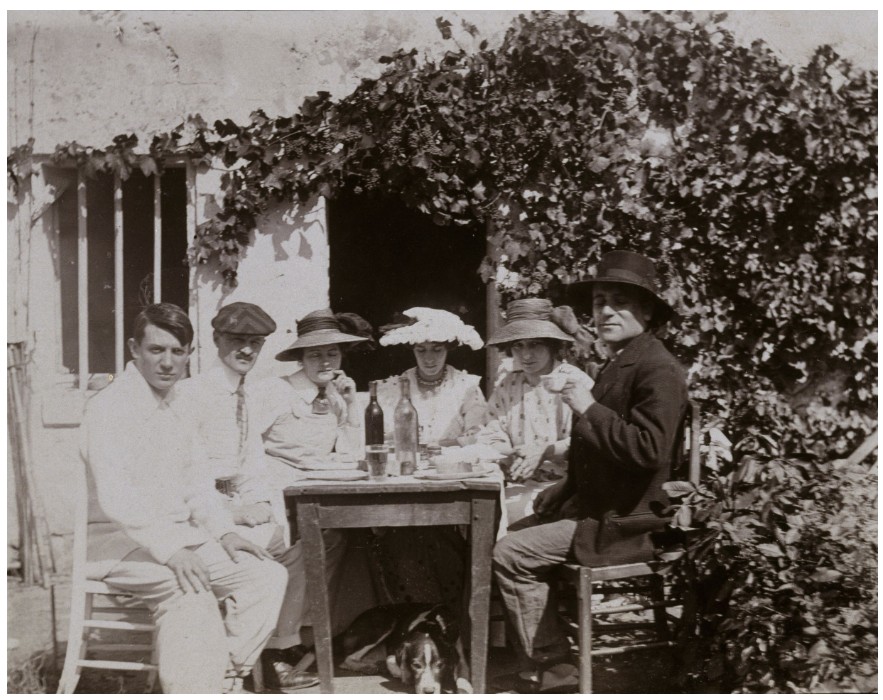
Picasso, Eva Gouel, Max Jacob and other friends on the balcony of Maison Delcros, Céret, 1913.
Musée Picasso, Paris. Photo: © RMN-Grand Palais / Art Resource, NY.
Upon his arrival in Céret, Picasso began a new series of papier collés, expanding and building upon the possibilities of this art form that Braque had pioneered in the autumn of 1912. Already by this point, the artists had found that Analytical Cubism had reached its natural conclusion. As a result, they began to reintroduce life into their work, gradually relaxing the dense webs of lines and facets that had constructed their hermetic compositions, and reintegrating color once more. Stenciled lettering began to appear, before real objects, pieces of wallpaper and faux-bois, and carefully chosen cuttings of newspapers and ephemera. As a result, Cubism was transformed as reality itself was integrated into the two-dimensional confines of the canvas, thereby opening up new directions in the conception not only of a painting, but of art itself.
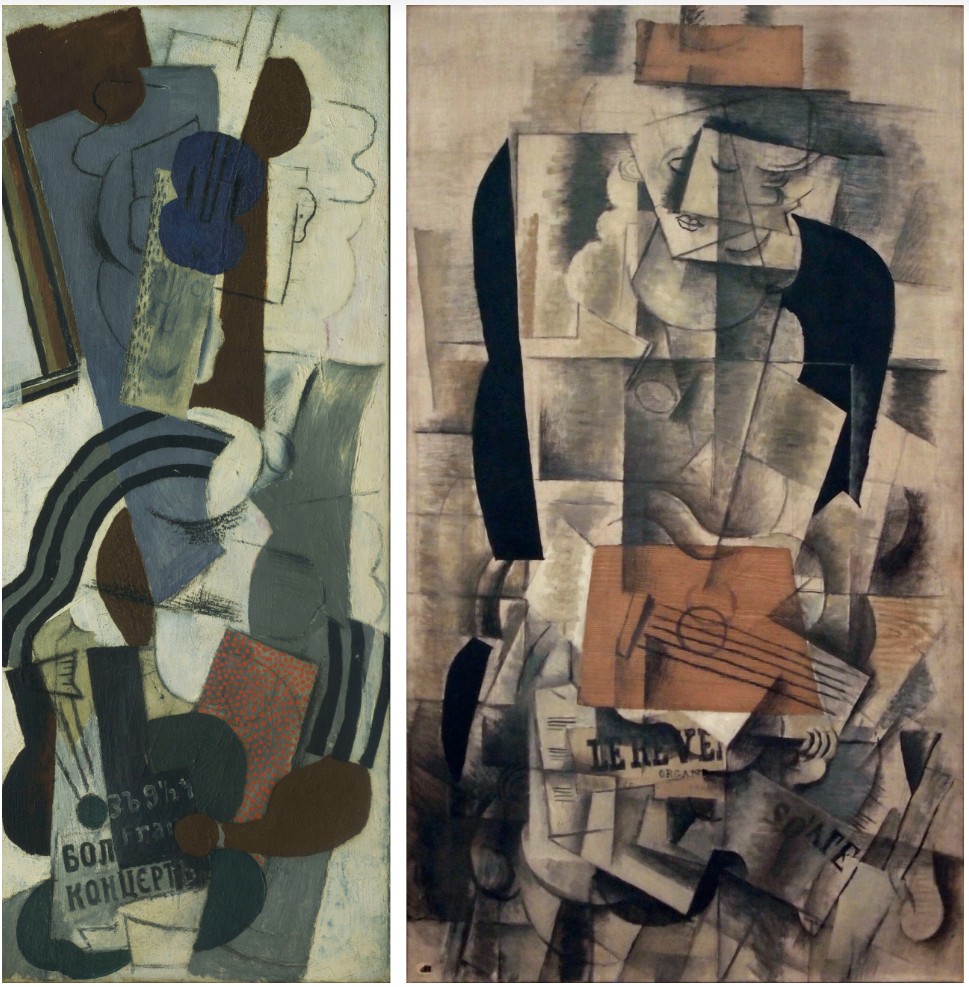
Left: Pablo Picasso, Femme à la guitare, winter 1913-1914. The Museum of Modern Art, New York. © 2026 Estate of Pablo Picasso / Artists Rights Society (ARS), New York. Photo: © The Museum of Modern Art/Licensed by SCALA / Art Resource, NY.
Right: Georges Braque, Femme à la guitare, Sorgues, autumn 1913. Musée National d’Art Moderne, Centre Georges Pompidou.
This clearer, bolder cubist idiom, constructed with larger, flattened planes would become the defining characteristic of Synthetic Cubism, which Picasso explored at pace throughout 1913. The pieces of paper used to construct the compositions fed into his work in oil paint—as seen in the present work, with its interlocking arrangement of painted planes of deep blue and green, together with luminous red and orange. “The changes in structure make [Picasso’s] paintings look simpler, flatter, clearer, bolder—and also less mysterious or metaphysical,” Elizabeth Cowling has described. “Not that they became unambiguous and direct. Far from it. But the strangeness of shadowy, immeasurable spaces and indeterminate forms and the equivocation of Mallarméen ‘suggestion’ were replaced by witty visual metaphors and puns” (Picasso: Style and Meaning, London, 2002, pp. 262-263).
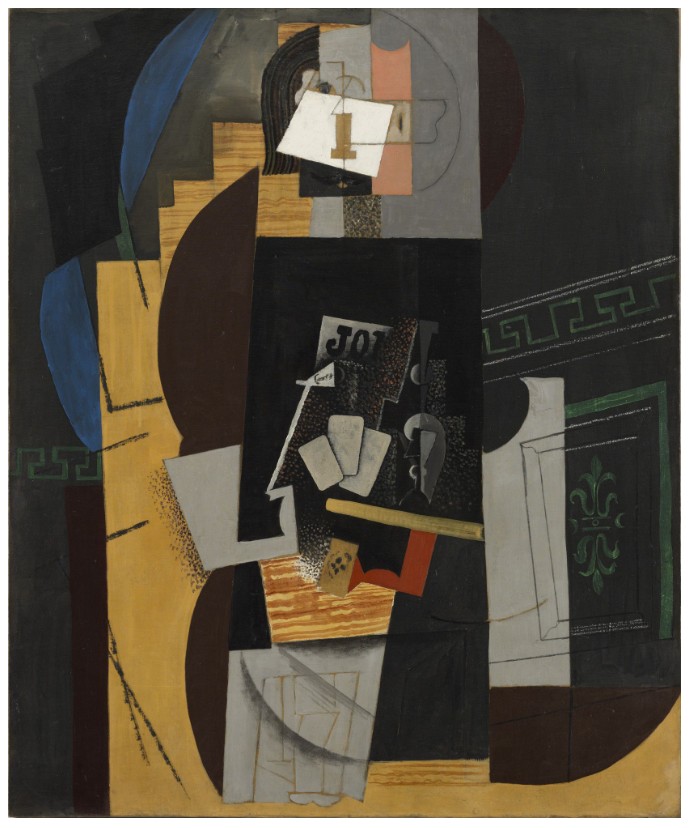
Pablo Picasso, Joueur de cartes, winter 1913-1914. The Museum of Modern Art, New York.
© 2026 Estate of Pablo Picasso / Artists Rights Society (ARS), New York.
Here, the figure of the man and the guitar are converted into a union of repeating shapes and signs: the curving silhouette of the guitar is echoed in the faceted shape of the man’s head, these semi-circular forms cascading down to convey the volume of his bust and torso, while the black circle of the instrument’s soundhole finds its equivalent in his head, standing as a single eye. A painted still life occupies the right hand side of the canvas, the famous Bass beer label, an integral cubist symbol, emblazoned over the partially painted outlines of two bottles, which themselves mimic the form of the figure’s distinctive black top hat. These playful visual rhythms and equivalences define Synthetic Cubism.
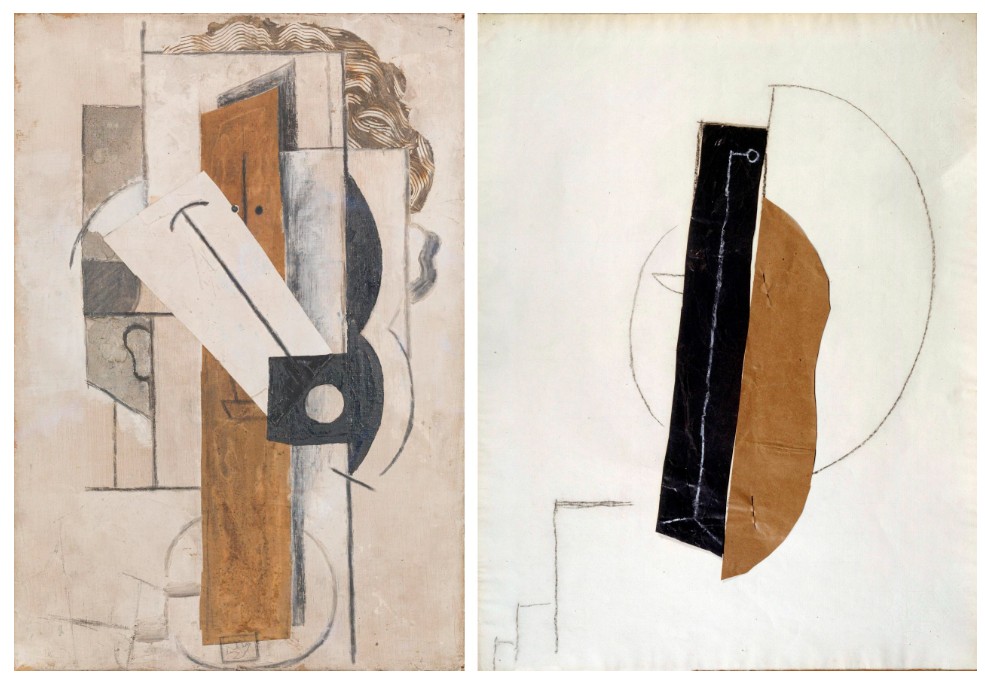
Left: Pablo Picasso, Tête de jeune fille, 1913. Musée National d’Art Moderne, Centre Georges Pompidou, Paris. © 2026 Estate of Pablo Picasso / Artists Rights Society (ARS), New York.
Right: Pablo Picasso, Tête, 1913. Musée national Picasso, Paris. © 2026 Estate of Pablo Picasso / Artists Rights Society (ARS), New York. Photo: © Photo Josse / Bridgeman Images.
Picasso turned to his famed motif of the man playing the guitar to explore these latest developments in the spring of 1913. Earlier in the year, Picasso had created a large assemblage of this subject in his studio on the boulevard Raspail in Paris. In this playful—and highly radical work—Picasso set a real tabletop, with a bottle, cup, pipe, and newspaper, in front of a large canvas with a drawn and painted cubist figure of a man holding, with cut out newspaper arms, an actual guitar. A painted and constructed violin can also be seen hanging on the upper right hand side of the canvas. Once arranged, Picasso then photographed his assemblage—memorializing this ephemeral composition in time, as if he had created a living art work on a pictorial stage.
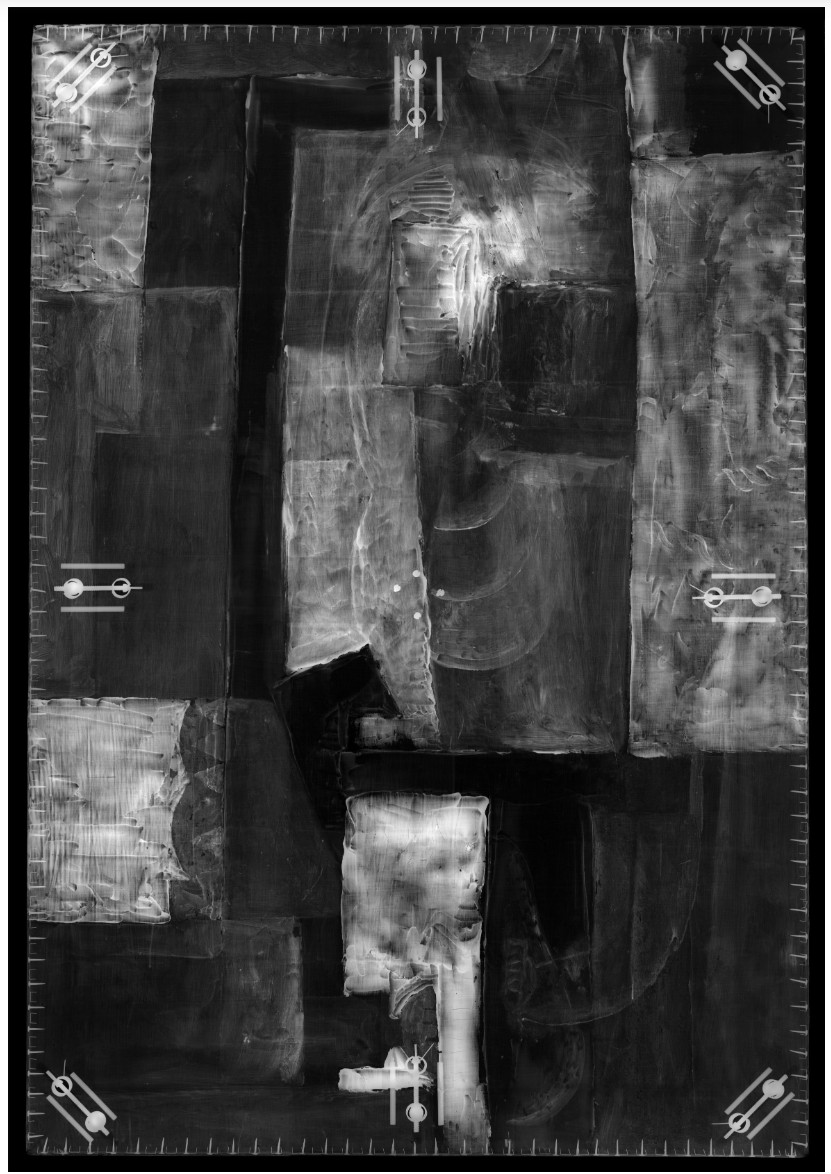
An X-ray of Homme à la guitare (© ArtDiscovery). This image, made by ArtDiscovery, reveals a fascinating insight into Picasso’s working process. The image suggests that he worked with confidence and decisiveness, making only limited adjustments to the composition before arriving at the final result. His approach emphasizes texture and layering, using paint to create a strong sense of depth and luminosity. In many areas, Picasso began with lower layers applied in thick, assertive strokes—using both brushwork and, at times, a palette knife. Over these, he added thinner applications of paint, ranging from semi-translucent to fully opaque, to build complexity and visual richness. The most evident change between the earlier and final stages of painting appears in the area of the figure’s head. The X-ray reveals that Picasso initially painted a circular and a rectangular form in the upper center, constructed with dense, parallel horizontal strokes of a palette knife. He later painted over these shapes to render the guitar player’s face and hat.
Marrying the real and the represented, the three-dimensional and two-dimensional, this assemblage paved the way for Picasso’s artistic production in Céret. There, Picasso’s evident fascination with the man and guitar as the vehicle through which to play with this concept of transformation from idea to form, figure to object, painting to sculpture, materialized in both his sketchbooks from this period, as well as his papier collés, and the present painting. Over the course of his drawings of this period, the form and structure of the guitar player is broken down and reimagined in myriad ways, built from vertical strips and interlocking planes, or conveyed in some of the more diagrammatic drawings in a squared paper carnet, as possible three-dimensional constructions (see for example Carnet des dessins cubistes, nos. MP1865 (25r) and (46r), Musée national Picasso, Paris). Homme à la guitare stands at the heart of this fascinating preoccupation as Picasso transformed the guitar player construction into oil—the painted conclusion of the idea born in the initial assemblage. Where the forms of the figure had been reimagined as solid, interconnecting parts, here, Picasso reimagined this construction in flat planes of bold color and pattern.
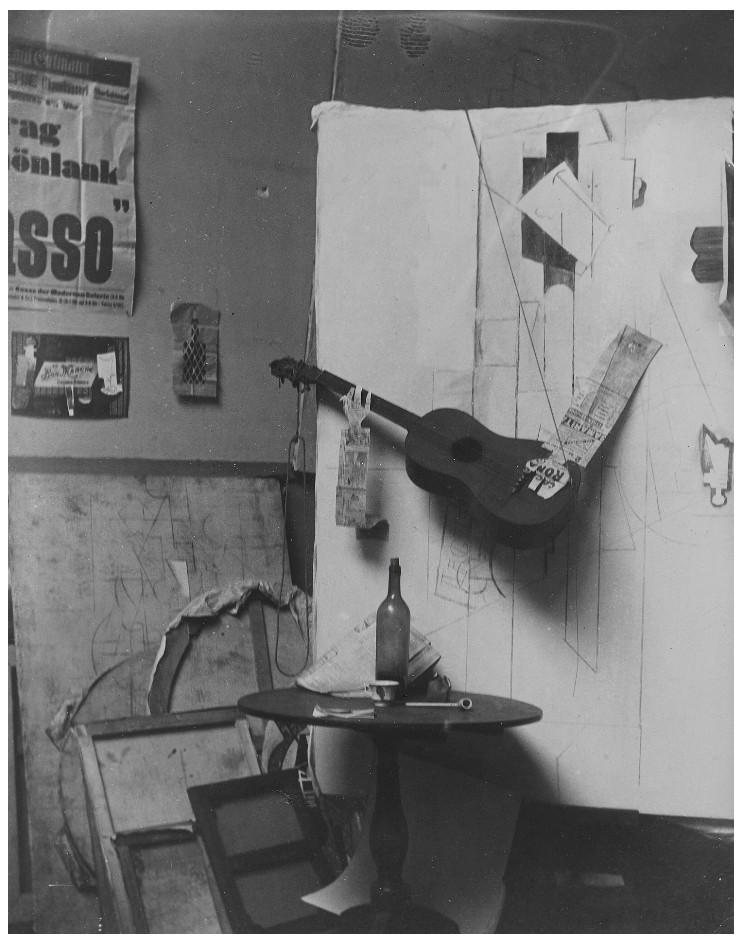
Homme avec guitare, assemblage in Picasso’s studio, boulevard Raspail, Paris. On or after 25 January and before 10 March 1913. No longer extant. Musée national Picasso, Paris. © 2026 Estate of Pablo Picasso / Artists Rights Society (ARS), New York.
Despite being deeply immersed in these exciting material explorations, Picasso was called home to Barcelona at the end of March 1913 as his father José Ruiz y Blasco had taken ill. A few weeks later, at the beginning of May, he heard news that his father had worsened and rushed to Spain to be with him. He died on 3 May; “You can imagine the state I’m in,” Picasso wrote to Kahnweiler (quoted in exh. cat., op. cit., 1989, p. 417). Later in the month, Picasso’s beloved dog, Frika, passed away, while Eva also fell ill, the start of the illness that would ultimately lead to her untimely death in 1915. “I hope that Pablo will get back to work again,” she wrote to Stein, “as that is the only thing that can make him forget his sorrow a little” (quoted in P. Daix and J. Rosselet, Picasso: The Cubist Years, 1907-1916, London, 1979, p. 300).
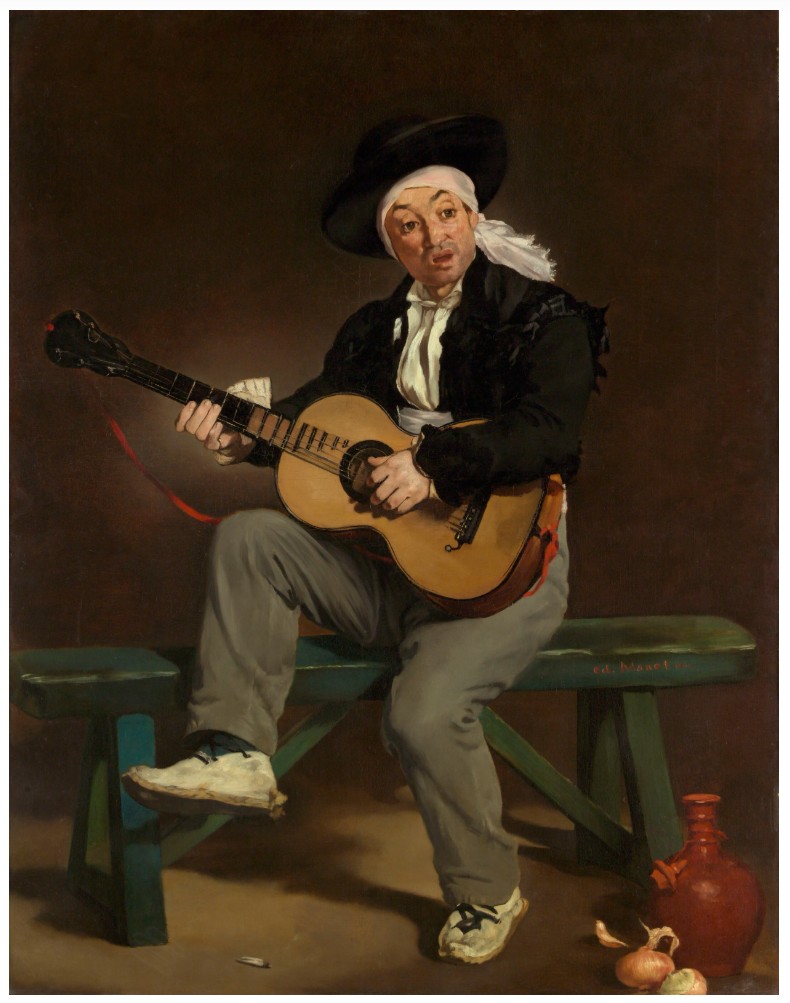
Edouard Manet, Le chanteur espagnol, 1860. Metropolitan Museum of Art, New York.
While there is no overt sign of these bereavements in Picasso’s work of this period, the presence of black planes in a number of his papier collés, as well as the minimal, austere quality of some of them, could be seen to reflect his grief. John Richardson wrote of Homme à la guitare that “the man in a tall Córdoban hat holding a guitar…could well be a memorial to his father… the oddly discordant café still life in half-mourning mauve on the right could refer to don José’s heyday in the cafes of Málaga” (op. cit., 2009, p. 278). In this way, this large and impressive painting is not only a bold example of the artist’s latest pictorial explorations, but can also be seen as a poignant testament to Picasso’s father, himself an artist, who would remain a central presence in his work for the rest of his life. Years later, Picasso told the photographer, Brassaï, “Every time I draw a man, involuntarily I think of my father. For me, man is ‘Don José,’ and that will be true all my life. He wore a beard. All the men I draw have more or less his features” (quoted in Brassaï, Conversations with Picasso, Chicago, 1999, p. 66).
La Glace, 1912
Sotheby’s New-York: 13 November 2023
Estimated: USD 3,000,000 – 5,000,000
USD 3,811,000
La Glace | Modern Evening Auction | 2023 | Sotheby’s (sothebys.com)
PABLO PICASSO (1881 – 1973)
La Glace, 1912
Oil on canvas
24×14 cm (9 1/2 x 5 1/2 inches)
Signed Picasso (on the reverse)
Executed in January-March 1912
A gemlike crystallization of form and light, La Glace represents the apotheosis of Analytical Cubism, the revolutionary visual idiom with which Pablo Picasso and Georges Braque indelibly transformed the course of art. Executed in the first months of 1912, the present work dates to the period of the artist’s most accomplished Cubist compositions.
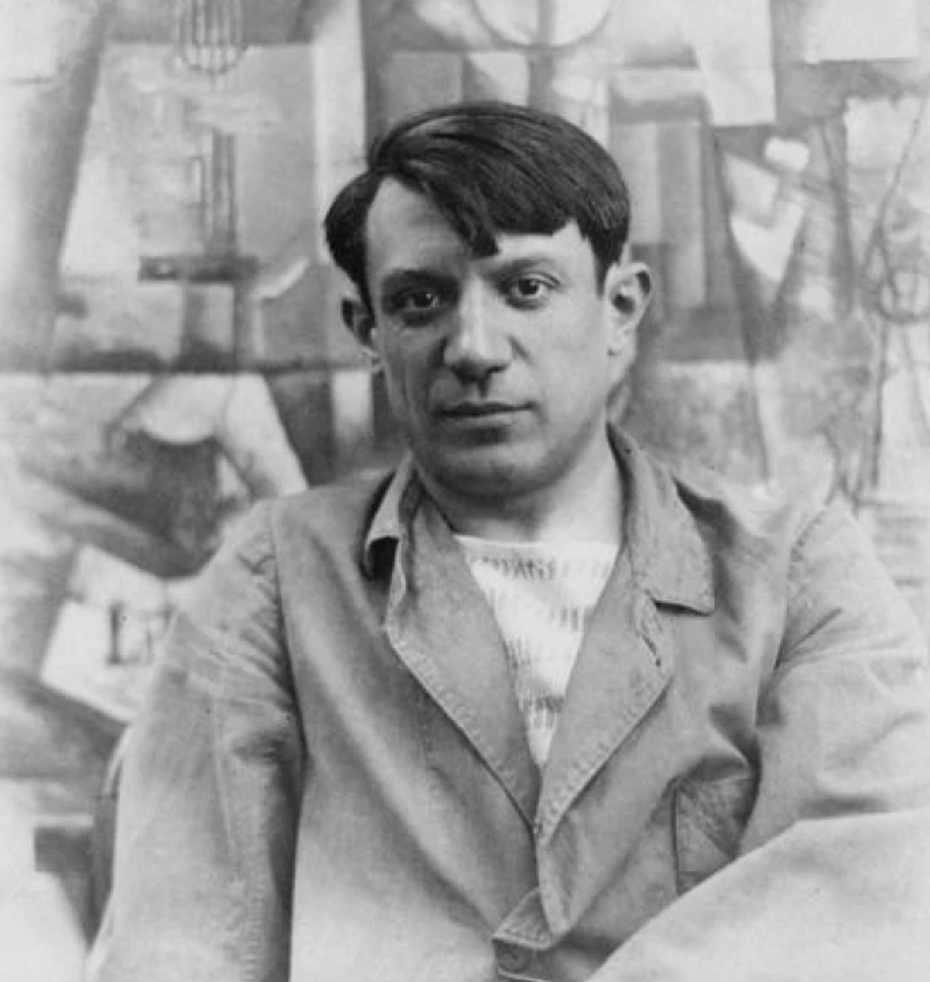
PABLO PICASSO AT VILLA LE CLOCHETTES, SORGUES, SUMMER 1912.
PHOTO © 2023 RMN-GRAND PALAIS / ART RESOURCE, NY.
ART © 2023 ESTATE OF PABLO PICASSO / ARTISTS RIGHTS SOCIETY (ARS), NEW YORK
As embodied by La Glace, the still life formed the crux of Picasso and Braque’s pioneering of Cubism. This genre, hitherto based upon the illusionistic representation of material objects, was best suited to their desire to dispense with the traditional techniques of linear perspective and foreshortening that had been central tenets of painting since before the Renaissance. Assuming the mantle of Cézanne’s aim to capture the complex experience of sight through radical perspective and emphasis on volumetric geometry, these artists sought to capture the reality of an object beyond its outward appearance. Picasso and Braque blew apart and explored their subjects from all angles, remaining at one with the space around it. Stopping just short of complete abstraction, these artists retained recognizable objects within their compositions. Despite the intellectual complexity of Analytical Cubism, Picasso found inspiration for his motifs from the objects surrounding him. La Glace, alongside several other food-inspired paintings, derive from Picasso’s time spent at the Taverne de l’Ermitage, located directly across from his apartment at the bottom of the Butte Montmartre. Beginning in 1909, l’Ermitage—a lively bistro and bar frequented by circus performers, prostitutes and sportsmen—replaced Le Lapin Agile as the nightly meeting spot for Picasso and his avant-garde circle, which included André Derain, Georges Braque, Guillaume Apollinaire and Juan Gris. The present work takes as its subject the myriad color effects and light refractions of the titular ice cream and its glass dish on its surroundings.
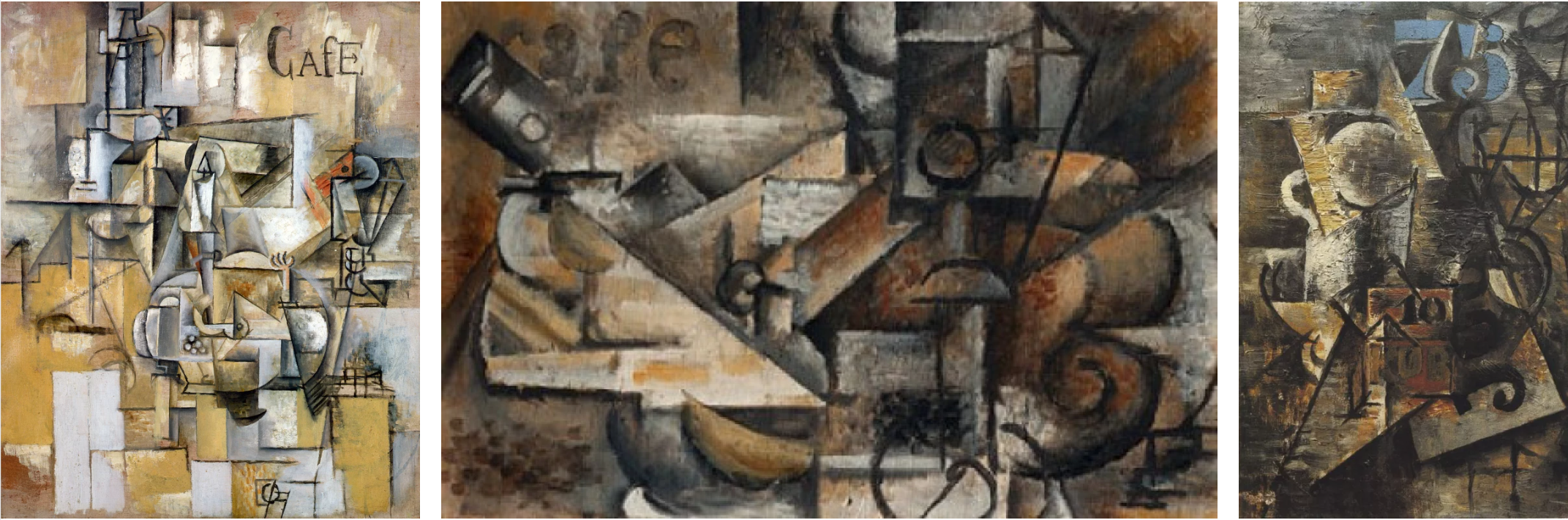
LE PIGEON AUX PETITS POIS, JANUARY-MARCH 1912. MUSÉE D’ART MODERNE DE LA VILLE DE PARIS
LA CÔTELETTE, JANUARY-MARCH 1912. NÁRODNI GALERIE, PRAGUE
LA TASSE (LE BOUILLON ‘KUB’), JANUARY-MARCH 1912. KUNSTMUSEUM BASEL
ART © 2023 ESTATE OF PABLO PICASSO / ARTISTS RIGHTS SOCIETY (ARS), NEW YORK
La Glace employs the stylistic syntax developed during Picasso and Braque’s stay at Céret, a small town in the French Pyrénées, in the summer of 1911, during which the two artists arrived at a formulation of Cubism that led to a clarification of the images explored in their canvases and produced increasingly legible and cogent compositions. Anchored by a prismatic structure, Picasso constructs his subject through an extraordinary juxtaposition of curved and rectilinear lines, all heightened by an extraordinary richness of chiaroscuro to give a sculptural quality to the forms. Compressing the pictorial space to a matrix of upright planes, the artist wholly upends the tabletop to expose the entire surface of a saucer. Within this chromatic arrangement of silver, amber and onyx, punctuated by flashes of viridian and lilac, rhythmic passages of planar brushstrokes suffuse the composition with auratic light. Likely allusions to the words etched on the bistro windows and the prices of various food items–the letters and numbers of the present work emphasize the flatness of the pictorial surface. This approach anticipates the emergence of Synthetic Cubism only several months later, in which the artists removed all allusion to three-dimensional space through collage.
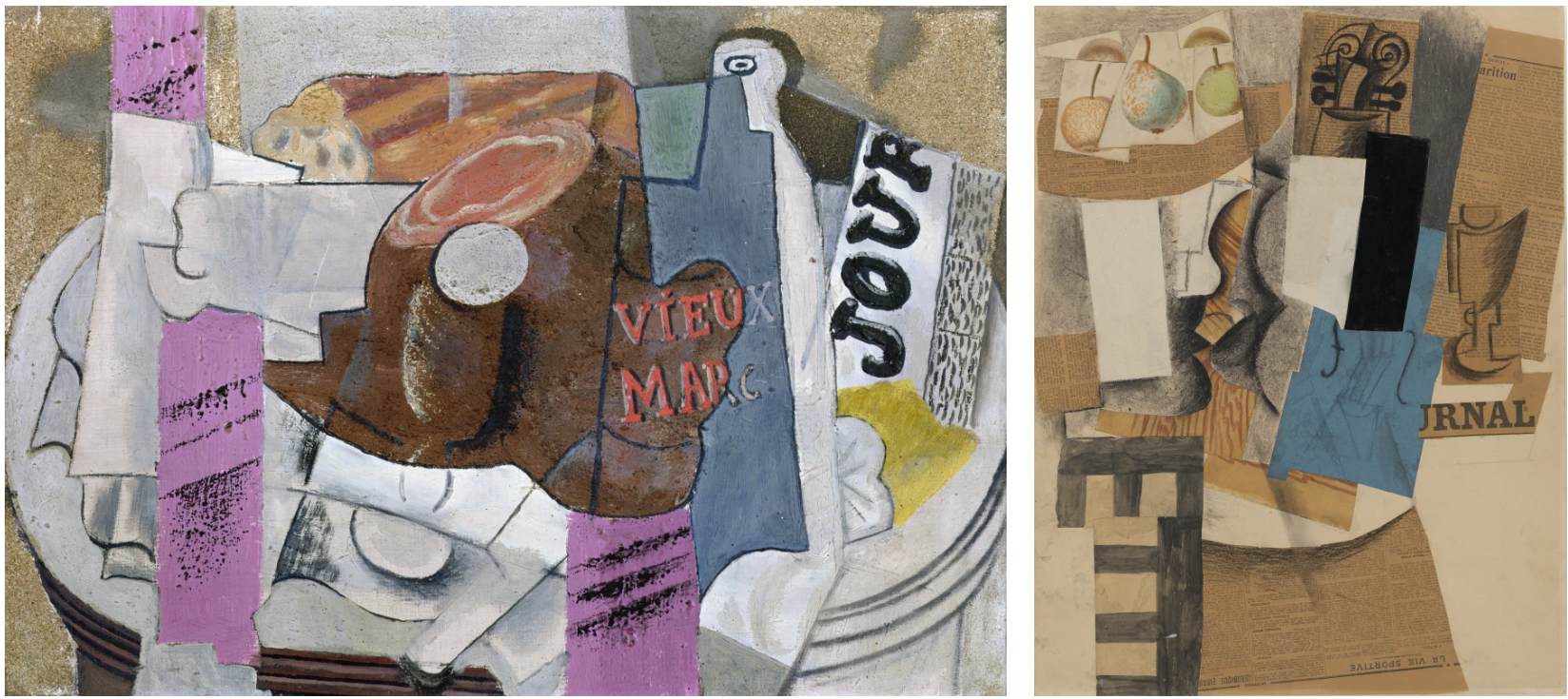
LE VIEUX MARC, 1912. MUSÉE D’ART MODERNE DE LA VILLE DE PARIS
COMPOTIER AVEC FRUITS, VIOLON ET VERRE, 1913. PHILADELPHIA MUSEUM OF ART
ART © 2023 ESTATE OF PABLO PICASSO / ARTISTS RIGHTS SOCIETY (ARS), NEW YORK
La Glace holds a distinguished provenance, having belonged to the collection of Czech art historian Vincenc Kramář until at least 1931. In 1921, Kramář published the book Kubismus, the first-ever art-historical scholarship regarding Cubism. Beginning in 1911, Kramář developed a lifelong friendship with Daniel-Henri Kahnweiler, the dealer from whom he purchased La Glace just months after its execution. Kramář was the first collector to purchase a bronze cast of the first-ever Cubist sculpture, Picasso’s Tête de Femme (Fernande) of 1909. Kramář visited Picasso on a number of occasions, most notably spending a week in 1932 with Picasso at his château in Boisgeloup.
Buste de femme, 1909
Sotheby’s New-York: 13 November 2023
Estimated: USD 18,000,000 – 25,000,000
USD 13,622,500
https://www.sothebys.com/en/buy/auction/2023/modern-evening-auction-5/buste-de-femme
PABLO PICASSO (1881 – 1973)
Buste de femme, 1909
Gouache on paper mounted on board
63.7 x 49 cm (25 x 19 1/4 inches)
Signed Picasso (upper right)
One of Pablo Picasso’s most compelling portraits from the first decade of the twentieth-century, Buste de femme exists in a rarefied group of works by the artist, few of which still exist in private hands. Masterfully rendered in gouache on paper, this work constitutes the threshold of the singular most important breakthrough of modern art: the discovery of Cubism. Executed in the spring of 1909, Buste de femme belongs to a sequence of figurative works based on Picasso’s first great love, Fernande Olivier, which culminated with his first Analytical Cubist paintings created at Horta de Ebro, Spain that summer. Illuminating Picasso’s shift from his proto-Cubist masterworks Les Demoiselles d’Avignon and Trois femmes to high Cubism, Buste de femme embodies the pivotal period in which Picasso revolutionized the rules of not just portraiture, but of two-dimensional representation itself.
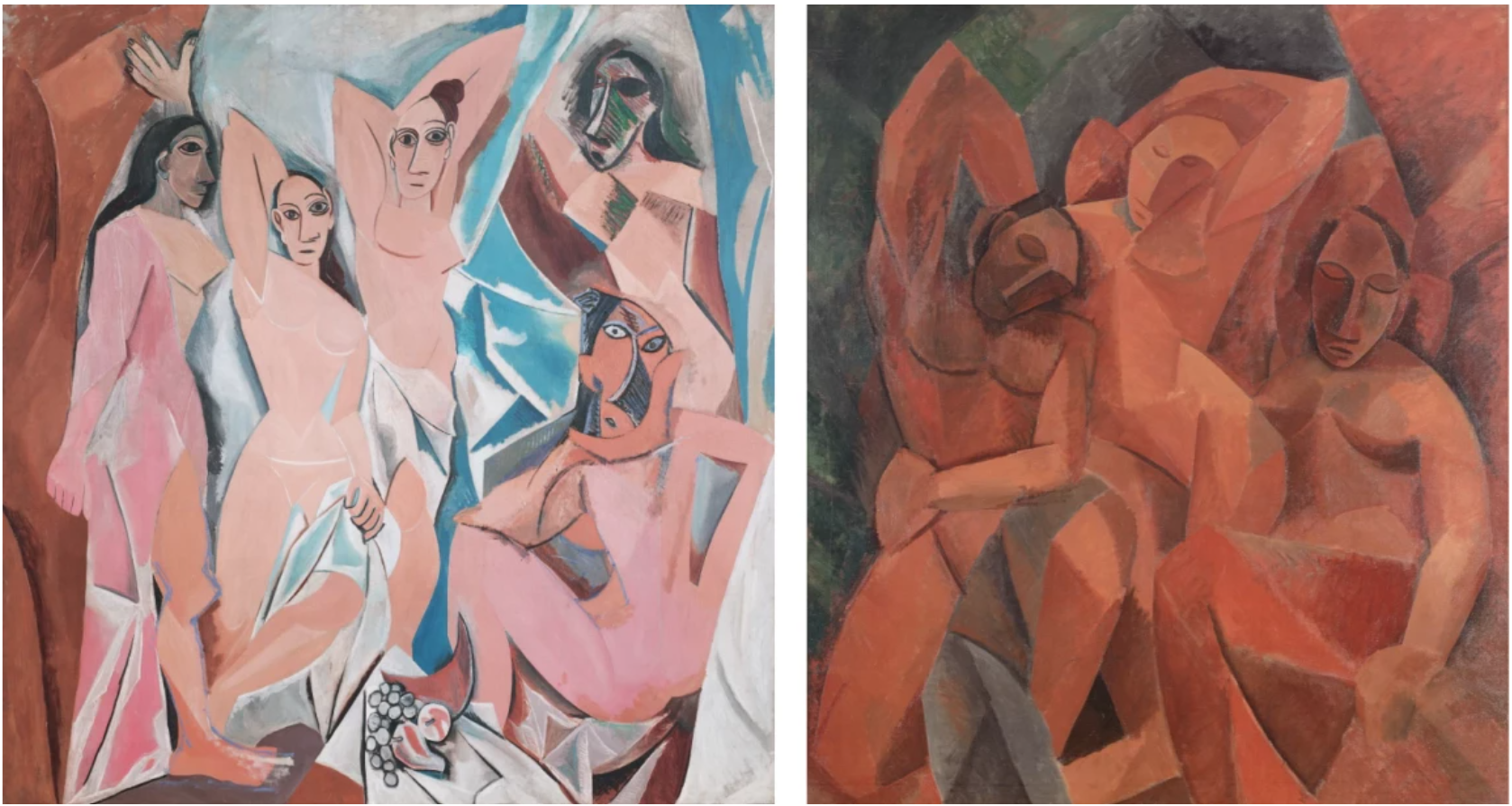
PABLO PICASSO, LES DEMOISELLES D’AVIGNON, 1907. THE MUSEUM OF MODERN ART, NEW YORK. IMAGE: BRIDGEMAN IMAGES. ART © 2023 ESTATE OF PABLO PICASSO / ARTISTS RIGHTS SOCIETY (ARS), NEW YORK
PABLO PICASSO, TROIS FEMMES, 1908. THE STATE HERMITAGE MUSEUM, SAINT PETERSBURG. IMAGE: BRIDGEMAN IMAGES. ART © 2023 ESTATE OF PABLO PICASSO / ARTISTS RIGHTS SOCIETY (ARS), NEW YORK
Fernande Olivier, the subject of Buste de femme, was Picasso’s first muse and set the pattern for his creative response to the women with whom he subsequently entered into prolonged partnerships. Fernande worked as a model for artists in the bohemian set, including Ignacio Zuloaga and Kees van Dongen. According to Fernande, she met Picasso during a 1904 rain storm at the Bateau Lavoir, the ramshackle artist’s studio in Montmartre that housed a colony of creative youth. Shortly after meeting, they entered into what at that point was the longest romantic relationship of Picasso’s life. Throughout their tempestuous union, la belle Fernande dominated the artist’s imagery and served as his principal expressive vehicle during a period of ceaseless, radical invention that spanned his famed Rose period and ended with the explorations of Synthetic Cubism.
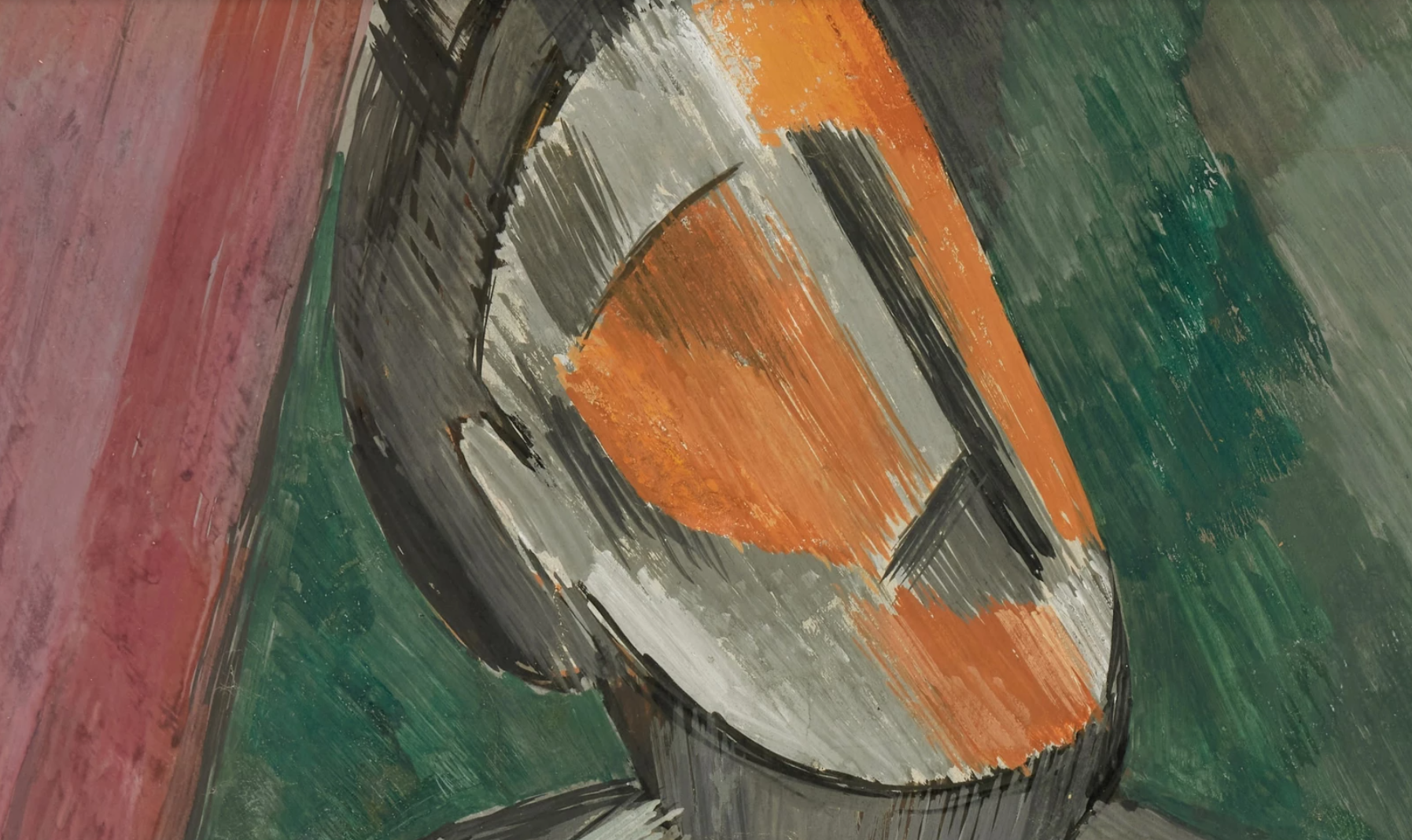
Between late 1908 and the summer of 1909, Picasso pursued the development of a radical reinterpretation of pictorial form with a dynamic fervor unlike any other period in his trajectory. While Picasso executed Les Demoiselles d’Avignon and subsequent paintings through the traditional practice of creating countless sketches and small studies to help develop and refine a final composition in which all of his latest developments were included, in 1909 he produced for the first time a series of works—in a wide range of media—focused on repeated depictions of a single subject. As the basis of this potent figurative sequence, Fernande serves as Picasso’s conduit for a probing dialogue with the work of Cézanne that together, with African, Oceanic and Iberian artistic traditions, laid the revolutionary foundation for Cubism.
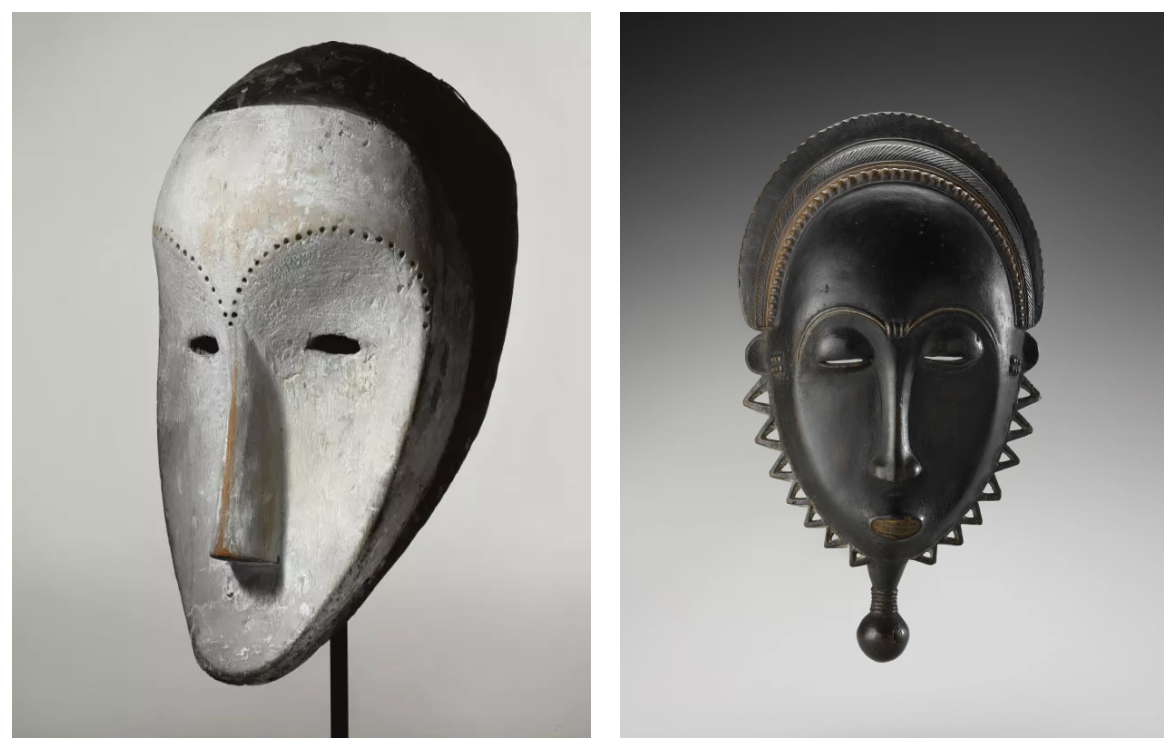
FANG MASK, EQUATORIAL GUINEA. PRIVATE COLLECTION
BAULÉ MASK, IVORY COAST, CIRCA EARLY 20TH CENTURY. MUSEUM OF FINE ARTS, HOUSTON
The well-documented formal influence of Iberian, African, and Oceanic sculpture on Picasso’s oeuvre, stemming from his epiphanic encounters with such works at the Musée du Louvre and the Musée d’Ethnographie du Trocadéro from 1904 to 1907, reached its apotheosis with Les Demoiselles d’Avignon. By 1908, Picasso largely outgrew the stylistic inspiration of African and Oceanic art, yet these works continued to serve as a basis for his ongoing rejection of Western art’s inherited systems of meaning.
Cafetière, tasse et pipe, 1911
Christie’s New-York: 11 May 2023
Estimated: USD 8,000,000 – 12,000,000
USD 11,335,000
PABLO PICASSO (1881-1973) (christies.com)
PABLO PICASSO (1881-1973)
Cafetière, tasse et pipe, 1911
Oil on canvas
46×27 cm (18 1/8 x 10 5/8 inches)
Signed ‘Picasso’ (on the reverse)
It was predominantly with the still life that Pablo Picasso deconstructed the centuries-long tools of artistic representation in his epoch-defining movement, Cubism. In his desire to unpack and reconfigure the processes of representation, Picasso adopted this genre—one that is based more upon the immutable reality of the everyday world than any other—discovering that it offered him the greatest opportunity for his iconoclastic re-writing of convention. Volumetric vessels were split and rendered as floating compilations of lines, presented from multiple viewpoints at once; flat tabletops were upturned, distorting classical notions of pictorial space; pieces of fruit, so often the motifs with which an artist displayed their virtuosity became nothing more than playful signs and shapes that alluded to rather than faithfully rendered real life. All of these objects became the protagonists in the new painterly world Picasso created in his cubist compositions. Cafetière, tasse et pipe was painted in 1911, the highpoint of the artist’s Analytical Cubism phase, and captures to great effect the startling pictorial disruptions that Picasso so diligently crafted. Here, the just visible objects of an everyday still-life emerge from a monochrome mist of pigment. As the title denotes, a cafetière, cup and pipe, together with the prominent form of a wineglass, are the protagonists of the scene. Untethered from the tabletop on which they would usually stand, they float apparition-like amid various accumulations of shadows and gleams of light.
Femme en corset lisant un livre, 1914-1918
Phillips New-York: 14 November 2023
Estimated: USD 15,000,000 – 20,000,000
USD 14,762,500
Pablo Picasso – Living the Avant-Ga… Lot 16 November 2023 | Phillips
PABLO PICASSO
Femme en corset lisant un livre, 1914-1918
Oil and sand on canvas
91.8 x 60.3 cm (36 1/8 x 23 3/4 inches)
A tender and lyrical portrait first commenced in Avignon circa 1914, Femme en corset lisant un livre documents the pivotal shifts in the visual language of Cubism pursued by Pablo Picasso in the years following the height of the movement’s so-called “Analytic” phase, pioneered by himself and Georges Braque between 1908 and 1912. While this earlier stage of Cubism was characterized by restricted palettes, and a fracturing of solid form and the space surrounding it to enable the simultaneous presentation of multiple perspectives on a single plane, its second “Synthetic” period was announced through the incorporation of color, texture, and the material of everyday life into their compositions. Although the interruption of the First World War and relocation of many artists (including Braque) to the front marked a natural end to the spirit of collaboration and creative exchange that had defined this era, Picasso would carry these lessons forward into his painting during these years as new personal and professional opportunities introduced a more playful note to these later Cubist experiments.
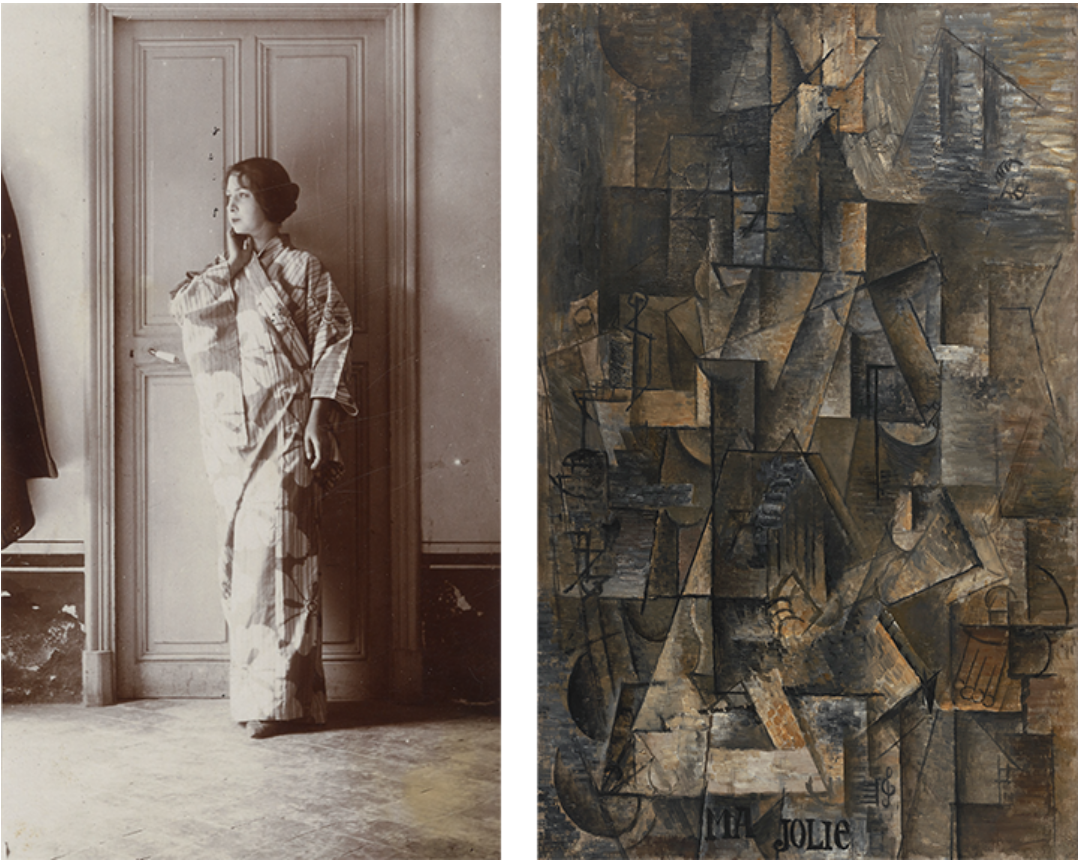
[Left] Eva Gouel, Picasso Archives. Image: Yale University Art Gallery, Beinecke Rare Book and Manuscript Library
[Right] Pablo Picasso, Ma Jolie, 1911-12. The Museum of Modern Art, New York. Image: © The Museum of Modern Art/Licensed by SCALA / Art Resource, NY, Artwork: © 2023 Estate of Pablo Picasso / Artists Rights Society (ARS), New York
Bold and beautiful, Femme en corset lisant un livre exemplifies the lessons learned from this intensive period of radical experiment in the years before war. The flattened sense of pictorial space, complex compositional arrangement, and playful interactions of color, texture, and pattern are all hallmarks of Picasso’s evolving style in these pivotal years. An intimate and innovative depiction of his muse and lover Eva Gouel, commenced just one year before her untimely death, and returned to in the years following, it also marks a triumphant reappraisal of portraiture that would henceforth come to define the artist’s oeuvre more completely than any other genre.
Neo-Classical Period
Tête de femme, 1921
Christie’s London: 28 June 2023
Estimated: GBP 1,000,000 – 1,500,000
GBP 1,250,000 / USD 1,593,215
PABLO PICASSO (1881-1973), Tête de femme | Christie’s (christies.com)
PABLO PICASSO (1881-1973)
Tête de femme, 1921
Oil on canvas
18.6 x 16 cm (7 3/8 x 6 1/4 inches)
Signed and dated ‘Picasso 21’ (upper left)
Painted in Fontainebleau in Summer 1921
Painted in the summer of 1921, Tête de femme is one of the group of classically-inspired goddesses that dominated Picasso’s work at this time. These highly sculptural, rotund Neo-Classical figures had emerged in his art the year prior, and proliferated during the artist’s summertime sojourn in Fontainebleau, the picturesque wooded town and former royal residence south of Paris. Often regarded as the apogee of Picasso’s Neo-Classicism, this trip saw Picasso create a sequence of striking female heads in both pastel and oil, such as the present work. For his family’s annual summer retreat of 1921, Picasso had initially wanted to return to the Mediterranean coast, where he and his Russian ballet dancer wife, Olga, had holidayed the previous year. In February, Olga had given birth to the couple’s first child, a son, Paulo. Keen to remain in close proximity to Paris and avoid the intense heat and social whirl of the Riviera, she wanted to stay somewhere nearby. Picasso acquiesced and the couple rented a large house at 33, boulevard Gambetta in Fontainebleau, the idyllic town beloved by Parisians for its pleasant summer climate. Picasso and his family arrived there in late June. The artist quickly turned an adjacent carriage house into a makeshift studio.
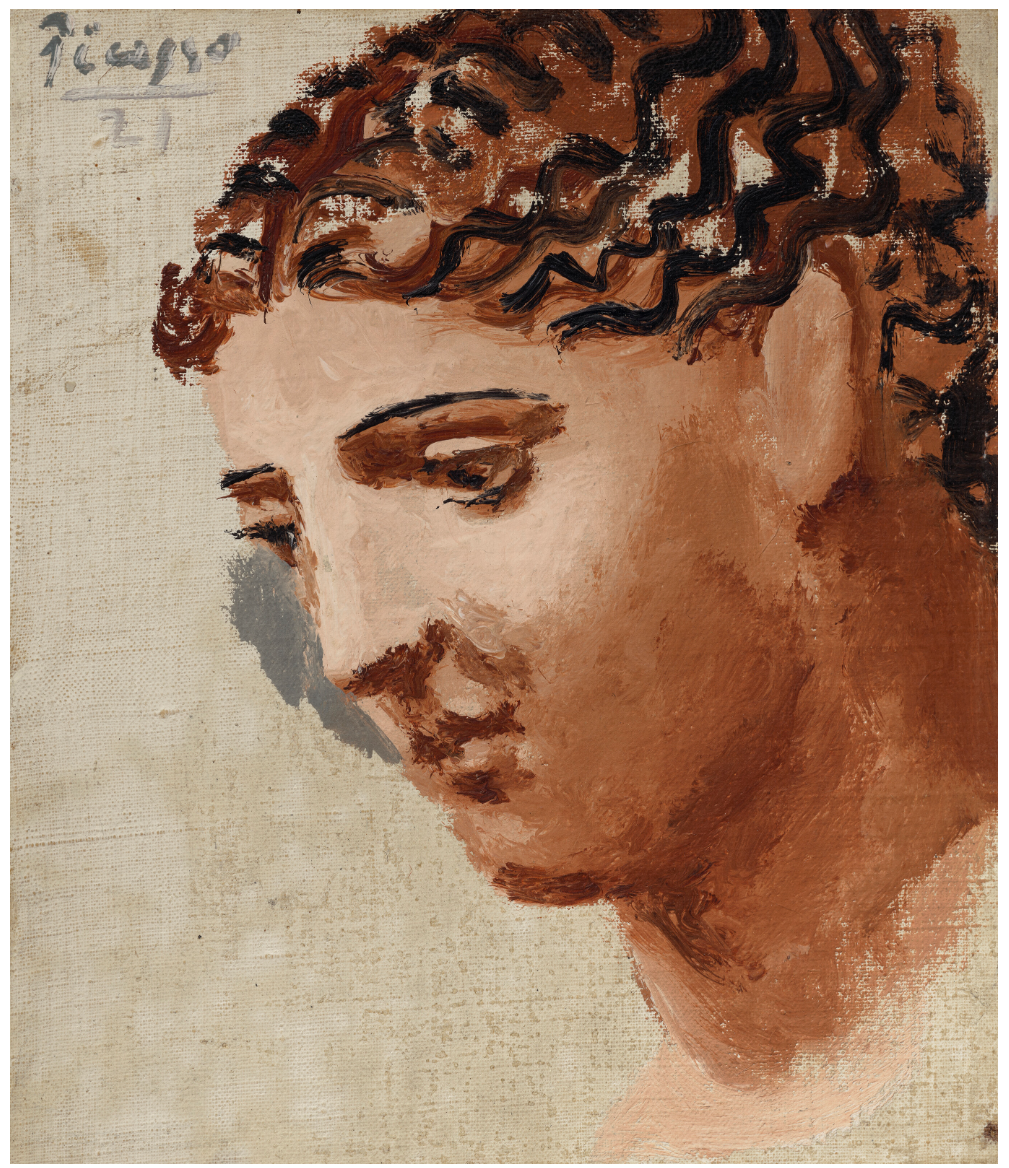
In addition to maternity scenes inspired by his new role as a father, Picasso painted a series of classically-influenced nudes and bathers, of which the large, final Trois femmes à la fontaine (Zervos, vol. 4, no. 322; The Museum of Modern Art, New York) was the culminating work. Belonging to this important series is Tête de femme. With these works, Picasso conceived a new pictorial idiom for the female figure. Whether draped or nude, these figures have the sculptural solidity and idealized features of ancient statuary. Their coiffure, parted in the middle and gently waved, is that of classical goddesses. Pictured as if carved from stone, though painted with black, white and a warm terracotta palette redolent of ancient Greece, these women appear overtly volumetric, monumental and solid. Picasso’s Neo-Classicism is defined by these paradoxical aesthetics, as he created images at once timeless and yet unequivocally modern. The artist’s wife, Olga, posed with a number of these heads in a photograph taken in Picasso’s Fontainebleau studio. With her head downturned, Olga’s classic profile and dark features bear an unmistakable likeness to the portrait heads behind her, yet yet their exaggerated features bear nothing in common with her petite frame. Yet, it is Olga whose presence precipitated Picasso’s Neo-Classical period, her image and character – supposedly coolly refined and reserved – infusing the artist’s depiction of female figures throughout these years. Whether conscious or unconscious on the part of the artist, this photograph makes it evident that there was an aesthetic link between these heads and the artist’s wife. Tête de femme was purchased by the renowned dealer and art collector Heinz Berggruen in 1976, and has remained in his personal collection for almost fifty years. Berggruen had met Picasso through the poet Tristan Tzara in 1950, and he quickly developed a deep appreciation for Picasso’s art. Over the course of his career, Berggruen acquired a large and carefully considered collection of Picasso’s work that spanned his entire oeuvre and showcased his development as an artist.
Still Lifes
Guitare sur un tapis rouge, 1922
Sotheby’s London: 25 June 2024
Estimated: GBP 10,000,000 – 15,000,000
GBP 10,730,000 / USD 13,605,040
PABLO PICASSO (1881 – 1973)
Guitare sur un tapis rouge, 1922
Oil on canvas
80.7 x 116.3 cm (31 3/4 x 45 3/4 inches)
Signed Picasso and dated 22 (lower right)
A celebration of color and form, Picasso’s Guitare sur un tapis rouge from 1922 epitomizes the artist’s bold stylistic evolution in the years following the First World War. Drawing on the Cubist idiom that he had pioneered alongside Braque from 1909-10, Picasso’s still lifes from the subsequent decade are characterized by a vibrant positivity and a newfound appreciation of color indicative of the artist’s ongoing interest in the formal potential of this subject.
Picasso’s development of Cubism remains among the pivotal moments of art history, and the period around 1912 – when he shifted from the complex, fragmented imagery of Analytic Cubism to the simpler shapes and brighter colours of Synthetic Cubism – would prove particularly influential. The flattening of the image, interrogation of two and three-dimensional space and use of collage elements would all inform later artistic developments from the assemblages of Dada through to the use of ‘low’ art objects and images in Pop Art. The guitar proved the perfect vehicle for these experiments, becoming the archetypal motif of Picasso’s Cubism. As Anne Umland writes, the “manipulation of objects – many of which, like the guitar, define volumes (other musical instruments, bottles, wineglasses, cups), although they lack its extreme planarity – may have helped to compel a new visual vocabulary that was at once pictorial and sculptural in motivation and affect” (A. Umland, in Exh. Cat., New York, The Museum of Modern Art, Picasso: Guitars 1912-1914, 2011, p. 22). The interplay and subversion of sculptural and pictorial was the real breakthrough of this second phase of Cubism and was most powerfully expressed in Picasso’s three-dimensional cardboard constructions of guitars and in the now famous sheet-metal versions that he created in 1914.
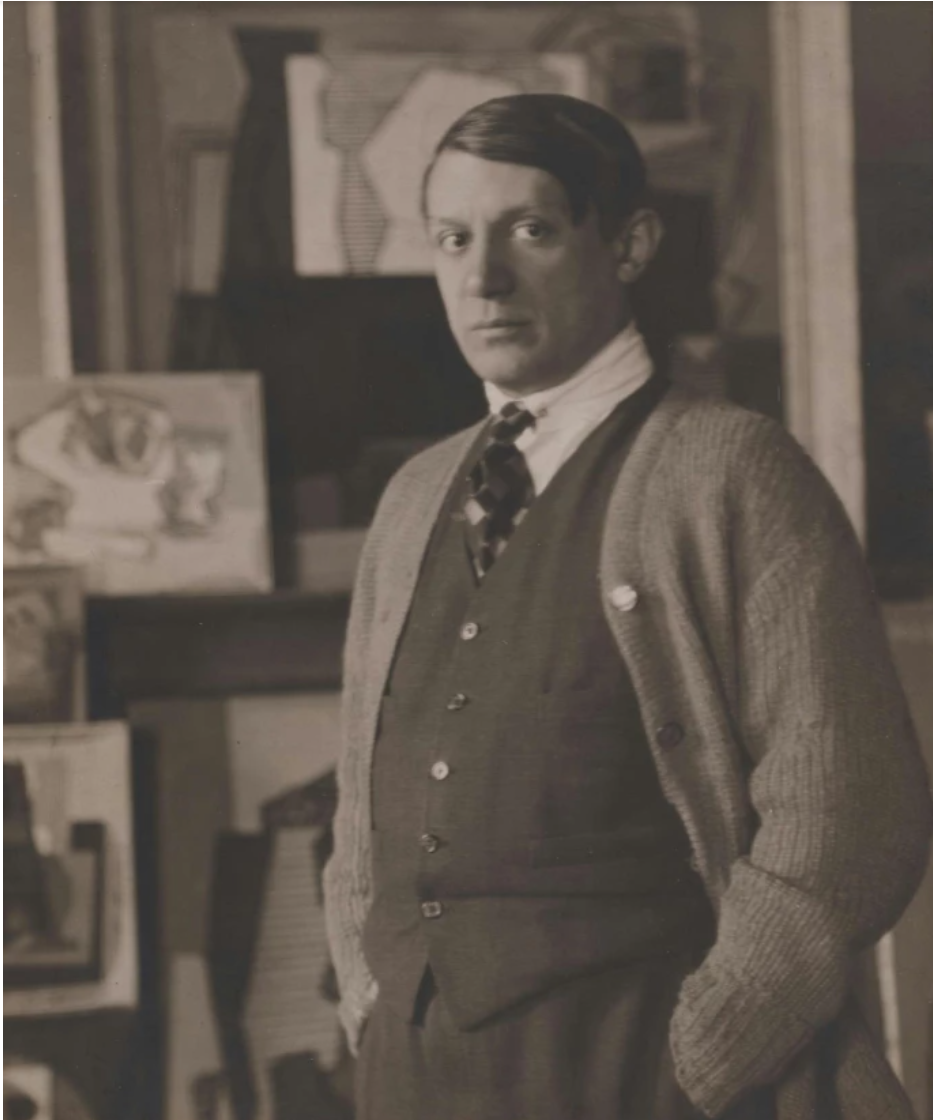
This preoccupation with space and volume would continue despite the hiatus created by the advent of the First World War. The outbreak of war saw the dispersal of the group of artists – Picasso, Braque and the Section d’Or Cubists Gris, Metzinger, Delaunay – who had been associated with the movement, and although Picasso continued to work during these years his style moves between Cubist compositions and more naturalistic portraits and sketches documenting everyday life. This more naturalistic style began to dominate in the years after the war as Picasso – along with many of his contemporaries – embraced the rappel a l’ordre and focused his energies on classical subjects and compositions that – whether figures of still lifes – emphasised balance and order (fig. 3).
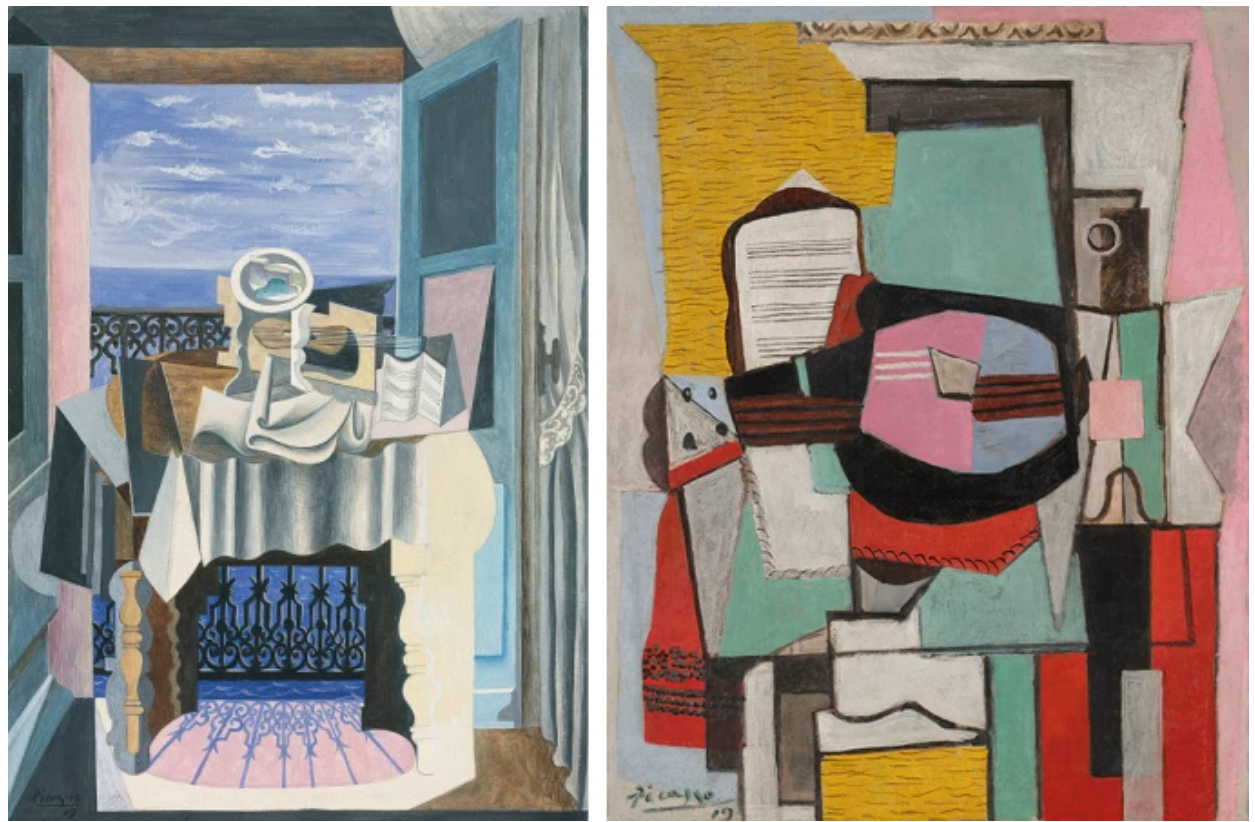
FIG. 3, PABLO PICASSO, NATURE MORTE DEVANT UNE FENÊTRE À SAINT-RAPHAËL, 1919, GOUACHE AND GRAPHITE ON PAPER, STAATLICHEN MUSEEN, BERLIN © SUCCESSION PICASSO/DACS, LONDON 2024
FIG. 4, PABLO PICASSO, GUITARE SUR UN TABLE, 1919, OIL ON CANVAS, SOLD: SOTHEBY’S NEW YORK, NOVEMBER 2022, $37 MILLION © SUCCESSION PICASSO/DACS, LONDON 2024
Painted four years after the end of the First World War, Guitare sur un tapis rouge underscores Picasso’s ability to adapt the radical visual language of Cubism to this new style without compromising his interrogation of pictorial space. Throughout this period Picasso’s approach to Cubism was evolving and the present work marks a shift in his output from what Josep Palau i Fabre termed ‘Linear Cubism’ – more sombre works dominated by grid-like lines (fig. 5) – to the large-scale, vibrantly coloured compositions of 1924 which to some degree mark the high point of his post-war Cubism (fig. 6). Jean Sunderland Boggs describes these later works as “generous and sometimes even exuberant, presumably an expression of prosperity, his domestic contentment, his sexual satisfaction, and a general happiness” (Exh. Cat., The Cleveland Museum of Art, Picasso & Things, 1992, p. 199).
This happiness is shared in the present work, which combines bold planes of red, orange and yellow around the central guitar motif. The detailing in the fretwork of the guitar and the texture of the red rug is typical of these works and indicates a more playful approach on Picasso’s part. The objects have an anthropomorphic tendency too, which contributes to the more lively atmosphere in the still lifes from this post-war period. Throughout these years, Picasso was moving constantly back and forth between the language of Cubism in these still lifes and the classically-inspired forms of the figures that were his other preoccupation. Yet in these radically different styles it is possible to track a kind of co-dependent development too. As Josep Palau i Fabre notes, the full modeling of the neo-classical figures seems to have pushed Picasso towards an ever more pronounced flatness in the Cubist works: “The flatness of these works is far more radical than that of ten years before. Then, in order to obtain it, the artist still had to struggle to overcome some of the notions he had learnt about painterly procedures. Not now. Now the solutions emerged of their own accord; indeed, they were not even solutions, for the artist’s idiom had become fully consolidated” (Josep Palau i Fabre, Picasso: From the Ballets to Drama (1917-1926), Barcelona, 1999, p. 292).
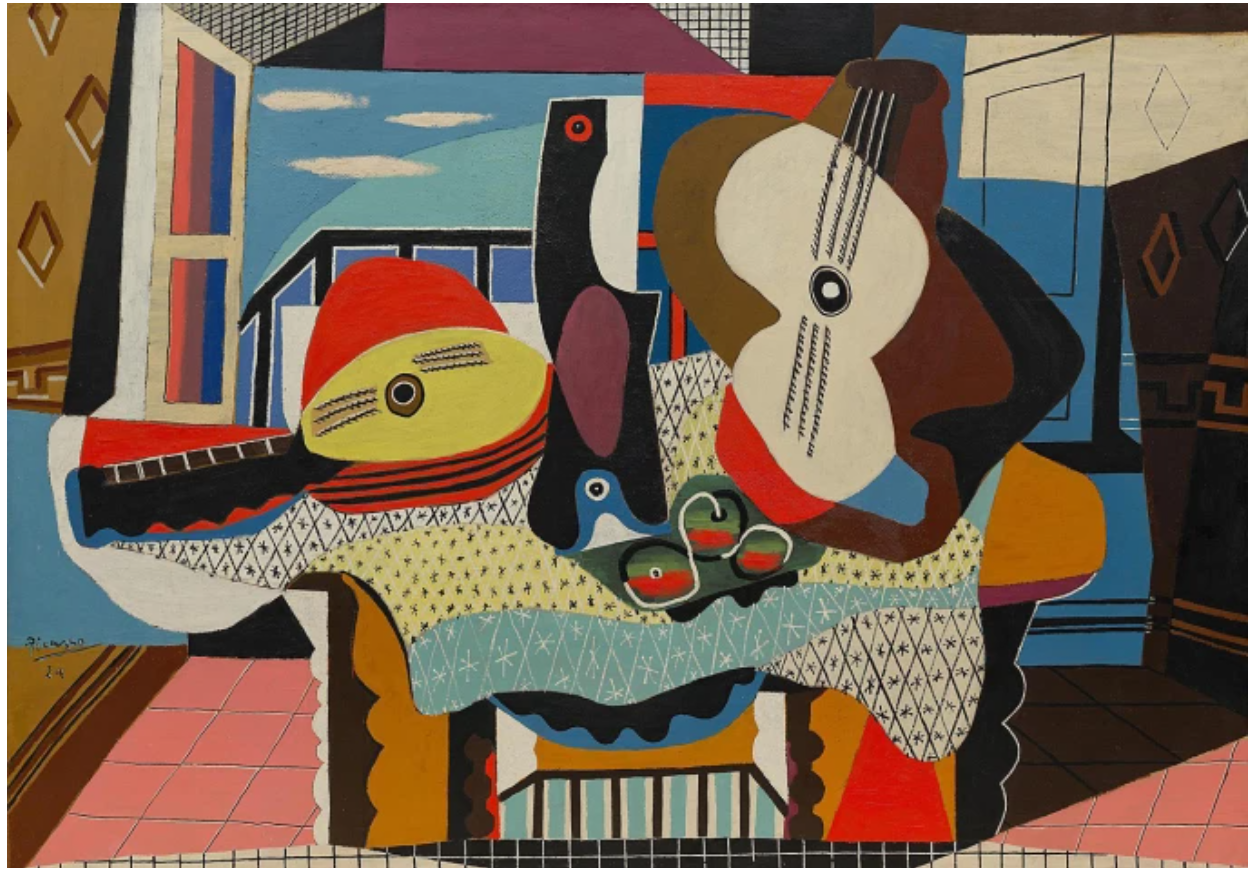
PABLO PICASSO, MANDOLINE ET GUITARE, 1924, OIL AND SAND ON CANVAS, SOLOMON R. GUGGENHEIM MUSEUM, NEW YORK © SUCCESSION PICASSO/DACS, LONDON 2024
In particular, Palau i Fabre observes how although depth is eradicated in favor of rigid two-dimensionality, the naturalistic nature of some of these flat elements force the eye to establish perspective. In the present work this is realized through the red rug which is placed under the guitar and achieves the effect of transforming the entirely flat yellow and orange forms behind into a table top. It is this kind of formal experiment that reveals Picasso’s Cubist work of the 1920s to be not so much the final act of the twentieth century’s greatest artistic movement, but the clear and confident expression of a new visual language and one that he would continue to explore for much of the rest of his life.
The importance of this work within Picasso’s œuvre is reflected in its provenance. It was first acquired by the celebrated dealer and collector Paul Rosenberg. Rosenberg played a major role in promoting European Modernism in the United States and may be that it was as part of these efforts that the work was sold to Walter P. Chrysler Jr., son of the founder of the Chrysler Corporation. Chrysler Jr. began collecting when he was only fourteen and after his junior year at Dartmouth in 1931 undertook a grand tour of Europe spending time in Paris where he met many of the artists he would go on to collect, including Picasso. At some point after this, the work entered the collection of Paul Odo Willert (1909-1998). What little is known about Willert paints a fascinating picture. He lived between Europe, England and the United States in the 1930s and 40s. In 1934 he married Brenda Pearson, the daughter of the 2nd Viscount Cowdray; they lived in the USA where he worked for the New York branch of the Oxford University Press before moving back to Europe in the late 1930s, Durng the war, Willert was posted to Paris working first on “propaganda” missions and then as air attaché with the RAF. They had a wide circle of intellectual and influential friends ranging from Franklin D. and Eleanor Roosevelt to the writer Arthur Koestler and philosopher A.J. Ayer. Willert lent the painting generously throughout his life, first in 1940 to the exhibition at The Museum of Modern Art in New York and then to two important exhibitions at the Tate Gallery London in the 1960s and 70s, including their feted 1960 Picasso retrospective which was the largest exhibition of the artist ever held in England attracting half a million visitors.
Citrons et verre, 1944
Christie’s New-York: 18 May 2024
Estimated: USD 1,000,000 – 1,500,000
USD 1,071,000
https://www.christies.com/en/lot/lot-6481453
PABLO PICASSO (1881-1973)
Citrons et verre, 1944
Oil on canvas
26.7 x 41.3 cm (10 5/8 x 16 1/4 inches)
Signed ‘Picasso’ (upper left)
Dated ‘14.1.44.’ (on the reverse)
Painted on 14 January 1944
Painted on 14 January 1944, the present Citrons et verre belongs to a series of still lifes Picasso created during World War II. Here, a lemon cut open in two and a glass are presented on a table, a simple yet commanding composition where the brightness of the fruit contrasts with the commanding black brushstrokes that outline the objects and highlight their geometrical forms. It belongs to a series of of five works begun on 10 January, and culminating in three close composition painted four days later (Zervos, vol. 13, nos. 223-225, 227 and 228).

Paul Cezanne, Nature morte, pot à lait et fruits sur une table, circa 1890. Nasjonalgalleriet, Oslo. Digital image: Bridgeman Images.
The still life dominated Picasso’s wartime work. Deemed a ‘degenerate’ artist by the Nazis, and choosing to remain in occupied Paris, the artist was forced to retreat to his studio during this time, entertaining friends and visitors there, and withdrawing from the café culture that had been so present in his life the years prior. Picasso, with characteristic zeal, threw himself wholeheartedly into his art. Turning to his immediate surroundings, he made the cups, pots, and quotidian trappings of his rooms his subject matter. Although resources were limited, Picasso nevertheless imbued these canvases with a profound pathos; the paintings not only serves as a record of life in the occupied city but also as an allegory of human suffering. ‘It was,’ he later reflected, ‘not a time for the creative man to fail, to shrink, to stop working. There was nothing else to do but work seriously and devotedly, struggle for food, see friends quietly, and look forward to freedom’ (P. Picasso, quoted in M. McCully, ed., A Picasso Anthology: Documents, Criticism, Reminiscences, Princeton, 1981, p. 224).

In the present work, the lemon presents a beacon of light during a dark and cold time—perhaps a gift from someone returning from the Midi, or a black market purchase. Simple items such as fruits had become a rare delicacy in occupied Paris, particularly in the middle of the winter, when everything was in short supply. The lemon therefore presents not only as a found object for a still life, but also as an insight into war-time living, a glimpse of hope in a long winter. Picasso’s interest in the works of Vincent van Gogh, the leading name on the Nazis’ list of proscribed degenerate artists, is manifest here as well, especially in the use of directional strokes of color to create a woven effect in the paint’s surface. While in some of the still-life paintings objects take on the memento mori role one would expect in wartime, for the most part, the elements Picasso has chosen to paint here express a quiet and plainly stated joy in the fact of their mere existence, in a time when survivability was not to be taken for granted.

Vincent van Gogh, Plats avec agrumes, 1887. Van Gogh Museum, Amsterdam (Vincent van Gogh Foundation).
A few months prior, in May of 1943, Picasso met Françoise Gilot at Le Catalan, a restaurant close by to his studio. Describing her first encounter with the artist, Gilot explained that she had been dining with her school friend Geneviève Aliquot and the actor Alain Cuny when she noticed Picasso glancing their way: ‘Finally, he got up and came over to our table. He brought with him a bowl of cherries and offered some to all of us, in his strong Spanish accent, calling them cerisses, with a soft, double-s sound’ (F. Gilot and C. Lake, Life with Picasso, New York, 1964, p. 14). The meeting lead to an invitation to Picasso’s studio, and after weeks of courtship, the two artists embarked upon a romantic partnership that lasted almost a decade and produced two children. This new love interest amidst war time provided a new escape, a new hope, visible in the present work from the artist’s use of vivacious yellow, electric greens and vivid streaks of red. Citron et verre once belonged to the poet Pierre Reverdy—the two artists became friends in the early 1910s, and collaborated on Le chant des morts, a book of poems written by Reverdy and illustrated by Picasso, published shortly after the war. The present painting has remained in the same private New York collection since 1987.
Nature morte, pichet et fruits, 1939
Sotheby’s New-York: 16 May 2024
Estimated: USD 1,200,000 – 1,800,000
USD 1,512,000
https://www.sothebys.com/en/buy/auction/2024/modern-day-auction-3/nature-morte-pichet-et-fruits
PABLO PICASSO (1881 – 1973)
Nature morte, pichet et fruits, 1939
Oil on paper laid down on board
28.8 x 43 cm (11 3/8 x 17 inches)
Signed Picasso and dated 12.2.39. (upper left)
Executed on 12 February 1939
Alongside the powerful and opposing portraits of Dora Maar and Marie-Thérèse Walter that Pablo Picasso painted during the 1930s, the artist also produced a series of lyrical still-life paintings during what is arguably his most expressive and sought-after decade of production. Executed amidst a background of increasing political crisis in Europe, the still-lifes of the 1930s offered the artist an alternative vehicle through which he could turn inwards, away from the overtly political, to examine his own personal reflections through subtler allusions. Nature Morte, pichet et fruits is a prime example from this important period and further reiterates how the artist was able to imbue great meaning through seemingly simple yet symbolic colors, lines and forms. Picasso’s engagement with the still life genre owes a debt to the painter from whom he drew inspiration throughout his career: Paul Cézanne. While Cézanne’s influence is undeniable in Picasso’s Cubist works of the early 1900s and 1910s, in the present work, Picasso also borrows his distinct ability to construct form through the color and shares his rejection of linear perspective. The exaggerated black outlines of the fruit, flattened picture plane, and setting in a tonal study of tint and shade are all hallmarks of the modern master, yet their employ is pushed further into abstraction by Picasso’s hand.
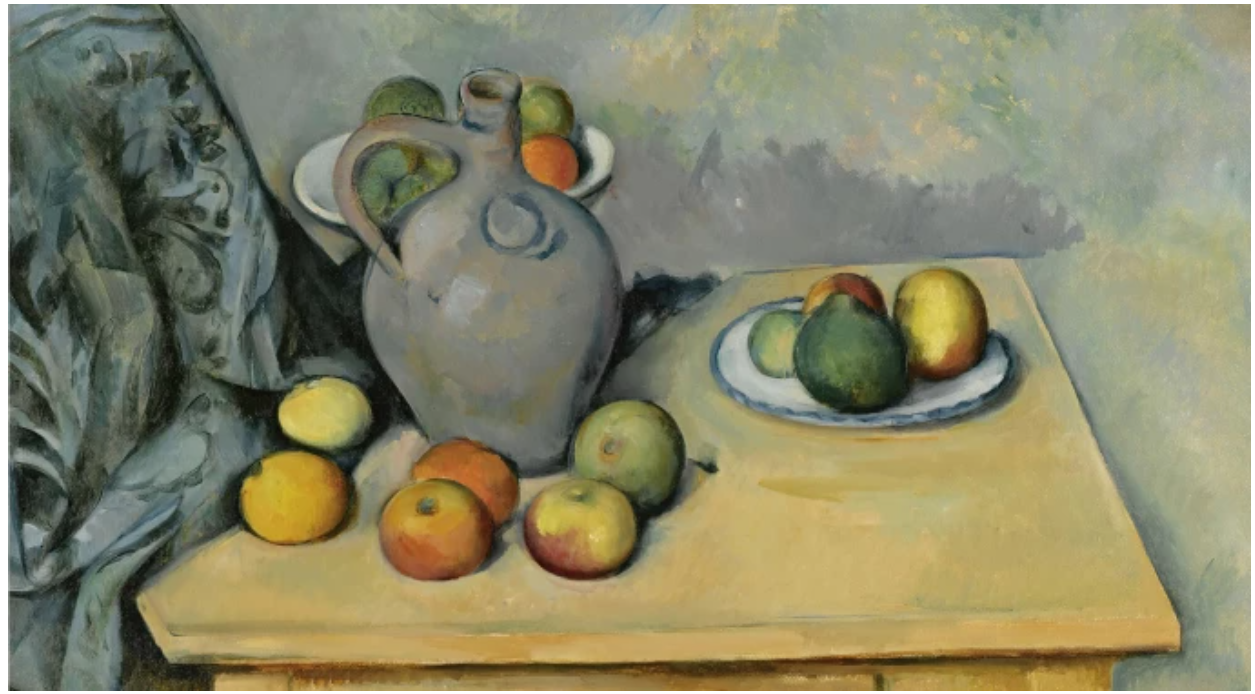
PAUL CÉZANNE, PICHET ET FRUITS SUR LA TABLE, 1893-94. SOLD: SOTHEBY’S, LONDON, 3 FEBRUARY 2010, LOT 5 FOR £11,801,250
Executed in 1939, the present work comes from an important period for the artist when the subject took on a particularly personal significance and whereby Picasso drew upon the symbols of the domestic everyday to channel his creative energy away from the uncertainty and chaos flowing throughout Europe. Aside from his monumental Guernica of 1937, commissioned by the Spanish Republican government to draw attention to the devastation wrought by Franco and his Nazi allies in the Spanish Civil War, Picasso avoided literal depictions of the historic events of the Second World War.
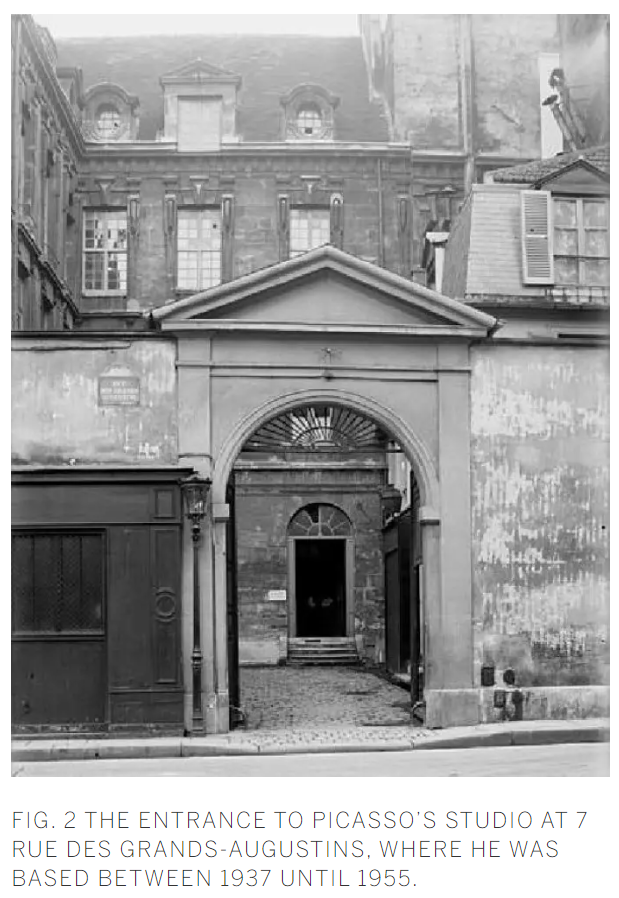
By the end of the 1930s, with the Vichy government poised to take power in France, Picasso, now a public opponent of fascism after Guernica, found himself increasingly regulated to his Parisian studio at 7 rue des Grands-Augustins. Despite his physical remove from political upheaval from within the confines of his studio, Picasso’s deeply emotional involvement with his art persisted. Forced to focus more intently on his immediate surroundings, the contents of his studio took on emotional weight and significance.
As in the present work, Picasso naturally came to associate such ‘vessels’ with the subject that had otherwise preoccupied the earlier part of the decade: his lovers. By 1939, the artist’s soft and sensual depictions of Marie-Thérèse had begun to wane in their frequency, while Dora Maar had become his principle muse, her more angular, piercing features became increasingly present within his oeuvre.
“I want to tell something by means of the most common object. For example, a casserole, any old casserole, the one everybody knows. For me it is a vessel in the metaphorical sense, just like Christ’s use of parables.”
The artist’s individual relationships with his two muses can seemingly be read in the present work, the soft contours and coloring of the fruit representing Marie-Thérèse and her maternal sensibilities, while the jagged silhouette and heavy shading of the pitcher at right allude to Maar’s sharp wit and tempestuous disposition. While the fruit and pitcher occupy relatively equal halves of the composition, the pitcher, larger in scale, leans imposingly over the fruit on the table below, possibly implying the gradual encroachment of Maar on Marie-Thérèse’s position in Picasso’s life. The same month the present work was painted, Paul Rosenberg showed 32 paintings in an exhibition titled Nature mortes. Some of these pictures had clear references to the political unrest, such as Ox skulls, however, others more similar to the present work, placed domestic items such as the pitcher at the forefront, alluding to the ‘eternal feminine’ they represented that would serve as a profound source of inspiration for decades.
Nature morte à la bougie, 1944
Christie’s London: 7 March 2024
Estimated: GBP 2,500,000 – 3,500,000
GBP 2,157,500 / USD 2,735,710
PABLO PICASSO (1881-1973), Nature morte à la bougie | Christie’s (christies.com)
PABLO PICASSO (1881-1973)
Nature morte à la bougie, 1944
Oil on canvas
63.2 x 91.7 cm (24 5/8 x 36 1/8 inches)
Signed ‘Picasso’ (lower left) and dated ‘4 avl 44’ (on the reverse)
Painted on 4 April 1944, Nature morte à la bougie is one of a series of still lifes that presents a small selection of quotidian objects set upon a tabletop in Pablo Picasso’s rue des Grands-Augustins studio in Paris. A candlestick, coffee pot, and accompanying cup stand, flanked by an ornate mirror and chair. One of two large still lifes he painted on this day, the present work shows Picasso’s exploration into the effects of candlelight over the scene. Though the candle is extinguished, the scene is filled with light, the cafetière casting a dramatic shadow through the composition. The still life dominated Picasso’s wartime work. Though he had been deemed a ‘degenerate’ artist by the Nazis, Picasso had nevertheless chosen to remain in occupied Paris. He retreated to his studio during this time, entertaining friends and visitors there, and withdrawing from the café culture that had characterized his life in the years prior. Using a small repertoire of objects – cups, pots, skulls or food – Picasso invested these quotidian scenes with symbolic and sometimes allegorical meanings. In the present work, the coffee pot conveys a luxury in wartime Paris: coffee was a precious commodity and hard to come by. The candlestick is another key symbol. On the pendant still life painted the same day (Zervos, vol. 13, no. 255, Private collection), the candle is lit, illuminating the rest of the shadowy scene.
Compotier et guitare, 1932
Sotheby’s New-York: 13 November 2023
Estimate on Request
USD 23,463,500
Compotier et guitare | Modern Evening Auction | 2023 | Sotheby’s (sothebys.com)
PABLO PICASSO (1881 – 1973)
Compotier et guitare, 1932
Oil on canvas
97.1 x 130.1 cm (38 1/4 x 51 1/4 inches)
Signed Picasso and dated 13.2.32 (lower right); dated and titled (on the stretcher)
Lauded as one of the most important periods of Picasso’s career, the year 1932 proved an incomparably fertile time for the artist. Painted just before Valentine’s Day, on the 13th of February 1932, Compotier et guitare is a triumph of the artist’s oeuvre and an ode to one of Picasso’s most indelible muses, Marie-Thérèse Walter. From December 1931 to April 1932, Picasso executed more than thirty new paintings intended for the upcoming retrospective. Historian Jack Flam later described this exuberant period as a time of “manic energy” and “appropriation of Matisse’s style and subject matter [which] grew out of his desire to produce an ecstatic outpouring of painted love poetry to Marie-Thérèse” (Jack Flam, Matisse and Picasso, 2003, p. 155). Works like Compotier et guitare provided a direct riposte to Matisse, whose odalisques from the 1920s garnered much acclaim and admiration just a few years earlier.
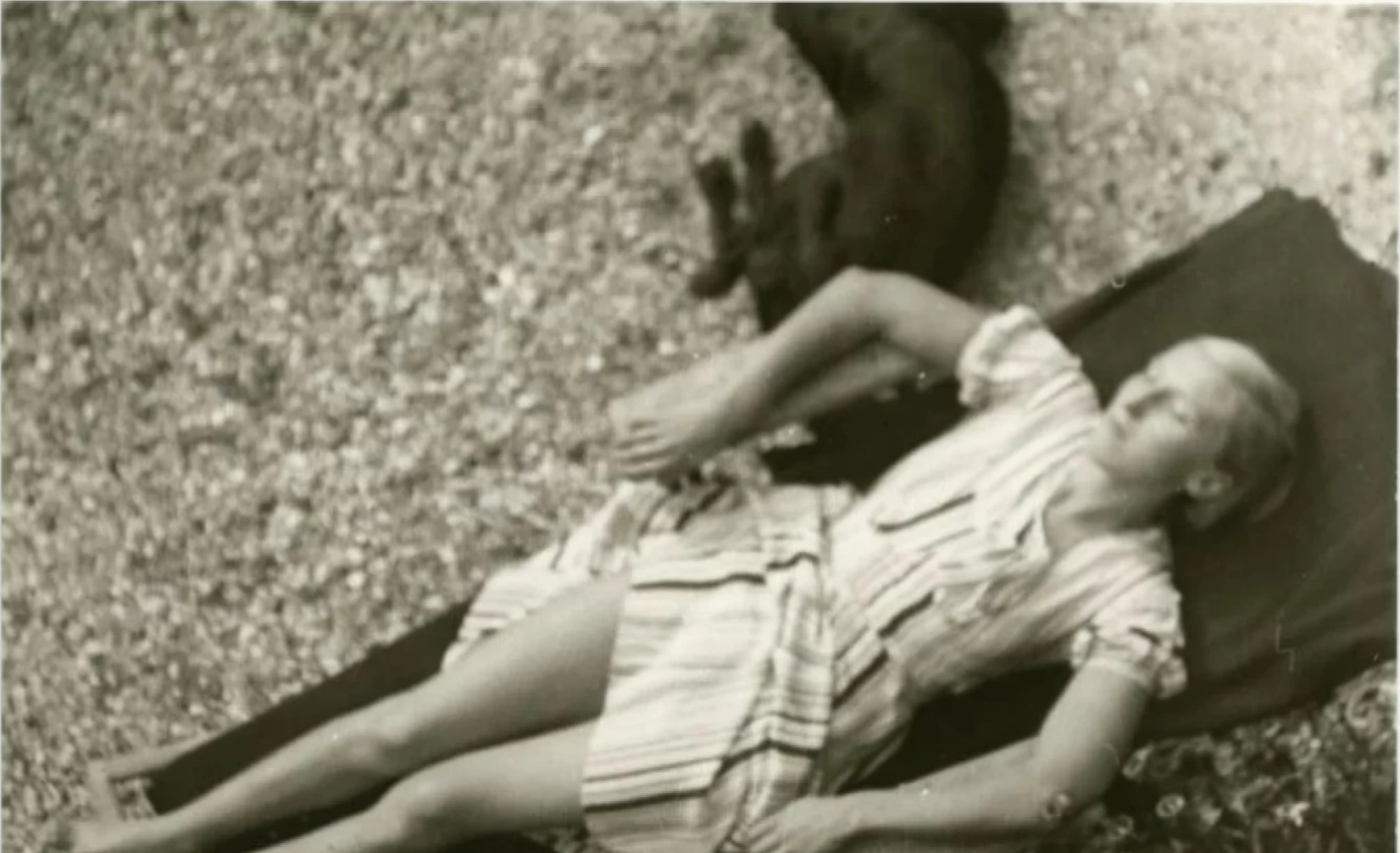
The present work captured the sumptuous palette of gold, vermillion and viridian utilized in Matisse’s Odalisque couchée from 1926 (see figs. 2-3) and reiterated its patterned background and arabesque curves. With Compotier et guitare, Picasso reimagined the reclining nude as a still life, with the curves and lines of the bowl, drapery and instrument echoing Matisse’s odalisque in reimagined forms. While the bold palette of Compotier et guitare is largely indebted to Matisse, the inspiration for this work and nearly all his paintings from 1932 stemmed directly from his l’amour fou with Marie-Thérèse. The covertness of their liaison had only intensified Picasso’s infatuation over the years, his growing obsession with the young woman resulting in increasingly erotic imagery. The intoxicating ardor culminated in 1932 with a suite of monumental canvases featuring sensual still lifes and seductive nudes that irrefutably affirmed Marie-Thérèse’s presence in Picasso’s life.
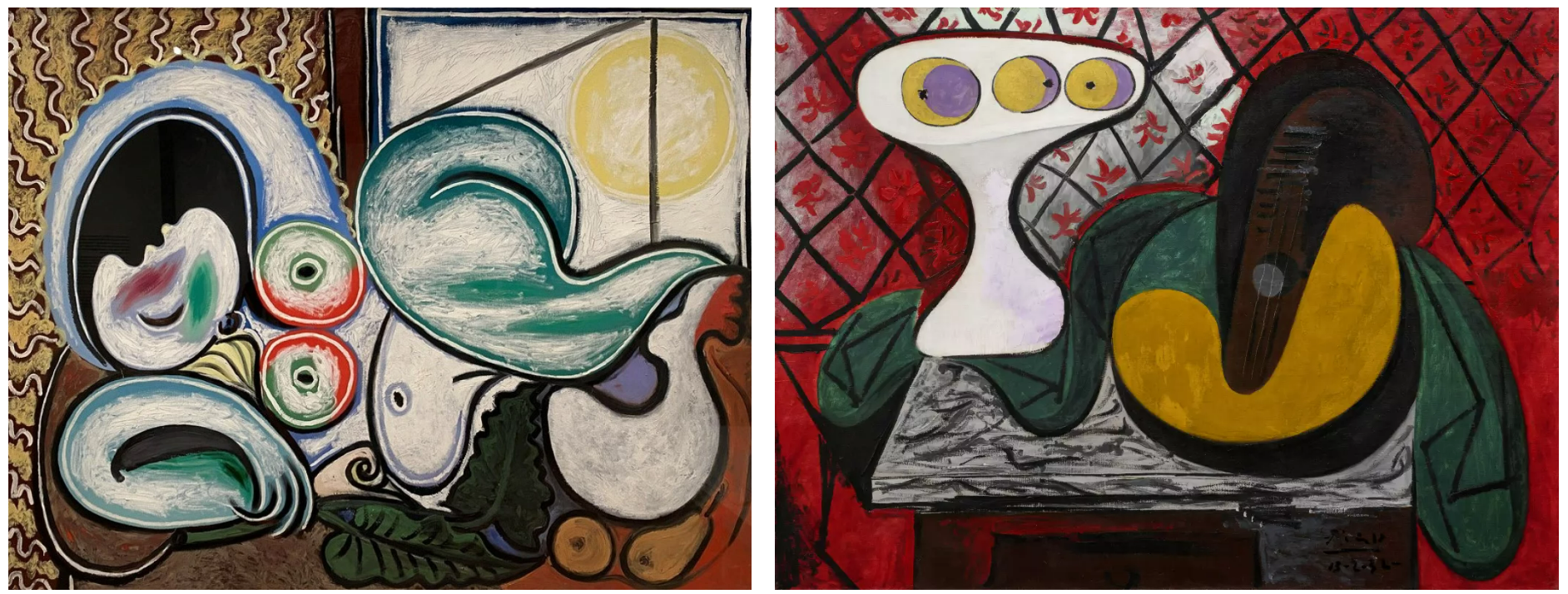
LEFT: PABLO PICASSO, NU COUCHÉ, 4 APRIL 1932, MUSÉE PICASSO, PARIS; RIGHT:THE PRESENT WORK © 2023 ESTATE OF PABLO PICASSO / ARTISTS RIGHTS SOCIETY (ARS), NEW YORK;
In the present work, the three pieces of fruit rendered in pale yellow and lavender serve as direct references to Marie-Thérèse. Standing in contrast to the audacious reds and emphatic contour lines of the rest of the work, the gentle palette of white, yellow and purple at left of the composition is a hallmark of Picasso’s depictions of his muse. Among the most prominent forms in the present work is the large two-toned guitar at the right of the composition. While the symbol of the guitar had long appeared in Picasso’s work and often in suggestive contexts, the present composition presents the object in a highly sexualized manner, as the curved neck of the instrument seems to penetrate the swelling body of the guitar. By contrast, the delicately rendered fruits—themselves a timeless emblem of fertility—echo his lover’s breasts and navel as exemplified by the comparison with Picasso’s Nu couché, now at the Musée Picasso in Paris (see fig. 13). Connected by the green drapery, these curvilinear forms combine to trace the outline of Picasso’s slumbering muse.
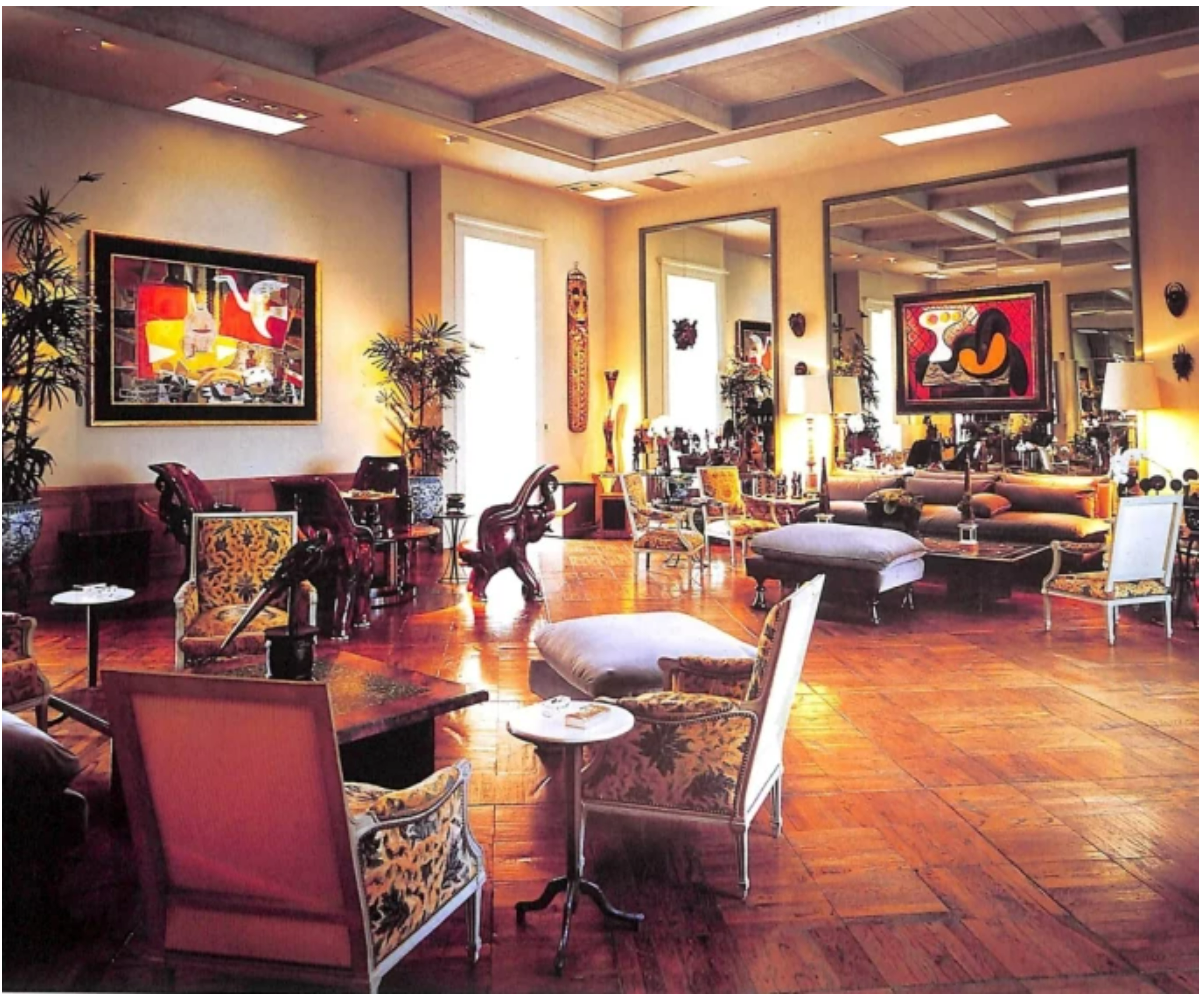
THE PRESENT WORK IN THE LIVING ROOM OF BILLY MCCARTY-COOPER’S RESIDENCE ON ORIOLE LANE, WEST HOLLYWOOD. ARTWORK © 2023 ESTATE OF PABLO PICASSO / ARTISTS RIGHTS SOCIETY (ARS), NEW YORK;
Such a complex and monumental work is accompanied by an equally illustrious provenance. Shortly after the 1932 exhibition, Compotier et guitare entered the collection of Paul Rosenberg, one of the twentieth century’s most influential dealers. A few years later, the critic, patron and friend of the artist Douglas Cooper acquired the painting from Rosenberg in exchange for Paul Cézanne’s La Préparation du banquet, now held in the The National Museum of Art in Osaka. An esteemed intellectual and collector, Cooper was the first scholar to write a major history on the Cubist movement. In all, his collection totaled nearly 150 works—many of them Cubist compositions—which came from the distinguished collections of Zoubaloff, Kahnweiler and Léonce Rosenberg. The present work remained in his collection until his death in 1984, after which it was inherited by his long-time partner, designer and philanthropist William “Billy” McCarty-Cooper.
Nature morte, compotier avec fruits, pot avec fleurs, 1939
Christie’s New-York: 11 November 2023
Estimated: USD 800,000 – 1,200,000
USD 2,833,000
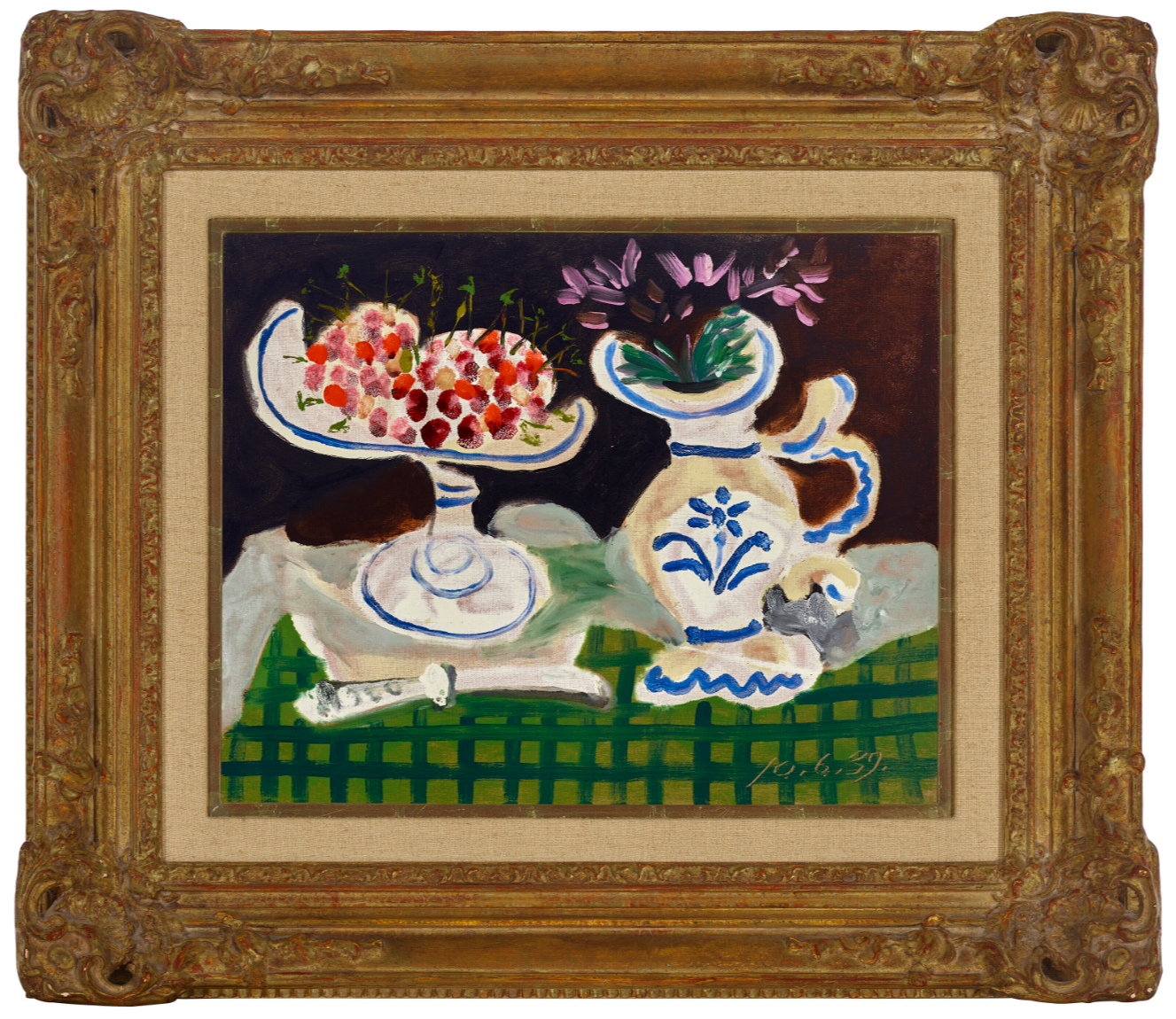
PABLO PICASSO (1881-1973)
Nature morte, compotier avec fruits, pot avec fleurs, 1939
Oil on canvas
33 x 41.3 cm (13 x 16 1/4 inches)
Dated ‘10.6.39.’ (lower right)
Painted on 10 June 1939
Alongside the iconic series of majestic, searingly colored, powerful portraits of Dora Maar and Marie-Thérèse Walter that Pablo Picasso painted in 1939, he also made several uncomplicated still-life’s that feature, as in Nature morte, compotier avec fruits, pot avec fleurs, a flower-filled jug accompanied by a bowl of fruit. This was a time of feverish creation in Picasso’s life. Amidst the ever-worsening political crises that plagued Europe—Picasso’s native Spain was consumed by the Civil War, meanwhile France, his adopted home, was also sliding ever closer to war—he worked at an astonishing, near confounding pace, constantly switching between styles, subjects and his two muses of the time, Maar and Walter. Together these paintings, infused with rich color and dominated by curving, sensuous lines, show no sign of the angst of the times. Instead they embody a blissful sense of escapism, an embrace of life in its simplest, everyday form. At the time that he painted the present work, Picasso was living between his studio in Paris and Le Tremblay-sur-Mauldre, near Versailles. In the autumn of 1936 Picasso had been forced to give up his beloved château at Boisgeloup as part of the separation agreement he had come to with his wife Olga. In need of another retreat away from the cosmopolitan world of Paris and heeding to Walter’s wish to live in the countryside, the art dealer Amboise Vollard offered Picasso the use of an old farmhouse. With Walter and their young daughter Maya settled there, Picasso divided his time between Paris, where he spent the week with Dora Maar, and Le Tremblay, where he spent the weekend ensconced in family life, living a contented domestic idyll. Characterized by an atmosphere of tranquil, rural charm, his still-lifes, including the present Nature morte, encapsulate Picasso’s desire to forget the world around him and instead indulge in the simple, unchanging pleasures of life.
For Picasso, painting, and particularly the genre of still life, had always been deeply autobiographical.
“I paint the way some people write their autobiography. The paintings, finished or not, are the pages of my journal, and as such they are valid.”
In the early 1930s, at the peak of his passionate but secret affair with Marie-Thérèse, Picasso had painted vibrant still lifes that are steeped in eroticism. Ripe fruit and exaggeratedly anthropomorphized objects depicted with bold color and generous brushstrokes served as thinly veiled stand-ins for the sensual undulating curves and youthful vitality of his young muse. In Nature morte, compotier avec fruits, pot avec fleurs, the same curvilinear language can be seen in the undulating shape of the stemmed fruit bowl and volumetric form of the painted jug suggesting the female form. It is fitting that the first owner of the present painting was Marie-Thérèse.
Guitare sur une table, 1919
Sotheby’s New-York: 14 November 2022
Estimate on Request
USD 37,092,500
Guitare sur une table | Modern Evening Auction | 2022 | Sotheby’s
PABLO PICASSO (1881 – 1973)
Guitare sur une table, 1919
Oil on canvas
100 x 80.7 cm (39 3/8 x 31 3/4 inches)
Signed Picasso and dated 19 (lower left)
A symphonic array of form and pigment, Picasso’s Guitare sur une table from 1919 epitomizes the artist’s bold stylistic evolution in the years following the First World War. Drawing on the Cubist idiom pioneered alongside Braque beginning around 1907-08, Picasso’s still lifes from the subsequent decade reveal a heightened liveliness and levity paired with a dynamic and newfound appreciation of color.
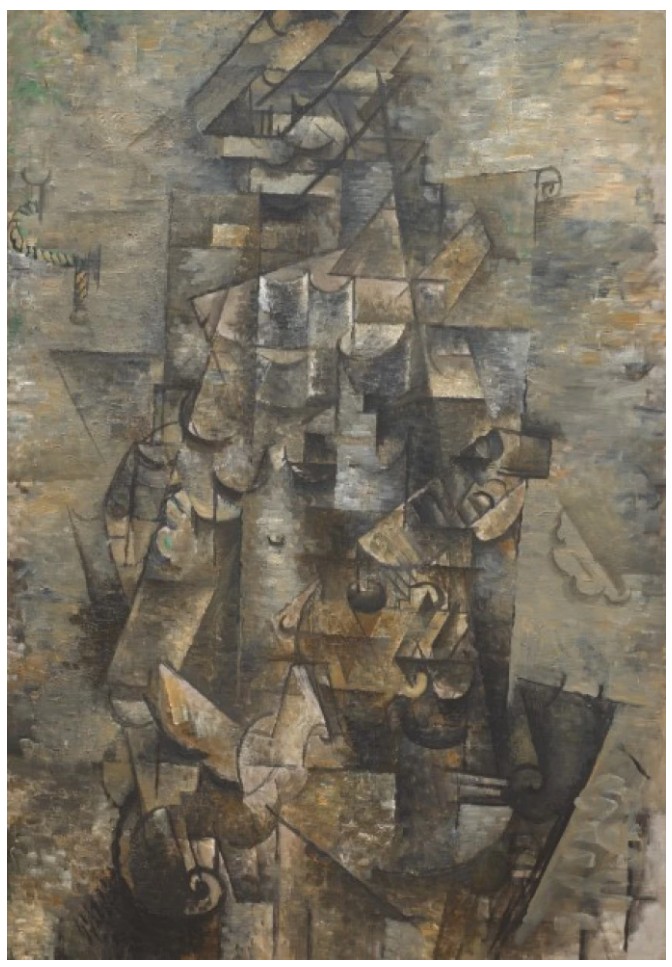
Georges Braque, Man with a Guitar, summer 1911-early 1912, oil on canvas, The Metropolitan Museum of Art, New York
© 2022 Artists Rights Society (ARS), New York
The intertwined artistic dialogue between Braque and Picasso in the late 1900s and early 1910s spurred on the development of an entirely new visual mode. Their single-minded focus on the dissection and representation of a three-dimensional form in an inherently two-dimensional medium forever transformed the tapestry of Modern art. Later termed Analytical Cubism, the style of the resultant compositions centered around the fragmentary examination of an object as seen through multiple, concurrent and overlapping viewpoints. The palettes of Braque and Picasso during this time were characteristically muted so as not to distract from the formal structure of the composition. Over the course of the following decade, however, such planar compositions would be liberated from the highly systematic crystallized panes of grey and brown as Picasso and his fellow Cubists moved into a new phase of Synthetic Cubism. Defined by its increasingly eradicated sense of depth and inclusion of mixed media, this phase beginning in the early 1910s also brought with it an expanded use of color.
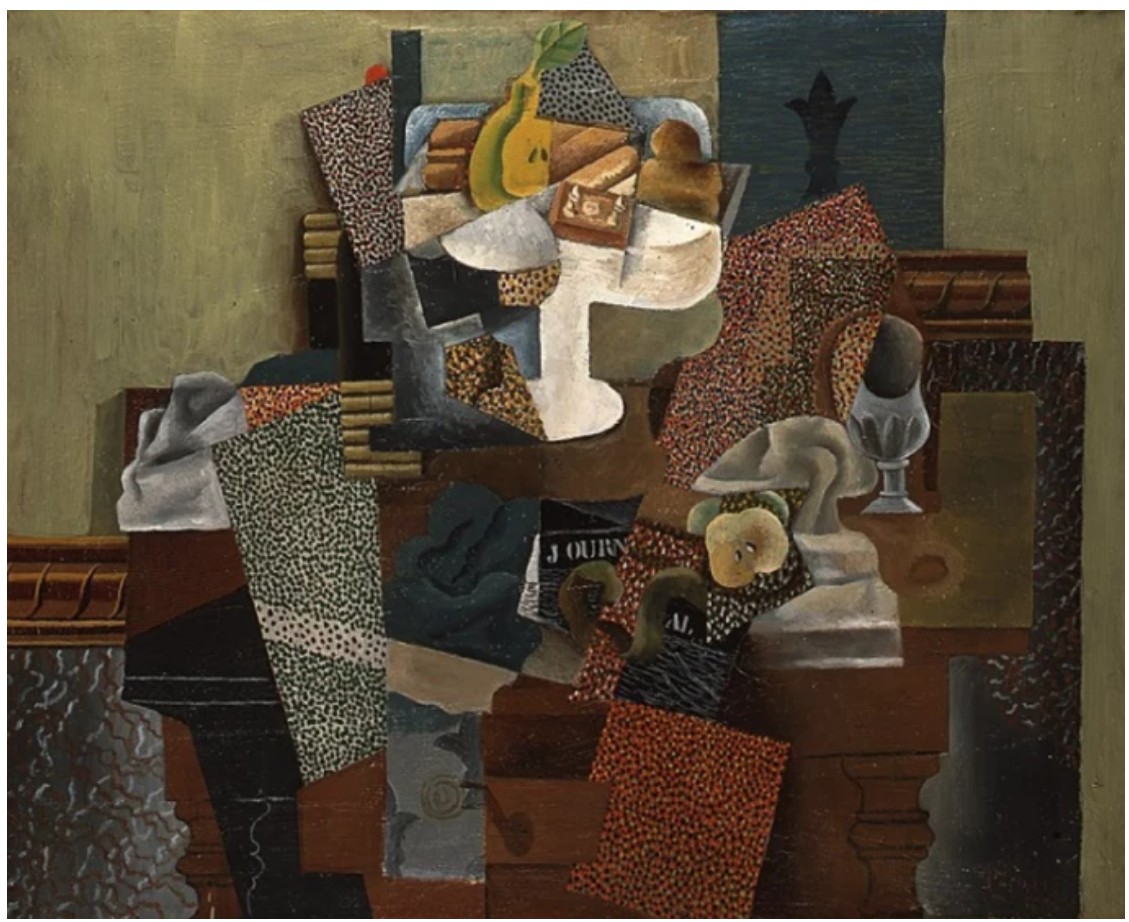
Pablo Picasso, Nature morte au compotier, 1914-15, oil on canvas, Columbus Museum of Art, Ohio
© 2022 Estate of Pablo Picasso / Artists Rights Society (ARS), New York
By the summer of 1914, however, Picasso had parted with his Cubist colleagues Braque and Derain, who as French nationals had left for their military service, thus effectively ending the close collaboration that had so deeply influenced the movement. For Picasso, the ensuing war years would be spent enmeshed in a very different milieu as he traveled between Paris, Italy and Spain for his latest project with Serge Diaghilev’s Ballets Russes. As a set and costume designer for Diaghilev and Jean Cocteau’s Parade—a ballet centered around a traveling circus troupe—Picasso’s projects channeled both the Cubist abstractions of his most recent work as well as the Saltimbanques of his earlier Rose Period.
Enlivened post-war compositions like Guitare sur une table recall the artist’s favored motifs from his earlier still lifes, the musical instruments, fruit bowls and bottles of the prior decade reimagined in planes of abundant color with trompe l’oeil patterns standing in for his earlier papiers collés. In the present work, space is compressed in two-dimensional expanses of color, juxtaposed as if sheets of cut-and-pasted paper. Set against a dramatic halo at center, the guitar comes to the fore, constructed with pink, blue, brown and red, while the teal table upon which it rests is echoed by the expansive blue sky in the intersecting window. As in the classicized version of Nature morte devant une fenêtre à Saint-Raphaël, the sunlit windowpane and foreground are illuminated in matching pale colors, here in a striated yellow. Of this period in Picasso’s career, art historian Jean Sutherland Boggs writes, “He was never more inventive […] more cheerful, more delighted with color and pattern.” With their enriched and liberated palettes, the post-war still lifes amounted to a pronouncement of “cubism enjoyed” (Exh. Cat., The Cleveland Museum of Art, Picasso & Things, 1992, p. 152).
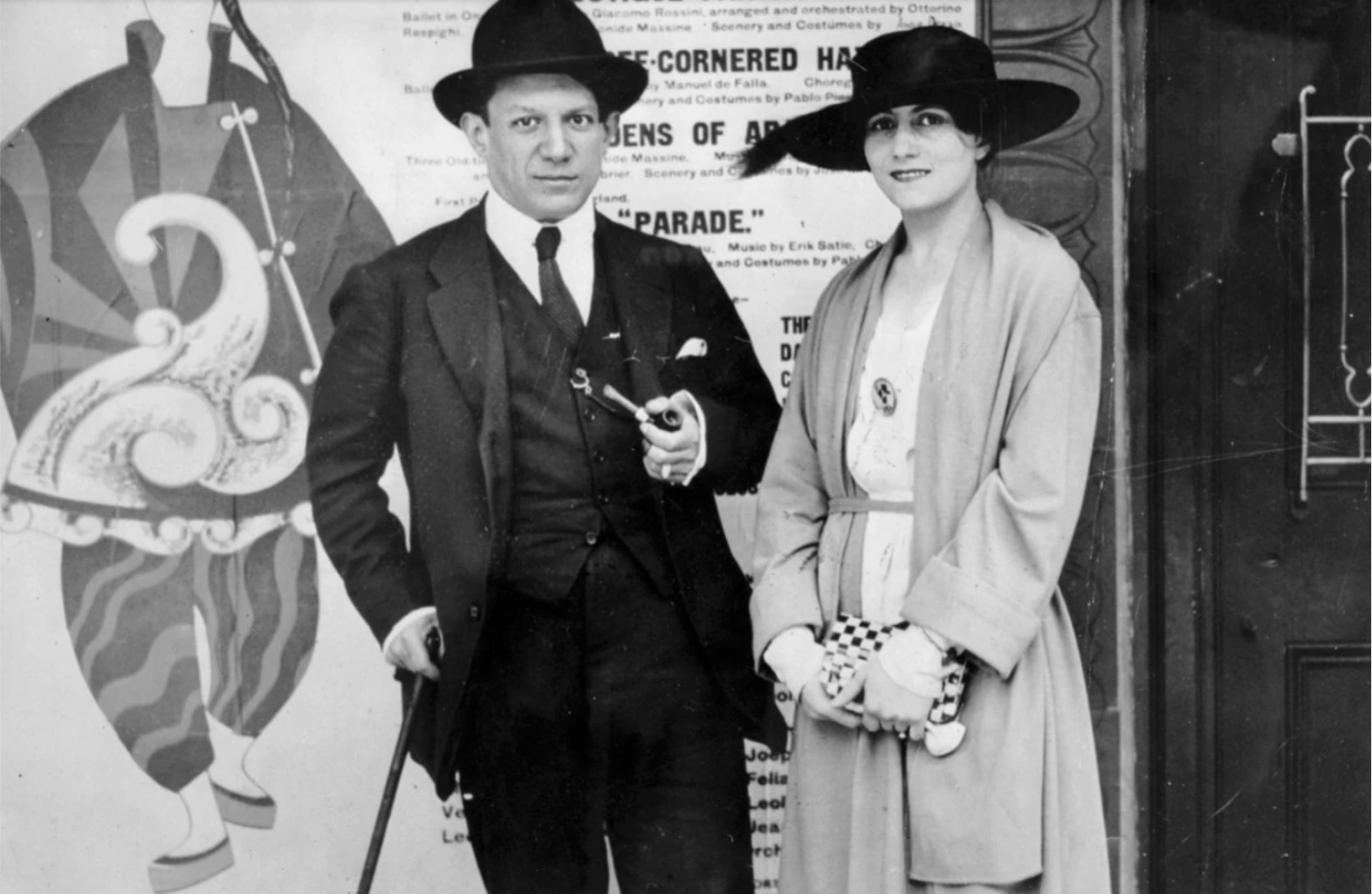
Pablo Picasso and Olga Khokhlova, circa 1918. Photograph by Fine Art Images/Heritage Images/Getty Images; likeness © 2022 Estate of Pablo Picasso / Artists Rights Society (ARS), New York
The inspiration for this particular scene, that of the still life in front of an open window, was born out of a holiday on the Côte d’Azur. After spending much of 1919 in London with the Ballet Russes, Picasso and his new wife Olga Khokhlova (a ballerina from the company) returned to Paris, traveling thereafter to the small southern town of Saint-Raphaël. Situated in their elegant suite overlooking the Mediterranean, Picasso soon alighted on his newest subject—the still life au guéridon. The resultant paintings and works on paper offered variations on the still life, most notably those with a guitar placed upon a table in front of a balcony. While many of the related compositions (primarily small gouaches) feature more literal interpretations of their subjects, the present work, painted after Picasso’s return to Paris, abstracts the scene’s key components in an imaginative new iteration of Synthetic Cubism.
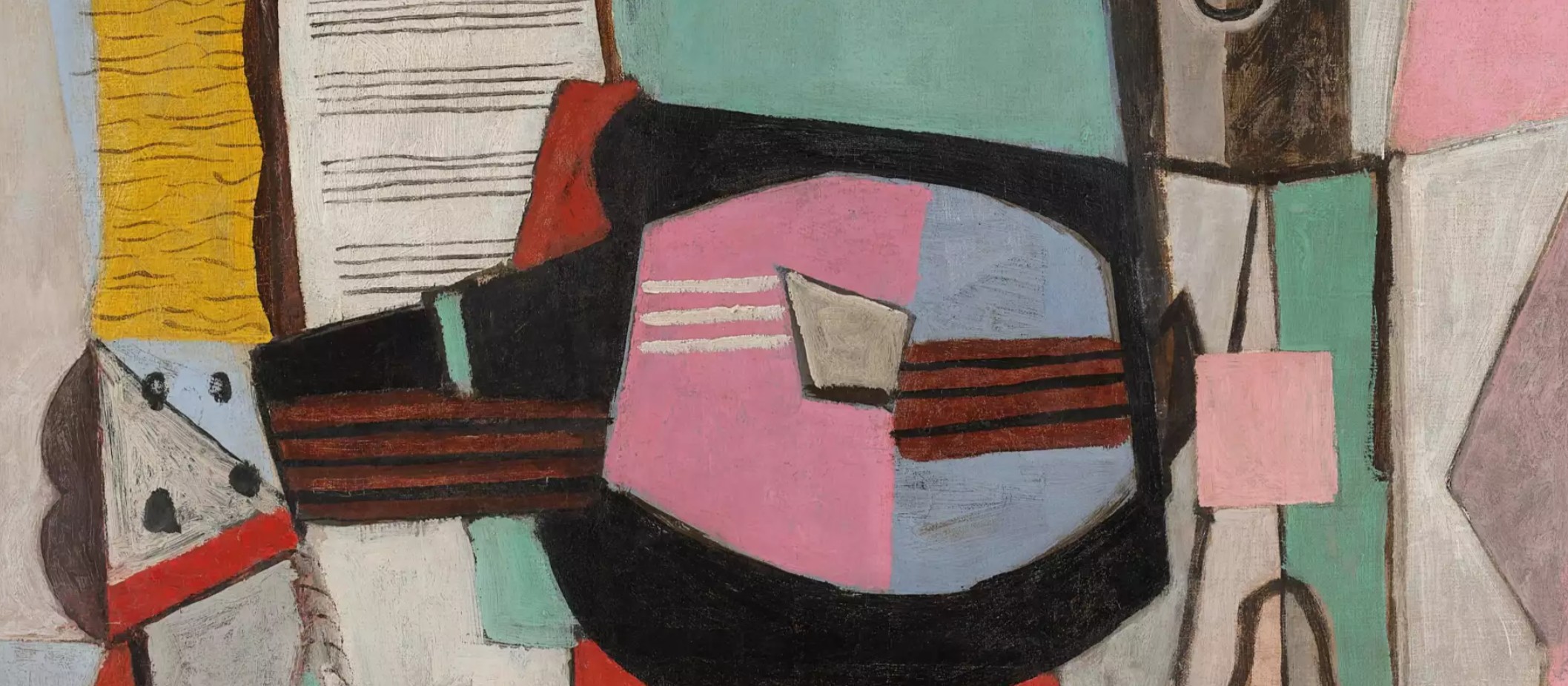
While the now-iconic motif of the guitar appeared at the fore of his work as early as 1903, it was the artist’s Cubist period which first transformed this everyday object into a fundamental mechanism within the evolution of Modern art. Linked to his Spanish ancestry and imbued with an inherent sensuality—its complex figuration offering a variety of suggestive curves and recesses—the guitar proved a versatile subject for Picasso’s interpretations from his Blue Period to the end of his impressive career.
Marie-Thérèse
Among the representations of ardor and desire in the canon of twentieth-century art, Picasso’s sensuous depictions of his lover and muse Marie-Thérèse Walter reign supreme.
#1. Femme à la montre, 1932
Sotheby’s New-York: 8 November 2023
Estimate Upon Request
USD 139,363,500
PABLO PICASSO (1881 – 1973)
Femme à la montre, 1932
Oil on canvas
130×97 cm (51 1/8 x 38 1/8 inches)
Signed Picasso (upper left)
Inscribed Boisgeloup and dated 17 Août XXXII. (on the stretcher)
Executed on 17 August 1932
Executed in 1932 at the pinnacle of Picasso’s impassioned affair, Femme à la montre exists as one of the most resolved and complex depictions from this highly charged year. The rapturous period from which Femme à la montre originates has been described by the artist’s biographer John Richardson as Picasso’s annus mirabilis or ‘year of wonders.’ In 1932, Picasso worked at a feverish pace, ceaselessly inspired by his new muse’s presence and the longing felt in her absence. Utterly consumed by his amour fou—the Surrealist notion of an obsessional, vortex-like desire—each work from this period reads like an entry in a diary, documenting the pair’s evolving relationship. Among the artist’s 1932 works, it is the monumental canvases like Femme à la montre, which unapologetically announce Marie-Thérèse’s presence, that are most widely acclaimed for their singular importance in Picasso’s oeuvre.
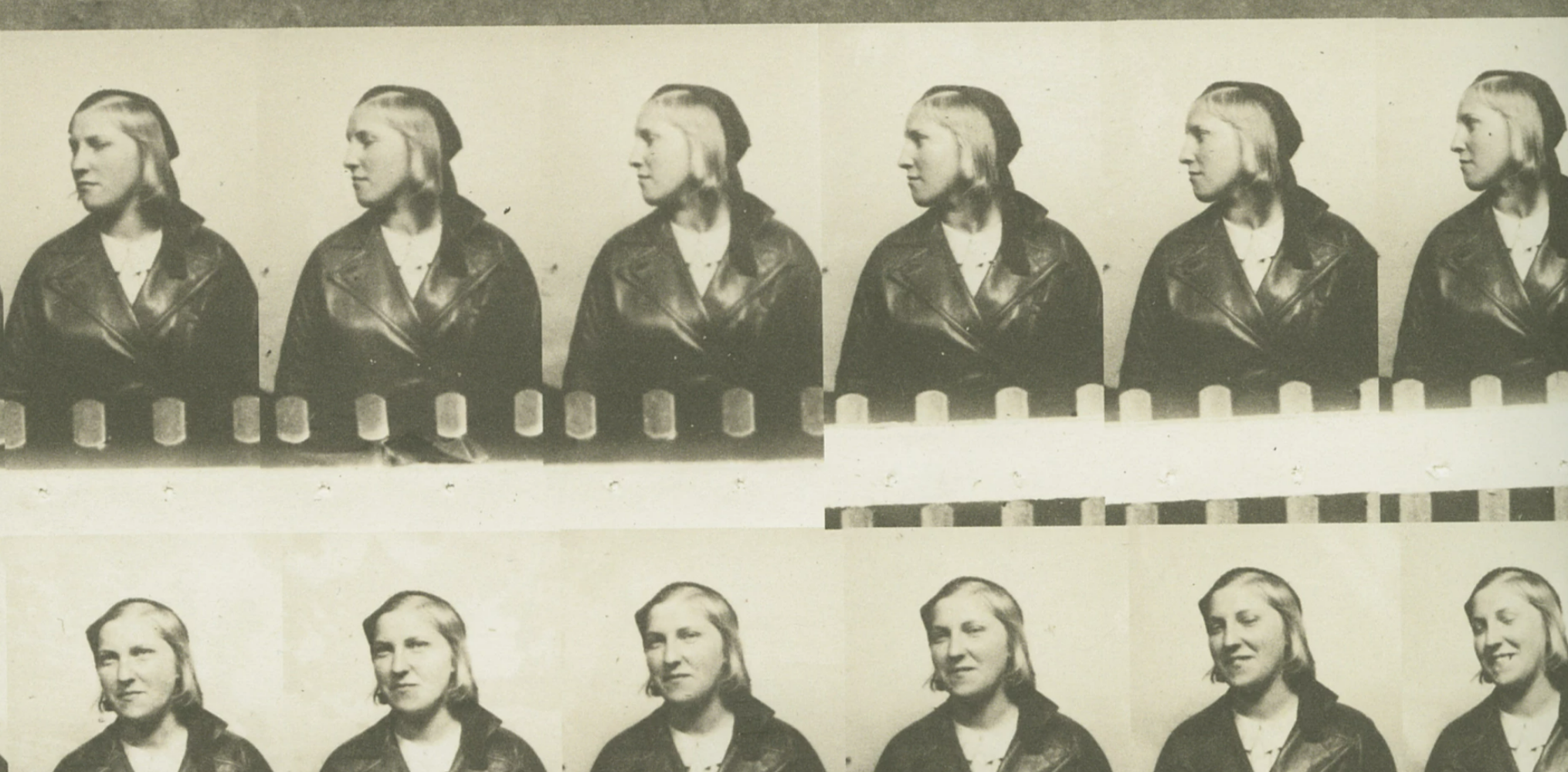
PHOTOGRAPHS OF MARIE-THÉRÈSE WALTER, 1930. PHOTO © COURTESY ARCHIVES MAYA WIDMAIER PICASSO.
Picasso’s infatuation took on near-mythic proportions, the likeness of Marie-Thérèse spilling out onto canvas after canvas, in sculpture and on paper. Due to the age difference and Picasso’s marriage to Olga, their relationship remained a secret and was hidden even from the artist’s innermost circle of friends. As a result, Marie-Thérèse’s identity is hidden in Picasso’s earliest works, obscured by his Surreal biomorphic interpretations, hinted at in shadowy profiles or tantalizingly suggested in the still lifes which conceal the initials ‘MT.’ As Françoise Gilot would later write, Marie-Thérèse was “the luminous dream of youth, always in the background but always within reach, that nourished his work… Marie-Thérèse, then, was very important to him as long as he was living with Olga because she was the dream when the reality was someone else” (quoted in Exh. Cat., London, Tate, Picasso 1932 – Love, Fame, Tragedy, 2018, p. 18).
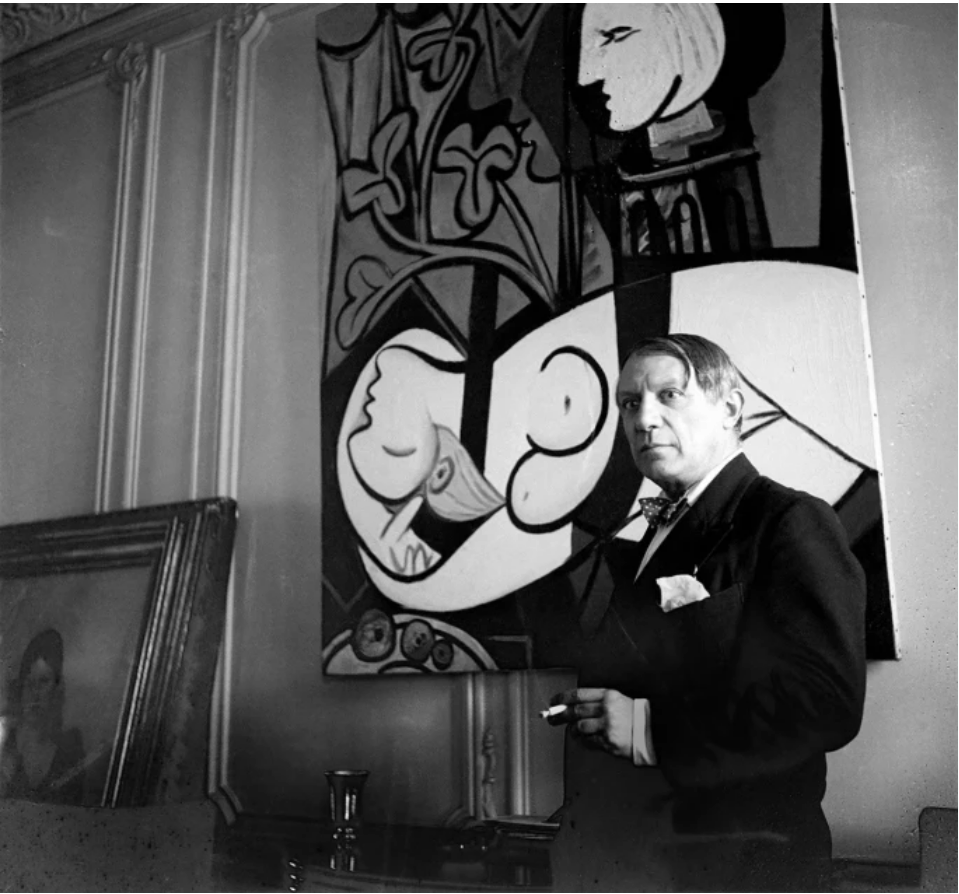
CECIL BEATON, PABLO PICASSO, RUE LA BOÉTIE, 1933. PHOTO © THE CECIL BEATON STUDIO ARCHIVE AT SOTHEBY’S. ART © 2023 ESTATE OF PABLO PICASSO / ARTISTS RIGHTS SOCIETY (ARS), NEW YORK
Their furtive liaison resulted in scores of coded images of his lover, eventually culminating in the undeniably bold and sensuous portraits of 1932 at the apex of their relationship. His muse’s potent mix of physical appeal and sexual naïveté had an intoxicating effect on Picasso, and his rapturous desire for the young woman brought about a wealth of images that have been praised as the most erotic and emotionally uplifting compositions of his long career. Augmented by the forbidden nature of their years-long relationship, Picasso’s unleashed passion is nowhere more apparent than in his 1932 depictions of his muse.
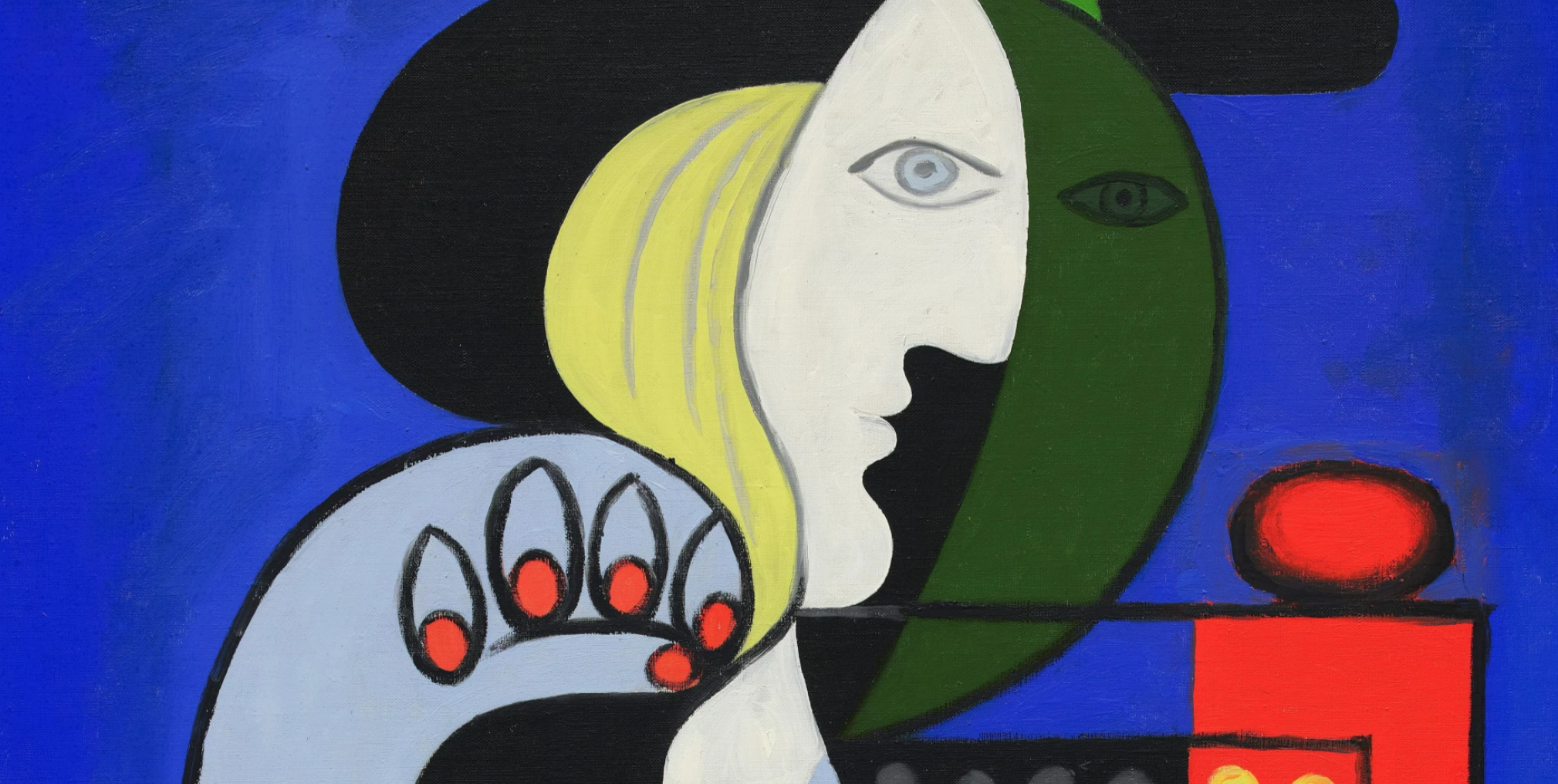
Executed in August of that year, Femme à la montre depicts a smartly dressed young woman seated in an armchair against a striking blue background. Back in Boisgeloup after the opening of his retrospective in Paris, Picasso enjoyed a calmer environment free of pre-exhibition stresses and time constraints. Consequently, the present work displays a heightened level of detail and pictorial complexity compared to related compositions from earlier in the year, resulting in one of the most compelling portrayals of his Golden Muse ever created.
Rendered in volumetric curves and set against geometric delineations of her dress and chair, Marie-Thérèse conveys a sense of poise and assuredness. Her gaze is directed at the viewer, the illuminated half of her visage mirrored and joined by the shaded half—like sun and moon—in the characteristic implication of Picasso’s own presence. The brilliant blue background against which Marie-Thérèse is posed is exceptional for seated portraits from the period. While the bold primary color is seen in a few of the reclining nudes, Femme à la montre is the only depiction to offer the numinous backdrop to such a powerful extent, lending the seated Marie-Thérèse a reverential, almost hallowed aura like a mandorla surrounding a Madonna.
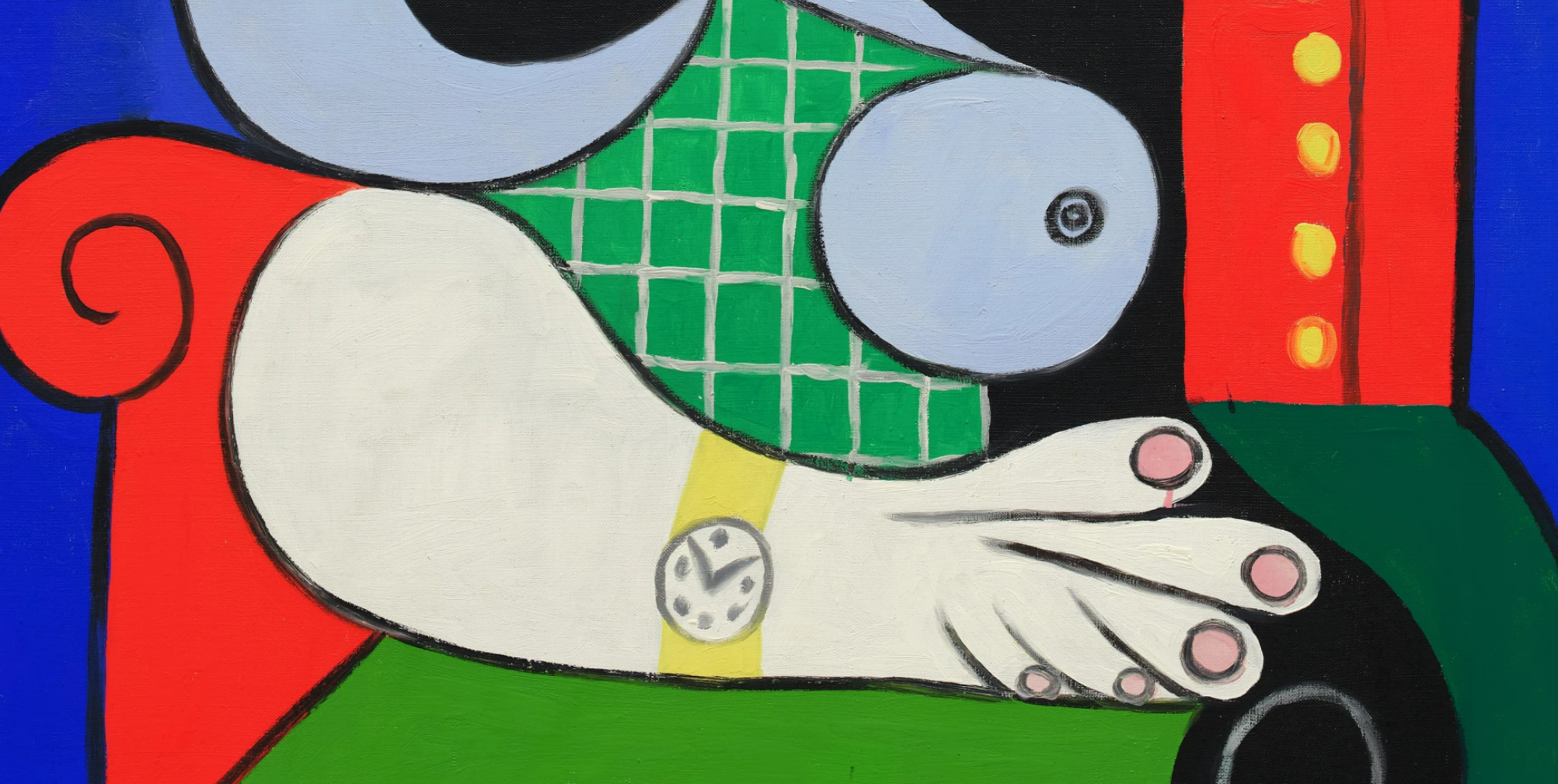
The present work is further distinguished by the crisply articulated lines and geometric forms of the armchair and pattered dress, each element carefully offset by contrasting colors and shapes. Marie-Thérèse’s green checked blouse can be read a direct reference to the patterned tapestries and garments found within Matisse’s canvases from the period, like his 1927 Femme à l’eveil, which was included in The Museum of Modern Art’s 1931 retrospective on Matisse. Accordingly, Femme à la montre acts not only as an ode to Picasso’s Madonna, but also as a direct riposte to his greatest artistic rival.
#2. Nude, Green Leaves and Bust, 1932
Christie’s New-York: 4 May 2010
Estimate on Request
USD 106,482,500
https://www.christies.com/en/lot/lot-5313319
Pablo Picasso (1881-1973)
Nude, Green Leaves and Bust, 1932
Oil on canvas
162×130 cm (63 3/4 x 51 1/4 inches)
Signed and dated ‘Picasso XXXII.’ (upper right)
Painted on 8 March 1932
This deeply sensual and mysterious imagery hinted at a story that would not be told until several decades later. Today we instantly recognize the female form as belonging to Marie-Thérèse Walter, Picasso’s young mistress during the late 1920s and 1930s (fig. 2). The remarkable painting seen in this widely illustrated photograph is Nude, Green Leaves and Bust, which Picasso completed during the course of a single day in March 1932, only a short time before Beaton came to shoot his portrait. Here the canvas is seen still unframed, with the paint perhaps having only recently dried. This brightly shining star in the firmament of Picasso’s oeuvre, rarely seen after the 1930s and exhibited only once since it was acquired in 1951, now comes to Christie’s saleroom, as have five of its closest companions during the past dozen years–a landmark event by any measure, in which this superb painting is sure to surpass all those which have gone before.
#3. Femme assise près d’une fenêtre (Marie-Thérèse), 1932
Christie’s New-York: 13 May 2021
Estimated: USD 55,000,000 – 70,000,000
USD 103,410,000
PABLO PICASSO (1881-1973)
Femme assise près d’une fenêtre (Marie-Thérèse), 1932
Oil on canvas
146×114 cm (57 1/2 x 44 7/8 inches)
Dated and inscribed ‘Boisgeloup 30 Octobre XXXII’ (on a piece of the original stretcher affixed to the stretcher)
Painted in Boisgeloup on 30 October 1932
USD 100 million
#4. Femme au béret et à la robe quadrillée, 1937
Sotheby’s London: 28 February 2018
Estimate upon Request
GBP 49,827,000 / USD 68,535,375
(#7) PABLO PICASSO | Femme au béret et à la robe quadrillée (Marie-Thérèse Walter) (sothebys.com)
PABLO PICASSO
Femme au béret et à la robe quadrillée (Marie-Thérèse Walter), 1937
Oil on canvas
55×46 cm (21 5/8 x 18 1/8 inches)
Dated 4 D 37 (upper right)
Painted on 4th December 1937
#5. Femme nue couchée, 1932
Sotheby’s New-York: 17 May 2022
Estimate upon Request
USD 67,541,000
Femme nue couchée | Modern Evening Auction | 2022 | Sotheby’s (sothebys.com)
PABLO PICASSO (1881 – 1973)
Femme nue couchée, 1932
Oil and Ripolin on canvas
129.9 x 161.7 cm (51 1/8 x 63 5/8 inches)
Dated Boisgeloup 2 Avril XXXII (on the stretcher)
Executed in Boisgeloup on 2 April 1932
#6. La Lecture (Marie-Thérèse), 1932
The Collection of Robert F. and Patricia G. Ross Weis
Christie’s New-York: 17 November 2025
Estimate on Request
USD 45,485,000
PABLO PICASSO (1881-1973), La Lecture (Marie-Thérèse) | Christie’s
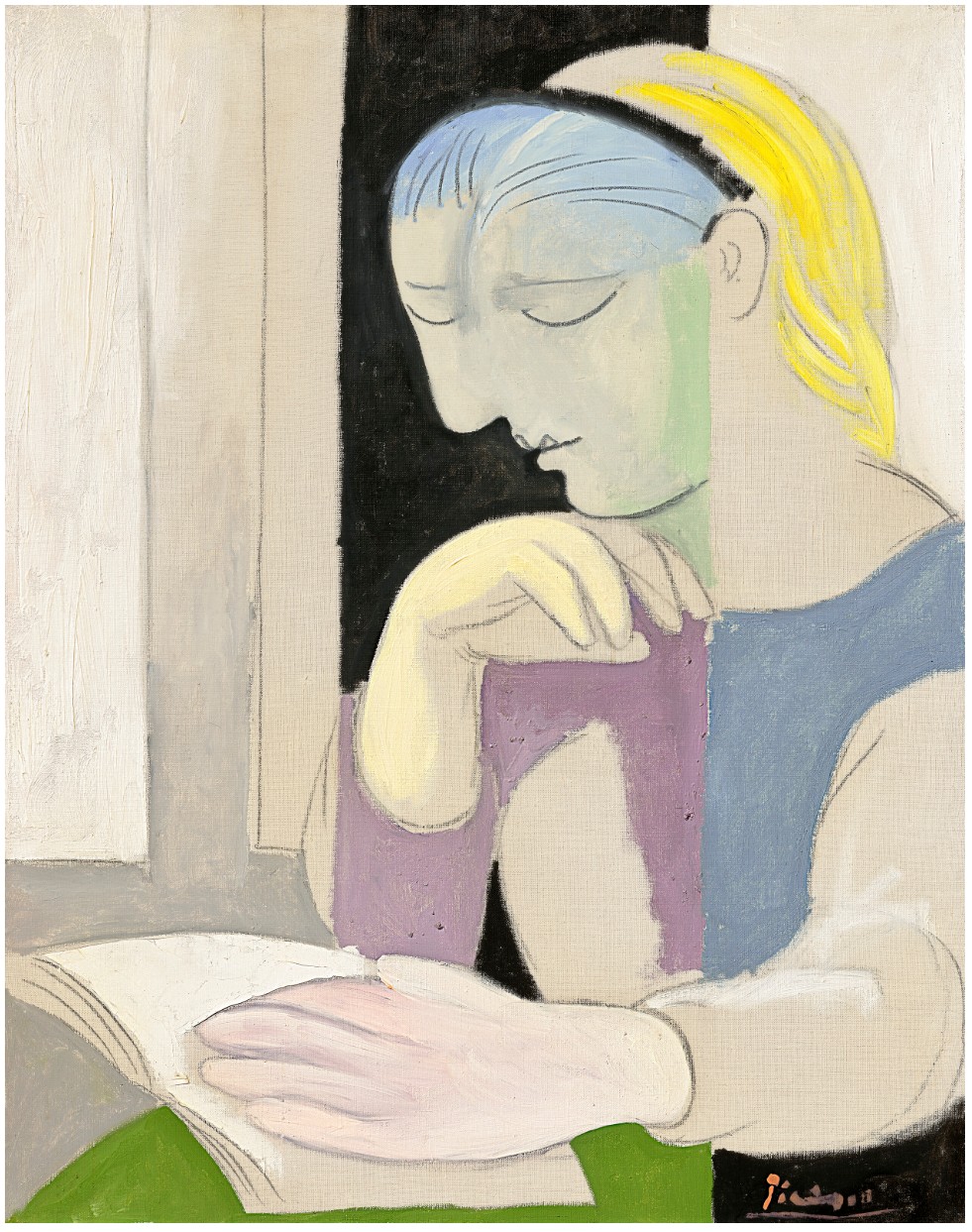
PABLO PICASSO (1881-1973)
La Lecture (Marie-Thérèse), 1932
Oil, Ripolin and charcoal on canvas
92.1 x 73 cm (36 1/4 x 28 3/4 inches)
Signed ‘Picasso’ (lower right)
Dated and inscribed ‘Boisgeloup 31 Août XXXII.’ (on the stretcher)
Painted in Boisgeloup on 31 August 1932
On 15 June 1932, an extensive survey exhibition dedicated to Pablo Picasso opened at the Galeries Georges Petit in Paris to great fanfare. Across each room in the recently renovated galleries visitors to Picasso: 1901-1932 were treated to an expansive array of works from every stage of the Spanish artist’s career thus far, the eclectic arrangement showcasing the breadth of creativity and ceaseless spirit of invention that marked Picasso’s art. The artist himself had been heavily involved in the planning and realization of the show, arranging loans from his most loyal private collectors and drawing heavily on his own personal archive to secure a final total of 225 paintings, seven sculptures and six illustrated books for display. Similarly, he took charge of the hanging of the works, choosing an arrangement that revealed the recurring leitmotifs, subjects and concerns that had fascinated him endlessly across the years.
In the lead up to the exhibition’s vernissage, however, newspaper reports claimed the artist would skip the opening night in favor of an evening at the movies: “I’ve been hooking these things on the wall for six days now,” Picasso is reported to have said, “and I’ve had enough of them” (quoted in M.C. FitzGerald, Making Modernism: Picasso and the Creation of the Market for Twentieth-Century Art, Berkeley and Los Angeles, 1995, p. 193). The artist escaped Paris shortly afterwards, retreating to his seventeenth-century château, Boisgeloup, in the Normandy countryside. Though just a quick drive from the French capital, this secluded, private property was a refuge for Picasso during the early 1930s, its location reducing the likelihood of unwelcome visitors, prying acquaintances, or admirers paying an unexpected call. Here, he was able to focus on his creative work undisturbed, in the stable he had transformed into a sculpture studio, or the room on the second floor of the corner tower, which had become a dedicated space for painting.
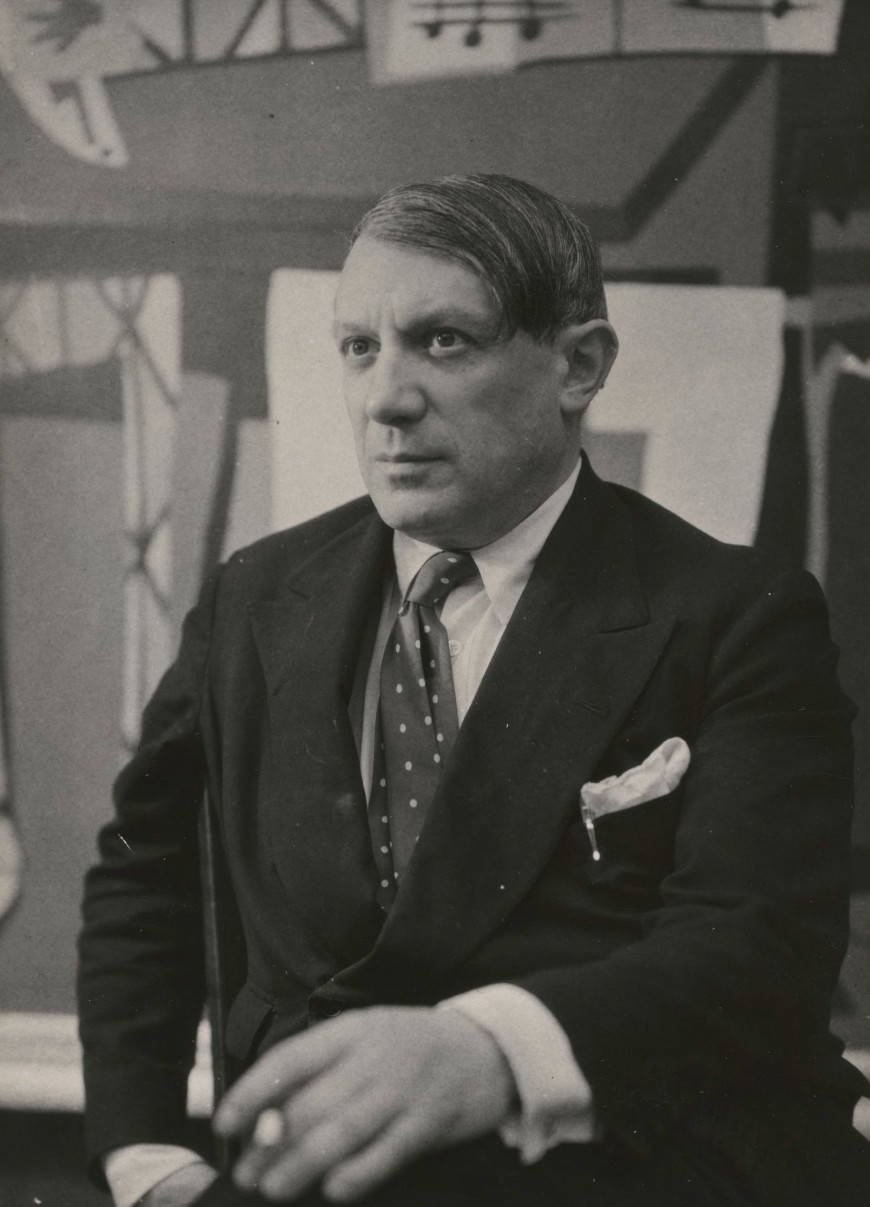
Pablo Picasso in front of Musiciens aux masques (1921) during his retrospective at the Galeries Georges Petit, Paris, June-July 1932. Photo: © RMN-Grand Palais / Art Resource, NY. Artwork: © 2025 Estate of Pablo Picasso / Artists Rights Society (ARS), New York.
Purchasing a large stock of new canvases, Picasso spent much of the summer of 1932 installed at Boisgeloup, picking up where he had left off in late May as preparations for the grand exhibition had consumed his time and forced him to pause his painterly activities. As with the extraordinary sequence of compositions that had emerged during the opening months of the year, the central figure in Picasso’s art during the summer was Marie-Thérèse Walter, the young woman who had been his lover and muse since 1927. Painted on 31 August 1932, La Lecture (Marie-Thérèse) portrays Marie-Thérèse in a moment of quiet leisure, her attention focused solely on her book, as she appears to lose herself in the story. Imbued with a quiet intimacy and tenderness that stands in stark contrast to the more highly stylized portraits of Marie-Thérèse that had occupied Picasso in recent weeks, this painting records the small, everyday moments the artist and muse enjoyed together in their idyllic, hidden retreat that summer.
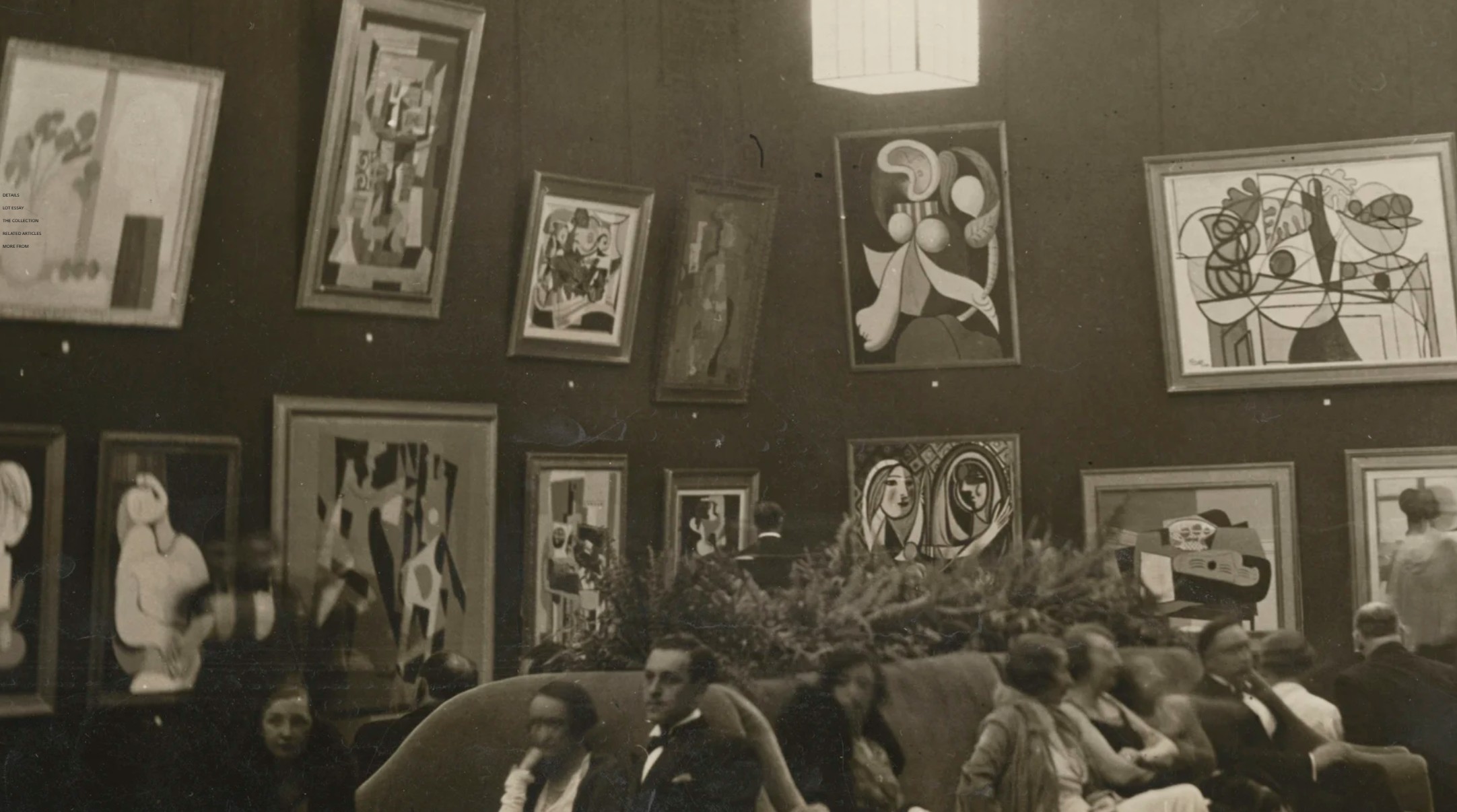
View of the Grand Salle during the vernissage of “Picasso: 1901-1932,” at the Galerie Georges Petit, Paris, June 1932. Photograph by Gotthard Schuh. Artwork: © 2025 Estate of Pablo Picasso / Artists Rights Society (ARS), New York. Image: © RMN-Grand Palais / Art Resource, NY.
Picasso had first met Marie-Thérèse Walter in a chance encounter on the streets of Paris in the early evening of 8 January 1927. Marie-Thérèse, who was exiting the famed Galeries Lafayette department store with her newly purchased col Claudine and matching cuffs for a blouse, remembered catching the artist’s eye in the middle of the crowd. Making his way to her, Picasso promptly introduced himself. “You have an interesting face. I would like to do a portrait of you,” he reportedly told her. “I feel we are going to do great things together… I am Picasso” (quoted in J. Richardson, A Life of Picasso, The Triumphant Years, 1917-1932, New York, 2007, vol. 3, p. 323). In turn, Marie-Thérèse responded with a blank look. “The name Picasso did not mean anything to me. It was his tie that interested me,” she explained. “And then he charmed me” (quoted in P. Cabanne, “Picasso et les joies de la paternité” in L’Oeil, no. 226, May 1974, p. 7).
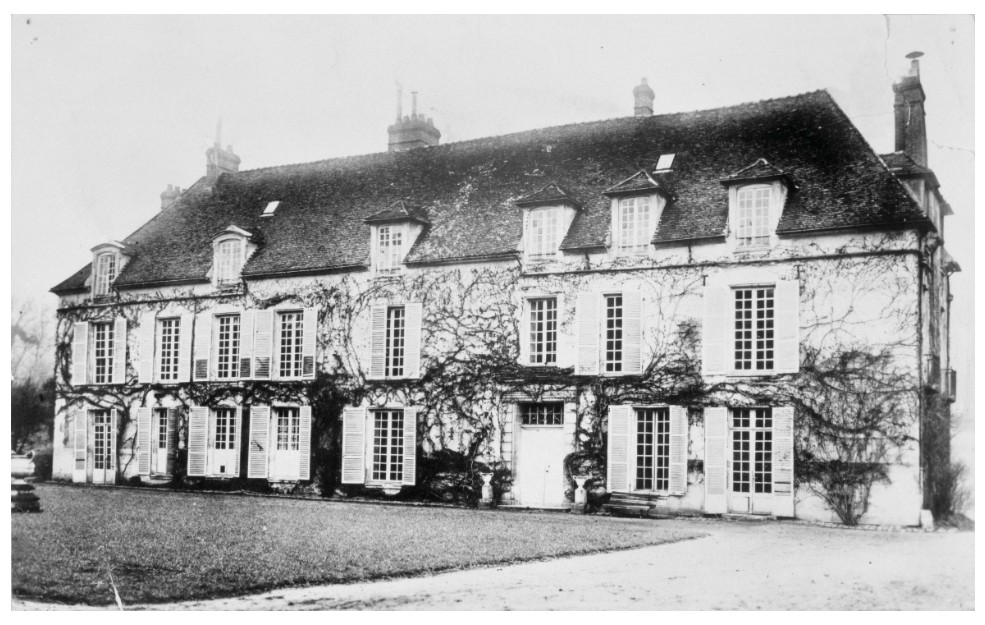
Château de Boisgeloup in 1931. Photographer unknown. Photo: © RMN-Grand Palais / Art Resource, NY.
Picasso was deeply struck by Marie-Thérèse’s statuesque beauty and youthful exuberance, and arranged to meet her again two days later, at the Saint-Lazare metro station. “I went there, just like that, because he had such a pleasant smile,” Marie-Thérèse remembered (quoted D. Widmaier Picasso, “Marie-Thérèse Walter and Pablo Picasso: New Insights into a Secret Love” in Pablo Picasso and Marie-Thérèse Walter: Between Classicism and Surrealism, exh. cat., Graphikmuseum Pablo Picasso, Münster, 2004, p. 29). This legendary encounter came at a pivotal turning point in the artist’s life, as he grew increasingly disillusioned by the haute-bourgeois existence that his wife, the Ukrainian-born ballet dancer Olga Khokhlova, had cultivated for them in Paris. Seeking new inspiration, he had become fascinated by the mythical l’amour fou promoted by André Breton and the Surrealists, a passionate love that would strike suddenly, and consume the beholder. When the tall, blonde, blue-eyed young woman passed him on the street that fateful day, the artist believed he had found such a paramour. The pair soon embarked upon a clandestine affair, centered around furtive meetings and love letters passed in secret.
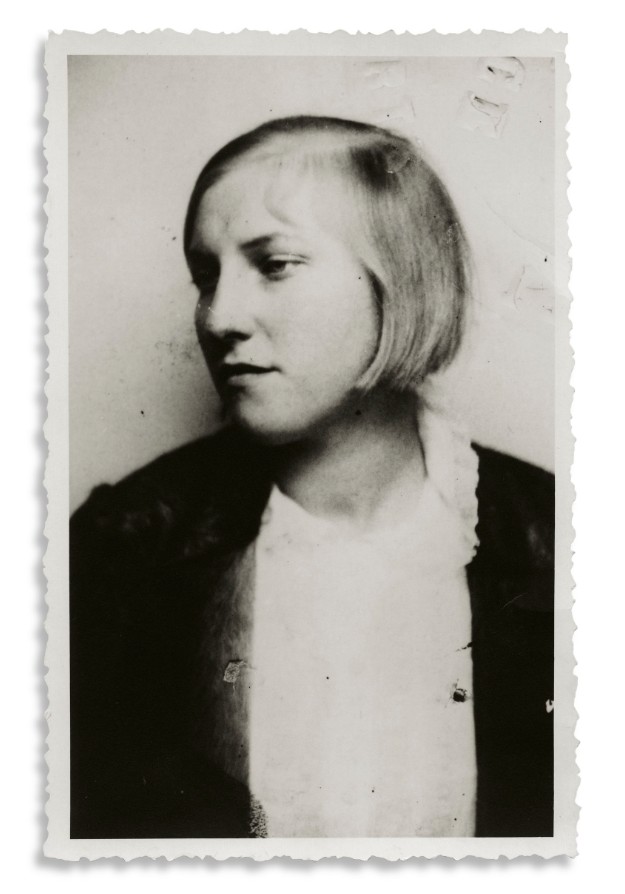
Marie-Thérèse Walter, circa 1930. Photographer unknown. © Archives Maya Widmaier-Picasso.
As Françoise Gilot noted, Walter’s presence left an indelible mark on Picasso’s artistic output during these years, inspiring a vivid new pictorial vocabulary: “I found Marie-Thérèse fascinating to look at. I could see that she was certainly the woman who had inspired Pablo plastically more than any other. She had a very arresting face with a Grecian profile. The whole series of portraits of blonde women Pablo painted between 1927 and 1935 are almost exact replicas of her… she was very athletic, she had that high-color look of glowing good health one often sees in Swedish women. Her forms were handsomely sculptural, with a fullness of volume and a purity of line that gave her body and her face an extraordinary perfection” (F. Gilot and C. Lake, Life with Picasso, New York, 1964, pp. 241-242). As the 1930s dawned, Marie-Thérèse’s likeness appeared increasingly front and center in his works, blossoming forth in all areas of his creative production. Never before had Picasso’s art radiated such passionate, heady eroticism—from delicate drawings, to monumental canvases, to grand plaster sculptures, Marie-Thérèse became the very foundation of every aspect of Picasso’s artistic output.
”The day I met Marie-Thérèse I realized that I had before me what I had always been dreaming about.”
By the time their relationship entered its sixth, deeply passionate year, Picasso was intimately familiar with Marie-Thérèse’s form. He could recall from memory the way her golden hair fell as it brushed her cheek, the exact profile of the line that ran from her forehead, down her nose to her chin, and the sinuous, flowing topography of her athletic body as she slept. As a result, she became a vehicle for the artist’s most radical painterly experimentations, allowing him to explore themes of transformation and mutation in a myriad of intriguing ways. In 1931, the artist began a series of monumental plaster sculptures, working on carved reliefs and volumetric busts, each devoted to the poised, elegant features of Marie-Thérèse, while the first half of 1932 witnessed a great outpouring of superlative, monumental canvases capturing her form in a myriad of different styles and variations. Ranging from daring, formal reconfigurations of her figure, to richly sensuous visions of her in the role of archetypal reclining nude, these paintings show Picasso at his most inventive. A significant proportion of these works focus on seated portraits of Marie-Thérèse, relaxing in a moment of repose, writing a letter in Buste de femme de profil (Marie-Thérèse) (Zervos, vol. 7, no. 406; Private collection) or caught in a dreamy, sleeping state in the iconic La Rêve (Zervos, vol. 7, no. 364; Private collection) or Le sommeil (Zervos, vol. 7, no. 362; Private collection).
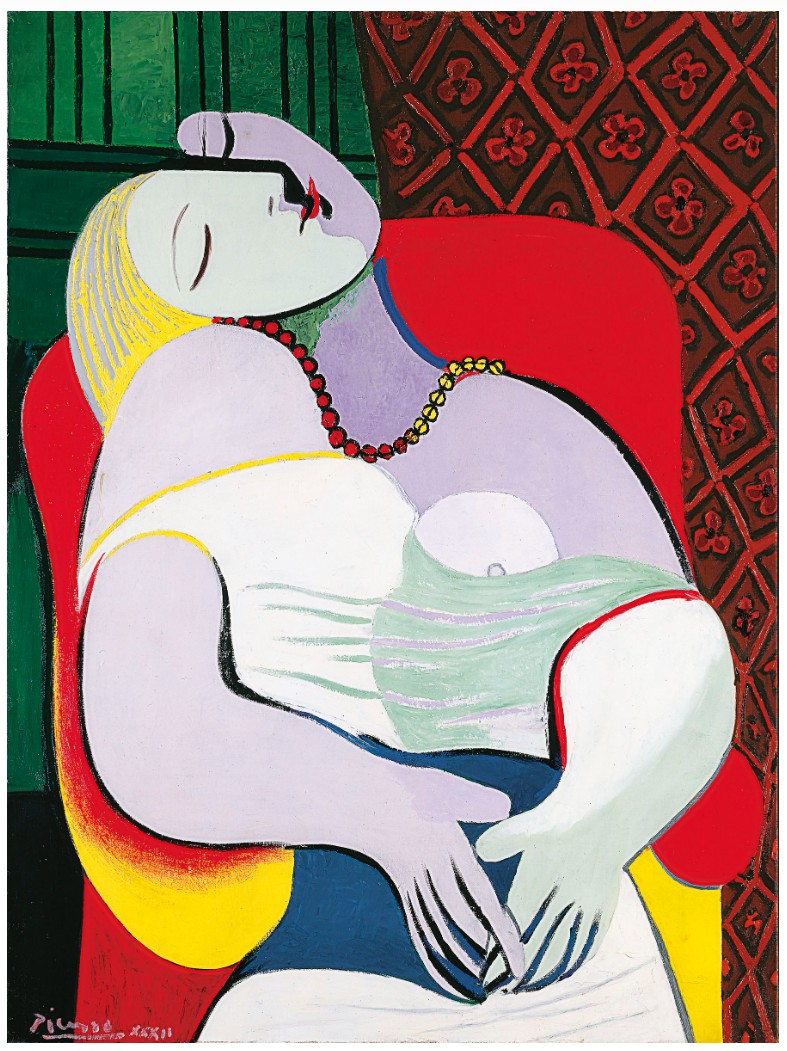
Pablo Picasso, Le Rêve, 24 January 1932. Private collection. © 2025 Estate of Pablo Picasso / Artists Rights Society (ARS), New York.
“Beautiful love of my life, Marie-Thérèse of my heart.”
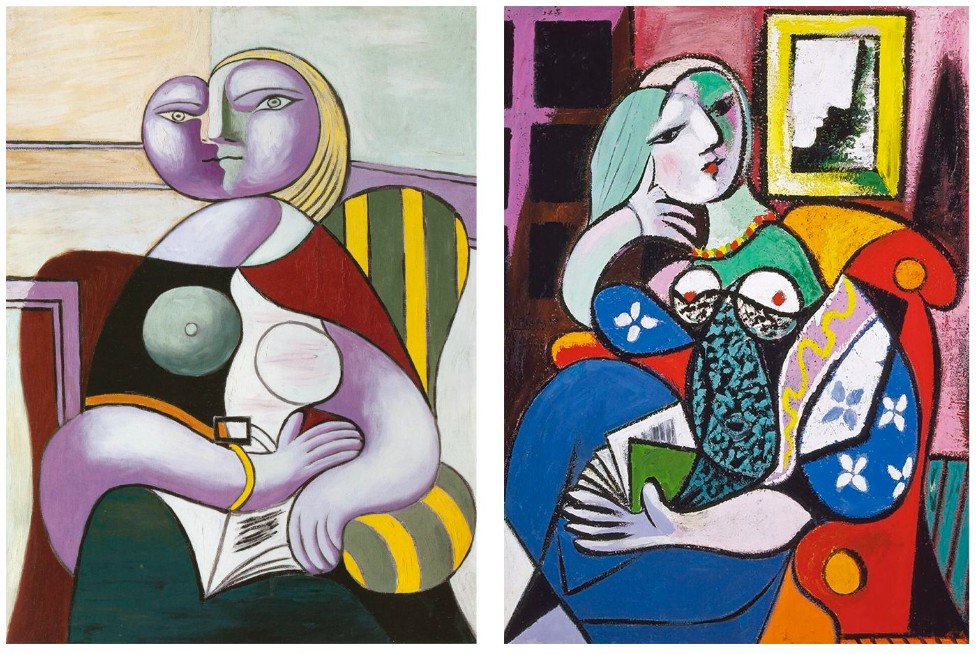
Left: Pablo Picasso, La Lecture, 1932. Musée national Picasso, Paris. © 2025 Estate of Pablo Picasso / Artists Rights Society (ARS), New York.
Right: Pablo Picasso, Femme tenant un livre Marie-Thérèse, Fall 1932. The Norton Simon Museum, Pasadena. © 2025 Estate of Pablo Picasso / Artists Rights Society (ARS), New York.
In La Lecture (Marie-Thérèse), Picasso continues this thread of easy leisure, revisiting a subject that had been popular in portraiture since the seventeenth century and which he himself had deployed on numerous occasions for his depictions of the women in his life—that of a female protagonist reading. The first painting the artist completed in 1932 focused on this same subject—in La Lecture (Zervos, vol. 7, no. 358; Musée national Picasso, Paris), painted on 2 January, Marie-Thérèse appears to have been interrupted from her reading, her gaze directed squarely at the artist, her hands resting gently in her lap as she marks her place in the text. By contrast, in La lecture interrompue (9 January 1932, Zervos, vol. 7, no. 363; Private collection) painted a week later, Marie-Thérèse’s head lolls backwards against the headrest of her chair, as if she has is lost in a daydream conjured by the tale, or has drifted-off mid-way through a chapter. In the present work, her focus is trained solely on the book before her—with her chin propped on one hand, and her eyes cast downward, Marie-Thérèse is a study in relaxed focus, the gentle tilt of her head and soft expression suggesting she is oblivious to the artist’s attentions.
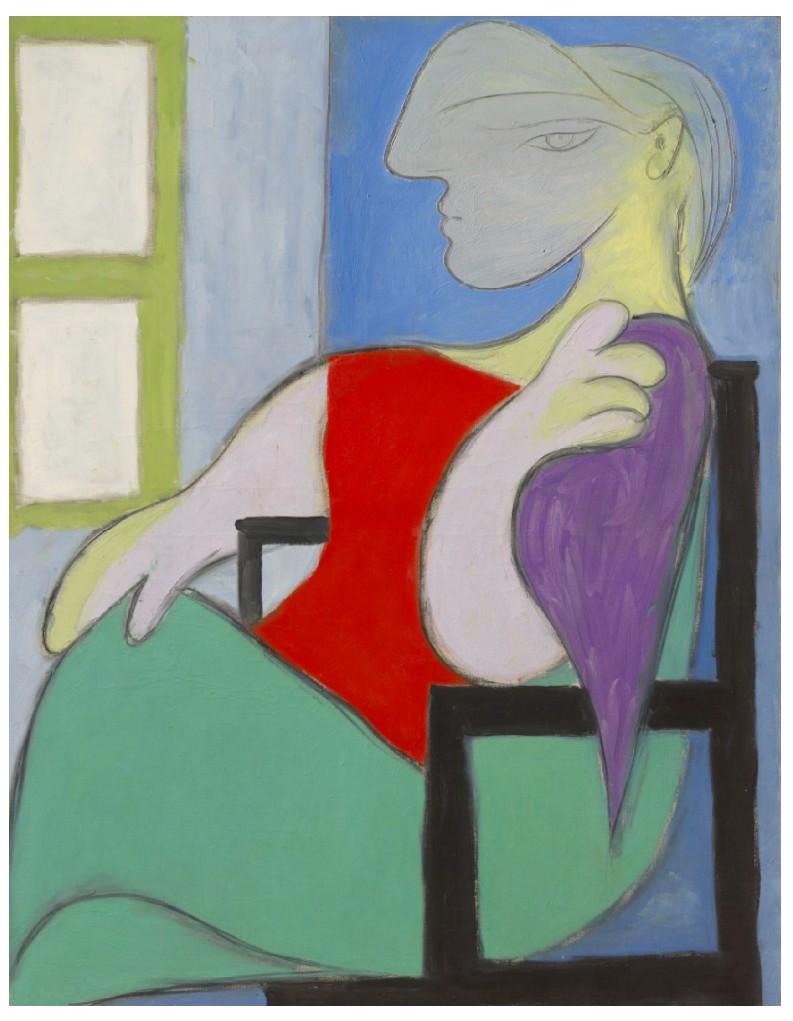
Pablo Picasso, Femme assise près d’une fenêtre (Marie-Thérèse), 30 October, 1932.
Private collection. © 2025 Estate of Pablo Picasso / Artists Rights Society (ARS), New York.
Seated before a simple rectangular window—which features in several other works from this year, including Nature morte à la fenêtre (18 January 1932, Zervos, vol. 7, no. 374; Private collection) and Femme assise près d’une fenêtre (Marie-Thérèse) (30 October 1932; Private collection)—Marie-Thérèse’s form appears monumental, Picasso’s treatment of the figure recalling the stylized, volumetric sculptures the artist had created the previous year, inspired by her elegant features. The soft light that spills through the window, meanwhile, illuminates Marie-Thérèse in a play of light and shade, which Picasso indicates by dividing her form into loosely blocked planes of predominantly pastel tones. Traces of charcoal remain visible on the surface of the canvas, interacting with the painted elements in an intriguing interplay that showcases the fluency and spontaneity of Picasso’s technique at this time. Subtle pentimenti reveal the evolution of the image as he worked to capture a likeness swiftly, lines shifting or altering in order to refine certain elements of the figure, as seen in Marie-Thérèse’s right hand. At the same time, there is a bold assuredness to his mark-making, a confidence that allows him to convey her features with a startling economy of means—with a single, short, curving line, for example, he indicates an eye, while a quick horizontal zig-zag at her mouth hints at the sensuality of her lips.
“I seek always to observe nature. I cling to resemblance, to a deeper resemblance, more real than the real, attaining the surreal.”
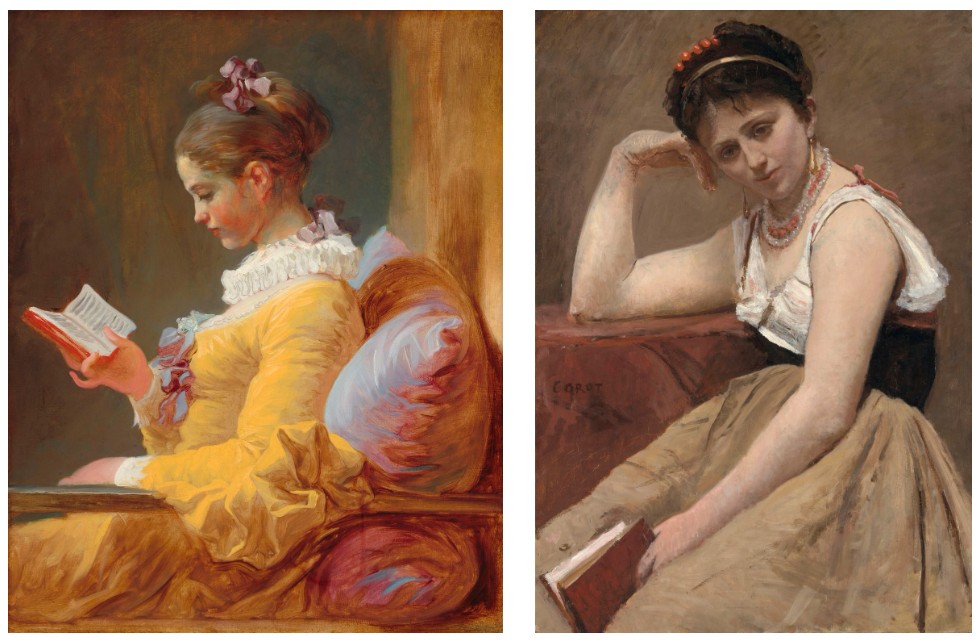
Left: Jean Honoré Fragonard, Young Girl Reading, circa 1769. National Gallery of Art, Washington, D.C.
Right: Camille Corot, Interrupted Reading, circa 1870. The Art Institute of Chicago.
There is a quiet stillness to La Lecture (Marie-Thérèse), a reflection perhaps of Marie-Thérèse’s ongoing presence in the artist’s life at Boisgeloup during this summer, and the simple rhythms of their days together, reading, working, making love, in the secluded surroundings of the chateau. “We would joke and laugh together all day,” Marie-Thérèse later recalled of their time together, “so happy with our secret, living a totally non-bourgeois life, a bohemian love away from those people Picasso knew then…” (quoted in B. Farrell, “Picasso: His Women: The Wonder is that He Found So Much Time to Paint” in Life, 27 December 1968, p. 74). Picasso’s numerous depictions of Marie-Thérèse from these months focus on poses that are captured from the privileged position of a lover, including close-up views of her face as she sleeps, the soft curves of her body as she reclines on a divan, the dreamy expression that takes over her face as she is lost in thought. Here, she appears completely at ease and comfortable in the artist’s presence. Allowed to observe his model uninterrupted, Picasso captures the vivid presence of his beloved model and muse in a peaceful, unremarkable moment of ordinary life.
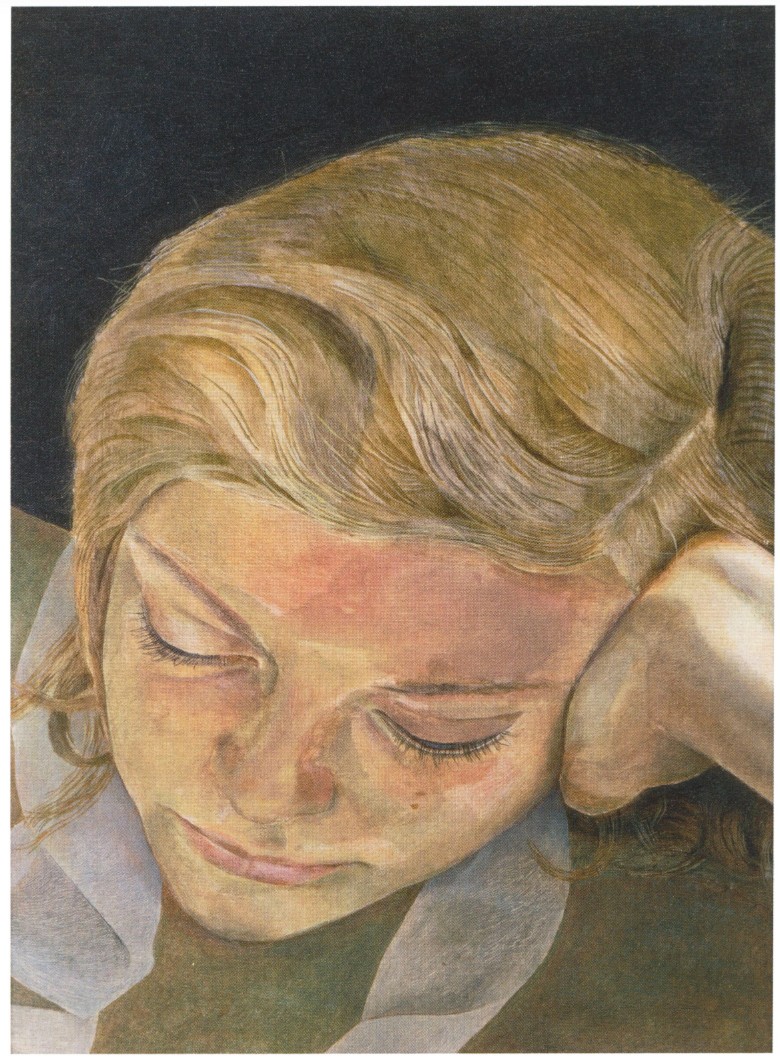
Lucian Freud, Girl Reading, 1953. Private collection. © The Lucian Freud Archive. All Rights Reserved 2025 / Bridgeman Images
In an interview with Marie-Thérèse in 1974, Pierre Cabanne asked her what first came to her mind when she heard the name Picasso. Walter answered: “Secrecy. This was because my life with him was always concealed. It was calm and tranquil. We didn’t tell anyone. We were happy like that, and that was enough for us” (quoted in P. Cabanne, op. cit., 1974, p. 7). In many ways, this secrecy came to an abrupt end when visitors entered the Galeries Georges Petit that June to see the artist’s mid-career retrospective, and discovered the great wealth of recent works dedicated to Marie-Thérèse. The repeated appearance of her features from canvas to canvas, room to room, combined with the often erotically charged nature of the works on show, indicated that the artist had found powerful inspiration in his young lover. Though Marie-Thérèse’s identity would remain hidden for a further three decades—her name and long relationship with the artist only revealed when Françoise Gilot published her memoirs in 1964—it was evident to anyone that saw the 1932 exhibition, either in Paris or in its revised format at the Kunsthaus Zurich later that year, that she now occupied the central position within Picasso’s creative vision.
#7. Femme endormie, 1934
Christie’s New-York: 9 November 2023
Estimated: USD 25,000,000 – 35,000,000
USD 42,960,000
PABLO PICASSO (1881-1973) (christies.com)
PABLO PICASSO (1881-1973)
Femme endormie, 1934
Oil on canvas
72.4 x 54 cm (28 1/2 x 21 1/4 inches)
Dated and inscribed ‘Boisgeloup 17 Juillet XXXIV’ (upper left)
Painted in a whirl of vibrant, resplendent tones, Pablo Picasso’s 1934 composition Femme endormie is a deeply tender portrayal of his lover Marie-Thérèse Walter, the young, golden-haired woman whose presence had transformed every facet of his oeuvre since their fateful meeting in 1927. Inspired by her sensuous form and their passionate intimacy, Picasso’s creativity reached new heights over the course of their relationship, leading John Richardson to proclaim this the artist’s “most innovative period since Cubism” (A Life of Picasso, The Triumphant Years, 1917-1932, New York, 2007, vol. 3, p. 460).
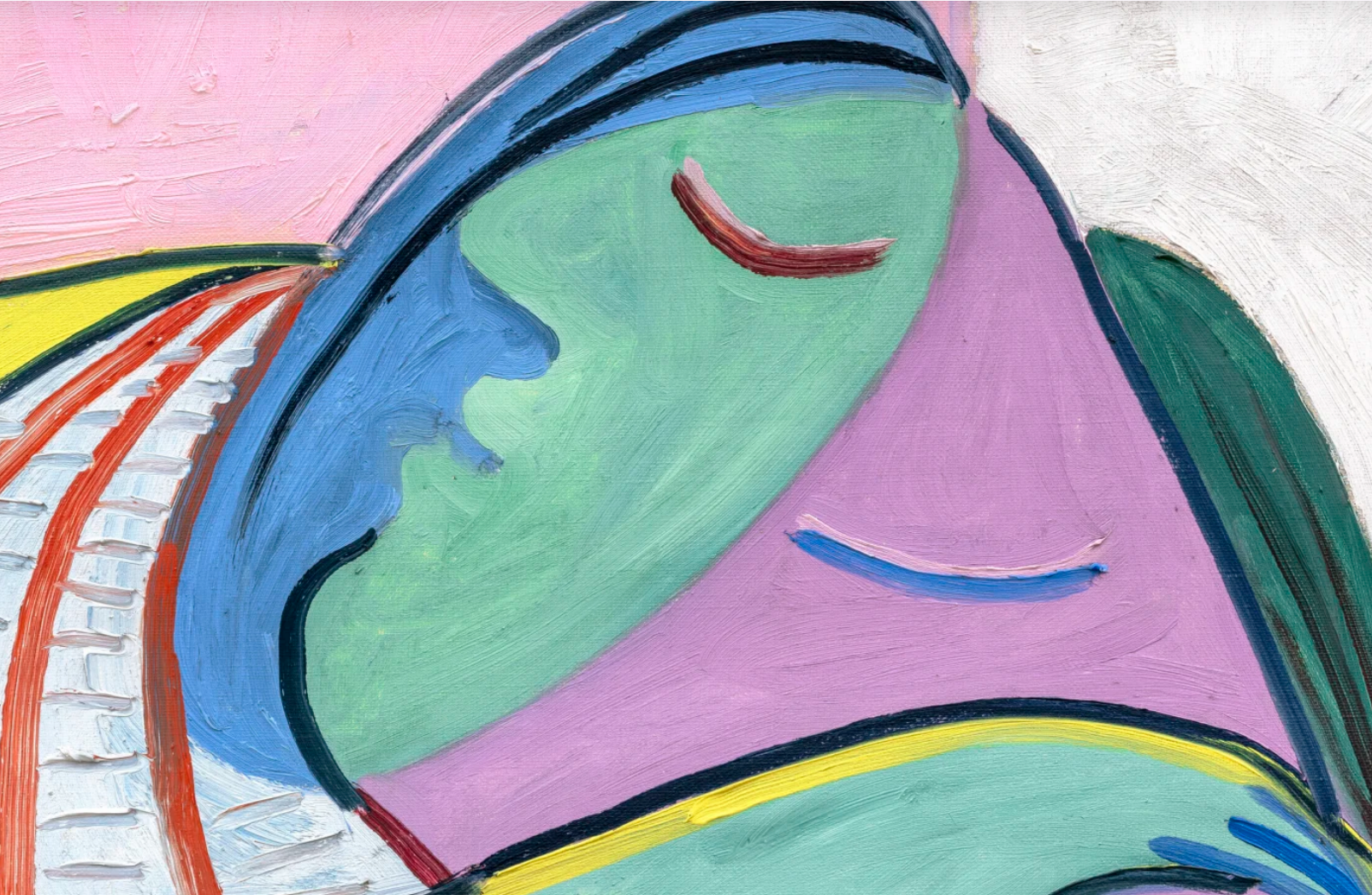
The mid-1930s was a particularly fraught period for Picasso, in which he was plagued by ever-worsening marital conflict and a growing anxiety regarding the darkening political situation across Europe, as Fascism took hold in both his native Spain and Germany, and France was hit by social upheaval. Painted on 17 July 1934, Femme endormie marks a rare day when the artist’s concerns and fears seem to have been momentarily allayed, and he was able to focus once again on his joyous, beloved muse. As such, the painting appears as an homage to Marie-Thérèse, her unmistakable cropped blonde hair, classical profile and athletic figure captured in a rich interplay of color and sinuous lines, as she indulges in a moment of pure relaxation. It is a testament to the fact that through all the upheaval of the period—the arguments, accusations and threats within his personal life, the encroaching violence and darkness of the outside world that seemed to increase with each day—Marie-Thérèse remained a source of solace and inspiration for Picasso, her presence continuing to elicit great, passion-filled outpouring of creativity within his art, even as events threatened to overwhelm him.
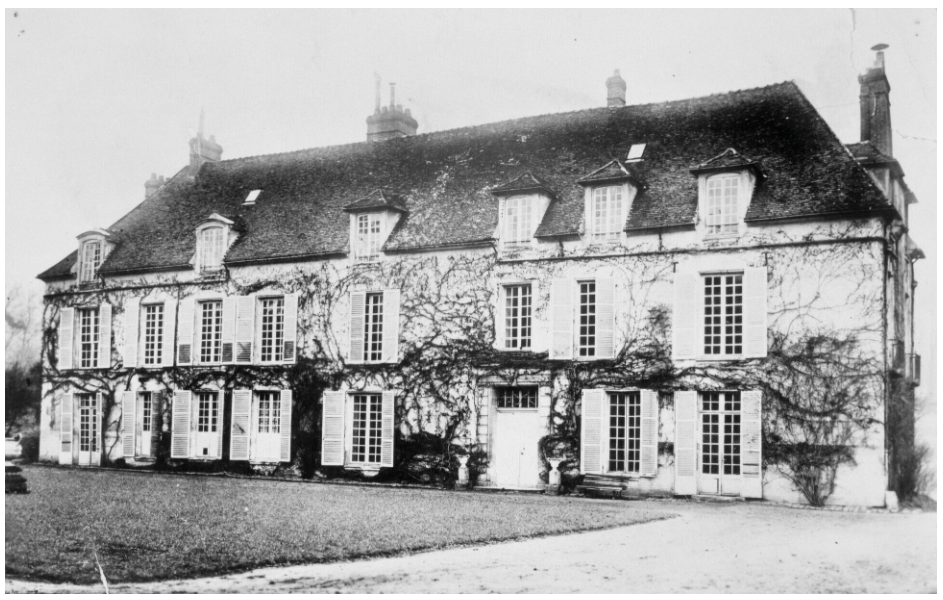
Château de Boisgeloup in 1931. Photographer unknown. Photo: © RMN-Grand Palais / Art Resource, NY.
Radiating bright summer light and saturated with the vibrant, color-filled palette that defined Picasso’s depictions of Marie-Thérèse, Femme endormie was painted in July 1934, at the artist’s country hideaway of Boisgeloup, an impressive seventeenth-century provincial château in rural Gisors, northwest of Paris. Having tired of carting his canvases, materials, and other artistic paraphernalia around his annual summer haunts, and seeking refuge away from his familial obligations in Paris, Picasso had bought the château in 1930. He immediately converted the outdoor stables into a sculpture studio, and devoted a large, light-filled room on the second floor to painting.
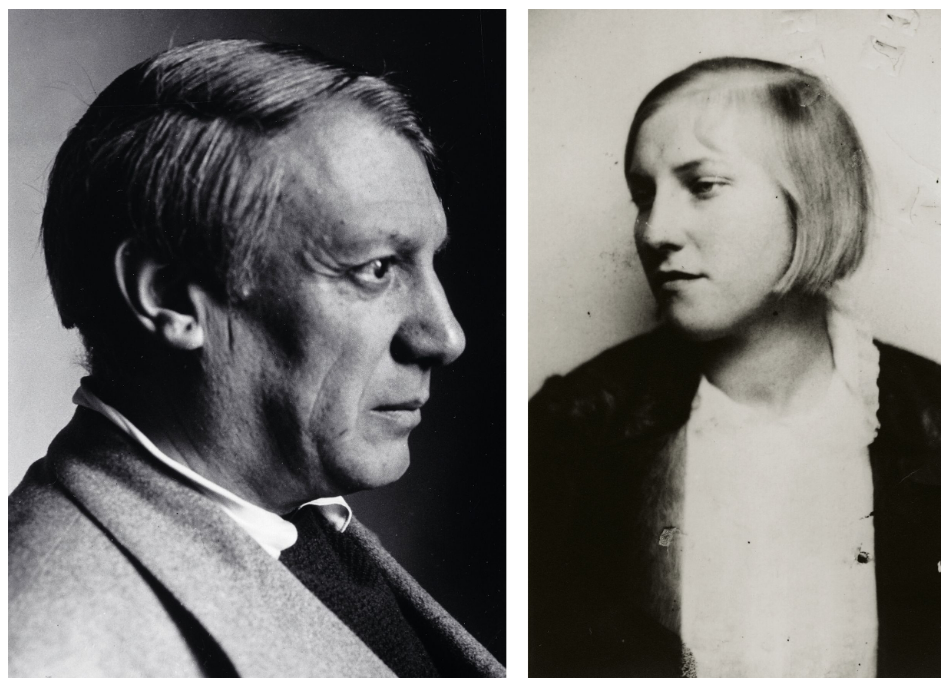
Left: Portrait of Picasso in his studio at rue de La Boétie, Paris, 1932. Photograph by Brassaï. © 2023 Estate of Pablo Picasso / Artists Rights Society (ARS), New York. Photo: © Estate Brassaï – RMN-Grand Palais. Digital Photo: © RMN-Grand Palais (musée national Picasso – Paris) / Franck Raux.
Right: Marie-Thérèse Walter, circa 1930. Photographer unknown. © Archives Maya Widmaier-Picasso.
Ensconced together at Boisgeloup, Picasso’s creativity flourished, and he painted myriad portraits of Marie-Thérèse in a variety of poses and situations, shifting from languorous and luxuriant to upright and alert, lost in the act of reading, writing, or simply daydreaming as she moved through the château. Surrounded by the verdant landscape of Gisors, her image was often linked to the natural world: she became a goddess, a blooming flower, a sun or moon. The pair appear to have spent much of the spring and summer of 1934 there together, with the artist’s granddaughter Diana Widmaier Picasso noting that “the frantic rate at which they exchanged letters abated,” offering a clear indication of their close proximity during this period (exh. cat., op. cit., p. 32). In March, Picasso embarked on a series of paintings focusing on Marie-Thérèse reading and writing letters, sometimes alone at a desk or table, but most often in the company of one of her sisters, who appears to have joined her at Boisgeloup for a brief sojourn. Through April and May, her features proliferate in his paintings and drawings, leading to a sequence of erotically-charged reclining nudes, celebrating his passionate adoration of his lover. In these works—many of which appear as a thematic continuation of the quick, gesturally painted reclining nude studies that had preoccupied him through much of 1932—Marie-Thérèse is seen in the painting studio at Boisgeloup, posed before a folding screen or alongside the windows thrown open to the landscape beyond, the sinuous curves and voluptuous lines of her body rendered in flowing, fluid brushstrokes.
#8. Nature morte à la fenêtre, 1932
Christie’s New-York: 11 May 2023
Estimate on Request
USD 41,810,000
PABLO PICASSO (1881-1973) (christies.com)
PABLO PICASSO (1881-1973)
Nature morte à la fenêtre, 1932
Oil on canvas
129.7 x 162.3 cm (51 x 63 7/8 inches)
Dated ’18-1-XXXII’ (on a section of the original stretcher affixed to the backing board)
Over the course of 1932 Pablo Picasso reached an extraordinary pitch of creativity in his paintings, inspired by the sensuous forms of his young lover, Marie-Thérèse Walter. Brought together by a fortuitous, chance encounter on the streets of Paris five years previously, the pair embarked on a passionate, heady affair that would inspire some of Picasso’s most celebrated works, with Marie-Thérèse’s classical profile, voluptuous curves and short, cropped hair coming to dominate every aspect of his creative output. Painted during the opening weeks of 1932, Nature morte à la fenêtre is one of the first canvases to emerge in an exceptional series of paintings devoted to Marie-Thérèse. Simultaneously looking back to the monumental plaster busts that had occupied the artist over the course of 1931, and forwards to the great outpouring of sensual nudes that would emerge later that spring, Nature morte à la fenêtre holds a pivotal place within the story of Picasso’s annus mirabilis.
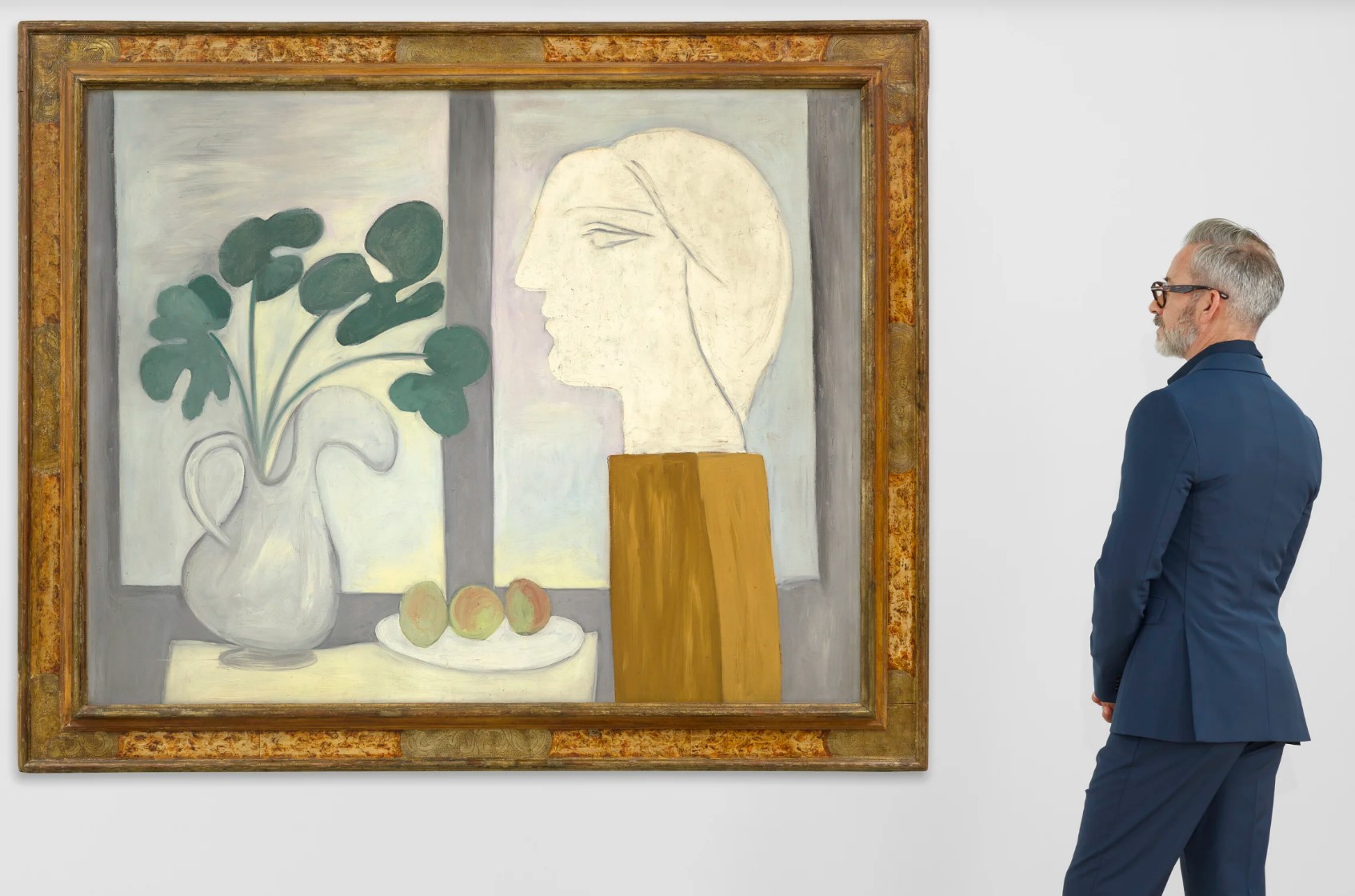
In Nature morte à la fenêtre, Picasso takes one of the more classical of the Boisgeloup sculptures as inspiration—Marie-Thérèse appears as a graceful, feminine figure, her profile a series of soft, flowing lines, without any exaggerated volumes or distortions. Placed atop a tall, wooden plinth, she enjoys an elevated viewpoint from which to gaze over the simple still life on the table, appearing as a serene and composed vision against the subtly variegated light of the window. Each of the elements within the scene appears to hint towards an aspect of Marie-Thérèse’s character, from the sinuous curvature of the jug and softly rounded fruit which may be read as an allusion to her voluptuous form, to the vibrant green leaves of the philodendron, which spring from the vase with a vitality and brightness, that reflects her own youthful exuberance. There is a quiet stillness within Nature morte à la fenêtre, a reflection perhaps of Marie-Thérèse’s ongoing presence in the artist’s life at Boisgeloup, and the simple rhythms of their days together, reading, working, making love, in the secluded surroundings of the chateau. This private, easy way of life would provide an essential counterpoint to the stresses that would consume the artist through the spring, as he prepared to stage the most important exhibition of his career thus far. On 15 June 1932, Picasso: 1901-1932 opened at the Galeries Georges Petit in Paris with a lavish white-tie preview.
Dora Maar
The story of Dora Maar’s relationship with Picasso is legendary in the history of 20th century art. Picasso met Maar, the Surrealist photographer, in the fall of 1935 and was enchanted by the young woman’s powerful sense of self and commanding presence. Few figures in twentieth-century art have been so thoroughly absorbed by another artist’s mythology as Dora Maar. For decades, her name circulated primarily through the prism of Pablo Picasso: as lover, muse, torment, and symbol. Yet this reduction obscures a far more complex reality. Dora Maar was not discovered by Picasso; she arrived already formed: intellectually, politically, and artistically. Their encounter did not create her. It collided with her.
READ ABOUT DORA MAAR
FIND ALL HISTORICAL AUCTION RESULTS
Nu debout et femmes assises, 1939
The Roger and Josette Vanthournout Collection
Christie’s London: 5 March 2026
Estimated: GBP 3,500,000 – 5,500,000
GBP 7,004,000 / USD 9,356,645
PABLO PICASSO (1881-1973), Nu debout et femmes assises | Christie’s
PABLO PICASSO (1881-1973)
Nu debout et femmes assises, 1939
Oil on canvas
41.5 x 33 cm (16-3/8 x 13 inches)
Signed ‘Picasso’ (lower right); dated ‘23.9.39.’ (lower left)
Dated again and inscribed ‘Royan 23 Septe 39.’ (on the reverse)
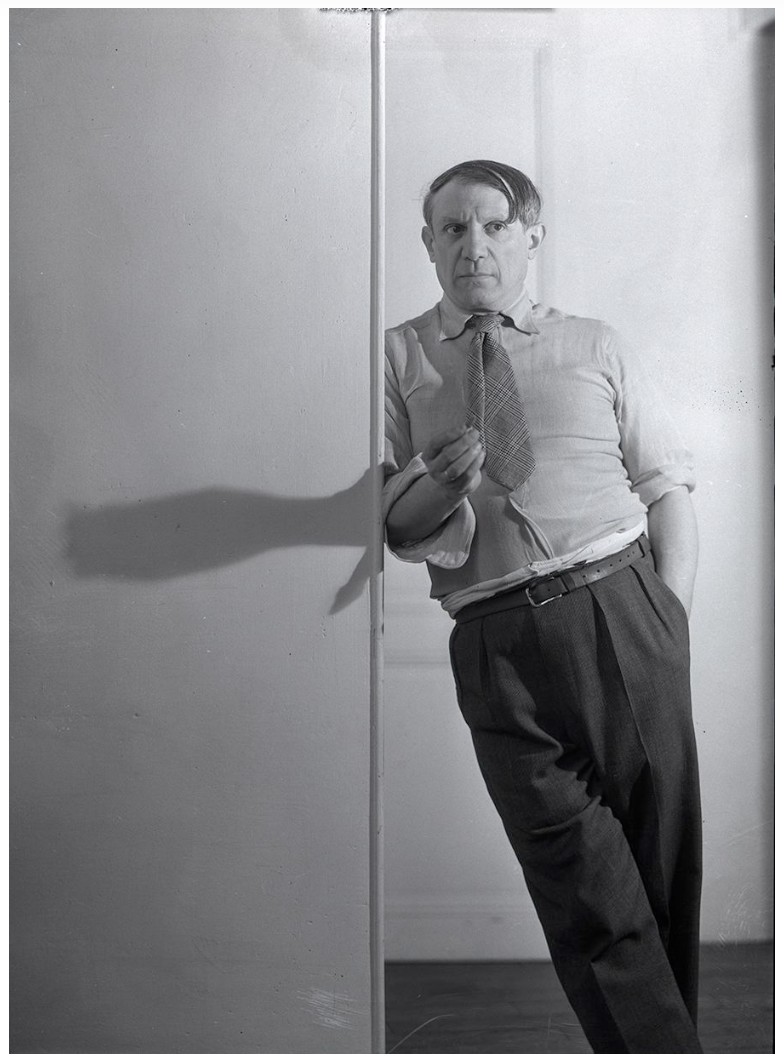
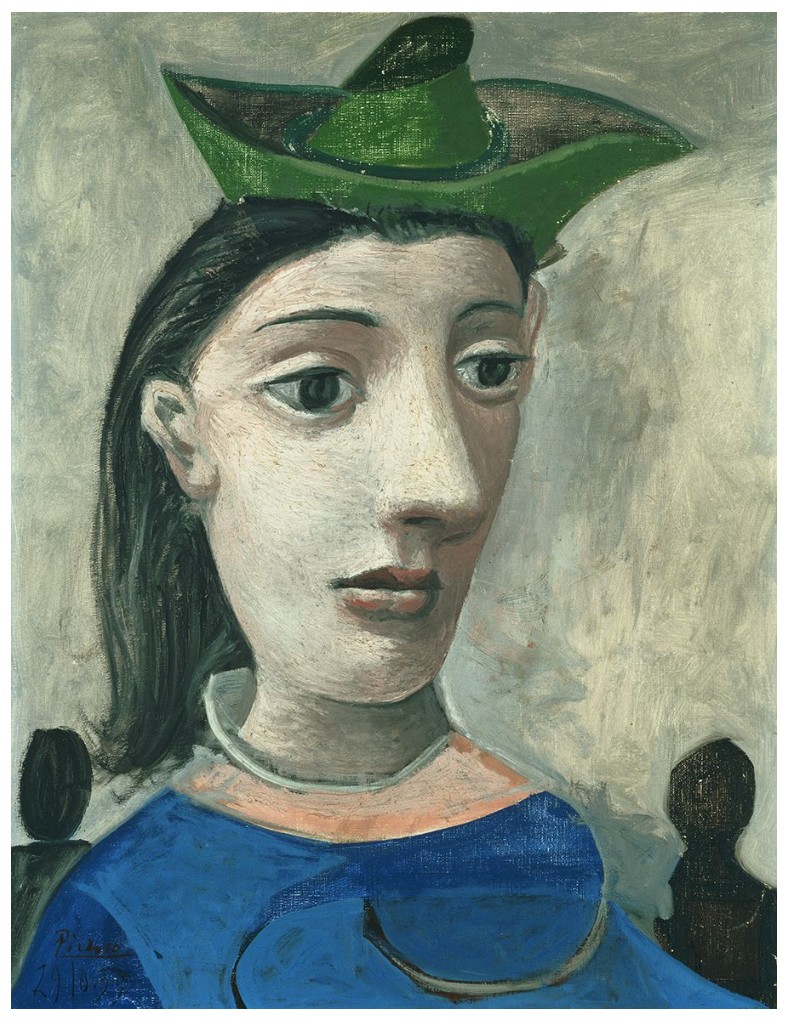
In a car driven by his loyal chauffeur Marcel, Picasso and Maar, along with Jaime Sabartés and his wife, and Picasso’s Afghan hound Kazbek, had all hurriedly left Paris together on 1 September 1939, driving overnight in a panic straight for Royan. There, barring a few short bureaucratic return trips to Paris, Picasso was to live and work until August 1940.
Picasso had chosen Royan because it was a place sufficiently remote and yet also near enough to keep in touch with Paris, and because, since July, it was there that he had ensconced his other mistress, Marie-Thérèse Walter. On arrival, Picasso, Maar and Sabartés moved into the small Hôtel du Tigre in the centre of town. As Roland Penrose, who was close to Picasso around this time, recalled, ‘the rooms in which he lived for the next few months were cramped and badly lit. The town itself apart from its harbour had few attractions. Accepting the situation, however, he settled down to a regular routine in which the main factor, work, was punctuated with meals and walks around the town, accompanied by Dora Maar, Sabartès and the docile Kasbec’ (Picasso: His Life and Work, London, 1958, p. 292).
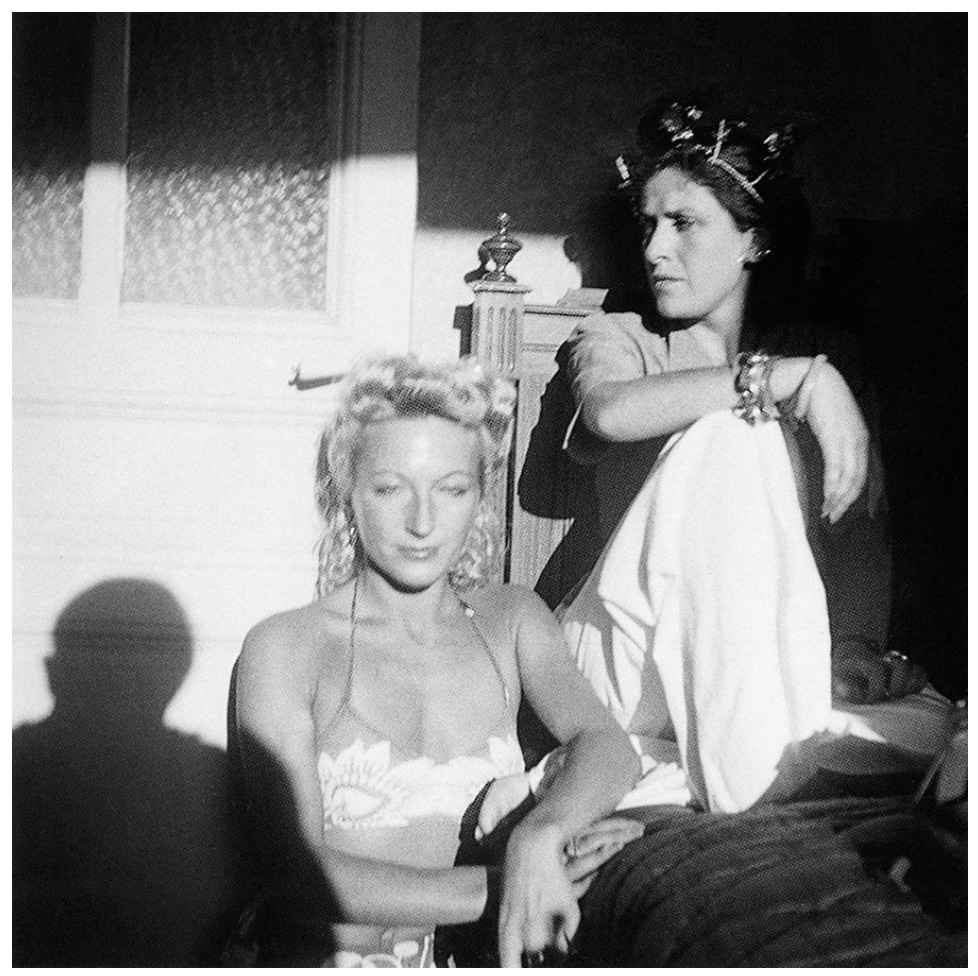
Jacqueline Lamba and Dora Maar, Antibes, August 1939. Photograph by Pablo Picasso. Musée national Picasso-Paris. Artwork: © 2026 Succession Picasso/DACS, London. Digital image: © GrandPalaisRmn (musée national Picasso-Paris) / image GrandPalaisRmn
Picasso’s life was, in fact, a little more complex than this due to the continuing balancing act he was performing between Dora Maar and Marie-Thérèse, to whom he had explained away his separate rooms in the Hôtel du Tigre as ‘a necessary studio.’ In reality, it was Maar who was using their room at the Hôtel du Tigre to paint while Picasso had set up a studio for himself in a small dining room at the Villa Gerbier de Jonc where Marie-Therese, her mother, sister, and her daughter with Picasso, Maya, had been living since July. As John Richardson has written, ‘Dora remembered Royan as hell…she was miserable from nearly the moment they arrived. [She] soon realised why Picasso was always disappearing to the nearby Villa Gerbier de Jonc…[Picasso’s studio there] was a small and dark, shaded by trees that lined the street, hence the smallish size of most of his canvases for the next six months’ (A Life of Picasso, The Minotaur Years 1933-1943, New York, 2021, volume IV, p. 195).
It was there, between 21 September and 1 October, hunched over a chair in the dining room of the Villa Gerbier de Jonc that Picasso painted Nu debout et femmes assises and the series of pictures to which it belongs. In his memoirs of this period, Jaime Sabartés has reported that he repeatedly encouraged the artist to acquire an easel to aid his working practice at this time. For a long time, Picasso resisted, choosing deliberately to work in this cramped fashion hunched over the small canvases that he had set up on a chair.
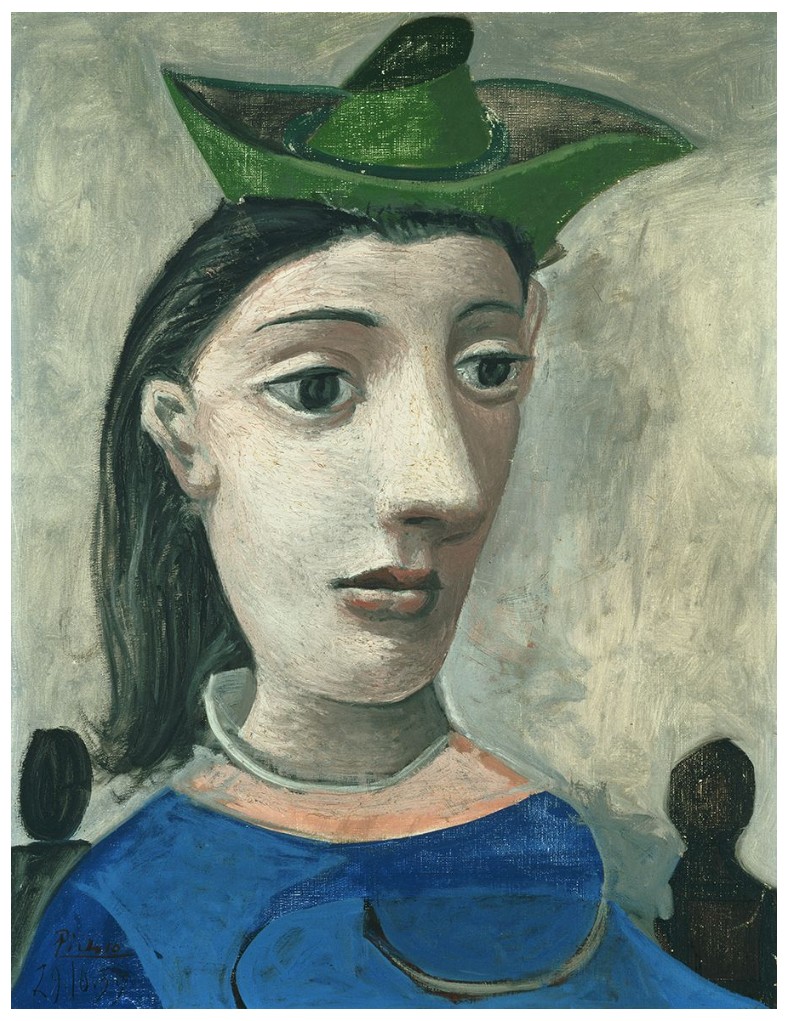
Left: Pablo Picasso, Nu debout et femme assise, 1 October 1939. Moderna Museet, Stockholm. Artwork: © 2026 Succession Picasso/DACS, London. Digital image: Moderna Museet/Stockholm. Right: Pablo Picasso, Nu debout et femme assise, 22 September 1939. Musée Picasso, Paris. Artwork: © 2026 Succession Picasso/DACS, London. Digital image: © GrandPalaisRmn (musée national Picasso-Paris) / Mathieu Rabeau.
The very first pictures that Picasso had painted in Royan were a small series of grisaille horses inspired by those he had seen being rounded up for military enlistment on his journey down from Paris with Sabartés. Reminiscent in some respects of his frightened horse in Guernica, these horses, ‘with their submissive air… as if on their way to the slaughterhouse,’ (op. cit., 2002, p. 617), had evidently struck Picasso as symbolic of the awful tragedy he was powerless to avert, and must also have reminded him vividly of the First World War, in which horses had played such an instrumental and sacrificial role. Picasso followed these pictures with the sequence of eight or nine double portraits of women (predominantly Maar), to which Nu debout et femmes assises belongs, and then by a very Goya-esque sequence of pictures of sheep’s skulls based on those he was buying to feed Kazbek. ‘It is natural,’ as Cowling has written, ‘to read [these works] as stand-ins for mankind and for the suffering and sacrifice of the innocent’ (ibid., p. 617).
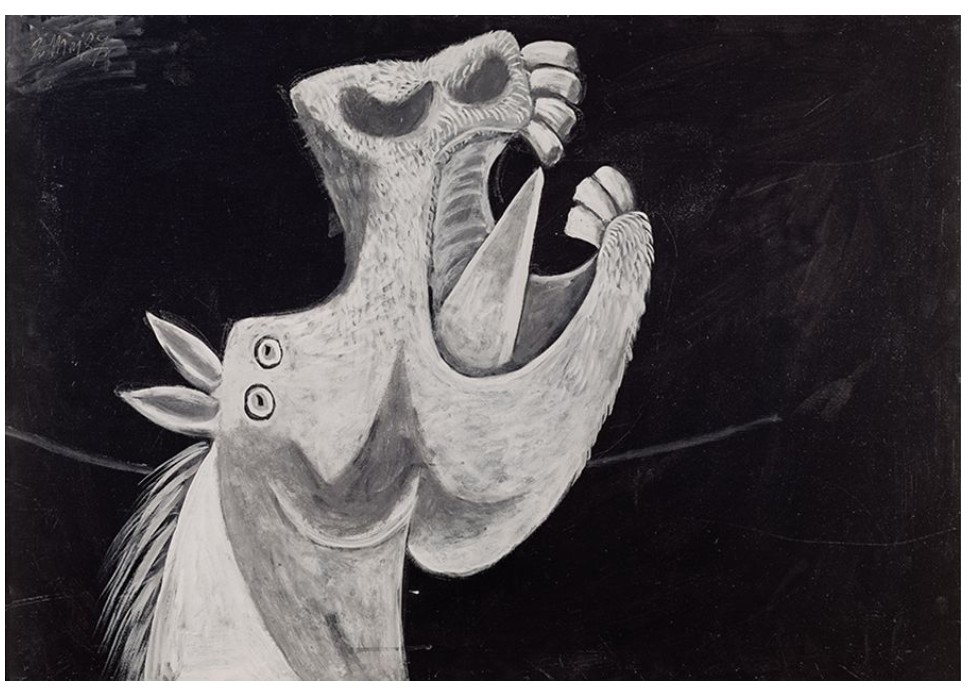
Pablo Picasso, Étude pour Guernica, May 1937. Museo Nacional Centro de Arte Reina Sofia, Madrid. Artwork: © 2026 Succession Picasso/DACS, London. Digital image: © Bridgeman Images.
These motifs subsequently developed into an ultimately failed series of attempts to paint a portentous picture of a woman holding a skull before, ultimately, in 1940, giving rise to his greatest masterpiece of the Royan period, his Grand nu assis (Femme se coiffant) of 1940, (now in The Museum of Modern Art, New York). The roots of this famous painting of a monstrous, naked, Dora Maar sitting squirming and twisting in a sinister confined space derive from a series of sketches Picasso made during his first months in Royan when he was working on Nu debout et femmes assises, and from the series of double portraits of seated and standing depictions of Maar to which it belongs.
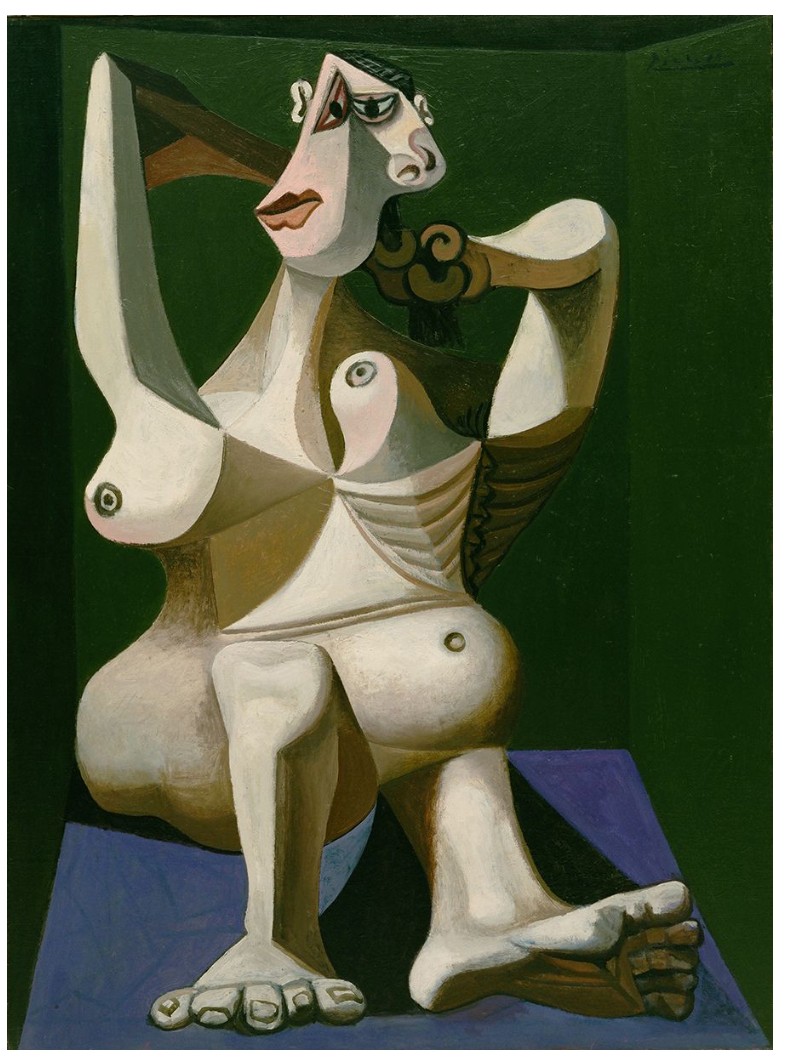
Pablo Picasso, Grand nu assis (Femme se coiffant), 1940. The Museum of Modern Art, New York. Artwork: © 2026 Succession Picasso/DACS, London. Digital image: © 2026 The Museum of Modern Art, New York/Scala, Florence.
In Nu debout et femmes assises, Picasso depicts a standing nude Maar alongside a clothed portrait of her seated in the kind of chair to which he would confine her throughout much of the wartime period. For Picasso, the chair could often become an instrument of confinement and even torture. As he would later confess about his pictures of Maar, ‘for years I’ve painted her in tortured forms, not through sadism, and not with pleasure either; just obeying a vision that forced itself on me. It was the deep reality, not the superficial one’ (quoted in B. Léal, ‘“For Charming Dora”: Portraits of Dora Maar,’ in Picasso and Portraiture, exh. cat., The Museum of Modern Art, New York, 1996, p. 395). Maar was, he said, ‘for me… always a weeping woman. And it’s important, because women are suffering machines… When I paint a woman in an armchair, the armchair implies old age or death, right? So, too bad for her’ (quoted in A. Malraux, Picasso’s Mask, New York, 1976, p. 138).
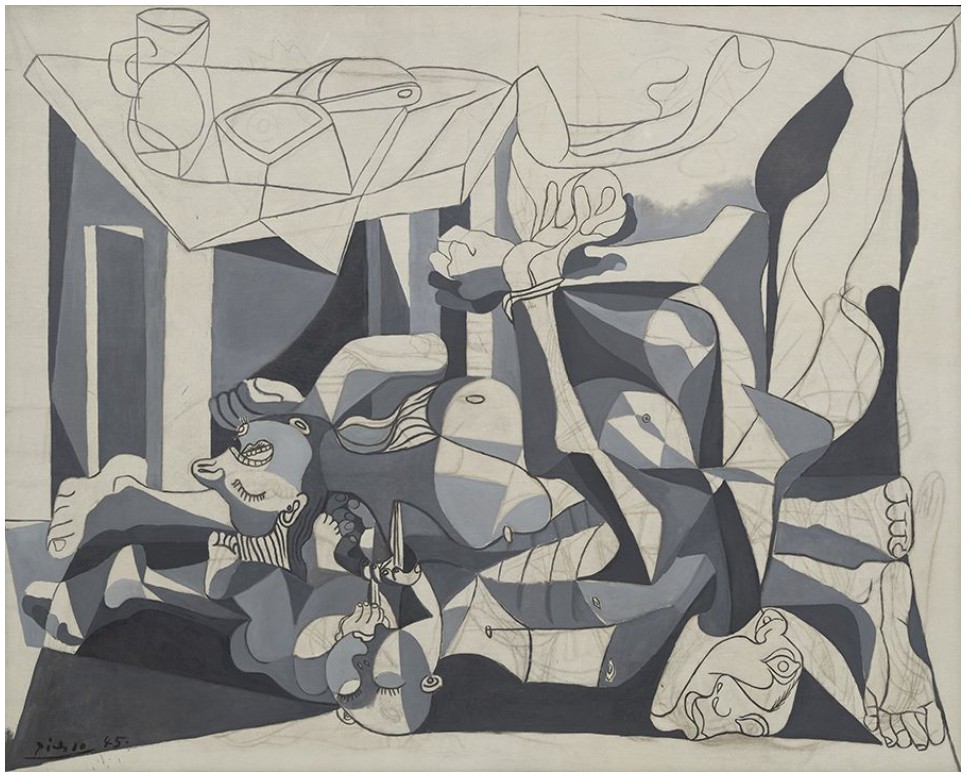
Pablo Picasso, Le charnier, 1944-1945. The Museum of Modern Art, New York. Artwork: © 2026 Succession Picasso/DACS, London. Digital image: © 2026 The Museum of Modern Art, New York/Scala, Florence.
Given this context, Nu debout et femmes assises, like many of the works in the series, such as Nu debout et femme assise of 22 September 1939 (now in the Musée national Picasso, Paris), presents a deliberate play of polarities which in its stark contrasting of a standing nude against a clothed, seated figure, assumes an existential dimension. Indeed, the ultimate effect of this elegant but also grisaille, portrayal of physical opposites is one that appears also to speak of the schizophrenic nature of the time in which it was made. Removed from his life in Paris like an exile in his own adoptive home, awaiting the result of a war in which he could play no part and living between two lovers in a small seaside town, Picasso’s life was, for the moment, also split in two. The polarized theme of the two women that manifested briefly in these works was, however, short-lived. As Elizabeth Cowling has pointed out, the doubling theme of these works was ‘not pursued further after [a] grisaille version of 29 September. The motif now breaks down into its components: into the pictorial themes of a [single] naked seated and a naked standing female figure. The first sketchy notes of a naked woman combing her hair can already be found in a carnet used in Royan between 30 September and 29 October, 1939. All sketches depict a repulsively alienated, standing female nude arranging her hair’ (op cit., 2002, p. 617). These sketches were the ones that ultimately gave rise in the summer of 1940 to the definitive naked portrait of Maar tormented and twisting in many different directions in Grand nu assis (Femme se coiffant).
Art History
La Statuaire, 1925
A Legacy of Beauty: The Collection of Sydell Miller
Sotheby’s New-York: 18 November 2024
Estimate on Request
USD 24,800,000
PABLO PICASSO (1881 – 1973)
La Statuaire, 1925
Oil on canvas
131 x 97.8 cm (51 5/8 x 38 1/2 inches)
Signed Picasso and dated 25 (lower right)
Dated XXV-II-XXV (on the stretcher)
In late September of 1925, Pablo Picasso, his wife Olga and their young son Paolo returned to Paris from their annual summer holiday in the South of France. The summers were beginning to blend together for Picasso, who was tiring of the swell set he and Olga socialized with. The home they returned to at 23 rue la Boetie was a changed one. After lengthy negotiations, Picasso had acquired an additional floor of the building to be used as his studio. He set about immediately modifying the space: removing doors from their hinges, bringing in his copious art supplies (and a limited amount of furniture) and stripping back most of the existing wallpaper. After years of jostling with his elegant and socially aspirational wife for space in their apartment on the floor below he relished a place to colonize as his own.
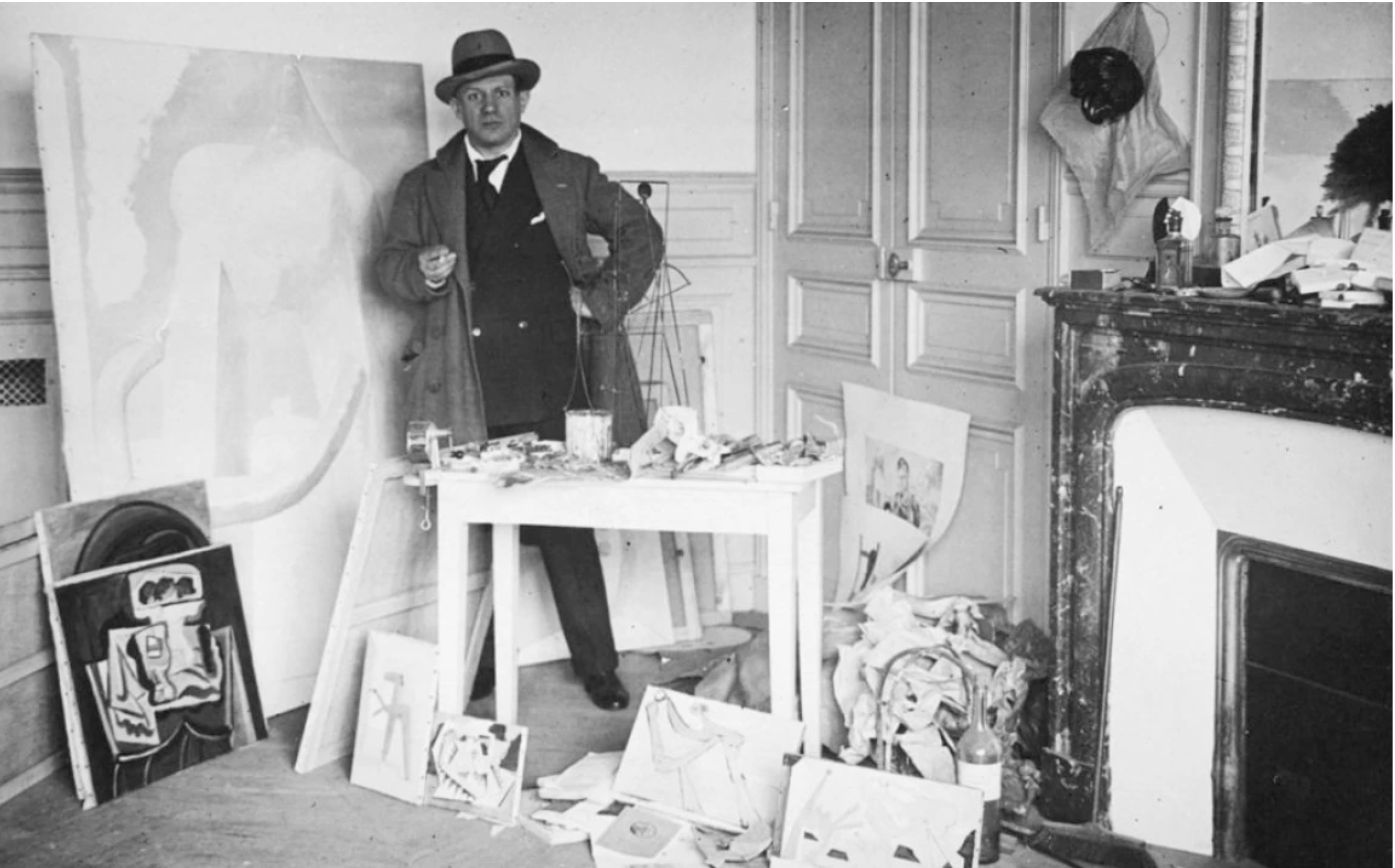
Pablo Picasso in his Rue la Boetie studio, Paris, 1929, Photograph by Albert Harlingue. Image © 2024 Albert Harlingue / Alamy. Art © 2024 Estate of Pablo Picasso / Artists Rights Society (ARS) New York
Some years later the photographer Brassaï related his impressions of the space: “I had expected an artist’s studio, and this was an apartment converted into a kind of warehouse…. There were four or five rooms—each with a marble fireplace surmounted by a mirror—entirely emptied of customary furniture and littered with stacks of paintings, cartons, wrapped packages, pails of all sizes, many of them containing the molds for [Picasso’s] statues, piles of books, reams of paper, odds and ends of everything, placed wherever there was an inch of space, along the walls and even spread across the floors…. The doors between all the rooms were open—they might have even been taken off—transforming the large apartment into a single studio cut up into a multiple series of corners for the multiple activities of its owner…. Picasso had stood his easel in the largest and best-lit room—what once had surely been the living room—and this was the only room that contained any furniture at all. The window faced south, and offered a beautiful view of the rooftops of Paris, bristling with a forest of red and black chimneys, with the slender, far off silhouette of the Eiffel Tower rising between them” (quoted in John Richardson, A Life of Picasso. The Triumphant Years, 1917-1932, New York, 2010, p. 298). It was in this room, with the doors opened onto the balcony, that Picasso painted La Statuaire.
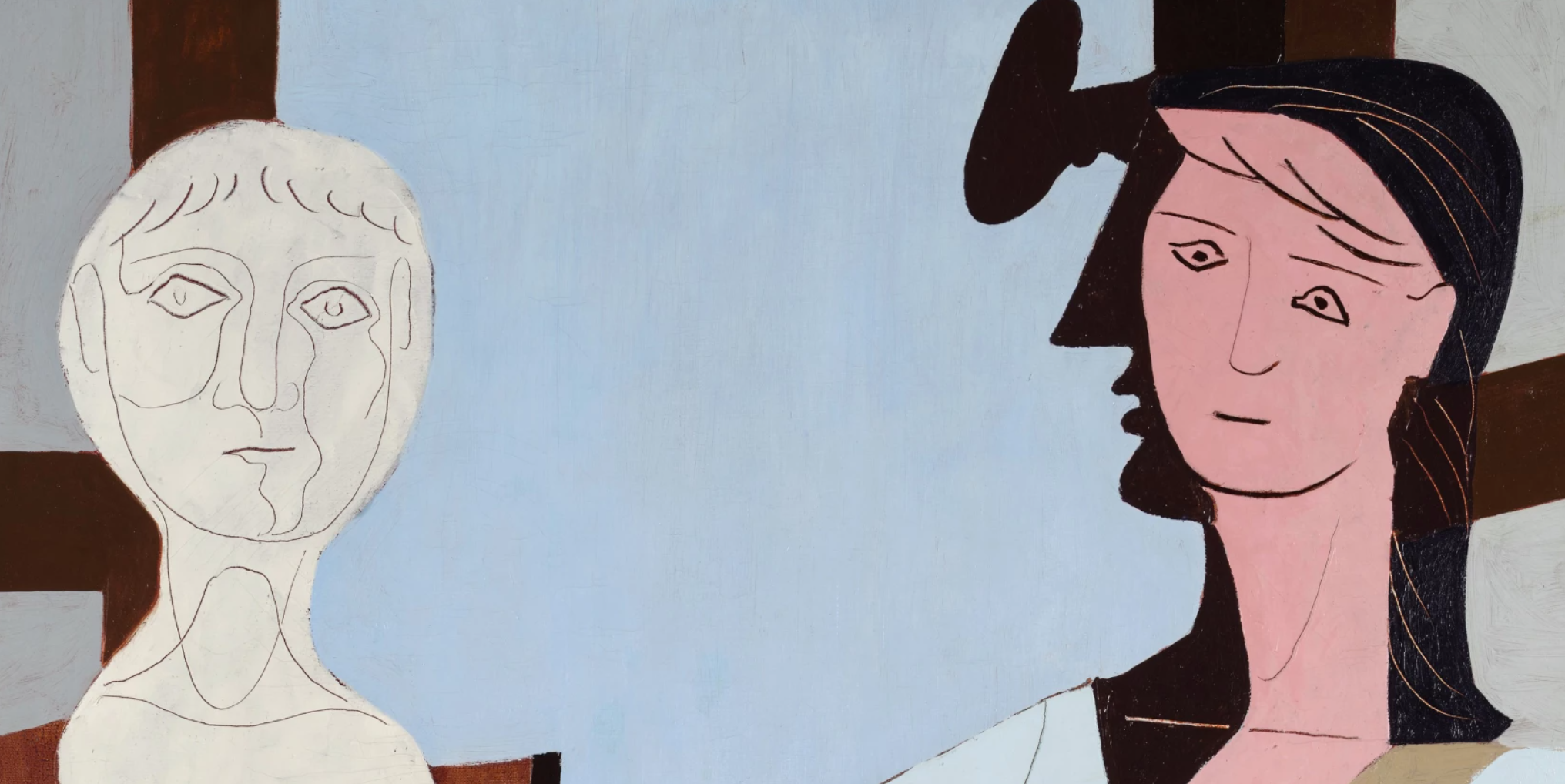
As with all great works by Picasso nothing is as simple as it may at first appear. Moreover, the 1920s were a period of immense change, diversity and formal resolution in the artist’s oeuvre. Picasso’s paintings and drawings from this period exist in various modes, from wild explorations of Surrealist styles to monumental-themed Neo-Classical imagery to a renewed Cubism that took color and flattened planes as its crux. These associations—Surrealism with the avant-garde, Neo-Classicism with traditional art and Cubism with disruptions in art dating to before and during World War I—are disparate but, as always with Picasso, woven together to create new methods of expression, new ways of seeing. Writing about this work and other large-scale canvases from this period Michael Fitzgerald states “… these monumental paintings of figures and still lifes display a Cubism of such maturity and confidence that it subsumed apparently contradictory styles without diminishing its visual authority. For Picasso… these paintings demonstrated a masterful resolution of the issues that had roiled Picasso’s art over the course of the previous ten year” (Michael C. Fitzgerald, Making Modernism, Picasso and the Creation of the Market for Twentieth Century Art, New York, 1995, p. 161).
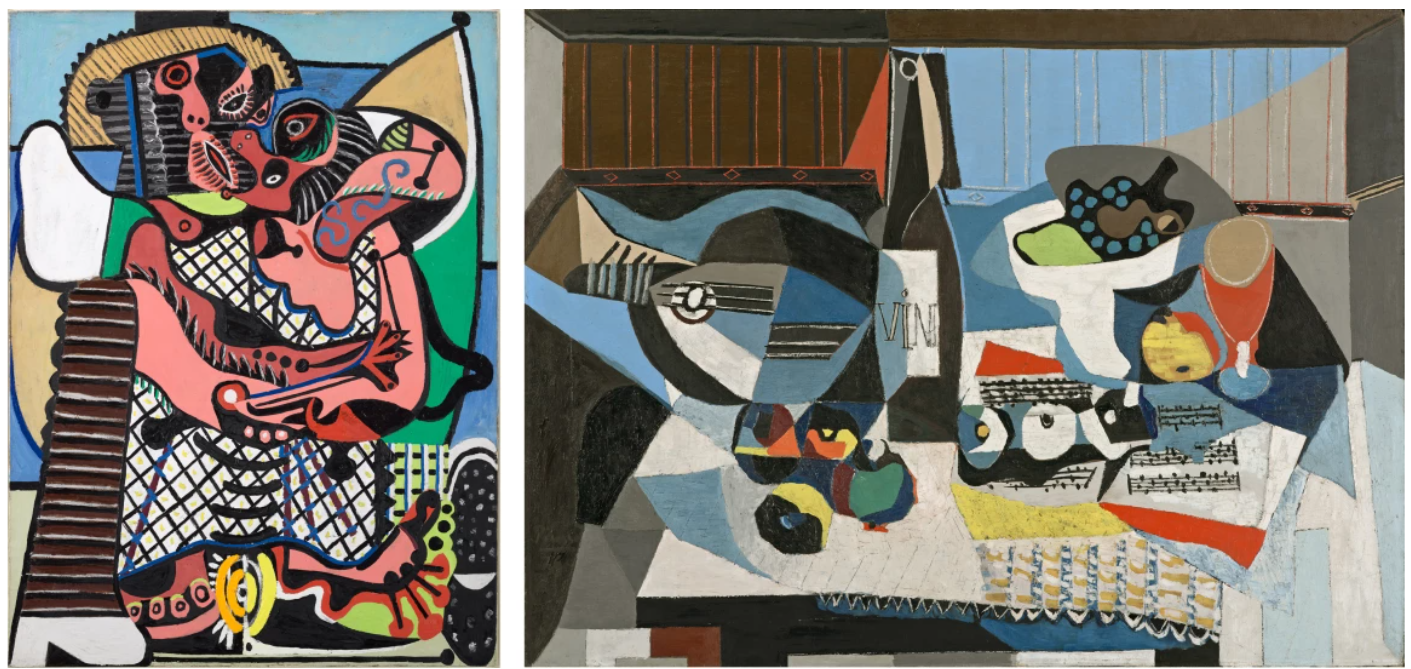
Left: Pablo Picasso, Le Baiser, 1925, Musée Picasso, Paris. Image © 2024 Photo Josse / © Succession Picasso/DACS, London 2024 / Bridgeman Images. Art © 2024 Estate of Pablo Picasso / Artists Rights Society (ARS), New York
Right: Pablo Picasso, La Bouteille de vin, 1925-26, Fondation Beyeler, Basel. Art © 2024 Estate of Pablo Picasso / Artists Rights Society (ARS), New York
In La Statuaire the artist depicts a seated female figure opposite a portrait bust, which is placed atop a pedestal. Seemingly parallel to each other, the pair is positioned in front of a set of open French doors, beyond which a balcony and an abstracted blue background convey, but do not confirm, the outdoors. The use of the balcony as a compositional device had been thoroughly explored in the previous century by the Impressionists. A visual symbol of Baron Hausmann’s Paris, artists from Édouard Manet to Gustave Caillebotte arranged space and perspective, both to view the city (in the case of Caillebotte) and to view the viewers (in the case of Manet). Picasso’s balcony serves neither of these purposes. While it might abstractly imply the outdoors and the possibility of the female figure being seen by others, the primary act of looking here is between figure and sculpture or the artist—Picasso—regarding his own creation.
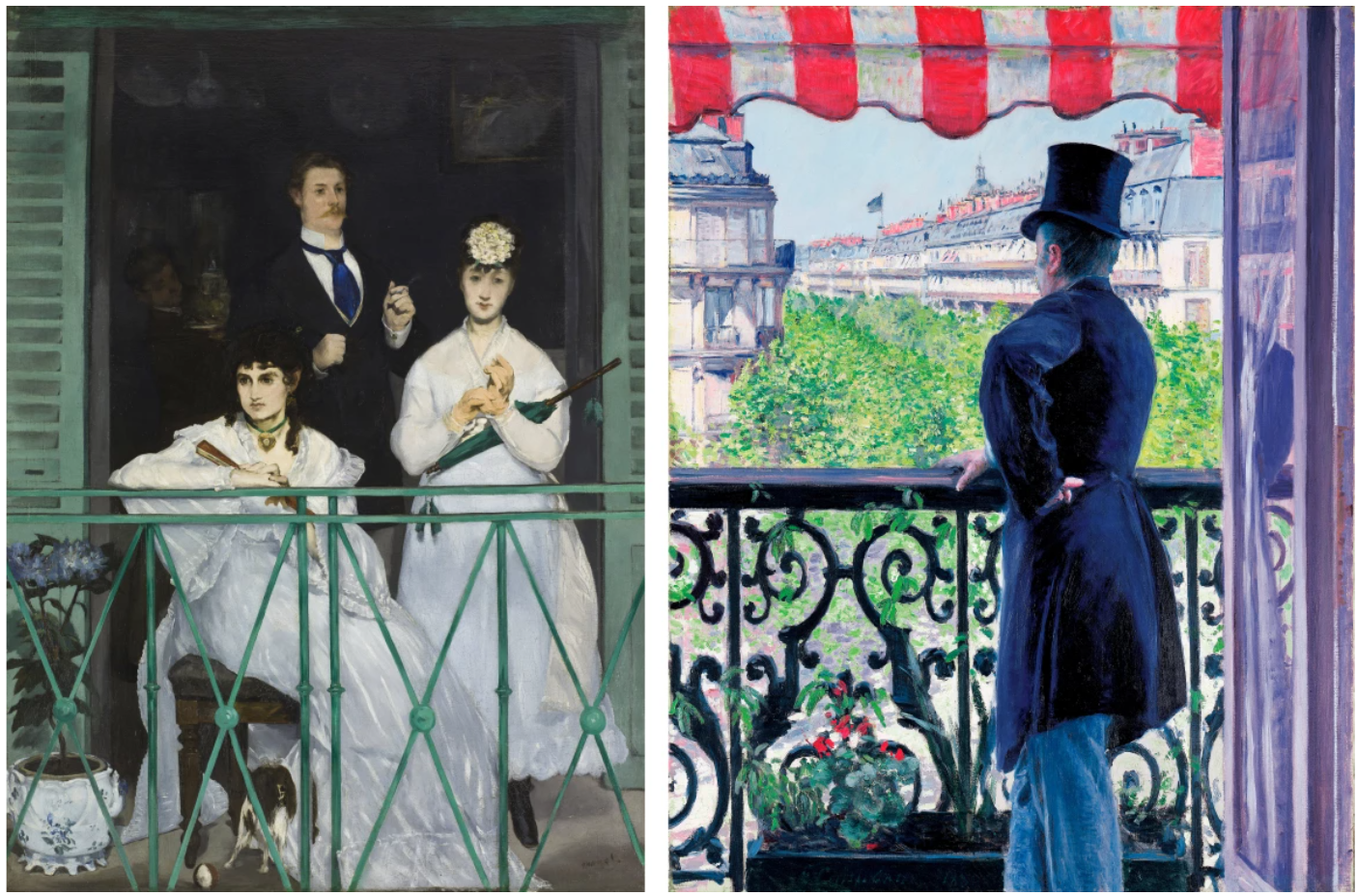
Left: Édouard Manet, Le Balcon, 1868-69, Musée d’Orsay, Paris
Right: Gustave Caillebotte, L’Homme au balcon, Boulevard Haussmann, 1880, Private Collection
The present work’s title La Statuaire refers to the Classical sculpture placed at left and is how the work is titled in the catalogue raisonné for Picasso authored by Christian Zervos. Other scholars, including John Richardson and Josep Palau i Fabre instead title this work The Sculptress. In the archives of Galerie Paul Rosenberg, who first exhibited this work in 1926, a year after it was created, the title for this painting is recorded as La Femme sculpteur. As these other titles allude to, the subject matter of this work is not limited to a sculpture that happens to have a woman seated next to it but rather the subject is an artist—a female sculptor—either working on an object of her own creation or examining a Classical sculpture for inspiration. In 1924 Picasso began to create still life compositions featuring sculptures. Picasso’s painting technique, which employs incising in the bust and the figure, also reinforces the subject matter, echoing the physical actions that a sculptor uses when removing material to create three-dimensionality. By the early 1930s Picasso was using this type of direct carving method in his own sculpture while continuing to explore the subject of the sculptor regarding his or her own creations in his paintings, works on paper and print practice.
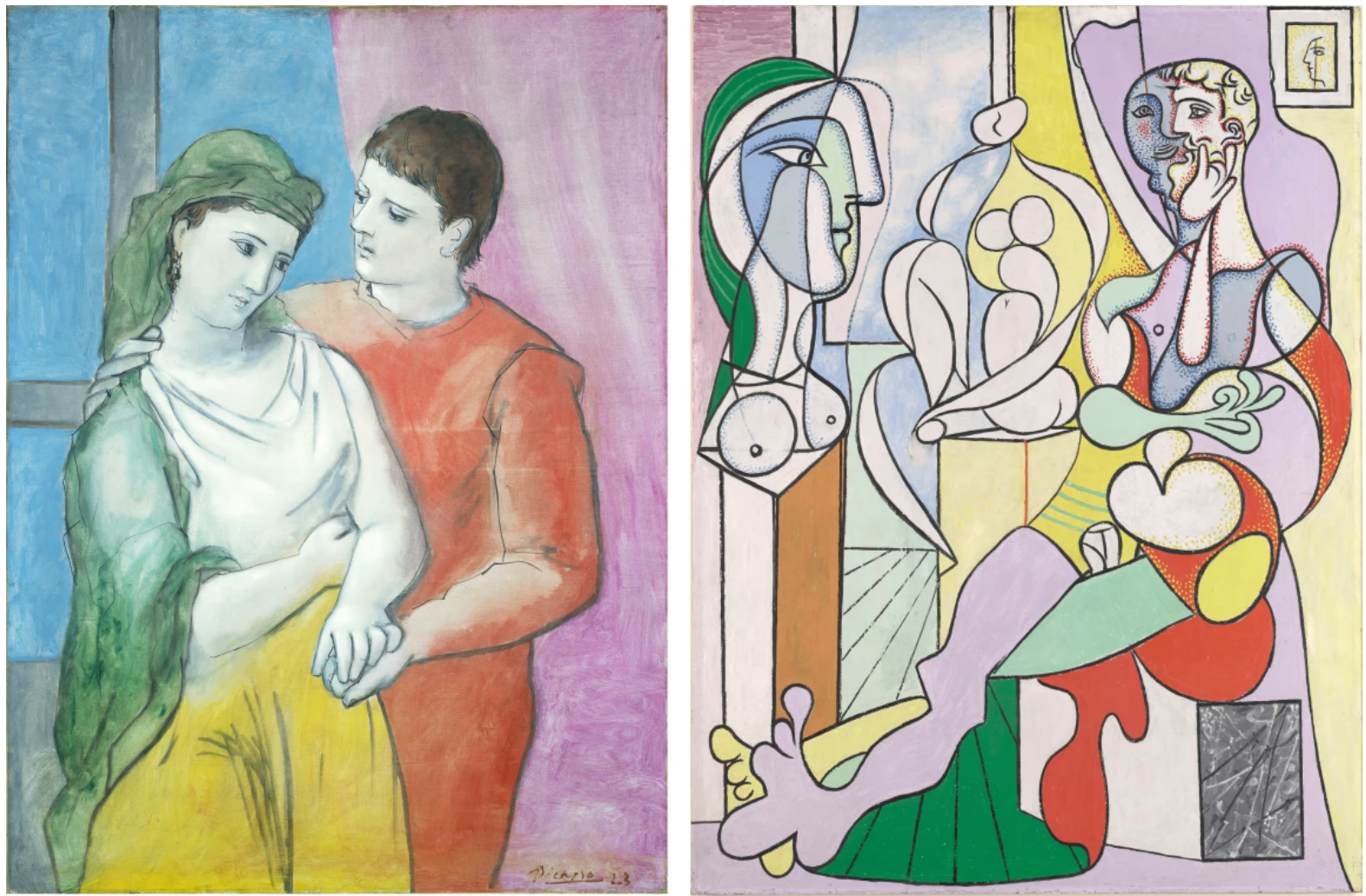
Left: Pablo Picasso, Les Amoureux, 1923, National Gallery of Art, Washington, D.C.Image © 2024 Erich Lessing / Art Resource, NY. Art © 2024 Estate of Pablo Picasso / Artists Rights Society (ARS), New York
Right: Pablo Picasso, Le Sculpteur, 1931, Musée Picasso, Paris. Image © 2024 Succession Picasso/DACS, London / Bridgeman Images. Art © 2024 Estate of Pablo Picasso / Artists Rights Society (ARS), New York
What La Statuaire presents for the first time in Picasso’s oeuvre is a depiction of a female artist. In his analysis of the present work Michael Fitzgerald discusses this aspect as well as the inclusion of the classical bust and Picasso’s nuanced painting techniques: “La Statuaire is Picasso’s most complex and seductive exploration of the apparent contradictions and potential resolutions between avant-garde and historical art. Stemming from the Roman busts of contemporary still-lifes, this painting offers a polyvalent set of readings. The woman might be one of the models common in his studio pictures, except for the fact that she is clothed and her tan smock likely identifies her as a sculptor. This is Picasso’s first depiction of a woman artist, a characterization that he would use regularly in the thirties and later. Despite an initial appearance of almost overly refined elegance, the painting is composed of extreme contrasts. The stark white and coarse features of the bust oppose the delicate flesh of the figure, and the soft tones of the picture—tan, aqua and gray—create a mellow effect in keeping with the sculptor’s girlish appearance. Yet the execution is far from harmonious. Large, irregular planes of color are juxtaposed with forms that are rounded in perspective and realistically detailed; smoothly applied layers of paint are sliced through with the blunt end of a brush. Indeed, the woman’s graceful features are partially drawn in this crude technique. The result is a subversion of the initial impression, as the painting’s foundation in both ancient and avant-garde forms is revealed and sealed in a union that preserves differences as well as synthesizes a new visual language” (Exh. Cat., Hartford, Wadsworth Atheneum and The Cleveland Museum of Art, Picasso: The Artist’s Studio, 2001-02, pp. 32-33).
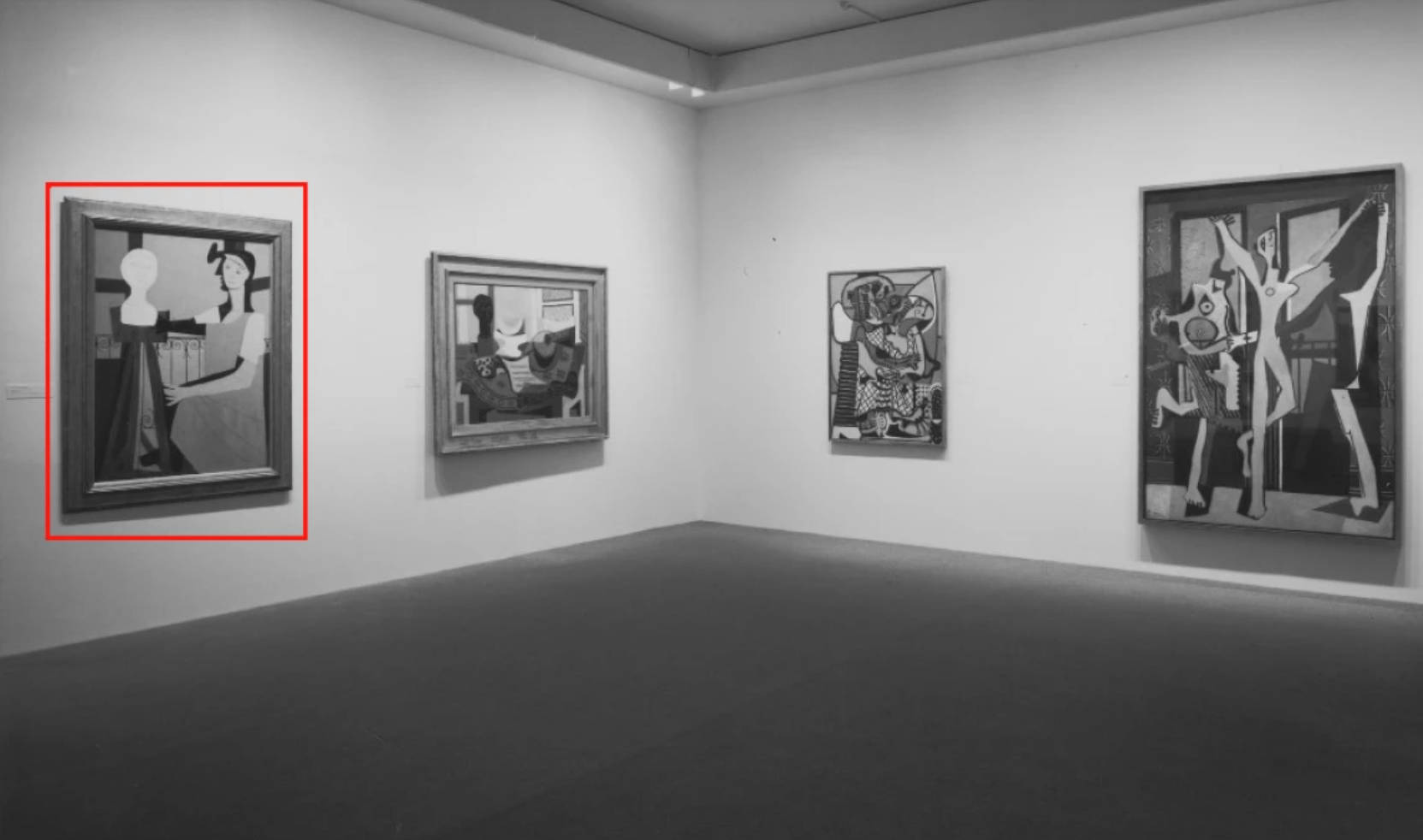
The present work installed in Pablo Picasso: A Retrospective at The Museum of Modern Art, New York, 1980. Image © 2024 The Museum of Modern Art/Licensed by SCALA / Art Resource, NY. Art © 2024 Estate of Pablo Picasso / Artists Rights Society (ARS), New York
Since the year it was painted La Statuaire has been a part of not only the most important exhibitions of Picasso’s painting but also belonged to some of the most important collectors of modern art. Initially acquired from Picasso by his dealer Paul Rosenberg, whose close alignment and support of the artist contributed to his global dominance at the pinnacle of twentieth-century art history, in 1932 the present work had entered the collection of Stephen Carlton Clark. A wide-ranging collector, with special depth in European Impressionism, Modernism and American Art, Clark was an important steward of the arts, serving on the board of both the Metropolitan Museum of Art and the Museum of Modern Art in New York (MoMA). It was under his stewardship that the MoMA grew from a fledgling, relatively underfunded, young museum to the global establishment it is today. Alongside other works from his collection, Clark gifted the present work in 1941 to New York’s bastion of modernism. The sale of La Statuaire by MoMA was directly involved in shoring up the museum’s finances. In 1945, the present work entered the collection of Mary and Leigh B. Block, influential patrons of the Art Institute of Chicago. Within three years Leigh’s sister Eleanore Saidenberg (née Block) acquired La Statuaire for her collection. It would remain with her until her death in the late 1990s. Featured on the cover of the sale of Saidenberg’s Estate in 1999, La Statuaire entered the collection of Sydell Miller, where it has remained until today.
Le Déjeuner sur l’herbe, 1961
Sotheby’s London: 7 March 2024
Estimated: GBP 300,000 – 500,000
GBP 508,000 / USD 646,980
https://www.sothebys.com/en/buy/auction/2024/modern-contemporary-day-auction/le-dejeuner-sur-lherbe
PABLO PICASSO (1881 – 1973)
Le Déjeuner sur l’herbe, 1961
Pastel on canvas
59.9 x 73 cm (23 1/2 x 28 1/8 inches)
Signed Picasso (lower left); dated 27.7.61. (lower right)
Executed in Mougins on 27 July 1961
“For Picasso, as for Manet, the Déjeuner offered the opportunity to reassess the central theme of the nude and invest it with new life. Over the course of his transformations, he strips away Manet’s overlay of realism, and takes the female figure back to something more timeless, enduring and primordial. The female nude was for Picasso, as it was in Manet’s time, ‘the very essence of art…its principle and its force, the mysterious armature that prevents its decomposition and dissolution.’ She is equated with the originating impulse of art, eros, inspiration, and generativity, and is the link between generations”
(Susan Grace Galassi, Picasso’s Variations on the Masters, New York, 1996, p. 201).
Picasso’s early encounters with Manet’s Le Déjeuner sur l’herbe were well documented: first in Paris in 1900 at the Universal Exposition, and later in 1907, while he was working on Les Demoiselles d’Avignon. Painted in 1963, Manet’s Le Déjeuner sur l’herbe caused a notorious scandal at the 1863 Salon des Refusés in Paris after the work was rejected from the official salon of the same year. As a young man, Picasso was notably impressed with the iconoclasm and intelligence of Manet’s composition, and readily acknowledged that any artistic investigation of it would be a monumental undertaking on his part. He once noted to himself on the back of an envelope when encountering it at Kahnweiler’s Galerie Simon in 1929, “When I see the Déjeuner sur l’herbe, I tell myself, trouble for later on.” Indeed, it was not until half a century later that the artist would begin rendering variations of Manet’s masterwork. Douglas Cooper in his publication on the series in 1962, in which the present work is illustrated, did not see Picasso’s re-interpretation of Le Déjeuner sur l’herbe as an homage but instead an exploitation of this exalted masterpiece as both catalyst and stimulus, which required not the aggrandizing but the dismembering of Manet’s composition:
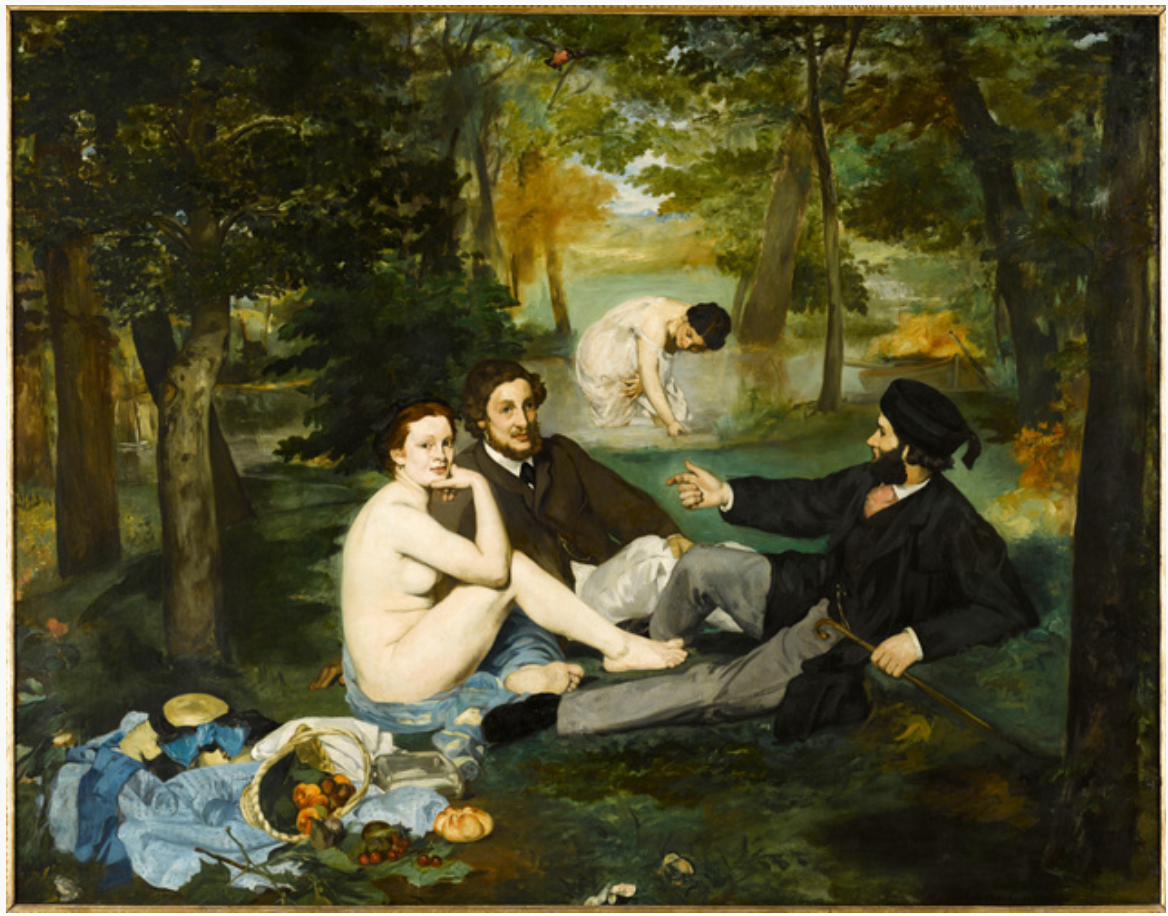
https://www.musee-orsay.fr/fr/oeuvres/le-dejeuner-sur-lherbe-904
In the 1960s, when the present work was executed, Picasso was becoming increasingly concerned with his mortality, and in response to these fears he immersed himself more completely into his artwork, attributing his works with a joyful palette and expressive line to evoke a vitality he feared he was losing. It was in his mature years that the artist began to reexamine the works of the past in greater depth, determined to solidify his presence in the art historical canon. By incorporating a veritable array of art historical references, from Delacroix to Ingres, Goya to Velázquez, Manet to Matisse, Picasso positioned himself and his work alongside the great masters of the past. Picasso made his work both historical and insistently, experimentally, relevant. Among all the series of variations on the old masters that the artist completed during the 1950s and 1960s, this one was by far the most extensive and most time-consuming, occupying him at his three studios in Vauvenargues and Mougins. Between 1959 and 1962, Picasso completed a series of oils, drawings, linoleum cuts, sculptures and ceramics inspired by Manet’s seminal work of 1863, Le Déjeuner sur l’herbe in the Musée d’Orsay. The present work is dated to July 1961 and created at Picasso’s home in Mougins in pastel, part of a group of works created around the same time that now reside in major international collections, including Staatsgalerie Stuttgart; Musée Picasso, Paris; Museum Sammlung Rosengart, Luzern; Louisiana Museum of Modern Art, Copenhagen; and Sprengel Museum, Hannover. Extremely unusually, Picasso worked here in pastel, largely employing cheerful primary colors, imbuing the work with a levity and exuberance, compounded by the heightened rotundity of the female figure to the left, a stylistic device seen in other iterations of the scene. The present work has remained in the same private family collection for over fifty years and has never before been seen at auction.
Francoise Gilot
Femme dans un fauteuil, 1946
Birth of the Modern: The Arnold and Joan Saltzman Collection
Christie’s New-York: 17 November 2025
Estimated: USD 3,000,000 – 5,000,000
USD 3,979,000
PABLO PICASSO (1881-1973), Femme dans un fauteuil | Christie’s
PABLO PICASSO (1881-1973)
Femme dans un fauteuil, 1946
Oil and charcoal on canvas
55.3 x 46.2 cm (21 5/8 x 18 1/8 inches)
Signed and dated ‘Picasso 5 mai 46’ (upper left)
Dated again ‘5 mai 46’ (on the reverse)
Françoise Gilot entered Pablo Picasso’s life in May 1943. The two met at Le Catalan, a restaurant in Paris’ Left Bank, where Gilot was dining with the actor Alain Cuny and another friend. Picasso was with Dora Maar, the artist and his then-paramour. As Gilot wrote in her autobiography, Life with Picasso, “As the meal went on I noticed Picasso watching us, and from time to time acting a bit for our benefit… Whenever he said something particularly amusing, he smiled at us rather than just at his dinner companions. Finally, he got up and came over to our table. He brought with him a bowl of cherries and offered some to all of us, in his strong Spanish accent, calling them cerisses…” (Life with Picasso, New York, 1964, p. 14). Over the following weeks, the pair began to spend more and more together, but it was not until the following year that they became a couple.
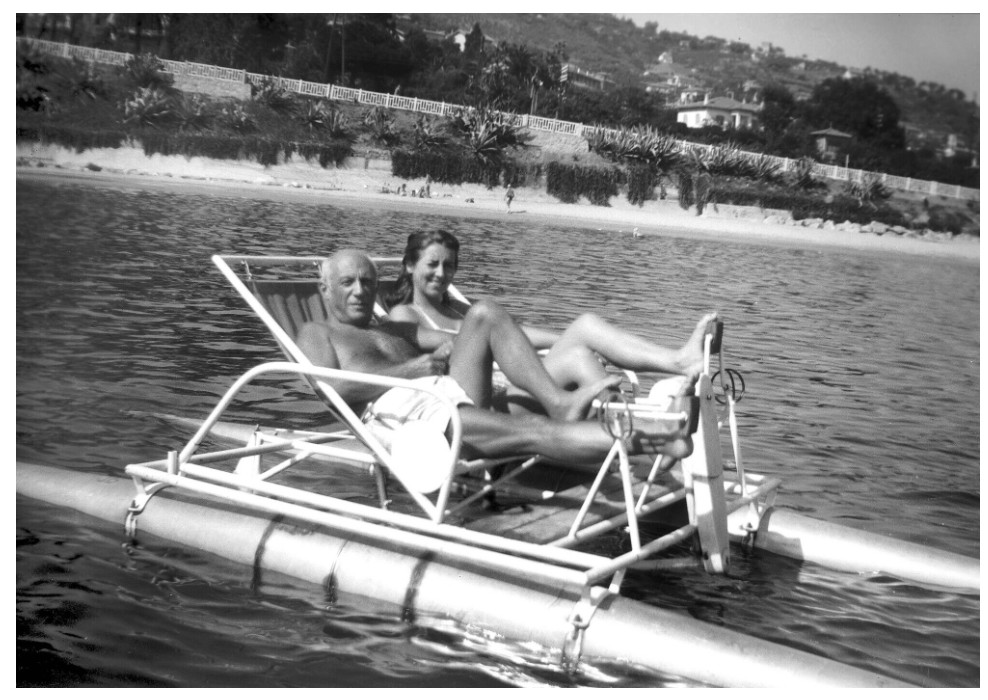
Pablo Picasso and Françoise Gilot, 1946. Photographed by Michel Sima. © Michel Sima. All rights reserved 2025 / Bridgeman Images. © 2025 Estate of Pablo Picasso / Artists Rights Society (ARS), New York.
For the first two years, they had an on-again, off-again relationship, with Picasso frequently trying to convince Gilot to move in with him. An accomplished artist in her own right, she worried that moving would compromise her freedom; it wasn’t until the spring of 1946 that the two reached an understanding of sorts. “Yes, all of a sudden,” Gilot recalled, “at the end of April or the beginning of May, Pablo decided that he couldn’t live without me,” (J. Richardson and F. Gilot, “A Decade of Life with Picasso” in Picasso and Françoise Gilot: Paris-Vallauris, 1943-1953, exh. cat., Gagosian Gallery, New York, 2012, p. 17). Before long, she was living with Picasso in his studio on the Rue des Grands Augustins. Shortly thereafter, he painted Gilot in Femme dans un fauteuil, an ode to her presence in his life.
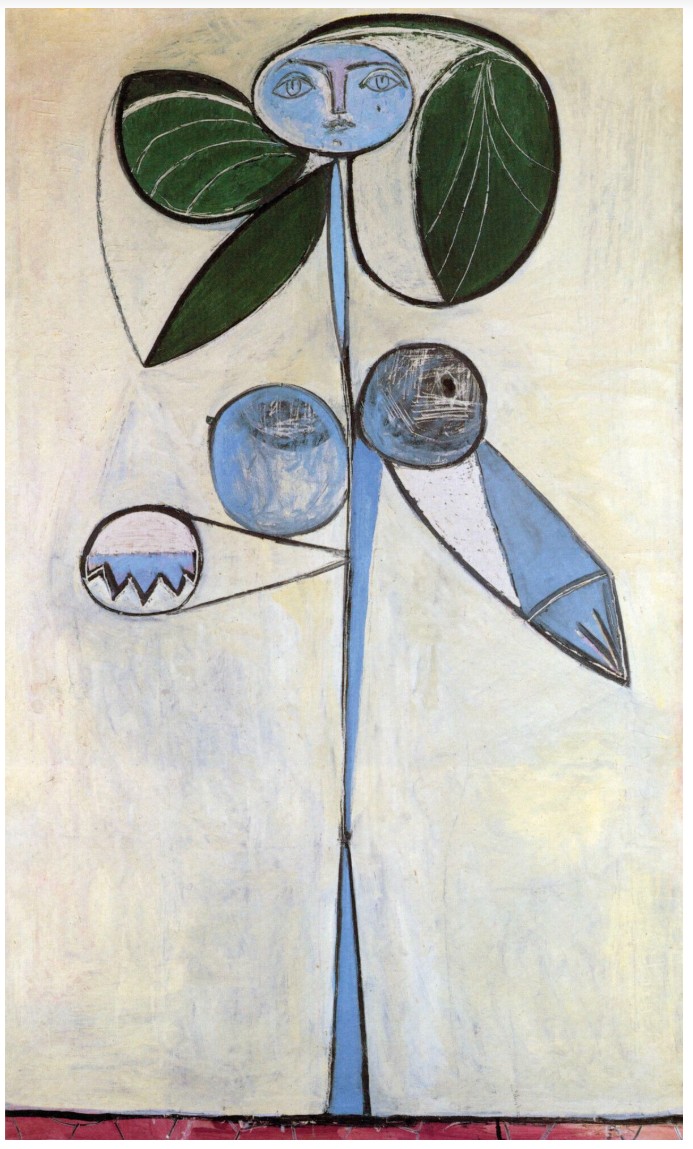
Pablo Picasso, La Femme-fleur, 1946. Private collection. © 2025 Estate of Pablo Picasso / Artists Rights Society (ARS), New York.
Femme dans un fauteuil was painted on 5 May 1946, the same day the artist created La Femme-fleur (Zervos, vol. 14, no. 167; Private collection), also a portrait of Gilot as a flowering plant. Initially, Picasso intended to depict Gilot fairly realistically, but then he remembered that Henri Matisse—whom the two had visited early that year while vacationing in Golfe-Juan in the South of France—had talked about painting her with green hair. Ever competitive, in La Femme-fleur, Picasso transformed Gilot into an elegant, lithe flower, with her head and neck forming the bloom.
“You’re like a growing plant. I’ve been wondering how I could get across the idea that you belong to the vegetable kingdom rather than the animal. I’ve never felt impelled to portray anyone else this way. It’s strange, isn’t it? I think it’s just right, though. It represents you.”
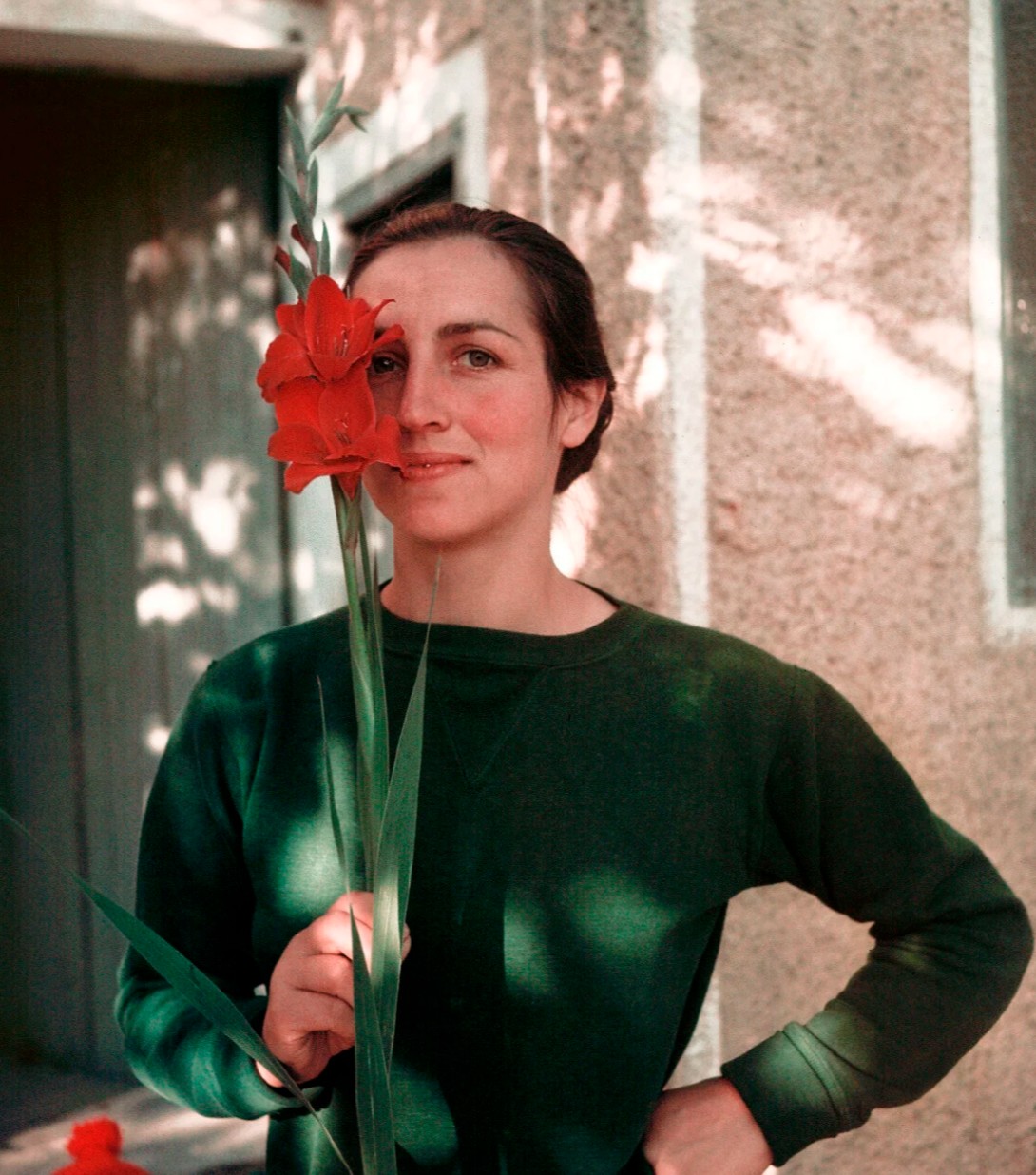
Françoise Gilot in Vallauris, 1948. Photographed by Gjon Mili. Photo: © Gjon Mili / The LIFE Picture Collection / Shutterstock.
In the present work, Picasso has further exaggerated Gilot’s hair as two enormous leaves. Her visage—which the artist referred to as a “little blue moon”—is almost overwhelmed by the greenery, as a yellow beam illuminates her enthroned body (quoted in ibid., p. 117). The vast majority of Picasso’s depictions of woman show them seated with the figure and chair often merging into one form. The chairs alternate between being luxuriant and pliant and, at other times, sharp-edged contraptions that forever constrain their sitter. Within the present work, the colors are crystalline. The vibrant tonalities imbue the portrait with a sense of vitality. The present work was painted almost precisely one year after the end of the Second World War in Europe. The couple, who had met during the darkest days of the Occupation, were now able to live together in a liberated Paris. Life was reemerging in the French capital and for Picasso, Gilot’s embodiment of spring—and thus of peacetime—suggested new beginnings and a hopeful view of the future.
Le miroir, 1947
Estimated: HKD 15,000,000 – 25,000,000
HKD 18,675,000 / USD 2,400,386
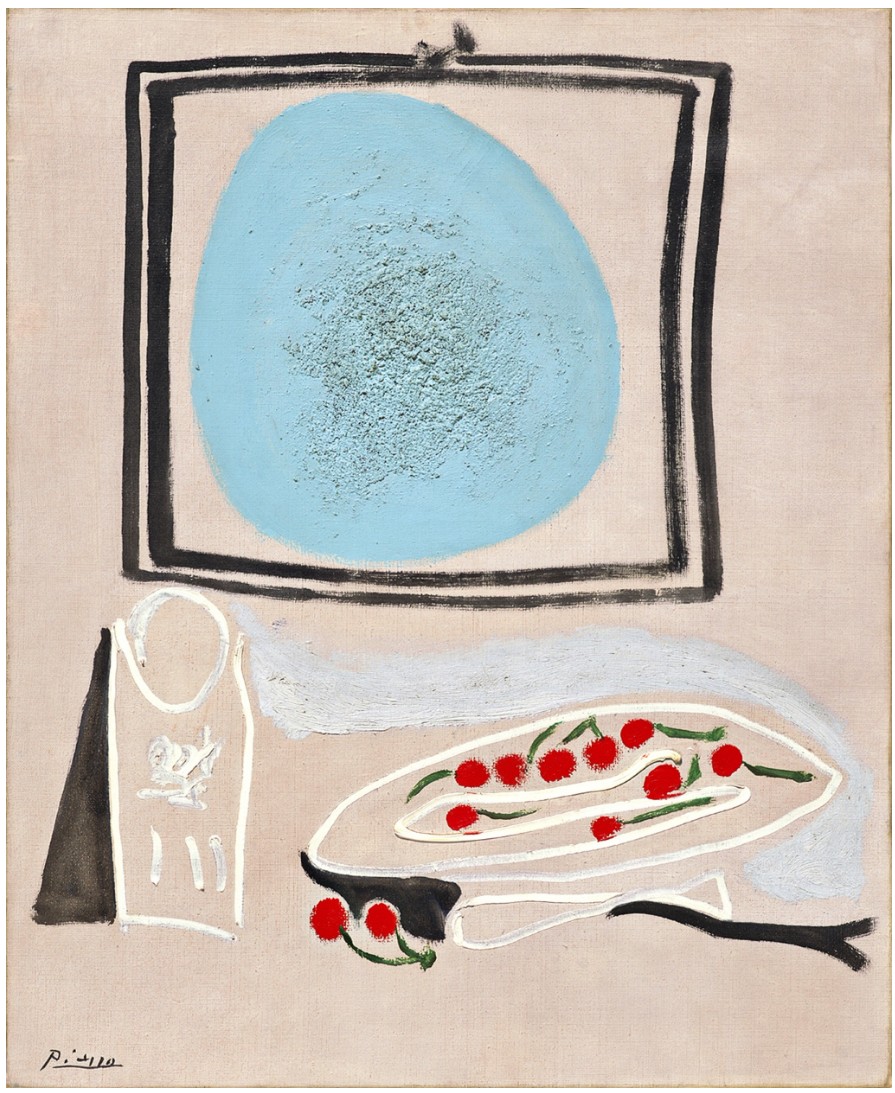
PABLO PICASSO (1881 – 1973)
Le miroir, 1947
Oil and sand on canvas
61 x 50.2 cm (24 x 19 3/4 inches)
Signed Picasso (lower left) and dated 23 juin 47 (on the reverse)
Executed on 23 June 1947
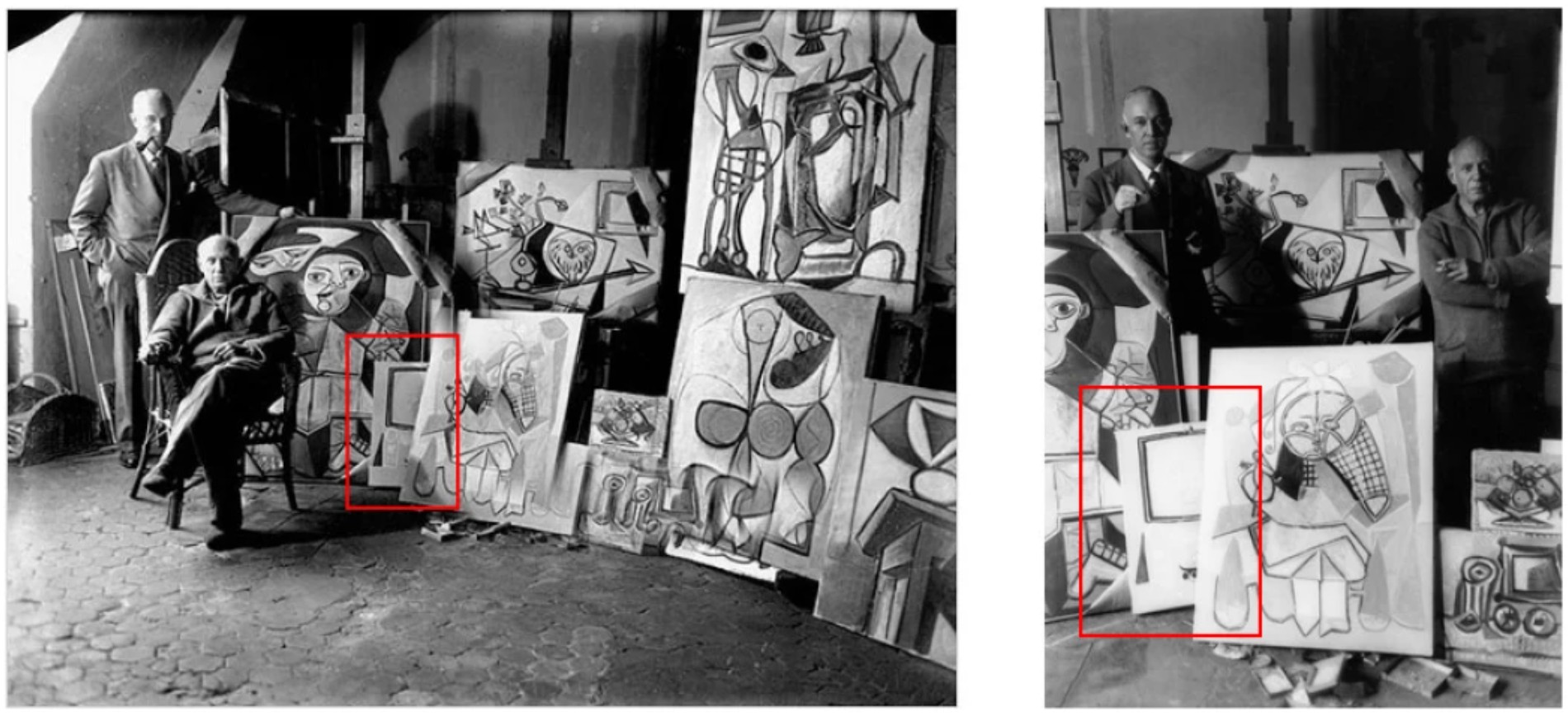
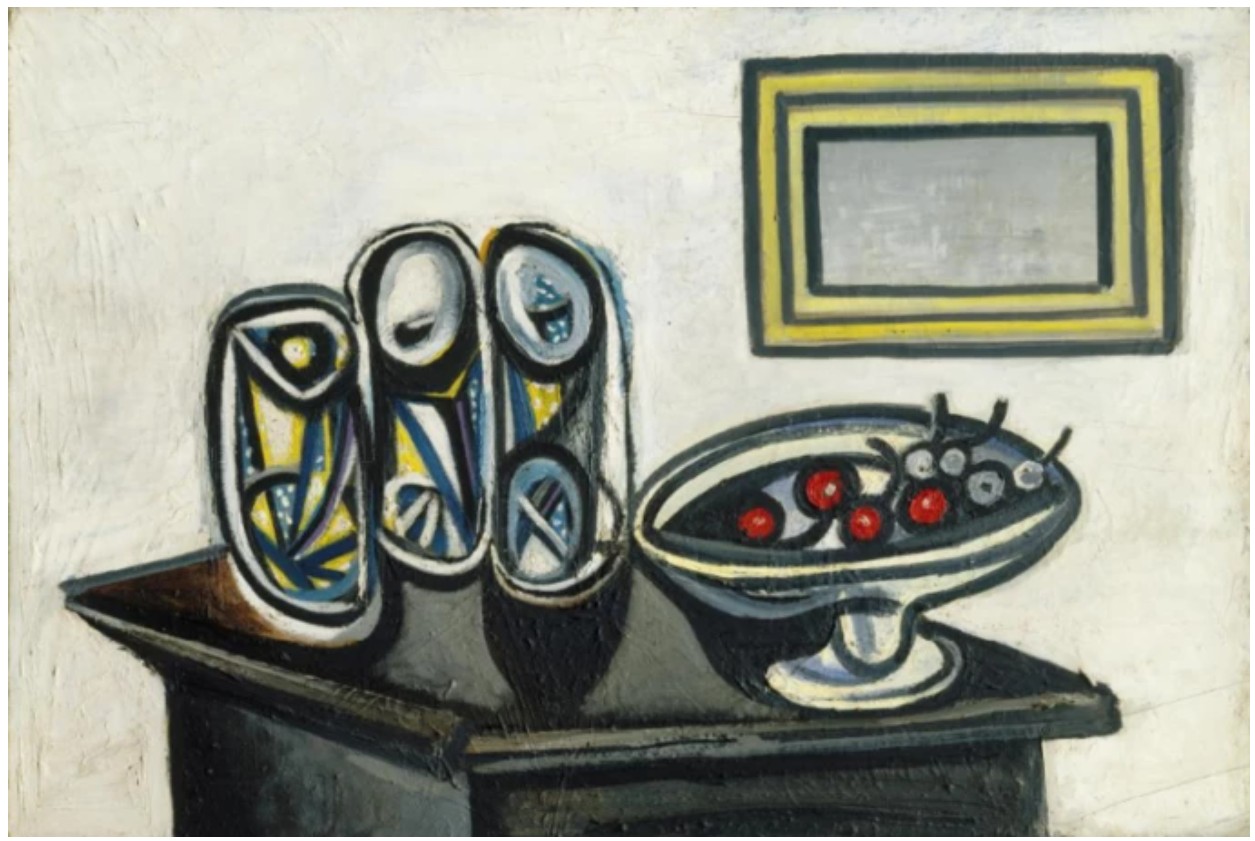
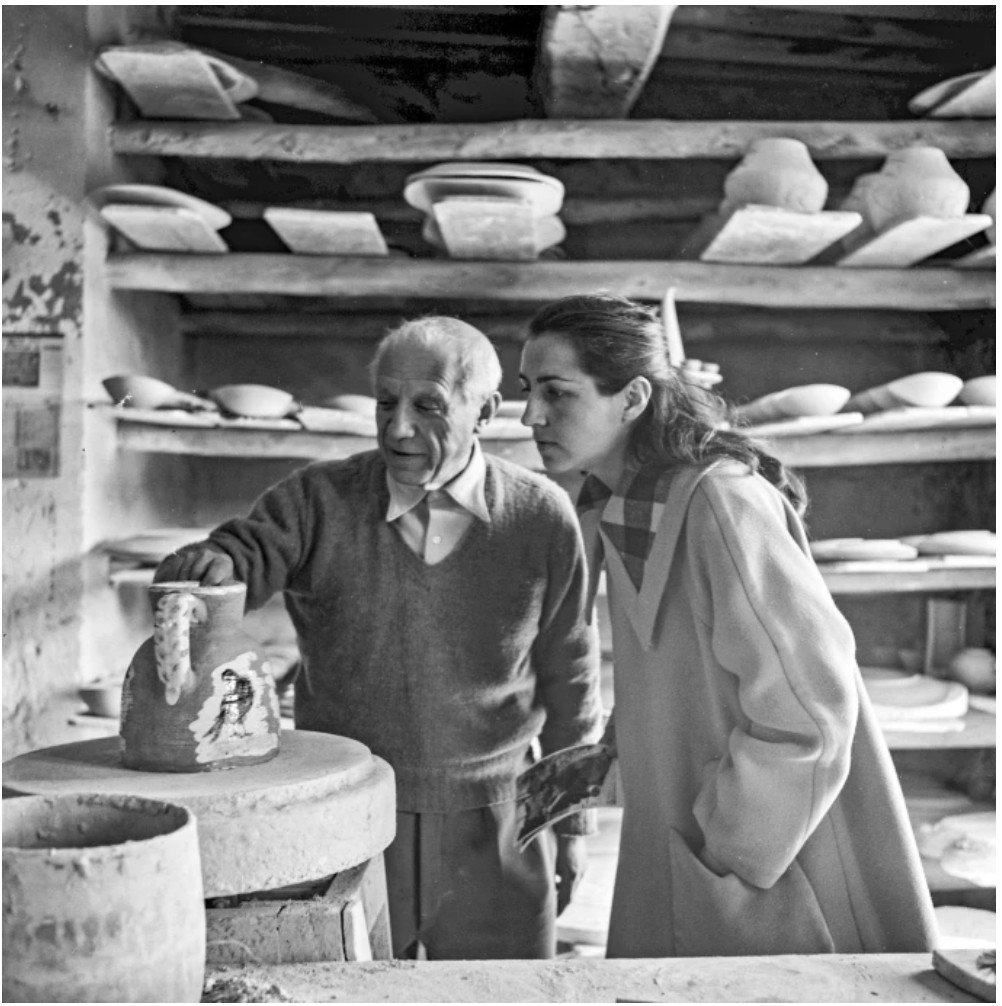
#1. Femme assise en costume vert, 1953
Sotheby’s New-York: 12 May 2021
Estimated: USD 14,000,000 – 18,000,000
USD 20,946,000
Femme assise en costume vert | Impressionist & Modern Art Evening Sale | 2021 | Sotheby’s
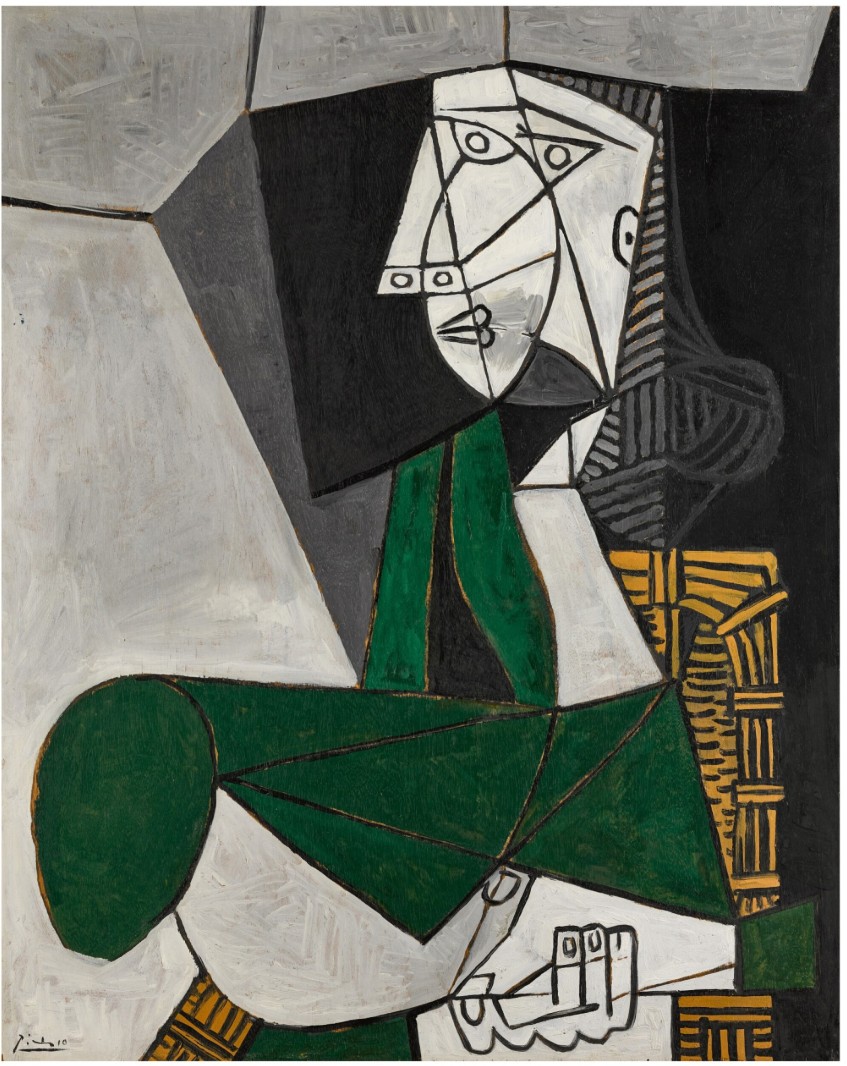
PABLO PICASSO (1881 – 1973)
Femme assise en costume vert, 1953
Oil on board laid down on cradled board
91.7 x 72.9 cm (36 1/8 x 28 3/4 inches)
Signed Picasso (lower left)
One of the most striking portraits of Françoise Gilot ever painted by Picasso, Femme assise en costume vert belongs to a group of paintings created in the late winter of 1952 and the early spring of 1953 depicting Picasso’s lover and muse. During this time, Picasso was living with Gilot and their two children, Claude and Paloma, at Vallauris in the villa La Galloise (see fig. 1). Picasso had first met Gilot almost a decade earlier in May 1943, when he was still involved in a turbulent relationship with the Surrealist artist Dora Maar. Gilot quickly became the artist’s muse, and then partner, as her youthful vigor inspired a new direction in Picasso’s portraiture. Over the following decade, he produced an impressive body of work testament to the joy he experienced with Gilot and with the two children they had together. Painted toward the end of their relationship, Femme assise en costume vert reflects the tensions between them at this time and his continued stylistic virtuosity.
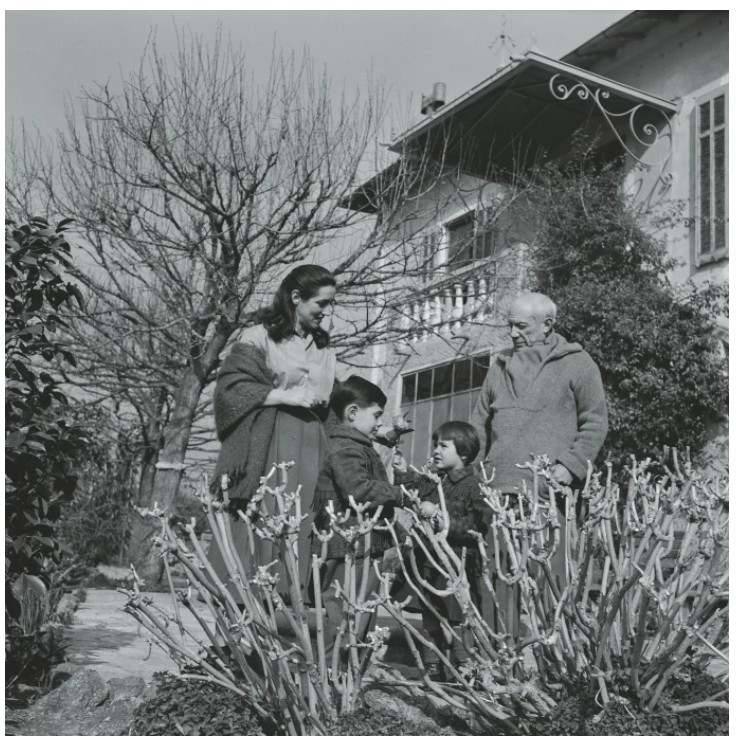
Picasso, Françoise, Claude and Paloma in the gardens of La Galloise, Vallauris, 1953, photograph by Edward Quinn
In Femme assise en costume vert, Picasso employs two painterly tropes often associated with his depictions of Gilot: the primacy of line and the color green. In the early years of their partnership, Picasso depicted Françoise as inherently linked with the natural world: “I’ve been wondering how I could get across the idea that you belong to the vegetable kingdom rather than the animal. I’ve never felt impelled to portray anyone else this way. It’s strange, isn’t it? I think it’s just right, though. It represents you” (Picasso quoted in Françoise Gilot & Carlton Lake, Life with Picasso, New York, 1964, p. 119). The present work employs the rich, vegetal green that evokes this idea, whilst incorporating a clear linear demarcation of form, found in earlier works such as Femme fleur en gris and Femme dans un fauteuil (see figs. 2 & 3).
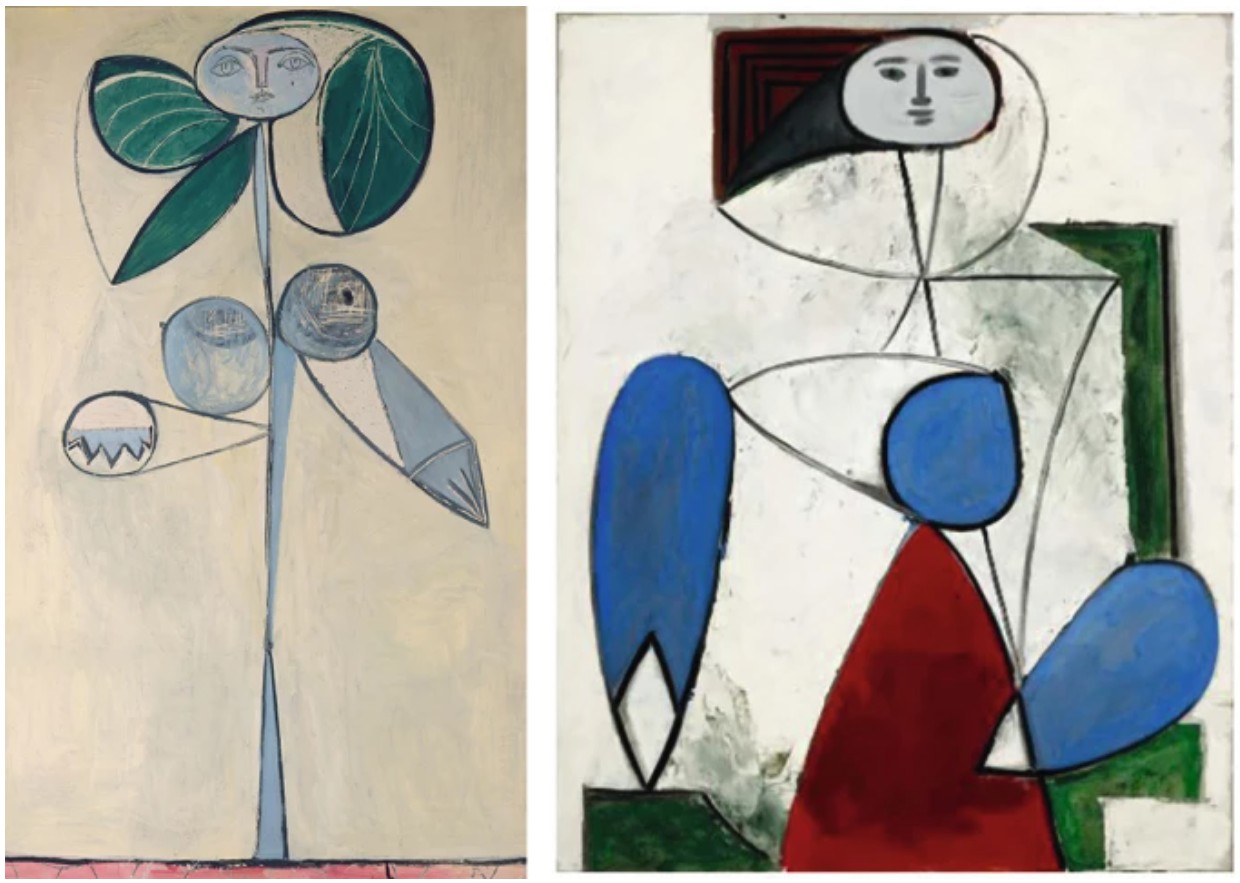
From left to right: Fig. 2, Pablo Picasso, Femme fleur en gris, oil on canvas, 1946, Private Collection; Fig. 3, Pablo Picasso, Femme dans un fauteuil, oil on canvas, 1947, Musée Picasso, Paris (on loan to the Musée Picasso, Antibes) © 2021 ESTATE OF PABLO PICASSO / ARTISTS RIGHTS SOCIETY (ARS), NEW YORK
The striking chromatic intensity of the present work is achieved through Picasso’s balance of monochrome with isolated segments of vibrant color. In the absence of color, it is Gilot’s face, constructed with luminous segments of white, that becomes the focal point of the painting. Through this fragmenting of the picture plane, Picasso develops the linear style with which his portraits of Gilot are often associated (see fig. 4). Unlike the soft and fluid lines of earlier portrayals, the present work retains an almost sculptural quality that prefigures his work with sheet metal. Eschewing traditional notions of perspective, Picasso creates a portrait that is both evocative of his Cubist works and the tortured portraits of Dora Maar from the late 1930s and early 1940s, and yet distinctly personal to this period in Picasso’s life. There is a compositional tension arising from the juxtaposition of soft arabesques set against sharp, angular lines and the contrasting color palette. During the time in which the present work was executed, Picasso and Gilot’s relationship was deteriorating. Gilot was aware of Picasso’s infidelity and whilst he attempted to persuade her to stay, Gilot was determined to pursue her career as an artist. In response to this he painted numerous portraits of Gilot, many of which like the present work, show Gilot delineated in her signifying green, either seated in an armchair or involved in domestic activity (see fig. 5); it as though he felt in painting her that he could keep her as a presence in his life.
The image of the seated woman was employed frequently by Picasso throughout his career. Art historian Erich Franz has remarked upon its role as a compositional device: “Since the Cubist phase the theme of the woman in the armchair had offered Picasso the opportunity to unite the human body and the area surrounding it closely with the whole of the canvas” (E. Franz in, Pablo Picasso. The Time with Françoise Gilot (exhibition catalogue), Graphikmuseum Pablo Picasso, Munster, 2002, p. 32). Often the armchair is employed as a means of framing the figure, however, in the present work the unusual angle allows the chair to separate the monochrome elements of the figure’s body from the background. The tight weave of the chair is echoed in the hatched lines outlining Gilot’s hair and the color adds warmth to the portrait. This warmth is further matched in small sections of the composition where Picasso has allowed the panel to show through, acting as part of the medium. The gold tones of the wood complement those of the chair. This highly personal application of color and form would be reprised in Picasso’s famed series of Femmes d’Alger (see fig. 6), an elegy to Picasso’s recently deceased and long-time friend and rival Henri Matisse. In this brilliant synthesis of his life-long obsession with fractured perspectives and violent clashes of color, Picasso creates a new style of painting which shows its beginnings in the present work.
Buste de femme, 1949
Sotheby’s New-York: 18 November 2024
Estimated: USD 9,000,000 – 12,000,000
USD 9,950,000
Buste de femme | Modern Evening Auction | 2024 | Sotheby’s
PABLO PICASSO (1881 – 1973)
Buste de femme, 1949
Oil on canvas
61×50 cm (24 x 19 5/8 inches)
Signed Picasso (upper left) and dated 24.3.49. (on the reverse)
Executed on 24 March 1949
Executed at the height of Pablo Picasso’s relationship with his partner, fellow artist and mother of his children Françoise Gilot, Buste de femme is an emblematic portrait of one of the most iconic figures in his life. Executed on March 24th, 1949, the present work belongs to a celebrated yet limited group of portraits Picasso created over the course of a year depicting Gilot in labyrinthine contours and rich jewel tones.
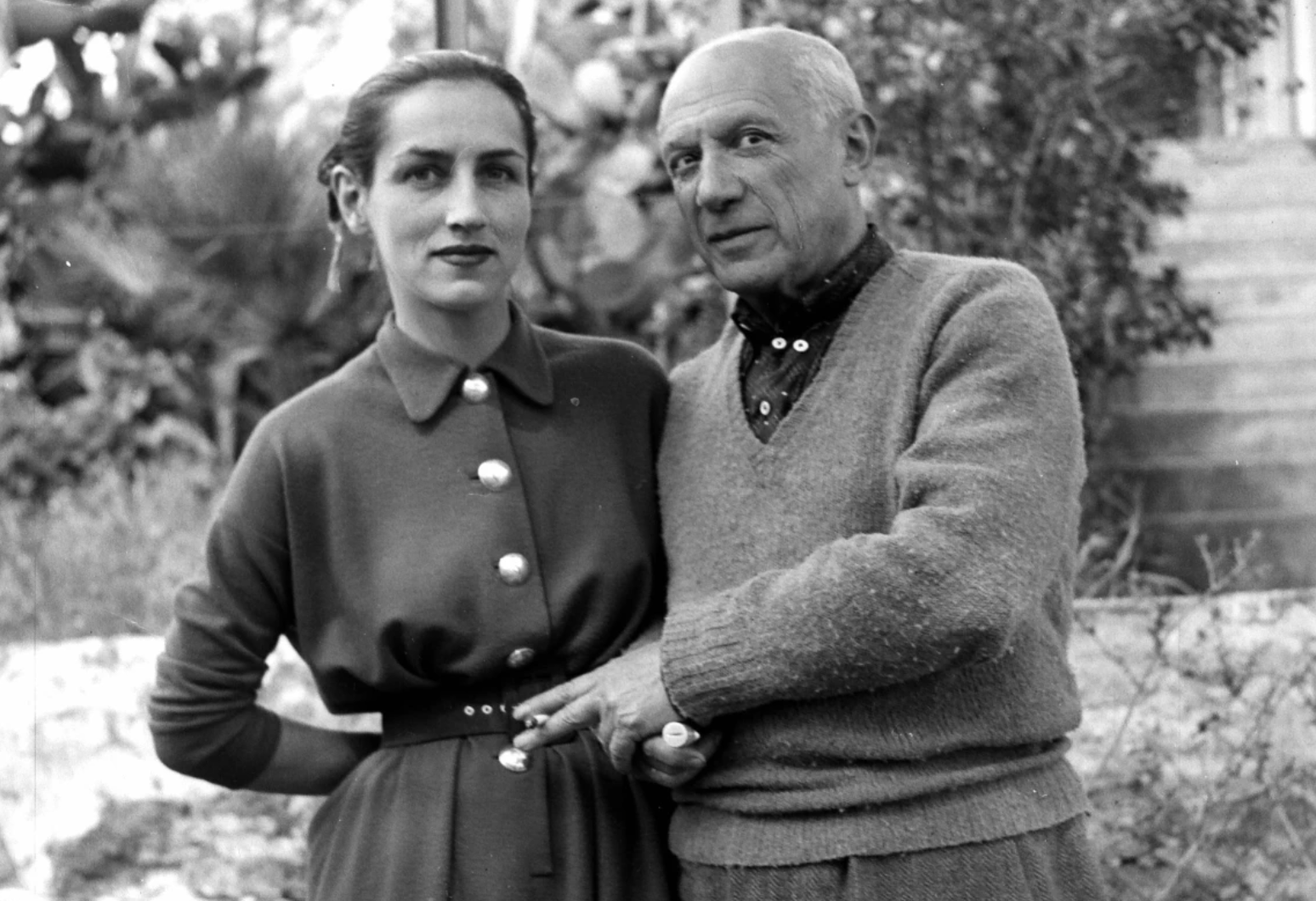
Françoise Gilot and Pablo Picasso in 1952. Photograph by Boris Lipnitzki. Image © 2024 Lipnitzki/Roger Viollet via Getty Images.
Gilot was forty years Picasso’s junior, yet already an established painter, when she first met the him in May 1943. At the time, Picasso was still entangled in a turbulent affair with the Surrealist artist Dora Maar. Yet despite the existing relationship and tumult of wartime in Paris, Gilot and Picasso soon embarked upon a decade-long romance which would profoundly influence Picasso’s artistic output.
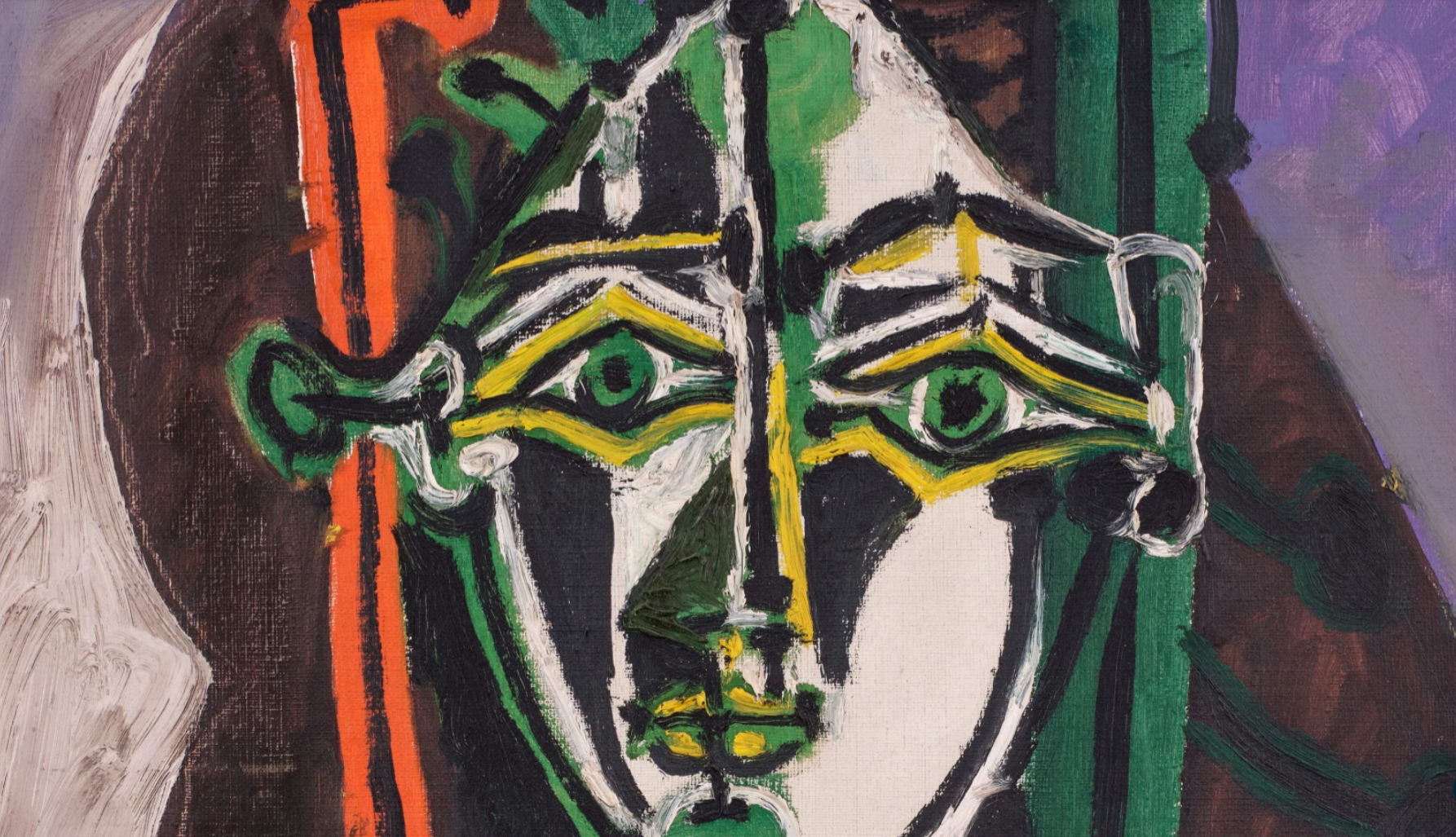
In the ensuing years, Picasso’s sharp, distorted and even tormented portrayals of Maar would give way to increasingly soft, voluminous and romantic portraits of Gilot. Expanding upon the graphic richness of his Dora Maar portraits, those of Gilot maintain the bold, direct aesthetic pioneered in the late 1930s and early 1940s.
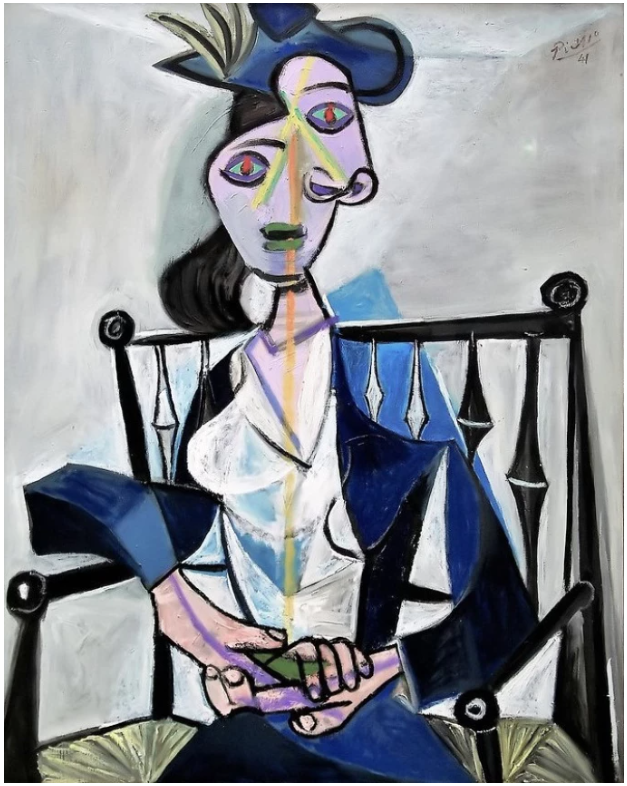 Pablo Picasso, Femme assise au fauteuil (Dora Maar), 1941, Neue Pinakothek, Munich.
Art © 2024 Estate of Pablo Picasso / Artists Rights Society (ARS), New York
After the war, Picasso and Gilot left Paris for the south of France in the summer of 1946, eventually settling in Vallauris where they would raise their two children, Claude and Paloma. The joy of the early years of their relationship and familial journey are conveyed in Picasso’s work through his increasingly ebullient palette and lush aesthetic. The paintings and sculptures from his period reflect a heightened sense of vitality, chromatic richness and artistic freedom following the turbulence and desolation of the war years. It is this spontaneity of line and renewed dynamism which suffuses Buste de femme.
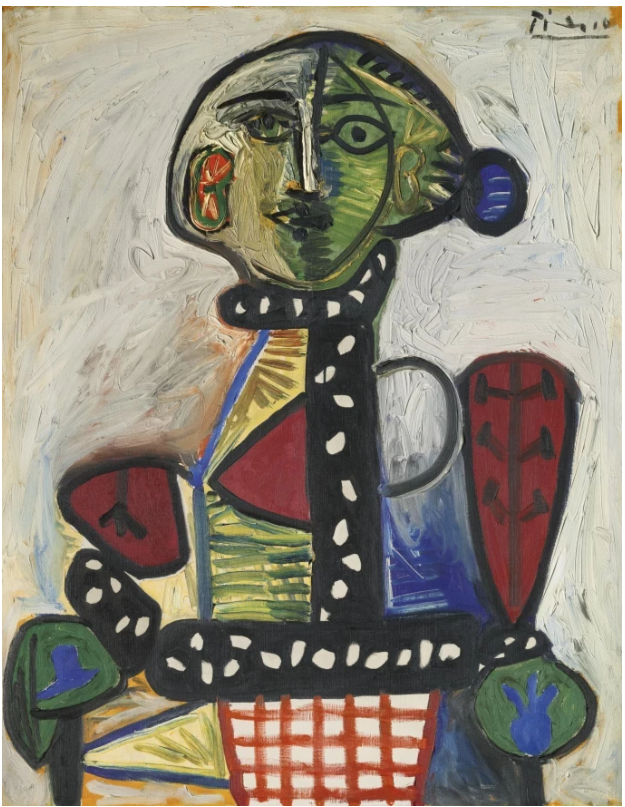
Pablo Picasso, Femme au chignon dans un fauteuil, 1948, Sold: Sotheby’s, New York, 5 May 2015, lot 21 for $29.9 million.
Art © 2024 Estate of Pablo Picasso / Artists Rights Society (ARS), New York
Gilot’s beauty, vitality and creativity greatly influenced Picasso, eliciting comparisons of her with the natural world. Picasso’s imagery from the 1940s associates his partner and muse with themes of rebirth and renewal, with many depictions portraying Gilot as a mystical combination of the human and plant domains. By 1948, Gilot had taken on a new form in his work, the vegetal green and blossom-like hair of his 1946 paintings coalescing in a new idiom defined by rich chromatic fields and contrasting staminate lines as exemplified by Buste de femme. Not only do the calligraphic black lines within Buste de femme lend the subject a stemlike structure—these graphic contours also link the Françoise paintings with Picasso’s masterworks from decades earlier.
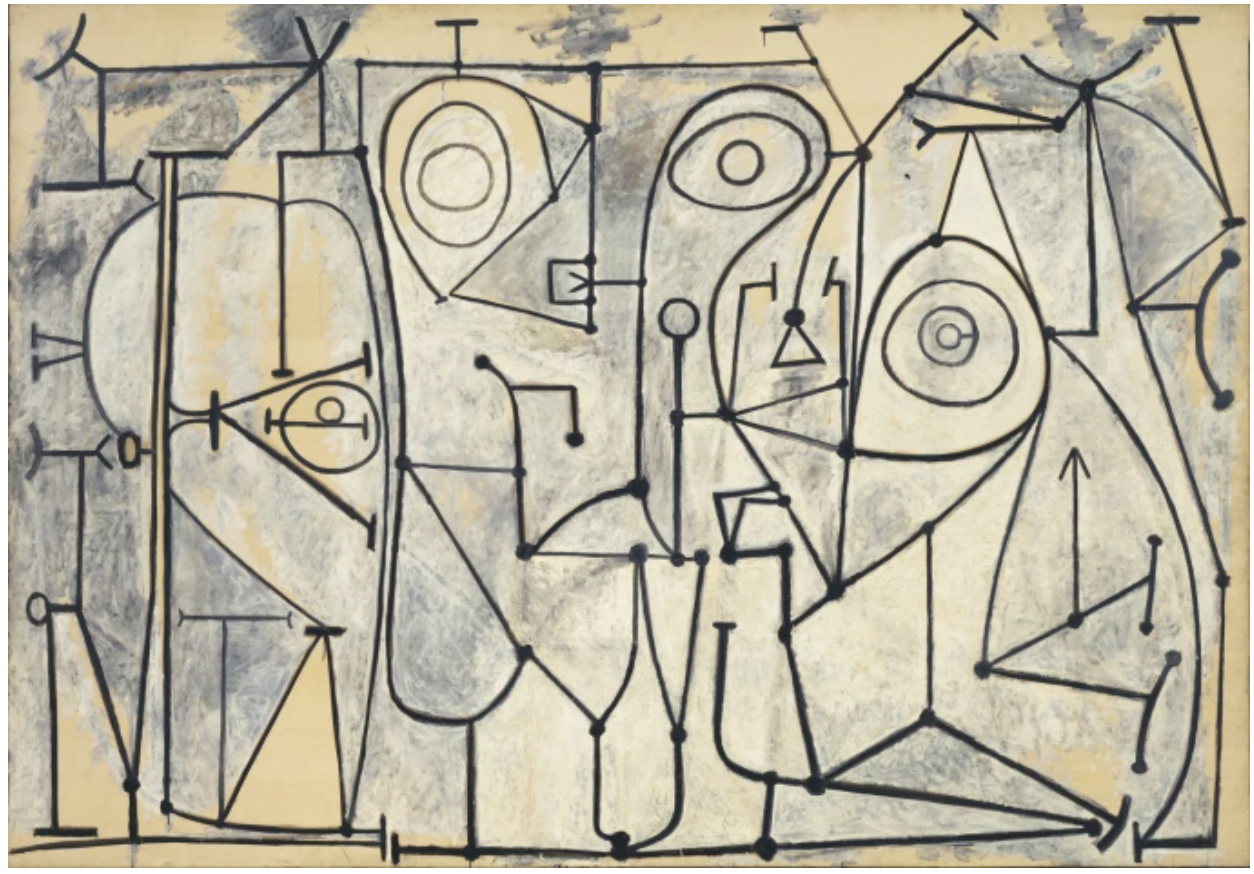
Pablo Picasso, La Cuisine, 1948, The Museum of Modern Art, New York.
Art © 2024 Estate of Pablo Picasso / Artists Rights Society (ARS), New York
Drawing on decades of artistic interrogation into line and form across mediums, and imbued with the romance and fecundity of his relationship with Gilot, Buste de femme marks a momentous period in Picasso’s life and, inextricably, his career. Picasso’s paintings from 1948-49 take the monochromatic and linear explorations of form in Figure: Projet pour un monument à Guillaume Apollinaire and La Cuisine as a point of departure for his Françoise pictures in these years.
Comparable 1949 Paintings in Institutional Collections
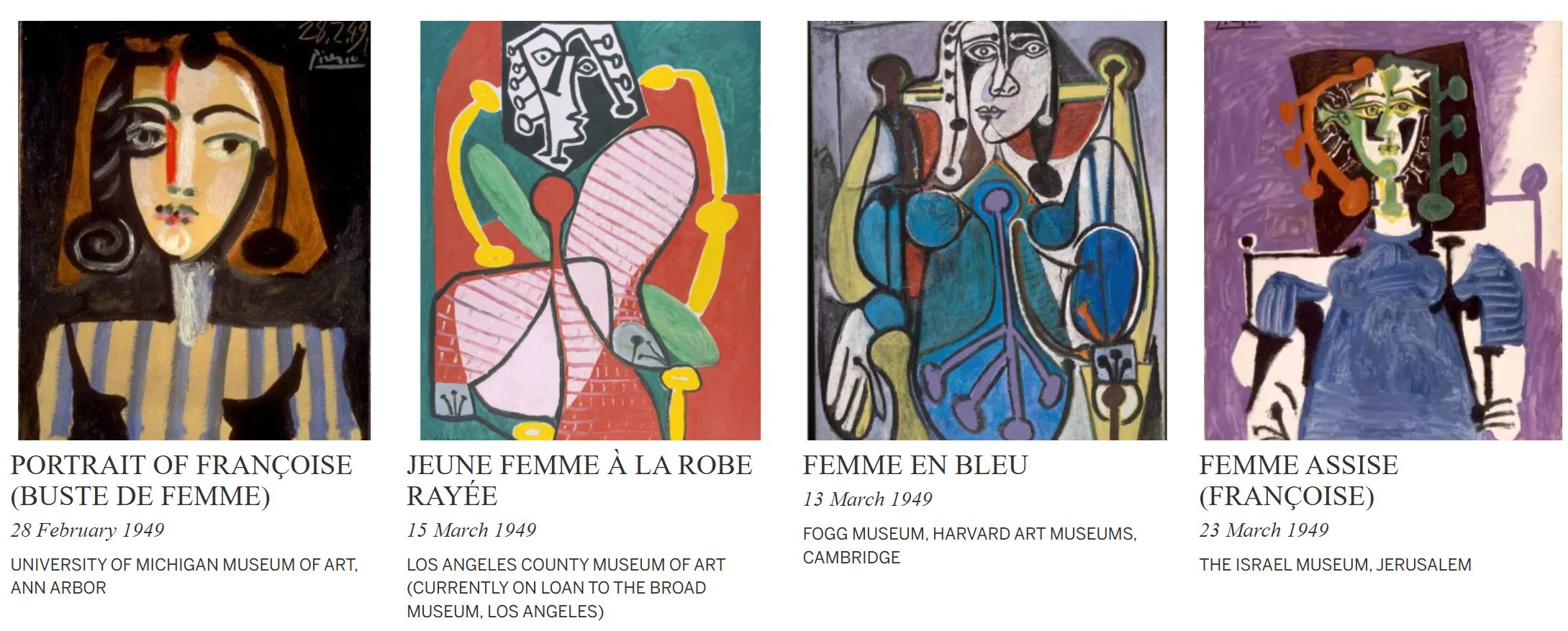
Harnessing the power of line and channeling the spirit and vitality of his muse, Picasso created some of the most exceptional paintings of his mature oeuvre during this year, epitomized by Buste de femme. Rich in texture and color, the present work is among the finest examples of Picasso’s 1948-49 Françoise portraits ever to come to market. Though their relationship would endure for a full decade, the uniquely stylized portraits like Buste de femme belong to a very limited series, many of which are now held in museum collections.
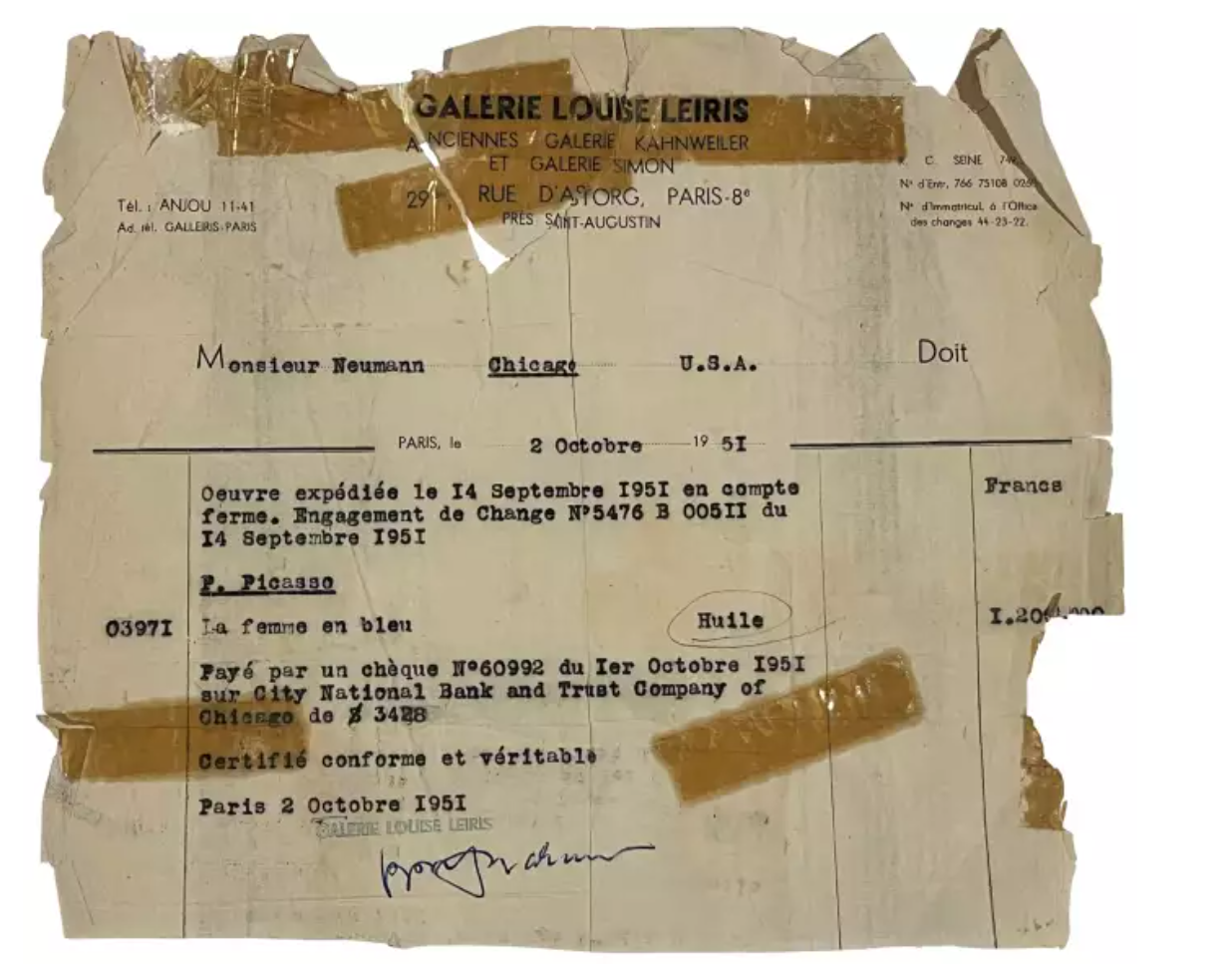
Original Louise Leiris invoice for Buste de femme (then titled La Femme en bleu)
Such a rare and exceptional painting comes with an equally illustrious provenance. Never before seen at auction, Buste de femme has been held in the Neumann Family Collection since 1951, when Morton G. Neumann acquired the work from Picasso’s main dealer in Paris, Galerie Lousie Leiris. Known as Picasso’s “Favorite American Collector,” Neumann was a personal friend of the artist, acquiring exceptional paintings, works on paper and sculpture from Picasso and his contemporaries during their lifetimes. In 1980-81, Buste de femme was exhibited amongst other masterworks from Neumann Family Collection at the Art Institute of Chicago and the National Gallery of Art in Washington D.C.
Buste de femme, 1953
Sotheby’s London: 4 March 2025
Estimated: GBP 4,000,000 – 6,000,000
GBP 4,310,000 / USD 5,470,000
Buste de femme | Modern & Contemporary Evening Auction | 2025 | Sotheby’s
PABLO PICASSO (1881 – 1973)
Buste de femme, 1953
Oil on canvas
64.2 x 54 cm (25 1/4 x 21 1/4 inches)
Signed Picasso and dated 7 juillet 53 (upper left)
Painted on 7 July 1953, Buste de femme is a strikingly powerful portrait of the artist Françoise Gilot, who was Picasso’s partner and muse between 1943 and 1953. At the time of the present work’s creation, the couple were living at Villa La Galloise in the village of Vallauris in the south of France with their two children, Claude and Paloma. Picasso met Gilot in 1943, while he was still engaged in a tumultuous relationship with the Surrealist artist Dora Maar. Gilot quickly became the artist’s muse and later his lover, with her youthful vigor inspiring a new direction in Picasso’s portraiture. Over the following decade, he produced an impressive body of work, testament to the joy and fulfilment he experienced with Gilot and the two children they had together.
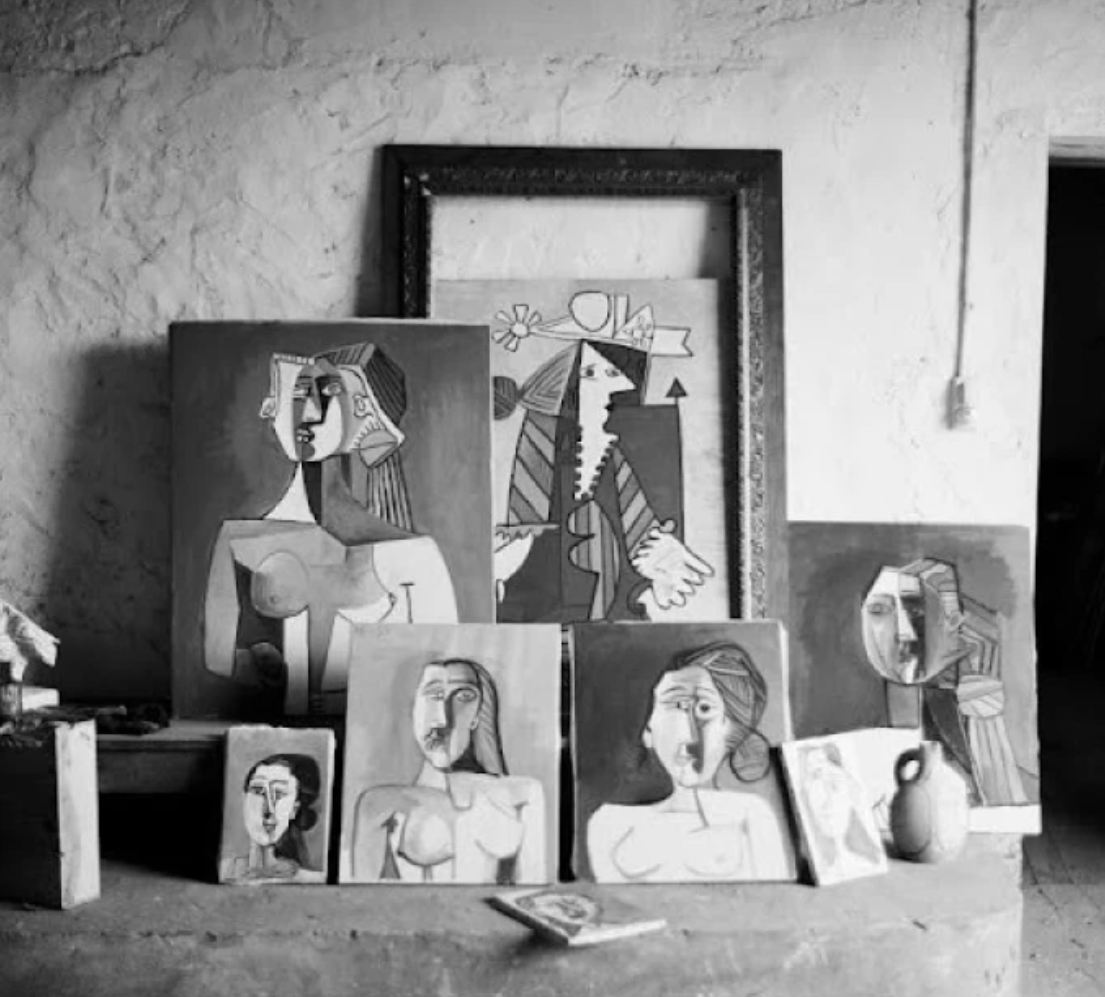
Picasso’s home with various images of Françoise Gilot. Le Fournas, Vallauris 1953, PHOTOGRAPH BY EDWARD QUINN Photo © EDWARDQUINN.COM Artwork © Succession Picasso/DACS, London 2025
Elegantly executed in a refined palette, Buste de femme draws attention to Picasso’s exquisite use of brushwork, line, and form. Picasso often chose to forgo color in his compositions, focusing instead on the expressive possibilities offered by the clarity of brushstrokes, liberated from the distractions of color. Harking back to his early Cubist works, the restrained color palette and the sharp geometric lines in the present composition exemplify Picasso’s ongoing preoccupation with constructing form in pictorial space and flattening planes within the composition. The use of black, grey and red hues of varying saturation creates a powerful interplay of light and shadow, imbuing the composition with depth. By denying the viewer a sense of place and creating the illusion of depth, Picasso directs attention solely to the details of the sitter and the self-consciously painterly nature of the composition. Through this fragmentation of the picture plane, Picasso develops the linear style often associated with his portraits of Gilot.
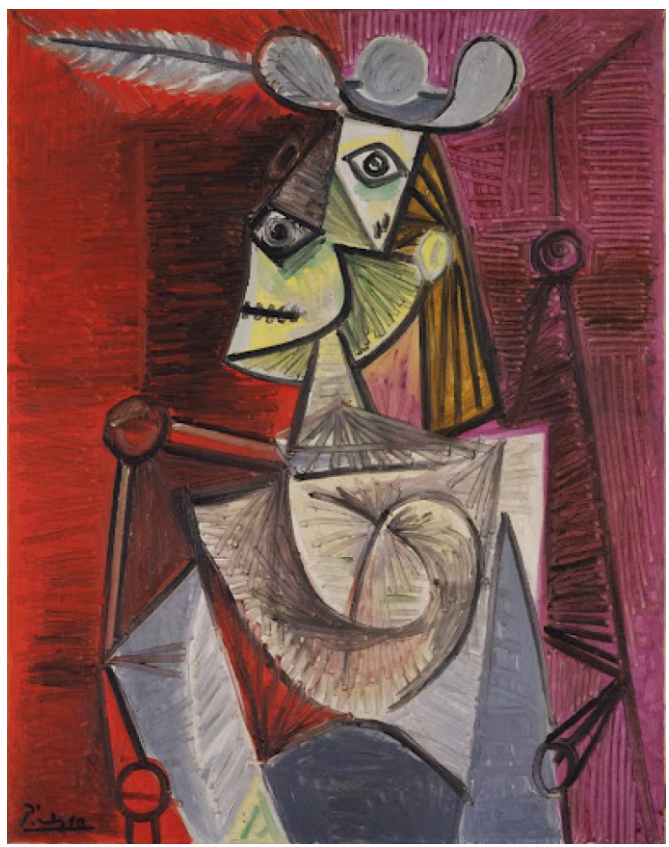
Pablo Picasso, Femme dans un fauteuil, 1941, oil on canvas, The Museum of Modern Art, New York © Succession Picasso/DACS, London 2025
Eschewing traditional notions of perspective, Buste de femme presents a portrait that evokes both Picasso’s Cubist works and the tortured portraits of Dora Maar from the late 1930s and early 1940s. The motif of a female figure with an angular, distorted, face evolved into a recurring theme that he revisited in several oils over the following years. In these works, including the present one, Picasso created tension both in the subject and composition, driven by the duality of the figure and the contrast between soft arabesques and sharp lines, as well as the interplay of contrasting and blending colors.
Tête de femme (Françoise), 1951
The Collection of Sydell Miller
Sotheby’s New-York: 18 November 2024
Estimated: USD 7,000,000 – 10,000,000
USD 6,900,000
PABLO PICASSO (1881 – 1973)
Tête de femme (Françoise), 1951
Bronze
Height: 50 cm (19 5/8 inches)
Stamped with the foundry mark C. Valsuani Cire Perdue
Conceived in 1951 and cast in an edition of 2
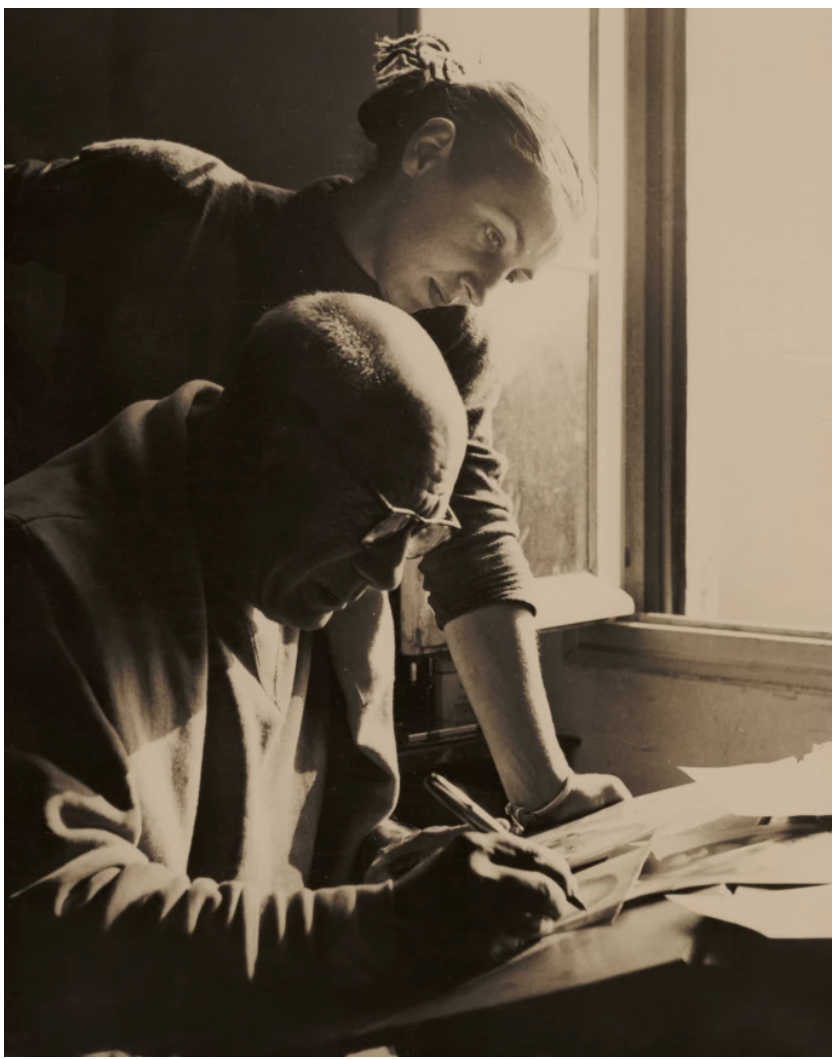
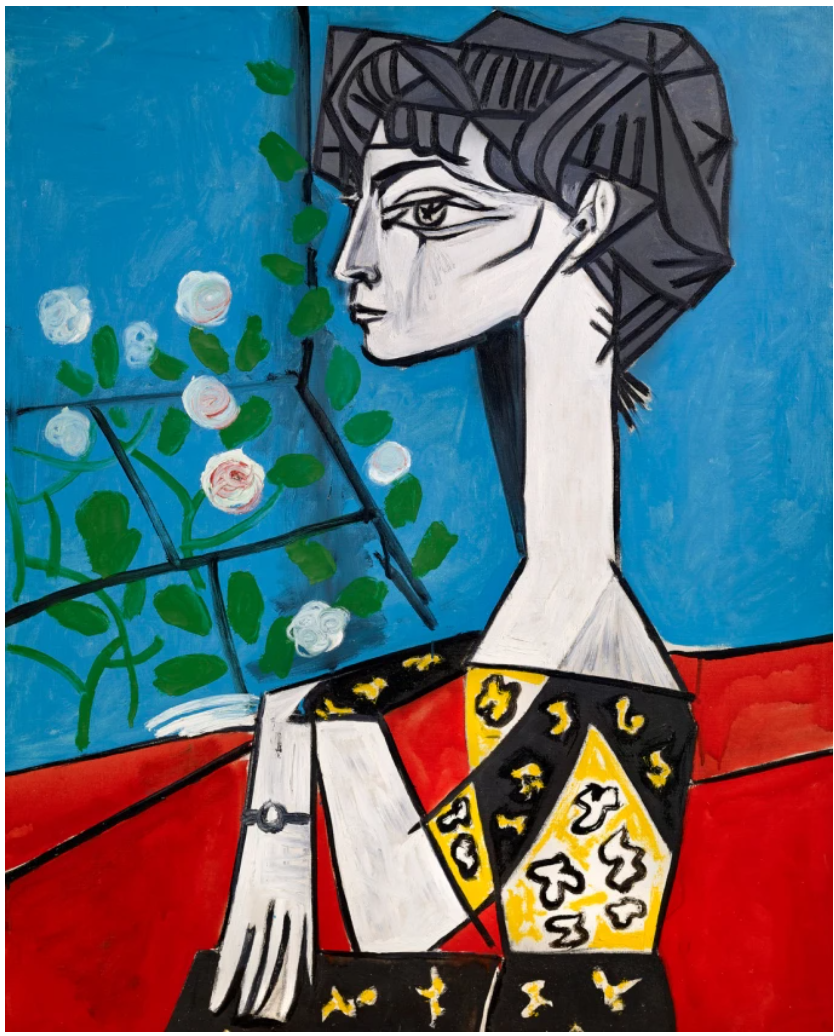
Pablo Picasso, Portrait de Jacqueline aux fleurs, 1954, Private Collection.
Art © 2024 Estate of Pablo Picasso / Artists Rights Society (ARS), New York
Picasso found in Vallauris a wealth of art historical inspiration. With a venerated tradition of ceramic production tracing back to antiquity, threads of art, culture and craftsmanship were woven into the very fabric of the coastal town. In large part due to Picasso’s prolonged stay and the fruitfulness of his output, the 1950s in particular marked a modern golden age in Vallauris’ storied history. As he exhumed centuries-old ceramic practices and translated them into his distinctly modern dialect, history became fused with his daily life and Gilot, with whom he shared that life, became equally inextricable from the artistic narrative he built around it. Gilot’s piercing gaze, almond eyes, arched eyebrows, and long, narrow nose—characteristics which had become distinctive of her portrait-type within Picasso’s oeuvre—are here on display with the strength and clarity of his greatest oils (see fig. 1). The incised geometry used to describe her face reappears in Picasso’s portraits of his second wife Jacqueline, poised in both works as an invocation of their commanding presence (see fig. 2). At the same time, however, the sculptural techniques employed in the present work bear evidence of the artist bending to the stylized language of ancient carving, an influence he felt in excess in his new home on the Mediterranean. The work therefore occupies a unique place within his oeuvre–not a submission of his own style to a broader aesthetic, but the formulation of a visual language, classical in its aesthetic yet modern in its rendering, which telescopes between the past and present.
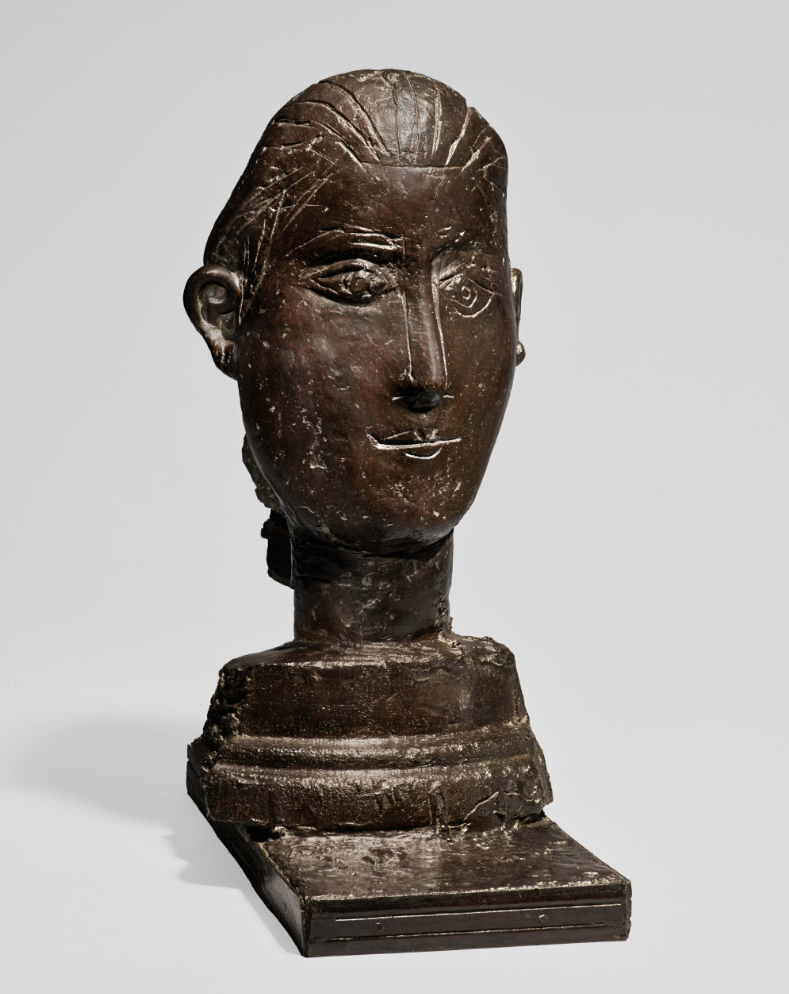
In its combination of textures and techniques–the incised carving used to describe her features, the smooth, hyper-stylized curlique of her ears, the roughly hewn neck, and the found material, perhaps a wooden box, cast in bronze as the base–the present bust testifies to the creative ingenuity that characterized Picasso’s rich sculptural output at Vallauris. On his morning commute from their home, La Galloise, to his studio, an old perfume factory just one hundred yards from the Madoura Pottery studio on the rue du Fournas, Picasso passed by a field that served as a dumping ground for local potters, providing him a trove of shards of broken pots, old tools, pieces of scrap metal and bits of wood. Picasso soon began collecting these pieces of detritus, bringing them back to his studio where they served as the starting point for his sculptural inventions. As Gilot recalls: “I asked Pablo one day why he gave himself so much trouble to incorporate all these bits and pieces of junk into his sculptures rather than simply starting from scratch in whatever material—plaster, for example—he wanted to use and building up his forms in that.” As Picasso explained in response, “‘The material itself, the form and texture of those pieces, often gives me the key to the whole sculpture… I’m out to fool the mind rather than the eye’” (quoted in Françoise Gilot and Carlton Lake, Life with Picasso, London, 1990, p. 297). Images from his du Fournas studio reveal the artist’s innate sensitivity to formal construction which informed these sculptural assemblages (see fig. 3). From the heaps of found material which lined the studio’s floor, Picasso would test different combinations, taking inspiration from the figurative resemblances implied in certain shapes. One image in particular shows the working plaster for the present work pictured with a hat made from the shards of two broken pots, which Picasso ultimately decided to omit from the final version. What this working model importantly reveals, however, is the sleight of hand which at once transforms the found material while still preserving the integrity of its original meaning. Picasso’s sculptures of the period thus come to occupy a unique space between the ready-made and a self-effacing bricolage. As Picasso explained, his interest in resemblance worked against the conventional direction of association: “People have said for ages that a woman’s hips are shaped like a vase. It’s no longer poetic; it’s become a cliche. I take a vase and with it I make a woman. I take the old metaphor, make it work in the opposite direction and give it a new lease of life” (Picasso to Gilot, quoted in Exh. Cat., New York, Gagosian Gallery, Picasso, The Mediterranean Years, p. 309).
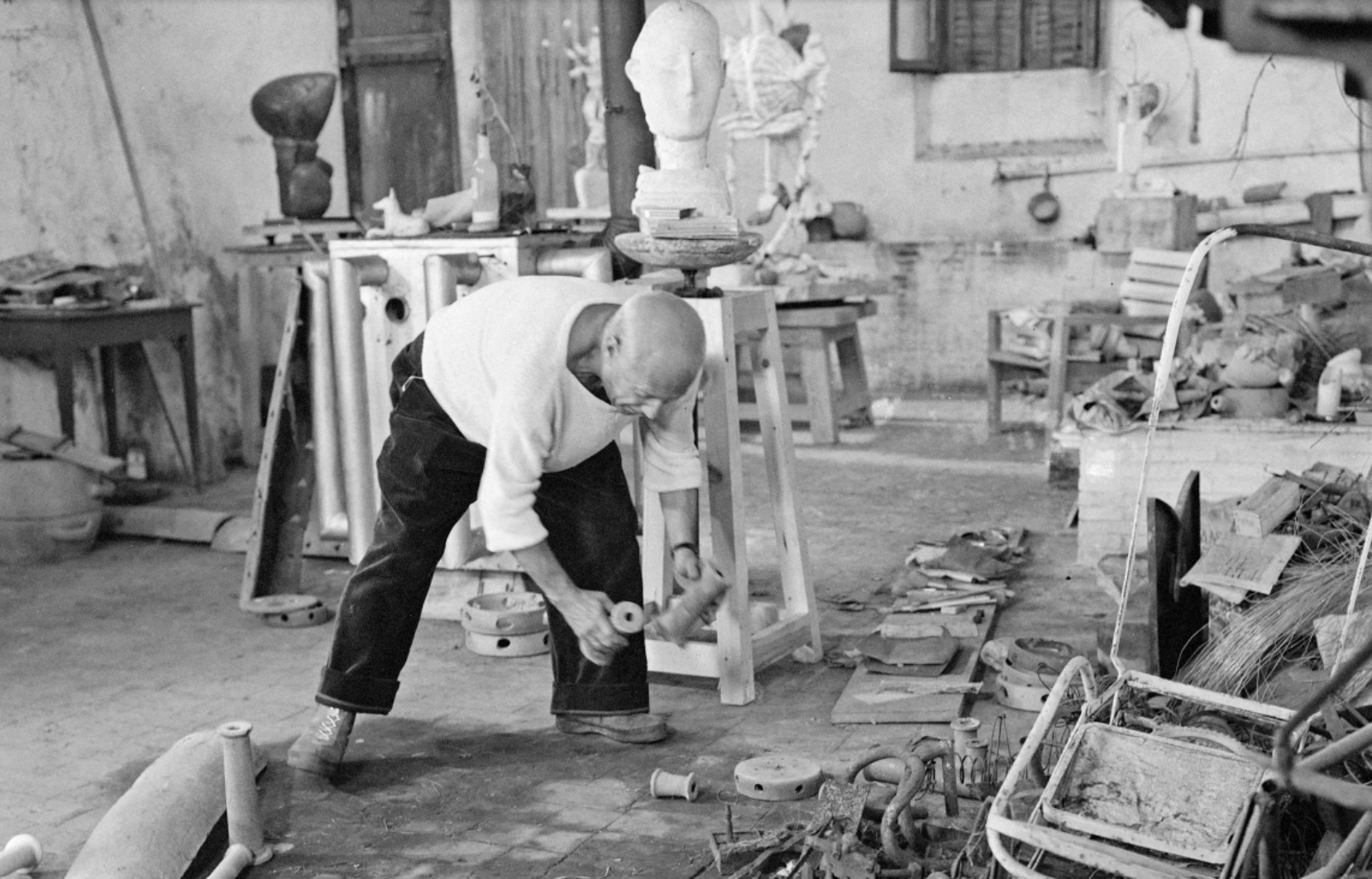
Fig. 3 Pablo Picasso at Le Fournas, Vallauris, 1953, with the plaster of Tête de femme above. Photograph by Edward Quinn. Image © 2024 Edward Quinn, © edwardquinn.com / © Succession Picasso / ProLitteris, Zurich. Art © 2024 Estate of Pablo Picasso / Artists Rights Society (ARS), New York
Within this ideation, his project finds kinship with that of the Surrealists, whose notion of the uncanny was based on the idea that unexpected parallels could be excited by the combination of two disparate objects. The difference, however, is Picasso’s insistence on authorial control and, as exemplified with Tête de femme, his adherence to a figurative impulse. As he explains, “I always try to observe nature… I insist on likeness, a more profound likeness, more real than the real, achieving the surreal. This is the way I understood surrealism but the word has been used quite differently” (Pablo Picasso, quoted in Andre Wood, “En peinture tout n’est que signe, nous dit Picasso”, Arts, no. 22, 29 June 1945, p. 236).
The heavily worked surfaces at once serve as a remarkable record of the artist’s hand, and of his distinct ability to transform medium into form. The process of casting in bronze imbues the work with a material unity which simultaneously overcomes and accentuates the heterogeneity of its elements. In the case of the present Tête de femme, however, the materiality lends a distinct sense of weight which adds to Gilot’s pure, monumental presence. The stepped elements describing her shoulders and bust increase exponentially as they move closer to the base, conferring on her posture an overall sense of groundedness which reflects back onto her austere disposition. The emotional implications of her stoic expression are therefore heightened and reinforced by the solidity of her composition. And so, with his elemental understanding of the female form, Picasso imbues Gilot with a mythic, timeless grandeur.
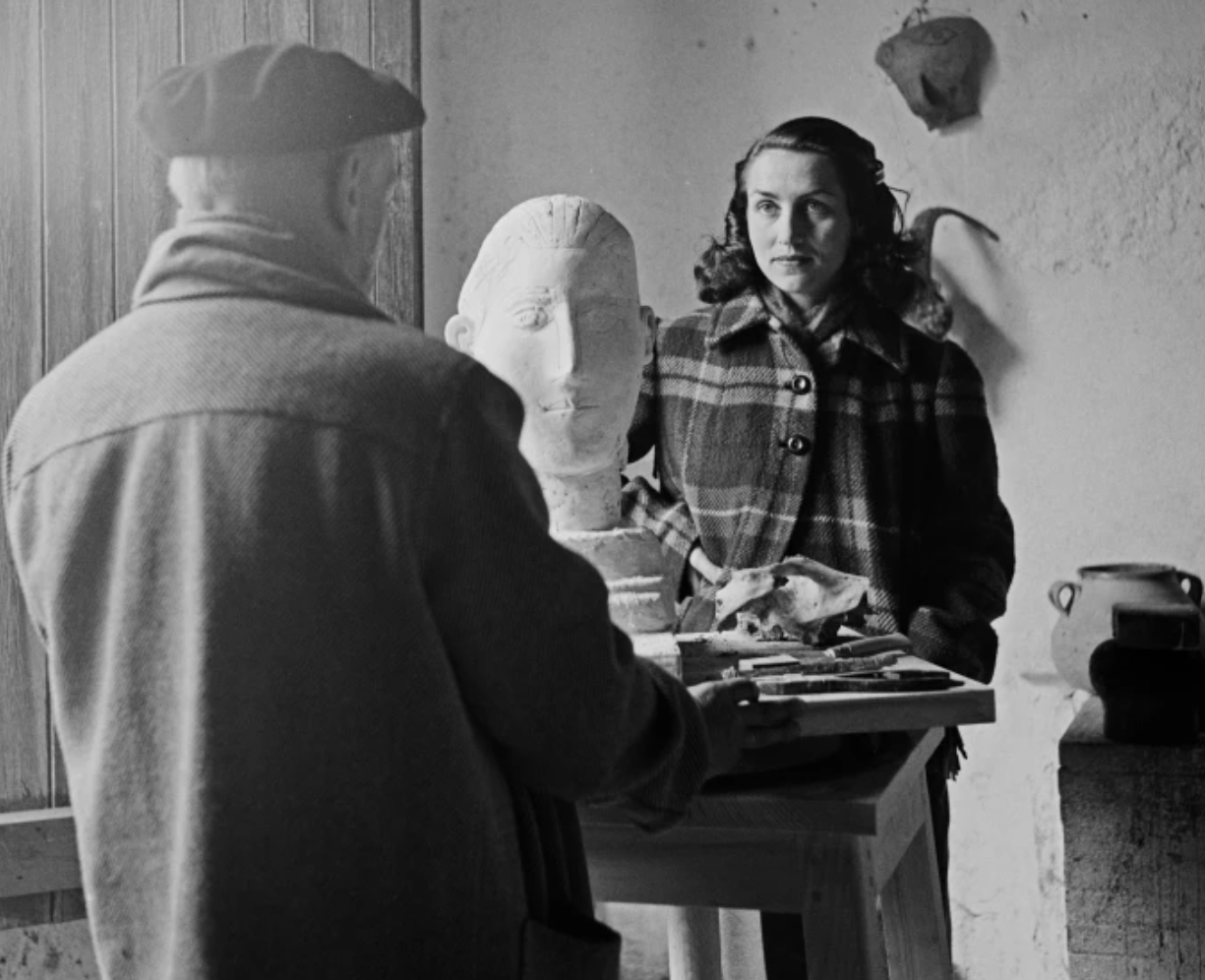
Pablo Picasso and Françoise Gilot with the plaster of Tête de femme at Le Fournas, Vallauris, 1953.
Photograph by Edward Quinn. Image © 2024 Edward Quinn, © edwardquinn.com / © Succession Picasso / ProLitteris, Zurich.
Art © 2024 Estate of Pablo Picasso / Artists Rights Society (ARS), New York
The monumentality he confers on the present Tête de femme underscores the reverence with which he viewed his female subject. It was a monumentality which was also in large part reserved exclusively within his sculpted oeuvre for his depictions of his most important muses. Throughout his career, Picasso returned to the bust in his representation of these seminal women—works which have come to be revered as the pinnacle of his sculptural achievement. From his cubist bust of Fernande Olivier, to his sensuous plaster of Marie-Thérèse, to the commanding bronze of Dora Maar, and ultimately the present depiction of Gilot, the sculpted portrait was transformed at Picasso’s hand into a nuanced communicative idiom, enriched with all of the history that lay behind the form, and infused with all of the emotion inspired by its model (see figs. 4 and 5). When taken in context of Tête de femme, Barbara Thiemann and Evelyn Weiss’ remarks on Picasso’s bronze of Maar still ring true: “This strong, spiritualized head, with its powerful aura of human dignity and its remoteness from violence and subjugations, seems to convey a contrast, a kind of inner resistance. It recalls the stoical serenity of the gods of the ancient world” (Exh. Cat., Barcelona, Museu Picasso, Picasso, The Ludwig Collection, 1992-93).
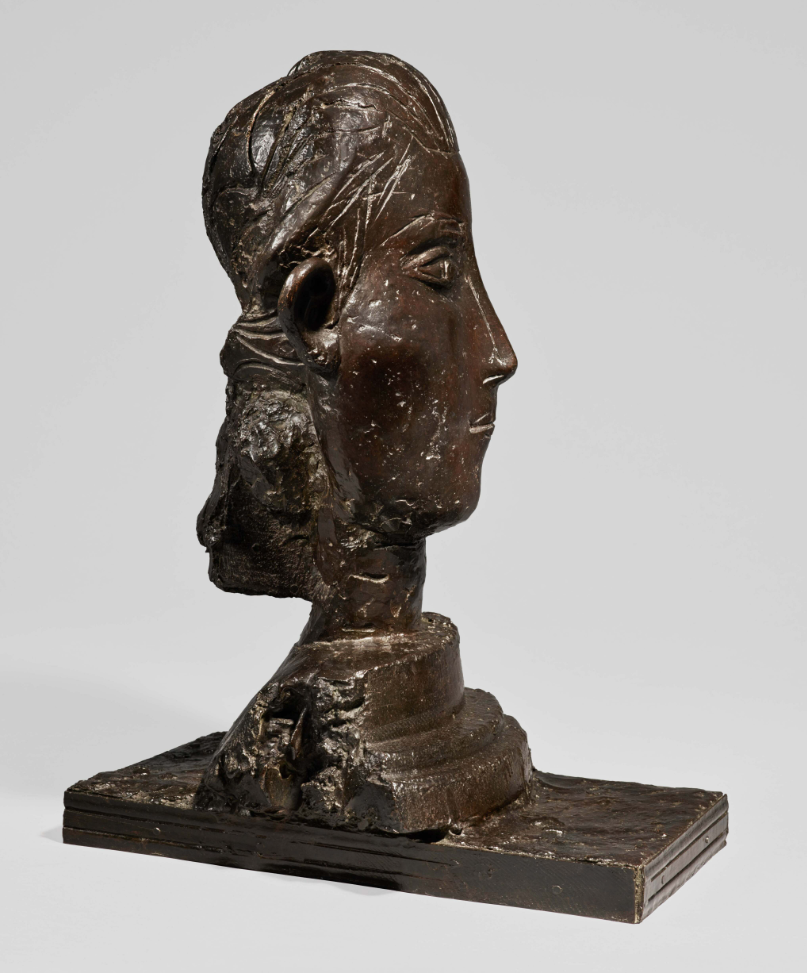
Throughout his career, Picasso constantly returned to the leitmotif of the artist and his model. One cannot help but notice the striking parallel between the image of Picasso, Gilot and the present bust in his studio at Le Fournas (see fig. 6), and the retrospectively prophetic etching he made as part of his Suite Vollard nearly twenty years prior. This persisting self-identification with the great mythic sculptor of antiquity—or, as in his 1925 portrait of Marie-Therese, La Statuaire, of muse as both sculptor and sculpted—perhaps explains something of the creative empowerment he discovered in sculpture at this moment in his life (see Pablo Picasso, La Statuaire). Like the inspiration he found in his muses, these raw materials, transformed through the tactile, embodied act of assemblage, allowed Picasso to engage with the generative act of artistic creation in its purest form. The present Tête de femme thus serves as both a continuation and fulfillment of that celebrated motif, and of the fruit born out of that treasured relationship between artist and muse. The first in an edition of two, the present bronze has not been offered at auction since 1987.
Jacqueline Roque
The 1960s proved a time of invigoration and creative renewal for Picasso. In 1961, the artist married Jacqueline Roque, his partner of the preceding seven years. The pair soon moved into a sprawling estate in the town of Mougins called Notre-Dame-de-Vie. There, Picasso ensconced himself in a world of creative activity while Jacqueline protected him from the distractions and intrusions of the outside world.
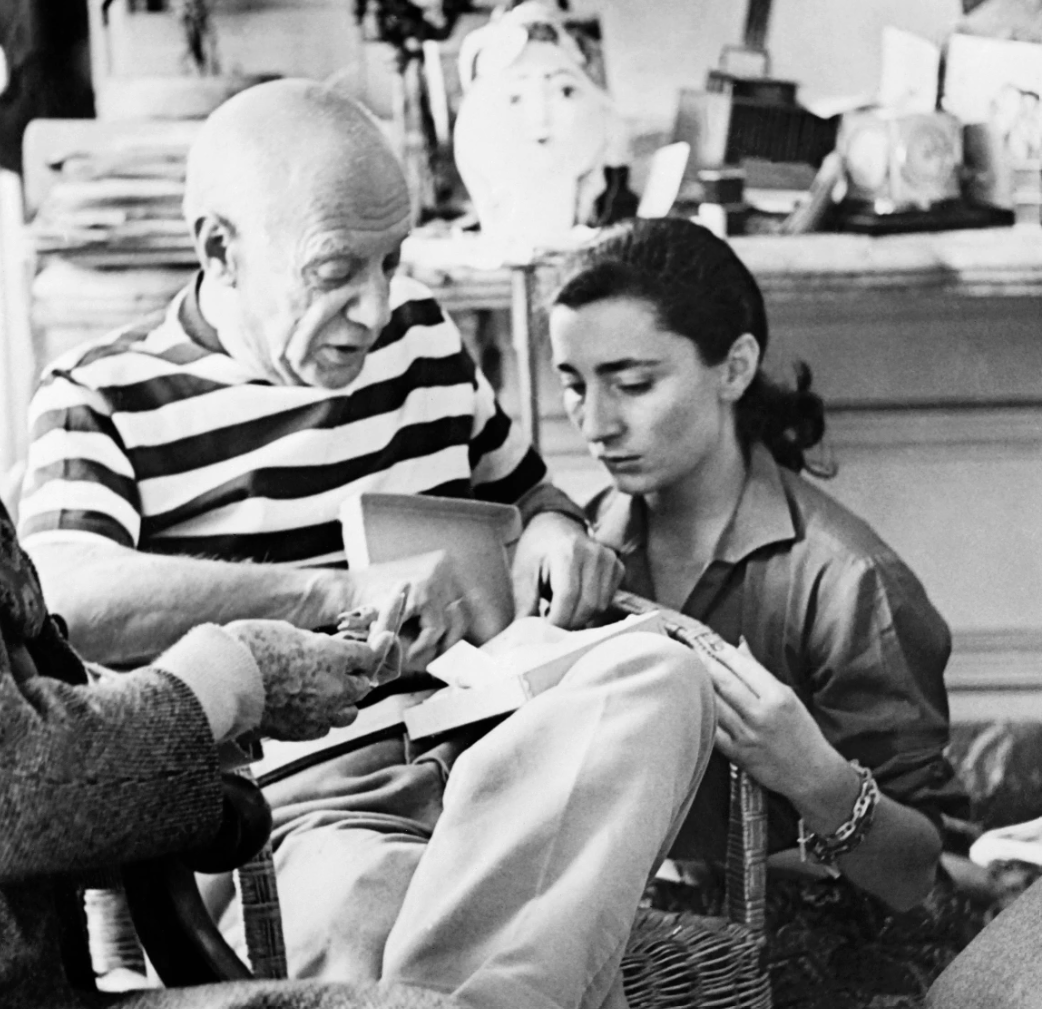
Pablo Picasso and Jacqueline Roque at in their house in Vallauris, October 1961. Photograph by André Villers.
Image © 2024 André Villers/AFP/Getty Images. Art © 2024 Estate of Pablo Picasso / ARS, New York
During this fruitful decade with Jacqueline as his ever-present muse, myriad series were born, from the more overt renditions of iconic Old Masters in the 1950s, to his painter and model depictions from the early 1960s and the musketeers and matadors that would dominate his oeuvre in the late 1960s. Jacqueline and Picasso first met during the summer of 1952 at Georges and Suzanne Ramié’s Madoura pottery works in Vallauris, where the artist had been creating ceramic wares since 1946. Paris-born Jacqueline was then a 25-year old divorcée; in 1950 she ended her marriage to André Hutin, an engineer, with whom she had lived for several years in colonial French West Africa. They had a young daughter, Cathy. Mme Ramié and Jacqueline were cousins; the Madoura owner offered her relation the job as a salesperson in the company retail store. Stationed at the table nearest the entrance, Jacqueline quickly caught Picasso’s eye.
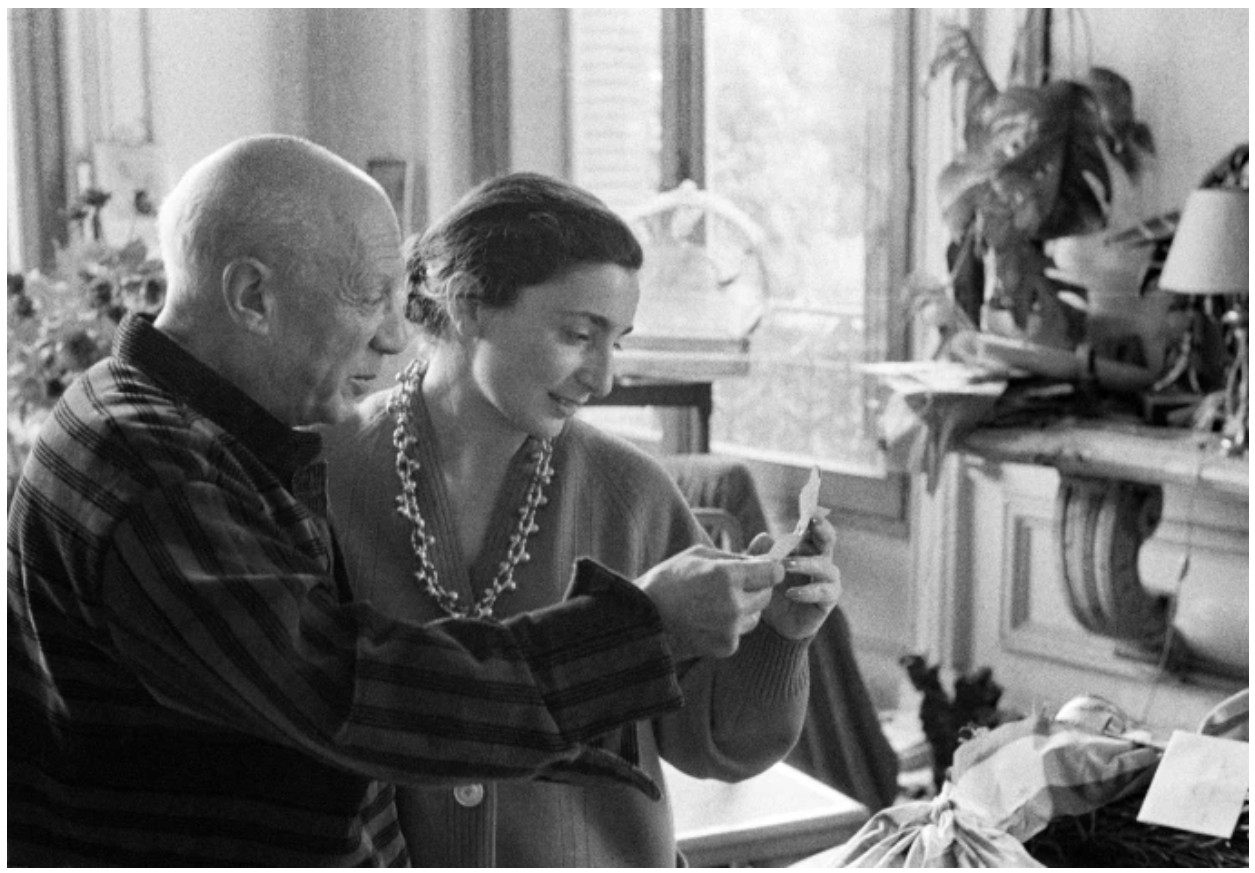
Picasso and Jacqueline read a congratulatory letter for his 75th birthday at La Californie, Cannes in 1956.
Photo Edward Quinn, © edwardquinn.com © Succession Picasso/DACS, London 2025
Françoise was the first of Picasso’s women to end her relationship with the famous artist on her own volition and at a time of her choosing. Picasso was devastated with she broke with him in Vallauris at the end of September 1953 and took their children Claude and Paloma with her to live in Paris. Jacqueline soon began to minister to Picasso’s daily needs. “One can’t leave that poor man alone like that, at his age,” as Françoise learned she had been telling the Ramiés and other friends. “I must look after him” (quoted in ibid.). When Françoise brought the children to visit Picasso in July 1954, she noticed that while he was still living alone, “Jacqueline Roque came nearly every day. We had lunch with her at her house several times. It was clear from everything Picasso said that he considered her presence temporarily useful, but that he didn’t see it as a long-term arrangement” (ibid., p. 361).
Deprived of constant female companionship for the first time in decades, Picasso was averse to being alone, especially at night. His liaison with young Geneviève Laporte, the “other woman” while he was living with Françoise, had also ended. Roland Penrose described this period as “a season in hell” (Picasso: His Life and Work, Berkeley, 1981, p. 387). To amuse himself during the winter of 1953-1954 Picasso created a suite of 180 ink and wash drawings on paper depicting artists and their models at work and play, which Michel Leiris titled Picasso et la comédie humaine in his preface when the series was published in Verve, September 1954.
The arrival of spring 1954 brought a new face for Picasso to paint. At the Madoura pottery in mid-April Picasso met Sylvette David, the daughter of Bernard Buffet’s dealer. Her fiancé, the sculptor Tobias Jellinek, was showing his furniture in the studio store; Picasso purchased some chairs. The artist arranged to draw and paint Sylvette for the next ten weeks. If Picasso had moreover hoped to initiate an amorous liaison with this nineteen-year-old, Brigitte Bardot-like beauty, the constant presence of her boyfriend thwarted any such intention.
#1. Femme au chien, 1962
Sotheby’s New-York: 14 May 2019
Estimated: USD 25,000,000 – 30,000,000
USD 54,936,000
(#33) PABLO PICASSO | Femme au chien
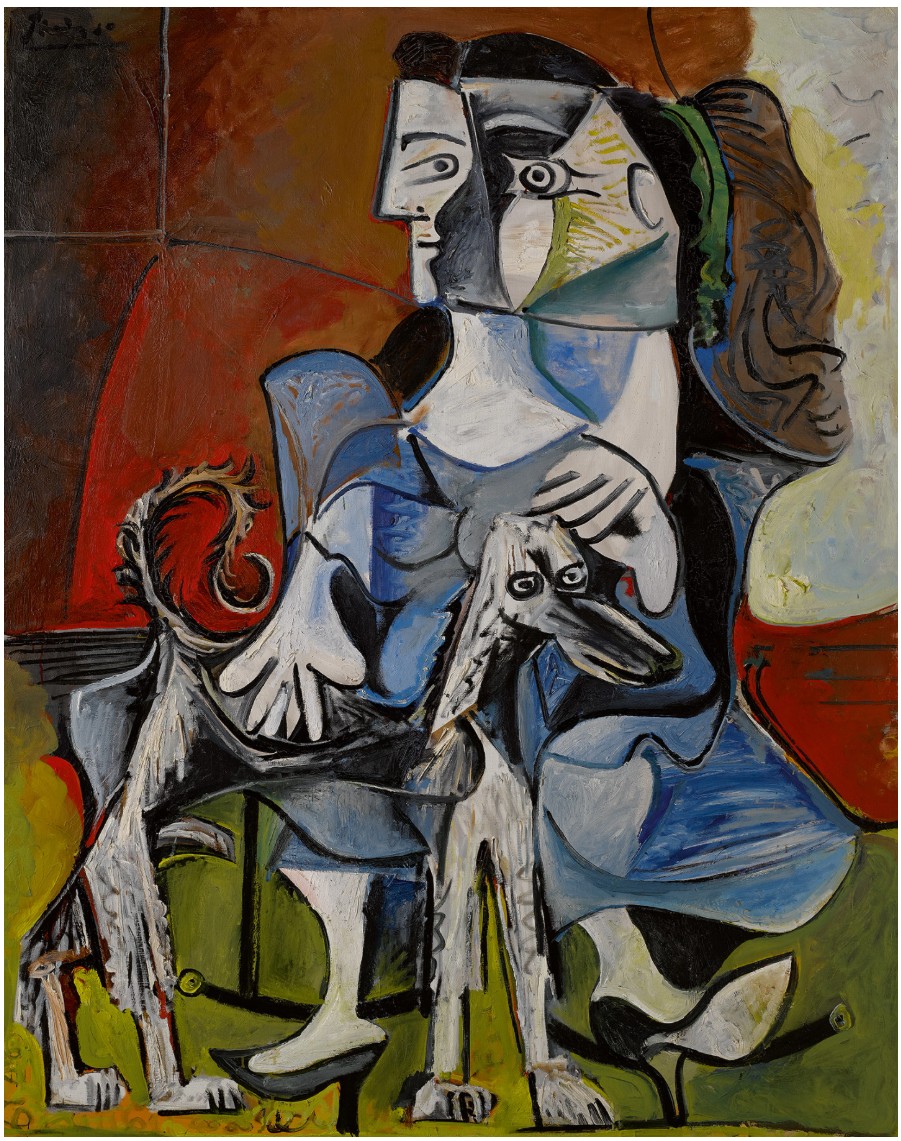
PABLO PICASSO
Femme au chien, 1962
Oil on canvas
162×130 cm (63 3/4 x 51 1/4 inches)
Signed Picasso (upper left)
Extensively dated (on the reverse)
Painted from November 23 to December 14, 1962
At any given point in Picasso’s life, a veritable menagerie could be found in his home and studio. Dogs of all shapes and sizes, a variety of felines, doves, a parrot, an owl, a goat—indoors and out of doors these animals would appear, disappear, reappear. Later in life a bird would drop dead in its cage in the studio at Notre Dame de Vie. Jacqueline, Picasso’s second wife, would spirit the cage away until a replacement could be found to ensure an ever-present appearance of life.The inclusion of a dog as a principal subject has precedent dating back to Picasso’s earliest days as an artist. The titular dog in Femme au chien, his Afghan hound Kaboul, is rendered with clear affection and humor and a nod to Picasso’s adoration of these creatures. Canines of various sorts are present in Picasso’s works throughout his oeuvre: the emaciated figures of his Rose Period; his serial reinterpretations of Velazquez’s Las Meninas; and his dachshund Lump (who he “borrowed” from David Douglas Duncan for many years) along with his Afghan hounds, Kasbek and Kaboul and his boxer Jan. The importance of dogs to Picasso is particularly evident in his delicate rendering of Garçon au chien executed in 1905, now a part of the permanent collection at the Hermitage (see fig. 1).
Kaboul is not the only protagonist in Femme au chien, as the title suggests. Enthroned in an armchair, the woman featured in Femme au chien is Jacqueline Roque, Picasso’s beloved second wife who remained with him until his death in 1973. Picasso’s renderings of Jacqueline constitute the largest group of images of any woman in his life. The couple met in 1952 at the pottery studio in Vallauris, while Picasso was still living with the mother of his two children, Françoise Gilot. Unlike Françoise, Jacqueline was accepting of the notoriously temperamental artist and his obsession with his art. Her unflappable support and willingness to sacrifice herself on the altar of his ego won the artist’s heart. Picasso married Jacqueline in 1961 and as William Rubin noted, “Jacqueline’s understated, gentle, and loving personality combined with her unconditional commitment to [Picasso] provided an emotionally stable life and a dependable foyer over a longer period of time than he had ever before enjoyed” (W. Rubin quoted in Picasso & Jacqueline, The Evolution of Style (exhibition catalogue), Pace Gallery, New York, 2014-15, p. 190).
The relationship between Jacqueline and Kaboul was apparently very close. Boris Friedwald writes, “As of 1960, Lump [Picasso’s dachshund] had a new companion, Kaboul, named after the Afghan capital—and rightly so, because he was an Afghan Greyhound. Jacqueline Roque, whom Picasso had married in 1961, was in love with Kaboul. And soon the animal, which was to accompany Picasso up to the end of his life, was appearing in several portraits of Jacqueline Roque. No wonder the features of Kaboul can be subtly traced in her visage” (B. Friedewald, Picasso’s Animals, New York, 2014, p. 56). To this point of visual similarity between hound and human, Picasso himself described the difficulty of separating the two in his mind: “Often, if he comes into my mind when I am working, it alters what I do. The nose on the face I am drawing gets longer and sharper. The hair of the woman I am sketching gets longer and fluffy, resting against her cheeks just as his ears rest against his head” (quoted in ibid., p. 51). In all, Picasso would paint six oils of Jacqueline seated with Kaboul. These range from the most fully worked examples including the present work and Femme et chien sous un arbre, now at The Museum of Modern Art, New York to more instantaneous, looser compositions where the shape and execution of both Jacqueline and Kaboul is less precise (figs. 2 & 3).
The present picture, which Picasso began in November 1962 and completed the following month, belongs to a series of depictions of Jacqueline in an armchair. The motif of a seated woman in an armchair occurred repeatedly throughout Picasso’s oeuvre. While varying in style and depicting different women that marked each period of the artist’s life, these figures, seated and fully attentive, generally served as a vehicle for expressing the palpable sexual tension between the painter and his model. From soft, voluptuous curves of Marie-Thérèse Walter, to the fragmented, near-abstract nudes of his surrealist work and the exaggerated rendering of his later years, Picasso’s seated nudes have a monumental, sculptural presence, and are invariably depicted with a powerful sense of psychological drama. It is perhaps no accident that the present work features prominently in the background of a portrait of the couple taken in 1962 (see fig. 4).
Unlike many other figural artists who employed professional models or negotiated with strangers and slight acquaintances to sit for them, Picasso’s figures always revolved around those who inhabited the closes portions of his personal life “It is characteristic of Picasso,” writes Marie-Laure Bernadac “… that he takes as his model—or as his Muse—the woman he loves and who loves with him, not a professional model. So what his paintings show is never a ‘model’ of a woman, but woman as model. This has its consequences for his emotional as well as his artistic life: for the beloved woman stands for ‘painting’, and the painted woman is the beloved: detachment is an impossibility. Picasso never paints from life: Jacqueline never poses for him; but she is there always, everywhere. All the women of these years are Jacqueline, and yet they are rarely portraits. The image of the woman he loves is a model imprinted deep within him, and it emerges every time he paints a woman” (Late Picasso. Paintings, sculpture, drawings, prints 1953-1972 (exhibition catalogue), The Tate Gallery, London & Musée national d’art moderne, Paris, 1988, p. 78). It was not just the women in his life who dominated his canvases. In his years with Olga, Marie-Thérèe and Gilot their children with Picasso take pride of place in his artwork. Jacqueline is depicted with the beloved hound Kaboul and, two years later, in a series of images, both clothed and nude, with their cat. This is not to say the animals take the place of children in these works—Gilot was depicted with dogs in various instances (see fig. 5), but rather belie the daily surroundings of life and the prime actors within their world at this time.
By 1962, Picasso and Jacqueline had decamped from the increasingly chaotic Villa La Californie in Cannes. After a brief period of time spent in the too-remote Vauvenargues Castle, near Aix-en-Provence, they settled in Notre Dame de Vie, a Mas in the town of Mougins, perched in the hills high above the coast. “Notre Dame de Vie,” Gert Schiff relates, “is a spacious eighteenth-century farmhouse surrounded by cypresses and olive trees, with a view extending down to the Bay of Cannes. The artist’s wife Jacqueline organized his life for him. She provided him with unlimited time for his work—and with inspiration” (G. Schiff, Picasso. The Last Years, 1963-1973, New York, 1983, p. 12). Femme au chien, in its bold use of color, complexity and completeness of composition and monumental scale ensure that his canvas is one of Picasso’s most evocative portraits of his wife during their years at Notre Dame de Vie and a masterpiece of the artist’s late period.
#2. Femme accroupie (Jacqueline), 1954
Christie’s New-York: 13 November 2017
Estimated: USD 20,000,000 – 30,000,000
USD 36,875,000
Pablo Picasso (1881-1973), Femme accroupie (Jacqueline) | Christie’s
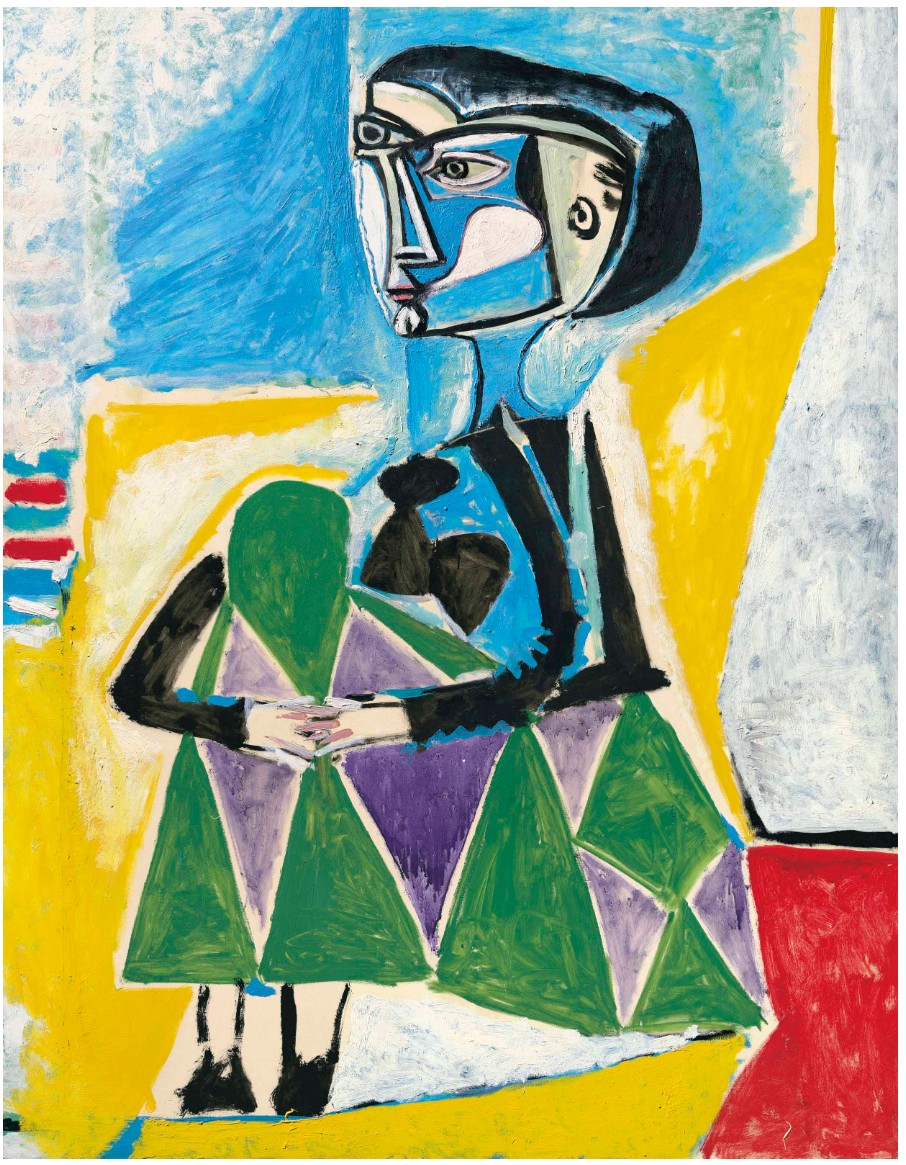
PABLO PICASSO (1881-1973)
Femme accroupie (Jacqueline), 1954
Oil on canvas
146×114 cm (57 1/2 x 44 7/8 inches)
Dated ‘8.10.54.’ (on the reverse)
Painted on 8 October 1954
The brilliant primary colors in Femme accroupie (Jacqueline) proclaim a dazzling, sunny day in the Midi during early autumn, 1954. Picasso and Jacqueline Roque, his latest and—as time would tell—his ultimate paramour and eventual second wife, had begun living together, and would soon return to Paris to reside in the artist’s studio on the rue des Grands-Augustins. The present painting is one of three identically sized, large-easel-format canvases that Picasso painted on October 8th, in a flourish of portraits that celebrate the artist’s new mistress, declaring her newly established pride of place in the artist’s life and work. In each of the three October paintings, Jacqueline is seated on the floor; in a compact, crouching pose, she clasps her knees raised up before her. From an open window behind her, golden light fills the room. The space is likely a corner of Picasso’s studio on the rue du Fournas in Vallauris, in a building that had previously housed a perfume factory, the scents from which still graced the air. Picasso purchased this ramshackle structure in the spring of 1949, when the villa La Galloise, in which he had been living with Françoise Gilot and acquired in her name, proved too small for the work space and storage room he required.
#3. Femme accroupie au costume turc (Jacqueline), 1955
Christie’s New-York: 6 November 2007
Estimates on Request
USD 30,841,000
Pablo Picasso (1881-1973) , Femme accroupie au costume turc (Jacqueline) | Christie’s
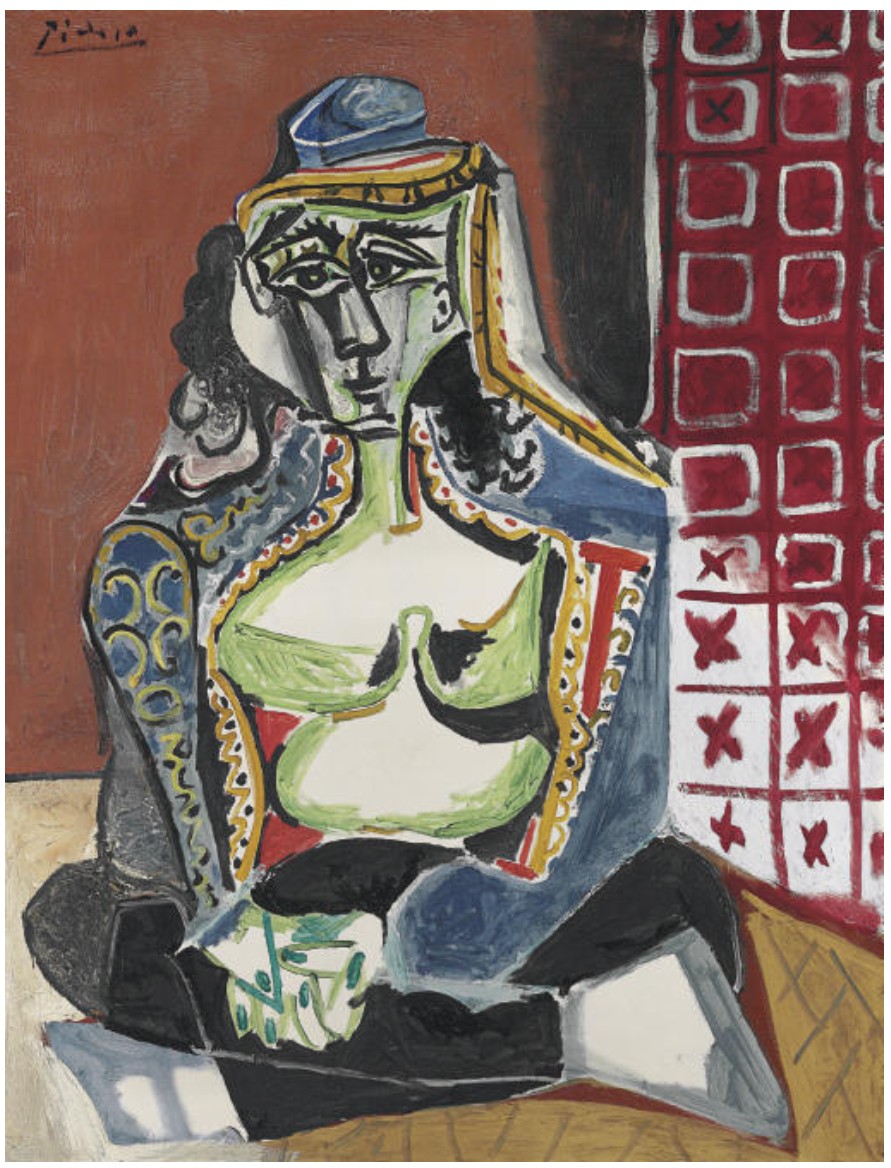
PABLO PICASSO (1881-1973)
Femme accroupie au costume turc (Jacqueline), 1955
Oil on canvas
115.8 x 89.2 cm (45 5/8 x 35 1/8 inches)
Signed ‘Picasso’ (upper left)
Dated ‘26.11.55.’ (on the reverse)
Picasso painted his series of fifteen variations on Delacroix’s Les Femmes d’Alger between 13 December 1954 and 14 February 1955. Shortly after Picasso completed the final canvas, Version O , Roland Penrose arrived at the artist’s Paris studio on the rue des Grands-Augustins to view the entire group. Penrose later recalled, “Bringing them out one after another he showed me the rich variety of style and fantasy to which Les Femmes d’Alger had been subjected. My first sight of the Moorish interiors and the provocative poses of the nude girls reminded me of the odalisques of Matisse.
‘You are right, when Matisse died he left his odalisques to me as a legacy, and this is my idea of the Orient though I have never been there.”
The odalisque–the exotically robed, semi-clad or more often nude figure of an alluring young woman–would remain the pre-eminent subject in Picasso’s work during the final two decades of his life. Toward the end of 1955 he added an important installment on this theme in a series of ten portraits of his companion Jacqueline Roque (fig. P-D___, p.__), clad in a traditional Turkish costume. The present Femme accroupie au costume turc is the crowning, definitive painting in this group. It would be the last time that Picasso evoked the Orientalist theme of the odalisque on canvas with such specificity in regard to the garb and other accoutrements pertaining to the traditions of this genre. Thereafter Picasso’s idea of the odalisque would merge into a broader conception of the nude as the artist’s model. Sequestered within the closed and private confines of the studio, as in a harem (the word is derived from the Persian haram and the Arabic har LONG MARK ON im, a sacred or forbidden place), she would be subjected to his gaze alone, painted and then revealed to the world. She became the passive participant in a sophisticated–and, indeed, very adult–game of role-playing, in which her relationship to the artist, real or imagined, might be that of mythical goddess, nymph, wife, lover, courtesan or whore.
#4. Femme au costume turc dans un fauteuil, 1955
Christie’s London: 3 February 2014
Estimated: GBP 15,000,000 – 20,000,000
GBP 16,882,500 / USD 27,564,660
Pablo Picasso (1881-1973), Femme au costume turc dans un fauteuil | Christie’s
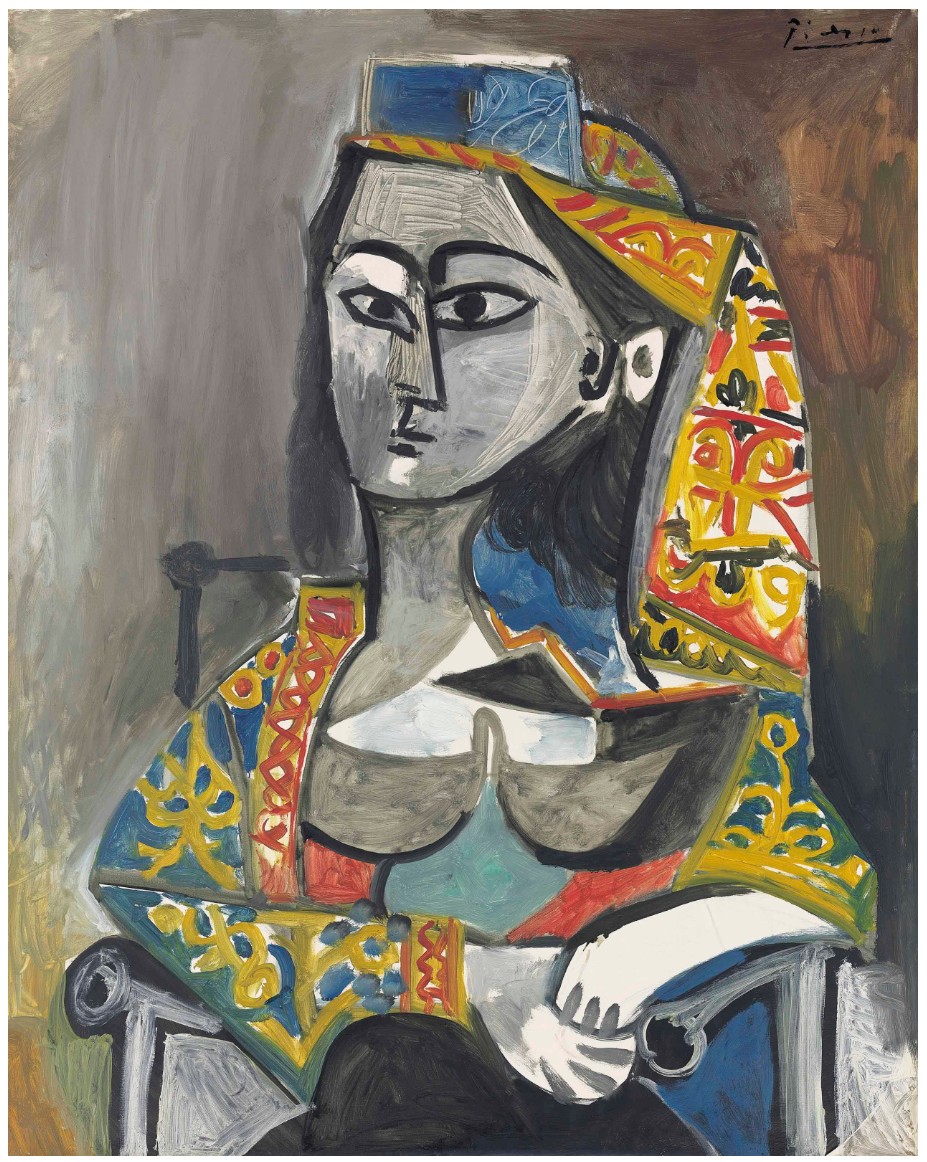
Pablo Picasso (1881-1973)
Femme au costume turc dans un fauteuil, 1955
Oil on canvas
92×73 cm (36 1/4 x 28 3/4 inches)
Signed ‘Picasso’ (upper right)
Dated and numbered ‘20.11.55. II’ (on the reverse)
Pablo Picasso painted Femme au costume turc dans un fauteuil on 20 November 1955. This picture is one of a small group of portraits showing Jacqueline Roque in the costume of an ‘odalisque’, a woman of the harem. The identification of the model is clear from comparison with other works from the selected series, and also with portraits that Picasso had created of her during the course of 1954 and 1955; indeed, a little over a year before he painted Femme au costume turc dans un fauteuil, he had drawn an intimate image of Jacqueline’s face showing the nose, as here, facing to the right while the rest appeared predominantly orientated towards the left. That had been one of Picasso’s early depictions of Jacqueline: while they had met in 1952, when she was assisting Suzanne Ramié in the workshop in Vallauris where Picasso made his ceramics, it was only later in 1953 that she had become established as the artist’s partner, especially following the final rupture with Françoise Gilot in September that year. Femme au costume turc dans un fauteuil therefore dates from relatively early in this relationship and is a colourful, tender celebration of Jacqueline, whom Picasso would marry six years later and who would become one of the most important muses of the artist’s entire life.
In Femme au costume turc dans un fauteuil, Picasso has shown Jacqueline in the exotic garb of a woman of the seraglio. The theme of the odalisque derived from Picasso’s variations upon Eugène Delacroix’s celebrated masterpiece, Les femmes d’Alger dans leur appartement, now in the Louvre, Paris. Picasso had created his own versions of Les femmes d’Alger from December 1954 until early 1955 in his studio in the rue des Grands Augustins in Paris. In Femme au costume turc dans un fauteuil, painted at the end of 1955, Picasso has returned to the theme of the odalisque with relish: this is one of a series of pictures in which he painted a single woman dressed as an odalisque, taking his cues from Delacroix, from Ingres, from himself, and crucially from Henri Matisse. In this string of portraits, Picasso created a new sequence of variations, showing Jacqueline sometimes more figuratively, sometimes less. She appears in profile in some pictures, facing the viewer in others, here sitting upon a chair, there upon the floor. Picasso appears to have been playfully exploring the pictorial potential of Jacqueline’s striking features, for instance by inverting the nose in Femme au costume turc dans un fauteuil or, in another work painted six days later and sold at Christie’s New York in November 2007, by creating a heavier, more stylised impression of the head.
#5. Femme accroupie en costume turc II (Jacqueline), 1955
Christie’s New-York: 11 November 2021
Estimated: USD 20,000,000 – 30,000,000
USD 25,550,000
PABLO PICASSO (1881-1973), Femme accroupie en costume turc II (Jacqueline) | Christie’s
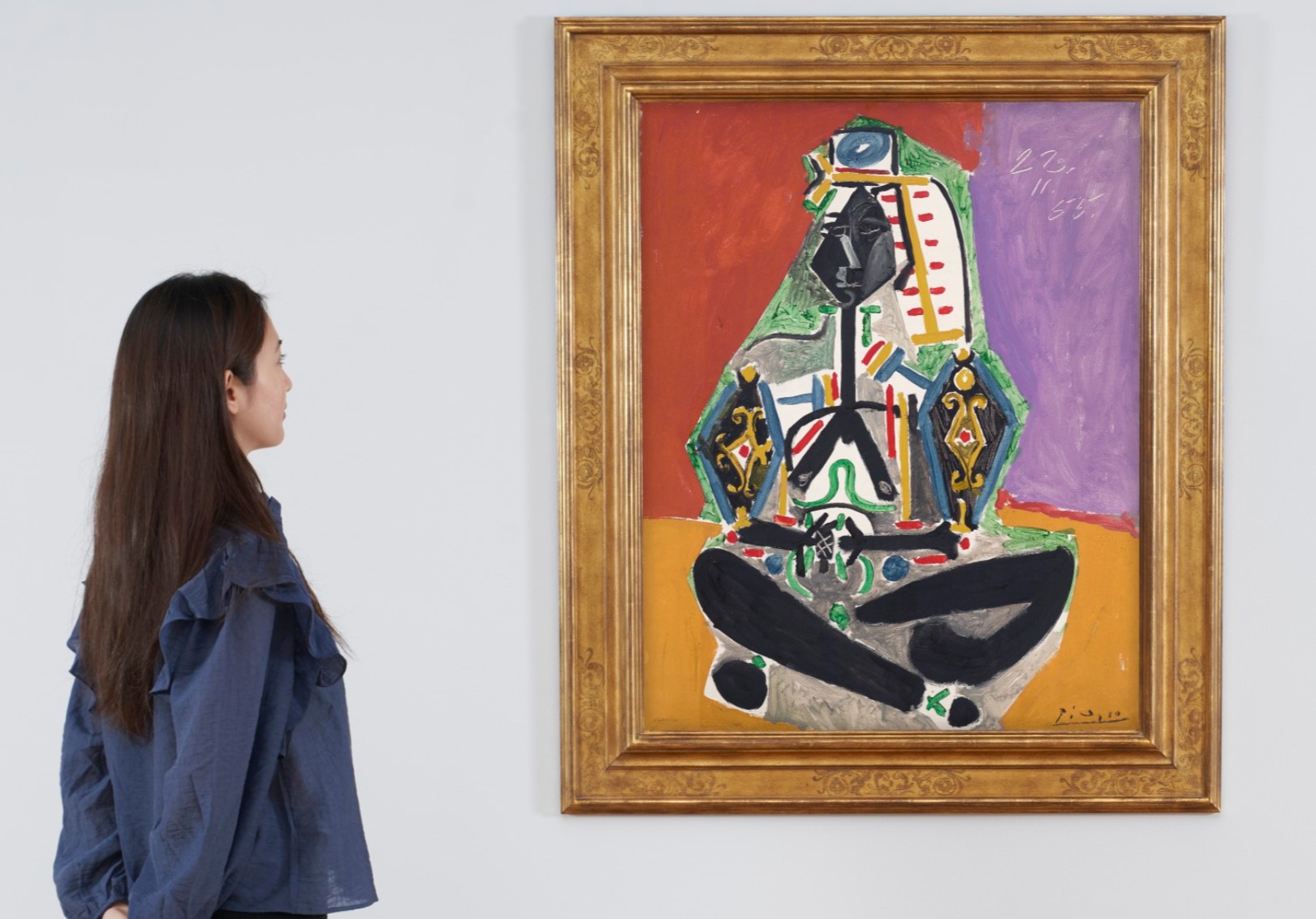
PABLO PICASSO (1881-1973)
Femme accroupie en costume turc II (Jacqueline), 1955
Oil on canvas
91.5 x 73 cm (36 x 28 3/4 inches)
Signed ‘Picasso’ (lower right) and dated ‘22.11.55.’ (upper right)
Dated again and numbered ‘22.11.55. II’ (on the reverse)
Picturing his new lover, Jacqueline Roque, Pablo Picasso’s Femme accroupie en costume turc II (Jacqueline) is one of an important group of eleven seated portraits that developed out of the artist’s landmark series, Les femmes d’Alger. Between December 1954 and February 1955, Picasso painted fifteen canvases based on Eugène Delacroix’s painting of the same name (1834, Musée du Louvre, Paris), each of which he assigned an identifying letter, from A to O. Constituting the artist’s single greatest achievement since the end of the Second World War, this series represents the first time Picasso comprehensively explored an important painting by an earlier artist, as well as standing as the most focused analysis he had done since the war years of the female figure set within a specific spatial environment.
Towards the end of 1955 Picasso made an important addition to the Femmes d’Alger theme with Femme accroupie en costume turc II (Jacqueline) and the accompanying series. Featuring Jacqueline clad in a traditional Turkish costume, with this group Picasso honed in on the frontal, seated odalisque that emerged on the far left of his own various Femmes d’Alger, transforming this figure into a deeply personal portrait. Conjuring the same heady eroticism and exoticism that pervades both Delacroix’s and Picasso’s Femmes d’Alger, the present work is among the most radical of this series. Here, Picasso has reduced his lover’s forms, as well as her elaborate, ornate costume, to an ideogram—a series of lines, patterns, and planes. With a distinctly Matissean air, this portrait is both an homage to his great friend and rival, as well as an important precursor of the pioneering artistic language Picasso would pursue in the following decades. This would be the last time that Picasso evoked the Orientalist theme of the odalisque on canvas. From this point on, he morphed this motif into a nude, frequently pictured as a companion to the figure of an artist. Picasso took an especially Matissean approach in the costume turc canvases, to an even greater degree than in the variations on Les femmes d’Alger. Like Matisse, in these works Picasso employed costume and decoration as a primary means of evoking the seductive fantasy of Orientalism, as well as using pattern as a way to experiment with pictorial construction. The flattened planes of color that constitute the background of the present work hark back to Matisse’s 1912 Zorah sur la terrasse (Pushkin Museum of Fine Arts, Moscow), painted during his sojourn in Morocco. Similarly, the overt arabesque patterned jacket recalls Matisse’s odalisques of the 1920s, such as the 1928 Odalisque assise (The Cone Collection, The Baltimore Museum of Art), sumptuously patterned, colored compositions in which sitter and setting unite in a decorative harmony. The present work was painted in Picasso’s new home, the spacious nineteenth-century villa known as La Californie, which overlooked Cannes. Such was the artist’s fame by this time that he was finding it increasingly difficult to move around Paris without being mobbed by journalists and passersby. Deciding to relocate permanently to the Midi, he realized he needed a new home, finding La Galloise both too small and too associated with memories of life with Gilot. La Californie was the perfect answer. The elaborate Art Nouveau-style villa also had a vaguely Orientalist air.
“I thought so much about Femmes d’Alger that I found La Californie; that’s how it is with painting. And Delacroix had already met Jacqueline.”
The dialogue between generations of artists, and the inspiration and challenge past masters present to modern masters, is aptly illustrated by the fact that this interpretation and transmutation of Delacroix’s masterpiece by Picasso itself became the source of inspiration and discovery for one of Pop Art’s greatest masters, Roy Lichtenstein.
#6. Femme Accroupie, 1954
Sotheby’s Hong-Kong: 9 October 2021
Estimated: HKD 150,000,000 – 230,000,000
HKD 191,651,000 / USD 24,619,880
Pablo Picasso 巴布羅・畢加索 | Femme Accroupie 抱膝女子 | Modern Art Evening Sale | 2021 | Sotheby’s
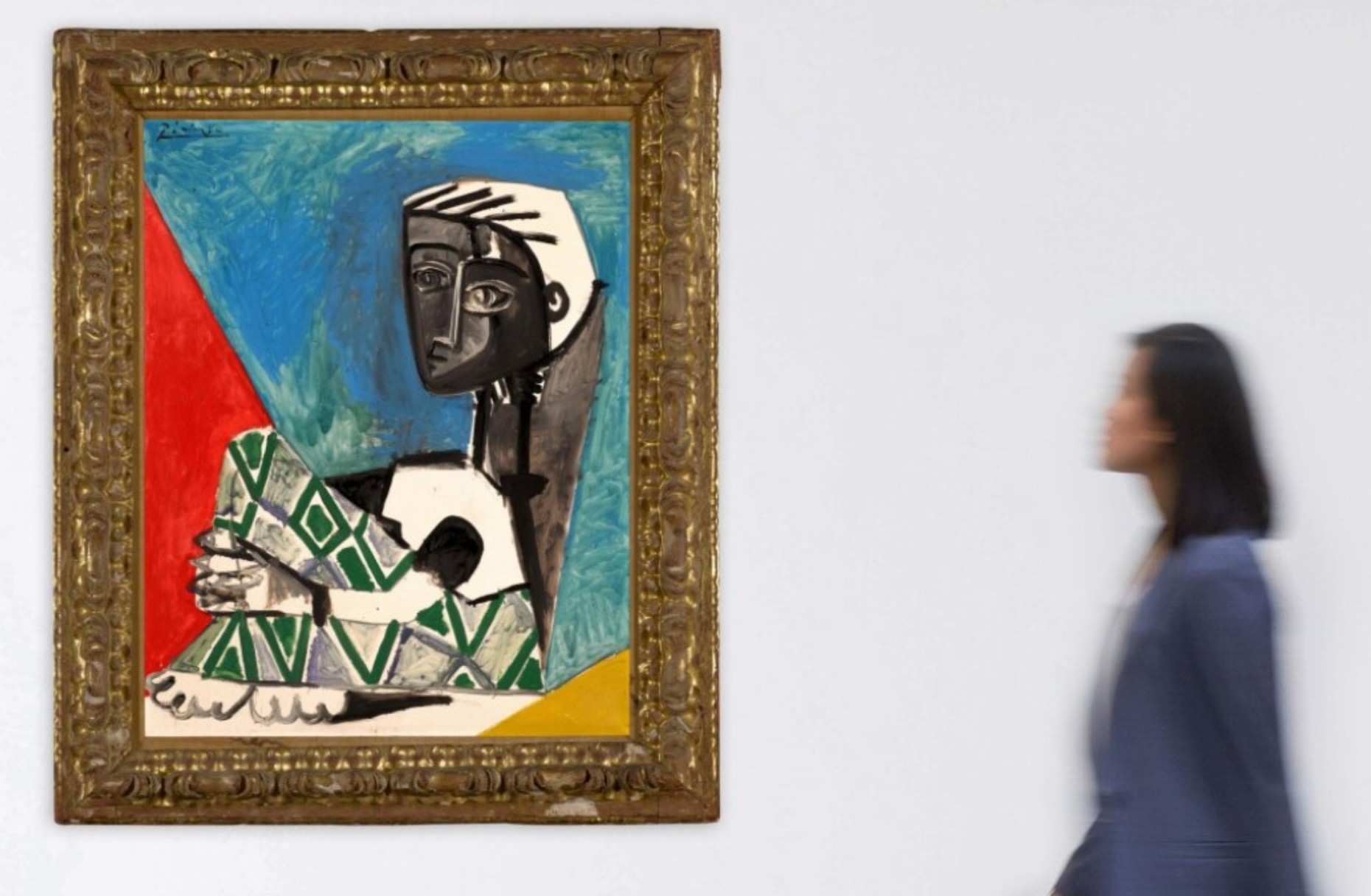
PABLO PICASSO (1881 – 1973)
Femme Accroupie, 1954
Oil and Ripolin on canvas
92.2 x 73 cm (36 1/4 x 28 3/4 inches)
Signed Picasso (upper left)
Dated 14.10.54 on the reverse
Pablo Picasso’s unconventional life was filled with female companions who nourished his rich and prolific artistic career. The portraits of the women in his life convey a wide range of emotions, but Picasso painted one woman repeatedly in the final years of his life: his last lover, wife, and muse Jacqueline Roque. Despite a significant age difference, their romance began in 1952, when Picasso was living in Vallauris, a small town on the southern coast of France known for its pottery. At the time, Picasso was fascinated by ceramics and the two met while Jacqueline was working at Madoura Pottery, the studio where Picasso spent significant time. The next year, Picasso’s relationship with his lover Françoise Gilot ended, and Jacqueline became a formal part of Picasso’s life. They would be together for the next twenty years, and particularly after their marriage in 1961, she carried the artist through the final chapter of his impressive life. Jacqueline’s legendary face first appeared in Picasso’s work in 1954. She was the only muse in Picasso’s late paintings, and she became the most frequent and longest-running subject in his career, featuring in more paintings than any of his previous lovers. These golden years, which art historian John Richardson called “l’epoque Jacqueline,” show that Jacqueline played a decisive role in Picasso’s late artistic career.
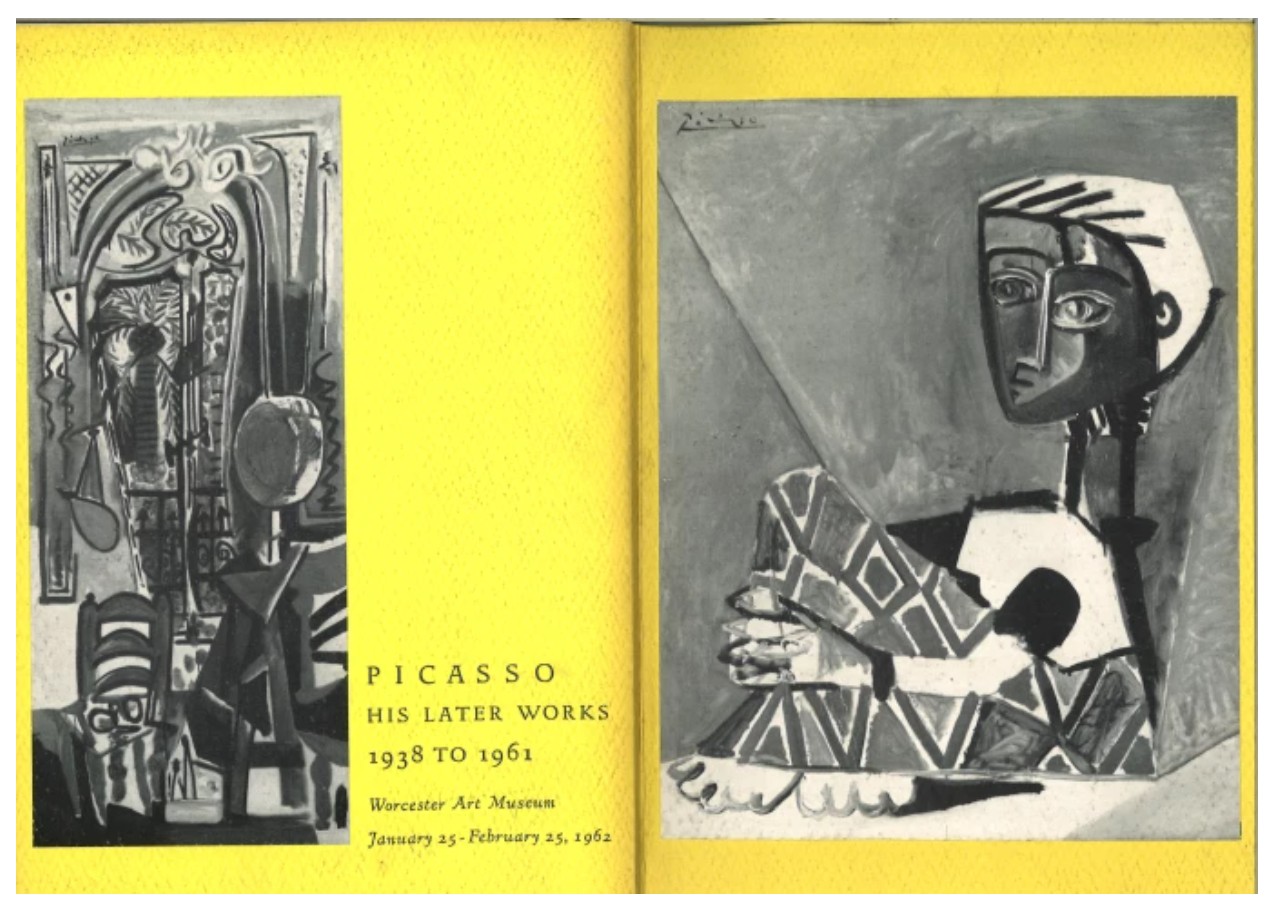
Worcester, Worcester Art Museum, Picasso: His Later Works 1938-1961, 25 January – 25 February 1962, no. 68, illustrated on the cover of the catalogue
Femme Accroupie (1954) bears witness to the beginning of the relationship between artist and muse, but it also laid a foundation for the outstanding portraits that Jacqueline would inspire. While he was painting Femme Accroupie, Picasso, in love once again, embarked upon a brand-new stage in his life and discovered an untapped source of confidence and creativity. That same year, Picasso painted the fifteen works in the Les Femmes d’Alger series, a homage to the odalisques of Eugène Delacroix and Henri Matisse. Les Femmes d’Alger (Version “O”) has long held the record–a staggering US$179.4 million – for a Picasso painting at auction. Femme Accroupie is the beginning of the conception of that series. This painting stands as Picasso’s personal defense of representational art at a transitional time in the post-war art world, but it was also the final realization of an idea that he had been contemplating for the last 50 years. In this work, he engages with his predecessors and contemporaries, showcasing his boundless creativity.
Femme Acccroupie comes directly from the esteemed collection of Kate and Allan Emil and has been with the family since its acquisition in 1957. Allan Emil was a prominent American philanthropist and patron of the arts, who served vital roles on the boards of Federation of Jewish Philanthropies, Whitney Museum of American Art, American Federation of Arts, and Bennington College. Part of his distinguished art collection was donated to world-class museums, including The Museum of Modern Art, New York, The Metropolitan Museum of Art, New York, and Solomon R. Guggenheim Museum, New York; most notably, he donated the colossal Buste of Sylvette sculpture to New York University in 1968, a New York City landmark that stands till this day. Through his benevolent contribution to arts and education, Mr. Emil demonstrated the noble sentiment of giving back to the society and continued to inspire generations to come.
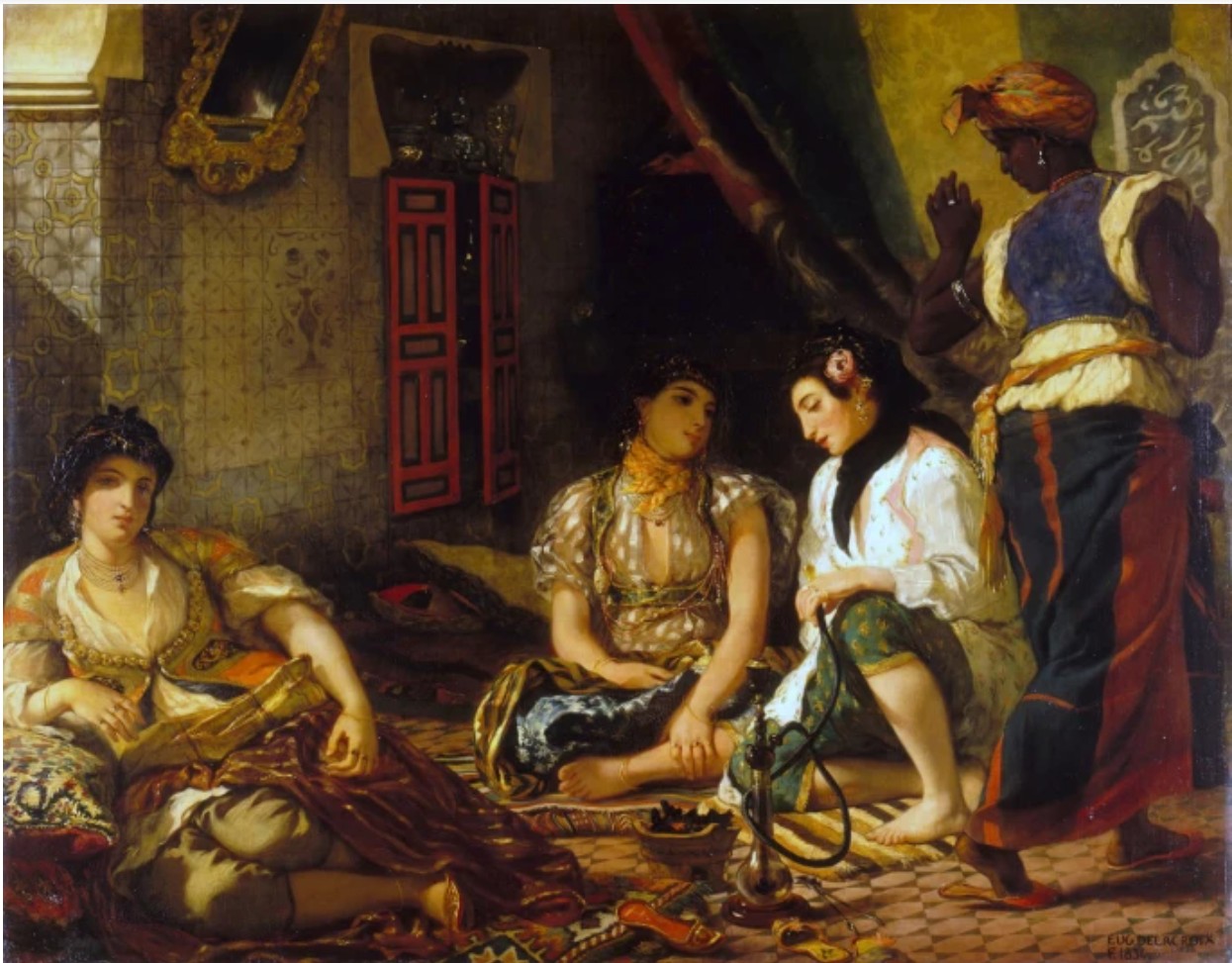
Eugène Delacroix, Femmes d’Alger dans leur appartement (Women of Algiers in their Apartment), 1834, oil on canvas,
Collection of the Louvre, Paris
Picasso fell in love with Jacqueline’s classic features. Her slender neck, large, spirited eyes, straight nose, and thick eyebrows are strong, identifiable features in his late work. Picasso biographer Antonina Vallentin called her a “modern sphinx” for this unique air of archaic elegance. Jacqueline first appeared in Jacqueline aux Fleurs and Jacqueline aux Bras Croisés (Collection of Musée Picasso Paris), painted on successive days of 2 June and 3 June 1954, respectively. Picasso painted her distinctive profile in clear lines that blended his Cubist style from the 1910s and his Neo-Classical style from the 1920s. These paintings imbue the figure with a sculptural quality reminiscent of an image of an ancient god and show the artist’s reverence for his new muse. Several months later, Jacqueline inspired Picasso once again. In October 1954, he painted seven oil portraits of Jacqueline, with a more spontaneous style that evinced more passion compared with the cool rigor of the June paintings. The relationship between artist and muse had developed by leaps and bounds, moving Picasso to produce a series of portraits with greater depth of feeling. Five works, including this work and Jacqueline Assise (Collection of Museo Picasso Málaga), feature Jacqueline in profile as she sits clasping her knees, which demonstrates Picasso’s particular interest in this pose. Femme Accroupie, painted on 14 October 1954, is likely the last work in the sequence and the culmination of the artist’s work on the series.
Jacqueline’s posture, in addition to conveying the ease of a woman sitting in her lover’s studio, was an artistic allusion for Picasso. When he first met Jacqueline, Picasso’s acute visual memory immediately connected her face to Eugène Delacroix’s famed Femmes d’Alger dans leur appartement (1834). The woman sitting with one knee raised on the right side of the French Romantic artist’s painting has a classic Mediterranean charm very similar to Jacqueline’s. Picasso once tenderly explained this coincidence, “Delacroix had already met Jacqueline.” Before Jacqueline moved to southern France, she was married to a colonial official and lived in Upper Volta (now Burkina Faso). Picasso, who had been captivated by African culture for more than half a century, was fascinated with Jacqueline’s experiences of the continent, declaring, “Jacqueline has an African provenance.” All of this inspired Picasso to transform his muse into one of the odalisques so often found in Orientalist paintings. In addition to Jacqueline’s physical resemblance to a languid, sensual odalisque, she also had the yielding, gentle temperament. The power dynamic in their relationship is fully reflected in the model’s demure seated posture and her gentle gaze meeting that of the artist outside the painting.
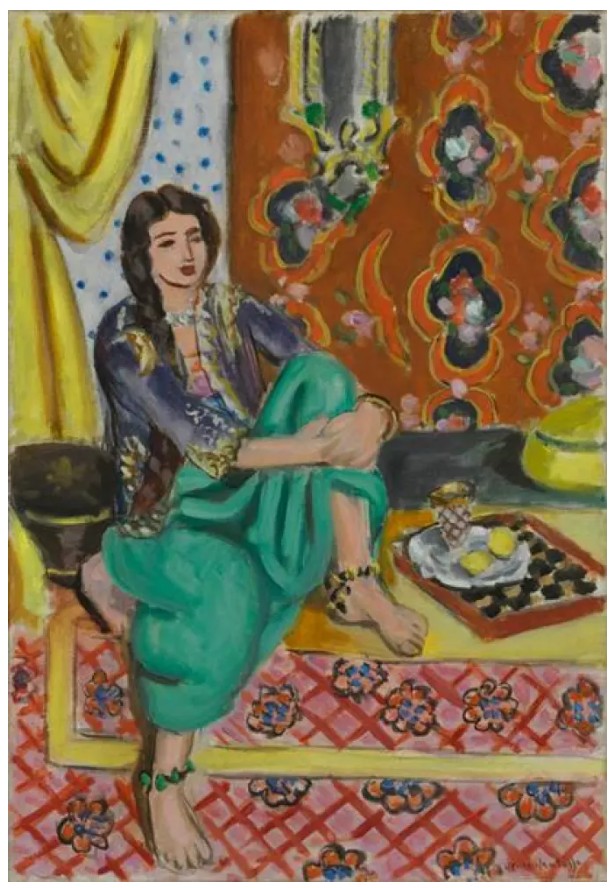
Matisse, Seated Odalisque, Left Knee Bent, Ornamental Background and Checkerboard, 1928, oil on canvas,
Collection of Baltimore Museum of Art
When painting Jacqueline in Femme Accroupie, Picasso purposely introduced elements from the patterned garments that the odalisque wore in Delacroix’s painting. This interest in a mysterious exotic world also evokes the works of another artist – an early rival and later friend to Picasso. Henri Matisse had depicted Turkish odalisques with brilliantly colored, ornate backgrounds since 1918. The decorative color effects in those paintings are a distinct hallmark of early 20th century modernism and inspired many of Matisse’s contemporaries. Not long after he painted Femme Accroupie, Picasso learned of the death of Matisse, with whom he had stood, shoulder to shoulder, at the forefront of modern art for so many years.
“When Matisse died, he left his odalisques to me as a legacy.”
Several weeks later, Picasso began developing his Les Femmes d’Alger series, inspired by Jacqueline. In composition, the works contain obvious references to Delacroix, but in spirit, they are homages to Matisse. Jacqueline brought to life the character of a mysterious, exotic odalisque who had traveled from Delacroix to Matisse to Picasso, and this version of Femme Accroupie was like a flash of prophetic inspiration, activating Picasso’s imagination and launching an extremely productive creative period. By the 1950s, Picasso was a celebrated master of 20th-century art. He was one of the exceptional few artists who had been written into the history books during his lifetime; he had never been knocked off his pedestal, and he always remained relevant. Even at the age of 70, Picasso continued to challenge himself and the art world, striding boldly into his final chapter. At that point in his life, one question lingered in his mind: on the foundations laid by his predecessors, how would he find his own place in history and make his next breakthrough? His response was Les Femmes d’Alger, a series of homages to Delacroix and Matisse in 1954 and 1955, as well as tributes to Diego Velázquez’s Las Meninas in 1957 and to Édouard Manet’s Le Déjeuner sur l’Herbe from 1959 to 1962. Picasso’s reinterpretations of works by these masters embody his admiration for them. Abstract art rose to prominence in the post-war period, though representational art had changed many times between the Renaissance and the 20th century, and Picasso had personally pushed it into new territory. He had pioneered a new artistic vocabulary, but his work also presaged the end of representational painting. At that critical moment, Femme Accroupie was the first in a series of paintings that looked back to the work of previous masters, giving it immense historical weight.
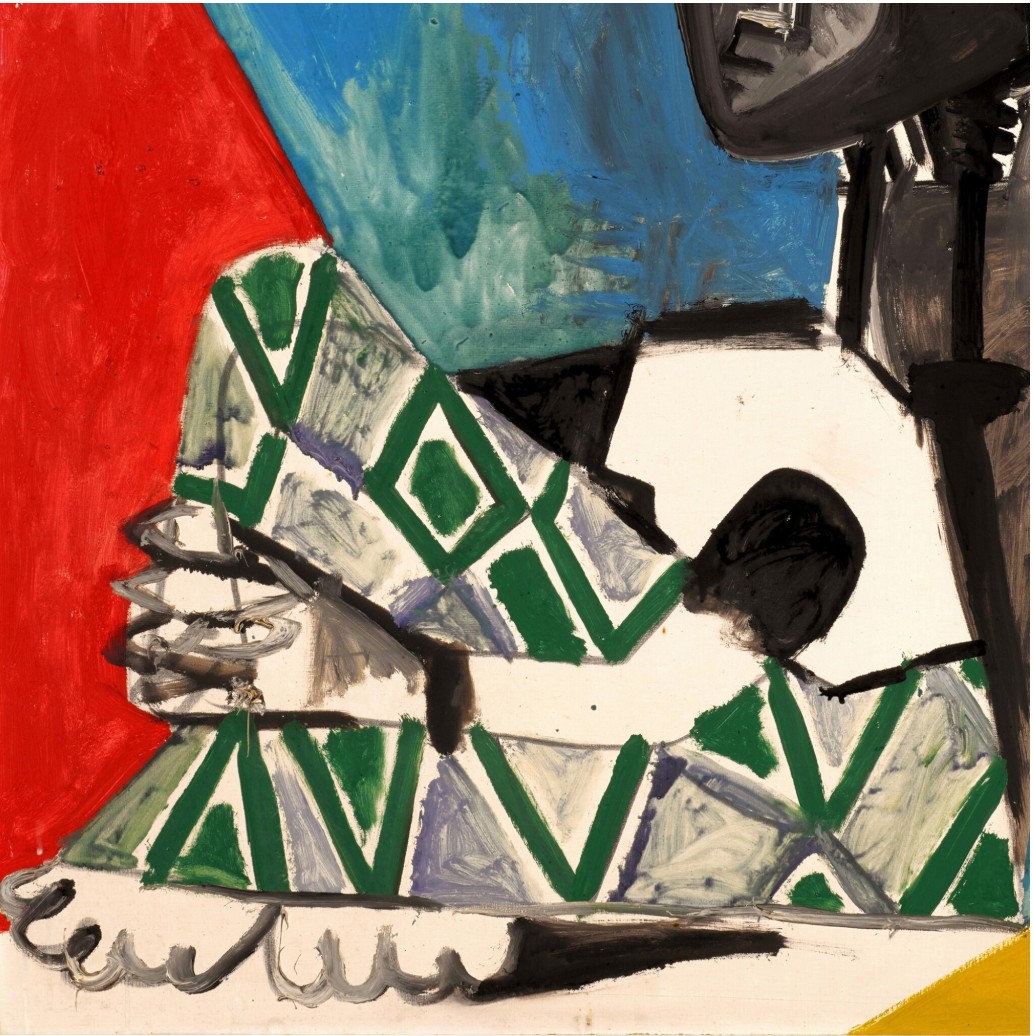
Femme Accroupie is a profound homage to Picasso’s artistic forerunners, but it is also a synthesis of his previous styles. Jacqueline’s features in this painting represent a change from the sculptural quality Picasso had given them earlier in the series, depicting her with a surreal double face divided into left and right profiles that interlock to create the contours of a complete visage. The layered, interconnecting planes create endless visual interest, and offer an alternative way to present three-dimensional space in two dimensions. Picasso often used this technique in his paintings of women, so this portrait resonates with his previous portraits of Françoise Gilot and Sylvette David. By the 1950s, Picasso was also applying techniques he had mastered from papercutting and sheet metal sculpture to his paintings, constructing multiple angles that, in addition to subverting classic perspective, enabled him to offer the viewer a complete picture of Jacqueline’s unique charm. The background of the painting is composed of large blocks of pure color, which are distilled from early Cubism and symbolize the joy that springs from new love and inspiration. Picasso also incorporated elements of Matisse’s late cut-outs, suggesting his affection for the friend with whom he had shaped Modernism.
#7. Les femmes d’Alger, version L, 1955
Christie’s New-York: 4 May 2011
Estimated: USD 20,000,000 – 30,000,000
USD 21,362,500
Pablo Picasso (1881-1973) , Les femmes d’Alger, version L | Christie’s
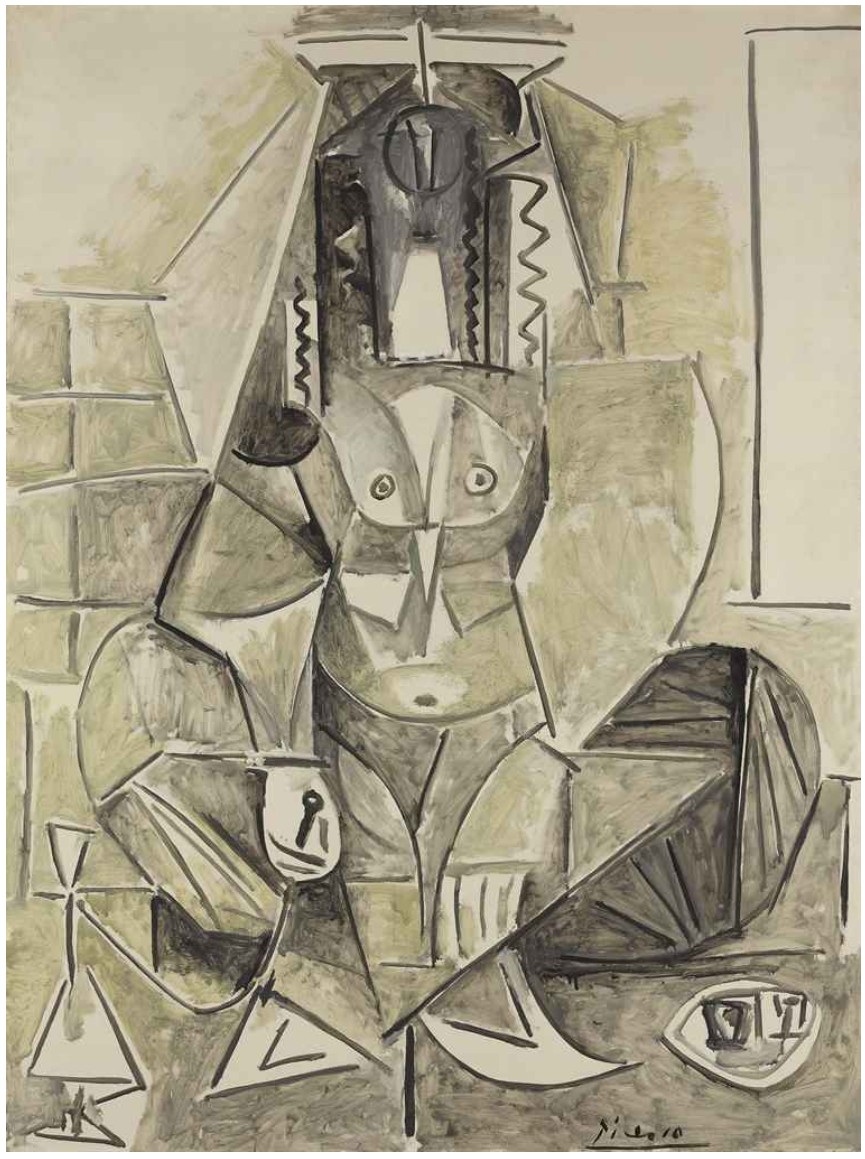
PABLO PICASSO (1881-1973)
Les femmes d’Alger, version L, 1955
Oil on canvas
130×97 cm (51 x 38 1/4 inches)
Signed ‘Picasso’ (lower right)
Dated ‘9.2.55.’ (on the reverse)
Working in his Paris studio at 7, rue des Grands-Augustins, Picasso painted a series of fifteen variations on Delacroix’s Les femmes d’Alger between 13 December 1954 and 14 February 1955. The individual canvases are designated as versions A through O. This was the first extended series that Picasso created after a renowned painting by a past master. It was an auspicious beginning. Two further important serial groups of pictures followed later in the decade: more than forty canvases after Velázquez’s Las Meninas in 1957, and an even lengthier sequence in homage to Manet’s Le déjeuner sur l’herbe during 1959-1962. Les femmes d’Alger are surely Picasso’s greatest achievement in the decades following the end of the Second World War. They represent Picasso’s apperceptive appropriation of an historical genre with complex cultural significance, for which his treatment is both respectful and playful by turns; they comprise his most concentrated analysis in many years of the female figure set within a specific spatial environment, and the full range of variations adds up to a master’s retrospective compendium of modernist pictorial forms, revitalized and made new. These paintings are as much a feast for the eye as they are grist for thought. Indeed, the impact of the entire group is greater than the sum of its parts, while each of the individual canvases is varied and uniquely characterful in its own right, a marvel of brilliant invention–some are as fine as Picasso ever painted.
By alternating his approach between paintings steeped in color, and those rendered en grisaille, Picasso demonstrated the extraordinary breadth and depth, the sheer conscientiousness of his exploratory process–his “research,” as he liked to call it. His gaze into his subject was rarely more penetrating and the results of his studies more insightful, certain and absolutely clear than they are in Les femmes d’Alger. Among the monochrome variations, the present Version “L” is truly magisterial. She is not simply an odalisque enjoying her narghile (water-pipe), she is the goddess Astarte enthroned in her temple, seated en majesté, but also sphinx-like, inscrutable, a mythic image of sexually powerful and fertile womanhood brought forward from the distant past, to be approached with deference and awe. Astarte was also a war deity; this seated odalisque wears her mid-century cubism if it were body-armor, hammered from reflective metals. In no other version does she possess this overwhelming, domineering demeanor, this sense of an unbending will, the implication of absolute power. She is actually bitonal, not monochrome, in her shading: her towering, hieratic forms appear to dissolve in an all-enveloping beam of light.
#8. Femme nue couchee jouant avec un chat, 1964
Sotheby’s New-York: 16 May 2023
Estimated: USD 20,000,000 – 30,000,000
USD 21,240,000
PABLO PICASSO (1881 – 1973)
Femme nue couchée jouant avec un chat, 1964
Oil and Ripolin on canvas
130 x 194.7 cm (51 1/8 x 76 5/8 inches)
Executed across four days in February and March 1964, Femme nue couchée jouant avec un chat is an emphatic ode to Picasso’s beloved wife and tribute to the great painters of history. The triumphant work spans nearly two meters in length and encapsulates the greatest elements of the artist’s late career. From its unfettered brushwork and innovative use of materials to the homage to the Old Masters and near-deification of Jacqueline, Femme nue couchée jouant avec un chat stands as a testament to the artist’s glorious late oeuvre.
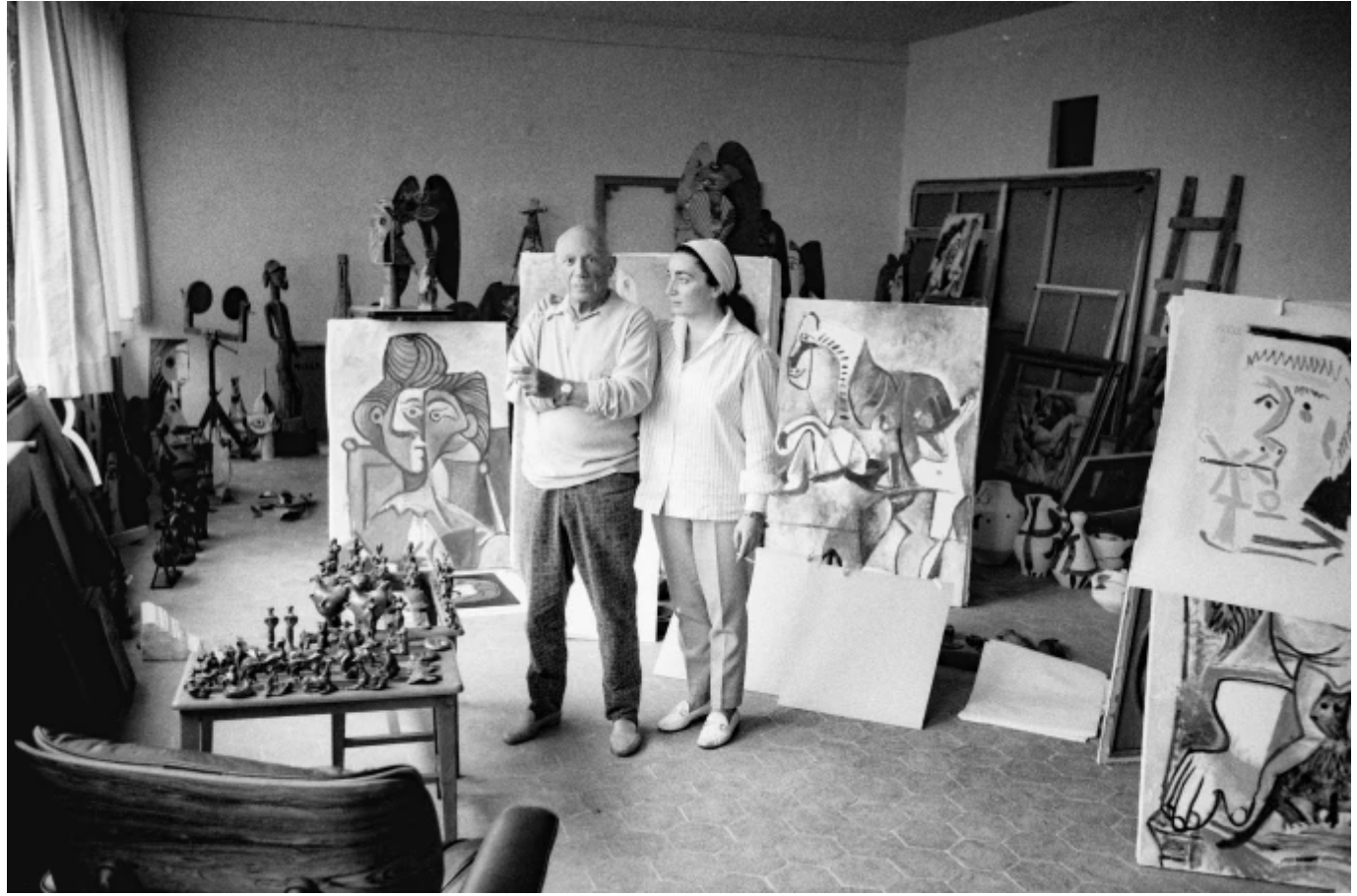
PABLO PICASSO AND JACQUELINE IN THE VIEWING ROOM AT NOTRE-DAME-DE-VIE, MOUGINS, 1964. PHOTO: EDWARD QUINN © 2023 EDWARDQUINN.COM. ART © 2023 ESTATE OF PABLO PICASSO / ARS, NEW YORK
The 1960s proved a period of invigoration and creative renewal for Picasso. In 1961, the artist married Jacqueline Roque, his partner of the preceding seven years (see fig. 1). The pair soon moved into a sprawling mill-turned-estate in the town of Mougins, called Notre-Dame-de-Vie (see fig. 2). There, Picasso ensconced himself in a world of creative activity where Jacqueline protected him from the distractions and intrusions of the outside world. As William Rubin noted, it was Jacqueline, with her “understated, gentle, and loving personality combined with her unconditional commitment” who provided for Picasso “an emotionally stable life and a dependable foyer over a longer period of time than he had ever before enjoyed” (Exh. Cat. New York, Pace, Picasso & Jacqueline, The Evolution of Style, 2014-15, p. 190). In this artistic sanctuary, Picasso thrived; his energy and artistic inspiration seemingly only increased from this time onward.
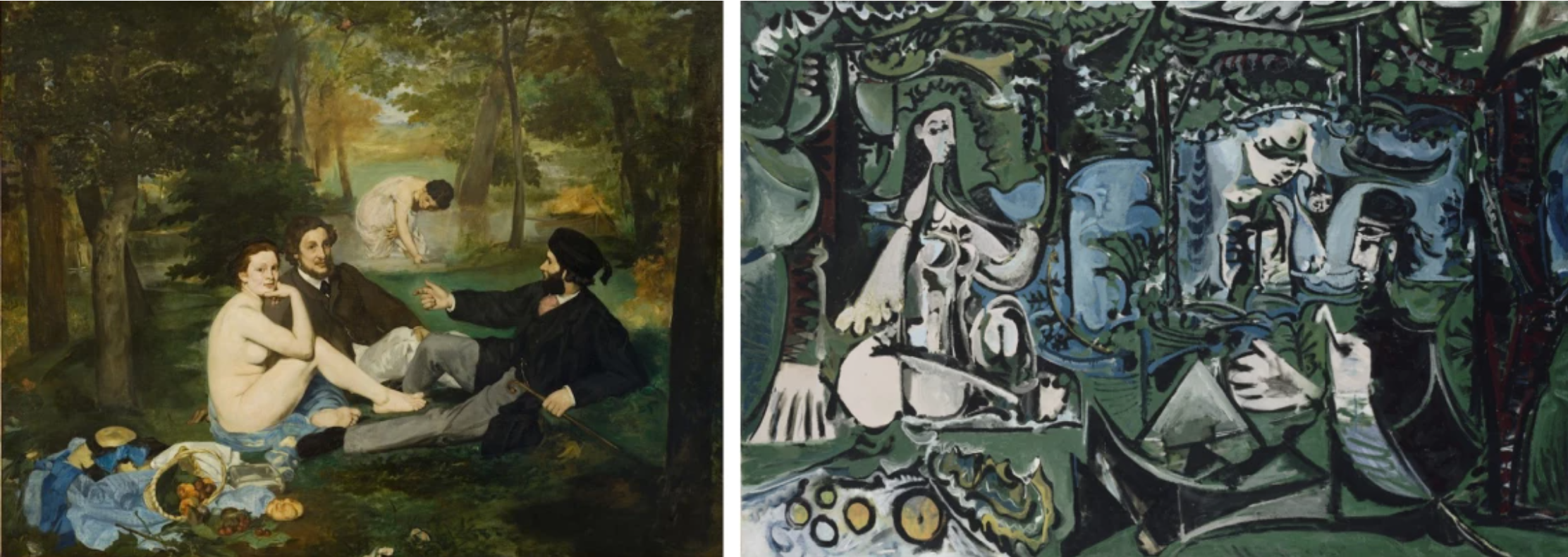
FIG. 3 ÉDOUARD MANET, LE DÉJEUNER SUR L’HERBE, 1962-63, MUSÉE D’ORSAY, PARIS
FIG. 4 PABLO PICASSO, LE DÉJEUNER SUR L’HERBE D’APRÈS MANET, 1960, MUSÉE PICASSO, PARIS © 2023 ESTATE OF PABLO PICASSO / ARS, NEW YORK
During this fruitful decade with Jacqueline as his ever-present muse, myriad series were born, from the more overt renditions of Picasso’s predecessors’ works like his 1960 Déjeuner sur l’herbe paintings after Manet (see figs. 3 and 4), to his painter and model depictions from 1963-64 and the musketeers and matadors that would dominate his oeuvre in the late 1960s. Amid these prodigious years arose a limited series of monumental depictions of Jacqueline, many of which featured the recurring motif of the cat. Ranging from more formal seated portraits, to the monumental reclining nudes like Femme nue couchée jouant avec un chat, this body of work from early 1964 is among the most sensuous and personal of his highly autobiographical late oeuvre.
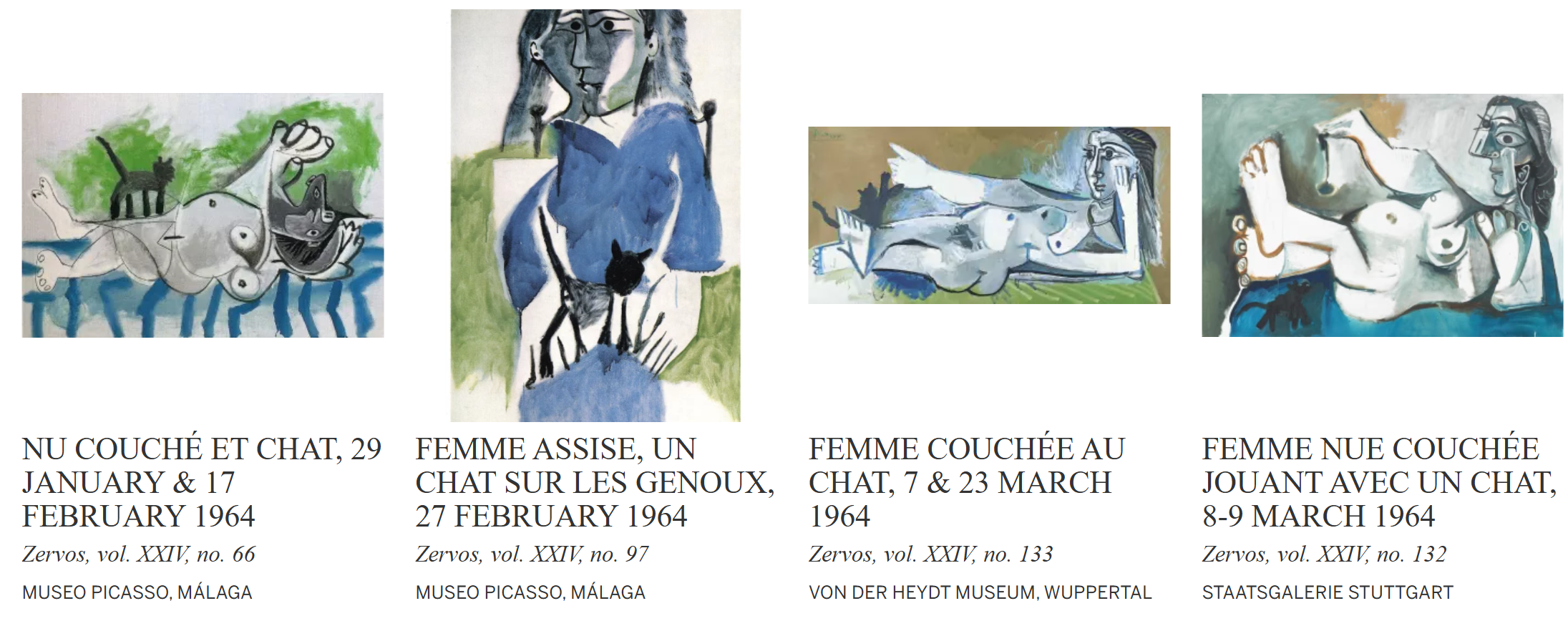
By the mid-1960s, Picasso’s seemingly endless inspiration overflowed across dozens of canvases every month, with the artist often completing multiple large-scale works in one feverous day. His iconic late series display varying degrees of finish with such compositions ranging from the more spontaneous and gestural to those more carefully considered and crafted, as exemplified by Femme nue couchée jouant avec un chat. The present work displays a heightened dedication to its execution and exhibits the best of Picasso’s innovative techniques. As the dating on the reverse of the canvas illustrates, Picasso returned to this painting in multiple campaigns across four days, each time utilizing different pigments—the date hinting at the progression of the composition (see fig. 5).
Abounding in myriad hues of blue and black, the central figure in Femme nue couchée jouant avec un chat. commands the viewer’s attention. The dark contours and labyrinthine valleys of her body are offset by bright white highlights, adding a sense of volume and voluptuousness to the form. The backdrop melts and swirls around Jacqueline’s figure, removing her from any recognizable external context and mythologizing her presence. Only the woman and cat remain, each ensconced in an eddying dream-like oasis.
Much of the circumfluous sensation in the present work is owed to Picasso’s choice of materials. As early as 1912 the artist is known to have included Ripolin in his works, an enamel paint typically used in industrial preparations. The new medium appealed to Picasso for its wide array of colors and quick drying properties, which was especially suited to this period of insatiable creativity and invigorated production in the 1960s. Picasso utilizes Ripolin to great effect in Femme nue couchée jouant avec un chat; the aqueous, almost stalactitic forms seen in the icy blue pigment at the top of the painting are a result of the medium’s fluidity and wave-like drying patterns as the artist rotated the orientation of the canvas. Unlike oil paint which hardened slowly and necessitated methodical application, Ripolin allowed Picasso to layer his pigments without fear of mixing new colors into wet paint. In the present work, the commercial medium also provides a glossy contrast to more matte areas of oil paint, adding further textural elements to the composition. Such experimentation would go on to inspire a younger generation of painters in the decades after Picasso first experimented with Ripolin. Industrial mediums like house paint would become staples of artists like Jackson Pollock in his pioneering gestural works.
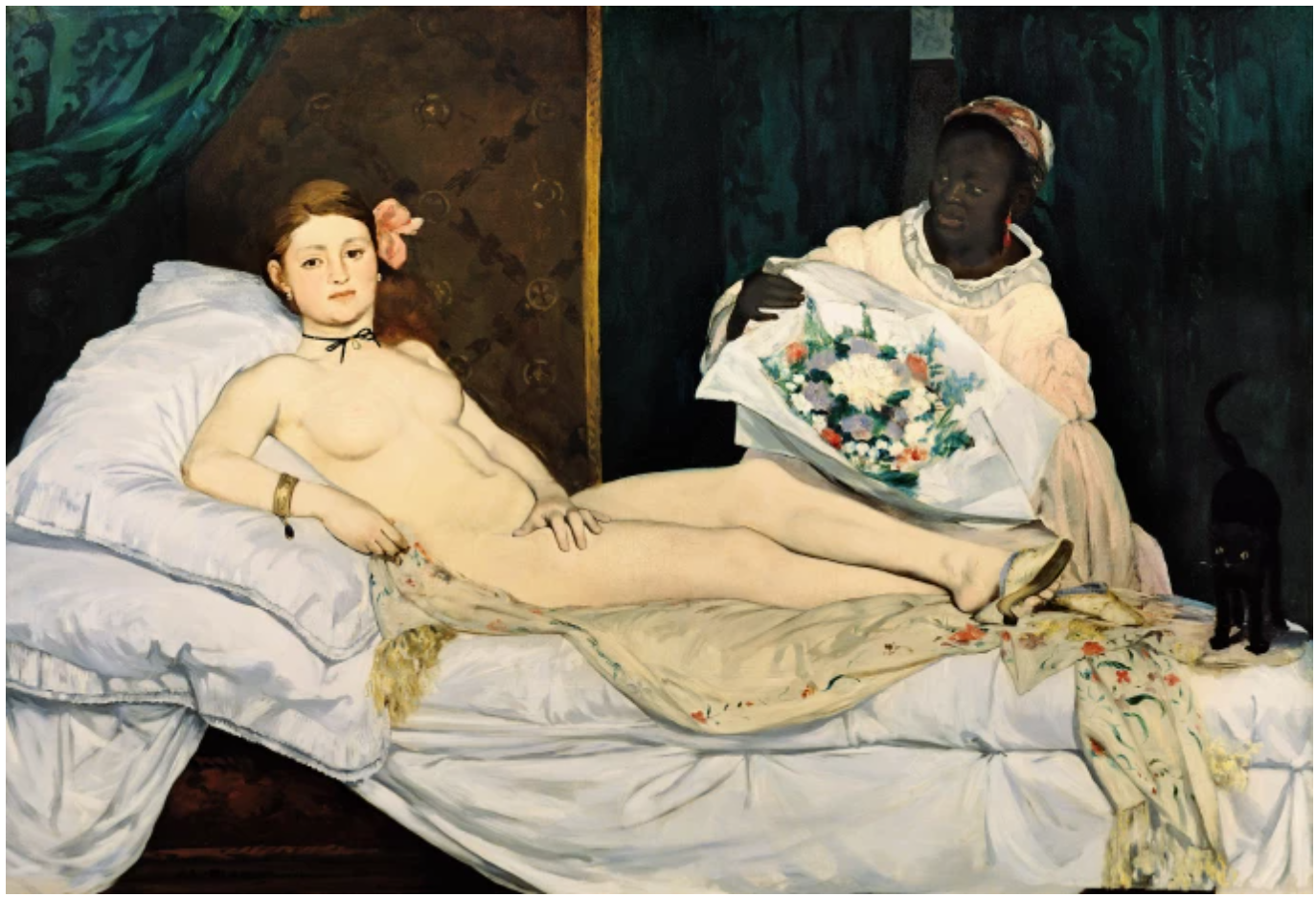
ÉDOUARD MANET, OLYMPIA, 1863, MUSÉE D’ORSAY, PARIS
The genius of Picasso’s late body of work derives not only from the artist’s innovative use of materials but also from his vivified and personalized interpretations of the Old Masters. From a young age, Picasso steeped himself in the world of virtuosic painting as he toured the great museums and galleries of Europe, where he could have hardly failed to see works like Titian’s Venus of Urbino and Ingres’ Grande odalisque, or the works of his fellow countrymen like Velázquez’ The Toilet of Venus and Goya’s Maja desnuda. From the 1950s onward, Picasso’s long-held fascination with the Old Masters came into acute focus as he aimed to align his own legacy within their historical tradition and completed numerous celebrated series like Les Femmes d’Alger after Delacroix and Las Meninas after Velázquez.
Like the reclining nudes of his predecessors, Picasso’s subject in Femme nue couchée jouant avec un chat is seen in profile situated atop a divan. Her gaze is at once directed toward the titular cat as well as out toward the viewer, playing on the more coquettish aspects of the archetype.
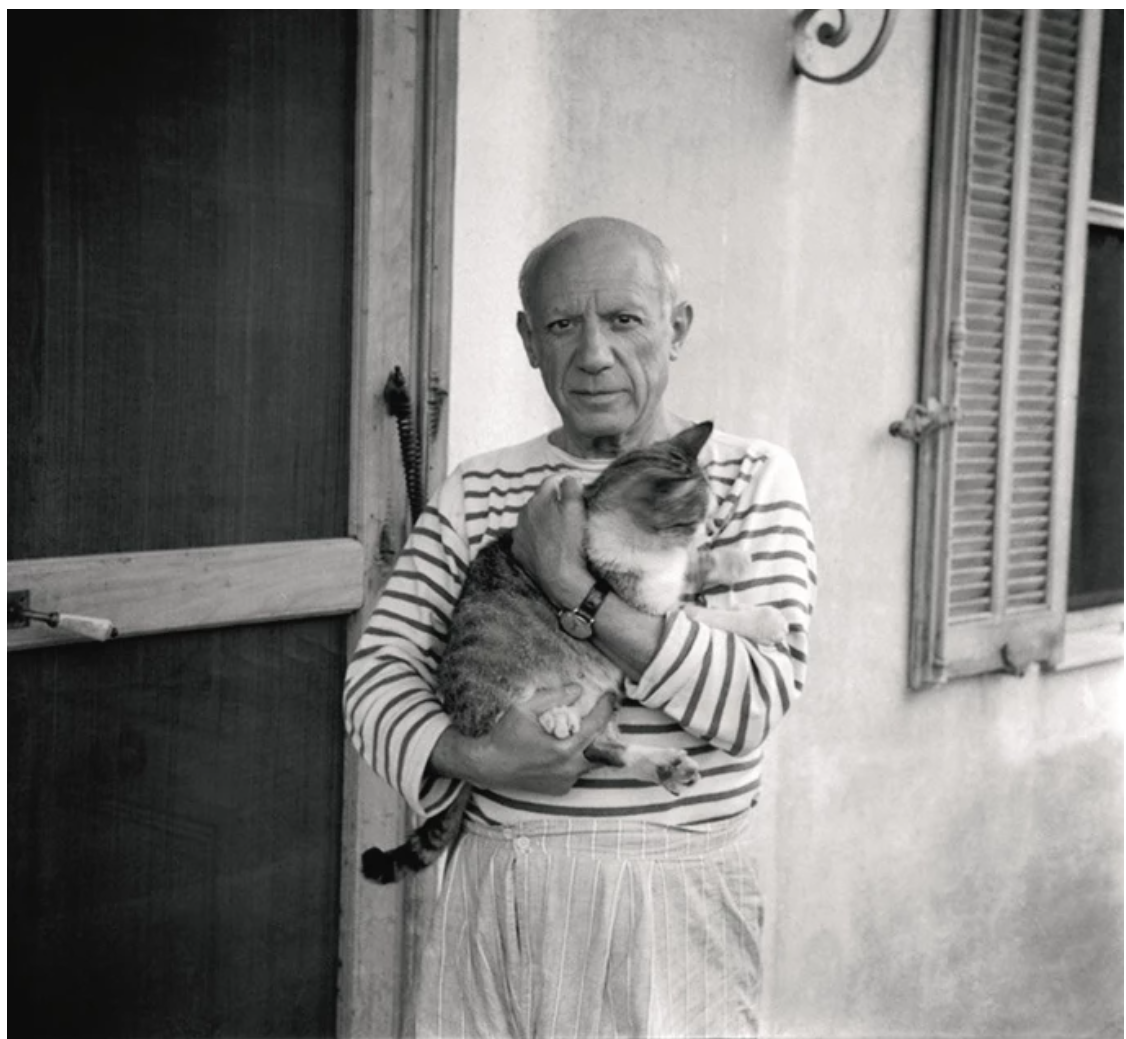
PABLO PICASSO IN VALLAURIS, 1954. PHOTOGRAPH BY CARLOS NADAL ©ARS, NEW YORK
As in Titian’s Venus and Manet’s Olympia, the woman in the present work is accompanied by an animal at her feet. In contrast to the dog in Titian’s masterpiece, which symbolized fidelity, Manet’s black cat was a clear and provocative allusion to the class and profession of the woman at center. Upon its unveiling in 1863, Manet’s Olympia shocked traditional audiences for its desecration of the idealized academic nude and portrayal of all-too-contemporary society, while also hailed by fellow artists and writers like Émile Zola as Manet’s finest work.
Picasso’s works from 1964 pay homage to his shared life with Jacqueline and the coterie of animals who entered their lives. His iconic late series display varying degrees of finish with such compositions ranging in spontaneity and gestural energy, exemplified by the vibrant and commanding Femme au chat assise. Compared to other works on the same theme of the woman and cat, the present painting presents an exceptionally bright palette combined with an energized brushwork, which together conveys the conviviality and sense of motion commensurate with the playful creature. Picasso was deeply receptive to the world around him; in addition to the people in his life, the artist’s works often incorporated the objects and animals of his immediate vicinity. The genesis of the 1964 series of woman and cat paintings followed a chance encounter which took place in Picasso and Jacqueline’s garden in Mougins.
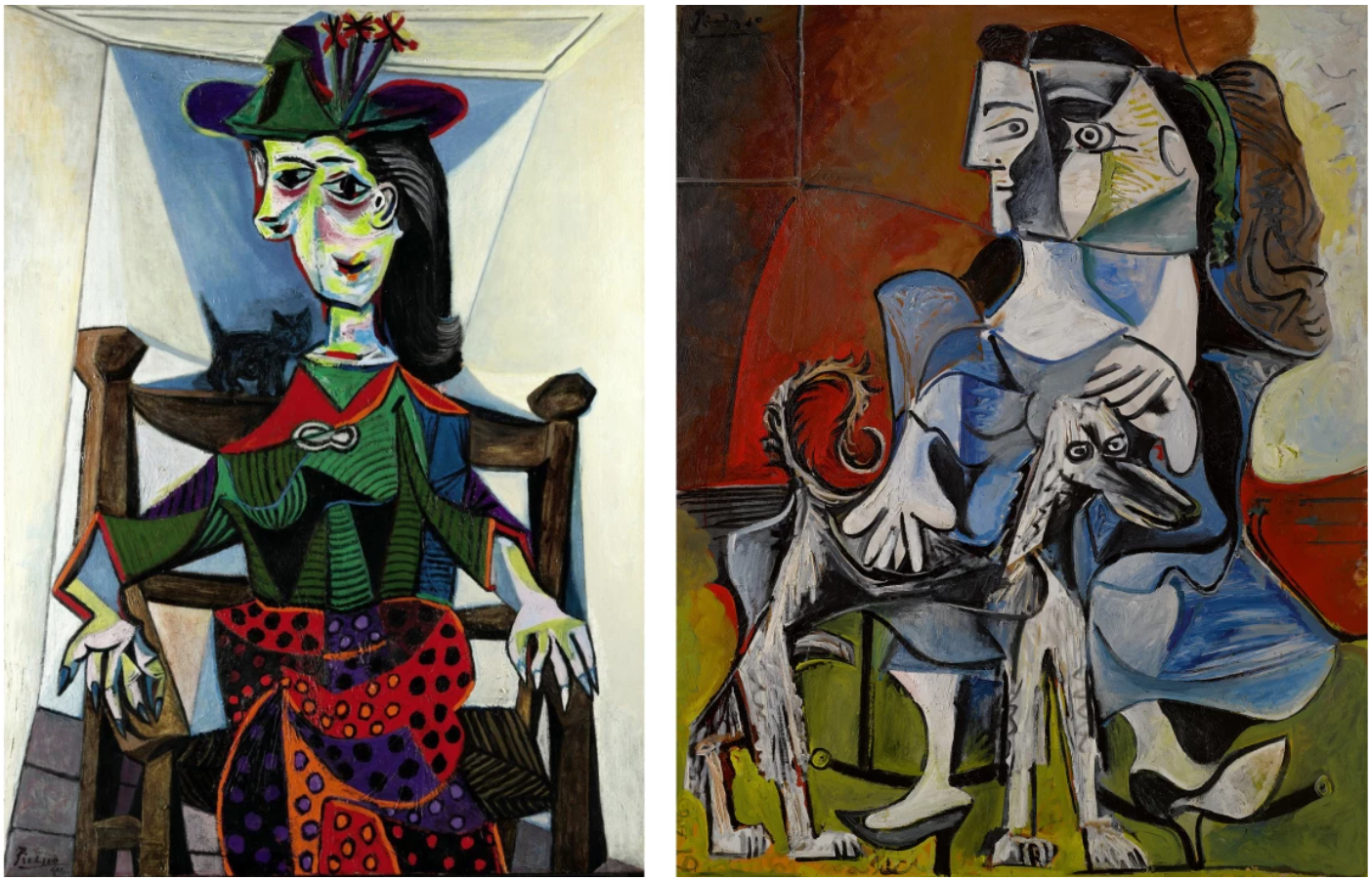
Left: Pablo Picasso, Dora Maar au chat, 1941, Sold: Sotheby’s, New York, 3 May 2006, lot 14 for $95.2 million. Art © 2024 Estate of Pablo Picasso / ARS, New York
Right: Pablo Picasso, Femme au chien, 1962, Sold: Sotheby’s, New York, 14 May 2019, lot 33 for $54.9 million. Art © 2024 Estate of Pablo Picasso / ARS, New York
Like the frequent cast of birds, dogs, goats and bulls which appear throughout Picasso’s oeuvre, the cat infiltrated the artist’s world in the course of his quotidian routines. Soon, the creature was transformed in the artist’s mind, recontextualized in a historic context and reborn under Picasso’s brush. This wandering feline took hold of the artist and his omnipresent model Jacqueline much as their Afghan hound did in the Femme au chien series of 1962. Picasso’s affinity for cats in particular is well documented, reappearing throughout his oeuvre. He admired their willful independence, the more feral the better.
“I don’t like high-class cats that purr on the couch in the parlor, but I adore cats that have turned wild, their hair standing on end. They hunt birds, prowl, and roam the streets like demons. They cast their wild eyes at you, ready to pounce on your face. And have you noticed that female cats in the wild are always pregnant? Obviously they think of nothing but love.”
The feline had long been attributed to feminine sexuality, perhaps most notably in the late nineteenth century, when the image of the black cat was embraced for its playful and seductive connotations, as was the double entendre of la chatte. Soon, the dark and mysterious creature was adopted as a symbol of Montmartre, the lively bohemian neighborhood of Paris where Picasso and other artists lived and worked in their early careers. By channeling Manet’s controversial masterwork and icon of sexuality and modernity, Olympia, Picasso implicitly added an additional erotic element to Femme au chat assise. Attesting to the success of the theme and its historic relevance, many works from Picasso’s 1964 series are now held in museum collections around the world.
#9. Femme dans un rocking-chair (Jacqueline), 1956
Christie’s London: 23 February 2023
Estimated: GBP 15,000,000 – 20,000,000
GBP 16,892,000 / USD 20,375,772
https://www.christies.com/en/lot/lot-6414663
PABLO PICASSO (1881-1973)
Femme dans un rocking-chair (Jacqueline), 1956
Oil on canvas
194.5 x 130.1 cm (76 x 51 1/4 inches)
Signed ‘Picasso’ (centre left); indistinctly dated ‘25.3.56’ (on the reverse)
Painted at La Californie on 25 March 1956
#10. Femme au chapeau assise, 1971
Christie’s New-York: 16 May 2024
Estimated: USD 20,000,000 – 30,000,000
USD 19,960,000
PABLO PICASSO (1881-1973), Femme au chapeau assise | Christie’s (christies.com)

PABLO PICASSO (1881-1973)
Femme au chapeau assise, 1971
Oil and Ripolin on canvas
130 x 97,1 cm (51 1/8 x 38 1/4 inches
Dated and numbered ‘28.7.71. II’ (on the reverse)
Painted in Mougins on 28 July 1971
In 1973, the stately Palais des Papes in Avignon was filled with Pablo Picasso’s latest work. His favored characters from this period—toreadors, lovers, musketeers and more—had all been captured by Picasso in paintings executed during the final years of his life and chosen by the artist himself for the exhibition. The only figure missing was Picasso, who had passed away just one month before its opening on 23 May. Resplendent among the canvases that filled the space was Femme au chapeau assise, painted two years prior, depicting a seated woman sporting a wide-brimmed hat. Formerly in the collection of Picasso’s daughter, Paloma, and latterly owned by the American film and television producer, David L. Wolper and his wife, Gloria, this painting has since remained in the same private collection for over two decades.

Throughout this period of his life, Picasso most frequently depicted his wife, Jacqueline in his painting. Though she did not sit for him, it was her image that permeated all of the artist’s depictions of women in various guises or settings. With her powerful, dark-eyed gaze, the sitter of the present work shares similarities with his final great love, companion and constant muse. Enthroned in a chair, with her legs crossed and hands clasped, she appears seigniorial, the undisputed mistress of Notre-Dame-de-Vie, the spacious, secluded farmhouse set on the hillside of Mougins where the couple had moved in June 1961, three months after their wedding. This would be Picasso and Jacqueline’s home for the rest of the artist’s life, as well as the backdrop for the incredible explosion of creativity that distinguishes the final two decades of his prodigious career.

The present lot pictured on the far right in Picasso: 1970-1972, 201 peintures, Palais de Papes, Avignon, May-September 1973. Photo reproduction: Adrien Didierjean. Artwork: © 2024 Estate of Pablo Picasso / Artists Rights Society (ARS), New York. Digital Image: © RMN-Grand Palais / Art Resource, NY.
The motif of a woman seated in an armchair was one of the artist’s preferred subjects, appearing time and time again throughout the artist’s career. From the masterful cubist Femme en chemise (Zervos, vol. 2, no. 522) to the sensual depictions of his golden haired muse Marie-Thérèse Walter, and the highly wrought images of Dora Maar, Picasso constantly returned to this format, the abiding pictorial idiom defined primarily by the associated iconography of his lover at the time.

Jacqueline Roque wearing a Stetson hat, La Californie, 1957. Photograph by David Douglas Duncan. Photography collection, Harry Ransom Center, The University of Texas at Austin. Digital Image: © RMN-Grand Palais / Art Resource, NY.
In addition, Picasso frequently portrayed his sitters sporting hats, which he often altered to best suit their personality. In the present work, the yellow-colored hat that the protagonist is wearing is reminiscent of the straw hat that Vincent van Gogh painted himself wearing. Picasso had long admired the Dutch artist and was said to have felt a strong affiliation with him in later life. It is said that he used to project one of Van Gogh’s self-portraits onto his studio walls. Unlike the other artists to whom Picasso looked to in his late career—Eugène Delacroix, Edouard Manet, Diego Velázquez and Rembrandt van Rijn, among others—his artistic dialogue with Van Gogh went beyond the appropriation of compositions or themes, manifesting itself as a deep spiritual identification with the artist. Using the same vigorous, expressive and instinctive brushwork, Picasso, like Van Gogh, frequently painted his own image, and at times those around him, creating powerful works that proudly declare, affirm and celebrate his life-long identity as an artist.

Vincent van Gogh, Jeune paysanne avec chapeau de paille, 1890. Private collection. Digital Image: Bridgeman Images.
“I have less and less time, and I have more and more to say. I want to say the nude. I don’t want to make a nude like a nude. I only want to say breast, say foot, say hand, belly. If I can find the way to say it, that’s enough. I don’t want to paint the nude from head to foot, but just be able to say it. That’s what I want. When we’re talking about it, a single word is enough. Here, one single look and the nude tells you what it is, without a word.”
This sense of urgency defines the artist’s late work, as he painted with an increased sense of vigor, directness and spontaneity. The vitality of his art in his final years were due, in part, to his adoption of a system of codified signs that allowed him to summarize his subjects. Femme au chapeau assise demonstrates this bold artistic approach. The verdant, exterior setting in which the sitter is posed is described with emphatic strokes of color and a series of short, diagonal lines. The figure’s body is likewise denoted with a series of rapid black outlines, as the artist has painted the essential elements of her image in a succinct, impactful way.

Willem de Kooning, Woman I, 1950-1952. The Museum of Modern Art, New York. © 2024 The Willem de Kooning Foundation / Artists Rights Society (ARS), New York. Digital Image: © The Museum of Modern Art / Licensed by SCALA / Art Resource, NY.
Large-scale canvases as exemplified by Femme au chapeau assise are filled with vitality and life, as the artist applied gestural strokes of boldly colored oil paint, and in the present work, Ripolin, an industrial type of enamel paint favored by Picasso at this time. As a result, he created a style of painting which, against a backdrop of Minimalism and Conceptualism, defied convention once more, allowing him to remain at the forefront of contemporary art.
Nu assis dans un fauteuil, 1964-65
Sotheby’s London: 26 June 2025
Estimated: 6,000,000 – 9,000,000
GBP 7,116,000 / USD 9,638,871
Nu assis dans un fauteuil | Modern & Contemporary Evening Auction | 2025 | Sotheby’s
PABLO PICASSO (1881 – 1973)
Nu assis dans un fauteuil, 1964-65
Oil and Ripolin on canvas
65×54 cm (25 5/8 x 21 1/4 inches)
Signed Picasso (upper left)
Dated 30.12.64.; 2.1. 65. and 3.1.5. and numbered V (on the reverse)
Nu assis dans un fauteuil belongs to a series of canvases on the theme of seated female nude Picasso executed in late 1964 – early 1965 at Notre-Dame-de-Vie, the home in Mougins which Picasso acquired as a gift for Jacqueline Roque shortly after their marriage in 1961. Bursting with color and exuberant energy, this work bears witness to the extraordinary creative urge that characterized Picasso’s mature work. It is also testament to the renewed sense of joy and fulfillment that Jacqueline’s presence brought to the last seventeen years of Picasso’s life.
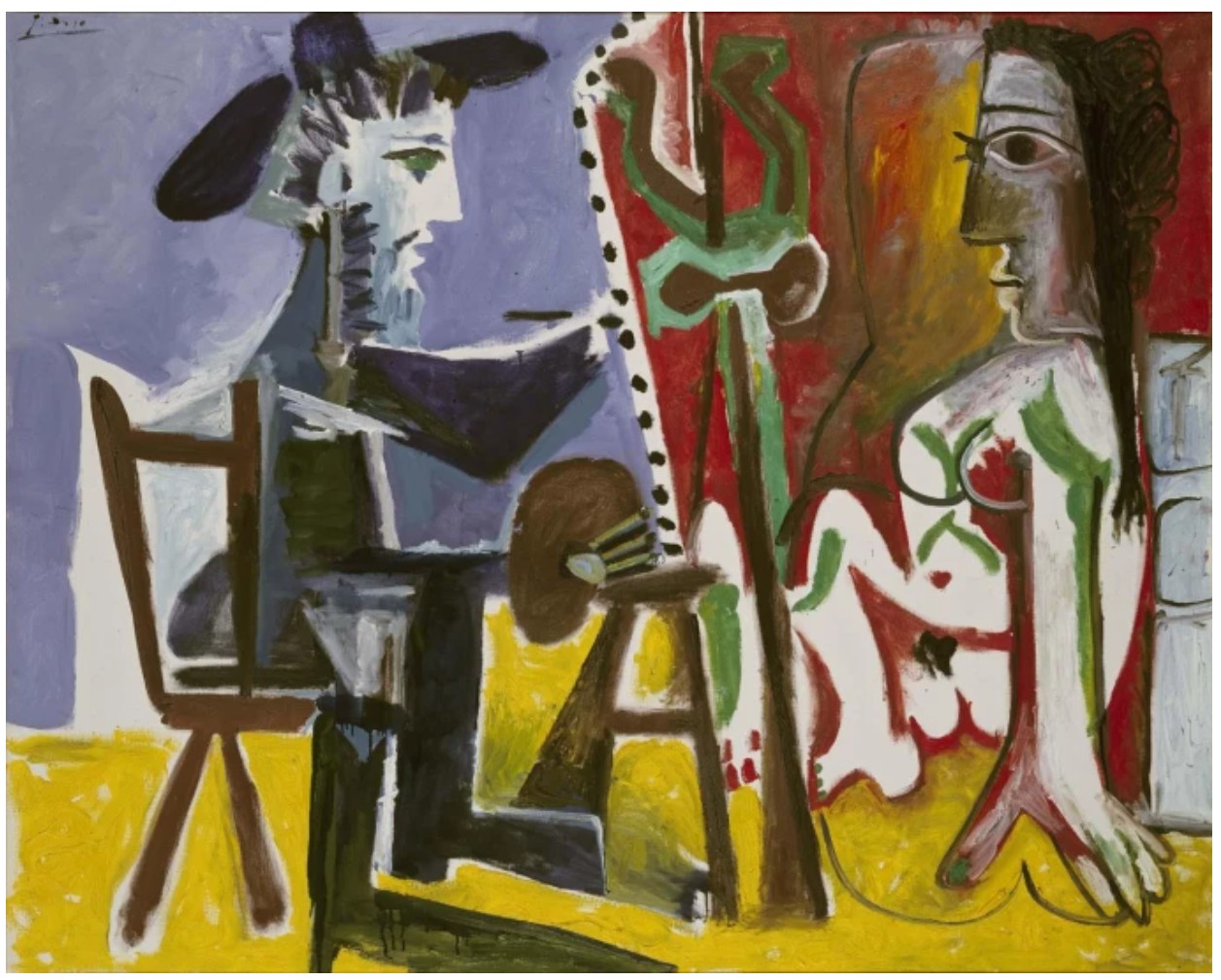
Pablo Picasso, Le Peintre et son modèle, oil on canvas, 1963, Museo Nacional Centro de Arte Reina Sofía, Madrid
The regal female nude enthroned in an armchair and wearing a crown-like headpiece at the center of the present composition is, as in the majority of his late portraits, inspired by Jacqueline’s ever-present figure. Picasso’s representations of Jacqueline constitute the largest group of images of any of the women in his life, and these final years of his career have been fittingly termed “l’époque Jacqueline”. The couple first met in 1952 at the pottery studio in Vallauris, where Picasso was working on his ceramics, while he was still living with the mother of his two children, Françoise Gilot. By 1954, Françoise had left, and Jacqueline’s unmistakable angular profile, dark, spirited eyes and raven black hair began to appear in Picasso’s paintings. Although Jacqueline reportedly never posed for the artist, her timeless beauty – which he believed embodied any woman and all women – served as a perfect genesis for Picasso’s incessant exploration of the numerous modes from throughout the artistic canon.
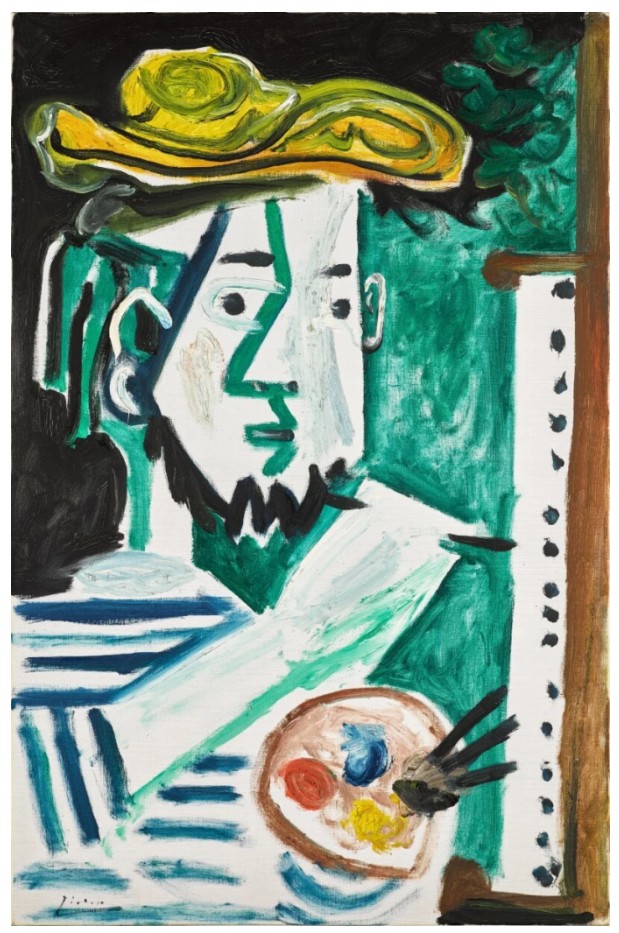
Pablo Picasso, Le Peintre I, 1963, oil on canvas. Sold: Sotheby’s Hong Kong, April 2024, $10 million
With her upright, stoic pose and piercing, enigmatic gaze, Jacqueline emerges here as an ancient deity-like figure imbued with primal feminine energy. The use of brightly saturated red, orange, pink and turquoise hues, coupled with the broad, vigorously applied, rhythmic brushstrokes result in a composition of wonderful rawness and vitality. Picasso further intensifies the solid power exuded by the seated figure by introducing strong verticals and horizontals that frame her within the composition. Conceptually, Nu assis dans un fauteuil can be viewed as an evolution from the canvases exploring the subject of the painter and his model which preoccupied Picasso’s imagination throughout the early 1960s and which, towards 1963-64, became an almost singular focus of his attention. Shortly thereafter, Picasso began isolating first the figure of the painter and subsequently, the model, producing a series of rapidly executed canvases throughout 1964 which depicted the female figure in a predominantly reclined pose, often leaning against cushions.
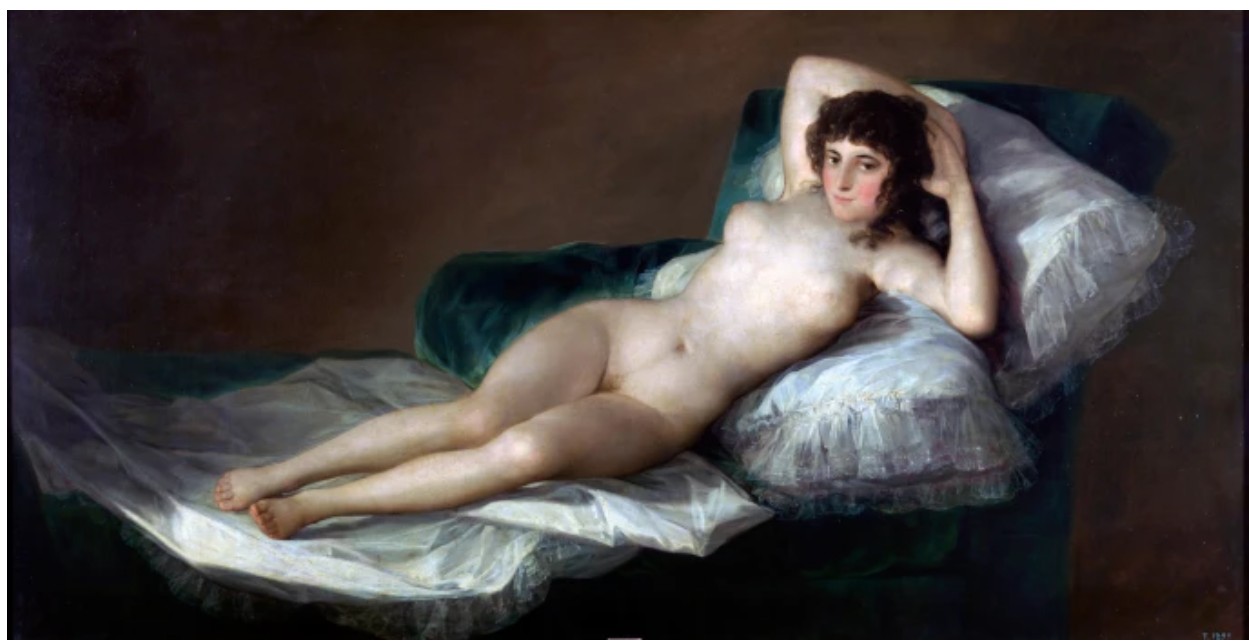
Francisco de Goya, La maja desnuda (The Naked Maja), 1797-1800, oil on canvas, Museo del Prado, Madrid
In his fascination with this new motif, Picasso was, as was often the case with his works from the 1960s and 1970s, looking backwards and engaging in a conversation with the Old Masters. In exploring the motif of the reclining nude, he is said to have been particularly inspired by Goya’s striking La maja desnuda (The Naked Maja). However, in contrast to both the classical paintings Picasso was deriving inspiration from at the time as well as the work of his contemporaries (in particular, Matisse, and his paintings of odalisques), Picasso’s depictions of the female nude are a distinctly powerful and intimate reflection on his relationship with the woman who was at the center of his creative and domestic universe at the time.
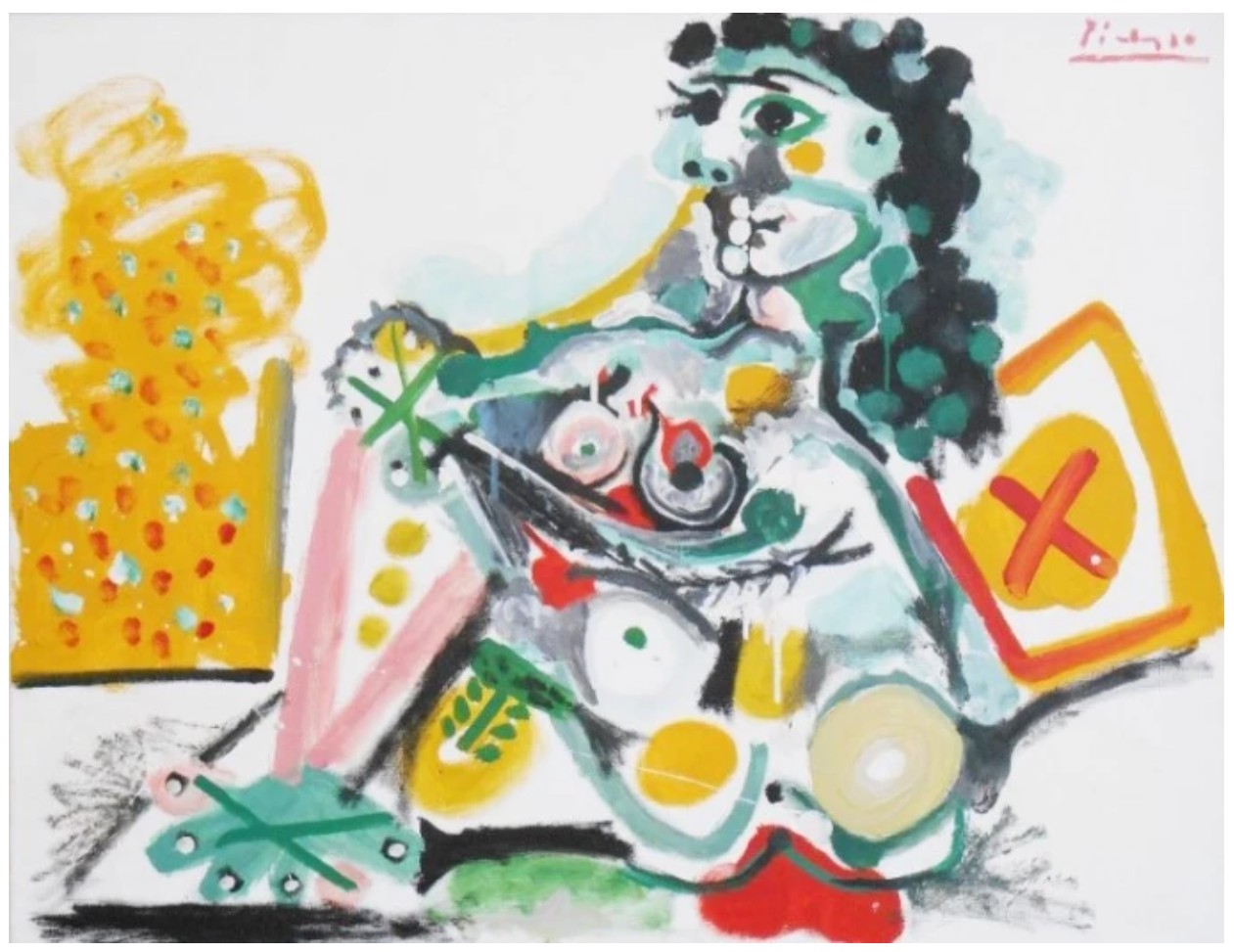
Pablo Picasso, Nu assis appuyé sur des coussins, 1964, oil on canvas, Kreeger Museum, Washington, D.C.
Nu assis dans un fauteuil is a further variation on this theme, with the female figure now seated upright in an armchair – a compositional device which Picasso turned to again and again throughout his creative career. While varying in style and depicting different women that marked each period of the artist’s life, these figures, seated and fully attentive, generally served as a vehicle for expressing the palpable sexual tension between the painter and his model. From the soft, voluptuous curves of Marie-Thérèse Walter to the fragmented, near-abstract nudes of his surrealist work, and the exaggerated rendering of his later years, Picasso’s seated nudes have a monumental, sculptural presence, and are invariably depicted with a powerful sense of psychological drama stemming from the tension between the invisible artist and his sitter.
Picasso’s Seated Women Through Time
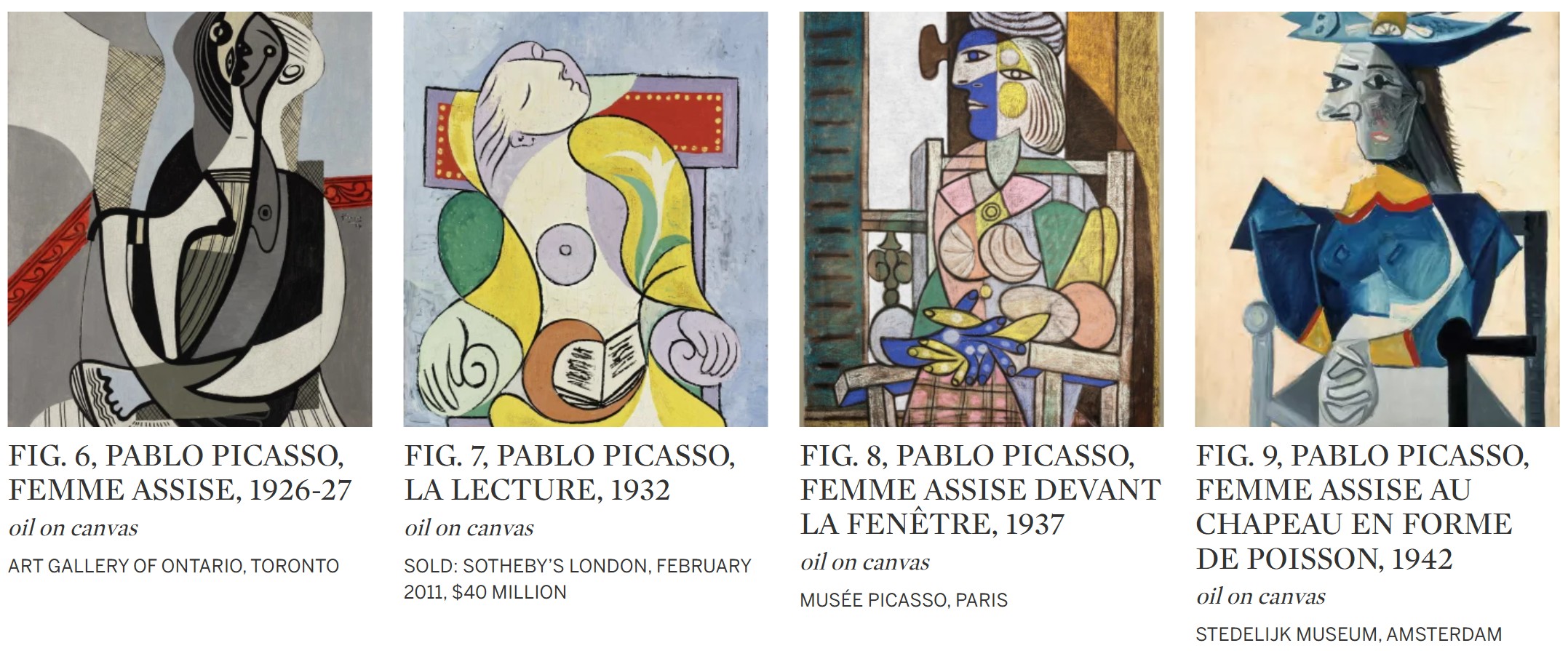
What is, however, distinctive about Picasso’s depictions of Jacqueline as a female nude and what Nu assis dans un fauteuil serves as a particularly striking testament to, is the more affirmative and distinctly less tortured energy that they emanate. Brimming with life-affirming energy that distinguishes Picasso’s late work, Nu assis dans un fauteuil is one of the most powerful depictions of Picasso’s ultimate muse and lover, Jacqueline Roque, which the artist produced during the great late phase of his career. The present work makes an auction appearance for the first time, having historically featured in one of the last exhibitions held during the artist’s lifetime, Homage to Picasso for his 90th Birthday, organized jointly by the Marlborough and Saidenberg galleries in New York in 1971.
Nu assis, 1960
Sotheby’s London: 25 June 2024
Estimated: GBP 3,500,000 – 5,000,000
GBP 5,760,000 / USD 7,303,680
PABLO PICASSO (1881 – 1973)
Nu assis, 1960
Oil on canvas
100×81 cm (39 3/8 x 31 7/8 inches)
Signed Picasso (lower left); dated 23.4.60. (on the reverse)
Painted in 1960, when Picasso was seventy-nine, Nu assis belongs to an important group of works from the artist’s so-called ‘late period’. Characterized by a raw energy, gestural application of paint and recourse to archetypal subject matter, these paintings have experienced a significant critical reappraisal over the past few decades and are now rightly seen as the final flourish of one of the greatest artists of the twentieth century.
The enigmatic female nude at the center of this composition was, as in the majority of his late portraits, inspired by the ever-present figure of Jacqueline. Picasso’s representations of Jacqueline constitute the largest group of images of any of the women in his life, and these final years of his career have been fittingly termed “l’époque Jacqueline”. The couple first met in 1952 at the pottery studio in Vallauris, where Picasso was working on his ceramics, while he was still living with the mother of his two children, Françoise Gilot. By 1954, Françoise had left, and Jacqueline’s unmistakable angular profile and raven hair began to appear in Picasso’s paintings. Jacqueline reportedly never posed for the artist, but his wild imagination provided bountiful situational and stylistic modes from throughout the artistic canon for his muse, whose appearance he believed could embody any woman and all women.
As Estrella de Diego describes: “Jacqueline appeared at a perfect moment in the life of Picasso, an older man who was beginning to be overwhelmed by many things, from his family life to his success, as [Roland] Penrose explained. And as a result of a casual encounter, which recalls that between Rossetti and Elizabeth Siddal, a shop assistant before she posed for the English artist, Jacqueline came to embody – from the abstract to the concrete, from portraits to representations of the essence of woman – each and every one of the characters Picasso needed, as he had always done in the past, to activate the pictorial formulae that corresponded to his enduring obsessions” (E. de Diego in Exh. Cat., Málaga, Museo Picasso, Picasso, Musas y Modelos, 2006, p. 30).
Over the course of 1960 Picasso would turn to her as subject on numerous occasions, creating a group of portraits that share the same palette predominated by tones of grey, black and ochre (figs. 2-4). At the time Picasso and Jacqueline were living at the Château de Vauvenargues near Mont Sainte-Victoire in Provence which was their home between 1959-62. Perhaps the proximity to this Cézannian landscape predicated the shift from the brighter colours of the late 1950s to this subtler mode. Certainly, there is a sensitivity to sculptural form and tonal contrasts in this group of paintings that shares an affinity with Cézanne’s body of portraiture (fig. 5).
Indeed, this period saw Picasso consistently evoking the great artists of the past in his own art; painting works inspired by Diego Velázquez, Rembrandt van Rijn, El Greco and Francisco Goya (fig. 6). This focus on the Old Masters was a pointed affirmation of his place in the revered lineage of the great figures within art historical canon. Works such as the 1962 Femme au chien (fig. 7) show Picasso deliberately evoking the traditional portrait format of a seated woman surrounded by the accoutrements of her life. Nu assis shows him summoning a parallel artistic tradition – that of the female nude – and through an energetic, scrawling application of paint imbuing it with an expressive immediacy.
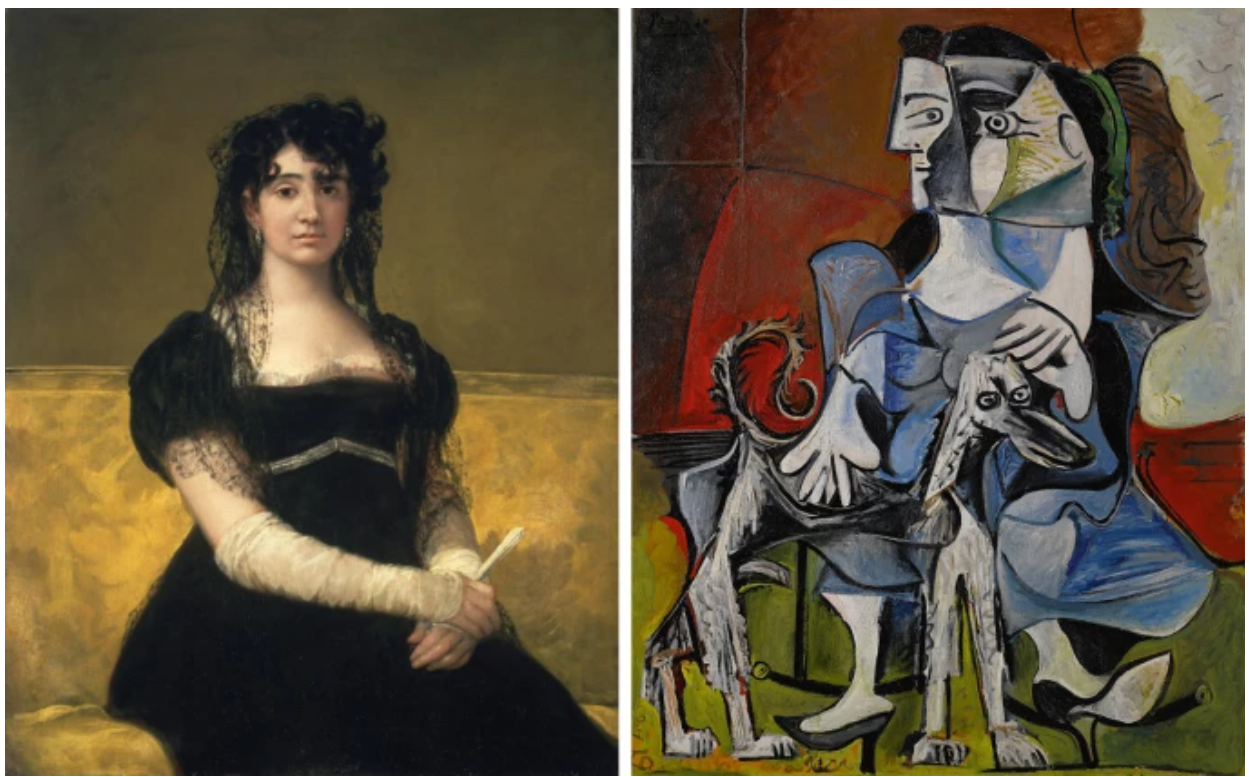
FRANCISCO JOSÉ DE GOYA Y LUCIENTES, DOÑA ANTONIA ZÁRATE, 1805, OIL ON CANVAS, NATIONAL GALLERY OF IRELAND, DUBLIN / PABLO PICASSO, FEMME AU CHIEN, OIL ON CANVAS, 1962, SOLD: SOTHEBY’S NEW YORK, MAY 2019, $54.9 MILLION © SUCCESSION PICASSO/DACS, LONDON 2024
In his discussion of Picasso’s late works, David Sylvester identifies this “raw vitality” as linking them to the early masterpiece, Demoiselles d’Avignon: “The resemblance of figures in the Demoiselles and in late Picasso to masked tribal dancers is as crucial as their scale in giving them a threatening force. It is irrelevant whether or not particular faces or bodies are based on particular tribal models: what matters is the air these personages have of coming from a world more primitive, possibly more cannibalistic and certainly more elemental than ours. Despite the rich assortment of allusions to paintings in the Renaissance tradition, the treatment of space rejects that tradition in favor of an earlier one, the flat unperspectival space of, say, medieval Catalan frescoes… At twenty-five, Picasso’s raw vitality was already being enriched by the beginnings of an encyclopaedic awareness of art; at ninety, his encyclopaedic awareness of art was still being enlivened by a raw vitality” (D. Sylvester, in Exh. Cat., London, Tate Gallery, Late Picasso: Paintings, Sculpture, Drawings, Prints, 1953-1972, 1988, p. 144).
This vitality is an essential part of these late works. In Nu assis the paint is applied with frenzied energy, scrawled in sgraffito gestures, scumbled and worked to create a tactile surface. The splashes of color – blue, red, green – serve as focal points that emphasized the hieratic frontality of the figure. Picasso contrasts the strong, angular lines of her face with softer curves conjuring both seriousness and sensuality. The result is a portrait of immense expression and vigor – one that underlines the powerful impact of Picasso’s work in the final decades of his life.
Buste de femme, 1960
Christie’s New-York: 16 May 2024
Estimated: USD 5,000,000 – 7,000,000
USD 5,132,000
https://www.christies.com/en/lot/lot-6482987
PABLO PICASSO (1881-1973)
Buste de femme, 1960
Oil on canvas
81 x 64.9 cm (31 7/8 x 25 5/8 inches)
Signed ‘Picasso’ (upper left); dated and numbered ‘10.3.60. II’ (on the reverse)
Painted on 10 March 1960
The striking, dark-haired protagonist of this 1960 portrait bears an unmistakable likeness to Jacqueline Roque, the woman who would become, a year later, the artist’s second wife and devoted companion for the rest of his life. Wearing a striped top, reminiscent of Picasso’s own blue and white Breton shirts, Jacqueline stares out of the painting, her hand resting upon her chin in a pose of introspection. With bold, lavish strokes of dark paint, Picasso has rendered her powerful wide-eyed gaze, depicting half of her face plunged into deep shadow. Appearing as if seated in front of a mirror, Jacqueline’s head seems to be reflected in the space behind her. In many ways this dramatic handling of light across his sitter’s face prefigures the cut-out, sheet metal sculptures that Picasso began a few years later.
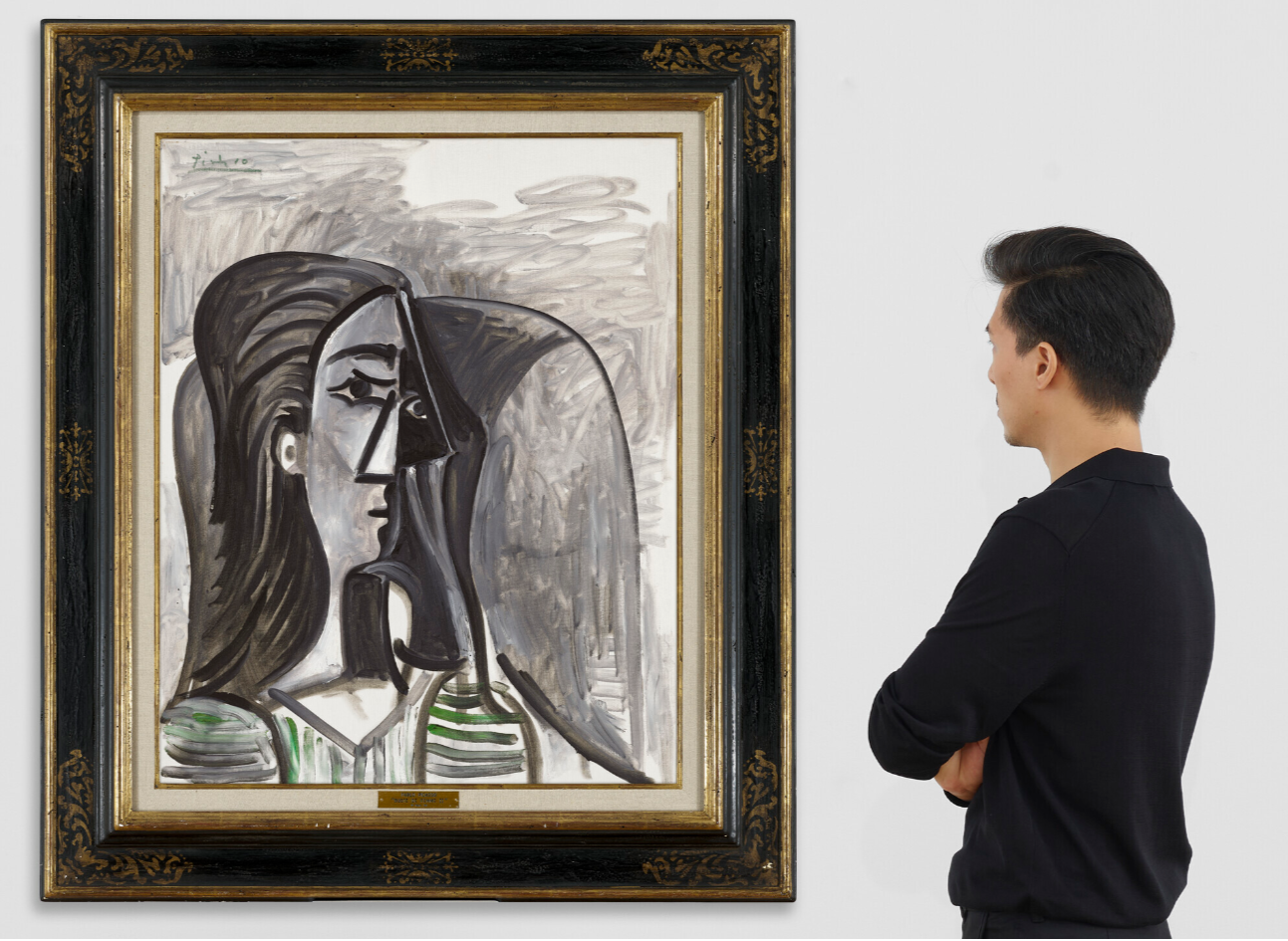
In 1952, Jacqueline Roque was working as a sales assistant at the Madoura pottery studio in Vallauris. Picasso lived nearby and frequently visited to work on his own ceramics there. The artist was at this time living with Françoise Gilot, and their two young children, Claude and Paloma. By September of the following year, however, their gradually deteriorating relationship came to a dramatic end. Gilot left Picasso and returned to Paris with her two children. By 1954, he had begun a new relationship with Jacqueline, her unmistakable features appearing in his art in the summer of this year. “How could I have had any reservations about Pablo’s intentions,” Jacqueline said of these pictorial declarations of love (quoted in J. Richardson, Late Picasso, exh. cat., Royal Academy of Arts, London, 1988, p. 17).
Unfailingly loyal and devoted to Picasso, Jacqueline also served as his most important model. Renowned for her raven colored hair, large, almond shaped eyes and striking, aquiline profile, Jacqueline appears in myriad ways in Picasso’s late work, her presence filling every aspect of his art. His depictions of her constitute the single largest group of his portraits, dominating the art of the final two decades of his life. Portraiture remained the vehicle through which Picasso most closely explored his wife’s physiognomy—the proliferation of these works a testament to his deep love and admiration for her. He painted her in a range of styles and poses, using her constant presence as a means to experiment artistically.
Tête de femme, 1969
Sotheby’s New-York: 15 May 2024
Estimated: USD 1,200,000 – 1,800,000
USD 1,996,000
https://www.sothebys.com/en/buy/auction/2024/modern-evening-auction/tete-de-femme
PABLO PICASSO (1881 – 1973)
Tête de femme, 1969
Oil, Ripolin and crayon on paper mounted on canvas
66.1 x 51.6 cm (26 1/8 x 20 3/8 inches)
Signed Picasso and dated 10.7.69. (upper right)
Executed on 10 July 1969
Created in his late career, Tête de femme depicts Picasso’s beloved wife and muse Jacqueline Roque. Jacqueline was Picasso’s devoted second wife who remained with him until the time of his death in 1973, and his renderings of her constitute the largest group of images of any of the women in his life. The artist first met Jacqueline in 1952 at the pottery studio in Vallauris, while he was still living with Françoise Gilot. By 1954 Gilot had left the scene, and the unmistakable raven-haired beauty began to appear in Picasso’s paintings. Unlike Gilot, Jacqueline was accepting of the notoriously temperamental artist and his blind obsession with his art. Her unflappable support won the artist’s heart, and Picasso married her in 1961. The photographer David Douglas Duncan, who knew Picasso and Jacqueline well during these years, observed that the couple “lived in a world of his own creation, where he reigned almost as a king yet cherished only two treasures—freedom and the love of Jacqueline.” (David Douglas Duncan, Picasso and Jacqueline, New York, 1988, p. 9).
JACQUELINE AT LA CALIFORNIE, CANNES, 1956. PHOTO EDWARD QUINN, © EDWARDQUINN.COM
Although Jacqueline never posed for Picasso, with her large eyes and strong nose, the woman depicted in the present work bears the features with which the artist usually portrayed his last muse. As in the present work, Picasso often depicted Jacqueline in “double-profile,” a stylistic device invented in his portraits of Dora Maar, but the roots of which go back to his cubist experiments with multiple view-points. While borrowing elements from his own artistic past, Picasso here created an image with a force and freedom he only achieved in the last decade of his career. The emotional complexities of this stage of the artist’s life are poignantly rendered in this portrait.
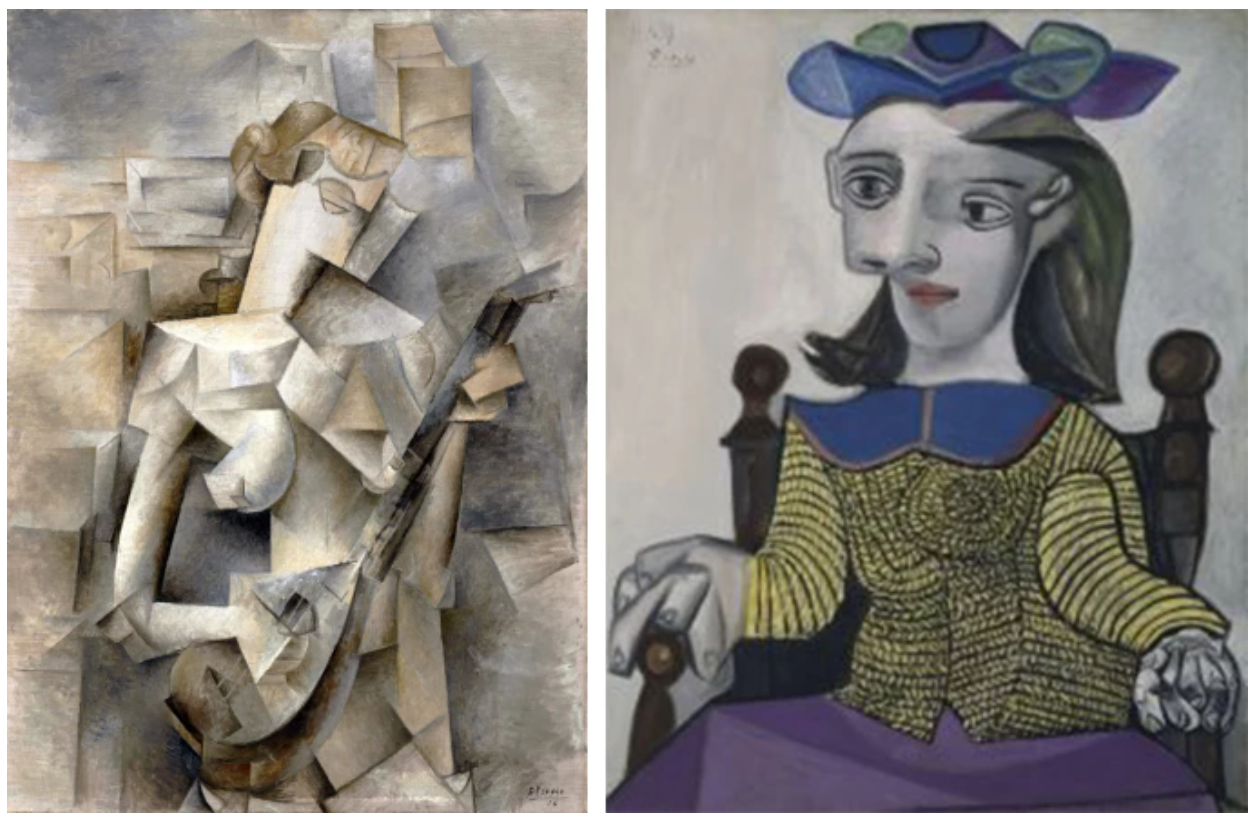
PABLO PICASSO, GIRL WITH A MANDOLIN, 1910, THE MUSEUM OF MODERN ART, NEW YORK © 2024 ESTATE OF PABLO PICASSO / ARTISTS RIGHTS SOCIETY (ARS), NEW YORK
PABLO PICASSO, THE YELLOW SHIRT (DORA MAAR), 1939, NATIONALGALERIE, MUSEUM BERGGRUEN, BERLIN © 2024 ESTATE OF PABLO PICASSO / ARTISTS RIGHTS SOCIETY (ARS), NEW YORK
Painted with an extraordinary sense of energy and urgency, the present work bears witness to the creative force that characterized Picasso’s late years. Having gone through many phases of stylistic and technical experimentation, by this time Picasso’s painting displayed a confidence and freedom of execution that enabled him to paint large-scale works executed in bold, sweeping brush strokes; the complex use of media in the present work further speaks to Picasso’s mastery of his craft and his constant inventiveness and experimentation.
Other Portraits
Femme à la coiffe d’Arlésienne sur fond vert (Lee Miller), 1937
Leonard & Louise Riggio: Collected Works
Christie’s New-York: 12 May 2025
Estimated: USD 20,000,000 – 30,000,000
USD 28,010,000
PABLO PICASSO (1881-1973), Femme à la coiffe d’Arlésienne sur fond vert (Lee Miller) | Christie’s
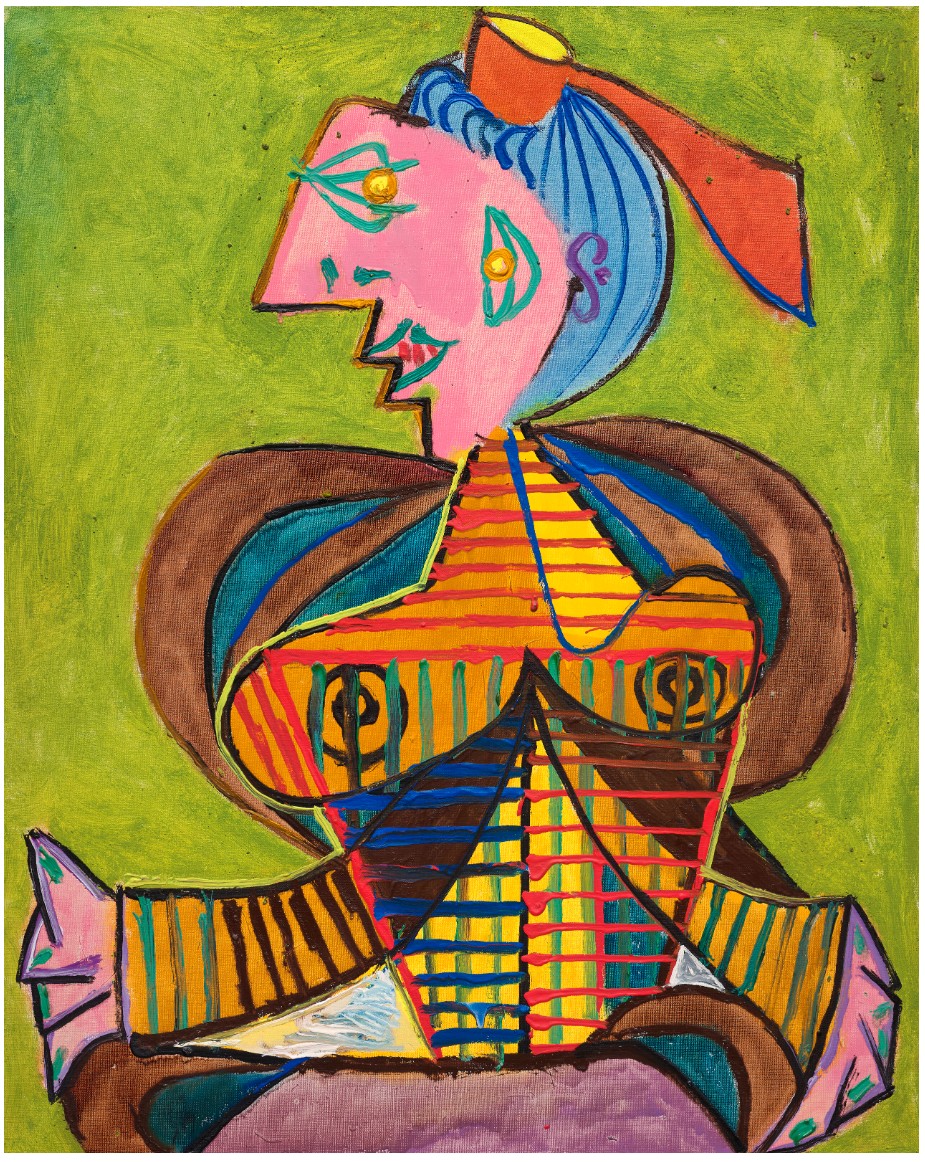
PABLO PICASSO (1881-1973)
Femme à la coiffe d’Arlésienne sur fond vert (Lee Miller), 1937
Oil and Ripolin on canvas
81 x 65.1 cm (31 7/8 x 25 5/8 inches)
Dated and numbered ‘2 septembre 37 II’ (on the stretcher)
Painted in Mougins on 2 September 1937
Painted in a resplendent array of vibrant tones, Femme à la coiffe d’Arlésienne sur fond vert (Lee Miller) is one of an important series of seven portraits that Pablo Picasso painted of the celebrated American photographer Lee Miller over the course of a sun-filled sojourn during the summer of 1937. This was a landmark year within Picasso’s career, marked by an intense surge of creativity in response to contemporary events, which saw the creation of some of his most important works: Guernica (Zervos, vol. 9, no. 65; Museo Nacional Centro de Arte Reina Sofía, Madrid) was completed in the spring, while the haunting La femme qui pleure (Zervos, vol. 9, no. 73; Tate, London) reached its final iteration in the fall. Alongside these monumental works, a dazzling array of portraits occupied Picasso’s imagination, ranging from sensuous depictions of Marie-Thérèse Walter, to highly charged portrayals of Dora Maar, and boldly colored images of close friends and acquaintances. Most notable are the dynamic series of paintings Picasso created of the group of Surrealist artists, photographers and writers he spent the summer with in the south of France that year, each a testament to the highly creative environment and fruitful friendships that underpinned this trip.
The artist had departed Paris just two weeks after he presented the finished Guernica at the Exposition Universelle, traveling with Maar to Mougins—a small, hilltop village overlooking the Mediterranean—in search of sunshine and respite. Here, they joined the poet Paul Eluard and his wife Nusch, Man Ray and Ady Fidelin, the British Surrealist Eileen Agar and her husband the writer Joseph Bard, and Roland Penrose and his new partner, Lee Miller. Man Ray later recalled, “We all stayed at a pension hotel, the Hôtel Vaste Horizon, back in the country in Mougins, above Antibes… After a morning on the beach and a leisurely lunch, we retired to our respective rooms for a siesta and perhaps love making. But we worked, too. In the evening Eluard read us his latest poem, Picasso showed us his starry-eyed portrait of Dora” (quoted in Picasso and the Camera, exh. cat., Gagosian, New York, 2014, p. 231).
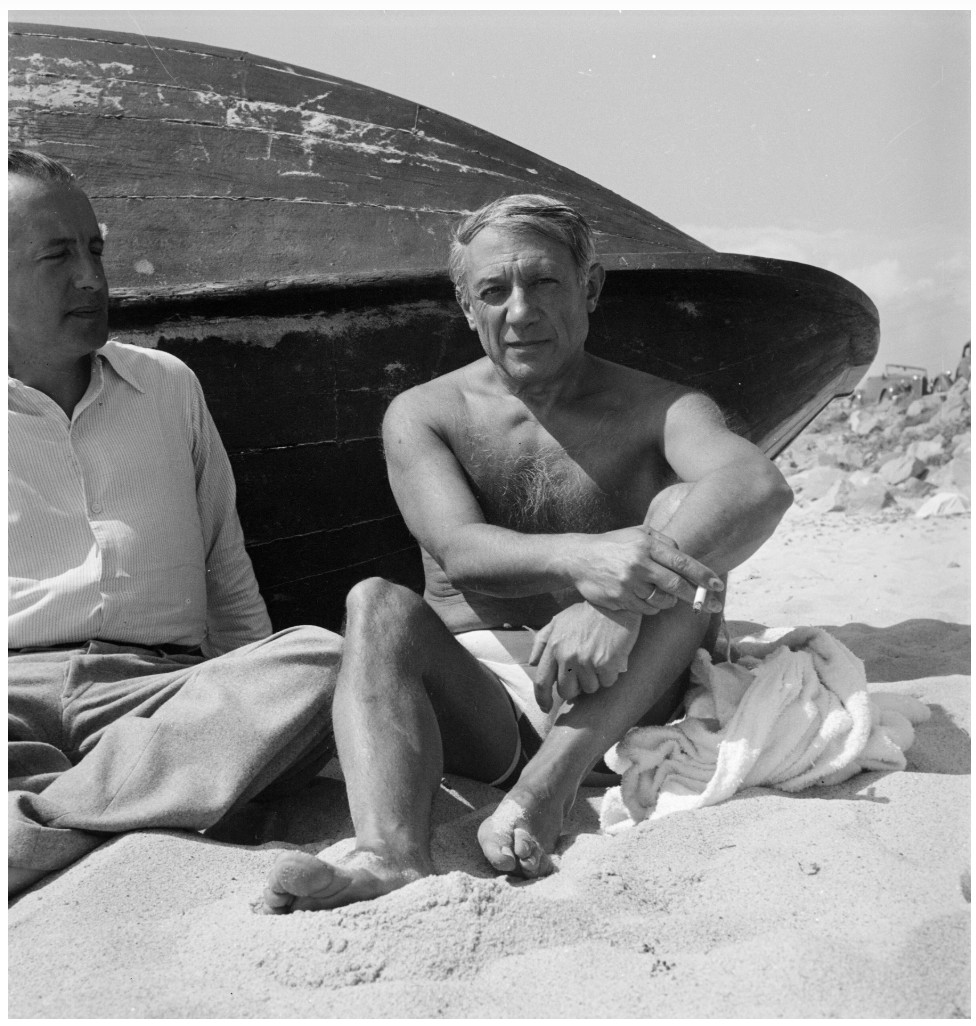
Paul Eluard and Pablo Picasso on the beach in Juan-les-pins, France, September 1937. Photograph by Eileen Agar. © Tate
Miller had only met Penrose a few months before the Mougins trip, following her return to Paris, a city she adored and had called home for several years during the early 1930s. She had first visited the French capital in 1925, aged 18, and was immediately intoxicated by the world of art and bohemianism that she found there. Upon returning to New York, she was discovered by the publishing magnate, Condé Nast, who encouraged her to pursue a modeling career, leading to her appearance on the cover of Vogue in March 1927. Soon, however, Miller decided she would “rather take a picture than be one,” and set out for the French capital again in 1929, armed with an introduction to Man Ray from Edward Steichen and an ambition to become a photographer herself. She met the American Surrealist photographer by chance in a café. “I told him boldly that I was his new student,” she later recalled. “He said he didn’t take students, and anyway he was leaving Paris for his holiday. I said, I know, I’m going with you—and I did” (quoted in A. Penrose, The Lives of Lee Miller, London, 1999, p. 25).
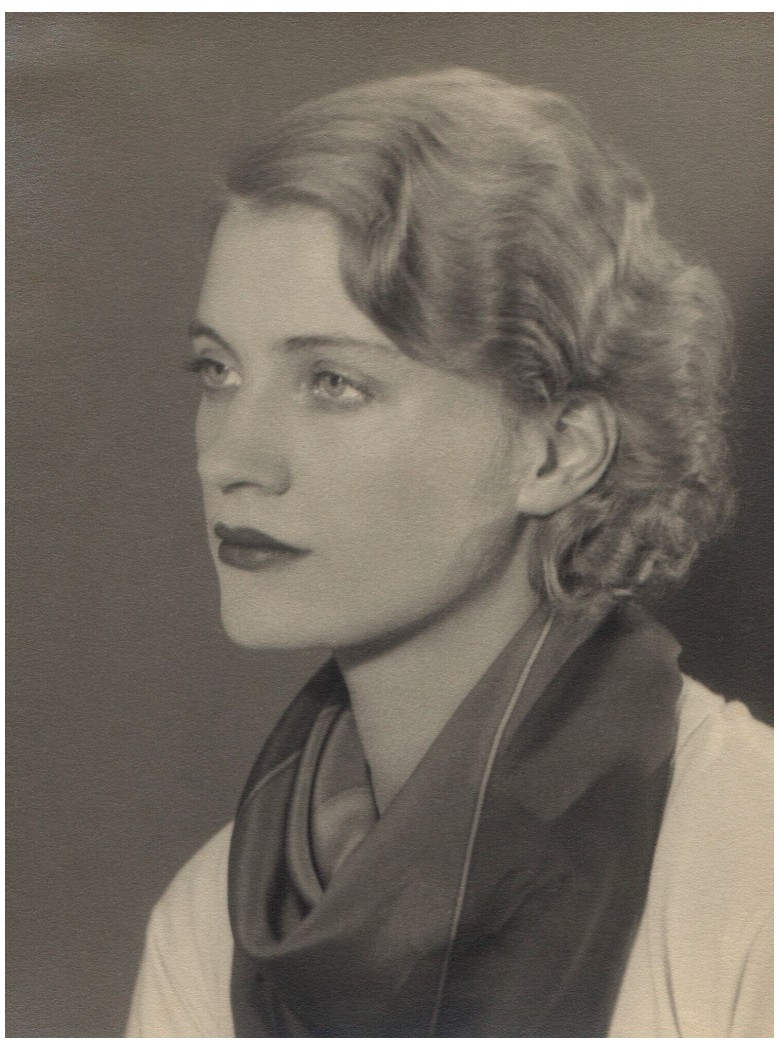
Lee Miller, Self-portrait, 1930. © Lee Miller Archives, England 2025. All rights reserved. leemiller.co.uk
Man Ray agreed to Miller’s request, and the pair soon became lovers. While she posed for him frequently, the two also collaborated on innovative photography projects—most famously developing the solarization technique together. After almost a year working in his studio, Miller began to take on her own projects, and in 1932 she left Man Ray and returned home to New York, where she set up her own photography studio. The lure of Paris did not wane however, and finally in 1937 she arrived once more in the city, and was immediately re-immersed in the Surrealist world she had once inhabited. Attending a fancy-dress ball alongside the likes of Max Ernst, Georges Bataille, and gallerist Julien Levy, she was introduced to Penrose, who had come, together with Ernst, dressed as a beggar. “Blond, blue-eyed and responsive she seemed to enjoy the abysmal contrast between her elegance and my own slum-like horror,” Penrose later wrote (quoted in ibid., p. 74).
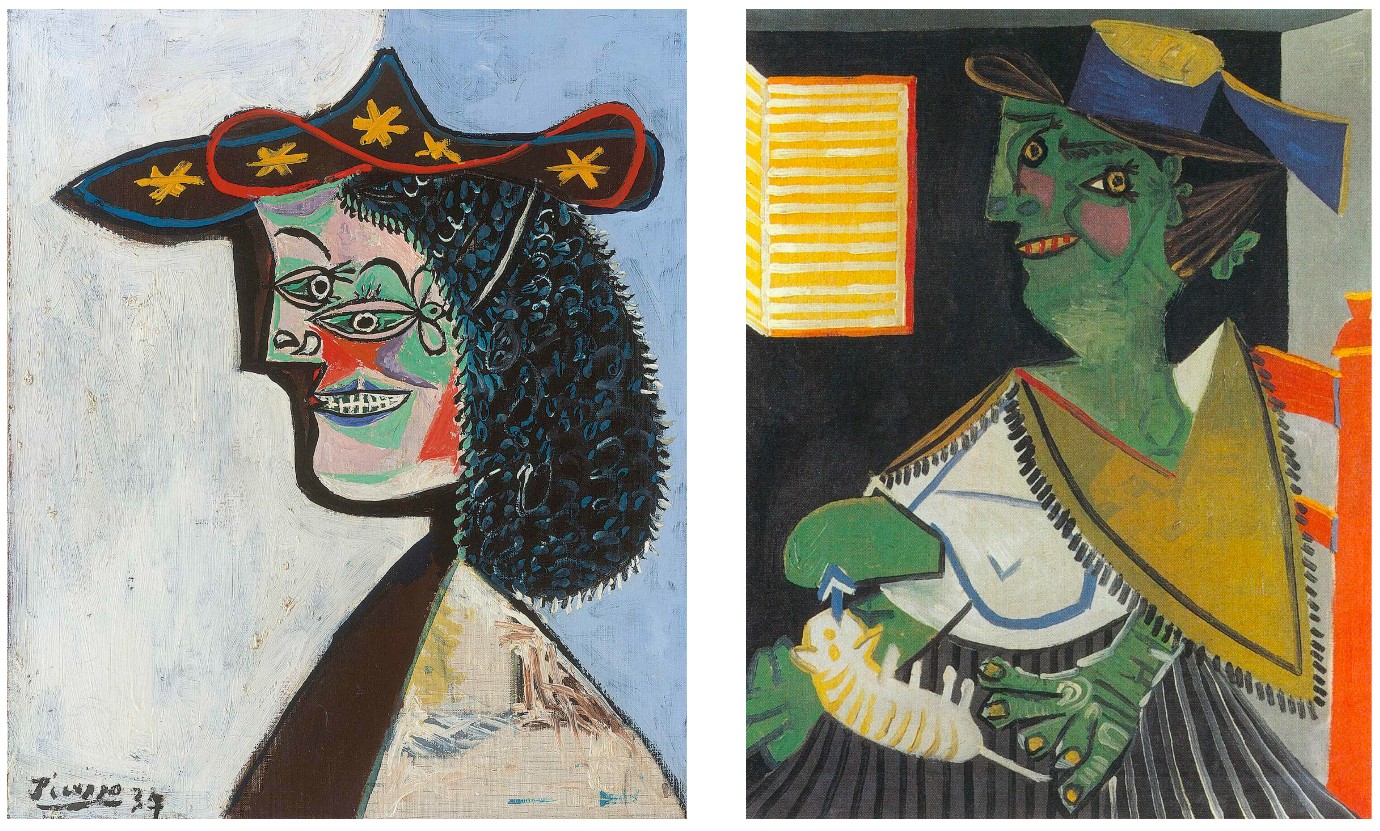
LEFT: Pablo Picasso, Tête de femme (Nusch Eluard), 1937. Museum Berggruen, Berlin. © 2025 Estate of Pablo Picasso / Artists Rights Society (ARS), New York
RIGHT: Pablo Picasso, La femme au chat (Portrait cryptique de Paul Eluard), 30 August 1937. Collection Hersaint. © 2025 Estate of Pablo Picasso / Artists Rights Society (ARS), New York.
Two weeks later, Penrose and Miller returned to his native England together and the pair traveled with Man Ray and Ady Fidelin to Truro, in Cornwall, where they met up with the Eluards, Ernst and Leonora Carrington, as well as Herbert Read, E.L.T Mesens, and Agar. A month later, many of this coterie of writers, artists and poets regathered, this time in Mougins, where they were joined by Picasso and Maar. Far removed from the ever worsening political situation in Europe, Mougins offered them an escape, and the group spent a carefree, creatively fertile and liberating summer together. Evocative photographs taken by Miller, Maar and Agar immortalize this summer sojourn, recording the languorous lunches, days spent on the beach, meandering adventures through the surrounding countryside, and conversations beneath the striped shadows cast by the cane trellis of the hotel terrace.
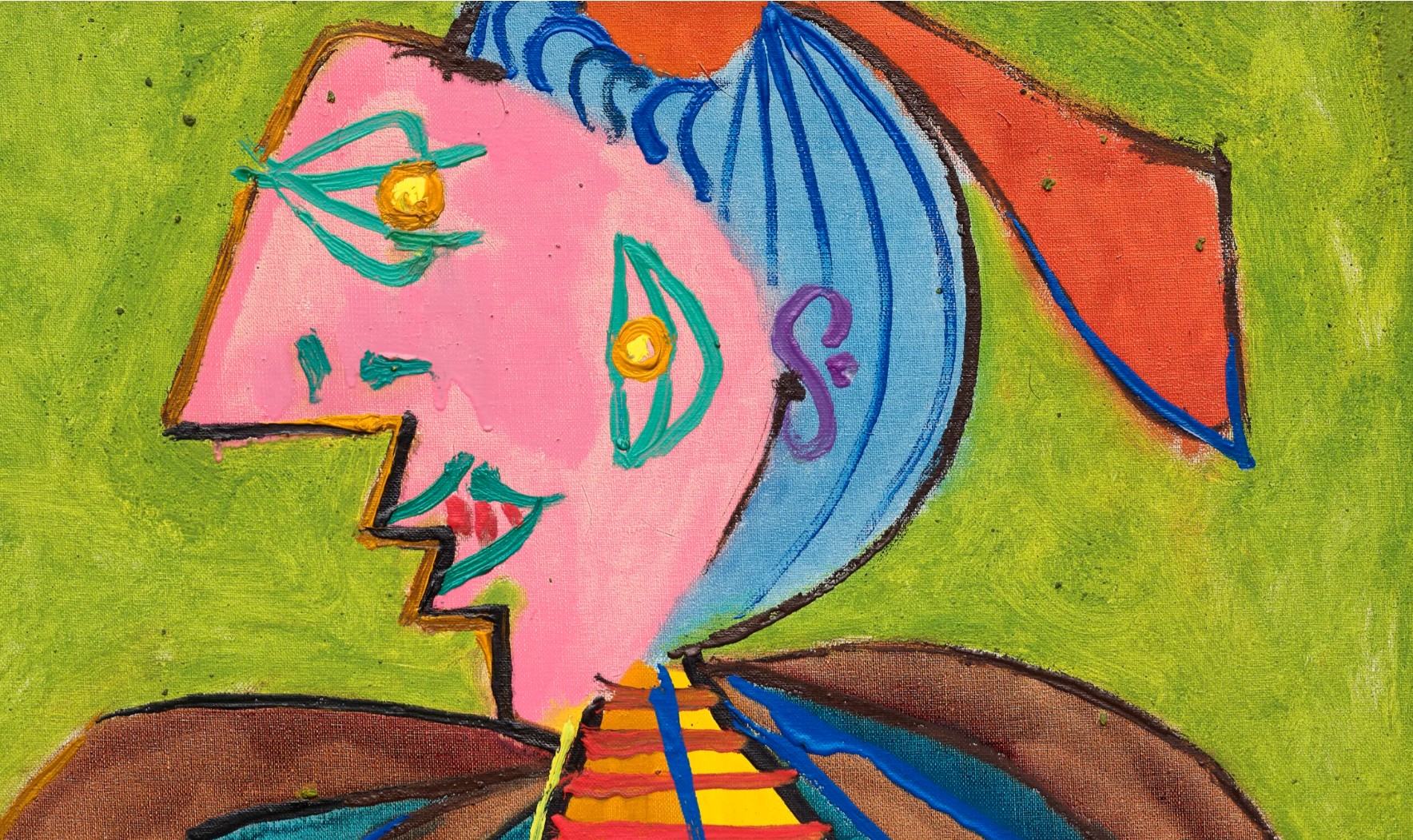
Using his hotel room as a make-shift studio, Picasso painted numerous color-filled portraits of his companions over the course of this vacation, driven by what Penrose has described as “a diabolical playfulness” (Picasso: His Life and Work, London, 1958, p. 279). Nusch was depicted wearing an elaborate Niçoise hat in Portrait de Nusch Eluard (Museum Berggruen, Berlin), her face covered in garish make-up, while Paul was transformed into a fantastical female peasant in La femme au chat (Zervos, vol. 8, no. 373; Private collection). Picasso doesn’t appear to have painted these works from life but rather, having absorbed the likeness and character of his chosen sitter during the hours they spent together during the group’s activities and outings, translating their likeness through his own, unique pictorial language, to create a humorous caricature-like image. Miller became Picasso’s primary focus towards the end of the summer—the artist was said to have been captivated by her classical beauty, her striking intellect and her deeply creative spirit. Beginning in early September, he commenced a group of seated portraits, each of which show Miller in the quintessential Arlésienne costume, featuring most prominently the ribbon-trimmed headdress.
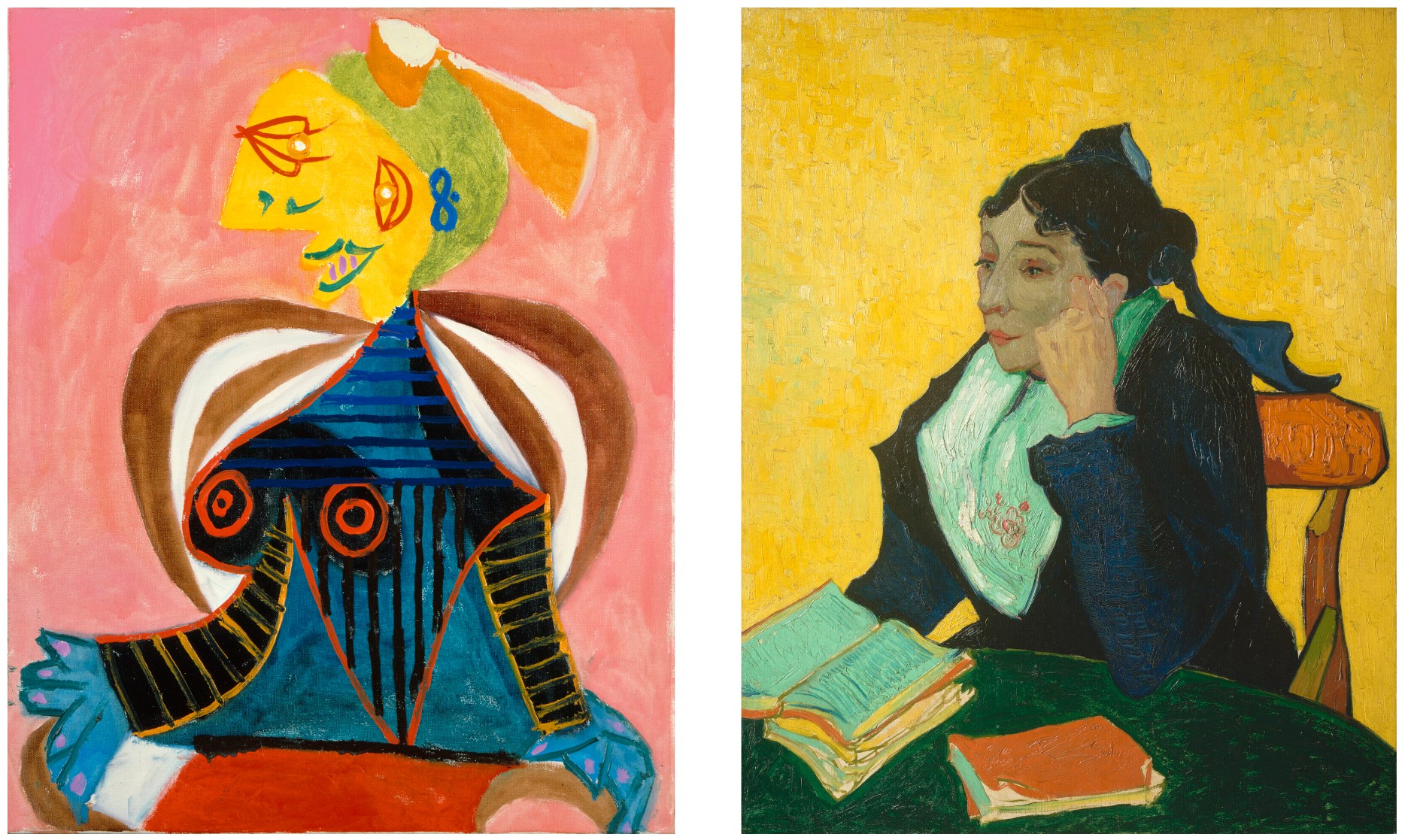
Pablo Picasso, L’Arlésienne, 1937. Musée Réattu, Arles. © 2025 Estate of Pablo Picasso / Artists Rights Society (ARS), New York. Photo: Scala / Art Resource, NY.
Vincent van Gogh, L’Arlésienne, 1888. The Metropolitan Museum of Art, New York.
The artist appears to have relished the very act of painting in these works, boldly exploring and playing with the materiality of his paints. In Femme à la coiffe d’Arlésienne sur fond vert (Lee Miller) Picasso transforms Miller through a vibrant, fantastical palette—her torso is recorded in a colorful weave of linear stripes of pigment, the thick strokes of paint deliberately allowed to drip freely, recording an impression of the speed and energy with which Picasso attacked the canvas. Penrose, describing his first encounter with one of these paintings of Miller, explained: “On a bright pink background Lee appeared in profile, her face a brilliant yellow like the sun with no modeling. Two smiling eyes and a green mouth were placed on the same side of the face, and her breasts seemed like the sails of ships filled with a joyous breeze. It was an astonishing likeness. An agglomeration of Lee’s qualities of exuberant vitality and vivid beauty put together in such a way that it was undoubtedly her but with none of the conventional attributions of a portrait” (ibid., p. 109).
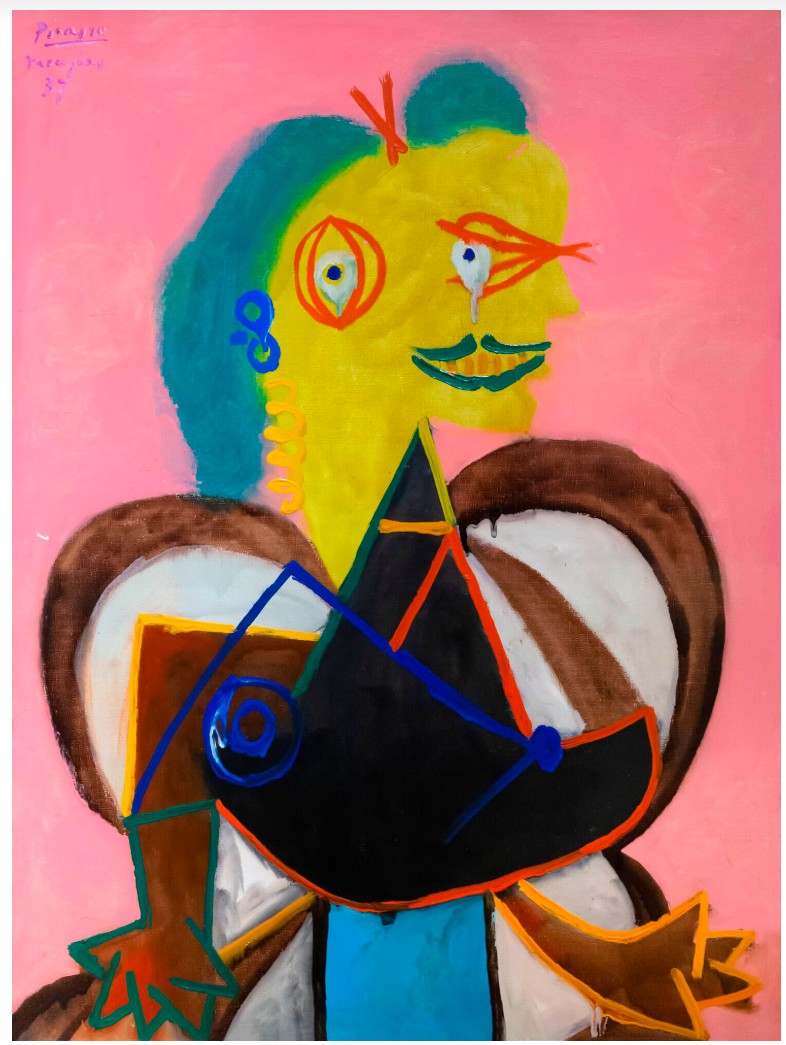
Pablo Picasso, L’Arlésienne, 1937. Scottish National Gallery of Modern Art, Edinburgh. © 2025 Estate of Pablo Picasso / Artists Rights Society (ARS), New York.
While Picasso’s decision to dress Miller (and also Paul Eluard) in the traditional costume of the Arlésienne may have been prompted by the local festivals taking place in Mougins, Arles and Nice that summer, the works also clearly pay homage to Vincent van Gogh’s series of striking portraits depicting Madame Ginoux from 1888, the owner of the Café de la Gare in Arles. While Picasso had long revered Van Gogh’s visceral, expressionistic take on the world, the Exposition Universelle of 1937 had included a large exhibition of Impressionist, Post-Impressionist and modern art together. Here, Picasso was able to regard his own work in the same context as Van Gogh, prompting him perhaps to return once again to the Dutch master’s work for inspiration, aided by postcard reproductions of several of Van Gogh’s compositions. It was also during this pivotal summer of 1937 that Picasso learned that he, like Van Gogh, had been branded a “degenerate artist” by Hitler, and that the Nazis had begun to confiscate works, including his own, from German museums and collections. By deliberately invoking and appropriating the work of Van Gogh, Picasso appears to not only pay homage to the artist, but also demonstrate, in the face of derision, their shared status as defiant trailblazers of avant-garde art.
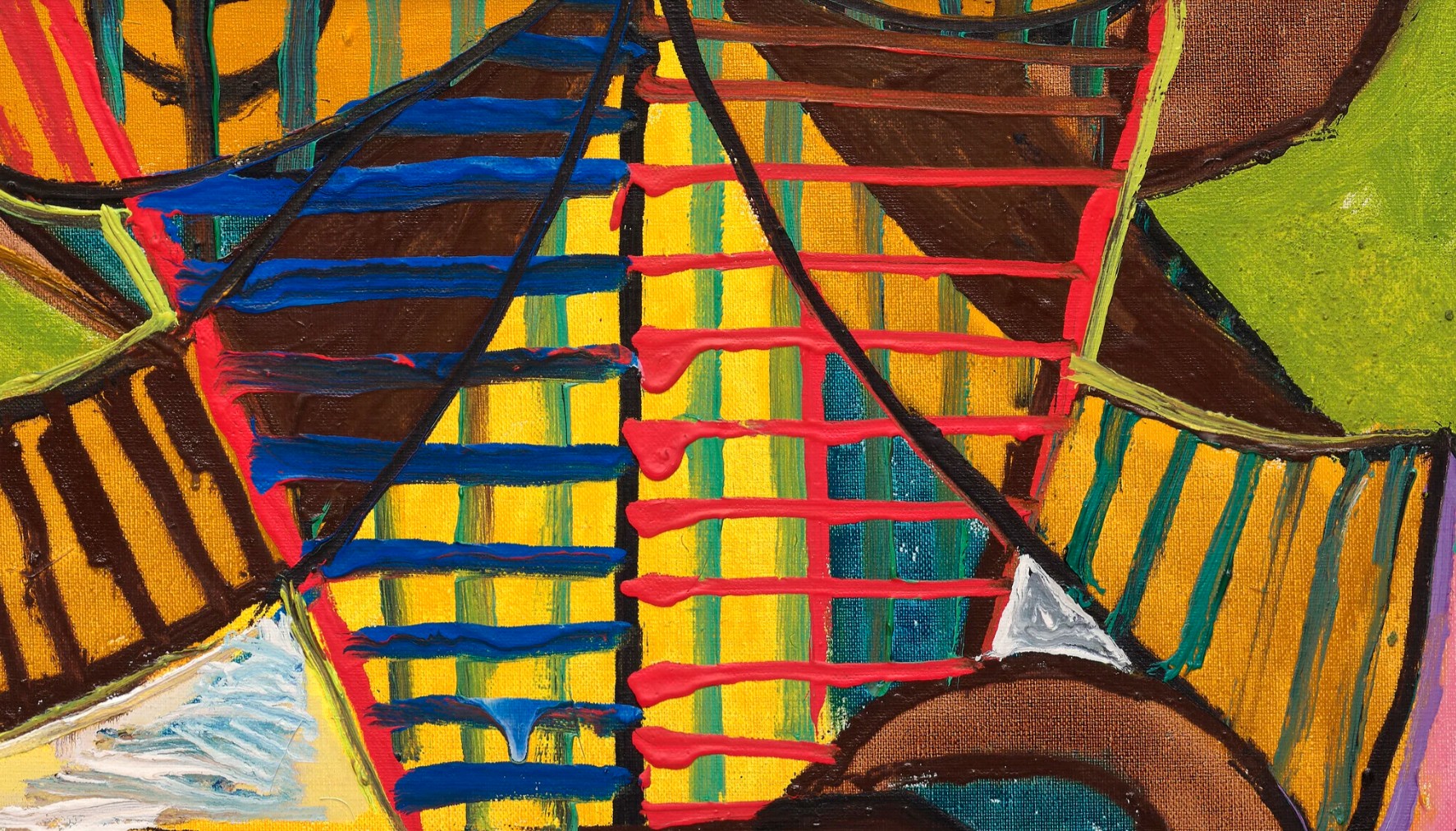
While Picasso and Miller remained close following the summer of 1937, the outbreak of the Second World War two years later cut off all contact between the two. Picasso remained in Paris for much of the conflict, holed up in his Left Bank studio, while Miller initially returned to England with Penrose, before becoming a photojournalist for Condé Nast. In 1944 she received her accreditation from the US Army and became one of only a handful of female combat war correspondents to cover the front-lines of the war in Europe. With an unflinching eye, she recorded the siege of Saint-Malo, fighting in Alsace, and later, Hitler’s apartment in Munich, as well as the liberation of the concentration camps of Dachau and Buchenwald.
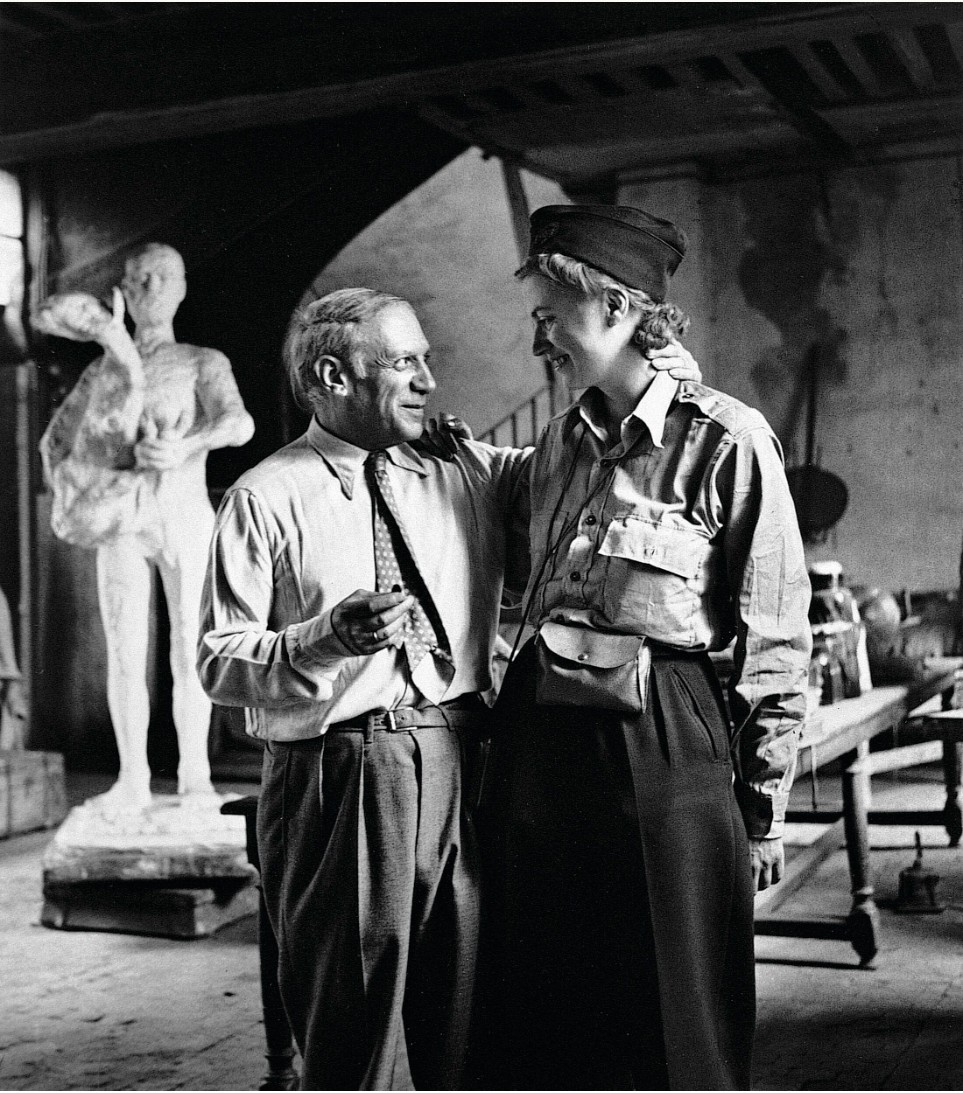
Picasso and Lee Miller in his studio, 7 rue des Grands-Augustins, Paris, 1944. Photograph by Lee Miller. Photo: © Lee Miller Archives, England 2025. All rights reserved. www.leemiller.co.uk. © 2025 Estate of Pablo Picasso / Artists Rights Society (ARS), New York.
It was while covering the chaos that followed the Liberation of Paris that she set out to find news of Picasso, racing through streets littered with still smoking tanks to reach the artist’s studio. “Picasso and I fell into each other’s arms,” Miller wrote in her dispatch from Paris, “and between laughter and tears, we incoherently exchanged news about friends and their work, and looked at his new pictures, some of them painted while the Battle of Paris raged” (“In Paris… Picasso Still at Work” in Vogue, vol. 104, no. 7, 15 October 1944, p. 98). The artist’s joy at the Liberation and being reunited with his old friend can be palpably felt in the photographs from their meeting, the most iconic of which sees the artist embracing Miller in her uniform, gazing adoringly up at her face in apparent disbelief at her presence.
Mère et enfant, 1922
Leonard & Louise Riggio: Collected Works
Christie’s New-York: 12 May 2025
Estimated: USD 9,000,000 – 12,000,000
USD 7,310,000
PABLO PICASSO (1881-1973), Mère et enfant | Christie’s
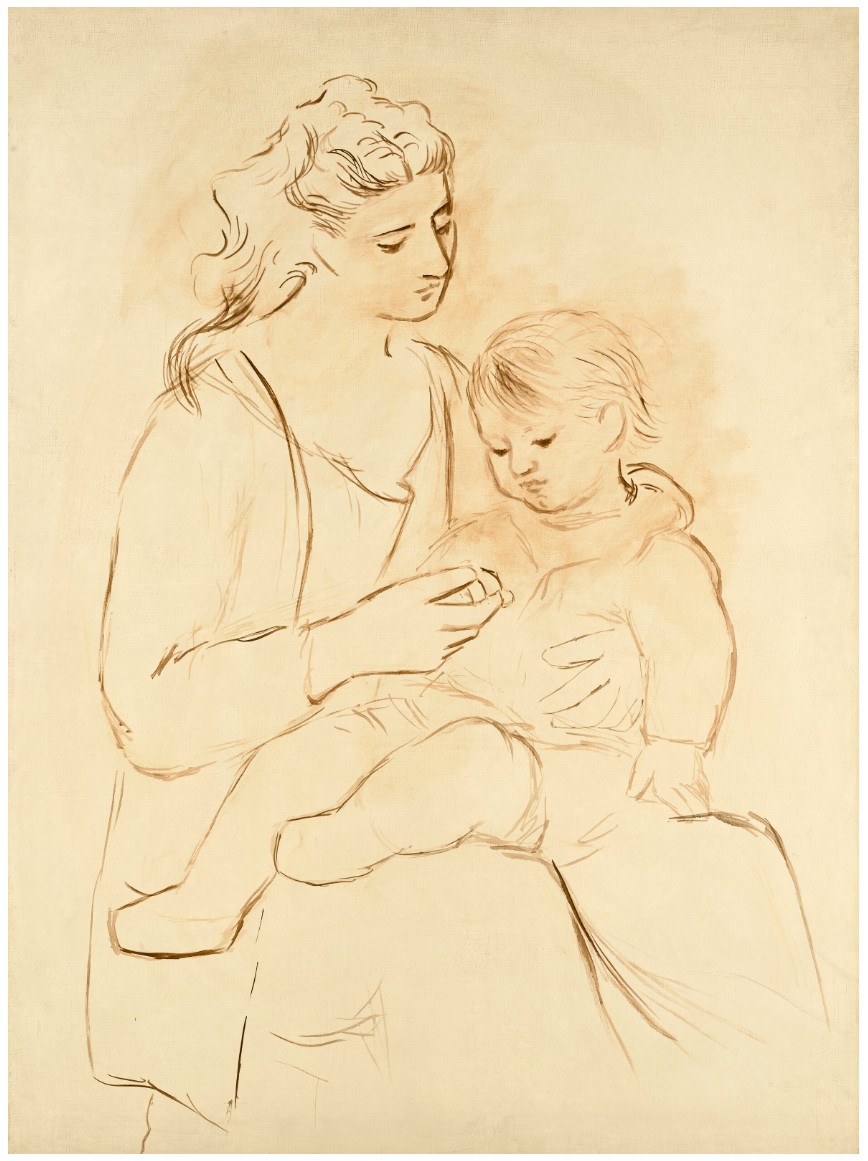
PABLO PICASSO (1881-1973)
Mère et enfant, 1922
Oil on canvas
130.2 x 96.8 cm (51 1/4 x 38 1/8 inches)
Painted in Dinard in summer 1922
Pablo Picasso spent the summer of 1922 with his wife, Olga Khokhlova, and their infant son Paul in Dinard, a fashionable seaside resort at the mouth of the river Rance, popular due to its relative proximity to Paris. The summer proved immensely fruitful for the artist, who produced more than sixty oil paintings and nearly two hundred drawings between June and September, ranging from tender portraits of his small family, to landscape sketches and Cubist still lifes. Perhaps the most evocative of this group of works are a series of classicized female figures, both ethereal and monumental, which recall the idealized features of Quattrocento Madonnas or sculptural Hellenistic goddesses. Their coiffures are parted in the middle and gently waved, redolent of antique statuary, with sharp brows and heavy lidded eyes that appeared as though carved from stone. Mère et enfant, painted at the height of that contented summer, demonstrates the manner in which these figures are both gracious and enigmatic—like sculptures come to quiet, contemplative life. The present work exemplifies Picasso’s incomparable ability to distill and synthesize a wealth of pictorial and thematic possibilities in his work, as he quarried from the art of the past in the years following the First World War, to reach an innovative artistic idiom fully his own.
Picasso’s initial first-hand encounter with the Mediterranean’s art historical heritage coincided with his meeting and courting of Olga, a Ukrainian-born ballerina then at the apex of her career with the Ballets Russes. The two had both traveled to Rome in February 1917 to prepare and rehearse Serge Diaghilev’s premiere production of the ballet Parade. While designing the stage sets and costumes for the show, and in the company of his friends, the writer Jean Cocteau and the choreographer Léonide Massine, Picasso sojourned to Naples to view the excavated remains of ancient Pompeii. Massine later recalled: “Picasso was thrilled by the majestic ruins, and climbed endlessly over broken columns to stand staring at fragments of Roman statuary” (quoted in J. Clair, ed., Picasso, 1917-1924: The Italian Journey, exh. cat., Palazzo Grassi, Venice, 1998, pp. 79-80).
“To me there is no past or future in my art. If a work of art cannot live always in the present it must not be considered at all. The art of the Greeks, of the Egyptians, of the great painters who lived in other times, is not an art of the past; perhaps it is more alive today than it ever was.”
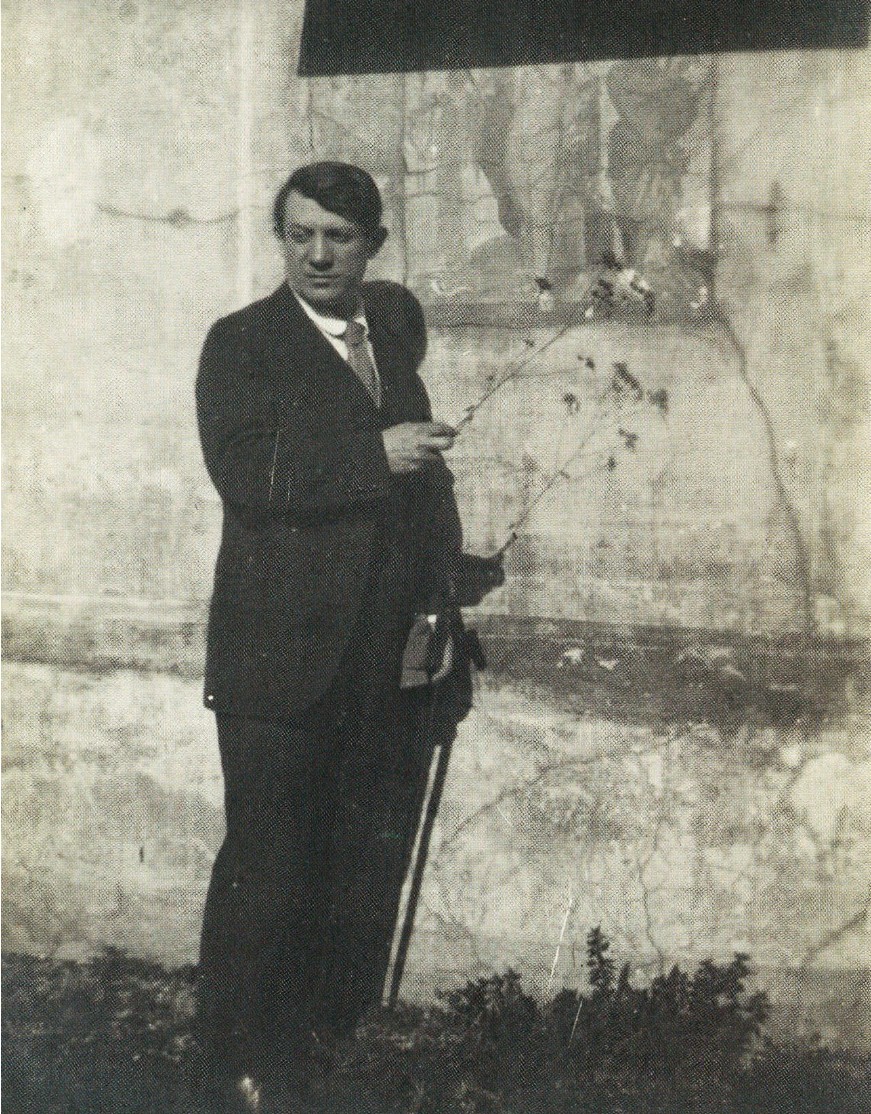
Picasso in Pompeii, 1917. Photograph by Jean Cocteau. © 2025 Estate of Pablo Picasso / Artists Rights Society (ARS), New York.
Picasso examined the surviving artworks on display at the Museo Archeologico Nazionale in Naples, where he likely saw the Farnese Juno—now thought to be the goddess Diana, a Roman copy after a Greek sculpture carved in the fifth century BCE. The sculpture became the source of many regal female figures Picasso depicted in subsequent years, often fused with Olga’s delicate features across numerous pages and canvases. The artist also seized the opportunity to study examples of ancient fresco paintings: a photograph taken by Cocteau shows Picasso pointing to a mural of Bacchus and Silenus. Evidently struck by what he saw, he brought home postcards of this and other Pompeiian wall paintings, now housed at the Musée Picasso in Paris. The muted, terracotta palette of the present work might suggest the earthy tones of ancient fresco techniques. Before returning to Paris, Picasso also visited Florence, where he admired the masterpieces at the Gallerie degli Uffizi’s iconic Sala dei Primitivi, including paintings by Raphael and sculptures by Michelangelo.
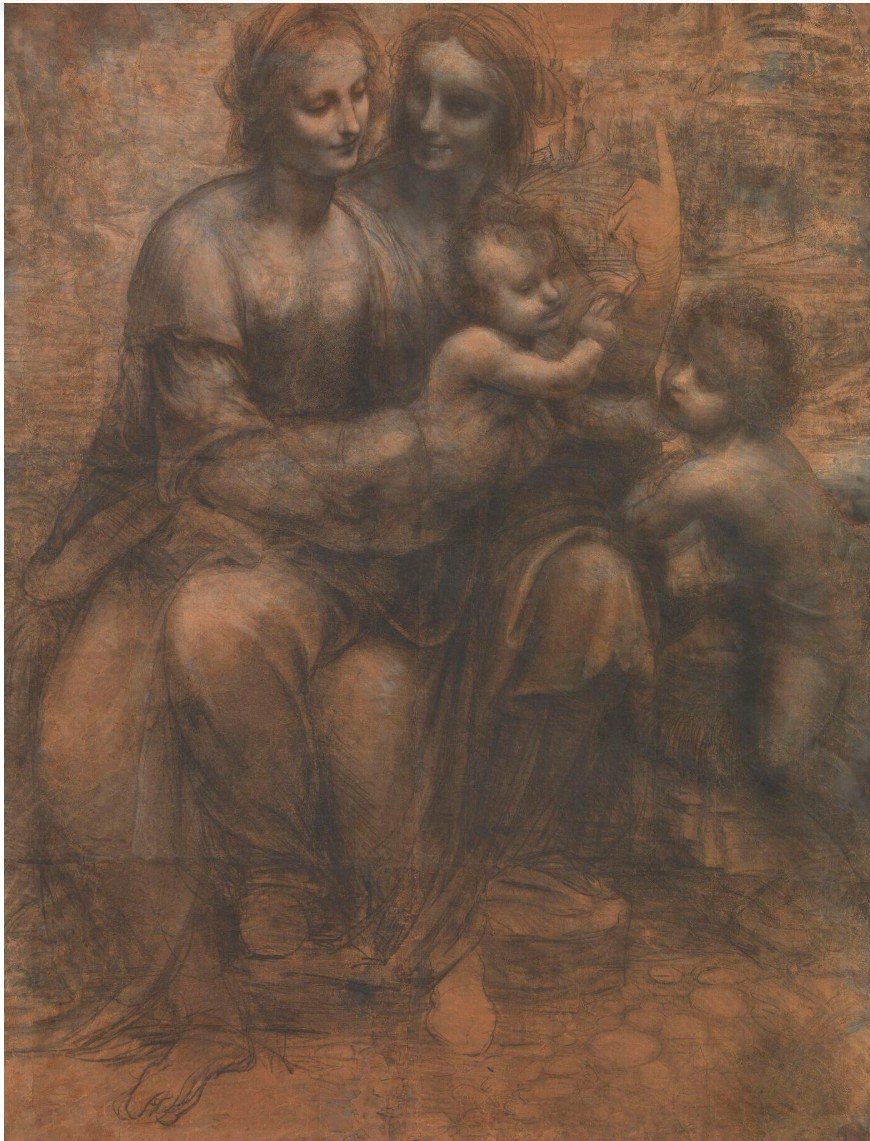
Leonardo da Vinci, The Virgin and Child with Saint Anne and the Infant Saint John the Baptist (‘The Burlington House Cartoon’), 1507-1508. National Gallery, London.
Shortly before embarking on his voyage to Italy in 1917, Picasso traversed two distinct stylistic avenues, moving effortlessly between a late synthetic Cubist manner and a more naturalistic, classically modulated mode of figuration which Olga would come to embody in his oeuvre. While champions of each approach strove to discredit his efforts in the other, the seemingly contrasting notions of Cubism and Classicism appeared to Picasso to be dual sides of the same coin—the culmination of Western art in its most provocative, modern form, ever generating potent dialects of representation from which dazzlingly transformative ideas could burst forth. Picasso had produced classicized drawings as early as 1914, and following the 1918 Armistice, his ongoing exploration of Classicism as a means of expanding the parameters of contemporary art gained new impetus. Now, the European avant-garde to which he belonged embraced an ethos of renewal linked to a heightened awareness of and reverence for tradition. Adhering to le rappel à l’ordre—the “call to order,” as coined by Cocteau—artists increasingly rejected modern conventions in favor of looking to the past, from classical antiquity to the Italian Renaissance to the great French masters of the previous centuries, notably Nicolas Poussin, Jacques-Louis David, and Jean Auguste Dominique Ingres. In the eyes of these artistic circles, the humanistic cultural imperative of these periods could heal the wounds that four years of gruesome carnage had inflicted on the modern world, thus satisfying a yearning for veritable rebirth into a period of unity, stability, and harmony.
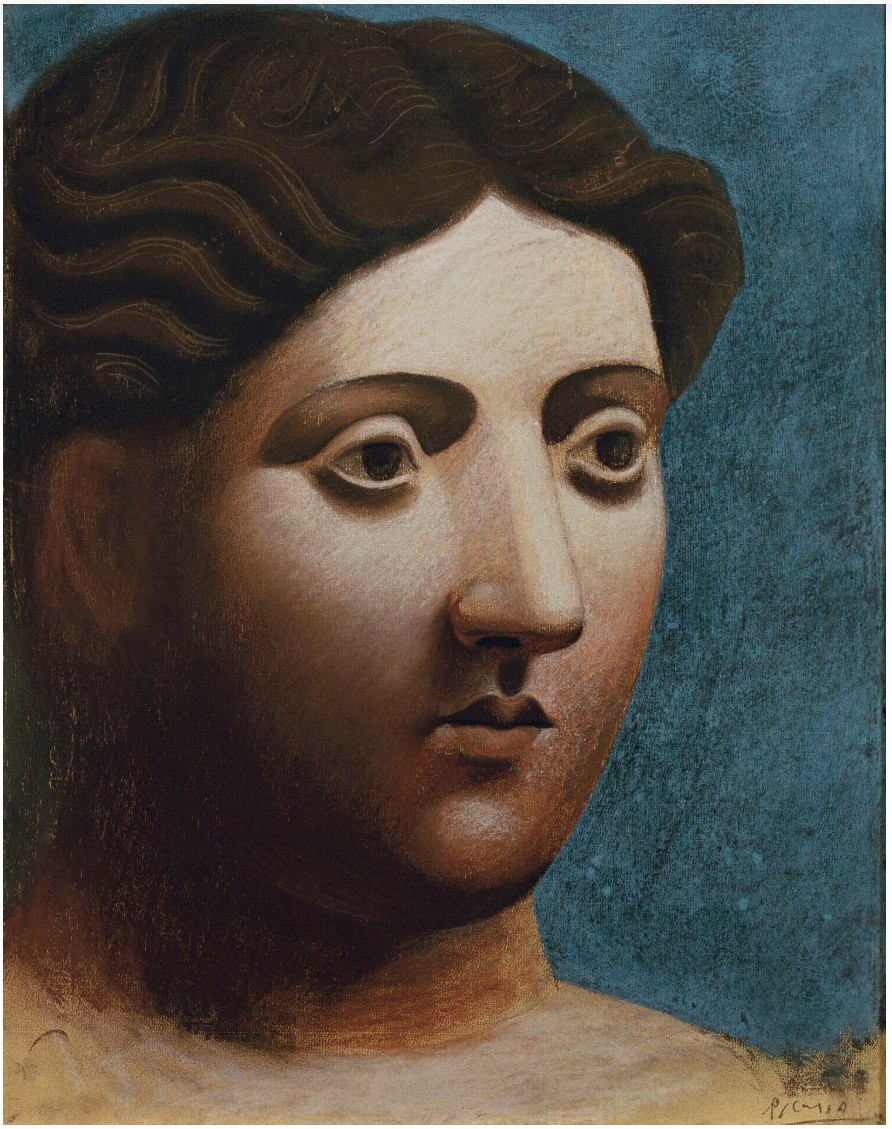
Pablo Picasso, Tête de femme, 1921. Fondation Beyeler, Riehen.
Artwork: © 2025 Estate of Pablo Picasso / Artists Rights Society (ARS), New York. Photo: AKG Images.
Picasso and Olga married in July 1918, after having postponed the nuptials from May due to an injury that briefly debilitated Olga. The newlyweds took an apartment in the trendy rue la Boétie, which had become the center of the Parisian art trade, allowing them to enter a new stage in their lives—Picasso as a celebrated member of the beau mode, and Olga in her role as a celebrity’s wife. In February 1921, they welcomed their only child together, a son named Paulo Joseph. Not long after, Picasso began to explore intimate and tender depictions of his new family. Until that point, Olga had often been transformed into a Greco-Roman goddess in her husband’s art—her features exaggerated volumetrically to mythological proportions, or depicted as a divinely beautiful Italian Madonna, or a Spanish matron in a lace mantilla. Now, aspects of each were consolidated to capture the poignancy of the maternity scenes in which the new mother becomes a timeless model of ennobled feminine grace.
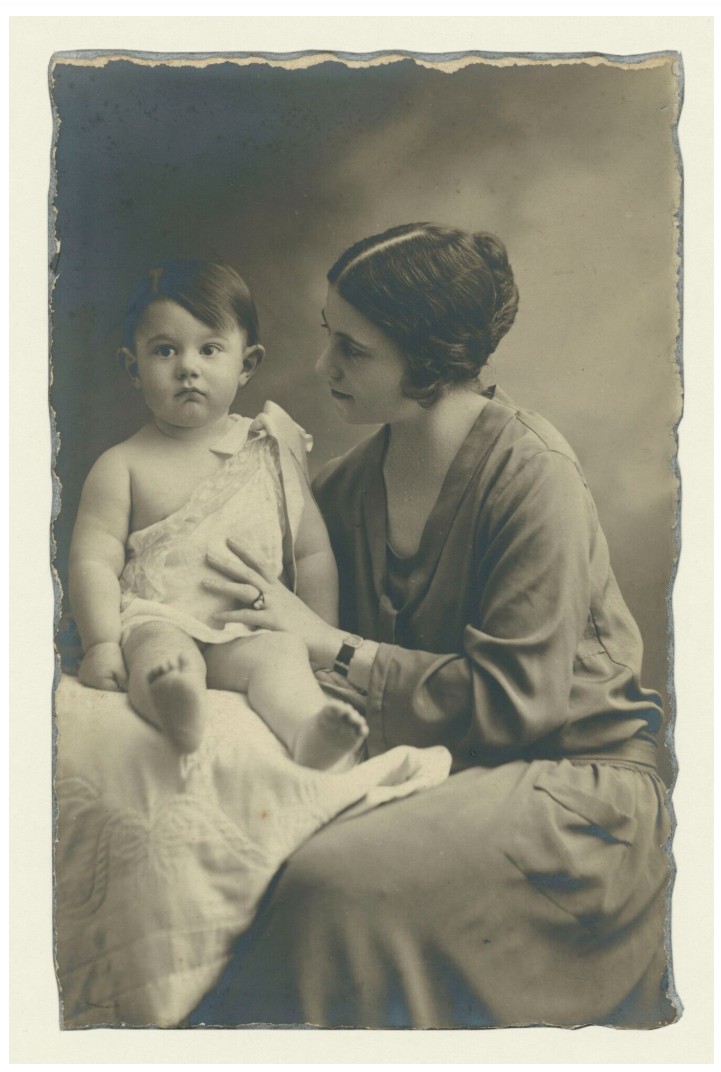
Olga and Paul Picasso, 1921. Musée national Picasso, Paris. Photo: © RMN-Grand Palais / Art Resource, NY.
In Mère et enfant, Olga gazes at her young son as he sits serenely in her lap, an impenetrable look on her refined features, captured in a striking monochrome palette. Her head is bowed in silent contemplation, as though caught in a moment of reverie, appearing as venerated and impregnable as any classical deity or Renaissance Virgin. Rather than displaying an exacting likeness, the work is an affectionate idealization, showcasing the subtle power of expression that Picasso summoned through the urbane style of portraiture his wife inspired. Olga’s features are subtly distorted, the space between her eyes widened and her lips minimized. Picasso must have used an exceptionally fine brush in his treatment of the two figures, creating the impression that the work was executed in ink on aged paper rather than painted in oils on canvas. While clearly evoking the various sources that so inspired Picasso at this juncture of his career, the work defies exact identification with any specific antique or classical example.
Fillette au bateau, Maya, 1938
Sotheby’s London: 1 March 2024
Estimated: GBP 12,000,000 – 18,000,000
GBP 18,089,300 / USD 21,567,438
PABLO PICASSO (1881 – 1973)
Fillette au bateau, Maya, 1938
Oil on canvas
73.3 x 60 cm (28 7/8 x 23 5/8 inches)
Dated 4.2.38. (lower right)
Executed on 4 February 1938
Picasso’s daughter Maya, aged just two-and-a-half at the time, is the subject of this bold and playful full-length portrait painted on 4th February 1938. Filled with exuberant color and energy, it was executed shortly after the artist had completed the monumental Guernica, and encapsulates the happiness Maya brought into Picasso’s life during these challenging years. Maya, named María de la Conceptión after Picasso’s beloved late sister, was the fruit of the passionate love between the artist and his young muse and mistress Marie-Thérèse Walter. She was born in secret in 1935 while Picasso was still married to his first wife, the former ballerina Olga Khokhlova. Maya’s birth coincided with a personal crisis which Picasso later referred to as ‘the worst period of his life’. A combination of factors contributed to this dramatic attestation including a lengthy divorce battle with Olga and the associated loss of his beloved property, Château de Boisgeloup, which he was forced to hand over following their separation in 1935, and at the same time the worsening political situation in Europe and the growing inevitability of war.
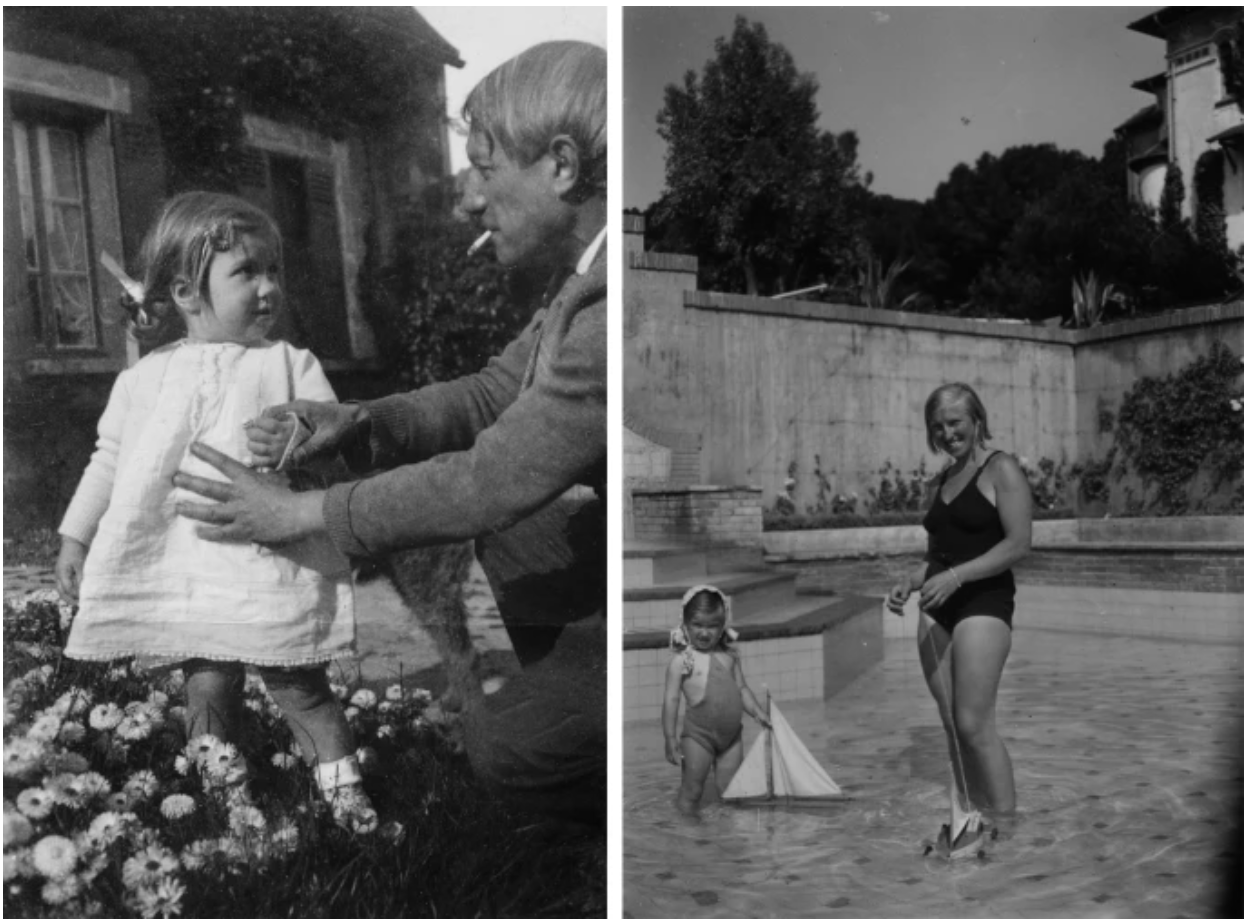
LEFT: PABLO PICASSO AND MAYA, LE TREMBLAY-SUR-MAULDRE, JANUARY 1937 © SUCCESSION PICASSO/DACS, LONDON 2023
RIGHT: MARIE-THÉRÈSE AND MAYA, JUAN-LES-PINS, 1938 © SUCCESSION PICASSO/DACS, LONDON 2023
Maya’s arrival helped Picasso overcome a nearly year-long abstinence from painting. Maya would later comment on Picasso’s artistic rebirth in the following way: ‘I was to bring something new to his interpretation of a child: I was a girl. From one point of view it was marvelous – a child he had had with Marie-Thérèse, a daughter, the worst woman in a man’s life apart from his mother – the impossible mistress! He had to find a way of seducing this little goddess!’ (quoted in W. Spies, ed., op. cit., p. 60).
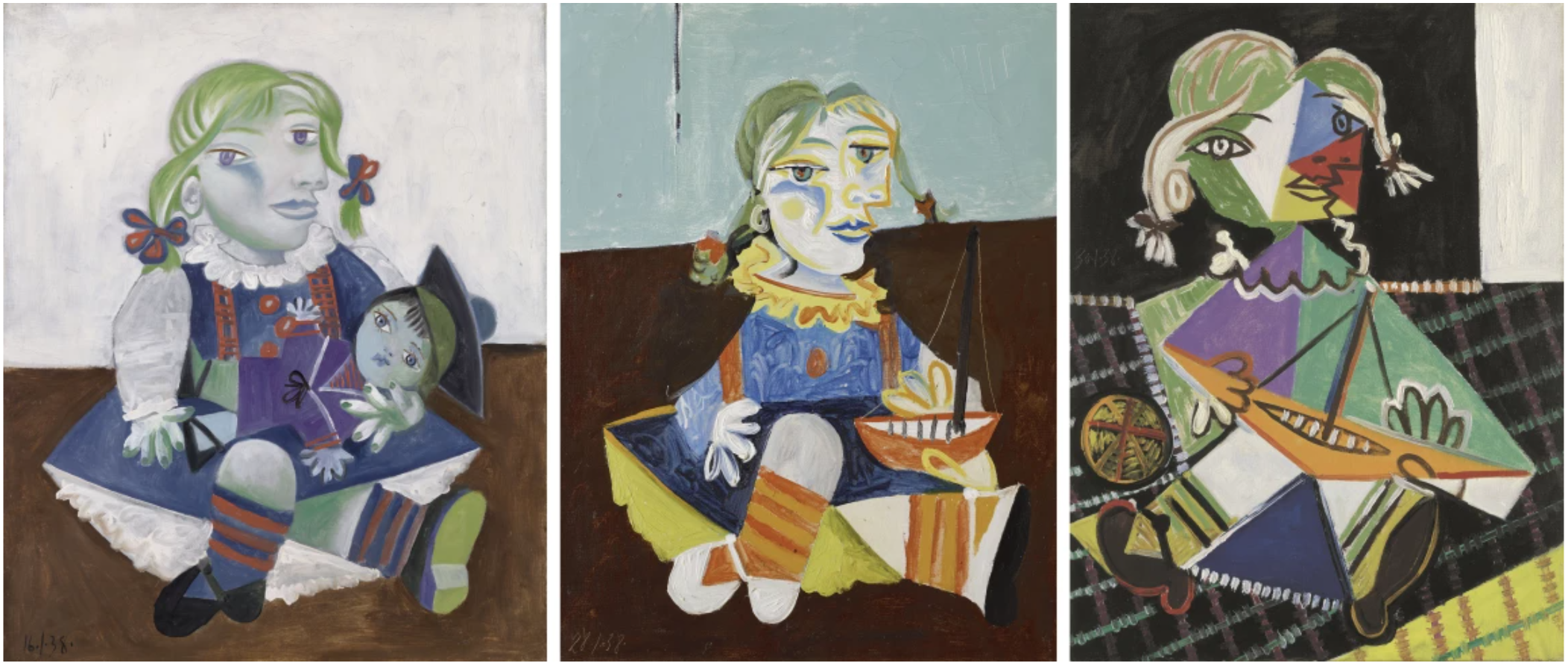
LEFT: PABLO PICASSO, MAYA À LA POUPÉE, 16TH JANUARY 1938, OIL ON CANVAS, MUSÉE NATIONAL PICASSO-PARIS, PARIS PHOTO © RMN-GRAND PALAIS (MUSÉE NATIONAL PICASSO-PARIS) / ADRIEN DIDIERJEAN © SUCCESSION PICASSO/DACS, LONDON 2023
CENTRE: PABLO PICASSO, MAYA AU BATEAU, 28TH JANUARY 1938, OIL ON CANVAS, YAGEO FOUNDATION COLLECTION, TAIWAN © SUCCESSION PICASSO/DACS, LONDON 2023
RIGHT: PABLO PICASSO, MAYA AU BATEAU, 30TH JANUARY 1938, OIL ON CANVAS, MUSEUM COLLECTION ROSENGART, LUCERNE © MUSEUM COLLECTION ROSENGART, LUCERNE © SUCCESSION PICASSO/DACS, LONDON 2023
Between January 1938 and November 1939, Picasso painted Maya obsessively, executing around fourteen portraits of his young daughter. Although quite diverse in style, Maya’s portraits, including the present work, are almost all the same in their compositional setup. They also almost invariably focus solely on Maya, depicting her in the privacy of her own world. At the same time, as with many of Picasso’s portraits executed throughout various stages of his career, the artist makes references to, and derives inspiration from, earlier art historical periods. Maya’s elaborate doll-like costumes, her frontal pose and the directness of her gaze have prompted Robert Rosenblum to describe these portraits as ‘state occasions for which she would be as fancily posed and dressed as an infanta by Velázquez [fig. 6]’ (Exh. Cat., New York, The Museum of Modern Art, Picasso and Portraiture: Representation and Transformation, 1996, p. 373).
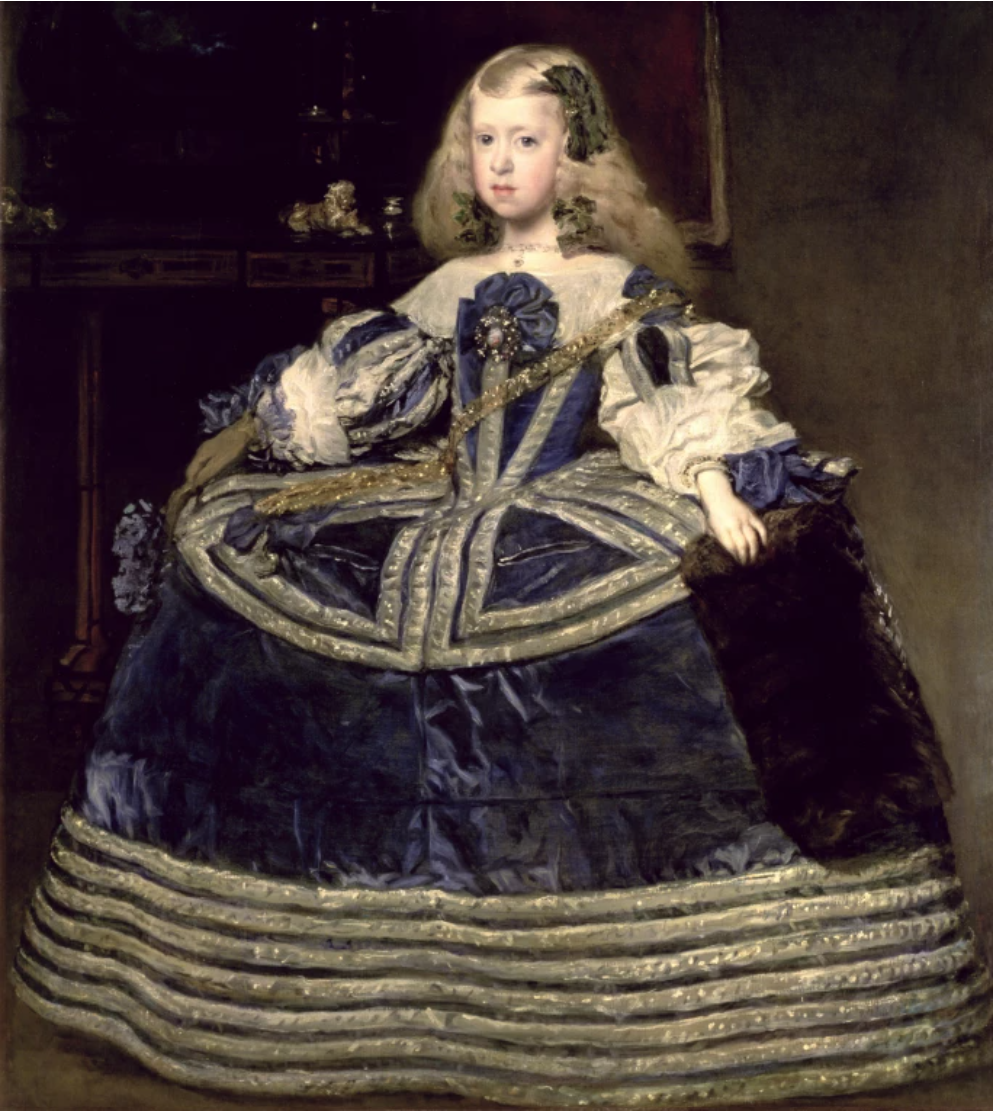
DIEGO VELÁZQUEZ, INFANTA MARGARITA TERESA IN A BLUE DRESS, 1659, OIL ON CANVAS, KUNSTHISTORISCHES MUSEUM, VIENNA © BRIDGEMAN IMAGES
As well as drawing on the great art of the past, Picasso continued his own experiments with form in these pictures. The use of multiple angles within her face echoes Picasso depictions of her mother, Marie-Thérèse. This repetition – or the overlaying of identities within a single face – is a common feature of the works of the 1930s, allowing Picasso to explore his often complex private life. The present work as such reflects not only Picasso’s curiosity in capturing his daughter as her character and behavior evolved over time, but equally the role that she and her mother inhabited in Picasso’s personal universe. In a tender double portrait of Marie-Thérèse and Maya from the same year, Maternité, the two figures’ facial features are visibly alike, reinforcing the vision of the domesticated, intimate world that they represented for the artist.
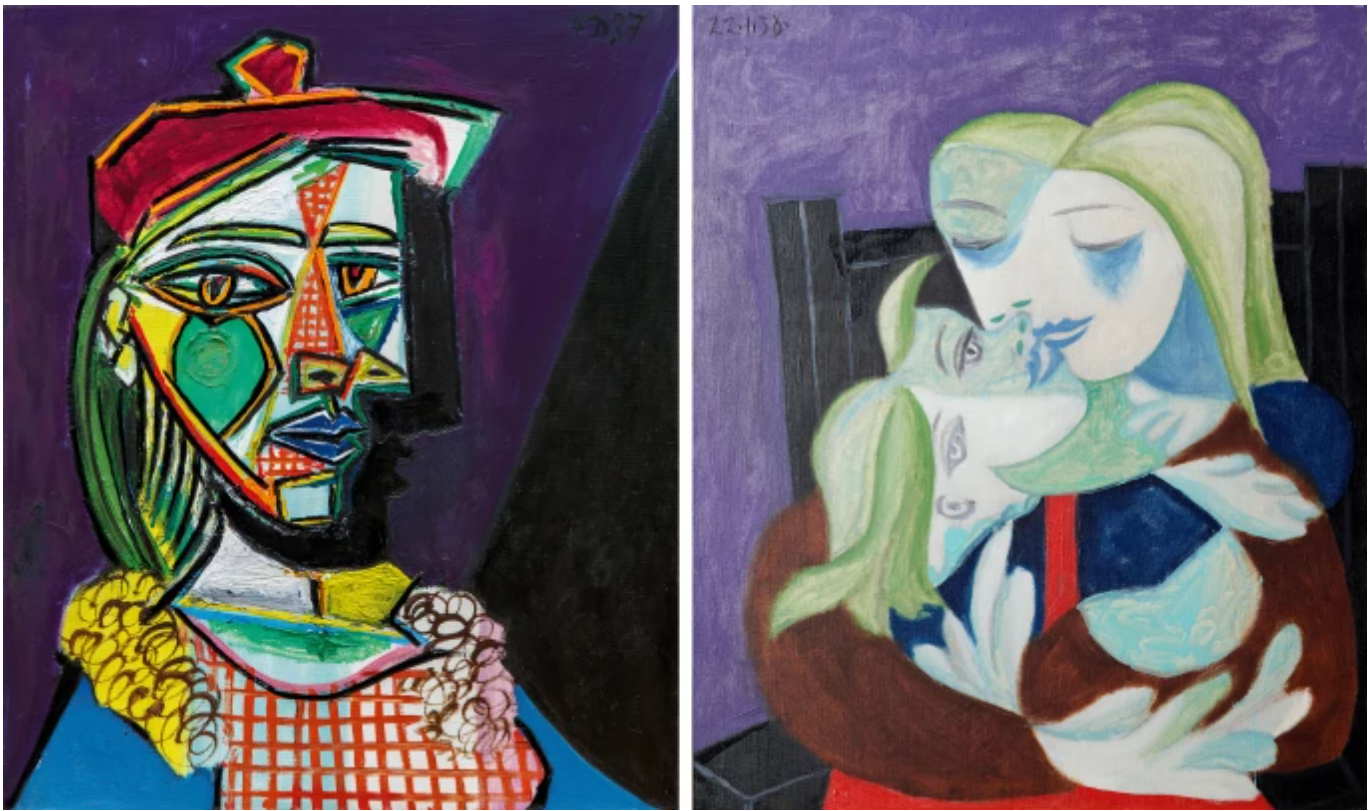
LEFT: PABLO PICASSO, FEMME AU BÉRET ET À LA ROBE QUADRILLÉE (MARIE-THÉRÈSE WALTER), 4TH DECEMBER 1937, OIL ON CANVAS. SOLD: SOTHEBY’S, LONDON, 28TH FEBRUARY 2018, LOT 7, FOR £49,827,000 © SUCCESSION PICASSO/DACS, LONDON 2023
RIGHT: PABLO PICASSO, MATERNITÉ, 22TH JANUARY 1938, OIL ON CANVAS, PRIVATE COLLECTION, GERMANY © BRIDGEMAN IMAGES © SUCCESSION PICASSO/DACS, LONDON 2023
A work of real importance, Fillette au bateau, Maya serves as a formal embodiment of how Maya ‘stimulated and amplified the artist’s fascination with childhood’ , helping strengthen his freedom from the conventions of representation and capture the unrestrained, youthful spirit that so often eludes adults. Fillette au bateau, Maya goes beyond a creative, playful depiction of the artist’s daughter, becoming a symbolic representation of his evolving relationship with his greatest muse Marie-Thérèse.
L’Arlésienne (Lee Miller), 1937
Christie’s New-York: 11 May 2023
Estimated: USD 20,000,000 – 30,000,000
USD 24,560,000
PABLO PICASSO (1881-1973) (christies.com)
PABLO PICASSO (1881-1973)
L’Arlésienne (Lee Miller), 1937
Oil and Ripolin on canvas
72.7 x 59.8 cm (28 7/8 x 23 1/2 inches)
Dated and numbered ’11 Septembre 37 (I)’ (on the stretcher)
The product of a heady summer spent in the south of France with a group of Surrealists, Pablo Picasso’s L’Arlésienne (Lee Miller) depicts the famed American photographer, Lee Miller. One of seven portraits that Picasso painted of Miller in the guise of an Arlésienne over the course of this 1937 trip, the dazzling painting emerged during one of the most important years of Picasso’s life. Situated after an intensive period of artistic creation during which he produced Guernica, and before the autumn in which he focused on the haunting motif of the Weeping Woman, this portrait dates from a point of escapism and important creative exchange for Picasso.
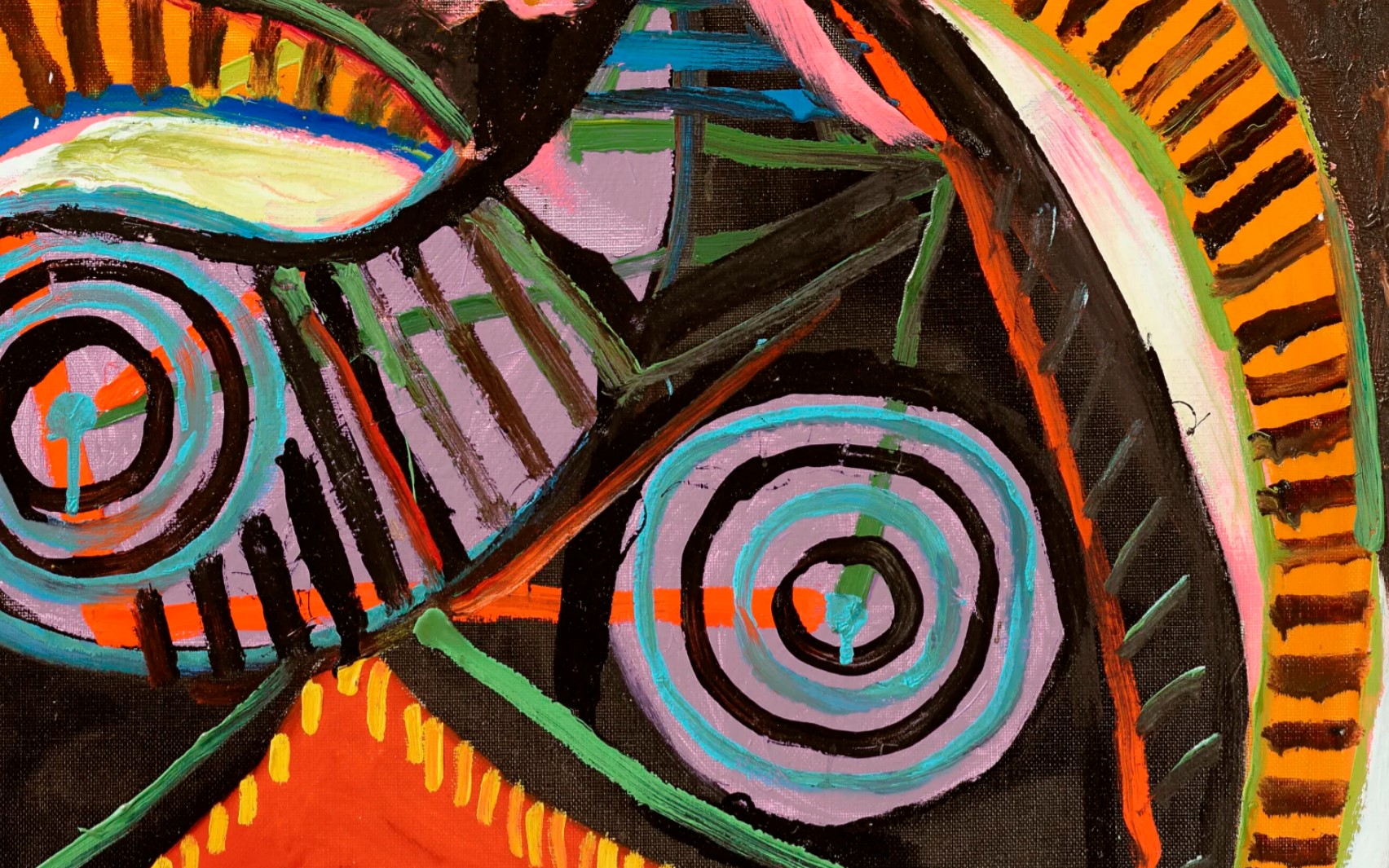
Produced in a variety of richly vibrant shades and designed to provide an even, opaque coverage, Ripolin was fast drying and resulted in a smooth, glossy, enamel finish. However, when applied in thicker layers the paint had a tendency to shift during the drying process, often resulting in wrinkling effects that lent the finished compositions a richly textured surface. Such rippling and creasing can be seen in certain passages of L’Arlésienne (Lee Miller), the vibrant yellow pigment subtly crinkling in unexpected ways that interrupt the smooth finish of the semi-gloss material. At one point, the Ripolin layer peels away dramatically, perhaps the result of an errant air bubble, revealing layers of matte paint below, that transition from delicately variegated pink to soft blue hues. Relishing the chance effects that arose from playing with such materials and the presence of his artistic comrades, Picasso’s imagination was stimulated, resulting in an outpouring of richly worked, vibrant portraits.
Buste de jeune fille (Paloma), 1951
Christie’s New-York: 13 May 2023
Estimated: USD 1,200,000 – 1,800,000
USD 1,925,500
PABLO PICASSO (1881-1973) (christies.com)
PABLO PICASSO (1881-1973)
Buste de jeune fille (Paloma), 1951
Oil and ripolin on canvas
54.6 x 33 cm (21 1/2 x 13 inches)
Sated ‘7.1.51’ (on the reverse)
Picasso painted this vibrant, bust-length portrait of his daughter Paloma on 7 January 1951, when she was nearly two years old. The artist depicted Paloma as an adorable, chubby toddler with a cheerful expression, outlining her pudgy cheeks, chin and fingers with confident swoops of bright green paint. Her cropped, dark-brown hair and fringe, adorned with a cobalt blue bow, are similarly invoked with simple, striated brushstrokes. Paloma is dressed like a miniature version of her father; she wears a charming Breton sweater, similar to the striped nautical top that formed part of Picasso’s own painterly uniform while living in the south of France. This likeness of Paloma is an expression of paternal tenderness and affection, but also of the joyous energy that suffused the artist’s work in the early 1950s.
Homme portant un enfant, 1965
Sotheby’s Hong-Kong: 5 April 2023
Estimated: HKD 25,000,000 – 40,000,000
HKD 30,700,000 / USD 3,911,240
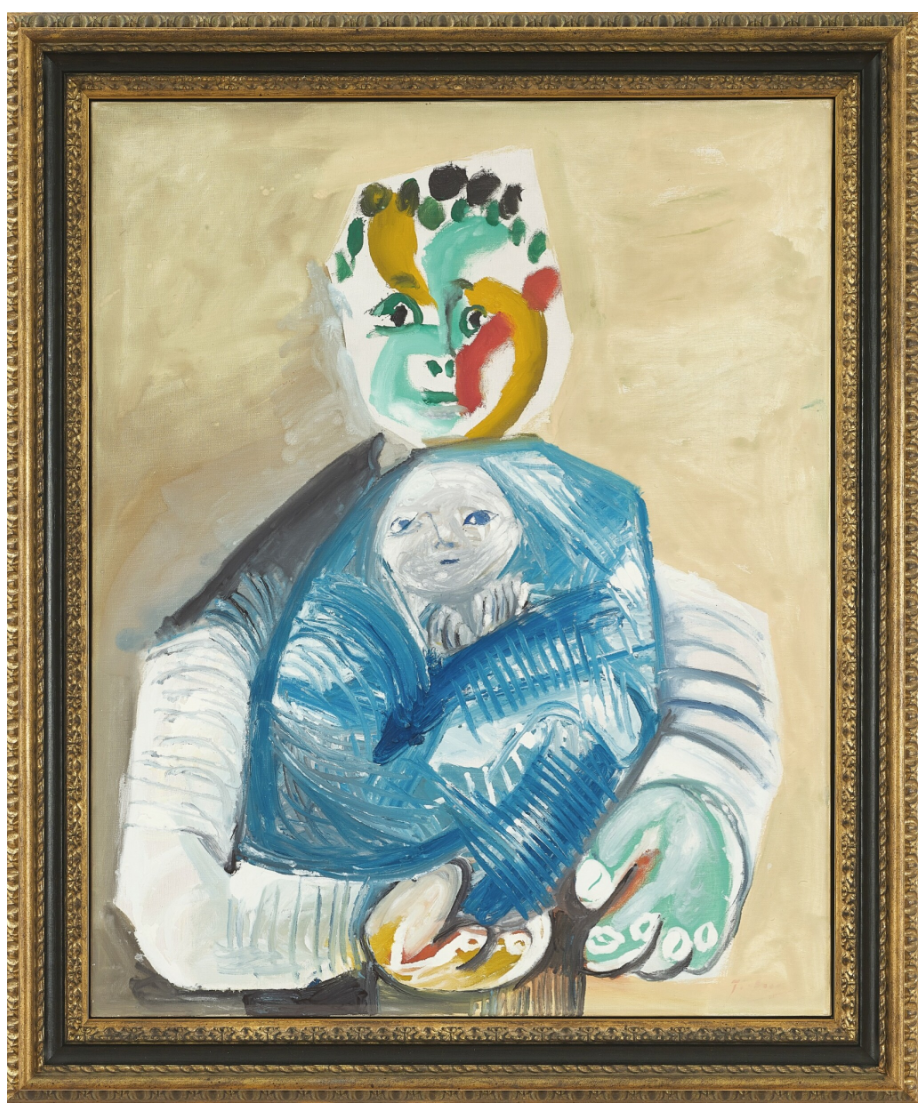
PABLO PICASSO (1881 – 1973)
Homme portant un enfant, 1965
Oil on canvas
100 x 81.5 cm (39 3/8 x 32 inches)
Signed Picasso (lower right)
Sated and numbered 22.2.65.IV (on the verso)
Executed on 22 February 1965
Painted in 1965, Homme portant un enfant showcases the complexity that defines Picasso’s mature period. At the time that the present work was painted, Picasso reaffirmed his international recognition as one of the pioneers of 20th century art: in the Spring of this year, Cecil Beaton visited Picasso in his villa Notre-Dame-de-Vie in Mougins and took his iconic photographs of the artist for an article that he would publish for Vogue, entitled ‘Golden Picasso’. One year later, Homme portant un enfant was exhibited at the seminal solo exhibition of Picasso’s work Hommage à Pablo Picasso which took place in 1966-67 at the Grand Palais in Paris. Painted with the characteristic freedom of line found in the artist’s late works, the expressive brushstrokes of Homme portant un enfant speak to Picasso’s increasing desire to imbue his works with a sense of exuberance. In the mid-1960s, Picasso combatted his thoughts of aging with a burst of youthful and creative expression and this resulted in a profusion of musketeers, matadors and a greater focus on male figure. Homme portant un enfant belongs to a series of têtes and half-portraits featuring unidentified young men, some of which are portrayed with children, such as the present. These paintings took on a protean nature, hailing from a diverse array of sources: sometimes they adopted elements of self-portraiture, at other times they represented his father José Ruiz y Blasco and often they referred to the paintings of Old Masters. In Homme portant un enfant, the male figure has dark curly hair evocative of youth and is depicted wearing a striped shirt or marinière, which given Picasso’s fondness for the marinière, acts as a signature of sorts. In the strength of the figure’s gaze it is also possible to see the artist’s own mirada fuerte.
Children had always held an important place in Picasso’s art and in his later works their presence feels particularly poignant as the artist explored themes of virility, vitality and rebirth representative of his desire to reclaim youthfulness. Picasso revisits this male sitter and cocooned baby a few times in Mougins, often in black and white. In all these depictions, the child is ensconced and shielded within the man’s safe embrace, suggestive of the artist’s fascination with childhood. A similar subject appears in Picasso’s Le peintre au travail II, in the Museu Picasso, Barcelona. As with many of Picasso’s portraits executed throughout various stages of his career, the artist makes references to, and derives inspiration from, earlier art historical periods. Homme portant un enfant becomes an enduring symbol of the human experience. The present work showcases Picasso’s skillful ability to render his subjects with sparing brushstrokes, evoking a striking sense of vigor. He delineates the essential features of the male sitter with stark black lines including his eyes, curly hair, broad shoulders, and protective hands. The clarity of line employed by the artist is balanced by a carefully considered chromatic arrangement. Picasso employs a palette consisting of primarily neutral tones that alludes to the portraits of the Spanish masters that he so revered, such as Velázquez and Goya in their adept handling of black. The positioning of the male figure and the way in which he turns to confront the viewer also recalls the sitters found in the works of the Old Masters. In his later years, Picasso was turning more often to the art of the past and re-envisioning it through his unique artistic vision. In the present work, Picasso instils a levity and avant-garde energy into the composition through the bright injection of colour in the figure’s face and the baby’s swaddling. Executed on an impressive scale, Homme portant un enfant is a striking and universal portrait of the human condition that both looks back to the art of the past, whilst paving the way forwards and shaping the direction of Western art history.
Sculptures
Tête de femme, 1951
Sotheby’s London: 6 March 2024
Estimated: GBP 2,500,000 – 4,000,000
GBP 3,073,000 / USD 3,896,564
PABLO PICASSO (1881 – 1972)
Tête de femme, 1951
Bronze
Height: 54.1 cm (21 1/4 inches)
Numbered 1/6 (on the base)
Conceived in Vallauris in 1951 and cast in bronze by the Godard Foundry, Paris
This work is number 1 from an edition of 6 examples plus 1 artist’s proof
Conceived in 1951 at the height of Picasso’s relationship with painter Françoise Gilot, Tête de femme arises from the innovative period of creation fostered during the artist’s stay on the Côte d’Azur.
FRANÇOISE GILOT AND PABLO PICASSO, VALLAURIS, 1952, PHOTO: BORIS LIPNITZKI / STUDIO LIPNITZKI / ROGER-VIOLLET. © SUCCESSION PICASSO/DACS, LONDON 2024
In 1948, Picasso and Gilot settled in Vallauris, a town nestled between Antibes and Cannes known for its pottery tradition. Soon after, Picasso discovered Le Fournas, an abandoned perfume factory which he then adopted and converted into his ceramic studio. The artist made a habit of walking to his studio, passing a field along the way which served as a dumping ground for local potters. The discarded bits of ceramics, worn tools and shards of metal and wood provided endless sources of inspiration for Picasso, who would soon incorporate his finds into his sculpture practice.
Gilot would accompany him on these ‘hunting’ expeditions, pushing an old baby carriage into which Picasso would deposit his latest finds. When she asked him why he bothered collecting discarded bits and broken pieces rather than starting anew, Picasso replied “The material itself, the form and texture of those pieces, often gives me the key to the whole sculpture… I’m out to fool the mind rather than the eye” (Pablo Picasso quoted in Exh. Cat., New York, Gagosian, Picasso and Françoise Gilot: Paris-Vallauris, 1943-1953, 2012, p. 238).
In 1951, Tête de femme was born from such a process. Inspired in part by the ceramic cast-offs and the commonplace objects around him, and with his lover as muse, Picasso gave life to the plaster form of Tête de femme. Gilot later wrote a book detailing this period of her life with the artist and spoke directly to the work’s genesis and her role as subject:
PICASSO AND THE PLASTER OF TÊTE DE FEMME, PHOTO: ULLSTEIN BILD / GRANGER © SUCCESSION PICASSO/DACS, LONDON 2024
As with many of Picasso’s works, Tête de femme is richly biographical and marks a unique period in the artist’s life. Ensconced in the serene environment of southeastern France with his partner and two children, Picasso enjoyed years of artistic exploration as well as family time. The late 1940s and early 1950s are thus characterised by a wealth of portraits, direct and indirect, of Gilot and the young Claude and Paloma. The artist’s depictions of Gilot in particular became increasingly stylized, often conveying a sense of fecundity and grace. She later recalled Picasso musing, “I’ve been wondering how I could get across the idea that you belong to the vegetable kingdom rather than the animal. I’ve never felt impelled to portray anyone else this way. It’s strange, isn’t it? I think it’s just right, though. It represents you” (Pablo Picasso quoted in Francoise Gilot and Carlton Lake, Life with Picasso, New York, 1964, p. 229).
FRANÇOISE GILOT, VALLAURIS, FRANCE. IMAGE: GJON MILI / THE LIFE PICTURE COLLECTION / SHUTTERSTOCK
Another cast of Tête de femme is in the collection of the Hirshhorn Museum and Sculpture Garden in Washington, D.C. Having been sold through Galerie Louise Leiris, Picasso’s primary dealer in his later career, the present work has been held in the same family collection for generations and is the first cast of Tête de femme to ever to appear at auction.
Femme assise, 1937
Sotheby’s New-York: 16 May 2023
Estimated: USD 600,000 – 800,000
USD 2,419,500
Femme assise | Modern Evening Auction | 2023 | Sotheby’s (sothebys.com)
PABLO PICASSO (1881 – 1973)
Femme assise, 1937
Bronze
Height: 54.5 cm (21 1/2 inches)
Conceived in wood in Boisgeloup circa 1930-31 and cast in bronze in 1937 in an edition of 4
In the spring of 1930, Picasso purchased the Château de Boisgeloup, a large estate forty-five kilometers northwest of Paris. There, he converted the stables to his own personal sculpture studio, where he at last was afforded the space and freedom to dedicate himself to the discipline. The very first sculptures executed in his new studios consisted of a suite of delicately whittled wood figurines carved from collected branches and discarded painting stretchers—Femme assise among them.
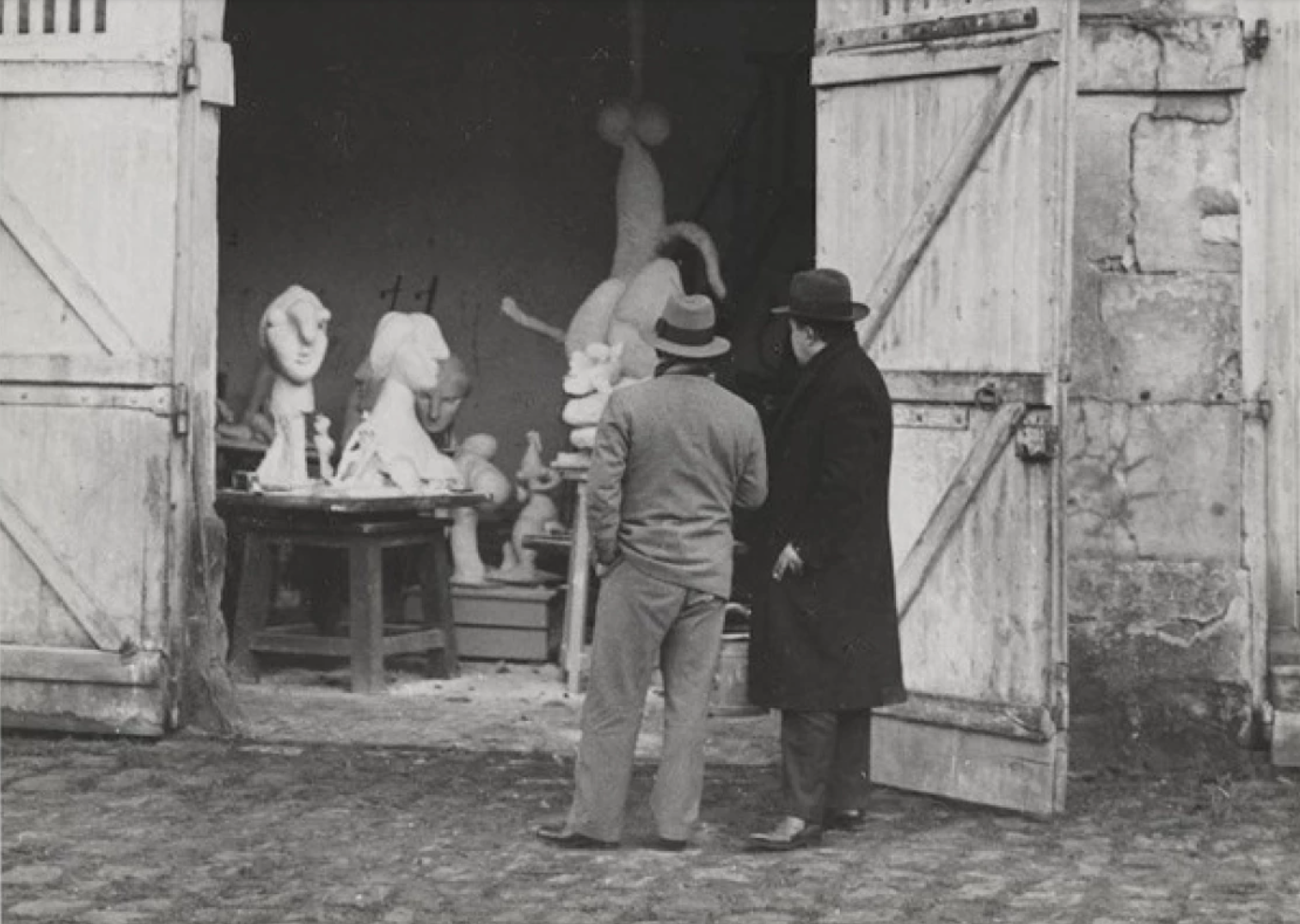
BRASSAÏ, PABLO PICASSO AND TÉRIADE IN FRONT OF THE SCULPTURE STUDIO IN BOISGELOUP, GISORS, IN WINTER 1932-33 ART © 2023 ESTATE OF PABLO PICASSO / ARTISTS RIGHTS SOCIETY (ARS), NEW YORK
These tapered and stylized forms can be seen as a response to the Surrealist impetus as Picasso let the medium and his subconscious guide his creation, responding intuitively to the variegated fibers, notches and grooves of the individual pieces of wood. By this time in Paris, images of Etruscan and African sculptures proliferated within artistic circles, leaving their imprint on the fabric of twentieth century art. Surrealist publications like Documents published a trio of Etruscan sculptures from European museums, the hallmarks of which are evident in the slender human figure of Femme assise.
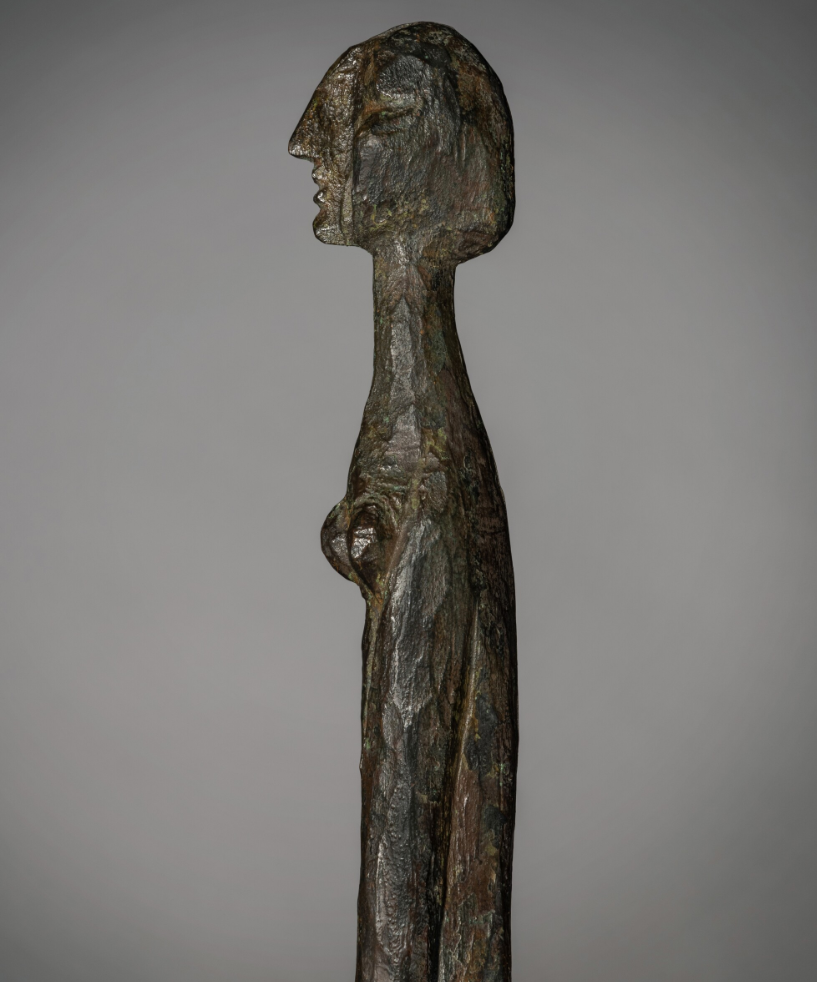
These elegant and intimately scaled objects may have provided a reprieve from both the large welding projects created with González for the monument to Apollinaire as well as the swelling, biomorphic plasters heads and busts of Marie-Thérèse of the period. This extraordinary and limited group of figurines was produced in a short burst of creativity before Picasso focused on the pneumatic forms of his lover and muse Marie-Thérèse Walter in the following years.
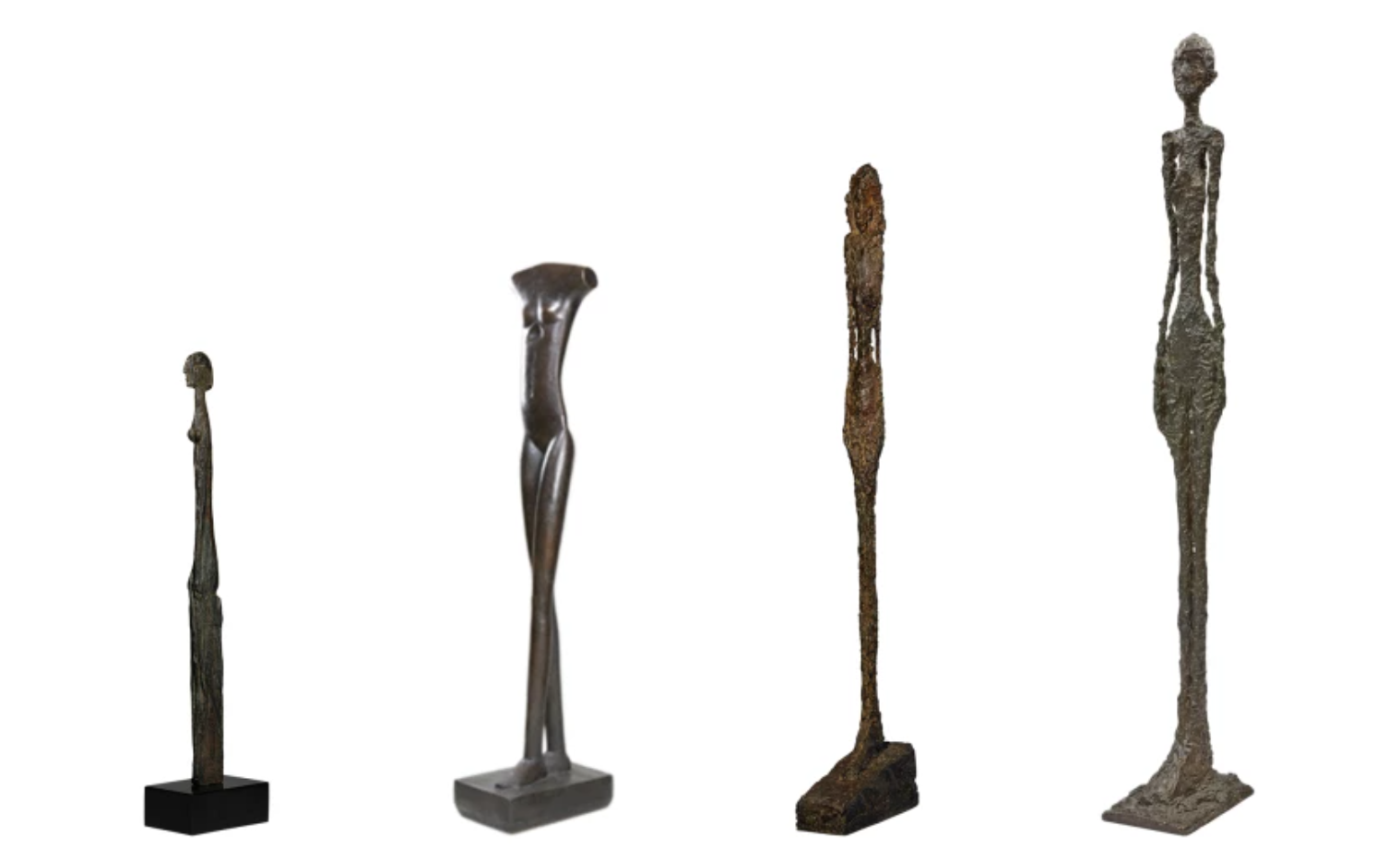
FROM LEFT TO RIGHT: THE PRESENT WORK © 2023 ESTATE OF PABLO PICASSO / ARTISTS RIGHTS SOCIETY (ARS), NEW YORK
ALBERTO GIACOMETTI, WALKING WOMAN, 1932-3; 1936, CAST 1966, BRONZE, TATE, LONDON © 2023 ARTISTS RIGHTS SOCIETY (ARS), NEW YORK
ALBERTO GIACOMETTI, FEMME LEONI, 1947; CAST 1960, BRONZE © 2023 ARTISTS RIGHTS SOCIETY (ARS), NEW YORK
ALBERTO GIACOMETTI, GRANDE FEMME I, 1960, BRONZE, PRIVATE COLLECTION, SOLD: SOTHEBY’S, NEW YORK, OCTOBER 2020, ESTIMATED IN EXCESS OF $90 MILLION © 2023 ARTISTS RIGHTS SOCIETY (ARS), NEW YORK
The lithe carved and cast forms made a lasting impression on Alberto Giacometti who met Picasso in 1931 and saw him regularly for the next twenty years. Upon first acquaintance the two artists became incredibly close. Elongated forms like Femme debout were almost certainly the basis of the younger sculptor’s earliest experiments with attenuated form, which initially arose in works like La Femme qui marche and culminated in the awesome figures of Femme Leoni and Grand femme. It is impossible to understand Giacometti’s ‘Surrealist period’ of the 1930s without keeping in mind all that Picasso’s art offered him at this time. Given the bearing which Giacometti’s sculpture had on the course of twentieth-century art it is difficult to overestimate the importance of the daring group of figurines by Picasso which first inspired him. A hallmark of Picasso’s creative spirit and testament to his legacy in sculpture, Femme assise was generously gifted to the Walker Art Center by Kenneth and Judy Dayton, Minneapolis. Proceeds of the sale with benefit the institution.
Le Peintre et son modele
Le peintre et son modèle, 1964
THE PROPERTY OF A DISTINGUISHED PRIVATE COLLECTOR
Christie’s London: 5 March 2026
Estimated: GBP 7,000,000 – 10,000,000
GBP 8,520,000 / USD 11,381,870
PABLO PICASSO (1881-1973), Le peintre et son modèle | Christie’s
REPEAT SALE
Christie’s New-York: 19 November 2022
Estimated: USD 8,000,000 – 12,000,000
USD 10,351,500
PABLO PICASSO (1881-1973), Le peintre et son modèle | Christie’s
PABLO PICASSO (1881-1973)
Le peintre et son modèle, 1964
Oil and Ripolin on canvas
130×195 cm (51-1/8 x 76-3/4 inches)
Signed ‘Picasso’ (lower left)
Dated ‘8.9.11.64.’ (on the reverse)
Painted in Mougins on 8-9 November 1964
For Pablo Picasso, there was no subject as fundamental and immediately relevant to the daily travail of a painter as that of the vital exchange between the artist and his model. Between 1963-1965, Picasso devoted himself almost exclusively to this theme in his art, producing an extended sequence of oil paintings that offered intriguing variations and evolutions of the subject, each delving into this stimulating relationship and the way that it informed and underpinned the creative process. Though the theme of the artist and model had woven its way through the various strands of Picasso’s multi-faceted oeuvre through the years, never before had the artist explored the subject so closely and with such intensity. Le peintre et son modèle is a quintessential example of this great series, executed on an unusually large scale in the late autumn of 1964. Painted in bold, gestural strokes of pigment, the composition captures the energy and immediacy of Picasso’s painterly style during these years, as he sought to record the flow of ideas and images that poured forth from his imagination.
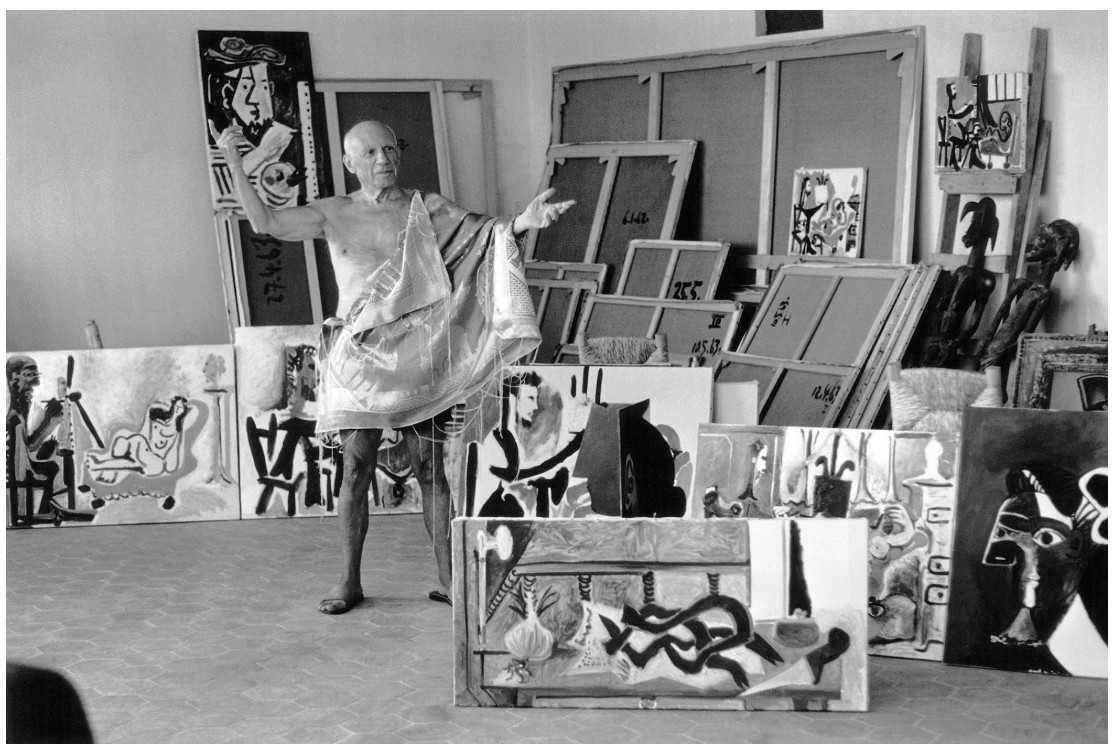
Pablo Picasso in his workshop in Antibes, France, in 1963. Photograph by Robert Doisneau. Photo by Robert DOISNEAU/Gamma-Rapho via Getty Images. Artwork: © 2026 Succession Picasso/DACS, London.
For Picasso, the return of the artist and model subject in his work, and the associated atelier scenes, often signaled an important change or transition in his art. In the 1960s, they marked the end of a decade long engagement with the legacy of his artistic predecessors, in which Picasso analyzed and reconsidered some of the most renowned compositions by a coterie of great masters, from Eugène Delacroix and Diego Velázquez, to Edouard Manet and Nicolas Poussin. Turning away from the art of the past, Picasso began to hone in on the very nature of art making itself, examining the essential artistic relationship of the painter and his subject. As if trying to find the key to his own innate abilities as a painter, he focused entirely on the realm of the studio, the private, haloed sanctum of artistic inspiration and creativity. Here, as Marie-Laure Bernadac described, he captured in his canvases ‘the impossible, the secret alchemy that takes place between the real model, the artist’s vision and feeling, and the reality of paint’ (Late Picasso, exh. cat., The Tate Gallery, London, 1988, p. 76).
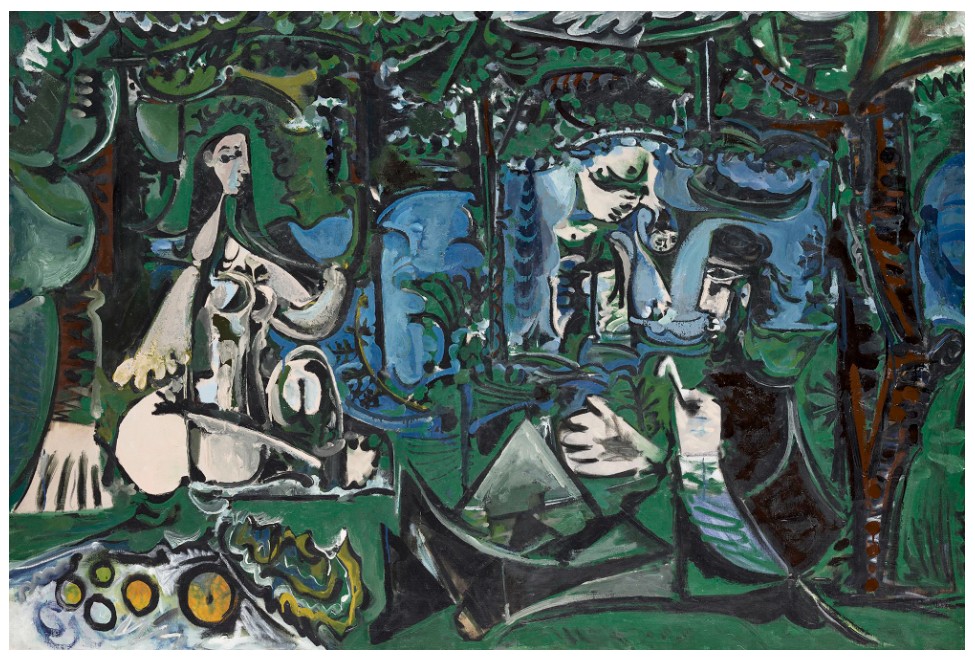
Pablo Picasso, Le Déjeuner sur l’herbe d’après Manet, 1960. Musée national Picasso-Paris. Artwork: © 2026 Succession Picasso/DACS, London. Digital image: © GrandPalaisRmn (musée national Picasso-Paris) / Mathieu Rabeau.
Over the course of two weeks in February 1963, Picasso filled the pages of a small carnet with more than two dozen sketches of a studio interior, in which a painter is seen working at his easel in the presence of a reclining nude model (Musée Picasso, Carnet no. 59). On 2 March, he began to explore the subject in oils (Zervos, vol. 23, no. 154; Kunstmuseum St. Gallen), marking the beginning of this dynamic series of works that would grip his imagination for two years. Hélène Parmelin, the wife of painter Edouard Pignon, both of whom were close friends of the artist, recounted the excitement surrounding the inception of these works: ‘Picasso lets loose. He paints “The Painter and his Model.” And from that moment on he paints like a madman, perhaps never before with such frenzy’ (Picasso: The Artist and His Model, New York, 1965, p. 10). ‘And now he says he is turning his back on everything,’ Parmelin recorded. ‘He says he is embarking upon an incredible adventure. He says that everything is changed; it is over and done with; painting is completely different from what one had thought – perhaps it is even the opposite. It is a time that he declares himself ready to kill modern “art” – and hence art itself – in order to rediscover painting…’ (ibid., pp. 9-10).
“Paintings are but research and experiment. I never do a painting as a work of art. I search incessantly, and there is a logical sequence in all this research… It’s an experiment in time.”
Residing in almost complete seclusion with his wife Jacqueline at Notre-Dame-de-Vie in Mougins during these years, Picasso was able to immerse himself entirely in his work, painting without disturbance for long hours each day. The result was an exuberant burst of creativity that belied the artist’s age, as he produced an astounding body of work that valiantly proclaimed his undiminished powers of creation. Taking great pleasure in the act of painting itself, he allowed process to take prominence over the finished image. ‘It’s the movement of painting that interests me,’ he once explained, ‘the dramatic movement from one effort to the next, even if those efforts are perhaps not pushed to their ultimate end… I’ve reached the moment, you see, when the movement of my thought interests me more than the thought itself’ (quoted in E. Cowling, Picasso: Style and Meaning, London, 2002, p. 640). The resulting works delve into the fundamental connection between the artist and his muse, revelling in the very act of looking itself, and the ways in which the figure could be translated through the artist’s subjective vision, into a paean of the female form.
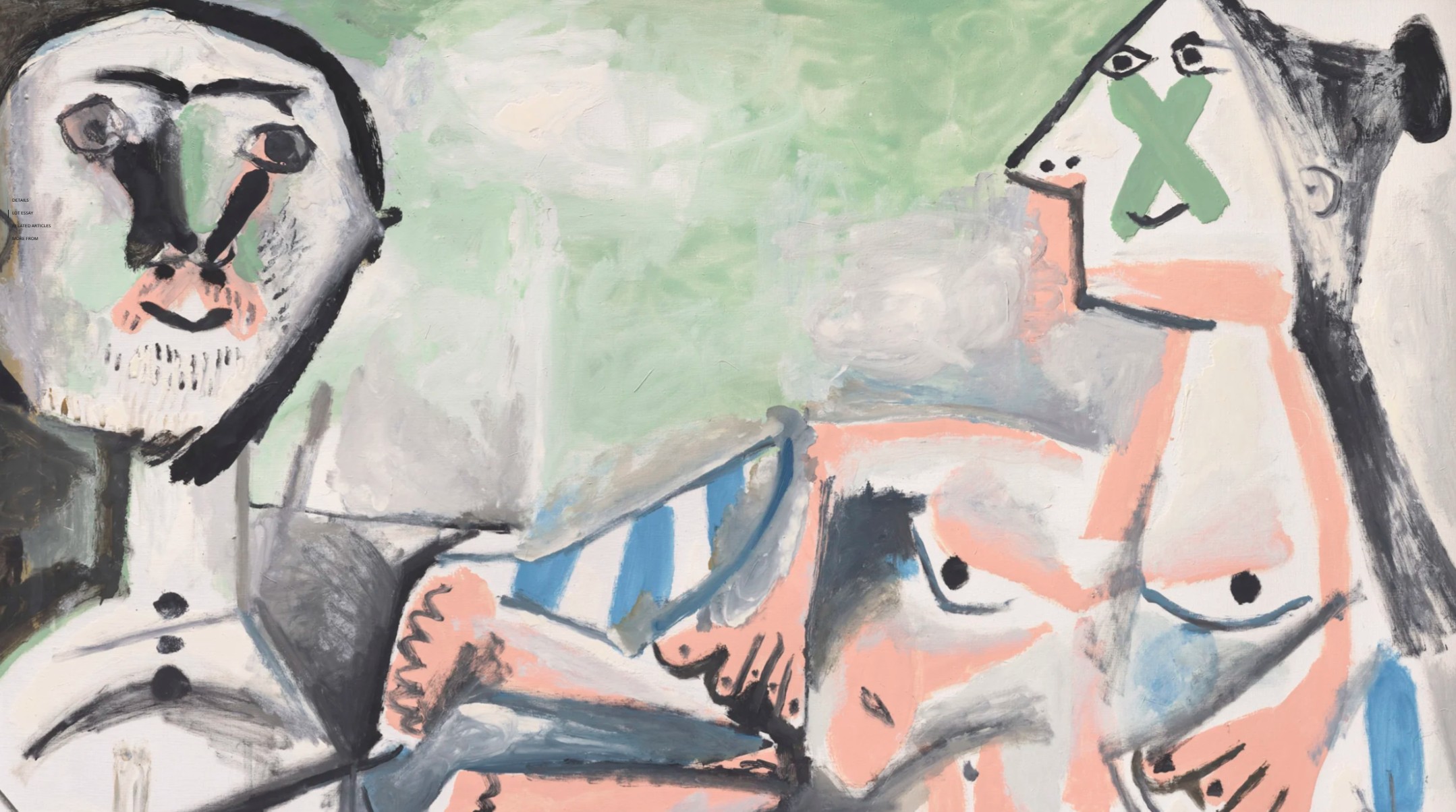
As the series developed through 1963-1965, Picasso explored different compositional ideas and variations on the central pairing. In many of the works, the artist and model appear together, as in Le peintre et son modèle, highlighting the interaction between the two figures. Here, their gazes connect, their expressions smiling and serene, as they both watch one another. A minimally described brush, palette and the barest suggestion of an easel are discernible in the bottom left corner of the composition, while the artist himself appears to be turning away from his tools to speak to his female companion, who is gently enveloped in folds of blue and white fabric that recall the striped sailor’s shirt the artist was renowned for wearing.
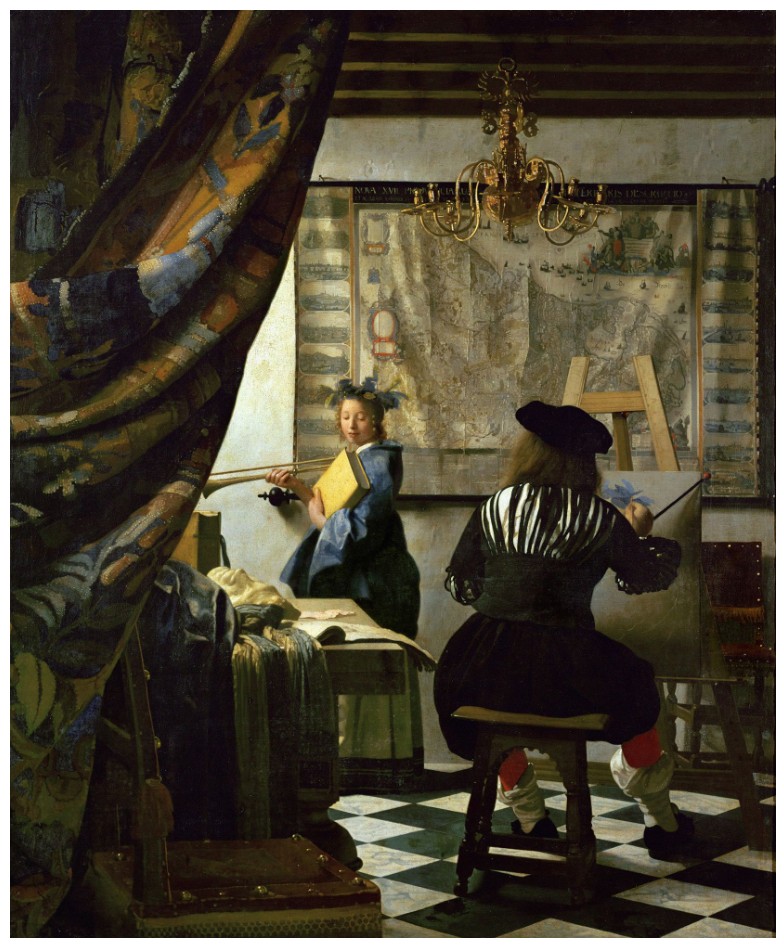
Johannes Vermeer, The Art of Painting, circa 1666-1668. Kunsthistorisches Museum, Vienna. Digital image: © 2026 Photo Austrian Archives/Scala Florence.
In some works devoted to the theme, the painter is seen alone, quietly contemplating his easel, as he wrestles with translating his vision onto canvas. Other paintings from this period showcase the nude female figure alone, while simultaneously leaving the presence of the artist implied, as if the viewer has been transported into his place and granted the privileged position that he enjoys, looking straight at his model’s sensuous form. Throughout the series, the male subjects are almost invariably stand-ins for Picasso himself, while the models appear to pay homage to the artist’s wife, Jacqueline, whom he had met in the early 1950s, and subsequently married in 1961. Though she never modelled for him in the traditional sense, Jacqueline’s presence permeated every aspect of Picasso’s work, her petite, yet voluptuous, form captivating his imagination and inspiring a myriad of sculptures, drawings, etchings and paintings in her likeness.
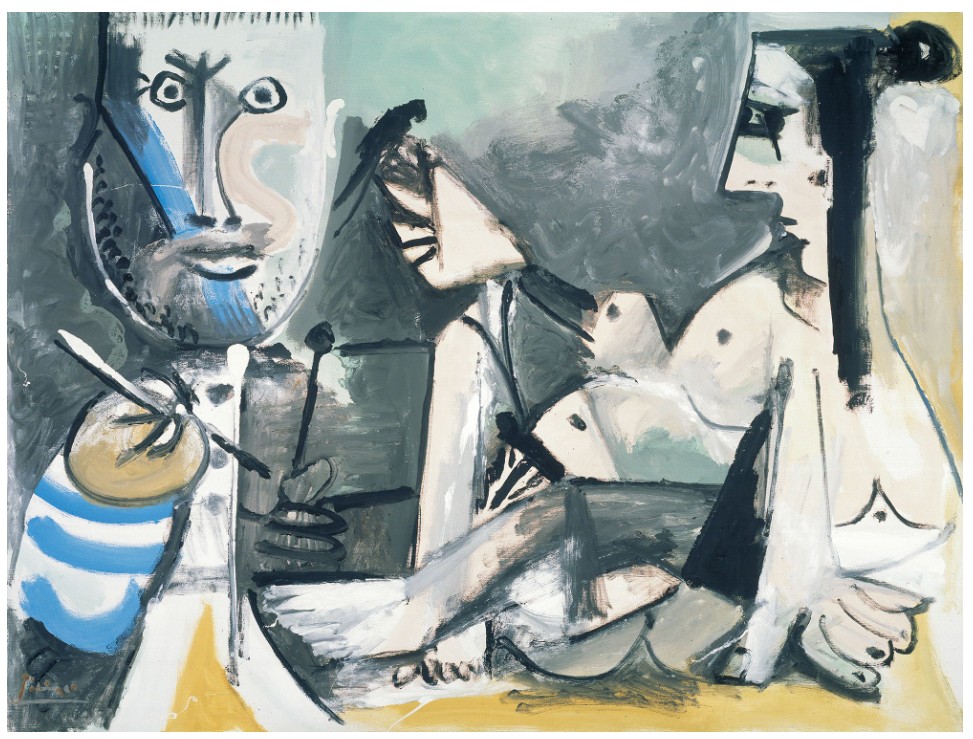
Pablo Picasso, Le peintre et son modèle, 1964. Buffalo AKG Art Museum. Artwork: © 2026 Succession Picasso/DACS, London. Digital image: © 2026 Buffalo AKG Art Museum/Art Resource, NY/Scala, Florence.
Dating to late 1964, Le peintre et son modèle reveals the distinctive shifts that were occurring in Picasso’s painterly style at this moment in time, as his brushstroke became increasingly freer and more gestural, describing his forms through simple, graphic signs. Using large canvases executed in both vertical and horizontal format, his works from these months are marked by a lighter, pastel palette of delicate pale greens and pink or lavender tones, as if painted with the silvery winter Mediterranean light flooding through the windows into the studio. Picasso applies his colours with a heavily loaded brush, modelling his figures’ forms in long, sinuous strokes of pigment, the paintbrush zig-zagging and sweeping across the canvas in broad passages of paint that trace the movement of the artist’s hand. Laid over these hues is a series of black lines that define the essential features of the male painter and female nude, their bodies appearing from an almost cryptogram-like arrangement of lines and shapes that delineate the essential structures of their faces and bodies.
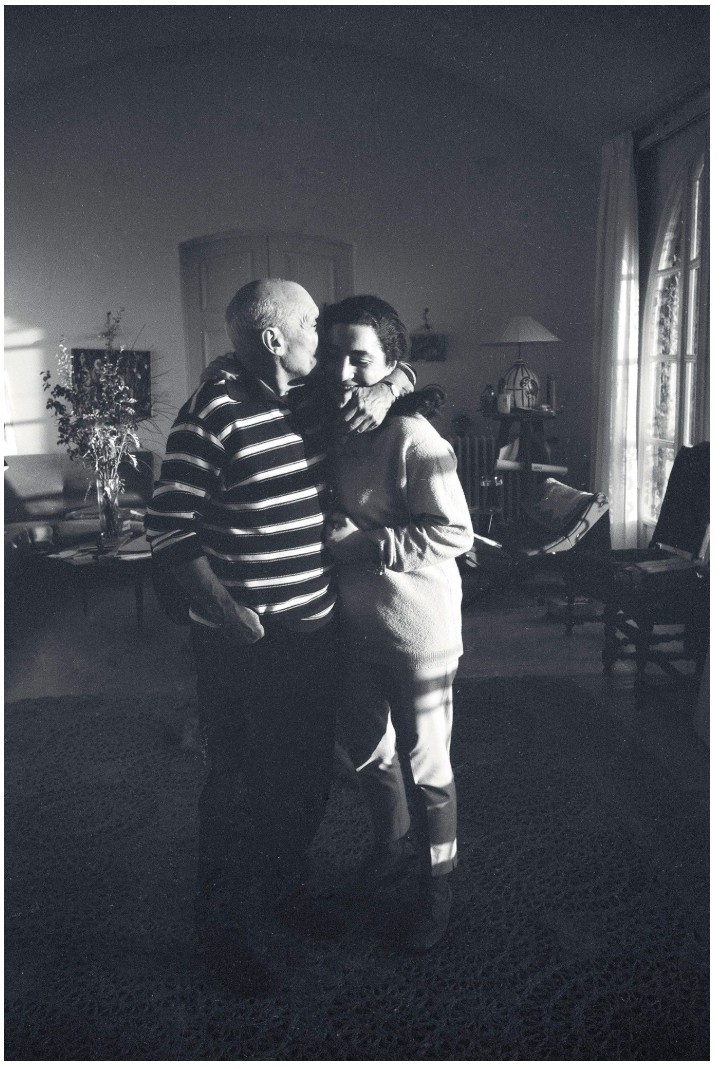
Picasso and Jacqueline at Notre-Dame-de-Vie, Mougins, 14 February 1962. Photograph by Edward Quinn. Photo: Edward Quinn, © edwardquinn.com. © 2026 Succession Picasso/DACS, London.
This abbreviated style of painting, which the artist described as écriture-peinture, allowed Picasso to convey the essence of his figures quickly, and with a bold directness. Describing this approach, Marie-Laure Bernadac has explained it was ‘characterised by the juxtaposition of two ways of painting: one elliptical and stenographic, made up of ideograms, codified signs which can be inventoried; the other thick and flowing … Picasso thus combines a painterly form of writing with a painterly form of painting, a material literalism that lays bare and sets free the substance of paint…’ (exh. cat., op. cit., 1988, p. 85).
This technique brought his figures back to their essential elements, allowing Picasso to communicate to the viewer through a visual shorthand that prompted them to fill in the rest of the artist and model’s form in their mind’s eye. As Parmelin recalled, ‘Every time [Picasso] shows a canvas in which a dot is enough for a breast, a dash for the painter, five spots of colour for a foot, a few pink or green strokes… he says: “That’s enough, don’t you think? What more do I need to do? What can I add to that? I’ve said it all…’ (Picasso Says, trans. C. Trollope, London, 1966, p. 21).
Henri Matisse, Le peintre dans son atelier, 1916-1917. Musée National d’Art Moderne, Centre Pompidou, Paris. Digital image: © Centre Pompidou, MNAM-CCI, Dist. GrandPalaisRmn / Philippe Migeat, Christian Bahier.
When considered within the wider artistic moment of the 1960s, Le peintre et son modèle and the rest of this series once again show Picasso as an artist who remained at the very forefront of the avant-garde, continuing to subvert expectations. At this time, abstraction reigned supreme, with Pop art and Minimalism coming increasingly to the fore as dynamic new facets of post-war art. Traditional easel painting, many were suggesting, was redundant and outmoded, its future questionable in a time when industrial materials and mechanical techniques dominated artistic production. Yet, just as he had in the early twentieth century, Picasso defied expectation by remaining resolutely bound to the essential, time-honoured elements and processes of art.
“An artist should observe nature but never confuse it with painting. It is only translatable into painting by signs.”
His large canvases painted with gestural, lavish strokes of thick color and strident lines that depict, through timeless subjects of the artist or the model, the very act of painting itself, showed that the medium was far from dead. Indeed, as Picasso argued, it was thriving. ‘There is no abstract art,’ the artist had declared in 1935. ‘You must always start with something. Afterward you can remove all traces of reality. There’s no danger then, anyway, because the idea of the object will have left an indelible mark’ (quoted in K.L. Kleinfelder, The Artist, His Model, Her Image, His Gaze: Picasso’s Pursuit of the Model, Chicago and London, 1993, p. 137).
Nu assis appuyé sur des coussins, 1964
Christie’s Hong-Kong: 26 September 2025
Estimated: HKD 20,000,000 – 30,000,000
HKD 32,220,000 / USD 4,141,390
PABLO PICASSO (1881-1973)
Nu assis appuyé sur des coussins, 1964
Oil on canvas
54×73 cm (21 1/4 x 28 3/4 inches)
Dated and numbered ‘19.12. 64. III’ (on the reverse)
Painted on 19 December 1964
At once solemn and sensuous, Nu assis appuyé sur des coussins embodies Pablo Picasso’s continuing spontaneity and boundless inventiveness during the great late period of his career. Depicting the artist’s wife and final muse, Jacqueline Roque, the painting radically reimagines the art historical tradition of the reclining nude for a 20th century audience. Painted in December 1964, the work remained with Picasso until his death, and subsequently passed to the artist’s estate.
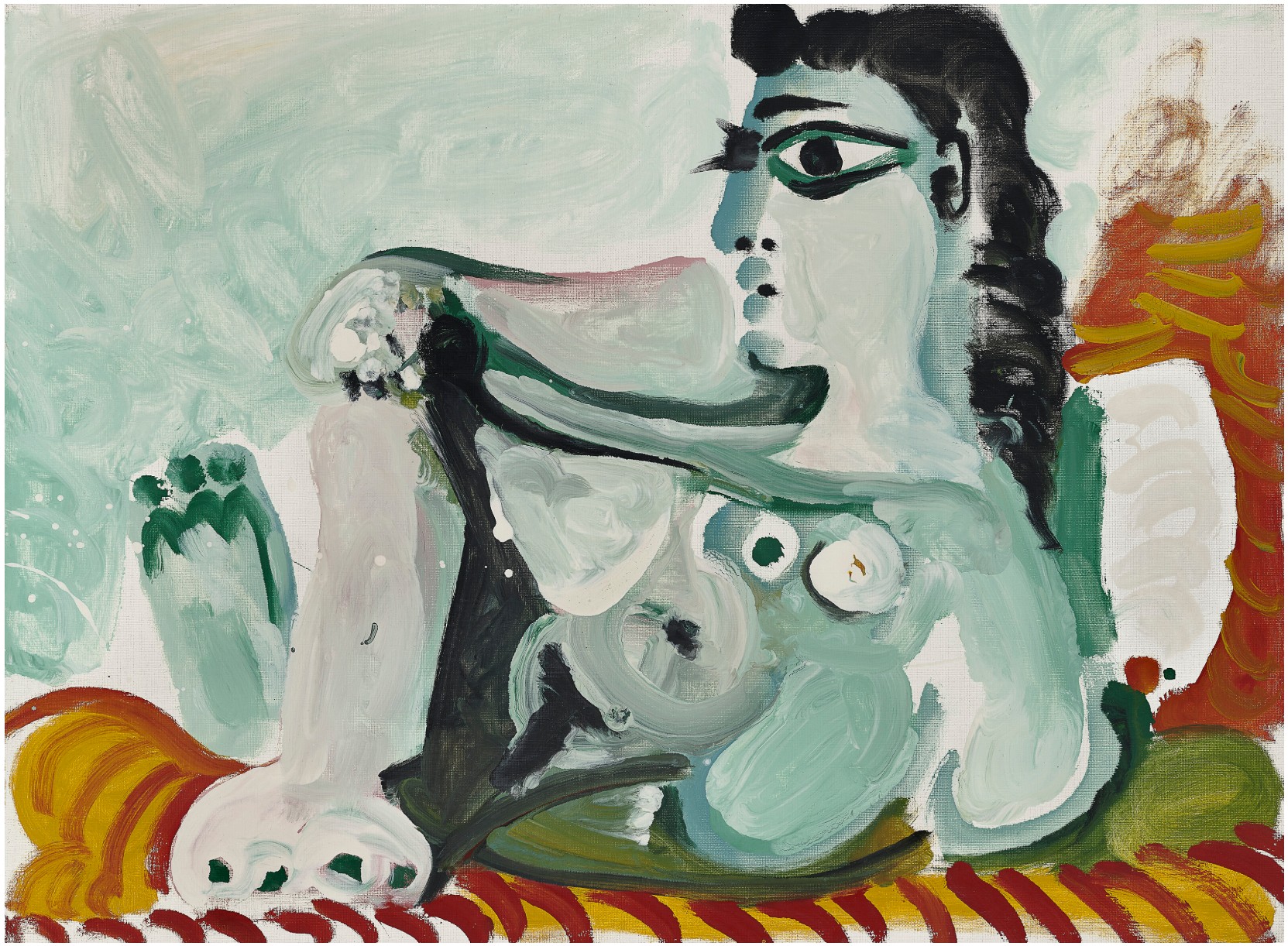
By 1961, Picasso had settled permanently at Notre-Dame-de-Vie in Mougins, the home he acquired as a gift for Jacqueline Roque shortly after their marriage the same year. Jacqueline, Picasso’s most enduring muse, possessed dark almond-shaped eyes, sculpted brows, pronounced cheekbones, and thick black hair—features that became central to Picasso’s painting during this stage of his career. Though she never formally posed in the studio, her presence was an inexhaustible source of inspiration for the artist and came to dominate Picasso’s work throughout the 1960s and 1970s.
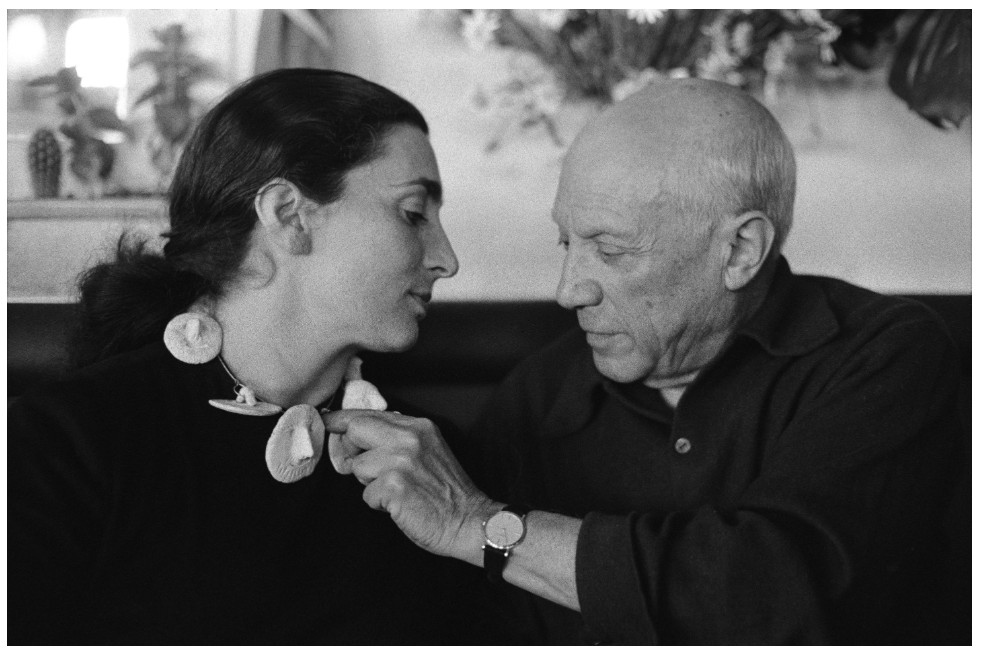
David Douglas Duncan, Picasso and Jacqueline Roque, c. 1957. Artwork: ©2025 Estate of Pablo Picasso / Artists Rights Society (ARS), New York. Image: David Douglas Duncan Papers and Photography Collection, © Harry Ransom Center, The University of Texas at Austin
Between 1963 and 1965, Picasso produced a remarkable series of canvases centered on the theme of the painter and his model—a subject that captivated his imagination throughout the early 1960s and became an almost exclusive focus, particularly in 1963-1964. In some, the artist appeared as the protagonist, with or without his muse; in others, as in this work, Jacqueline is shown alone, reclining on her divan. Marie-Laure Bernadac, curator of the 1988 exhibition Late Picasso at the Tate Gallery and Centre Pompidou, shrewdly pointed out the ultimate drive behind this series: “The more Picasso painted this theme, the more he pushed the artist-model relationship towards its ultimate conclusion: the artist embraces his model, cancelling out the barrier of the canvas and transforming the artist-model relationship into a man-woman relationship. Painting is an act of love” (“Picasso 1953-1972: Painting as Model” in Late Picasso, exh. cat., Tate, London, 1988, p. 77).
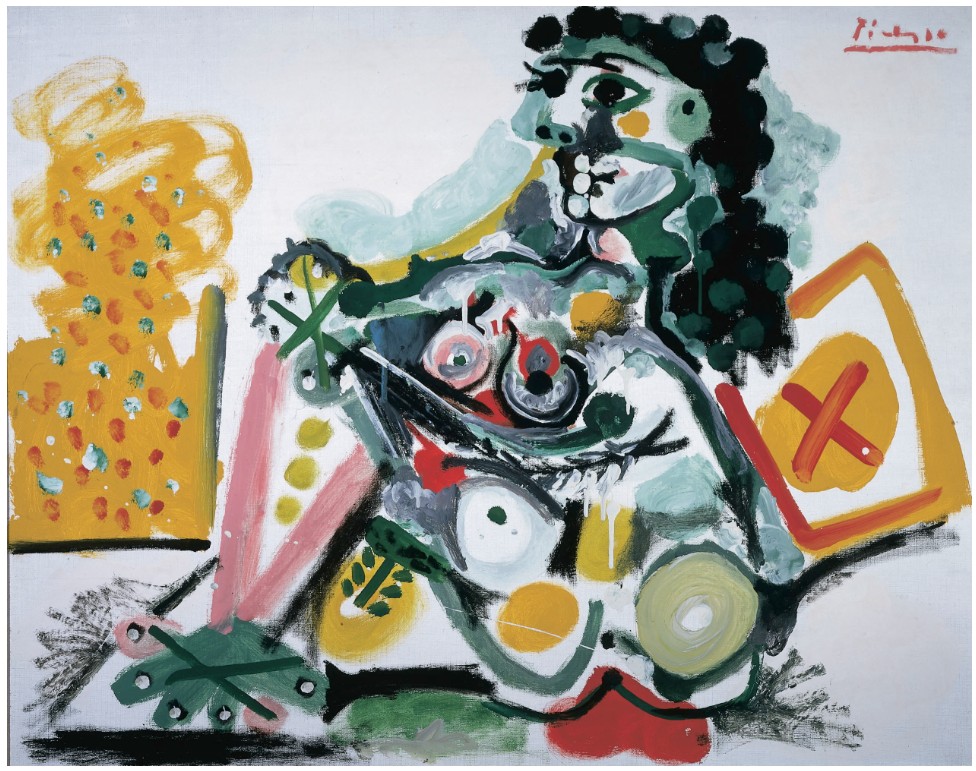
Pablo Picasso, Seated Nude Leaning on Pillows, 1964.
Artwork: © 2025 Estate of Picasso/Artists Rights Society (ARS). Image: The Kreeger Museum, Washington, DC
The reclining nude also belongs to a long art-historical tradition that Picasso continually revisited and reinterpreted. Since the Italian Renaissance, the female nude has been one of painting’s central subjects: Titian’s Venus of Urbino (1538) established an enduring model of the reclining goddess; Goya’s La Maja Desnuda (circa 1797–1800) modernized the theme by portraying a nude figure with an assertive and unapologetic presence, confronting traditional ideals of passive femininity; and in the 19th century, Ingres and Delacroix transformed the subject into odalisques, imbued with orientalist fantasy. Picasso’s lifelong friend and rival Henri Matisse extended this lineage into the 20th century with his radiant odalisques, such as Odalisque, harmonie rouge (1926–1927).
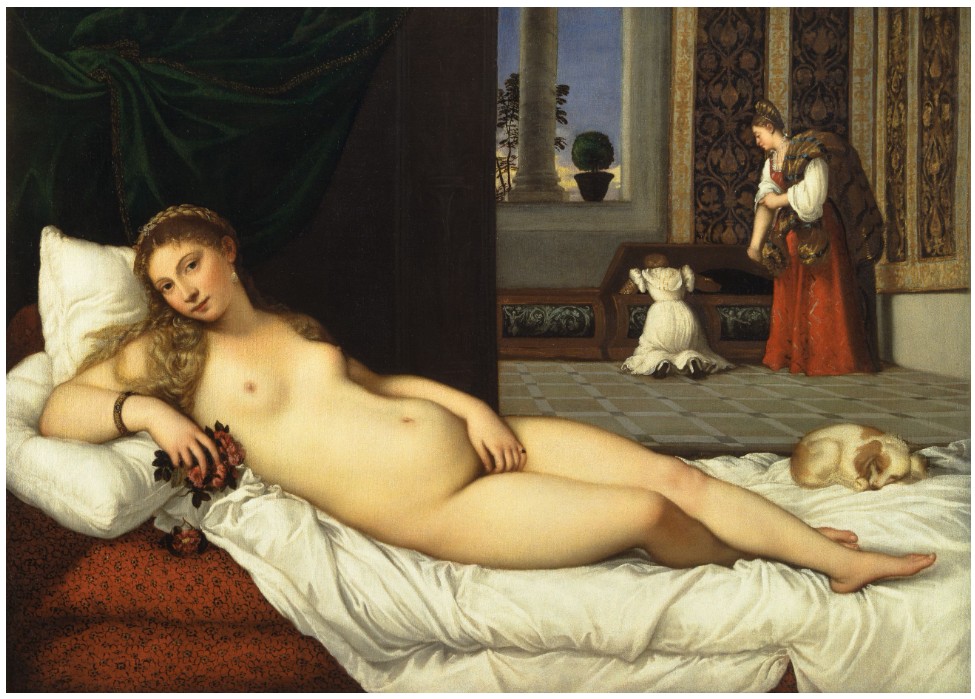
Titian, Venus of Urbino, 1538, Gallerie degli Uffizi, Florence. © Raffaello Bencini / Bridgeman Images
Within this tradition, Picasso reimagined the reclining nude through his own creative lens, transforming Jacqueline into both muse and archetype. Her body is distilled into flowing curves, her most sensual attributes emphasized through simplified line. Turquoise and aquamarine flesh are contoured in deep black and offset with touches of salmon pink on her arm, her form set against a boldly striped divan and white pillow. Together, these elements evoke a Mediterranean vision of warmth and light.
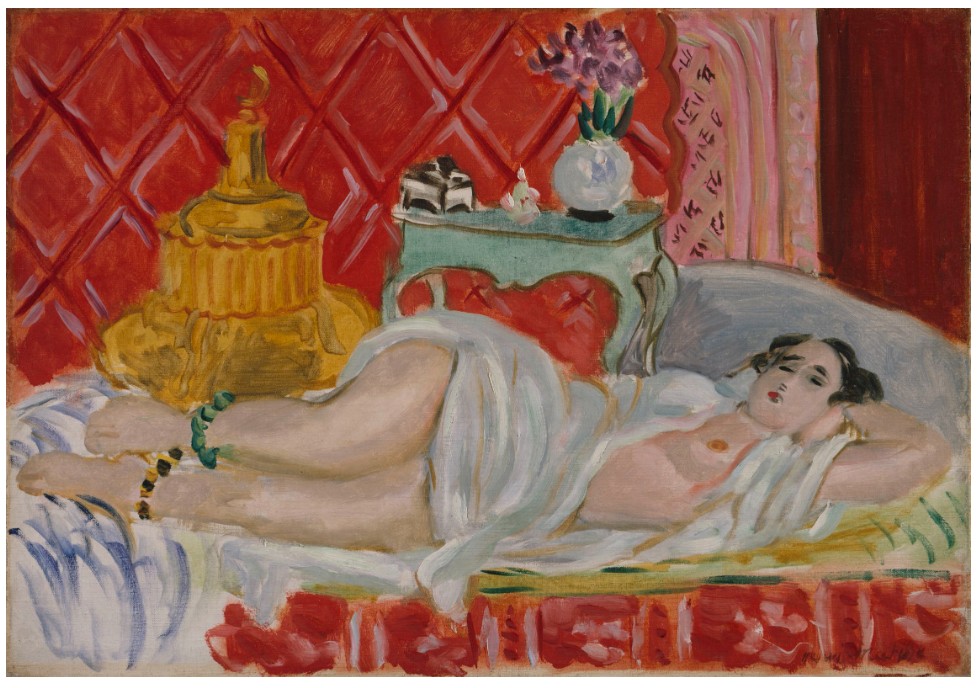
Henri Matisse, Odalisque, Harmony in Red, 1926–27.
Image copyright: © The Metropolitan Museum of Art. Image source: Art Resource, NY
Expressed through bold colors, free brushstrokes, and unrestrained imagination, Nu assis appuyé sur des coussins reveals both the physicality of the female form and the liberty of painting itself. Bernadac described this period in Picasso’s work as “characterized by the juxtaposition of two ways of painting: one elliptical and stenographic, made up of ideograms, codified signs which can be inventoried; and the other thick and flowing, a hastily applied matière of runny, impastoed, roughly brushed paint” (ibid., p. 85) The present work demonstrates both tendencies at play: the abbreviated line used to delineate Jacqueline’s body and essence, and the richness of pigment enlivening the surface with expressive vitality. Ultimately, this 1964 reclining nude embodies the fusion of art and life that defined Picasso’s final decades. Jacqueline is both the intimate companion of the artist and the universal figure of l’éternel féminin. Through her image, Picasso explored the lineage of the great European nude, while simultaneously reinventing it for the 20th century with unflinching passion and pictorial invention.
Le Peintre, 1963
Sotheby’s Hong-Kong: 5 April 2024
Estimated: HKD 66,000,000 – 90,000,000
HKD 78,724,000 / USD 10,064,434
PABLO PICASSO (1881 – 1973)
Le Peintre, 1963
Oil on canvas
92×60 cm (36 1/4 x 23 5/8 inches)
Signed Picasso (lower left)
Dated 8.6.63. III (on the verso)
Brimming with painterly verve, Le Peintre is both an exuberant homage to the craft Picasso devoted his life to and a reflective exploration of his identity as an artist. Recently included in the prestigious Fondation Beyeler exhibition Picasso. Artist and the Model: Last Paintings, the present work portrays one of the great motifs that dominated Picasso’s late œuvre – that of the artist at work. In Le Peintre, Picasso captures the moment of artistic inspiration, expressing the energy of the act of painting through strong, gestural brushstrokes, which delineate the figure of the painter; his face is held close to the canvas in an intense moment of concentration as he brandishes the paintbrush before him. In the 1960s and early 1970s, Picasso threw himself into the theme of the artist at work, producing several canvases that vary between works in which the painter is the sole subject and those in which there is an accompanying model. Although the theme had already been visited by Picasso in his early work – in paintings such as Le Peintre et son modèle of 1926 (Musée Picasso, Paris) or the one of 1928 (Museum of Modern Art, New York) – it was not until the 1960s that the subject acquired a fundamental importance in his art. In 1963, he painted more than fifty works on this subject, revealing his obsession with the study of the vocation of an artist.

THE PRESENT WORK WAS EXHIBITED AT FONDATION BEYELER, BASEL, PICASSO. ARTIST AND THE MODEL: LAST PAINTINGS, 2023.
In the present work, however, Picasso eliminates the presence of a model and instead shifts the focus entirely upon the artist. Although not explicitly identified as a self-portrait, the subject of Le Peintre can be read as autobiographical. As in other works in his painter series, Picasso clothes the figure in a blue striped Breton shirt, resembling those he often wore, to reinforce this connection. Picasso also splits the painter’s face in two, duplicating the profile to examine the multiple elements of the painter’s identity. With his yellow hat, palette of primary colors, youthful and naïve expression and stylish goatee, Picasso creates a lively character full of personality.
Beyond a youthful self-portrait, however, this work epitomizes Picasso’s obsession with and admiration for Van Gogh. The 1960s was the period in Picasso’s career when he seems to have been thinking particularly of Van Gogh. He was so fixated on the post-impressionist artist that he carried in his wallet for years the original news article detailing Van Gogh’s self-mutilation of his ear. The present work can be interpreted as a tribute to Van Gogh’s Self-Portrait with a Straw Hat series from 1887. Picasso’s application of chiaroscuro, the richness and spontaneity of his brushwork, and use of emblems such as the yellow hat are distinctly reminiscent of Van Gogh; it is as though in channeling the spirit of the artist, Picasso was himself rejuvenated in his late years. If Van Gogh was Picasso’s patron saint, the Old Masters were his apostles. For him, carrying the painterly mantle of the Old Masters became increasingly important and during the 1960s he devoted a decade to the reinterpretation of the great masters of the past; painting works inspired by Diego Velázquez, Rembrandt van Rijn, El Greco and Francisco Goya. This focus on the Old Masters was a pointed affirmation of his place in the revered lineage of the great figures within art historical canon. In its allusions to the traditions of the past and its dynamic execution, Le Peintre is a poignant commentary upon Picasso’s awareness of the rich artistic history behind him and a testament to his unending drive for creative innovation. This conflation of identities anticipates the musketeer series that would dominate the artist’s work later that decade and provides insight into how Picasso viewed the different aspects of his own personality. Throughout his oeuvre, Picasso’s male figures are the embodiment of masculine power, always rendered with an intensity which convey the bravura of the artist himself. In the present work, through the iconography of the artist at his easel, Picasso reflects on the complexity of his sentiments regarding his role as an artist.

PICASSO IN HIS STUDIO IN MOUGINS IN THE 1960S (THE PRESENT WORK SHOWN IN THE BACKGROUND).
Having gone through so many phases of stylistic and technical experimentation, Picasso now pared down his style to paint monumental oils in quick, spontaneous brushstrokes. Lustrous passages of color cover the whole canvas endowing the figure with a startlingly vivid presence. The richness and choice of teal blue color was distinctive of Picasso’s late period and pre-empted several works of 1964- 1965 which featured similar, unique shades of blue. Rather than ponder the details of human anatomy and perspective, Picasso now isolated those elements of his subject that fascinated and preoccupied him and depicted them with an extraordinary sense of wit entirely of his own. The seemingly limitless energy that characterizes so much of his work is extant in this final burst of creativity, as well as a conscious decision to allow himself total liberty with both style and subject matter.

THE PRESENT WORK WAS EXHIBITED AT GEMEENTEMUSEUM DEN HAAG, THE HAGUE, PICASSO IN DEN HAAG, 2007-2008.
Picasso spent his last decade in a creative world of his own making. At the sprawling villa, Mas de Notre Dame de Vie, in Mougins the artist had complete freedom to work and explore new subjects. Perched high atop the village of Mougins with a view of the Bay of Cannes, the picturesque estate allowed the artist an uninterrupted tranquility in which to paint. It was here that Picasso deepened his study of the Old Masters and here that he looked towards Van Gogh as his greatest source of inspiration. His wife and great muse Jacqueline Roque organized their lives around Picasso’s needs and ensured a daily routine undisturbed by external forces. The idyllic setting and unwavering support from Jacqueline resulted in one of the most prolific periods of the artist’s career Le Peintre is a rare example of a late work signed by the artist, that has never been at auction before and is thus, fresh to the market. Today, paintings from this more colorful period of Picasso’s work from the 1960s have become increasingly desirable internationally, particularly with modern and contemporary collectors.
Deux musiciens, 1965
Sotheby’s London: 27 June 2023
Estimated: GBP 2,500,000 – 3,500,000
GBP 3,012,500 / USD 3,835,524
PABLO PICASSO (1881 – 1973)
Deux musiciens, 1965
Oil and Ripolin on canvas
89×116 cm (35 x 45 5/8 inches)
Signed Picasso (upper right); dated 21.5.65. and numbered II (on the verso)
Executed on 21 May 1965
Conceived with real energy and imagination, Deux musiciens epitomizes the playful invention of Picasso’s mature work. Throughout his career Picasso referred to his painting as acting as a diary of sorts and that is also very true of the art he made during the last years of his life. In 1961 he entered his eighth decade; as the acknowledged master of twentieth century art he had nothing to prove and yet, as he recalled, he was gripped by the feeling that he had, ‘less and less time and […] more and more to say’ (quoted in K. Gallwitz, Picasso Laureatus, Lausanne and Paris, 1971, p. 166). This feeling is the driving force behind the creativity and spontaneity of his mature work and his significant recourse to archetypal figures and symbols. The seemingly limitless energy that characterizes so much of his work reaches its apotheosis in this final burst of creativity.
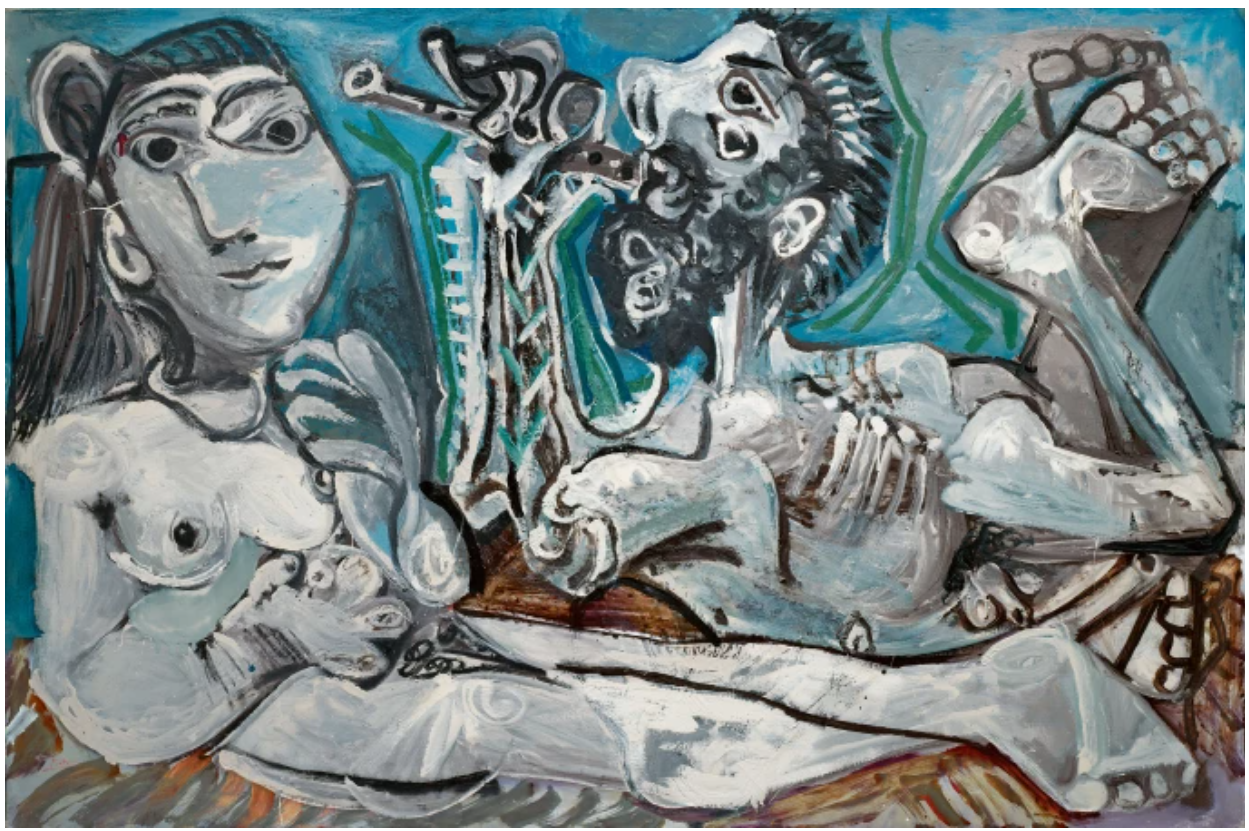
PABLO PICASSO, L’AUBADE, 1967, OIL ON CANVAS, SOLD: SOTHEBY’S, NEW YORK, NOVEMBER 2011, $23 MILLION © SUCCESSION PICASSO/DACS, LONDON 2023
These late canvases are populated with a cast of familiar figures – musketeers, matadors, embracing lovers, reclining women – all painted with this marvelous intensity. Dating from the spring of 1965, Deux musiciens is no exception to this. The work draws together two of the key themes of Picasso’s late period: the musician serenading his lover, which often appeared under the title L’aubade, and his celebrated series of the painter and model. In all of these works – as with his musketeers, smoking men and matadors – the male figure acts an alter-ego for the artist and the present work is no exception. The Pan-like figure, who appears elsewhere in Picasso’s oeuvre more explicitly as a faun, was always connected with the artist and as a mythical deity of fertility and spring his appearance has a new significance in the late works.
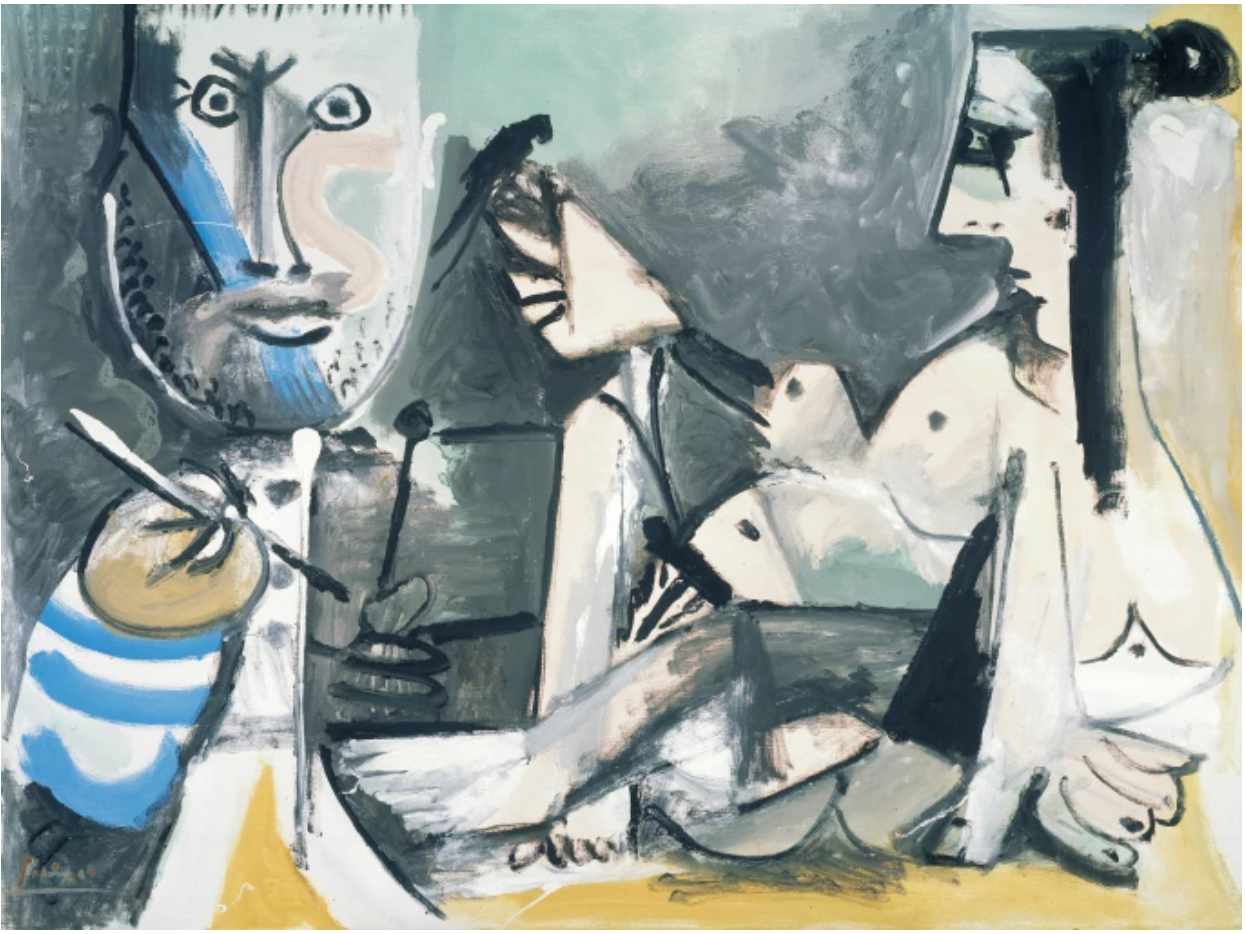
PABLO PICASSO, LE PEINTRE ET SON MODÈLE, 11 NOVEMBER 1964, OIL ON CANVAS, ALBRIGHT-KNOX ART GALLERY, BUFFALO, NEW YORK © SUCCESSION PICASSO/DACS, LONDON 2023
In Deux musiciens, Picasso gives us a pipe-playing Pan. The interweaving of music and eroticism has a clear lineage in the works of the old masters to which Picasso turned increasingly in the 1960s. Artists such as Caravaggio, Titian and Ingres famously personified this idea in oft-exhibited paintings of which Picasso was certainly aware. The latent sensuality inherent in a serenade had been a compelling subject for Picasso in his earlier years but here, in 1965, he returns to the theme with the renewed vigor and spontaneity of his later years. At the beginning of the year he had painted a small group of works on the same subject, where the female figure is reclined, and being serenaded. Here he alters the concept in favor of a more dynamic composition, with the second figure participatory rather than passive. He also conjures a different setting for these two musicians, with the richly painted background bringing to life the verdant foliage of this pastoral idyll. There seems a deliberate allusion to his work ‘after Manet’ from the previous decade, and particularly to his works on the theme of Le dejeuner sur l’herbe. Deux musiciens connects with Picasso’s earlier work in other ways too. In invoking Pan, Picasso is deliberately connecting himself with the mythological past of Mediterranean. This had been an important element his work since he first visited France’s southern coast. The Mediterranean idyll evoked in the present work reflects not only the mythological otherworld that Picasso had created for himself in his art, but also perhaps the contentment of his last decades, lived out in the South of France with his wife and muse Jacqueline Roque.
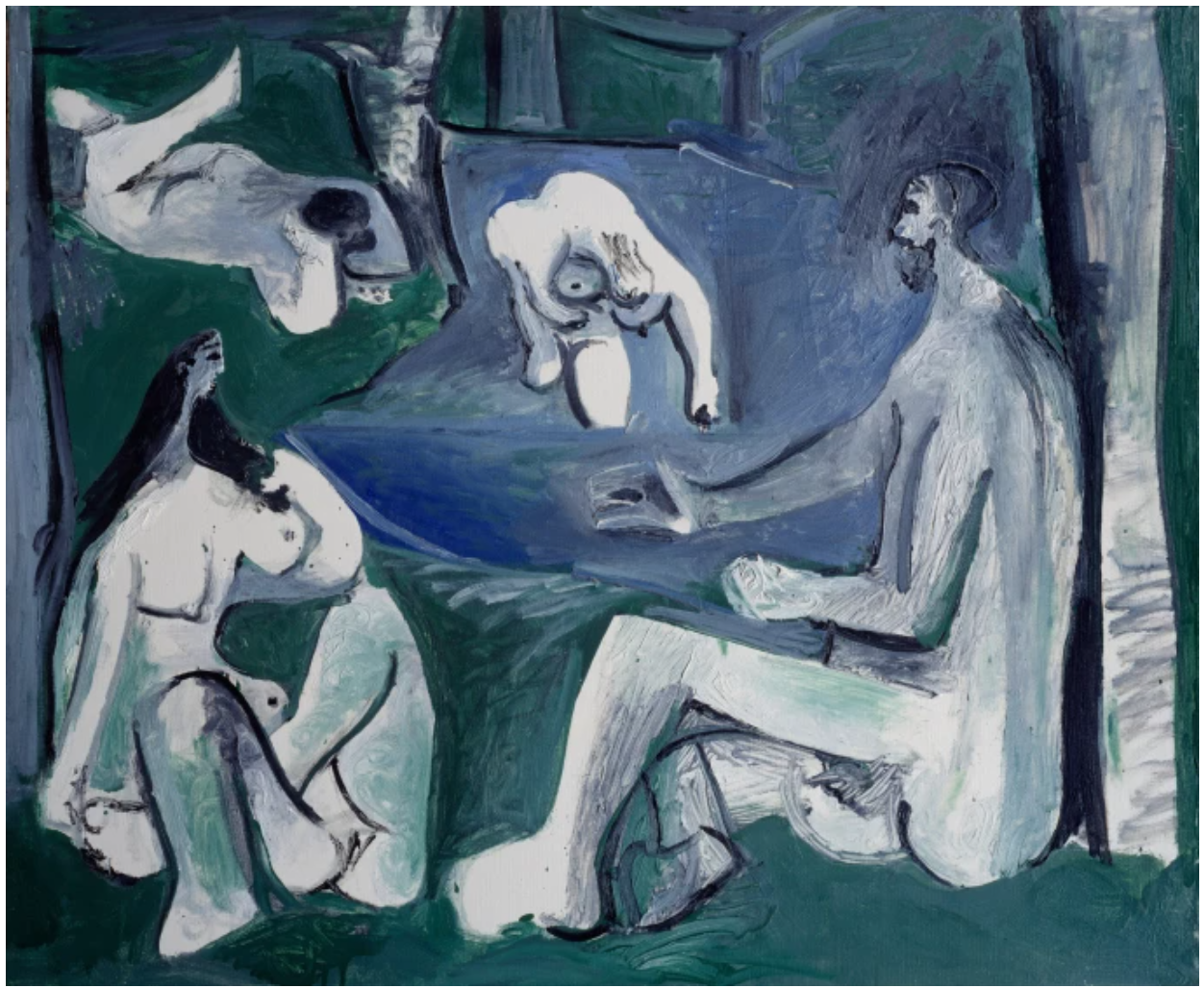
PICASSO, LE DÉJEUNER SUR L’HERBE. PEINTURE D’APRÈS EDOUARD MANET, 1961, OIL ON CANVAS, MUSÉE PICASSO
PARIS © SUCCESSION PICASSO/DACS, LONDON 2023
Gert Schiff has written about the significance of these pictures, observing how they offer an escape from the struggles of everyday life in a manner similar to Gauguin’s pictures of his Tahitian paradise. Deux musiciens powerfully conjures this vision of Eden in a composition that is at once beguiling and magical, and full of the imaginative energy that marks Picasso’s work of this period.
Le peintre et son modèle, 1963
Christie’s New-York: 13 May 2023
Estimated: USD 2,500,000 – 3,500,000
USD 3,317,000
PABLO PICASSO (1881-1973) (christies.com)
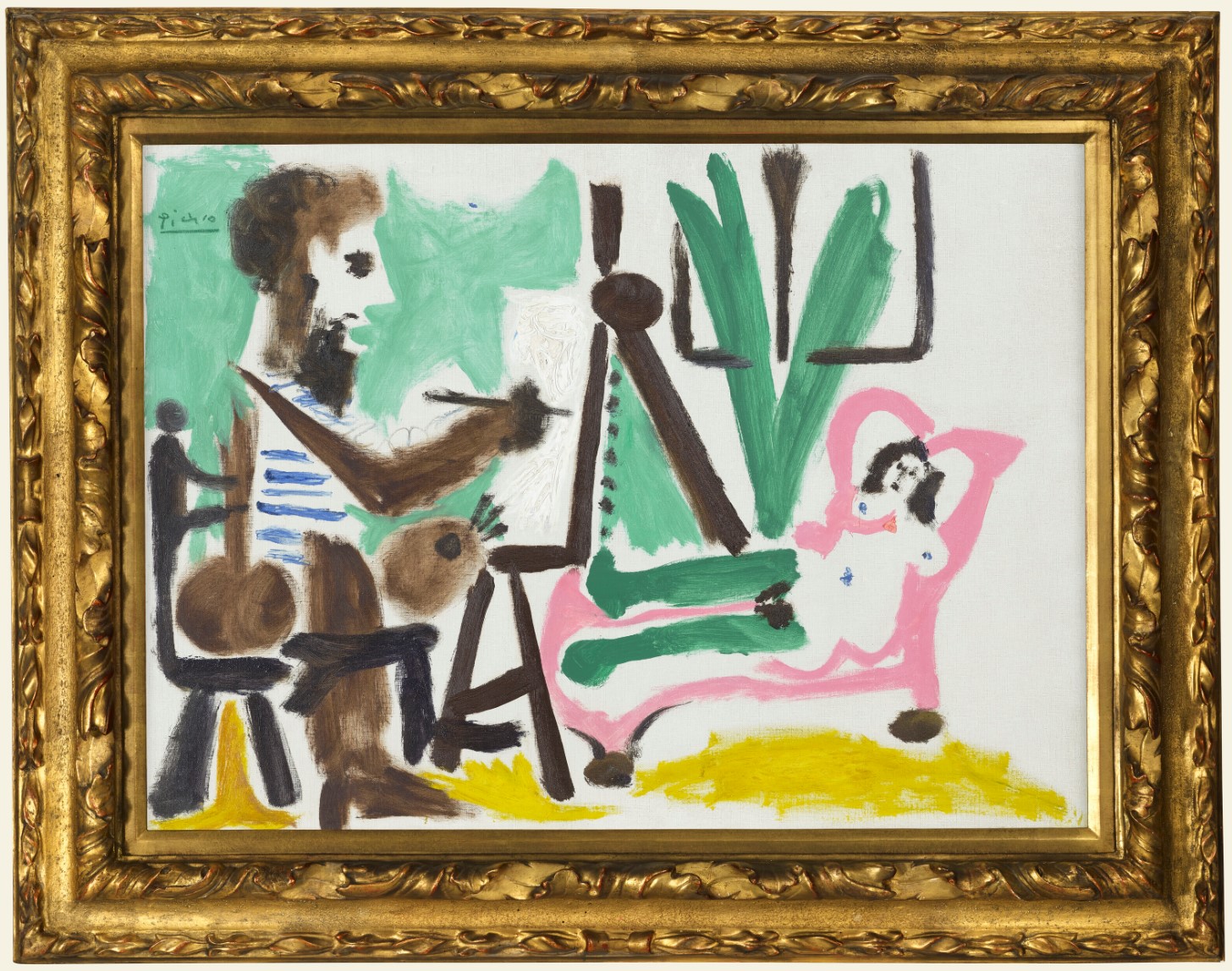
PABLO PICASSO (1881-1973)
Le peintre et son modèle, 1963
Oil on canvas
73×100 cm (28 3/4 x 39 3/8 inches)
Signed ‘Picasso’ (upper left)
“A dot for the breast, a line for the painter, five spots of color for the foot, a few strokes of pink and green… That’s enough, isn’t it? What else do I need to do? What can I add to that? It has all been said.”
At the beginning of 1963, Pablo Picasso became obsessed by a subject that had stood at the heart of his art for the entirety of his career. Over the course of two weeks in February, he filled the pages of a small carnet with more than two dozen sketches of a studio interior in which a painter is seen working at his easel in the presence of a reclining nude model (Musée Picasso, Carnet no. 59). On 2 March he began the first of an extended series of oil paintings on this theme (Zervos, vol. 23, no. 154; Kunstmuseum St. Gallen). From this point until 1965 Picasso painted and drew mostly variations on this theme. The artist and model appear together, as in Le peintre et son modèle, or alone as male or female portraits and nude figure paintings. The male subjects are almost invariably stand-ins for Picasso himself—in the present work he is sporting the artist’s signature blue-and-white striped Breton top—and the models are most typically the figure of his wife, Jacqueline. He gave relatively little time to other subjects, and it was not until the musketeers made their appearance in April 1967 that his preoccupation with the artist and model theme appeared to have subsided, although it was still far from having run its course.
Though the subject of the artist and model had been a prominent theme weaving through the various strands of Picasso’s multi-faceted oeuvre, never before had the artist explored so closely and with such intensity this essential artistic relationship of the painter and his subject. He finished his look backwards to the art of the great masters that had come before him—Eugène Delacroix, Diego Velázquez, Edouard Manet and Nicolas Poussin—and instead honed in on the very nature of art making itself. As if trying to find the key to his own innate abilities as a painter, he focused entirely on the realm of the studio, the private, hallowed sanctum of artistic inspiration and creativity. In depicting the enigmatic relationship between the artist and the subject, Picasso pushed the boundaries of painterly representation to their extreme. With works such as Le peintre et son modèle, he conveyed the scene with an impressive economy of means. Composed of gestural brushstrokes and a palette of vibrant color—green, pink and golden ochre—this work is constructed with instinctive, assured lines and forms. While the nude is outlined in pink, with her legs depicted in strokes of green, by contrast, the figure of the painter, upright and active, is shown with sweeps of darker paint, the antithesis of the voluptuous curves of the model in front of him. This spontaneity is a reflection of the sense of freedom that governed Picasso’s painting during this intensely creative period.
On the heels of the successful Ann and Gordon Getty Collection sales last fall, Christie’s is now honored to offer this Picasso for sale, proceeds of which will benefit arts and science charities.
Musketeers
Essay
In 1961, Picasso turned eighty. As a widely recognized maître of twentieth century art he had nothing to prove. This feeling is the driving force behind the creativity and spontaneity of his mature work and his significant recourse to archetypal figures and symbols. The seemingly limitless energy that characterizes so much of his work reaches its apotheosis in this final burst of creativity.
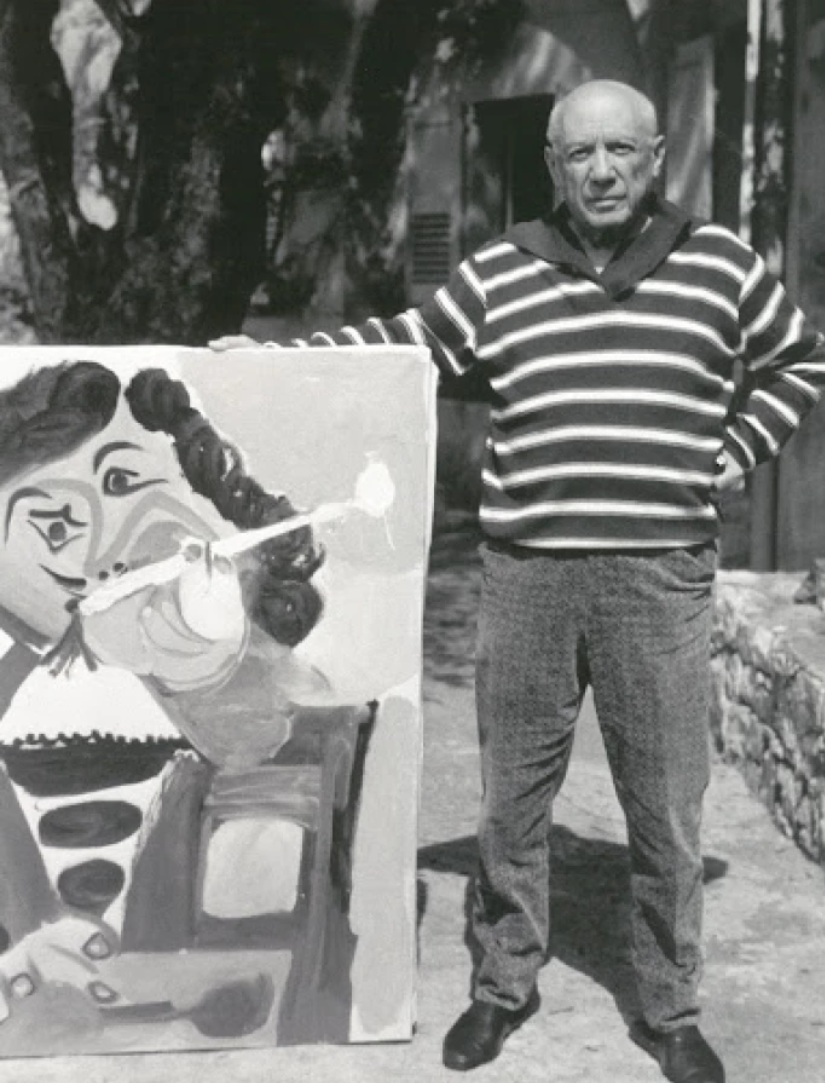
PICASSO WITH HOMME ASSIS (1967) IN HIS GARDEN, NOTRE DAME DE VIE, CIRCA 1967-70
© 2023 ESTATE OF PABLO PICASSO / ARTISTS RIGHTS SOCIETY (ARS), NEW YORK
The artist’s fascination with this romantic archetype can be traced back to his Spanish childhood and his love of Cervantes’ Don Quixote. The musketeer was a character that embodied the courtly mannerisms of the Renaissance gentleman, whom Picasso resurrected for a twentieth-century audience. Considering the artist’s age, the image of the musketeer is also evocative of a certain nostalgia for the youthful vigor of his early years. The musketeers of Alexandre Dumas’ novel, which served as another key source of inspiration in his work from this period, were famously known just as much for their good living and loving as for their swordsmanship.
During a period of convalescence in late 1965 and early 1966, Picasso began to re-read many classic works of literature, including plays and novels by Shakespeare, Balzac, Dickens as well as Alexandre Dumas’ The Three Musketeers, whose tales of Athos, Porthos, and Aramis’ adventures clearly took root in his psyche. He had just begun painting again following his surgery, and before long a new character entered his work, the musketeer, or the Spanish version of the 17th century cavalier, the hidalgo, a rakish nobleman, skilled with the sword, daring in love, and outfitted in elaborate seventeenth-century costumes. The first oil painting of this series was completed in February 1967, and many musketeer heads and full-length seated portraits soon followed as Picasso worked with his typical enthusiasm. At the time, he was living with his wife Jacqueline Roque in his Mougins home Notre-Dame-de-Vie. His prolific output soon overwhelmed the space – so much so that he added two more studios to store the many canvases he had finished.
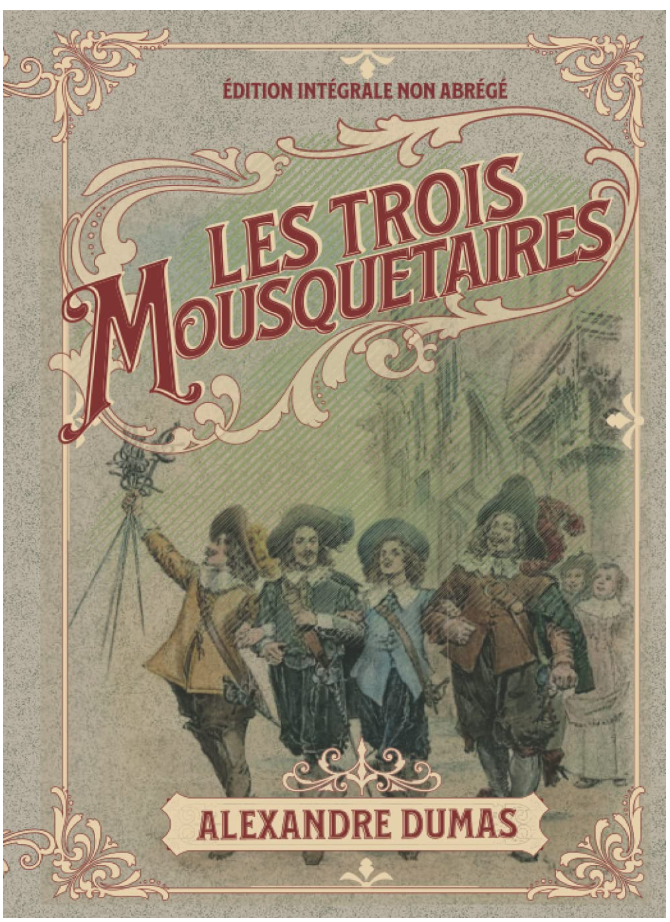
Picasso felt strong affection for his musketeers, ascribing personalities and foibles to them. As any portrait artist would provide their subjects with individual attributes so too did Picasso differentiate between his musketeers, depicting one with a paintbrush and canvas or posing another next to a nude woman. In doing so, his troop of musketeers – who for centuries had stood for virility, masculinity, and strength – became vessels for the artist’s vision of himself that he wished the world to see. Just as he had done throughout his career with the figures of the harlequin, minotaur, and Mediterranean sailor, he used the musketeer to affirm his potency, heroic nature, wit, and charm. The musketeer, so celebrated for his bravado, daring exploits, and amorous liaisons, was the perfect foil for an artist in the last years of a long and boisterous life.
Picasso’s interest in the musketeer seems also to have been the next step after having spent the previous years in dialogue with – and waging battle against – the great artists of the past. Indeed, he had, in the last decades of his career, turned his attention back to the painters he would have encountered as a young artist at Madrid’s Real Academia de Bellas Artes de San Fernando, and again, later, at the School of Fine Arts in Barcelona. Starting in the mid-1950s, Picasso confronted the great masterpieces of his predecessors, riffing on and reimaging iconic works such as Eugène Delacroix’s Les femmes d’Alger, Diego Velázquez’s Las Meninas, and Edouard Manet’s Le déjeuner sur l’herbe, among others. The musketeer as a visual archetype offered Picasso a means to further his quest for artistic supremacy, and he borrowed motifs from a variety of periods including the European Baroque, the Dutch and Spanish Golden Age, French Modernism, and particularly the work of Velázquez, Delacroix, and Rembrandt; in look and demeaner, Mousquetaire I has something in common with Velázquez’s Philip IV of Spain in Brown and Silver, c. 1631-1632.
But it was Rembrandt, more than anyone, whose influence can be felt in the theoretical conceit behind the musketeers. Picasso engaged Rembrandt in an intimate and ongoing dialogue throughout the 1960s, and he increasingly identified with the Dutch Golden Age master. Both had enjoyed long careers, and both were fond of inserting themselves into their canvases. Above all, Picasso was drawn to Rembrandt’s drawings and etchings, whose quality and range he sought to emulate in his own prints. By quoting different artist’s gestures and images, Picasso was not only measuring himself against his predecessors but also demonstrating his artistic power; he could and would, these works broadcasted, go toe to toe with the great masters of western art. Widely acknowledged as a triumph of the artist’s later years, the musketeers fully capture Picasso’s artistic and intellectual range; they represent a lifetime’s worth of innovation that was far from its end. Mischievous, coy, and large in scale, the musketeers possess all the zest of an artist caught up by his new and enthralling idea. One can feel the vivacity in Mousquetaire I; the painting is a testament to Picasso’s unrelenting devotion to his art.
Many musketeer heads as well as full-length seated portraits followed as the artist worked with an irrepressible zeal. Together with his devoted wife, Jacqueline, the artist remained more or less completely based in his Mougins home, Notre-Dame-de-Vie, visited by a smaller, more intimate circle of friends. Far from slowing down, his output remained hugely prolific—so much so that he built on two more studios to house the myriad canvases he painted. Of the musketeer series alone, Jacqueline once recalled, “When things were going well he would come down from the studio saying, ‘They’re coming! They’re still coming’” (quoted in A. Malraux, Picasso’s Mask, New York, 1994, p. 78).
Picasso was particularly fond of his musketeers, and liked to ascribe personal qualities to them. Hélène Parmelin recalled how Picasso would play games in front of the canvases; he would point to one or another musketeer and remark, “With this one you’d better watch out. That one makes fun of us. That one is enormously satisfied. This one is a grave intellectual. And that one look how sad he is, the poor guy. He must be a painter” (quoted in Picasso: Tradition and Avant-Garde, exh. cat., Museo del Prado, Madrid, 2006, p. 340).
Sometimes he gave these figures a paintbrush and canvas; on other occasions they were accompanied by a nude woman. With the timeless character of the musketeer—one that had straddled centuries, cultures and countries, and embodied a powerful sense of vitality, masculinity, and virility—Picasso created an artistic stand-in for himself. Just as he had done throughout his career with the figure of the harlequin, minotaur, and more recently, that of the Mediterranean sailor, he used this figure as a way of channeling the image of himself that he wanted to present to the world. In this case, he visualized a heroic stance in life, affirming his ability, through wit and skill, and above all, creativity, to remain master of his fate during this final stage of his long life. The dashing musketeer, with his associations with bravado and bravery, swashbuckling exploits, and amorous liaisons, was the perfect means through which to convey these sentiments.
The mousquetaire paintings were the final major series of variations on an old master theme that Picasso undertook during his late period; this group was far more sprawling and open-ended than any sequence he had done previously. The sheer scope of this endeavor provided ample opportunity to investigate the dual aspects of art-making that were foremost among Picasso’s concerns during these final years: tradition and process. The musketeers served as a means through which Picasso could engage the great artists of the past whom he admired, allowing him to arrive at an understanding of his own position and achievement within the continuity and traditions of European painting. Having emerged from his study of Rembrandt, the mousquetaire theme also provided an avenue to channel the entirety of the achievement of the supreme Siglo de Oro in Spanish painting. These resources encouraged Picasso to take stock of his Spanishness and the role of his native heritage in his work, which he could undertake only outside the land of his birth, because he had vowed never to return home while the murderous fascist dictator Franco was still alive and ruled Spain.
The mousquetaires moreover perfectly suited Picasso’s work habits at this time. He preferred to work employing a serial procedure, painting numerous variations on a theme, as an effective means of examining, assimilating and re-interpreting a subject, style, manner, or the richness of an entire sensibility. Picasso had become increasingly engaged in painting as “process,” in which the act of painting, not the completed art work, was a sufficient end in itself. Picasso described how he took special pleasure in the “movement of the painting, the dramatic effort from one vision to the next, even if the effort is not carried through… I have reached the stage where the movement of my thought interests me more than the thought itself” (quoted in K. Gallwitz, Picasso Laureatus, Paris, 1971, p. 166). In 1956 Picasso explained to Alexander Liberman, the editor of Vogue magazine, that “Paintings are but research and experiment. I never do a painting as a work of art. All of them are researches. I search incessantly and there is a logical sequence in all this research. That is why I number them. It’s an experiment in time” (quoted in D. Ashton, ed., Picasso on Art, New York, 1972, p. 72).
The musketeer series was indeed an “experiment in time,” and in more than one sense. It was a significant exercise in sequential imaging, as Picasso described above. The mousquetaires were, moreover, a journey into time, one that followed a route from Picasso’s Mougins studio in the late twentieth century to Dumas’ novel written in the mid-nineteeth, and then three centuries deeper into the past to the Baroque era of Rembrandt and Velázquez. As Picasso grew old and reclusive, and the real world of physical delight receded from his grasp, an inner world not subject to the boundaries of time or place evolved in its stead. Picasso constructed a veritable musée imaginaire, an edifice that he maintained in his own mind, of which he was artificer, arbiter, and curator, that contained the genius of many centuries, as well as his own.
“I have less and less time, and I have more and more to say.”
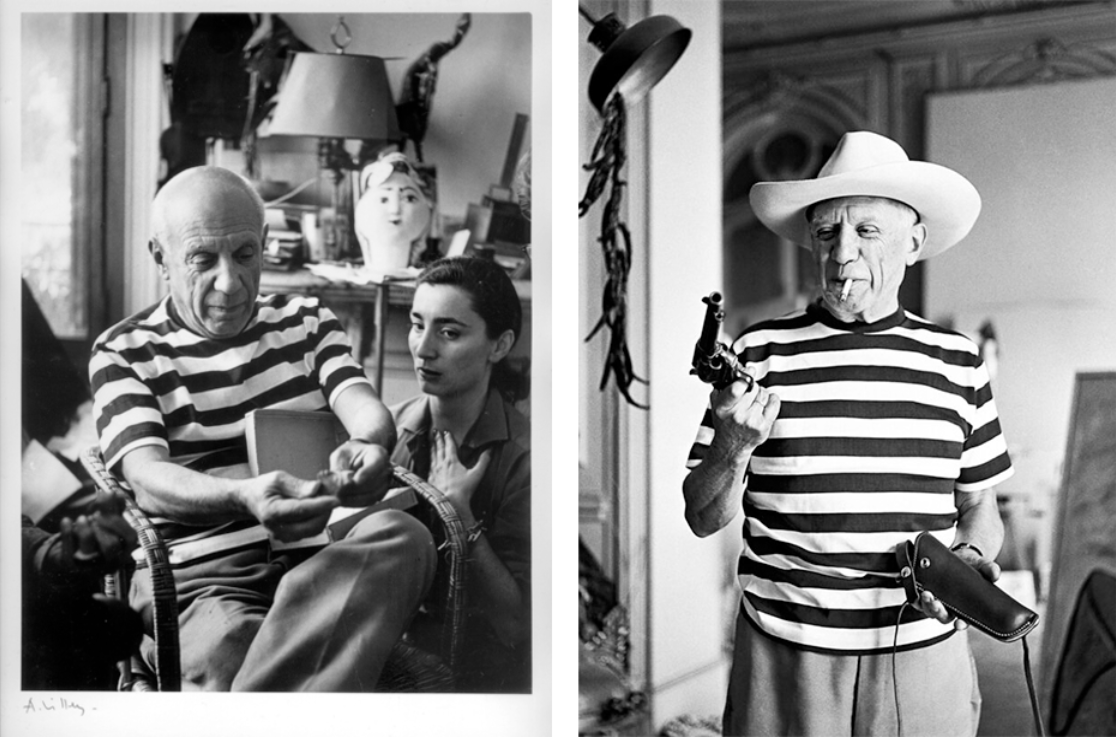
[Left] André Villers, Picasso and Jacqueline, Cannes, 1961. Image: © Artists Rights Society (ARS), New York
[Right] André Villers, Picasso avec le revolver et le chapeau offert par Gary Cooper, 1959. Image: © Artists Rights Society (ARS), New York
Although now appreciated as a distinct period of Picasso’s prodigious career and the focus of many monographs and exhibitions, the full scope of the artist’s so-called “late style” only really came into focus posthumously. Tantalizingly hinted at in his 1970 and 1973 Palais des Papes shows, as Christian Geelhaar has suggested the beginnings of this final, triumphant period can be traced back to 1964, the year of the present work’s execution. Casting her eye a little further back, Marie-Laure Bernadac suggests that of the last twenty years of Picasso’s life, “the first ten took the form of a recapitulation, a synthesis of his past, through a reappropriation of old master painting which led to a rereading of Cubism in the light of the representational distortions of the 1930s,” while the final decade can be understood as “a crossing of barriers, a liberation of knowledge and technique, a return to nature, spontaneity, the ‘childhood’ of art and a savage, primal immediacy in painting.’”
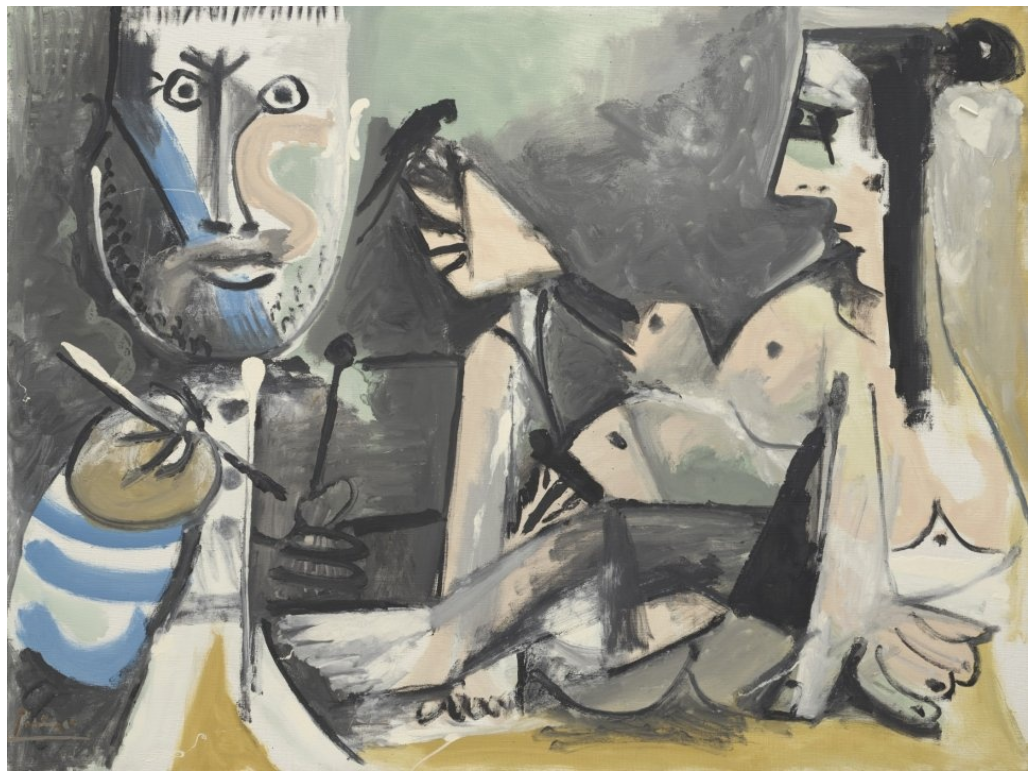
Pablo Picasso, Le peintre et son modèle, 1964, Buffalo AKG Art Museum. Image: Buffalo AKG Art Museum / Art Resource, NY, Artwork: © 2024 Estate of Pablo Picasso / Artists Rights Society (ARS), New York
The 1970 exhibition at the Palais des Papes is known as Avignon I; a second exhibition, comprising the work of 1970-1972–Avignon II–ran in May-September 1973, opening less than a month and half after Picasso’s death on 8 April. Avignon I included 165 paintings done between 5 January 1969 and 2 February 1970, together with 45 drawings in various media. Among the throngs in attendance at the 1970 Avignon exhibition were numerous young people. Their reaction to Picasso’s rambunctious mousquetaires, sexually explicit nudes and passionately embracing lovers was noticeably more sympathetic than that of their elders, and by far more enthusiastic than the critics. Parmelin and Pignon noticed the youthful aspect of the artist’s most fervent admirers at Avignon I:
“One day, [we] found ourselves in Avignon at the Palais des Papes, among the crowd at Picasso’s exhibition. Elbow to elbow,” Parmelin wrote. “Many hippies or their ilk, with hair, beards and hats, of the type Picasso enjoyed passing in the street. Many young people expressing their freedom through colors and clothing… Pignon tells me he has a strange feeling. He no longer seems to know whether the crowd is rising into the walls or whether the canvases are descending to mingle with the crowd. There is, finally, such a close correspondence between the crowd and the canvas, he says, that they are the same thing” (exh. cat., op. cit., 2009, p. 244).
Picasso was delighted at the response of these young people, which he attributed to the freedom they found in his recent paintings. He told Pierre Daix, “If I’m painting better, it’s because I’ve had some success in liberating myself” (quoted in P. Daix, Picasso: Life and Work, New York, 1993, p. 365).
Even during years prior to the Avignon exhibitions, Picasso’s late work had disappointed many critics as being unworthy of a famous, elder master, especially the one who was universally acknowledged to be the world’s greatest living artist. A similar reaction persisted during the shows. “It was the critics who were most disconcerted, seeing the show as a compilation of summary painting, improvisations done in febrile haste, and the erotism of an old man,” Daix explained. “Whereas in fact Picasso had given them an extraordinary demonstration of an arrival at the start of a new visual era and of a growing sexual revolution which reached entirely beyond the limitations of resemblance, of artistic tradition, and convention. He was expected to rest on his laurels, his past successes. Instead he painted as the adolescents of the 1970s were going to paint in the 1980s” (ibid.).
Recent Auction Results
Mousquetaire, tête, 1967
The Art of Collecting: Property from a Distinguished Private Collector
Christie’s New-York: 17 November 2025
Estimated: USD 3,000,000 – 5,000,000
USD 4,101,000
PABLO PICASSO (1881-1973), Mousquetaire, tête | Christie’s
PABLO PICASSO (1881-1973)
Mousquetaire, tête, 1967
Oil on canvas
65×54 cm (25 5/8 x 21 1/4 inches)
Dated ‘24.3.67.’ (upper left)
Dated again and numbered ‘24.3.67. II’ (on the reverse)
Towards the end of 1966, Pablo Picasso began to concentrate on a subject that would come to define his late career, that of the musketeer. The figure, at once historical and imaginary, would dominate his output, filling his canvases with colorful depictions of lavishly-costumed characters, who often served as stand-ins for the artist himself. While he returned frequently to the subject throughout the next five years, the paintings created between 1967 and 1968 are marked by their inventiveness and exuberance. Executed on 24 March 1967, Mousquetaire, tête is a key example from this initial burst of creativity, executed in a riot of energetic brushwork and bright, striking color. Set against a muted ground, the bust portrait depicts a musketeer with a mane of curly hair. Baroque in attitude and dress, he stares confidently out at the viewer, a wry smile playing on his lips.
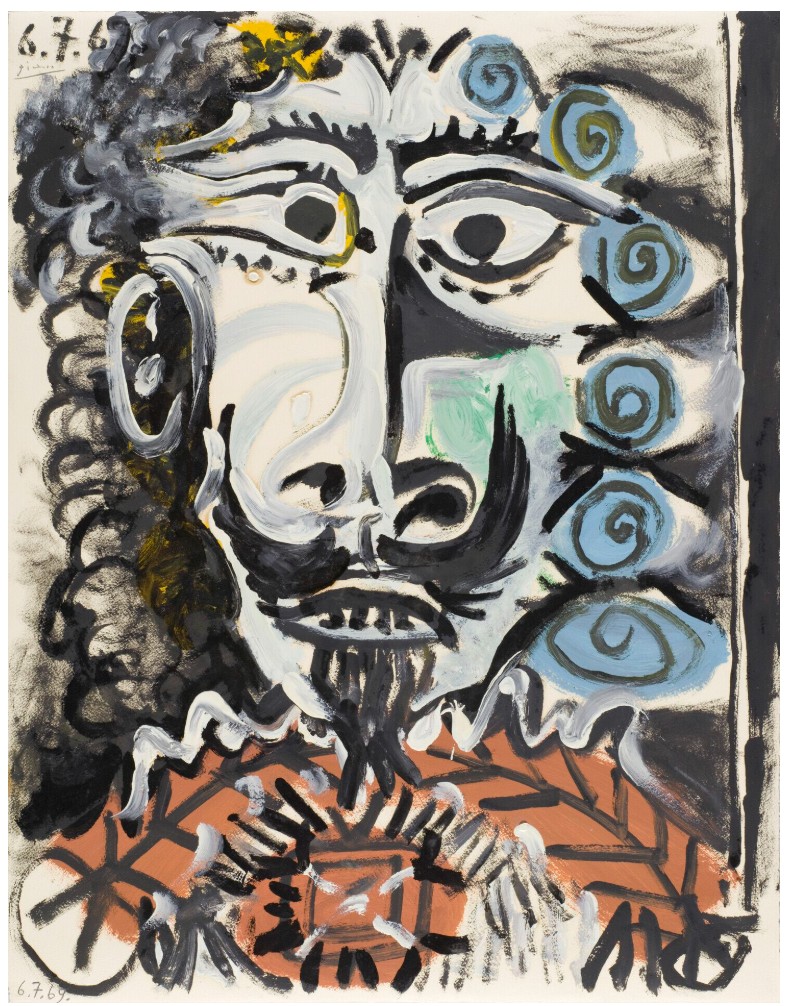
Pablo Picasso, Tête d’homme, 1969. Los Angeles County Museum of Art. © 2025 Estate of Pablo Picasso / Artists Rights Society (ARS), New York. Photo: © 2025 Museum Associates / LACMA. Licensed by Art Resource, NY
The idea for the musketeers first emerged during a period of convalescence for the artist in late 1965 and early 1966. Picasso passed his days rereading many classic works of literature, including plays and novels by William Shakespeare and Honoré de Balzac as well as Alexandre Dumas’ The Three Musketeers, the tales of Athos, Porthos, and Aramis’ adventures clearly taking root in his psyche. When he was finally able to begin painting again, a new character entered his work, the musketeer, or the Spanish version of the seventeenth-century cavalier, the hidalgo, a confident nobleman, skilled with the sword, bold in love, and outfitted in elaborate costumes. The first oil painting of this series was completed in February 1967, and many musketeer heads and full-length seated portraits soon followed, as Picasso worked with his typical fervent energy. His prolific output soon overwhelmed his atelier—so much so that he added two more studios to store the many canvases he had finished. Picasso felt strong affection for his musketeers and often gave them individual personalities. As any portraitist would ascribe to their subjects individual personalities, so too did Picasso differentiate between his musketeers, depicting one with a pipe and another with a paintbrush. Accordingly, his troop of musketeers—who for centuries had stood for virility, masculinity, and strength—became vessels for the artist’s vision of himself, as he wished the world to see him. Just as he had done throughout his career with figures such as the harlequin, minotaur, and Mediterranean sailor, he used the musketeer to affirm his potency, heroic nature, and charm. The musketeer, celebrated for his bravado, daring, and amorous liaisons, was the perfect foil for an artist in the last years of a long and spirited life.
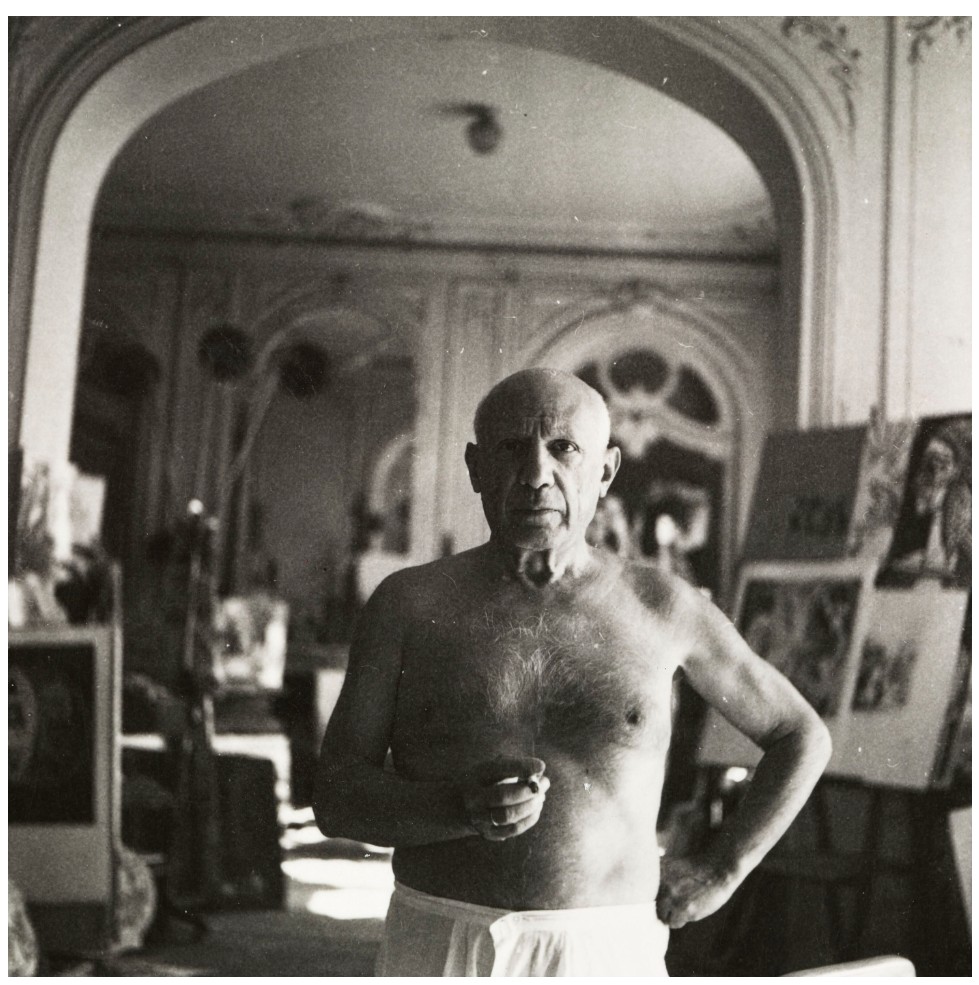
Picasso in the studio of La Californie. Photograph by André Villers. Photo: © 2025 Artists Rights Society (ARS), New York / ADAGP, Paris. Artwork: © 2025 Estate of Pablo Picasso / Artists Rights Society (ARS), New York. Image: © RMN-Grand Palais / Art Resource, New York.
The musketeer as a visual archetype provided Picasso a means to further his quest for artistic supremacy, and he borrowed motifs from a variety of periods, including the Dutch and Spanish Golden Ages, French Modernism, and particularly the work of Diego Velázquez, Eugène Delacroix, and Rembrandt. For several years, Picasso had been reinterpreting masterpieces by these artists. His interest in the motif seems to have been the logical next step after having spent the previous years in dialogue with—and waging battle against—history’s great artists. During the last decades of his career, he cast his eye back to the painters he would have encountered as a young artist. It was Rembrandt, more than anyone, however, whose influence can be felt in the musketeers, and Picasso’s engagement with the Dutch Master was ongoing during the 1960s.
Rembrandt van Rijn, Herman Doomer (ca. 1595–1650), 1640. The Metropolitan Museum of Art, New York.
By citing different artists’ images and styles, Picasso demonstrated his virtuosity: he could, and did, go toe-to-toe with the great masters of western art. Widely acknowledged as a triumph of the artist’s later years, the musketeers fully capture Picasso’s artistic range; they represent a lifetime’s worth of innovation that was far from its end. Mischievous, playful, and large in scale, the musketeers possess all the energy of an artist in the thrall of a new and fascinating idea.
Buste d’homme, 1969
Sotheby’s Hong-Kong: 28 September 2025
Estimated: HKD 15,500,000 – 25,000,000
HKD 20,505,000 / USD 2,635,605
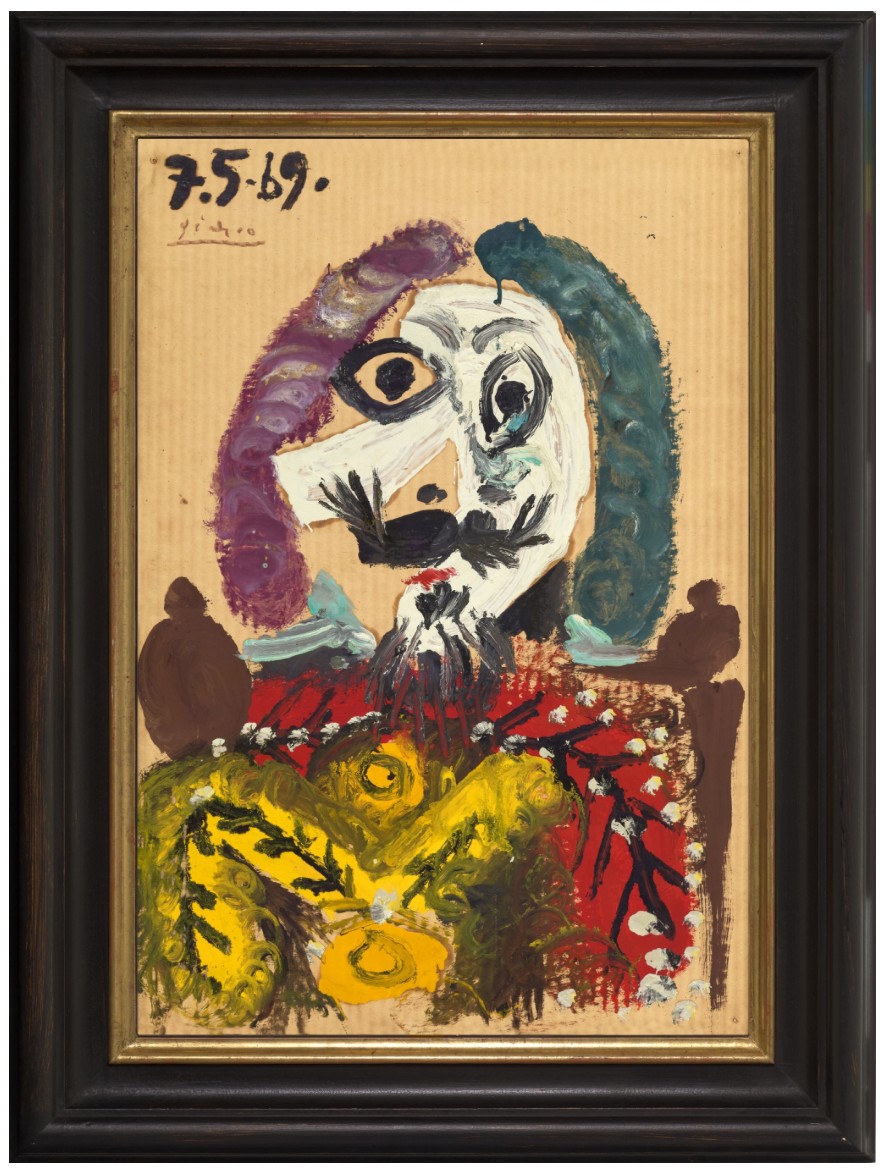
PABLO PICASSO (1881 – 1973)
Buste d’homme, 1969
Oil on corrugated cardboard
72.4 x 49.8 cm (28 1/2 x 19 5/8 inches)
Signed Picasso and dated 7.5.69 (upper left)
The musketeer is one of the most celebrated subjects within the iconography which filled Picasso’s prolific late body of work. A motif that dates back to mid-1960s when Picasso re-read Alexandre Dumas’s The Three Musketeers, the powerful and virile musketeer is reflective of the aging artist’s own vision of himself, whose artistic vigor and prowess remained strong and unwithered in the final years of his life. Executed in bold, gestural brushstrokes, Buste d’homme contains highly-colored, elaborate details in the depiction of the character. Gowned in a glamourous doublet while seated on a throne-like armchair, the musketeer is a character of distinctive Spanish heritage, like Picasso himself, with the use of national colours of blood red and golden yellow. The interlocking profiles of the musketeer evoke the iconic double portrait motif that Picasso invented in his portraits of Dora Maar, but the roots of which ultimately go back to his early Cubist experiments of multiple viewpoints.
Appearing as the Spanish version of the seventeenth-century cavalier with his moustache, goatee, long curls and doublet, the character embodied the courtly mannerisms of the Baroque maestros. In the 1960s, Picasso devoted a huge portion of his work to the reinterpretation of the old masters, especially to pay tribute to two artists he had adored throughout his life – Velasquez and Rembrandt. This thematic focus in his final years was a pointed self-affirmation of Picasso’s own place in the revered lineage of the Western canon.
Diego Velázquez, Self-portrait, circa 1645
1969 was one of the most prolific years for Picasso, as an entire volume of the Zervos catalogue raisonné is dedicated to his output from that year. His work from that year was celebrated with a major exhibition held at the Palais des Papes in Avignon in1970, an important milestone in the final chapter of his life and a testament to his unending drive for innovation.
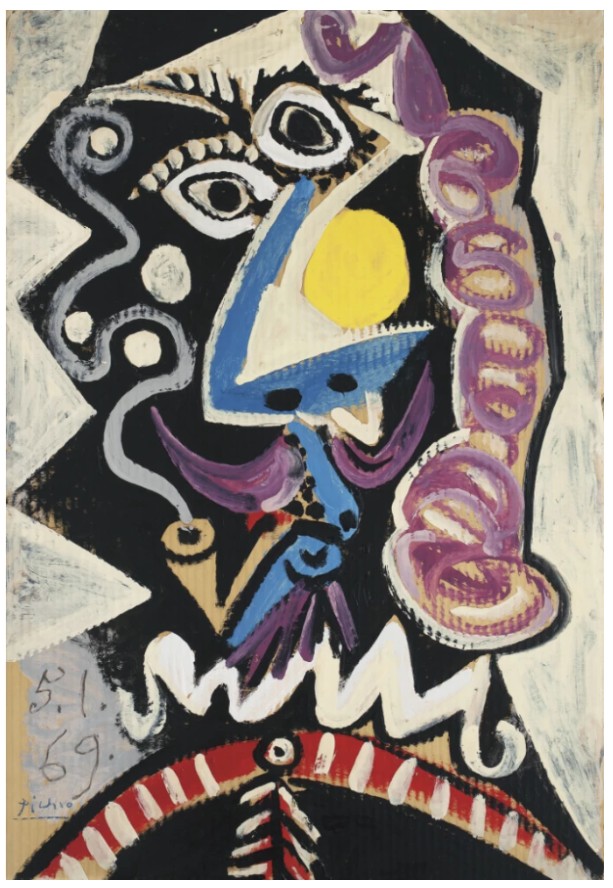
Pablo Picasso, Tête d’homme à la pipe, 1969 in Sotheby’s New York, 4 November 2017.
Sold for: USD 4,421,000 Premium (HKD 34,273,360)
Top auction record of the series
In early 1969, Picasso began experimenting with the medium of corrugated cardboard and created a series of 39 portraits of the mostly musketeers, including Buste d’homme. Demonstrating the unique texture of the medium, Picasso continued to use corrugated cardboards in 1970 for 10 other portraits of broader themes, including matadors and females. It is a medium that Picasso specifically chose to use for a very limited period. The series of corrugated cardboard portraits created in 1969 to 1970 is seen in numerous important global institutions, including The Israel Museum (Jerusalem), Musée Zervos (Vézelay), Museu Picasso (Barcelona) and Fundación Almine & Bernard Ruiz-Picasso para el Arte.
Homme assis, 1969
Sotheby’s New-York: 13 May 2025
Estimated: USD 12,000,000 – 18,000,000
USD 15,100,000
Homme assis | Modern Evening Auction | 2025 | Sotheby’s
PABLO PICASSO (1881 – 1973)
Homme assis, 1969
Oil and Ripolin on canvas
129.9 x 97.2 cm (51 1/8 x 38 1/4 inches)
Signed Picasso (lower right)
Dated 10.12.69. (on the reverse)
In 1966, recuperating from stomach surgery, Pablo Picasso was bedridden for months and unable to work. He turned to his favorite classic literature to fill the time, re-reading Spanish Golden Age epics, novels by Dickens and Balzac, and plays by Shakespeare. It was Dumas’ The Three Musketeers, however, that truly captivated the artist; the bold and spirited heroes resonated deeply with Picasso, who read and reread the novel until he knew it by heart. According to Pierre Daix, as soon as the artist was back on his feet, “he wanted to know whether his creative powers had been affected. The Mousquetaires series… with its evocation of an entire world, was part of this rediscovery and recovery of self” (Picasso: Life and Art, New York, 1987, p. 363).
“I have less and less time, and I have more and more to say.”
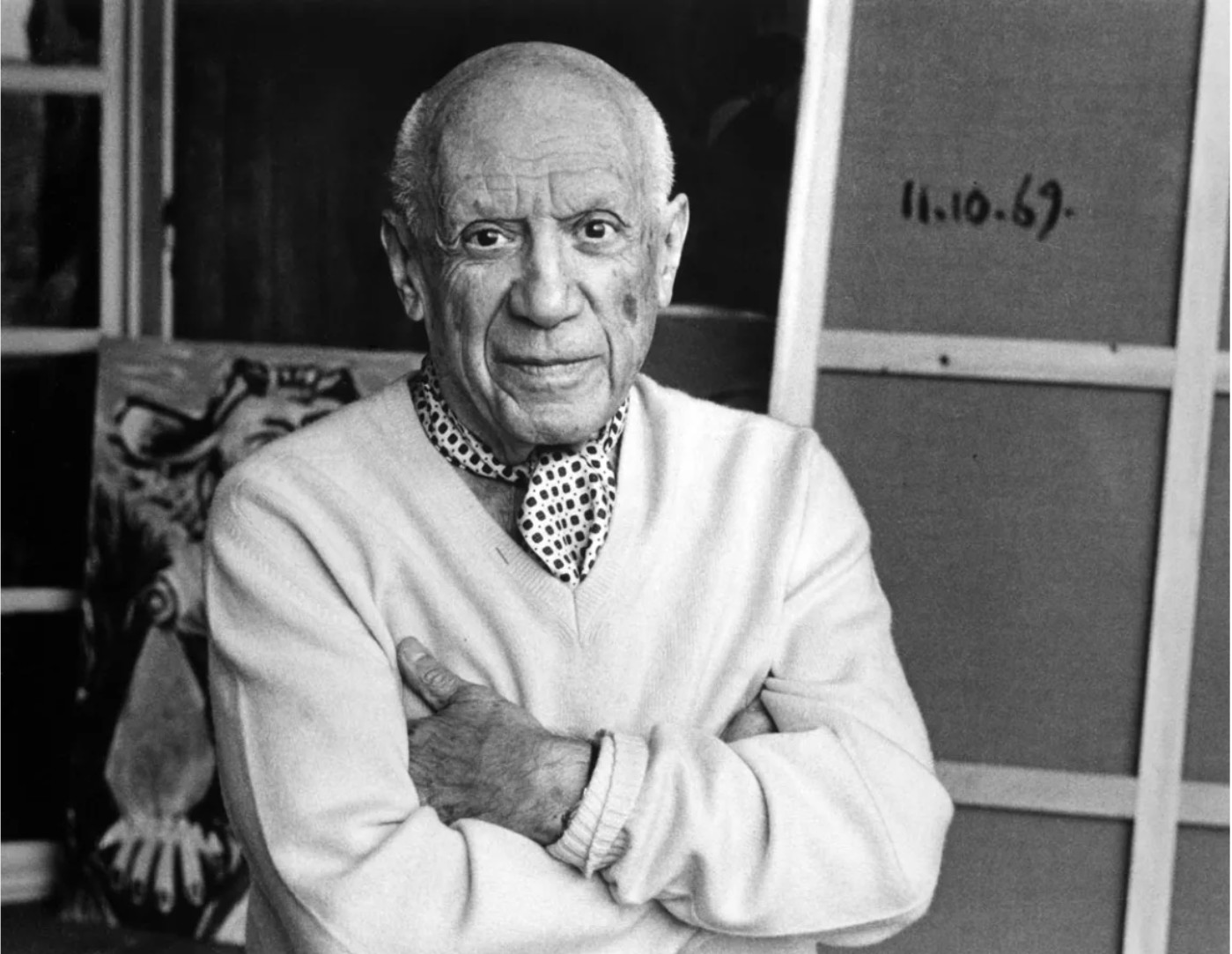
Picasso in his Mougins studio, 1969. Photograph © Lucien CLERGUE / saif images
© 2025 Estate of Pablo Picasso / Artists Rights Society (ARS), New York
By 1969, the sword-wielding, swashbuckling musketeer had become the central character of his late oeuvre, serving as a powerful psychological avatar through which the artist reflected on his enduring vitality, virility, and creative spirit in the final chapter of his life. That year, the artist began working on a series of large-format canvases on this theme. Among the most sophisticated and abstract of the series is Homme assis. Towering over 50 inches in height, this commanding depiction of a seated musketeer—distinguished by his sweeping mustache and extravagant hat—embodies Picasso’s relentless innovation even in his most mature years. While evoking the sun-drenched memories of his Mediterranean past, the composition transforms these recollections into bold abstract motifs and vibrant blocks of color. One of Picasso’s most strikingly graphic works, the piece juxtaposes a meticulously rendered black-and-white face with dynamic bursts of yellow, green, and blue. The stark contrasts, expressive brushwork, and electrifying color fields distill the image to its very essence, amplifying its intensity and impact.
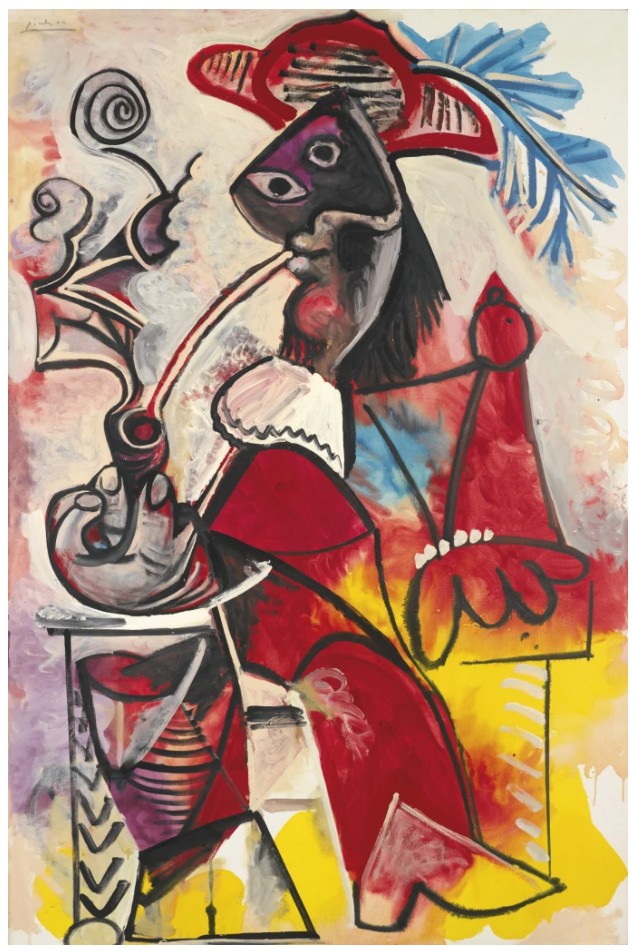
Pablo Picasso, Mousquetaire à la pipe, 5 March 1969, sold: Sotheby’s, New York, November 2013 for $31 million
© 2025 Estate of Pablo Picasso / Artists Rights Society (ARS), New York
Even in his final years, Picasso remained at the vanguard of artistic experimentation, demonstrating that true clarity and power arise not from refinement, but from raw, unfiltered expression. As John Richardson observed, “The surface of the late paintings has a freedom, a plasticity, that was never there before; they are more spontaneous, more expressive, and more instinctive than virtually all his previous work” (Exh. Cat., London, Tate Gallery, Late Picasso, Paintings, Sculpture, Drawings, Prints 1953-1972,1988, pp. 31-34). Included in his landmark 1970 exhibition at Avignon’s Palais des Papes—chosen by the artist himself for the site’s historicity and which became a posthumous exhibition when he died in April 1973—the present work exemplifies Picasso’s indefatigable creativity and reflections on his own legacy. It also helped define the artist’s legacy just following his death.
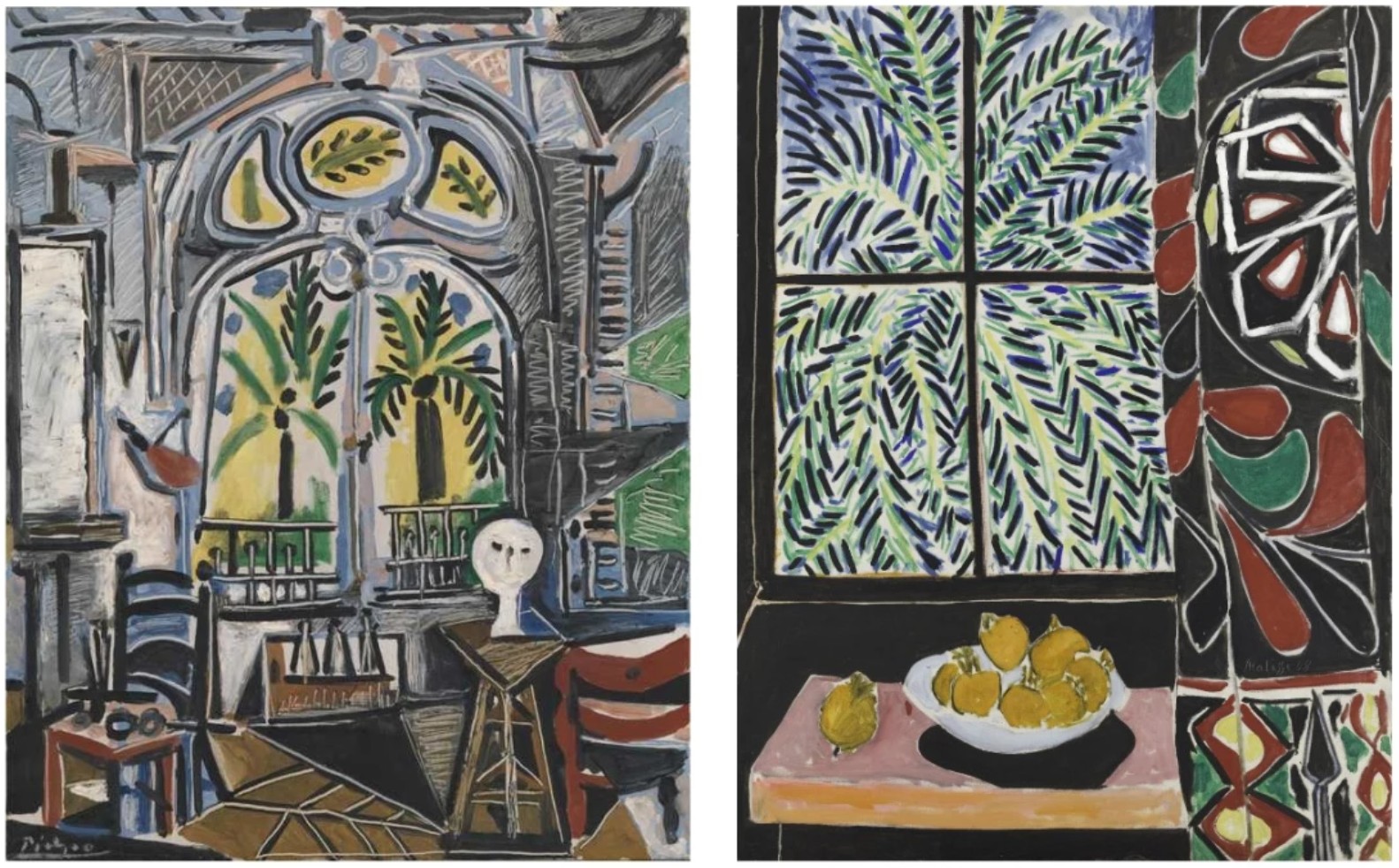
Left: Pablo Picasso, L’Atelier de La Californie IV, 1955, Tate Modern, London © 2025 Estate of Pablo Picasso / Artists Rights Society (ARS), New York
Right: Henri Matisse, Intérieur au rideau égyptien, 1948, The Phillips Collection, Washington D.C. © 2025 Succession H. Matisse / Artists Rights Society (ARS), New York
Color plays a crucial role in Homme assis, not only in its immediate impact but in its deep connection to Picasso’s past, particularly his years at La Californie in the 1950s. The bright, sunlit hues—yellows, blues, and greens—harken back to the Mediterranean light that filled his Cannes studio, where he painted surrounded by lush plants and sweeping sea views. The architecture of La Californie, a Belle Époque villa with large arched windows, often acted as a natural framing device within his compositions, a technique that finds an echo in Homme assis.
The three circular forms in the upper left of the painting correspond to architectural elements from his studio, much like how Henri Matisse, one of Picasso’s greatest rivals and inspirations, used window motifs in works such as Intérieur au rideau égyptien where palm trees frame the interior scene. Here, Picasso similarly incorporates a structural rhythm that links the background to the figure, suggesting both an enclosed studio space and the open expanse of nature beyond. The bursts of color surrounding the musketeer seem to vibrate with the energy of the Côte d’Azur, imbuing the painting with a sense of place and memory. Even as Picasso confronted his own mortality in these late works, he infused them with the vitality of his surroundings, transforming personal recollection into pure, exuberant color.
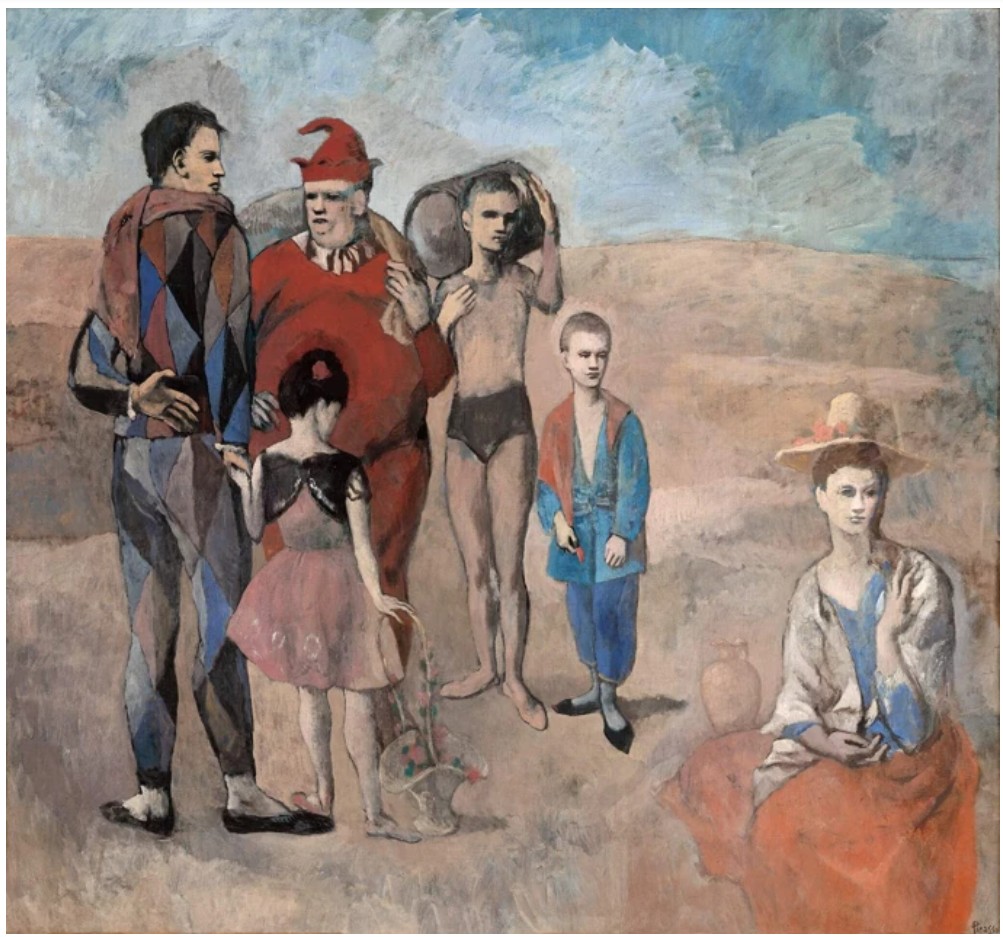
Pablo Picasso, Famille de Saltimbanques, 1905, National Gallery of Art, Washington, D.C.
© 2025 Estate of Pablo Picasso / Artists Rights Society (ARS), New York
Picasso’s use of veiled self-depictions in his work can be traced back to his earliest masterpieces. Beginning in his Blue and Rose periods, melancholy saltimbanques and harlequins populated his compositions. Later, he would add minotaurs and bullfighters to his repertoire of alter egos—each representing different aspects of Picasso’s personality and different stages of his life. As Marie-Laure Bernadac observed: “If woman was depicted in all her aspects in Picasso’s art, man always appeared in disguise or in a specific role, painter at work or a musketeer…Picasso seldom depicted himself directly, choosing instead to have thematic characters personify him” (Brigitte Léal, Christine Piot, and Marie-Laure Bernadac, The Ultimate Picasso, New York, 2000, p. 457). Ultimately, it was the glorious musketeer through which the artist expressed his vitality, erotic desires, mortal anxiety, and, of course, his ambition to be remembered as the great master that he was.
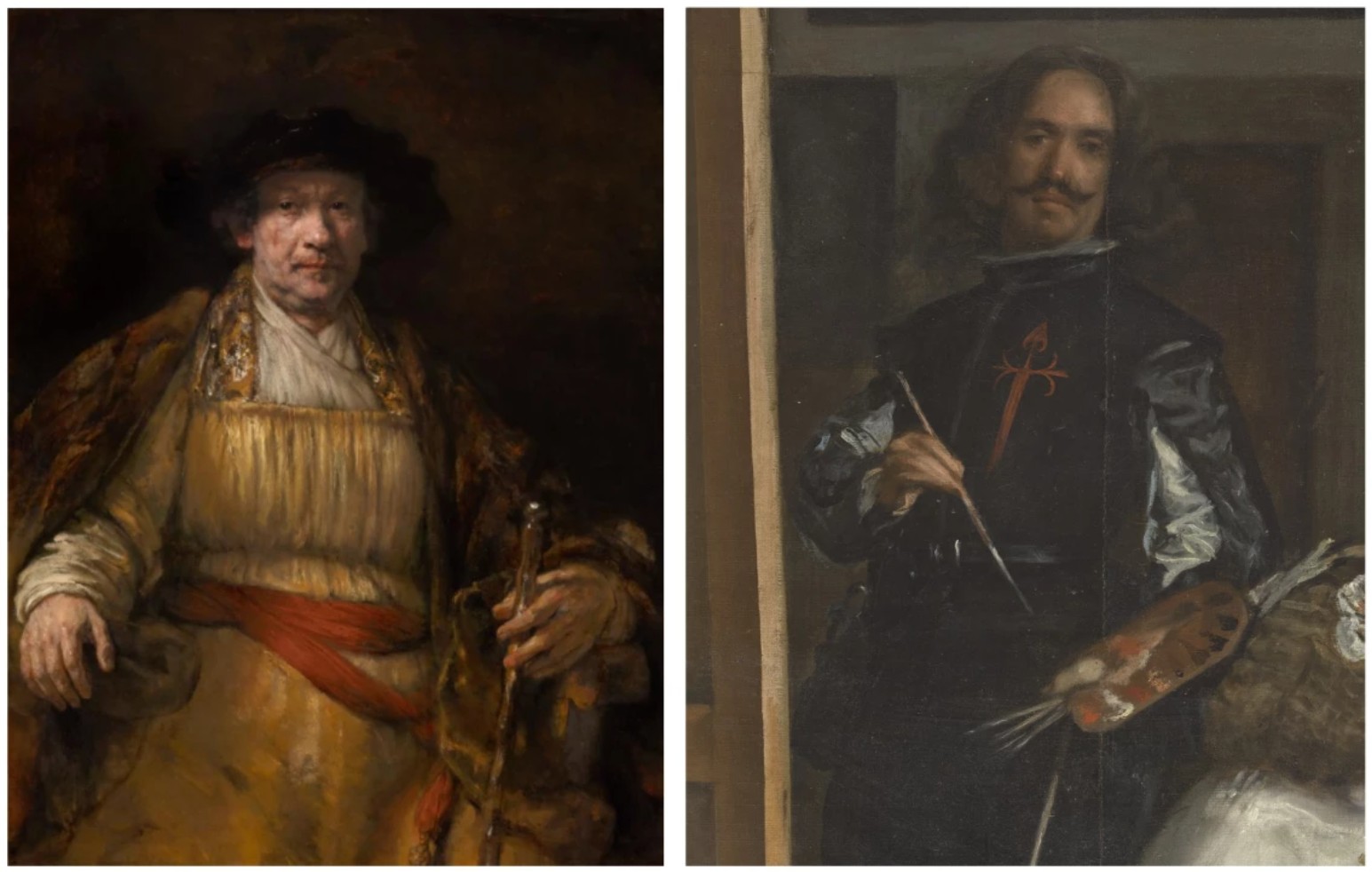
Left: Rembrandt van Rijn Self-Portrait, 1658,
The Frick Collection, New York
Right: Diego Velázquez. Las Meninas (detail), 1656. Museo Nacional del Prado, Madrid
For an artist whose trajectory was marked by constant exploration and creativity, Picasso recognized the importance of his last years as a defining period of his entire career. Turning to artistic masters of the past, particularly seventeenth-century artists Rembrandt and Velázquez, Picasso used the musketeer as his own return to the golden age of painting, enabling him to pay homage to his influences and insert himself into the narrative. “In old age,” John Richardson noted, “Picasso would admit to being very conscious of old masters breathing down his neck. Far from being bothered by this, he was so secure in his genius that he conjured master after master into the heart of his work and had his way with them” (A Life of Picasso: The Early Years, London, 1992, vol. 1, p. 185).
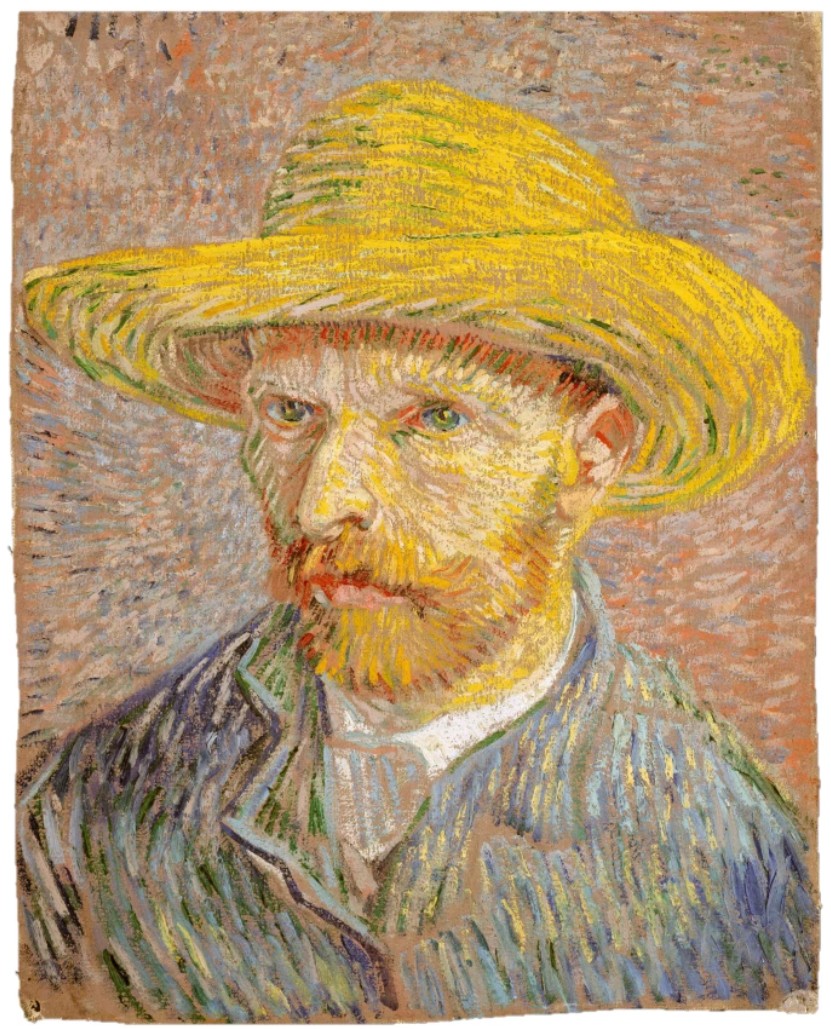
Vincent van Gogh, Autoportrait au chapeau de paille, 1887, The Metropolitan Museum of Art, New York
Among these influences, it was Rembrandt with whom Picasso engaged most profoundly during the 1960s. He increasingly identified with the Dutch master, who, like Picasso, enjoyed a long career and often inserted himself into his compositions. Picasso was particularly drawn to Rembrandt’s sketches and prints, with his wife, Jacqueline Roque, revealing to André Malraux that it was this art that inspired the musketeers. Influenced by Rembrandt’s self-portraits, which confront mortality, Picasso’s musketeers also displayed enormous complexity: the amorous lover, the brave adventurer, the pomp and power of their stature, and the transience of their roles. Picasso was also inspired by more modern masters; Vincent van Gogh became the artist’s “patron saint,” and Picasso frequently evoked him with admiration and compassion. In particular, the bright yellow elements around the musketeer’s hat reference van Gogh’s affinity for the color. Homme assis alludes to Van Gogh’s 1887 Self-Portrait with a Straw Hat, captured in the yellow hat, the chiaroscuro of the face, and the focused gaze. By blending this homage with the musketeer, Picasso makes a powerful statement about his artistic legacy.
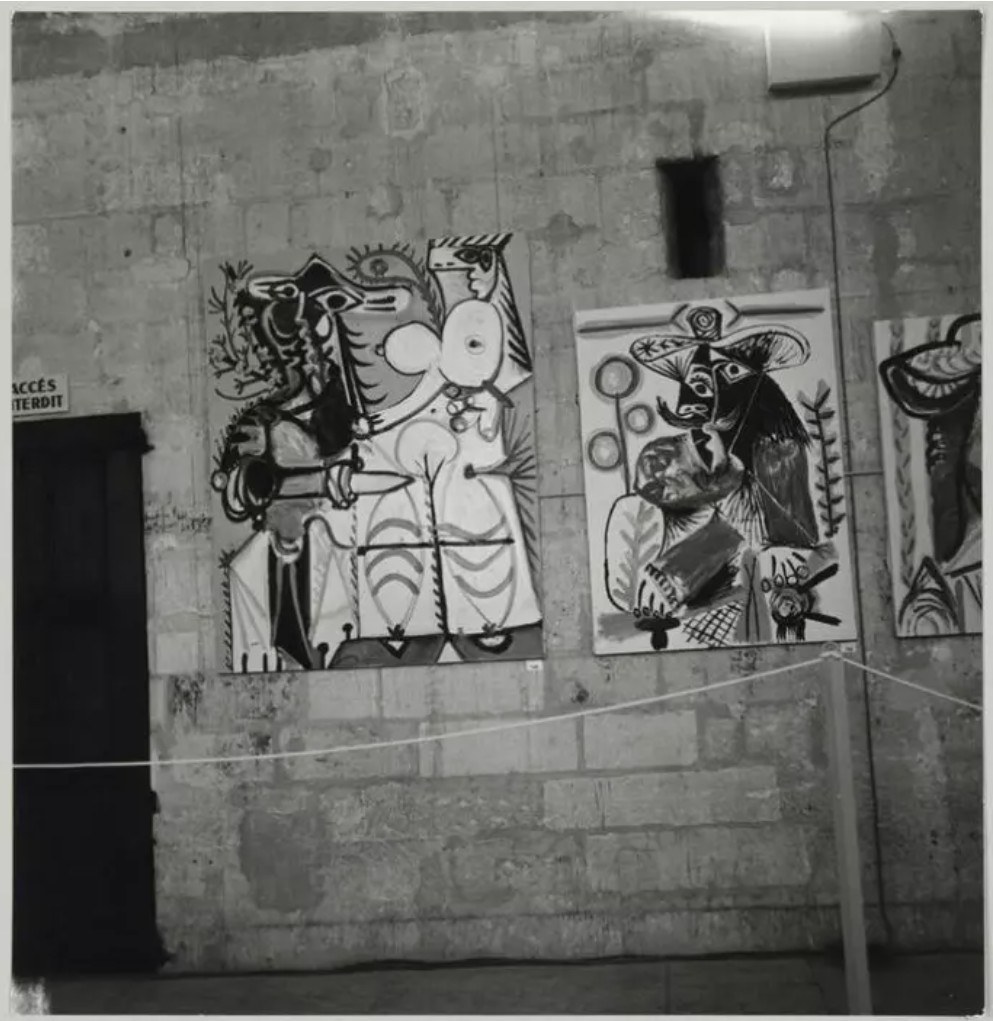
The present work in the 1970 exhibition Pablo Picasso: 1969-1970 at the Palais des Papes
© 2025 Estate of Pablo Picasso / Artists Rights Society (ARS), New York
While the iconography of Homme assis finds its roots in years past, Picasso’s painterly style aligns with the formalist concerns of the Post-War abstract masters. Rendered on a soaring scale, Picasso paints the present work with vigor and full gestures, some areas emerging as abstract motifs in the background and lower register, while others dissolve into pure abstraction. The broad, flat fields of color recall the work of Hans Hofmann, while the work’s stark graphic quality and use of negative and positive space bring to mind the compositions of Franz Kline, whose paintings give equal importance to both the white and black areas of the canvas, rather than treating the white as merely negative space. Even after completing Homme assis, Picasso continued painting at a fervent pace, completing 167 paintings between January 1969 and January 1970. His impetus to create as much as possible before the end inspired Christian Zervos to organize the 1970 exhibition at the Palais des Papes in Avignon. Amidst the Gothic arches and trefoil windows at what was the birth of the papacy, the exhibition featured all of Picasso’s work from the prior year, allowing visitors to experience the year alongside the artist and to live vicariously through him. In this monumental presentation of his great late oeuvre, Picasso’a Homme assis was flanked by Homme et femme, executed a week after the present work, and now in the collection of the Los Angeles County Museum of Art.
Top Lots
#1. Mousquetaire à la pipe II, 1968
Christie’s New-York: 11 November 2021
Estimates on Request
USD 34,710,000
PABLO PICASSO (1881-1973), Mousquetaire à la pipe II | Christie’s
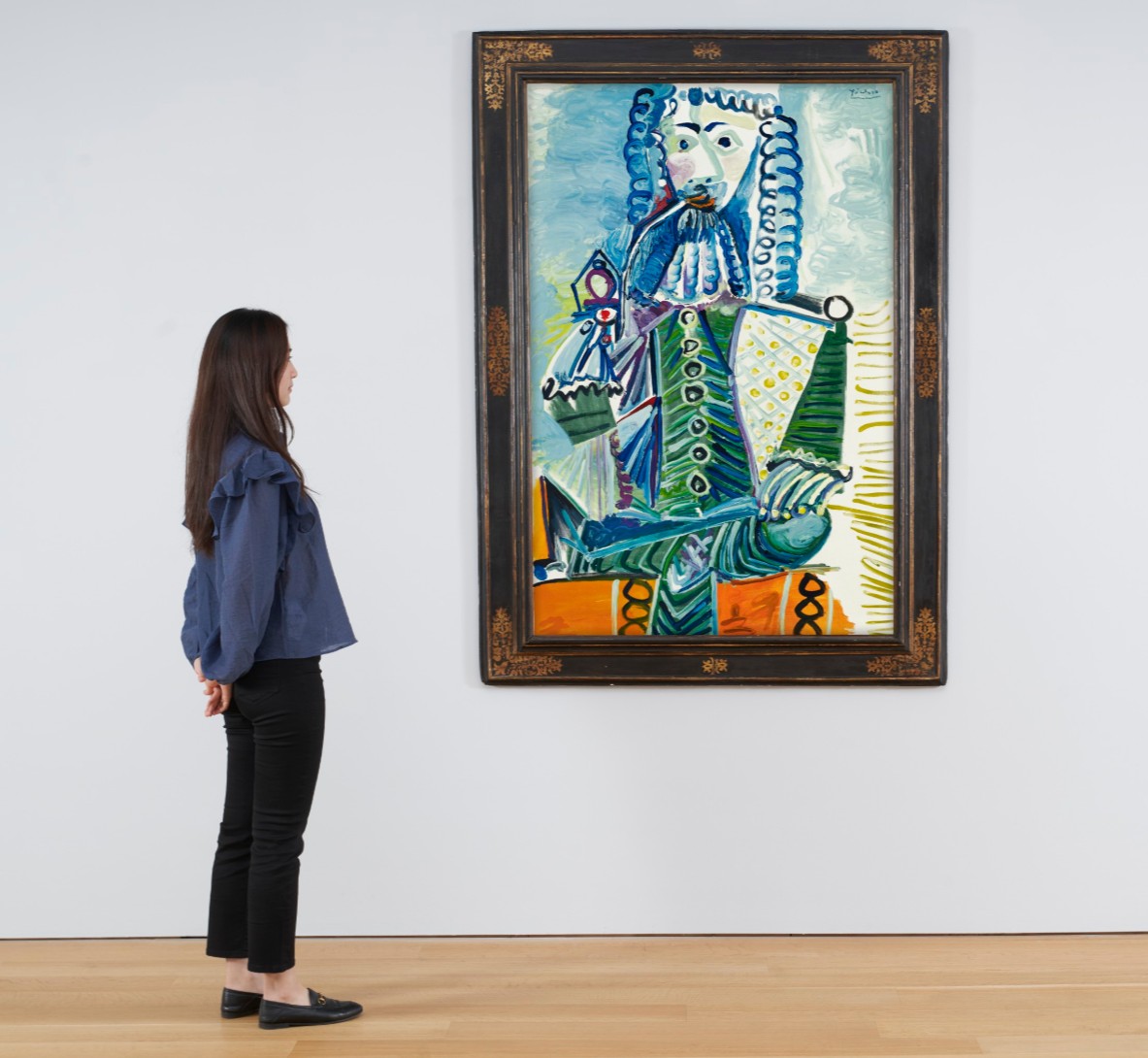
PABLO PICASSO (1881-1973)
Mousquetaire à la pipe II, 1968
Oil and Ripolin on canvas
146 x 96.5 cm (57 1/2 x 38 inches)
Signed ‘Picasso’ (upper right)
Dated and numbered ‘5.11.68. II’ (on the reverse)
Over the autumn of 1968, Pablo Picasso returned with a renewed passion to the subject that has now come to define his late career, the musketeer. This figure—part historical, part fantastical—had entered Picasso’s repertoire of artistic stand-ins at the end of 1966. From this point onwards, the musketeer pervaded his imagination, as he filled canvases with depictions of these impressive, often ostentatiously-garbed, characters that were often vessels through which the artist portrayed himself. It is this 1968 group, however, that marks the peak of Picasso’s interest in the musketeer and includes many of his greatest iterations of this subject. While Picasso returned to the theme frequently over the course of the next four years, this series stands unmatched in its inventiveness and variety, its vibrant palette and rich brushwork, dynamism, and overwhelming joie de vivre.
Painted on 5 November 1968, Mousquetaire à la pipe is among the most impressive and fully worked of this group. This is one of two musketeers that Picasso painted on this day, a striking duo, both of which are pictured with a pipe, and share the same tightly curled hair and beard (Zervos, vol. 27, no. 364; Museum Sammlung Rosengart, Luzern). The figure in the present painting has been conceived on a grandly baroque scale, more than filling the almost two-meter high canvas to tower over the viewer. Set against a soft blue background, the resplendent, frontally-posed musketeer is pictured at ease, his leg casually crossed over his knee while he smokes a clay pipe, its exaggeratedly long mouthpiece heightening the playful exuberance of this debonair male figure. His commanding presence is emphasized as his booted foot pushes up against the picture plane, as if he is about to leap upwards, breaking through the bounds of the canvas into the realm of the viewer. In lavish jewel-colored swathes of paint, Picasso has relished in the description of the decorative attire of this musketeer. The tightly buttoned doublet is striped in green and blue, as if made of out of velvet that catches the light. A flash of dandyism is evident in this ostentatious costume, complete with a patterned lapel, as he stares straight out to return the spectator’s own gaze.
#2. Mousquetaire à la pipe, 1969
Sotheby’s New-York: 5 November 2013
Estimated: USD 12,000,000 – 18,000,000
USD 30,965,000
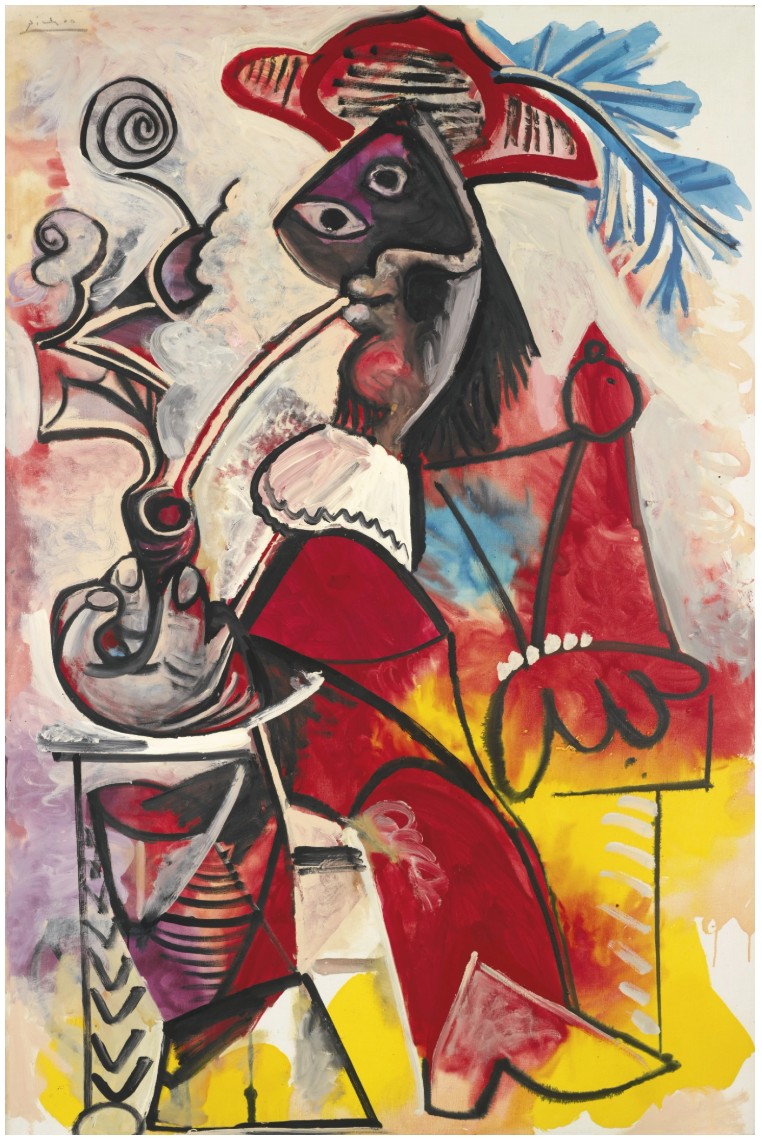
PABLO PICASSO
Mousquetaire à la pipe, 1969
Oil on canvas
195×130 cm (76 7/8 x 51 1/4 inches)
Signed Picasso (upper left)
Dated 5.3.69 II on the reverse
Rendered in the vibrant red and gold colors of the Spanish flag, Picasso’s glorious Mousquetaire à la pipe is a sensational example of a theme that defined the last years of his life. The iconography of the musketeer was indicative of Picasso’s self-awareness in the years before his death. Gone from his paintings were the veiled references to the artist as the victorious gladiator or centaur, as these characters did not reflect the artist’s failing stamina and lost youth. The vainglorious musketeer was believed to be a more appropriate incarnation, offering a spectrum of interpretations that occupied the artist until the end of his life.
#3. Le matador, 1970
Sotheby’s London: 28 February 2018
Estimated: GBP 14,000,000 – 18,000,000
GBP 16,521,500 / USD 22,724,770
(#16) PABLO PICASSO | Le matador
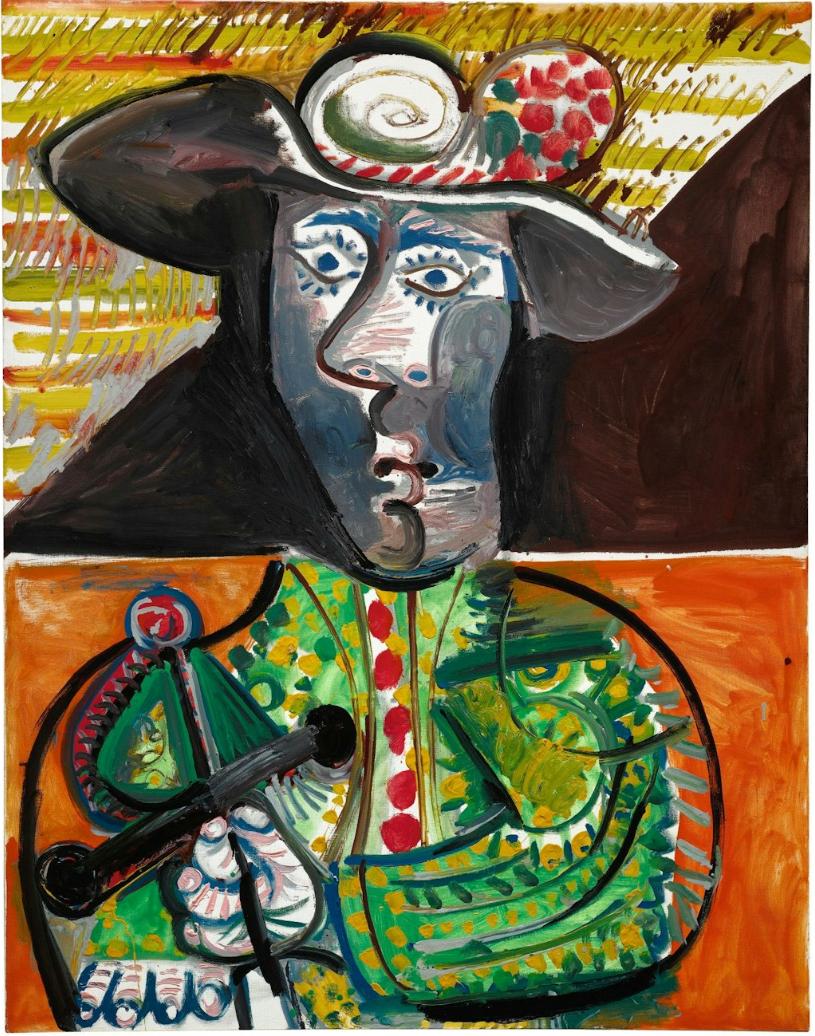
PABLO PICASSO
Le matador, 1970
Oil on canvas
146 x 114.3 cm (57 1/2 x 45 inches)
Dated 23.10.70. on the reverse
Painted on 23rd October 1970, the present oil is the last matador work in a series Picasso started in late September of that year, and is a culmination of a life-long obsession with the theme. Picasso’s first painting Le petit picador jaune, executed in Málaga in 1889-90, represents a matador on a horse in the arena, observed by the spectators behind him. At the age of eight, Picasso was taken to the bullring by his father and this experience certainly had a strong impression on the boy. Bullfighting was later to become one of his most important subjects, and he returned to it – in various guises – at many stages of his career, from the sunlit corrida oils and pastels dating from 1900-01, to the Minotaur figure of his Surrealist phase and the war-time drama of Guernica. In September and October 1970, following a bullfight at Fréjus, he returned to the celebrated theme of the matador for a final time. Unlike his other depictions of the matador from this period, in which the figure is depicted against a plain, monochrome background, the present work is unique for combining the image of the matador with that of the arena. The lower half of the background represents the sand of the bullfighting ring, with the spectators in the upper half. Although executed in a quick manner verging on abstraction, the depiction of the audience recalls not only Picasso’s earlier renderings of the subject, but also that of his predecessors such as Goya and Manet, in which the bullring is characteristically divided into sections in light and shade.
#4. Homme à l’épée, 1969
Christie’s New-York: 9 November 2015
Estimates on Request
USD 22,565,000
Pablo Picasso (1881-1973), Homme à l’épée | Christie’s
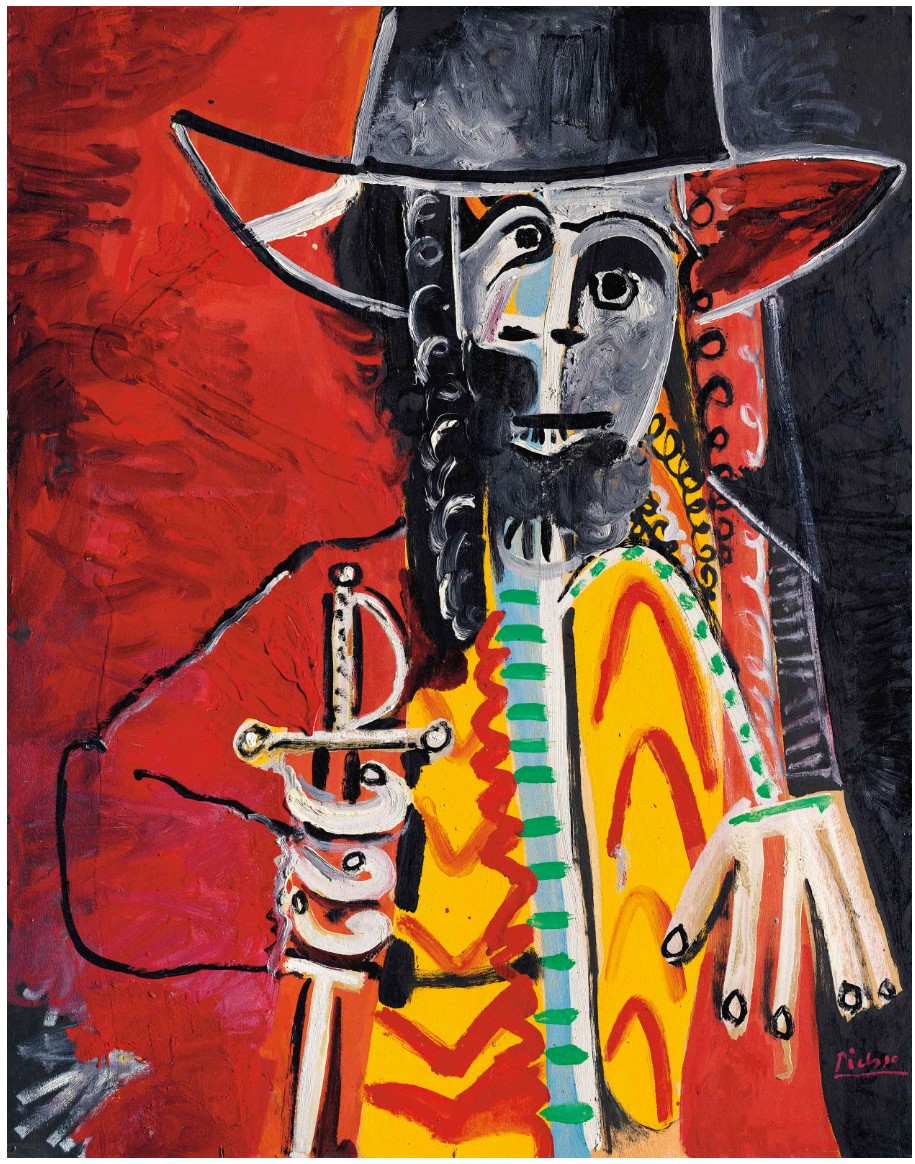
Pablo Picasso (1881-1973)
Homme à l’épée, 1969
Oil on panel
145.6 x 114.3 cm (57 3/8 x 45 inches)
Signed ‘Picasso’ (lower right)
Dated ‘25.7.69.’ (on the reverse)
Picasso approved the choice of Homme à l’épée, painted on 25 July 1969, to adorn the poster for the exhibition Picasso: Oeuvres 1969-1970, which his dear friend Yvonne Zervos had conceived and organized on his behalf, held at the Palais des Papes, Avignon, May through September 1970. Christian Zervos, the long-time chronicler of Picasso’s production and Yvonne’s husband, wrote the preface to the official catalogue illustrated in black-and-white (op. cit.). The poet Rafael Alberti, also especially close to Picasso during this period, wrote the text for Picasso en Avignon, a book published in 1971 (op. cit.) to commemorate in full color this landmark event, the largest and–because the featured works were brand new–the most controversial of the exhibitions held during Picasso’s final years.
The Homme à l’épée–an hidalgo, a Spanish gentleman here clad in the heraldic colors of his land–led this company of swashbucklers, Picasso’s personal bodyguard, as it were, whom the artist called his mousquetaires, or in Spanish, mosqueteros. John Richardson has pointed out that the latter term has a broader, more inclusive meaning than just denoting a soldierly musketeer–“in the Spanish golden age, the noisy groundlings in the corrales,” derived from “mosquitos”–in the present context, those assorted camp-followers to the armed men who serve their king (Picasso Mosqueteros, exh. cat., Gagosian Gallery, New York, 2009, p. 22).
The mousquetaires had indeed invaded and completely taken over Picasso’s studio during the late 1960s. Earlier in the decade Picasso had cast his favorite persona as an artist type, a character like the 17th century painter Frenhofer in Balzac’s L’Oeuvre inconnu, or in the bohemian mold of the late 19th century, like Lantier in Zola’s L’Oeuvre (modeled on Cézanne), or even Van Gogh, the exemplar of a fraught, fabled life in art, tragically cut short–the fate of a peintre maudit. Picasso also often assumed as an alter ego–even in his studio situations–the figure of a brawny Mediterranean fisherman, a modern Odysseus, either young or old, with tousled hair and a curly beard, clad in a striped sailor’s vest, such as Picasso himself liked to sport. The adventurous and virile knight-musketeer now replaced the fisherman as Picasso’s favored outdoors type. This fellow was even more at home in the studio–like some lesser pupil of an El Greco or a Velázquez he was practiced in the art of painting, and simply as a man he loved the company of a beautiful young woman, as his model to paint, and as the object of his affection to seduce.
Then in his late eighties, Picasso was inclined to travel only locally–to the bull-fights at Fréjus, for instance–in order to avoid, as the world’s most famous living artist, the attention of annoyingly curious crowds. He preferred instead to spend as much time as possible hunkered down in his work in the studio, while his wife Jacqueline fended off at the gate all but a choice handful of old friends. Even if his vaunted sexual powers were finally on the wane, he still possessed and increasingly indulged, by way of compensation, his ever excitable and voluble imagination, creating his own theater of memory. Picasso thus transformed himself into the brave, adventurous, and virile musketeer, or more broadly into a 17th century cavalier, a rakish nobleman skilled with the sword, daring in his romantic exploits, and in his tastes and appetites a worldly gentleman who enjoyed all that life had to offer. He might wear an elegant little beard and long wavy hair, or in a dissipated, down-on-one’s-luck state take on a shabbier aspect, while still clad in the requisite doublet and ruffled collar. This was the mask Picasso held up most frequently to the world in the pictures he created during the remaining years of his life.
Picasso painted Homme à l’épée on 25 July 1969, more than two years into this unrelenting campaign, longer than Louis XIII’s siege of La Rochelle in Dumas’ novel. From their first appearance Picasso’s choice of the mousquetaires as his primary driving theme seemed to nearly everyone a willfully odd and retrograde idea at a time when America’s war in Vietnam continued to dominate the headlines. During the previous year Soviet and Warsaw Pact armies had invaded Czechoslovakia, putting an end to Dubček’s liberalizing Prague Spring. Paris was still recovering from the throes of the great student uprising, les jours de Mai, which had forced President de Gaulle from office. The world’s greatest living artist appeared to have retreated into a world peopled with “backward-looking romantics and nostalgic dreamers” (M.-L. Bernadac, Late Picasso, exh. cat., The Tate Gallery, London, 1988, p. 82), more like the hapless Don Quixote than the profoundly committed creator of Guernica. Many assumed that Picasso was thumbing his nose at the new modern art of the post-war era, when emotive abstraction was in, the figure out, and many artists had dispensed with the notion of a subject altogether.
Ironically embodied in the image of a man dedicated to bellicose behavior, of the kind that had caused so much mayhem and carnage down through the centuries, Picasso’s mousquetaires are nearly all comically mock-heroic; these pretenders to derring-do often appear ridiculously overblown in their grandiose self-confidence. That the artist had insinuated his famously long-held antiwar views into the comical demeanor of these military misfits was obvious from the outset, but only over time has the subtlety in Picasso’s understanding of the 60s scene become more clearly apparent. In this regard, Dakin Hart’s essay “Peace and Love Picasso” in the 2009 Gagosian Gallery catalogue rings loud and true. He called Picasso’s musketeers “a kind of multinational, trans-historical hippie army.”
#5. Buste d’homme dans un cadre, 1969
Christie’s Hong-Kong: 26 May 2022
Estimates on Request
HKD 174,950,000 / USD 22,287,335
PABLO PICASSO (1881-1973), Buste d’homme dans un cadre | Christie’s
PABLO PICASSO (1881-1973)
Buste d’homme dans un cadre, 1969
Oil on canvas
92×73 cm (36 1/4 x 28 3/4 inches)
Signed ‘Picasso’ (upper left)
Dated ‘29.3.69.’ (on the reverse)
#6. Mousquetaire à la pipe, 1968
Sotheby’s New-York: 13 May 2019
Estimated: USD 20,000,000 – 30,000,000
USD 20,766,000
(#40) PABLO PICASSO | Mousquetaire à la pipe
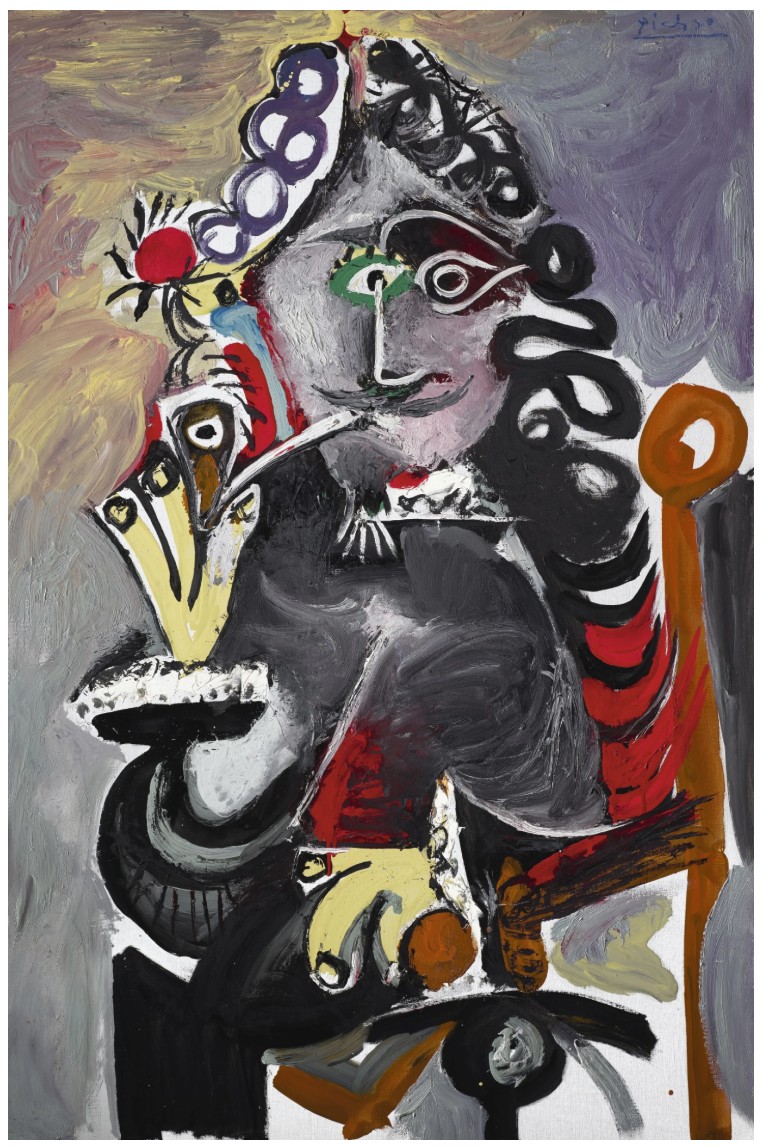
PABLO PICASSO
Mousquetaire à la pipe, 1968
Oil on canvas
145.1 x 96.5 cm (57 1/8 x 38 inches)
Signed Picasso (upper right)
Dated 13.10.68 I (on the reverse)
In October and November of 1968 Picasso executed a series of large canvases depicting flamboyant, sword-brandishing musketeers. One of the great subjects of the artist’s late oeuvre, the musketeer was one of a cast of psychological avatars that were a means of projecting different aspects of his own identity. These portraits of the various archetypes that populated Picasso’s personal mythology were part of a late flowering, a final synthesis which merged the artist’s personal history with the cultural heritage of the Western artistic tradition, and developed a direct and spontaneous style that celebrated the act of artistic creation. In choosing the iconography shared by Old Master painters such as Rembrandt and Velázquez, Picasso was, at the end of his career, consciously aligning himself with the greatest artists of the Western canon. Picasso’s work on this theme began in the mid-1960s with a series of engravings and works on paper, and later a variety of canvases of the musketeer, festooned in colorful regalia and brandishing a symbol of his virility—a pipe, instrument, weapon, or even a paintbrush. “In December 1966,” Gert Schiff writes, “an army of seventeenth-century soldiers invaded Picasso’s pictorial world. These—soldiers of fortune, soldier-adventurers, Spaniards of the Golden Age—he referred to colloquially as ‘musketeers.’ The first contingent, mostly heads and busts, had austere faces, surrounded by long hair, ruffs and collars. Soon, however, Picasso was depicting his musketeers as full-length figures sporting swords, sabers, musket, or even the big lances with which cavalrymen of the 1600s were armed. At this point we see them clad in doublets, fancy hose, belts in vivid colors, embroidered with gold and silver, and hats adorned with multicolored plumes” (G. Schiff, Picasso. The Last Years, 1963-1973, New York, 1983, p. 30). For the present composition, Picasso has rendered his musketeer as a pipe smoker—a motif that dated back to some of the artist’s composition from the early twentieth century and recurs in the greatest examples of the musketeers series (see figs. 1 & 2).
#7. Mousquetaire et nu assis, 1967
Christie’s London: 27 February 2018
Estimated: GBP 12,000,000 – 18,000,000
GBP 13,733,750 / USD 18,890,315
Pablo Picasso (1881-1973), Mousquetaire et nu assis | Christie’s
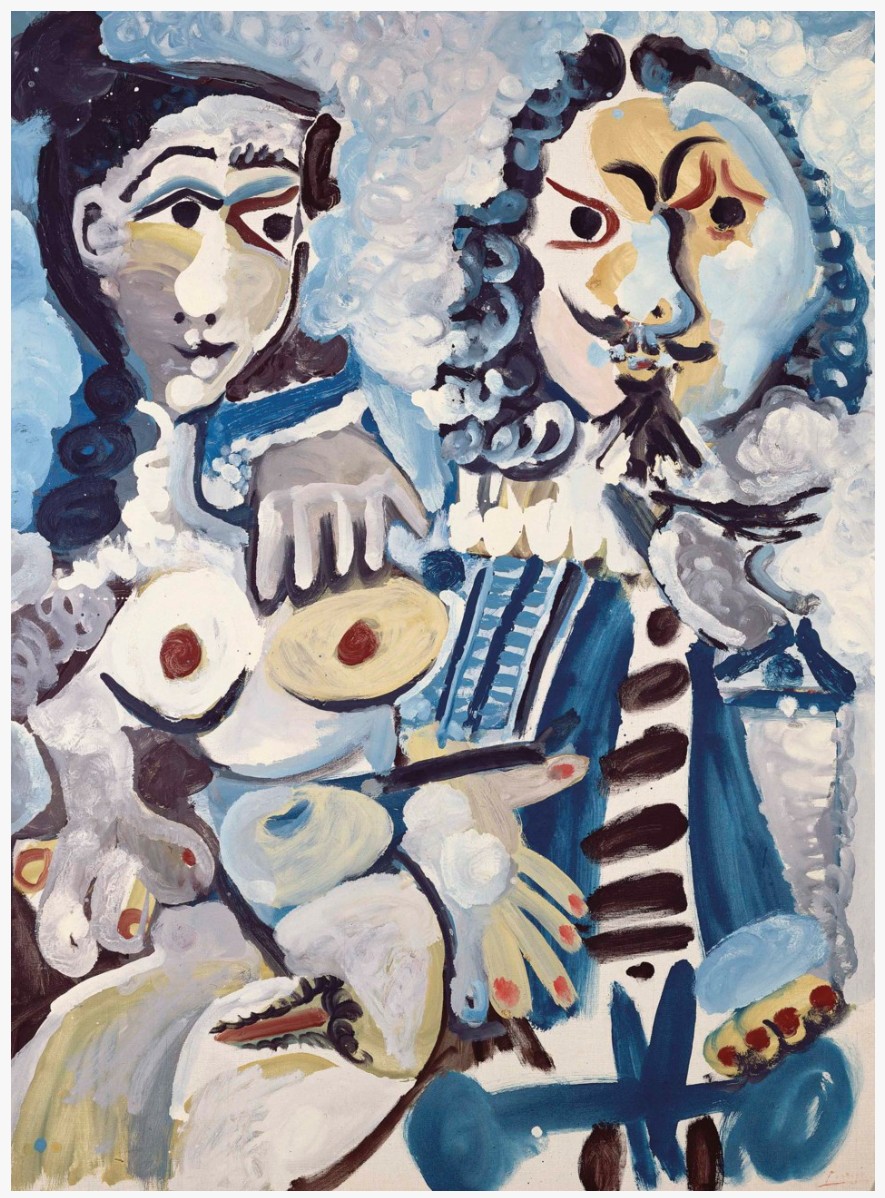
PABLO PICASSO (1881-1973)
Mousquetaire et nu assis, 1967
Oil and Ripolin on canvas
130 x 96.5 cm (51 1/4 x 37 7/8 inches)
Signed ‘Picasso’ (lower right)
Dated ‘11.4.67’ (on the reverse)
Painted with gestural, lavishly and passionately applied brushstrokes and an impulsive sense of spontaneity, Mousquetaire et nu assis is among the first of the triumphant, swaggering cavalcade of musketeers and cavaliers that trooped into Pablo Picasso’s art in 1967. A virtuoso image of virility and vitality, this impressively sized painting presents the quintessential figure of the musketeer, who is this time accompanied by a sensuous, seated nude. With her shock of dark hair, hieratic posture, and her large, all-seeing almond shaped eyes, there is no question as to the identity of this woman: she is Jacqueline, the artist’s final, great love, muse and wife, whose presence permeated every female figure in this final chapter of Picasso’s life. Like Titian, Rembrandt, Matisse or de Kooning, in the final years of his life, Picasso had a great flourishing of artistic activity during which he produced an astonishing number of paintings and drawings, driven by an indefatigable will to create. With one eye towards the Old Masters and another towards the Informel, Picasso shows himself still challenging the history of art, carrying out iconoclastic attacks, plundering the past and doing so in a strikingly fresh, gestural way. Steeped in eroticism, a machismo sense of bravado, and pulsating with a vital sense of energy, this painting paved the way for the themes, style and execution that would come to define Picasso’s late, great work.
#8. Homme à la pipe, 1969
Christie’s New-York: 16 November 2016
Estimated: USD 15,000,000 – 20,000,000
USD 18,391,500
Pablo Picasso (1881-1973), Homme à la pipe | Christie’s
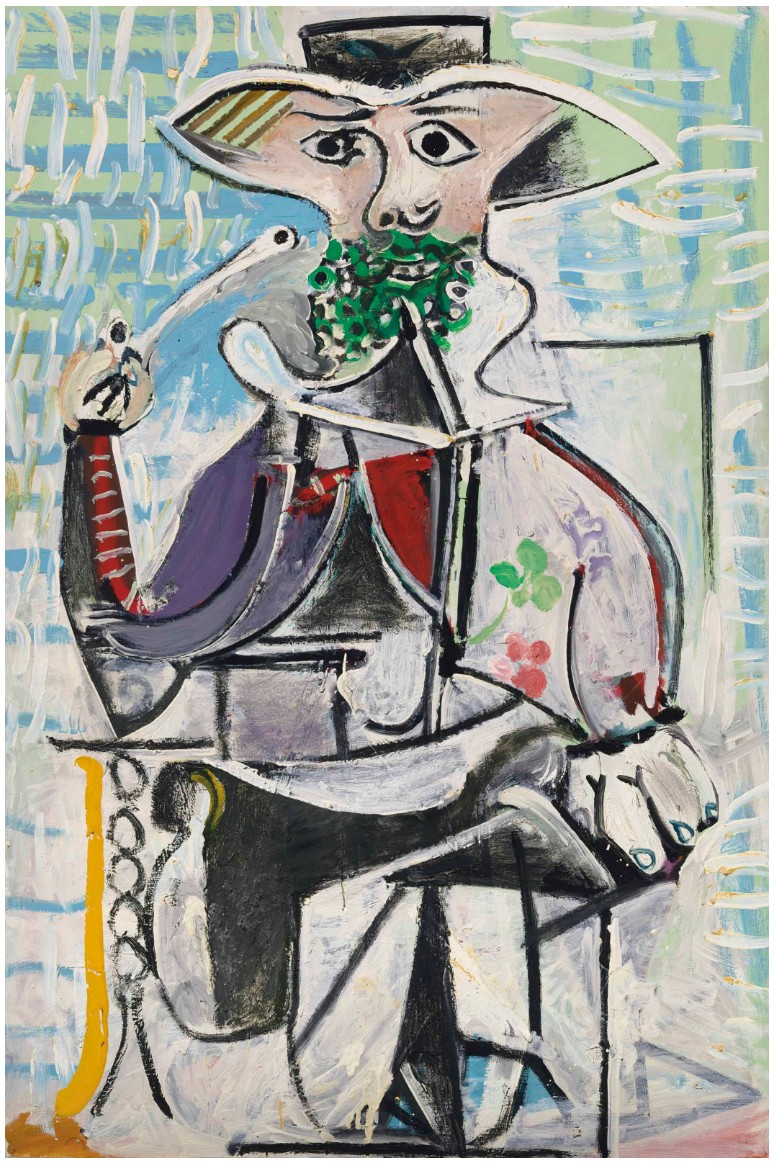
Pablo Picasso (1881-1973)
Homme à la pipe, 1969
Oil on canvas
195 x 129.8 cm (76 3/4 x 51 1/8 inches)
Dated ‘8.5.69.’ (on the reverse)
When Picasso painted this brimming, energetically brushed figure of a bearded gent smoking his pipe on 8 May 1969, he had been immersed in his late signature series of mousquetaires for more than two years. The paintings he created several days before and after he completed this picture depict those 17th century rakes and swashbucklers, many of whom likewise enjoy a leisurely smoke on a long-stemmed, white clay pipe. This Homme à la pipe, however, is neither adorned in heraldic livery, nor does he display any of the accessories that typically pertain in Picasso’s late iconography to one of the king’s trusted swordsmen. Instead he takes his ease in later period attire while seated in an ordinary sidewalk chair, alongside a small wrought-iron bistro table.
Picasso, moreover, appears to have invested the present Homme à la pipe with more profound and meaningful personal significance than the mousquetaires, touching on themes even closer to his heart and mind at this final, climactic stage in his long career. This amiable smoker, who casts a wide, observant eye on the passing parade, is an artist, and represents specifically for Picasso the generation of his immediate forebears, some of whom were still alive and working when he, an aspiring painter still in his teens, first came to Paris in 1900. The work of Corot, Courbet, Manet, Degas, Cézanne and Van Gogh influenced Picasso for much of his career, and especially during the late 1960s, when he sought to gauge his legacy against theirs, as well as masters in the more distant past, such as Velázquez, Rembrandt, and Goya. The cerulean blue setting, stippled with white clouds, proclaims the revolutionary plein air approach of the new painting after 1870, employing the technique of working quickly, notions these earliest proponents of modernism typically practiced in their work, as they lay the pictorial foundations for the tumultuous art of the century to come.
#9. Buste de matador, 1970
Sotheby’s Hong-Kong: 19 April 2021
Estimated: HKD 100,000,000 – 150,000,000
HKD 138,46,000 / USD 17,853,390
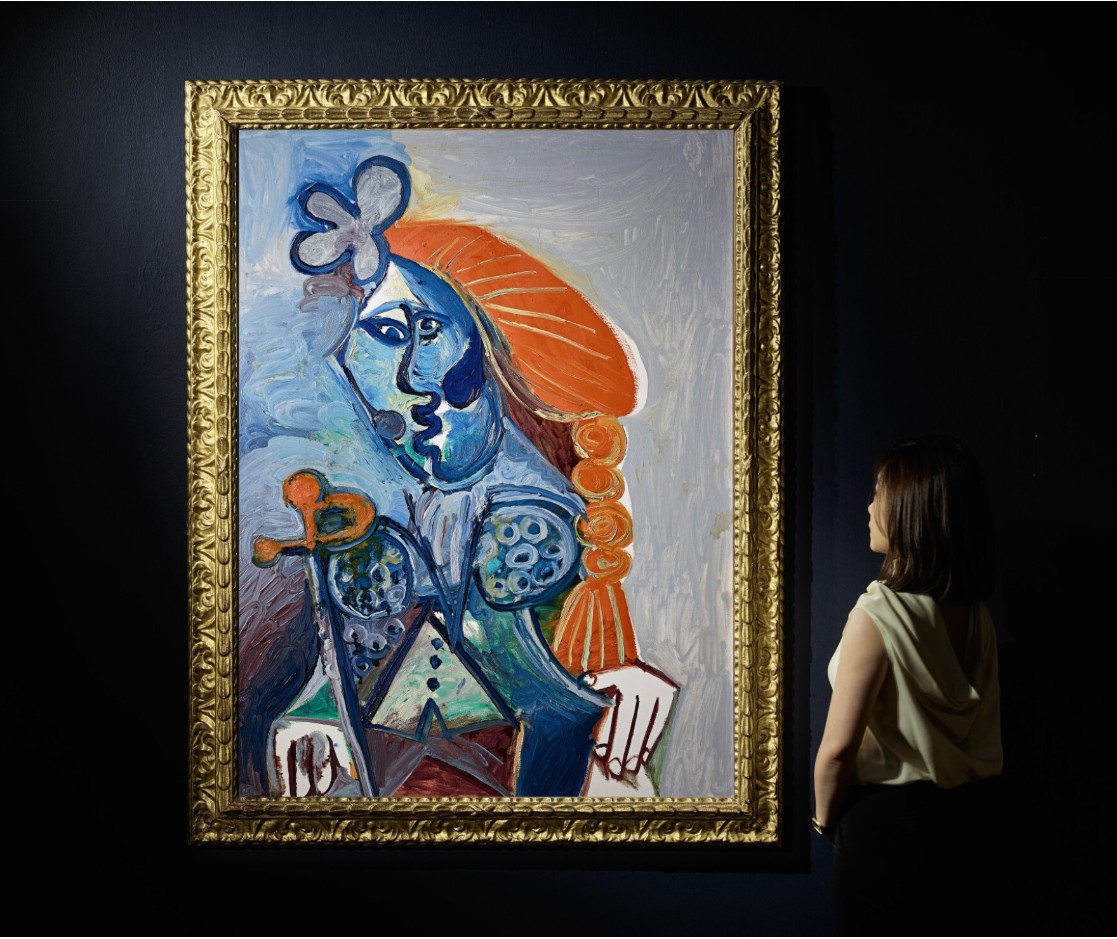
PABLO PICASSO (1881 – 1973)
Buste de matador, 1970
Oil on canvas
130×97 cm (51 1/8 x 38 1/8 inches)
Dated 27.9.70 IV on the reverse
Buste de matador was created in 1970, which was an important year in Picasso’s life and art. In that year, he and his second wife Jacqueline Roque attended the last bullfight of his life in Fréjus, and he was inspired to paint the fifteen oil paintings that would comprise the last bullfighting series of his life. That same year, he generously donated 921 works to the Picasso Museum in Barcelona, laying the foundation for later generations to study his work. The last masterwork in the same series, Le matador sold for £16.5 million (HK$177.8 million) at Sotheby’s London Impressionist and Modern Art Evening Sale in 2018. Buste de matador, dated 27 September 1970, is the first painting in this matador series. This piece at the Sotheby’s Hong Kong Spring Sale will showcase one of the most important themes in Picasso’s life and art. The figure in the painting has a piercing expression, full of tenderness and concern. We can infer that Picasso was paying tribute to his wife with this matador, expressing his undying affection. According to archival materials, works in this same series were painted especially for Jacqueline Roque, such as Le matador (195 x 130 cm) dated 14 October. This figure with long orange hair in Buste de matador was developed in three drafts, and iterations of the figure appear in many other works from the same series. According to the Picasso in the Nahmad Collection exhibition catalogue, the bullfighter depicted in this series could be modeled on a matador from Mozambique that Picasso saw in 1970. Because this painting is the first work in the series, it has been invested with his most intense emotions and experimental ideas. This painting lays a decisive foundation for the fourteen other oil paintings in the series. It brings together the heroic figure of the matador and the artist’s tender feelings for his wife; these multiple meanings give this painting a special place in this series.
#10. Homme à la pipe, 1968
Sotheby’s London: 6 March 2024
Estimated: GBP 8,000,000 – 12,000,000
GBP 13,723,100 / USD 17,400,891
PABLO PICASSO (1881 – 1973)
Homme à la pipe, 1968
Oil on canvas
162.7 x 114.5 cm (64 1/8 x 45 1/8 inches)
Signed Picasso and dated 8.11.68. (upper left); dated 8.11.68. (on the reverse)
Epic in scale and striking in its exuberance and spontaneity of execution, Homme à la pipe is an exceptional example from Picasso’s celebrated late body of work. In blending the two major tropes that dominated the artist’s late oeuvre – that of a pipe-smoking musketeer and a romantic torero or bullfighter – the present work is a testament to the inventiveness and dynamism which characterize the period John Richardson described as Picasso’s “monumental apotheosis.”
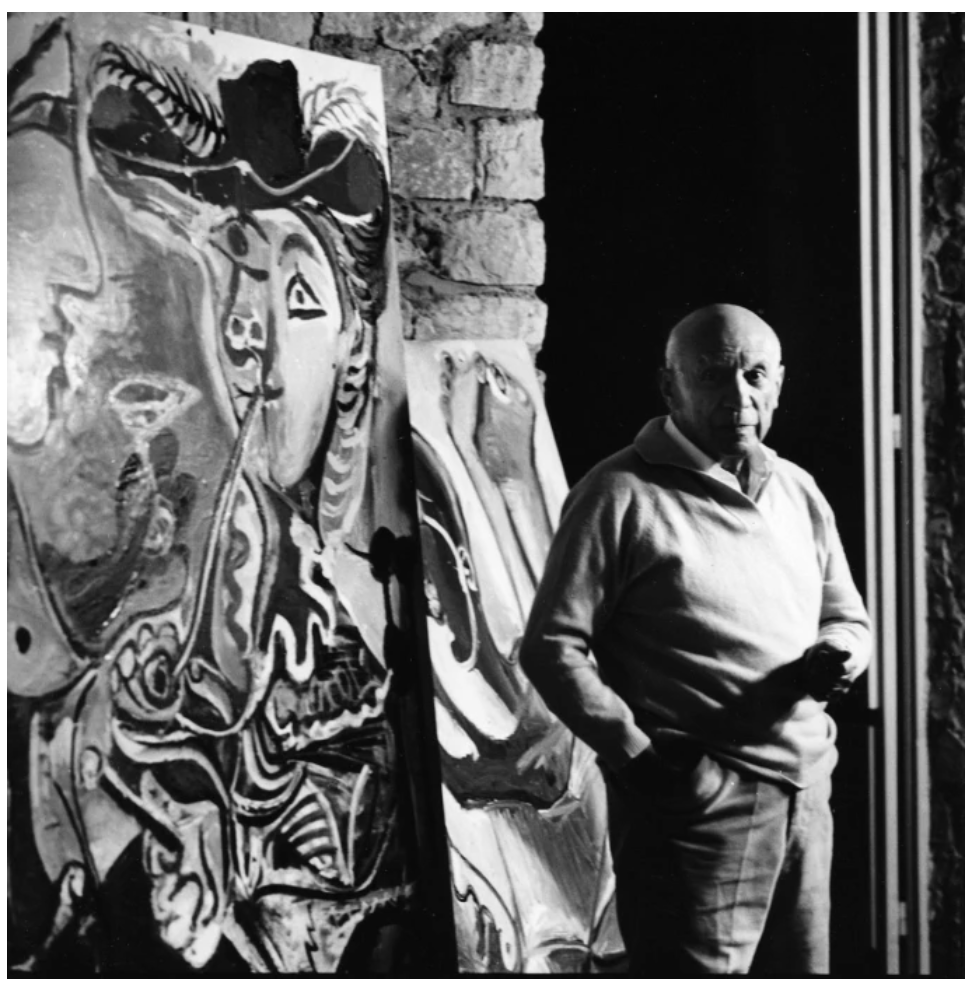
PICASSO IN HIS STUDIO AT NOTRE DAME DE VIE, 20 DECEMBER 1967. PHOTOGRAPH BY KURT WYSS
In 1961, Picasso turned eighty. As the widely recognized maître of twentieth century art he had nothing to prove and yet, as he recalled, he was gripped by the feeling that he had “less and less time and […] more and more to say” (Pablo Picasso quoted in Klaus Gallwitz, Picasso Laureatus, Lausanne and Paris, 1971, p. 166). This feeling is the driving force behind the inventiveness and spontaneity of his mature work and his significant recourse to archetypal figures and symbols. The seemingly limitless energy that characterizes so much of his work reaches its apex in this final burst of creativity. The first depictions of musketeers appear in his oeuvre in 1966, firstly in the form of numerous drawings and engravings. The artist’s fascination with this romantic archetype can be traced back to his Spanish childhood and his love of Cervantes’ Don Quixote; the musketeer was a character that embodied the courtly mannerisms of the Renaissance gentleman, resurrected by Picasso for a twentieth-century audience. Considering the artist’s age, the image of the musketeer is also evocative of a certain nostalgia for the youthful vigor of his early years. The musketeers of Alexandre Dumas’ novel, which served as another key source of inspiration in his work from this period, were famously known just as much for their good living and loving as for their swordsmanship. Quite often, and as is the case in the present composition, they are depicted smoking a pipe, another key reference to the days of the artist’s youth.
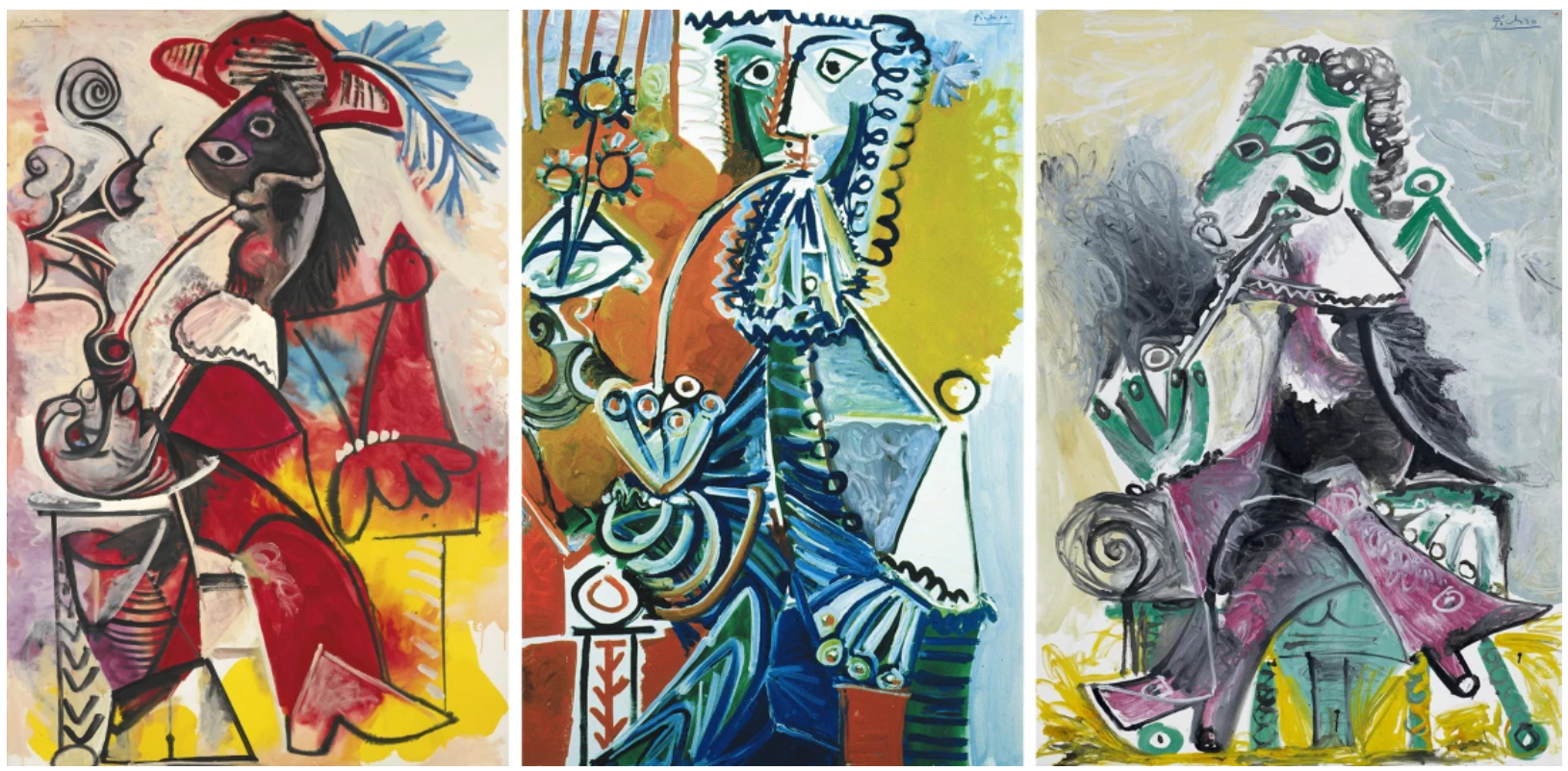
LEFT: PABLO PICASSO, MOUSQUETAIRE À LA PIPE, 5 MARCH 1969, OIL ON CANVAS. SOLD: SOTHEBY’S, NEW YORK, NOVEMBER 2013, $30,965,000 © SUCCESSION PICASSO/DACS, LONDON 2024
CENTRE: PABLO PICASSO, MOUSQUETAIRE À LA PIPE, 5 NOVEMBER 1968, OIL ON CANVAS, MUSEUM SAMMLUNG ROSENGART, LUCERNE © SUCCESSION PICASSO/DACS, LONDON 2024
RIGHT: PABLO PICASSO, MOUSQUETAIRE À LA PIPE, 6 OCTOBER 1968, OIL ON CANVAS, THE MUSEUM OF CONTEMPORARY ART OF THE BASQUE COUNTRY-ARTIUM MUSEOA, VITORIA-GASTEIZ © SUCCESSION PICASSO/DACS, LONDON 2024
In Homme à la pipe, Picasso equally pays tribute to the work of two painters he had adored throughout his life, Diego Velázquez and Rembrandt van Rijn. It was through these reinterpretations and investigations of the Old Masters that Picasso reaffirmed his space within the canon of Western art history. As Schiff notes in the catalogue accompanying the seminal 1984 exhibition at the Guggenheim Museum dedicated to Picasso’s late work, “Many of these musketeers are in a general way related to portraits by Rembrandt, even if it is not always possible to point to specific prototypes. What remains of the models is often merely something of the lineaments of a furrowed face, a searching look, a dishevelled head of hair and beard, or the play of light and shadow. However, not many musketeers remain recognizably “Dutch”. In most the spiritual climate is closer to El Greco, Velásquez, Murillo or Antolinez. Even the most diagrammatic ones are imbued with Spanish fervor, are hidalgos rather than staalmeesters” (ibid., pp. 36-37). Such is the case with the present work; the overall composition is clearly evocative of traditional Dutch portraiture, while his facial features—the hair and the eyes in particular – as well as his trousers and jacket, reminiscent of a torero’s traditional chaquetilla – are undeniably Southern European.
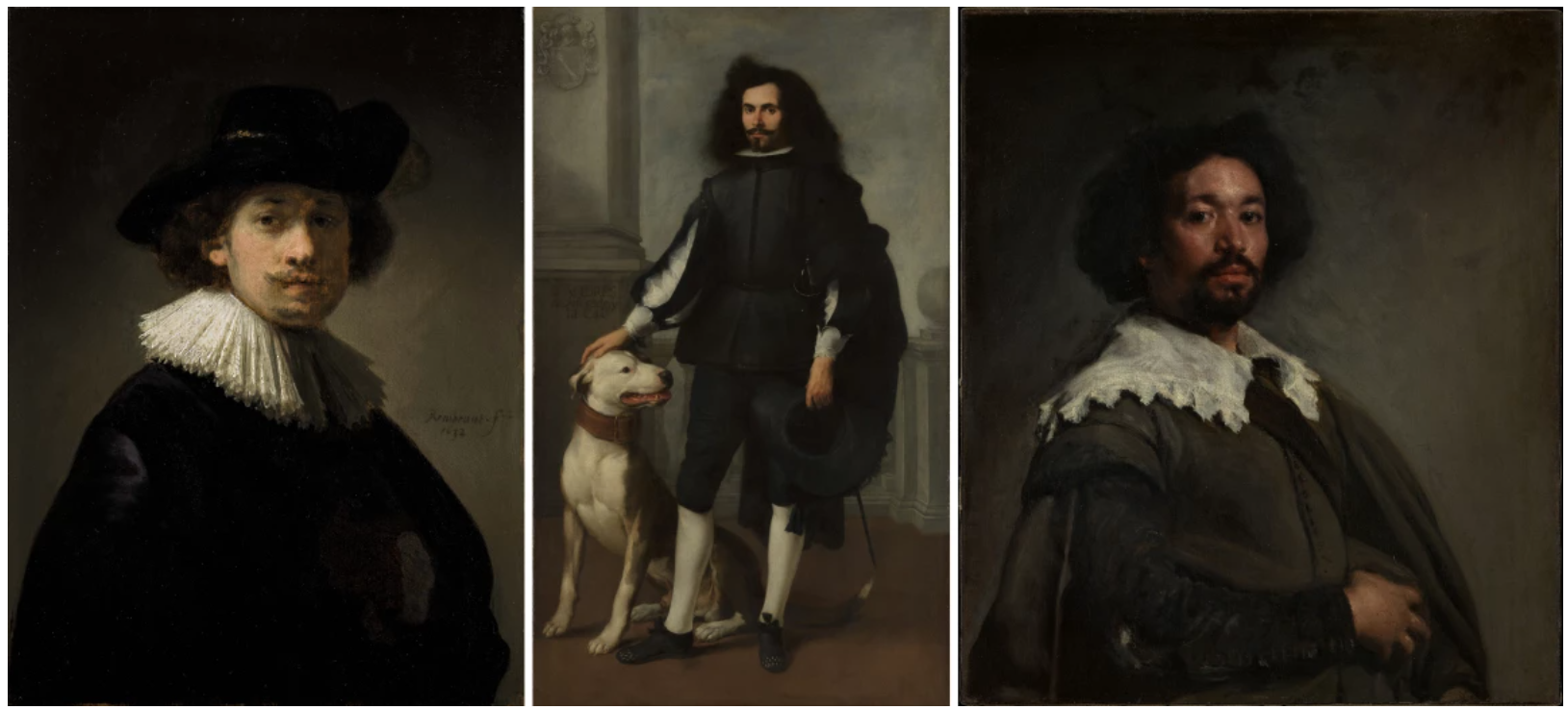
LEFT: REMBRANDT HARMENSZ. VAN RIJN, SELF-PORTRAIT OF THE ARTIST, HALF-LENGTH, WEARING A RUFF AND A BLACK HAT, 1632. SOLD: SOTHEBY’S, LONDON, JULY 2020, £14,549,400
CENTRE: BARTOLOMÉ ESTEBÁN MURILLO, DON ANDRÉS DE ANDRADE Y LA CAL, CA. 1665–72, THE METROPOLITAN MUSEUM OF ART, NEW YORK
RIGHT: DIEGO RODRÍGUEZ DE SILVA Y VELÁZQUEZ, JUAN DE PAREJA, 1650, OIL ON CANVAS, THE METROPOLITAN MUSEUM OF ART, NEW YORK
Speaking about the formal characteristics of Picasso’s musketees-matador paintings, Schiff remarks: “These are very large canvases. They are painted with increasing rapidity and dispatch, with a great deal of black and white amid the garish colours. Pentimenti or difficult transitions are simply covered with brushwork, gray as tobacco smoke […]. Mere dots and squiggles indicate curly wigs, ruffs and chains; striations in red, yellow, or green mark doublets and sashes. Picasso practices an against-the-grain historicism: with pictorial means that are light-years removed from the Baroque, he creates a Baroque pageant more exuberant and ‘genuine’ than any of the studied historical reconstructions of the nineteenth century ” (Exh. Cat., New York, The Solomon R. Guggenheim Museum, Picasso, The Last Years, 1963-1973, 1983, p. 31). The present work brims with the powerful immediacy which marks out the finest of Picasso’s late works. Here, the great master achieves a dramatic visual effect by outlining the figure and face of the sitter through the rapidly applied, thick black lines, while the rich crimson and raspberry hues denoting his nose, beard and clothes radiate powerfully through their contrast with a more subtle sage-colored background. In its liveliness and expressivity, Homme à la pipe is emblematic of the freedom and spontaneity which Picasso found in his late work. Even at this stage in his career, he was endlessly reinventing himself and responding to new artistic innovations – perhaps most notably in the present work, those of the American Abstract Expressionists whose brushwork possesses a similarly gestural and profoundly expressive quality.
#11. Homme à la pipe, 1968
Christie’s New-York: 6 November 2007
Estimated: USD 12,000,000 – 16,000,000
USD 16,841,000
Pablo Picasso (1881-1973) , Homme à la pipe | Christie’s
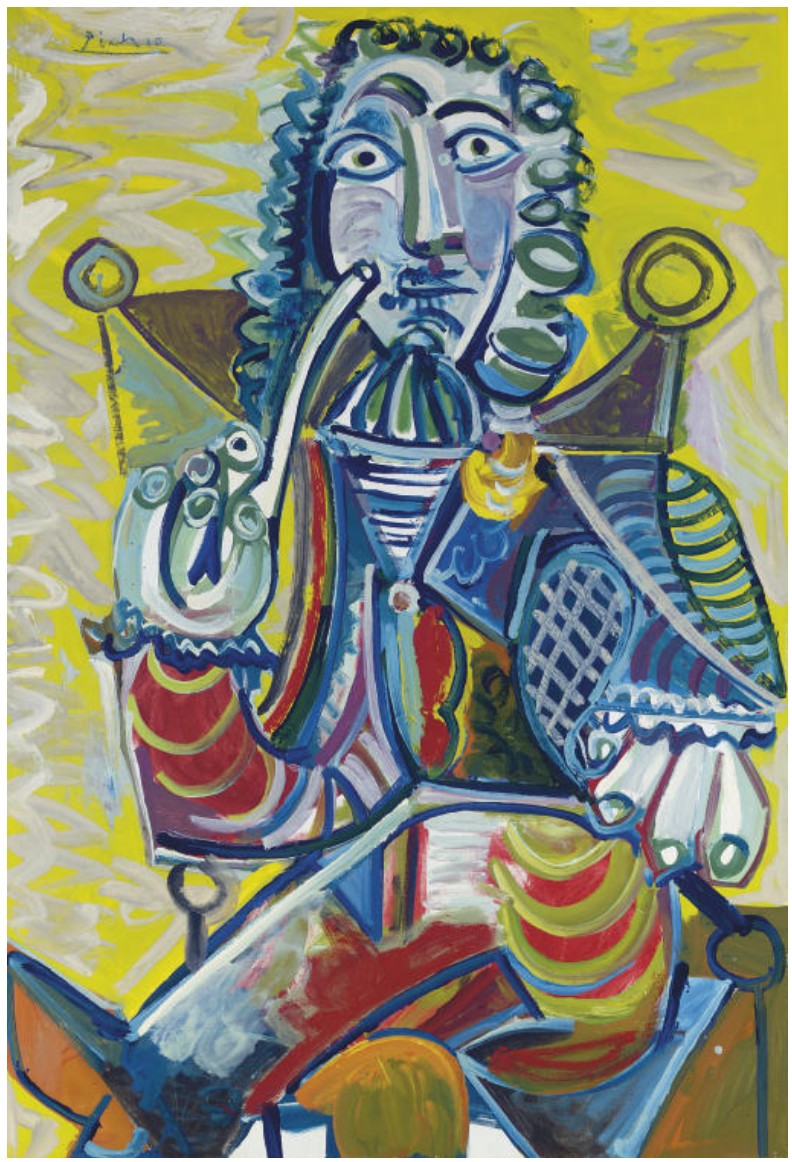
PABLO PICASSO (1881-1973)
Homme à la pipe, 1968
Oil on canvas
130.1 x 89 cm (51 1/4 x 35 inches)
Signed ‘Picasso’ (upper left)
Dated ‘7.11.68.’ (on the reverse)
Picasso painted Homme à la pipe in late 1968. It may seem an unusual subject at a time when America’s war in Vietnam filled the headlines and Paris was still recovering from the throes of the great student uprising earlier that year. A few months earlier Soviet forces had invaded Czechoslovakia, ending the Prague Spring. The world’s greatest living artist appeared to have retreated in a world of “backward-looking romantics and nostalgic dreamers” (M.-L. Bernadac, Late Picasso, exh. cat., The Tate Gallery, London, 1988, p. 82). Picasso’s view of the musketeers is invariably comic and mock-heroic; these soldiers of derring-do are often ridiculous and overblown in their grandiose self-confidence. This subject may be tinged with Picasso’s antiwar views, expressed in the image of a man ordinarily inclined to bellicose behavior, of the kind that had caused so much mayhem and carnage through the centuries. Here, having put his sword aside, the musketeer looks rather harmless and congenial.
Buste d’homme, 1964
Phillips New-York: 19 November 2024
Estimated: USD 3,000,000 – 5,000,000
USD 3,085,000
Pablo Picasso – Modern & Contempora… Lot 16 November 2024 | Phillips
PABLO PICASSO
Buste d’homme, 1964
Oil on canvas
28 3/4 x 21 inches (73 x 53.3 cm)
Signed “Picasso” upper left; inscribed and dated “15.12.64 I” on the reverse
Painted on December 15, 1964
One of five paintings created by the artist on the 15 December 1964, Buste d’homme is a vibrantly bold example of Pablo Picasso’s celebrated late period when, as the artist approached old age, his work became increasingly preoccupied with questions of masculinity and power explored through an ensemble cast of matadors, musketeers, and male painters. Recalling the iconographic clarity of his playful ceramic experiments, in these portraits Picasso pushes his visual language into newly expressive territory. Presented frontally, the strikingly individual and distinct faces of these male protagonists are reduced to their essential pictorial elements, constructed through interlocking zones of bold color while alternating dashes and longer strokes of black paint economically delineate facial features including eyes, nose, hair, and mouth. While the subject of Buste d’homme remains unknown, the resemblance to Picasso himself is striking. Often serving as stand-ins for the artist, Picasso’s figures chart the course of his life, with his increasing portrayal of masculine forms aligning with the final decade of his existence. Every work he created was an extension of himself, a fragment of life, a defiance against mortality.
Working primarily in colored crayon and inks in the early months of the 1964 Picasso produced at a prolific rate, freely experimenting with the simplified features and bold contrasts of greens, pinks, and ochres that would find their way into both his portraits of male subjects and the extensive series of paintings focused on the motif of the artist and model that had preoccupied him for much of the year. Drawing on themes related to creativity and virility, the charged dynamic between artist and model had long preoccupied the artist, their encounter in the space of the studio dramatizing the fertile exchange between muse and master and setting the stage for daring acts of creation. While these works can certainly be interpreted as more objective reflections on the creative process itself, Picasso would often incorporate his own likeness along with that of his primary model of the time into these works in more personal reflections on his own artistic legacy. Tellingly, in one such work from 1964, now in the collection of the Buffalo AKG Art Museum in New York, the male artist figure appears frontally, holding a brush and palette and dressed in Picasso’s signature Breton striped shirt, with bold, swooping strokes and shorter dashes of paint that closely echo the facial construction seen in the present work. Such preoccupations with questions over his own identity as an artist and position within a canon of Western painting are perhaps unsurprising given his advancing years but are especially interesting given his almost total immersion in the art of past in the decade prior to the present work’s execution. Selecting masterpieces by the likes of Eugène Delacroix, Diego Velázquez, and Édouard Manet, Picasso entered into a robust dialogue with these old masters; as if testing his own pictorial experiments and solutions against these examples, he worked feverishly, producing multiple interpretations of the works across connected series. Created in response to Delacroix’s Femmes d’Alger dans leur appartement, 1834, at the Louvre, Paris, the first of these also records Picasso grappling with a more contemporary master, Henri Matisse. Following Delacroix, Matisse had made the Orientalist odalisque his own, and in taking up this task shortly after learning of Matisse’s death, Picasso honored his old friend and rival in his treatment of a subject so closely associated with him, explaining to Roland Penrose that when “Matisse died he left his odalisques to me as a legacy.”
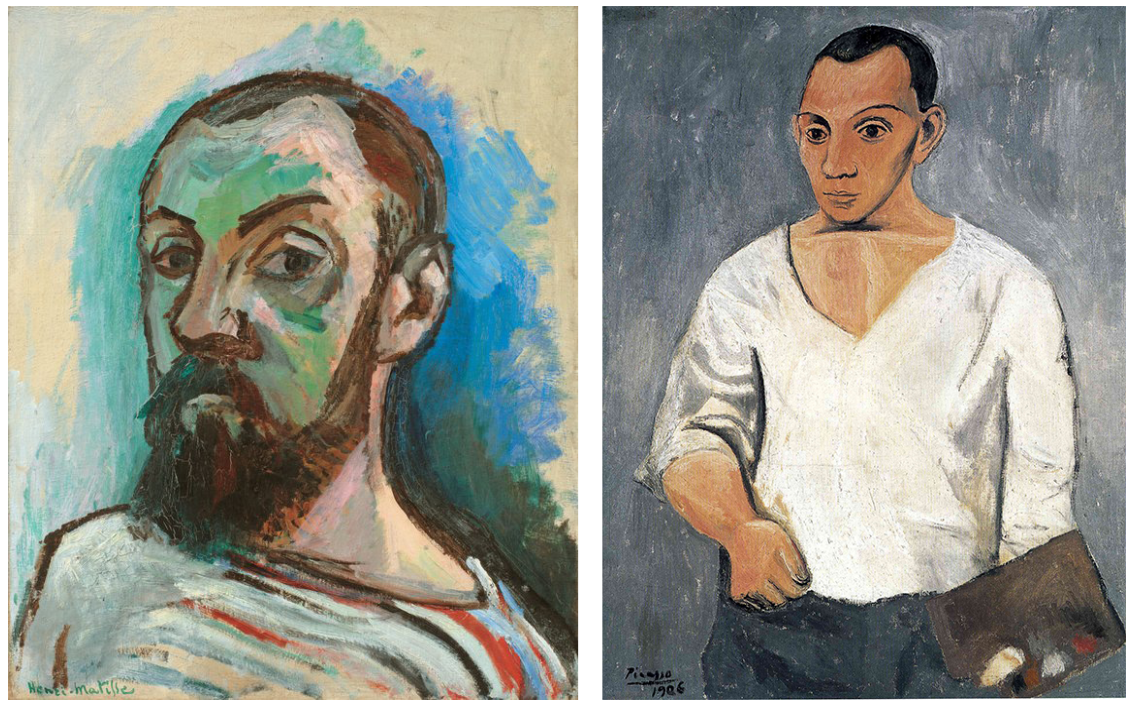
[Left] Henri Matisse, Autoportrait, 1906, Statens Museum for Kunst, Copenhagen. Artwork: © Succession H. Matisse / Artists Rights Society (ARS), New York
[Right] Pablo Picasso, Autoportrait avec palette, 1906, Philadelphia Museum of Art. Artwork: © 2024 Estate of Pablo Picasso / Artists Rights Society (ARS), New York
This dialogue with the masters of the past was not limited to these series, but underpinned Picasso’s intensive focus on the artist and model relationship in the following years. Closely related to these studio scenes, in the heads of many of these lone male protagonists Picasso appears to have isolated the artist figure from the more complex compositions, awarding him special focus in these portraits. Fittingly, while the striped Breton shirt has become closely associated with the figure of Picasso, well-known from widely photographs taken by Robert Doisneau and André Villers, it also contains an oblique reference to a confident 1906 self-portrait by Matisse, whose Fauvist modeling in blocks of bright, non-naturalistic color is recalled in the present work. It was in 1906 that Picasso was first introduced to Matisse by the indomitable American art collector Gertrude Stein, finding their work to be as different in temperament as their own personalities would prove to be, as reference to the smooth, stylized forms of Picasso’s own self-portraits from the same year attest. Nevertheless, they held a profound admiration and respect for each other’s work and Picasso was deeply moved on learning of Matisse’s death in 1954. In its combination of bright, brazen color and economically rendered smooth, stylized forms Buste d’homme in fact appears to combine pictorial aspects of both of these 1906 self-portraits, a fitting tribute perhaps to the artist who helped shape Picasso’s own artistic journey and whose legacy no doubt preoccupied Picasso as he contemplated his own mortality.
Buste d’homme, 1969
Sotheby’s New-York: 18 November 2024
Estimated: USD 1,500,000 – 2,500,000
USD 1,920,000
Buste d’homme | Modern Evening Auction | 2024 | Sotheby’s
PABLO PICASSO (1881 – 1973)
Buste d’homme, 1969
Oil and Ripolin on cardboard
114.3 x 65.1 cm (45 x 25 5/8 inches)
Signed Picasso, dated 26.1.69 and numbered III (upper left)
Executed on 26 January 1969
As his biographer John Richardson explains, Pablo Picasso believed technique was important “on condition that one has so much… that it completely ceases to exist” (Exh. Cat., Paris, Musée National d’Art Moderne and London, The Tate Gallery, Late Picasso, Paintings, Sculpture, Drawings, Prints 1953-1972, 1988, p. 42). Executed in 1969, Buste d’homme stands as testament to precisely that—to an artist for whom both the figure, and every formal gesture which described it had become instinctive. Despite the frequency with which he explored the present musketeer motif, now regarded as the most celebrated within the iconography which filled his prolific late body of work, the present work likewise testifies to the fact that his approach to the subject was far from formulaic. Rendered in a vibrant, primary palette and with a brushstroke that matches the figure’s machismo in its manner of resolution, the present schematic portrait is a remarkable example of the artist’s ingenious and unwavering ability to conceive of his beloved musketeer anew.
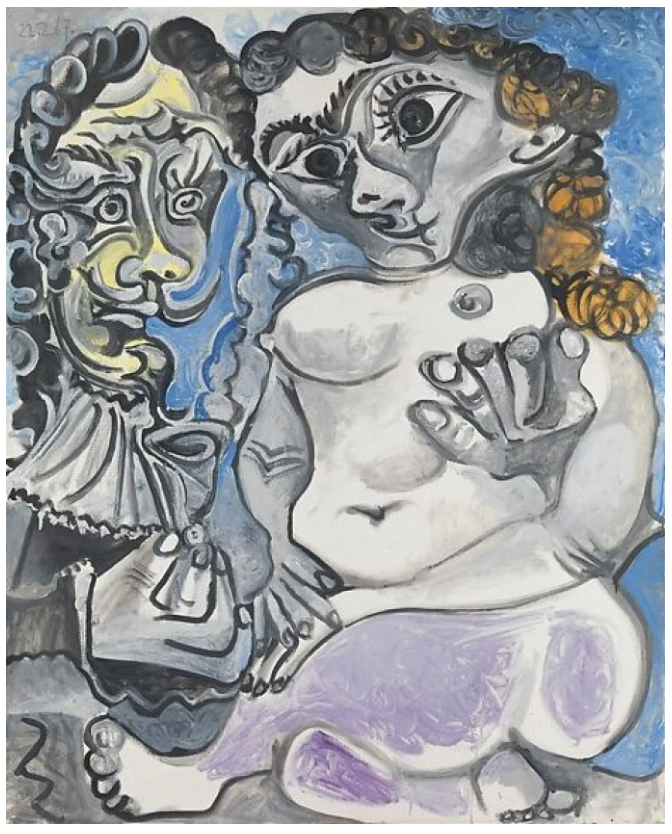
Pablo Picasso, Homme et femme nue, 1967, The Metropolitan Museum of Art, New York.
Art © 2024 Estate of Pablo Picasso / ARS, New York
The musketeer first emerged as a protagonist within Picasso’s paintings in late 1965. While recovering from surgery, the artist began rereading his favorite literary classics—among which included Alexander Dumas’ canonical adventure novel The Three Musketeers. In keeping with his staunch pacifist politics, Picasso’s image of the romantic musketeer offered a poignant counterpart to contemporary news of the war in Vietnam and the Soviet advance in Eastern Europe. But beyond any intimation of socio-political commentary, the musketeers likewise served as poignant vehicles for advancing Picasso’s own personal mythology. Picasso invariably used his figurative subjects as means of both communicating and projecting the internal narrative he was grappling with at the time of their making. In the early 1930s, he adopted the guise of the mythic sculptor-minotaur of antiquity, and later in the decade would transform his lover Dora Maar into his famed La Femme qui pleure, a self-reflective emblem of the turmoil brought about by World War II. From the outset, his personal life was made so inextricable from his painted realm that both came to exist with the same degree of reality in his perception.
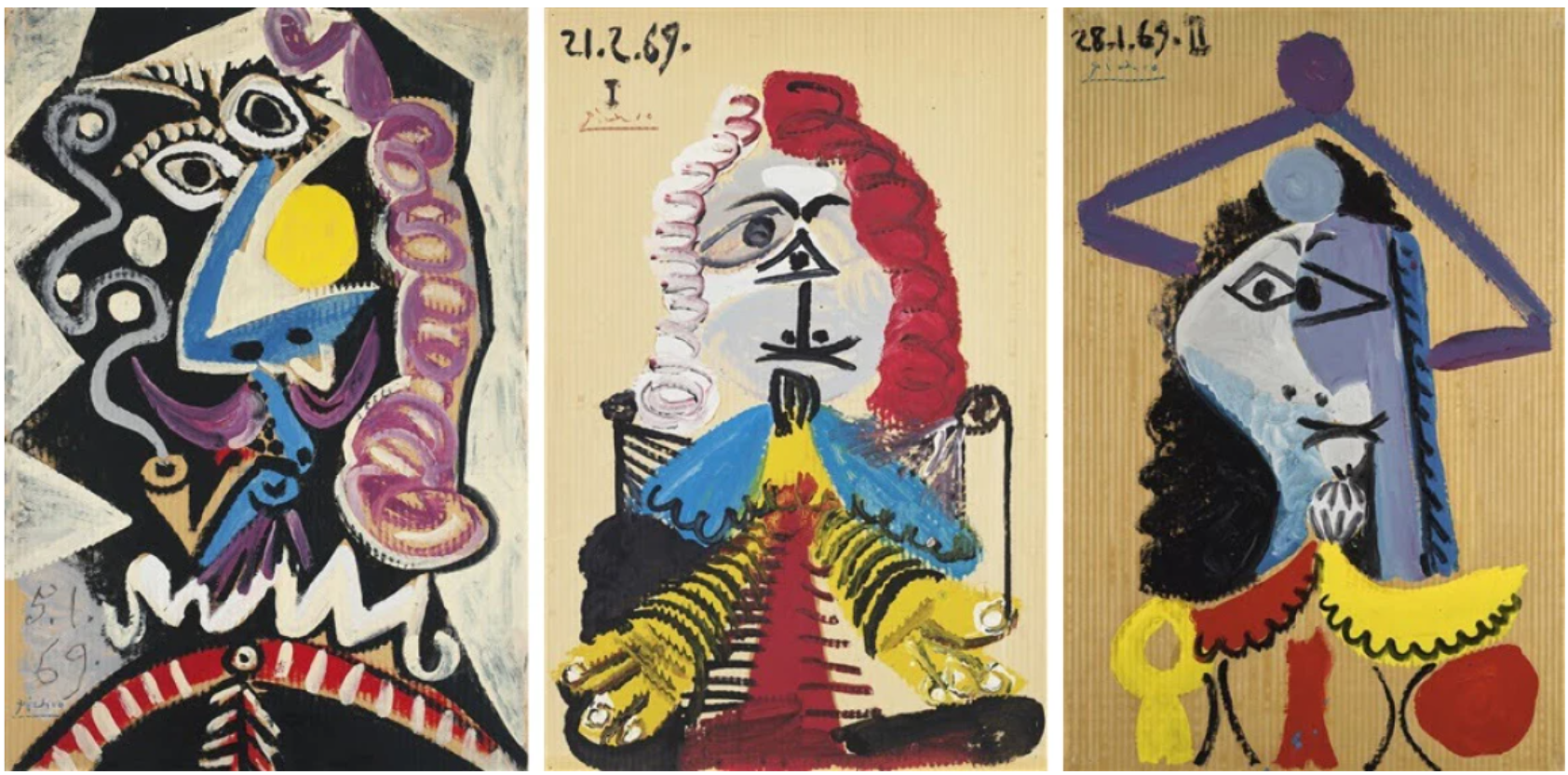
Left: Pablo Picasso, Tête d’homme à la pipe, 1969, Sold: Sotheby’s, New York, 4 November 2014, lot 31 for $4.4 million. Art © 2024 Estate of Pablo Picasso / ARS, New York
Center: Pablo Picasso, Buste d’homme, 1969, Private Collection. Art © 2024 Estate of Pablo Picasso / ARS, New York
Right: Pablo Picasso, Buste d’homme, 1969, Sold: Sotheby’s, London, 19 June 2019 , lot 23 for $1.2 million. Art © 2024 Estate of Pablo Picasso / ARS, New York
In the twilight of his life, the now-immortal musketeer took on a particularly embodied significance within Picasso’s paintings. Spurred on by the unpredictability of death, Picasso began to produce with a fervor and in a quantity unparalleled within his oeuvre up until this point. In both style and substance, the musketeer served as an apt symbol for that impassioned practice. Costumed, armed, and helmeted, the musketeer is invariably depicted as the lover, the painter, the soldier and, as in the present work, the nobleman. Feeling his own sexual powers deserting him, Picasso finds a particular source of rejuvenation in the amorous exploits of his musketeers, in whose representation themes of sex and passion abound (see fig. 1). Brought to life by the expression of his brush, the musketeer served as an almost sentient proxy for acting out all that the artist perceived he was losing hold of in his old age.
Buste d’homme, 1969
Sotheby’s New-York: 15 May 2024
Estimated: USD 8,000,000 – 12,000,000
USD 12,743,700
Buste d’homme | Modern Evening Auction | 2024 | Sotheby’s (sothebys.com)
PABLO PICASSO (1881 – 1973)
Buste d’homme, 1969
Oil and Ripolin on canvas
116.4 x 89.6 cm (45 7/8 x 35 1/4 inches)
Signed Picasso (lower left); dated 20.10.69. and numbered II (on the reverse)
Executed on 20 October 1969
Buste d’homme, painted on 20 October 1969, is a stunning oil that epitomizes the best of Pablo Picasso’s late period, often dubbed “the Heroic Years” Painted a little more than a week before his 88th birthday, Buste d’homme was first exhibited in a one-man show that Picasso planned in the hallowed halls of the Palais des Papes in Avignon. Each work displayed in this exhibition was hand selected by Picasso for inclusion. Its grand scale, sweeping Gothic arches and quatrefoil windows were ideally suited to the monumental scale and tone of Picasso’s paintings, many of which, including the present work, were thinly-veiled depictions of himself. This self-referential exhibition at the former seat of the Papacy was the ultimate act of self-canonization for the artist, who was already considered a god in the world of art. This would be the first of two spectacular showings of Picasso’s late works in Avignon, but the only one held during the artist’s lifetime. Buste d’homme, which featured prominently on the great stone walls of the Chapel of Clement VI, is a stunning example of the magisterial works on view.

PALAIS DES PAPES, AVIGNON
The present work is a remarkable example of Picasso’s mature style; brimming with painterly verve and stylish invention. The artist’s astonishing capacity for handling paint is wonderfully present in Buste d’homme. Lustrous passages of color cover the whole canvas endowing the figure with a startlingly vivid presence. Throughout his oeuvre, Picasso’s images of the male figure embody masculine power, and are rendered with a bravuric intensity “I have less and less time and I have more and more to say” commented Picasso in his last decade (quoted in K. Gallwitz, Picasso Laureatus, Lausanne & Paris, 1971, p. 166), and the freedom and spontaneity of his mature work, together with the recourse to archetypal figures and symbols is visual evidence of this.

LEFT: FIG. 2 PABLO PICASSO, TÊTE D’HOMME, 1969, SOLD: SOTHEBY’S, NEW YORK, 16 MAY 2017, LOT 14 FOR $10,925,000 © 2024 ESTATE OF PABLO PICASSO / ARTISTS RIGHTS SOCIETY (ARS), NEW YORK
RIGHT: FIG. 3 PABLO PICASSO, BUSTE D’HOMME, 1969, SOLD: SOTHEBY’S, HONG KONG, 18 JUNE 2021, LOT 12 FOR $14,031,406 © 2024 ESTATE OF PABLO PICASSO / ARTISTS RIGHTS SOCIETY (ARS), NEW YORK
The seemingly limitless energy that characterizes so much of his work is extant in this final burst of creativity, as well as a conscious decision to allow himself total liberty with both style and subject matter. Having gone through so many phases of stylistic and technical experimentation, Picasso now pared down his style in order to paint monumental works in quick, spontaneous brushstrokes. Rather than ponder the details of human anatomy and perspective, the artist isolated those elements of his subject that fascinated and preoccupied him, and depicted them with an extraordinary sense of wit entirely of his own. This work and eight other canvases (Zervos vol. XXXI, nos. 464-71; see figs. 2 and 3) were painted in a burst of focused activity from 15 October to 20 October, 1969. These referential figures—self-portraits in truth—are posed in half length, seated and sporting a hat. The background colors are bright, the faces painted in strong, assured swirls and strokes of the brush.

ANDRÉ VILLIERS, PABLO PICASSO WITH A COWBOY HAT GIVEN TO HIM BY GARY COOPER, LA CALIFORNIE, CANNES, 1958, PHOTOGRAPH, MUSÉE RÈATU, ARLES
The last decade of Picasso’s production has historically been the least understood amongst critics and scholars. Painting in a representational style he went against the grain of pure abstraction. The year 1969 would mark a culminating point in the career of the twentieth-century’s arguably greatest artist. The few self-portraits of the period represent a psychological projection of a complex and multifaceted identity, illustrating the unruly amalgam of influences and contrary personas that made up the mental backdrop of this protean artist. As Susan Galassi commented in 2009: “With this last chapter he closes the circle of his art and at the same time opens the way for a younger generation of artists, those who followed the abstract expressionists and reacted against their dogmatic cult of originality. For the 1960s pop artists and the succeeding generations of post modernists Picasso’s variations entered into the mainstream of iconic masterpieces and served themselves as source for re-creation” (Picasso: Challenging the Past, op.cit., p. 117). It was not just Picasso’s last years that proved so inspirational to the new generation of artists. His immediacy and constant regeneration across his storied career affected all who came in contact.
Tête à l’oiseau, 1971
Sotheby’s New-York: 15 May 2024
Estimated: USD 1,200,000 – 1,800,000
USD 1,814,500
https://www.sothebys.com/en/buy/auction/2024/modern-evening-auction/tete-a-loiseau
PABLO PICASSO (1881 – 1973)
Tête à l’oiseau, 1971
Oil and Ripolin on canvas
55.3 x 46.2 cm (21 3/4 x 18 1/4 inches)
dated 9.4.71. and numbered II (on the reverse)
Executed on 9 April 1971
Painted within the last two years of Pablo Picasso’s storied life, Tête à l’oiseau is rendered with a vibrancy of palette, fervor of brushstroke and mastery of form that belies any sense of aging. The last and the most androgynous in a series of four consecutive paintings of the same motif—the namesake woman with a bird—the present work hangs in a balance between a simplicity of composition and vitality of execution that speaks to the nuanced tensions at play in the artist’s late body of work. Through its brilliantly worked surface, Picasso indulges in gesture and in paint itself, relishing in their combined ability to bring form to life. In the twilight of his career, Picasso became almost consumingly preoccupied with painting, not as a form of mimesis or of representation, but as a self-contained act of creation. Faced with the uncertainty of death, Picasso found his only defense to be creation at a voracious speed, ultimately resulting in the completion of just over two hundred paintings between September of 1970 and June of 1972. Picasso selected the present work for inclusion in his 1973 solo exhibition at Avignon’s Palais des Papes, a retrospective of the preceding three years which would in turn come to be the artist’s first posthumous show, opening just six weeks after his death. As such, Tête à l’oiseau remains enshrined, in the artist’s eyes, as exemplary of and pivotal to a comprehensive understanding of his late and ultimately final output.
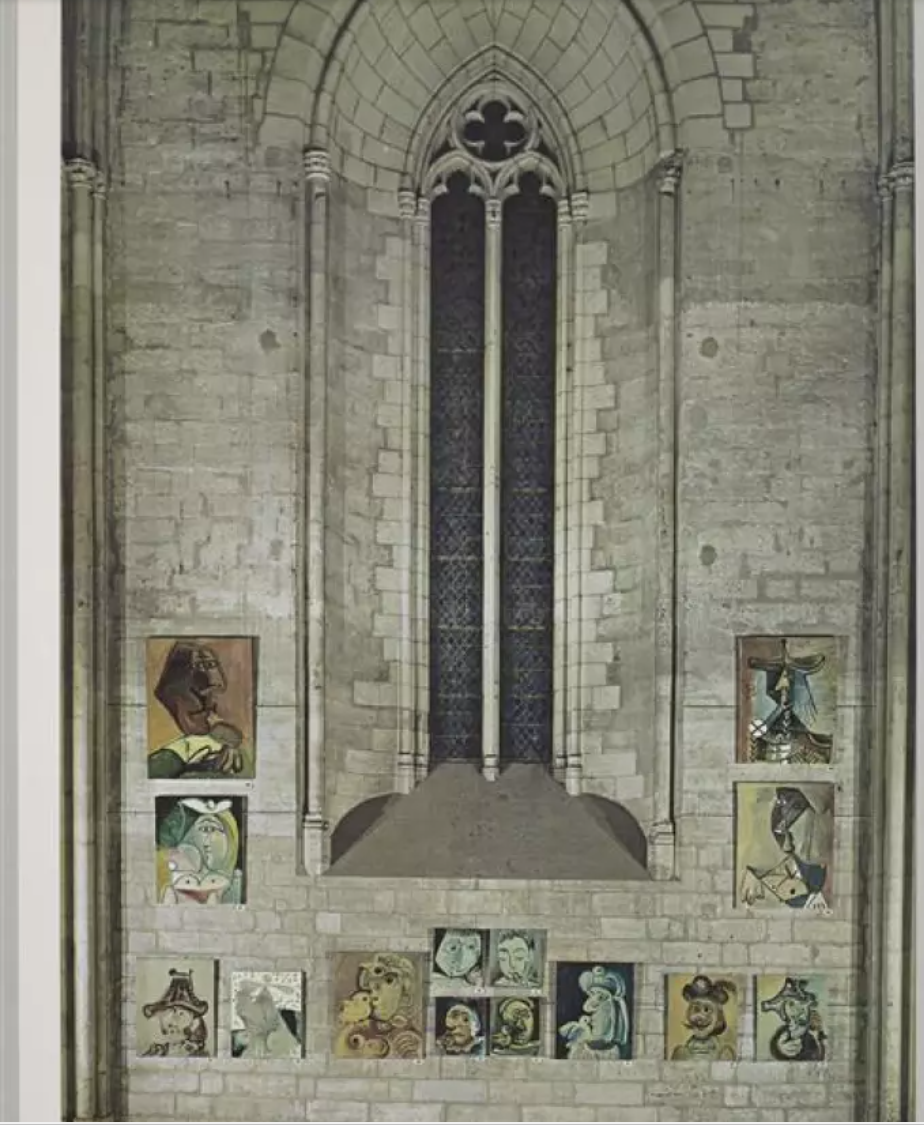
THE PRESENT WORK INSTALLED IN EXPOSITION PICASSO: 1970-1972, 201 PEINTURES, AT THE PALAIS DE PAPES, AVIGNON, 1973. ARTWORK © 2024 ESTATE OF PABLO PICASSO / ARTISTS RIGHTS SOCIETY (ARS), NEW YORK
The physicality of the present work and those displayed alongside it in Avignon, at the time misconstrued by critics as clumsiness, has come to be recognized in retrospect as precisely the reverse: as the culmination of a career spent pioneering, honing and ultimately mastering the technique of painting to the point that technique itself became second nature. Tête à l’oiseau stands as testament to precisely that—to an artist for whom every formal gesture had become instinctive. For all of its expressive content, Tête à l’oiseau is austere in its composition. In terms of figurative elements, there is little in the way of excess—even the colors are decisive in their application, only blending where one brushstroke meets another. This efficiency is perhaps most readily apparent in the figure’s eyes and eyebrows—each of which is confidently rendered with one, unbroken stroke of the brush. As was characteristic of his later works, in an effort to produce as much as he could in the unknowingly little time he had left, Picasso often returned to the same ideograms with varying expressive force, thus alleviating the need for reconceptualization with each new canvas. The application of paint in swaths of chromatic brushstrokes reveals a liberation of approach that can only be achieved on account of this innate familiarity with form and figuration.
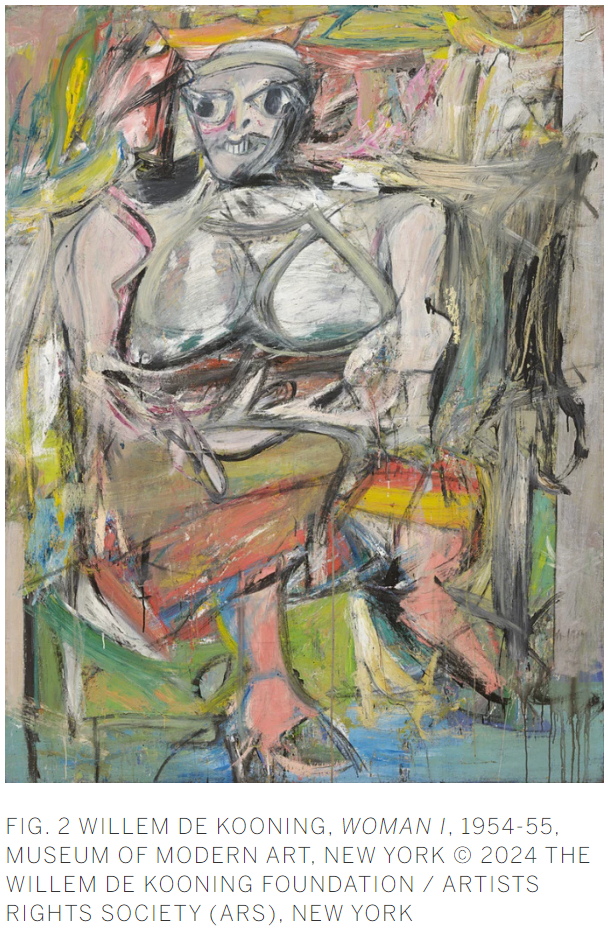
Tête à l’oiseau thus serves as a remarkable record of the artist’s hand and the altogether intuitive way in which he wields it. His brushstrokes are at once descriptive and entirely self-effacing, simultaneously revealing themselves as much as the figure they describe. The image therefore seems to assemble itself before our eyes—a visceral testimony to the process of its own creation. The urgency and the resulting emotional intensity of his execution shares a deep kinship with the practice of the Abstract Expressionists who likewise conceived of the act of painting as an extension or unmitigated reflection of the artist’s state of mind. Though their methods—action painting and a more overall abstraction—went a step beyond Picasso’s, who in his last years still remained anchored to figuration, this understanding of the painted surface as an extension of the artist himself is readily felt in the present work. One gets the sense that Abstract Expressionist pioneer Willem de Kooning’s conjecture, that “flesh is the reason oil paint was invented,” could just as readily describe Picasso’s Tête à l’oiseau as it does Woman I (see fig. 2).
As a result of the emotional intensity of this almost carnal need to produce, and perhaps on account of his waning virility in his old age, the composition of Picasso’s late body of work is split between a revivified wit and playfulness, and his most raw expressions of the erotic. Themes of sex and passion would appear in many guises throughout these late years, such as the virile musketeers and pipe-smoking brigadiers entangled in romantic encounters with women, or the relationship between the painter and his model as depicted in the studio.
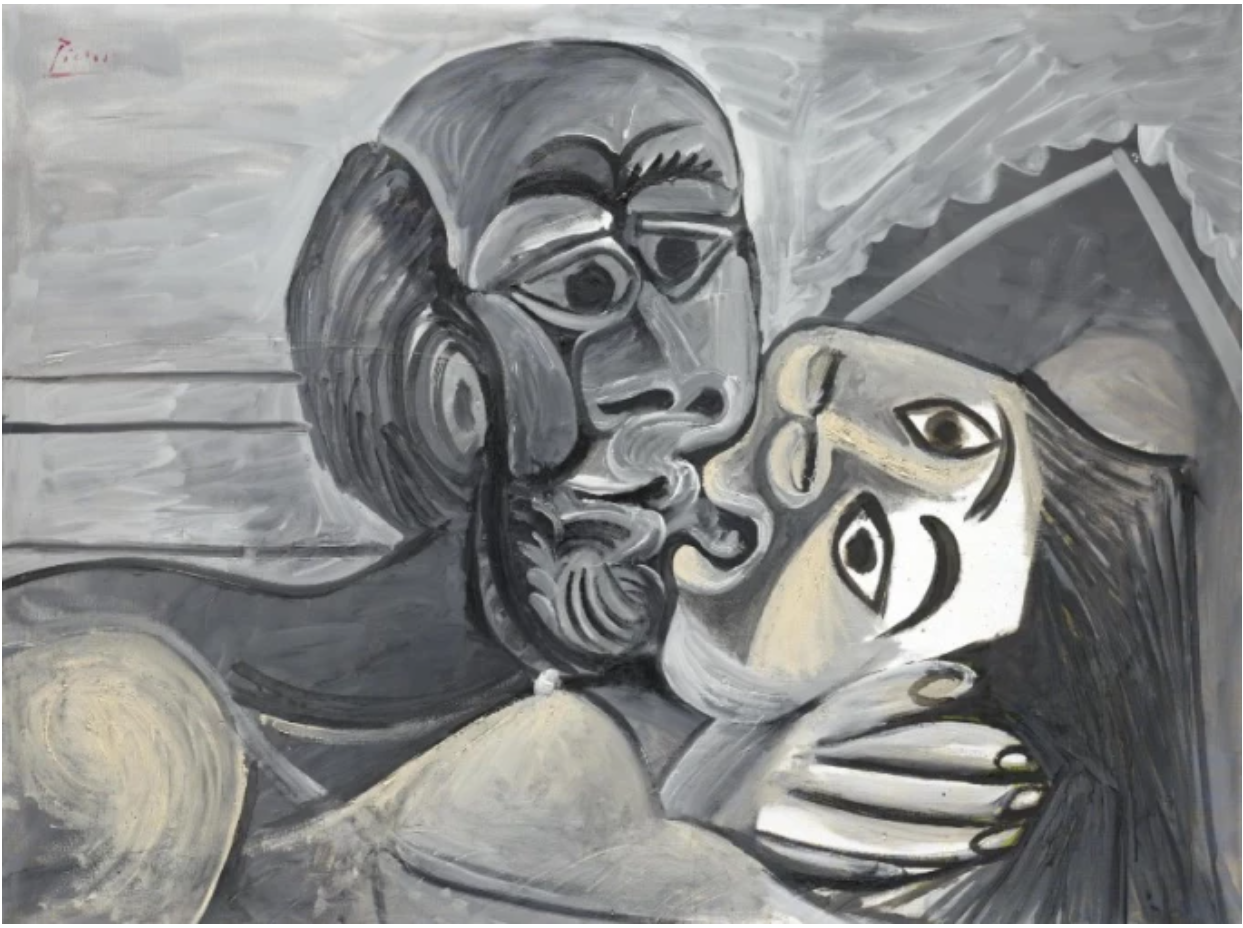
PABLO PICASSO, LE BAISER, 1969. SOLD SOTHEBY’S, NEW YORK, MAY 2008, LOT 35 FOR $17.4 MILLION © 2024 ESTATE OF PABLO PICASSO / ARTISTS RIGHTS SOCIETY (ARS), NEW YORK
Le Baiser, along with several others on the same motif painted around the same time, sheds these narrative contexts and monumentalizes the lovers’ faces as they embrace, so that the physicality of their encounter becomes the subject. Amidst these near violent expressions of passion, the present work appears almost naive in its bucolic simplicity. The kiss, here shared between the woman and the bird, is comparatively affectionate and gentle, wrought with a sensitivity which is in no small part due to a nostalgia for the present female subject.
Throughout his oeuvre, Picasso’s most captivating works are those depicting or inspired by his various muses. He developed a distinctive portrait type for each of the most significant women within his life, and made careful effort to keep those visual vocabularies distinct from one another.
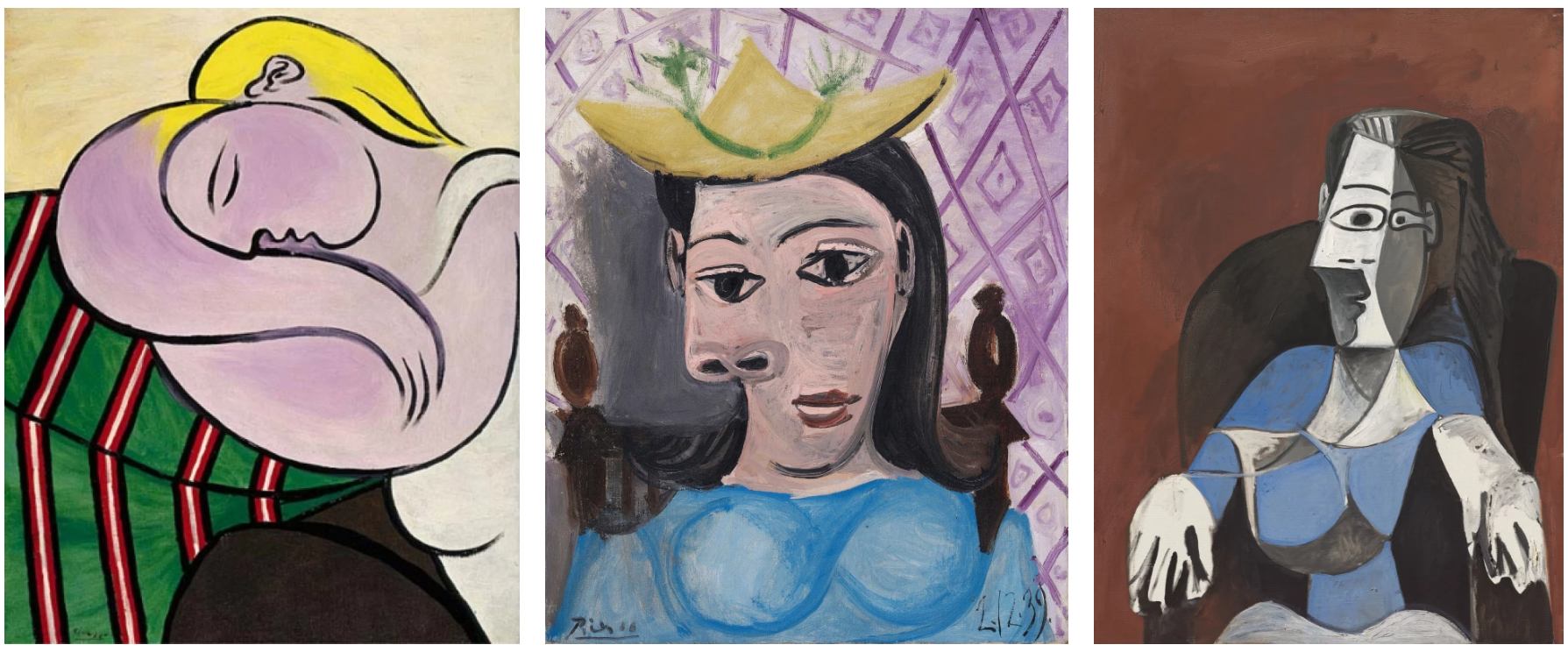
PABLO PICASSO, FEMME AUX CHEVEUX JAUNES, 1931, SOLOMON R. GUGGENHEIM MUSEUM, NEW YORK © 2024 ESTATE OF PABLO PICASSO / ARTISTS RIGHTS SOCIETY (ARS), NEW YORK
PABLO PICASSO, FEMME AU CHAPEAU JAUNE (DORA MAAR), 2 DECEMBER 1939, SOLD: SOTHEBY’S, NEW YORK, 16 MAY 2023, FOR $15,846,000 © 2024 ESTATE OF PABLO PICASSO / ARTISTS RIGHTS SOCIETY (ARS), NEW YORK
PABLO PICASSO, FEMME ASSISE DANS UN FAUTEUIL NOIR (JACQUELINE), 1962, SOLD: CHRISTIE’S, LONDON, 23 MARCH 2021, FOR £9,659,000 ($13,322,758) © 2024 ESTATE OF PABLO PICASSO / ARTISTS RIGHTS SOCIETY (ARS), NEW YORK
At a visceral glance, Tête à l’oiseau is a portrait of Jacqueline Roque, his second wife and most prolific muse. In their twelve years of marriage, which lasted until his death, Picasso painted more than four hundred portraits of Jacqueline, who had become recognizable within his oeuvre on account of the same dark, arched eyebrows and soft almond eyes used to describe the present figure. However, the intimations of his earlier muses are undeniably felt: the sweeping tuft of pastel blonde hair that frames the figure’s chin evokes the young Marie-Therese Walter, while the jaunty hat atop the figure’s head calls back to the iconography he developed to distinguish his lover Dora Maar. Though Picasso never worked directly from life, the women he painted were so intimately connected to their real-life counterparts that the model became inseparable from her image-type, and vice versa. In what was perhaps a moment of retrospect or reminiscence at this late hour in life, it is fitting that Picasso’s vision of a woman would take the form of the composite of his most significant muses.
Buste d’homme, 1967
Sotheby’s New-York: 13 November 2023
Estimated: USD 4,000,000 – 6,000,000
USD 4,658,000
Buste d’homme | Modern Evening Auction | 2023 | Sotheby’s (sothebys.com)
PABLO PICASSO (1881 – 1973)
Buste d’homme, 1967
Oil and black crayon on plywood
57 x 42.5 cm (22 1/2 x 16 3/4 inches)
Signed Picasso (upper right); dated 20.2.67 (on the reverse)
Executed in Mougins on 20 February 1967
Triumphant and enigmatic, Buste d’homme is an outstanding example from Picasso’s celebrated musketeer series—the subject of which became central to the artist’s late body of work. Begun in 1967, the suite of canvases which depict sword-brandishing and pipe-smoking musketeers are among the great subjects of Picasso’s late oeuvre. Richly textured and gestural, Buste d’homme—one of the very first oils in the series—exemplifies the inventiveness, dynamism, and exuberant brushwork which characterize the finest works of the series.
The artist’s fascination with this romantic archetype can be traced back to his Spanish childhood and his love of Cervantes’ Don Quixote. The musketeer was a character that embodied the courtly mannerisms of the Renaissance gentleman, whom Picasso resurrected for a twentieth-century audience. Considering the artist’s age, the image of the musketeer is also evocative of a certain nostalgia for the youthful vigor of his early years. The musketeers of Alexandre Dumas’ novel, which served as another key source of inspiration in his work from this period, were famously known just as much for their good living and loving as for their swordsmanship.
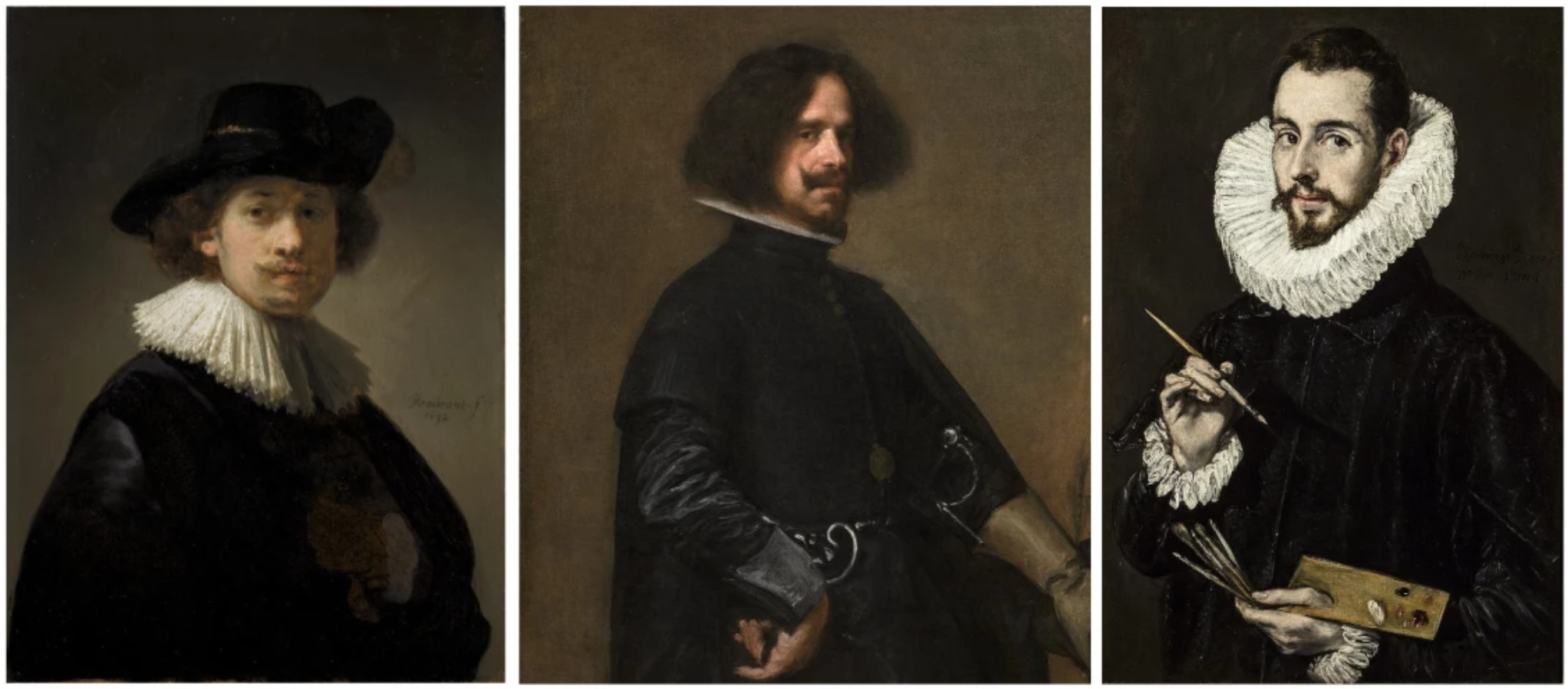
LEFT: REMBRANDT HARMENSZ. VAN RIJN, SELF-PORTRAIT OF THE ARTIST, HALF-LENGTH, WEARING A RUFF AND A BLACK HAT, 1632. SOLD: SOTHEBY’S, LONDON, 28 JULY 2020 FOR £14,549,400
CENTER: DIEGO VELÁZQUEZ, SELF-PORTRAIT, CIRCA 1645, GALLERIA DEGLI UFFIZI, FLORENCE
RIGHT: EL GRECO, PORTRAIT OF JORGE MANUEL THEOTOCÓPULI, CIRCA 1597-1603, MUSEO DE BELLAS ARTES, SEVILLE
In Buste d’homme, Picasso equally pays tribute to the work of two painters he had adored throughout his life, Diego Velázquez and Rembrandt van Rijn. It was through these reinterpretations and investigations of the Old Masters that Picasso reaffirmed his space within the realm of Western art history. Such is the case with the present work; the overall composition and the sitter’s clothing clearly evocative of traditional Dutch portraiture, while his facial features—the hair and the eyes in particular—are undeniably Southern European. In its execution, Buste d’homme displays a deliberately strong graphic art quality. The subtle tones of whites, blacks, browns and grays, together with the level of detail with which the artist renders the hair, the facial features, the lace on the sitter’s collar and the plaiting on his shirt evoke the intricate etchings and drawings by Rembrandt, which Picasso studied extensively during his convalescence from an operation he had undergone in November 1965 .
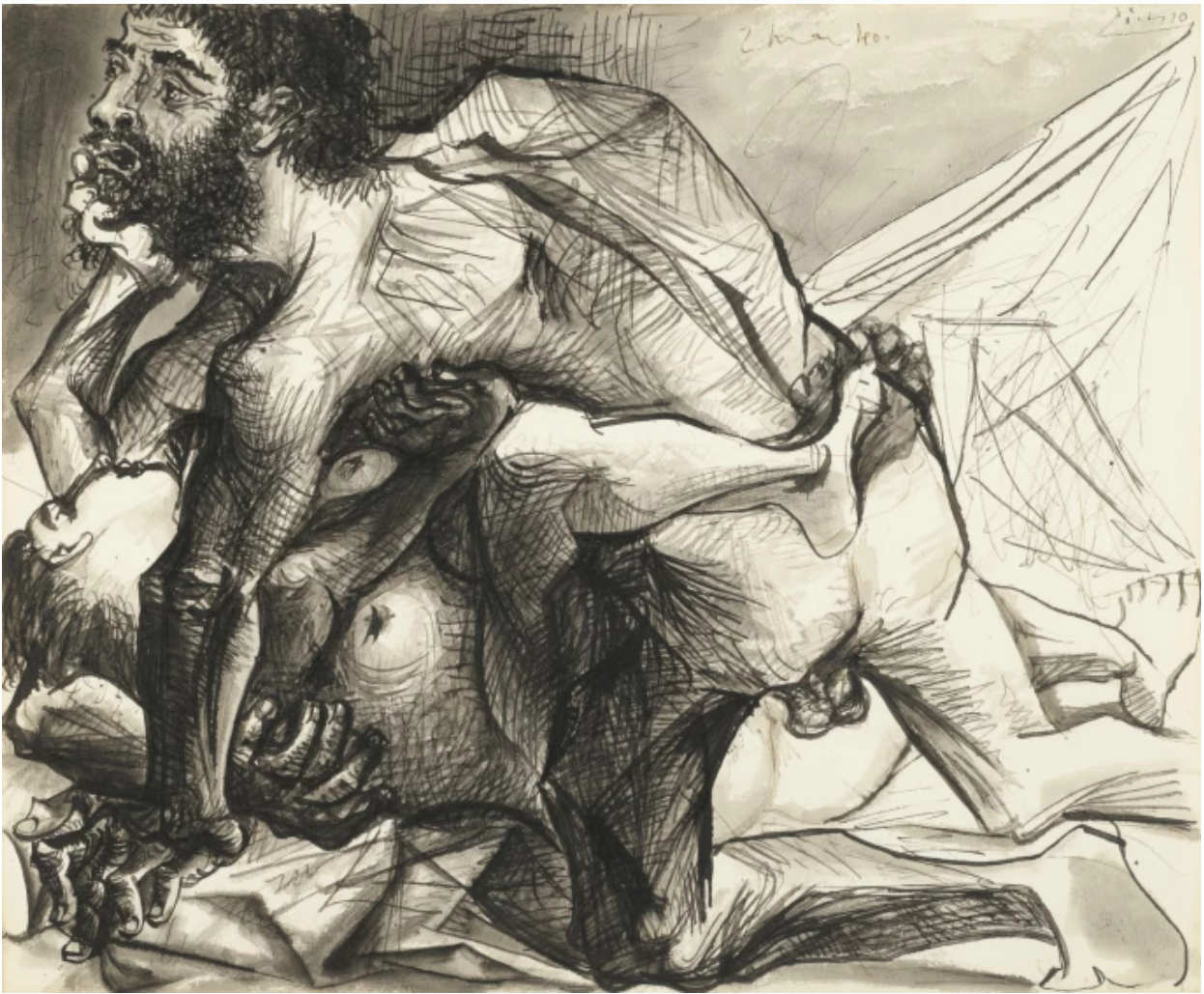
PABLO PICASSO, LE VIOL, 1940. SOLD: SOTHEBY’S, NEW YORK, 8 NOVEMBER 2012 FOR $13,522,500
In its gestural quality, Buste d’homme likewise echoes Picasso’s own earlier graphic works, while also reflecting his preoccupation with printmaking during this period. In 1968, the artist embarked on what became his largest print series, Suite 347. Named after the number of sheets it contains, the musketeer figure makes a recurring appearance throughout its pages. The traces of this dichotomous practice are particularly evident in the present work: its rich black background contrasts the areas of white pigment in the upper left corner and around the sitter’s face and hair, which, coupled with the various methods in which Picasso applied the paint onto, and partially erased it from, the distinctly coarse plywood support, replicates the textural richness and experimental nature of an etching. In their lively execution and dynamic quality, the scumbled lines and energized brushwork of Buste d’homme are emblematic of the freedom and spontaneity which Picasso found in his late work. Embodying the inventive and energized output of Picasso’s final years, the striking Buste d’homme captures the triumphant spirit of Picasso’s musketeer-heros—the great late works which, through their exceptional caliber and homage to the Old Masters, affirm Picasso as one of the greatest painters of the Modern era. The present work has been held in the same family collection for over fifty years, having been acquired through the gallery Sala Gaspar in Barcelona in 1968, shortly after it was painted.
Mousquetaire I (Espagnol du XVllème siècle), 1967
Christie’s London: 23 February 2023
Estimated: GBP 4,500,000 – 6,500,000
GBP 5,442,000 / USD 6,564,350
https://www.christies.com/en/lot/lot-6414694
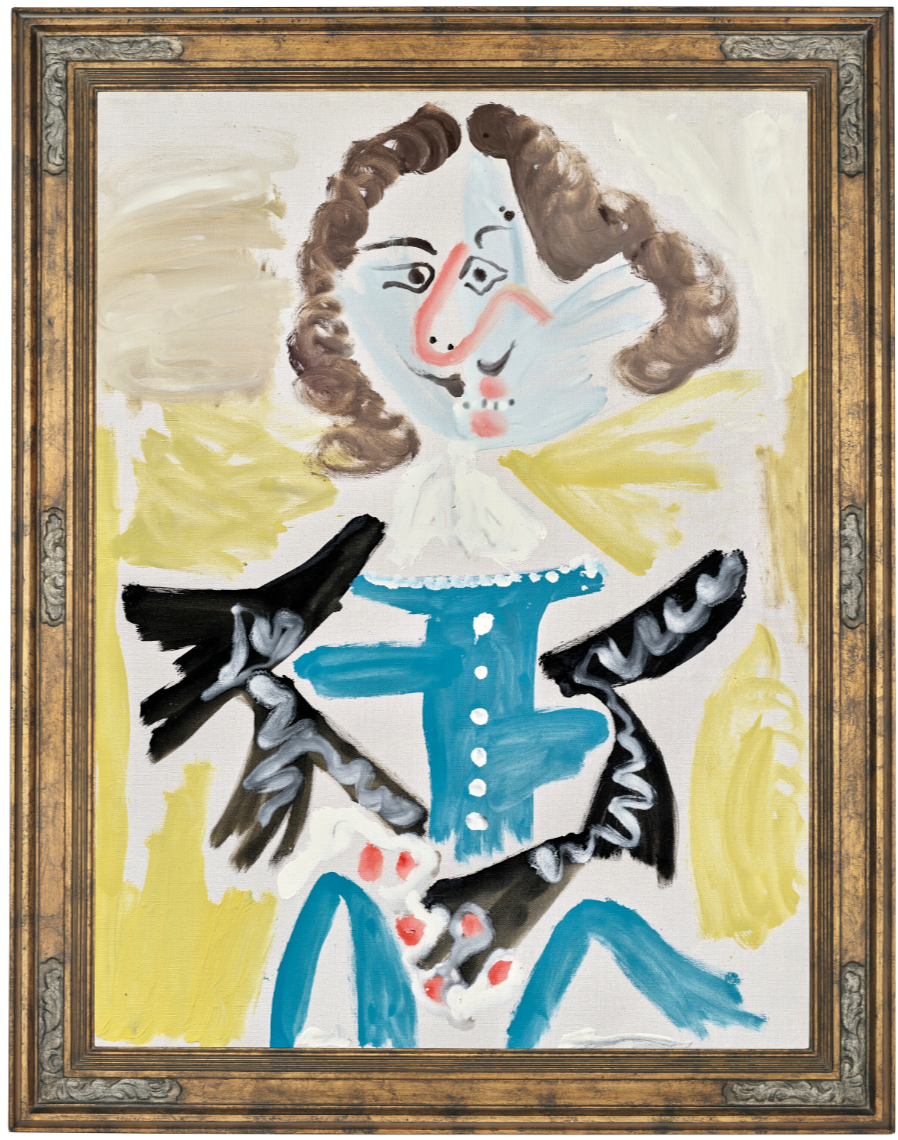
PABLO PICASSO (1881-1973)
Mousquetaire I (Espagnol du XVllème siècle), 1967
Oil on canvas
128.3 x 97.1 cm (51 x 38 1/4 inches)
Dated ‘21.4.67’ (on the reverse)
Painted on 21 April 1967
At the close of 1966, Pablo Picasso began to concentrate on the subject that has now come to define his late career work, that of the musketeer. The figure, at once historical and constructed, dominated his imagination and subsequent output. Picasso filled his canvases with colorful depictions of these impressive and ostentatiously-garbed characters that often served as stand-ins for the artist himself. While he returned repeatedly to the subject throughout the next five years, the paintings created between 1967 and 1968 are unmatched in their inventiveness and irresistible, infectious exuberance.
Executed on 21 April 1967, Mousquetaire I (Espagnol du XVllème siècle) is one of three musketeers that Picasso painted that day, all of whom share the same curly hair and jaunty moustache. Set against a soft yellow ground, the resplendent musketeer in the present work sits with his hands clasped on his lap as he stares ahead to return the viewer’s own gaze. Baroque in attitude and attire, Picasso has dressed his musketeer in blue and black. A flash of dandyism is evident in this extravagant costume, complete with pearlescent buttons and a ruffly cravat, all rendered in loose, flowing brushwork.
Other Series
Mère et enfant, 1965
Christie’s New-York: 17 November 2025
Estimated: USD 4,000,000 – 6,000,000
USD 5,077,000
PABLO PICASSO (1881-1973), Mère et enfant | Christie’s
PABLO PICASSO (1881-1973)
Mère et enfant, 1965
Oil on canvas
130.2 x 97.2 cm (51 1/4 x 38 1/4 inches)
Signed, dated and numbered ‘Picasso 27.10. 65. II’ (lower left)
Painted in Mougins on 27 October 1965
Mère et enfant is one of a series of works which Pablo Picasso began on 25 October 1965, on the occasion of his 84th birthday. Painted two days later, this large-scale canvas is a bold celebration of motherhood, which, together with the rest of the series, demonstrates the central place that this theme had occupied the artist throughout his life. From his Blue Period visions of mothers and children, to his deeply personal portrayals of his wife Olga and their son, Paul, and later, his playful, color-filled portraits of Claude and Paloma, Picasso had continually explored the potentials of this timeless and universal subject.
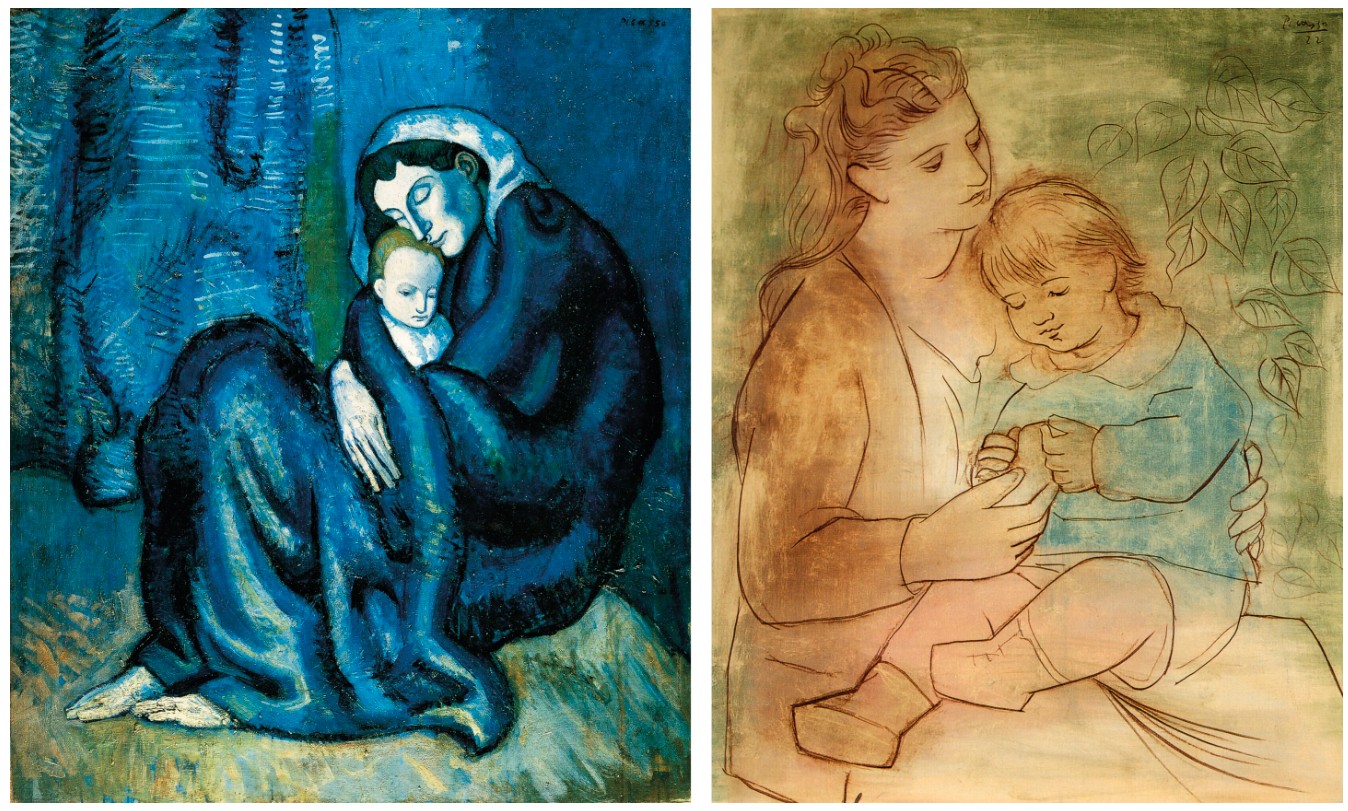
Left: Pablo Picasso, Mère et enfant, 1901. Harvard Art Museums. © 2025 Estate of Pablo Picasso / Artists Rights Society (ARS), New York.
Right: Pablo Picasso, Mère et enfant, 1922. The Cone Collection, Baltimore Museum of Art. © 2025 Estate of Pablo Picasso / Artists Rights Society (ARS), New York.
At this time in his life, Picasso was avidly examining the work of a variety of artists from the past. Masterpieces by Diego Velázquez, Rembrandt van Rijn, Nicolas Poussin, Eugène Delacroix, and Edouard Manet had been consumed by the artist’s gaze before being reimagined in his own hand.
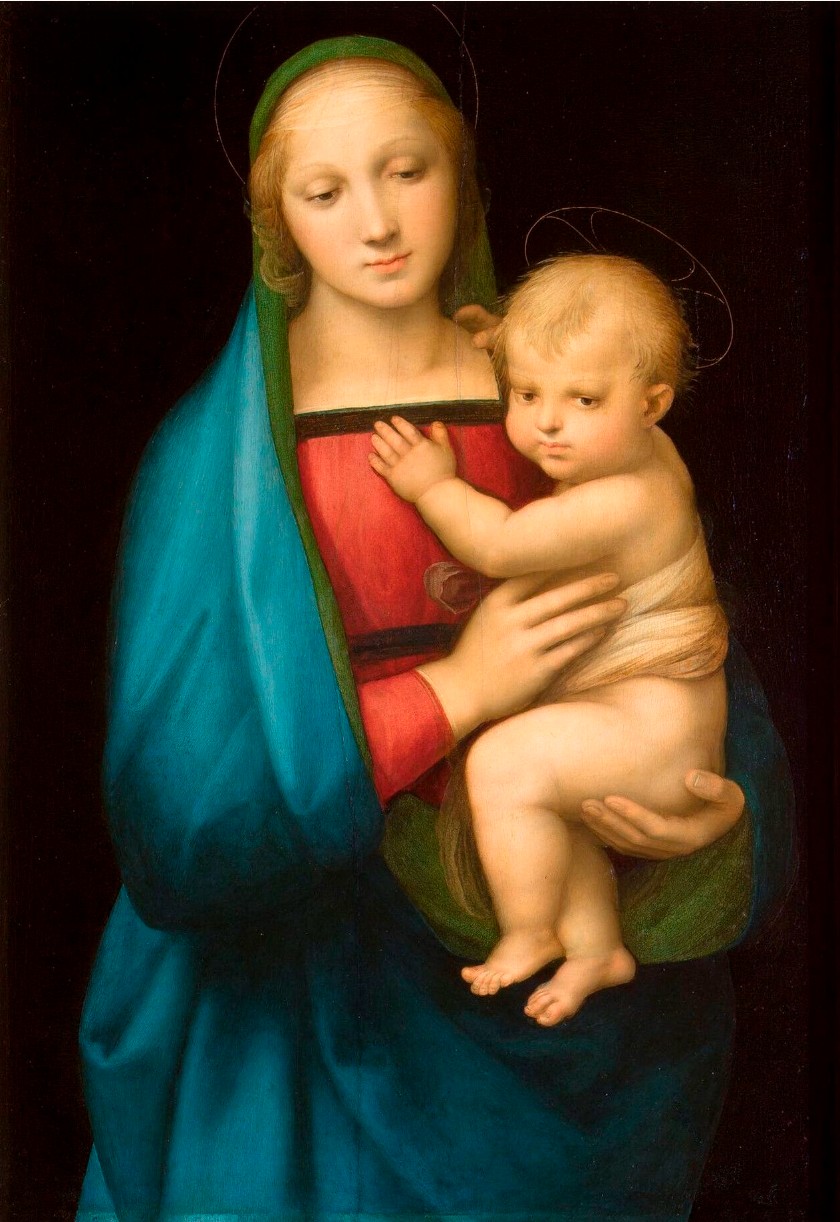
Raphael, Madonna del Granduca, circa 1506-1507. Palazzo Pitti, Florence.
Like the musketeer, which was a visual conglomeration of artistic sources used to fashion a bold alter-ego of the artist himself, the mother and child motif similarly allowed Picasso to marry the artistic past with his own personal present. Happily married to Jacqueline Roque, his last great love, Picasso looked back across past decades, meditating on his own life and the family he had created, including his four children. It is not surprising that images of fatherhood, motherhood, and children should fill his art of this time, together forming a bold homage to his life and art.
“Ultimately, love is all there is”
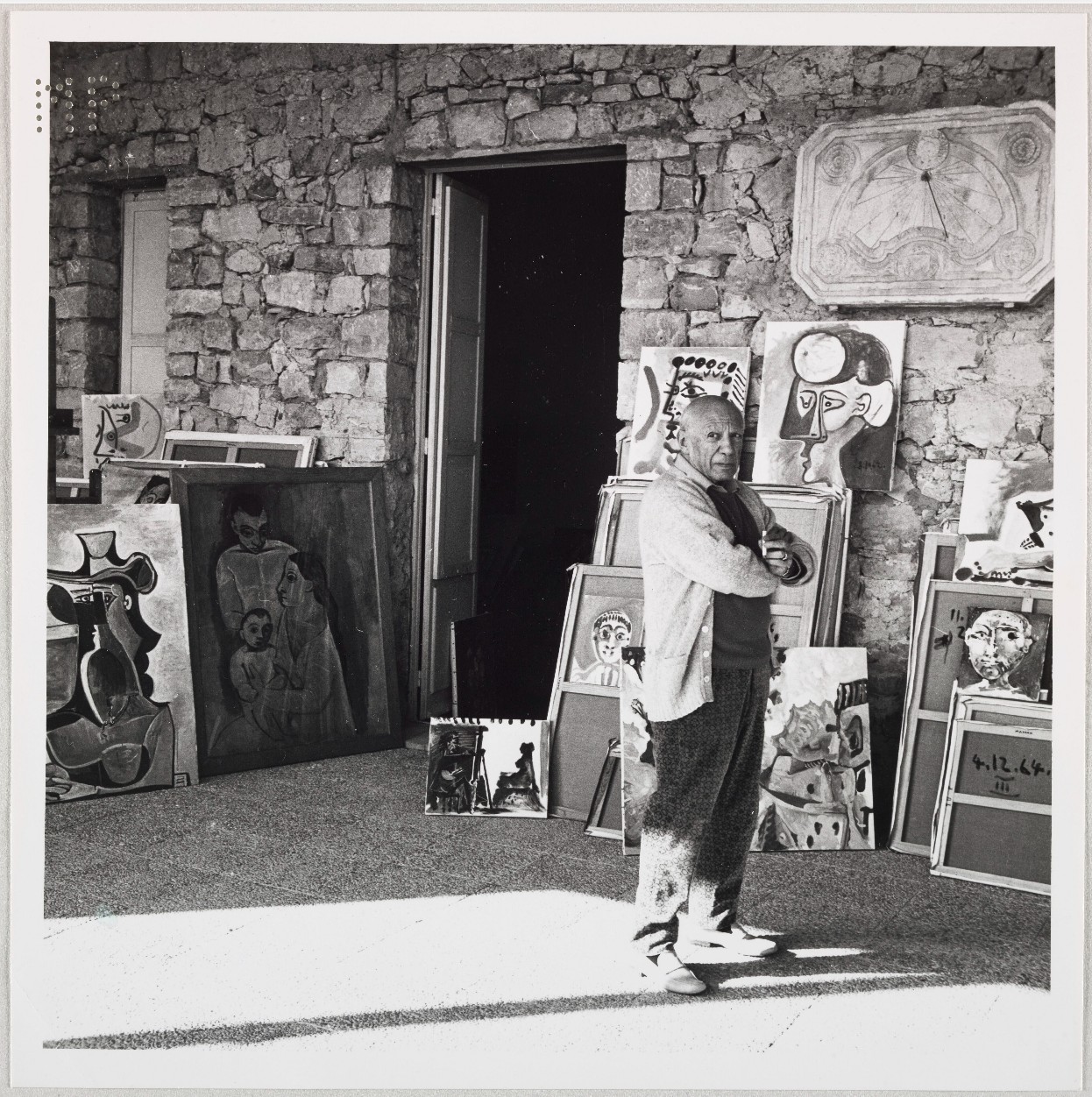
Pablo Picasso in the studio of Notre-Dame-de-Vie, Mougins, April 1965. Photographed by Andre Gomes. © 2025 Estate of Pablo Picasso / Artists Rights Society (ARS), New York. Photo: © RMN-Grand Palais / Art Resource, NY.
As with every stage of his career, Picasso used well-known motifs to experiment and explore a new painterly idiom. In the present work, the artist’s distinctive bold and gestural handling and simplified mode of expression encapsulates his style of the time.
“A dot for the breast, a line for the painter, five spots of color for the foot, a few strokes of pink and green… That’s enough, isn’t it? What else do I need to do? What can I add to that? It has all been said.”
Working with an unprecedented vigor and directness, Picasso distilled imagery into a combination of strokes and forms, creating a shorthand of signs and symbols which vividly conjured the subject he was conveying. In the present work, Picasso has, with a deft economy of means, combined the centuries-old iconography of the Madonna, adorned in a luminous blue dress, with his own idiosyncratic pictorial language. The hands of the mother and child are rendered in the same way, the simplified circles denoting their fingers further heightening the intense intimacy of their relationship. The pair also appears encircled by white, united as a single, unbreakable entity.
“Basically, there are only a few subjects. Everybody repeats them. Venus and Cupid become the Virgin and Child, the classical image of mother and child—but as a subject, it’s the same.”
Mère et enfant was acquired by Daniel-Henry Kahnweiler at the Galerie Louise Leiris, one of Picasso’s key dealers of this time, before being sold to the Brook Street Gallery, London, where it was exhibited in a retrospective of the artist held in 1971. Acquired by the present owner in 2006, the painting has remained in the same collection for almost twenty years.
Le Baigneur, 1957
Birth of the Modern: The Arnold and Joan Saltzman Collection
Christie’s New-York: 17 November 2025
Estimated: USD 3,500,000 – 5,500,000
USD 3,979,000
PABLO PICASSO (1881-1973), Le Baigneur | Christie’s
PABLO PICASSO (1881-1973)
Le Baigneur, 1957
Oil on canvas
100.5 x 81.4 cm (39 1/2 x 33 inches)
Signed and dated ‘Picasso 22.7.57.’ (upper left)
Painted in July 1957, Le Baigneur forms part of Pablo Picasso’s career-long engagement with the theme of the bather. As with so many motifs, Picasso would reincarnate these figures in countless guises. In the present work, a man wades into a placid, steel blue sea, his fingertips just grazing the top of the water. While much of his body has been painted in peach tones, the man’s ribs are lighter, represented by only a few horizontal marks. Short, staccato brushwork defines his hair while his face is composed of crisp, efficient lines.
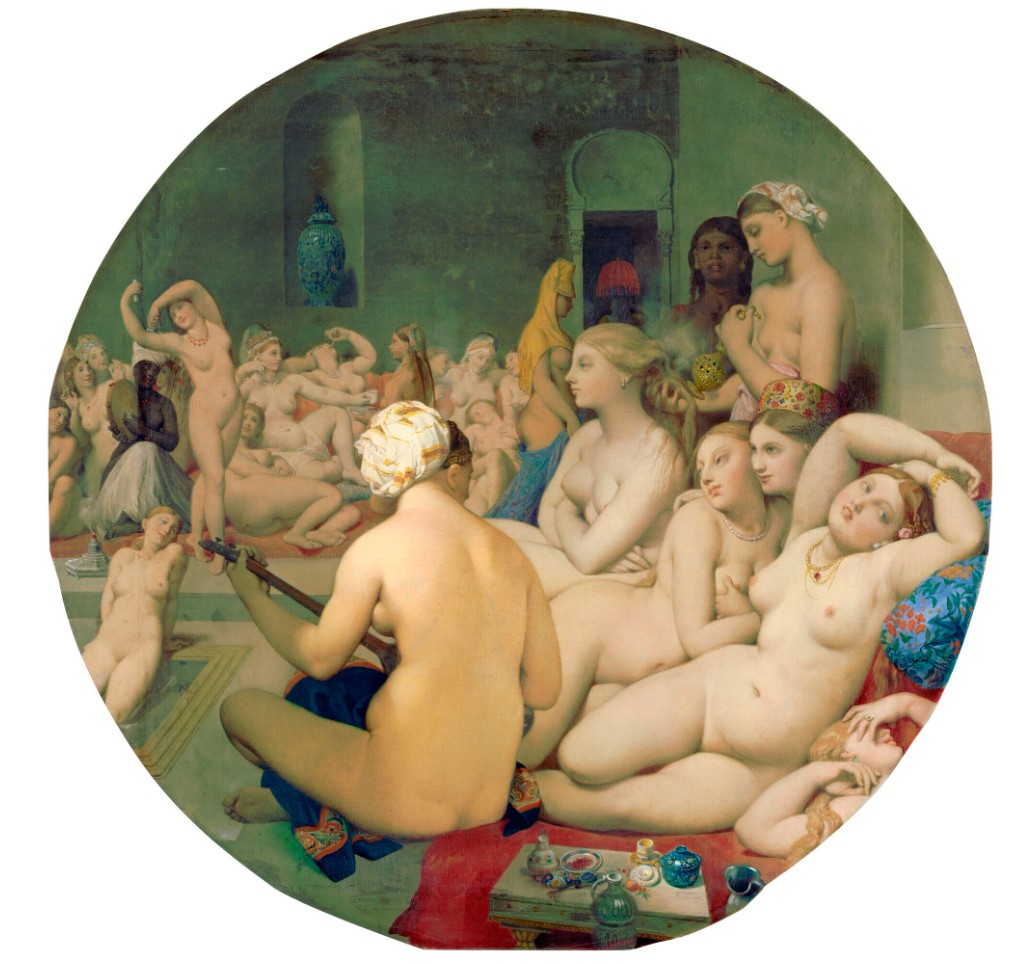
Jean-Auguste-Dominique Ingres, Le bain turc, 1862. Musée du Louvre, Paris.
Picasso’s interest in the subject of the bather can be traced back to when he was first living in Paris, where he moved in 1904. The following year, he went to visit Jean-Auguste-Dominique Ingres’ retrospective at the Salon d’Automne and, although previously dismissive of the French painter, found himself “overwhelmed” by what he saw. Picasso was captivated by Ingres’ draftsmanship, formal innovation, and, above all, his masterpiece, Le bain turc, which, up until then, had not been seen in public for many years. Ingres’ large canvas depicts a group of nude women at a harem, and their various postures and poses provided the young artist with a wellspring of inspiration. Long before his neoclassical period, Picasso looked to Le bain turc while painting the seminal Les Demoiselles d’Avignon, and he later returned to the nineteenth century composition when creating his surrealist bathers in the late 1920s and early 1930s. Beyond Ingres, however, the theme of the bathers is one with a long art historical precedent. The subject’s mythological and romantic associations appealed to artists including Titian, François Boucher, Camille Corot, and Pierre-Auguste Renoir, allowing them to paint female nudes in a natural, albeit erotic, fashion. Many modern artists, however, took a more naturalistic approach to the subject, seen, for example, in Paul Cezanne’s series of baigneurs.
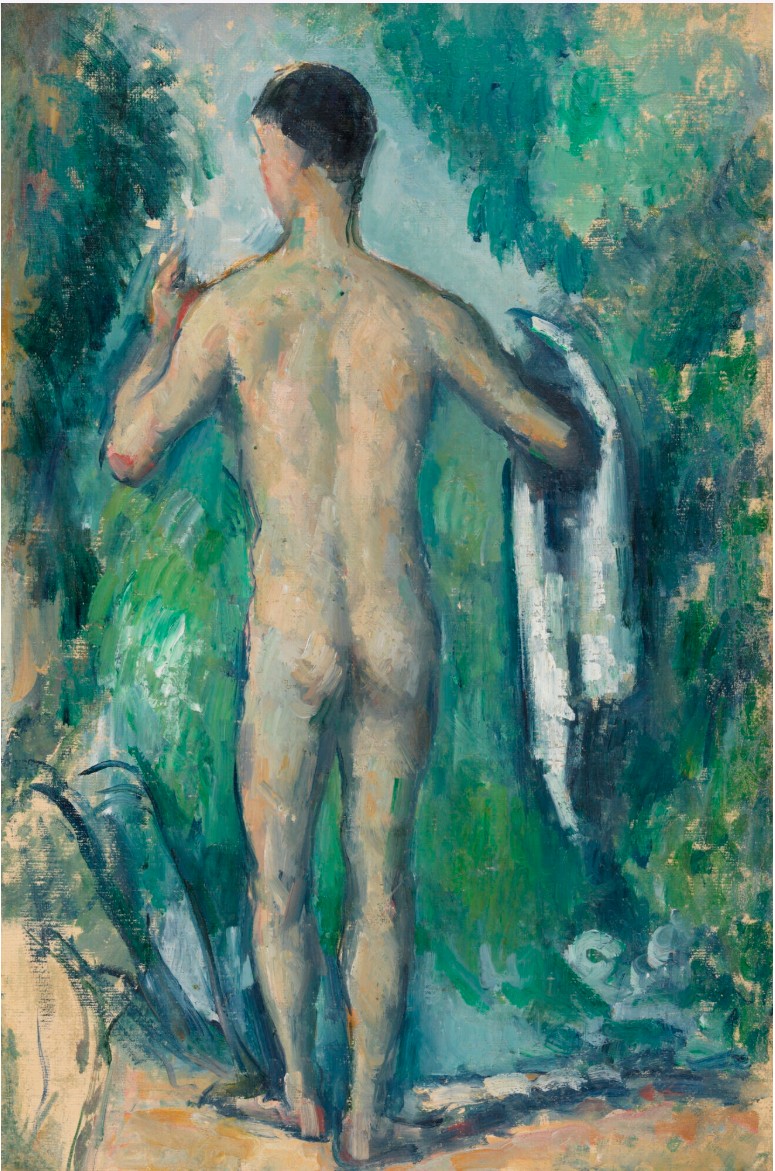
Paul Cezanne, Baigneur debout, vue de dos, 1879-1882. The Art Institute of Chicago.
Picasso’s bathers, too, were not romanticized, and to this theme, he brought his own perspective on figuration. He often worked on related scenes during seaside holidays, quickly filling sketchbooks with studies of bathers, only to expand upon the images once back in his studio. Within his oeuvre, the beach serves as a stage of sorts, composed of simple bands of sky, sea, and sand, against which his figures pose in outlandish and exaggerated ways. Painted in Dinard, Baigneuses jouant au ballon, 1928 (Zervos, vol. 7, no. 234; Musée national Picasso, Paris) shows three women tossing a ball, each body composed of a series of angular lines and planar forms. The colors employed are unmodulated, a treatment seen in the present work, which was painted almost three decades later.
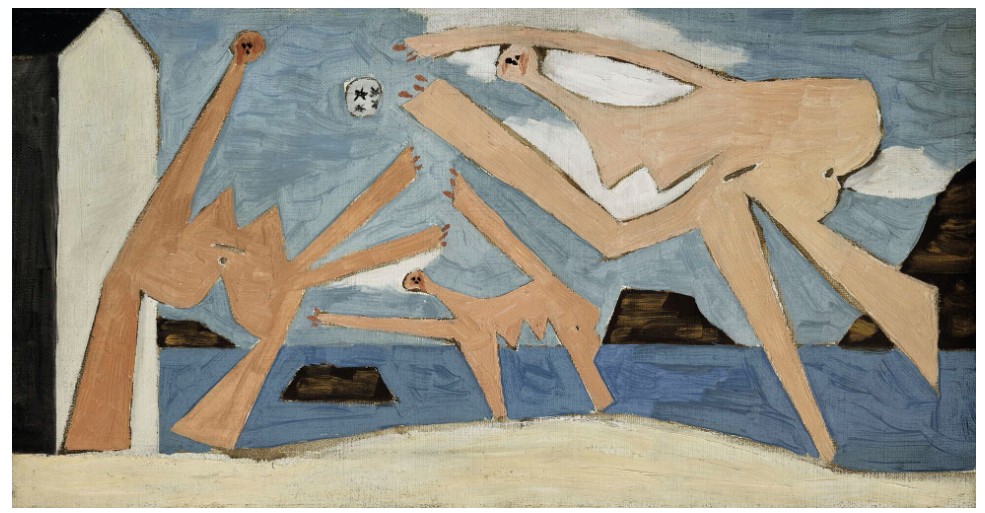
Pablo Picasso, Baigneuses jouant au ballon, 1928. Musée national Picasso, Paris.
© 2025 Estate of Pablo Picasso / Artists Rights Society (ARS), New York. Photo: © RMN-Grand Palais / Art Resource, New York.
Following the end of the Second World War, Picasso began to spend more and more time in the region colloquially known as Le Midi. He vacationed in Antibes and Golfe-Juan, and, in 1955, purchased the villa La Californie overlooking Cannes. Perhaps inspired by his time in the sun and seeing himself in these figures, Picasso returned to the theme of the bathers in 1956, completing the large canvas Deux femmes sur la plage in February (Zervos, vol. 17, no. 36; Musée national d’art moderne, Centre Georges Pompidou, Paris). He continued to explore the subject in a number of drawings, paintings, and several sculptures, first constructed out of scrap wood and later cast in bronze. Elements from Le Baigneur are evident as well in the contemporaneous Baigneurs sur la plage à la Garoupe, 1957 (Musée d’art et d’histoire, Geneva), particularly in the representation of the swimmers’ torsos and the graphic simplicity of the background.
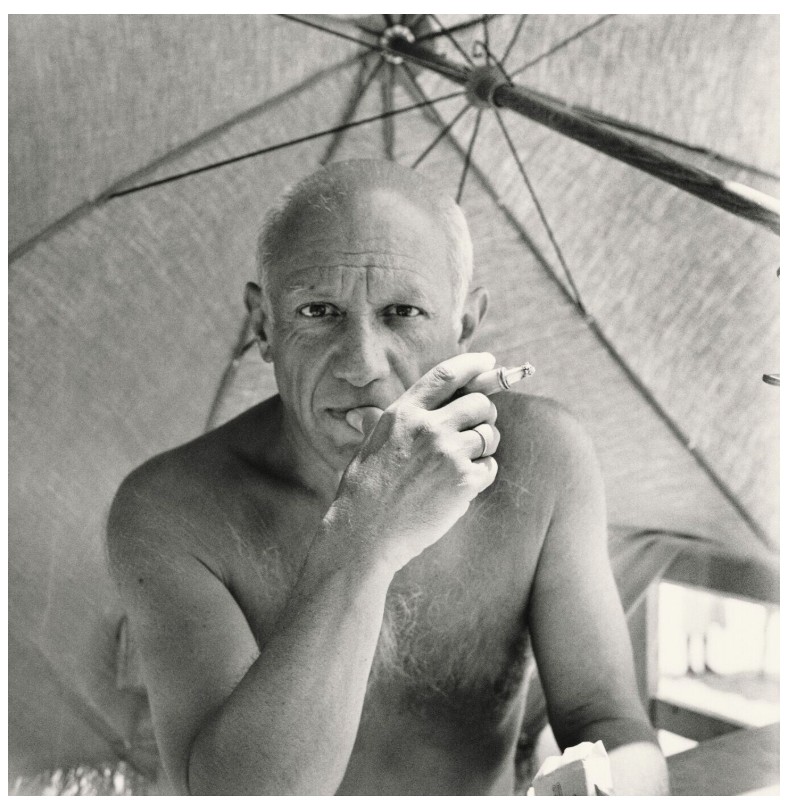
Pablo Picasso on the beach at Golfe-Juan, 1948. Photographed by Willy Maywald. Photo: © 2025 Association Willy Maywald / Artists Rights Society (ARS), New York / ADAGP, Paris. Image: © CNAC/MNAM, Dist. RMN-Grand Palais / Art Resource, NY.
During this period, Picasso was also working on La chute d’Icare, his grand mural for the headquarters of the United Nations Educational Scientific and Cultural Organization (UNESCO) in Paris. The Greek myth tells of Icarus, who fell to his death after the sun melted the wax that held together his wings. While Picasso’s first ideas for the mural were interior scenes, set in an artist’s studio, he soon transposed the story. The final composition draws from the myriad bathing imagery that Picasso was creating during this period.
Works on Paper