WORK IN PROGRESS
Few figures in twentieth-century art have been so thoroughly absorbed by another artist’s mythology as Dora Maar. For decades, her name circulated primarily through the prism of Pablo Picasso: as lover, muse, torment, and symbol. Yet this reduction obscures a far more complex reality. Dora Maar was not discovered by Picasso; she arrived already formed: intellectually, politically, and artistically. Their encounter did not create her. It collided with her.
Dora Maar: Beyond the Muse
Born Henriette Theodora Markovitch in 1907 to a French mother and a Croatian architect father, Dora Maar spent her formative years between Paris and Buenos Aires. This dual cultural grounding—European and Latin, rational and intuitive—shaped a personality both cosmopolitan and inwardly intense. Trained formally in painting and photography, she quickly gravitated toward the camera, a medium that allowed her to fuse technical rigor with psychological ambiguity. By the early 1930s, she had established herself as one of the most inventive photographers of her generation, navigating seamlessly between commercial commissions and avant-garde experimentation.

MAN RAY, DORA MAAR, 1936, GELATIN SILVER PRINT, THE MUSEUM OF MODERN ART ARCHIVES, NEW YORK © 2024 MAN RAY TRUST / ARTISTS RIGHTS SOCIETY (ARS), NEW YORK / ADAGP, PARIS
Maar’s photography occupied a singular position within Surrealism. Unlike many of her male counterparts, she did not treat distortion as spectacle. Her images—fragmented bodies, masked faces, unsettling juxtapositions—carry a latent violence that feels less theatrical than existential. They suggest anxiety rather than provocation, introspection rather than shock. This psychological density placed her at the heart of Paris’s intellectual avant-garde. She moved within Surrealist circles, associated with figures such as André Breton and Paul Éluard, and was deeply engaged with the political debates that increasingly defined the 1930s. Anti-fascist, fiercely alert to the fragility of Europe, she read newspapers obsessively and absorbed the mounting dread of the era.
It is in this context, not romance, that her encounter with Picasso must be understood.
The Encounter: Fascination and Recognition
Picasso and Dora Maar met definitively in late 1935 or early 1936, though their paths had likely crossed earlier. Both frequented the same cafés, exhibitions, and Surrealist gatherings; both were already part of the same intellectual ecosystem. The now-legendary episode at the Café des Deux Magots—Maar rhythmically stabbing a knife between her fingers, drawing blood while maintaining composure—has been endlessly retold. Stripped of anecdote, its significance is clear: Picasso recognized in her a controlled danger, an intelligence allied to risk. This was not innocence; it was agency.
At the time, Picasso’s personal life was fractured. Still legally married to Olga Khokhlova, he was deeply involved with Marie-Thérèse Walter, the young woman who had given birth to his daughter Maya in 1935. Dora Maar entered this already unstable configuration not as a passive addition, but as a disruptive force. She spoke Spanish fluently, understood Picasso’s cultural references, and—crucially—shared his political concerns. Unlike Marie-Thérèse, whose presence in Picasso’s work was associated with sensuality and lyricism, Dora brought friction. She questioned, argued, resisted. Picasso later admitted that she was his intellectual equal—an acknowledgment laced with admiration and threat.
Their relationship became intimate by the end of 1936. By 1937, Dora Maar had assumed a central role in Picasso’s life and work. But to frame this solely as seduction is to misunderstand its nature. What bound them was not romance alone, but a shared confrontation with history.
Guernica and the War Years
Dora Maar’s importance to Picasso’s most consequential work, Guernica, cannot be overstated. When Picasso undertook the mural in response to the bombing of the Basque town, Dora was present daily in his studio on the rue des Grands-Augustins—a space she herself had helped secure. She documented the painting obsessively, producing the only complete photographic record of its evolution. These images are not neutral documents; they reveal a process of constant revision, erasure, and violence enacted upon the surface.
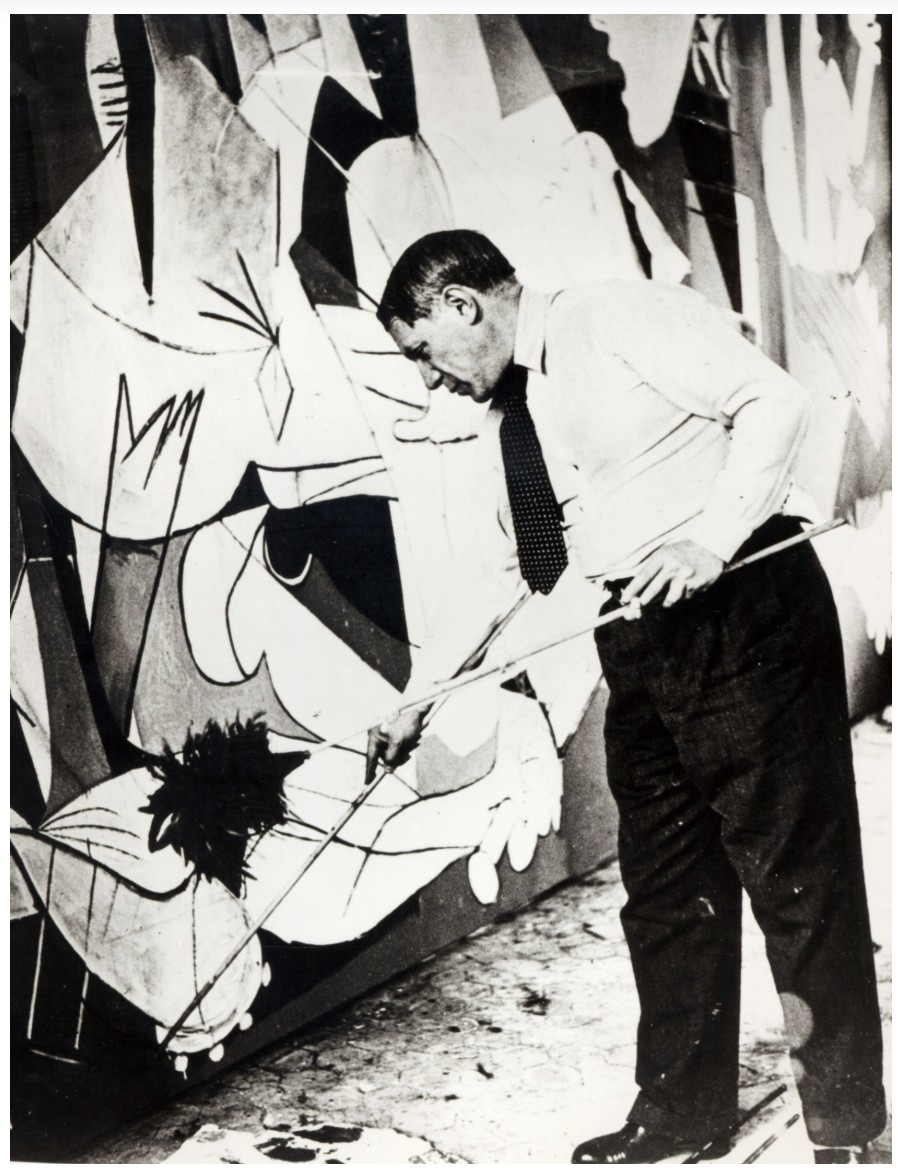
Dora Maar, Pablo Picasso painting ‘Guernica’, 1937, Private collection.
Artwork: ©2025 Estate of Pablo Picasso / Artists Rights Society (ARS), New York.
Photo: Dora Maar © 2025 Artists Rights Society (ARS), New York / ADAGP, Paris. Image: © Archives Charmet / Bridgeman Images
But Dora’s role went beyond documentation. She challenged Picasso politically, intensifying his engagement with the catastrophe unfolding in Spain and across Europe. Their conversations—about fascism, suffering, responsibility—fed directly into the emotional charge of Guernica. In this sense, Dora did not simply witness Picasso’s masterpiece; she shaped its atmosphere. Picasso later acknowledged that, for him, Dora had become the embodiment of war itself.
This identification would prove both productive and destructive.
The Weeping Woman: Projection and Violence
Between 1937 and 1944, Picasso returned obsessively to Dora Maar’s image. He painted her dozens of times—seated, standing, crowned with elaborate hats, fractured into jagged planes, or contorted into paroxysms of grief. These works include some of the most radical portraits in the history of modern art. They also constitute a sustained act of psychological projection.

PABLO PICASSO, WEEPING WOMAN, 1937, TATE MODERN, LONDON © 2024 ESTATE OF PABLO PICASSO / ARTISTS RIGHTS SOCIETY (ARS), NEW YORK
Picasso famously stated that Dora was “the weeping woman,” insisting that he merely obeyed a vision rather than imposing cruelty. Yet this claim evades responsibility. The repeated deformation of her features—sharp noses, clenched teeth, dislocated eyes—transforms Dora into a vessel for anguish that was not hers alone. She becomes a screen onto which Picasso projects his fears: war, death, aging, impotence, loss of control.
The violence of these images is inseparable from the power imbalance of their relationship. Dora was brilliant, but emotionally vulnerable; politically lucid, yet personally fragile. As the German Occupation of Paris deepened, so did her anxiety. Picasso, who remained in Paris and endured harassment by Nazi authorities, turned inward, working relentlessly. Dora, by contrast, absorbed the weight of events more viscerally. Their temperaments diverged. Picasso responded by tightening control—over the relationship and over her image.
The result is a body of work of extraordinary formal invention, but also of undeniable brutality.
After Picasso: Silence and Return
By 1944, the relationship was ending. Picasso had met Françoise Gilot, whose youth and clarity offered a psychological counterpoint to Dora’s intensity. Dora Maar suffered a breakdown. She withdrew from public life, underwent electroconvulsive therapy, and increasingly turned toward Catholic mysticism. For decades, she lived in near isolation, producing work quietly and refusing to participate in the mythology that had consumed her.

DORA MAAR, DOUBLE PORTRAIT WITH HAT, CIRCA 1936–37, GELATIN SILVER PRINT, MONTAGE WITH HANDWORK ON NEGATIVE, THE CLEVELAND MUSEUM OF ART © 2024 DORA MAAR ESTATE/ARTISTS RIGHTS SOCIETY (ARS), NEW YORK/ADAGP, PARIS
Recognition came late. Only toward the end of her life—and increasingly after her death in 1997—did Dora Maar begin to be reassessed on her own terms. Her photographs were re-exhibited, her paintings reconsidered, her role in Surrealism re-evaluated. What emerges is not a tragic footnote, but a major artist whose legacy was temporarily eclipsed by proximity to genius.
Picasso did not invent Dora Maar. He encountered her at a moment when history demanded intensity, and he used her image to confront that demand. The cost of that confrontation was hers as much as his.
Essay
The story of Dora Maar’s relationship with Picasso is legendary in the history of 20th century art. Picasso met Maar, the Surrealist photographer, in the fall of 1935 and was enchanted by the young woman’s powerful sense of self and commanding presence. Although still involved with Marie-Thérèse Walter and still married to Olga Khokhlova at the time, Picasso became intimately involved with Maar by the end of the year, and by 1937 she had ascended to the status of the artist’s primary mistress. Picasso and Dora first met properly either in late 1935 or early 1936, with various accounts differing as to the precise timing. There even appears to have been an earlier encounter that the artist did not recall on the set of Jean Renoir’s Le crime de Monsieur Lange, where Dora was working as set photographer. Certainly, the pair had been near orbit for some time, as both were to varying degrees associates of Surrealism; they had shown work in the same exhibitions and had friends in common.
Unlike the docile and domestic Marie-Thérèse who had given birth to their daughter Maya in 1935, Maar was an artist, spoke Picasso’s native Spanish, and shared his intellectual and political concerns. More than most of the women in his life thus far, Dora Maar was Picasso’s intellectual equal – a characteristic that the artist found both stimulating and challenging.
This story cuts to the heart of the life and times of Dora, and of her relationship with Picasso. Unlike Marie-Thérèse, who had been a young, sporty, wholesome ingénue when she had first encountered the artist, Dora was a successful and independent woman in her own right. Her photography managed to straddle the realms of Surrealism and advertising. It had led both to a career and to her becoming prominent among the avant-garde artists and writers of the day as well as becoming the lover of Georges Bataille.
She had photographed Surrealists such as Yves Tanguy and René Crevel and had herself modelled for Man Ray. She had become involved with various aspects of the Surrealist movement led by André Breton, not least the political aspects that were becoming increasingly important against the backdrop of the geo-political fragility of the 1930s. It was through Dora that Breton met her friend—and his future wife—Jacqueline Lamba. Dora was introduced to Picasso the first (unremembered) time by Paul Eluard. She approached him as an established artist, as well as a woman with a past.
The closeness that so swiftly developed between Picasso and Dora grew on strong foundations. Dora spoke Spanish. She had been born Henriette Theodora Markovitch, the daughter of an architect who had moved from Paris to Buenos Aires when she was young; she had grown up there, learning to speak the language fluently. She was therefore able to appreciate the subtleties of Picasso’s comments, including his jokes. As well as language, Picasso and Dora had a number of friends in common. And both were artists, both fascinated with the gaze and with their subjects. Her works such as 29 rue d’Astorg and her portrait of Nusch Eluard revealed the creativity which acted as such a spur to Picasso. There was a dialogue here that was lacking with either Marie-Thérèse or Olga.
Looking back on the pictures that he painted of her, Picasso once admitted that Dora Maar had become for him the personification of the war. Her image, which he reinterpreted countless times between 1937 and 1944, embodied all of the complicated and conflicting emotions of life in the midst of occupied Paris. The trailblazing stylistic developments that Picasso made during the Second World War can be charted across the many portraits of his muse and fellow artist Dora Maar. In Picasso’s most memorable portraits of Maar, her strong features are warped and manipulated, ultimately creating some of the most radical breakthroughs in portraiture of the twentieth century.
As one of Picasso’s famous muses, Maar is perhaps best known as the Weeping Woman, and she was often hostilely depicted in moments of despair. Picasso would express his frustration by furiously abstracting her image, often portraying her in tears.
“For me [Maar] is the weeping woman. For years I’ve painted her in tortured forms, not through sadism, and not with pleasure, either; just obeying a vision that forced itself on me. It was the deep reality, not the superficial one.”
The distress that Maar experienced during her relationship with Picasso was influenced by the specific circumstances of their turbulent relationship and the anxieties of war. Deeply concerned by the rise of fascism and subsequent outbreaks of war, Maar was weighed down by the despair and anguish that affects many in the face of impending disaster. Picasso’s evolution of Maar’s image, while a reflection of her own reaction to the war, must also be seen as a mirror for his own psychological anguish.
Maar was a strong-willed, intelligent, stylish, thoroughly modern woman who spent her childhood between Paris and Argentina. Once finally settled in Paris, Maar studied as an artist, photographer, and graphic designer. In the 1930s, she became involved with the Surrealists and was immersed in Parisian café circles frequented by the leading artists and intelligentsia of the age.
During this time, Maar’s practice shifted almost entirely to photography, and her command of this medium led to great commercial success in advertising and editorial work. Fluidly moving between her commercial commissions and personally motivated avant-garde projects, Maar’s radical experiments resulted in striking images that were immediately regarded as iconic works of Surrealism.
The trailblazing stylistic developments that Picasso made during the Second World War can be charted across the many portraits of his muse and fellow artist Dora Maar. In Picasso’s most memorable portraits of Maar, her strong features are warped and manipulated, ultimately creating some of the most radical breakthroughs in portraiture of the twentieth century.
The Dora Maar portraits occupy a singular position within Picasso’s œuvre and within the modern art market. They are not merely portraits of a muse; they are psychological documents forged under extreme historical pressure. Created between the Spanish Civil War and the final years of the German Occupation, these works compress politics, intimacy, fear, and domination into a visual language that remains unmatched in twentieth-century portraiture.
From a market perspective, the hierarchy is unequivocal. The most sought-after works are those painted between 1937 and 1944, when Dora Maar was both Picasso’s principal model and his emotional counterpart to war. Scale, chromatic audacity, and symbolic density consistently drive prices upward. Works that combine these elements—such as Dora Maar au chat or Buste de femme (Femme à la résille)—function today as historical monuments as much as paintings.
As Dora Maar continues to be reassessed as an artist in her own right, these portraits are no longer read solely as expressions of Picasso’s genius. They are increasingly understood as sites of tension between two creative minds. The market has already integrated this shift. Scholarship is catching up.
Auction Results (Chronological)
Bust of a Woman with a Flowered Hat (Dora Maar), 1943
Lucien Paris: 24 October 2025
Estimated: EUR 8,000,000 – 10,000,000
EUR 27,000,000 / USD 31,388,510 (Hammer)
Bust of a Woman with a Flowered Hat (Dora Maar), 1943 – Lot 1
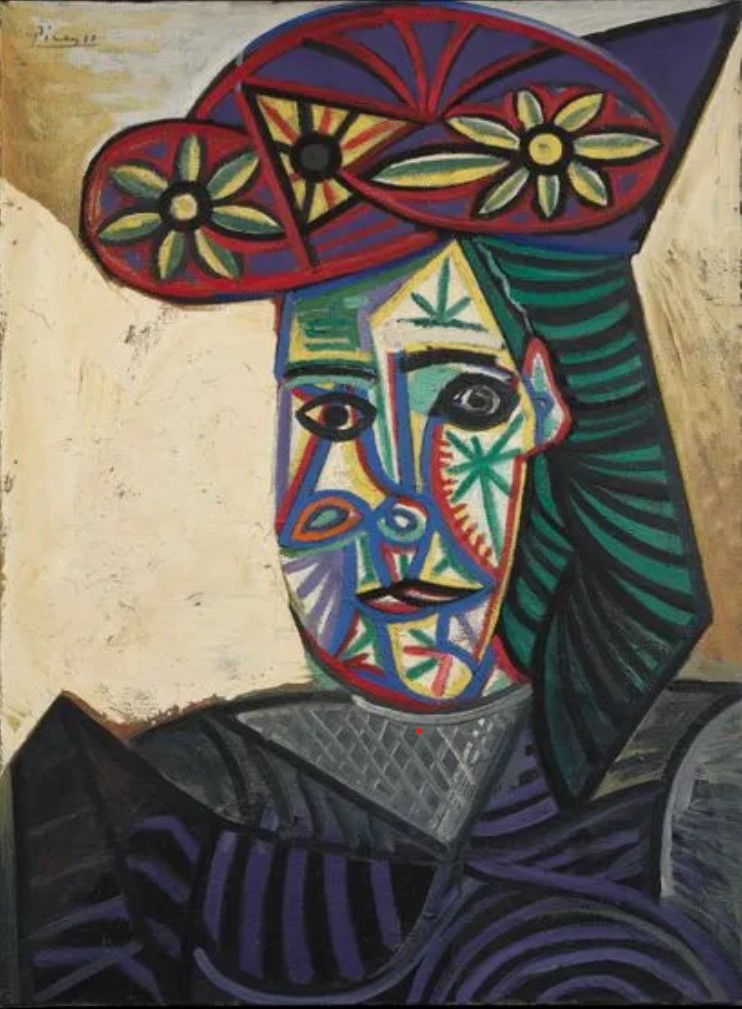
PABLO PICASSO
Bust of a Woman with a Flowered Hat (Dora Maar), 1943
Oil on canvas
81×60 cm (31.9 x 23.6 inches)
Signed upper left
Dated 11 July 43 on the reverse.
© Picasso Estate 2025
Buste de femme, 1944
Christie’s Hong-Kong: 26 September 2025
Estimated: HKD 86,000,000 – 106,000,000
HKD 196,750,000 / USD 25,289,205
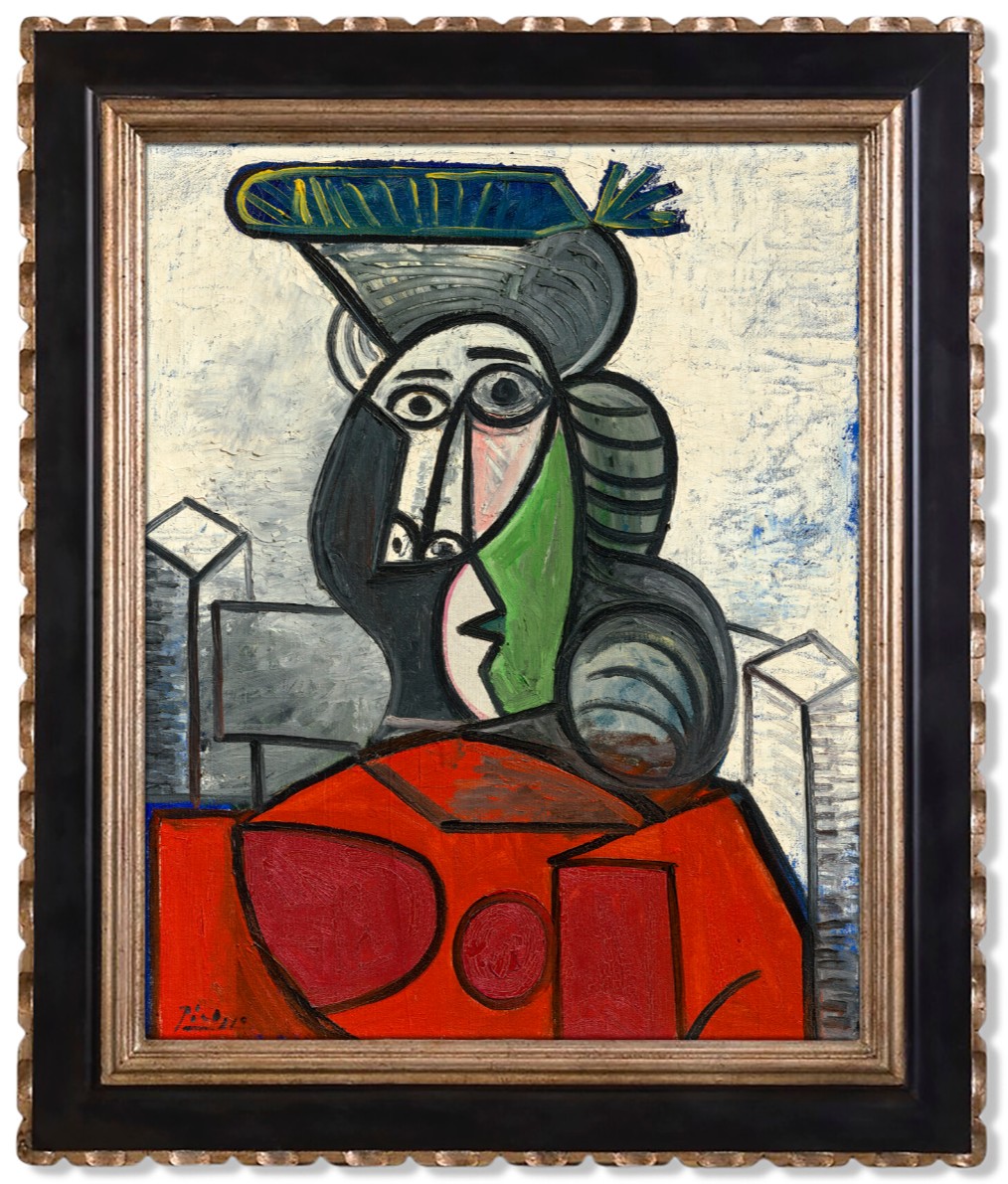
PABLO PICASSO (1881-1973)
Buste de femme, 1944
Oil on canvas
80.8 x 65 cm (31 7/8 x 25 5/8 inches)
Signed ‘Picasso’ (lower left)
Painted on 5 March 1944
Buste de femme au chapeau, 1939
Phillips New-York: 14 May 2024
Estimated: USD 12,000,000 – 18,000,000
WITHDRAWN
Pablo Picasso – Modern & Contemporary Ar… Lot 17 May 2024 | Phillips

PABLO PICASSO
Buste de femme au chapeau, 1939
Oil on canvas
61 x 38.1 cm (24×15 inches)
Dated “9.6.39.” upper left
Femme au chapeau, 1941
Sotheby’s New-York: 15 May 2024
Estimated: USD 6,000,000 – 8,000,000
PASSED
Femme au chapeau | Modern Evening Auction | 2024 | Sotheby’s (sothebys.com)

PABLO PICASSO (1881 – 1973)
Femme au chapeau, 1941
Oil on canvas
61×38 cm (24×15 inches)
Signed Picasso and dated 13 juin 41 (center left)
Executed on 13 June 1941
Femme assise (Dora Maar), 1938
Christie’s New-York: 16 May 2024
Estimated: USD 2,000,000 – 3,000,000
USD 1,502,000
WORK ON PAPER
https://www.christies.com/en/lot/lot-6482938
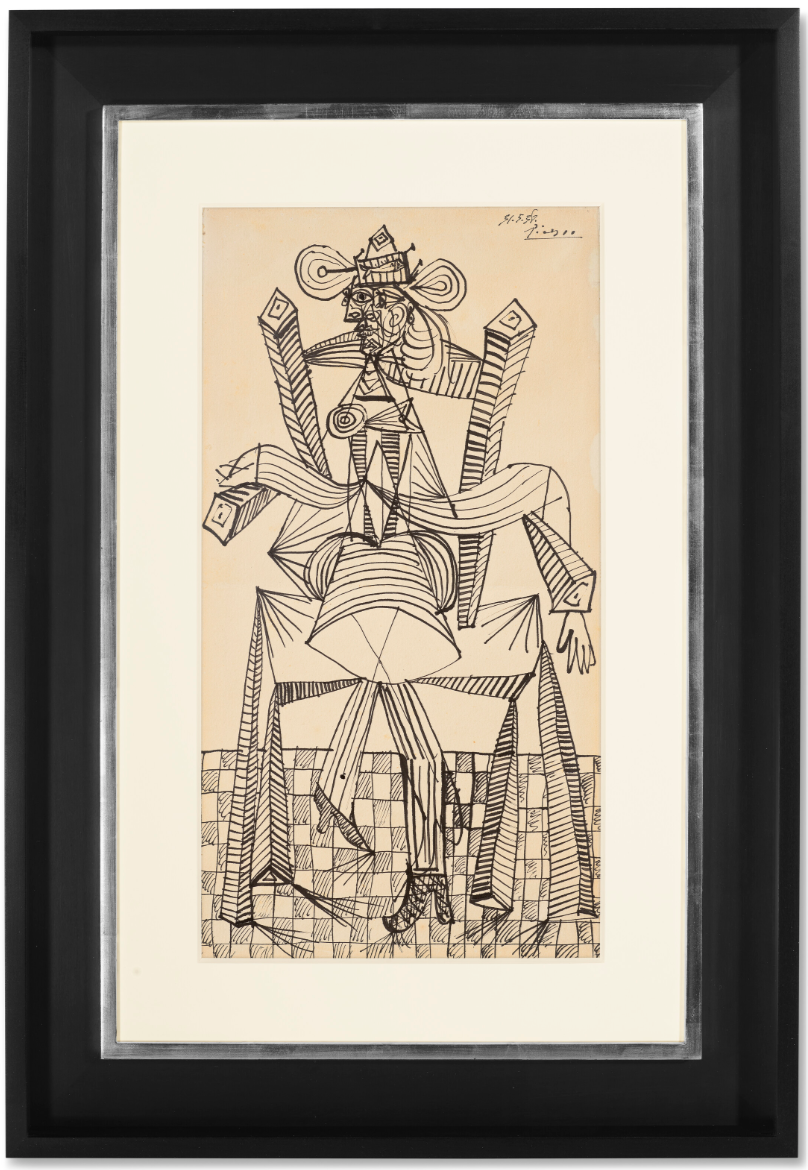
PABLO PICASSO (1881-1973)
Femme assise (Dora Maar), 1938
Pen and India ink on paper
45.9 x 24.5 cm (17 7/8 x 9 5/8 inches)
Signed and dated ‘31.5.38. Picasso’ (upper right)
Drawn in Paris on 31 May 1938
Femme au chapeau jaune, 1939
Sotheby’s New-York: 16 May 2023
Estimated: USD 15,000,000 – 20,000,000
USD 15,846,000
Femme au chapeau jaune (Dora Maar) | Modern Evening Auction | 2023 | Sotheby’s (sothebys.com)
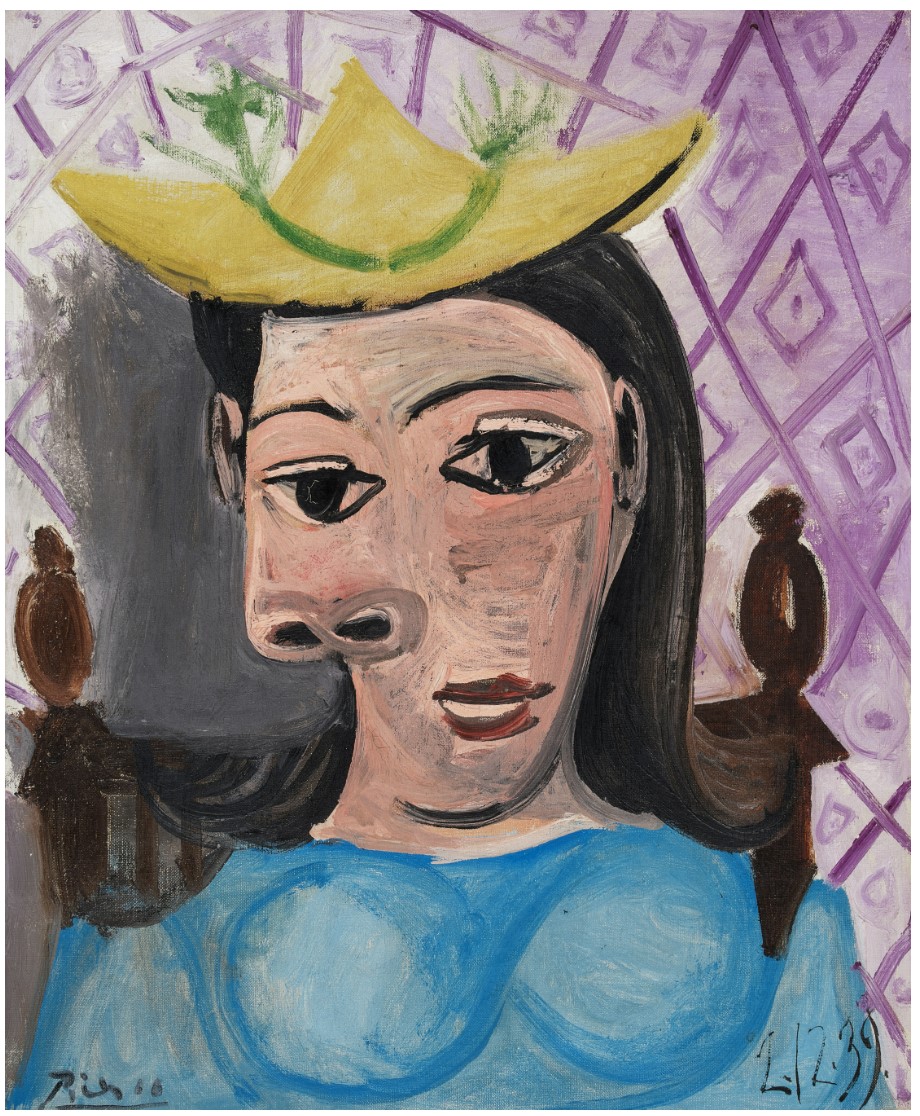
PABLO PICASSO (1881 – 1973)
Femme au chapeau jaune (Dora Maar), 1939
Oil on canvas
46.4 x 38.1 cm (18 1/4 x 15 inches)
La Femme qui pleure I, 1937
Sotheby’s New-York: 16 May 2023
Estimated: USD 1,500,000 – 2,500,000
USD 1,650,000
WORK ON PAPER
La Femme qui pleure I | The Mo Ostin Collection Evening Auction | 2023 | Sotheby’s (sothebys.com)
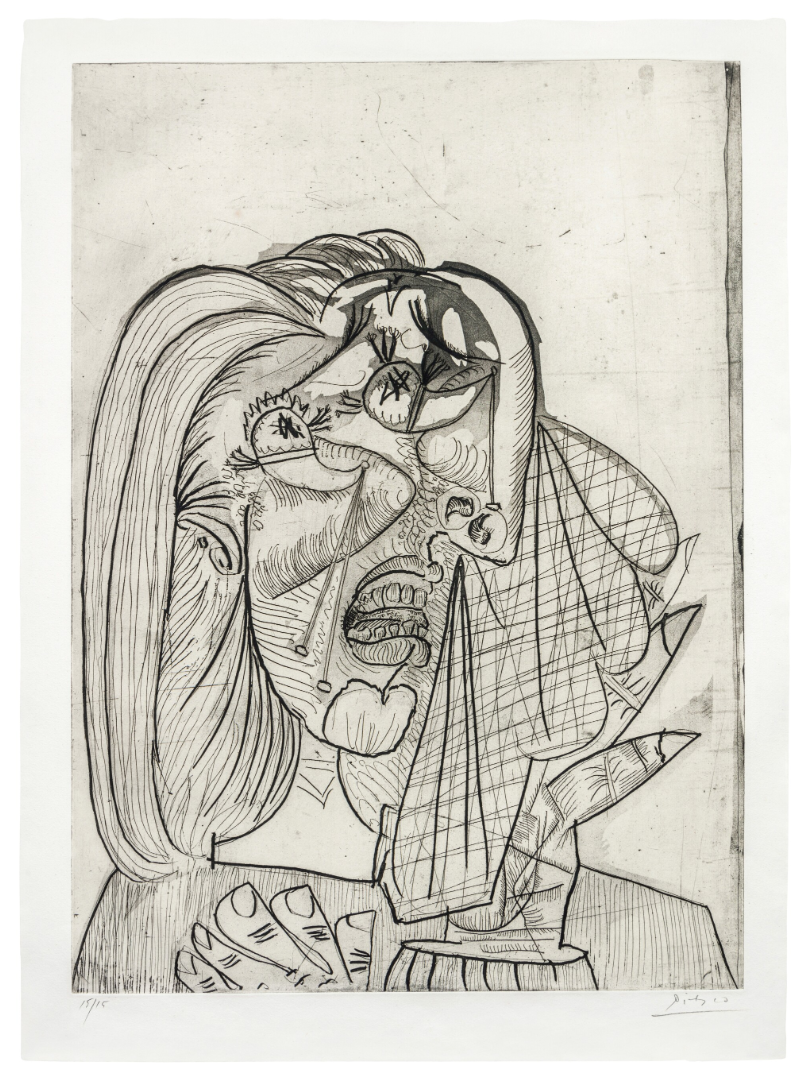
PABLO PICASSO (1881 – 1973)
La Femme qui pleure I, 1937
Drypoint, aquatint, etching and scraper on Montval laid paper
Plate: 69.2 x 49.5 cm (27 1/4 x 19 1/2 inches)
Sheet: 77.5 x 56.2 cm (30 1/2 x 22 1/8 inches)
Signed in pencil (lower right) and numbered 15/15 (lower left)
Very fine impression of the extremely rare subject numbered 15 from the edition of 15 of Baer’s third state (of seven)
Printed by Lacourière
Dora Maar, 1939
Sotheby’s Hong-Kong: 27 April 2022
Estimates on Request
HKD 169,420,000 / USD 21,594,395
Pablo Picasso 巴布羅・畢加索 | Dora Maar 多拉・瑪爾 | Modern Evening Auction | 2022 | Sotheby’s
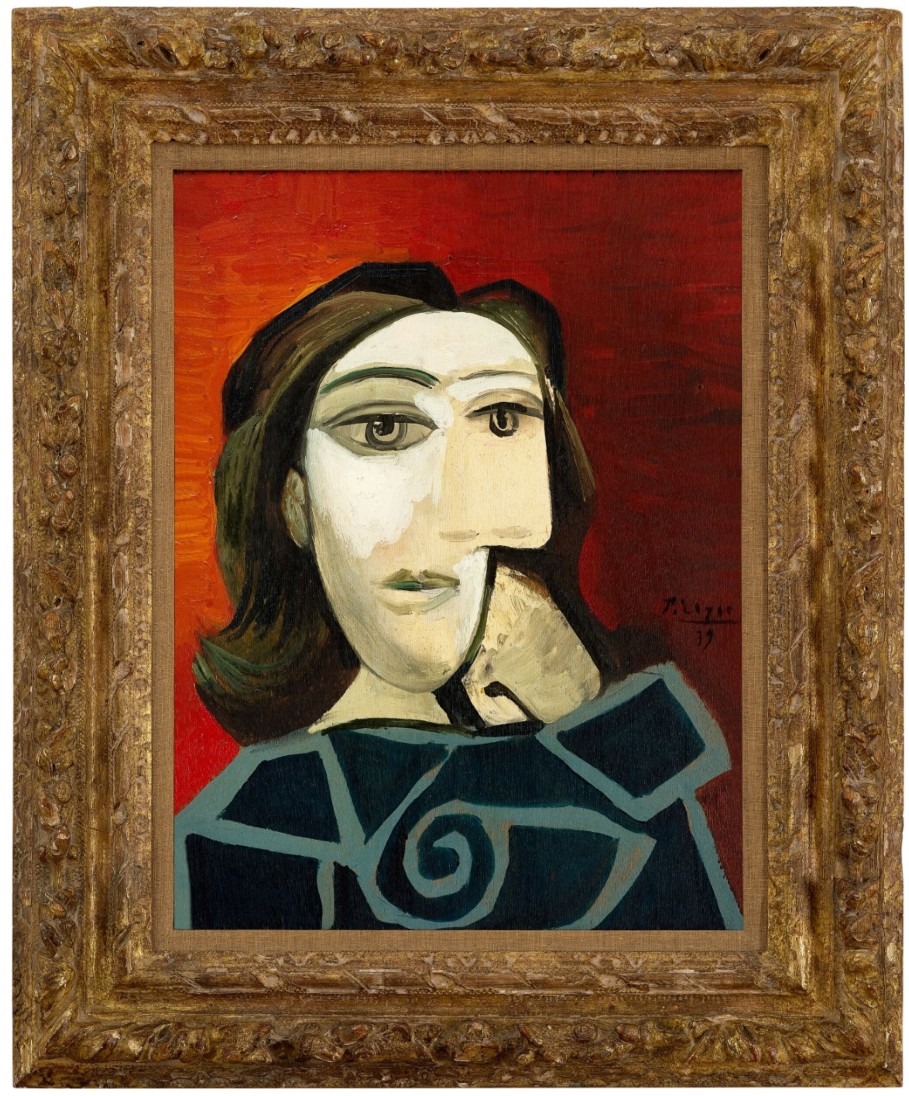
PABLO PICASSO (1881 – 1973)
Dora Maar, 1939
Oil on panel
60 x 45.5 cm (23 5/8 x 17 7/8 inches)
Signed Picasso and dated 39 (center right)
Dated 27.3.39. on the reverse
Rankings
#1. Dora Maar au chat, 1941
Sotheby’s New-York: 2 May 2006
Estimated: USD 50,000,000 – 70,000,000
USD 95,216,000
(#14) Pablo Picasso (sothebys.com)
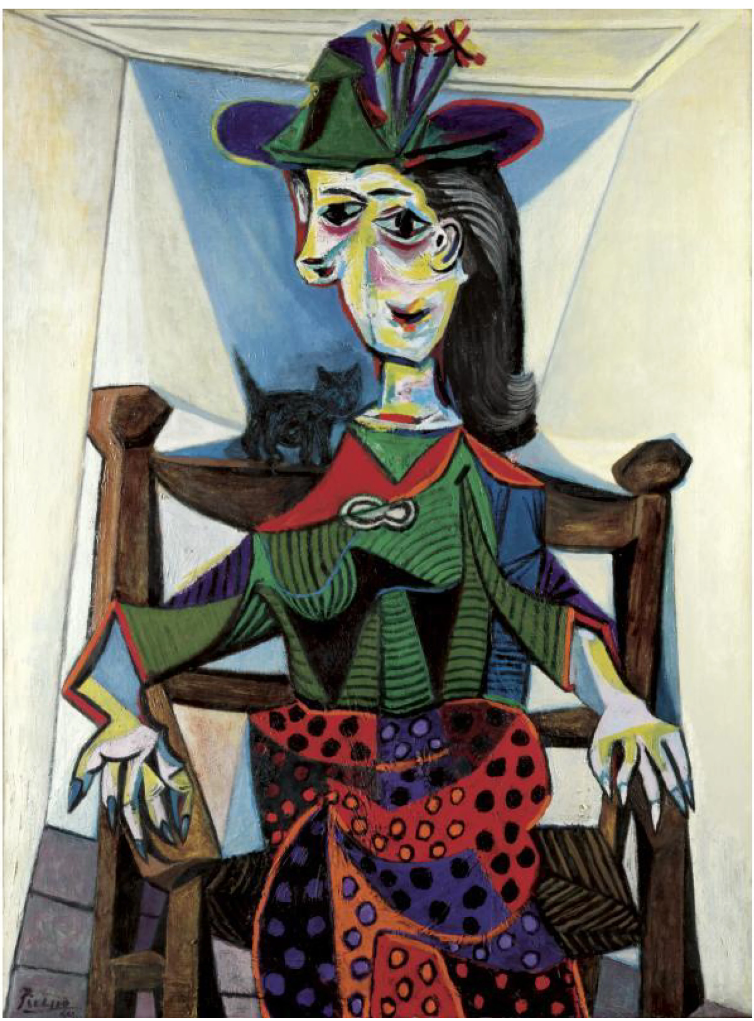 PABLO PICASSO
Dora Maar au chat, 1941
Oil on canvas
129.5 x 97 cm (51×38 inches)
Signed and dated Picasso 41. (lower left)
Painted in 1941, Dora Maar au chat stands at the summit of Picasso’s portraits of Dora and remains the most expensive work from this cycle ever sold at auction. Executed at the height of their relationship and at the peak of wartime tension, the painting synthesizes everything collectors seek in a Dora Maar portrait: scale, psychological charge, chromatic audacity, and symbolic density. The cat, an ambiguous emblem of aggression, sensuality, and control, sharpens the psychological tension of the composition. Dora appears monumental, enthroned, yet contained within Picasso’s fractured geometry. This duality between power and confinement lies at the core of the work’s appeal. From a market perspective, the painting is unique: it is the most complete, ornate, and resolved Dora portrait of the war years. Picasso never returned to this level of compositional complexity with her image. Rarity, iconography, and irreversibility explain the result.
#2. Buste de femme (Femme à la résille), 1938
Christie’s New-York: 10 May 2015
Estimates on Request
USD 67,365,000
Pablo Picasso (1881-1973), Buste de femme (Femme à la résille) | Christie’s
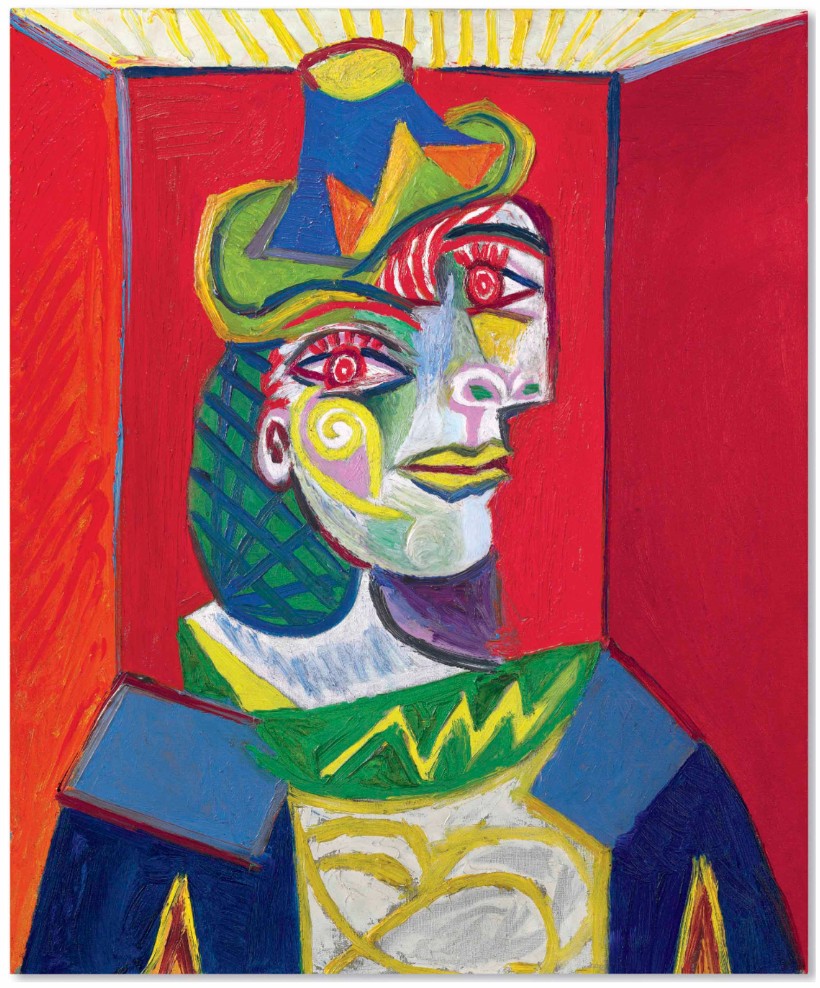
PABLO PICASSO (1881-1973)
Buste de femme (Femme à la résille), 1938
Oil on canvas
65.1 x 54 cm (25 5/8 x 21 1/4 inches)
Dated ‘12.1.38.’ (on the stretcher)
Dated January 1938, this painting belongs to the immediate post-Guernica moment, when Dora Maar’s presence was both emotional and political. The vivid red background, jagged lines, and hairnet motif convey volatility rather than despair. Unlike the later Weeping Woman images, this portrait balances tension with poise. Its market strength derives from several factors: exceptional color saturation, prime date, and provenance that kept the work out of circulation for decades. It is also one of the rare Dora portraits that remained in Picasso’s own collection, underscoring its personal importance. Collectors recognize it as a pivot work—bridging lyrical portraiture and psychological fragmentation.
#3. Femme assise, robe bleue, 1939
Christie’s New-York: 15 May 2017
Estimated: USD 35,000,000 – 50,000,000
USD 45,047,500
Pablo Picasso (1881-1973), Femme assise, robe bleue | Christie’s
REPEAT SALE
Christie’s London: 21 June 2011
Estimated: GBP 4,000,000 – 8,000,000
GBP 17,961,250 / USD 29,143,020
Pablo Picasso (1881-1973) , Femme assise, robe bleue | Christie’s
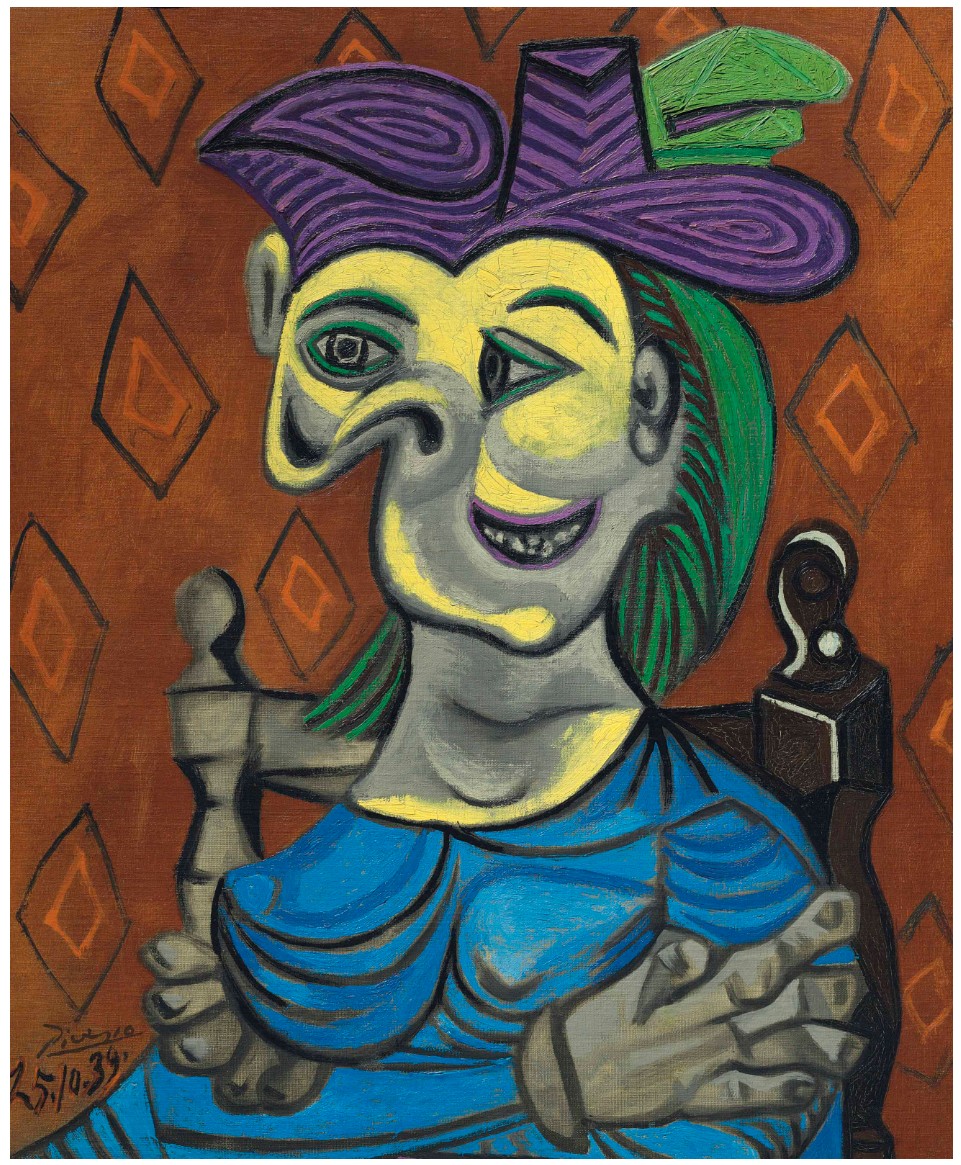
Pablo Picasso (1881-1973)
Femme assise, robe bleue, 1939
Oil on canvas
73×60 cm (28 3/4 x 23 5/8 inches)
Signed and dated ‘Picasso 25.10.39.’ (lower left)
Dated again and inscribed ‘25.10.39. Royan’ (on the reverse)
Painted on Picasso’s birthday in October 1939, this work captures a rare moment of levity amid gathering catastrophe. Dora appears smiling, almost playful, an image at odds with the prevailing narrative of anguish. The softened forms and rich blue palette mark a temporary release from the angular violence of earlier years. Its extraordinary provenance, confiscated by the Nazis and later recovered, adds historical gravity. The painting’s market performance reflects its narrative richness: collectors value not only the image, but the story embedded in the canvas. It represents Dora not as symbol, but as companion.
#4. Buste de femme au chapeau à fleurs, 1943
Lucien Paris: 24 October 2025
Estimated: EUR 8,000,000 – 10,000,000
EUR 27,000,000 / USD 31,388,510 (Hammer)
Bust of a Woman with a Flowered Hat (Dora Maar), 1943 – Lot 1
PABLO PICASSO
Buste de femme au chapeau à fleurs, 1943
Oil on canvas
81×60 cm (31.9 x 23.6 inches)
Signed upper left
Dated 11 July 43 on the reverse.
© Picasso Estate 2025
This recently surfaced 1943 canvas rewrites part of the wartime Dora narrative. Painted under Occupation, it defies expectations of austerity through its explosive palette. Color here functions as resistance rather than decoration. Market-wise, the result was driven by three elements: freshness (never previously auctioned), prime wartime date, and impeccable condition. The hat, fetishistic, floral, crown-like, anchors the composition and reasserts Dora’s presence as emblematic rather than purely tragic. This sale confirms continued appetite for previously unseen wartime Dora works.
#5. Femme dans un fauteuil, 1941
Christie’s New-York: 15 May 2017
Estimated: USD 20,000,000 – 30,000,000
USD 29,557,500
Pablo Picasso (1881-1973), Femme dans un fauteuil | Christie’s
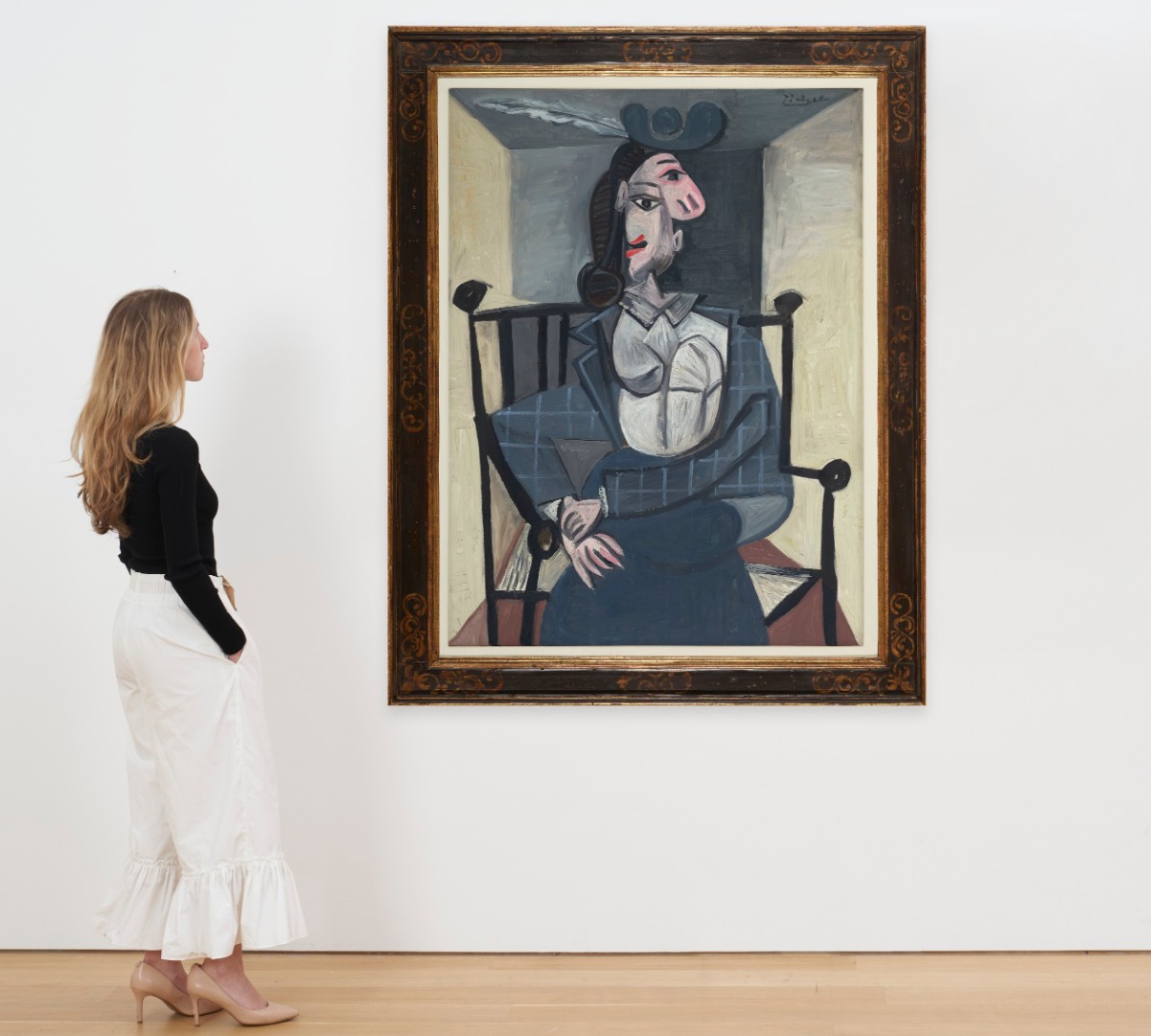
PABLO PICASSO (1881-1973)
Femme dans un fauteuil, 1941
Oil on canvas
130×97 cm (51 1/8 x 38 inches)
Signed ‘Picasso’ (upper left)
Dated ’19 juin 41.’ (on the stretcher bar)
Painted in June 1941, this large-scale seated portrait exemplifies Picasso’s wartime fixation on the armchair motif. Dora’s presence is commanding, her gaze confrontational. The chair functions less as furniture than as a structural cage. The market values this painting for its monumentality and clarity: it is immediately legible as a Dora Maar portrait, without ambiguity. It also belongs to a concentrated burst of productivity in mid-1941, a period collectors increasingly isolate as a peak.
Sporting a white ruffled blouse, and chic, plaid blazer, with her hair elegantly coiffured and topped with a feathered hat, the stylish Parisienne pictured in Femme dans un fauteuil is the figure of Dora Maar, Pablo Picasso’s great wartime paramour and muse. Painted on 19 June 1941, just over a year into the Nazi Occupation of Paris, this portrait forms part of an astonishing surge of creativity that the artist had begun a month prior. During this time, Picasso defied the ever-worsening events that were unfolding in his adopted home, and turned inwards, painting the world of his studio and those who peopled it with an irrepressible energy.
Here the Spanish-speaking, radical Surrealist photographer, painter, and intellectual is rendered on a monumental scale; her presence and image magisterial as she sits in a pose of cool insouciance, gazing out with her renowned dark-eyed stare to meet the eyes of her lover. From the Weeping Women to the plethora of seated portraits, Picasso’s images of Dora are among the greatest of his wartime work; the cataclysmic events of this epoch and the artist’s personal reaction to them etched onto the visage of his companion. At times haunting, arresting, adoring and reverential, the visual power of these portraits is due in part to the symbiotic creative relationship the pair shared: Dora was not simply a muse, but, as an artist in her own right, she was an active participant in their intense artistic dialogue.
#6. Femme assise dans un fauteuil, 1941
Sotheby’s New-York: 1 May 2012
Estimated: USD 20,000,000 – 30,000,000
USD 29,202,500
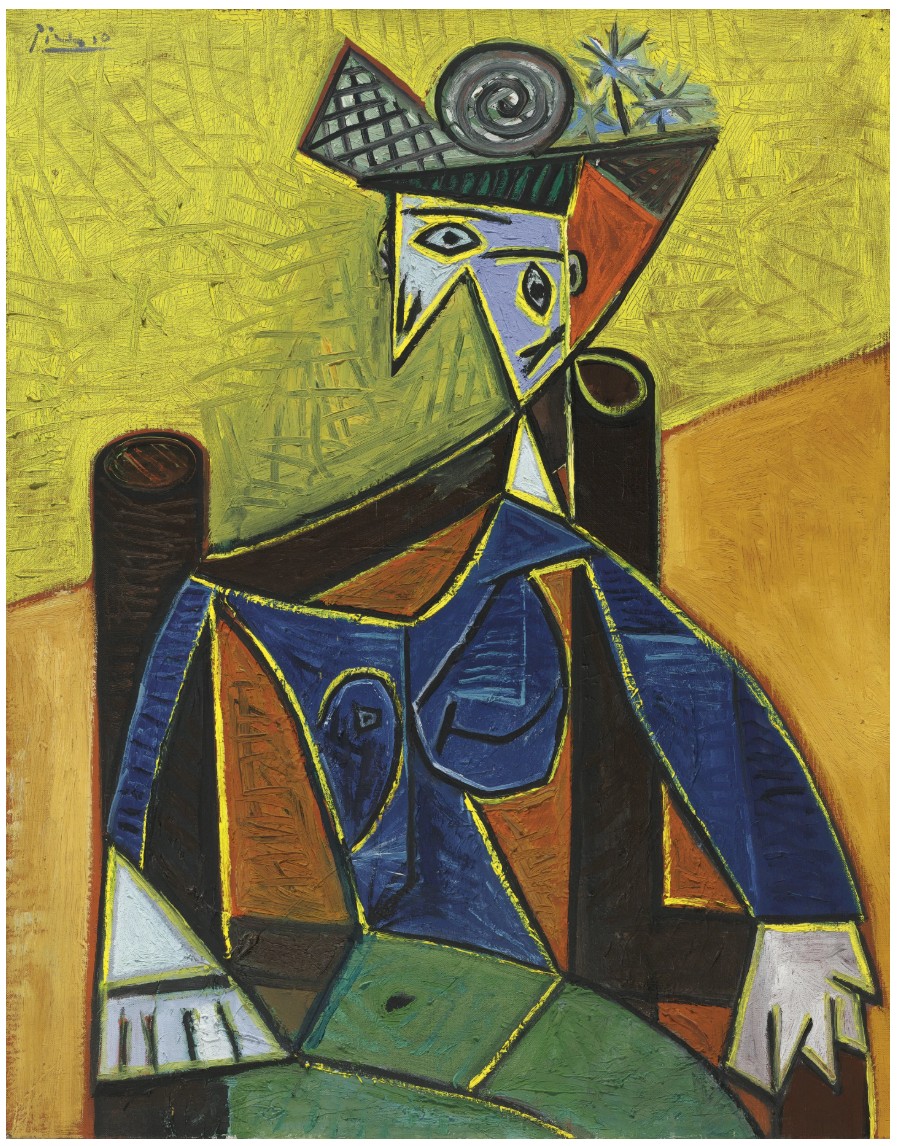
PABLO PICASSO
Femme assise dans un fauteuil, 1941
Oil on canvas
92×73 cm (36 1/2 x 28 3/4 inches)
Signed Picasso (upper left)
Dated 23 Octobre 41. on the stretcher
This October 1941 work intensifies the psychological charge of the seated woman theme. Dora’s body interlocks with the armchair, dissolving boundaries between figure and structure. The hat introduces a note of irony, counterbalancing distortion. Its appeal lies in formal experimentation rather than surface beauty. Collectors drawn to Picasso’s most radical portrait solutions recognize this painting as an uncompromising statement from the heart of the Occupation years.
Among the subject matter that permeates Picasso’s oeuvre, it is perhaps his female portraits that prove the most powerful for their formal revolution and strength of expression. Painted in 1941, Femme assise dans un fauteuil reveals the potency of this subject for the artist. As the tensions of the late 1930s gave way to fully-fledged war, Picasso’s paintings communicated the fervent immediacy of the times. These emotions are most keenly felt in his portraits of his muse and lover during the war, Dora Maar – unmistakably the model for the current work. Painted the same year as the artist’s masterful Dora Maar au chat and Femme assise dans un fauteuil, the present work exemplifies the emotive power of Picasso’s wartime portraiture. Picasso’s early portraits of Dora reveal this discovery of beauty, while the wartime portraits penetrate deeper into the passionate discourse between these artists at a time of intense peril. Femme assise dans un fauteuil is a testament to the ardent emotions that the artist shared with Dora in the early years of World War II. He distorts her figure beyond logical comprehension, entangling her dynamic body with the solid elements of the armchair. The interlocking shapes of the figure, electrified with bright yellow outlining, complete a portrait of Dora that is at once startling and inviting.
The theme of the seated female figure was a central trope for Picasso, and its significance increased during the war years. Stephen Nash writes of this period for the artist, “The one theme from these years that outweighs in importance and repetition even Picasso’s still lifes is that of a Seated Woman. This motif defines more than any other the intensity of work from the war years. Beginning, as we have seen, in the Royan period and continuing throughout his time in occupied Paris, Picasso returned to the compositional idea of the Seated Woman again and again, wringing from it varied expressive effects and psychological nuances. For Picasso the theme developed into a kind of looking glass that reflected his own internal reactions to people and events around him, whether it be happiness with a lover or anguish and fear about the war. From his ‘portraits’ of others, an extensive self-portrait of the artist emerged” (Stephen A. Nash, in Picasso and the War Years: 1937-1945 (exhibition catalogue), Fine Arts Museums of San Francisco & Solomon R. Guggenheim Museum, New York, 1998-99, pp. 32-33). Picasso eschews a clear reading of the present work, however, when he depicts the buoyant features of the hat – a compositional element that appears throughout the artist’s oeuvre and particularly in the early 1940s (figs. 1 & 4). For Yves-Alain Bois, the hat in the current work finds its origin in the works of Picasso’s rival and friend, Henri Matisse. Bois isolates a series of 9 works executed by Picasso between October and November of 1941, including the current work, which present a woman with a hat. Indeed the hatted female figure was a central theme for Matisse as early as the Fauve years and through the 1920s (fig. 2); Picasso’s choice of the subject matter reveals a playful dialogue with his contemporary.
#7. Femme dans un fauteuil (Dora Maar), 1942
Christie’s London: 20 June 2018
Estimated: GBP 18,000,000 – 25,000,000
GBP 19,358,750 / USD 25,505,330
Pablo Picasso (1881-1973), Femme dans un fauteuil (Dora Maar) | Christie’s
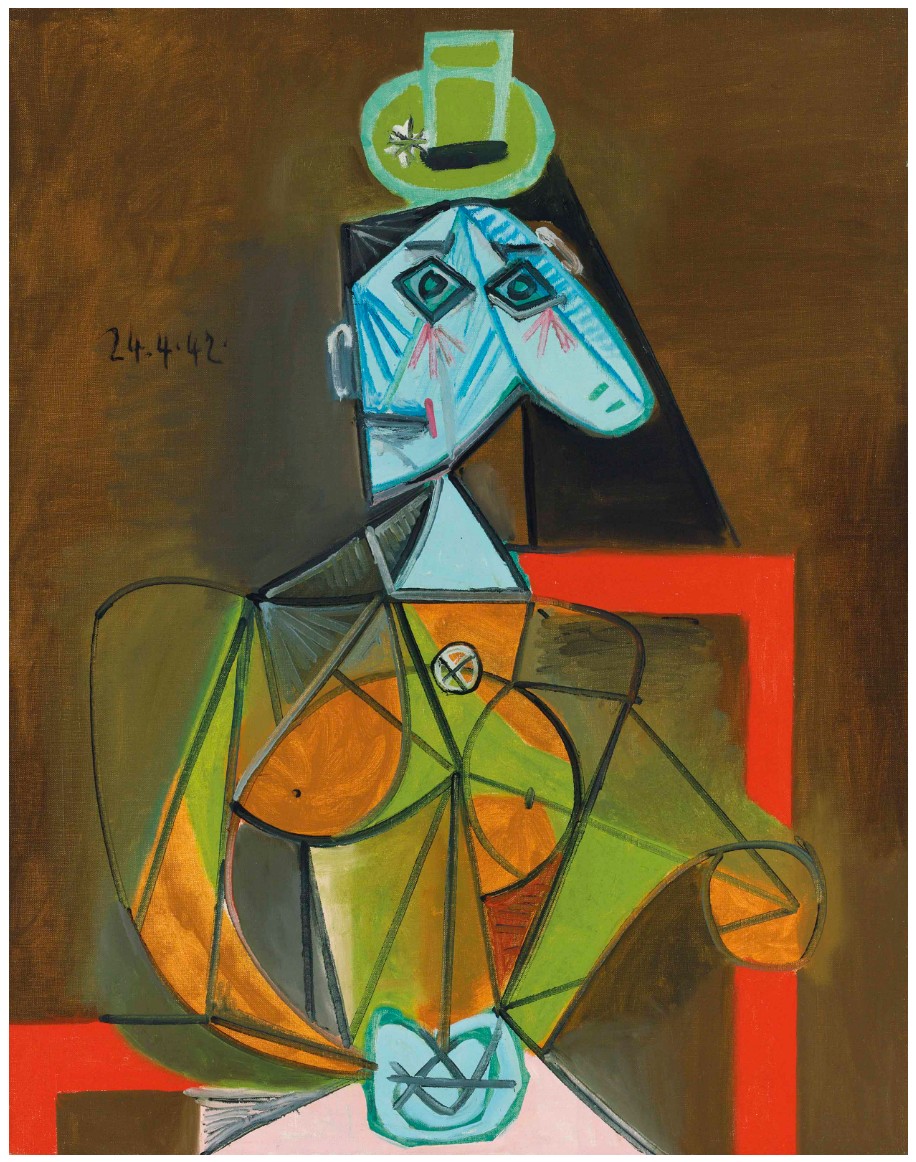
Pablo Picasso (1881-1973)
Femme dans un fauteuil (Dora Maar), 1942
Oil on canvas
92×73 cm (36 x 28 3/4 inches)
Dated ‘24.4.42’ (centre left)
Dated ‘24.4.42’ (on the stretcher)
Painted on the 24th of April 1942, Femme dans un fauteuil (Dora Maar) is a powerful depiction of Picasso’s great lover and muse, Dora Maar, the mysterious, raven-haired beauty who inspired some of the greatest portraits of his prolific career during their nine-year relationship. Described by Picasso in 1937 as ‘devilishly seductive in her disguise of tears and marvellous hats,’ Dora was the ultimate Surrealist femme-fatale, an enigmatic muse who captured the artist’s imagination from their very first meeting (Picasso, quoted in L. Baring, Dora Maar: Paris in the Time of Man Ray, Jean Cocteau and Picasso, New York, 2017, p. 196). Renowned for her striking beauty and intense personality, Dora’s features became a vehicle through which he could explore his own emotions at this time, channelling the fear, torment and anguish that plagued him during the tumultuous and violent years of the Spanish Civil War and the Second World War into ever more distorted visions of her form. In these dynamic, provocative works, Picasso created an elaborate and compelling myth around the character of Dora, transforming her into an iconic figure whose dramatic persona and powerful beauty has become inextricably intertwined in his conception of these turbulent times. Executed towards the end of April 1942, as the Occupation was about to enter its third year, Femme dans un fauteuil (Dora Maar) captures the hieratic bearing, the intense stillness and statuesque poise Dora was famed for. In keeping with many of Picasso’s portraits of Dora from this period, she is seated on a chair in an extension of the series of femmes au chapeau and femmes assises that had occupied the artist in the years immediately preceding the war. Boldly carving her face into two distinct planes, Picasso exaggerates the sharp angles of her profile, while also adding a phallic, proboscis-like nose more reminiscent of the snout of his beloved Afghan hound, Kasbek, than of Dora herself. Framed by the bold scarlet armature of the chair, her torso appears in a labyrinthine web of intersecting lines, a delicate interplay of curves and angles converging to create a fragmented, sculptural analysis of the volumes of her body. Set within a dark, shadowy background which throws her body into sharp focus, our attention is concentrated solely on Dora, as she gazes directly outwards from the canvas with an intense solemnity. Her clasped hands, meanwhile, create the impression that she is patiently waiting for something to happen, a reflection, perhaps, of Picasso’s own patience as he silently endured life during the Occupation and awaited his freedom.
#8. Buste de femme, 1944
Christie’s Hong-Kong: 26 September 2025
Estimated: HKD 86,000,000 – 106,000,000
HKD 196,750,000 / USD 25,289,205
PABLO PICASSO (1881-1973)
Buste de femme, 1944
Oil on canvas
80.8 x 65 cm (31 7/8 x 25 5/8 inches)
Signed ‘Picasso’ (lower left)
Painted on 5 March 1944
Painted in March 1944, as the Occupation neared its end, this portrait reflects emotional exhaustion rather than violence. Dora’s eyes are wide, alert, almost resigned. The palette is restrained, punctuated by sharp chromatic accents. The market responded strongly to its historical positioning: one of the last major Dora portraits, created as the relationship was dissolving. Collectors read it as an elegy—both personal and historical.
#9. Buste de femme (Dora Maar), 1938
Christie’s New-York: 16 November 2016
Estimated: USD 18,000,000 – 25,000,000
USD 22,647,500
Pablo Picasso (1881-1973), Buste de femme (Dora Maar) | Christie’s
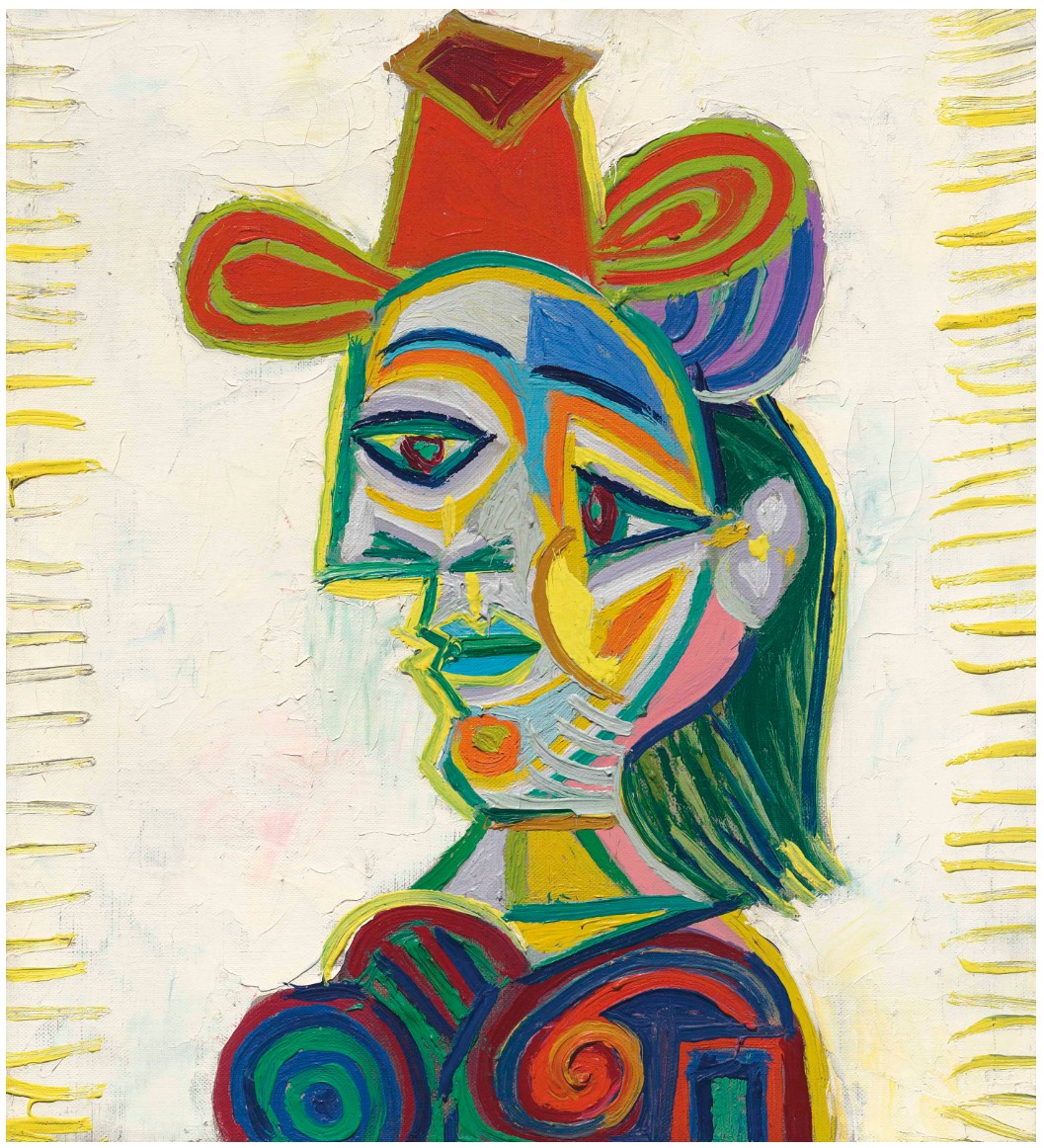
Pablo Picasso (1881-1973)
Buste de femme (Dora Maar), 1938
Oil on canvas
45 x 40.3 cm (17 7/8 x 15 7/8 inches)
Dated ‘20.5.38.’ (on the stretcher)
Painted on 20 May 1938, Buste de femme is a dazzling and jewel-like portrait by Picasso of his lover and muse, Dora Maar. Renowned for her striking beauty and intense personality, Dora Maar’s presence in the artist’s life from the time that they met in 1935, until their relationship ended around 1945, inspired some of the greatest portraits of Picasso’s prolific career. Her face became the site of myriad distortions, exaggerations and abstractions as he returned again and again to the motif of the seated woman, capturing different psychological nuances and expressions. Dating from the height of their relationship, Buste de femme is one of the finest in a series of highly coloured bust length portraits, which feature Dora wearing an array of flamboyant hats, that Picasso began in the summer of 1937 and continued throughout 1938. With her dark hair tucked behind her ear, the regal figure of Dora, adorned in an ornate red hat and an outfit composed of richly colored arabesques, erupts from a luminous white background. Color bursts from every corner of Dora’s image: the portrait is electrified as dazzling streaks of pink, flaming orange and yellow, and cooler tones of turquoise, blue and white interlock and coalesce within the composition. Composed of an elaborate labyrinthine web of boldly colored facets and lines, the head of Dora sparkles with a radiant energy, a joyous affirmation and celebration of life and love created at a time when the prospect of war moved ever closer.
#10. Portrait de femme (Dora Maar), 1942
Christie’s New-York: 6 May 2014
Estimated: USD 25,000,000 – 35,000,000
USD 22,565,000
Pablo Picasso (1881-1973) , Portrait de femme (Dora Maar) | Christie’s
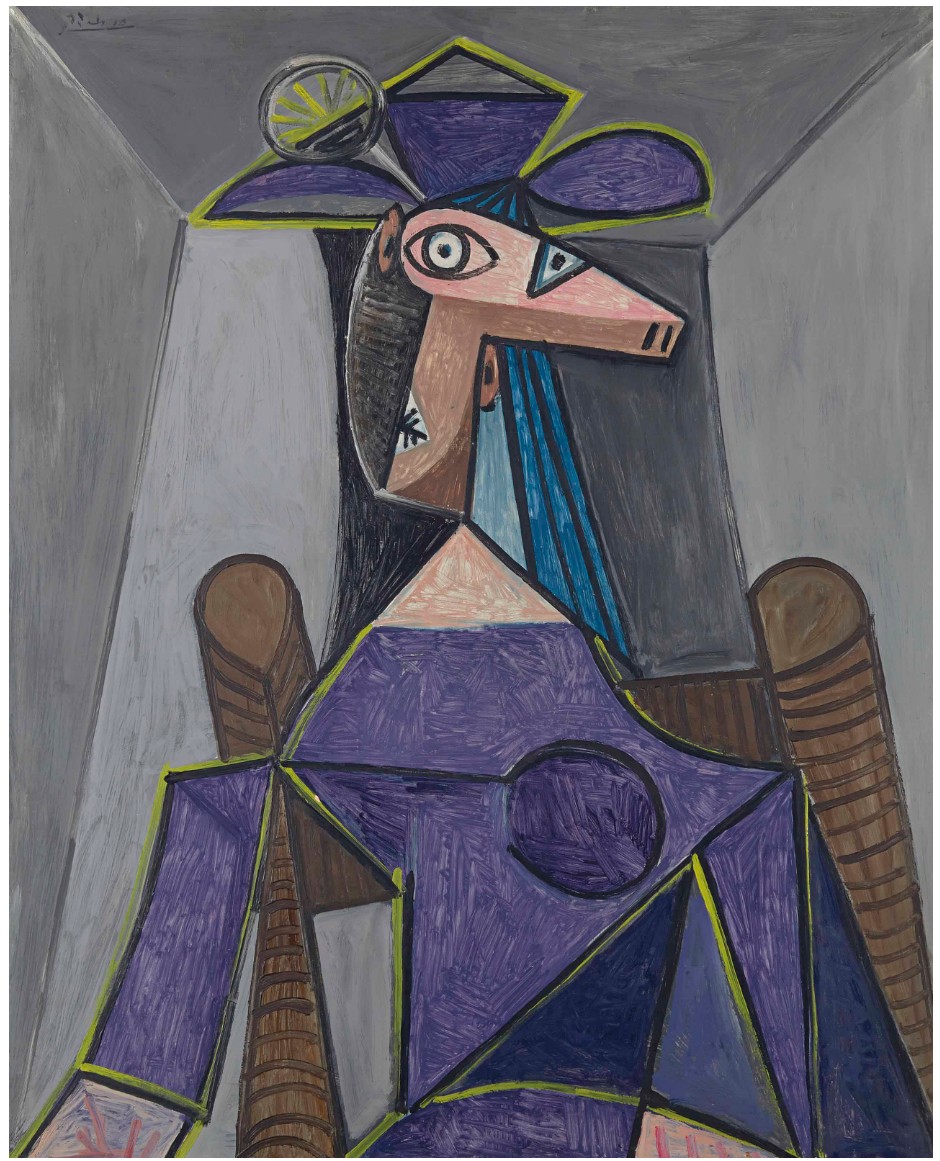
PABLO PICASSO (1881-1973)
Portrait de femme (Dora Maar), 1942
Oil on panel
99.4 x 80.8 cm (39 1/8 x 31 3/4 inches)
Signed ‘Picasso’ (upper left)
Elegantly adorned in a silk dress of regal purple and a tricorne hat to match, embellished with a fan-tailed feather, the woman portrayed here is Dora Maar, Picasso’s mistress and the muse who most significantly inspired his art during the years 1936 through 1944. Picasso painted this imposing portrait of Dora on 5 August 1942. Among his wartime pictures, “Those of Picasso’s works done between 1939 and 1942 are probably the most powerful,” Brigitte Baer has declared, “obviously with some failures, but the most beautiful” (Picasso and The War Years, exh. cat., Fine Arts Museums of San Francisco, 1998, p. 85). Their remarkable qualities originate, of course, in the very hand of the artist, but also in large part from the presence of Dora herself as his subject. We are here in the presence of a goddess. Dora sits as if she were enthroned–if only on an ordinary cane chair familiar from other of Picasso’s seated portraits–like an impressively scaled icon (painted in this instance not on canvas, but on a wood panel, as would suit a cinquecento Madonna) and arrayed against the simple box-like perspective which the artist often used to depict the anonymous interior of a chamber, which here may suggest the architecture of a vast hall fit for a queen. Imagine Dora as Clytemnestra, Agamemnon’s queen, in the plays of the Greek tragedians; or Gertrude, Prince Hamlet’s mother in Shakespeare’s drama. On the other hand, in a more realistic context, she may simply occupy the confines of a small room, cold and prison-like, like many in Paris during the Occupation.
#11. Dora Maar, 1939
Sotheby’s Hong-Kong: 27 April 2022
Estimate upon Request
HKD 169,420,000 / USD 21,594,393
Pablo Picasso 巴布羅・畢加索 | Dora Maar 多拉・瑪爾 | Modern Evening Auction | 2022 | Sotheby’s
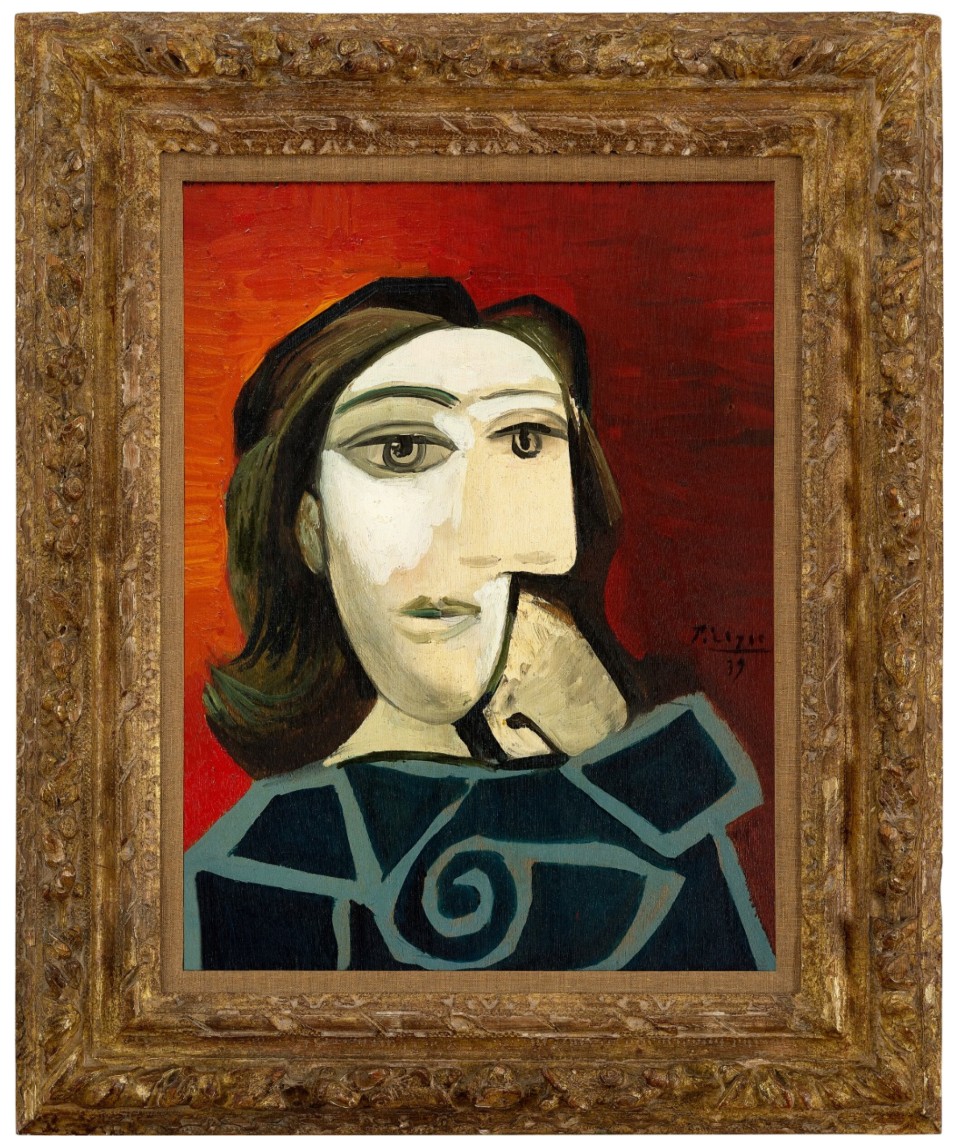
PABLO PICASSO (1881 – 1973)
Dora Maar, 1939
Oil on panel
60 x 45.5 cm (23 5/8 x 17 7/8 inches)
Signed Picasso and dated 39 (center right)
Dated 27.3.39. on the reverse
Painted on 27th March 1939
#12. Tête de femme (Dora Maar), 1941
Christie’s New-York: 6 November 2007
Estimated: USD 6,500,000 – 8,500,000
USD 16,281,000
Pablo Picasso (1881-1973) , Tête de femme (Dora Maar) | Christie’s
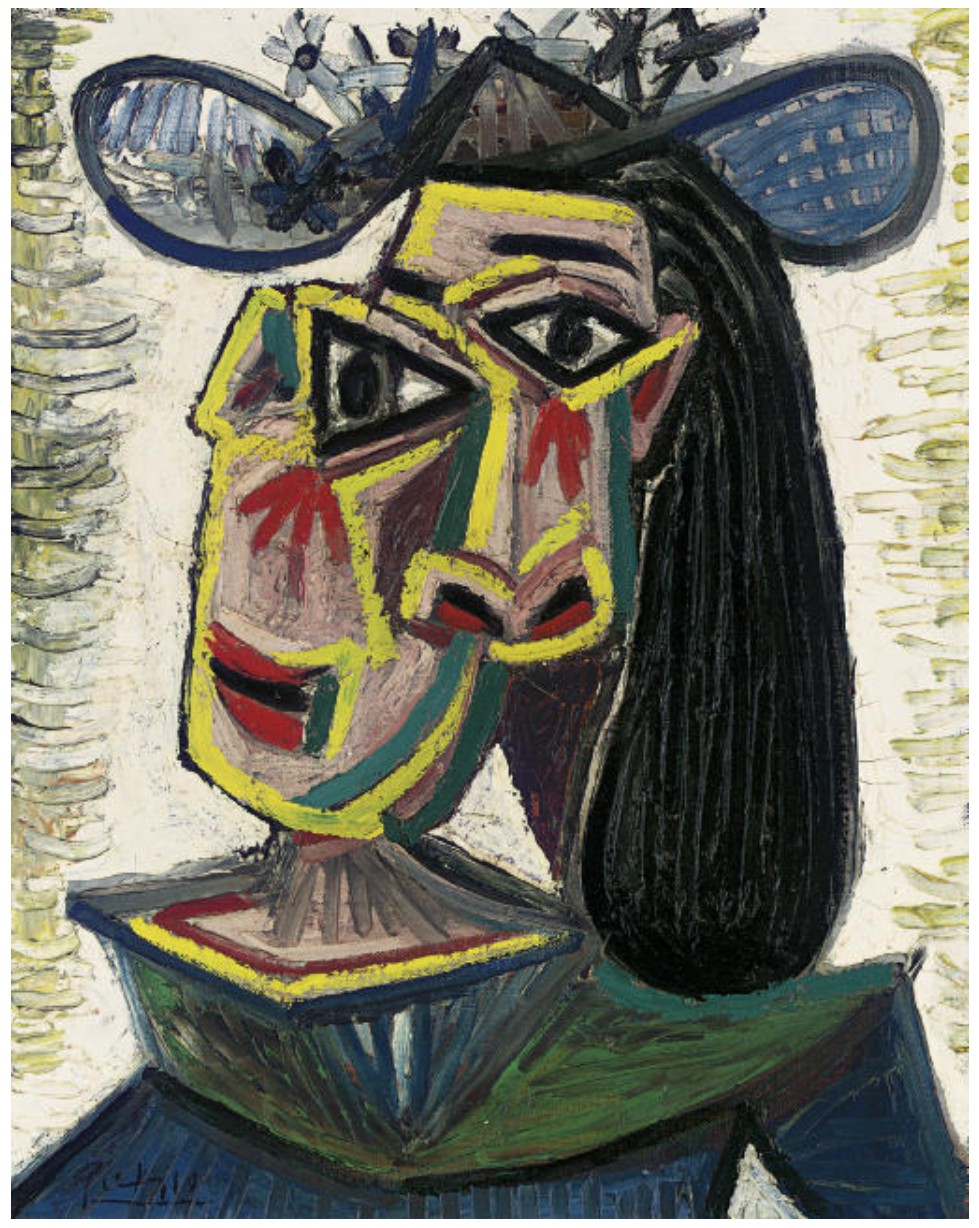
PABLO PICASSO (1881-1973)
Tête de femme (Dora Maar), 1941
Oil on canvas
41 x 33.5 cm (16 1/8 x 13 1/8 inches)
Signed ‘Picasso’ (lower left)
Dated ’25 mai 41′ (on the stretcher)
The raven-haired and dark-eyed woman in this haunting and powerful portrait is immediately recognizable as Dora Maar, Picasso’s lover since 1936. In the fall of the previous year, at the Café Deux Magots, she made her famously unforgettable debut impression on Picasso by quickly poking a knife into the table between the spread fingers of her hand, nicking the flesh and drawing blood. The deepening intimacy of their liaison coincided with the Fascist uprising and ensuing Civil War in Spain; in fact, the entire history of their relationship, which lasted until 1944, was tragically and inescapably set against the backdrop of violence and war. Picasso’s earliest portraits of Dora, while he was becoming familiar with her features, were naturalistic and flattering–Picasso’s women always looked their best in his paintings within a grace period that extended only a short time after they entered his life. Some paintings reflected tender moments of happiness and repose, as when in the summer of 1937, following the completion of Guernica, Dora and Picasso vacationed with friends in the seaside town of Mougins (fig. 2).
The war, not yet two years old, had gone badly for the Allies, and there was no good news to be had anywhere for the peoples of Nazi-occupied Europe. In early April 1941 German armies invaded Yugoslavia, the country where Dora was born, and after fighting that lasted only twelve days, the government in Belgrade capitulated. Greece soon followed. A German army commanded by Field Marshall Rommel had entered North Africa and was already besieging the large British garrison defending Tobruk. After less than a year of Occupation, the citizens of Paris had a troubling idea of what they were in for; there were restrictions and shortages of all kinds. In April 1941 German officials had instituted a law that limited certain economic activities by Jews, and forbid them to possess telephones. In May French police arrested more than 3,000 foreign-born Jews living around Paris; within a year internment camps in the occupied zone held more than 30,000 Jews. Rumors were a constant source of concern. Matisse, then in Nice, received a letter dated 13 May from his son Pierre in New York, in which the latter mentioned having seen a newspaper article that reported Picasso in a concentration camp, awaiting extradition by Franco back to fascist Spain. Picasso was worried about Dora; there was a rumor circulating that she was part-Jewish, and might eventually be picked up by the police.
It was perhaps for these reasons that Picasso painted during the early months of 1941. Or perhaps he was still preoccupied with the implications and meanings of a farcical play he written on 14-17 January, Le Désir attrapé par la queue (Desire Caught by the Tail). Characters he called Big Foot (the artist’s alter-ego), Onion, Tart, Fat and Thin Anguish obsess with the lack of heat, the shortage of food, and the desire to find love. Kathleen Brunner has written, “What is really at issue here is the disruption, in a fallen, material world, of desire, the force of eros, that which brings the sexes together… Picasso stages a confrontation between classical art and the ‘philosophy of existence’ that precedes a dramatic ‘fall’ from the idealistic Big Foot’s studio to the sewer that is Anxiety Villa. The absurdity is predicated on a world in which form and the classical view of art have collapsed. For Picasso the fall leads, not to collapse, but to a new focus on man” (in Picasso Rewriting Picasso, London, 2004, p. 98).
It was not until 10 May that Picasso painted a major composition, in fact one of the finest of his wartime still-lifes, Nature morte à la saucisse (Zervos, vol. 11, no. 112; fig 4), which seems to recall the concerns of his recent play. A series of drawings then followed, depicting the reclining nude he eventually incorporated into the painting L’Aubade, which he completed nearly a year later, on 4 May 1942 (Z., vol. 12, no. 169; Musée National d’Art Moderne, Centre Georges Pompidou, Paris). Then on 25 May 1941 he painted the present portrait of Dora, which inaugurated his first extended treatment on any subject since mid-1940.
After the thinly brushed surfaces and the grisaille tonality of the 10 May still-life, Picasso appears to have been eager to work in a more painterly manner, and in this head of Dora he used a loaded brush to produce a thickly impastoed, Van Gogh-like surface. The chief effect that he aimed to create here is that of a figure silhouetted against a light background, as if she were standing before a window with daylight–or the light of a strong lamp–radiating from behind. To achieve this contrast, Picasso rendered most of the tones in Dora’s hair, hat and dress with cobalt blue, green and black, set off against a stark white background, which Picasso has darkened at the sides with strokes of grayish yellow. The tones he chose for Dora’s face are aptly warmer, and he has highlighted her features in strokes of brilliant yellow. Streaks of red emanate from her lower eyelids, as if her mascara were running, or if she were crying streaming tears of blood.
Here Dora has again become the mirror Picasso uses to reflect on the events of the day, as he continued to alter and reshape her visage to express his anxious feelings. He made her nose even more prominent than before, with huge flaring nostrils; commentators have likened this elephantine proboscis to the long snout of Picasso’s Afghan hound Kazbek, or those of the sheep’s skulls seen in the still-life paintings done in the fall of 1939. Picasso has painted the upper part of Dora’s head as a frontal view, while at the same time he had twisted the lower part of her face, with the mouth and jaw, to the left side, creating a composite image of frontal and three-quarter views. She actually possesses two right eyes, one of which was turned to the left as the artist rotated the lower part of her face.
Dora’s hat by now had become a regular feature in Picasso’s depictions of her, functioning as a symbolic extension of her inner angst. Brigitte Léal has called the hat Dora’s “most provocative emblem… In its preciousness and fetishistic vocation, the feminine hat was, like the glove, an erotic accessory highly prized by the Surrealists. Thus Paul Eluard [declared] ‘A head must dare to wear a crown.’ A crown of daffodils, an urchin’s beret, or a cool straw hat for Marie-Thérèse, painted like a Manet; nets, veils and the great wings of a voracious insect for Dora: even their respective ornaments point to the glaring differences in the temperament between the two women” (in Picasso and Portraiture, exh. cat., The Museum of Modern Art, New York, 1996, pp. 387, 389 and 392). Dora’s hats acquired an especially belligerent aspect during the early months of the war: they sometimes resemble the silhouettes of warships seen on the horizon, or as seen here, a warplane’s propeller, or the tail fins of a plunging high-explosive bomb.
On the same day that Picasso painted the present head of Dora, he made a second portrait of her, in the more thinly brushed and more grisaille the manner of the 10 May still-life, this time without a hat (fig. 5). He twisted the upper and lower parts of her head so far around that they face in nearly opposite directions. Coming on the heels of the fallow period early in the year, the production of two such fine paintings in one day appears to have signaled Picasso’s renewed interest in working on canvas. Eleven more portraits of Dora followed by 19 June, and about the same number by mid-summer. Most of these display the twisted face seen in the present painting, while Picasso painted some in a more naturalistic vein. In many Dora wears a hat, configured as seen here, elsewhere she is bareheaded. The culminating picture is this group is undated, but was probably done later that summer, Femme dans un fauteuil (Dora) (Z., vol. 11, p. 374; fig. 6).
#13. Femme au chapeau jaune, 1939
Sotheby’s New-York: 16 May 2023
Estimated: USD 15,000,000 – 20,000,000
USD 15,846,000
Femme au chapeau jaune (Dora Maar) | Modern Evening Auction | 2023 | Sotheby’s (sothebys.com)
PABLO PICASSO (1881 – 1973)
Femme au chapeau jaune (Dora Maar), 1939
Oil on canvas
46.4 x 38.1 cm (18 1/4 x 15 inches)
Executed in Royan in December 1939, this painting belongs to the transitional moment between pre-war anxiety and full wartime isolation. Dora’s features here soften; traces of Marie-Thérèse’s sensuality seep into the composition. Market interest centers on this hybridity. The work documents Picasso’s psychological oscillation and captures Dora at a moment of emotional permeability. For collectors, it represents narrative complexity rather than extremity.
#14. TÊTE DE FEMME (DORA MAAR), 1939
Sotheby’s London: 25 June 2008
Estimated: GBP 3,000,000 – 5,000,000
GBP 7,881,250 / USD 15,530,566
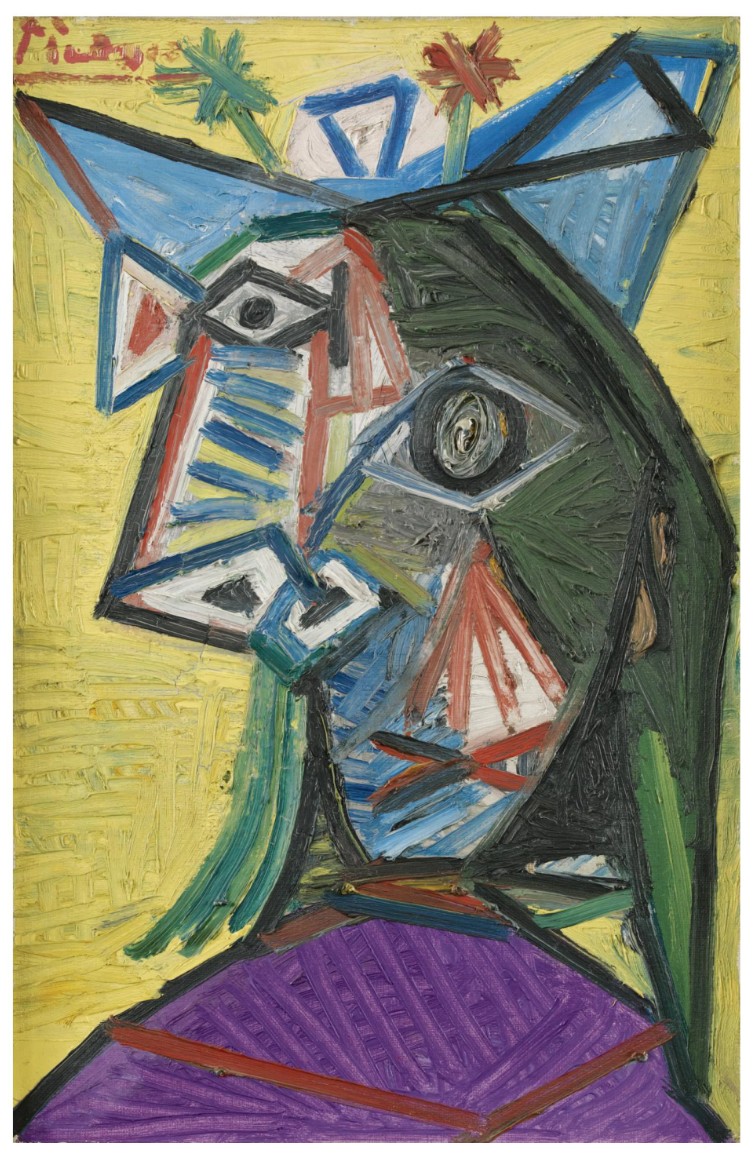
PABLO PICASSO
TÊTE DE FEMME (DORA MAAR), 1939
Oil on canvas
41×27 cm (16 1/8 x 10 5/8 inches)
Signed Picasso (upper left)
Dated Royan 14.10.39. on the reverse
Portraits of Dora Maar, such as the present work, have become among the most iconic images of Picasso’s career. Dora Maar (1907-1997) was the artist’s mistress and artistic companion in the late 1930s and early 1940s, and was his main model during this turbulent time. The present work was executed while the couple were staying in Royan, where they settled after fleeing Paris just after the outbreak of war in September 1939. They eventually settled in the villa Les Voiliers, where Picasso also rented a studio space on the third floor, with windows overlooking the sea. Having made several trips to Paris during his stay in Royan, Picasso finally returned to the capital with Dora in August of the following year, shortly after Zervos wrote to him to inform him that the Spanish Embassy had put both his Paris apartment and studio under their protection.
Like Picasso’s most accomplished portraits of Maar, Tête de femme (Dora Maar) is a psychologically intense and penetrating image, conveying her radiant personality, as well as sense of anxiety and uncertainty of the times. Her beautiful features that Picasso greatly admired – her flowing dark hair, piercing eyes and strong nose – are distorted in a way that powerfully embodies all of the complex and conflicting emotions of life in the midst of occupied France. Throughout the years spent with Dora Maar, Picasso would depict her in a variety of ways; in the pre-war years, she is often rendered as a calm, dignified figure, such as in Tête de femme (La Lectrice – Dora Maar), where she is seen in the act of reading that projects a sense of intellect and quiet introspection. The style of the present work, however, is closer to the angular, energetic treatment of Maar’s features of the celebrated weeping women series (fig. 2). Painted only weeks after the outbreak of the Second World War, this vibrant portrait resonates with the drama and emotional upheaval of the era.
Picasso’s love affair with Maar was a partnership of intellectual exchange as well as of intense passion, and her influence on the artist resulted in some of the most daring and most renowned portraits of his career. Picasso met Maar, the Surrealist photographer, in early 1936, and was immediately enchanted by the young woman’s intellect and beauty and by her commanding presence. Although still involved with Marie-Thérèse Walter and still married to Olga at the time, Picasso became intimately involved with Maar by the end of the year, having spent the summer with her and a group of fellow Surrealists. Unlike the docile and domestic Marie-Thérèse, Maar was an artist, spoke Picasso’s native Spanish, and shared his intellectual and political concerns. She even assisted with the execution of the monumental Guernica and produced the only photo-documentary of the work in progress. Despite the highly abstracted and stylised manner in which Picasso depicted her features in the present work, with the use of a bright palette and energetic brushstrokes he masterfully captured the luminosity and vitality of her character.
#15. TÊTE DE FEMME (LA LECTRICE – DORA MAAR), 1938
Sotheby’s London: 5 February 2008
Estimated: GBP 6,500,000 – 8,500,000
GBP 7,412,500 / USD 14,568,275
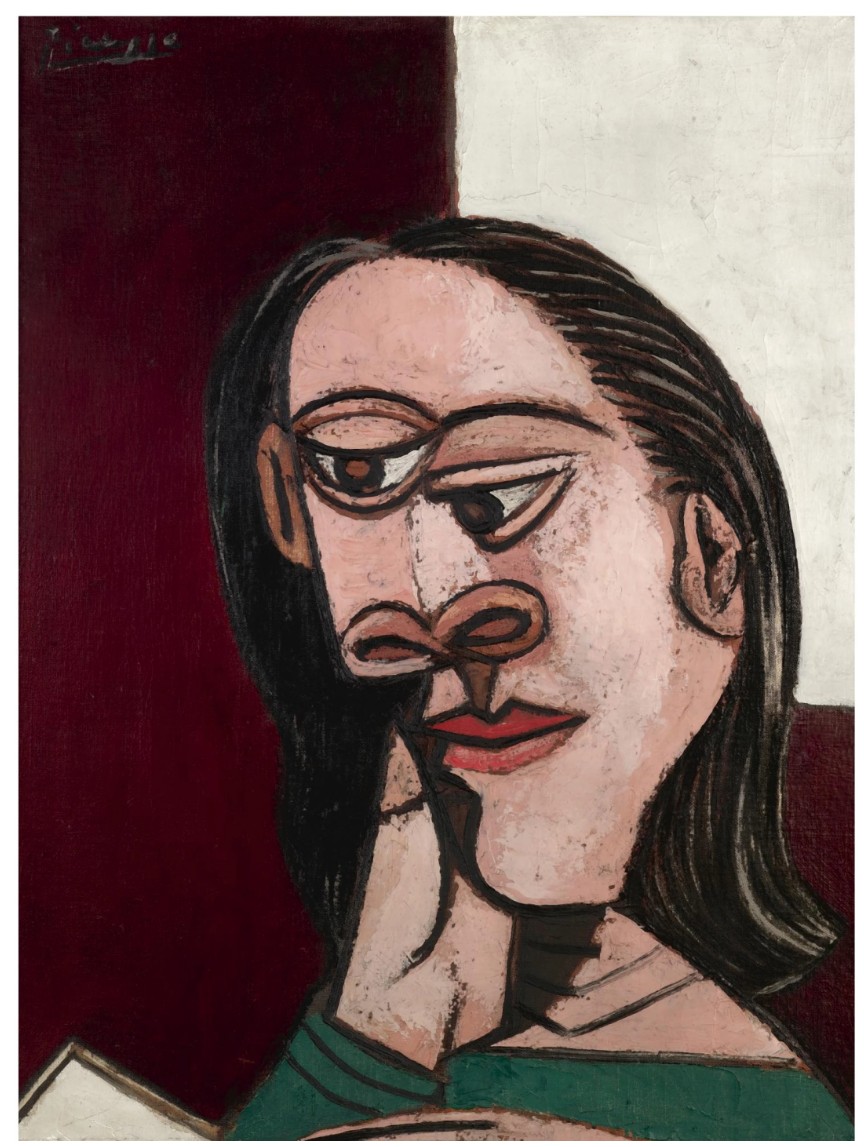
PABLO PICASSO
TÊTE DE FEMME (LA LECTRICE – DORA MAAR), 1938
Oil on canvas
66×51 cm (26 x 20 1/8 inches)
Signed Picasso (upper left)
Tête de femme (La Lectrice) belongs to Picasso’s celebrated series of paintings portraying Dora Maar, who was his mistress and artistic companion in the late 1930s and early 1940s. Picasso’s love affair with Maar was a partnership of intellectual exchange as well as of intense passion, and Maar’s influence on the artist resulted in some of the most daring and most renowned portraits of his career. Painted during the years marked by the Spanish Civil War and later the Second World War, Picasso’s portraits of Dora resonated with the drama and emotional upheaval of the era. In 1937 he executed his celebrated series of weeping women, portraying Maar in the most openly dramatic and emotionally charged manner. Whilst in this series he alternated between depictions of Dora and his previous mistress Marie-Thérèse Walter, it was the images of Dora Maar that came to symbolize Picasso’s emotional state and the instability of the era.
The story of Dora Maar’s relationship with Picasso is legendary in the history of twentieth century art. Picasso met Maar (1907-1997), the Surrealist photographer, in early 1936, and was immediately enchanted by the young woman’s intellect and beauty and by her commanding presence. Although still involved with Marie-Thérèse Walter and still married to Olga Koklova at the time, Picasso became intimately involved with Maar by the end of the year, having spent the summer with her and a group of fellow Surrealists. Unlike the docile and domestic Marie-Thérèse, Maar was an artist, spoke Picasso’s native Spanish, and shared his intellectual and political concerns. She even assisted with the execution of the monumental Guernica and produced the only photo-documentary of the work in progress.
Throughout the years spent with Dora Maar, Picasso would depict her in a variety of ways: from the menacing, almost monstrous character of the weeping women series, to the much calmer, dignified images such as Dora Maar au chat and the monumental bronze sculpture Tête de femme. The woman depicted here in the act of reading projects an intellectual quality and quiet introspection, while at the same time her lively eyes and tense features reflect her strong personality. Like Picasso’s most accomplished portraits of Dora Maar, this is a psychologically intense and penetrating image, conveying her physical beauty and radiant personality, as well as a sense of anxiety and uncertainty of the times. Her beautiful features that Picasso greatly admired – her flowing chestnut hair, dark eyes and strong nose – are distorted in a way that powerfully embodies all of the complex and conflicting emotions that marked their relationship, as well as the time they lived in. It was her brilliant intelligence that distinguished Dora from other women in Picasso’s life, and here he depicts her reading a book or a newspaper, deeply immersed in her thoughts. Despite the highly abstracted and stylised manner in which Picasso depicted her features, with the use of a bright palette and energetic brushstrokes he captured the luminosity and vitality of her character.
What first caught Picasso’s attention, however, was Maar’s transfixing beauty, which James Lord described upon meeting Maar in 1944: ‘Her gaze possessed remarkable radiance but could also be very hard. I observed that she was beautiful, with a strong, straight nose, perfect scarlet lips, the chin firm, the jaw a trifle heavy and the more forceful for being so, rich chestnut hair drawn smoothly back, and eyelashes like the furred antennae of moths’ (J. Lord, Picasso and Dora, New York, 1993, p. 31). Her striking features and complex personality captured the imagination of a number of artists and made her the subject of numerous photographs by Man Ray, Lee Miller and Picasso himself (fig. 6). Rather than merely celebrating her physical beauty, however, the present work represents a complex synthesis of various themes that preoccupied Picasso at the time.
Maar’s strong, pronounced features acquire a certain masculine quality, suggesting a degree of the artist’s introspection and self-reflection. Furthermore, Maar shares her stylised features with Picasso’s depictions of bulls, thus evoking one of his favourite themes – the bullfight, that remained throughout his life a symbol of his native Spain, a subject particularly close to his heart at this time of civil war. In combining major images from his iconography, Picasso weaves a rich web of associations that reflect his own and his model’s emotional state, as well as circumstances that surrounded them. It is this complexity of ideas and connotations, combined with a strikingly modern pictorial style, that place Picasso’s portraits of Dora Maar among the most accomplished works of his career.
#16. Jeune fille aux cheveux noirs (Dora Maar), 1939
Sotheby’s New-York: 8 May 2007
Estimated: USD 5,000,000 – 7,000,000
USD 8,216,000
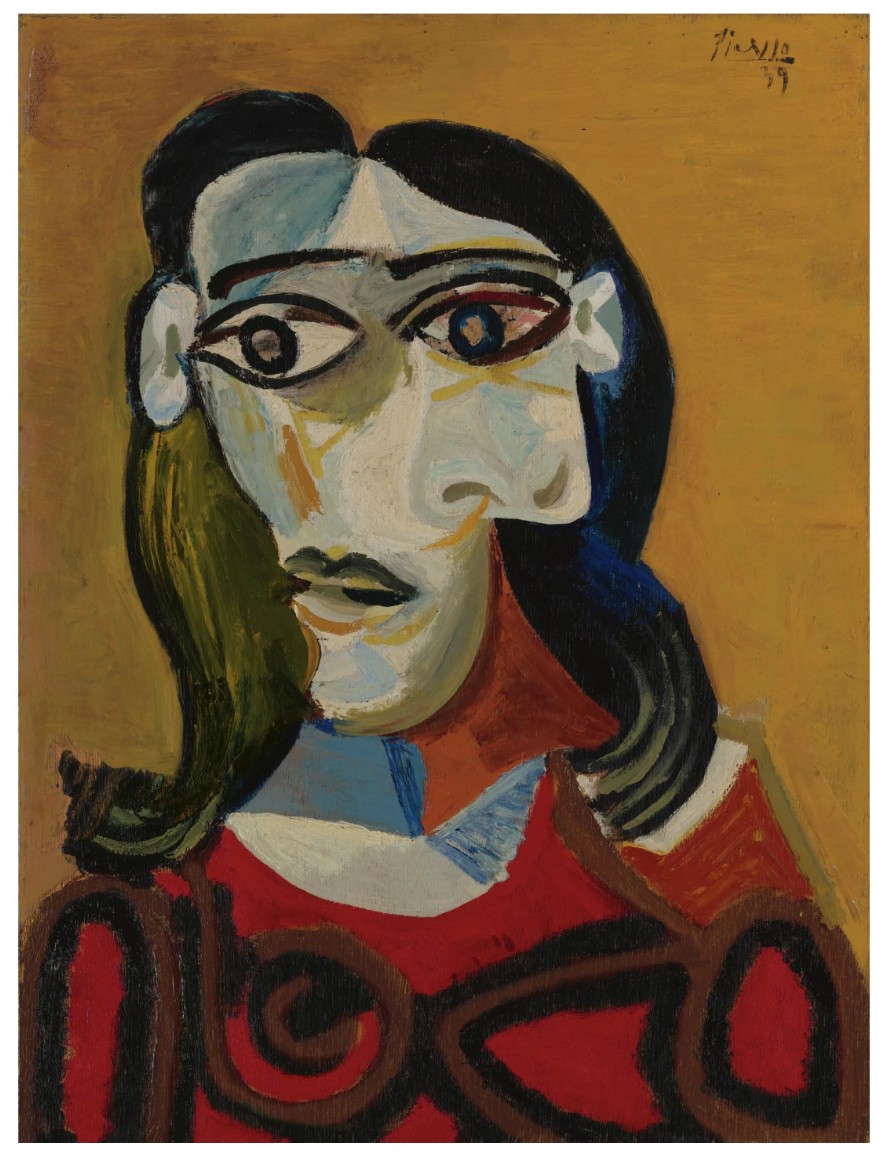
PABLO PICASSO
Jeune fille aux cheveux noirs (Dora Maar), 1939
Oil on panel
60.5 x 42.5 cm (23 7/8 x 17 3/4 inches)
Signed and dated Picasso 39 (upper right)
Dated 29.3.1939 on the reverse
Picasso completed this striking portrait of Dora Maar in a red dress when the European continent was on the brink of war in 1939. With images of the Spanish Civil war still fresh in his memory, the subject of a nation at peril seemed too overwhelming for him to face yet again. Instead, he turned his attention to his immediate environment, painting still-lifes constructed from the contents of his studio and many abstracted portraits of Dora Maar. Maar had been a constant companion in his studio during these years, acting as a documentary photographer throughout his production of Guernica in 1937. By 1939, Picasso’s paintings of her reflected the trials and tribulations that they had experienced together, and her image came to represent the ominous mood of the era.
Dora Maar’s relationship with Picasso is one of the most tumultuous love stories in the history of 20th century art. Picasso met Maar, the Surrealist photographer, in the autumn of 1935 and became enchanted by the young woman’s powerful sense of self and commanding presence. In the eight years that followed, Maar was Picasso’s principal model and the subject of some of his most iconic portraits. For nearly a decade their partnership was one of intellectual exchange and intense passion, and Maar’s influence on Picasso over these years resulted in some of his most daring portraits of his near-century long career.
Picasso’s many portraits of Maar, including the present painting, were highly stylized but did not entirely eliminate her identifiable features (see figs. 1 & 2). Her flaring nostrils and dark eyes betray her fiery personality, yet the grotesquery of her bifurcated face evidences the great liberties the artist took in tearing apart her image. In the years that followed the completion of this picture, Picasso’s relationship with Maar would become increasingly strained. Maar’s strong-willed personality and her penchant for the dramatic, which had initially amused the artist, grew to infuriate him. By the early 1940s their relationship had deteriorated drastically, and Picasso’s remorseless dismissal of her sent Maar headlong into a complete psychological breakdown.
Picasso’s war-time depictions of Dora Maar are among the most famous of his oeuvre and have come to symbolize the collective emotions of that era. Shockingly abstract yet undeniably alluring, these pictures have a certain tragic beauty and power of presence that few other portraits in Picasso’s vast repertoire were able to achieve.
#17. TÊTE DE FEMME (DORA MAAR), 1939
Sotheby’s Paris: 30 May 2012
Estimated: EUR 3,000,000 – 5,000,000
EUR 6,336,750 / USD 7,853,680
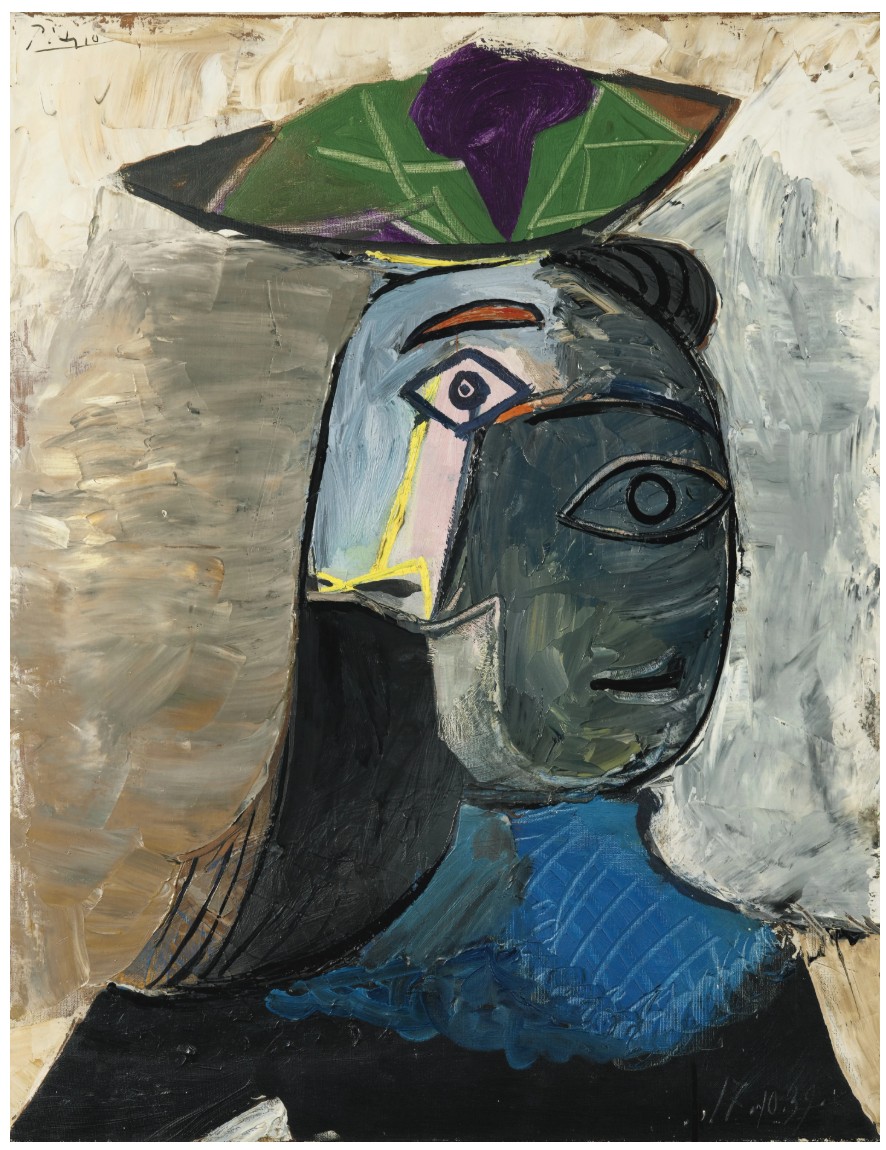
PABLO PICASSO
TÊTE DE FEMME (DORA MAAR), 1939
Oil on canvas
61.3 x 50.4 cm (24 1/8 x 19 7/8 inches)
Signed Picasso (upper left) and dated 17.10.39 (lower right)
Inscribed Royan and dated 17.10.39 – 9.3.40 on reverse
Picasso painted Tête de femme between the months of October 1939 and March 1940, a few weeks after his arrival in Royan. The Royan period, which one cannot separate from its historical and political context, is one of the most complex and fascinating periods for the study of the artist’s creative personality and one of the strongest in terms of the radicalisation of his pictorial style. The unmistakable duality of Tête de femme perfectly reveals the contradictions experienced by the artist at this time. The antithesis of the classical portrait, this feminine figure with its distinct features and contrasting tones does not resemble any other work created by the artist up until that point. Although little documented, this was a difficult period for Picasso who had lost his mother at the beginning of the year and was deeply affected by the sudden death of his former dealer Ambroise Vollard in July 1939. Recently returned from the Antibes where he had spent the summer, and looking to escape Paris, he installed himself along with his companion Dora Maar, his loyal personal secretary Jaime Sabartés and his dog Kazbek at the Hôtel du Tigre in early September 1939. Dora Maar, a surrealist photographer, friend of Georges Bataille and member of the intellectual circles of Saint-Germain-des-Près, was introduced to Picasso by Paul Éluard and had been a part of his life since the summer of 1936. Although Picasso greatly admired her intelligence, their relationship was to be, until the summer of 1943, exceptionally tumultuous; the young woman was known for her somewhat trenchant opinions and direct character.
Picasso had also remained extremely close to his young mistress Marie-Thérèse, with whom he had had a daughter, Maya, in 1935. According to Maya’s recollections, it was at Royan that Dora Maar learned of the existence of Marie-Thérèse and their daughter, and met her ‘rivals’ for the first time. In order to protect them, Picasso had installed his secret family in the villa ‘Gerbier-du-Jonc’ on the Atlantic coast since the beginning of the summer of 1939, only a few streets away from the Hôtel du Tigre. Although the painter was living with Dora Maar at the hotel, he had also installed a studio in one of the rooms at the villa where he worked for a good part of the day.
Whilst he was living in Royan, Picasso, worried about the safekeeping of his studio on the rue des Grands Augustins, made several trips to Paris. Upon learning that foreigners who had arrived in Royan since the 25th August did not have the right to stay in the town, he made a return journey to Paris in order to acquire the necessary authorisation to live and work there. His second trip to Paris, from the 12th until the 26th November, provided an opportunity for the artist to visit his studios in Tremblay and at Boisgeloup in order to assemble his works, move them to safety and gather some painting material. It was hard to get hold of canvas in Royan at the time and Picasso was forced to reduce the size of his paintings which rarely exceeded 50 by 65cm during this period. The working conditions were basic and the artist had to get used to painting on a small easel which he had bought at a local antique dealer’s and which had to be fixed to the back of a chair. Following his third trip to the occupied capital, from the 5th to the 21st December, Picasso decided to look for a studio which was larger and brighter than the ground-floor room he had been occupying at the villa du Jonc since it was clear that the war would drag on and the available space in which to work was diminishing the more the artist created. In mid-January 1940, he rented an apartment on the top floor of a house named ‘Les Voiliers’ with three windows looking out over the sea, just a stone’s throw away from the Hôtel du Tigre. Access to the new studio, furnished much more comfortably with a full-sized easel which had been brought down from Paris, was forbidden to both Marie-Thérèse and Dora Maar. However the space is known to us from several photographs taken by Dora Maar, including one in which Tête de femme can be seen hung on the wall in the background, next to three other portraits of the young photographer. If the present work was started in October 1939 at the villa du Jonc, it was very likely finished at Voiliers.
Tête de femme is at first sight, and perhaps due to the addition of the jaunty feathered hat, a portrait of Dora Maar, his favourite model over recent years – Picasso painted more than a hundred portraits of Dora Maar between 1938 and 1939. In his book Picasso, His Life and Work (London, 1958), Roland Penrose, a member of the Surrealist group and a friend of the couple, describes Tête de femme as one of the major works to be painted in the autumn of 1939: “a portrait of Dora Maar, powerful in its arrangement of simultaneous profile and full face”. It is exactly this brutal partition of the face which gives Tête de femme its force. On a purely visual level, its resemblance to a photo montage created by Dora Maar in the early 1930s for a fashion magazine is striking. The montage technique whereby separate negatives are layered and superimposed finds a violent echo in Picasso’s deconstruction of the face. Coincidence? Before she met Picasso, Dora Maar was an established surrealist photographer. Her photographs and montages undoubtedly influenced Picasso who carried out several technical experiments involving photographs on glass (cliché verre) between 1936 and 1937 upon meeting the young woman. Indeed, one of his first portraits of her, Dora Maar aux ongles verts from 1936 [Z, VIII, 303], depicts her from various angles. The present work announces the celebrated iconography of Picasso’s simultaneously frontal and profile depictions of the female face which he developed over the years to come, although never with quite the graphic power of Tête de femme, 1939-40. In the present work, the black lines and contrasting colours clearly delineate two distinct faces, both in profile, but united to form one single face. The portrait thus presented is entirely unique; it is no longer the result of a cubist methodology, which is to say a depiction of the same face viewed from several angles, but rather the juxtaposition of two distinct entities.
The underlying presence of Marie-Thérèse is indeed quite apparent. Since the arrival of Dora Maar in the artist’s life, every representation of the two women had been quite distinctive – one blonde, all curves and softness, the other brunette with more angular features. The works painted in Royan, and this Tête de femme in particular, combine the two models. The upper profile, in pastel tones, pale and luminous, can be seen as the evocation of Marie-Thérèse, whilst the shaded lower profile represents Dora Maar, in her torment. Or even vice versa: with the supple lines of the lower profile representing the discrete Marie-Thérèse, hidden from the public life of the artist. Jaime Sabartés, the artist’s only true confidant at the time, never once revealed the presence of Marie-Thérèse out of respect for the private life of his friend. The artist painted Marie-Thérèse and Dora Maar concurrently from 1937 on, often in extremely similar poses – the most striking example of which has to be two portraits, both painted on 21st January 1939, depicting each young woman lying in an identical position, on an identical sofa in an identical interior, their heads propped up on a hand with a large window in the background. (Z.IX, 252 and 253). It was only in Royan that the facial features of the two women converge into one. This is particularly noticeable in the sketchbooks of the time (Z.X, 283 to 286). Picasso effectively changes the codes of representation for his two mistresses, with the result that several portraits from the Royan period are very difficult to identify; the characteristics of the young blonde woman are no longer juvenile, she takes on a certain gravity, whilst in several works, such as Le Chandail jaune (Musée Berggruen), painted on 31st October 1939, it is Dora Maar whose face takes on a more gentle aspect.
On a purely technical level, Tête de femme certainly heralds the new orientation in which Picasso takes his painting from the autumn of 1939; an incredible radicalization of forms which corresponds almost exactly with the beginning of the Second World War and the artist’s hasty departure for Royan.
The increasingly harsh and fervent brushstrokes convey the pervading gravity of Picasso’s surroundings, his work toughens, becomes more and more abstract, as though it were his way of expressing resistance. In his book published in 1955, Picasso, Fifty Years if his Art, Alfred Barr, then director of the Museum of Modern Art in New York, discusses the works produced in Royan: “In the most serious and characteristic paintings of 1940 Picasso eliminates the linear elaborations of the figure and, for the first time since 1937, produces simple, sculpturesque, sharp-edged volumes by vigorous modeling and cast shadows”.
Picasso will almost literally disfigure the face of Dora Maar through his depictions of women throughout the year of 1940. At first, he reveled in the deconstruction of the whole face before playing with the geometric forms, as in Tête de femme of 2nd March 1940 for example, then he pushed his means of expression to the extreme in June 1940 by transforming the face into a skull (Z.X, 526, 552). Finished in March 1940, this double portrait of Dora Maar and Marie-Thérèse Walter is an integral part of the artist’s venture into the deconstruction of genre, pushing the limits of representation to the antipodes of classical models of beauty but in doing so expressing a force without precedent.
Tête de femme remained unknown on the European art scene for many years. It was very likely bought by the American dealer Samuel Kootz after the end of the war and subsequently introduced to the New York market. Kootz, a former publicist who became an art dealer, wanted to participate in the emancipation of the young American artists and their fresh new painting. For this he needed the help of Picasso. He wanted to exhibit the young artists’ work next to that of the master and thus confer legitimacy on their painting, Picasso having been very much established on the New York art scene since the huge retrospective, Forty Years of his Art, dedicated to him by the Museum of Modern Art in 1939-40. The gallery owner was introduced into the artist’s circle by Brassaï at the end of December 1946 having demonstrating a certain capacity for persistence and audacity. He set about organizing a Picasso exhibition in his gallery, due to be the first in New York since the end of the war. As Françoise Gilot recollects, Picasso used the American to better negotiate his terms with his primary dealer Kahnweiler and finally agreed to give him nine paintings for the forthcoming exhibition in 1947. The artist maintained good relations with Kootz who went on to become Picasso’s dealer in America until 1965. During the 1950s, the gallery owner made frequent trips to see Picasso in Cannes at his villa ‘La Californie’. He bought around one hundred canvases from the artist which he then sold on directly without Kahnweiler being able to intervene once. Brassaï reported that during Kootz’s first visit to Picasso’s studio on rue des Grands Augustins at the end of 1946, the American dealer found Picasso’s paintings to be not quite abstract enough. He was nevertheless suitable seduced by Tête de femme, who’s style and treatment, particularly the back ground, must have recalled the Abstract Expressionism which he was championing on the other side of the Atlantic.
#18. Buste de femme (Dora Maar), 1939
Picasso et Ses Muses: The Sam Rose and Julie Walters Collection
Christie’s New-York: 11 November 2018
Estimated: USD 5,000,000 – 8,000,000
USD 7,737,500
Pablo Picasso (1881-1973), Buste de femme (Dora Maar) | Christie’s
REPEAT SALE
Christie’s New-York: 5 May 2014
Estimated: USD 5,000,000 – 8,000,000
USD 6,101,000
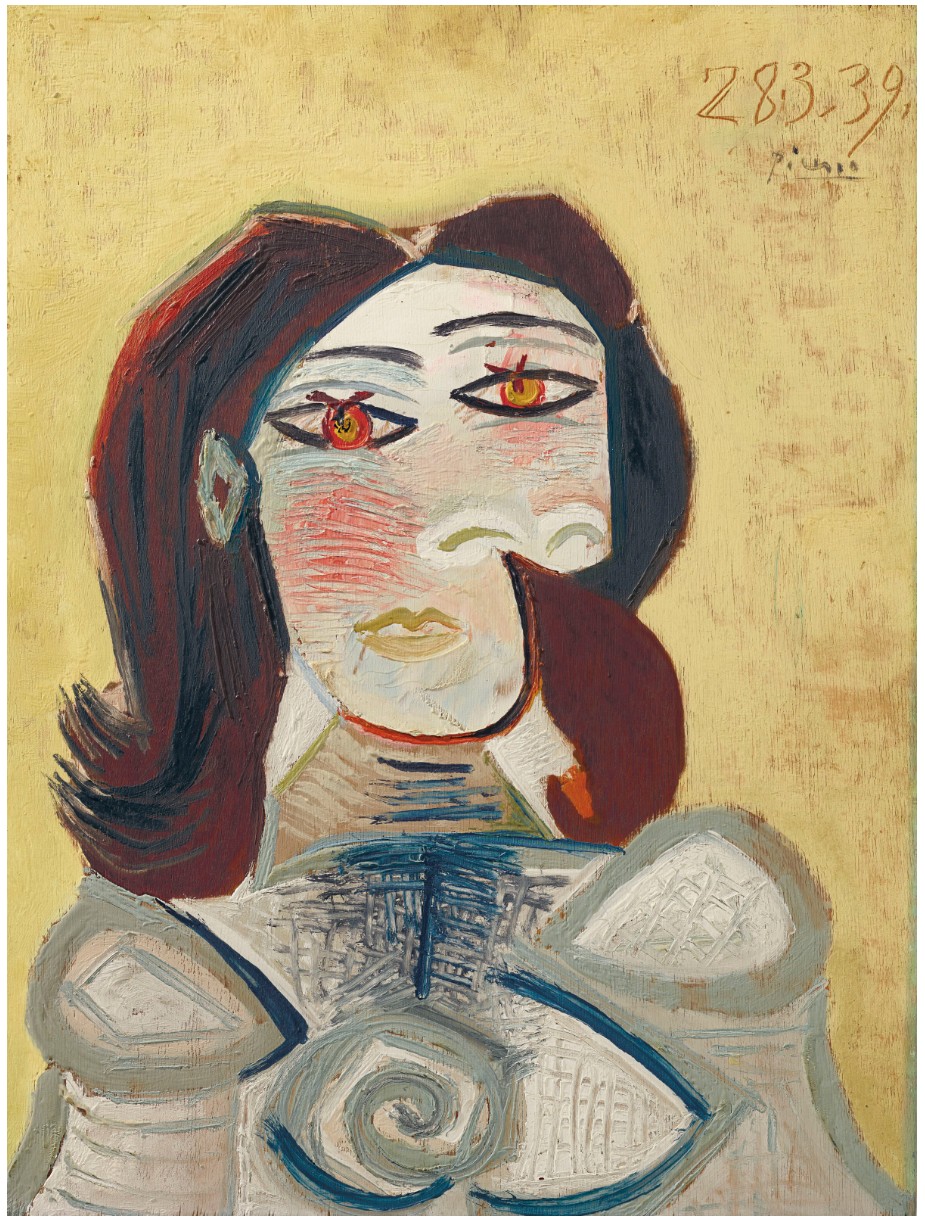
PABLO PICASSO (1881-1973)
Buste de femme (Dora Maar), 1939
Oil on panel
59.9 x 45.2 cm (23 5/8 x 17 3/4 inches)
Signed and dated ‘Picasso 28.3.39.’ (upper right)
Dated again ‘28.3.39.’ (on the reverse)
Painted on 28 March 1939
The present Buste de femme is instantly recognizable as Dora Maar, dressed, however, for a part which nothing in all her previous pictorial role-playing has prepared her, which she would never be called on to perform again, in a field of endeavor far removed from the reality of her everyday life. She is about to embark upon, allegorically speaking, a supremely demanding mission Picasso has entrusted to her. Girt in armor and ready to take up sword and lance, she has here become the incarnation of the archetypal fighting queen, heiress to Penthesilea and Hippolyta, Amazons of distant classical antiquity. This woman warrior moreover possesses, true to her purpose, symbolic nationalistic significance, as a figure who is both historical fact and the potently emblematic stuff of patriotic legend. Dora prepares to battle, pour la France, in the guise of a 20th century Jeanne d’Arc.
Armor and a resilient, fighting spirit may have saved this portrait of Dora during the Second World War. Like her medieval paragon, this latter-day Jeanne d’Arc suffered a trial and ordeal by fire—but narrowly survived. On 5 September 1941, the Nazi occupiers of France confiscated this painting from the Paris premises of the Jewish dealer Paul Rosenberg, who with his family had fled to America the previous year. Stored in the Jeu de Paume, it may have been among the 64 Picassos and other Rosenberg holdings included in 148 crates of plundered French art slated for shipment in August 1944 to Nikolsburg, Moravia. These pictures were loaded on one of the last trains that departed Paris prior to the Liberation, and might have disappeared forever, had not a small detachment from General Leclerc’s Forces françaises libres (FFL)—appropriately led by Lt. Alexandre Rosenberg, the dealer’s son—caught up with the train on 27 August, overpowered the guards, and reclaimed its priceless cargo. The Hollywood director John Frankenheimer dramatized this event in his film The Train (1964), starring Burt Lancaster, Jeanne Moreau, and Paul Scofield. The French government restituted the present painting to the Rosenberg family on 14 September 1945.
Dora had already done service in 1937 as the Weeping Woman (Zervos, vol. 9, no. 73), soon after Picasso painted Guernica. In the present picture she widens her eyes—in the shapes of glowing red cherries—as if mesmerized, staring in the face a challenge far greater than any she has ever known, a clear and present danger, and more of the same in the distant shape of things to come. Picasso had already made Dora his modern Sybil, employing her as a silent oracular presence whose facial expression of inner distress bespeaks her prophecy. And now she has heard a voice—just like Jeanne la Pucelle, as Jules Bastien-Lepage portrayed her in his famous painting of 1879 (The Metropolitan Museum of Art, New York)—not from God in this instance, but from Picasso. He has summoned her to take up arms, in response to historical exigencies arising from events of the day. Stunned at first, she here gathers that measure of resolve and courage required for the enormity of her task, and prepares to carry on as the selfless heroine whom destiny has claimed for its unknowable ends.
This is not a painting Picasso would have done during his pleasant summer holidays with Dora and their friends on the Riviera during the calm before the storm. As the decade of the 30s wore on, the artist coerced Dora’s mysterious and inscrutably impassive visage into an increasingly agonized reflection of the ominous mood in Europe during the years of the Spanish Civil War, and subsequent events leading to the outbreak of the Second World War on 1 September 1939. Picasso painted this Dora as Jeanne d’Arc, the Maid of Orléans, on 28 March 1939, not quite two weeks after Hitler and his armies entered Prague under the terms of appeasement granted to him in the Munich Pact, which had been signed the previous autumn. Neville Chamberlain, the British prime minister, famously announced when he returned to London from the talks that he was “bringing peace with honour. I believe it is peace for our time… Go home and get a nice quiet sleep.” Not for a moment did Picasso believe him.
Worse news soon followed—on 28 March Madrid finally fell to the unrelenting onslaught of General Franco’s fascist legions. Barcelona had already surrendered two months earlier. The dream that Picasso and many of his friends, both Spanish and French, had held out for a socially progressive and culturally enlightened Republican Spain was dead and buried. The artist was quick to realize, as did many others among the left-leaning intelligentsia, that the whole of Europe might eventually be devoured by the fascist beast, nation by nation, each like the helpless bird falling prey to the prowling feral cat he painted several weeks after the present portrait of Dora (Zervos, vol. 9, no. 297).
Marie-Thérèse Walter, Picasso’s other, more tenured mistress, had been the primary female presence in Guernica. The artist now preferred to spare her, as the mother of their child, from further encounters with danger and violence, making her instead into an alternative, personal symbol of quiet domesticity and peace. Dora alone would have to bear the brunt of Picasso’s war-time depredations. “After World War II broke out,” John Richardson has written, “Picasso came to portray Dora more and more frequently as a sacrificial victim, a tearful symbol of his own pain and grief at the horrors of tyranny and war” (quoted in Pablo Picasso, Femme au chapeau de paille, Christie’s, New York, sale catalogue, 4 May 2004, p. 113).
Portraits of Dora predominated, in which she is often—as seen here—bust-length, or in many versions seated on a chair, in Picasso’s pre-war series of femmes au chapeau and femmes assises. Dora resumed her role as prophetess; like Cassandra of mythology and in classic drama, she would endure the frantic frustration of a seer who can foretell the future but is cursed by fate that no one will believe her—except Picasso, that is, who makes her the medium through whom he publicly reflects on events past, current, and future, albeit in veiled, allegorical imagery. He continued to alter and reshape her visage in new, astonishing if often frightening ways; Dora neither protested nor resisted, it was a role she accepted almost masochistically.
Dora’s cherry red eyes in the present portrait allude to the Passion of Christ, the ultimate sacrifice and martyrdom; artists often included cherries in their table settings of the Last Supper. Jeanne la Pucelle suffered a similar fate; she was beatified in 1909, and awarded sainthood in 1920, although she had long been popularly celebrated as France’s patron heroine. Dora was raven-haired, but here Picasso has given her red highlights to match her eyes. Jeanne d’Arc, although described in her trial records as having black hair, was often portrayed as a red-head, suggesting her acceptance of the fiery, bellicose spirit she required to achieve the redemption of her king and country.
Picasso completed six other images of Dora during late March 1939, including several on wood panel, one of which was painted on the same day as the present Buste de femme. Picasso in that version gave Dora yellow-orange hair; she is not, however, clad in armor. Indeed, she is wearing, as elsewhere in this series, Picasso’s idea of a stylish contemporary dress, with decorative shoulder pads and lapels, which may have suggested the idea of transforming Dora into Joan wearing armor when he conceived the present painting, the only time he portrayed her this way. Coming from the artist who painted Guernica and abhorred war, there is clearly an ironic element in Picasso’s depiction of Dora as Jeanne d’Arc. Someone must stand up to Hitler and fascism, but to resuscitate a legendary figure of yesteryear was hardly a realpolitik response to this crisis; Picasso was surely poking fun at those who hid behind the false security of such patriotic symbols and myths.
This portrait of Dora is perhaps Picasso’s distaff counterpart to the depictions of burly male types—hardy mariners and fishermen—that the artist painted and drew, showing them licking ice cream cones and sucking on lollipops during the summer of 1938, during his last pre-war holiday sojourn at the Hôtel Vaste Horizon in Mougins. Picasso appears to have devised this peculiar theme to comment on the futile, impotent efforts of Allied statesmen to curb Hitler’s territorial demands. The negotiations that resulted in the Munich Pact began during the summer; the document was signed on 29 September 1938. Instead of tending to their true manly business, Picasso’s sailors instead take time off for sweetly passing pleasures, of a kind that was all the fashion on the Riviera that summer, especially among women and children. A durable and lasting peace in Europe, Picasso seems to argue, would surely melt away just as quickly as the ice cream and candy in these mighty fellows’ snow cones and lollis.
Dora Maar would remain the central, defining presence in Picasso’s wartime paintings. Picasso painted both Marie-Thérèse and later his second wife Jacqueline about as often as he portrayed Dora, but the latter figures far more prominently in the overall profile of Picasso’s art. Dating to the most historically critical ten-year period of the 20th century, Picasso’s Doras have exercised a far greater impact on the course of modern art. “Passionate, jealous, and quick-tempered, [Dora] pleased Picasso all the more because with her he could play all the games of a romance à l’espagnole,” Pierre Daix wrote. “He enjoyed mastering her, forcing her to accept sharing with Marie-Thérèse and with others. Dora, for her part, was an artist as well as being attracted by the man—she fully appreciated association in an unprecedented adventure as modernism assumed the highest ambitions of grand art in the past” (Picasso: Life and Art, New York, 1993, pp. 253-254).
Dora Maar au chat, 1941
#1. Dora Maar au chat, 1941
Sotheby’s New-York: 2 May 2006
Estimated: USD 50,000,000 – 70,000,000
USD 95,216,000
(#14) Pablo Picasso (sothebys.com)
PABLO PICASSO
Dora Maar au chat, 1941
Oil on canvas
129.5 x 97 cm (51×38 inches)
Signed and dated Picasso 41. (lower left)
Painted in 1941, Dora Maar au chat stands at the summit of Picasso’s portraits of Dora and remains the most expensive work from this cycle ever sold at auction. Executed at the height of their relationship and at the peak of wartime tension, the painting synthesizes everything collectors seek in a Dora Maar portrait: scale, psychological charge, chromatic audacity, and symbolic density. The cat—an ambiguous emblem of aggression, sensuality, and control—sharpens the psychological tension of the composition. Dora appears monumental, enthroned, yet contained within Picasso’s fractured geometry. This duality between power and confinement lies at the core of the work’s appeal. From a market perspective, the painting is unique: it is the most complete, ornate, and resolved Dora portrait of the war years. Picasso never returned to this level of compositional complexity with her image. Rarity, iconography, and irreversibility explain the result.
Dora Maar au chat is one of Picasso’s most spectacular depictions of his mistress and artistic companion. Picasso’s love affair with Maar (1907-1997) was a partnership of intellectual exchange and intense passion that lasted nearly a decade, and Maar’s influence on the artist resulted in some of his most daring portraits of his career. Among the best of them are the oils completed during the war years, when Picasso’s art resonated with the drama and emotional upheaval of the era. The luminous Dora Maar au chat was painted in 1941, at the beginning of the Second World War in France and just as the couple’s relationship was reaching its fiery climax. This large canvas is one of the most complete and compositionally dynamic depictions from an elite group of portraits from the late 1930s and early 1940s. Considering the other portraits that he completed of her throughout the 1940s, Dora Maar au chat is a composition that Picasso never matched or attempted to revise.
Its symbolic significance notwithstanding, the present work is a picture of great compositional ingenuity. Dora maar au chat was the most elaborate portrait of Dora that Picasso painted in 1941. In other depictions of her from the Spring and early Summer of 1941, he renders her with similarly sharp nails, but in no other picture from that year does he so generously embellish her image with ornamentation and color. One of the rare, full portraits of Maar, the present work is also extraordinary for Picasso’s attention to detail, right down to the polkadots on the figure’s dress. The artist has not spared one inch of the canvas from his brush, using an extraordinarily vibrant palette in his rendering of the angles of the chair and the patterning of the figure’s dress. Although punctuated by planar elements, dots and stripes of bewildering variety constitute Dora and the chair on which she sits.
The most embellished and the most symbolic element of the sitter’s wardrobe in this picture is the hat, Maar’s most famous accessory and signifier of her involvement in the Surrealist movement. Ceremoniously placed atop her head like a crown, it is festooned with colorful blossoms and outlined with a band of vibrant red.
Buste de femme (Femme à la résille), 1938
Buste de femme (Femme à la résille), 1938
Christie’s New-York: 10 May 2015
Estimates on Request
USD 67,365,000
Pablo Picasso (1881-1973), Buste de femme (Femme à la résille) | Christie’s
PABLO PICASSO (1881-1973)
Buste de femme (Femme à la résille), 1938
Oil on canvas
65.1 x 54 cm (25 5/8 x 21 1/4 inches)
Dated ‘12.1.38.’ (on the stretcher)
Dated January 1938, this painting belongs to the immediate post-Guernica moment, when Dora Maar’s presence was both emotional and political. The vivid red background, jagged lines, and hairnet motif convey volatility rather than despair. Unlike the later Weeping Woman images, this portrait balances tension with poise.
Its market strength derives from several factors: exceptional color saturation, prime date, and provenance that kept the work out of circulation for decades. It is also one of the rare Dora portraits that remained in Picasso’s own collection, underscoring its personal importance. Collectors recognize it as a pivot work—bridging lyrical portraiture and psychological fragmentation.
Pablo Picasso painted Buste de femme (Femme à la résille) on 12 January 1938, at the height of his relationship with the photographer Dora Maar. This picture is one of the best-known of his series of images of Dora, and crucially one of the best known remaining in private hands, having featured in a number of publications over the years, including David Douglas Duncan’s book Picasso’s Picassos. When published in 1961, that book had revealed to the world the scale of the artist’s collection of his own works. Buste de femme (Femme à la résille) was one of the pictures with which Picasso appears to have been unable to part, and it then passed into the collection of his granddaughter, Marina, from whom it was acquired by the legendary art dealer Jan Krugier. Looking at Buste de femme (Femme à la résille), it is easy to see why it has been selected for publication on a number of occasions: the picture sings. The electric red lends the work an intensity that is only heightened by the colors of Dora’s face and clothing, the yellows, blues and greens, which are thrust into such bold relief through their contrast with the near-monochrome background. Meanwhile, the almost lavender-infused skin becomes like cool marble in contrast to these vivid colors. Picasso has filled the composition with jagged lines, peaks and striations, not least through the hatching of the hairnet of the title, bringing the sense of edginess and volatility that is often associated with his depictions of Dora. At the same time, the statuesque poise and the curves and swirls on her cheek bring out a sense of tenderness that is heightened by the skin tones, which themselves recall some of Picasso’s earliest, less-stylised images of his lover.
Dating from early in 1938, Buste de femme (Femme à la résille) dates from just after what can be seen as the most intensive of Picasso’s collaborations with Dora, when he had painted his masterpiece Guernica in the studio at rue des Grands-Augustins which she had earlier found for him. A monumental epitaph to the eponymous Basque town which had been so brutally bombarded during the Spanish Civil War, Guernica had evolved continually over the period of its creation, and Dora had chronicled those transmutations in a famous series of photographs. Her involvement with Picasso and with Guernica was in fact so intense that she had even helped apply some of the brushwork. That link to the picture is apt: Guernica is sometimes seen as a product of Dora’s own character, with her own volatility evocatively concentrated into the image of turmoil and tragedy. In this light, Guernica can be seen as an extension of the series of images of weeping women which was so clearly indebted to Dora, culminating in the iconic Femme qui pleure of October 1937, formerly in the collection of Picasso’s friend Roland Penrose and now in Tate, London. As Picasso told André Malraux in 1945, “Dora, for me, was always a weeping woman… And it’s important, because women are suffering machines… When I paint a woman in an armchair, the armchair implies old age or death, right? So, too bad for her” (P. Picasso, quoted in A. Malraux, Picasso’s Mask, New York, 1976, p. 138).
The idea of Picasso’s anxieties at the wider state of the world showing through like X-Ray images in his pictures can be perceived in the blood red backdrop of Buste de femme (Femme à la résille), which recalls the paintings of both Francis Bacon and Mark Rothko in its intensity. It hints at an awareness of the continuing carnage in Spain. It is not a color selected for comfort. However, the rest of the composition benefits from the absence of the torment so visible in the mutations of the Second World War or the earlier images of the Femme qui pleure of 1936-1937. Instead, there is a sense of beauty and lyricism and even humour within the framework of those angular forms. This is seen in the arabesque on Dora’s cheek, the red star-like eyes and the harlequinade of the hat that crests the composition. This last aspect recalls Dora herself: while many of the tales and photographs of the period give the impression of a dark and tormented soul, a notion only exacerbated by her breakdowns at the end of her relationship with Picasso, she in fact cut a colorful dash, with eccentric manicures, make-up and millinery to boot. Indeed, her entertaining penchant for unusual headwear would come to be immortalised in Picasso’s portraits of her. Buste de femme (Femme à la résille), then, is the celebration of a muse. Dora appears less anguished and more settled, even if the colors do bring an effervescent energy to the composition. This was doubtless a reflection of Picasso’s own state of mind during this period, as he tried to find a balance in his relationship with Dora while still seeing Marie-Thérèse and Maya.
Buste de femme (Femme à la résille) can be seen in the context of his continued fascination with Marie-Thérèse, the mother of his young daughter. Marie-Thérèse and Maya had recently moved to Tremplay-sur-Mauldre, away from prying eyes, and Picasso would visit them, enjoying a domestic bliss that was a far cry from his more bourgeois existence with his wife, Olga. By 1938, Olga had taken possession of the Château de Boisgeloup, depriving Picasso of a much-valued retreat. Now, much of his life was divided between Paris and Tremblay. Looking at the pictures painted in the first weeks of 1938, the complex, multi-faceted nature of his domestic life is clear: he was shifting frequently between Marie-Thérèse, Maya and Dora as his subjects, as well as a wounded faun which was clearly a tangential self-portrait.
Picasso claimed that this overlapping lifestyle suited him at the time, that he wanted, “Marie-Thérèse because she was sweet and gentle and did whatever I wanted her to, and Dora because she was intelligent. I decided I had no interest in making a decision. I was satisfied with things as they were. I told them they’d have to fight it out themselves. So they began to wrestle. It’s one of my choicest memories” (P. Picasso, quoted in A. Stanissopoulos Huffington, Picasso: Creator and Destroyer, London,1988, p. 234). While the complexities of his domestic arrangements may have led to some stress, especially between the women, Picasso’s pictures from early 1938 reveal a relative tranquility, especially compared to the violent transformations to which Dora’s features were subjected in the works prior to and after this time. Picasso was able to flit effortlessly from depictions of one mistress to the other via self-portraiture and images of his daughter. This may indicate the truth of Picasso’s statement about having the best of both worlds at the time.
In fact, many images of Dora such as Buste de femme (Femme à la résille) appear to take up a direct dialogue with those of Marie-Thérèse; even the compositions tally, with the two women sometimes shown on similar arm chairs, as demonstrated by his 1937 picture of Marie-Thérèse, now in the Musée Picasso, Paris, which is practically a pendant for the similar works showing Dora including the portrait of her in the same museum. Similarly, headwear also became a common factor in both, with the berets worn by Marie-Thérèse picking up on the visual punctuation of the hats favoured by Dora such as the one in Buste de femme (Femme à la résille).
During this time, Picasso painted a series of works in which the features of his two lovers are conflated or fused to some degree. This is clear in his Buste de femme now in the Hirshhorn Museum and Sculpture Garden, Washington, D.C., painted only three days after Buste de femme (Femme à la résille). There is a great similarity between the vivid yellow of the background and the red of Buste de femme (Femme à la résille), and also between their respective compositions, with the Hirshhorn picture crowned with a beret. Commentators sometimes identify the subject in Buste de femme as Dora, sometimes as Marie-Thérèse, a reflection of the extent to which their features have been deliberately melded by Picasso. If this is, in fact, Marie-Thérèse, as the palette and mouth appear to indicate, the faces nonetheless deliberately resemble each other, revealing the artist playfully allowing his lovers to overlap in his art. Picasso would continue to explore these games of contrast and transformation even a year later, when he created two highly-similar portraits of Dora and Marie-Thérèse in the same pose as each other mere days apart in January 1939; those pictures were illustrated on facing pages in Rubin’s 1996 exhibition catalogue to stunning effect (W. Rubin, ed., Picasso and Portraiture: Representation and Transformation, New York, 1996, pp. 380-381).
While there was a dialogue between Picasso’s pictures of Marie-Thérèse and Dora, it is only really present in Buste de femme (Femme à la résille) itself in the tenderness with which he has depicted his subject. This manages to defuse the potential tensions introduced by the hot red of the background and the eyes and the zig-zagging lightening bolt lines that punctuate so much of the composition, be it in the hairnet, in the striations of the ceiling or in the brocade-like decoration on her chest. Instead, a statuesque quality pervades the work, heightened by the bruised marble tones of the skin which are made all the cooler by their contrast with the background. At the same time, there is a vivid sense of humour present—a humour reflecting the characters of both the artist and Dora herself. This ensures that Buste de femme (Femme à la résille) serves as an intimate and insightful record of their relationship when it was at its height, and perhaps helps to explain why it remained in Picasso’s own collection.
Femme assise, robe bleue, 1939
Femme assise, robe bleue, 1939
Christie’s New-York: 15 May 2017
Estimated: USD 35,000,000 – 50,000,000
USD 45,047,500
Pablo Picasso (1881-1973), Femme assise, robe bleue | Christie’s
REPEAT SALE
Christie’s London: 21 June 2011
Estimated: GBP 4,000,000 – 8,000,000
GBP 17,961,250 / USD 29,143,020
Pablo Picasso (1881-1973) , Femme assise, robe bleue | Christie’s
Pablo Picasso (1881-1973)
Femme assise, robe bleue, 1939
Oil on canvas
73×60 cm (28 3/4 x 23 5/8 inches)
Signed and dated ‘Picasso 25.10.39.’ (lower left)
Dated again and inscribed ‘25.10.39. Royan’ (on the reverse)
Painted on Picasso’s birthday in October 1939, this work captures a rare moment of levity amid gathering catastrophe. Dora appears smiling, almost playful, an image at odds with the prevailing narrative of anguish. The softened forms and rich blue palette mark a temporary release from the angular violence of earlier years. Its extraordinary provenance, confiscated by the Nazis and later recovered, adds historical gravity. The painting’s market performance reflects its narrative richness: collectors value not only the image, but the story embedded in the canvas. It represents Dora not as symbol, but as companion.
An icon of pre-war painting and a profound tribute to the relationship between artist and muse, Pablo Picasso’s Femme assise, robe bleue is an outstanding portrait of Dora Maar. From swathes of raw pigment, rendered in thick, coarse impasto, her twisted visage emerges in near-sculptural splendor, gazing in two directions at once. Of all his paramours, Dora’s darkly seductive beauty and mercurial persona inspired his most significant responses to the fundamental issues of love, death and creation. Painted on 25 October 1939–the artist’s birthday–she is here no longer Picasso’s Weeping Woman: his Mater Dolorosa of two years previously. Instead, in her blue dress and a jaunty plumed chapeau, she regales him with a beaming smile, lips tensed as if on the verge of outright laughter. The angular lines and sharp geometries of his earlier melancholic masterpiece are here resolved into softer, curvilinear forms that reflect the artist’s contentment on a day of celebration–a momentary respite from the encroaching tremors of the Second World War. The work’s provenance tells an extraordinary tale that later formed the basis of John Frankenheimer’s 1964 film The Train. Originally owned by Picasso’s long-time friend and gallerist Paul Rosenberg, the painting was subsequently confiscated by the Nazis. By astounding coincidence, the work was discovered and rescued by Rosenberg’s son, who led a mission to intercept a train carrying plundered art. It later became a prized acquisition for the Pittsburgh financier George David Thompson, whose pioneering collection of modern and contemporary art is now largely dispersed in museums throughout Europe and America.
Buste de femme au chapeau à fleurs, 1943
Buste de femme au chapeau à fleurs, 1943
Lucien Paris: 24 October 2025
Estimated: EUR 8,000,000 – 10,000,000
EUR 27,000,000 / USD 31,388,510 (Hammer)
Bust of a Woman with a Flowered Hat (Dora Maar), 1943 – Lot 1
PABLO PICASSO
Buste de femme au chapeau à fleurs, 1943
Oil on canvas
81×60 cm (31.9 x 23.6 inches)
Signed upper left
Dated 11 July 43 on the reverse.
© Picasso Estate 2025
This recently surfaced 1943 canvas rewrites part of the wartime Dora narrative. Painted under Occupation, it defies expectations of austerity through its explosive palette. Color here functions as resistance rather than decoration. Market-wise, the result was driven by three elements: freshness (never previously auctioned), prime wartime date, and impeccable condition. The hat, fetishistic, floral, crown-like, anchors the composition and reasserts Dora’s presence as emblematic rather than purely tragic. This sale confirms continued appetite for previously unseen wartime Dora works.
In 1943, under German occupation, Paris lays engulfed in privation and fear. Picasso, outwardly an apolitical Spanish citizen, chose to remain in the capital, withdrawn in his studio on the rue des Grands-Augustins. In spite of the harsh conditions, he continued to paint. His art then became a form of inner resistance. For him, it was better to paint something—anything—than to do nothing at all. Though world-famous, he endured the pressures of the Nazi regime: searches, interrogations, intimidation. His work was branded degenerate. In September 1943, he even received a summons for compulsory labour service (STO), which he narrowly managed to avoid, all the while confronting the regular visits of German agents who sought to intimidate him and destroyed some of his works deemed subversive.
Yet, despite this oppressive climate, Picasso did not sink into the monochrome austerity too hastily associated with his wartime years. True, certain works of 1942-43, such as his still lifes of skulls or his grisaille portraits, convey a sombre vision of the conflict. But Buste de femme au chapeau à fleurs, painted on 11 July 1943, demonstrates on the contrary that color remained a living language in his art, perhaps even a mode of resistance. The canvas strikes with its chromatic intensity: a face streaked with luminous greens, blood-reds, cobalt blues, star-like patterns, a hat adorned with yellow and green flowers set against a background of deep purple and violet. Through this graphic explosion, Picasso does not deny the violence of the time—he transfigures it. Pain is expressed through the deconstruction of features, yet colour responds insolently. Polychromy does not soften: it heightens the fragmentation. The figure is all the more powerful, as though the artist refused to yield to the prevailing anguish.
On a personal level, 1943 marked a turning point. Picasso was sixty-one. His stormy relationship with Dora Maar, his companion and muse since 1936, reflected the tensions of war: Dora, a surrealist artist with an anxious temperament, reacted sharply to tragic news. He portrayed her incessantly, at times as the afflicted muse, at times as a hieratic figure. It was in May 1943 that Picasso met the young painter Françoise Gilot, who, after the war, would bring a clearer, brighter spirit to his work. But in the summer of 1943, Dora remained his principal model.
Christian Zervos catalogued no fewer than twenty-eight works, for this single year alone, devoted to the same motif: busts or heads of women adorned with hats. This concentration is anything but anecdotal: it testifies to a veritable formal obsession, a theme that Picasso pursued relentlessly, drawing after drawing, canvas after canvas, through every variation of style and mood. Buste de femme au chapeau à fleurs, dated 11 July, stands at the very heart of this sequence.
This spectacular canvas, shielded from view for decades, painted in Paris in July 1943, shows how Picasso, in the midst of war, pursued his portraits of women with hats—here in a version of rare chromatic intensity. Buste de femme au chapeau à fleurs reveals a treatment midway between late Cubism and decorative stylization.
The face, framed by jet-black hair structured with emerald-green strands, is reconstructed in flat fields of vivid color, without perspective or modelling. Picasso juxtaposes acid greens, matte reds, violets, deep blues, radiant yellows. Each segment of the face appears autonomous, intensifying the sensation of fragmentation.
The eyes, slightly asymmetrical, are wide open, their dark pupils inscribed within sharply defined ovals. Beneath the left eye, whose iris is white, a blue curve descends, as though delineating a cheek. A hatched red line conforms to this contour. Articulated in short segments, the line appears aggressive. Might one discern in it an inner tension, suggestive of stylized tears?
The nose is rendered frontally, structured by two heavily emphasized nostrils: one mostly green and rounded, the other red and oval. Above lies a central white zone without outline, onto which several coloured lines are grafted. It is the nostrils themselves, through their form and color, that bestow volume upon the nose.
The mouth is compact, black, underlined with red and white. Though expressionless, it perhaps hints at the shadow of a faint, sorrowful smile.
No anatomical detail is highlighted. Everything is reduced to graphic forms. This descriptive economy, combined with the use of pure colour and firm lines, confers an immediate presence upon the figure. The painting imitates nothing; it asserts itself. The garment is rendered in sombre tones—black, grey, violet—with striated motifs and a checkered surface at the collar. It is not an identifiable piece of clothing. Picasso privileges rhythms, contrasts of texture, density of surface. The whole forms a compact base into which the face appears embedded. There is neither shadow, nor depth, nor background. Yet on the left-hand side, a wide, bright, impastoed zone of whitish yellow encroaches upon the woman’s cheek and cuts sharply across the canvas, further bringing the face to the fore. The hat, wide and oval, occupies almost the entire upper third of the canvas. It is adorned with two large stylised daisies: yellow and green petals against a red ground, separated by a radiating structure suggestive of a sun. This hat is no anecdotal accessory; it deliberately unsettles the composition, and with its almost demure aspect, counterbalances the tension of the face. It also provides a visual anchor. Its graphic stability acts as a counterpoint to the fragmentation of the head.
The composition is frontal, stable, yet animated by inner tensions. This plastic function of the hat does not preclude symbolic reading. Picasso had already, before the war, explored the motif of the woman with a hat in his numerous portraits of Dora Maar of 1939-40. In the 1930s, the feminine hat, in Picasso’s work (and in that of many contemporaries), was an accessory of coquetry, often extravagant, accentuating elegance or fantasy. Dora Maar, photographer—at times a fashion photographer—favoured original hats; Picasso made of them a quasi-emblematic attribute of his muse. Brigitte Léal, curator and specialist of Cubism, refers to the hat as the most provocative of Dora’s emblems, noting that in the surrealist imagination the woman’s hat, by its preciousness and fetishistic vocation, was, like the glove, a prized erotic accessory. She cites in this regard the poet Paul Éluard, who proclaimed: A head must dare to wear a crown. In other words, the hat of flowers, like an insolent crown, underscores the power and singularity of the portrayed woman.
Buste de femme au chapeau à fleurs, 11 July 1943, is a canvas of major historical and artistic importance, all the more as it remained unseen by the public for over eighty years. Acquired in August 1944 by a great collector, it remained in his family. To our knowledge, it has never been exhibited nor appeared at auction. The few specialists aware of its existence had to content themselves with the black-and-white reproduction published fullpage by Christian Zervos in 1962 (volume XIII, no. 70), and with the photographs taken by Brassaï between late April and early May 1944. Suffice it to say that the rediscovery of this work is an event. Preserved in exceptional condition, it finally allows us to appreciate directly the material, the tonalities, the details of this wartime portrait. It is now possible to confront Buste de femme au chapeau à fleurs with the other canvases of that same year, and refine the analysis of its role in Picasso’s trajectory. This painting sheds fresh light on how Picasso, in the summer of ’43, interwove despair and hope. This tense, colourful, constructed portrait offers a powerful synthesis of what Picasso’s art was in 1943: an art of resistance, of analysis, of contained tension. The hat of flowers, despite its almost decorative stylisation, may also be read as an ambiguous sign of hope. It remains, amidst the chaos, a motif of insistent beauty. By the force it exudes, by its plastic density, this figure regains visibility. It takes its place once again among the great incarnations of the dark years, revealing—beneath the flowers, beneath the colours—the silent tenacity of a face that endures.
Buste de femme, 1944
Buste de femme, 1944
Christie’s Hong-Kong: 26 September 2025
Estimated: HKD 86,000,000 – 106,000,000
HKD 196,750,000 / USD 25,289,205
PABLO PICASSO (1881-1973)
Buste de femme, 1944
Oil on canvas
80.8 x 65 cm (31 7/8 x 25 5/8 inches)
Signed ‘Picasso’ (lower left)
Painted on 5 March 1944
Painted in March 1944, as the Occupation neared its end, this portrait reflects emotional exhaustion rather than violence. Dora’s eyes are wide, alert, almost resigned. The palette is restrained, punctuated by sharp chromatic accents. The market responded strongly to its historical positioning: one of the last major Dora portraits, created as the relationship was dissolving. Collectors read it as an elegy—both personal and historical.
Eyes wide open, the face of Pablo Picasso’s muse Dora Maar stares at us from her armchair. Painted on 5 March 1944, Buste de femme is one of the searing, psychological portraits of Dora that Picasso painted during the Second World War. Shown here with one of the chic hats that had become one of her attributes, Dora was a complex figure, a successful Surrealist photographer and a formidable character, with a complex psychology. Picasso has managed to condense this, and the tension that still reigned in Paris in the final months of the Occupation of France, into Buste de femme. ‘I have not painted the war because I am not the kind of painter who goes out like a photographer for something to depict,’ Picasso reflected shortly after the Occupation had ended. ‘But I have no doubt that the war is in these paintings I have done. Later on perhaps the historians will find them and show that my style has changed under the war’s influence. Myself, I do not know’ (Picasso, in Picasso and the War Years 1937-1945, ed. Steven. A. Nash, exh. cat., New York, 1998, p. 13). Picasso’s portraits of Dora such as Buste de femme are the quintessence of this phenomenon.
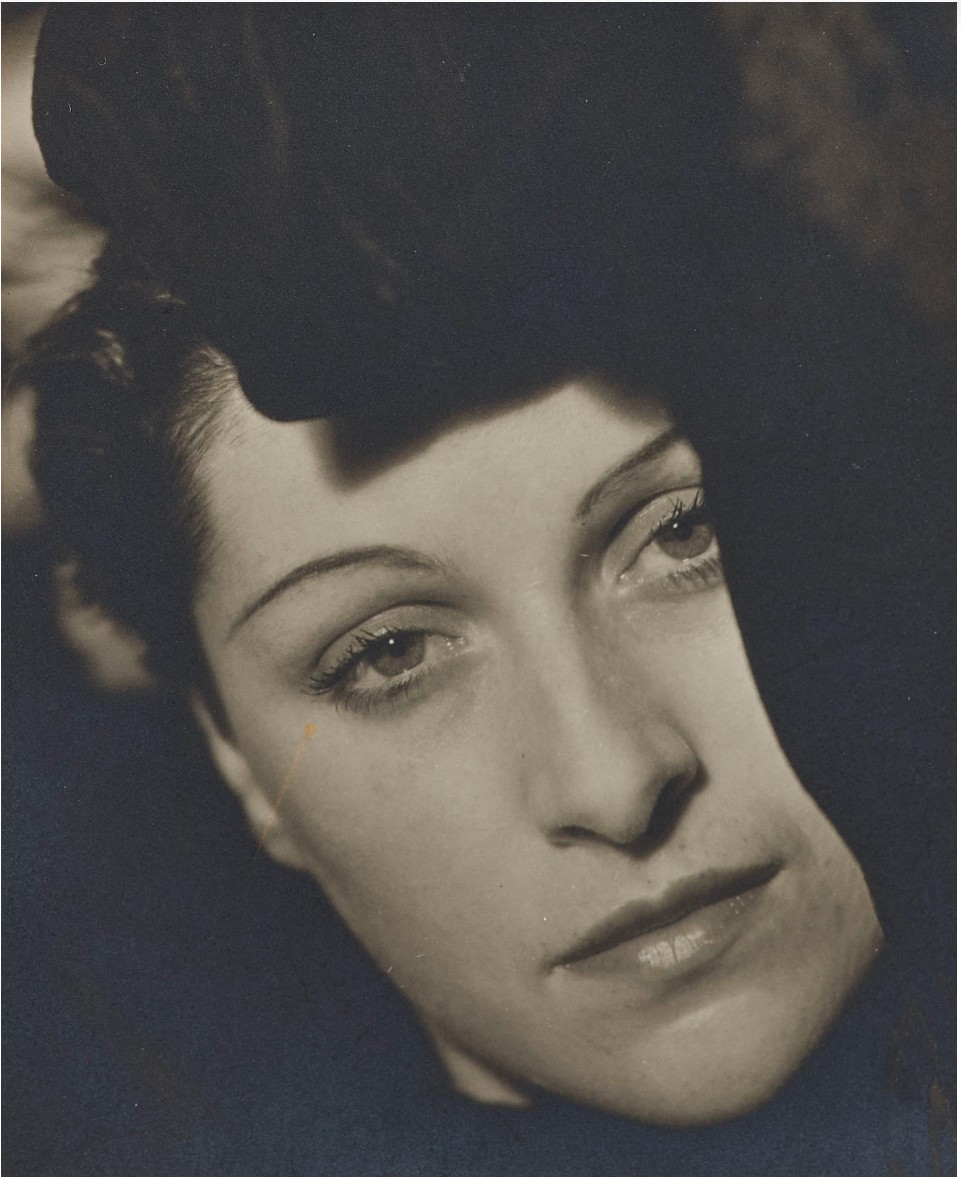
Man Ray, Dora Maar, 1936. Christie’s Paris, March 2, 2021, Lot 165.
© 2025 Man Ray Trust / Artists Rights Society (ARS), New York / ADAGP, Paris
Dora was a part of the Surrealist circles that Picasso himself frequented during the mid-1930s. After his affair with the wholesome and sporty Marie-Thérèse Walter, Dora’s intellectual stamina and emotional complexity provided a rich, vital contrast. Picasso’s subsequent partner Françoise Gilot recalled the artist’s description of one of his first indicative encounters with Dora at the famous café, the Deux Magots:
‘She was wearing black gloves with little pink flowers appliquéd on them. She took off the gloves and picked up a long, pointed knife, which she began to drive into the table between her outstretched fingers to see how close she could come to each finger without actually cutting herself. From time to time she missed by a tiny fraction of an inch and before she stopped playing with her knife, her hand was covered with blood. Pablo […] was fascinated’ (F. Gilot & C. Lake, Life with Picasso, New York, Toronto and London, 1964, pp. 85-86).
Edgy, elegant and unpredictable, Dora was a perfect vehicle for the expression of Picasso’s feelings during the tumultuous years of the later 1930s and early 1940s. ‘Dora, for me, was always a weeping woman,’ Picasso told André Malraux the year after he painted Buste de femme. (Picasso to André Malraux, A. Malraux, Picasso’s Mask, New York, 1976, p. 138). In this capacity, Dora inspired Picasso to create a string of expressive masterpieces, such as the paintings entitled Femme qui pleure in Tate, London and the National Gallery of Victoria, Melbourne amongst others. This marked a distinct change from the preceding sensuality of his depictions of Marie-Thérèse, and the elegant classicism of his wife, the Russian ballerina Olga Khokhlova. As is clear in Buste de femme, Dora brought a brittle sense of unease and violence to his work, fitting the period of the Spanish Civil War and then the Second World War.
Dora Maar, Pablo Picasso painting ‘Guernica’, 1937, Private collection.
Artwork: ©2025 Estate of Pablo Picasso / Artists Rights Society (ARS), New York.
Photo: Dora Maar © 2025 Artists Rights Society (ARS), New York / ADAGP, Paris. Image: © Archives Charmet / Bridgeman Images
Dora played a pivotal role in Picasso’s world. She enjoyed rare access to his studio, where she was able to document his creativity, not least with an almost-forensic run of photographs showing the evolution of Guernica, his vast masterpiece of 1937 fuelled by the tragedy of the Spanish Civil War. However, Dora was not a mere observer. She influenced Picasso, heightening his political sensibilities, shifting his style. Indeed, looking at Buste de femme, it appears that Picasso might have deliberately presented Dora’s features, with the fragmented, refracted nose in particular, in a manner that recalls her own distorted self-portrait photomontage from circa 1936-37 held by the Cleveland Museum of Art. This suggests that Buste de femme embodies an artistic dialogue between the two creators.
By the time Picasso painted Buste de femme, the atmosphere in Paris was beginning to shift, with signs that the tide of war might be turning. Yet the realities of Occupation remained deeply felt. Just days earlier, his longtime friend, the poet Max Jacob, had been arrested—an event that would have weighed heavily on Picasso. Though he may not have known that Jacob passed away on the very day this painting was completed, the emotional gravity of the moment is subtly echoed in the work’s introspective tone and expressive brushwork.
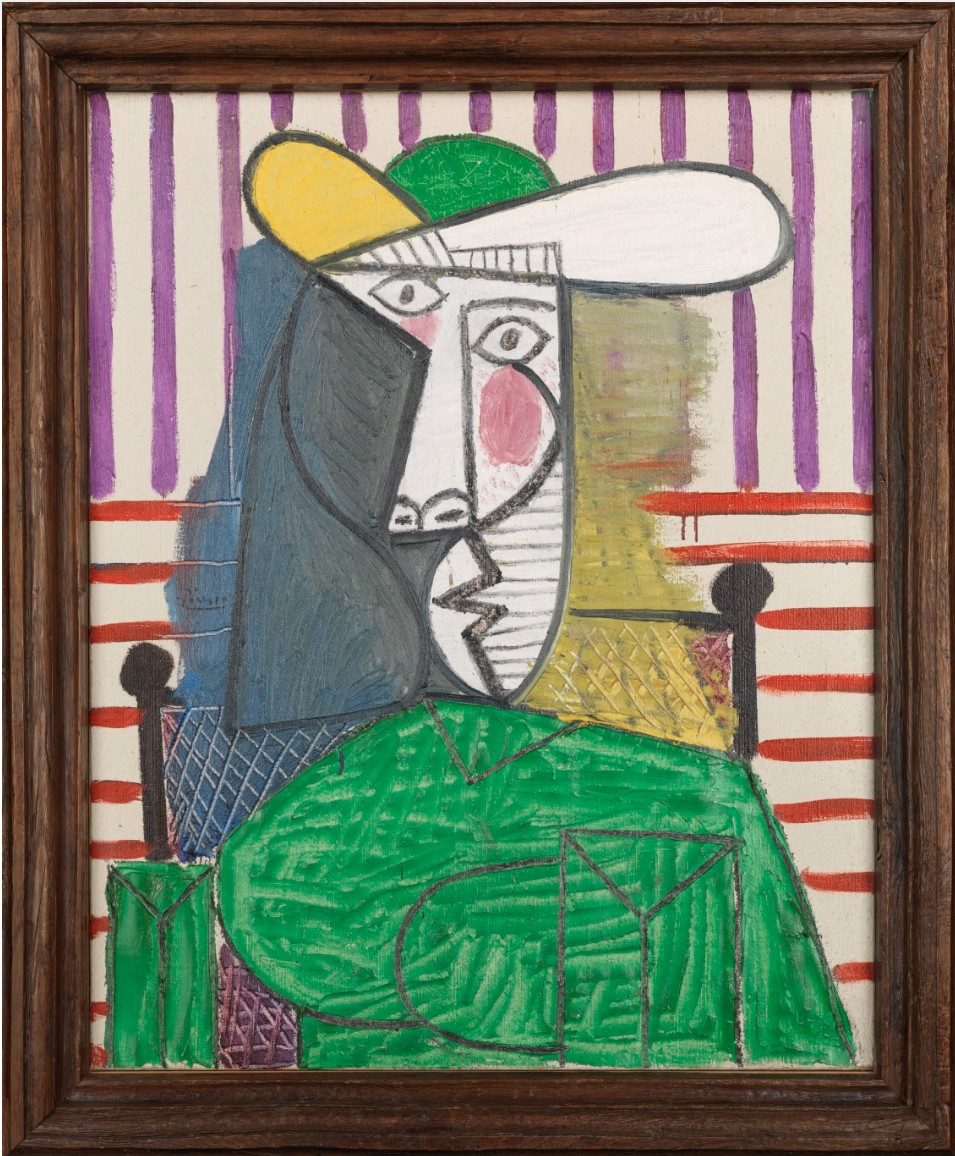
Pablo Picasso, Bust of a Woman, 1944. Long term loan at Tate
Artwork: ©2025 Estate of Pablo Picasso / Artists Rights Society (ARS), New York. Photo: Tate
Buste de femme conveys a sense that there might be a glimmer of hope, with the blue flecks illuminating the grisaille background like a distant dawn, a change from the muted hues of works from earlier in the War. Likewise, the vivid, contrasting red and green on her clothes and face are imbued with an intensity through black outlines reminiscent of stained-glass windows. There is also a sense of play in the way that Dora’s breasts appear to spell out part of her name across the bottom of the canvas. However, Buste de femme retains a haunting sense of oppression: Dora’s features have been twisted so that her nose recalls that of Picasso’s Afghan hound, recalling the paintings he made of her in Royan during the earliest days of the Occupation. By the time Buste de femme was painted, Picasso’s relationship with Dora Maar was nearing its end. This emotional turning point may well inform the painting’s expressive intensity, rendering it a poignant yet powerful tribute—at once tender, complex, and deeply personal. It stands as a compelling reflection of both their shared history and the turbulent times in which it was created.
Femme au chapeau jaune, 1939
Femme au chapeau jaune, 1939
Sotheby’s New-York: 16 May 2023
Estimated: USD 15,000,000 – 20,000,000
USD 15,846,000
Femme au chapeau jaune (Dora Maar) | Modern Evening Auction | 2023 | Sotheby’s (sothebys.com)
PABLO PICASSO (1881 – 1973)
Femme au chapeau jaune (Dora Maar), 1939
Oil on canvas
46.4 x 38.1 cm (18 1/4 x 15 inches)
Executed in Royan in December 1939, this painting belongs to the transitional moment between pre-war anxiety and full wartime isolation. Dora’s features here soften; traces of Marie-Thérèse’s sensuality seep into the composition.
Market interest centers on this hybridity. The work documents Picasso’s psychological oscillation and captures Dora at a moment of emotional permeability. For collectors, it represents narrative complexity rather than extremity.
Executed on 2 December 1939, Femme au chapeau jaune (Dora Maar) embodies one of the most complex periods of Pablo Picasso’s creativity and one of the strongest in terms of the radicalization of his pictorial style. Distinguished by its vibrant palette and boldness of form, the present work is an epitomal portrait of Dora Maar, one of the artist’s most iconic muses. The story of Dora Maar’s relationship with Picasso is among the most storied in the history of twentieth century art. Picasso’s love affair with Maar was a partnership of intellectual exchange as well as of intense passion, and her influence on the artist resulted in some of the most daring and most renowned portraits of his career. Picasso met Maar, the Surrealist photographer, in early 1936, and was immediately enchanted by the young woman’s beauty and commanding presence. Although still involved with Marie-Thérèse Walter, who had recently given birth to their daughter Maya, and still married to Olga Khokhlova at the time, Maar became Picasso’s primary mistress and model. Possessing sharp features and a determined personality, Maar proved to be an opposite of the blonde, sensuous and docile Marie-Thérèse.
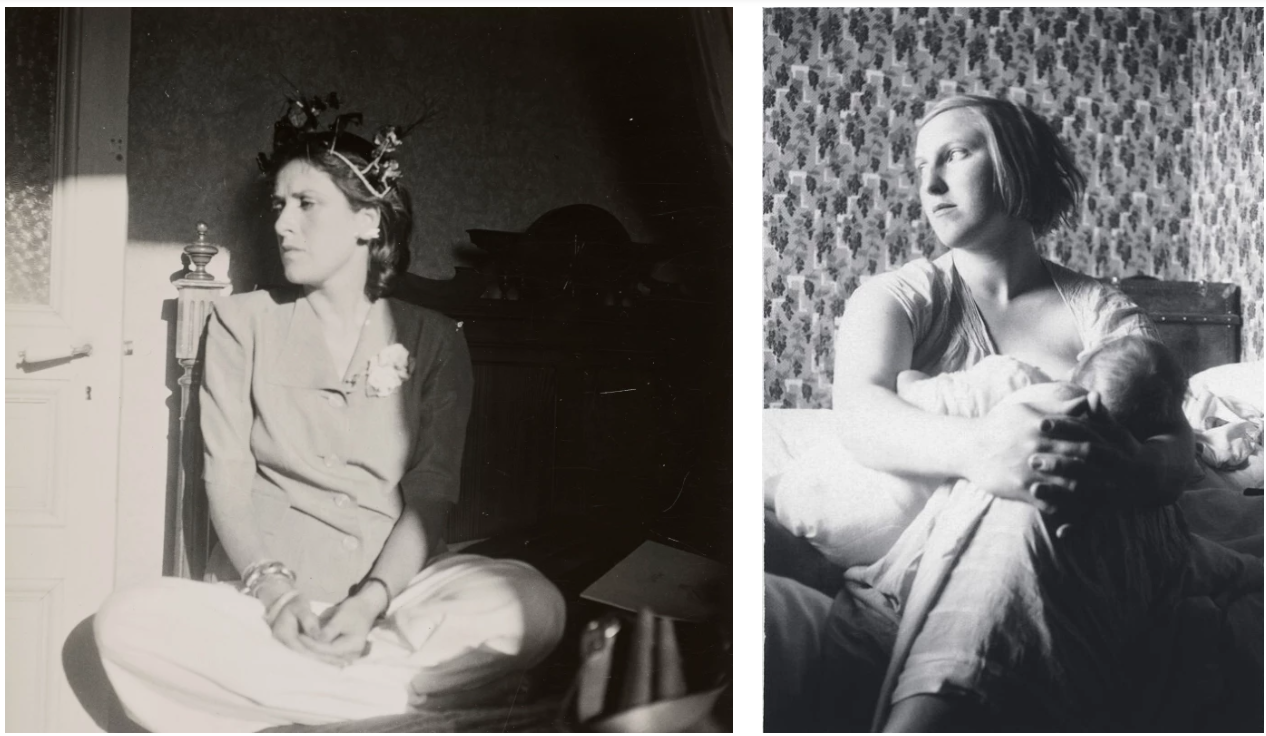
DORA MAAR WITH A CROWN OF FLOWERS, ANTIBES, AUGUST 1939. IMAGE © RMN-GRAND PALAIS / ART RESOURCE, NY
MARIE-THÉRÈSE WALTER IN JUAN-LES-PINS, 1936.
Picasso and Maar’s relationship occurred amidst tumult in Picasso’s native Spain and the whole of Europe. In 1937 he was commissioned to make a large-scale work of art by the Spanish Republican government for inclusion in the 1937 World’s Fair in Paris. The boiling turmoil of the Spanish Civil War and the later bombing on the town of Guernica provided the impetus for his painting of the eponymous monumental canvas, a process Maar documented in photographs. Momentous personal losses followed one after another, first of his mother at the end of 1938 and later, of his former dealer Ambroise Vollard in July 1939. Serving as a creative impetus for Picasso, such upheaval resulted in one of the most seminal outputs of his storied career. On the eve of France’s declaration of war on Nazi Germany, Picasso and many other artists fled Paris, arriving in the western seaside town of Royan on September 2, 1939. Picasso, Maar, his loyal personal secretary Jaime Sabartés and his dog Kazbek ensconced themselves at the Hôtel du Tigre, while Marie-Thérèse remained at the nearby villa Gerbier de Jone with Maya. While in Royan, Picasso split his time between the two women. During this period, Picasso’s paintings focus almost exclusively on his interior life rather than on the happenings of wartime France.
“I have not painted the war because I am not the kind of painter who goes out like a photographer for something to depict.”
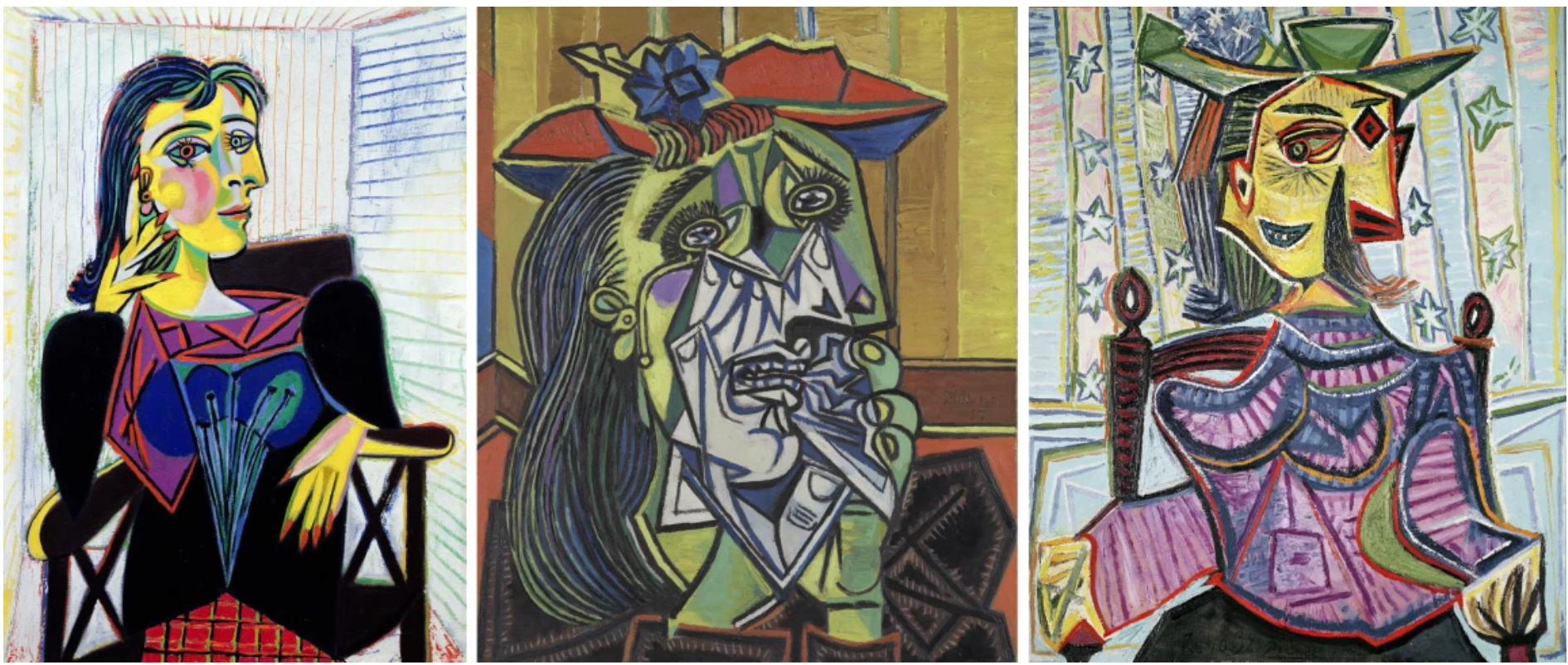
PORTRAIT DE DORA MAAR, 1937, MUSÉE PICASSO, PARIS. © 2023 ESTATE OF PABLO PICASSO / ARTISTS RIGHTS SOCIETY (ARS)
LA FEMME QUI PLEURE, 1937, TATE MODERN, LONDON. © 2023 ESTATE OF PABLO PICASSO / ARTISTS RIGHTS SOCIETY (ARS)
DORA MAAR ASSISE, 1939, THE METROPOLITAN MUSEUM OF ART, NEW YORK. © 2023 ESTATE OF PABLO PICASSO / ARTISTS RIGHTS SOCIETY (ARS)
In the prior years spent with Maar, Picasso depicted his lover in a range of manners that reflected the coexistence of conflict and inspiration in their relationship, spanning from the dignified calm of Portrait of Dora Maar to the distortion and disembodiment of La Femme qui pleure and Dora Maar assise. The present work is one of the most accomplished representations of his beautiful and charismatic mistress. Exuding an air of captivating elegance, her eyes gaze intently at the viewer. Her features that Picasso greatly admired – her flowing dark hair and strong nose – are rendered with energetic brushstrokes and sculptural contours that masterfully capture the vitality of her character. Femme au chapeau jaune (Dora Maar), however, conveys the distinctive manner in which Marie-Thérèse and Maar’s features converged in Picasso’s Royan portraits. Depictions of Marie-Thérèse take on the take on the angularity associated with images of Maar. Through the pastel tones of the patterned wallpaper, her blouse and even the warm pink of her flesh, Maar takes on some of the sensuality and softness of Marie-Thérèse, rendering the work an amalgam of both women.
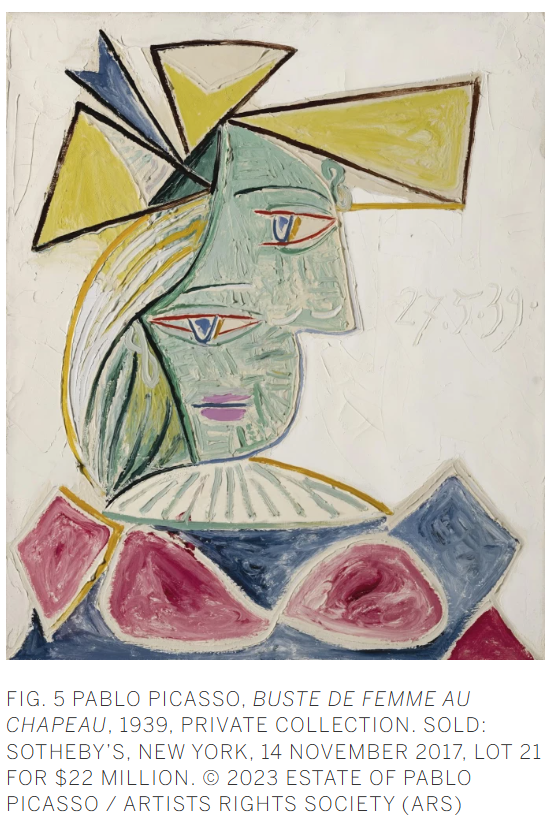
As the present work underscores, Maar is immortalized in Picasso’s portraits as the wearer of stylish hats. Ceremoniously placed atop her head like a crown, the titular yellow hat is embellished with a tufted green band; other works of her wearing this particularly distinctive hat belong to the Galerie Beyeler, Basel and the Kreeger Museum, Washington D.C. Paul Éluard details the symbolism of such hats, noting its fetishistic importance within the Surrealist movement: “among the objects tangled in the web of life, the female hat is one of those that require the most insight, the most audacity. A head must dare to wear a crown” (quoted in Exh. Cat., New York, The Museum of Modern Art (and traveling), Picasso and Portraiture: Representation and Transformation 1996-97, p. 392).
Precisely dated 2.12.39. and inscribed Royan on the reverse, Femme au chapeau jaune (Dora Maar) is not only a testament to Picasso and Maar’s time in the southerly town, but also a living document of the upheaval and instability in the earliest days of the Second World War. After spending close to a year in Royan, Picasso and Maar returned to Paris on 24 August 1940. Despite offers of asylum in both the United States and Mexico, Picasso remained in Paris throughout the war, where he aided the French Resistance while being frequently harassed and searched by the Gestapo. One of the first owners of this work was the art dealer Justin K. Thannhauser, son of gallerist and German avant-garde proponent Heinz Thannhauser. Justin K. Thannhauser was a longtime friend of Picasso, having hosted one of the artist’s first major German exhibitions at Munich’s Moderne Galerie in 1913. Thannhauser donated many of the essential works in his vast personal collection to the Solomon R. Guggenheim Museum, whose Thannhauser Wing opened in 1965 (see below). Femme au chapeau jaune (Dora Maar) has remained in a private collection for over forty years.
Sculpture
Tête de femme (Dora Maar), 1941
Sotheby’s New-York: 6 November 2007
Estimated: USD 20,000,000 – 30,000,000
USD 29,160,000
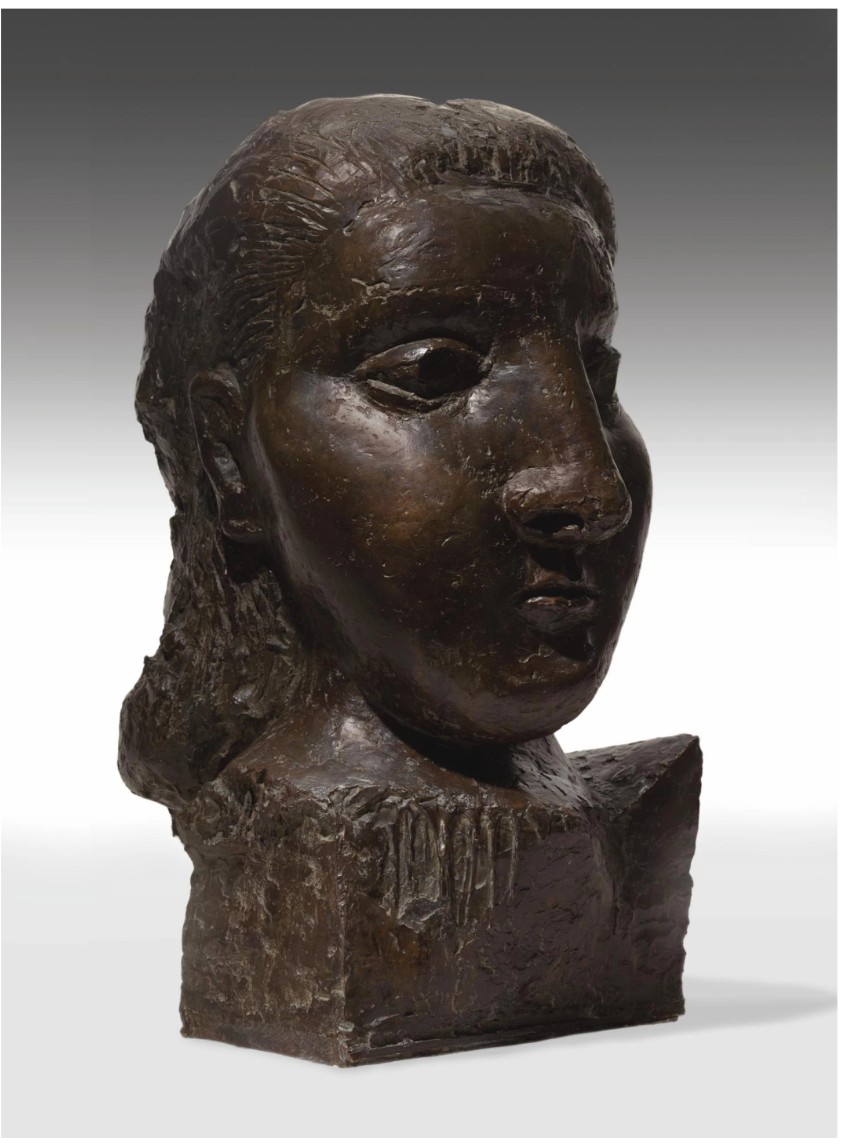
PABLO PICASSO
Tête de femme (Dora Maar), 1941
Bronze
Height: 80 cm (31 1/2 inches)
Stamped with the foundry mark C. Valsuani Cire perdue
This larger-than-life bust portrait of Dora Maar is one of Picasso’s greatest achievements in the medium of sculpture. At just over three-quarters of a meter high, it conveys the model’s strength of character and imposing presence as a figure in Picasso’s life during the war years. It is also one of the artist’s most respectful and idealized portrayals of Dora (see fig. 3 & 7), rendered without any of the abstraction that characterized his more menacing depictions of her as the Weeping Woman. Dora’s likeness here resembles that of a Greco-Roman goddess, more noble than any sculptural depiction of the other women in Picasso’s life (see fig. 6). As Barbara Thiemann and Evelyn Weiss commented about this figure, “This strong, spiritualized head, with its powerful aura of human dignity and its remoteness from violence and subjugations, seems to convey a contrast, a kind of inner resistance. It recalls the stoical serenity of the gods of the ancient world” (Barbara Thiemann and Evelyn Weiss in Picasso, The Ludwig Collection (exhibition catalogue), op. cit.).
Picasso created Tête de Femme (Dora Maar) in 1941 in his studio on the rue des Grands Augustins in Paris (see figs. 1 & 4). He had relocated many of his sculptures from Boisgeloup to this space in the beginning of the year, as it was sizable enough to accommodate the sequence of busts of Marie-Thérèse from a decade earlier (see fig. 5). This was the same studio where he had painted his epic Guernica in 1937. Back then, Dora made a series of photographs of his progress on the painting, and her work as a photographer impressed Picasso enough for him to think of her as a fellow artist. He and Dora continued to work side by side in this studio throughout the occupation, mainly because their freedom to travel was curtailed as a consequence of the war. During those first few months together Picasso began work on a series of monumental sculpture, including this bust and Man with a Sheep. Picasso created a first version of Tête de femme in which he rendered the figure with a hat (see fig. 2). He eventually refined the sculpture to form the present image, which he would later cast in bronze after the war when metal was more readily available.
Although Dora would come to be immortalized in Picasso’s art in jarring and often monstrous representations, this sculpture presents her with a sense of dignity and serenity that is rarely associated with Picasso’s most flamboyant mistress. This sculpture was preceded by a handful of mild-mannered drawings and paintings of her image, but the sheer size of this work most forcefully conveys the resilience of her persona. Picasso often said that, for him, Dora was the embodiment of the war. Through her image he channeled his own frustrations and anxiety (see fig. 9), and these sentiments eventually spilled over into their real-life relationship. But in this representation, Picasso
depicts Dora as the stoic woman that she was–ever silent and enduring despite the frustrations she suffered during this most tense period in history.
Andreas Franzke has likened the present work to Rodin’s similarly stoic portrait of Pierre de Wiessant, but with the following distinctions: “Rodin presents the head as if severed from its body, like an impressive fragment which the beholder involuntarily associates with a body, whereas Picasso elevates his head into a monument. He places it on a plinth. By growing organically out of a modeled block devoid of any allusion to the upper part of the body, the head quite automatically became an autonomous, wholly self-contained cipher. No longer the sculptural quotation of a literary idea, superbly monumental though Rodin’s formulation was, it is a ‘head monument’ in its own right, and one that crystallizes the spiritual force of Picasso’s artistic potency…” (Franzke, op. cit., p. 162).
Picasso conceived the present sculpture first in plaster and then had it cast in bronze in an edition of four in the 1950s. Two of these casts were completed at the Valsuani foundry, and the other two at the Susse Foundry in 1958. One of the bronzes was selected as a public monument for the poet Guillaume Apollinaire. Over the years Picasso had submitted several ideas for a sculpture to commemorate his friend, but all of his proposals had been rejected on the basis that they were too abstract. This portrait of Dora Maar, however, was finally accepted and installed in the graveyard behind the church of St-Germain-des-Prés. That bronze cast was stolen from the site and subsequently recovered two years later. The original plaster of Tête de Femme (Dora Maar) is currently in the collection of the Ludwig Museum in Cologne, and the last remaining two bronzes are in the collection of the Beyeler Foundation and in a private collection. The present work belonged to the artist’s granddaughter Marina (the daughter of Paulo), who featured it in the traveling exhibition of her collection in the 1980s.
Works on Paper
Femme assise (Dora Maar), 1938
Christie’s New-York: 16 May 2024
Estimated: USD 2,000,000 – 3,000,000
USD 1,502,000
https://www.christies.com/en/lot/lot-6482938
PABLO PICASSO (1881-1973)
Femme assise (Dora Maar), 1938
Pen and India ink on paper
45.9 x 24.5 cm (17 7/8 x 9 5/8 inches)
Signed and dated ‘31.5.38. Picasso’ (upper right)
Drawn in Paris on 31 May 1938
Femme assise (Dora Maar) of 1938 presents Pablo Picasso’s wartime lover, the artist and photographer, Dora Maar. Depicted on the scale of a painted portrait, Maar commands the scene, adorned in an elaborate hat, one of her favorite accessories, decorated with a fish. Demonstrating Picasso’s extraordinary abilities as a draughtsman, this striking work on paper reflects the artist’s devotion and deep love of Maar, presenting her as a self-assured Parisienne, at once elegant and mysterious. From the Weeping Women to the plethora of seated portraits, Picasso’s images of Maar are among the greatest of his wartime work. At times haunting, arresting, adoring or reverential, the visual power of these portraits is due in part to the symbiotic creative relationship the pair shared: Maar was not simply a muse, but, as an artist in her own right, she was an active participant in their intense artistic dialogue.
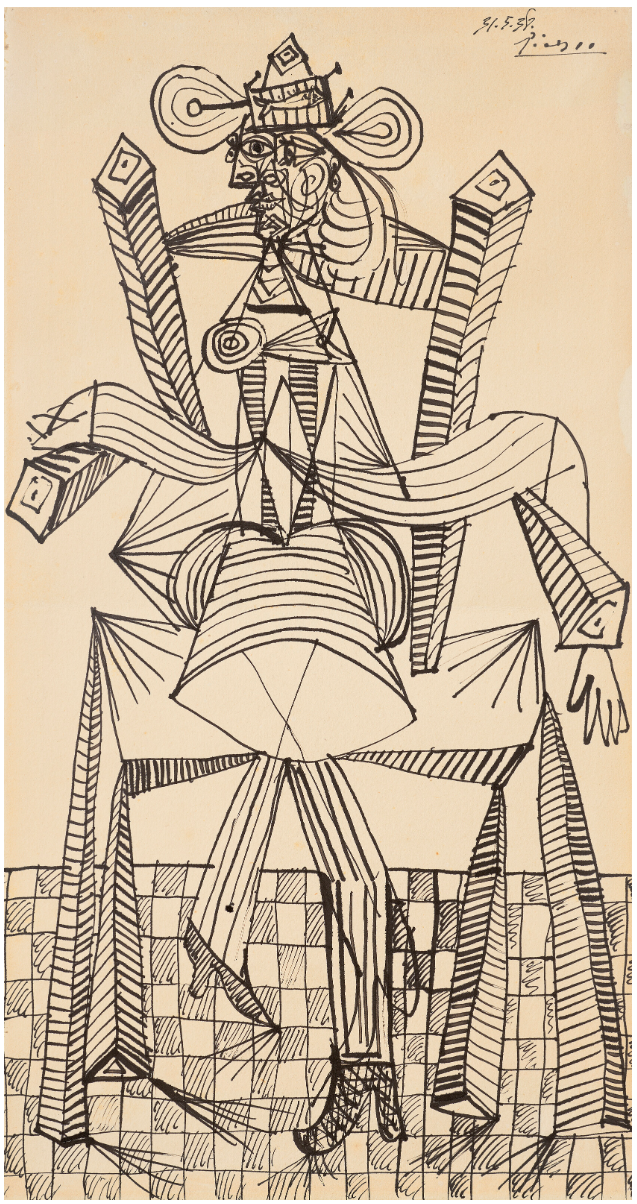
Picasso had met Maar in the winter of 1935-1936. Their now legendary first encounter at the Parisian café, Les Deux Magots, has been frequently recounted. As Picasso later related to Françoise Gilot, “Pablo told me that one of the first times he saw Dora she was sitting at the Deux Magots. She was wearing black gloves with little pink flowers appliquéed on them. She took off the gloves and picked up a long, pointed knife, which she began to drive into the table between her outstretched fingers to see how close she could come to each finger without actually cutting herself. From time to time she missed by a tiny fraction of an inch and before she stopped playing with the knife, her hand was covered with blood” (F. Gilot and C. Lake, Life with Picasso, New York, 1964, pp. 85-86).
Picasso was fascinated by this spectacle, and fell quickly under the Spanish-speaking artist’s spell. By this time, Maar was a well-known figure within the Surrealist circles of Paris, her photography—from photocollage, to the uncanny compositions she captured of contemporary street life—as well as her political activism making her a key figure within the avant-garde and intellectual world of the city.
In the spring of 1938, a month before he executed the present work, Picasso had begun to portray Maar using a tight framework of small repeated lines and striations that have often been likened to the woven straw of baskets or chair caning. This linear or “basketweave” method of construction clearly fascinated Picasso, as he went on to portray Maar with this technique for much of the summer. In contrast to the volumetric, sensuously curving lines which dominated his concurrent depictions of Marie-Thérèse Walter, this rigid, geometric linear vocabulary came to define his depictions of Maar. A year later, as the present work shows, these lines had taken over to become the entire structure of her body. Appearing as if caught in a spider’s web, Maar’s form is depicted solely with these clear, assured marks. One breast is portrayed with concentric circles while the other takes the form of an arrow piercing it, a reflection perhaps of the way in which her heart had been ensnared by the artist. On the same day that he created the present work, Picasso painted a closely related oil, which shows Maar in the same pose, the intricate linear pattern replaced with bold three-dimensional forms (Fondation Beyeler, Riehen). Though the chair rises up threateningly around her, Maar still presides over the scene, her legs casually crossed, arms nonchalantly resting, and most importantly, her powerful gaze set resolutely out of the picture plane, her head topped by one of her signature hats.
La Femme qui pleure I, 1937
Sotheby’s New-York: 16 May 2023
Estimated: USD 1,500,000 – 2,500,000
USD 1,650,000
La Femme qui pleure I | The Mo Ostin Collection Evening Auction | 2023 | Sotheby’s (sothebys.com)
PABLO PICASSO (1881 – 1973)
La Femme qui pleure I, 1937
Drypoint, aquatint, etching and scraper on Montval laid paper
Plate: 69.2 x 49.5 cm (27 1/4 x 19 1/2 inches)
Sheet: 77.5 x 56.2 cm (30 1/2 x 22 1/8 inches)
Signed in pencil (lower right) and numbered 15/15 (lower left)
Very fine impression of the extremely rare subject numbered 15 from the edition of 15 of Baer’s third state (of seven)
Printed by Lacourière
La Femme qui pleure I is a masterpiece of modern printmaking and among the most important prints of the twentieth century. It is peerless within Picasso’s body of graphic work in its emotional impact and has become an emblem of universal pain and suffering through its depiction of inconsolable grief. In 1937 Picasso found himself in a maelstrom of personal and political anguish. It would lead him to create one of his greatest paintings, Guernica, and alongside it the groundbreaking series of paintings, drawings and prints collectively known as La Femme qui pleure. The motif of the Weeping Woman first made an appearance in a drawing towards the end of May and in the coming months became a subject Picasso would return to repeatedly. Although the composition as it appears in the etching and in many of the paintings does not feature in the finished version of Guernica, it became the vehicle through which Picasso explored many of the themes central to the mural.
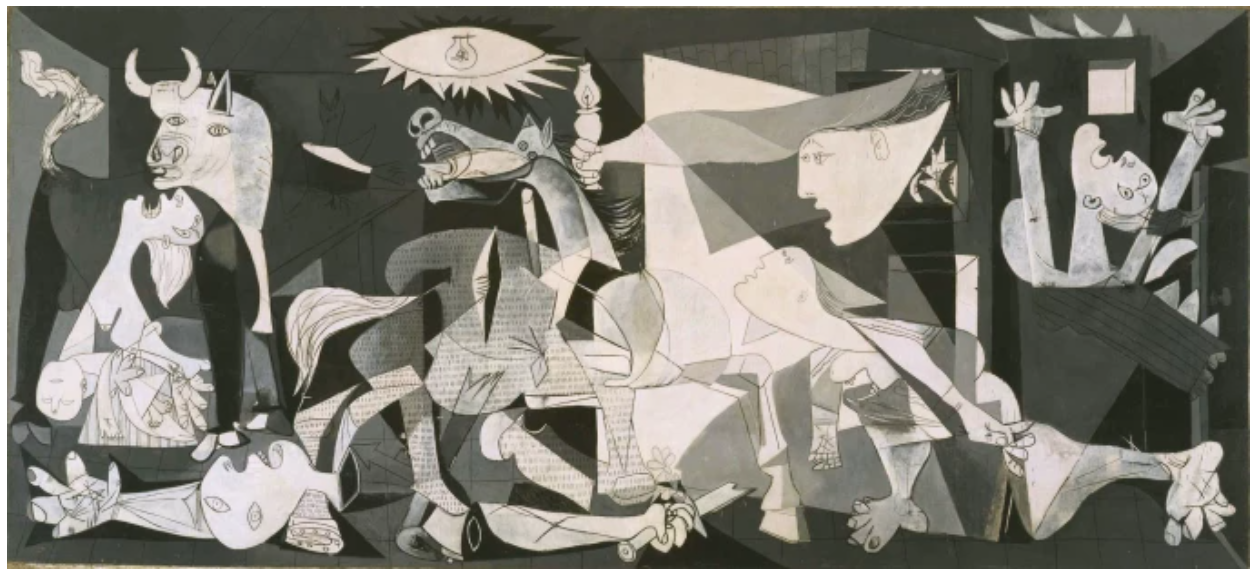
PABLO PICASSO, GUERNICA, 1937. MUSEO NACIONAL CENTRO DE ARTE REINA SOFIA, MADRID. IMAGE: BRIDGEMAN IMAGES. ART © 2023 ESTATE OF PABLO PICASSO / ARS, NEW YORK
In January 1937, Picasso had started work on a pair of etchings in support of the Republican side in the Spanish civil war titled Sueño y mentira di Franco (Dreams and lies of Franco). In the same month he received an invitation to paint a large mural for the Spanish Pavilion at the International Exposition in Paris that summer. He saw the opportunity to make a great political statement and experimented with various possible subjects to achieve this through the spring. On 26 April the German Air Force, at the request of Franco’s forces, repeatedly bombed the Basque town of Guernica, all but levelling the town and killing many civilians. The event caused international outrage and was the catalyst for Picasso finding a subject through which he could channel his own abhorrence and anger at events unfolding in his native country. Motivated by a sense of moral outrage and determined to show his support for the Republican cause, Picasso turned to printmaking to more readily disseminate his visual protest.
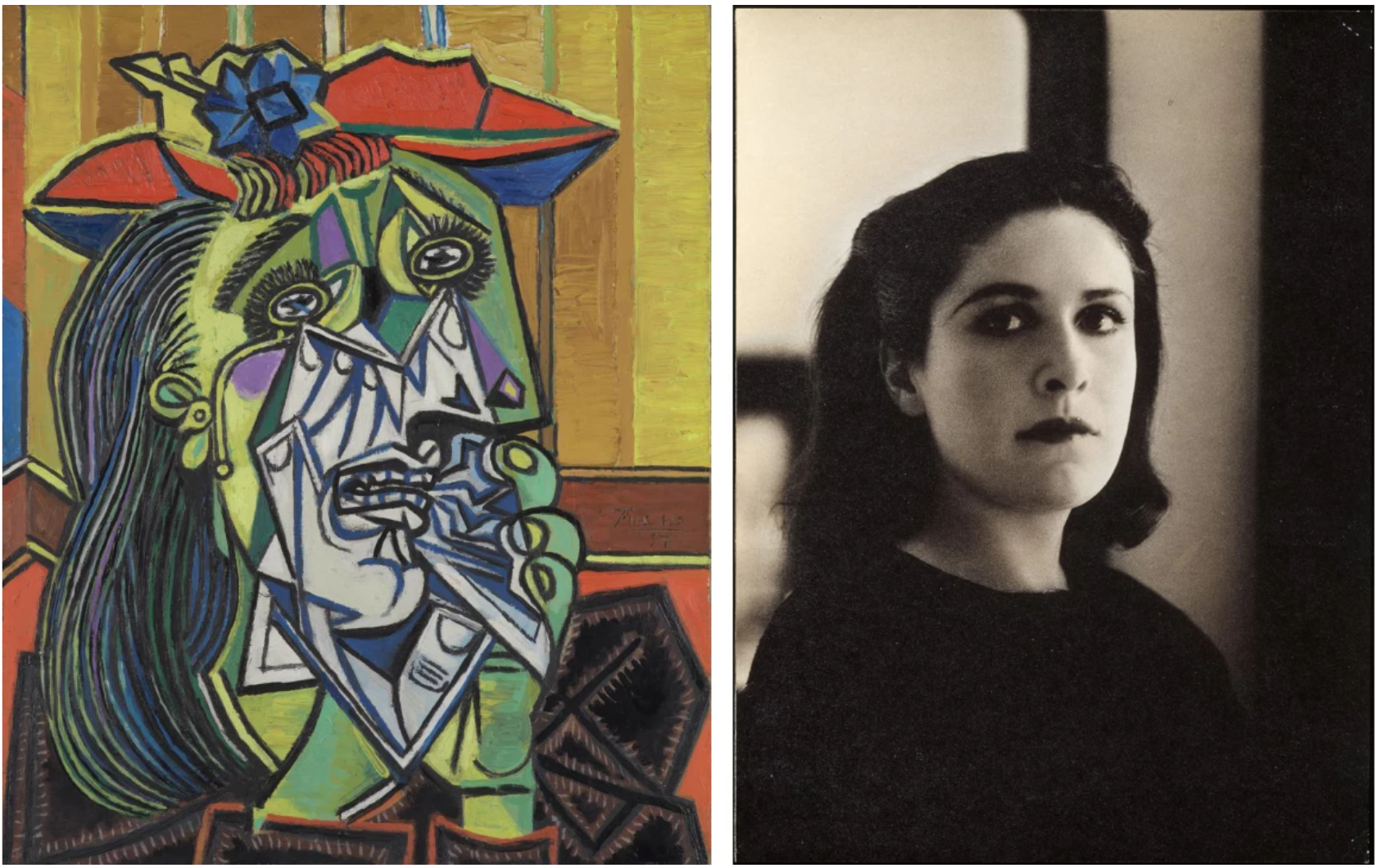
PABLO PICASSO, LA FEMME QUI PLEURE, 1937. TATE, LONDON. ART © 2023 ESTATE OF PABLO PICASSO / ARS, NEW YORK
ROGI ANDRÉ, PORTRAIT DE DORA MAAR, CIRCA 1937, PHOTOGRAPH, CENTRE POMPIDOU, PARIS © CENTRE POMPIDOU MNAM-CCI / GEORGES MEGUERDITCHIAN / DIST. RMN
It was not only this large-editioned work centered on Franco himself that would visually represent Picasso’s focus in these key months of 1937. La Femme qui pleure, heavily based in the features of the artist’s primary muse and paramour at the time, the photographer and artist Dora Maar, contained motifs associated with his mistress Marie-Thérése Walter and his long-estranged wife Olga Khokhlova. Idiomatically apt, the Weeping Woman spoke directly of the Spanish tragedy, her shattered features fulfilling the role of the modern Mater Dolorosa. It is perhaps not surprising that an example of the present work as well as the seventh state were also hung in the Spanish Pavilion at the World’s Fair.
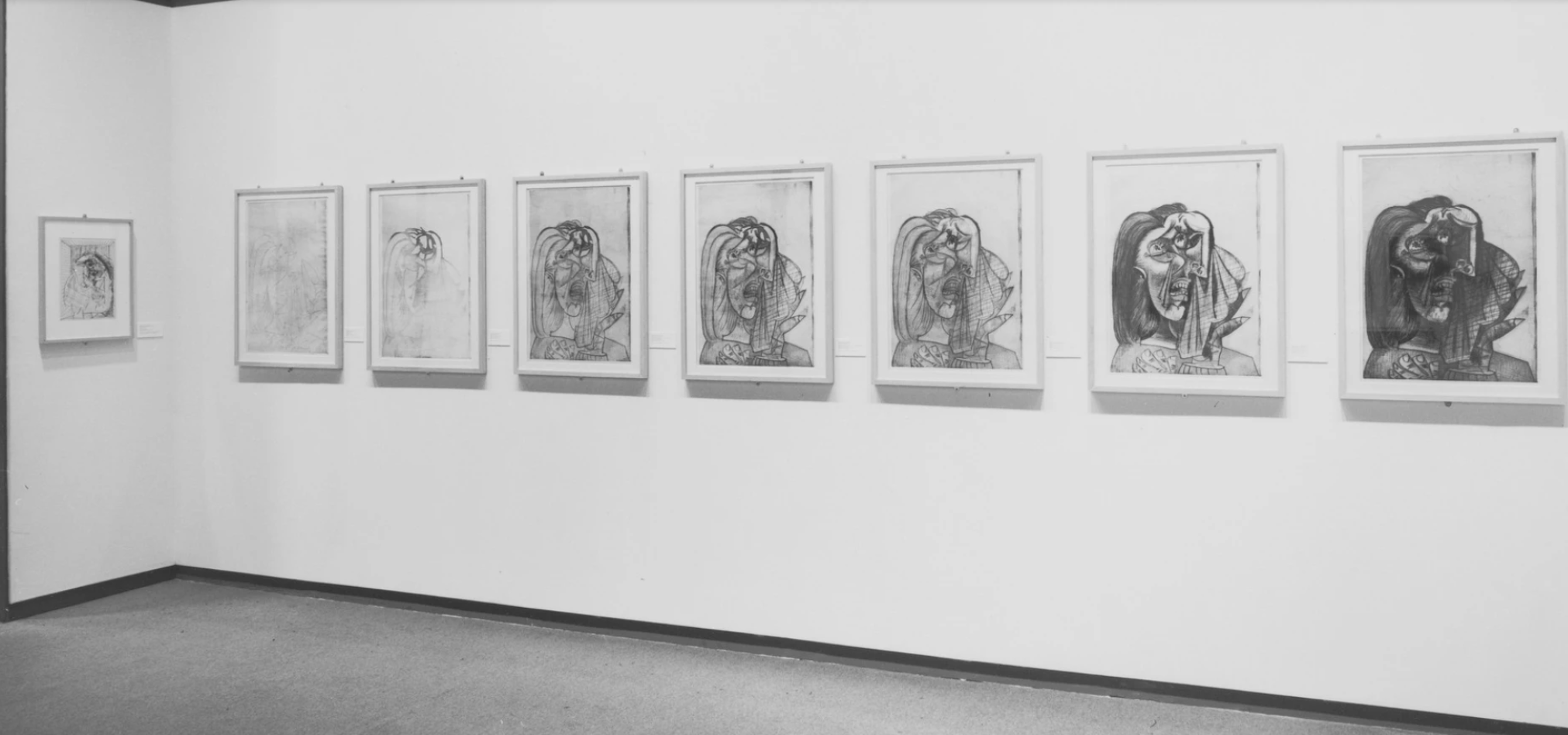
INSTALLATION VIEW OF THE EXHIBITION PABLO PICASSO: A RETROSPECTIVE, 1980. THE MUSEUM OF MODERN ART ARCHIVES, PHOTO: MALI OLATUNJI. ART © 2023 ESTATE OF PABLO PICASSO / ARS, NEW YORK
Picasso began work on La Femme qui pleure on July 1, 1937 at Roger Lacourière’s studio in Paris, on a plate equal in size to that of La Minotaurmachie—then the largest plate he had yet attempted—and developed and reworked La Femme qui pleure over the course of seven states. The present impression of the third state masterfully contrasts the broad, dark lines of the scraper that outline the composition with the gradient of aquatint that underscores the most prominent features of the face, darkening in the forehead. While this veil of aquatint is reworked and largely removed in later states, its prominence in the third state effectively reinforces the work’s overarching sense of psychological anguish. Fewer than forty impressions of the seven states were printed and only the third and seventh states were signed in pencil and numbered in editions of fifteen. Picasso’s treatment of the impressions of the numbered states evidenced the significance the print held for the artist. He retained more than half of them until his death and many of the remainder were gifted to confidants including Yvonne Zervos, Robert Penrose, Marie Cuttoli, and the poets Josep Carner and Juan Larrea. Other examples of the third state are found in museum collections around the world, including the Prado in Madrid, The Museum of Modern Art, New York; the Musée Picasso, Paris and the Sprengel Museum, Hanover.