
Willem de Kooning was born on April 24, 1904, into a working class family in Rotterdam, the Netherlands. Driven by an acutely perceptive mind, a strong work ethic, and persistent self doubt – coupled with the determination to achieve – the charismatic de Kooning became one of America’s and the twentieth century’s most influential artists.
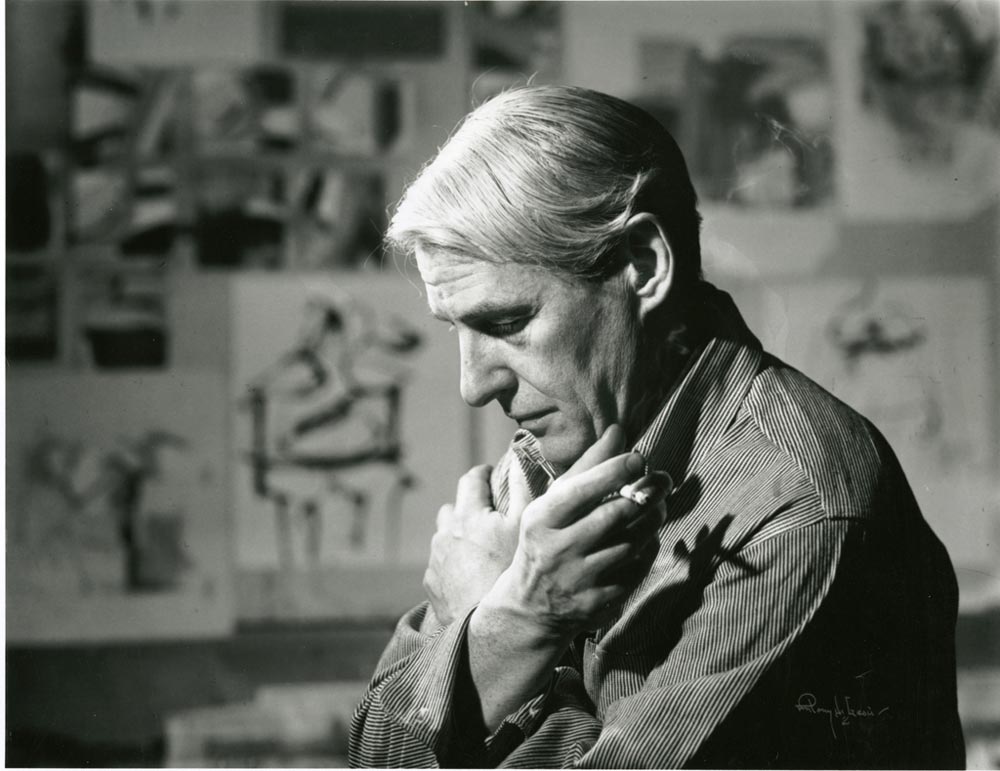
De Kooning was awarded many honors in his lifetime, including The Presidential Medal of Freedom in 1964. His works have been included in thousands of exhibitions and are in the permanent collections of many of the finest art institutions abroad, including the Stedelijk Museum, Amsterdam; Tate Modern, London; and the National Gallery of Australia, Canberra; and in America such as The Museum of Modern Art, New York; The Metropolitan Museum of Art, New York; the Art Institute of Chicago; the Smithsonian Institution’s Hirshhorn Museum & Sculpture Garden, Washington D.C.; and the National Gallery of Art, Washington, D.C.
THE WILLEM DE KOONING FOUNDATION
PART I: SUMMARY
Market Overview
2024 AUCTION STATISTICS
Turnover: USD 53,589,260
# Lots sold: 16
Sell-Through Rate: 84%
Highest Price achieved at Auction:
USD 68,937,500
2024 Auction Highlights
16 lots sold in 2024 for a total turnover of USD 53,589,260. With 3 lots failing to sell, the sell-through rate is 84%. The highest price has been achieved by Untitled, a painting dated 1982, that sold at Christie’s in New-York on 19 November 2024, for USD 13,290,000.
2024 Top 3 Lots
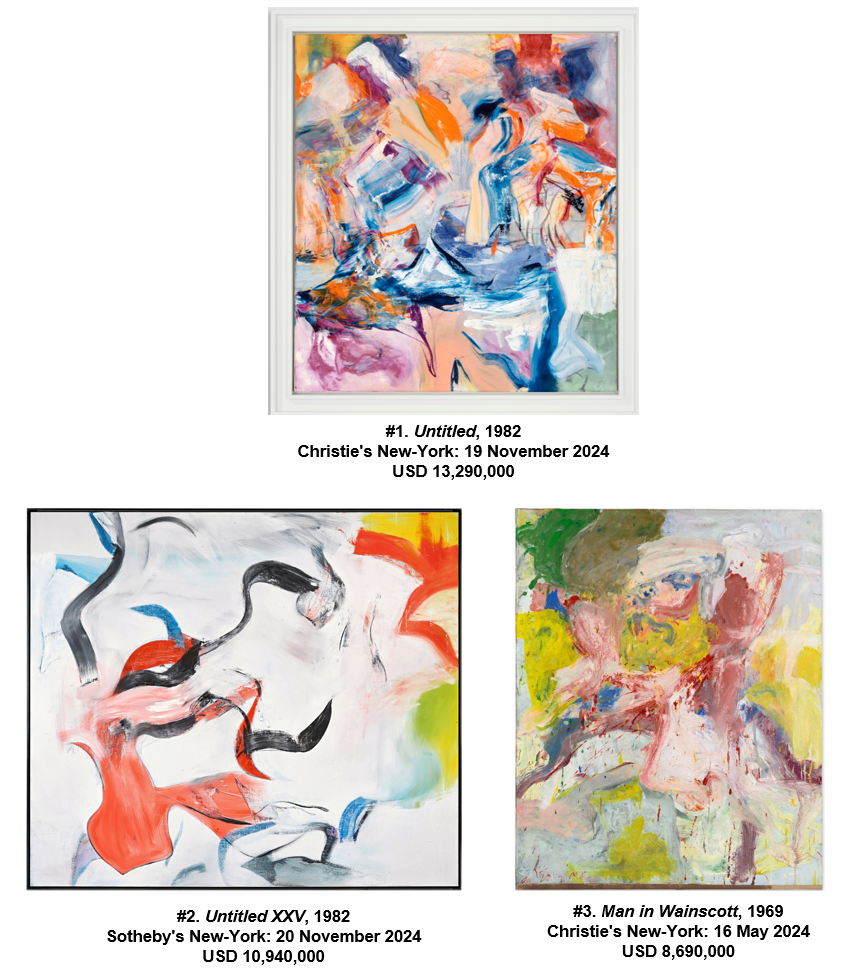
2 lots sold for more than USD 10 million, generating a cumulative turnover of USD 24,230,000, representing 45.2% of the total turnover for 2024. 9 lots sold for more than USD 1 million, generating a cumulative turnover of USD 50,112,085, representing 93.5% of the total turnover for 2024.
2023 Auction Highlights
19 lots sold at auction in 2023 for a total turnover of USD 95,612,875. With 1 lot failing to sell, the sell-through rate is a solid 93%. The highest price has been achieved at Christie’s in New-York on 11 May 2023, when Orestes, a rare early painting dated 1947 sold for USD 30,885,000.
2023 Top 3 Lots
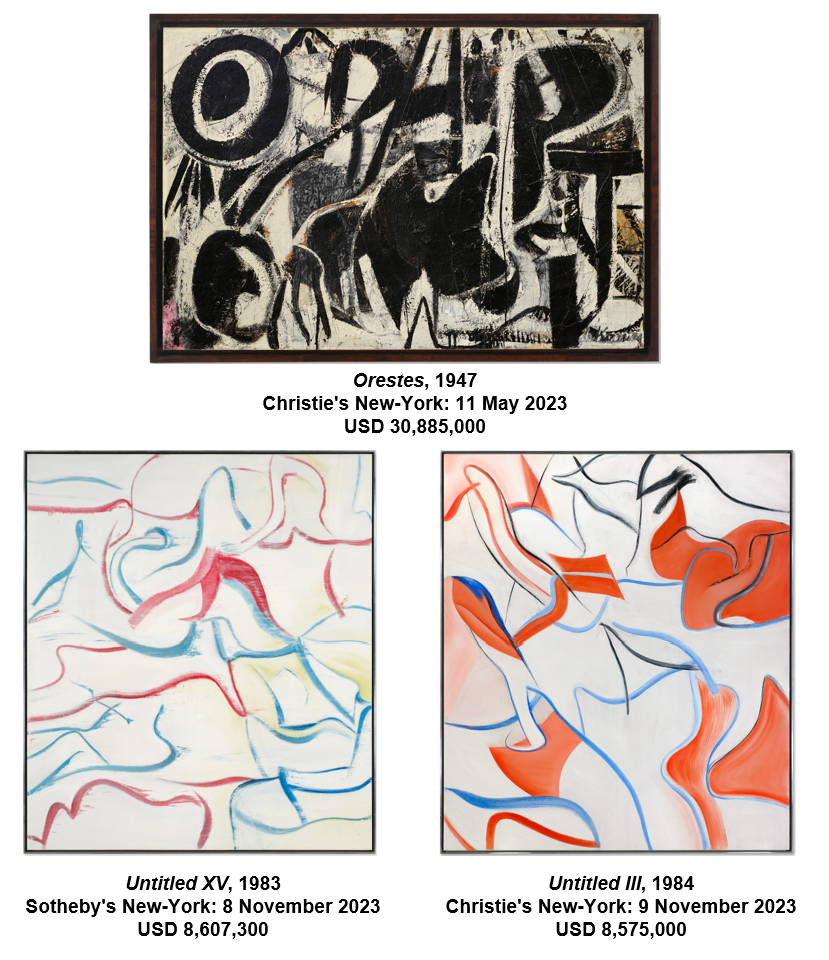
This was the only lot to sell for more than USD 10 million. 9 lots sold for more than USD 5 million, generating a cumulative turnover of USD 82,233,575, representing 89.1% of the turnover for 2023.
2022 Auction Highlights
20 lots sold at auction in 2022 for a total turnover of USD 193,589,792. With only 1 lot failing to sell, the sell-through rate is 95%. The highest price was achieved at Sotheby’s in New-York, on 16 November 2022, when an untitled painting dated 1979 sold for USD 34,794,500.
2022 Top 3 Lots
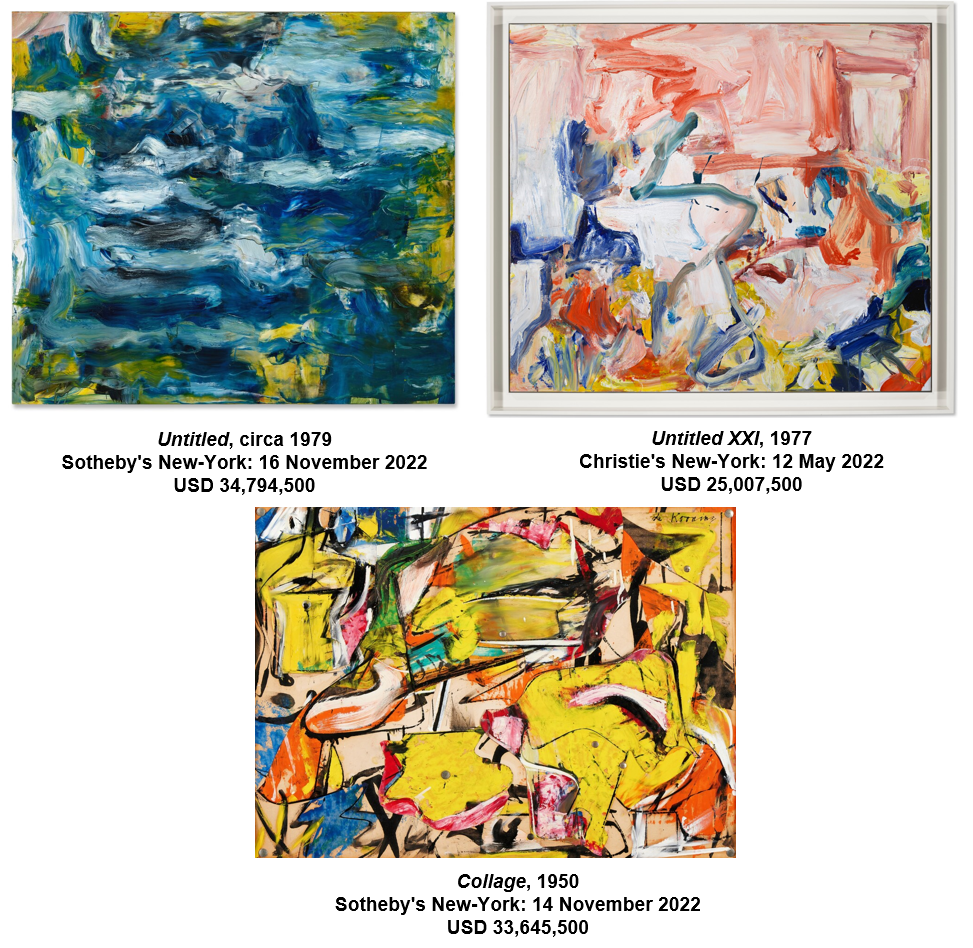
7 lots sold for more than USD 10 million, generating a cumulative turnover of USD 144,656,800, representing 74.7% of the total turnover for 2022.
2021 Auction Highlights
14 lots sold at auction in 2021 for a total turnover of USD 107,441,711. With 2 lots failing to sell, the sell-through rate is 88%. The highest price was achieved at Sotheby’s in New-York, when Untitled XXXIII, a painting dated 1977 sold for USD 24,393,000.
2021 Top 3 Lots
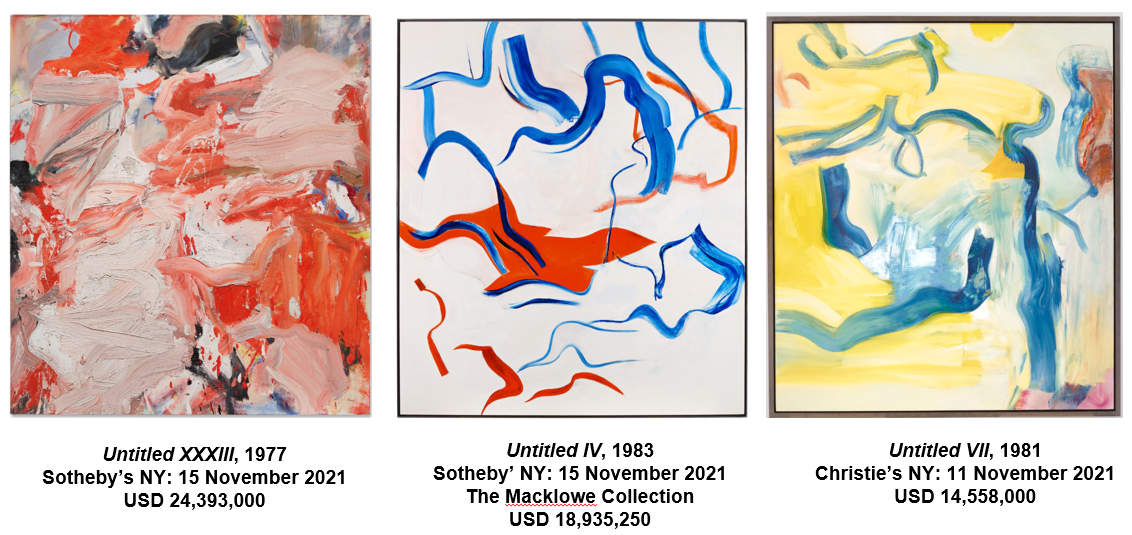
4 lots sold for more than USD 10 million, generating a cumulative turnover of USD 68,322,250, representing 63.6% of the total turnover for 2021.
Top Lots
#1. Woman as Landscape, 1954-1955
Christie’s New-York: 13 November 2018
Estimated: USD 60,000,000 – 80,000,000
USD 68,937,500
Willem de Kooning (1904-1997) (christies.com)
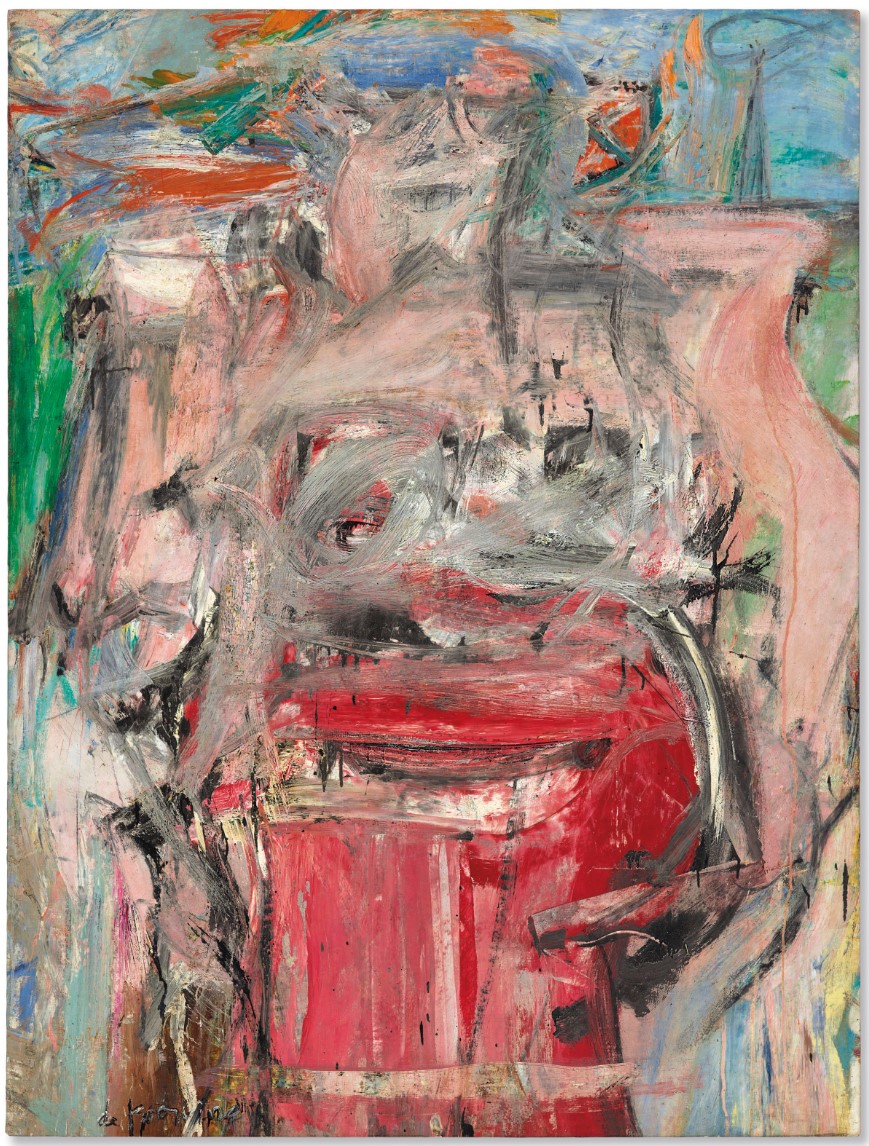
WILLEM DE KOONING (1904-1997)
Woman as Landscape, 1954-1955
Oil and charcoal on canvas
65 1/2 x 49 3/8 inches (166.3 x 125.4 cm)
Signed ‘de Kooning’ (lower left)
#2. Untitled XXV, 1977
Christie’s New-York: 15 November 2016
Estimate on Request
USD 66,327,500
Willem de Kooning (1904-1997) (christies.com)
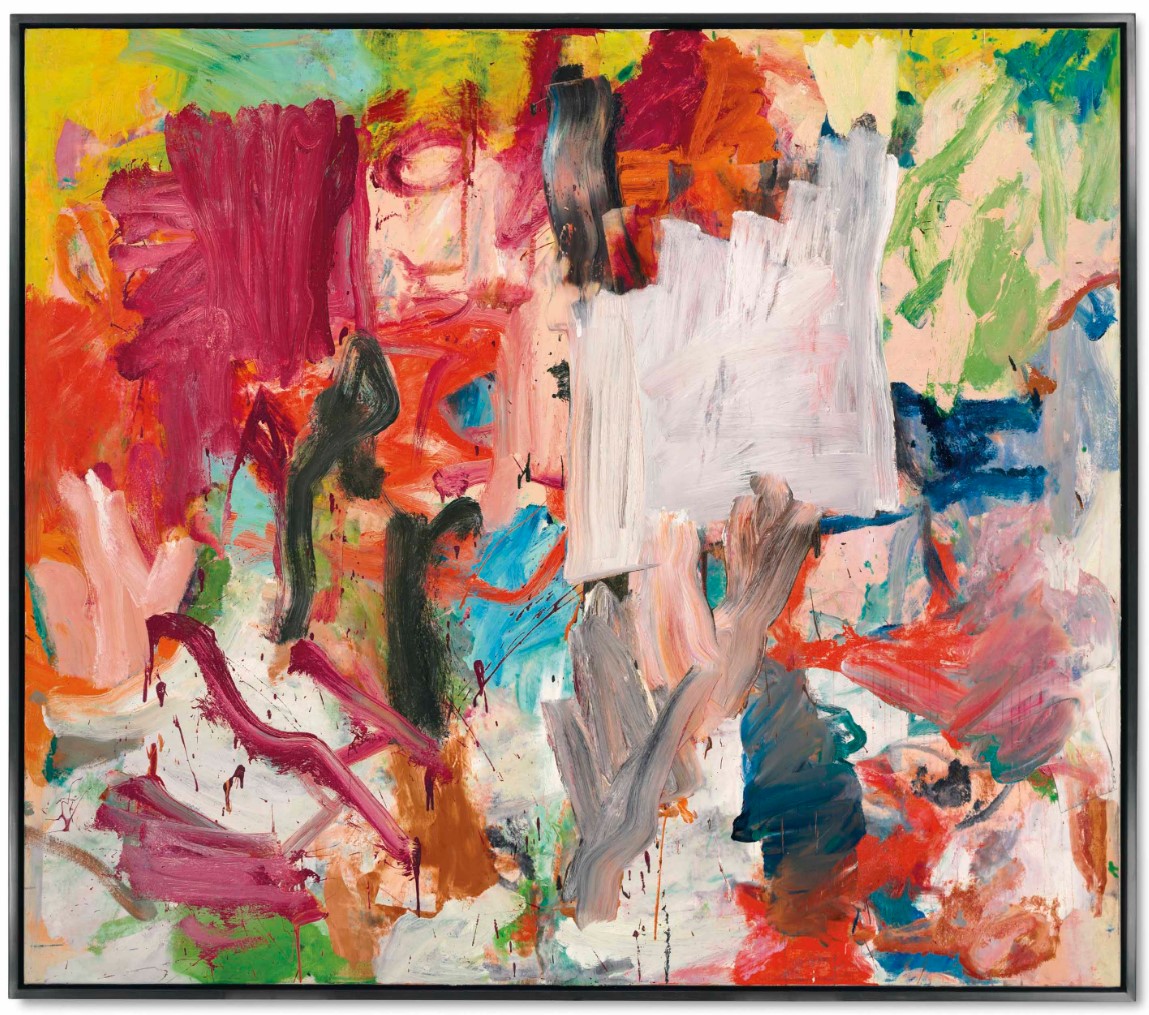
WILLEM DE KOONING (1904-1997)
Untitled XXV, 1977
Oil on canvas
77×88 inches (195.7 x 223.5 cm)
Signed ‘de Kooning’ (on the reverse)
#3. Untitled, circa 1979
Sotheby’s New-York: 16 November 2022
Estimated: USD 30,000,000 – 40,000,000
USD 34,794,500
Untitled | Contemporary Evening Auction | 2022 | Sotheby’s (sothebys.com)
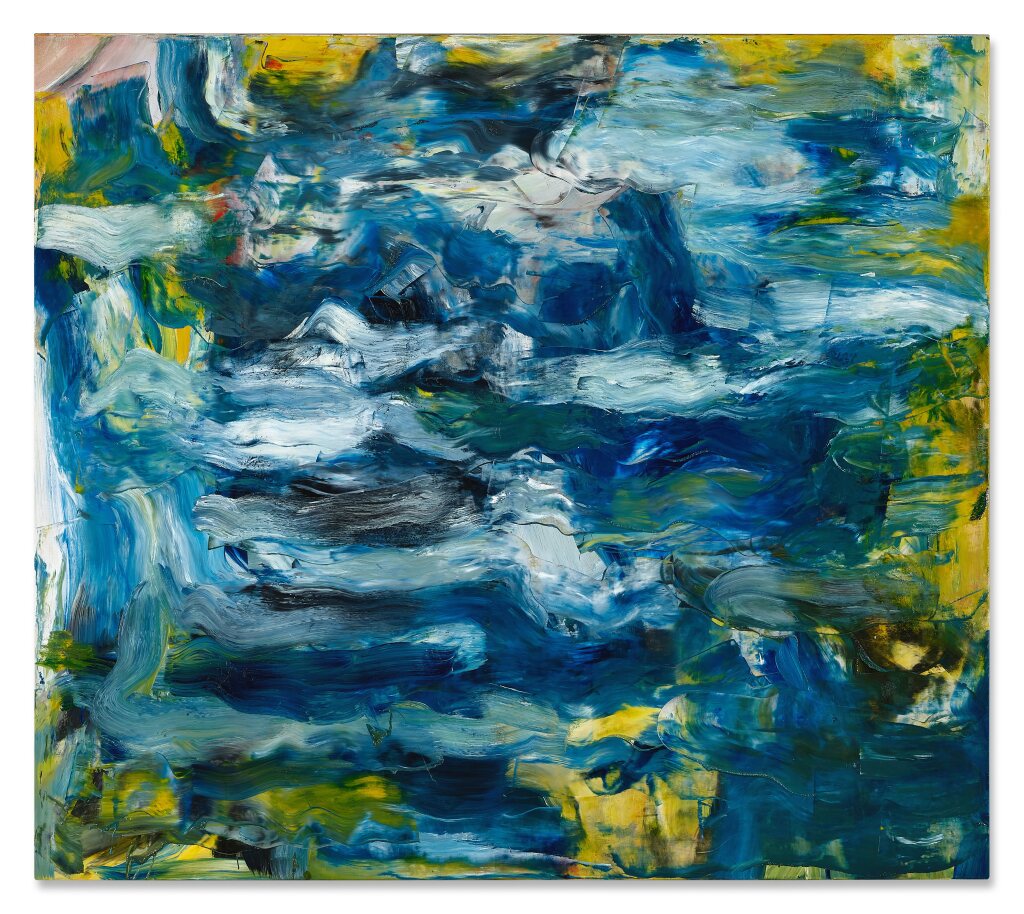
WILLEM DE KOONING (1904-1997)
Untitled, circa 1979
Oil on canvas
70 x 79 ½ inches (177.8 x 201.9 cm)
#4. Collage, 1950
Sotheby’s New-York: 14 November 2022
Estimated: USD 18,000,000 – 25,000,0000
USD 33,645,500
Collage | The David M. Solinger Collection Evening Auction | 2022 | Sotheby’s (sothebys.com)
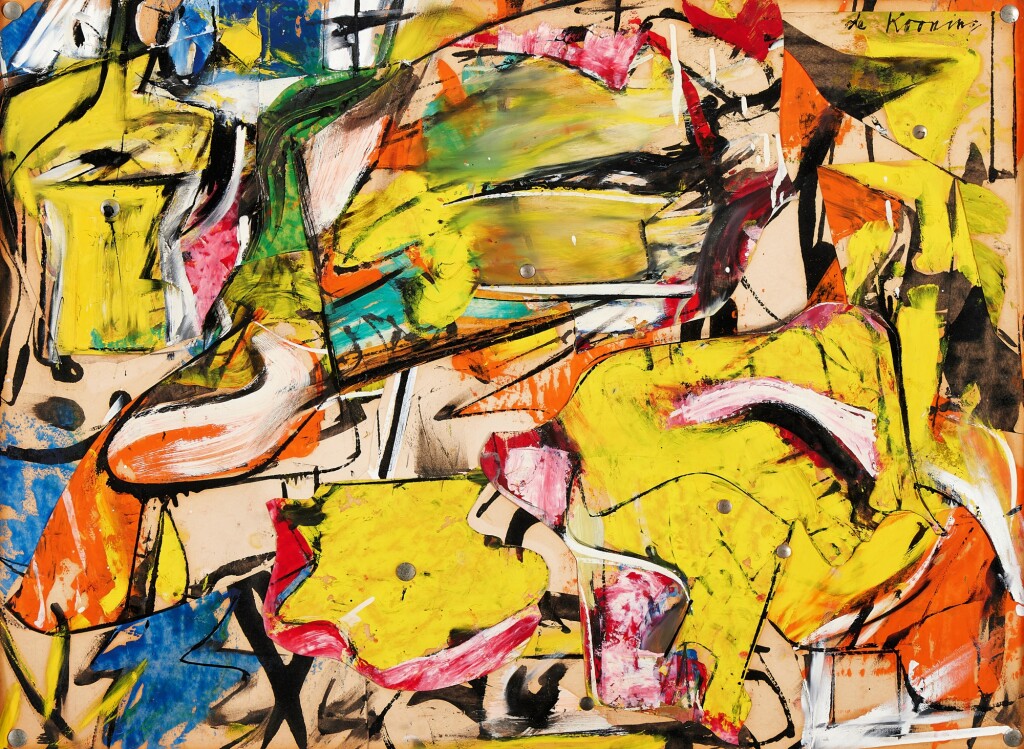
WILLEM DE KOONING (1904-1997)
Collage, 1950
Oil and lacquer with thumbtacks on paper
22×30 inches (55.9 x 76.2 cm)
#5. Untitled VIII, 1977
Christie’s New-York: 12 November 2013
Estimated: USD 20,000,000 – 30,000,0000
USD 32,085,000
Willem de Kooning (1904-1997), Untitled VIII | Christie’s (christies.com)
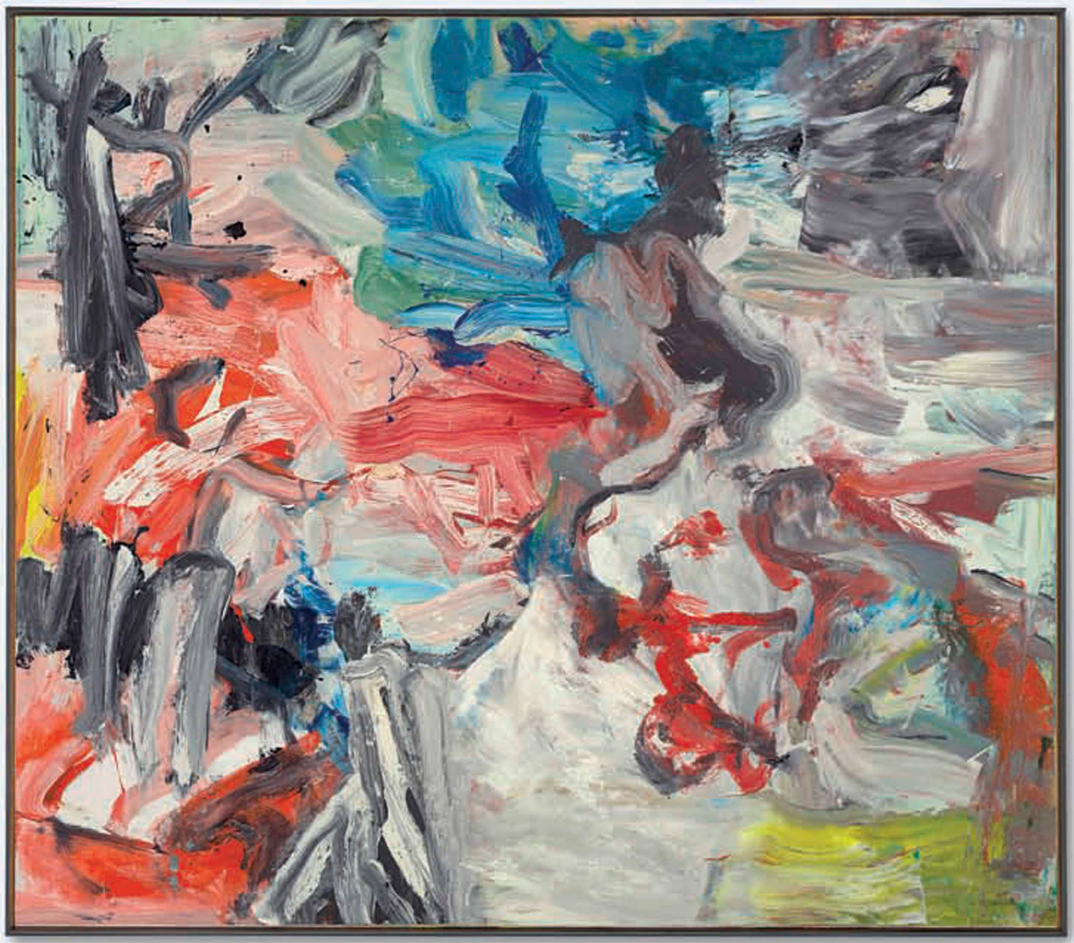
WILLEM DE KOONING (1904-1997)
Untitled VIII, 1977
Oil on canvas
70×80 inches (177.8 x 203.2 cm)
Signed ‘de Kooning’ (on the reverse)
#6. Orestes, 1947
Christie’s New-York: 11 May 2023
Estimate on Request
USD 30,885,000
WILLEM DE KOONING (1904-1997) (christies.com)
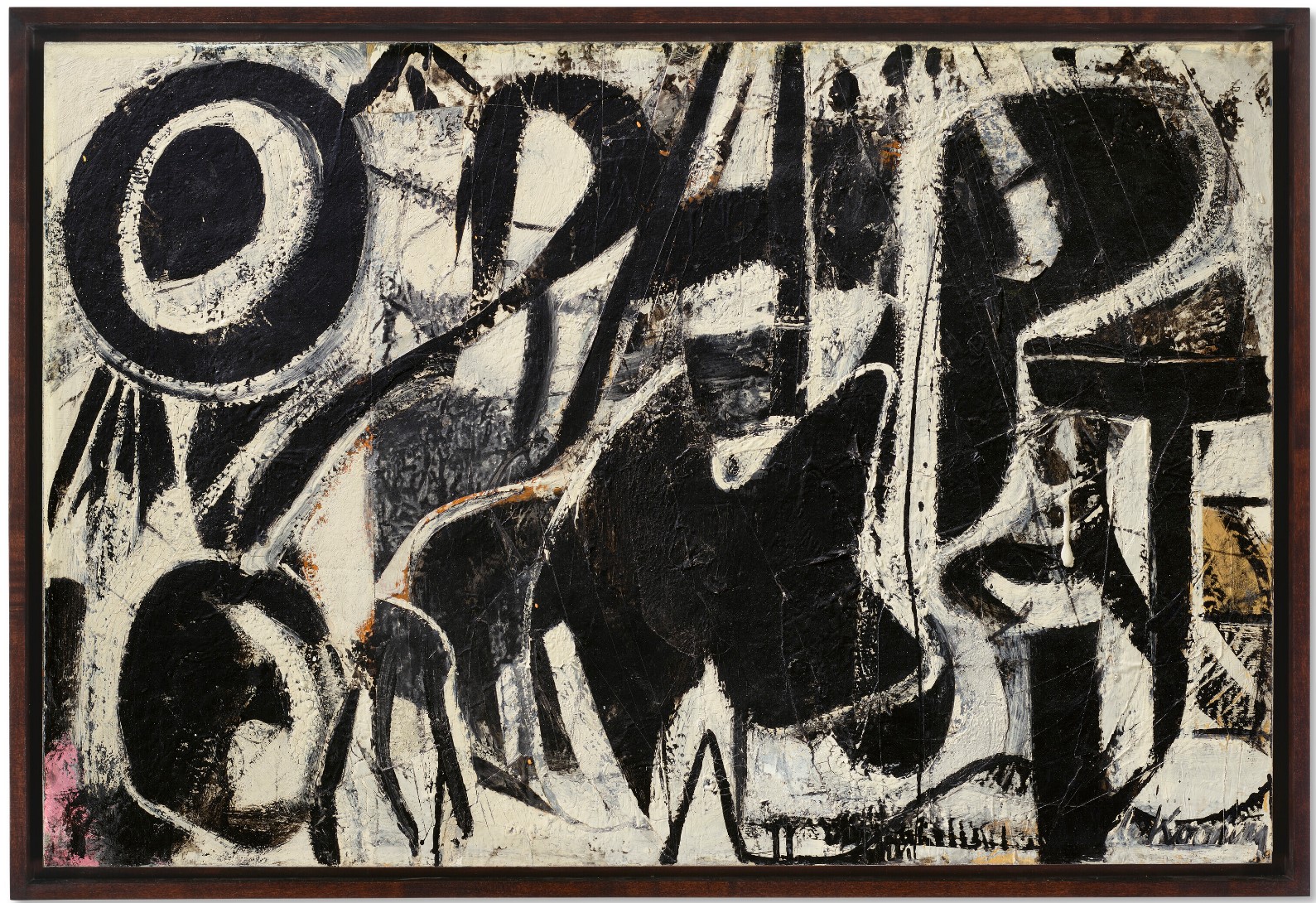
WILLEM DE KOONING (1904-1997)
Orestes, 1947
24 1/8 x 36 1/8 inches (61.3 x 91.8 cm)
Signed ‘de Kooning’ (lower right); signed again ‘de Kooning’ (on the reverse)
#7. Untitled XXII, 1977
Sotheby’s New-York: 14 November 2019
Estimated: USD 25,000,000 – 35,000,0000
USD 30,105,800
(#13) WILLEM DE KOONING | Untitled XXII (sothebys.com)
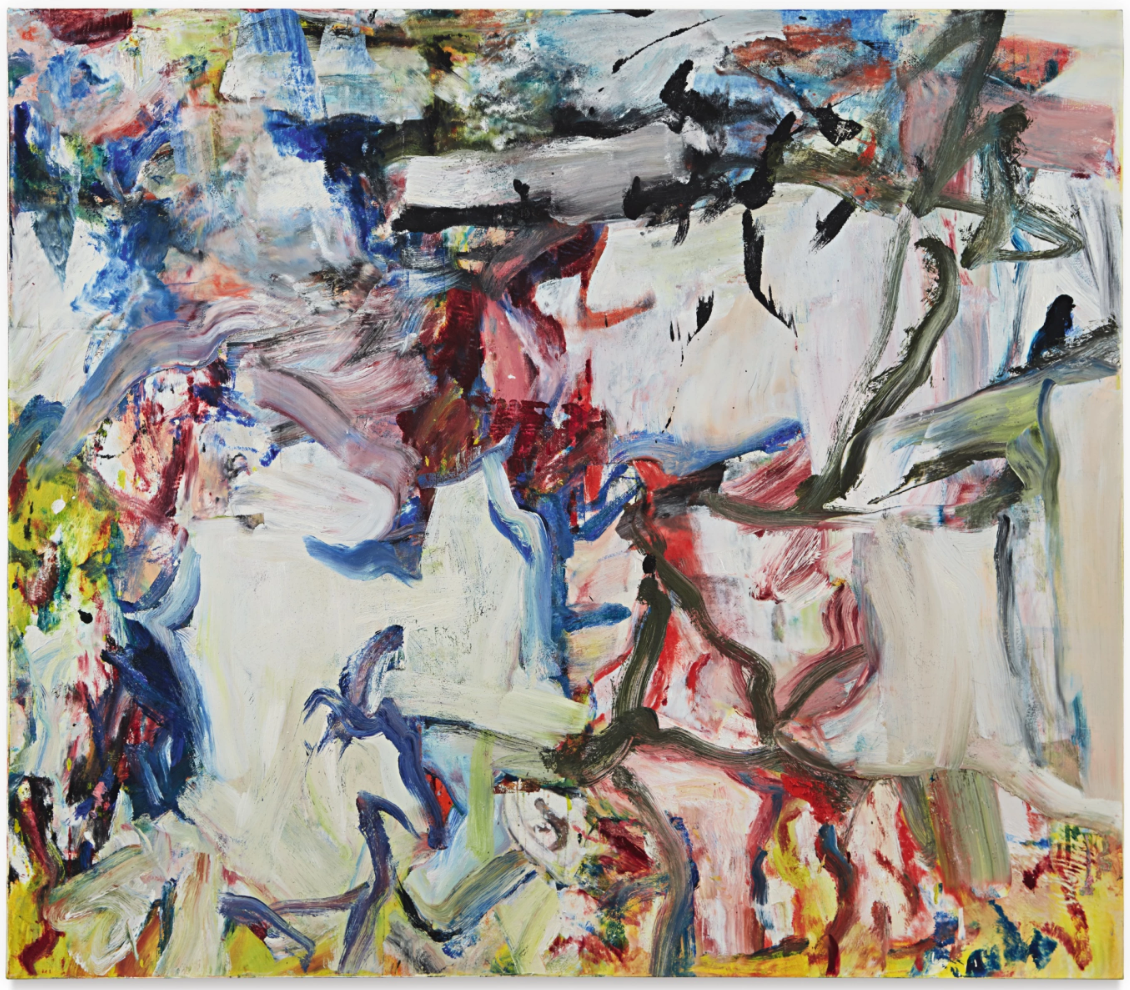
WILLEM DE KOONING
Untitled XXII, 1977
Oil on canvas
70×80 inches (177.8 x 203.2 cm)
Signed on the stretcher
#8. Clamdigger, 1972
Christie’s New-York: 12 November 2014
Estimated: USD 25,000,000 – 35,000,000
USD 29,285,000
Willem de Kooning (1904-1997), Clamdigger | Christie’s (christies.com)
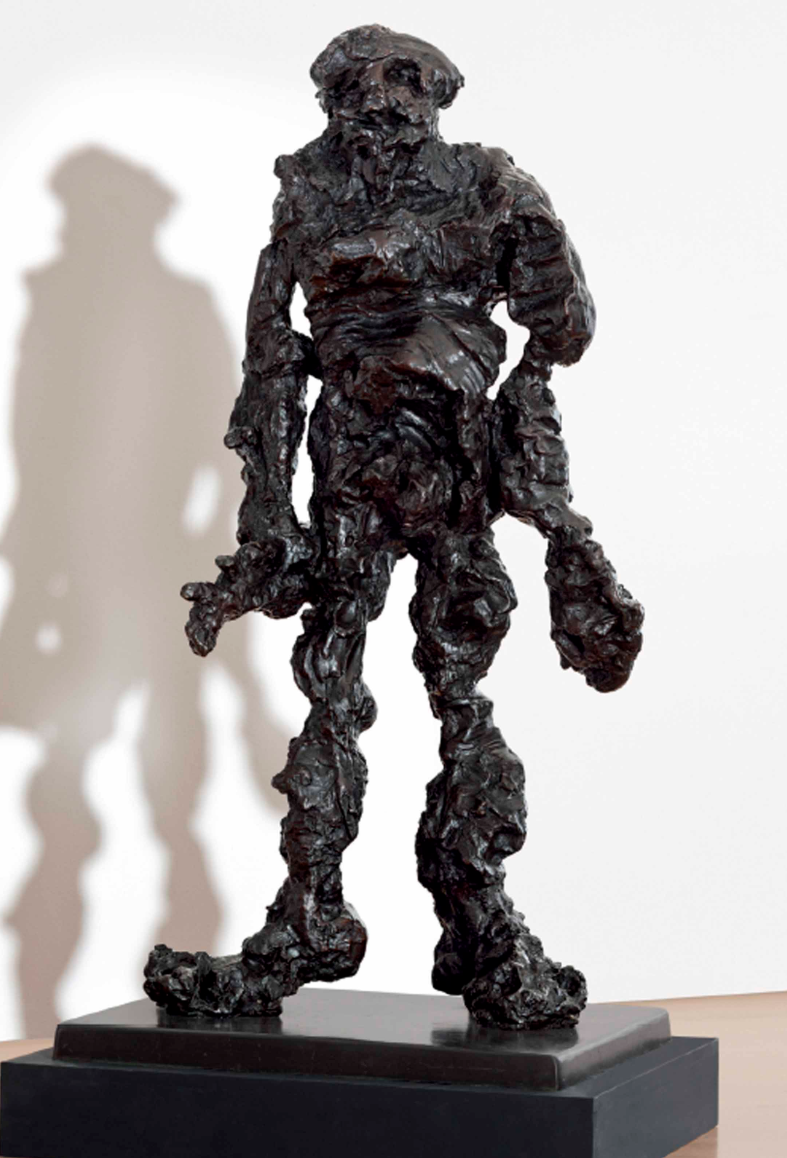
WILLEM DE KOONING (1904-1997)
Clamdigger, 1972
Bronze
59 1/2 x 29 5/8 x 23 3/4 inches (151.1 x 75.2 x 60.3 cm)
Incised with signature ‘de Kooning’ and stamped with number ‘AP’ (on the right foot)
Incised with date and initials ‘1972 D.C’ (lower center)
This work is artist’s proof number one from an edition of seven plus three artist’s proofs
PART II: AUCTION RESULTS
2026 Upcoming Lots
2026 Auction Results
FOR PAINTINGS & SCULPTURES ONLY
PRELIMINARY AUCTION RESULTS
As of 15 June 2026
#1. Untitled III, 1975
Property from an Important Private Collection
Sotheby’s New-York: 14 May 2026
Estimated: USD 25,000,000 – 35,000,000
USD 26,000,000
Willem de Kooning | Untitled III | The Now & Contemporary Evening
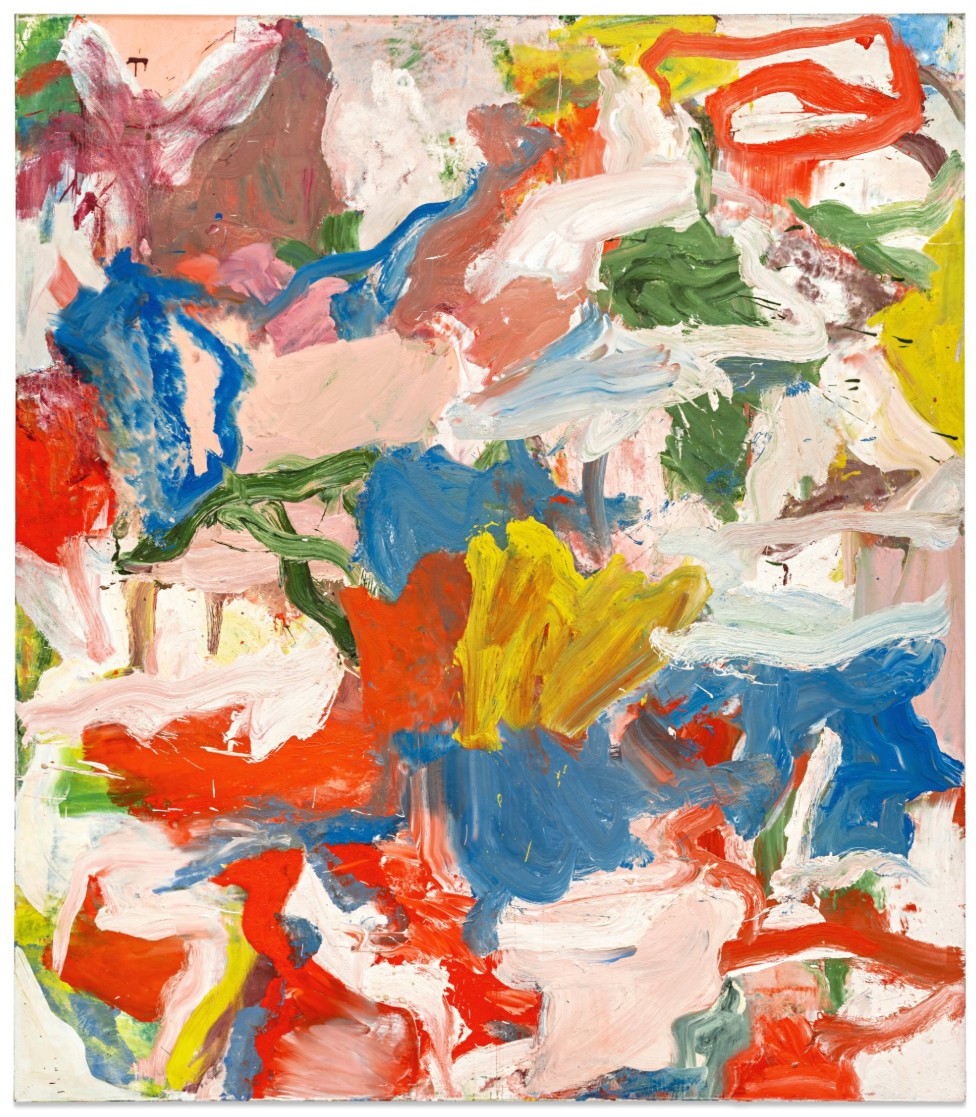
WILLEM DE KOONING (1904 – 1997)
Untitled III, 1975
Oil on canvas
87-3/4 x 76-1/2 inches (222.9 x 194.3 cm)
#2. Untitled XLII, 1983
Robert Mnuchin: Collector at Heart
Sotheby’s New-York: 14 May 2026
Estimated: USD 9,000,000 – 12,000,000
USD 12,410,000
Willem de Kooning | Untitled XLII | Robert Mnuchin: Collector at
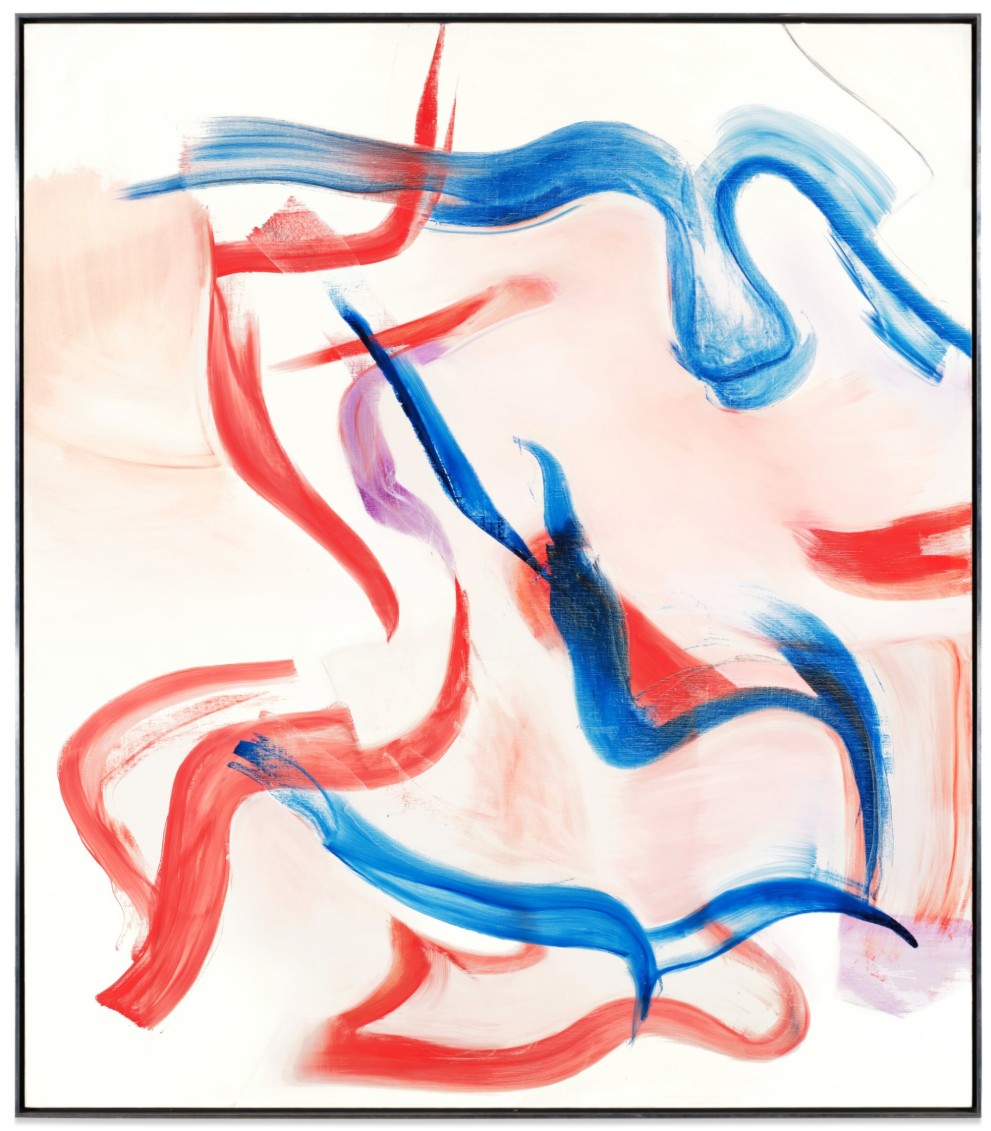
WILLEM DE KOONING (1904 – 1997)
Untitled XLII, 1983
Oil on canvas
80×70 inches (203.2 x 177.8 cm)
#3. Untitled I, 1980
The Arc of Abstraction: Masterpieces from a Private European Collection
Christie’s New-York: 18 May 2026
Estimated: USD 9,000,000 – 12,000,000
USD 12,250,000
WILLEM DE KOONING (1904-1997), Untitled I | Christie’s
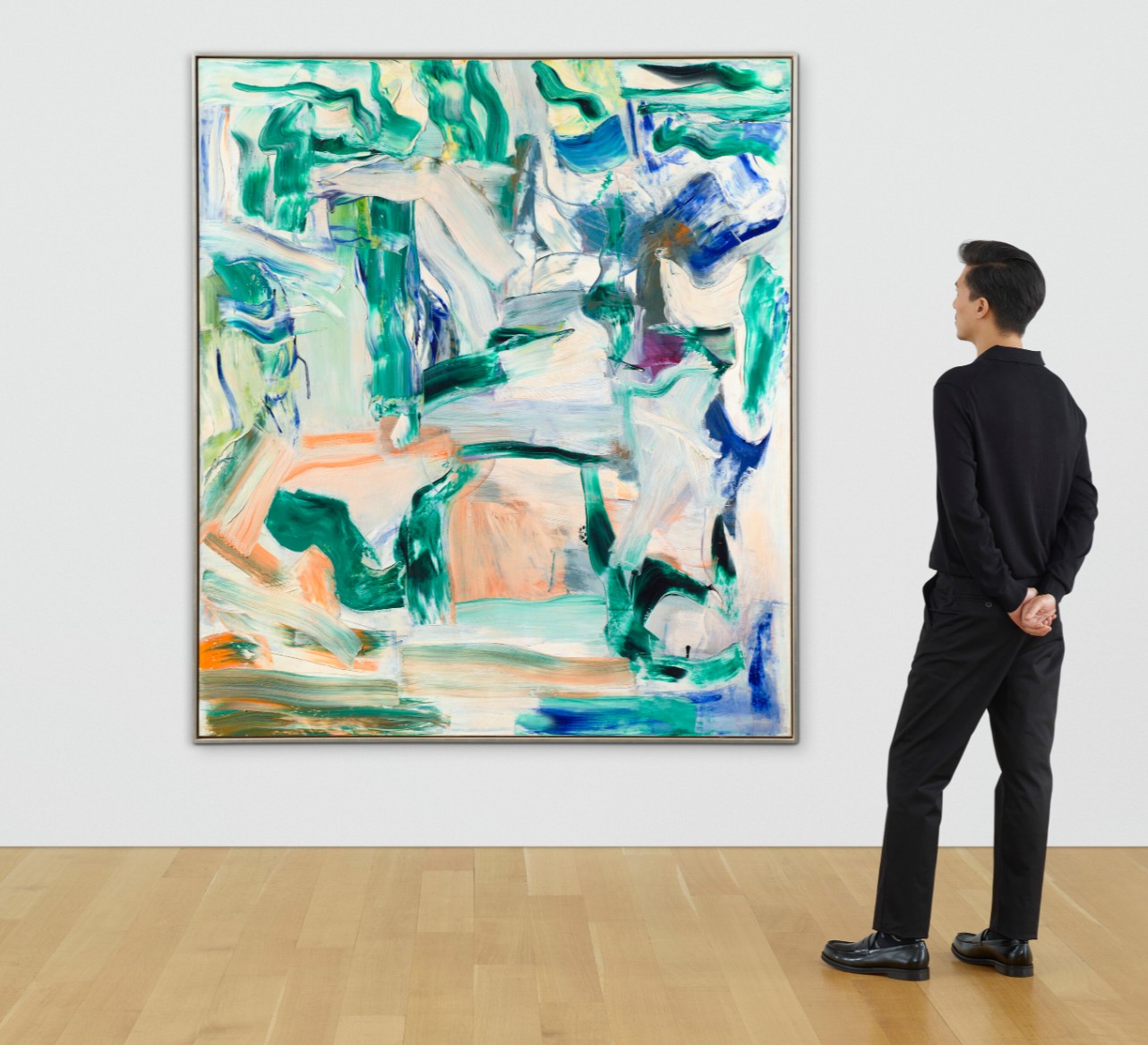
WILLEM DE KOONING (1904-1997)
Untitled I, 1980
Oil on canvas
80×70 inches (203.2 x 177.8 cm)
Signed ‘de Kooning’ (on the reverse)
#4. Untitled, 1970
Robert Mnuchin: Collector at Heart
Sotheby’s New-York: 14 May 2026
Estimated: USD 4,000,000 – 6,000,000
USD 10,800,000
Willem de Kooning | Untitled | Robert Mnuchin: Collector at Heart
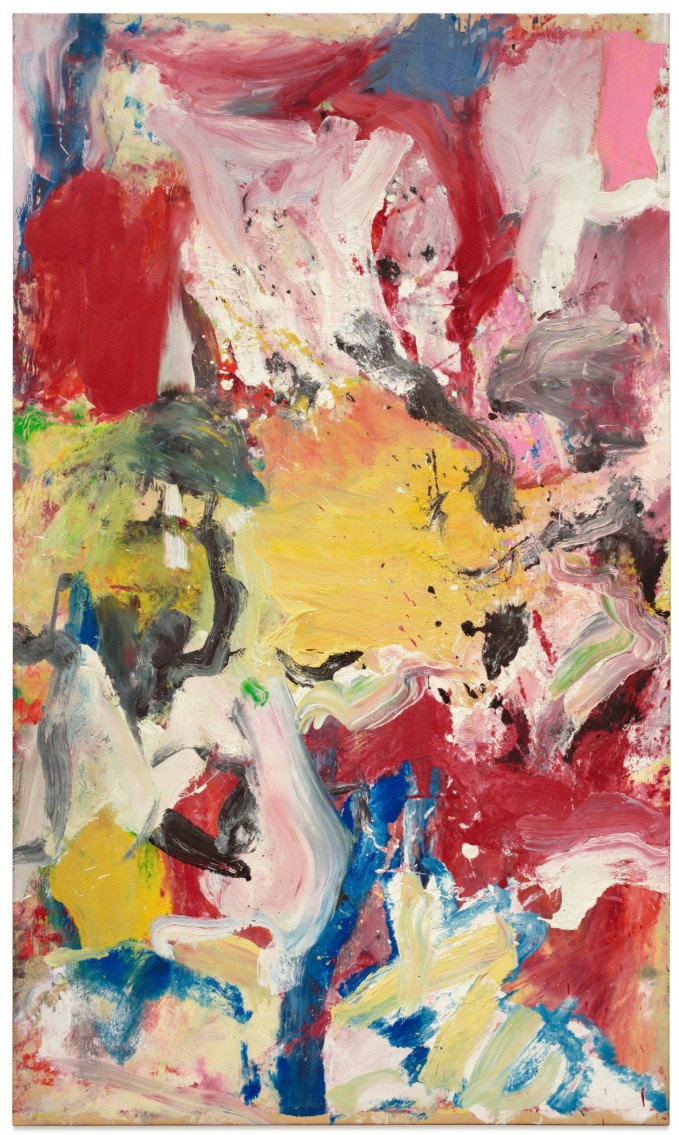
WILLEM DE KOONING (1904 – 1997)
Untitled, 1970
Oil on paper mounted on canvas
72 x 42-1/2 inches (182.9 x 108 cm)
USD 10 million
#5. Untitled XVI, 1983
Christie’s New-York: 18 May 2026
Estimated: USD 6,000,000 – 8,000,000
USD 7,395,000
WILLEM DE KOONING (1904-1997), Untitled XVI | Christie’s
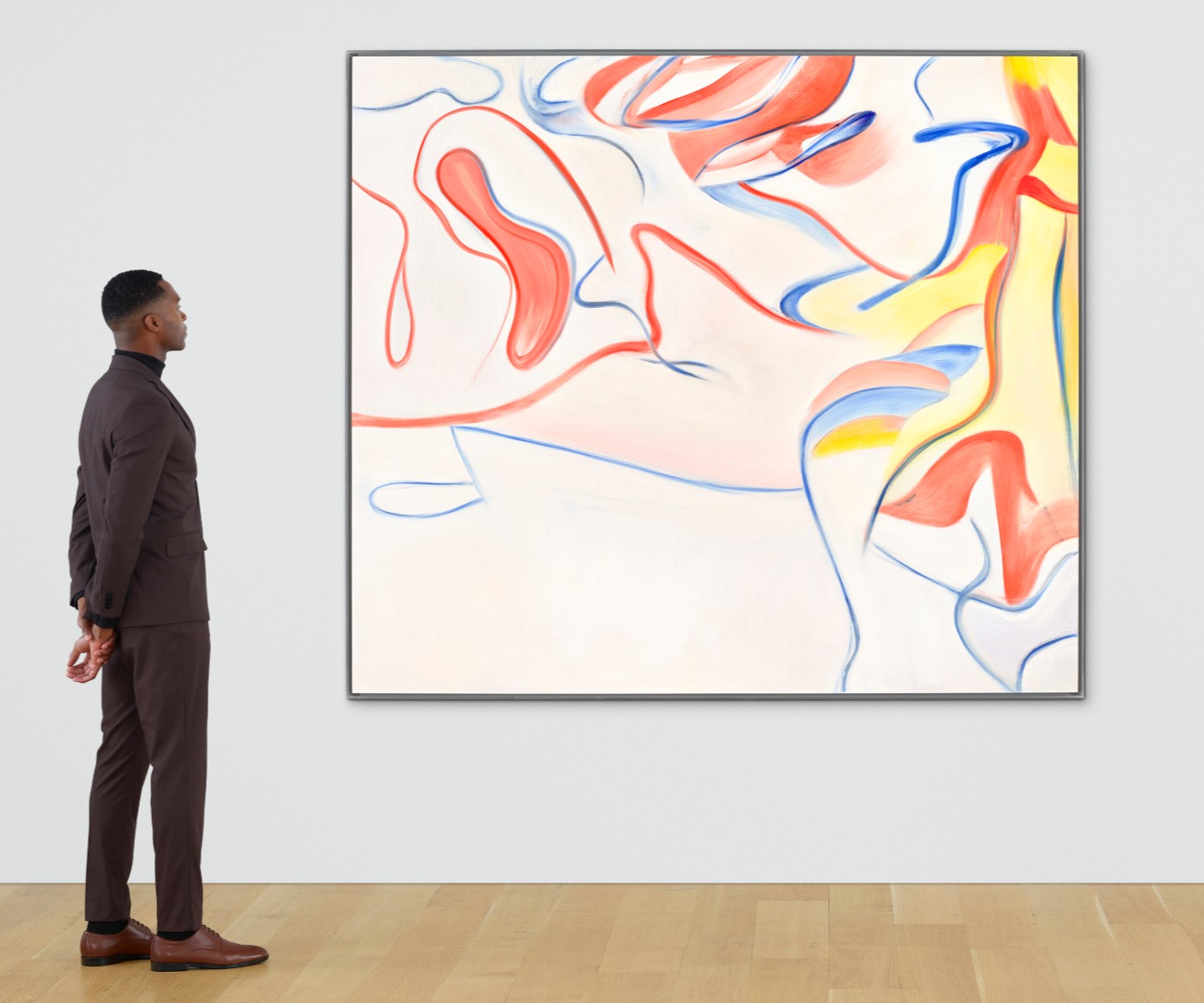
WILLEM DE KOONING (1904-1997)
Untitled XVI, 1983
Oil on canvas
77×88 inches (195.6 x 223.5 cm)
#6. Two Women, 1964
Robert Mnuchin: Collector at Heart
Sotheby’s New-York: 14 May 2026
Estimated: USD 3,000,000 – 4,000,000
USD 4,024,000
Willem de Kooning | Two Women | Robert Mnuchin: Collector at Heart
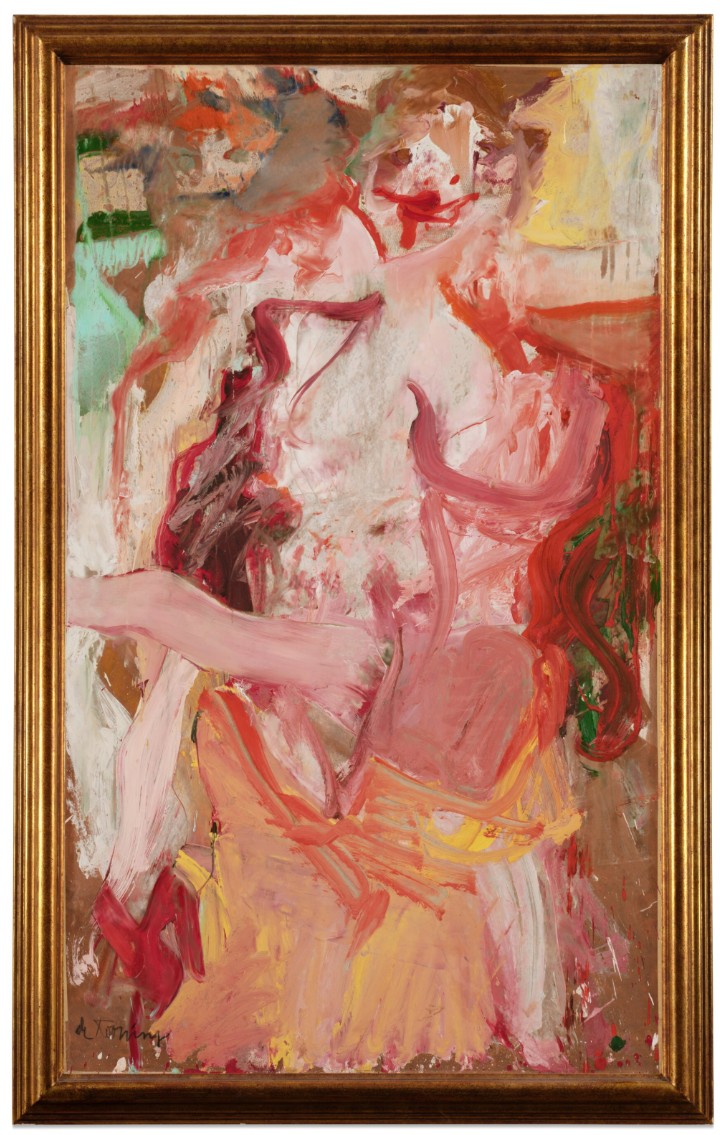
WILLEM DE KOONING (1904 – 1997)
Two Women, 1964
Oil on paper mounted on canvas
60-1/2 x 37 inches (153.7 x 94 cm)
Signed (lower left)
2025 Auction Results
FOR PAINTINGS & SCULPTURES ONLY
6 lots sold at auction so far in 2025 for a total turnover of USD 13,510,800. With 2 lots failing to sell, the sell-through rate is 75%.
#1. Woman and Child, circa 1967-1968
Leonard & Louise Riggio: Collected Works
Christie’s New-York: 12 May 2025
Estimated: USD 4,000,000 – 6,000,000
USD 7,128,500
READ MORE IN FOCUS SECTION
WILLEM DE KOONING (1904-1997), Woman and Child | Christie’s
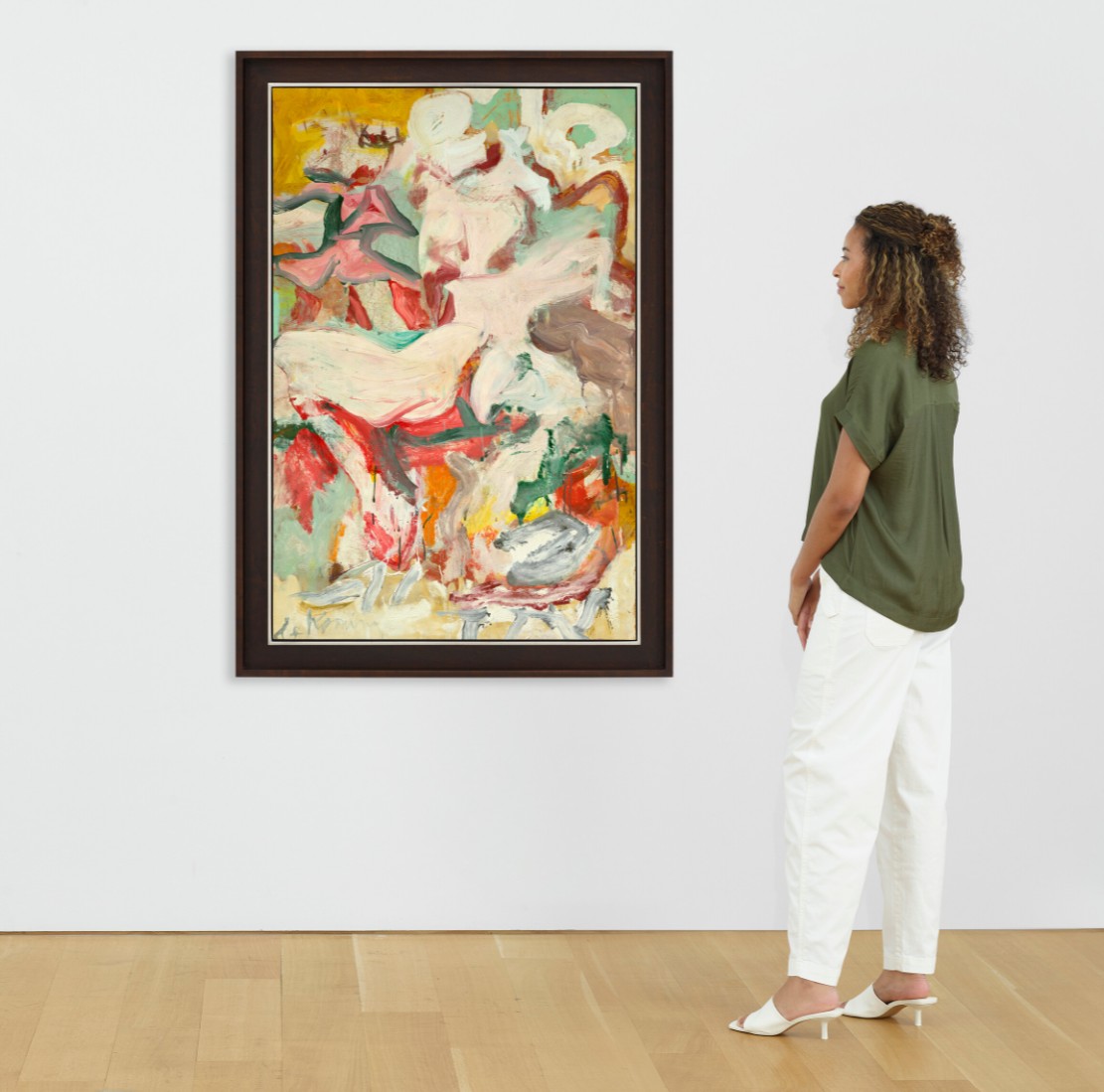
WILLEM DE KOONING (1904-1997)
Woman and Child, circa 1967-1968
Oil on paper mounted on canvas
55×36 inches (139.7 x 91.4 cm)
Signed ‘de Kooning‘ (lower left)
Dedicated ‘to Emilie with Love’ (on the reverse)
#2. Two Figures in Dunes, 1968
Sotheby’s New-York: 13 May 2025
Estimated: USD 1,500,000 – 2,000,000
USD 3,222,000
READ MORE IN FOCUS SECTION
Two Figures in Dunes | Modern Evening Auction | 2025 | Sotheby’s
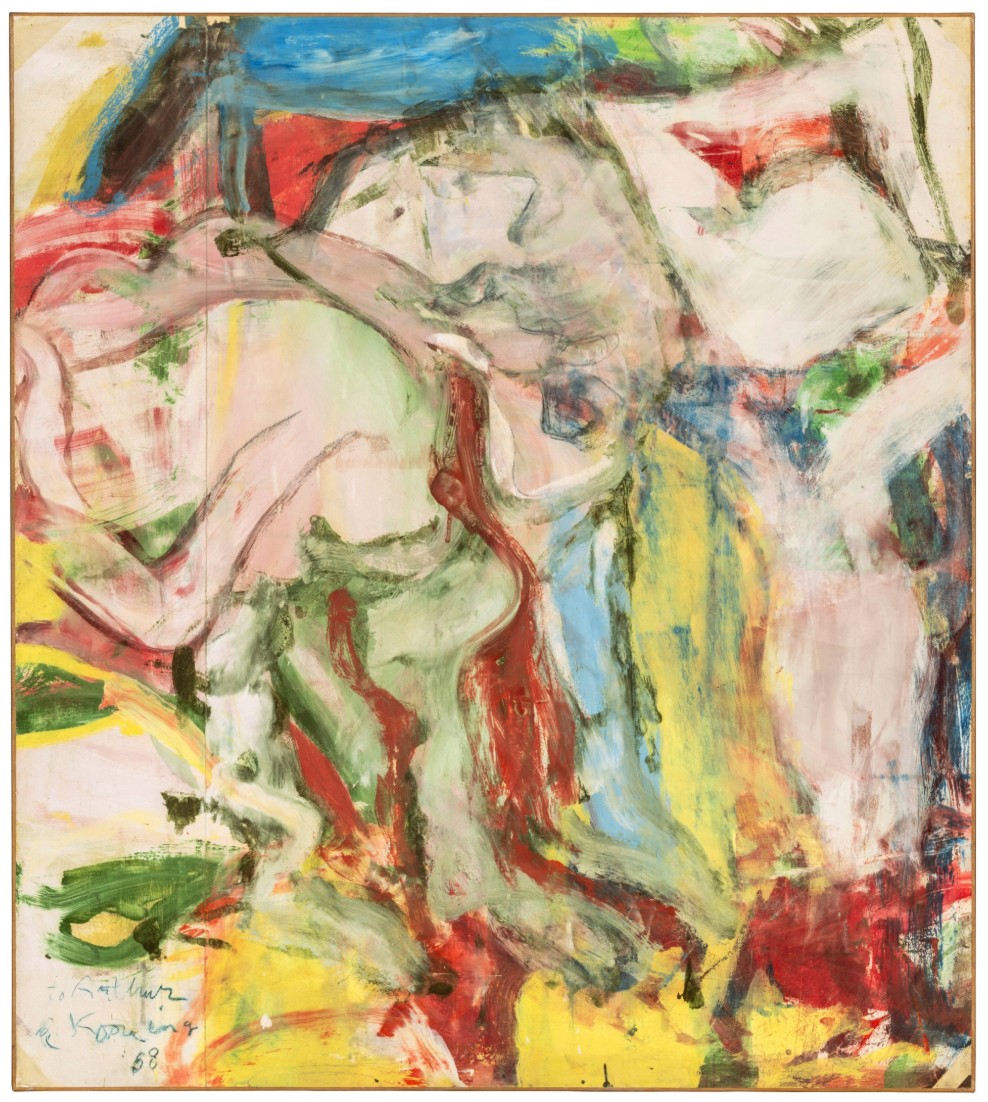
WILLEM DE KOONING (1904 – 1997)
Two Figures in Dunes, 1968
Oil on paper mounted on canvas
41 3/8 x 37 inches (105.1 x 94 cm)
Signed de Kooning, dated 68 and inscribed to Arthur (lower left)
#3. Paging Woman, 1964
Sotheby’s New-York: 16 May 2025
Estimated: USD 500,000 – 700,000
USD 1,143,000
READ MORE IN FOCUS SECTION
Paging Women | Contemporary Day Auction | 2025 | Sotheby’s
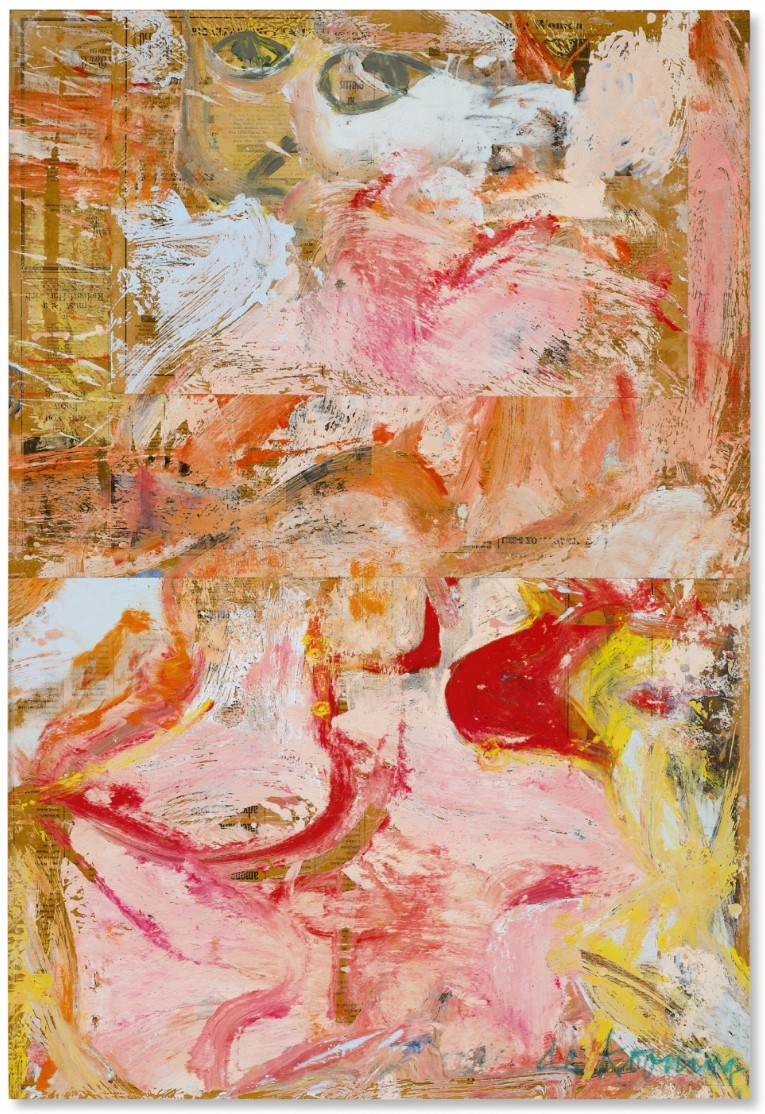
WILLEM DE KOONING (1904 – 1997)
Paging Woman, 1964
Oil on newsprint mounted on board
43 7/8 x 29 7/8 inches (111.4 x 75.9 cm)
Signed (lower right)
#4. East Hampton VII, 1968
Bonhams New-York: 14 May 2025
Estimated: USD 400,000 – 600,000
USD 1,080,000
Bonhams : WILLEM DE KOONING (1904-1997) East Hampton VII
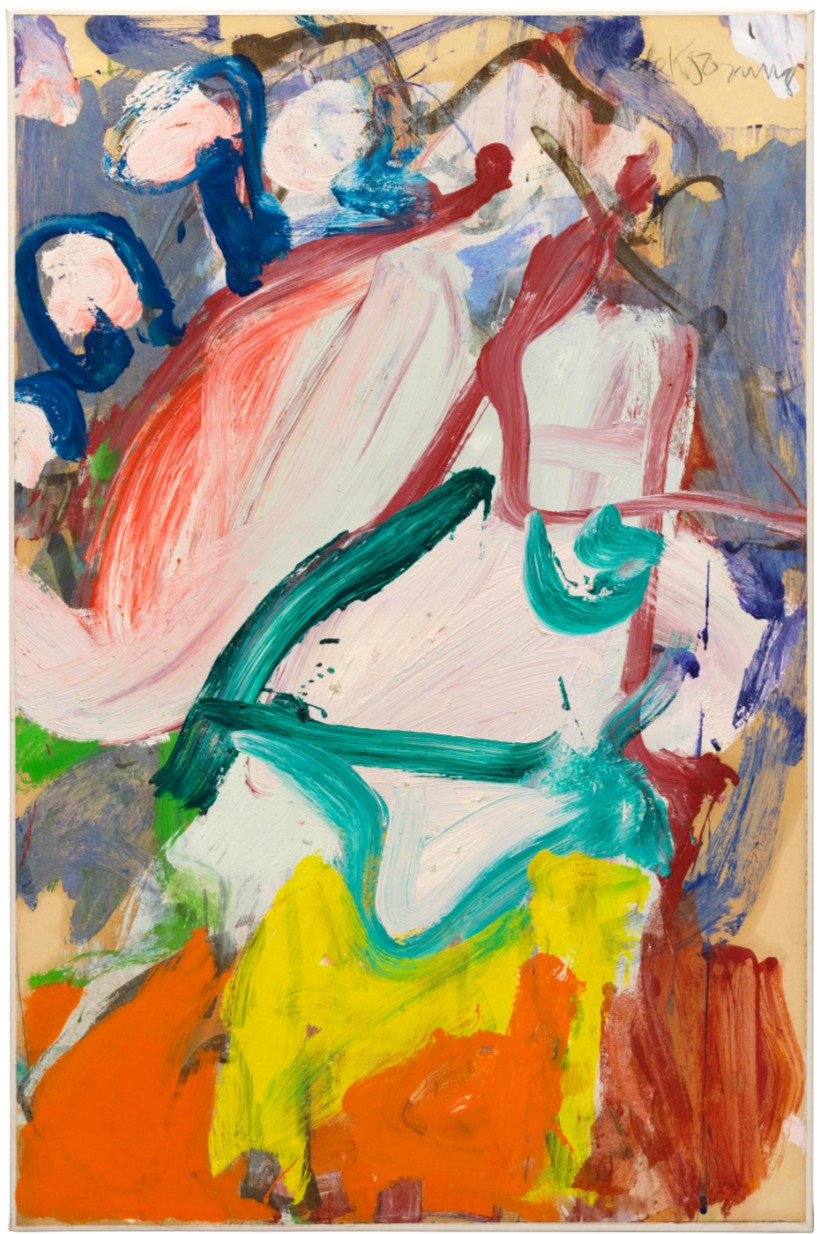
Oil on paper laid on canvas
40 1/4 x 26 1/2 inches (102.2 x 67.3 cm)
Signed ‘de Kooning’ (upper right)
#5. Figure, 1965-66
Bonhams New-York: 14 May 2025
Estimated: USD 500,000 – 700,000
USD 559,300
Bonhams : WILLEM DE KOONING (1904-1997) Figure
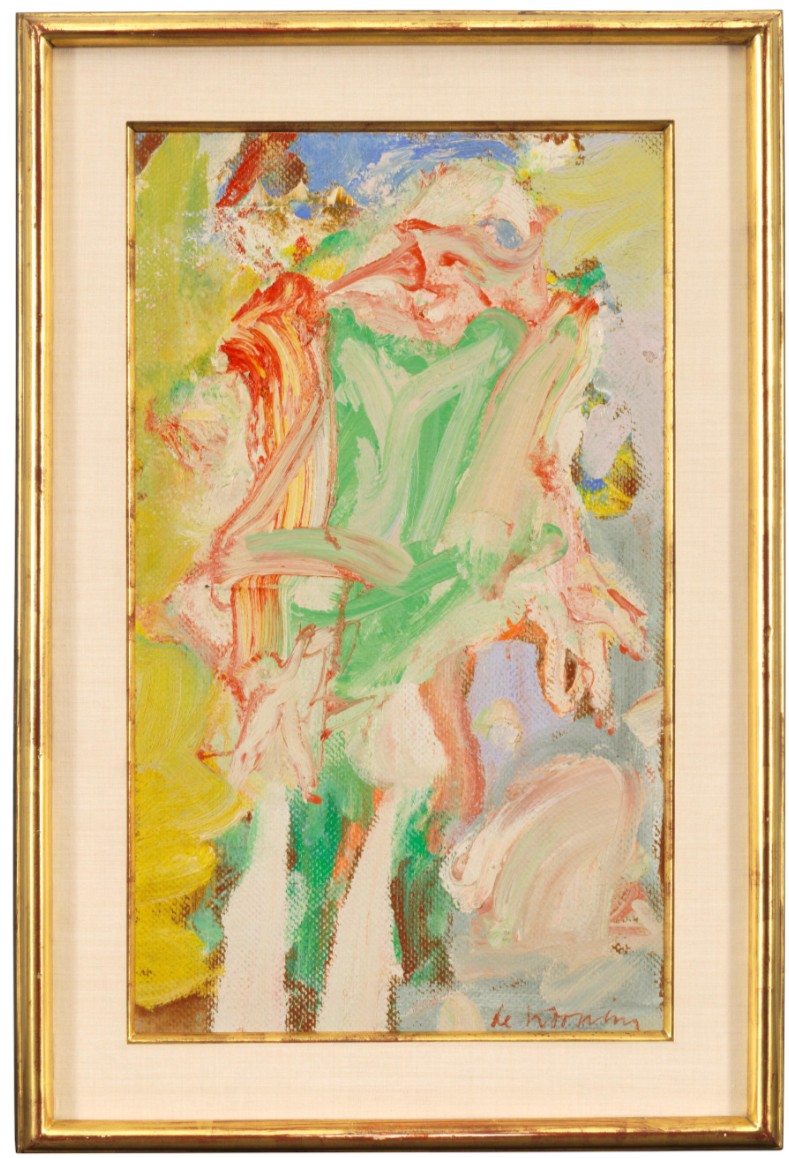
Oil on paper towel laid on Masonite
19 1/4 x 11 1/2 inches (49.1 x 29.2 cm)
Signed ‘de Kooning’ (lower right)
#6. Untitled, circa 1970-1972
Estimated: USD 300,000 – 400,000
USD 378,000
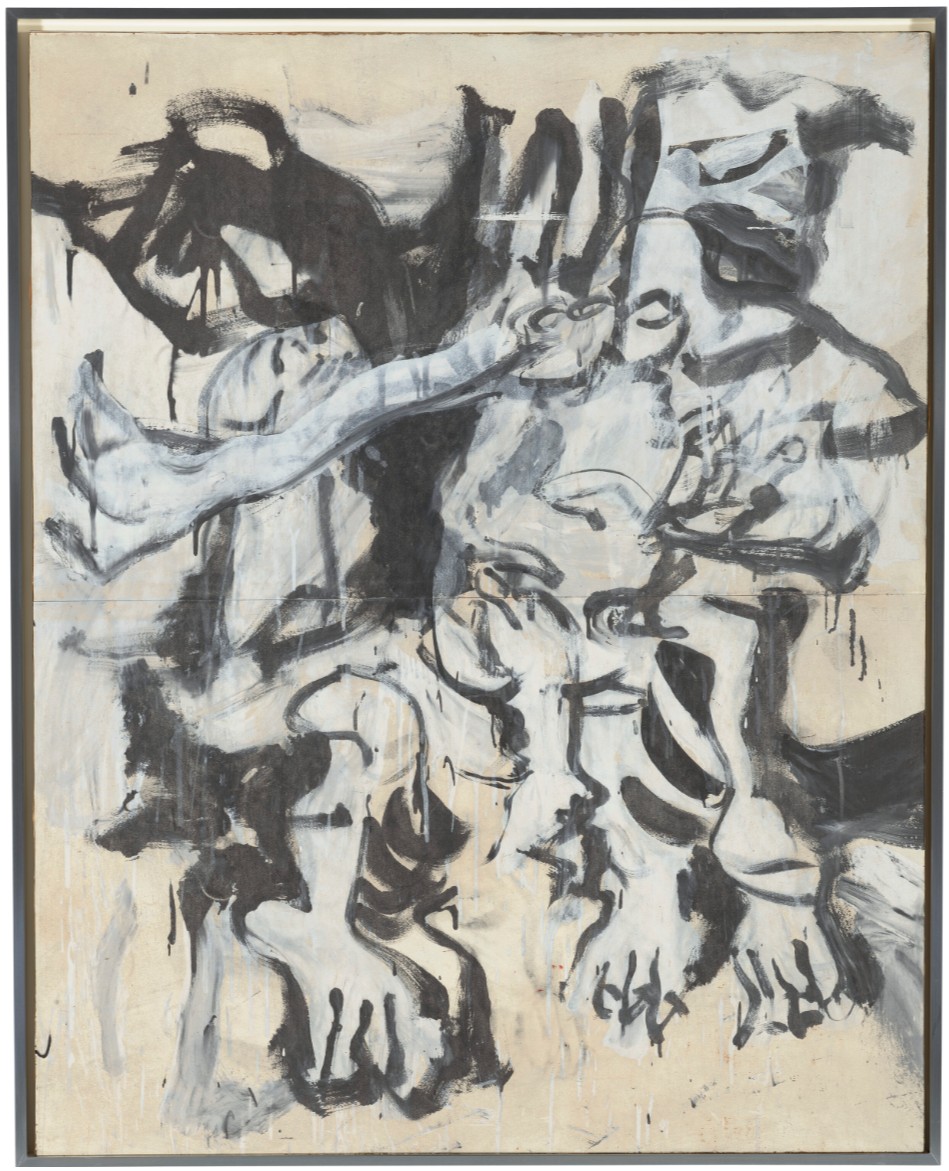
WILLEM DE KOONING (1904-1997)
Untitled, circa 1970-1972
Oil on two joined sheets of paper mounted on canvas
48 1/2 x 38 5/8 inches (123.2 x 97.8 cm)
2024 Auction Results
FOR PAINTINGS & SCULPTURES ONLY
16 lots sold in 2024 for a total turnover of USD 53,589,260. With 3 lots failing to sell, the sell-through rate is 84%. The highest price has been achieved by Untitled, a painting dated 1982, that sold at Christie’s in New-York on 19 November 2024, for USD 13,290,000.
2024 Top 3 Lots
2 lots sold for more than USD 10 million, generating a cumulative turnover of USD 24,230,000, representing 45.2% of the total turnover for 2024. 9 lots sold for more than USD 1 million, generating a cumulative turnover of USD 50,112,085, representing 93.5% of the total turnover for 2024.
XXXXXXXXXX
#1. Untitled, 1982
Christie’s New-York: 19 November 2024
Estimated: USD 8,000,000 – 12,000,000
USD 13,290,000
WILLEM DE KOONING (1904-1997), Untitled | Christie’s
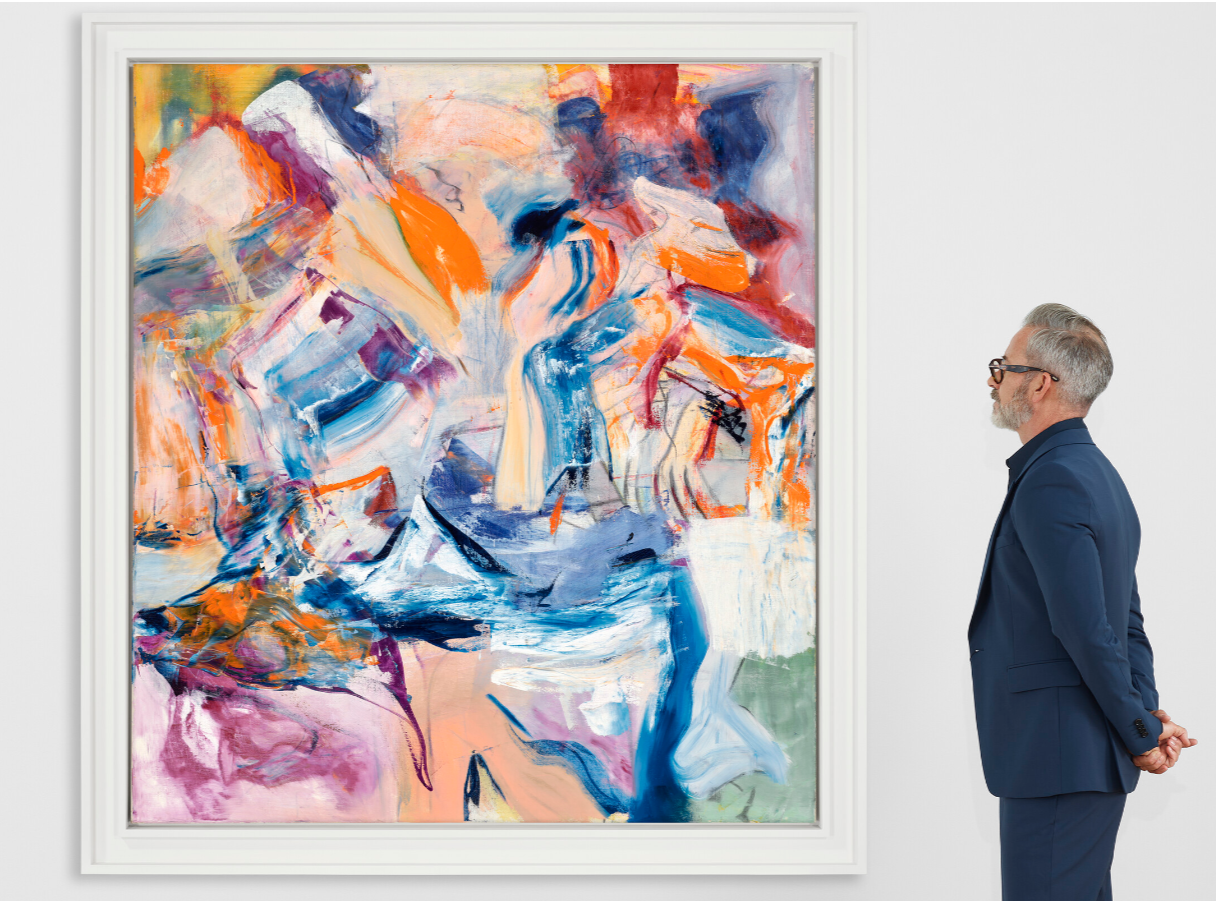
WILLEM DE KOONING (1904-1997)
Untitled, 1982
Oil on canvas
60×54 inches (152.4 x 137.2 cm)
#2. Untitled XXV, 1982
Sotheby’s New-York: 20 November 2024
Estimated: USD 9,000,000 – 12,000,000
USD 10,940,000
Untitled XXV | The Now and Contemporary Evening Auction | 2024 | Sotheby’s
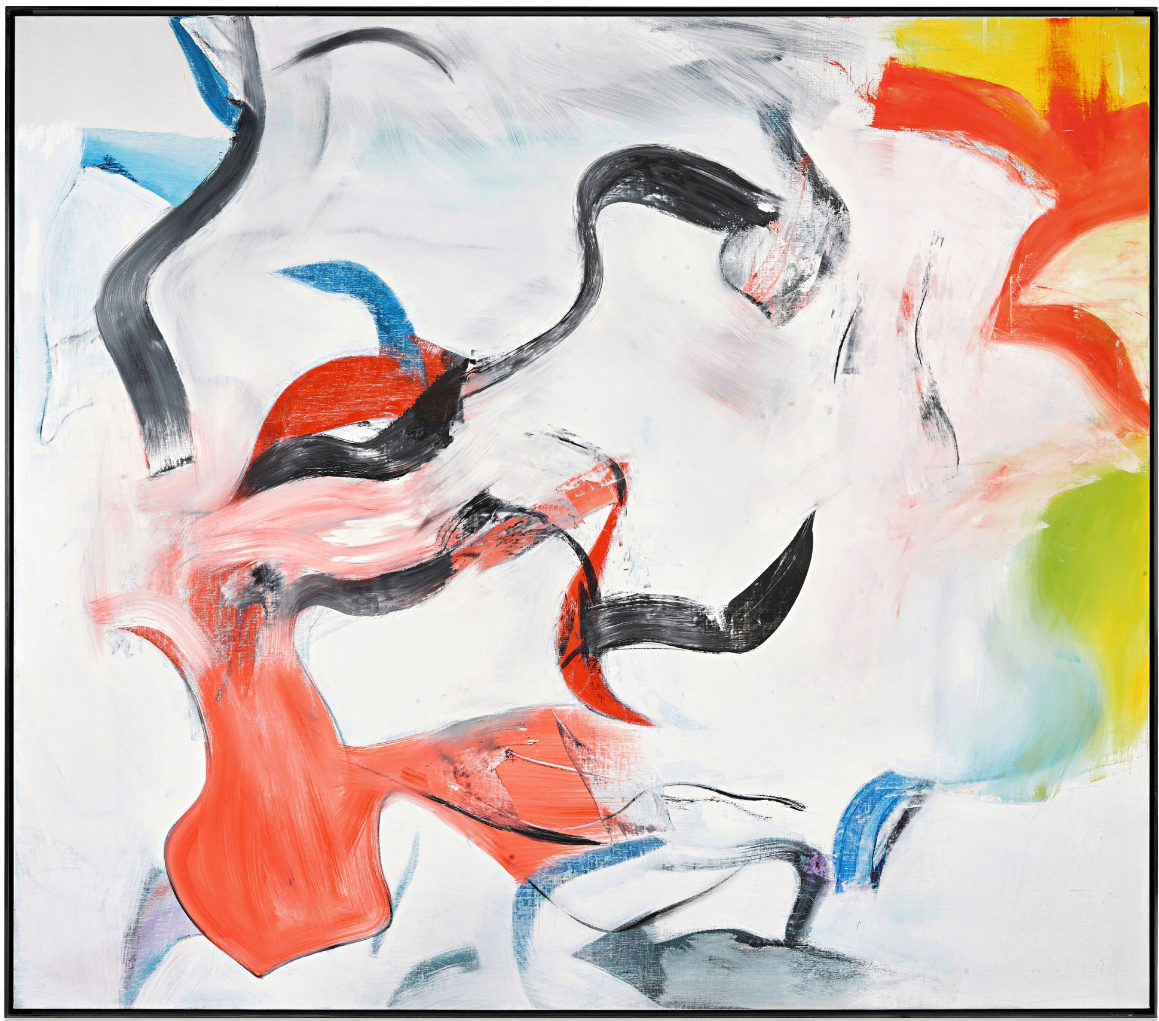
WILLEM DE KOONING (1904 – 1997)
Untitled XXV, 1982
Oil on canvas
70×80 inches (177.8 x 203.2 cm)
USD 10 million
#3. Man in Wainscott, 1969
Christie’s New-York: 16 May 2024
Estimated: USD 4,000,000 – 6,000,000
USD 8,690,000
https://www.christies.com/en/lot/lot-6482951
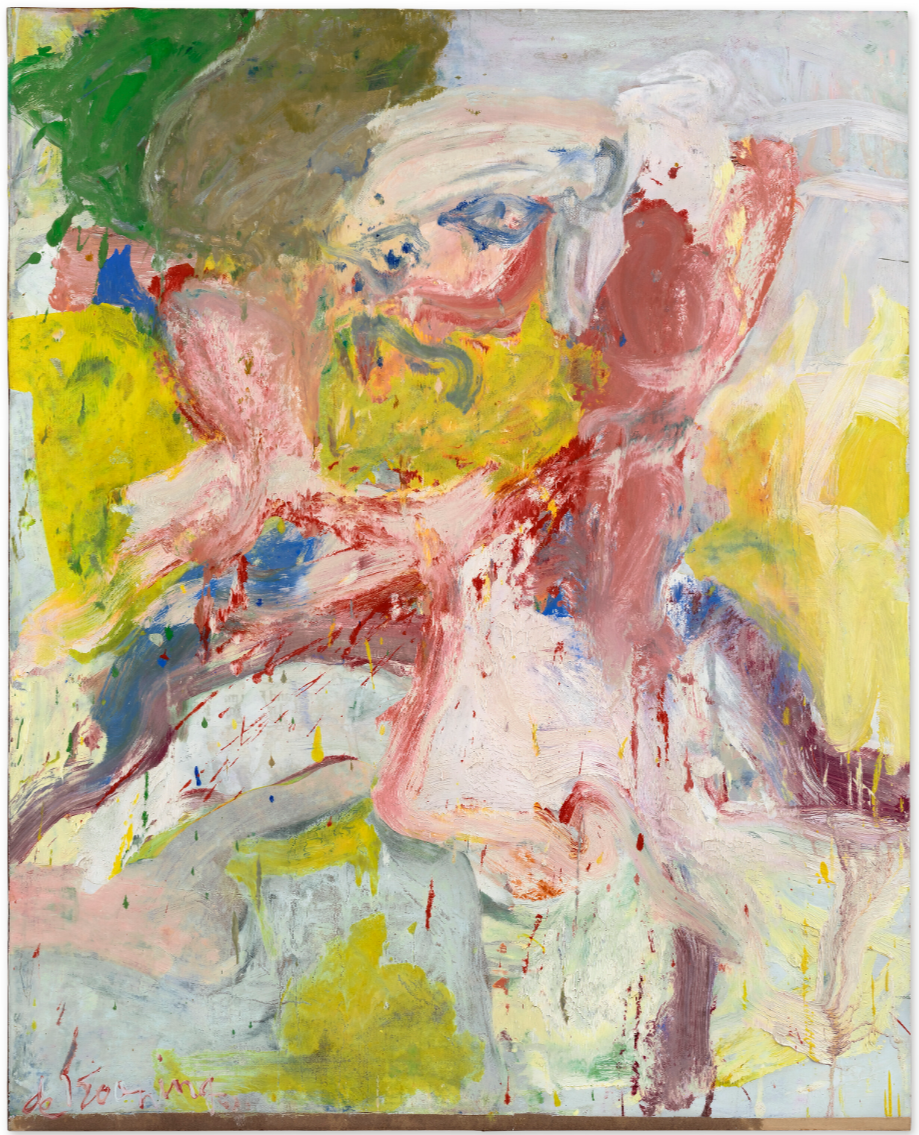
WILLEM DE KOONING (1904-1997)
Man in Wainscott, 1969
Oil on paper and newsprint collage mounted on canvas
60 x 48 1/4 inches (152.4 x 122.6 cm)
Signed ‘de Kooning’ (lower left)
USD 5 million
#4. Untitled XVIII, 1986
Christie’s London: 9 October 2024
Estimated: GBP 4,000,000 – 6,000,000
GBP 3,488,500 / USD 4,569,935
WILLEM DE KOONING (1904-1997), Untitled XVIII | Christie’s (christies.com)
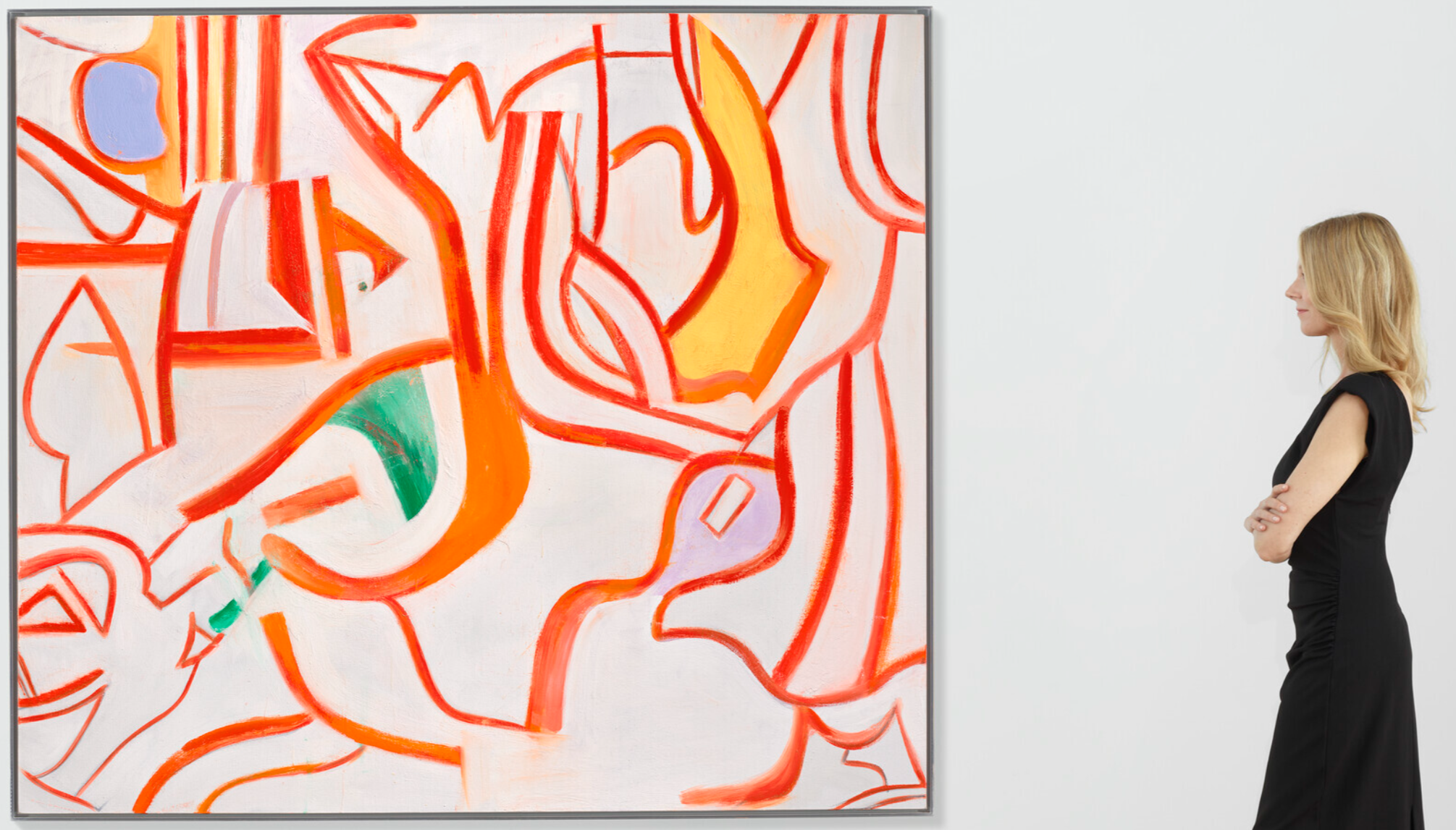
WILLEM DE KOONING (1904-1997)
Untitled XVIII, 1986
Oil on canvas
70 1/8 x 80 1/4 inches (178 x 203.7 cm)
Signed ‘de Kooning’ (on the stretcher)
#5. Untitled, 1987
Sotheby’s London: 9 October 2024
Estimated: GBP 3,000,000 – 4,000,000
GBP 3,165,000 / USD 4,146,150
Untitled | Contemporary Evening Auction | 2024 | Sotheby’s (sothebys.com)
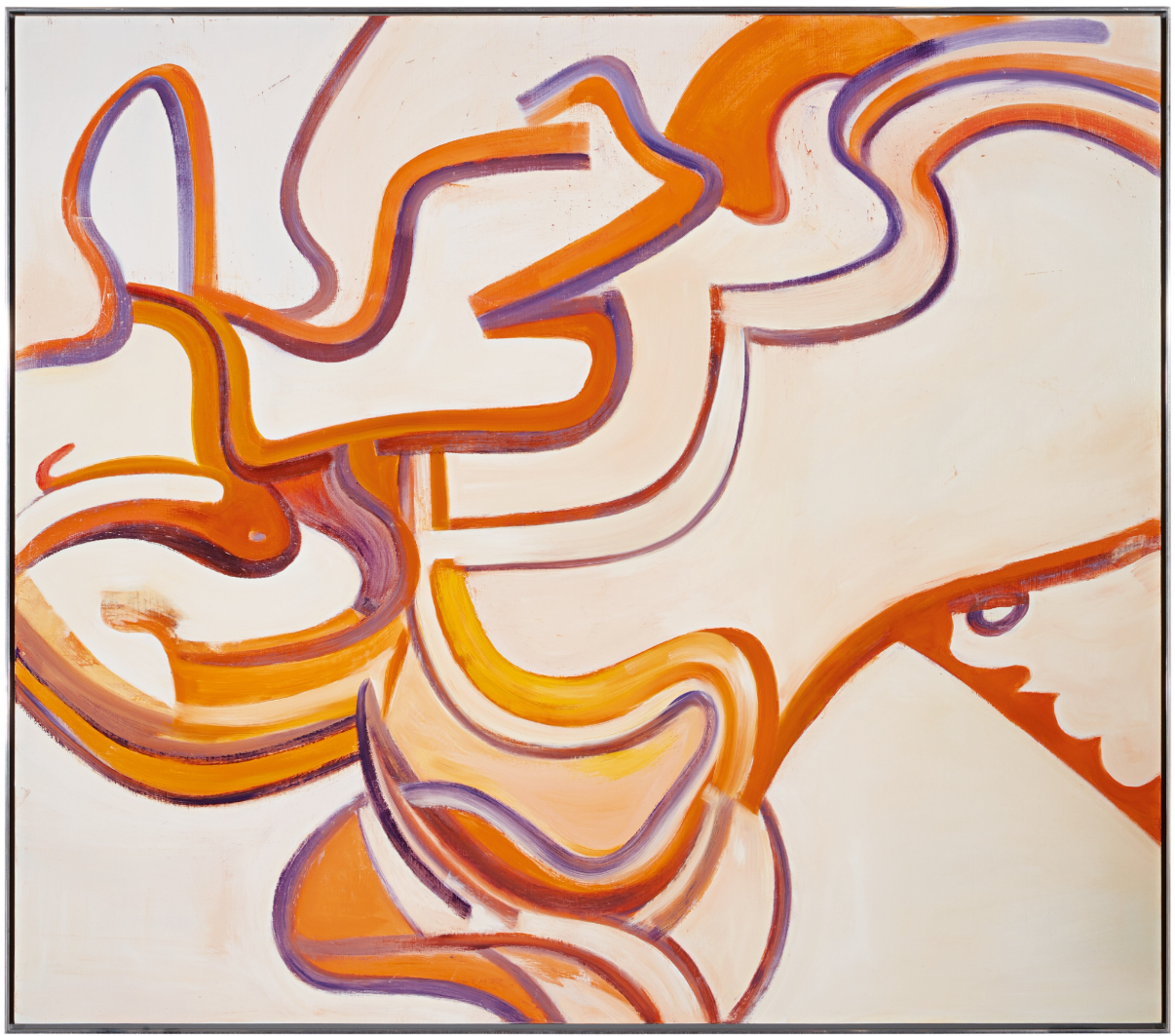
WILLEM DE KOONING (1904 – 1997)
Untitled, 1987
Oil on canvas
77×88 inches (195.6 x 223.5 cm)
Dated ’87 (on the stretcher)
#6. Woman on the Dune, 1967
Christie’s New-York: 16 May 2024
Estimated: USD 3,000,000 – 5,000,000
USD 3,317,000
https://www.christies.com/en/lot/lot-6482992
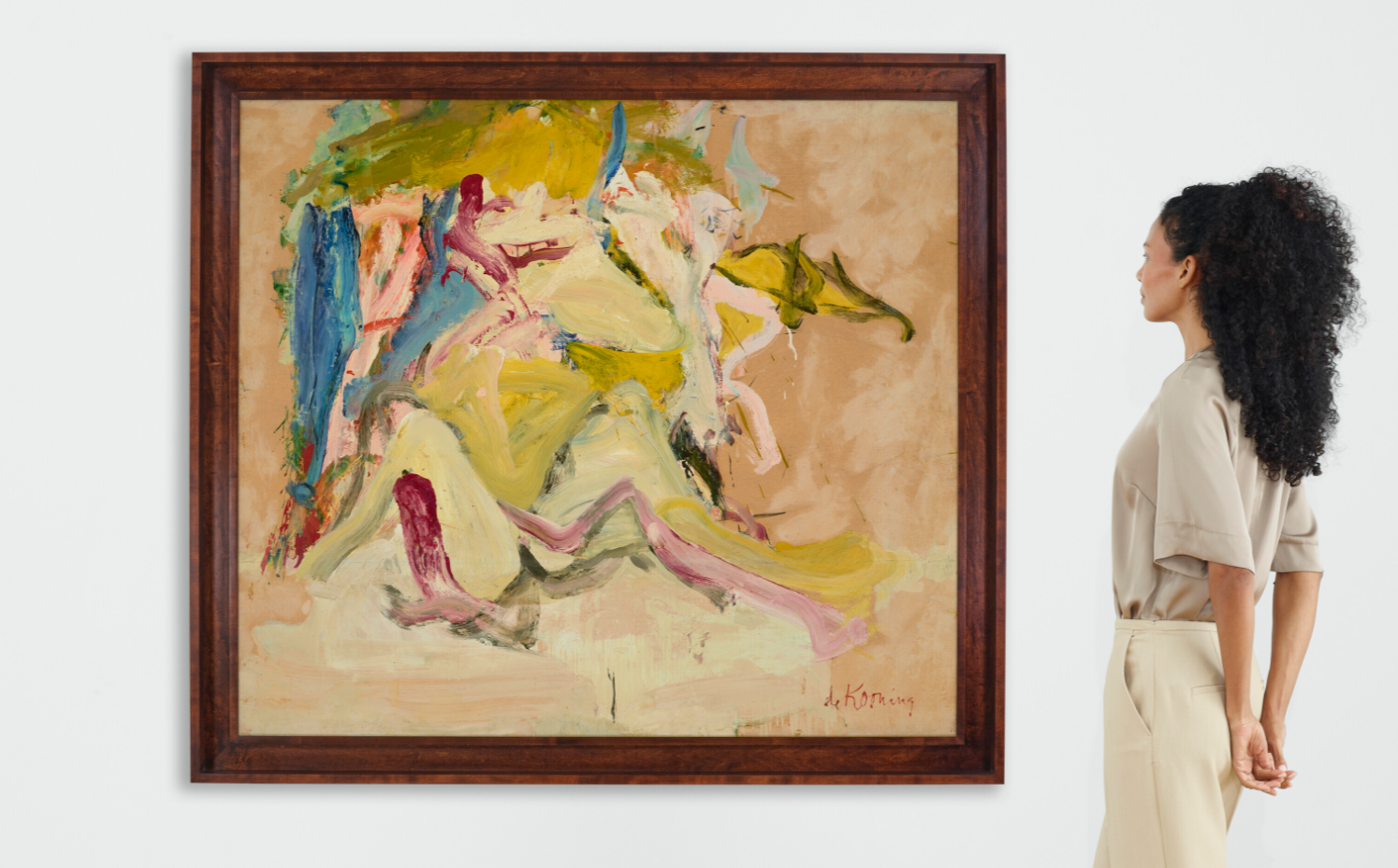
WILLEM DE KOONING (1904-1997)
Woman on the Dune, 1967
Oil on paper mounted on canvas
48 x 54 3/8 inches (121.9 x 138.1 cm)
Signed ‘de Kooning’ (lower right)
#7. Woman in a Rowboat, 1965
Christie’s New-York: 17 May 2024
Estimated: USD 1,200,000 – 1,800,000
USD 1,865,000
https://www.christies.com/en/lot/lot-6482364

WILLEM DE KOONING (1904-1997)
Woman in a Rowboat, 1965
Oil and charcoal on paper mounted on Masonite
48 x 22 3/4 inches (122 x 56.6 cm)
Signed ‘de Kooning’ (lower left)
#8. Sagamore, 1955
Christie’s New-York: 16 May 2024
Estimated: USD 1,500,000 – 2,000,000
USD 1,744,000
WILLEM DE KOONING (1904-1997), Sagamore | Christie’s
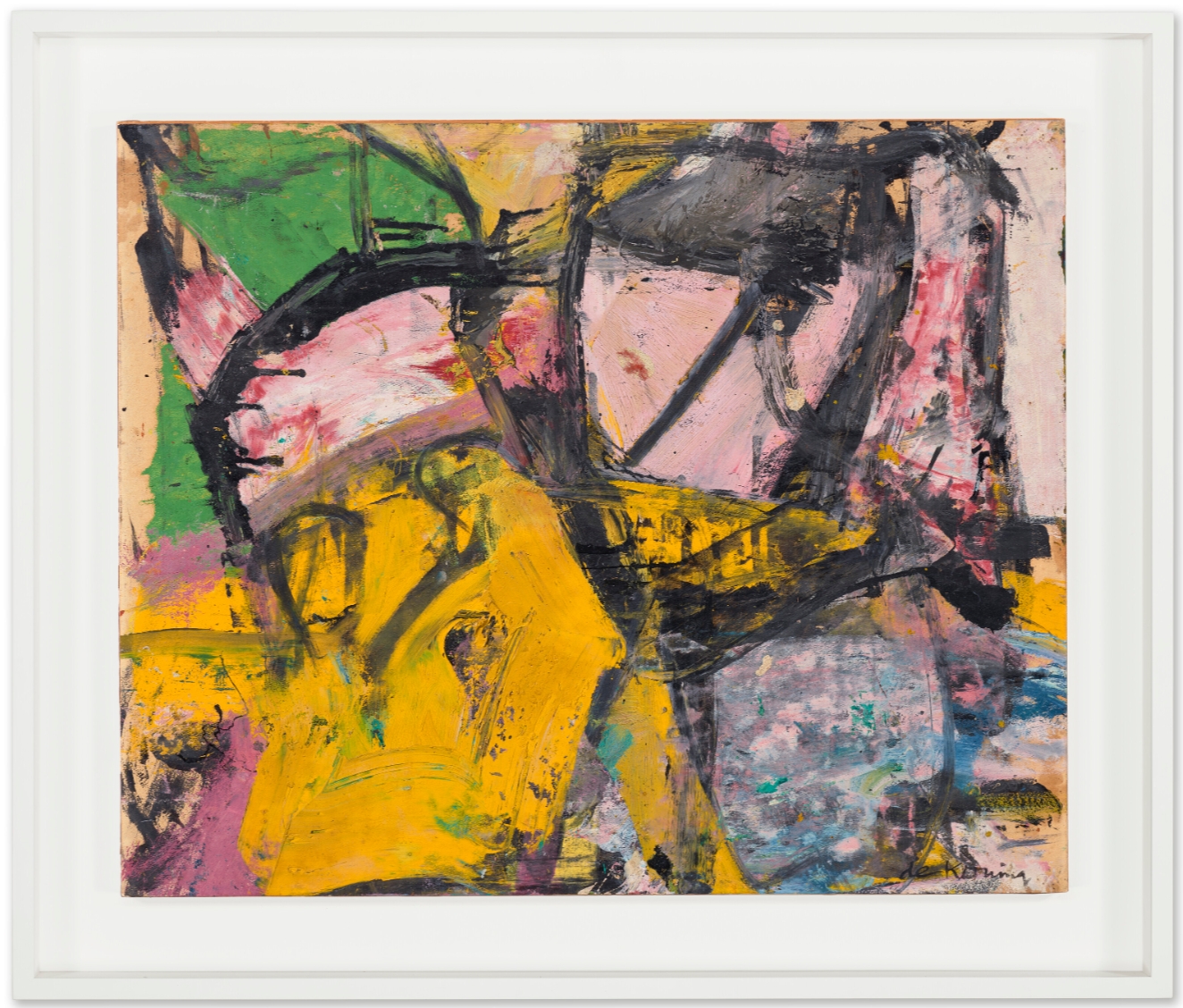
WILLEM DE KOONING (1904-1997)
Sagamore, 1955
Oil, enamel and charcoal on paper laid down on board
22 5/8 x 27 5/8 inches (57.5 x 70.2 cm)
Signed ‘de Kooning’ (lower right)
#9. Cross-Legged Figure, 1972
The Collection of Sydell Miller
Sotheby’s New-York: 18 November 2024
Estimated: USD 1,000,000 – 1,500,000
USD 1,560,000
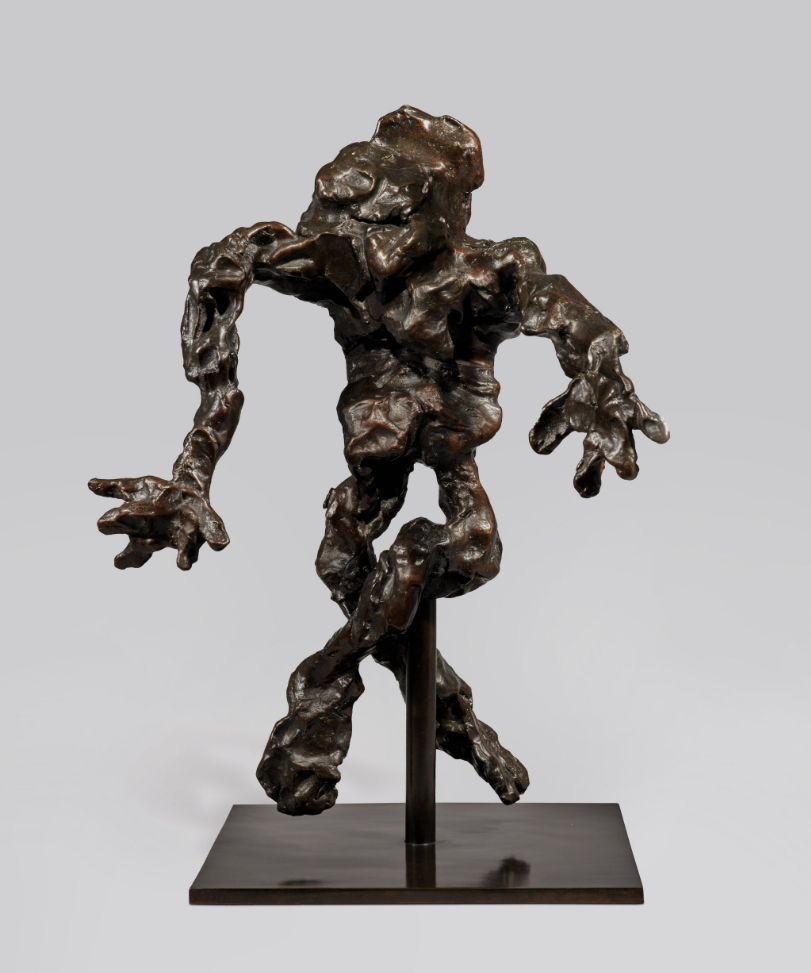
WILLEM DE KOONING (1904 – 1997)
Cross-Legged Figure, 1972
Bronze
Height: 24 1/2 inches (62.2 cm)
Inscribed de Kooning, numbered AP and stamped with the foundry mark Modern Art Foundry, New York N.Y.
Executed in 1972, this work is artist’s proof 2 from an edition of 7 plus 3 artist’s proofs
USD 1 million
#10. Untitled, 1967
Sotheby’s New-York: 16 May 2024
Estimated: USD 400,000 – 600,000
USD 825,500
Untitled | Modern Day Auction | 2024 | Sotheby’s
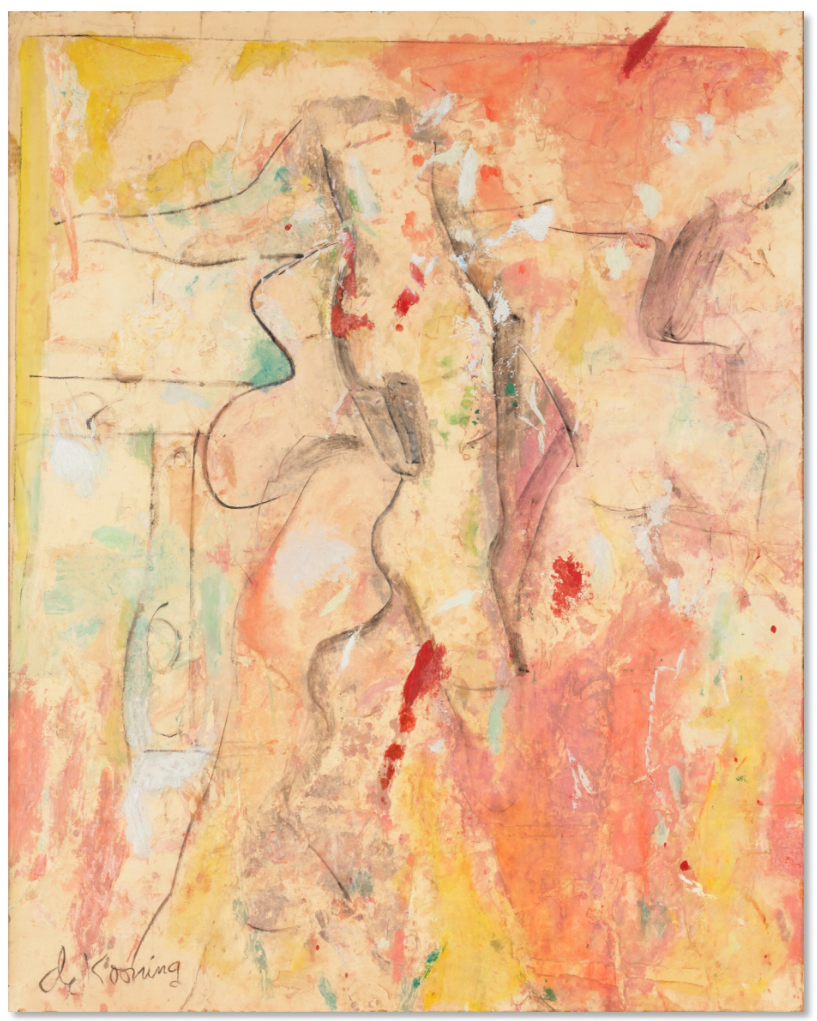
WILLEM DE KOONING (1904 – 1997)
Untitled, 1967
Oil and charcoal on vellum mounted on canvas
53×42 inches (134.6 x 106.7 cm)
Signed de Kooning (lower left)
#11. The Artist in His Studio (Self-Portrait), 1966
Christie’s New-York: 17 May 2024
Estimated: USD 700,000 – 1,000,000
USD 781,200
https://www.christies.com/en/lot/lot-6482368

WILLEM DE KOONING (1904-1997)
The Artist in His Studio (Self-Portrait), 1966
Oil, vellum and paper collage mounted on Masonite
23 5/8 x 41 3/4 inches (59.7 x 104.9 cm)
Signed ‘de Kooning’ (lower right)
#12. Untitled, circa 1965
Sotheby’s New-York: 14 May 2024
Estimated: USD 300,000 – 500,000
USD 635,000
Untitled | Contemporary Day Auction | 2024 | Sotheby’s
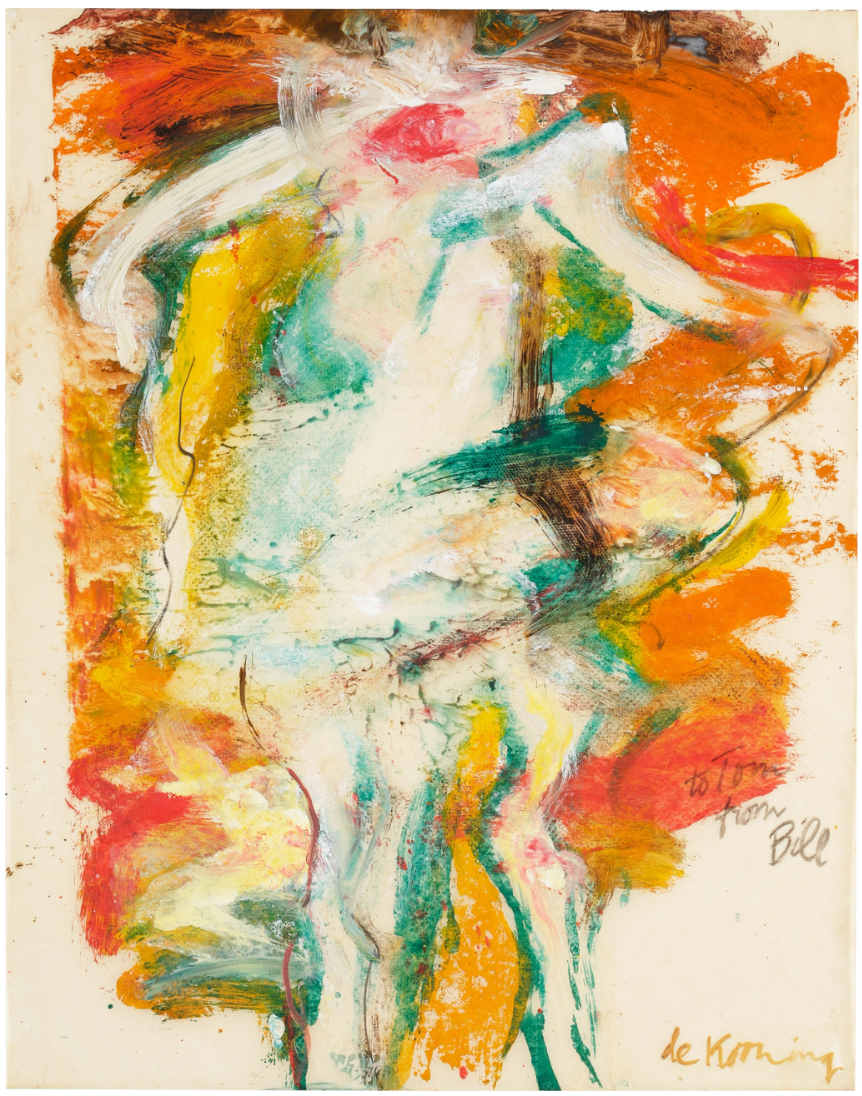
WILLEM DE KOONING (1904 – 1997)
Untitled, circa 1965
Oil on vellum
23 3/4 x 18 3/4 inches (60.5 x 47.6 cm)
Signed and dedicated to Tom from Bill (lower right)
USD 500,000
#13. Untitled (Woman Abstraction), circa 1962-63
Sotheby’s New-York: 21 November 2024
Estimated: USD 300,000 – 500,000
USD 384,000
Untitled (Woman Abstraction) | Contemporary Day Auction | 2024 | Sotheby’s
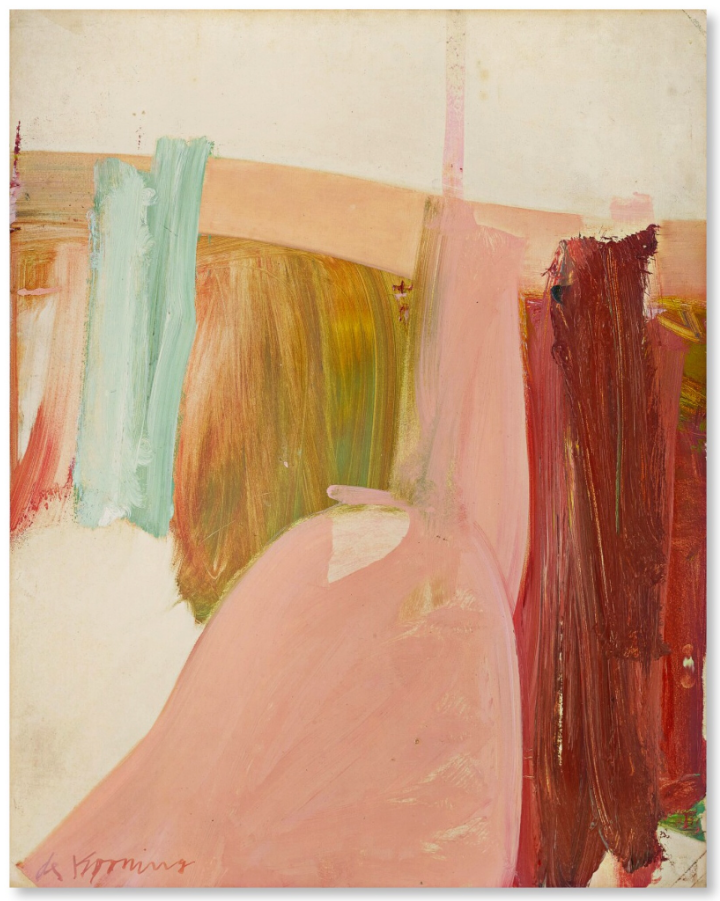
WILLEM DE KOONING (1904 – 1997)
Untitled (Woman Abstraction), circa 1962-63
Oil on paper laid on board
28 3/4 x 22 3/4 inches (73 x 57.8 cm)
Signed (lower left)
#14. Small Painting I, 1958
Christie’s New-York: 21 November 2024
Estimated: USD 300,000 – 500,000
USD 378,000
WILLEM DE KOONING (1904-1997), Small Painting I | Christie’s
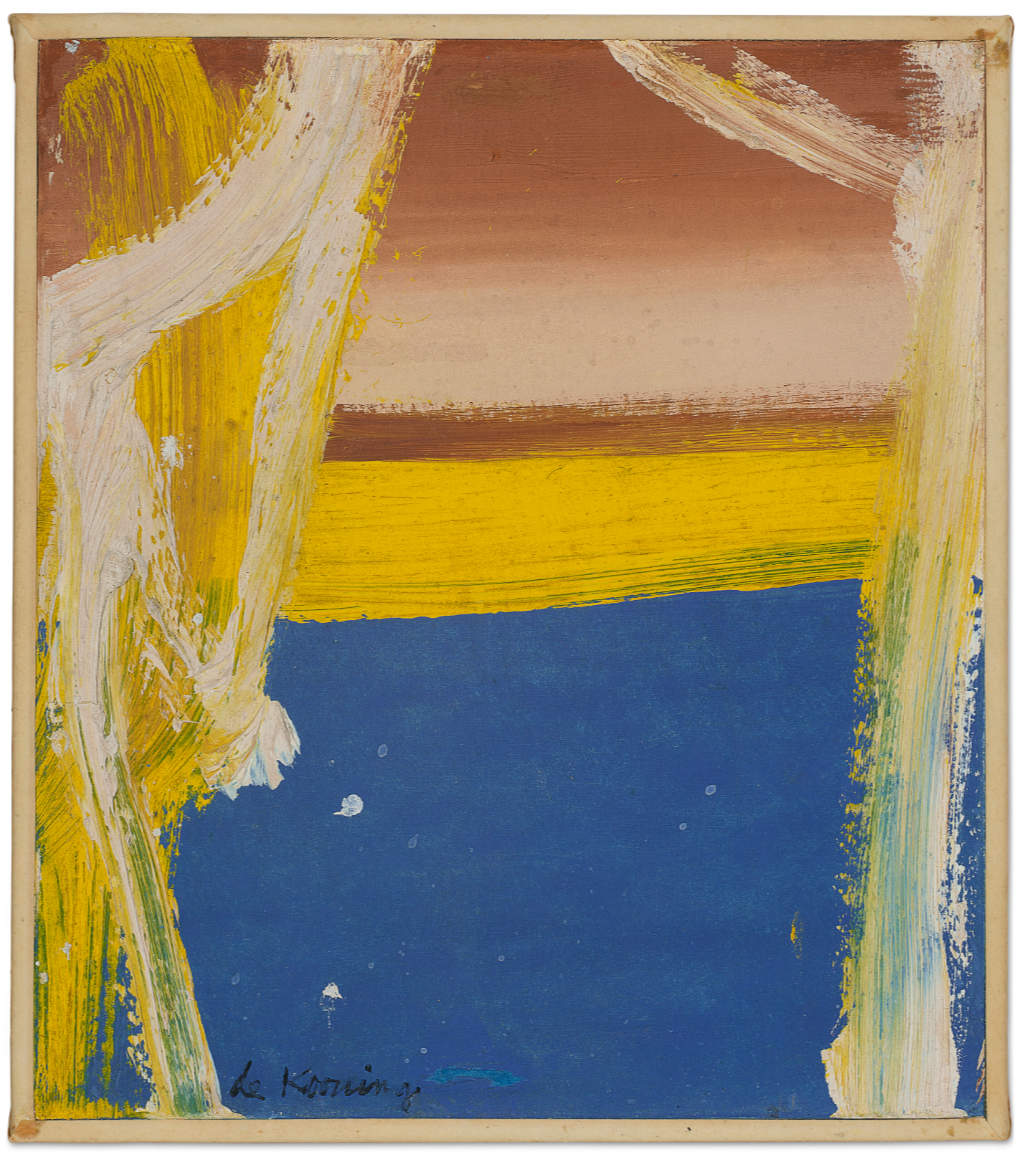
WILLEM DE KOONING (1904-1997)
Small Painting I, 1958
Oil on paper laid down on canvas
8 1/4 x 7 1/4 inches (20.6 x 18 cm)
Signed ‘de Kooning’ (lower left)
#15. Still Life, circa 1929
Phillips New-York: 15 May 2024
Estimated: USD 150,000 – 250,000
USD 330,200
Willem de Kooning – Modern & Contempora… Lot 110 May 2024 | Phillips
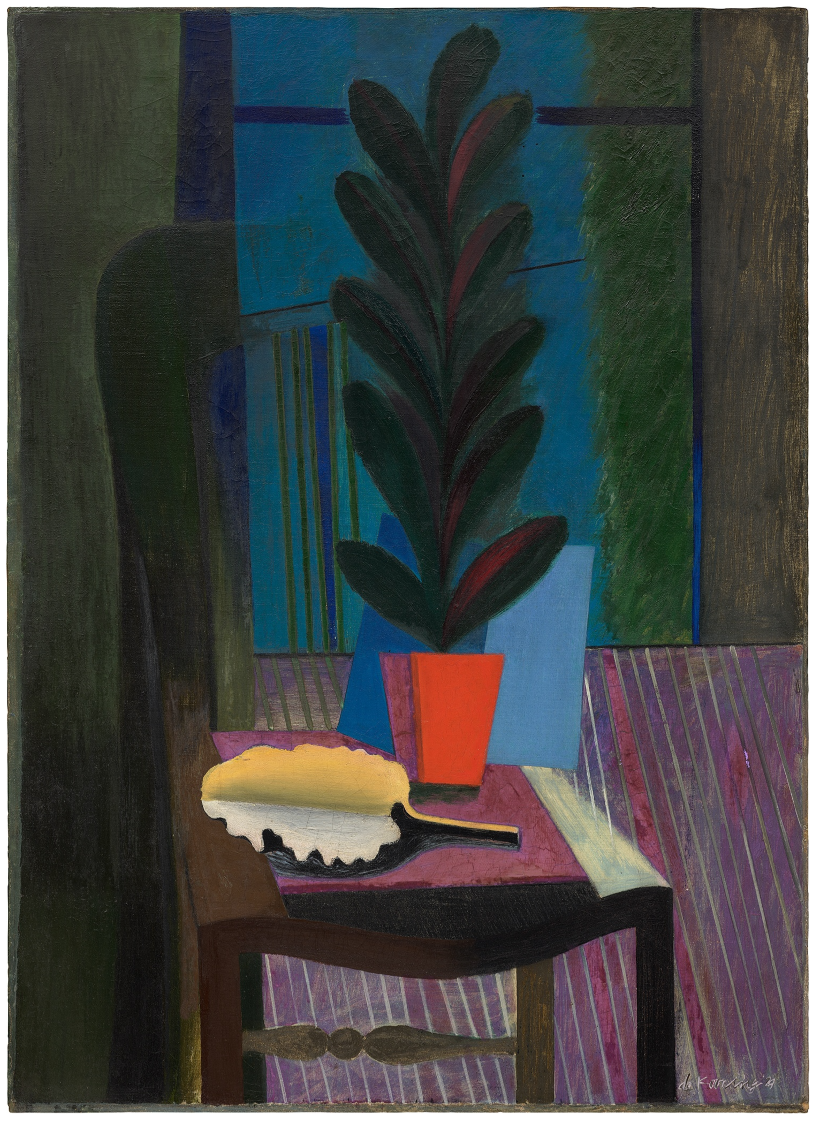
WILLEM DE KOONING
Still Life, circa 1929
Oil on canvas
36×26 inches (91.4 x 66 cm)
Signed and dated “de Kooning ’29” lower right
#16. Untitled, 1977
Sotheby’s London: 10 October 2024
Estimated: GBP 40,000 – 60,000
GBP 102,000 / USD 133,275
Untitled | Contemporary Day Auction | 2024 | Sotheby’s
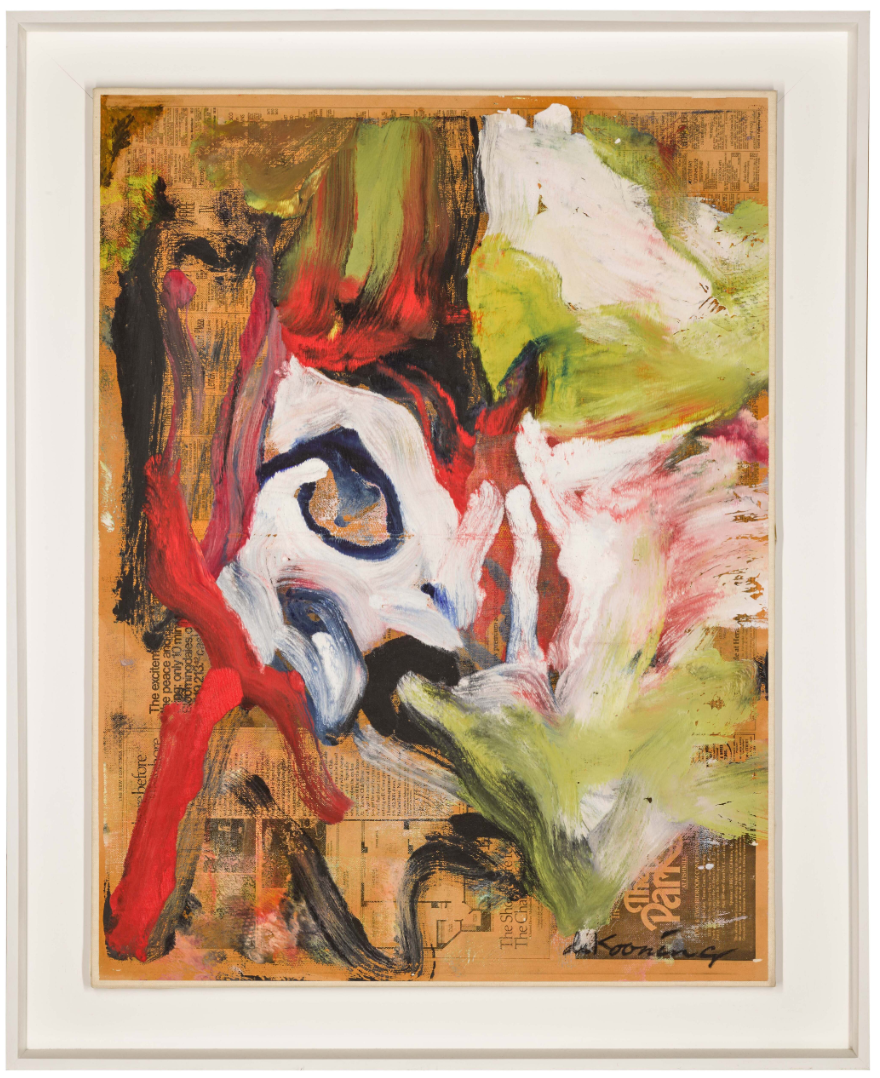
WILLEM DE KOONING (1904 – 1997)
Untitled, 1977
Oil on newsprint laid on canvas
29 5/8 x 22 1/2 inches (75.2 x 57.2 cm)
Signed (lower right)
Lots Passed
Abstraction, 1948
Christie’s New-York: 19 November 2024
Estimated: USD 3,000,000 – 5,000,000
PASSED
WILLEM DE KOONING (1904-1997), Abstraction | Christie’s
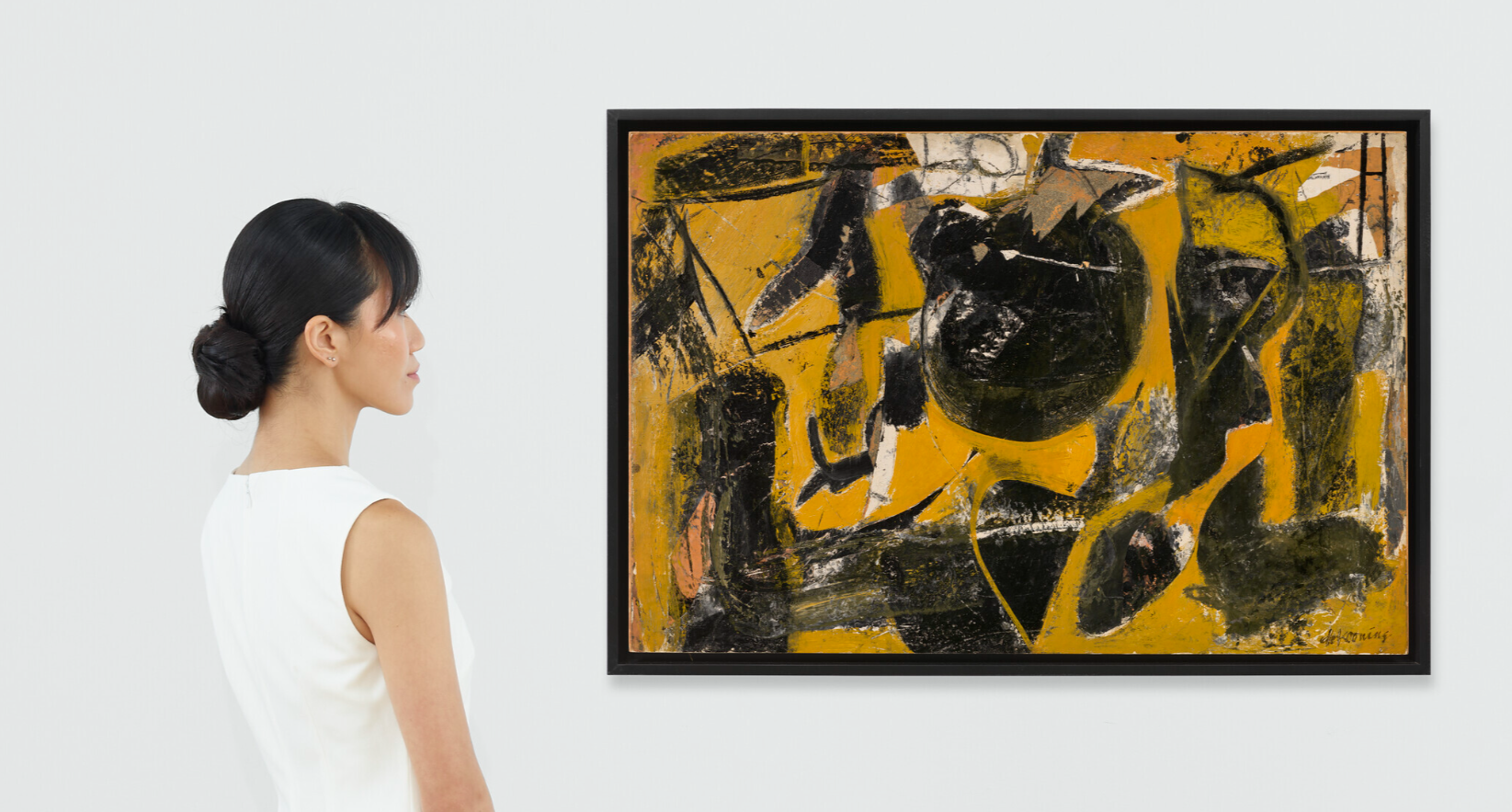
WILLEM DE KOONING (1904-1997)
Abstraction, 1948
Oil, enamel, charcoal and paper collage on paper mounted on board
24 1/4 x 36 1/8 inches (61.6 x 91.8 cm)
Signed ‘de Kooning’ (lower right)
2023 Auction Results
FOR PAINTINGS & SCULPTURES ONLY
19 lots sold at auction in 2023 for a total turnover of USD 95,612,875. With 1 lot failing to sell, the sell-through rate is a solid 95%. The highest price has been achieved at Christie’s in New-York on 11 May 2023, when Orestes, a rare early painting dated 1947 sold for USD 30,885,000.
2023 Top 3 Lots
This was the only lot to sell for more than USD 10 million. 9 lots sold for more than USD 5 million, generating a cumulative turnover of USD 82,233,575, representing 89.1% of the turnover for 2023.
XXXXXXXXXX
#1. Orestes, 1947
Christie’s New-York: 11 May 2023
Estimate on Request
USD 30,885,000
WILLEM DE KOONING (1904-1997) (christies.com)
WILLEM DE KOONING (1904-1997)
Orestes, 1947
24 1/8 x 36 1/8 inches (61.3 x 91.8 cm)
Signed ‘de Kooning’ (lower right); signed again ‘de Kooning’ (on the reverse)
#2. Untitled XV, 1983
Sotheby’s New-York: 8 November 2023
Estimated: USD 6,000,000 – 8,000,000
USD 8,607,300
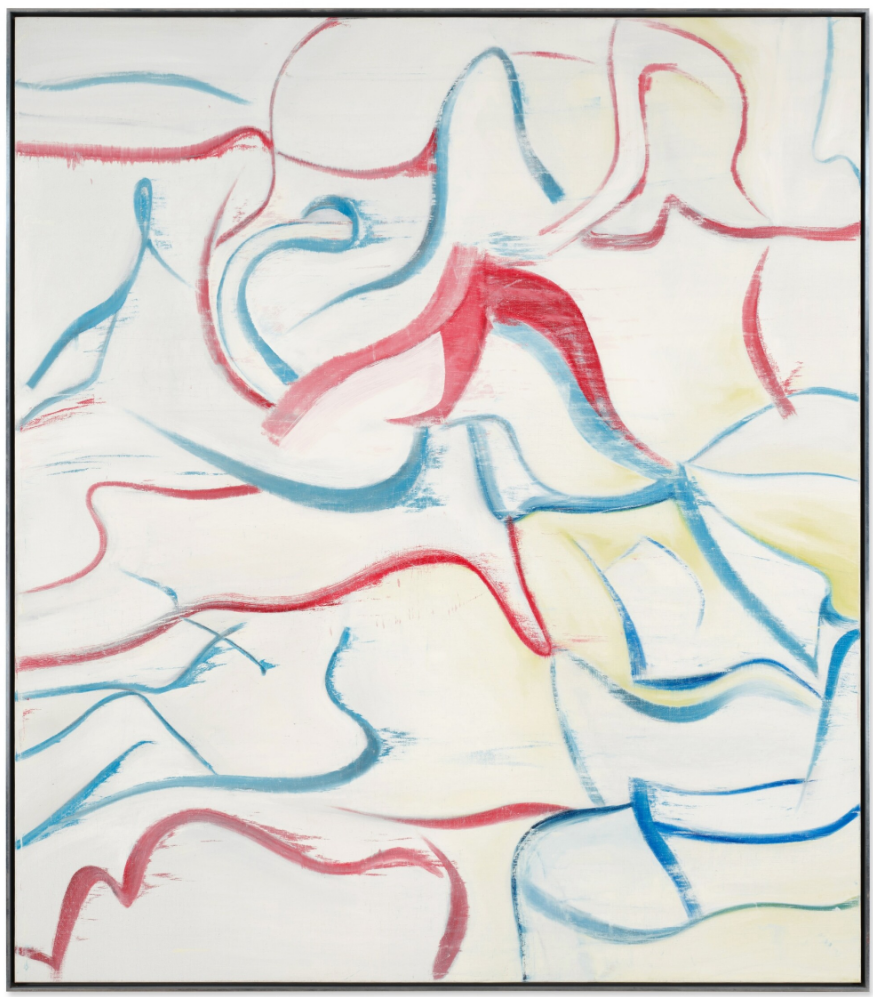
WILLEM DE KOONING (1904 – 1997)
Untitled XV, 1983
Oil on canvas
79 7/8 x 70 inches (202.9 x 177.8 cm)
Signed (on the stretcher)
#3. Untitled III, 1984
Christie’s New-York: 9 November 2023
Estimated: USD 8,000,000 – 12,000,000
USD 8,575,000
WILLEM DE KOONING (1904-1997) (christies.com)
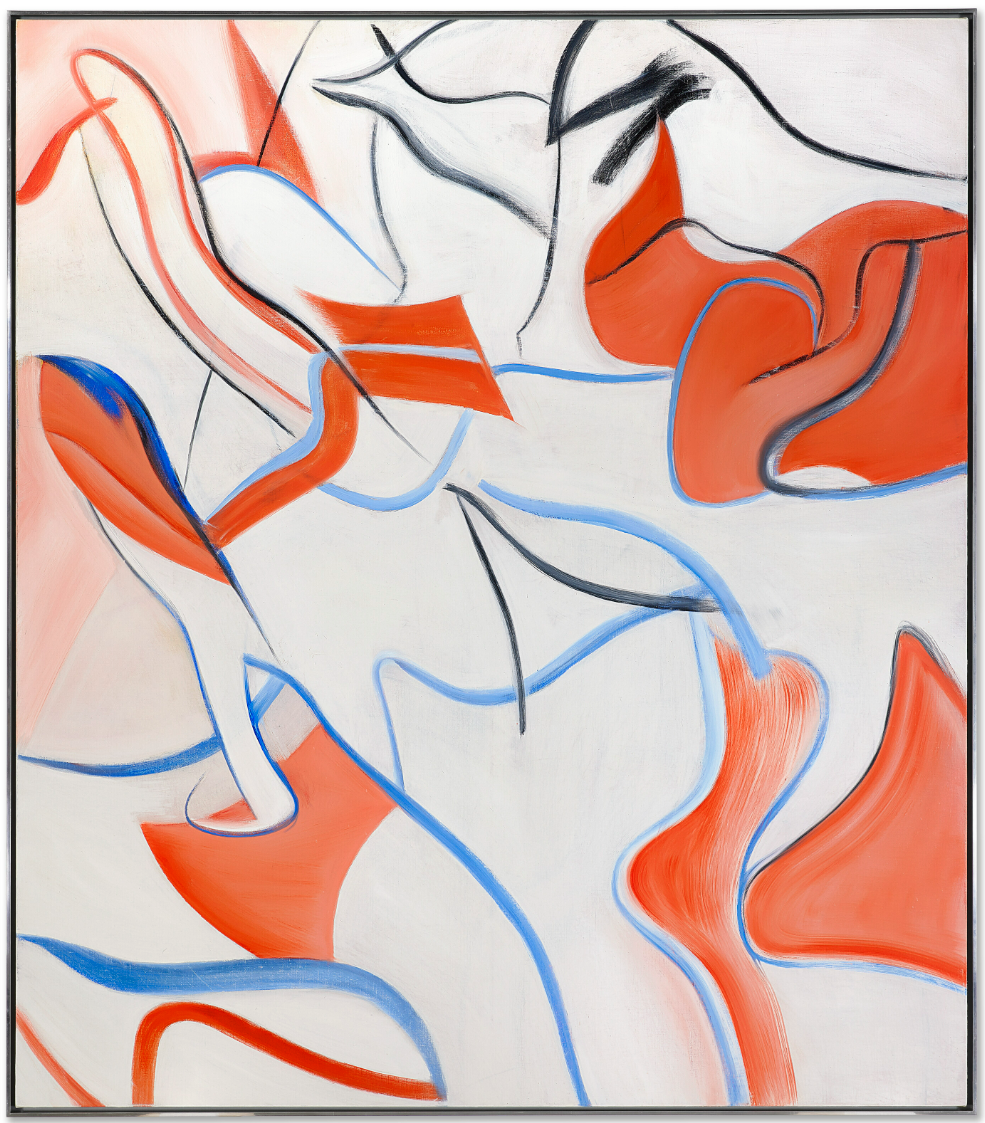
WILLEM DE KOONING (1904-1997)
Untitled III, 1984
Oil on canvas
80×70 inches (203.2 x 177.8 cm)
Signed ‘de Kooning’ (on the stretcher)
#4. Untitled, 1984
Phillips London: 2 March 2023
Estimated: GBP 7,000,000 – 9,000,000
GBP 6,965,500 / USD 7,241,523
Willem de Kooning – 20th Century & Cont… Lot 9 March 2023 | Phillips
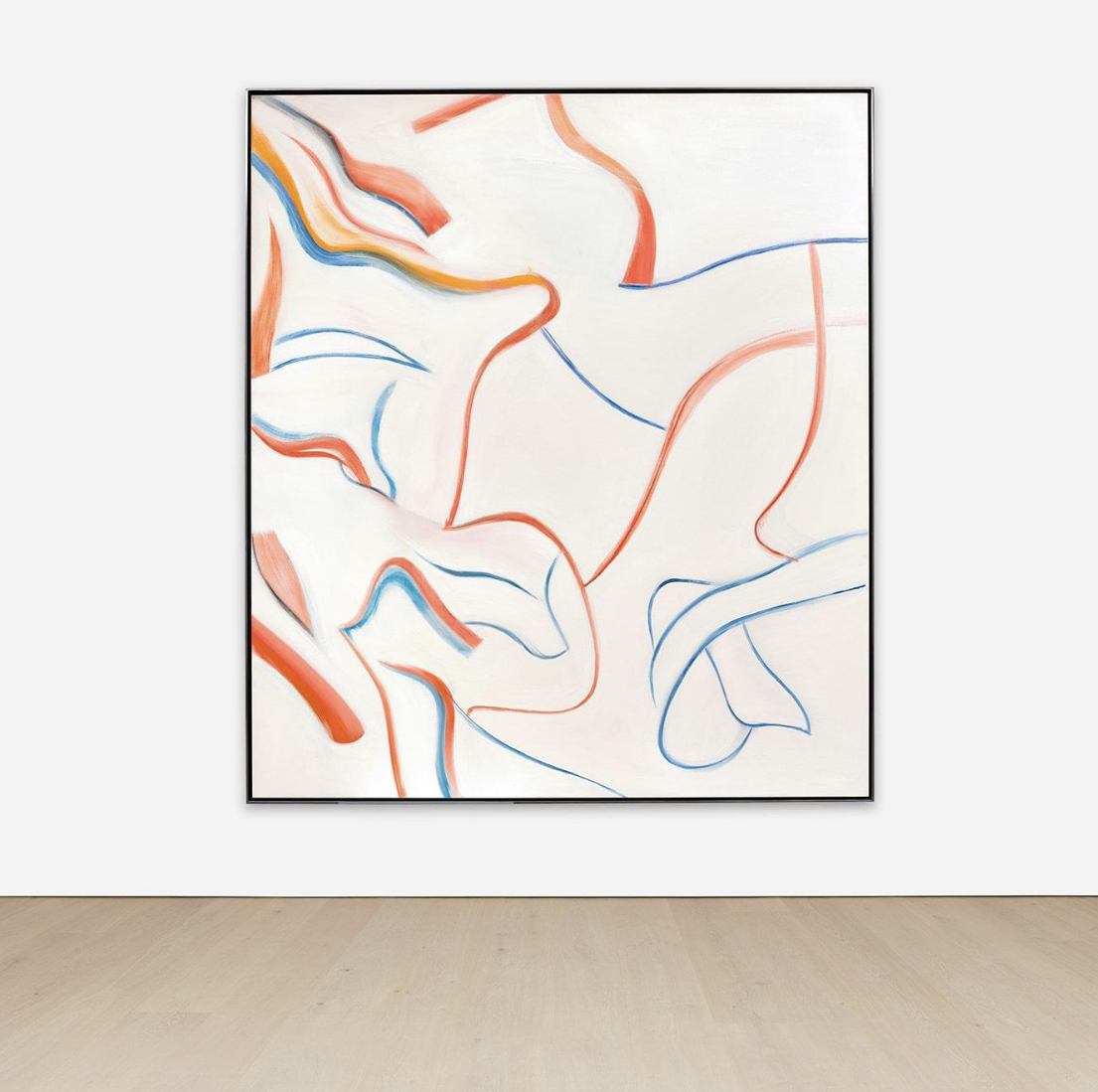
WILLEM DE KOONING
Untitled, 1984
Oil on canvas
88×77 inches (223.5 x 195.6 cm)
Signed ‘de Kooning’ on the stretcher
#5. Two Figures, circa 1946-1947
Sotheby’s New-York: 16 May 2023
Estimated: USD 5,000,000 – 7,000,000
USD 5,849,700
Two Figures | The Mo Ostin Collection Evening Auction | 2023 | Sotheby’s (sothebys.com)
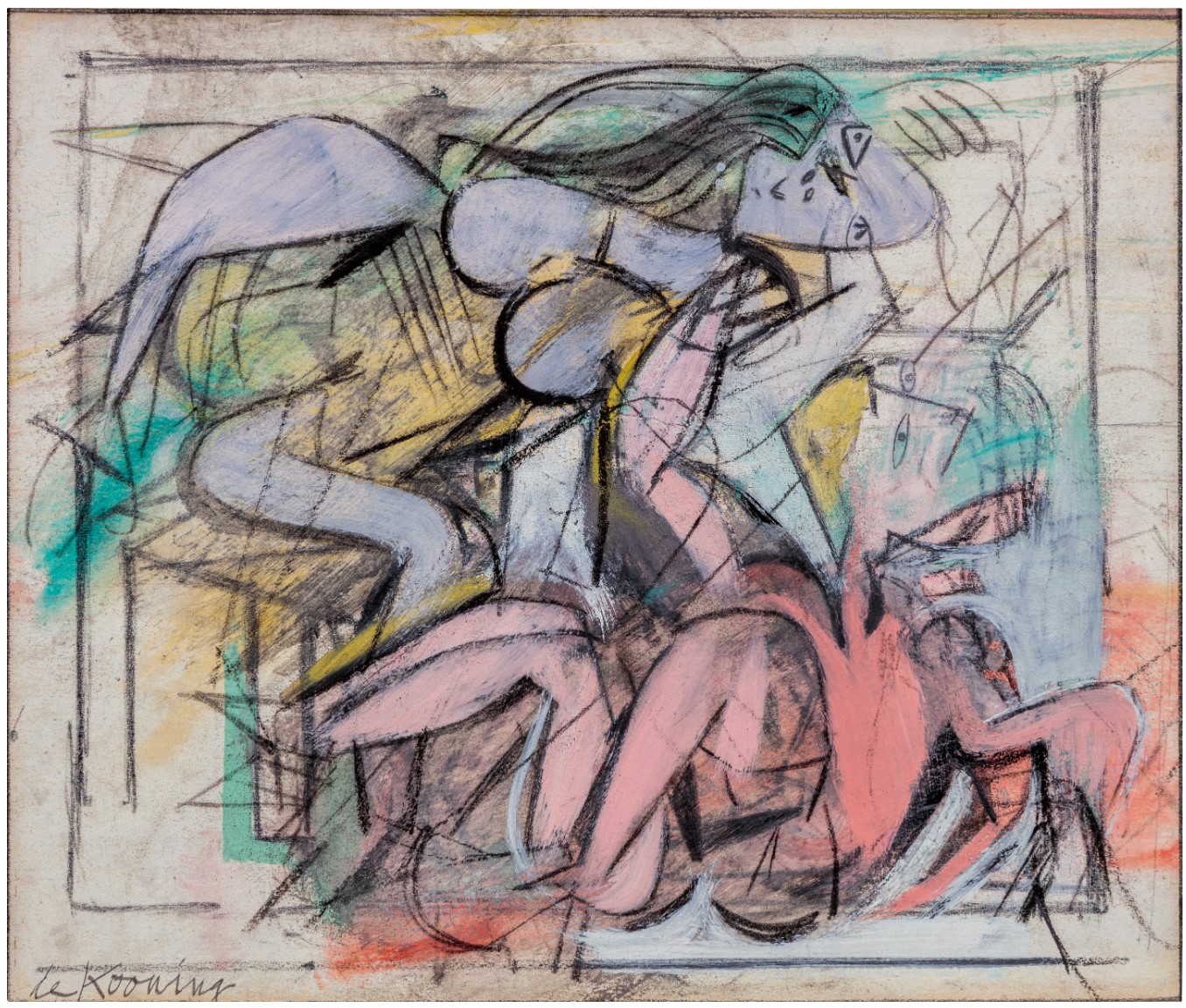
WILLEM DE KOONING (1904 – 1997)
Two Figures, circa 1946-1947
Charcoal, colored chalks, gouache, graphite and watercolor on paper
11 3/8 x 13 1/8 inches (27.9 x 30.5 cm)
Signed (lower left)
#6. Untitled, 1972
Sotheby’s New-York: 15 November 2023
Estimated: USD 2,500,000 – 3,500,000
USD 5,505,000
Untitled | Contemporary Evening Auction | 2023 | Sotheby’s (sothebys.com)
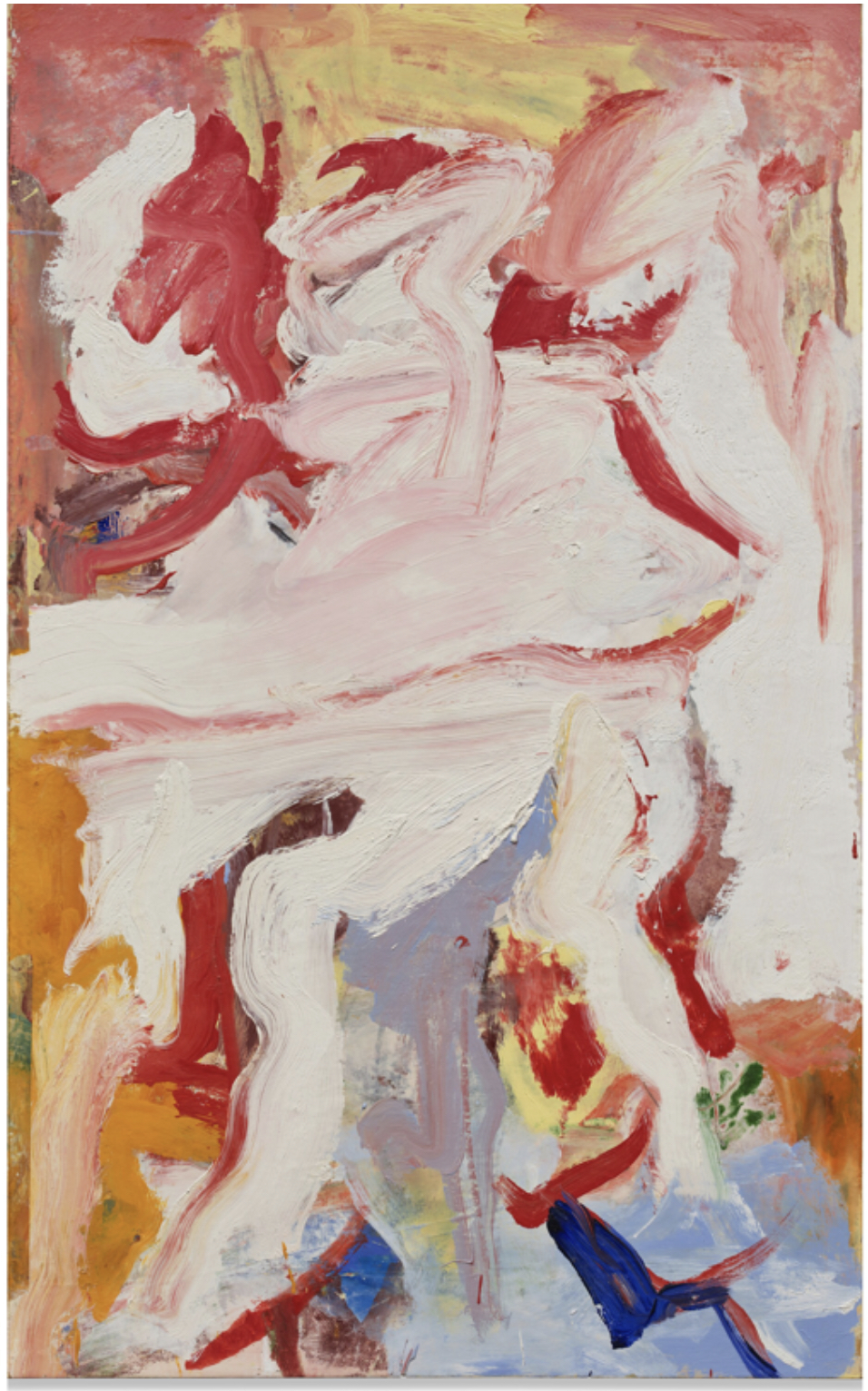
WILLEM DE KOONING (1904 – 1997)
Untitled, 1972
Oil on paper mounted on canvas
60 1/8 x 41 inches (152.7 x 104.1 cm)
#7. Untitled, 1983
Christie’s New-York: 17 May 2023
Estimated: USD 8,000,000 – 12,000,000
USD 5,313,500
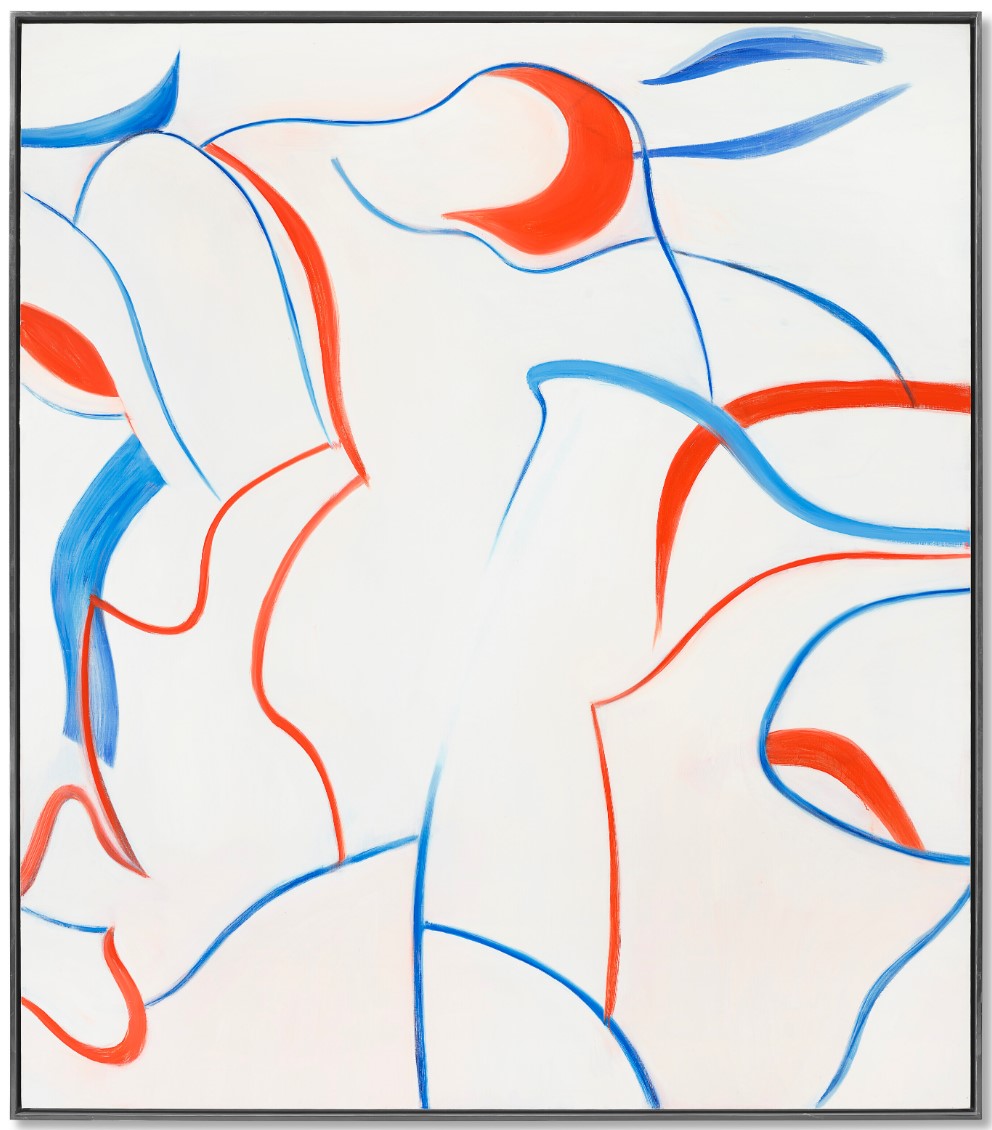
WILLEM DE KOONING (1904-1997)
Untitled, 1983
Oil on canvas
80×70 inches (203.3 x 177.8 cm)
#8. Untitled, 1985
Sotheby’s New-York: 15 November 2023
Estimated: USD 5,000,000 – 7,000,000
USD 5,250,000
Untitled | Contemporary Evening Auction | 2023 | Sotheby’s (sothebys.com)
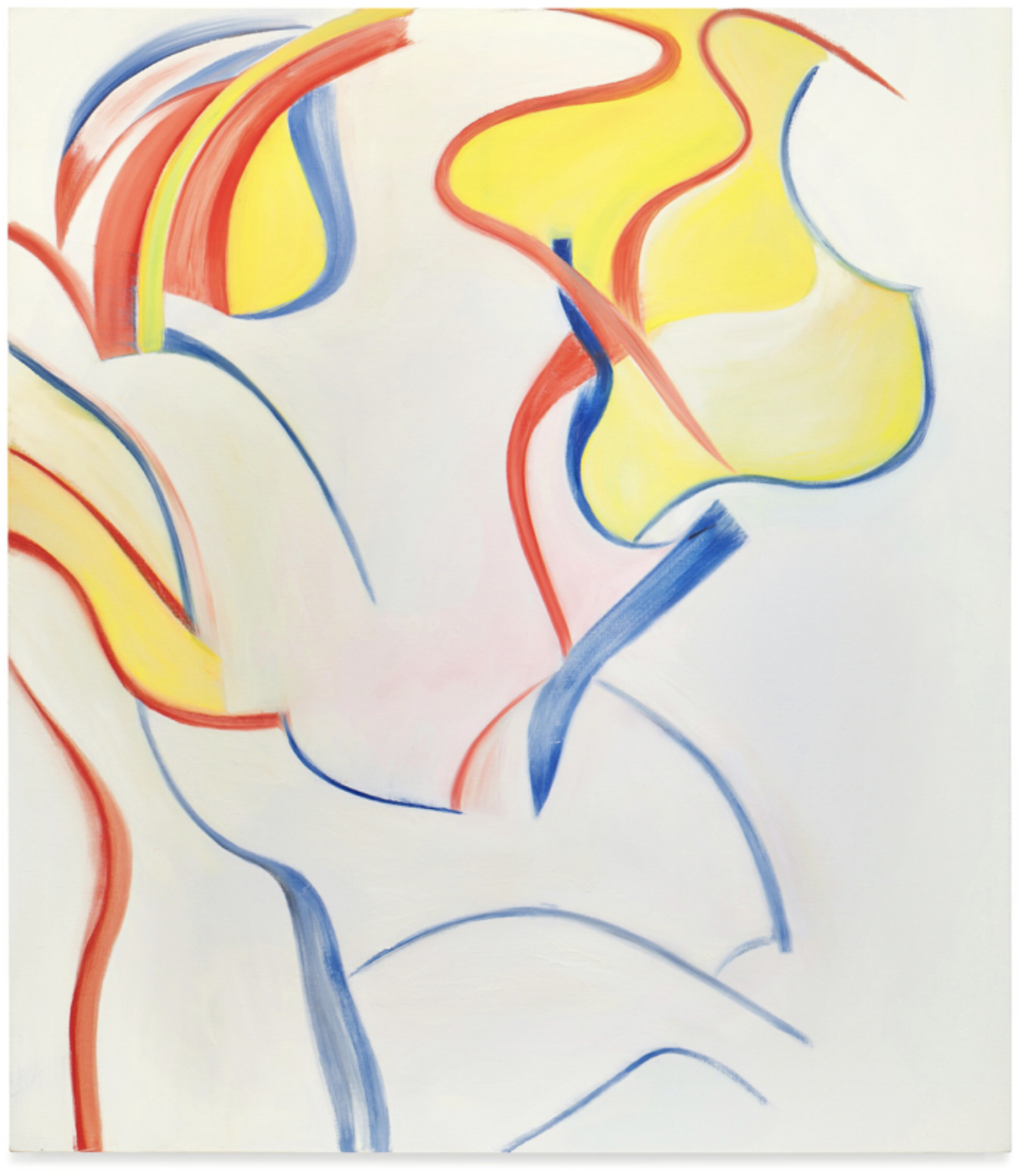
WILLEM DE KOONING (1904 – 1997)
Untitled, 1985
Oil on canvas
80×70 inches (203.2 x 177.8 cm)
Signed (on the stretcher)
#9. Souvenir de Toulouse, 1958
Sotheby’s Hong-Kong: 5 October 2023
Estimated: HKD 50,000,000 – 70,000,000
HKD 39,170,000 / USD 5,006,552
WILLEM de KOONING (1904 – 1997)
Souvenir of Toulouse, 1958
Oil on canvas
160 x 125.7 cm (63 x 49 1/2 inches)
#10. East Hampton III, 1977
Christie’s New-York: 17 May 2023
Estimated: USD 6,000,000 – 8,000,000
USD 3,680,000
WILLEM DE KOONING (1904-1997) (christies.com)
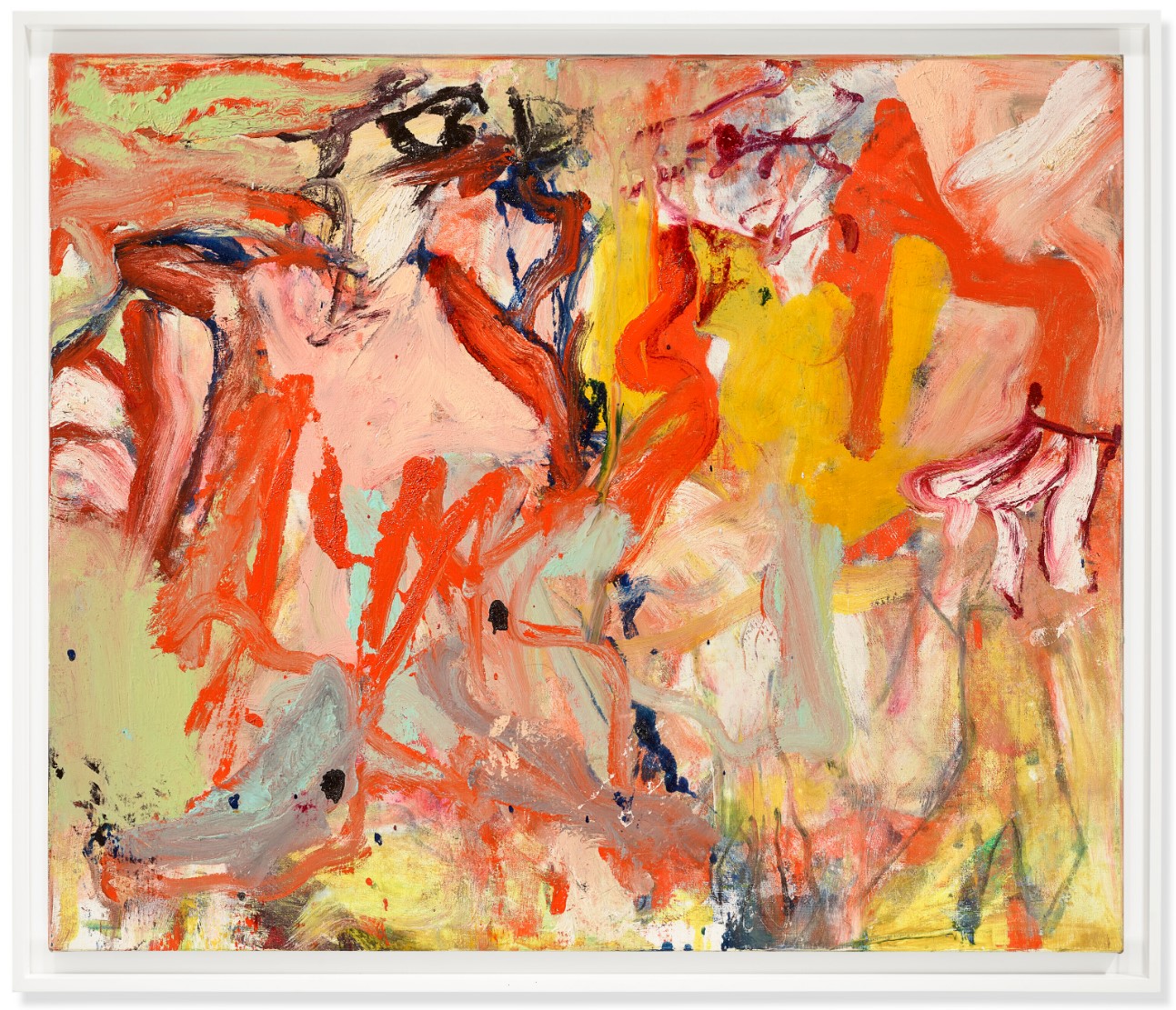
WILLEM DE KOONING (1904-1997)
East Hampton III, 1977
Oil on canvas
30×36 inches (76.2 x 91.4 cm)
#11. Brown Derby Road, 1958
Sotheby’s New-York: 16 May 2023
Estimated: USD 3,500,000 – 4,500,000
USD 3,327,000
Brown Derby Road | Modern Evening Auction | 2023 | Sotheby’s (sothebys.com)
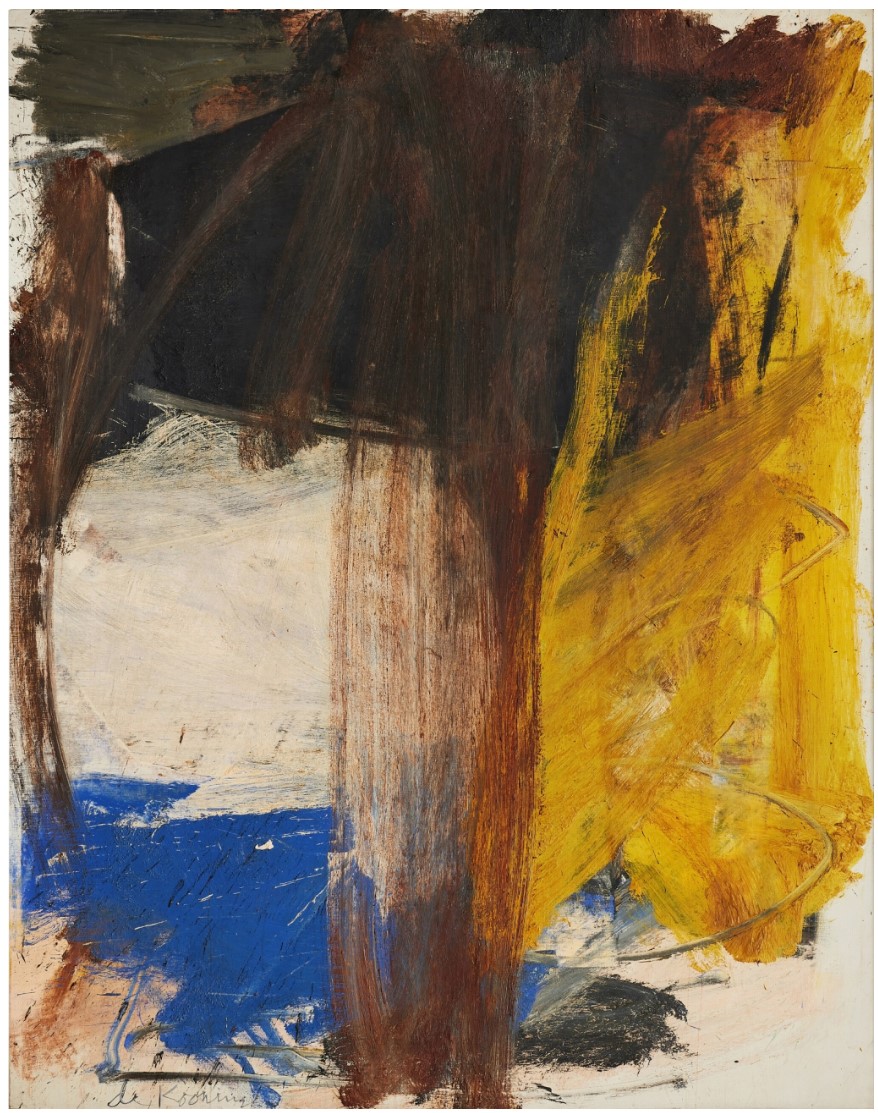
WILLEM DE KOONING (1904 – 1997)
Brown Derby Road, 1958
Oil on canvas
62 3/4 x 49 1/4 inches (159.3 x 125.1 cm)
Signed de Kooning (lower left)
#12. Two Figures, 1968-1972
Christie’s New-York: 17 May 2023
Estimated: USD 3,000,000 – 5,000,000
USD 1.865,000
WILLEM DE KOONING (1904-1997), Two Figures | Christie’s (christies.com)
WILLEM DE KOONING (1904-1997)
Two Figures, 1968-1972
Oil on canvas
36×48 inches (76.2 x 121.9 cm)
#13. Untitled, 1977
Christie’s New-York: 12 May 2023
Estimated: USD 800,000 – 1,200,000
USD 1,008,000
WILLEM DE KOONING (1904-1997), Untitled | Christie’s (christies.com)
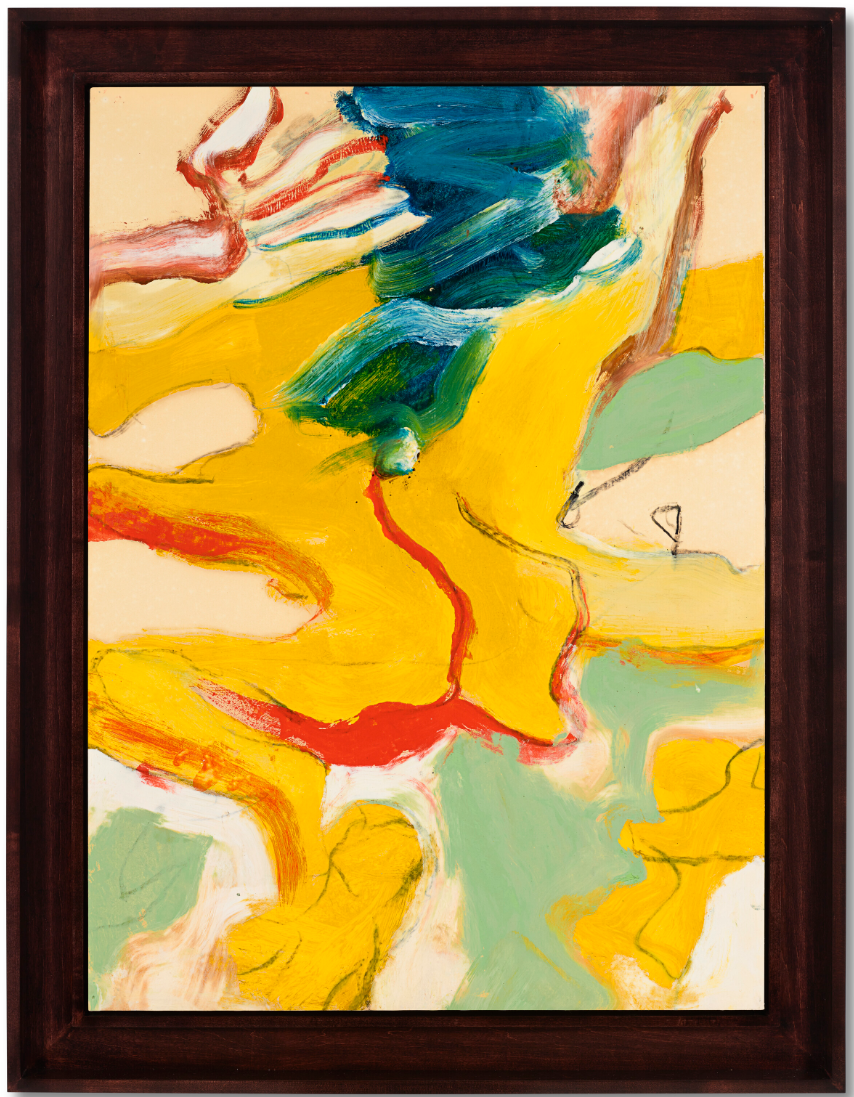
WILLEM DE KOONING (1904-1997)
Untitled, 1977
Oil and charcoal on paper laid down on canvas
41 1/4 x 30 1/4 inches (104.7 x 76.8 cm)
Signed ‘de Kooning’ (on the stretcher)
USD 1 million
#14. Standing Figure, 1969
Sotheby’s New-York: 16 November 2023
Estimated: USD 1,000,000 – 1,500,000
USD 952,500
Standing Figure | Contemporary Day Auction | 2023 | Sotheby’s (sothebys.com)
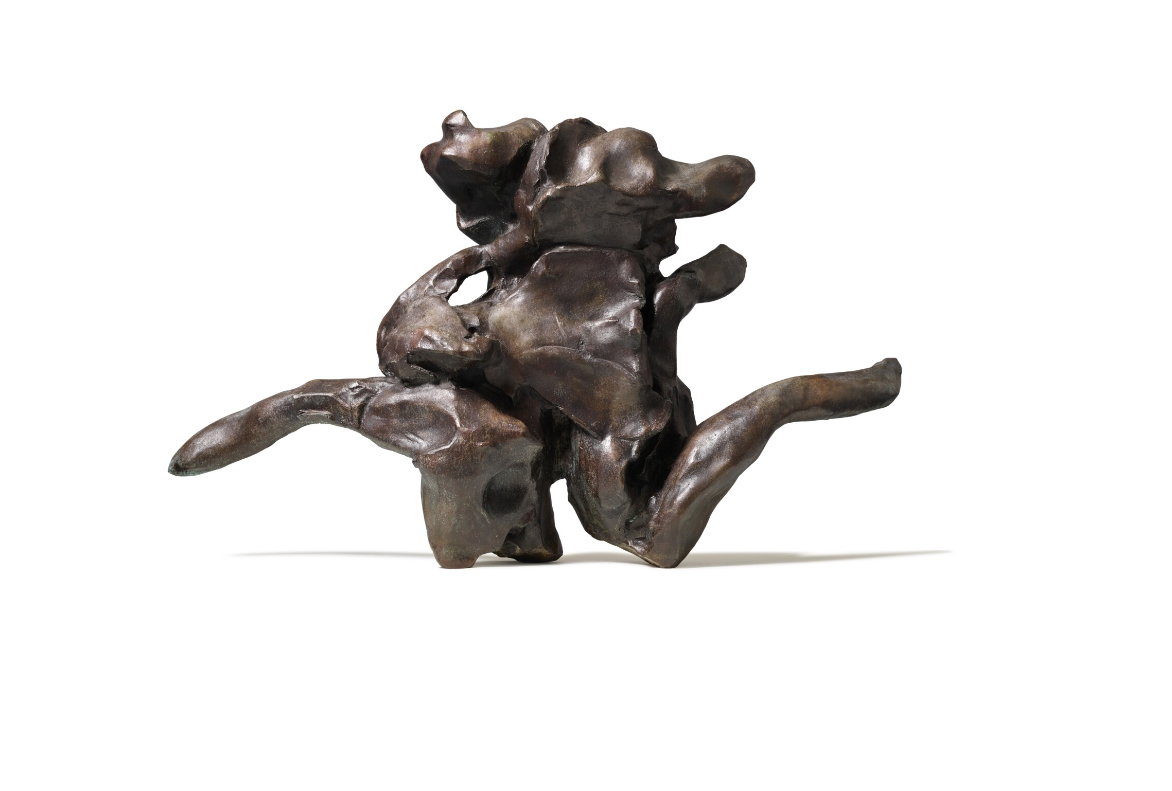
WILLEM DE KOONING (1904 – 1997)
Standing Figure, 1969
Bronze
32 1/2 x 56 x 11 inches (82.6 x 142.2 x 27.9 cm)
Incised with the artist’s signature, date 1969/80 and number AP 2/3 (on the lateral edge)
Conceived in 1969 and cast in 1980, this work is artist’s proof 2 from an edition of 9 plus 3 artist’s proofs
#15. Seated Woman on a Bench, 1972
Sotheby’s New-York: 19 May 2023
Estimated: USD 1,000,000 – 1,500,000
USD 889,000
Seated Woman on a Bench | Contemporary Day Auction | 2023 | Sotheby’s (sothebys.com)
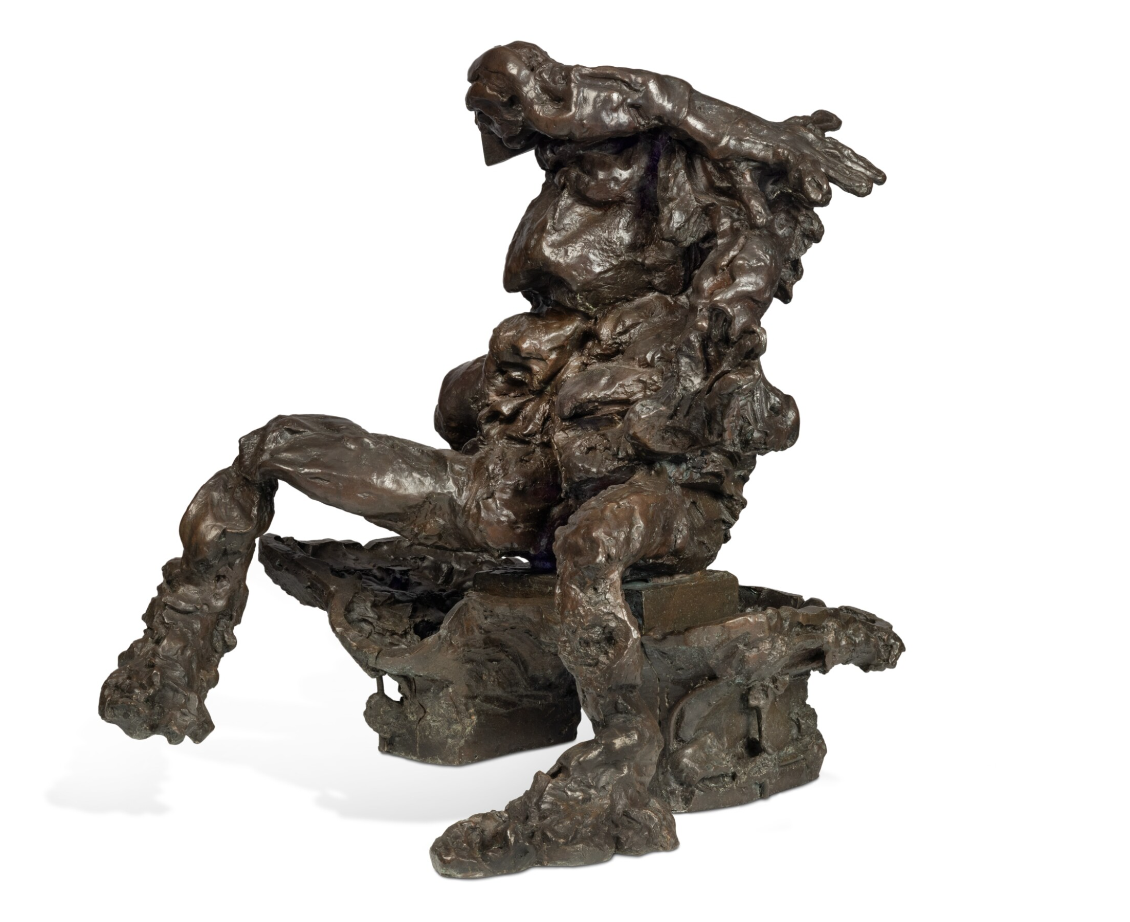
WILLEM DE KOONING (1904 – 1997)
Seated Woman on a Bench, 1972
Bronze
37 3/4 x 36 x 43 3/8 inches (95.9 x 91.4 x 87.3 cm)
Incised with artist’s signature and number 3/7 (on the lateral edge)
This work is number 3 from an edition of 7 plus 3 artist’s proofs
#16. Standing Woman and Trees, 1965
Sotheby’s New-York: 17 May 2023
Estimated: USD 500,000 – 700,000
USD 635,000
Standing Woman and Trees | Modern Day Auction | 2023 | Sotheby’s
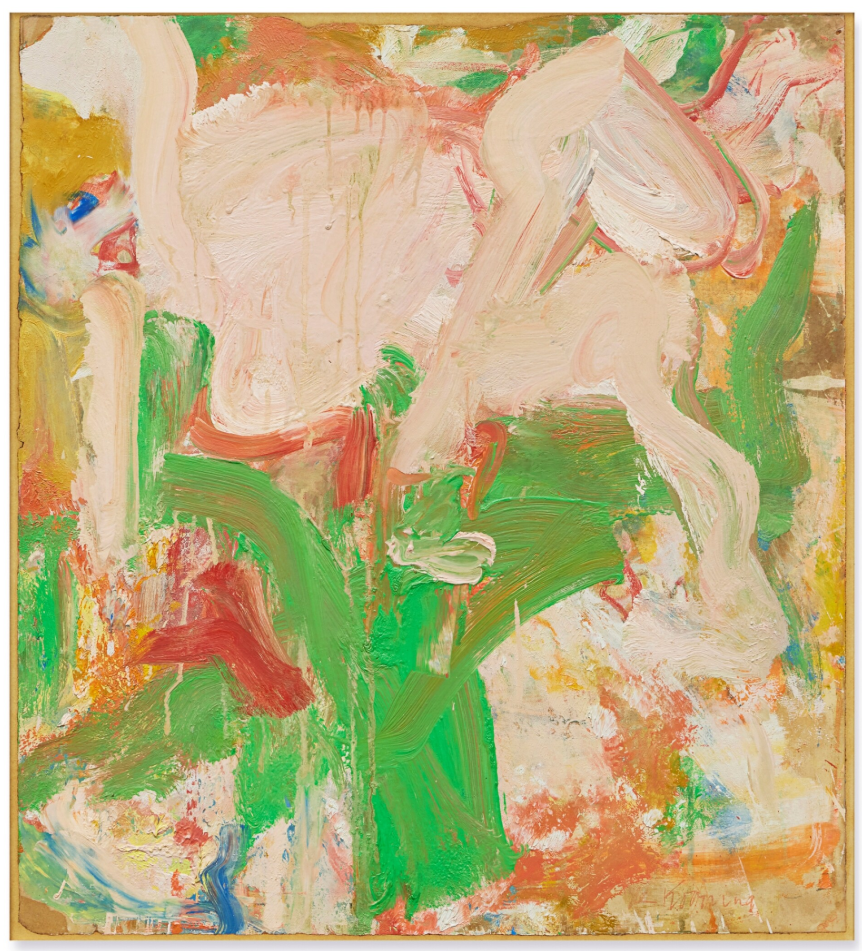
WILLEM DE KOONING (1904 – 1997)
Standing Woman and Trees, 1965
Oil on paper mounted on board
25 1/2 x 22 7/8 inches (64.7 x 58.1 cm)
Signed de Kooning (lower right)
#17. Untitled, 1958
Christie’s New-York: 18 May 2023
Estimated: USD 800,000 – 1,200,000
USD 529,200
WILLEM DE KOONING (1904-1997), Untitled | Christie’s
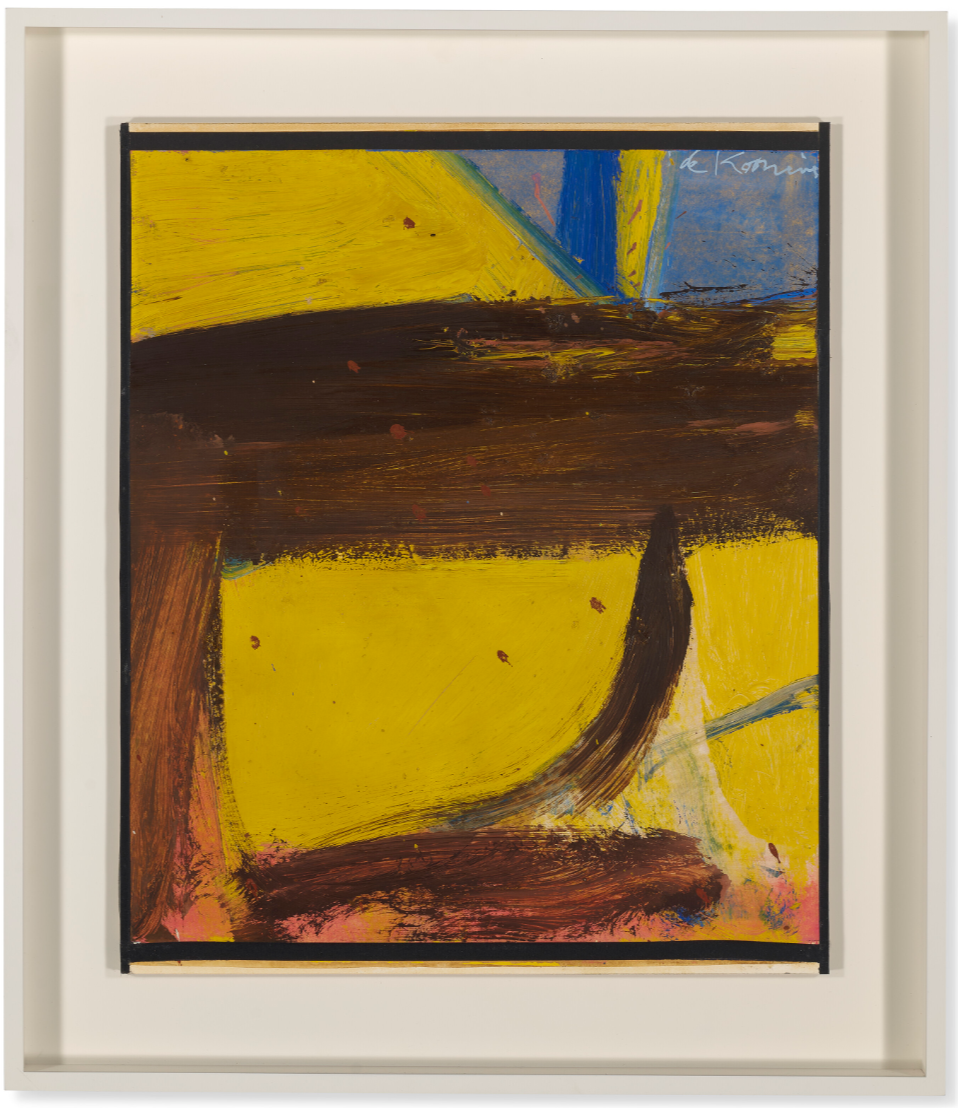
WILLEM DE KOONING (1904-1997)
Untitled, 1958
Oil on paper laid down on board
21 3/4 x 18 3/4 inches (55.2 x 47.6 cm)
Signed ‘de Kooning’ (upper right)
#18. Woman in Landscape XVI, 1968
Sotheby’s New-York: 28 September 2023
Estimated: USD 200,000 – 300,000
USD 279,400
Woman in Landscape XVI | Contemporary Curated | 2023 | Sotheby’s (sothebys.com)
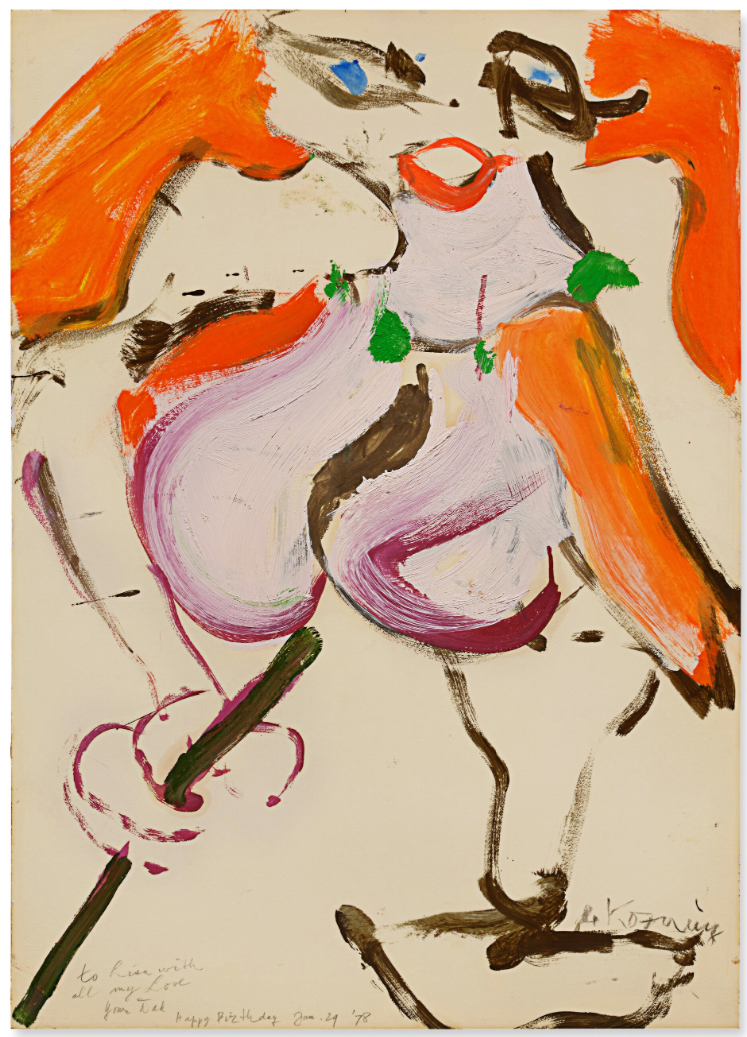
WILLEM DE KOONING (1904 – 1997)
Woman in Landscape XVI, 1968
Oil on paper mounted to canvas
41 3/4 x 30 1/4 inches (106 x 76.8 cm)
Signed (lower right); dedicated to Lisa with all my Love your Dad Happy Birthday Jan. 29 ’78 (lower left)
Executed in 1968 and inscribed in 1978
#19. Abstract Still Life, circa 1938
Christie’s New-York: 29 September 2023
Estimated: USD 200,000 – 300,000
USD 214,200
WILLEM DE KOONING (1904-1997), Abstract Still Life | Christie’s (christies.com)
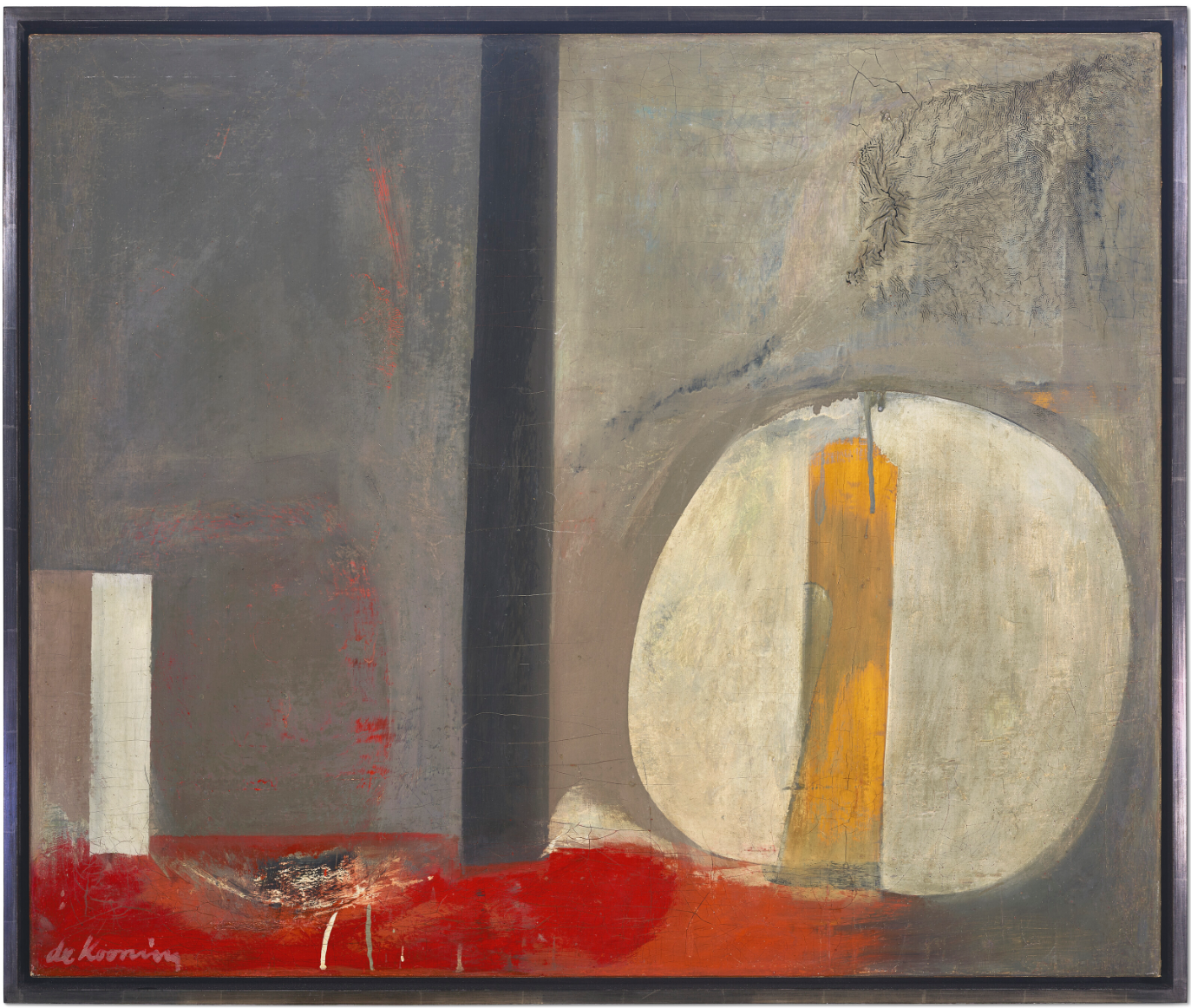
WILLEM DE KOONING (1904-1997)
Abstract Still Life, circa 1938
Oil on canvas
30×36 inches (76.2 x 91.4 cm)
Signed ‘de Kooning’ (lower left)
2022 Auction Results
FOR PAINTINGS & SCULPTURES ONLY
20 lots sold at auction in 2022 for a total turnover of USD 193,589,792. With only 1 lot failing to sell, the sell-through rate is 95%. The highest price was achieved at Sotheby’s in New-York, on 16 November 2022, when an untitled painting dated 1979 sold for USD 34,794,500.
2022 Top 3 Lots
7 lots sold for more than USD 10 million, generating a cumulative turnover of USD 144,656,800, representing 74.7% of the total turnover for 2022.
XXXXXXXXXX
#1. Untitled, circa 1979
Sotheby’s New-York: 16 November 2022
Estimated: USD 30,000,000 – 40,000,000
USD 34,794,500
Untitled | Contemporary Evening Auction | 2022 | Sotheby’s (sothebys.com)
WILLEM DE KOONING (1904-1997)
Untitled, circa 1979
Oil on canvas
70 x 79 1/2 inches (177.8 x 201.9 cm)
#2. Collage, 1950
Sotheby’s New-York: 14 November 2022
Estimated: USD 18,000,000 – 25,000,0000
USD 33,645,500
Collage | The David M. Solinger Collection Evening Auction | 2022 | Sotheby’s (sothebys.com)
WILLEM DE KOONING (1904-1997)
Collage, 1950
Oil and lacquer with thumbtacks on paper
22×30 inches (55.9 x 76.2 cm)
#3. Untitled XXI, 1977
Christie’s New-York: 12 May 2022
Estimate on Request
USD 25,007,500
WILLEM DE KOONING (1904-1997) (christies.com)
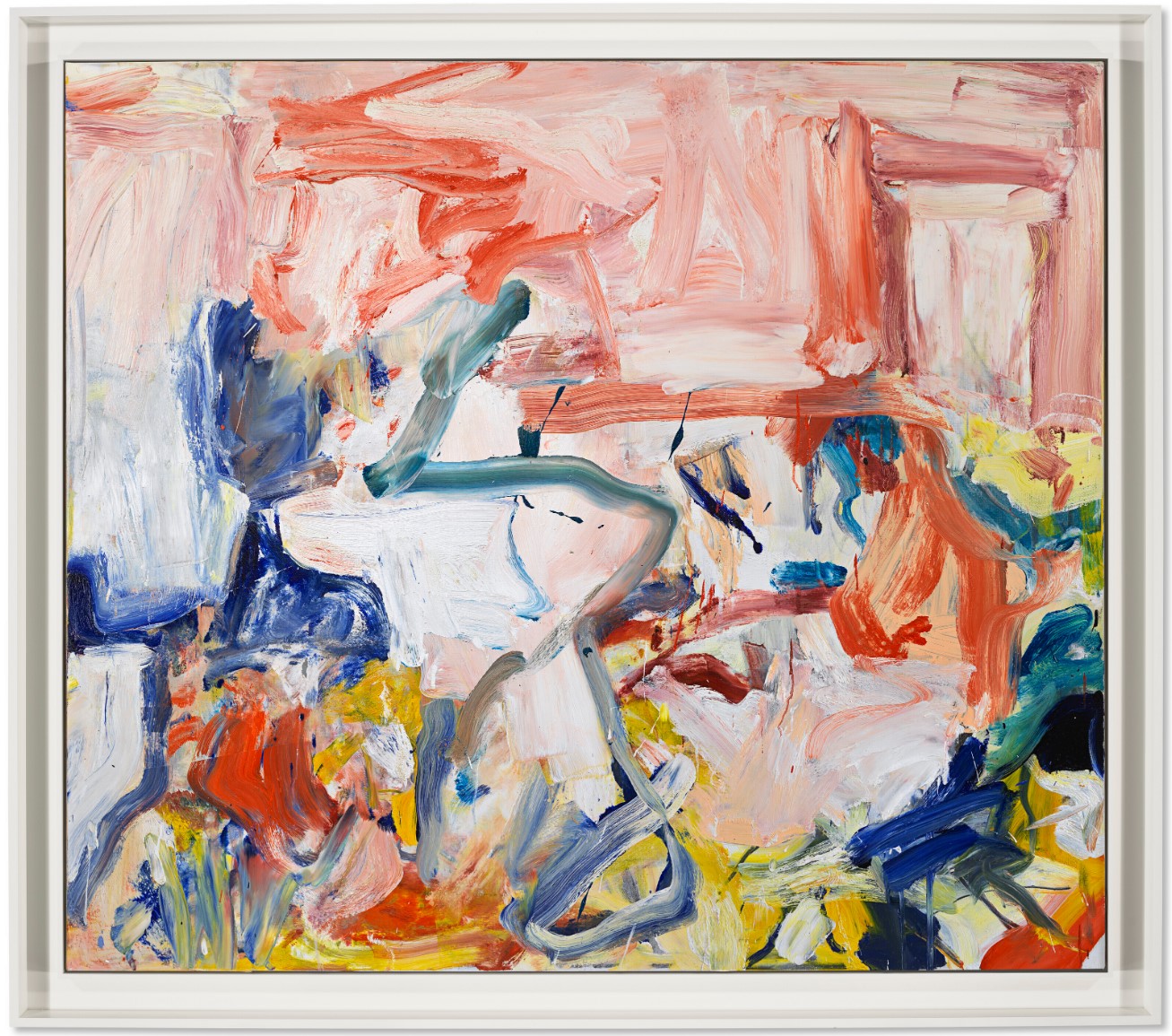
WILLEM DE KOONING (1904-1997)
Untitled XXI, 1977
Oil on canvas
70×80 inches (177.8 x 203.2 cm)
Signed ‘de Kooning’ (on the reverse)
#4. Untitled, 1961
Sotheby’s New-York: 16 May 2022
The Macklowe Collection
Estimated: USD 7,000,000 – 10,000,000
USD 17,789,300
Untitled | The Macklowe Collection | 2022 | Sotheby’s (sothebys.com)
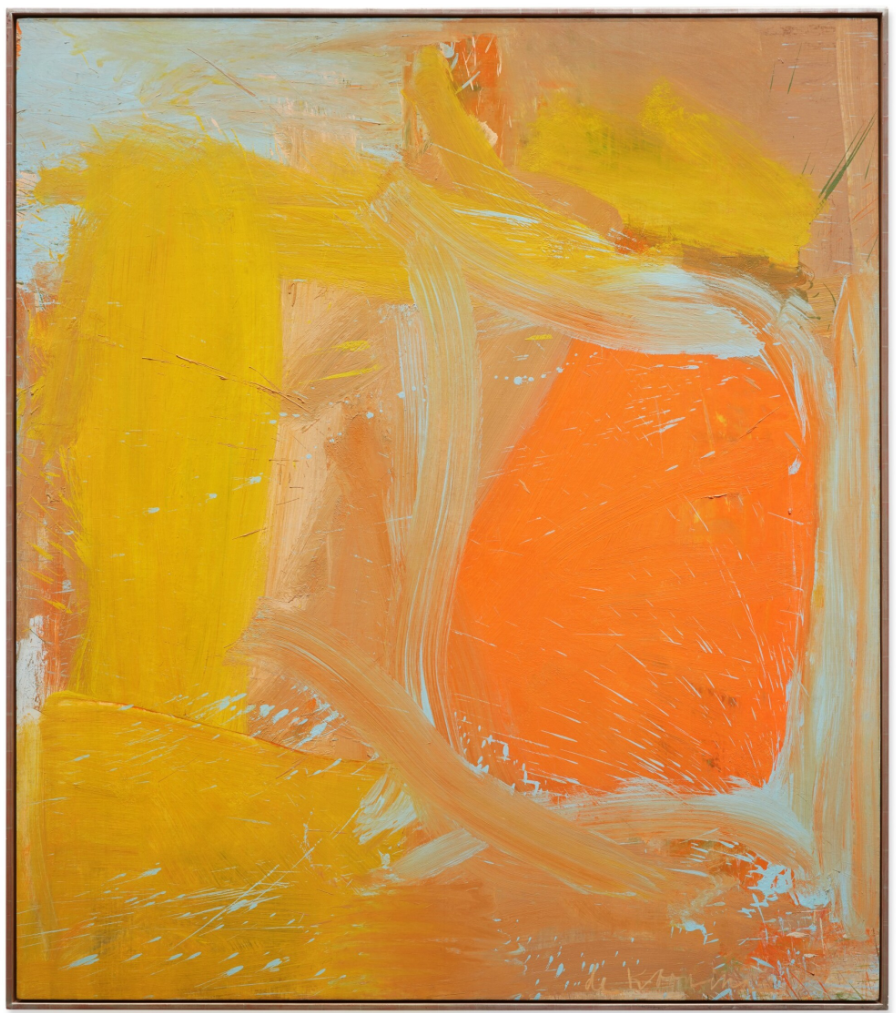
WILLEM DE KOONING (1904 – 1997)
Untitled, 1961
Oil on canvas
80 x 70 1/8 inches (203.2 x 178.1 cm)
Signed
#5. Montauk II, 1969
Sotheby’s New-York: 16 November 2022
Estimated: USD 10,000,000 – 15,000,000
USD 12,663,500
Montauk II | Contemporary Evening Auction | 2022 | Sotheby’s (sothebys.com)
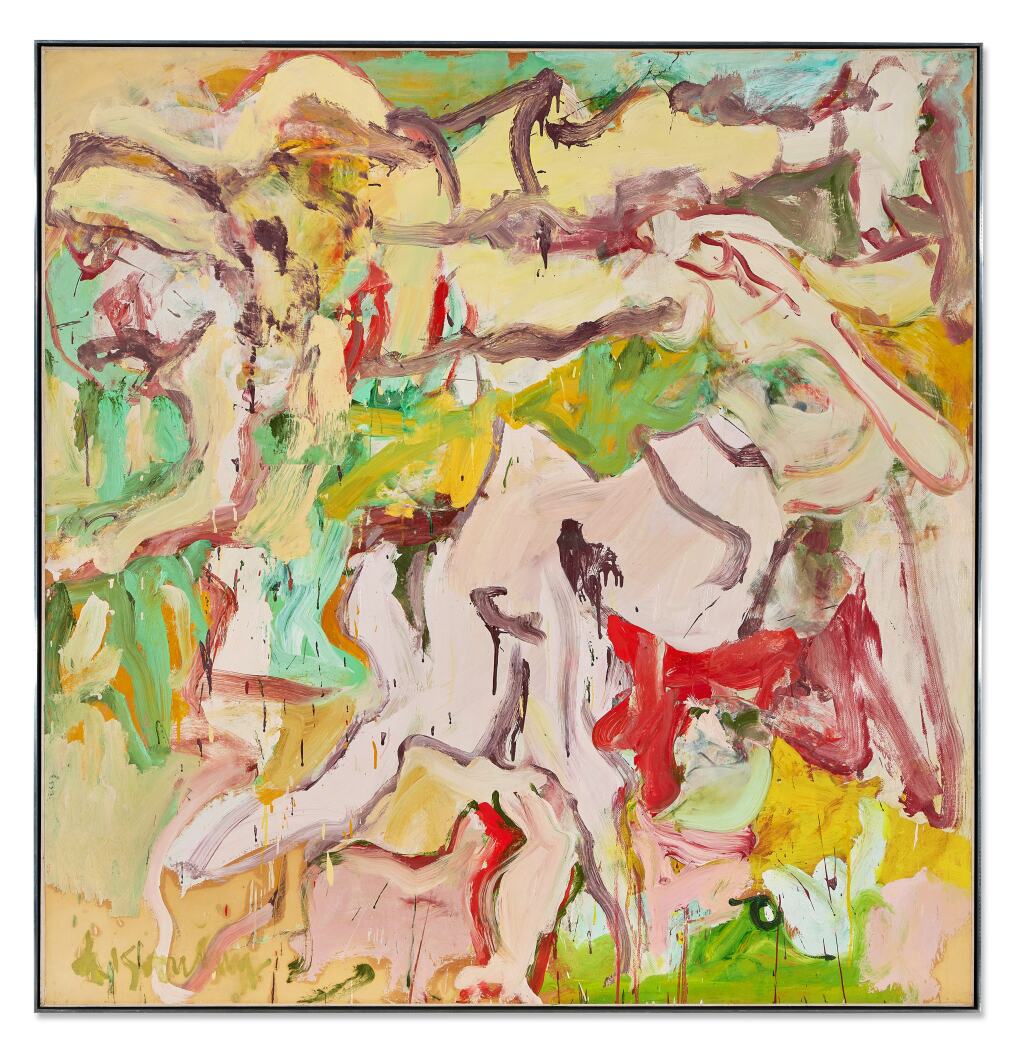
WILLEM DE KOONING (1904-1997)
Montauk II, 1969
Oil on paper mounted on canvas
72 ½ x 70 ¼ inches (184.2 x 178.4 cm)
#6. The Hat Upstairs, 1987
Sotheby’s New-York: 16 November 2022
Estimated: USD 9,000,000 – 12,000,000
USD 10,665,500
The Hat Upstairs | Contemporary Evening Auction | 2022 | Sotheby’s (sothebys.com)
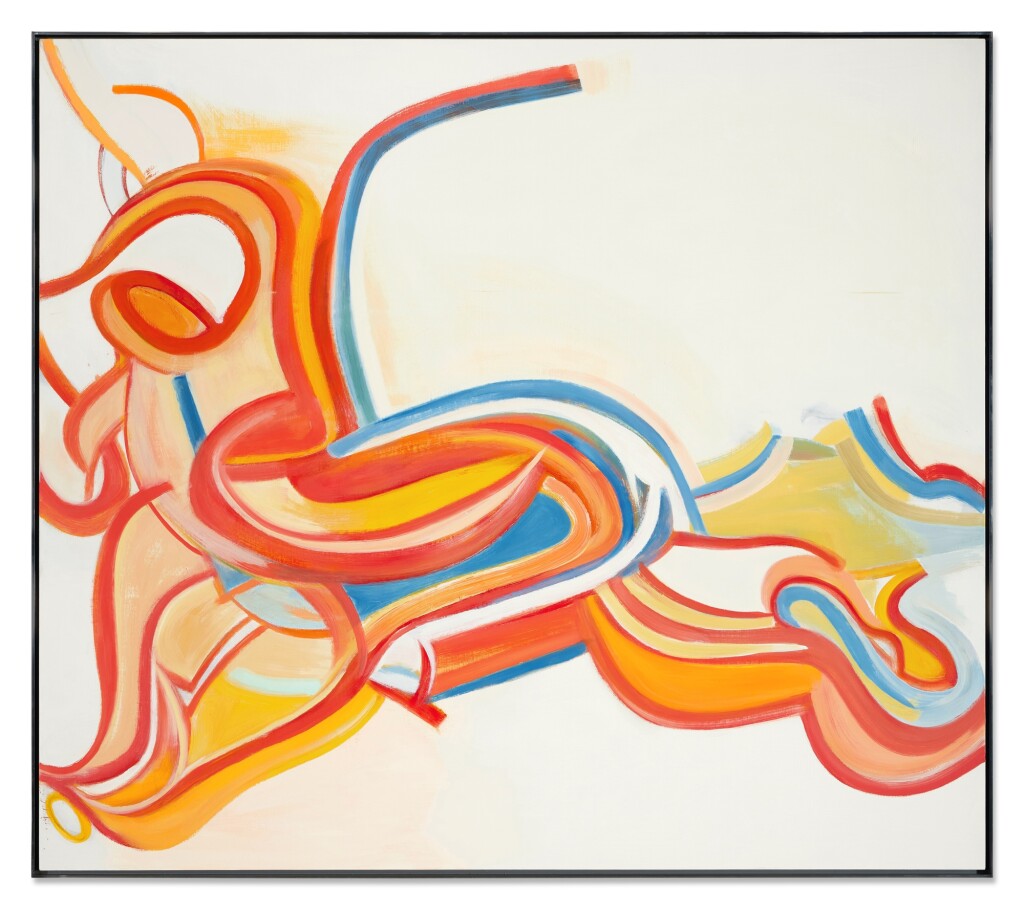
WILLEM DE KOONING (1904-1997)
The Hat Upstairs, 1987
Oil on canvas
77×88 inches (195.6 x 223.5 cm)
#7. Leaves in Weehawken, 1958
Sotheby’s New-York: 17 May 2022
Estimated: USD 3,000,000 – 5,000,000
USD 10,091,000
Leaves in Weehawken | Modern Evening Auction | 2022 | Sotheby’s (sothebys.com)
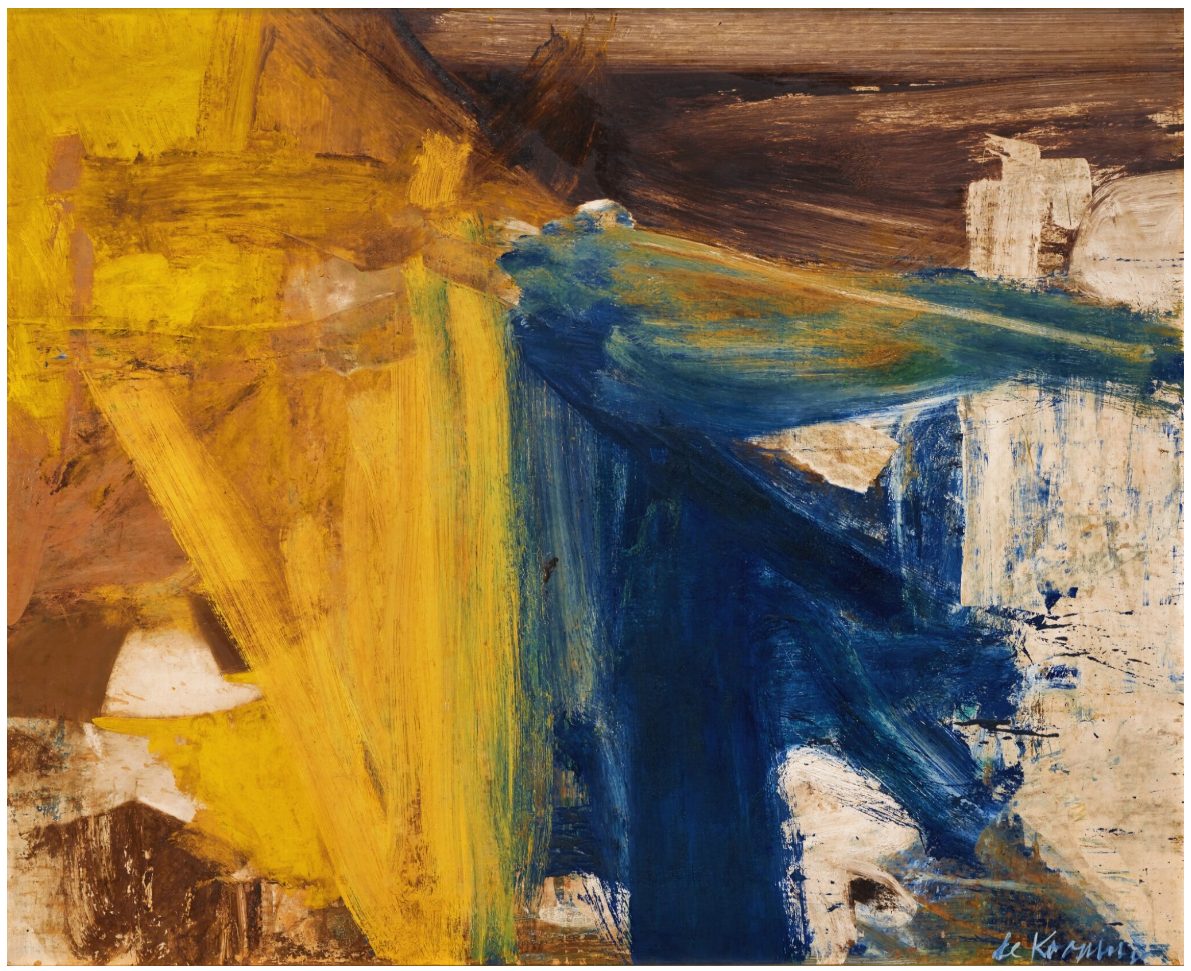
WILLEM DE KOONING (1904 – 1997)
Leaves in Weehawken, 1958
Oil on paper mounted on canvas
47 3/4 x 58 3/4 inches (121.3 x 149.2 cm)
Signed de Kooning (lower right)
#8. Untitled, 1985
Christie’s New-York: 17 November 2022
Estimated: USD 8,000,000 – 12,000,000
USD 9,321,000
WILLEM DE KOONING (1904-1997) (christies.com)
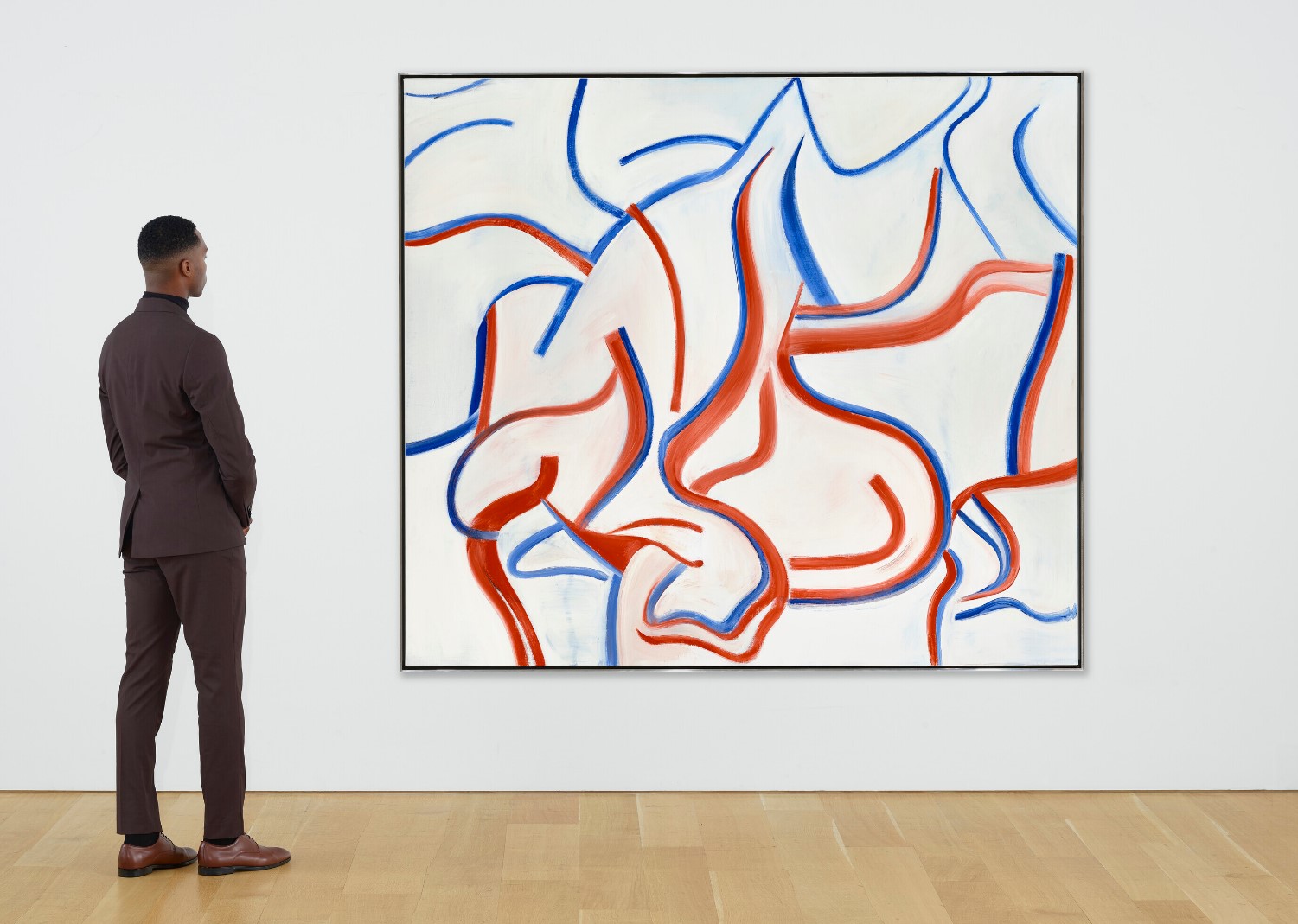
WILLEM DE KOONING (1904-1997)
Untitled, 1985
Oil on canvas
70×80 inches (177.8 x 203.2 cm)
#9. Untitled XIII, 1984
Sotheby’s New-York: 16 May 2022
The Macklowe collection
Estimated: USD 7,000,000 – 10,000,000
USD 8,999,450
Untitled XIII | The Macklowe Collection | 2022 | Sotheby’s (sothebys.com)
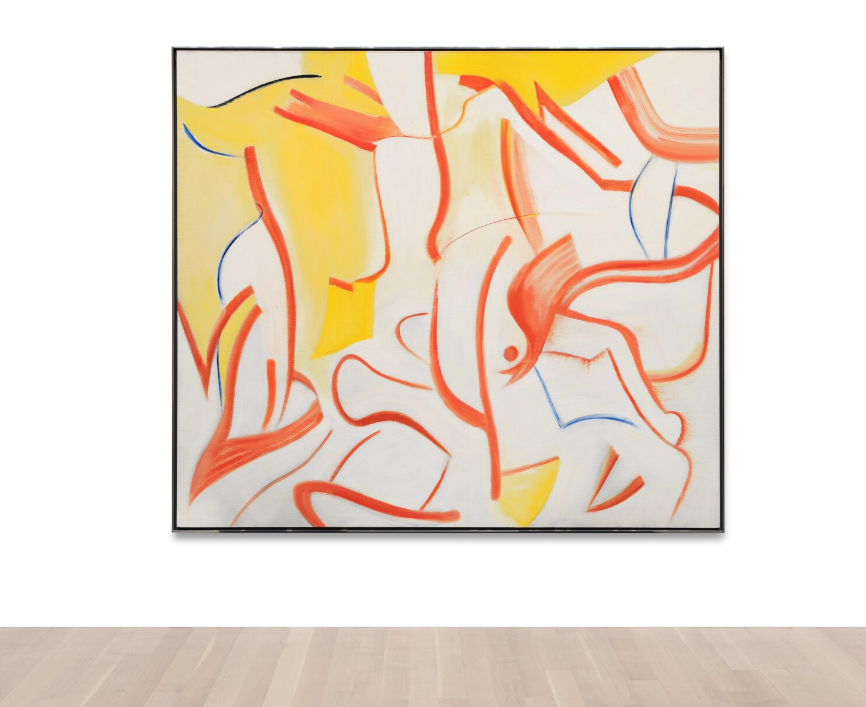
WILLEM DE KOONING (1904 – 1997)
Untitled XIII, 1984
Oil on canvas
70×80 inches (177.8 x 203.2 cm)
Signed on the stretcher
#10. Seated Woman, 1969-1980
Christie’s New-York: 12 May 2022
Estimated: USD 7,000,000 – 10,000,000
USD 8,155,000
WILLEM DE KOONING (1904-1997), Seated Woman | Christie’s
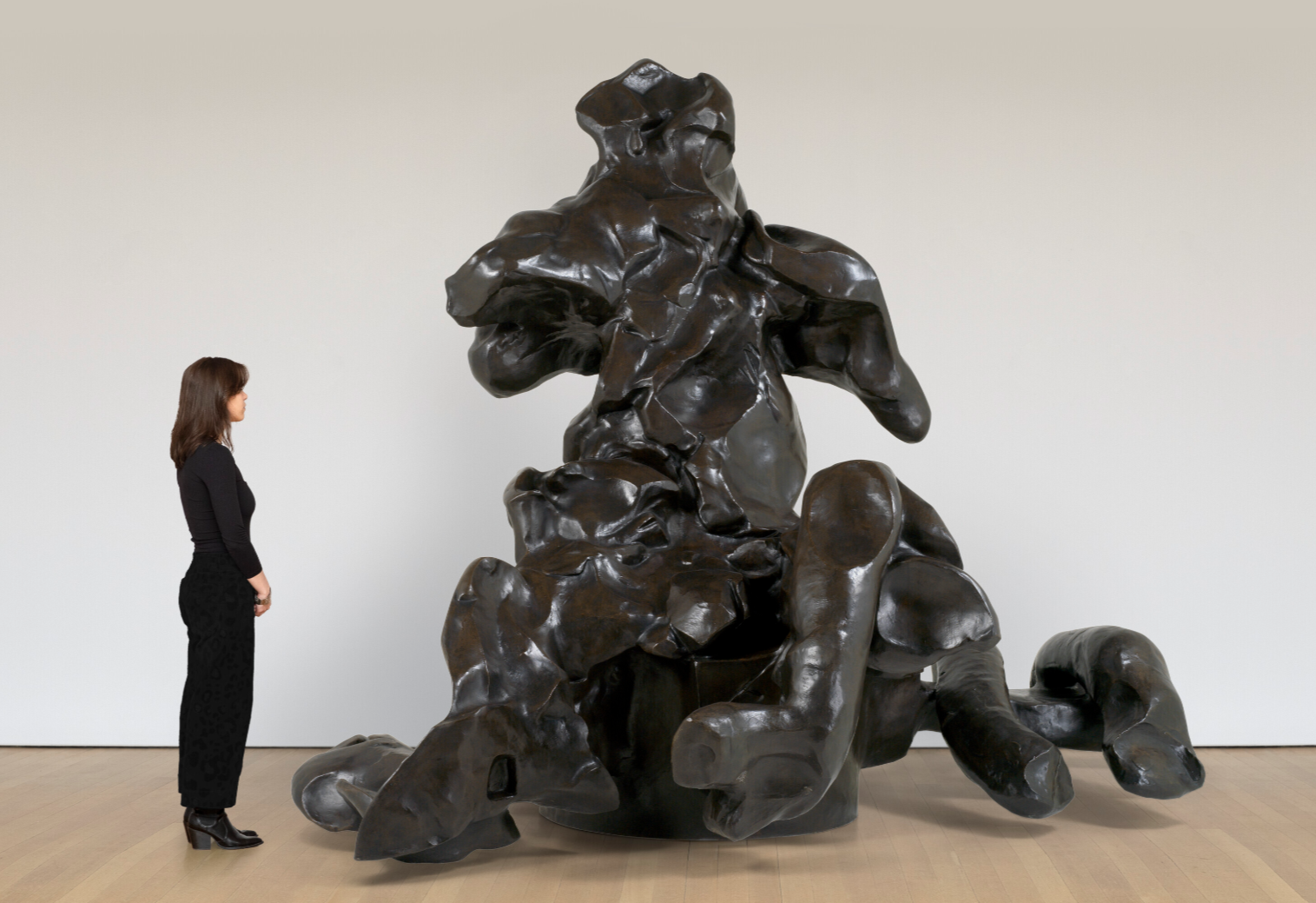
WILLEM DE KOONING (1904-1997)
Seated Woman, 1969-1980
Bronze
113x147x94 inches (287 x 373.4 x 238.8 cm)
Incised with the artist’s signature, number and date ‘de Kooning © 1969⁄80 1⁄7’ (on the reverse)
Conceived in 1969 and executed in 1980
This work is number one from an edition of seven plus two artist’s proofs
#11. Untitled, circa 1977
Phillips New-York: 15 November 2022
Estimated: USD 4,000,000 – 6,000,000
USD 4,870,000
Willem de Kooning – 20th Century & … Lot 28 November 2022 | Phillips
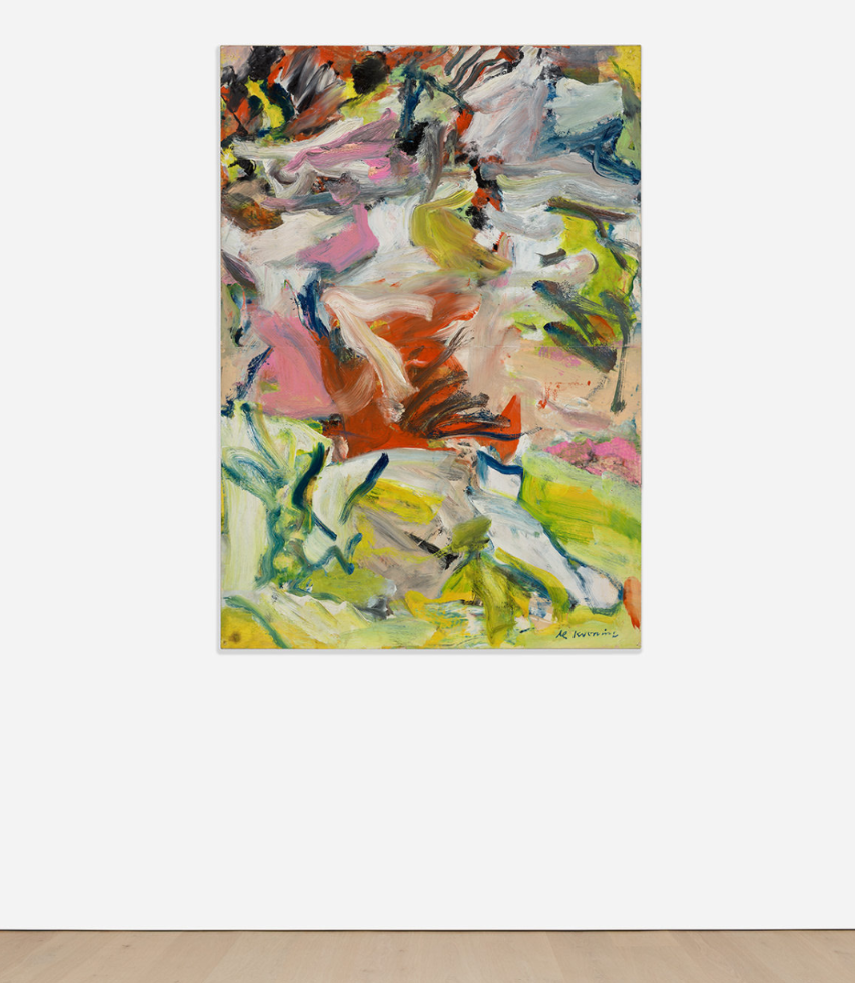
WILLEM DE KOONING
Untitled, circa 1977
Oil on paper, in 2 parts, laid on canvas
60 1/2 x 41 1/4 inches (153.7 x 104.8 cm)
Signed “de Kooning” lower right
#12. Untitled XVI, 1985
Sotheby’s London: 29 June 2022
Estimated: GBP 3,000,000 – 4,000,000
GBP 3,545,000 / USD 4,305,842
Untitled XVI | Modern & Contemporary Evening Auction | 2022 | Sotheby’s (sothebys.com)
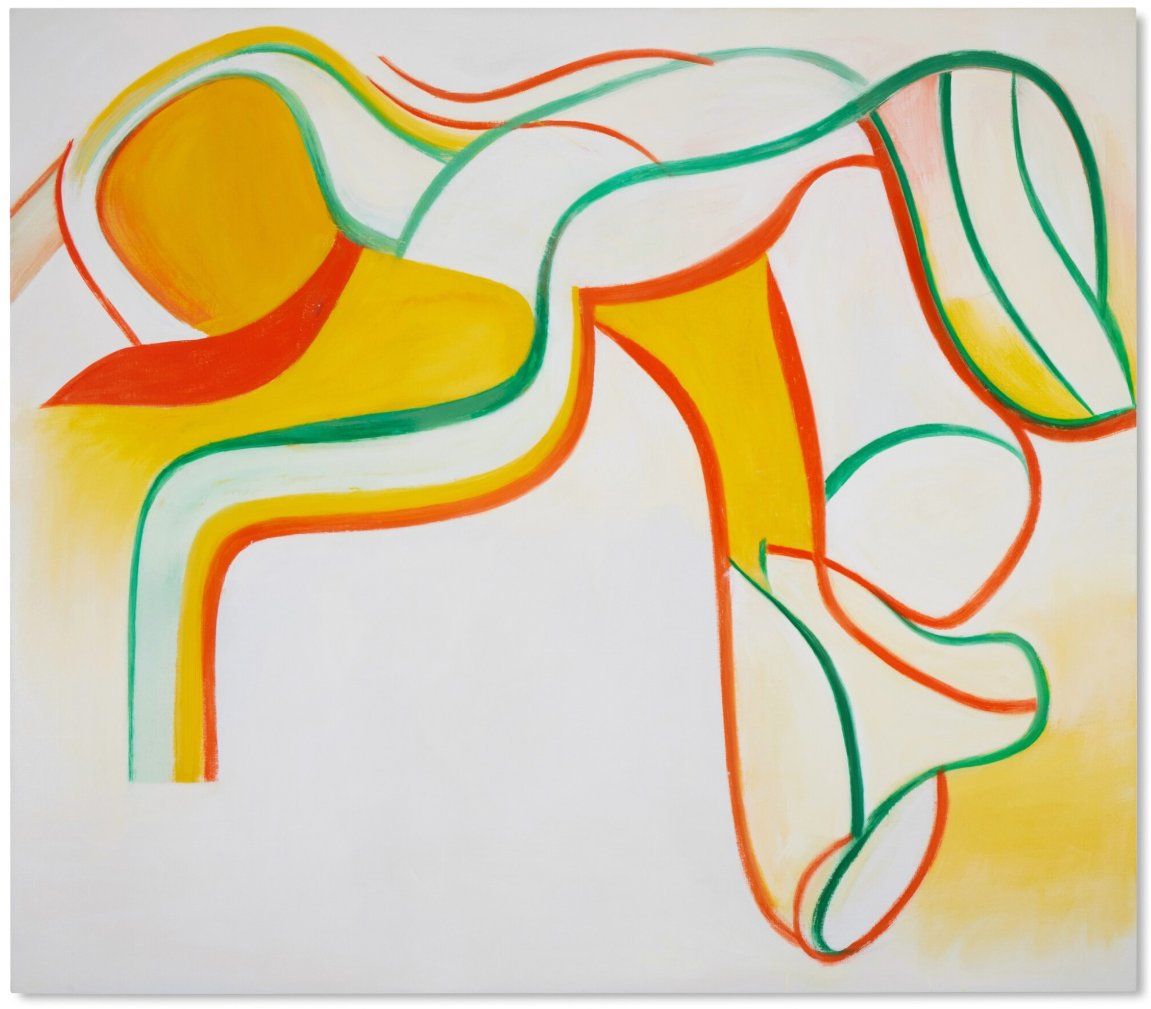
WILLEM DE KOONING (1904 – 1997)
Untitled XVI, 1985
Oil on canvas
77×88 inches (195.5 x 223.5 cm)
Signed de Kooning (on the stretcher)
#13. Untitled, circa 1964
Sotheby’s New-York: 30 September 2022
Estimated: USD 1,800,000 – 2,500,000
USD 4,164,000
Untitled | Contemporary Curated | 2022 | Sotheby’s (sothebys.com)
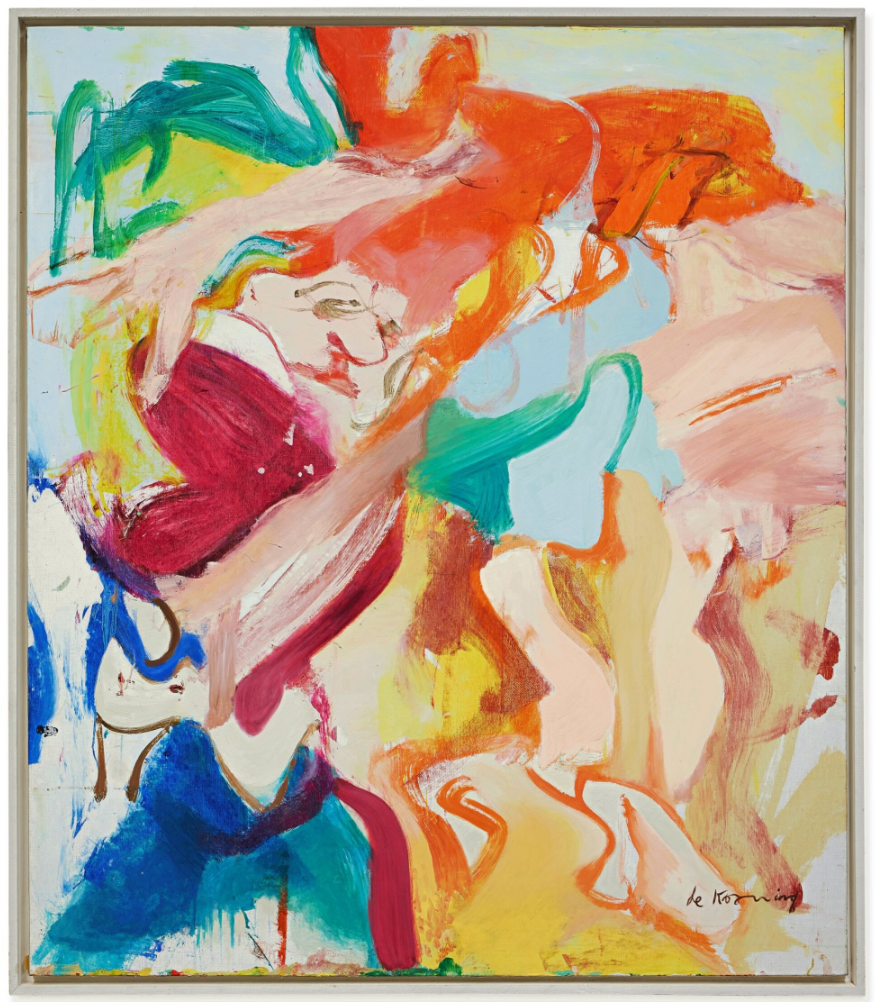
WILLEM DE KOONING (1904 – 1997)
Untitled, circa 1964
Oil on canvas
55 5/8 c 48 inches (141.3 x 121.9 cm)
Signed de Kooning (lower right)
#14. Event in a Barn, 1947
Phillips New-York: 15 November 2022
Estimated: USD 2,500,000 – 3,500,000
USD 2,055,000
Willem de Kooning – 20th Century & … Lot 36 November 2022 | Phillips
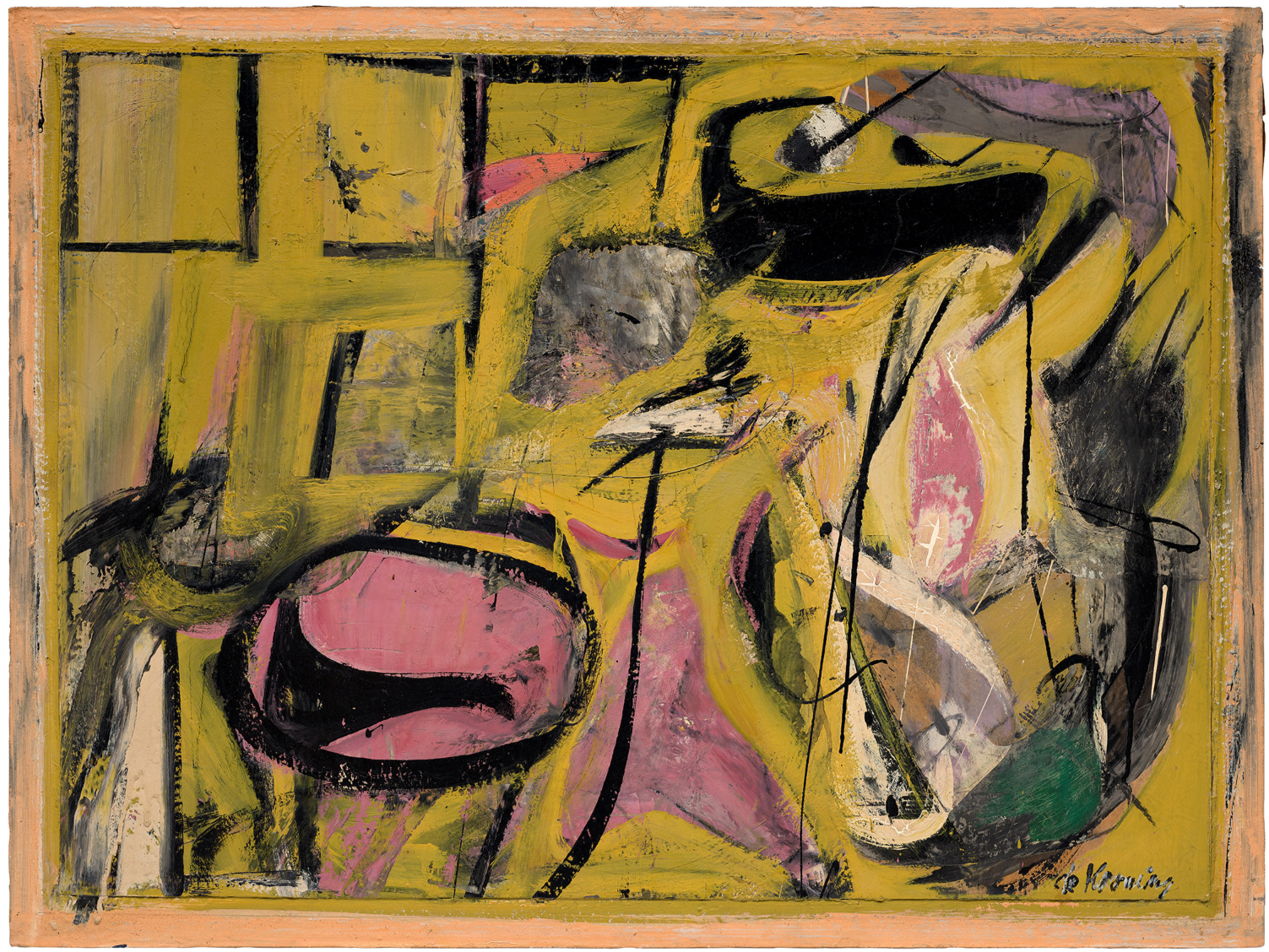
WILLEM DE KOONING
Event in a Barn, 1947
Oil, enamel and paper collage on paper laid on board
24 3/4 x 33 inches (62.9 x 83.8 cm)
Signed “de Kooning” lower right
#15. Untitled, 1977
Christie’s New-York: 18 November 2022
Estimated: USD 1,000,000 – 1,500,000
USD 2,100,000
WILLEM DE KOONING (1904-1997), Untitled | Christie’s (christies.com)
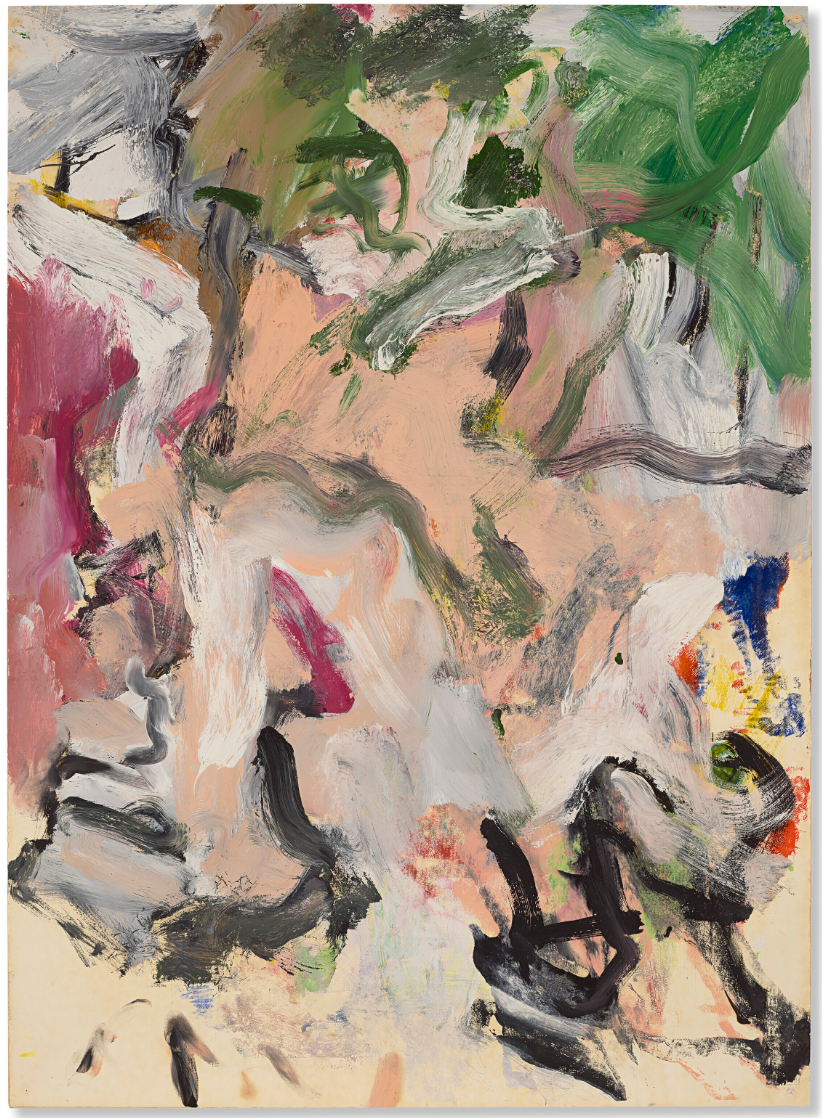
WILLEM DE KOONING (1904-1997)
Untitled, 1977
Oil on paper mounted on canvas
41 3/8 x 30 inches (104.9 x 76.2 cm)
Signed ‘de Kooning’ (on the stretcher)
#16. Composition III, 1958
Christie’s New-York: 18 November 2022
Estimated: USD 900,000 – 1,200,000
USD 1,134,000
WILLEM DE KOONING (1904-1997), Composition III | Christie’s (christies.com)
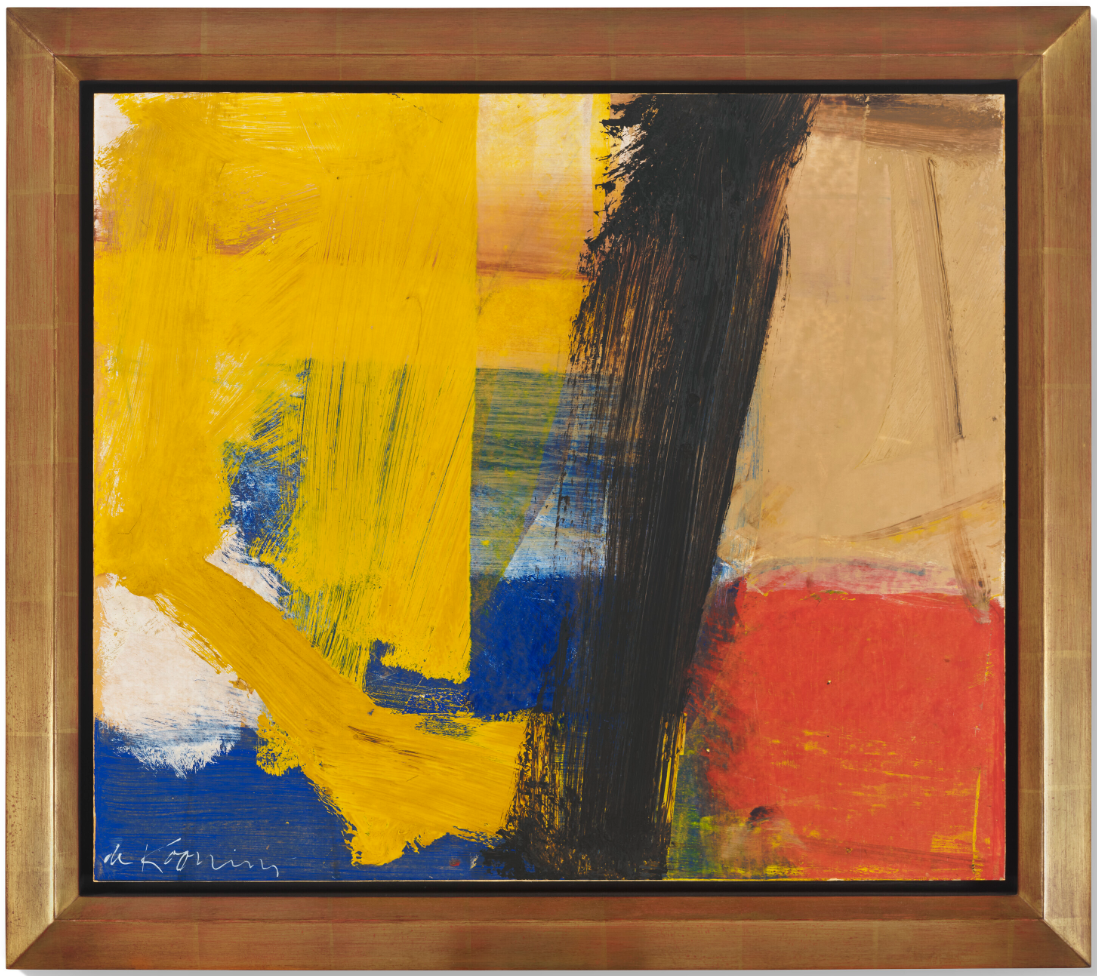
WILLEM DE KOONING (1904-1997)
Composition III, 1958
Oil on paper mounted on board
18 3/4 x 21 3/4 inches (47.6 x 55.2 cm)
Signed ‘de Kooning’ (lower left)
#17. Belle Bay, 1964
Sotheby’s New-York: 15 November 2022
Estimated: USD 700,000 – 1,000,000
USD 1,039,500
Belle Bay | Modern Day Auction | 2022 | Sotheby’s
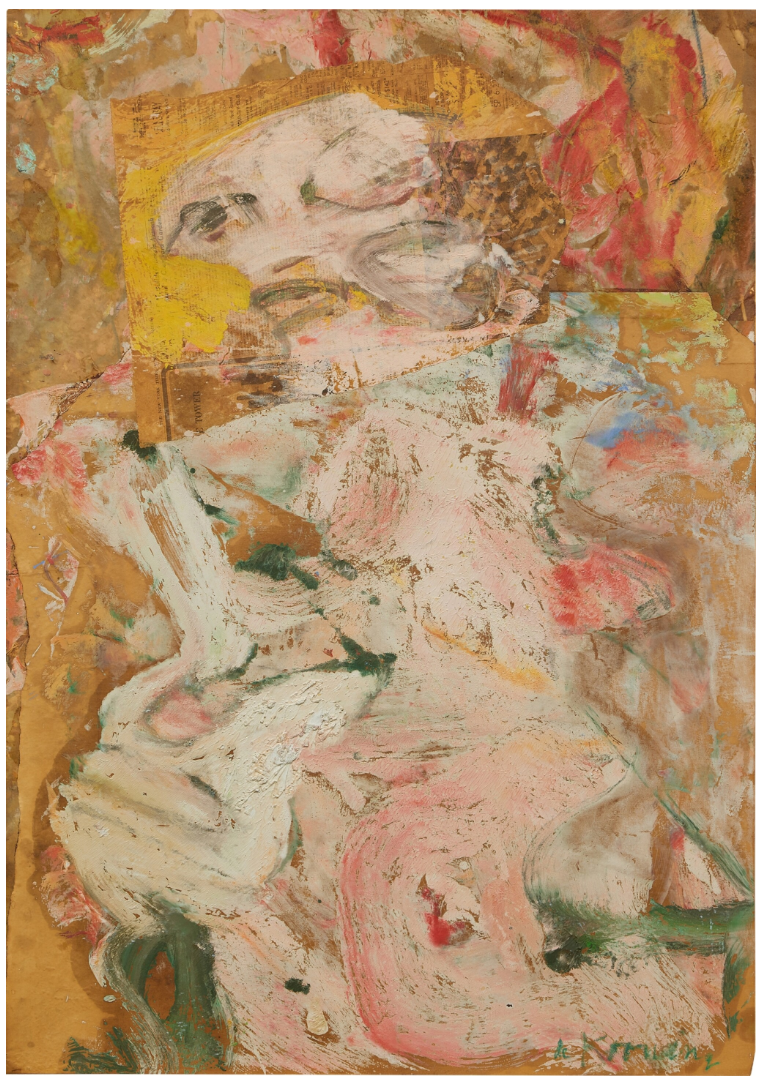
WILLEM DE KOONING (1904 – 1997)
Belle Bay, 1964
Oil and paper collage on vellum mounted on Masonite
38 3/4 x 27 inches (98.4 x 68.6 cm)
Signed de Kooning (lower right)
2021 Auction Results
14 lots sold at auction in 2021 for a total turnover of USD 107,441,711. With 2 lots failing to sell, the sell-through rate is 88%. The highest price was achieved at Sotheby’s in New-York, when Untitled XXXIII, a painting dated 1977 sold for USD 24,393,000.
2021 Top 3 Lots
4 lots sold for more than USD 10 million, generating a cumulative turnover of USD 68,322,250, representing 63.6% of the total turnover for 2021.
XXXXXXXXXX
#1. Untitled XXXIII, 1977
Sotheby’s New-York: 15 November 2021
Estimated: USD 12,000,000 – 18,000,000
USD 24,393,000
Untitled XXXIII | The Macklowe Collection | 2021 | Sotheby’s (sothebys.com)
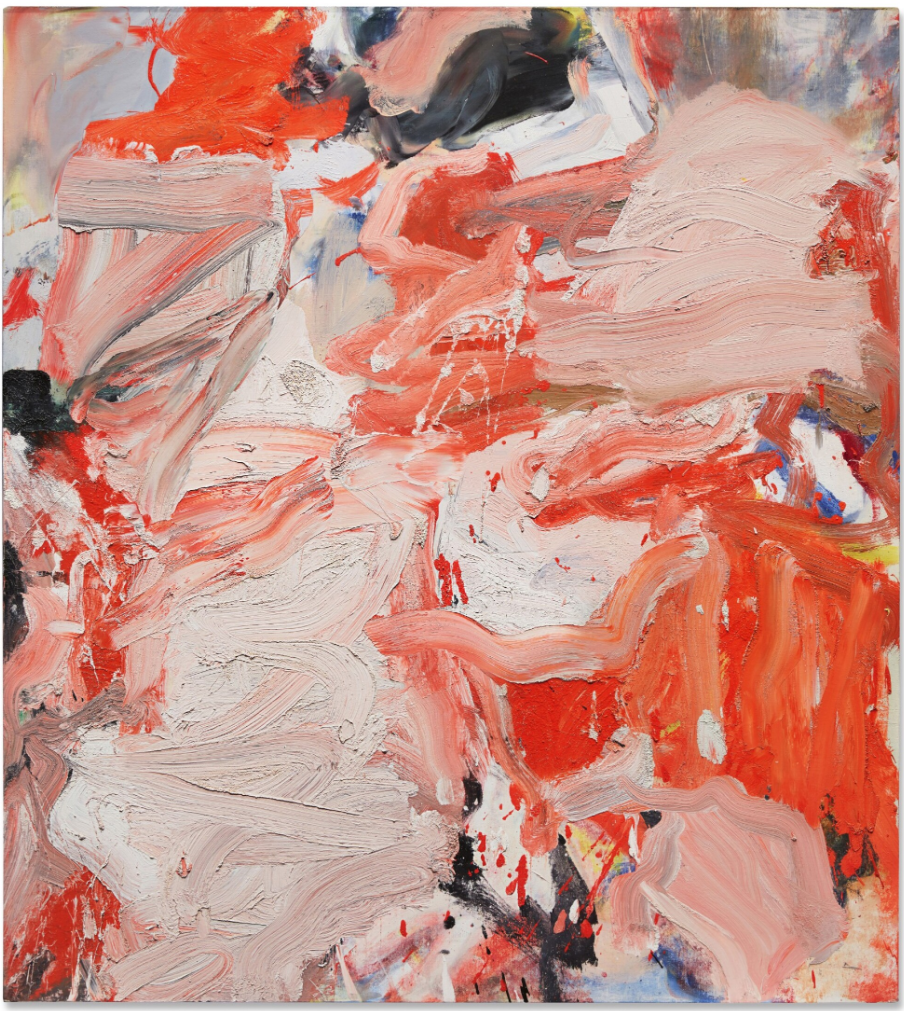
WILLEM DE KOONING (1904 – 1997)
Untitled XXXIII, 1977
Oil on canvas
60×54 inches (152.4 x 137.2 cm)
#2. Untitled IV, 1983
Sotheby’ New-York: 15 November 2021
The Macklowe Collection
Estimated: USD 10,000,000 – 15,000,000
USD 18,935,250
Untitled IV | The Macklowe Collection | 2021 | Sotheby’s (sothebys.com)
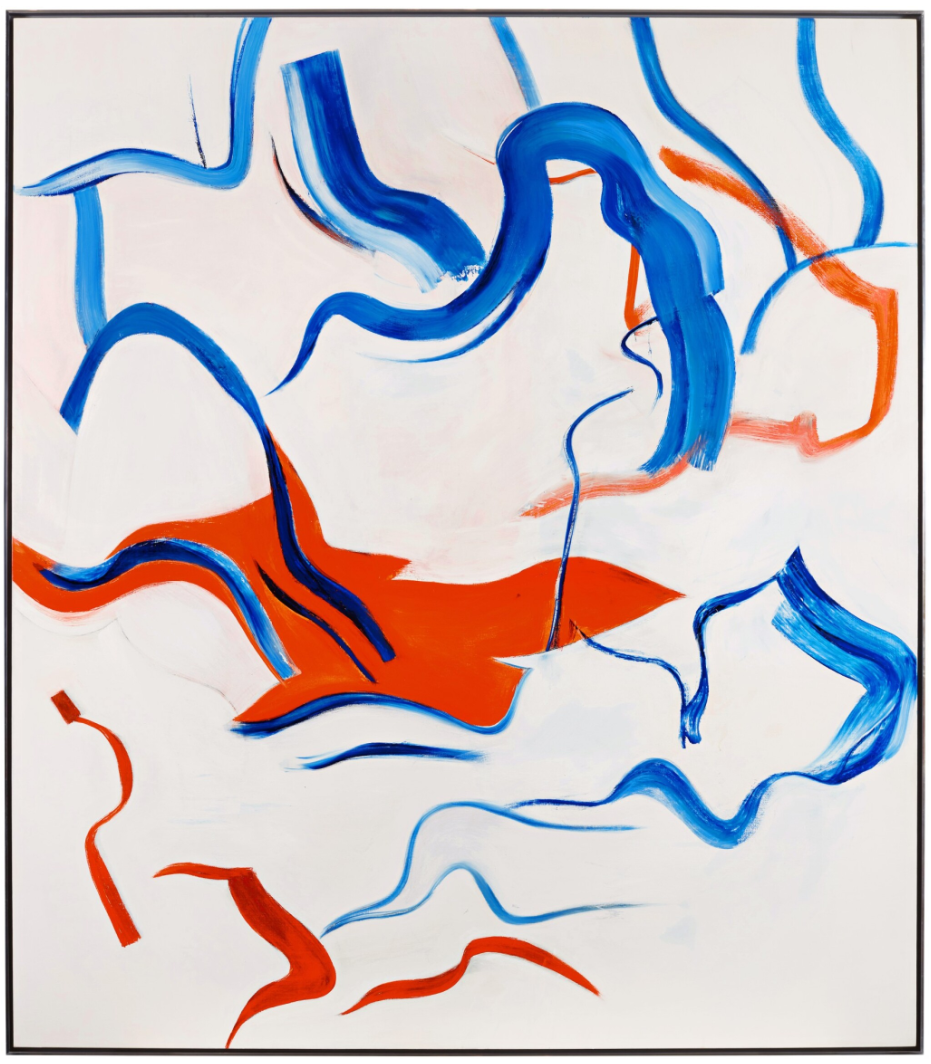
WILLEM DE KOONING (1904 – 1997)
Untitled IV, 1983
Oil on canvas
88×77 inches (223.5 x 195.6 cm)
Signed on the stretcher
#3. Untitled VII, 1981
Christie’s New-York: 11 November 2021
Estimated: USD 8,000,000 – 12,000,000
USD 14,558,000
WILLEM DE KOONING (1904-1997), Untitled VII | Christie’s (christies.com)
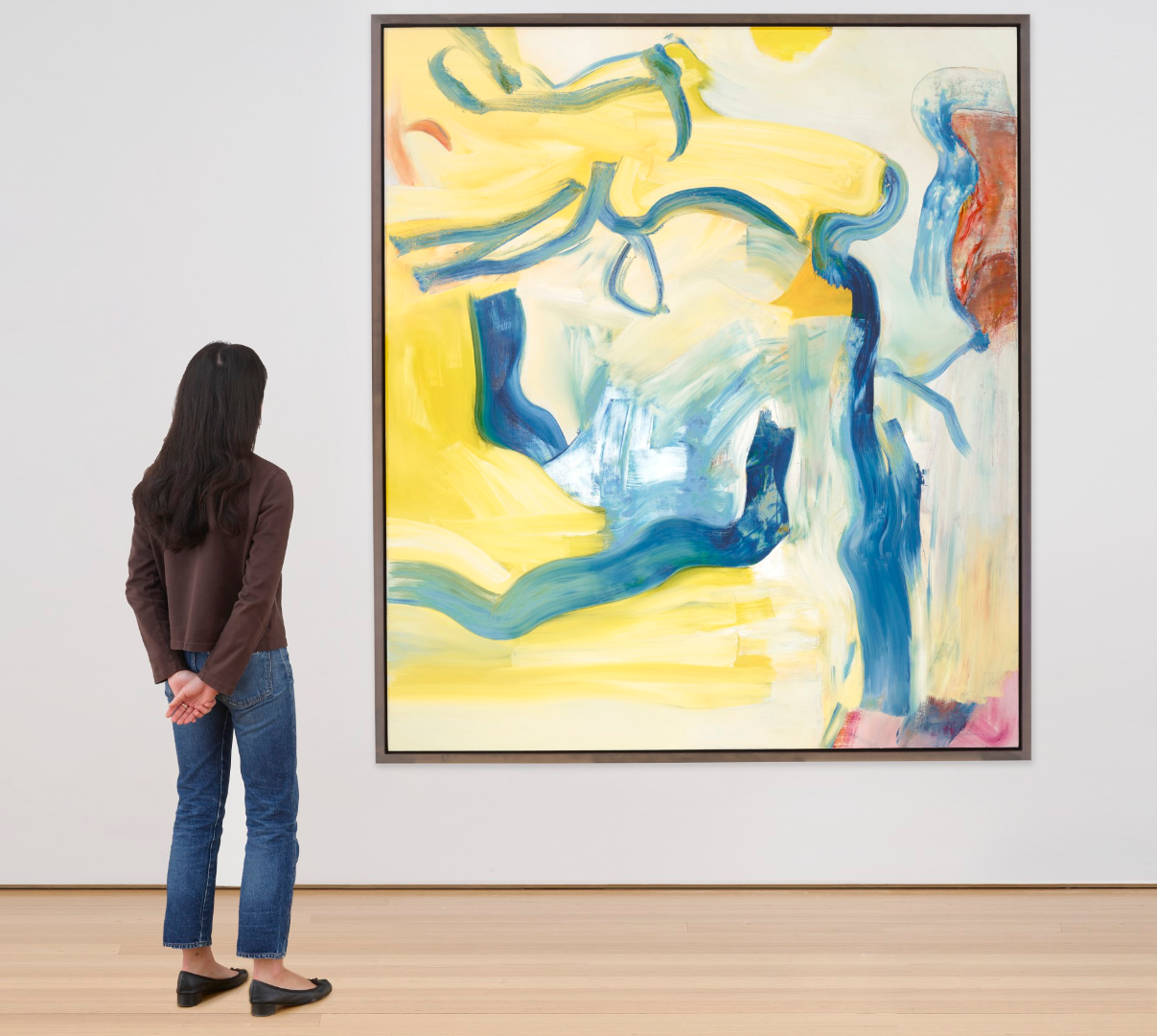
WILLEM DE KOONING (1904-1997)
Untitled VII, 1981
Oil on canvas
80×70 inches (203.2 x 177.8 cm)
Signed ‘de Kooning’ (on the stretcher)
#4. East Hampton VI, 1977
Christie’s New-York: 13 May 2021
Estimated: USD 4,000,000 – 6,000,000
USD 10,436,000
Willem de Kooning (1904-1997), East Hampton VI | Christie’s (christies.com)
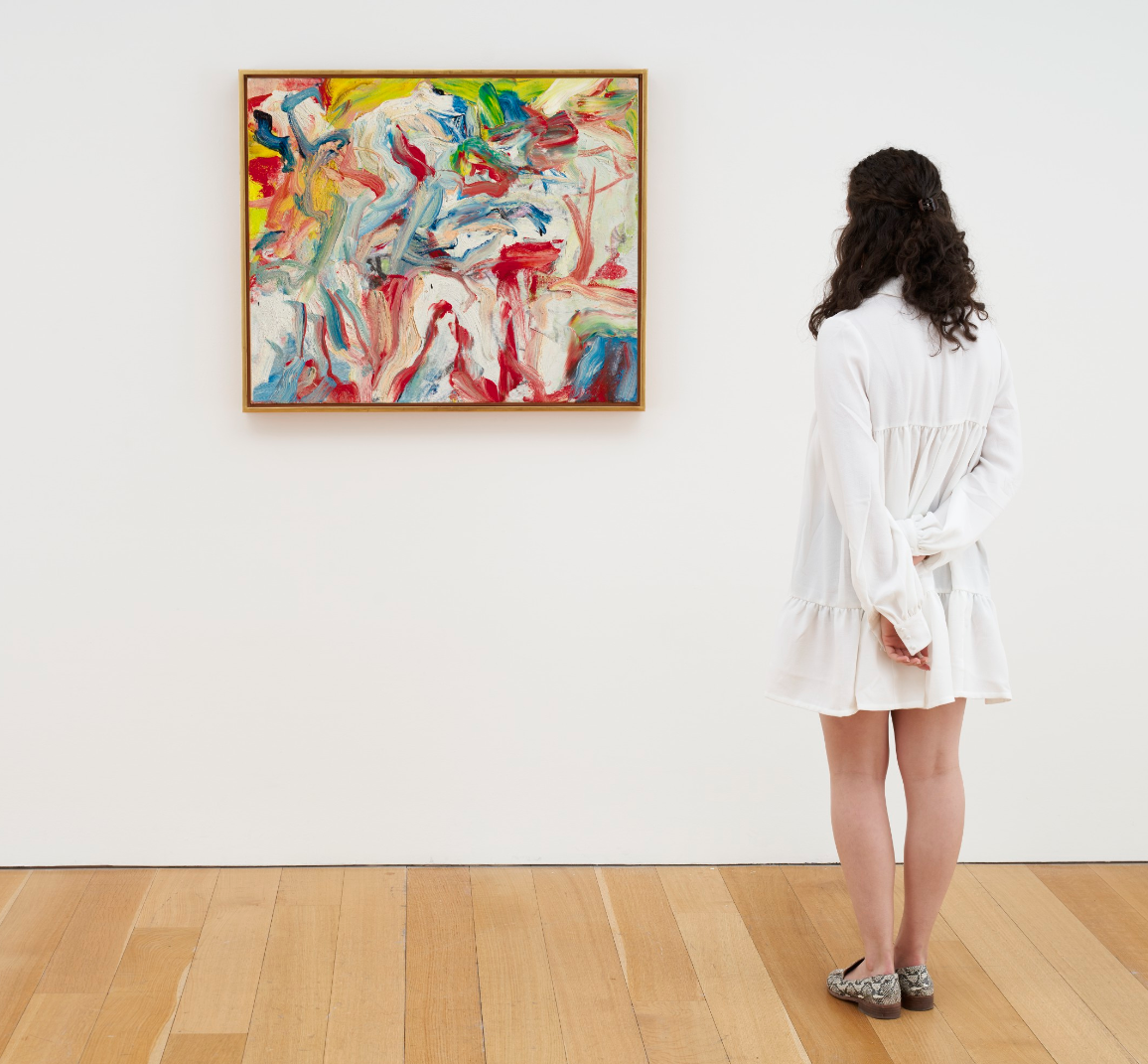
Willem de Kooning (1904-1997)
East Hampton VI, 1977
Oil on canvas
30 1/8 x 36 inches (76.5 x 91.4 cm)
Signed and dated ‘de Kooning 1977’ (on the reverse)
#5. Woman, circa 1952-1953
Christie’s New-York: 13 May 2021
Estimated: USD 7,000,000 – 10,000,000
USD 8,489,500
Willem de Kooning (1904-1997), Woman | Christie’s (christies.com)
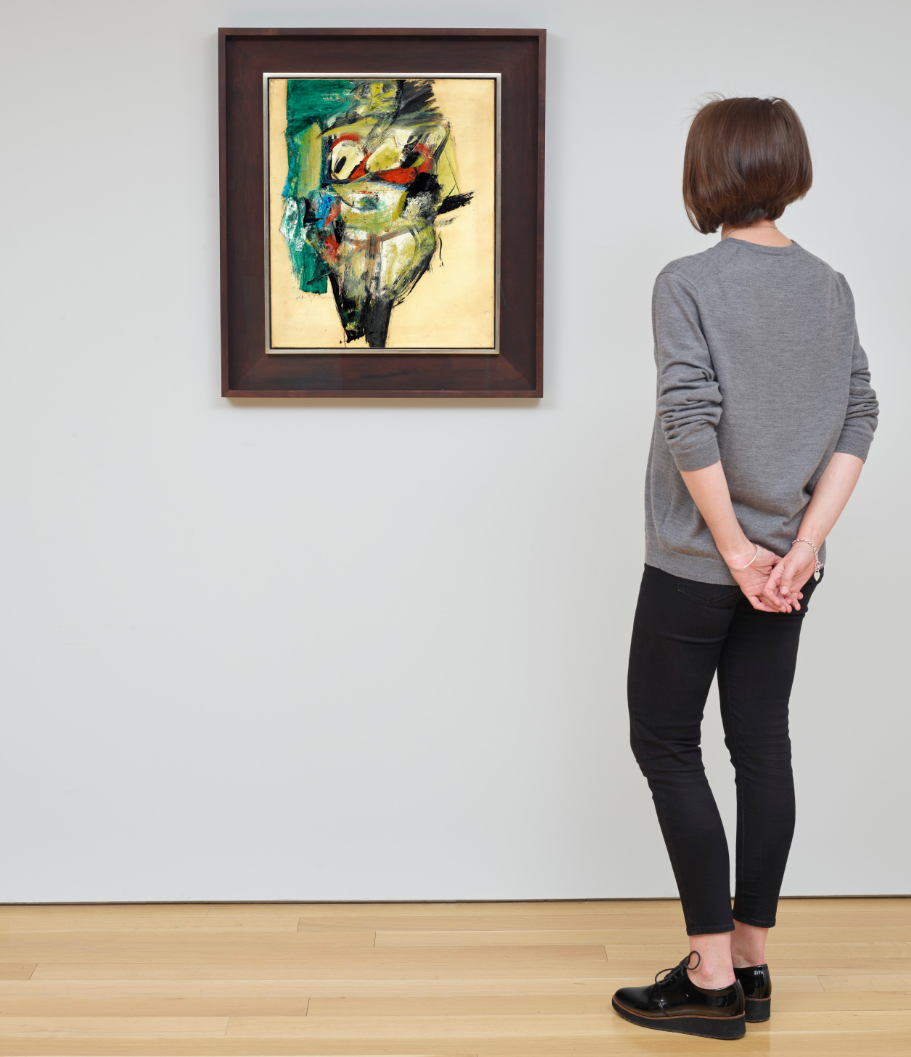
WILLEM DE KOONING (1904-1997)
Woman, circa 1952-1953
Oil, enamel and charcoal on paper laid down on canvas
22 5/8 x 19 inches (57.5 x 48.3 cm)
Signed ‘de Kooning’ (lower left)
#6. Stowaway, 1986
Sotheby’ New-York: 12 May 2021
Estimated: USD 6,000,000 – 8,000,000
USD 7,158,000
Stowaway | Contemporary Art Evening Auction | 2021 | Sotheby’s (sothebys.com)
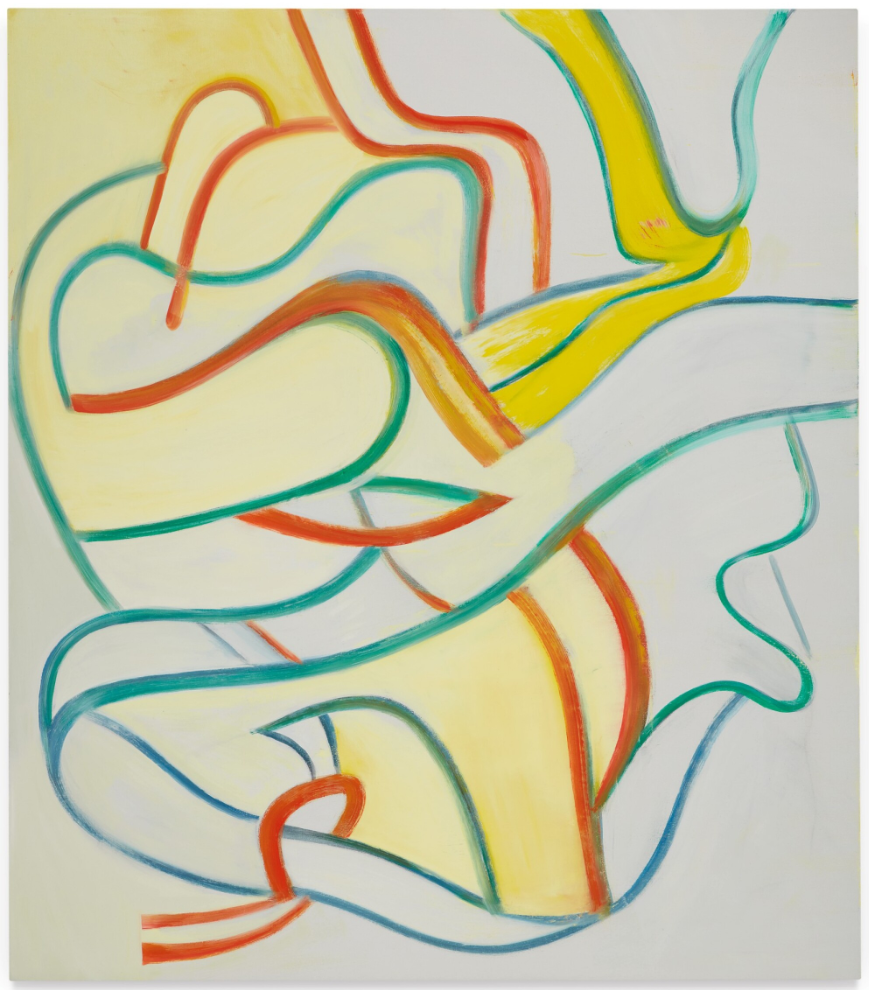
WILLEM DE KOONING (1904 – 1997)
Stowaway, 1986
Oil on canvas
80×70 inches (203.2 x 177.8 cm)
Signed on the stretcher
#7. Untitled (Woman), circa 1969
Sotheby’ New-York: 12 May 2021
Estimated: USD 5,000,000 – 7,000,000
USD 5,583,500
Untitled (Woman) | Contemporary Art Evening Auction | 2021 | Sotheby’s (sothebys.com)
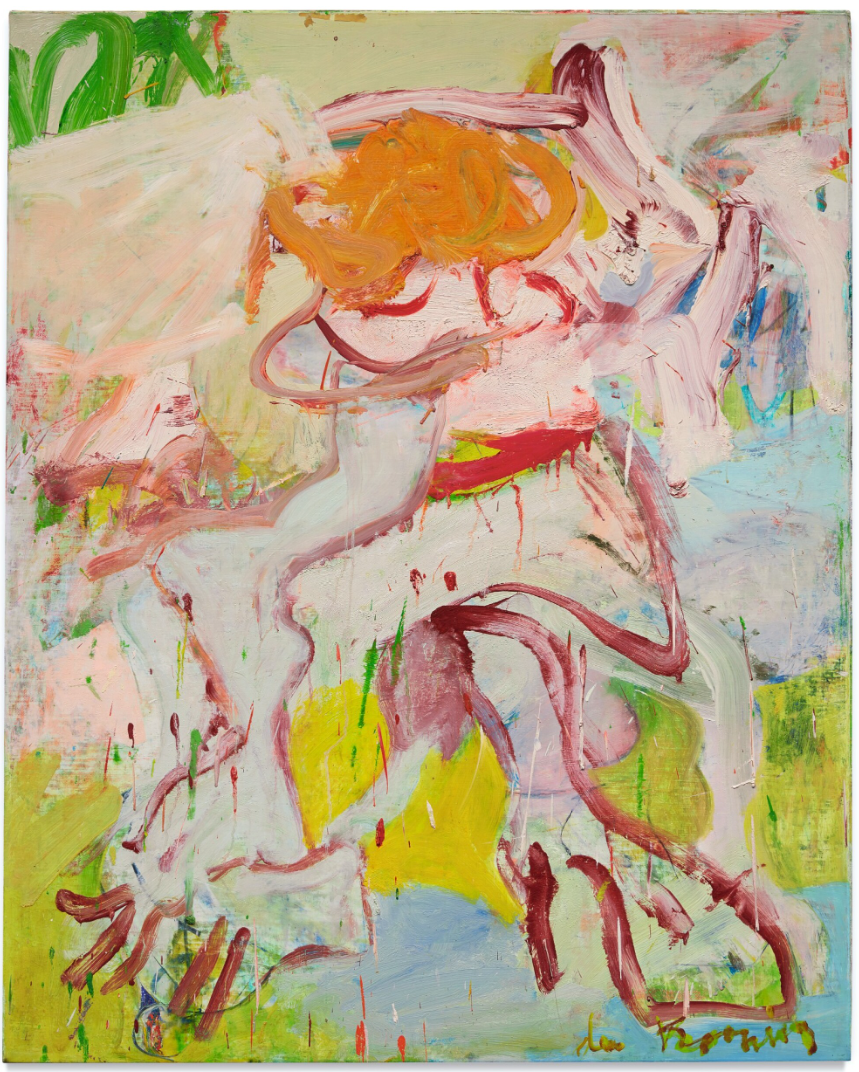
WILLEM DE KOONING (1904 – 1997)
Untitled (Woman), circa 1969
Oil on canvas
60×48 inches (152.4 x 122.2 cm)
Signed
PART III: FOCUS
Late Paintings
Untitled, 1982
Christie’s New-York: 19 November 2024
Estimated: USD 8,000,000 – 12,000,000
USD 13,290,000
WILLEM DE KOONING (1904-1997), Untitled | Christie’s
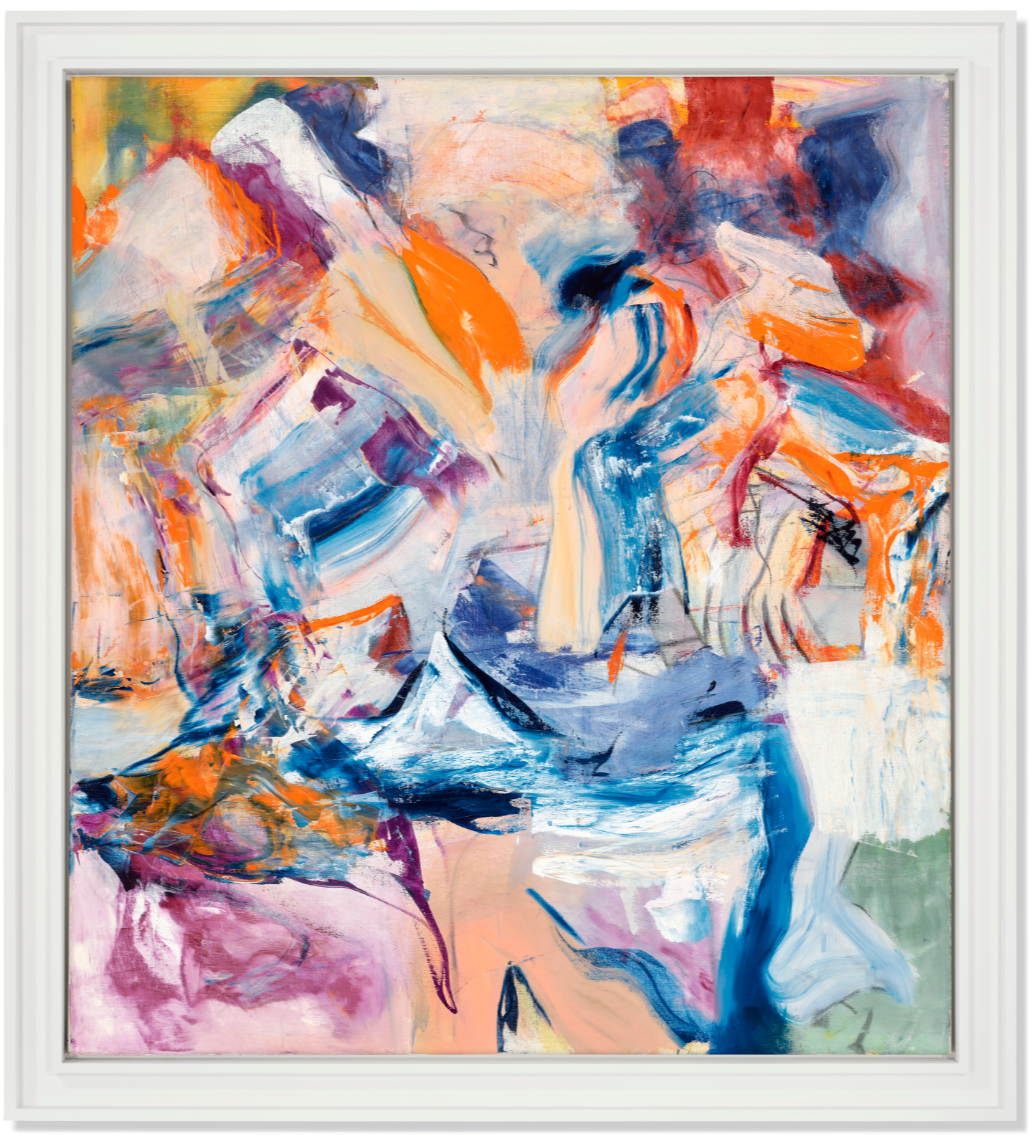
WILLEM DE KOONING (1904-1997)
Untitled, 1982
Oil on canvas
60×54 inches (152.4 x 137.2 cm)
Overflowing with luminosity, Willem de Kooning’s Untitled from 1982 is a masterful abstraction that coalesces decades of style into a singular painterly retrospective. Echos of the Abstract Expressionist master’s brushy figuration from the 1950s peer through fleshy pastel colors reminiscent of his 1960s grand gestural abstractions, whilst ribbons of purple and blue form a bridge between the effervescent canvases of the late 1970s and the leaner “ribbon paintings” that would emerge a few years later.
The period between 1980 and 1983 marks an immensely reverent time in the artist’s life where he reflected on the painter he once was and who he was to become in his great age. “Instead of just looking back in reverie to his past, as happens so frequently in old age,” Klaus Kertess has explained of the period coined “the last beginning,” adding that “he transformed looking back into looking forward” (K. Kertess, “Further Reflection,” in Willem de Kooning: The Last Beginning, exh. cat., New York, Gagosian Gallery, 2007, p. 18).
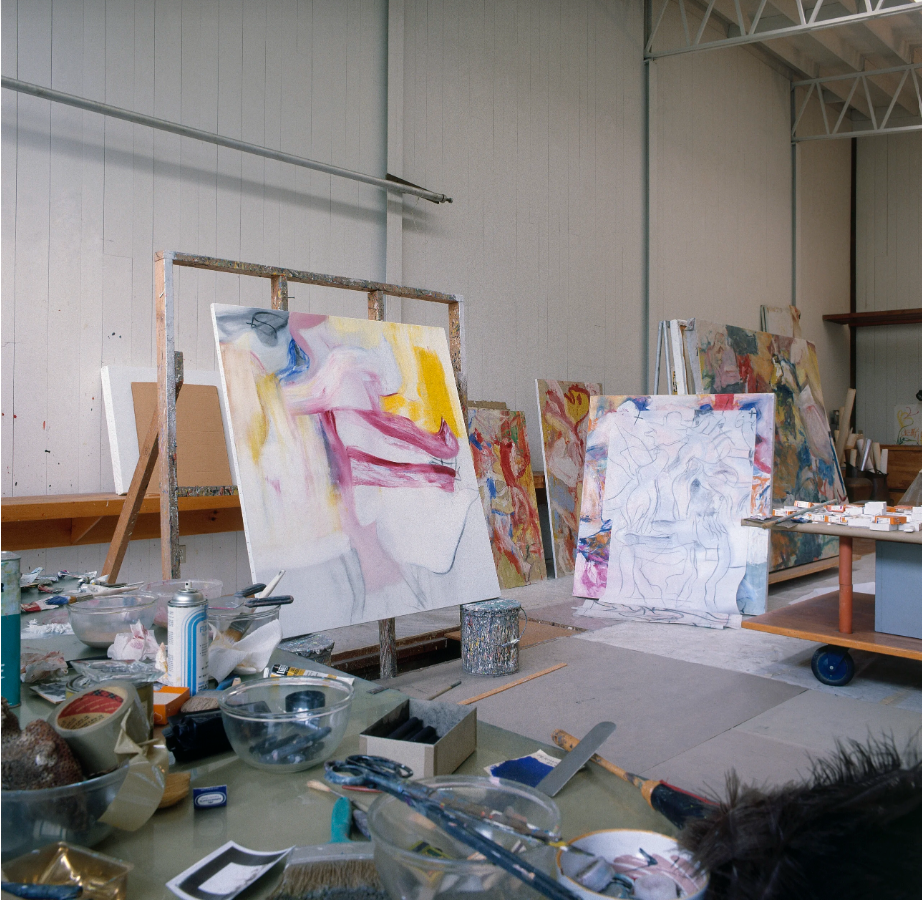
The present lot in progress in Willem de Kooning’s studio, 1981. Photo: Jaime Ardiles-Arce, published in Architectural Digest. © Condé Nast. Artwork: © 2024 The Willem de Kooning Foundation / Artists Rights Society (ARS), New York.
Opening his studio to the world, the artist—who had only recently returned to painting after a fallow artistic period—invited a new audience to witness this final transformation. The creation of Untitled took center stage on the pages of Architectural Digest and in the 1982 documentary film Strokes of Genius: de Kooning on de Kooning. Pushing, pulling, scraping, and brushing, the creative force behind de Kooning’s new works—though relatively limited in number—was met with critical acclaim. “I was particularly impressed by your late work reproduced in your studio settings in Architectural Digest and in Art News,” the legendary dealer Sidney Janis wrote to the artist. “There is a lyricism evident in your new paintings which I might have previously missed and which I find most stimulating and exciting” (S. Janis quoted in J. Elderfield, de Kooning: A Retrospective, exh. cat., New York, 2011, p. 443). Janis’s words were testament to the vigor of the 78-year-old artist who would go on to create some of his greatest paintings during the final chapter of his life.
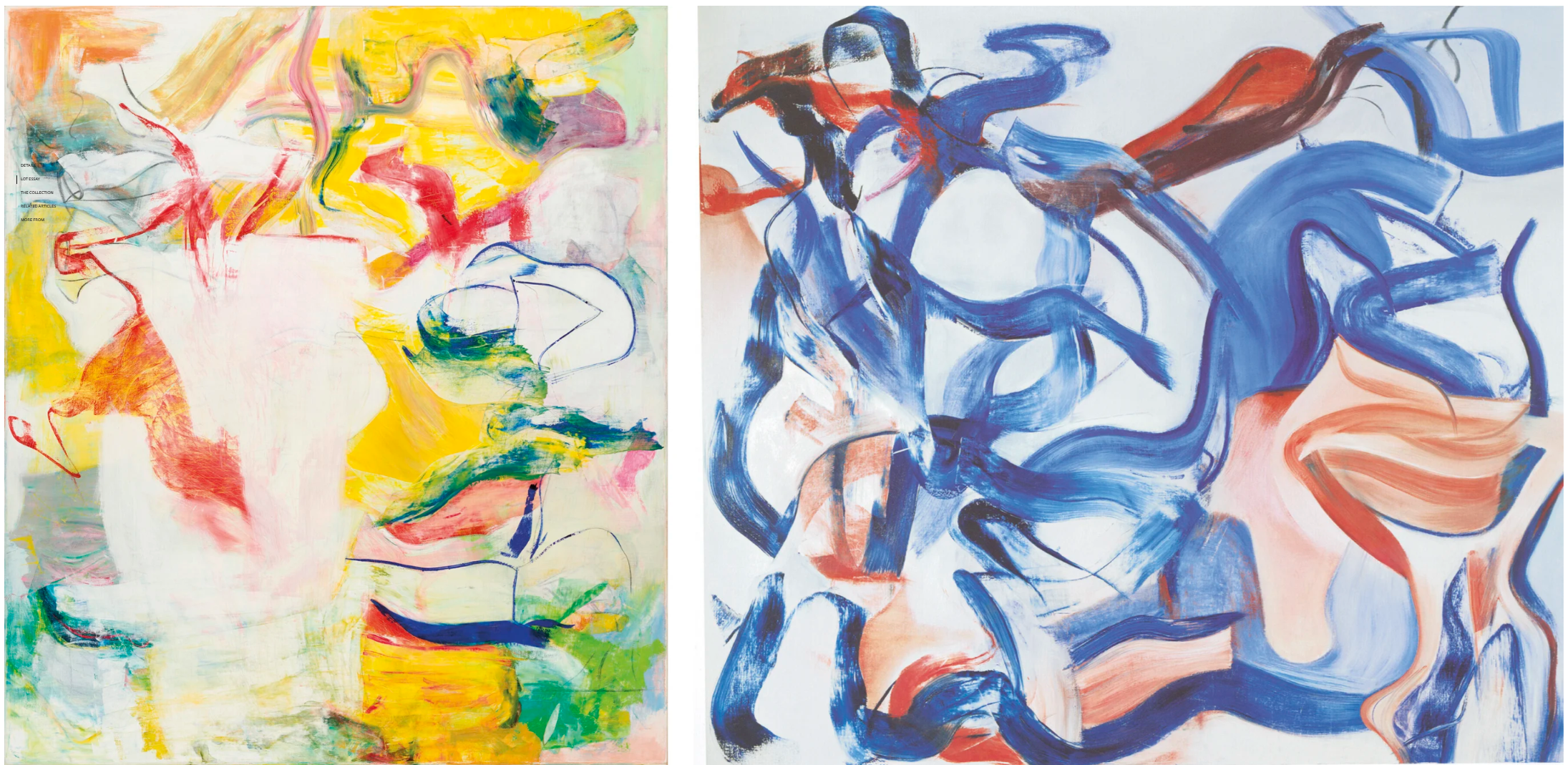
Left: Willem de Kooning, Pirate (Untitled II), 1981. Museum of Modern Art, New York. © 2024 The Willem de Kooning Foundation / Artists Rights Society (ARS), New York. Photo: © The Museum of Modern Art / Licensed by SCALA / Art Resource, New York.
Right: Willem de Kooning, Untitled XXI, 1982. Philadelphia Museum of Art. Artwork: © 2024 The Willem de Kooning Foundation / Artists Rights Society (ARS), New York.
More than a work of sublime sensuality, this luminous 1982 canvas is also a triumphant manifestation of the artist’s will to overcome a period of immense personal and creative struggle. Painted during a time of newfound stability and artistic innovation, Untitled signals the dawning of a significant new phase in its creator’s oeuvre. For de Kooning, the 1970s had been marred with bouts of severe alcohol and depression, which seemed to come to a head in 1978. In the wake of the sudden deaths of two dear friends and critical supporters, Harold Rosenberg and Thomas Hess, de Kooning halted creation of the vibrant, watery, allover abstractions that had occupied him between 1975-77, citing that they’d become too predictable. Whilst de Kooning was no stranger to change, this time proved especially difficult for the artist as his drinking and mental state worsened. His creative production also plummeted, indicating that the cure was neither easy nor immediate. De Kooning was notorious for allowing few works’ survival under his harsh standards, and of the paintings that were made between 1979 and 1980 only a small number were kept. As his studio assistant at the time, Tom Ferrara, later emphasized, “It was a real event if he painted” (T. Ferrara, quoted in De Kooning: a Retrospective, exh. cat., New York, 2011, p. 442).
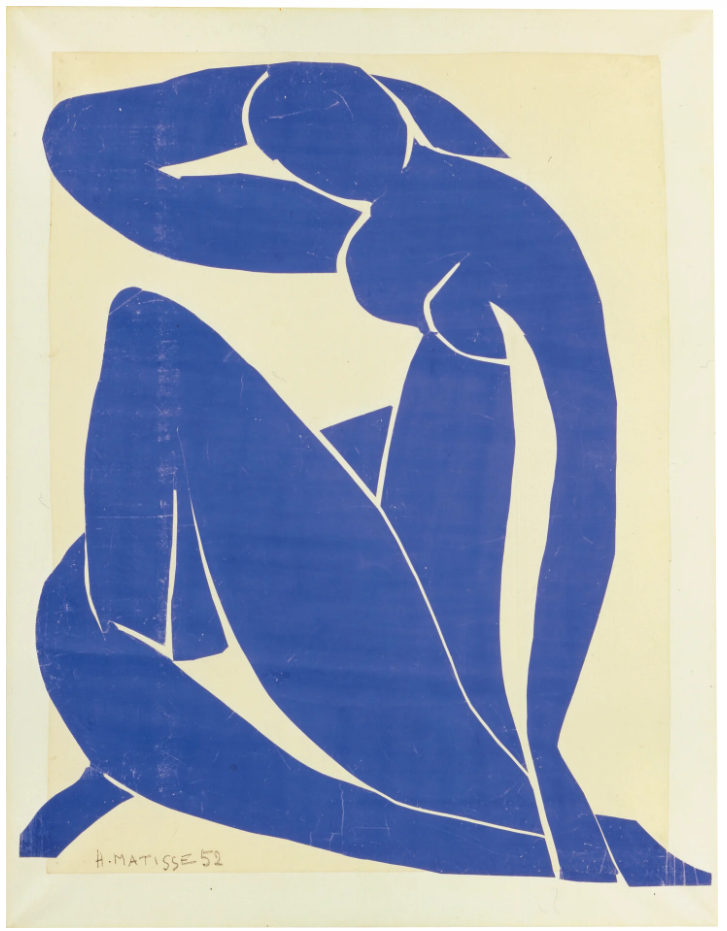
Henri Matisse, Blue Nude II, 1952. Musée National d’Art Moderne, Centre Georges Pompidou, Paris.
© 2024 Succession H. Matisse / Artists Rights Society (ARS), New York
Inaugurating a significant new phase in de Kooning’s painting practice, Untitled charts a change of direction in the artist’s intentions. This new development was spurred, in part, by his rediscovery of Henri Matisse. In 1980, the artist observed,
“Lately I’ve been thinking that it would be nice to be influenced by Matisse. I mean, he’s so lighthearted. I have a book about how he was old and he cut out colored patterns and he made it so joyous. I would like to do that, too—not like him, but joyous, more or less.”
The supple, exuberant lines of the modern master’s late cut-outs such as Blue Nude II (1952, Musée National d’Art Moderne) evoked the idea of youthful play, engaged at a moment of physical decline.
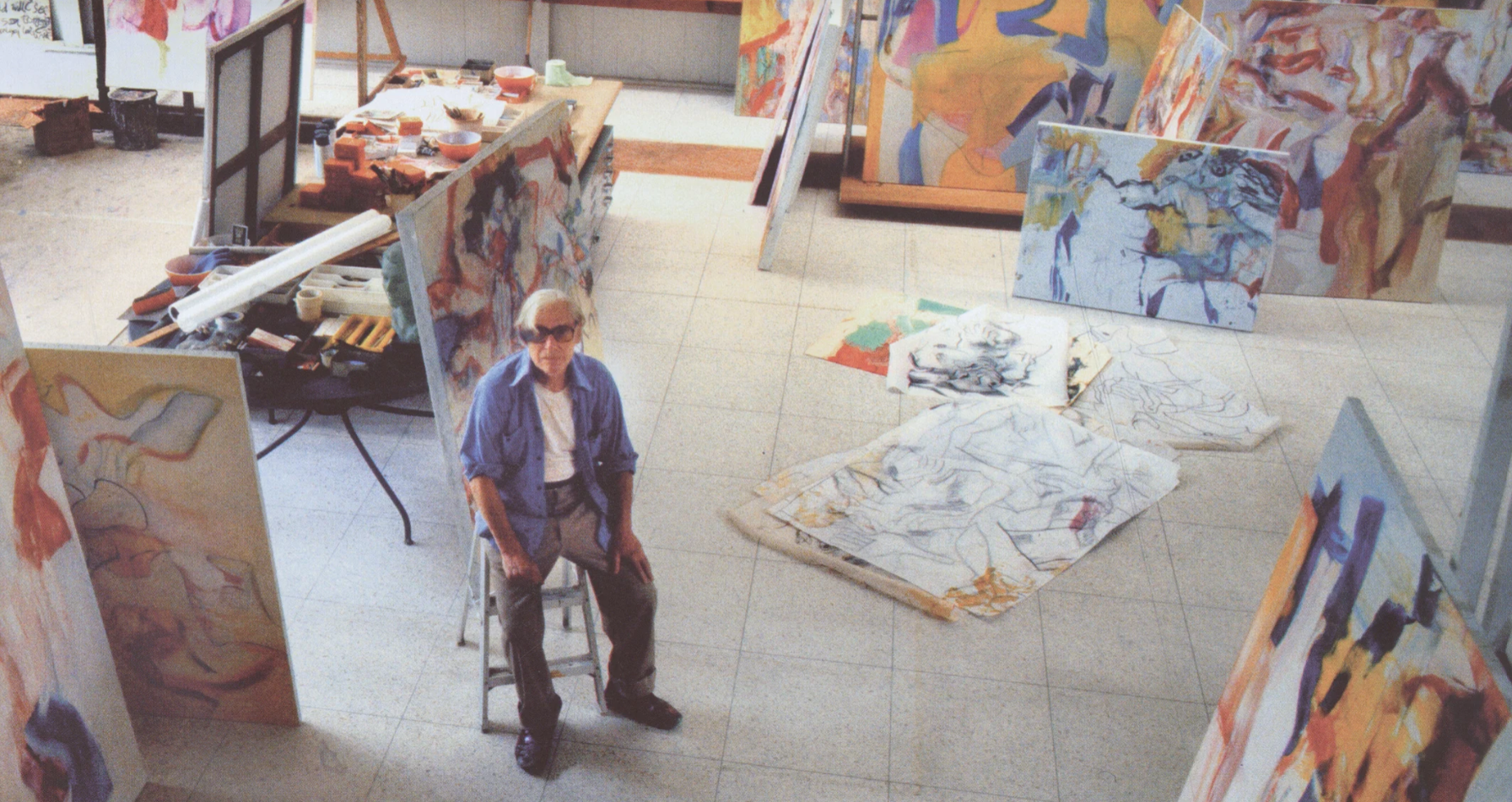
Willem de Kooning in his East Hampton studio. Photo: Eddy Posthuma de Boer.
Artwork: © 2024 The Willem de Kooning Foundation / Artists Rights Society (ARS), New York.
De Kooning’s canvases of the early 1980s present a fluid surface on which colors move freely, pulling their lightness from its glowing pastels. Age, it seems, had brought de Kooning a new pictorial wisdom. Joan Levy, a painter friend of de Kooning’s daughter Lisa, would later recall a conversation with the artist “When he started doing those paintings of the eighties, the light was pouring out. He said, ‘What do you think?’ I said, ‘They’re so ethereal. It looks like you died and went to heaven’. De Kooning agreed: ‘Yes, that is what I was going for’” (W. de Kooning, quoted by M. Stevens & A. Swan, op. cit., p. 591).
Untitled XXV, 1982
Sotheby’s New-York: 20 November 2024
Estimated: USD 9,000,000 – 12,000,000
USD 10,940,000
Untitled XXV | The Now and Contemporary Evening Auction | 2024 | Sotheby’s
WILLEM DE KOONING (1904 – 1997)
Untitled XXV, 1982
Oil on canvas
70×80 inches (177.8 x 203.2 cm)
One of the approximately thirty known paintings completed in 1982, which today stand as the best Williem de Kooning’s 1980s compositions, Untitled XXV is particularly striking in its elegantly refined yet suggestively alluring arrangement of color and form. An apotheosis of the mature artist’s indefatigable wellspring of decisive and skillful abstractions, de Kooning’s paradoxically effortless and yet highly meditated brushwork reveals the translation of his furtive drawing practice to grander forms. Held in the estate of the artist until acquired directly by the present owner, Untitled XXV has been cherished in only one private collection for over two decades after being on extended loan to the Tate Gallery in London. With its distilled palette and painterly lyricism, Untitled XXV evokes the same powerful emotive response affected by the artist’s tableaus of the 70s.
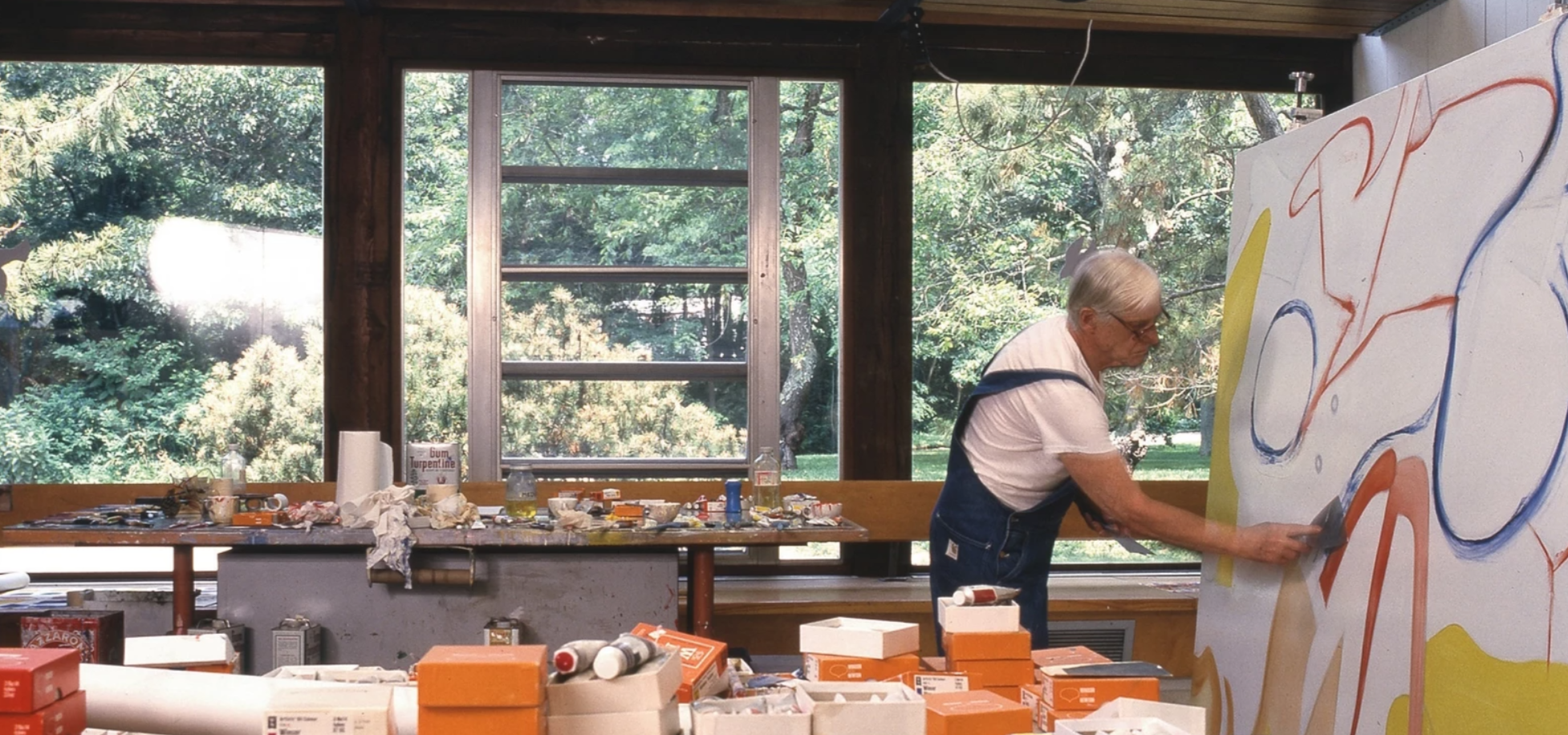
WILLEM DE KOONING IN HIS STUDIO, 1983. PHOTO © 1991 HANS NAMUTH ESTATE / COURTESY CENTER FOR CREATIVE PHOTOGRAPHY, UNIVERSITY OF ARIZONA. ART © 2023 THE WILLEM DE KOONING FOUNDATION / ARTISTS RIGHTS SOCIETY (ARS), NEW YORK
Among the most storied and pivotal pioneers of Post-War abstract painting, Willem de Kooning’s extraordinary career is characterized by a lifelong pursuit of innovation and art historical achievements, from his Woman paintings of the 1950s to the calligraphic beauty of his 1980s paintings, such as the present work. In this vein, the only comparable artist to achieve a similar consistent evolution of their practice is Gerhard Richter. The pervasive influence of Willem de Kooning’s legendary oeuvre on artists ranging from Gerhard Richter to younger painters such as Jenny Saville is a further testament to his enduring impact as one of the most influential artists of the twenty-first century. Lilting and lifting ripples of color and calligraphic streams of black somersault across an expansive, diffuse white ground. Shocks of red, cerulean, chartreuse and yellow are softened, blended and blanketed by de Kooning’s iridescent white beyond their boundaries. Some forms are outlined, others demarcated less overtly, collapsing the distinction between color, form and line. Elusive and lyrical in its lightness, the compositional perfection of Untitled XXV is owed to the inherent tension engendered by the relationship of de Kooning’s linear gestures and the positive and negative spaces they quietly generate.
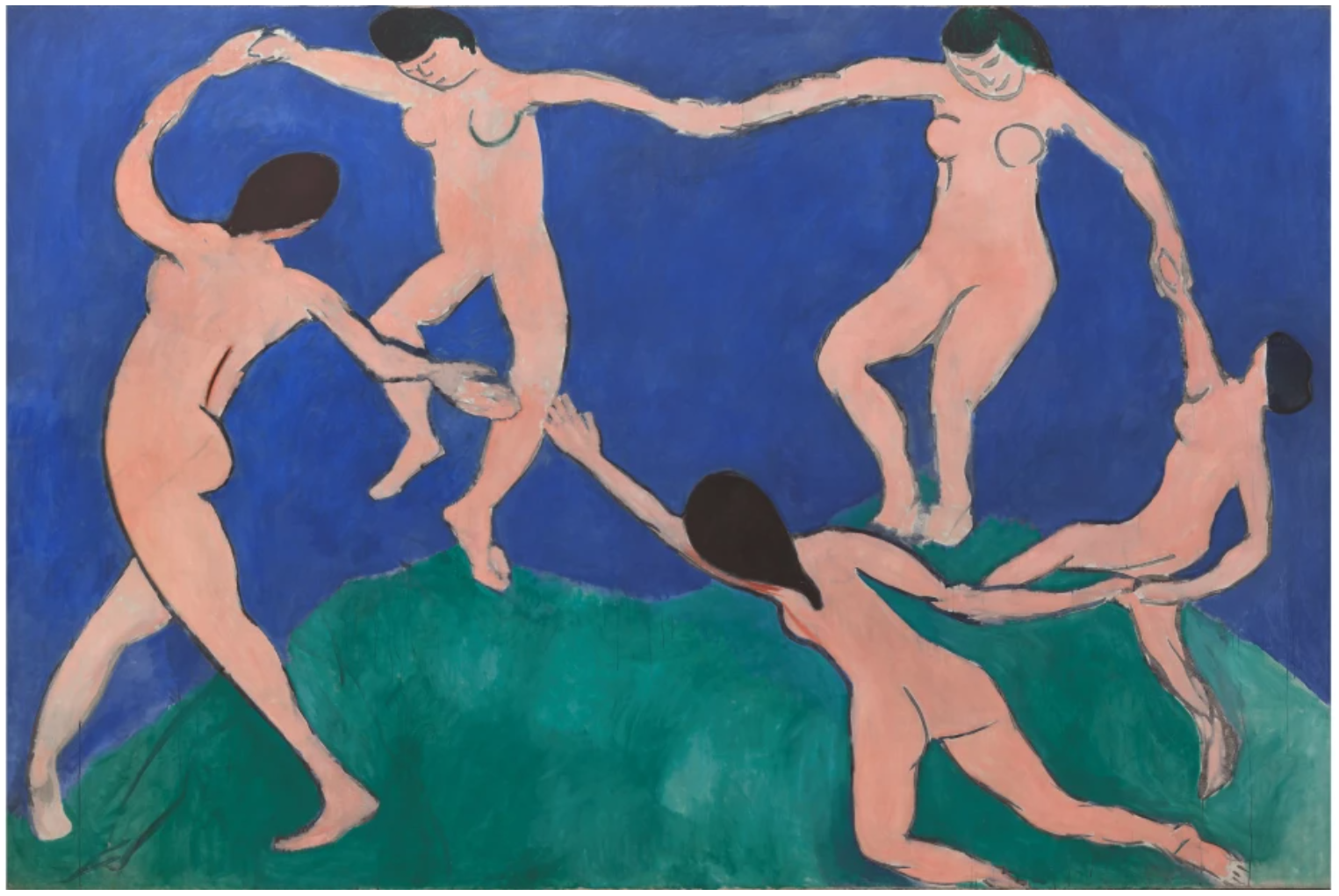
Henri Matisse, Dance (I), 1909. Museum of Modern Art, New York. Image © The Museum of Modern Art/Licensed by SCALA / Art Resource, NY. Art © 2024 Succession H. Matisse / Artists Rights Society (ARS), New York
Lilting and lifting ripples of color and calligraphic streams of black somersault across an expansive, diffuse white ground. Shocks of red, cerulean, chartreuse and yellow are softened, blended and blanketed by de Kooning’s iridescent white beyond their boundaries. Some forms are outlined, others demarcated less overtly, collapsing the distinction between color, form and line. Elusive and lyrical in its lightness, the compositional perfection of Untitled XXV is owed to the inherent tension engendered by the relationship of de Kooning’s linear gestures and the positive and negative spaces they quietly generate.
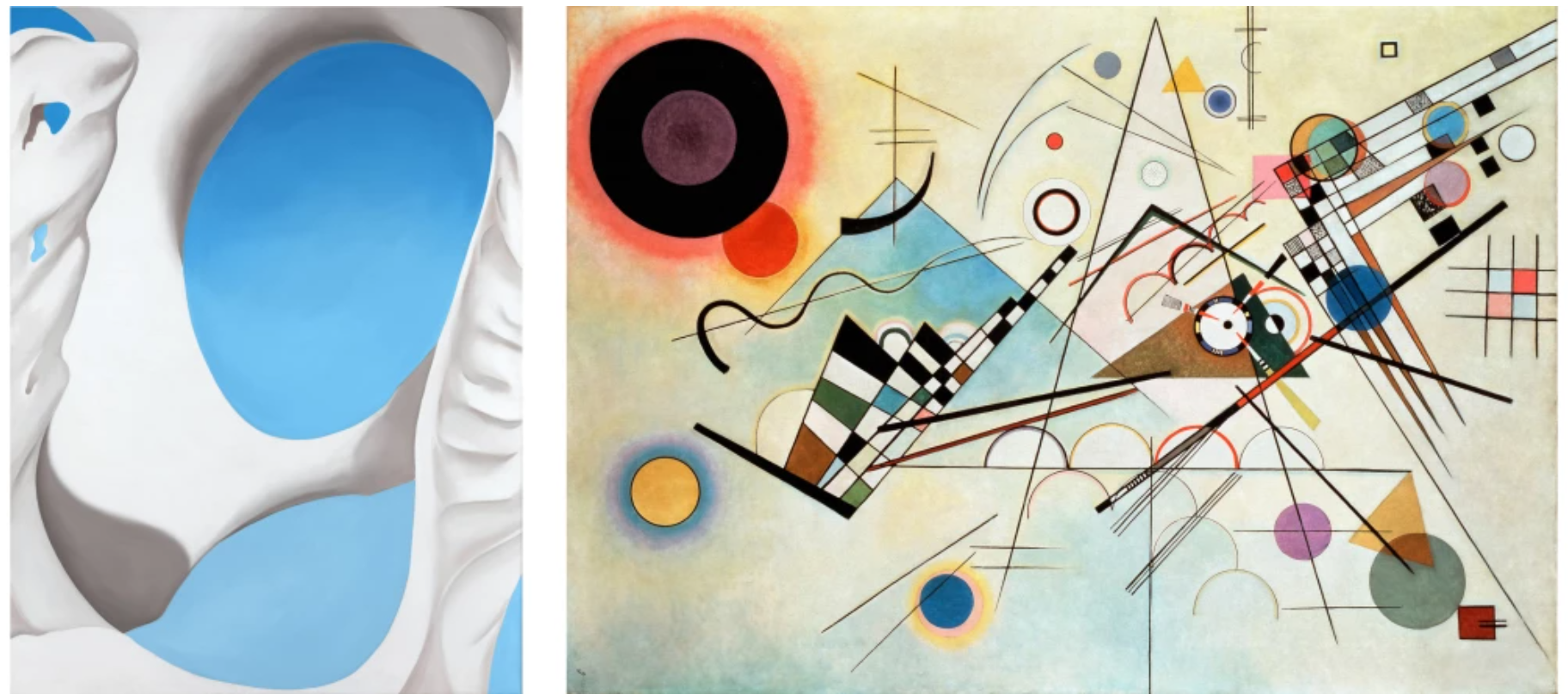
Left: Georgia O’Keeffe, Pelvis II, 1944. The Metropolitan Museum of Art, New York. Image © The Metropolitan Museum of Art. Image source: Art Resource, NY. Art © 2024 Georgia O’Keeffe Museum / Artists Rights Society (ARS), New York. Right: Wassily Kandinsky, Composition VIII, 1923. Solomon R. Guggenheim Museum, New York. Image © Luisa Ricciarini / Bridgeman Images. Art © 2024 Artists Rights Society (ARS), New York / ADAGP, Paris
The artist’s celebration of line had been integral to his process throughout his career and in the course of creating his later paintings, de Kooning mapped his compositions on large sheets of vellum–a practice which is perhaps evident in the artist’s pursuit of the ultimate painted effect of translucency. Unlike the broad, full-bodied lines of the Interchange paintings, or the churning, viscous lines of notable 70s tableaus, de Kooning’s linear marks of the 1980s are freer and their relationship to each other is indebted to de Kooning’s sense of space as a draftsman. De Kooning’s 80s canvases deconstruct the core elements present in his work throughout the course of his career, presenting line and color in their purest forms, while inventing fresh nuance in color through his prolific use of white. Nearly a century prior, Claude Monet’s late Nymphéas grew more abstract with the artist’s age–his perspective shifted relative to the picture plane, subverting the viewer’s relative concept of space and capturing the impossible visual effect of boundless reflections of sky and light mirrored two-dimensionally from the water’s surface. The paintings of the early 1980s marked just such a momentous change as de Kooning, spending most of his time in the calm of East Hampton, began to paint with a new grace and fertility which he viewed from the perspective of a long career as a premier artist. De Kooning returned to the serene beauty of East Hampton’s sunlit countryside and sea as an endless source from which to plumb inspiration. In the first few years of this pivotal decade, this new balance and clear-eyed confidence gave birth to an explosive creative energy and vigor which culminated in a series of monumental paintings.
Untitled XVIII, 1986
Christie’s London: 9 October 2024
Estimated: GBP 4,000,000 – 6,000,000
GBP 3,488,500 / USD 4,569,935
WILLEM DE KOONING (1904-1997), Untitled XVIII | Christie’s (christies.com)
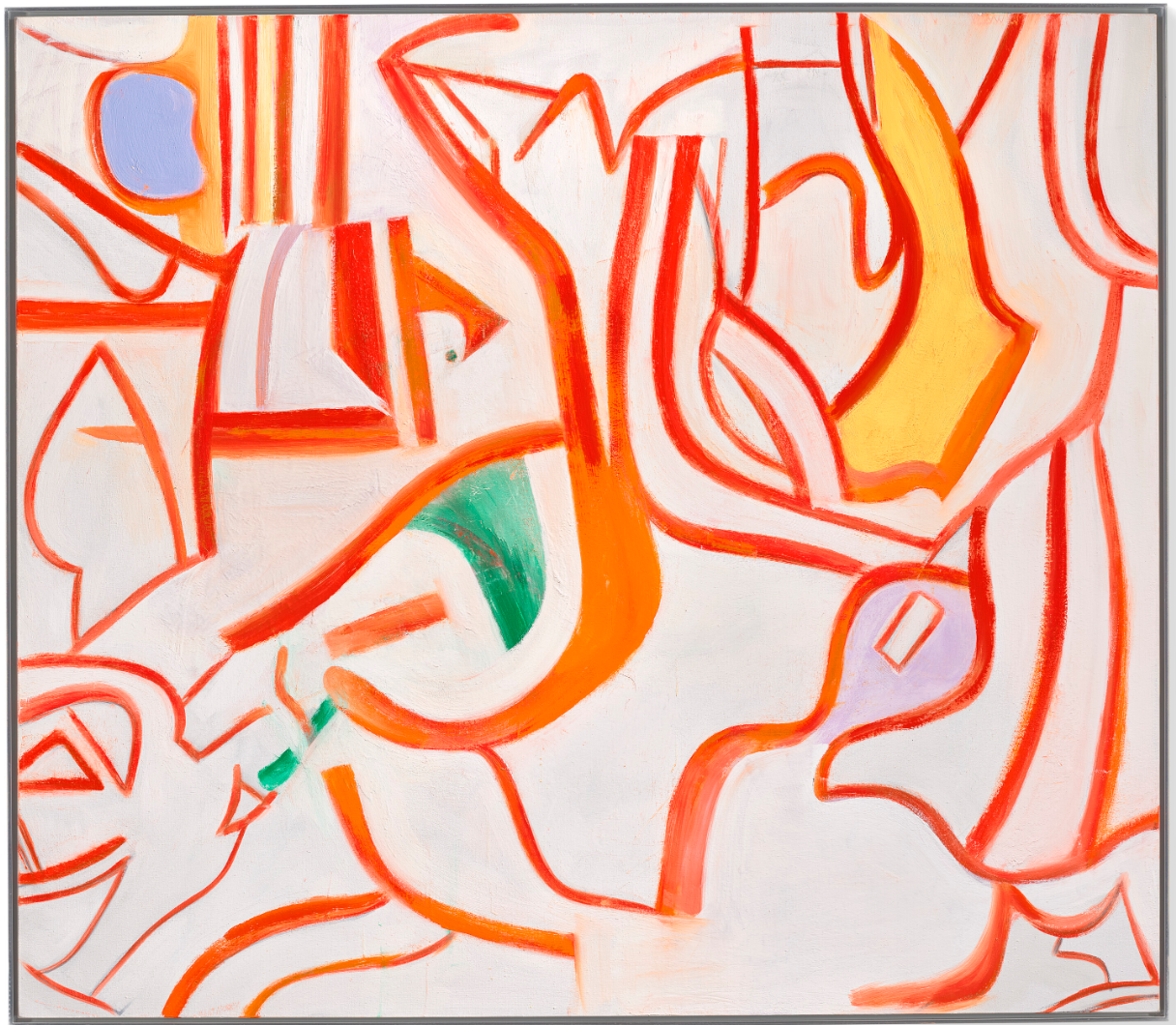
WILLEM DE KOONING (1904-1997)
Untitled XVIII, 1986
Oil on canvas
70 1/8 x 80 1/4 inches (178 x 203.7 cm)
Signed ‘de Kooning’ (on the stretcher)
Held since 2008 in the collection of Eric Clapton, Untitled XVIII (1986) is a magisterial late work by Willem de Kooning. In his final decade of painting, de Kooning’s works reached a new serenity and purity, defined by radiant white surfaces intercut with sinuous, graphic lines of primary color. Untitled XVIII’s ribbons of red interlock and overlap to create a dynamic sense of space, conjuring hints of figure and landscape. Sections of lilac, yellow and jade green, glowing like stained glass, suffuse the painting with sunlit warmth. Its slopes, undulations, right-angles and sharp edges appear purposeful and poised. The white is flushed with underlayers of red, and finely textured with deliberate, directional brushstrokes. De Kooning would begin compositions of this period by projecting passages of previous drawings onto a canvas, tracing them in charcoal and rearranging and breaking up their patterns. The results recalled aspects of the biomorphic, largely black-and-white abstractions with which he had first made his name in the 1940s. In other ways, the artist was in entirely new territory, embracing a luminous palette and spare, buoyant structure that lent his late works a remarkable lightness and clarity. Shortly after Untitled XVIII was painted, it was given a prominent place in the 1987 Whitney Biennial.
De Kooning’s late blooming was the last in a succession of stylistic shifts across his six-decade career. His seminal 1940s abstractions had been followed by the infamous Woman series of 1950 to 1953. The scrambled pictorial energy of this early period reflected the frenetic atmosphere of post-war New York City, and made de Kooning a central figure in the development of Abstract Expressionism. Following his 1963 move from Manhattan to East Hampton, Long Island—where he would remain for the rest of his life—he moved onto more open, broad-brushed, verdant compositions that reflected his rural surroundings, with female figures making a bucolic return. The 1970s saw him build up a still more fluid, variegated and heavily-worked impasto in works like … Whose Name Was Writ in Water (1975, Solomon R. Guggenheim Museum, New York), which drew upon the tempestuous Atlantic sea and sky. It was around 1981—following the intervention of his wife Elaine, who had moved nearby to help wean him off a dangerous dependency on alcohol—that the spare, lyrical majesty of the ‘late’ abstractions emerged. He would continue to develop this mode until ill health forced him to stop painting towards the end of the 1980s. He died, aged ninety-two, in 1997.
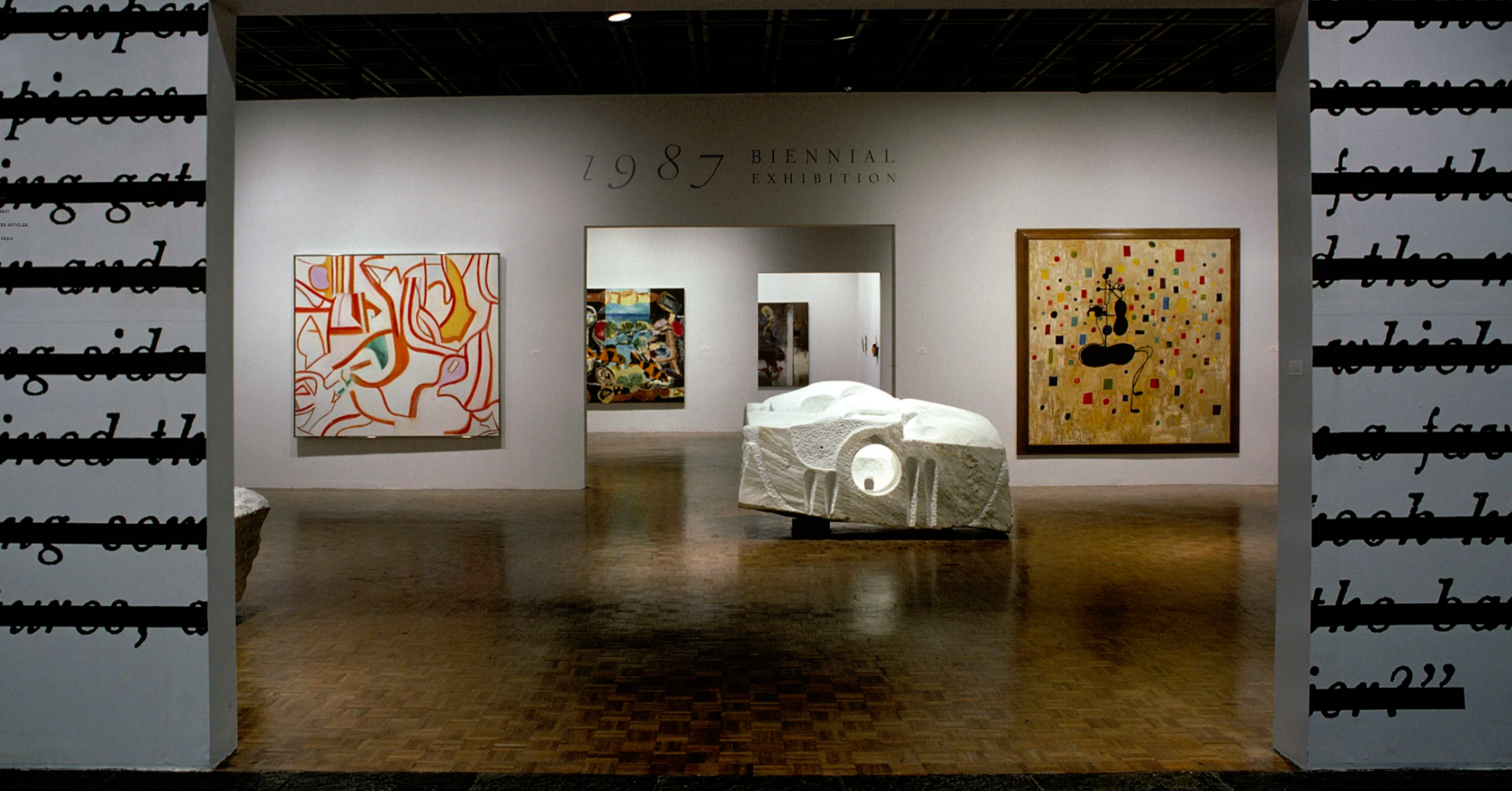
Installation view, 1987 Biennial Exhibition, Whitney Museum of American Art, New York, 1987. From left to right: Joseph Kosuth, Zero & Not, 1986; Willem de Kooning, Untitled XVIII, 1986; Louise Bourgeois, Nature Study, 1986; George Condo, Black Insect, 1986. Artwork: © Joseph Kosuth, Louise Bourgeois, George Condo, DACS, London 2024. Photo: Geoffrey Clements / Whitney Museum of American Art.
The beginning of the 1980s saw de Kooning visibly distilling the saturated, effusive compositions of his previous decade. He layered, sanded and scraped back lucent planes of white whose edges were defined by shimmering, whiplash traces of primary-colored line. As the more emphatic, skeletal structure of works like the present took shape, it was clear that de Kooning had found a new way of working. No longer employing dashing, muscular and loaded directional brushstrokes, he instead built line up using multiple additive marks, often, as in the present work, retreading and expanding on a single contour. What he had lost in athletic vigor the paintings gained in their visible rigor, laying bare the fierce compositional command that had underpinned even his most explosive earlier works. The restraint of Untitled XVIII does not reflect a fading away, but a consciously achieved minimalism.
It has often been remarked that these late works’ presiding spirit is no longer that of Picasso or Cézanne—whose Cubist atomization of form and tightly-structured surfaces had heavily informed de Kooning’s outlook—but Henri Matisse. The monumental ‘cut-outs’ that Matisse developed in the final chapter of his own career reflected his undying commitment to color, line and formal invention. With scissors and paper, he created a radical, economical pictorial vocabulary that would have huge impact on subsequent generations of painters. Matisse’s earlier work was also playing on de Kooning’s mind during the 1980s. Tom Ferrara, the artist’s assistant from 1979 to 1987, recalled that he ‘would refer often to Matisse’s Dance (1909), making a gesture with his hand as he gently waved upward to evoke the rhythm and freedom of movement in the painting’ (G. Garrels, ‘Three Toads in the Garden: Line, Color and Form’, in Willem de Kooning: the Late Paintings, the 1980s, exh. cat. San Francisco Museum of Modern Art, San Francisco 1996, p. 15). That work’s brilliant, balanced color-fields and interlaced linear figures might be seen to echo in Untitled XVIII.
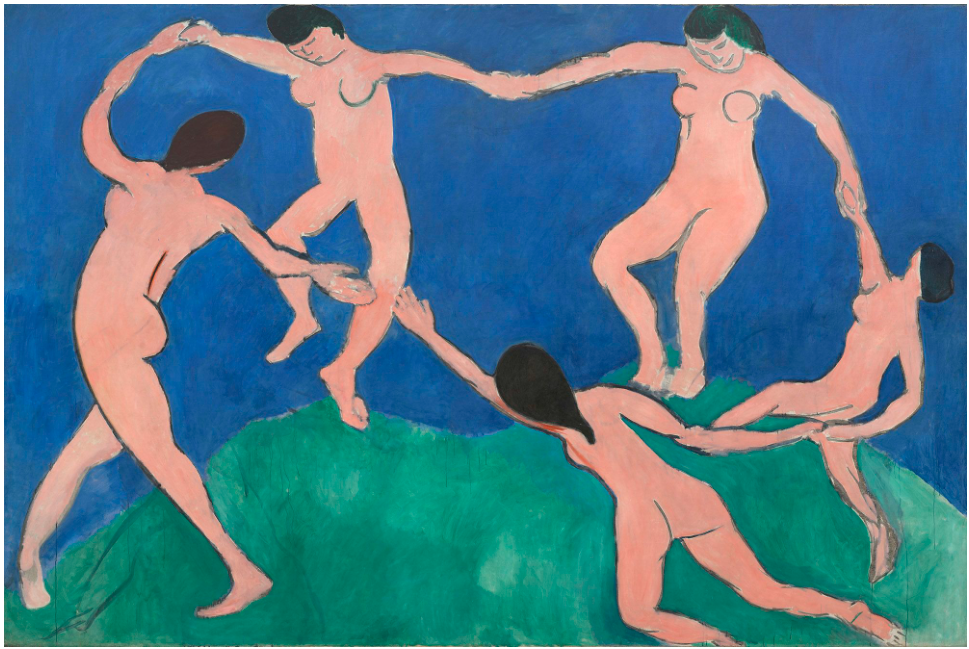
Henri Matisse, Dance (I), 1909. Museum of Modern Art, New York.
Artwork: © Succession H. Matisse / DACS 2024. Digital Image: The Museum of Modern Art, New York/Scala, Florence.
With its own complexities of rhythm and movement, it is apt that the present painting has spent the past sixteen years in the collection of a musician. Eric Clapton—one of the great guitarists of his generation—has also owned abstract masterpieces by Gerhard Richter. Richter has referenced the music of Bach and John Cage in his Abstrakte Bilder, and has spoken of a musical quality in their structure and composition. Like de Kooning’s late works, they gesture towards unseen realities and quiver with hints at figuration while remaining self-sufficient, autonomous and enigmatic. For his part, de Kooning frequently listened to Stravinsky, Beethoven, Khachaturian and Bach as he worked, and, in the 1980s, was introduced to the new-wave band Talking Heads by his younger assistants. If the heyday of Abstract Expressionism was associated with the gestural, improvisatory energy of jazz, de Kooning’s stately late work approaches the grand, controlled virtuosity of Bach’s Brandenburg Concertos, which the journalist Curtis Bill Pepper heard blasting out from the artist’s studio in 1983. Untitled XVIII remains a lucid, controlled performance in color and light, exemplifying the shining mastery of his final act.
Untitled, 1987
Sotheby’s London: 9 October 2024
Estimated: GBP 3,000,000 – 4,000,000
GBP 3,165,000 / USD 4,146,150
Untitled | Contemporary Evening Auction | 2024 | Sotheby’s (sothebys.com)
WILLEM DE KOONING (1904 – 1997)
Untitled, 1987
Oil on canvas
77×88 inches (195.6 x 223.5 cm)
Dated ’87 (on the stretcher)
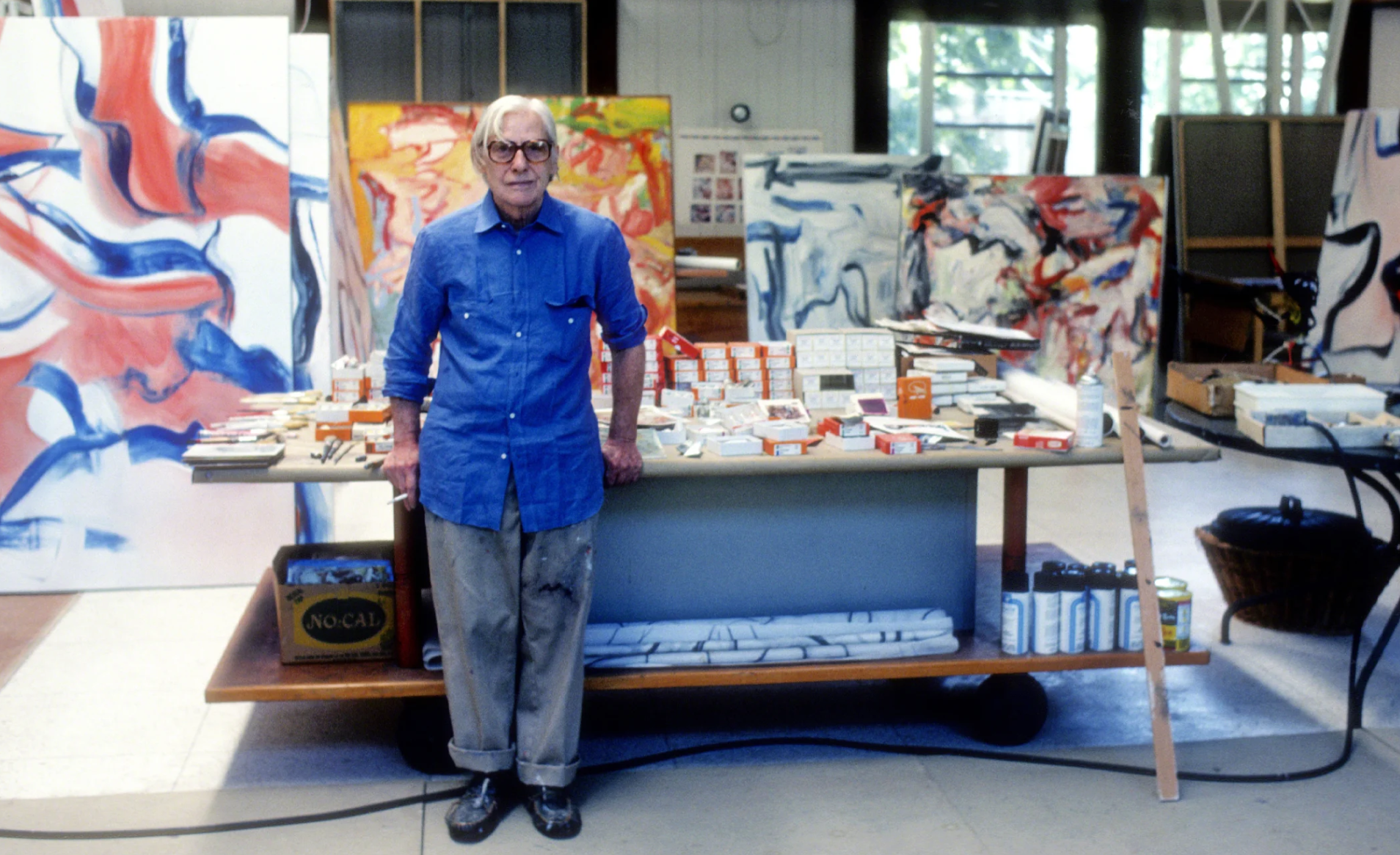
Willem de Kooning’s Untitled emerges from a corpus of haunting abstractions, created with the finesse of an artist at the height of his confidence and painterly abilities. Following four decades of incessantly groundbreaking modernist innovation and enveloping the themes and aesthetic impulses of his entire oeuvre, this light, lyrical arabesque of colour and form held together by energetic line fully embodies the boldly reinvented style that dominated the last decade of de Kooning’s life, now celebrated as his “Late Period.” Executed in 1987, Untitled is paramount among the canvases of this decade for its chromatic vibrancy, compositional dynamism, and bewitching beauty. Distinguished by its striking palette of orange, gold, and violet, the present work crystallizes the numerous investigations into painterly mark-making that defined the artist’s inimitable corpus within a single, exquisite canvas. Befitting its importance, this work was included in the major exhibition of the artist’s late paintings at the Museum of Modern Art, New York, in 1997.
Willem de Kooning in his Long Island studio, 1985.
Image: © The Willem de Kooning Foundation / Artists Rights Society (ARS), New York and DACS, London 2024
Untitled is a truly superb exemplar of the unique painterly method de Kooning applied to his compositions of the 1980s. While at first glance the lyrical tangerine, mauve, and yellow zones appear to be floating upon a pristine white ground, their indomitable elegance and ethereal lightness was in fact achieved through de Kooning’s judicious application of cool white oil pigment atop a churning surface of chromatic intensity. As such, the graceful organization of hued forms in Untitled was revealed by way of excavation as opposed to accumulation, the result being one of profound aesthetic and technical innovation from an artist in the final decades of his prodigious career. Here, the buoyant graceful lines of de Kooning’s abstract calligraphy are utterly sensual, and nowhere is his grand ability as a colorist more poetically asserted than in these late masterpieces, with their reduced and expressive palette.
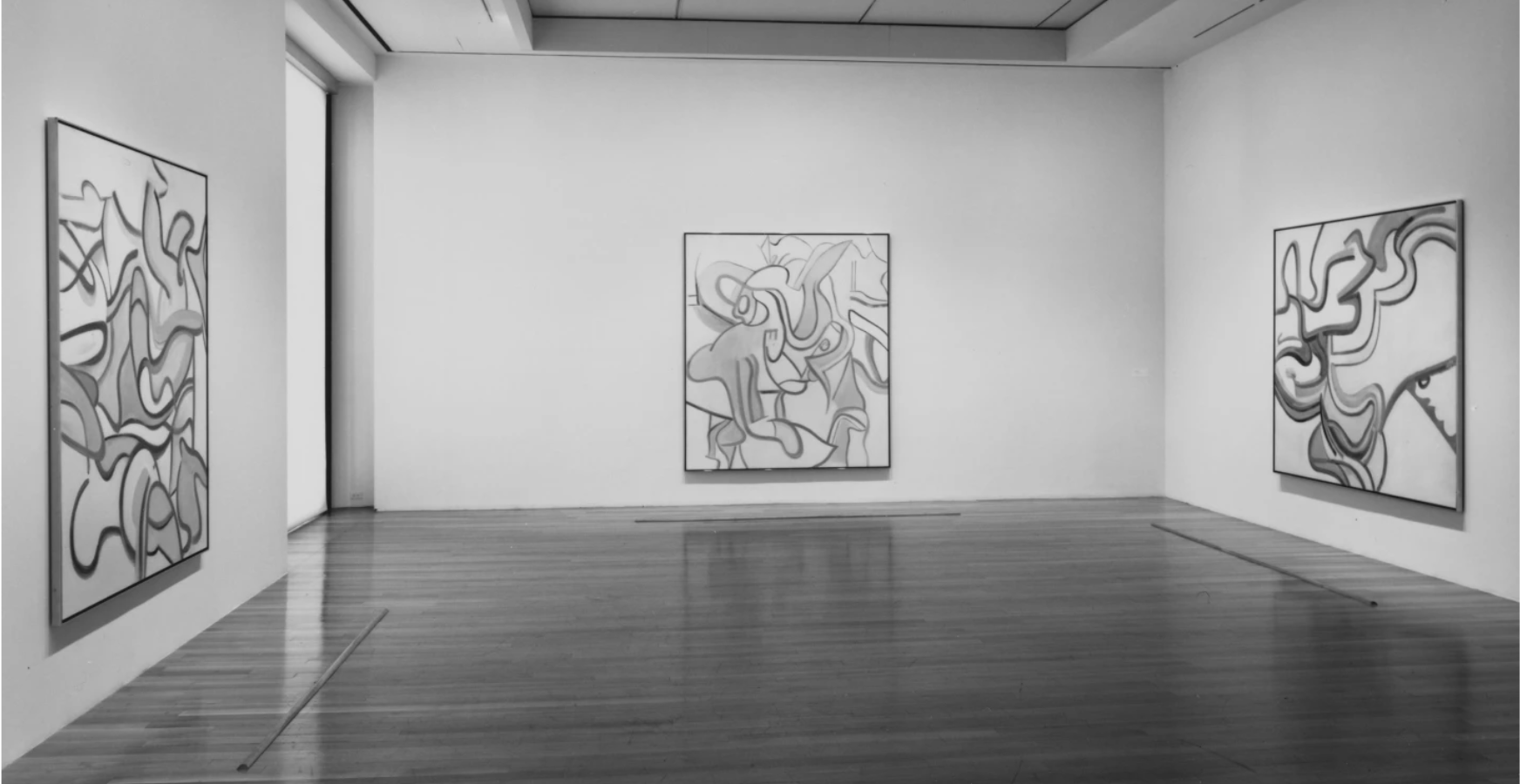
The present work (far right) installed in Willem de Kooning: The Late Paintings, 1980s, Museum of Modern Art, New York, 1997.
Image: © The Willem de Kooning Foundation / Artists Rights Society (ARS), New York and DACS, London 2024
His late paintings echo the formal invention of his lifelong influence Arshile Gorky, and the vibrant late cut-outs of Henri Matisse. Indeed, de Kooning seeks to “cut up” or pull familiar forms apart, sometimes dynamically setting them in motion and other times allowing them to float gently across a deep, projected space. Untitled showcases exceptional crispness, contrasting with the heavily painted earlier works that often combined a kaleidoscopic range of pigment as well as various mediums, such as oil paint and pastels, thickly layered with brushes and palette knives. Here, executed with exquisite looseness of brushwork, the cascading lines describe a spatial openness and delicate balance that produce a choreographed rhythm. Converging the simplicity and the dynamic equilibrium of late Piet Mondrian with the organic lyricism of Claude Monet, Untitled XVI represents an imaginary volumetric terrain that unfolds, warps, inflates and collapses with breathtaking, indomitable elegance and delicacy, channeling the old power of bulging, twisting planes and sculptural contour of Tintoretto and Peter Paul Rubens.
Untitled, 1985
Sotheby’s New-York: 15 November 2023
Estimated: USD 5,000,000 – 7,000,000
USD 5,250,000
Untitled | Contemporary Evening Auction | 2023 | Sotheby’s (sothebys.com)
WILLEM DE KOONING (1904 – 1997)
Untitled, 1985
Oil on canvas
80×70 inches (203.2 x 177.8 cm)
Signed (on the stretcher)
Impressive in scale yet imbued with and exquisite compositional grace, Untitled from 1985 hails from the celebrated final decade of Willem de Kooning’s extraordinary sixty year artistic career. Onto the pristine white background of Untitled,– a canvas as tall and wide as the span of de Kooning’s outstretched arms–the artist floats and loops a series of delicate ribbons and planes of color that, in their ethereal beauty, evoke the striking elegance of Matisse’s late abstract cutouts. The buoyant strokes of de Kooning’s abstract calligraphy are utterly sensual, seemingly free from the clear reference to human or landscape that dominated de Kooning’s work of the preceding decades. To compliment the fluidity of these cascading lines, de Kooning opts for a reduced and lyrical palette; nowhere is his ability as a colorist more poetically asserted than in these late masterpieces. Exuding ease, poetry, technical finesse and groundbreaking innovation, Untitled epitomizes de Kooning’s life-long investigation into line, color and form, culminating in the radical transformation of his remarkable practice.
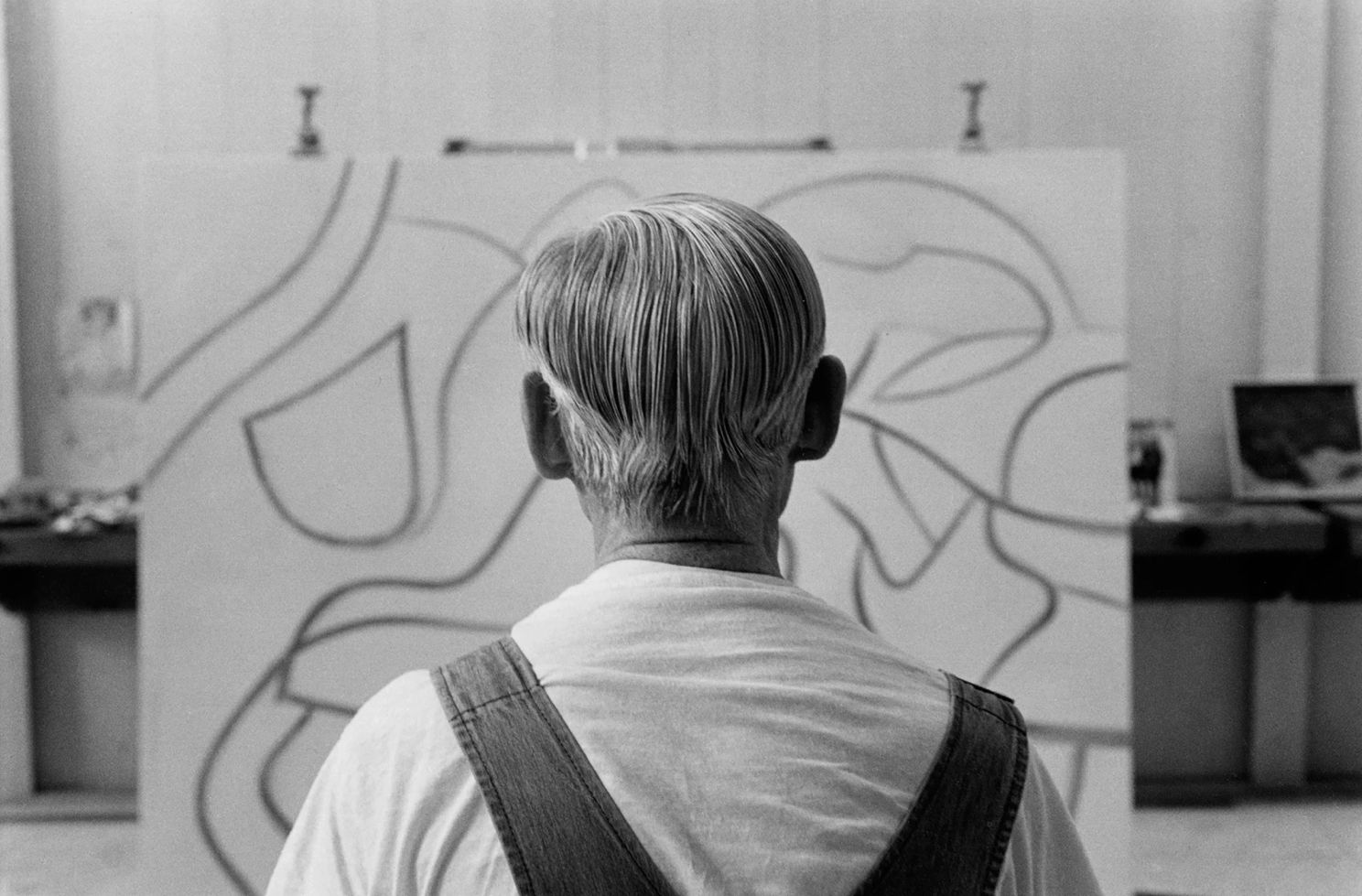
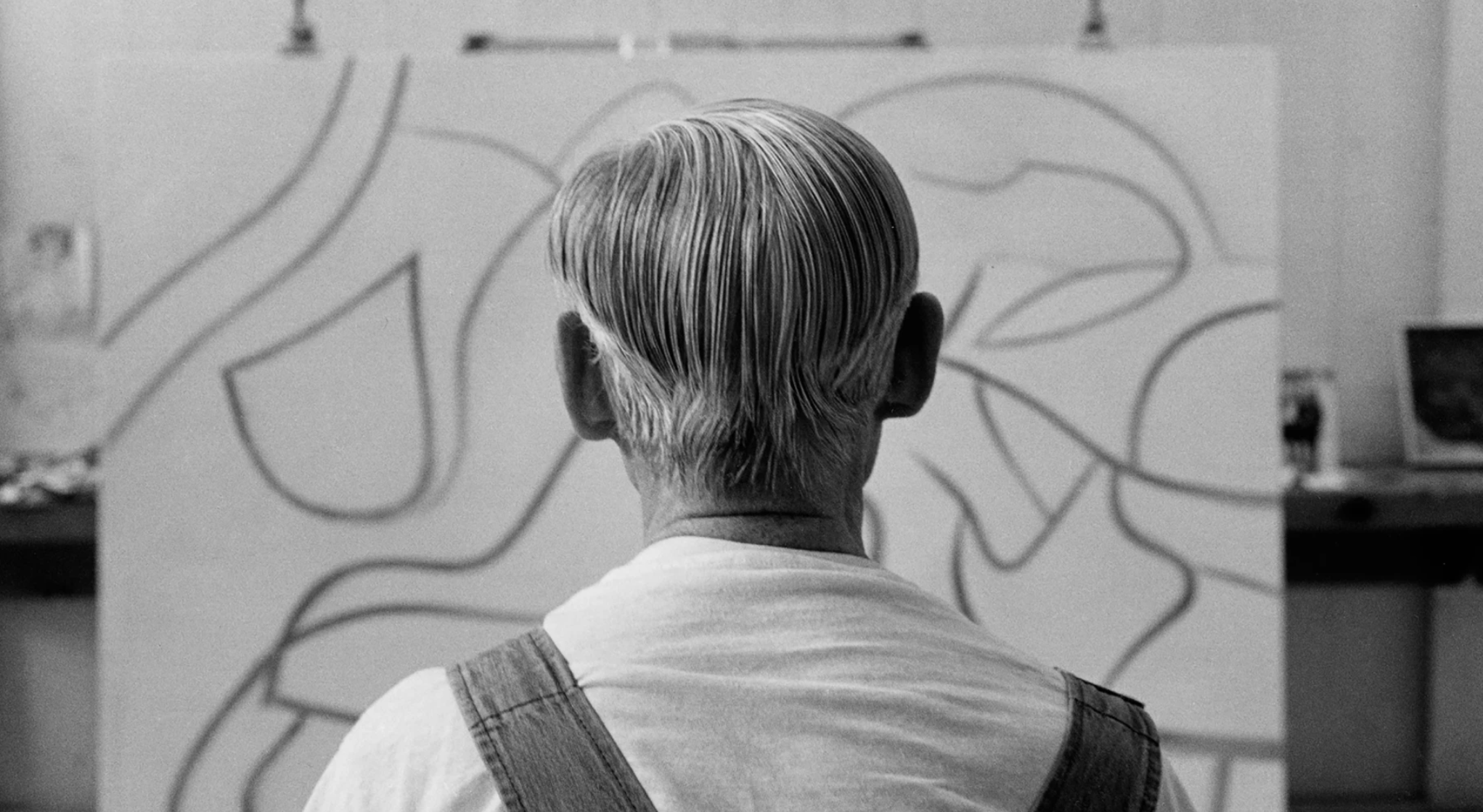
WILLEM DE KOONING IN HIS LONG ISLAND STUDIO, 1985. PHOTO © DUANE MICHALS. COURTESY OF DC MOORE GALLERY, NEW YORK. ART © 2022 THE WILLEM DE KOONING FOUNDATION / ARTISTS RIGHTS SOCIETY (ARS), NEW YORK
The paintings of the early 1980s announced a period of renewed activity in de Kooning’s creative output, heralding a new era of artistic production. Having moved full time to East Hampton by 1980, de Kooning began to paint with a new intensity which he viewed from the perspective of a long career as a premier artist. “I feel that I have found myself more, the sense that I have all my strength at my command. I think you can do miracles with what you have if you accept it …I am more certain of the way I use paint and the brush” (the artist cited in Exh. Cat., Washington, D. C., National Gallery of Art, Willem de Kooning: Paintings, 1994, p. 199). This new balance and clear-eyed confidence gave birth to an explosive creative energy and vigor which culminated in a series of extraordinary compositions. As seen in Untitled, de Kooning’s work is both kinetic and luminous, with dancing rhythms and diaphanous lines that are the ultimate realization and emancipation of his artistic vision. Unrestrained yet deliberate, his late paintings dazzle with musical vitality, their bold primary hues striking against the startling white ground that characterizes the series. Describing de Kooning’s technique in his late paintings, Carter Ratcliff observed: “Something extraordinary happens in the 1980s. Dragging a wide metal edge through heavy masses of paint, de Kooning turns scraping into a kind of drawing. A process of subtraction makes an addition, a stately flurry of draftsmanly gestures. De Kooning has always layered and elided his forms. Now he reminds us that he does the same with his methods” (Carter Ratcliff, “Willem de Kooning and the Question of Style”, in Willem de Kooning: The North Atlantic Light, 1960-1983, Amsterdam, 1983, p. 22). These paintings boast an enlivened spirit and a new freedom in which the artist’s innate gifts for line, color, and form remain paramount.
Select Late Paintings by Willem de Kooning in Museum Collections
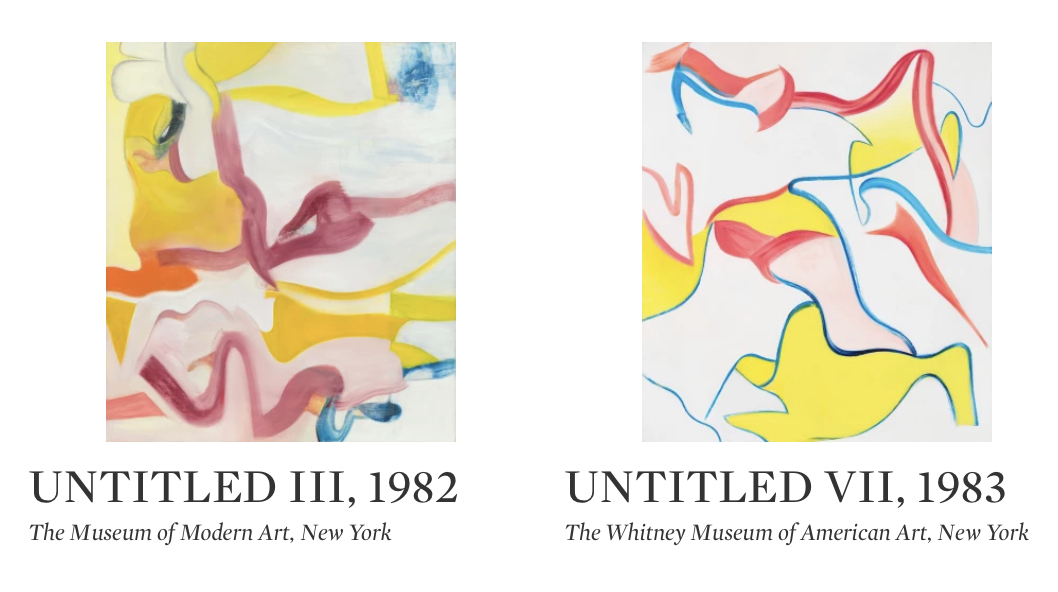
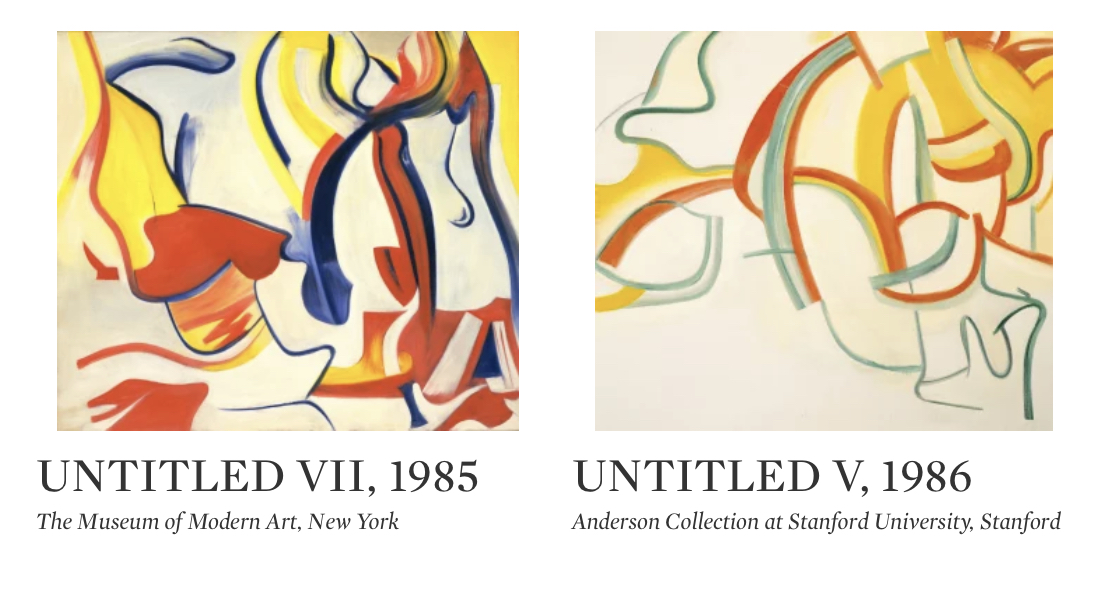
Notably, the “ribbon work” paintings executed from 1983 onwards exemplify de Kooning’s ultimate shift towards the use of thin evanescent layers of primary color. The diaphanous fluidity and rhythmic suppleness of de Kooning’s wrist here carves its way across the composition in meandering ribbons of vibrant red and broad flowing swathes of rich yellow. De Kooning channeled his wealth of creative experience into emotive construction by filtering the countless stylistic changes and compositions of the preceding decades into a radically distilled fusion of line and color. Enveloping the viewer with its vast, exhilarating visual plenitude, the present work reveals an artist that has reached complete union between his body, the paint, and the canvas. Executed on a grand scale, and with the finesse of an artist at the height of his aesthetic powers, Untitled emphatically extolls the supremacy of de Kooning’s inimitable abstract vernacular; as the critic Robert Storr noted of de Kooning’s paintings at this time,
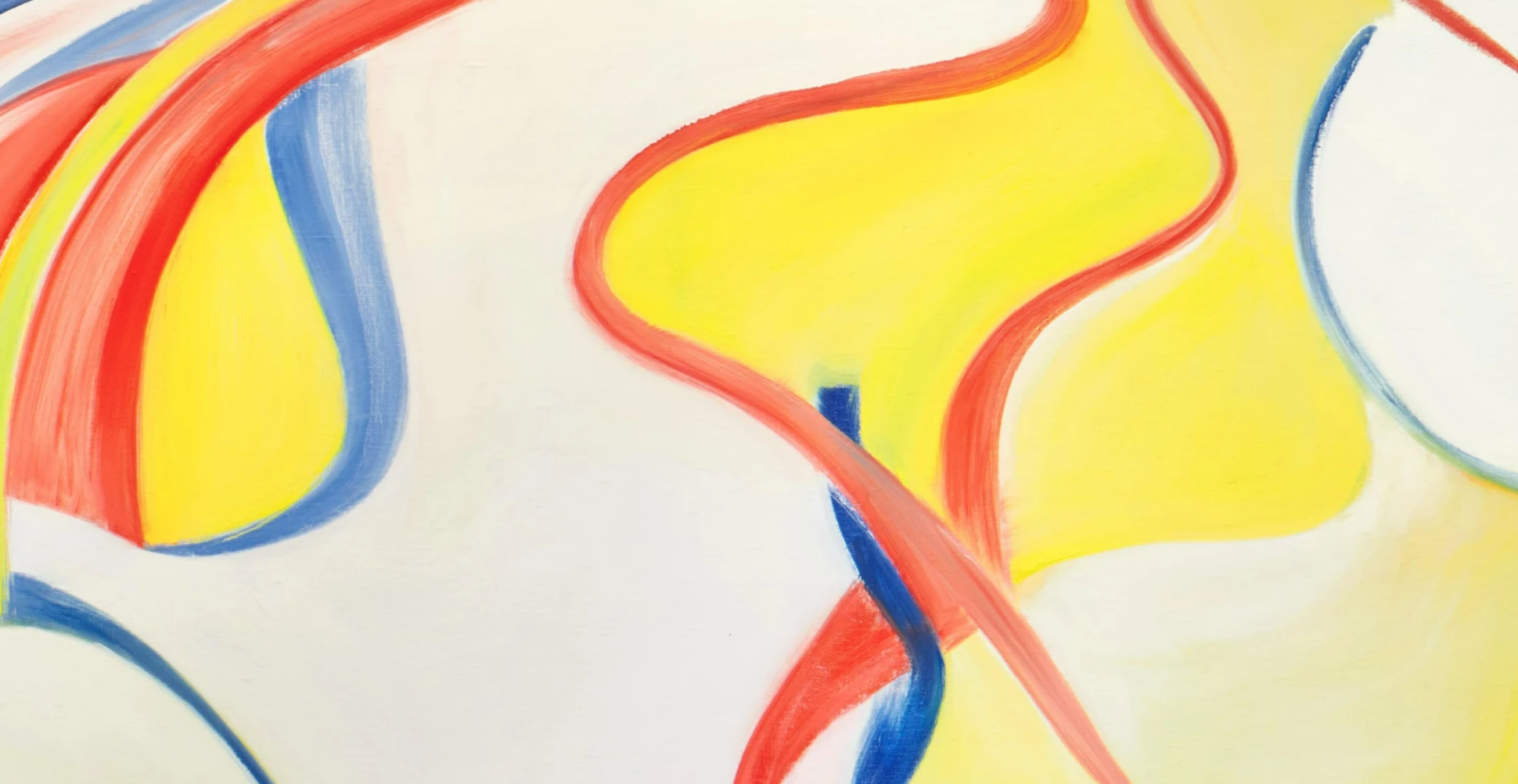
Much like the late work of Pablo Picasso, de Kooning’s paintings of the 1980s contain the sustained energy and technical finesse of earlier achievements, returning to the grandly lyrical manner of his Cubist abstractions of the 1940s. However, filtered through the experiences and paintings of the intervening decades, most notably the sun and light-filled East Hampton landscapes, the content of the 1980s paintings reach a peaceful serenity, leaving behind the baroque flourishes of paint-filled gestures in the 1970s. Untitled is the embodiment of the tranquility and confidence de Kooning gained through the experience of his unparalleled career which was punctuated by bursts of creativity that produced cohesive and startling shifts in his aesthetic while remaining acutely his own.
Untitled III, 1984
Christie’s New-York: 9 November 2023
Estimated: USD 8,000,000 – 12,000,000
USD 8,575,000
WILLEM DE KOONING (1904-1997) (christies.com)
WILLEM DE KOONING (1904-1997)
Untitled III, 1984
Oil on canvas
80×70 inches (203.2 x 177.8 cm)
Signed ‘de Kooning’ (on the stretcher)
Proving his ability to adapt and innovate even toward the end of his storied career, Willem de Kooning continued to probe the boundaries of painting long after he was canonized in the annals of art history. Never feeling it necessary to maintain one particular style or rest on his laurels, his dynamic oeuvre evolved and grew throughout the eight decades he was working. His is a lasting testament to how much a painter can explore the divide between the figurative world and pure abstraction. Untitled III is a highly sophisticated example of de Kooning’s work from the 1980s and illustrates his reflective journey from the overwhelming visual complexity of his first forays into Abstract Expressionism to a more open, airy space.
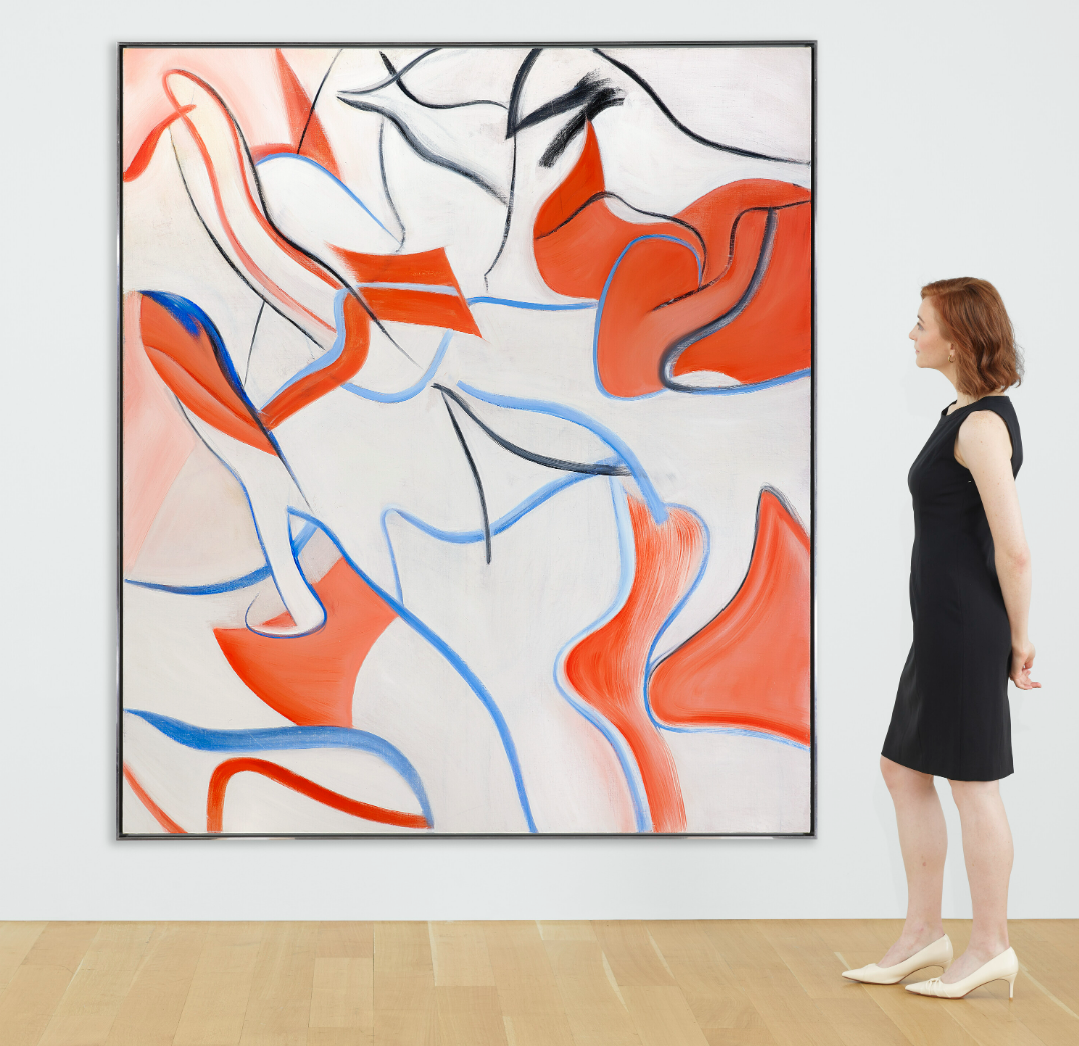
As a founder of that uniquely American movement and its New York constituency, his was a practice forged in the fires of change and revolutionary ideas. In his later years, he loosened the reins ever so slightly and began a new conversation within the composition. “Fewer components jostle for attention [in this body of work],” New York Times art critic Phyllis Braff wrote in 1994. “Sensations of bumping, layering and the piling on of experiences are all lessened. Instead, ribbons of color undulate and spread out, introducing a thoroughly engaging lyricism” (P. Braff, “A Hometown Tribute to de Kooning at 90,” The New York Times, Sunday, July 3, 1994, p. 13). This new visual direction was not wholly tangential as it followed the gradual progression visible throughout de Kooning’s timeline. Alluding to the curvaceous figures of his breakthrough Women series but eschewing the roughly aggressive handling of paint, these later canvases dispensed with direct representation in favor of a calm, flowing dialogue between the artist and his practice.
Untitled XV, 1983
Sotheby’s New-York: 8 November 2023
Estimated: USD 6,000,000 – 8,000,000
USD 8,607,300
WILLEM DE KOONING (1904 – 1997)
Untitled XV, 1983
Oil on canvas
79 7/8 x 70 inches (202.9 x 177.8 cm)
Signed (on the stretcher)
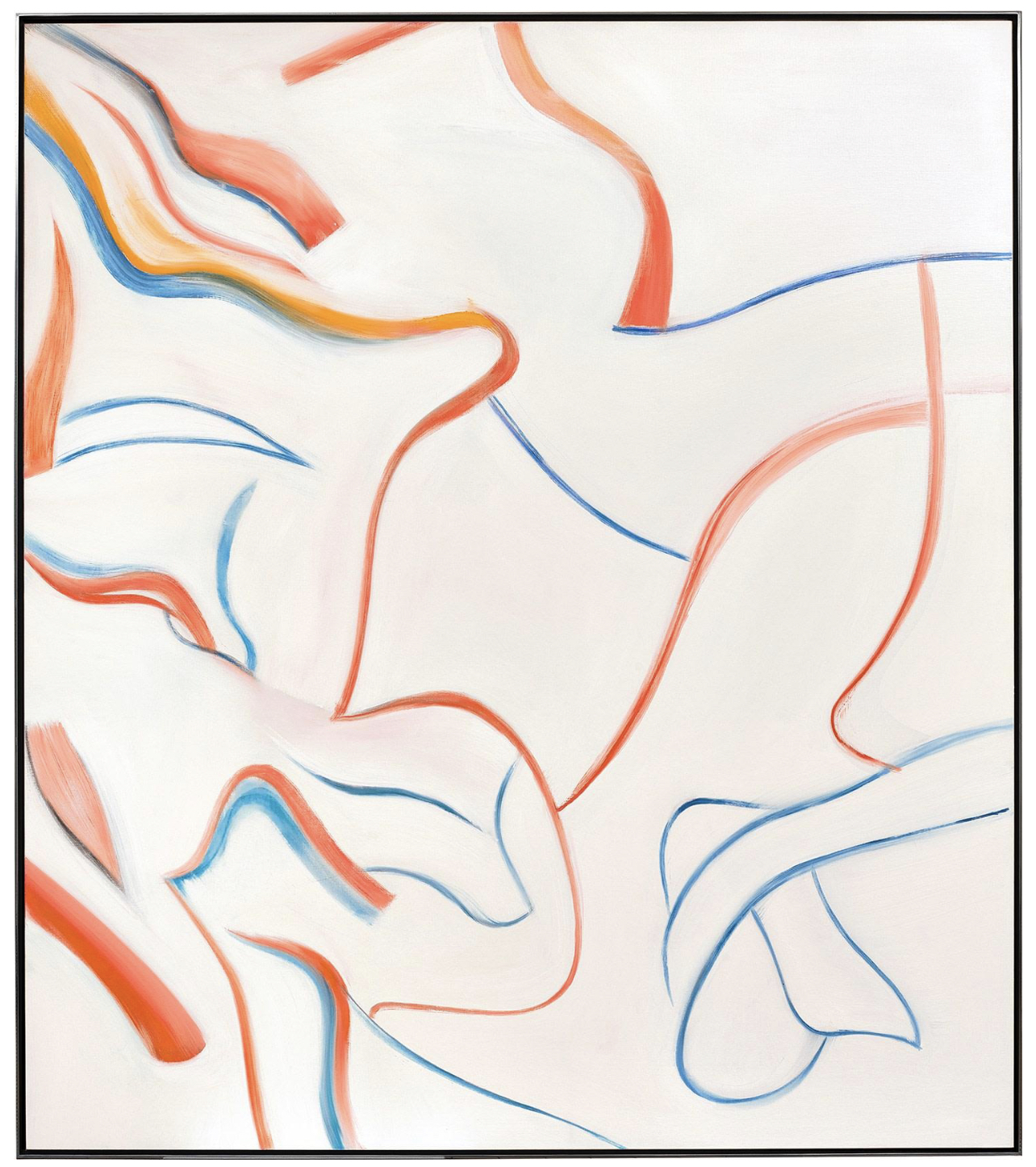
Executed in 1983, Untitled XV singularly embodies the vibrancy and calligraphic lyricism of Willem de Kooning’s final decade—an unparalleled masterwork and triumphant apotheosis of the abstract vernacular he developed so tirelessly over his titanic fifty-year career. In 1981, de Kooning inaugurated a corpus of hauntingly poetic abstractions that consumed his practice for the remainder of his life, and nowhere is his genius as a colorist and draftsman so concentrated than in his mature output. In the present work, ribbons of cerulean and cadmium red pirouette across an expanse of white, curling and unfurling across underpainted passages of yellow. Acquired in 1987, only a few years after its execution, Untitled XV has remained in Emily Fisher Landau’s collection for more than three decades, a rare jewel distinguished for its gem-like chromatic clarity and sumptuous quality of line. The buoyant dynamism of these bands of scarlet and blue stands not only as a miraculous compositional balancing act but also as a testament to de Kooning’s protean style. The radical experimentation that transpired every decade of his working life culminates in the present work: ceaseless, repeated investigations of line, color and form embody the visceral interplay between strength and sensuality, delicacy and mass, marrying the resolved restraint of his later work with the palpably vigorous energy of his earlier Women and East Hampton scenes. A paragon of his mature output, Untitled XV is the product of a truly inimitable visionary at the height of his creative powers.
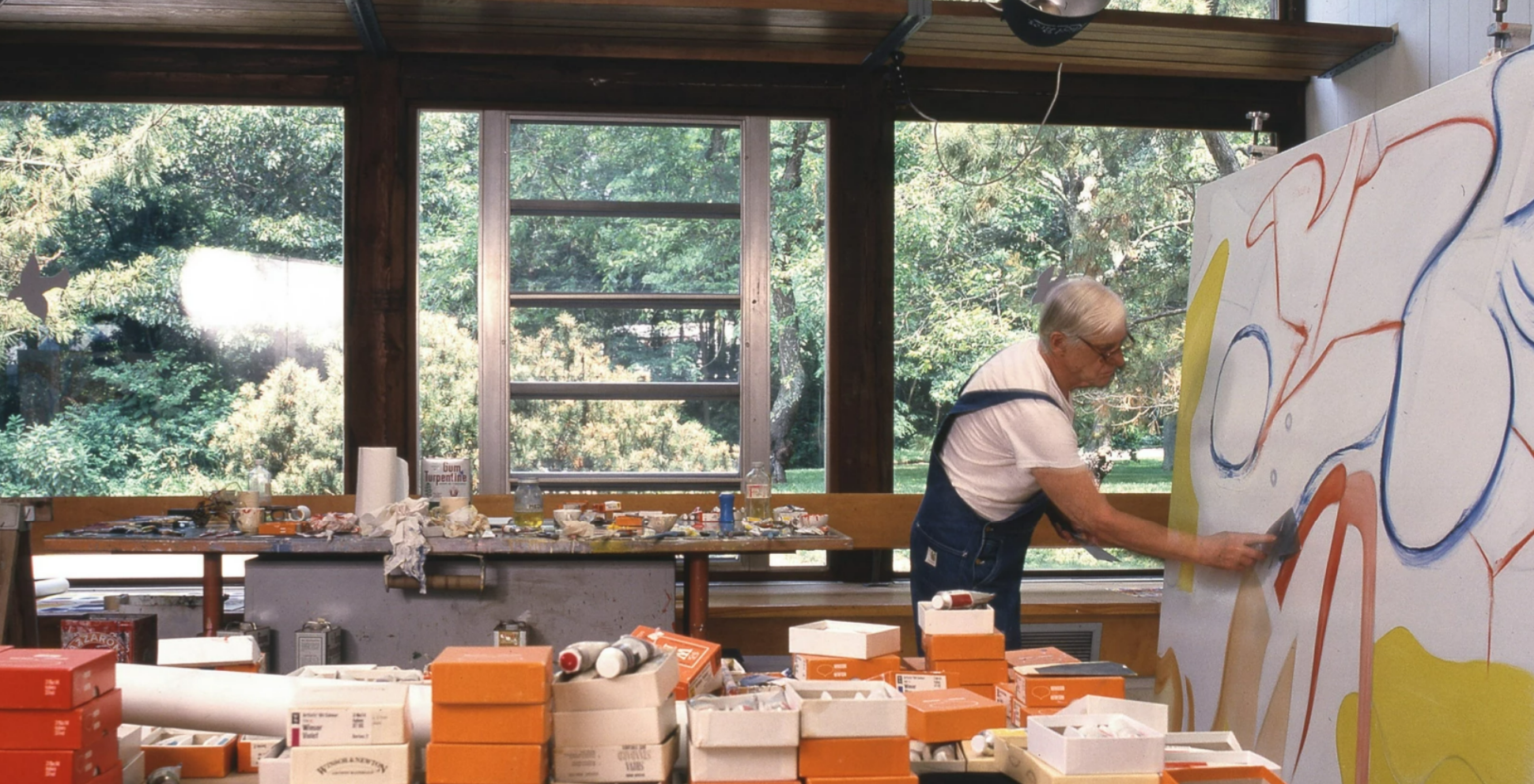
WILLEM DE KOONING IN HIS STUDIO, 1983. PHOTO © 1991 HANS NAMUTH ESTATE / COURTESY CENTER FOR CREATIVE PHOTOGRAPHY, UNIVERSITY OF ARIZONA. ART © 2023 THE WILLEM DE KOONING FOUNDATION / ARTISTS RIGHTS SOCIETY (ARS), NEW YORK
Heightened by its reduced palette, the treatment of line in the present work is utterly sensual, characterized in equal parts by tension and harmony, and is the result of a technical breakthrough: describing de Kooning’s methods in his late paintings, Carter Ratcliff observed, “Something extraordinary happens in the 1980s. Dragging a wide metal edge through heavy masses of paint, de Kooning turns scraping into a kind of drawing. A process of subtraction makes an addition, a stately flurry of draftsmanly gestures. De Kooning has always layered and elided his forms. Now he reminds us that he does the same with his methods” (Carter Ratcliff, “Willem de Kooning and the Question of Style,” in Willem de Kooning: The North Atlantic Light, 1960-1983, Amsterdam, 1983, p. 22). The forms wind and meander, as if uncontainable by the picture plane, extending beyond the edges of the canvas and into the air around us. The white pigment de Kooning so judiciously applies underneath, however, is not simply a void or background. It is as luxurious, luminous and intensely present as the crimson and ultramarine, even containing the subtlest pockets of yellow. By conflating figure and ground, and drawing upon the purity of the primary colors, de Kooning empowers his marks to float and dance, capturing a timeless and ineffable vivacity and marking a major achievement of pictorial distillation. Here, the full breadth of de Kooning’s mastery freely unfolds before us.
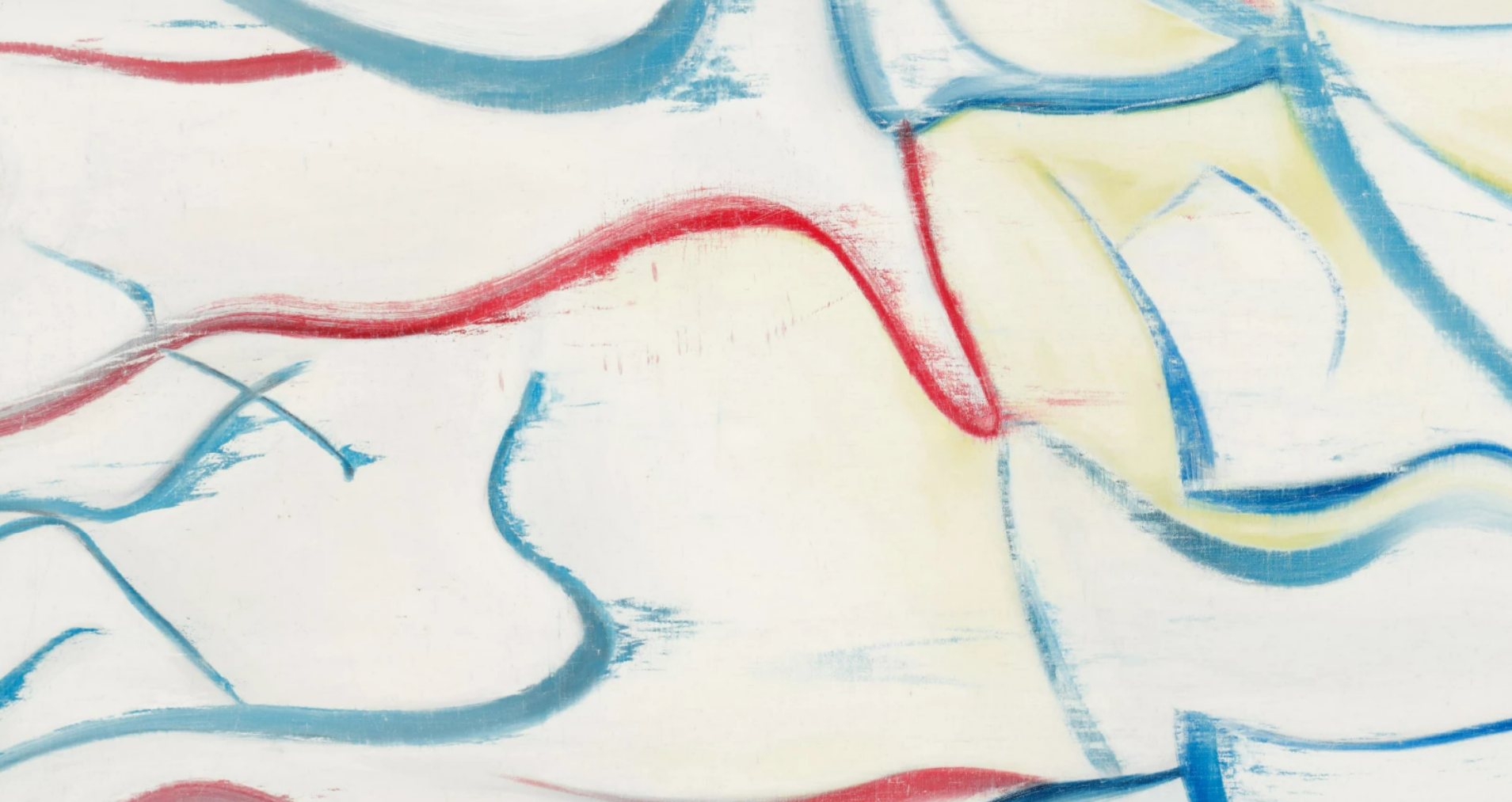
While consistent with the unmistakable traces of de Kooning’s remarkable touch—detectable even in his first canvases—Untitled XV in particular boasts an enlivened spirit, confidence and appetite for adventure. The artist’s celebration of line had been ascendant throughout his career, but his mature works bear a rhythm, cadence and ethereal levity unseen until the last decade of his life. Much like the Heroic works of Pablo Picasso or late cutout works by Henri Matisse such as Blue Nude II, de Kooning’s 1980s paintings contain the sustained energy and technical finesse of his earlier achievements. In the present work, the sinuous curvatures nod to his Woman series of the 1950s, and the wispy, horizontal and vertical textures recall the Long Island beaches that inspired his 1970s abstractions. The content of the 1980s paintings, however, has been radically simplified and illuminated, leaving behind the baroque flair of his earlier work to find a distilled fusion of color and line. Like Henri Matisse, whose late work, particularly his remarkable corpus of cutouts, similarly stages a collapse of the distinction between color and line, de Kooning achieves in the present work what can be considered the final goal of his career-long inquiry into the very nature of abstract art. As Gary Garrels described, “In the 1980s works, the essential procedures and techniques were not changed but simplified, and the vocabulary of forms was retained but clarified” (Gary Garrels, “Three Toads in the Garden: Line and Form,” in Exh. Cat., San Francisco, San Francisco Museum of Modern Art (and travelling), Willem de Kooning: The Late Paintings, the 1980s, 1996, p. 26).
Untitled, 1983
Christie’s New-York: 17 May 2023
Estimated: USD 8,000,000 – 12,000,000
USD 5,313,500
WILLEM DE KOONING (1904-1997)
Untitled, 1983
Oil on canvas
80×70 inches (203.3 x 177.8 cm)
A vision of sublime elegance and clarity, Untitled is an outstanding work from Willem de Kooning’s majestic series of ‘ribbon’ paintings. Painted in 1983, and shown with de Kooning on the front cover of The New York Times Magazine on November 20 that year, it captures the dazzling elemental rigour and intuitive liberation that defined the extraordinary final phase of the artist’s oeuvre. Stripping away the dramatic excesses of the 1970s, de Kooning reduces his palette to two tones: red and blue. Rendered with near-calligraphic linear brushstrokes, his bands of color undulate across a luminous expanse of white, choreographed with exquisite, balletic precision. With examples held in the San Francisco Museum of Modern Art, the Walker Art Center, Minneapolis, the Museum of Modern Art, New York and the Whitney Museum of American Art, these works stand among de Kooning’s most daring, brilliant and enigmatic creations. Selected by the celebrated curator John Elderfield for the 2013 exhibition Willem de Kooning: Ten Paintings, 1983-1985, the present example is remarkable for its crystalline, reductive power. Four decades of painterly abstraction are distilled into a spectacle of spare, incandescent beauty, all extraneous gesture extinguished in a blaze of light.
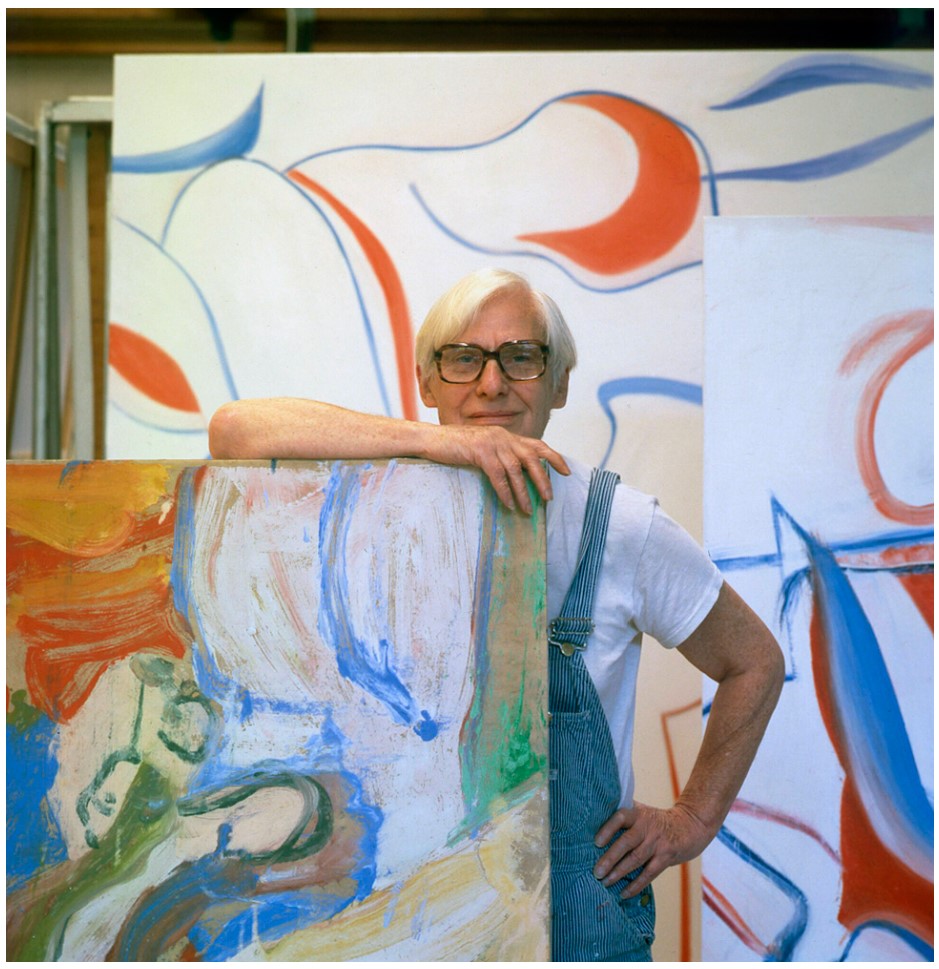
Willem de Kooning in his studio, East Hampton, 1983. Photo: Arnold Newman Properties / Getty Images. Artwork: © 2023 The Willem de Kooning Foundation / Artists Rights Society (ARS), New York.
The November edition of The New York Times Magazine was headlined by an article entitled “The Indomitable de Kooning”. In it, the writer Curtis Bill Pepper compared the spirit of the artist’s recent work to the grandiose late visions of Titian and Michelangelo. “The effect they gave was one of lightness and joy,” he wrote, at times suggesting “visions of air and water … shot through with transcendental light” (C. B. Pepper, “The Indomitable de Kooning,” The New York Times Magazine, November 20, 1983). The article was a testament to the frenzy surrounding the artist during this period. In the wake of his major international touring retrospective organized by the Whitney Museum of American Art that year, de Kooning reached the pinnacle of his celebrity.
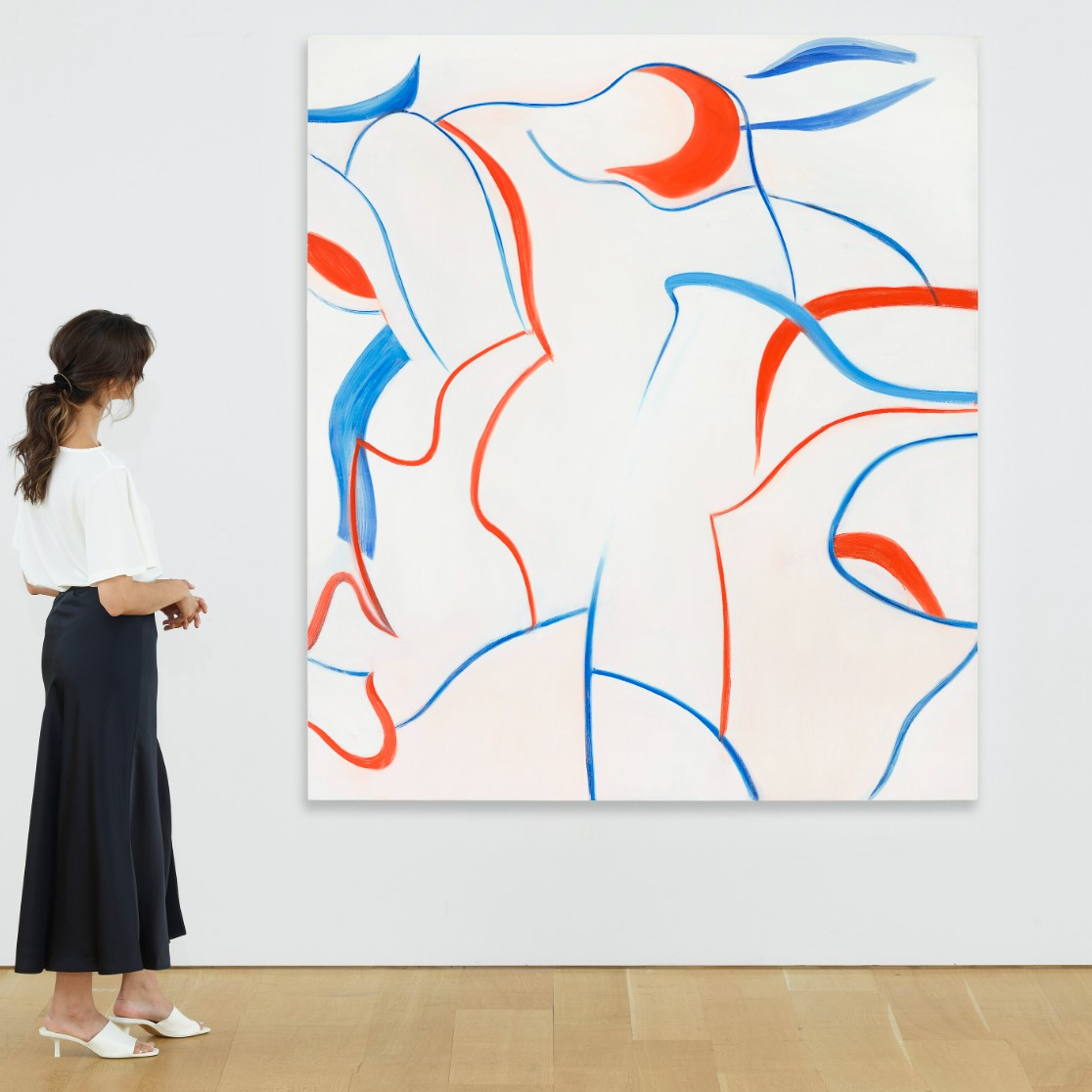
The present work eloquently demonstrates this self-assuredness. While some of de Kooning’s later works had featured other colors, here his sparse duet of red and blue sings with the confidence of an artist at the height of his creative abilities. In his essay for the 2013 catalogue, Elderfield writes in depth about its facture, illustrating four remarkable photographs of the painting in progress. Taken between 15 and 18 September 1983, they reveal much about the controlled precision of de Kooning’s process during this period. In its initial state, the canvas lay horizontally, with several areas drawn, shaded and painted. Dissatisfied, explains Elderfield, the artist rotated the canvas to portrait format, eliminating a number of the dense colored passages and adding several new linear elements. Flipping his canvas upside down, he continued to erase and embellish, anchoring his network of calligraphic lines like “billowing drapery” to the pointed red crescent form at the top. “In a brilliant final gesture,” writes Elderfield, he cut apart the two blue lines that had connected at the center of the canvas, “allowing space to flow from one side of the picture to the other” (J. Elderfield, Willem de Kooning: Ten Paintings, 1983-1985, exh. cat., Gagosian Gallery, New York, 2013, pp. 33-35).
Untitled, 1984
Phillips London: 2 March 2023
Estimated: GBP 7,000,000 – 9,000,000
GBP 6,965,500 / USD 7,241,523
Willem de Kooning – 20th Century & Cont… Lot 9 March 2023 | Phillips
WILLEM DE KOONING
Untitled, 1984
Oil on canvas
88×77 inches (223.5 x 195.6 cm)
Signed ‘de Kooning’ on the stretcher
Suffused with radiant light and the gentle fluctuations of line and color, this profoundly lyrical and harmonious untitled work belongs to Willem de Kooning’s celebrated last great cycle of paintings. A remarkable body of work, lauded by Robert Storr as ‘the most distinctive, graceful, and mysterious de Kooning himself ever made’, these delicate visions carry us into the vast, airy spaces where ideas and poetry thrive, their forms mutable and effervescent.
Although at first glance appearing in stark contrast to the violent, gestural energy, heavy impasto, and distortive approach to form adopted in the 1950s and developed across his infamous Women canvases, in the clarity of their structure these luminous compositions retain the formal consistency and emotional depth of the artist’s earlier work. Such connections not only speak to the internal coherence of his restlessly experimental oeuvre but, more pointedly, illuminate the constant, fluid exchanges between figuration and abstraction from which his paintings emerged. Distilled to the essence of line and color, the present work’s supple forms bend and pirouette against the luminous and remarkably subtle white tonalities beneath, weightless ribbons of soft reds, butter yellow, and electric blue unspooling across its expansive surface. Fluid and shifting, these late works crystalize the dance between figuration and abstraction that best define de Kooning’s remarkably inventive 60-year career, highlighting the extent to which he never truly abandoned the figure, even as he pushed abstraction into radically new territory.
The Hat Upstairs, 1987
Sotheby’s New-York: 16 November 2022
Estimated: USD 9,000,000 – 12,000,000
USD 10,665,500
The Hat Upstairs | Contemporary Evening Auction | 2022 | Sotheby’s (sothebys.com)
WILLEM DE KOONING (1904-1997)
The Hat Upstairs, 1987
Oil on canvas
77×88 inches (195.6 x 223.5 cm)
Painted in 1987, The Hat Upstairs singularly embodies the vibrancy, lyrical abstraction and deft painterly intention of de Kooning’s final decade, which is now celebrated as the artist’s “Late Period.” The Hat Upstairs is an unparalleled masterwork from this period, a triumphant apotheosis of his abstract vernacular; de Kooning floats ribbons of hues that elegantly coalesce with chromatic vibrancy and a buoyant dynamism. The present work belongs to a mature corpus of lyrical abstract works de Kooning began in 1981, which occupied his practice for the remainder of his life. The Hat Upstairs is an exceptional example of this body of work, with the saturated pigment forming melodic lines and forms that counterbalance like music across the surface. The present work recalls the female form or rolling landscapes permeating the artist’s entire oeuvre through the sumptuous curvatures which swell across the monumental canvas in unrestrained yet deliberate loops of unadulterated color. Although de Kooning’s works from the 1980s are often referred to as one period, in fact, the decade is marked by considerable experimentation in each year. Exuding a breathtaking, poetic elegance, The Hat Upstairs is a masterpiece borne from the radical experimentation within de Kooning’s legendary practice: here, he crystallizes his career-long investigations into line, color, and form to embody the visceral interplay between strength and sensuality, delicacy and mass.
Untitled, 1985
Christie’s New-York: 17 November 2022
Estimated: USD 8,000,000 – 12,000,000
USD 9,321,000
WILLEM DE KOONING (1904-1997) (christies.com)
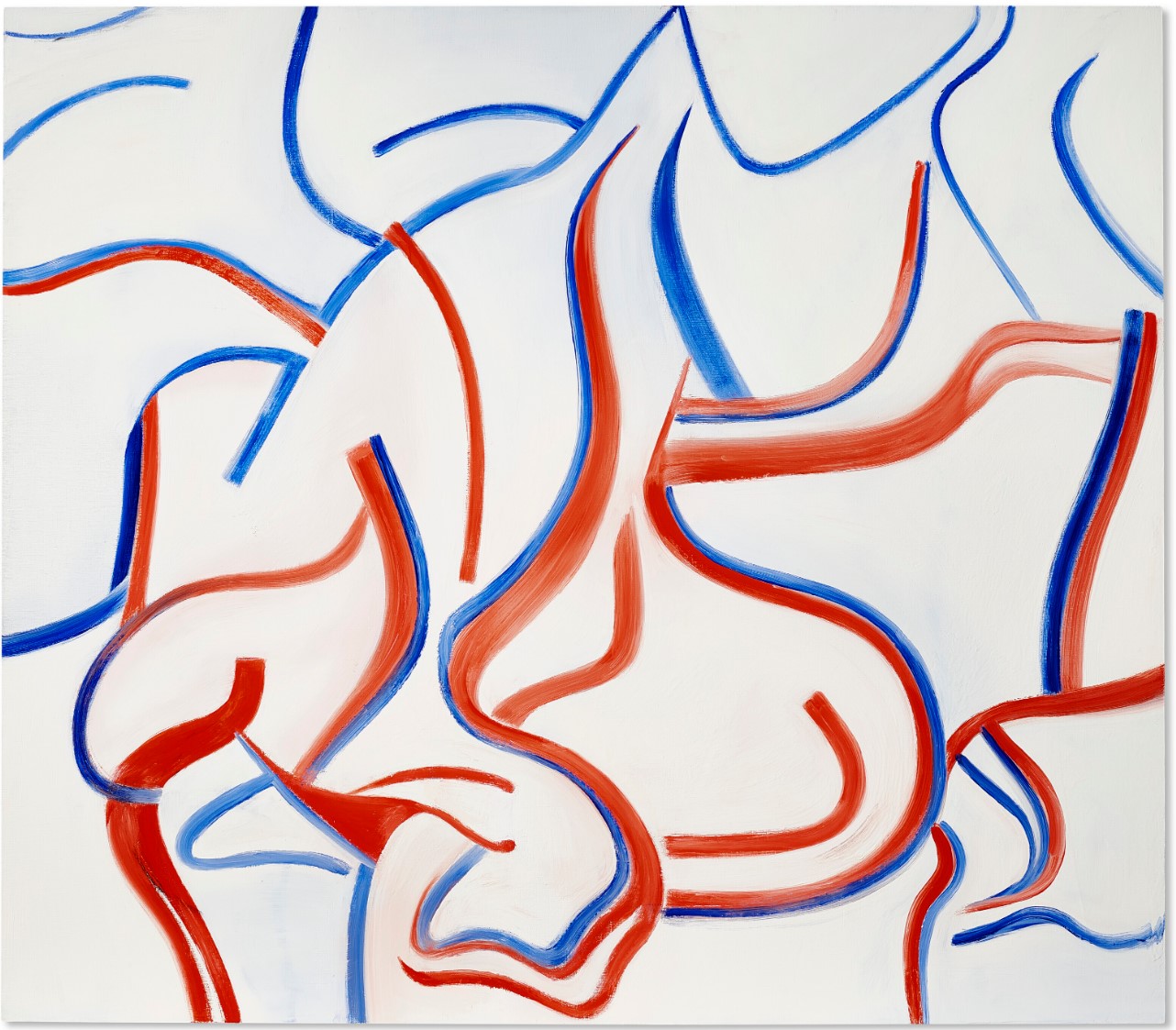
WILLEM DE KOONING (1904-1997)
Untitled, 1985
Oil on canvas
70×80 inches (177.8 x 203.2 cm)
Painted in 1985, Willem de Kooning’s Untitled is a vivacious, large-scale example of his late style, brimming with floating ribbons of color that flicker and dance across a luminous white background. Now in his eighties, de Kooning was painting some of his most lyrical and elegant paintings yet. “I am becoming freer,” he said. “I think you can do miracles with what you have if you accept it” (W. de Kooning, quoted in M. Stephens and A. Swann, De Kooning: An American Master, New York, 2005, p. 603). This era witnessed a stripping away of extraneous materials, leaving only two primary colors—red and blue—set against glowing, almost incandescent, white grounds. Untitled attests to these lean but brilliant late paintings, featuring a host of colorful ribbon-forms, some of which nestle alongside each other, while others roam free, only to fold in on themselves, suggesting the curvature of womanly bodies and flesh.
De Kooning orchestrates a powerful, late-in-life masterpiece in Untitled, which bustles with dancing lines and evokes the airy and elegant joie-de-vivre of this late, great series. With a calm hand, the artist paints lean blue lines, which converge in peaks and tapered points along the upper edge, conjuring up icy vistas and cold mountain snow. Throughout the main register, these crisp blue ribbon-forms are then paired with thicker, denser red ones. These nestle alongside the blue, varying in thickness and width, at times breaking off from a single line to form two thinner ones (in one case, a line which begins its life as red ends up turning blue as it arcs and whips around). These color ribbons have a potent, graphic “snap” when viewed against the optical white background. The artist has given some of them several applications of paint, making them wider, darker, and more emphatic. He has also used the palette knife to scrape down parts of the surface, rendering the painting’s “skin” light and airy. Subtle pink passages linger beneath the white surface, barely perceptible at first, but adding a sensual warmth to the otherwise cool white tones. Overall, the painting feels on the cusp of movement, ready to fold and bend upon itself at any minute.
Untitled XVI, 1985
Sotheby’s London: 29 June 2022
Estimated: GBP 3,000,000 – 4,000,000
GBP 3,545,000 / USD 4,305,842
Untitled XVI | Modern & Contemporary Evening Auction | 2022 | Sotheby’s (sothebys.com)
WILLEM DE KOONING (1904 – 1997)
Untitled XVI, 1985
Oil on canvas
77×88 inches (195.5 x 223.5 cm)
Signed de Kooning (on the stretcher)
Willem de Kooning’s Untitled XVI is part of a corpus of haunting abstractions, created with the finesse of an artist at the height of his confidence and painterly abilities. Following four decades of incessantly groundbreaking modernist innovation and enveloping the themes and aesthetic impulses of his entire oeuvre, this light, lyrical arabesque of red, green and yellow held together by energetic line fully embodies the boldly reinvented style that dominates the last decade of de Kooning’s life. Acquired from Xavier Fourcade Gallery in New York in 1986, only one year after its execution, the present work has remained in the collection of Marcia and Stanley Gumberg for over 35 years. Indeed, Untitled XVI is a major highlight of a group of outstanding post-war Contemporary Art amassed by the Gumbergs with the utmost connoisseurship, and exquisitely displayed for years in their Pittsburgh home. The collection represents a succinct summary of American Abstract Expressionism and European Modernism, spanning twentieth-century masters of abstraction and figuration. The present work distils the essence not only of de Kooning’s creative genius but also of an entire epoch marked by sensuousness, risk and radical freedom.
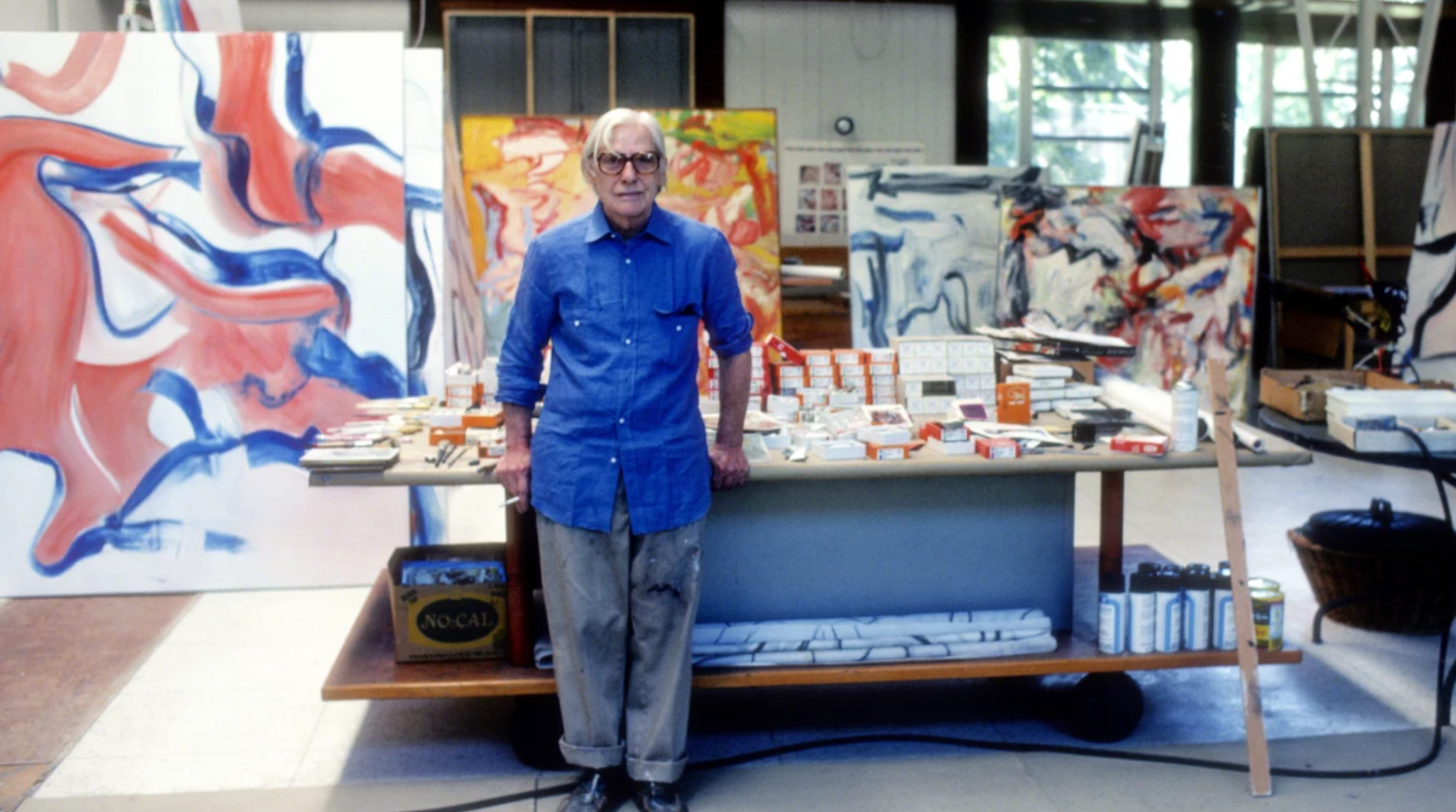
WILLEM DE KOONING IN HIS HAMPTONS STUDIO, CIRCA 1982 / IMAGE: © LUIZ ALBERTO / IMAGES / GETTY IMAGES
ARTWORK: © THE WILLEM DE KOONING FOUNDATION/ ARTISTS RIGHTS SOCIETY (ARS), NEW YORK AND DACS, LONDON 2022
In 1985, during one of the most prolific period in de Kooning’s career that resulted in sixty-three paintings, the artist expanded the frontier of abstraction by interrogating the very forms that encapsulated the zeitgeist of an era. His new paintings echo the formal invention of his lifelong influence Arshile Gorky, and the vibrant cut-outs of Henri Matisse in works such as La Gerbe from 1953. Indeed, de Kooning seeks to “cut up” or pull familiar forms apart, sometimes dynamically setting them in motion and other times allowing them to float gently across a deep, projected space. With the seeds of this novel, bewitching project evident in the works of this period exhibited in de Kooning’s major 1983 Whitney Museum retrospective, Untitled XVI showcases exceptional crispness, contrasting with the heavily painted earlier works that often combined a kaleidoscopic range of pigment as well as various mediums, such as oil paint and pastels, thickly layered with brushes and palette knives. Here, executed with exquisite looseness of brushwork, calligraphic ribbons of prismatic color and line produce a rhythm that through their vertical fluctuation in pristine white space create a sense of melting or being pulled down by vaguely evoked gravity. Converging the simplicity and the dynamic equilibrium of late Piet Mondrian with the organic lyricism of Claude Monet, Untitled XVI represents an imaginary volumetric terrain that unfolds, warps, inflates and collapses with breathtaking, indomitable elegance and delicacy, channeling the old power of bulging, twisting planes and sculptural contour of Tintoretto and Peter Paul Rubens. The elements of this composition may appear to be hovering upon the white ground, yet the origin of their ethereal quality is in the judicious application of cool white pigment atop churning delineations of red, green and yellow, which, as a result, emerge from rather than amasse on the surface of the canvas.
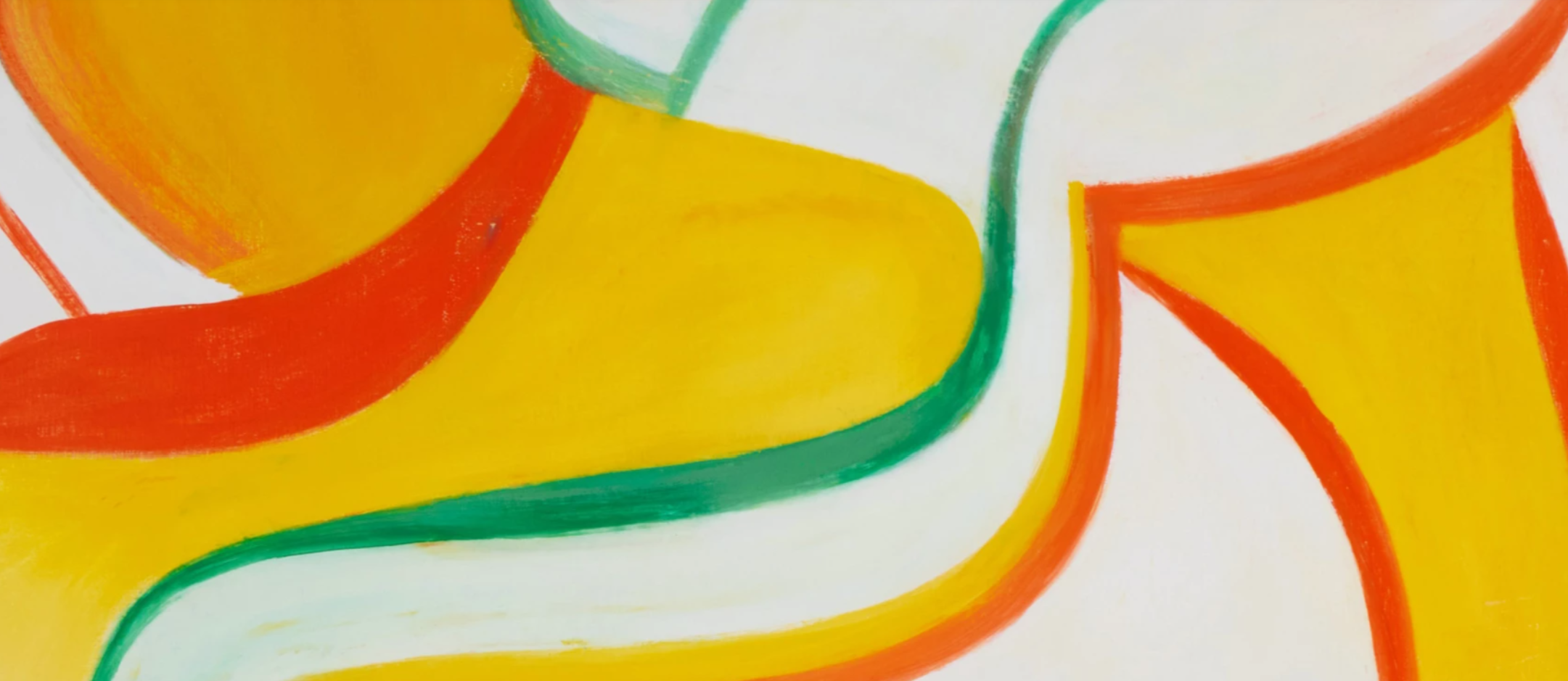
Although the newfound freshness, fluidity and unprecedented thinking behind the present work leaves one assured that advanced age can be a time of rejuvenation, a wistful, ineffable intensity of the culminating artistic triumph achieved by de Kooning in the last decade of his life is unmistakably present. The lyricism of Untitled XVI is emphasized by its process of mark-making in de Kooning’s light-filled studio in the East Hampton hamlet of Springs on the coast of Long Island. Yet his melodic abstraction on the surface of the present work is also reminiscent of the windswept vistas of his native Rotterdam in the Netherlands, which he left as a young man in pursuit of the uninhibited creative spirit, vivacity and of New York City in the late 1920s. While those electric energies infused and nurtured de Kooning’s work throughout his long, monumental career, there is profound, quiet intimacy to gazing into the universe of America’s most revered artist at his zenith, just before a permanent state of vulnerability came with impaired physical and mental health soon after the completion of this corpus of groundbreaking abstractions. Nowhere is de Kooning’s ability as a painter more poetically asserted than in his late masterpieces, in which his evanescent desire to break free from conventions and celebrate the transcendental beauty of the painterly medium courses forward through sublime, winding forms.
Untitled XIII, 1984
Sotheby’s New-York: 16 May 2022
The Macklowe collection
Estimated: USD 7,000,000 – 10,000,000
USD 8,999,450
Untitled XIII | The Macklowe Collection | 2022 | Sotheby’s (sothebys.com)
WILLEM DE KOONING (1904 – 1997)
Untitled XIII, 1984
Oil on canvas
70×80 inches (177.8 x 203.2 cm)
Signed on the stretcher
Willem de Kooning’s Untitled XIII from 1984 emphatically reveals the mature artist working at the height of his creative powers. Here, the buoyant graceful lines of de Kooning’s abstract calligraphy are utterly sensual, and with his reduced and lyrical palette, nowhere is his grand ability as a colorist more poetically asserted than in these late masterpieces. The cascading lines describe a spatial openness and delicate balance that is freer and utterly confident as de Kooning literally draws on canvas in his purest fashion. Dragging a wide metal edge through heavy masses of paint, de Kooning turns scraping into a kind of drawing. A process of subtraction makes an addition, a stately flurry of draftsmanly gestures. Acquired directly from d’Offay Gallery in London in 1987, the present work has remained in The Macklowe Collection for over three decades.
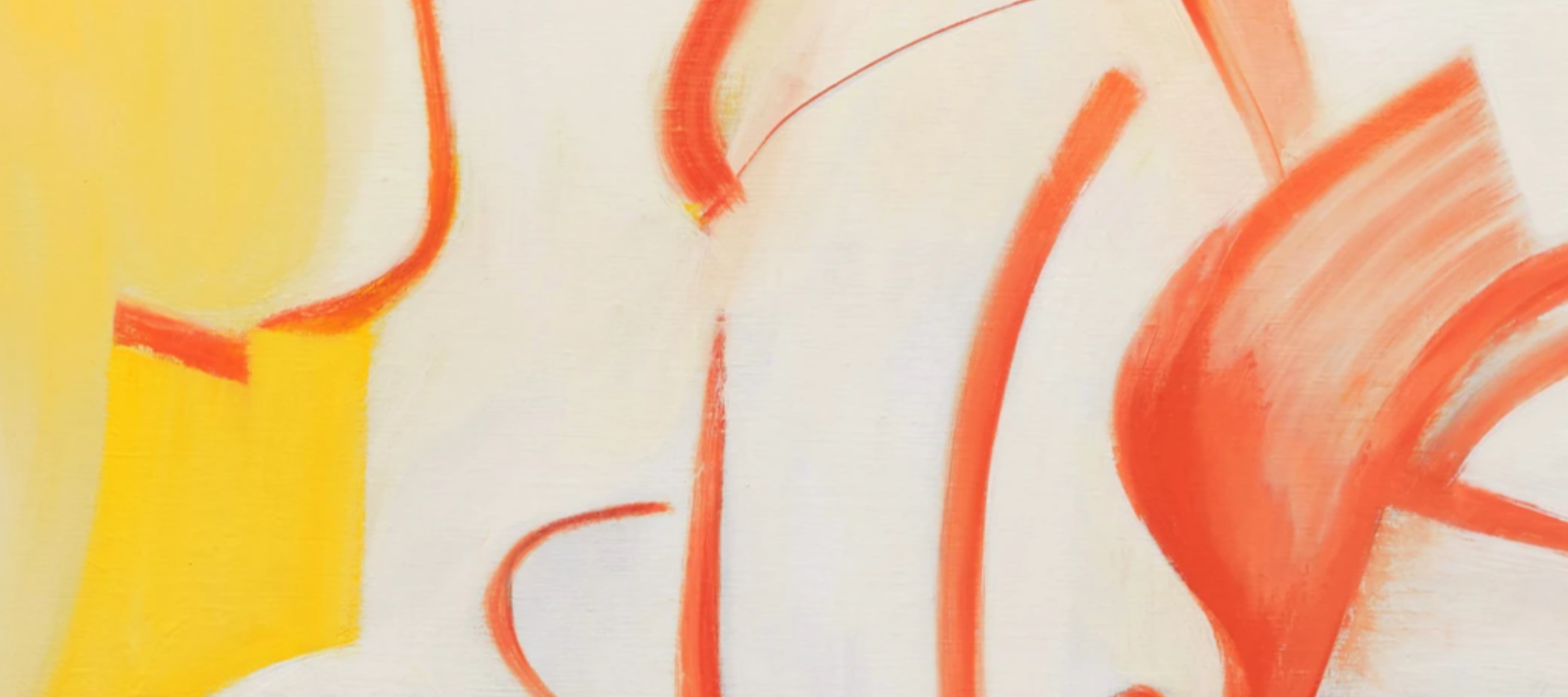
Uniting a gestural painterly lyricism with his most refined palette to date, Untitled XIII evokes an emotional poignancy that rivals the iconic landscapes of de Kooning’s Impressionist forebears. The artist’s confidence in his craft is clear in the calligraphic strokes of crimson paint that wind across the canvas, laid down with the deft certainty that accompanies true mastery. Standing before Untitled XIII, the viewer is engulfed in colorful abstraction as, like blooms opening in the sun, the full breadth of de Kooning’s mastery freely unfurls across the canvas. In an homage to his great forebear Henri Matisse, whose late work, specifically his remarkable corpus of cutouts, similarly stages a collapse of the distinction between color and line whilst maintaining the ever-present reference to the human form, de Kooning here achieves what can be considered the final goal of his life-long investigation into the very nature of abstract art. This new balance and clear-eyed confidence gave birth to an explosive creative energy and vigor which culminated in his 1980s masterworks. This creative conviction is powerfully witnessed in the assuredly distilled and indelibly resolved composition of Untitled XIII, which equally recalls Matisse’s famed cutouts in its bold lines as that Modern master’s earlier Fauvist compositions such as Le Bonheur de Vivre (1905-06) in the heady heat of its palette. As seen in the present canvas, de Kooning’s work is radically simplified and luminous, with dancing rhythms and diaphanous lines that are the ultimate realization and emancipation of de Kooning’s artistic vision. Unrestrained yet deliberate, they dazzle with musical vitality, in bold primary hues against the startling white that characterized the series.
Untitled IV, 1983
Sotheby’ New-York: 15 November 2022
Estimated: USD 10,000,000 – 15,000,000
USD 18,935,250
Untitled IV | The Macklowe Collection | 2021 | Sotheby’s (sothebys.com)
WILLEM DE KOONING (1904 – 1997)
Untitled IV, 1983
Oil on canvas
88×77 inches (223.5 x 195.6 cm)
Signed on the stretcher
In 1981, at the apex of a truly spectacular fifty-year career, Willem de Kooning inaugurated a corpus of hauntingly lyrical abstractions that occupied his practice for the remainder of his life. Executed in 1983, Untitled IV is paramount among the canvases of this decade for its chromatic vibrancy, compositional dynamism, and bewitching beauty. Here, sinuous scarlet and blue forms carve sensuous paths through a gleaming white expanse, each curve counterbalanced by another to create a painting of extraordinary elegance. Executed on a grand scale, and with the finesse of an artist at the height of his aesthetic powers, Untitled IV emphatically extolls the supremacy of Willem de Kooning’s inimitable abstract vernacular. Acquired from Anthony d’Offay Gallery in 1987, the present work emerges as the ultimate testament to de Kooning’s utter mastery of his medium in the final decade of his life.
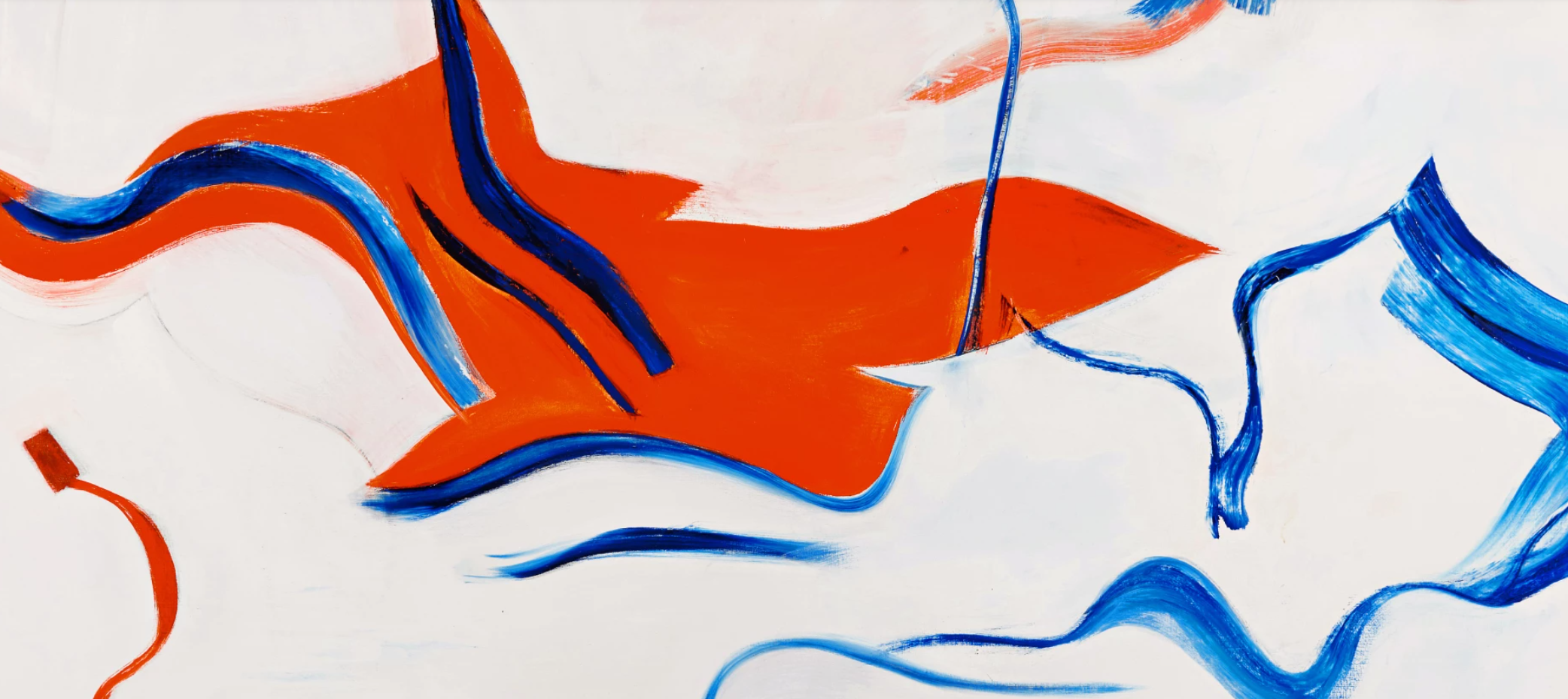
Untitled IV is a truly superb exemplar of the unique painterly method de Kooning applied to his compositions of the 1980s. While at first glance the lyrical red and blue zones appear to be floating upon a pristine white ground, their indomitable elegance and ethereal lightness was in fact achieved through de Kooning’s judicious application of cool white oil pigment atop a churning surface of chromatic intensity. As such, the graceful organization of hued forms in Untitled IV was revealed by way of excavation as opposed to accumulation, the result being one of profound aesthetic and technical innovation from an artist in the final decades of his prodigious career. Here, the buoyant graceful lines of de Kooning’s abstract calligraphy are utterly sensual; and with his reduced and lyrical palette, nowhere is de Kooning’s grand ability as a colorist more poetically asserted than in these late masterpieces. The cascading lines describe a spatial openness and delicate balance that is freer and utterly confident as de Kooning summons by way of sheer creative brilliance a fully resolved composition from an initial outpouring of abstract energies.
Untitled VII, 1981
Christie’s New-York: 11 November 2021
Estimated: USD 8,000,000 – 12,000,000
USD 14,558,000
WILLEM DE KOONING (1904-1997), Untitled VII | Christie’s (christies.com)
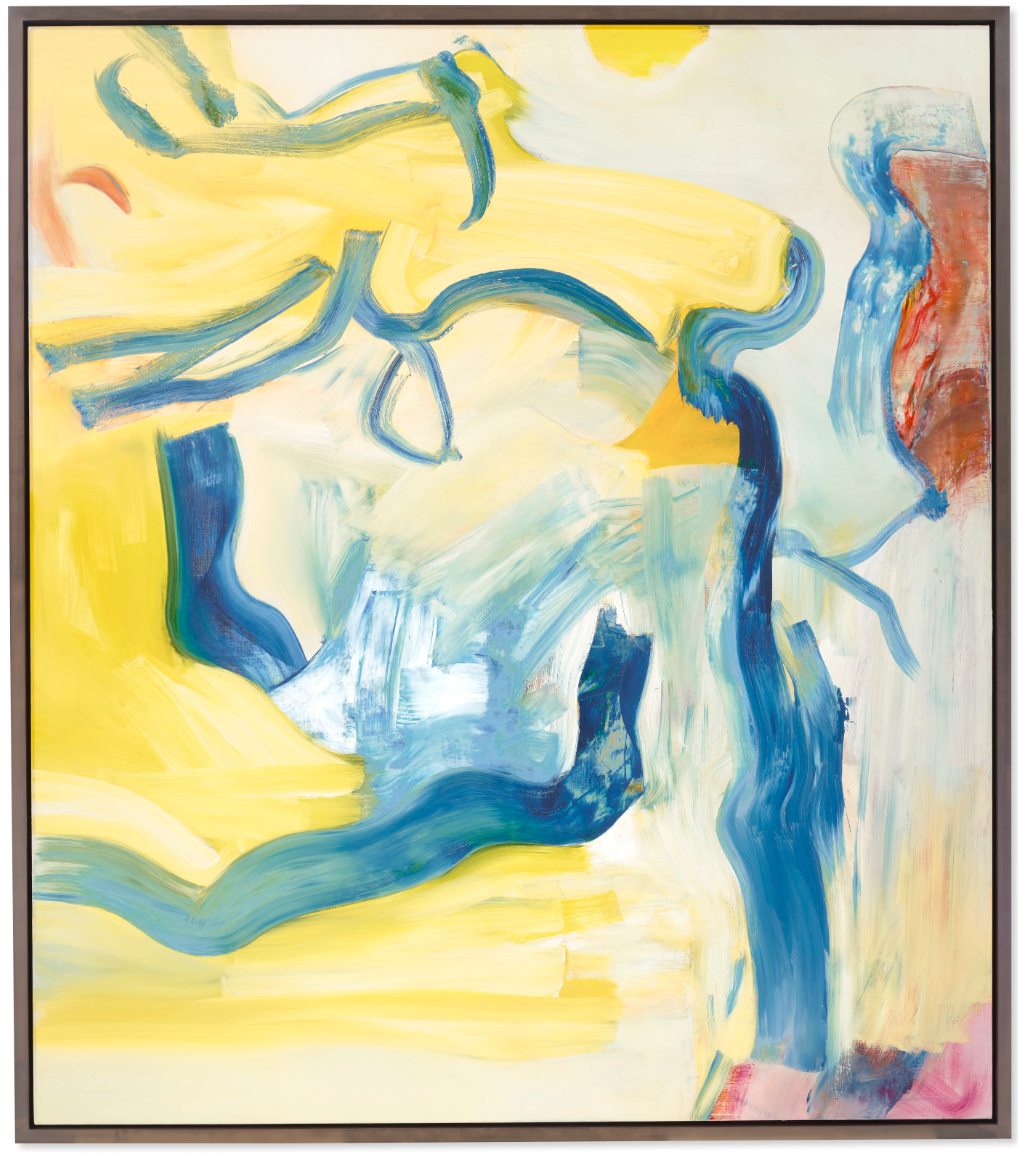
WILLEM DE KOONING (1904-1997)
Untitled VII, 1981
Oil on canvas
80×70 inches (203.2 x 177.8 cm)
Signed ‘de Kooning’ (on the stretcher)
A ravishing arrangement of color, line and form, Willem de Kooning’s Untitled VII is an exquisite painting from 1981, brimming with the ephemeral qualities of sun, sea and sky. One of only fifteen canvases that de Kooning would create during this transformative year, Untitled VII is flooded with glorious North Atlantic light, where lush passages of luminous yellow are paired with lyrical, arcing blue ribbons; these swirl and loop across the surface, some made in a single stroke, others widening out into flat planes. Evoking the bucolic splendor of his home on the East End of Long Island, the painting is also a magisterial ode to paint itself. Pushed, pulled, scraped and brushed, the gestural force of de Kooning’s marks are alive with the artist’s process—a testament to the vigor of this seventy-seven year-old artist who would go on to create some of his greatest paintings during this, the final chapter of his life.
Untitled VII is a light–pouring-out painting, suffused with radiant yellow passages that have been thinned-down and glided onto the surface in wide strokes of the brush, commingling with the bright white underlayer that de Kooning now brought into his paintings in ever greater frequency. The fleeting qualities of light as it streamed into his large and airy Long Island studio fairly obsessed the artist, as did the Atlantic Ocean in all its moody permutations. De Kooning infuses these evanescent qualities into Untitled VII, creating a powerful, visceral work. The eye follows his brush as it zig-zags, loops, arcs and flows–at times scraped, built up and worked wet-into-wet. More often than not, the subtle contours of the blue ribbon-forms allude to the curvature of the female body, as the painting remains powerfully alive with the energy and thrust of the artist’s brush. One day in the spring of 1981, Willem de Kooning picked up his brush and embarked upon what would become his final series of paintings. He was nearly 77 at the time, and worked steadily throughout that year, ultimately producing fifteen large-scale paintings, to which the present Untitled VII belongs. This body of work (1981-82) forms a bridge between the effervescent, energetic canvases of the late 1970s and the leaner “ribbon paintings” of the later 80s. It was a fruitful period which found de Kooning re-energized, communing with his own past work.
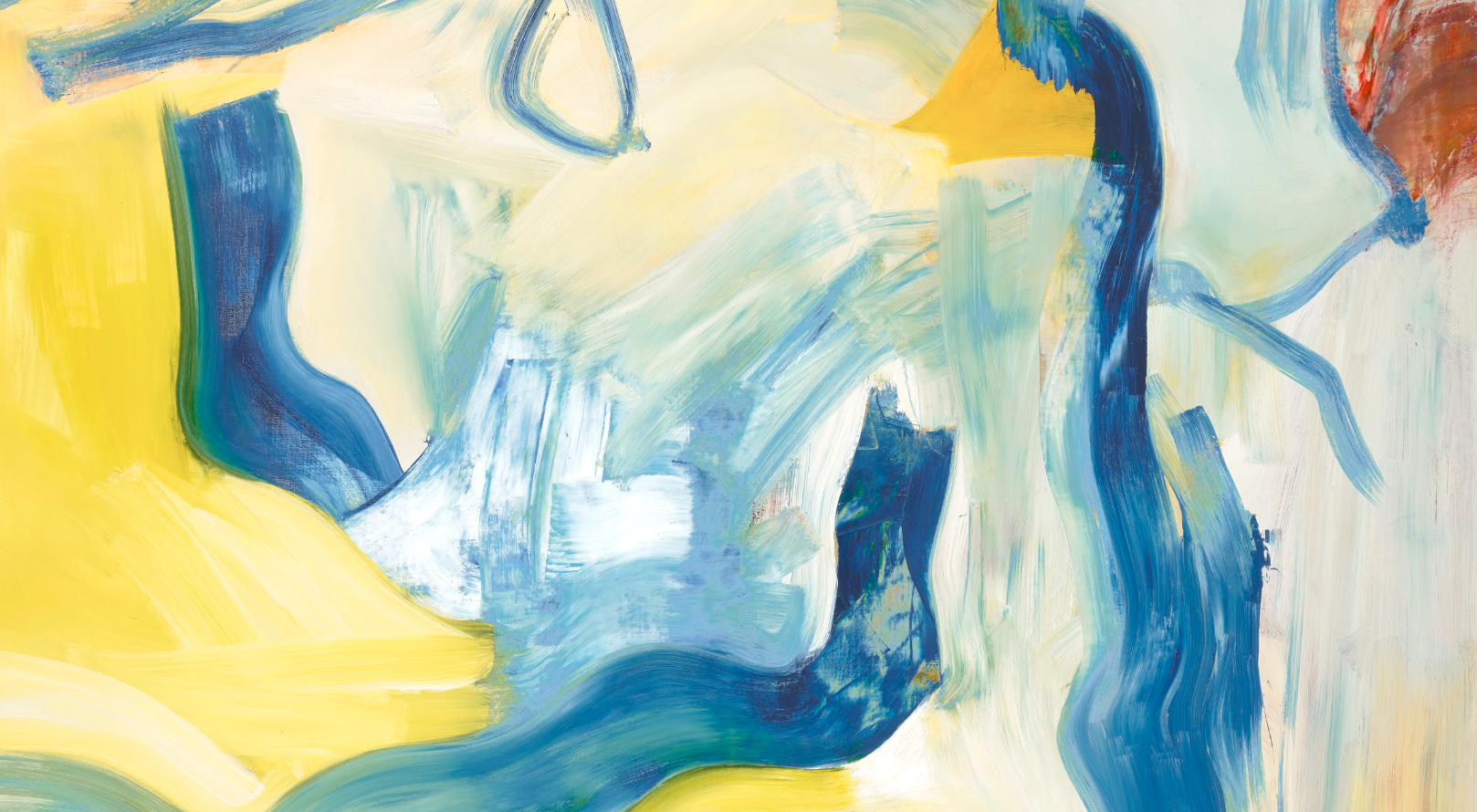
Untitled VII was painted in de Kooning’s East Hampton studio. This was a huge, light-filled space with twenty-five foot ceilings and a short bike ride to the nearby beach at Louse Point. At the end of the day, de Kooning would ride his bicycle over to the water and contemplate the light as it dappled over the slowly rolling waves of the Atlantic, perhaps thinking of his childhood home in Holland and how far he had come since then. These daily encounters undoubtedly influenced his late work, especially the palette, luminosity and flowing lyrical ribbons in Untitled VII. At this time, de Kooning found himself in a rather retrospective mood, looking back over his past successes and failures as he considered the kind of painter he might be in his great old age. So, too, did de Kooning begin to consider the work of his peers (many of whom ultimately did not make it to their seventies as he did). This included the artist’s old friend and colleague, Arshile Gorky, who he said was “always with him” during this time. It was the strength of Gorky’s calligraphic line and the mysterious power of his biomorphic forms that would call out to the artist in the thirty years since the artist’s death. In 1983 this reached a climax of sorts when de Kooning visited Gorky’s retrospective at the Whitney Museum of American Art in New York. Willem de Kooning’s Untitled VII is a sumptuous, glowing painting where undulating ribbons of luminous color meet wide, icy passages of bright white. It has been singled out as one of the best of the 1981 paintings, appearing in at least five international exhibitions, and illustrated in the New York Times in honor of de Kooning’s 90th birthday exhibition. A stunning testament to the artist’s astonishing capacity for reinvention, it epitomizes the profound transformations that de Kooning’s oeuvre underwent during the 1980s.
Hamptons Paintings
Untitled, 1972
Sotheby’s New-York: 15 November 2023
Estimated: USD 2,500,000 – 3,500,000
USD 5,505,000
Untitled | Contemporary Evening Auction | 2023 | Sotheby’s (sothebys.com)
WILLEM DE KOONING (1904 – 1997)
Untitled, 1972
Oil on paper mounted on canvas
60 1/8 x 41 inches (152.7 x 104.1 cm)
A sublime testament to Willem de Kooning’s inimitable painterly bravura, Untitled emerges as an early paragon from the artist’s legendary oeuvre of the 1970s, when de Kooning’s outpouring of creativity engendered an illustrious series of lush and color-drenched works that rank among the finest achievements of his celebrated career. Executed in 1972, eight years after the artist had moved to East Hampton, and shortly following the revelation of his celebrated Woman paintings of the 1950s and 60s, the layers of lush pigment which eddy and pool across the present work resolve to present the artist’s iconic figural forms, transformed and intensified within the effervescent landscape of the artist’s coastal environment. Sublimely enveloping the viewer in a riot of brilliant hue and undulating collisions of line and form, the present work announces the unequivocal painterly supremacy of de Kooning at the absolute apex of his aesthetic prowess and was notably exhibited at Sidney Janis Gallery the same year it was executed. For its dazzling fusion of a melodic lyricism with the heroic and muscular gesture of de Kooning’s expressionism, the incandescent Untitled is a sensory delight and distinguished for its impressive scale for the artist’s works on paper mounted on canvas. A triumph for the artist from this momentous period of his career, Untitled beautifully links his earlier, more figurative paintings of female form, with the gestural abstraction of the mid -1970s.
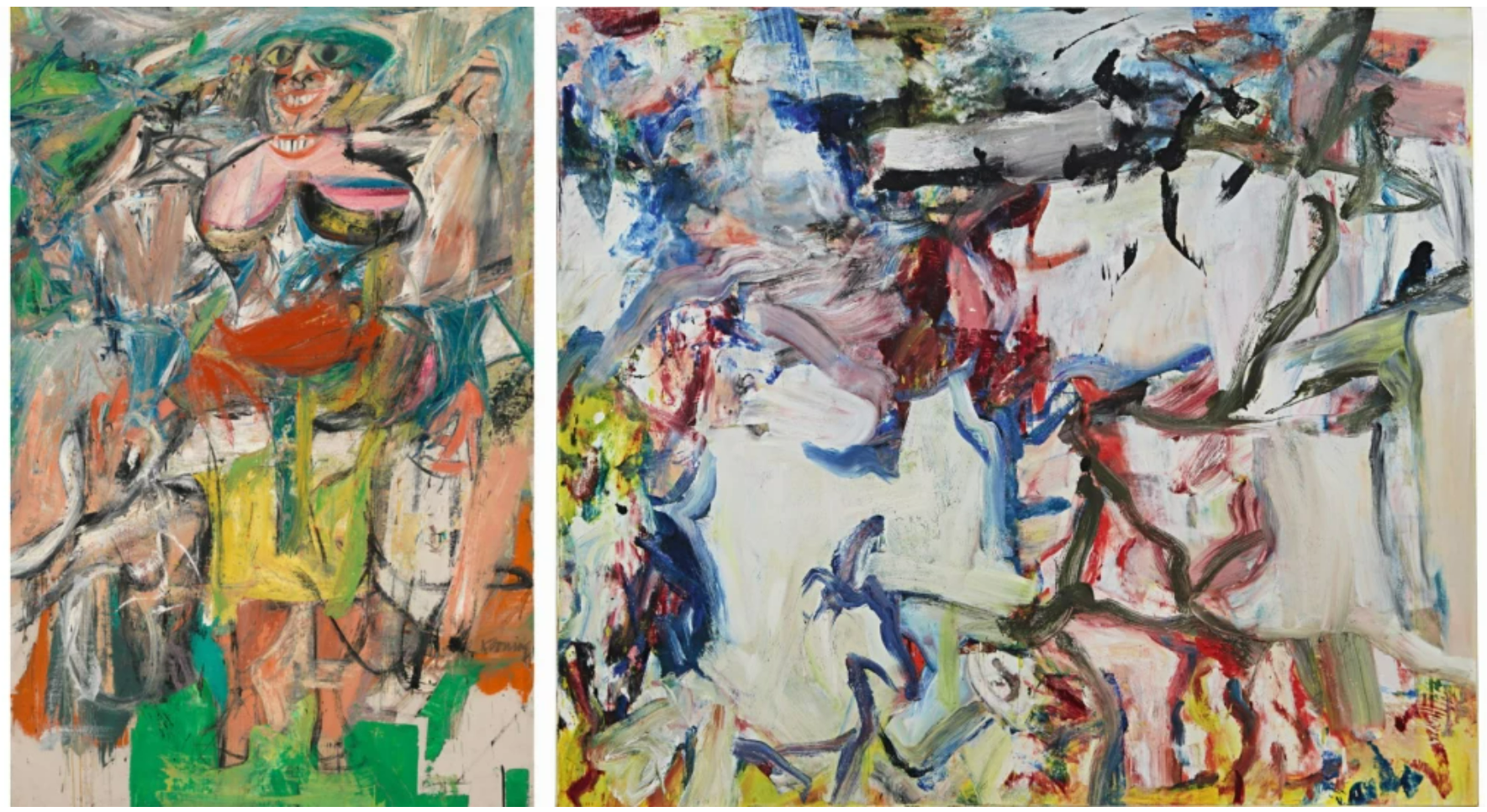
LEFT: WILLEM DE KOONING, WOMAN AND BICYCLE, 1952–53. IMAGE © WHITNEY MUSEUM OF AMERICAN ART / LICENSED BY SCALA / ART RESOURCE, NY. ART © 2023 THE WILLEM DE KOONING FOUNDATION / ARTISTS RIGHTS SOCIETY (ARS), NEW YORK. RIGHT: WILLEM DE KOONING, UNTITLED XXII, 1977. PRIVATE COLLECTION. SOLD AT SOTHEBY’S NEW YORK IN NOVEMBER 2019 FOR $30.1 MILLION. ART © 2023 THE WILLEM DE KOONING FOUNDATION / ARTISTS RIGHTS SOCIETY (ARS), NEW YORK
By the late 1960s, de Kooning had been painting for fifty years, and operated by the mantra that “you have to change to stay the same” (the artist quoted in: Karen Painter and Thomas Crow, Eds., Thoughts and Composers at Work, Los Angeles, 2006, p. 39). Although de Kooning’s celebrated Women of the 1950s were by no means resolutely figurative, this radiant work employs the vitality and gestural freedom of de Kooning’s abstract works from the late 1970s onwards but demonstratively draws upon elements of his celebrated 1950s figuration. Exemplified within the present work, de Kooning’s treatment of the paint, which veers from sinuous to strident, lyrical to brash, preempts the extraordinary balance of tranquility and chaos that defines those later paintings, in which riots of brilliant hues and undulating collisions of line and form combine to form perfectly balanced compositions. De Kooning famously claimed that “flesh was the reason oil paint was invented,” and that belief is visible in every exuberant brushstroke of Untitled (the artist quoted in: “The Renaissance and Order,” talk delivered at Studio 35, 8th Street, New York, Autumn 1949). Slim legs, pronounced breasts, and a shock of light yellow hair appear as the most legible demarcations of the figure who dominates the composition, a colorful and kaleidoscopic rendering of the female form which retains some of the visceral sexual energy of de Kooning’s earliest compositions. De Kooning revels in this salute to figurative painting, imbuing his most celebrated subject with all the ferocity and desire that characterize his Women from the previous decades, while moving towards the lyricism and tactility of his abstract masterworks from the late 1970s and 80s.
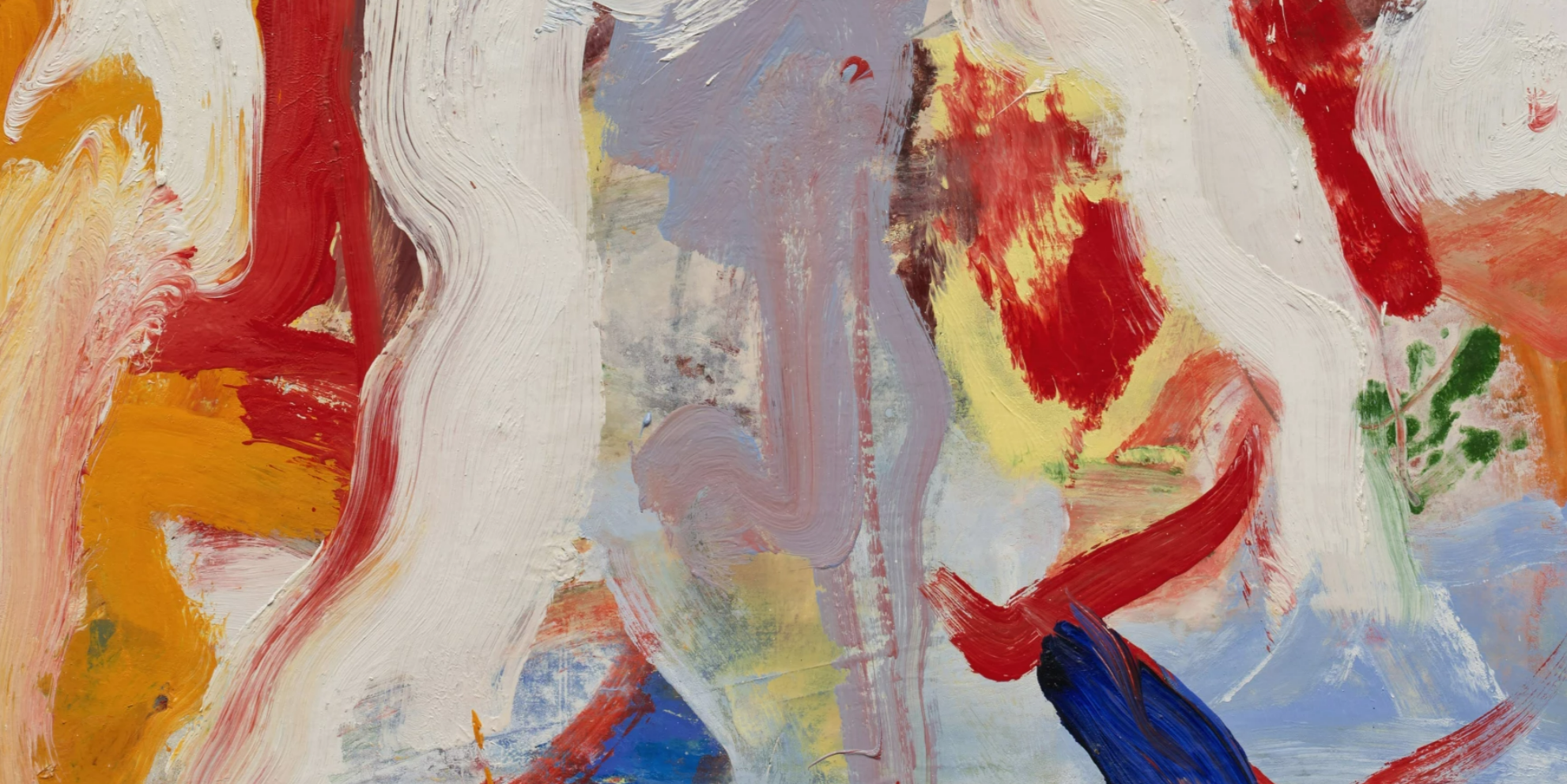
Rendered with the full force of de Kooning’s distinctive abstract vernacular, Untitled represents a pivotal moment of artistic and creative transformation within the artist’s storied career. While at once drawing upon elements of his famed figurative vernacular, de Kooning was certainly influenced by his new environment; compared to the city life, East Hampton provided lush greenery, bright blue skies, and calming waters as inspiration. Describing the profound inspiration and visceral pleasure he found in the luminous landscape of his East Hampton surroundings, de Kooning reflects: “I wanted to get in touch with nature. Not painting scenes from nature, but to get a feeling of that light that was very appealing to me, here particularly… I got into painting in the atmosphere I wanted to be in” (the artist quoted in Harold Rosenberg, “Interview with Willem de Kooning.” ARTnews 71, September 1972, p. 57). Bespeaking a deep engagement with the natural world, Untitled invokes the raucous, untamed beauty of bright daylight upon the Atlantic ocean; the jubilant white, pink, and scarlet passages swell into the warm golden forms like so many cresting waves as lush and verdant as wild beach flowers sprouting amongst pebbles on the beach.
East Hampton III, 1977
Christie’s New-York: 17 May 2023
Estimated: USD 6,000,000 – 8,000,000
USD 3,680,000
WILLEM DE KOONING (1904-1997) (christies.com)
WILLEM DE KOONING (1904-1997)
East Hampton III, 1977
Oil on canvas
30×36 inches (76.2 x 91.4 cm)
Alive with dazzling color, light and movement, East Hampton III is a majestic ode to the Long Island landscape that drove Willem de Kooning’s practice to extraordinary new heights during the late 1970s. Rendered with ribbons and swathes of thick, expressive impasto, its electrifying abstract surface captures the artist at the height of his powers. Fiery passages of yellow, red and orange collide with flesh-toned pinks and peaches; mottled shades of green, grey and blue dance like reflections upon water. Painted in 1977—a year described by the critic David Sylvester as de Kooning’s “annus mirabilis”—the work quivers with newfound freedom. Inspired afresh by the luminous coastal surroundings of his East Hampton home, de Kooning returned to painting with renewed fervor, channelling the influence of Soutine, Matisse and Cézanne into exhilarating abstract visions of nature. Contemporaneous with masterworks such as Untitled XIX (Museum of Modern Art, New York), The North Atlantic Light (Stedelijk Museum, Amsterdam) and Untitled V (Buffalo AKG Art Museum), East Hampton III glows with the light of rediscovered passion, capturing the euphoria of this miraculous period.
Untitled, 1977
Christie’s New-York: 12 May 2023
Estimated: USD 800,000 – 1,200,000
USD 1,008,000
WILLEM DE KOONING (1904-1997), Untitled | Christie’s (christies.com)
WILLEM DE KOONING (1904-1997)
Untitled, 1977
Oil and charcoal on paper laid down on canvas
41 1/4 x 30 1/4 inches (104.7 x 76.8 cm)
Signed ‘de Kooning’ (on the stretcher)
Created two years after his triumphant return to the medium of painting, Willem de Kooning’s 1977 painting Untitled, is exemplary of the confident stylistic shift in the direction of his work. Sweeping and gestural brushwork recalls the abstraction of his earlier paintings, while sumptuous pools of tea green and golden yellow evoke the organic forms and aesthetic of his new beloved landscape in East Hampton. De Kooning contains the essence of summer in the ruddy pink glow of an everlong sunset that shimmies in the upper register of the canvas as ribbons of white and peach wave across crests of rippled water. An abstract wading figure emerges from the composition golden as an afternoon, with bowed legs and outstretched arms that become distorted higher on the body, such that the head is undecipherable as a head, only a suggestion of where the neck ends. One can almost feel the heat against the figure’s back, as strokes of red gently contour the curve of a water-warped spine. Fits of blue and green merge at the figure’s body, further complicating the lack of any sense of depth. The tone and quality of the lines ambulate between sensually curved, erratically zagged, and calmly pooling. Neither background nor foreground are given precedence or clarity over the other. The painting reflects an abstract tendency teetering on the edge of representation.
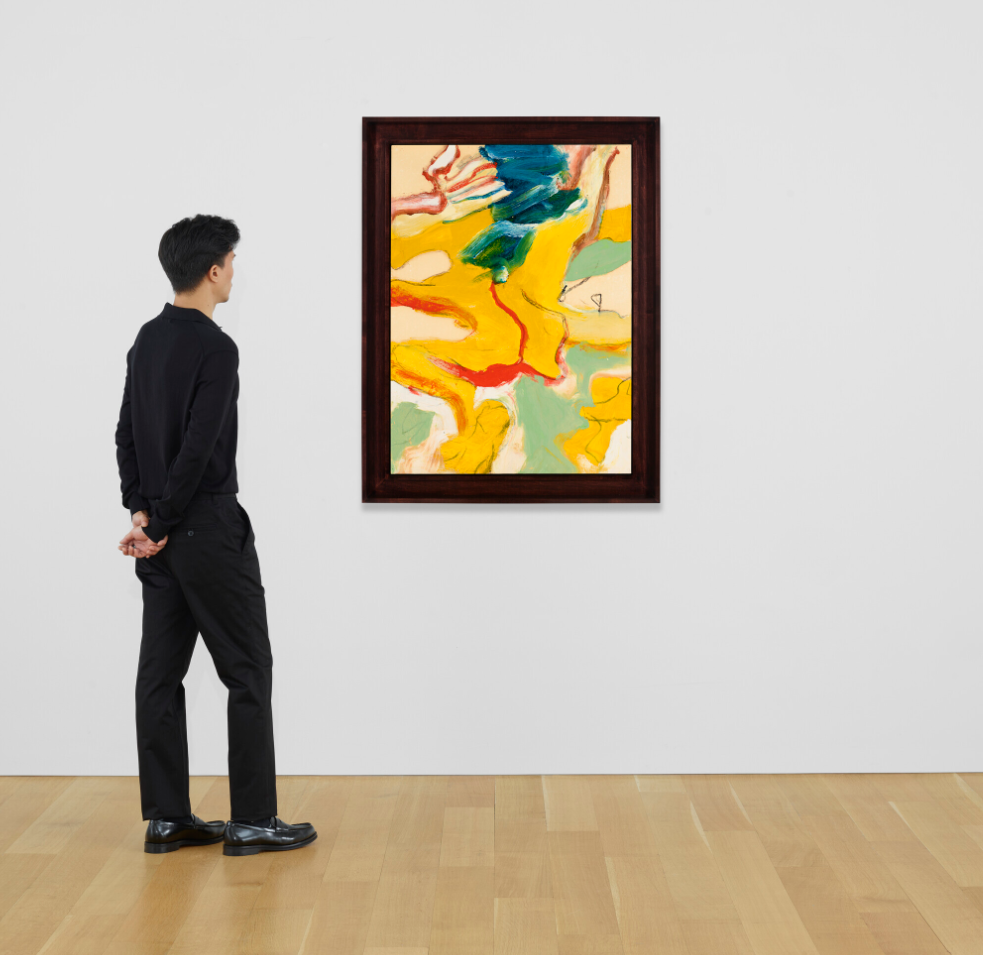
The works of 1977 are remarkable for their ecstatic palettes and vibrant energy. Catalyzed by his East Hampton environment, de Kooning’s interests during this time began to revolve around the relationship between the elements of light, water, reflection, and movement. Though the artist moved into his East Hampton abode in 1963, it wasn’t until the mid-70s that he became consumed by its natural world, the specific slants of light, the topographic swells of earth. De Kooning created rapturously through this period. Fearless and with a unique freedom, he produced a volume of work as open and free flowing as his environment. It is unsurprising that the forces of water and light were so pivotal in his frenzy. Both are elements of change, adaptable to circumstance and malleable, even ephemeral, in form, lending themselves well to a mind tuned towards abstraction. Like the impressionists before him, de Kooning worked only during the day, taking advantage of the abundant natural light. For Untitled, the light is blazing and all-consuming in its jubilation, like the imprint of the sun pressed behind the eyes, even as one turns away from it. But this impassioned, feverish effect was created while maintaining absolute control over the compositional whole. Dancing reflections are articulated through masterful line, and though the composition resists clearly defining space, the canvas soaks up so much of the artist’s energy and intention that delineating traditional space is irrelevant to the painting’s legibility. It is visceral in that way, a pure distillation of the human experience of nature. One doesn’t have to travel to East Hampton, or even be familiar with its landscape, to feel certain of its character. In this work, de Kooning has given shape to its soul.
Montauk II, 1969
Sotheby’s New-York: 16 November 2022
Estimated: USD 10,000,000 – 15,000,000
USD 12,663,500
Montauk II | Contemporary Evening Auction | 2022 | Sotheby’s (sothebys.com)
WILLEM DE KOONING (1904-1997)
Montauk II, 1969
Oil on paper mounted on canvas
72 ½ x 70 ¼ inches (184.2 x 178.4 cm)
Enveloping the viewer in churning layers of vivid hues, Montauk II beams with the sun-drenched brilliance of Willem de Kooning’s beloved East Hampton. In 1962, de Kooning began building his home and studio there, permanently moving to the area in 1963, not far from Montauk. Montauk II epitomizes the spirit of the artist’s coastal refuge, where the transition from the densely populous city streets to the tranquility of nature and its nostalgic similarities with the Netherlandish landscape of his youth inspired a refreshed course of experimentation in the artist’s practices. Following his move, de Kooning’s palette shifted to reflect the nature of his surroundings. This transition is exemplified in the palette of Montauk II, in which de Kooning captures the subtle hues of an end-of-day summer light reflecting across the local beaches; the canvas resounds with the artist’s virtuosic capacity for rendering sensory delight and atmospheric potency in oil paint. Of the five known paintings titled Montauk I-IV that de Kooning executed in 1969, two are held in important international collections. Montauk I is in the collection of the Wadsworth Atheneum in Hartford, Connecticut, and Montauk IV is held in the collection of the Stedelijk Museum in Amsterdam. Montauk II is distinguished by its exceptional coloration, composition and painterly dynamism, resulting in a remarkable exhibition and publication history.
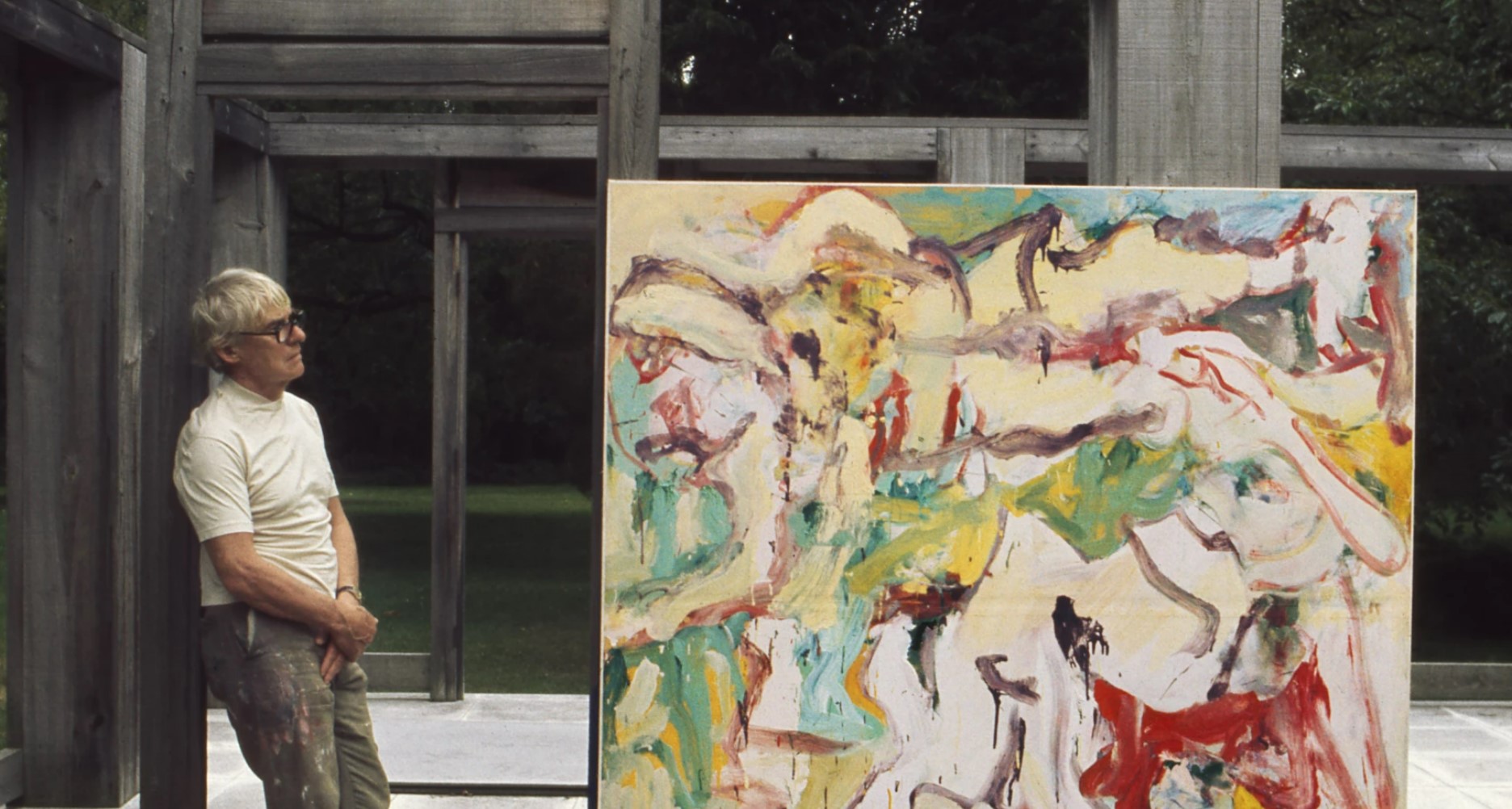
Arriving at a pivotal moment of deep contemplation in the artist’s career, Montauk II richly captures the atmospheric lushness and tranquility of its eponymous coastal environs. As the title emphasizes, Montauk II exemplifies de Kooning’s focus upon and interest in this specific place of sea and land; here, the artist is already addressing what will become his preoccupations in the 1970s, where the landscape becomes the main inspiration for his abstraction, in combination with the figuration that he explored so viscerally during the mid-1960s. Within the present work, one feels the history of the decade and a window into de Kooning’s main achievements in his important 1970s renaissance. The summer of 1952 marks the time when de Kooning began to ensconce himself in the rural serenity of Eastern Long Island. By the early 1960s, the east end revealed itself as a new aesthetic inspiration for de Kooning. De Kooning self-designed his studio to be surrounded by nature and saturated with a balanced light, a vast difference from the dissonant setting of Manhattan urban life.
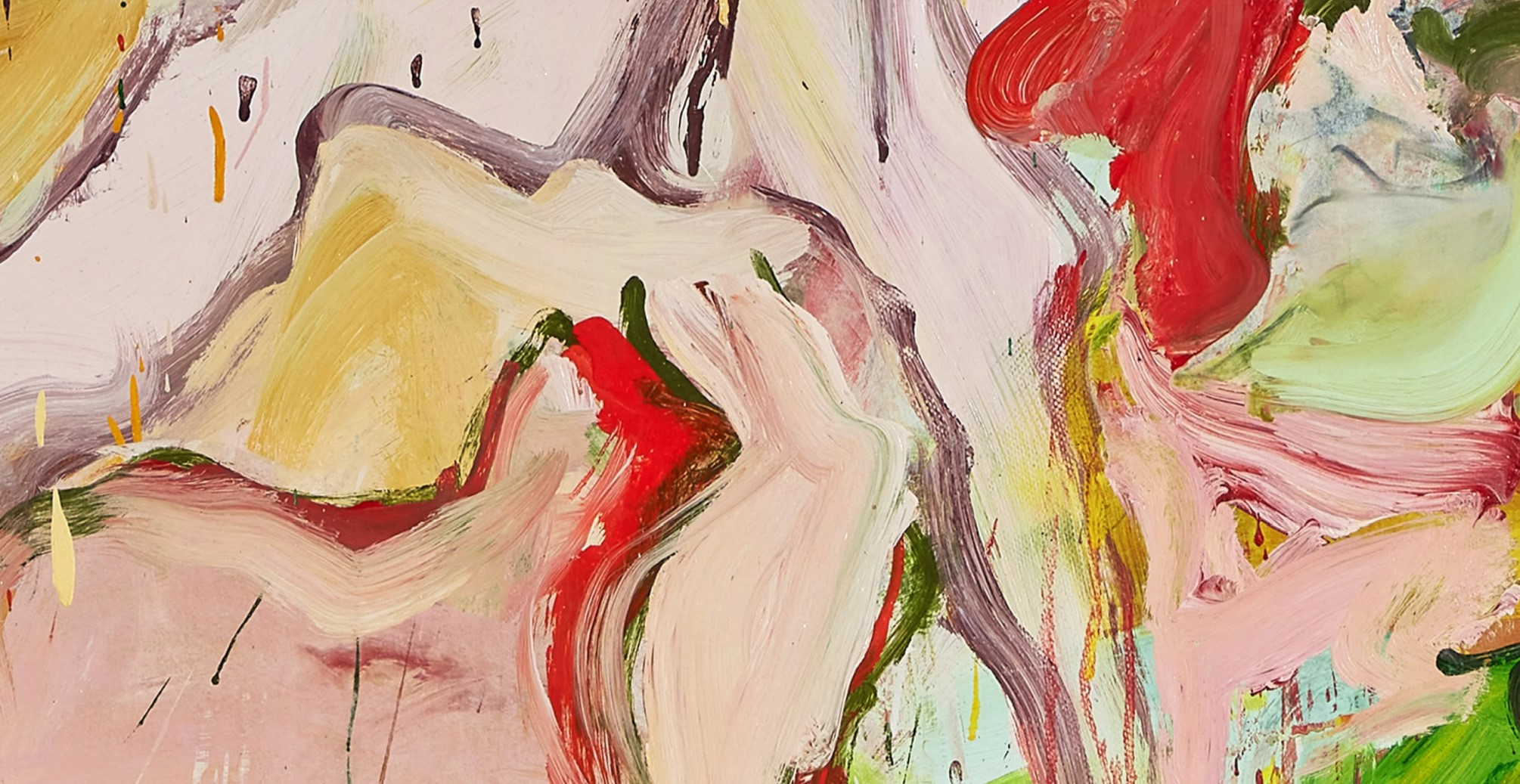
With a striking chromatic dynamism and exceptional handling of paint, Montauk II emanates the interior luminescence and vitality of the sea, sand, sun and surf. The textured and dynamic surface of the canvas evidences de Kooning’s new sense of kinetic freedom activated by the liquid properties of oil paint thinned with newly formulated media. Each gesture and vibrant hue exemplifies de Kooning’s unrivaled mastery of abstraction. Glistening ribbons of ardent red strikingly contrast with the greenery of swaying sea grass to invoke the raucous, untamed beauty of Edenic flora. Undulations of sea green swell into luscious swathes of teal, a rush of waves cresting and crashing with unrestrained force against the shore. Jubilant yellow passages that proclaim the radiant heat of the summer are counterbalanced by cooling, delicate swirls of sky blue and cloudy white. Such polychromatic intensity and fluid grace attest to de Kooning’s prowess as a colorist, demonstrating his profound admiration for the Post-Impressionist master Henri Matisse and his visionary investigations of sublime light and color. Bold passages of paint appear simultaneously fluid and suspended in motion across the landscape, a continuation of de Kooning’s career-long dialogue between improvisation and control.
Untitled, circa 1979
Sotheby’s New-York: 16 November 2022
Estimated: USD 30,000,000 – 40,000,000
USD 34,794,500
Untitled | Contemporary Evening Auction | 2022 | Sotheby’s (sothebys.com)
WILLEM DE KOONING (1904-1997)
Untitled, circa 1979
Oil on canvas
70 x 79 ½ inches (177.8 x 201.9 cm)
Through the lush impasto and exceptional handling of paint, de Kooning creates a surface which appears freshly created. To achieve this effect, de Kooning masterfully employed many tools and techniques, including brushes and scrapers, producing the densely rich and textured surface of Untitled. The lustrous, aqueous texture of Untitled is complemented and emphasized by its oceanic palette, as de Kooning fuses color and gesture. Focusing his energy on the quality of paint application and the composition of his surface, de Kooning thinned his oil paint with combinations of water, kerosene, benzene or safflower oil to add fluidity to the paint, facilitating a more rapid stroke. Using unorthodox methods of applying and removing paint with spatulas and knives, particularly the taper’s knife, de Kooning defined his composition through motion, energy and action, allowing a variety of planes of pigment to coalesce in and out of each other across the canvas.
Untitled XXI, 1977
Christie’s New-York: 12 May 2022
Estimate on Request
USD 25,007,500
WILLEM DE KOONING (1904-1997) (christies.com)
WILLEM DE KOONING (1904-1997)
Untitled XXI, 1977
Oil on canvas
70×80 inches (177.8 x 203.2 cm)
Signed ‘de Kooning’ (on the reverse)
Held in the same private collection for nearly thirty-five years, Willem de Kooning’s Untitled XXI is a joyous and masterful painting from one of the artist’s most beloved periods. Executed in 1977, a year described by the art critic David Sylvester as de Kooning’s annus mirabilis (his “miraculous year”), the present work is a sumptuous Abstract Expressionist painting that abounds with references to both the female figure and the light-filled landscape surrounding the artist’s studio in East Hampton. De Kooning’s 1977 works are widely celebrated as among the most important of his career, and are owned by major institutions and leading private collectors. Untitled XXI, compared to his other paintings from this period, is exceptionally radiant and offers a retrospective of sorts, combining in one sublime work de Kooning’s longtime obsession with abstraction, landscape and the figure, all of it rendered in powerful brushstrokes and his signature palette of pinks and cobalt blues. Untitled XXI – or Number 21, as it is sometimes called – is a large-scale work measuring 70 by 80 inches. It is one of the most ebullient and fascinating of the 1977 works. Here we find an ecstatic combination of de Kooning’s passion for the inspired light of East Hampton, for silken flesh and peachy hues. Much as Vermeer is known for his deep blues and Jasper Johns is known for his moody grays, de Kooning is celebrated for his salmon-like pinks and the sensual world they evoke. From the time of his seminal Pink Landscape (1942) and famous Pink Angels (1945), he seized on the color pink as a metaphor for both flesh and sky, and the two are breathtakingly intertwined in Untitled XXI.
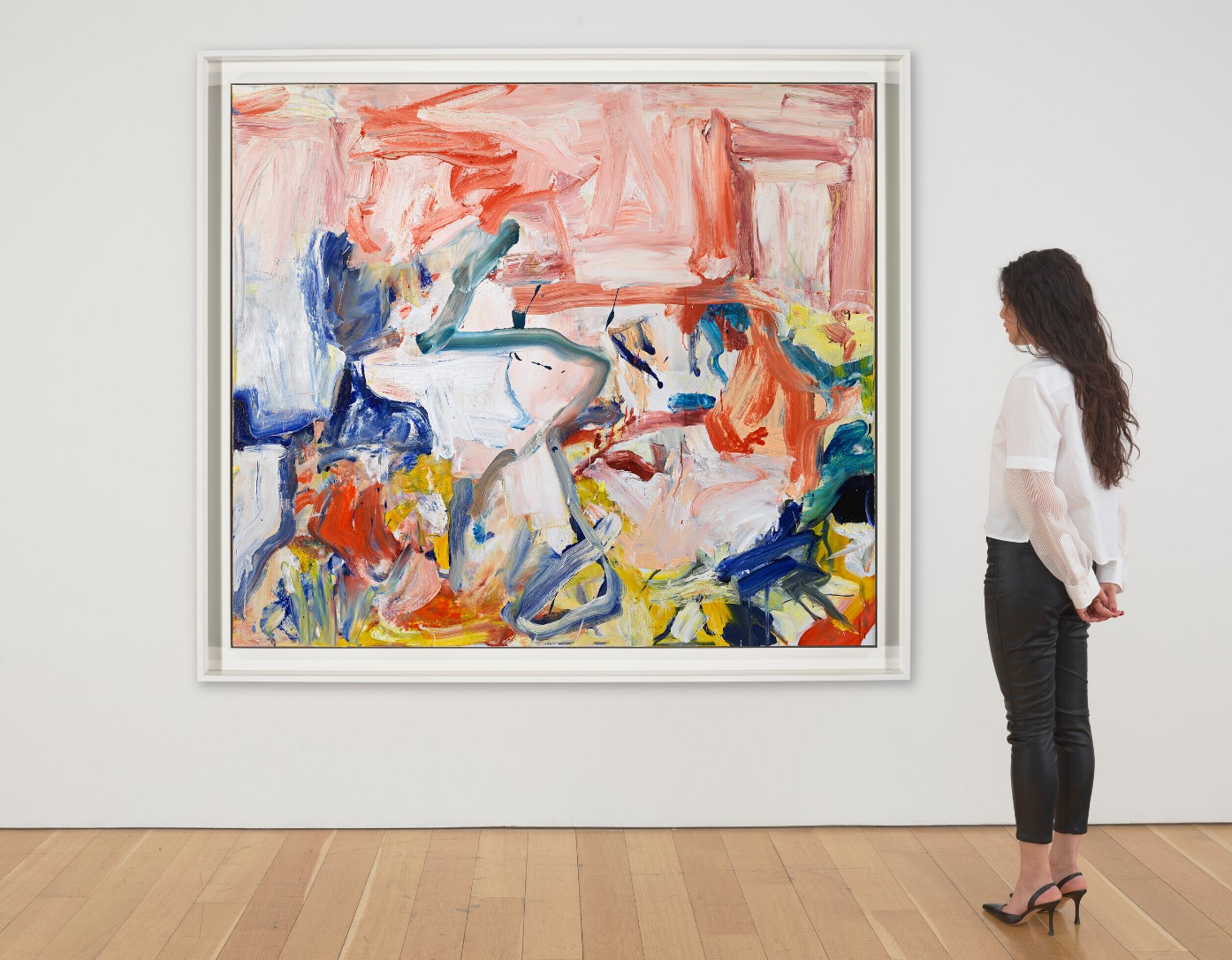
At first glance, the painting looks like a pure abstraction, with twisting ribbons of cobalt blue and red weaving against a pearly white ground. But if one looks closely, traces of the real world rise into view. It is possible to read the painting as a landscape, an airy and open pastoral dominated by the infinite expanse of a pink-streaked sky. It’s not a literal landscape – not the view outside a window – but rather the memory of a landscape recollected inside the calm of an artist’s studio. The top half of the painting suggests the symbolic light of daybreak, “the rosy-fingered dawn” described by Homer in The Odyssey—signaling new beginnings in a long, ongoing journey. That top portion of the painting is executed with broad, sweeping gestures that hint at de Kooning’s radical predilection for laying down strokes with movements of his whole arm rather than just his wrist. He loved using a housepainter’s wide brushes in addition to fussy little fine-art brushes, allowing him to give free reign to his instinct for large and passionate gestures. The lower half of the painting, by contrast, is densely packed with shorter strokes and biomorphic shapes that were rendered “with the wrist.” They give the sensation that one is watching as the world is both pulled apart and quickly reassembled—a world made entirely of paint.
Untitled XXXIII, 1977
Sotheby’s New-York: 15 November 2021
Estimated: USD 12,000,000 – 18,000,000
USD 24,393,000
Untitled XXXIII | The Macklowe Collection | 2021 | Sotheby’s (sothebys.com)
WILLEM DE KOONING (1904 – 1997)
Untitled XXXIII, 1977
Oil on canvas
60×54 inches (152.4 x 137.2 cm)
Exceeding the confines of the canvas through its spectacular assault of unrestrained expression and brilliant color, Untitled XXXIII from 1977 encapsulates the full force of Willem de Kooning’s singular abstract vernacular. Executed at a critical moment in his career, when the artist had abandoned Manhattan for the natural landscape of Springs, Long Island, de Kooning here reaches his formal climax in the present work’s rich color palette and staggering variation of expressionist brushwork. Demonstrative of the artist’s renewed focus on painting during these pivotal years, Untitled XXXIII belongs to an explosive outpouring of creativity that produced an illustrious body of color-drenched canvases that rank among the most iconic achievements of de Kooning’s decades-long career. Famous for his relentless working and reworking of his canvases in the 1950s, de Kooning demonstrates a confidence and urgency within the composition of Untitled XXXIII that is as affecting today as it was when it was painted. Similarly scaled abstract masterpieces from this pivotal three-year period belong to the most esteemed private collectors and significant museums worldwide, including the Stedelijk Museum in Amsterdam, the Museum of Modern Art in New York, and the Menil Collection in Houston, amongst prestigious others. For its sheer force of painterly conviction, tactile physicality, incandescent lyricism, and jewel-like coloration, Untitled XXXIII ranks among the most irresistible paintings of de Kooning’s output.
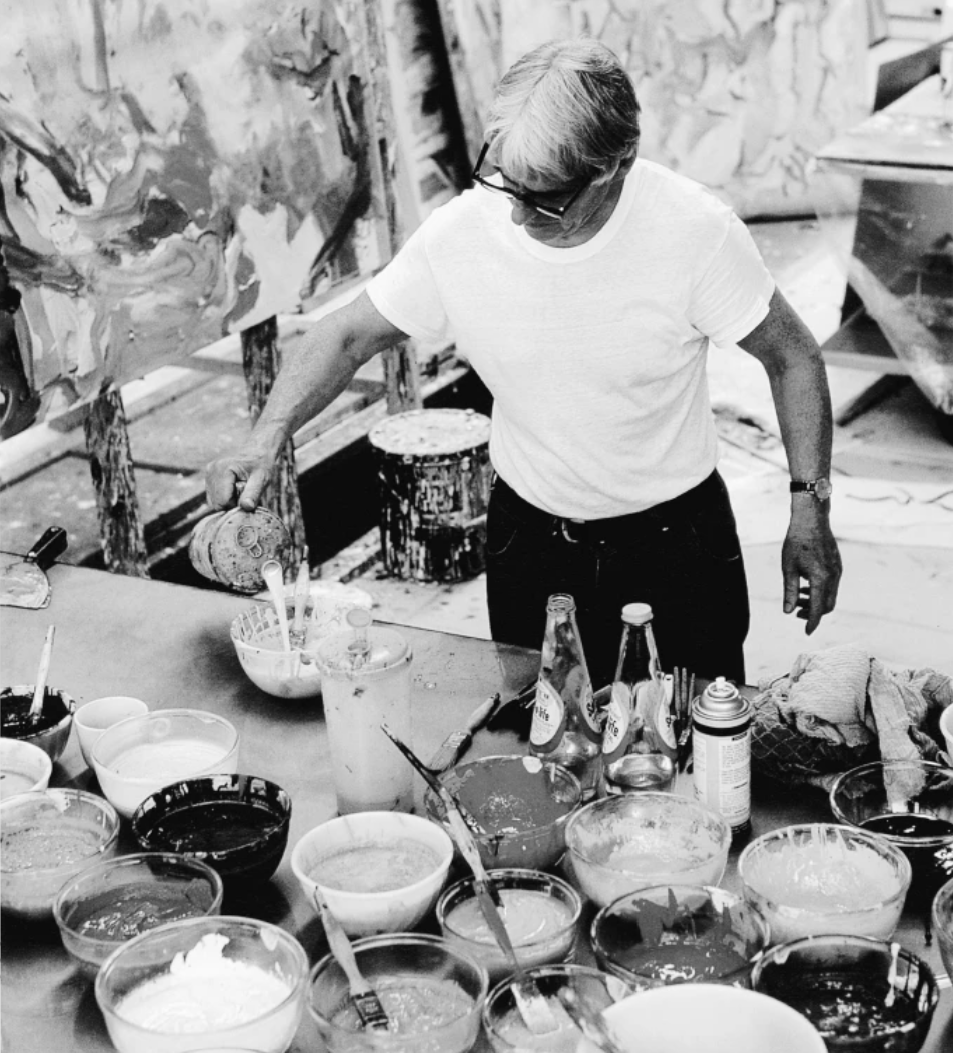
THE ARTIST IN HIS SPRINGS, LONG ISLAND STUDIO, 1971. PHOTO: © 2021 DAN BUDNIK. ARTWORK © 2021 THE WILLEM DE KOONING FOUNDATION / ARTISTS RIGHTS SOCIETY (ARS), NEW YORK
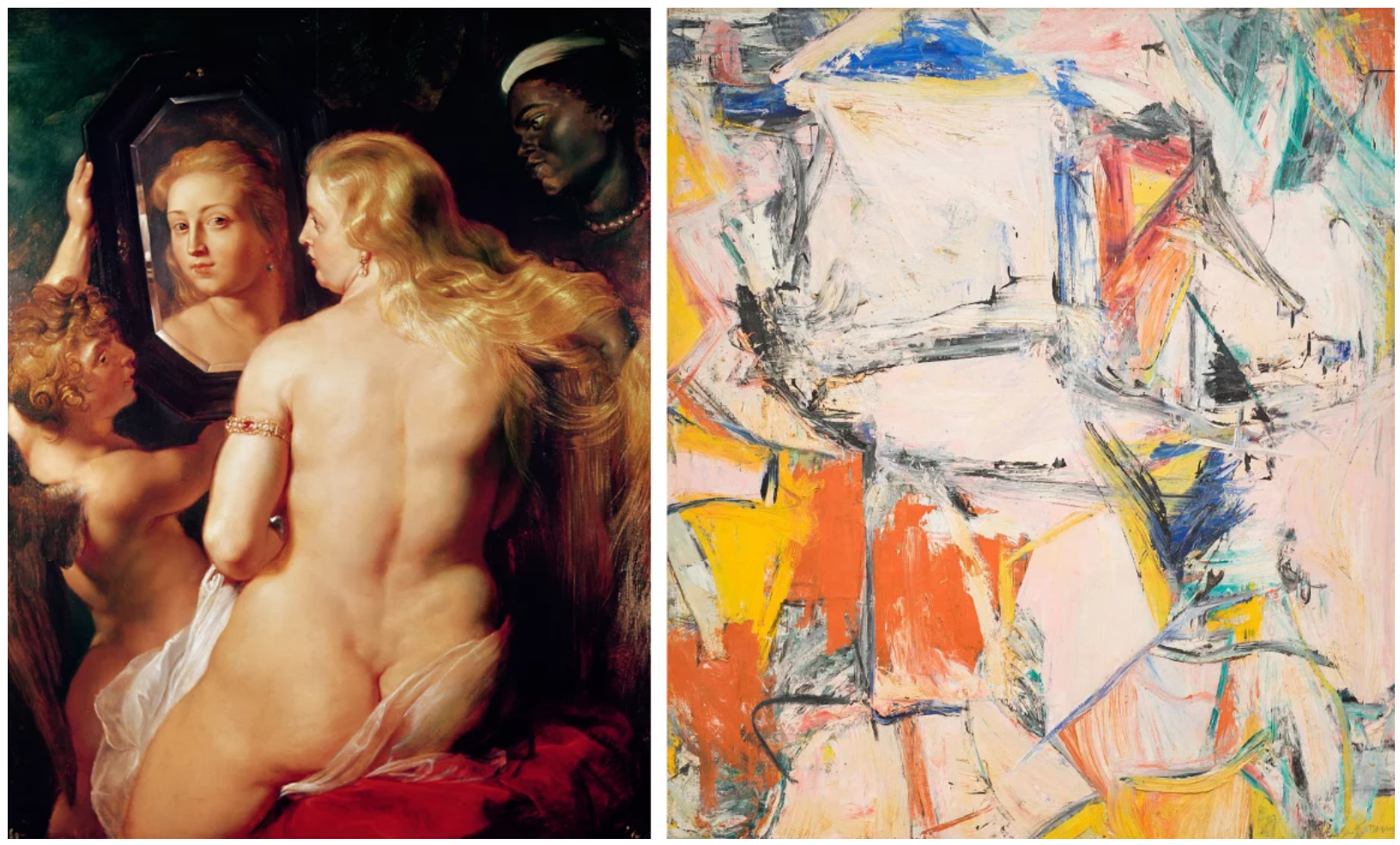
RIGHT: WILLEM DE KOONING, INTERCHANGE, 1955, PRIVATE COLLECTION. ART © 2021 THE WILLEM DE KOONING FOUNDATION / ARTISTS RIGHTS SOCIETY (ARS), NEW YORK DIGITAL IMAGE
Large swaths of gleaming white pigment dominate the left side of Untitled XXXIII, creating a voluminous structure around which de Kooning’s fury of crimson pigment dips, weaves, and darts across the canvas. Whiplashes of olive green and royal blue crash together in crags and blurs of vigorous spontaneity, while subtle splashes of canary yellow call to mind a sun-drenched Edenic beach, against which darker thrusts collide with swaggering force. Wider pulls of paint and thick impasto create a maelstrom of distinct brushstrokes alongside swiped passages of diaphanous color. This juxtaposition of clear details against hazier patches forces the viewer to reconsider how one ‘reads’ an abstract painting, demanding a continuous optical readjustment and refocus to integrate the sharp edges of flecked paint against sublime opacity. Harry F. Gaugh writes, “In a sense, the world outside the paintings with its bounty of forms is irrelevant—not expendable, to be sure, but a realm of natural phenomena apart from yet corresponding to the paintings themselves. De Kooning’s late [1970s] works, like those from earlier periods, are not abstractions from nature, nor variations on it. At best they are responses to it, not consciously dictated but intuitively articulated. And more than before, the late paintings are a return to nature, not only in theme but through the searching act of painting, whereby de Kooning repeatedly questions his own relationship to nature as well as testing again and again his inventive powers.” (Harry F. Gaugh, Willem de Kooning, New York 1983, p. 104) Bespeaking a deep engagement with the natural world, Untitled XXXIII invokes the raucous, untamed beauty of blinding sunlight dancing upon the Atlantic Ocean, the jubilant yellow churns swelling into the aquatic forms like so many cresting waves.
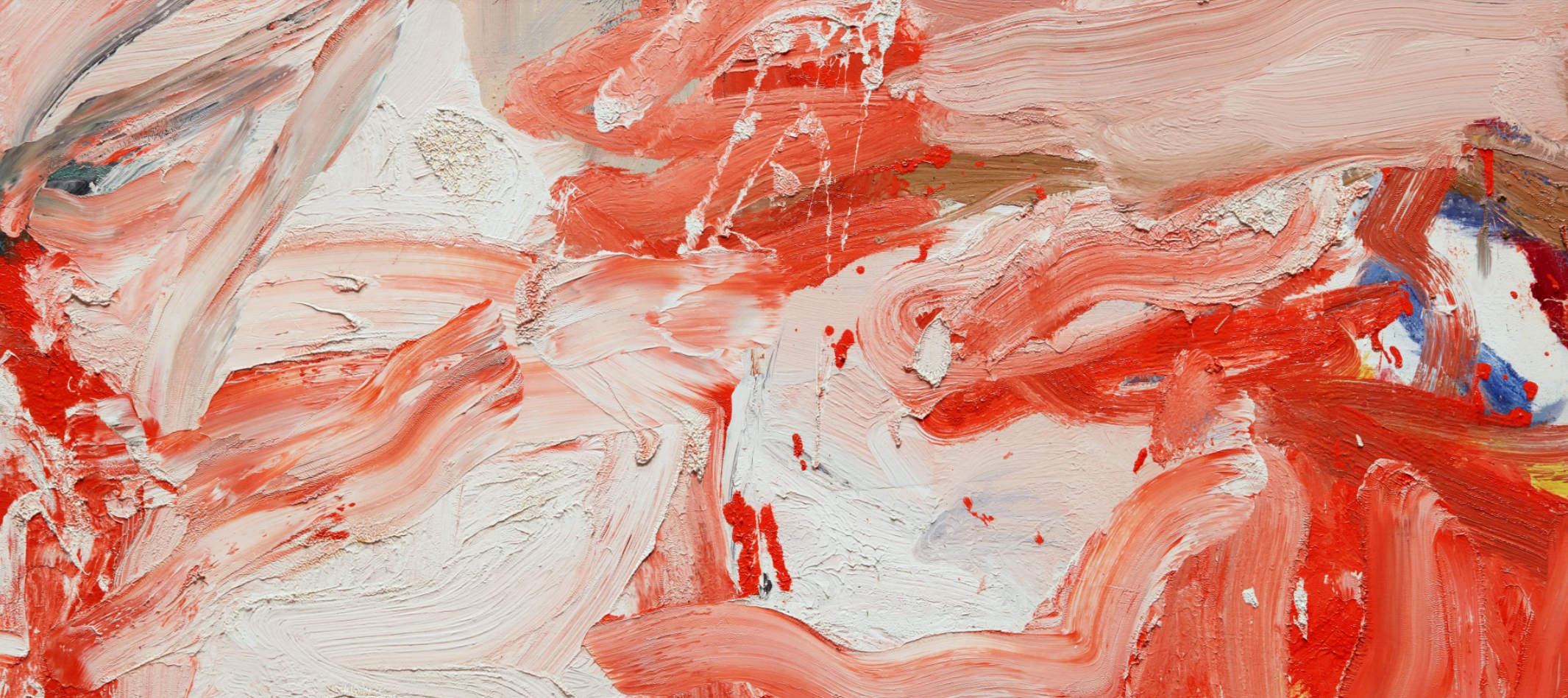
Bespeaking a deep engagement with the natural world, Untitled XXXIII invokes the raucous, untamed beauty of blinding sunlight dancing upon the Atlantic Ocean, the jubilant yellow churns swelling into the aquatic forms like so many cresting waves. In every decade of his long and illustrious career, de Kooning kept a firm grip on his medium as muse, and the unbridled majesty and glory of paint exhibited in Untitled XXXIII are no exception. De Kooning’s revitalization in painting in the late 1970s also announced a departure from his iconic Woman paintings; briefly abandoning the figure, de Kooning instead turned to nature and focused on his Long Island environs. De Kooning’s sense of line is of course critical to his entire aesthetic identity, and even during the period when he focused primarily on sculptures, from 1969 to 1975, he continued to draw prolifically. But with his renewed focus on the plastic form of paint, de Kooning’s line is subsumed, as his strokes broaden and flatten. In place of line, both color and light serve as the organizing principles of his abstraction, reflecting the artist’s bright and open environment. Rendered with the full force of de Kooning’s inimitable painterly lexicon and sure compositional command, Untitled XXXIII represents nothing less than the inescapable and incontrovertible apex of the artist’s mature output.
East Hampton VI, 1977
Christie’s New-York: 13 May 2021
Estimated: USD 4,000,000 – 6,000,000
USD 10,436,000
Willem de Kooning (1904-1997), East Hampton VI | Christie’s (christies.com)
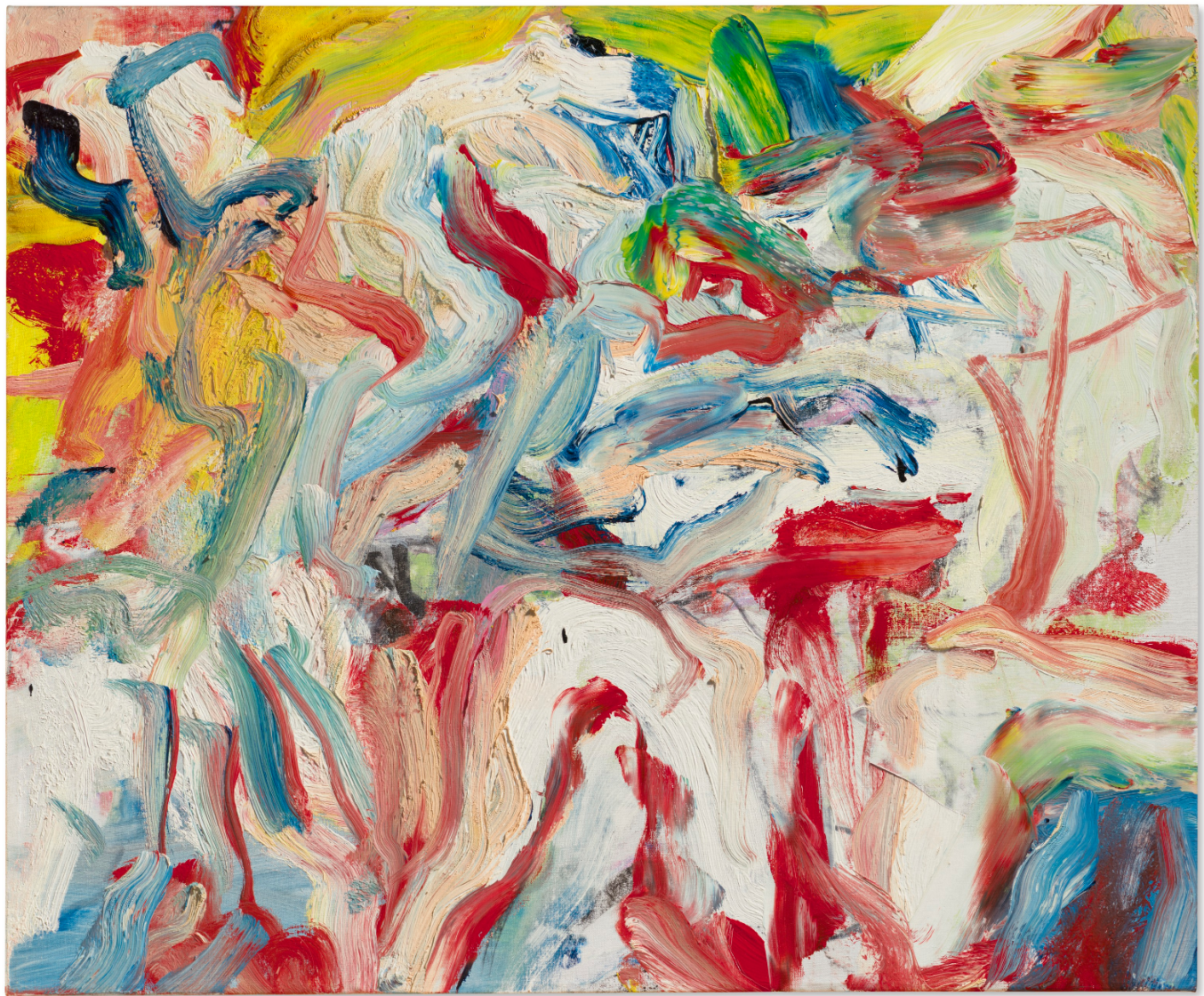
Willem de Kooning (1904-1997)
East Hampton VI, 1977
Oil on canvas
30 1/8 x 36 inches (76.5 x 91.4 cm)
Signed and dated ‘de Kooning 1977’ (on the reverse)
Acquired by the present owner in 1979, Willem de Kooning’s East Hampton VI is the product of a particularly creative period of the artist’s career when he was struggling with the traditions of Abstract Expressionist roots and searching for a new direction for his painting. Inspiration came in the form of East Hampton, the small town at the far end of New York’s Long Island, and long a place of inspiration for generations of artists. Far from the hustle and bustle of the city, and in the bucolic surroundings of the countryside, de Kooning found new inspiration in the dramatic light offered by his new surroundings.
“Indescribable tones… I started working with them and insisted that they would give me the kind of light I wanted. One was lighting up the grass. That became that kind of green. One was lighting up the water. That became that grey. Then I got a few more colors… I got into painting in the atmosphere I wanted to be in. It was like the reflection of light.”
The resulting paintings combined the abstract figuration of his earlier work, but now subsumed within his beloved landscape. Widely exhibited in Europe, East Hampton VI is emblematic of this new body of work, a continuation of his figurative past, but showing signs of the last great phase of his career that was still to come. With a series of baroque flourishes from the artist’s heavily laden brush, de Kooning brings together a union of figurative and abstract elements. Against a golden ground, high-keyed ribbons of paint traces out the elemental forms of a figure; a pair of what appears to be pale legs silhouetted in red, can be seen in the lower right corner, complemented by another, torqued, figure hovering above. Elsewhere, brilliant flourishes of electric blue, verdant green and warm pinks emerge from the maelstrom of the artist’s painted surface. Glimpses of figurative elements emerge, before being subsumed in a sea of abstraction. This blending together of traditionally oppositional elements is what makes de Kooning’s paintings from this period so exciting.
Although de Kooning was already a celebrated colorist by this point in his career, his paintings of the 1970s saw a new degree of chromatic richness to his canvases . The special quality of the light in East Hampton—that sense of clarity that coastal light can imbue—made the painted surfaces more vibrant, more alive. Much like the late paintings of Claude Monet celebrated the intensity of light with increasingly abstract images, de Kooning found the intensity and purity of light in his new surroundings helped to break down forms to their elemental units. De Kooning’s paintings inspired by East Hampton became such an important body of work within his oeuvre that in 1978, the Solomon R. Guggenheim Museum in New York dedicated an entire exhibition to them, the artist’s first big museum show in New York in nine years. East Hampton VI was painted in 1977, shortly after de Kooning returned to concentrating on painting following a period of working in lithography and sculpture. It is with works such as this that he appears to have rediscovered his joy in the act of painting, in the motion of laying down ribbons and passages of rich color in celebration of the light and forms he found in his surroundings. This reinvigoration would lead to the triumphal final body of work that would sustain him for the rest of his life.
Early Paintings
Still Life, circa 1929
Phillips New-York: 15 May 2024
Estimated: USD 150,000 – 250,000
USD 330,200
Willem de Kooning – Modern & Contempora… Lot 110 May 2024 | Phillips
WILLEM DE KOONING
Still Life, circa 1929
Oil on canvas
36×26 inches (91.4 x 66 cm)
Signed and dated “de Kooning ’29” lower right
Created when the artist was just 25 years old, Willem de Kooning’s Still Life, circa 1929, presents a rare, figurative precursor to the heavily abstracted forms for which he is known. Included in the artist’s 2012 retrospective at The Museum of Modern Art, New York, the present work is an exceptional early example within the groundbreaking oeuvre of one of the most influential artists of the 20th century. A standout in Inger and Osborn Elliott’s collection, the present work is entirely fresh to market, having been in the same family collection for decades.
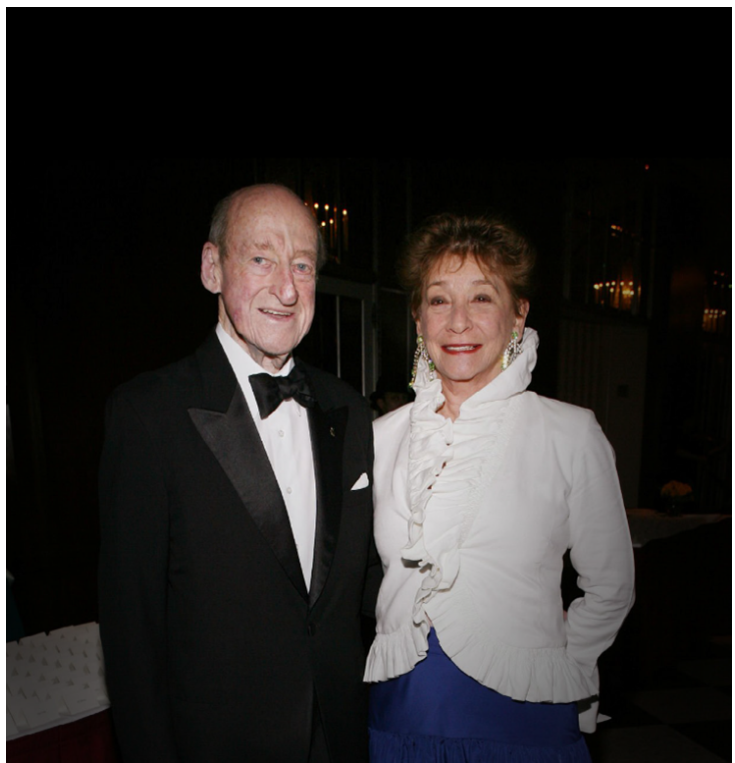
Inger and Osborn Elliott
Moving to New York from Rotterdam in 1927, de Kooning started working as a carpenter and house painter. In 1929, the year of the present work, de Kooning met artists John Graham, Stuart Davis and Arshile Gorky, who would become great influences on the young painter. Through Gorky, de Kooning’s artistic career would flourish. Gorky introduced him to artists such as Paul Cézanne and Pablo Picasso, as well as the Surrealists. The present work recalls the principles of such avant-garde painters. And yet, de Kooning’s still life scene eschews the academic tradition with vibrant hues of ruby red, deep violets, blues, and greens, emphasizing geometric patterns in the floorboards and simplified forms in the plant’s leaves.
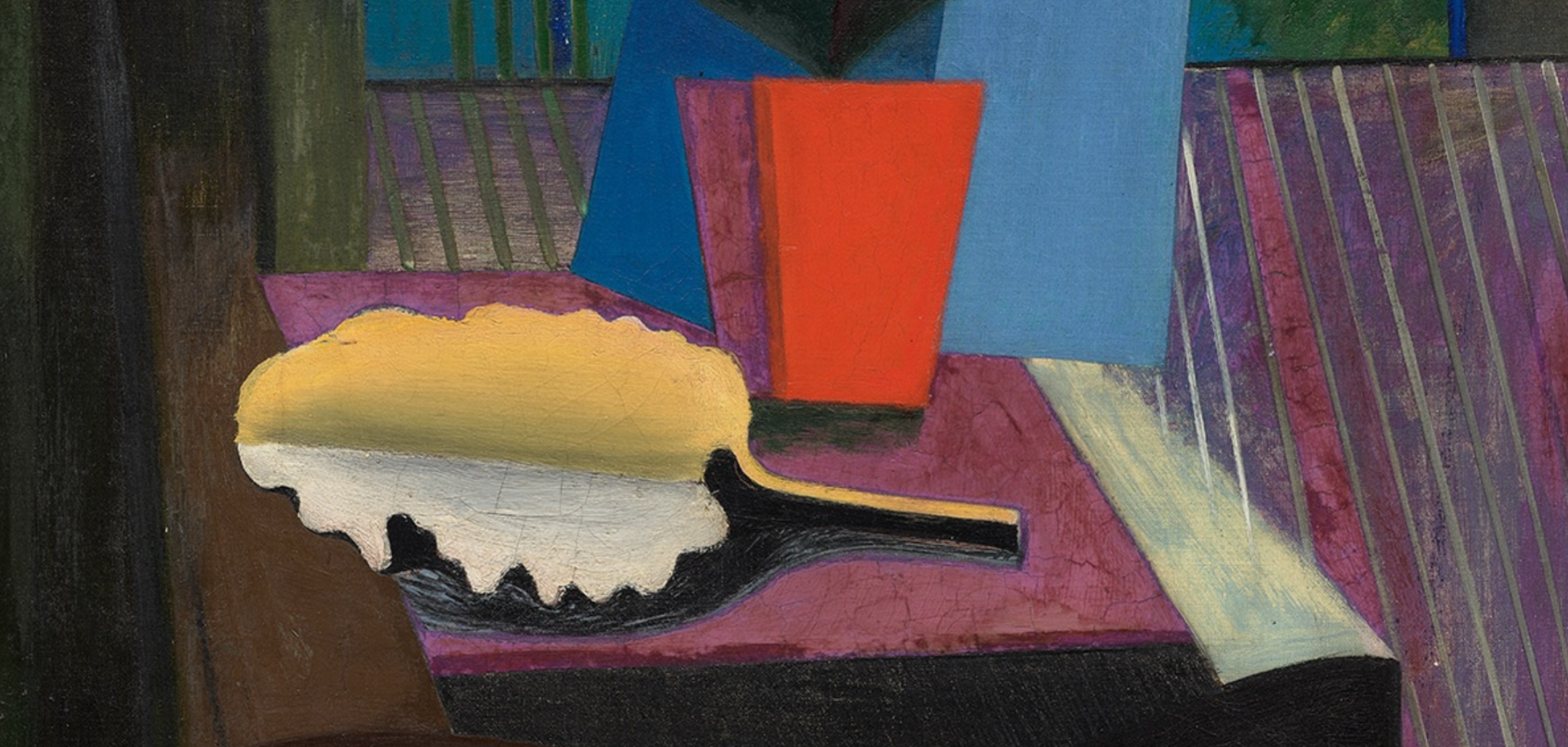
The composition is slightly tilted, with the horizon line of the floor brought almost mid-way through the room and the table slightly tilted downwards, as if its contents were about to spill out towards the viewer. This manipulation of space would foreshadow de Kooning’s entirely abstract compositions, using form and dimension in a way which would lead to his most important contributions to the Abstract Expressionist movement. Nearly 20 years before his legendary Woman paintings, Still Life is a rare look into de Kooning’s formative work, showcasing the range of the artist’s illustrious career.
Two Figures, circa 1946-1947
Sotheby’s New-York: 16 May 2023
Estimated: USD 5,000,000 – 7,000,000
USD 5,849,700
Two Figures | The Mo Ostin Collection Evening Auction | 2023 | Sotheby’s (sothebys.com)
WILLEM DE KOONING (1904 – 1997)
Two Figures, circa 1946-1947
Charcoal, colored chalks, gouache, graphite and watercolor on paper
11 3/8 x 13 1/8 inches (27.9 x 30.5 cm)
Signed (lower left)
For its vivid painterly coloration, fractured forms, and assertive mastery of line, Two Figures from circa 1946-47 crackles with a potent electricity that stands amongst the very best of Willem de Kooning’s extraordinary output. Tumbling, tussling, and tangling in a passionate embrace, the figures radiate a vital intensity that is equally sexual and violent, graceful and unsettling. Bursting forth from the intimate format of the paper, the small scale belies the energetic vigor of de Kooning’s action, his urgent charcoal lines and searing palette condensed into a gem-like composition that bespeaks the full brilliance of his draftsmanship. Once held in the celebrated Hazen Collection, the exquisite rarity and superlative caliber of Two Figures stands alongside such museum-quality compositions as Judgment Day (1946; The Metropolitan Museum of Art, New York), Special Delivery (1946; Hirshhorn Museum and Sculpture Garden, Smithsonian Institution, Washington, D.C.), Untitled [Three Figures] (1947; Glenstone, Potomac), and Untitled Study [Women] (c. 1948, The Frances Lehman Loeb Art Center, Vassar College, Poughkeepsie). An exuberant encapsulation of the formal innovations that would come to define the artist’s singular legacy, Two Figures manifests de Kooning’s unparalleled synthesis of figuration and abstraction at the very nexus of his artistic genius.
Orestes, 1947
Christie’s New-York: 11 May 2023
Estimate on Request
USD 30,885,000
WILLEM DE KOONING (1904-1997) (christies.com)
WILLEM DE KOONING (1904-1997)
Orestes, 1947
24 1/8 x 36 1/8 inches (61.3 x 91.8 cm)
Signed ‘de Kooning’ (lower right); signed again ‘de Kooning’ (on the reverse)
One of the most important early paintings by Willem de Kooning to remain in private hands, Orestes was painted during a period which marked the dawn of the artist as an abstract painter. Widely cited in the literature and exhibited in de Kooning’s first solo exhibition, it was with this 1947 painting that the artist abandoned the vestiges of figuration in his work and finally succumbed to abstraction. The predominant black and white palette, the evocative rounded forms, and the painterly surface all mark out this particular work as an example from a pivotal moment in the artist’s career when he was pushing at the accepted boundaries of painting and exploring the full potential of his vital new mode of painting. Transgressing hundreds of years of art history, de Kooning abandons traditional notions of shading, volume and modeling of space, John Elderfield, curator of the artist’s seminal 2011 retrospective at The Museum of Modern Art, to identity Orestes as unique in the artist’s body of work in affording a primary function to the wide, flat forms that would come to dominate his compositions from this period. Populated by a series of familiar, yet inscrutable, forms set against a pale ground, Orestes belongs to a group of paintings that the artist embarked on in 1947. With their rounded shapes and distinct silhouettes, they resemble letters of the alphabet suspended within the body of the composition; yet their forms are amorphous enough as to eschew definitive comprehension. These cryptic ciphers are separated by brushy passages of black and white pigment laid down one on top of another resulting in a highly active painterly surface.
Event in a Barn, 1947
Phillips New-York: 15 November 2022
Estimated: USD 2,500,000 – 3,500,000
USD 2,055,000
Willem de Kooning – 20th Century & … Lot 36 November 2022 | Phillips
WILLEM DE KOONING
Event in a Barn, 1947
Oil, enamel and paper collage on paper laid on board
24 3/4 x 33 inches (62.9 x 83.8 cm)
Signed “de Kooning” lower right
Willem de Kooning’s Event in a Barn, 1947, is a shining example of the artist’s aesthetic excellence in the late 1940s. This painting marks a crucial point in de Kooning’s development when he managed to synthesize Cubist aesthetics with his own expressive painting style. Event in a Barn is filled with gesture and color: rounded pink shapes, thick swathes of yellow-hued green, and glimpses of white. Allan Stone, legendary art dealer and previous owner of Event in a Barn from 1965, called this moment in de Kooning’s career the “liquefication of cubism;” the melting down and recombination of art ideas from the past to create a new modern style. Event in a Barn, alongside works such as Pink Angels, c. 1945, Frederick R. Weisman Art Foundation, Los Angeles, and Judgment Day, 1946, Metropolitan Museum of Art, New York, function as an essential prelude to de Kooning’s series of black and white abstractions, which formed the center of his first solo show, at Egan Gallery in 1948. This show, in turn, garnered him the approval of influential critic Clement Greenberg, and launched de Kooning’s career as a leading Abstract Expressionist.
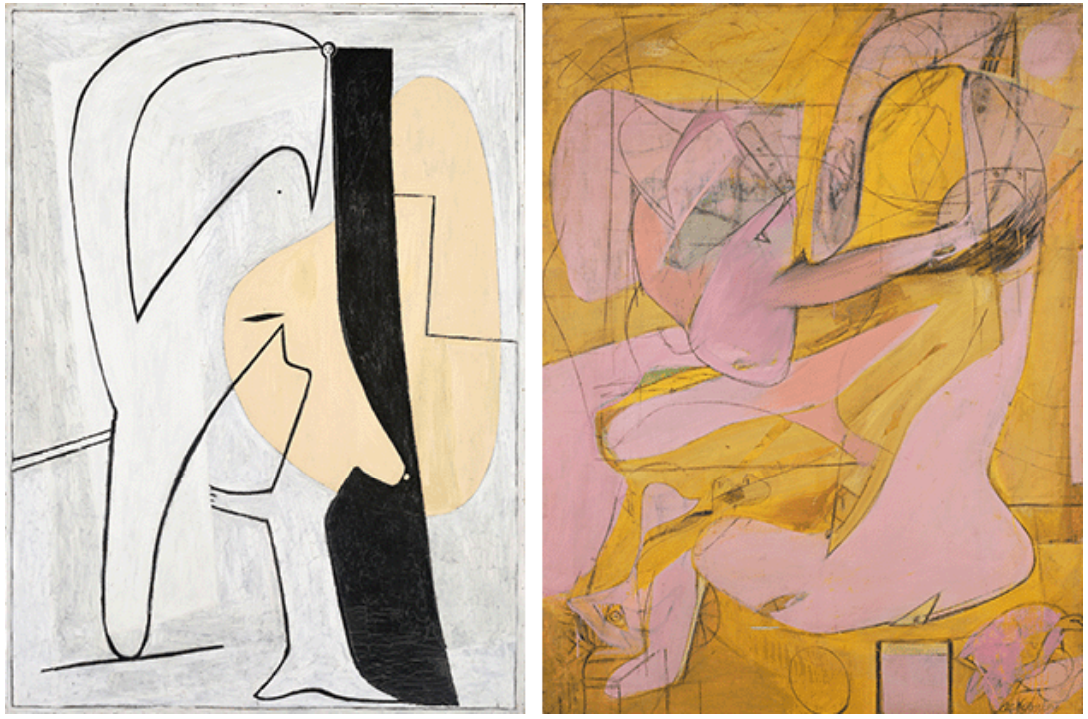
[left] Pablo Picasso, Figure, 1927, Musée National Picasso, Paris. Image: © RMN-Grand Palais / Art Resource, NY, Artwork: © 2022 Estate of Pablo Picasso / Artists Rights Society (ARS), New York
[right] Willem de Kooning, Pink Angels, 1945, Frederick R. Weisman Art Foundation, Los Angeles. Image: Bridgeman Images, Artwork: © 2022 The Willem de Kooning Foundation/Artists Rights Society (ARS), New York
While de Kooning’s pinks and greens perhaps find their inspiration in Pablo Picasso’s portraits of Dora Maar in the 1930s, the geometric black lines of Event in a Barn nod to Picasso’s work of the 1920s and 1930s, as seen in Figure, 1927, Musée National Picasso, and de Kooning’s own sense of line and draftsmanship, as in Pink Angels. With its clearer visual parallel to the “fantastic anatomy” of Picasso’s work, Pink Angels provides an intermediate example of the abstraction de Kooning reaches with Event in a Barn. In both paintings, de Kooning sources his abstract shapes from his own drawings of women, which he cut apart, rearranged, and transposed past the point of recognition. In a painting rich with layers, these collaged drawing elements are the ultimate base, a stylistic and physical foundation on which de Kooning builds his abstraction.
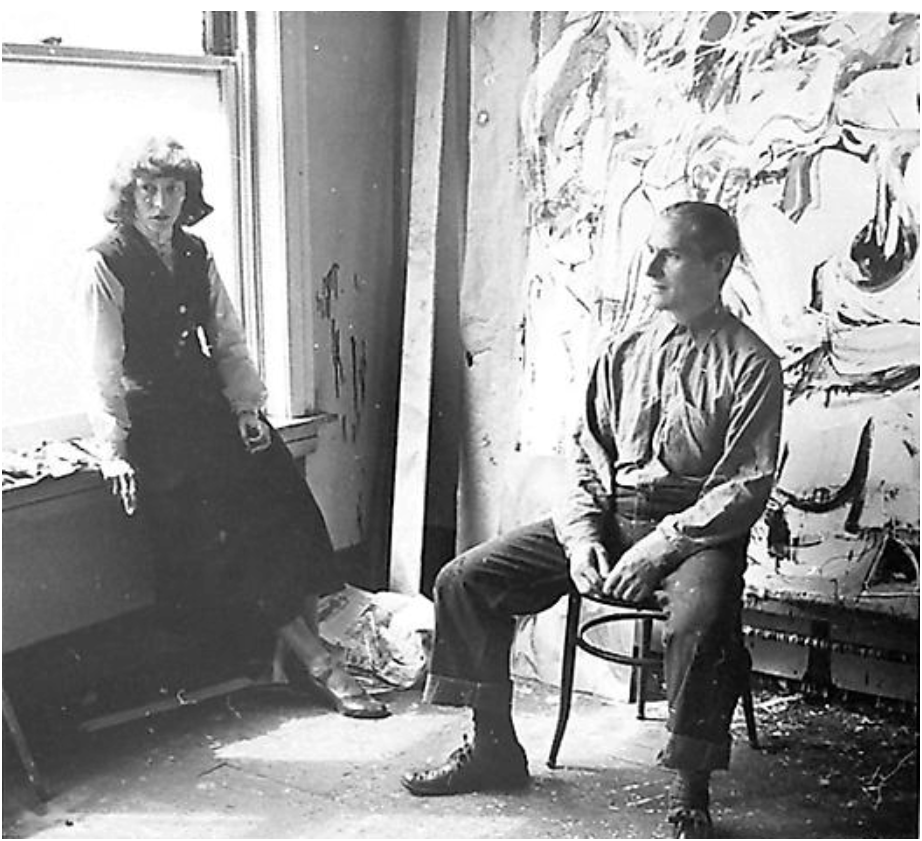
In the 1940s, painters in the New York School, including de Kooning, Jackson Pollock, Franz Kline, and Arshile Gorky, worked in the artistic shadow of Picasso. Picasso’s fame and aesthetic innovations had a major impact on contemporary painting styles, and the younger New York artists struggled to balance his inspiration with their own methods. Some artists, such as Pollock and Kline, leaned into abstract gestures to break with Picasso. De Kooning, in contrast, sought to combine Picasso’s Cubism with abstract mark-making to create his own, unique style. Using the work of Picasso as his starting point, de Kooning pushed past fragmentation, past figuration, to a point where few recognizable forms could be seen in his paintings. His skilled brushstroke led him towards more fluid, dynamic compositions. Event in a Barn exemplifies the result of this work: the canvas stands as a record of the act, or event, of painting. Even the title of the work references the act.
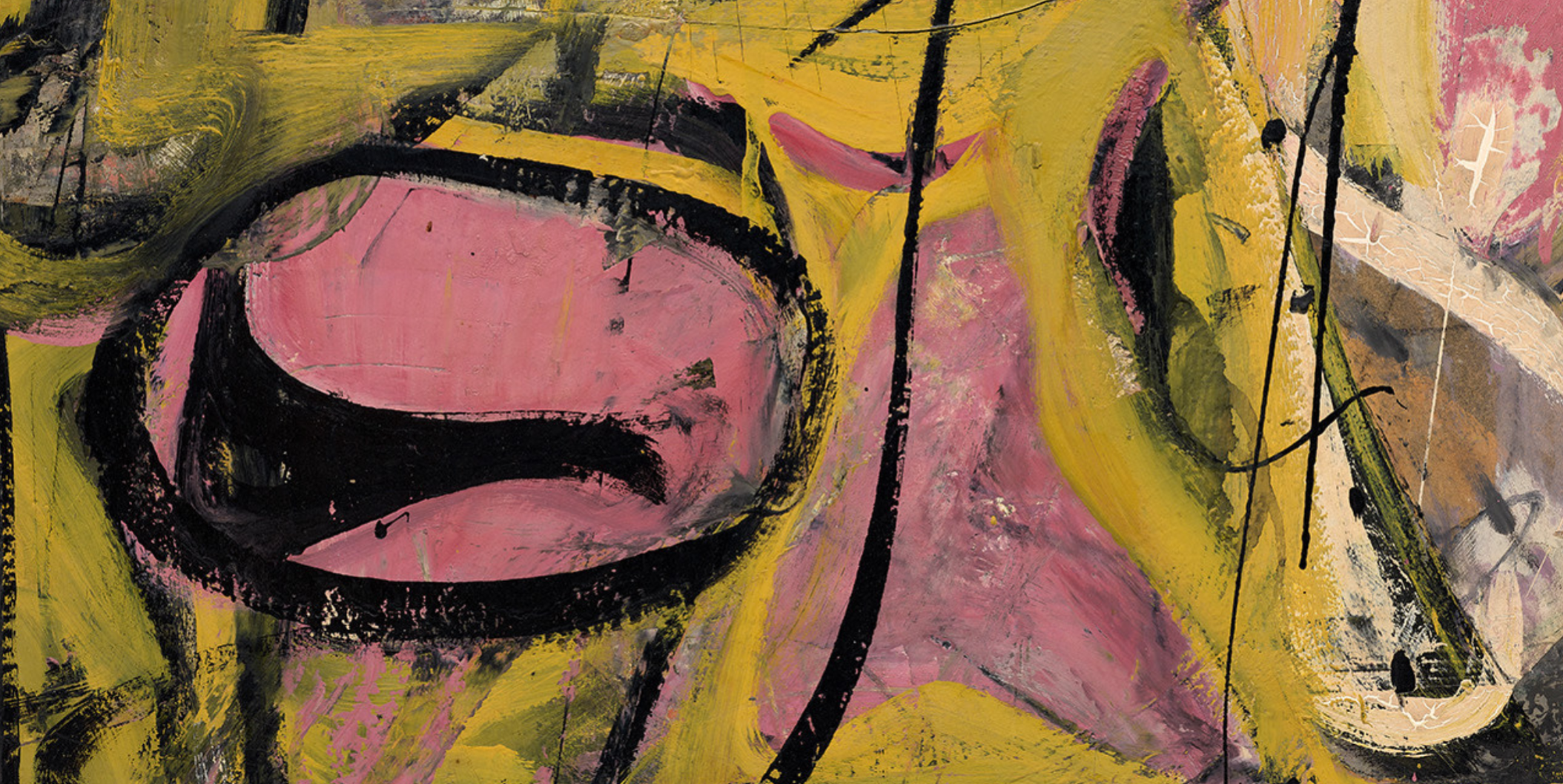
De Kooning worked quickly, with a thick and expressive brushstroke. He built up layers of paint, scraped them away, and painted over them; the older layers show through the gaps in the new. Following the black lines, the viewer can see where de Kooning turned his brush on its thin side, where he pressed it flat and wide. Event in a Barn is also an early example of de Kooning’s incorporation of paint drips, chance incidents of the painting process, to add depth and layers to his compositions. Gestures like these gave Abstract Expressionism the nickname “action painting,” as each painting records the act of painting.
Collage, 1950
Sotheby’s New-York: 14 November 2022
Estimated: USD 18,000,000 – 25,000,0000
USD 33,645,500
Collage | The David M. Solinger Collection Evening Auction | 2022 | Sotheby’s (sothebys.com)
WILLEM DE KOONING (1904-1997)
Collage, 1950
Oil and lacquer with thumbtacks on paper
22×30 inches (55.9 x 76.2 cm)
An irrepressibly vibrant and exquisitely rare jewel, Collage from 1950 declares a moment of pivotal importance within Willem de Kooning’s legendary oeuvre. Bursting forth in a chromatic eruption of compositional dynamism across every inch of the intimately scaled surface, Collage is immediately recognizable as a quintessential example of the artist’s mature abstract mode. And yet, with its richly textured surface, built up in layers of paper, paint, charcoal, and even scattered silver thumbtacks, Collage is wholly unique for its manifest inclusion of the elements that define its eponymous mode of production. Throughout the 1940s and 50s, de Kooning would often use a collage method to plan his compositions of juxtaposed forms, tracing the shapes onto paper and arranging them in various ways across a painting’s surface; here, however, he did not remove these layered elements, preserving the traces of a method that defines his most significant canvases from this period. Asheville (1948, The Phillips Collection, Washington, D.C.), Attic (1949, The Metropolitan Museum of Art, New York), and Excavation (1950, The Art Institute of Chicago) all evince this mode, their surfaces characterized by jumps, breaks, and visual ruptures between passages that mimic collage.
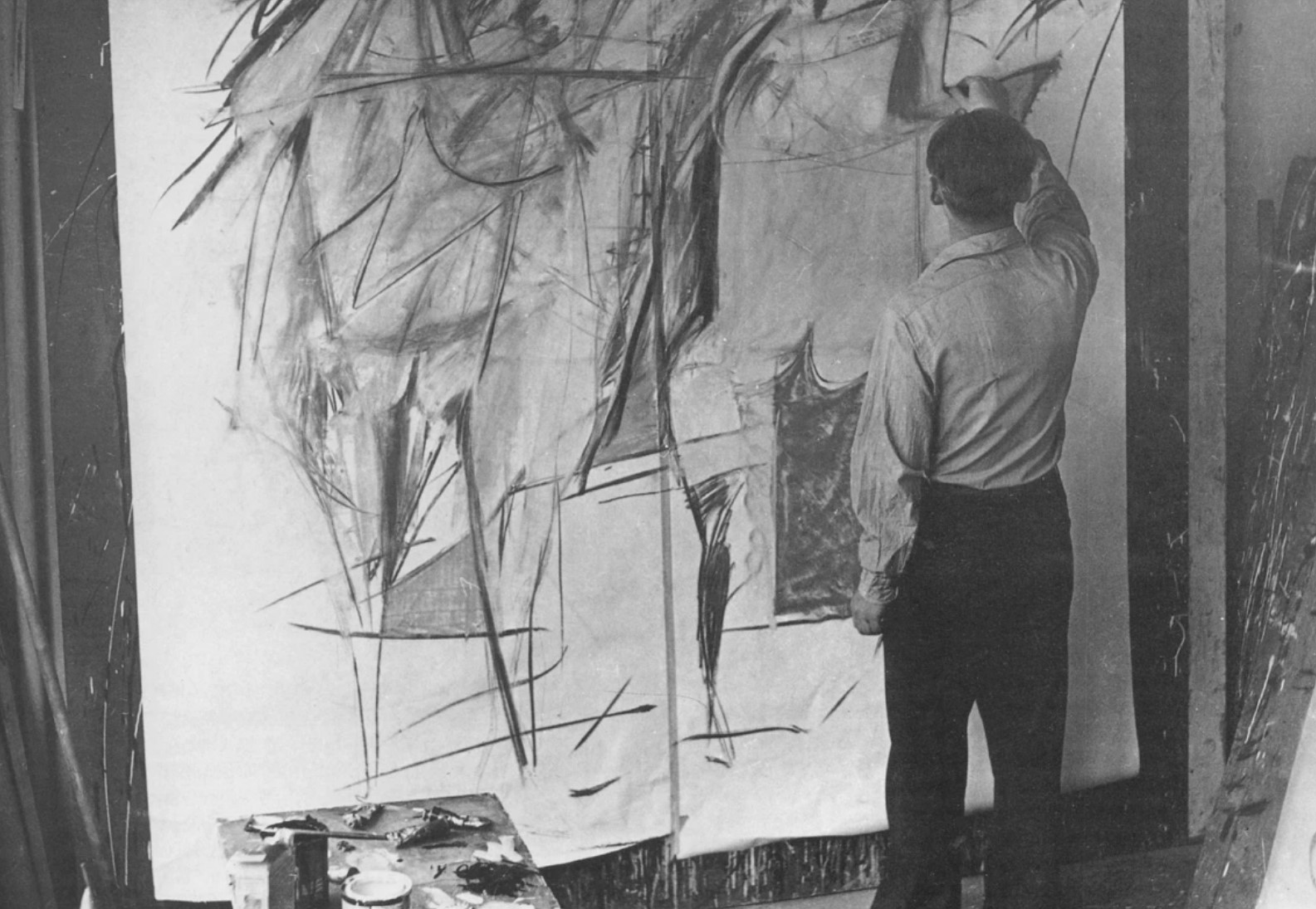
Offering its viewer an archaeological survey of the creative strata that accumulated to form de Kooning’s extraordinary aesthetic, Collage acts as a kind of Rosetta Stone, deciphering the arc of his painterly practice at this critical juncture in his career. From within the pulsing net of sensuous lines and glowing jewel-toned hues, de Kooning’s trademark oscillation between abstraction and figuration emerges; in the upper left, two eyes top a female form with a silver tack for a navel, while in the lower right, de Kooning’s recurring motif of the window emerges from the fiery orange and stark white pigment.
Untitled, 1961
Sotheby’s New-York: 16 May 2022
The Macklowe Collection
Estimated: USD 7,000,000 – 10,000,000
USD 17,789,300
Untitled | The Macklowe Collection | 2022 | Sotheby’s (sothebys.com)
WILLEM DE KOONING (1904 – 1997)
Untitled, 1961
Oil on canvas
80 x 70 1/8 inches (203.2 x 178.1 cm)
Signed
Broadcasting a churning vista of sumptuous, unadulterated abstraction, Untitled is a remarkable early masterwork from Willem de Kooning’s celebrated artistic oeuvre. Across the expansive surface of the canvas, luscious swathes of rich pigment generate fluid suggestions of organized forms, the component parts of which find harmony through the lyrical choreography of de Kooning’s extraordinary abstract touch. Executed in 1961—the year de Kooning began building his home and studio in Springs, Long Island in preparation for his permanent departure from New York in 1963—Untitled wholly embodies the luminous atmosphere of nature, landscape, and sea which infuses de Kooning’s greatest masterworks from this pivotal moment.
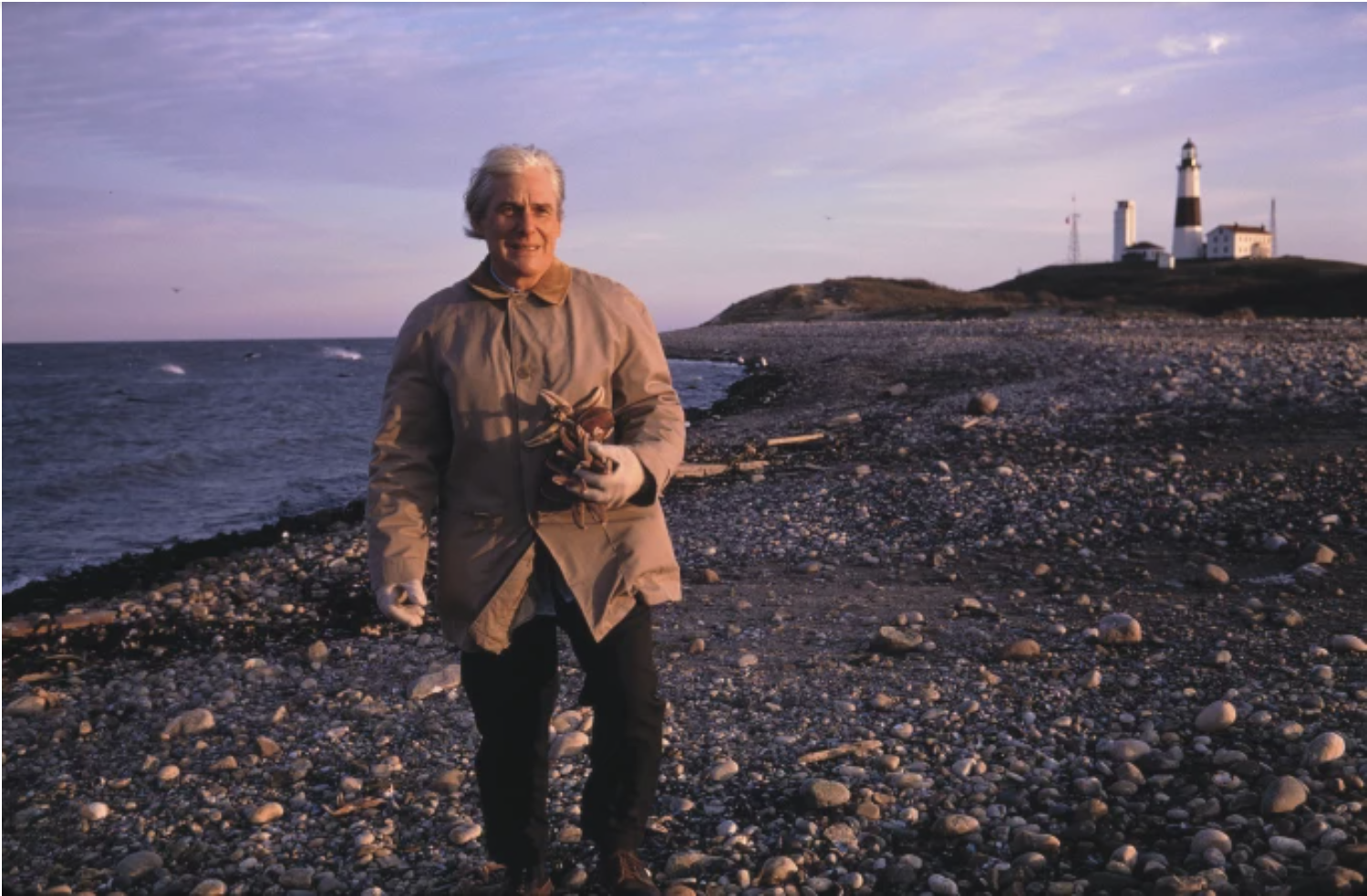
WILLEM DE KOONING, EAST HAMPTON, 1968. PHOTO: © 2022 THE ESTATE OF DAN BUDNIK. ART © 2022 THE WILLEM DE KOONING FOUNDATION/ARTISTS RIGHTS SOCIETY (ARS) NEW YORK
Light, sound and scent beat across every square inch of the present work with an ineffable rhythm, enveloping the viewer in the heady, salty air of East Hampton. For its dazzling fusion of a melodic lyricism with the heroic and muscular mark-making of de Kooning’s expressionism, the incandescent Untitled is a sensory delight and a triumph from this critical period of the artist’s career, one that beautifully links his central appreciation for landscape with the explosive, gestural abstraction of the mid-1970s.
Through a palette of sundrenched yellows, sandy beige and gleaming, salt-washed blue, Untitled conjures the sense of a warm blissful repose on the shore. The phosphorescence of de Kooning’s palette sets the tone for his distinct gestural mark making. Slippery forms oscillate between figuration and abstraction, realizing a new sense of kinetic freedom as luscious drips and washes hover, suspended in motion as an indexical sign of the artist’s working process. We find shapes both composed and agitated, receding in and out of their backgrounds. Yet, for all its profound visual instantaneity, Untitled displays a calculated sense of tonal balance and compositional integrity. Crucially, de Kooning’s Untitled does not simply inhabit the frame, but melds into every corner to create an ecstatic vision of natural splendor and personal joy: an encapsulation of emotive memory.
Untitled XXV, 1977
Christie’s New-York: 15 November 2016
Estimate on Request
USD 66,327,500
Willem de Kooning (1904-1997) (christies.com)
WILLEM DE KOONING (1904-1997)
Untitled XXV, 1977
Oil on canvas
77×88 inches (195.7 x 223.5 cm)
Signed ‘de Kooning’ (on the reverse)
A riotous explosion of rich, translucent color and frenetic, enigmatic form, Untitled XXV is one of approximately 20 large “pastoral” paintings that “poured out” of de Kooning at the very the height of this exciting period of new-found creativity in 1977. David Sylvester called this year de Kooning’s annus mirabilis, not just because it proved to be such a prolific year for the now 73-year-old painter, but also because it was the paintings of this year that proved the most complex and intense expressions of the artist’s entire late style. Indeed, after 1977, de Kooning’s energy and interest dramatically began to wane. He was only to create four or five large-scale paintings in 1978 and, after only a few haltering examples made in 1979, de Kooning relapsed into drinking and the series ground to a halt.
Women
Woman and Child, circa 1967-1968
Leonard & Louise Riggio: Collected Works
Christie’s New-York: 12 May 2025
Estimated: USD 4,000,000 – 6,000,000
USD 7,128,500
WILLEM DE KOONING (1904-1997), Woman and Child | Christie’s
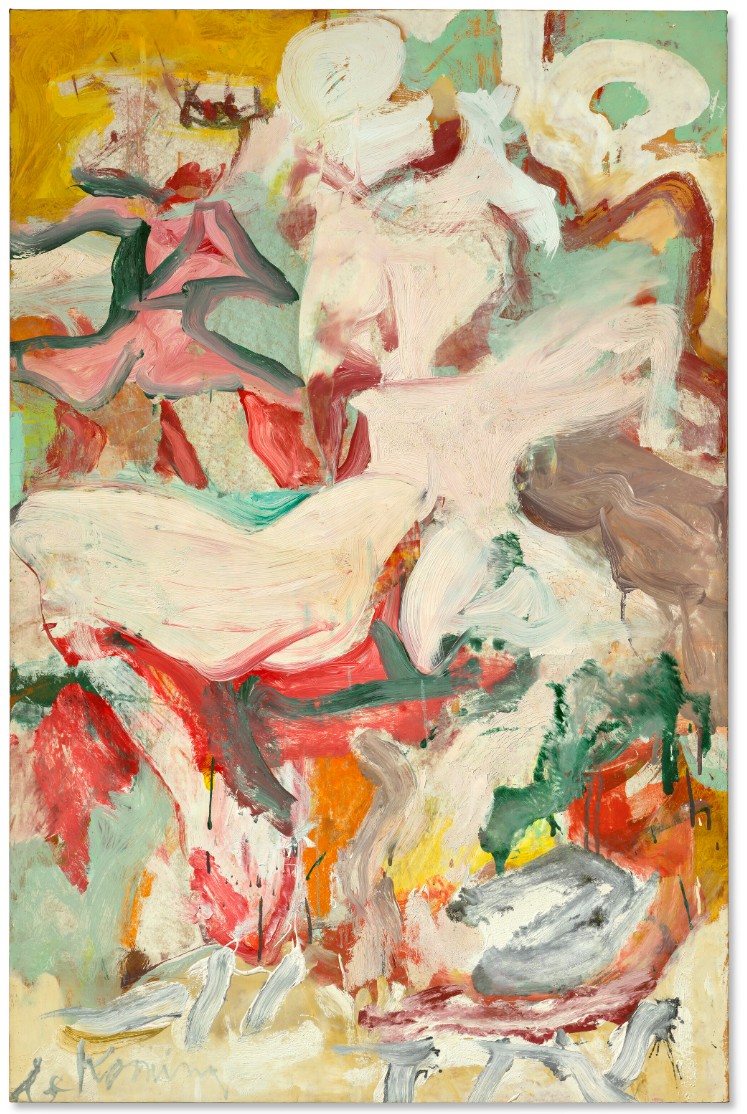
WILLEM DE KOONING (1904-1997)
Woman and Child, circa 1967-1968
Oil on paper mounted on canvas
55×36 inches (139.7 x 91.4 cm)
Signed ‘de Kooning‘ (lower left)
Dedicated ‘to Emilie with Love’ (on the reverse)
With its flowing ribbons of color and broad painterly gestures, Willem de Kooning’s Woman and Child is a superlative example of the artist’s distinct style of figurative painting. Taking a subject which has been a continuous source of inspiration for much of art history, de Kooning infuses it with the distinct sense of dynamic energy that distinguished Abstract Expressionism. The figures resonate with a degree of sensual energy that is found only in the most successful of the artist’s paintings from this particular period as he worked to produce a newer, more vital, series of almost intuitive marks. Acquired directly from the artist by his lover and muse Emilie Kilgore, this painting held a special place in de Kooning’s oeuvre as, when Kilgore selected the work, the artist said approvingly, “That’s a very good one!” Famously critical of his own paintings, this comment provides a ringing endorsement of this particular example of his new style of Woman painting.
Set amidst a landscape of lush greens and warm yellows, the figure of a woman and child are rendered in a series of rapidly executed and expressive brushstrokes. As de Kooning’s heavily laden brush traverses the canvas he manifests the figures out of passages of rich impasto; fleshly limbs are fashioned out of strokes of pale white and pink, while fields of red help to accentuate the sensual nature of the female figure. Elsewhere, a litany of different paint handling techniques—from scumbling to expressive Pollock-like drips—contribute to the highly expressive surface.
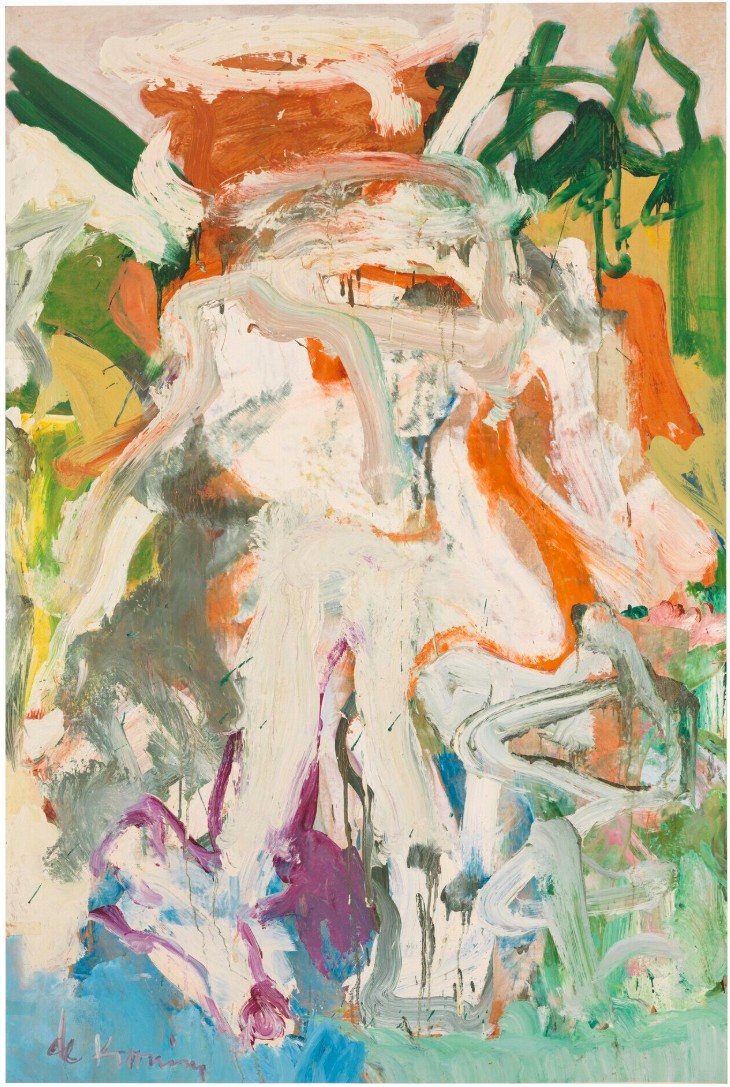
Willem de Kooning, Woman in Landscape III, 1968. Whitney Museum of American Art, New York.
© The Willem de Kooning Foundation / Artists Rights Society (ARS), New York and DACS, London 2025.
Photo: © Whitney Museum of American Art / Licensed by Scala / Art Resource, NY.
In contrast to de Kooning’s earlier depictions of women from the 1950s, these later paintings possess a much more sophisticated approach to the painting of the female figure. By this point in his career, the artist was spending more time in the bucolic surroundings of Springs, Long Island, and this manifested itself clearly in his more open compositions. The 1960s were also abundant with innovation in terms of the materials he used in the studio as he had developed expertise in introducing new and various media in his oil paints. He produced significant results by including water (which added a unique volume and viscosity to the paint), safflower oil (significantly extending drying time, and thus, malleability and working time), and large amounts of white paint (producing high degrees of luminosity), all of which can be seen in the present work.
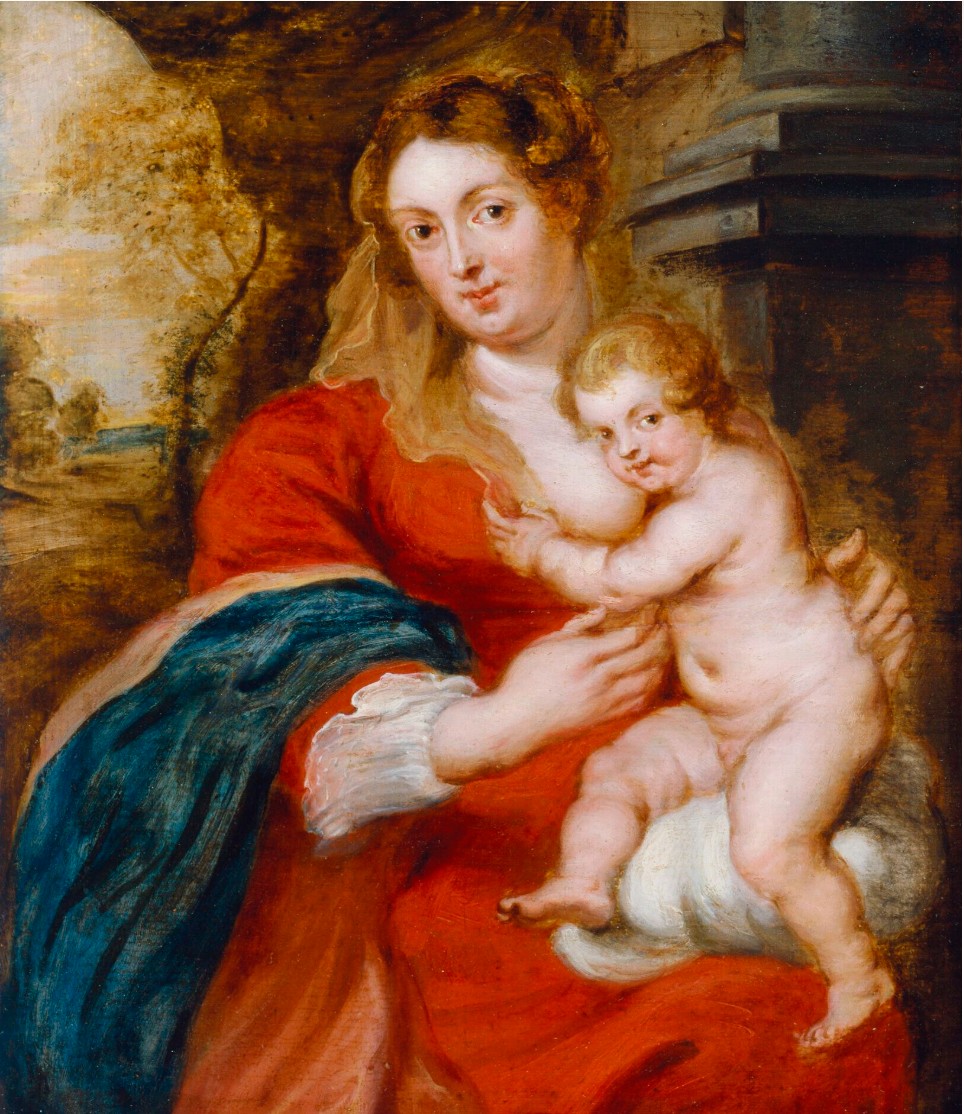
Peter Paul Rubens, Madonna and Child, 17th century. Dulwich Picture Gallery, London.
Thus, Woman and Child is a prime example of the individualism and dynamism associated with de Kooning’s output of the 1960s, evidencing that his engagement with the female figure worked to transcend the tension between picture and event, observation and genre. De Kooning’s sensuous paintings of women provoke what it means to depict elementally and radicality: “I have no opinion on women… I do not particularly stress the masculine or feminine viewpoint. I am concerned only with human values” (S. de Hirsch, quoted in “A Talk with de Kooning,” Intro Bulletin: A Literary Newspaper of the Arts 1, no. 1, October 1955, pp. 1 & 3).
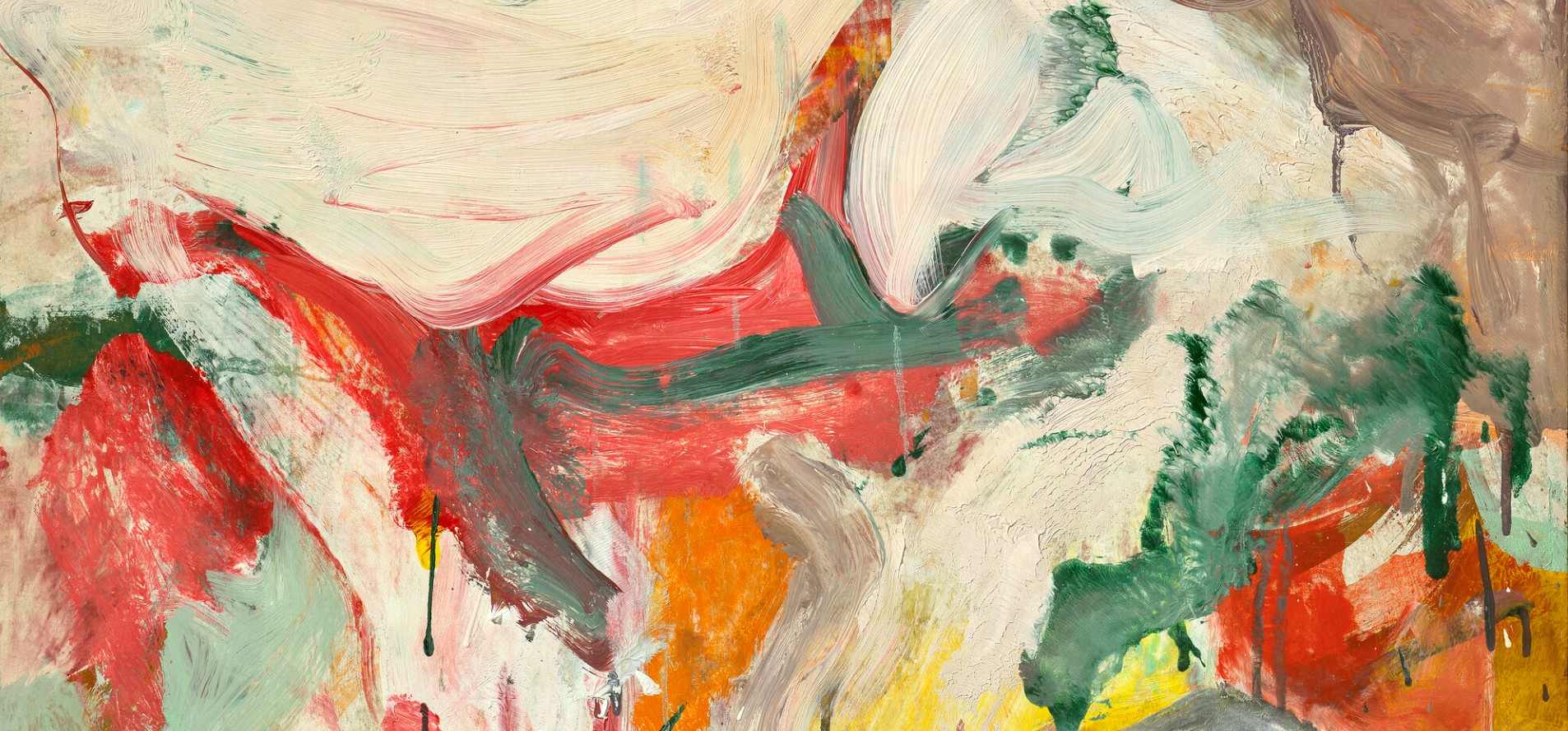
De Kooning’s depictions of women are among some of the most iconic works of the postwar period. The paint’s physicality and the way in which it has been applied, the color and the gestural sweeps and play of this tactile and, in de Kooning’s hand, seemingly infinitely pliable medium, powerfully evoke the artist’s own sensual and sexually charged response to women, their bodies, their skin and their features. The maternal nature of this work marks a somewhat softer depiction of women than some of his more high-octane representations. Unlike his earlier Picasso-esque grotesque representations of women, the abundance of soft, pink tones in Woman and Child is prompted not so much by fear, but more a wry and benevolent sense of warmth and affection.
Two Figures in Dunes, 1968
Sotheby’s New-York: 13 May 2025
Estimated: USD 1,500,000 – 2,000,000
USD 3,222,000
Two Figures in Dunes | Modern Evening Auction | 2025 | Sotheby’s
WILLEM DE KOONING (1904 – 1997)
Two Figures in Dunes, 1968
Oil on paper mounted on canvas
41 3/8 x 37 inches (105.1 x 94 cm)
Signed de Kooning, dated 68 and inscribed to Arthur (lower left)
Encapsulating the artistic awakening that followed Willem de Kooning’s relocation from the city to the coast, Two Figures in Dunes from 1968 exhibits the sublime gesture and radiant luminosity of the artist’s celebrated works of the late 1960s. Gestural passages of sun-kissed yellow and fleshy pinks dance with seaside blues and celadon greens, mingling in a masterful Arcadian symphony. While de Kooning’s paintings of the 1950s are characterized by the muscular dynamism and unfettered force of his urban environs, his works from the late 1960s, following his move to Long Island display a sublime painterly bravura and melodic lyricism informed by the enchanting natural tranquility of his new shoreside town. Beaming with chromatic intensity and nuanced layers of painterly gesture, Two Figures in Dunes displays an essence of discovery and profound beauty surrounding the artist’s studio in Springs, but retains the exploration of figuration central to the artist’s earlier seminal Woman paintings. Testament to the importance of Two Figures in Dunes, the work was held in the personal collection of renowned collector Walter P. Chrysler, Jr. and has been held in the same private family collection for the last thirty-one years.
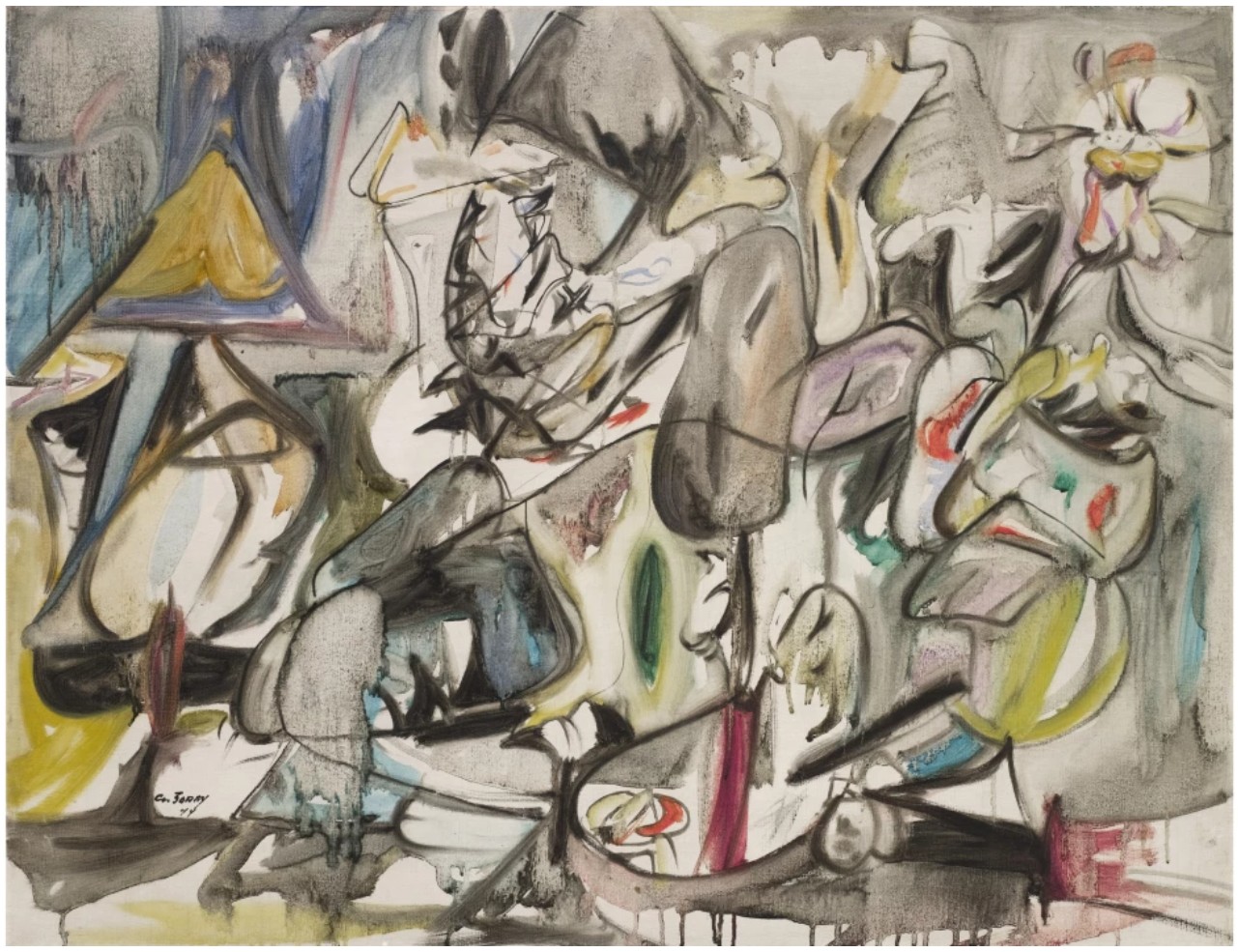
Arshile Gorky, The Leaf of the Artichoke is an Owl, 1944. The Museum of Modern Art, New York. Image © The Museum of Modern Art/Licensed by SCALA / Art Resource, NY. Art © 2025 The Arshile Gorky Foundation / Artists Rights Society (ARS), New York
In 1963, after spending much of his early career in Manhattan, de Kooning retreated to the seaside, settling in a new home and studio in Springs, a small hamlet in East Hampton, Long Island. The transition from the bustling streets of Manhattan and oppressive architecture to the unadulterated, serene beauty of Springs profoundly influenced de Kooning’s practice, unlocking new aesthetic inspiration. De Kooning’s works of the 1950s were grounded in the psychological intensity and speed of the urban landscape that surrounded him. In the artist’s seminal Woman paintings of that time, the viewer is confronted with the aggression, energy and momentum of the city in the mid century.
“When I moved into this house, everything seemed self-evident. The space, the light, the trees – I just accepted it without thinking about it much. Now I look around with new eyes. I think it’s all a kind of miracle.”
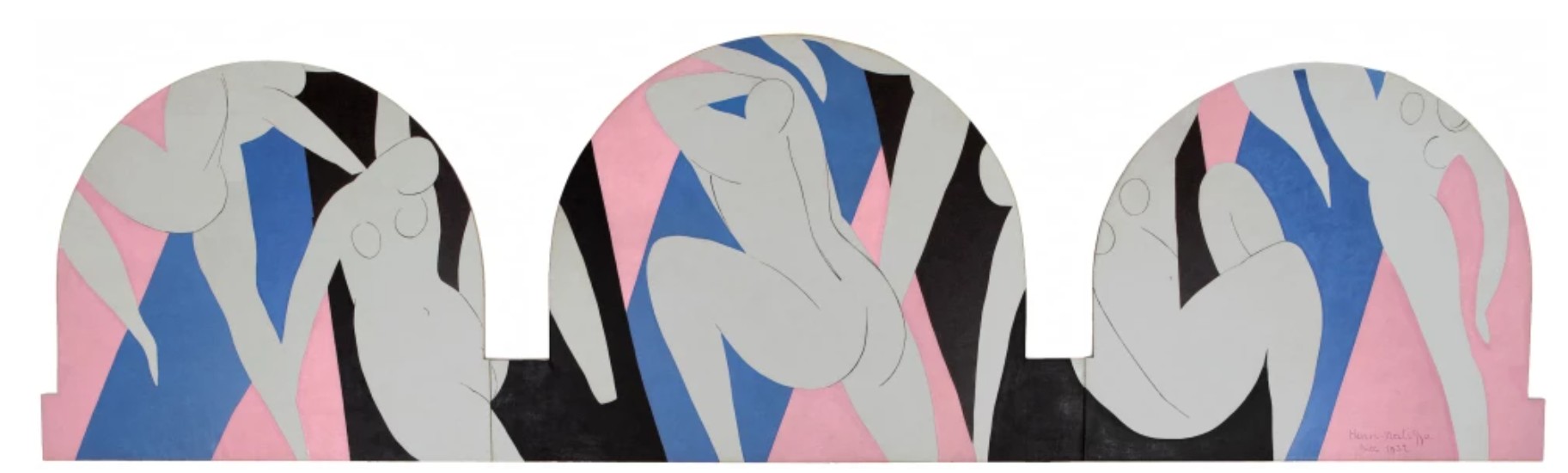
Henri Matisse, The Dance, 1931-33. Musée d’Art Moderne, Paris. Image © Paris Musées, musée d’Art moderne, Dist. RMN-Grand Palais / image ville de Paris/ Art Resource, NY. 2025 Succession H. Matisse / Artists Rights Society (ARS), New York
Liberated from the confines of urban architecture, de Kooning was engulfed in the luminous, coastal sanctuary of Springs. His works of this time adopted a newfound euphoric harmony, buoyed by the majestic light of his new environs.
“I got into painting in the atmosphere I wanted to be in. It was like the reflection of light. I reflected upon the reflections on the water, like the fishermen do.”
Two Figures in Dunes captures this bucolic virtue through organic strokes of sage greens which flow alongside oceanic blue. Mid-day sunlight radiates through de Kooning’s forms, demonstrating the artist’s unparalleled capacity to capture atmospheric grandeur through oil paint. From edge to edge, de Kooning draws the viewer’s gaze, entrancing us in the Edenic choreography of nature. The chromatic exploration and fluid grace of Two Figures in Dunes attest to the profound influence of Post-Impressionist master Henri Matisse on de Kooning’s practice. As seen in the graceful forms and alluring tones in masterful paintings like La Danse from 1931-33, Matisse’s revolutionary investigations of impassioned coloration and effervescent light boldly emerge in de Kooning’s celebrated paintings of the 1960s.
“The women I paint now are very friendly and pastoral, like my landscapes, and not so aggressive. Women are the symbol of civilization, like the Venus of Willendorf.”
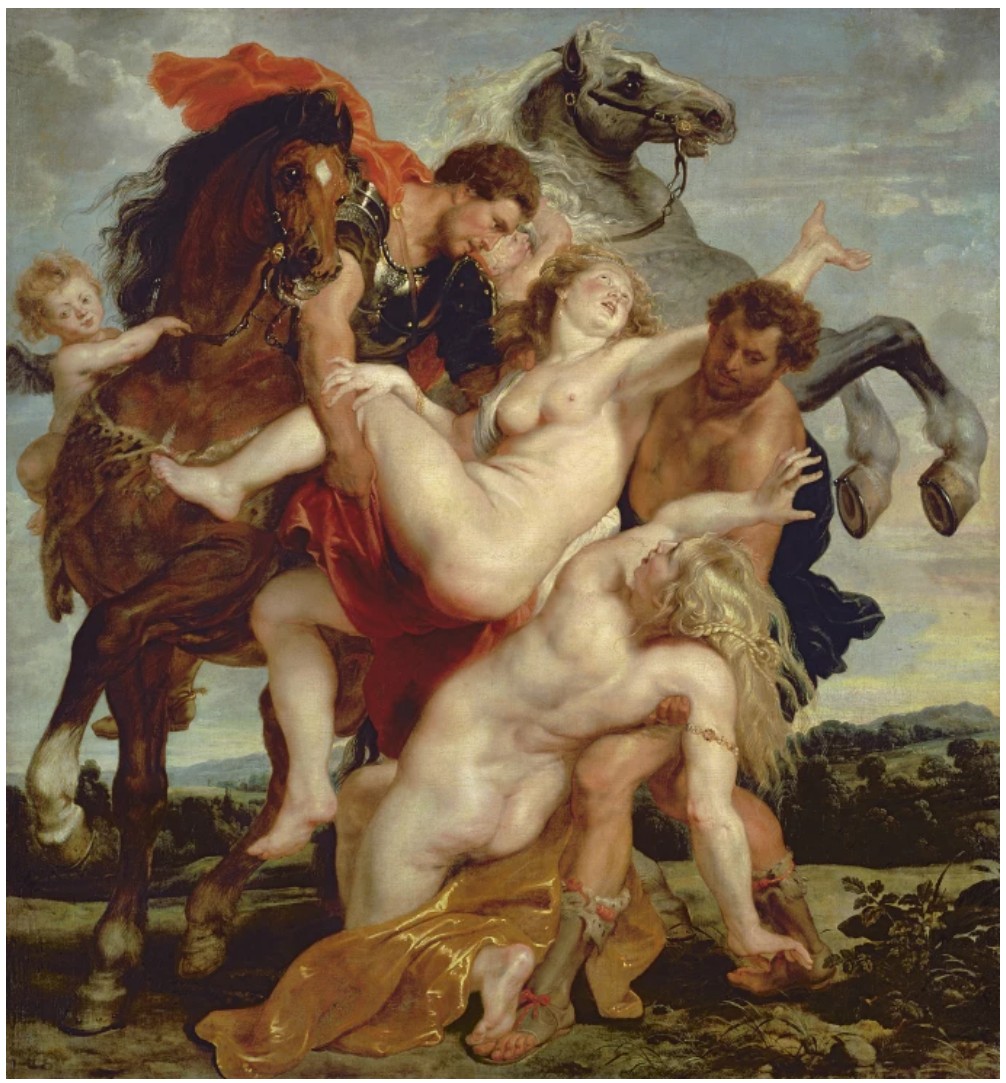
Peter Paul Rubens, The Rape of the Daughters of Leucippus, 1618. Alte Pinakothek, Munich. Image © Bridgeman Images
Through de Kooning’s fluid forms and transcendent gesture, the vestige of the figure simultaneously dissipates into abstraction and subtly reemerges. Conveying both a sense of improvisation and control, de Kooning’s passages display an unbridled freedom and quietly suggest the presence of the figure. Swathes of fleshy pinks in sensuous undulating forms stretch across the composition at times suggesting limbs and then melting into polychromatic ribbons of color. The earlier ferocity of the artist’s Woman paintings of the 1950s has dissolved into a lyrical synthesis of light and color.
“I believe in paradoxes, not going with it, but going against it. The figure is nothing unless you can twist it around like a strange miracle, unless it’s like a paradox, it is like nothing. A figure is a mystery, it’s like a psychedelic tree.”
Two Figures in Dunes is a paradigmatic example of de Kooning’s celebrated capacity to imbue his abstractions with a profound sensation of life. De Kooning’s Two Figures in Dunes conveys a simultaneous visual instantaneity and carefully calibrated balance of coloration and form. Distinguished by its chromatic palette and lyrical composition, Two Figures in Dunes exemplifies the ambitious invention and aesthetic discovery of de Kooning’s works of the 1960s, through which he harnessed the majestic and ever-entrancing beauty of the natural world.
Paging Woman, 1964
Sotheby’s New-York: 16 May 2025
Estimated: USD 500,000 – 700,000
USD 1,143,000
Paging Women | Contemporary Day Auction | 2025 | Sotheby’s
WILLEM DE KOONING (1904 – 1997)
Paging Woman, 1964
Oil on newsprint mounted on board
43 7/8 x 29 7/8 inches (111.4 x 75.9 cm)
Signed (lower right)
A riotous collision of effervescent gesture and technical inquisition, Willem de Kooning’s Paging Woman from 1964 bridges the raw figuration of his 1950s work with the luminous abstractions of the final two decades of his career. The present work is personified through its vivacious palette, compounding blushing pinks, fleshy creams, fair ochres, and arterial reds that effectuates a collaged composition as vibrant as it is complex. The gesture is immediate and visceral; paint is not applied so much as smeared, clawed, and swept across the surface with muscular grace. Amidst the rapturous brushtrokes lies an unmistakable semblance of the human figure–leering eyes, shocks of blonde hair, curves suggestive of hips of shoulders–emblematic of de Kooning’s formidable Women of the 1950s but with renewed bravura. Executed a year after moving to East Hampton, these seminal newsprint paintings became iconic landmarks of postwar art, completely remastering de Kooning’s investigation of the female figure.
“The figure is nothing unless you twist it around like a strange miracle.”
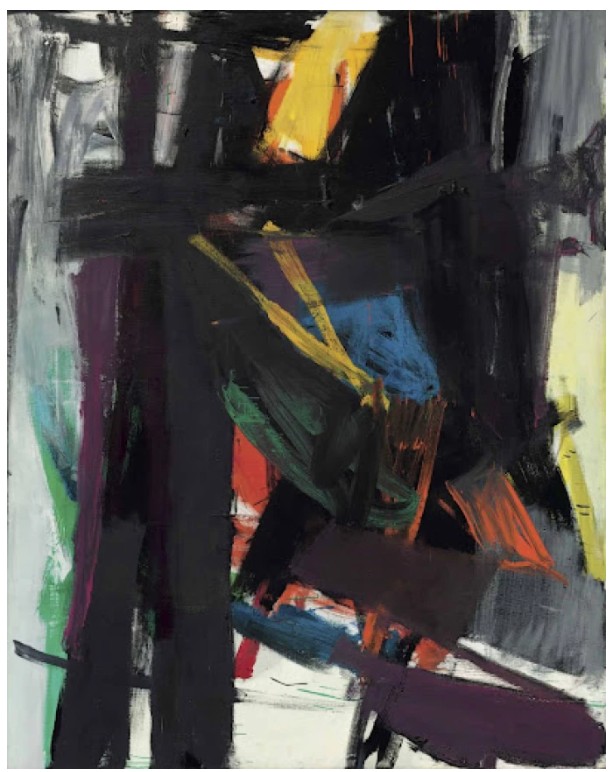
Franz Kline, King Oliver, 1958, Private Collection.
Image © Bridgeman Images. Art © 2025 Franz Kline / Artists Rights Society (ARS), New York
De Kooning’s relocation marked a shift in which process and environment became paramount, radically transforming his approach to both figuration and abstraction. The instantaneous metamorphosis of his practice reflects the pronounced impact East Hampton had on de Kooning—much like the revolutionary shifts he underwent the previous decade in New York City. The legendary curator Diane Waldman was attuned to this change, tracing de Kooning’s choice “to reject the abstract landscapes which had occupied him in the city during the late 1950’s and early 60’s just at the moment he moved to the country may seem unusual. But this was merely one change in direction in a complicated artistic evolution marked by numerous transitions from figurative to abstract” (Diane Waldman, Willem de Kooning in East Hampton, exh. cat. Guggenheim Museum, New York, 1978, p. 11). This turnpike in de Kooning’s oeuvre is particularly compelling and evident in Paging Woman, where the female form–perhaps his most recognizable contribution to art history–is reborn through this stylistic overhaul. Even at their most abstracted, de Kooning’s women become legible signs to track his progressions from abstraction to representation, and vice versa. And while hardly restrained, comparatively to his earlier work the florid color scheme and meticulously composed newsprint of Paging Woman make visible the impact of place and process on the Women of the 1960s.
“Flesh was the reason oil paint was invented.”
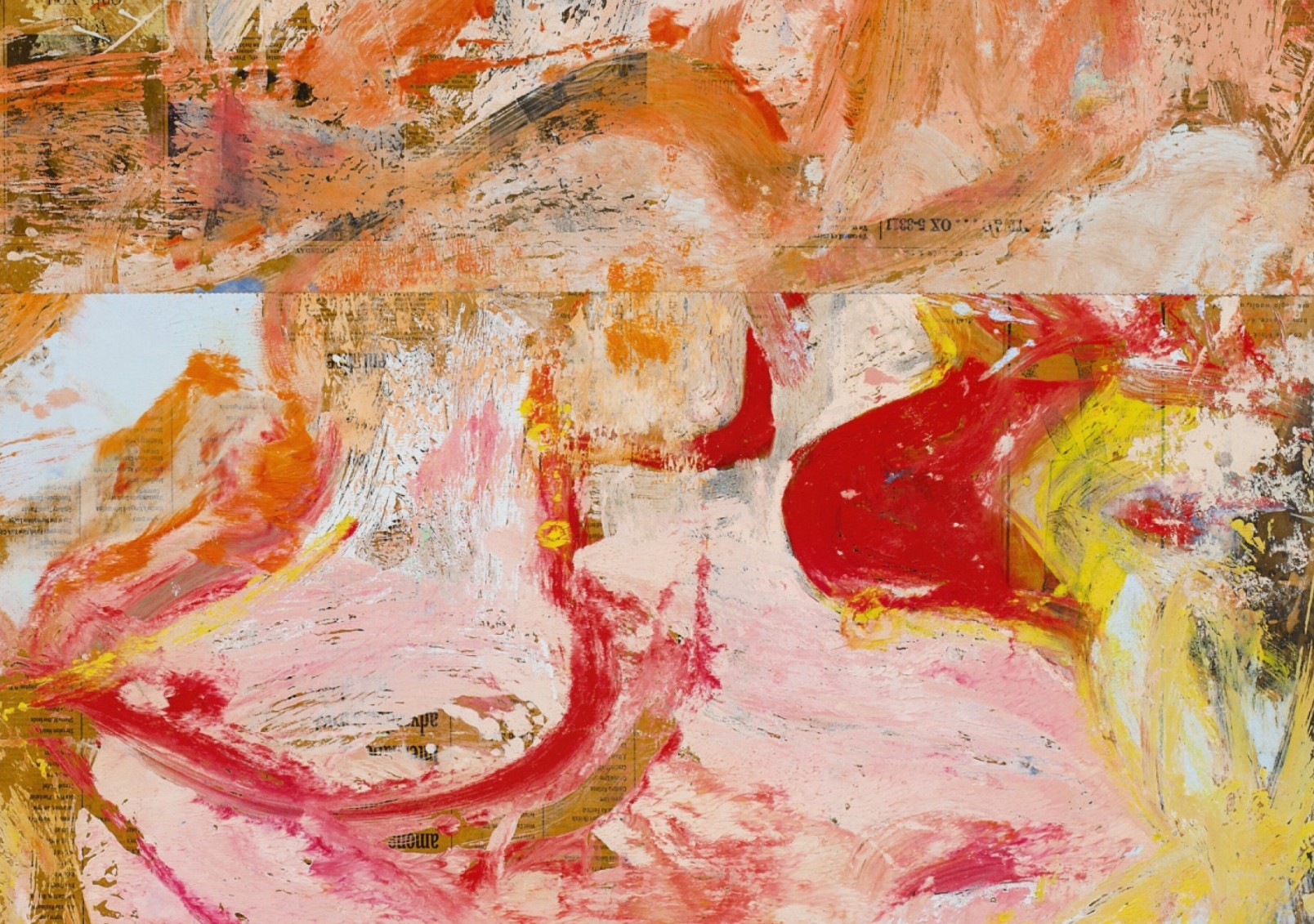
Refreshed by the bucolic environment, Paging Woman embodies the artist’s endeavor to capture the essence of his new home. Rather than depicting landscapes literally, de Kooning focused on integrating the atmospheric qualities of the natural world–such as light and memory–into his paintings. Of this new methodology de Kooning explained “Now I go … and search for a new image of the landscape. And I love the puddles. When I see a puddle, I stare into it. Later, I don’t paint a puddle, but the image it calls up within me. All the images inside are from nature anyway” (George Dickerson, Transcript of an Interview with Willem de Kooning, September 3, 1964: 6, Thomas B Hess Papers, Archives of American Art, Smithsonian Institution, Washington, D.C.). Just as abstraction was a conduit for city dwelling for de Kooning, the sumptuous and variegated surface of Paging Woman is evocative of his bucolic surroundings. The macabre greys and incising blacks of Woman I or the gruesome double images of Woman and Bicycle dissipate in favor of more benevolent, even mystical, depictions of women. Paging Woman inherits a delicate palette indicative of the forgiving coastline of East Hampton, and the distortions of the figure’s form are less destructive in their conception. The abstraction in this instance is more experimental than wry, with the visible seams of the newsprint revealing the intimate relationship between artist and medium.
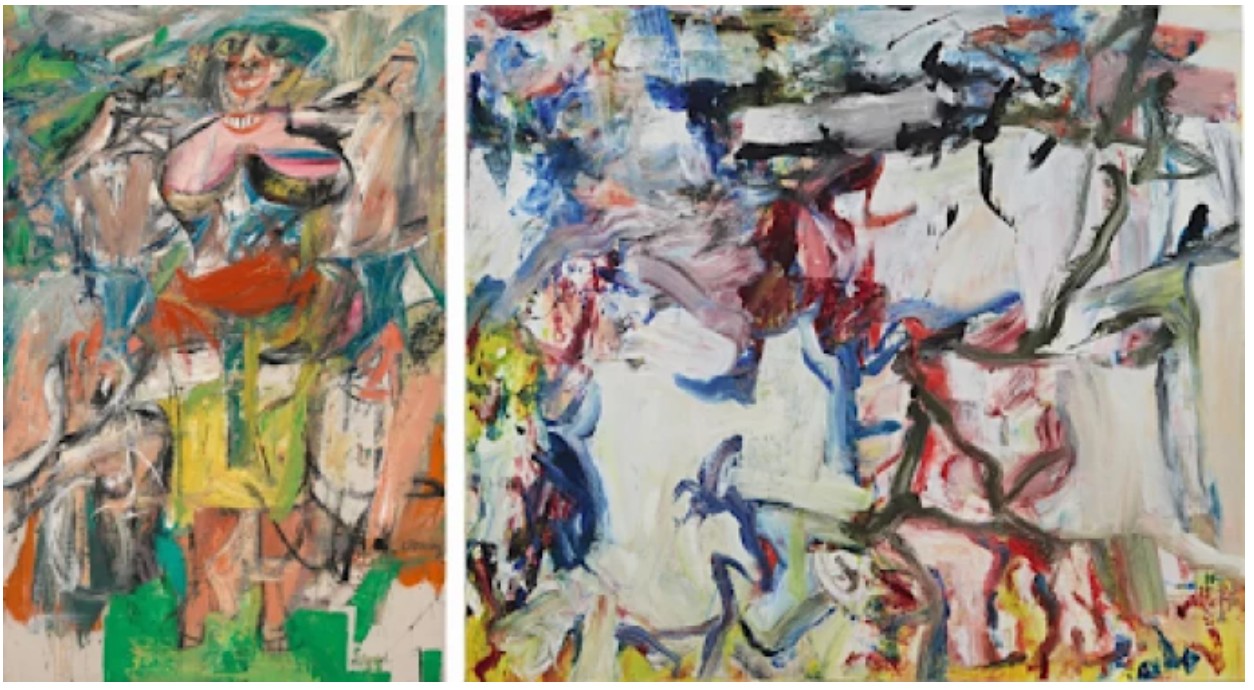
Left: Willem de Kooning, Woman and Bicycle, 1952–53, Whitney Museum of American Art. Image © Whitney Museum of American Art / Licensed by Scala / Art Resource, NY. Art © 2025 The Willem de Kooning Foundation / Artists Rights Society (ARS), New York.
Right: Willem de Kooning, Untitled XXII, 1977. Private Collection. Sold at Sotheby’s New York in November 2019 for $30.1 million. Art © 2025 The Willem de Kooning Foundation / Artists Rights Society (ARS), New York
The 1960s would usher in technical advancements in de Kooning’s practice as he integrated paper and revised his oil paint formula to abstract his figures with infinite manifestations. The figure of Paging Woman is labyrinthine, assembled together by layers of painted newsprint, in which the paper edges expose the artist’s ruminative working method. Paper liberated de Kooning from the constraints of the canvas, allowing him to rework his forms, at times cutting out successful elements and repasting them elsewhere. Paging Woman is trisected by such collages, dividing the initial newsprint forms from each other while underscoring brushwork that attends to the whole of the painting. De Kooning’s use of paper lends a sense of immediacy and intimacy; exposing the closeness of the artist to the surface, as though invited into the raw process of creation itself. This decade also marks de Kooning’s switch to safflower oil for his paints, which afforded him extended liquidity especially when working across multiple surfaces. This wet-on-wet strategy proved essential for these paintings, maintaining a sophisticated cohesion even for works as incandescent as Paging Woman. Armed with these ingenious strategies, de Kooning’s relentless investigation of the female form realized unprecedented achievements in both abstract and representational art. A tour de force of de Kooning’s everchanging style, the titular Paging Woman is not merely rendered; she is summoned, layered into existence through motion and memory.
Woman in a Rowboat, 1965
Christie’s New-York: 17 May 2024
Estimated: USD 1,200,000 – 1,800,000
USD 1,865,000
https://www.christies.com/en/lot/lot-6482364

WILLEM DE KOONING (1904-1997)
Woman in a Rowboat, 1965
Oil and charcoal on paper mounted on Masonite
48 x 22 3/4 inches (122 x 56.6 cm)
Signed ‘de Kooning’ (lower left)
Woman in a Rowboat from 1965 is a triumphant example of Willem de Kooning’s lush and distinctive visual lexicon, representing not only a pivotal moment in the artist’s prodigious career, but a defining stage in American art. As a radiant embodiment of de Kooning’s Women, this work grapples with centuries of art historical influence while nodding to contemporary debates and subject matter.
Once a part of Martha Jackson’s prestigious collection, Woman on a Rowboat was exhibited in venues worldwide, speaking to its critical acclaim and enduring relevance. Within the composition, the artist’s luscious swaths of radiant pigment generate kaleidoscopic impressions of light, landscape and the undulations of the human form, demonstrating the raw power of each brushstroke.

Installation view, Willem de Kooning, March 6 – April 27, 1969, Museum of Art, New York (present lot illustrated). Photo: © The Museum of Modern Art / Licensed by SCALA / Art Resource, NY. Artwork: © 2024 The Willem de Kooning Foundation / Artists Rights Society (ARS), New York.
The lusciously applied daubs, streaks, smears and splotches of paint work together to suggest a woman reclining backwards into a bright yellow rowboat. Her feet stretch towards the bottom right corner of the canvas, while her hands reach up towards her head, injecting a renewed primal vitality of the female form within the embrace of the visceral plasticity of paint. She lies on a sea of pinks, oranges, yellows and greens, floating in and out of the canvas. The subject of women, and de Kooning’s relationship to them, preoccupied the artist for the entirety of his career, giving way to his most celebrated works. Indeed, Woman on a Rowboat embodies the artist’s enduring ability to explore the boundaries of form and content. By applying movement with each brushstroke across the painting’s surface, de Kooning imbues the figure with a magnetic vitality.

Willem de Kooning at Montauk Point, 1968. Photograph by Dan Budnik. © Dan Budnik.
During the early 1960s, de Kooning left the city and relocated to the bucolic village of Springs in the East End of Long Island. Obscured from the city’s chaos, the artist adopted a lighter touch and a progressively softer palette. As exemplified in Woman on a Rowboat, these cool hues present a strong departure from the distinctly disquieting figures in dark palettes which defined the previous decade of de Kooning’s oeuvre. In Woman in a Rowboat, the muted pink form of the woman’s body is surrounded with wavy strokes of pink and orange, enhancing the pastoral, playful nature of the work while also infusing the painting with an atmospheric lightness. Indeed, a sense of weightlessness captures the viewer as one observes the central figure simultaneously emerging from and dissolving into the composition.

Luminous white infuses the canvas with an ethereal, rococo-like quality. Slippery forms oscillate between figuration and abstraction, realizing a new sense of kinetic freedom as luscious drips and washes hover, suspended in motion as an indexical sign of the artist’s working process. Perhaps the most striking innovation during this period is the artist’s practice of infusing safflower oil into his paints, allowing the surface to stay wet for longer, resulting in a convergence of colors, tangling together while retaining and accentuating the artist’s touch. As the paint dries, it preserves a glossy quality, illuminating the gestural brushstrokes in the eyes of the viewer.

Gustave Caillebotte, Rower in a Top Hat, circa 1877-1878. Photo: Bridgeman Images.
Reflecting on his time in East Hampton in the 1960s, de Kooning revealed “when I came [to the Springs] I made the color of the sand…As if I picked up sand and mixed it. And the grey-green grass, the beach grass… When the light hits the ocean there is kind of a grey light on the water… I had three pots of different lights… Indescribable tones, almost. I started working with them and insisted that they would give me the kind of light I wanted. One was lighting up the grass. That became that kind of green. One was lighting up the water. That became that grey. Then I got a few more colors, because someone might be there, or a rowboat, or something happening. I did very well with that. I got into painting in the atmosphere I wanted to be in. It was like the reflection of light. I reflected upon the reflections on the water, like the fisherman do” (Willem de Kooning, quoted in Harold Rosenberg, “Interview with Willem de Kooning,” Art News 71 (September 1972): 54-59).

Peter Paul Rubens, The Hermit and the Sleeping Angelica, 1626-1628. Kunsthistorisches Museum, Vienna. Photo: Bridgeman Images.
de Kooning’s loyalty to experimentation and exploration led the artist to return to the same subject many times over decades. His paintings of women surfaced in the early 1950s, collaging gestural brushstrokes with inchoate and delineated symbols to suggest the figure. This early series sprung the artist to prominence and exemplified the dramatic and agitated nature of his brushwork. Drawing from pop culture references and ancient sources such as Mesopotamian dolls, these early works also speak to the artist’s ability to synthesize and integrate decades of history into a single work. While the 1950s Women paintings are typified by their mangled expressions and violent brushwork, the paintings of the 1960s took on a much softer and fluid nature. Inspired by Old Masters such as Peter Paul Rubens, de Kooning said about these works “The figures are floating, like reflection in the water. The color is influenced by the natural light. That’s what is so good here. Yes, maybe they do look like Rubens… Yes, Rubens – with all those dimples.” (Willem de Kooning, quoted in C. Willard, “In the Art Galleries,” New York Post, 23 August 1964, p. 44).
Woman in a Rowboat’s outstanding exhibition history and provenance further cements the painting’s significance in the art historical canon. Displayed globally and across the United States, it long formed a part of Martha Jackson’s private collection. Jackson, a pioneering New York gallerist and collector, was known for her influential role in promoting avant-garde artists during the mid-20th century such as Sam Francis, Morris Louis, Barbara Hepworth and Paul Jenkins. Speaking about her first encounter with the artist’s Women Jackson remarked, “Hans Hofmann took me to see Bill’s Women paintings, and they shocked me. I just couldn’t get over it. These were the first women paintings that were shown at the Janis Gallery.” (Martha Jackson, quoted in Wild and Brilliant: The Martha Jackson Gallery and Post War Art, New York, 2021, p. 16). While under her care, the present lot was displayed alongside works by Richard Diebenkorn, Hans Hoffman, Arshile Gorky and Lucio Fontana. A constant patron and friend to the artist, Jackson’s loyalty to de Kooning’s works speaks to the critical significance of Woman on a Rowboat.

Martha Jackson and Willem de Kooning, Opening of the New Martha Jackson Gallery, January 1956. Photographer unknown.
A painter’s painter, de Kooning looked to both modern and historical masters such as Ingres, Rembrandt, Delacroix, Gorky, Matisse and Picasso to push his artistic practice forward. Their influence is evident in Woman on a Rowboat: the complex interaction between figure and ground alludes to Picasso, the dynamic and fluid amalgamations of color conjure memories of Gorky’s abstractions, and the eruptions of color around the woman’s body are reminiscent of Delacroix’s poetic brushwork. While fearlessly pioneering his own style, de Kooning incorporates the great works of the past to draft a modern masterpiece.
Woman in Landscape XVI, 1968
Sotheby’s New-York: 28 September 2023
Estimated: USD 200,000 – 300,000
USD 279,400
Woman in Landscape XVI | Contemporary Curated | 2023 | Sotheby’s (sothebys.com)
WILLEM DE KOONING (1904 – 1997)
Woman in Landscape XVI, 1968
Oil on paper mounted to canvas
41 3/4 x 30 1/4 inches (106 x 76.8 cm)
Signed (lower right); dedicated to Lisa with all my Love your Dad Happy Birthday Jan. 29 ’78 (lower left)
Executed in 1968 and inscribed in 1978
Willem de Kooning did not strive for resolution in his works; he sought instead to capture the variable quality of life, all in a rush of tactile paint that defied the limits of the surface just as it shattered the boundary between figuration and abstraction. In Woman In Landscape XVI from 1978, the artist does precisely that, rendering female form with broadly defined brushstrokes and vivid color. An artist whose practice is marked by transition, de Kooning’s physical move to East Hampton in 1963 is undoubtedly visible in his artwork, after which point the artist took a softer and friendlier tone. However, throughout his life the figure of the woman remained a constant and iconic theme in his body of work. Thus, after spending the first half of the 1970s focused on sculpture and printmaking, de Kooning returned to painting with renewed vigor in 1975, rendering the female body again soon after. In swathes of bright orange and pink forming swirls of quick, impassioned brushstrokes, Woman In Landscape XVI cements itself as a playful exemplar within de Kooning’s wide-spanning oeuvre.
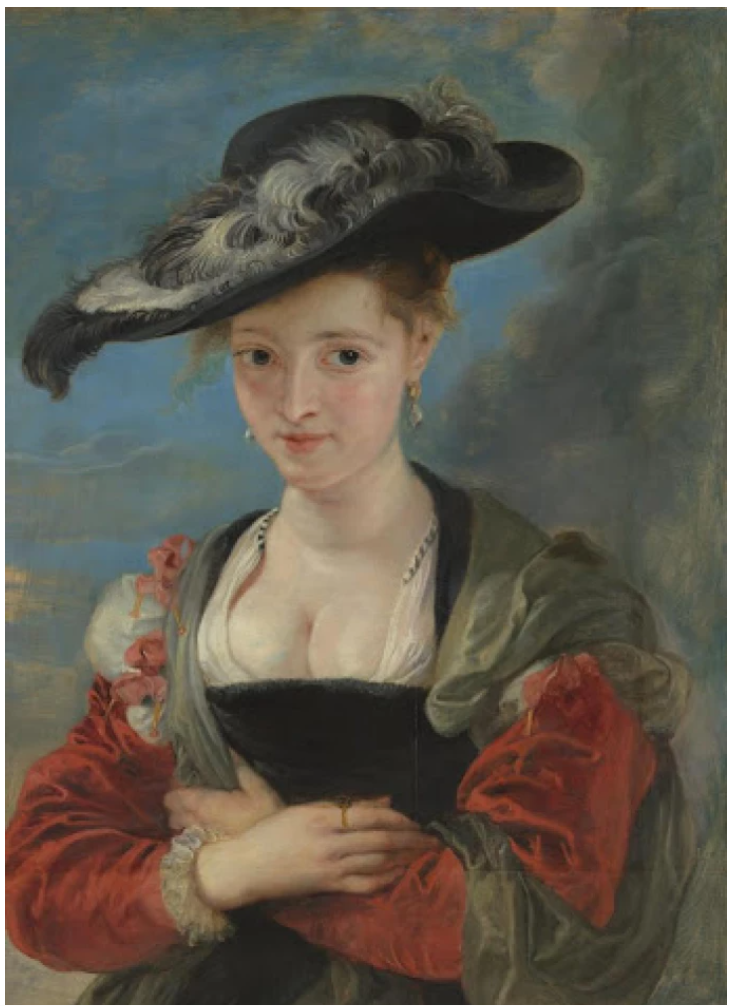
PETER PAUL RUBENS, PORTRAIT OF SUSANNA LUNDEN (‘LE CHAPEAU DE PAILLE’), CIRCA 1622-25
IMAGE © 2023 THE NATIONAL GALLERY, LONDON.
De Kooning’s depictions of women are some of the most significant paintings of the post-war period. They are known for their dense physicality, gestural brushwork, and the overtly sexualized manner in which the artist approaches the female form, exposing her body, skin, and features. However, unlike his more aggressive, maniacal, and even grotesque looking women of the 1950s, his East Hampton women have an overall ebullience. His works on paper are particularly evident of his inspiring new surroundings; in Woman In Landscape XVI, de Kooning’s hand is fast and light, and the composition has an airy freshness uncommon of his paintings on canvas. Though balanced and elegant, the composition still pulsates with a rhythmic tension created by the elaborate color schemes and the subject’s fleshy folds, projecting a sense of tactile sensuality, which recalls the voluptuous female portraits of Peter Paul Rubens and the Old Masters. De Kooning’s interest in light and reflection is immediately apparent in Woman In Landscape XVI, as he created most of his East Hampton works exclusively during daylight hours to amass the out-of-doors colors only found in natural light. Striking eyes and red lips, pronounced breasts, a shock of orange hair, and claw-like limbs appear as the most legible demarcations of the figure who dominates the composition, a colorful and kaleidoscopic rendering of the female form. Nature and woman, de Kooning’s enduring muses, are intimately intertwined in the present work, resulting in a seamless blend of painterly bravura and compositional brilliance. Ultimately, in composition, surface, and impressive color, Woman In Landscape XVI declares once again that de Kooning’s art is at its best when transmuting the tactile pleasures of the female form and verdant landscape within the embrace of the visceral plasticity of paint.
Standing Woman and Trees, 1965
Sotheby’s New-York: 17 May 2023
Estimated: USD 500,000 – 700,000
USD 635,000
Standing Woman and Trees | Modern Day Auction | 2023 | Sotheby’s
WILLEM DE KOONING (1904 – 1997)
Standing Woman and Trees, 1965
Oil on paper mounted on board
25 1/2 x 22 7/8 inches (64.7 x 58.1 cm)
Signed de Kooning (lower right)
Willem de Kooning’s Standing Woman and Trees from 1965 is a brilliantly colorful and effervescent contribution to de Kooning’s oeuvre, critically bridging the gap between his iconic figurative paintings in the 1950s and the abstract work which consumed the last twenty years of his practice. Executed shortly after his relocation to East Hampton, this radiant work employs the vitality and gestural freedom of de Kooning’s abstract works from the 1970s but demonstratively draws upon elements of his famed 1950s figurative vernacular. Although de Kooning’s celebrated Women of the 1950s were by no means resolutely figurative, there are elements of the present work that appear to move further from figuration and closer to the celebrated gestural abstractions of the 1970s. In particular, de Kooning’s treatment of the paint, which veers from sinuous to strident, lyrical to brash, preempts the extraordinary balance of tranquility and chaos that defines his later paintings, in which riots of brilliant hues and undulating collisions of line and form combine to form perfectly balanced compositions. De Kooning was certainly influenced by his new environment; compared to the city life, East Hampton provided lush greenery, bright blue skies, and calming waters as inspiration. Importantly, Standing Woman and Trees is also one of the first Woman paintings de Kooning made, underscoring its significance as both an evolving distillation of this pivotal subject, and a conflation of the two key artistic explorations in de Kooning’s career.
Woman, circa 1952-1953
Christie’s New-York: 13 May 2021
Estimated: USD 7,000,000 – 10,000,000
USD 8,489,500
Willem de Kooning (1904-1997), Woman | Christie’s (christies.com)
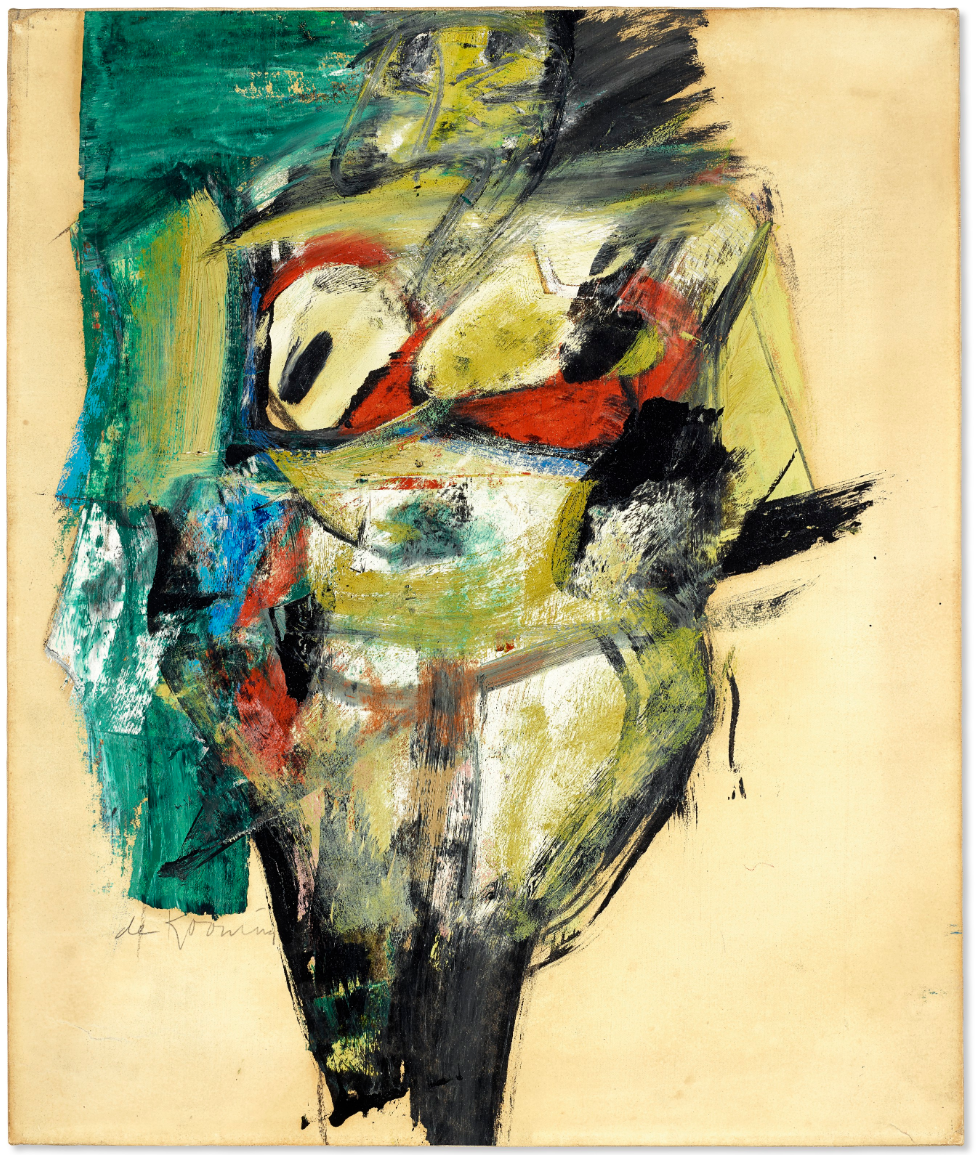
WILLEM DE KOONING (1904-1997)
Woman, circa 1952-1953
Oil, enamel and charcoal on paper laid down on canvas
22 5/8 x 19 inches (57.5 x 48.3 cm)
Signed ‘de Kooning’ (lower left)
Willem de Kooning’s Woman is a vivacious example from one of the most radical bodies of work in the Western Post-War art historical canon. Obsessively worked during intense periods of creativity between 1952-1953, this painting is a force of nature; a voluptuous and contorted figure executed in the artist’s vibrant color palette and with the flourish of his peripatetic hand. De Kooning’s distinctive interpretations are arguably the most striking portrayals of the female figure since Pablo Picasso’s 1907 masterpiece Les Demoiselles d’Avignon. Thus, his Woman paintings stand alongside some of the most iconic works of art of the past one hundred years: other examples from this pivotal period in de Kooning’s career include Woman I, 1950-1952 (Museum of Modern Art, New York), Woman with Bicycle, 1952-1953 (Whitney Museum of American Art, New York) and Two Women in the Country, 1954 (Hirshhorn Museum and Sculpture Garden, Washington, D.C.). Woman has been featured in several major exhibitions of the artist’s work; shortly after it was painted, it was selected to be among a small number of paintings exhibited in the American Pavilion at the XXVII Venice Biennale. Later, in 1994-1995, it was included in a major exhibition of the artist’s work at the National Gallery of Art in Washington, D.C., the Metropolitan Museum of Art in New York and the Tate Gallery in London—the only major exhibition to be devoted entirely to de Kooning’s painterly practice. In the present painting, a Rubenesque woman fills the picture plane. Rendered with an exuberant and energetic hand, her frontal form dually distorts, and is a distortion in space. De Kooning flattened his subject, truncated her form with an abridged head and calves, broke her into a slippage of constituent geometric pieces—the large elliptical belly, the jagged arms and opulent breasts. Woman is composed of vigorous, gestural strokes that range from translucent to opaque, thin to thick, and sensual to turbulent. These strokes alternate between control and release in an aesthetic tactic imbued with psychological content.
The principle charge was one of misogyny—these were images of women as evil, threatening, ugly. A secondary charge was that de Kooning had abandoned the pure ideal of abstract art for a return to the messy reality of human flesh. In response de Kooning suggested they represented the feminine part of himself (the anima, in Jungian terms) and remarked that the faces were often self-portraits. One possible view today is to see them as great celebrations in which an artist found new ways of embodying in paint the complexities of man’s feelings for women. As has frequently been pointed out they take their place in a line of images of women as goddess or idol, whether savage or benevolent, which goes back to Cycladic figures, Sumerian idols, and even more ancient Paleolithic fertility figures such as the Venus of Willendorf. De Kooning’s Woman is an exceptional example of one of the most important and influential series of paintings in the 20th century artistic canon. Across its rich painterly surface, the artist adds his own unique contribution to depictions of the female figure that has engaged artists for millennia. Having been included in one of the most important exhibitions of the artist’s work, this painting has been recognized by scholars for its significant contribution to the history of figurative painting as its fluid, abstracted lines proved so groundbreaking at the time of its creation and has ensured its art historical significance today. Within Woman’s voluptuous curves de Kooning offers a unique, very modern, fast-paced, twentieth century vision of the female as both power and sensation.
Woman as Landscape, 1954-1955
Christie’s New-York: 13 November 2018
Estimated: USD 60,000,000 – 80,000,000
USD 68,937,500
Willem de Kooning (1904-1997) (christies.com)
WILLEM DE KOONING (1904-1997)
Woman as Landscape, 1954-1955
Oil and charcoal on canvas
65 1/2 x 49 3/8 inches (166.3 x 125.4 cm)
Signed ‘de Kooning’ (lower left)
Willem de Kooning’s Woman as Landscape is a tour-de-force of 20th century painting. Executed at the height of the artist’s career, this dramatic canvas belongs to a series of works that radically changed the depiction of the female body. When first exhibited in the 1950s, this shocking departure energized and scandalized the art work in equal measure, yet it also takes its place in one of the longest running dialogues in art history as, alongside artist’s such as Botticelli, Titian, Rubens and Ingres, de Kooning tried to encapsulate the definitive female form. Beginning in the 20th century, artists such as Pablo Picasso and Marcel Duchamp began to treat the female body in a radically different way, deconstructing the classical notion of beauty and imbuing it with the complexity inherent in the modern view of femininity. The bold and frenetic nature of de Kooning’s brushwork took this investigation one step further, and came to symbolize the dramatic shifts that occurred during the postwar years. Exhibited in the highly acclaimed Abstract Expressionism exhibition at the Royal Academy of Arts in London, paintings such as this are now firmly established as part of the 20th century art historical cannon. Other examples form the cornerstones of major international museum collections including the Museum of Modern Art, New York; the Whitney Museum of American Art, New York, and the National Gallery of Australia, Canberra. As such, Woman as Landscape is one of the few works from this iconic group of paintings to remain in private hands.
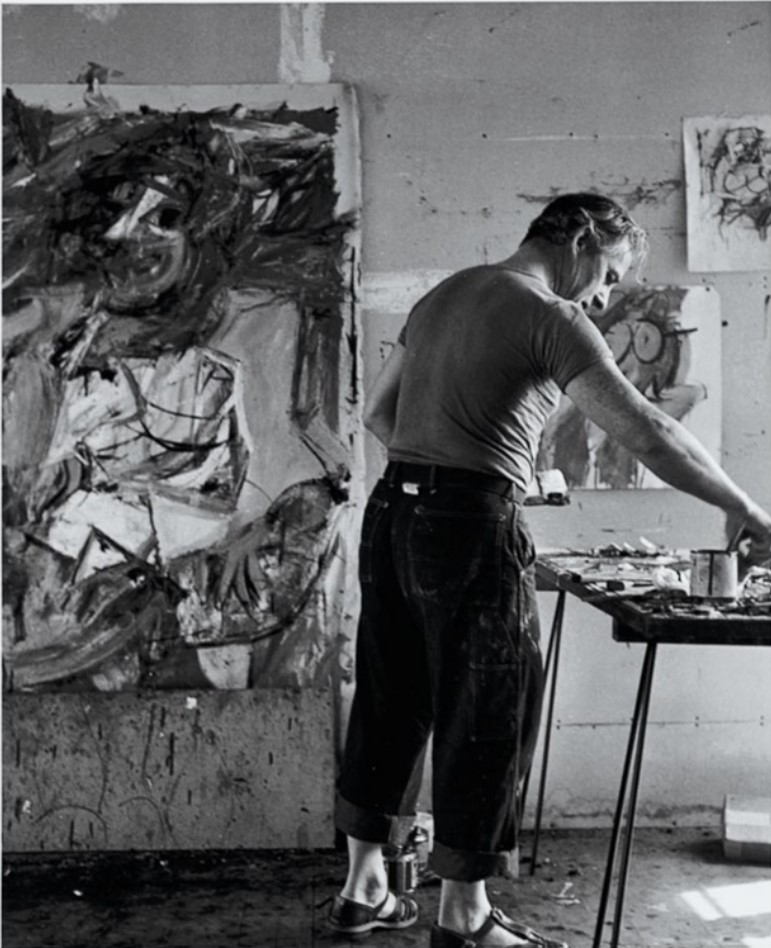 Willem de Kooning in his studio, Easthampton, 1952. Albright-Knox Art Gallery, Buffalo. Photo: Albright-Knox Art Gallery / Art Resource, NY. Artwork: © 2018 The Willem de Kooning Foundation / Artists Rights Society (ARS), New York.
Measuring over five-and-a-half-feet tall, Woman as Landscape is a heroic painting that encompasses the painterly bravado and radical use of color that singled out de Kooning as a leader of the Abstract Expressionist movement. The active surface is comprised of the full range of the artist’s painterly gestures, ranging from broad sweeps of color laid down with the frenetic movement of his brush, to the more controlled interventions made to the surface using the broad edge of a palette knife. Out of this gestural melee, the commanding figure of a woman emerges. Her robust frame expands to fill the picture plane, her largess rendered in passages of flesh colored paint. Expansive lower limbs are formed from the forceful movement of the palette knife that flattens and widens the paint field as it scrapes away previous painterly layers. These substantial limbs support the rest of the figure, which is made up of large planes of expansive color, contained by a series of sweeping, animated lines. The slender angularity of her shoulders are in marked contrast to the substantial nature of these other limbs, and are emphasized by light and dark highlights that caress her silhouette. The other anatomical features of her figure are defined by the rapid movement of the artist’s brush, carving out breasts and other erogenous zones from the central body of the figure. Sitting atop the large body, the head is almost overwhelmed by the anarchy of the artist’s painterly strokes; it consists only of a small oval of pink pigment upon which de Kooning incises two eyes, and angular nose.
Other Paintings
The Artist in His Studio (Self-Portrait), 1966
Christie’s New-York: 17 May 2024
Estimated: USD 700,000 – 1,000,000
USD 781,200
https://www.christies.com/en/lot/lot-6482368
WILLEM DE KOONING (1904-1997)
The Artist in His Studio (Self-Portrait), 1966
Oil, vellum and paper collage mounted on Masonite
23 5/8 x 41 3/4 inches (59.7 x 104.9 cm)
Signed ‘de Kooning’ (lower right)
A sublime testament to Willem de Kooning’s inimitable painterly bravura, The Artist in His Studio (Self-Portrait) provides a glimpse into the artist’s inner perception of himself in a profoundly known environment such as his studio. Painted in 1966, just a few years after his move to East Hampton, The Artist in His Studio (Self-Portrait) envelops the revelations that this move unveiled in his creative output. The lush pigment conveys the artist’s hallmark figural motifs, which are both transformed and accentuated within the dynamic landscape of the coastal environment. This setting is subtly suggested through the incorporation of blue and green hues within the composition.

Sublimely wrapping the viewer in a riot of brilliant strokes, the present work, that was notably held in the collection of John and Kimiko Powers, from the year of its creation for over thirty years, testifies the unequivocal painterly supremacy of de Kooning at the absolute apex of his aesthetic ability.

Francis Bacon, One of two Studies for a Self-Portrait, 1970. © The Estate of Francis Bacon. All rights reserved / DACS, London / ARS, New York 2024.
This radiant work employs the vitality and gestural freedom of de Kooning’s abstract works from the 1960s but expressively retains elements of his celebrated 1950s figuration. While at once drawing upon syllabary of his famed figurative vernacular, de Kooning was certainly influenced by his new environment that provided lush greenery, bright blue skies, and calming waters as inspiration. Describing the profound impulse he found in the pastoral landscape of his East Hampton surroundings, de Kooning revealed:
“I wanted to get in touch with nature. Not painting scenes from nature, but to get a feeling of that light that was very appealing to me, here particularly… I got into painting in the atmosphere I wanted to be in”

Pablo Picasso, The painter and model in the studio, 1963. Centre Georges Pompidou, Paris. © 2024 Estate of Pablo Picasso / Artists Rights Society (ARS), New York.
In The Artist in His Studio (Self-Portrait), de Kooning’s slippery, limpid forms rendered in his soft, manipulable pigment oscillate between abstraction and figuration, the composed and the agitated, all with the artist’s unmistakable dynamic color palette and brushwork. With its landscape format, de Kooning allows himself the freedom to create an enlarged perspective; every gesture and splatter is laid bare as colors, lines, and forms elide into one another.

Beaming with an emotional sentiment that upholds de Kooning’s deep connection to the vital moment represented in the composition, the present work richly captures the atmospheric serenity of the artist’s seaside surroundings while juxtaposing the inner frenzy that the artists experienced in his studio. The Artist in His Studio (Self-Portrait) is a testament to de Kooning’s career-long ability to negotiate the boundaries between figure and ground, through which the artist is able to create an ecstatic vision of natural splendor and personal feeling: an encapsulation of emotive memory.
Man in Wainscott, 1969
Christie’s New-York: 16 May 2024
Estimated: USD 4,000,000 – 6,000,000
USD 8,690,000
https://www.christies.com/en/lot/lot-6482951
WILLEM DE KOONING (1904-1997)
Man in Wainscott, 1969
Oil on paper and newsprint collage mounted on canvas
60 x 48 1/4 inches (152.4 x 122.6 cm)
Signed ‘de Kooning’ (lower left)
Man in Wainscott is testament to Willem de Kooning’s lifelong investigation into the intersection between the physical properties of paint and notions of figural representation. Rendered on a majestic scale, the present example is a coalescing of active brushwork and saturated, cascading color. The lower third is built up from white, cream, light blue, and a variety of other tones into a form that brings our eyes toward the central element, where a forceful dash of red appears. Amidst the highly charged brushwork, a figure emerges in true de Kooning fashion. Never one to completely give up on representation in the face of Abstract Expressionism, de Kooning in the 1960s and 1970s saw a marked evolution of his ability to meld painterly passages with barely discernable figures. Here, the titular man only becomes visible because of a central area that resembles a voluminous blond beard topped with two dark-rimmed eyes. Nearly lost within the maelstrom of painted paper and turbulent marks, this visage anchors the work and helps the viewer to begin separating the person from the green, yellow, and gray of the lush landscape behind him.
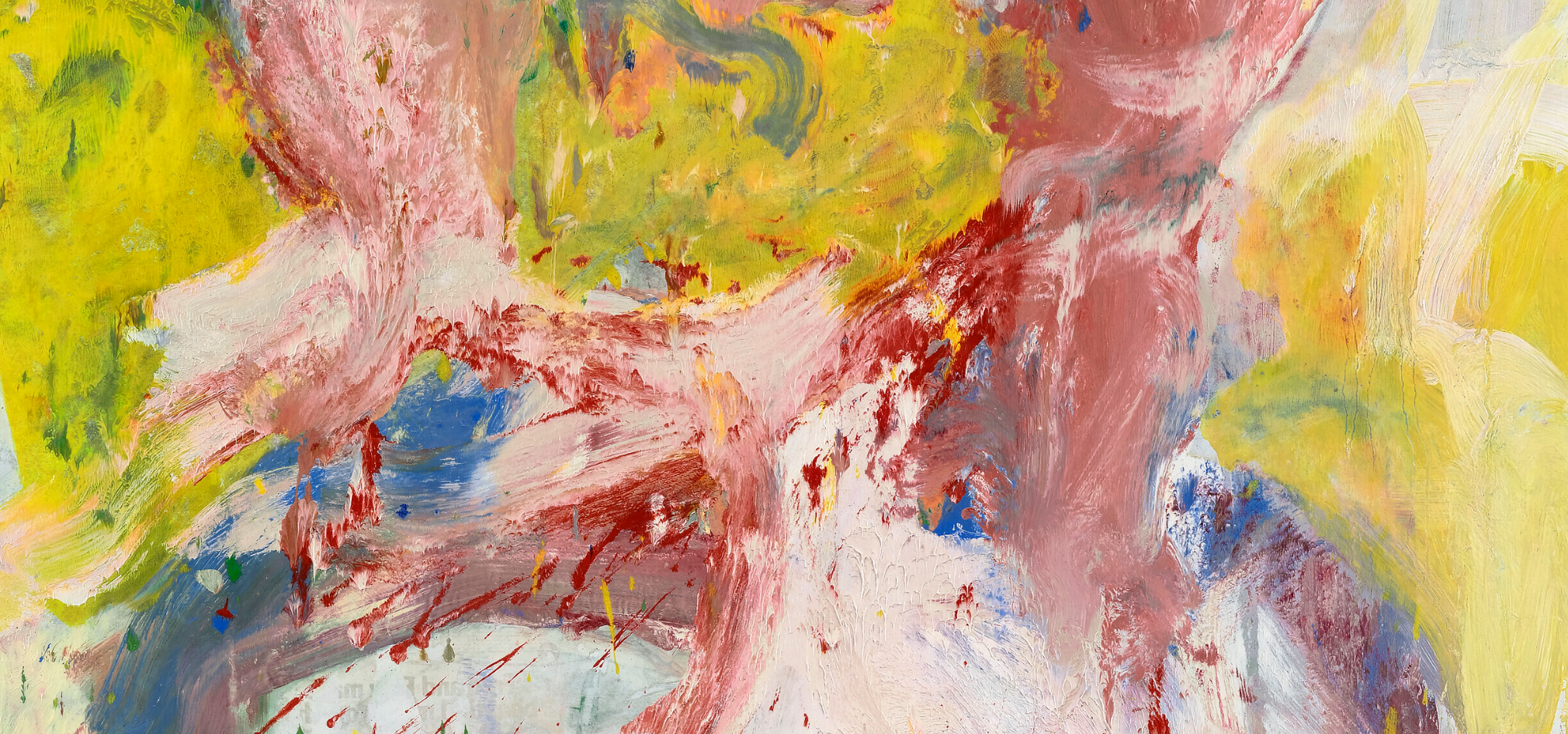
Man in Wainscott is particularly notable for its material composition and its inclusion of collaged elements. De Kooning worked in a variety of methods, but drawings, sketches, and the use of different preparatory elements were key to his investigative process. This example shows the result of the painter peeling away paint with paper and newsprint to create impressions of his active brushstrokes before he disguised them on the surface of the canvas. Extracting visual information from process, de Kooning was able to glean inspiration from elements that may not have been right for the final image initially but found their place within the larger compositional structure. In the mid-1950s, de Kooning moved away from the bustle of New York City in favor of the more idyllic setting of East Hampton on Long Island and its neighboring hamlet of Wainscott. Here, he was influenced by the natural world, especially the nearby water and the open spaces not afforded to denizens of a metropolis. Man in Wainscott was painted during this especially productive era and followed the same formulations that the artist worked on with his ‘Woman in Landscape’ theme which was revitalized in the late 1960s and early 1970s. Instead of placing the subject as a focal point in some bucolic backdrop, the person and place were amalgamated into a singular abstraction that was at once recognizable and also a demonstrable record of de Kooning’s dynamic process.
Sagamore, 1955
Christie’s New-York: 16 May 2024
Estimated: USD 1,500,000 – 2,000,000
USD 1,744,000
WILLEM DE KOONING (1904-1997), Sagamore | Christie’s
WILLEM DE KOONING (1904-1997)
Sagamore, 1955
Oil, enamel and charcoal on paper laid down on board
22 5/8 x 27 5/8 inches (57.5 x 70.2 cm)
Signed ‘de Kooning’ (lower right)
Painted in 1955 during a period of rapturous innovation, Willem de Kooning’s Sagamore is notable not only for its virtuosic brushwork but also for the richness of its abstraction. Created toward the end of his breakthrough Women paintings, this canvas set the stage for a more pointed investigation of the bustling urban sphere in which the artist lived. Never completely abandoning representation like his fellow Abstract Expressionists, de Kooning worked to infuse his heavily-worked surfaces with allusions to figures, buildings, and daily life. Unrepentantly abstract, Sagamore extracts a gritty energy from the city and transforms it on the picture plane. The buildings and the bustle are there just below the surface waiting to burst forth. A bold yet intimate example, Sagamore is rife with the overwhelming energy that de Kooning harnessed within his expansive oeuvre. Realized atop a barely-seen neutral ground, thick areas of impasto oil and enamel have been applied in vigorous strokes. Bits of charcoal, themselves reminders of the artist’s sincere preparatory process, peek out from the edges but are quickly consumed by their colorful counterparts. This practice of supportive drawings found a corollary in de Kooning’s colleague Arshile Gorky, who similarly embraced a confluence of line and bright color to fight against the supremacy of the Cubist grid. In Sagamore, this structure is pushed and twisted as the lower left area of bright canary yellow draws the eye immediately while the lower right is a mottled mixture of blue, pink, and gray that fades backward. The top portion is dominated by two patches of bodily peach that are tangled in a visceral net of red and black. Green, white, and aquamarine peer through as well in a bawdy display of hues typical of the artist’s extensive palette.
“One day, I’d like to get all the colors in the world into one single painting.”
Areas in which myriad hues coalesce into a cloudy amalgam are the result of de Kooning applying newsprint to the wet surface and peeling it back as a means of altering his compositions with a more automatist bent. These looser planes are balanced by the decisive black strokes that spiderweb throughout the composition, their bold presence encapsulating each field of color like outlines that push the viewer into thinking about the painter’s more representative works.
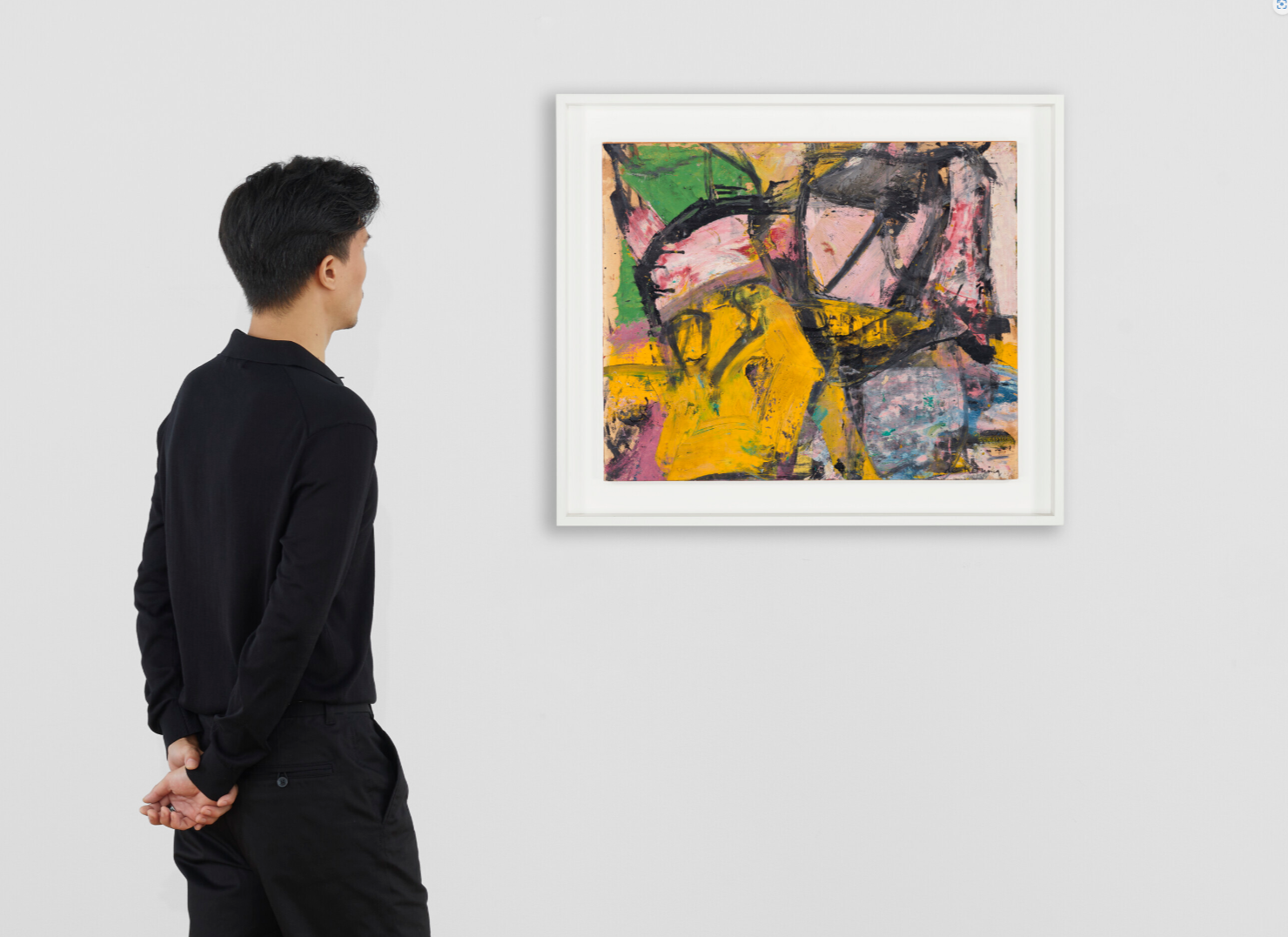
De Kooning’s practice drew upon the world around him, and as such Sagamore was likely inspired by a diner of the same name that was located near the artist’s studio on Third Avenue and Eighth Street in New York City. This beatnik establishment, situated within the heart of the creative community at the time, would have been a perfect vantage point for the painter to observe the comings and goings of the Lower East Side. Evolving out of the early figuration of his critically acclaimed Women paintings, the Abstract Urban Landscapes, of which the current example is a member, have that same fleshy handling of paint that the artist adopted as his signature. Though ostensibly an abstraction of the city around him, Sagamore takes cues from earlier works like Woman and Bicycle (1952-1953) where the titular subject melds entirely with her surroundings. The present work is not as much a representation of the diner but more so the nonstop vitality and movement that surrounded its edifice. The pulsating human energy of New York is vibrantly on display as buildings morph into torsos and streets become meandering appendages. However, there is no direct connection to a particular person, place, or thing. Instead, the very spirit of the urban realm is translated through the artist’s brush. There is no ground plane, no perspective, and no immediate focal point in these abstractions.
“I try to free myself from the notion of top and bottom, left and right, from realism! Everything should float.”
This idea is especially poignant in works like Sagamore where representation fades into the background and the artist’s more painterly actions come to the fore. Alternating between heady reflection and vivacious action, de Kooning painted in bursts of energy in order to capture the action of painting as instantaneously as possible. Nonetheless, rather than approaching the canvas with wild abandon, he ruminated intensely upon his next steps before lashing out with hardware store brushes and salad bowls filled with homemade paint mixtures. Using emulsifiers to fluff his oils into a thick froth, de Kooning brought tactility to his surfaces that always remarked upon the long tradition of fleshy figures throughout art history. Even in works like Sagamore, which take their subjects from cityscapes and the urban sprawl, one is hard-pressed to discount the meaty, corpulent pinks and reds as they squirm against their surroundings like people pressed against each other on the sidewalks or subways of New York.
Untitled, 1967
Sotheby’s New-York: 16 May 2024
Estimated: USD 400,000 – 600,000
USD 825,500
Untitled | Modern Day Auction | 2024 | Sotheby’s
WILLEM DE KOONING (1904 – 1997)
Untitled, 1967
Oil and charcoal on vellum mounted on canvas
53×42 inches (134.6 x 106.7 cm)
Signed de Kooning (lower left)
Awash in pearlescent, evanescent color, Willem de Kooning’s Untitled is exemplary of the artist’s unparalleled master of gesture, with vibrant coral, golden yellow, deep red and tantalizing white and aquamarine pigments, scrawled across the expansive surface. Executed in 1965, Untitled is a brilliantly colorful and effervescent contribution to Willem de Kooning’s oeuvre, critically bridging the gap between his iconic figurative paintings in the 1950s and the abstract work which consumed the last twenty years of his practice. Executed in 1967, shortly after his relocation to East Hampton, this radiant work evinces the vitality and gestural freedom of de Kooning’s abstract works from the 1970s but demonstratively draws upon elements of his famed 1950s figurative vernacular. Although de Kooning’s celebrated Women of the 1950s were by no means resolutely figurative, there are elements of the present work that appear to move further from figuration and closer to the celebrated gestural abstractions of the 1970s. In particular, de Kooning’s treatment of the paint, which veers from sinuous to strident, lyrical to brash, preempts the extraordinary balance of tranquility and chaos that defines his later paintings, in which riots of brilliant hues and undulating collisions of line and form combine to form perfectly balanced compositions. De Kooning was certainly influenced by his new environment; compared to the city life, East Hampton provided lush greenery, bright blue skies, and calming waters as inspiration. Adopting the pastoral with a new highly-keyed palette, embracing hues that emit a dazzling light. De Kooning took to the paper with a newfound sense of vitality and fervor. Dancing between these two poles of expression, Untitled lyrically and energetically captures the complexity, breadth and luminosity of de Kooning’s work, and embodies the development of his style from the 1950s to the 1970s.
Souvenir de Toulouse, 1958
Sotheby’s Hong-Kong: 5 October 2023
Estimated: HKD 50,000,000 – 70,000,000
HKD 39,170,000 / USD 5,006,552
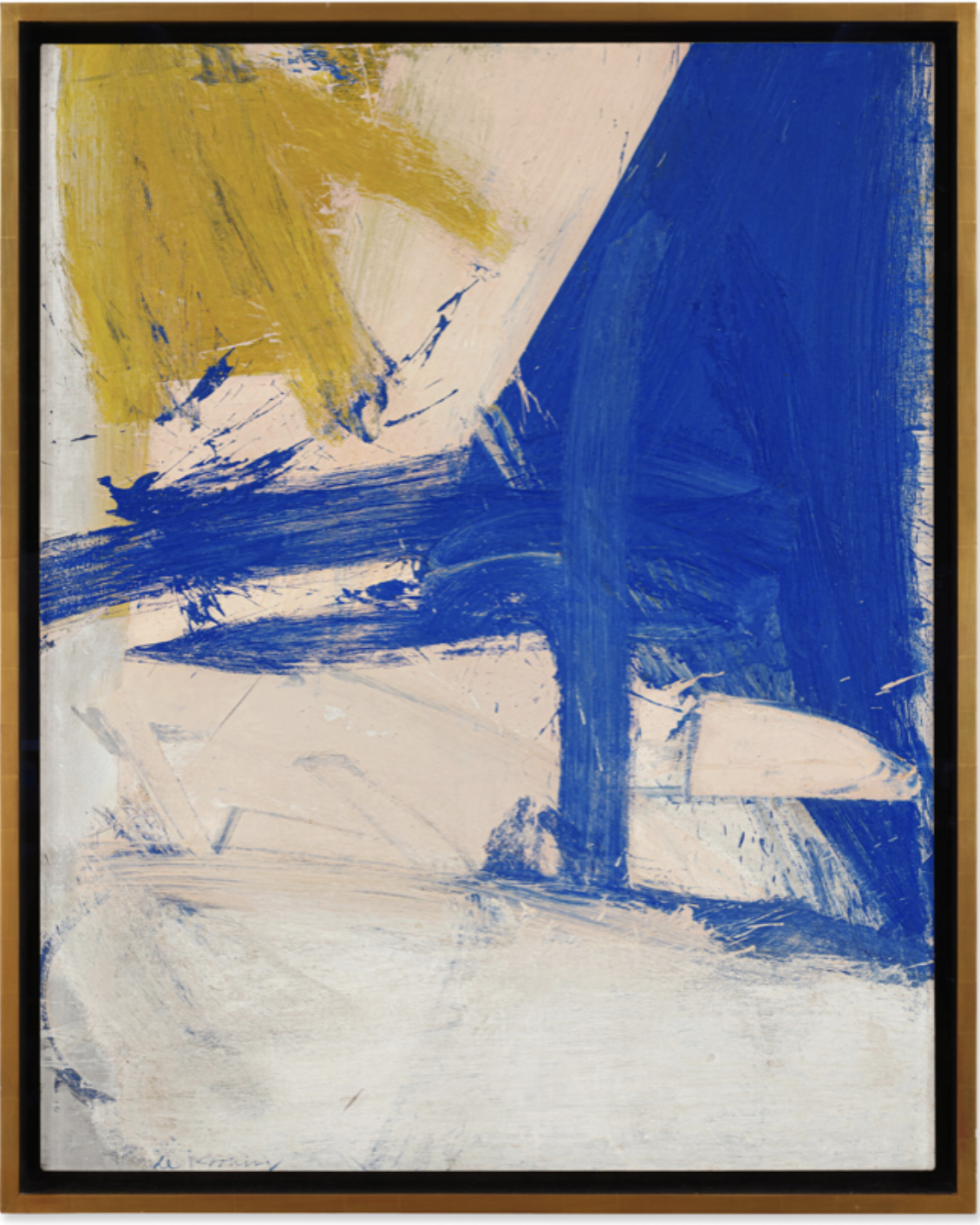
WILLEM de KOONING (1904 – 1997)
Souvenir of Toulouse, 1958
Oil on canvas
160 x 125.7 cm (63 x 49 1/2 inches)
Having remained in the same private collection for almost 30 years, Souvenir of Toulouse (1958) is a rare and emblematic example of Willem de Kooning’s masterful painterly practice to be offered at auction in Asia. Executed during de Kooning’s critical years of 1957-1959, the present work derives from an important period of transition in the artist’s career during which de Kooning started to turn his focus away from New York City. In 1957, de Kooning began to frequently shuttle between New York City and Long Island, deriving inspiration from the motorways; his paintings of the late 1950s reflect the landscape as seen from a moving car, evoking the subjective vision of blurred horizons, fields, and roads. These works, which the critic Thomas B. Hess later described as the “abstract parkway landscapes”, were some of the most gesturally expressive paintings de Kooning had made to date, exuding a palpable velocity and demonstrating a strong new dependence on colour rather than his previous penchant for line. Indeed, Souvenir of Toulouse was bought by Thomas B. Hess—a highly influential figure in the art world who was an early and ardent champion of Abstract Expressionism; friend and proponent of de Kooning; author of numerous of the artist’s monographs; and the organizer of de Kooning’s landmark mid-career retrospective at the Museum of Modern Art, New York in 1969—and remained in his collection until after his death, testament to the importance of the present work as a signature example from this pivotal period in de Kooning’s inimitable career.
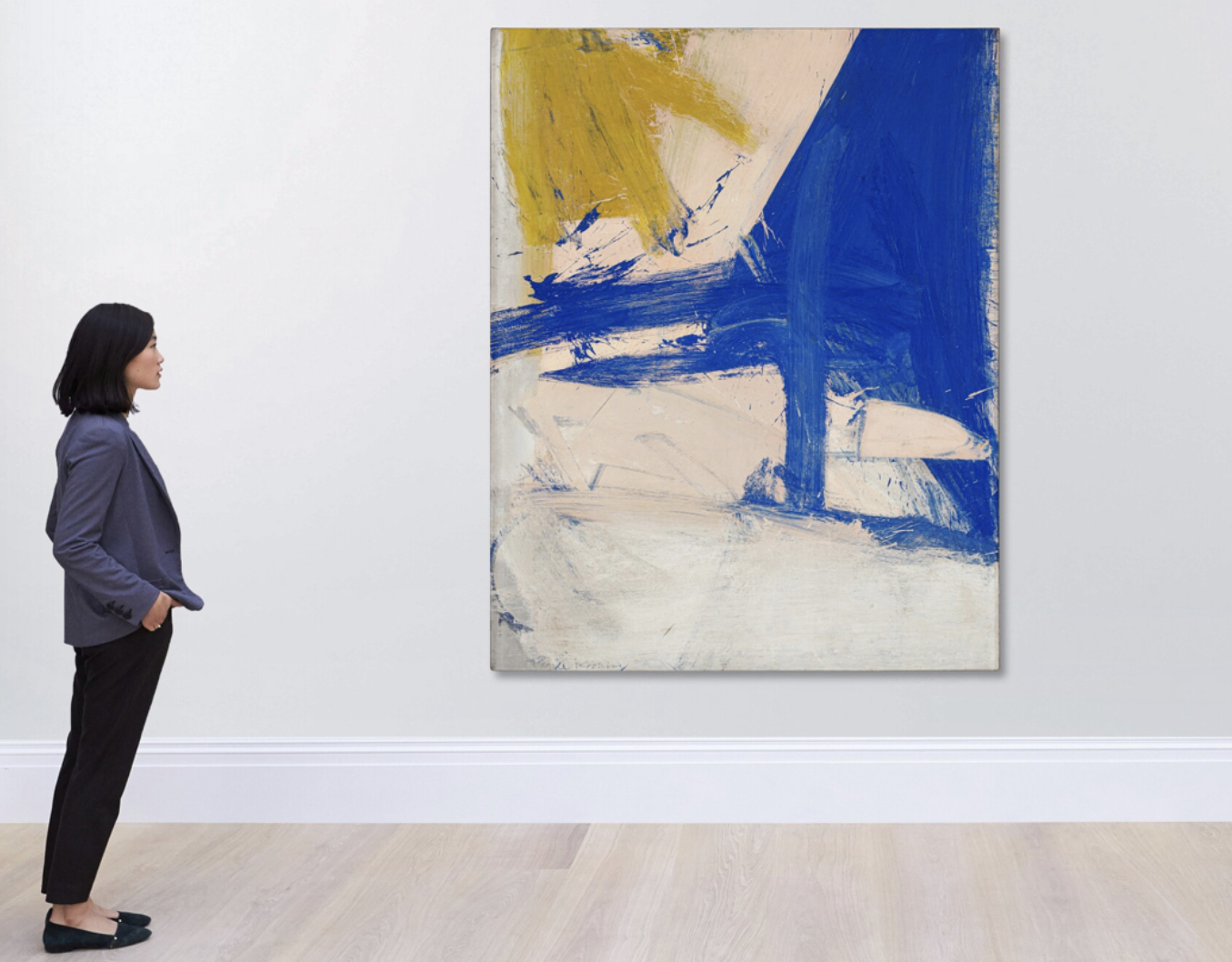
The “abstract parkway landscapes” were first exhibited at the artist’s third one-person show at Sidney Janis Gallery on 4 May 1959, showcasing 22 abstract works on paper and on canvas. The exhibition was an immediate and resounding hit with critics and collectors alike, with visitors lining up outside the door from 8:15am; 19 works sold by noon; and the three-remaining sold by the end of the week. At the debut of this series at Sidney Janis Gallery, Hess observed: “most of them are landscapes and highways and sensations of that, outside the city, with the feeling of coming to the city or coming from it… paintings, angles and sections from the breasts and elbows of [de Kooning’s] Women, from the windows that open to their landscapes, from their hands that had turned into meadows” (Thomas B. Hess cited in Exh. Cat., New York, Museum of Modern Art, de Kooning: A Retrospective, 2011-2012, pp. 317-8). Today, not only do paintings on canvas from this series belong to such pre-eminent museum collections as the Detroit Institute of Arts and the Los Angeles County Museum of Art, but comparable works on paper from 1957-1958 are held in such esteemed collections as the Solomon R. Guggenheim Museum in New York and the National Gallery of Australia, Canberra.
Two Figures, 1968-1972
Christie’s New-York: 17 May 2023
Estimated: USD 3,000,000 – 5,000,000
USD 1,865,000
WILLEM DE KOONING (1904-1997), Two Figures | Christie’s (christies.com)
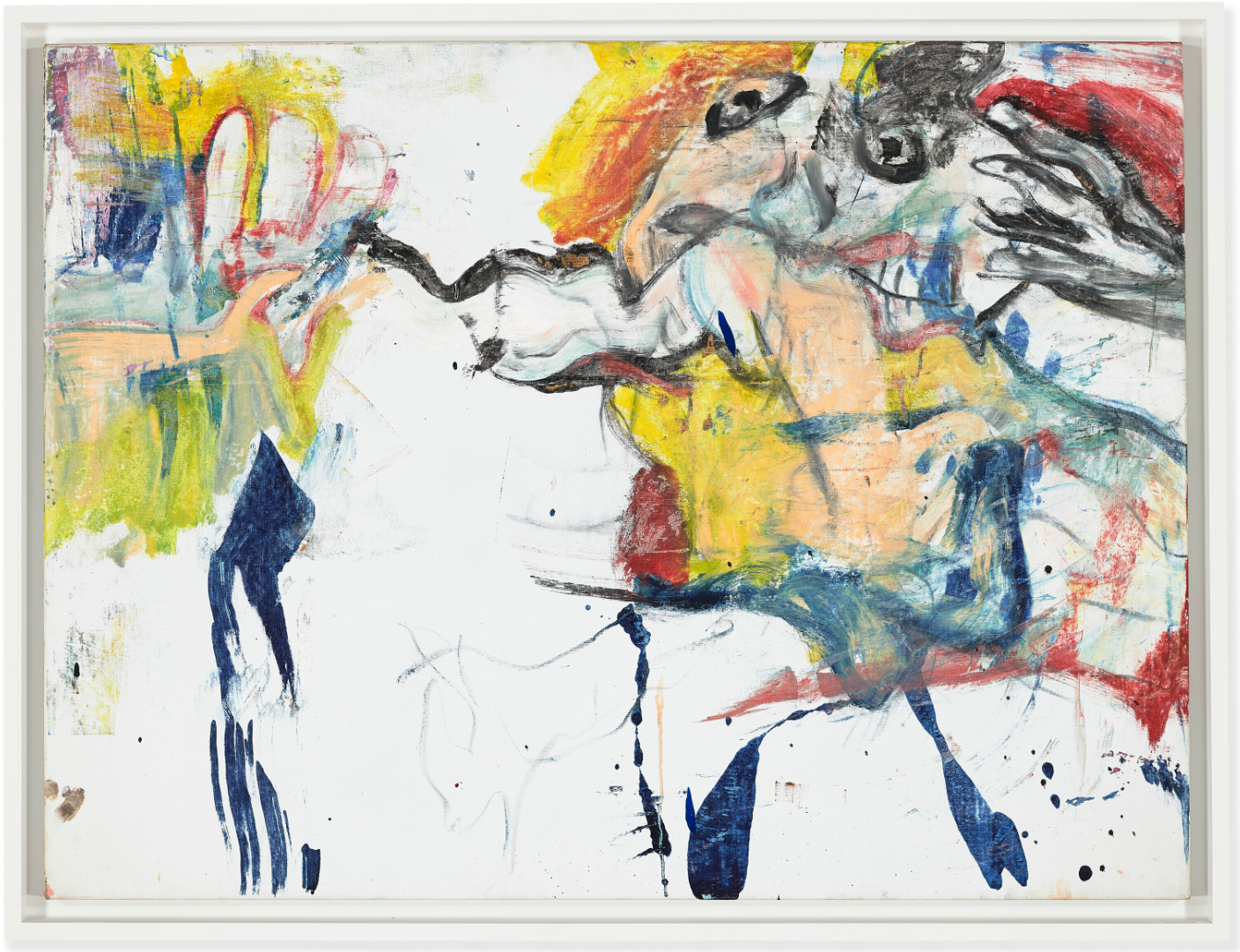
WILLEM DE KOONING (1904-1997)
Two Figures, 1968-1972
Oil on canvas
36×48 inches (76.2 x 121.9 cm)
Painted over a four-year period between 1968-1972, Willem de Kooning’s Two Figures confidently demonstrates the artist’s ability to continuously adapt his past work, while pushing forward into new territory. Leveraging his groundbreaking handling of paint in service of figural abstraction, de Kooning fills the painted surface with a lively dance of gestural forms rapidly fluctuating between recognizable attributes and raw expression. Beginning in the 1950s, he began an investigation of the human form and limits of representation. Working with heavy brushes, thinned paints, and myriad pieces of cloth, paper, and other materials, de Kooning made plain his painterly investigation for all to see. Harnessing the sumptuous nature of his medium, the painter continued to explore one of the oldest subjects as the denizens of his investigations in oil threaten to fuse completely with the heady mixture of liquid and pigment.
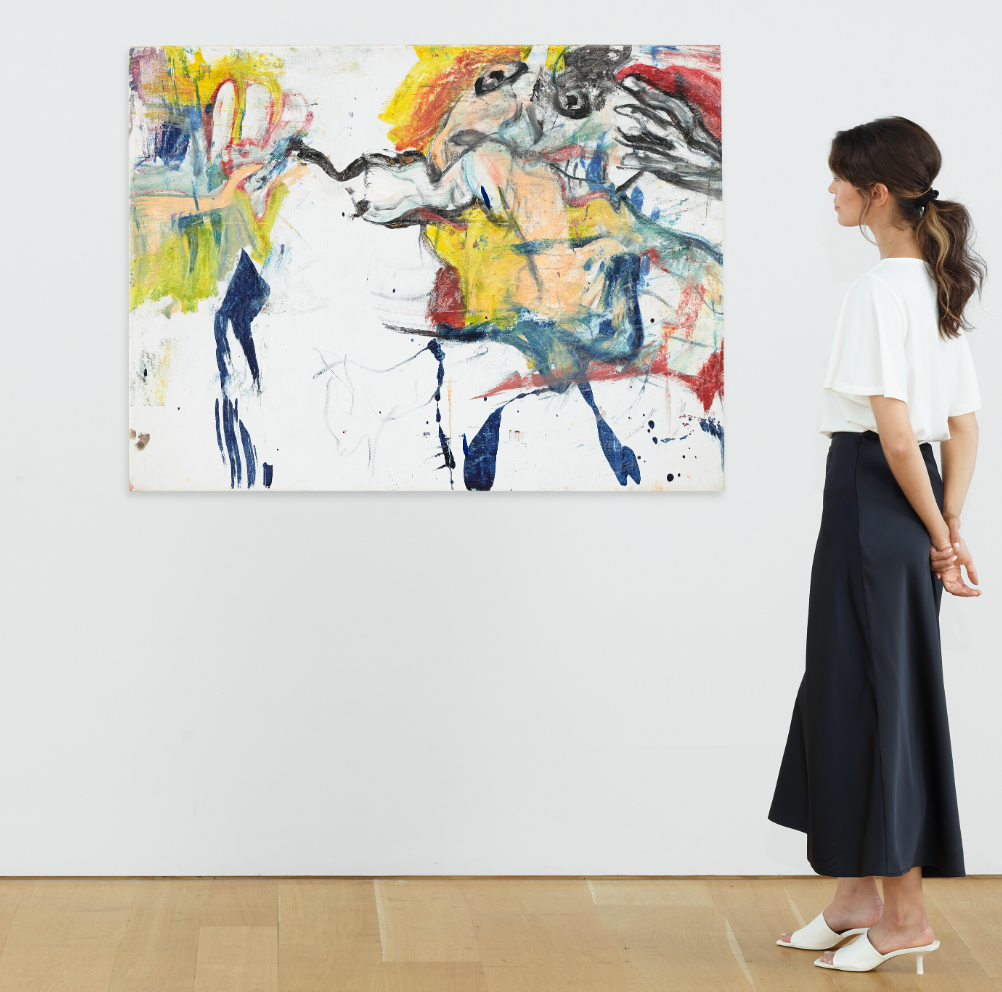
A whirl of color colliding with an expanse of white canvas, Two Figures once again proves de Kooning’s emotive might. Mixing bold incursions with areas of more fluid, hazy color, the artist establishes a visual narrative that pulls the viewer through the painting’s formation. Every stroke, smudge, and drip is on display as they coalesce into a boldly unified composition. On the right, a flurry of yellow, peach, and blue transform into two faces in profile. Their simplified circular eyes stare out at the viewer while simultaneously locking sightlines with each other. The rightmost character has the toothy grimace and red lips of his famed Woman, its dark hair cascading off of the canvas in an energetic rush of black and crimson. The left figure seems to have lighter yellow and orange hair and appears to be reaching across the canvas toward what may be the disembodied arm of someone out of frame. Like Michelangelo’s Creation of Adam, de Kooning’s lines touch in an empty white space that buoys his colorful composition into the heavens. Floating upon the lightness of open canvas, the artist’s machinations are free to pulse and connect, creating a kinetic energy that is increasingly palpable as one views the work. Transmuting flesh into paint and paint into raw vitality, de Kooning instills an absorptive power into the very heart of his canvas.
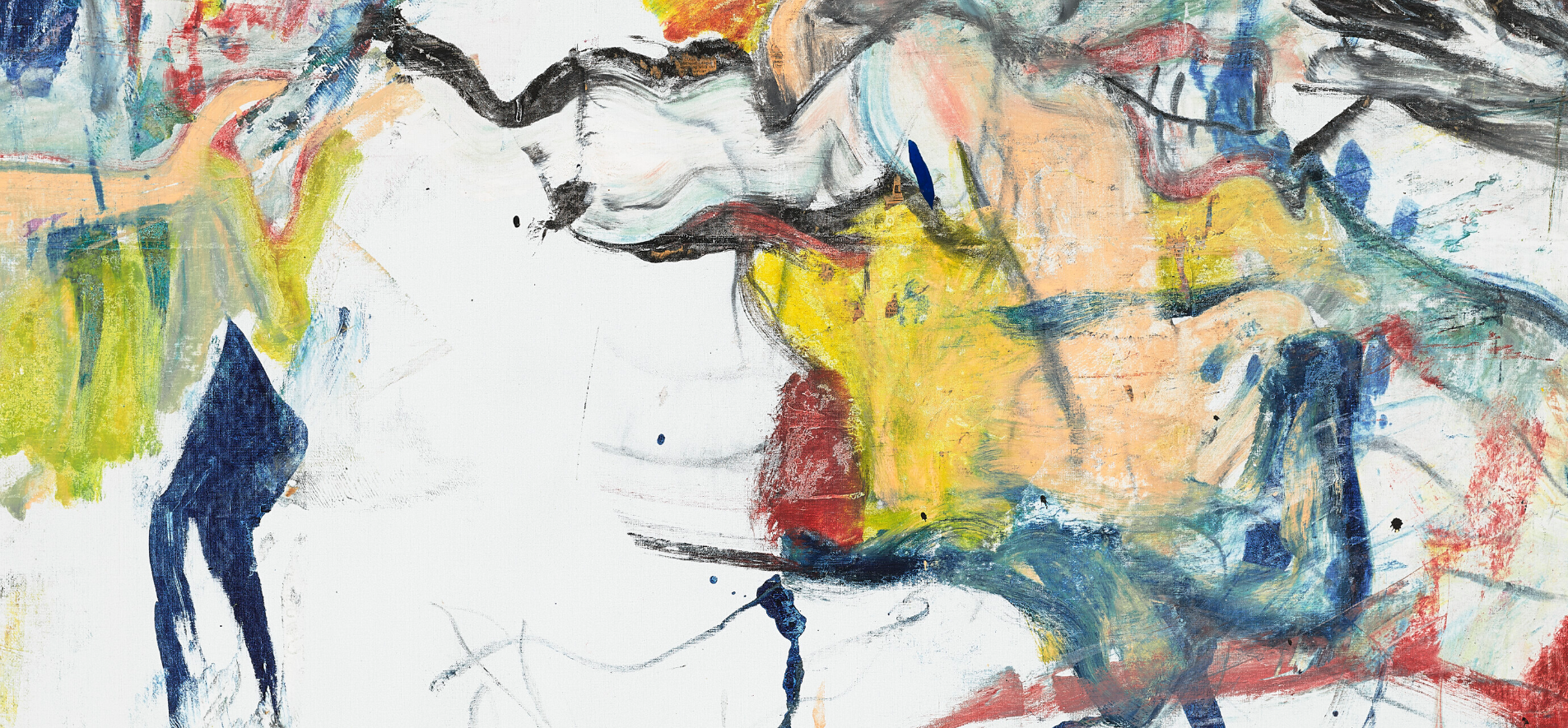
De Kooning’s working methods were as complex and intricate as his roiling abstractions. Never content to merely lay paint to canvas, he would often mix and dilute his colors in a variety of ways so that they applied in a translucent pool onto his surfaces. Taking great pleasure in his idiosyncratic setup, he approached the canvas with all manner of tools in order to achieve the result he sought. But applying the brush was only half of the process. After the color was down, de Kooning would sometimes wet it to spread the paint out even more or, as in Two Figures, he would introduce various external materials. Pressing sheets of paper onto the painted surface, the artist would peel them away to reveal blended areas that helped him see the composition in a new light. Sometimes these de facto monotypes would end up as works in their own right, and other times he would cut and reposition the results into a collage. Two Figures is a prime example of the individualism and dynamism associated with de Kooning’s output of the 1960s, evidencing that his engagement with the female figure worked to transcend the tension between picture and event, observation and genre. De Kooning’s sensuous paintings provoke what it means to depict elementally and radically.
Brown Derby Road, 1958
Sotheby’s New-York: 16 May 2023
Estimated: USD 3,500,000 – 4,500,000
USD 3,327,000
Brown Derby Road | Modern Evening Auction | 2023 | Sotheby’s (sothebys.com)
WILLEM DE KOONING (1904 – 1997)
Brown Derby Road, 1958
Oil on canvas
62 3/4 x 49 1/4 inches (159.3 x 125.1 cm)
Signed de Kooning (lower left)
Executed in 1958, Willem de Kooning’s Brown Derby Road emerges from a radical period of transition for the artist during which he produced the most gesturally expressive paintings he had made to date. In 1957, de Kooning began to shuttle frequently between New York City and Long Island, deriving inspiration from the motorways; his paintings of the late 1950s reflect the landscape as seen from a moving car, evoking the subjective vision of blurred horizons, fields, and intersecting roads. These compositions, including the present work, share a palette of yellow, blue, and ochre, and reveal an artist freeing himself from the constrictions of the city as his sweeping brushstrokes become looser and more powerful. Collectively termed the “abstract parkway landscapes” by editor and curator Thomas Hess, these works were first exhibited at Sidney Janis Gallery in 1959—a mere six years after de Kooning had caused a sensation with his series of Woman paintings—and the show was an unqualified triumph: lauded by critics and sold out within the first week. Today, abstract parkway landscapes are held in such prominent collections as the Los Angeles County Museum of Art, Detroit Institute of Arts, Solomon R. Guggenheim Museum, and Museum Boijmans van Beuningen. Having remained in the same private collection for over twenty years, the present work is a rare and emblematic example of de Kooning’s masterful painterly practice.
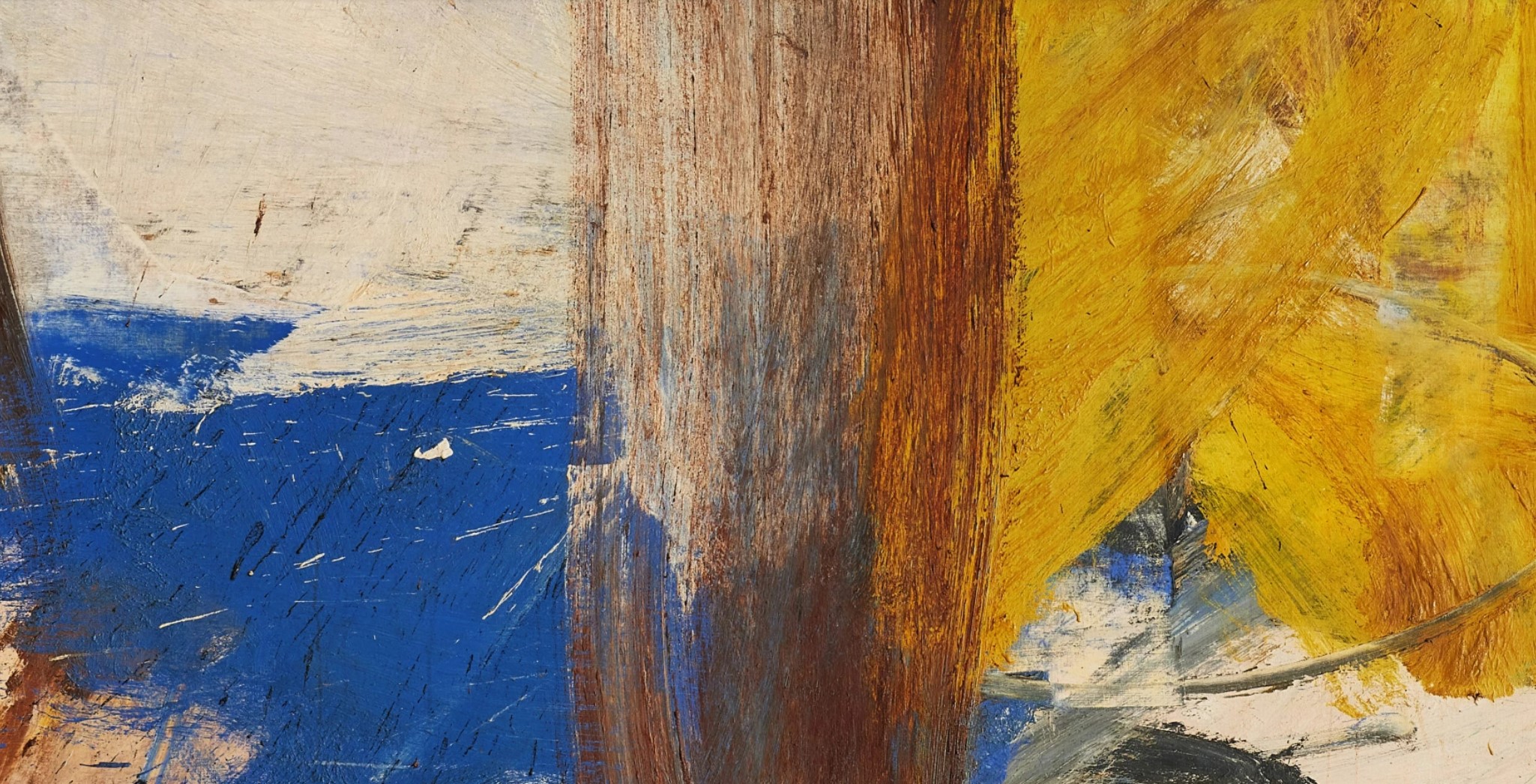
The vigorous gestural swathes of navy, gold, and cream in Brown Derby Road’s composition recall the angular shifts in perspective of the Atlantic coastal landscape de Kooning encountered on his weekend drives. As he explained to David Sylvester, “The pictures [I have] done since the Women, they’re emotions, most of them. Most of them are landscapes and highways and sensations of that, outside the city—with the feeling of going to the city or coming from it… I like New York City. But I love to go out in a car… I’m just crazy about going over the roads and highways … the big embankments and the shoulders of the roads and the curves are flawless—the lawning of it, the grass” (the artist quoted in David Sylvester, “Content is a glimpse…,” Location 1, No. 1, Spring 1963, p. 45-8; reprinted in Harold Rosenberg, De Kooning, New York 1973, p. 206). The product of a wholly abstract vocabulary, Brown Derby Road embraces the historical tradition of pastoral landscape in a modern dialect. De Kooning abridges a planar abstraction of space that seems to suggest the sun and sea as it whizzes past a car window. His broad, open strokes of paint, though purely formal and nonfigurative, nevertheless suggest a representational perspective through their geometric angles and balanced compositional symmetry across the vertical axis. Shifting away from the agitated, heavily worked surfaces of his earlier Women, works like the present show the artist liberating his gesture and moving toward the more fluid style of his later work. Here, de Kooning’s expansive, muscular brushstrokes recall the powerful thrusts of his contemporary Franz Kline, his pastoral composition as redolent of the countryside as Kline’s monochromes are of Manhattan’s energy.
Untitled, circa 1977
Phillips New-York: 15 November 2022
Estimated: USD 4,000,000 – 6,000,000
USD 4,870,000
Willem de Kooning – 20th Century & … Lot 28 November 2022 | Phillips
WILLEM DE KOONING
Untitled, circa 1977
Oil on paper, in 2 parts, laid on canvas
60 1/2 x 41 1/4 inches (153.7 x 104.8 cm)
Signed “de Kooning” lower right
The offering of Untitled, circa 1977, is a rediscovery of one of Willem de Kooning’s most significant paintings on paper from one of his most celebrated periods, the late 1970s. At 60 x 40 inches, it’s of a scale and quality that is on par with his greatest achievements painted directly on canvas. The work comes from the estate of Arlene Gura, a fine arts teacher, collector, and abstract expressionist painter herself, who worked as a docent at the Museum of Fine Arts, Boston.
In Untitled, the artist’s painterly adroitness is on full display: visceral strokes dominate the entirety of the composition, an improvisational yet harmonious flurry of physicality and lyricism. The painting was notably featured in one of the most important documentaries on de Kooning, by the well-known documentary filmmaker, Erwin Leiser. Leiser was born in Berlin and fled from Germany to Sweden at the age of 15 during Hitler’s rise to power. He made over 50 films, and is best known for his documentary Mein Kampf, 1960, a history of Germany under Hitler, which was a box office hit and heralded as the most “effective summation of the Nazi era as recorded on film.” Leiser also made a number of documentaries on artists, including the Nobel Prize winner Isaac Bashevis Singer and three documentaries on de Kooning, which remains the definitive filmed resource on the artist. Throughout the films, de Kooning speaks directly about his life, career and way of painting. Untitled is featured throughout the film, Willem de Kooning and the Unexpected, at one point showing the artist moving it around in his studio. The work is shown tacked to a board and still in progress, revealing the artist’s working method for making his fully realized paintings on paper. Indeed, his meticulous editing process involved arranging his works in progress around him to examine and adjust their compositions in dialogue with each other. Though de Kooning’s paintings are often read as instinctual and spontaneous, the footage of his studio in the film, which captured Untitled before the artist finalized its palette, betrays the extent of his scrupulous reworking.
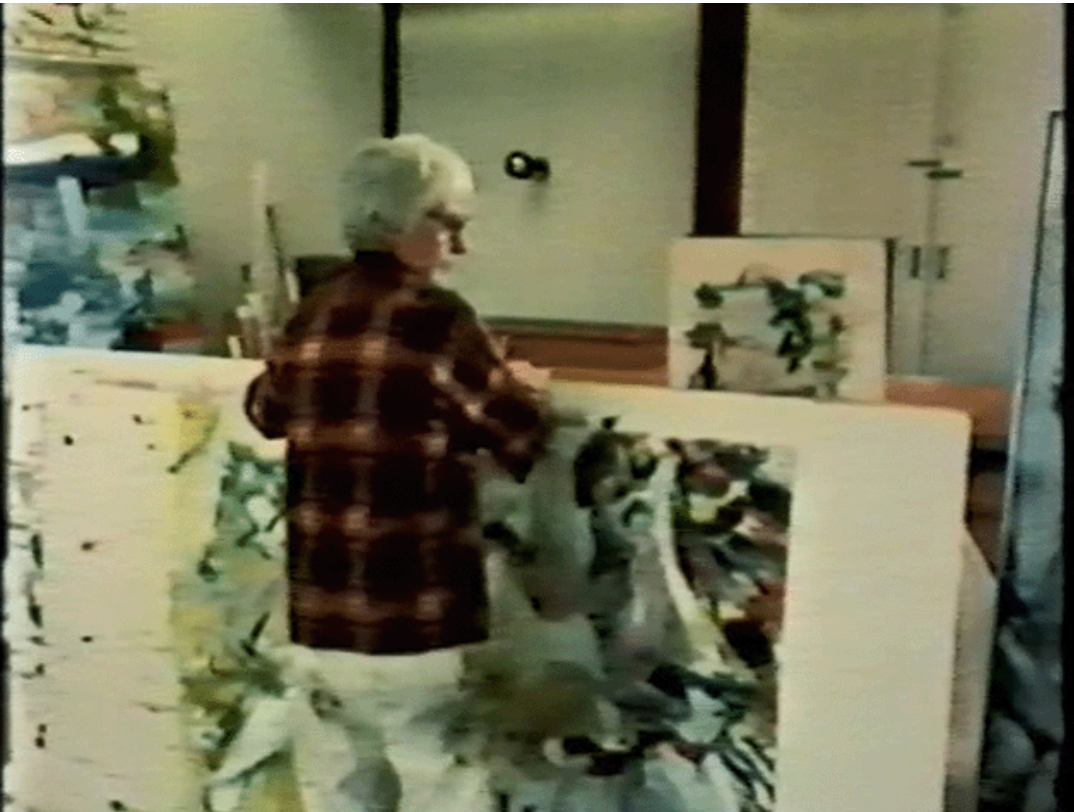
Willem de Kooning carrying the present work in his studio, c. 1977. Artwork: © 2022 The Willem de Kooning Foundation/Artists Rights Society (ARS), New York
The majority of de Kooning’s paintings on paper are not larger than 30 x 40 inches, but he sometimes used larger sheets, or combined two sheets, to create a larger composition. To make Untitled he stacked two sheets of paper horizontally, creating a 60×40 inch arena that approximates one of his most favored canvas sizes, 59 x 55 inches. After painting the sheets to a certain point, they were then mounted onto a canvas where he continued painting until it was finished. Executed circa 1977, Untitled belongs to a fruitful chapter at a high point in the artist’s career, indexed by his renewed commitment to painting after devoting significant efforts to sculpture and lithography in the first half of the decade. The result, according to esteemed curator and art historian Diane Waldman, was “an astonishing body of work” produced between 1975 and 1977, “which is prolific, versatile, extraordinarily high in quality and in many ways different from the canvases that preceded them.” The paintings created in the midst of de Kooning’s rapturous return to his most iconic medium are among his most renowned, both critically and in the marketplace.
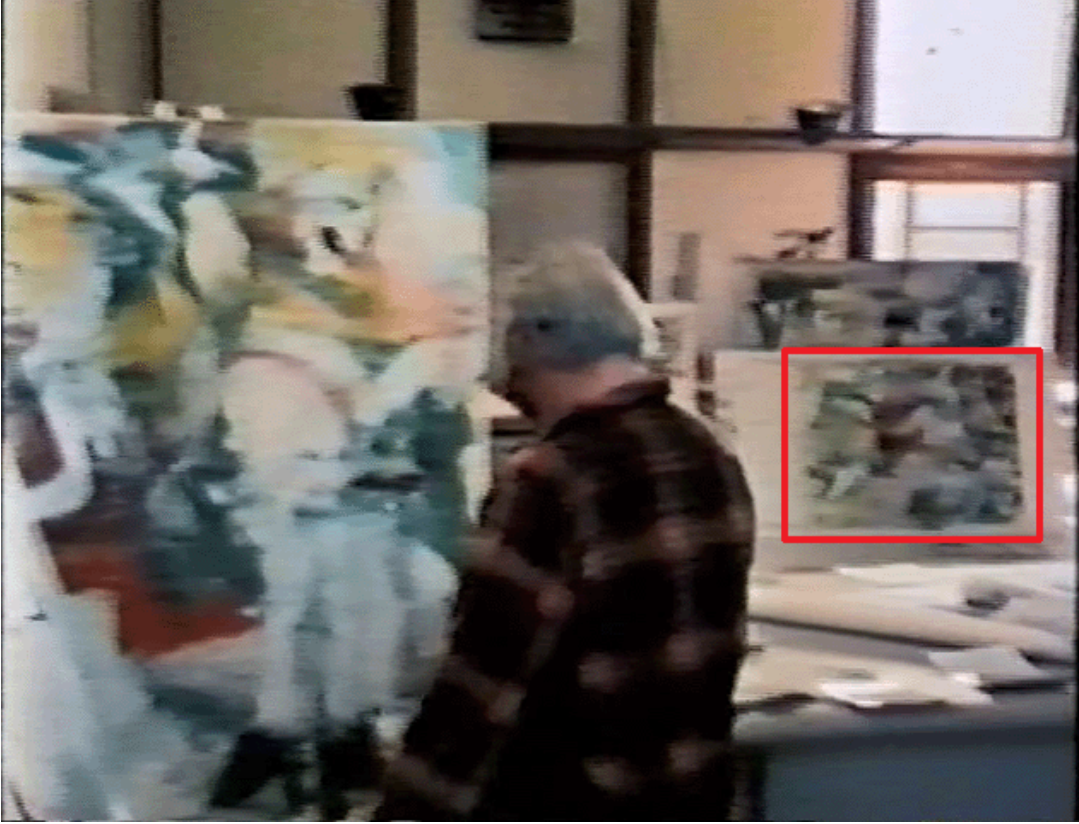 The artist working in his studio, with the present work in the background, c. 1977. Artwork: © 2022 The Willem de Kooning Foundation/Artists Rights Society (ARS), New York
Channeling the tremendous velocity and ineffable rhythms of roiling waves breaking onto the shore, the present work is evocative of the North Atlantic coast that informed the palette and atmosphere of de Kooning’s work in the mid-1970s. The artist had relocated to Springs on Long Island’s East End permanently in 1963, leaving behind the intensity of New York City for a personally-designed spacious studio on the bucolic shoreside. It was not until over a decade later, however, that his environment would conspicuously imprint itself on his artistic idiom. “When I moved into this house,” de Kooning recalled in 1976, “everything seemed self-evident. The space, the light, the trees—I just accepted it without thinking about it much. Now I look around with new eyes. I think it’s all a kind of miracle.” Moving away from the frenetic urban energy behind his paintings from the 1960s—the quintessentially New York City expression of abstraction—he began to embrace a more pastoral mode of representation. Following in the footsteps of Claude Monet at Giverny and Paul Cézanne with Mont Sainte-Victoire, de Kooning began to allow the spirit of natural world that surrounded him to pervade his work.
Untitled, circa 1964
Sotheby’s New-York: 30 September 2022
Estimated: USD 1,800,000 – 2,500,000
USD 4,164,000
Untitled | Contemporary Curated | 2022 | Sotheby’s (sothebys.com)
WILLEM DE KOONING (1904 – 1997)
Untitled, circa 1964
Oil on canvas
55 5/8 c 48 inches (141.3 x 121.9 cm)
Signed de Kooning (lower right)
Pertaining to the same private collection since the 1960s, Untitled is a triumphant example of de Kooning’s career-long investigation into the intersection of abstraction and figuration. Illustrating his masterful ability to marry organic forms with abstract compositions, Untitled wavers between human and landscape, figuration and abstraction. Subtle hints of figuration – a hand, a face, a pair of legs – are swept into a whirlwind of color and energy, morphing de Kooning’s female subject into something evoking a dynamic coastal landscape. Painted in the mid 1960s, Untitled represents a pivotal moment in de Kooning’s career, a period which breathed new life into his practice. It was during this same period that de Kooning made the permanent move from downtown Manhattan to a nature-centric home in East Hampton.
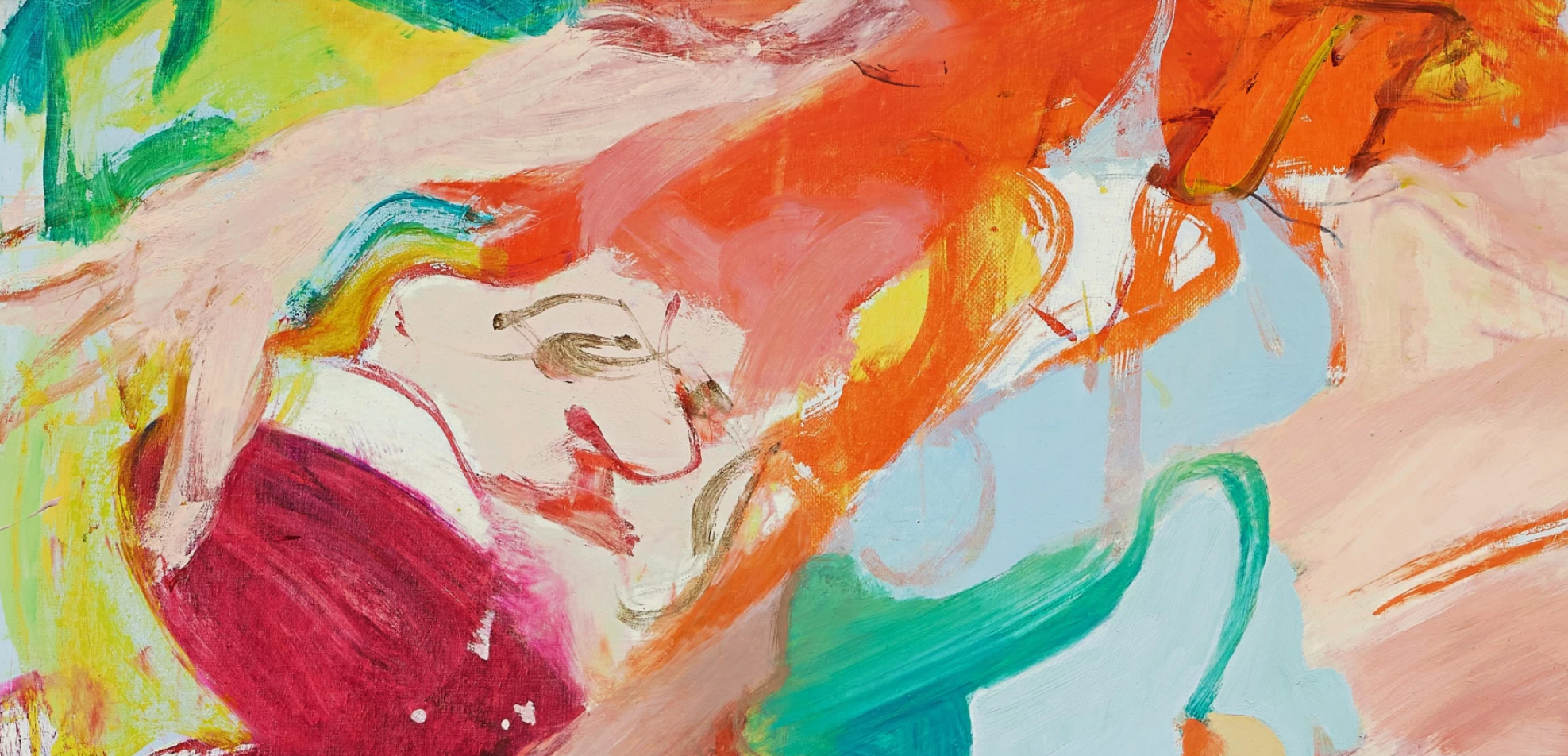
Inspired by the coastal light, open fields, and crashing waves, de Kooning experienced a creative renaissance after settling in East Hampton, with art historian Diane Waldman citing the move as “transformative” and launching a period of increased productivity and creativity. Reflecting on his move in an interview with Harold Rosenberg, de Kooning explained, “I wanted to get back to a feeling of light in painting…. I wanted to get in touch with nature. Not painting scenes from nature, but to get a feeling of that light that was very appealing to me, here particularly. I was always very much interested in water” (Wilem de Kooning quoted in Harold Rosenberg, Interview with Willem de Kooning, ARTnews, September 1972). During this same period de Kooning returned to the female figure as a key subject, following a decade of painting increasingly flat and abstract compositions during his final years in the city. The return of human elements to de Kooning’s paintings was important, as this was perhaps the defining characteristic of his practice and what set him apart from the work of other abstract expressionists during this period in art history
Leaves in Weehawken, 1958
Sotheby’s New-York: 17 May 2022
Estimated: USD 3,000,000 – 5,000,000
USD 10,091,000
Leaves in Weehawken | Modern Evening Auction | 2022 | Sotheby’s (sothebys.com)
WILLEM DE KOONING (1904 – 1997)
Leaves in Weehawken, 1958
Oil on paper mounted on canvas
47 3/4 x 58 3/4 inches (121.3 x 149.2 cm)
Signed de Kooning (lower right)
Executed in 1958, Willem de Kooning’s Leaves in Weehawken emerges from a radical period of transition for the artist during which he produced the most gesturally expressive paintings he had made to date. In 1957, de Kooning began to shuttle frequently between New York City and Long Island, deriving inspiration from the motorways; his paintings of the late 1950s reflect the landscape as seen from a moving car, evoking the subjective vision of blurred horizons, fields, and intersecting roads. These compositions, including the present work, share a palette of yellow, blue, and ochre, and reveal an artist freeing himself from the constrictions of the city as his sweeping brushstrokes become looser and more powerful. Collectively termed the “abstract parkway landscapes” by editor and curator Thomas Hess, these works were first exhibited at Sidney Janis Gallery in 1959—a mere six years after de Kooning had caused a sensation with his series of Woman paintings—and the show was an unqualified triumph: lauded by critics and sold out within the first week. Today, abstract parkway landscapes are held in such prominent collections as the Los Angeles County Museum of Art, Detroit Institute of Arts, Solomon R. Guggenheim Museum, and Museum Boijmans van Beuningen.
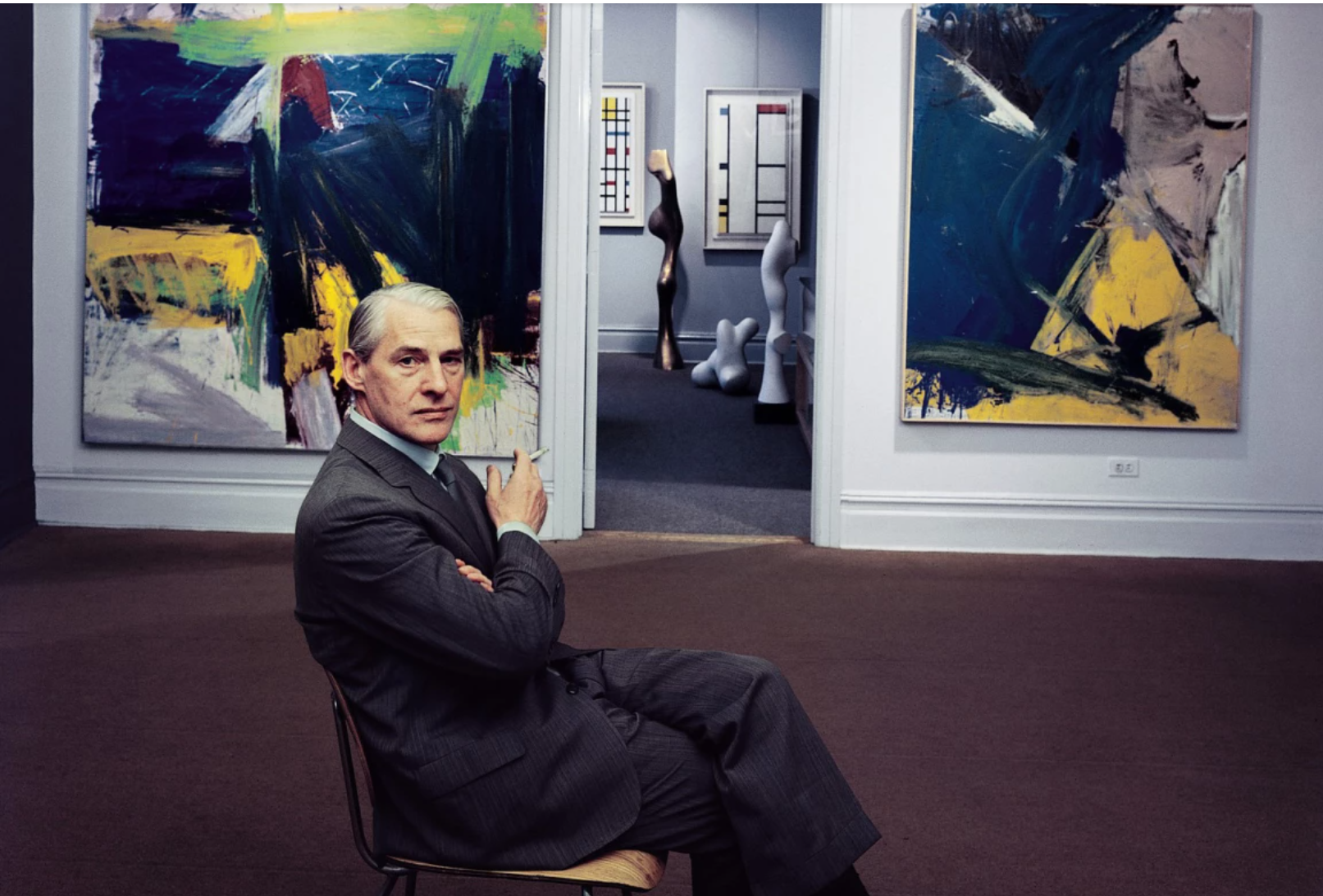
WILLEM DE KOONING AT SIDNEY JANIS GALLERY, NEW YORK, 1959. PHOTO: ARNOLD NEWMAN PROPERTIES/GETTY IMAGES. ART © 2022 THE WILLEM DE KOONING FOUNDATION / ARTISTS RIGHTS SOCIETY (ARS), NEW YORK
The vigorous gestural swathes of navy, gold, and cream in Leaves in Weehawken’s composition recall the angular shifts in perspective of the Atlantic coastal landscape de Kooning encountered on his weekend drives. The product of a wholly abstract vocabulary, Leaves in Weehawken embraces the historical tradition of pastoral landscape in a modern dialect. De Kooning abridges a planar abstraction of space that seems to suggest the sun and sea as it whizzes past a car window. His broad, open strokes of paint, though purely formal and nonfigurative, nevertheless suggest a representational perspective through their geometric angles and balanced compositional symmetry across the vertical axis. Shifting away from the agitated, heavily worked surfaces of his earlier Women, works like the present show the artist liberating his gesture and moving toward the more fluid style of his later work. Here, de Kooning’s expansive, muscular brushstrokes recall the powerful thrusts of his contemporary Franz Kline, his pastoral composition as redolent of the countryside as Kline’s monochromes are of Manhattan’s energy.
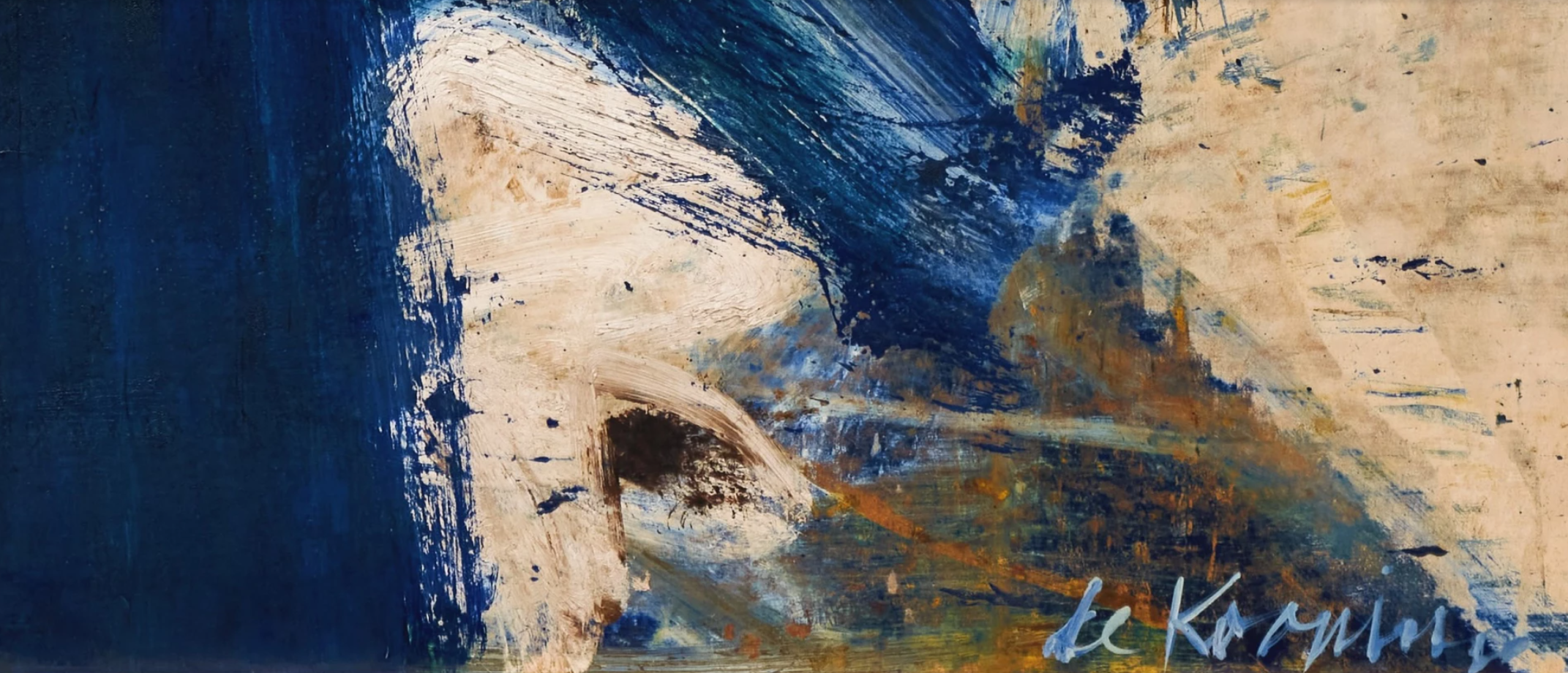
This evocative arrangement is matched by a palette of deep blue, sunny yellow, and a particular earthy ochre. The inspiration of his surroundings is unmistakable in the present work, as a sense of sunlight emanates from its surface. Creating a vortex of organic colors with extraordinary bravura, de Kooning conjures the experiential atmosphere of landscape in resolutely abstract terms. The selective palette, muscular gestures and balanced configuration emphasize the texture of paint and the artist’s luxuriant celebration of his medium, marking Leaves in Weehawken as an exemplar from this pivotal period in de Kooning’s inimitable career.
Sculptures
Cross-Legged Figure, 1972
The Collection of Sydell Miller
Sotheby’s New-York: 18 November 2024
Estimated: USD 1,000,000 – 1,500,000
USD 1,560,000
WILLEM DE KOONING (1904 – 1997)
Cross-Legged Figure, 1972
Bronze
Height: 24 1/2 inches (62.2 cm)
Inscribed de Kooning, numbered AP and stamped with the foundry mark Modern Art Foundry, New York N.Y.
Executed in 1972, this work is artist’s proof 2 from an edition of 7 plus 3 artist’s proofs
As if springing from one of Willem de Kooning’s painted canvases, Cross-Legged Figure embodies the genesis of the artist’s bold foray into sculpture from 1969-1974. Executed in 1972, the present work represents exceptional and captivating sculptural oeuvre. Alive with his signature fluidity, his Abstract Expressionist harmony of line and form and the tactile impressions of his artistic physicality, Cross-Legged Figure is emblematic of de Kooning’s gestural ingenuity. As emphasized and recontextualized by the recent survey of the artist’s work at Gallerie dell’Accademia in Venice alongside the 2024 Venice Biennale, Willem de Kooning and Italy, de Kooning’s sculptures were born from the artist’s brief but fertile time in Italy; an experience that opened him to the vast possibilities of sculpture.
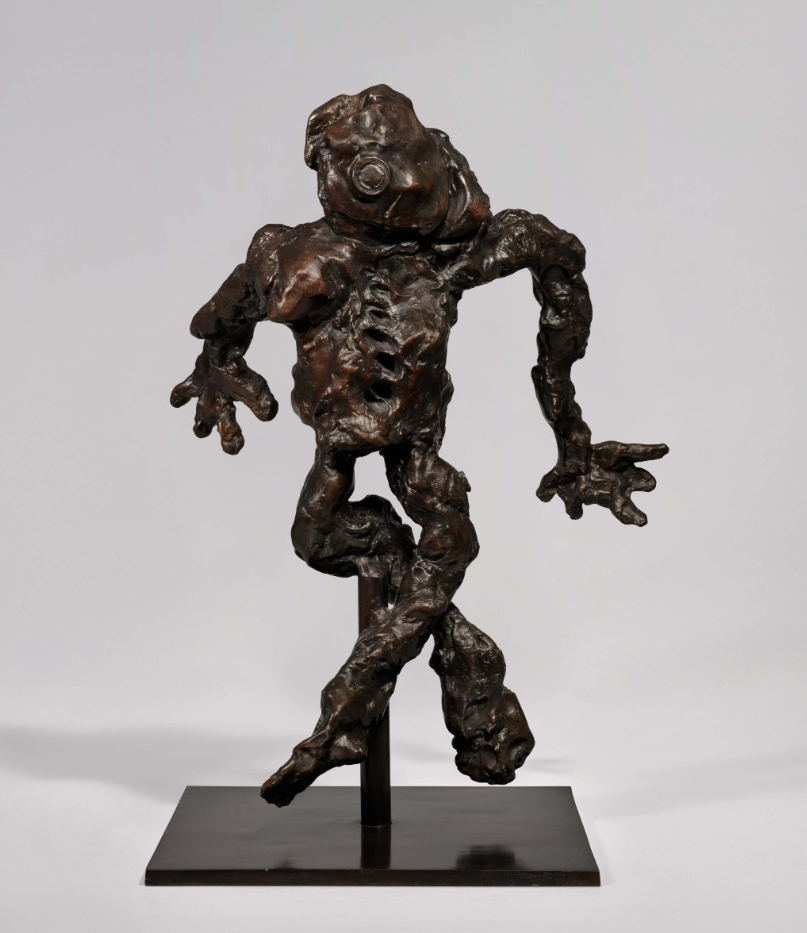
In 1969, de Kooning advanced his exploration of abstract figuration into the uncharted territory of sculpture. That summer, a chance meeting with his friend Herzl Emanuel, who ran a Roman bronze foundry, provided the decisive moment for de Kooning’s creation of his first sculptures. Accompanying Emanuel to his foundry, de Kooning experimented with some discarded clay, creating a series of thirteen small sculptures. The artist would later refer back to this experience in the foundry and Rome’s appeal to him as a lover of art and history claiming that the former looked “like the days of the Renaissance” (quoted in Exh. Cat., Venice, Gallerie dell’Accademia, Willem de Kooning and Italy, 2024, p. 82). After returning to New York, de Kooning had these sculptures cast in bronze and sent to his dealer, Xavier Fourcade. Despite Fourcade’s initial lack of enthusiasm for the bronzes, when Henry Moore encountered the bronzes in Fourcade’s gallery, he encouraged de Kooning to pursue the medium further. In 1971, de Kooning followed Moore’s advice and produced a set of new, larger figures. If the first bronzes were likened to the artist’s sketches—loose, relatively minimal tangles of linear gesture—the sculpted figures of 1972-74 were mature manifestations of de Kooning’s complex understanding of the figure and its formic capacity for abstraction at his hand, as evidenced by his vast mastery in painted iterations.
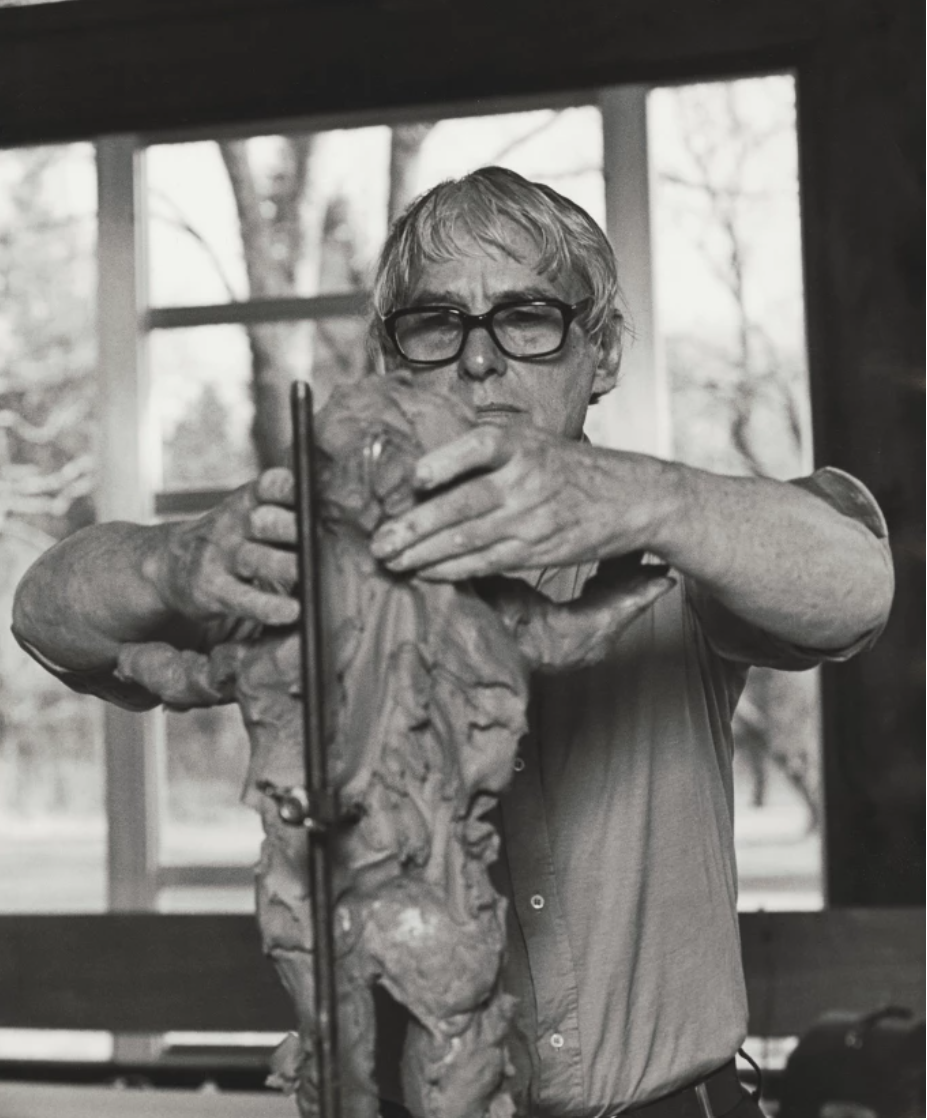
William de Kooning in 1972, Photograph by Hans Namuth. Image © 1991 Hans Namuth Estate, Courtesy Center for Creative Photography, University of Arizona. Art © 2024 The Willem de Kooning Foundation / Artists Rights Society (ARS), New York
In Italy, de Kooning’s American lexicon of Abstract Expressionist gesture was cross-pollinated with the rich art historical setting of Rome. Just as New York’s buzzing skyscrapers and East Hampton’s lush seascapes had informed his bursting canvases of the 50s and 60s, Rome served as a backdrop for the artist’s inspired take on abstract figuration in the enduring medium of bronze. Although Cross-Legged Figure was completed in New York, de Kooning’s inheritance of the mantle of sculptural history is evident in each considered form the textured contours along the hand-modeled surface. Suspended in motion, Cross-Legged Figure bears the alien vestiges of de Kooning’s process—with a circular protrusion visible on the reverse of its head, an artifact of the cut-pipe armature on which it was formed, and the impressions of the artist’s large, forceful fingers along the figure’s back like a gestural spine. With a swirling, ambiguous anthropomorphism not unlike the contemporaneous disfigurement of Francis Bacon, the relics of process reminiscent of Pablo Picasso’s sculpted collages of found-objects, and the quintessential de Kooning mastery of media—Cross-Legged Figure reveals the artist at the height of his figurative powers and full command over the sculpted form.
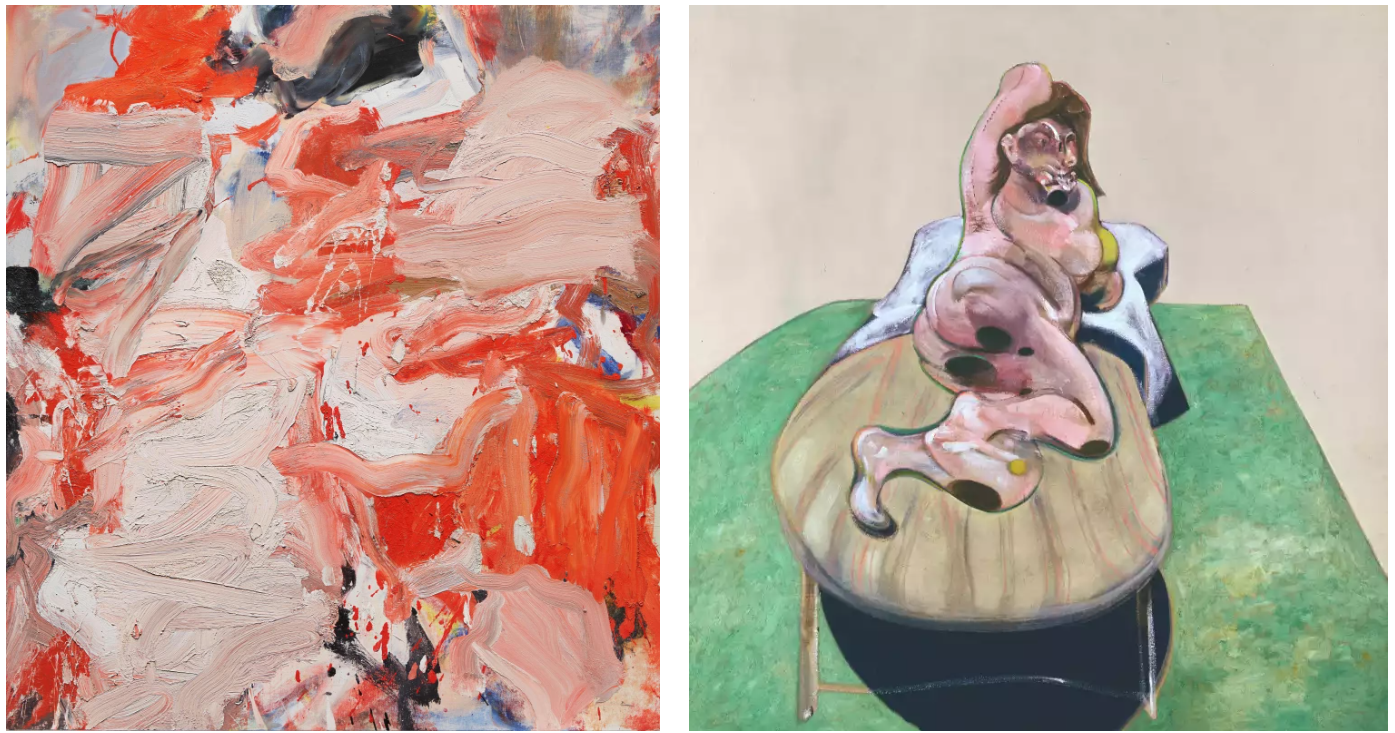
Left: Willem de Kooning, Untitled XXXIII,1977. Private Collection. Sold: Sotheby’s, New York, 15 November 2022, lot 3 for $24.4 million. Art © 2024 The Willem de Kooning Foundation / Artists Rights Society (ARS), New York
Right: Francis Bacon, Henrietta Moraes, 1966. Private Collection. Image courtesy Bridgeman Images. Art © 2024 The Estate of Francis Bacon. All rights reserved. / DACS, London 2024 / Artists Rights Society (ARS), New York
Despite his prominence in the field of abstraction, de Kooning never abandoned the human figure in his work. Cross-Legged Figure pays homage to the prolific influence of sculpture on the trajectory of art history, as experienced throughout the legacy of both the Renaissance Italian masters and modernism, combining an appreciation for the past with his individual influence on the present. One of the most dynamic sculptures from his three-dimensional body of work, Cross-Legged Figure represents the apex of an adventure that was as brilliant as it was brief, the perfect extension of the artist’s painting into the solidity of a third dimension.
Standing Figure, 1969
Sotheby’s New-York: 16 November 2023
Estimated: USD 1,000,000 – 1,500,000
USD 952,500
Standing Figure | Contemporary Day Auction | 2023 | Sotheby’s (sothebys.com)
WILLEM DE KOONING (1904 – 1997)
Standing Figure, 1969
Bronze
32 1/2 x 56 x 11 inches (82.6 x 142.2 x 27.9 cm)
Incised with the artist’s signature, date 1969/80 and number AP 2/3 (on the lateral edge)
Conceived in 1969 and cast in 1980, this work is artist’s proof 2 from an edition of 9 plus 3 artist’s proofs
An enigmatic figure consumed by fervent motion and dynamic expressionism, Willem De Kooning’s Standing Figure reflects the genesis of the artist’s brief foray into sculpture from 1969-1974. Conceived of in 1969 and executed in 1984, the present work represents an early and exceptional example from de Kooning’s limited, yet utterly enthralling sculptural oeuvre. Testifying to the present work’s singular importance to de Kooning’s oeuvre, other examples from the edition are housed in the collections of major museums including the National Gallery of Victoria, Melbourne, and Stedelijk Museum, Amsterdam. A remarkably tactile creature composed of thickened supple surfaces, Standing Figure brings de Kooning’s painted masterworks of abstract figuration into a palpable, three-dimensional form.
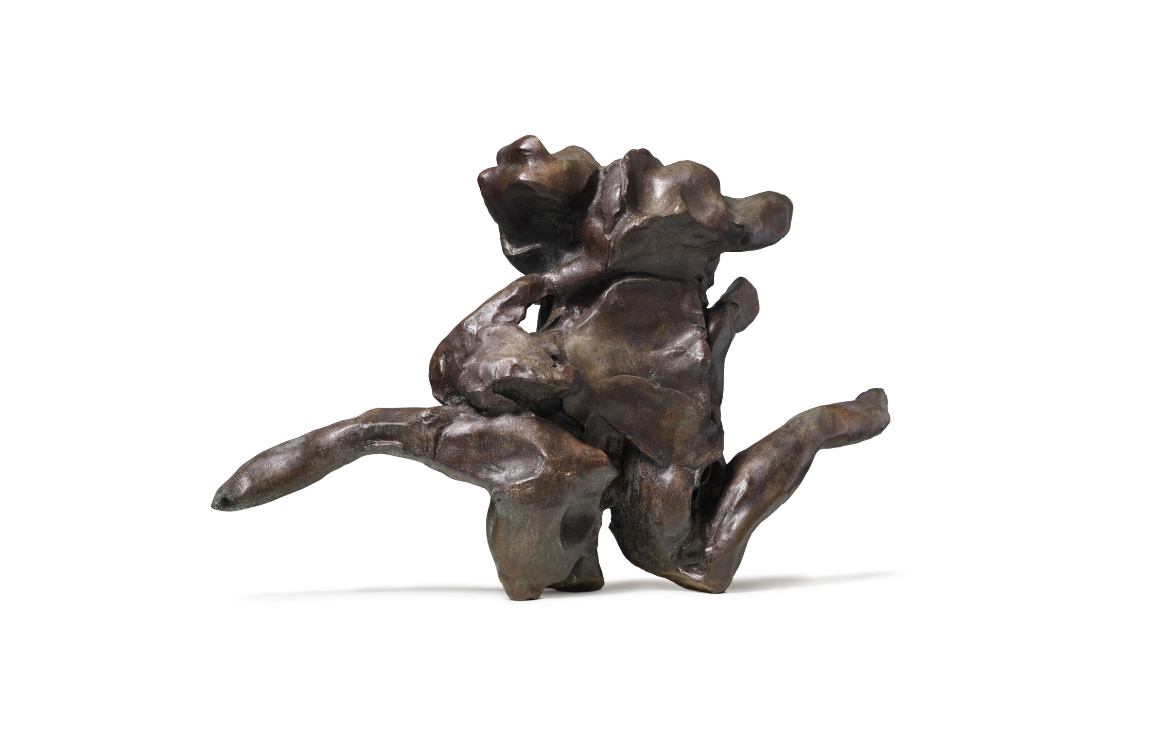
With Standing Figure, de Kooning deftly advances his exploration of figuration within the realm of abstraction into the uncharted territory of sculpture. Throughout his prolific career, de Kooning embodied the principles of “Action Painting,” a term coined by Harold Rosenberg, by involving his entire being, wholly and unreservedly, in the creation of his art. This impulse for kinetic touch finds its perfect expression in his sculptural works, which beautifully complement his painted corpus by translating the gestural sweeps of his pigment into three-dimensional forms. In works such as Standing Figure, the viewer can detect his entire being in traces of physical contact left as tangible evidence of his corporeal involvement with his medium. Born from this intimate engagement, these extraordinary sculptural works represent a critical artistic enterprise that rivals his painted masterworks in originality and scope.
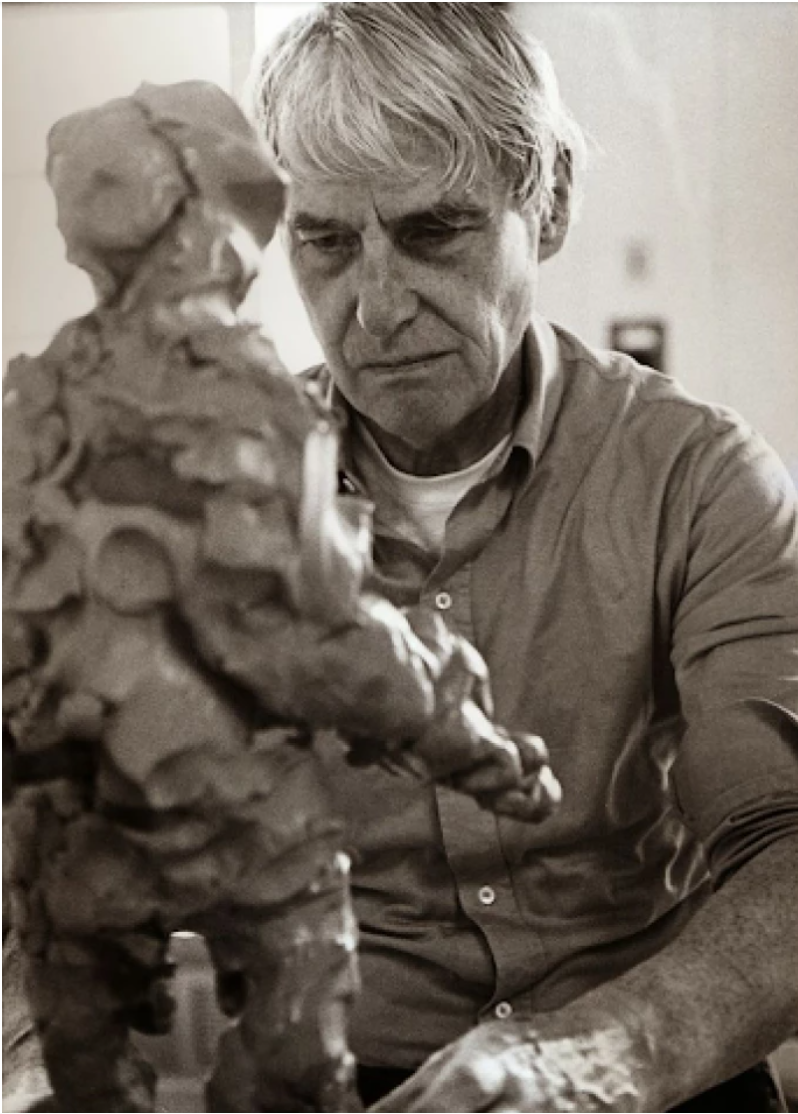
WILLEM DE KOONING PHOTO: HANS NAMUTH, COURTESY CENTER FOR CREATIVE PHOTOGRAPHY, UNIVERSITY OF ARIZONA © 1991 HANS NAMUTH ESTATE. ARTWORK © 2023 THE WILLEM DE KOONING FOUNDATION/ARTISTS RIGHTS SOCIETY (ARS), NEW YORK
De Kooning’s foray into sculpture began in the summer of 1969 after a visit with Herzl Emanuel to a Roman bronze foundry in Trastevere. While at the foundry, he started experimenting with the discarded clay, creating a series of thirteen small sculptures. Upon returning to New York, de Kooning had each of these works cast in bronze and sent them to his dealer, Xavier Fourcade. When Henry Moore encountered these mighty sculptures in Fourcade’s gallery, he encouraged de Kooning to work further on a more ambitious scale. Indeed, de Kooning did embark on a dedicated five-year period of large-scale sculptural investigation and advancement. Three of these small sculptures, Seated Woman, Reclining Figure, and the present work, were enlarged on both mid-sized and monumental scales. The rugged surface of Standing Figure resembles a topographic map of its own creation, charting every point of contact between artist and sculpture: grooves and hollows where de Kooning’s fingers dug into the soft clay, smooth areas where his thumb rubbed a trough or raised a crest, and even craters left by the impact of a rolling pin. Fistful after fistful of clay, de Kooning slowly transformed the amorphous form of Standing Figure into the final obscure, yet distinctly anthropomorphic sculpture. Limbs outstretched from a body mass in which head and chest are compacted, the figure is imbued with a weighty presence, yet spirals around its central core with a graceful buoyancy.
Seated Woman on a Bench, 1972
Sotheby’s New-York: 19 May 2023
Estimated: USD 1,000,000 – 1,500,000
USD 889,000
Seated Woman on a Bench | Contemporary Day Auction | 2023 | Sotheby’s (sothebys.com)
WILLEM DE KOONING (1904 – 1997)
Seated Woman on a Bench, 1972
Bronze
37 3/4 x 36 x 43 3/8 inches (95.9 x 91.4 x 87.3 cm)
Incised with artist’s signature and number 3/7 (on the lateral edge)
This work is number 3 from an edition of 7 plus 3 artist’s proofs
Willem De Kooning’s Seated Woman on a Bench is a remarkably tactile, extraordinary figure that reflects the climax of the artist’s brief interlude with sculpture from 1969-1974. Executed in 1972 at the peak of his interest in the medium, the present work represents an exceptional example from de Kooning’s limited, yet utterly enthralling sculptural oeuvre. As a testament to its significance, other examples from the edition are housed in the collections of major museums including the Tate Modern, London; Hirshhorn Museum and Sculpture Garden, Washington, D.C. and Stedelijk Museum, Amsterdam. An enthroned Madonna of almost life-sized proportions composed of thickened supple surfaces, Seated Woman on a Bench brings de Kooning’s deeply carnal paintings of women into a palpable, three-dimensional form.
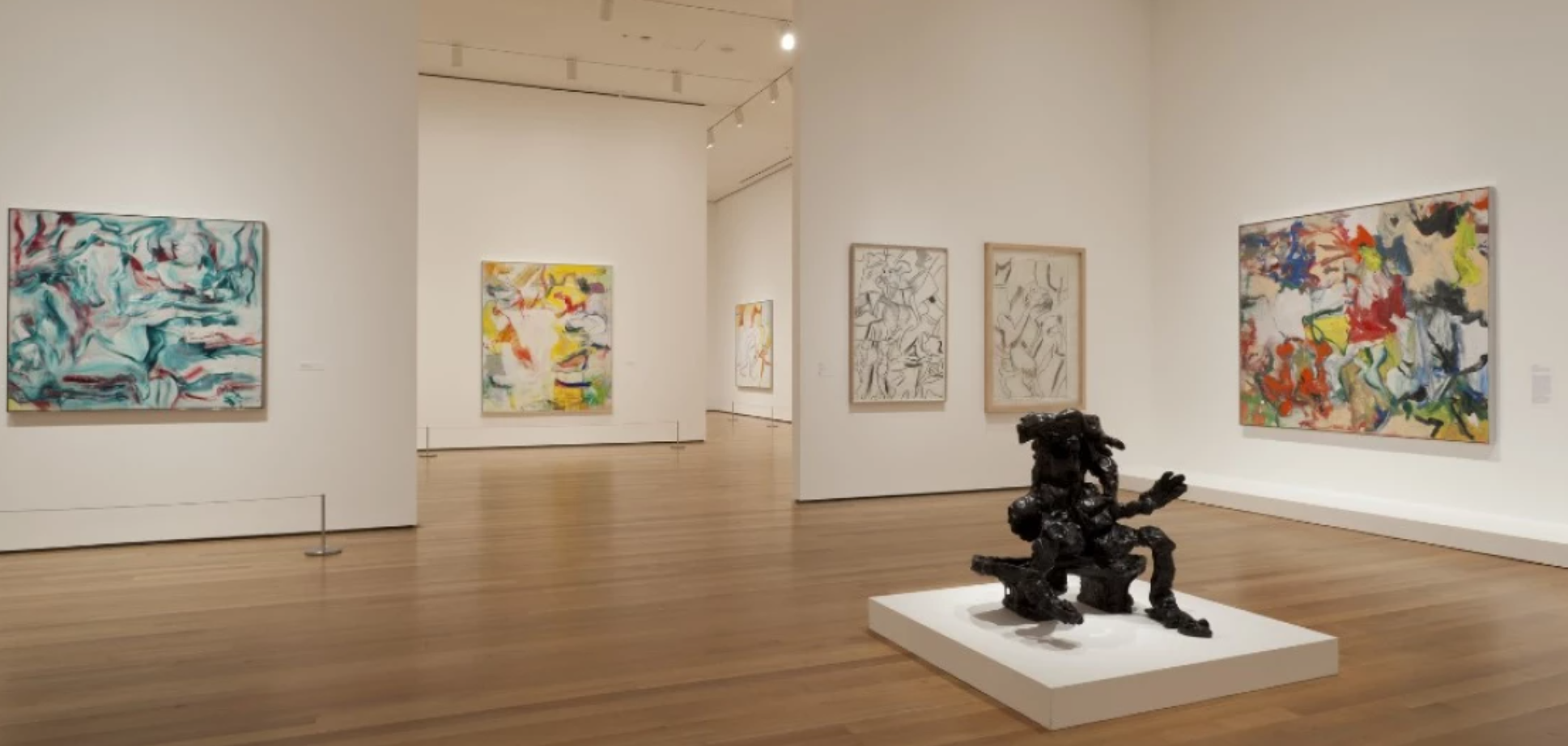
SEATED WOMAN ON A BENCH INSTALLED IN THE EXHIBITION DE KOONING: A RETROSPECTIVE AT THE MUSEUM OF MODERN ART, NEW YORK, 2011-2012. THE MUSEUM OF MODERN ART, NEW YORK. DIGITAL IMAGE © THE MUSEUM OF MODERN ART, NEW YORK/LICENSED BY SCALA/ART RESOURCE, NY. ARTWORK © 2023 THE WILLEM DE KOONING FOUNDATION/ARTISTS RIGHTS SOCIETY (ARS), NEW YORK
De Kooning’s groundbreaking contributions to Abstract Expressionism chronicle a tireless exploration of the possibilities for figuration within a resolutely abstract genre. Throughout his truly prodigious career, de Kooning epitomized the tenets of “Action Painting,” a term coined by Harold Rosenberg, by involving his entire being, wholly and unreservedly, in the creation of his art. This impulse for kinetic touch is perfectly captured and memorialized in his sculptural oeuvre, which beautifully complements his painted corpus by translating the gestural sweeps of his pigment into three-dimensional form. In works such as Seated Woman on a Bench the viewer can detect his entire being in traces of physical contact left as clear evidence of his corporeal involvement with his medium. The extraordinary works that developed from this intimate engagement comprise a major artistic enterprise and rival his painted masterworks in originality and scope. In the words of William Tucker, “De Kooning is the latest and … the last of the series of great painters whose occasional work in three dimensions has enriched and even transformed the sculpture of the modern period.” (Exh. Cat., New York, Matthew Marks Gallery, Willem de Kooning Sculpture, 1996, p. 45)
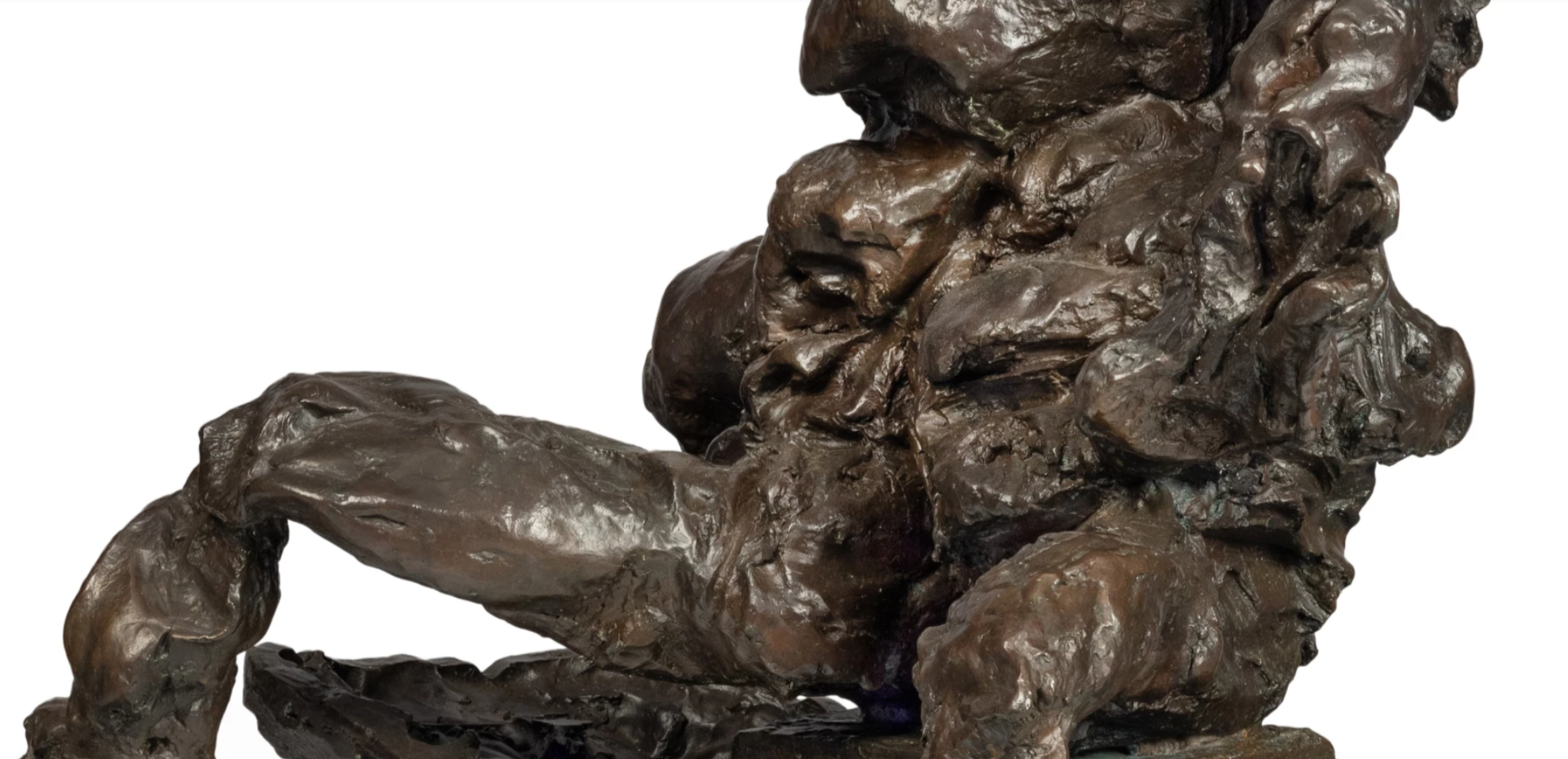
The rugged surface of Seated Woman on a Bench reads like a map of its own creation, its topography seeming to chart every point of contact between artist and sculpture: grooves and hollows where de Kooning’s fingertips dug into the soft clay, smooth areas where his thumb rubbed a trough or raised a crest, and even craters left by the impact of a rolling pin. Starting with the bench on which the figure rests, de Kooning then added fistful after fistful of clay, slowly transforming its amorphous form into the completed work. He constructed the figure’s outsized limbs and hands with a pronounced downward pull so as to imbue the composition with a weighty presence. Total engagement with the material – with the substance in his hands – is the most striking feature of de Kooning’s aesthetic approach. When painting, he does not constrict the paint to his will; instead the pigment flows and swirls across the canvas, as he breathes life into his medium rather than imprisoning it. The faithfulness to the nature of his material extends to his sculptures, where he plays with the primal heaviness as well as pliable softness of the clay becoming illusory in the final bronze cast. Despite his foremost status as a master of Abstract Expressionism, de Kooning never abandoned the figure in his oeuvre, defiantly retaining a crucial vestige of the Western Art tradition of his youth and student days in Northern Europe. The expressive human character of Seated Woman on a Bench is a tribute to classical busts while it bursts beyond the constrictions of that past paradigm to embrace the full modernity of its historic moment. One of the most accomplished sculptures that de Kooning made, Seated Woman on a Bench stands at the extraordinary climax of an adventure that was as brilliant as it was brief, the perfect extension of the artist’s painting into the solidity of a third dimension.
Seated Woman, 1969-1980
Christie’s New-York: 12 May 2022
Estimated: USD 7,000,000 – 10,000,000
USD 8,155,000
WILLEM DE KOONING (1904-1997), Seated Woman | Christie’s
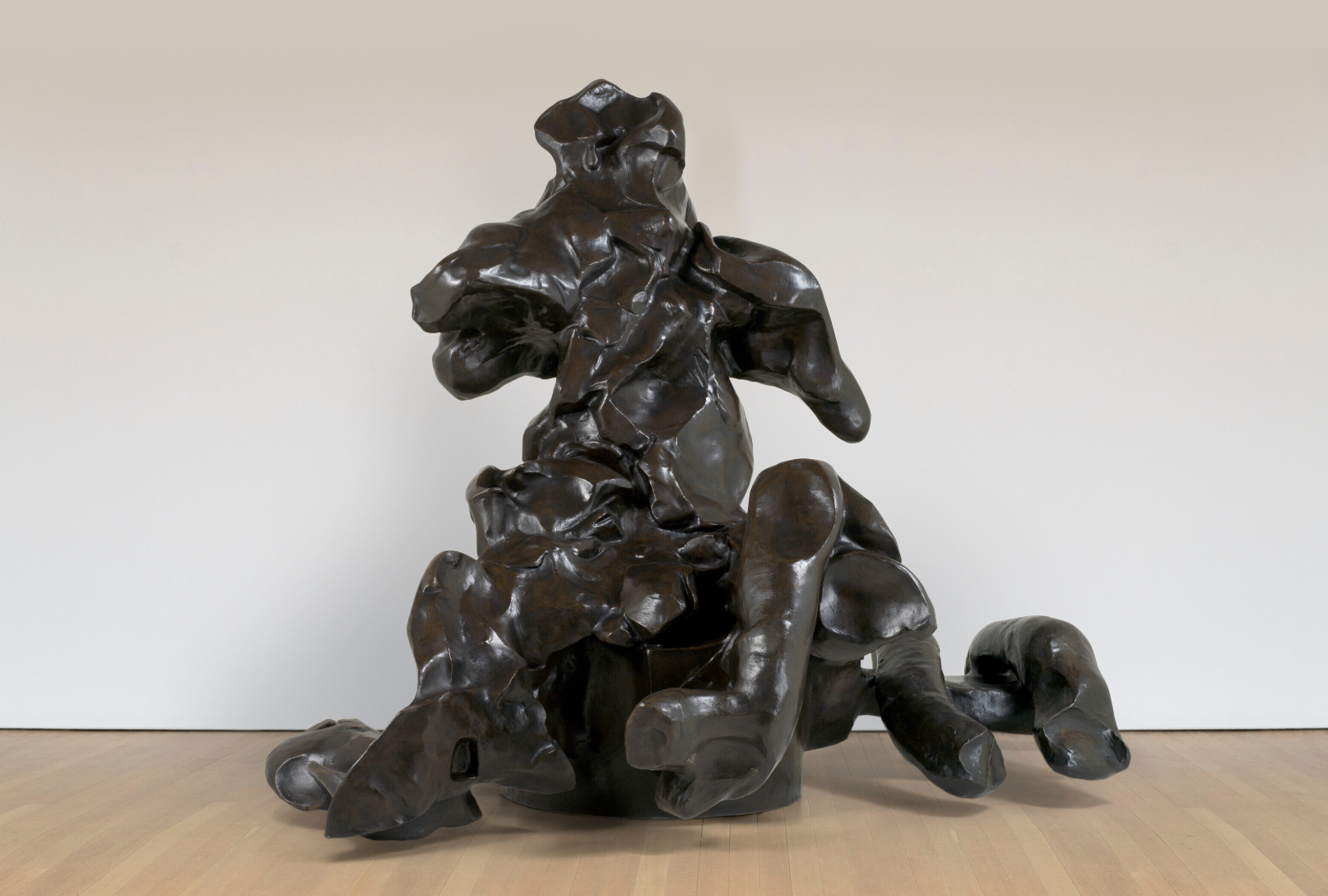
WILLEM DE KOONING (1904-1997)
Seated Woman, 1969-1980
Bronze
113x147x94 inches (287 x 373.4 x 238.8 cm)
Incised with the artist’s signature, number and date ‘de Kooning © 1969⁄80 1⁄7’ (on the reverse)
Conceived in 1969 and executed in 1980
This work is number one from an edition of seven plus two artist’s proofs
Willem de Kooning, along with Pablo Picasso, Henri Matisse and Edgar Degas, is one of the few artists who was able to successfully translate his painterly skills into three dimensions. Conceived in 1969, during a short sojourn in which he worked exclusively in the medium of sculpture, Seated Woman translates the visceral energy of his iconic paintings into what has become one the postwar period’s most important sculptural forms. Here, the visceral brushstrokes for which de Kooning has been rightly celebrated have been translated into physical form; elongated limbs emerge from a solid core, tracing out the lean curves of the female form in the same way that the artist’s gestural brushstrokes carved out the surfaces of his famed Woman series of canvases. De Kooning famously said that flesh was the reason oil painted was invented, then—in the early 1970s—after working on sculptural forms he declared, “In some ways, clay is even better than oil” (W. de Kooning, quoted in J. Elderfield, De Kooning: A Retrospective, exh. cat., The Museum of Modern Art, New York, 2011, p. 411). Seated Woman is one of three of the original small sculptures cast in Rome that were selected for enlargement to this large-scale. Other examples from this edition of six with two artist’s proofs monumentally-sized works are in the collection of the City of Rotterdam and the Nasher Sculpture Center in Dallas.
Standing nearly 10 feet tall, in Seated Woman de Kooning seems to pull the female figure directly from the clay that he used to model the form itself. From here, stretched limbs extend outwards; short arms reach out the side, while long legs search out the ground below. Unlike conventional sculpture, which sought to replicate the physical appearance of the human body, de Kooning’s sculptural practice—like that of his painting—sought out a more fundamental relationship between the form of the body and the space it occupied. This technique allowed him to develop an unswerving, almost intuitive relationship with his work, as if he was working on an extension of his own body. As such, the most celebrated quality of this sculpture becomes its highly tangible surface, something which the artist worked hard to achieve. He employed a wide variety of techniques to attain his desired effect, ranging from using his bare hands for modeling the delicately detailed areas of the face to putting on a pair of thick workman’s gloves when he needed to produce a more dramatic effect. Initially de Kooning had reservations about using such wet clay, but those soon evaporated when he saw what he was able to achieve.
“You can work and work on a painting but you can’t start over again with the canvas like it was before you put that first stroke down. And sometimes, in the end, it’s not good, no matter what you do. But with clay, I cover it with a wet cloth and come back to it the next morning and if I don’t like what I did, or I changed my mind, I can break it down and start over. It’s always fresh.”
De Kooning began making sculpture in the summer of 1969 during a holiday in Rome. There, he ran into an old friend, Herzl Emanuel, who owned a bronze casting foundry. At his friend’s invitation, de Kooning began to work in clay, and liking the process so much and produced a small number of sculptures that he had cast. Then in 1980 he selected just three of these works to be cast on a monumental scale, Seated Woman being one of these works. On seeing de Kooning’s sculptures in New York, the British sculptor Henry Moore gave his enthusiastic approval, which paved the way for de Kooning’s further investigation into this medium. Just as the strict formality of African masks enthralled Picasso and would influence his later painting career, the animated forms produced by de Kooning enabled him to enter into a dialogue with a historical traditions of figural sculpture that began in classical antiquity and continued into the nineteenth- and twentieth-centuries with the likes of Auguste Rodin and Alberto Giacometti. But, pursuing the figural motif via direct modeling in clay was highly unusual at the time when Minimalism had resulted in three-dimensional geometric objects whose industrial surfaces were pre-fabricated according to artists’ specifications. In contrast, the expressive, alternately concave and convex surfaces, exaggerated modeling, and the mannered gestures manifest in this work show the direct contact that de Kooning had with his sculptural processes. De Kooning, like Picasso, made figurative sculpture pertinent to contemporary times. He initially intended his sculpture to be a way of enhancing his painting practice, but also found that his painting helped him produce dramatically original figurative sculpture. For the short period in the 1970s when sculpture became a prime source of artistic output, de Kooning produced some of his most dramatic and striking works. While the power and force of his earlier painterly figures have been transformed into three dimensions, works such as those contained within this collection are not simply reproductions of earlier forms. The physicality of the medium allowed de Kooning to fully realize the expressive nature of his artistic prowess–with unparalleled results.
Works on Paper
2025 Auction Results
#1. Untitled, circa 1956
Christie’s New-York: 15 May 2025
Estimated: USD 180,000 – 250,000
USD 226,800
WILLEM DE KOONING (1904-1997), Untitled | Christie’s
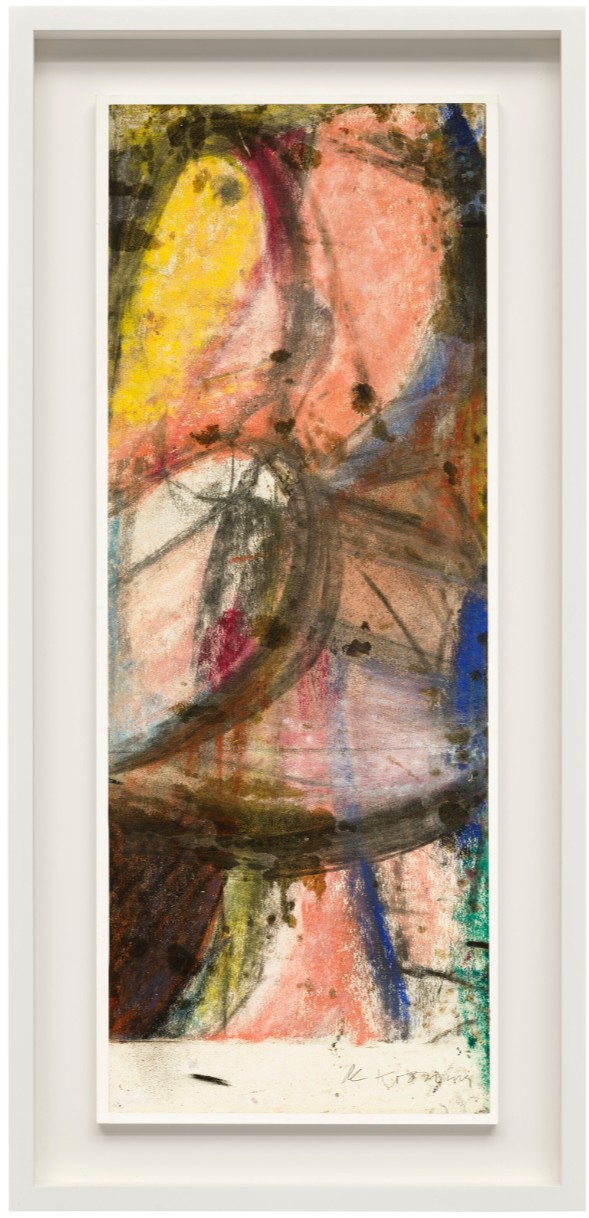
WILLEM DE KOONING (1904-1997)
Untitled, circa 1956
Pastel and charcoal on paper
30 1/4 x 11 inches (76.4 x 27.9 cm)
Signed ‘de Kooning’ (lower right)
#2. Pink Woman, 1964
Phillips New-York: 14 May 2025
Estimated: USD 50,000 – 70,000
USD 91,440
Willem de Kooning Modern & Contemporary Art Day Sale, Morning Session
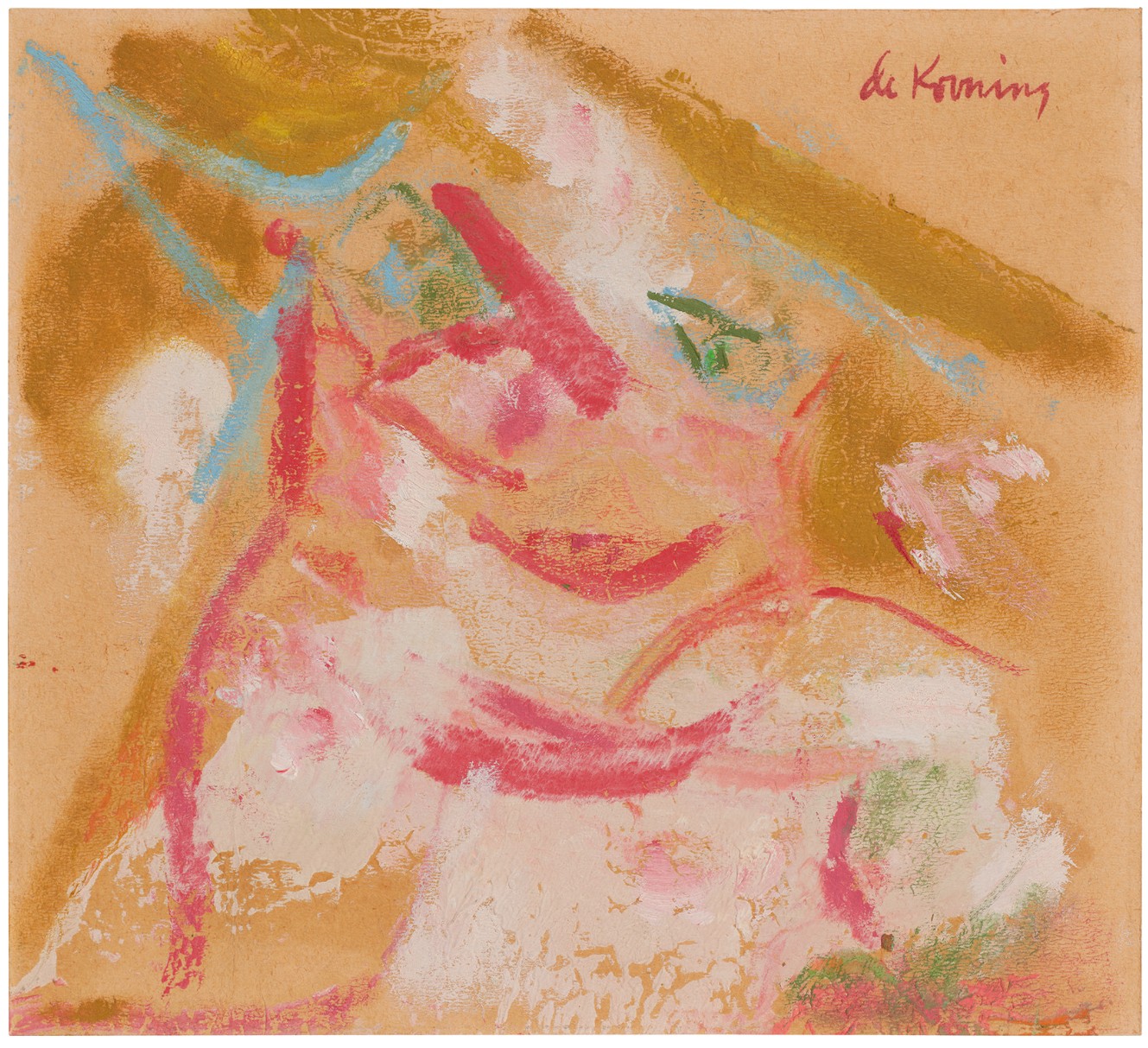
Pink Woman, 1964
Oil and pastel on paperboard mounted to board
#3. Untitled (Woman) [Double-Sided Work], 1968
Sotheby’s New-York: 16 May 2025
Estimated: USD 80,000 – 120,000
USD 63,500
Untitled (Woman) [Double-Sided Work] | Contemporary Day Auction | 2025 | Sotheby’s
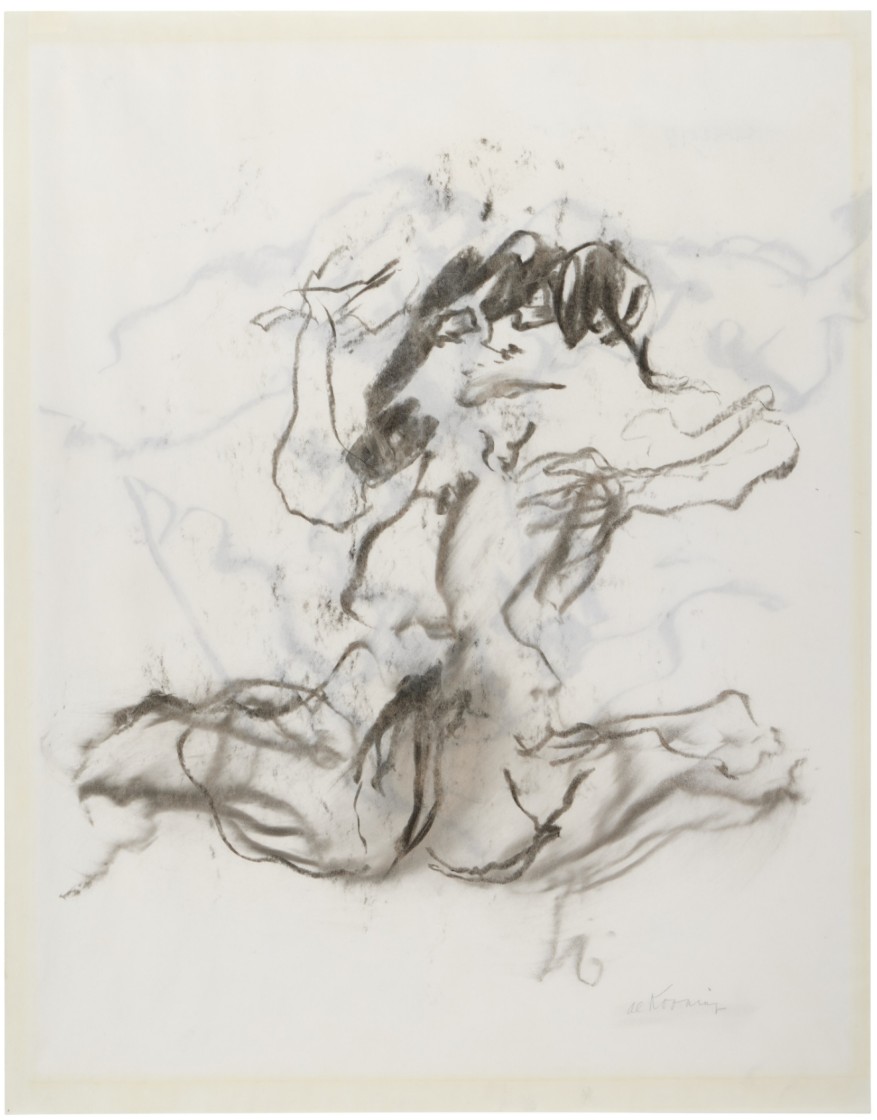
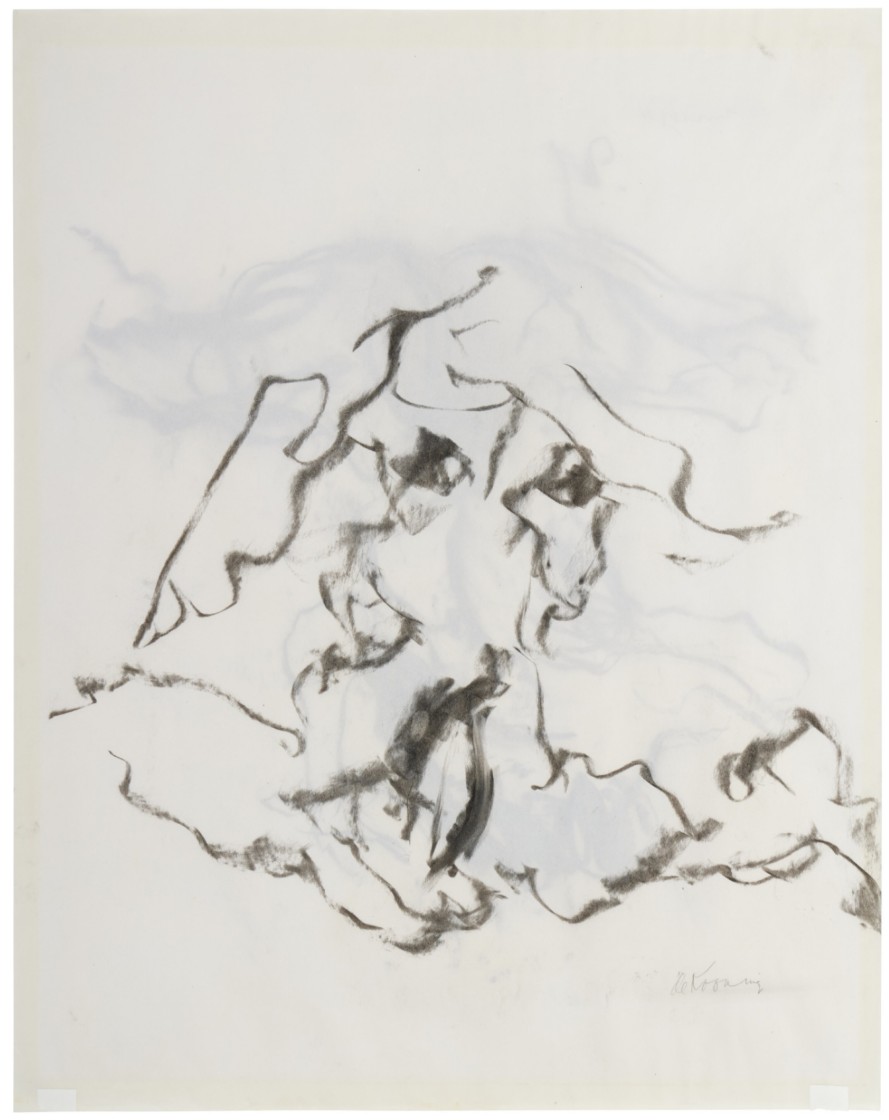
WILLEM DE KOONING (1904 – 1997)
Untitled (Woman) [Double-Sided Work], 1968
Charcoal on paper
28 1/2 x 22 3/8 inches (72.4 x 56.8 cm)
Signed (lower right of each side)
#4. Untitled, circa 1965-66
Phillips New-York: 14 May 2025
Estimated: USD 60,000 – 80,000
USD 63,500
Willem de Kooning Modern & Contemporary Art Day Sale, Morning Session
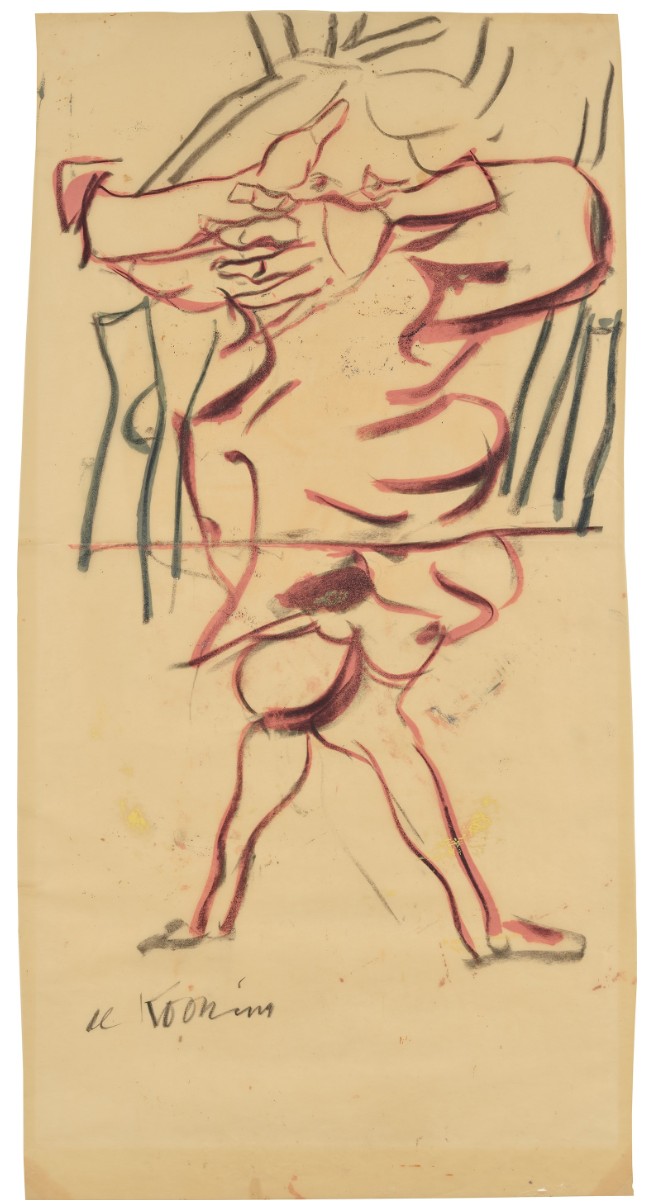
Untitled, circa 1965-66
Charcoal and oil on vellum
#5. Untitled, 1969
Modern Perspectives: The Collection of Rolf & Margit Weinberg
Sotheby’s New-York: 16 May 2025
Estimated: USD 60,000 – 80,000
USD 60,960
Untitled | Contemporary Day Auction | 2025 | Sotheby’s
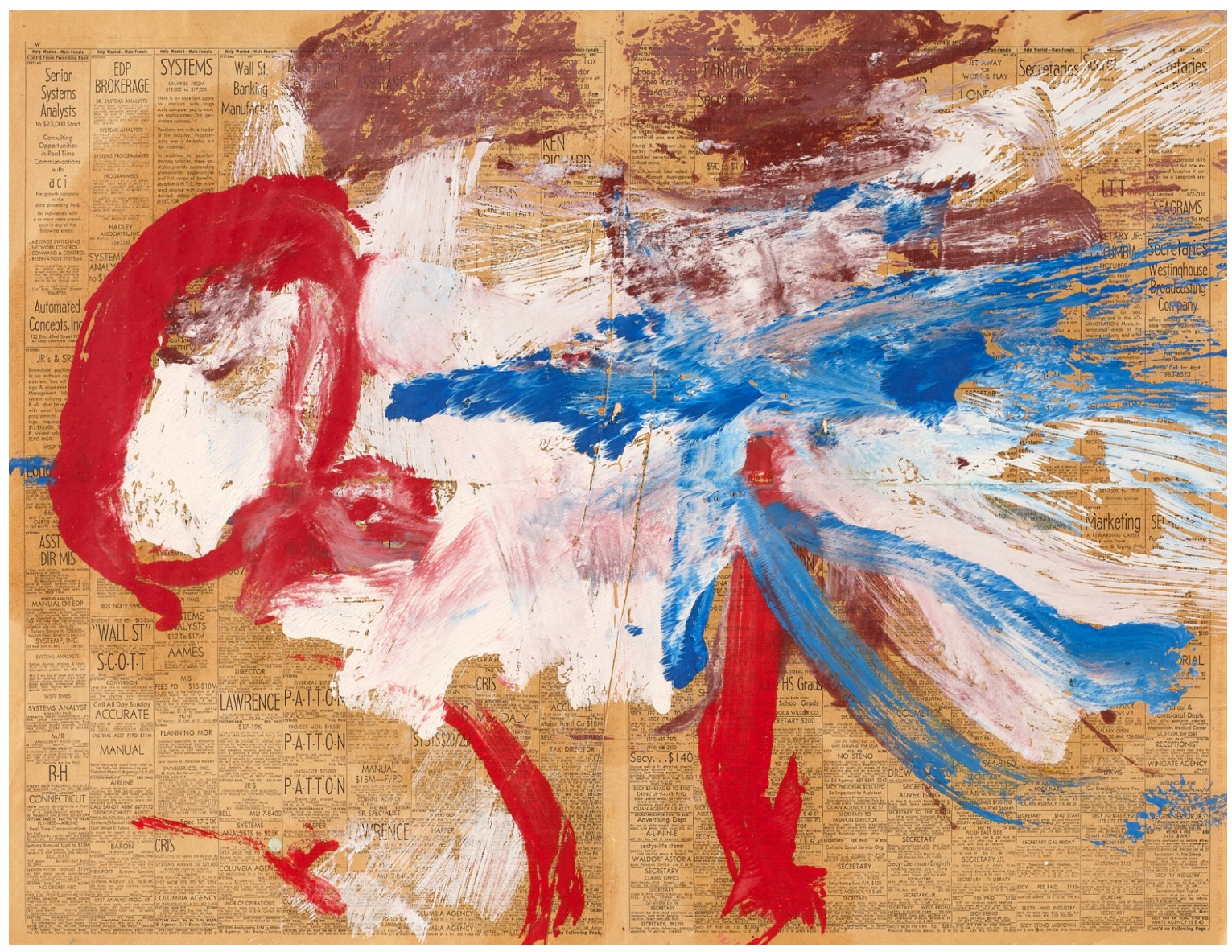
WILLEM DE KOONING (1904 – 1997)
Untitled, 1969
Oil on newsprint
22 1/2 x 29 1/2 inches (57.2 x 74.9 cm)
2024 Auction Results
#1. Untitled, circa 1950
Christie’s New-York: 22 November 2024
Estimated: USD 100,000 – 150,000
USD 98,280
WILLEM DE KOONING (1904-1997), Untitled | Christie’s
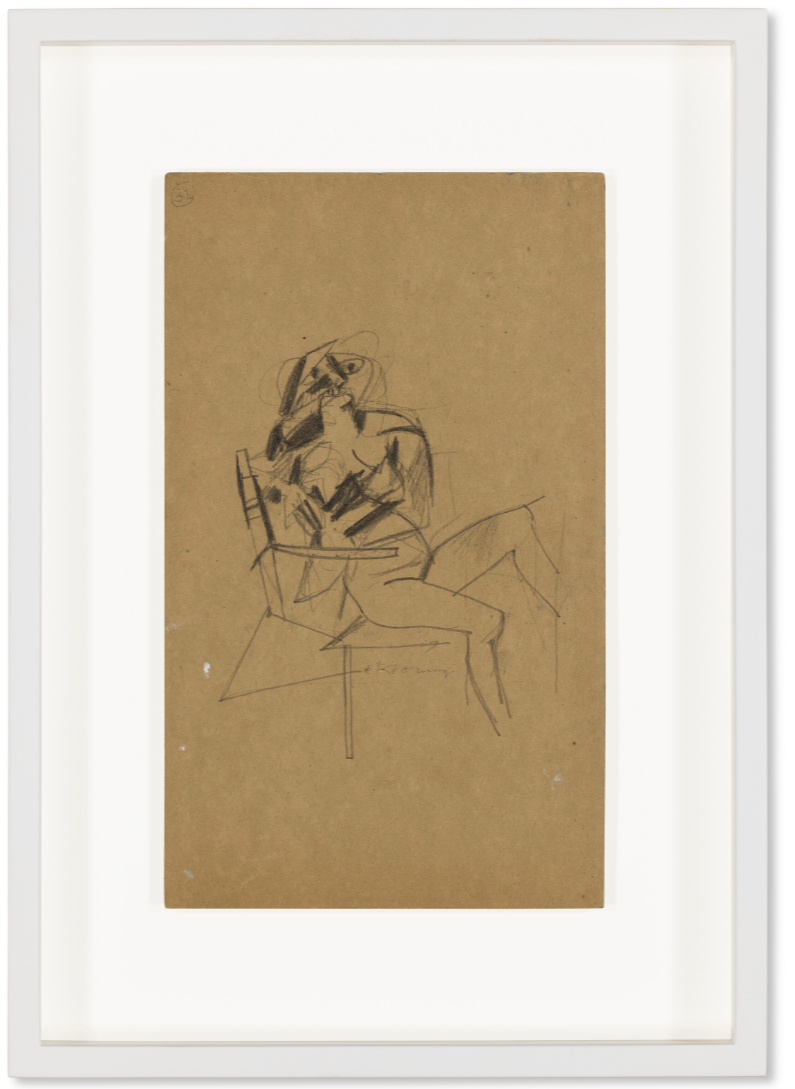
WILLEM DE KOONING (1904-1997)
Untitled, circa 1950
Graphite on cardboard
14 1/8 x 8 3/8 inches (35.8 x 21.1 cm)
Signed ‘de kooning’ (lower center)
#2. Landscape, circa 1948
Sotheby’s New-York: 1 March 2024
Estimated: USD 80,000 – 120,000
USD 88,900
Landscape | Contemporary Curated | 2024 | Sotheby’s
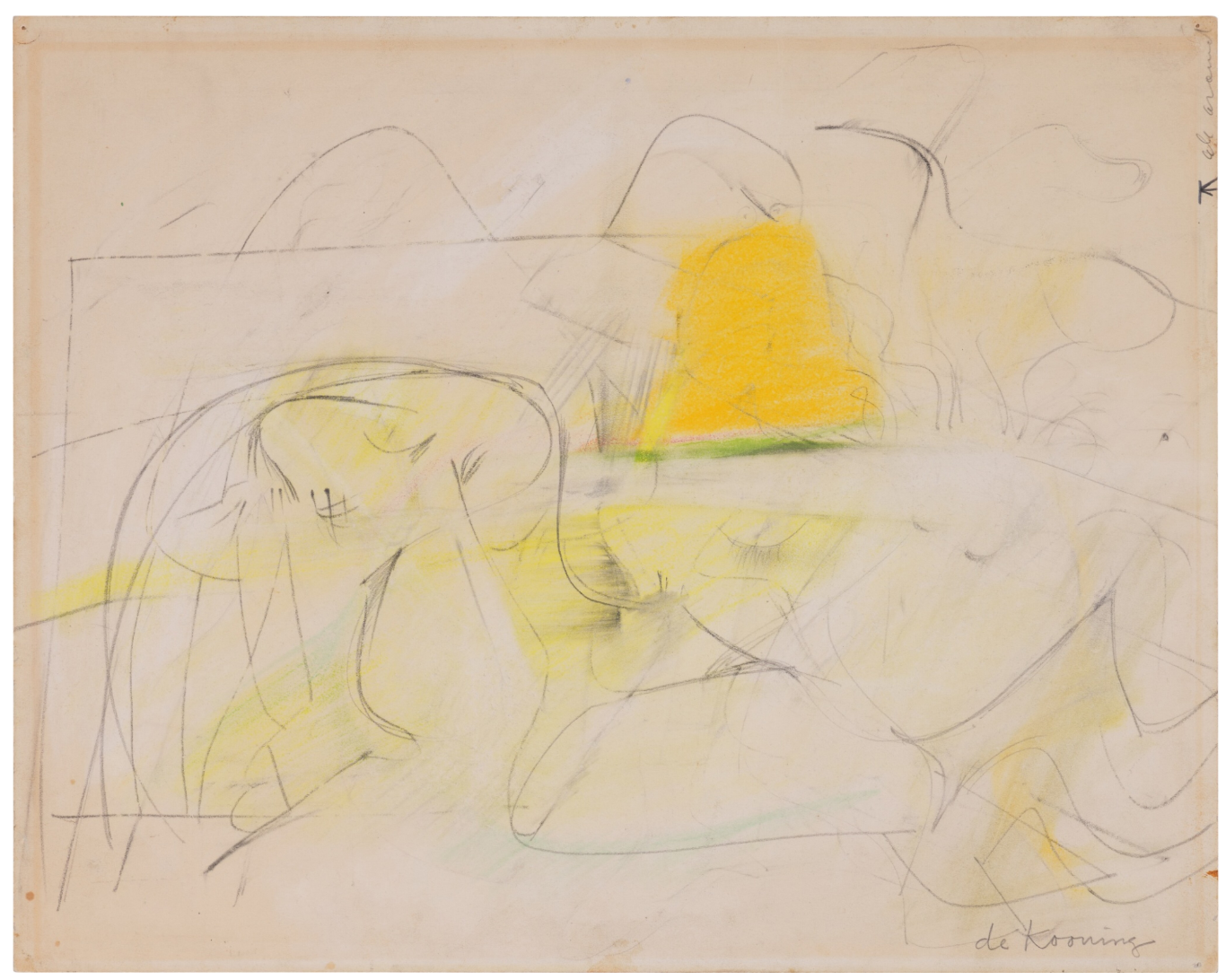
WILLEM DE KOONING (1904 – 1997)
Landscape, circa 1948
Soft pastel and graphite on paper
11 x 13 7/8 inches (28 x 35.2 cm)
Signed (lower right)
#3. Untitled, circa 1959-1960
Christie’s New-York: 18 December 2024
Estimated: USD 25,000 – 35,000
USD 60,480
WILLEM DE KOONING (1904-1997), Untitled | Christie’s
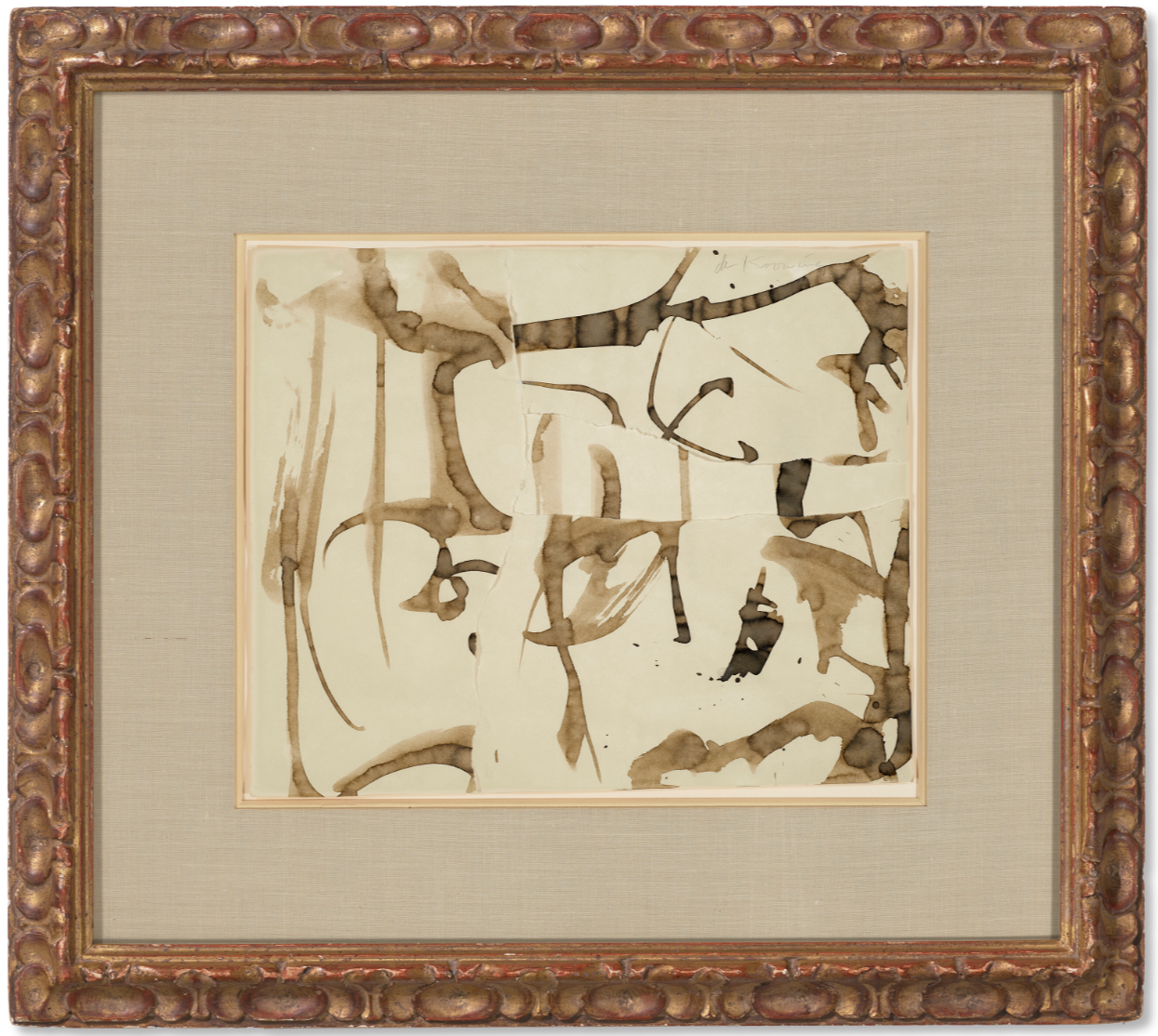
WILLEM DE KOONING (1904-1997)
Untitled, circa 1959-1960
Ink and paper collage on paper
101/2 x 12 3/4 inches (26.7 x 32.4 cm)
Signed ‘de Kooning’ (upper right)