MAY 2026 NEW-YORK AUCTIONS
Willem de Kooning
Auction Results
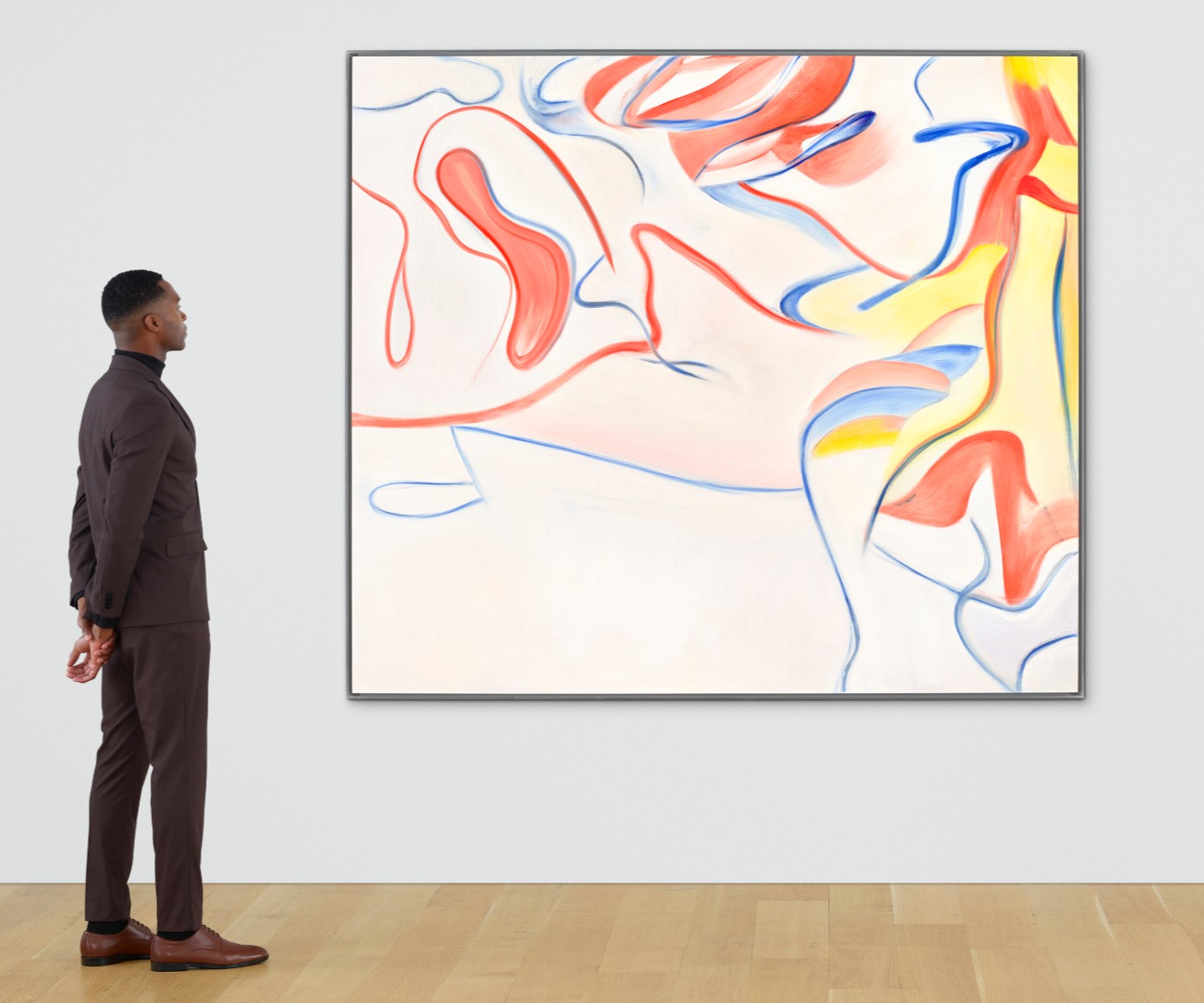
#1. Untitled III, 1975
Property from an Important Private Collection
Sotheby’s New-York: 14 May 2026
Estimated: USD 25,000,000 – 35,000,000
USD 26,000,000
Willem de Kooning | Untitled III | The Now & Contemporary Evening
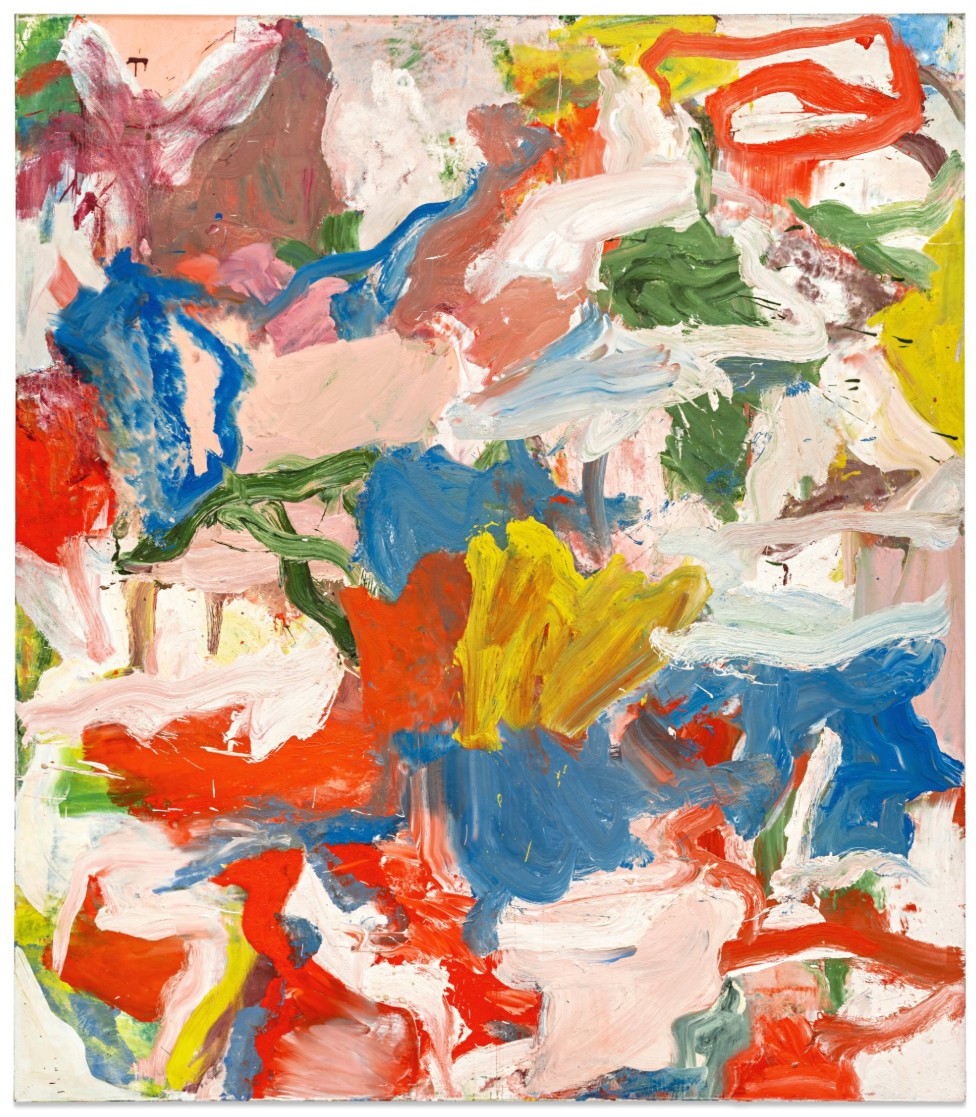
WILLEM DE KOONING (1904 – 1997)
Untitled III, 1975
Oil on canvas
87-3/4 x 76-1/2 inches (222.9 x 194.3 cm)
Untitled XLII, 1983
Robert Mnuchin: Collector at Heart
Sotheby’s New-York: 14 May 2026
Estimated: USD 9,000,000 – 12,000,000
USD 12,410,000
Willem de Kooning | Untitled XLII | Robert Mnuchin: Collector at
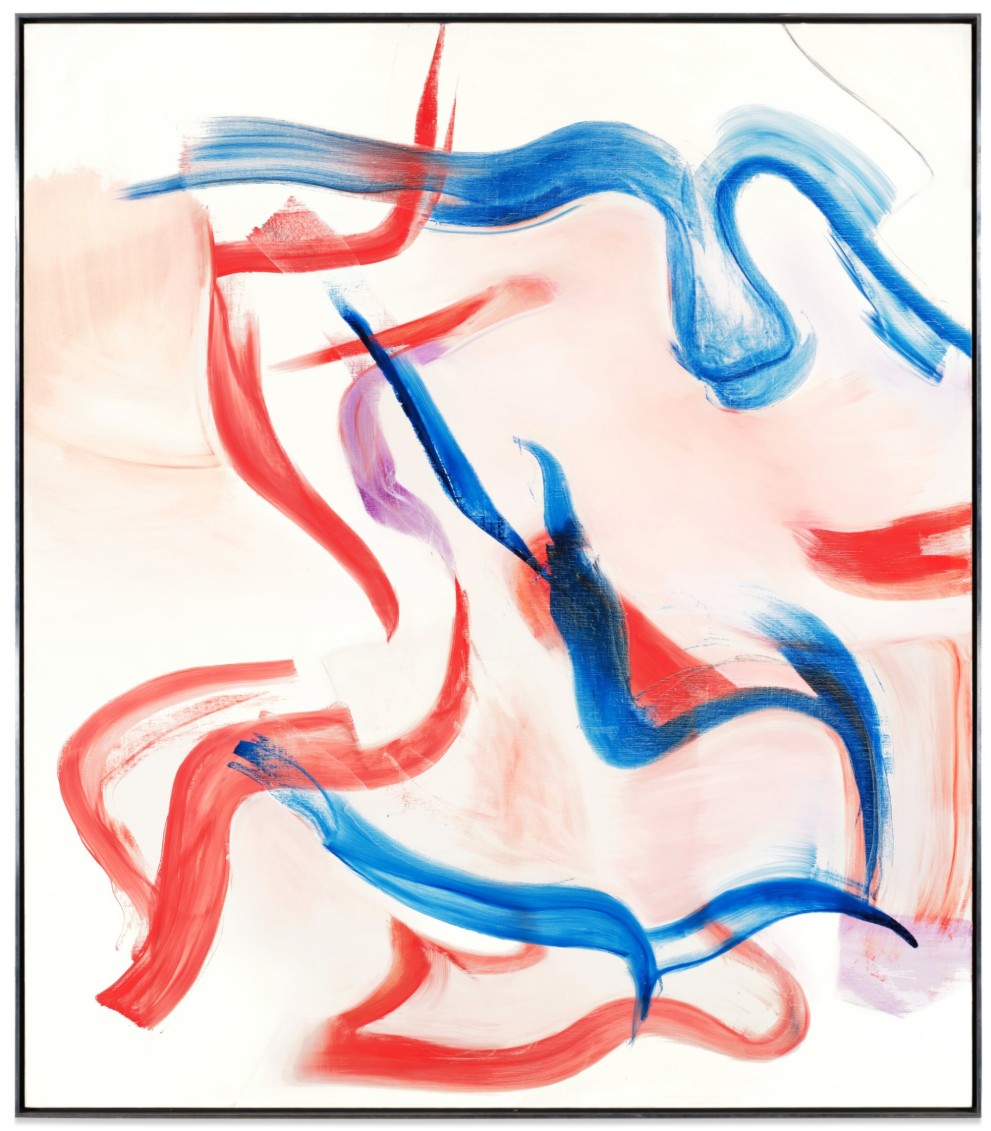
WILLEM DE KOONING (1904 – 1997)
Untitled XLII, 1983
Oil on canvas
80×70 inches (203.2 x 177.8 cm)
Untitled I, 1980
The Arc of Abstraction: Masterpieces from a Private European Collection
Christie’s New-York: 18 May 2026
Estimated: USD 9,000,000 – 12,000,000
USD 12,250,000
WILLEM DE KOONING (1904-1997), Untitled I | Christie’s
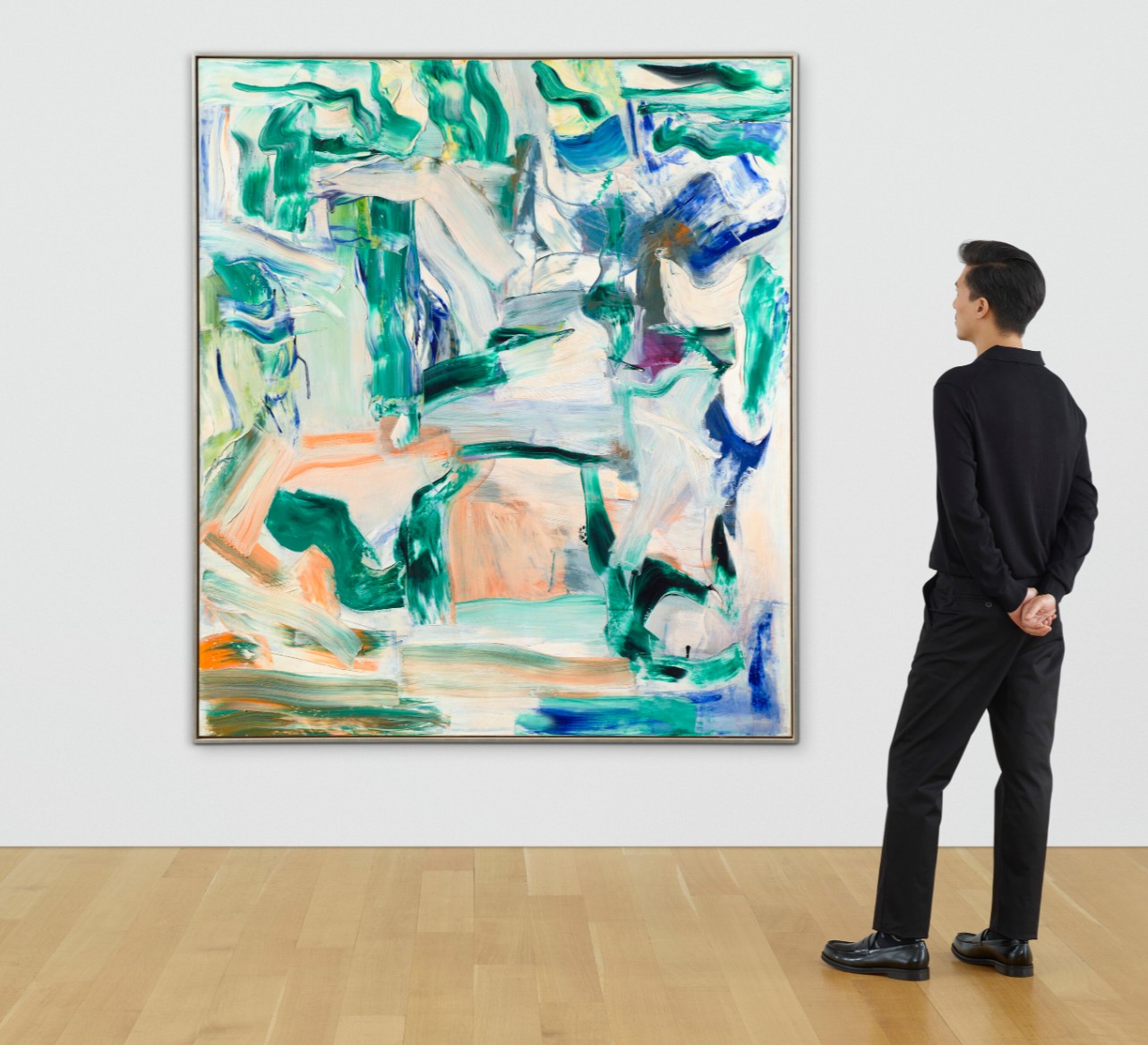
WILLEM DE KOONING (1904-1997)
Untitled I, 1980
Oil on canvas
80×70 inches (203.2 x 177.8 cm)
Signed ‘de Kooning’ (on the reverse)
Untitled, 1970
Robert Mnuchin: Collector at Heart
Sotheby’s New-York: 14 May 2026
Estimated: USD 4,000,000 – 6,000,000
USD 10,800,000
Willem de Kooning | Untitled | Robert Mnuchin: Collector at Heart
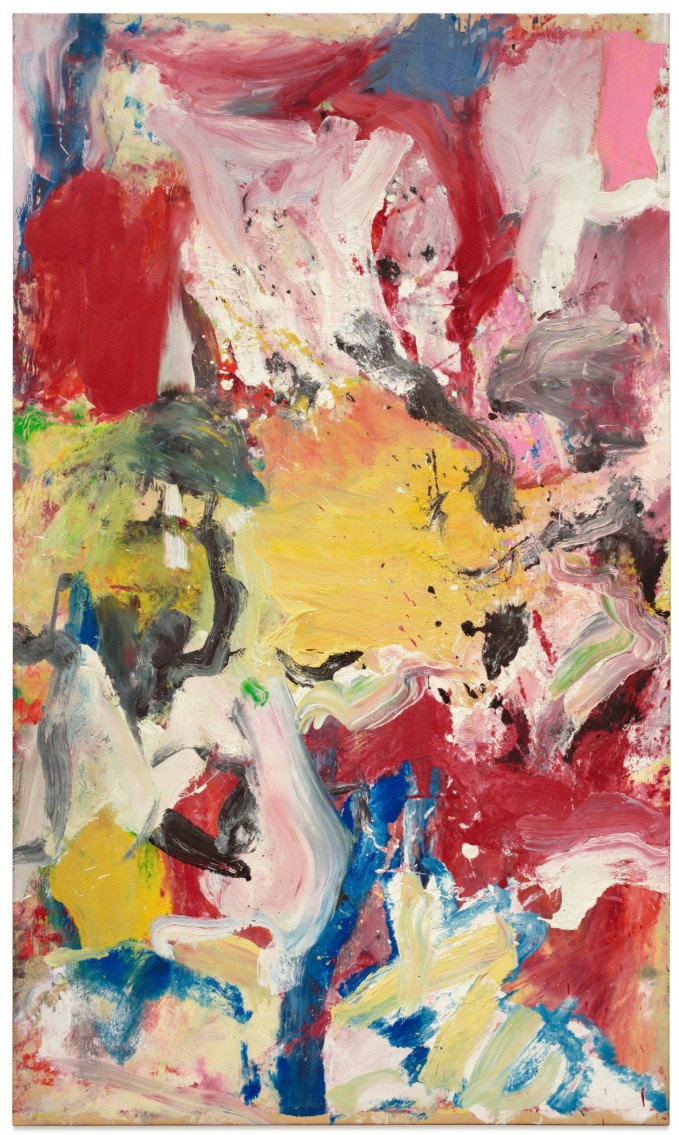
WILLEM DE KOONING (1904 – 1997)
Untitled, 1970
Oil on paper mounted on canvas
72 x 42-1/2 inches (182.9 x 108 cm)
Untitled XVI, 1983
Christie’s New-York: 18 May 2026
Estimated: USD 6,000,000 – 8,000,000
USD 7,395,000
WILLEM DE KOONING (1904-1997), Untitled XVI | Christie’s
WILLEM DE KOONING (1904-1997)
Untitled XVI, 1983
Oil on canvas
77×88 inches (195.6 x 223.5 cm)
Untitled III, 1975
Untitled III, 1975
Property from an Important Private Collection
Sotheby’s New-York: 14 May 2026
Estimated: USD 25,000,000 – 35,000,000
USD 26,000,000
Willem de Kooning | Untitled III | The Now & Contemporary Evening
WILLEM DE KOONING (1904 – 1997)
Untitled III, 1975
Oil on canvas
87-3/4 x 76-1/2 inches (222.9 x 194.3 cm)
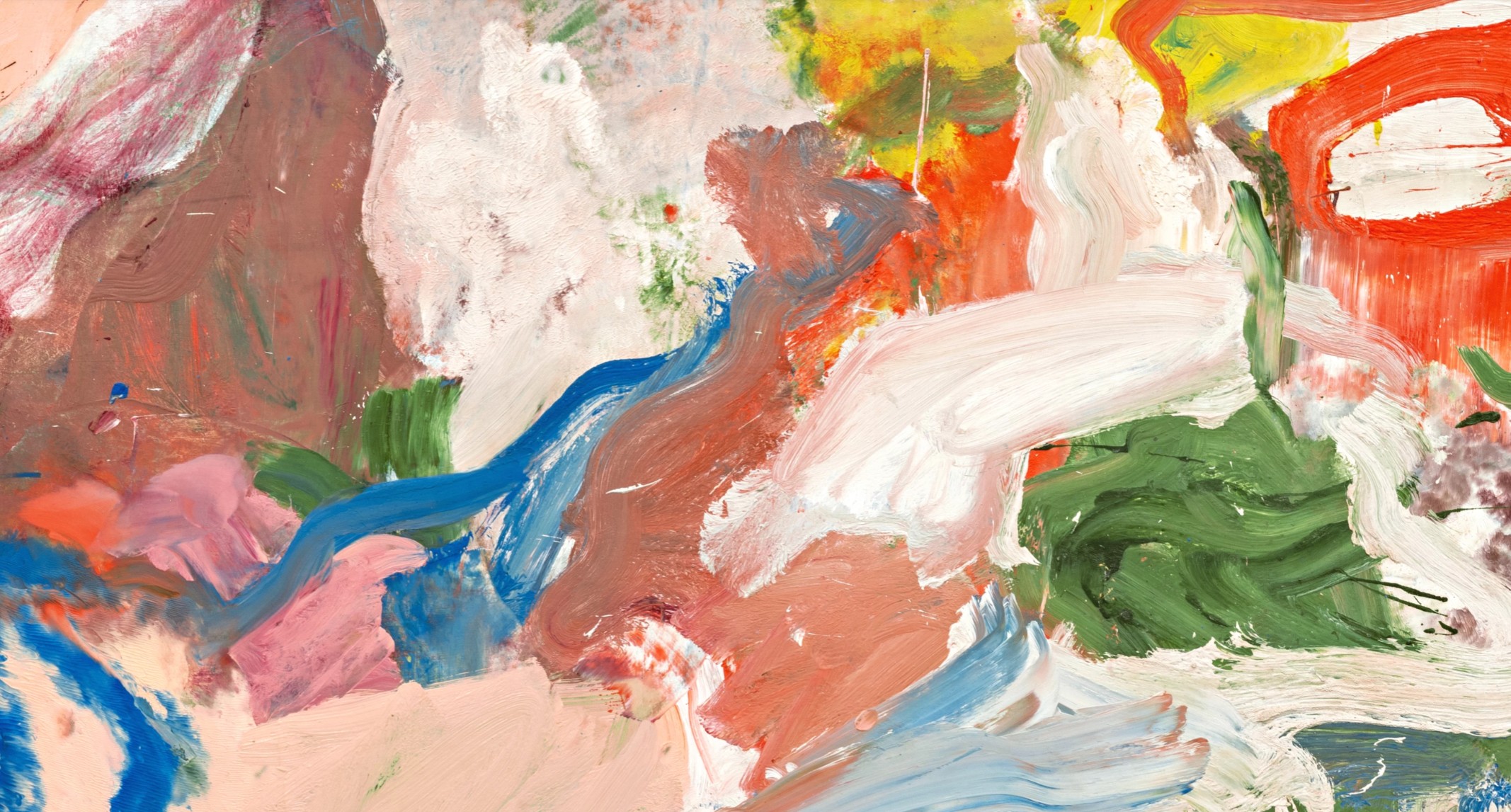
A raucous convergence of blazing color, sensuous physicality, and unbridled vitality, Untitled III announces itself a gem of de Kooning’s oeuvre from the artist’s most coveted periods of production: the mid 1970s. Prevailing from de Kooning’s monumental return to the canvas—after a series of years dedicated to sculpture and drawing—the 1975 masterwork brings with it all of the explosive genius of a life-long passion being freshly returned to. Grand in scale and sensuously sculpted with rich vermilions, steel blues, and saffron yellows, Untitled III hums with movement, confidently pulling one’s gaze in and pushing it back out.
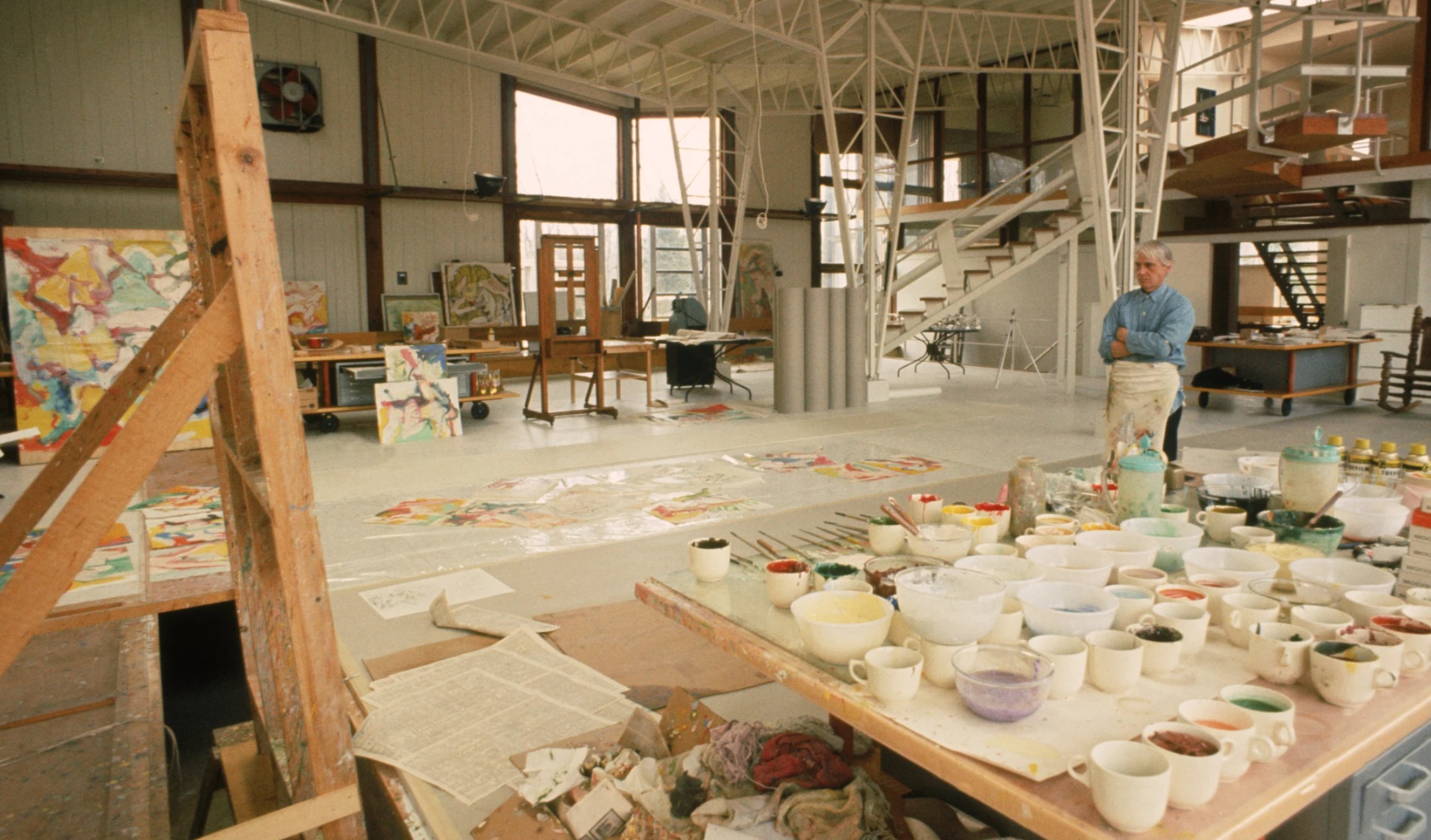
Willem de Kooning in his studio, East Hampton, 1965. Photo by Hans Namuth/Photo Researchers History/Getty Images. Art © 2026 The Willem de Kooning Foundation / Artists Rights Society (ARS), New York
Untitled III was executed in de Kooning’s beloved Springs, East Hampton studio, where the artist’s practice developed from a period of peaceful introspection following his move out of New York City, where de Kooning admittedly reconnected with his natural surroundings in an intensely influential way, ultimately finding a renewed sense of confidence in his craft through works from this time like Untitled III.
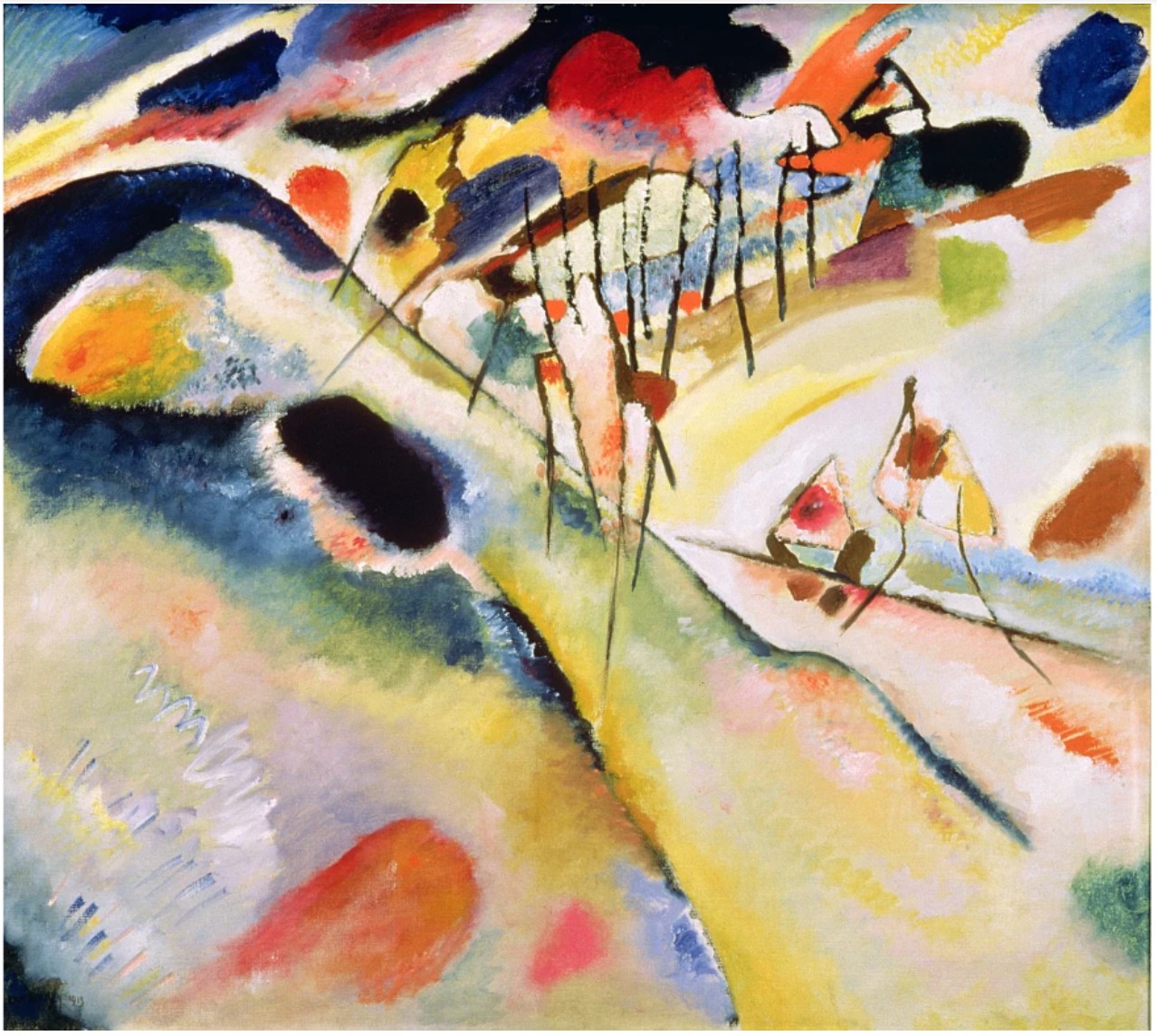
Wassily Kandinsky, Landscape, 1913. State Hermitage Museum, St. Petersburg.
Image © Bridgeman Images. Art © 2026 Artists Rights Society (ARS), New York / ADAGP, Paris
By 1974, de Kooning was completely finished with his city lifestyle, announcing “I’ve become a stranger to New York because of being here all the time,” and permanently moved to his Spring, East Hampton home (Rodgers 1978, 18). Now fully dedicating his time to his beloved Spring, he developed a new routine; biking, fishing, swimming – where he interacted with his surroundings in intimate and meaningful ways. By the spring of 1975, his East Hampton days would readopt the familiar ritual of painting, but with a renewed force. At once, de Kooning entered a highly productive—almost frenetic—period where he instantly transitioned to working with larger canvases and experimenting with new paint mixes.
“When I moved into this house, everything seemed self-evident. The space, the light, the trees – I just accepted it without thinking about it much. Now I look around with new eyes. I think it’s all a kind of miracle.”
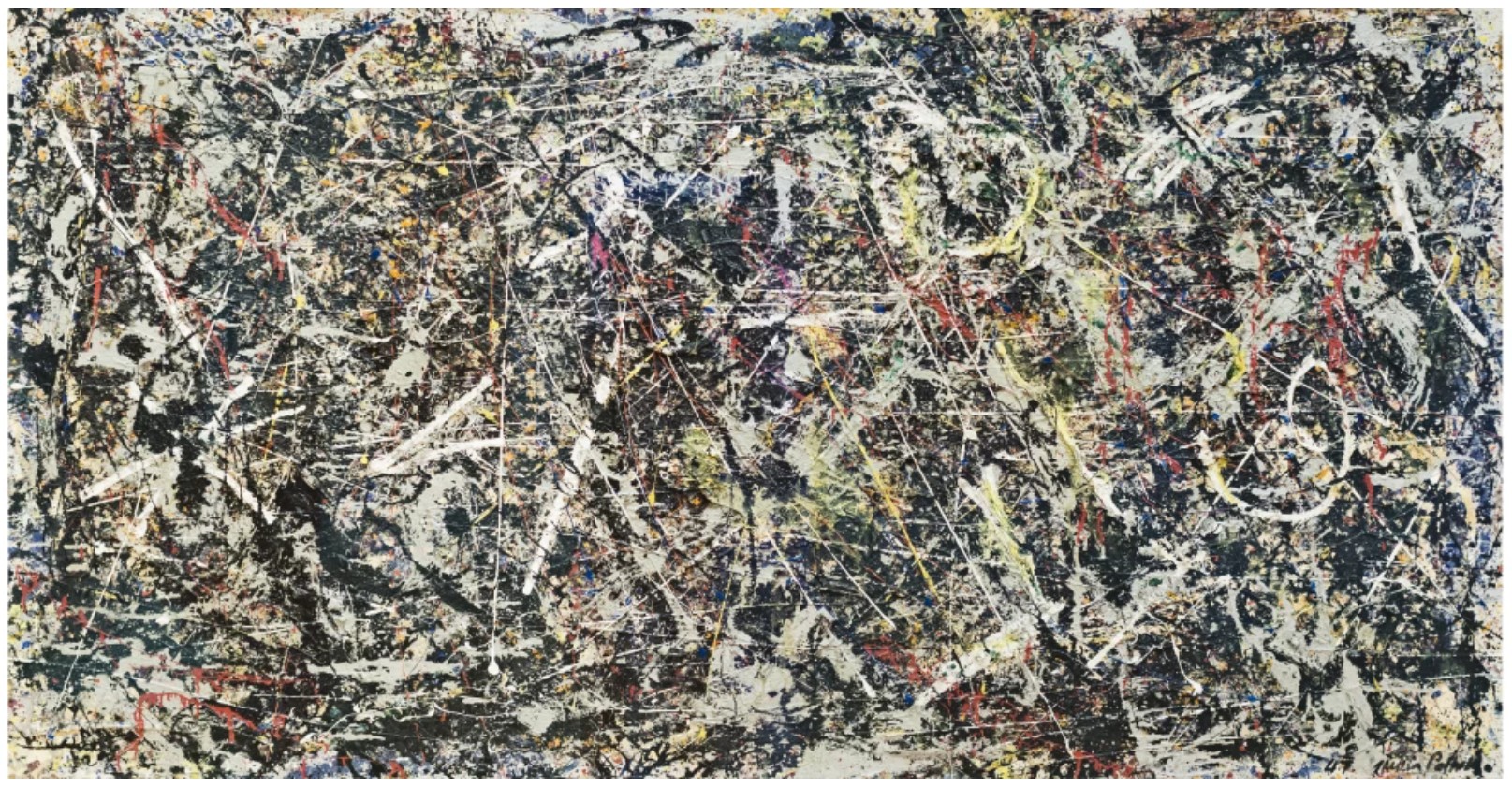
Jackson Pollock, Alchemy, 1947. Peggy Guggenheim Foundation, Venice. Image © Stefano Baldini. All rights reserved 2026 / Bridgeman Images. Art © 2026 Pollock-Krasner Foundation / Artists Rights Society (ARS), New York
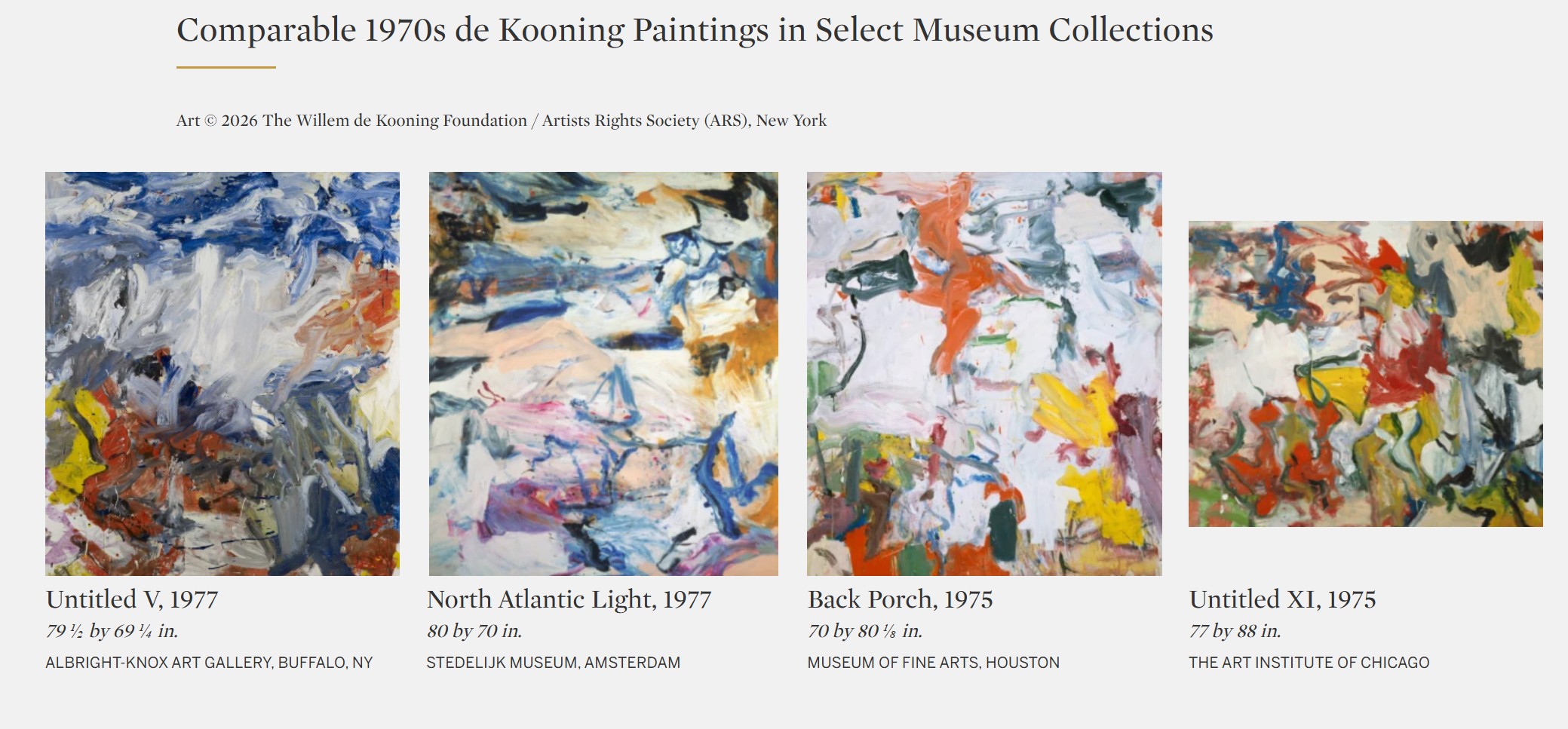
During these productive early days in 1975, de Kooning would complete Untitled III alongside masterpieces now owned by an esteemed assemblage of collections such as …Whose Name Was Writ in Water (1975) at the Solomon R. Guggenheim Museum, New York, Back Porch (1975) at the Museum of Fine Arts, Houston, and Two Trees on Mary Street… Amen! (1975) at the Queensland Art Gallery in South Brisbane.
By the fall, Untitled III would debut alongside 10 other masterworks on 25 October 1975 at Fourcade, Droll, Inc.’s solo show De Kooning: New Works, Painting and Sculpture. Thus began his gallery representation by Xavier Fourcade that would extend the rest of the artist’s life, initiating a professional renewal as well as an artistic one. This fresh beginning and confident re-approach to his craft, especially at such a late age, comes through onto de Kooning’s canvas directly, jarring in its staunchly confident strokes and gestural smears, offering an impeccably emotive masterpiece by the abstract expressionist.
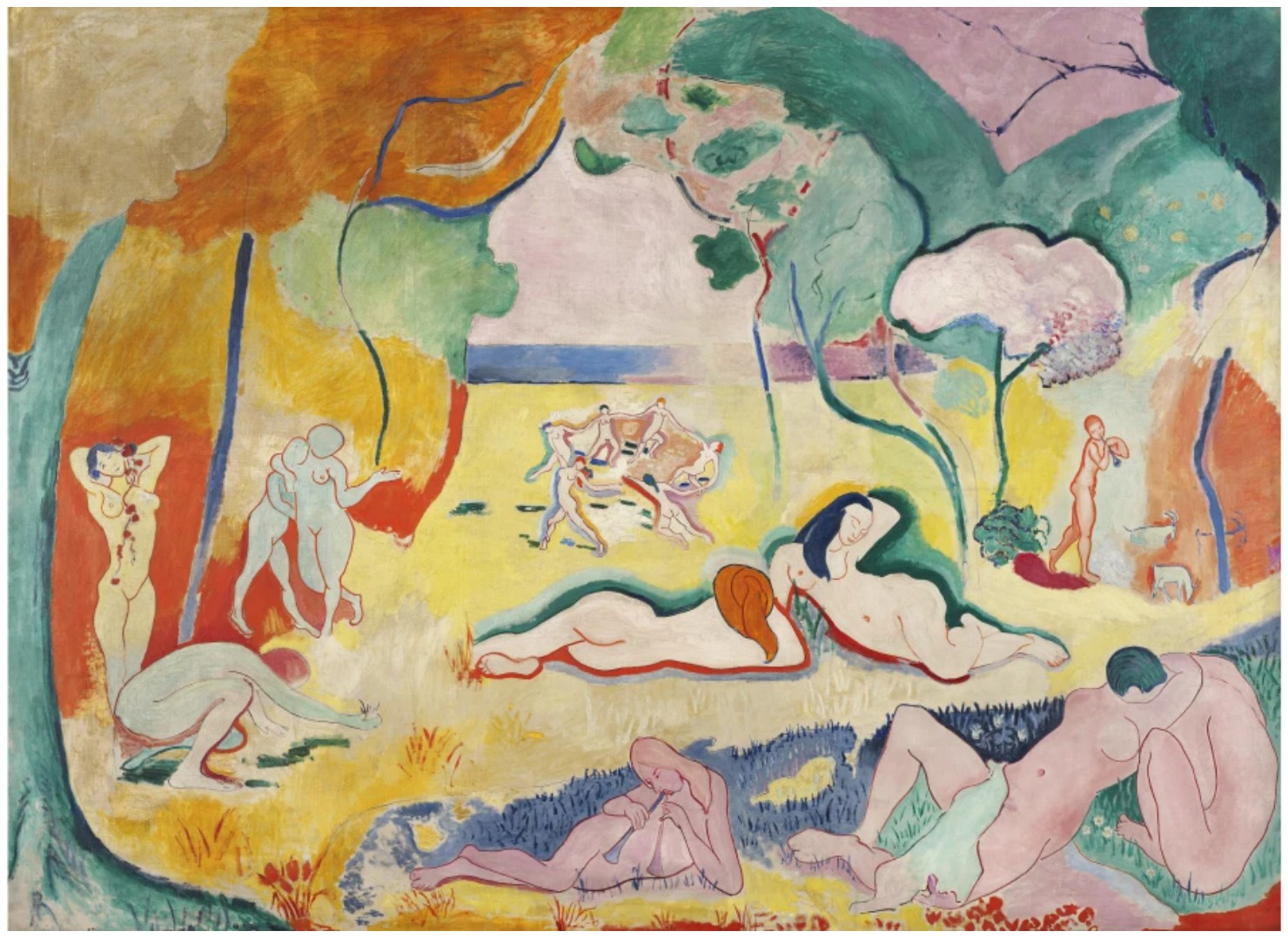
Henri Matisse, The Joy of Life, 1905-06. The Barnes Foundation, Philadelphia. Image © Barnes Foundation / © Succession H. Matisse / Bridgeman Images. Art © 2026 Succession H. Matisse / Artists Rights Society (ARS), New York
At the near center of the canvas appears a large flare of saffron yellow, muddied by the vermillion underneath it, suggesting a rapid application unhindered by the caution of the drying layer below. Directly at left, a swooping scarlet halfmoon dips into a decadent blush-pink impasto daub. Moving upward, a branching forest-green convergence of brushstrokes breaks apart a block of peach paint, taking away any sense of stabilization the solid form may have provided in this ever-fluctuating vision of dancing color.
In the upper-right-hand quarter, an icy blue-white swath zig-zags up frantically to the very corner of the canvas, delivering the viewer to the swirling scarlet ribbon that dances weightlessly atop the work. Described as an “eye-like shape,” the red ribbon in the very upper-right hand corner encourages the viewers to step back and take in Untitled III at a distance. For the viewer to regard the work from afar, they are overwhelmed with “an overload of painterly information with no sense of orientation, a sensual chaos that, although it appears before us, we cannot be sure appears for us” (Ralph Ubl, “From the Painting to the Picture: The Question of Orientation in the Work of Willem de Kooning,” Kunstmuseum Basel 2006).
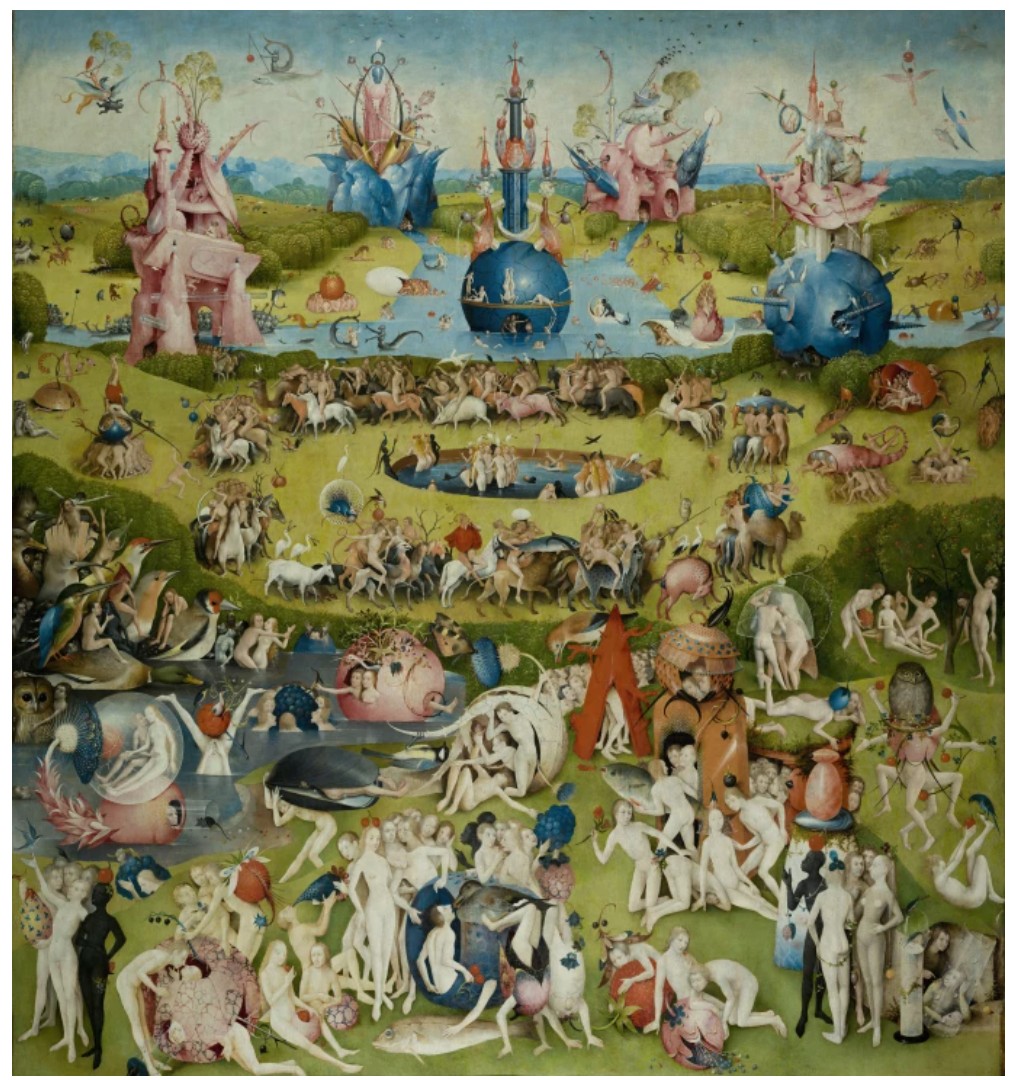
Hieronymus Bosch, The Garden of Earthly Delights (detail), 1490-1500. Prado, Madrid. Image © Bridgeman Images
De Kooning wanted his art to be unknowable. Untitled III is exactly this, it pulses and oscillates, hovers and runs, but not out of fear or weakness. In contrast, by bearing its sumptuous colors and sculpted smears, Untitled III confronts the world in utter confidence. A stout offering from its creator who was doing just the same. Reflecting on the creation of Untitled III’s series of 20, de Kooning said, “I couldn’t miss… It’s strange. It’s like a man at a gambling table [who] feels that he can’t lose. But when he walks away with all the dough, he knows he can’t do that again. Because then it gets self-conscious. I wasn’t self-conscious. I just did it.” (Stevens and Swan, de Kooning: An American Master, New York, 2004, 560-61) In “just doing it,” de Kooning offers to the world a work of art that masterfully manipulates his plastic forms of paint into a confrontational exposition of line and color, gravitas and weightlessness. Executed during a critically beloved period of de Kooning’s oeuvre, Untitled III expertly embodies de Kooning’s own headspace as one of reflection, peace, and conviction in himself.
Untitled I, 1980
Untitled I, 1980
The Arc of Abstraction: Masterpieces from a Private European Collection
Christie’s New-York: 18 May 2026
Estimated: USD 9,000,000 – 12,000,000
USD 12,250,000
WILLEM DE KOONING (1904-1997), Untitled I | Christie’s
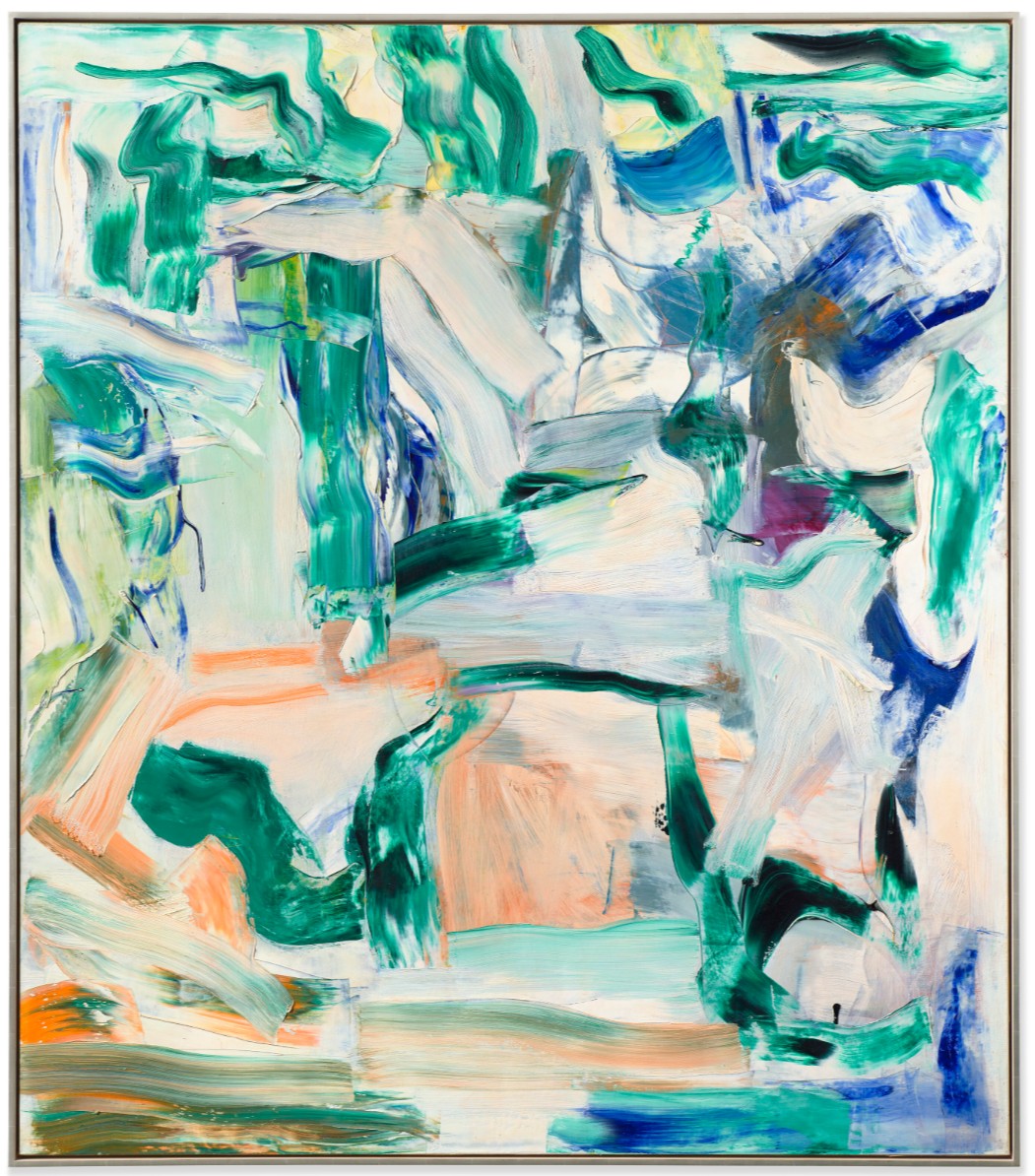
WILLEM DE KOONING (1904-1997)
Untitled I, 1980
Oil on canvas
80×70 inches (203.2 x 177.8 cm)
Signed ‘de Kooning’ (on the reverse)
A rare, exceptional example of Willem de Kooning’s painterly prowess, Untitled I is one of only a handful of canvases which the Abstract Expressionist produced in 1980. The work brilliantly reveals the master at his most contemplative, subtly changing his technique and style in reaction to the ease with which he now felt painting in style of his works of the earlier 1970s. Here, de Kooning employs longer, crisper, broader brushstrokes which push the boundaries of his compositional constructions. The artist approached his canvas with new ribbon-like lightness, redeploying his previous styles in a revelatory novel way. As the art historian John Elderfield notes, here “the loosening of fit, and its consequences… was part of a perennial, alternating pattern of expansion and contraction, for the artist as natural as breathing” (de Kooning: A Retrospective, exh. cat., Museum of Modern Art, New York, 2011, p. 450).
“I don’t have any convictions except my paintings.”
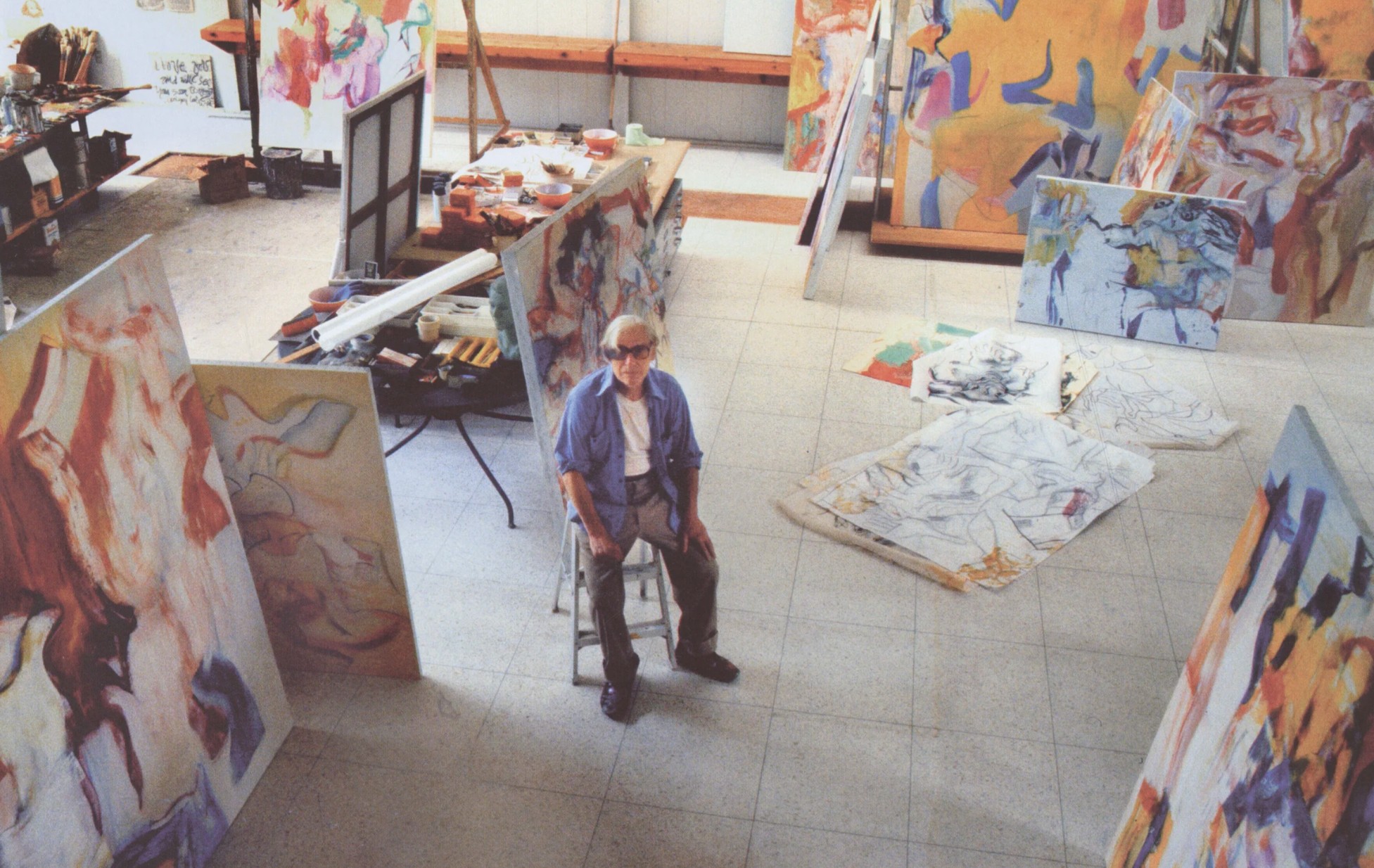
Willem de Kooning in his East Hampton Studio, 1981. Photo: © 2026 Eddy Posthuma de Boer.
Artwork: © 2026 The Willem de Kooning Foundation / Artists Rights Society (ARS), New York.
Untitled I demarcates a bold new period which would mark the last decade of de Kooning’s artistic production. The artist had suffered several tribulations from 1978, where the loss of several close friends, including Tom Hess and Harold Rosenberg, coupled with the disastrous news that many of his earlier painting were in critical condition due to his experimental media, and his personal struggles with alcoholism, had a deleterious effect on his artistic output. 1980 inaugurated both personal and artistic breakthroughs—his newfound sobriety allowed de Kooning to begin to work again, finding renewed strength through his painterly practice as he rethought his creative methods. As he noted to the art patron Olga Hirshorn, “In [my] line of work… the very worse can turn out for the good” (quoted in J. Zilczer, A Way of Living: The Art of Willem de Kooning, New York, 2014, p. 227).
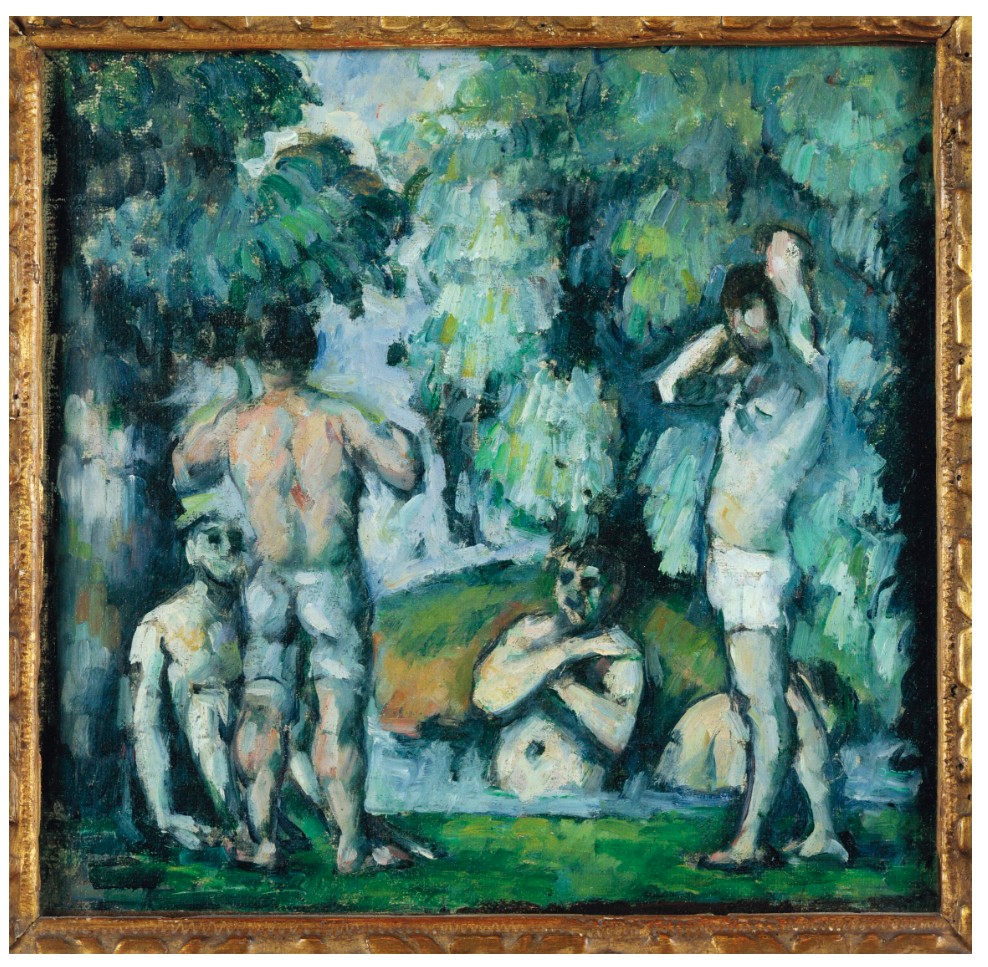
Paul Cezanne, Cinq baigneurs (Five Bathers), 1876-1877. Musée d’Orsay, Paris. Photo: Erich Lessing / Art Resource, New York.
Untitled I is one of a few of what are known as the “impossible paintings” created in the late 1970s and early 1980s. De Kooning laid swathes of troweled white across the ground of his canvas, over which he marbled sweeping gestures of thalo green, cobalt, and orange, mingled with a shot of violet. Describing these “extraordinary paintings,” Elderfield eloquently elaborates how de Kooning’s colors “pulse and hover like the Northern Lights over a still pond. If jumping ship was his first big splash, de Kooning kept the water moving afterward. His paint handling spanned an encyclopedia of traditions. His imagery groped back to wide-eyed Isis. Bruegel and Cranach’s women come on board” (quoted in “John Elderfield, Jennifer Field, Lauren Mahony, and Delphine Huisinga with Phong Bui,” The Brooklyn Rail, December 2011–January 2012, online [accessed 4/14/2026]). De Kooning reengaged with the art historical tradition with renewed vigor, studying the techniques of the Old Masters while reconsidering their handling of color. Untitled I in particular recalls the style and color of the Venetian Renaissance artists, particularly Titian and Giorgione. As the scholar Stephen Mack writes, “many of the fundamental aspects of de Kooning’s art have their origins in Venetian artistic traditions. The Venetians, having devised novel ways of depicting landscapes in oil, invented the genre of the pastoral landscape in painting, an important historical precedent for de Kooning’s work of the 1960s and ‘70s” (“Willem de Kooning and the Venetian Renaissance,” in De Kooning and Italy, exh. cat., Galerie dell’Accademia, Venice, 2024, p. 51).
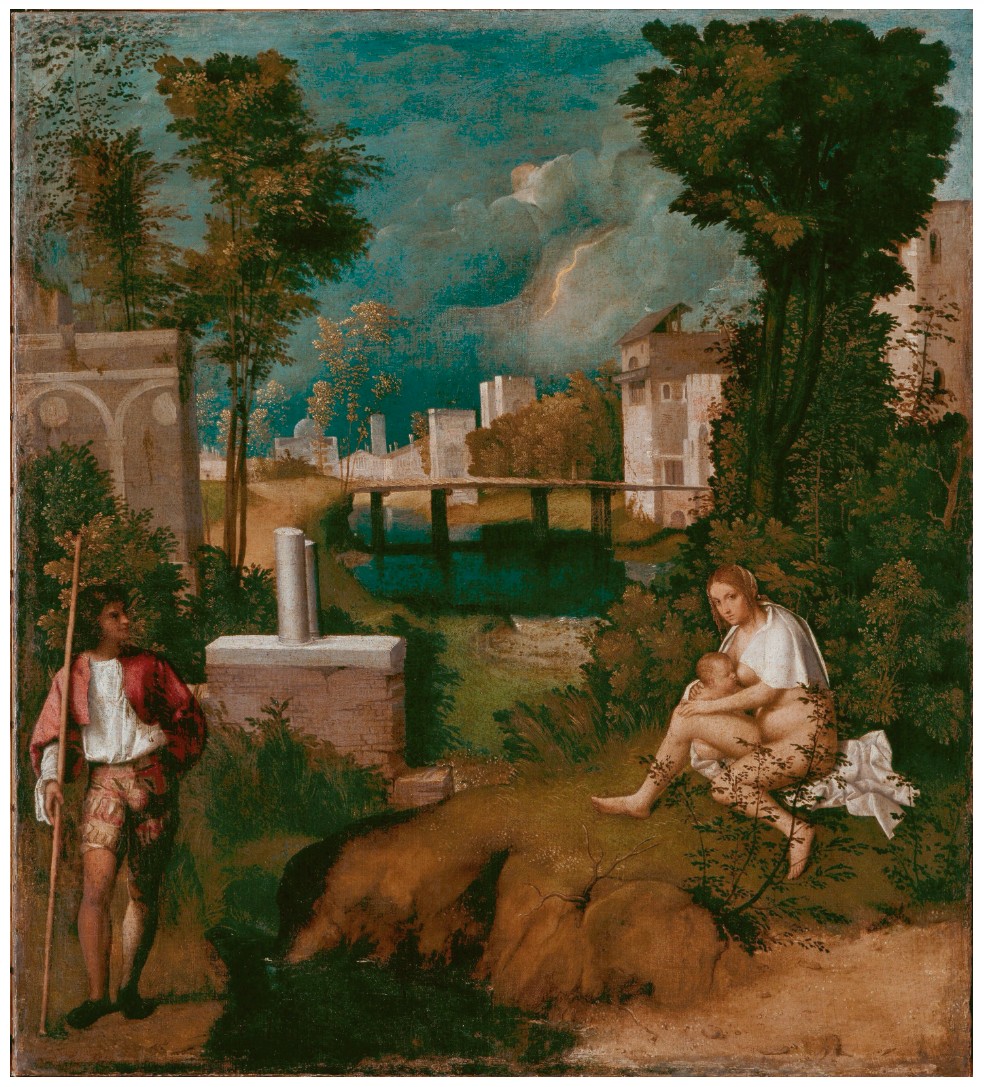
Giorgione, The Tempest, circa 1505. Gallerie dell’Accademia, Venice.
Thalo green is a notoriously difficult pigment to work with, proving nigh impossible to properly incorporate into chromatic harmony with other colors. De Kooning’s bold choice to foreground the color in Untitled I expresses the artist’s determined ambition as he entered his eighth decade. When he viewed his 1978 exhibition at the Solomon R. Guggenheim Museum Willem de Kooning in East Hampton, de Kooning said to his assistant, “I can’t go wrong with these pictures” (quoted in ibid.). The artist undertook to reevaluate his painterly praxis, seeking new challenges in order to breathe a new vitality into his work.
Describing the new body of work which de Kooning debuted at the turn of the decade, Elderfield writes, “when compared with the many preceding abstractions, they reveal an increased use of the taper’s knife (the flat-bladed tool used in drywall construction to spread spackle over taped joints) to spread swaths of thick paint, now into discrete bands or ribbons of varying widths” (J. Elderfield, op. cit., p. 447). In employing the taper’s knife in his new body of work, de Kooning looked back to his younger self, rejuvenating the techniques he first mastered as a young artist newly arrived in New York. The Dutch artist had arrived in Hoboken, New Jersey, in 1926, finding employment as a house and sign painter before moving into the city and befriending Arshile Gorky, John Graham, and Stuart Davis. His manipulation of the painted surface in Untitled I, using his knife to scrape away pigment, recapitulated his earliest work in the United States. As Judith Zilczer describes, “in the end, he would mine a lifetime of studio experience to craft a new painting process grounded in his graphic sensibility” (J. Zilczer, op. cit., p. 227).
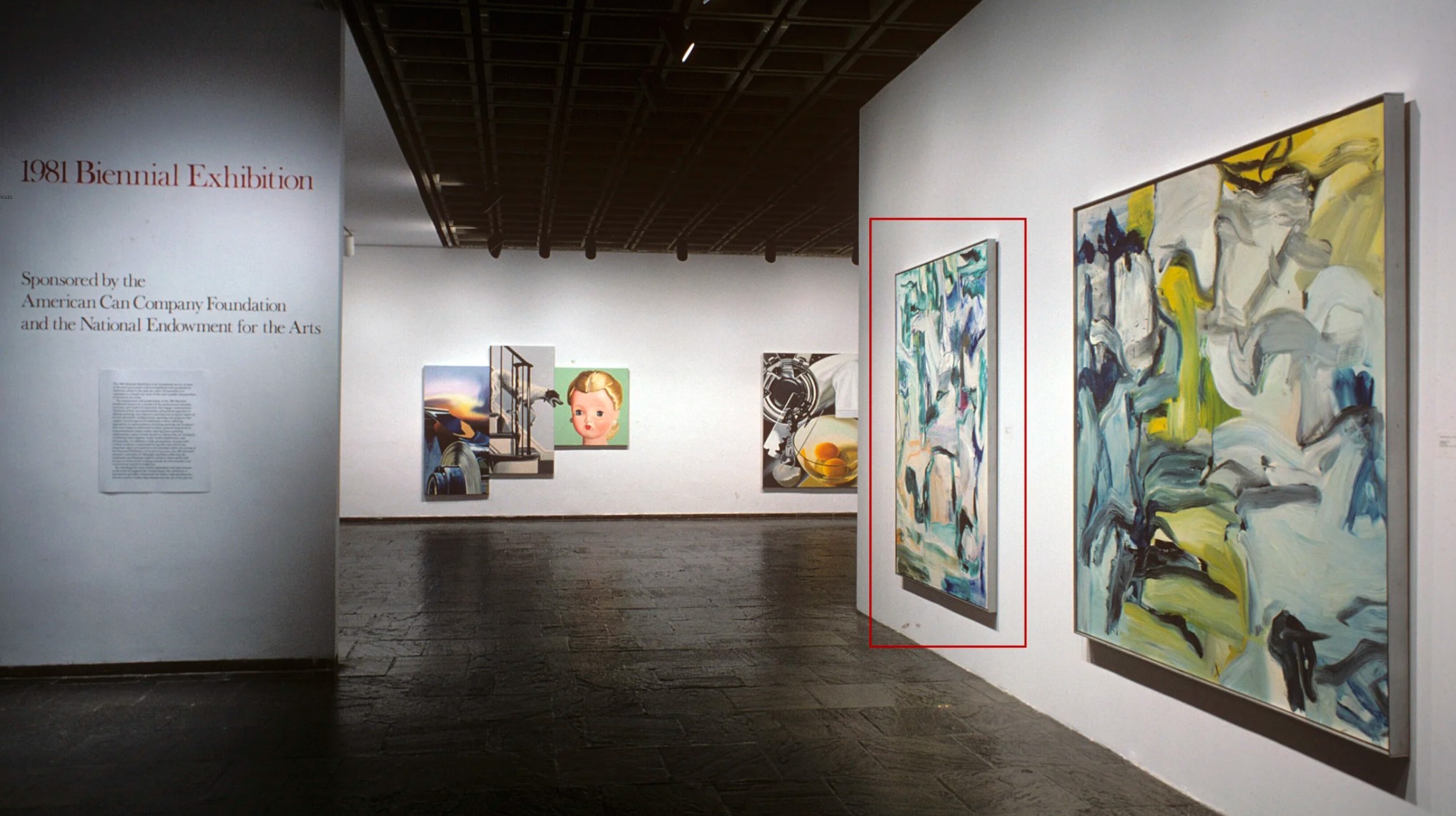
Installation view, Whitney Biennial, 1981 (present work illustrated). Photo: © Whitney Museum of American Art / Licensed by Scala / Art Resource, NY. Artwork: © 2026 The Willem de Kooning Foundation / Artists Rights Society (ARS), New York.
The present work was exhibited in his longtime dealer Xavier Fourcade’s exhibition One Major New Work Each the year it was made, alongside work by the likes of Joan Mitchell, Roy Lichtenstein, and Louise Bourgeois. It was then featured the following year in the fifth Whitney Biennial, after which the work was acquired by the eminent Philadelphia art collector David Pincus. The Pincus collection included exceptional masterpieces of American postwar art, including important works by Mark Rothko, Jackson Pollock, and Barnett Newman, as well as deep holdings of de Kooning’s work. When the Pincus collection came to auction in 2012, records were broken for Pollock, Newman, and Rothko. Untitled I then ascended into an important European collection of abstract paintings, demonstrating the continued import of the work.
“Just because you’re getting old doesn’t mean you’re getting any better. But I have a feeling I can do it better now.”
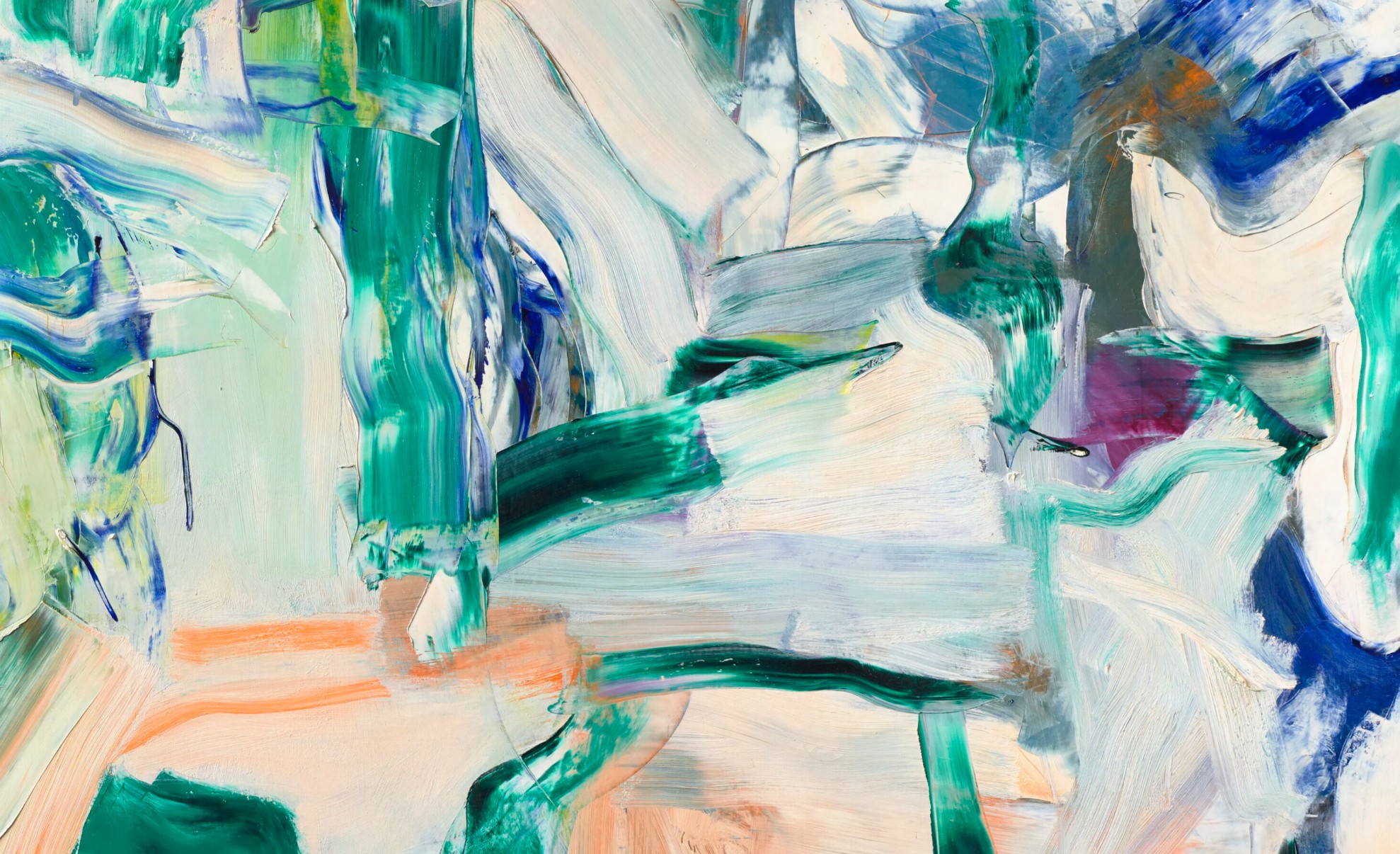
Untitled I ushers in the last decade of de Kooning’s celebrated oeuvre, revealing for the first time the fluid, ribbon-like brushstrokes which would coalesce into the lyrical abstractions of his late period. By utterly reducing his painterly style, seeking novel forms out from old ideas, de Kooning was able to successfully reinvent his practice, allowing him to emerge out from a creative and personal stupor which plagued the last years of the 1970s. Remarkable in its visual impact and astounding in its formal intelligence, the present work marks the last new beginning in de Kooning’s constantly metamorphosing practice. “It’s not going to be easy,” the artist wittily remarked to his interlocutor Judith Wolfe in the beginning of the decade. “Just because you’re getting old doesn’t mean you’re getting any better. But I have a feeling I can do it better now” (quoted in ibid., p. 232).
Untitled XLII, 1983
Untitled XLII, 1983
Robert Mnuchin: Collector at Heart
Sotheby’s New-York: 14 May 2026
Estimated: USD 9,000,000 – 12,000,000
USD 12,410,000
Willem de Kooning | Untitled XLII | Robert Mnuchin: Collector at
WILLEM DE KOONING (1904 – 1997)
Untitled XLII, 1983
Oil on canvas
80×70 inches (203.2 x 177.8 cm)
Sumptuous, swirling strokes of cerulean, scarlet, and lavender glide across the composition of Untitled XLII, forming lyrical ribbons, embodying the paradoxical delicacy and fortitude of Willem de Kooning’s celebrated late period works. A paragon of de Kooning’s unparalleled command of color and form, Untitled XLII is composed of elegant arabesques of pigment which dance through diaphanous pink clouds against a gleaming white surface. Painted in 1983, Untitled XLII is a consummate masterwork of de Kooning’s seminal late period: the triumphant apogee of the evolution of his abstraction. In 1981, following a five-decade career of pioneering abstraction, de Kooning began a corpus of paintings defined by an elegant fluidity, arresting tension and poetic balance unlike any works that had preceded them. This entrancing body of work, which would occupy de Kooning for the remaining years of his life, demonstrated both an unbridled expression and an intentionality completely unique within his oeuvre. Distinguished by its breathtaking palette and sublime composition, Untitled XLII epitomizes the union of fortitude and tranquility that defines de Kooning’s mature corpus.
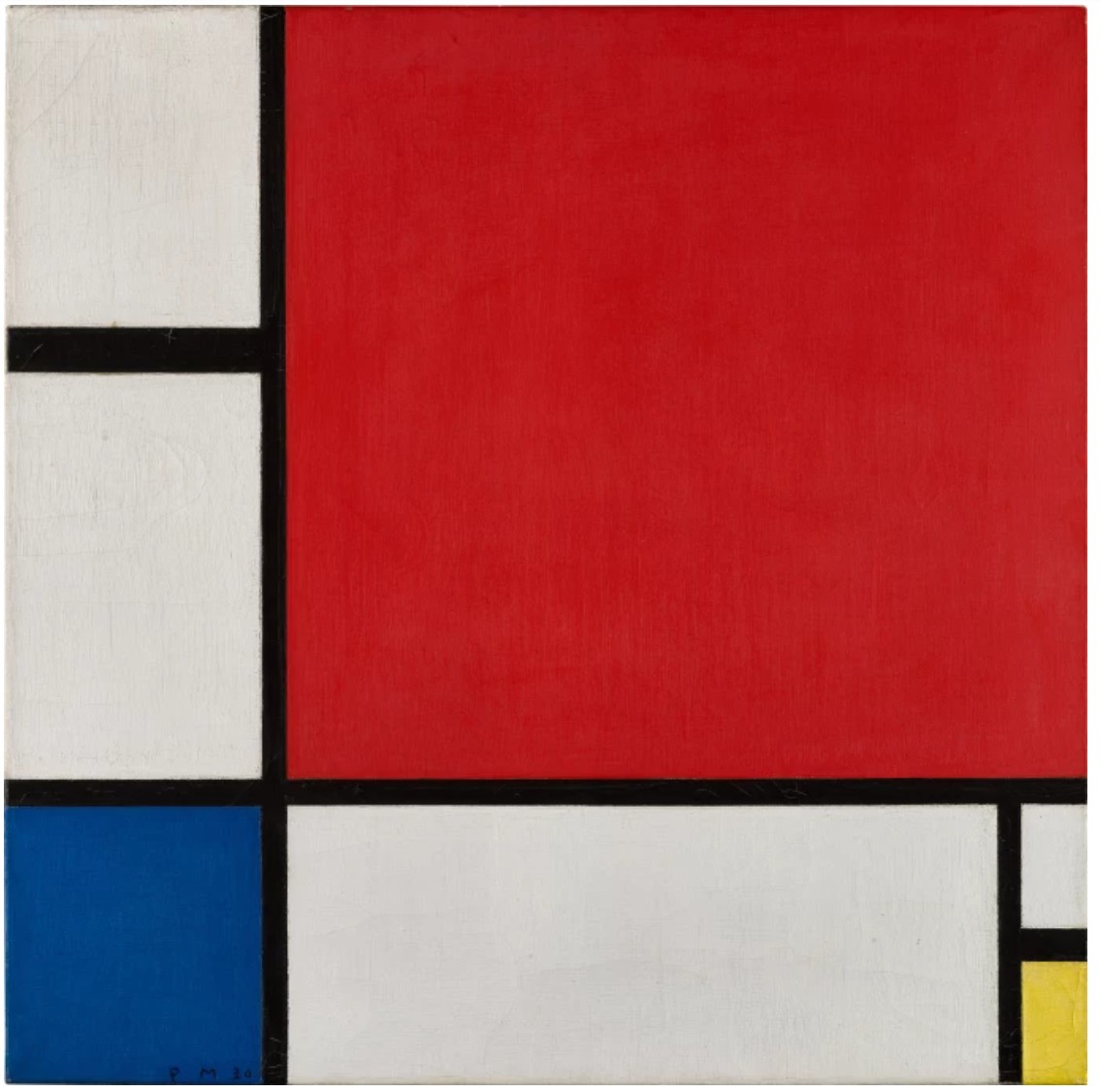
Piet Mondrian, Composition No. II, 1930. Private Collection. Sold at Sotheby’s New York in November 2022 for $51 million
With his final body of work, de Kooning achieved a new paradigm of abstraction: the figure-ground relationship reached an unprecedented dynamism through a careful balance of tension and grace. The artist observed this moment: “I am becoming freer. I feel that I have found myself more in the sense that I have all my strength at my command. I think you can do miracles with what you have, if you accept it… I am more certain the way I use the paint and the brush.” (the artist quoted in Din Peters, “Willem de Kooning: Paintings 1960-1982,” Studio International, No. 196, August 1983, pp. 4-5) In Untitled XLII, de Kooning juxtaposes a radiant white surface with sweeping strokes of fiery red, azure, and amethyst in sinuous streams.
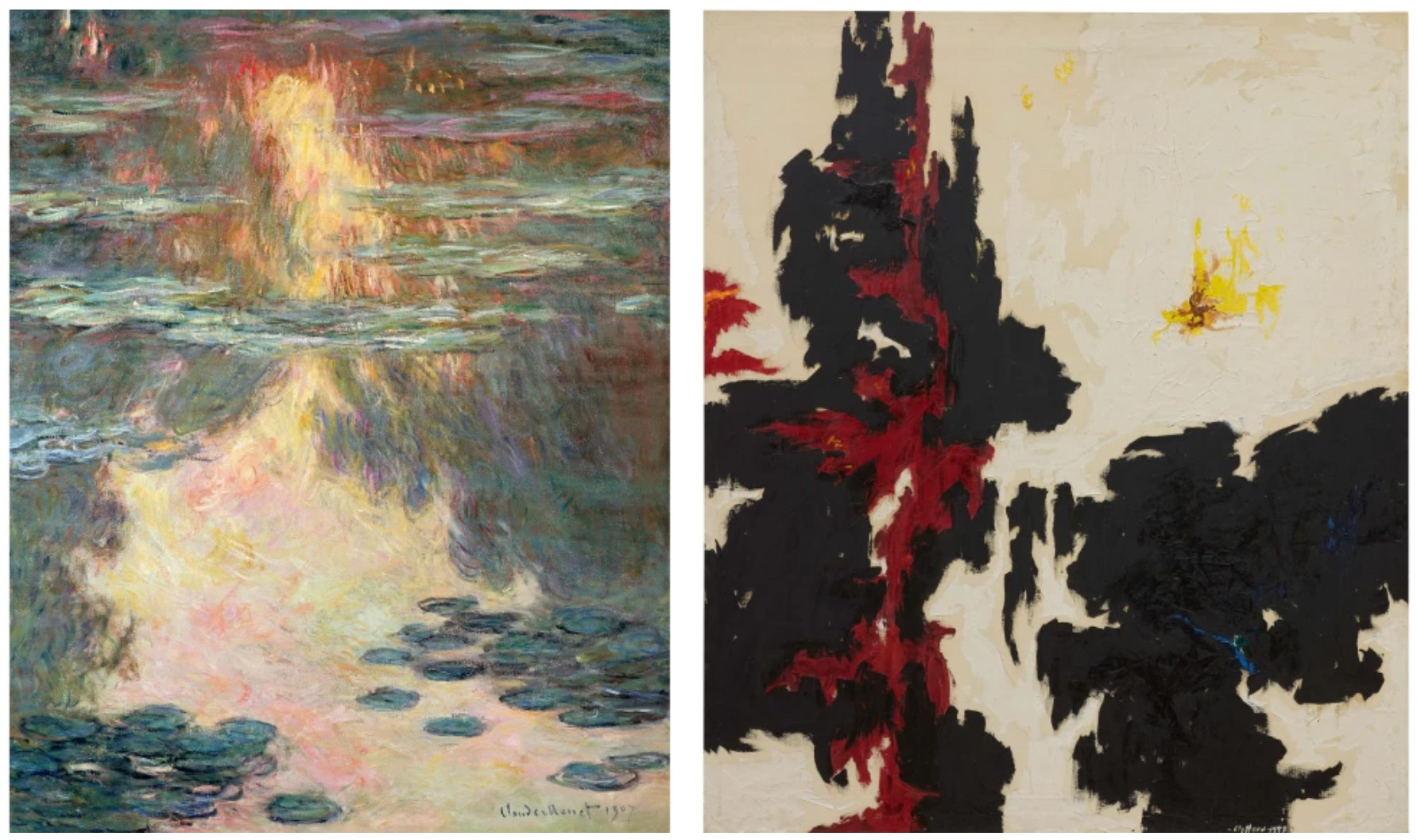
Left: Claude Monet, Waterlilies, 1907. Private Collection. Image © Bridgeman Images. Right: Clyfford Still, PH-144 (1947-Y-N0.1), 1947. Private Collection. Sold at Sotheby’s New York in June 2020 for $28.7 million. Art © 2026 Clyfford Still / Artists Rights Society (ARS), New York
Passages of blue dance across the surface, forming arabesques as red strokes flicker across the composition like rising flames. As observed by Carter Ratcliff, de Kooning’s works of this period were the product of both accumulation and reduction; he writes: “A process of subtraction makes an addition, a stately flurry of draftsmanly gestures. De Kooning has always layered and elided his forms. Now, he reminds us that he does the same with his methods.” (Carter Ratcliff, “Willem de Kooning and the Question of Style,” in: Amsterdam, Stedelijk Museum (and traveling), Willem de Kooning: The North Atlantic Light, 1960-1983, 1983, p. 22) De Kooning’s works of 1981 onward represented a superficial departure from the previous decade, which was defined by abundant, layered strokes of pigment reaching edge to edge across the canvas. But, in fact, de Kooning’s late works harken back to his earliest compositions, and the defining explorations of his career: the dialogue between line, gesture, and color. In paintings such as Untitled XLII, line returns to the fore, guiding the viewer’s gaze around the composition.
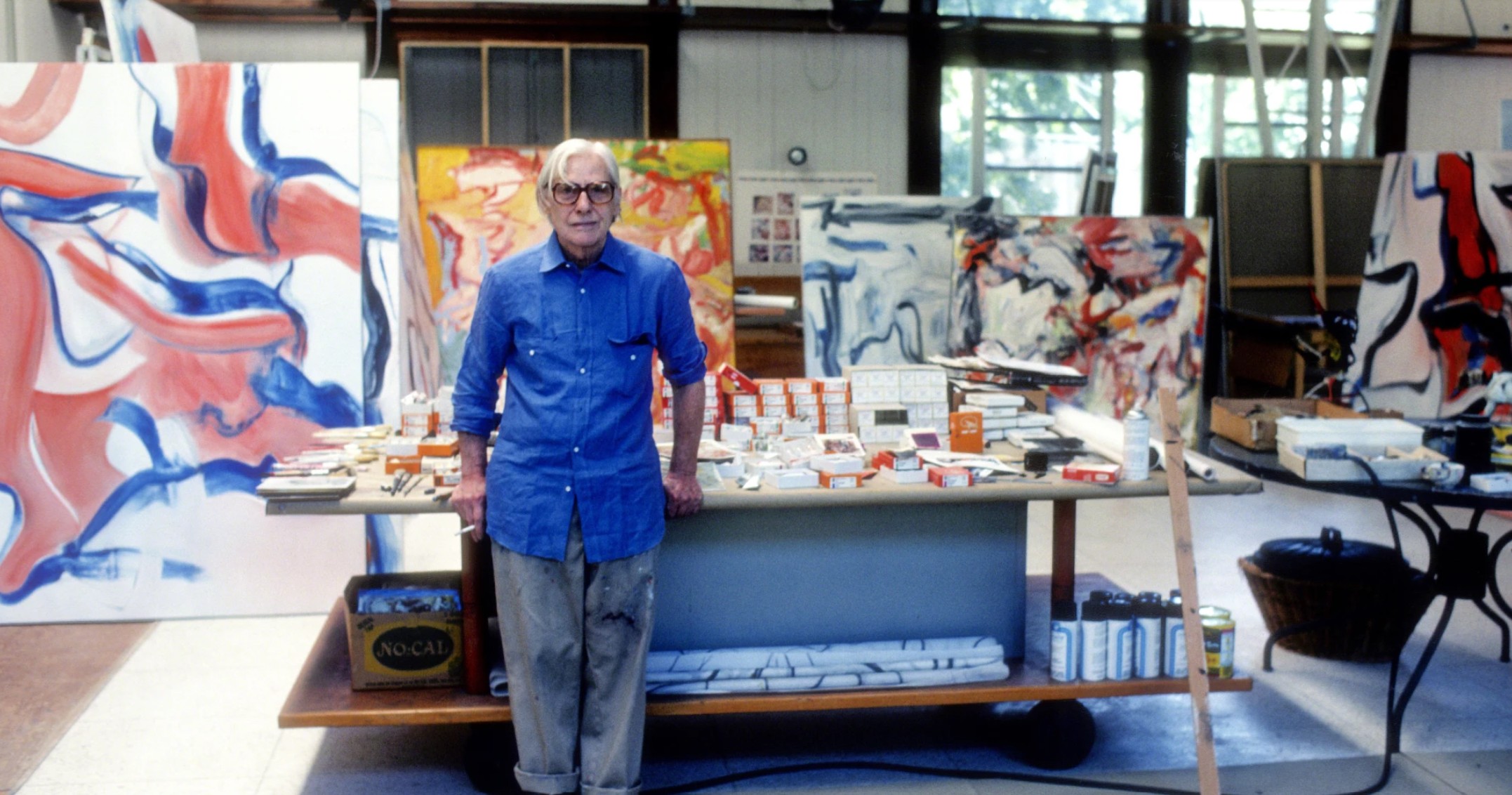
Willem de Kooning in his studio, circa 1982. Photo by Photo by Luiz Alberto/IMAGES/Getty Images.
Art © 2026 The Willem de Kooning Foundation / Artists Rights Society (ARS), New York
Across de Kooning’s legendary praxis, the articulation of line remained foundational to his process. From the staccato gestures of his 40s abstractions to the vigorous strokes of his earliest Women, the organic quality of his 60s compositions, the liberal impasto of his 70s abstractions to the glorious, lyrical articulation of his 80s paintings, the essence of his practice was always line itself. John Elderfield poignantly wrote of de Kooning’s final act: “Volume switching to void, and vice versa, had long been a preoccupation of de Kooning’s…so much has been surrendered, but so much gained. Density has been replaced by clarity, tonality by chroma, resistance by mobility of line, a granulated surface by a pristine one. Most audacious of all, pictorial containment has given way to the giddy thrill of sheer open space.” (John Elderfield quoted in: Exh. Cat., New York, Gagosian Gallery, Willem de Kooning: Ten Paintings, 1983-1985, 2013, p. 27)
Market Precedents
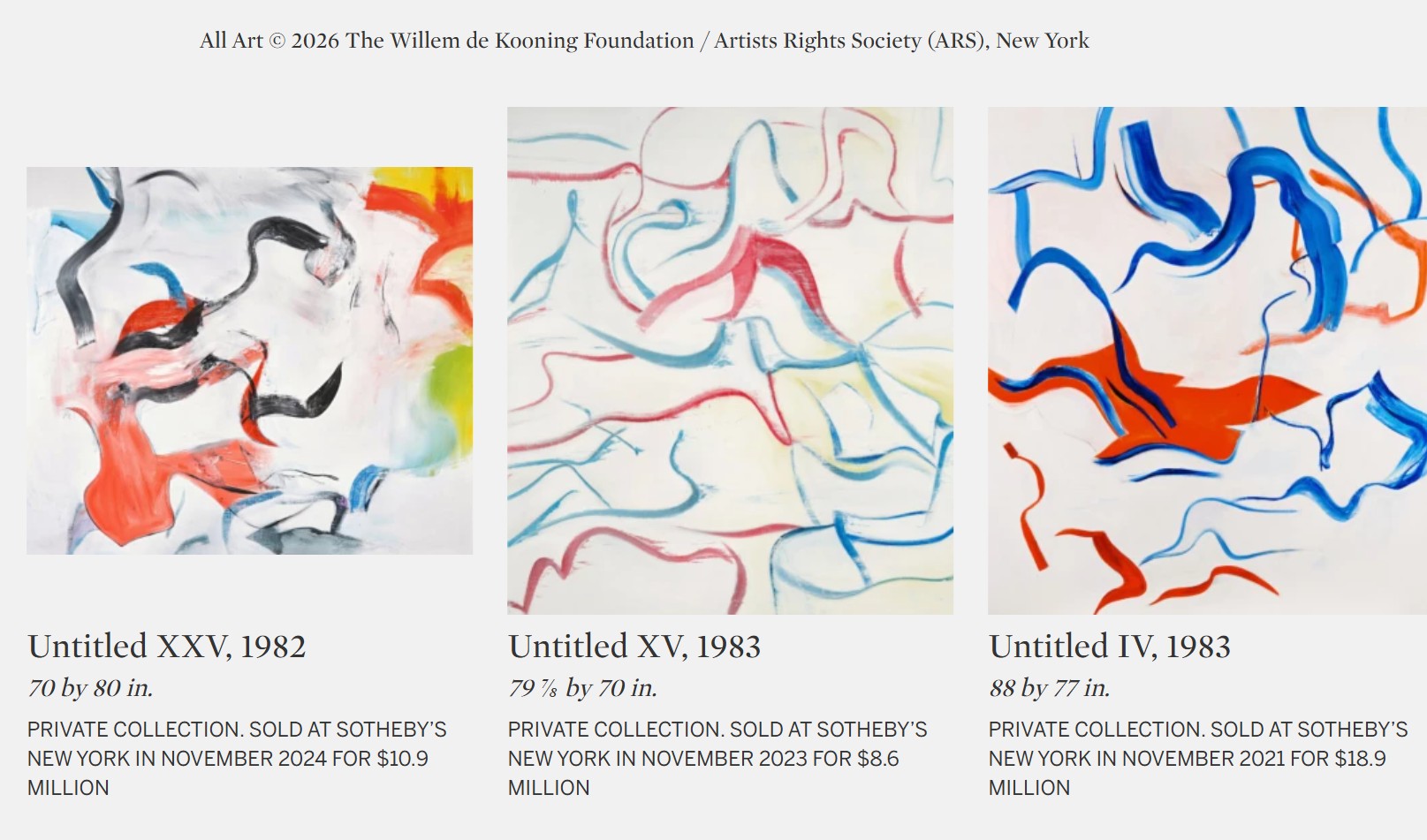
Painted in de Kooning’s capacious, light-filled studio in East Hampton, Untitled XLII bears an entrancing incandescence. Surrounded by the lush natural environment surrounding his studio, de Kooning was undoubtedly influenced by the spectral progression and chromatic possibilities as light conditions changed. Untitled XLII evokes the optical splendor of early morning light, as shades of blue, red, pink and purple overtake the sky.
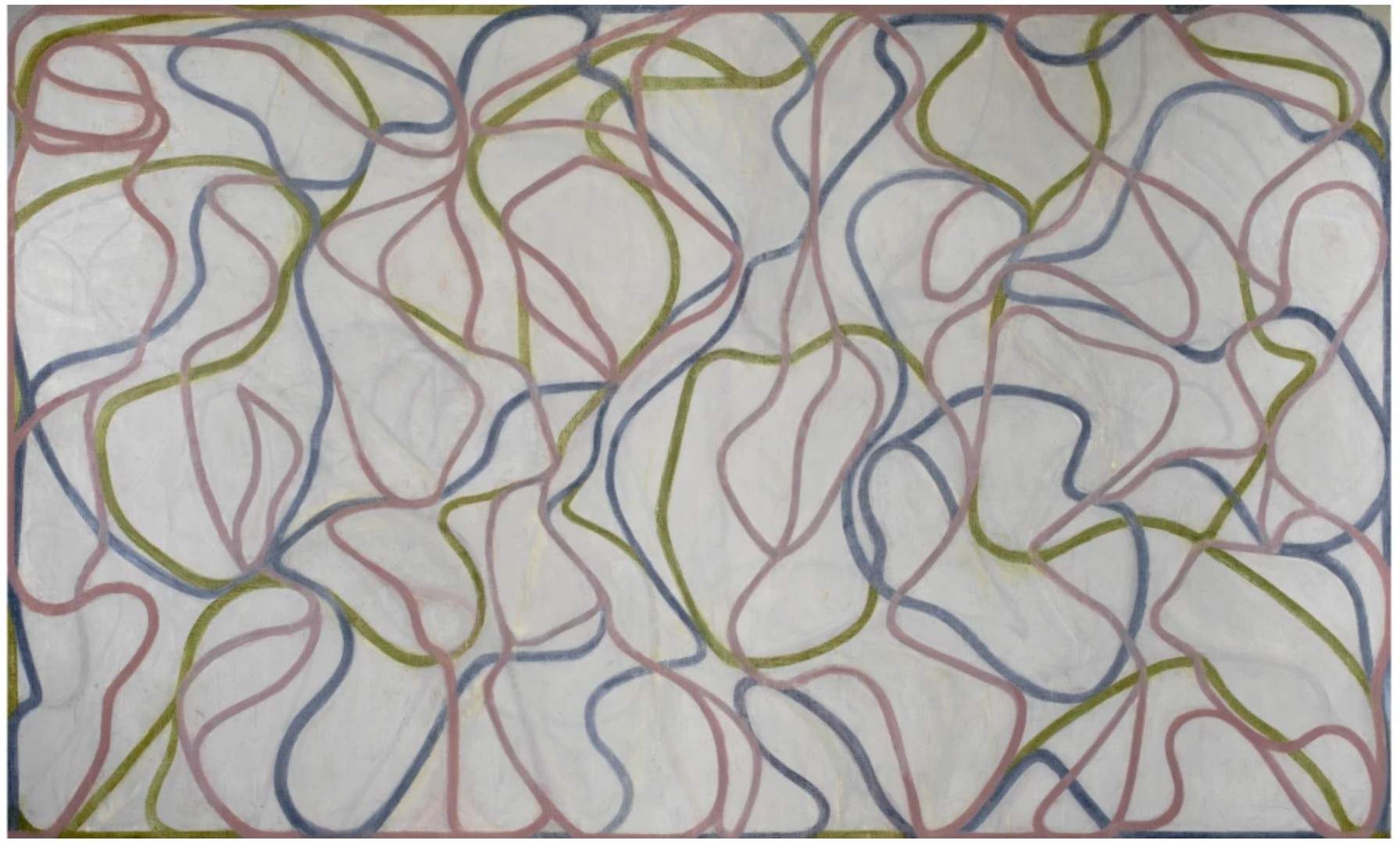
Brice Marden, Study for the Muses (Eaglesmere Version), 1991-94. The Art Institute of Chicago.
Image © The Art Institute of Chicago / Art Resource, NY. Art © 2026 Brice Marden / Artists Rights Society (ARS), New York
The work of de Kooning indeed held a central place at the heart of Robert Mnuchin’s celebrated collection. In a 2021 interview, Mnuchin said of the artist: “I think the de Kooning is the chairman of the board… De Kooning is Picasso-esque. He really has at least five totally distinct periods, and I think that really separates him from anybody that didn’t have many periods. Nobody else has done that.” (Robert Mnuchin quoted in: Marion Maneker, “It Took a Lot of Courage for Robert Mnuchin to Become an Art Dealer,” Artnews, 2 April 2021) Both personally and professionally, Mnuchin greatly admired de Kooning, organizing several exhibitions of the artist’s work, including the historic exhibition, de Kooning: Five Decades in 2021. A consummate masterpiece of de Kooning’s final period, Untitled XLII expresses a graceful confidence that de Kooning had garnered after a long career defined by both evolution and continuity.
Untitled, 1970
Untitled, 1970
Robert Mnuchin: Collector at Heart
Sotheby’s New-York: 14 May 2026
Estimated: USD 4,000,000 – 6,000,000
USD 10,800,000
Willem de Kooning | Untitled | Robert Mnuchin: Collector at Heart
WILLEM DE KOONING (1904 – 1997)
Untitled, 1970
Oil on paper mounted on canvas
72 x 42-1/2 inches (182.9 x 108 cm)
Lucious, balletic strokes of turquoise, pink, lemon yellow, and celadon green swell, crest, and collide into one another in Willem de Kooning’s spectacular theater of paint: Untitled from 1970. Stretching an extraordinary six feet in height, pure and unadulterated abstraction simultaneously conjures the sand and spume of East Hampton and the somatic, fleshy essence of the human body, marking yet another spellbinding chapter in the radical experimentation that transpired every decade of de Kooning’s working life. Here, his ceaseless, repeated investigations of line, color, and form embody a visceral, aqueous interplay between strength and sensuality, delicacy and mass, shepherding the palpable vigor of his earlier Women and Merritt Parkway pictures into a softer, lusher fullness. Exhibited internationally, most notably in the historic 2005-06 retrospective at the Kunstmuseum Basel, Untitled not only stands for this pivotal aesthetic turn in the artist’s career but also as a figure of immense significance to the legendary gallerist, dealer, and collector Robert Mnuchin, who fiercely championed the poetic and protean quality of his practice and from whom the present work hails.
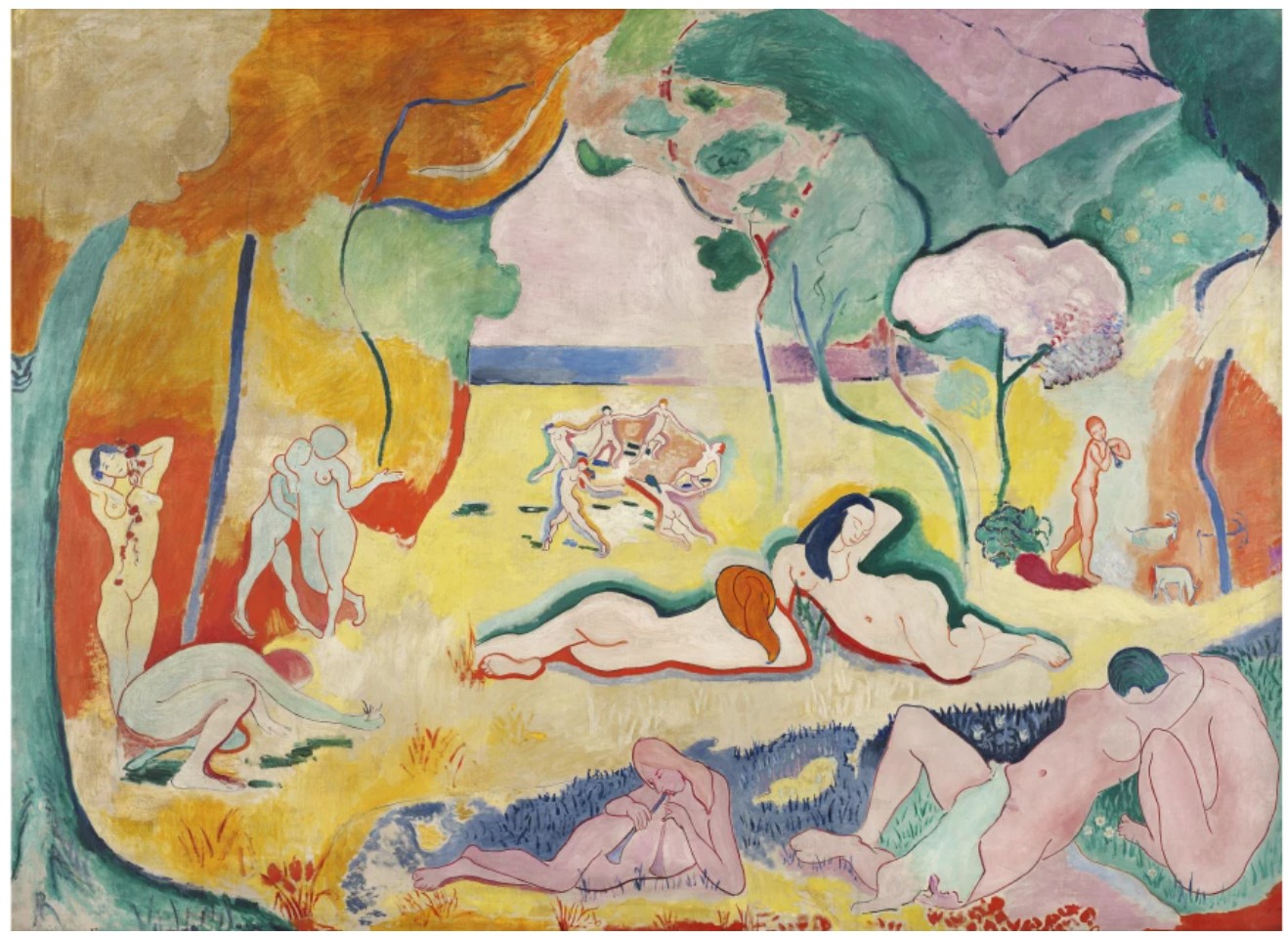
Henri Matisse, The Joy of Life, 1905-06. The Barnes Foundation, Philadelphia.
Image © Barnes Foundation / © Succession H. Matisse / Bridgeman Images
Here, richly impastoed passages wind and meander—laconically dragged in some places, splashed and splattered in others, even swirled by the artist’s fingertips—as if uncontainable by the picture plane and extending beyond the edges of the canvas. Shimmering ruby crashes into verdant swaths; oceanic cerulean coalesces with frothy, luxurious white, bringing to life the impression and essence of long grass, cresting waves, and coastal mist. This polychromatic splendor translates directly into the untamed paradisiac quality of Long Island, invoking the incredible heat, sky, and sea of de Kooning’s surroundings.
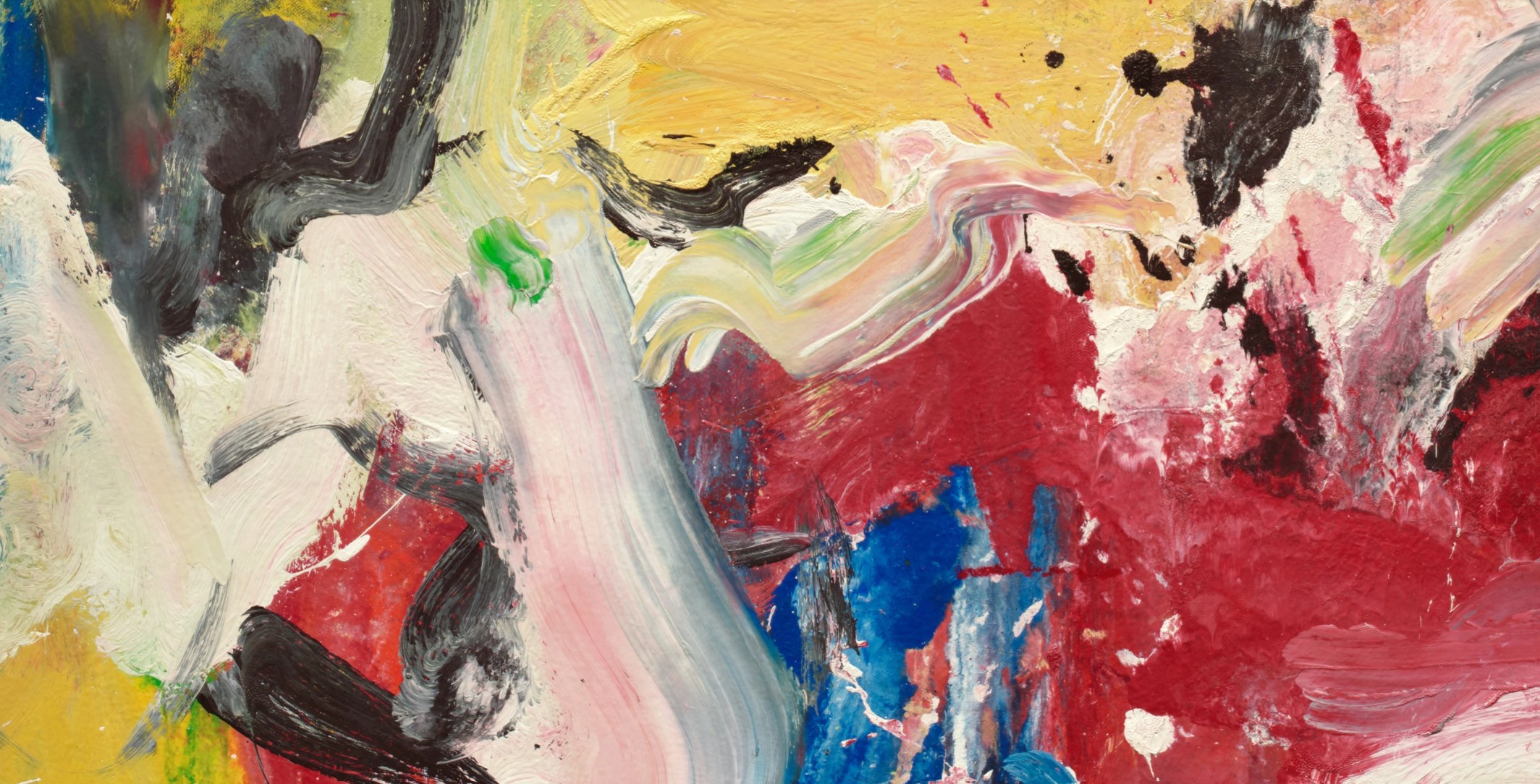
“When the light hits the ocean there is kind of a grey light on the water, indescribable tones, almost. I started working with them and insisted that they would give me the kind of light I wanted. […] I got into painting in the atmosphere I wanted to be in. It was like the reflection of light. I reflected upon the reflections on the water, like the fishermen do.”
Indeed, the full breadth of de Kooning’s mastery unfolds before us, liberally and lyrically.
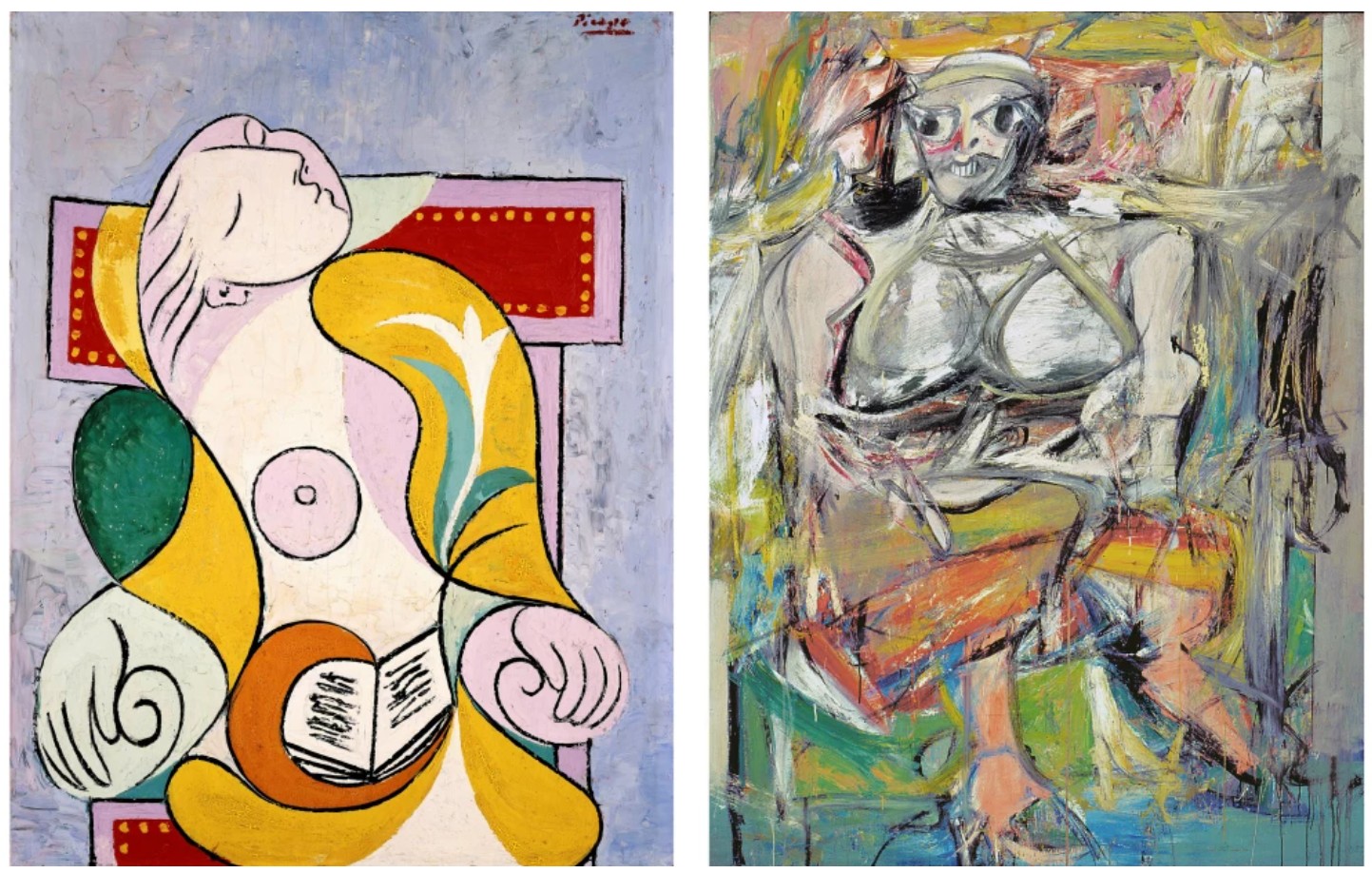
Left: Pablo Picasso, Reading, 1932. Private Collection. Image © Christie’s Images / Bridgeman Images. Art © 2026 Estate of Pablo Picasso / Artists Rights Society (ARS), New York.
Right: Willem de Kooning, Woman I, 1950–1952. The Museum of Modern Art, New York. Image © Bridgeman Images. Art © 2026 The Willem de Kooning Foundation / Artists Rights Society (ARS), New York
Untitled boasts a particularly enlivened spirit, confidence, and appetite for adventure. The artist’s celebration of line had been ascendant throughout his career: from the sharp interchanges of the early 1950s, through the muscularity of the Women, to the indulgent richness of the 1960s. It was in the late 1960s and early 1970s, however, that de Kooning’s newfound love for his surroundings joined his long-time obsession with the human form, and one was never lost entirely on the other. This development began in 1963, prompted by his retreat from Manhattan to Springs.
“When I moved into this house, everything seemed self-evident. The space, the light, the trees – I just accepted it without thinking about it much. Now I look around with new eyes. I think it’s all a kind of miracle.”
The “new eyes” brought on by this sanctuary saw a kind of euphoric harmony between space and body, man and earth, all buoyed by the magisterial, indiscriminately beautiful light of his new environment. From this radiant sun-drenched Atlantic seascape, hints and clues to a human body emerge, as if the artist fused his earlier figures right into the transcendental natural elements of Long Island.
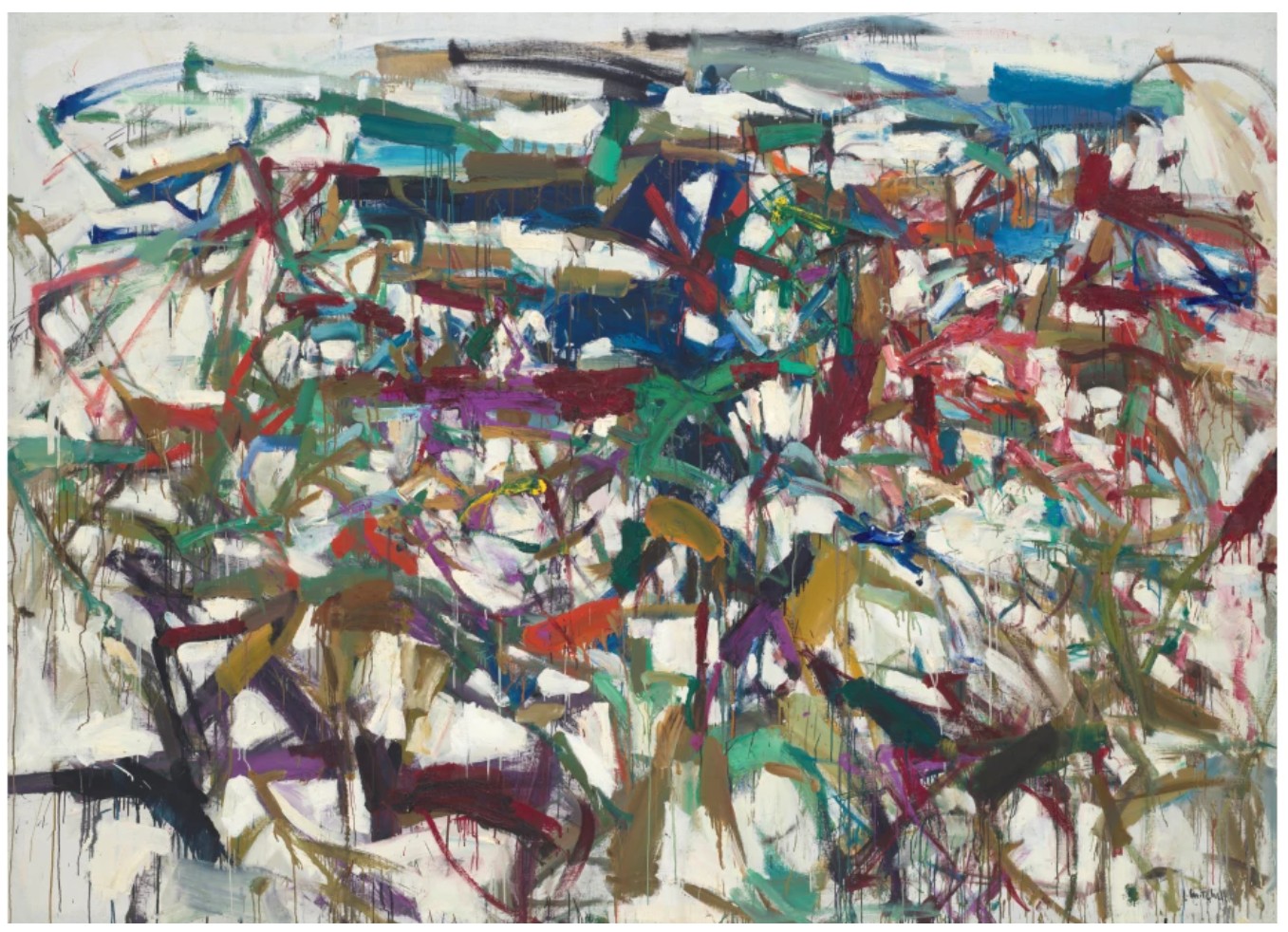
Joan Mitchell, Ladybug, 1957. The Museum of Modern Art, New York.
Image © The Museum of Modern Art/Licensed by SCALA / Art Resource, NY. Art © Estate of Joan Mitchell
By way of de Kooning’s prodigious instincts and the immutable certainty of his hand, Untitled bears every sign of the artist’s many gifts at their most intense: chromatic brilliance, formal balance and counterbalance, and an overwhelming sense of dynamism. Here, poetry is made plastic, music made material, and an exacting, pristine equilibrium is found.
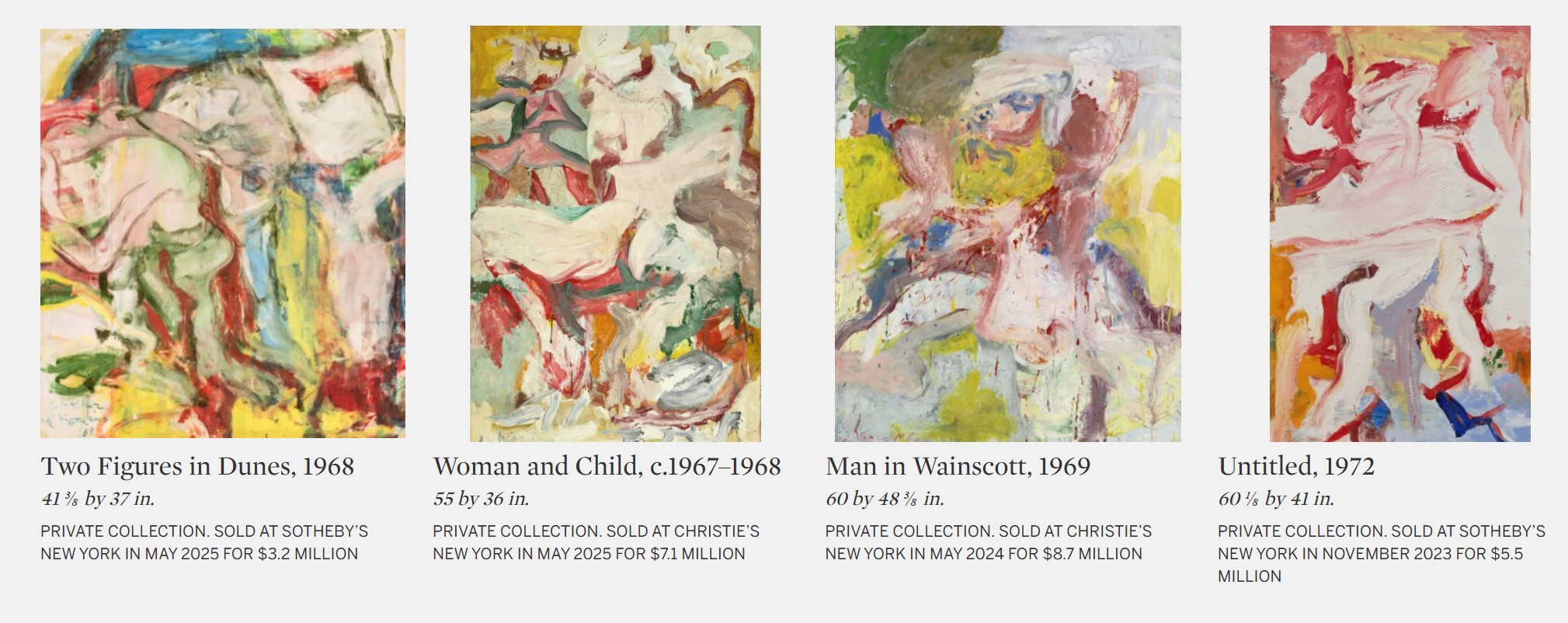
Market Precedent for de Kooning Mounted Paintings on Paper
Untitled XVI, 1983
Untitled XVI, 1983
Christie’s New-York: 18 May 2026
Estimated: USD 6,000,000 – 8,000,000
USD 7,395,000
WILLEM DE KOONING (1904-1997), Untitled XVI | Christie’s
WILLEM DE KOONING (1904-1997)
Untitled XVI, 1983
Oil on canvas
77×88 inches (195.6 x 223.5 cm)
Arhapsodic melody of pure painterly poetry, Willem de Kooning’s Untitled XVI is a moving masterpiece of the artist’s late career. Executed in de Kooning’s largest format, the work was made in 1983, a critical year for the artist. He had been gradually evolving his style since the beginning of the decade, slowly developing what would become known as his Ribbon paintings. Untitled XVI reveals the last definitive stylistic shift for the artist. “1983 was a hinge year” John Elderfield notes, “that joined it to his work of the previous decade. By the end of the year, he was in very new territory” (de Kooning: a Retrospective, exh cat., Museum of Modern Art, New York, 2011, p. 468). Here, de Kooning achieves a seemingly effortless airiness and “ethereal luminosity,” with the artist himself characterizing his newfound atmospheric luminism as “so airy and so thin” (quoted in J. Zilczer, A Way of Living: The Art of Willem de Kooning, New York, 2014, p. 227).
“I have to change to stay the same.”
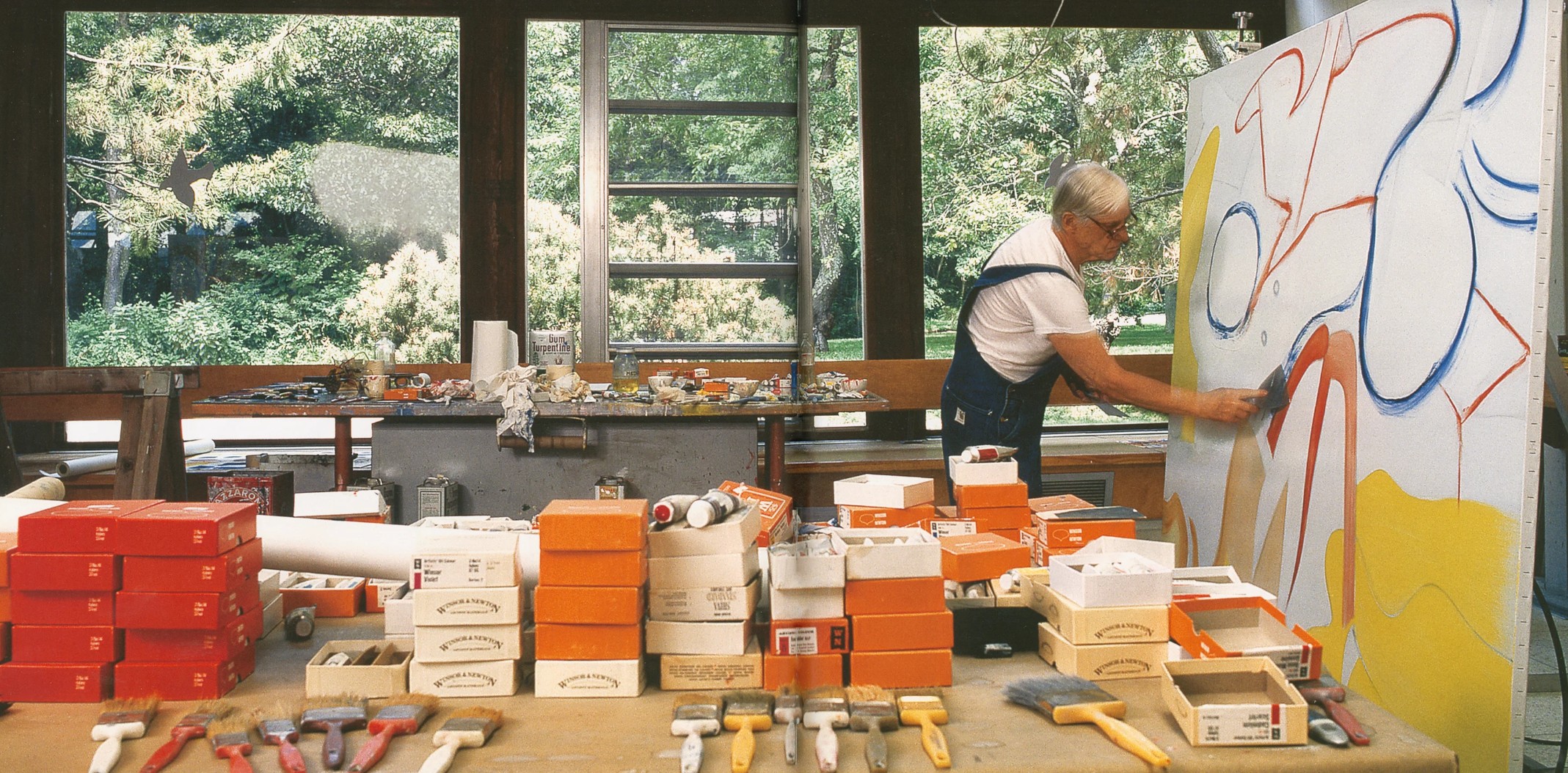
Willem de Kooning in his studio, East Hampton, 1983. Photograph by Hans Namuth. Courtesy Center for Creative Photography, University of Arizona © 1991 Hans Namuth Estate. Artwork: © 2026 The Willem de Kooning Foundation / Artists Rights Society (ARS), New York.
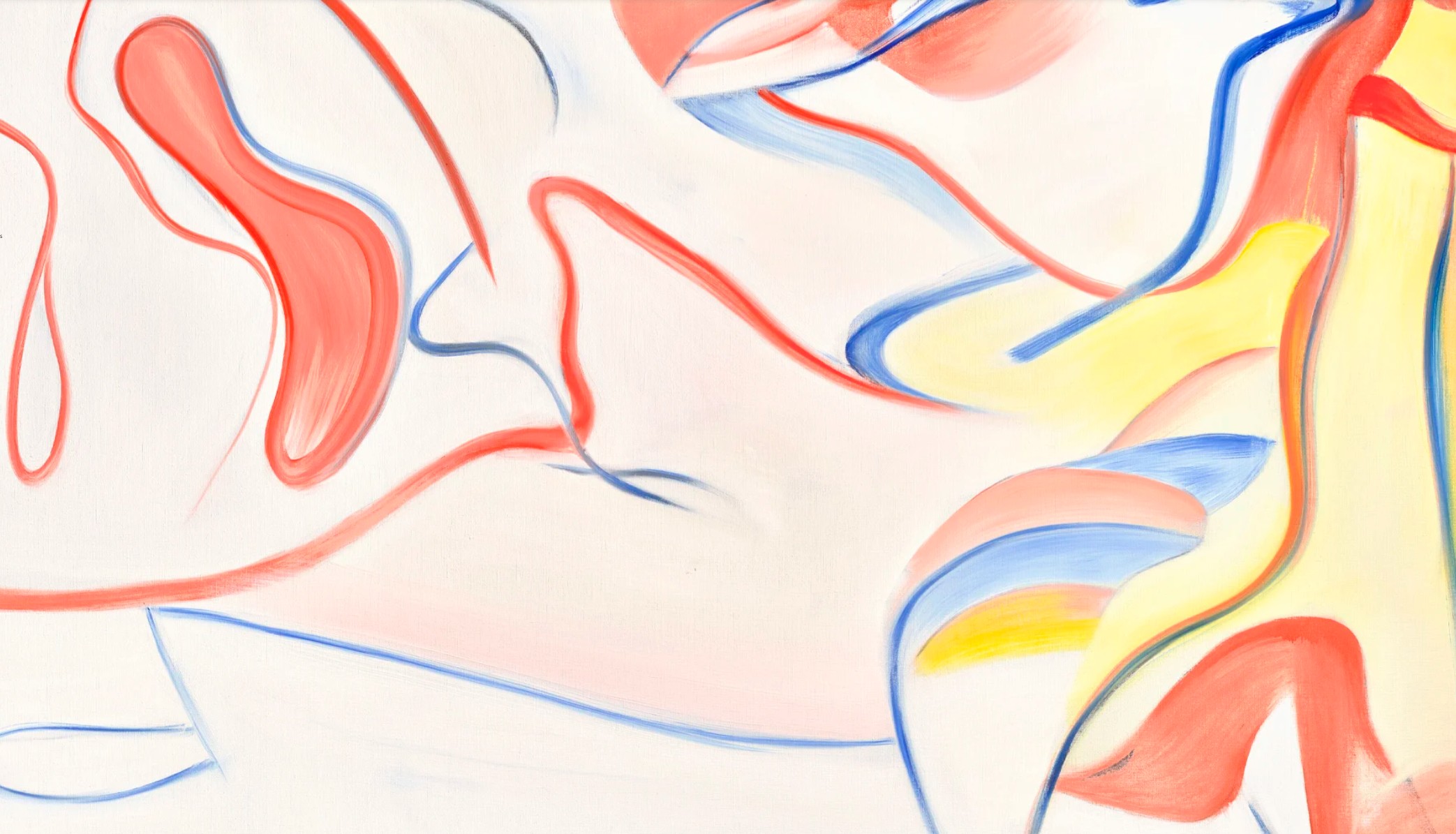
“I don’t want the pictures to look too easy, too slick,” de Kooning relayed to the art critic Amei Wallach in June 1983, contemporaneously to the present work. “It’s more like Matisse. He has such ordinary contents: a table, a woman sitting there. But he has that quality. He took the work out of it… I would like to do that in the new ones” (quoted in ibid., p. 233). With Untitled XVI, de Kooning relinquished his form luxuriant painterliness in favor of smooth, glazed surfaces of bright, transparent color. Limiting himself to a restricted palette of red, blue, and yellow, the artist inscribes calligraphic lines of varying widths across the canvas, each sensuously curving line masterfully executed with the confidence of decades of experience. The artist’s commitment to pursuing pictorial and spatial complexities remains apparent in the present work, however his strategies shifted from a reliance on a buildup of oils to the exploration of color and space.
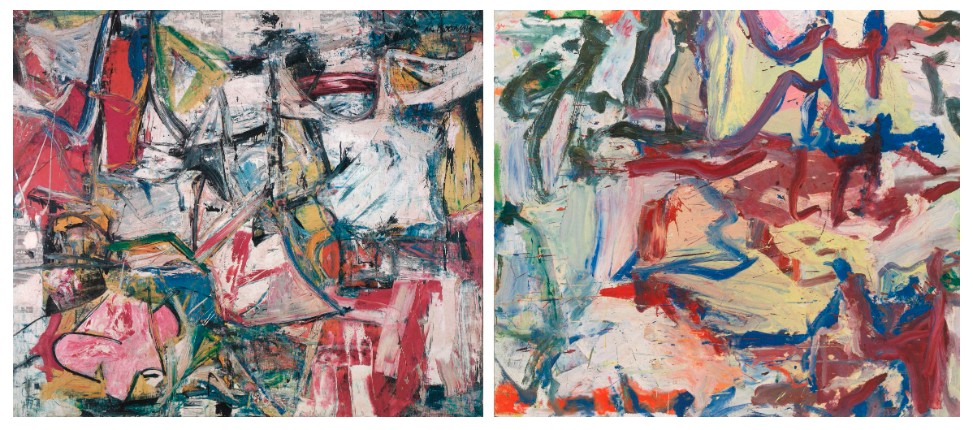
Left: Willem de Kooning, Gotham News, 1955. Buffalo AKG Art Museum. © 2026 The Willem de Kooning Foundation / Artists Rights Society (ARS), New York.
Right: Willem De Kooning, …Whose Name Was Writ in Water, 1975. Solomon R. Guggenheim Museum, New York. © 2026 The Willem de Kooning Foundation / Artists Rights Society (ARS), New York.
Untitled XVI is also reflective of an important figurative development in de Kooning’s oeuvre. From his ionic Women series of the early 1950s, de Kooning maintained a certain figurative element even in his most abstract paintings. Here, a languid, lounging female form crystalizes out of the artist’s brushwork, appearing recumbent upon the central horizontal axis of the picture plane. As Elderfield notes of the evolution of his figurative motif, “in 1983, another, this time more radical change occurred: the paintings became sparer, eventually to be composed of large areas of varied whites across which run now much narrower bands and thin, mobile lines that cause the surface to buckle and turn in space, while shaping an elusive figuration” (J. Elderfield, op. cit., p. 441). The critic Klaus Kertess elaborates on this new abstracted figuration: “In slow motion, in subtly varying widths, all quite thin, the lush, generously curving lines languorously drift in and out of embraces to create a serene and sensuous dream of faraway female flesh, perhaps that of the many nudes crowding Ingres’s Turkish Bath” (“Further Reflection,” in Willem de Kooning: The Last Beginning, exh. cat., Gagosian Gallery, New York, 2007, p. 21).
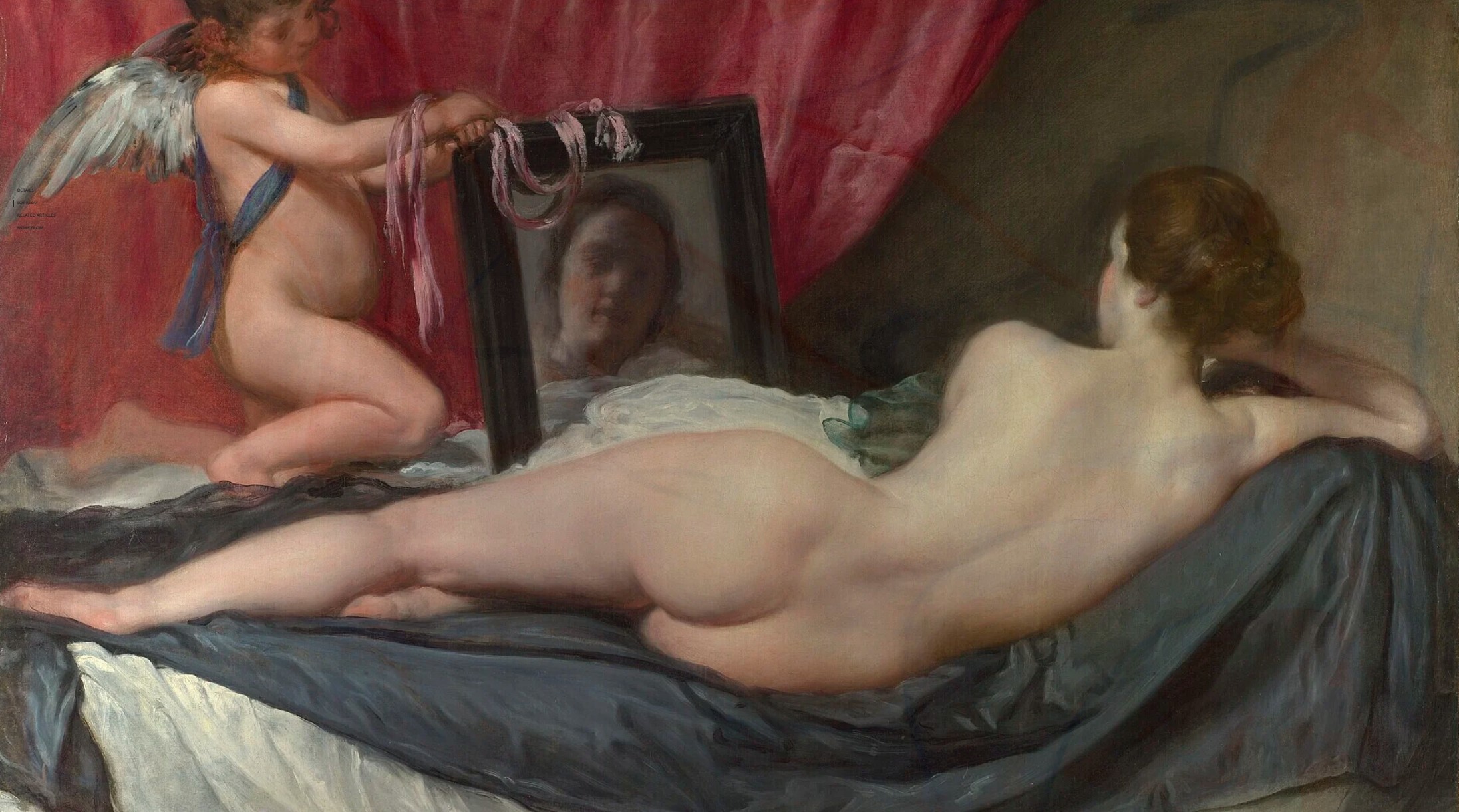
Diego Velázquez, Rokeby Venus (The Toilet of Venus), 1644 (detail). National Gallery, London.
While appearing spontaneous, de Kooning started the composition with a charcoal underdrawing, and then worked and reworked the canvas, orchestrating his intricate network of blue and red ribbons intertwined with passages of modulated yellow and red. To achieve the unified, flat surface of Untitled XVI, the artist wielded his taper’s knife and also engaged in sgraffito, using a hard surface and even in some instances sanding down to create the appearance of pure color, similar in effect to Matisse’s mature painting of the 1930s. As his friend Judith Wolfe recalled of one conversation with de Kooning in 1983, “what he would like to do now would be very ‘free,’ and he gently waves his hands in the air. He thinks about Matisse’s La Danse” (quoted in J. Elderfield, op. cit., p. 450).
In tandem with de Kooning’s conscious channeling of Matisse’s influence, he also drew in inspiration from other arenas, most notably in his own earlier oeuvre, the work of his one-time mentor Arshile Gorky, and in the example of the Old Masters, particularly Titian and Rembrandt. As Elderfield notes, “de Kooning had regularly excavated the past in order to move forward; now he was again burrowing into his own past to pick up on the possibilities that he had not previously explored” (ibid., p. 453). De Kooning, like the Old Masters before him, retained his compositional studies from previous decades, and in his Late Ribbon paintings reengaged with them, reimagining them into new inventions. “I have to change to stay the same,” the artist proclaimed, paraphrasing the famous line from Giuseppe de Lampedusa’s The Leopard, where the progressive nephew Tancredi implores his aging uncle: ““For things to remain the same, everything must change” (quoted in J. Wolfe, “Glimpses of a Master,” in Willem de Kooning: Works from 1951-1981, exh.cat., Guild Hall Museum, East Hampton, 1981, p. 16).
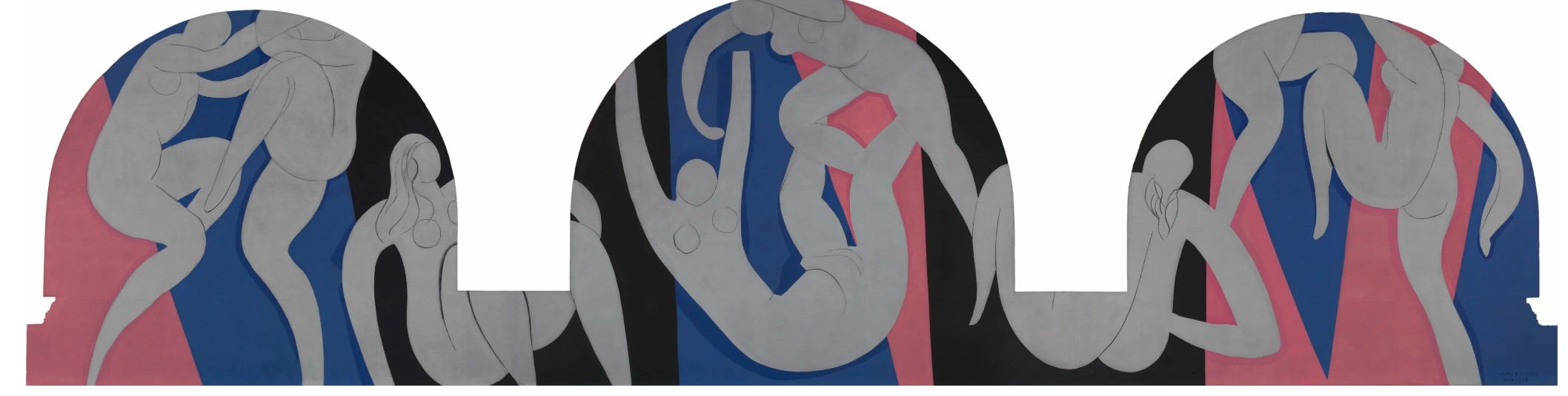
Henri Matisse, The Dance, 1932. Barnes Foundation, Philadelphia. © 2026 Succession H. Matisse / Artists Rights Society (ARS), New York. Photo: © Barnes Foundation / Bridgeman Images.
While reimagining his own early work into novel compositions, de Kooning simultaneously found new inspiration from his old mentor, Gorky. Early in his career, de Kooning learned from Gorky’s automatic method and calligraphic strokes, but he waited decades before he fully realized Gorky’s influence on canvas. The Solomon R. Guggenheim held a retrospective just as de Kooning was refining his Ribbon style in 1981. Asked around the time of the show whether Gorky’s biomorphic line had inspired him, de Kooning responded: “Well, I don’t know. In a way I have him on my mind all the time” (quoted in J. Elderfield, op. cit., p. 453). As Elderfield writes, 1983 paintings “call up any number of de Kooning’s strange 1940s interiors, reaching back through Arshile Gorky even to the slippery shape of Salvador Dalí and the Surrealist in Pablo Picasso” (ibid., p. 465).
“I learn much more from Gorky.
Listening, I was influenced by him, Just by being with him.”
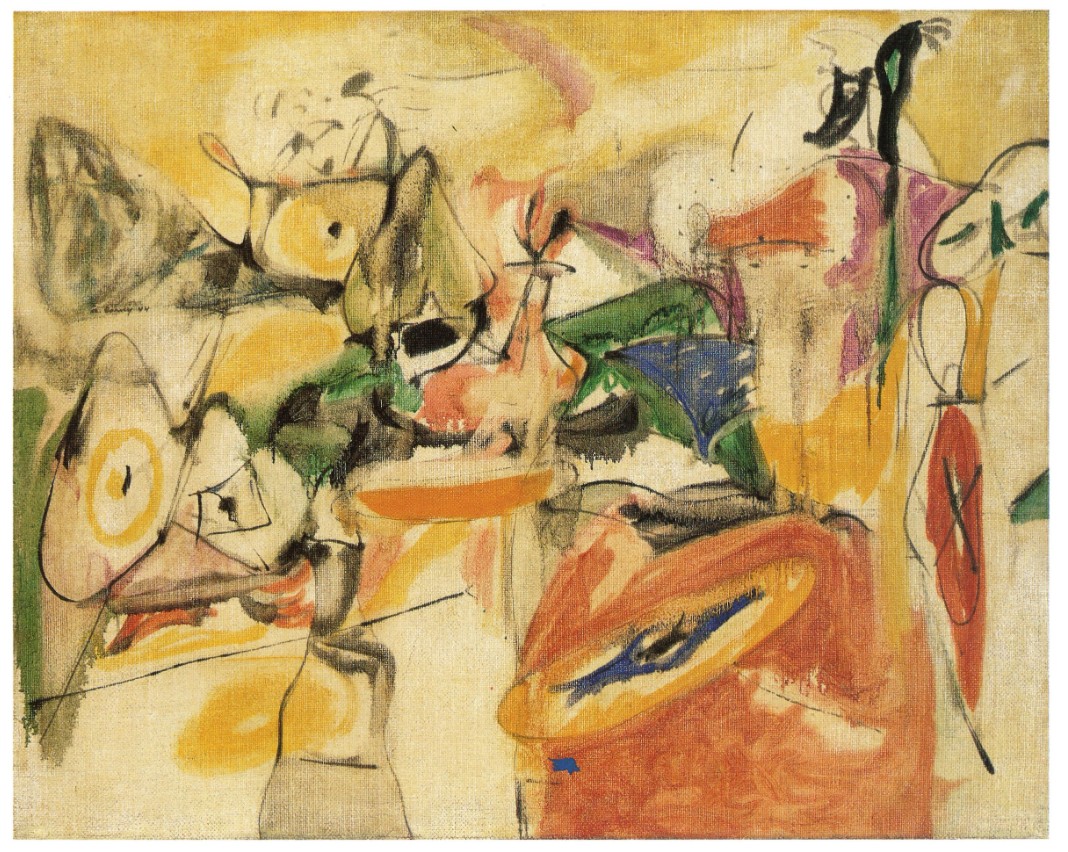
Arshile Gorky, Cornfield of Health II, 1944. Nelson-Atkins Museum of Art, Kansas City.
© 2026 The Arshile Gorky Foundation / Artists Rights Society (ARS), New York.
Musing over de Kooning’s late period, The art historian Robert Rosenblum identifies in their “ethereal simplicity” the same triumphant immateriality which appears in the late work of Titan, Rembrandt, or Turner, remarked how, “nurtured by the most intense privacy, by uninterrupted contemplation of his own past as man and as an artist, de Kooning’s recent canvases now enter the public domain of late-style miracles in the pantheon of Western paintings” (quoted in J. Zilczer, op. cit., p. 242). The Renaissance art historian David Rosand makes a similar connection between de Kooning’s late paintings and Titian and Rembrandt: “There is in such late work an evident disregard for externals, a kind of isolated self-sufficiency, an insistence on very basic structure—a return to the kind of unembarrassed reductiveness that the literary critic Barbara Hernstein Smith has called ‘the senile sublime.’ De Kooning’s latest paintings participate in this tradition of painterly transcendence” (“Editor’s Statement: Style and the Aging Artist,” Art Journal, vol. 46, no. 2, summer 1987, p. 92).
A quarter-century earlier, de Kooning, while on a sojourn to Italy, reflected upon making art in old age.
“I cant figure it out, how those old guys kept at it, kept painting the way they did… Titian, he was 90, with arthritis so bad they had to tie on his paint brushes.”
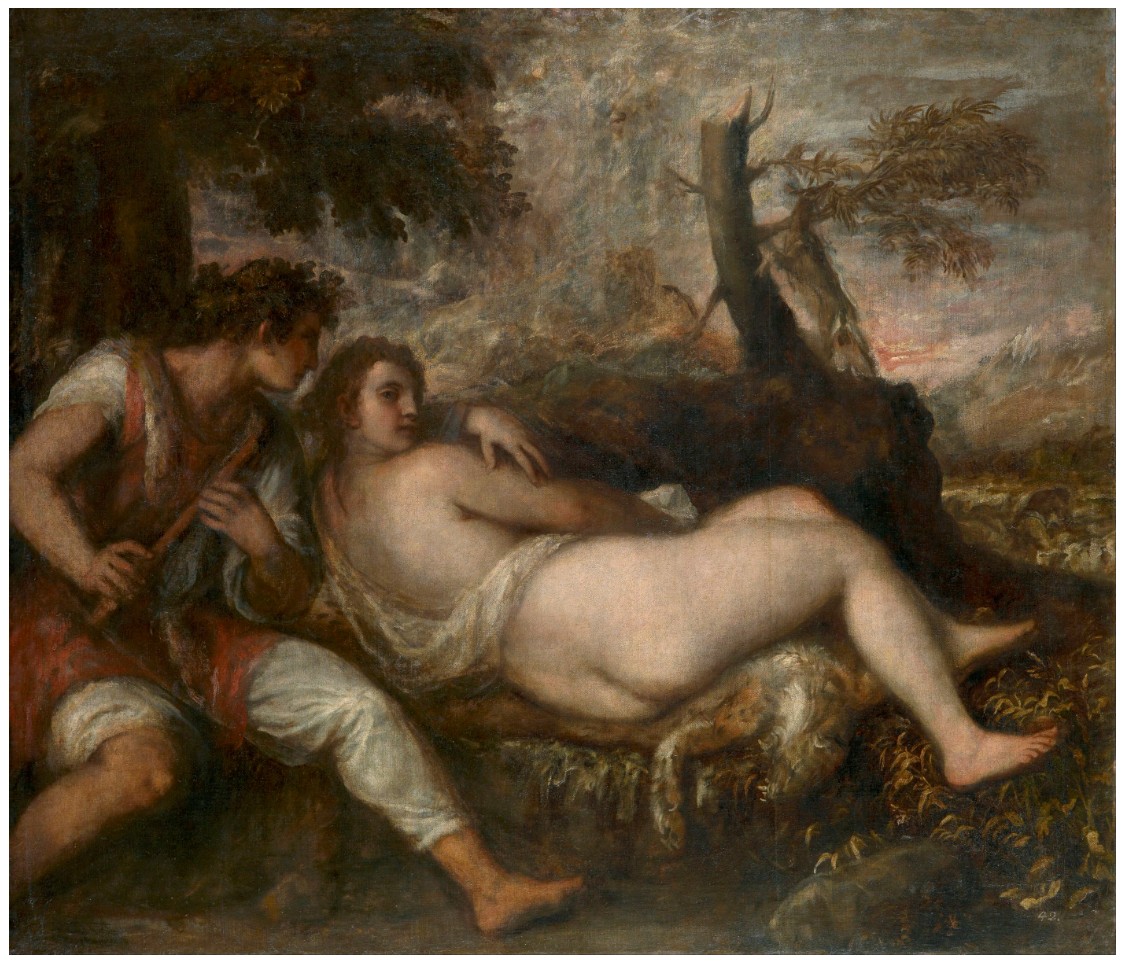
Titian, Nymph and Shepherd, circa 1570. Kunsthistorisches Museum, Vienna.
Following his return from Italy in 1960, de Kooning described his thoughts on the late periods of the Old Masters he had just seen.
“It seems that a lot of artists, when they get older, they get simpler: they feel their own miracle in nature; a feeling of being on the other side of nature… I get excited just to see that sky is blue, that earth is earth… I’m getting closer to that… then there is a time in your life when you just take a walk: and you walk into your own landscape.”
Untitled XVI demonstrates de Kooning in the full confidence of his late style, walking off into his own abstracted landscape.