Incontrovertibly arresting in its stunning immediacy and indelibly charged imagery, Andy Warhol’s Lenin series commands our full attention with the sheer weight of its historic import and art historical potency. As conceptual successor to the artist’s earlier Hammer and Sickle and Mao series of the 1970s, the present work persists as an icon of one of the more fascinating pivots in Warhol’s prodigious career. By first appropriating and then subsuming symbols of Communist ideology, both physical as in his interpretations of the hammer and sickle icons, or metaphorical as in his renderings of Chinese communist leader Mao Zedong and Russian communist revolutionary Vladimir Lenin, into his legendary Pop Art pantheon of mass-consumer commodities and silver screen celebrities, Warhol effectively refocused his groundbreaking aesthetic energies on the political realities of his time.
Introduction
Whereas the artist’s earlier corpus of Mao paintings from 1972 was the direct artistic result of Richard Nixon’s visit to China of the previous year, the artist turned to his exploration of Lenin in 1986, more than sixty years after the communist leader’s death.
“Every time I go out and someone has to be elected president or mayor or something else, they put their images on all the wall and I think I do the same.”
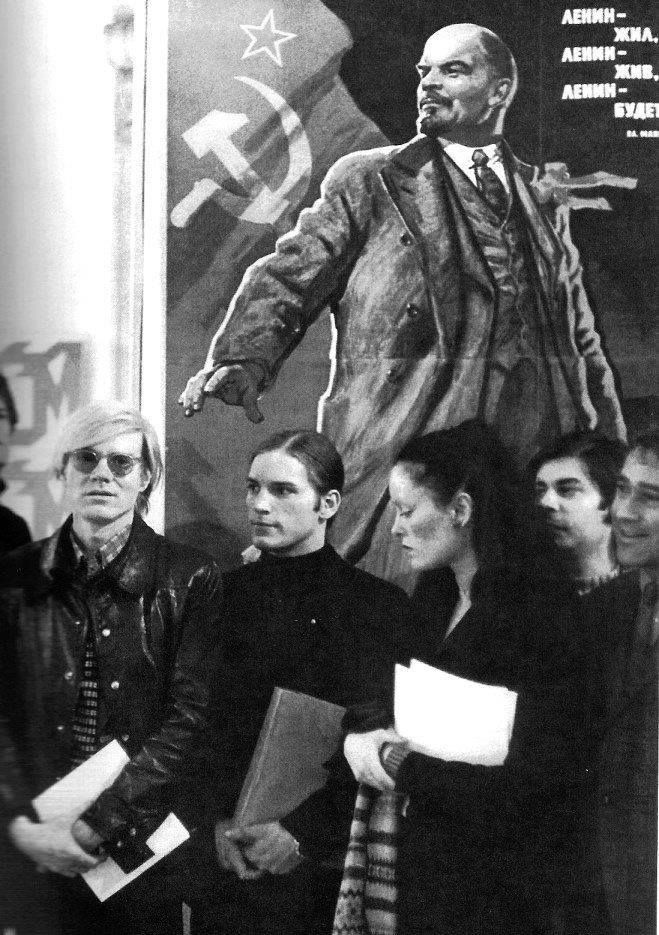
Directly following the eerily prophetic corpus of ghostly Fright Wig self-portraits that he executed in the same year, Warhol embarked upon the definitive series to which the present work belongs; indeed, the artist’s Lenin paintings were to be his last major body of work completed just prior to his unexpected death in February 1987. Similar to the Fright Wig portraits, Warhol’s Lenin canvases were specifically intended upon their completion for an exhibition; Andy Warhol died on 22 February 1987, and Bernd Klüser opened Lenin by Warhol at his Munich gallery on 24 February.
“We agreed that he would do a series of pictures in three different sizes, together with a set of drawings and collages and a silkscreen print edition. Warhol promptly set to work on a series of drawings. Our experiments with the prints over a period of several months had a considerable influence on the eventual look of the series as a whole. The range of colors was reduced, the drawing round the head was modified, and the background became a deep black, as in the original photograph.”
(Bernd Klüser cited in Exh. Cat., Munich, Galerie Bernd Klüser, Lenin by Warhol, 1987, p. 68)
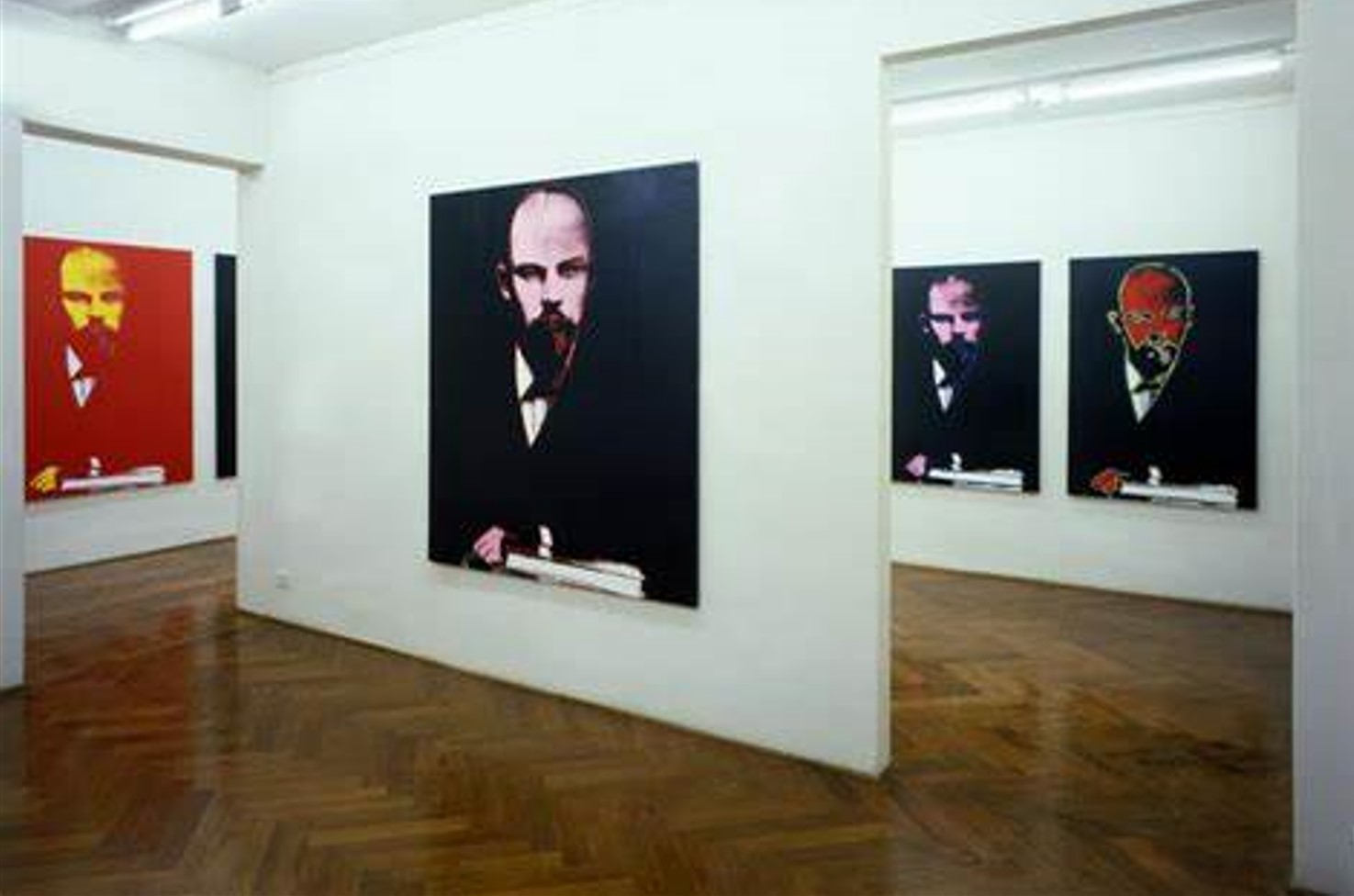
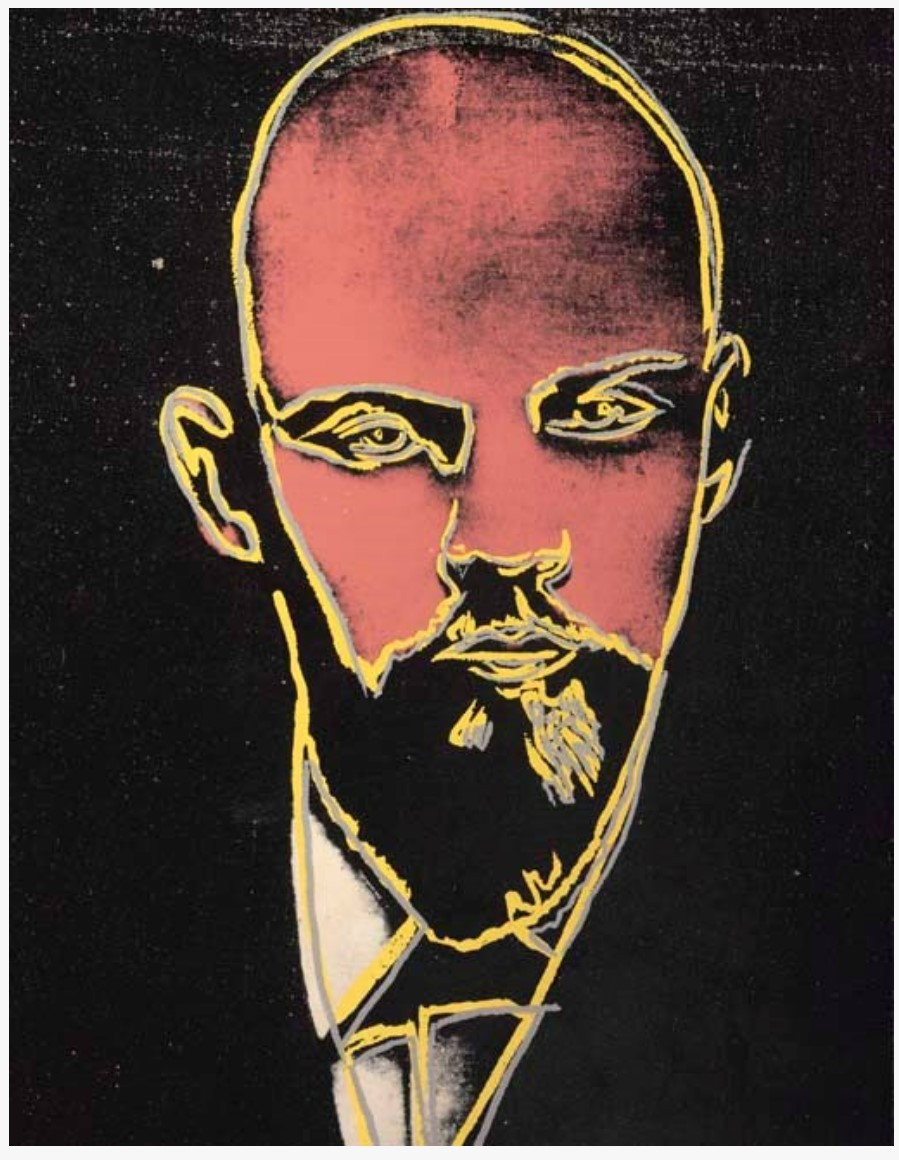
Confronting us on a greater than human scale, Vladimir Lenin’s steely countenance is searing in its fiery immediacy. Subjected to the chance-laden distortions of Warhol’s signature silkscreen technique, Lenin’s visage is nonetheless instantly recognizable. In marked contrast to the artist’s earlier series, the use of color in the Lenin paintings is more austere and selected with specific attention to its symbolic properties. Transformed from the original grisaille source image, here Lenin’s face glows forth from the canvas surface in shockingly vibrant red, his features loosely delineated in an electric blue schematic outline. Further abstracted accents of stark white punctuate the composition at sparse intervals; otherwise, the canvas is subsumed within a sea of depthless black. The impenetrable opacity of the background instills these portraits with an extraordinary sense of gravitas and profundity, while the artist’s minimal brushwork reinforces the ascetic contours and remarkable elegance of the subject’s original portrait photograph.
The original photograph for the Lenin series was discovered by Bernd Klüser in Italy in 1985 and shown to Warhol shortly thereafter. Originally taken in 1897, this image started life as a group photograph, depicting a younger Lenin surrounded by his peers. However, the image was modified in 1948 in order to remove the figures standing around Lenin, many of whom had since become ideological or political opponents of the Soviet Union during Stalin’s dominance. Although his autonomy was absolutely unquestioned, it was in the U.S.S.R leader’s own interest to doctor Soviet history in order to banish the memory of those whom might have been ‘purged’ in the violent zeal of the early years of the Soviet Union. Lenin’s premature death in 1924 invoked a cult of worship of the Bolshevik leader by his successors as a means of validating their own, often precarious, claim to power. The photograph of Lenin unearthed by Klüser is thus a fascinating historical document on several levels, and Warhol surely recognized its immense potential as an image with a pre-existing history of mythologizing and falsification. Famous for his droll ambiguity and characteristic preoccupation with artifice, Warhol once again straddles the seemingly antithetical poles of superficiality and penetrating social commentary with the Lenin series. Indeed, Warhol himself possessed markedly left-wing political views, and yet the electric-neon flourishes and mass-manufacture production of the present work propel this cult symbol of communist revolution into the ephemeral world of capitalist Americana.
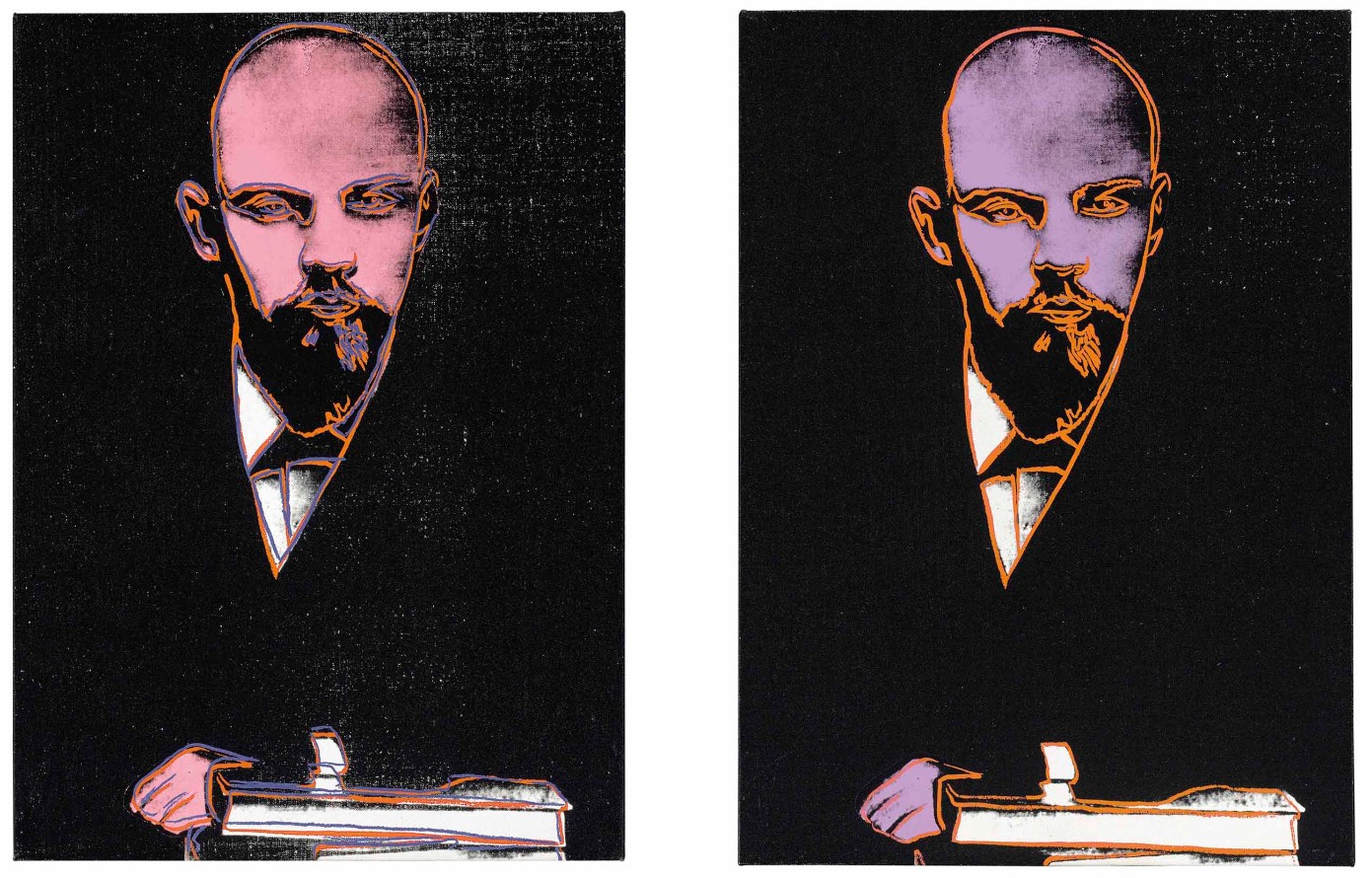
ANDY WARHOL
Double Lenin, 1986
As with all of Warhol’s best work, the Lenin series highlights the artist’s unique ability to adapt an exceptionally strong and resounding source image, but also his talent for preserving the character and distinctive look of the original photograph while simultaneously undermining the viewer’s expectation through the play of color, depth and subtle alterations. In his introduction to the Lenin exhibition, Klüser recalled his own impressions of the extraordinary paintings and how proud Warhol was of the finished works: “I shall never forget the impression created by the large-format portraits when I saw them lined up together against one of the walls in the Factory. Nor will I forget how proud Andy Warhol was of this series…” (Ibid.) Ultimately, Lenin is a truly magnificent work from Warhol’s powerful final series: a masterful re-invention of communist propaganda ironically re-imagined by Warhol, one of the Twentieth Century’s most celebrated champions of consumer culture.
Auction Results (Chronological)
Lenin, 1986
Christie’s London: 1 March 2022
Estimated: GBP 350,000 – 550,000
GBP 403,200 / USD 538,965
ANDY WARHOL (1928-1987) (christies.com)
REPEAT SALE
Christie’s London: 2 July 2014
Estimated: GBP 200,000 – 300,000
GBP 242,500 / USD 416,260
Andy Warhol (1928-1987), Lenin | Christie’s
ANDY WARHOL
Lenin, 1986
Acrylic and silkscreen ink on canvas
22×16 inches (55.8 x 40.5cm)
Lenin, circa 1986
Phillips London: 15 October 2021
Estimated: GBP 400,000 – 600,000
GBP 428,400 / USD 589,352
Andy Warhol – 20th Century & Contemp… Lot 41 October 2021 | Phillips
ANDY WARHOL
Lenin, circa 1986
Acrylic and silkscreen ink on canvas
21 7/8 x 15 7/8 inches (55.6 x 40.5 cm)
Stamped twice by the Estate of Andy Warhol and the Andy Warhol Foundation for the Visual Arts, Inc., New York
Numbered ‘PA81.016’ on the overlap
Stamped by the Andy Warhol Foundation for the Visual Arts, Inc., New York on the reverse
Lenin, 1986
Christie’s Paris: 20 October 2017
Estimated: EUR 400,000 – 600,000
EUR 427,500 / USD 503,125
ANDY WARHOL (1928-1987), Lenin | Christie’s
ANDY WARHOL
Lenin, 1986
Synthetic polymer and silkscreen ink on canvas
22.1 x 16 inches (56.2 x 40.6 cm)
Signed and dated ‘Andy Warhol 86’ (on the reverse)
Lenin, 1986
Bonhams London: 29 June 2017
Estimated: GBP 650,000 – 750,000
GBP 785,000 / USD 1,019,280
Bonhams : Andy Warhol (American, 1928-1987) Lenin 1986
ANDY WARHOL (American, 1928-1987)
Lenin, 1986
Acrylic and silkscreen ink on canvas
22 1/16 x 15 15/16 inches (56 x 40.5 cm)
Signed and dated 86 on the overlap
Lenin, 1986
Sotheby’s New-York: 17 November 2016
Estimated: USD 4,000,000 – 6,000,000
USD 8,112,500
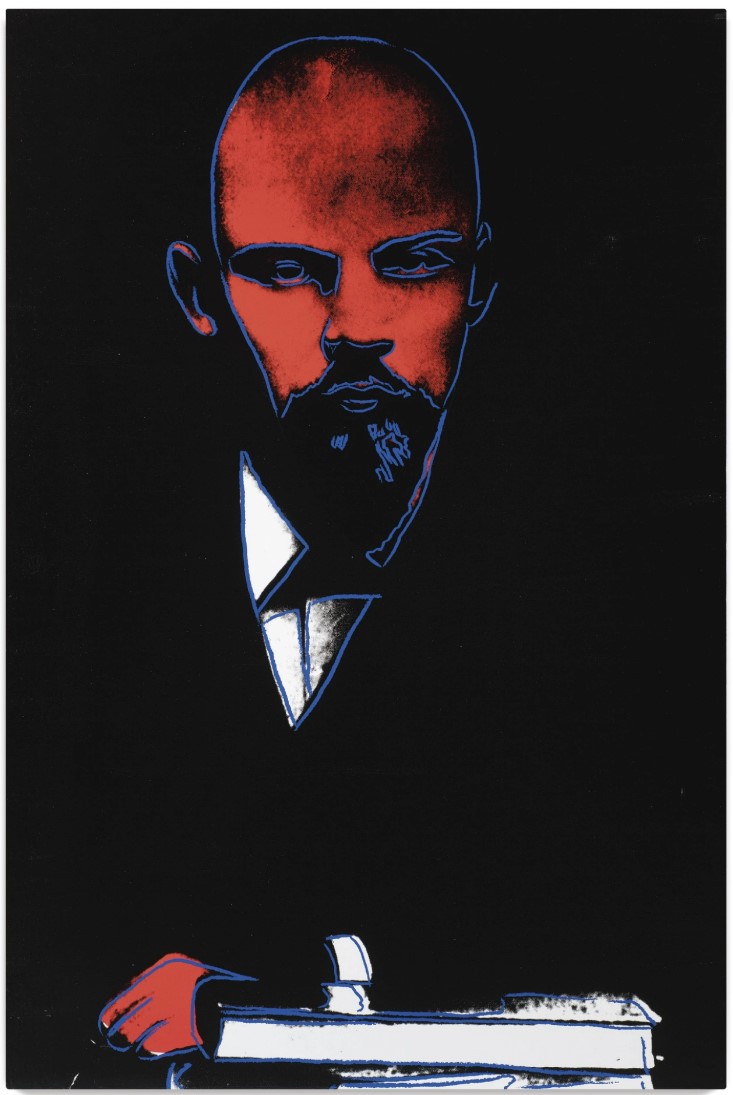
ANDY WARHOL
Lenin, 1986
Acrylic and silkscreen ink on canvas
72.2 x 48 inches (183.5 x 122 cm)
Signed and dated 86 on the overlap
Lenin, 1986
Sotheby’s London: 15 October 2015
Estimated: GBP 2,500,000 – 3,000,000
GBP 3,061,000 / USD 4,736,080
ANDY WARHOL
Lenin, 1986
Acrylic and silkscreen ink on canvas
71 5/8 x 47 5/8 inches (182×121 cm)
Signed and dated 86 on the overlap
Lenin, 1986
Christie’s London: 30 June 2015
Estimated: GBP 2,200,000 – 2,800,000
GBP 2,658,500 / USD 4,180,520
Andy Warhol (1928-1986), Lenin | Christie’s
ANDY WARHOL
Lenin, 1986
Acrylic and silkscreen ink on canvas
72×48 inches (183×122 cm)
Lenin, 1986
Sotheby’s London: 12 March 2015
Estimated: GBP 200,000 – 300,000
GBP 437,000 / USD 659,135
ANDY WARHOL
Lenin, 1986
Acrylic and silkscreen ink on canvas
22×16 inches (56 x 40.5 cm)
Lenin, 1986
Sotheby’s London: 12 March 2015
Estimated: GBP 200,000 – 300,000
GBP 425,000 / USD 641,035
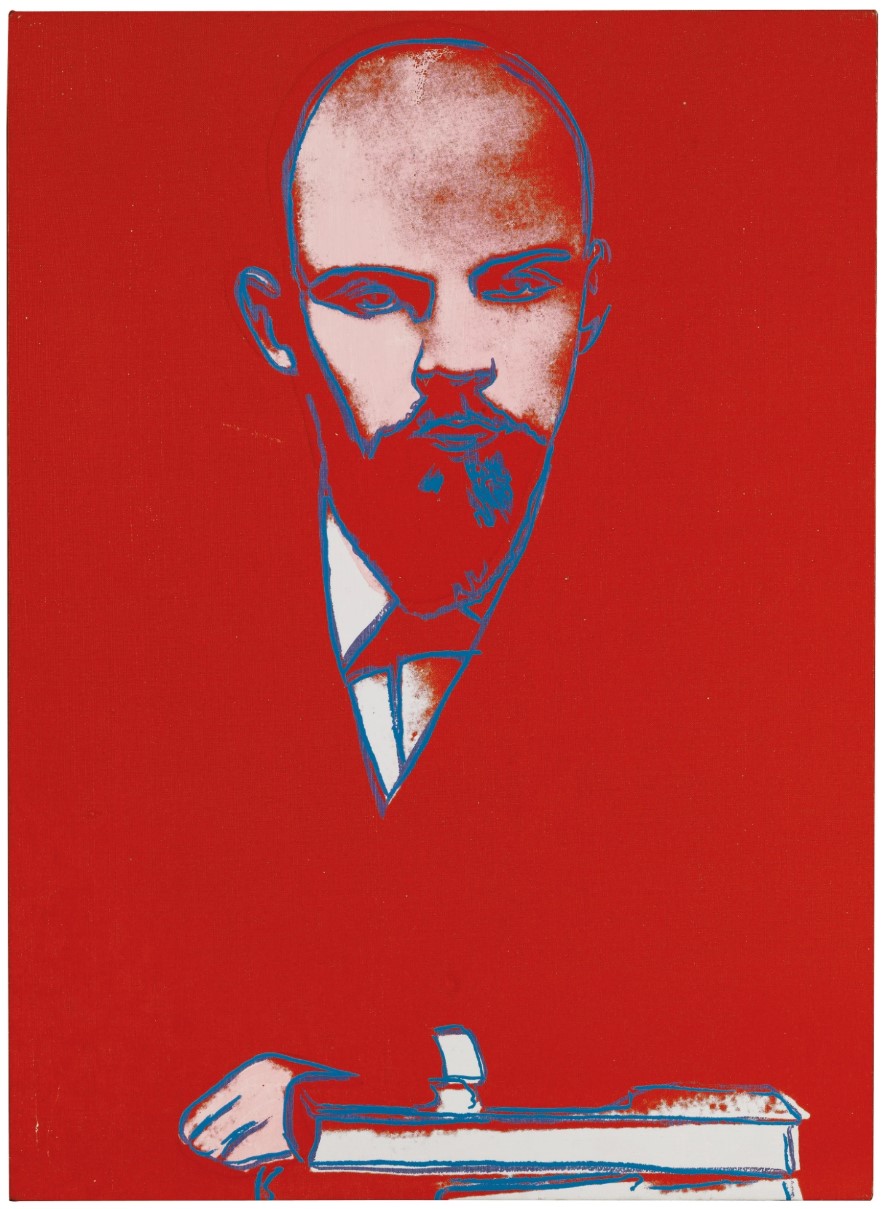
ANDY WARHOL
Lenin, 1986
Acrylic and silkscreen ink on canvas
21.9 x 16 inches (55.6 x 40.6 cm)
Lenin, 1986
Christie’s London: 2 July 2014
Estimated: GBP 200,000 – 300,000
GBP 242,500 / USD 416,260
Andy Warhol (1928-1987), Lenin | Christie’s
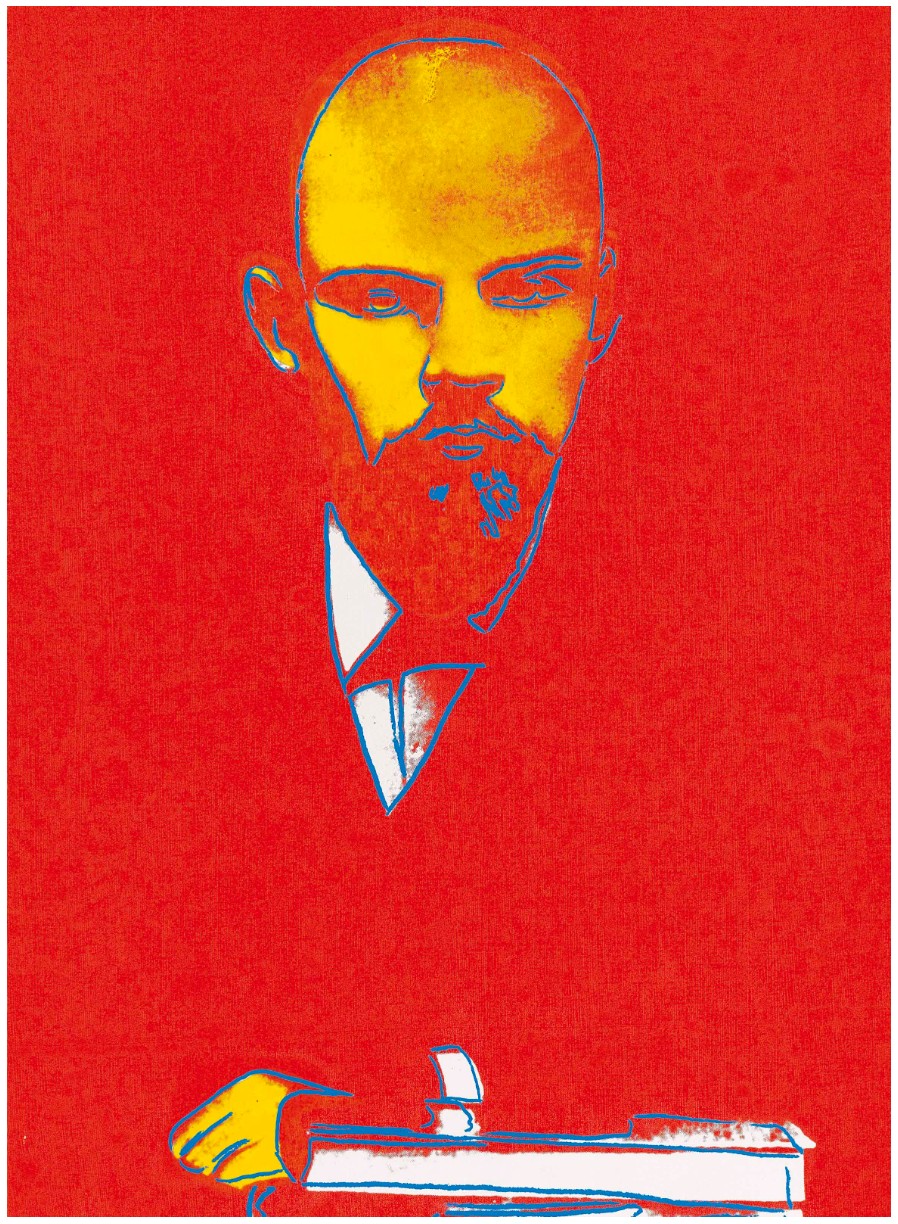
ANDY WARHOL (1928-1987)
Lenin, 1986
Acrylic and silkscreen ink on canvas
21 3/4 x 15 7/8 inches (55.4 x 40.3 cm)
Stamped by The Estate of Andy Warhol and The Andy Warhol Foundation for the Visual Arts, Inc
Numbered ‘PA81.014’ (on the overlap)
Stamped by the Andy Warhol Foundation for the Visual Arts, Inc. (on the reverse)
Double Lenin, 1986
Christie’s London: 25 June 2013
Estimated: GBP 600,000 – 800,000
GBP 721,875 / USD 1,112,720
Andy Warhol (1928-1987) , Double Lenin | Christie’s
ANDY WARHOL
Double Lenin, 1986
Acrylic and silkscreen inks on canvas, in two parts
Each: 22×16 inches (55.8 x 40.5 cm)
(i) Stamped with The Estate of Andy Warhol stamp and numbered ‘PA81.005’ (on the overlap)
(ii) Stamped with The Estate of Andy Warhol stamp and numbered ‘PA81.002’ (on the overlap)
Lenin, 1986
Sotheby’s London: 12 February 2013
Estimated: GBP 1,500,000 – 2,000,000
GBP 2,169,250 / USD 3,395,785
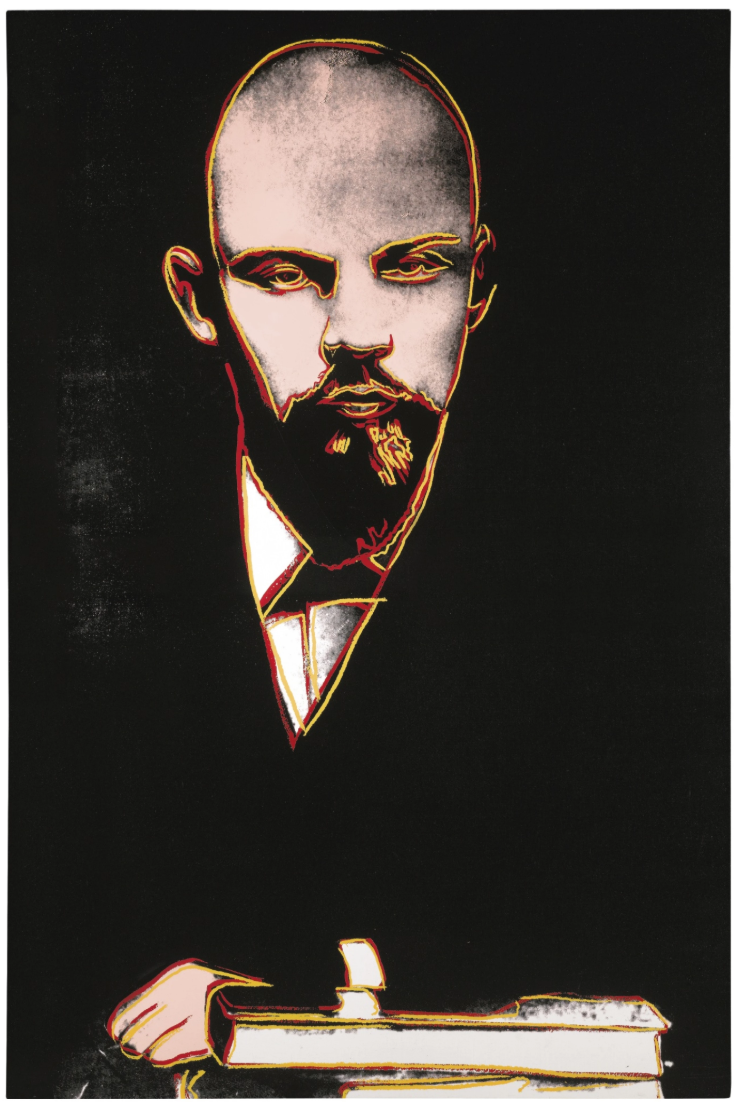
ANDY WARHOL
Lenin, 1986
Acrylic and silkscreen ink on canvas
72×48 inches (182.9 x 121.9 cm)
Signed and dated 86 on the overlap
Large Lenin (72×48)
Lenin, 1986
Sotheby’s New-York: 17 November 2016
Estimated: USD 4,000,000 – 6,000,000
USD 8,112,500
ANDY WARHOL
Lenin, 1986
Acrylic and silkscreen ink on canvas
72.2 x 48 inches (183.5 x 122 cm)
Signed and dated 86 on the overlap
Confronting us on a greater than human scale, Vladimir Lenin’s steely countenance is searing in its fiery immediacy. Subjected to the chance-laden distortions of Warhol’s signature silkscreen technique, Lenin’s visage is nonetheless instantly recognizable. In marked contrast to the artist’s earlier series, the use of color in the Lenin paintings, as perfectly exemplified by the present work, is more austere and selected with specific attention to its symbolic properties. Transformed from the original grisaille source image, here Lenin’s face glows forth from the canvas surface in shockingly vibrant red, his features loosely delineated in an electric blue schematic outline. Further abstracted accents of stark white punctuate the composition at sparse intervals; otherwise, the canvas is subsumed within a sea of depthless black. The impenetrable opacity of the background instills these portraits with an extraordinary sense of gravitas and profundity, while the artist’s minimal brushwork reinforces the ascetic contours and remarkable elegance of the subject’s original portrait photograph.
Lenin, 1986
Sotheby’s London: 15 October 2015
Estimated: GBP 2,500,000 – 3,000,000
GBP 3,061,000 / USD 4,736,080
ANDY WARHOL
Lenin, 1986
Acrylic and silkscreen ink on canvas
71 5/8 x 47 5/8 inches (182×121 cm)
Signed and dated 86 on the overlap
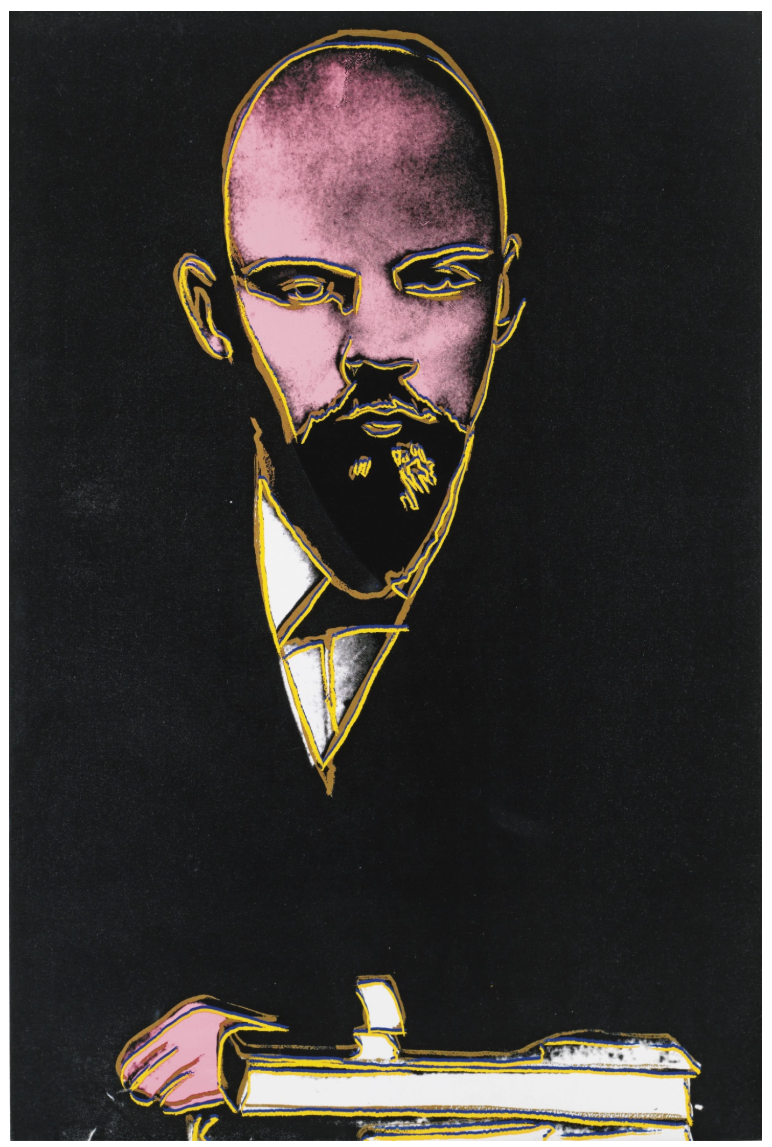
Andy Warhol’s series after the cult Bolshevik leader, Vladimir Lenin, was to be the artist’s last major body of work. Here towering over the viewer at an immersive 183cm. in height, the present canvas is the second largest size from the series of paintings that Warhol created in 1986 for an exhibition scheduled for the following year with the German gallerist Bernd Klüser. Along with its counterparts, this monolith-like black painting certainly belongs among the most austere and solemn of the artist’s late practice, and, along with the earlier 1970s Hammer and Sickle series and portraits of Chairman Mao, forms an intriguing riposte to the consumer products and capitalist tokens that first propelled Warhol to the forefront of the international art world. Famous for his typically drôle ambiguity, Warhol once again walks that fine line between superficial artifice and deep social commentary with this series. Indeed, it is known that Warhol himself possessed markedly left-wing political views, and yet his electric-neon flourishes and mass-manufacture technique propel this cult symbol of communist revolution into the ephemeral world of capitalist Americana. Radical politics aside, Lenin becomes yet another Warholian pin-up, transported into a pantheon of silver-screen idols readymade for mass worship.
Lenin, 1986
Christie’s London: 30 June 2015
Estimated: GBP 2,200,000 – 2,800,000
GBP 2,658,500 / USD 4,180,520
Andy Warhol (1928-1986), Lenin | Christie’s
ANDY WARHOL
Lenin, 1986
Acrylic and silkscreen ink on canvas
72×48 inches (183×122 cm)
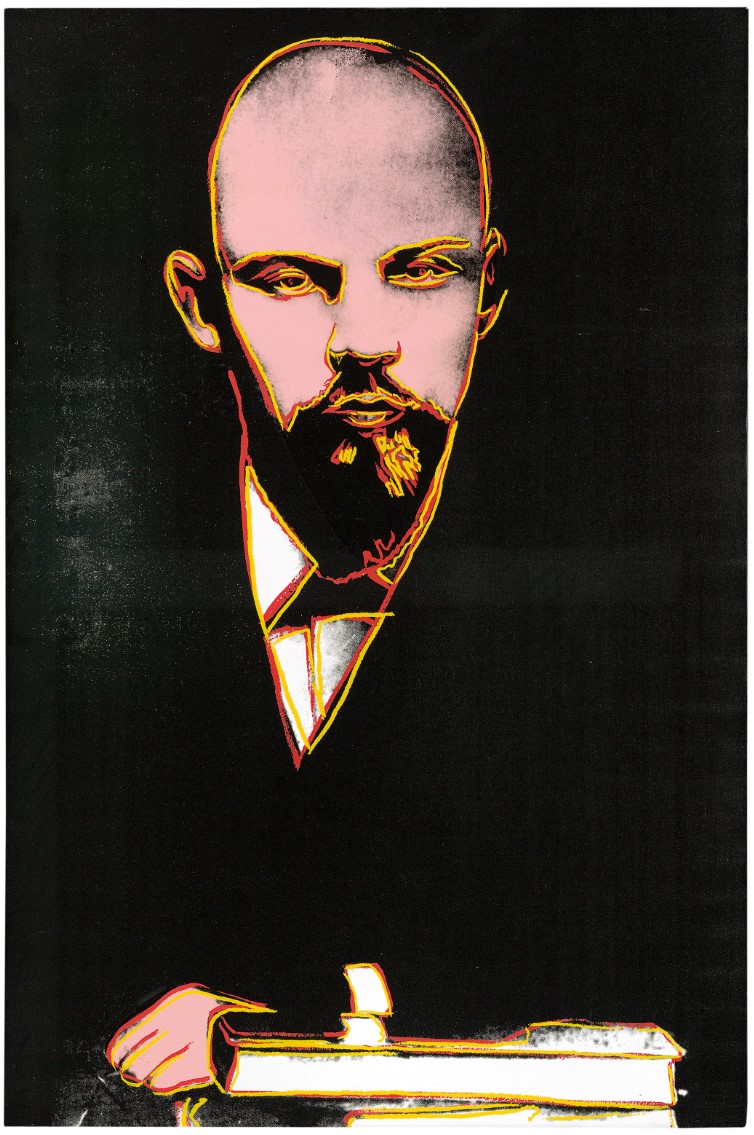
Executed in 1986, Andy Warhol’s Lenin stems from the artist’s last great series of works, completed in December 1986, only two months before his death in February 1987. Emerging from an inky black background, Warhol’s Lenin takes on a near-spectral quality conveyed through the striking glow of his tracery. Standing nearly two meters tall, his imposing face looms out of the inky black darkness. Lenin’s impassive gaze is captivating; his pale skin works in stark opposition to the ominously dark setting, which in turn is mirrored in the empty dark hollows of the eyes, made visible by Warhol’s addition of neon highlights which delineate the pupils with an almost hypnotic stare. The outline of Lenin’s face along with the details of his features and beard are all rendered in electric, almost Day-Glo, lines of red and yellow – deftly mirroring the colors of the Soviet flag. Like his other portraits of celebrities such as Marilyn Monroe, Jackie Kennedy, and Elvis, Warhol’s depictions of Lenin sought to interrogate his public, rather than private, persona.
Lenin, 1986
Sotheby’s London: 12 February 2013
Estimated: GBP 1,500,000 – 2,000,000
GBP 2,169,250 / USD 3,395,785
ANDY WARHOL
Lenin, 1986
Acrylic and silkscreen ink on canvas
72×48 inches (182.9 x 121.9 cm)
Signed and dated 86 on the overlap
Lenin is an astonishingly powerful large-scale work from Andy Warhol’s magnificent last series, an intensely dramatic image that projects the immense presence of its subject inexorably outwards. Darkly magnetic in its compelling authority, the work demands the complete and utter attention of the viewer, with Lenin‘s gaze being almost ferocious in its intensity. Lenin’s pale face, delineated in vibrant yellow and bright pink pigment, hovers luminously within the inky depths of the black background; the book he reads is similarly highlighted, with the brightness of hand and cuff contrasting brilliantly with the darkness beyond. Warhol’s appropriation of Lenin’s image instantly propels the subject into the pantheon of iconic figures commemorated and honored by the artist: Marilyn Monroe, Jackie Kennedy and Elvis. Already instantly recognizable to millions worldwide, Lenin’s image is further magnified and celebrated by Warhol’s masterful adaptation of the Communist leader’s features, serving as the inspiration for a truly memorable and magisterial series of paintings.
Lenin (22×16)
Lenin, 1986
Christie’s London: 1 March 2022
Estimated: GBP 350,000 – 550,000
GBP 403,200 / USD 538,965
ANDY WARHOL (1928-1987) (christies.com)
REPEAT SALE
Christie’s London: 2 July 2014
Estimated: GBP 200,000 – 300,000
GBP 242,500 / USD 416,260
Andy Warhol (1928-1987), Lenin | Christie’s
ANDY WARHOL
Lenin, 1986
Acrylic and silkscreen ink on canvas
22×16 inches (55.8 x 40.5cm)
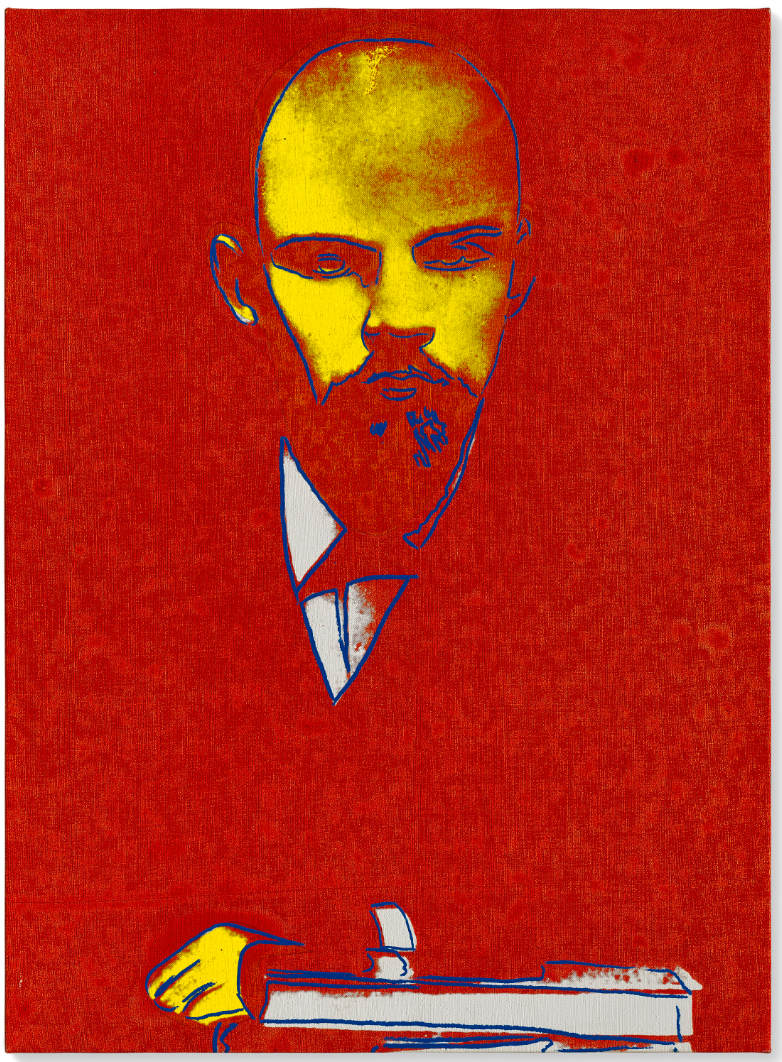
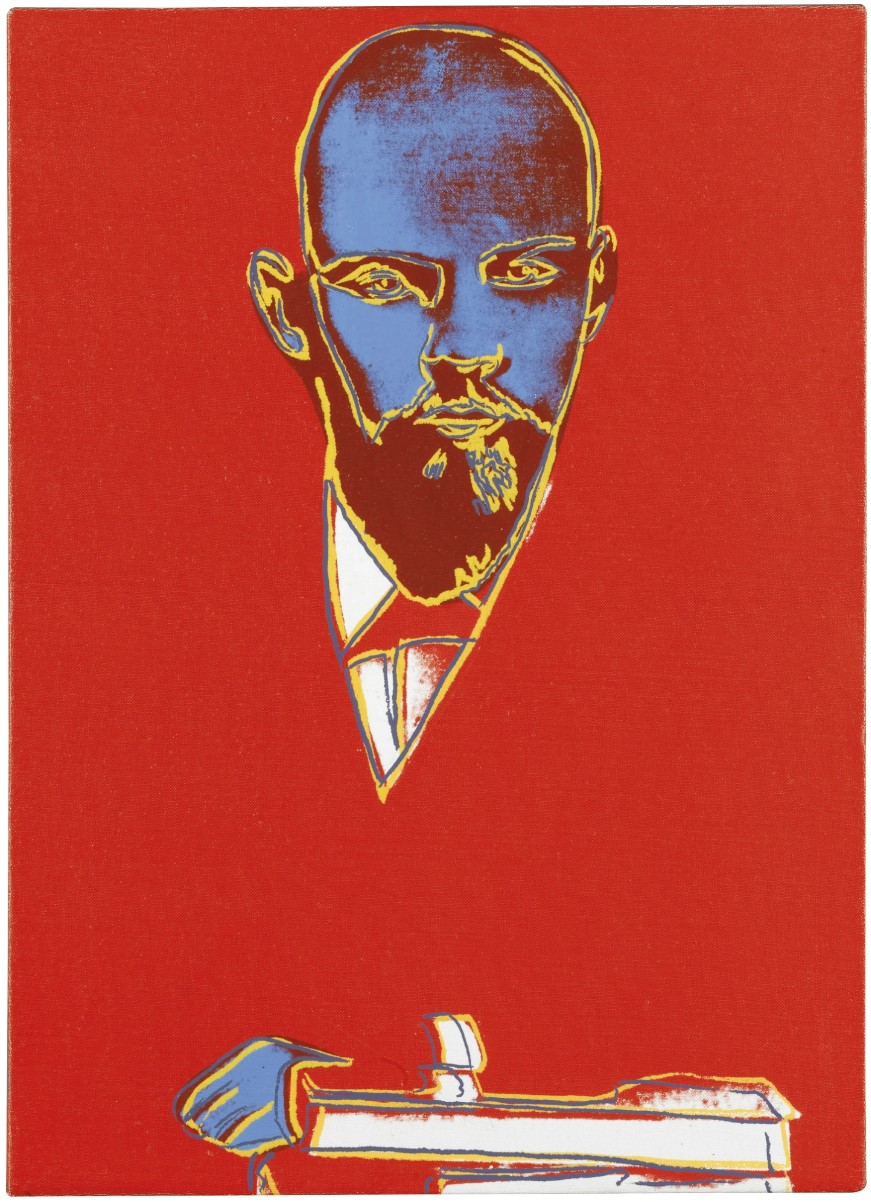
Executed in 1986, Andy Warhol’s Lenin forms part of his last great series of works that he completed only two months before his death in February 1987. Defined by a striking blue tracery, Lenin’s glowing yellow visage emerges from the vivid red background taking on a near spectral quality. In his portrayal of Lenin, Warhol has taken an iconic figure, already laden with historicism and notoriety and intensified those characteristics by flattening the composition and employing a striking color spectrum. This ‘Warholian treatment’ of his subject heightens the politicians near mythic status through the deep solemnity of his reticent stare. Like his other images of celebrities such as Marilyn Monroe and Elvis, Warhol emphasizes only the most iconic characteristics which make them immediately recognizable in the public sphere.
The leader’s silhouette is undefined, and the only other figurative detail appears on the bottom edge, where his forearm rests on a stack of books, to symbolize Lenin’s commitment as a theorist and intellectual. Completed just months before his death in 1987, Andy Warhol’s Lenin is a striking, bold portrait of the political revolutionary. His holographic form, glowing in yellow, emerges from a saturated red backdrop. Atop the searing ground, Warhol has traced Lenin’s face in a vivid, brilliant blue. Scant geometric forms hint at his body: two triangles make a collar while a single horizontal band forms the book upon which Lenin rests his arm. As with his images of other public figures such as Marilyn Monroe and Queen Elizabeth, in Lenin, Warhol emphasizes only the most striking features of his subject’s face: the pointed beard and piercing stare. The image forms a compelling portrait and an arresting depiction of one of the most influential and notorious figures of the 20th century.
Lenin, circa 1986
Phillips London: 15 October 2021
Estimated: GBP 400,000 – 600,000
GBP 428,400 / USD 589,352
Andy Warhol – 20th Century & Contemp… Lot 41 October 2021 | Phillips
ANDY WARHOL
Lenin, circa 1986
Acrylic and silkscreen ink on canvas
21 7/8 x 15 7/8 inches (55.6 x 40.5 cm)
Stamped twice by the Estate of Andy Warhol and the Andy Warhol Foundation for the Visual Arts, Inc., New York
Numbered ‘PA81.016’ on the overlap
Stamped by the Andy Warhol Foundation for the Visual Arts, Inc., New York on the reverse
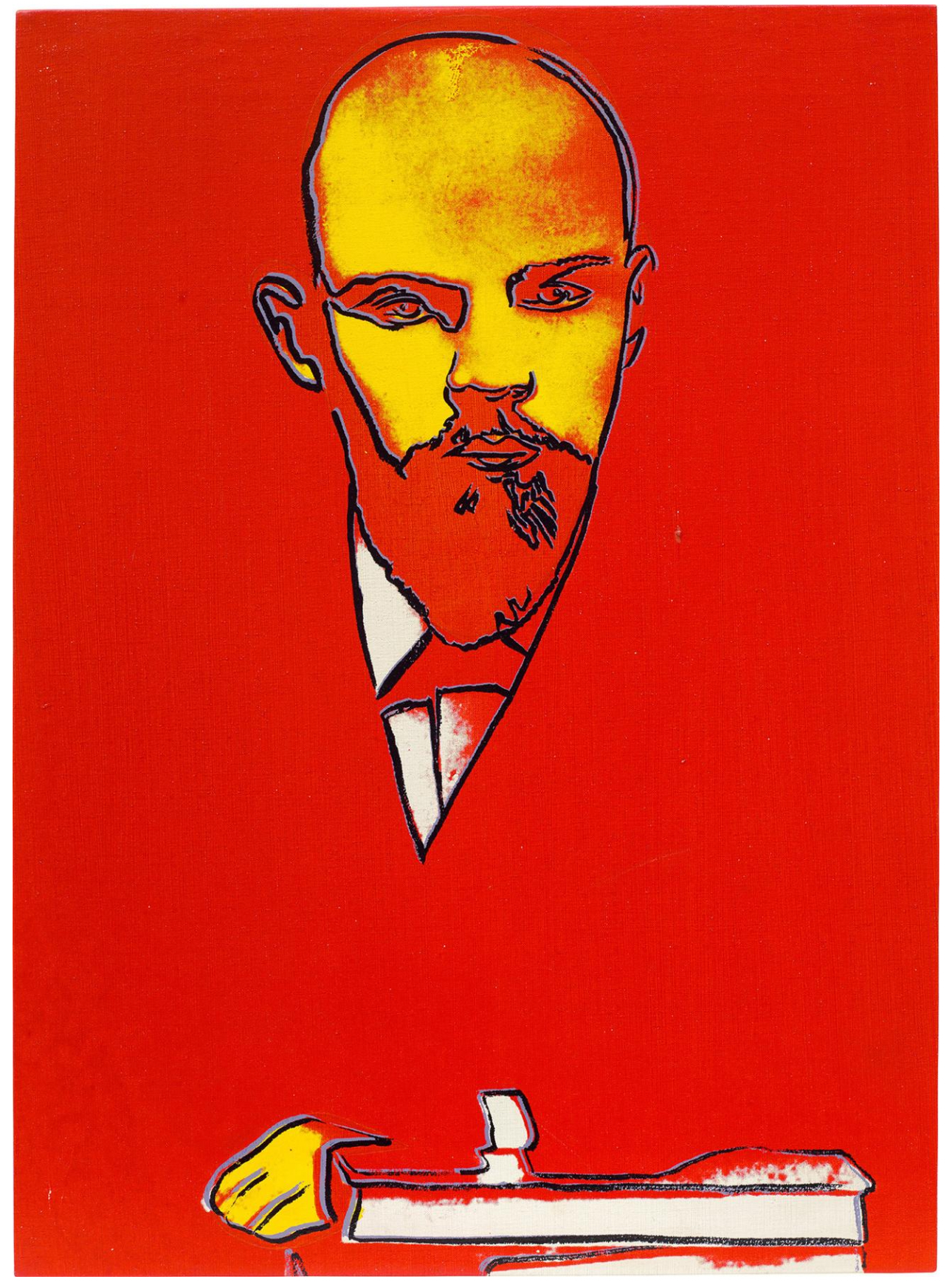
A bold statement to the power of the image even outside of its ideological contexts, Andy Warhol’s acrylic and silkscreen portrait of the political theorist Vladimir Lenin carries the same iconic weight as his celebrity silkscreens of the likes of Elvis Presley and Marilyn Monroe. Highlighting the essential role of portraiture in Warhol’s practice, Lenin also showcases the versatility of his signature silkscreen technique, and the role of mechanised reproduction in the Age of the Image.
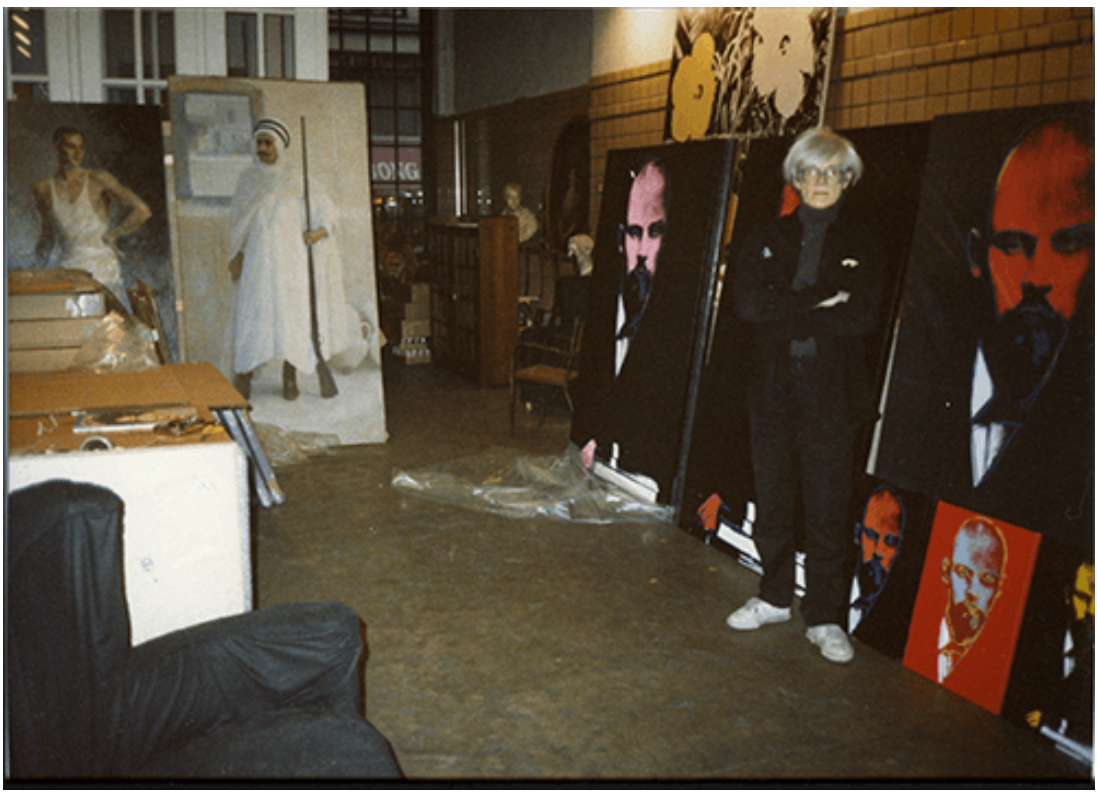
Andy Warhol in front of the Lenin works at his Factory, February 1987. Photo: Bernd Klüser, Courtesy Galerie Klüser © 2021 The Andy Warhol Foundation for the Visual Arts, Inc. / Licensed by DACS, London.
Conceptually connected to Warhol’s earlier Hammer and Sickle and Mao series of the 1970s, the Lenin works belong to the last series completed by the artist at the end of 1986, just months before his death the following year. Based on an unusual photograph of Lenin acquired by a friend of Warhol’s publisher and gallerist Bernd Klüser, Lenin shows the Russian revolutionary as a young man with a sharply focused stare, his arm resting authoritatively on a pile of books, emphasizing the intellectual roots of his political philosophy. Instantly recognizable as one of the most important political and cultural figures of the 20th century, Warhol has reduced the figure to the most basic elements of line and color. Consisting of just five colors – luminous yellow patches highlighting the face and hands, the sharp white triangles of his shirt collar and cuffs, and the heavy black outline edged in electric blue drawing out key details of the figure against the overwhelming wash of deeply saturated red.
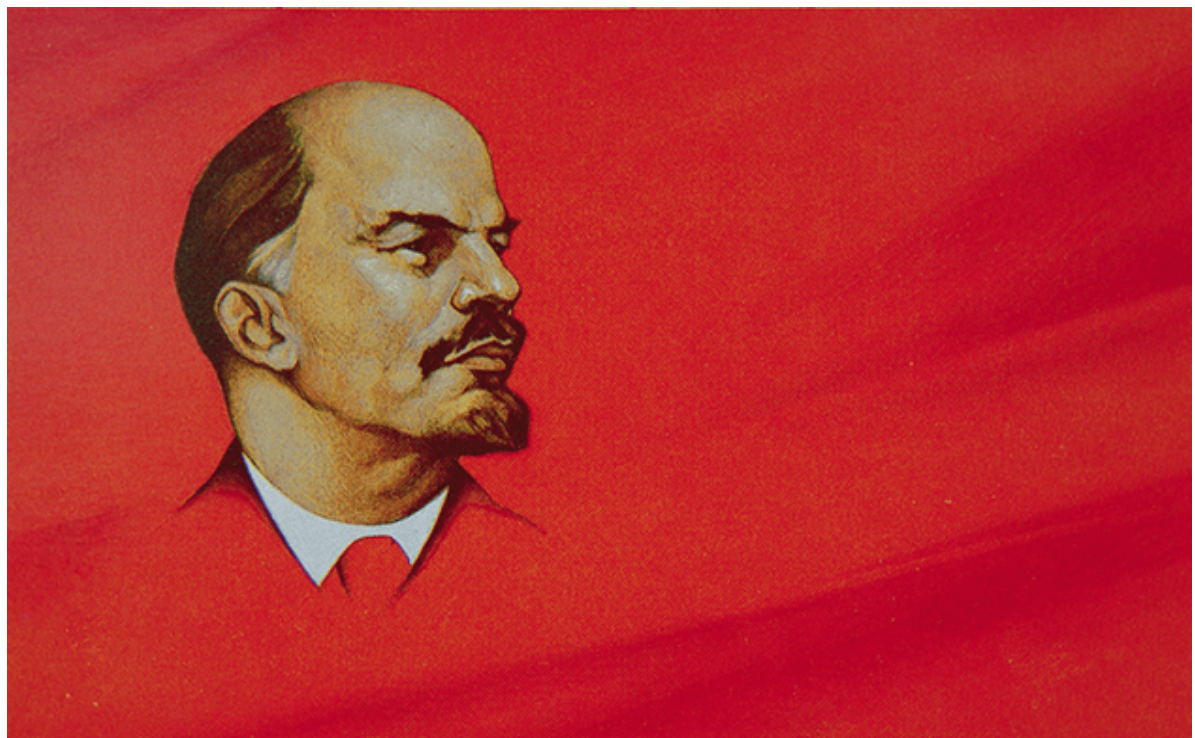
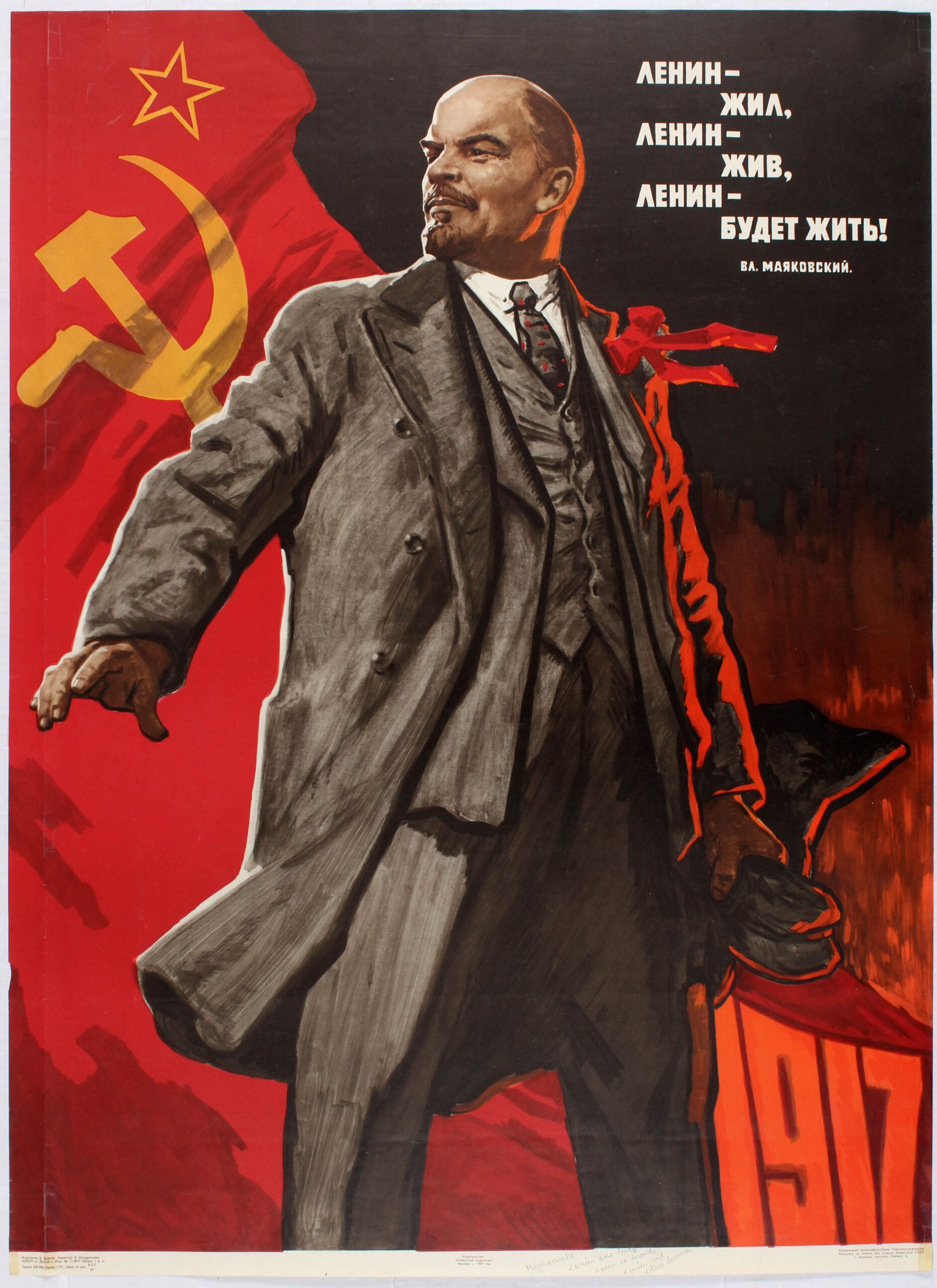
Greetings card featuring a portrait of Lenin, Private Collection. Peter Newark Historical Pictures / Bridgeman Images
Echoing the simple details and bold coloration of yellow on red that defines not only the Soviet flag, but more abstract symbolism surrounding ‘Red’ leftist politics that took pointed significance in America as the Cold War intensified through the latter half of the last century, Warhol demonstrates a subtle and sophisticated understanding of the role of the visual in popular culture and 20th century politics. Demonstrating remarkable dexterity and skill, the economic lines draw out the figure from the red ground, offering a compelling analogy for the ideological opposition of the individual and the collective that was staged so pointedly in the Cold War opposition of capitalist individualism and communist collectivism.
Lenin, 1986
Christie’s Paris: 20 October 2017
Estimated: EUR 400,000 – 600,000
EUR 427,500 / USD 503,125
ANDY WARHOL (1928-1987), Lenin | Christie’s
ANDY WARHOL
Lenin, 1986
Synthetic polymer and silkscreen ink on canvas
22.1 x 16 inches (56.2 x 40.6 cm)
Signed and dated ‘Andy Warhol 86’ (on the reverse)
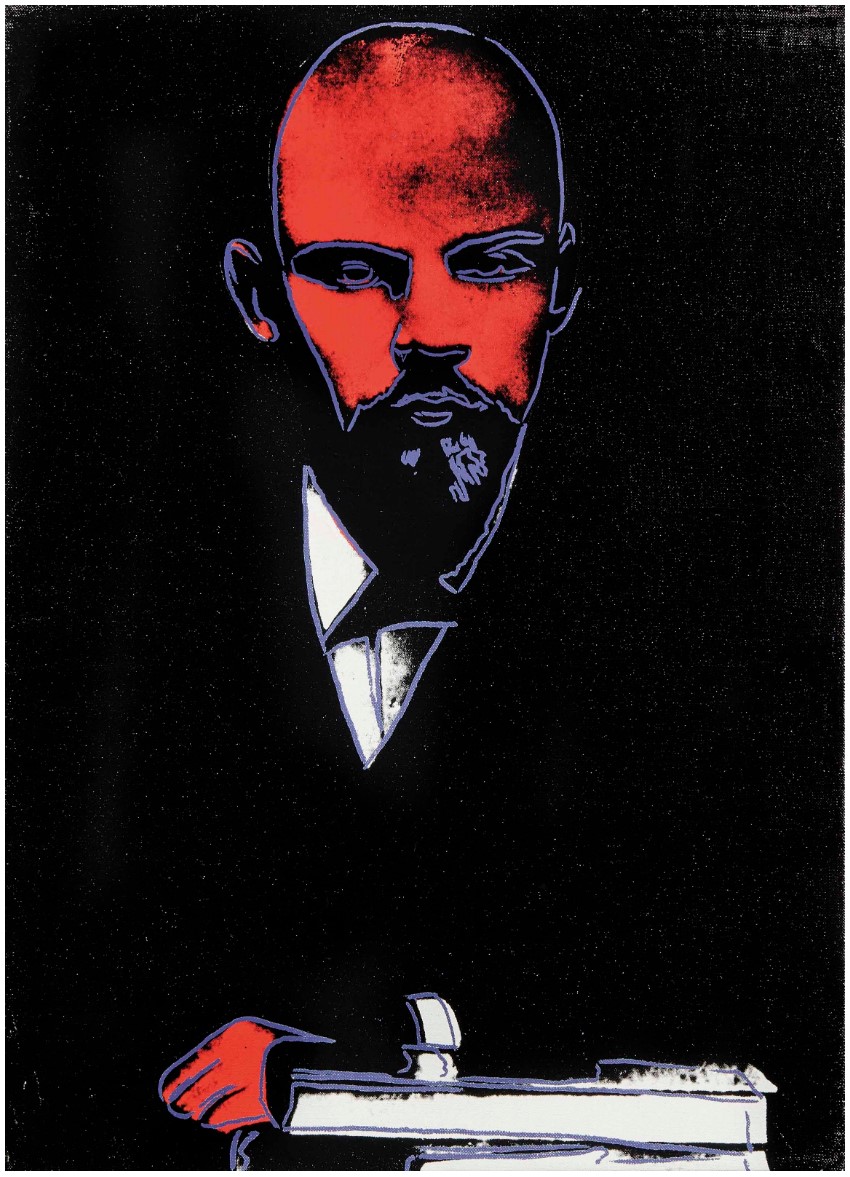
Lenin, created in 1986, is one of the last series of works by Andy Warhol and was finished only a few months before the artist’s death in February 1987. Against a particularly inky black background, obliterating any detail, the red face of Lenin stares straight at the viewer. His frontal and hieratic pose, the face features distilled to their simplest expression (only two inverted triangles have been left from the shirt collar) and the way the outlines of the face and eyes are underlined in bluish purple give the portrait a ghostly presence, an intense and almost threatening look.
Lenin, 1986
Bonhams London: 29 June 2017
Estimated: GBP 650,000 – 750,000
GBP 785,000 / USD 1,019,280
Bonhams : Andy Warhol (American, 1928-1987) Lenin 1986
ANDY WARHOL (American, 1928-1987)
Lenin, 1986
Acrylic and silkscreen ink on canvas
22 1/16 x 15 15/16 inches (56 x 40.5 cm)
Signed and dated 86 on the overlap
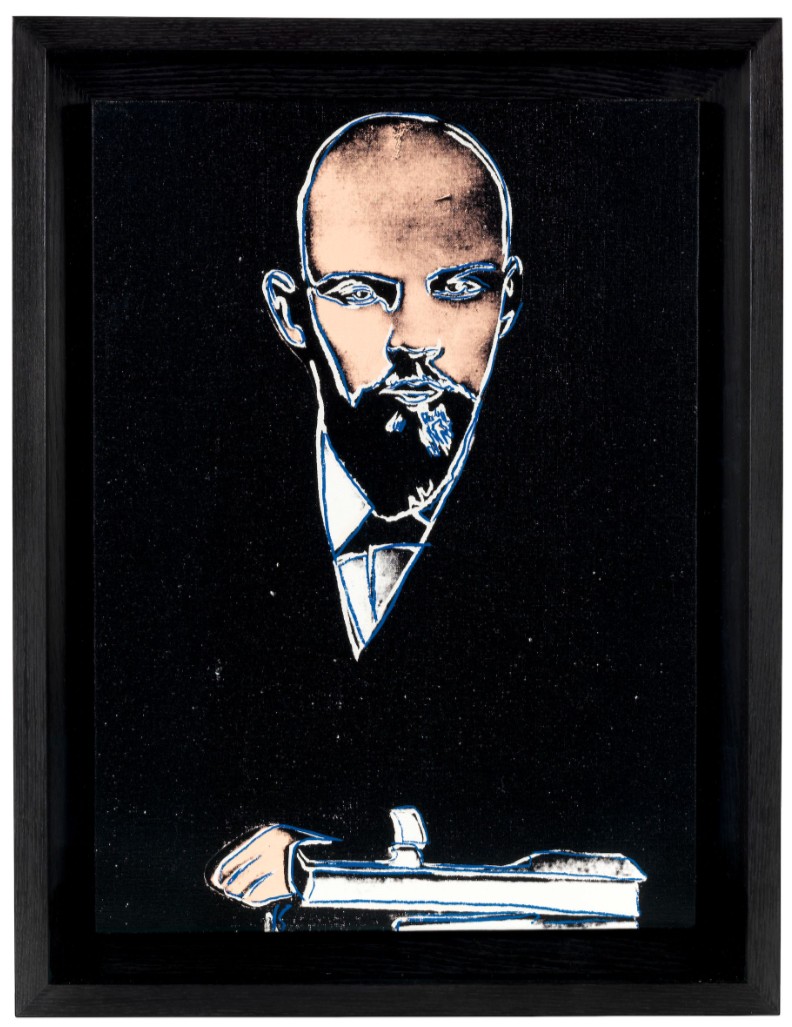
The present work from 1986 is an arresting canvas based on a black and white photograph taken in 1897, in which Lenin posed amongst a group of fellow Social Democrats; later the photograph was cut down to focus solely on the figure of Lenin, and it was in this form that it was passed to Warhol. Screened onto canvas, its darker tones deepened to obsidian black, the figure highlighted in a luminous frame of sketchy white line, the already powerful source photograph is rendered even more intense. The result is a searing portrait of one of the most influential (and controversial) figures of the modern age, painted by arguably the greatest artist of the late Twentieth Century.
The original photograph used for Lenin (1986) was actually presented to Warhol by German gallerist Bernd Klüser, who was interested in organizing an exhibition with the American Pop master. Warhol was open to new ideas and inspiration, and Klüser recognized the potential of this image of the Russian revolutionary: “We had already been planning for two years to cooperate on a project which was to strike out in a new direction: instead of reproducing the stereotyped icons of everyday life in America, Warhol would be confronted with an image which went against the grain of his usual preoccupations. By virtue of both its content and formal quality, the photograph of Lenin seemed ideal for the purpose” (Bernd Klüser in: Lenin by Andy Warhol, Munich 1987, p. 68). Klüser’s hunch proved correct, and his rather tatty little source photograph ultimately inspired what was to become Warhol’s last great series of canvases. The show of his Lenins in Klüser’s Munich gallery opened on 24th February 1987, two days after the artist’s unexpected death in New York. The present work was purchased from that very gallery and has remained in the same private collection ever since.
Even when he painted political figures such as Lenin, Warhol was never intending to make political art. Instead he was interested in the power of the image, the public façade of the popular figure. Whilst previous generations of portraitists had attempted to portray the inner workings of the soul, to capture the true personality of the sitter, Warhol was always fascinated by the artifice, the mask presented to the world at large. In the decades after his death, images of Lenin inspired wildly different responses in different communities. To Russians, he was presented as a hero of the Revolution, a founding father of the nation. In the West, however, he more commonly represented the spectre of the Communist threat. It is perhaps this spectre that we recognize most clearly in Warhol’s Lenin, in this glowing, ghostly figure which emerges from the darkness. The books that rest in front of Lenin remind us that he was a great thinker and theorist, his bold pose presents him as a figure to be reckoned with. It is the eyes which draw the most attention here; highlighted in pure white and rimmed with midnight blue, they are piercing, unnervingly perceptive. The power of Lenin the man and Lenin the political symbol are evoked in this remarkable work. Lenin bears witness to the final flourishing of a career which has come to define modern art, an incomparable work of Pop genius, it is a perfect example of Andy Warhol’s unique ability to sublimate a humble image into an art icon.
Lenin, 1986
Sotheby’s London: 12 March 2015
Estimated: GBP 200,000 – 300,000
GBP 437,000 / USD 659,135
ANDY WARHOL
Lenin, 1986
Acrylic and silkscreen ink on canvas
22×16 inches (56 x 40.5 cm)
Lenin, 1986
Sotheby’s London: 12 March 2015
Estimated: GBP 200,000 – 300,000
GBP 425,000 / USD 641,035
ANDY WARHOL
Lenin, 1986
Acrylic and silkscreen ink on canvas
21.9 x 16 inches (55.6 x 40.6 cm)
Lenin, 1986
Christie’s London: 2 July 2014
Estimated: GBP 200,000 – 300,000
GBP 242,500 / USD 416,260
Andy Warhol (1928-1987), Lenin | Christie’s
ANDY WARHOL (1928-1987)
Lenin, 1986
Acrylic and silkscreen ink on canvas
21 3/4 x 15 7/8 inches (55.4 x 40.3 cm)
Stamped by The Estate of Andy Warhol and The Andy Warhol Foundation for the Visual Arts, Inc
Numbered ‘PA81.014’ (on the overlap)
Stamped by the Andy Warhol Foundation for the Visual Arts, Inc. (on the reverse)
Double Lenin, 1986
Christie’s London: 25 June 2013
Estimated: GBP 600,000 – 800,000
GBP 721,875 / USD 1,112,720
Andy Warhol (1928-1987) , Double Lenin | Christie’s
ANDY WARHOL
Double Lenin, 1986
Acrylic and silkscreen inks on canvas, in two parts
Each: 22×16 inches (55.8 x 40.5 cm)
(i) Stamped with The Estate of Andy Warhol stamp and numbered ‘PA81.005’ (on the overlap)
(ii) Stamped with The Estate of Andy Warhol stamp and numbered ‘PA81.002’ (on the overlap)
Executed in 1986, Andy Warhol’s Double Lenin is a work from the artist’s last great series of works, completed in December 1986, only two months before his death in February 1987. Emerging from an inky black background, Warhol’s Double Lenin radiates in violet and pink, taking on a near-spectral quality conveyed through the striking glow of his tracery. In Warhol’s reimagining of Lenin, the artist undertakes an iconic figure already laden with historicism and notoriety in the collective psyche. He intensifies those characteristics through the signature flattening of his composition, and bold coloring grounded in light and shade. This ‘Warholian’ treatment highlights the politician’s mythologizing status through the profound sense of gravitas afforded to his taciturn stare. The repeated image of Double Lenin is a device that Warhol utilized throughout his career to beli an icon’s uniqueness through seriality. Like his other ‘doubles’ of celebrities such as Marilyn Monroe, Jackie Kennedy, and Elvis, through this imaging, Warhol highlights only those most iconic features which make them abundantly identifiable in the public sphere.
Lenin, 1986
Christie’s London: 21 June 2007
Estimated: GBP 150,000 – 200,000
GBP 288,000
Andy Warhol (1928-1987) , Lenin | Christie’s
ANDY WARHOL
Lenin, 1986
Synthetic polymer paint and silkscreen inks on canvas
22×16 inches (56 x 40.6 cm)
Signed ‘Andy Warhol 86’ (on the overlap)
Lenin Prints
READ ABOUT LENIN PRINTS
FIND ALL HISTORICAL AUCTION RESULTS