Mao captures the political and painterly consciousness that preoccupied the artist in the early 1970s. Embodying a significant juncture in Warhol’s career, the Mao paintings mark his return to silkscreen painting with a much more expressive handling after devoting himself to film since 1965. Transforming the globally known photograph of Mao Zedong used for propagandic dissemination during the Cultural Revolution in China (1966-1976) into a pop mélange of capitalist product, Warhol’s serial Maos are nonetheless each endowed with unique characteristics and ample Warhol’s painterly touch, as his rapid Willem de Kooning-esque gestures blending the image of Mao with large and colorful painterly brushes.
Introduction
Mao Zedong, also known as Chairman Mao and the founding father of the People’s Republic of China, is undeniably one of the most influential political figures in the world and is still revered in China as the wise and heroic leader. During the Cultural Revolution, his image was reproduced on the first page of 1966 publication Quotations from Chairman Mao Tse-tung (Mao Zedong), more commonly known as Mao’s “Little Red Book.” Party members were strongly encouraged to carry a copy with them as it contained the foundations of Maoist ideology. The book was widely circulated across the country with a print-run estimated at over 2.2 billion, which made Mao’s stern yet benevolent face one of the most extensively printed portraits in history. It is an image that is famous not because of its quality, or its depth of character, but because of its ubiquity. In Tiananmen Square, a gigantic copy of his portrait hung throughout his reign, and still hangs today. Even after more than 40 years since his death, Chairman Mao preserves power over his representation in China as before.
“I have been reading so much about China…The only picture they ever have is of Mao Zedong. It’s great. It looks like a silkscreen.”
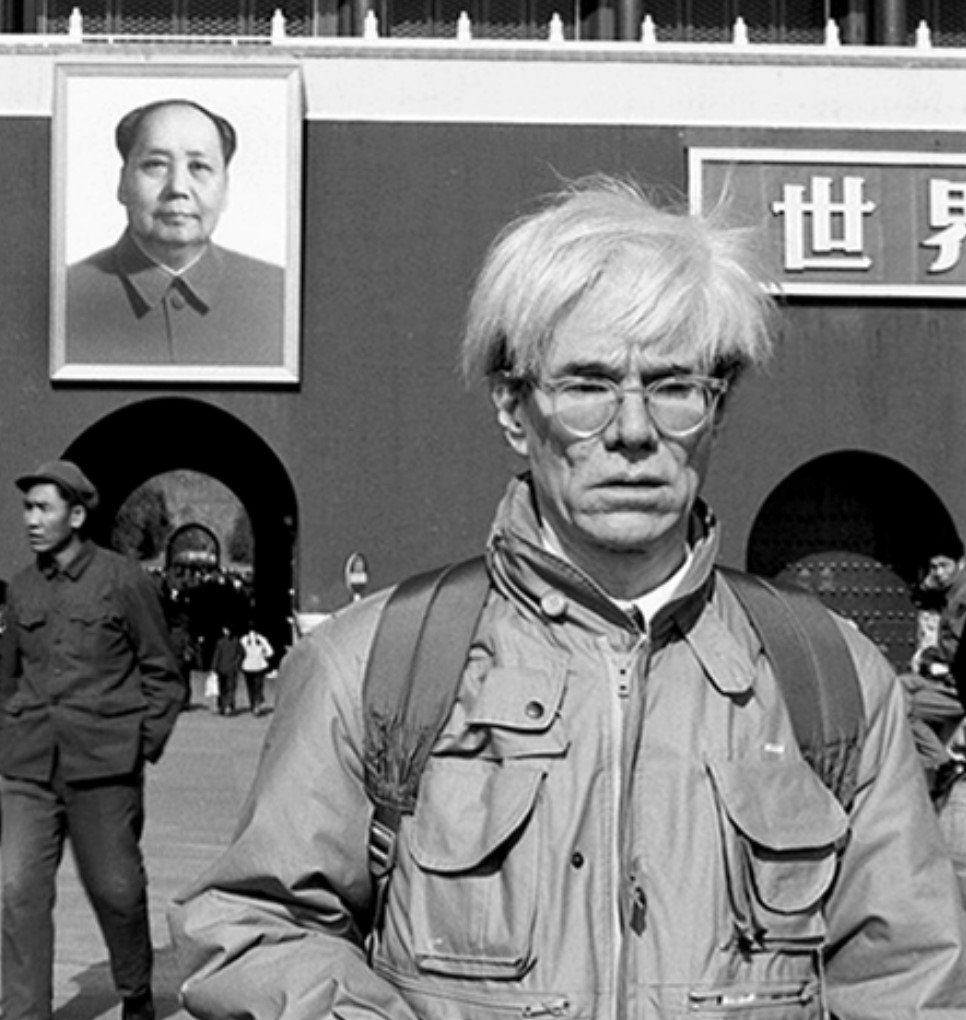
Andy Warhol in front of Tiananmen Square, Beijing, 1982. Image: © Christopher Makos, 1982
This series announced Warhol’s return to painting with tremendous force and conceptual brilliance; uniting infamy with celebrity, reducing the politically germane to the glossy levity of fashion, and marrying the communist multitude with the capitalist market, the Maos represent Warhol at his very best. Andy Warhol’s own daring and incisive portraits of China’s first communist leader pervade the most prestigious art institutions across the globe, including the Metropolitan Museum of Art, New York, The Broad, Los Angeles, Whitney Museum of American Art, New York, and the Rubell Museum, Miami.

Mao captures the political and painterly consciousness that preoccupied the artist in the early 1970s. Embodying a significant juncture in Warhol’s career, the Mao paintings mark his return to silkscreen painting with a much more expressive handling after devoting himself to film since 1965. Transforming the globally known photograph of Mao Zedong used for propagandic dissemination during the Cultural Revolution in China (1966-1976) into a pop mélange of capitalist product, Warhol’s serial Maos are nonetheless each endowed with unique characteristics and ample Warhol’s painterly touch, as his rapid Willem de Kooning-esque gestures blending the image of Mao with large and colorful painterly brushes.
“Mao was a brilliant choice, and Andy’s timing was perfect. The Mao paintings, when they were exhibited a year later in New York, Zurich, and Paris, were greeted with universal acclaim. They were controversial, commercial, and important, just like the man they portrayed and the man who painted them.”
Bob Colacello
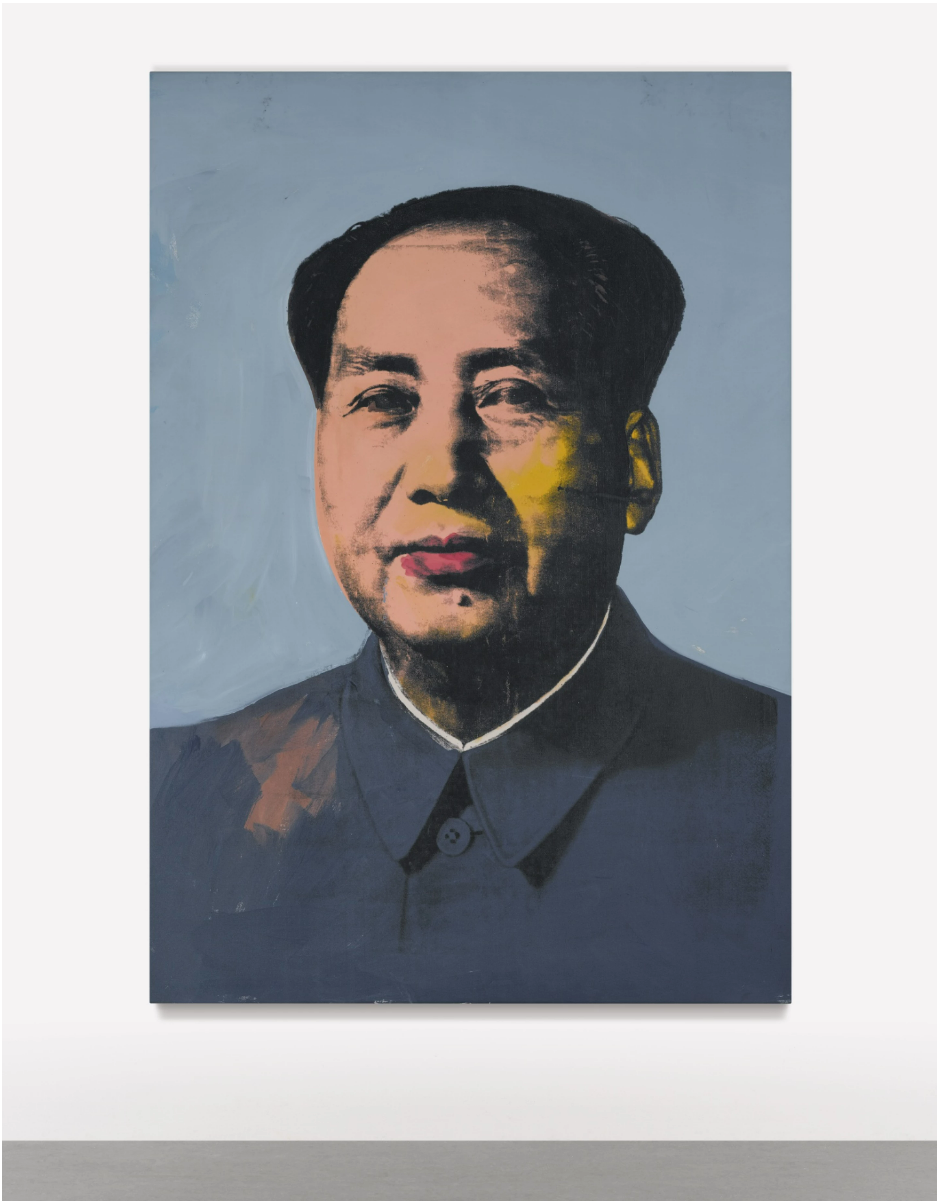
Warhol’s Maos were conceived over a conversation between the artist and Bruno Bischofberger in 1972 as they were contemplating Warhol’s painterly reprise. Indeed, the legend says it began with an idea from Bruno Bischofberger that Andy Warhol should paint the most important figure of the twentieth century. Albert Einstein was suggested for the impact of his Theory of Relativity in both precipitating technological richness and technological terror…
“That’s a good idea. But I was just reading in Life magazine that the most famous person in the world today is Chairman Mao. Shouldn’t it be the most famous person, Bruno?”
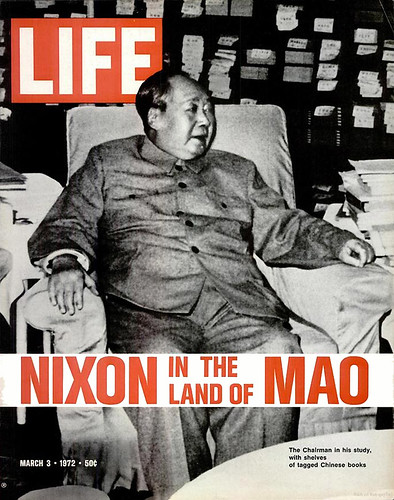
Following Warhol’s premature ‘retirement’ from painting declared at an exhibition of the Flowers in Paris, the mid-to-late 1960s saw his artistic focus shift towards filmmaking, music, performance and other entrepreneurial projects such as Interview magazine: in accordance with these activities, Warhol’s public persona began to rival the fame and influence of the celebrities idolized in his work. In 1968 a near-fatal assassination attempt by radical feminist author and aspiring playwright Valerie Solanas, dramatically triggered a period of deep reflection and re-evaluation, further prolonging the absence of a major new body of paintings. Coinciding with the very first portrait commissions during the early 1970s, Warhol began contemplating the topic of his painterly reprise.
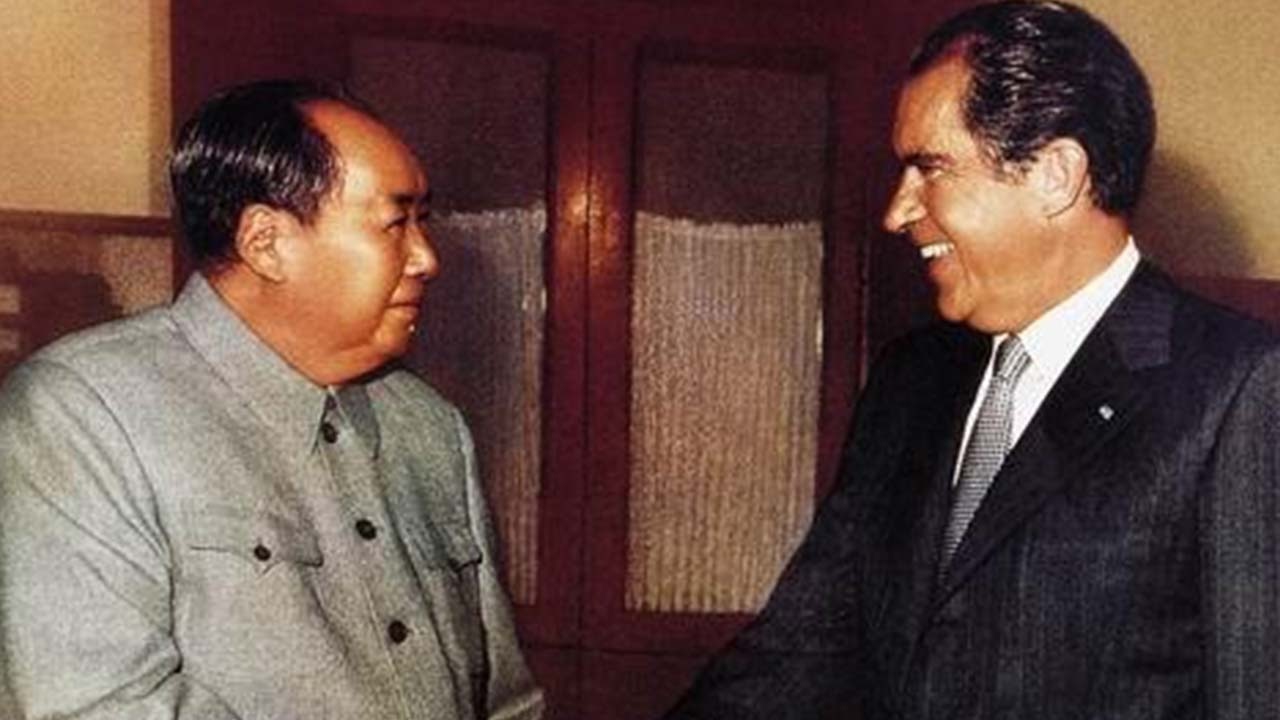
Proving the artist’s finely tuned ability to draw on the sociopolitical had lost none of its power, the Mao paintings arrival in 1972 evinced a retort to American foreign policy: in rapid response to the highly orchestrated media frenzy that was Richard Nixon’s visit to China in 1972, Warhol’s series of paintings subversively turned China’s communist leader into capitalist commodity. Famously critical of Nixon, who prior to his conciliatory efforts towards China was known as an anti-communist red-baiter, Warhol appositely took on the most prescient political dialogue on the global arena. Although he had broached the American political arena a decade earlier with his Electric Chair and Race Riots, both initiated in 1963, it was not until 1971 that Warhol began to contemplate the contentious international concerns at the forefront of the global political consciousness and headlining the Western media. Signaling an ambitious return to his breakthrough medium, this series is remarkable in its major portrayal of the only political figure ever painted of Warhol’s own volition.
The idea to paint Mao had taken seed in Warhol’s imagination ever since Nixon’s televised announcement in July 1971 of a sanctioned visit to China. Following the end of the Chinese Civil War in 1949, America’s refusal to recognize the new communist government drew an iron curtain between China and the US that lasted over twenty years. In an effort to thaw Sino-American relations and in a tactical move to help resolve the Vietnam War, Nixon – famously hardline in his anti-communist policy – was to be the first President to visit the People’s Republic of China. Every part of the historic visit was highly orchestrated and planned; confident in the visual power of television, Nixon ensured that the whole event was choreographed as though it were a TV extravaganza. Resembling a media circus, almost one hundred journalists were invited to cover the trip, with the most dramatic events televised live in time for the morning and evening news bulletins. That Nixon was up for re-election in 1972 was a fact not lost on journalists who commented upon the heavily propagandist nature of the event. Despite such obvious strategic motivations however, Nixon’s highly atypical scheme ironically laid the groundwork for reshaping the global balance of power; his radical steps to assuage anti-American sentiment in the East are today considered a landmark of twentieth-century foreign policy.

Warhol’s source image derives from an official portrait of the authoritarian ruler which followed the canon of official Soviet portraiture of Stalin and Lenin. Unlike the latter, however, Mao’s image, which was seen to embody the revolutionary spirit of the masses, stares directly at the beholder and was exhibited prominently above the Tiananmen Gate where, in 1949, Mao had announced the founding of the People’s Republic of China. Symbolizing perpetual surveillance, the image was ubiquitous in every schoolroom, shop front and public institution across the country and was reproduced on the first page of Quotations from Chairman Mao Tse-tung, more commonly known as Mao’s “Little Red Book,” which was widely disseminated during and after the Cultural Revolution as a mandatory citizens’ code. With a print-run estimated at over 2.2 billion, this made Mao’s stern yet benevolent face one of the most extensively reproduced portraits in history.

Between 1972 and 1973 Warhol produced a total of 199 works depicting Chairman Mao. Alongside five graduated series of paintings, which diminished in size and accordingly increased in number, Warhol created a suite of drawings and portfolios of prints. Ranging from the colossal Giant Maos intended to rival the scale of the iconic portrait hung above Tiananmen gate, through to the miniature portraits measuring 12 by 10 inches, Warhol conceived of a body of work to plausibly suit all tastes and budgets. The resulting body of work transformed Mao’s official portrait used for the dissemination of communism into a commodity of the capitalist economy, no more consequential than a can of Campbell’s Soup.
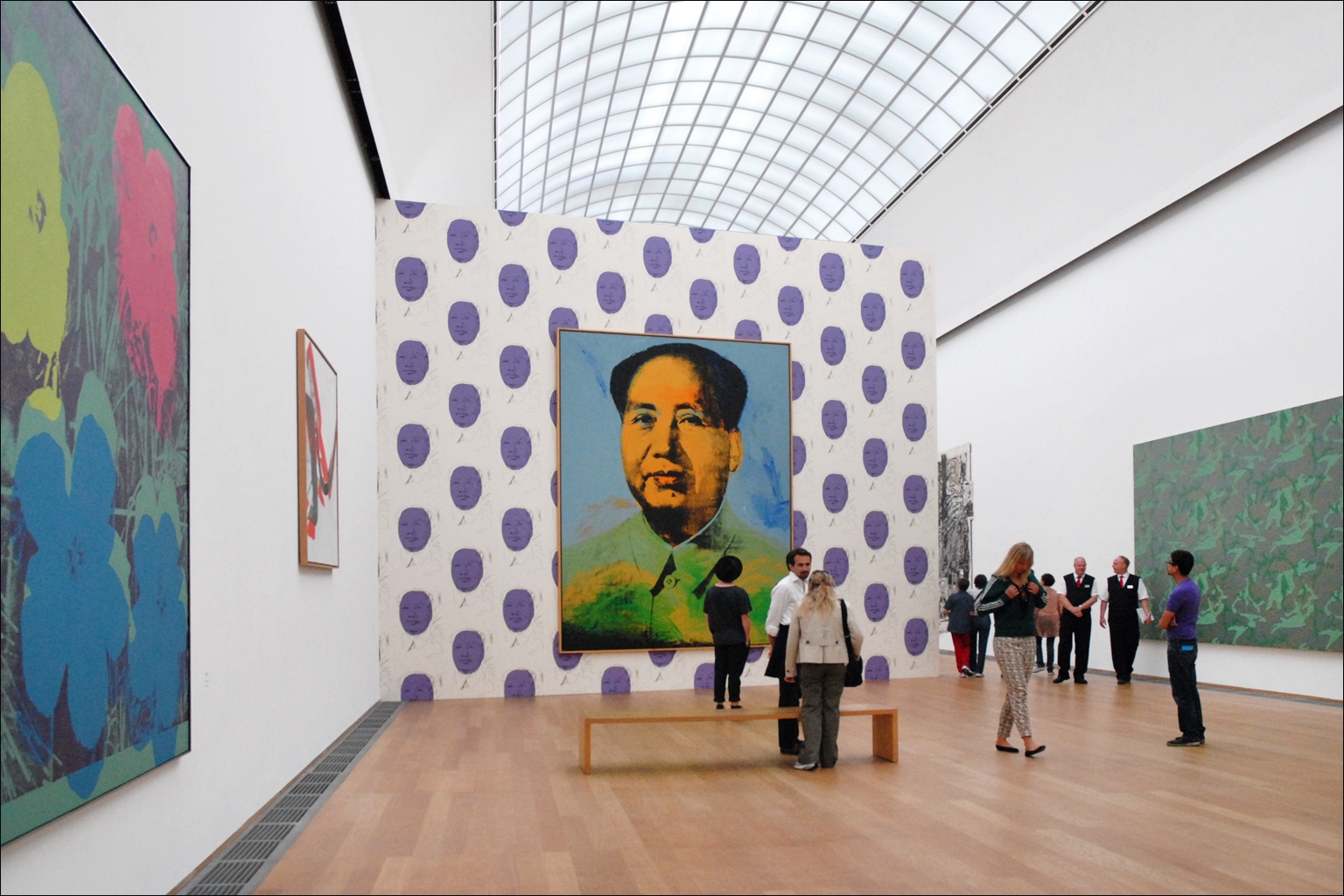
Resting on a knife’s edge, Warhol’s ambivalence between complicity and criticism, apathy and consequence is truly definitive in the Mao portraits – a controversial standpoint wittily enacted in the photographs that document Warhol’s pilgrimage to China and the Forbidden City ten years later in 1982. By channeling Mao through the mechanistic swipe of his trademark screen print and highlighting his features and iconic suit in brightest tones of gesticular paint, Warhol transmuted political significance: no longer representing a symbolic threat to the American dream, Mao became Warhol’s newest player on the vacuous fashion circuit and member of the celebrity circus

Installation view of Andy Warhol: Mao at the Musée Galliera, Paris, 1974. Artwork: © 2021 The Andy Warhol Foundation for the Visual Arts, Inc. / Artists Rights Society (ARS), New York
The Mao series, executed in a range of different characteristics, bold chromatic juxtapositions and scales, was first exhibited at Musée Galiera in Paris in May 1974. The show is now widely recognized as one of the defining moments in Warhol’s career while representing his first critically and commercially successful cycle since the mid-1960s, further reaffirming the artist’s unrivalled position on the international contemporary art stage. Set within the grandiose environs of the Palais Galiera, Musée de la Mode la Ville de Paris, Andy Warhol: Mao delivered a spectacular display of Warhol’s first body of new paintings since his Flowers of 1964. Taking inspiration from his 1966 exhibition at Leo Castelli in which the gallery was famously covered in cow wallpaper, Warhol plastered the walls of the Musée Galiera with Mao wallpaper – a repeated graphic taken from the suite of Mao drawings onto which he painted purple ellipses over each face. Alongside 10 early Mao paintings, he exhibited a further 3 series of works including 4 colossal Giant Mao canvases measuring 177 by 137 inches, 11 large 50 by 42-inch canvases, and 42 smaller 26 by 22-inch canvases.
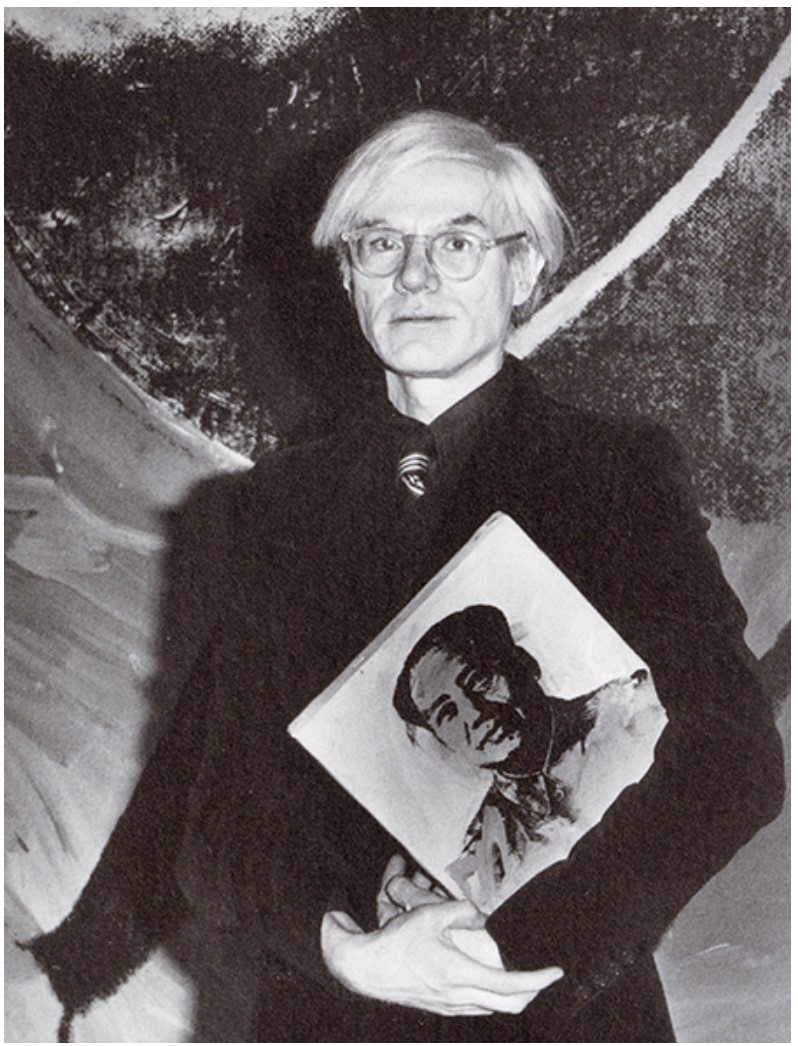
Andy Warhol holding a Mao, 1972. Artwork: © 2023 The Andy Warhol Foundation for the Visual Arts, Inc . / Artists Rights Society (ARS), New York
Exhibited in sequence abutting each other and hung at a level just above the viewer’s eye-line, the Mao portraits magnificently inhabited and transformed the tremendous architecture of the gallery into an extravaganza of color and political daring. Echoing the omnipresence of Mao’s portrait in schools, the workplace, and in public spaces in China, Warhol took on the inherent seriality of Mao’s likeness and subverted it. Displaying incessant repetition, yet with each work possessing individual schemas of gestural candy color, this exhibition delivered the full force of Warhol’s Mao project by reducing an irreproachable image power to the level of surface decoration.
Essay
The following essay on Andy Warhol’s Mao, 1973, is by art critic Blake Gopnik, the author of Warhol, the first comprehensive biography of the Pop artist, published by Ecco in 2020. Gopnik is also a regular contributor to the New York Times.
When Andy Warhol began his Chairman Mao project, early in 1972, it represented his first notable body of images in almost a decade. His last major series had come into view back in November of 1964, when he’d shown his Flowers with Leo Castelli and then announced that he’d given up painting for film.
In 1972, Warhol was still hurting from the assassin’s bullet that had (briefly) killed him in June of 1968. Since he still had a studio to fund, it’s tempting to see his Maos as taking an easy, marketable step back toward the Pop Art that had first made him famous. His Mao works might be just more riffs on cultural superstars, taking off from the Marilyns and Jackies and Elvises of the early 1960s. The Maos are that, of course-the Chairman was certainly an international celebrity, with a face at least as well-known as any actor’s-but they also bear important witness to Warhol’s deep engagement with the particular artistic moment he was in.
A quarter century earlier, in art school, Warhol’s teachers had taught him to have an invested belief in that classic modernist mantra, “Make it new.” He never abandoned that ideal. In 1972, his Maos represented his latest attempt at living it.
The Maos came at a moment when the Color Field abstraction of Kenneth Noland and Helen Frankenthaler still held sway among most supporters of what passed for “advanced” art, as we have now mostly forgotten. Warhol’s new series clearly engaged with that tradition. The Mao in this auction plays with the tensions between “fields” of brilliant blue, orange and red, while in other works in the series Warhol limits himself to intense complementary contrasts (yellow with purple; red with green) or goes for pastel shades instead. In their thick brushwork, the paintings also echo the surface effects that were so important to Jules Olitski and Larry Poons, the latest art stars of that era who used the new acrylic medium, also there in Warhol’s Maos, to turn their canvases into relief maps of paint.
Ignore the face that repeats across the Maos, and they could pass as studies in the formalist fundamentals of shape, color and surface that preoccupied so many of the most influential critics of Warhol’s century.
But even as Warhol was successfully engaging with the latest abstraction, he was opening up an ironic distance from it. Rather than advocating for the virtues of purely formal experimentation, the Maos come closer to proclaiming it moribund, at a moment when, out on the furthest cutting edge of the art world, the recent declarations of the Death of Painting were read less as diagnoses than as obituaries. All those different versions of Mao could be seen to imply that the differences among them might be more random than willed. Warhol’s words support that view. He called his frantic brushwork “hand jobs” and “abstract pseudo-painting,” saying he could do it “without even thinking.” He compared the colorful painting he did on his Maos to cooking. A video of him at work on a wall-sized Mao makes that comparison seem almost too fancy: He looks more like a janitor mopping a floor.
Warhol’s Maos might count as his signature on a note of condolence to painting.
The first hint we have of Warhol’s interest in Mao comes in a phone call, in September of 1971, where he talked about artmaking among the Chinese: “They don’t believe in creativity. The only picture they ever have is of Mao Tse-tung. It’s great. It looks like a silkscreen. It’s the only picture they ever have of him-they don’t believe in people being creative.” That “great” of Warhol’s sounds like it signals hearty agreement with an abandonment of the “creative.” A ceaseless repetition of the same found image, printed over randomly mopped-on paint, might be a marker of the uncreative-but it’s important to note that the massive project that results bills non-creativity as the next place for creative fine art to head.
“Art isn’t now,” Warhol said, the same year the art of his Maos came to be. What counted as properly “now,” for many of the era’s most committed avant-gardists, was a deep commitment to politics. In 1969, members of the Art Workers’ Coalition had organized the “Moratorium of Art to End the War in Vietnam.” The next year, they paraded their potent And Babies poster in front of Picasso’s Guernica. In ’71, Hans Haacke earned headlines when his exposé of a slum landlord’s holdings got his solo show at the Guggenheim canceled.
Warhol had taken politics to heart at least since art school, when he’d signed a petition supporting Henry Wallace, a politician on the far-left flank of the New Deal. In the spring of 1962, almost 15 years later, the first time a work of Warhol’s Pop Art got broad exposure he was still toying with explicit social critique. He said his new work was “a statement of the symbols of the harsh, impersonal products and brash materialistic objects on which America is built today.” But that was pretty much the last time Warhol wore his politics on his sleeve. (In private talk, and in his donations, he was always a dedicated progressive.) With the Mao project, however, politics-if not Warhol’s, then someone’s-were inescapably present, in the more than 2,700 images Warhol churned out of the ruler of one quarter of the world’s population.
Decades into the 21st century, with China’s dedication to capitalism so clearly on view, it’s hard for us to realize how alive Maoism still was, as a real political option, when Warhol chose the subject of his new project. The New York Times spared space for a political scientist’s essay on whether Maoism-the “war of the underdeveloped peasant world against the advanced capitalist nations”-would survive its 77-year-old founder. Maoist guerillas around the world fought under the assumption that it would. I remember hearing my parents talk about the dedicated Maoists who taught alongside them at our local university, and who were never without their khaki caps with red stars.
That same fall of ’71 when Warhol was first talking about Mao, Emile de Antonio, the Marxist documentarian who had been one of Warhol’s most ardent fans at the start of his Pop career, said, “If I have to make a choice between American painting and the attempt to turn men’s minds and the search for a collective soul, then I’m more interested in what Mao is doing than in the art of my friends.”
You might say that, in the project that followed by his friend Warhol, a similar claim was being made-but it’s indeed a claim of “interest,” rather than a commitment for or against what Mao and his image might stand for.
Warhol’s mature works had always been built around what a philosopher might call “pure ostension”: Just pointing at something in the world, where the pointing itself (“Look at this!”), rather than any critical comment or aesthetic embellishment, was the fundamental purpose. Ostension had always been sitting there at the very heart of picture making, but Warhol was possibly the first artist to use his work to point at that pointing.
With his Mao series, his pointing at pointing reached its apotheosis: His Maos were pointing at an image that, for all its political potency-because of its political potency-was itself all and only about ostension. Like Byzantine icons and any number of earlier, often magical images, the pictures of Mao that proliferated across communist China achieved almost all their aims by simply bringing the Great Leader into view, without any need to editorialize beyond that. They were selling a steak that required no sizzle.
The Campbell’s soup can had been specially designed to appeal. The same could be said for Marilyn and even Jackie Kennedy. Warhol’s ostension toward those cultural icons also captured their visual and social features, and made us respond to them. With Mao, however, there was nothing about the look of his image that spoke to who he was or what he meant: His image was just an ever-present stand-in for the man himself-a way to “make the absent present,” in the classic Renaissance formula for how the new realism was supposed to work.
This is what Warhol’s Maos may mostly be about.
“Make it new” may have been Warhol’s mantra, but, with his training in classical modernism, the “it” that mattered most to him was art itself. His works rarely did much to renew their subjects: A soup can remained a can of soup; a communist leader remained most distinctly himself. Instead, in the very act of depicting Mao, Warhol made his art new by digging deep into images at their most basic, and showing us just how they work.
– Blake Gopnik, September 2024
2026 Auction Results
Mao, 1973
Phillips London: 5 March 2026
Estimated: GBP 1,400,000 – 1,800,000
GBP 1,642,000 / USD 2,193,550
Andy Warhol Modern & Contemporary Art Evening Sale

ANDY WARHOL
Mao, 1973
Acrylic and silkscreen ink on canvas
24-1/8 x 20 inches (61.3 x 50.8 cm)
Stamped by the Andy Warhol Art Estate and the Andy Warhol Foundation
Numbered ‘PA 80.013’ on the overlap
2025 Auction Results
Mao, 1973
Property from the Jean-Michel Folon Foundation
Sotheby’s Paris: 24 October 2025
Estimated: EUR 700,000 – 1,000,000
EUR 787,400 / USD 914,735
Mao | Modernités | 2025 | Sotheby’s
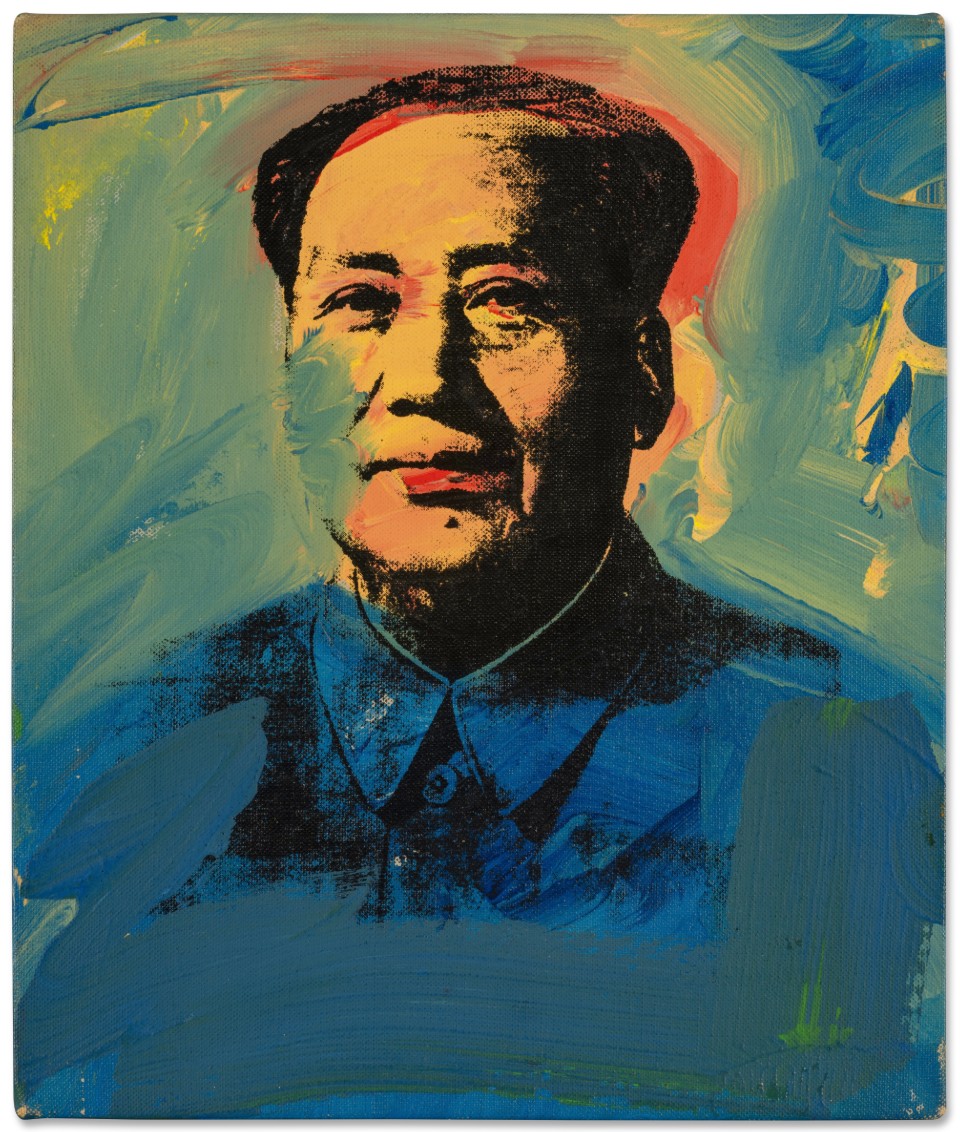
ANDY WARHOL (1928 – 1987)
Mao, 1973
Acrylic and silkscreen ink on linen
12×10 inches (30.5 x 25.4 cm)
Signed and dated 73 (on the overlap)
Mao, 1973
Christie’s London: 15 October 2025
Estimated: GBP 600,000 – 800,000
GBP 952,500 / USD 1,276,350
ANDY WARHOL (1928-1987), Mao | Christie’s
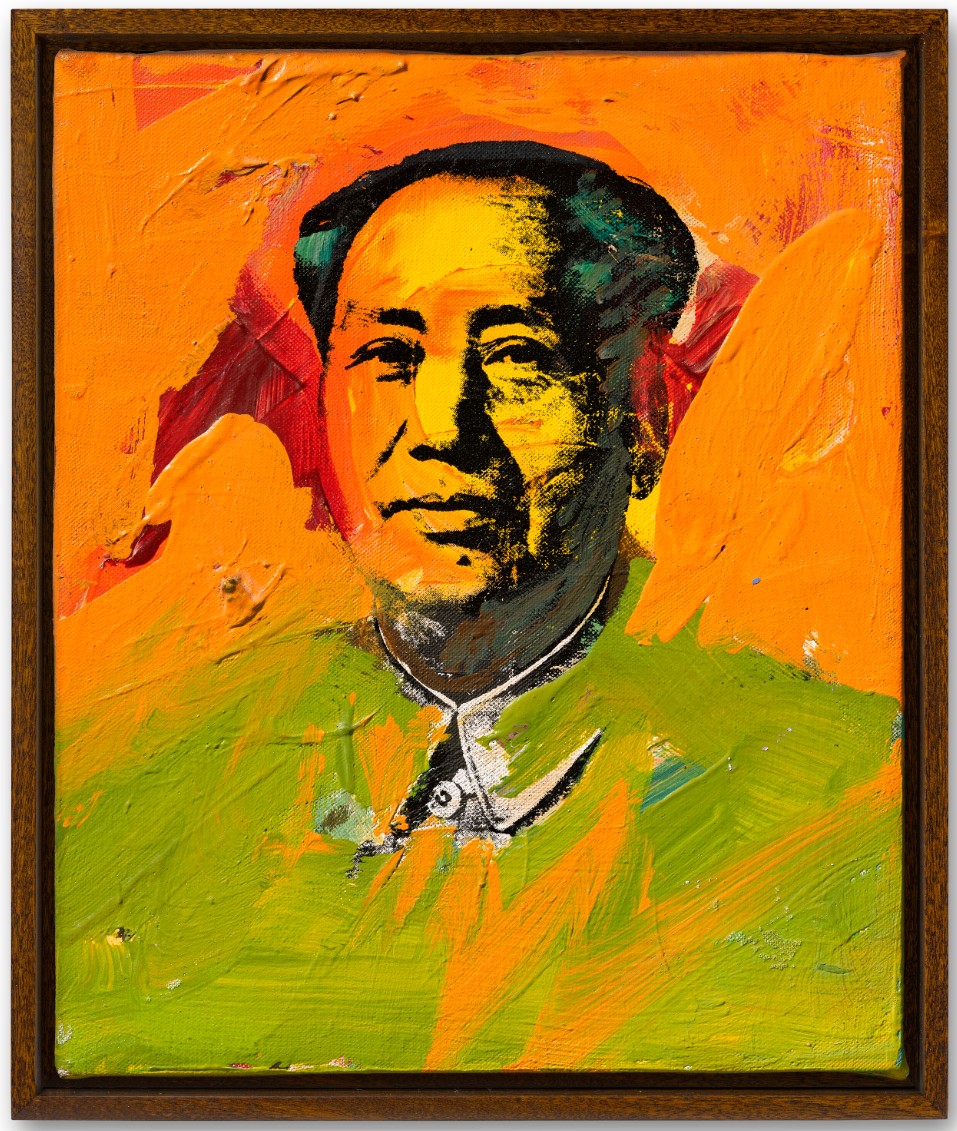
ANDY WARHOL (1928-1987)
Mao, 1973
Acrylic and silkscreen ink on linen
12×10 inches (30.6 x 25.5 cm)
Signed and dated ‘Andy Warhol 73’ (on the overlap)
Mao, 1973
Leonard & Louise Riggio: Collected Works
Christie’s New-York: 12 May 2025
Estimated: USD 4,500,000 – 6,500,000
USD 4,648,000
ANDY WARHOL (1928-1987), Mao | Christie’s

ANDY WARHOL (1928-1987)
Mao, 1973
Acrylic and silkscreen ink on linen
40×34 inches (101.6 x 86.4 cm)
Stamped three times with the Estate of Andy Warhol stamp
Stamped five times with the Andy Warhol Foundation for the Visual Arts, Inc. stamp
Numbered ‘PA 80.021’ (on the overlap and on the stretcher)
2024 Auction Results
#1. Mao, 1973
Heritage Auctions: 10 December 2024
Estimated: USD 3,000,000 – 4,000,000
USD 3,650,000
Andy Warhol (1928-1987). Mao, 1973. Acrylic and silkscreen ink on | Lot #77092 | Heritage Auctions

ANDY WARHOL (1928-1987)
Mao, 1973
Acrylic and silkscreen ink on linen
26 1/4 x 22 inches (66.7 x 55.9 cm)
Signed and dated on the reverse: Andy Warhol 73
Signed and dated twice on the overlap: Andy Warhol 73
Inscribed on the reverse and overlap (both crossed out): to Gordon and George
Inscribed on stretcher: W / 025
#2. Mao, 1973
Christie’s Paris: 18 October 2024
Estimated: EUR 500,000 – 700,000
EUR 913,500 / USD 989,260
Andy Warhol (1928-1987), Mao | Christie’s

ANDY WARHOL (1928-1987)
Mao, 1973
Acrylic and silkscreen ink on canvas
12×10 inches (30.5 x 25.4 cm)
Signed and dated ‘Andy Warhol 73’ (on the overlap)
Inscribed twice ‘CM109’ (on the stretcher)
#3. Mao, 1973
Estimated: USD 700,000 – 1,000,000
USD 781,200

Mao, 1973
Acrylic and silkscreen ink on canvas
12×10 inches (30.5 x 25.4 cm)
Signed, inscribed and dated ‘CM 99 Andy Warhol 73’ (on the overlap)
2023 Auction Results
#1. Mao, 1973
Phillips New-York: 17 May 2023
Estimated: USD 800,000 – 1,200,000
USD 1,117,600
Andy Warhol – 20th Century & Contemporar… Lot 27 May 2023 | Phillips
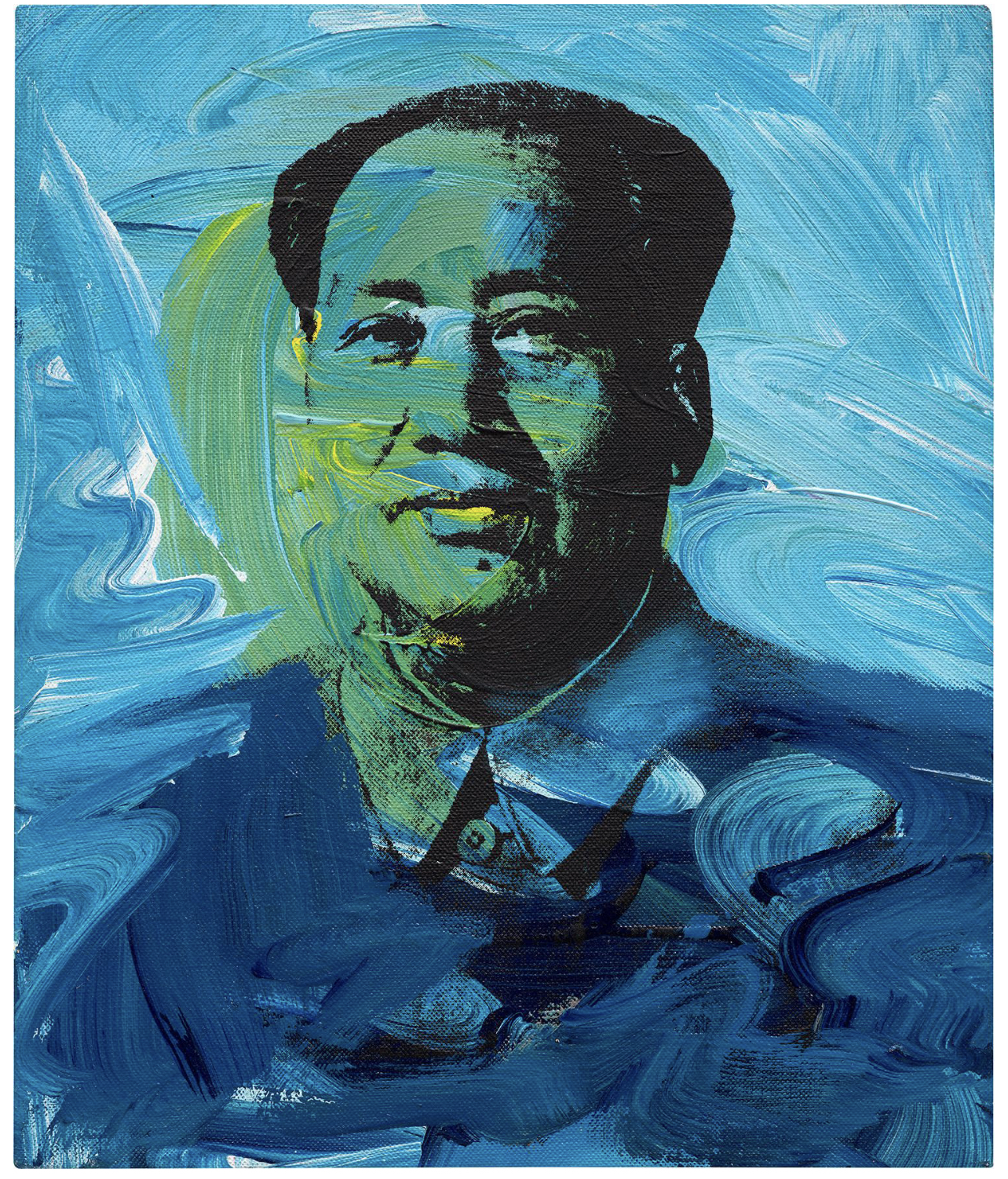
ANDY WARHOL
Mao, 1973
Acrylic and silkscreen ink on linen
12×10 inches (30.5 x 25.4 cm)
Signed and dated “Andy Warhol 73”
Stamped by the Andy Warhol Art Authentication Board, Inc.
Numbered “A012.089” on the overlap
2022 Auction Results
#1. Mao, 1973
Christie’s London: 28 February 2022
Estimated: GBP 600,000 – 800,000
GBP 942,000 / USD 1,254,494
ANDY WARHOL (1928-1987) (christies.com)
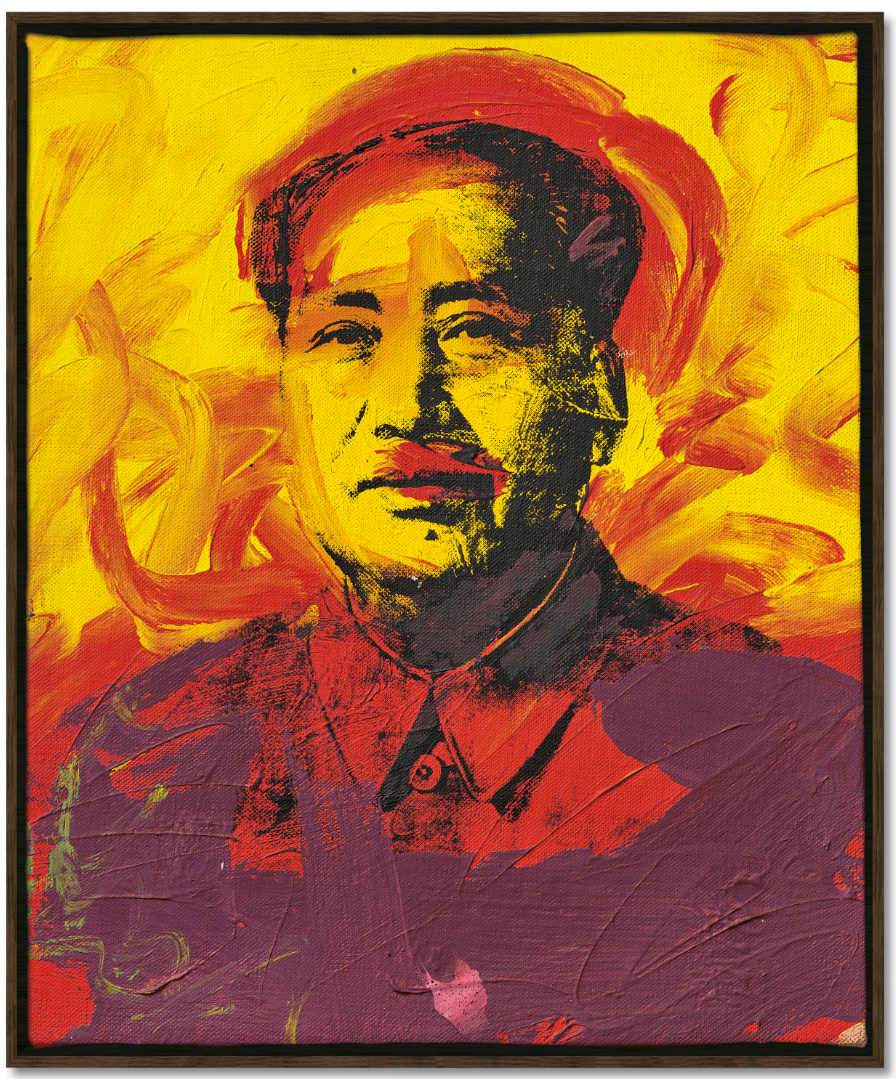
ANDY WARHOL
Mao, 1973
Acrylic and silkscreen ink on linen
12.1 x 10 inches (30.7 x 25.5 cm)
Signed and dedicated ‘Andy Warhol To Vincent’ (on the overlap)
Mao (80×60)
Those paintings, executed between March and May 1972, are from the very first group of works, and belongs to a corpus of only 11 paintings (cat. nos. 2277-2287) each measuring an immersive 82 inches in height. Described by the catalogue raisonné as the ‘early Mao’ paintings, these portraits are remarkable within the series at large for being executed entirely by Warhol himself. Without the aid of a studio assistant and without commissioning an external company to print his canvases (as he would with later works in the series) Warhol took on the technical challenge of wielding a single screen spanning in excess of 6 feet. Dragging a squeegee loaded with printing ink across this expansive screen and onto canvas would undoubtedly have been tricky; indeed, the particular aesthetic of this series takes its character from the irregularities of Warhol’s one-man manufacture. Of the other 10 paintings in this cycle, half are known to reside in some of the most prestigious public and private collections worldwide including the Froehlich Collection, Stuttgart (cat. no. 2278); Louisiana Museum of Modern Art, Humelbaek (cat. no. 2281); The Andy Warhol Museum, Pittsburgh (cat. no. 2283); The Brant Foundation, Greenwich (cat. no. 2284); and the Fundació Suñol, Barcelona (cat. no. 2286).
Mao, 1972
Sotheby’s New-York: 11 November 2015
Estimate on Request
USD 47,514,000
MOST EXPENSIVE MAO PAINTING SOLD AT AUCTION
(#11) Andy Warhol (sothebys.com)

ANDY WARHOL
Mao, 1972
Acrylic and silkscreen ink on canvas
82×57 inches (208.3 x 144.8 cm)
Signed on the reverse
With rouged lips, peachy skin and a navy tunic set against a backdrop of pale blue, the present work is the very first Mao painting designated in The Andy Warhol Catalogue Raisonné. The present work is a remarkable example of this balance between precise control and free-flowing gesture: it possesses a screen that is perhaps the most clear and regular of the entire suite of 11 paintings and a wonderful clarity in the application of colored fields – particularly the modulation of the skin tonalities and full brightness of the pink lips under which Mao’s mole takes on the appearance of a Marilynesque beauty spot. Allied with a biting political awakening, this series heralded the dawn of a new stylistic impetus: Warhol’s application of a markedly expressionistic hand set the precedent for his latter oeuvre, acting as the spearhead and anchor around which Warhol’s colossal corpus of Society Portraits would proliferate.
Mao, 1972
Sotheby’s New-York: 16 November 2017
Estimated: USD 30,000,000 – 40,000,000
USD 32,404,500
(#45) Andy Warhol (sothebys.com)
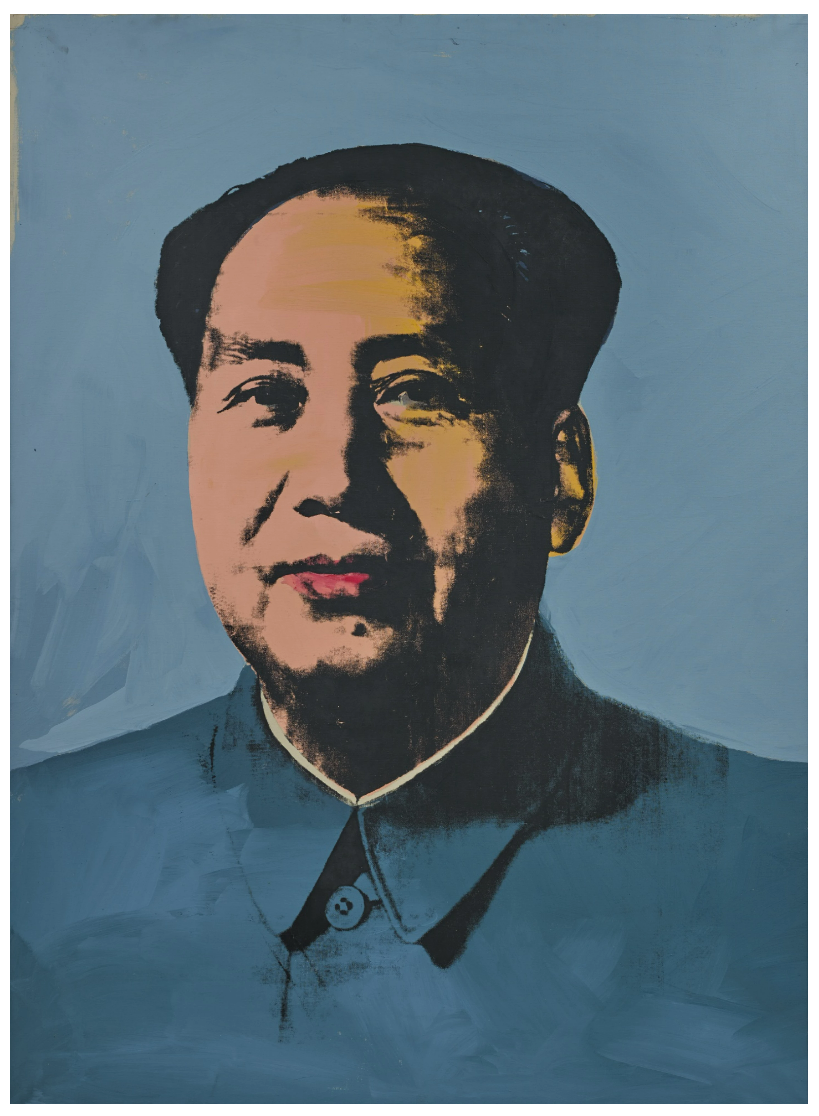 ANDY WARHOL
Mao, 1972
Acrylic, silkscreen ink and pencil on canvas
82×60 inches (208.3 x 152.4 cm)
Signed on the reverse
Evincing the same commanding presence and indelibly charged graphic force of the state portrait which inspired it, Andy Warhol’s extraordinary 1972 masterwork Mao is among the most historically potent, culturally significant, and incomparably iconic paintings of the Twentieth Century. Fixing the viewer with a gaze both utterly penetrating and entirely opaque, Warhol’s universally recognizable portrait of Chairman Mao commands our full attention with a provocative bravura that rivals that of the artist’s quintessential Pop images of Campbell’s Soup Cans and Marilyn Monroe. With vivid scarlet lips, illuminated by a radiant golden glow against a richly saturated backdrop of variegated blues and teals, the present work is a singularly vibrant example from the artist’s acutely limited number of large-scale Mao paintings.
Mao, 1972
Christie’s New-York: 15 November 2006
Estimated: USD 8,000,000 – 12,000,000
USD 17,376,000
Andy Warhol (1928-1987) (christies.com)
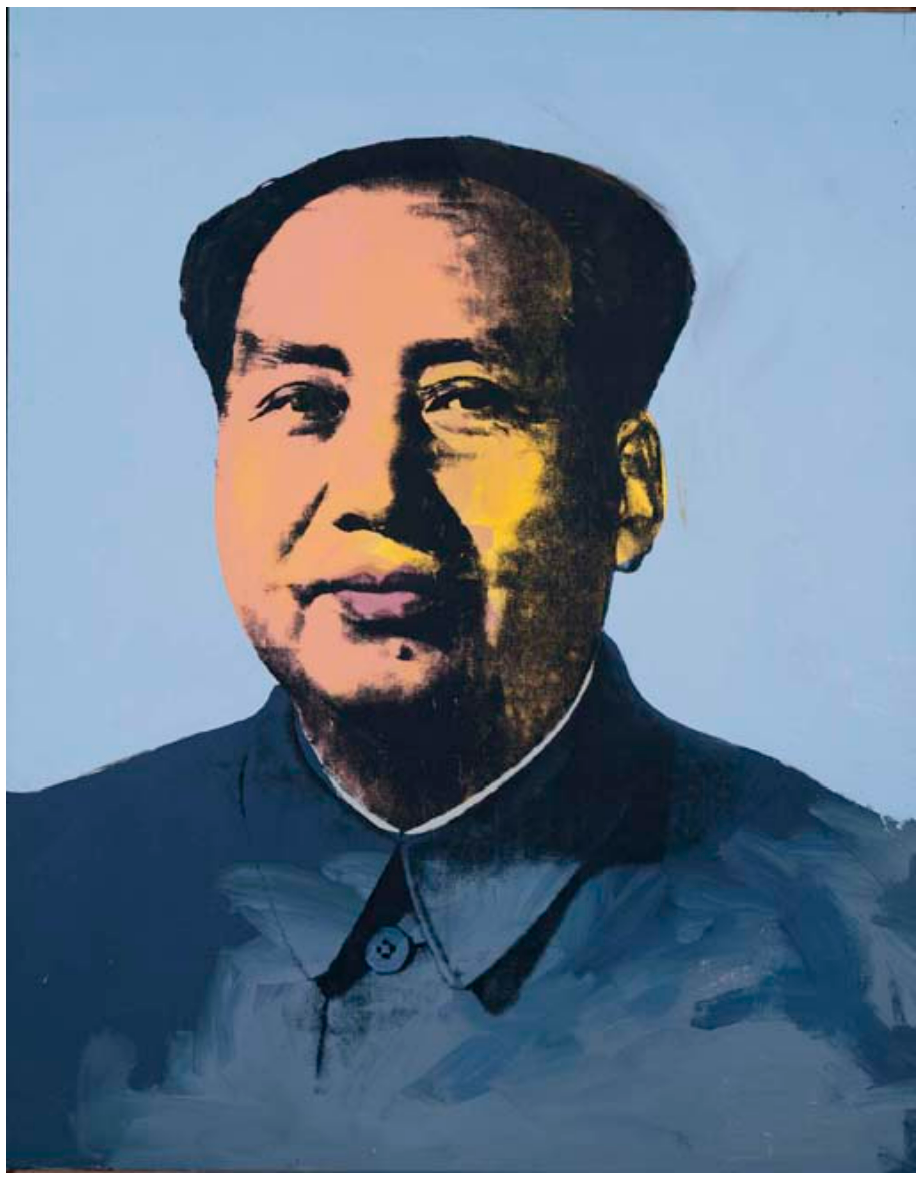
ANDY WARHOL
Mao, 1972
Synthetic polymer and silkscreen inks on canvas
82×61 inches (208.3 x 154.9 cm)
Signed ‘Andy Warhol’ (on the reverse)
Perpetuating his silk-screening technique in Mao was ideally suited to extending the notion of the constructedness of a public image of totalitarian power. Warhol rendered the artificiality behind the image via a garish palette; color lies on the surface allowing no visual penetration and reading as flat contrasts of abstract areas that coagulate to render an immediately apprehensible symbol of stylized reductiveness. However, rather than merely revealing the manipulation behind the original image, Warhol appeared to actively undermine its imperious gravitas and masculine strength. Indeed, with luscious lips, rouged cheeks and shadowed lids, Chairman Mao appears to have been subjected to a cosmetic makeover, emasculated into looking more like a transvestite than an elder statesman.
Mao (50×42)
Mao, 1973
Sotheby’s Hong-Kong: 2 April 2017
Estimated: HKD 90,000,000 – 120,000,000
HKD 98,537,500 / USD 12,680,200
(#1030) Andy Warhol (sothebys.com)
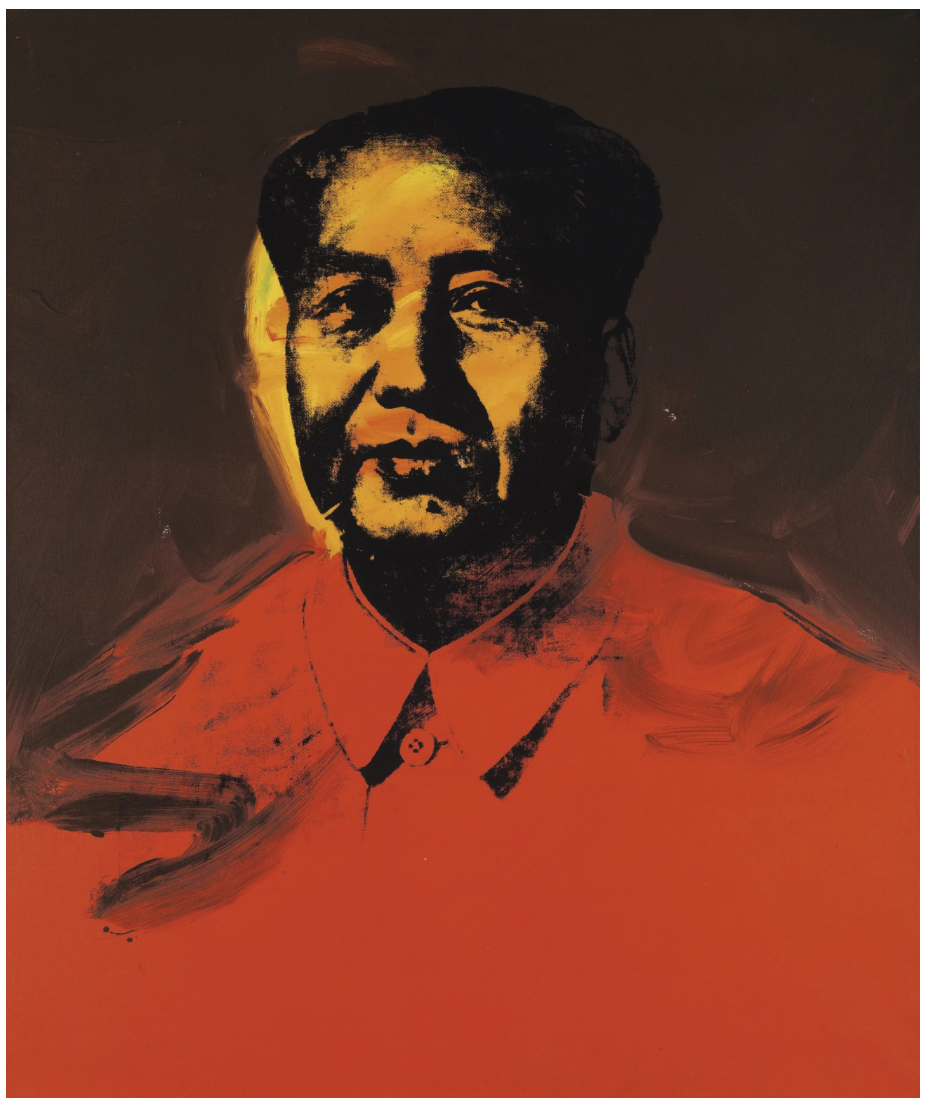 ANDY WARHOL
Mao, 1973
Acrylic and silkscreen ink on canvas
50×42 inches (127 x 106.6 cm)
Signed on the reverse
Mao, 1973
Sotheby’s New-York: 12 May 2015
Estimated: USD 13,000,000 – 16,000,000
USD 14,474,000
(#19) Andy Warhol (sothebys.com)
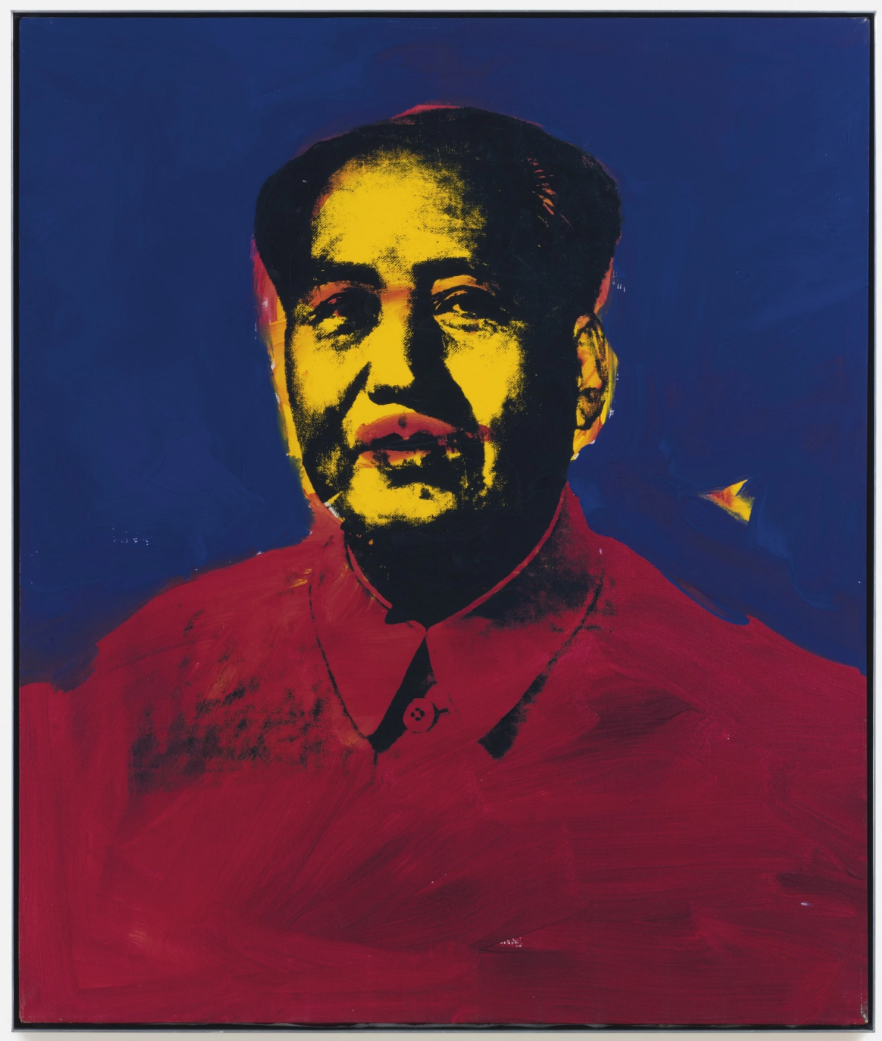 ANDY WARHOL
Mao, 1973
Acrylic and silkscreen ink on canvas
50.1 x 42.2 inches (127.3 x 107.3 cm)
Stamped by The Andy Warhol Art Authentication Board and numbered A115.969 on the overlap
Notable for its exceptionally sumptuous brushwork and brilliant primary colors of cobalt blue, crimson, and vibrant yellow, the present work is an exceptionally radiant example from the series. The sun-like orb highlighting Chairman Mao’s face offsets the dominant red delineating his famous tunic – a national uniform adopted as an Eastern counterpart to the Western business suit for its symbolism of proletarian unity. Signaling an ambitious return to his breakthrough medium, this series is remarkable in its major portrayal of the only political figure ever painted of Warhol’s own volition. No other example from the series possesses the chromatic vibrancy, confident painterly flourish and radical injection of narrative of the present work. Allied with this political awakening, these works herald the dawn of a new stylistic impetus: Warhol’s application of a markedly expressionistic hand set the precedent for his latter oeuvre.
Mao, 1973
Christie’s London: 27 June 2011
Estimated: GBP 6,000,000 – 8,000,000
GBP 6,985,250 / USD 11,162,646
Andy Warhol (1928-1987) (christies.com)
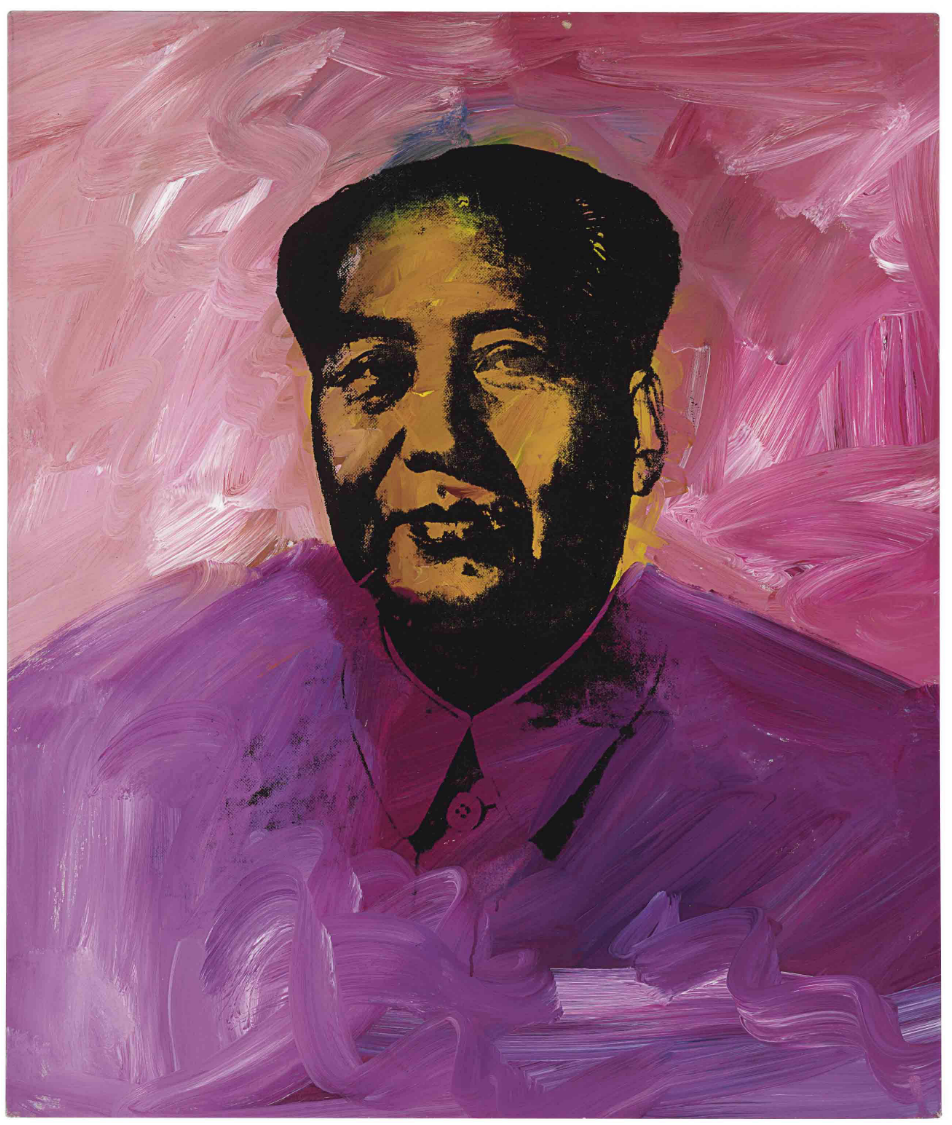
ANDY WARHOL
Mao, 1973
Acrylic and silkscreen ink on canvas
50×42 inches (127 x 106.7 cm)
Signed and dated ‘Andy Warhol 73’ (on the overlap)
Staring incongruously through a thick, sumptuous, and textural play of apparent abstraction rendered by broad, vibrantly colored brushstrokes of acra violet, napthtol crimson and dioxazine purple, the painting presents its famous sober-faced icon as if lost or dissolving into a glamorized swathe of synthetic color. A comparatively large portrait of Chairman Mao Zedong, it belongs to the series of 50×42 inch portraits of the Chinese leader that Warhol made in the first months of 1973. It is also one of eleven portraits made in this format that Warhol chose to represent this series at the landmark exhibition of Mao paintings he presented at the Musée Galiera in Paris in May 1974, where it was displayed in a dramatic row of vibrant and differently colored Mao images hung on a wall plastered with ‘Mao’ wallpaper.
Mao (40×34)
Mao, 1973
Leonard & Louise Riggio: Collected Works
Christie’s New-York: 12 May 2025
Estimated: USD 4,500,000 – 6,500,000
USD 4,648,000
ANDY WARHOL (1928-1987), Mao | Christie’s
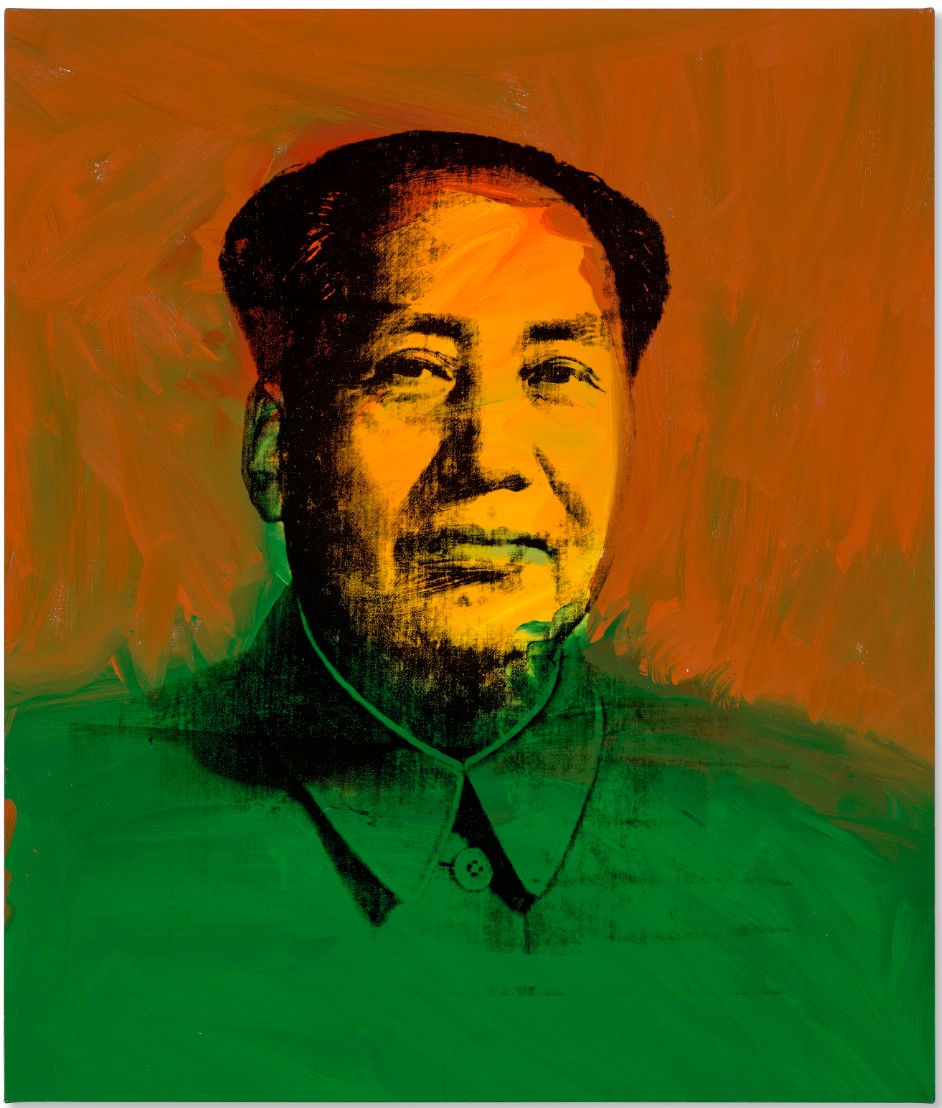
ANDY WARHOL (1928-1987)
Mao, 1973
Acrylic and silkscreen ink on linen
40×34 inches (101.6 x 86.4 cm)
Stamped three times with the Estate of Andy Warhol stamp
Stamped five times with the Andy Warhol Foundation for the Visual Arts, Inc. stamp
Numbered ‘PA 80.021’ (on the overlap and on the stretcher)
Andy Warhol’s portrait of the Chinese Communist leader Mao Zedong is one of the artist’s most effecting treatise on the power of the image. When the present work was painted in 1973, its subject was the leader of the world’s most populous nation, a country closing in on one billion people. As the Chairman of the Chinese Communist Party, Chairman of the People’s Republic of China, and Chairman of the Central Military Commission, Mao’s official portrait would have been ever-present: from posters to billboards, and from official photographs to his famous ‘Little Red Book’, he was everywhere. Together with Marilyn Monroe, Elizabeth Taylor, and Elvis, Mao entered Warhol’s pantheon of people whom he committed to canvas and became one of his most inspired. As legendary Museum of Modern Art curator Kynaston McShine noted “If Warhol can be regarded as an artist of strategy, his choice of Mao as a subject—as the ultimate star—was brilliant. The image of Mao… is probably the one recognized by more of the earth’s population than any other—a ready-made icon representing absolute political and cultural power. In Warhol’s hands, this image could be considered ominously and universally threatening, or a parody or both” (K. McShine, Andy Warhol Retrospective, exh. cat., Museum of Modern Art, New York, 1989, p. 19).
Warhol’s Mao canvases marked a return to painting for an artist who had spent much of the previous few years concentrating on his film projects. It is perhaps fitting then that these portraits are among the most painterly of his career. Rendering his subject’s features in bold, black silkscreen inks, Warhol also lavished the painting with a series of energetic brushstrokes which are especially evident in the broad, loose, gestural marks beneath the screened image. In the present work, Mao’s face is rendered in bold yellow orange azo and indo orange red pigments, complemented by permanent deep green jacket. Coupled with the silkscreen of Mao, these subjective interjections of energetic expression add a touch of subversion towards a collective regime that proscribed individual artistic creativity. The present work is one of only four of the 1973 paintings in which the orientation of the face has been reversed when compared with those that make up the rest of the series (two of these four are in the collection of the Andy Warhol Museum, Pittsburgh). The painting was acquired directly from the artist’s estate and has remained in the present owner’s collection for over twenty-five years. Having already immortalized Hollywood celebrities, the decision to depict a political leader might have seemed an unusual one for the artist. Warhol was a resolutely non-political person, so it is unlikely that he was making any ideological statements in his decision to paint his images of Mao.
“I went to vote once, but I got too scared. I couldn’t decide who to vote for.”
In fact the idea for these works appears to have come from the gallery owner Bruno Bischofberger. As Warhol’s friend Bob Colacello recalled “it began with an idea from Bruno…, who had been pushing Andy to get back to painting, as had Fred [Hughes]. Bruno’s idea was that Andy should paint the most important figure of the twentieth century.” The first name that came up was Albert Einstein who, in Colacello’s words, “was responsible for both the technological richness and technological terror of life in this century.” But, Andy had a different idea.
“I was just reading life in Life magazine that the most famous person in the world was Chairman Mao. Shouldn’t it be the most famous person, Bruno?”

Source material for Andy Warhol’s Mao series, circa 1950s.
© 2025 The Andy Warhol Foundation for the Visual Arts, Inc. / Licensed by Artists Rights Society (ARS).
While Warhol was initially captivated by the idea of reproducing an image that had become pervasive, his choice of the Communist leader ran in parallel with the artist’s own investigations into the power of images in modern culture. Ironically, both Mao and Warhol understood the power of that an image could have, and just like the Chinese leader Warhol’s rendition of an authoritarian ruler was anchored in the media’s power to create, canonize and commodify personas for collective absorption. While Warhol’s earlier logo-like representation of movie stars and consumer products such as Coca-Cola bottles and Campbell’s Soup cans reflected the ethos of American capitalism and the publicity machinations that underpinned it, Warhol’s Mao reveals the centrally controlled propaganda apparatus of Chinese communism. Mao’s physiognomy was propagated via billboards, posters and pamphlets throughout China; indeed, Warhol derived the silk-screen image for Mao from an official state portrait in the Little Red Book (officially titled Quotations from Chairman Mao Tse-Tung), the widely circulated collection of the leader’s ideology.
Mao (26×22)
Mao, 1973
Phillips London: 5 March 2026
Estimated: GBP 1,400,000 – 1,800,000
GBP 1,642,000 / USD 2,193,550
Andy Warhol Modern & Contemporary Art Evening Sale
ANDY WARHOL
Mao, 1973
Acrylic and silkscreen ink on canvas
24-1/8 x 20 inches (61.3 x 50.8 cm)
Stamped by the Andy Warhol Art Estate and the Andy Warhol Foundation
Numbered ‘PA 80.013’ on the overlap
Marking a decisive shift as Andy Warhol realigned his visual language following his triumphant return to painting, Mao was executed at a moment that had historical significance for the world stage as it did for the artist’s career. Representing the cult of fame, the pervasive role of media and the power of the image associated with Warhol’s portraits, for his first new series of non-commissioned paintings since 1968, over an intense and concentrated period between early 1972 and mid 1973, Warhol re-imagined the possibilities of the silkscreen to create his highly evocative and well documented Mao cycle.
“I’ve been reading so much about China […] The only picture they ever have is of Mao Zedong. It’s great. It looks like a silkscreen.”

Distinguished from the graduated sizes of the Mao painted in 1973, the present work belongs to a sub-set of ten within the medium size with their tantalizing phthalo blue background, realised in the 24 by 20 inch format. Mao presents a rare opportunity to acquire a work from this set of 10 as the first time the present canvas has ever been offered at auction with another example from this set having been presented over two decades ago. Closely related to the medium-sized 26 by 22 inch series, of the known total of 34 paintings in both sets executed in 1973, examples are represented in the Whitney Museum of American Art, New York (Mao, Catalogue Raisonné no. 2336); the Metropolitan Museum of Art, New York (Mao, C.R. no. 2340) and The Broad, Los Angeles (Mao, C.R. no. 2321).

Christopher Makos, Andy Warhol in Tiananmen Square, Beijing, 1982. Image: © Christopher Makos
In the conception of the Mao series, though Warhol’s stimulus seems to have been the popular media, a fixed start point is less clear. While Warhol still undertook commissioned portraits after surviving an assassination attempt in 1968, the artist would shift his focus and look increasingly to experiment beyond painting including his Rain Machines or Mylar and Plexiglas Constructions. In one version of events, according to Warhol’s biographer Robert Colacello, it was because of the encouragement of Swiss art dealer Bruno Bischofberger that Warhol once again began painting in full force. Travelling to New York to present his idea in person, Bischofberger proposed Warhol consider the subject of ‘Albert Einstein’ as ‘the most important person of the twentieth century’. Warhol however retorted, ‘That’s a good idea. But I was just reading in Life magazine that the most famous person in the world today is Chairman Mao. Shouldn’t it be the most famous person, Bruno?’. In the second source, David Bourdon dated the creation of the Mao series slightly earlier to late 1971, quoting telephone conversations with Warhol who remarked, ‘I’ve been reading so much about China […] The only picture they have is of Mao Zedong’.
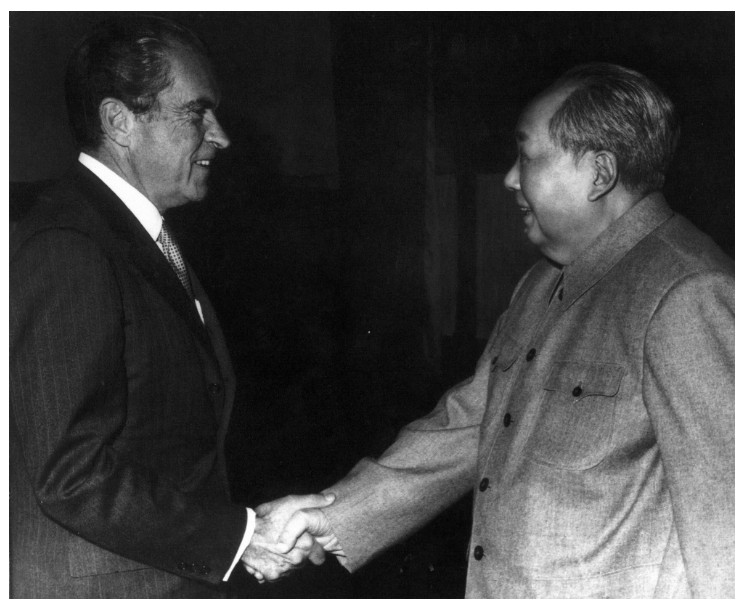
President Nixon meeting Chairman Mao, 1972. Image: Photo 12 / Alamy Stock Photo
As both sources reveal, Mao reflected Warhol’s desire to represent figures at the heart of the cultural zeitgeist and popular press, speaking to the enduring impact of the media in two societal models, to frame the collective conscience at any given moment, ultimately supporting Andy’s belief that ‘No one escapes the media. Media influences everyone’. Warhol used the opportunity to re-launch his painterly practice to engage with the widely publicized de-escalation and tempering of bilateral American and Chinese international relations. On 21 February 1972, Richard Nixon became the first sitting President of the United States to enter the People’s Republic of China since Chairman Mao had ascended to power in 1949.
“I went to China. I didn’t want to go, and I went to see the Great Wall. You know, you read about it for years. And actually it was great. It was really really really great.”
Announced in publications like Life, the enormity of the visit’s impact on geo-politics was recognized by Warhol, who, after the first examples in March at over 6 feet in height, embarked upon on the exponentially grander ‘giant’ Mao paintings in November and December. The largest single-image works produced by Warhol, their dimensions at almost four and a half meters in height, required the experience of printer Alex Heinrici who used seven separate screens to realize the works. The portraits reflected the proportions of the original Mao painting in Tiananmen Square that Warhol would eventually view in person and be photographed with by Christopher Makos during his trip to China in 1982.
Retaining the same source image in each variation of Mao portrait from 1972 to 1973, as in the present work Mao’s image was appropriated from an American edition of the Quotations from Chairman Mao Tse-Ting or ‘The Little Red Book’. As one of the most widely printed books in history, Warhol emphasizes the currency and ubiquity of his frontal visage that became fundamental to Mao’s public projection. The present work therefore connects to each variant from the Mao series and the monumentality of its presence, a device through which Warhol highlights a dichotomy. As he revealed through his earlier images of American icons including Marilyn Monroe, much like the tabloid press and consumerist advertising commodifying figureheads in the Capitalist system, within the Communist state the ever visible and unchanging form of the Chairman’s image was utilized to project political power for mass absorption.

Left: Portrait of Chairman Mao in an English translation of his book ‘Quotations from Chairman Mao’, detail, 1966. Image: GRANGER – Historical Picture Archive
Right: The present work
Realized in close succession to the other graduated variants by 1973, for Mao Warhol’s mark-making becomes more painterly and automatic, animating the ground. Layering impromptu, intense color, the fluid strokes of the brush serve as markers of the artist and ‘a more improvisational approach to gesture and touch’, in contrast to Mao’s clearly defined expression executed in a more Warholian standardized working method. Adding capacious areas of green for the jacket balancing the vibrancy of the blue background, Warhol with freer gestures combines cadmium orange and red for the face. Incorporating unique characteristics into each version, the stateliness of Mao’s photograph used to promote his self-image is transformed into a distinctly Warholian object of Pop.
Mao, 1973
Heritage Auctions: 10 December 2024
Estimated: USD 3,000,000 – 4,000,000
USD 3,650,000
Andy Warhol (1928-1987). Mao, 1973. Acrylic and silkscreen ink on | Lot #77092 | Heritage Auctions
ANDY WARHOL (1928-1987)
Mao, 1973
Acrylic and silkscreen ink on linen
26 1/4 x 22 inches (66.7 x 55.9 cm)
Signed and dated on the reverse: Andy Warhol 73
Signed and dated twice on the overlap: Andy Warhol 73
Inscribed on the reverse and overlap (both crossed out): to Gordon and George
Inscribed on stretcher: W / 025
Mao, 1973
Phillips New-York: 23 June 2021
Estimated: USD 3,500,000 – 4,500,000
USD 3,000,000
Andy Warhol – 20th Century & Contempora… Lot 36 June 2021 | Phillips
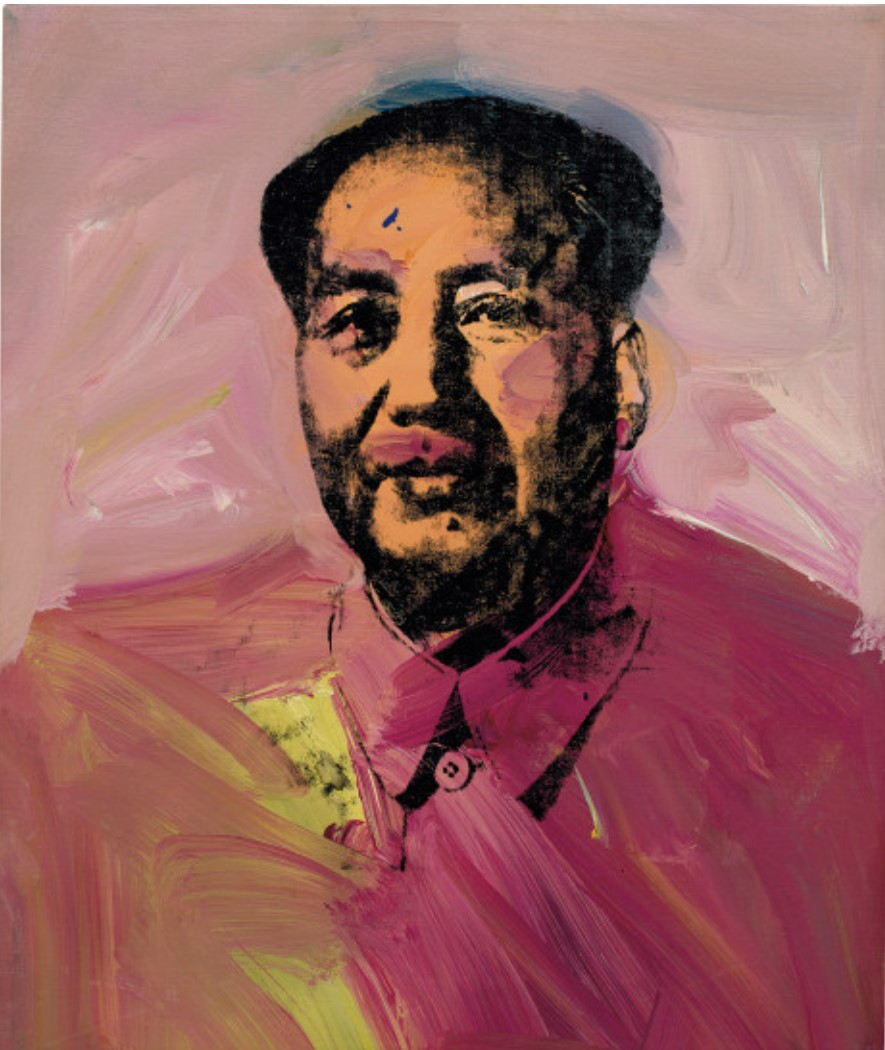
ANDY WARHOL
Mao, 1973
Acrylic and silkscreen ink on canvas
26.1 x 22 inches (66.4 x 55.9 cm)
Signed and dated “Andy Warhol 73” on the overlap
One of Andy Warhol’s most iconic portraits, Mao captures the political and painterly consciousness that preoccupied the artist in the early 1970s. Embodying a significant juncture in Warhol’s career, the Mao paintings mark his return to silkscreen painting with a much more expressive handling after devoting himself to film since 1965.
After Richard Nixon’s historic visit to China in 1972, Warhol undertook a body of Chairman Mao portraits between 1972 and 1973, creating a total of 199 paintings in five scales. Exhibited at Warhol’s landmark show at the Musée Galliera, Paris, in May 1974, the present work belongs to the medium-sized series of 34 paintings, which are represented in the permanent collections of the Metropolitan Museum of Art, New York, The Broad, Los Angeles, Whitney Museum of American Art, New York, and the Rubell Museum, Miami.
Mao, 1973
Christie’s New-York: 12 November 2013
Estimated: USD 3,000,000 – 5,000,000
USD 3,525,000
Andy Warhol (1928-1987) (christies.com)
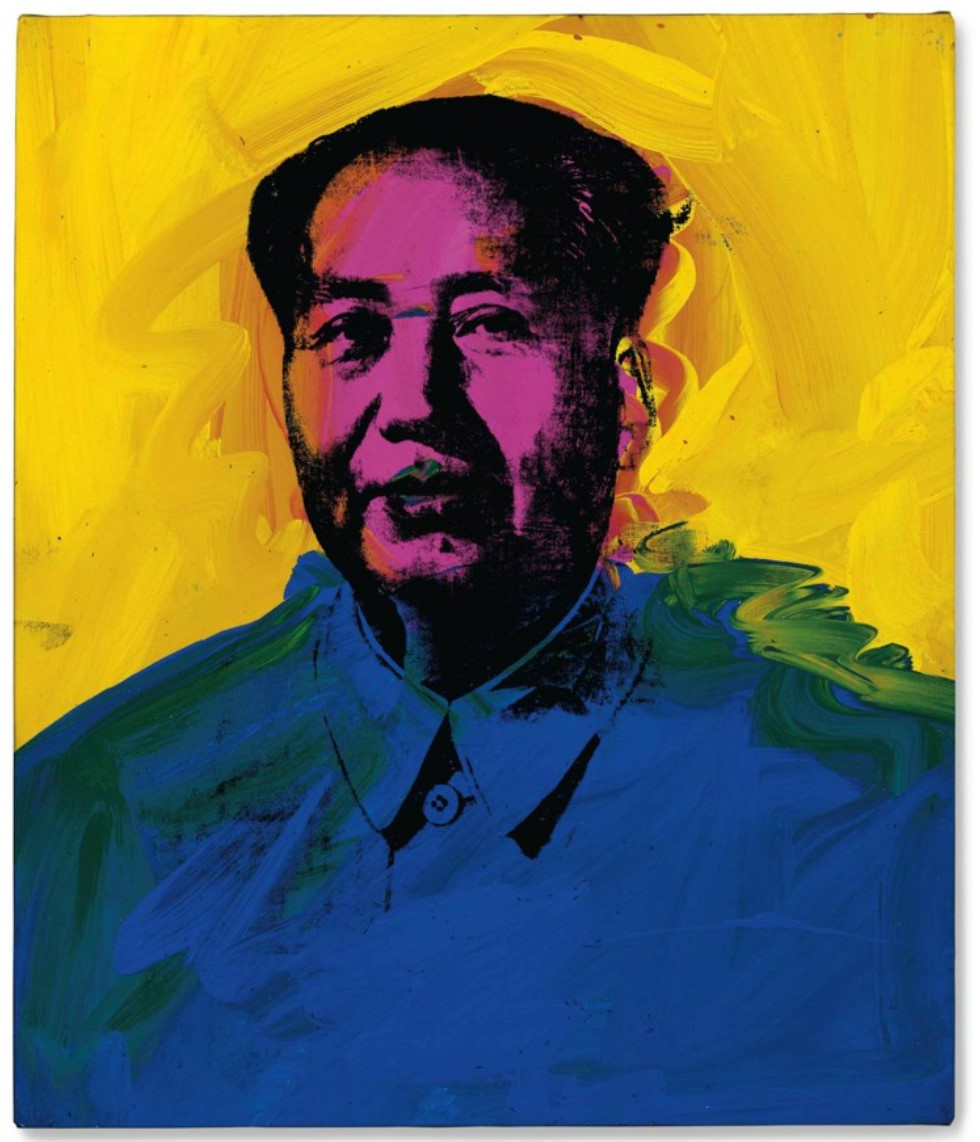
ANDY WARHOL
Mao, 1973
Synthetic polymer and silkscreen ink on linen
26.1 x 22.1 inches (66.4 x 56.2 cm)
Signed indistinctly twice, inscribed and dated ‘to Kimiko Powers — Andy Warhol 73’ (on the overlap)
In the present work, this dramatic departure in paint handling is especially evident in the broad, loose, gestural brushstrokes beneath the screened image. Coupled with the anonymous silkscreen of Mao, these subjective interjections of energetic expression add a touch of subversion towards a collective regime that proscribed individual artistic creativity. Mao was given by Warhol as a gift to John and Kimiko Powers, the Colorado-based collectors who amassed one of the most comprehensive collections of contemporary Pop Art in private hands. The couple adorned their home with the choicest selections of works by their Pop artist friends, not least of whom was Andy Warhol.
Mao, 1973
Christie’s New-York: 15 May 2013
Estimated: USD 3,000,000 – 4,000,000
USD 6,283,750
Andy Warhol (1928-1987) (christies.com)

ANDY WARHOL
Mao, 1973
Synthetic polymer and silkscreen ink on linen
26×22 inches (66 x 55.8 cm)
Signed twice and dated twice ‘Andy Warhol 1973’ (on the overlap)
Rendering Mao in his uncompromising palette of vibrant colors, Warhol gesturally brushed sweeps of ‘Communist Red’ to denote the Chairman’s trademark jacket. In doing so, Warhol decontaminates an image that had become a symbol of fear, rendering it inoffensive by highlighting its ubiquitous nature. By taking Mao, the great anti-capitalist symbol and turning him into a Warhol icon, the artist has taken the political figure’s strategy of using visual ubiquity to maintain order and turned it on its head, ultimately presenting him as the ultimate commodity of Pop.
Mao, 1973
Christie’s New-York: 8 November 2011
Estimated: USD 3,000,000 – 5,000,000
USD 3,442,500
Andy Warhol (1928-1987) (christies.com)
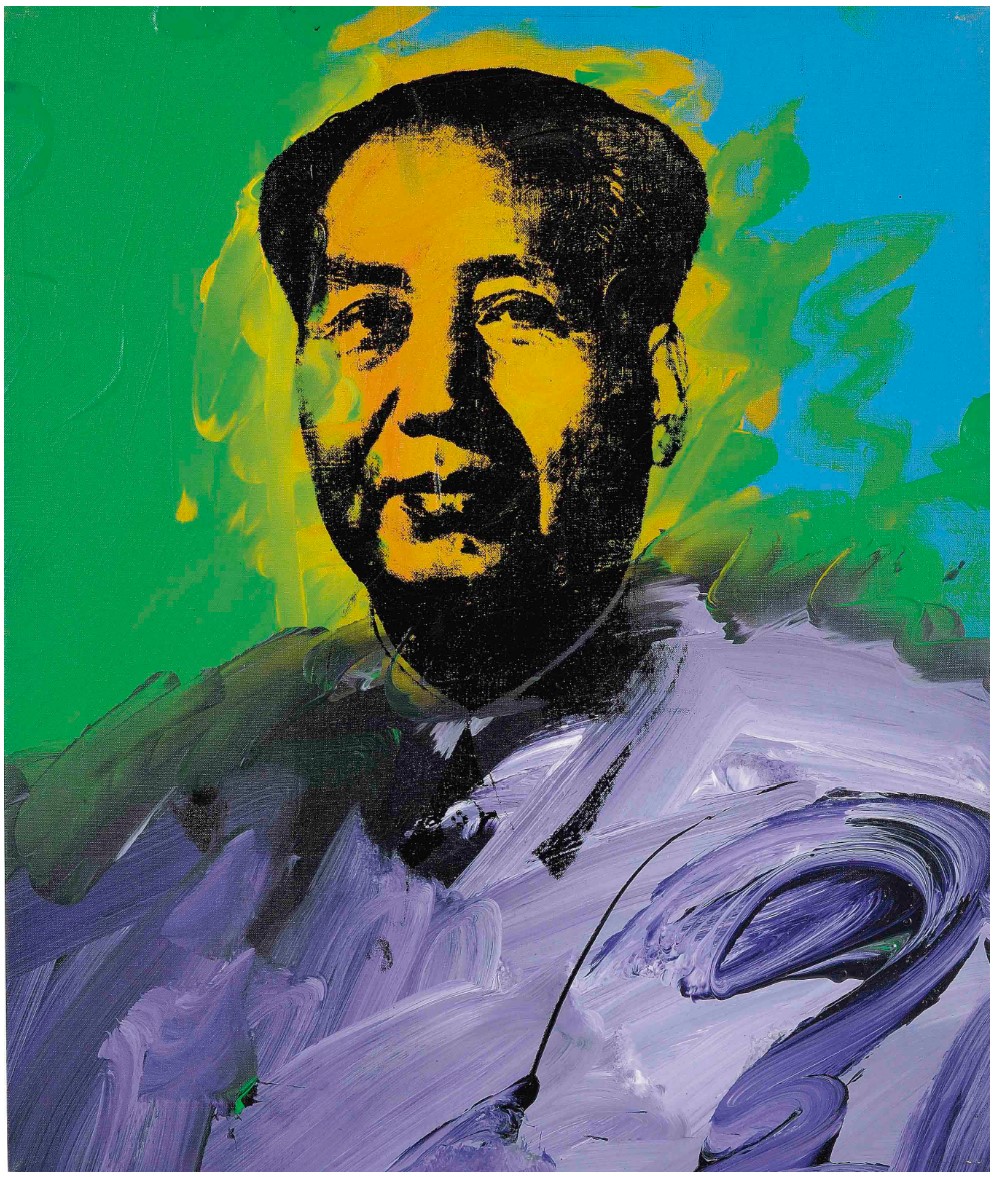
ANDY WARHOL
Mao, 1973
Acrylic and silkscreen ink on canvas
26×22 inches (66 x 56 cm)
Signed twice ‘Andy Warhol’ (on the overlap)
The florid strokes of green, yellow, and violet paint that streak across the surface of the work seem to be a physical manifestation of the pleasure he found in the rediscovery of the process of putting paint on canvas and mark a radical evolution of his earlier work through these colorful embellishments, adding a more energetic painterly touch to his earlier silkscreened images. Andy Warhol’s Mao encompasses the political and pop-cultural resonance of this event and combines it with the artist’s signature palette of highly charged color, which results in a crescendo of contrasting greens, yellows, blues, and various hues of violet. Warhol elaborated his depiction of Mao by initiating expressive brushwork for the first time since his adoption of the silk-screening process in 1962. In the present work, this dramatic departure from the mechanically produced flat surface effects of the silkscreening process, are especially evident in the broad, loose, gestural brushstrokes beneath the screened image.
Mao (12×10)
Mao, 1973
Property from the Jean-Michel Folon Foundation
Sotheby’s Paris: 24 October 2025
Estimated: EUR 700,000 – 1,000,000
EUR 787,400 / USD 914,735
Mao | Modernités | 2025 | Sotheby’s
ANDY WARHOL (1928 – 1987)
Mao, 1973
Acrylic and silkscreen ink on linen
12×10 inches (30.5 x 25.4 cm)
Signed and dated 73 (on the overlap)
On February 21, 1972, the entire world witnessed an unprecedented event. Richard Nixon, the presidential embodiment of liberal anti-communism, met in China with the most in China powerful dictator on the Asian continent: Mao Zedong. Between 1972 and 1973, Andy Warhol created one of the most decisive works of his career: the Mao series. It was his first explicitly political series and the only one depicting a non-Western figure of power.
“I read a lot about China… The only picture they ever had was of Mao Zedong. It’s great. It looks like a silkscreen.”
That issue of Life, published on March 3, 1972, titled “Nixon in Mao’s China”, covered the American president’s visit to China the previous month. The international media coverage of the event brought forth a single image: the official portrait of the Chinese dictator displayed on Tiananmen Square and printed on the frontispiece of the Little Red Book (1964), owned at the time by one billion people. By transposing this portrait into the visual vocabulary of his era — that of magazines, advertising posters, and commercial signage — Warhol highlighted the omnipresence of this image in everyday life. He produced 199 portraits of Mao in five different formats, mimicking the multiplicity of media images constantly flashing across television screens, magazines, and supermarkets. With irony, he suggested that fame is born from ubiquity. Warhol revealed an obvious contradiction: within a regime that banned capitalist consumerism, the very image of its leader was shaped and disseminated through massive propaganda campaigns using the same tools as commercial and advertising imagery.
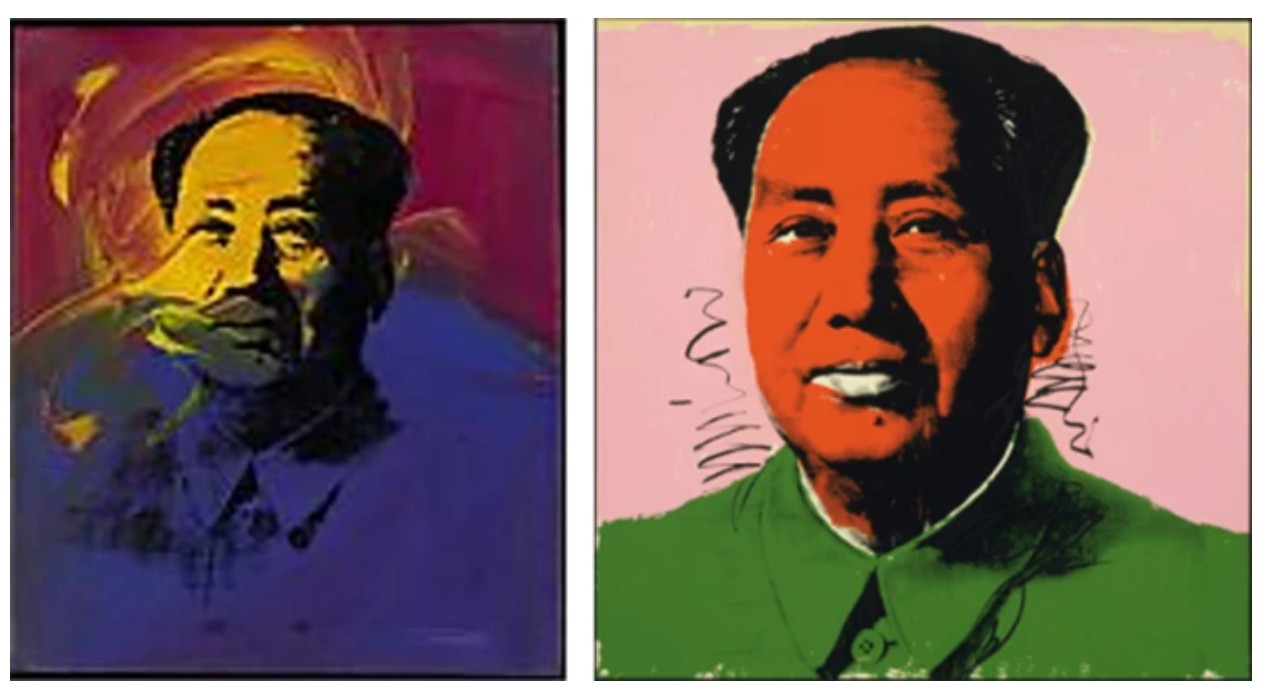
Left: Caption: Andy Warhol, Mao, 1972, silkscreen and acrylic on canvas, Museum of Modern Art, New York
Right: Andy Warhol, Mao, 1972, silkscreen and acrylic on canvas, Metropolitan Museum, New York
The Mao portraits marked Warhol’s first major series since Flowers (1964) and, for the first time, introduced a distinctive, almost lyrical gestuality. Warhol did not merely reproduce the portrait in series; he subjected it to gestural and chromatic variations that challenged its solemnity. The acrylic brushstrokes introduced an almost expressionistic dimension to the portrait, despite its basis in mechanical reproduction. By juxtaposing the lyricism of gesture with the cool detachment of silkscreen printing, Warhol created a symbolic tension between the industrial seriality of American Pop Art and the propagandist fervor of Communist China. These two techniques converse within the image: vigorous brushstrokes seem to slash across Mao’s iconic Zhongshan (red suit) jacket, while the blue of his face is extended with acrylic, creating a ghostly impression. This doubling effect reinforces, within the work itself, the dictator’s sense of omnipresence.
In 1973, at a time when billions around the world lived under the Chinese communist regime, Warhol’s colorful reinterpretations of this official portrait revealed his extraordinary audacity: transforming Mao Zedong into a Pop icon. Fascinated by celebrity, he applied its visual strategies—formal efficiency, visual contrast, repetition, and motif variation—to the images that filled everyday American life, from world leaders to canned goods. Alongside Marilyn Monroe, Elizabeth Taylor, and Elvis Presley, Mao joined Warhol’s pantheon of immortalized figures.
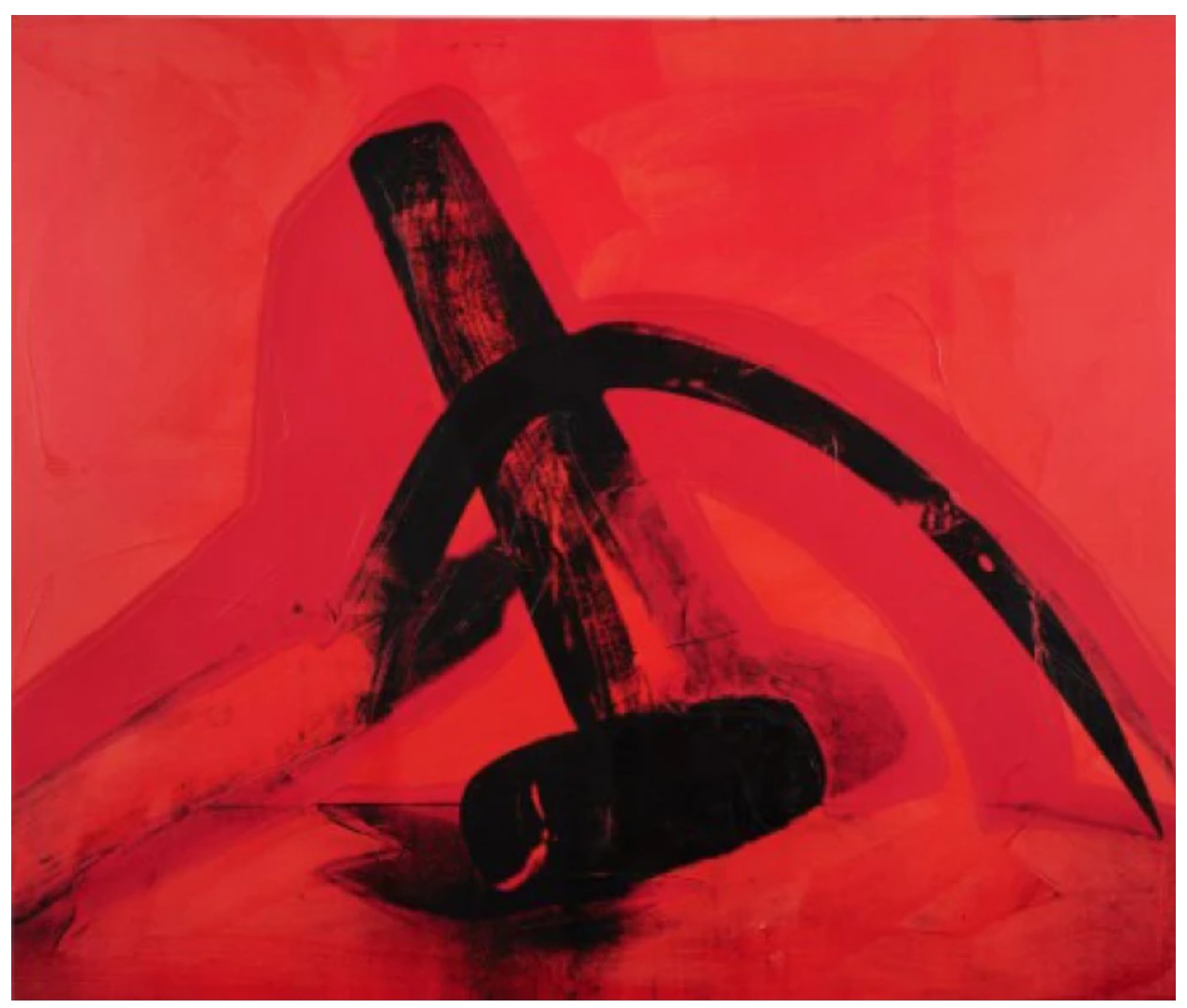
Andy Warhol, Hammer and Sickle, 1976, sold at Sotheby’s, New York, for USD 6,414,200
Because of its timeless and universal character, this series has been celebrated worldwide and integrated into the collections of major institutions, including the Metropolitan Museum of Art, the MoMA (New York), the Froehlich Collection (Stuttgart), the Louisiana Museum of Modern Art (Humlebaek), and the Andy Warhol Museum (Pittsburgh). The works remain strikingly relevant today. Beyond its subject, Mao endures today as a modern allegory of communism, the cult of personality, and, more broadly, of power itself. From this multiplicity of Mao representations, the human face disappears, leaving only the archetype. Revealed through the standardized multiplication of an image whose subject becomes saturated with meaning and emptied of substance, this archetype embodies Warhol’s oeuvre as a whole: behind Mao’s portrait lies Warhol’s own.
Mao, 1973
Christie’s London: 15 October 2025
Estimated: GBP 600,000 – 800,000
GBP 952,500 / USD 1,276,350
ANDY WARHOL (1928-1987), Mao | Christie’s
ANDY WARHOL (1928-1987)
Mao, 1973
Acrylic and silkscreen ink on linen
12×10 inches (30.6 x 25.5 cm)
Signed and dated ‘Andy Warhol 73’ (on the overlap)
Arriving in a vision of flaming, calligraphic color, Andy Warhol’s Mao (1973) stems from one of the most important series of the artist’s career. Mao Zedong is screenprinted in black ink against a brilliant backdrop of cadmium yellow, his face surrounded with thick swirling, strokes of orange and red. A vivid green impasto adorns the dictator’s jacket.
“I have been reading so much about China … The only picture they ever have is of Mao Zedong. It’s great. It looks like a silkscreen.”
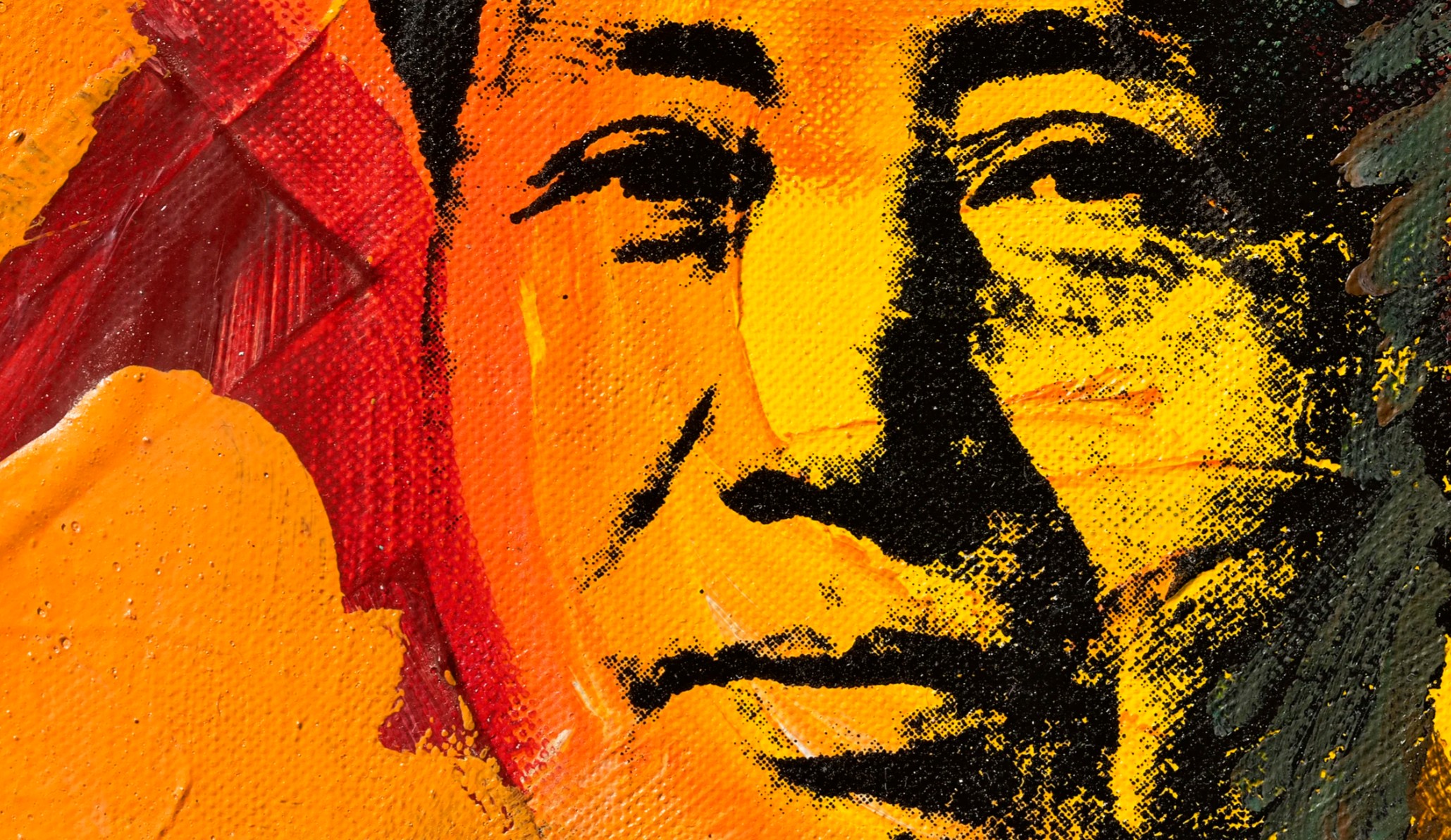
Announcing his triumphant return to painting after a four-year hiatus, the Mao works saw Warhol restage a figure he called ‘the most famous person in the world’—his chosen image was an official portrait from the frontispiece to Mao’s ‘Little Red Book’ of quotations, which he knew was owned by a billion people at the time—as a dazzling Pop spectacle. They represented the first major new series for Warhol since his Flowers of 1964, and, with their rich painterly surfaces, heralded a lush new direction for his practice. The present example has been held in the same private collection for over twenty-five years.
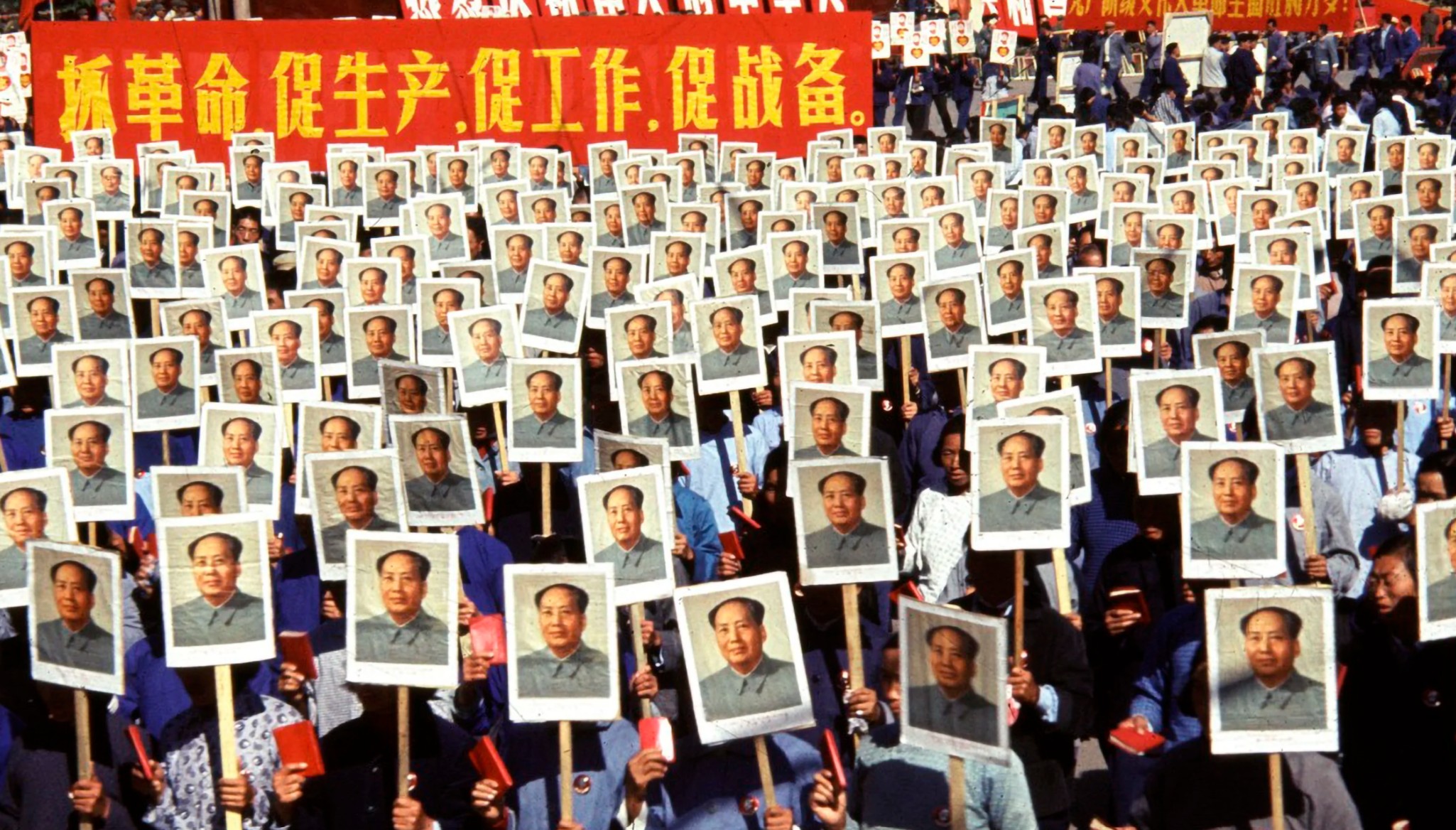
Raising Chairman Mao’s portrait during the cultural revolution in Beijing, China, circa 1970.
After his shooting by Valerie Solanas in June 1968, Warhol’s painterly output had seen a steep decline, with only a handful of commissioned portraits dating from that time until the start of 1972. The dealer Bruno Bischofberger, trying to push him back into painting, suggested taking on a grand, ambitious new subject: the most important figure of the twentieth century. Bischofberger proposed Albert Einstein.
“That’s a good idea, but I was just reading in Life magazine that the most famous person in the world today is Chairman Mao.
Shouldn’t it be the most famous person, Bruno?’”
The Life cover story Warhol was reading, published on 3 March 1972, detailed US President Richard Nixon’s historic visit to China the previous month: an important diplomatic overture that marked a thaw in Sino-American relations.

Andy Warhol holding a 12” x 10” Mao painting, Musée Galliera, Paris, 1974. Photograph by Andreas Mahl. Photo: © Andreas Mahl. Artwork: © 2025 The Andy Warhol Foundation for the Visual Arts, Inc. / Licensed by DACS, London.
Warhol swiftly identified Mao as a readymade icon. His portrait and uniform—always the same, as reliable as the Coca-Cola logo—were a brand identity, paraded in rallies throughout China, and mass-produced, homogenized and repeated like a silkscreen across global political culture.
“Mao would be really nutty… not to believe in it, it’d just be in fashion.”
This deadpan focus on Mao’s fame as a flat image, emptied of political meaning, belied a typically Warholian irony: he was well aware that for many Americans Mao’s face symbolized an alien, threatening ideology, and that repackaging one of capitalism’s chief antagonists as a Pop commodity would give the works a perverse appeal. Warhol would himself travel to China in 1982, visiting the Great Wall and posing in front of Mao’s monumental portrait in Tiananmen Square.
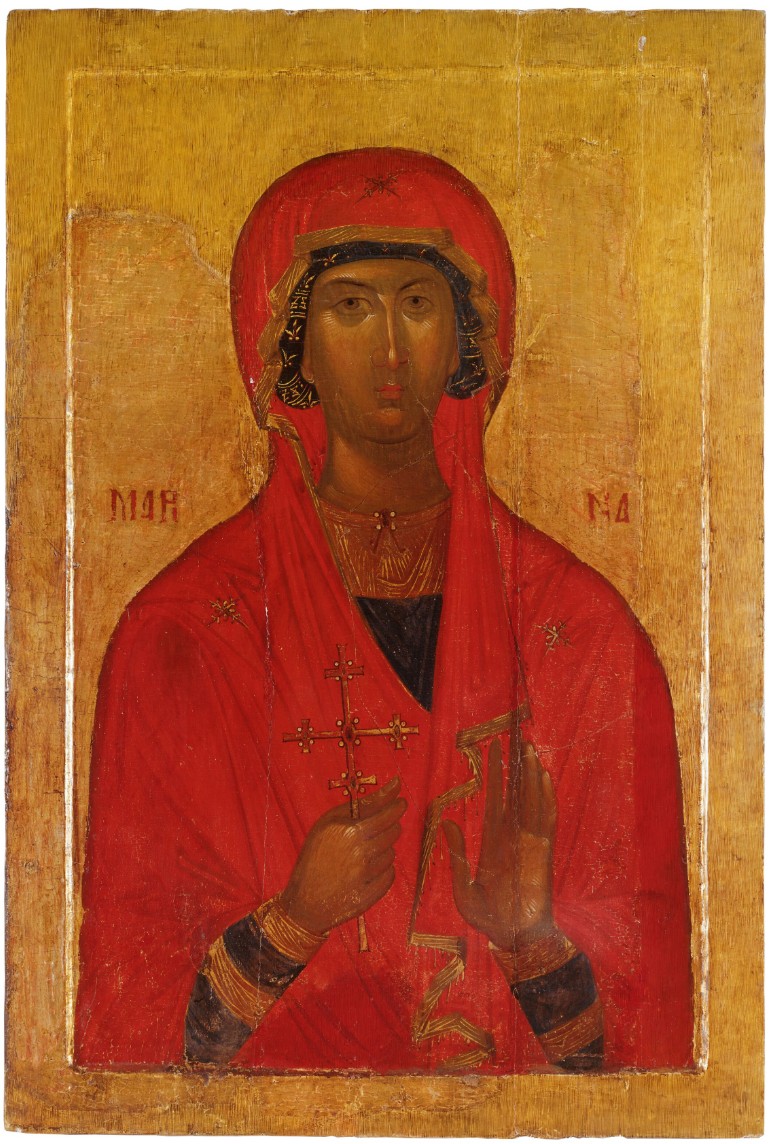
Icon with Saint Marina. Benaki Museum, Athens. Digital Image: © 2025 Photo Scala, Florence.
After an initial group of Mao paintings created in early 1972, Warhol went on to produce the series on five discrete scales, following the logic of his Flowers of the previous decade: they would range from the 12” x 10” format of the present work up to ‘giant’ versions more than four meters high. It is in the jewel-like smaller canvases that Warhol’s newly exuberant brushwork comes to the fore. Their scale amplifies the impact of his freehand flourishes of wet-on-wet paint, which fuse the screenprinted impression to the painted field and, in some cases, partly consume Mao’s image. Echoing Abstract Expressionism where his earlier works had tended towards a more hard-edged, mechanical aesthetic, Warhol invigorated his hybrid silkscreen-painting medium with previously unseen dramas of touch and gesture. The interplay of red and yellow in the present Mao shades the Chairman’s face into three dimensions; the surrounding swathes of orange are almost sculptural. With its vibrant color and its subject’s inscrutable gaze, the work exemplifies the series’ enduring, enigmatic power.
Mao, 1973
Christie’s Paris: 18 October 2024
Estimated: EUR 500,000 – 700,000
EUR 913,500 / USD 989,260
Andy Warhol (1928-1987), Mao | Christie’s
ANDY WARHOL (1928-1987)
Mao, 1973
Acrylic and silkscreen ink on canvas
12×10 inches (30.5 x 25.4 cm)
Signed and dated ‘Andy Warhol 73’ (on the overlap)
Inscribed twice ‘CM109’ (on the stretcher)
Mao, 1973
Estimated: USD 700,000 – 1,000,000
USD 781,200
Mao, 1973
Acrylic and silkscreen ink on canvas
12×10 inches (30.5 x 25.4 cm)
Signed, inscribed and dated ‘CM 99 Andy Warhol 73’ (on the overlap)
Mao, 1973
Phillips New-York: 17 May 2023
Estimated: USD 800,000 – 1,200,000
USD 1,117,600
Andy Warhol – 20th Century & Contemporar… Lot 27 May 2023 | Phillips
ANDY WARHOL
Mao, 1973
Acrylic and silkscreen ink on linen
12×10 inches (30.5 x 25.4 cm)
Signed and dated “Andy Warhol 73”
Stamped by the Andy Warhol Art Authentication Board, Inc.
Numbered “A012.089” on the overlap
Andy Warhol’s Mao, 1973, reinterprets the iconic government portrait of Chairman Mao as a black silkscreen likeness in a sea of bright blues and green. The present work belongs to the smallest of the series, its size recalling the portability and ubiquity of the Chairman’s portrait in the Little Red Book, a collection of the political leader’s quotations, and Warhol’s original source for the iconic image. The Chairman’s portrait in The Little Red Book, reproduced at scale in public spaces across China such as Tiananmen Square, Beijing, as well, was perhaps the most widely-reproduced image of the 20th century, if not all of history.
Mao, 1973
Christie’s London: 28 February 2022
Estimated: GBP 600,000 – 800,000
GBP 942,000 / USD 1,254,494
ANDY WARHOL (1928-1987) (christies.com)
ANDY WARHOL
Mao, 1973
Acrylic and silkscreen ink on linen
12.1 x 10 inches (30.7 x 25.5 cm)
Signed and dedicated ‘Andy Warhol To Vincent’ (on the overlap)
Slashed through with rich brushstrokes in various shades of yellow, purple and red, Andy Warhol’s Mao situates the divisive politician firmly within the pantheon of Warhol’s celebrities, while equally challenging the revolutionary power of the ultra-proliferated image. Works from this series typically group color to emphasize the components of the figure, assigning a separate hue to torso, head and background. After marking out these key features, Warhol then inverts his precision in favor of more free-flowing swathes, pulsing in and out of the initial formula and elevating the image to the realms of both figurative painting and subversive art. The resulting paint appears graffiti-like, excellently balancing adherence to the figurative form with a refined spontaneity that intelligently diverges from the standard portrait template. In the present work, Chairman Mao’s familiar yet haunting visage emerges from a lyrical, hand-painted background in expectation of absolute control; however, Warhol’s perceptive placement of fuchsia paint across the Chairman’s neck acts almost as a physical restraint against the oppressive call set to emanate from the subject’s vocal chords. The recognizable uniform of Mao’s administration is only visible beneath Warhol’s gleeful intervention, further juxtaposing the former’s stringent measures in the name of culture with the artist’s expert commentary on the nature of icon status.
Mao, 1973
Christie’s New-York: 2 December 2020
Estimated: USD 1,000,000 – 1,500,000
USD 942,000
Andy Warhol (1928-1987) (christies.com)
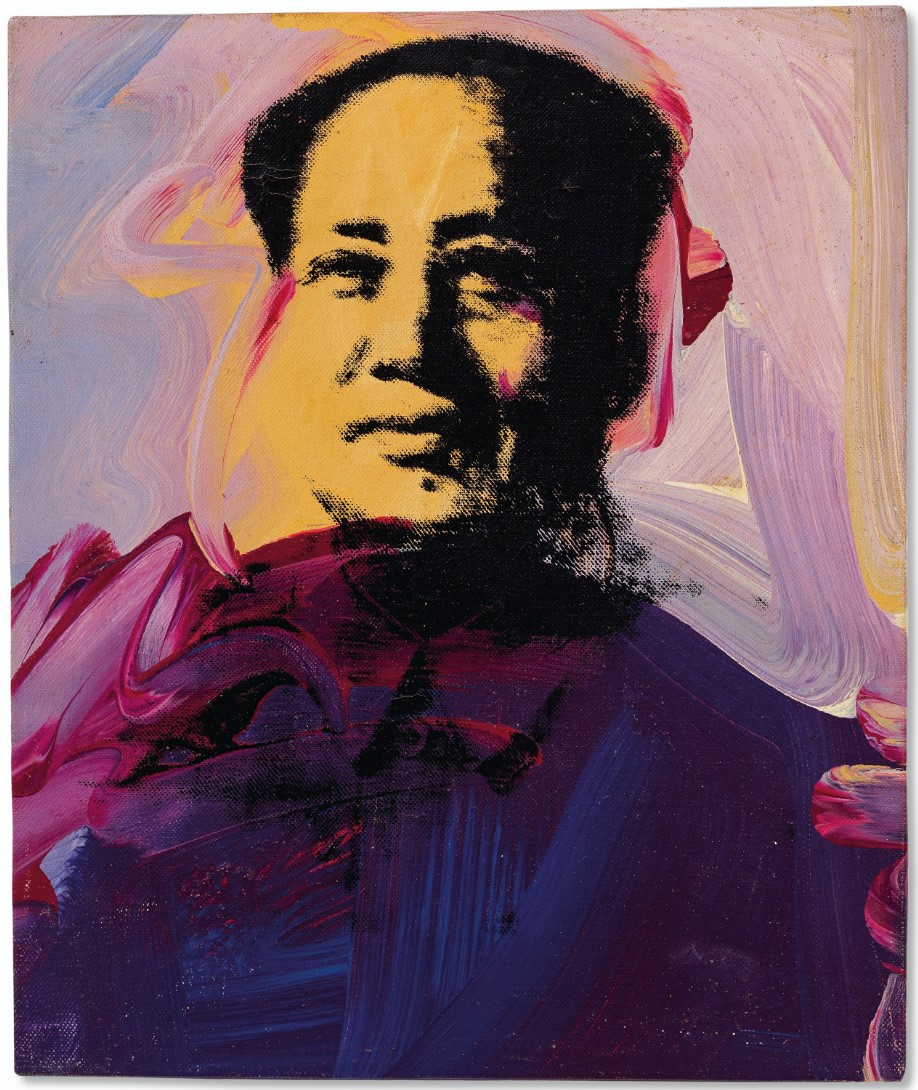
ANDY WARHOL
Mao, 1973
Acrylic and silkscreen ink on canvas
12×10 inches (30.5 x 25.4 cm)
Signed and dedicated ‘Barbara Baaabaa Brab Merry Christmas Andy 76’
(on the overlap)
The present work is an intimate example from the collection of Barbara Allen de Kwiatkowski, a well-known New York tastemaker and dear friend of Warhol. Known affectionately in her circles as Babs deK, the influential muse enjoys even more monikers in the personalized inscription on the reverse of the painting, acquired from Leo Castelli a few years after it was painted: “Barbara Baaabaa Brab Merry Christmas Andy 76”.
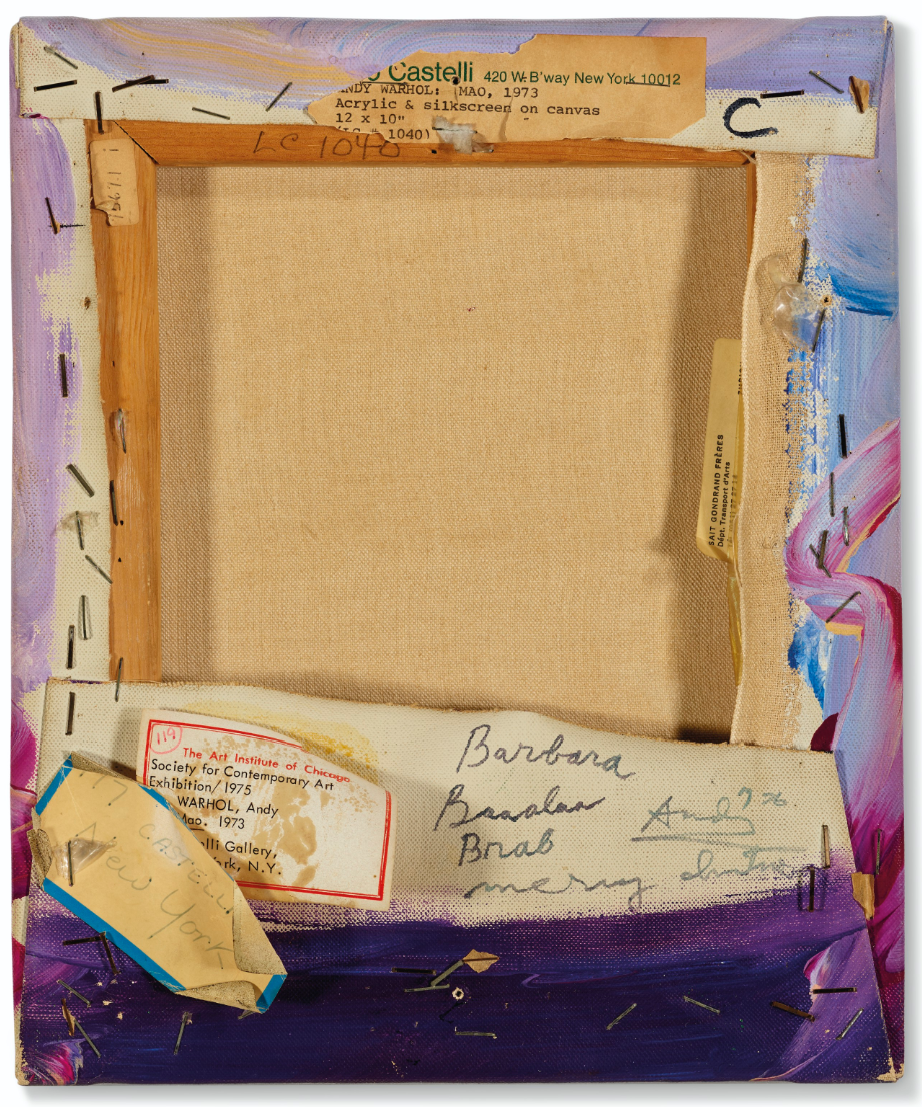
In addition to spending evenings at the famed Studio 54, Babs and Warhol partnered on Interview magazine, dubbed the “crystal ball of Pop” for its progressive look into the lives of the creatives populating the scene in 1970s New York. Together through a fruitful friendship, the artist and collector captured and preserved their cultural zeitgeist, outlining the trajectory of both global and uniquely American history.
Mao, 1973
Christie’s New-York: 14 November 2019
Estimated: USD 800,000 – 1,200,000
USD 963,000
Andy Warhol (1928-1987) (christies.com)
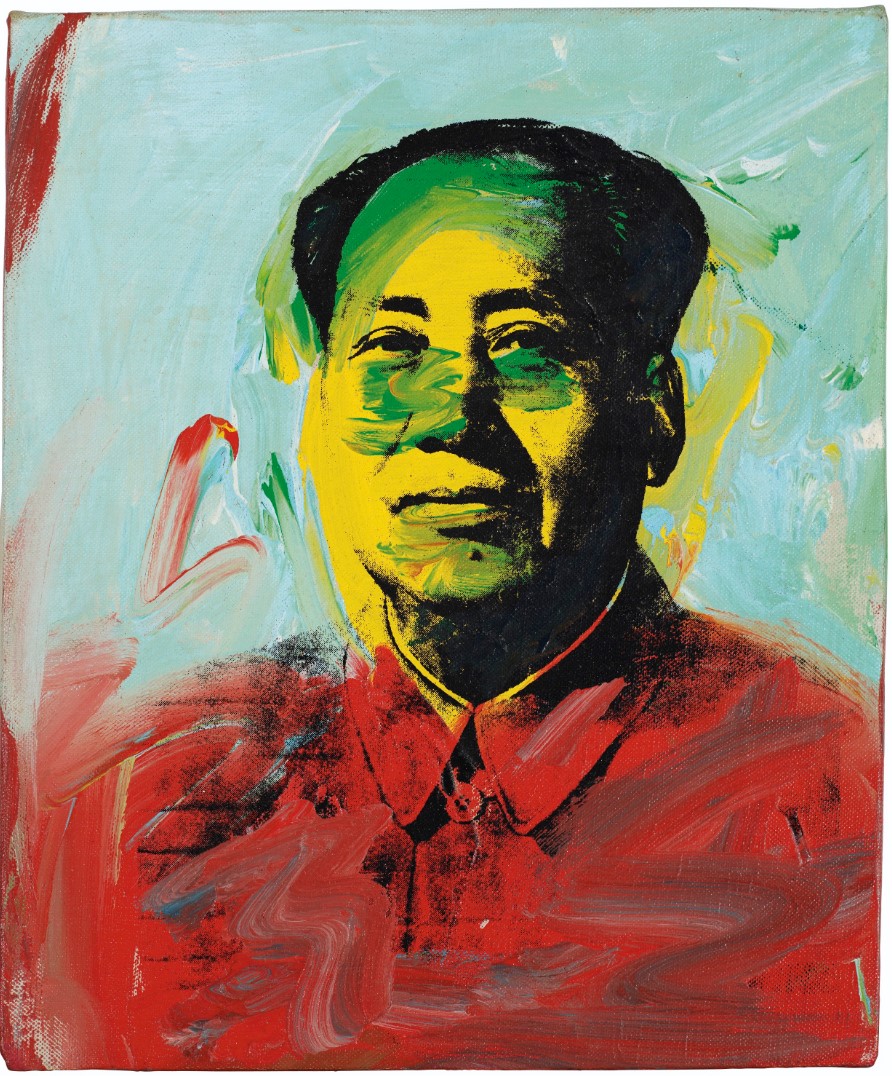
ANDY WARHOL
Mao, 1973
Acrylic and silkscreen ink on canvas
12.1 x 10.1 inches (30.8 x 25.7 cm)
Signed, stamped with the Andy Warhol Art Authentication Board Inc. stamp
Numbered and dated ‘A. Warhol 73 A103.066’ (on the overlap)
The present work, rendered in crisp primary colors and with prominent strokes by the artist, is an excellent example of one of the most famous images in both art and political history.
At 12 by 10 inches, the present work is an intimate example from the series. Warhol overlays the silkscreen print of Mao with sunflower yellow, duck-egg blue and crimson red, adding another layer of red paint after the canvas was stretched to add to its vibrancy. The Mao portraits typically group color to emphasize the components of the figure, assigning a separate color to the body, head and background. After marking out these three key features, Warhol then inverts his prior precision to become more free-form, breaking the color assignments. In the present lot, large green swathes follow the curve of Mao’s forehead, before sweeping across his eyes and chin. The resulting paint appears graffiti-like, placing the work simultaneously in the realm of figurative painting and of subversive art. The work is thus excellently balanced between restraint in adhering to the figurative form, and spontaneous, freer strokes, a disruption by the artist of an otherwise standardized portrait.
Mao, 1973
Sotheby’s New-York: 17 May 2019
Estimated: USD 700,000 – 1,000,000
USD 1,160,000
(#212) ANDY WARHOL | Mao (sothebys.com)
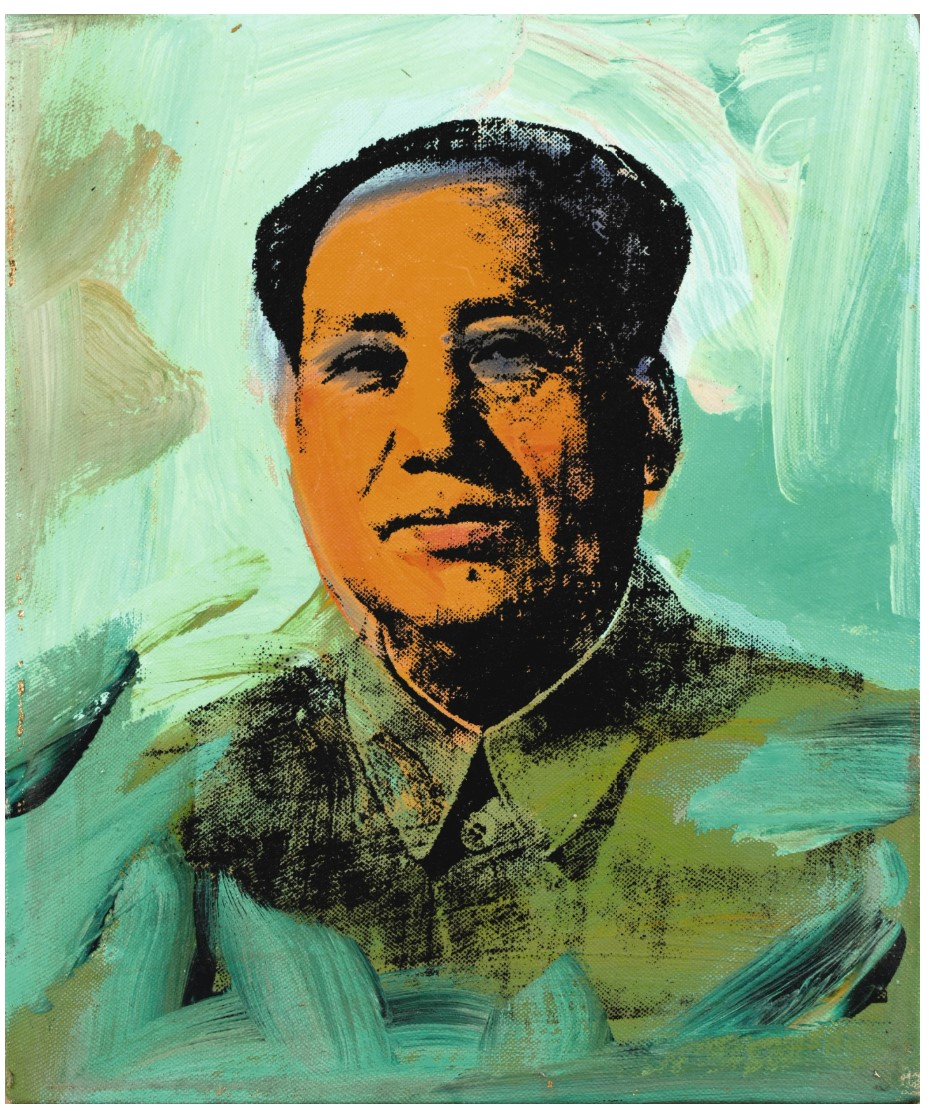
ANDY WARHOL
Mao, 1973
Acrylic and silkscreen ink on canvas
12×10 inches (30.5 x 25.4 cm)
Signed and dated 73 on the overlap
Mao, 1973
Sotheby’s London: 20 June 2017
Estimated: GBP 600,000 – 800,000
GBP 788,750
(#34) Andy Warhol (sothebys.com)

ANDY WARHOL
Mao, 1973
Acrylic and silkscreen ink on canvas
12 x 10.1 inches (30.5 x 25.7 cm)
Signed and dated 73 on the overlap
Mao, 1974
Sotheby’s London: 29 June 2016
Estimated: GBP 450,000 – 650,000
GBP 545,000
(#141) Andy Warhol (sothebys.com)
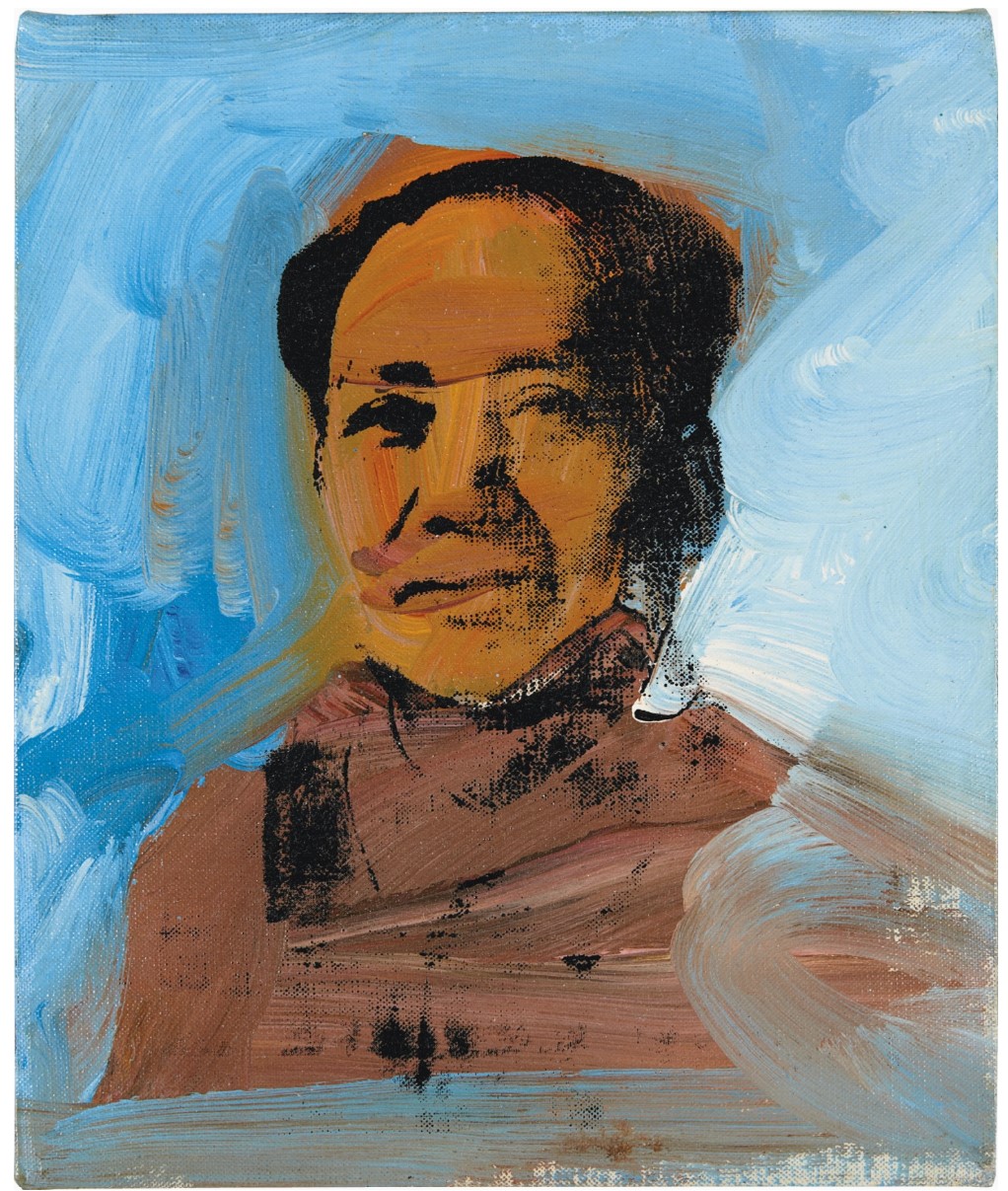
ANDY WARHOL
Mao, 1974
Acrylic and silkscreen ink on canvas
12 x 10.1 inches (30.7 x 25.7 cm)
Signed and dated 74 on the overlap
The present work is one of the 122 small 12 by 10 inch canvases which were executed towards the end of the opus. Amongst the Mao paintings, this series of small works is the most painterly and experimental, with Warhol often adding paint on top of the silkscreened image, giving each image its unique characteristics. Warhol decisively progressed from the stencilled, machine-like precision of the Liz and Marilyn portraits to a looser, abstract-expressionistic handling in the Mao series. The touch of his hand, the material properties of the medium and the nuances of mixed and unmixed colour played an increasingly important role and is particularly visible in the present work. Three distinct colours, a strikingly intense blue and orange and a more subdued earthy brown are broken up only by the sharp black outlines of Mao’s features. Vigorously and fast, Warhol applied the light blue background and breached the borders into the chairman’s jacket and face. Distinct passages of the composition are not isolated as in earlier works, but instead flow and mix into a complicated, abstract frenzy of line, colour and movement. The wide brush used in relation to the size of the canvas further enhances the effect of abstraction. From underneath all this, Mao still stares at the beholder like he does in his official portrait, but he has been stripped of context and his intimidating, all powerful aura is nothing but a faint memory.
Mao, 1973
Sotheby’s New-York: 12 May 2016
Estimated: USD 700,000 – 900,000
USD 874,000
(#174) Andy Warhol (sothebys.com)
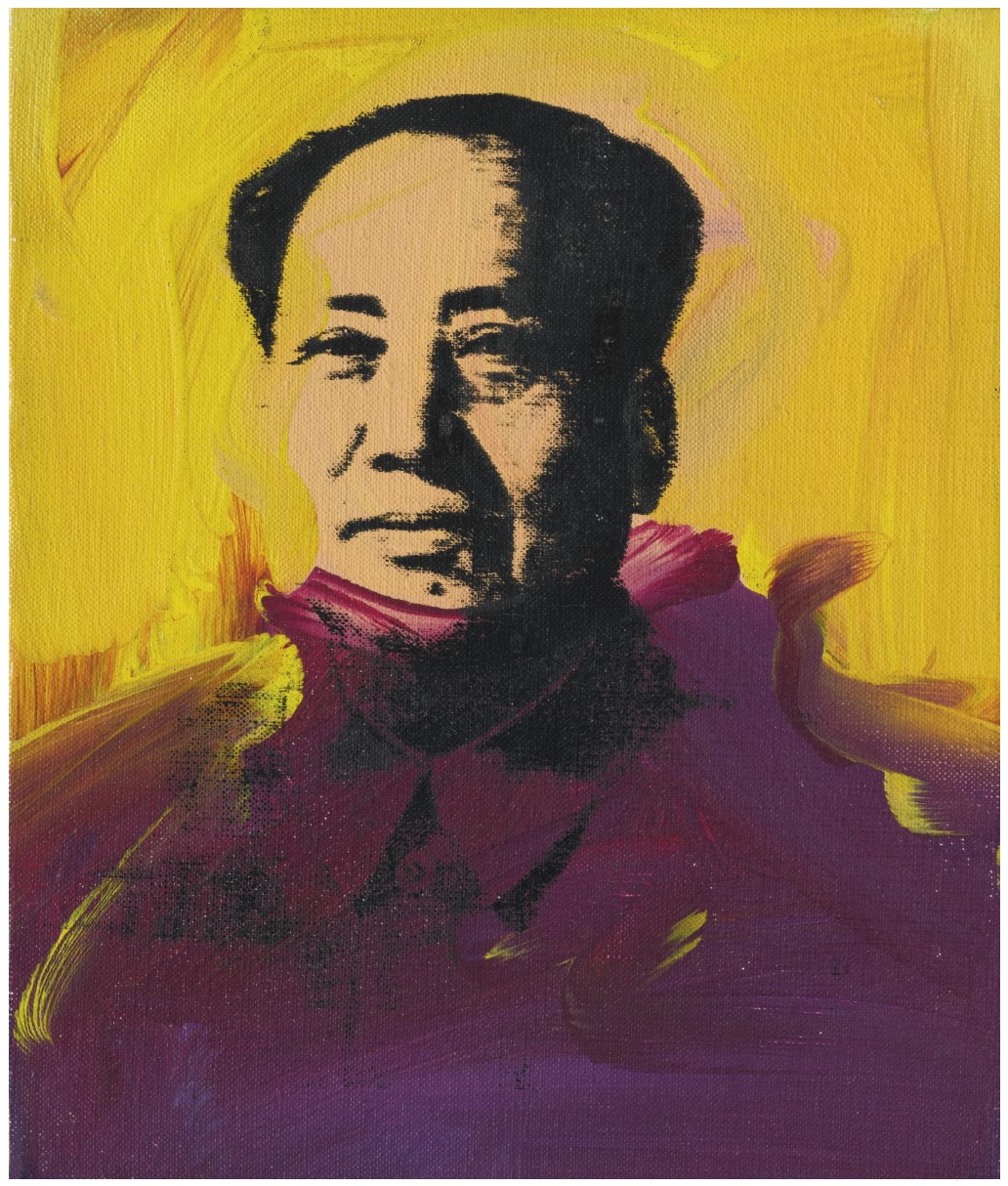
ANDY WARHOL
Mao, 1973
Acrylic and silkscreen ink on canvas
12×10 inches (30.5 x 25.4 cm)
Signed on the overlap
Mao invokes a painterly and loose style that this entirely at odds with the firm dictatorial presence that the portrait was intended to convey. The bright, swirling purple and yellow hues stand in opposition to the sober grays of Zhenshi’s portrait, and the Mao head is suspended in space, deprived of the gravitas lent by his body in the original portrait.
Mao, 1973
Christie’s New-York: 11 May 2016
Estimated: USD 750,000 – 950,000
USD 1,205,000
Andy Warhol (1928-1987) (christies.com)
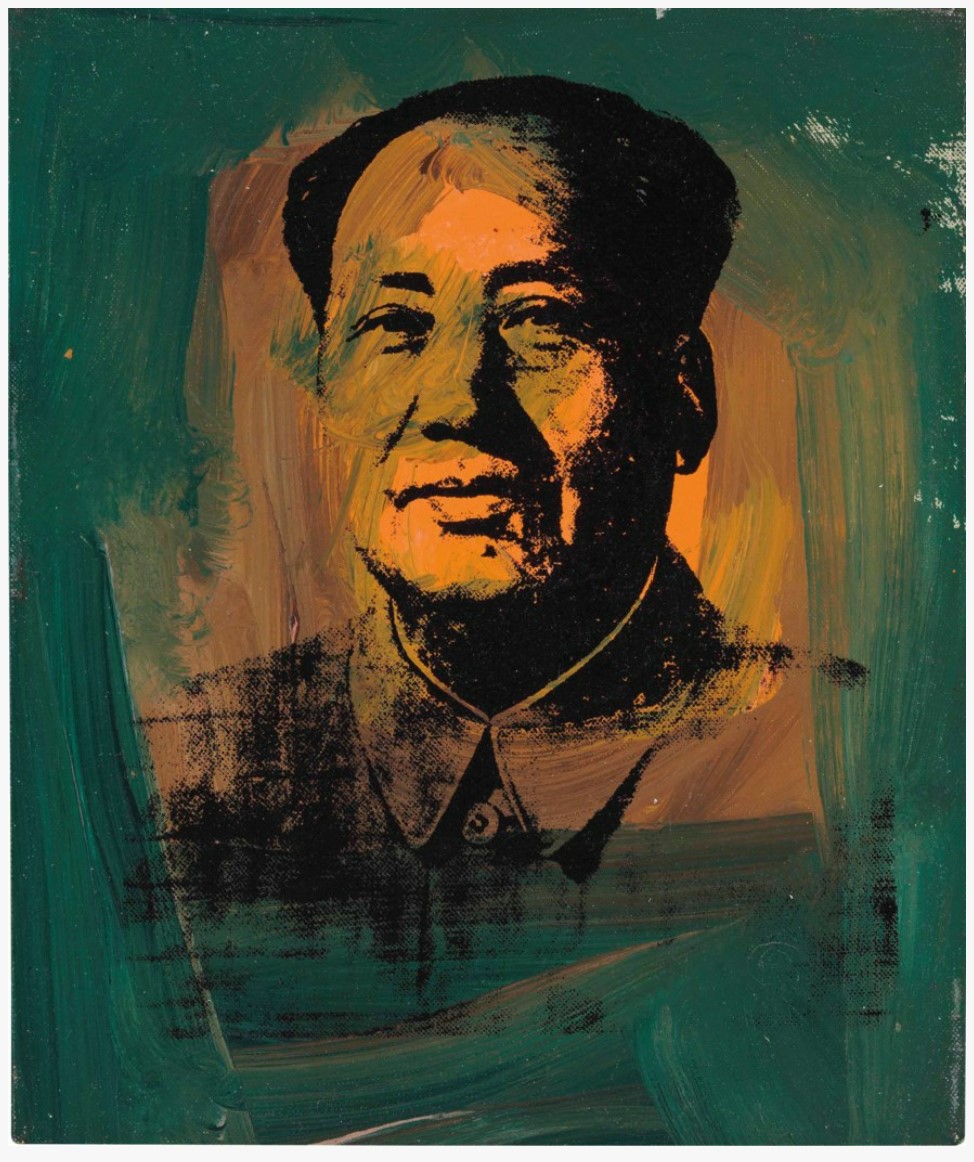
ANDY WARHOL
Mao, 1973
Acrylic and silkscreen ink on canvas
12×10 inches (30.5 x 25.4 cm)
Signed and dated ‘Andy Warhol 73’ (on the overlap)
Mao, 1979
Sotheby’s London: 12 March 2015
Estimated: GBP 400,000 – 600,000
GBP 485,000
(#42) Andy Warhol (sothebys.com)
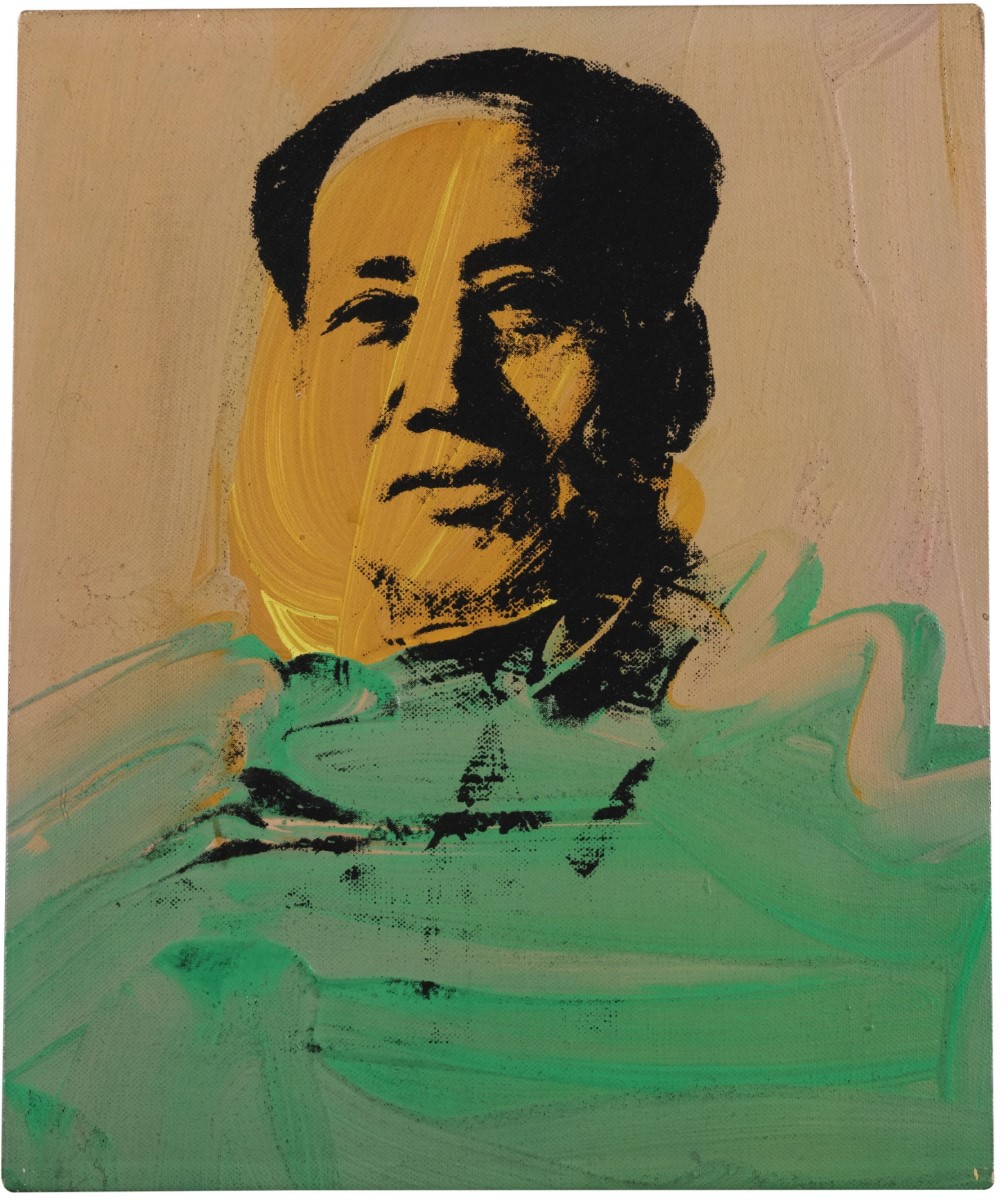
ANDY WARHOL
Mao, 1979
Acrylic and silkscreen inks on canvas
12.1 x 9.9 inches (31 x 25.1 cm)
Signed, dated 79 and dedicated on the overlap
Mao, 1973
Sotheby’s London: 17 October 2014
Estimated: GBP 450,000 – 650,000
GBP 962,500
(#32) Andy Warhol (sothebys.com)
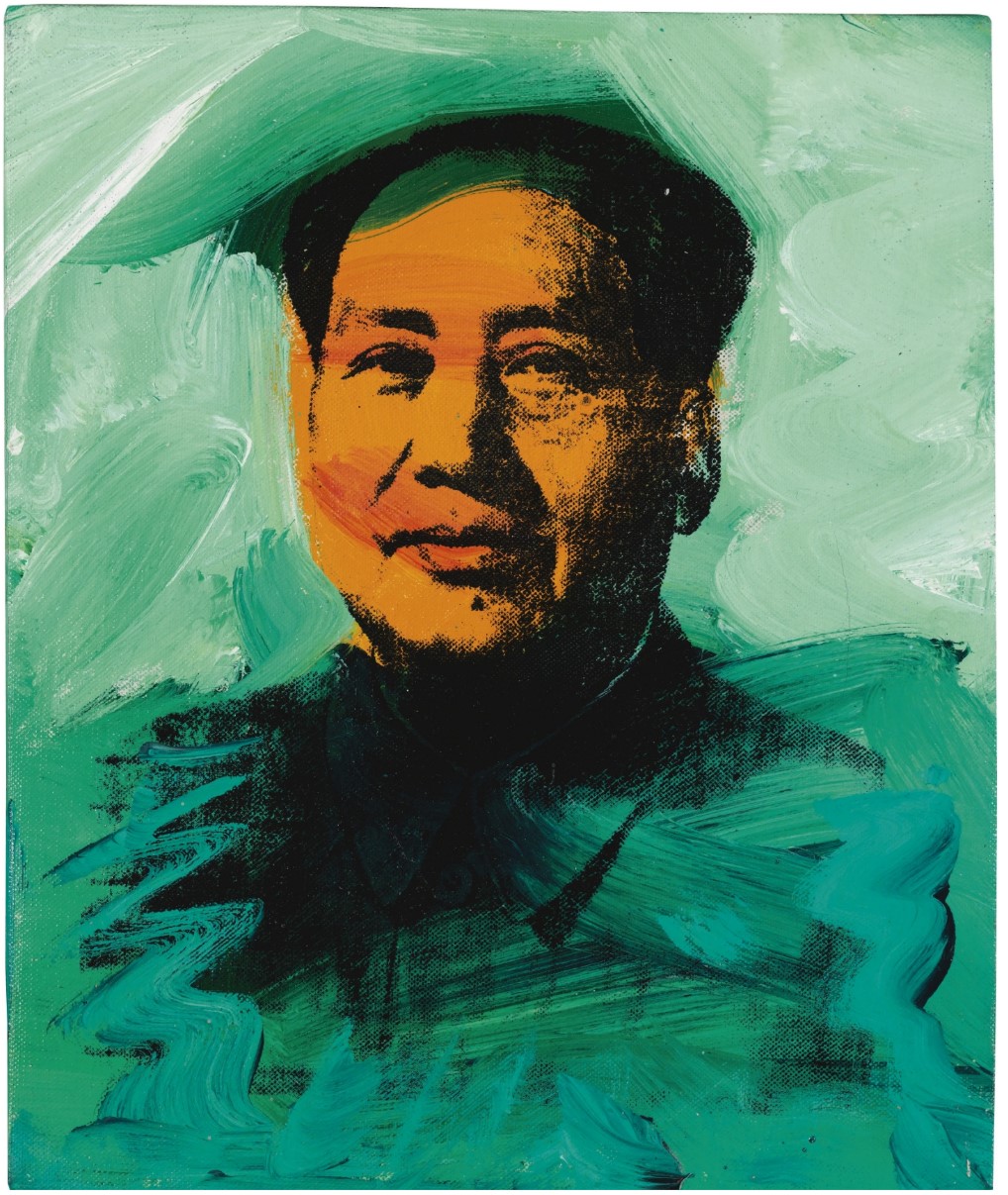
ANDY WARHOL
Mao, 1973
Acrylic and silkscreen ink on canvas
12×10 inches (30.5 x 25.4 cm)
Broad undulating brushstrokes encircle the screen-printed portrait in saturated modulating turquoise. Meanwhile the face of the subject is completed in hot yellow ochre, smudged with streaks of red across the eyes and mouth. By treating Mao in his signature style, Warhol demotes him from the enemy of the democratic ideal to an innocuous celebrity sitter. Throughout the cultural revolution of the previous decade, Mao had all but extinguished popular culture and substituted himself in the place of the stars of stage and screen. Here, Warhol appropriates and subverts this policy, and in smearing acrylic over his deified portrait, installs him as an American icon of Pop.
Mao, 1973
Sotheby’s New-York: 24 September 2014
Estimated: USD 600,000 – 800,000
USD 877,000
(#12) Andy Warhol (sothebys.com)
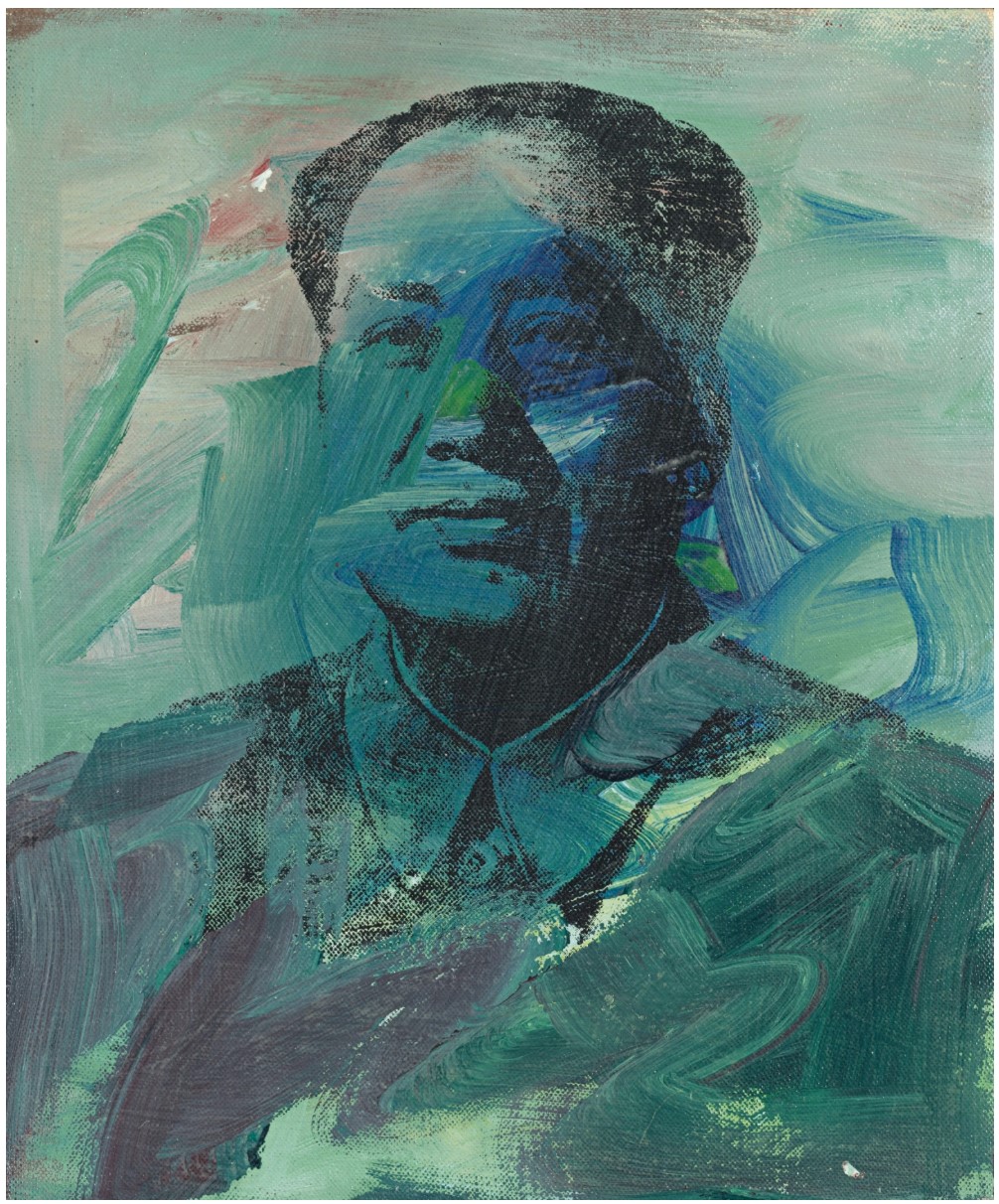
ANDY WARHOL
Mao, 1973
Acrylic and silkscreen ink on linen
12×10 inches (30.5 x 25.4 cm)
Signed and dated 73 on the overlap
Mao, 1973
Christie’s London: 1 July 2014
Estimated: GBP 700,000 – 1,000,000
GBP 1,106,500
ANDY WARHOL (1928-1987) (christies.com)
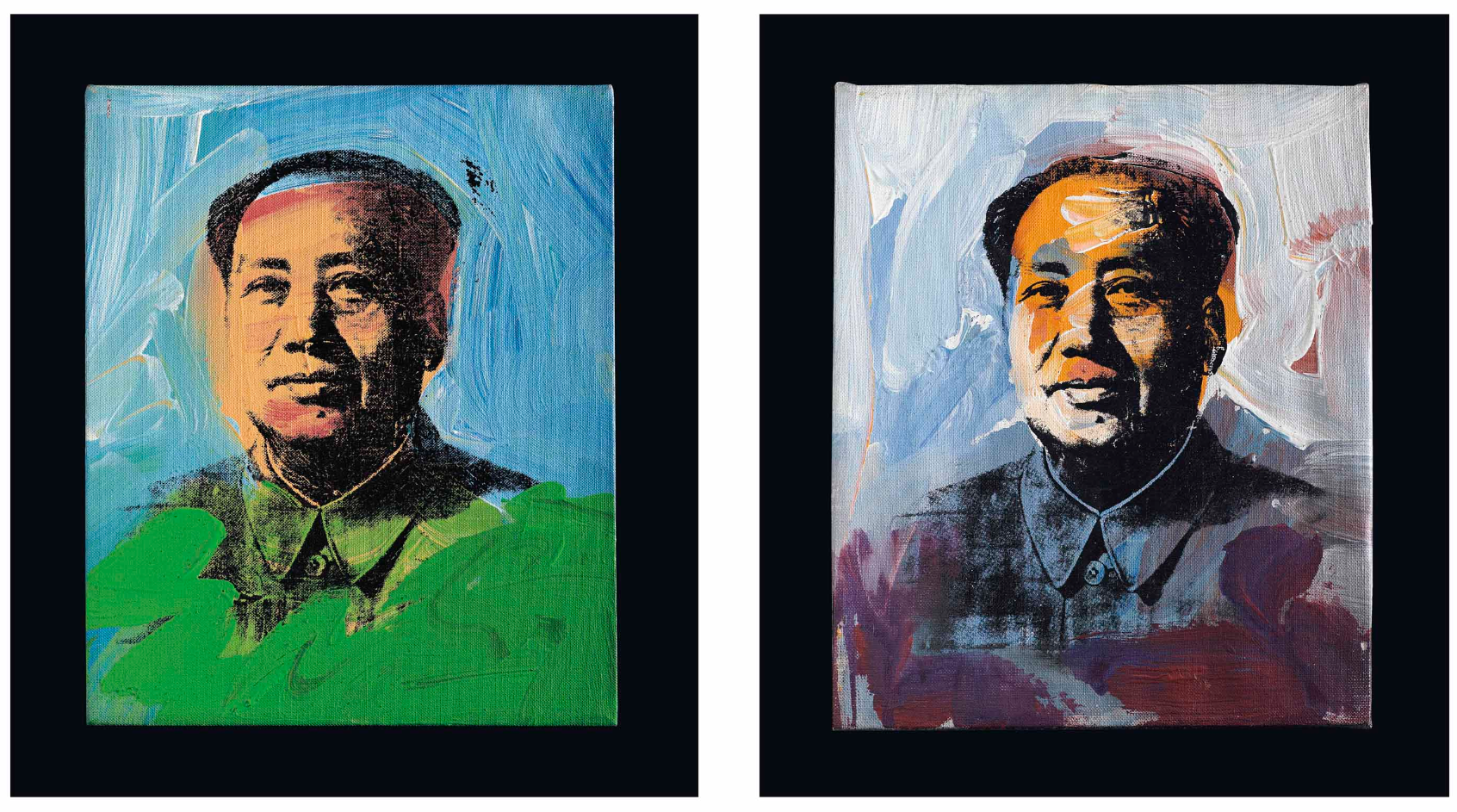
ANDY WARHOL (1928-1987)
Mao, 1973
Acrylic and silkscreen ink on canvas, in two parts
12×10 inches (30.5 x 25.4 cm)
(i) Signed ‘Andy Warhol’ and signed again with the artist’s initials and dated ‘AW 73’ (on the overlap)
(ii) Signed and dated ‘ANDY WARHOL 73’ (on the overlap)
Hand-crafted with a thick swirling impasto of lurid colour over a sober silkscreened image of the implacable face of the Chinese leader, the two demonstrably painterly portraits offered here belong to the series of 12 x 10 inch portraits of Mao Zhedong that Warhol made between December 1972 and August 1973. The two works here, which have remained in the same collection ever since they were first bought from the Sonnabend Gallery, belong to the final series of portraits of Mao intended by Warhol to emulate and to counter the profusion, portability and repetition of Mao’s image in the Little Red Book. They are also the most heavily worked, experimental and painterly of all Warhol’s Mao pictures. As is the case in these two works where Warhol has added a deep green to the jacket of one and a mix of red oxide and dioxazine purple to the other after the screening process, it was in these works that Warhol first made full use of a new and deliberately inartistic painterly style. They are part of a group of works that effectively marked the artist’s return to the brush and to hand-crafted work as well as the beginning of a highly inventive and influential new period of post-modernist painting and production.
Mao, 1973
Christie’s New-York: 15 November 2012
Estimated: USD 500,000 – 800,000
USD 746,500
Andy Warhol (1928-1987) (christies.com)

ANDY WARHOL
Mao, 1973
Synthetic polymer and silkscreen ink on canvas
12×10 inches (30.4 x 25.4 cm)
Signed, dedicated and dated twice ‘To Bob Cocallo 74 Andy Warhol 74’ (on the overlap)
Mao, 1973
Sotheby’s New-York: 10 November 2011
Estimated: USD 700,000 – 900,000
USD 842,500
(#224) Andy Warhol (sothebys.com)
ANDY WARHOL
Mao, 1973
Acrylic and silkscreen ink on canvas
12×10 inches (30.5 x 25.4 cm)
Stamped by the Andy Warhol Art Authentication Board, Inc.
Numbered twice A106.999 on the overlap.
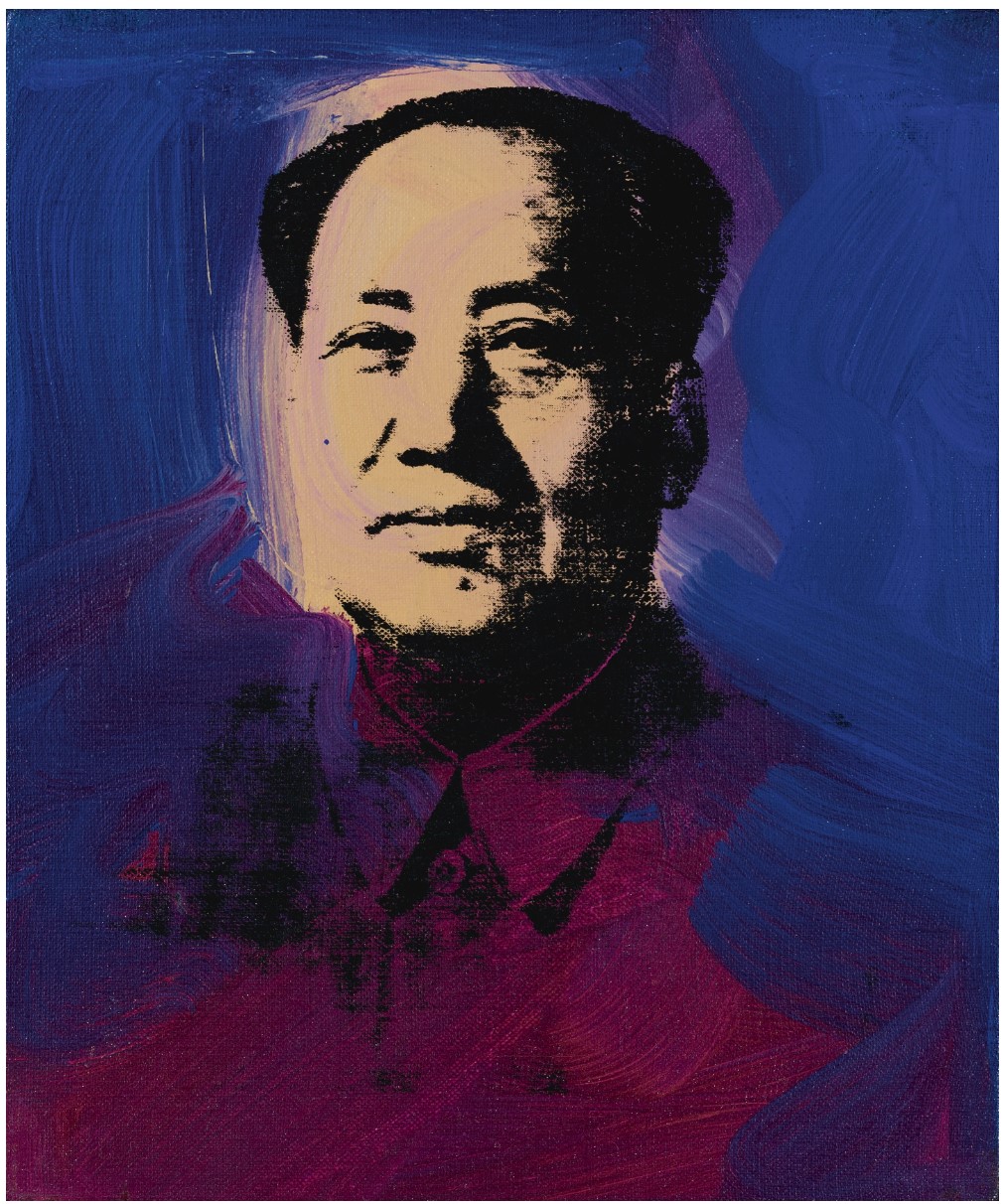
The silkscreen image reproduced here is Mao Zedong’s official portrait printed as the frontispiece in the Quotations from Chairman Mao Tse-Tung. This painting belongs to Warhol’s series of Mao portraits significant for his carefree use of painterly flourishes after the passing of the silkscreen. Mao, one of the more formally successful paintings in its scale, maintains Mao’s visage with notable legibility, implemented through a firm silkscreening that is accompanied by two bravura gestures in which the ultramarine blue background elegantly collides with the acra red on Mao’s jacket. The bold, sensuous colors and structured composition of this canvas set it apart from the other wildly expressive, pastel-hued Mao paintings from this era.
Mao, 1973
Sotheby’s London: 13 October 2011
Estimated: GBP 600,000 – 1,200,000
GBP 623,650
(#24) Andy Warhol (sothebys.com)
ANDY WARHOL
Mao, 1973
Acrylic and silkscreen ink on canvas
12×10 inches (30.5 x 25.4 cm)
Signed and dated 73 on the overlap
Stamped twice by the Estate of Andy Warhol and numbered A994.102 on the overlap
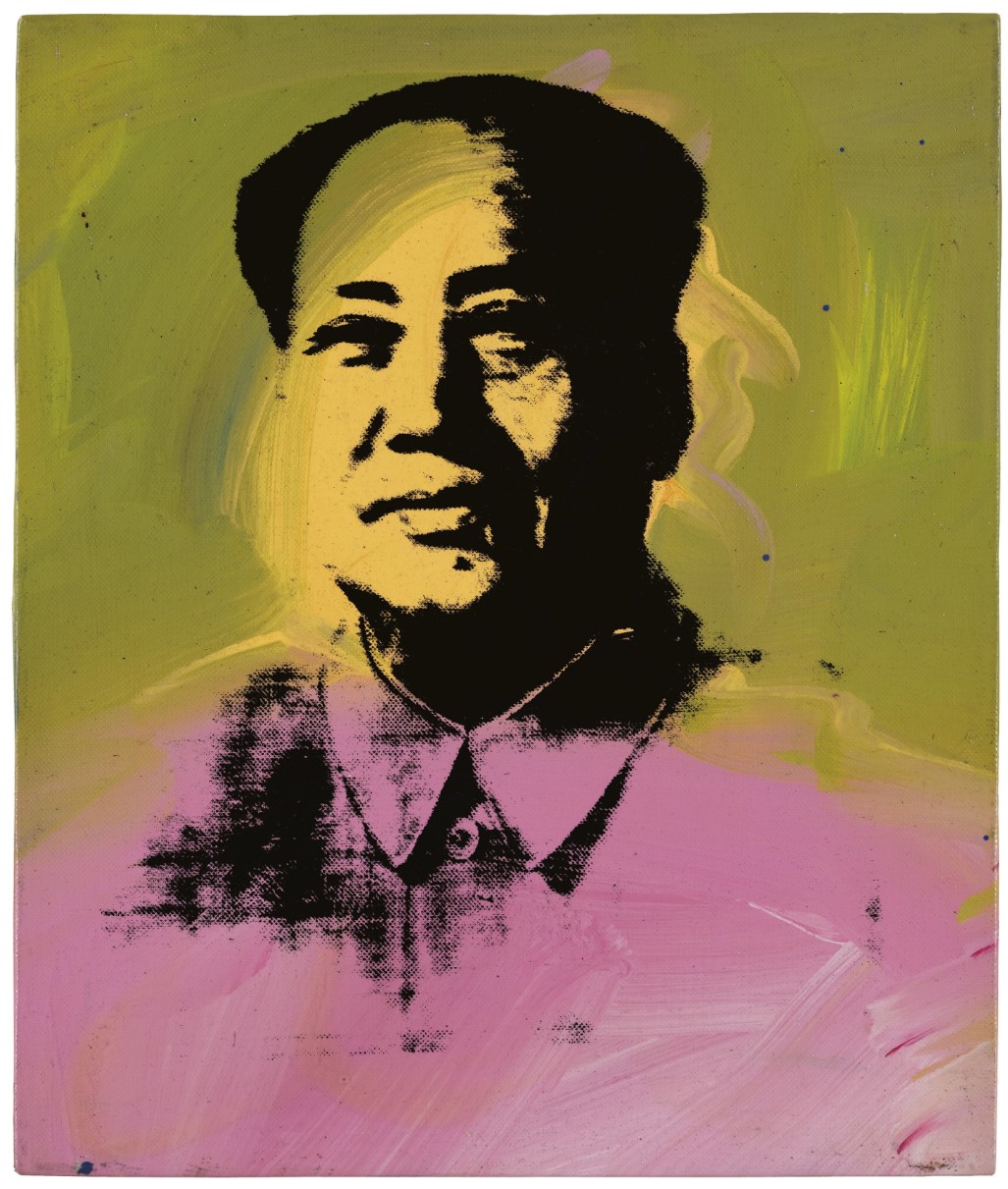
Executed in 1973, Andy Warhol’s Mao series signals a number of new departures in both subject and style, evincing an astute political awareness and heralding the dawn of a new period of stylistic creativity. Singularly defining this illustrious corpus, the present Mao is the perfect archetype and, with ideal colour and composition achieved through faultless execution, makes it possibly the best small silkscreen of Mao by the artist. Although Warhol had broached the American political arena a decade earlier with his Electric Chair and Race Riots, both 1963, it was not until the present work that he engaged with the contentious international political concerns which were at the forefront of the global consciousness. Allied with this political awakening, Warhol’s treatment of the present work in a newly expressionistic hand set the precedent for his latter oeuvre.