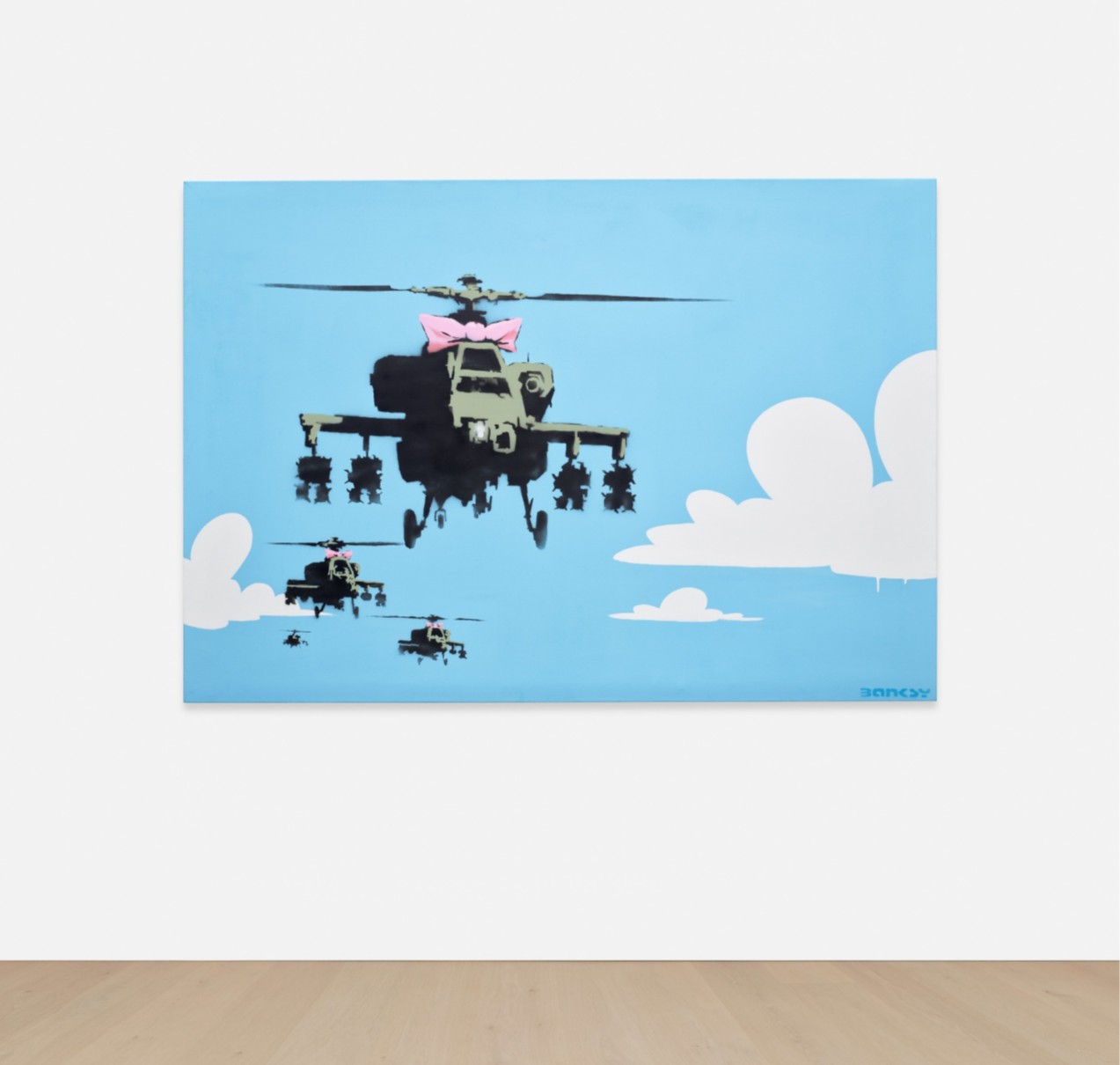
BANKSY
Happy Choppers, 2006
Spray paint and emulsion on canvas
126.9 x 182.9 cm (49-7/8 x 72 inches)
Stencilled ‘BANKSY’ lower right
Signed, numbered and dated ‘BANKSY 12/2/2006 1/3’ on the overlap
This work is number 1 from an edition of 3
Lazarides Gallery, London
Marsha and Robin Williams Collection (acquired from the above in 2006)
Sotheby’s, New York, 4 October 2018, lot 13
Acquired at the above sale by the present owner
Phillips London: 5 March 2026
Estimated: GBP 1,000,000 – 1,500,000
GBP 1,520,000 / USD 2,030,570
Banksy Modern & Contemporary Art Evening Sale
REPEAT SALE
Creating A Stage: The Collection Of Marsha And Robin Williams
Sotheby’s New-York: 4 October 2018
Estimated: USD 400,000 – 600,000
USD 735,000
“The greatest crimes in the world are not committed by people breaking the rules but by people following the rules. It’s people who follow orders that drop bombs.”
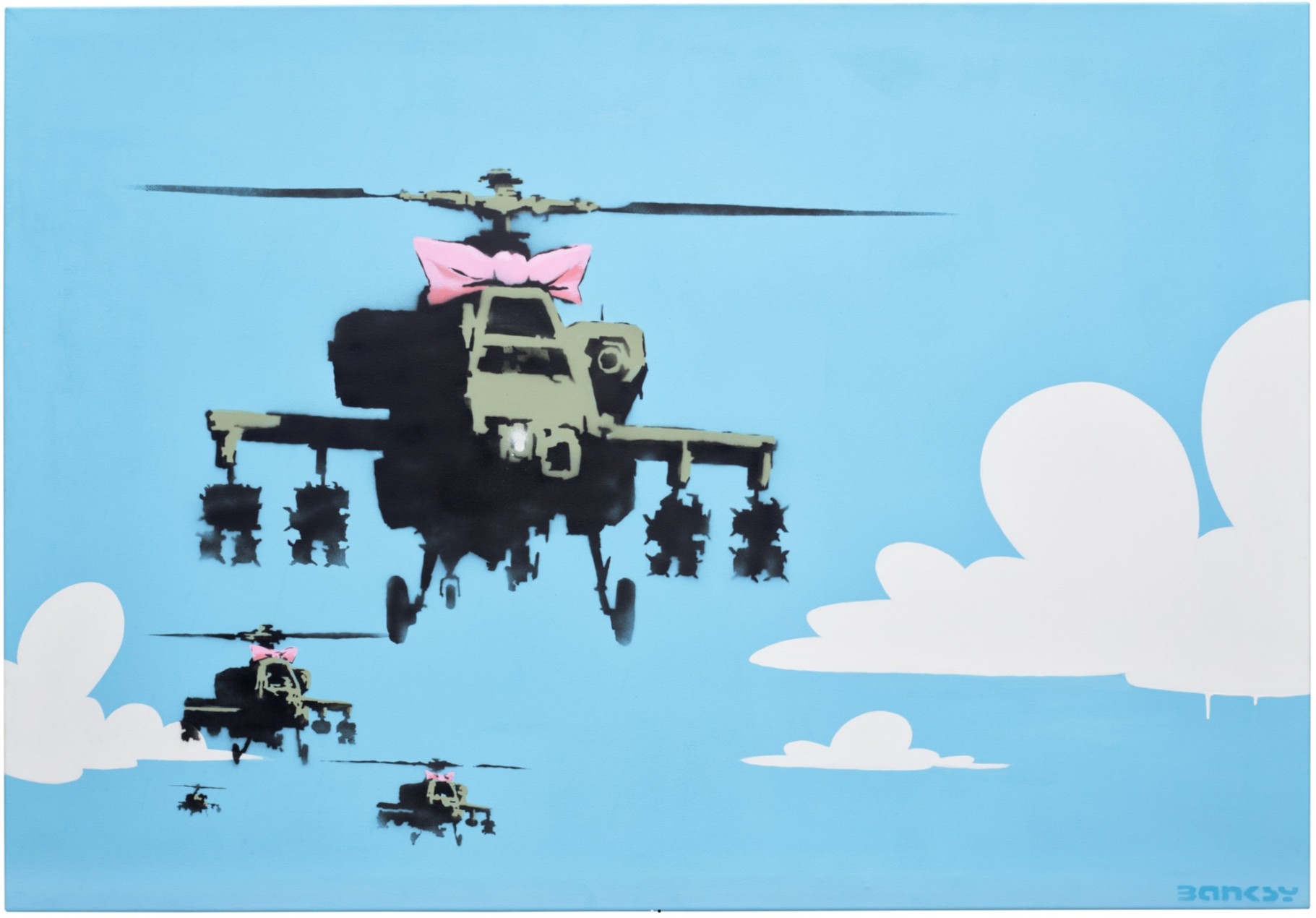
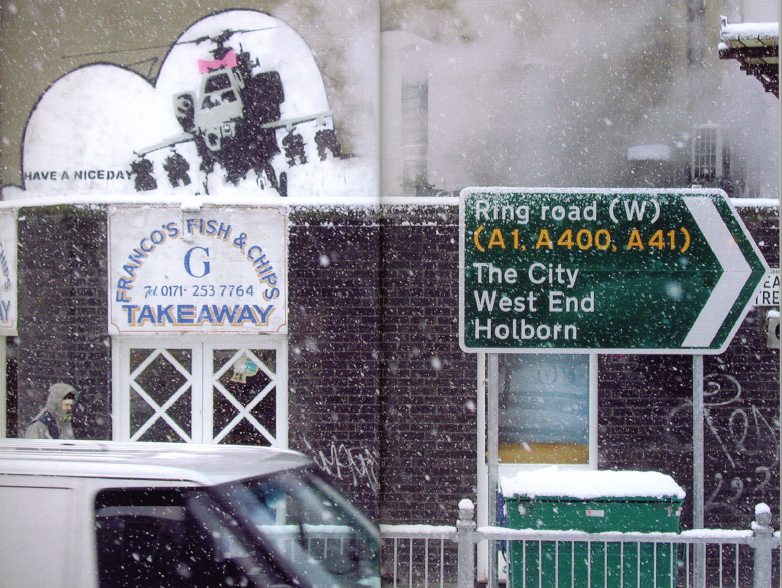
Executed in 2006, Happy Choppers is a rare painterly iteration of one of Banksy’s most iconic motifs. One of only three variations, it depicts a squadron of Apache Attack helicopters, or ‘choppers’. Though evocative of scenes from the 1979 film Apocalypse Now, the helicopters are adorned with Disney-esque pink bows, transforming them into childlike toys. Juxtaposing menace and innocence with characteristic tongue-in-cheek wit, Banksy calls into question the pretenses of military intervention, his surreal image cutting straight to the heart of concerns surrounding contemporary warfare. The motif first appeared at Whitecross Street Market in London in 2002, at a time when Apache helicopters from UK and US forces were particularly prevalent in Afghanistan as part of the global war on terrorism. Today, the motif stands among the artist’s most recognizable in his ongoing dialogue with issues of freedom, peace and justice: another version was featured in Banksy’s seminal 2006 exhibition Barely Legal in Los Angeles.

Around the time that Happy Choppers first appeared, Banksy was beginning to make waves internationally through his early graffiti and pranks. Much of his work at this time was anti-war in sentiment, and often appropriated military imagery: the Mona Lisa holding a gun, or a monkey riding a bomb. His iconic ‘flower thrower’ appeared in Beit Sahour near the West Bank Barrier wall, offering a call for peace in the Israeli-Palestinian conflict. In 2003, the present work’s helicopter image would feature as part of the London protests against military action in the middle east, alongside Banksy’s ‘bomb hugger’ girl and ‘grin reaper’ motif. Over the years, his work would repeatedly critique the misuse of power by authorities: from his museum interventions that demonized the institutional incarceration of art, to his wry depiction of parliament as a gaggle of chimpanzees.
By the time of the present work, Banksy’s global infamy had reached new heights, bolstered by Barely Legal, his third major exhibition, held in a Los Angeles warehouse. It followed the success of Crude Oils in London the previous year, where Banksy had exhibited a series of reworked masterpieces and vandalized oil paintings in a basement swarming with live rats. The exhibition had highlighted Banksy’s credentials as a painter, demonstrating a virtuosic handling of oil in his appropriations of art history. The show’s title, however, invoked more than just the medium at play, offering a pun on the battle for oil which many believed lay at the heart of the Iraq War. It was significant, in this light, that the series had previously included a reworking of the present work’s motif: a canvas entitled Study for Happy Chopper, which featured a pre-existing painted landscape emblazoned with Banksy’s helicopter. The three versions of the present work, similarly, glisten with tantalizing traces of the artist’s hand: notably in the cloud formations, whose shapes vary across the group, calling to mind the Surrealist skies of René Magritte.
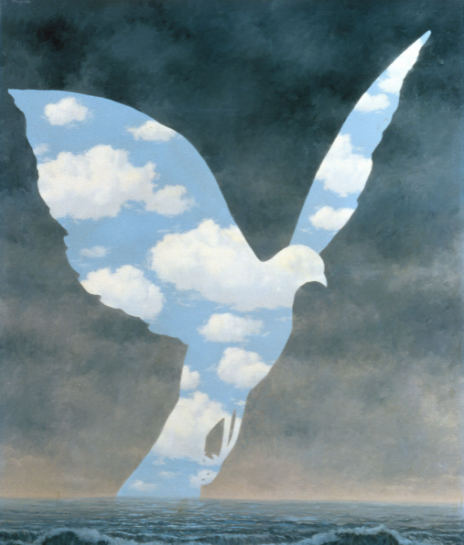
Rene Magritte, La Grande Famille, 1963
Like Richard Prince’s ‘joke’ paintings or Jeff Koons’ seemingly impossible sculptures, the present work revels in its own irony and witticism. On one hand, the helicopters appear like images from a cartoon strip, their girlish pink bows seemingly undercutting the masculine bravado of warfare. On the other hand, the image strikes a more serious tone, highlighting the tension between salvation and harm that defines debates surrounding military intervention. Banksy takes his place within a long line of artists who placed social commentary at the heart of their practice: from William Hogarth to Grayson Perry and Ai Weiwei. More broadly, the present work might be seen in the context of artworks that responded to the onset of war: from Pablo Picasso’s Guernica to Andy Warhol’s depictions of the atomic bomb, Martin Kippenberger’s Krieg Böse series and Robert Rauschenberg’s inclusion of helicopters in reference to the Vietnam War.
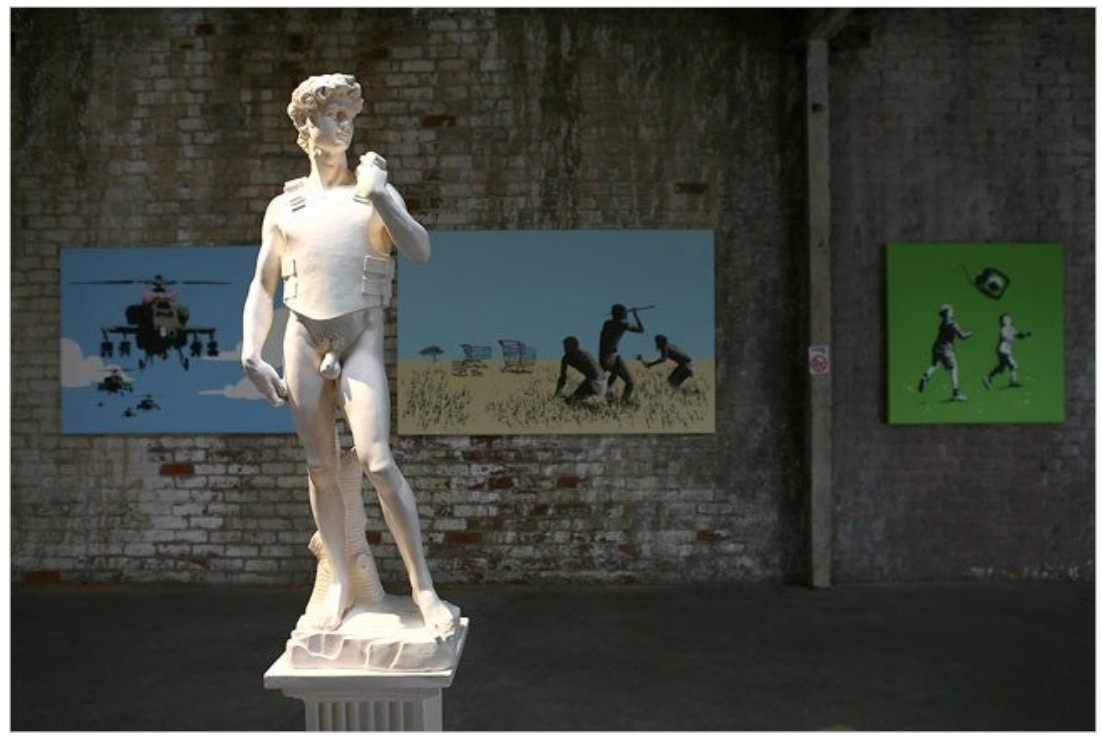
Barely Legal, Los Angeles, 2006
The work’s use of stenciling also plays into Banksy’s anti-establishment rhetoric. The artist first discovered the technique as a teenage graffitist, while hiding from the British transport police under a dumper truck.
“As I lay there listening to the cops on the tracks I realized I had to cut my painting time in half or give up altogether’, he recalls. ‘I was staring straight up at the stenciled plate on the bottom of a fuel tank when I realized I could just copy that style and make each letter three feet high.”
Cut and sprayed by hand, the stenciled elements of the present work lend it a sharp, graphic quality that seems to chime with the crisp humor of Banksy’s message. They also align the painting with his street-based output, creating a seamless blend of urban and studio techniques. Part painting, part protest, the results stand as a powerful expression of the turn-of-the-millennium zeitgeist: its relevance, as with Banksy’s best works, continues to endure today.
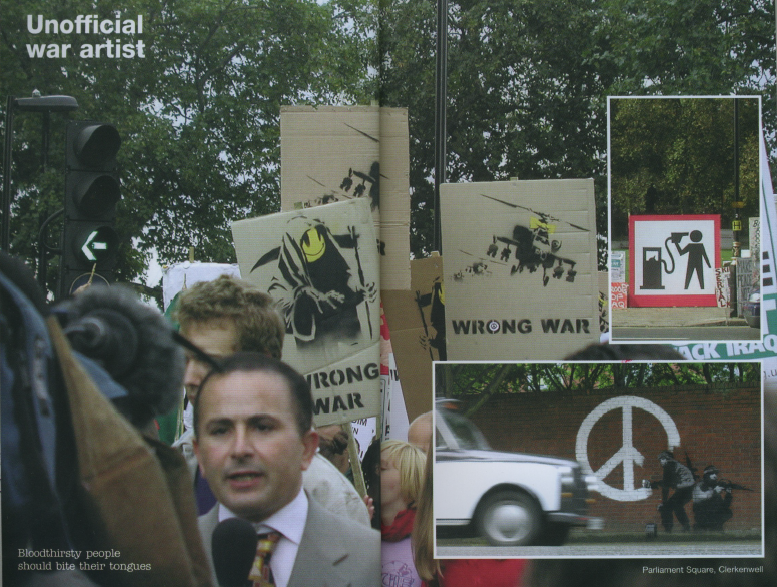
In returning to the helicopter motif, Happy Choppers continues Banksy’s dialogue with history, public policy and society. As Eugène Delacroix in his Liberty Leading the People expressed ideals of freedom and victory following the July Revolution of 1830, Banksy is among the long tradition of artists that have used art as a form of social commentary through taking inspiration from the street. Banksy questions shared belief systems and in turn, structures of power. Piloted in disarmingly serene, cartoon-blue skies, the severity and uniformity of the military unit is juxtaposed with the picturesque, larger-than-life natural world. Ostensibly rendered harmless or toy-like with their inoffensive bows, Happy Choppers is a prescient reminder of issues at the center of contemporary discourse on war and peace, liberty and the rule of law. Remaining vocal in rallying against conflict, examples of Banksy’s work that appropriate and re-invent military imagery are among the artist’s most recognized: from depicting a pair of soldiers painting a peace sign, an elephant strapped with a missile to the Mona Lisa brandishing a rocket launcher.
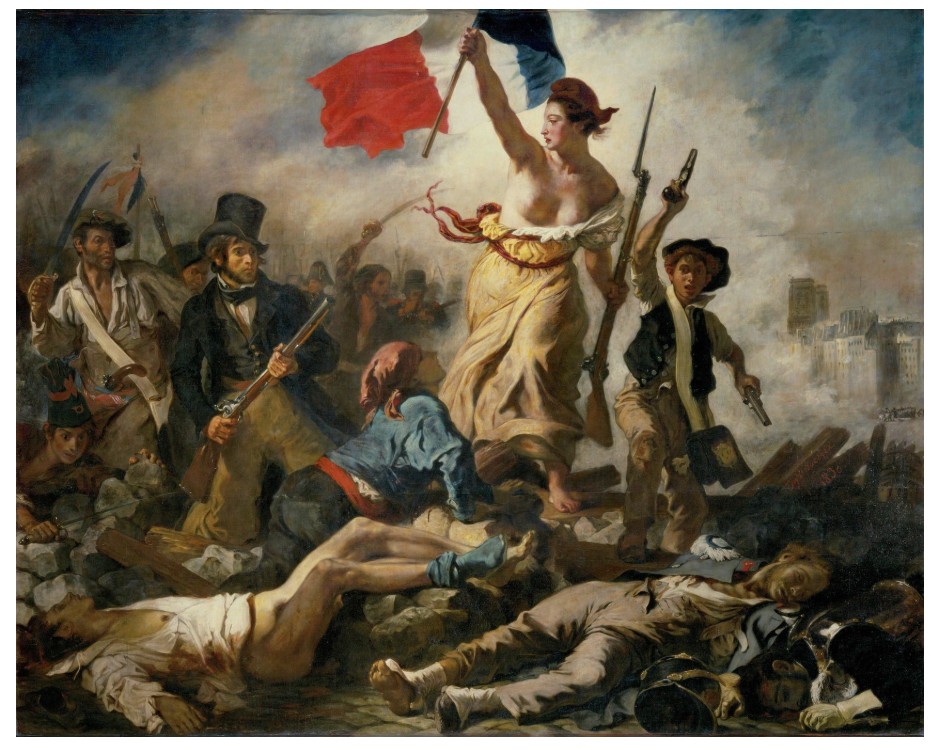
Eugène Delacroix, Liberty Leading the People, 1830, Musée du Louvre, Paris
The use of stencilling in Happy Choppers gives ground to Banksy’s anti-establishment rhetoric, a methodology that was developed during late adolescence by the artist to outwit authorities. Active in Bristol during the late 1980s, Banksy was shaped by the historical port town’s graffiti culture and underground creative scenes informed by hip-hop: counter-cultural impulses that were followed by the rebellious, renewed enthusiasm for British culture and ‘Cool Britannia’. Contemporary to national policies against the uncontainable rise of graffiti, severe crackdowns like Operation Anderson in 1989 left an indelible impression, impacting the artist’s relationship with authority and surveillance. Maintaining anonymity to avoid detection, it was at eighteen during a cat-and-mouse chase with the police that the artist discovered his distinctive stencil technique. While hiding from the British transport police beneath a vehicle, the artist recounted ‘I realized I had to cut my painting time in half or give it up altogether. I was staring straight up at the bottom of a fuel tank when I realized I could just copy that style’. Blending the influences of the street with the canvas, Happy Choppers stands among the most enduring statements of Banksy’s output and a key expression of the artist’s principle that ‘graffiti is not the lowest form of art’ but instead is ‘the most honest artform available’.
Another version got bought in at Christie’s in London on 1 March 2022.
Happy Choppers, 2006
Estimated: GBP 3,000,000 – 5,000,000
PASSED
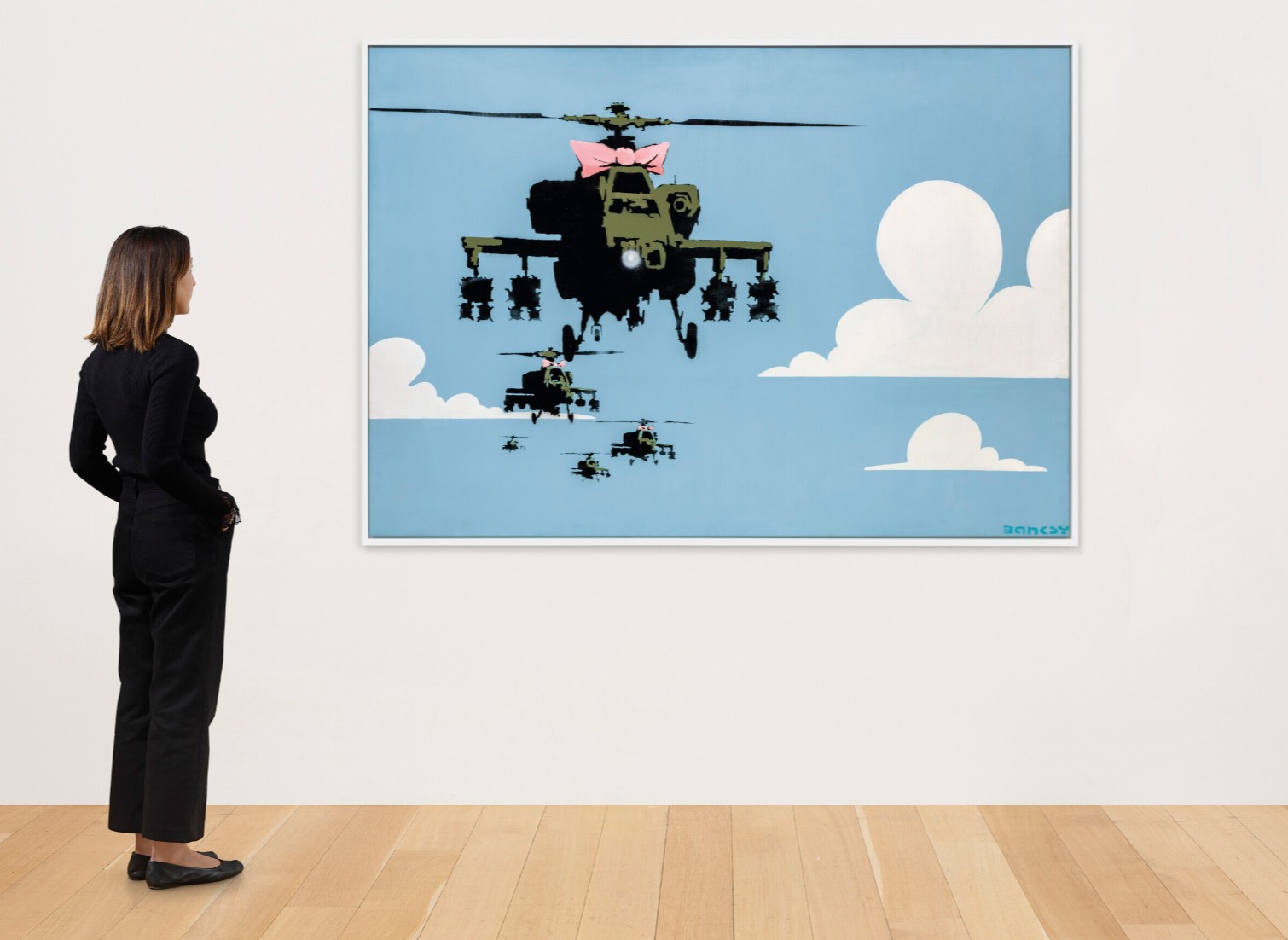
Happy Choppers, 2006
Spray-paint and emulsion on canvas
125×180 cm (49 1/4 x 70 7/8 inches)
Signed and dated ‘BANSKY FEB 2006’ (on the overlap)
This work is one of three variations