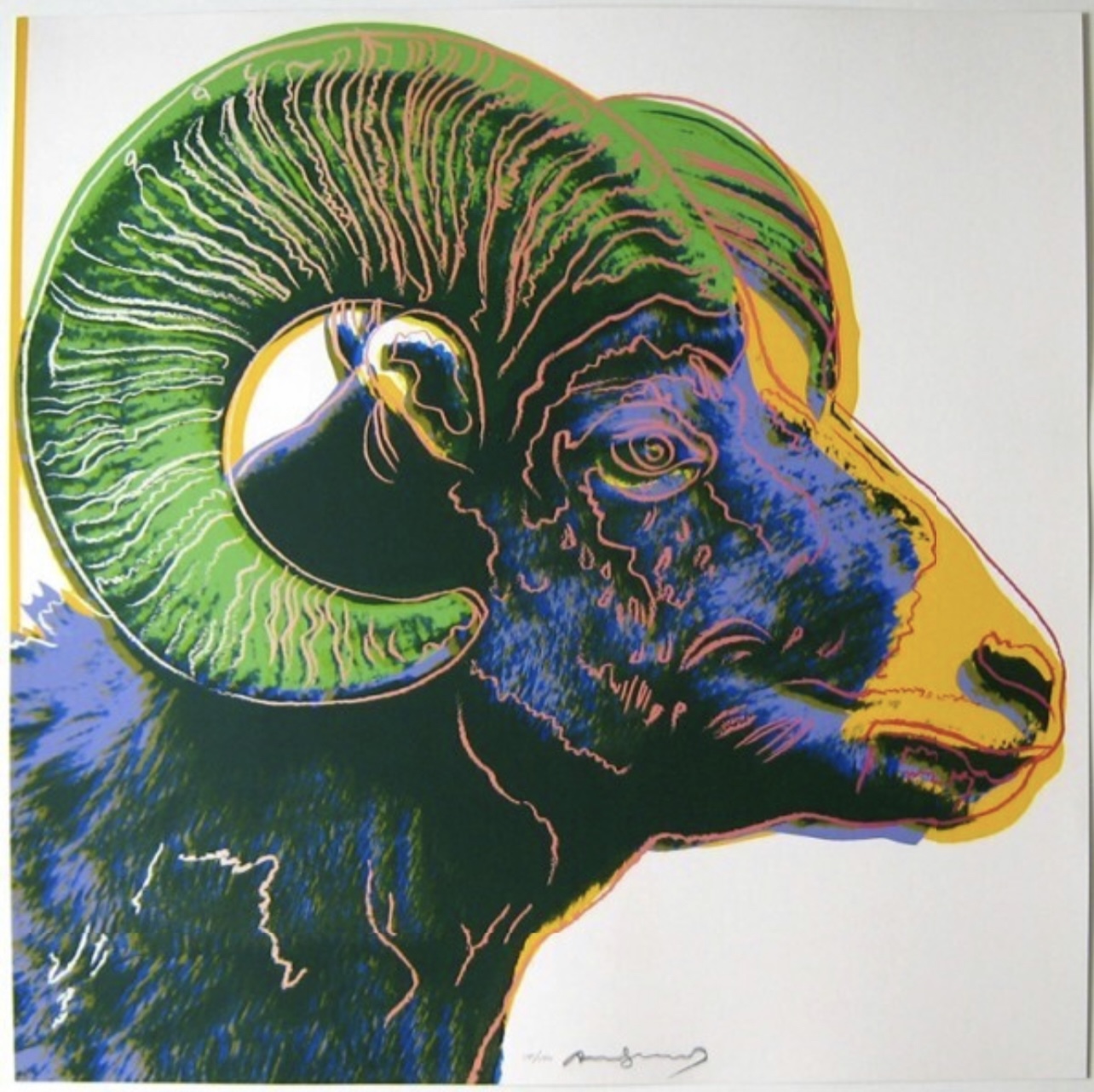
Bighorn Ram
from Endangered Species
Medium: Screenprint in colors on Lenox Museum Board
Year: 1983
Sheet: 38×38 inches (96.5 x 96.5 cm)
Edition: 150
Artist’s Proofs: 30 AP
Printer’s Proofs: 5 PP
Exhibitor’s Proofs: 5 EP
Hors Commerce: 3 HC
Bon a Tirer: 1 BAT
Other: 10 numbered in Roman numerals intended for wildlife organizations
Trial Proofs: 30 TP with unique color combination
(see Feldman & Schellmann IIB.302)
Publisher: Ronald Feldman Fine Arts, Inc., New-York
Printer: Rupert Jasen Smith, New-York
Catalogue Raisonne: Feldman & Schellmann II.302
Signed and numbered in pencil, lower left or right
With the publisher’s inkstamp and the artist’s copyright stamp on reverse
Bighorn Ram is part of Endangered Species
(Click on picture below to access the Catalogue Entry)

The intriguing thing about the Bighorn Ram is that this is an animal that was initially in the millions. The unreserved Bighorn rams are always in herds of 100 and over, providing them an impressive appearance. However, around the 1900s, the population covered just a few thousands of specimens. Thankfully, numerous programs were focused on reducing hunting and helping the Bighorn Rams breed, and nowadays, you will notice that they made a comeback in the wild. They are still one of the prime image icons for the natives. A powerful image, mounted against a solid blue background, ‘Endangered Species: Bighorn Ram,’ boasts one of the most admired animals among the Apsaalooka, or Crow people, central to the Apsaslooka tribal lands, the sheep are the name sake for what is today called the Bighorn Mountain Range in northern Wyoming. The Bighorn sheep originally crossed into North America over the Bering Land Bridge from Siberia, sparking the population in North America to peak in the millions, and thus the Bighorn sheep entered into the mythology of Native Americas.
However, by 1900 the population had crashed to several thousand. Efforts established in 1930 by the Boy Scouts of America created two Bighorn game ranges in Arizona. Through an increased program of reintroductions, national parks, and reduced hunting, together with a decrease in domesticated sheep near the end of World War II, allowed the Bighorn sheep to make a further comeback. Though it is currently unknown if the population of Bighorn sheep has risen since Warhol’s creation, the animal continues to be an iconic image for many Native populations, and is know the official mascot for the Arizona Boy Scouts.
Auction Market Overview
Bighorn Ram only sold once at auction in 2024, at Sotheby’s in Hong-Kong on 6 April 2024 for HKD 1,143,000 (USD 146,125).
Bighorn Ram sold twice at auction in 2023: at Phillips in New-York on 24 October 2023 for USD 139,700, and it sold for its highest price at Phillips in New-York on 20 April 2023.
Bighorn Ram sold only once at auction in 2022, at Christie’s in New-York, on 21 April 2022 for USD 201,600.
Regular Editions
Sotheby’s Hong-Kong: 6 April 2024
Estimated: HKD 700,000 – 1,200,000
HKD 1,143,000 / USD 146,126

ANDY WARHOL (1928 – 1987)
Bighorn Ram (Endangered Species), 1983
Screenprint on Lenox Museum Board
Signed, numbered 36/150 and embossed with printer’s stamp
Stamped with the artist’s publication stamp and publisher stamp on the reverse
Phillips New-York: 26 October 2023
Estimated: USD 100,000 – 150,000
USD 138,700
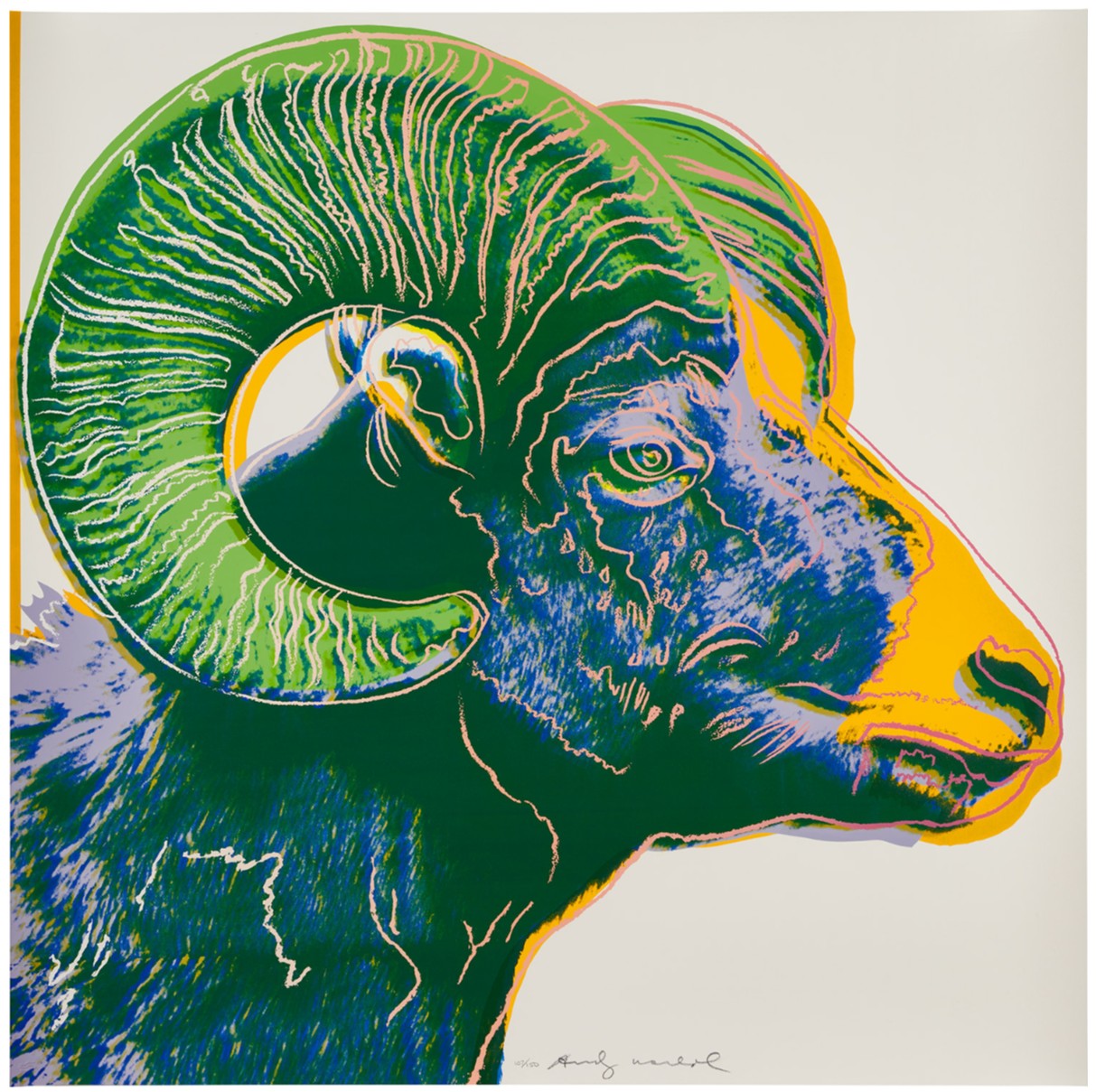
Screenprint in colors on Lenox Museum Board
(there were also 30 artist’s proofs)
Phillips New-York: 20 April 2023
Estimated: USD 60,000 – 90,000
USD 222,250
AUCTION RECORD FOR BIGHORN RAM
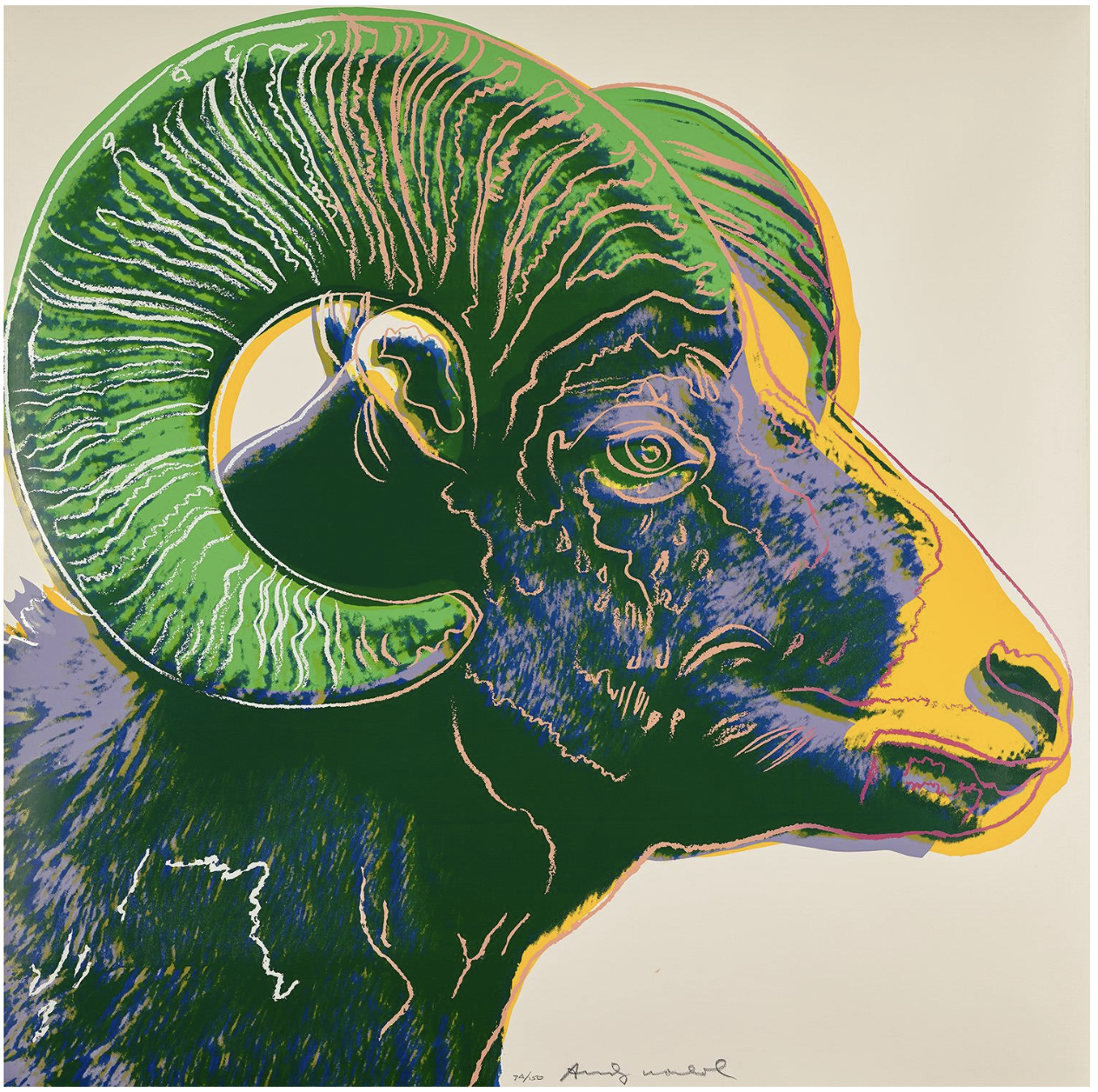
ANDY WARHOL
Bighorn Ram, from Endangered Species (F. & S. 302), 1983
Screen-print in colors on Lenox Museum Board
Signed and numbered 74/150 in pencil
Christie’s New-York: 21 April 2022
Estimated: USD 50,000 – 70,000
USD 201,600

ANDY WARHOL
Bighorn Ram, from Endangered Species, 1983
Screen-print in colors on Lenox Museum Board
Signed in pencil, numbered ‘EP 5⁄5’ (an Exhibition Proof)
Heritage Auctions: 19 October 2021
Estimated: USD 30,000 – 50,000
USD 112,500

ANDY WARHOL (1928-1987)
Bighorn Ram, from Endangered Species, 1983
Screenprint in colors on Lenox museum board
Signed and numbered 18/150 in pencil along lower edge, with publisher’s stamp
Trial Proofs
Bighorn Ram (TP 20/30), 1985
Christie’s New-York: 1 May 2013
Estimated: USD 35,000 – 55,000
USD 56,250
TRIAL PROOF
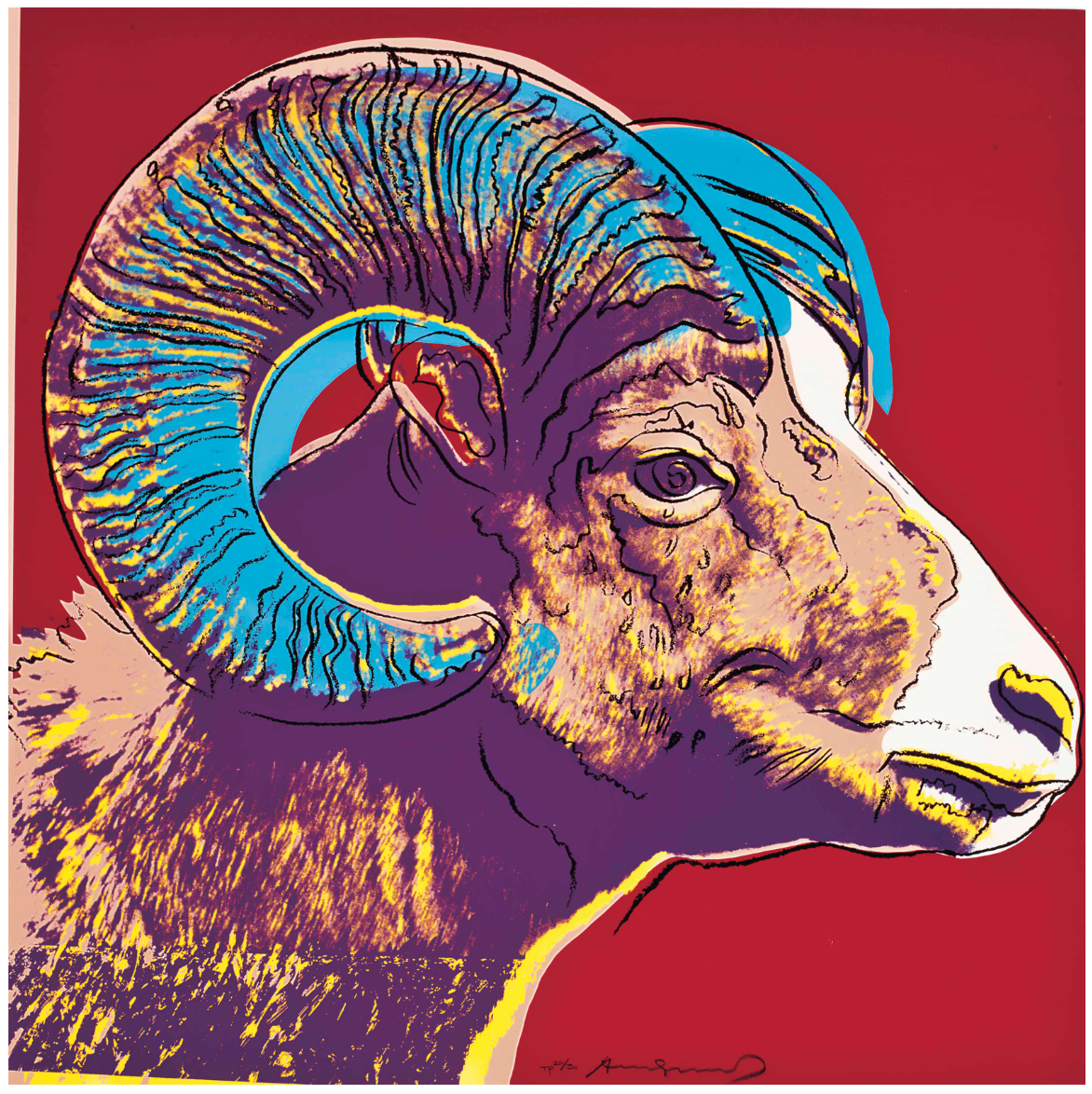
ANDY WARHOL
Bighorn Ram, from Endangered Species (see F. & S. II.302), 1983
Screenprint in colors on Lenox Museum Board
Signed in pencil, numbered ‘TP 20/30’
A unique trial proof, the edition was 150 plus 30 artist’s proofs)
Bighorn Ram (Aside TP), 1985
Sotheby’s New-York: 30 October 2010
Estimated: USD 40,000 – 50,000
USD 50,000
ASIDE TRIAL PROOF

ANDY WARHOL
Bighorn Ram (see F. & S. IIB.302), 1983
Screenprint in colors on Lenox Museum Board
A unique color trial proof, from the Endangered Species portfolio
With the Andy Warhol Art Authentication Board stamp on the verso, marked ‘outside the edition’
Bighorn Ram (TP 7/30), 1985
Christie’s London: 29 June 2005
Estimated: GBP 7,000 – 10,000
GBP 8,400
TRIAL PROOF
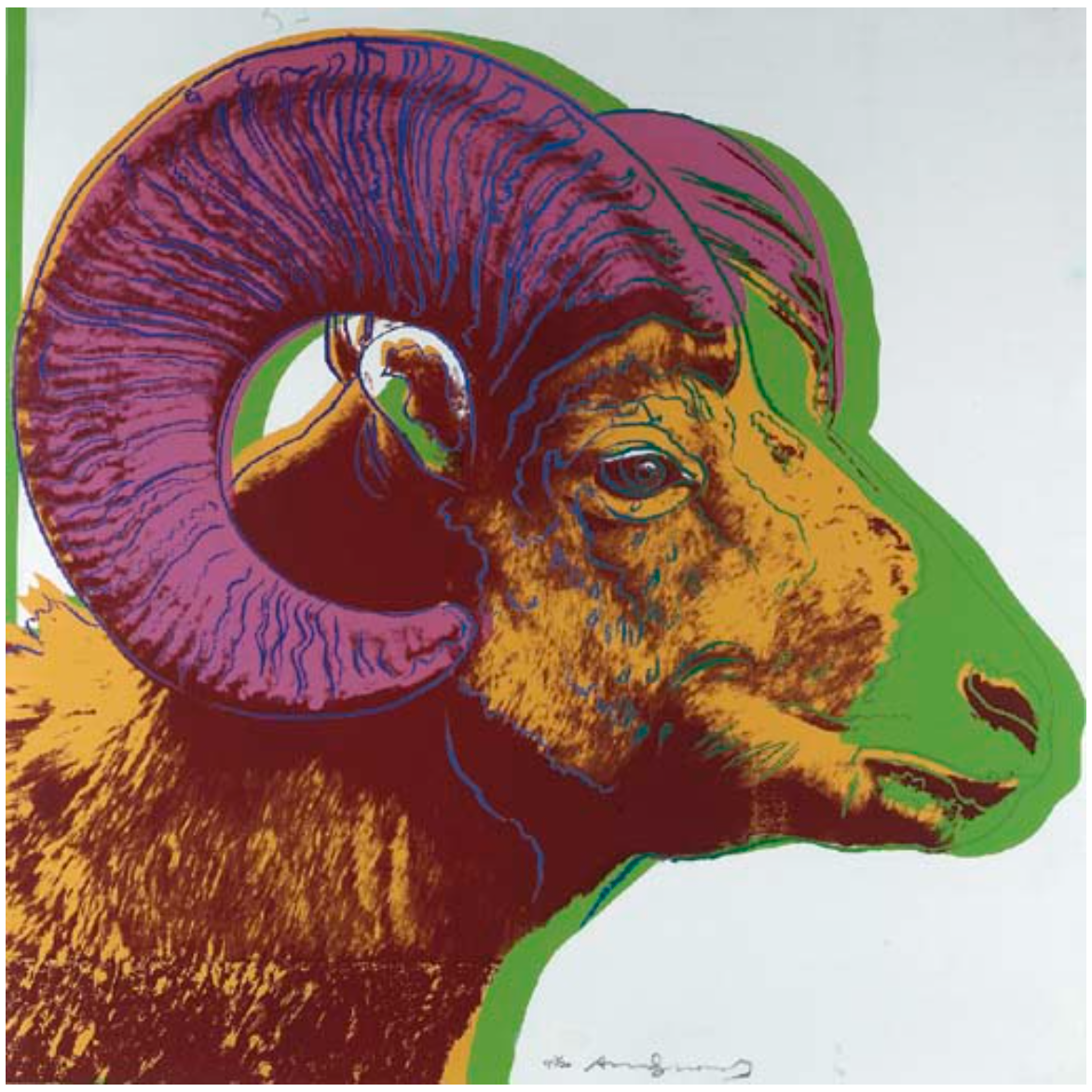
ANDY WARHOL
Bighorn Ram, from Endangered Species (F. & S. IIB 302), 1983
Screenprint in colors on Lenox Museum Board
Signed in pencil, numbered TP 7/30
A unique color variant aside from the published edition of one hundred and fifty
Bighorn Ram (TP 12/30), 1985
Christie’s Los Angeles: 13 December 1999
Estimated: USD 3,000 – 4,000
USD 12,650
TRIAL PROOF
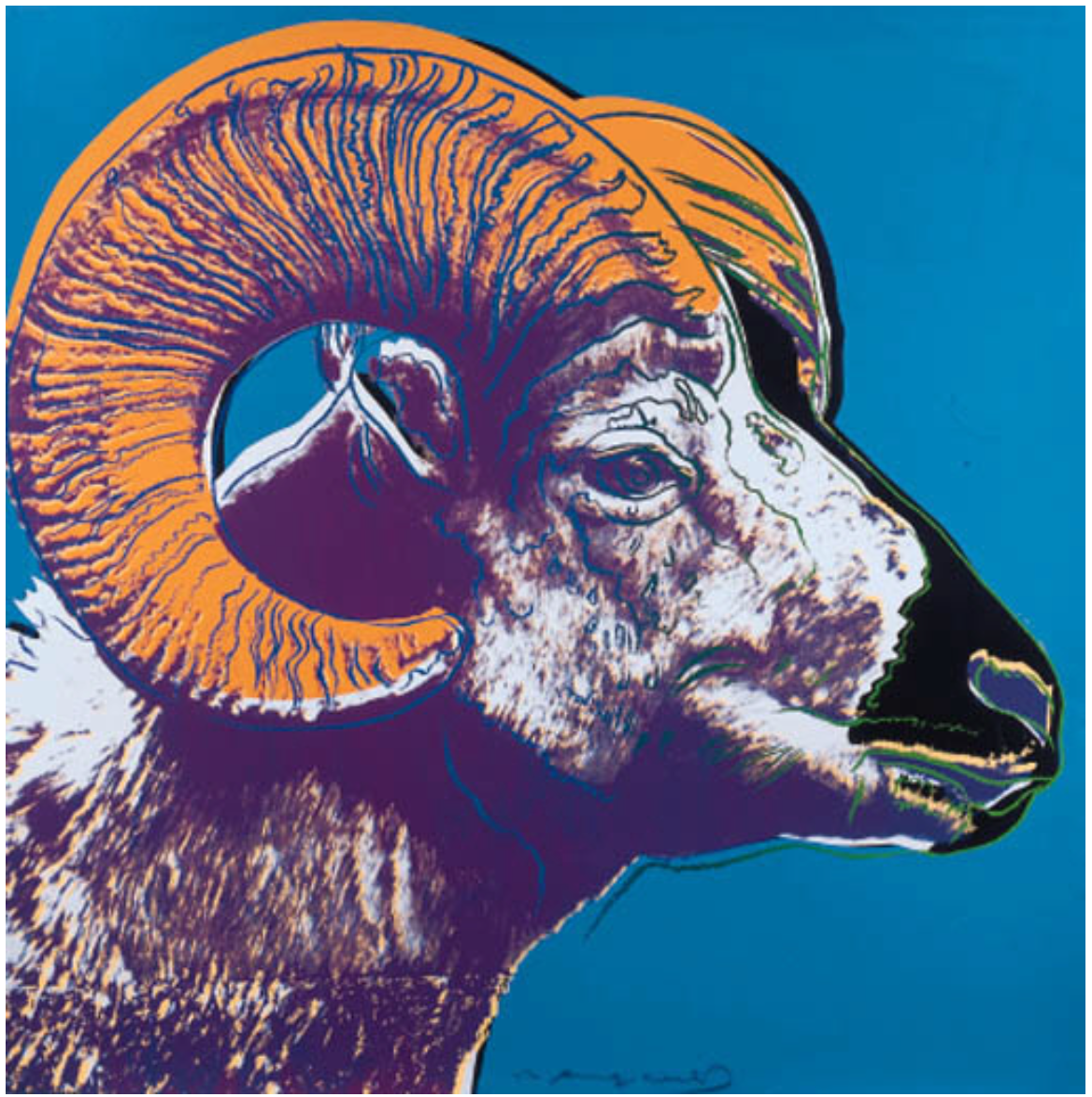
ANDY WARHOL
Bighorn Ram, for Endangered Species (F. and S. B.302), 1983
Unique screenprint in colors on Lenox Museum Board
Signed in pencil, numbered ‘T.P. 12/30’
One of 30 unique color variants aside from the edition of 150 plus 30 artist’s proofs