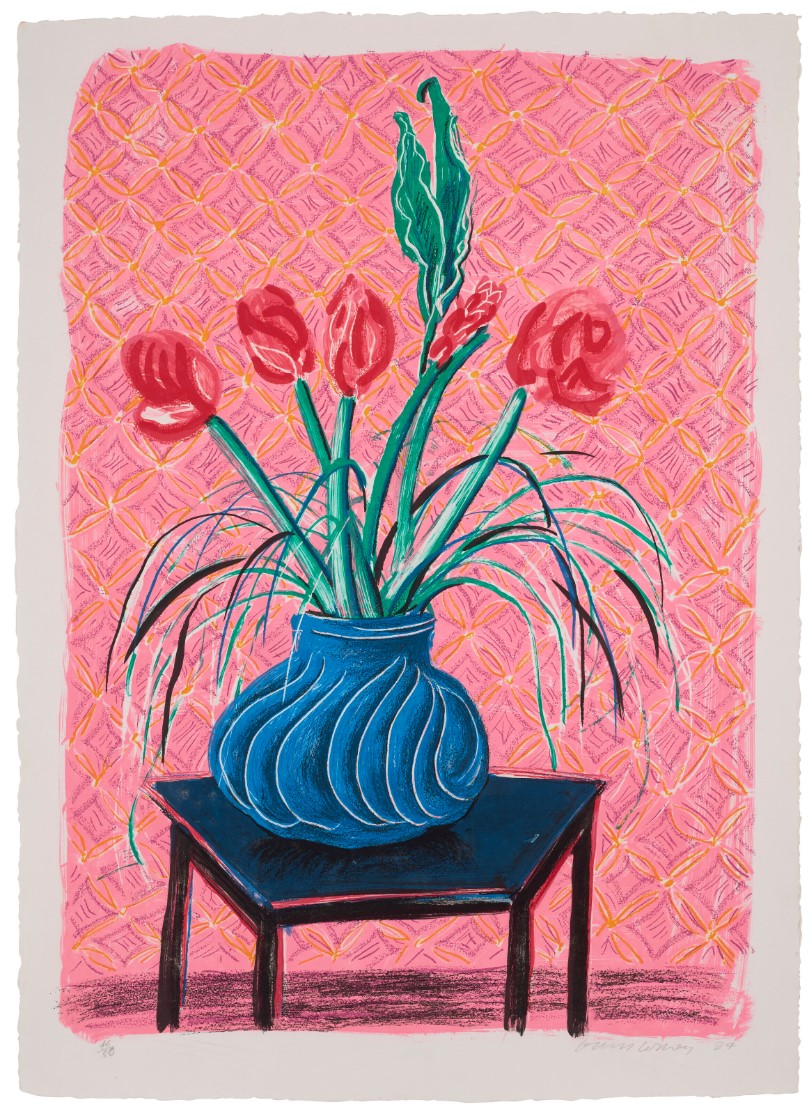
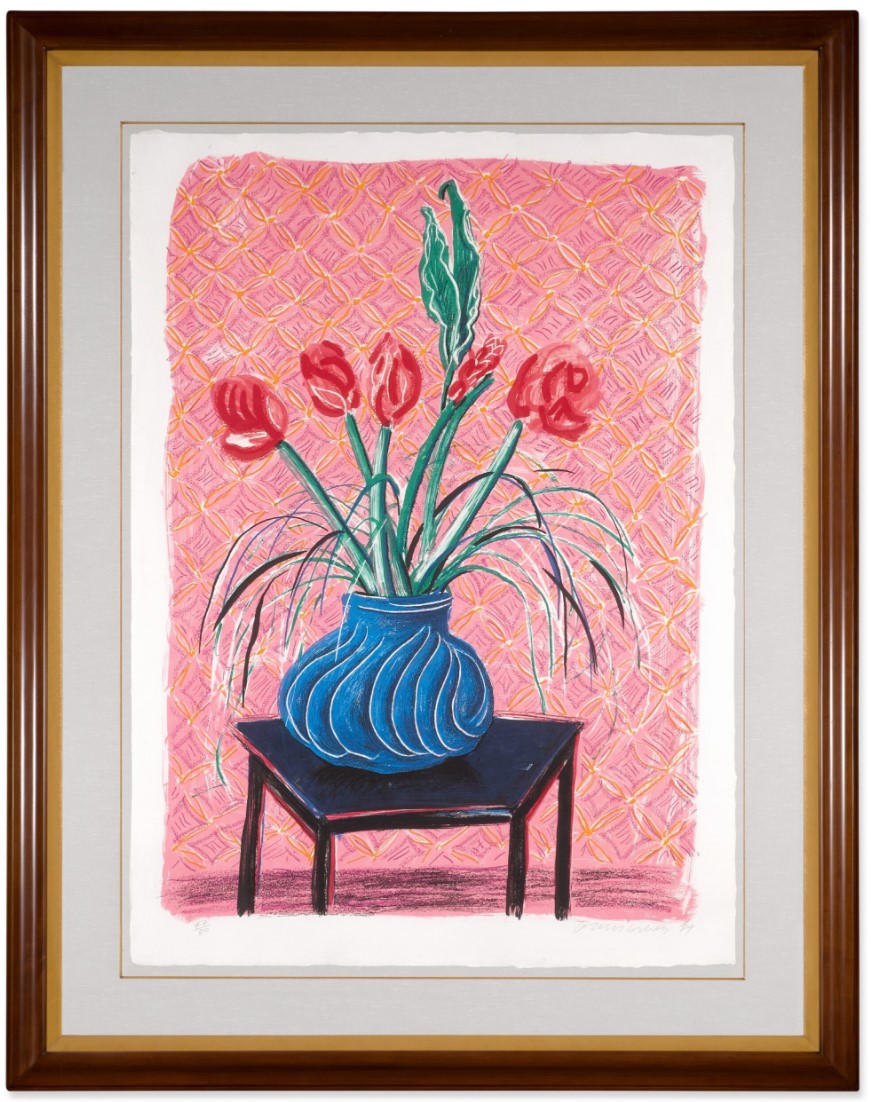
Amaryllis in Vase
from Moving Focus
Medium: Lithograph in colors on TGL handmade paper
Year: 1985
Image: 46 x 32 1/2 inches (116.8 x 82.6 cm)
Sheet: 50 x 36 1/4 inches (127×92 cm)
Edition: 80
Artist’s Proofs: 16
Publisher: Tyler Graphics Ltd., Bedford, New York
Literature: Tyler (272), Museum of Contemporary Art Tokyo (266)
Signed, dated and numbered in pencil with the publisher’s blindstamp
Shortly after moving to California, in the mid-1960s, David Hockney began his working relationship with master printer Kenneth Tyler. Collaborating with Tyler in all four of his workshops, Hockney found a joyous freedom in the variety of mark making he could produce through experimental lithography. It was with Tyler that Hockney embarked on his ambitious Moving Focus series, where he dove into his enduring concern with the construction of images, the complexities of space, and the assembly of multiple perspectives. The result was a body of work which remains his largest and most pioneering series of color lithographs, comprising 29 prints of interior views and chairs, still lifes, exterior views of a Mexican hotel, and portraits of some of his most well-known sitters including Celia Birtwell and Gregory Evans. Among these images is the luscious, jewel-toned bouquet, Amaryllis in Vase.
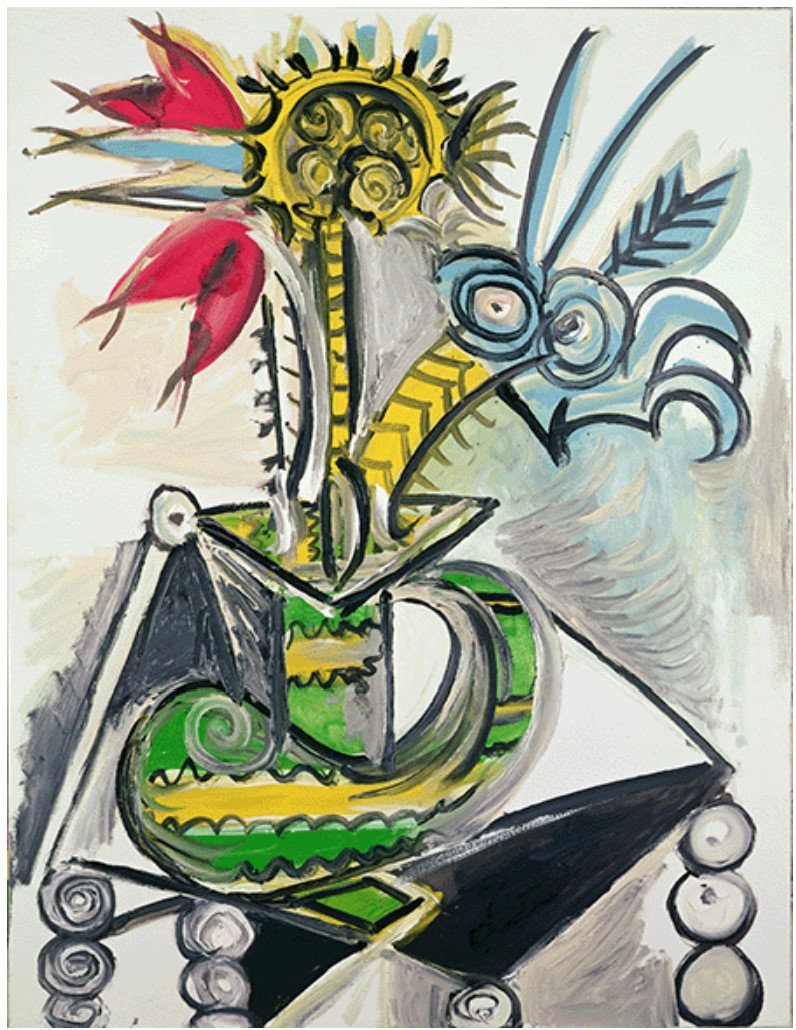
Pablo Picasso, Bouquet, 27th October, 1970. Image: Bridgeman Images, Artwork: © Succession Picasso / DACS, London 2022
The synesthetic experience of Hockney’s Amaryllis in Vase – the color, vibration and scent – pours out of the picture and envelops the viewer. The vibrant hues echo the freedoms that lithography as a medium afforded Hockey. For this still life, Hockney uses reverse perspective, placing the shorter end of the table closer to the viewer in the foreground of the composition, with the longer side at the back of the picture space. By reversing the traditional vanishing point, Hockney exploits the fluctuations of deep and shallow space, pushing everything into the foreground and directly involving the viewer. For Hockney, single-point perspective is a limited, constrictive way of communicating our experience of the world around us, which he likens to “looking at the world from the point of view of a paralyzed Cyclops – for a split second.” Drawing inspiration from the Cubism of Picasso’s 1980 retrospective at the Museum of Modern Art, New York, and works such as Bouquet, 27th October (1970), for his Moving Focus series, Hockney embraced a pictorial structure that could accommodate multiple viewpoints and perspectives as well as time and movement. The series combined the Renaissance tradition of fixed-viewpoint painting, visible in the many still lifes from the era, like Beuckelaer’s Vegetable Seller, with the Eastern aesthetic of multiple narratives within the same picture.
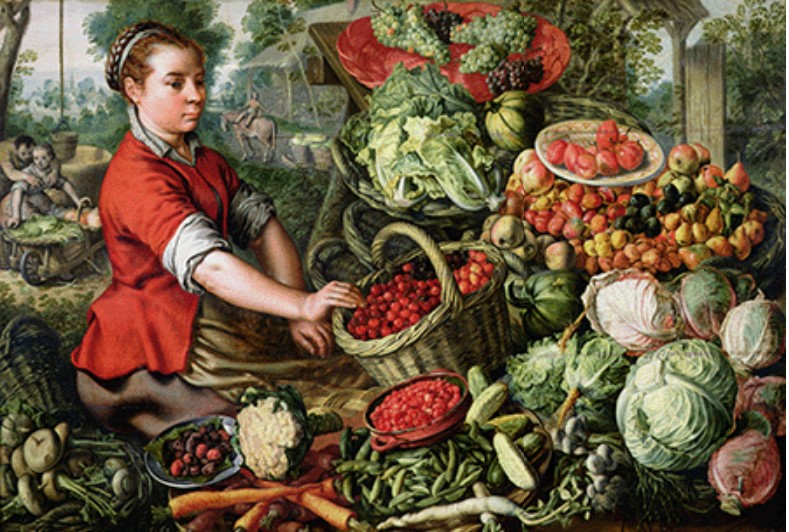
Joachim Beuckelaer, The Vegetable Seller, Musée des Beaux-Arts, Valenciennes. Image: Bridgeman Images
Hockney recognizes that we see both geometrically and psychologically and uses that knowledge to create images of sensuous line and color, through which the eye dances and where edges of viewpoints fold into and across each other. For example, the hazy chequerboard background in Amaryllis in Vase (reminiscent of Persian miniature paintings) bulges and recedes in optical illusion as our eye flits across the surface. The wallpaper appears to melt into the flowers rather than sitting passively behind them and as the table tilts forwards, the eye calculates the possibility of the vase smashing onto the floor. Hockney compared the human experience of looking as a matter of layering – of understanding the present by comparing it with the past, layer upon layer. When we look at his Amaryllis in Vase, we are seeing not only what is in front of us, but all the vases of flowers that we have ever seen.
Source: Phillips
Auction Results
Sotheby’s New-York: 22 October 2025
Estimated: USD 80,000 – 120,000
USD 152,400
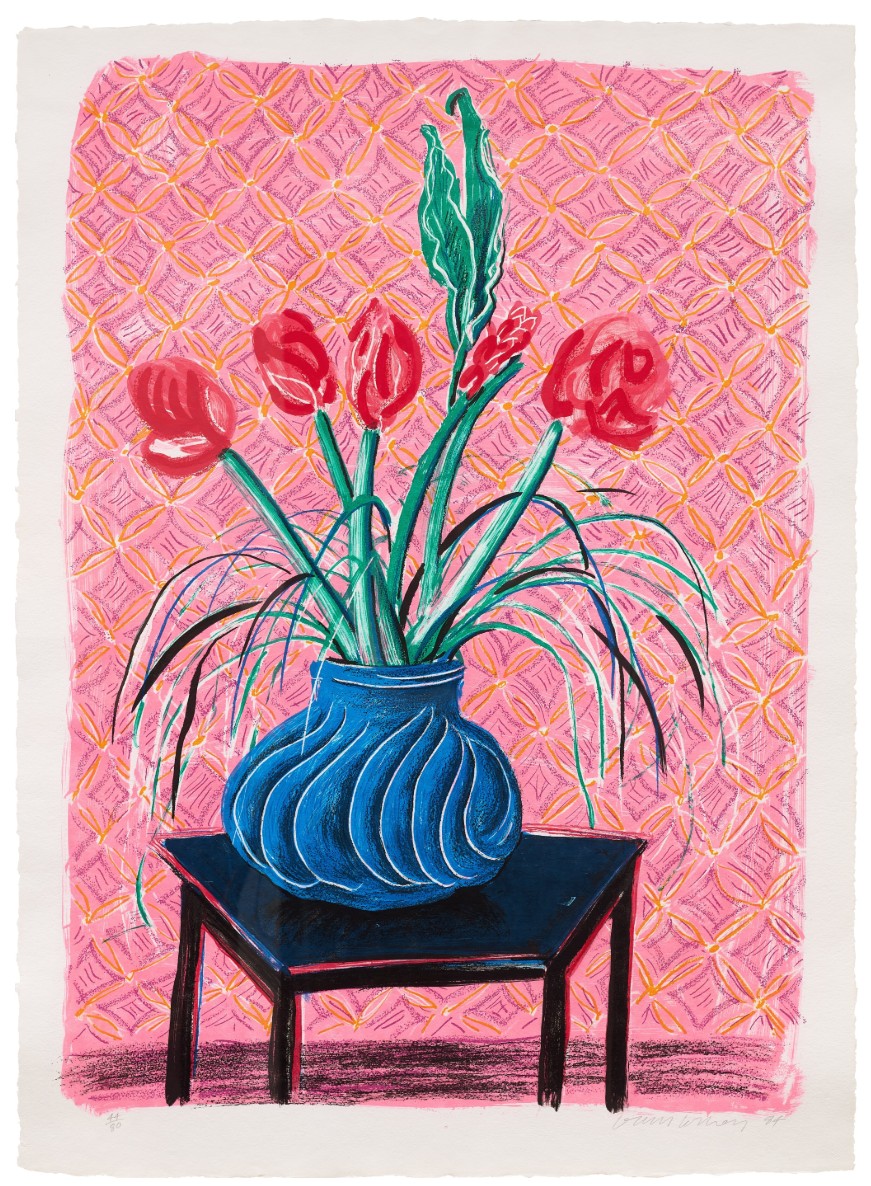
DAVID HOCKNEY (b. 1937)
Amaryllis in Vase (Museum of Contemporary Art, Tokyo 266), 1984
From the Moving Focus Series
Lithograph printed in colors on TGL handmade paper
Signed in pencil, dated and numbered 44/80
This impression is number 44 from the edition of 80 plus 16 artist’s proofs
With the blindstamp of the publisher, Tyler Graphics, Ltd.
Bonhams LA: 7 October 2025
Estimated: USD 70,000 – 100,000
USD 140,200
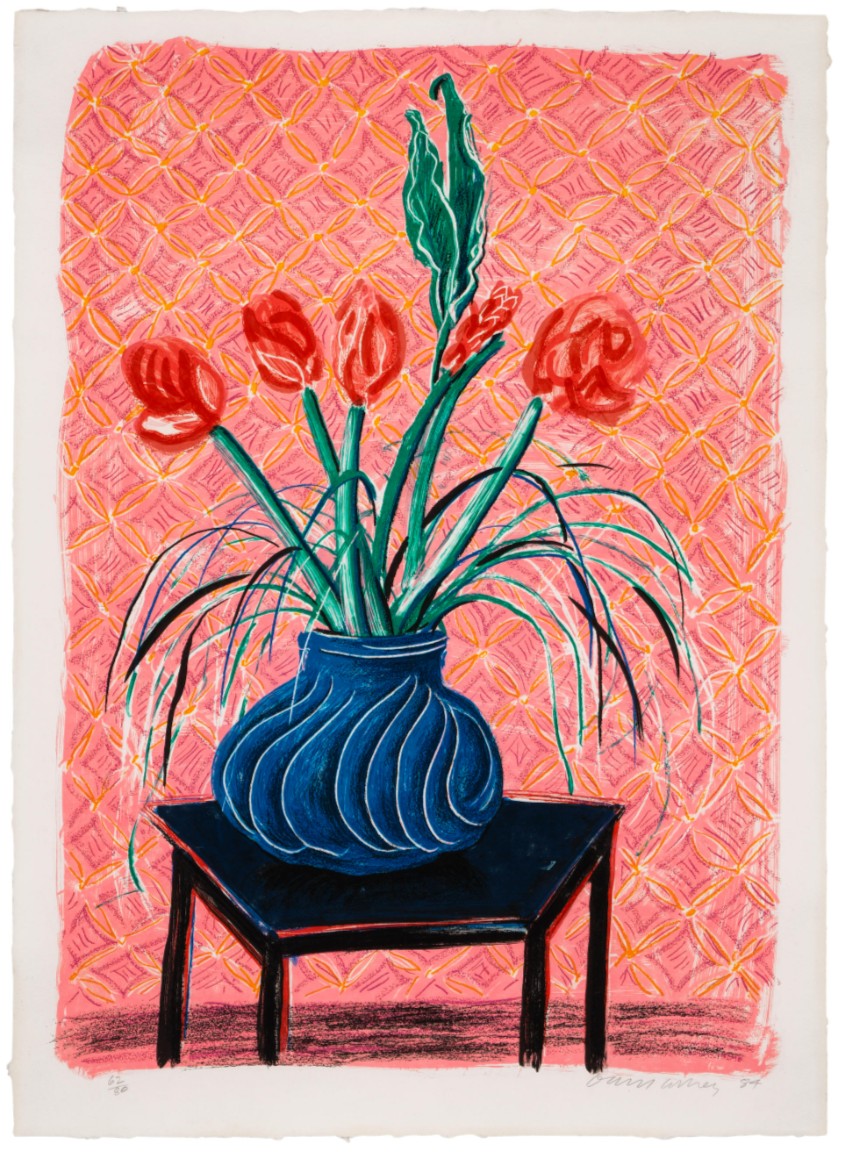
DAVID HOCKNEY (born 1937)
Amaryllis in Vase, from Moving Focus (Tyler 272, MCAT 266), 1985
Lithograph in colors on handmade TGL paper
Signed in pencil, dated ’84’ and numbered 62/80
(there were also 16 artist’s proofs)
Phillips London: 18 January 2023
Estimated: GBP 60,000 – 80,000
GBP 138,600 / USD 171,386
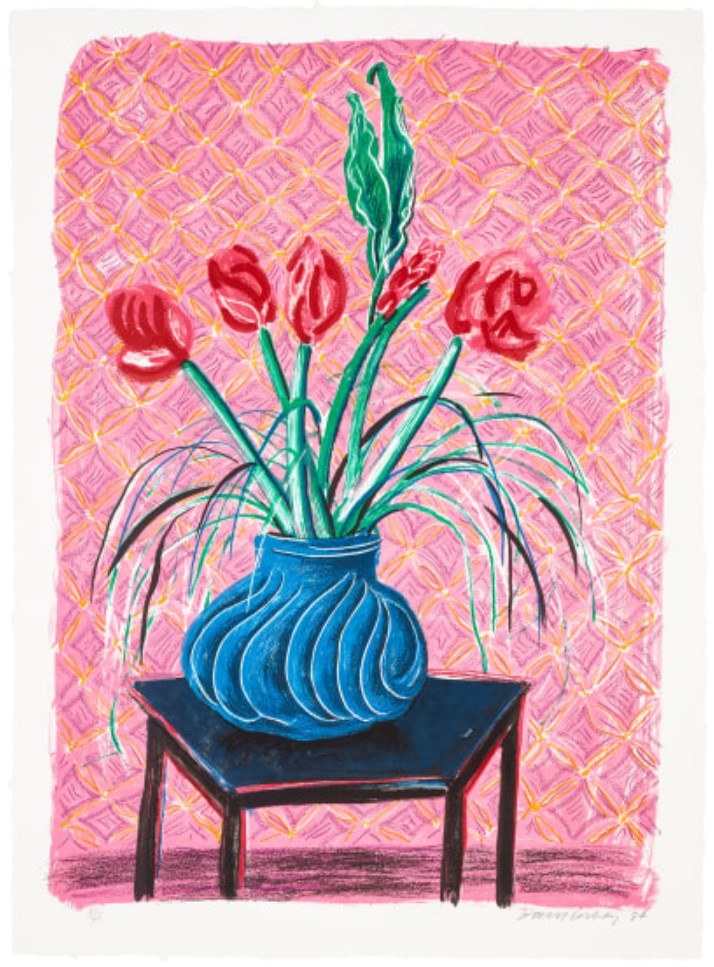
DAVID HOCKNEY
Amaryllis in Vase, from Moving Focus (T.G. 272, M.C.A.T. 266), 1984
Lithograph in colors on TGL handmade paper
Signed, dated and numbered 43/80 in pencil
Christie’s New-York: 27 October 2022
Estimated: USD 70,000 – 100,000
USD 88,200
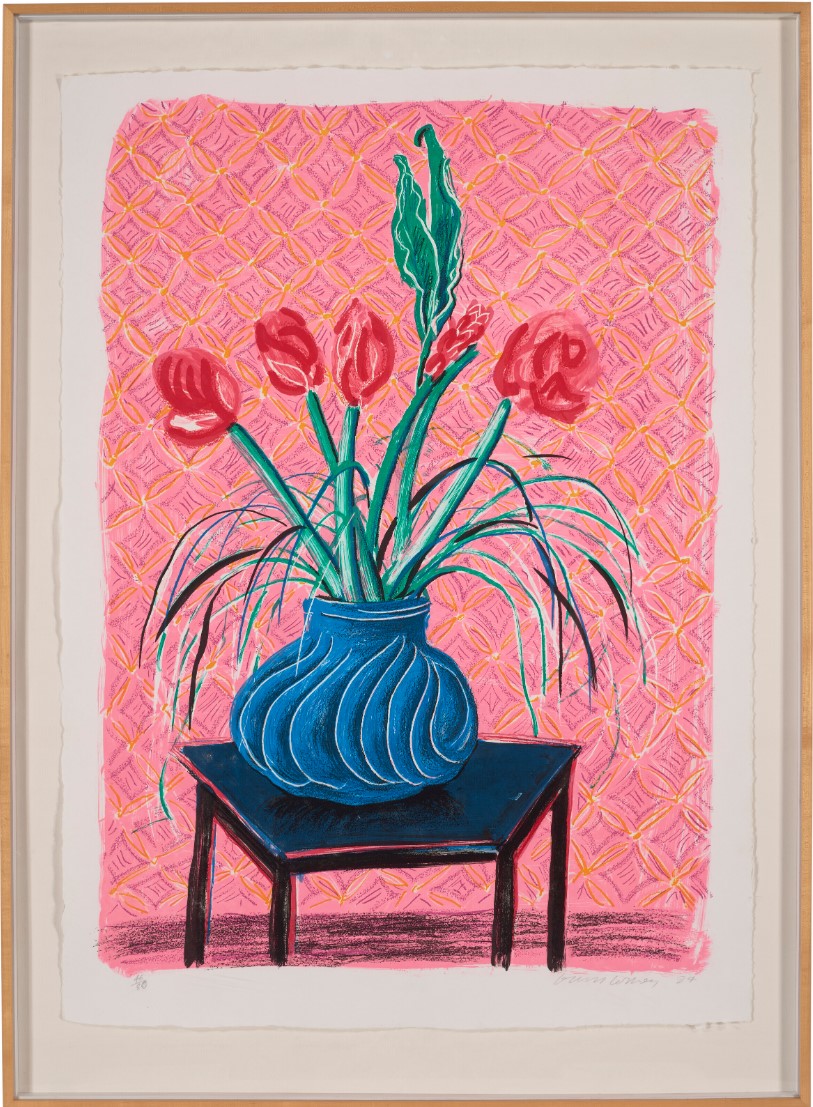
DAVID HOCKNEY (B. 1937)
Amaryllis in Vase, from Moving Focus, 1985
Lithograph in colors on TGL handmade paper
Signed and dated in pencil, numbered 46/80
Christie’s online: 28 September 2022
Estimated: GBP 60,000 – 80,000
GBP 176,400 / USD 190,929
AUCTION RECORD FOR AMARYLLIS
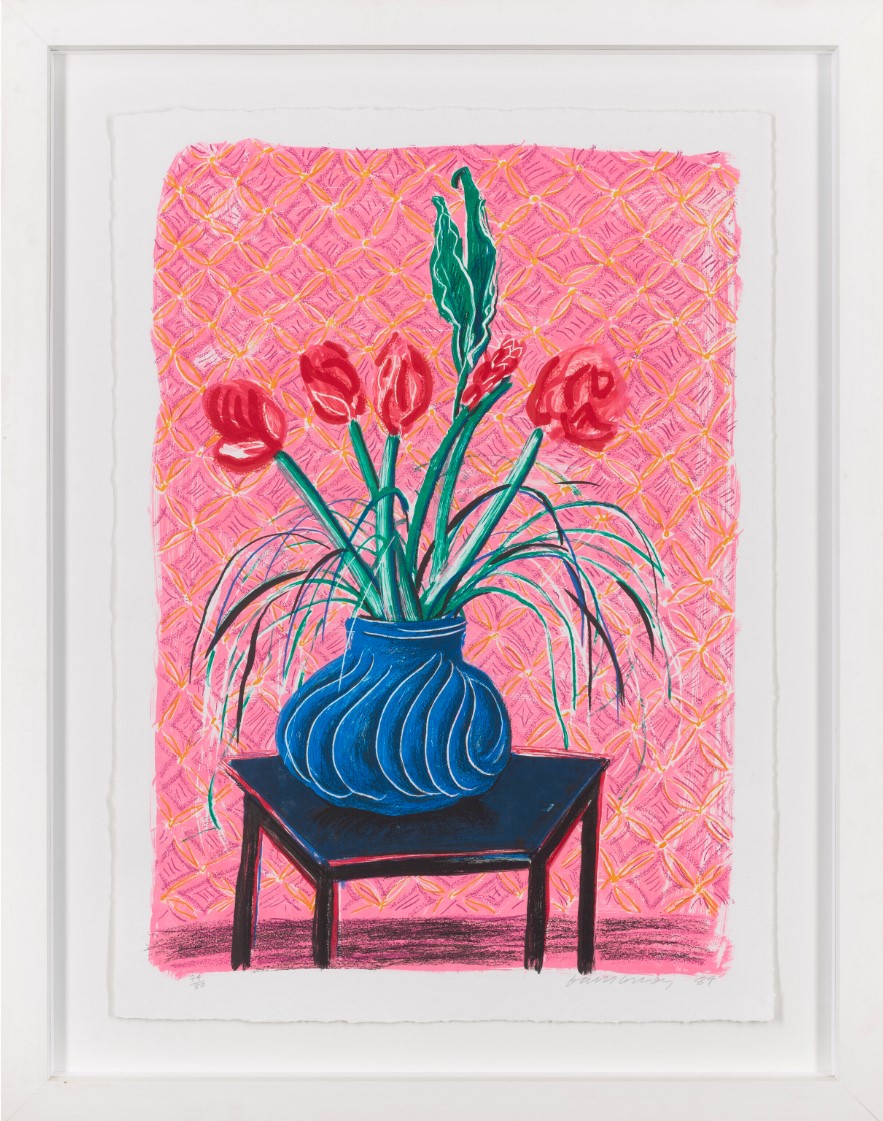
DAVID HOCKNEY (b. 1937)
Amaryllis in a Vase, from: Moving Focus, 1984
Lithograph in colors von white TLG handmade paper
Signed and dated in pencil, numbered 74/80
Sotheby’s New-York: 21 April 2022
Estimated: USD 70,000 – 90,000
USD 138,600
DAVID HOCKNEY (b.1937)
Amaryllis in Vase, fromMoving Focus (Museum of Contemporary Art, Tokyo 266), 1984
Lithograph printed in colors
Signed in pencil, dated ’84’ and numbered 47/80