2026 Fall New-York Marquee Auctions
Keith Haring
Upcoming Lots
Portrait of Grace Jones, 1986
Property from a Distinguished Private Collection
Sotheby’s New-York: 16 November 2026
Estimated: USD 3,500,000 – 5,000,000
Keith Haring | Portrait of Grace Jones | The Now and Contemporary
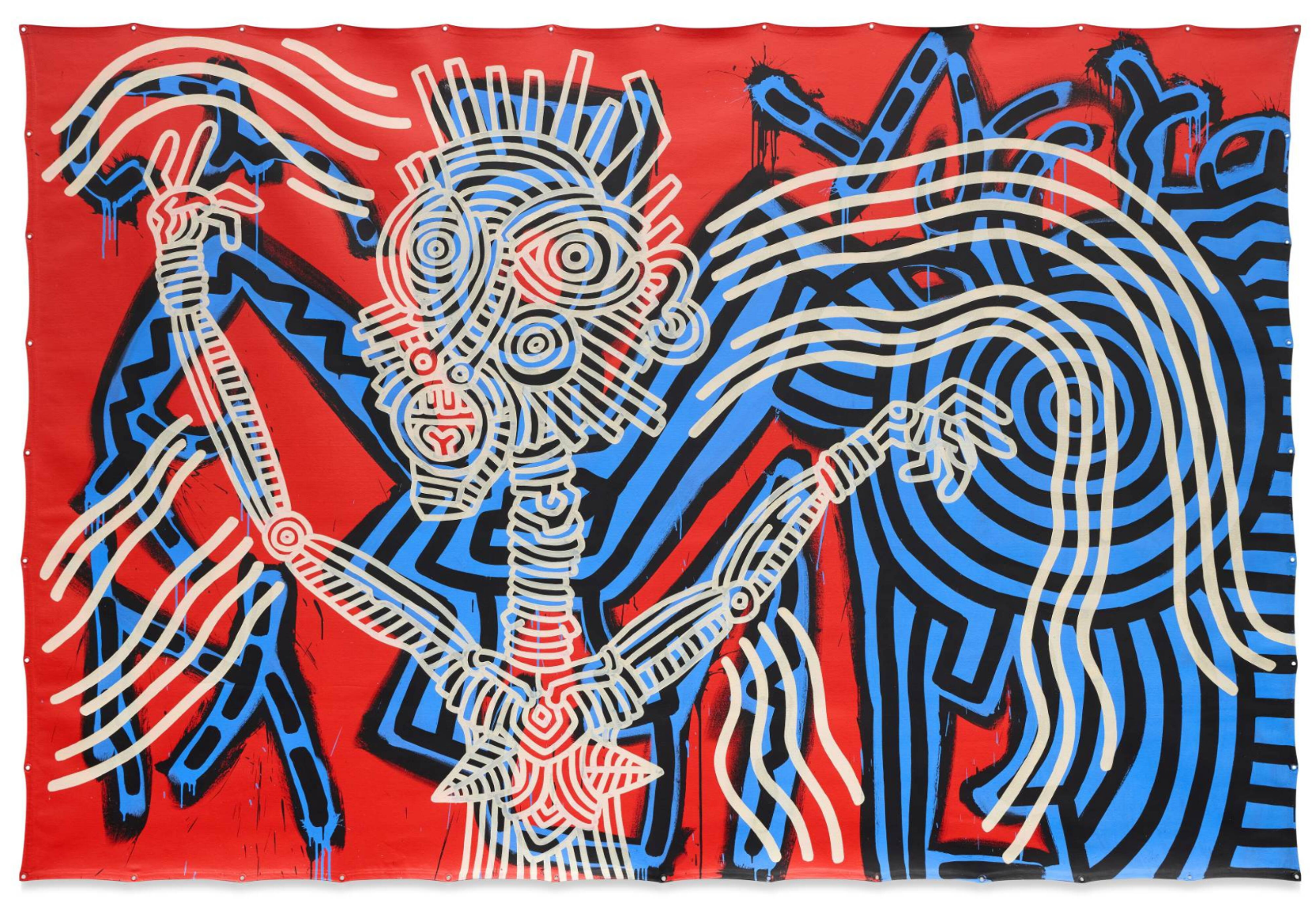
KEITH HARING (1958 – 1990)
Portrait of Grace Jones, 1986
Acrylic and oil on canvas tarpaulin
95-3/4 x 142-1/4 inches (243.2 x 361.3 cm)
Signed, titled, dated SEPT. 19, 1986 and dated again 86 (on the reverse)
Untitled, 1983
Sotheby’s New-York: 17 November 2026
Estimated: USD 2,000,000 – 3,000,000
Keith Haring | Untitled | Contemporary Day Auction | 2026 | Sotheby’s
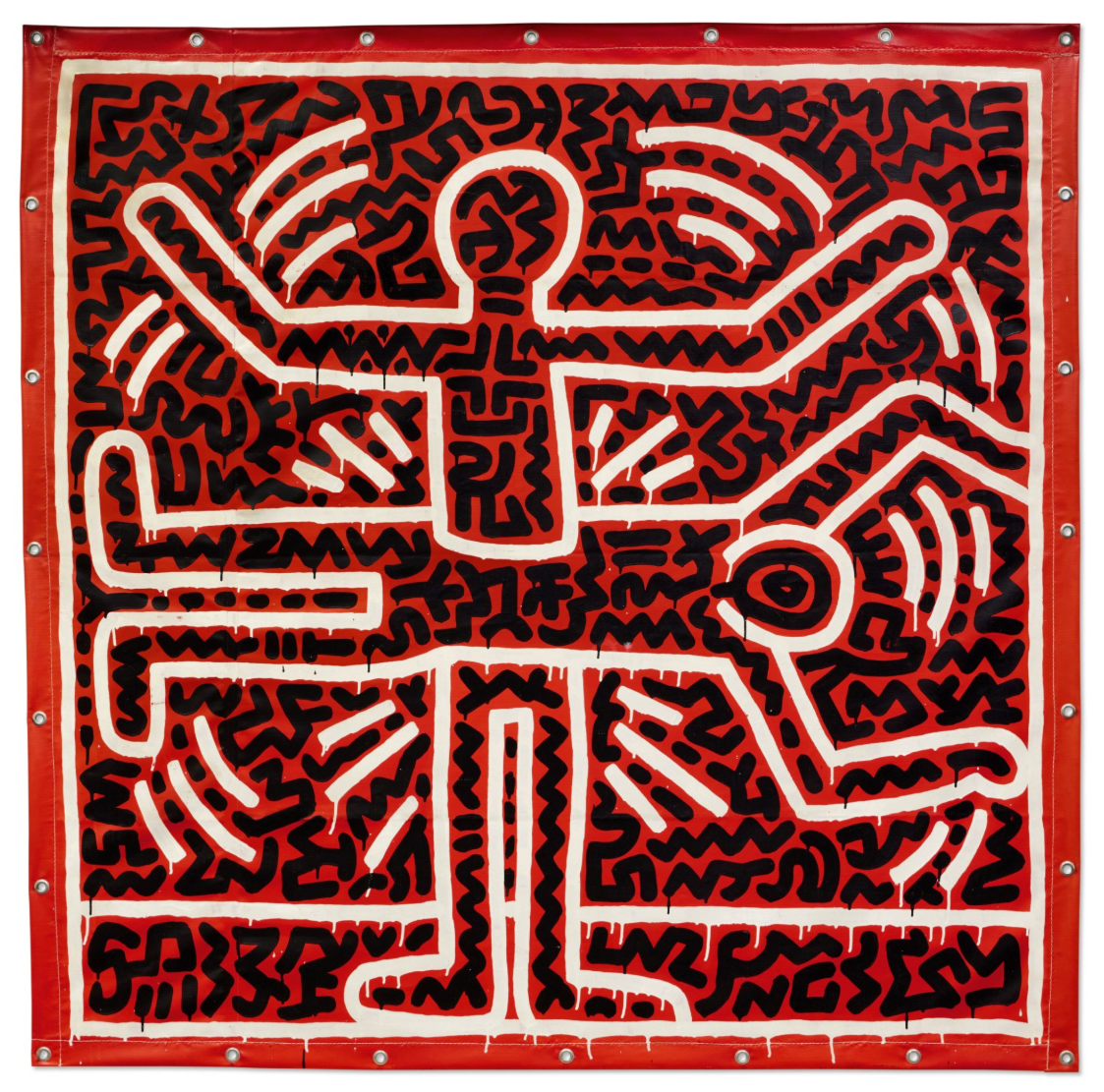
KEITH HARING (1958 – 1990)
Untitled, 1983
Acrylic on vinyl tarpaulin
73-1/4 x 73-1/4 inches (186×186 cm)
Signed and dated SEPT. 21-83 (on the reverse)
Untitled, 1988
Property from the Estate of JoAnn Sawitz Bass
Phillips New-York: 17 November 2026
Estimated: USD 900,000 – 1,200,000
Keith Haring Modern & Contemporary Art Evening Sale
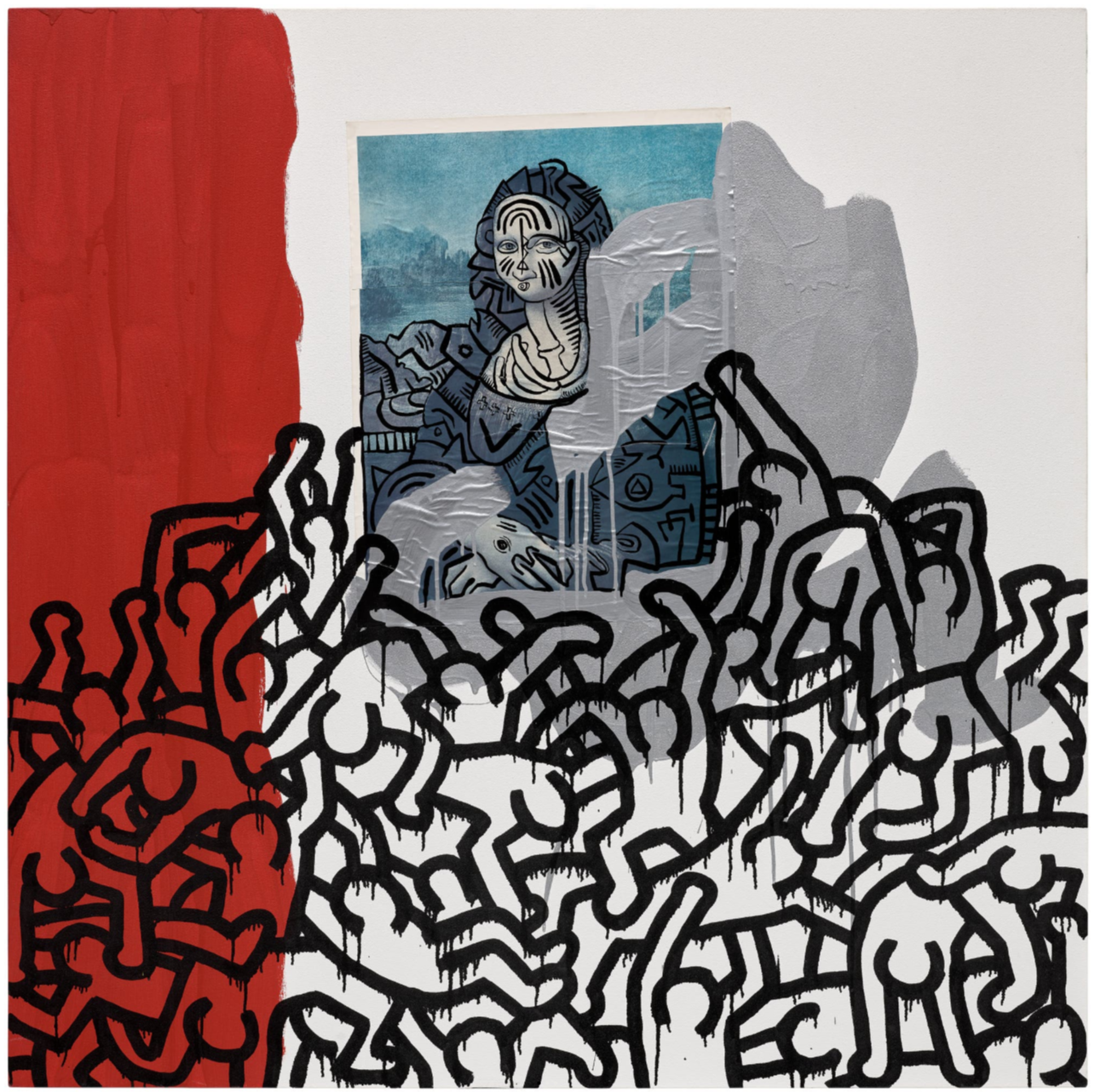
KEITH HARING
Untitled, 1988
Acrylic, enamel paint and collage on canvas
60-1/8 x 60-1/8 inches (152.7 x 152.7 cm)
Signed and dated “© K. Haring NOV.21 1988 ⨁” on the overlap
Executed on November 21, 1988, in the United States
Untitled (Subway Drawing), 1982
Sotheby’s New-York: 17 November 2026
Estimated: USD 300,000 – 500,000
Keith Haring | Untitled (Subway Drawing) | Contemporary Day Auction |
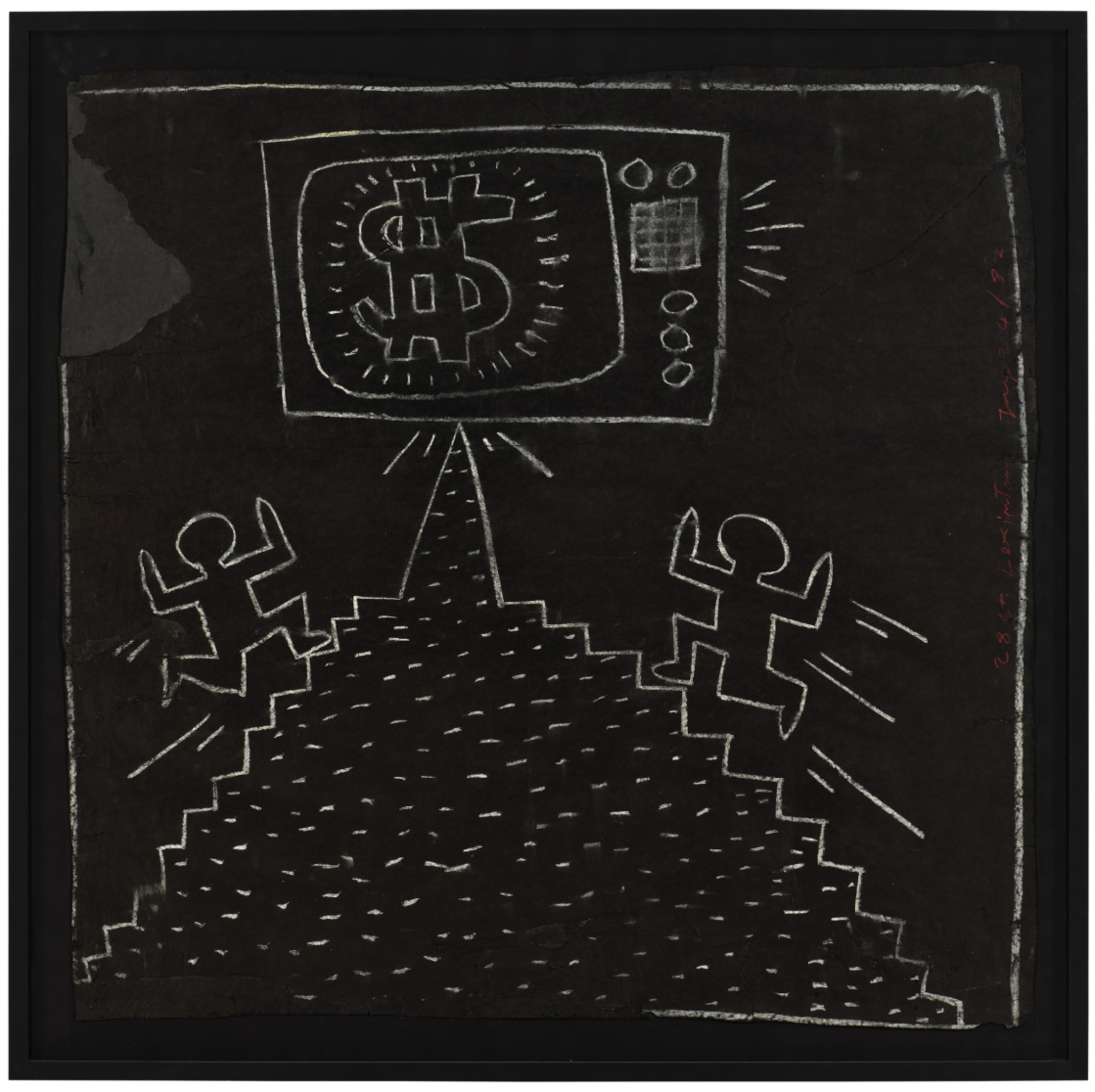
KEITH HARING (1958 – 1990)
Untitled (Subway Drawing), 1982
Chalk on two joined sheets laid down on canvas and panel
Sheet: 39-1/2 x 38-3/4 inches (100.3 x 98.4 cm)
Panel: 42-1/8 x 42-1/2 inches (107×108 cm)
Untitled (Acrobats), 1987
Looking Forward: The Collection of Beverly Grossman
Sotheby’s New-York: 17 November 2026
Estimated: USD 250,000 -350,000
Keith Haring | Untitled (Acrobats) | Contemporary Day Auction | 2026

KEITH HARING (1958 – 1990)
Untitled (Acrobats), 1987
Enamel on metal
23-5/8 x 9 x 5-3/4 inches (60 x 22.9 x 14.6 cm)
This work is number 2 from an edition of 6
Totem, 1988-89
Looking Forward: The Collection of Beverly Grossman
Sotheby’s New-York: 17 November 2026
Estimated: USD 250,000 -350,000
Keith Haring | Totem | Contemporary Day Auction | 2026 | Sotheby’s
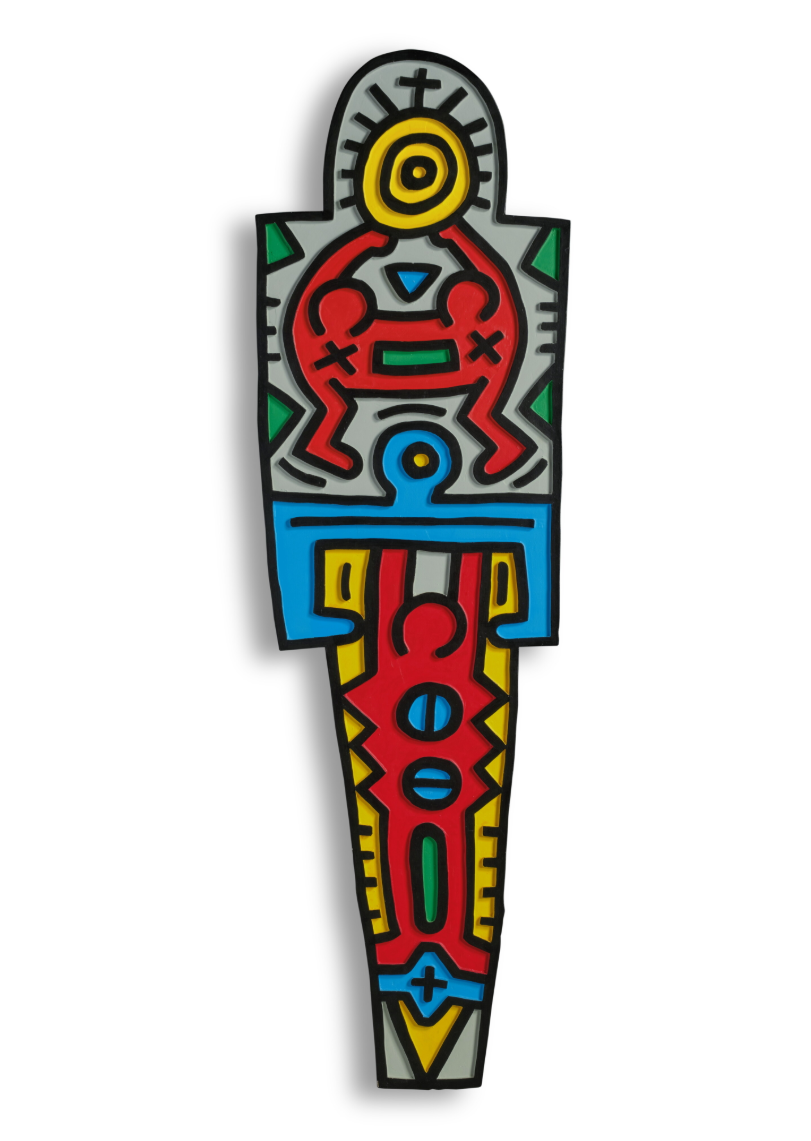
KEITH HARING (1958 – 1990)
Totem, 1988-89
Carved plywood painted with enamel in colors
Height: 72-1/8 inches (183.2 cm)
Signed, dated 88 and inscribed HC 4/4 (on the metal plaque affixed to the reverse)
This work is one of 4 hors commerce examples aside from the numbered edition of 35 plus 7 artist’s proofs
Published by Edition Schellmann
Untitled, 1984
Christie’s New-York: 20 November 2026
Estimated: USD 100,000 – 150,000
WORK ON PAPER
KEITH HARING (1958-1990), Untitled | Christie’s
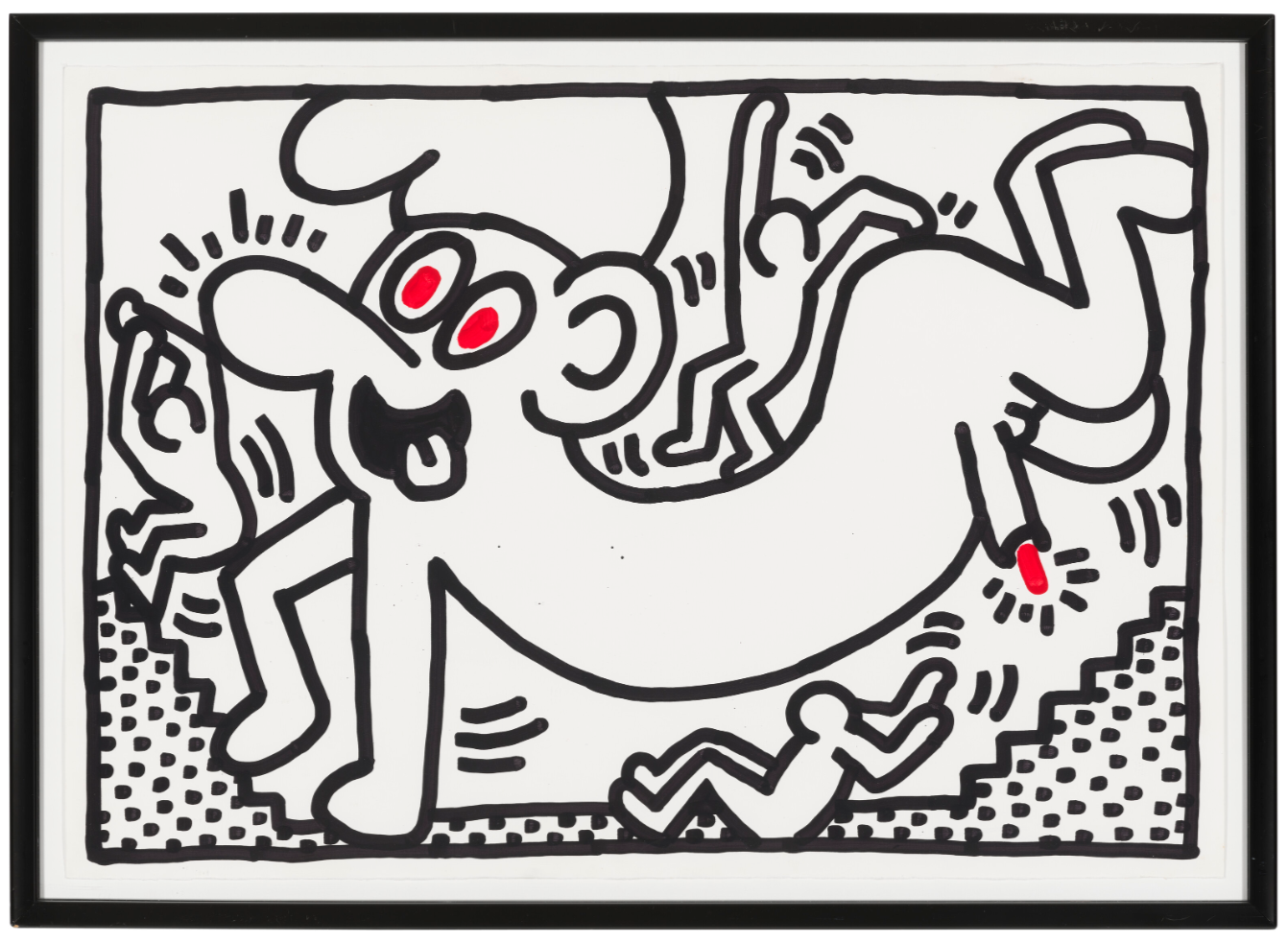
KEITH HARING (1958-1990)
Untitled, 1984
Acrylic on paper
27-5/8 x 39-1/4 inches (70×100 cm)
Signed, inscribed and dated ‘K. Haring Jun 14 – 84 MILANO’ (on the reverse)
Portrait of Grace Jones, 1986
Portrait of Grace Jones, 1986
Property from a Distinguished Private Collection
Sotheby’s New-York: 16 November 2026
Estimated: USD 3,500,000 – 5,000,000
Keith Haring | Portrait of Grace Jones | The Now and Contemporary
KEITH HARING (1958 – 1990)
Portrait of Grace Jones, 1986
Acrylic and oil on canvas tarpaulin
95-3/4 x 142-1/4 inches (243.2 x 361.3 cm)
Signed, titled, dated SEPT. 19, 1986 and dated again 86 (on the reverse)
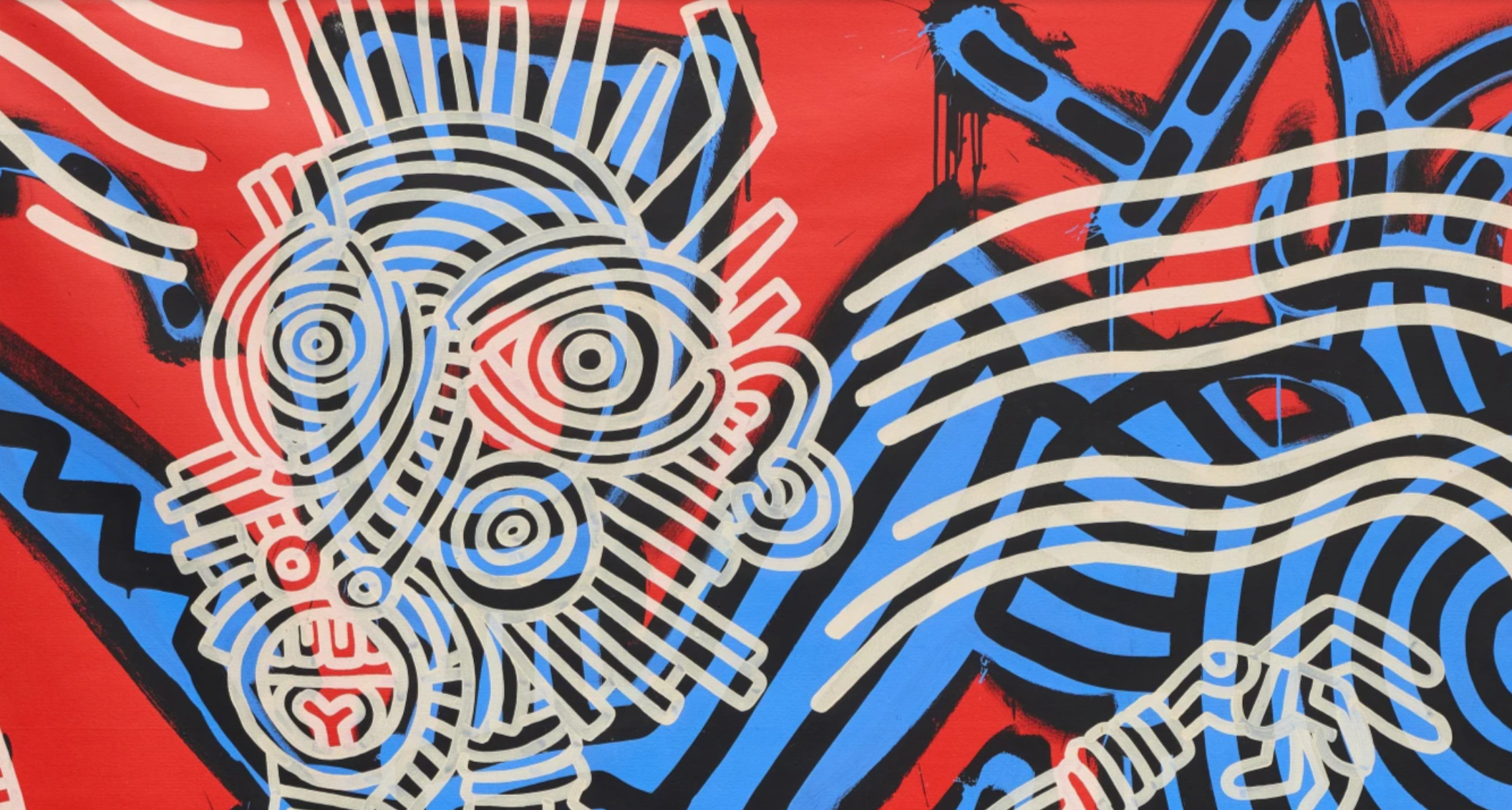
Executed in 1986, at the height of Keith Haring’s creative powers, Portrait of Grace Jones is a vibrant celebration of the extraordinary artistic dialogue between two of the most influential figures of New York’s cultural landscape of the 1980s. Monumental in scale and electrifying in its saturated palette, the present work captures the spirit of individuality, experimentation and liberating self-expression that defined the era. Icons of the city’s intersecting worlds of art, music, fashion and performance, Haring and Jones shared a creative vision that challenged conventional boundaries of identity, sexuality and artistic expression. Their celebrated collaborations, which unfolded across painting, dance, fashion and performance, find particularly compelling resonance in the present work.
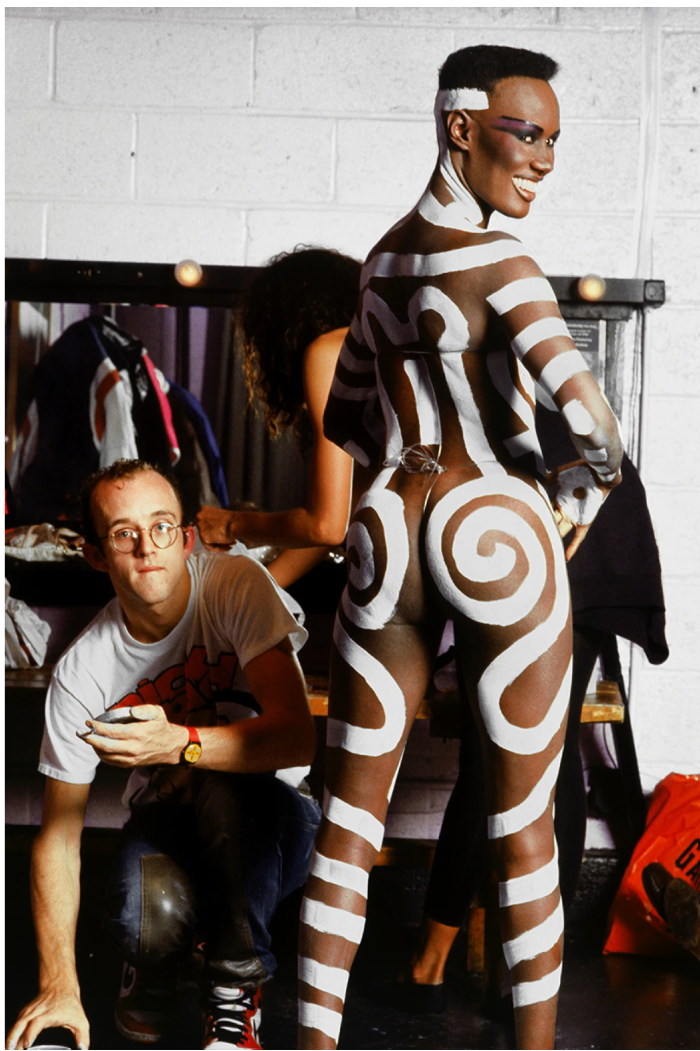
Grace Jones painted by Keith Haring, Paradise Garage, New York, 1985. Photo by Tseng Kwong Chi.
Photo © Muna Tseng Dance Projects, Inc.
Art © Keith Haring Foundation Miriam Kershaw, “Postcolonialism and Androgyny: The Performance Art of Grace Jones,” Art Journal, vol. 56, 1997, p. 21
A rare portrait within Haring’s oeuvre, Portrait of Grace Jones transforms the musical icon into a dynamic constellation of color, line and movement, crystallizing the creative energy of their remarkable partnership. With her celebrated androgynous style and commanding stage presence, Jones challenged conventional notions of gender, beauty and representation through her music and performances. As art historian Miriam Kershaw observes, “By quickly discarding her emphatically artificial costume, Jones insinuates that racial stereotypes are, themselves, a mask which will be manipulated throughout the performance.” (Miriam Kershaw, “Postcolonialism and Androgyny: The Performance Art of Grace Jones,” Art Journal, vol. 56, 1997, p. 21) Jones’s radical approach to identity and self-presentation found a natural affinity with Haring’s artistic practice, which engaged deeply with questions of sexuality, identity and the stigmatization of queer communities. Both artists employed the body as a powerful vehicle for expression, challenging established conventions through the immediacy of movement, image and performance. Their shared creative ethos is vividly manifested in the present work, a kinetic and deeply expressive portrait that transforms Jones’s singular stage presence into Haring’s unmistakable visual language.
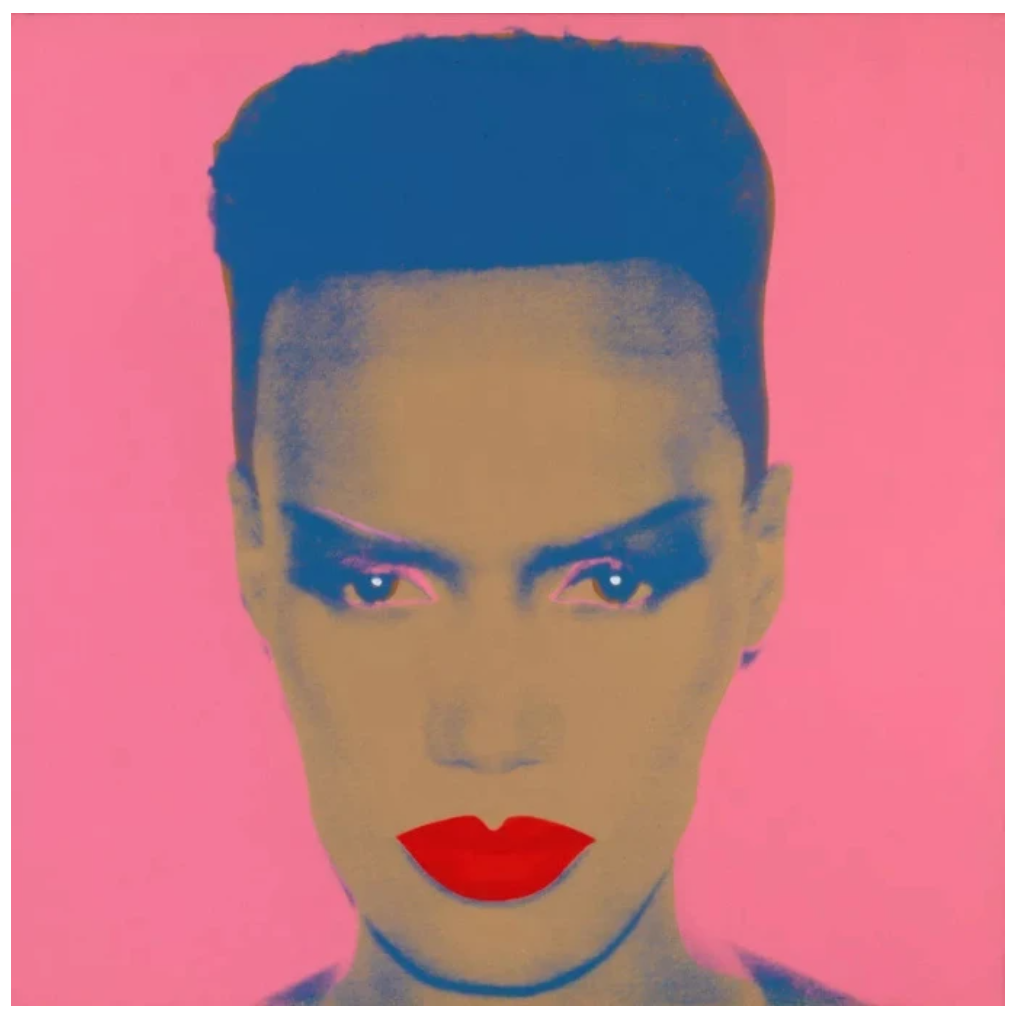
Andy Warhol, Grace Jones, 1986. The Andy Warhol Museum, Pittsburgh, Founding Collection. Image © The Andy Warhol Foundation for the Visual Arts, Inc. Art © 2026 Andy Warhol Foundation for the Visual Arts / Artists Rights Society (ARS), New York
The melodic, virtuosic gestures of Haring’s brushwork animate the composition with an almost musical rhythm. Against a brilliant vermilion ground, a sprawling blue form extends toward the commanding figure of Jones, whose outstretched arms and elongated limbs appear to pulsate with movement. Recalling the sculptural costumes and elaborate body adornments that became synonymous with her performances, the figures appear suspended in a moment of dramatic confrontation, their opposing gestures establishing a palpable tension across the picture plane. Haring’s characteristic economy of line lends the composition an extraordinary sense of immediacy, while the vivid contrasts of red, blue and white heighten its theatrical intensity. Known for his iconic, anonymous and often genderless figures, Haring here turns his unmistakable visual vocabulary toward the representation of a specific individual. Yet rather than offering a conventional likeness, he captures Jones through the expressive language of movement, gesture and performance. Throughout their careers, Haring and Jones cultivated a remarkable creative partnership, producing some of the most memorable images and performances of the decade.
In 1986, Haring adorned a billowing, approximately 60-foot dress with his signature motifs for the music video accompanying Jones’s song I’m Not Perfect (But I’m Perfect for You). Their collaborations also extended to live performance, including a celebrated New Year’s Eve appearance at New York’s Roseland Ballroom, for which Haring transformed Jones’s body and costume into an extension of his graphic vocabulary. Particularly significant was their collaboration on Richard Wenk’s 1986 film Vamp, for which Haring painted Jones’s body in his characteristic rhythmic patterns.
The film’s theatrical imagery finds a compelling visual parallel in the palette and composition of the present work. In one of its most memorable sequences, a crescent-shaped stage glows beneath fluorescent green and purple lights as Jones emerges before an anonymous audience, crowned by a crimson wig and adorned with Haring’s painted motifs and sculptural wire accessories. Embodying Katrina, an Egyptian vampire queen, Jones dances and contorts across the stage, transforming her body into a living work of art. The interplay between performer and spectator, heightened by the film’s theatrical staging, introduces a compelling tension between the act of looking and the power of the figure who commands the gaze. In Portrait of Grace Jones, Haring similarly captures the transformative potential of performance, distilling Jones’s extraordinary physical presence into an image of arresting vitality.
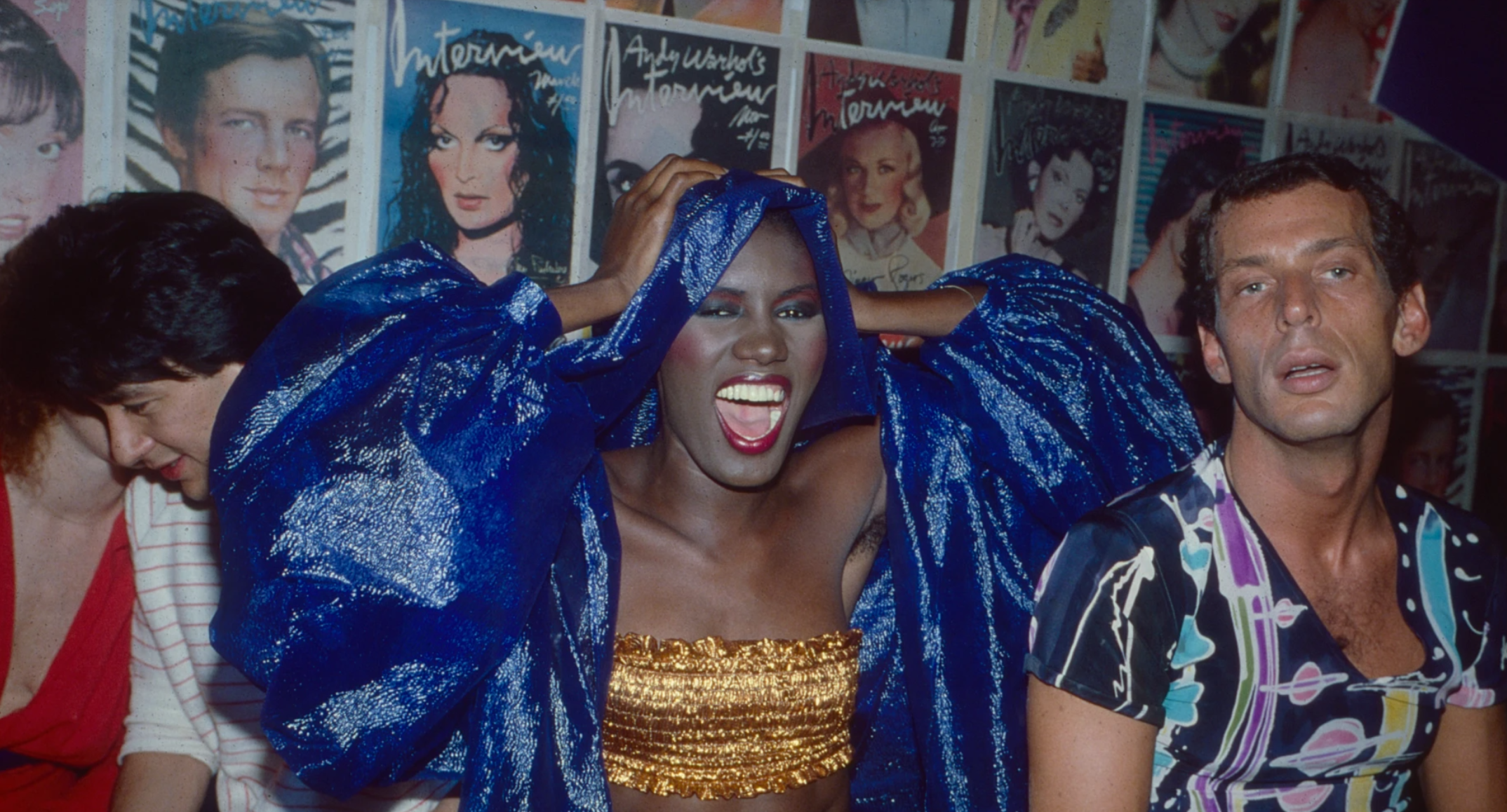
Grace Jones at Interview Magazine’s Studio 54 party, 1979. Image © Archive Photos via Getty Images
Monumental in scale and radiant in its saturated color, the present work demonstrates Haring’s consummate command of painting on tarpaulin, a medium that became an important vehicle for his artistic experimentation. Haring first encountered the possibilities of the material in 1981, when he observed Con Edison workers covering equipment with vinyl tarpaulins on the streets of New York. Drawn to the material’s durability, flexibility, and industrial character, he began incorporating it into his practice, discovering that specialized screen-printing inks could adhere to its synthetic surface. As Haring later recalled, “One day, I observed some Con Edison men working on the street, and they were covering their equipment with these vinyl tarpaulins, which had these little metal grommets in them…” (The artist quoted in: John Gruen, Keith Haring: The Authorized Biography, New York 1991, p. 85) The rippled surface and industrial materiality of the present work evoke the texture and immediacy of New York’s urban landscape, while embodying Haring’s conviction that art should transcend traditional institutional boundaries. Transforming a utilitarian material into a monumental pictorial surface, Haring united the visual language of the street with the ambition and scale of painting. By 1986, his experimentation with tarpaulin had developed into a distinctive and fully realized aspect of his practice.
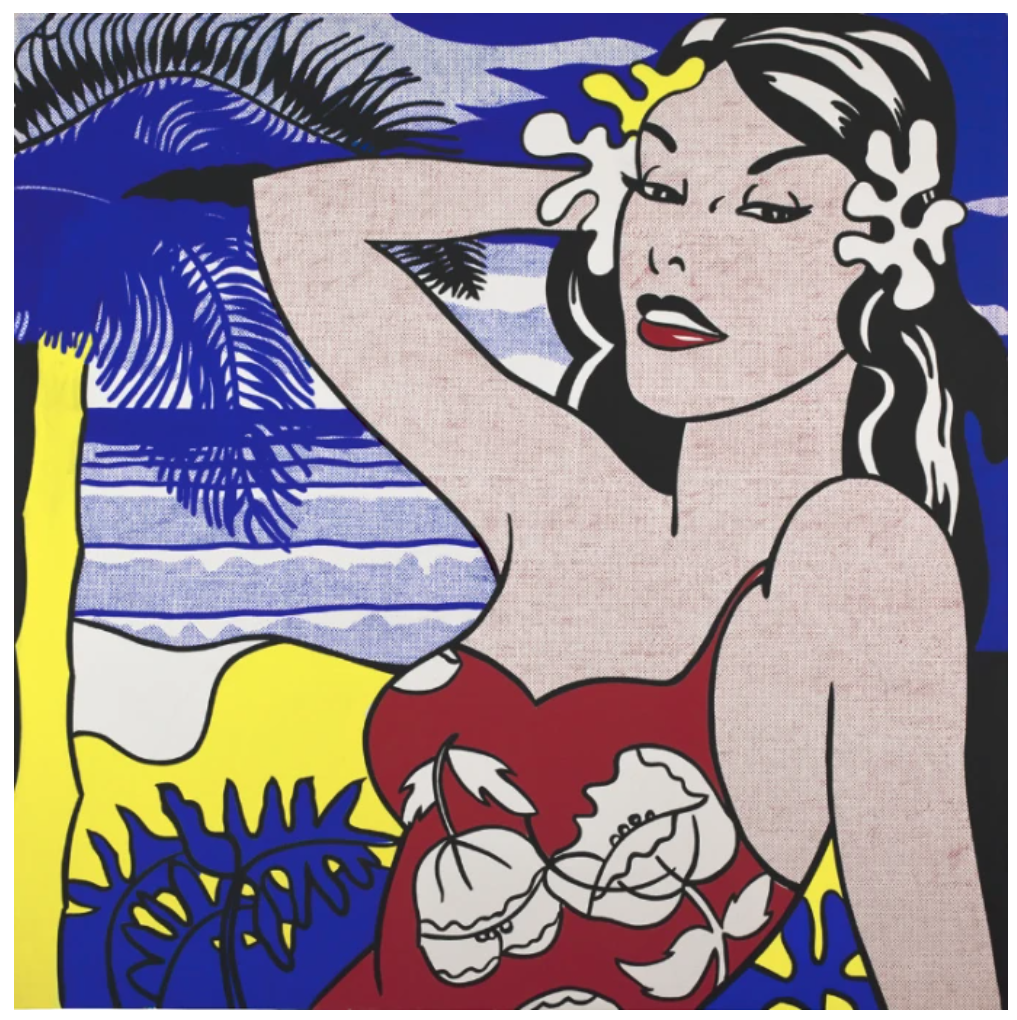
Roy Lichtenstein, Aloha, 1962. Private Collection. Art © Estate of Roy Lichtenstein
Executed during a pivotal year in Haring’s career, Portrait of Grace Jones emerged at a moment of extraordinary creative productivity and international recognition. In 1986, Haring opened his celebrated Pop Shop in downtown Manhattan, extending his commitment to making art accessible to a broad public. Portrait of Grace Jones belongs to this remarkable period of artistic invention, when Haring’s unmistakable visual language achieved an extraordinary breadth of expression. The work’s subsequent inclusion in The Keith Haring Show at the Triennale Milano in 2005 further attests to its place within the artist’s celebrated oeuvre. A symphonic orchestration of color, line and movement, Portrait of Grace Jones stands as a compelling testament to the creative kinship between two defining figures of the 1980s. Uniting the immediacy of Haring’s graphic vocabulary with the theatricality and radical self-expression of Jones’s performances, the present work transcends conventional portraiture to become a vivid embodiment of their shared artistic vision. At once monumental and exuberantly alive, it exemplifies Haring’s extraordinary ability to transform the painted surface into a stage for movement, identity, and expression.
Untitled, 1983
Untitled, 1983
Sotheby’s New-York: 17 November 2026
Estimated: USD 2,000,000 – 3,000,000
Keith Haring | Untitled | Contemporary Day Auction | 2026 | Sotheby’s
KEITH HARING (1958 – 1990)
Untitled, 1983
Acrylic on vinyl tarpaulin
73-1/4 x 73-1/4 inches (186×186 cm)
Signed and dated SEPT. 21-83 (on the reverse)
Monumental in scale and dazzling in its chromatic intensity, Keith Haring’s Untitled from 1983 is a commanding expression of the unmistakable visual language through which the artist celebrated music, movement and the interconnectedness of human experience. Across the expansive surface, two conjoined figures are caught in a moment of spectacular activity, rendered through the saturated color, emphatic contour and radically pared-down forms that had become hallmarks of Haring’s practice. Fused together in a rhythmic choreography of bodies and line, the figures recall the B-boys and break dancers of downtown New York, whose movement and collective occupation of space offered Haring a powerful vocabulary for connection. In Untitled, this principle assumes pictorial form, as interconnected bodies, rhythmic contours and saturated color converge in a composition of remarkable energy and balance.
“It was the idea of making the movements I was doing into a kind of choreography – a kind of dance. I was thinking that the very act of painting placed you in an exhilarated state.”
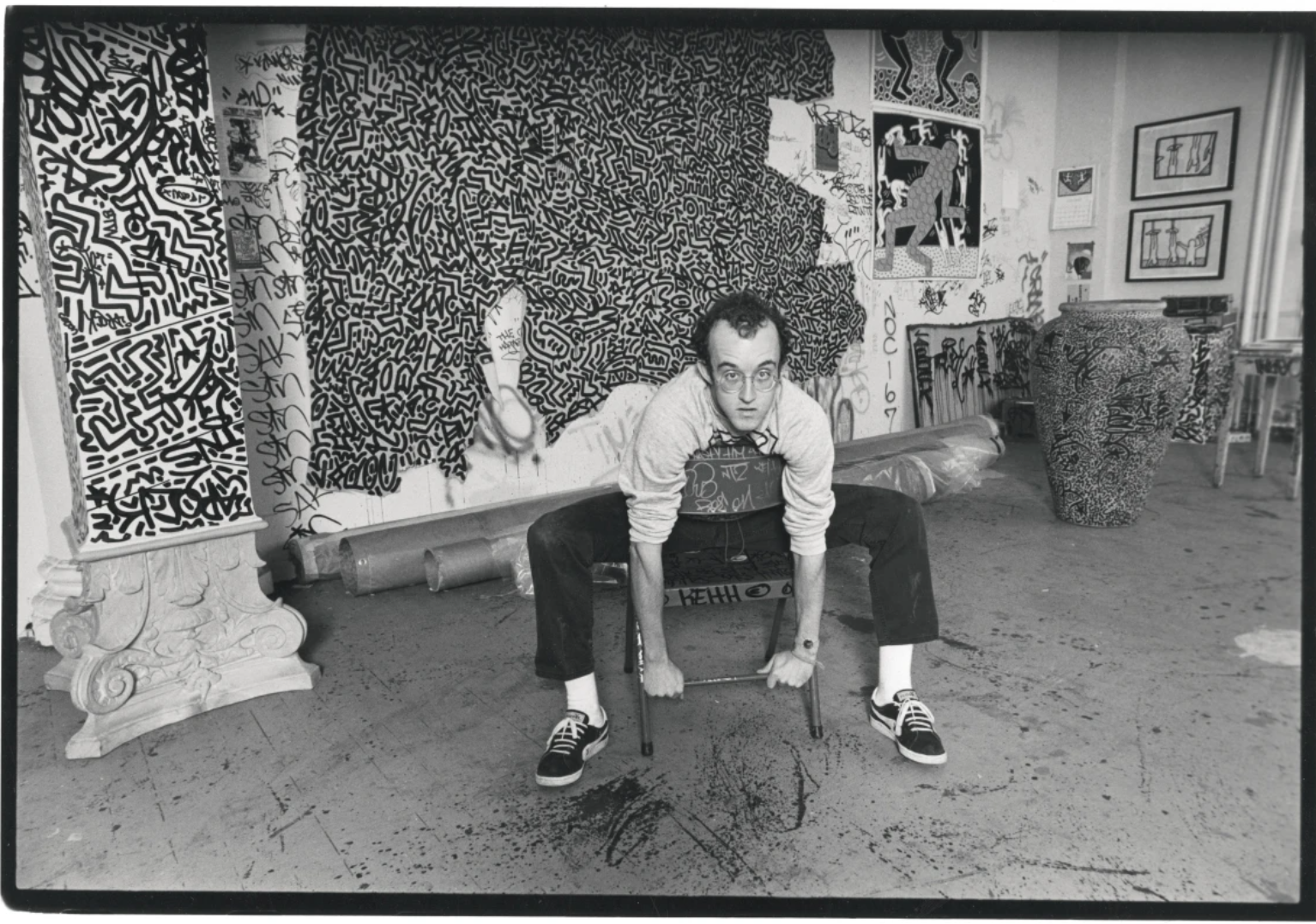
Keith Haring in his Studio. Photo by Laura Levine/Corbis via Getty Images. Art (c) 2021 Keith Haring Foundation
Alongside Jean-Michel Basquiat and Andy Warhol, Keith Haring emerged as one of the defining chroniclers of New York at the close of the twentieth century, translating the urgency, contradictions and visual cacophony of contemporary life into an immediately recognizable pictorial language. Haring shared with Basquiat an attraction to the immediacy and public accessibility of street culture, while Warhol’s fascination with repetition, mass circulation and the iconography of popular culture provided an equally important precedent. From these currents, Haring forged something entirely his own: a concise vocabulary of rhythmic line and archetypal symbols through which he confronted the defining social and political concerns of his generation. Animated with the restless energy and nearly instinctive mark-making that distinguish his greatest works, Untitled finds Haring in consummate command of this language, transforming a radically economical vocabulary into an image of remarkable visual force and immediacy.
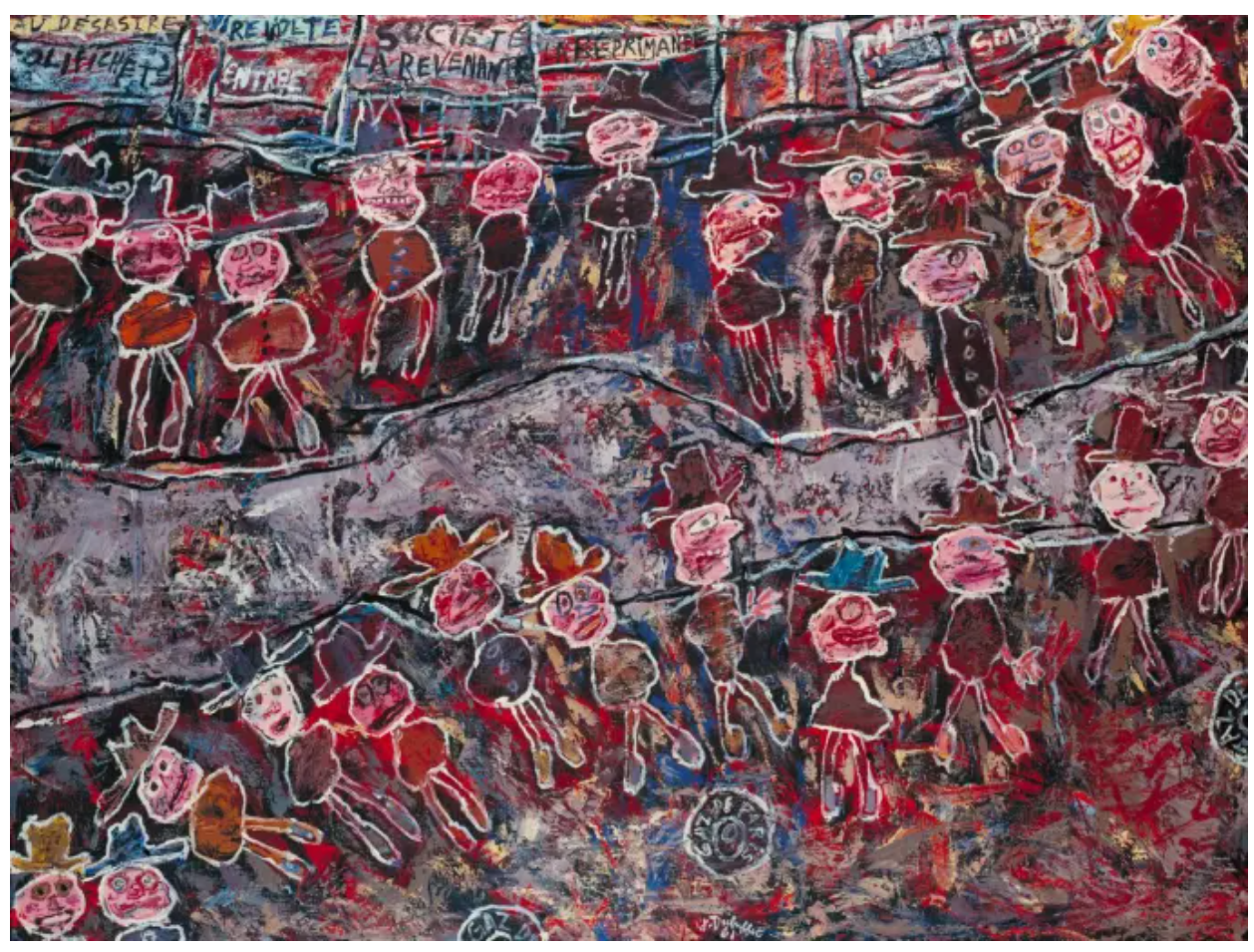
Jean Dubuffet, Spinning Round, 1961. Tate Modern, London. Art © ADAGP, Paris and DACS, London 2026
Executed in 1983, Untitled emerged at the height of Haring’s extraordinary ascent within New York’s downtown art scene, when the exuberant visual language first developed in his subway drawings was rapidly expanding. Between 1980 and 1985, Haring transformed the unused advertising panels of the New York subway into what he called a “laboratory,” refining an immediately legible lexicon of radiant babies, barking dogs and dancing bodies through an almost continuous flow of rhythmic line.
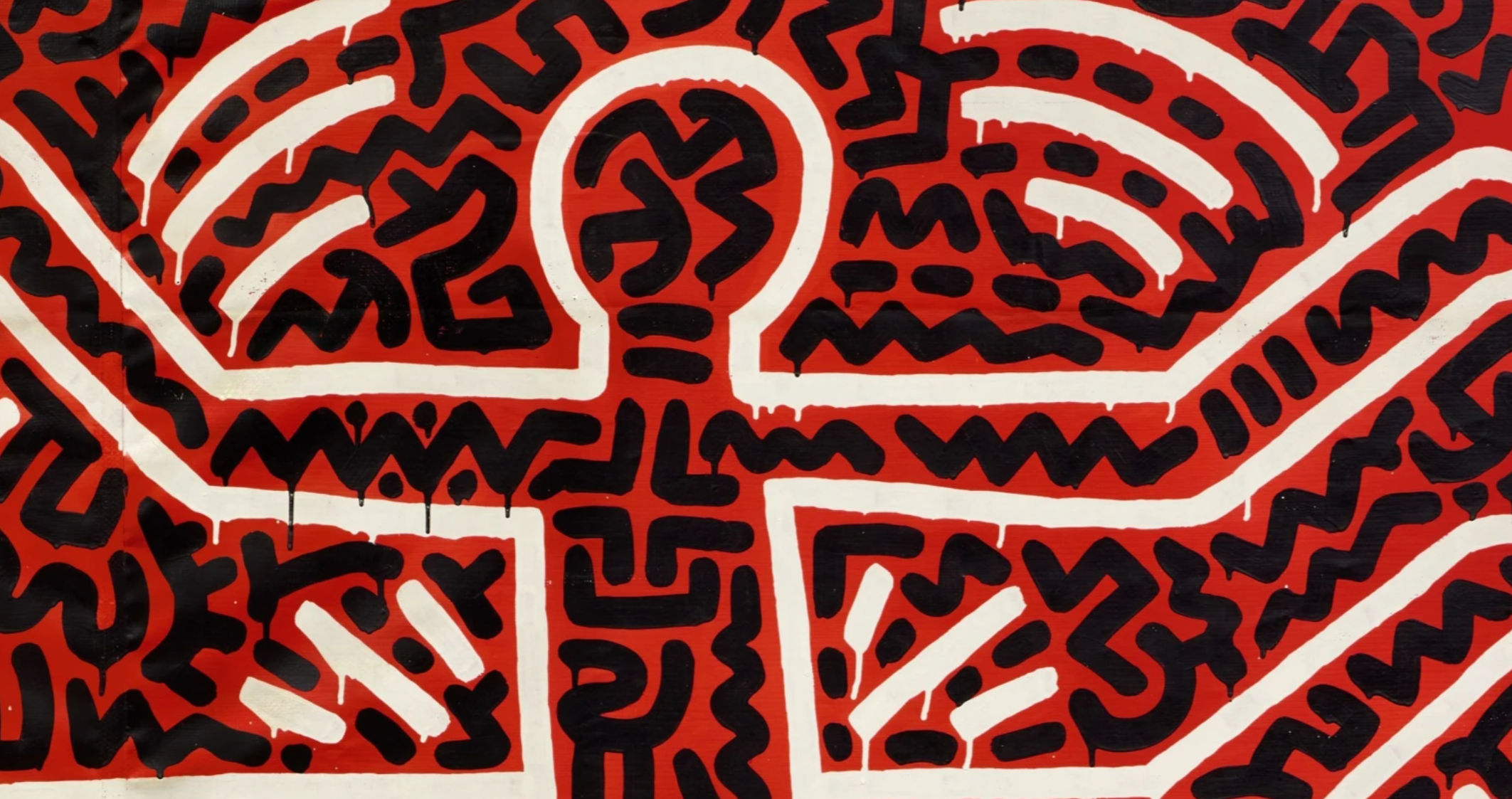
The vitality of Untitled is inseparable from this formative period: its surging figures and emphatic contours preserve the speed and spontaneity of Haring’s public drawings while translating their democratic immediacy into a work of remarkable pictorial authority. Beneath its buoyant energy, however, lies the social consciousness that would increasingly animate Haring’s practice, as his archetypal figures became a universal language through which he could address the complexities of contemporary life.
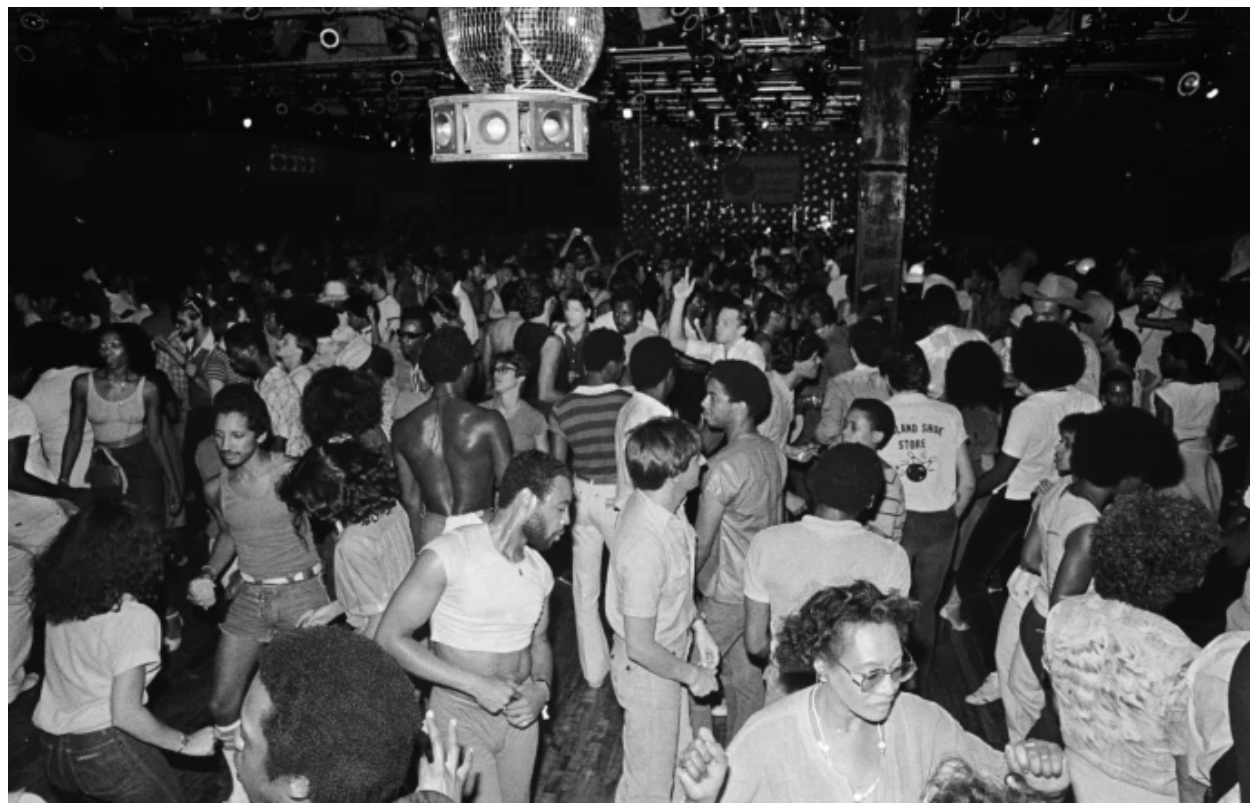
The crowd at New York’s Paradise Garage, seen here in 1978, crossed boundaries of race and sexuality
(Credit: Credit: Bill Bernstein / David Hill Gallery, London)
Dynamic in composition and radical in its economy of means, Untitled captures the extraordinary creative vitality of New York in the early 1980s while distilling the unmistakable visual language that Haring made entirely his own. Haring achieves a remarkable synthesis of spontaneity and formal precision, transforming the immediacy of the drawn line into an image of enduring pictorial force. Untitled stands as a compelling expression of his singular achievement, harnessing a radically simplified vocabulary of line and form as a powerful vehicle for connection, communication and collective experience.
Untitled, 1988
Untitled, 1988
Property from the Estate of JoAnn Sawitz Bass
Phillips New-York: 17 November 2026
Estimated: USD 900,000 – 1,200,000
Keith Haring Modern & Contemporary Art Evening Sale
KEITH HARING
Untitled, 1988
Acrylic, enamel paint and collage on canvas
60-1/8 x 60-1/8 inches (152.7 x 152.7 cm)
Signed and dated “© K. Haring NOV.21 1988 ⨁” on the overlap
Executed on November 21, 1988, in the United States
Painted in 1988, Untitled is a dazzling and monumental testament to Keith Haring’s singular visual idiom. Rendered in a bold chromatic scheme of black, white, red, and silver, the composition presents one of Haring’s most enduring motifs: a dense, kinetic mass of dancing and crawling human figures, rising in a mound-like formation to support a large-scale reproduction of Leonardo da Vinci’s Mona Lisa at its center, superimposed with Haring’s own hieroglyphic vocabulary.
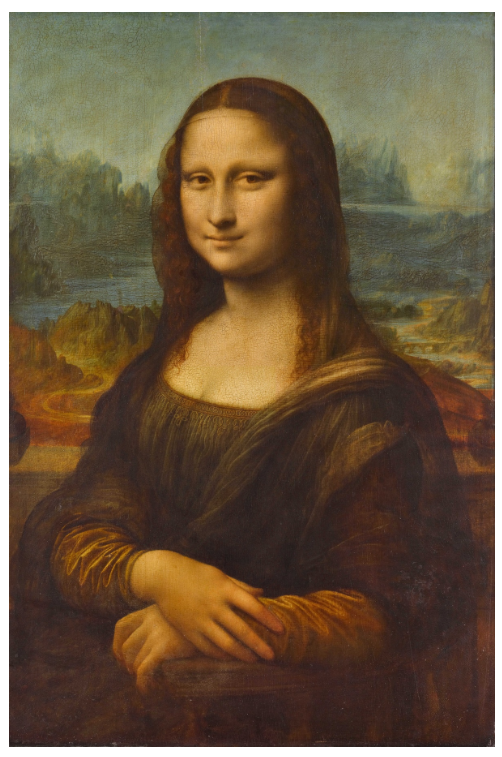
Leonardo da Vinci, Portrait of Lisa Gherardini, Wife of Francesco del Giocondo, known as the “Mona Lisa,” circa 1503-1506. The Musée du Louvre, Paris.Image: wiki-commons.
Untitled carries a distinguished provenance and exhibition history, having passed through Hokin Gallery, Inc. in Palm Beach, which hosted notable solo and group exhibitions of Haring’s work during the height of his career, including solo presentations in 1987 and 1988. From there, the work entered the collection of Jo Ann Sawitz Bass of Miami, matriarch of the storied Joe’s Stone Crab restaurant on Miami Beach, and has since descended by family lineage to the present owner. The painting also featured in The Keith Haring Show, the major retrospective held at the Fondazione Triennale di Milano from 2005 through 2006, curated by Gianni Mercurio and Julia Gruen—an international exhibition that reaffirmed Haring’s centrality to the history of postwar art.
Haring’s appropriation of Leonardo’s iconic sitter in the present work was no isolated gesture but part of a sustained engagement with the Mona Lisa that occupied the artist across a suite of related works executed in 1988, spanning paintings, works on paper, and prints, including a major collaborative portfolio with the Beat writer William S. Burroughs. Across this body of work, Haring returned again and again to Leonardo’s portrait as raw material, subsuming one of art history’s most reproduced and revered images into his own popular, endlessly legible sign system—a gesture that speaks to Haring’s abiding interest in collapsing the perceived boundary between high art and mass culture.
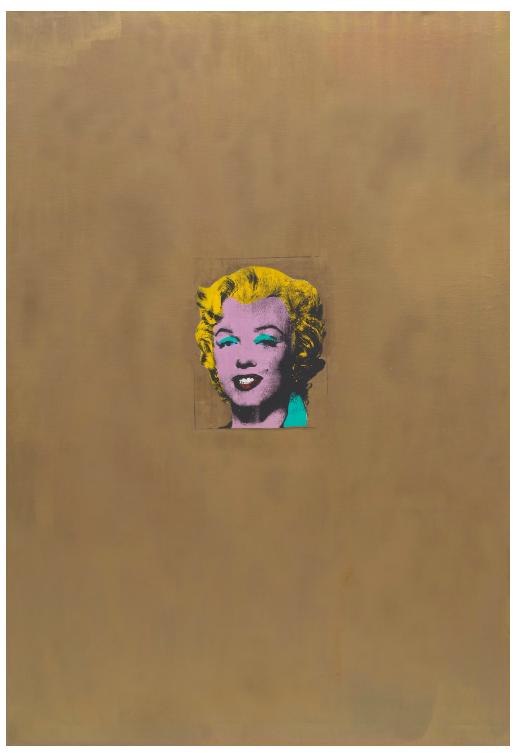
Andy Warhol, Gold Marilyn Monroe, 1962. Museum of Modern Art, New York. Image: The Museum of Modern Art, New York/Scala, Florence. Artwork: © 2026 The Andy Warhol Foundation for the Visual Arts, Inc. / Licensed by Artists Rights Society (ARS), New York
Haring’s impulse toward reworking the masterworks of the Western canon reflects a broader ambition that Demetrio Paparoni identifies as fundamental to the artist’s practice: Haring “did not hesitate to redo other people’s pictures, repainting, formally and explicitly, works by Picasso, Léger, or Matisse,” a habit Paparoni reads not as pastiche, but as evidence “that tradition is a life blood for artists of every age.” In Untitled, this project extends beyond the modernist canon Haring so often mined to reach back to the Renaissance itself, staging a direct confrontation between high art’s most instantly recognizable icon and the artist’s own invented hieroglyphs—signs that, by 1988, had already become fixtures of downtown New York’s visual and popular culture. Leonardo’s celebrated sitter is here rendered almost illegible, her features overtaken by Haring’s insistent, unbroken contour line, so that she emerges less as a quoted masterpiece than as raw material absorbed entirely into Haring’s own idiom.
This confrontation between canonical portraiture and Haring’s own graphic language cannot be separated from the broader context of 1988, the year Haring was diagnosed with HIV/AIDS. Executed on November 21 of that year, Untitled belongs to this charged moment: rather than curtailing his output, the diagnosis sparked an intensely productive final phase, as Haring painted large-scale canvases with mounting urgency, channeling his energy toward mortality, political fury, and direct advocacy that would soon culminate in works such as Ignorance = Fear / Silence = Death of 1989, now in the collection of the Whitney Museum of American Art, New York. Throughout this period, Haring’s deceptively simple outlined figures functioned as incisive cultural commentary on the crises facing the United States in the mid- to late 1980s, including AIDS, drug addiction, racism, and economic inequality—commentary that in Untitled is embedded rather than declared, as the crowd of anonymous, tumbling bodies asserts a collective human presence and vitality that persists alongside, rather than in spite of, the appropriated image of high culture looming above it.
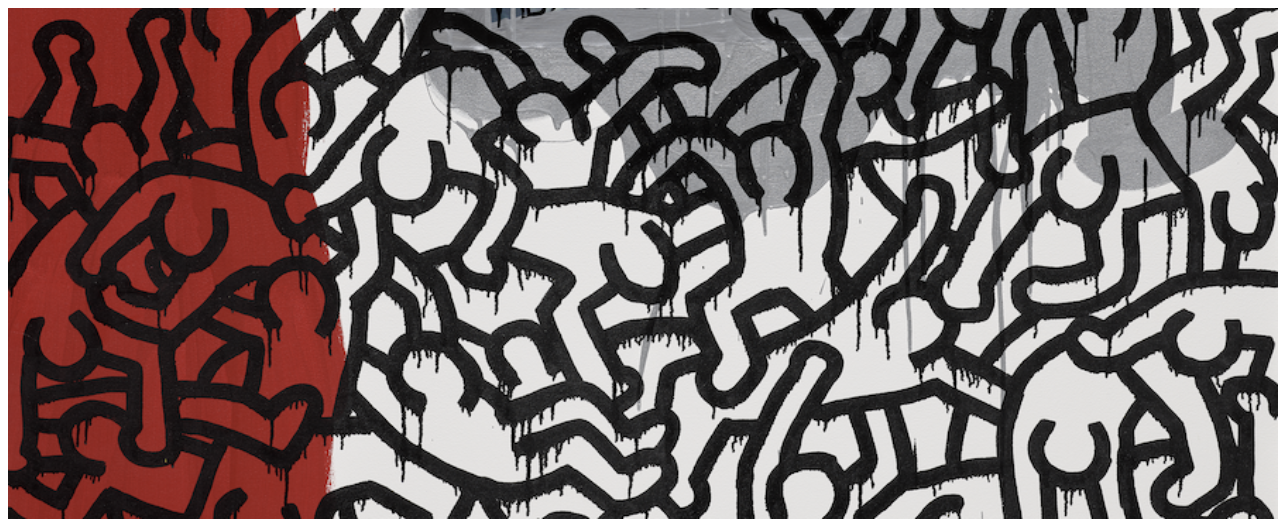
For Haring, the dancing and crawling figure carried a specific symbolic charge, evoking both liberation and vulnerability—twin conditions of the human body that recur with remarkable consistency across the full span of his oeuvre. These forms, along with signature motifs such as the radiant baby and the barking dog, developed directly out of Haring’s New York subway drawing practice between 1980 and 1985, undertaken on the unused black paper advertising panels of the city’s transit system. It was this practice, more than any other, that established the visual grammar Haring would return to across works on paper, prints, and canvases for the remainder of his career.
“It was the idea of making the movements I was doing into a kind of choreography – a kind of dance. I was thinking that the very act of painting placed you in an exhilarated state.”
The painting’s density of incident and its layering of appropriated and invented imagery within a single unbroken pictorial field recall what Brion Gysin termed Haring’s “carved line,” which, as David Galloway observes, “informs all of his work: the drawings, the paintings, the sculptures, and the prints.” Below the appropriated portrait, Haring’s crowd of figures is organized with striking precision—each dancing form carefully placed such that none overlaps with another—lending the composition a kinetic clarity that channels chaos into order even as it bursts with the effusive, rhythmic energy so closely associated with the artist’s work. This extraordinary sensation of rhythm, pervasive throughout Untitled, connects directly to Haring’s immersion in New York’s downtown music and club culture during the years he came of age as an artist, when venues throughout the East Village provided both social community and creative inspiration for a generation of artists working at the intersection of visual art, music, and performance.
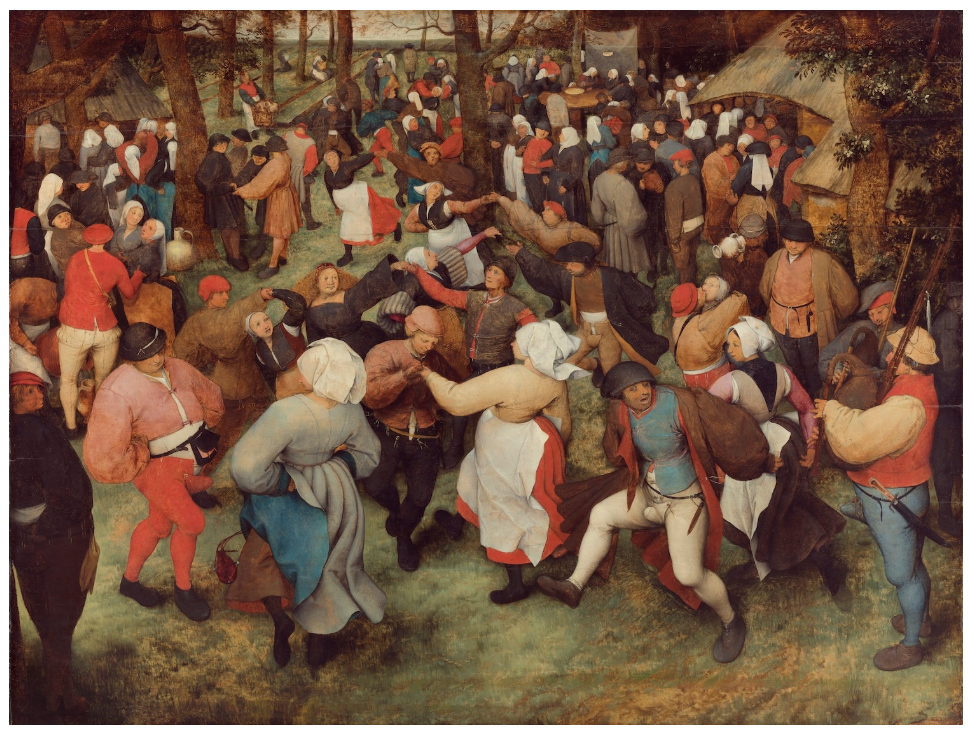
Pieter Bruegel the Elder, The Wedding Dance, c. 1566. Detroit Institute of Arts.
Image: Detroit Institute of Arts, City of Detroit Purchase, 30.374.
Untitled thus stands as a seminal example of Haring’s late-career interrogation of art history, semiotics, and classical imagery, juxtaposing a fine art masterwork with his signature subway-honed graphic style to dismantle inherited hierarchies between high and popular culture. Paparoni’s broader account of Haring’s method—as an art built not from a single source but from “a melting pot in which different impulses are allowed to interact”—finds vivid expression here, where Leonardo’s portrait becomes only one element within Haring’s own visual cosmos, populated by the anonymous, tumbling bodies that were, by this point in his career, unmistakably his own. As Haring himself insisted, “there is nobody in the world who can be put into a group with me and called a movement.” This period of urgent, late-career production would soon lead Haring to establish the Keith Haring Foundation in 1989, created to support AIDS organizations and children’s programs in the months before his death in February 1990 at the age of thirty-one. Executed in the final chapter of his tragically brief life, Untitled channels Haring’s enduring conviction into a work of extraordinary compositional ambition and emotional resonance, affirming the artist’s enduring belief that painting is “an experience that, at its best, is transcending reality.”
Untitled (Subway Drawing), 1982
Untitled (Subway Drawing), 1982
Sotheby’s New-York: 17 November 2026
Estimated: USD 300,000 – 500,000
Keith Haring | Untitled (Subway Drawing) | Contemporary Day Auction |
KEITH HARING (1958 – 1990)
Untitled (Subway Drawing), 1982
Chalk on two joined sheets laid down on canvas and panel
Sheet: 39-1/2 x 38-3/4 inches (100.3 x 98.4 cm)
Panel: 42-1/8 x 42-1/2 inches (107×108 cm)
Executed in 1982, Untitled (Subway Drawing) belongs to the formative body of works through which Keith Haring transformed the New York City subway system into one of the most ambitious public art projects of the twentieth century. Rendered in crisp white chalk on the black paper panels used to cover expired advertisements, Haring’s subway drawings served as a radical alternative to the gallery system, inserting art directly into the rhythms of everyday urban life and the daily lives of millions of commuters. Created at the moment of the artist’s rapid ascent within New York’s downtown art scene, the present work demonstrates the extraordinary clarity and sophistication of the visual language that would come to define Haring’s career.
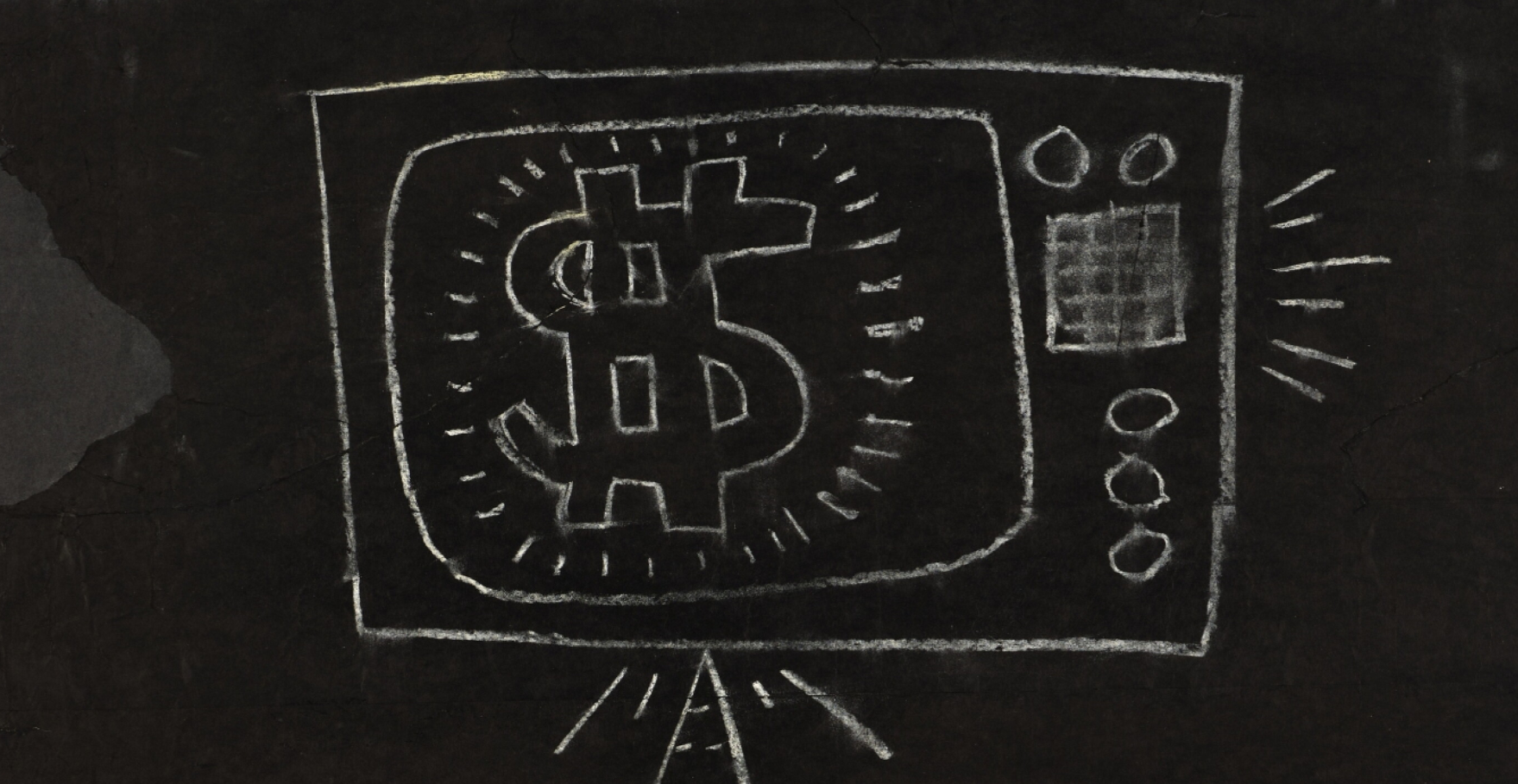
In the present work, two of Haring’s signature figures ascend a stepped pyramid, their outstretched arms reaching toward a television set balanced at its summit. Marked with a dollar sign and radiating lines, the television emerges as the composition’s focal point, functioning simultaneously as beacon, idol, and repository of power. The juxtaposition of the pyramid, an enduring symbol of civilization, authority, and collective belief, with the television, a defining technology of the modern age, creates a potent allegory for contemporary life. Here, Haring appears to equate the influence of mass media with the enduring structures of power that have shaped human society for millennia. The figures’ upward movement suggests both aspiration and reverence, imbuing the scene with an almost ceremonial quality. As so often in Haring’s work, a handful of economical signs conveys a surprisingly complex meditation on power, desire, and cultural values, yielding an image that is at once instantly accessible and endlessly interpretable.
“[Art] is a product of a moment and a state of mind at that moment and a record of a state of being or a moment of living, a point in time in which all your energies and all your forces and the environment is coming together in that one action of making, of creating, of … usually in my case, a drawing. Even when I’m painting I’m usually, I’m drawing when I’m painting, really … When you’re drawing, it’s completely separate because drawing is making a mark and cutting into space and just finding something that didn’t exist before. It’s pure creation in its simplest form …”
The composition reflects Haring’s sustained engagement with the forces shaping contemporary consciousness. Throughout the early 1980s, television occupied an increasingly dominant position within American life, influencing consumer behavior, political discourse, and cultural identity. By placing a dollar sign at the heart of the screen, Haring fuses the languages of media and commerce, suggesting a world in which information, entertainment, and consumption have become inseparable. The figures’ movement toward the glowing device can be read as both celebratory and cautionary, embodying the tension between aspiration and submission that characterizes so much of modern mass culture.
Such concerns stood at the center of Haring’s artistic project. Deeply influenced by semiotics, popular culture, and the immediacy of graffiti, he sought to develop a universally accessible visual vocabulary capable of addressing the defining questions of his time. His recurring symbols—radiant babies, barking dogs, flying saucers, angels, televisions—functioned as a kind of pictorial language through which broader social, political, and philosophical ideas could be communicated. The subway became the ideal arena for this experiment, providing an audience far beyond the walls of galleries and museums and allowing Haring to engage directly with the public.
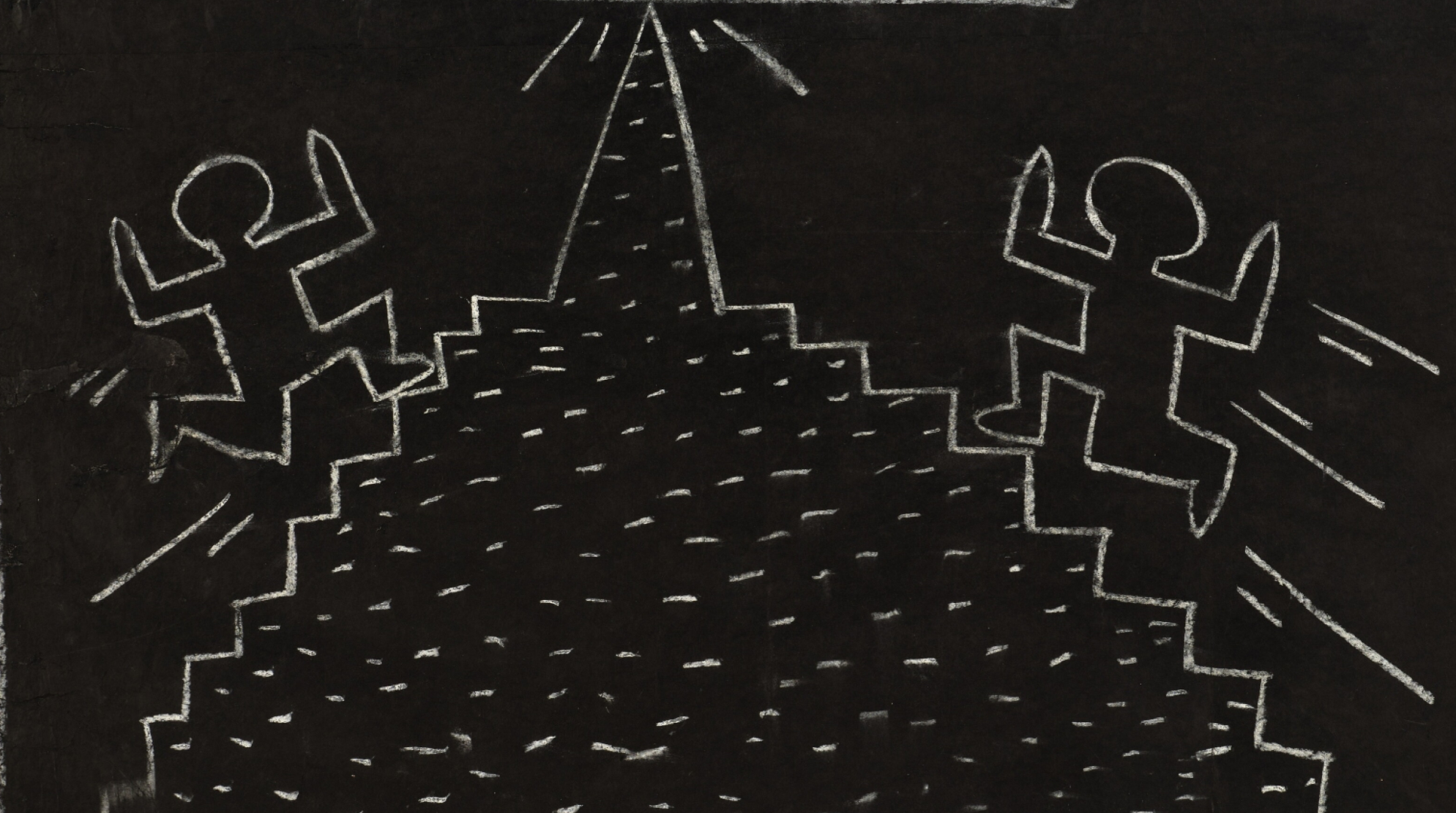
The present work exemplifies the extraordinary achievement of that endeavor. Executed swiftly and without revision, its confident, fluid lines retains the energy and spontaneity that distinguish the subway drawings from Haring’s later studio production. Yet beneath its apparently simple visuality, there lies a sophisticated meditation on power, desire, and belief in the media age. Through a handful of symbols and a few economical strokes of chalk, Haring constructs an image that is at once playful, accessible, and profoundly perceptive. More than four decades after its creation, Untitled (Subway Drawing) remains a powerful testament to Haring’s conviction that art could function as a universal form of communication, illuminating the complexities of contemporary life while remaining open to all.
Untitled (Acrobats), 1987
Untitled (Acrobats), 1987
Looking Forward: The Collection of Beverly Grossman
Sotheby’s New-York: 17 November 2026
Estimated: USD 250,000 -350,000
Keith Haring | Untitled (Acrobats) | Contemporary Day Auction | 2026
KEITH HARING (1958 – 1990)
Untitled (Acrobats), 1987
Enamel on metal
23-5/8 x 9 x 5-3/4 inches (60 x 22.9 x 14.6 cm)
This work is number 2 from an edition of 6
“A painting, to a certain extent, is still the illusion of a material. But once you cut that out of the steel and stand it up, it’s a real thing, (…) It has this sense of permanence, of reality, that it will exist much longer than I ever will, so it’s a kind of immortality”.
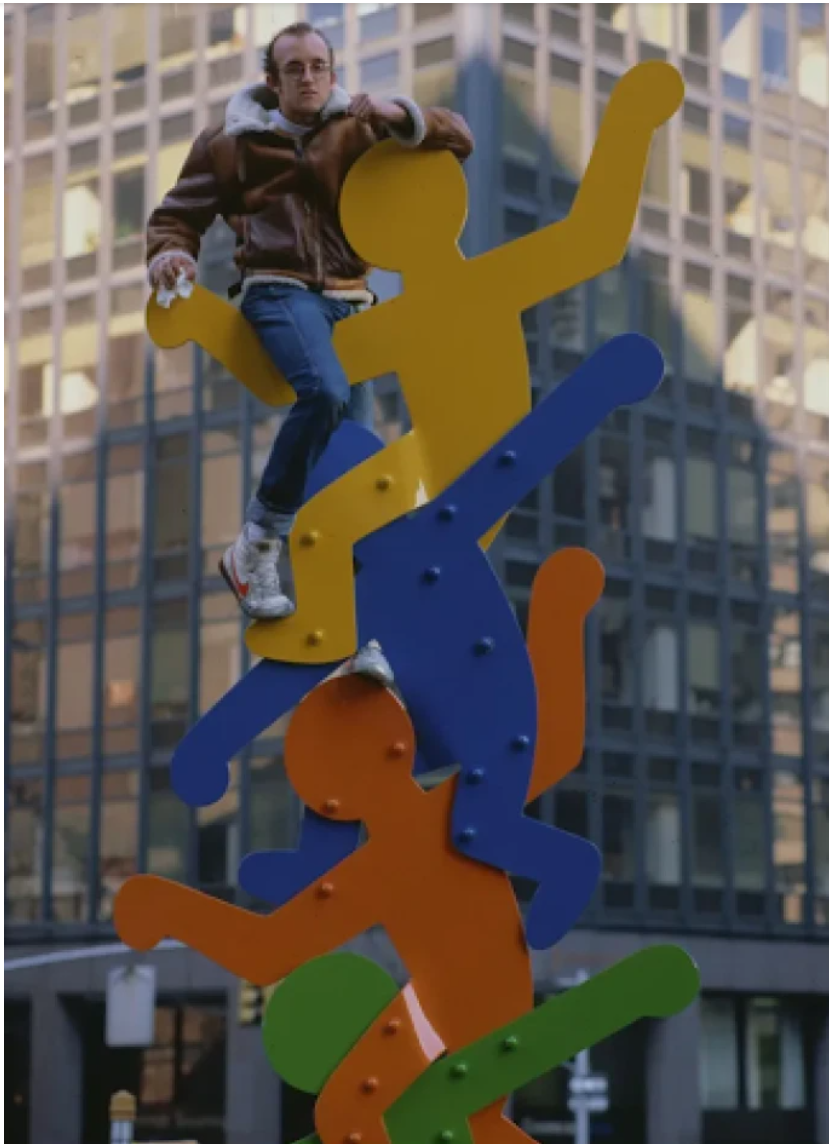
Keith Haring sitting atop one of his sculptures, 1986. Photo © Nick Elgar. Artwork © The Keith Haring Foundation.