2026 Fall New-York Marquee Auctions
Joan Mitchell
Auction Results
Green Book of Barbara Guest, 1960
Vision: The Extraordinary Collection of Theodore and Ruth Baum
Sotheby’s New-York: 16 November 2026
Estimated: USD 12,000,000 – 18,000,000
Joan Mitchell | Green Book of Barbara Guest | Vision: The
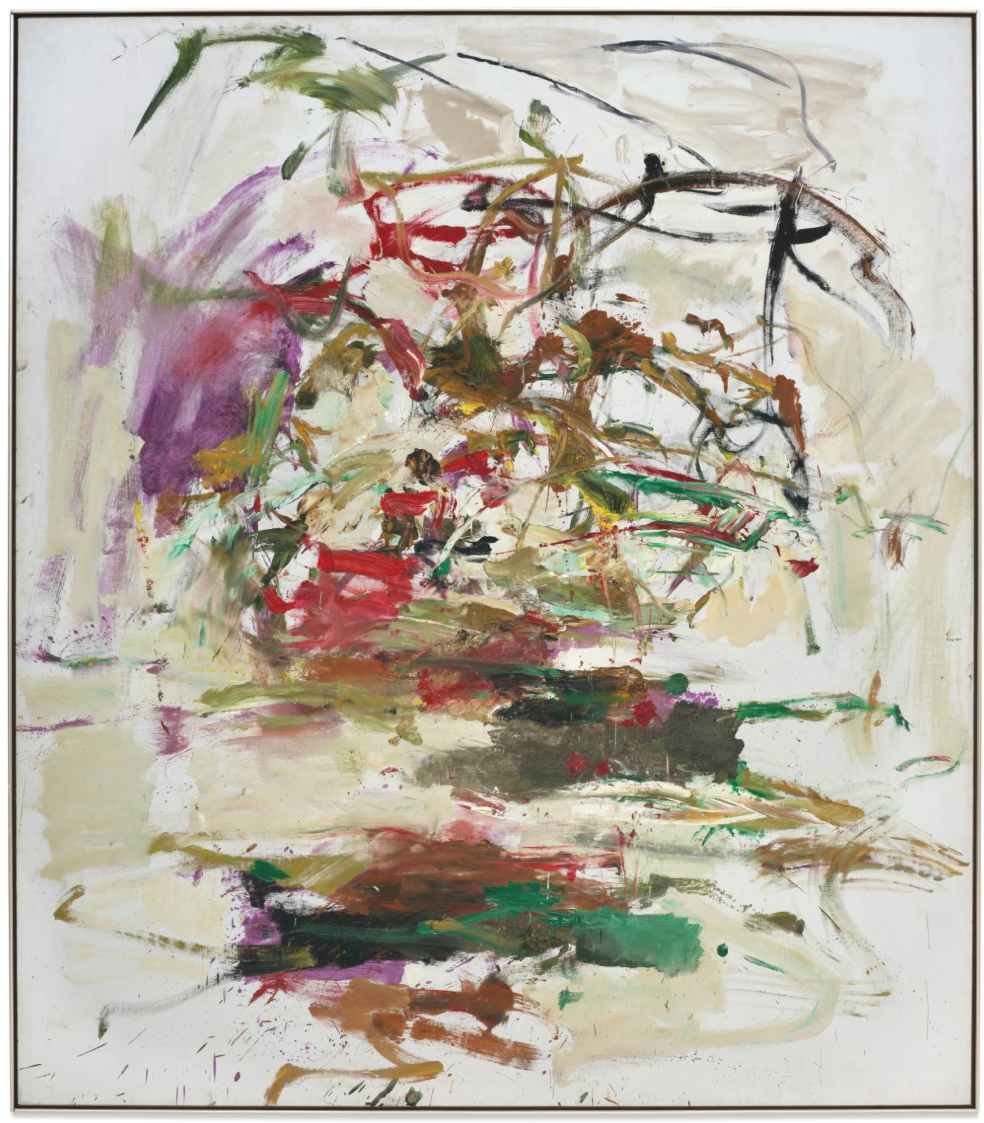
JOAN MITCHELL (1925 – 1992)
Green Book of Barbara Guest, 1960
Oil on canvas
90×79 inches (228.6 x 200.7 cm)
Titled (on the stretcher)
Untitled, circa 1967
Christie’s New-York: 17 November 2026
Estimated: USD 10,000,000 – 15,000,000
JOAN MITCHELL (1925-1992), Untitled | Christie’s
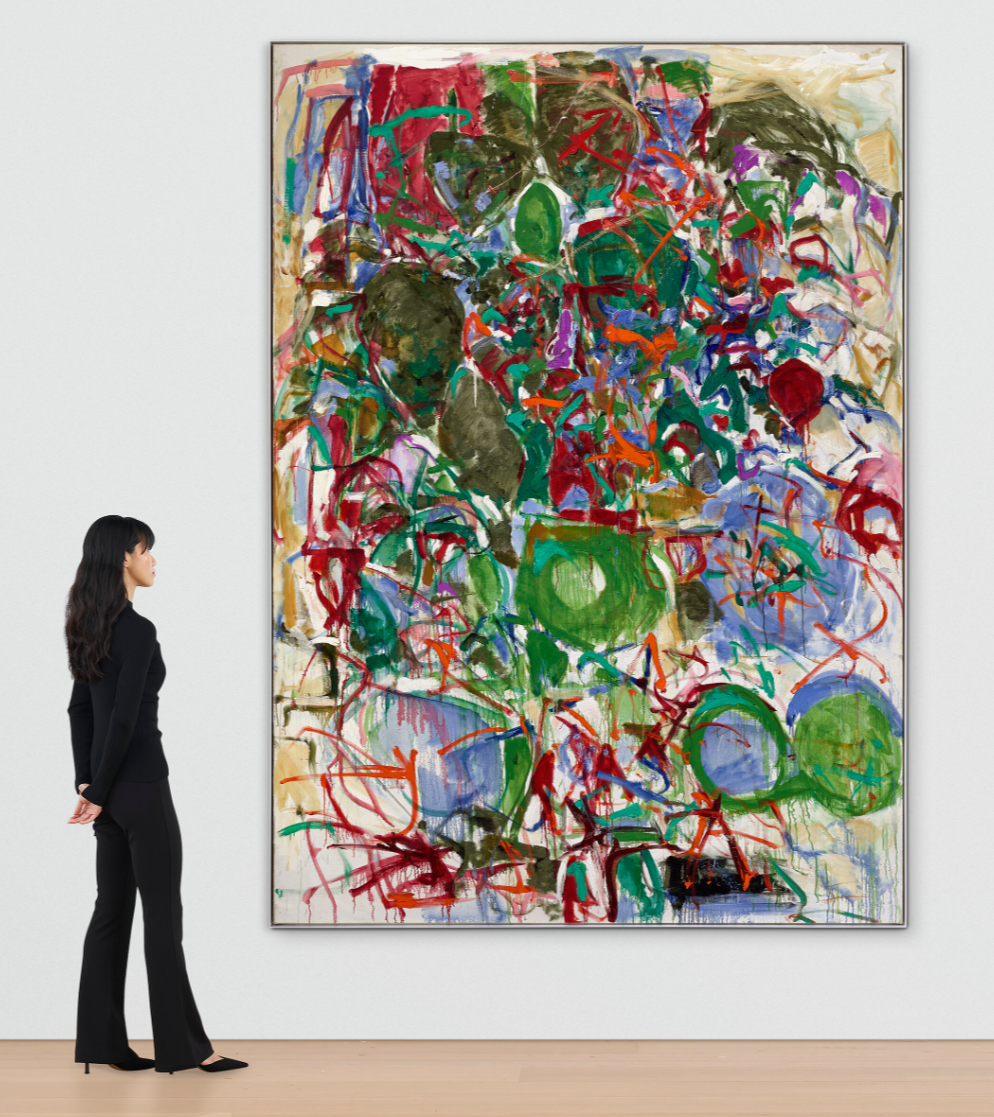
JOAN MITCHELL (1925-1992)
Untitled, circa 1967
Oil on canvas
109-1/2 x 78-3/8 inches (278×199 cm)
Untitled, 1992
The Clive Davis Collection
Christie’s New-York: 17 November 2026
Estimated: USD 3,500,000 – 4,500,000
MINIMUM PRICE GUARANTEE
JOAN MITCHELL (1925-1992), Untitled | Christie’s
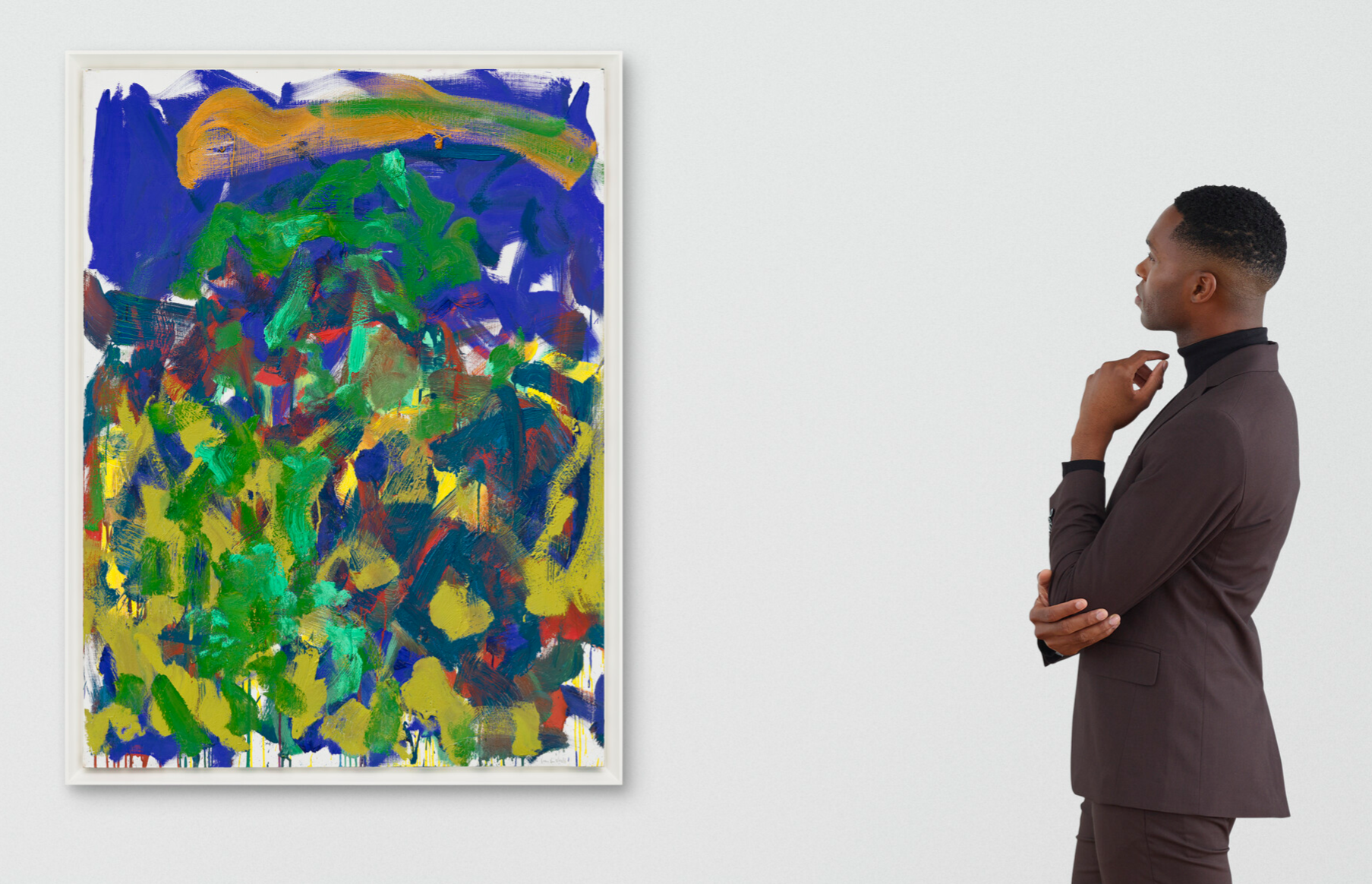
JOAN MITCHELL (1925-1992)
Untitled, 1992
Oil on canvas
51 x 38-1/4 inches (129.5 x 97.2 cm)
Signed ‘Joan Mitchell’ (lower right)
Green Book of Barbara Guest, 1960
Green Book of Barbara Guest, 1960
Vision: The Extraordinary Collection of Theodore and Ruth Baum
Sotheby’s New-York: 16 November 2026
Estimated: USD 12,000,000 – 18,000,000
Joan Mitchell | Green Book of Barbara Guest | Vision: The
JOAN MITCHELL (1925 – 1992)
Green Book of Barbara Guest, 1960
Oil on canvas
90×79 inches (228.6 x 200.7 cm)
Titled (on the stretcher)
Announcing vigorous brushstrokes of amethyst, fuchsia, lime green, and stark onyx black, Joan Mitchell’s Green Book of Barbara Guest from 1960 stands as an exceptional example from the artist’s first mature period in Paris. Executed at a pivotal moment in Mitchell’s career, the present work captures the fearless gestural bravura of an artist forging an entirely new mode of abstraction, realized with exceptional force, confidence, and chromatic intensity. Originally held in the artist’s own collection, since 1986, this work has remained in the extraordinary collection of Theodore and Ruth Baum.
The present work embodies all the artistic vigor and assurance that distinguished Mitchell’s practice at the very climax of her mature practice. Following a transformative visit to Paris in 1955, the landscapes of France would become an enduring source of inspiration throughout her career. By 1960, Mitchell had arrived at a wholly individual pictorial language that synthesized the physicality of Abstract Expressionism with a profound sensitivity to nature, memory, and place.
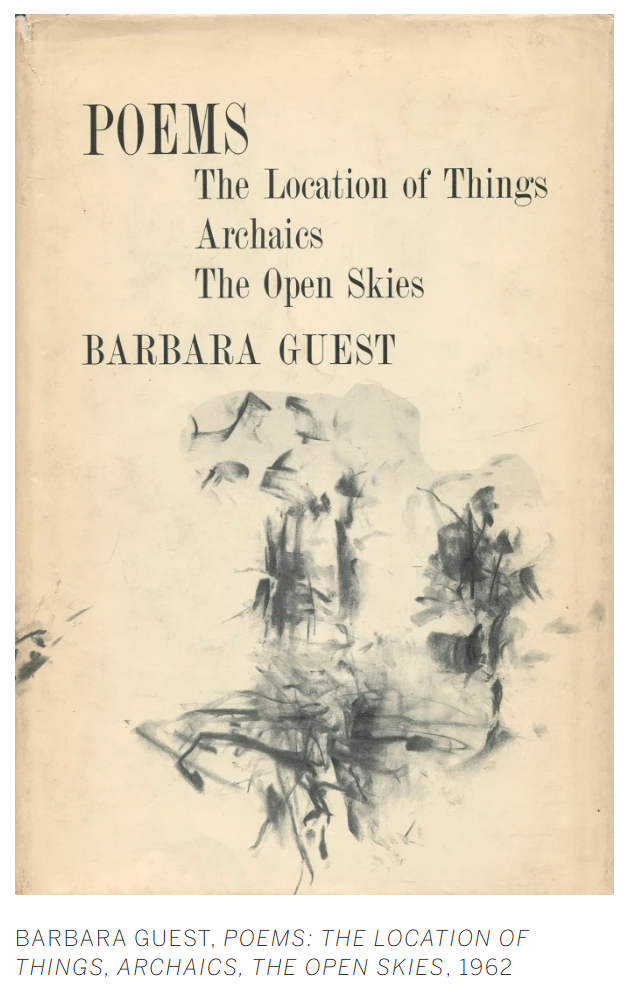
Entitled with reference to Mitchell’s friend, art critic, and poet Barbara Guest, the present work is a rare example of a title that provides a glimpse into Mitchell’s inner circle rather than referencing landscapes or natural forms. Barbara Guest occupied a similar space within the New York circle of artists as Mitchell, both moving to New York within the same year and socializing among the same painters and poets. Mitchell befriended many poets, including Frank O’Hara, whose poem also shares a title with a Mitchell work from 1957, To the Harbormaster. Guest credited much of her poetic development in her early years in New York to the art scene within which she explored new creative philosophies and sources of inspiration. “In the youth of my poetry I was fortunate to be surrounded by painters in the art movement of Abstract-Expressionism, and I learned from them. First I noticed these painters appeared to have a lot more joy than did the poets. They were more playful! Their ideas were exploding on the canvas, and they had a sense of freedom the poets were only beginning to learn from them… The entire city of New York liked their art. More importantly, the air around them was hesitating as it turned into the moment. The idea of a moment with its special apparatus is a good thing for poetry also.” (Barbara Guest, Forces of Imagination: Writing on Writing, Berkeley, 2003, p. 102)
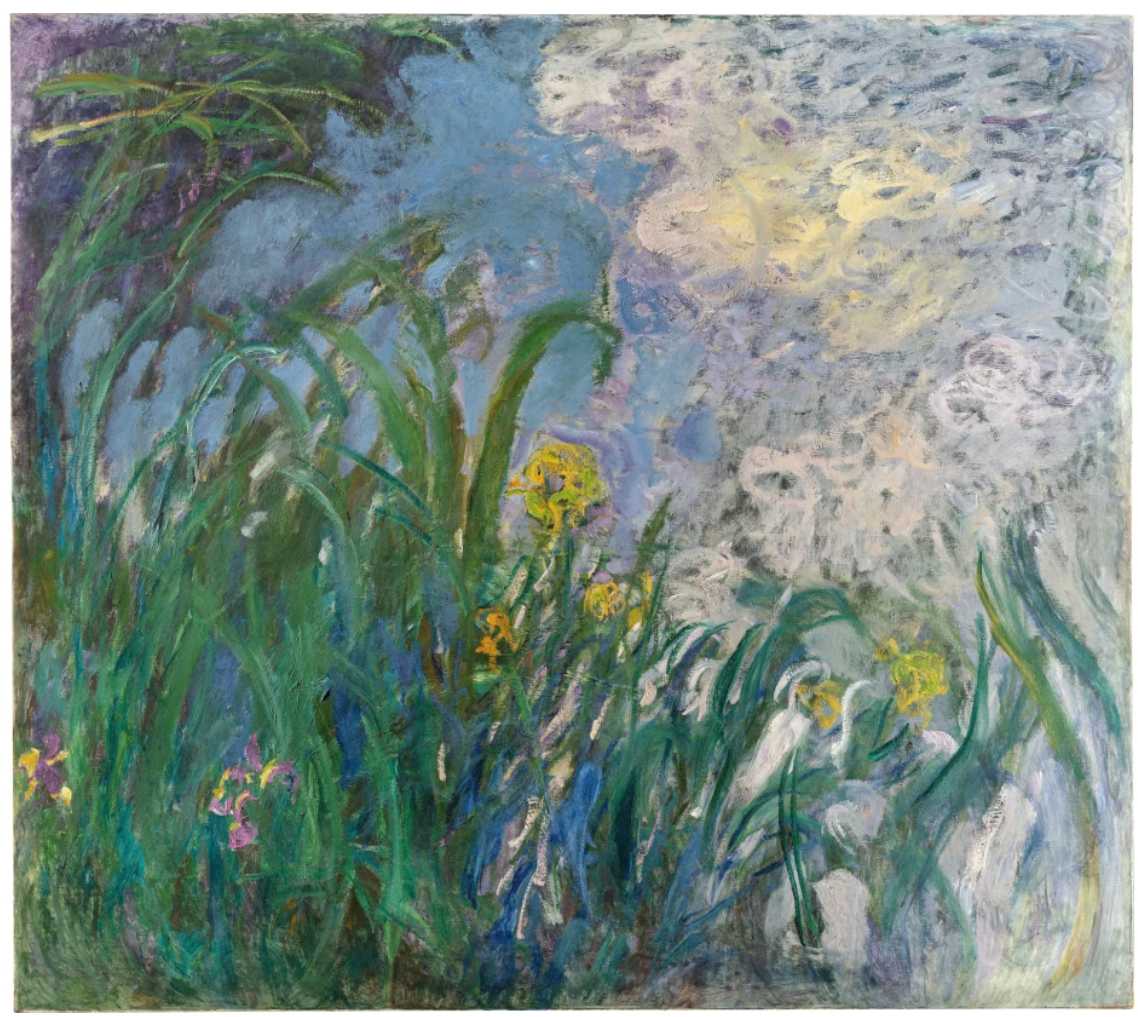
Claude Monet, Irises, c. 1924-25. Private Collection. Sold at Sotheby’s Paris in October 2026 for $56.2 million
This combination of playfulness and gravitas that Guest distills is keenly applicable in the visual experience of Green Book of Barbara Guest. The late 1950s and early 1960s are widely recognized among the most significant years of Mitchell’s early oeuvre, giving rise to such landmark works as City Landscape (1955) in the Art Institute of Chicago, Hemlock (1956) in the Whitney Museum of American Art, and Blue Tree (1964) in the Worcester Art Museum. The present work belongs to this extraordinary moment of artistic flowering, when Mitchell was producing some of the most ambitious and innovative paintings of her career. Mitchell forged a distinctive position alongside other Abstract Expressionist giants such as Willem de Kooning and Jackson Pollock. While de Kooning reintroduced the figure into the language of abstraction and Pollock pursued continuous movement through his all-over fields of drip paintings, Mitchell returned repeatedly to the landscape as a conceptual and emotional touchstone. Her paintings balance explosive energy with compositional control, translating remembered sensations of nature into dynamic arrangements of color, rhythm, and gesture.
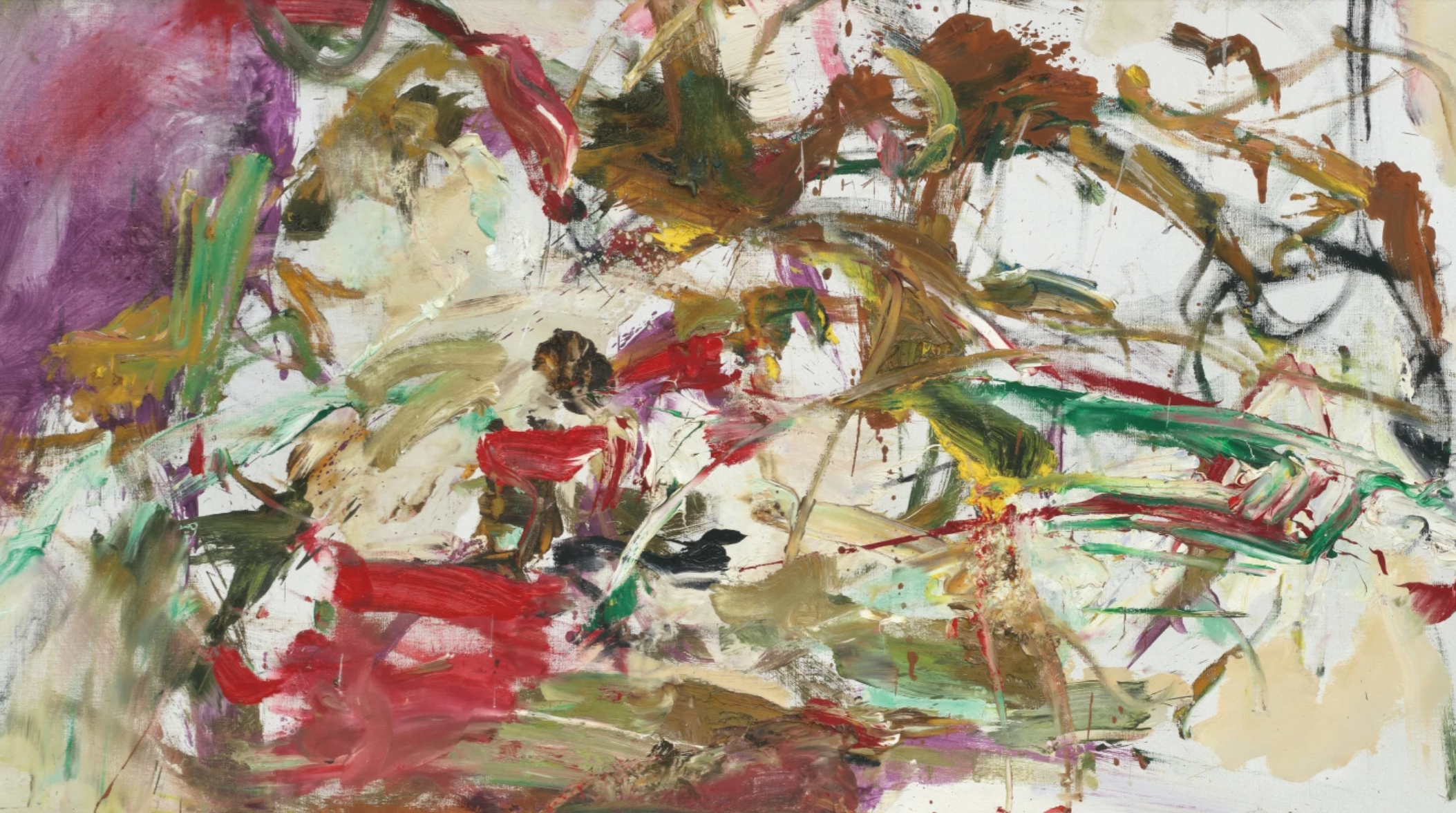
Mitchell’s mark-making, however, was “more calculating, more consciously in search of beauty than her predecessors,” artists like Jackson Pollock, who allowed his drips to be unqualified, spontaneous expressions of his inner creative drive. (Klaus Kertess, Joan Mitchell, New York, 1997, p. 22) Mitchell never adopted Pollock’s practice of laying his canvases on the floor while applying paint; instead, Mitchell painted with her canvases upright, allowing gravity to influence the downward flow of paint, resulting in the smudges, drips, and pools of color that lend Green Book of Barbara Guest its remarkably dynamic surface. Across the canvas, Mitchell’s signature feathery strokes punctuate the pictorial field, while surrounding passages of pigment drift, expand, and contract with palpable vitality. Muted gemstone and earthy tones ebb and flow across the surface as flashes of fuchsia and olive animate the composition with lyrical intensity.
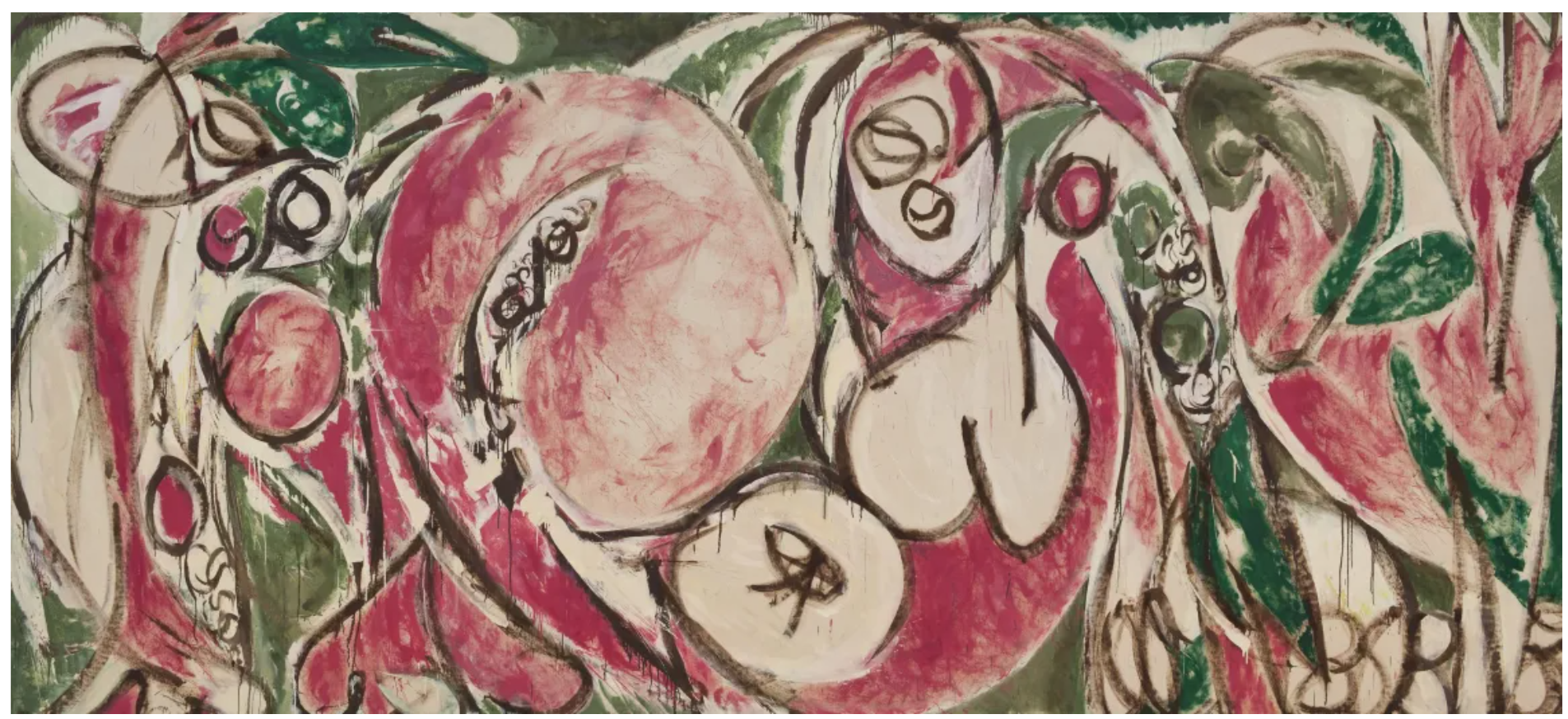
Lee Krasner, The Seasons, 1957. Whitney Museum of American Art, New York. Image © Whitney Museum of American Art / Licensed by Scala / Art Resource, NY. Art © 2026 Pollock-Krasner Foundation / Artists Rights Society (ARS), New York
The painting’s chromatic orchestration achieves a remarkable equilibrium between spontaneity and structure, immersing the viewer in a visual experience that is at once immediate and deeply sustained. Painted during Mitchell’s first years in Paris, Green Book of Barbara Guest possesses the sense of expansiveness and atmospheric resonance that would come to define many of her greatest masterpieces. “Meaning and emotional intensity are produced structurally… by a whole series of oppositions: dense versus transparent strokes; gridded structure versus more chaotic, ad hoc construction; weight on the bottom of the canvas versus weight at the top; light versus dark; choppy versus continuous brushstrokes; harmonious and clashing juxtapositions of hue—all are potent signs of meaning and feeling.” (Linda Nochlin quoted in: Exh. Cat., New York, Whitney Museum of American Art, The Paintings Of Joan Mitchell, 2002, p. 55)
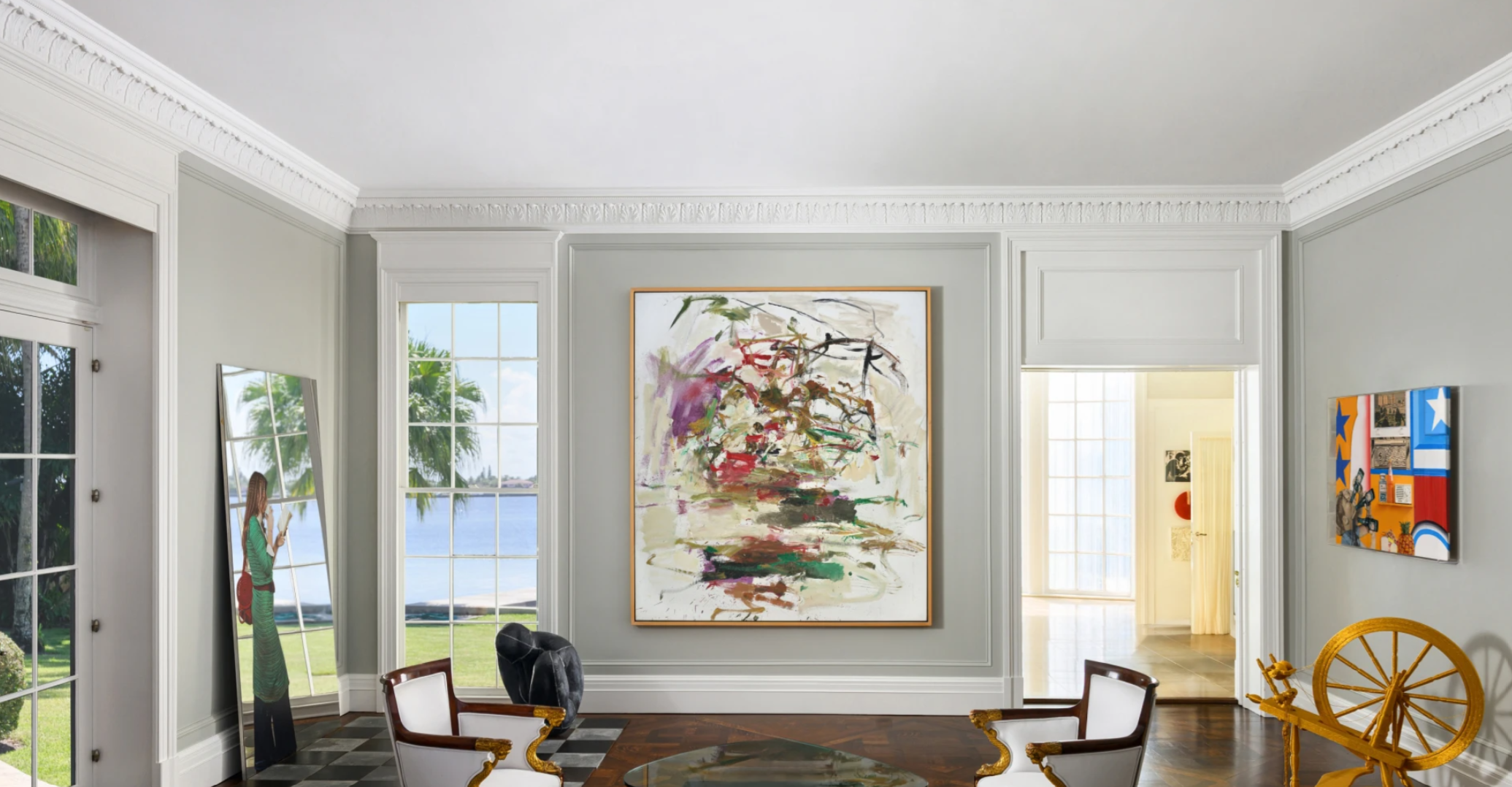
The Baum Residence, Palm Beach. At center: Joan Mitchell, Green Book of Barbara Guest, 1960. Art © Estate of Joan Mitchell. Art © The Estate of Tom Wesselmann / Artists Rights Society (ARS), New York. Art © Carl Andre / Licensed by VAGA at Artists Rights Society (ARS), New York. Art © Antony Gormley 2026. Art © 2026 Liza Lou. All rights reserved. Art © 2026 Michelangelo Pistoletto. Photograph by Diana Todorova
Mitchell embarked upon her artistic training in 1947 at the Art Institute of Chicago, where she first encountered the works of such artists as Vincent Van Gogh, Paul Cézanne, and Henri Matisse, the masters who would inspire her work throughout her career. Upon moving to New York in 1952, Mitchell was a rare female presence in the otherwise male-centric world of the New York School. She moved in the same avant-garde circles as Jackson Pollock, Franz Kline, and Hans Hofmann, and was included in the seminal Ninth Street Show organized by Leo Castelli in 1951.
Comparable Mitchell Paintings in Select Museum Collections
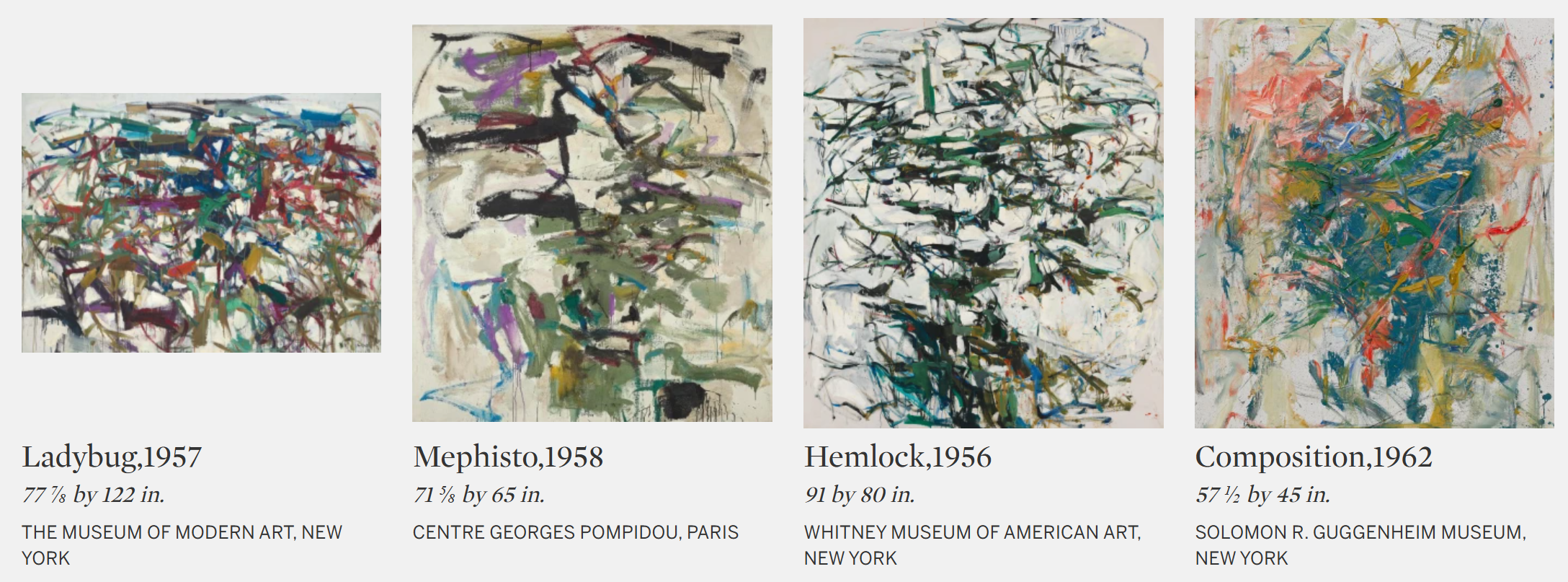
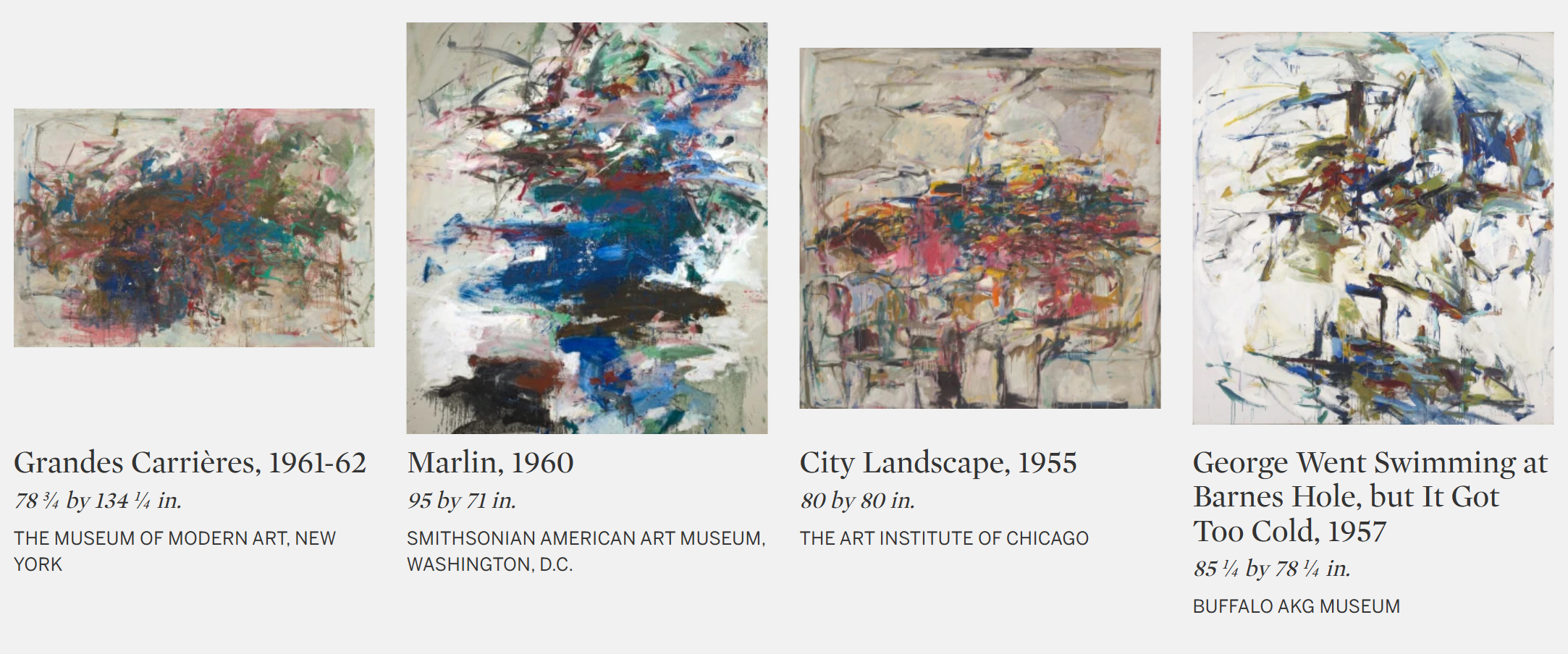
Following her first solo exhibition at the New Gallery in 1952, Mitchell entered the artistic discourse surrounding Abstract Expressionism as a key voice, described as “one of America’s most brilliant ‘Action-Painters.’ At a time when many young artists are withdrawing introspectively from the bold experimentation of their elders … her art expands in the wake of her generous energy.” (Irving Sandler, “Young Moderns and Modern Masters: Joan Mitchell,” ARTnews, March 1957, p. 32) This moment heralded a transformative period in Mitchell’s career, during which she moved back and forth between New York and Paris, seamlessly blending the expressive abstract machismo of the New York School with an elegant European fidelity to nature.
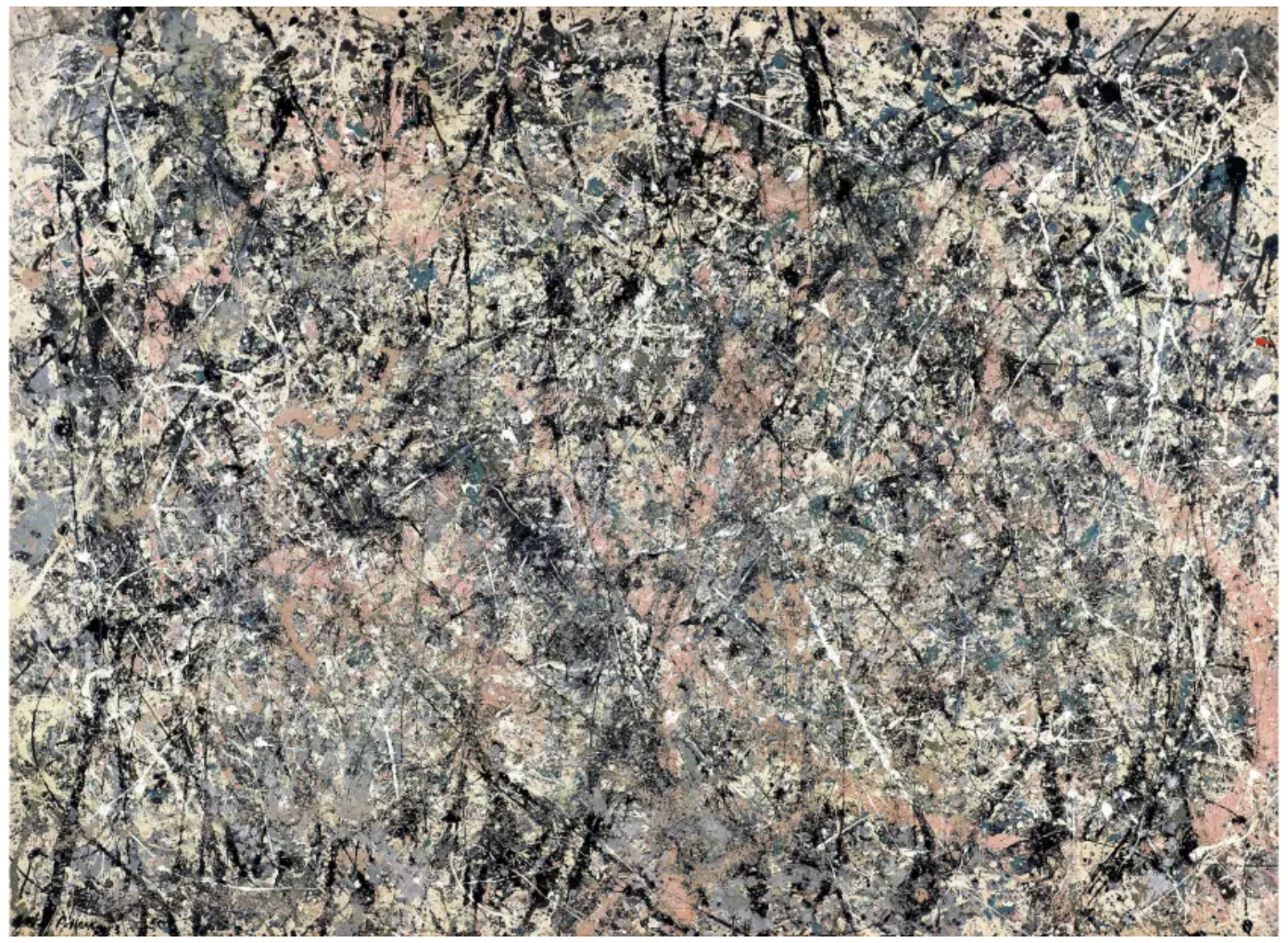
Jackson Pollock, Lavender Mist: Number 1, 1950. National Gallery of Art, Washington, D.C. Image © Bridgeman Images. Art © 2026 Pollock-Krasner Foundation / Artists Rights Society (ARS), New York
“[Mitchell’s paintings] are meaning and therefore do not have a residue of meaning which can be talked about.” (John Ashbery, “An Expressionist in Paris,” ARTnews, April 1965, n.p.) Over the course of a career that reshaped the possibilities of postwar painting, Mitchell expanded the ambitions of Abstract Expressionism beyond the boundaries established by her contemporaries. Though rooted in lived experience and inspired by landscape, her paintings transcend direct description, existing instead as independent visual events whose meaning resides fully within their formal and emotional presence. Neither an expression of pure emotional impulse nor an abstraction derived from figurative inspiration, Green Book of Barbara Guest exemplifies Mitchell’s innovation in transforming memory, sensation, and nature into a majestic orchestration of color, gesture, and space. Executed at the dawn of one of the most important decades of her career, the present work stands as a vivid testament to the authority and enduring power of Mitchell’s vision.
Untitled, circa 1967
Untitled, circa 1967
Christie’s New-York: 17 November 2026
Estimated: USD 10,000,000 – 15,000,000
JOAN MITCHELL (1925-1992), Untitled | Christie’s
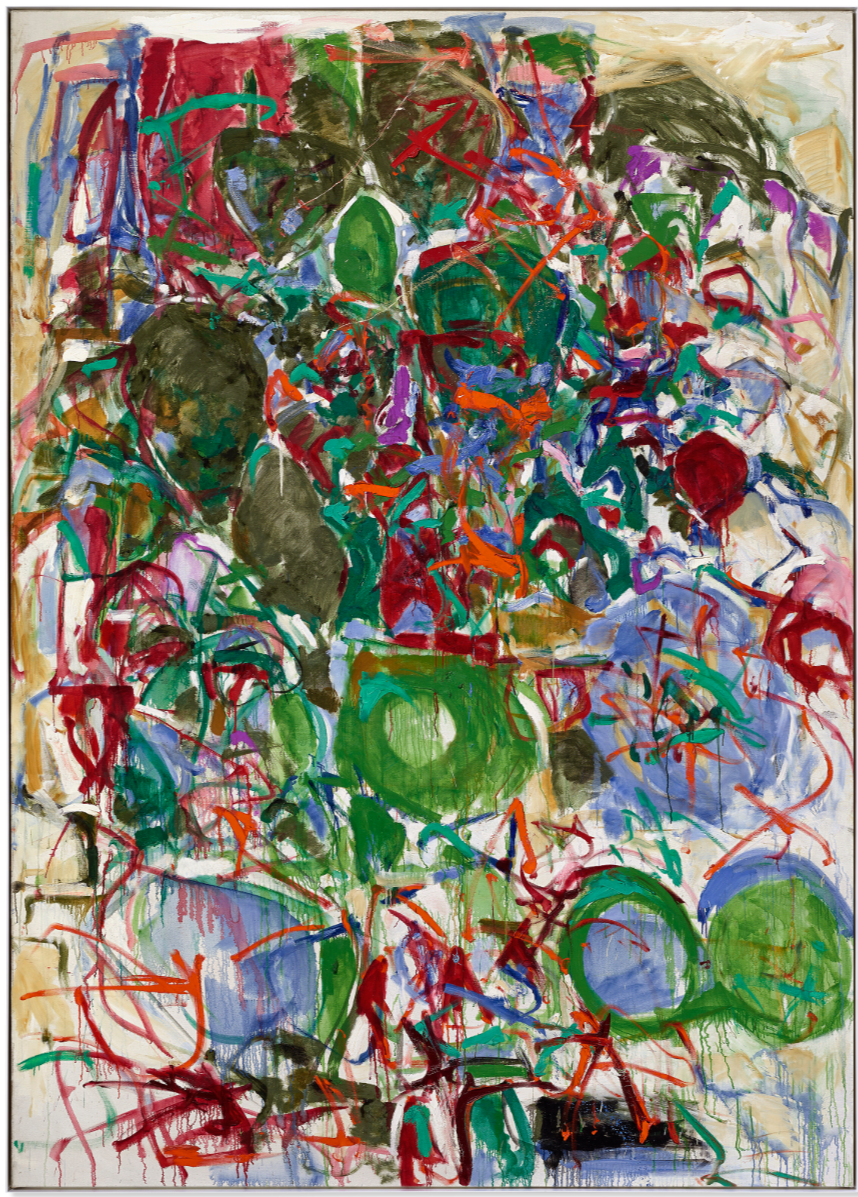
JOAN MITCHELL (1925-1992)
Untitled, circa 1967
Oil on canvas
109-1/2 x 78-3/8 inches (278×199 cm)
Beginning in the mid-1960s, after nearly a decade of living in France, Joan Mitchell’s paintings were beginning to show signs of a remarkable new chapter. The dense, often dark concentrations of color that had dominated the beginning of the decade were breaking apart. Her compositions grew brighter and more abundant; flashes of white opened between increasingly loose constellations of expressive lines and luminous organic orbs, dispersing across the canvas in a dynamic all-over composition. Landscape, long fundamental to Mitchell’s imagination, entered her paintings with renewed force. Painted across this pivotal moment, Untitled (1966–1967) captures Mitchell in the midst of great transformation.
“I paint from remembered landscapes that I carry with me—and remembered feelings of them, which of course become transformed. I would rather leave nature to itself. I would like more to paint what it leaves me with.”
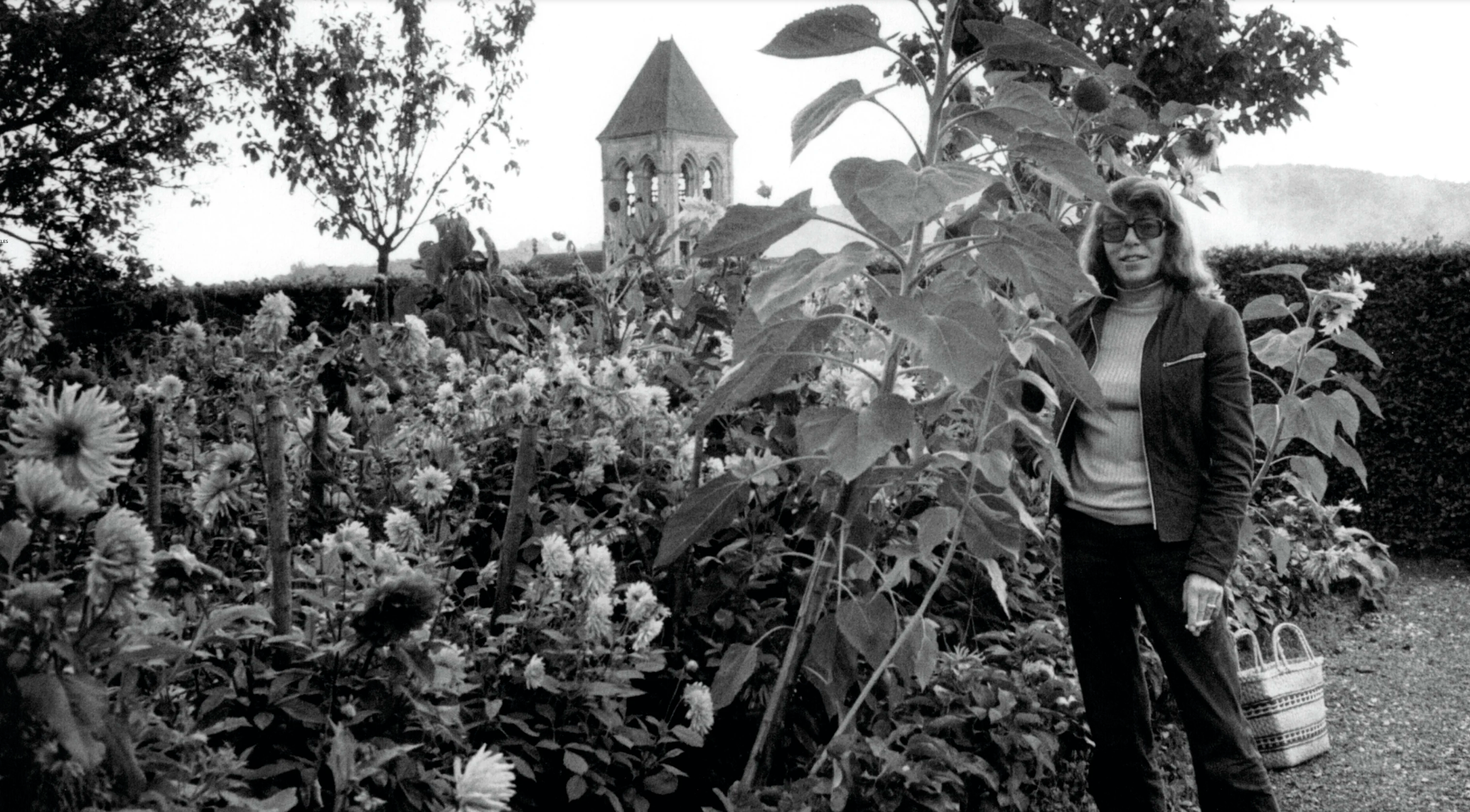
Joan Mitchell in her Vétheuil garden, 1972. Photo: © Nancy Crampton. All rights reserved.
Mitchell had moved permanently from New York to Paris in 1959, distancing herself geographically—and increasingly artistically—from the Abstract Expressionist milieu in which she had first made her name. By 1965, John Ashbery could already discern what that distance had afforded her. “It seems that such an artist has ripened more slowly and more naturally in the Parisian climate of indifference than she might have in the intensive-care wards of New York,” he wrote. Her work in France, he continued, “looks strong and relaxed, classical and refreshing at the same time; it has both the time and the will to be itself” (“An Expressionist in Paris,” Art News, no. 64, September 1965, p. 63).
Across its nearly nine-foot-high surface, grassy greens and aqueous blues collide with orange, violet, burgundy, and ochre. Some colors gather into thick, churning knots; elsewhere they unravel into frenetically looping strokes, rivulets, and diluted washes. Yet for all its apparent abandon, the composition pulses with life. Shades of white flicker through the interstices and open expanses around the cascading marks, giving light as much presence as pigment. Mitchell understood precisely the tension she was creating between spontaneity and deliberation. “I decide what I am going to do from a distance,” she told Irving Sandler a decade earlier. “The freedom in my work is quite controlled. I don’t close my eyes and hope for the best” (quoted in I. Sandler, “Mitchell Paints a Picture,” ARTnews, October 1957, p. 45).
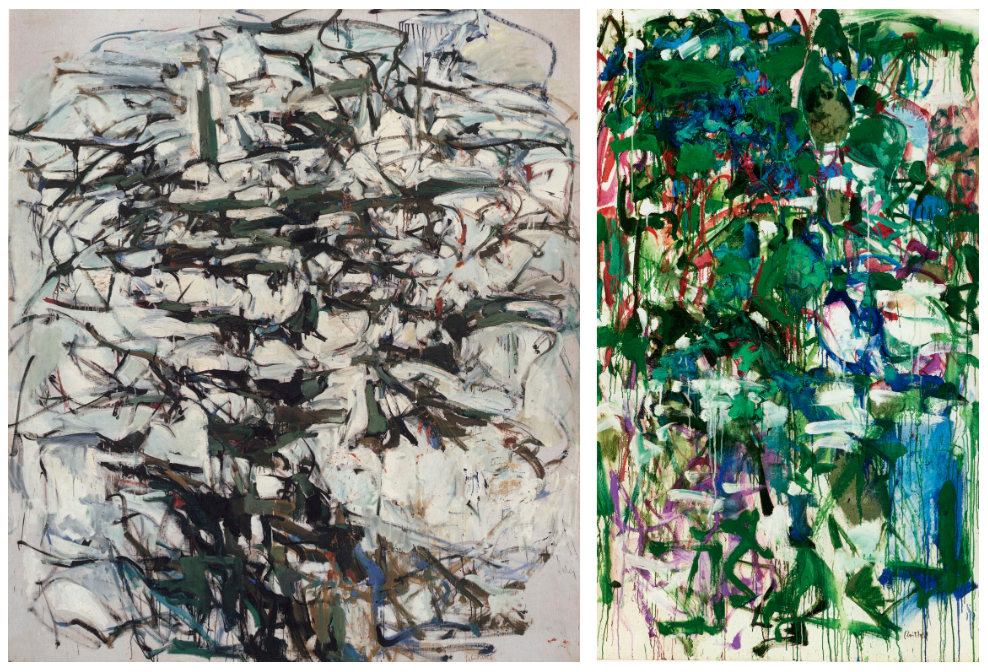
Left: Joan Mitchell, Hemlock, 1956. Whitney Museum of American Art, New York. © Estate of Joan Mitchell.
Right: Joan Mitchell, Woods/Country, 1966. McNay Art Museum, San Antonio. © Estate of Joan Mitchell.
Enthralled by the French countryside, spending more time outside of Paris seemed to have breathed new life into her painting. However, Mitchell had never understood landscape as something simply observed and reproduced.
“I paint from remembered landscapes that I carry with me—and remembered feelings of them, which of course become transformed. I would rather leave nature to itself. I would like more to paint what it leaves me with.”
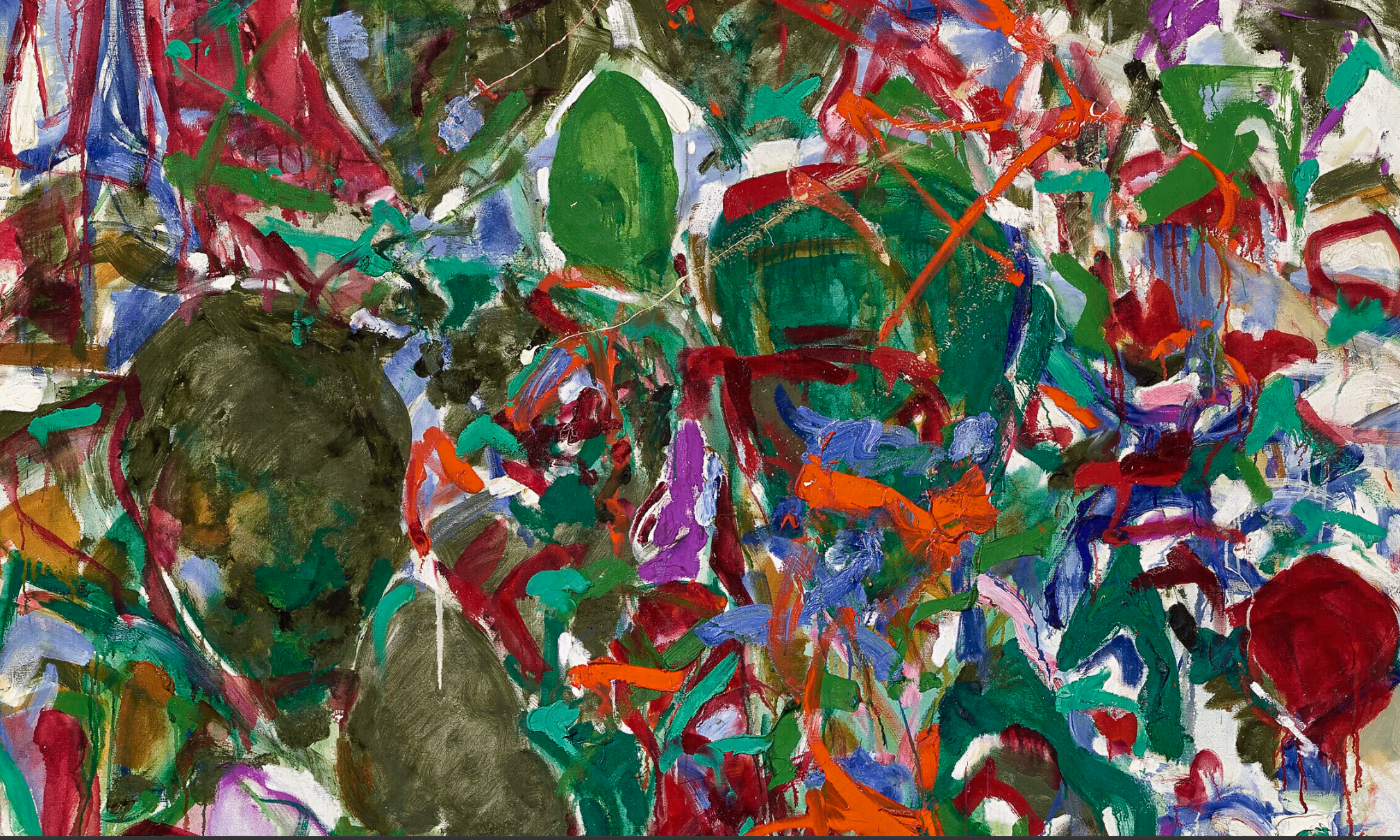
Her subject was therefore not so much a place as its afterimage: sensations of color, light and atmosphere retained in memory and transformed through paint. Memory allowed distant landscapes to coexist on her canvases. Mitchell associated blue, for instance, with the Lake Michigan of her Chicago childhood, while colors encountered in France accumulated their own associations.
“The permanence of certain colors: blue, yellow, orange, goes back to my childhood. I lived in Chicago and for me blue is the lake. Yellow comes from here [Vétheuil] … It is rapeseed, sunflowers … one sees a lot of yellow in the country. Purple, too”
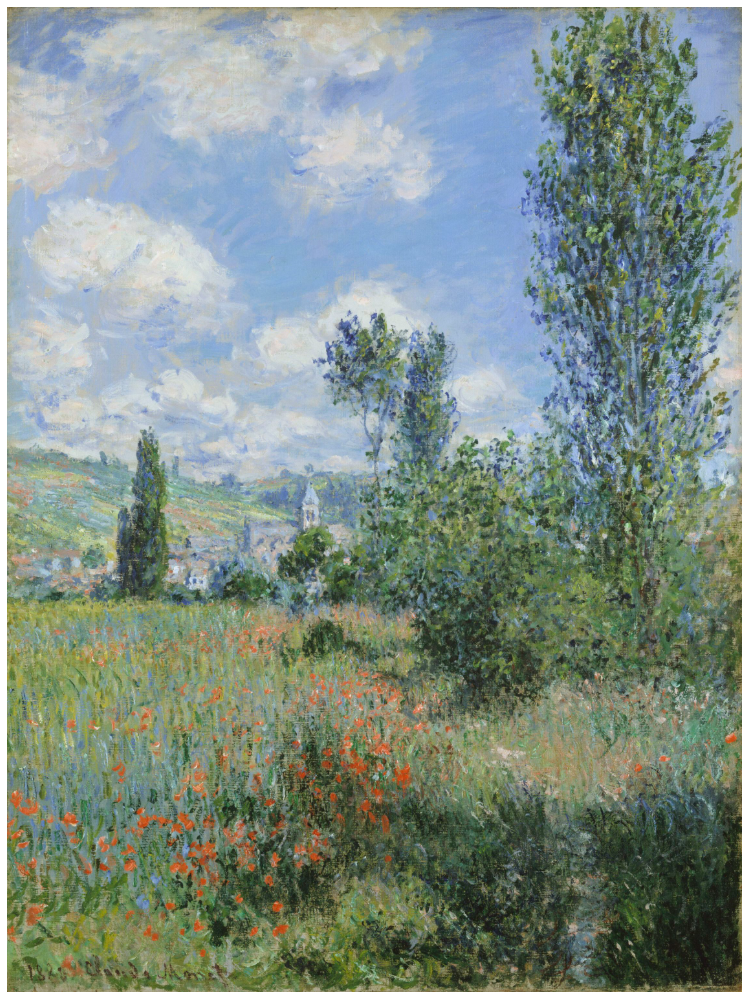
Claude Monet, View of Vétheuil, 1880. Metropolitan Museum of Art, New York.
In the spring of 1967, Mitchell purchased La Tour, a house and estate some 40 miles outside Paris in the small village of Vétheuil. Although she would not begin painting there until late 1968, the move would fundamentally alter the conditions of her life and work. As Judith Bernstock wrote of this group, “An inner radiance comes forth from the juxtaposition of complementary colors and from the breathing spaces of white and pale gray between them, reminiscent of the silver nuances of light in the Seine valley. In each canvas, heavily packed with organic forms and brilliant color, one senses a new joyful exuberance, a complete immersion in nature” (Joan Mitchell, 1988, New York, p. 74).
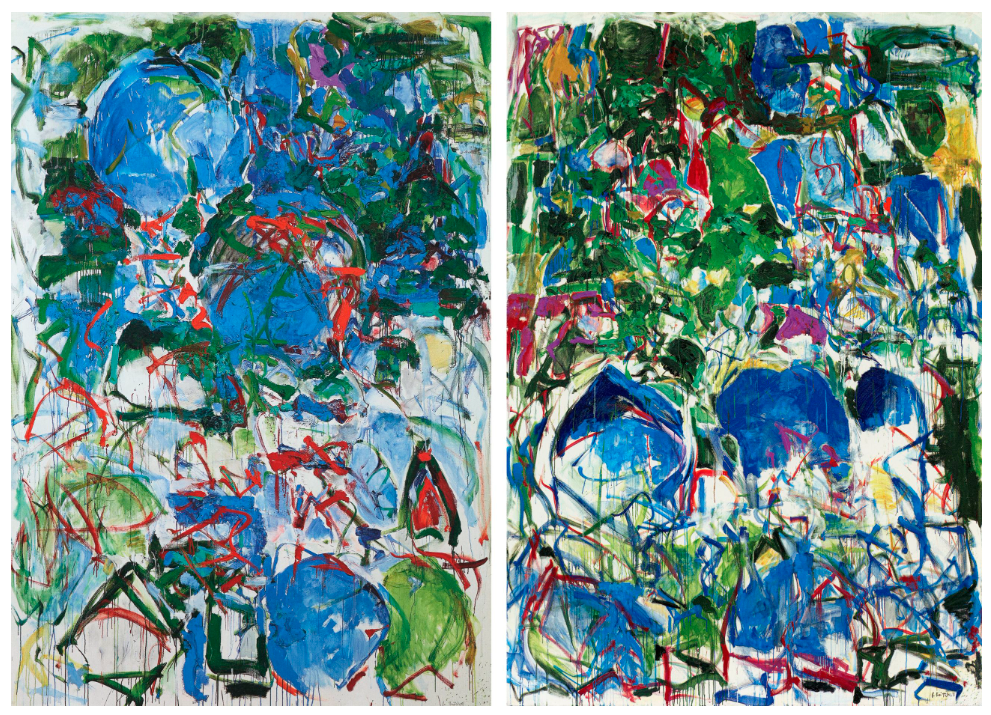
Left: Joan Mitchell, Mon Paysage, 1967. Fondation Maeght, Saint-Paul. © Estate of Joan Mitchell.
Right: Joan Mitchell, My Landscape II, 1967. Smithsonian American Art Museum, Washington, D.C. © Estate of Joan Mitchell.
Vétheuil also placed Mitchell, inevitably in the shadow of another painter. Claude Monet had lived there in the late 1870s before settling upriver at Giverny, and the affinities between his late paintings and Mitchell’s—expansive fields of color, ambiguous spatial depth, water and vegetation dissolved into painterly sensations—have proved irresistible. Mitchell herself was less interested in this artistic genealogy than in experience. “In the morning,” she once said of Vétheuil, “especially very early, it’s purple; Monet showed that already … Me, when I go out in the morning it’s purple, I am not copying Monet” (op.cit., n.p.). When talking about her favorite artists, she was more likely to mention Henri Matisse or Vincent van Gogh, the influence of both of whom can be felt in the variegated splendor of the present work.
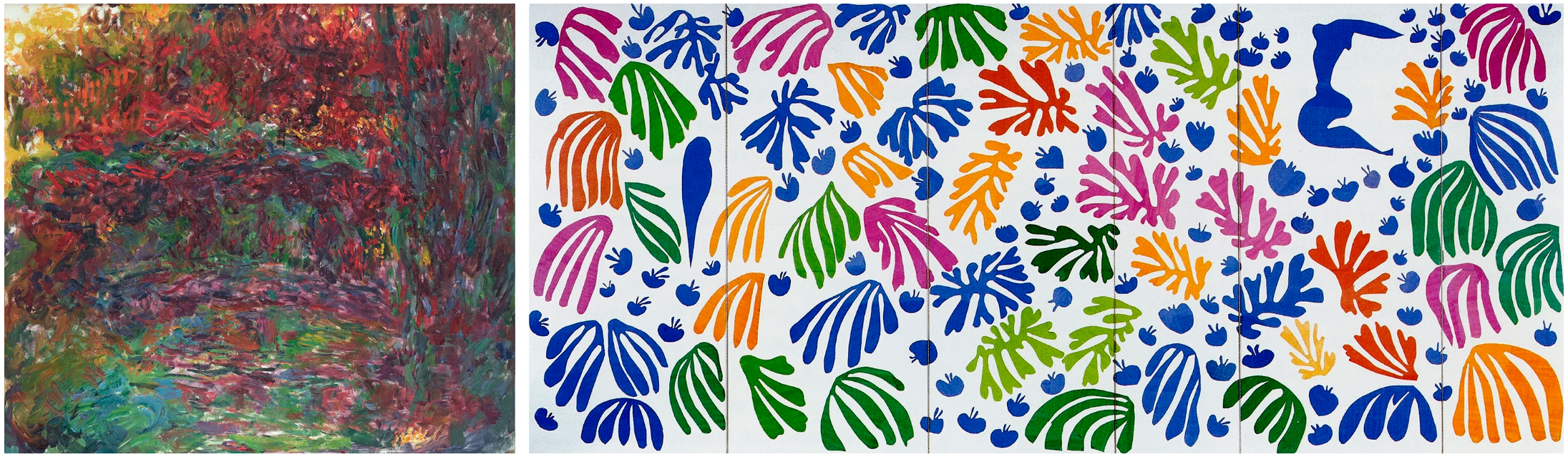
Left: Claude Monet, The Japanese Bridge, 1918-1924. Musée Marmottan, Paris.
Right: Henri Matisse, The Parakeet and the Mermaid, 1952. Stedelijk Musuem, Amsterdam. © 2026 Succession H. Matisse / Artists Rights Society (ARS), New York.
Painted on the threshold of her new life in Vétheuil, Untitled captures Mitchell at an extraordinary point of transition: between city and country, America and France, Abstract Expressionism and independence, the concentrated paintings of the early 1960s and the expansive landscapes to come. Color gathers and disperses; marks plunge and hover; flashes of white open between them. The painting neither depicts the landscape Mitchell was about to inhabit nor foretells precisely what she would make there. Instead, it gives form to something already taking shape within her work—a new openness to color, space, and the natural world.
Untitled, 1992
Untitled, 1992
The Clive Davis Collection
Christie’s New-York: 17 November 2026
Estimated: USD 3,500,000 – 4,500,000
MINIMUM PRICE GUARANTEE
JOAN MITCHELL (1925-1992), Untitled | Christie’s
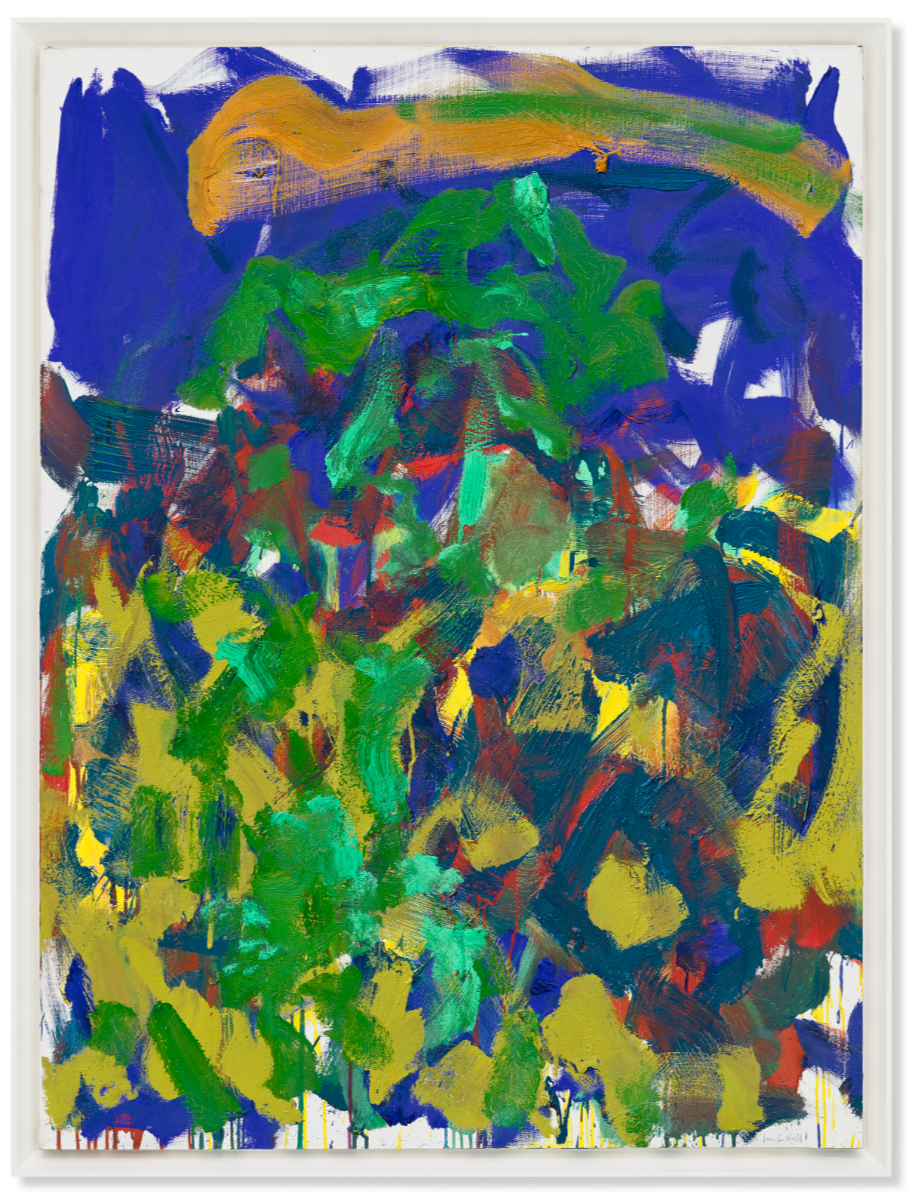
JOAN MITCHELL (1925-1992)
Untitled, 1992
Oil on canvas
51 x 38-1/4 inches (129.5 x 97.2 cm)
Signed ‘Joan Mitchell’ (lower right)
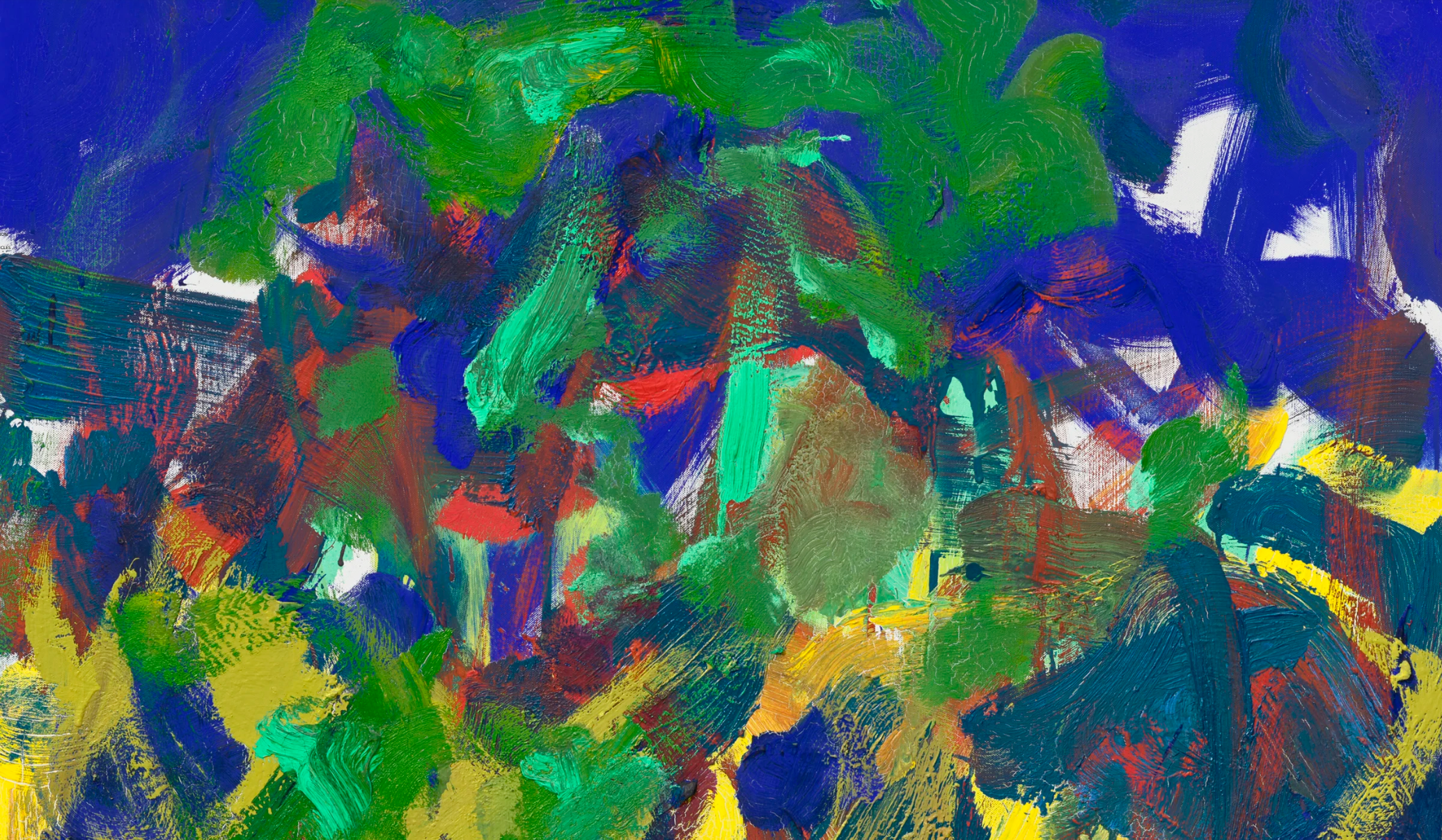
Painted in 1992, the final year of Joan Mitchell’s life, Untitled pulses with extraordinary vitality. Passages of emerald, yellow, and crimson jostle and overlap across its surface, rising toward an expanse of deep cobalt blue. Color gathers and disperses, advances and recedes as paint is dragged, scrubbed and dripped down the surface of the canvas. As curator Sarah Roberts has written, “The paintings made near the end of her life roar with the intensity of an artist determined to push herself and her medium and committed to remaining fiercely in the present, every day to her last” (S. Roberts, “Painting,” Joan Mitchell, exh. cat., San Francisco Museum of Modern Art, 2020, p. 303). Untitled carries precisely this sense of urgency: the composition holds exuberance and unease in suspension, its beauty heightened, somehow, by its chronology.
By the time she executed the present work, Mitchell had spent more than two decades at Vétheuil, the rural village northwest of Paris where she lived and worked overlooking the Seine. The landscape entered deeply into her imagination and way of life. She planted trees and flowers around her property and watched the river and changing skies. Landscape had always nourished her art, but never as simple description. Instead, she painted the sensations, memories, and emotions that a place left behind.
“I don’t set out to achieve a specific thing, perhaps to catch a motion or to catch a feeling. I try to eliminate clichés, extraneous material. I try to make it exact. My painting is not an allegory or a story. It is more of a poem.”
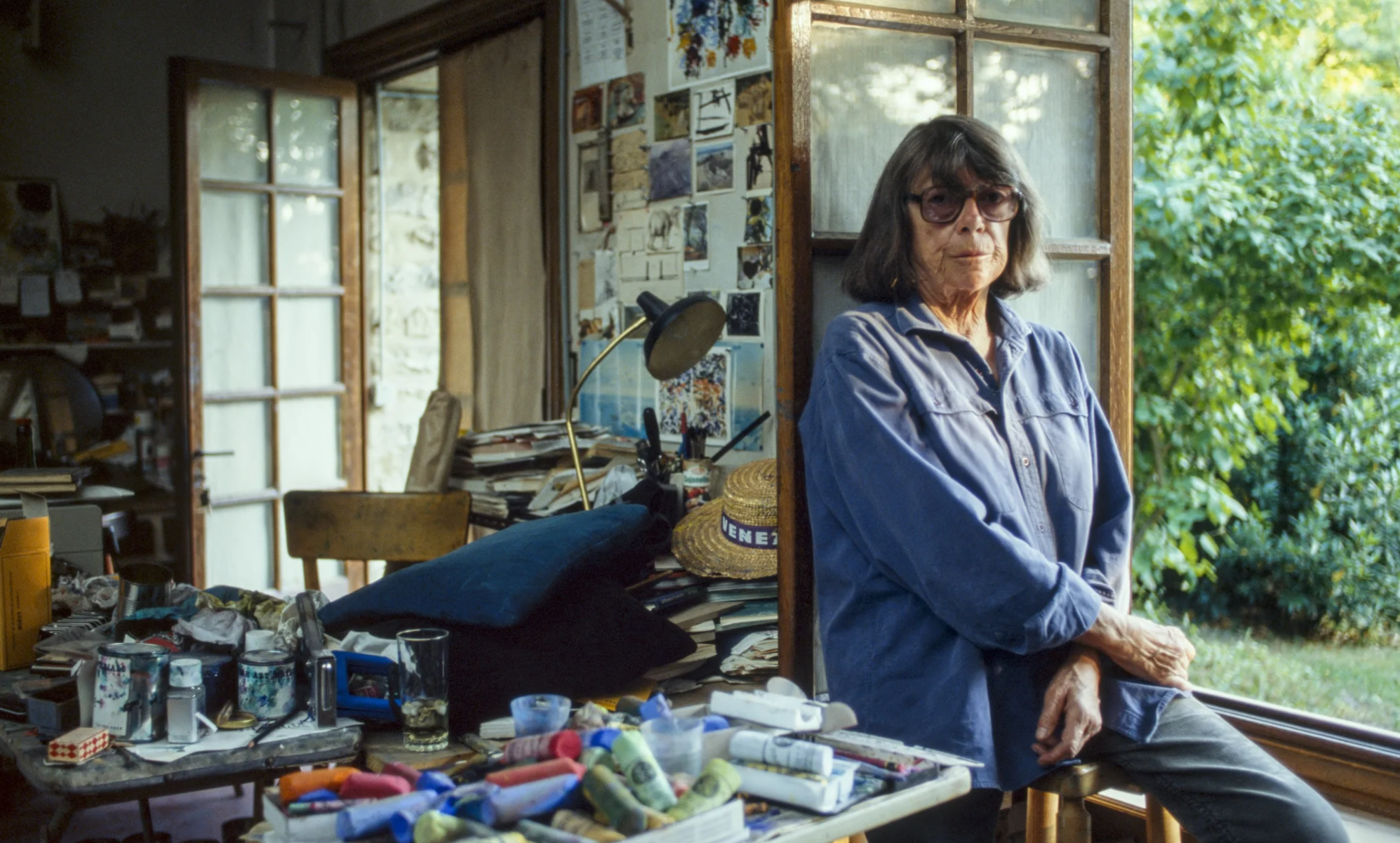
Joan Mitchell in her studio, Vétheuil, 1991. Photograph by Christopher Campbell.
Here, nature hovers at the surface. The sweeping cobalt expanse above suggests a darkening sky; beneath it, greens and yellows converge in full bloom, separated by a band of ochre that catches the last light of day. Mitchell was particularly devoted to l’heure bleue, the fleeting interval after sunset when the French countryside is suffused with blue. The effect inevitably recalls Vincent van Gogh, another painter who found in the French landscape a vocabulary capable of carrying extremes of feeling.
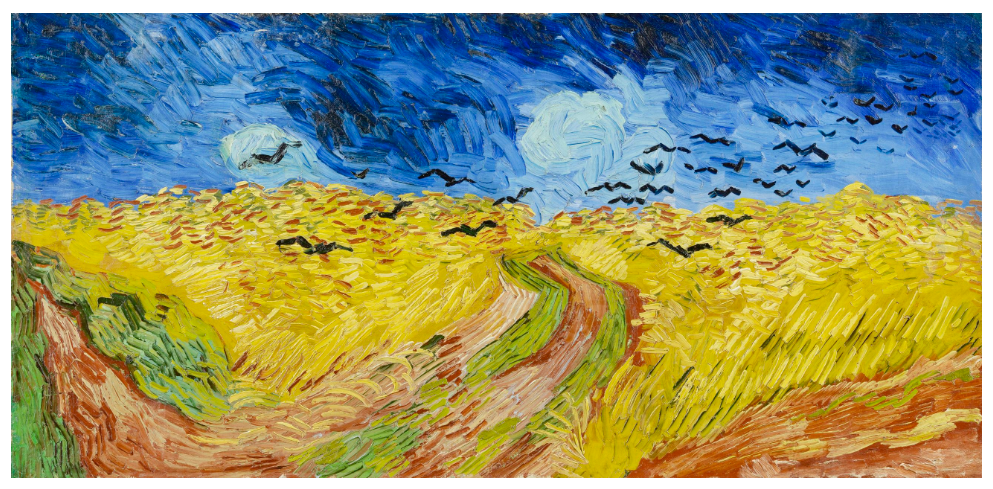
Vincent Van Gogh, Wheatfield with Crows, 1890. Van Gogh Museum, Amsterdam.
Like Van Gogh, Mitchell returned to sunflowers repeatedly throughout her career, but the motif acquired particular resonance in her later years. She grew them at Vétheuil and identified intensely with their cycles of blooming and decline. “I don’t exist at all,” she once said. “If I see a sunflower drooping, I can droop with it, and draw it, and feel it until its death.” Yet if Mitchell recognized herself in their decline, she was equally drawn to their irrepressible verve. “Because it turns its head constantly to the sun,” she continued, “the sunflower projects a sense of living movement and vitality…they’re these gestural things, embracing” (J. Bernstock, Joan Mitchell, New York, 1988, pp. 85–86).
That coexistence of vitality and mortality feels especially poignant in 1992. Mitchell’s health had deteriorated, and the deaths of friends and loved ones had accumulated around her. Nevertheless, her painting seemed to gain rather than lose force. “Her work changed significantly, growing more concentrated, impatient and ferociously focused, the joyous abandon of each painting intensified by the knowledge that it might be the last one,” art critic David Pagel wrote of her late work (D. Pagel, “Art Review: ‘Joan Mitchell/The Last Decade’ at Gagosian Gallery,” Los Angeles Times, November 10, 2010).
For Mitchell, painting remained inseparable from the experience of being alive. In a 1986 interview, she remembered lying ill in a room from which she could see two fir trees against a grey, rainy sky. The sight filled her with happiness.
“When I was sick, they moved me to a room with a window and suddenly through the window I saw two fir trees in a park, and the grey sky, and the beautiful grey rain, and I was so happy. It had something to do with being alive. I could see the pine trees, and I felt I could paint. If I could see them, I felt I would paint a painting”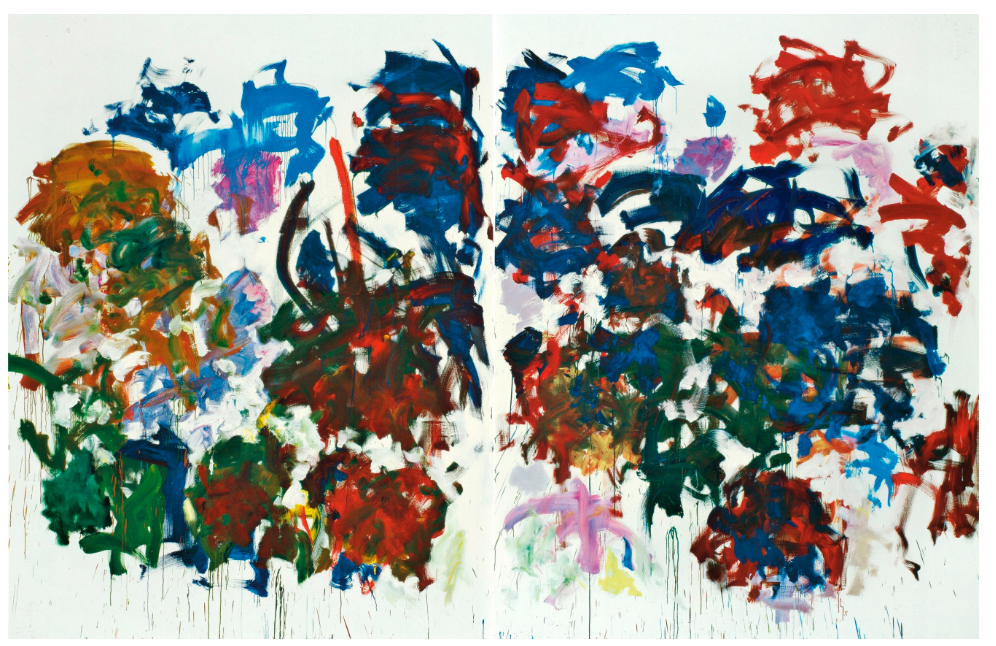
Joan Mitchell, Sunflowers, circa 1991. Joan Mitchell Foundation, New York. © Estate of Joan Mitchell.
In this way, Mitchell’s late work brought together two traditions that had shaped her practice from the beginning. “Mitchell’s late paintings recapitulate the history of French-countryside painting, but do so under the auspices of American Abstract Expressionism,” critic Donald Kuspit has written. “The French painters famously focused on the immediate sensations experienced in nature; Mitchell, by contrast, focuses on feelings, employing a frenetic AbEx gesturalism and urban energy.” Yet those feelings, Kuspit continues, came “‘from the outside, from landscape:'” her paintings responded as much to the world around her as to the world within (D. Kuspit, “Joan Mitchell,” Artforum, January 2012). In Untitled, the colors of the French countryside become inseparable from the gestures through which Mitchell experienced them. Painted at the end of her life, the landscape remains not simply something to see, but something to feel.