Fall 2026 New-York Marquee Auctions
Ultra-Contemporary Artists
Auction Results
Japanese Garden with Moon and Stars, 2020
Expanding Horizons: The Hedreen Collection
Sotheby’s New-York: 16 November 2026
Estimated: USD 3,000,000 – 5,000,000
GUARANTEED PROPERTY
Jonas Wood | Japanese Garden with Moon and Stars | The Now and
JONAS WOOD (b. 1977)
Japanese Garden with Moon and Stars, 2020
Oil and acrylic on canvas
72×70 inches (182.9 x 177.8 cm)
Signed with the artist’s initials, titled and dated 2020 (on the reverse)
Untitled, 2017
Expanding Horizons: The Hedreen Collection
Sotheby’s New-York: 16 November 2026
Estimated: USD 3,000,000 – 4,000,000
GUARANTEED PROPERTY
Matthew Wong | Untitled | The Now and Contemporary Evening Auction |
MATTHEW WONG (1984 – 2019)
Untitled, 2017
Oil on canvas
72×48 inches (182.9 x 121.9 cm)
Landscape, 2020
Christie’s New-York: 19 November 2026
Estimated: USD 2,000,000 – 3,000,000
MINIMUM PRICE GUARANTEE
NICOLAS PARTY (B. 1980), Landscape | Christie’s
NICOLAS PARTY (B. 1980)
Landscape, 2020
Soft pastel on linen
143×135 cm (56-1/4 x 53-1/8 inches)
Signed and dated ‘Nicolas Party 2020’ (on the reverse)
Australian Open One, 2012
Sotheby’s New-York: 17 November 2026
Estimated: USD 1,000,000 – 1,500,000
Jonas Wood | Australian Open One | Contemporary Day Auction | 2026 |
JONAS WOOD (b. 1977)
Australian Open One, 2012
Oil and acrylic on canvas
88×66 inches (223.5 x 167.6 cm)
Signed with the artist’s initials, titled and dated 2012 (on the reverse)
Braided Bun, 2022
Christie’s New-York: 19 November 2026
Estimated: USD 600,000 – 800,000
MINIMUM PRICE GUARANTEE
EWA JUSZKIEWICZ (B. 1984), Braided Bun | Christie’s
EWA JUSZKIEWICZ (B. 1984)
Braided Bun, 2022
Oil on canvas
200×160 cm (78-3/4 x 63 inches)
Signed, dated and titled ‘Ewa Juszkiewicz ‘Braided Bun’ 2022′ (on the reverse)
Jonas Wood
Japanese Garden with Moon and Stars, 2020
Expanding Horizons: The Hedreen Collection
Sotheby’s New-York: 16 November 2026
Estimated: USD 3,000,000 – 5,000,000
GUARANTEED PROPERTY
Jonas Wood | Japanese Garden with Moon and Stars | The Now and
JONAS WOOD (b. 1977)
Japanese Garden with Moon and Stars, 2020
Oil and acrylic on canvas
72×70 inches (182.9 x 177.8 cm)
Signed with the artist’s initials, titled and dated 2020 (on the reverse)
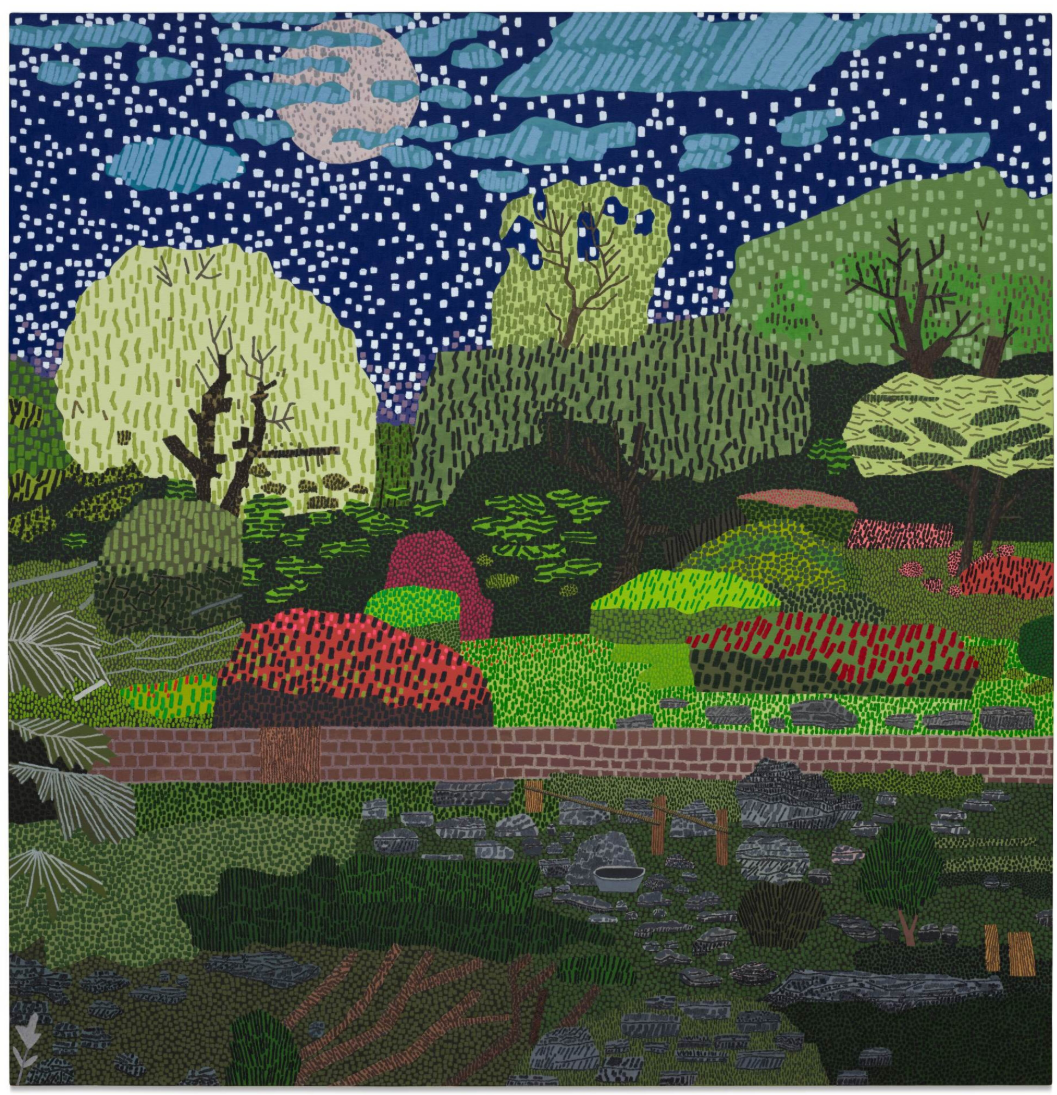
Packed with textured patterns and his signature flattened style, Jonas Wood’s Japanese Garden with Moon and Stars from 2020 is a vibrant masterpiece and a rare exploration of traditional landscape painting, mediated through the artist’s wholly singular fusion of artistic theory and technique. Employing tropes of flattened color fields, spatial distortions recalling French Post-Impressionist painting, and layered perspectives reminiscent of Pop collage and woodcut traditions, Wood constructs a sprawling landscape of exceptional scale and immersive presence. In a rare directness, Japanese Garden with Moon and Stars eschews Wood’s typical mediation of flora through domestic interiors or alternative perspectival frameworks, instead embracing the conventions of the classic landscape and depicting a serene garden beneath an expansive, speckled sky. Sharing a studio with his wife, Japanese ceramic artist Shio Kusaka, Wood draws upon the ceramic landscape tradition in his limited suite of garden paintings, of which Japanese Garden with Moon and Stars stands as one of his few pure landscapes. Unmediated by human figures, domestic life, or overtly contemporary references, the work instead embraces a rich constellation of artistic conversations, histories, theories, and styles, synthesizing them into a singular and deeply resonant vision.
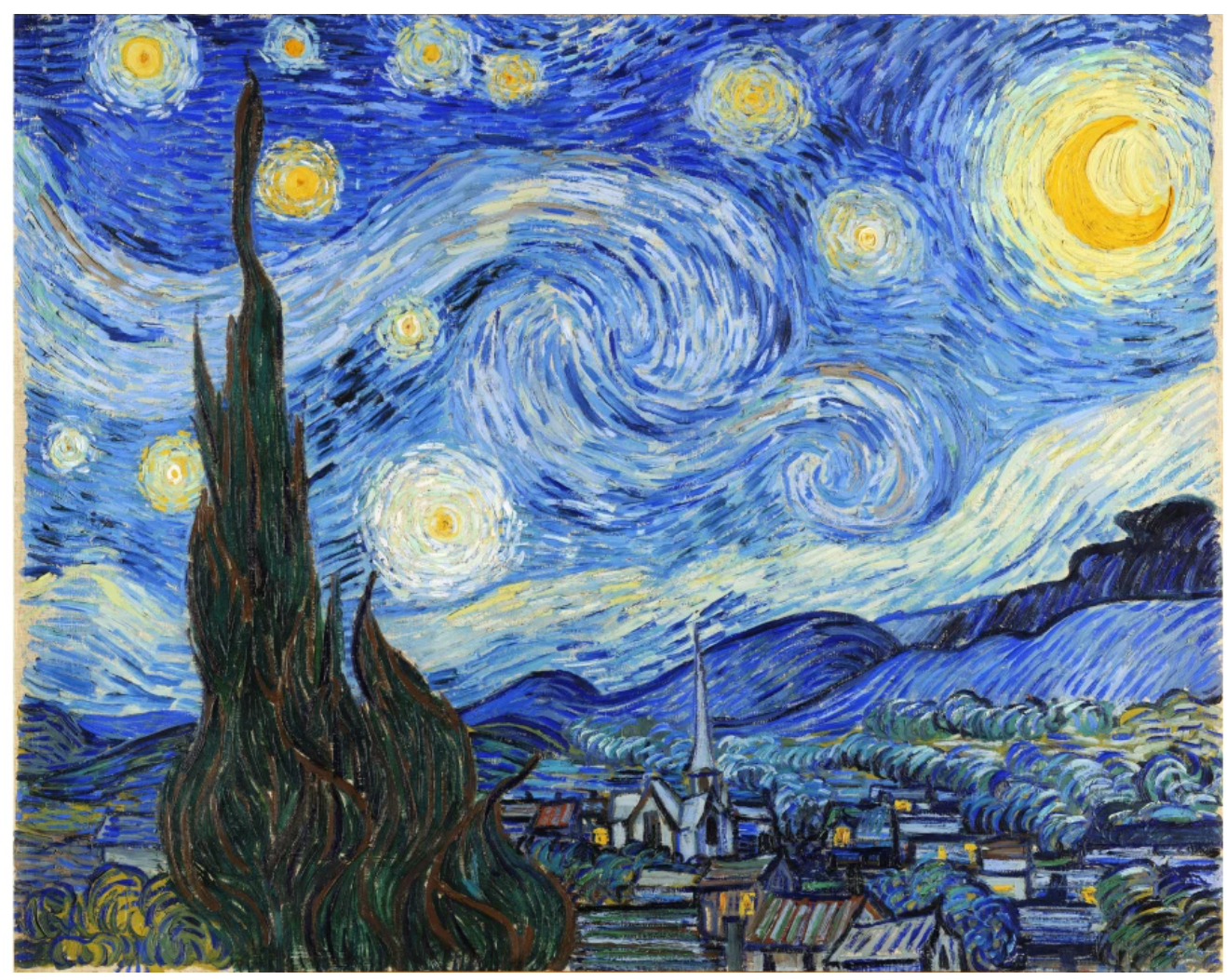
Vincent Van Gogh, Starry Night over the Rhone, 1888. Musée d’Orsay, Paris. Image © Bridgeman Images
Acclaimed for his interior scenes that often verge on still lifes, Japanese Garden with Moon and Stars represents Wood’s impulse to step beyond his traditional format and find a new muse in the meticulously constructed and visually compelling terrain of the Japanese garden. The present work belongs to his Japanese Garden series, which calls upon the same formal structure afforded by the controlled setting of the domestic interior, while exploring the manicured contours and distinctive aesthetics of the Japanese garden.
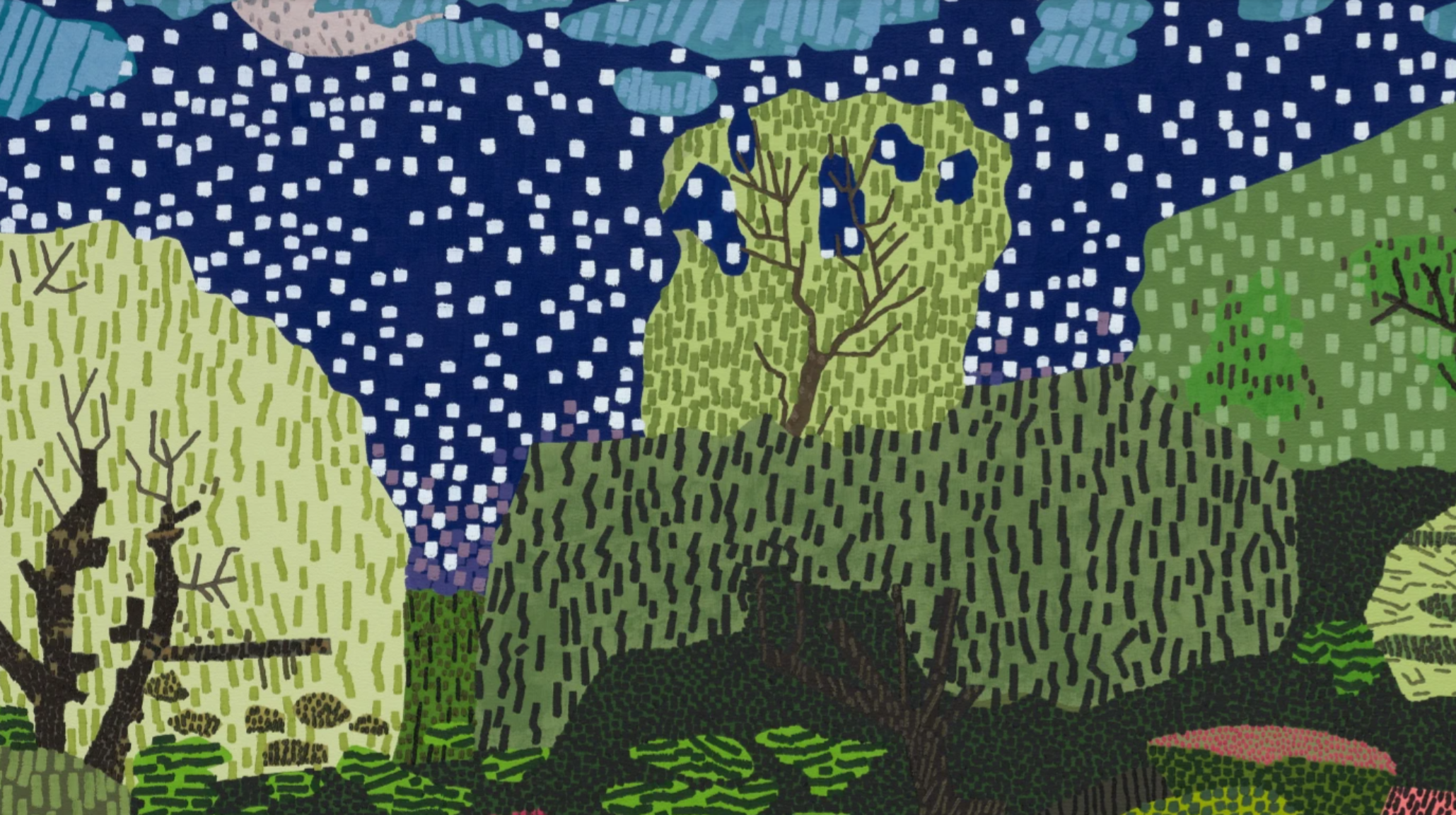
In turn, Wood finds a parallel visual language of flattened color, distinct shape, and assertive line through which to construct and organize the composition. Wood’s visual vernacular is marked by a photo-based approach. Similar to Henri Matisse’s late process of cutting gouache-painted paper into a wide range of shapes and rearranging them into new compositions, Wood works from a personal archive of photographs and found imagery, making sketches and studies before creating preliminary collages. The cut-and-pasted images are then filtered through various layers of drawing until he arrives at his final composition. This fragmentary method is, in essence, a synthesized perception of time and space; as a result, the final works vibrate with an energetic rhythm and fantastical harmony.
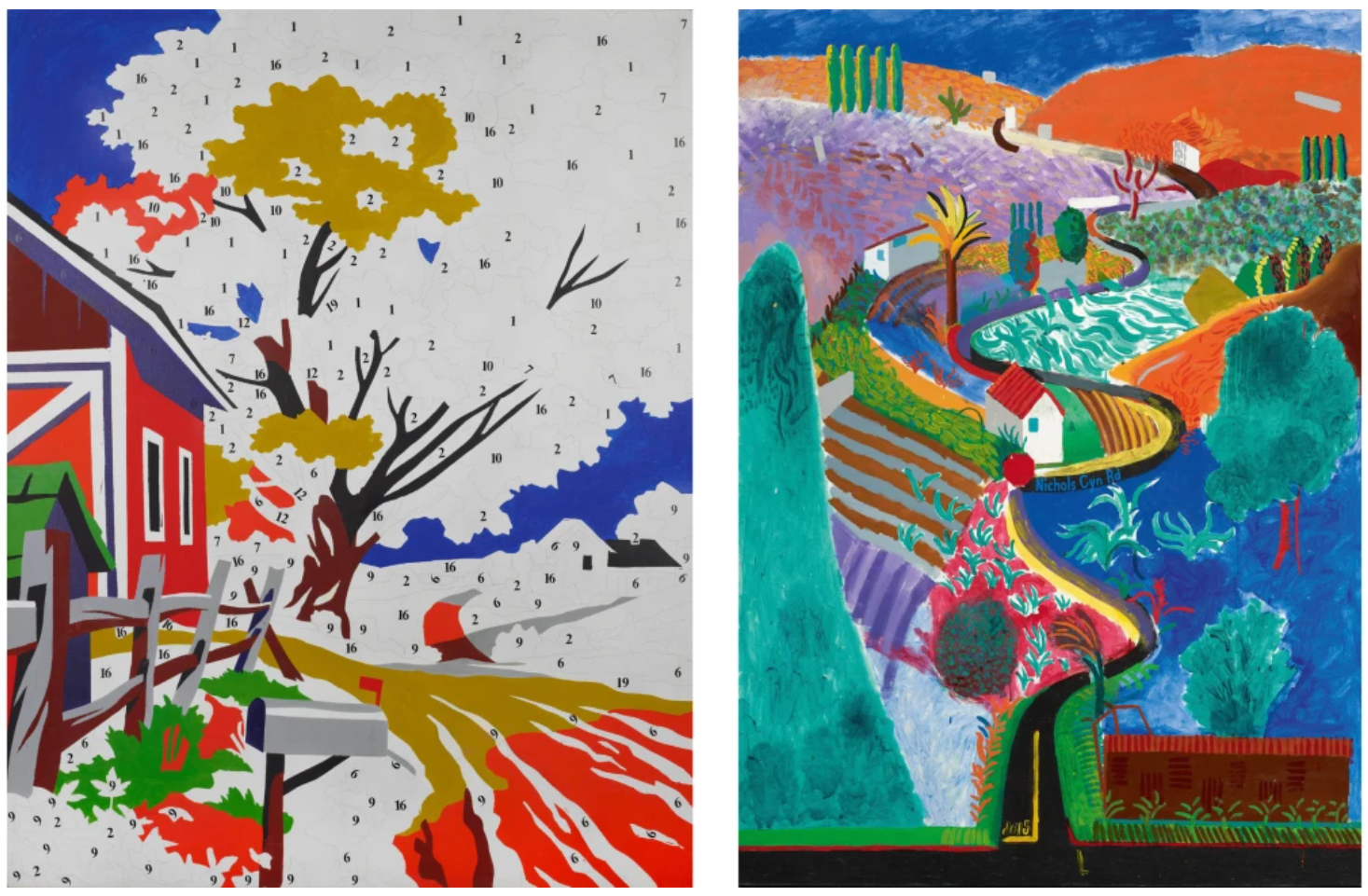
Left: Andy Warhol, Do It Yourself, 1989. Museum Ludwig, Cologne. Art © 2026 Andy Warhol Foundation for the Visual Arts / Artists Rights Society (ARS), New York.
Right: David Hockney, Nichols Canyon, 1980. Private Collection. Art © 2026 David Hockney
Over the past two decades, Wood has carved out his own distinctive and critically lauded aesthetic that is embedded in a rich network of art-historical reference. The impact of Cubism is evident in his work’s conflation of multiple perspectives, while his focus on the quotidian as well as the cheerful gaiety of his palette invokes the language of Pop Art, evoking in particular David Hockney’s domesticated landscapes and gardens. Amongst these influences, the present work is further ingrained in the Post-Impressionist style, with expressive mark-making and patterning akin to the interiors of Édouard Vuillard. Wood has said: “Hockney was a big, big influence on me. He has that Renaissance ability to paint from life, but he’s also an inventor,” says Wood. “But I love Picasso and Braque and Matisse and Vuillard. . . . And the thing about Hockney or Alex Katz or Lucian Freud or any of those people that I’m super into, they were into those modern painters, too. So I get to look at Matisse or Picasso through their work.” (cited in Meredith Mendelsohn, “Jonas Wood—Mural”, Gagosian Magazine, 22 May 2017, n.p.)
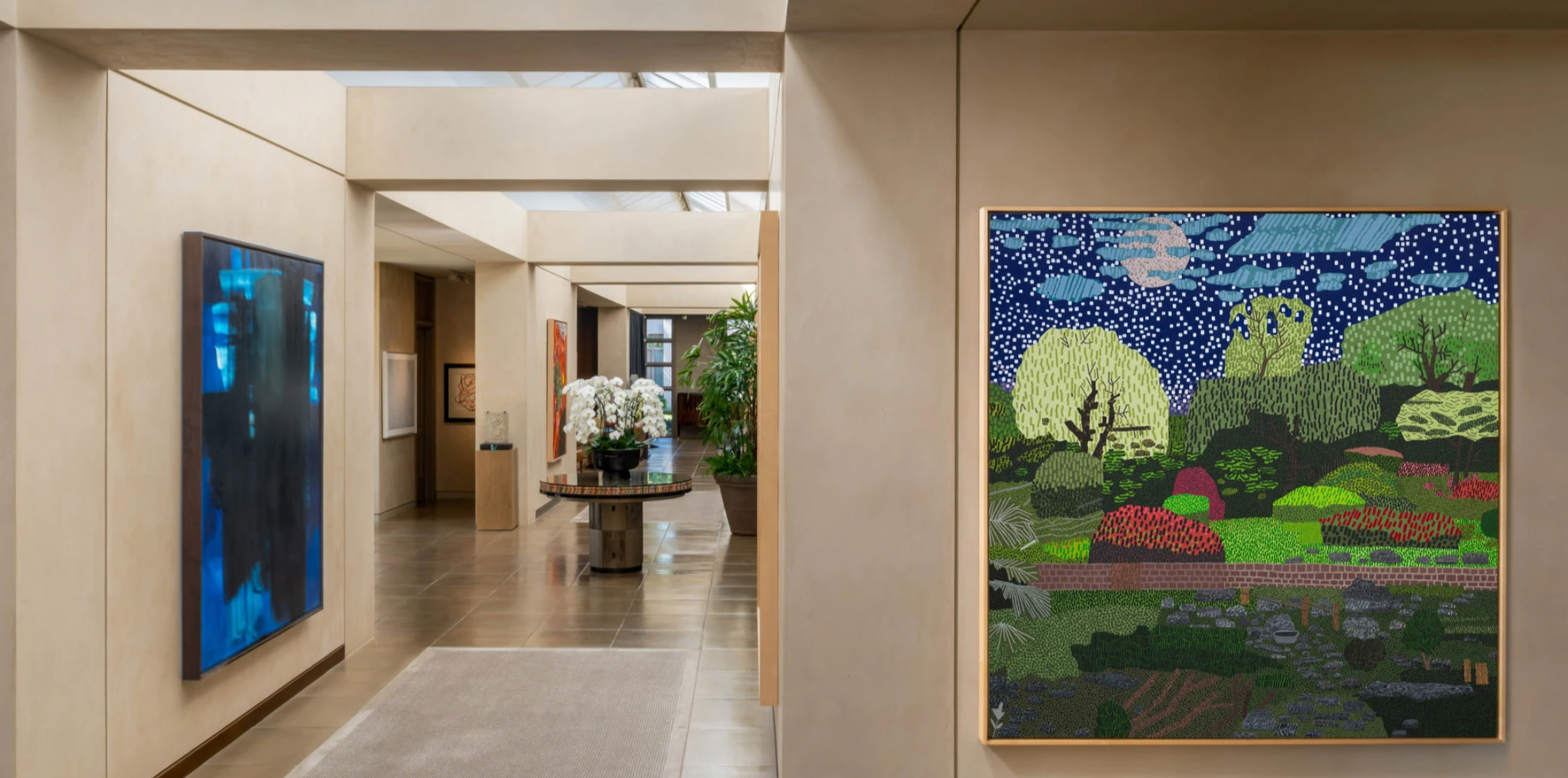
The present work installed in the Hedreen Residence. Art © 2026 Jonas Wood
As Roberta Smith asserts: “More than ever his works negotiate an uneasy truce among the abstract, the representational, the photographic […] Each painting presents a highly personal but impersonally observed reality.” (Roberta Smith, “Paintings by Jonas Wood”, The New York Times, 18 March 2011, p. C31) Although depicting a serene, peaceful garden devoid of figures or contemporary life, Japanese Garden employs a dynamic perception of space, volume, flatness, and depth to expand its scope, producing a rich tapestry of exquisitely embellished and boldly saturated elements. Oscillating between representational landscape and abstraction, balanced at the nuanced threshold at which representation disintegrates into sheer pattern of form and color, the present work epitomizes the very best of Wood’s oeuvre.
Australian Open One, 2012
Sotheby’s New-York: 17 November 2026
Estimated: USD 1,000,000 – 1,500,000
Jonas Wood | Australian Open One | Contemporary Day Auction | 2026 |
JONAS WOOD (b. 1977)
Australian Open One, 2012
Oil and acrylic on canvas
88×66 inches (223.5 x 167.6 cm)
Signed with the artist’s initials, titled and dated 2012 (on the reverse)
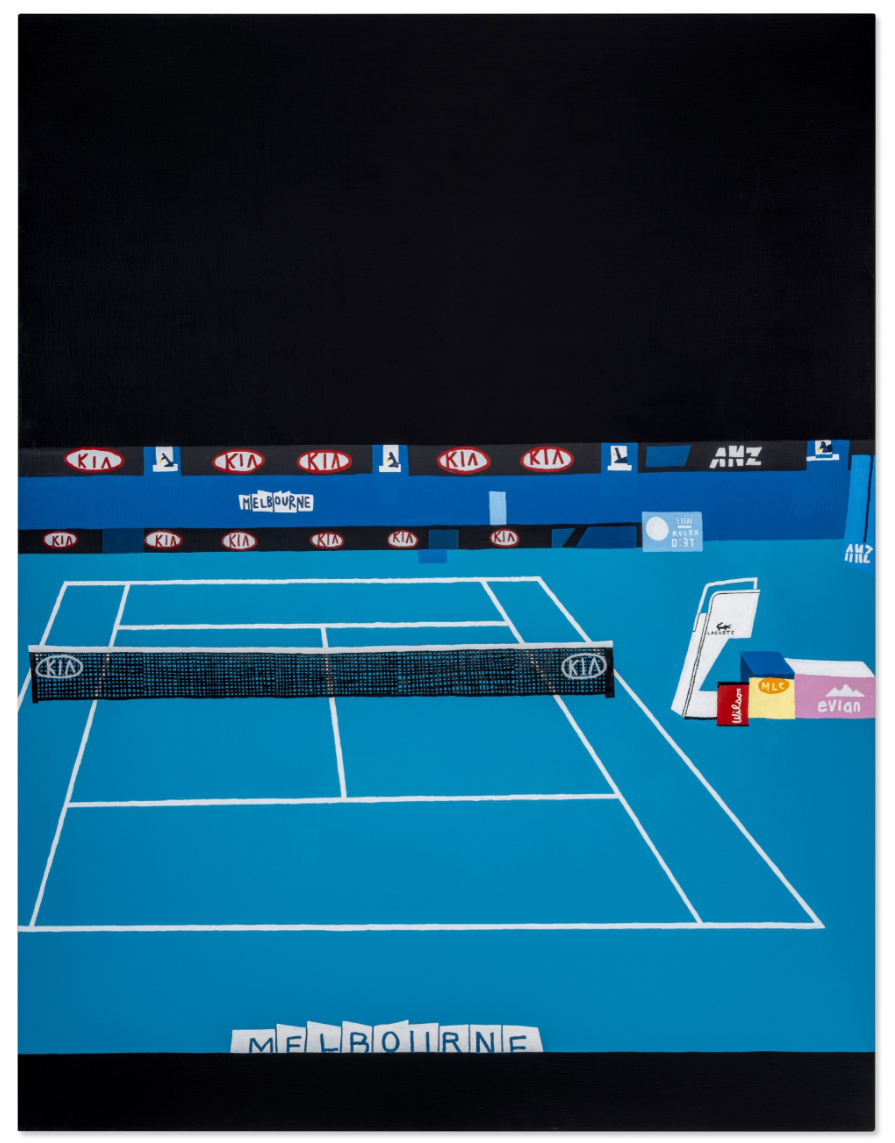
Executed in 2012, Australian Open One belongs to Jonas Wood’s celebrated tennis court series, a body of work that merges the artist’s lifelong passion for sports with his distinctive approach to painting. While Wood is often associated with depictions of domestic interiors and natural forms, sports imagery occupies a significant place within his practice. A devoted sports enthusiast, Wood has produced paintings of basketball players, sports cards, boxing subjects, and iconic tennis venues, drawing inspiration from both personal experience and the collective visual culture surrounding professional athletics.
“My forms are not rendered spatially. My paintings of tennis courts were about an interest in abstraction, and how the court becomes a geometric puzzle.”
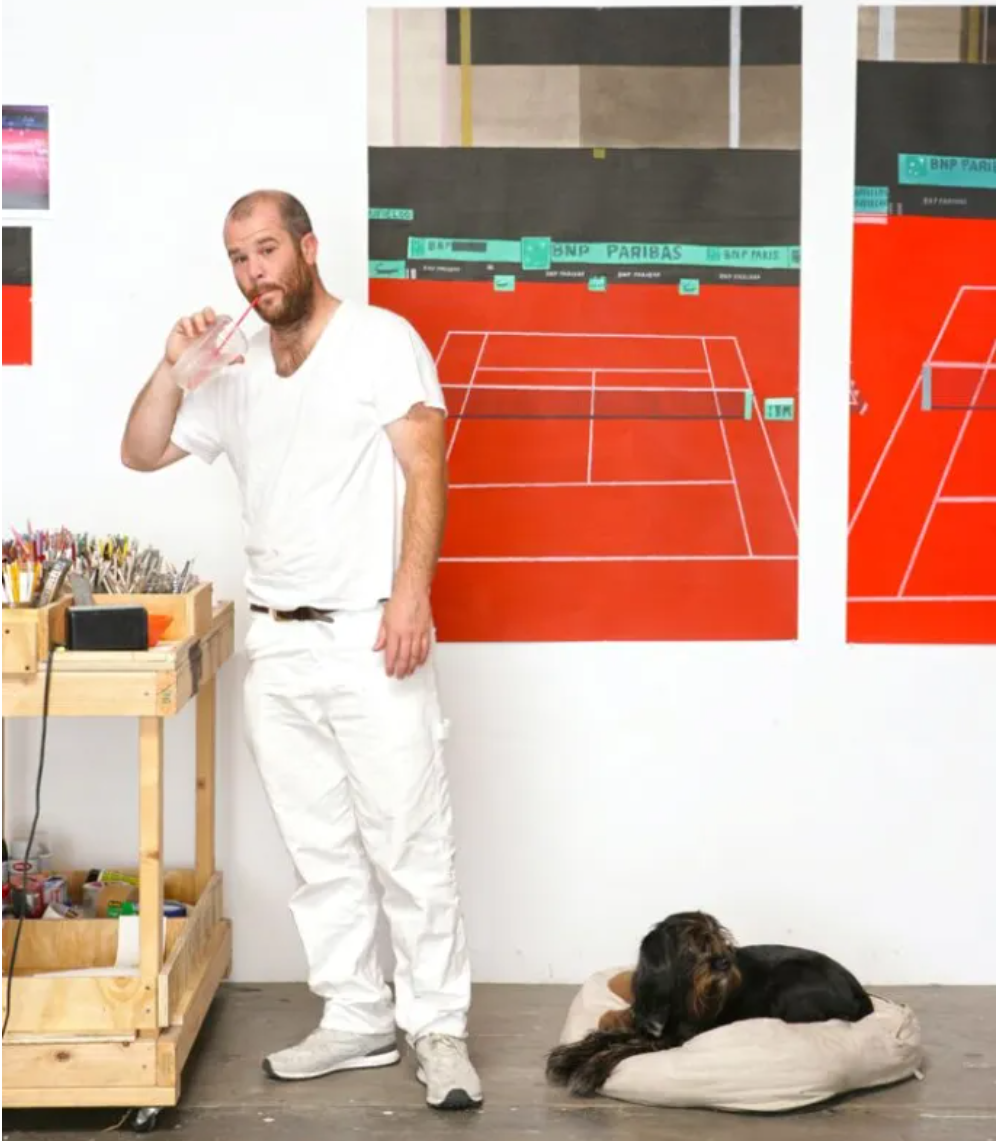
Jonas Wood in his studio.
The tennis court series represents one of the clearest manifestations of Wood’s ability to transform familiar subjects into compelling formal constructions. In these works, Wood explores how slight shifts in vantage point, color, and composition can yield dramatically different visual experiences. Rather than depicting the spectacle of competition, he focuses on the architecture of the court itself. Stripped of players and spectators, these internationally recognized venues become studies in geometry, pattern, and spatial perception. In Australian Open One, Wood turns his attention to Melbourne Park’s emblematic blue hard court. The composition is dominated by vivid expanses of turquoise and cerulean punctuated by sharply defined white lines that establish the court’s rigid structure. Logos, signage, and courtside equipment appear as carefully arranged graphic elements, while the black net bisects the canvas with striking precision. Perhaps most dramatically, a vast dark field occupies nearly half the composition above the stadium perimeter, framing the image as if looking through a television screen.
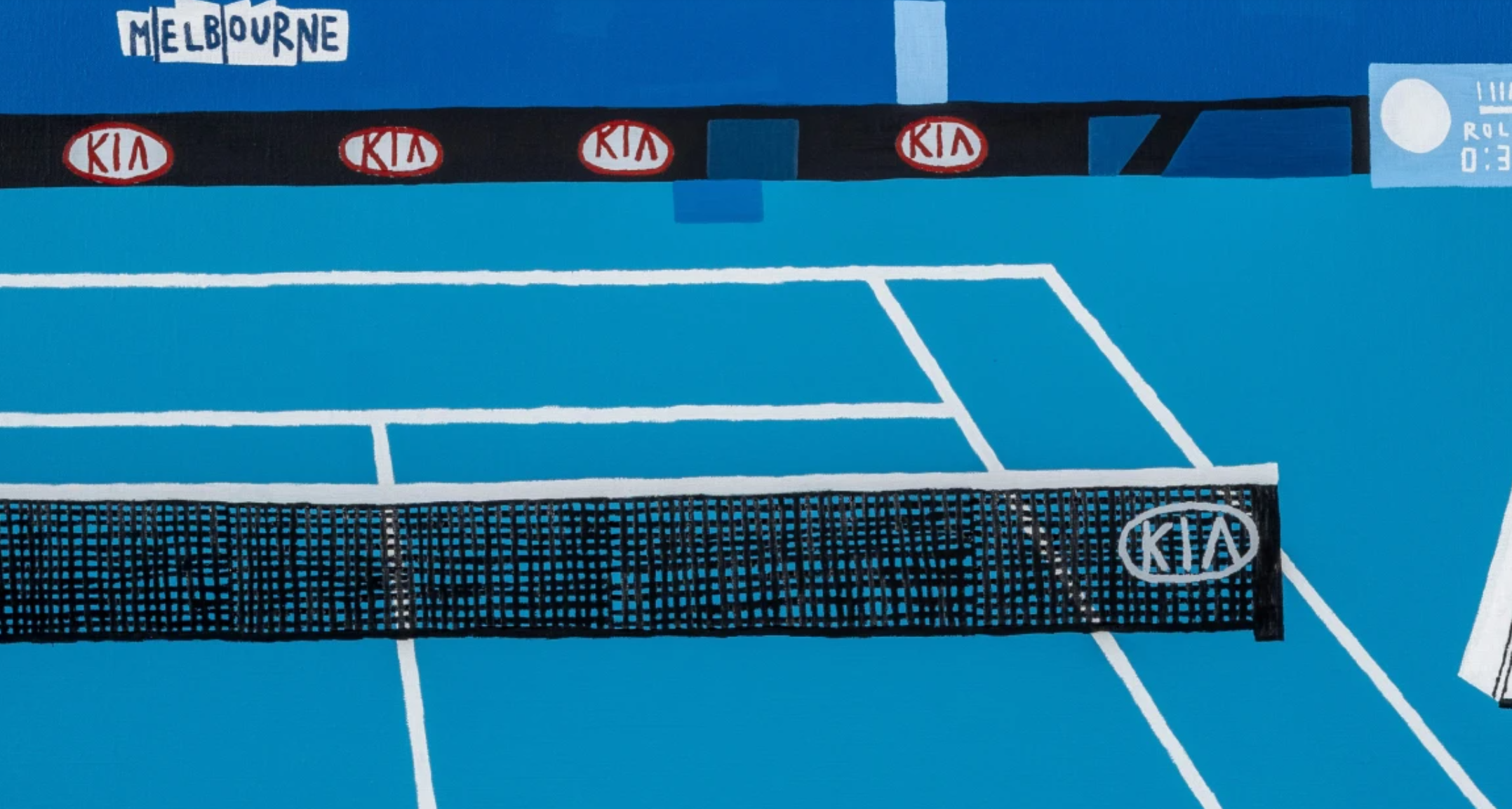
In the present work, Wood employs flat blocks of saturated color and compressed space to conjure an uncanny balance between realism and abstraction. Whilst the painting depicts a recognizable sporting venue, its visual logic resists naturalistic description. Much like his celebrated Clippings, depth and perspective is deliberately manipulated, collapsing traditional three-dimensionality into a sequence of flattened planes. The result is a disorienting yet highly ordered image. The cropped viewpoint and emphasis on surface echo Wood’s characteristic approach across his oeuvre, where observation is constantly filtered through memory, photography, and formal invention. Australian Open One is also distinguished by its state of complete stillness despite depicting a setting of high-energy. There is an undercurrent of anticipation within the composition, as though the viewer has arrived moments before the beginning of a match. The brilliant blues radiate energy, yet the empty court remains contemplative and detached, inviting sustained visual examination rather than narrative engagement.
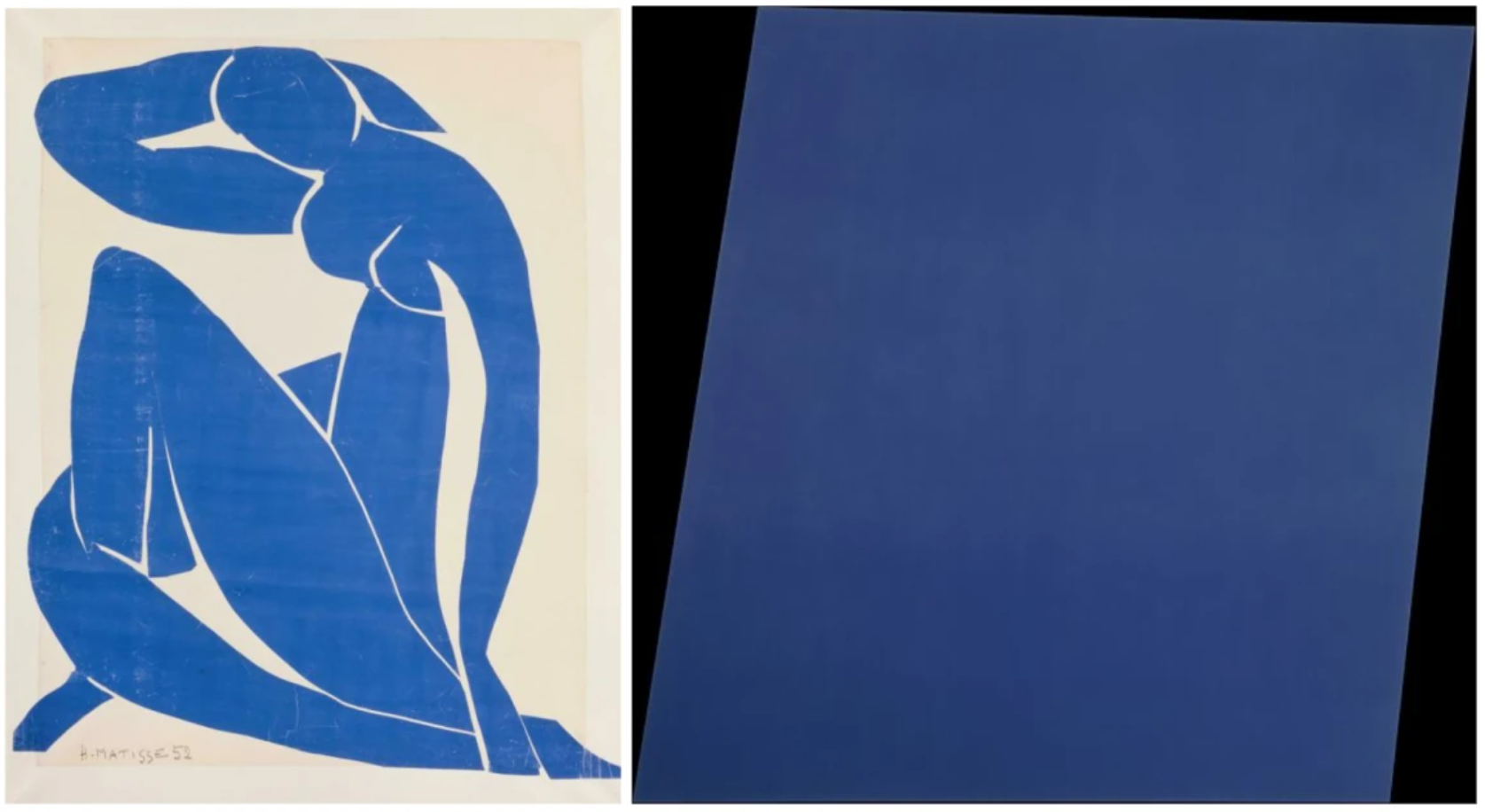
LEFT: Henri Matisse, Nu bleu II, 1952. © Centre Pompidou, Paris
RIGHT: Ellsworth Kelly, Blue Panel II, 1977. © Museum of Modern Art, New York
Wood’s sensitivity to the emotional effects of color and composition may be partly traced to his academic background in psychology, a discipline he studied before committing fully to painting. Throughout his career, he has explored how visual structures shape perception, often transforming ordinary subjects into dynamic pictorial experiences. In Australian Open One, this interest is evident in the interplay between the court’s recognizable architecture and its near-abstract formal organization. Occupying a space between representation and decoration, Wood’s paintings draw upon an art-historical lineage of Henri Matisse, David Hockney, and Alex Katz. Like these predecessors, he embraces flattened space, bold color, and simplified forms while adapting those strategies to a contemporary visual world mediated by photography and popular culture. Australian Open One exemplifies this achievement. Simultaneously a portrait of an iconic sporting venue and an elegant exercise in abstraction, the painting demonstrates Wood’s remarkable ability to find visual complexity and psychological depth within the structures of everyday life.
Nicolas Party
Landscape, 2020
Christie’s New-York: 19 November 2026
Estimated: USD 2,000,000 – 3,000,000
MINIMUM PRICE GUARANTEE
NICOLAS PARTY (B. 1980), Landscape | Christie’s
NICOLAS PARTY (B. 1980)
Landscape, 2020
Soft pastel on linen
143×135 cm (56-1/4 x 53-1/8 inches)
Signed and dated ‘Nicolas Party 2020’ (on the reverse)
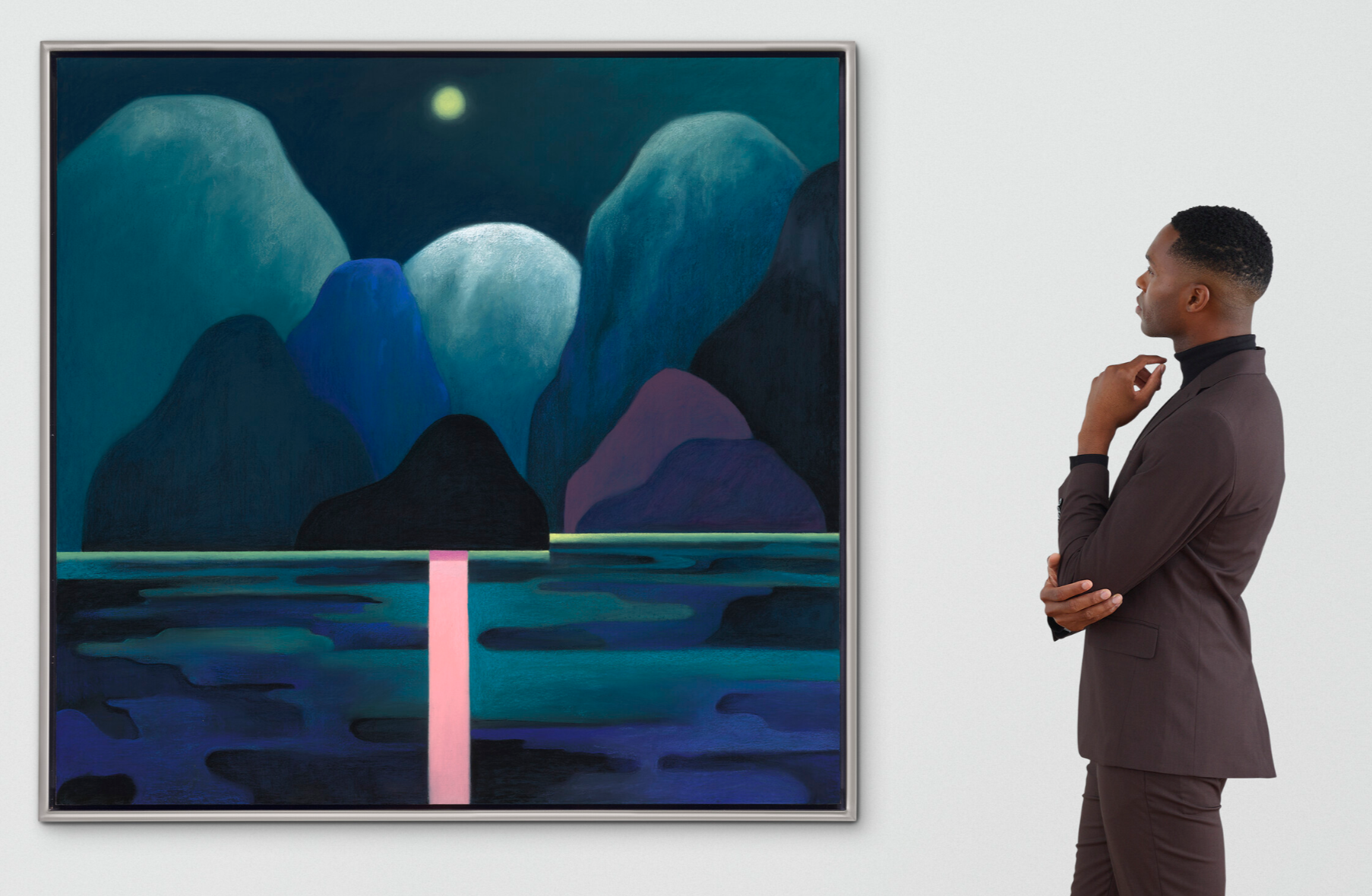
Nicolas Party’s Landscape is a poetic nocturne. It was executed in soft pastel in 2020 on a canvas more than four and a half feet high. In it, a range of rounded mountains in teal, ultramarine and violet rises behind a lake beneath a small, acid-green moon. Directly below that moon, a single column of pink light runs from the horizon to the lower edge of the canvas, a warm note in a picture otherwise built from the beguiling nighttime tones. Nine mountains crowd the upper half of the composition. Each is reduced to a soft, rounded silhouette, and they are stacked in overlapping planes like the flats of a stage set. Party models them with a sculptor’s attention to volume: pale highlights catch the shoulders of the great teal peaks on either side, a dome of silvery white at the center glows as if lit from within, and a pair of mauve and violet forms at the right pull the palette toward dusk. At their foot sits a hill of near-pure black, and here Party plays a quiet trick with the horizon, because the band of lime-green light along the shoreline does not line up on either side of it, hinting at a shift in depth as the lake bends around a mountainside. The lake below brings a patchwork of interlocking pools of teal, ultramarine, violet and black. The one reflection Party allows is the pink column, a striking opposite to the green moon above it.
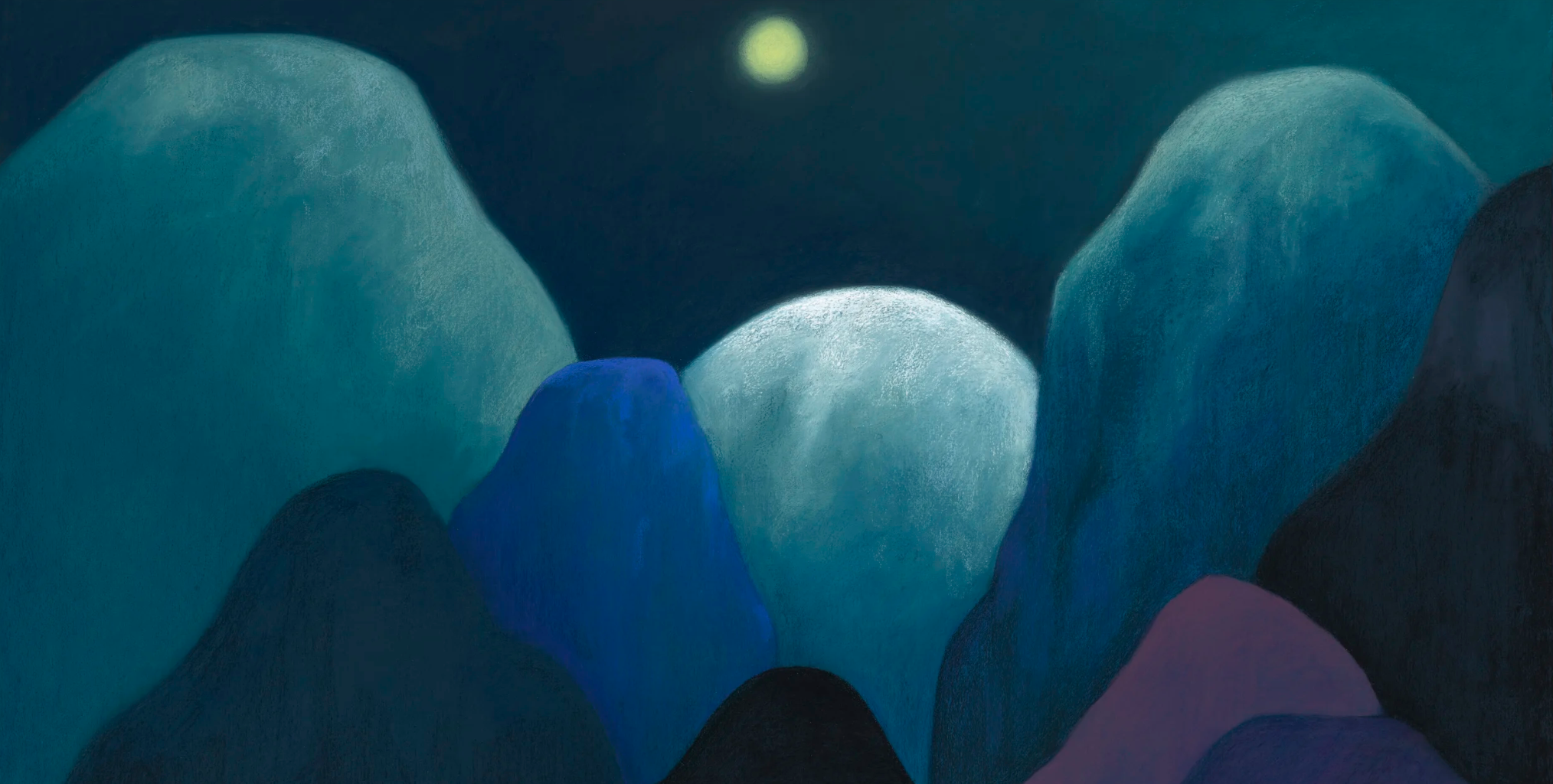
All of this is executed exquisitely in soft pastel, the medium Party took up after he encountered Pablo Picasso’s Tête de femme (1921) at the Fondation Beyeler near Basel. “Something just clicked,” he recalled, and he went out and bought pastel sticks, paper and a postcard of the Picasso (N. Party, quoted in F. Kaukab, “From graffiti on trains to the global art scene: Nicolas Party’s pastel revolution,” SWI swissinfo.ch, July 16, 2026). Pastel cannot be glazed and can scarcely be corrected, a constraint Party has welcomed: “It restrained the possibilities and, paradoxically, it freed me” (Ibid.). Each passage of Landscape is built up from layers of dry pigment worked into the weave of the canvas, and in the pale dome and the highlights of the flanking peaks the grain of the support still shows through the chalk.
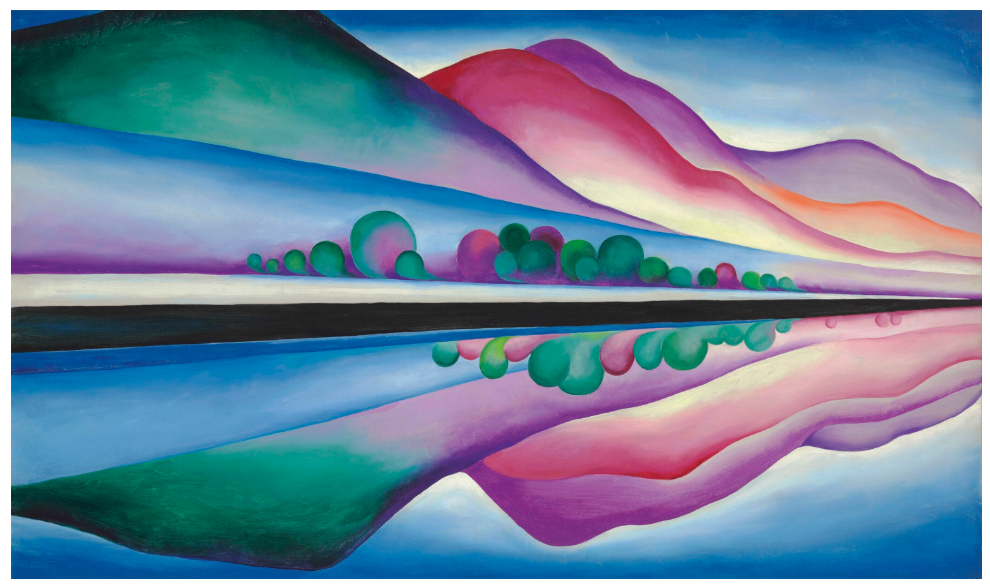
Georgia O’Keeffe, Lake George Reflections, 1921-1922. Sold at Christie’s New York, 19 May 2016, for $12,933,000.
The pairing of a mountain range with a broad expanse of water places Landscape in a distinctly Swiss line of descent. Party was born in Lausanne in 1980, on the shore of Lake Geneva, which Ferdinand Hodler painted again and again in the last years of his life, ordering its far shore and the Alps beyond into horizontal bands of near-symmetrical calm. Félix Vallotton, born in Lausanne in 1865, offers a closer precedent in the sunsets he painted on the Normandy coast in the 1910s, where a flat disc of sun hangs over bands of unmodulated color. Further afield, the painting recalls Georgia O’Keeffe’s Lake George with Reflection (circa 1921-22). What separates Party from all three is the hard-edged legibility of every form, a habit he acquired long before art school. He began tagging trains and walls in Lausanne at about the age of twelve, and the lesson he took from graffiti was blunt: “The main thing has to be visible from far away” (Ibid.). He has since confined himself to a deliberately narrow repertoire of portrait, still life and landscape. “For me, landscapes, portraits, flowers, trees—these became my language,” he has said (Ibid.).
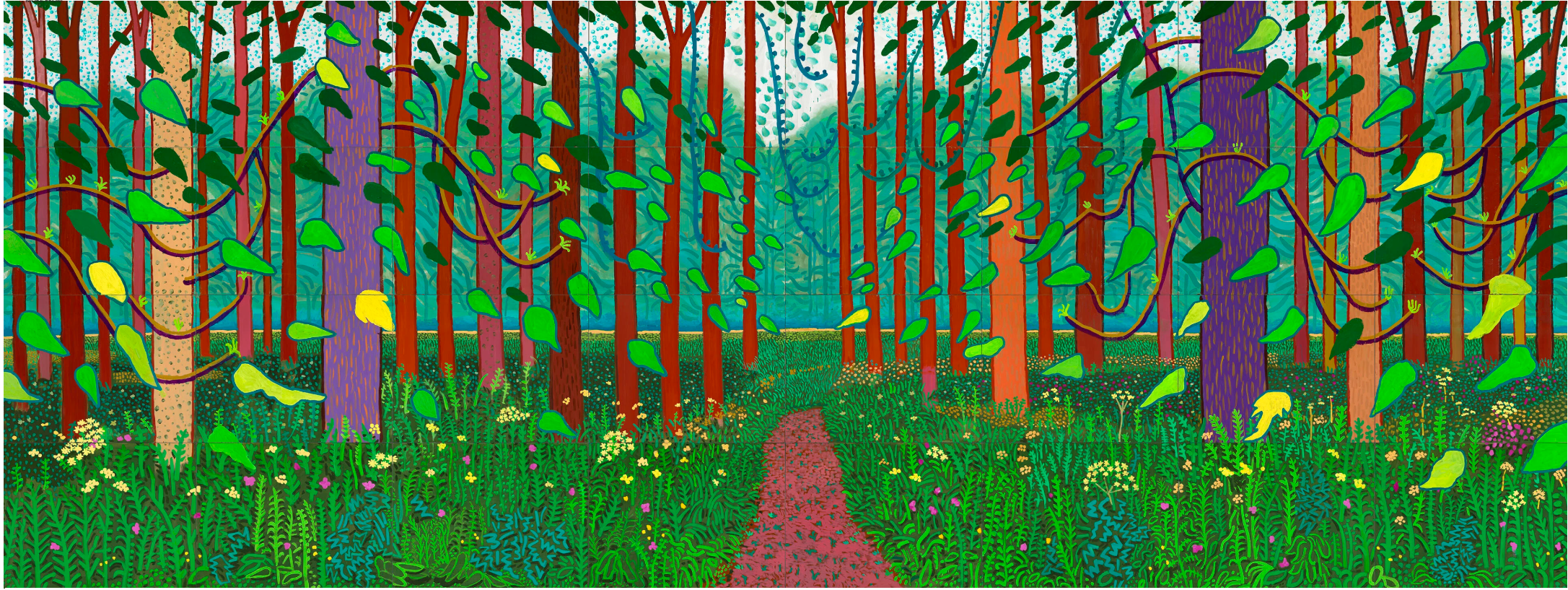
David Hockney, The Arrival of Spring in Woldgate, East Yorkshire in 2011, 2011. Centre Georges Pompidou, Paris.
© Estate of David Hockney.
Party’s standing with museums has grown steadily since the present work was made. In 2021 he wrapped the Hirshhorn Museum and Sculpture Garden in Washington in Draw the Curtain, a pastel digitally collaged and printed onto scrim that ran 829 feet around the building, his largest work up to that point. The Frick Collection then hung his work beside the eighteenth-century pastels of Rosalba Carriera in Nicolas Party and Rosalba Carriera at Frick Madison (2023-24), for which he made a site-specific pastel mural. In 2024-25 the Hoam Museum of Art in Yongin, South Korea, mounted Dust, the largest survey of his work to date, which included five pastel murals made for the exhibition, one of them titled Mountains. Across that body of work, landscape is the subject in which Party’s ambitions are clearest, and Landscape states them with unusual completeness: a theater of mountains staged in velvety pigment, closed off by a horizon that refuses to meet itself, and lit by a single pink beam that falls the full depth of the lake to the bottom edge of the canvas.
Matthew Wong
Untitled, 2017
Expanding Horizons: The Hedreen Collection
Sotheby’s New-York: 16 November 2026
Estimated: USD 3,000,000 – 4,000,000
GUARANTEED PROPERTY
Matthew Wong | Untitled | The Now and Contemporary Evening Auction |
MATTHEW WONG (1984 – 2019)
Untitled, 2017
Oil on canvas
72×48 inches (182.9 x 121.9 cm)
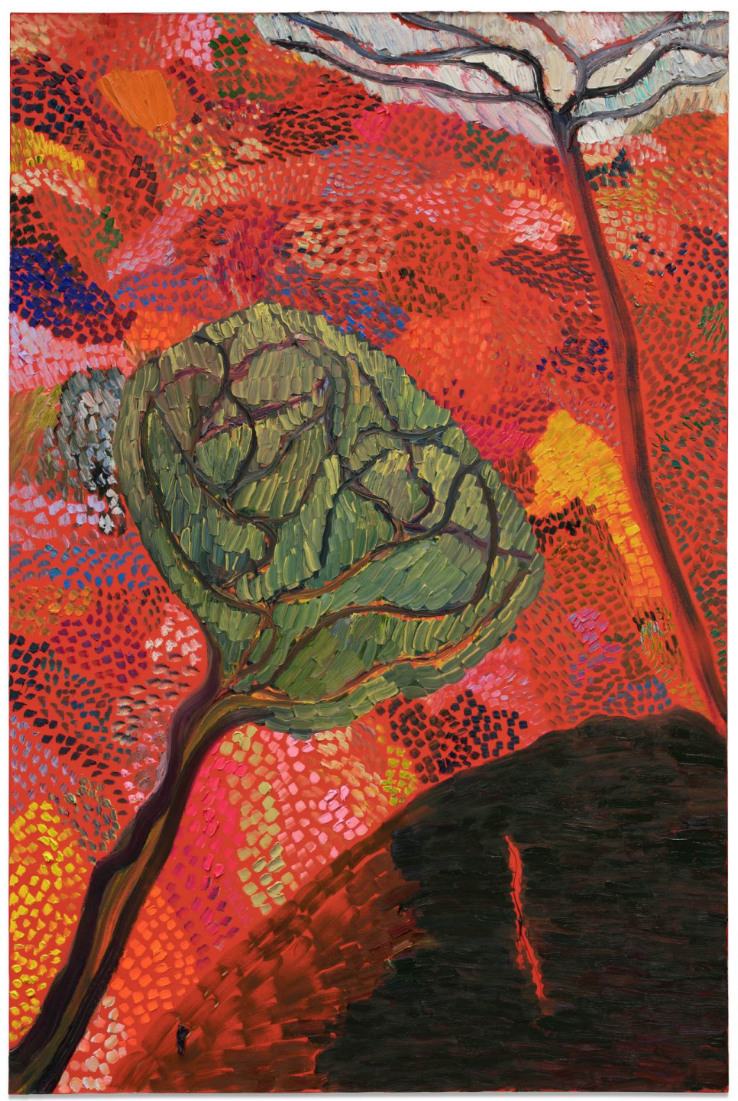
Vibrant yet serene, Untitled from 2017 distills Matthew Wong’s singular artistic vernacular and engagement with philosophical poetic melancholy while demonstrating a masterful command of color. A mesmerizing vision of chromatic brilliance and haunting solitude, Untitled is a sublime testament to Matthew Wong’s extraordinary ability to transform the familiar language of landscape painting into a deeply personal meditation on the human condition. Suffused with an incandescent sea of crimson red, punctuated by shimmering constellations of canary yellow, turquoise, and violet, the present work transports the viewer into an enigmatic world suspended somewhere between reverie and reality. Two slender trees stand sentinel at the edge of a darkened precipice, sheltering a shadowy figure in red, their delicate silhouettes framing an immense, seemingly boundless expanse of color that extends far beyond the confines of the canvas. Largely self-taught, Wong forged his unmistakable artistic language through an extraordinary synthesis of disparate visual traditions, drawing inspiration from the expressive intensity of Vincent van Gogh, the chromatic audacity of Henri Matisse, the intimate luminosity of Pierre Bonnard, and the meditative expansiveness of classical Chinese landscape painting. An insatiably curious observer of art and visual culture, he absorbed these influences through books, museum collections, and the seemingly limitless archive of images available online, distilling their disparate vocabularies into a painterly language entirely his own.
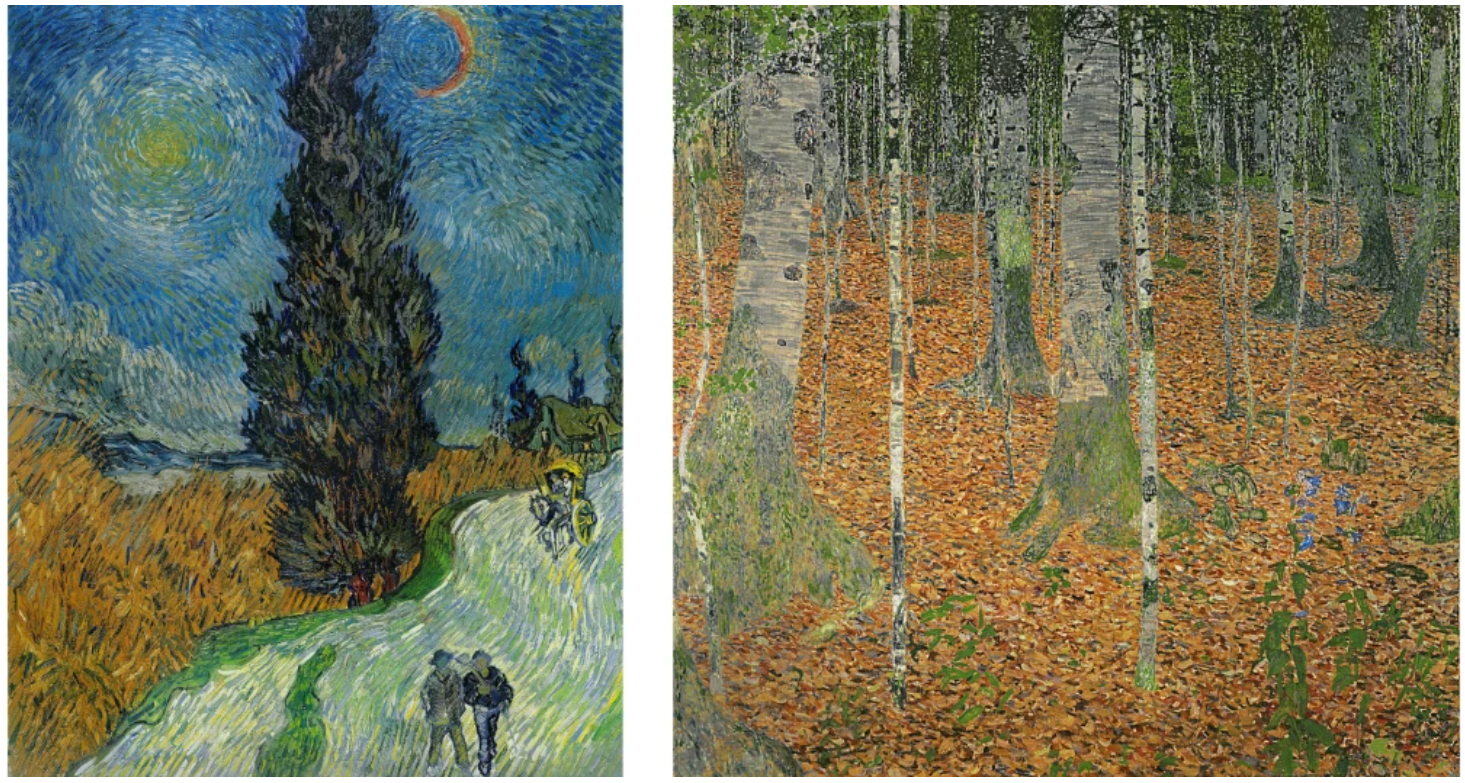
Left: Vincent van Gogh, Country Road in Provence by Night, 1890. Rijksmuseum Kroller-Muller, Otterlo. Image © Bridgeman Images. Right: Gustav Klimt, Fir Forest I, 1901. Kamm Collection, Kunsthaus Zug. Image © Fine Art Images / Bridgeman Images
Here, Wong’s quintessential solitary figure set against a landscape is imbued with the simultaneous sense of journey and meditative, mystical wonder. In the present work, a figure stands at the precipice of perhaps a shadowy cliff or mountain, presenting an ambiguous setting packed with a myriad of possibilities. Such scenes, often lacking specificity of place or time, encompass Wong’s masterful exploration of mood, translated in Untitled via immense depth of color. The interplay between the awe of the view from this perch and the beckoning intensity of the red swath of color below evokes both a tentative and magnetic sense, akin to Van Gogh’s swirling, hypnotic landscapes. Executed in 2017, Untitled was completed a year before Matthew Wong’s widely acclaimed solo debut at the Karma Gallery in New York. It was from then on that his early career was quickly met with a meteoric rise.
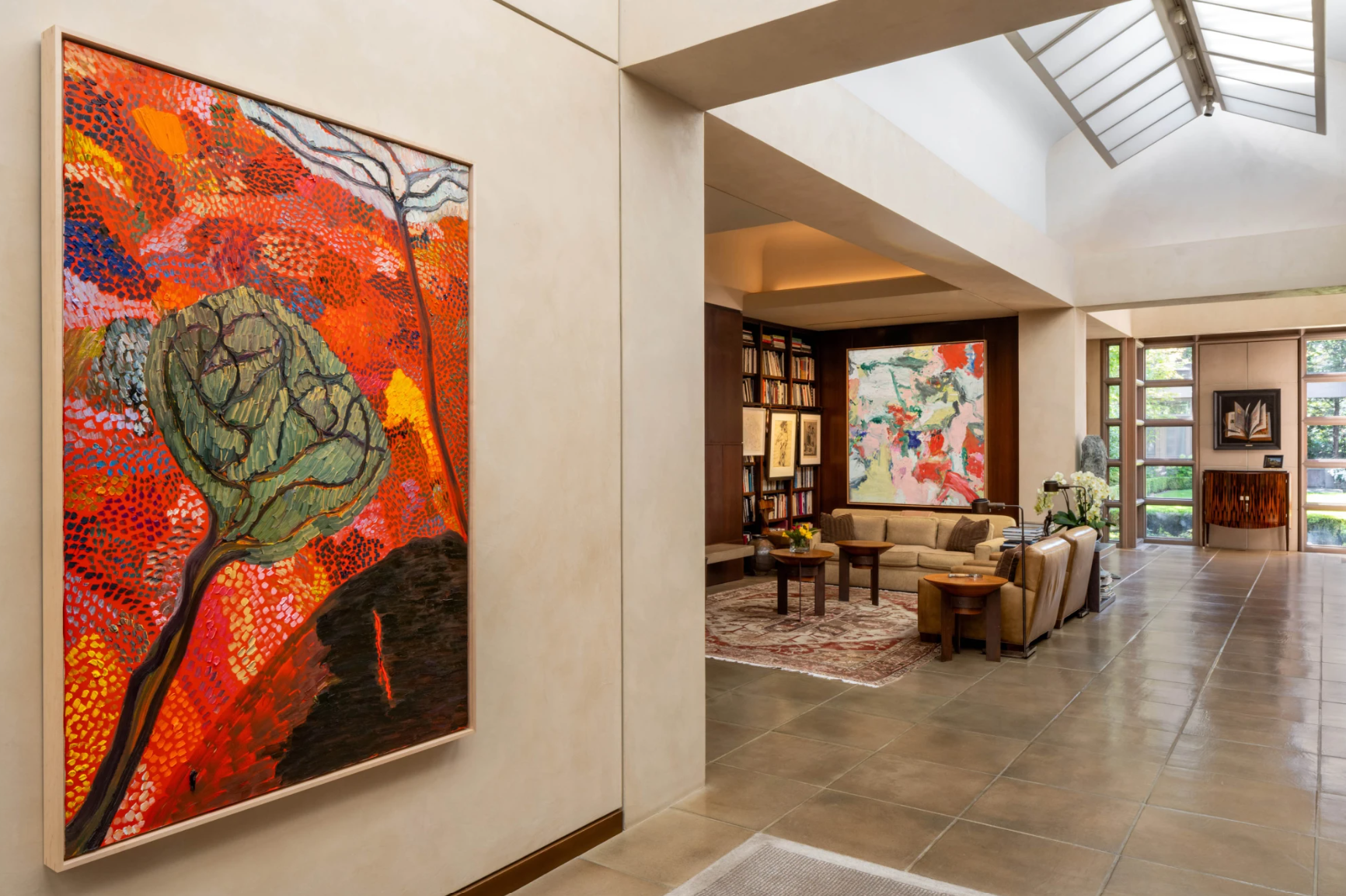
The present work installed in the Hedreen Residence. Art © 2026 Matthew Wong Foundation / Artists Rights Society (ARS), New York
The artist’s mother once expressed her concern regarding Wong’s rapid success, wondering, “as though he had ascended a mountain…whether he needed time to catch his breath.” (Jana G. Pruden, “‘He was just starting’ in: The exceptional life and artistic legacy of Matthew Wong”, The Globe and Mail, December 2019) Writing about Wong’s exhibition at Karma Gallery, art critic Roberta Smith observes, “[Wong’s] paintings are extremely open and vulnerable. But once they lure you in, they leave you alone to explore their chromatic, spatial, and psychological complexities. This mysterious journey is often signaled by a smooth pathway leading inward from a painting’s bottom edge — which is sometimes being traveled by a shadowy solitary walker.” (Roberta Smith, “A Final Rhapsody in Blue from Matthew Wong”, The New York Times, 24 December 2019, (online))
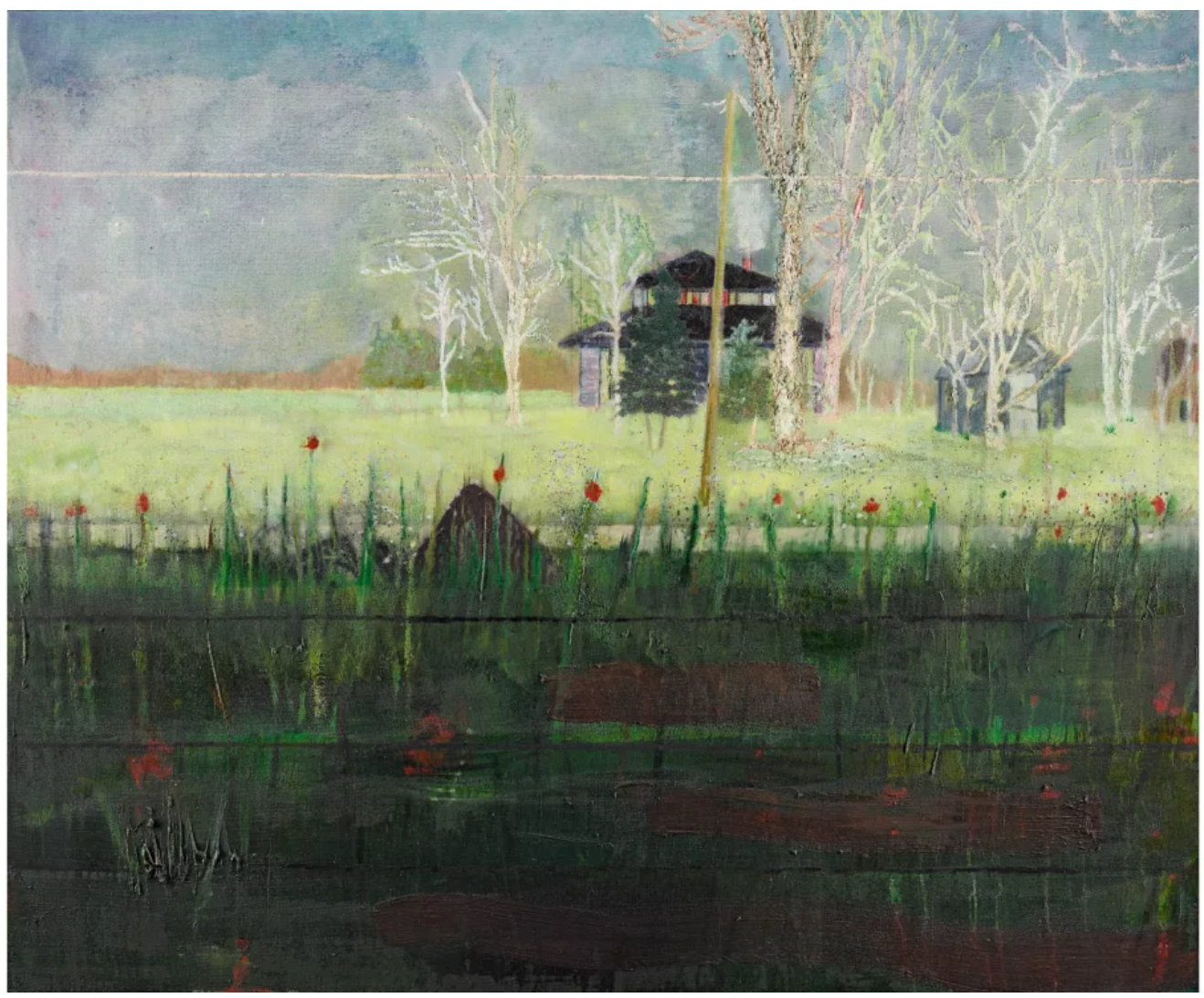
Peter Doig, Daytime Astronomy (Grasshopper), 1989-1999. Private Collection. Sold at Sotheby’s London in June 2018 for $7.7 million. Art © Peter Doig / Artists Rights Society (ARS), New York
The figure is set upon the overlook of a mountain scene, meditating amidst his journeys. There, by subtly evoking the delicate kinship between a living individual and the natural world, a recurring motif in Wong’s oeuvre, the pensive figure under the omnibenevolent tree grounds the fantastical landscape and enables viewers to experience Wong’s soft but passionate rhapsody. In the present composition, however, that figure is absent. With no path sprawling towards a specific destination, Untitled instead captures a glimpse of an alternate view. Rather than the primary journey, the present work pays tribute to the beauty of a sight seen along the way, glanced upon only briefly, derivative of the ultimate destination, and yet still miraculously alluring.
Market Precedent: Matthew Wong Paintings
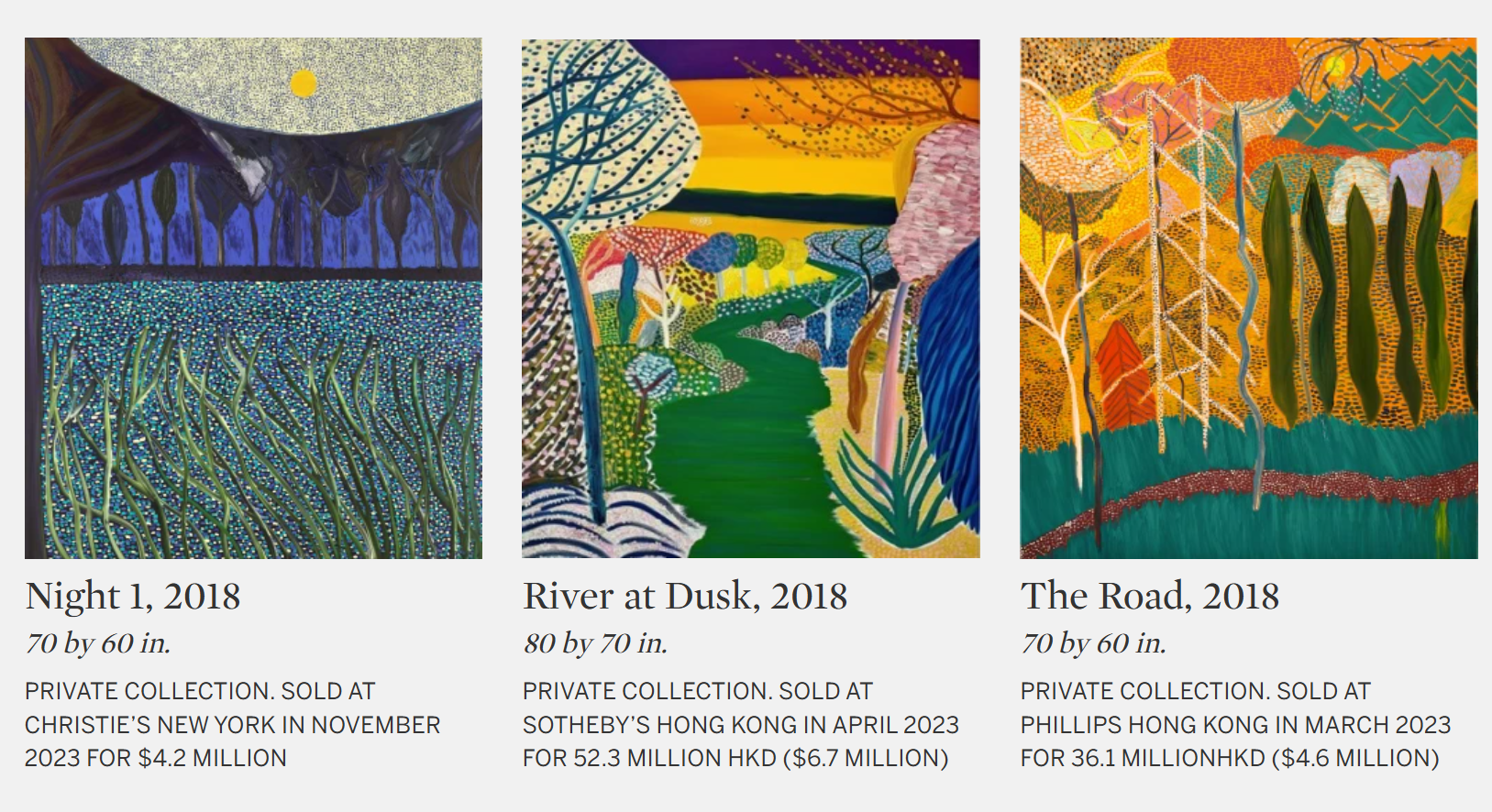
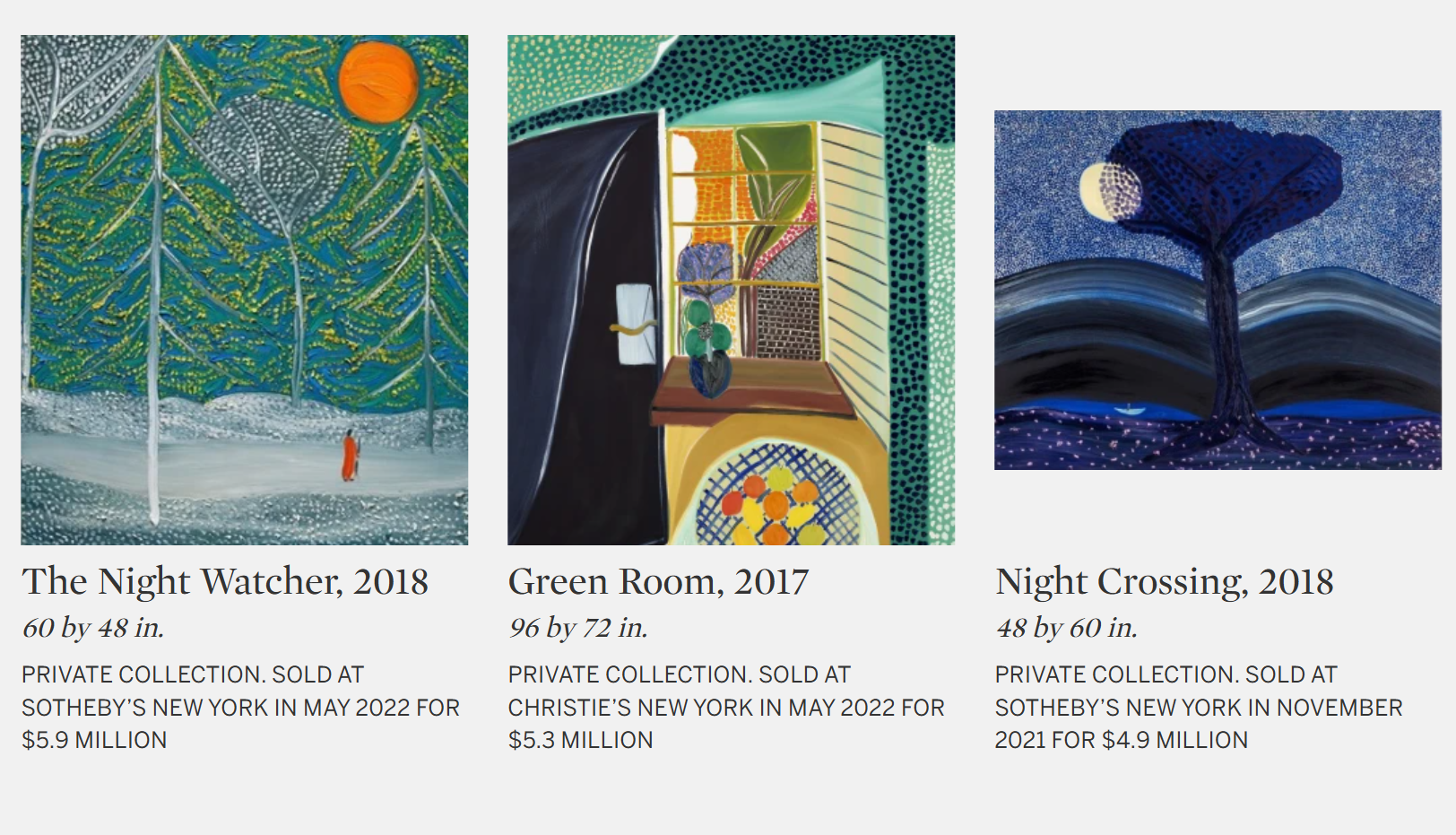
Following Wong’s untimely death in 2019 at the age of thirty-five, his remarkable artistic legacy has continued to receive widespread institutional and critical recognition, with his work entering the collections of such distinguished institutions as The Museum of Modern Art and the Solomon R. Guggenheim Museum in New York. Yet beyond the extraordinary trajectory of his career, the enduring significance of Wong’s paintings resides in their rare ability to articulate emotions that so often resist expression.
“I would like my paintings to have something in them that people across the spectrum can find things they identify with. I do believe there is inherent loneliness or melancholy to much of contemporary life.”
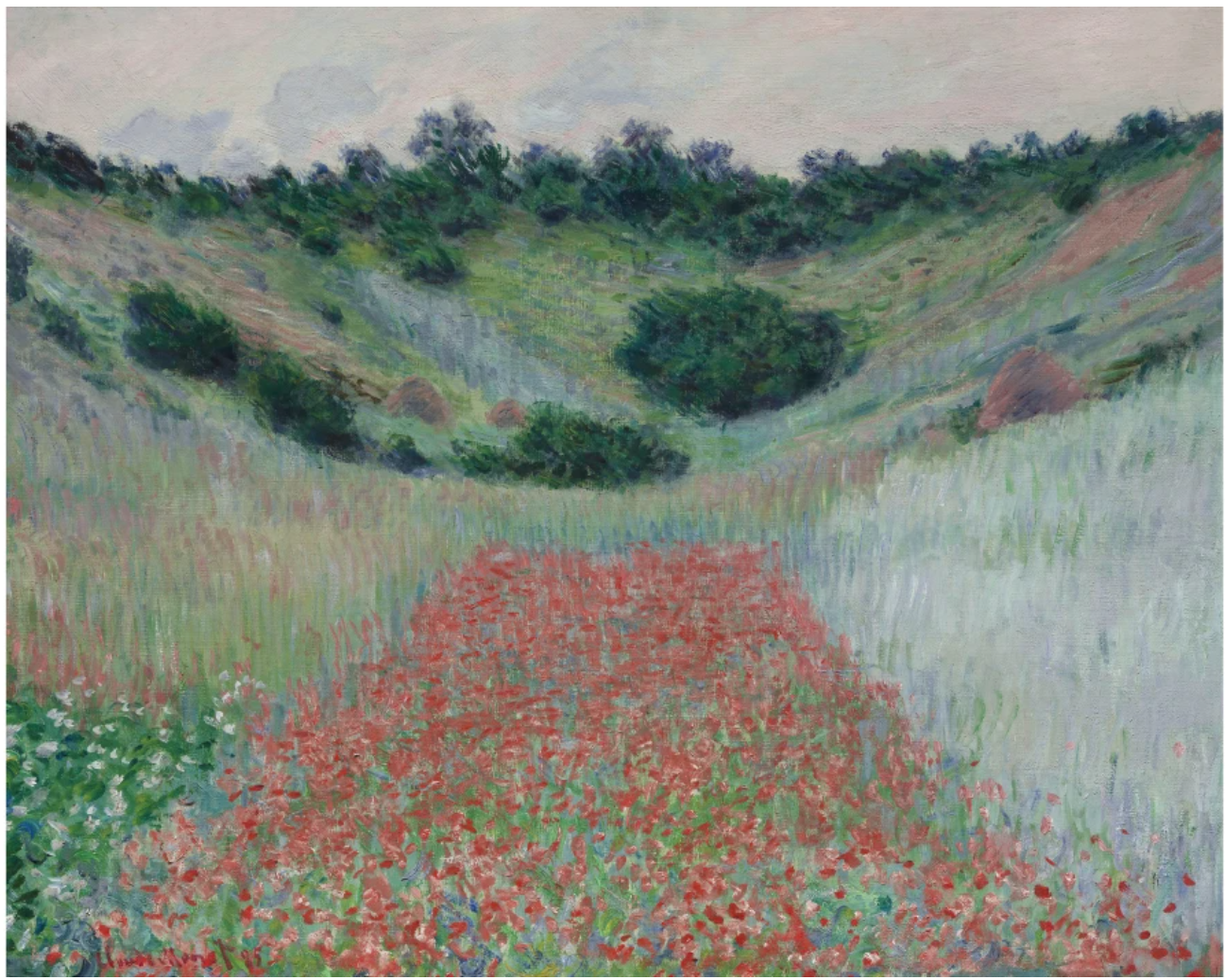
Claude Monet, Poppy Field in a Hollow near Giverny, 1885. Museum of Fine Arts, Boston. Image © 2026 Museum of Fine Arts, Boston. All rights reserved. / Juliana Cheney Edwards Collection / Bridgeman Images
In Untitled, this aspiration finds a particularly moving realization. Through its incandescent palette, enigmatic spatial construction, and profound atmosphere of contemplative stillness, the painting transforms an imagined landscape into a universal meditation on the complexities of human experience. At once a celebration of the world’s inexhaustible beauty and an acknowledgment of the solitude that so often accompanies its contemplation, Untitled is a radiant testament to Wong’s singular gift: his ability to make the ineffable visible, to discover poetry in melancholy, and to offer, through the simple yet extraordinary language of paint, a profound sense of companionship in the experience of being alone.
Ewa Juszkiewicz
Braided Bun, 2022
Christie’s New-York: 19 November 2026
Estimated: USD 600,000 – 800,000
MINIMUM PRICE GUARANTEE
EWA JUSZKIEWICZ (B. 1984), Braided Bun | Christie’s
EWA JUSZKIEWICZ (B. 1984)
Braided Bun, 2022
Oil on canvas
200×160 cm (78-3/4 x 63 inches)
Signed, dated and titled ‘Ewa Juszkiewicz ‘Braided Bun’ 2022′ (on the reverse)
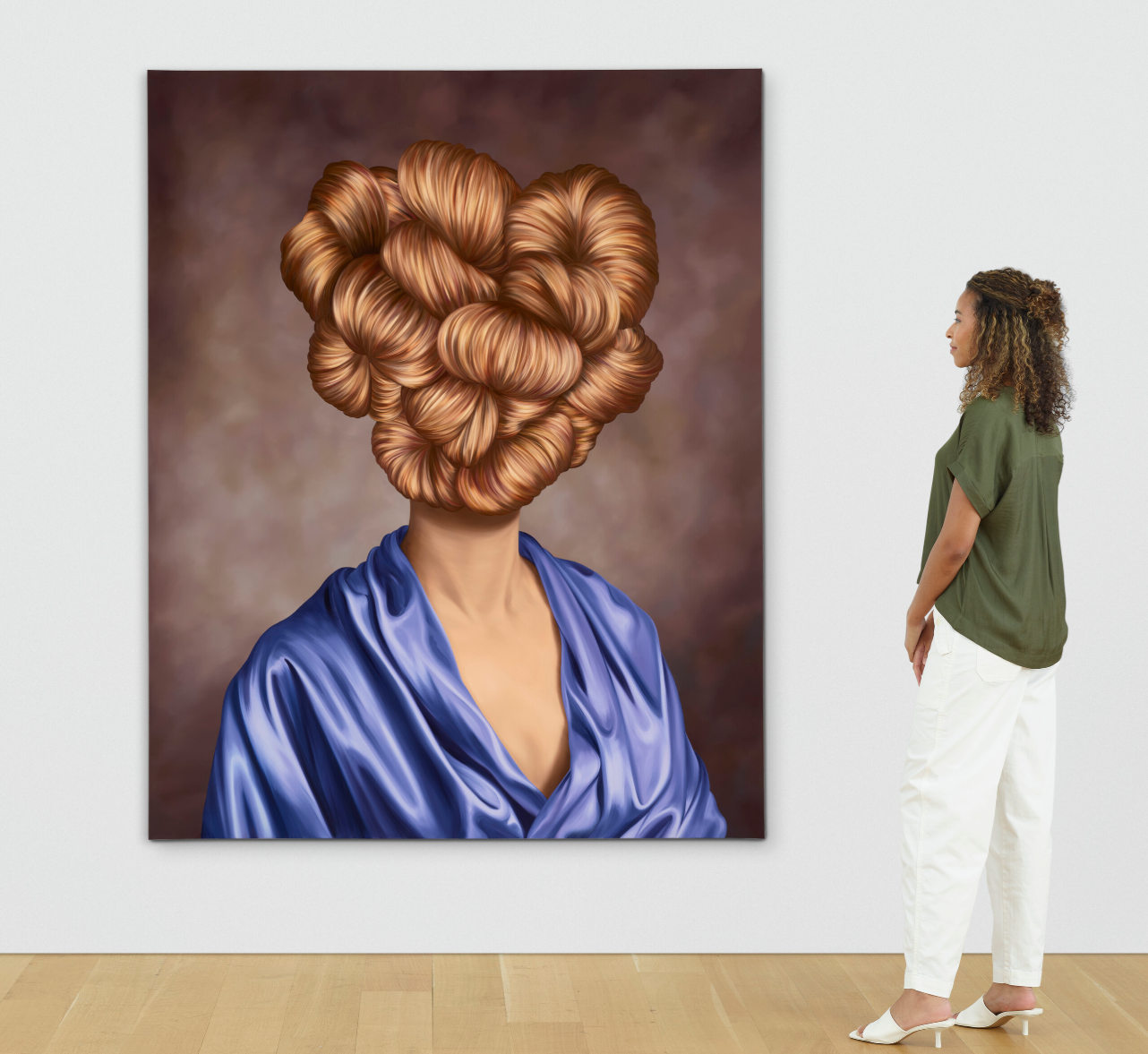
On a canvas more than six and a half feet high, a young woman is shown from the waist up, wrapped in blue satin against a mottled studio backdrop, with all the poise and finish of a portrait from the nineteenth century. Where her head should be, however, rises a mass of looped and coiled hair, far larger than any human head and painted strand by strand in honey and copper. Ewa Juszkiewicz was born in Gdańsk in 1984 and completed a doctorate at the Academy of Fine Arts in Kraków in 2013.
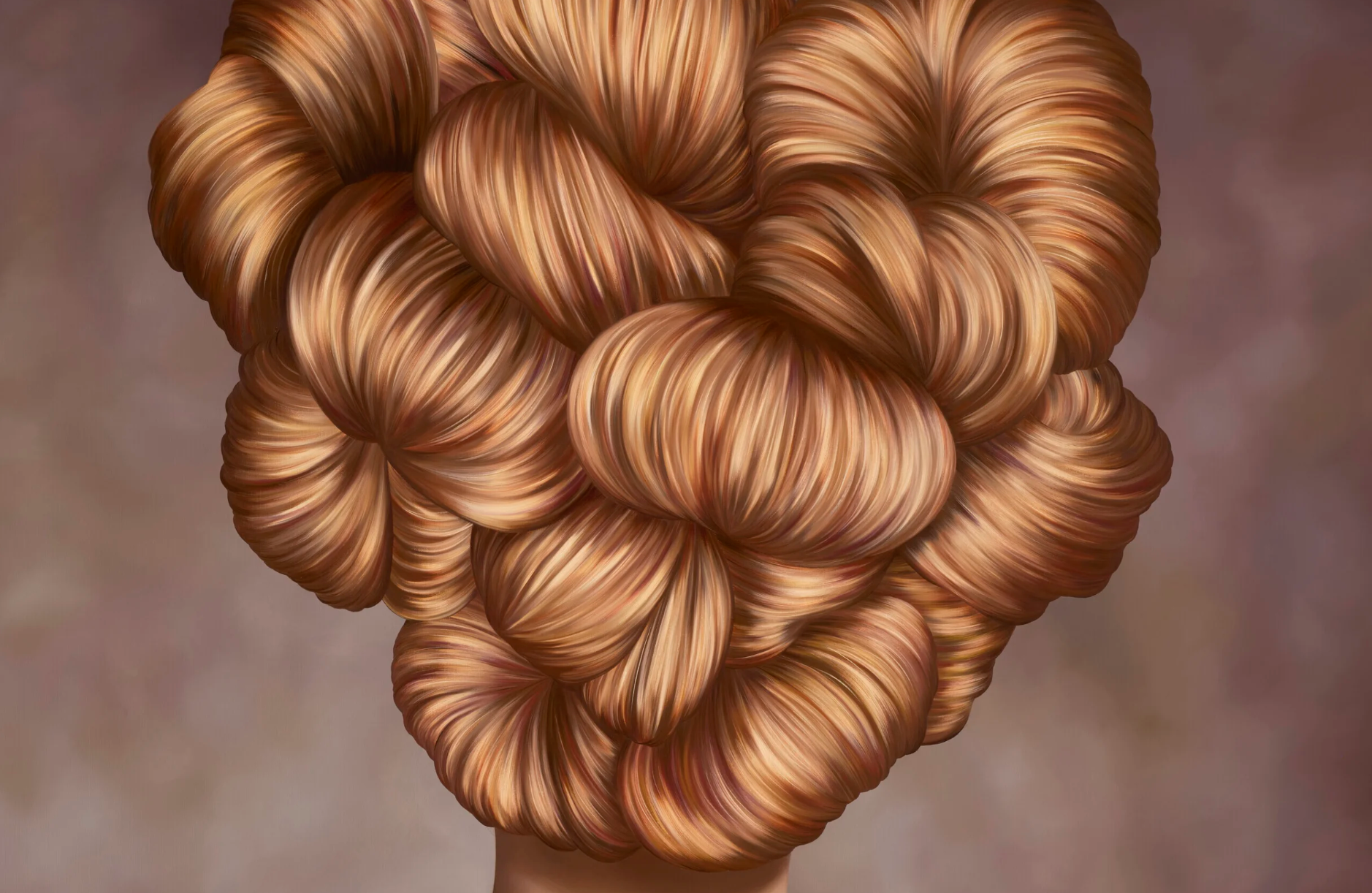
Since 2011 she has painted portraits of the kind of Braided Bun, in which the face of a historical sitter disappears beneath hair, foliage, fabric or fruit. Hair has been her most persistent motif since her 2013 exhibition in Warsaw, which was titled simply Curls. Her paintings are now in the collections of the Albertina in Vienna, the Brooklyn Museum, the Musée d’Art Moderne de Paris and the Institute of Contemporary Art, Miami. Between May and September this year the Museo Nacional Thyssen-Bornemisza in Madrid devoted a solo exhibition of twenty-four paintings to her, curated by Guillermo Solana.
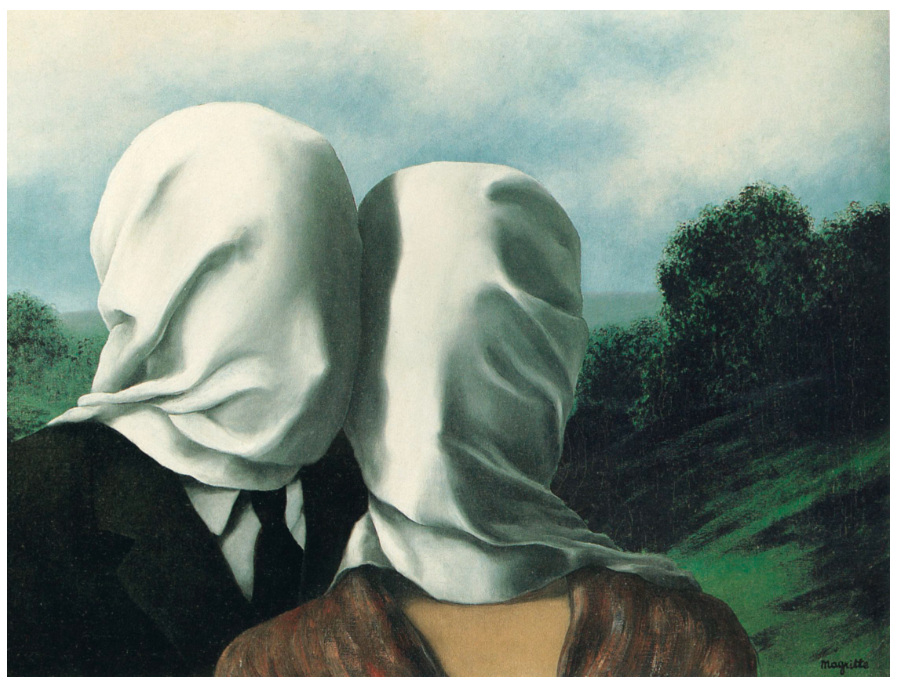
René Magritte, Les amants, 1928. National Gallery, Canberra. © 2026 C. Herscovici / Artists Rights Society (ARS), New York.
Juszkiewicz paints with the patience of the academic tradition from which she borrows. The satin is laid down in a cool periwinkle blue, with highlights that run in long, unbroken streaks along each fold, and it crosses at the breast in a deep V that leaves the throat and collarbones bare. These are modeled in warm flesh tones that pass without a break into the hair above. The coiffure is built from more than a dozen thick loops, each combed into parallel strands that catch the light at their crests and darken in the hollows between them, and the whole mass is painted with such conviction that it reads as a hairstyle and as a living organism at the same time. Juszkiewicz has explained that the idea grew from studying historical portraits of women: “I noticed that most of the women are portrayed with the exact same pose and gesture” (E. Juszkiewicz, quoted in L. Rees, “Ewa Juszkiewicz’s Surreal Portraits Challenge the Role of Women in Art,” Galerie, October 9, 2019). She keeps that pose and gesture intact and unsettles what they frame: “I’m looking for ways to disturb the harmony and façade and to bring these characters to life” (Ibid.). She has also spoken of her delight in the “ornaments, geometries, jewelry, gigantic hairstyles” of historical dress (E. Juszkiewicz, quoted in “Reanimating History: Ewa Juszkiewicz and Jennifer Higgie in Conversation,” Gagosian Quarterly, November 1, 2023). In Braided Bun, the feature a portraitist of 1800 would have painted as a sign of fashion and rank has grown until it erases the woman who wears it. The device has a long ancestry, from Giuseppe Arcimboldo’s Vertumnus (circa 1590-91), which composes the head of Emperor Rudolf II entirely from fruit, vegetables and flowers, to René Magritte’s The Lovers (1928), in which two heads are muffled in white cloth. Juszkiewicz’s sources, however, are the portrait galleries of the museum, and her method is to take one element of a familiar genre and let it overrun the rest.
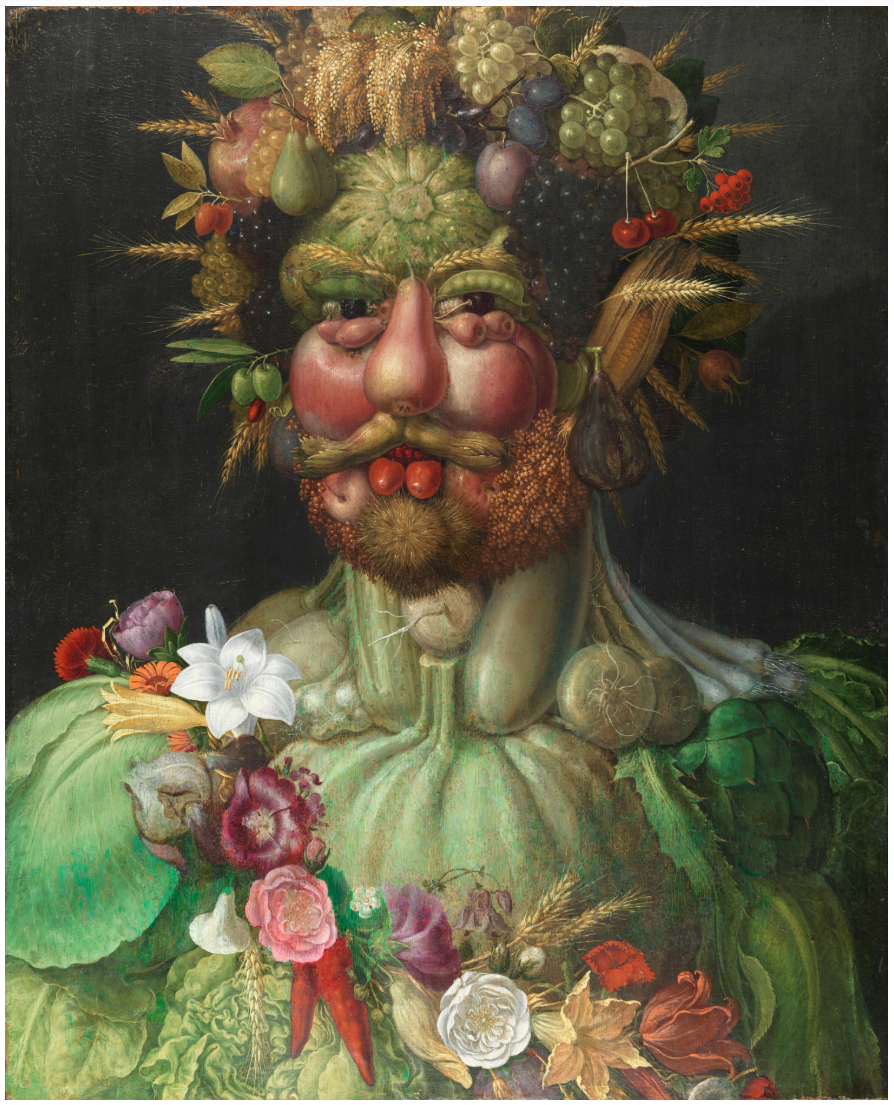
Giuseppe Arcimboldo, Vertumnus, 1591. Skokloster Castle, Sweden.
Braided Bun dates from the years in which Juszkiewicz’s museum standing was established. In 2022, the year the present work was painted, she was included in group exhibitions at the Musée d’Art Moderne de Paris and at ICA Miami, the latter in Fire Figure Fantasy, drawn from the museum’s own collection. In 2024 Locks with Leaves and Swelling Buds opened at the Palazzo Cavanis in Venice during the Biennale. The Thyssen-Bornemisza exhibition followed, in a museum that holds portraits by the generation of painters she paraphrases. Few paintings carry her central motif further than this one: on a canvas measuring 78¾ by 63 inches, more than a dozen coils of hair take the place of a face, above a gown of blue satin painted with the care her predecessors reserved for their sitters.