Fall 2026 New-York Marquee Auctions
Roy Lichtenstein
Auction Results
Reflections on “Painter and Model”, 1990
Expanding Horizons: The Hedreen Collection
Sotheby’s New-York: 16 November 2026
Estimated: USD 20,000,000 – 30,000,000
Roy Lichtenstein | Reflections on “Painter and Model” | The Now and
ROY LICHTENSTEIN (1923 – 1997)
Reflections on “Painter and Model”, 1990
Acrylic, oil and graphite on canvas
78×96 inches (198.1 x 243.8 cm)
Signed and dated ’90 (on the reverse)
Large Spool, 1963
The Collection of Antonio Homem Sonnabend
Christie’s New-York: 19 November 2026
Estimated: USD 10,000,000 – 15,000,000
MINIMUM PRICE GUARANTEE
ROY LICHTENSTEIN (1923-1997), Large Spool | Christie’s
ROY LICHTENSTEIN (1923-1997)
Large Spool, 1963
Acrylic and graphite on canvas
68×56 inches (172.6 x 142.2 cm)
Signed and dated ‘rf Lichtenstein ’63’ (on the reverse)
Female Figure, 1978
Property from a Prominent Private Collection
Sotheby’s New-York: 16 November 2026
Estimated: USD 6,000,000 – 8,000,000
Roy Lichtenstein | Female Figure | The Now and Contemporary Evening
ROY LICHTENSTEIN (1923 – 1997)
Female Figure, 1978
Acrylic, oil and graphite on canvas
60×40 inches (152.4 x 101.6 cm)
Signed and dated ’78 (on the reverse)
Abstraction with Guitar, 1975
Sotheby’s New-York: 17 November 2026
Estimated: USD 2,800,000 – 3,500,000
Roy Lichtenstein | Abstraction with Guitar | Contemporary Day Auction
ROY LICHTENSTEIN (1923 – 1997)
Abstraction with Guitar, 1975
Acrylic, sand and graphite on canvas
68×90 inches (172.7 x 228.6 cm)
Signed and dated ’75 (on the reverse)
Coup de Chapeau II, 1996
Christie’s New-York: 20 November 2026
Estimated: USD 2,000,000 – 3,000,000
MINIMUM PRICE GUARANTEE
ROY LICHTENSTEIN (1923-1997), Coup de Chapeau II | Christie’s
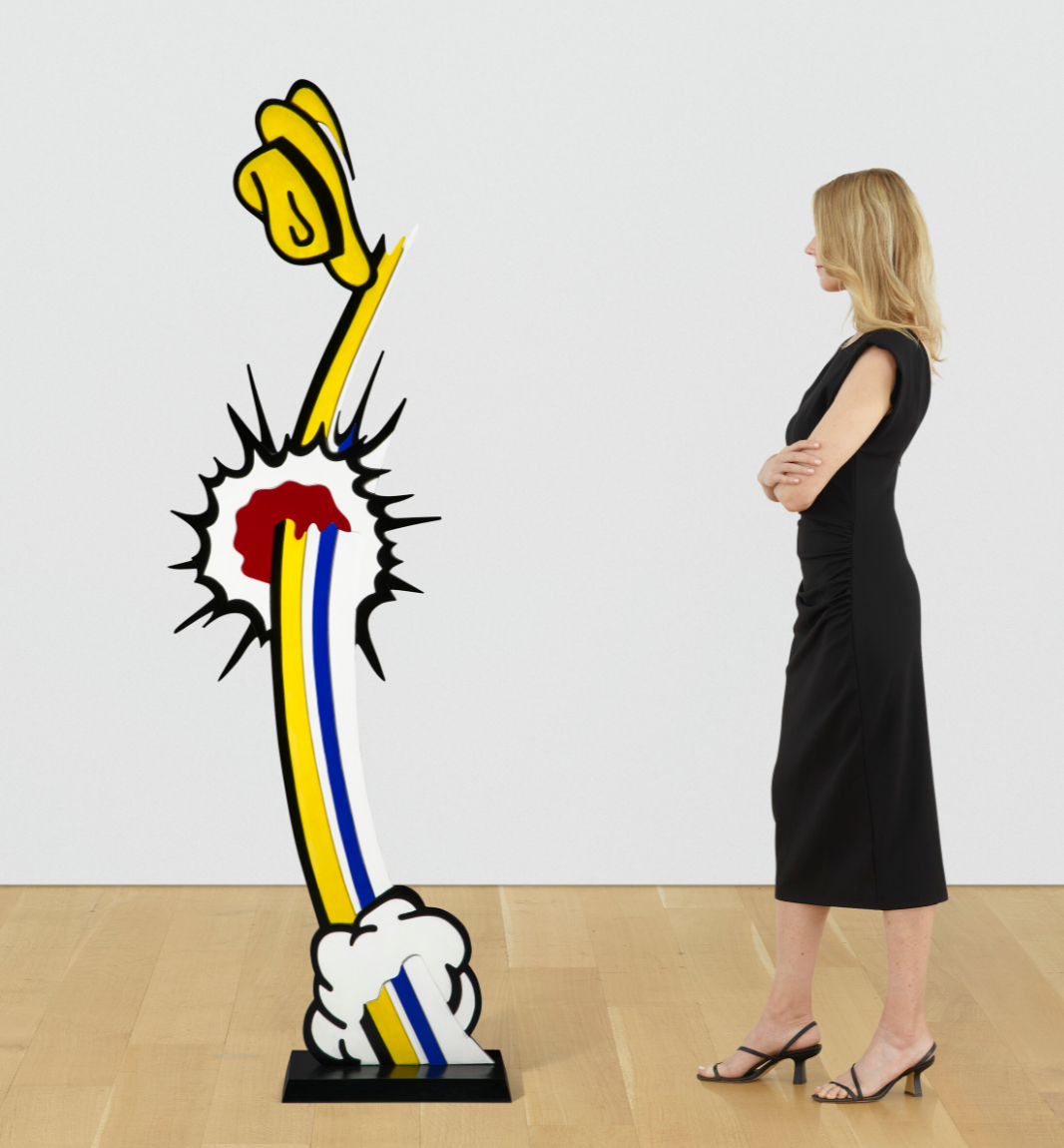
ROY LICHTENSTEIN (1923-1997)
Coup de Chapeau II, 1996
Painted and patinated bronze
89 x 29-1/4 x 13 inches (226.1 x 74.3 x 33 cm)
Incised with the artist’s signature, number and date ‘2⁄6 rf Lichtenstein ’96’ (on the base)
This work is number two from an edition of six plus one artist’s proof
Two Paintings: Sleeping Muse (Study), 1983
Vision: The Extraordinary Collection of Theodore and Ruth Baum
Sotheby’s New-York: 16 November 2026
Estimated: USD 1,500,000 – 2,000,000
GUARANTEED PROPERTY
Roy Lichtenstein | Two Paintings: Sleeping Muse (Study) | Vision: The
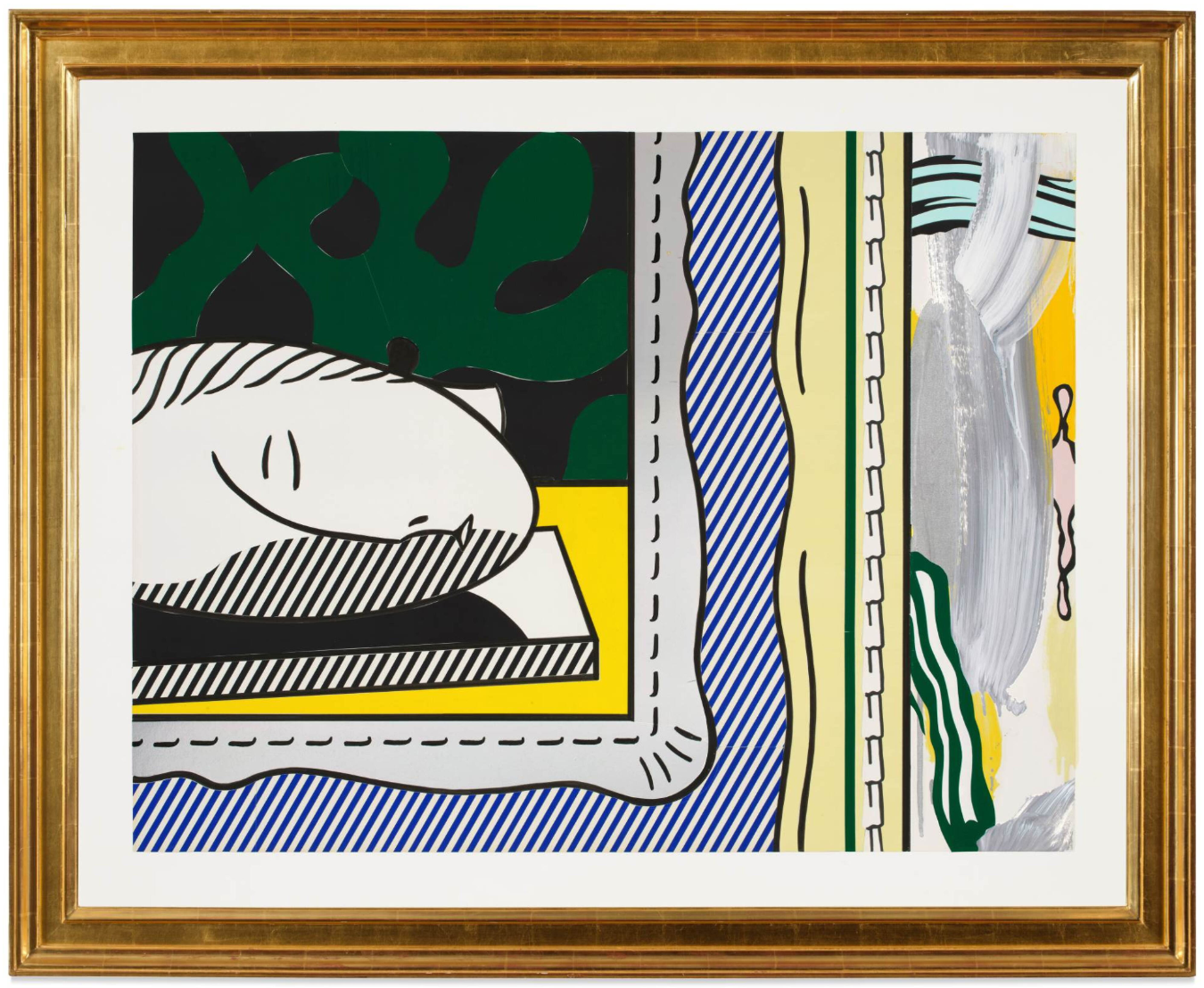
ROY LICHTENSTEIN (1923 – 1997)
Two Paintings: Sleeping Muse (Study), 1983
Cut painted paper, cut printed paper, aluminum foil, acrylic, marker and graphite on board
Image: 35×46 inches (88.9 x 116.8 cm)
Board: 38-3/4 x 49-3/4 inches (98.4 x 126.4 cm)
Signed and dated ‘83 (on the reverse)
Landscape with Figures (Study), 1977
Property from a Distinguished Private American Collection
Sotheby’s New-York: 17 November 2026
Estimated: USD 1,500,000 – 2,000,000
WORK ON PAPER
Roy Lichtenstein | Landscape with Figures (Study) | Contemporary Day
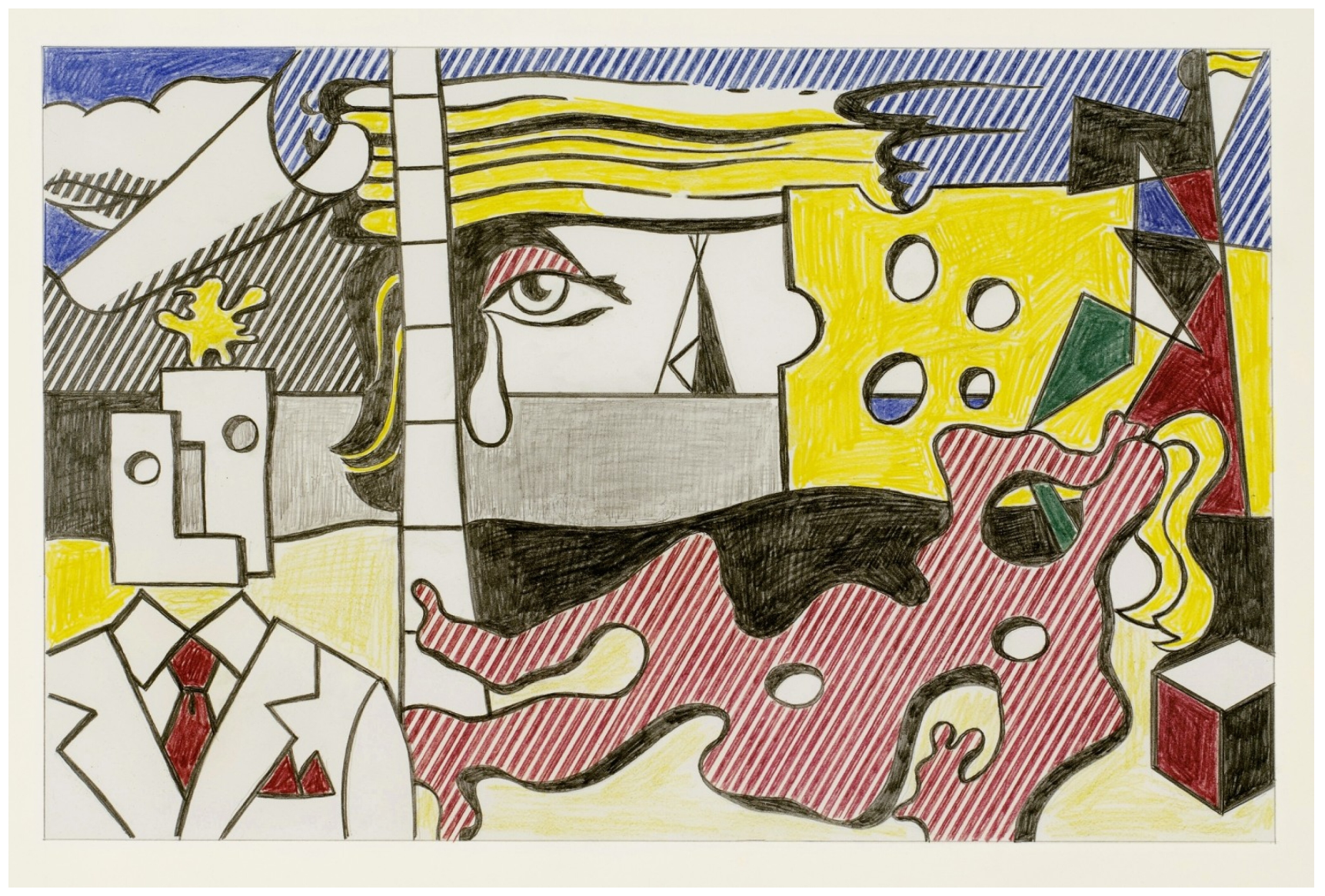
ROY LICHTENSTEIN (1923 – 1997)
Landscape with Figures (Study), 1977
Colored pencil and graphite on paper
Image: 13-1/2 x 21 inches (34.3 x 53.3 cm)
Sheet: 20 x 27-1/2 inches (50.7 x 69.8 cm)
Signed and dated ’77 (on the verso)
Artist’s Studio with Model (Study), 1974
The Collection of Agnes Gund: Sold to Benefit the Gund Art Foundation
Christie’s New-York: 19 November 2026
Estimated: USD 1,000,000 – 1,500,000
WORK ON PAPER
ROY LICHTENSTEIN (1923-1997), Artist’s Studio with Model (Study) | Christie’s
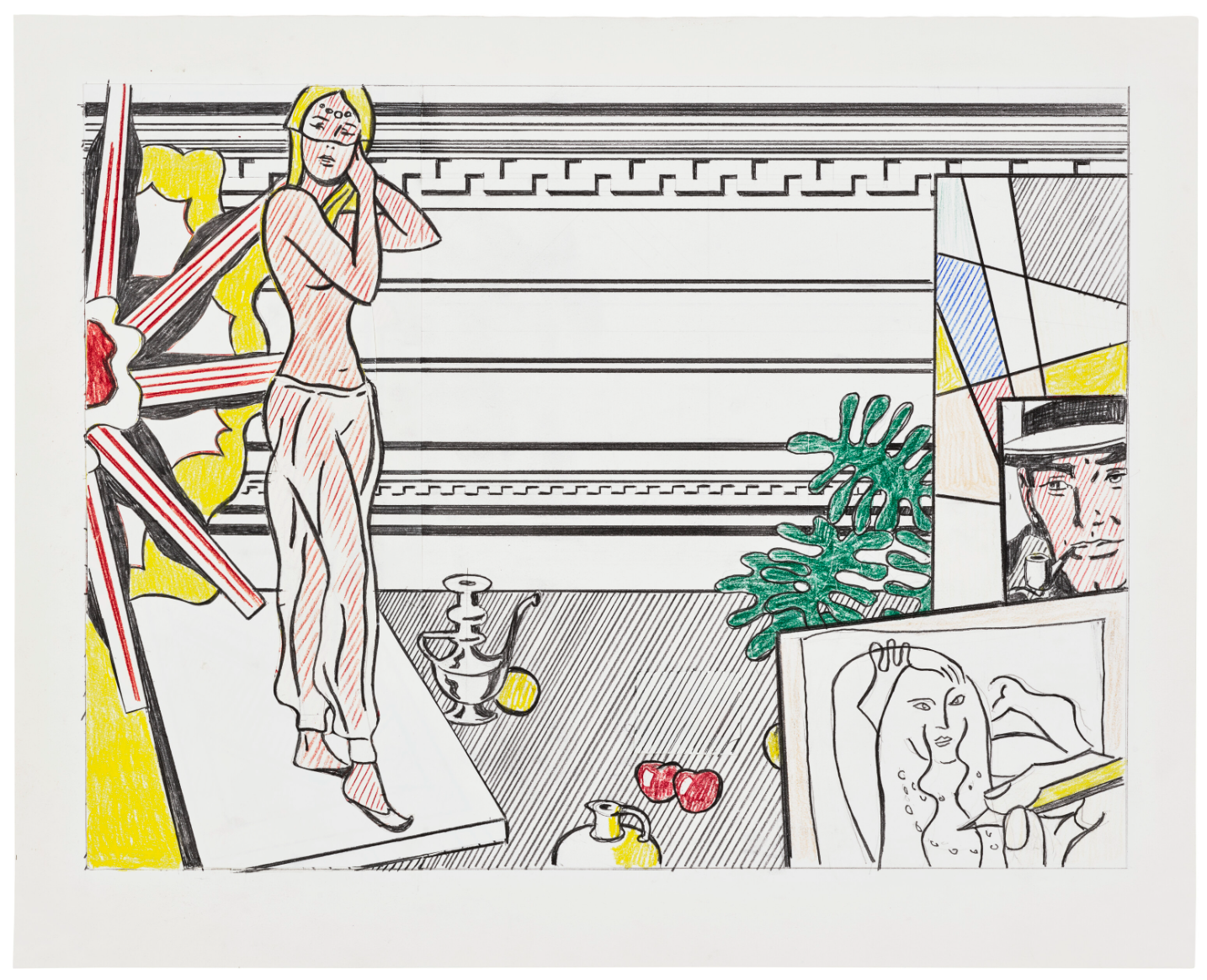
ROY LICHTENSTEIN (1923-1997)
Artist’s Studio with Model (Study), 1974
Colored pencil, graphite and paper collage on paper
Image: 16-1/8 x 21-3/8 inches (41 x 54.5 cm)
Sheet: 19-1/2 x 24-1/4 inches (49.5 x 61.6 cm)
Signed and dated ‘rf Lichtenstein ’74’ (on the reverse)
Lamp II, 1977
The Collection of Agnes Gund: Sold to Benefit the Gund Art Foundation
Christie’s New-York: 19 November 2026
Estimated: USD 1,000,000 – 1,500,000
ROY LICHTENSTEIN (1923-1997), Lamp II | Christie’s
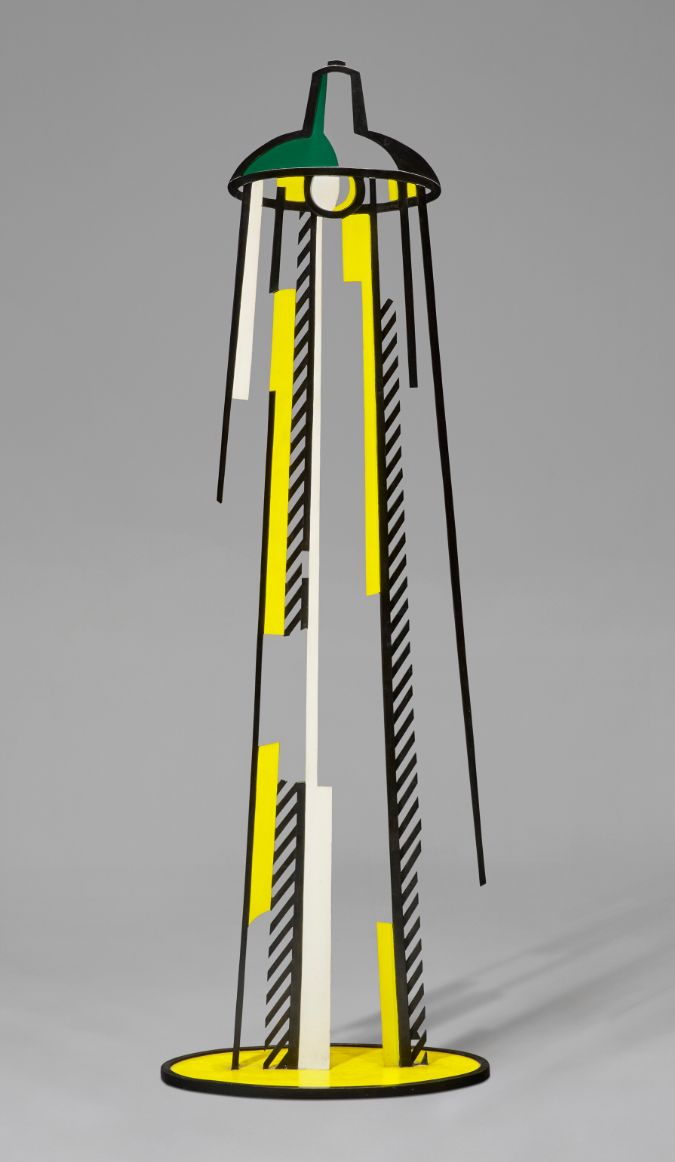
ROY LICHTENSTEIN (1923-1997)
Lamp II, 1977
Painted and patinated bronze
86-1/4 x 27-5/8 x 17-5/8 inches (219.1 x 70.8 x 44.8 cm)
Signed, dated and numbered ‘2⁄3 rf Lichtenstein ’77’ (on the edge of the base)
This work is number two from an edition of three
Apple and Grapefruit, 1980
Christie’s New-York: 20 November 2026
Estimated: USD 700,000 – 1,000,000
ROY LICHTENSTEIN (1923-1997), Apple and Grapefruit | Christie’s
ROY LICHTENSTEIN (1923-1997)
Apple and Grapefruit, 1980
Acrylic and graphite on canvas
20×24 inches (50.8 x 61 cm)
Signed and dated ‘© rf Lichtenstein ’80’ (on the reverse)
Water Lily Pond with Reflections, 1992
Christie’s New-York: 20 November 2026
Estimated: USD 700,000 – 1,000,000
ROY LICHTENSTEIN (1923-1997), Water Lily Pond with Reflections, from Water Lilies | Christie’s
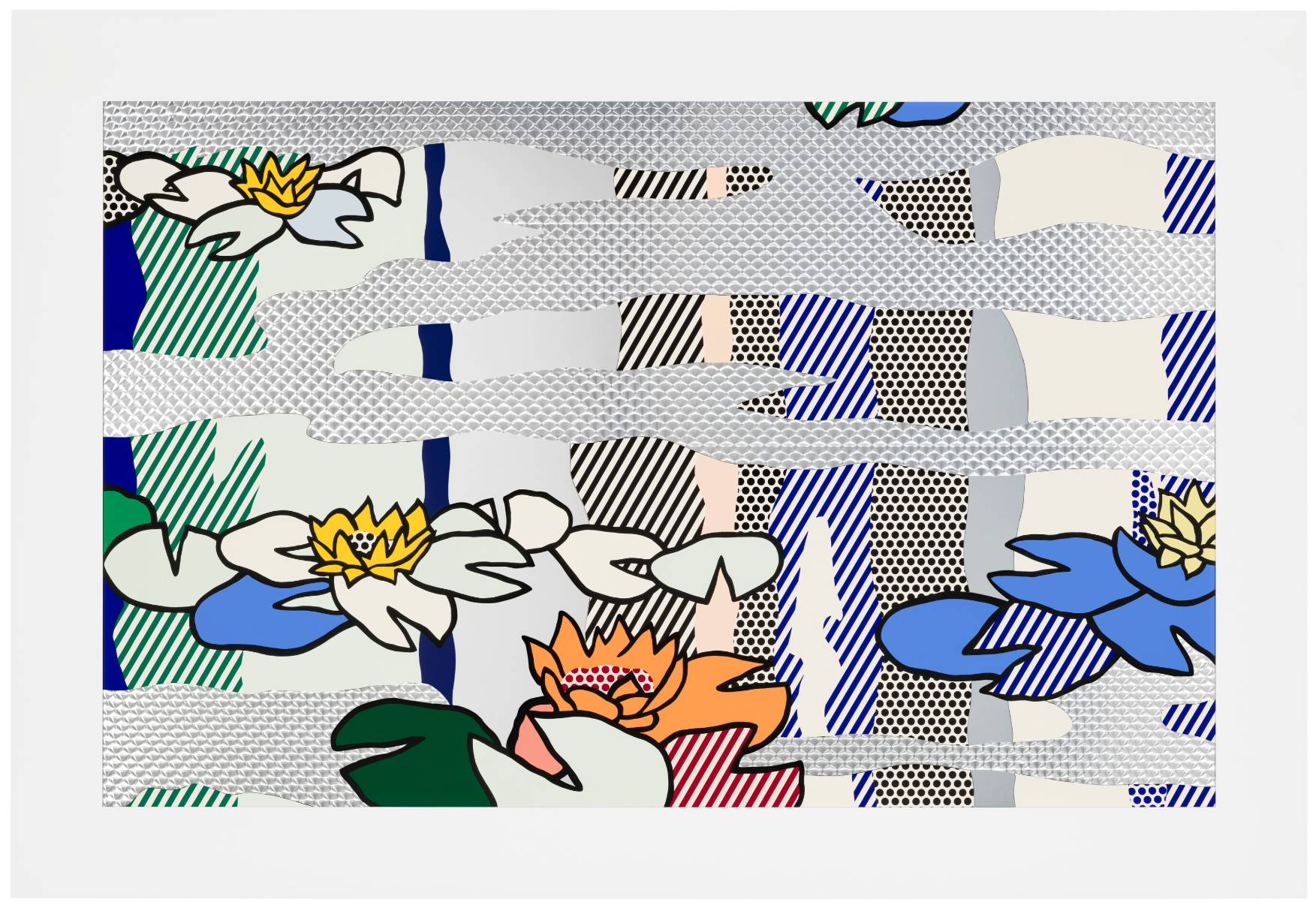
ROY LICHTENSTEIN (1923-1997)
Water Lily Pond with Reflections, from Water Lilies, 1992
Screenprinted enamel on processed and swirled stainless steel
With painted aluminum frame
57-7/8 x 84-1/4 inches (147×214 cm)
Signed, numbered and and dated “15⁄23 rf Lichtenstein ’92’ (on the reverse)
This work is number 15 from an edition of 23 plus seven artist’s proofs
Published by Saff Tech Arts, Oxford, Maryland
Coup de Chapeau I, 1996
Looking Forward: The Collection of Beverly Grossman
Sotheby’s New-York: 17 November 2026
Estimated: USD 600,000 – 800,000
Roy Lichtenstein | Coup de Chapeau I | Contemporary Day Auction |
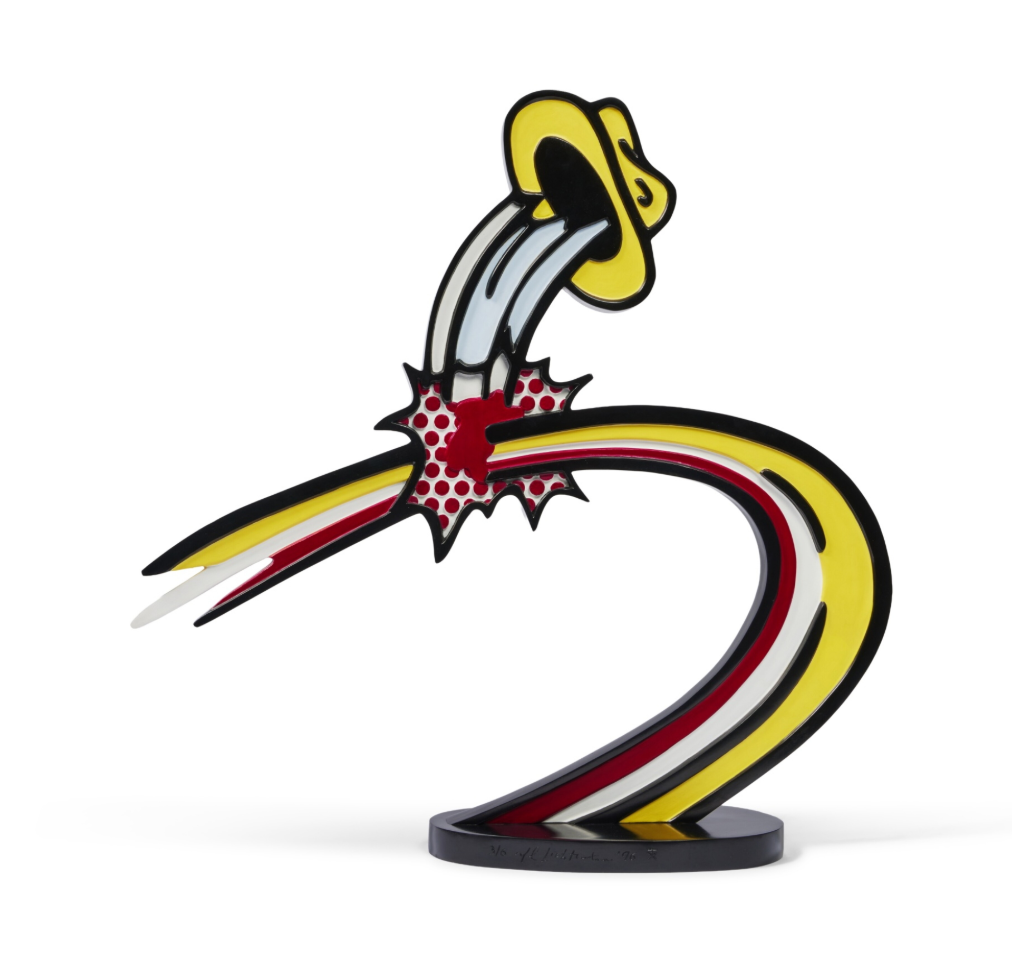
ROY LICHTENSTEIN (1923 – 1997)
Coup de Chapeau I, 1996
Painted and patinated bronze
26-3/8 x 26-1/2 x 7-1/2 inches (66.9 x 67.3 x 19.1 cm)
Incised with the artist’s signature, date ‘96 and number 3/6 (on the base)
This work is number 3 from an edition of 6 plus 1 artist’s proof
Small House, 1997
The Collection of Agnes Gund: Sold to Benefit the Gund Art Foundation
Christie’s New-York: 20 November 2026
Estimated: USD 600,000 – 800,000
ROY LICHTENSTEIN (1923-1997), Small House | Christie’s

ROY LICHTENSTEIN (1923-1997)
Small House, 1997
Painted aluminum
17-7/8 x 26-1/8 x 8-1/4 inches (45.4 x 66.4 x 21 cm)
Incised with the artist’s signature, number and date ‘7⁄8 rf Lichtenstein 1997’ (on the reverse)
This work is number seven from an edition of eight plus one artist’s proof
Small Wall Explosion, 1965
The Collection of Antonio Homem Sonnabend
Christie’s New-York: 19 November 2026
Estimated: USD 500,000 – 700,000
MINIMUM PRICE GUARANTEE
ROY LICHTENSTEIN (1923-1997), Small Wall Explosion | Christie’s
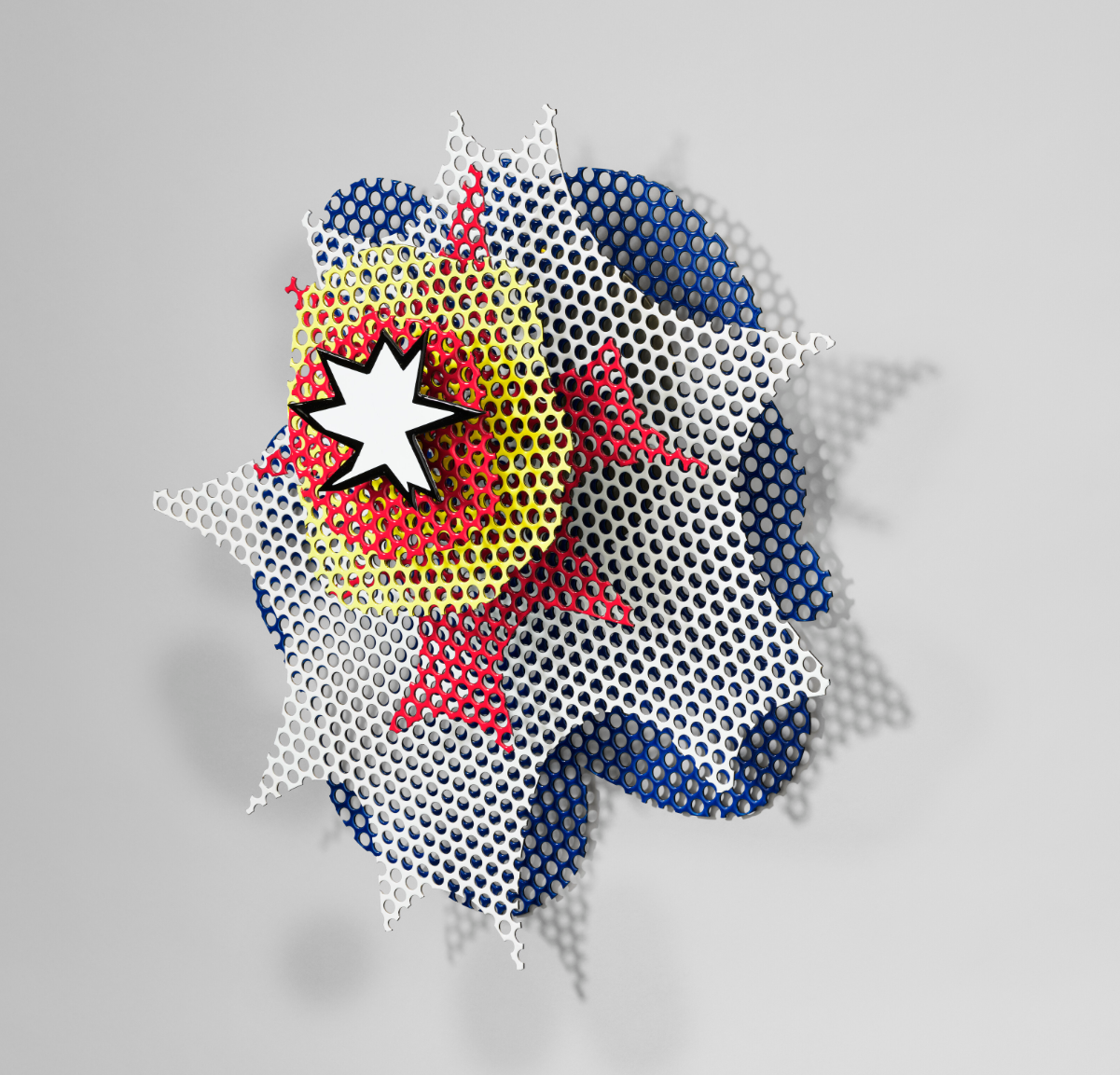
ROY LICHTENSTEIN (1923-1997)
Small Wall Explosion, 1965
Porcelain enamel on steel and perforated steel, metal rod and plate
22 x 20-1/2 x 7-1/2 inches (55.6 x 52.1 x 18.7 cm)
Signed, dated and numbered ‘rf Lichtenstein ’65 3⁄6’ (on the reverse)
This work is number three from an edition of six
Interior with Diana (Study), 1997
Sotheby’s New-York: 17 November 2026
Estimated: USD 500,000 – 700,000
GUARANTEED PROPERTY
Roy Lichtenstein | Interior with Diana (Study) | Contemporary Day
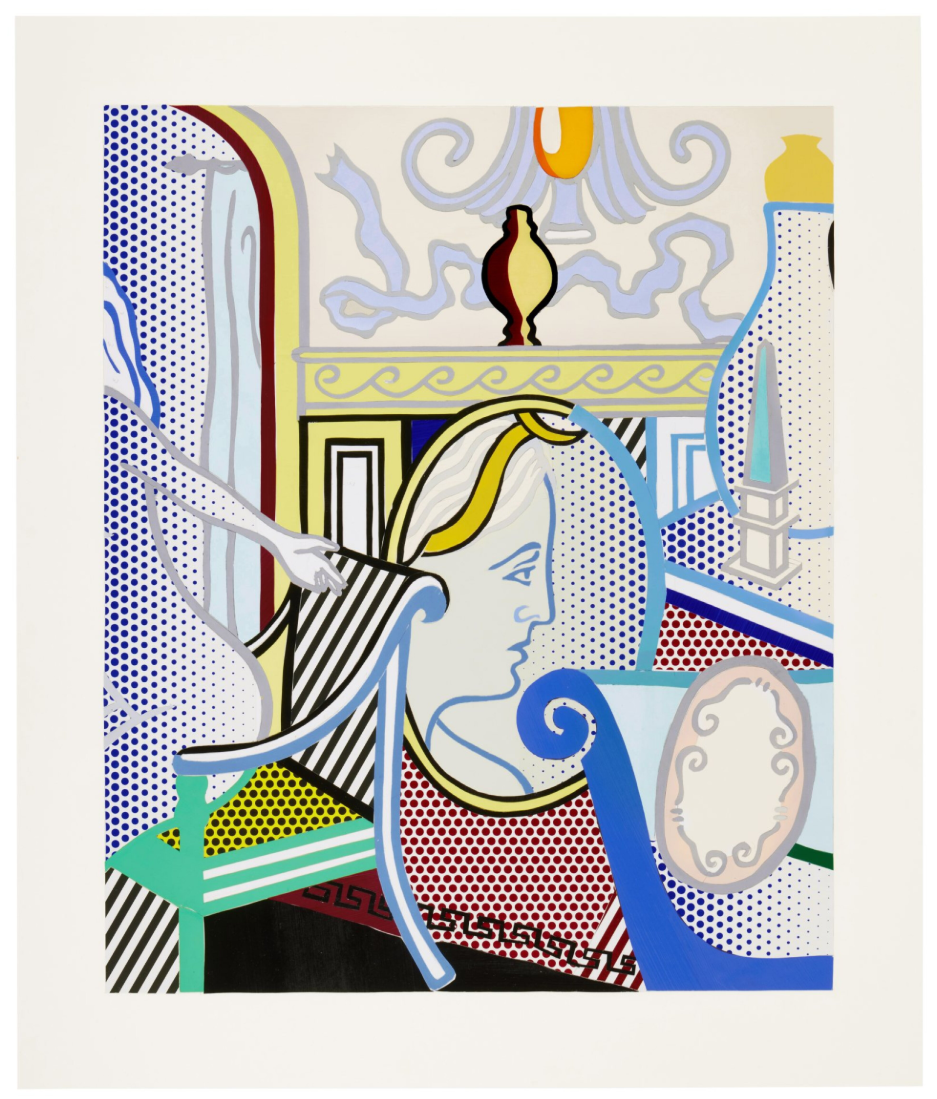
ROY LICHTENSTEIN (1923 – 1997)
Interior with Diana (Study), 1997
Cut painted and printed paper and graphite on paperboard
Image: 27 x 22-1/4 inches (68.6 x 56.5 cm)
Sheet: 32-3/4 x 27-3/4 inches (83.2 x 70.5 cm)
Signed and dated ’97 (on the verso)
The Red Horseman (Study), 1974
Property from a Distinguished Private American Collection
Sotheby’s New-York: 17 November 2026
Estimated: USD 500,000 – 700,000
WORK ON PAPER
Roy Lichtenstein | The Red Horseman (Study) | Contemporary Day
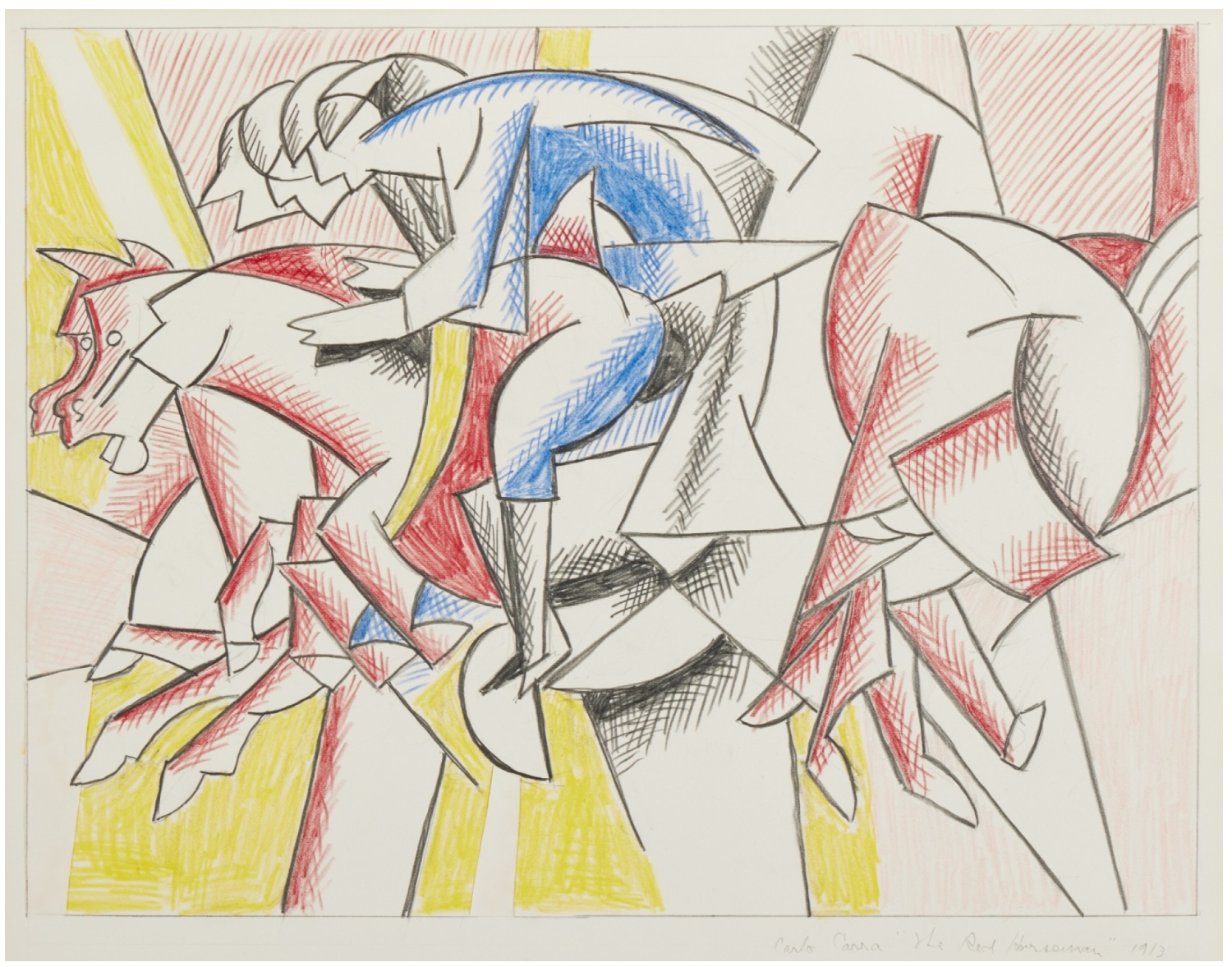
ROY LICHTENSTEIN (1923 – 1997)
The Red Horseman (Study), 1974
Colored pencil, graphite and cut paper on paper
Image: 14-3/4 x 19-1/2 inches (37.5 x 49.5 cm)
Sight: 16-1/4 x 20-1/4 inches (41.4 x 51.4 cm)
Sheet: 20-1/2 x 23-1/2 inches (52.1 x 59.6 cm)
Titled and inscribed Carlo Carra “The Red Horseman” 1913 (lower right)
Signed and dated ’74 (on the verso)
Post… (Study), 1995
Sotheby’s New-York: 17 November 2026
Estimated: USD 400,000 – 600,000
GUARANTEED PROPERTY
Roy Lichtenstein | Post… (Study) | Contemporary Day Auction | 2026 |
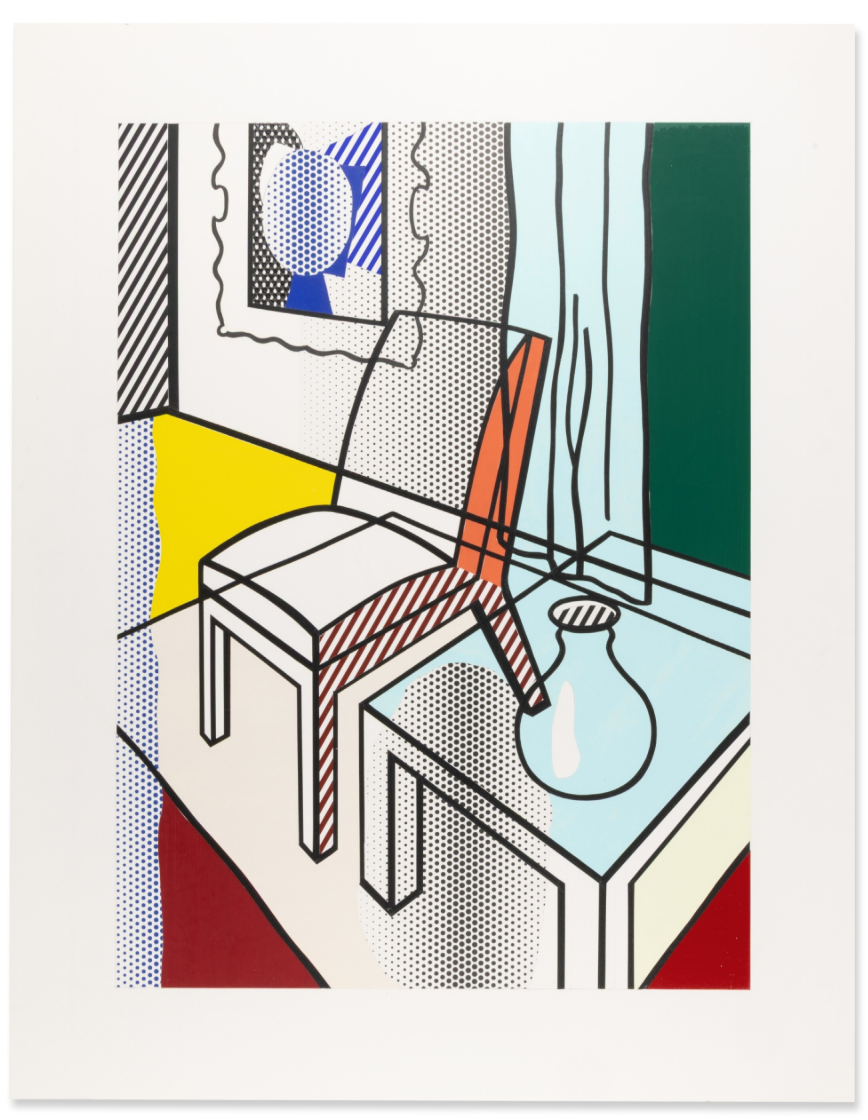
ROY LICHTENSTEIN (1923 – 1997)
Post… (Study), 1995
Cut painted and printed paper, tape, marker and graphite on paperboard
Image: 41 x 30-3/8 inches (104.1 x 77.2 cm)
Sheet: 51 x 40-1/8 inches (129.5 x 101.9 cm)
Signed and dated ’95 (on the verso)
Nude in Apartment (Study), 1995
Sotheby’s New-York: 17 November 2026
Estimated: USD 350,000 – 450,000
GUARANTEED PROPERTY
Roy Lichtenstein | Nude in Apartment (Study) | Contemporary Day
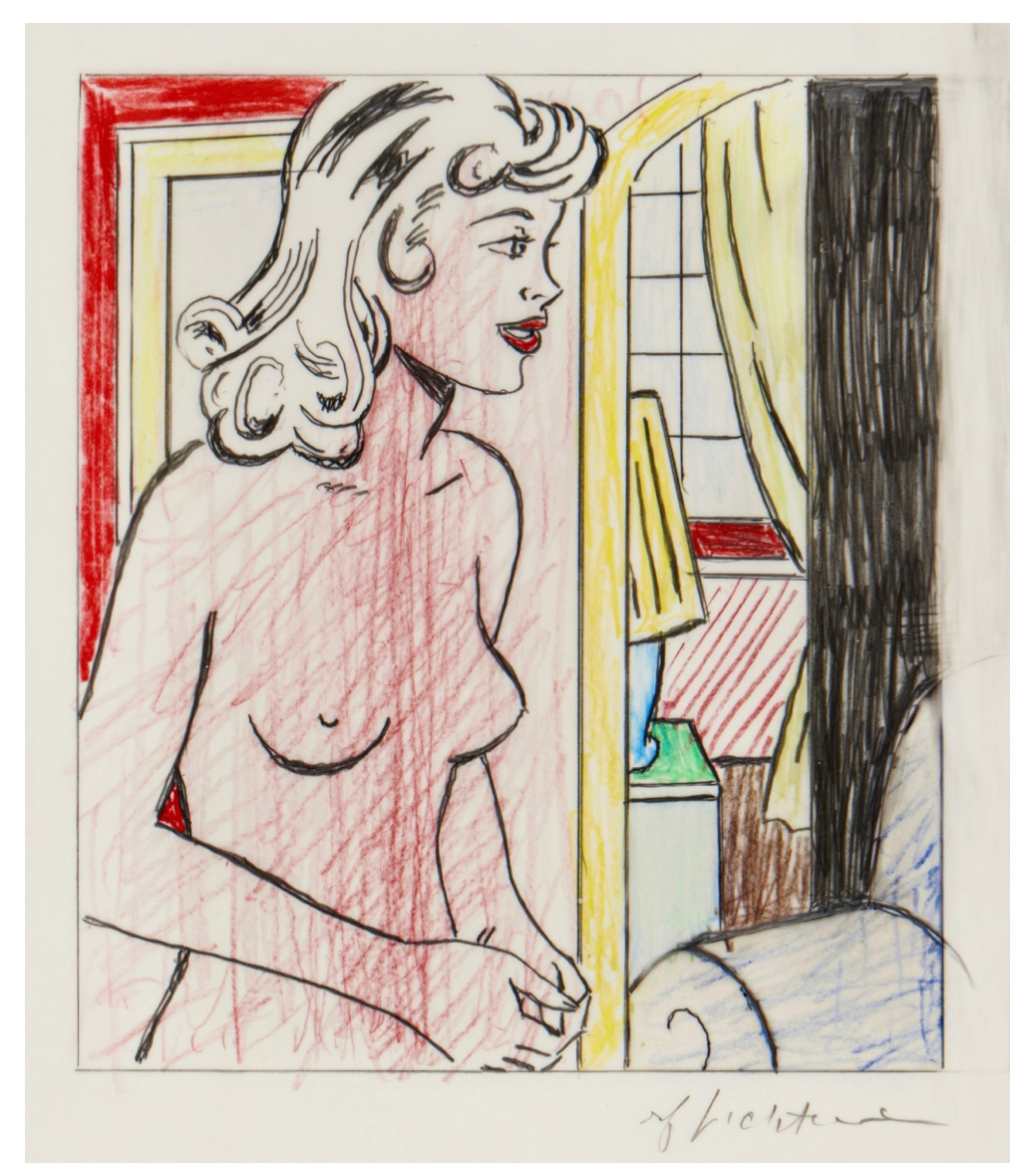
ROY LICHTENSTEIN (1923 – 1997)
Nude in Apartment (Study), 1995
Colored pencil and graphite on Denril
Image: 8 x 7-1/2 inches (20.3 x 19.1 cm)
Sheet: 11-5/8 x 11 inches (29.5 x 27.9 cm)
Signed (lower right)
Profile Head, 1988
Sotheby’s New-York: 17 November 2026
Estimated: USD 300,000 – 400,000
GUARANTEED PROPERTY
Roy Lichtenstein | Profile Head | Contemporary Day Auction | 2026 |

ROY LICHTENSTEIN (1923 – 1997)
Profile Head, 1988
Acrylic on wood
37-1/4 x 23-3/8 x 9-3/4 inches (94.6 x 59.4 x 24.8 cm)
This work is unique
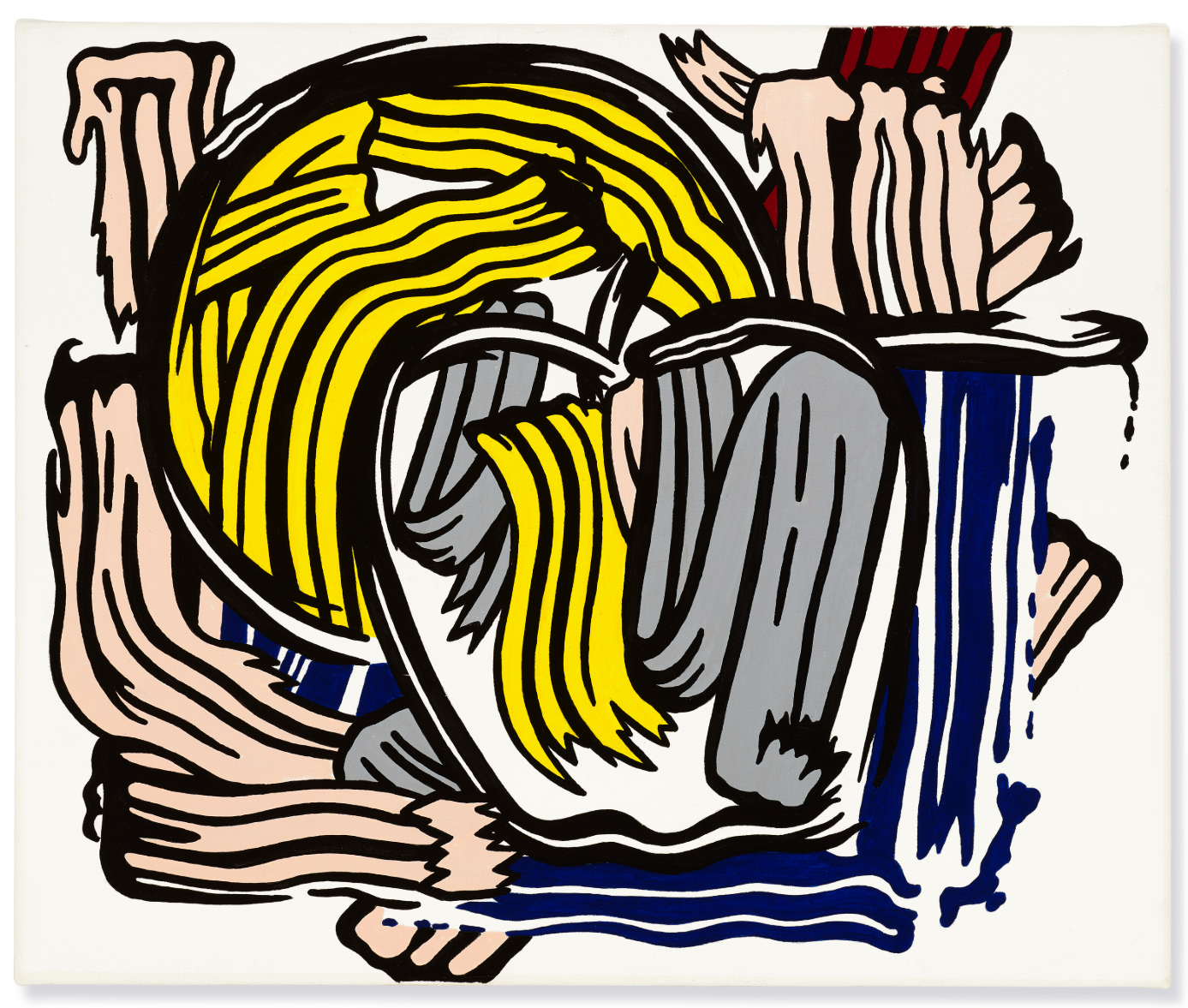
Reflections on “Painter and Model”, 1990
Reflections on “Painter and Model”, 1990
Expanding Horizons: The Hedreen Collection
Sotheby’s New-York: 16 November 2026
Estimated: USD 20,000,000 – 30,000,000
Roy Lichtenstein | Reflections on “Painter and Model” | The Now and
ROY LICHTENSTEIN (1923 – 1997)
Reflections on “Painter and Model”, 1990
Acrylic, oil and graphite on canvas
78×96 inches (198.1 x 243.8 cm)
Signed and dated ’90 (on the reverse)
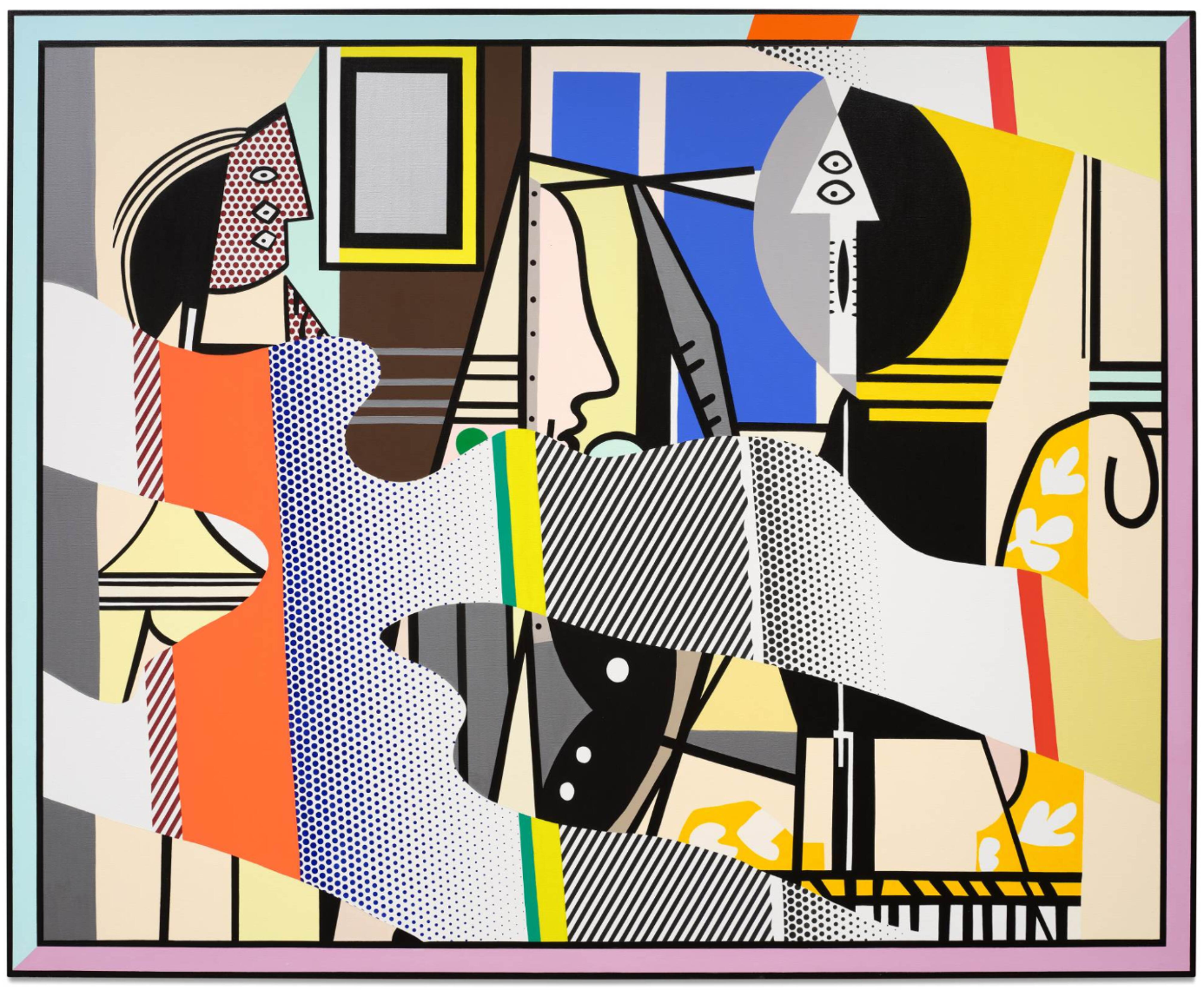
By the late 1980s, Roy Lichtenstein was a colossus of twentieth-century art: an architect of the Pop movement and a prolific, protean artist who cultivated and recast the universe of images around him. Whether cartoons or comic books, commercial diagrams or the great masters of the art historical canon, Lichtenstein saw every image as an opportunity—one fecund with transformative possibilities. Between 1988 and 1990, however, Lichtenstein took this act of reinvention further still in a series of 36 paintings called the Reflections. Together standing as a kind of epic coda to Lichtenstein’s career, these works reflected, literally and figuratively, on decades of imagery, even his own. Among the most accomplished and significant of these works is Reflections on “Painter and Model” from 1990, which sees the artist translate the composition of Pablo Picasso’s Painter and Model from 1928 into the cool graphic clarity of his Ben-Day dotted language.
“I am nominally copying, but I am really restating the copied thing in other terms. In doing that, the original acquires a totally different texture.”
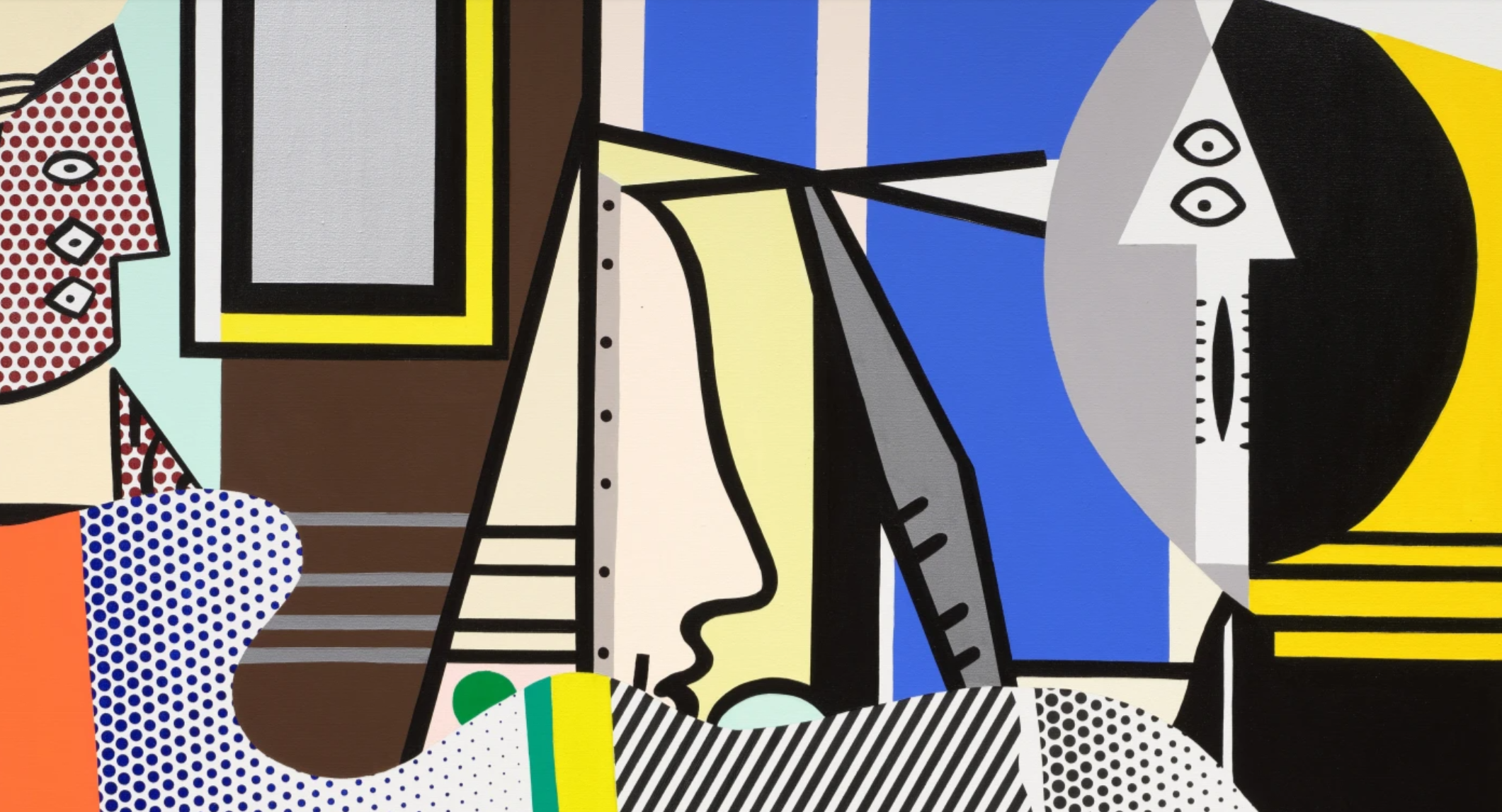
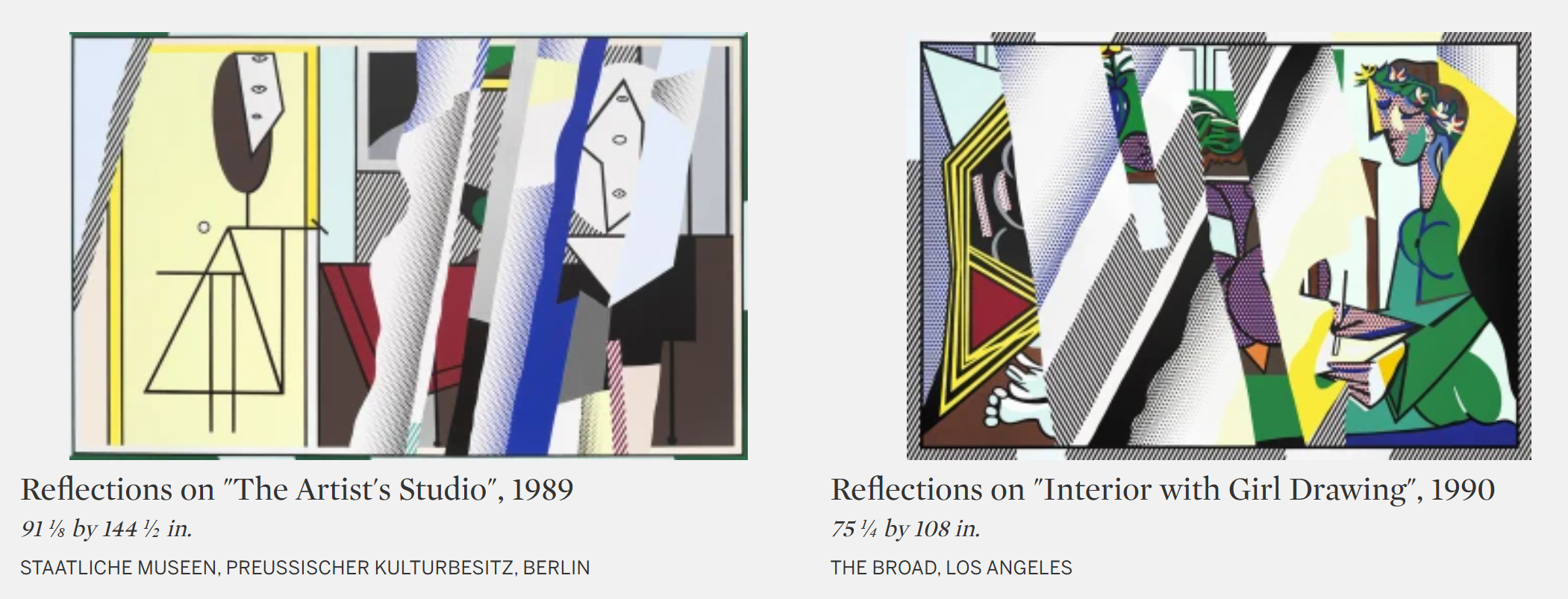
Just as Picasso adapted the compositions of Diego Velázquez and Édouard Manet into his own, so, too, did Lichtenstein confront the legacy of Picasso head-on, and in doing so, shrewdly engineered himself into an extraordinary artistic legacy. One of just three Reflections paintings of Picasso works, Reflections on “Painter and Model” is the only remaining in private hands, acquired by pioneering Seattle collectors Richard C. and Elizabeth Hedreen in 1993 and having remained in the Hedreen Collection for over thirty years since. Testament to the importance of these Picasso Reflections works, the other two—Reflections on “The Artist’s Studio” from 1989 and Reflections on “Interior with Girl Drawing” from 1990—reside in the Staatliche Museen, Preussischer Kulturbesitz, Berlin and The Broad, Los Angeles, respectively.
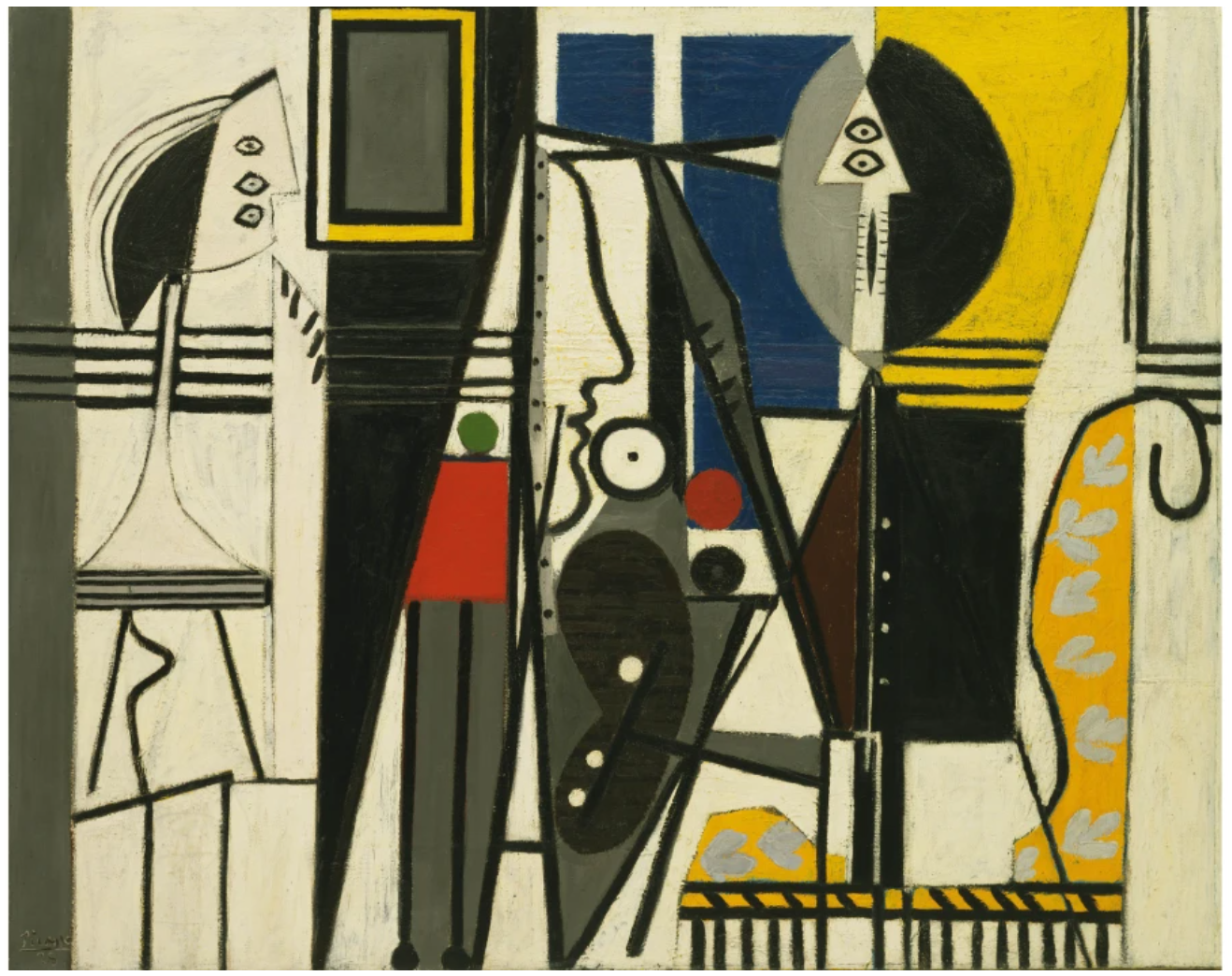
Pablo Picasso, Painter and Model, 1928. The Museum of Modern Art, New York. Image © The Museum of Modern Art/Licensed by SCALA / Art Resource, NY. Art © 2026 Estate of Pablo Picasso / Artists Rights Society (ARS), New York
The present work takes Picasso’s Painter and Model from 1928 as its basis, a work held in The Museum of Modern Art in New York and one that Lichtenstein would have undoubtedly seen in the city, as is the case for both of the other Picasso works in the series. Perhaps no other artist, subject, or movement could prove so impactful in the Reflections, and at this moment in Lichtenstein’s career. Here, he not only riffs on a centuries-old artistic dialogue but paints himself into it, much like Andy Warhol and his silkscreened canvases of the Mona Lisa and The Last Supper. Lichtenstein’s fascination with Picasso, however, dates back to 1963, with early paintings like Femme d’Alger, now at The Broad, Los Angeles, and Femme dans un fauteuil, on permanent loan to the Staatliche Museen, Preussischer Kulturbesitz, Berlin, from the esteemed Marx Collection. Picasso was the first artist Lichtenstein reinterpreted in the rote clarity of his comic book vernacular, moving beyond popular imagery and into the realm of high art. Remarkably, the very two museums that hold the first two canvases inspired by Picasso also hold two of the last, with the present work marking the artist’s final homage to his predecessor.
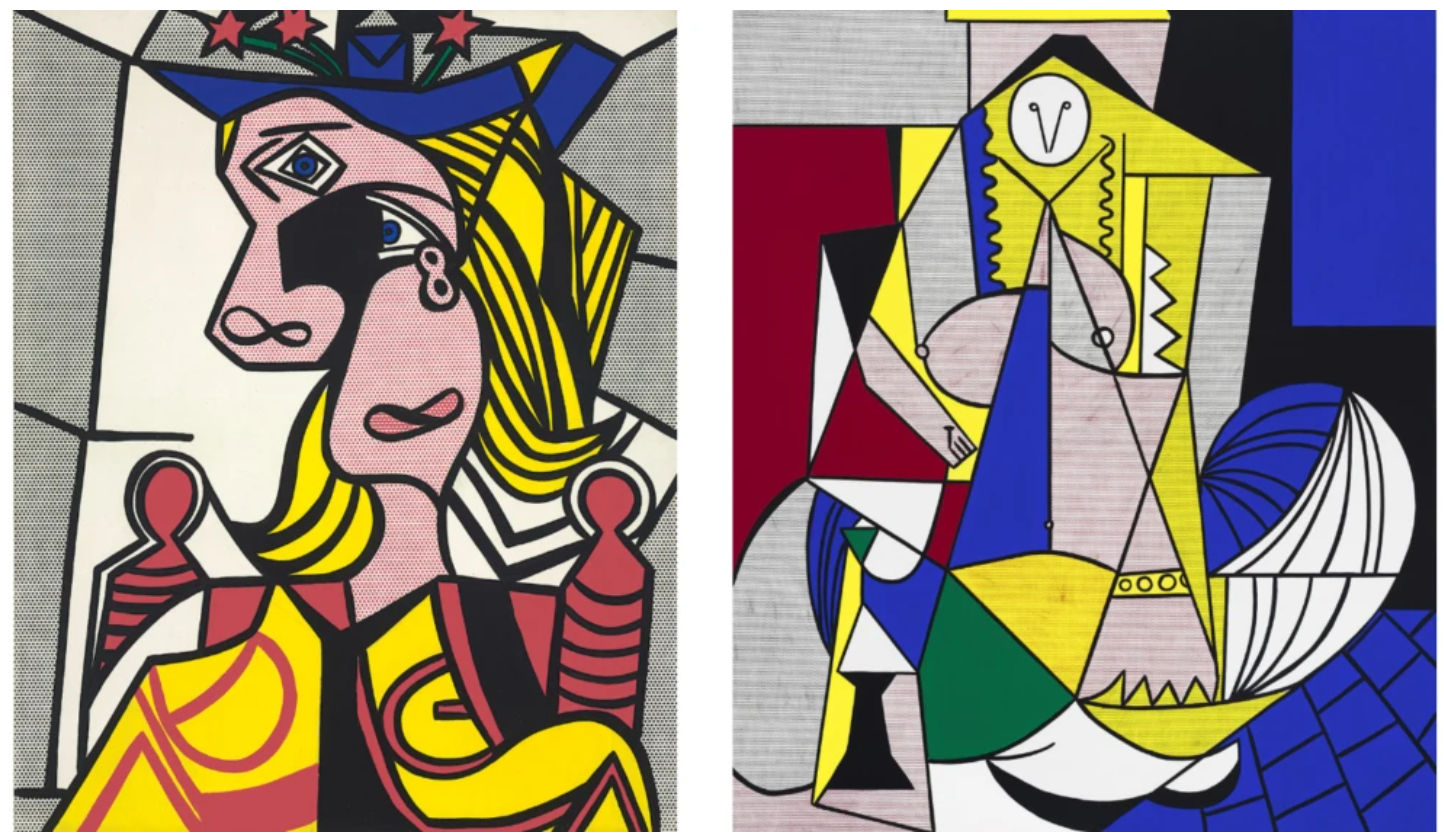
Left: Roy Lichtenstein, Woman with Flowered Hat, 1963. Private Collection. Art © 2026 Estate of Roy Lichtenstein/DACS.
Right: Roy Lichtenstein, Femme d’Alger, 1963. The Broad, Los Angeles. Art © 2026 Estate of Roy Lichtenstein/DACS
The present work’s power is in no small part due to Lichtenstein’s courage to not only draw inspiration but manipulate the work of Picasso. Diane Waldman observes his shrewd transformations in the catalogue for the artist’s retrospective at the Solomon R. Guggenheim thus: “Reflections on Painter and Model… and Reflections on INterior with Girl Drawing…, both 1990, are based on paintings by Picasso in the Museum of Modern Art…. A comparison of the two paintings by Picasso with Lichtenstein’s versions of them is fascinating as much for what the younger artist has retained of the originals as for what he has changed. Picasso reduced the compositional elements in both of his paintings to a few basic colors and shapes. In The Painter and His Model…, 1928—one of a series of paintings that Picasso made on the theme of the artist’s studio—black and white predominate, supplemented by red, yellow, blue, and gray, and touches of green and brown, and most of the forms are delineated by a black outline, with rectangular forms used to suggest windows and a circle to describe a breast.
Lichtenstein’s Late Picasso Reflections Works
Frequently invoking the art historical canon as reference point, Lichtenstein found particular inspiration in the Modern Cubist movements. All executed late in Lichtenstein’s storied career, the artist completed only three Reflections works reimagining Pablo Picasso’s masterworks, The Artist’s Studio, Interior with Girl Drawing, and the present work, Painter and Model. These works all explore the motif of a self-conscious artist, taking his own studio, self, and muse as his subject. Thus, via Lichtenstein’s Reflections technique, punctuating these scenes with a mirror-like overlay, these works not only reflect back the artist as a subject, but also the viewer whom Lichtenstein now invites to join the composition as well. All three of the original Picasso works now hang in The Museum of Modern Art in New York. The other two Reflections works of Lichtenstein’s are in the Staatliche Museen, Preussischer Kulturbesitz, Berlin, and The Broad, Los Angeles, making the present work the very last remaining in private hands, never before seen at auction. All Art © 2026 Estate of Roy Lichtenstein/DACS
He combined male and female sexual attributes in a single figure, and he also positioned his forms so that figures and interior are merged, much as Matisse did in The Red Studio…, 1911. Lichtenstein altered little of Picasso’s basic compositional scheme but downplayed or eliminated the painting’s surface texture (which is an integral part of both works), added his Benday-dot screen to the face of the model, and overlaid her form and that of the painter with his mirror-reflection motif composed of Benday dots, diagonal stripes, and bands of color. He also added three colors—a secondary yellow, peach, and blue—and, most important of all, a frame surrounding the entire composition.” (Diane Waldman, “The 1980s” in: Exh. Cat., New York, Solomon R. Guggenheim (and traveling), Roy Lichtenstein, 1994, p. 297)
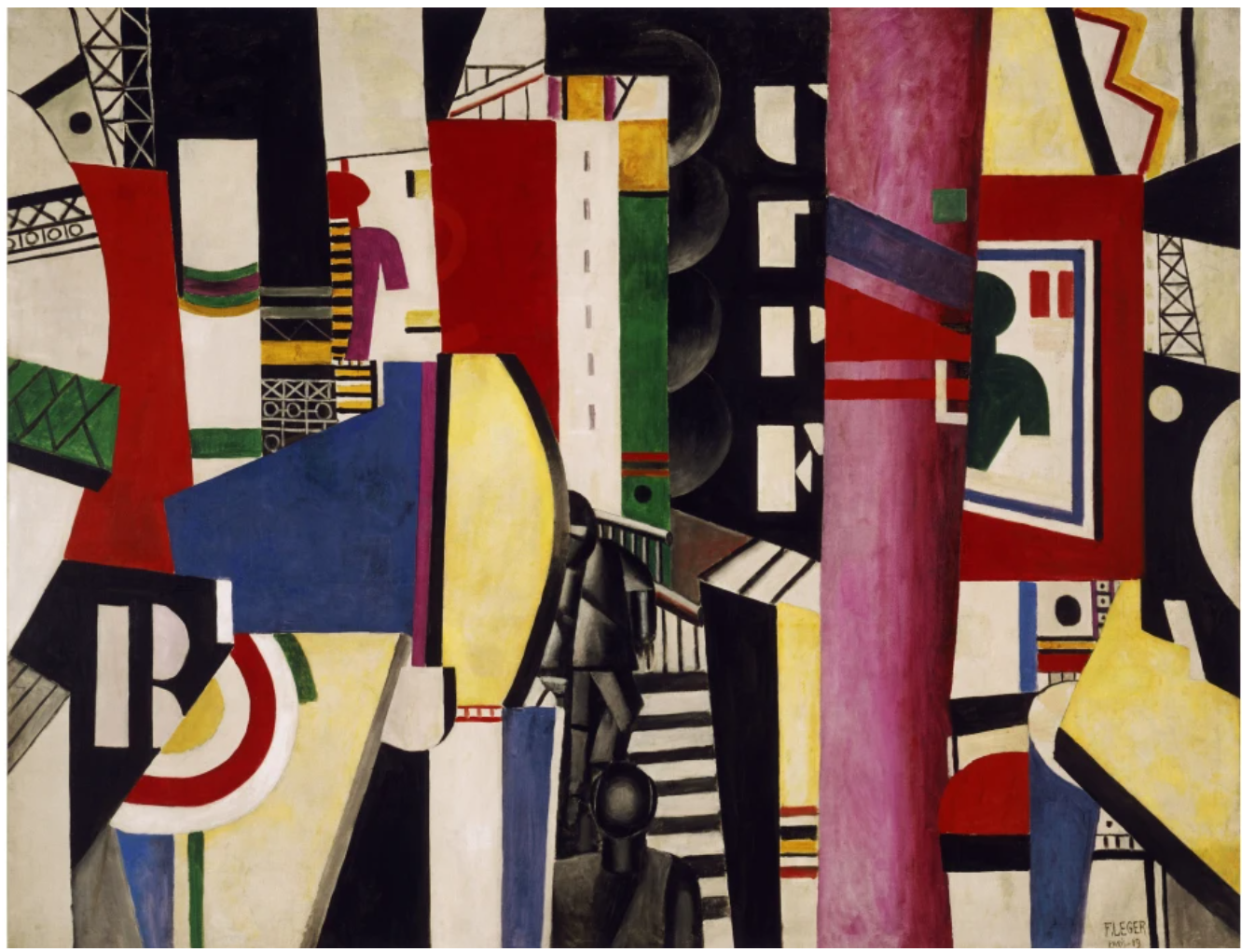
Fernand Leger, The City, 1919. Philadelphia Museum of Art.
Image © Philadelphia Museum of Art / A.E. Gallatin Collection / Bridgeman Images
The Reflections see Lichtenstein, by this time 65 years old, at his most cunning, and certainly his most confident. Where he had developed his mature style by appropriating popular imagery, transmuting the potency of their illustrative omnipresence into paint, Lichtenstein also began in the Reflections to appropriate the imagery of his own work. To borrow and manipulate his oeuvre posed an entirely bolder proposition, recognizing—if not asserting—that his own body of work had reached the same stature of universal recognition during his lifetime. In reflecting on his earlier paintings and those by Picasso in the same series, with the same devices, and in the same style, Lichtenstein here poses the ultimate declaration of his artistic achievement.
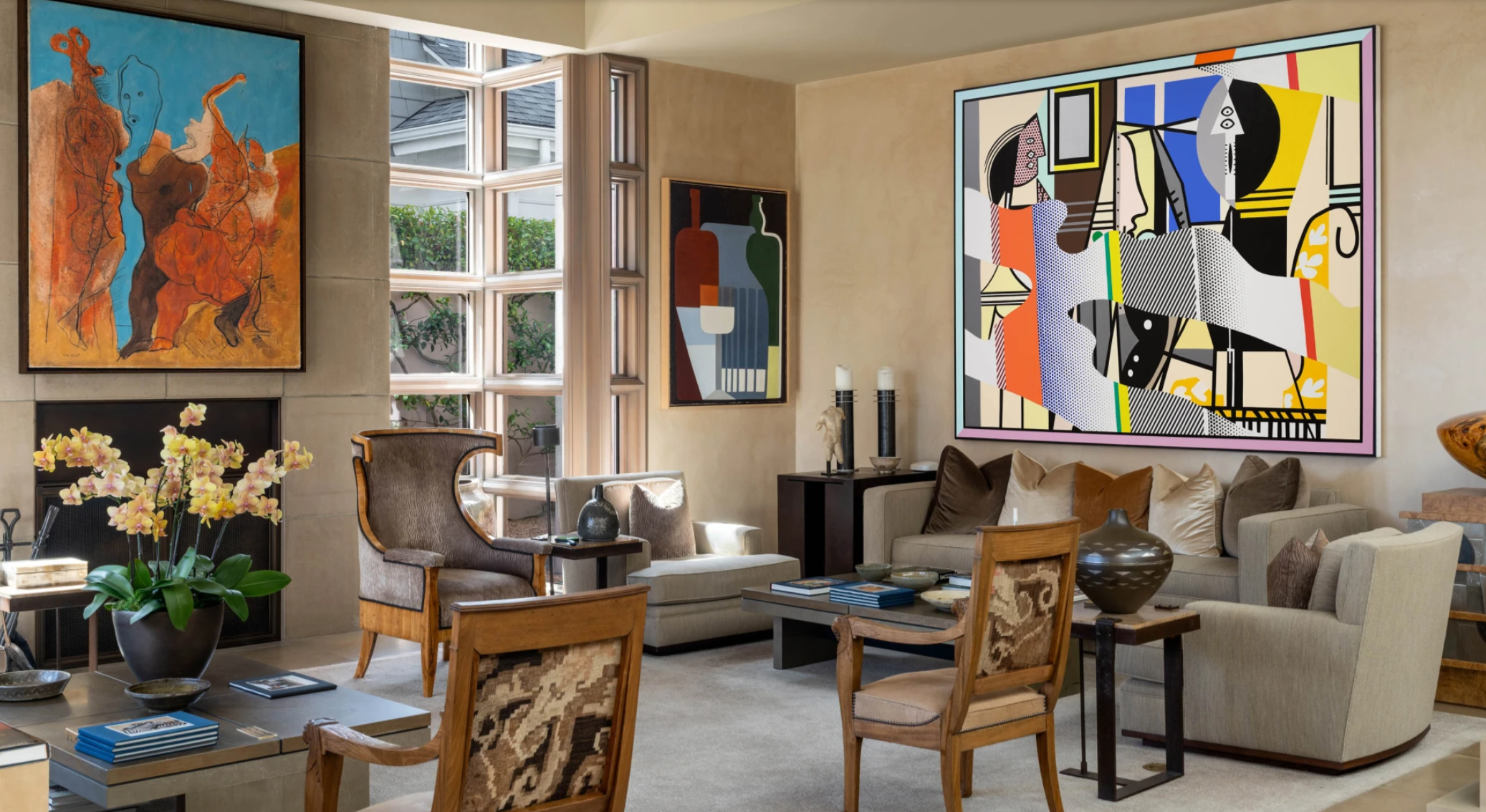
The present work installed in the Hedreen residence. Art © 2026 Estate of Roy Lichtenstein/DACS
In Reflections on “Painter and Model,” Lichtenstein retains the Cubist figures, the framed artwork, and the work in progress of Picasso’s original, but obscures the composition with planar passages of color, representing the reflective effects of a mirror. As Diane Waldman observes, Lichtenstein “took the subject of the mirror as a means of questioning reality and painted his own self-portrait with a mirror as his face. He reflected on his own art and the art of others, incorporating images by Cezanne, Picasso, Matisse, Mondrian, and Leger into his paintings, together with images of Mickey Mouse, cartoon girls, who were all-American beauties, and guys, and household objects taken from comic books, catalogues, advertisements, and the Yellow Pages. His entire body of work was a reflection, an inquiry into his identity and his role as an artist.” (Diane Waldman quoted in: Exh. Cat., Rome, Chiostro del Bramante, Roy Lichtenstein: Riflessi-Reflections, 1999, pp. 17, 19) Indeed, Reflections on “Painter and Model” suggests Lichtenstein’s prowess not only as a painter but as a mirror himself, reflecting and monumentalizing the heft of art history as his own to seize.
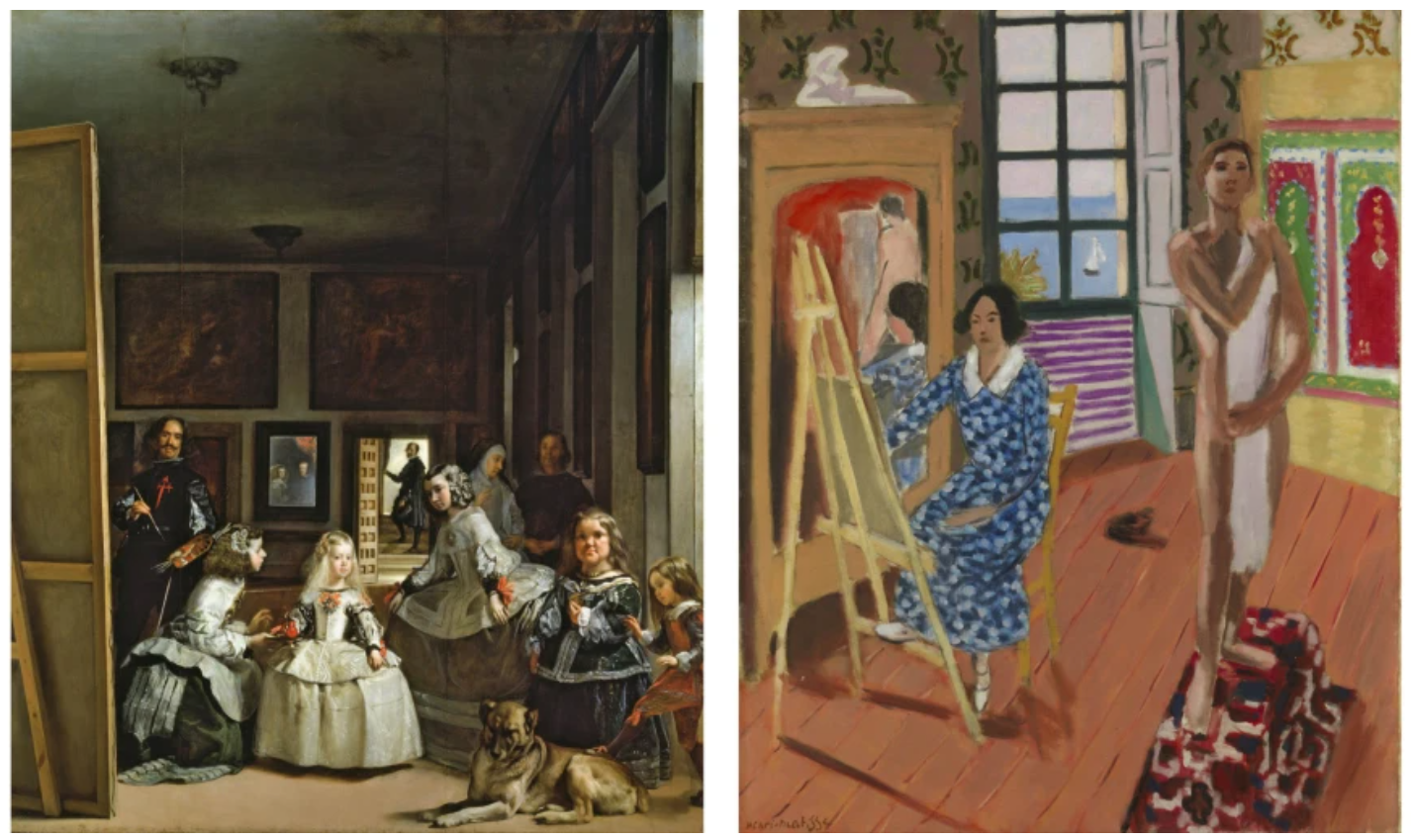
Left: Diego Velazquez, Las Meninas, c. 1656. Prado, Madrid. Image © Bridgeman Images.
Right: Henri Matisse, The Three O’Clock Sitting, 1924. The Metropolitan Museum of Art, New York. Image © The Metropolitan Museum of Art. Image source: Art Resource, NY
Indeed, Lichtenstein’s engagement with art history is here so potent and considered that it extends the work of Picasso, the painted surface as a field of study unto itself, and the canonical subject of depicting the act of painting, as in the work of Velazquez’s Las Meninas or Henri Matisse’s The Three O’Clock Sitting. “Lichtenstein’s reworking of the motif,” Sheena Wagstaff writes, “in his respondent paintings, Reflections on ‘The Artist’s Studio’ (1989; Hamburger Bahnhof, Museum für Gegenwart, Berlin) and Reflections on ‘Painter and Model’…., is both a metaphorical and a literal reflection on the nature of the painting and its origins, topically and historically. He overlaid Picasso’s Painter and Model (now slightly altered in details of color and form) with slanting graphic notations that stand for ‘reflection,’ as if the entire image were being seen by us in a mirror, meditated at a further remove via another artist’s perception.” (Sheena Wagstaff, “Late Nudes,” in: Exh. Cat., The Art Institute of Chicago (and traveling), Roy Lichtenstein: A Retrospective, 2012, p. 100)
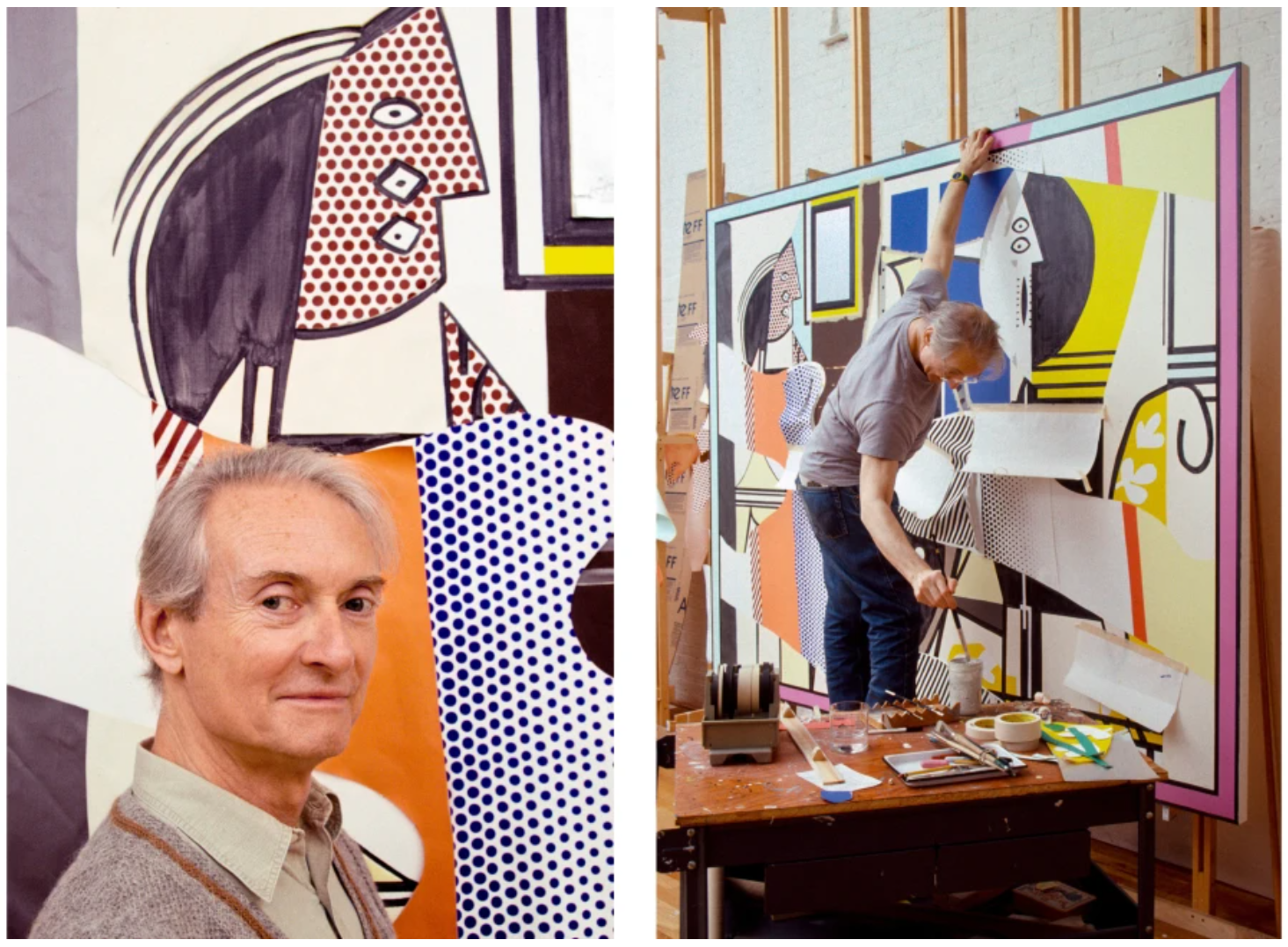
The artist in his studio with the present work, 1989. Photo © Bob Adelman. Art © 2026 Estate of Roy Lichtenstein/DACS
Where his Brushstrokes wrestle with Abstract Expressionism, or Stretcher Bars parodize Minimalism, Reflections on “Painter and Model” takes aim at art history writ large, proving the singularity of Lichtenstein’s lens by reimagining the work of a titan. Now a tenured statesman of the art world yet unrelentingly innovative, the Reflections pose one of Lichtenstein’s most powerful and declarative bodies of work—a culmination of a career spent inventing, iterating, and refining a language that defined a generation.
Large Spool, 1963
Large Spool, 1963
The Collection of Antonio Homem Sonnabend
Christie’s New-York: 19 November 2026
Estimated: USD 10,000,000 – 15,000,000
MINIMUM PRICE GUARANTEE
ROY LICHTENSTEIN (1923-1997), Large Spool | Christie’s
ROY LICHTENSTEIN (1923-1997)
Large Spool, 1963
Acrylic and graphite on canvas
68×56 inches (172.6 x 142.2 cm)
Signed and dated ‘rf Lichtenstein ’63’ (on the reverse)
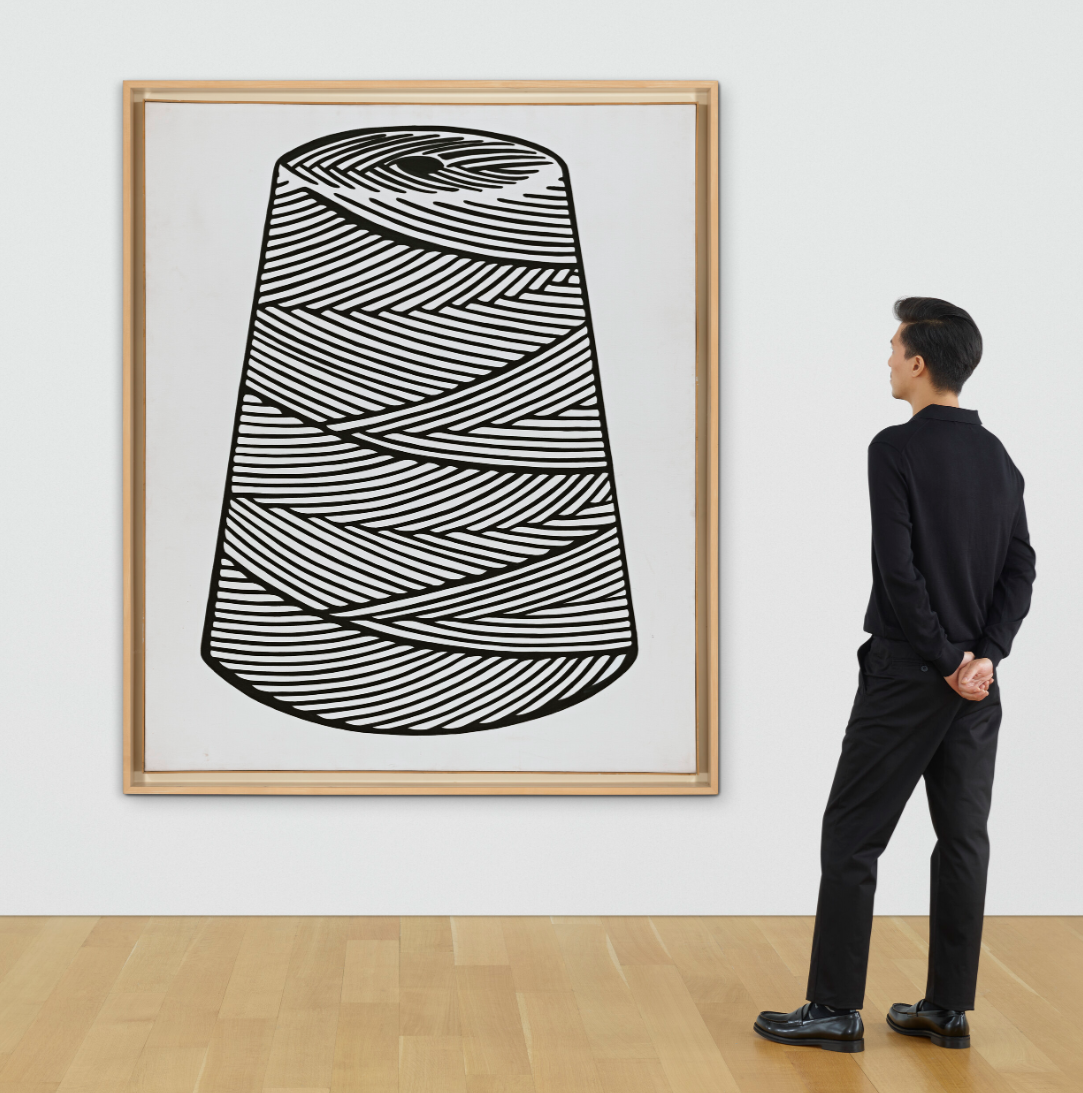
Measuring nearly six feet tall, this impressive canvas is one of Roy Lichtenstein’s early graphic masterpieces. Belonging to a famed series of black-and-white paintings that the artist began in 1961, Large Spool is central to establishing his reputation as one of the leading figures of Pop Art.
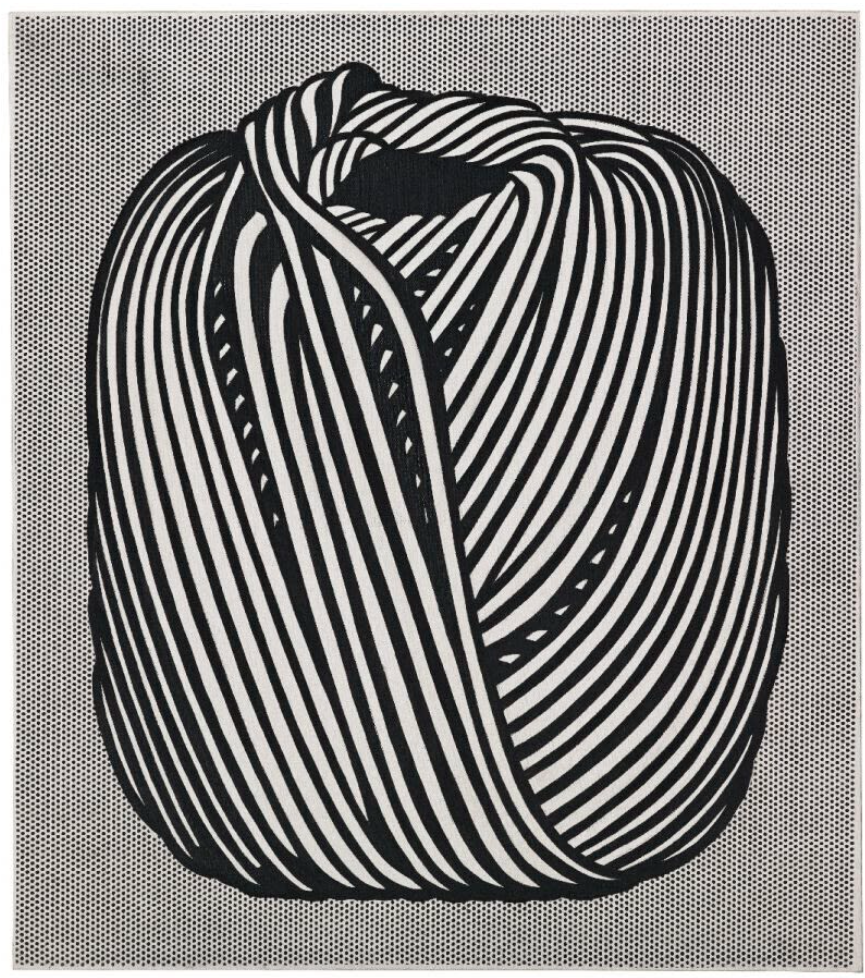
Roy Lichtenstein, Ball of Twine, 1963. Basel, Foundation Beyeler. © 2026 Estate of Roy Lichtenstein / DACS.
By taking an everyday object and elevating it to the status of high art, Lichtenstein transforms the act of painting from a purely representational pursuit to something more conceptual: bold lines twist and turn across the surface of the canvas in a symbolic tussle between abstraction and figuration.
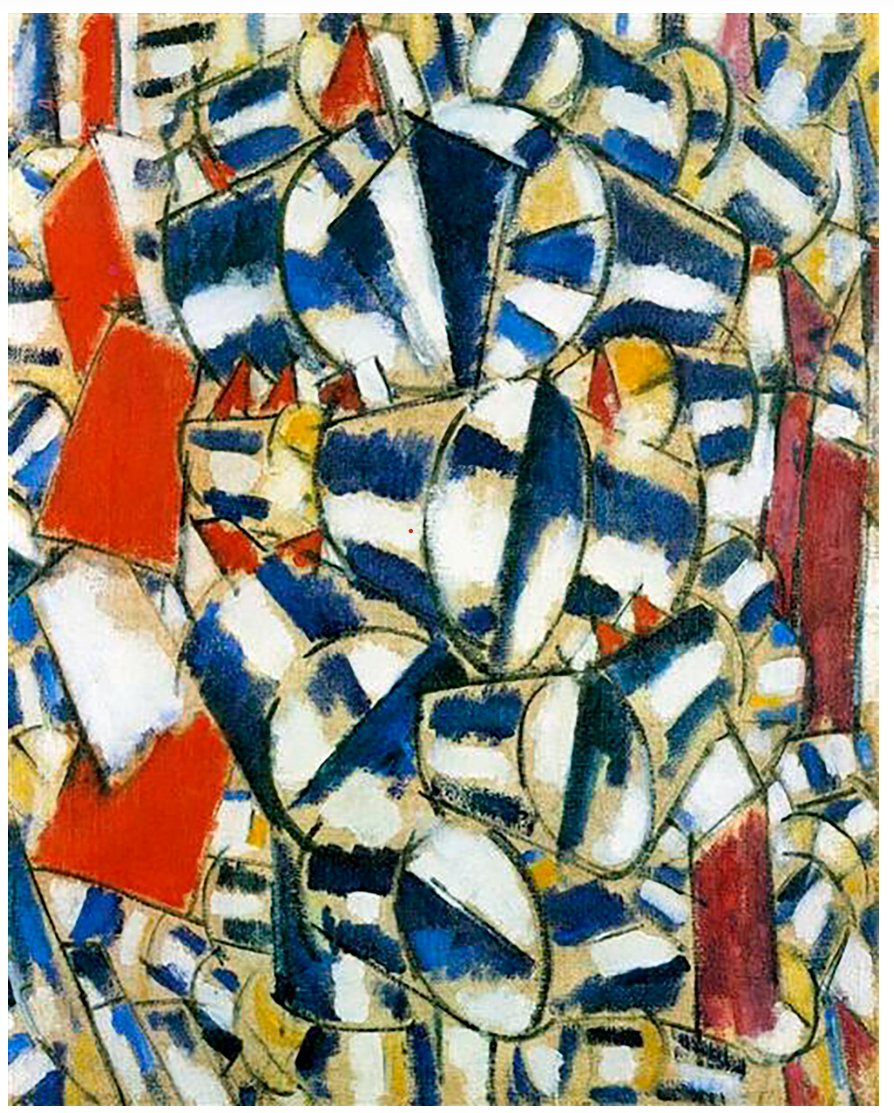
Fernand Leger, Contrast of Form, 1913.
Occupying almost the entire picture plane, the power of Lichtenstein’s expansive spool lies in its seeming simplicity. A series of diagonal lines lying at forty-five degrees crisscross the canvas. Some appear thicker than others, indicating a shadow, and thus volume, ensuring that the physical flatness of the canvas is challenged by a remarkable degree of three-dimensionality. The clarity of each individual line implies a tautness that is inherent in the tightly wound spool of string. As art historian Bernice Rose argues, because it materializes a continuous line, the painting is well equipped to explore the tension between abstraction and representation—a discussion that is central to Lichtenstein’s drawings. “It is typical of Lichtenstein that the analogy between line and string—the subject’s relationship to the formal element—creates a kind of extra ‘punch’” (B. Rose, quoted in I. Dervaux, Roy Lichtenstein: The Black-and-White Drawings 1961-1968, New York, 2010, p. 159).
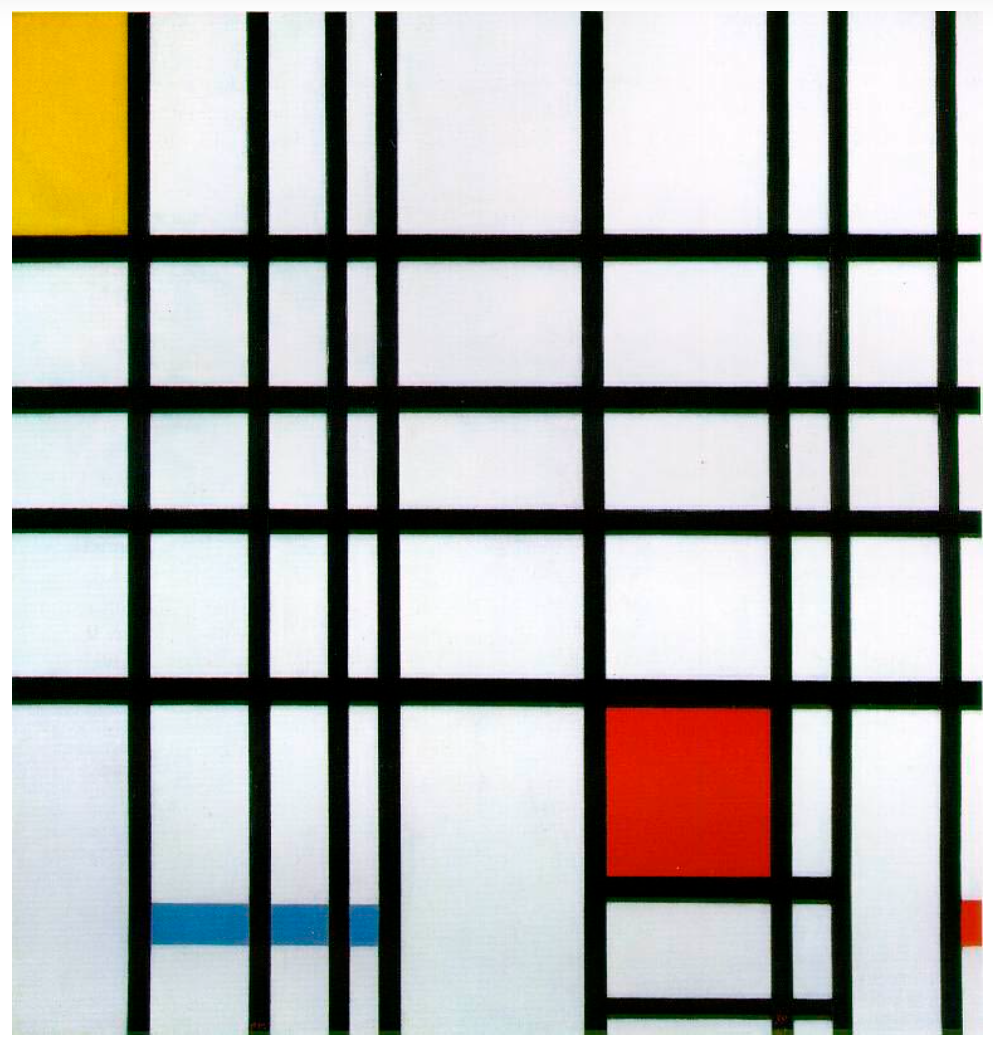
Piet Mondrian, Composition with Yellow, Blue, and Red, 1937-1942. © 2026 Mondrian / Holtzman Trust.
Large Spool is one of the purest manifestations of the artist’s signature style, a visual language which he learned as a student at Ohio State University. Here he was tutored by Hoyt Sherman, author of the influential book Drawing by Seeing. Sherman espoused a new approach to conveying narrative, “Students must develop an ability to see familiar objects in terms of visual qualities,” he wrote, “and they must develop this ability to the degree that old associations with such objects will have only a secondary or a submerged role during the seeing-and-drawing act” (H. L. Sherman, quoted by B. Rose, The Drawings of Roy Lichtenstein, exh. cat., Museum of Modern Art, New York, 1987, p. 29). This theory was reinforced by Sherman’s use of what he called his ‘flash room’—a darkened room where images of objects were briefly flashed onto a screen for the students to copy. Teaching drawing in this manner proved to be extremely influential for Lichtenstein as it forced him to focus his attention on the most important visual aspects of the object’s structure, and not to become distracted by extraneous matters such as unnecessary decoration.
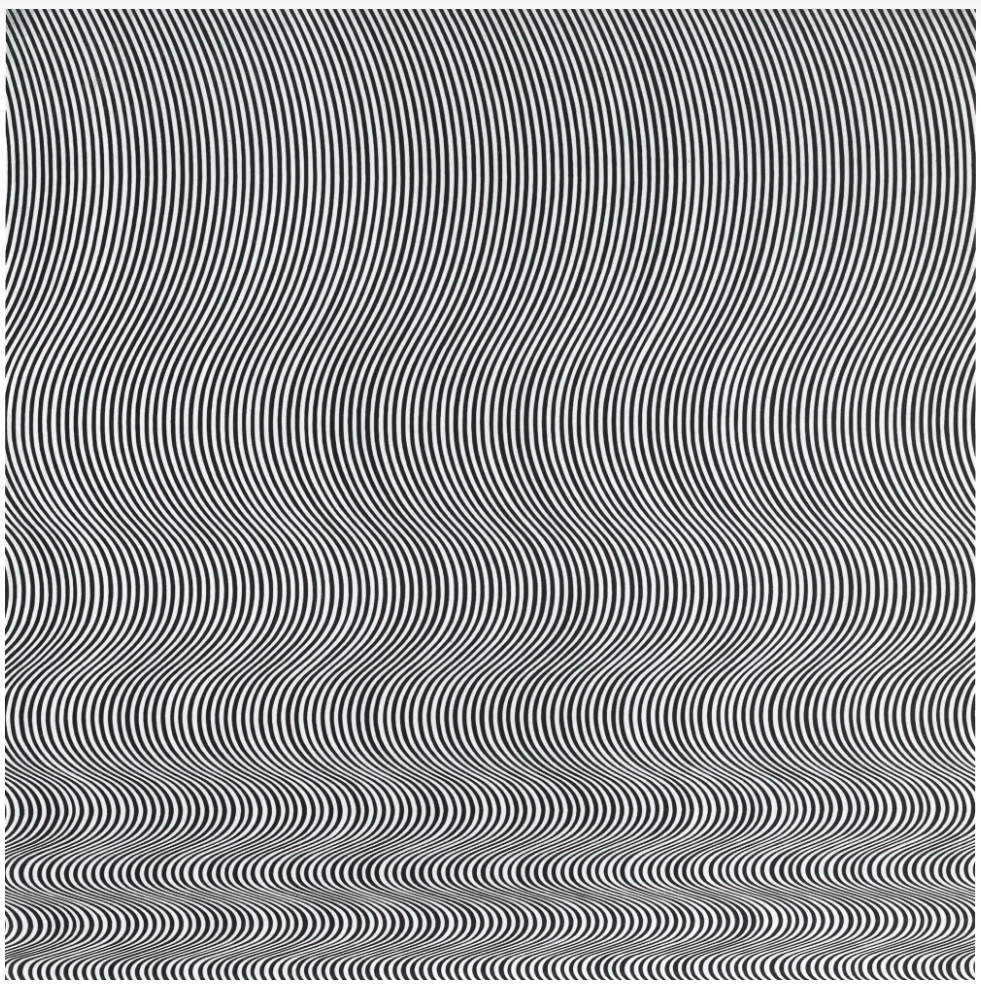
Bridget Riley, Fall, 1963. Tate Gallery, London. © Bridget Riley 2026. All rights reserved.
Thus, Lichtenstein’s black-and-white paintings form a vital part of the artist’s early oeuvre. He wasn’t the first artist to omit color from his work. Giotto used a technique known as grisaille (“greyed”) in the lower registers of his frescos at the Scrovegni Chapel in Padua as early as the fourteenth century, and in the early decades of the twentieth century, Mondrian “purified his own pure self by ridding his art of such secondary accessories as primary colors, leaving us with nothing but taut perfection of a black armature married to a forever white void” (R. Rosenblum, “Roy Lichtenstein’s ‘Rhapsody in Black and White,’” in Roy Lichtenstein: Early Black and White, exh cat., Gagosian Gallery, New York, 2001, p. 9). The generation of artists that immediately preceded Lichtenstein—Ellsworth Kelly, Franz Kline, Robert Motherwell, Jackson Pollock, Willem de Kooning, and Frank Stella—all, at some point in their careers, worked primarily in black-and-white. But with his monochromatic work, Lichtenstein was able to achieve something very different. As the art historian Robert Rosenblum has identified, by adopting the visual language of mass media advertising, Lichtenstein was able to banish the monochromatic machismo of his forebears and produce something much more palatable, “…with his unerring marksmanship, black and white was quite enough to overthrow the establishment, instantly relegating to history the crusading evangelists of modern art” (Ibid., p. 52).
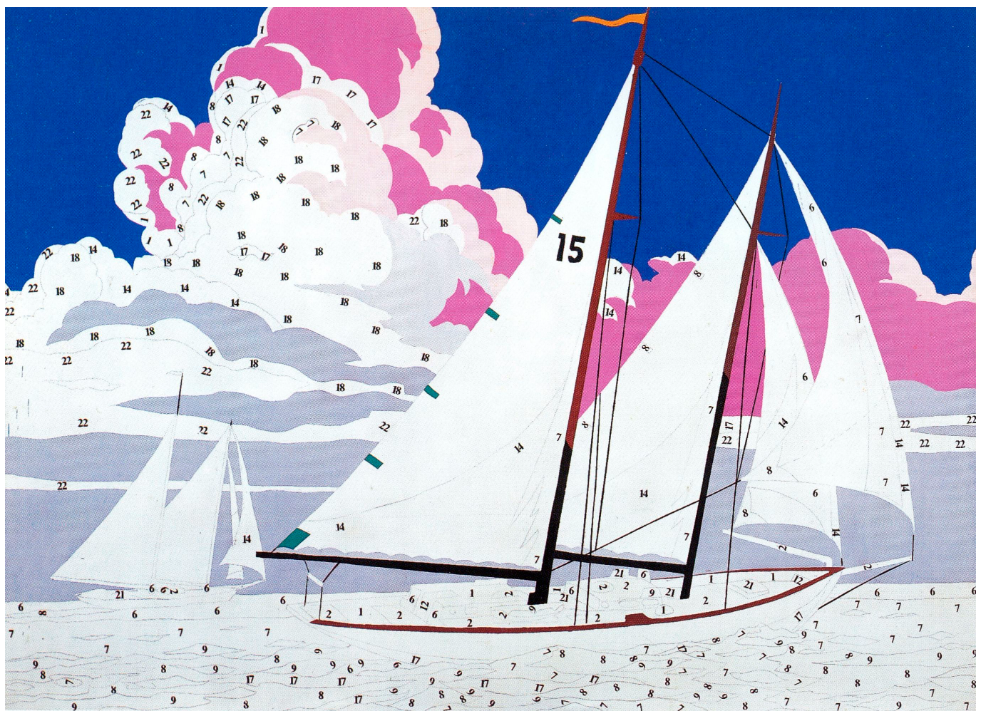
Andy Warhol, Do It Yourself (Sailboats), 1962. Andy Warhol Museum, Pittsburgh. © 2026 The Andy Warhol Foundation for the Visual Arts, Inc. / Licensed by Artists Rights Society (ARS), New York.
The seminal role that these works played within Lichtenstein’s oeuvre can be seen in Large Spool’s extensive exhibition history. First exhibited at the Leo Castelli Gallery the year it was painted, the present work has been included in many of the artist’s most important retrospectives, all while under the patronage of Ileana Sonnabend and Antonio Homem Sonnabend. It was included in an early institutional retrospective at the Cincinnati Contemporary Art Center in the winter of 1963, before traveling to Europe for an exhibition of Pop Art at the Palais des Beaux-Arts in Brussels in 1965. The work was chosen for inclusion in the important Sonnabend traveling exhibition from 1987 – 1991, marking the 25th anniversary of the Sonnabend Collection, traveling to 10 international locations including the Centro de Arte Reina Sofia, Madrid; the Galleria Nazionale d’Art Moderna, Rome; and the Sezon Museum of Art, Tokyo. It was also included in a major international traveling retrospective in 1993-1996, which stopped at venues such as the Solomon R. Guggenheim Museum, New York; Museum of Contemporary Art, Los Angeles; the Musée des Beaux-Arts de Montréal; the Haus der Kunst, Munich; the Palais des Beaux-Arts, Brussels, and Wexner Center for the Arts, Columbus. Most recently, it has been on display at The Sonnabend Collection Mantova, and its sale will support the Sonnabend Collection Foundation.
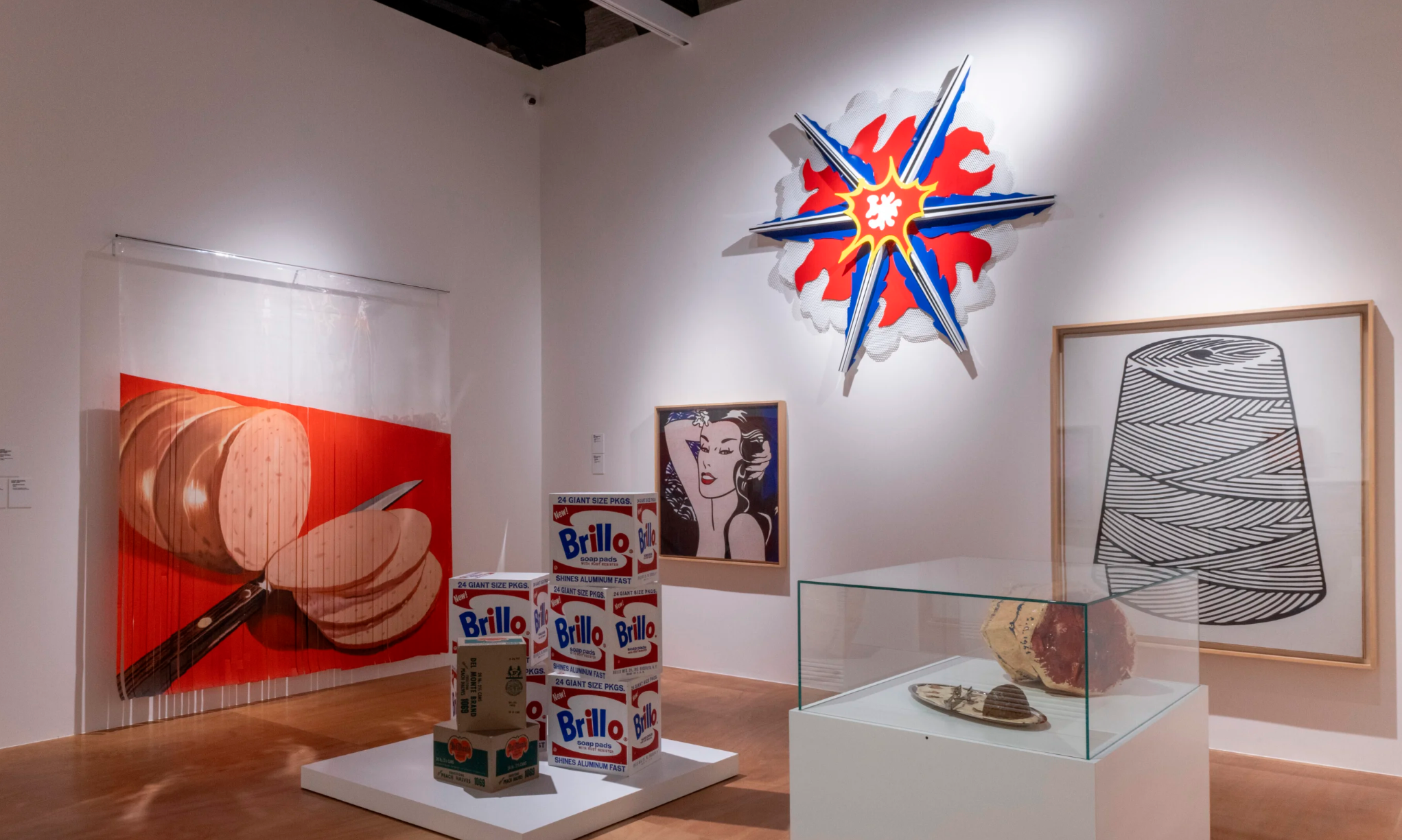
Sonnabend Collection Foundation, Mantova. Photograph courtesy of the consignor. Artwork: © 2026 Estate of Roy Lichtenstein / DACS; © 2026 The Andy Warhol Foundation for the Visual Arts, Inc. / Licensed by Artists Rights Society (ARS); © 2026 Estate of Tom Wesselmann / Artists Rights Society (ARS), NY.
Large Spool occupies a pivotal place in Roy Lichtenstein’s body of work due to its synthesis of many of the most important aspects of the artist’s work. Its impressive scale dramatically showcases the visual power of his graphic language as impassive and restrained lines trace the complex form of his chosen subject matter. His early training and unique eye enabled him to distill a complex visual world into its most essential elements and, rendering them with an extraordinary economy of means, allowing viewers to identify familiar objects through an entirely new visual language. Yet Lichtenstein’s art was also highly conceptual. He was adept at translating philosophical discussions about the legacies of abstraction and figuration into captivating and engaging works of art. Along with his contemporary Andy Warhol, Lichtenstein’s paintings came to define the age of Pop Art, and Large Spool proudly takes its place in that noble lineage. Having been in the Sonnabend Collection ever since it was painted in 1963, this represents an extraordinary opportunity to acquire a piece of twentieth-century art history.
Female Figure, 1978
Female Figure, 1978
Property from a Prominent Private Collection
Sotheby’s New-York: 16 November 2026
Estimated: USD 6,000,000 – 8,000,000
Roy Lichtenstein | Female Figure | The Now and Contemporary Evening
ROY LICHTENSTEIN (1923 – 1997)
Female Figure, 1978
Acrylic, oil and graphite on canvas
60×40 inches (152.4 x 101.6 cm)
Signed and dated ’78 (on the reverse)
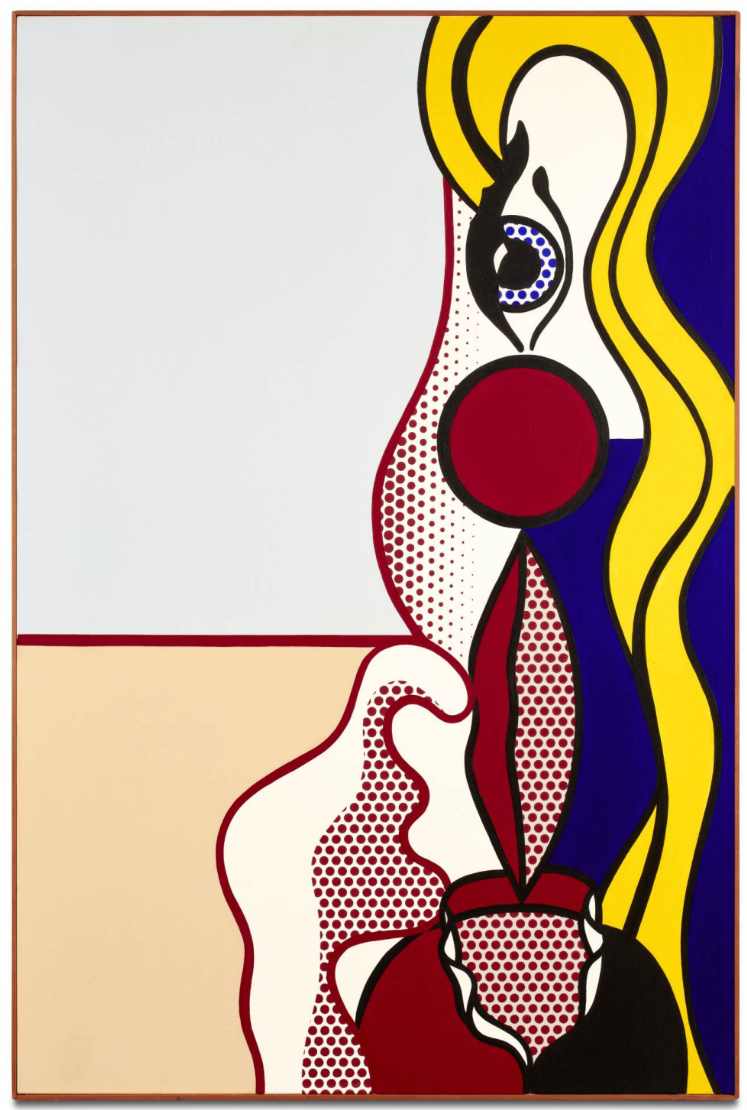
Enchanting, alluring, and yet ever elusive, Female Figure masterfully encapsulates Roy Lichtenstein’s deft engagement with the art historical canon through his most celebrated and enduring subject: the blonde beauty. For four decades, the portrayal of the female muse across popular media and the art historical canon was a central exploration. From his earliest comic book heroines, the bombshell beauty became an archetype of Lichtenstein’s practice, reappearing through his ongoing mining of the art historical canon.
“All my art is, in some way, about other art.”
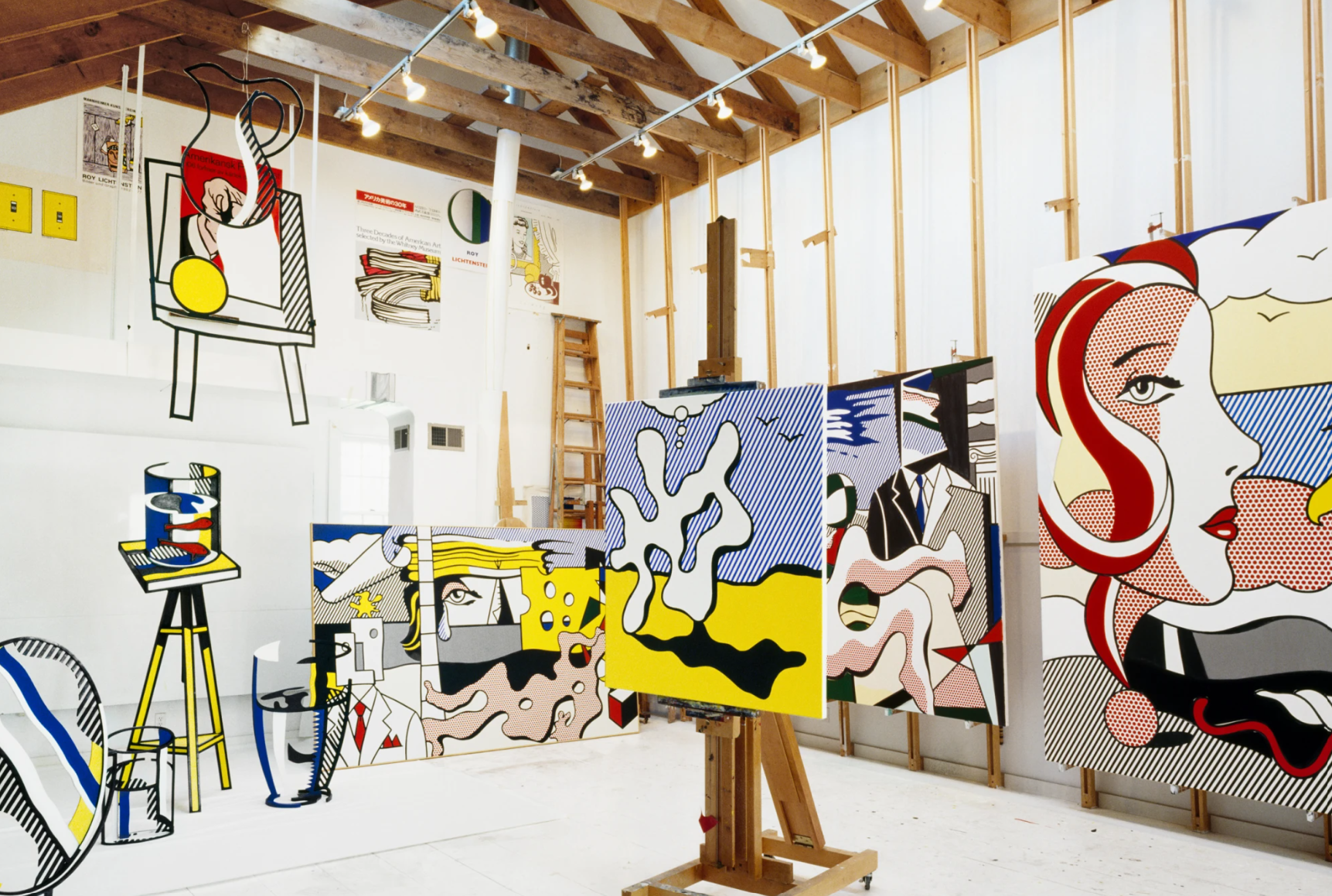
The artist’s studio, 1977. Photo by Horst P. Horst. Art © Estate of Roy Lichtenstein
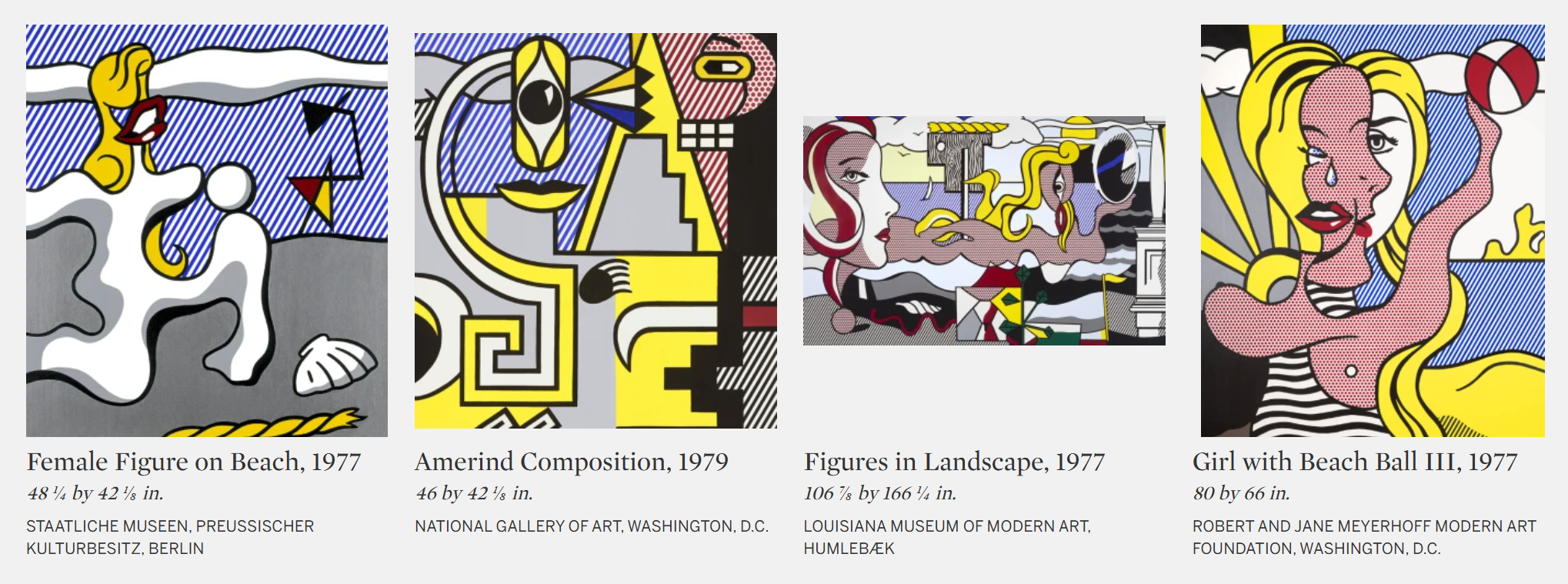
Painted at the height of the artist’s celebrated Surrealist period, Female Figure showcases the peerless formal execution and conceptual sophistication which define Lichtenstein’s celebrated practice. With other examples of the Surrealist paintings from 1977 and 1978 held in such collections as the Solomon R. Guggenheim Museum and the Metropolitan Museum of Art in New York, as well as the Louisiana Museum of Modern Art in Denmark, this series showcases the inventive mind of an artist at the creative apex of his extraordinary career.
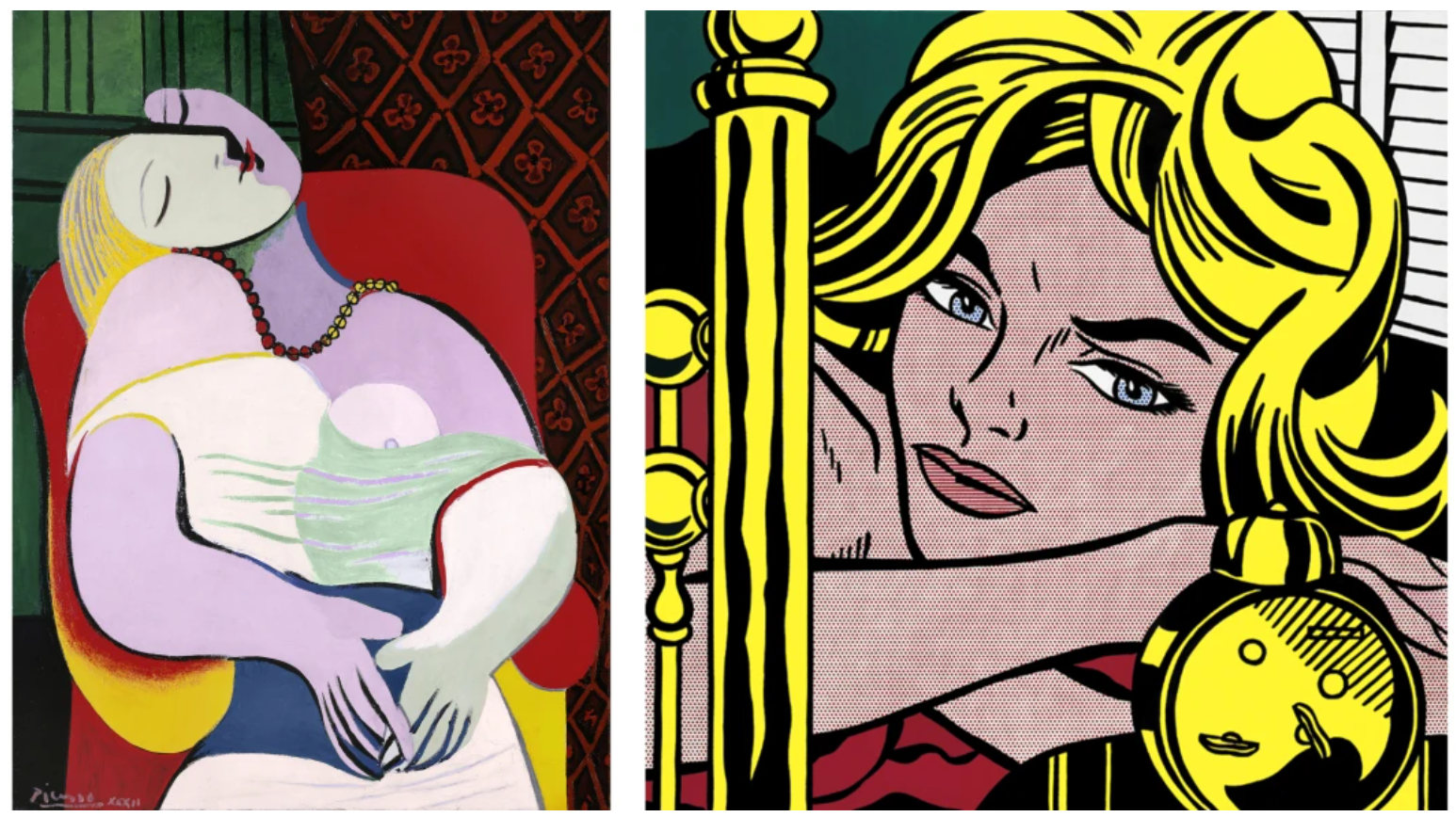
Left: Pablo Picasso, The Dream, 1932. Private Collection. Image © Christie’s Images / Bridgeman Images. Art © 2026 Estate of Pablo Picasso / Artists Rights Society (ARS), New York.
Right: Roy Lichtenstein, Blonde Waiting, 1964. Private Collection. Art © Estate of Roy Lichtenstein
The guiding principle of Lichtenstein’s prodigious oeuvre is a ceaseless investigation of “art about art,” reflecting upon its means of production, its purpose in modern culture, and how its history informs its future. Exploring the visual signs and symbols associated with mass production and comic books, such as flat planes of color, repeated dots to indicate shading, and bold contour lines, Lichtenstein redefined the language of representation in fine art and deconstructed the arbitrary boundaries between “high” and “low.” In the early 1960s, beginning with his comic book-inspired paintings like Girl with Ball and The Kiss, Lichtenstein honed his signature visual vernacular, instantly recognizable for its Ben-Day dots and bold articulation. Lichtenstein’s work was never a quest for duplication, but instead, one of reappraisal, reinvention, and reimagination. The conceptual concerns of his ostensibly playful compositions and the staggering subject matter that he would probe head-on were even boldly declared in the Beginning in the early 60s, and for the following four decades, Lichtenstein developed a practice defined by a profound dialogue with the art historical canon. Through his witty and conceptual oeuvre, Lichtenstein responded to a wide range of art historical influences – from the work of Pablo Picasso, Piet Mondrian and Claude Monet to the Classical and Art Deco architecture and to entire movements like German Expressionism, Abstract Expressionism, and Surrealism.
Roy Lichtenstein’s Surrealist Paintings in Select Museum Collections
Lichtenstein’s Surrealist paintings reside in numerous prestigious institutional collections around the world. The artist’s exploration of surrealist imagery paired with his signature graphic vocabulary results in one of the most experimental and simultaneously mature series from the artist. All Art © Estate of Roy Lichtenstein
Perhaps the most enduring individual subject within Lichtenstein’s oeuvre was the female figure. Beginning with the blonde bombshells of his earliest comic-book paintings in the 1960s to the female nudes of his 1990s works, the female muse has remained central to Lichtenstein’s practice. Whether in love, asleep, or bemused, Lichtenstein’s Pop heroines culled from the pages of romance comics are the defining figures of his practice. Executed in 1978, Female Figure emerges from a period of engagement with Surrealism, but nevertheless continues his exploration of the female figure from his earliest days as a Pop painter. The glamorous, blonde beauty of Lichtenstein’s 60s comic scenes is reimagined through the fractured, irrational, and beguiling world of Surrealism. The wavy blonde hair, piercing blue eyes, and pursed red lips of Lichtenstein’s 60s heroine twist and turn out of their expected positions. Yet, despite their dislocation, the seductive gaze of the female figure remains, executed in Lichtenstein’s signature graphic expression.
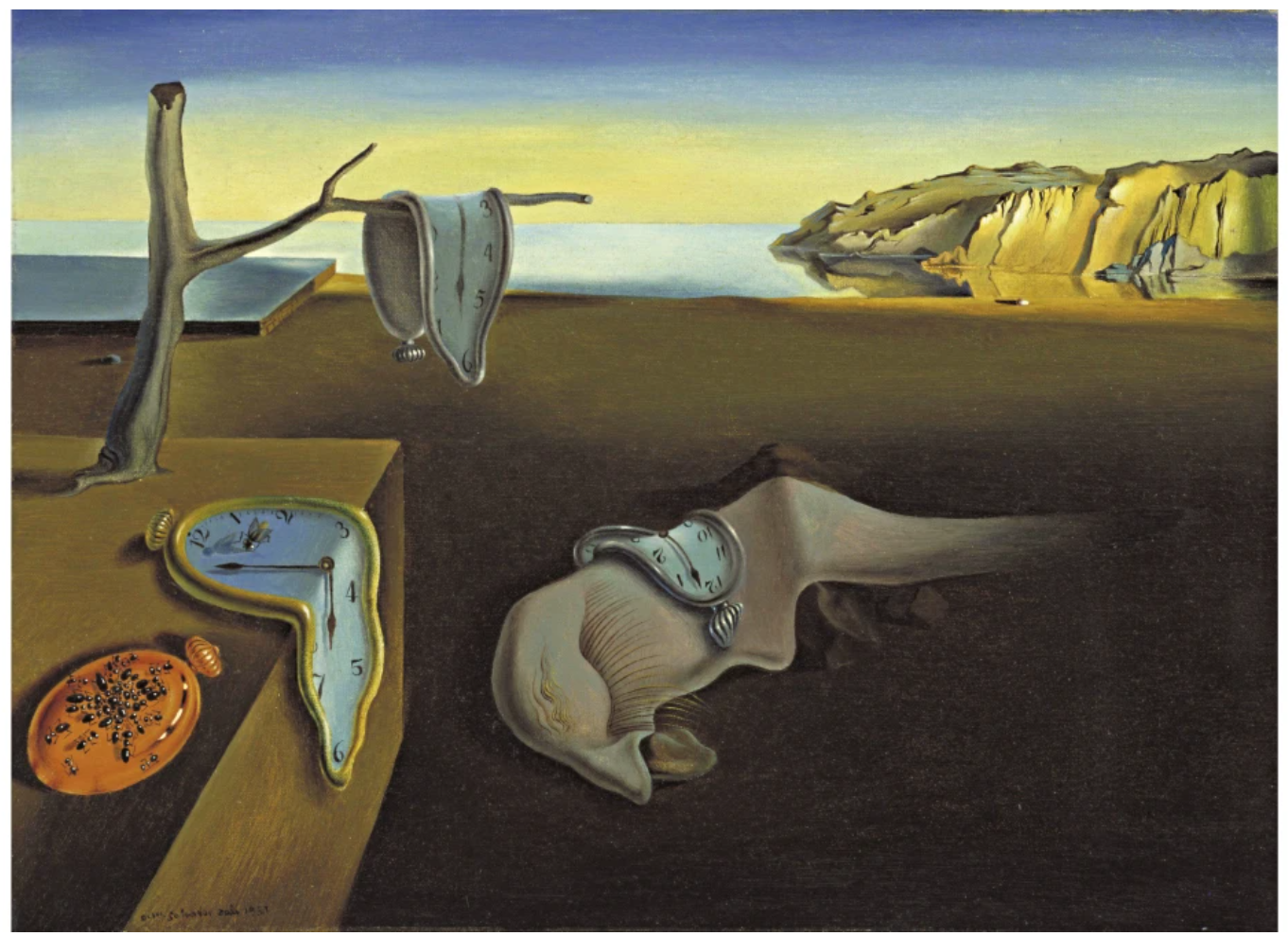
Salvator Dalí, Persistence of memory (Soft Watches), 1931. The Museum of Modern Art, New York. Image © Luisa Ricciarini / Bridgeman Images. Art © 2026 Salvador Dalí, Gala-Salvador Dalí Foundation / Artists Rights Society (ARS), New York
The central concern of Lichtenstein’s practice is an investigation of art itself. In the late 1970s, Lichtenstein’s works became ever more complex in execution. Diane Waldman noted: “[Lichtenstein] showed a concern with style as a distinctive issue in painting quite apart from a work’s subject. In many ways this issue became even more charged when Lichtenstein introduced his first comic-strip and consumer-product paintings in 1961, pointedly emphasizing the difference between their genre subject and a high-art style. In these and in the paintings that followed, he has continued to demonstrate an abiding interest in questions of art’s meaning, form, content, and style.” (Exh. Cat., New York, The Solomon R. Guggenheim Museum (and traveling), Roy Lichtenstein, 1993-96, p. 237) Characteristic of Lichtenstein’s best work, Female Figure is distinctly graphic and boldly declarative, yet still evokes the signature style of Surrealism. Here, we witness Lichtenstein’s most iconic and celebrated subject—the female blonde—through the ever-captivating and wondrous land of Surrealism.
Abstraction with Guitar, 1975
Abstraction with Guitar, 1975
Sotheby’s New-York: 17 November 2026
Estimated: USD 2,800,000 – 3,500,000
Roy Lichtenstein | Abstraction with Guitar | Contemporary Day Auction
ROY LICHTENSTEIN (1923 – 1997)
Abstraction with Guitar, 1975
Acrylic, sand and graphite on canvas
68×90 inches (172.7 x 228.6 cm)
Signed and dated ’75 (on the reverse)
Created during one of the most intellectually ambitious phases of Roy Lichtenstein’s career, Abstraction with Guitar exemplifies the artist’s sustained engagement with the history of modern art in the 1970s. Having achieved international recognition through his comic-book paintings and depictions of everyday consumer imagery in the previous decade, Lichtenstein turned his attention toward the visual languages that had shaped the development of twentieth-century art. Expanding and challenging the very nature of Pop Art, Lichtenstein subjected the foundational movements of European Modernism to the same process of examination and transformation that had characterized his earlier appropriations of mass media. In Abstraction with Guitar, Lichtenstein revisits perhaps the most iconic subject of Cubism, the guitar still life, while simultaneously engaging with the broader legacy of abstraction itself.
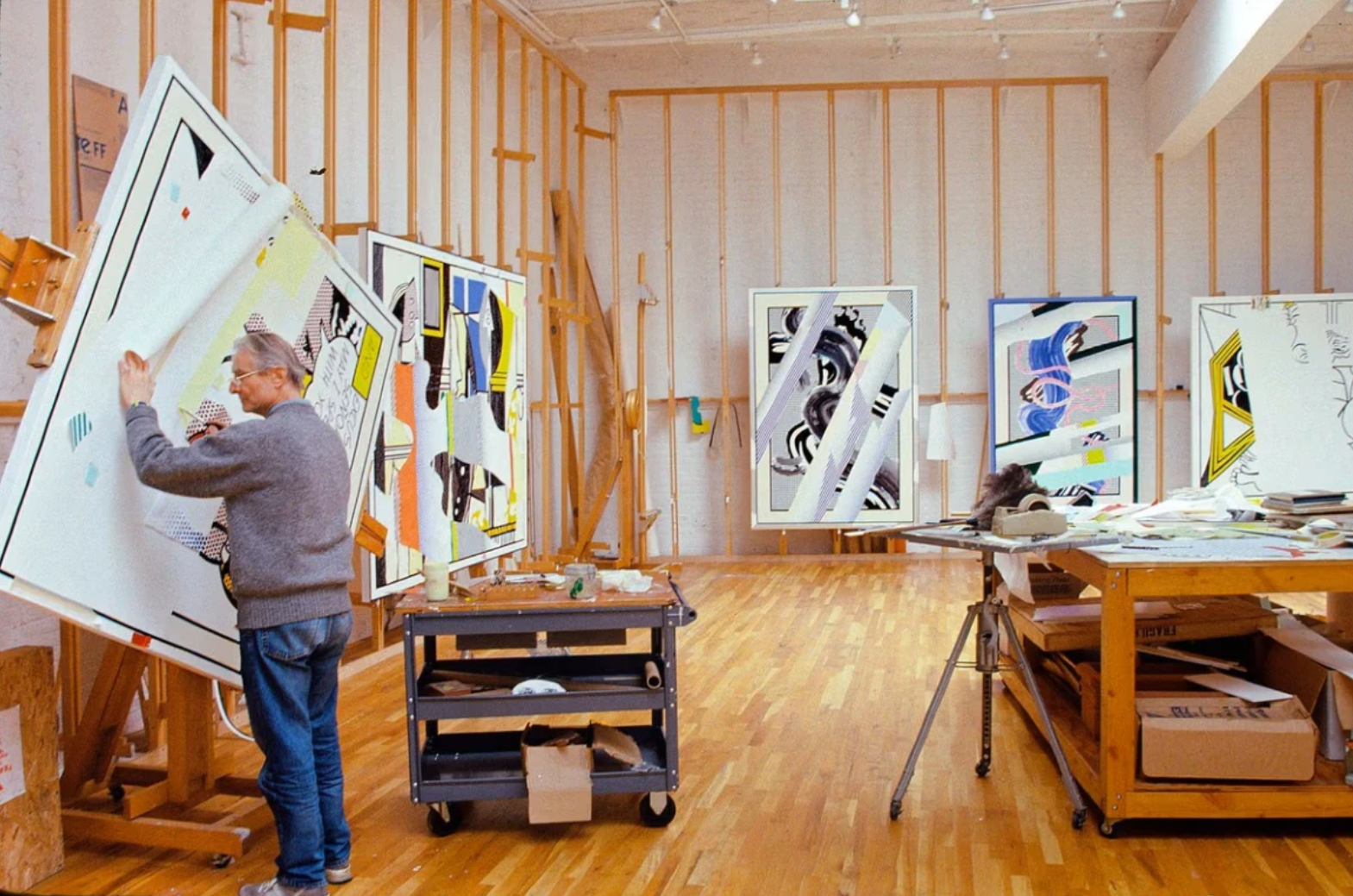
Roy Lichtenstein working on Reflections on Senorita (1990) in his Washington Street studio around 1989.
Artwork © Estate of Roy Lichtenstein. Photograph © Bob Adelman.
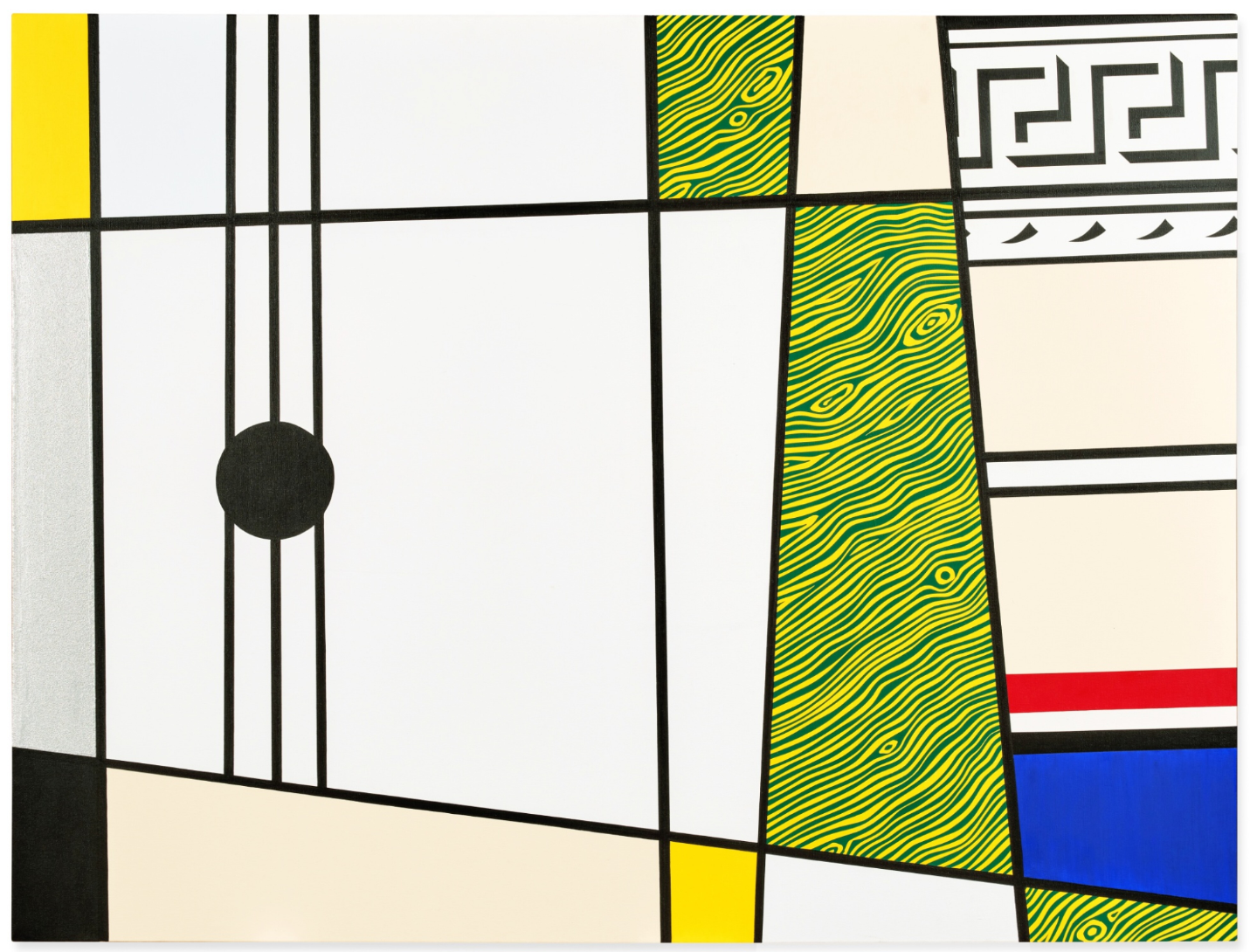
Dominated by bold black contours, geometric divisions, and expanses of flat color, the canvas presents itself as a carefully orchestrated arrangement of abstract forms. Amidst the bold black lines and vibrant woodgrain, distinct visual cues of a guitar emerge from the composition; three elongated strings descend through the left, intersected by a circular black form that serves as a stylized sound hole. Distilling it to its most essential graphic elements, Lichtenstein creates a radical compression of form in which representation hovers at the threshold of abstraction.
This process of reduction directly recalls the innovations of Pablo Picasso, Georges Braque and Juan Gris, whose guitar compositions fundamentally altered the course of modern painting in the early 1910s. For the Cubists, the guitar became one of the vehicles through which to challenge traditional notions of space, perspective and representation. Lichtenstein adopts this familiar subject but strips away nearly all vestiges of volume and materiality. The guitar no longer occupies pictorial space; instead, it dissolves into a network of lines and planes that emphasize the flatness of the canvas. The composition’s emphasis on geometry and linear structure also evokes the visual language of Piet Mondrian, whose strong black divisions and rigid architectural framework is reflected in the present work’s precision and restraint. Areas of bright yellow, deep blue, red, black and cream punctuate Abstraction with Guitar, creating rhythmic intervals across the canvas. In the present work, Lichtenstein treats color less as a descriptive agent than as an independent formal element, where the hues function autonomously within the canvas and activate the surface through contrast and balance. The present work thus participates in a broader modernist ambition to liberate color and line from representation and allow it to exist as a subject in its own right.
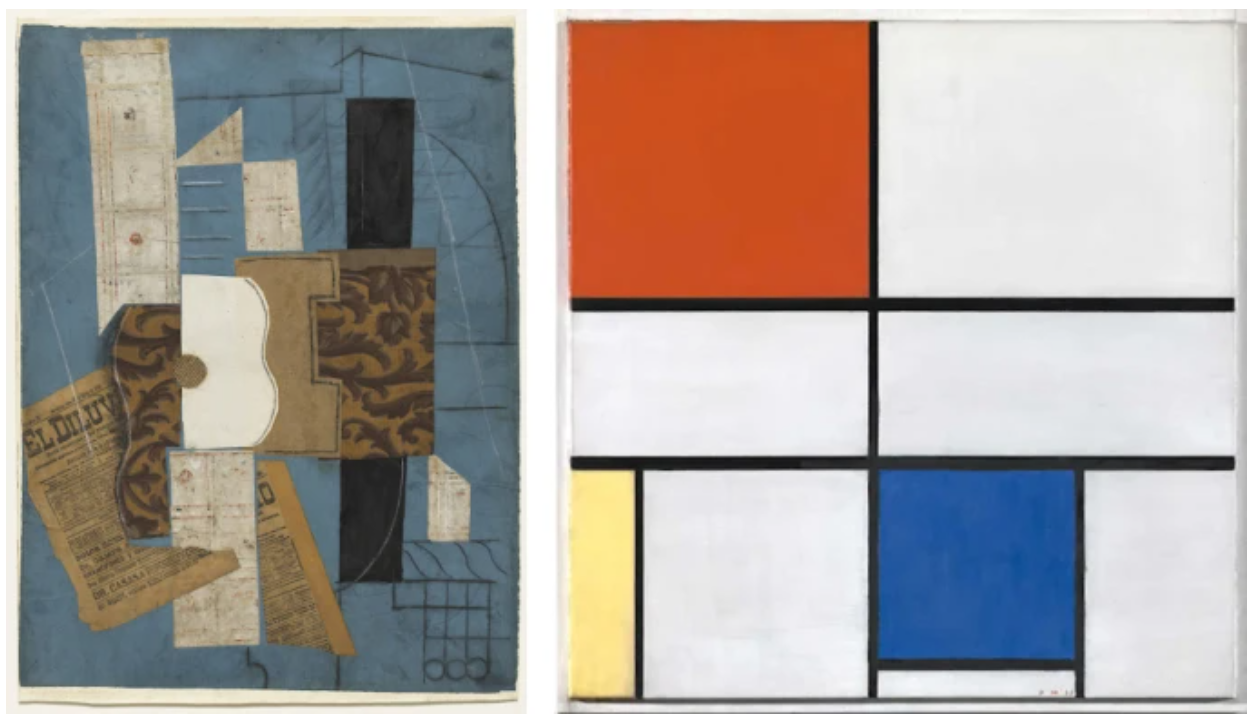
Left: Pablo Picasso, Guitar, 1913. Museum of Modern Art, New York. © 2026 Estate of Pablo Picasso / Artists Rights Society (ARS), New York
Right: Piet Mondrian, Composition C (No.III) with Red, Yellow and Blue, 1935. © 2007 Mondrian/Holtzman Trust c/o HCR International, Warrenton, VA
During the 1970s, Lichtenstein increasingly turned away from the subjects that had defined his rise to prominence, focusing instead on what became one of the central concerns of his later career: creating art about art. Rather than rejecting traditional genres, Lichtenstein revisited many of the subjects that earlier avant-garde movements had sought to dismantle, including still lifes, landscapes, and depictions rooted in art historical precedent. Through a visual language of bold contours, flat color, and graphic simplification, he examined how images acquire meaning and how artistic styles evolve over time. Works such as Abstraction with Guitar demonstrate this engagement, exploring the ongoing dialogue between subject matter and artistic process while reinterpreting the innovations of early twentieth-century modernism through a distinctly contemporary lens.
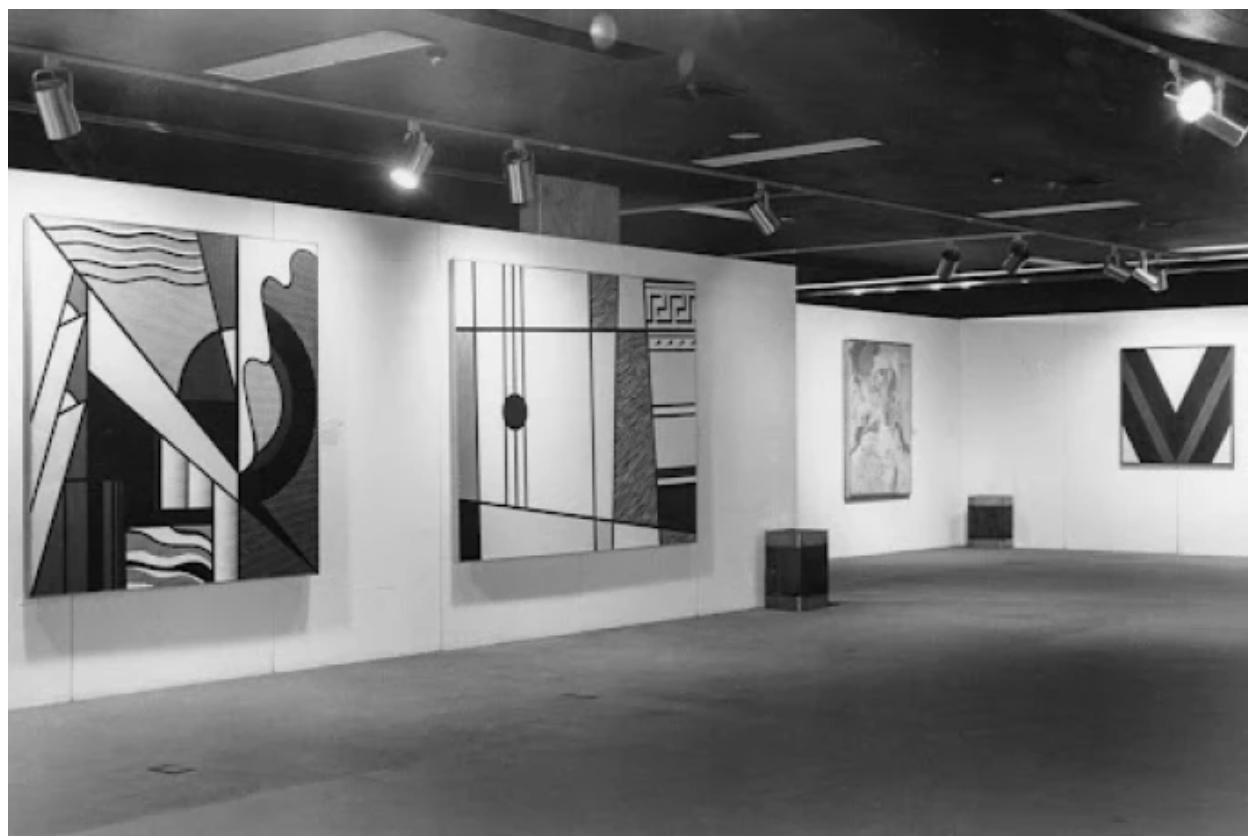
The present work installed in Madrid, Fundación Juan March, Arte USA, 1977
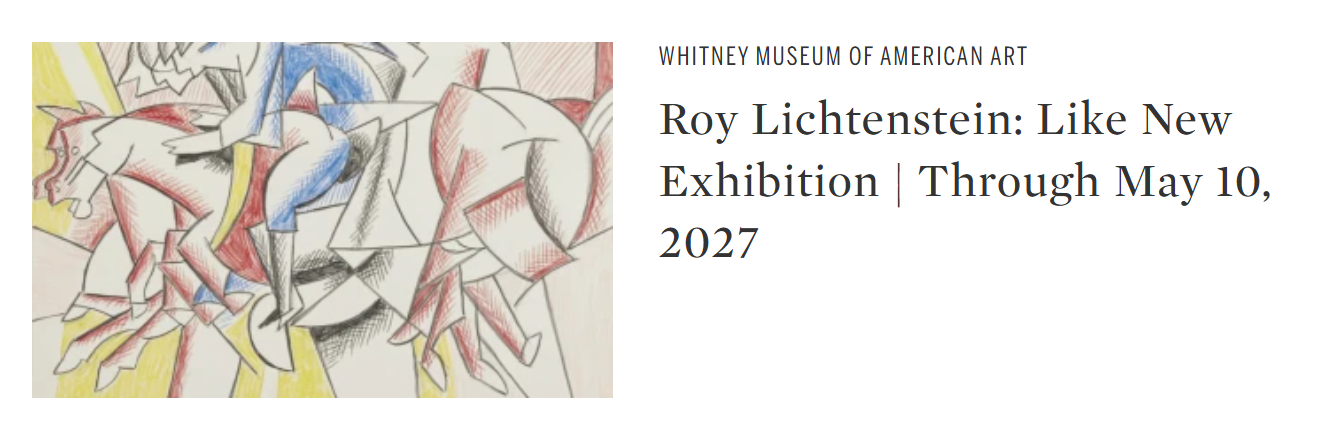
Abstraction with Guitar encapsulates many of the central concerns that occupied Lichtenstein during the 1970s, a period in which he increasingly turned his attention to the complex relationship between image-making and artistic precedent. The work embodies a core tension that runs throughout Lichtenstein’s oeuvre: the dialogue between originality and reproduction. Executed on a monumental scale, the composition transforms the traditionally intimate still-life subject into a commanding statement on the evolution of modern painting. Its significance is heightened by the rarity of the subject within Lichtenstein’s body of work; the guitar, one of the most enduring motifs in the history of art, served as a catalyst for some of the most radical formal innovations of the twentieth century, particularly within Cubism. By revisiting and radically simplifying this canonical form, Lichtenstein positions himself within a lineage of artistic experimentation while simultaneously pushing it toward a new and distinctly contemporary conclusion. Today, more than four decades after its creation, the artist continues to be the subject of vigorous institutional attention, a relevance underscored by the recent exhibition dedicated to his practice at the Whitney Museum of American Art in New York. Abstraction with Guitar thus emerges not only as a masterful synthesis of abstraction and representation, but also as a powerful reflection on the enduring capacity of art to engage with its own history.
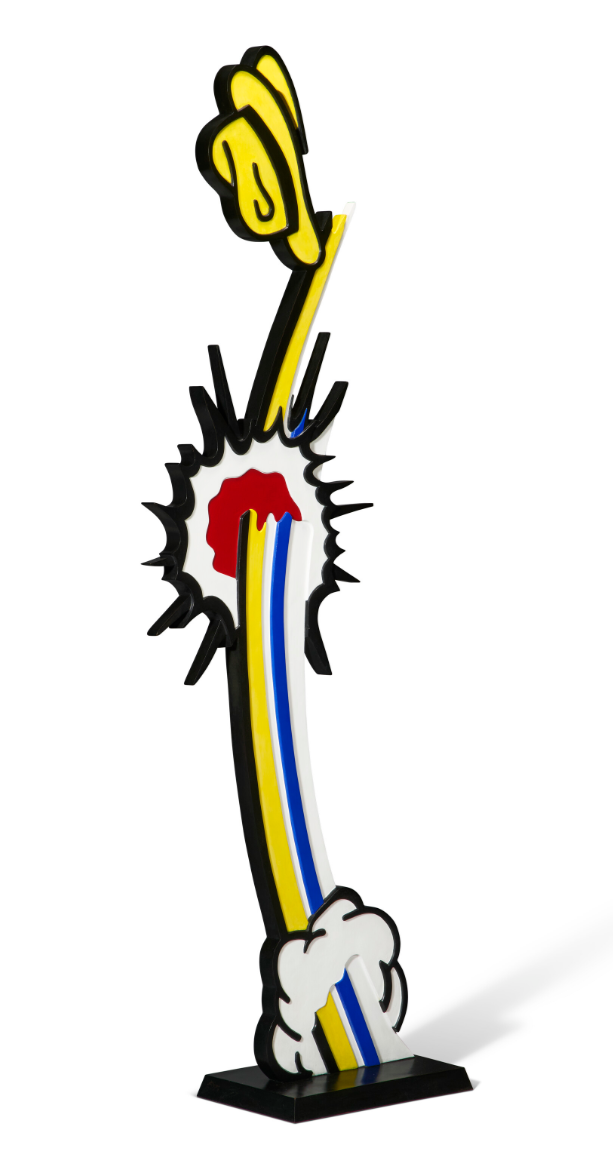
Coup de Chapeau II, 1996
Coup de Chapeau II, 1996
Christie’s New-York: 20 November 2026
Estimated: USD 2,000,000 – 3,000,000
MINIMUM PRICE GUARANTEE
ROY LICHTENSTEIN (1923-1997), Coup de Chapeau II | Christie’s
ROY LICHTENSTEIN (1923-1997)
Coup de Chapeau II, 1996
Painted and patinated bronze
89 x 29-1/4 x 13 inches (226.1 x 74.3 x 33 cm)
Incised with the artist’s signature, number and date ‘2⁄6 rf Lichtenstein ’96’ (on the base)
This work is number two from an edition of six plus one artist’s proof

Two Paintings: Sleeping Muse (Study), 1983
Two Paintings: Sleeping Muse (Study), 1983
Vision: The Extraordinary Collection of Theodore and Ruth Baum
Sotheby’s New-York: 16 November 2026
Estimated: USD 1,500,000 – 2,000,000
GUARANTEED PROPERTY
Roy Lichtenstein | Two Paintings: Sleeping Muse (Study) | Vision: The
ROY LICHTENSTEIN (1923 – 1997)
Two Paintings: Sleeping Muse (Study), 1983
Cut painted paper, cut printed paper, aluminum foil, acrylic, marker and graphite on board
Image: 35×46 inches (88.9 x 116.8 cm)
Board: 38-3/4 x 49-3/4 inches (98.4 x 126.4 cm)
Signed and dated ‘83 (on the reverse)
Roy Lichtenstein’s Two Paintings: Sleeping Muse (Study) condenses a century of modern art into a single, intricately layered image, embodying the investigation of materiality and image-making at the heart of the artist’s practice. Held in the Baum collection for nearly three decades, the present work belongs to Lichtenstein’s celebrated works of the 1980s, in which art history becomes an artistic subject in itself. In this meticulously resolved 1983 collage, Constantin Brancusi’s bronze sculpture Sleeping Muse appears beneath the curving silhouette of a paper cutout by Henri Matisse, with the edge of an Abstract Expressionist canvas encroaching at right. This captivating collage brings together three mediums—sculpture, paper, and painting—rendering each in Lichtenstein’s signature black outlines, graphic patterns, and bold, planar application of color.
“I am nominally copying, but I am really restating the copied thing in other terms. Through that process, the original acquires a totally different texture.”
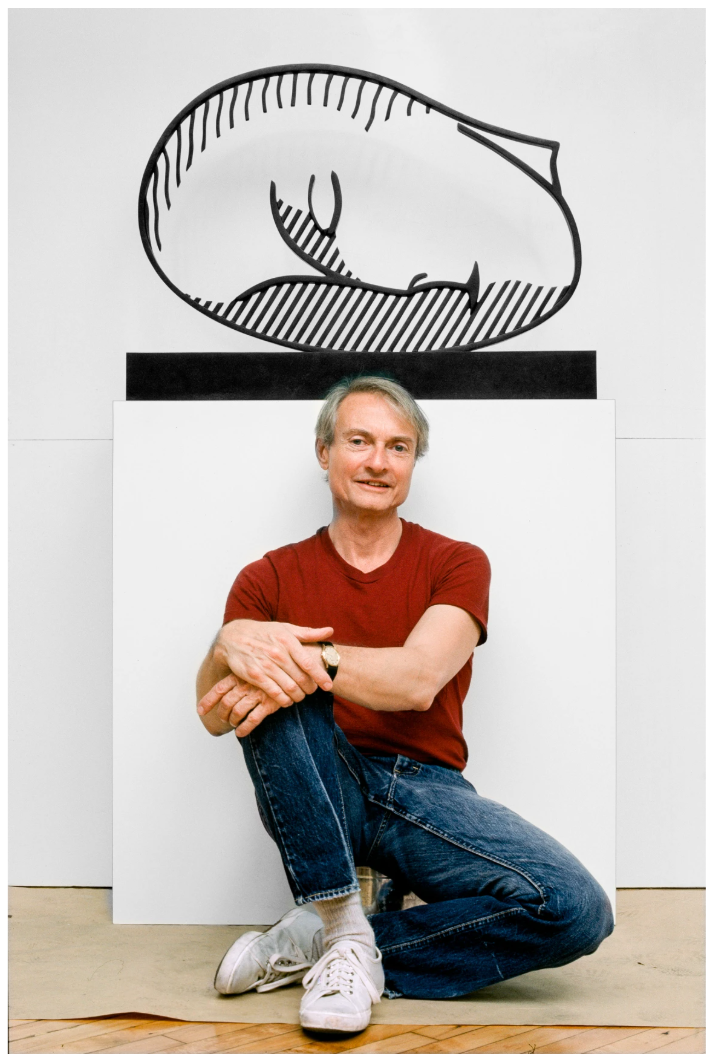
The artist pictured with an edition of Sleeping Muse in his New York apartment, 1983. Photo by Bob Adelman.
Art © 2026 Estate of Roy Lichtenstein/DACS
Lichtenstein’s practice is the result of reappropriations of his own oeuvre and the canon, as well as exploration across media and form. Lichtenstein insisted that appropriation was a form of transformation. In artworks referencing Cézanne, Picasso, Mondrian, and Van Gogh, he repackaged objects of highculture with the vividness and flattened clarity of consumer goods. Two Paintings: Sleeping Muse (Study) marks the same achievement, disregarding the perceived divide between avant-garde art and popular culture.
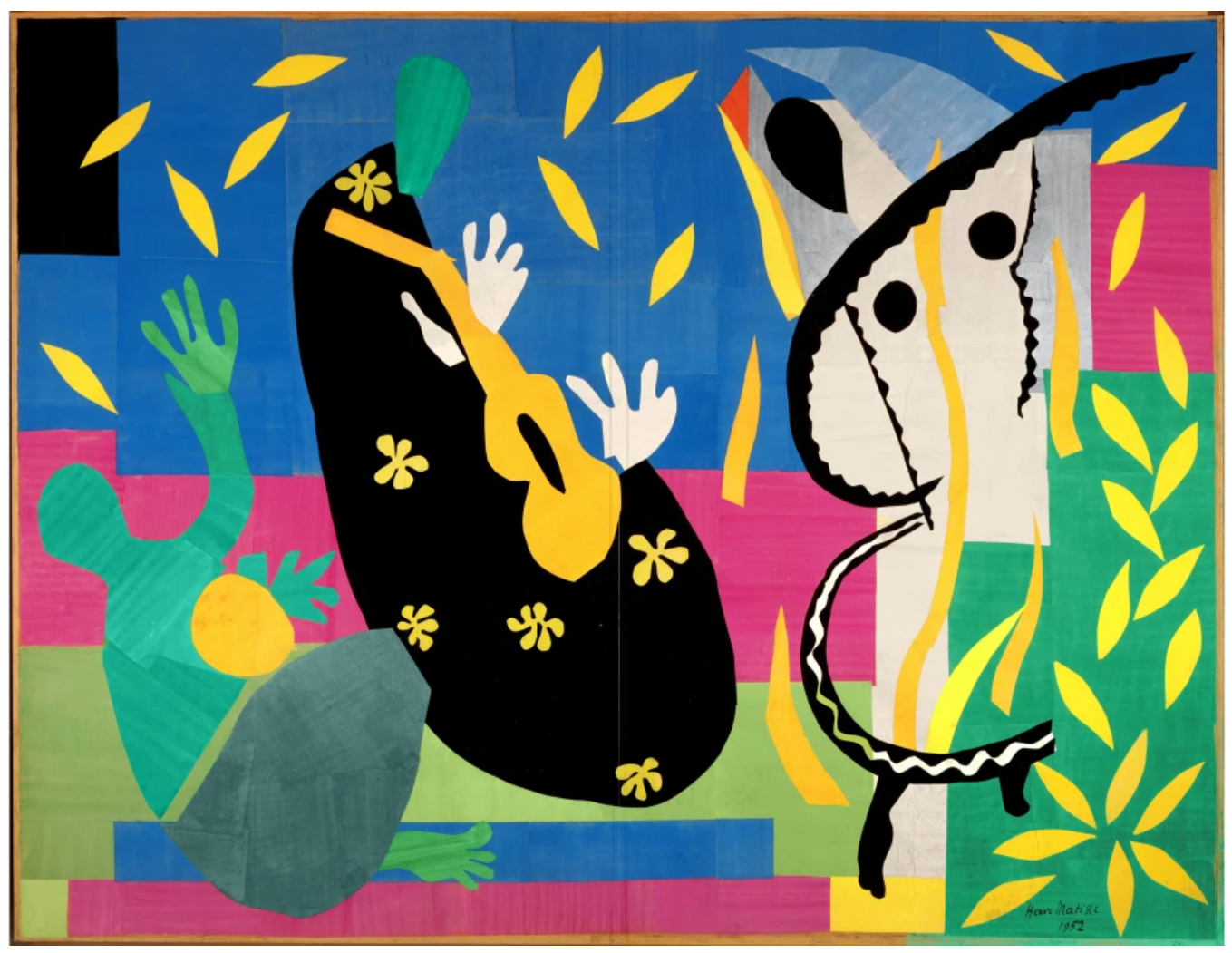
Henri Matisse, The Sadness of the King, 1952. Musee National d’Art Moderne, Centre Pompidou, Paris. Image © Bridgeman Image. Art © 2026 Succession H. Matisse / Artists Rights Society (ARS), New York
The central reference in the present work is the revolutionary Sleeping Muse, created by the Romanian pioneer of Modernism celebrated Constantin Brancusi in 1909. Initially conceived as a marble portrait before being cast in bronze, Brancusi’s sculpture reduces the human head to an elliptical form resting precariously on one rounded cheek. As a consummate example of Roy Lichtenstein’s masterful engagement with and reorientation of the art historical canons, from 1983 at once beautifully evokes and radically advances Constantin Brancusi’s paradigmatic Sleeping Muse from 1910. Composed of elegantly refined contours which enclose a void, Sleeping Muse achieves a sense of volume precisely through the absence of mass in the two-dimensional collage, probing the boundaries of the discipline of sculpture.
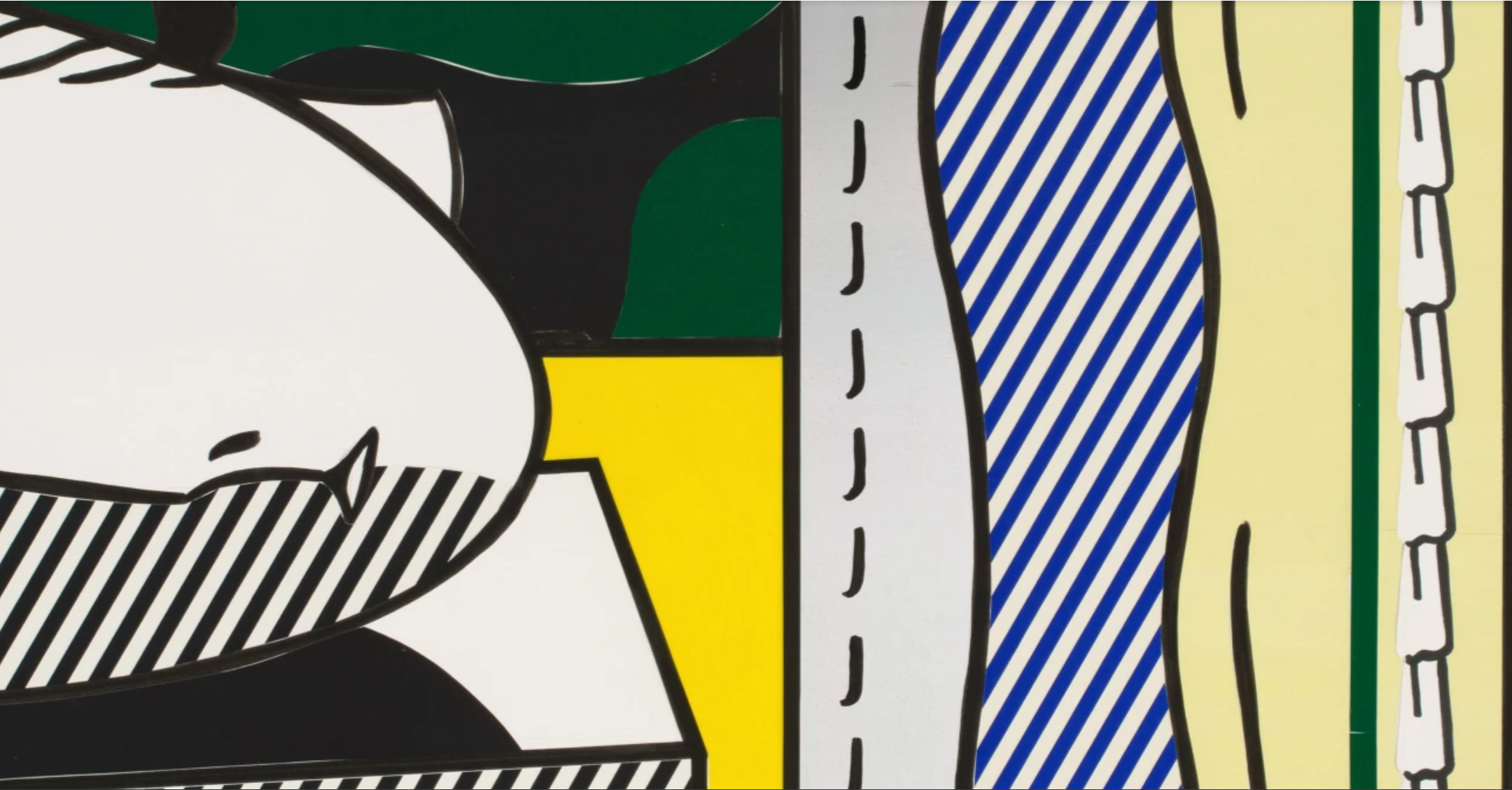
Capturing the essence of Brancusi’s form with bold lines which evoke those of mid-century comic strips, Lichtenstein fuses the visual vernacular of pop culture with an iconic symbol of Modernism. Lichtenstein radically reverses this spatial activation. His muse cannot be seen in the round but instead appears within a painted picture frame. The artist captures light through black lines, complicating the conventional relationships between shade and hue to establish the illusion of volume despite the absence of mass. Brancusi relied on medium—the physical solidity and manipulability of marble and bronze—whereas Lichtenstein relies on media—the channels through which intangible images are circulated and recognized. The original sculpture’s kaleidoscope of reflections fades into a network of symbols, stitched meticulously together with collaged paper, as in Matisse masterworks such as The Sadness of the King from 1952.
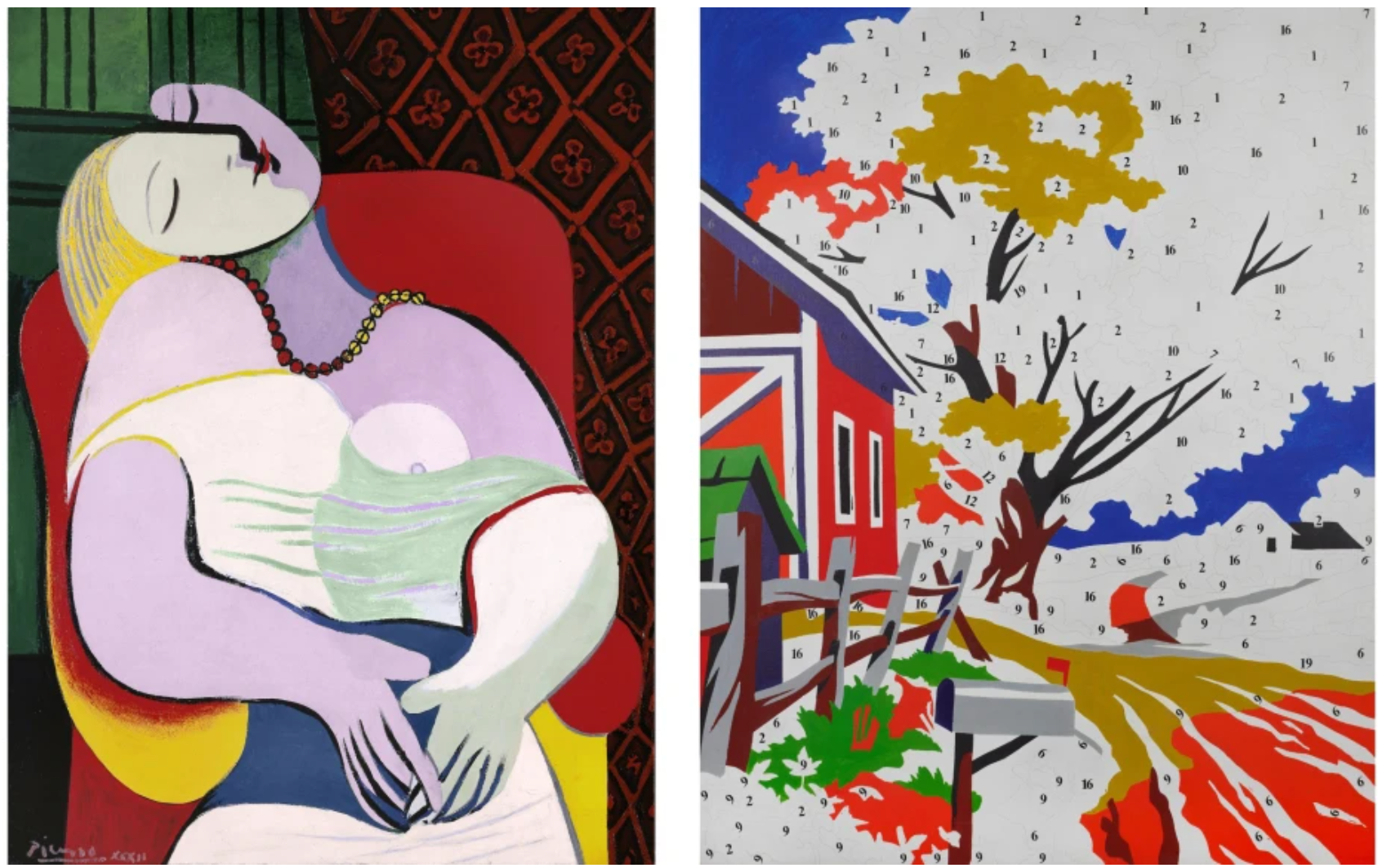
Left: Pablo Picasso, The Dream, 1932. Private Collection. Image © Christie’s Images / © Succession Picasso/DACS, London 2026 / Bridgeman Images. Art © 2026 Estate of Pablo Picasso / Artists Rights Society (ARS), New York. Right: Andy Warhol, Do It Yourself (Landscape), 1962. Museum Ludwig, Cologne. Image © bpk Bildagentur / Museum Ludwig / Rheinisches Bildarchiv Cologne / Britta Schlier / Art Resource, NY. Art © 2025 Andy Warhol Foundation for the Visual Arts / Artists Rights Society (ARS), New York
The same year Lichtenstein created this work, he also depicted Sleeping Muse in patinated bronze. Although cast in the same material as Brancusi’s most well-known iteration of Sleeping Muse, Lichtenstein’s interpretation retains the essential qualities of a drawing: its shallow, hollow configuration of lines occupies three dimensions without taking up actual space. Two Paintings: Sleeping Muse (Study) adds another level of remove, further flattening this sculptural form into two dimensions. Moving from Brancusi’s original muse in three dimensions to Lichtenstein’s own straddling of two and three dimensions in bronze to this collage in two dimensions charts a path from Modernism to Pop. The present work references both the artist himself and his predecessor, two individuals separated by nearly a century who were both interested in rendering objects through their most basic geometric forms. The motif of the sleeping head also subtly recalls Lichtenstein’s own Sleeping Girl of 1960. That image from a generation earlier features a blonde woman whose tilted head is tightly cropped to fill the canvas, her features reduced to archetypal attributes of American beauty standards: long golden hair, fluttering black eyelashes, full red lips. Returning two decades later to another sleeping female subject, the artist appropriates his own oeuvre. The ancient Greek idea of the muse—a goddess who inspires artistic production—here becomes an endlessly reproducible icon, equally at home in a museum or a comic book.
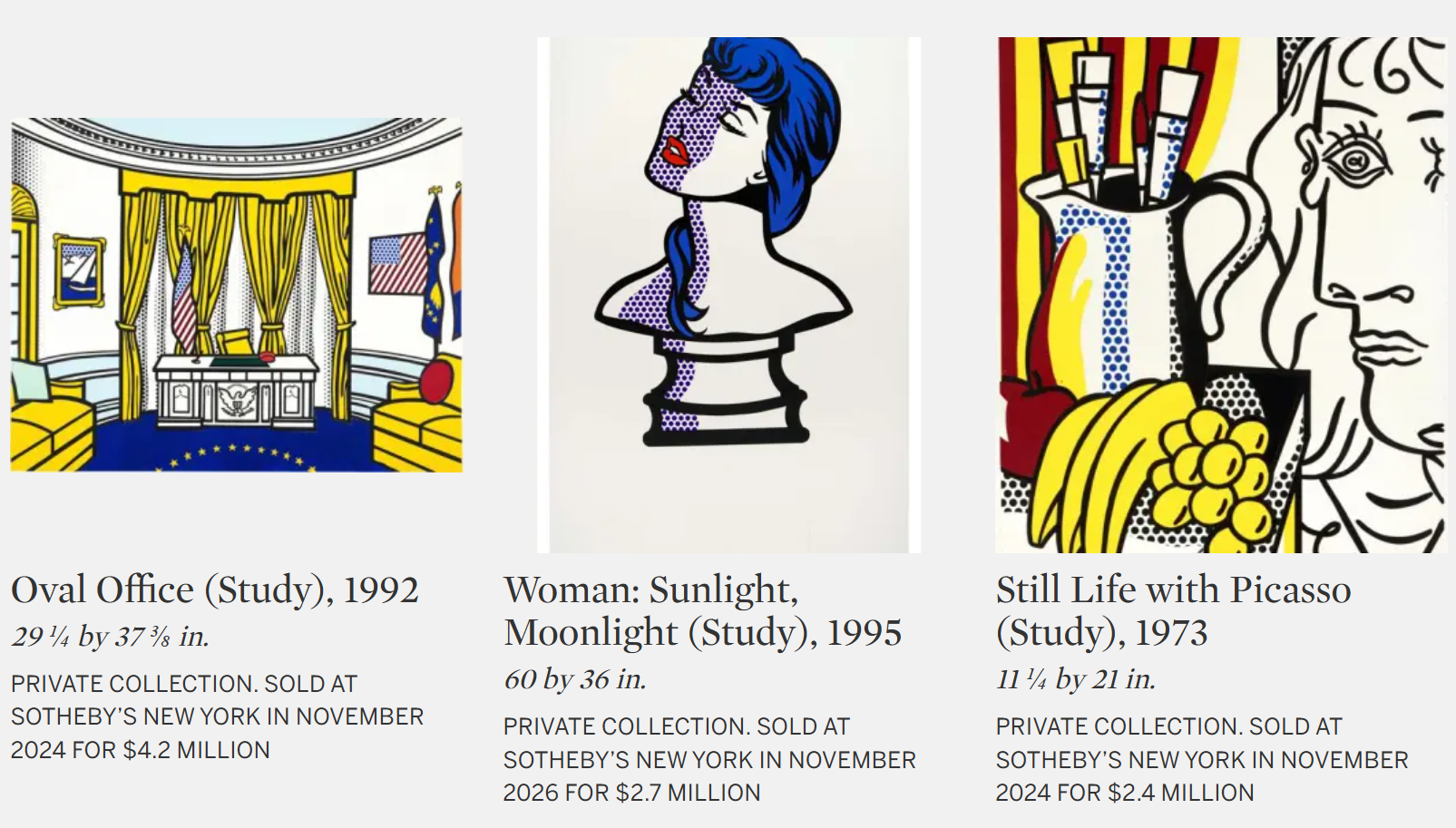
Market Precedent: Roy Lichtenstein’s Collages
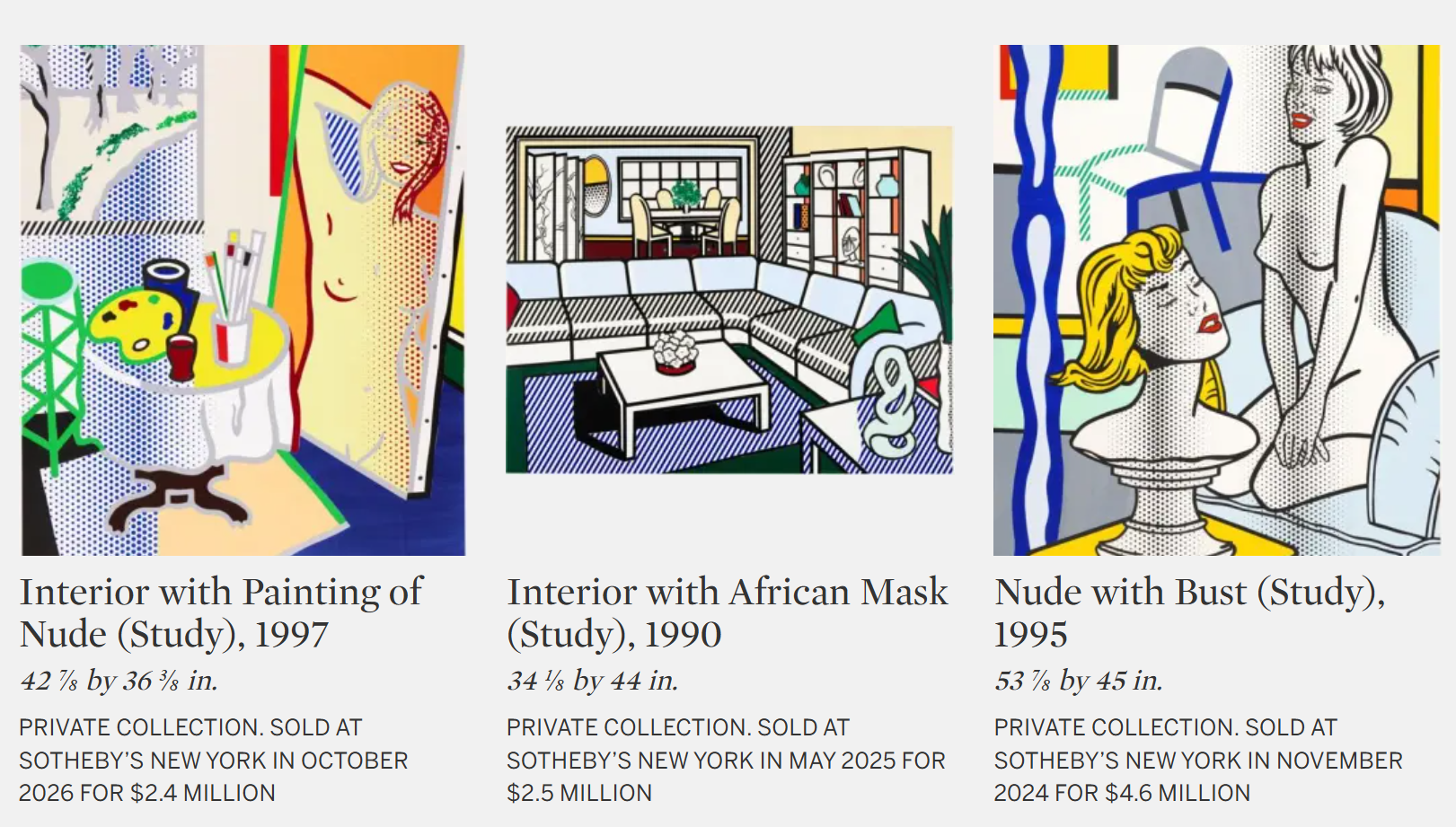
All Art © 2026 Estate of Roy Lichtenstein/DACS
As a physical object, the collage deepens questions of materiality and the creative process. Lichtenstein carefully cut pieces of painted and printed paper, arranging them across a board to fashion a map of seams that serve as witnesses to his decisions. Although many of his most well-known pieces are known for suppressing visible evidence of their construction, this example reveals the artist’s hand at work: the viewer can picture him shifting the compositional elements until they lock into place. The result is handmade, but its style masquerades as mechanical.
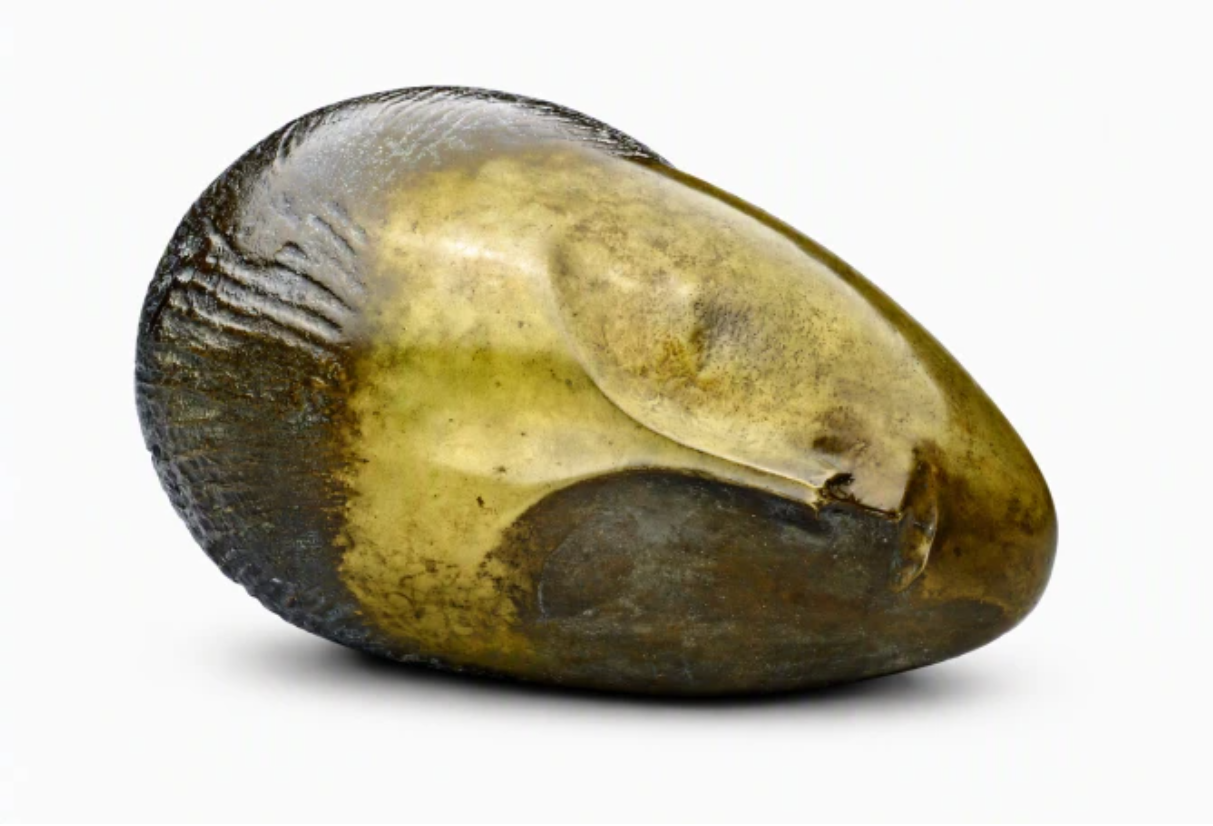
Constantin Brancusi, Sleeping Muse, 1910. Art Institute of Chicago. Image © Art Institute of Chicago / Arthur Jerome Eddy Memorial Collection / Bridgeman Images. Art © Succession Brancusi – All rights reserved (ARS) 2018
Two Paintings: Sleeping Muse (Study) reaffirms Lichtenstein’s status as an icon of twentieth-century Modernism. The artist distills Brancusi’s sculpture, Matisse’s cutout, and an anonymous Abstract Expressionist painting into their most recognizable elements. By withholding access to the original objects through his central painted frame, Lichtenstein reveals how widespread concepts of art depend on memory, reproduction, and tradition. Two Paintings: Sleeping Muse (Study) is a seminal example of Lichtenstein’s careerlong engagement with paragons of the canon and Contemporaneous visual culture through his distinctive Pop idiom and revolutionary reassessment of its form, content, and meaning.
Landscape with Figures (Study), 1977
Landscape with Figures (Study), 1977
Property from a Distinguished Private American Collection
Sotheby’s New-York: 17 November 2026
Estimated: USD 1,500,000 – 2,000,000
WORK ON PAPER
Roy Lichtenstein | Landscape with Figures (Study) | Contemporary Day
ROY LICHTENSTEIN (1923 – 1997)
Landscape with Figures (Study), 1977
Colored pencil and graphite on paper
Image: 13-1/2 x 21 inches (34.3 x 53.3 cm)
Sheet: 20 x 27-1/2 inches (50.7 x 69.8 cm)
Signed and dated ’77 (on the verso)
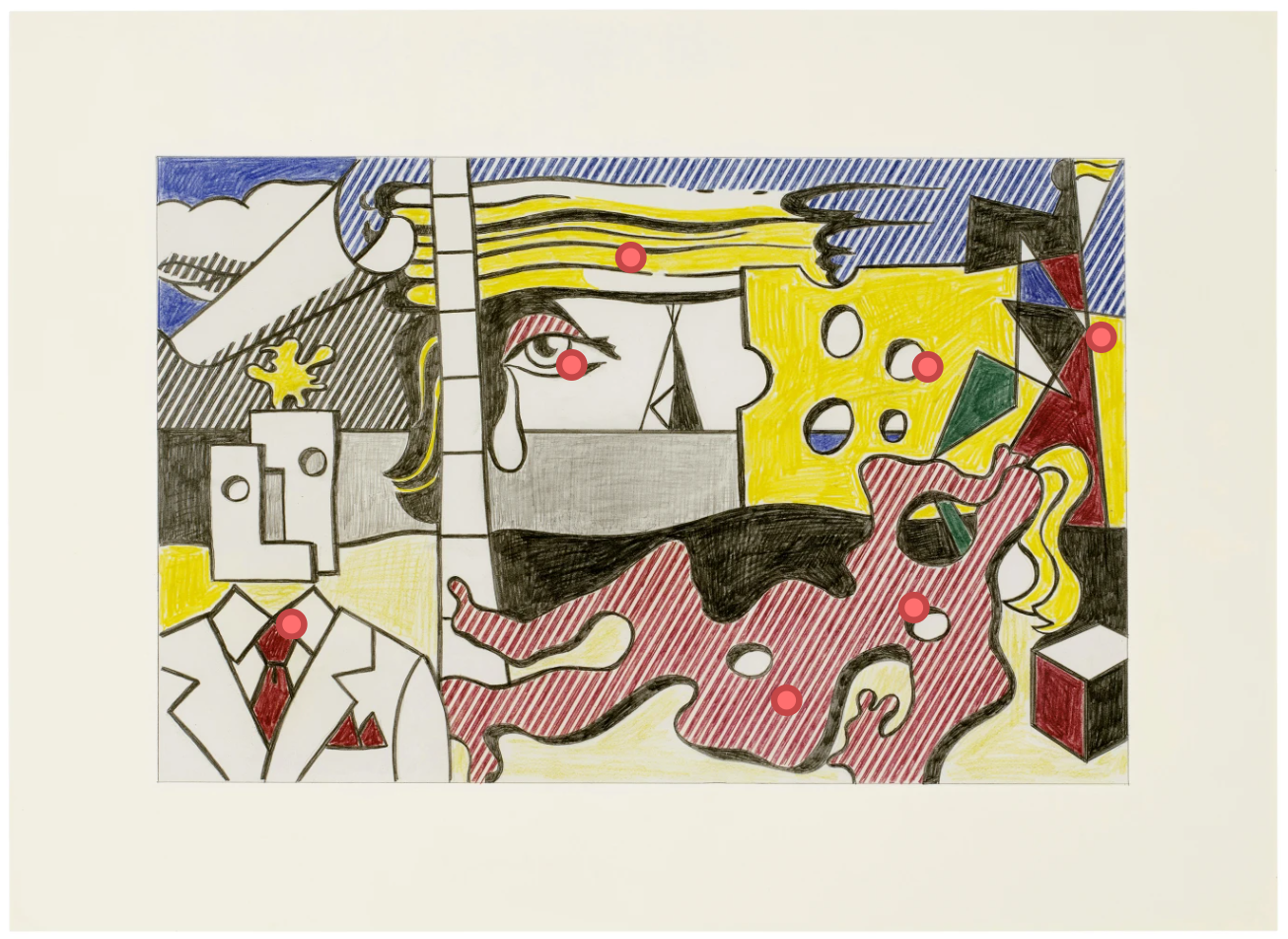
Executed in 1977, Landscape with Figures (Study) is the principal preparatory drawing for Landscape with Figures, one of the most ambitious paintings of Roy Lichtenstein’s celebrated Surrealist series of 1977 to 1979. Every element of the canvas is already in place: the faceless businessman, the weeping eye, the slab of Swiss cheese, the yellow Brushstroke and the boneless striped nude, each fixed in position and color, ready to be enlarged. Rarely does a single sheet hold so much of the artist’s career. The painting was unveiled in November 1977 in Roy Lichtenstein: New Paintings at Blum Helman Gallery, New York, and the closest counterpart to the present work, Study for Figures in Landscape of the same year and near-identical format, belongs to the Whitney Museum of American Art. Here Lichtenstein works out on paper a picture that gathers the motifs of his own career and sets them beside those of the Modernists he had revered since his student years.
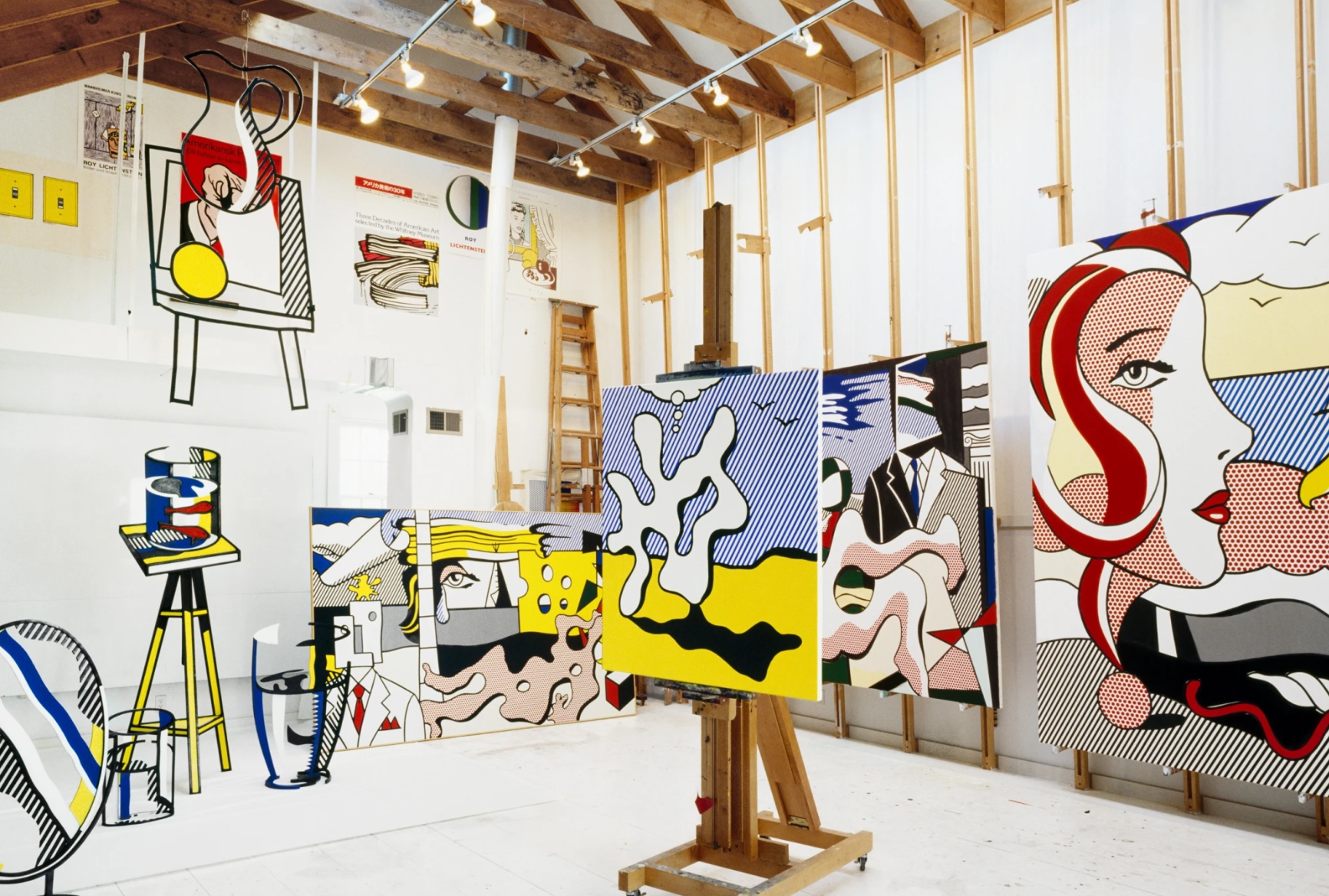
The artist’s studio, 1977. Photo by Horst P. Horst. Art © Estate of Roy Lichtenstein
In 1949 the twenty-six-year-old Lichtenstein prefaced his Master of Fine Arts thesis at Ohio State University with a warning: “Generally recognized is the great difficulty in approaching an understanding of painting through the medium of words.” The thesis went on, in verse, to honor Cézanne, Van Gogh, Gauguin, Rousseau, Picasso, Braque and Matisse as the forebears whose example he felt bound to follow. Almost three decades later, the Surrealist works gave him the means to address that lineage head on.
“They were of no particular Surrealist artist, just Surrealism in general. I took certain elements from painting I have done in the past: a man’s suit, a shirt and tie from a dry cleaning ad, the Brushstroke … I used a flowing line to make a torso with holes through it like a slice through a Henry Moore sculpture.”
Lichtenstein’s questioning of representation rested on a meticulous and exacting process. His major canvases began as small studies in which the composition was settled before being projected and enlarged onto canvas. In other works he developed this stage in collage, and he described its logic in terms that apply equally to the drawings: “I start something and keep adding to it … Because to do all those graduated dots and dotted areas and diagonal areas and then take them off and redo the painting is punishing work … it’s just much easier to try it out first in collage to get everything I want” (the artist quoted in: Exh. Cat., Madrid, Fundación Juan March, Roy Lichtenstein: Beginning to End, 2007, p. 126). The studies were where the formal and theoretical problems of each picture were resolved. Enlarged far beyond human scale, the finished image would confront the viewer with the gap between reality and artifice; on paper, it remains close to the hand that made it.
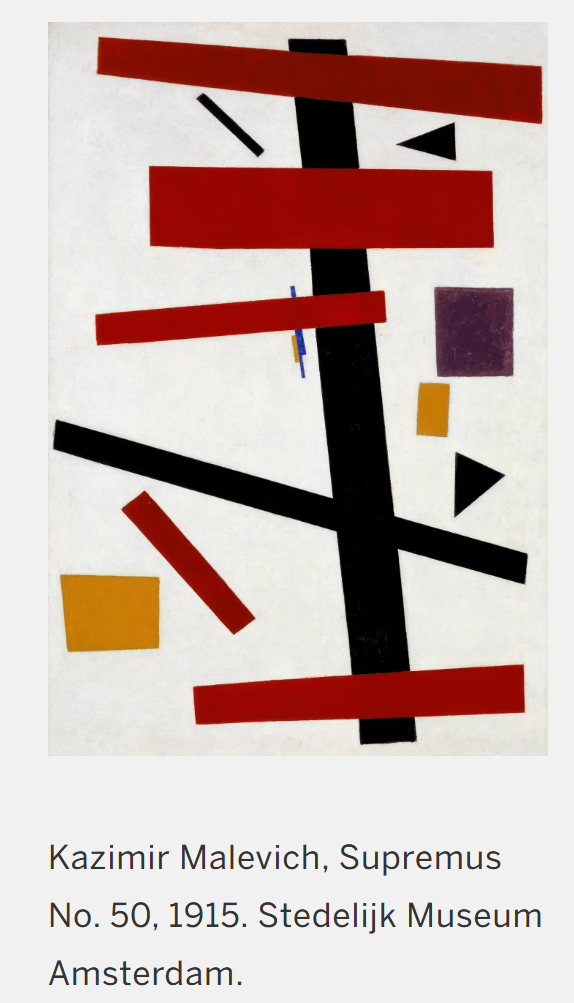
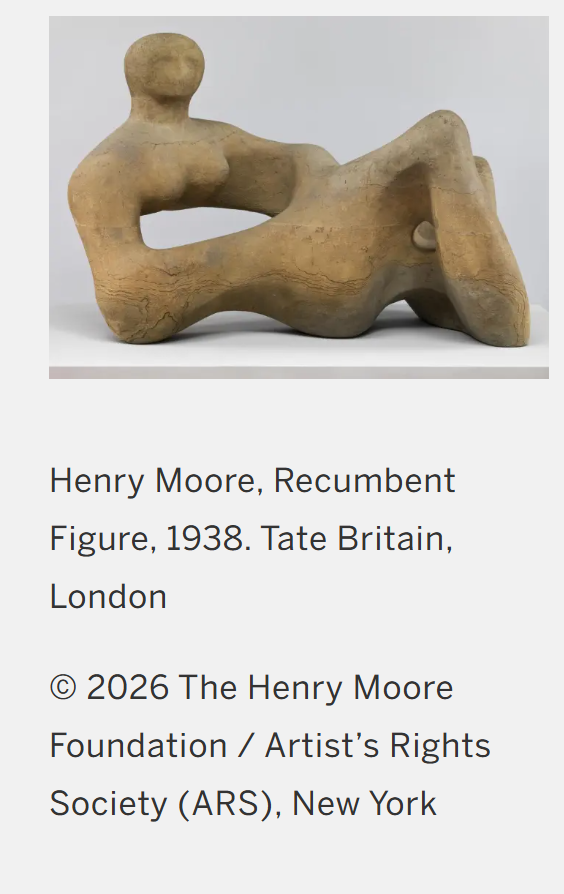
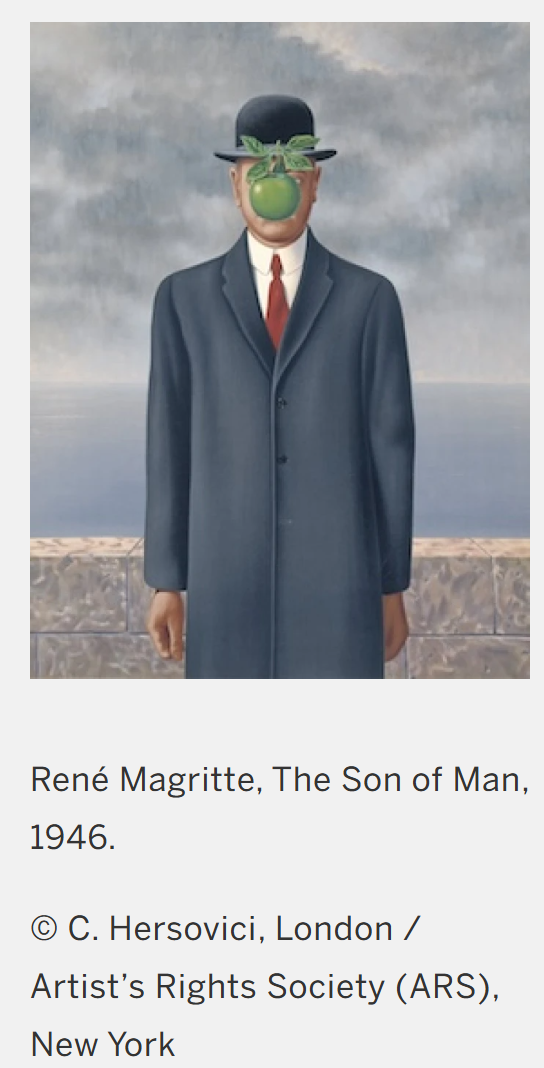
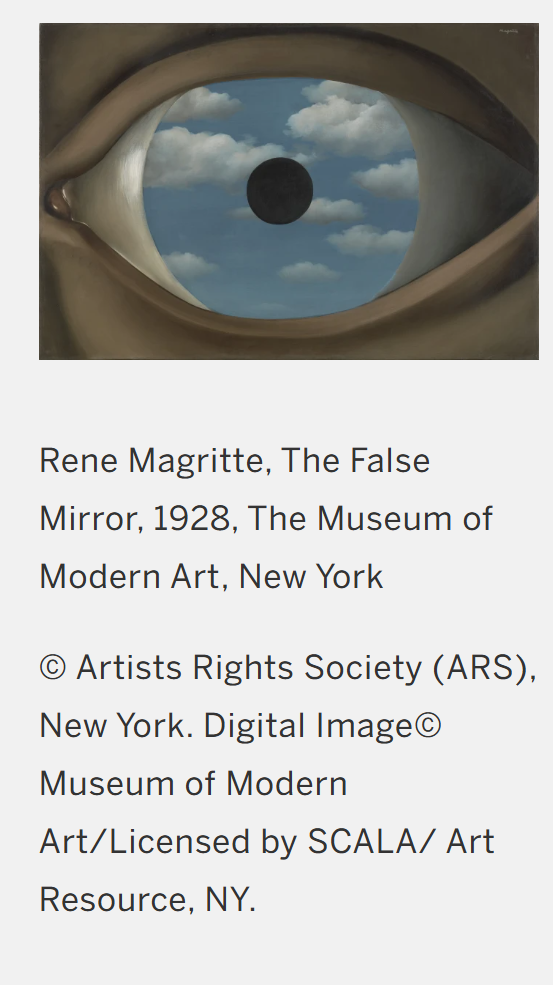
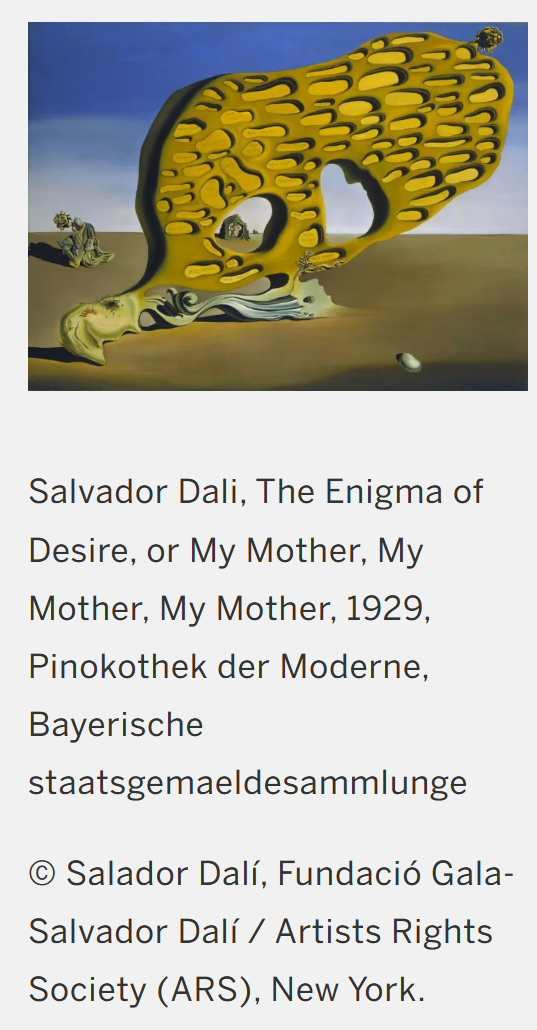
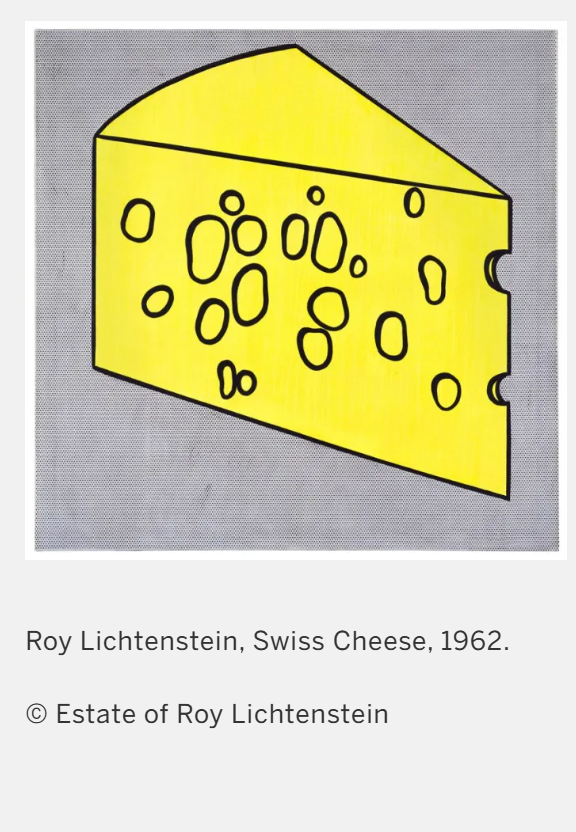
Roy Lichtenstein’s Take on Art History
The present work shows how precisely that system operated. The diagonal hatching that runs through the upper sky and across the reclining form at center is laid in by hand, each band of colored pencil standing in for the mechanically regular stripes that would later be painted. Areas destined for flat black are built up densely in black pencil, while the soft graphite passage beneath the eye records a tonal decision to be resolved in paint. The ruled border fixes the picture’s edges exactly, ready for transfer. What survives on the sheet is the decision-making itself: which color sits against which, where a contour thickens, how far a stripe runs before it meets a black edge.
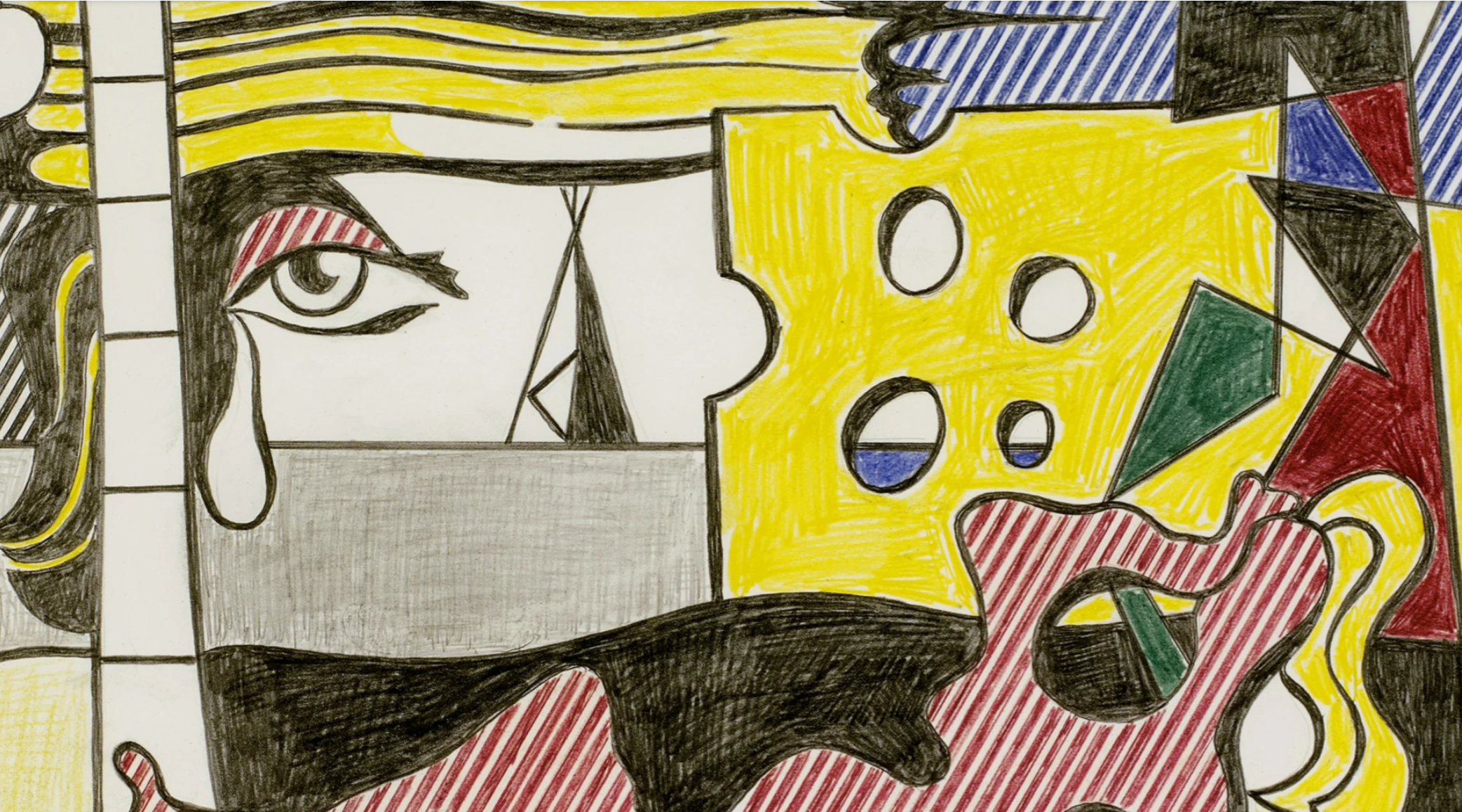
The figures of the title are four, and each carries a lineage. At lower left a suited man with red tie and pocket square has a head of stacked white blocks pierced by two round holes. His attire derives from the advertisement clippings Lichtenstein kept in notebooks, a type that had interested him since Man with Folded Arms of 1962, while his faceless, dislocated presence recalls René Magritte’s bowler-hatted businessmen, above all Le Fils de l’Homme. At center an eye framed by a lock of blonde hair sheds a single tear and looks directly out at us. The motif returns to the Crying Girls of 1964 and to a line of Surrealist eyes that runs from Magritte’s The False Mirror of 1928 and Luis Buñuel’s Un Chien Andalou of 1929 to Man Ray’s Tears of 1932. Across the lower register spreads the red-striped reclining nude, boneless and perforated, recalling Picasso’s bathers, Jean Arp’s curved anatomies and the pierced torsos of Henry Moore. At right a standing figure is assembled from angular planes of red, green, black and white, a flowing yellow line serving as her hair, in open homage to Analytical Cubism.
Around these figures Lichtenstein arranges the props that announce a Surrealist picture. The perforated slab of Swiss cheese returns to a subject he had painted in 1962, with Marcel Duchamp’s Swiss cheese photograph for the catalogue of First Papers of Surrealism (1942) in mind. The furrowed yellow brushstroke across the upper center descends from a panel in the October 1964 issue of Strange Suspense Stories, the source for Brushstrokes of 1965, and here doubles as the eye’s hair and as the rays of one of his suns. It crosses a simplified teepee whose open flap, like one of Lucio Fontana’s tagli, gives onto space beyond the picture plane. At upper left the sky peels back like a scroll, recalling Stretcher Frame Revealed Beneath Painting of a Stretcher Frame of 1973 and exposing one painted surface beneath another. A cube, a pennant and a segmented vertical column complete the inventory.
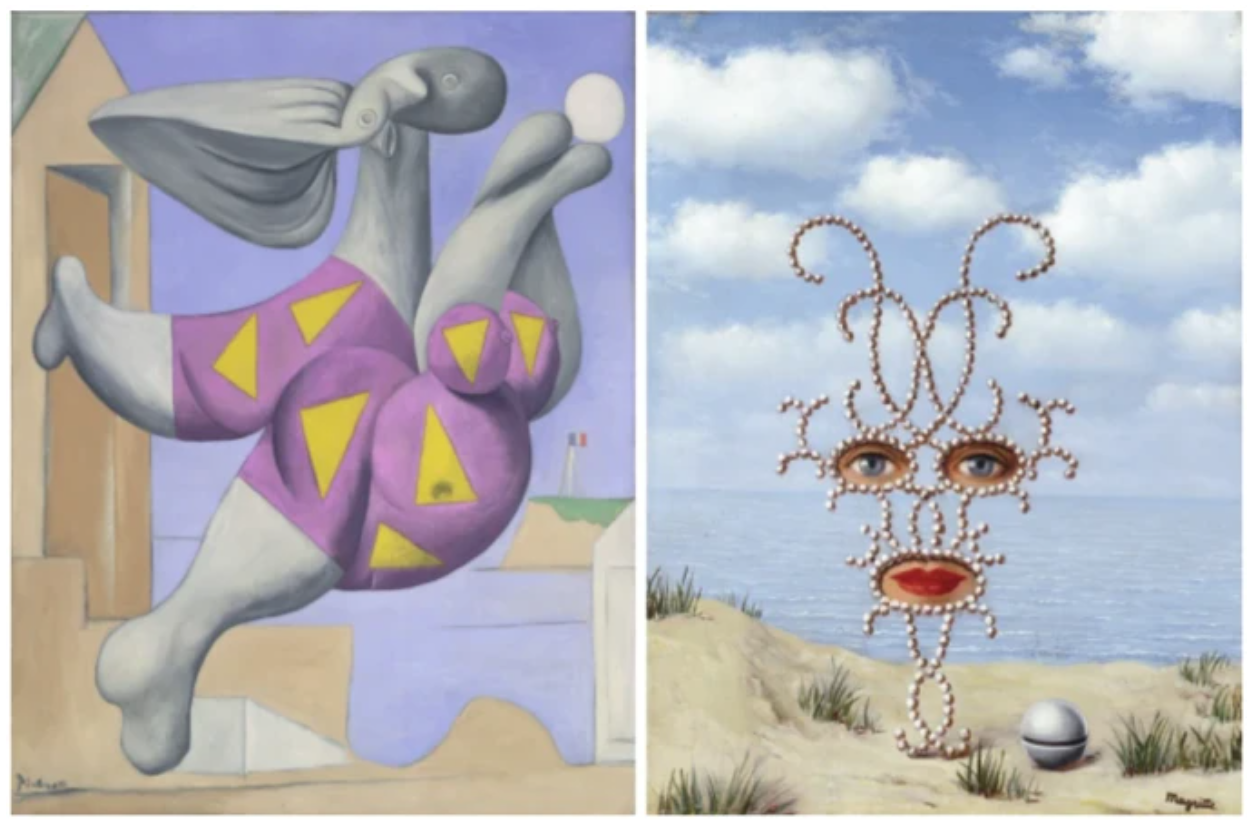
Left: Pablo Picasso, Bather with Beach Ball, 1932. Image © The Museum of Modern Art, New York / Bridgeman Images. Art © 2021 Estate of Pablo Picasso / Artists Rights Society (ARS), New York
Right: René Magritte, Shéhérazade, 1950. Image © Private Collection / Bridgeman Images. Art © 2021 C. Herscovici, Brussels / Artists Rights Society (ARS), New York
Writing in 1981, Jack Cowart described the Surrealist works as the point at which Lichtenstein, having developed “style, technical expertise, and malleability in the intended rendering and communication between 1970 and 1977,” brought those skills together “in a virtuosic display” (Jack Cowart, Exh. Cat., Saint Louis Art Museum, Roy Lichtenstein 1970–1980, 1981, p. 111). The present work records the first stage of that display. Here Lichtenstein drew the Brushstrokes, the crying heroines, the Cubist fragments and his debts to Magritte, Picasso and Dalí into one composition, and made each answer to a single system of line and color. As the principal study for one of the central paintings of the series, Landscape with Figures (Study) offers a direct view of the method behind his art about art, at the height of his engagement with Surrealism.
Artist’s Studio with Model (Study), 1974
Artist’s Studio with Model (Study), 1974
The Collection of Agnes Gund: Sold to Benefit the Gund Art Foundation
Christie’s New-York: 19 November 2026
Estimated: USD 1,000,000 – 1,500,000
WORK ON PAPER
ROY LICHTENSTEIN (1923-1997), Artist’s Studio with Model (Study) | Christie’s
ROY LICHTENSTEIN (1923-1997)
Artist’s Studio with Model (Study), 1974
Colored pencil, graphite and paper collage on paper
Image: 16-1/8 x 21-3/8 inches (41 x 54.5 cm)
Sheet: 19-1/2 x 24-1/4 inches (49.5 x 61.6 cm)
Signed and dated ‘rf Lichtenstein ’74’ (on the reverse)
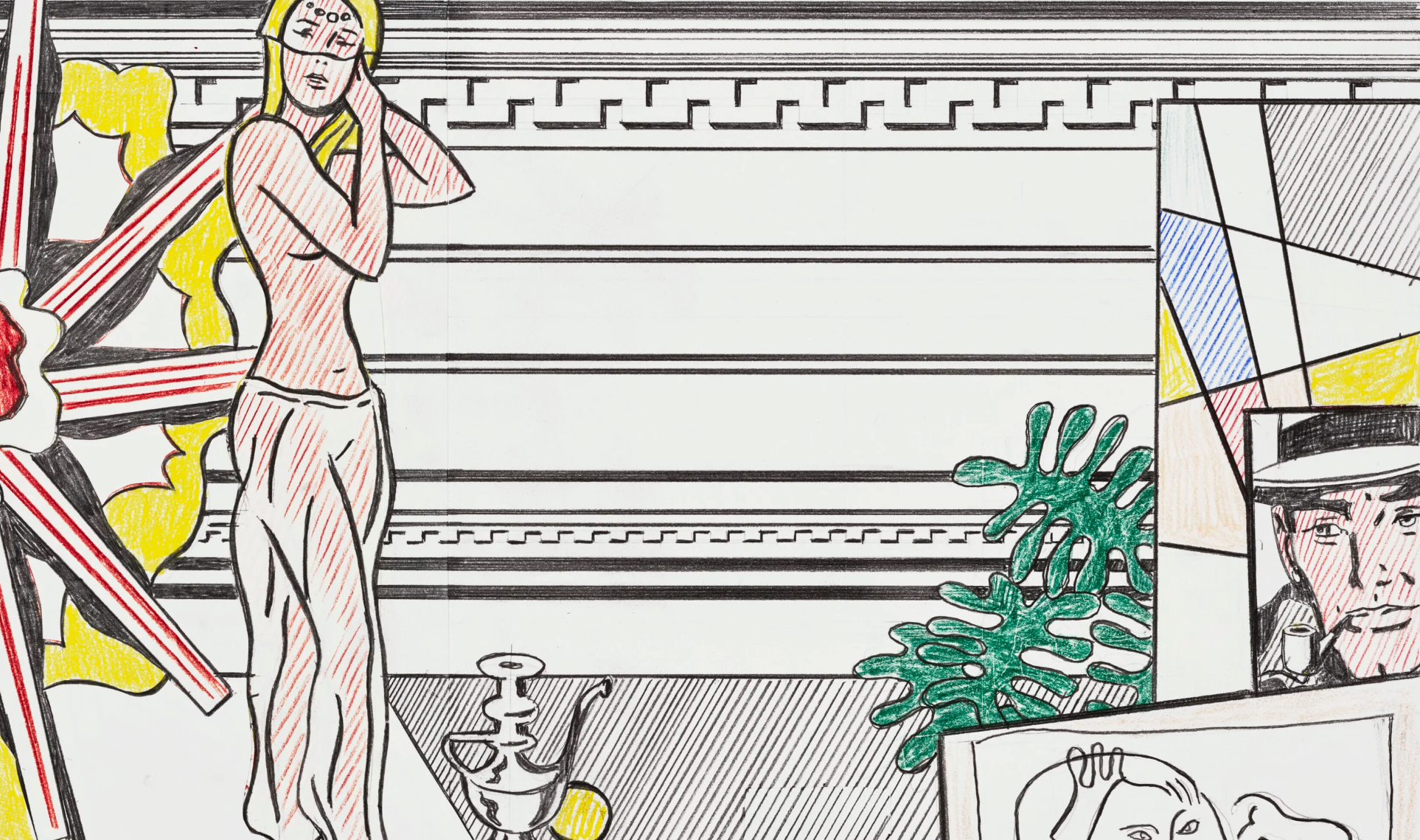
Encompassing a myriad of art historical references and wry self-quotations, Roy Lichtenstein’s Artist’s Studio with Model (Study) is a beautifully realized colored pencil and graphite sketch for the artist’s first major nude painting, Artist’s Studio with Model (1974). The study is also the first occasion where we see the artist beginning to reference his own work, an innovation that would go on to be a consistent theme within his later paintings.
Revealing Lichtenstein’s thinking as well as his meticulous approach to composition, color and design, the value of such a substantive study is reflected in its prestigious exhibition history, which began in 1975, the year after it was made. Artist’s Studio with Model (Study) has been included in museum shows across the world, including the Nationalgalerie in Berlin, the Musée du Louvre in Paris, the Museum of Modern Art in New York and the Museum of Contemporary Art, Chicago.
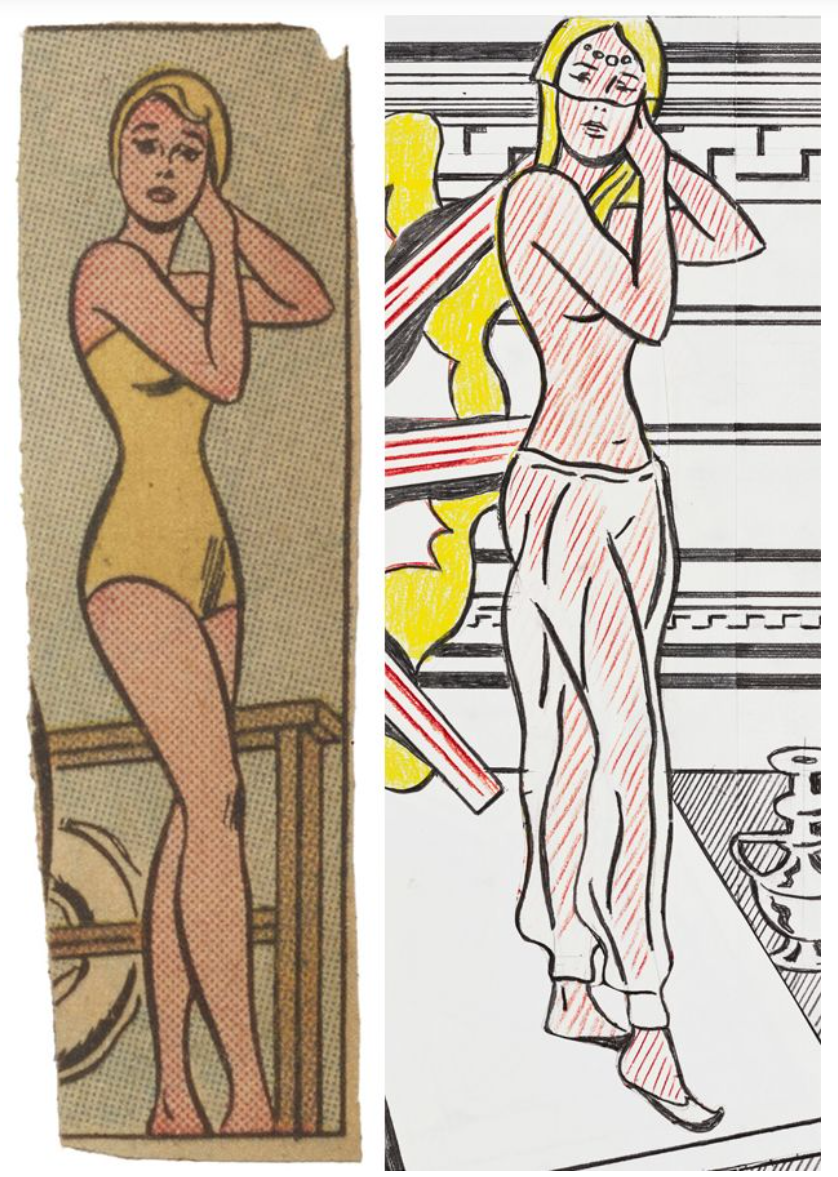
Left: Heart Throbs #82, March 1963. © DC Comics.
Right: Present lot illustrated (detail).
Drawn in 1974, Artist’s Studio with Model (Study) was influenced by Henri Matisse’s paintings of his own studio interiors, such as The Pink Studio (1911) and The Red Studio (1911), as well as later paintings of partially clothed models wearing Moroccan outfits—a series known as the Odalisques. Lichtenstein refers to the odalisque in his choice of the classical contrapposto pose of the standing nude, and her Orientalist-style semi-transparent trousers, veil and slippers.
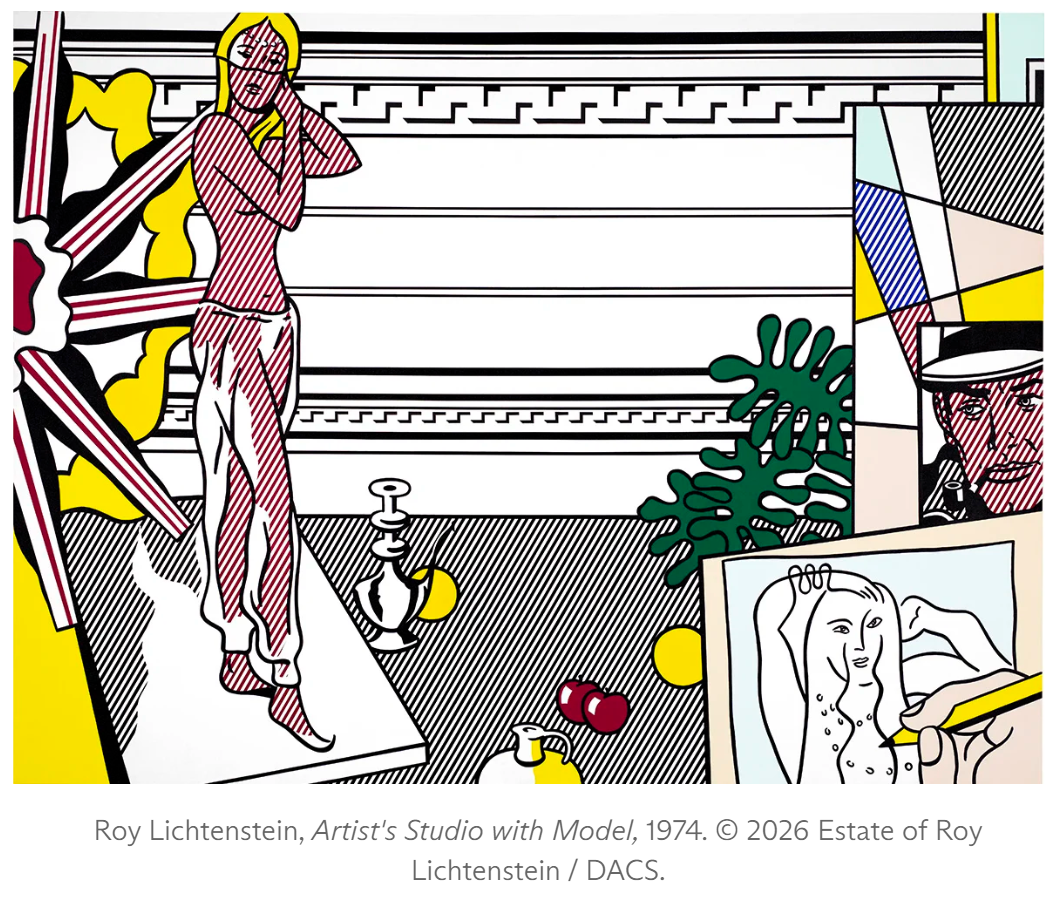
Further nods to the French master can be found in Lichtenstein’s playful use of perspective, such as the dramatically sloping floor and the prominent placement of vessels and fruits within the composition, which appear to be almost floating. Another painting from the series, Artist’s Studio “The Dance” (1974)—in the collection of MoMA—also includes a copy of Matisse’s famous painting Dance (I) in the background, as well as some of the French painter’s favored motifs, such as lemons.
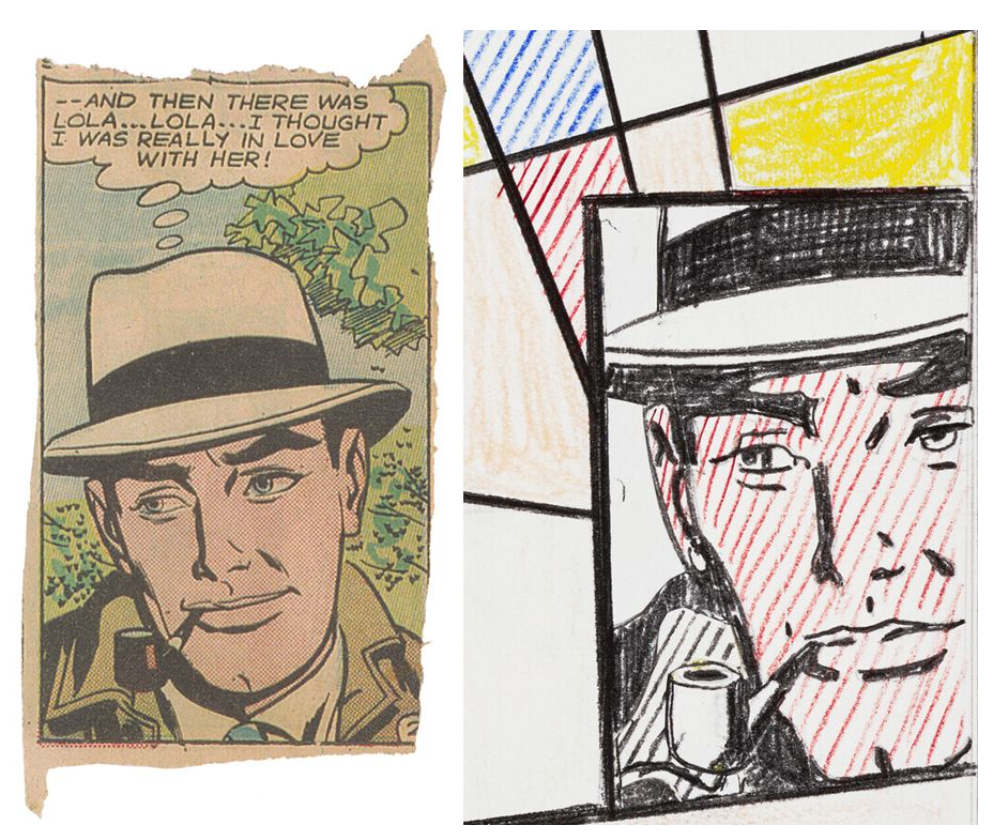
Left: Falling in Love #61, August 1963. © DC Comics.
Right: Present lot illustrated (detail).
Imitation and borrowing—from pop culture as well as other artists—were the ingenious cornerstones of Lichtenstein’s career. As the curators of the artist’s 2012 retrospective point out, this was a groundbreaking innovation. “[Lichtenstein’s] inventiveness is rooted in imitation; he transformed the very idea of borrowing into a profoundly generative, conceptual position, one that alters the trajectory of Modernism, and beyond” (J. Rondeau and S. Wagstaff, “Introduction,” in J. Rondeau and S. Wagstaff (eds.), Roy Lichtenstein: A Retrospective, exh. cat., Art Institute of Chicago, 2012, p. 20).
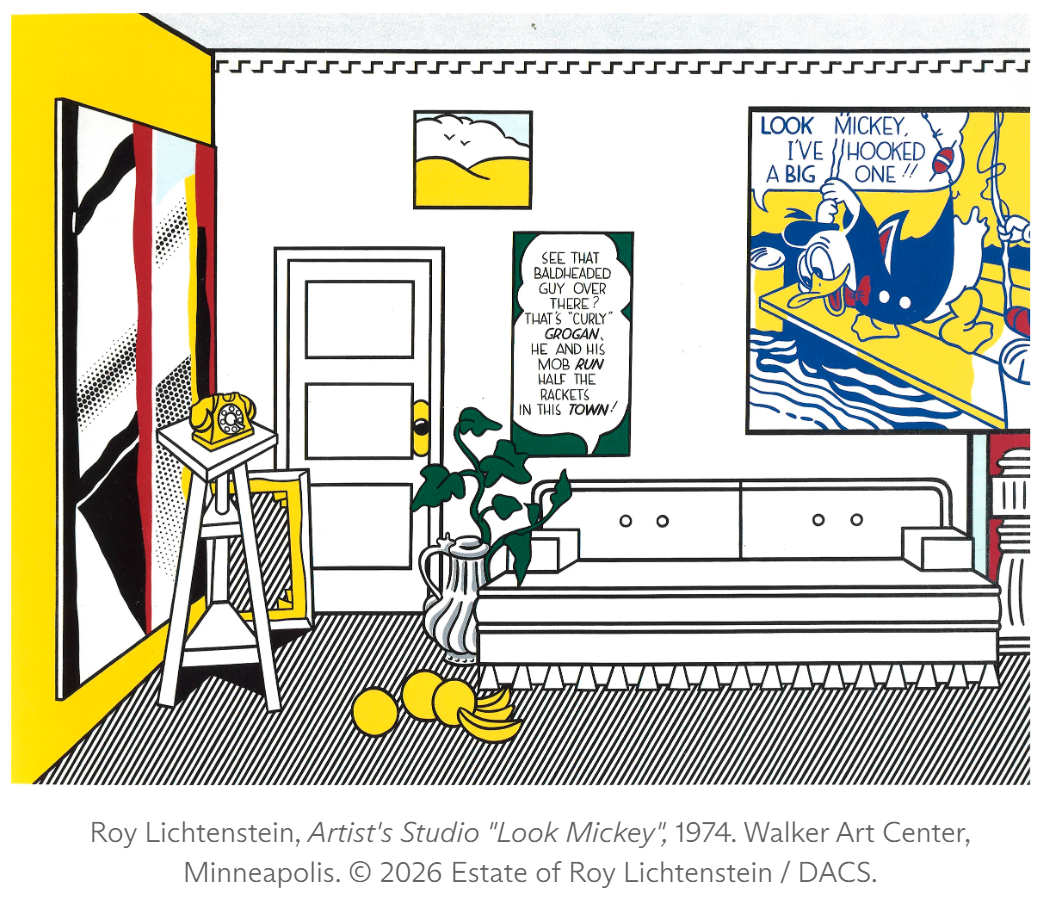
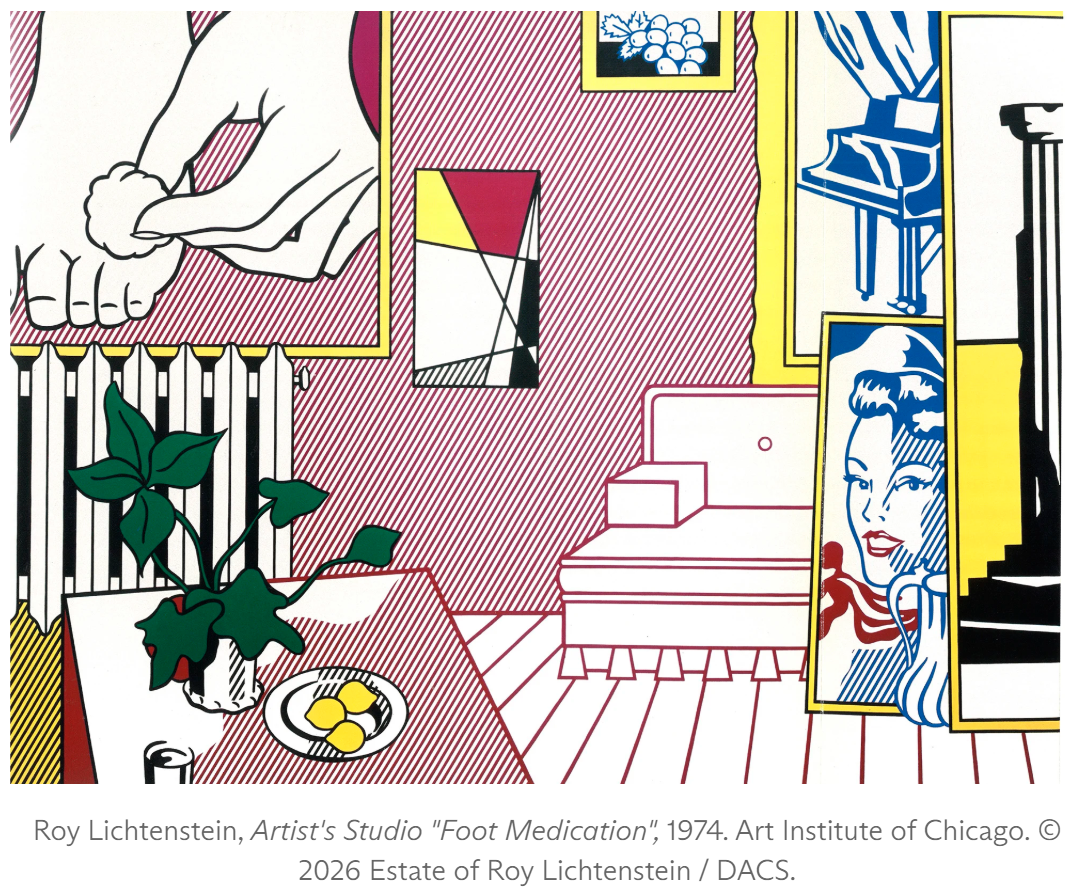
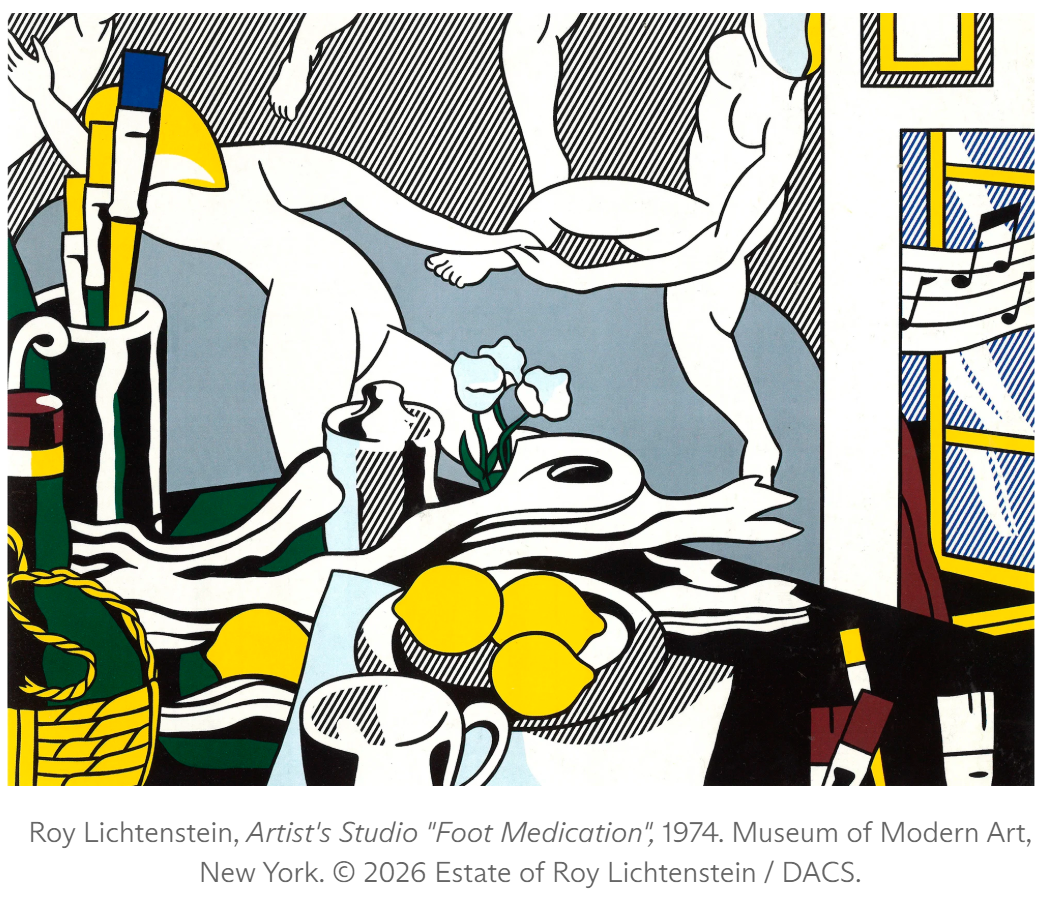
Perhaps nowhere is this boldness more evident than when Lichtenstein began to quote from his own work—as he does liberally in Artist’s Studio with Model (Study). It is as though the viewer has been invited to enter Lichtenstein’s own studio and look over his shoulder while he works. In the background, there are artworks featuring some of his most recognizable motifs, such as an explosion and an entablature. Fascinatingly, there are also references that prefigure works that were yet to be realized by the artist. On the right-hand side of the drawing, there is a “perfect” or “imperfect” painting—a series that Lichtenstein did not begin until the late 1970s. In front of it, the image of a man smoking a pipe would reappear nearly twenty years later, in a painting called Large Interior with Three Reflections (1993). We also see Lichtenstein looking to the past in his choice of reference images: both the figure of the standing nude and the man smoking the pipe are based on clippings taken from comic strips dating from the early 1960s, which the artist had carefully preserved in notebooks.
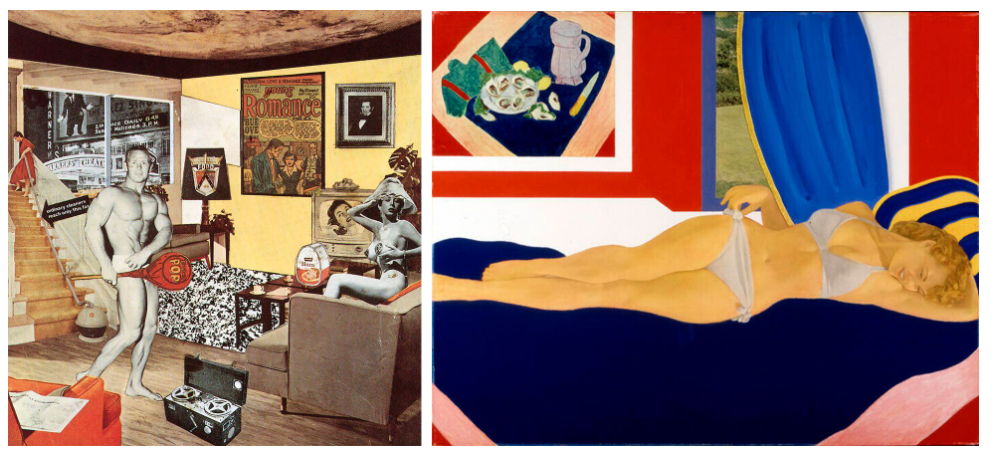
Left: Richard Hamilton, Just what is it that makes today’s homes so different, so appealing?, 1956. Kunsthalle, Tubingen. © 2026 Artists Rights Society (ARS), New York / DACS, London.
Right: Tom Wesselmann, Great American Nude #56, 1962. Worcester Art Museum. © 2026 Estate of Tom Wesselmann / Artists Rights Society (ARS), NY.
The intricacy of the composition of Artist’s Studio with Model (Study)—its layers of illusion, quotation, reference and mimicry—demonstrates the intelligence and consistency of Lichtenstein’s vision. It is at once an homage to his art historical forebears, a clear-eyed reflection of the creative process, and a glimpse into the future.
Lamp II, 1977
Lamp II, 1977
The Collection of Agnes Gund: Sold to Benefit the Gund Art Foundation
Christie’s New-York: 19 November 2026
Estimated: USD 1,000,000 – 1,500,000
ROY LICHTENSTEIN (1923-1997), Lamp II | Christie’s
ROY LICHTENSTEIN (1923-1997)
Lamp II, 1977
Painted and patinated bronze
86-1/4 x 27-5/8 x 17-5/8 inches (219.1 x 70.8 x 44.8 cm)
Signed, dated and numbered ‘2⁄3 rf Lichtenstein ’77’ (on the edge of the base)
This work is number two from an edition of three
A fusion of Pop commentary and conceptual rigor, Lamp II is an exemplar from Roy Lichtenstein’s revered sequence of bronze still-life sculptures. In addition to his paintings, three-dimensional works formed the central component of Lichtenstein’s oeuvre, continuing his investigations into the nature of seeing by subverting the illusion of representation.
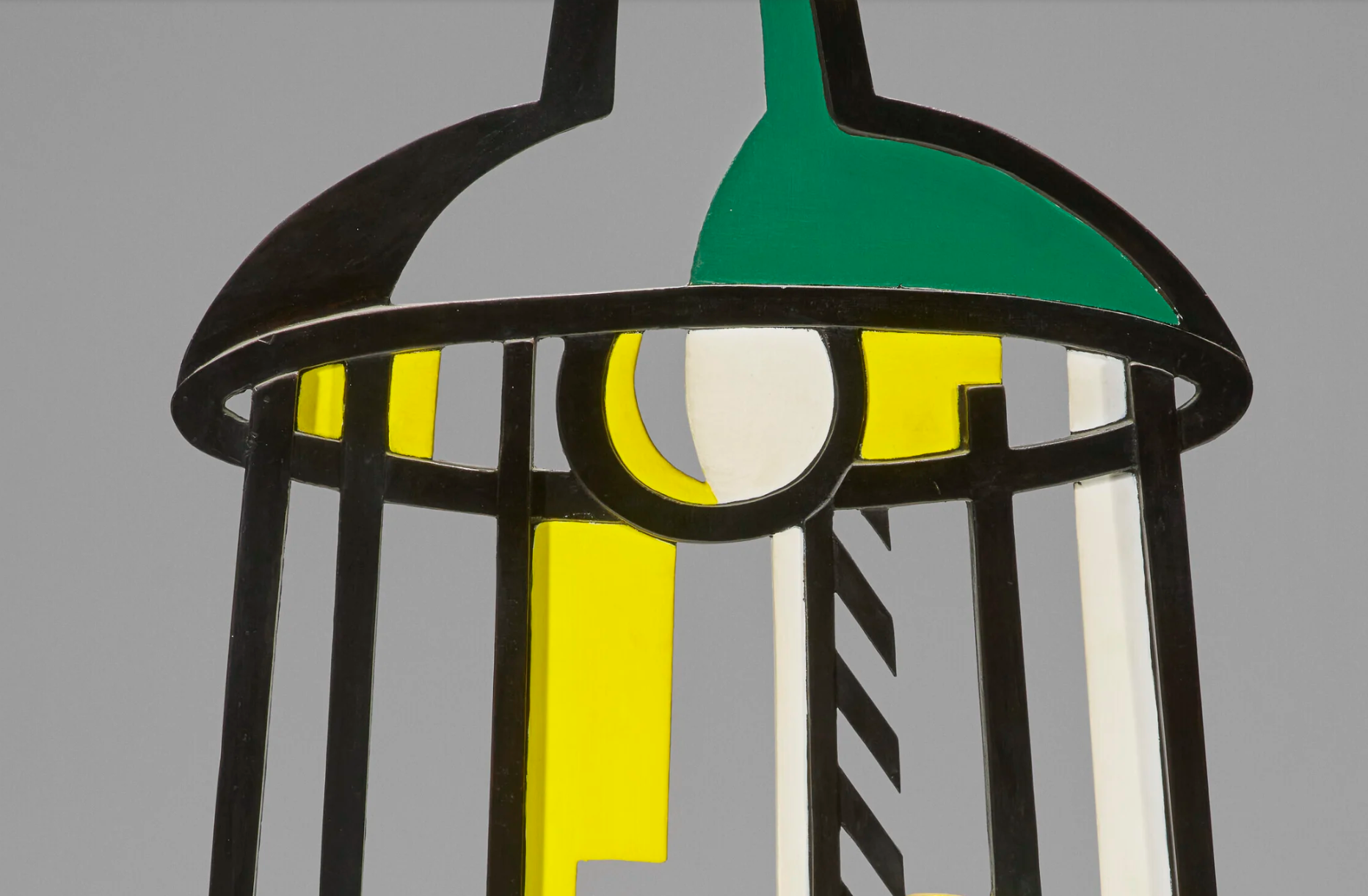
Here, the artist makes physical the ethereal nature of light, by mimicking the graphic language of commercial printing. The present example is number two from an edition of three, with another example from the edition in the permanent collection of the Virginia Museum of Fine Arts, Richmond. This form has also been widely exhibited in many of the major survey exhibitions of Lichtenstein’s work, including the current Roy Lichtenstein: Like New at the Whitney Museum of American Art in New York.
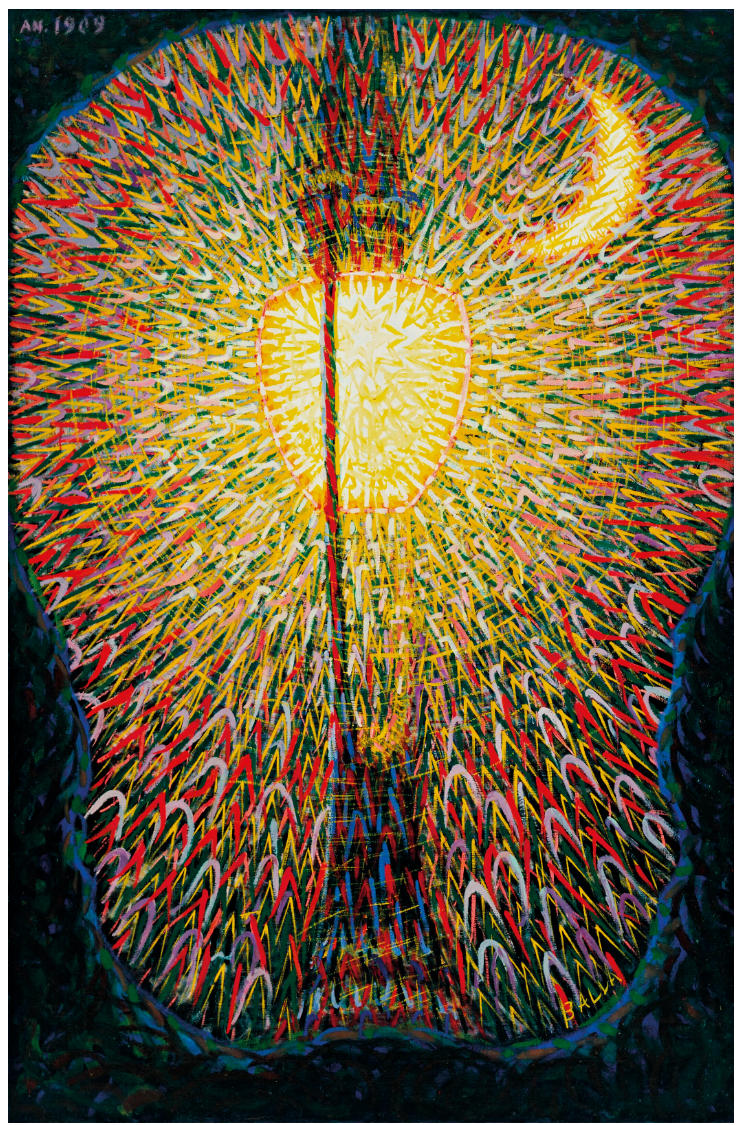
Giacomo Balla, Street Light, circa 1909. Museum of Modern Art, New York.
Photo: © The Museum of Modern Art / Licensed by SCALA / Art Resource, New York.
At the same time, both flat and three-dimensional, Lamp II resembles an illustration found in a comic book brought to life. Towering at over seven feet tall, it imitates both the form of a household lamp and the light that it casts. Beams of light transmit from the bulb and its lantern, rendered in yellow, white and black. Some are monochrome while others alternate black and white in a striped pattern, capturing the shifting and variegated nature of light. The longest rays terminate in a glowing circular pool which serves as the sculpture’s base. Lichtenstein transforms invisible radiation into heavy metal, blurring the boundaries between material and incorporeal, motion and stasis. The lampshade is made from green and black elements with empty space in between, wittily suggesting a gleam caused by another light source.
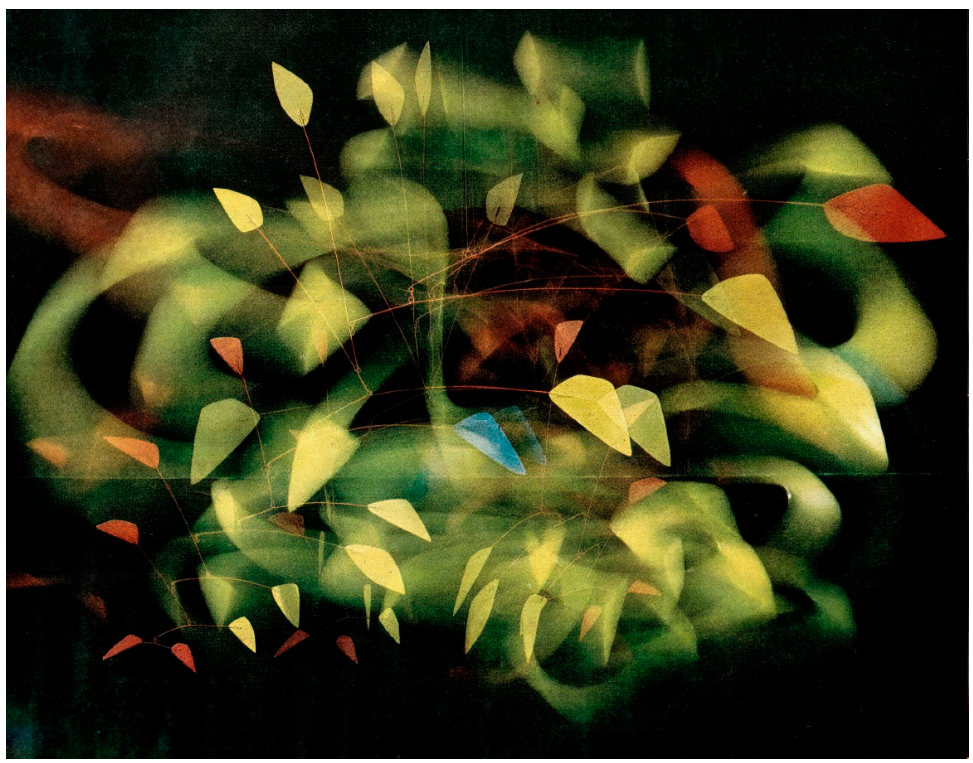
Alexander Calder’s multi-exposure shot of his work as published in Time, November 1964.
© 2026 Calder Foundation, New York / Artists Rights Society (ARS), New York.
A leading figure in Pop Art, Lichtenstein pushed American art away from Abstract Expressionism’s emotive eruptions and towards an engagement with popular and commercial culture. He was first celebrated in the early 1960s for paintings that embraced the strong colors, thick black outlines and flatness of printed matter such as comic books and advertising billboards. A few years later he began to experiment with sculptures that translated his singular aesthetic into three-dimensions. He started with ceramics depicting stacked teacups (1965) and the mixed media Modern Sculpture (1967) series that resembled oblique furniture objects. In the mid-1970s he turned to bronze, creating illusionistic still-life sculptures of everyday objects that matched the visual language of his paintings. Lichtenstein fabricated his bronze sculptures using the millennia-old technique of lost-wax casting, before painting and patinating them to a perfect artificial sheen.
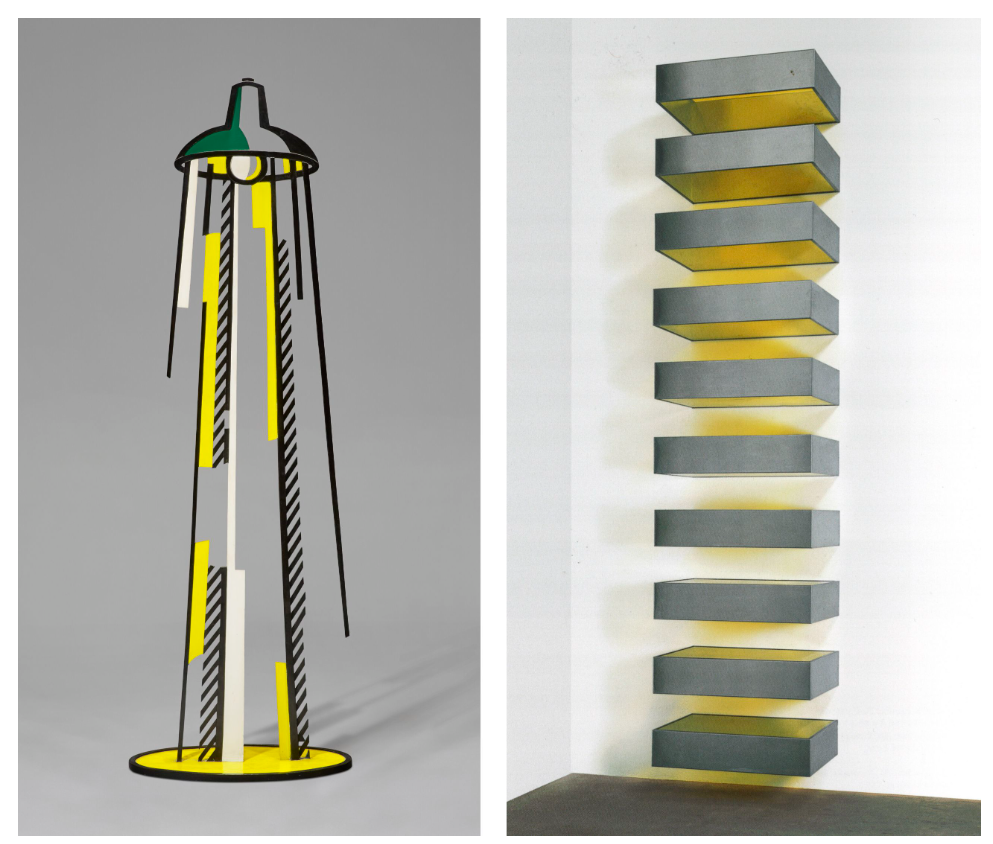
Left: Present lot illustrated.
Right: Donald Judd, Untitled, 1968. Froehlich Collection, Stuttgart. © 2026 Judd Foundation / Artists Rights Society (ARS), New York.
Sculpture proved fertile ground for Lichtenstein to interrogate the art historical ramifications of his project. The 1970s saw Lichtenstein reflect on modernist art movements with paintings that adapted past masters into his style, including Henri Matisse and Fernard Léger. Lamp II extends this project to sculpture. Its distributed rays of light, as if viewed from different angles at once, places it in the lineage of Cubism. Its absurdist morphing of the visible world harks after Surrealism.
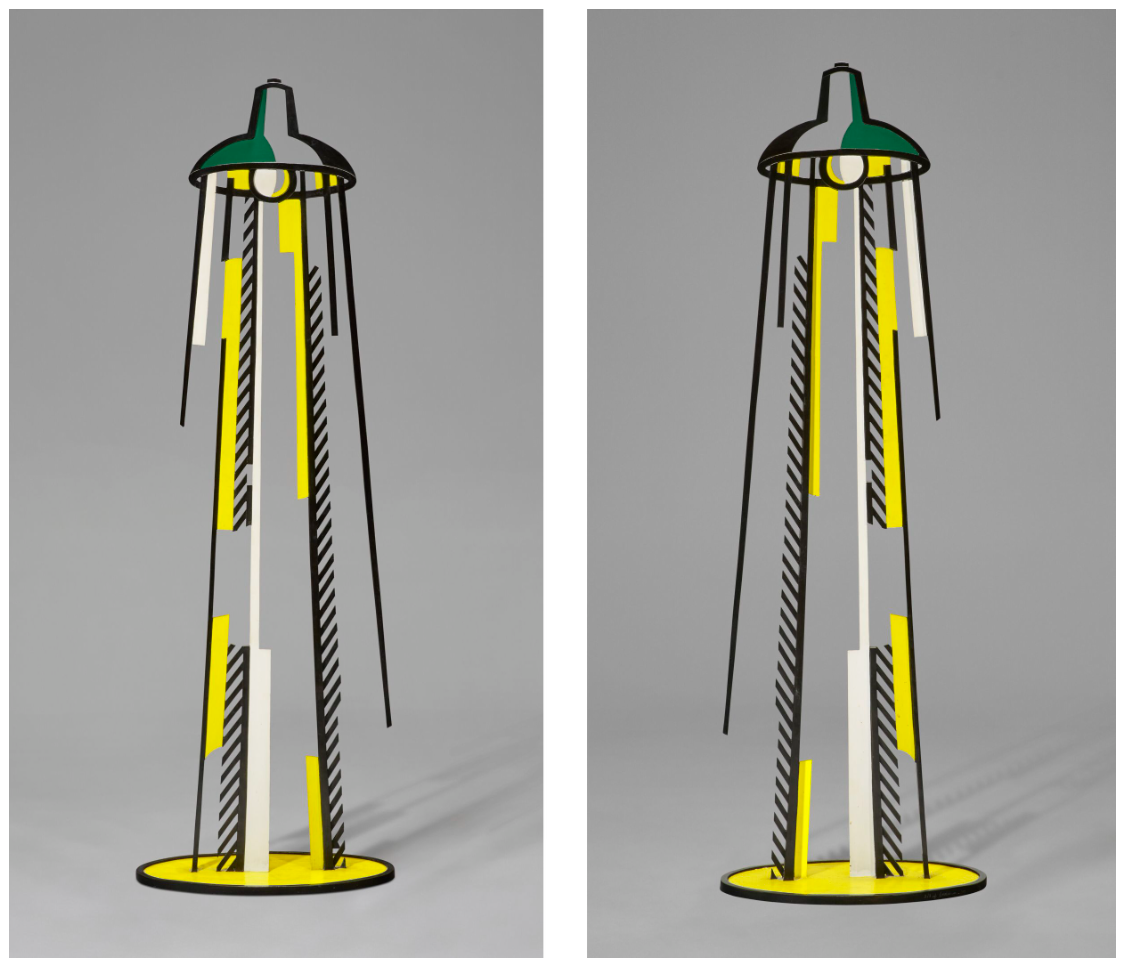
Lichtenstein’s sculptures also investigate the ability of art to take transient objects and effects, whether quotidian home furnishings or beams of light, and grant them a sort of permanence. “If most representational painting is a two-dimensional encoding of three-dimensional objects,” writes critic Hal Foster, “Lichtenstein reverses the process here and freezes it somewhere in between. Typically, he pushes a two-dimensional image toward a three-dimensional thing yet retains bits of the pictorial illusion as the image-object is displaced into actual space” (‘Pop Pygmalion’, in H. Foster (ed.), Roy Lichtenstein: Sculpture, exh. cat., Gagosian, London, 2005, p. 10). Lamp II appears to stand between dimensions, more real than a painted representation yet not quite a fully embodied object. Sporting playfully with the nature of reality, Lamp II is a major example of Lichtenstein’s trailblazing practice.
Coup de Chapeau I, 1996
Coup de Chapeau I, 1996
Looking Forward: The Collection of Beverly Grossman
Sotheby’s New-York: 17 November 2026
Estimated: USD 600,000 – 800,000
Roy Lichtenstein | Coup de Chapeau I | Contemporary Day Auction |
ROY LICHTENSTEIN (1923 – 1997)
Coup de Chapeau I, 1996
Painted and patinated bronze
26-3/8 x 26-1/2 x 7-1/2 inches (66.9 x 67.3 x 19.1 cm)
Incised with the artist’s signature, date ‘96 and number 3/6 (on the base)
This work is number 3 from an edition of 6 plus 1 artist’s proof
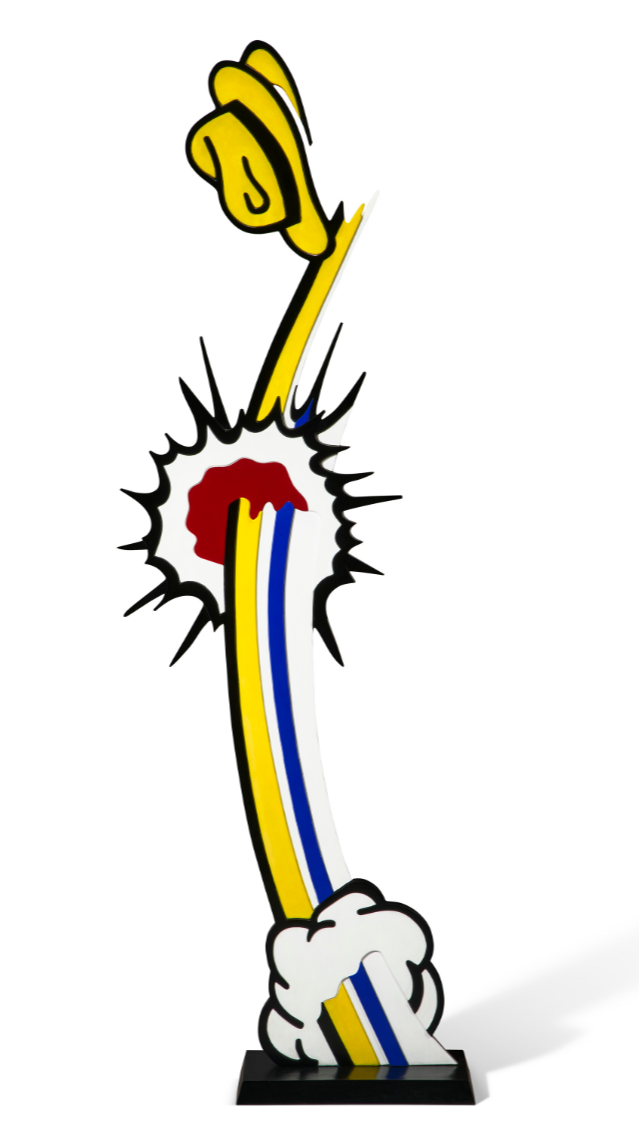
Unfurling through space in bold, fluid bands of color, Coup de Chapeau I embodies the iconic graphic power of Roy Lichtenstein’s instantly recognizable Pop idiom. Executed with his singular graphic precision, Lichtenstein harkens back to the explosive force and comic-book characters of his earliest Pop paintings of the 1960s. The cartoon-like hat, resembling those worn by Lichtenstein’s early comic-style heroes, soars thrown into the air by a mysterious beam of yellow, red, and white force, creating an explosive burst of Lichtenstein’s iconic Ben Day dots in the collision. Executed in 1996, the last year of Lichtenstein’s career and right before his untimely passing, Coup de Chapeau I is a masterful example of the artist’s continued reinvestigation of art history and his own practice.
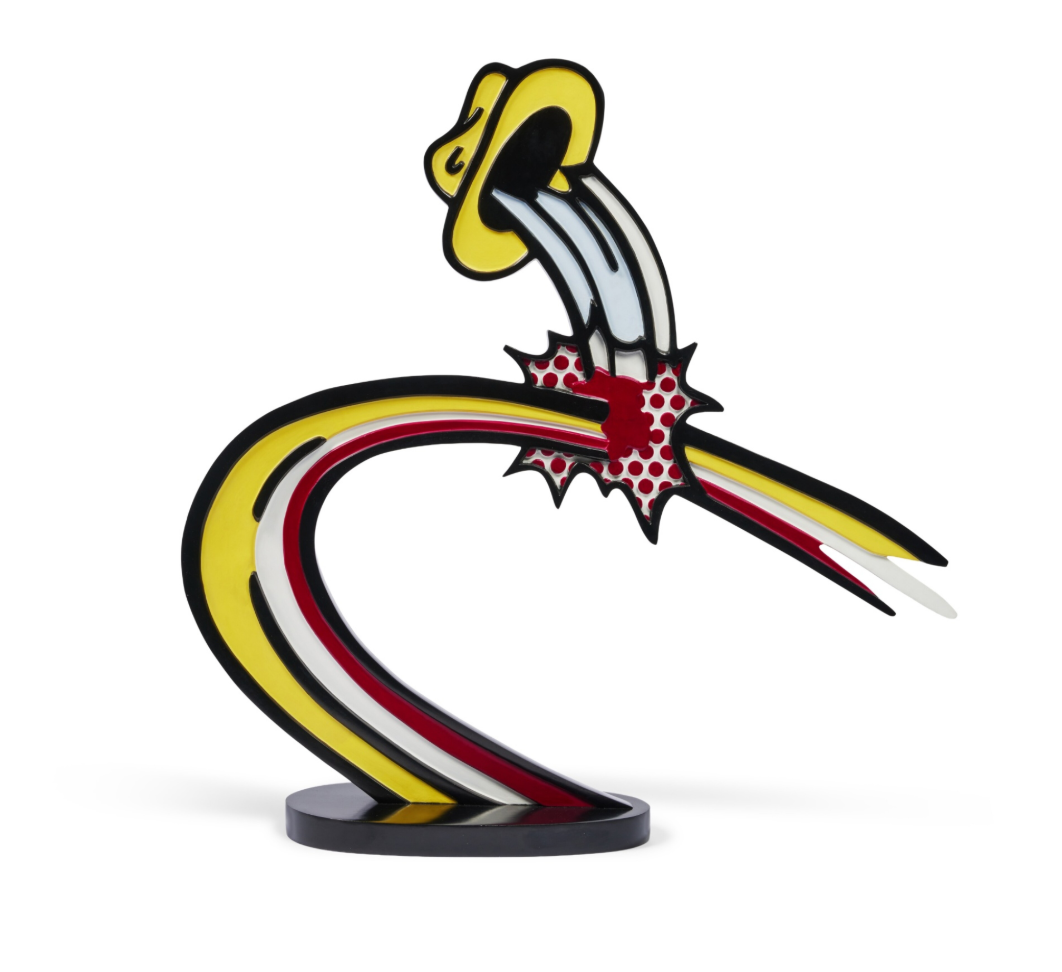
By making the hat’s motion in space literal, Lichtenstein explores three-dimensionality and form, probing the semiotics of space and perspective, volume and mass, through his distinctive visual lexicon of color and line. Playing on the French expression, “tip of the hat,” the present work epitomizes Lichtenstein’s transformation of his two-dimensional Pop practice into sculpture, a tongue-in-cheek representation of his lifelong investigation into the construction of meaning. The present work exudes his signature graphic vernacular, with saturated primary colors and thick, bold lines, into three-dimensional space. Further testament to the work’s importance within Lichtenstein’s oeuvre, it is at once an appropriation and interrogation of contemporary visual culture, encapsulating the paradoxical and nuanced approach that defined his art-making: a sustained negotiation between the visual language of popular culture and the inherited conventions of fine art. The dynamic arch of the colorful beam feels at once playful and forceful, propelling the subject-less hat irreverently into infinity, manifesting perpetual motion and dynamism, while also leaving the viewer with a subject-less portrait.
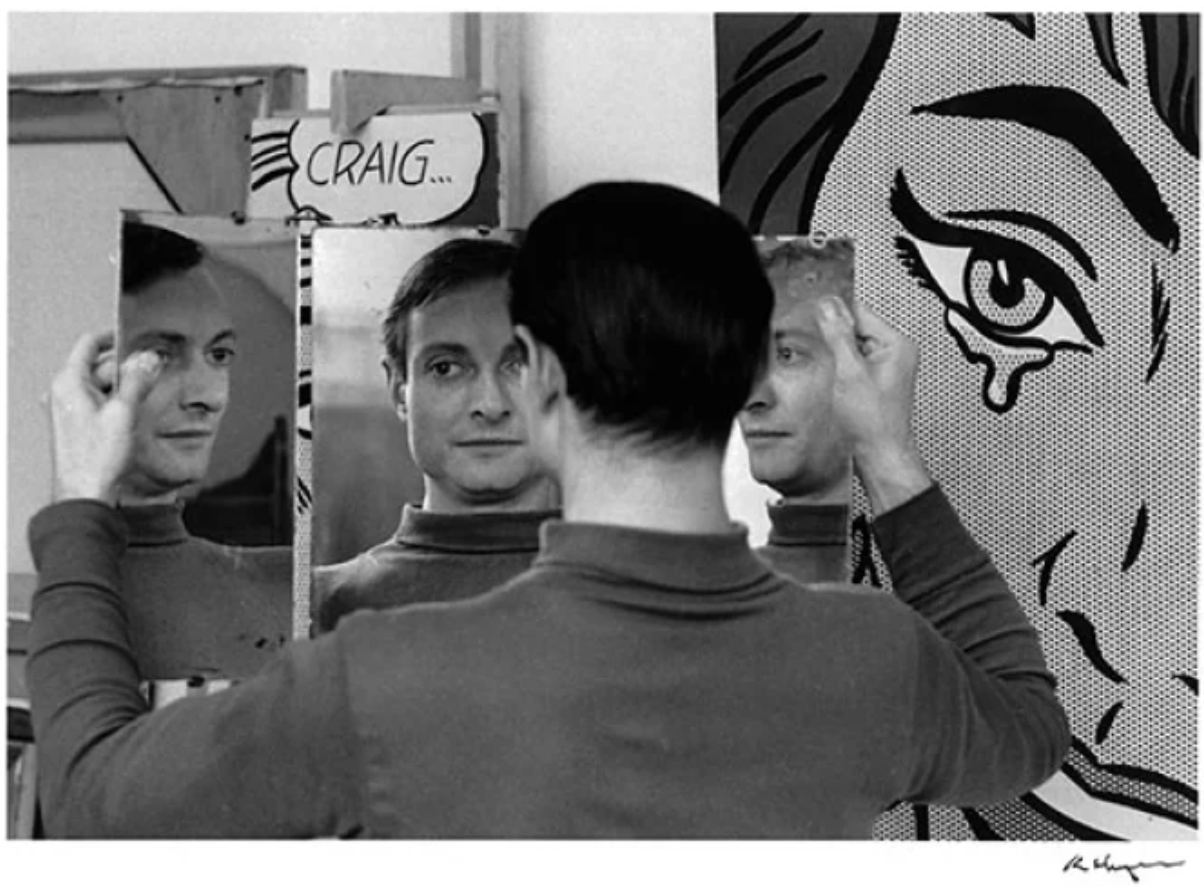
Roy Lichtenstein in his studio at 36 West 26th Street, New York, 1964. © Ken Heyman/Courtesy The Roy Lichtenstein Foundation Archives
Methodical and iterative, Lichtenstein’s practice is one of sustained engagement across media; he pursued his subjects through a variegated host of mediums, such as drawing, collage, painting, sculpture and printmaking. Coup de Chapeau I operates as a three-dimensional extension of the last self-portrait the artist ever made, Coup de Chapeau (Self-Portrait), and its study Coup de Chapeau (Self Portrait) (alternatively titled Self-Portrait (Man Hit by the 21st Century) from 1995-6. Across his earlier two-dimensional works, Lichtenstein repeatedly cast himself as the astonished observer of a hat sent soaring through the air–a motif which came to symbolize the dislocation and seismic shifts of the looming new millennium.
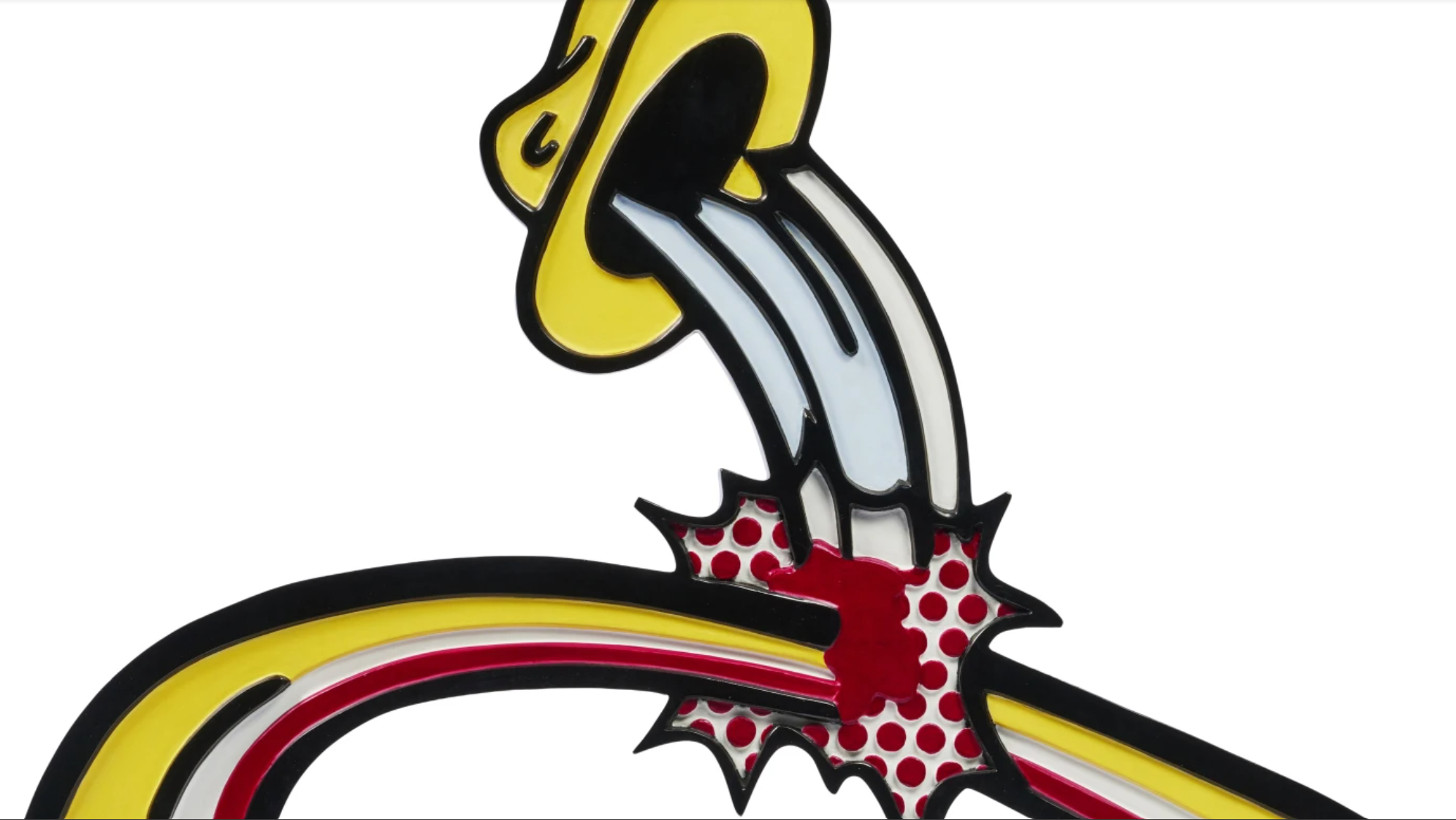
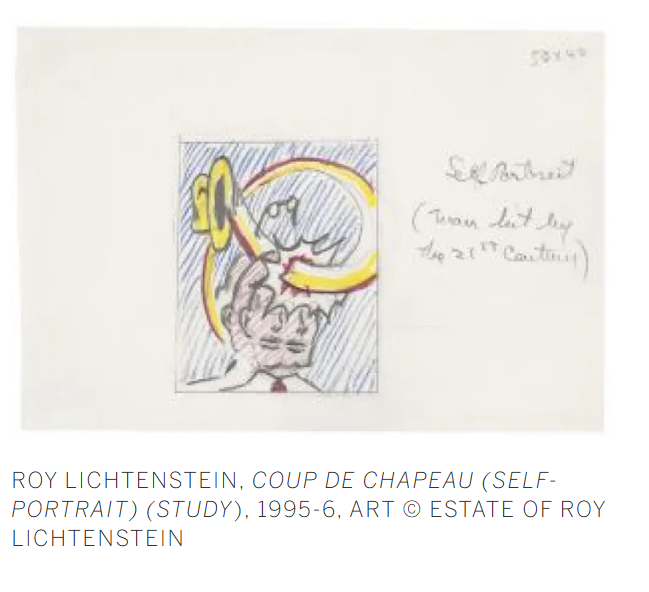
Conceptualizing Coup de Chapeau I in the context of the related work on paper and painting illuminates the role of the artist in its narrative, and perhaps places the viewer directly within Lichtenstein’s perspective, stunned by a hat propelled through the air. Despite the omission of any human figure, Lichtenstein realizes a form of self-portraiture in the present work, exploring his intimate, personal response to the advent and emotional disorientation of the new century. Harkening back to his earliest comic-book paintings, Lichtenstein’s Coup de Chapeau I is both a pure fulfillment of Pop and a reflection on the arc of his career. Like much of Lichtenstein’s oeuvre, these works are referential to his own practice and art history.
Small Wall Explosion, 1965
Small Wall Explosion, 1965
The Collection of Antonio Homem Sonnabend
Christie’s New-York: 19 November 2026
Estimated: USD 500,000 – 700,000
MINIMUM PRICE GUARANTEE
ROY LICHTENSTEIN (1923-1997), Small Wall Explosion | Christie’s
ROY LICHTENSTEIN (1923-1997)
Small Wall Explosion, 1965
Porcelain enamel on steel and perforated steel, metal rod and plate
22 x 20-1/2 x 7-1/2 inches (55.6 x 52.1 x 18.7 cm)
Signed, dated and numbered ‘rf Lichtenstein ’65 3⁄6’ (on the reverse)
This work is number three from an edition of six
From its debut in paintings such as Brattata (1962, Tehran Museum of Contemporary Art) and Whaam! (1963, Tate Modern, London), the explosion has become one of Roy Lichtenstein’s most important motifs. Dating from the artist’s most acclaimed period, Small Wall Explosion elevates this iconic form from a supporting role, making it one of the most compelling examples from within his oeuvre. Utilizing bold primary colors, and a unique three-dimensional rendering of his signature Ben-Day dots, this work showcases Lichtenstein’s perceptive investigations into how we look at and understand images.
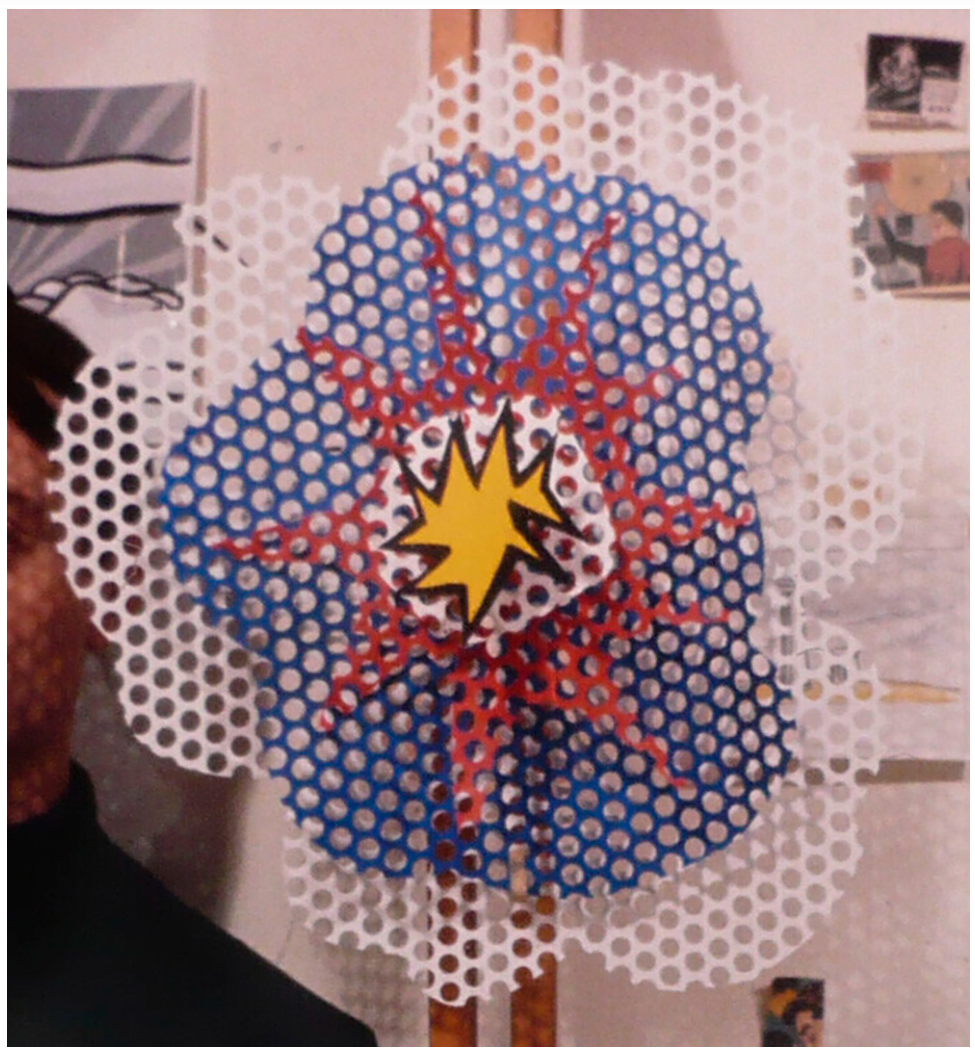
Roy Lichtenstein, Small Wall Explosion (Model), circa 1965. Art. © 2026 Estate of Roy Lichtenstein / DACS.
Executed in 1965, Small Wall Explosion consists of multiple sheets of perforated steel assembled to project the force of an explosion. Beginning with blue, and followed by layers of white, red, yellow, another red layer, and finally a further white layer, the cumulative effect mimics the dynamic energy of the split-second event. The colors are classic Pop Art, but it is Lichtenstein’s use of the perforated metal sheets that reflects a breakthrough in his representation of images.
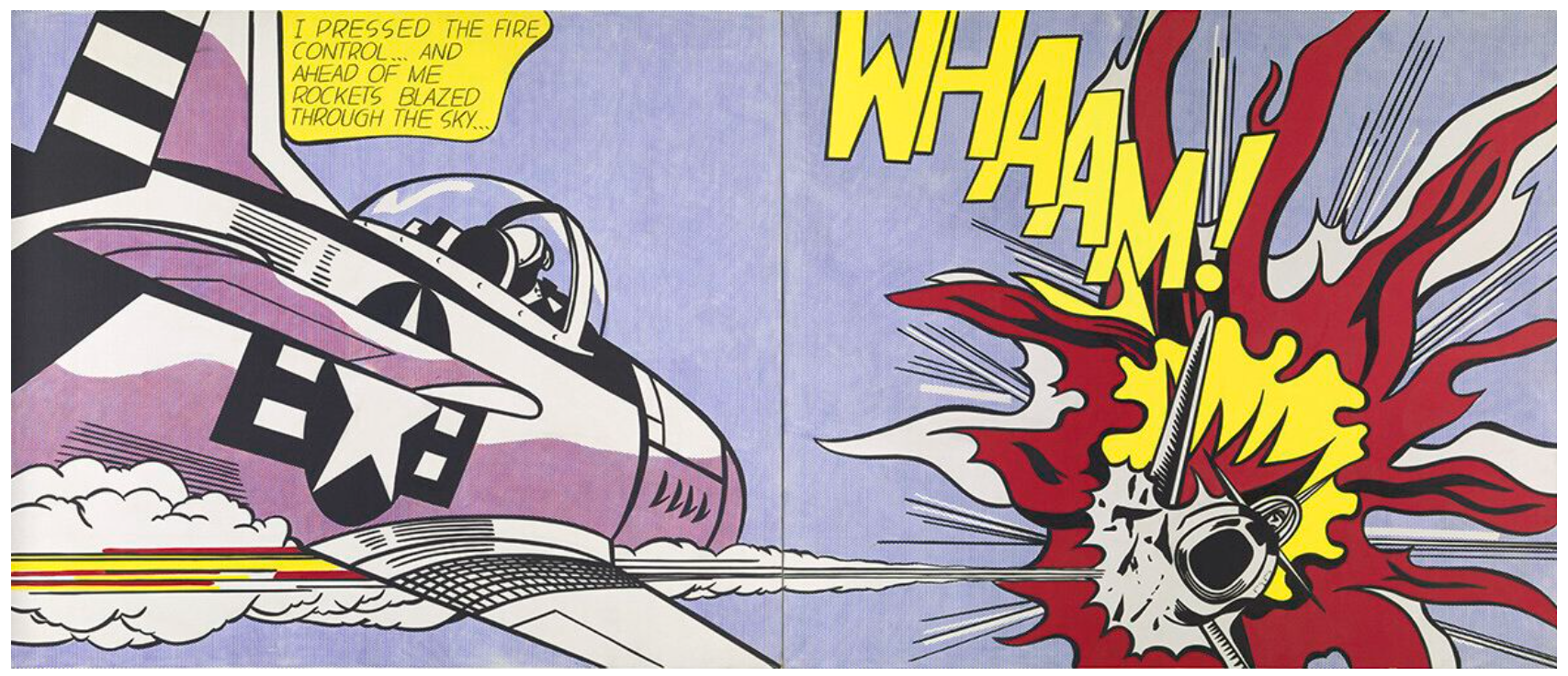
Roy Lichtenstein, Whaam!, 1963. Tate Gallery, London. © 2026 Estate of Roy Lichtenstein / DACS. Photo: © Tate Gallery, London.
Lichtenstein’s sculptures resulted from his preoccupation with the formal qualities of art and the difficult task of representing the ephemeral quality of artistic illusionism. The present work arose from his desire to create a genuinely three-dimensional object whilst still retaining the aesthetic qualities of his critically-acclaimed two-dimensional work.
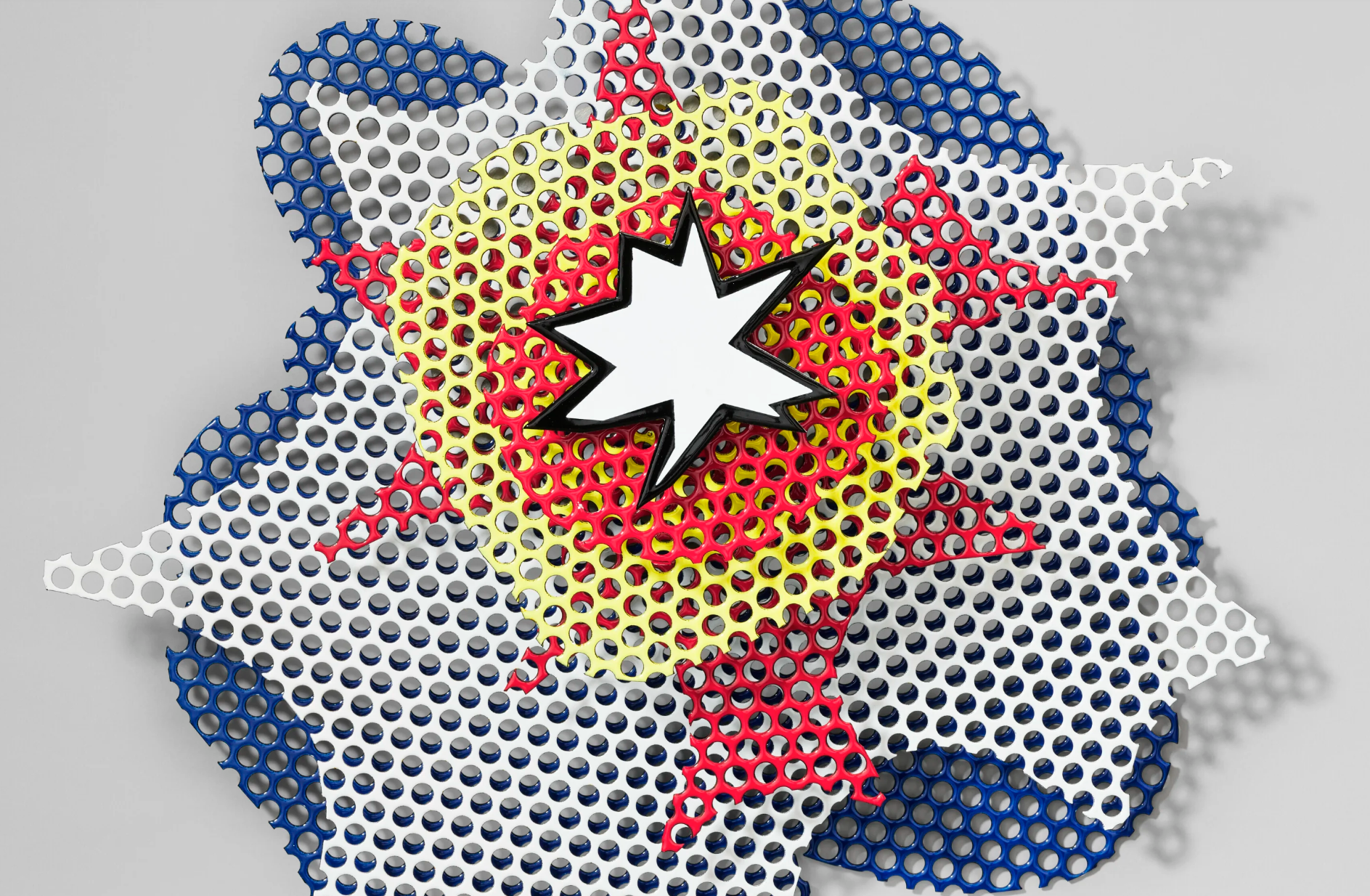
His unique solution was to combine several smooth colorful layers of enamel painted steel to create a burst of three-dimensional illusionism. As Diane Waldman has observed, “Lichtenstein’s sculpture is an extension of his painting. With enamel, Lichtenstein accomplished two objectives: he reinforced the look of mechanical perfection that paint could only simulate but not duplicate and it provided the perfect opportunity to make an ephemeral form concrete” (D. Waldman, Roy Lichtenstein, New York, 1971, p. 23).
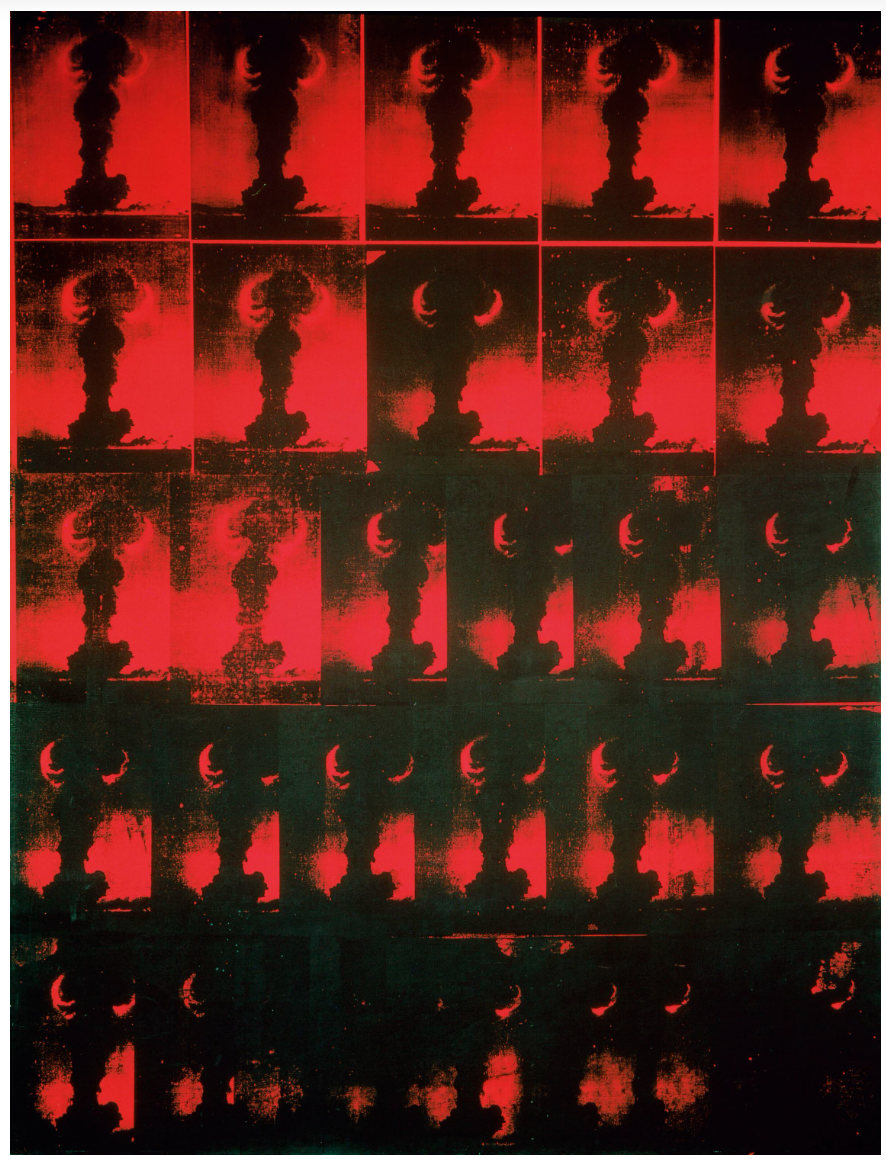
Andy Warhol, Atomic Bomb: Red Explosion, 1965. Saatchi Collection, London. © 2026 The Andy Warhol Foundation for the Visual Arts, Inc. / Artists Rights Society (ARS), New York. Photo: Saatchi Collection, London, UK / Bridgeman Images.
The year 1965 marked a pivotal moment in Lichtenstein’s career. Alongside his continued exploration of the iconic Girl motifs and the introduction of his Brushstroke paintings, the artist began to pursue three-dimensional work in earnest. In addition to works such as the present example, Lichtenstein created a series of ceramic sculptures, experimented with Rowlux, a molded plastic sheet, and explored the possibilities of cloisonné porcelain enamel. This spirit of experimentation lies at the heart of Lichtenstein’s oeuvre, reflecting his sustained interest in interrogating how we look at and perceive objects and images.
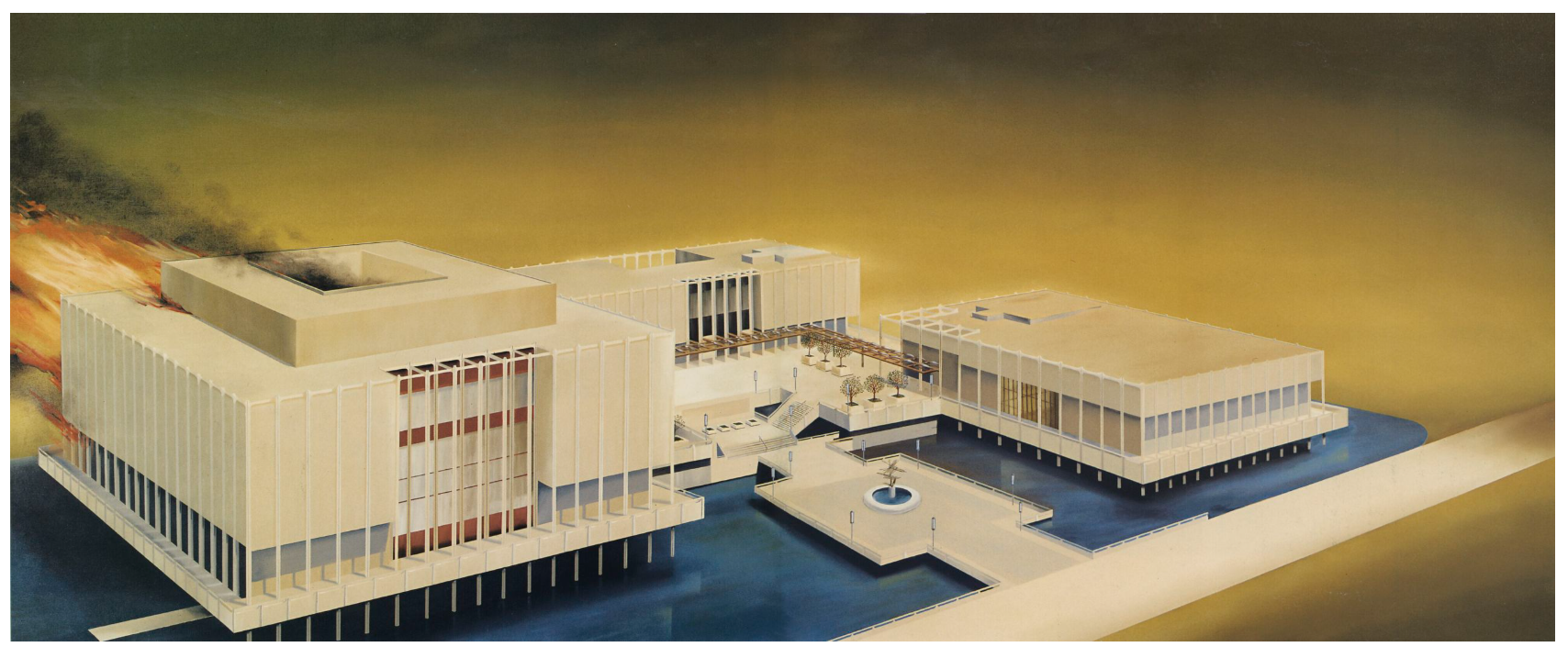
Ed Ruscha, Los Angeles County Museum of Art on Fire, 1965-69. Los Angeles County Museum of Art. © Ed Ruscha.
Currently the subject of a major career retrospective at the Whitney Museum of American Art, Roy Lichtenstein’s genre-defining art became an important contribution to the Pop Art movement alongside peers such as Andy Warhol, Claes Oldenburg, Jasper Johns, and James Rosenquist. In creating Small Wall Explosion, Lichtenstein gave tangible form to what he had previously isolated as an indexical reference to reality. By bringing into physical existence an image he had originally sought to expose as artificial, he turned back upon his own practice, reflecting on the evolution of his formal language. In retrospect, this self-referential gesture makes Small Wall Explosion a powerful summation of one of the most thought-provoking formal investigations of Lichtenstein’s career.