Fall 2026 New-York Marquee Auctions
David Hockney
Auction Results
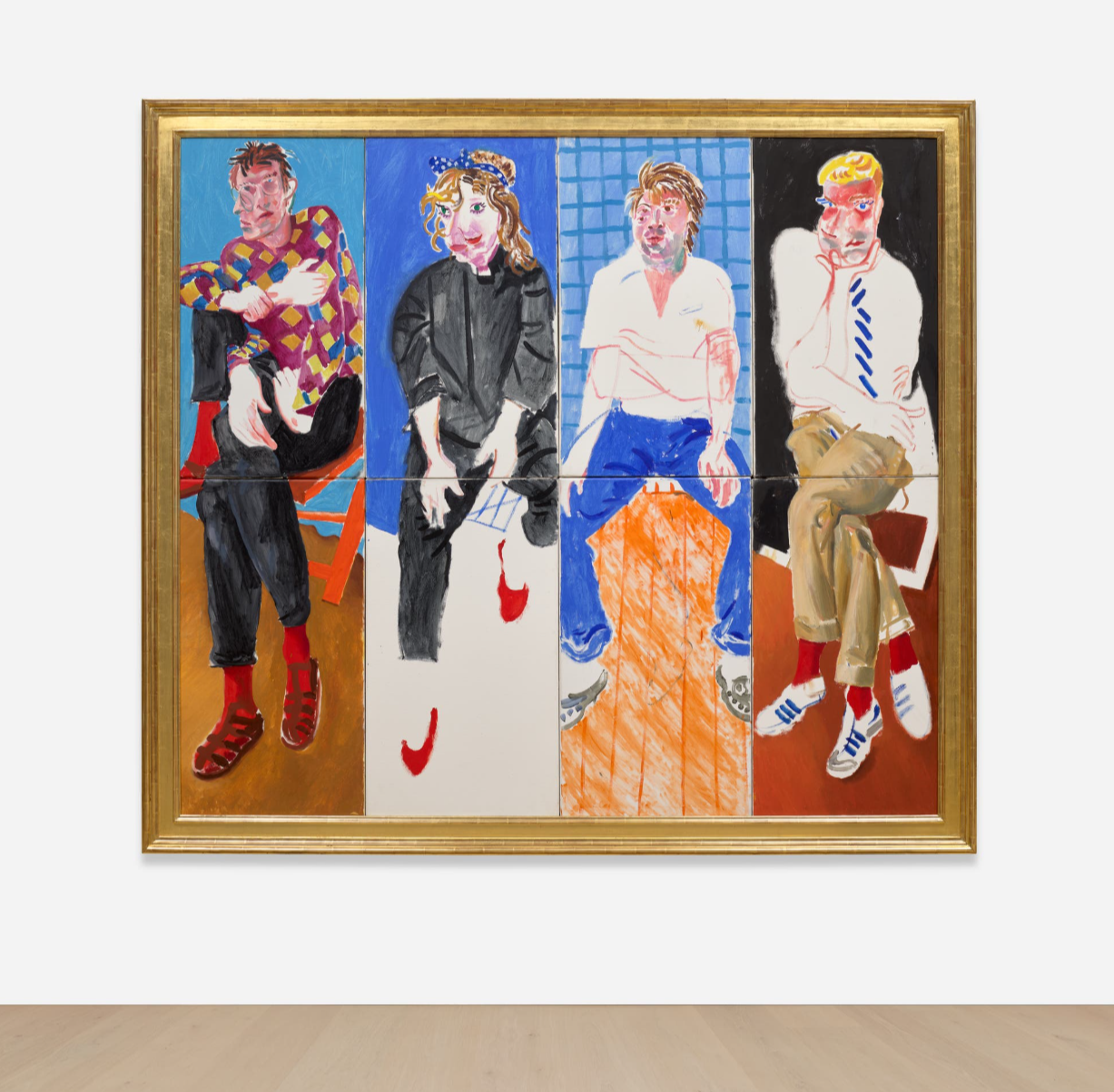
David, Celia, Stephen and Ian, London 1982
Property from the Joel and Carole Bernstein Family Collection
Phillips New-York: 17 November 2026
Estimated: USD 10,000,000 – 15,000,000
David Hockney Modern & Contemporary Art Evening Sale
DAVID HOCKNEY
David, Celia, Stephen and Ian, London 1982
Oil on canvas, in 8 parts
Each: 36×20 inches (91.4 x 50.8 cm)
Overall: 72×80 inches (182.9 x 203.2 cm)
Signed, partially titled and dated
“David Celia Stephen Ian London August 1982 David Hockney”
On the reverse of the upper panels
Painted in August 1982, in the United States
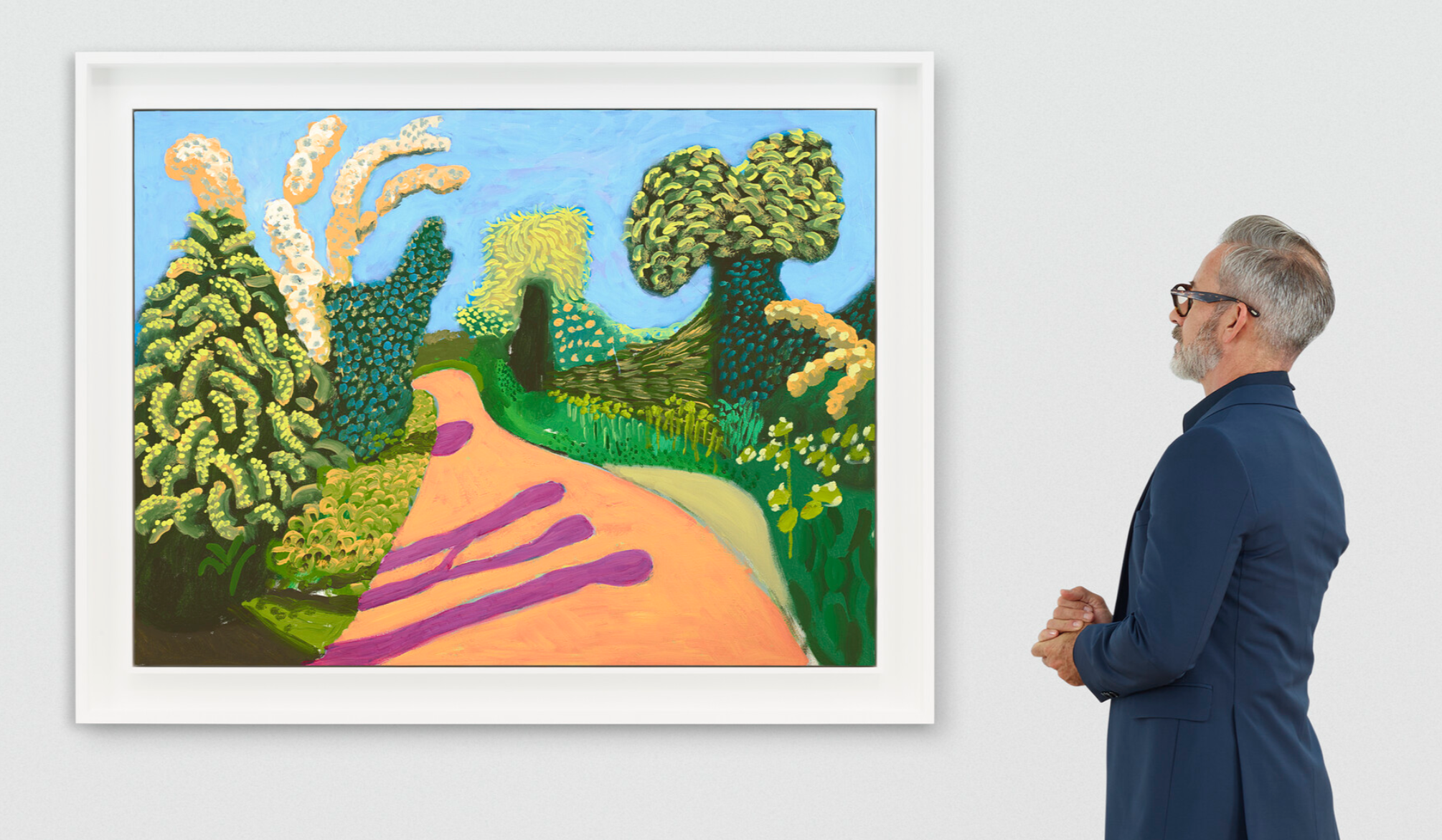
Hawthorne Blossom, Woldgate No. 4, 2009
Property from a Prominent American Collection
Christie’s New-York: 17 November 2026
Estimated: USD 7,000,000 – 10,000,000
DAVID HOCKNEY (1937-2026), Hawthorne Blossom, Woldgate No. 4 | Christie’s
DAVID HOCKNEY (1937-2026)
Hawthorne Blossom, Woldgate No. 4, 2009
Oil on canvas
36×48 inches (91.4 x 121.9 cm)
Signed, dated and titled ‘Hawthorne Blossom Woldgate IV David Hockney 2009’ (on the reverse)
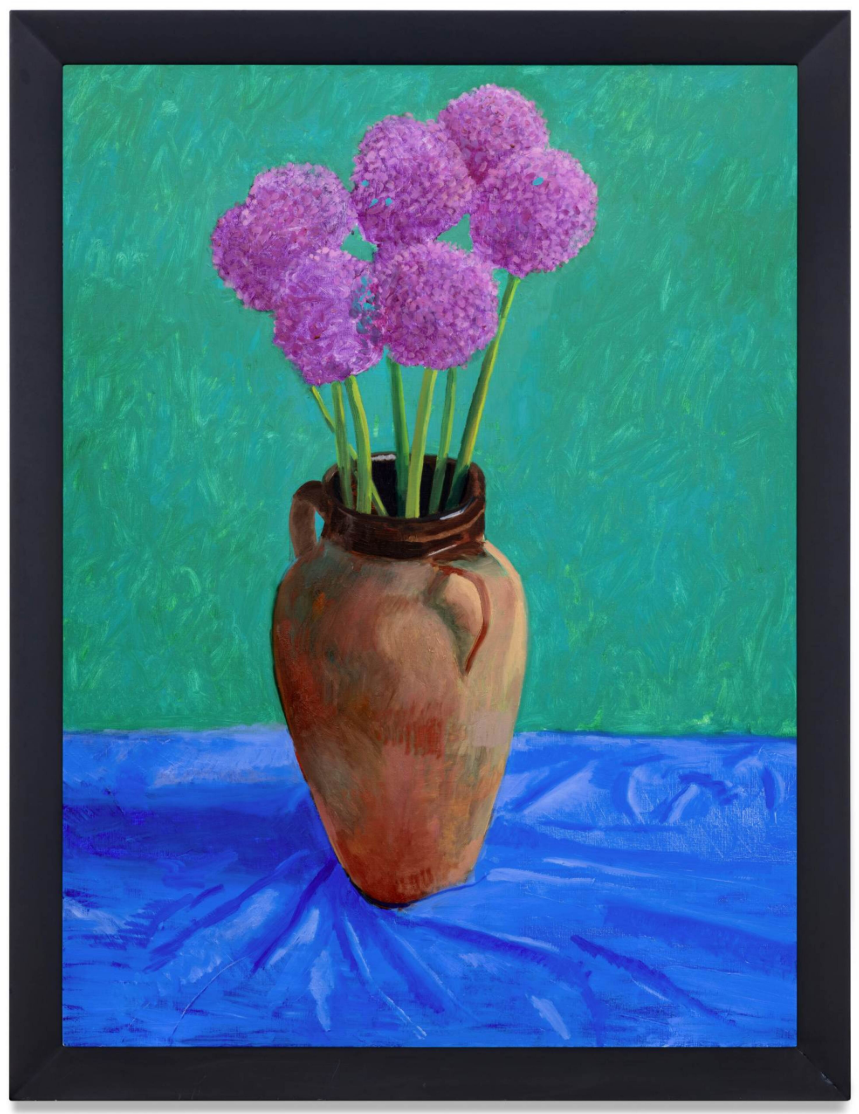
Alliums, 1996
Property from a Distinguished West Coast Collection
Sotheby’s New-York: 16 November 2026
Estimated: USD 5,000,000 – 7,000,000
David Hockney | Alliums | The Now and Contemporary Evening Auction |
DAVID HOCKNEY (1937 – 2026)
Alliums, 1996
Oil on canvas
48×36 inches (121.9 x 91.4 cm)
Signed, titled and dated 1996 (on the reverse)
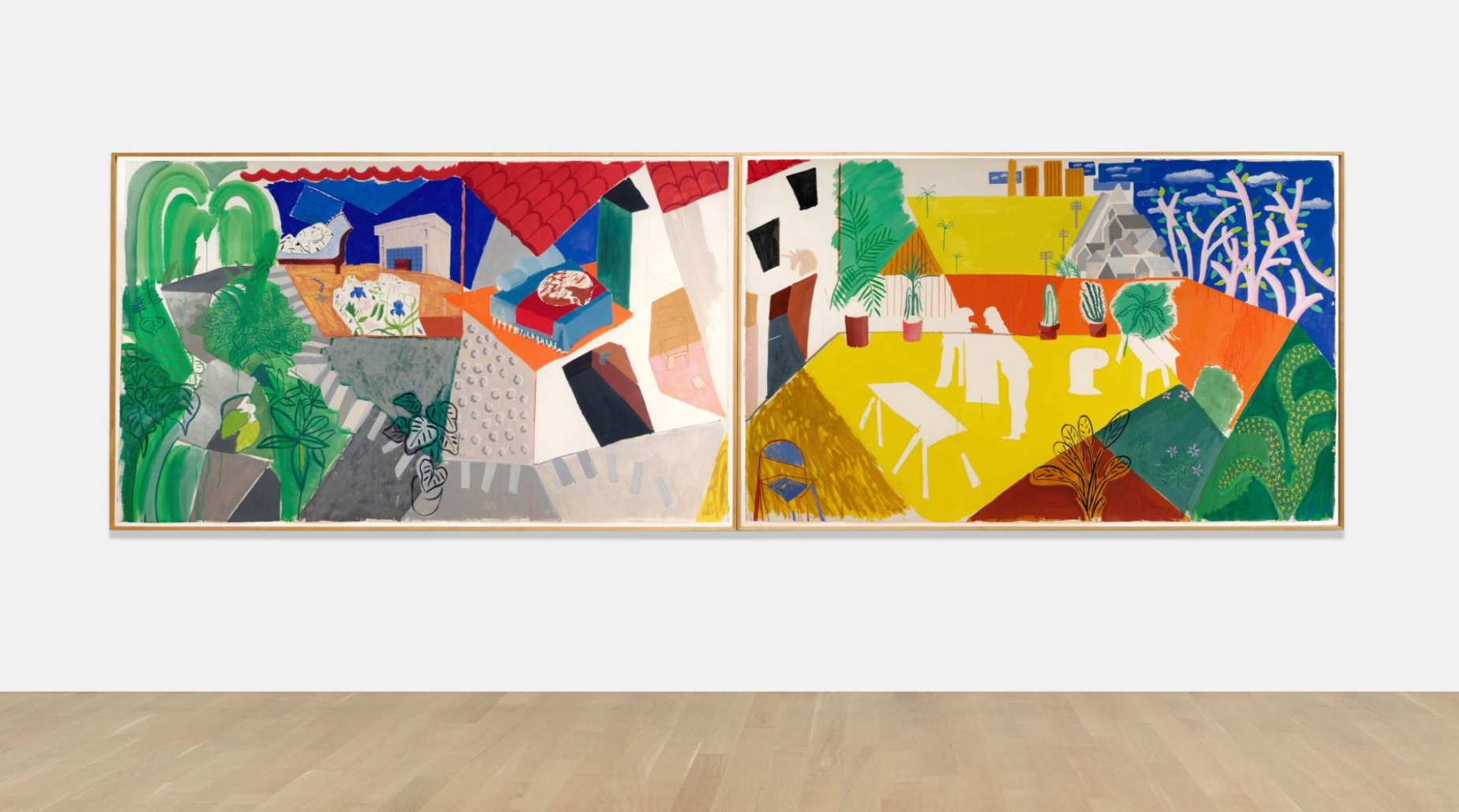
A Visit with Mo and Lisa, 1984
Sotheby’s New-York: 16 November 2026
Estimated: USD 3,000,000 – 4,000,000
WORK ON PAPER
GUARANTEED PROPERTY
David Hockney | A Visit with Mo and Lisa, Echo Park, Los Angeles |
DAVID HOCKNEY (1937 – 2026)
A Visit with Mo and Lisa, Echo Park, Los Angeles, 1984
Gouache, wax crayon and graphite on paper, in two parts
Left sheet: 60-3/4 x 102-1/2 inches (154.3 x 260.4 cm)
Right sheet: 60-3/4 x 99-1/2 inches (154.3 x 252.73 cm)
Signed with the artist’s initials and dated 84 (lower right)
Purple Potted Flower, 1995
Property from a Distinguished Family Collection
Christie’s New-York: 19 November 2026
Estimated: USD 1,800,000 – 2,500,000
THIRD PARTY GUARANTEE
DAVID HOCKNEY (1937-2026), Purple Potted Flower | Christie’s
DAVID HOCKNEY (1937-2026)
Purple Potted Flower, 1995
Oil on canvas
24×24 inches (61×61 cm)
Signed and dated ‘David Hockney 1995’ (on the reverse)
Lemons & Oranges, circa 1986
Phillips New-York: 19 November 2026
Estimated: USD 600,000 – 800,000
Lemons & Oranges, circa 1986
12×24 inches (30.5 x 61 cm)
Signed and dedicated
“for Dr Gitnick with thanks David Hockney”
On the reverse
David, Celia, Stephen and Ian, London 1982
David, Celia, Stephen and Ian, London 1982
Property from the Joel and Carole Bernstein Family Collection
Phillips New-York: 17 November 2026
Estimated: USD 10,000,000 – 15,000,000
David Hockney Modern & Contemporary Art Evening Sale
DAVID HOCKNEY
David, Celia, Stephen and Ian, London 1982
Oil on canvas, in 8 parts
Each: 36×20 inches (91.4 x 50.8 cm)
Overall: 72×80 inches (182.9 x 203.2 cm)
Signed, partially titled and dated
“David Celia Stephen Ian London August 1982 David Hockney”
On the reverse of the upper panels
Painted in August 1982, in the United States
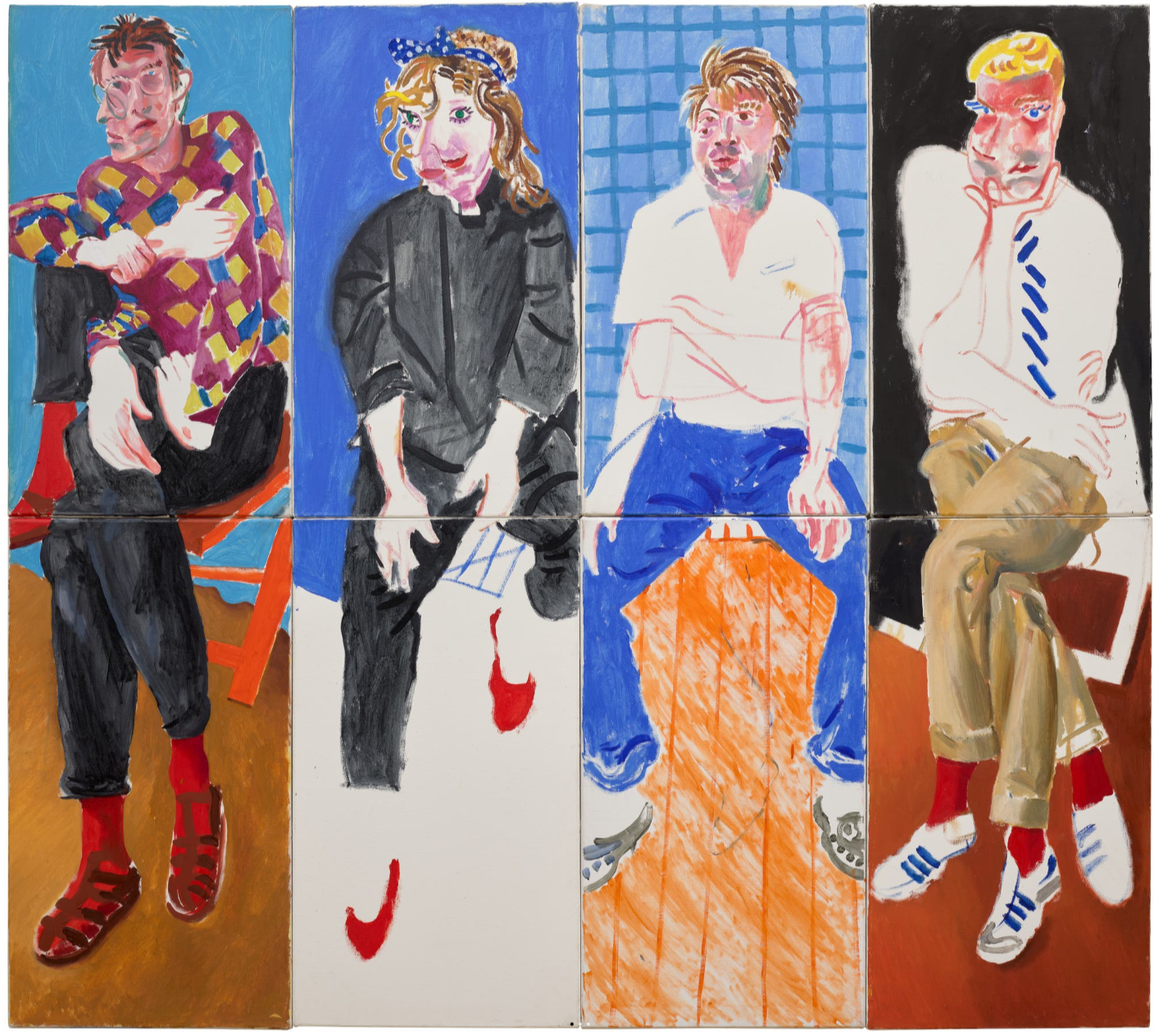
Executed in the summer of 1982, David, Celia, Stephen and Ian, London 1982 occupies a pivotal position in David Hockney’s return to painting following his intensive engagement with composite Polaroid photography. Monumental in scale and ambition, the eight-panel portrait belongs to a breakthrough group of multi-canvas works produced in London that year, through which Hockney translated photographic discoveries about perception, time, and simultaneity into paint. Composed of eight canvases of equal size, each figure divided into upper and lower halves, the work rejects the fixed stillness of conventional portraiture in favor of a dynamic, lived vision. It stands today as a touchstone within Hockney’s oeuvre: an iconic early example of his 1980s exploration of multiple viewpoints and a decisive moment in his long dialogue with Cubism. Much as Pablo Picasso had done with those closest to him, Hockney turned this new way of seeing on his innermost circle: his studio assistant David Graves, the textile designer Celia Birtwell, the painter Stephen Buckley, and the illustrator Ian Falconer, who had recently moved in with him. The result is as much a portrait of friendship and creative community as an experiment in perception, its fractured viewpoints grounded in intimate familiarity.
“I’ve made something of a leap here. […] Never again will anyone I’m painting have to ‘sit’ for me, in the traditional sense—frozen still for hours. I can deal now with their liveliness.”
The importance of the work was recognized early, and it has since appeared in several major institutional exhibitions that situate it within broader narratives of postwar figurative painting and Hockney’s own development. In 1985, it was included in Representation Abroad at the Hirshhorn Museum and Sculpture Garden, Washington, D.C., a group exhibition that, according to its curator Joseph Shannon, brought together what he believed to be “some of the first-rate representational work that is being created outside the United States today.” The painting later featured in David Hockney: Dialogue with Picasso at the Musée Picasso in Paris in 1999, an exhibition dedicated to examining Hockney’s sustained engagement with the modern master, and which coincided with a retrospective of Hockney’s landscape work at the Centre Pompidou. In 2006–2007, it appeared in Hockney’s Portraits and People, a major traveling exhibition organized by the Museum of Fine Arts, Boston, that surveyed over five decades of Hockney’s portrait practice before traveling to the Los Angeles County Museum of Art and the National Portrait Gallery, London.
“It’s as if the medium was fixed in this one way view of the world; photographers seemed to be exclusively concerned with subject matter […] The Cubists were deeply involved in depicting reality more accurately than had previously been done, and I think they did in fact succeed.”
The immediate context for the “leap” Hockney felt he had made in David, Celia, Stephen and Ian, London 1982 lies in the period surrounding his 1982 exhibition at the Centre Georges Pompidou, which focused on the artist’s photographic practice.Preparing for the exhibition prompted Hockney to leaf through his photograph albums, leading to a crucial realization about photography’s relationship to Cubism. This insight sparked a period of obsessive experimentation with composite Polaroids, which made their debut at André Emmerich Gallery in New York shortly before the Pompidou opening. Reflecting on his earliest attempts to bring these ideas back into painting, Hockney wrote that he was “trying to take and use the ideas from the Polaroids. The first efforts were simple, quite simple, but I could begin to see what to do in painting and it was exciting.”
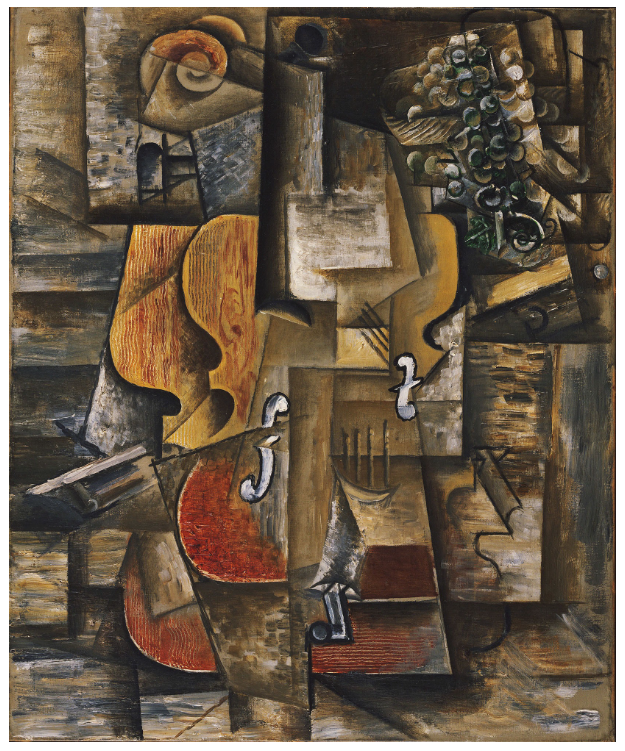
Pablo Picasso, Violin and Grapes (Céret and Sorgues), spring-summer, 1912. Museum of Modern Art, New York. Image: The Museum of Modern Art, New York/Scala, Florence. Artwork: © 2026 Estate of Pablo Picasso / Artists Rights Society (ARS), New York.
The painting emerged directly from this moment of discovery. Each of the four sitters appears against a distinct background and floor, and each portrait possesses its own painterly character. Devices first explored in the Polaroid works—most notably the multiple viewpoints associated with Cubism and the suggestion of bodily movement as a representation of time—recur here, rendered with painterly means. Faces appear simultaneously in profile and frontal view; limbs multiply and overlap; postures subtly shift between panels, “And yet,” Hockney points out, “they don’t read as monsters. They’re clearly and simply individuals in the midst of living.”
Underlying this formal experimentation is Hockney’s sustained engagement with Cubism and, above all, with Picasso. For Hockney, Cubism marked a decisive historical break: the moment when painting began to reckon with how vision actually behaves at close range. In an interview with Lawrence Weschler in 1983, Hockney explained that when one looks closely at something—without “[making] yourself like a camera,” and without maintaining optical distance—forms begin to “swim.” At such proximity, features refuse to remain stable: they shift, repeat, and overlap in ways that defy single-point description. Defending Picasso against accusations of distortion, Hockney insisted, “I don’t think there are any distortions at all,” arguing instead that Cubist portraits register the effects of physical closeness. Referring to Picasso’s portraits of his lover Marie-Thérèse Walter, he noted that “strange things begin to happen to the eyes, the cheeks, the nose—wonderful inversions and repetitions,” effects that arise not from stylistic invention but from the reality of looking closely. “They can’t be distortions,” he concluded, “because they’re reality.”
This understanding of “intimate seeing” is central to the present work and finds particularly pointed expression in Hockney’s portrayal of Celia Birtwell, his lifelong friend and most enduring muse.ix Appearing in more than eighty works over five decades, Birtwell’s likeness is as central to Hockney’s art as swimming pools or landscapes. “Portraits aren’t just made up of drawing,” Hockney once remarked.x “They are made up of other insights as well. Celia is one of the few girls I know really well.”xi In David, Celia, Stephen and Ian, London 1982 her face is rendered from a position of closeness rather than observation at a distance, its subtly disjointed structure reflecting the experience of looking at someone nearby, from multiple angles and moments at once. This approach parallels the composite Polaroid Celia, Los Angeles, April 10th 1982, in which her features multiply and drift across the picture plane. As with Picasso’s portraits of Marie-Thérèse, the fragmentation in Hockney’s portrayal does not signal rupture or analysis, but proximity—an image shaped by physical nearness, familiarity, and affection. In this painting, Hockney focuses intently on her face, paying particular attention to the articulation of individual curls of hair—an approach that directly recalls his most famous painted portrait of Birtwell, Mr and Mrs Clark and Percy from 1970–1971, now among the most iconic works in London’s Tate collection. Birtwell herself, who first sat for Hockney in Paris in 1969, once characterized his work as “never fussy, never cute—just right.”
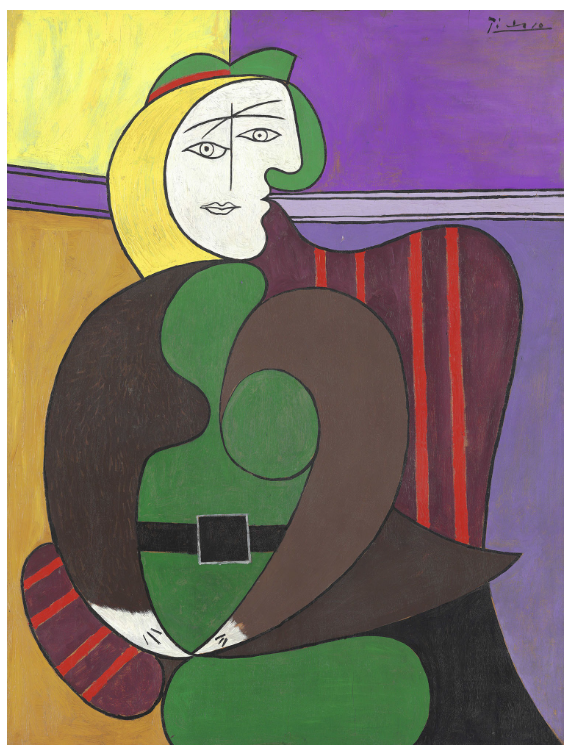
Pablo Picasso, The Red Armchair, December 16, 1931. Art Institute of Chicago. Image: The Art Institute of Chicago / Art Resource, NY/ Scala, Florence. Artwork: © 2026 Estate of Pablo Picasso / Artists Rights Society (ARS), New York
The remaining sitters further anchor the work within Hockney’s immediate creative world. At far left, David Graves—Hockney’s studio assistant and close collaborator—appears wearing a vivid diamond-patterned harlequin shirt, a direct nod to Picasso’s alter ego and to Hockney’s recent work on Parade for the Metropolitan Opera. His fractured body and multiplied limbs closely relate to another painting of 1982, David Graves in a Harlequin Shirt, and underscore his role as both subject and participant in Hockney’s explorations of Cubist perception. Graves also appears in contemporaneous photographs, including David Graves Looking at Bayswater, London and David Graves Pembroke Studios London Tuesday 27th April 1982, functioning less as a formal sitter than as a recurring presence within Hockney’s creative world.
Hockney had singled out Stephen Buckley, the British abstract painter third from left, in his 1976 autobiography, and remarked the following year, “I’ve always had a respect for him.” The painting’s blue gridded background subtly echoes Buckley’s own exploration of pictorial structure and materiality—his use of frames, supports, and surface as active compositional elements. In this way, the portrait captures not only Buckley’s presence but also the conceptual concerns defining his artistic identity. At far right sits Ian Falconer, an illustrator and theater designer Hockney met a few years earlier in New York; by January 1982, he had moved in with Hockney in California. Falconer appears here at the start of a collaborative relationship that would later see him assist Hockney on Los Angeles Opera sets and costumes in the late 1980s and early 1990s. Hockney revisited him in Untitled Portrait of Ian, 1983, repeating the white long-sleeved shirt, crossed arms, and frontal pose. Together, the four figures illustrate Hockney’s engagement with his artistic circle as a dynamic, interconnected community.
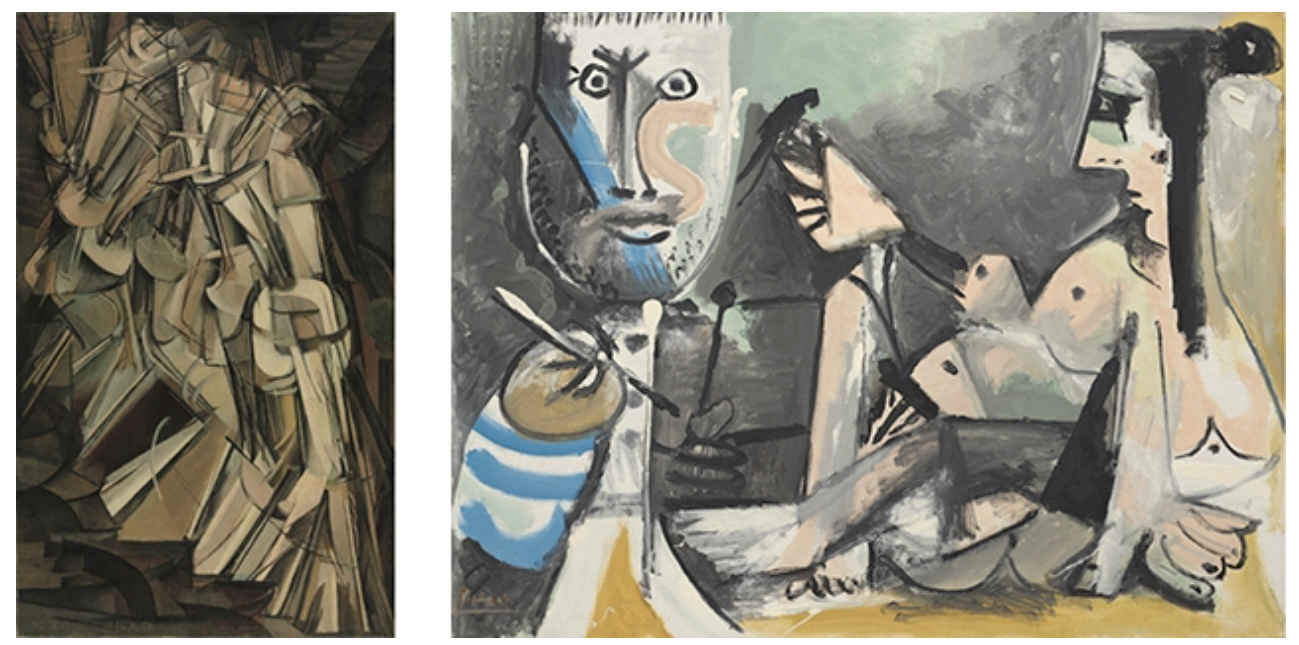
Left. Marcel Duchamp, Nude Descending a Staircase, No. 2, 1912. Philadelphia Museum of Art. Artwork: © 2026 Association Marcel Duchamp / ADAGP, Paris / Artists Rights Society (ARS), New York.
Right. Pablo Picasso, The Artist and His Model, 1968. Buffalo AKG Art Museum, New York. Image: Buffalo AKG Art Museum, Gift of The Seymour H. Knox Foundation, Inc., 1965, 1965:19. Artwork: © 2026 Estate of Pablo Picasso / Artists Rights Society (ARS), New York
Beyond its importance within Hockney’s own practice, David, Celia, Stephen and Ian, London 1982 occupies a critical position within the longer history of portraiture. The questions it raises—about how we see, how time enters an image, and how likeness is formed—would later be pursued systematically in Secret Knowledge, 2001, where Hockney traced the emergence of optical realism in Western art to the early use of devices such as the camera obscura and camera lucida. That investigation reaffirmed his belief that Cubism marked a necessary corrective: the point at which painting abandoned inherited systems of constructed looking in favor of perceptual experience. In this light, the present work aligns Hockney with a lineage of Picasso’s heirs—from Bacon’s compression of sensation to Basquiat’s fusion of inner and outer anatomy—while asserting a distinct conclusion. Here, portraiture is no longer fixed or singular, but simultaneous: an image shaped by time, intimacy, and the embodied act of seeing itself.
Hawthorne Blossom, Woldgate No. 4, 2009
Hawthorne Blossom, Woldgate No. 4, 2009
Property from a Prominent American Collection
Christie’s New-York: 17 November 2026
Estimated: USD 7,000,000 – 10,000,000
DAVID HOCKNEY (1937-2026), Hawthorne Blossom, Woldgate No. 4 | Christie’s
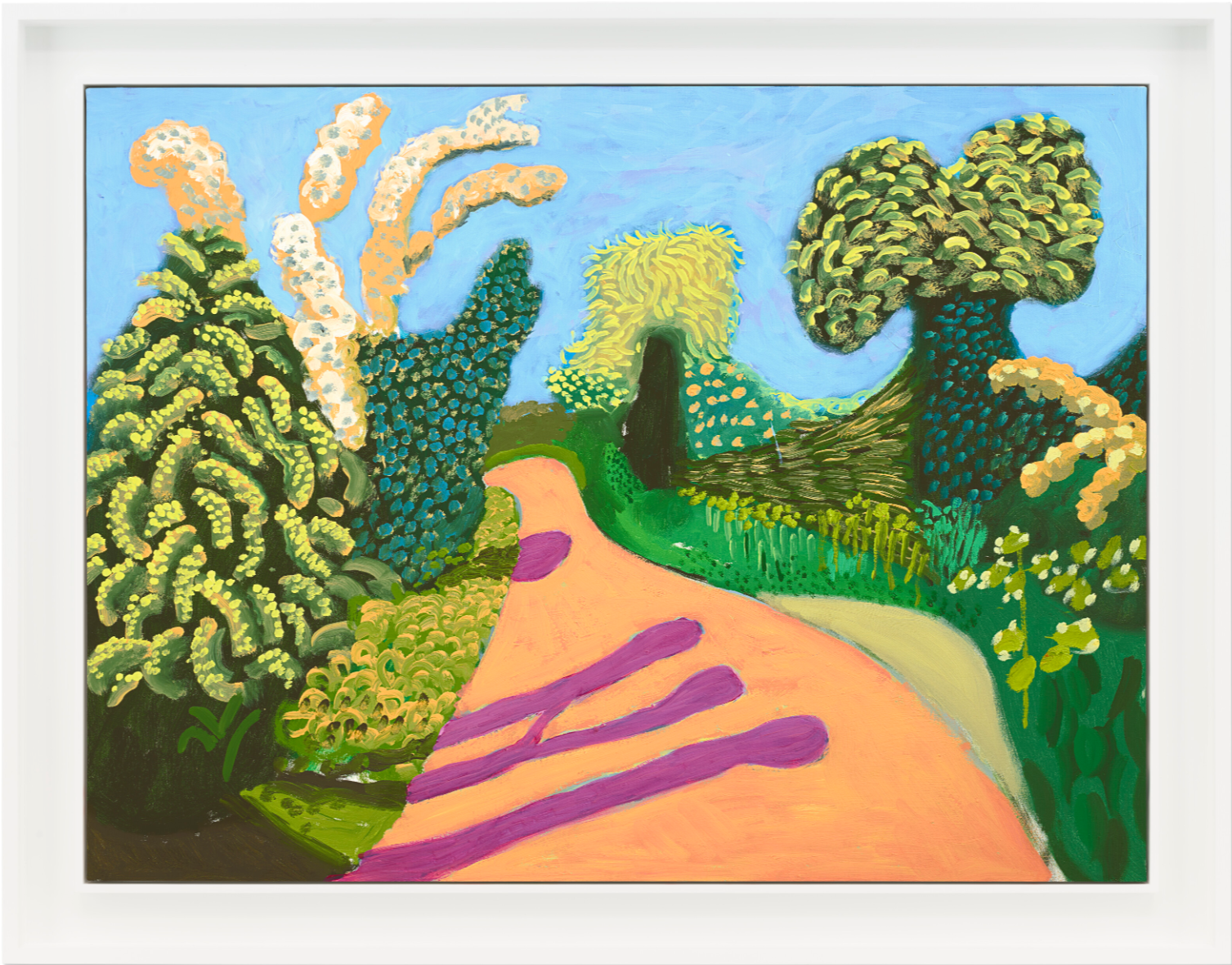
DAVID HOCKNEY (1937-2026)
Hawthorne Blossom, Woldgate No. 4, 2009
Oil on canvas
36×48 inches (91.4 x 121.9 cm)
Signed, dated and titled ‘Hawthorne Blossom Woldgate IV David Hockney 2009’ (on the reverse)
Painted in 2009, David Hockney’s Hawthorne Blossom, Woldgate No. 4 is a remarkable example of the prodigious talent of one of the world’s most celebrated contemporary artists. Executed en plein air in his native Yorkshire, England, when the artist was at the height of his painterly powers, it demonstrates both the technical and compositional skills for which Hockney is so widely admired.
Marco Livingstone, the curator of Hockney’s critically acclaimed exhibition of landscapes organized by London’s Royal Academy of Arts in 2012, described the Wolds paintings thus: “The paintings… [Hockney] has made of the Wolds… are in purely technical terms—but also in their observational and evocation of space—the most commanding he has ever made” (quoted in E. Devaney, “David Hockney: A Chronology,” in M. Livingstone & E. Devaney, eds., David Hockney: A Bigger Picture, exh. cat., Royal Academy, London 2012, p. 294).
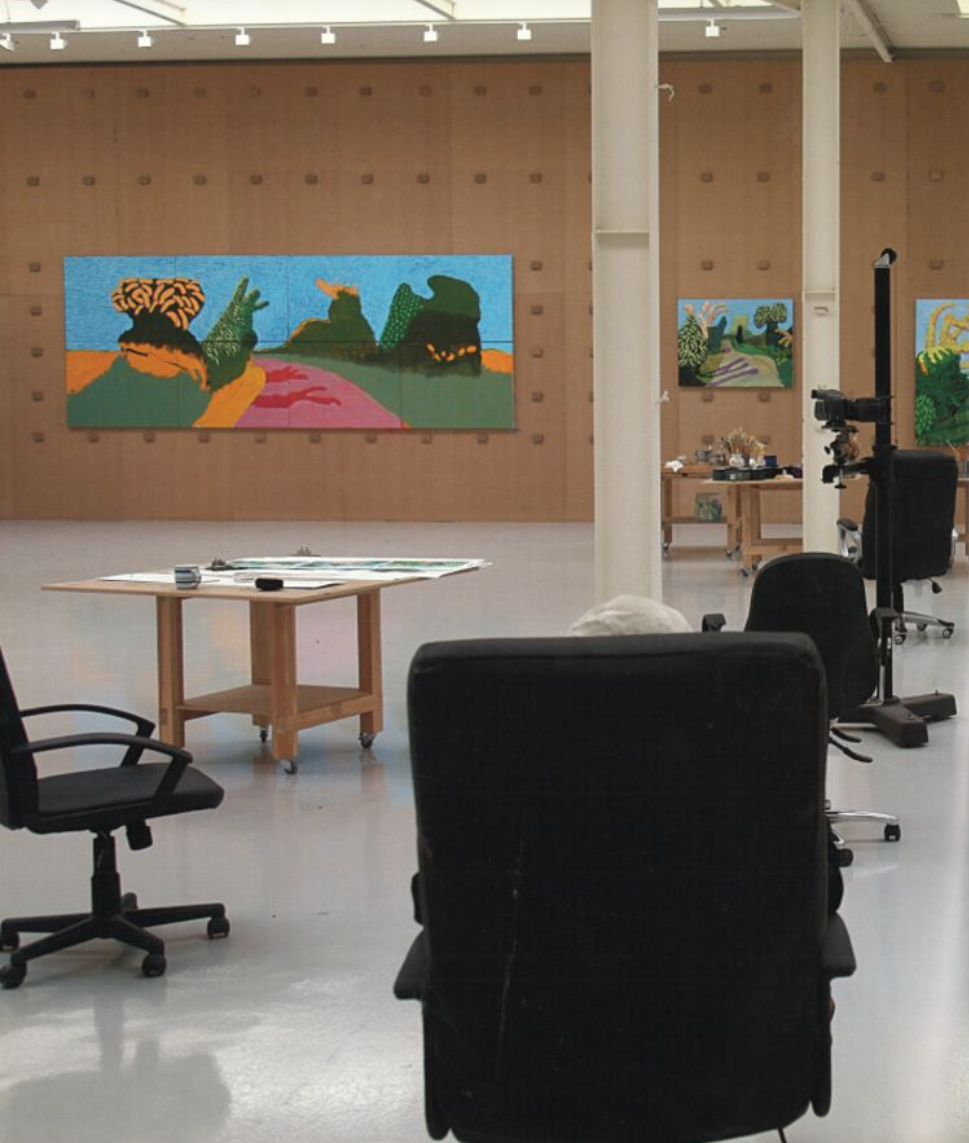
David Hockney in his studio, 2009 (present lot illustrated). Photo: © Johnathan Wilkinson. Artwork: © David Hockney.
In 2002, after decades of living and working in Los Angeles, Hockney began to spend more time in the East Riding of Yorkshire, England, a verdant setting that subsequently became one of his most important subjects, and in time, the almost exclusive focus of his painterly activities. The move unleashed a new sense of creativity in the artist. Seeing a familiar landscape afresh, as though through the prism of California light, he painted his beloved Yorkshire with renewed vigor.
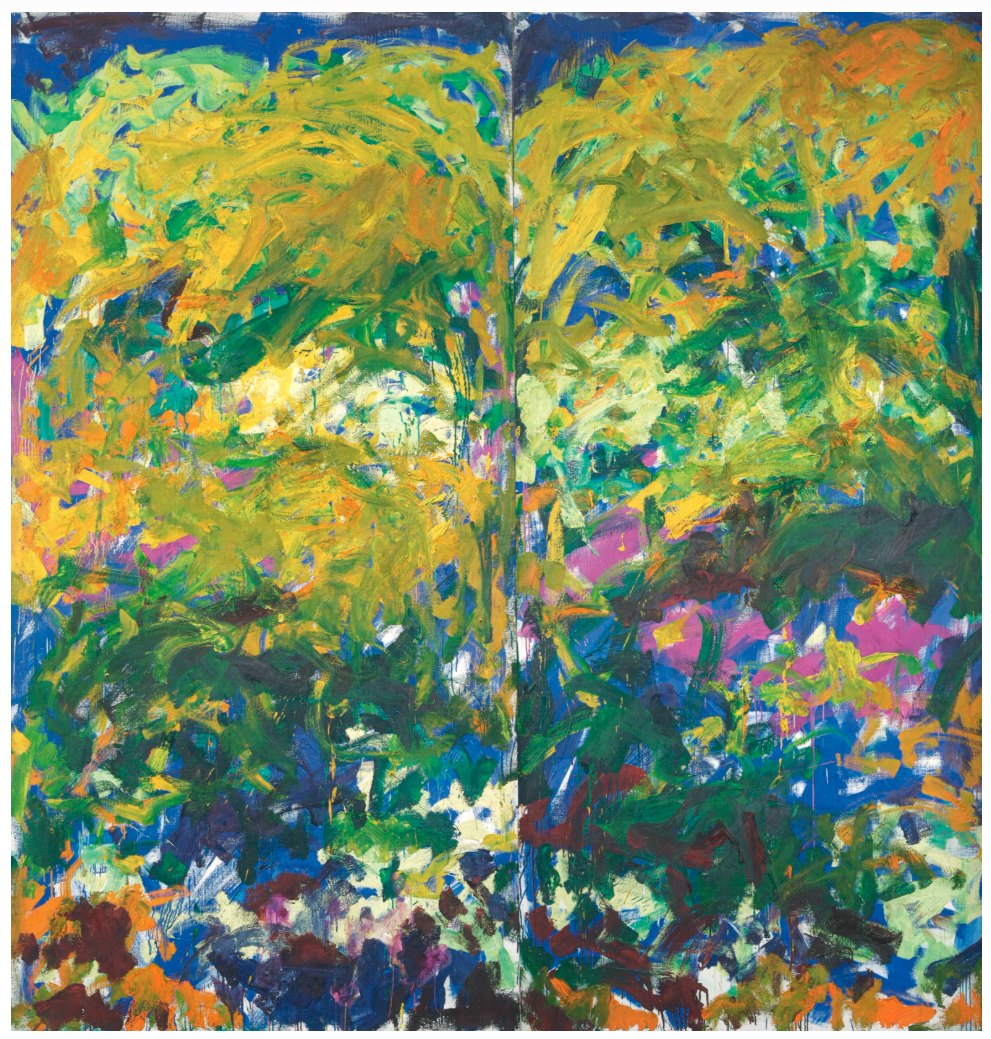
Joan Mitchell, La Grande Vallée IX, 1983. Collection FRAC Normandie, on permanent loan at the Musée des impressionnismes, Giverny.
© Estate of Joan Mitchell.
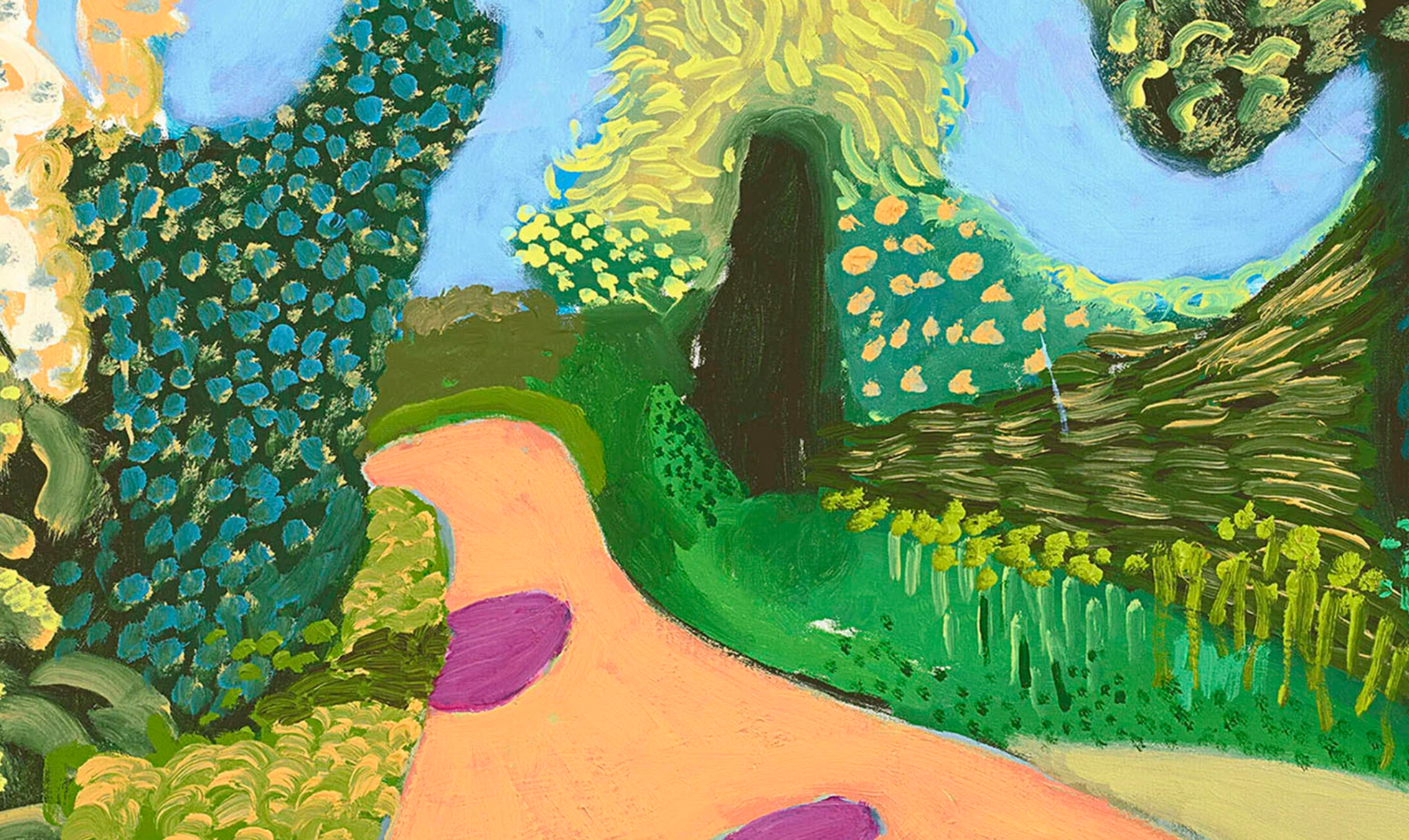
The result is a painting such as Hawthorne Blossom, Woldgate No. 4. Through bold color and detailed observation of the rich and varied vegetation, Hockney captures the lush and leafy countryside of a sun-soaked English summer day. A meandering country lane draws the eye into the painting, offering up both an entry point into the composition and guiding us through the hedges and trees weighed down with the blossom that gives the work its evocative title.
On either side of the path, bushes stand like sentries guarding the entrance to a fabled land. Each is distinguished by its unique foliage (rendered in shifting shades of green) and the degree to which it is covered in abundant blossoms: soft creams, bright yellows, and every shade in between create a canopy of sumptuous abundance. Most striking in the present work are the purple shadows that creep across the lane; a nod, perhaps, to the Fauves and their striking non-representational use of color. This palette also speaks to Hockney’s keen eye and his close relationship with nature, through which he masterfully observes and distills the shifting light of mercurial skies drifting across the open countryside.
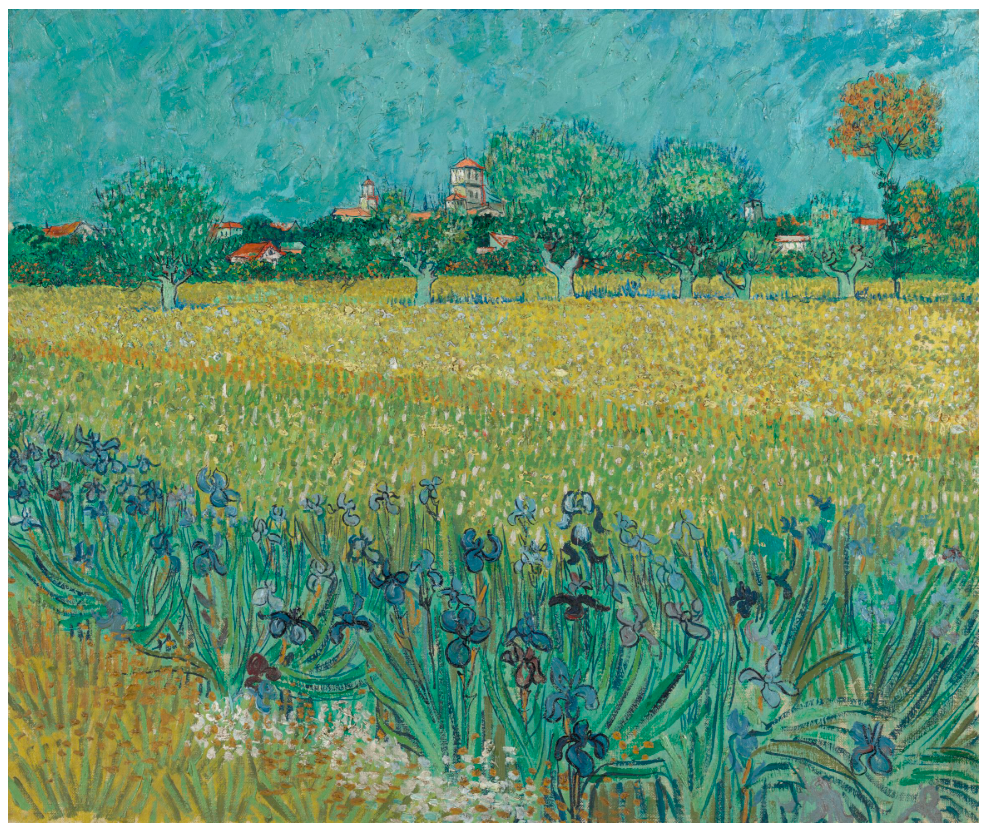
Vincent van Gogh, Field with Irises near Arles, 1888. Van Gogh Museum, Amsterdam.
The present work belongs among Hockney’s earliest Yorkshire landscapes painted en plein air, and its fluid lines are testament to the speed at which he worked. He painted swiftly, seizing the fleeting moments of bright sunlight that accentuate the intense brilliance of the season’s colors. “The light changes so quickly up here,” Hockney once remarked, “so you have to choose how you want to depict it… Outdoors, especially in northern Europe, the scene is constantly changing because the light conditions seldom stay the same for long. The sun moves, clouds move over the sky” (D. Hockney, quoted by M. Gayford, “David Hockney: The Technology of Art” in M. Livingstone & E. Devaney, op. cit., p. 62).
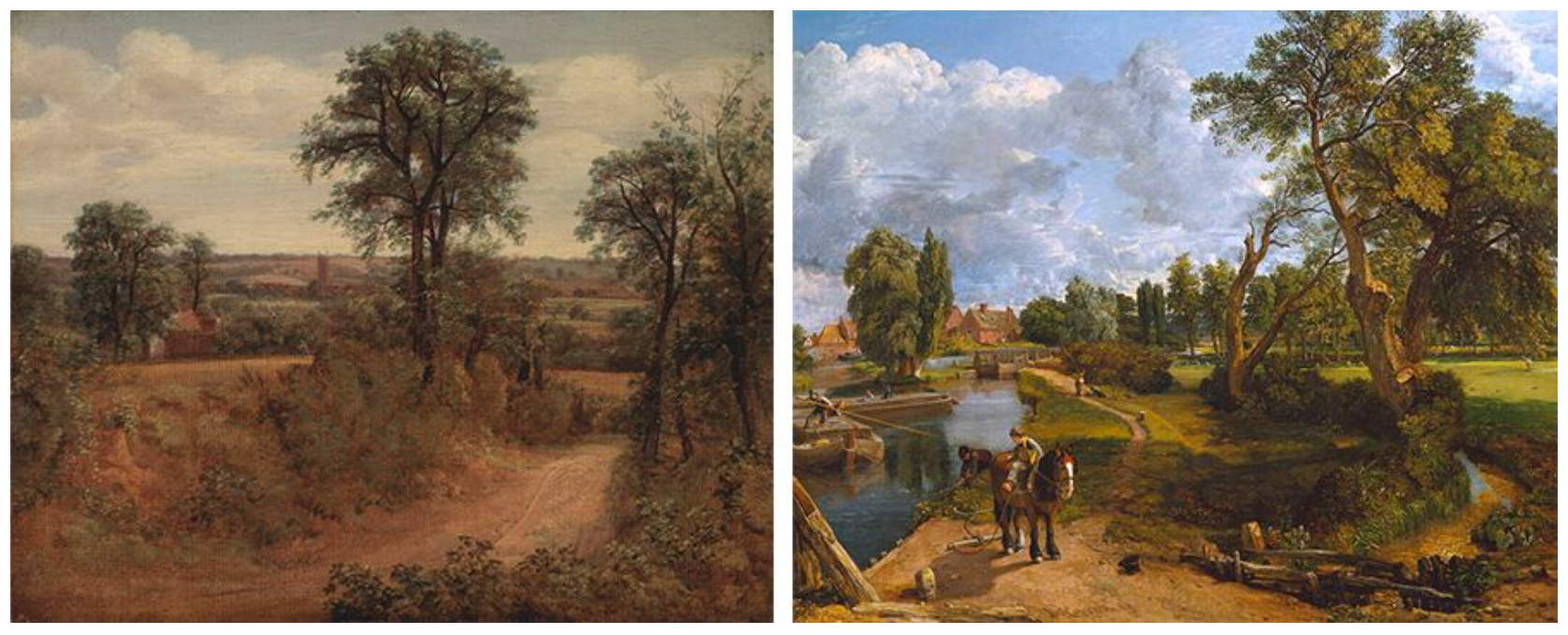
Left: John Constable, Lane near Dedham, 1802. Yale Center for British Art, New Haven.
Right: John Constable, Flatford Mill (‘Scene on a Navigable River’), 1816-1817. Tate Britain, London.
In this series, Hockney makes his own distinctive contribution to the grand tradition of landscape painting. He found inspiration in the paintings of Vincent van Gogh, particularly those made in Arles towards the end of the Dutch artist’s life. Hockney shares van Gogh’s fascination with light and his ability to convey its intensity through the juxtaposition of color. He also admired the speed at which Van Gogh worked and the restraint of his line, in addition to his ingenious use of perspective, all qualities evident in the present work. Beyond Van Gogh, Hockney was a great admirer of the landscape tradition at large and cites many other influences, Monet and Constable in particular. In 2006, Hockney visited a major exhibition of Constable’s work at Tate Britain, in London, and traveled to Paris to experience Monet’s Nymphéas in the newly refurbished Musée de l’Orangerie.
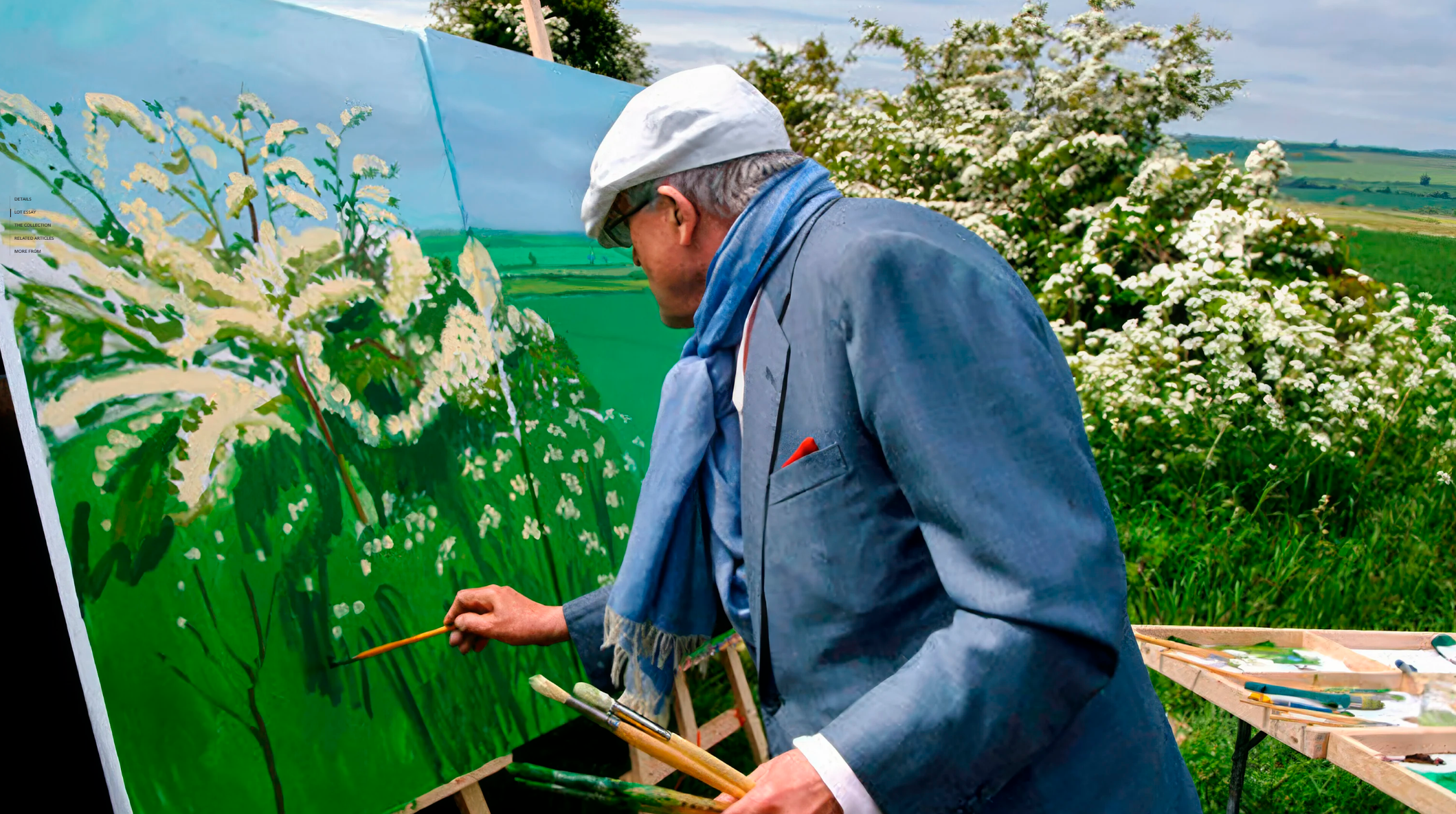
David Hockney painting Woldgate Before Kilham, 2007. Photo: Jean-Pierre Goncalves de Lima / Film Movement.
Artwork: © David Hockney.
But it was Yorkshire that remained his true inspiration; his family had worked the land there for generations, and it was where he himself had spent much time as a teenager. Even though he escaped post-war England for the sunshine of California when he was in his twenties, in many ways Yorkshire was always home. On his return in his seventies, Hockney began to explore the area anew, driving through country lanes, observing the scenery with a sense of excitement. He reveled not only in its beauty, but also in the emotional resonance it held for him. “I began to notice it was very beautiful, a cultivated landscape… and very unspoiled. It’s still the same, amazingly the same, as it was fifty years ago” (D. Hockney, quoted by C. S. Sykes, David Hockney, The Biography 1975-2012: A Pilgrim’s Progress, New York, 2014, p. 361).
Alliums, 1996
Alliums, 1996
Property from a Distinguished West Coast Collection
Sotheby’s New-York: 16 November 2026
Estimated: USD 5,000,000 – 7,000,000
David Hockney | Alliums | The Now and Contemporary Evening Auction |
DAVID HOCKNEY (1937 – 2026)
Alliums, 1996
Oil on canvas
48×36 inches (121.9 x 91.4 cm)
Signed, titled and dated 1996 (on the reverse)
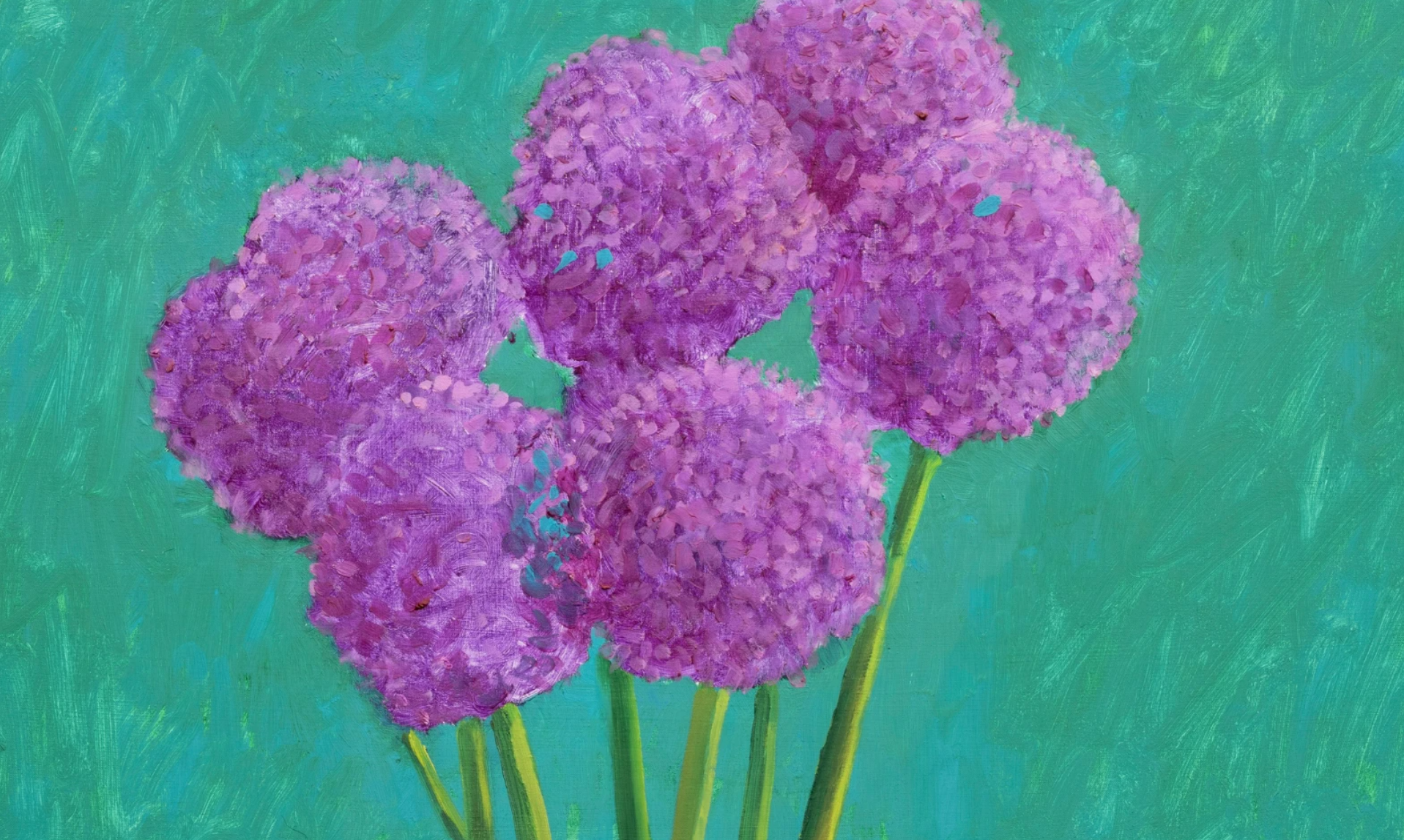
Rife with rich hues and compelling perspective, Alliums is a stunning exemplar of David Hockney’s iconic still life paintings. Embodying the alluring settings and deft application of color that characterize Hockney’s celebrated practice, Alliums presents a fresh take on contemporary life, transforming the quotidian into the iconic through vivid imagery and color that evoke both mood and memory. Following a visit to a Johannes Vermeer exhibition in The Hague earlier that year, Hockney was inspired by the delicate atmosphere of light created by the Dutch master. He returned to his studio with a renewed devotion to figurative painting after nearly a decade-long focus on photography and abstraction, with a fervent burst of creative energy.
“The profundity is not in the subject; it is the way it’s dealt with.”
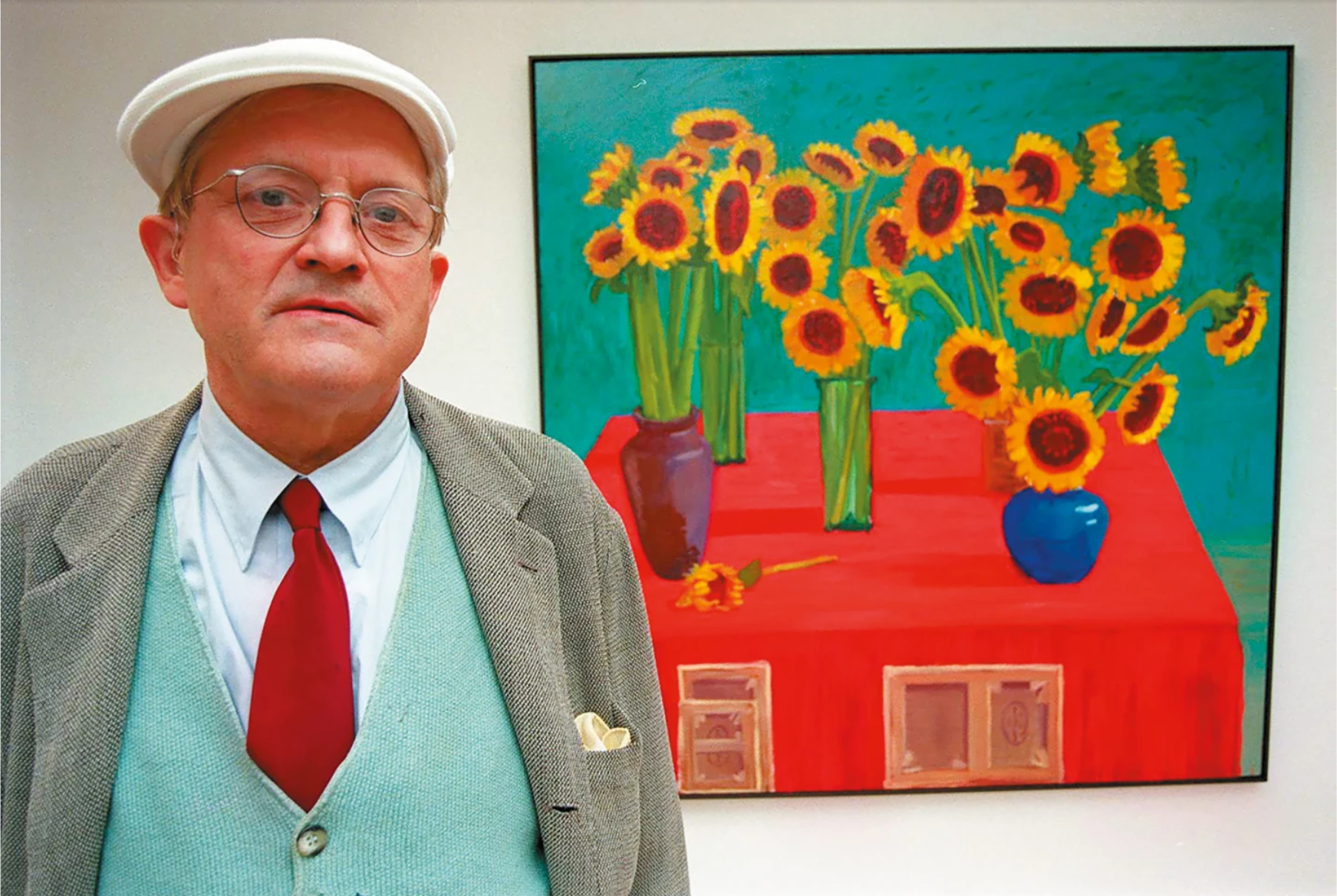
David Hockney in front of 30 Sunflowers at Flowers, Faces & Spaces at Annely Juda Fine Art, London, July 1997.
Photo courtesy Alamy. Art © 2026 David Hockney
One of twenty-five paintings from Hockney’s 1996 Flower series during this period, Alliums recalls the timeless classicism of Henri Matisse and Claude Monet while simultaneously paying homage to the technical aptitude of the Dutch Golden Age painters. Exhibiting a uniquely jewel-toned, Fauvist-inspired darkened palette and an opaque amphora in place of the sleek vessels that appear throughout much of the series, Alliums is distinguished by the elegant unification of its classic subject and masterful gestural brushwork, resolving in one of the finest compositions from the series to come to market and one of the most poignant works within the artist’s inimitable oeuvre.
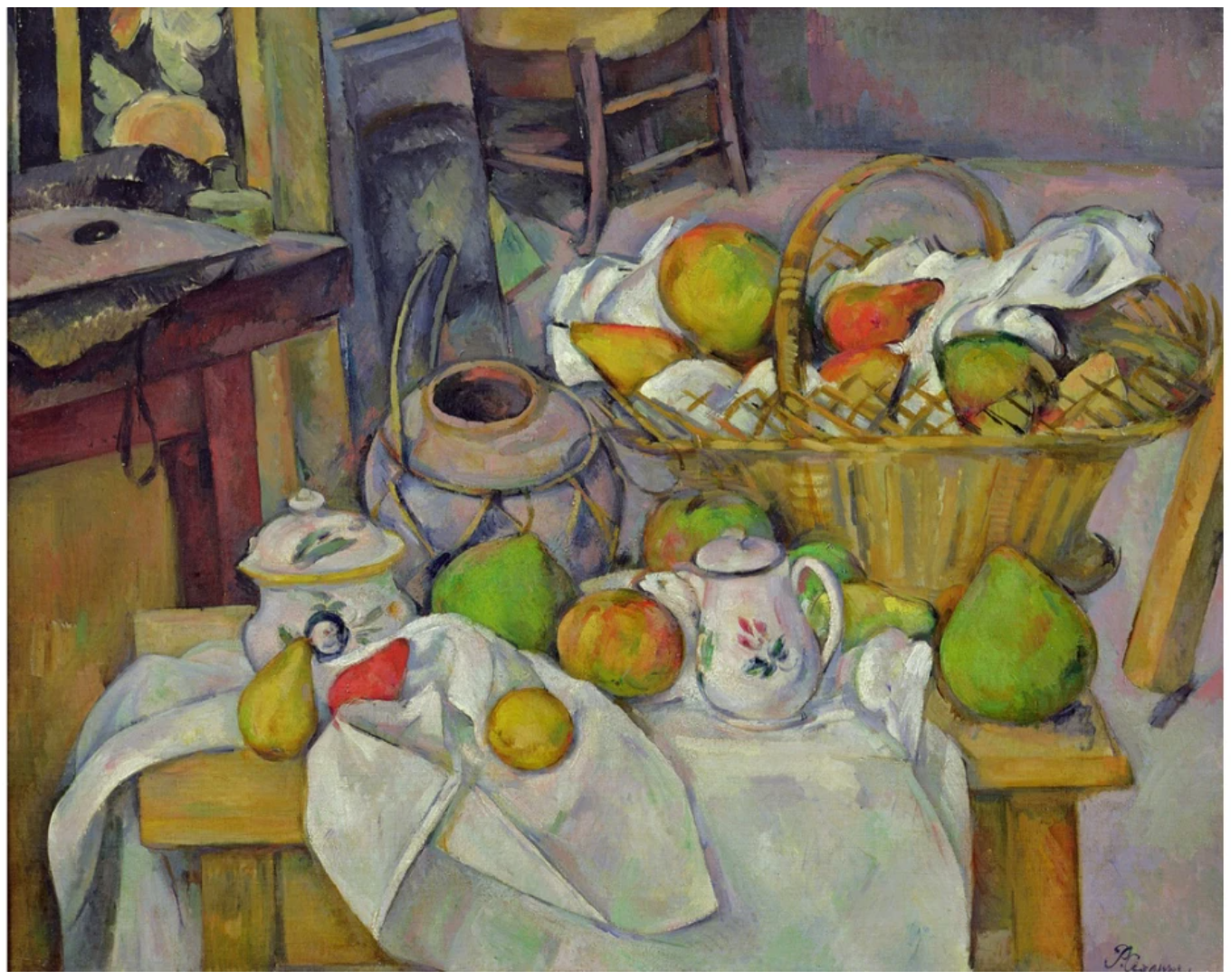
Paul Cézanne, Still Life with Basket, 1888-90. Musée d’Orsay, Paris. Image © Bridgeman Images
Inasmuch as these works mark Hockney’s return to painting following years devoted to portraiture, landscape, photography, and abstraction, the flowers series of 1996 reveals a newfound emotional resonance within the artist’s practice. Completed during an exceptionally challenging period in Hockney’s life following the passing of his dear friend Henry Geldzahler and painter Sandra Fisher, close friend and wife of R.B. Kitaj, the present work imbues the still-life genre with a profound sense of reflection and remembrance.
Hockney had long painted intimate flower arrangements as gifts for friends, yet in the throes of grief the motif became a vessel through which painting itself could be rediscovered as a meditative exercise in observation, light, and color. The flowers recall the emotive power of the vanitas tradition, quietly evoking the transience of life and the fragility of worldly experience, a charge only deepened now following the artist’s passing in June. Alliums thus possesses a particularly affecting presence and occupies a singular position within Hockney’s practice.
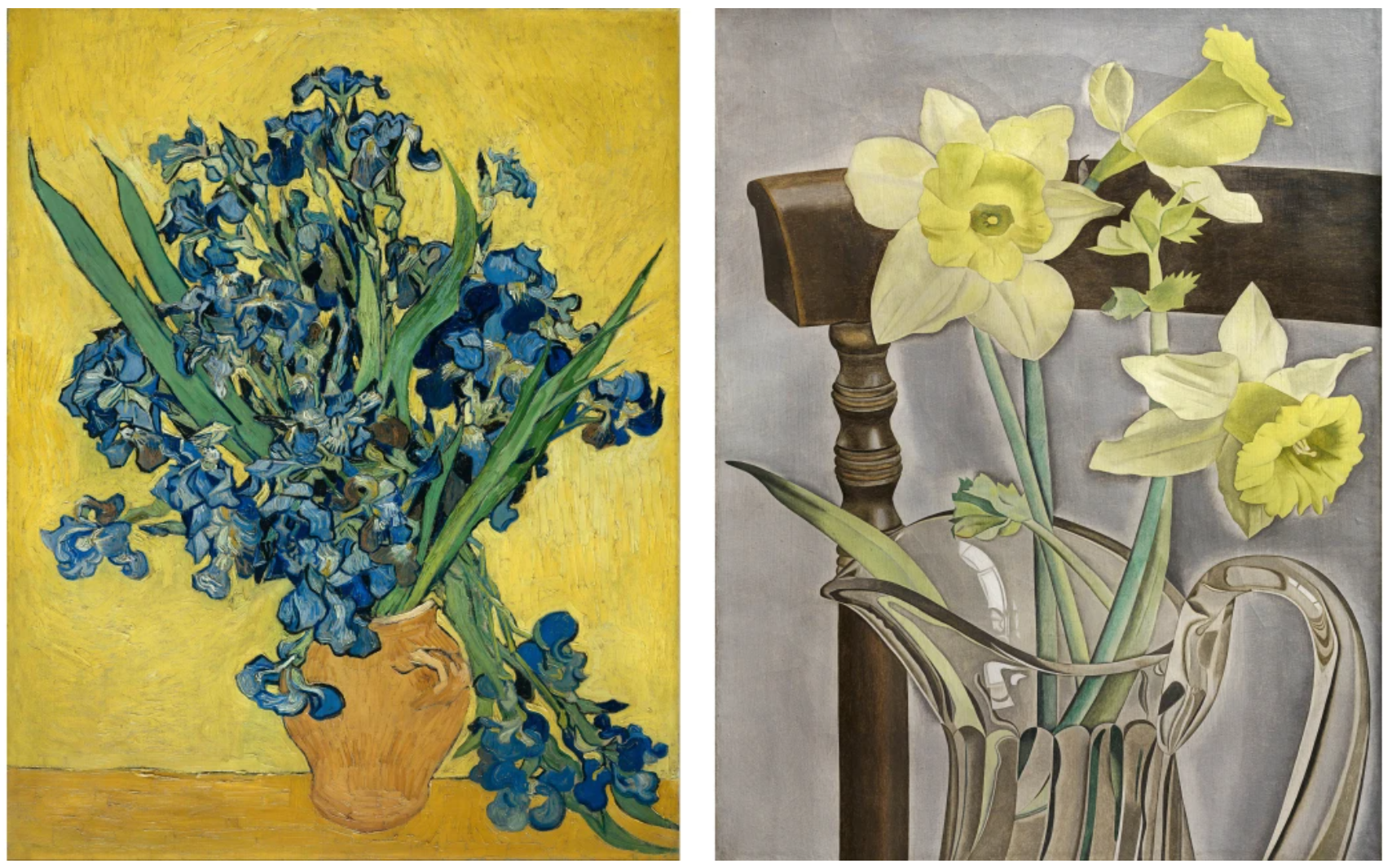
Left: Vincent van Gogh, Irises, 1890. Van Gogh Museum, Amsterdam. Image © Bridgeman Images. Right: Lucian Freud, Daffodils and Celery, 1946. Private Collection. Image and Art © The Lucian Freud Archive. All Rights Reserved 2026 / Bridgeman Images
Testament to Hockney’s momentous undertaking of traditional subject matter—the venerated still life—at the height of his artistic production, the present work draws from his art historical predecessors, combining the compositional balance of Giorgio Morandi with the saturated forms of Vincent van Gogh and Paul Cézanne. In its exploration of the fundamentals of still life painting- color, light, and form- Alliums invokes not only a centuries-old art historical tradition but also a motif that is of central importance within Hockney’s own oeuvre.
“Painting still lifes can be as exciting as anything can be in painting. I remember once saying to Francis Bacon in Paris that I knew a painting in California of tulips in a vase that was as profound as any painting he’d made.
I think at first he almost thought I was referring to my own, but I was referring to the Cézanne in the Norton Simon Museum.
It’s the most beautiful painting, and it is as profound as anything he did. Just some tulips in a vase.”
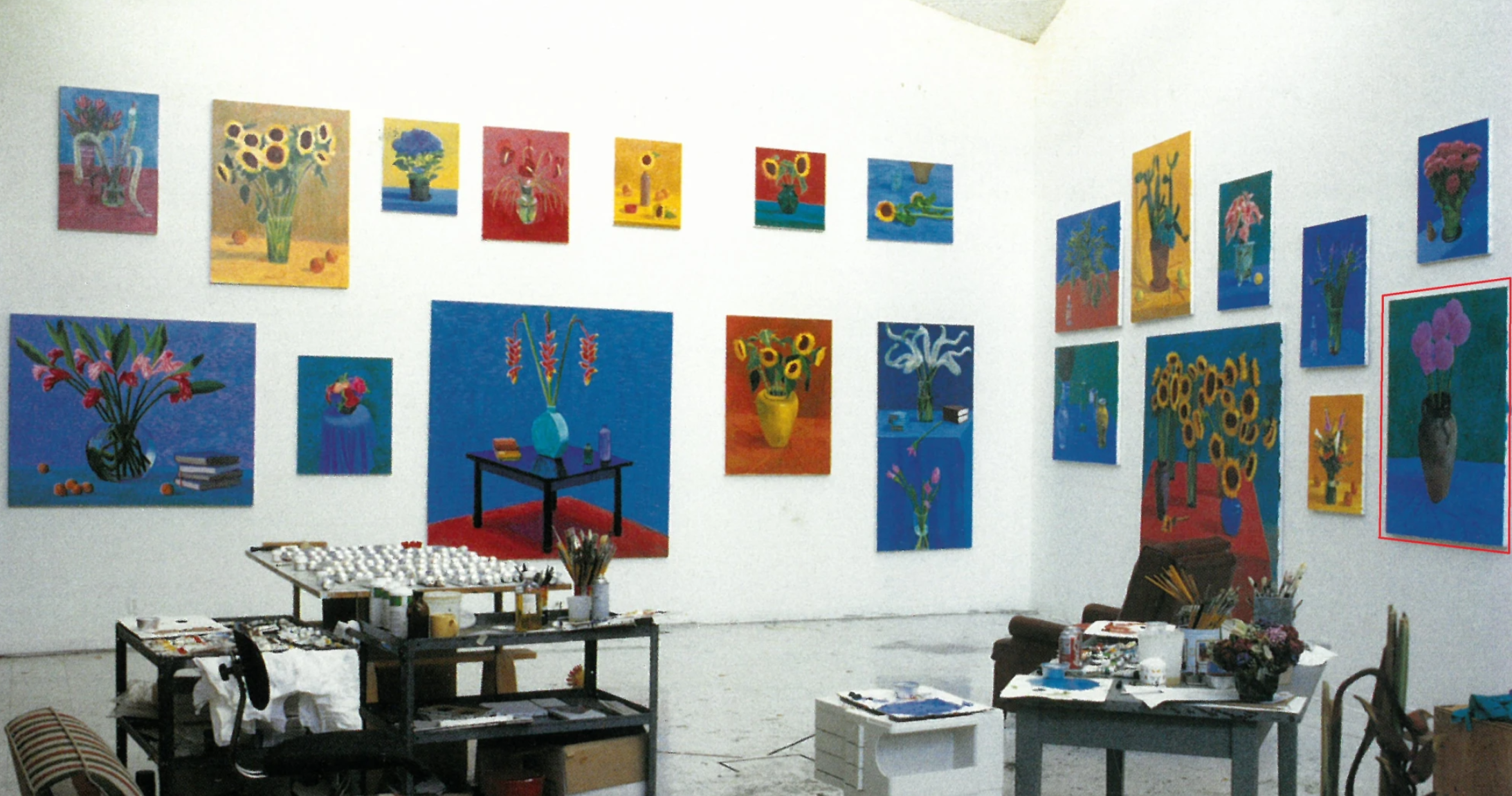
The present work in David Hockney’s studio, Los Angeles, autumn 1996. Art © 2026 David Hockney
Still life painting first captured Hockney’s devotion in the 1960s and served as the focus for a number of early works; from there, through the meticulous realism of the artist’s 1970s painting; to his colorful abstractions of the 1980s; to his pivotal Flowers of the mid-1990s, this captivating subject allowed Hockney to continually renegotiate his singular creative vision. Through the churning immediacy of his brushwork set against the jewel-like delicacy of the vase, in Alliums, Hockney creates an entirely unique artistic vernacular that relies on his idiosyncratic handling of paint.
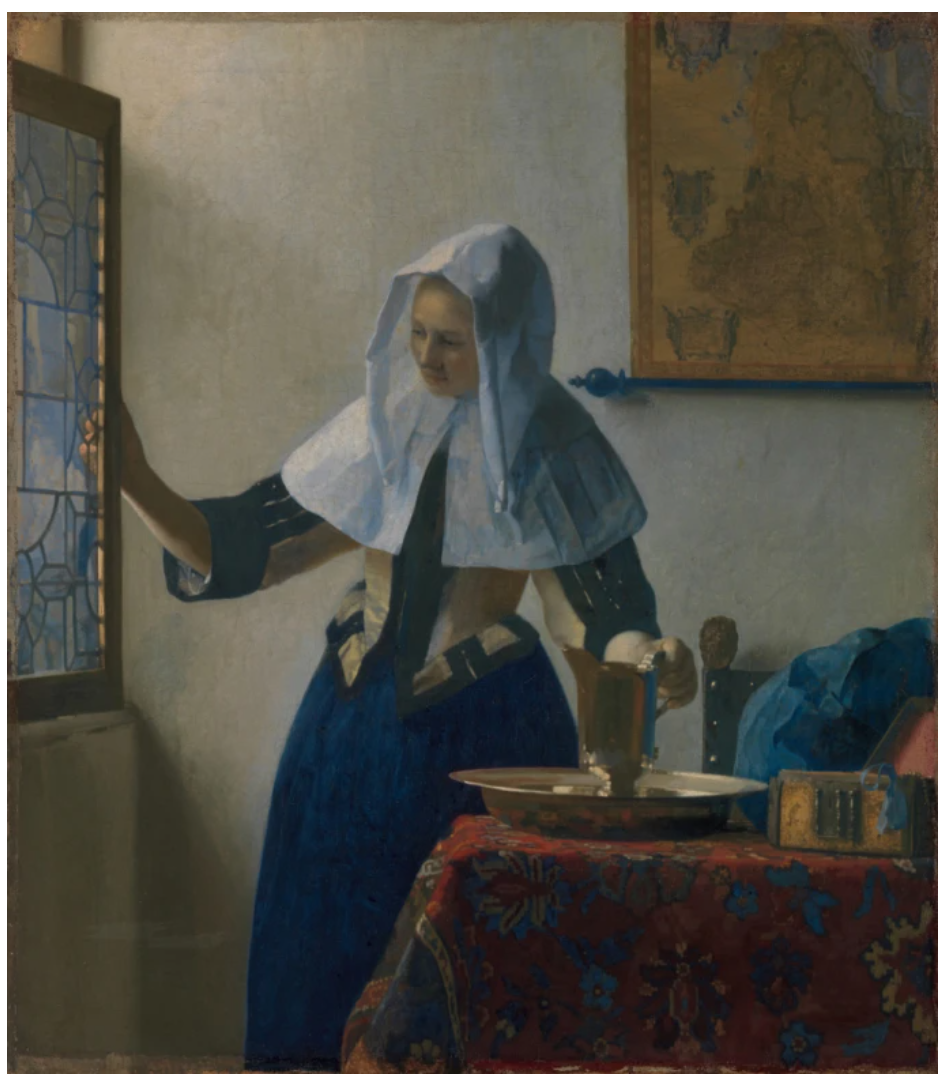
Johannes Vermeer, Young Woman with a Water Jug, c. 1662. The Metropolitan Museum of Art, New York. Image © Bridgeman Images
The present work displays Hockney at his best: rich with chromatic vibrancy, complex in composition, and generously detailed. Alliums exemplifies Hockney’s career-long exploration of the classical traditions of still life, tenderly capturing the ephemeral nature of life and beauty. With a refreshed interest in still life painting and an unrivaled appreciation for the mid-morning northern California light that illuminated the artist’s everyday life, Hockney situates Alliums within the tradition of classical painting and technique, nevertheless endowing the work with his distinct perspective. Alliums is the supreme quintessence of Hockney’s artistic output that establishes him as one of the greatest artists of this century.
A Visit with Mo and Lisa, 1984
A Visit with Mo and Lisa, 1984
Sotheby’s New-York: 16 November 2026
Estimated: USD 3,000,000 – 4,000,000
WORK ON PAPER
GUARANTEED PROPERTY
David Hockney | A Visit with Mo and Lisa, Echo Park, Los Angeles |
DAVID HOCKNEY (1937 – 2026)
A Visit with Mo and Lisa, Echo Park, Los Angeles, 1984
Gouache, wax crayon and graphite on paper, in two parts
Left sheet: 60-3/4 x 102-1/2 inches (154.3 x 260.4 cm)
Right sheet: 60-3/4 x 99-1/2 inches (154.3 x 252.73 cm)
Signed with the artist’s initials and dated 84 (lower right)
Kaleidoscopic and vibrant, David Hockney’s A Visit with Mo and Lisa, Echo Park from 1984 is one of Hockney’ earliest monumental diptychs. In this piecewise collage of inside and outside, man-made and natural, Hockney pays tribute to the Southern Californian landscape that became his home in the 1960s. Executed from multiple viewpoints, this work not only mirrors the sprawling Los Angeles expanse, but also the progressive cultural freedom Hockney enjoyed upon his move to California. Named after his friends Mo McDermott and Lisa Lombardi, whose own works Hockney kept in his home, this work, imbued with Hockney’s deep affection for what and who Los Angeles brought him in this pivotal decade, is expressed in his iconic, singular visual language. Once held in the esteemed Anderson Collection and featured in Hockney’s major 1988 retrospective across the Tate, London, Los Angeles County Museum of Art, and the Metropolitan Museum of Art, New York, A Visit with Mo and Lisa, Echo Park is an exceptional example of the artist’s tributes to California on a monumental scale.
“California always affected me with color. Because of the light you see more color, people wear more colorful clothes, you notice it, it doesn’t look garish: there is more color in life here.”
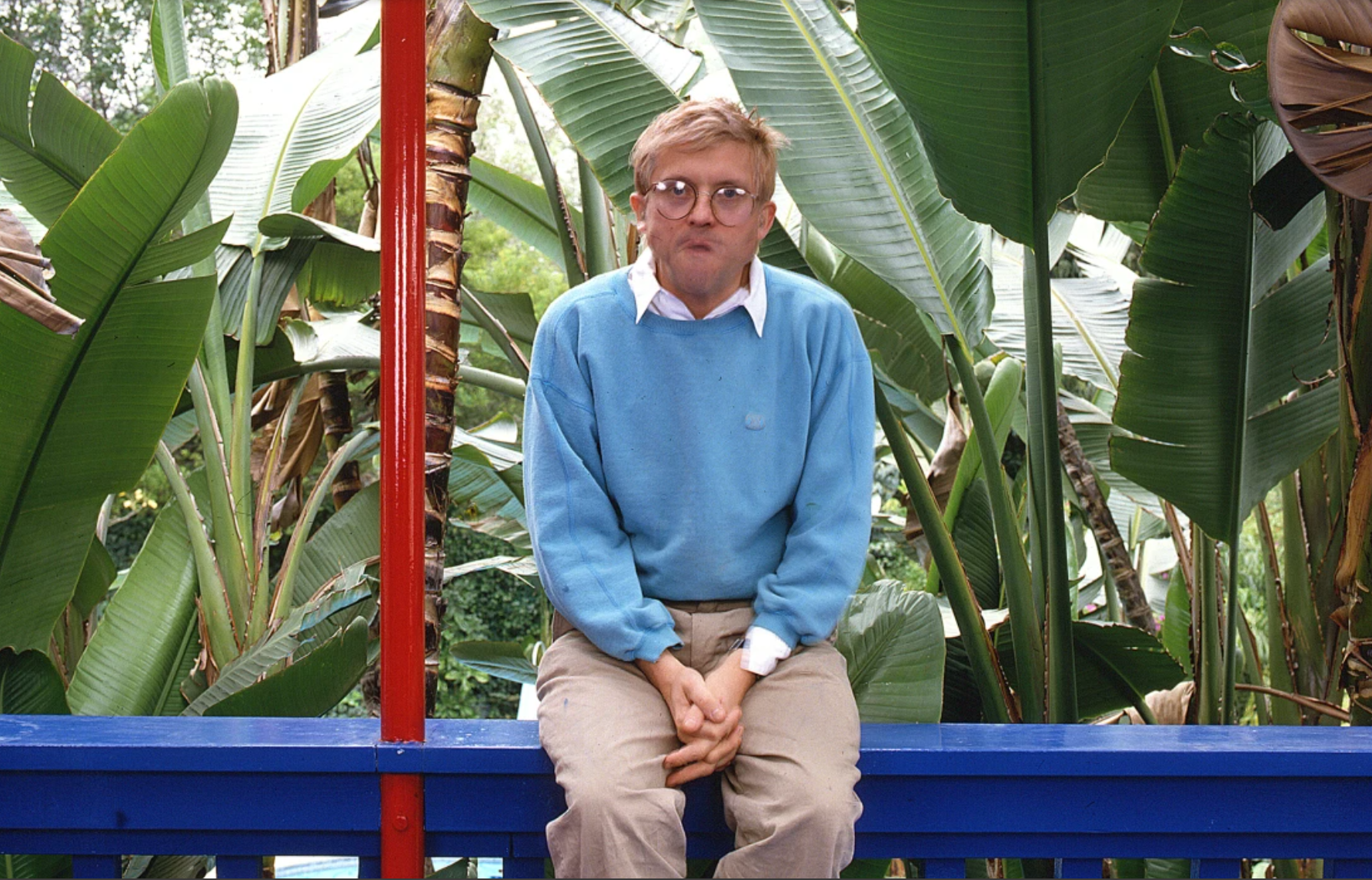
David Hockney on the porch of his Los Angeles home, 1987. Photo © Anthony Barboza/Getty Images
The present work unites indoor and outdoor, private and public, near and far, all in one immersive visual experience. Reading left to right, this composition physically traces a stone path through Mo and Lisa’s garden, while glimpses of their bedroom, their roof, and their backyard all appear as if presented at once or in a fragmented memory of their home. The viewpoint is deliberately fragmented and dynamic, merging multiple perspectives in a single frame—a visual strategy Hockney had been exploring since his photocollages and cubist-inspired experiments of the late 1970s. In this work, the juxtaposition of high and low vantage points and outlined, hollow, or mosaic-like forms serves to flatten the pictorial space while simultaneously suggesting a cinematic sweep across the domestic landscape. The red shingled roof and distant, fragmented blue sky evoke the quintessential aesthetics of Los Angeles domestic architecture, while the vibrant palette—cobalt blue, lush green, canary yellow—underscores the artist’s confidence in color as a psychological and compositional tool.
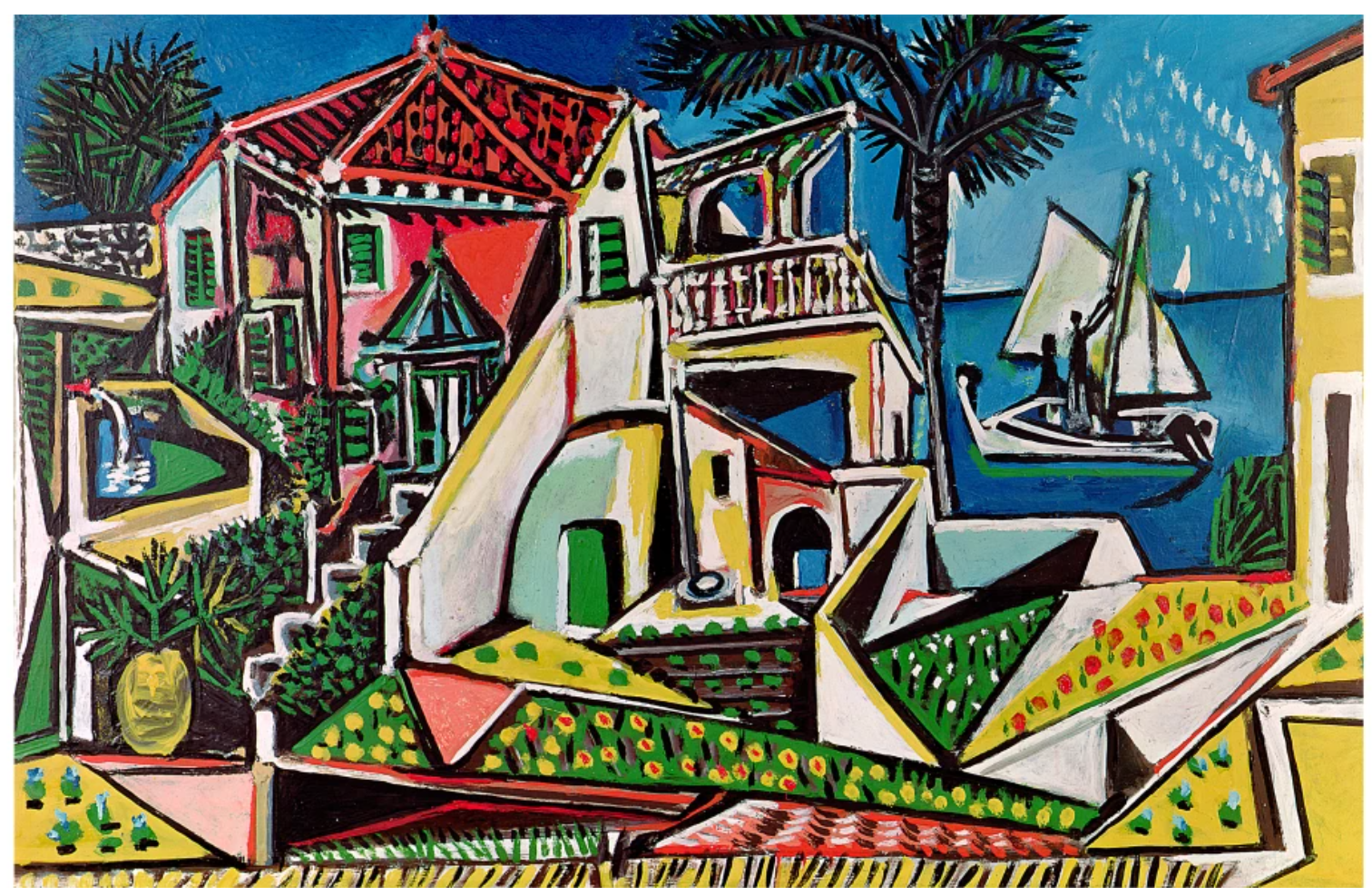
Pablo Picasso, Mediterranean Landscape, 1952. Albertina Museum, Vienna.
Image © Bridgeman Images. Art © 2026 Estate of Pablo Picasso / Artists Rights Society (ARS), New York
This deliberate flattening and segmentation of space finds a potent art-historical echo in the works of Henri Matisse, whose own use of color fields and interior/exterior contrasts Hockney greatly admired. Yet, unlike Matisse’s often enclosed domestic views, Hockney’s composition opens outward—a gesture of expansiveness both physical and metaphorical. The collapsing of perspective at such scale produces a kaleidoscope of motifs, all of which comprise an iconic Hockney scene in and of themselves. From the chez lounge in the cobalt blue living room to the negative spaces comprising the outdoor furniture of the couple’s garden to the downtown skyline in the upper register, these works recontextualize Hockney’s mastery of color, space, and mood on a grand scale.
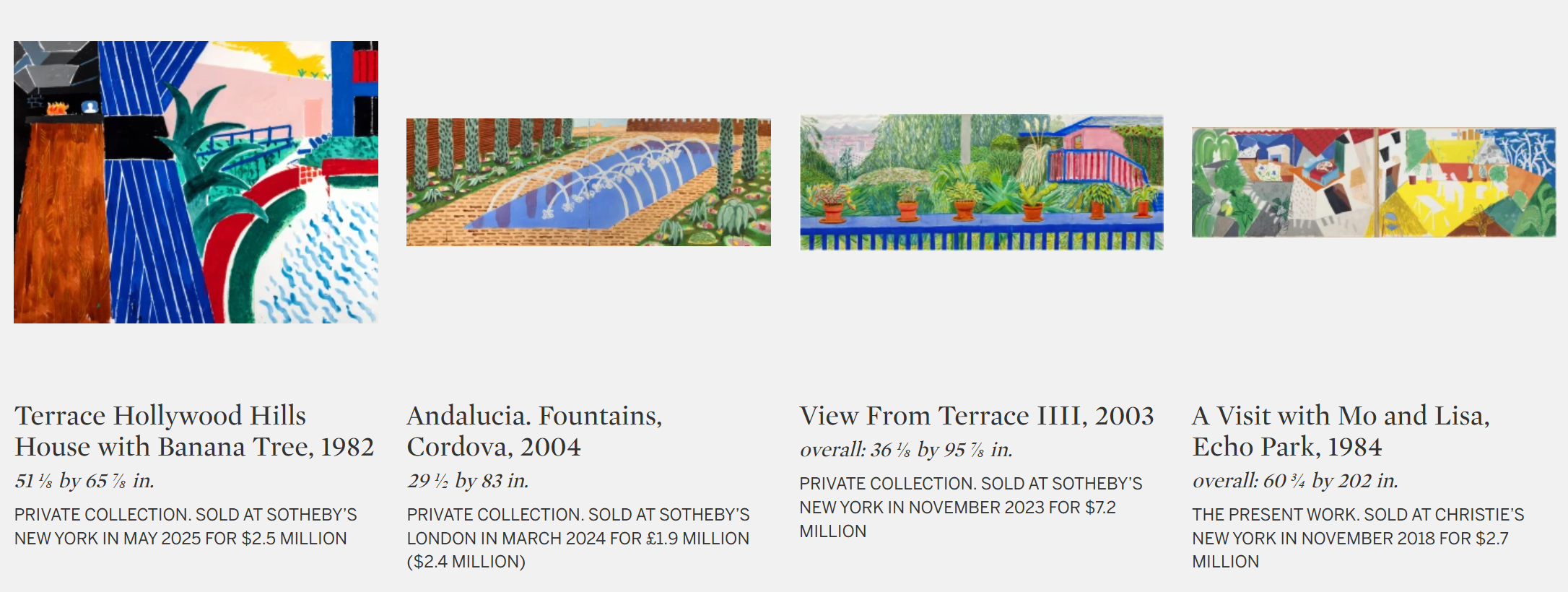
Market Precedent: David Hockney Major Works on Paper
Mo McDermott and Lisa Lombardi, friends and fellow artists within Hockney’s California circle, had gifted the artist a number of their own sculptures for his home. Sharing Hockney’s affinity for the imaginary, the idealized, and the joyful, these works almost appear plucked from Hockney’s flattened compositions and transformed into free-standing, whimsical forms. The friendship and artistic dialogue between Hockney and the couple are fittingly expressed in the present work’s playful and palpably personal atmosphere. At once fragmented and deeply unified, A Visit with Mo and Lisa, Echo Park is an exceptional example of Hockney’s singular ability to convey nostalgia, memory, and intimacy, achieving remarkable visual depth within a deliberately planar scene.
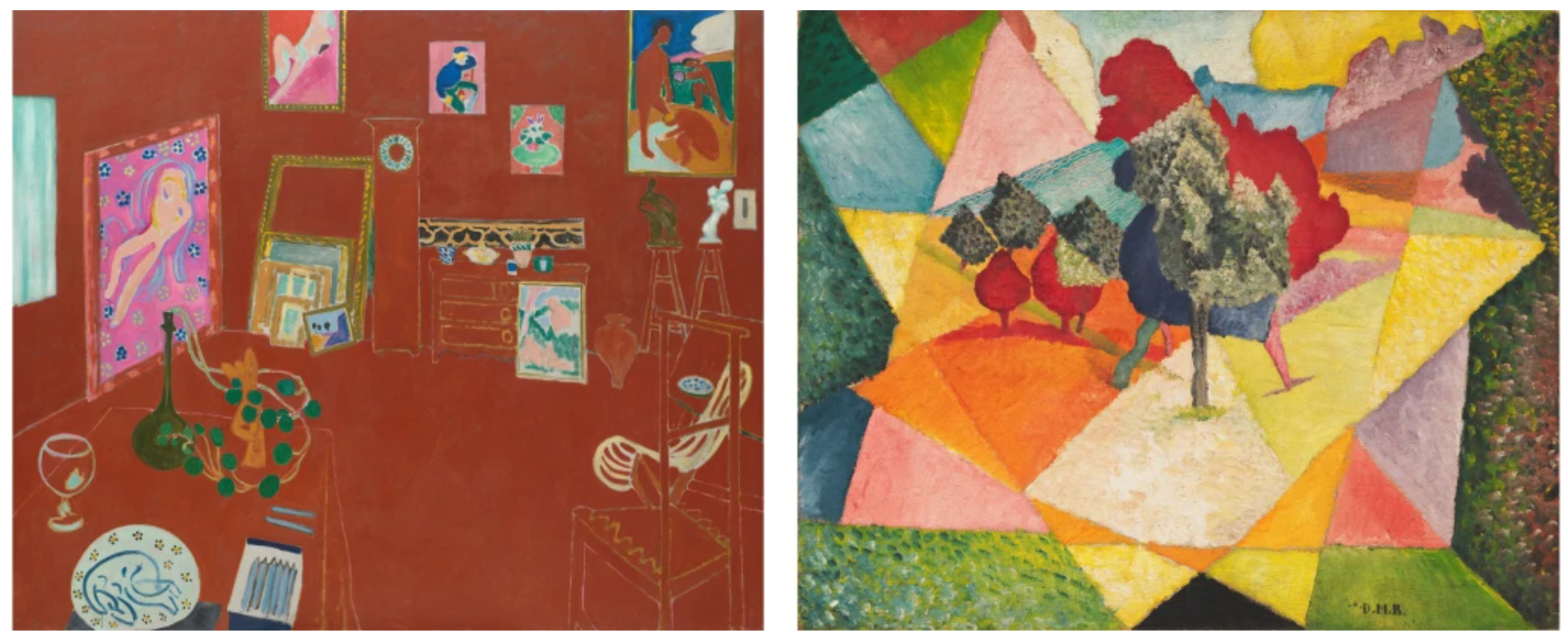
Left: Henri Matisse, The Red Studio, 1911. The Museum of Modern Art, New York. Image © The Museum of Modern Art/Licensed by SCALA / Art Resource, NY. Art © 2026 Succession H. Matisse / Artists Rights Society (ARS), New York. Right: Diego Rivera, Cubist Landscape, 1912. The Museum of Modern Art, New York. Digital Image © The Museum of Modern Art/Licensed by SCALA / Art Resource, NY
Hailing from England in the 1960s, Hockney often described himself as an “English Angeleno.” California afforded the artist a newfound sense of social and creative freedom, and Los Angeles would become both his adopted home and one of the defining subjects of his art. In many respects, the city represented an idealized vision of modern life, where brilliant sunlight, luscious vegetation, innovative architecture, and a spirit of openness converged. Hockney’s paintings devoted to members of his inner circle and, as in the case of the present work, their homes, offer a particularly intimate insight into this formative chapter of his life. A Visit with Mo and Lisa, Echo Park stands as a celebration of the friendships and creative exchanges that shaped Hockney’s California experience, capturing the sense of belonging, optimism, and personal fulfillment that inspired some of the most significant works of his career.
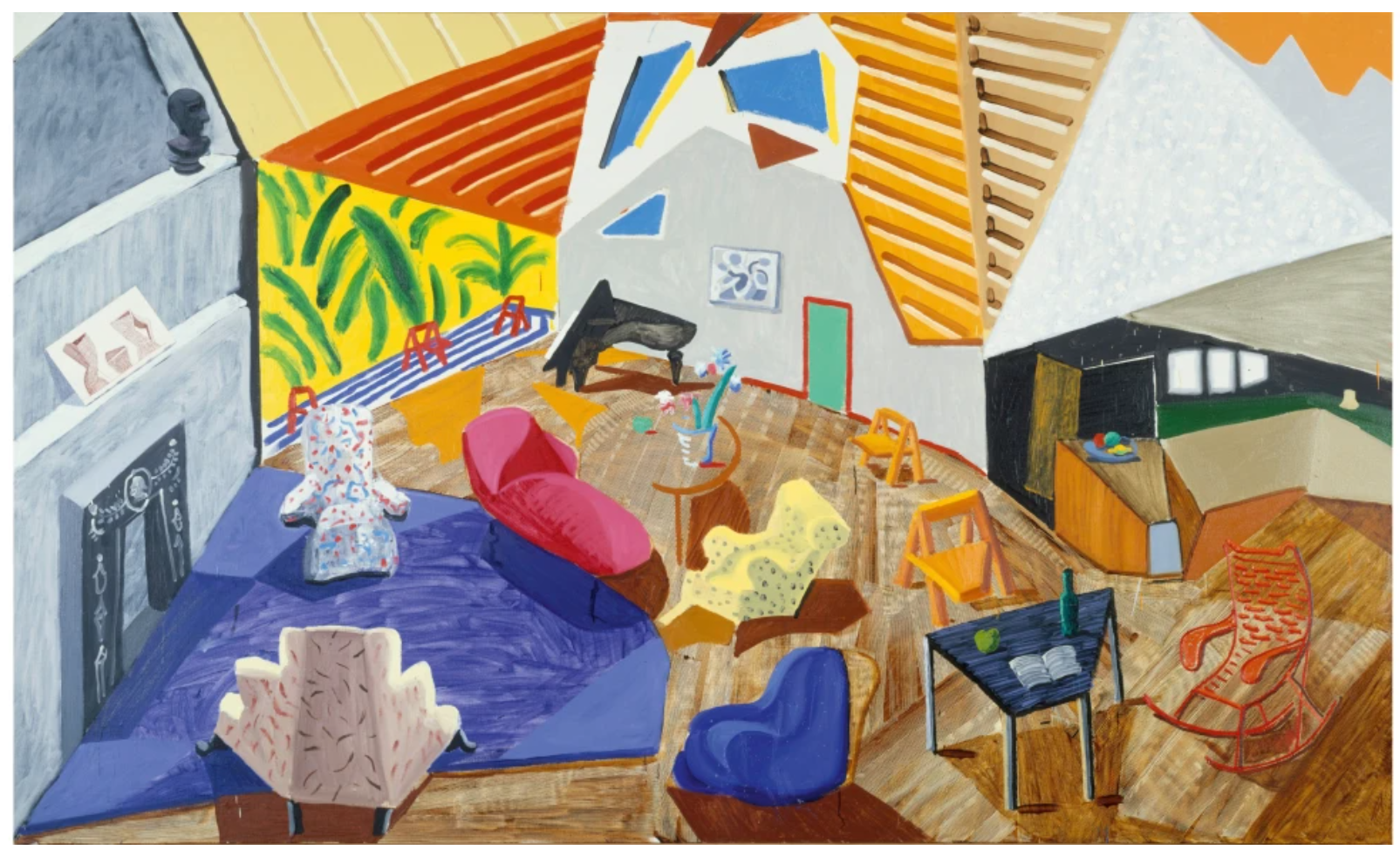
David Hockney, Large Interior, Los Angeles, 1988. The Metropolitan Museum of Art, New York.
Image © The Metropolitan Museum of Art. Image source: Art Resource, NY. Art © 2026 David Hockney
The present work captures Hockney at a moment of creative synthesis—where architecture, light, memory, and performance converge. Its layered perspective, chromatic bravura, and embrace of both the theatrical and the quotidian make it a standout among the artist’s celebrated explorations of life under the California sun. More than a view or a house, this work is indeed a portrait of friendship, leisure, and nostalgia refracted through Hockney’s singular vision, offering the viewer a portal into a world of vivid sensation and formal delight.
Purple Potted Flower, 1995
Purple Potted Flower, 1995
Property from a Distinguished Family Collection
Christie’s New-York: 19 November 2026
Estimated: USD 1,800,000 – 2,500,000
THIRD PARTY GUARANTEE
DAVID HOCKNEY (1937-2026), Purple Potted Flower | Christie’s
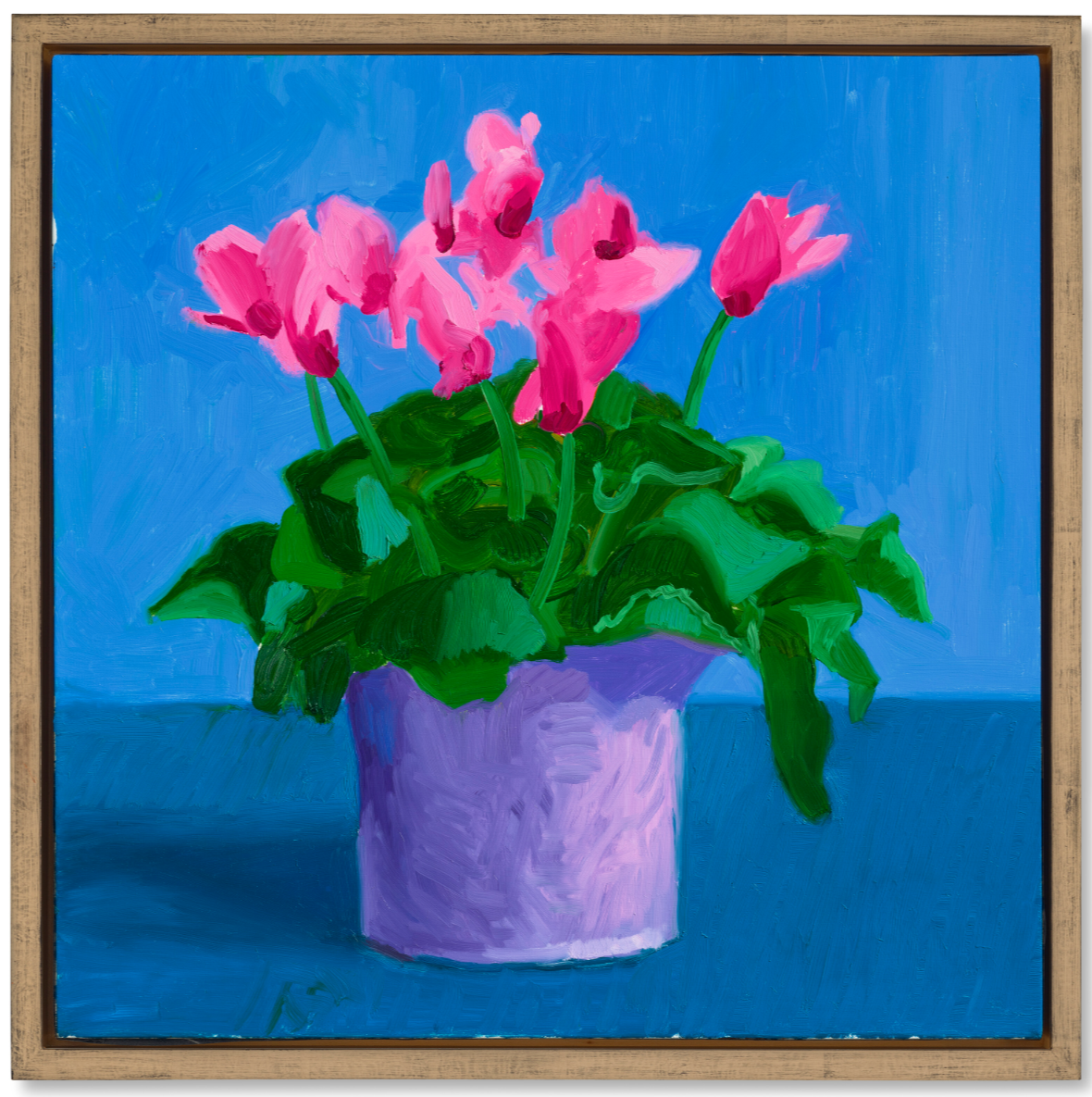
DAVID HOCKNEY (1937-2026)
Purple Potted Flower, 1995
Oil on canvas
24×24 inches (61×61 cm)
Signed and dated ‘David Hockney 1995’ (on the reverse)
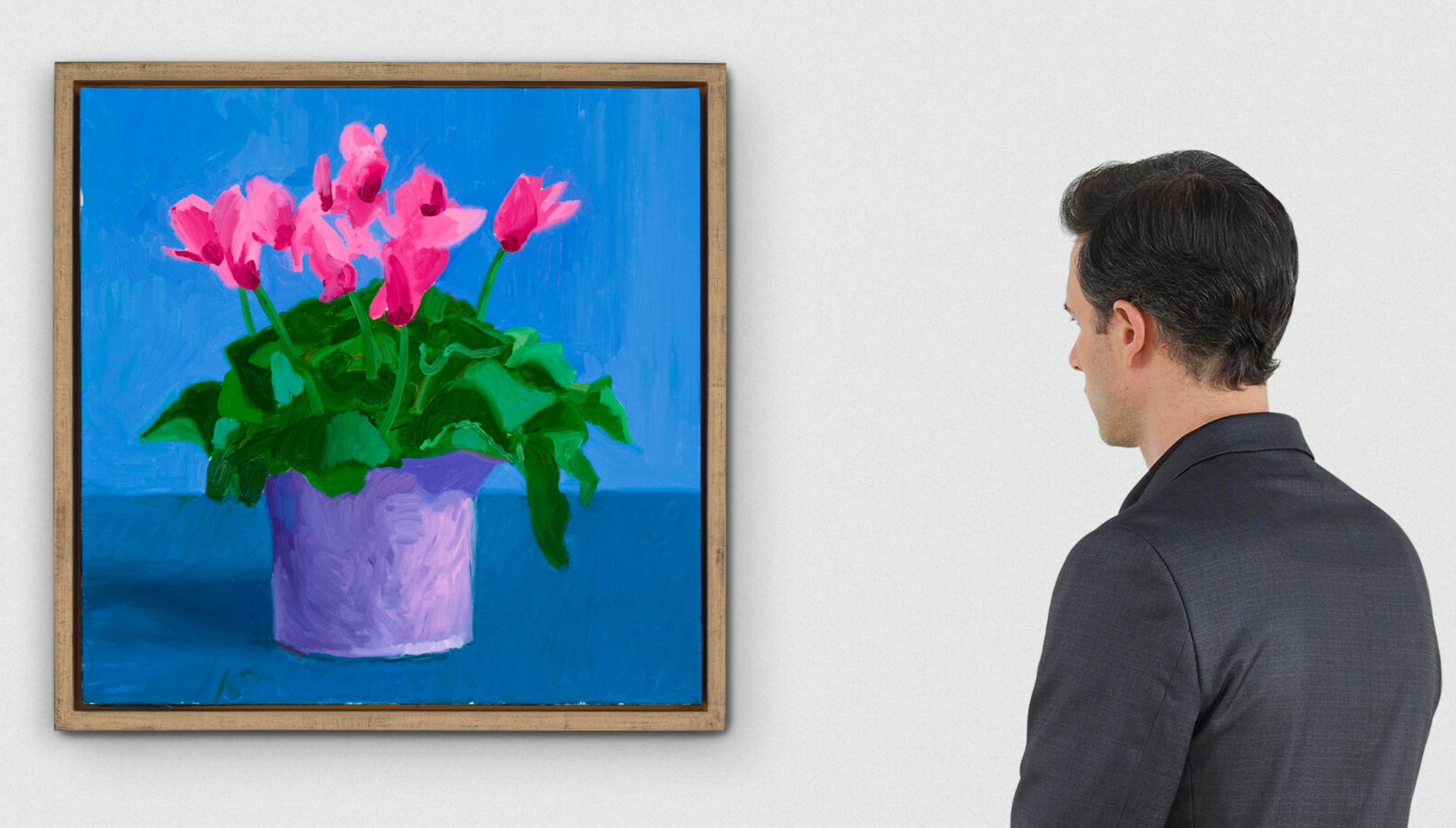
Purple Potted Flower marks David Hockney’s joyful return to painting after a decade working primarily with photography and in theatrical set design. Painted in 1995, at the peak of a highly innovative stage in his career, this poetically simple composition of a small pot of magenta pink cyclamen flowers is the product of Hockney’s renewed interest in still life. Flowers—especially pots and vases of vividly coloured flowers such as the present example—were to form the subject of several of his paintings around this time: a classic subject which, in Hockney’s innovative hands, was revitalised and made distinctively his own.
Painted at the same time as a major retrospective of the artist’s drawings was attracting great acclaim at the Kunsthalle in Hamburg, the Royal Academy of Arts, and the Los Angeles County Museum of Art, Purple Potted Flower is one of a series of paintings that saw Hockney returning to the cornerstone of his art: direct observation.
“I think every artist who deals with the visible world must come back to them. You begin to see how many choices you can make in even these simple things right in front of you. How exciting they are.”
In a sequence of accomplished still-life paintings he made in 1995, Hockney chose to focus on a simple domestic subject—a vase of flowers, a fresh fish, a bowl of fruit—and pay it close attention, thereby imbuing an ordinary, everyday subject with all the pleasure of seeing. In Purple Potted Flower he has delighted in the hot pink and rich green of a house plant set against a trio of close-toned blues. Painted with luscious, glossy brushstrokes, the plant itself stands out vividly against the sky-blue background and mauve flowerpot. Hockney has refrained from adding any blue to the green leaves or the pink flowers of the plant, creating a clever contrast with its surroundings. Unlike parts of the background, such as the blue table, which has been layered over a base colour of green, the plant itself seems to have been painted straight onto the white canvas, creating the brilliant luminosity that is so evocative of a flower that has emerged freshly from its bud. Hockney’s eloquent brushwork, coupled with his intuitive understanding of colour and composition, is a masterclass in painterly confidence and control.
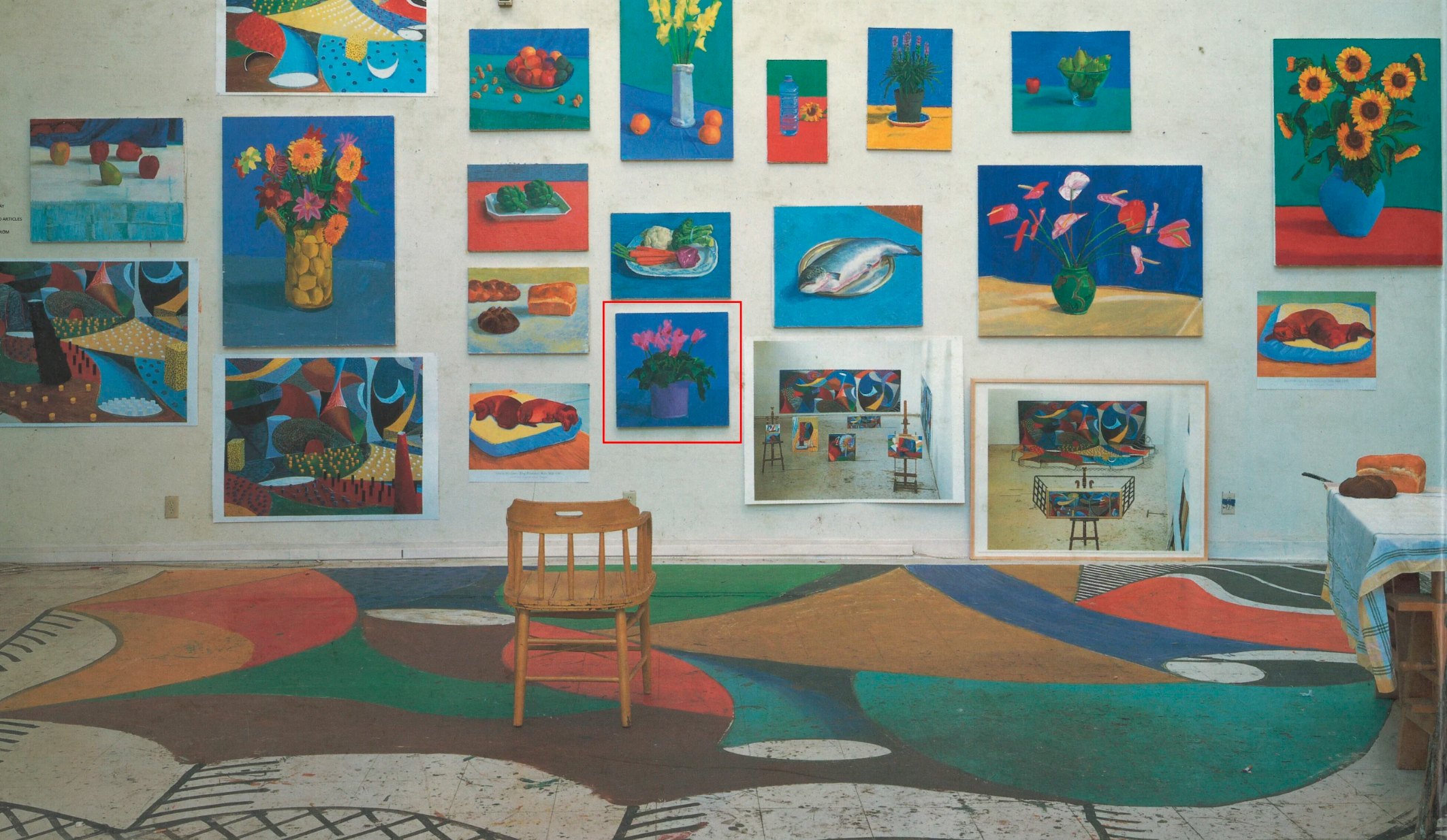
David Hockney’s studio, 1995. Photo: Richard Schmidt / Steve Oliver. Artwork: © Estate of David Hockney.
The palpable pleasure radiating from this painting may have been inspired by the exhibition Claude Monet: 1840–1926 that Hockney saw at the Art Institute of Chicago in late 1995. While a deep knowledge of art history has always infused and informed Hockney’s work, this exhibition seems to have resonated especially profoundly.
“I came out of that exhibition and it made me look everywhere, everywhere intensely. That little shadow on Michigan Avenue, the light hitting the leaf. I thought: ‘My God, now I’ve seen that. He’s made me see it.’ Most people don’t see things like that. They can’t get pleasure like that, can they? Monet gives it to you though, for he was a generous spirit, and you can then take pleasure in looking at things freshly.”
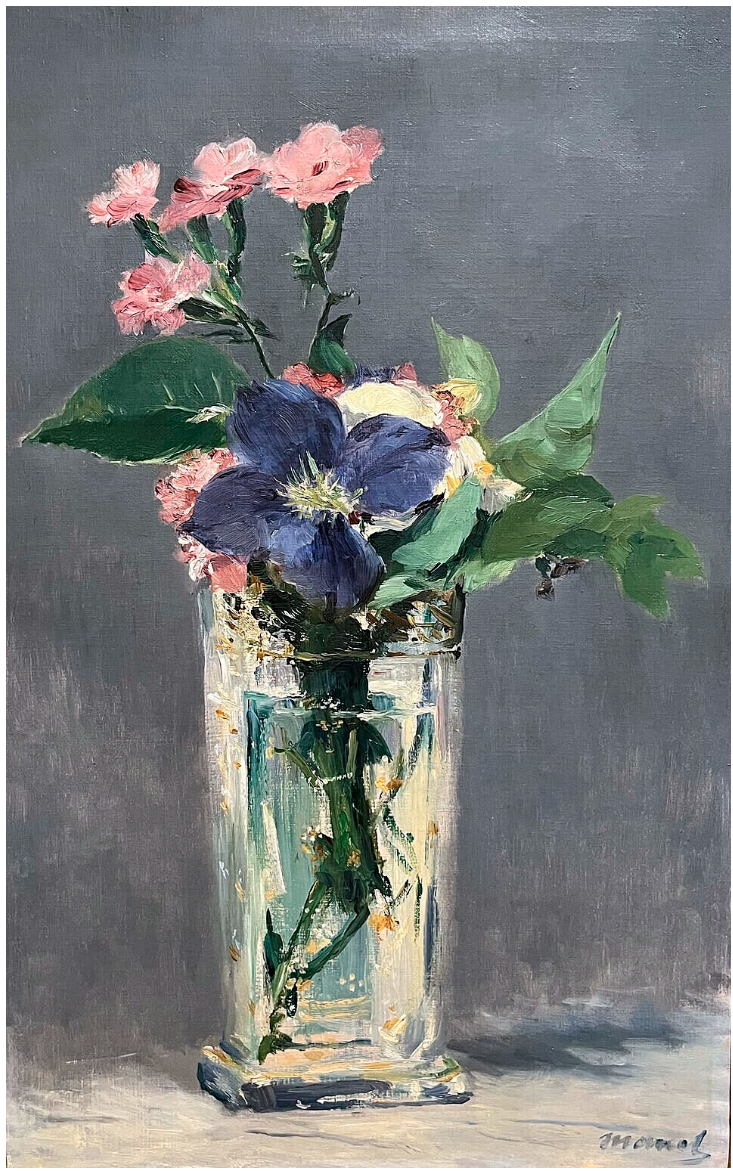
Edouard Manet, Oeillets et clématite dans un vase de cristal, circa 1882. Musée d’Orsay, Paris.
Purple Potted Flower demonstrates Hockney’s own “generous spirit”—his ability to see the beauty in small things, and his desire to share it with others. The early 1990s were a time of mourning for the artist, who lost several close friends to AIDS and other illnesses. He told a reporter that in January of 1995, “I wanted desperately to paint something loving. In the last six months of last year, I lost four friends…. I felt such a loss of love I wanted to deal with it in some way” (quoted in B. Isenberg, “Q&A with David Hockney: A Painter Gets Back to the Business of Painting”, Los Angeles Times, 5 April 1995).
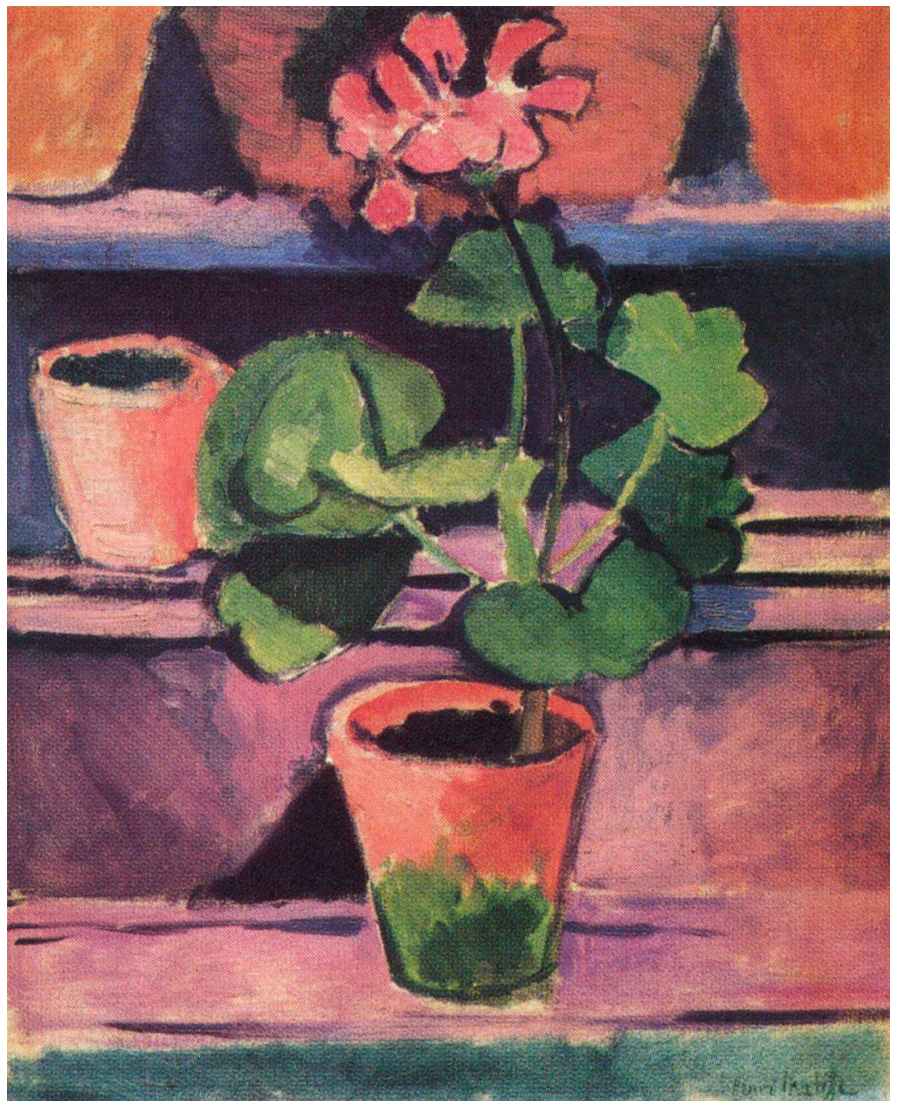
Henri Matisse, Pot of Geraniums, 1912. National Gallery of Art, Washington, D.C.
© 2026 Succession H. Matisse / Artists Rights Society (ARS), New York.
He turned to tender subjects such as his beloved dogs, but he also painted flowers as a way of remembering all the beauty to be found in the world. Often, he would send laser prints of these paintings to friends who were sick. “I made the flower paintings for friends,” he said in an interview given to Rolling Stone magazine in 1990. “I made laser prints of the paintings and sent them to friends who were ill to pin up on the wall. The flowers I’ve been painting are not cut flowers, they’re little plants growing. They’re alive. And that’s what it is about everything I paint: It’s all about affirming life, isn’t it?” (quoted in D. Sheff, “David Hockney: The Rolling Stone Interview”, Rolling Stone, 13 December 1990).
Lemons & Oranges, circa 1986
Lemons & Oranges, circa 1986
Phillips New-York: 19 November 2026
Estimated: USD 600,000 – 800,000
Lemons & Oranges, circa 1986
12×24 inches (30.5 x 61 cm)
Signed and dedicated
“for Dr Gitnick with thanks David Hockney”
On the reverse
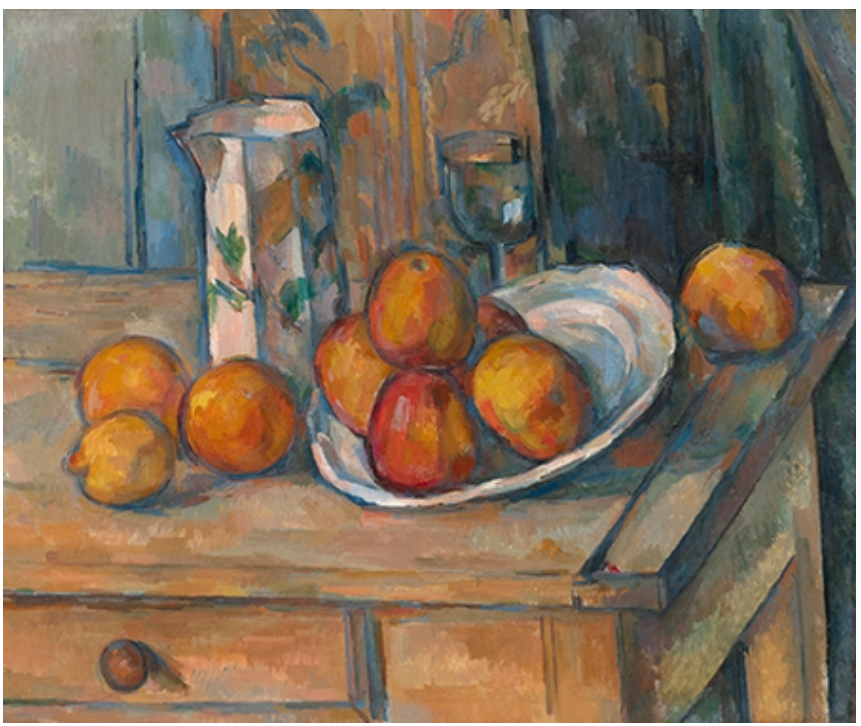
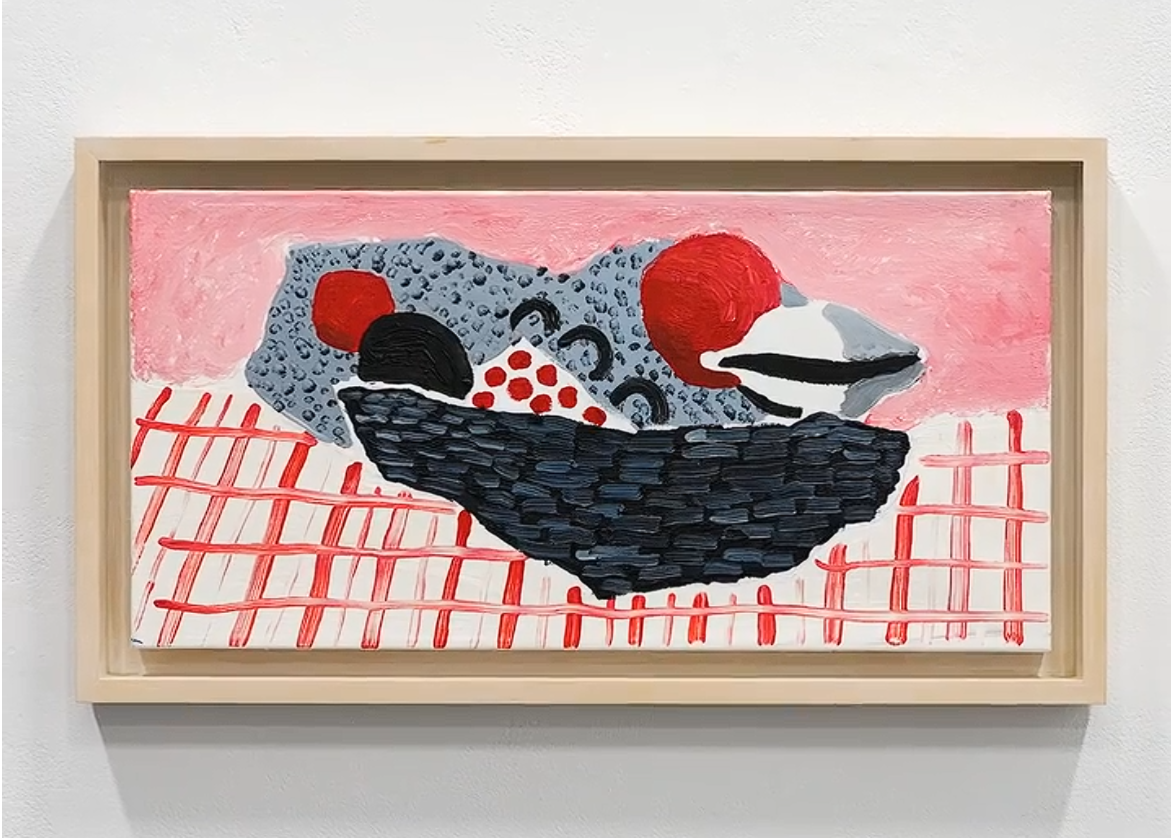
Hockney’s depiction of the fruit bowl situates the composition within the enduring tradition of still-life painting, spanning from the Dutch Golden Age to the innovations of Modernism. In the present example, his compositional approach is particularly informed by the work of Paul Cézanne, whose still-life paintings had a profound influence on Hockney’s artistic practice. In a 2015 interview he noted, “Cézanne was one of the first artists to paint still lifes seen from two viewpoints.” This influence is evident in the present work through Hockney’s bold use of color and expressive mark-making. Broad, decisive brushstrokes establish areas of shadow across the oranges in the foreground, enhancing their dimensionality and embracing the materiality of paint.
“Every time the eye moves—I mean, I later realized that the major problem with perspective is it stops time. For perspective to be fixed, time has stopped, which is an impossibility for us.”
The 1980s marked a formative period in Hockney’s career, during which he increasingly explored the relationship between dimension, perception, and pictorial representation. Reflecting on Cubism’s capacity to synthesize multiple viewpoints within a single composition, Hockney remarked, “[Picasso] has shown us how to see more, far more than any other artist” This interest in the possibilities of representing space and perception extended beyond Hockney’s painting practice during the decade in which the present work was executed, informing his theatrical set designs and innovative Xerox prints of the period, both of which investigated alternative approaches to dimensionality and visual representation. In Lemons & Oranges, such concerns are reflected in the bowl’s tilted, multidimensional perspective and the simplified forms, which resist the conventions of a fixed viewpoint.