ROY LICHTENSTEIN (1923-1997)
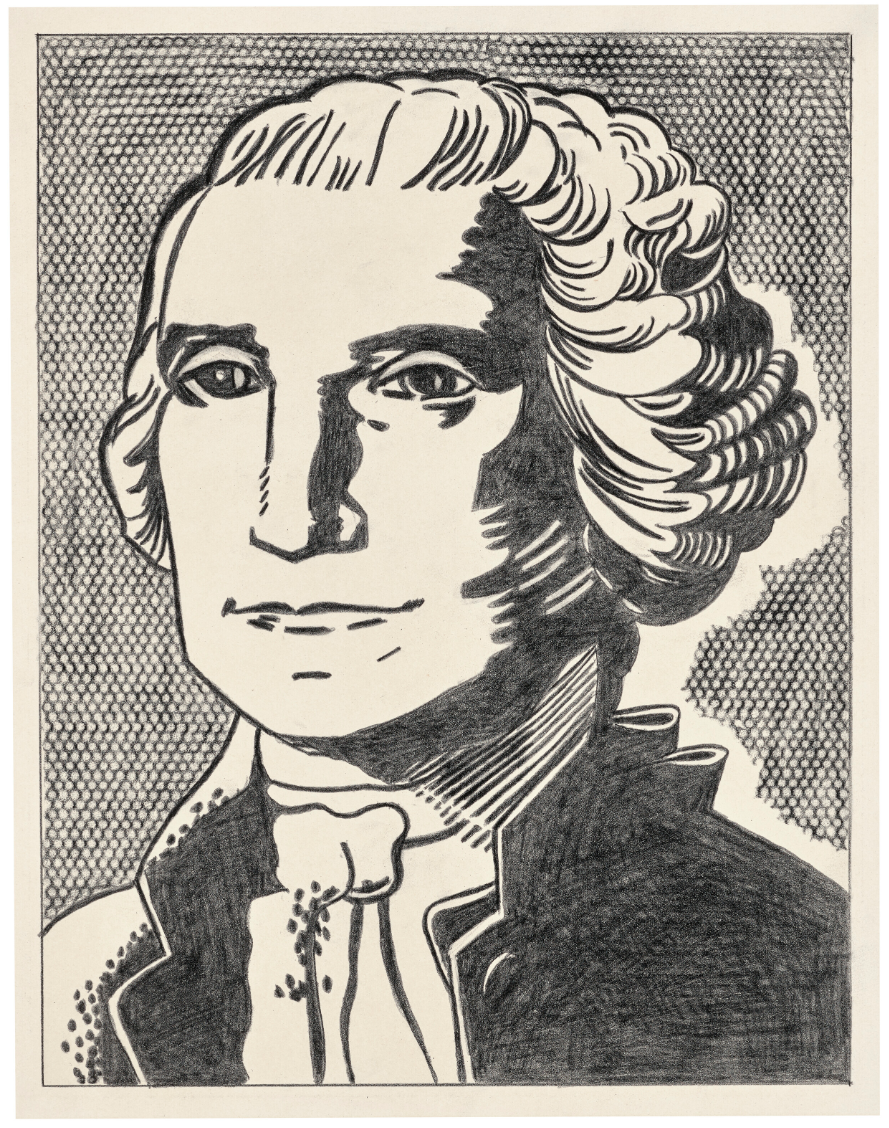
George Washington, 1962
Graphite and graphite rubbing on paper
Image: 14 1/2 x 11 1/4 inches (36.8 x 28.6 cm)
Sheet: 18 2/4 x 14 1/2 inches (47.6 x 36.8 cm)
Signed and dated ‘rf Lichtenstein ‘62’ (on the reverse)
Provenance
Leo Castelli Gallery, New York
Mi Chou Gallery, New York, 1962
Mr. and Mrs. Ned Owyang, New York, circa 1966
Anon. sale; Christie’s, New York, 13 May 1981, lot 112
Private collection, New York
Anon. sale; Christie’s, New York, 8 November 1990, lot 138
Frederick W. Hughes, New York
Estate of Frederick W. Hughes, 2001
Their sale; Sotheby’s, New York, 14 November 2001, lot 37
Acquired at the above sale by the present owner
Auction History
Christie’s New-York: 19 November 2024
Estimated: USD 7,000,000 – 10,000,000
USD 7,068,000
WORK ON PAPER
ROY LICHTENSTEIN (1923-1997), George Washington | Christie’s
With its bold, authoritative contrast and clean, crisp lines, Roy Lichtenstein’s George Washington is an important early drawing from a founding father of American Pop Art. Marking a defining moment in the artist’s career, when he fully committed to his mature Pop style—both in his subject matter and technical application—George Washington traces the American lineage of art history from Gilbert Stuart to one of the most celebrated movements in post-war art. Drawn with graphite pencil, this rare early work reveals the hand of an otherwise mechanically pristine artist, unveiling the artistic process that would both inform the larger painted canvas and stand firmly as an important artwork in its own right.
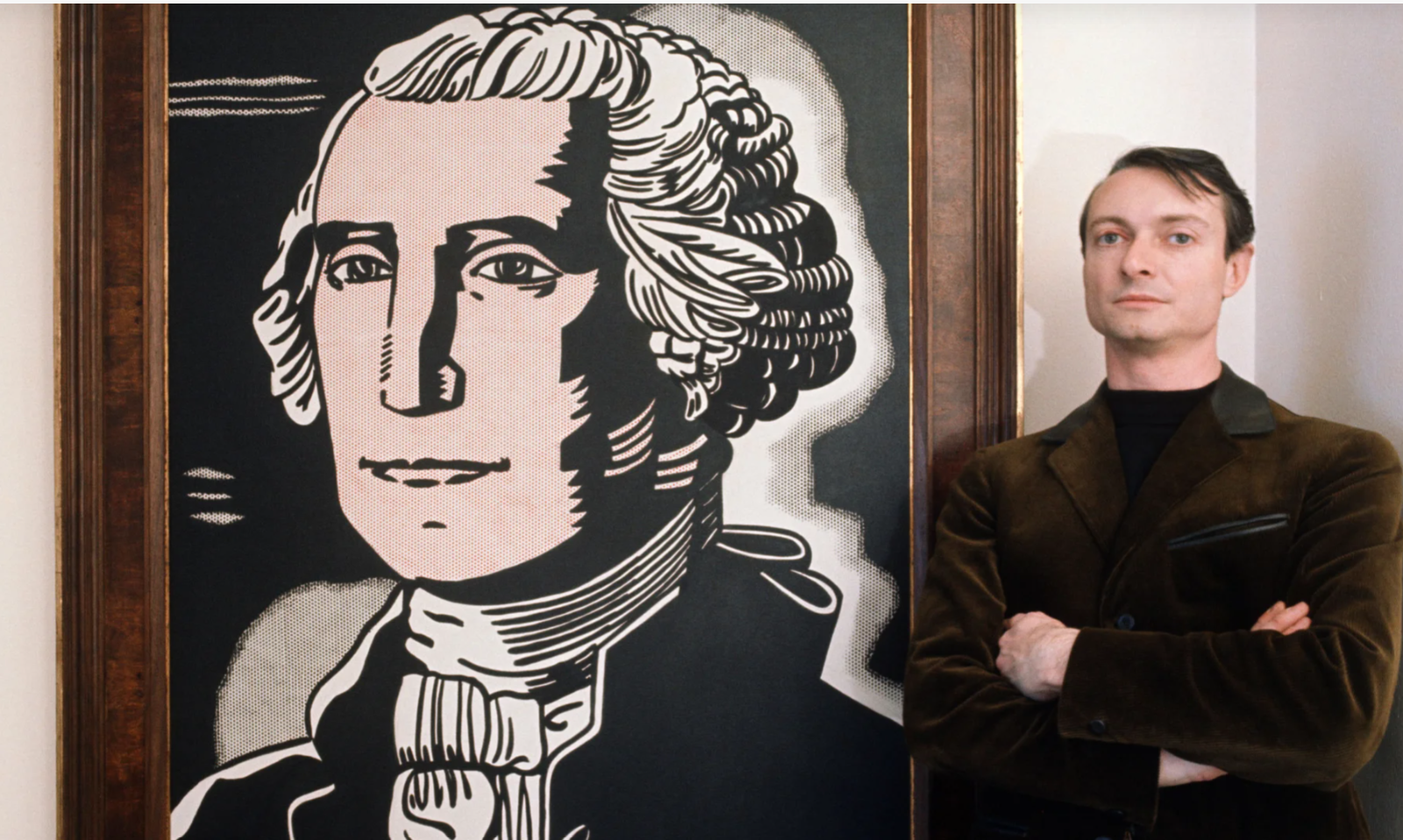
Roy Lichtenstein with George Washington (1962). Photo: Mario de Biasi / Mondadori via Getty Images. Artwork: © Estate of Roy Lichtenstein.
This period marked a momentous moment of transformation for the 38-year-old artist, who had been exhibiting his Cubist and Abstract Expressionist-style paintings across New York for a decade. Influenced by the art of Allan Kaprow, George Segal, and Claes Oldenburg, which incorporated everyday objects and popular culture, Lichtenstein turned to an entirely new imagery culled from the contemporary world of advertisements and comic books. During this period, he also began to incorporate the graphic techniques of commercial illustrators into his own practice. In 2010, Lichtenstein’s drawings, including George Washington, received a major retrospective at New York’s Morgan Library and Museum, which, for the first time, underscored the quality and significance of his drawings.
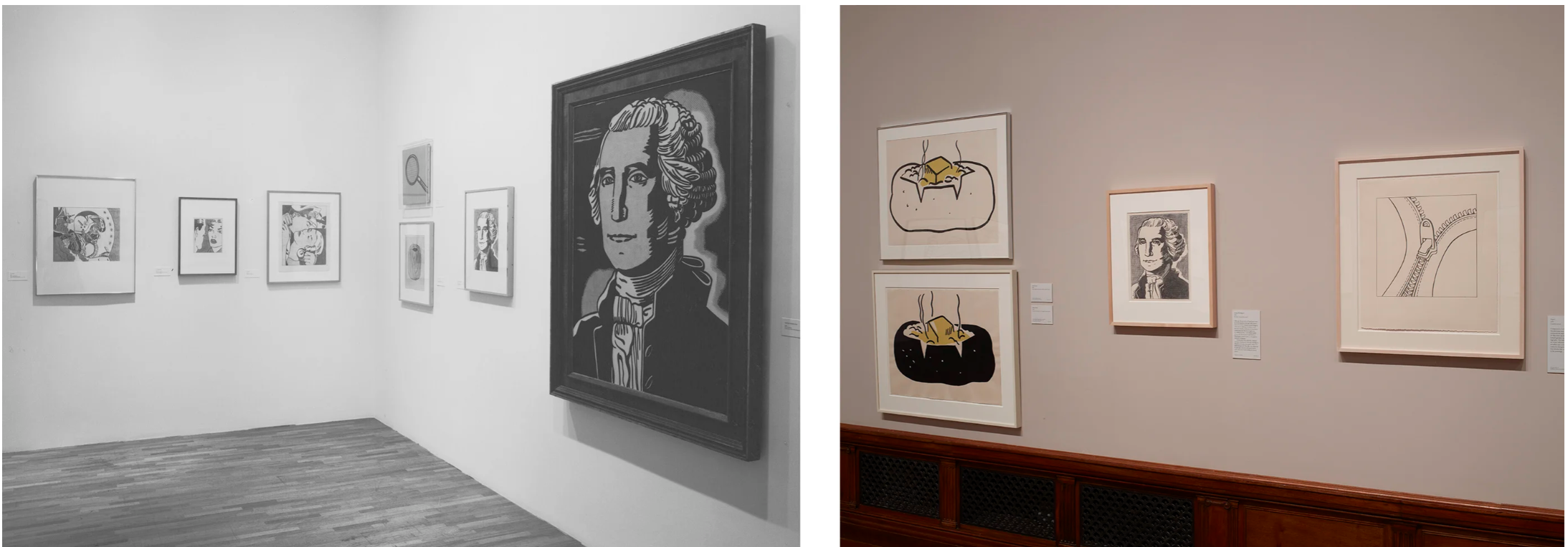
Left: Installation view, The Drawings of Roy Lichtenstein, 1987, Museum of Modern Art, New York. Photo: © The Museum of Modern Art/Licensed by SCALA / Art Resource, NY. Artwork: © Estate of Roy Lichtenstein.
Right: Installation view, Roy Lichtenstein: The Black-and-White Drawings, September 2010 – January 2011. Morgan Library & Museum, New York (present work illustrated). Artwork: © Estate of Roy Lichtenstein. Photo: The Morgan Library & Museum / Art Resource, NY.
George Washington is an early Pop work by the artist, created while he was focusing on black-and-white, single-object paintings of ordinary commercial objects, such as Curtains in the Saint Louis Museum of Art, Desk Calendar at the Museum of Contemporary Art, Los Angeles, as well as some of his earliest comic strip paintings. Based on a woodcut of a Gilbert Stuart portrait of the first American president found in a Hungarian national newspaper—which likewise recalls Stuart’s famous Athenaeum Portrait on the US one-dollar bill—the subject matter of George Washington poignantly bridges old and new in the artist’s oeuvre.
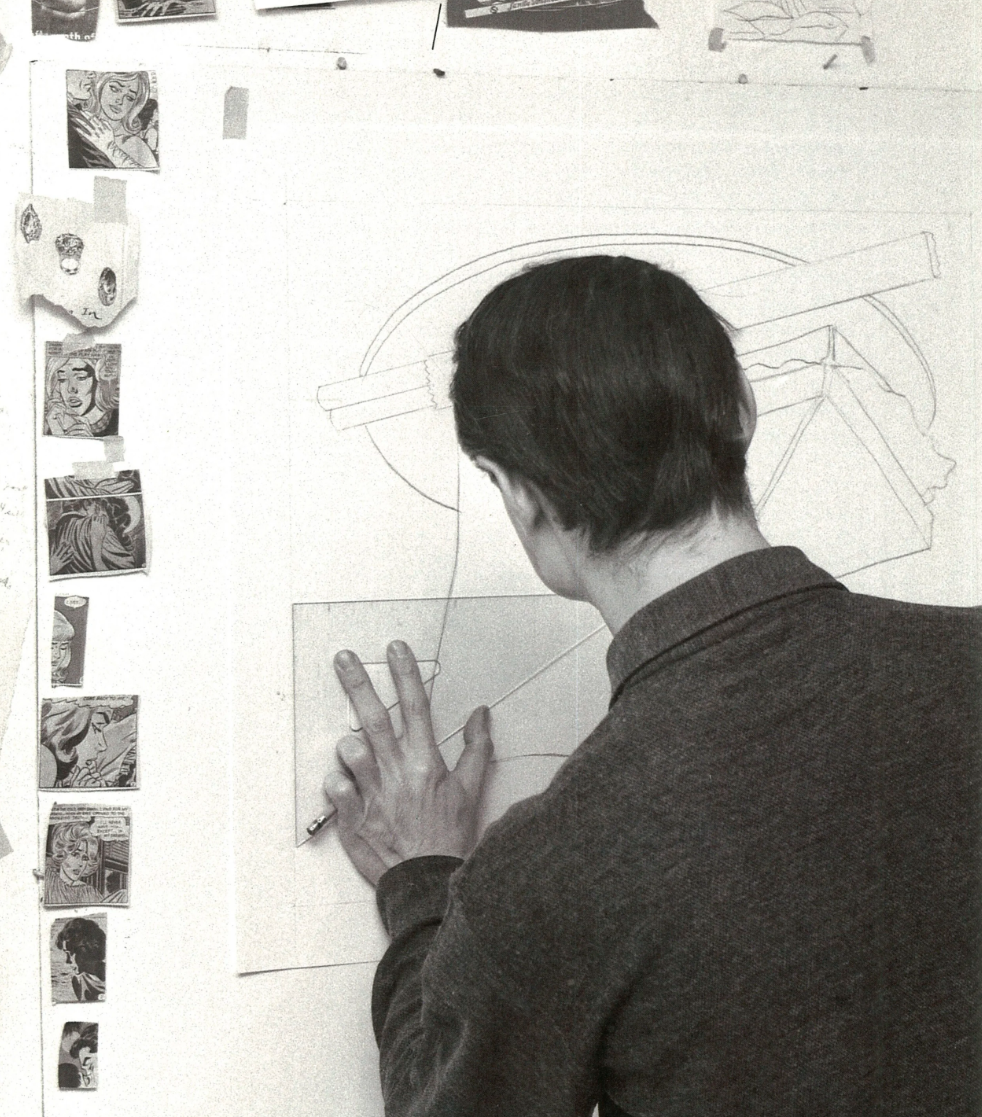
Lichtenstein sketching in his West 26th Street studio, New York, 1964. Photograph by Ken Heyman. Artwork: © Estate of Roy Lichtenstein.
Perhaps most famously during these pivotal transformative years, Lichtenstein drastically altered his style and approach to artmaking. Looking toward commercial illustrations and comic strips as subject matter for the first time, the Pop artist began to experiment stylistically, simulating commercial techniques of reproduction, including the now-iconic Ben-Day dot. During the early to mid-1960s, Lichtenstein relied on traditional graphite pencil drawings to develop and cement his mature stylistic approach. Lichtenstein’s drawings were neither sketches nor studies in the traditional sense. Rather, they acted as the initial stage in a process that resulted in his vibrantly comical large-scale paintings. In his drawings, Lichtenstein would determine the composition—and sometimes color—of his paintings, often cropping or slightly altering the original source image by bringing in the framing edge to seemingly enlarge the content of the painting. Lichtenstein used a number of different techniques to achieve the look of mechanical reproduction found in George Washington.
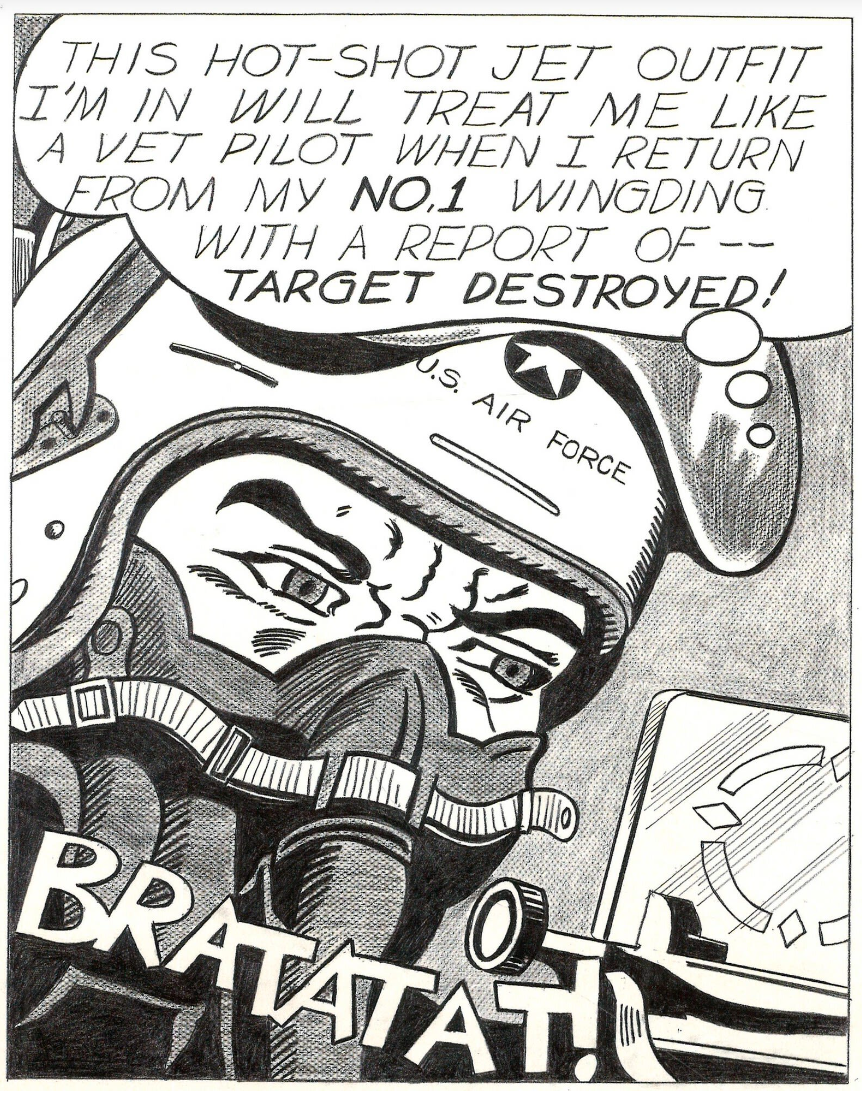
Roy Lichtenstein, Bratatat!, 1962. Minneapolis Institute of Art. © Estate of Roy Lichtenstein.
It is likely that, for George Washington, Lichtenstein sketched the image directly from the original woodcut reproduction, heavily penciling in his contour lines. In order to produce his trademark Ben-Day dots, he relied on a technique called frottage. This consisted of placing the paper sheet over a textured surface, then rubbing a graphite pencil across the surface. This procedure produced a series of regular dots—here shown in the negative—but also allowed traces of the artist’s hand to be seen in the shaded areas, as subtle changes in pressure during the rubbing process can be detected as Lichtenstein moved his hand across the surface of the work. Lichtenstein employed this particular technique for only a short period during 1962, but it saw him producing some of his most exquisite drawings, including Bratatat! in the Minneapolis Institute of Art and Foot Medication in the Menil Collection, Houston.