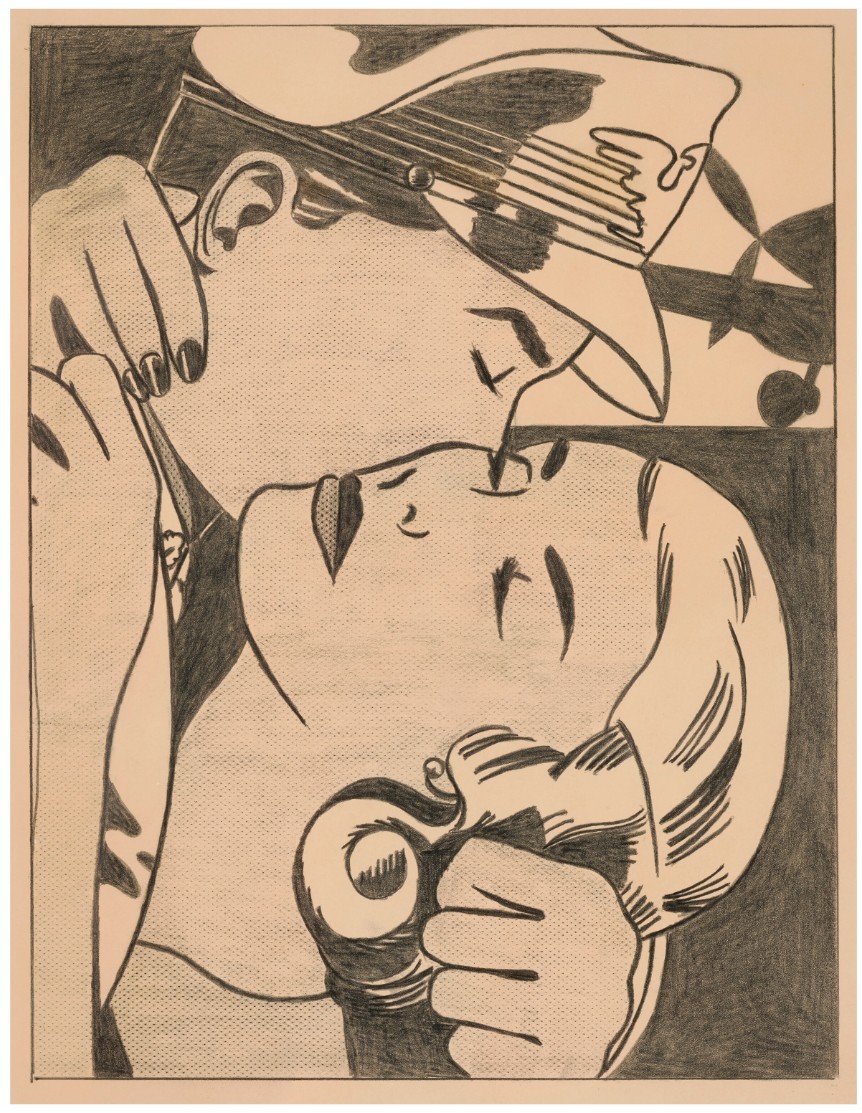
ROY LICHTENSTEIN (1923-1997)
The Kiss, 1962
Graphite on paper
Image: 18 1/2 x 14 inches (47 x 35.6 cm)
Sheet: 21 x 16 1/4 inches (53.3 x 41.2 cm)
Signed and dated ‘rf Lichtenstein ’62’ (on the reverse)
Provenance
David Whitney, New York, acquired directly from the artist, 1969
C&M Arts, New York
Ann Tenenbaum and Thomas H. Lee, New York, 1996
Private collection, New York, 2008
Gagosian Gallery, New York
Acquired from the above by the present owner, 2012
Auction History
Christie’s New-York: 12 May 2025
Estimated: USD 7,000,000 – 9,000,000
USD 5,495,000
ROY LICHTENSTEIN (1923-1997), The Kiss | Christie’s
With commanding linear clarity and graphic intensity, Roy Lichtenstein’s The Kiss is a striking masterpiece heralding the beginning of the American Pop artist’s famed mature style. One of the few highly-finished independent presentation drawings made by the artist, The Kiss is also one of the first instances of Lichtenstein’s iconic Ben-Day dot patterns, magisterially used to indicate light and shadow across the couple’s faces, unveiling the artistic process which would later inform his most important works. Executed in graphite pencil, The Kiss is a rare opportunity to examine the hand of an otherwise mechanically pristine artist. Initially acquired directly from the artist by his friend, the prominent art critic and curator David Whitney, the work has been a highlight of several prestigious collections. The related painting, which follows a similar composition, has similarly been prodigiously exhibited, making the image one of the most well-known from the artist’s oeuvre. The impact of Lichtenstein’s first drawings on the art world were immediate.
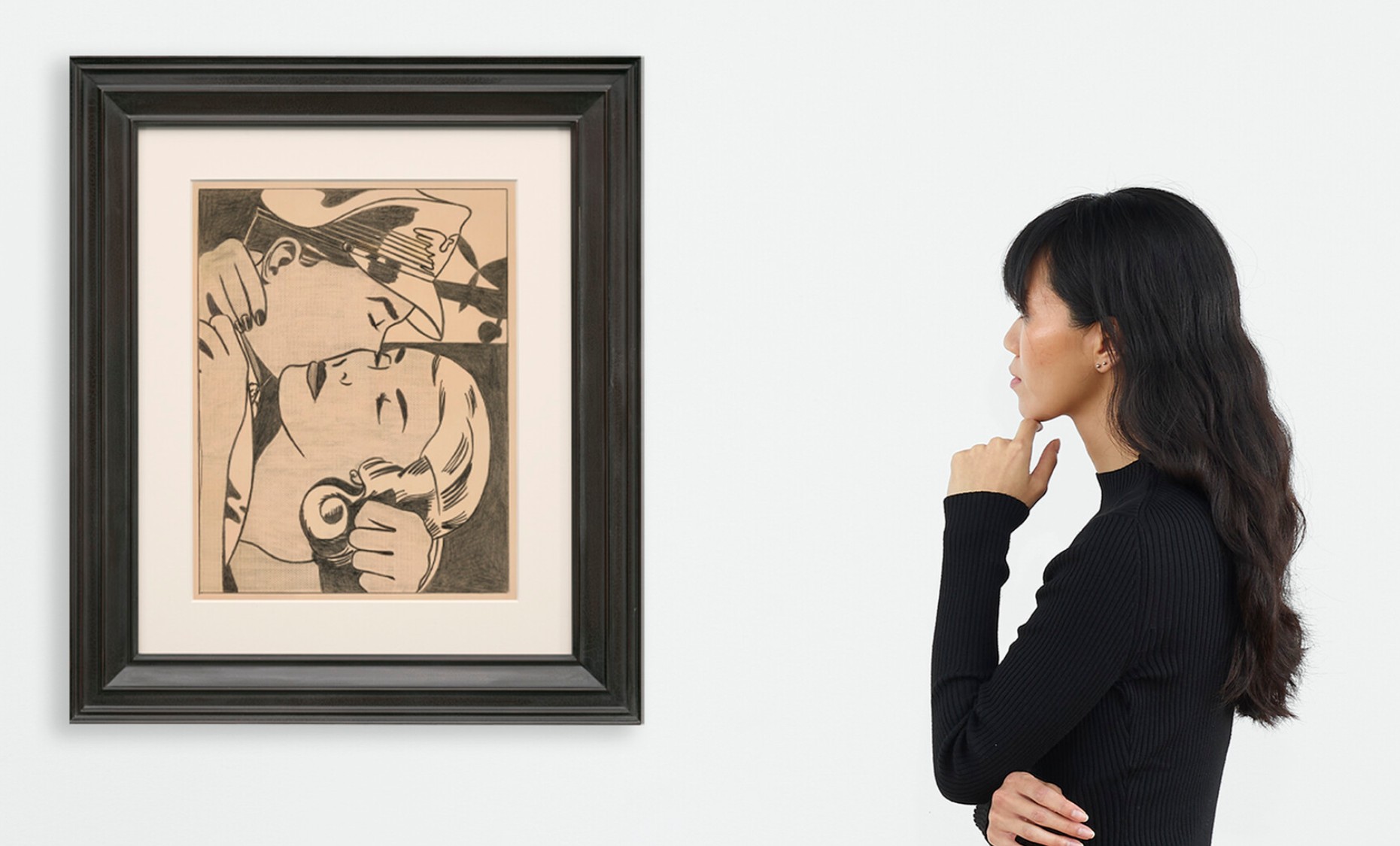
The fervent embrace between the pilot and the woman is searingly rendered, the intimate moment poignantly encapsulated within the contours of the composition. Here, Lichtenstein created an entirely new system of drawing by synthesizing two apparently diametrical opposites, bringing together a parody of Pablo Picasso’s graphic drawing with the uniform representational drawing made by commercial illustrators for comic books and popular ads. Lichtenstein ingeniously translates an image taken from a comic into a complex composition, elevating the protean subject to the status of high art. The artist eliminates any extraneous detail, completely flattening the image against the paper sheet, doing without perspective or illusionistic natural space to focus intensely on the internal drama between the two figures. His carefully adjusted framing edges, compressing the composition into a cropped close-up, makes the image appear more the a film still than a cartoon.
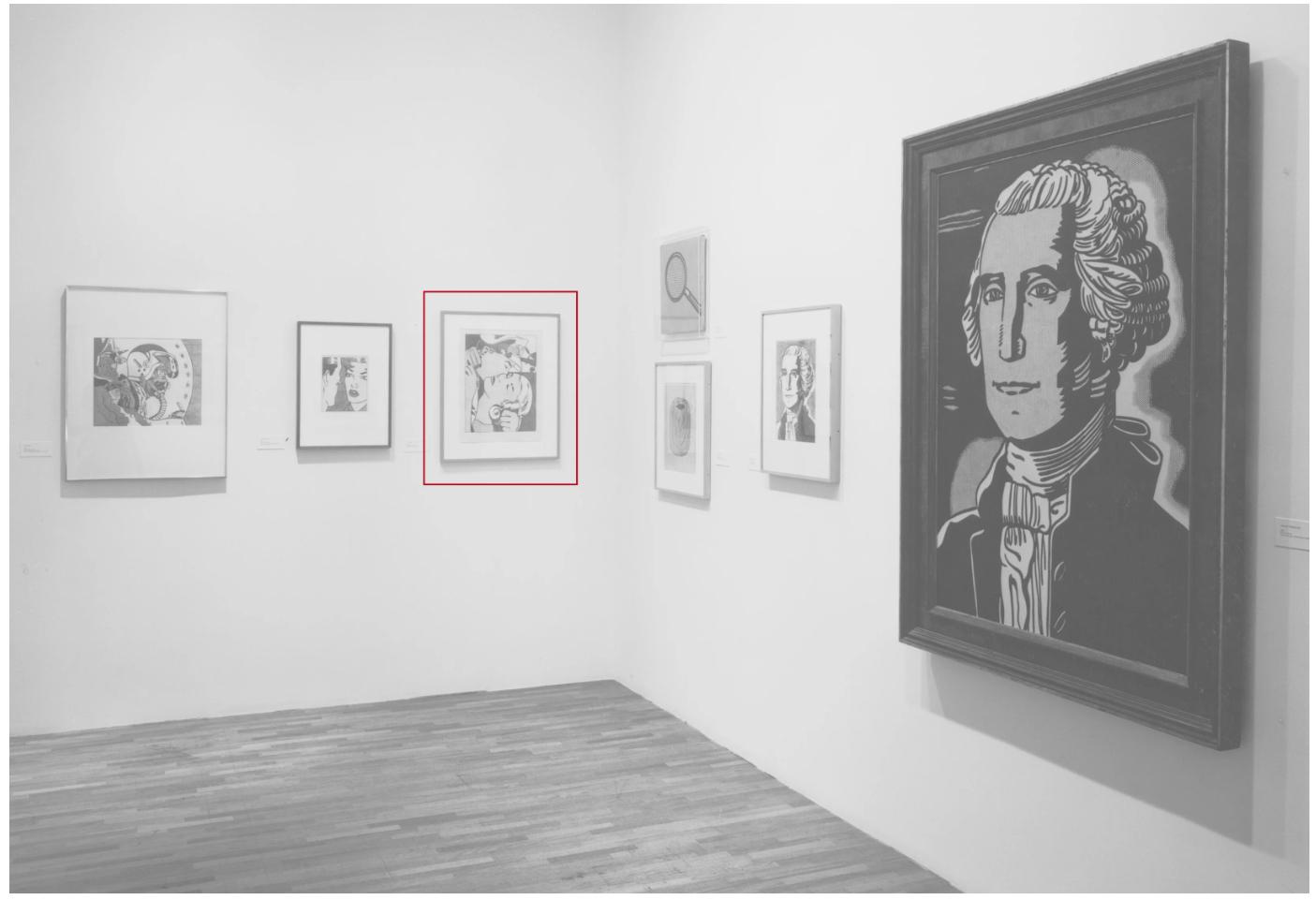
Installation view, The Drawings of Roy Lichtenstein, March-June 1987. Museum of Modern Art, New York (present lot illustrated). Photo: © The Museum of Modern Art/Licensed by SCALA / Art Resource, NY. Artwork: © Estate of Roy Lichtenstein.
Lichtenstein’s bold innovation in Pop Art reexamined representational drawing, one of the most established aspects of the Western artistic tradition, into a radical exercise, parodying the traditional forms which it illustrated with a certain ironic and humorous aloofness. The probing, hard-edge lines and sharp edges in the work reveal Lichtenstein first working out the style and technique which he would later adapt across his entire oeuvre.
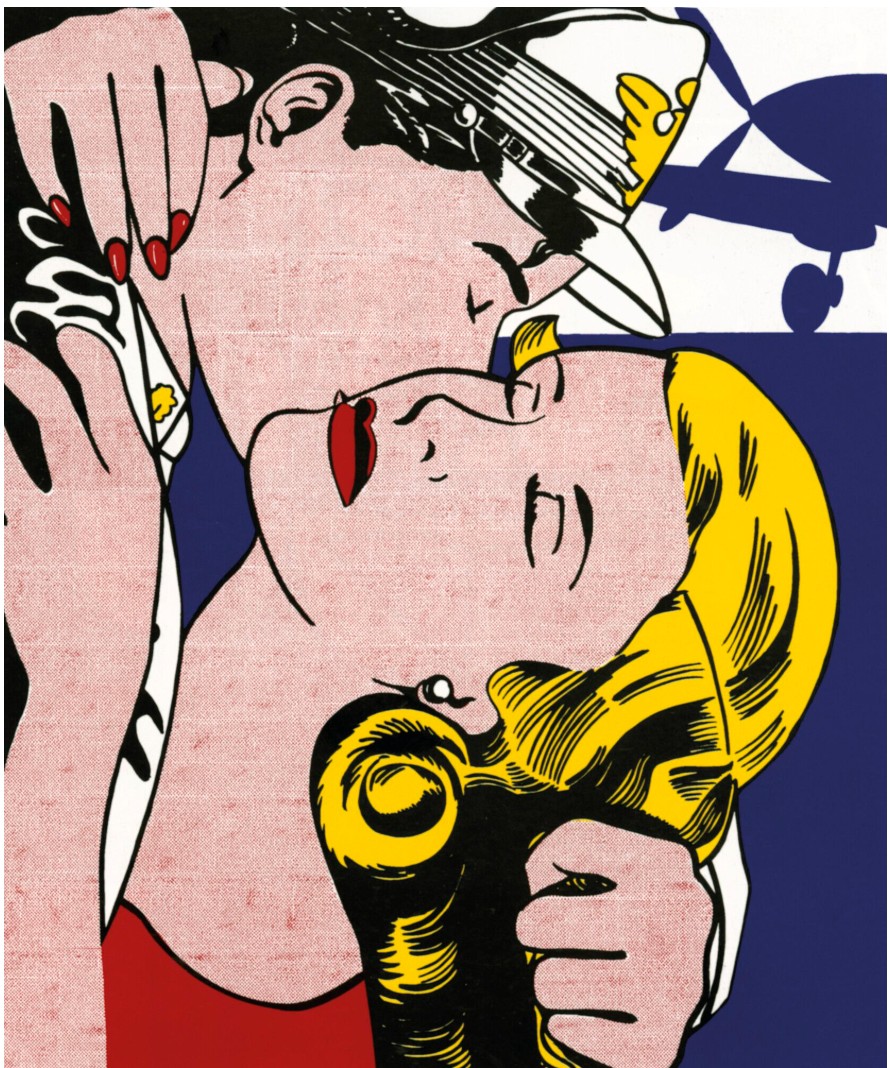
Roy Lichtenstein, The Kiss, 1961. Private collection. © Estate of Roy Lichtenstein.
Amid the many linear and textural inventions evinced in The Kiss, the tightly weaved lines and patterns spread across both visages are perhaps the most important. The artist had first experimented with recreating the Ben-Day dots from comic books the prior year, rubbing a dog-grooming brush dipped in ink over a sheet of aluminum drilled through with holes. He was discontented with his first attempts, desiring for their effect to appear less hand-made and more mechanical. His innovation here is using a frottage technique, placing the paper over a window screen and rubbing the graphite into the grains of the paper, thus creating the pattern. Varying the pressure on his tool allowed him to create subtle changes in tone, the effortless appearance of the result acquired through a great degree of precision and experimentation.
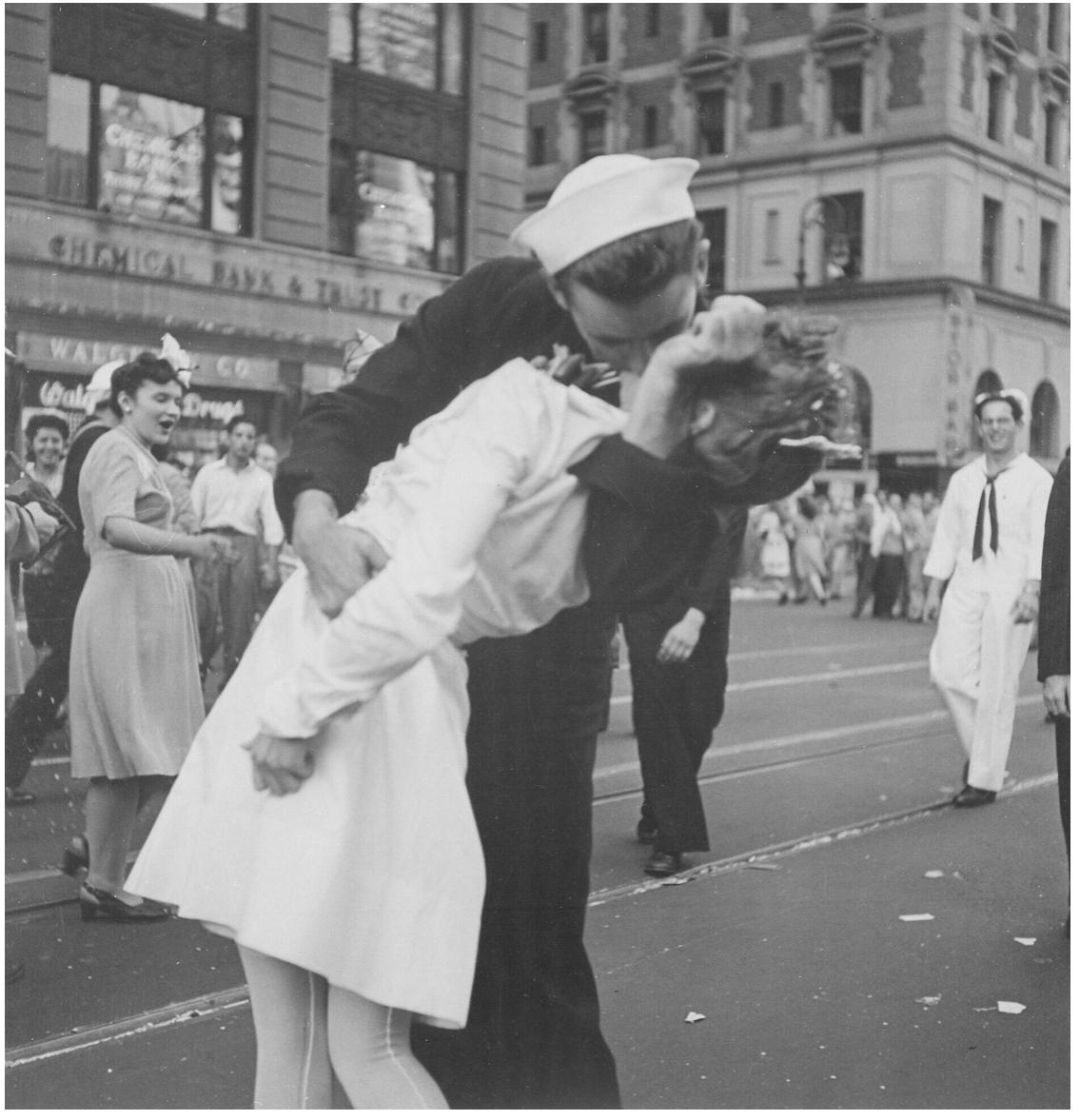
Victor Jorgensen, New York City celebrating the surrender of Japan. They threw anything and kissed anybody in Times Square, 1945. National Archives at College Park, Maryland.
The subject matter is of great import to the artist, and functions both as a broadly autobiographical gesture and as a unifying motif across several of his drawings. Lichtenstein had trained as a U.S. Army pilot during World War II before being transferred to make cartoons for the Army magazine. Pilots are a recurring motif in both his first drawings and across his career, appearing in Jet Pilot (1962, Yale University Art Gallery, New Haven), as well as the paintings Brattata (1962, Tehran Museum of Contemporary Art) and Wham! (1963, Tate Modern, London). While the other works focus more on the action of flying, The Kiss removes the pilot from his plane, seen only as a two-dimensional form barely abutting the upper right. Lichtenstein was exacting in his choice of materials, utilizing only the highest quality supplies in contrast to his cheaply produced source images. The Kiss is on neutral toned white hot pressed Arches paper, which had a smooth texture and refined finish which allowed him to create his precise images. Its thickness and quality meant that the support withstood the heavily reinforced pencil lines, scraping, and frottage which entailed his intense drawing technique.
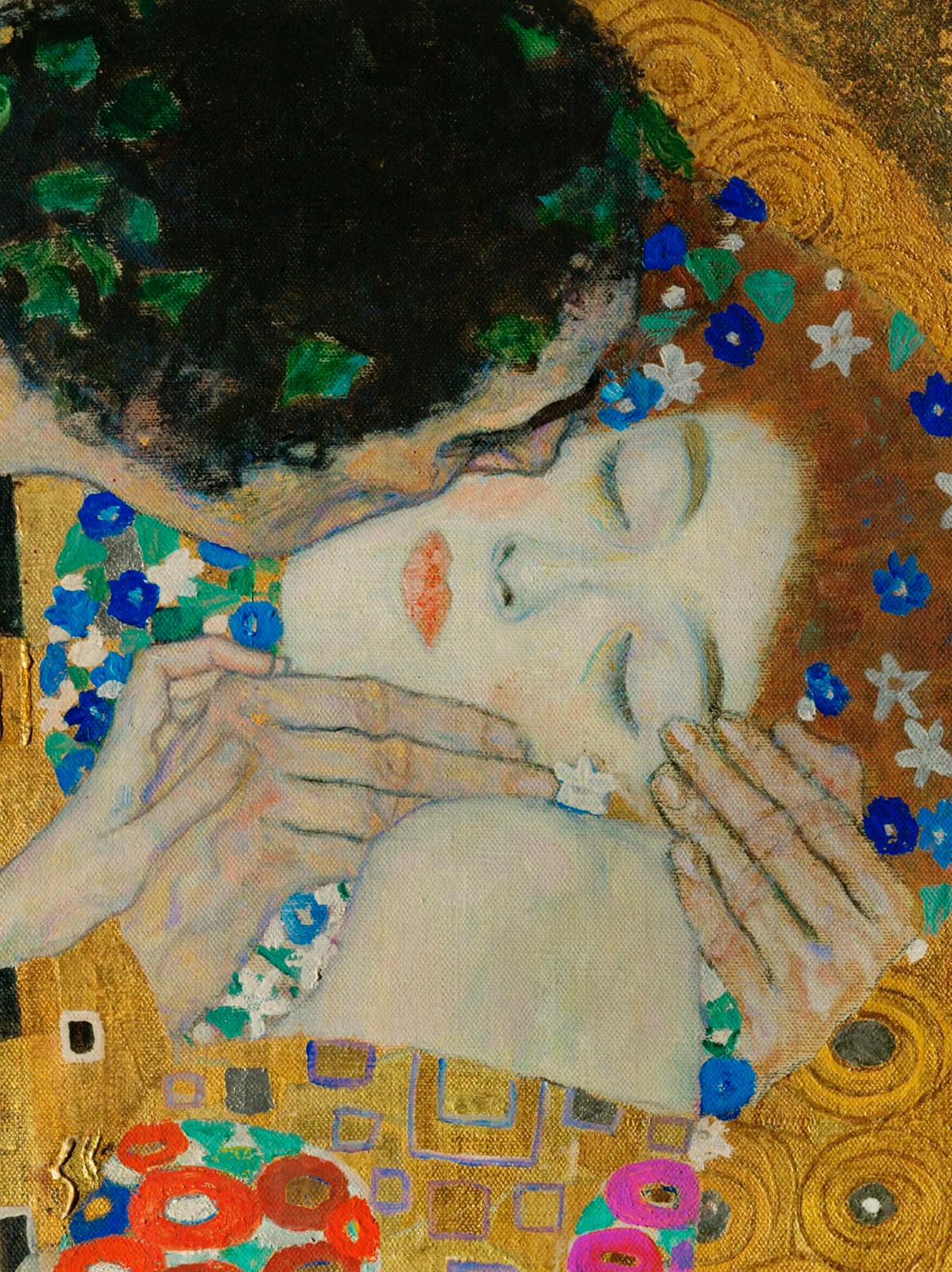
Gustav Klimt, The Kiss (detail), 1907-1908. Österreichische Galerie Belvedere, Vienna.
The Kiss, along with Lichtenstein’s other early drawings, had a vast impact on the course of the artist’s career as well as on the development of Pop Art. The work is perhaps most important in the way that it exposes the artistry which lays latent behind all of the artist’s works, but is often obscured in his larger paintings.