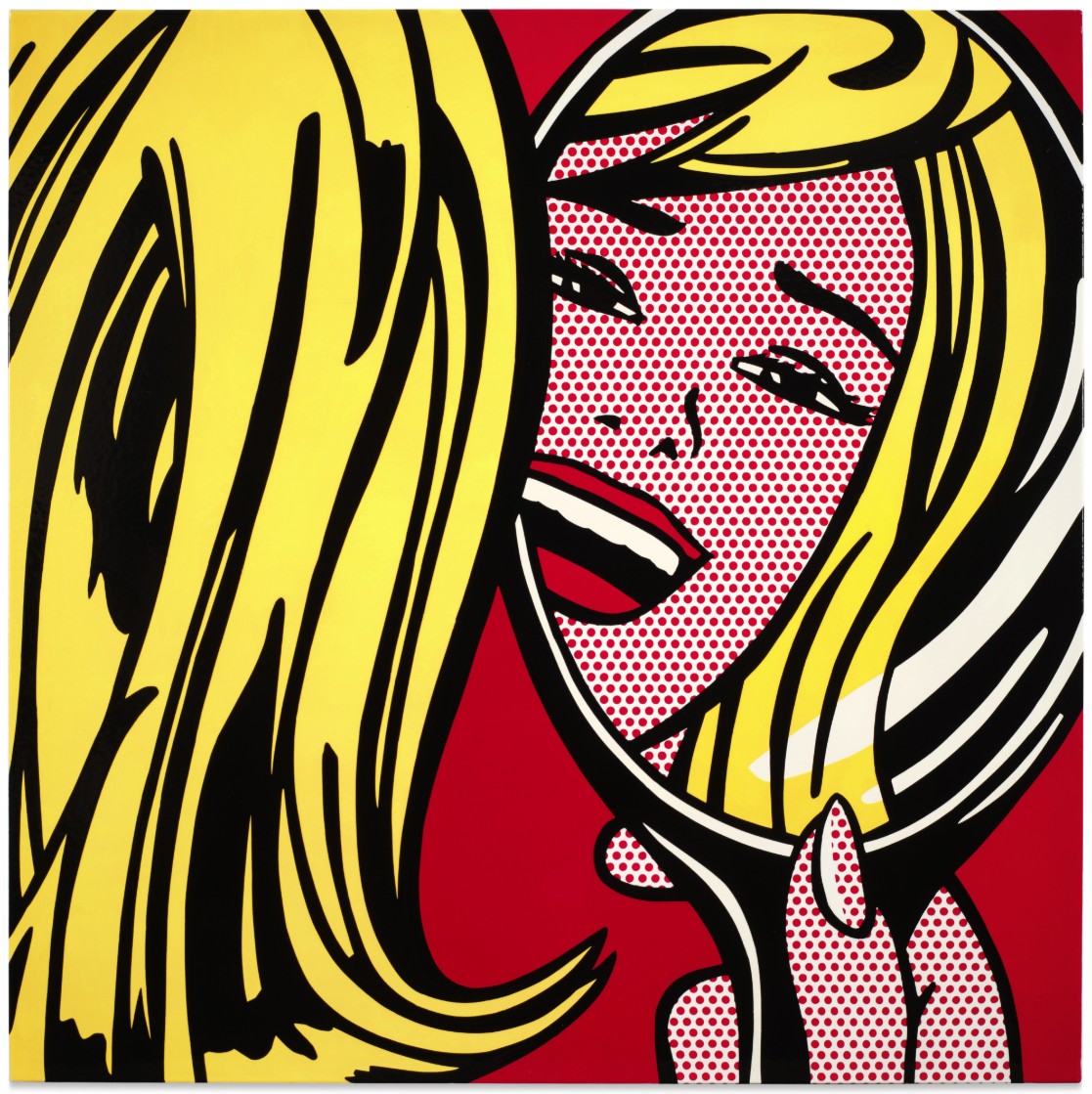
ROY LICHTENSTEIN (1923 – 1997)
Girl in Mirror, 1964
Porcelain enamel on steel
42×42 inches (106.7 x 106.7 cm)
Edition: 8 + 2 AP
Signed, dated and numbered (on the reverse)
A consummate icon of postwar American art, Roy Lichtenstein’s Girl in Mirror from 1964 is a quintessential example of the artist’s legendary blonde heroines of the 1960s, produced in porcelain enamel on steel. Articulated in Lichtenstein’s signature schema of Benday dots and registering bold linear contours in black and white, red and yellow, this work utterly exudes the iconic visual lexicon that propelled Roy Lichtenstein to prominence in the early 1960s. Produced in 1964, this work bears witness to the year Lichtenstein reached the height of his technical prowess and attained the very apogee of his comic strip paintings — the series that propelled the artist to international fame.
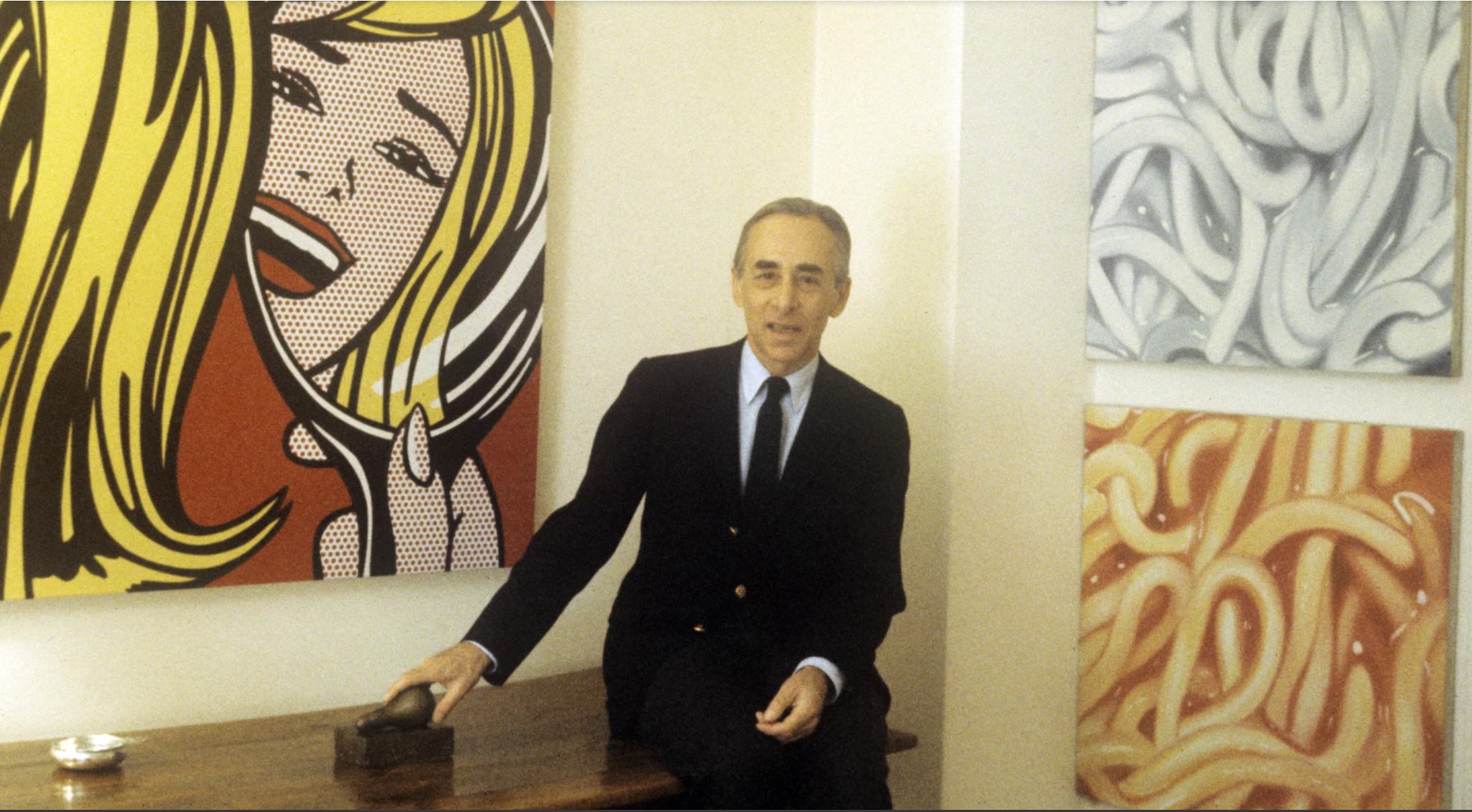
Leo Castelli with an edition of the present work in New York, 1968.
Photo © Steve Schapiro/Corbis via Getty Images. Art © Estate of Roy Lichtenstein
Exuding exceptional graphic efficiency, heightened by the pioneering application of enamel paint on steel, Lichtenstein’s composition offers a superb commentary on high versus low art, the female beau idéal, alongside an intriguing allusion to tradition through a complex painterly dialogue with the conceit of reflection. Lichtenstein was not merely an artist, he was an innovator, able to catapult mass-produced commercial images into the realm of fine art. His innate gift for editing found images and capturing the essence of collective ideal defines the Pop leader’s profoundly insightful understanding of the nature of contemporary perception. Incessantly illustrated throughout artistic literature and highly decorated with an illustrious exhibition history, Girl in Mirror has hung on the walls of the Tate Gallery, Los Angeles County Museum of Art, Corcoran Gallery of Art, Stedelijk Museum. Among others, and was included in the Guggenheim’s international retrospective of the artist.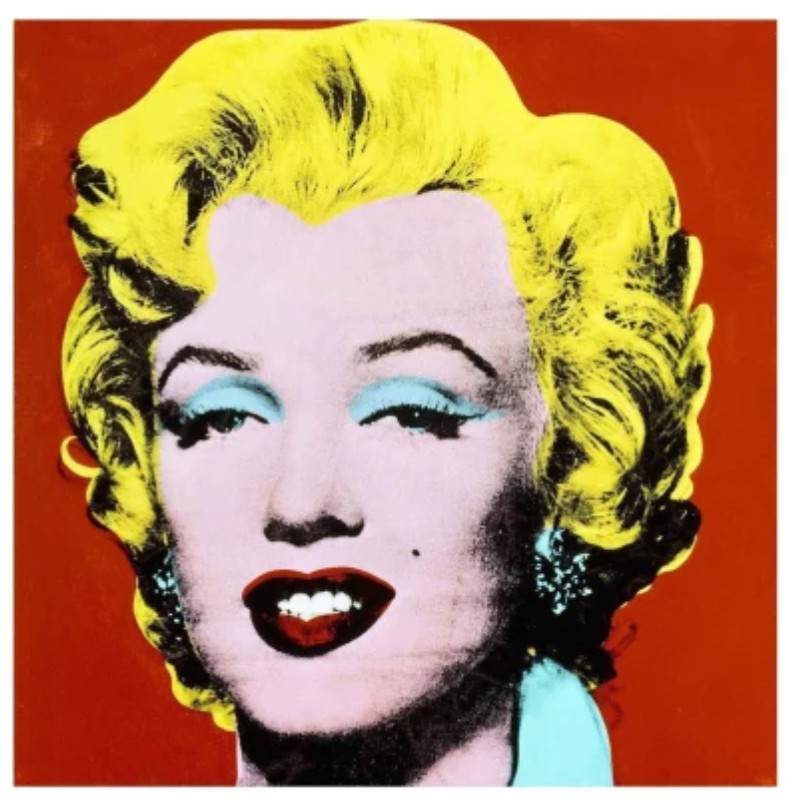
Andy Warhol, Shot Red Marilyn, 1964. Private Collection.
Image © 2026 The Andy Warhol Foundation for the Visual Arts, Inc. / Licensed by DACS, London / Christie’s Images / Bridgeman Images.
Art © 2026 Andy Warhol Foundation for the Visual Arts / Artists Rights Society (ARS), New York
In addition to echoing the aesthetic of the contemporary milieu, Lichtenstein retroactively draws on art-historical precedent. A diligent student of art history, Lichtenstein’s work incites a dialogue with the conceptually loaded conceit of the mirror, a theme that traces a powerful lineage across the grand tradition of the motif. Though Lichtenstein famously invoked Renaissance methods by using the mirror as a tool for detecting flaws in its reversed visage, the mirror, as a symbolic device, also has its roots in the Vanitas genre via the myth of Narcissus. As canonically prevalent in Jan Van Eyck’s Arnolfini Marriage (1434), Velázquez’s Las Meninas (1656), and Manet’s Bar at the Folies-Bergère (1882), the mirror is subtly employed to complicate and dislocate the viewer’s seat of vision. Perspective, perception and illusion are unsettled, and the viewer is at once invited to and obstructed from participating in the depicted drama. Throughout the history of art, the mirror represents the locus par excellence for a complex scrutiny of two-dimensional illusion. Repeatedly taken up by Lichtenstein throughout his career, as his famous Self-Portrait from 1978 attests, the canonical conceit of the mirror here confers an innovative modernization of one of the most prescient and enduring dialogues with art and illusion.
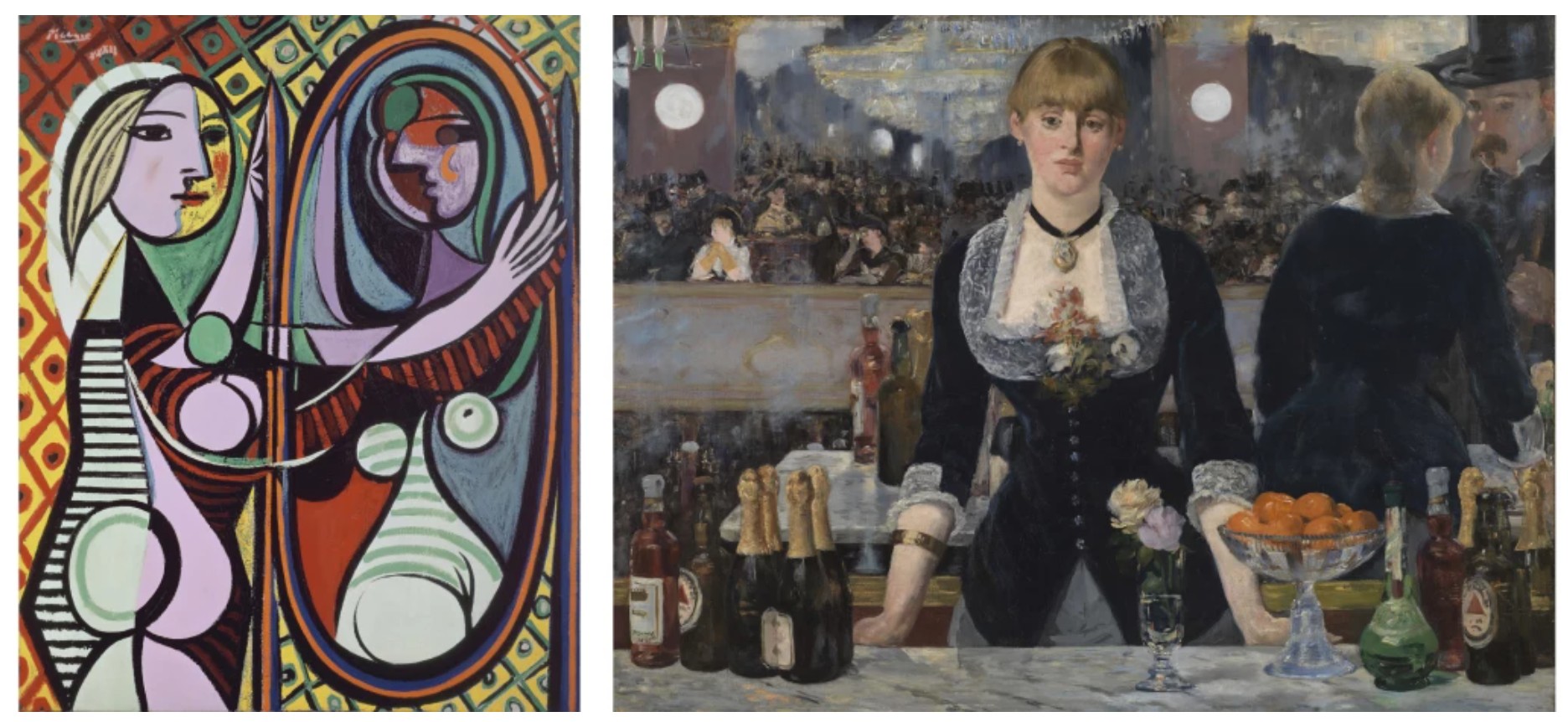
Left: Pablo Picasso, Girl Before a Mirror, 1932. The Museum of Modern Art, New York. Image © Succession Picasso/DACS, London 2026 / Bridgeman Images. Art © 2026 Estate of Pablo Picasso / Artists Rights Society (ARS), New York. Right: Edouard Manet, A Bar at the Folies-Bergere, 1881-82. The Courtauld, London. Image © The Courtauld / Bridgeman Images
Captured in the reflection of her handheld vanity mirror, Lichtenstein’s blonde ideal of American beauty encapsulates the prevalent archetype that had become the socio-cultural aspiration for millions since the Second World War. The dream of looking like Lichtenstein’s comic-book heroines, or of winning their hearts, drove entire billion-dollar industries. Alfred Hitchcock populated his classic movie thrillers with a cast of divine blonde actresses — Grace Kelly, Eva Marie Saint and Kim Novak — who played the part of alluringly independent protagonists before invariably being rescued by Cary Grant or James Stewart and safely returned to reassuring domesticity. Regarding Roy’s Girls series, Dorothy Lichtenstein has said, “I think that he was portraying his idea of the dream girl.” (Exh. Cat., London, Tate Gallery, Roy Lichtenstein, 1968, p. 15) Unlike these real-life icons, Lichtenstein’s Girls are entirely of the imagination, existing solely within the realm of his oeuvre. As such, Lichtenstein’s archetype of blonde American beauty is at once a vessel for the artist’s ideal woman and for our own: “[Roy] specifically picked images and cartoons that had a lot of emotional charge — the archetypal idea of the woman disappointed by love, the war hero in the heat of battle. These are typically American; and it is atypically American way of glorifying a subject.” (Exh. Cat., London, Tate Gallery, Roy Lichtenstein, 1968, p. 10)
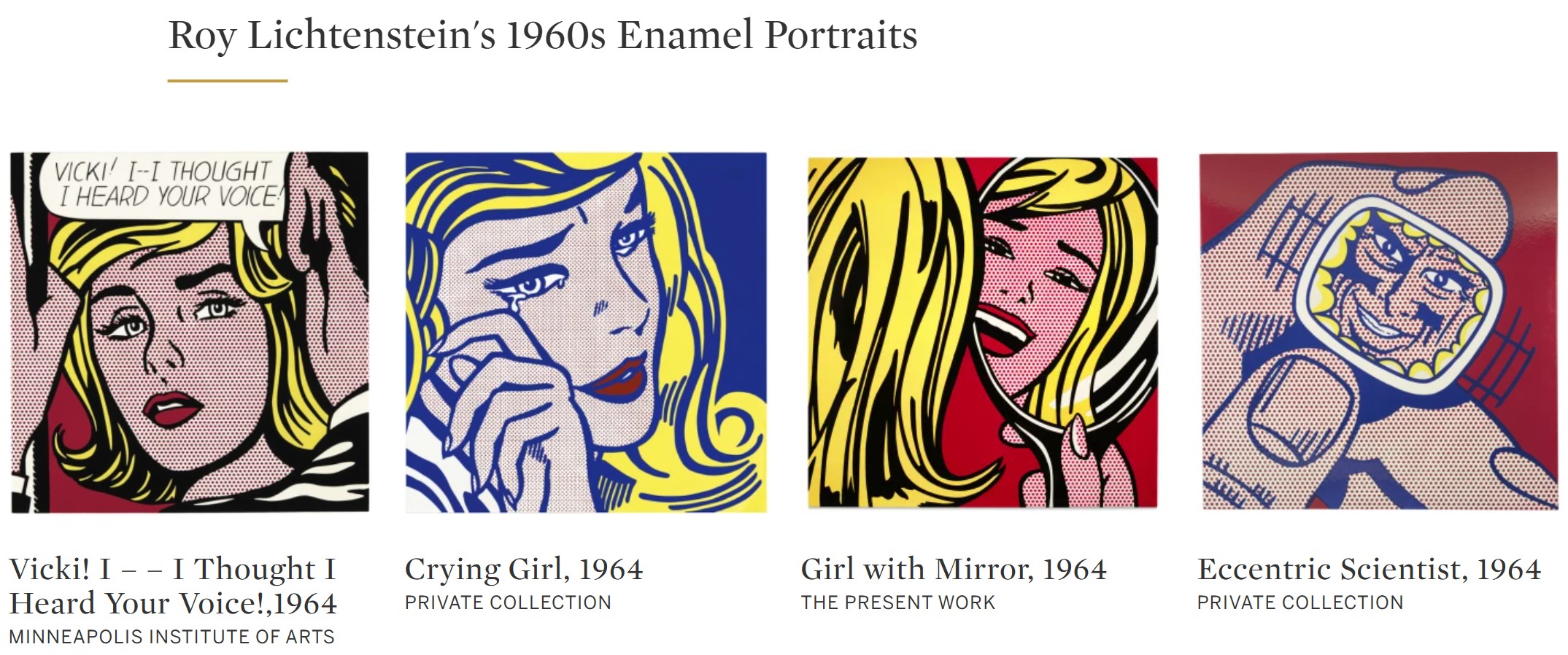
Roy Lichtenstein instinctively understood the phenomenal potential of popular imagery, and more than any artist of his generation, realigned the cipher of that imagery to unveil verities behind the ever-proliferating pictorial panorama of contemporary culture in 1960s America. By doing so, he revolutionized how we perceive the world around us and how, in turn, the world has subsequently been presented back unto itself. Indeed, the very content of Lichtenstein’s comic book paintings can be considered an authentic reflection of this new wave of popular culture. By assimilating its visual vocabulary and mastering the primary modus of industrial pictographic transmission, Lichtenstein’s artworks stand as conceptual mirror images of contemporary culture and the means of its mass production. Between 1963 and 1965, inspired by the hard-finish, reflective sheen of New York subway signage, Lichtenstein began incorporating the slick perfection of advertising into his work. The resultant corpus of enamel paintings, to which Girl in Mirror belongs, achieved a heightened look of mechanical perfection, an effect he could only suggest in his works on canvas.
Girl in Mirror, 1964, encapsulates Roy Lichtenstein’s innovative Pop aesthetic. Executed in porcelain enamel on steel, the work depicts an idealized blonde woman smiling at her reflection in a mirror. The work adheres to Lichtenstein’s intentionally limited palette of primary red, yellow, black, and white, with red Ben-Day dots to articulate the woman’s skin tone. The present work dates to the peak of Lichtenstein’s investigation of Pop aesthetics in the early 1960s; beneath its shiny surface, however, Girl in Mirror provides a trenchant commentary on commodification and femininity in the early 1960s.
Lichtenstein is best known for his cartoon-based approach to Pop Art, whereby, in a proto-Appropriationist move, he based his compositions on panels from newspaper cartoons and comic books. The young woman of Girl in Mirror recalls characters like Betty Cooper from Archie, and fashion comics such as Katy Keene aimed at young female audiences. Beyond the aesthetics of comic book art, however, the composition of Girl in Mirror reveals the strictures of performing femininity in the United States in the early 1960s.
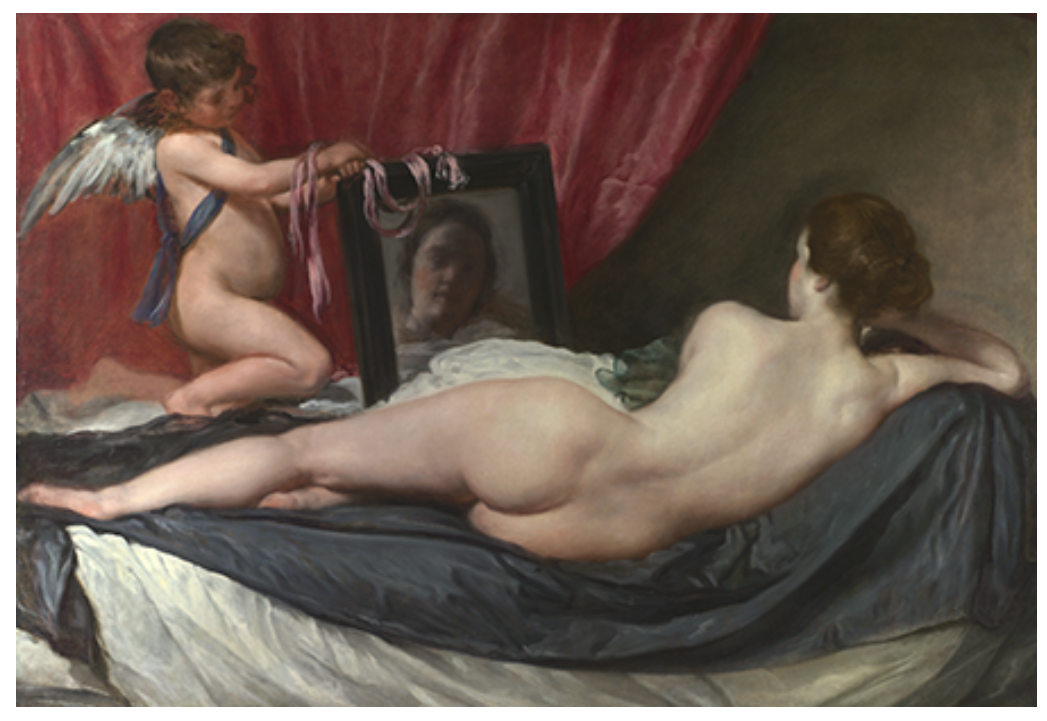
Velázquez, The Toilet of Venus (the Rokeby Venus), 1647-1651. The National Gallery, London.
Image: © National Gallery, London / Art Resource, NY
Within Girl in Mirror, the girl’s face is only visible in the cosmetic mirror she holds towards the viewer, a compositional move which places the visual interest on her body, rather than her face—the girl herself is, quite literally, in the mirror. Her blonde hair, which dominates the left half of the composition, is intentionally artificial, its classic 1960s swoop echoing the curve of the mirror. Even her hand is perfectly manicured, to an unreal degree. As Lichtenstein explained, the artificiality of his characters is part of his artistic experiment.
In Lichtenstein’s hand, his female protagonist is part of the surface—“the kind of girls I painted were really made up of black lines and red dots,” he said. He sees them “that abstractly;” for Lichtenstein, there’s a clear distinction between real women and cartoon women, but he also plays with the ways in which beauty standards and art(ifice) distort our perception of the human form.i Within Girl in Mirror, the female form, especially the made-up, make-believe woman of 1960s cartoons, is simply that: a form, a figure to play with on the painted surface, not unlike the brushstrokes of Lichtenstein’s Abstract Expressionist peers. His wife, Dorothy, corroborated this, explaining how her husband rotated his work on the easel, so that the formal elements of the painting were effective, no matter the work’s orientation.
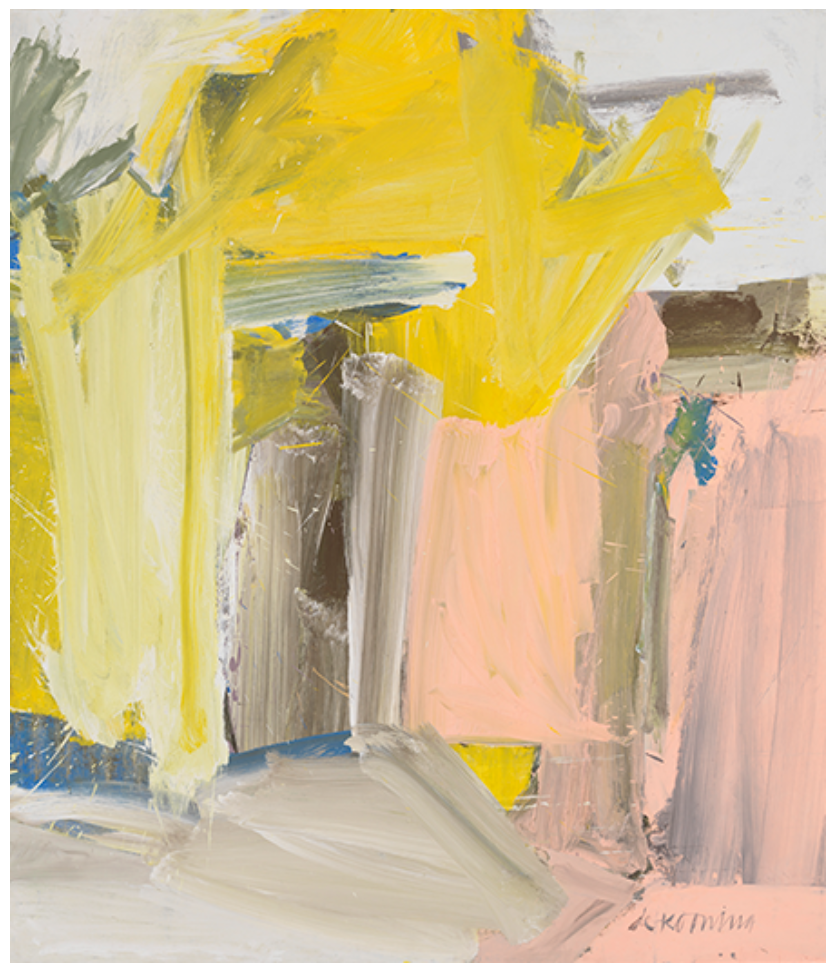
Willem de Kooning, Door to the River, 1960. The Whitney Museum of American Art, New York. Image: © Whitney Museum of American Art / Licensed by Scala / Art Resource, NY, Artwork: © 2023 The Willem de Kooning Foundation/Artists Rights Society (ARS), New York
With Girl in Mirror, Lichtenstein engages the long history of pairing beautiful women with mirrors in Western art. Taken together, the visual elements of Girl in Mirror embody the theme of vanitas, or (the futility of) vanity, which Lichtenstein, working in the post-War, consumerist boom of mid-century America, surely saw reflected in the world around him. The second wave of feminism was still in its infancy when Girl in Mirror was created, with Betty Freidan’s seminal The Feminine Mystique only published one year prior. Akin to Lichtenstein’s New York World’s Fair mural of the same year, Girl in Mirror interrogates themes of vanity, surface, and the commodification of the self, the hallmarks of Lichtenstein’s strongest period of Pop art.
Lichtenstein’s use of Ben-Day dots in Girl in Mirror provides duly formal and symbolic meaning. The Ben-Day dot is a printing technique, popularized at the turn of the 20th century, used to inexpensively add color to newspaper illustrations, particularly cartoons. Over time, cartoonists adapted to the process, and soon began to dot their own work to represent shading and depth; the mechanical process thus becomes an aesthetic choice. As Roberta Smith writes, Lichtenstein’s Ben-Day dots make the work “both more and less artificial;” they not only “signify mechanical reproduction, but they also add suggestions of light and reflection, shifting colors and variations.”iii In other words, the shifting quality of Ben-Day can recall the effect of viewing one’s reflection from varying angles; the idiosyncrasy of their application in Girl in Mirror to the girl’s face and hand suggesting variations in texture, a glimpse of humanity in an intentionally flat and industrial surface.
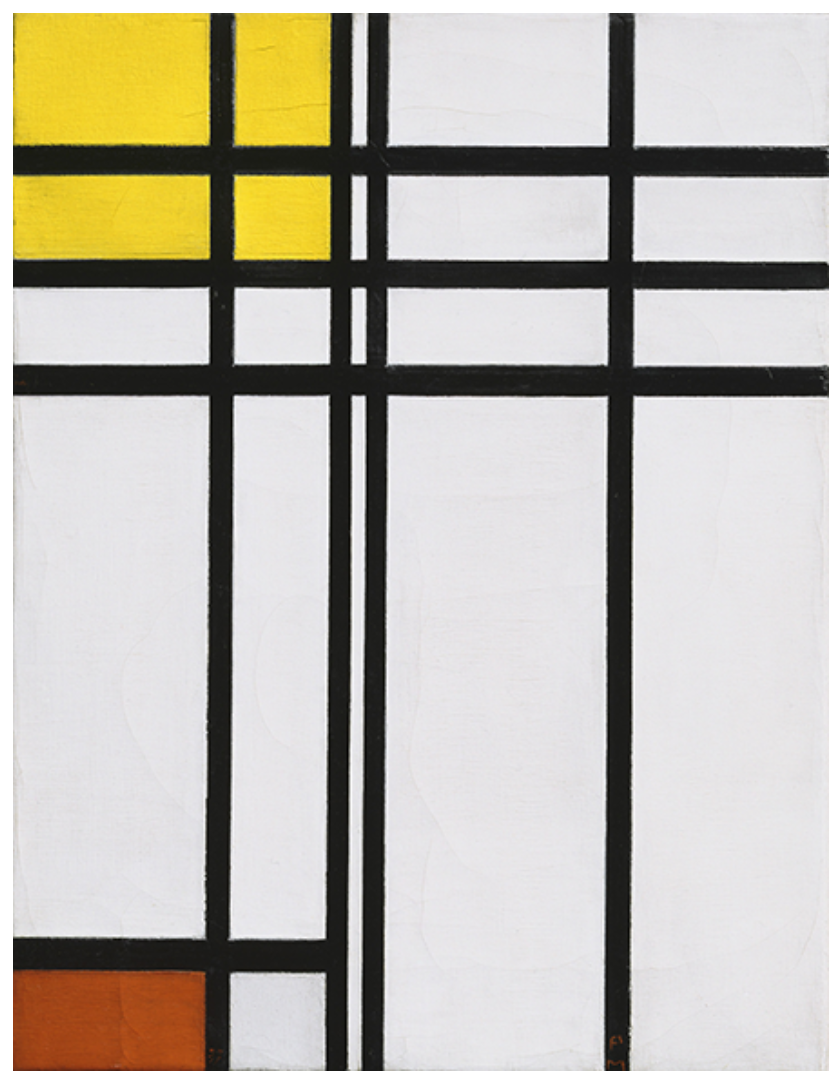
Piet Mondrian, Opposition of Lines, Red and Yellow, 1937. Philadelphia Museum of Art. Image: A.E. Gallatin Collection / Bridgeman Images
Beyond subject matter and technique, Lichtenstein’s material choices for Girl in Mirror are emblematic, as well. The work is made of steel and porcelain enamel, two materials is closely tied to the advent of modernity in the Industrial Revolution; Lichtenstein’s modern America, so ironically captured by his Pop sensibility in Girl with Mirror, could not exist without the very materials of the present work. The shiny surface of Girl in Mirror holds the reflection of the material foundations of the 20th century up to the viewer.
Auction Results
Girl in Mirror, 1964
Property from a Distinguished Private Collection
Sotheby’s New-York: 15 May 2026
Estimated: USD 5,000,000 – 7,000,000
USD 6,220,000
Roy Lichtenstein | Girl in Mirror | Contemporary Day Auction | 2026 |
ROY LICHTENSTEIN (1923 – 1997)
Girl in Mirror, 1964
Porcelain enamel on steel
42×42 inches (106.7 x 106.7 cm)
Signed, dated 1964 and numbered 5/8 (on the reverse)
This work is number 5 from an edition of 8 plus 2 artist’s proofs
Provenance
Leo Castelli Gallery, New York
Jack W. and Constance Glenn, Kansas (acquired from the above in 1964)
Leo Castelli Gallery, New York
The Greenberg Gallery, St. Louis
Alexander Schonwald, St. Louis (acquired from the above in January 1973)
The Greenberg Gallery, St. Louis
Irving Galleries, Palm Beach
Private Collection, Boca Raton (acquired circa 1975)
Sotheby’s London, 26 June 2012, lot 48 (consigned by the above)
Acquired at the above sale by the present owner
Girl in Mirror, 1964
Phillips New-York: 17 May 2023
Estimated: USD 4,500,000 – 5,500,000
USD 5,505,000
Roy Lichtenstein 20th Century & Contemporary Art Evening Sale
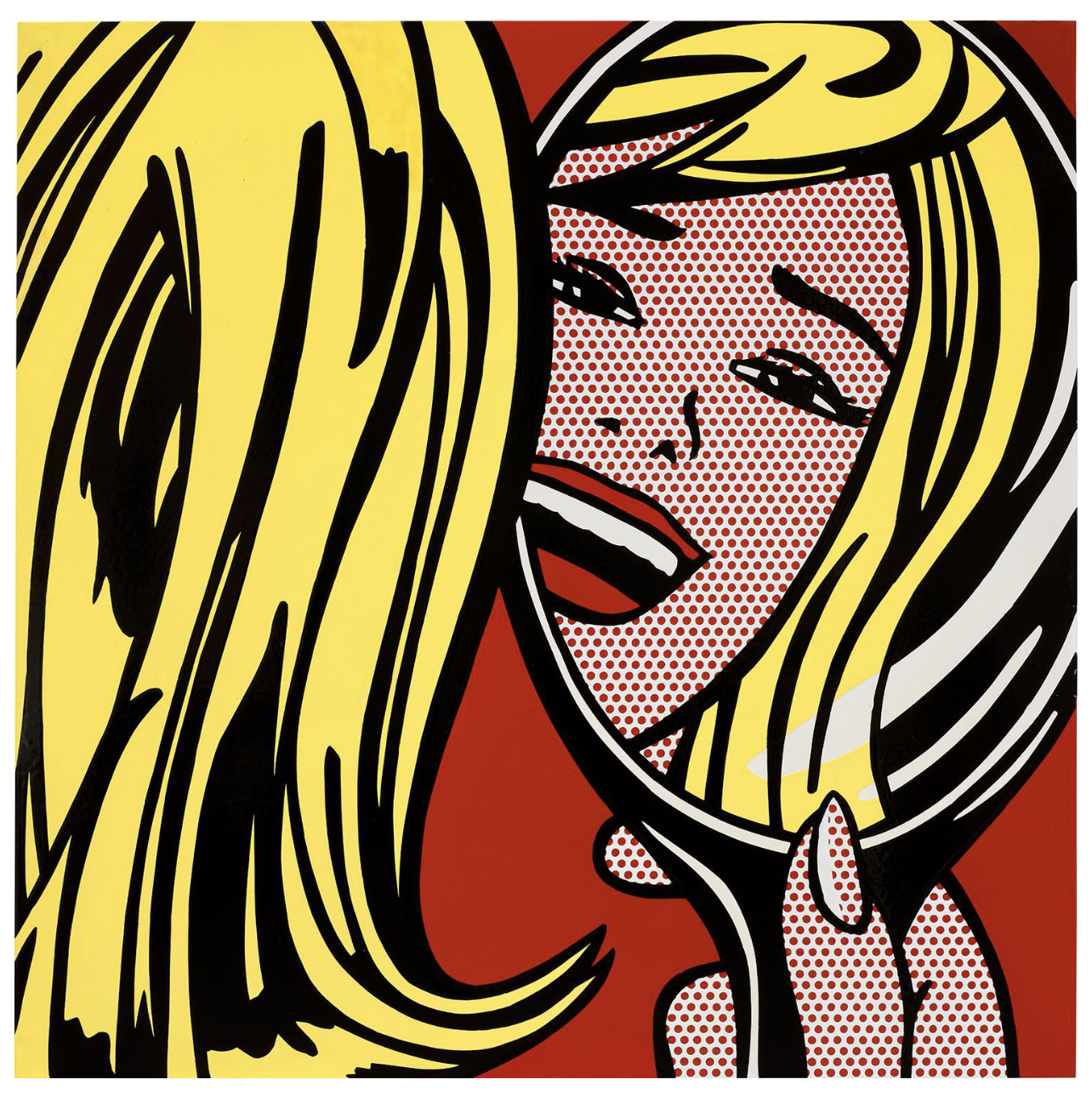
ROY LICHTENSTEIN
Girl in Mirror, 1964
Porcelain enamel on steel
41 7/8 x 41 7/8 x 1 1/8 inches (106.4 x 106.4 x 2.9 cm)
Signed and dated “rf Lichtenstein 1964” on the reverse
This work is number 1 from an edition of 8 plus 2 artist’s proofs
Provenance
Leo Castelli Gallery, New York
Private Collection (acquired from the above in December 1964)
Leo Castelli Gallery, New York (acquired from the above in 1979)
Gabriel Levinas, Buenos Aires (acquired from the above in 1980)
Leo Castelli Gallery, New York and Peder Bonnier, Inc.
Private Collection (acquired from the above in 1983)
Gagosian Gallery, New York
Private Collection, New York (acquired from the above in 2009)
Gagosian Gallery, New York
Acquired from the above by the present owner in 2019
Girl in Mirror, 1964
Phillips London: 7 March 2019
Estimated: GBP 4,500,000 – 6,500,0000
GBP 4,800,000 / USD 6,281,385
Roy Lichtenstein 20th Century & Contemporary Art Evening Sale
REPEAT SALE
Property from the Collection of Max Palevsky
Christie’s New-York: 10 November 2010
Estimated: USD 3,000,000 – 4,000,000
USD 4,898,500
Roy Lichtenstein (1923-1997) , Girl in Mirror | Christie’s
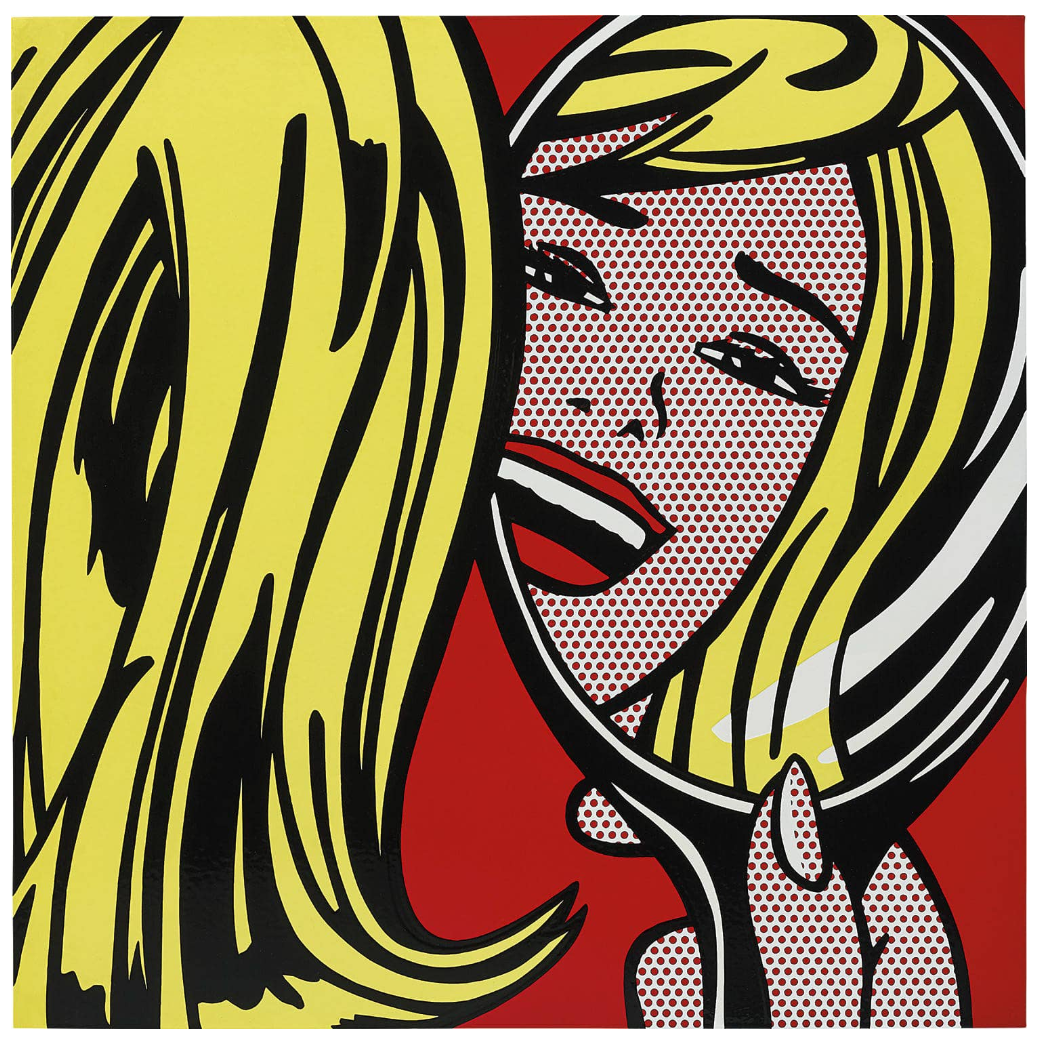
ROY LICHTENSTEIN
Girl in Mirror, 1964
Porcelain enamel on steel
41 7/8 x 41 7/8 inches (106.6 x 106.6 cm)
Signed, numbered and dated ‘rf Lichtenstein 3/8 1964’ on the reverse
This work is number 3 from an edition of 8 plus 2 artist’s proofs
Provenance
Leo Castelli Gallery, New York
Charles H. Carpenter, New Canaan (acquired from the above on 15 December 1964)
O.K. Harris Works of Art, New York
Max Palevsky Collection, California (acquired from the above in 1973)
Thence by decent
Christie’s, New York, 10 November 2010, lot 45
Acquired at the above sale by the present owner
Girl in Mirror, 1964
Property from the Collection of Marvin and Florence Gerstin
Christie’s New-York: 12 November 2014
Estimated: USD 2,000,000 – 3,000,000
USD 6,885,000
Roy Lichtenstein (1923-1997), Girl in Mirror | Christie’s
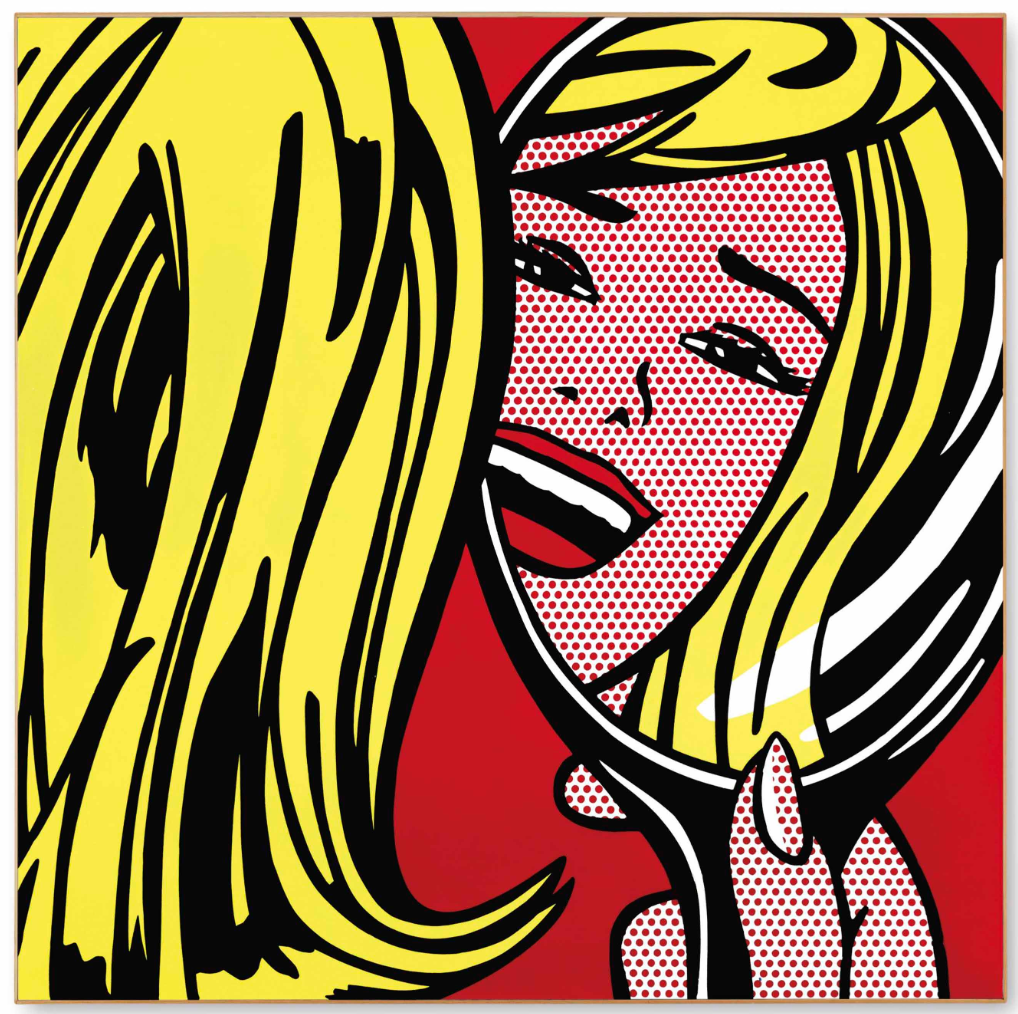
ROY LICHTENSTEIN (1923-1997)
Girl in Mirror, 1964
Porcelain enamel on steel
42x42x2 inches (106.7 x 106.7 x 5.1 cm)
Signed ‘rf Lichtenstein’ (on the reverse)
This work is from an edition of eight
Provenance
Ivan C. Karp, New York
Acquired from the above by the present owner, 1966