DAVID HOCKNEY (1937 – 2026)
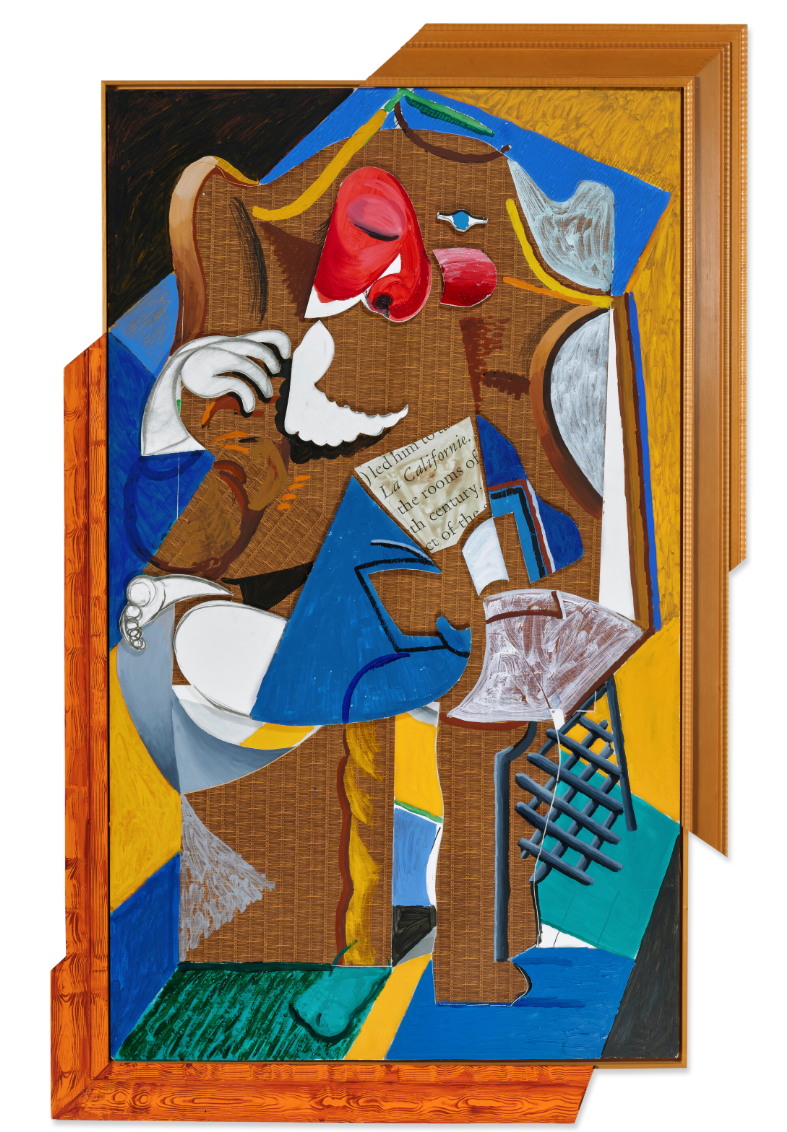
Henry Reading, 1985
Acrylic, charcoal, contact paper and paper collage on gatorboard, in artist’s frame
92 x 57-1/2 inches (233.7 x 146.1 cm)
Signed, titled and dated 1985 (on the reverse)
Provenance
LA Louver Gallery, Los Angeles
Acquired from the above in 1994 by the present owner
Art History
Sotheby’s London: 15 October 2026
Estimated: GBP 2,200,000 – 2,800,000
GBP 2,821,000 / USD 3,732,465
David Hockney | Henry Reading | Contemporary Evening Auction | 2026 |
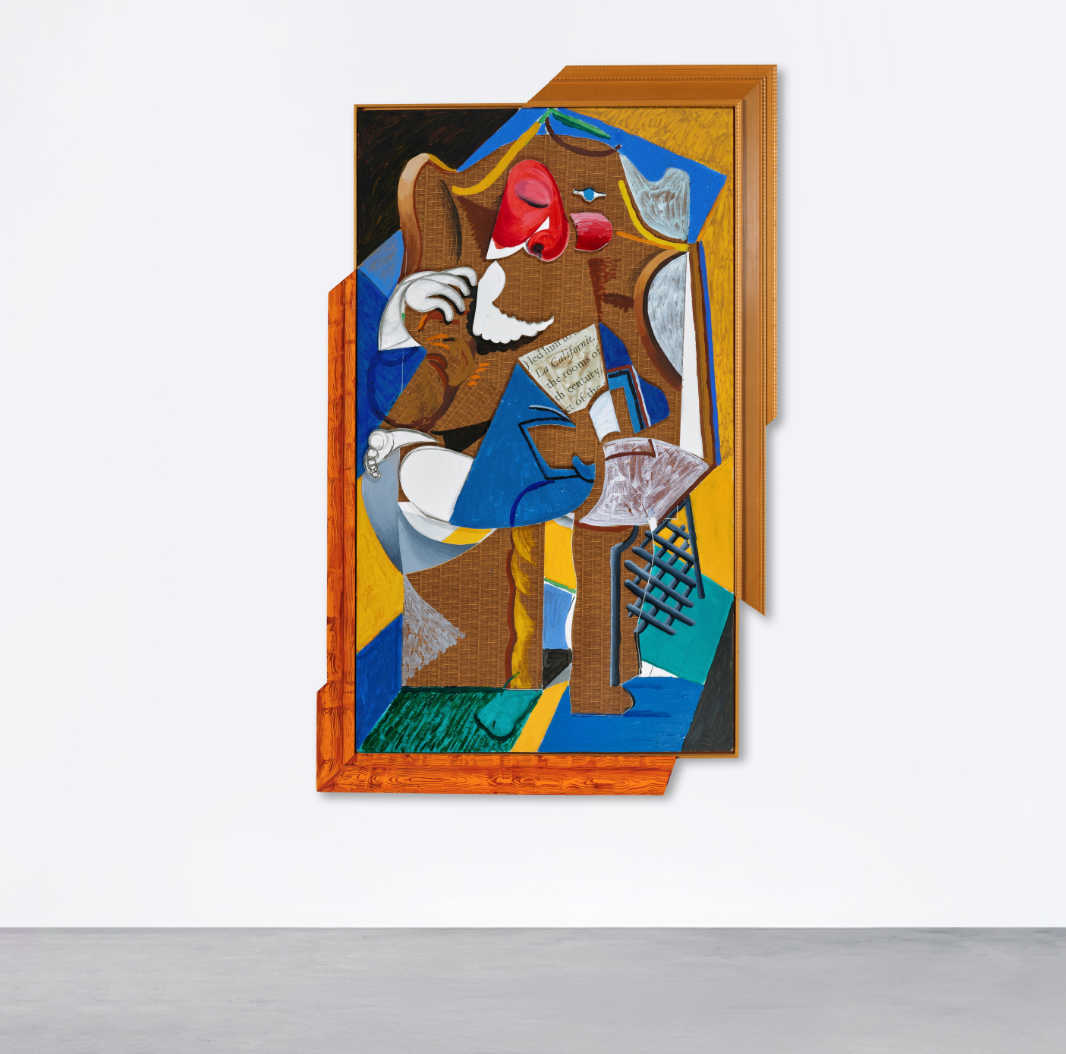
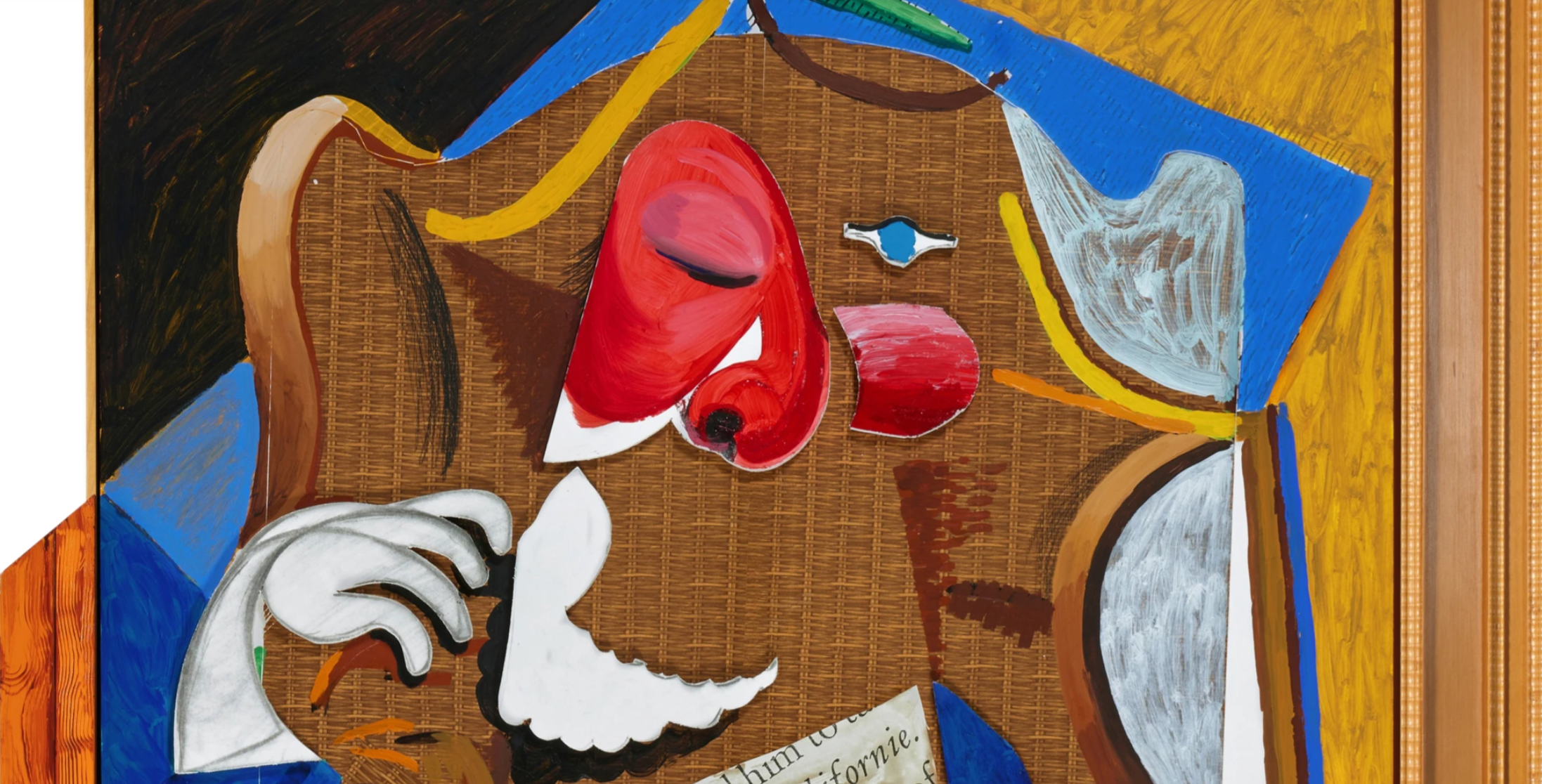
Monumental in scale and built up from an accumulation of collaged media, Henry Reading is a work of playful and deeply felt homage, in which Hockney pays tribute to two of the most important presences in his artistic life: Pablo Picasso, whose influence had preoccupied him for decades, and Henry Geldzahler, the curator and friend who appears here absorbed in a book. Painted in a loosely Cubist idiom that recalls Picasso’s own collaged constructions from the turn of the century, the work shows Hockney at his most inventive, folding two forms of tribute — to an artistic hero and to a cherished friend — into a single, riotously colored composition.
“One reason, among others, why I think Picasso is so crucial is because he brings very much to the fore the question of verisimilitude versus the remaking of appearance. And what led me into questioning the verisimilitude of naturalism was that it was not real enough. Because the problem is not that naturalism is too real, but that it is not real enough.”
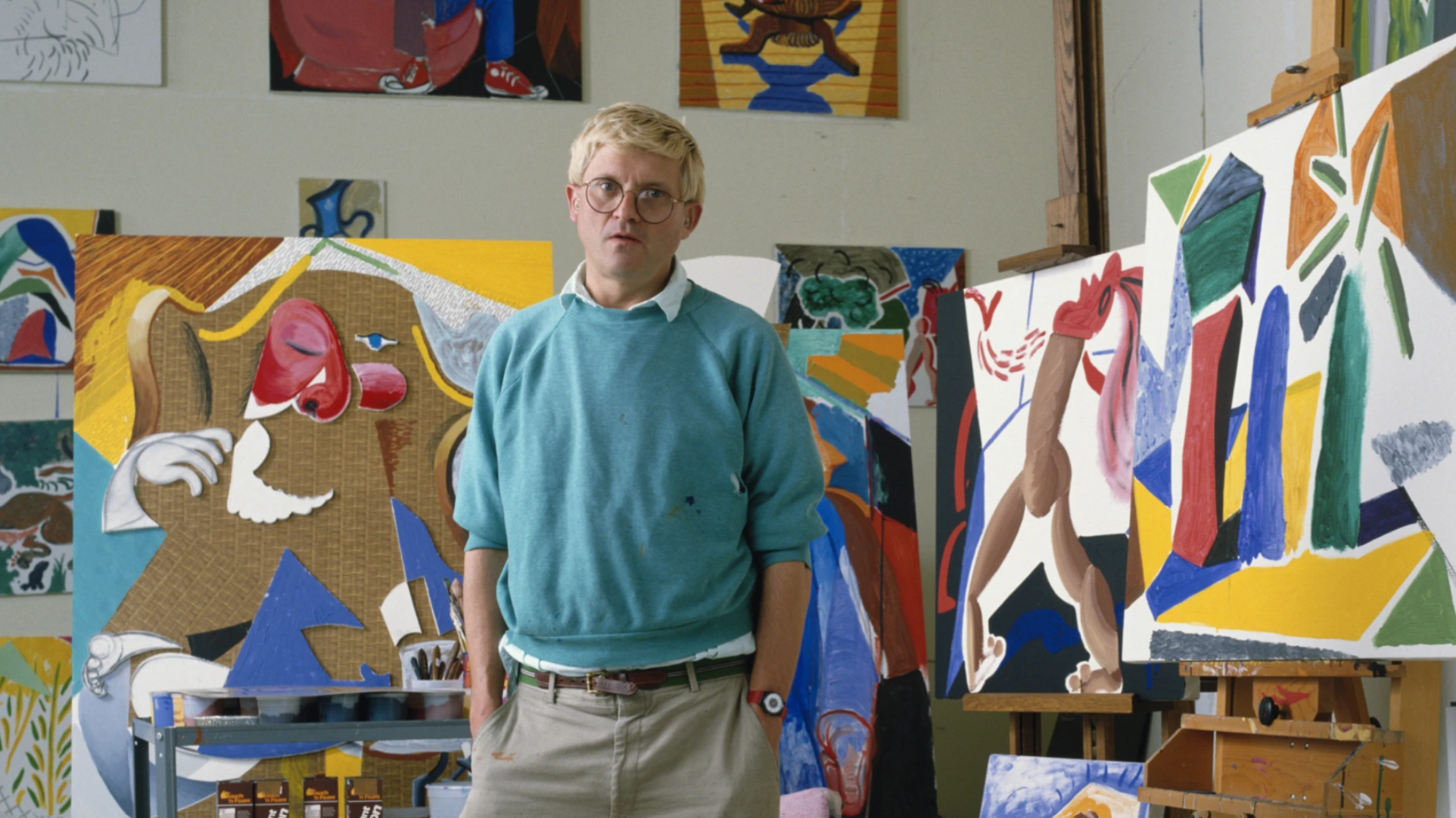
David Hockney in his studio while working on the present work (in the background).
Art: © David Hockney 2026. Image: © David Montgomery/Getty Images 2026
Henry Geldzahler was, for much of the twentieth century, one of the most influential curators of contemporary art in America, serving at the Metropolitan Museum of Art in New York and forming close friendships with many of the leading artists of his generation, Hockney chief among them. Hockney had painted and drawn Geldzahler many times over the years, from the celebrated 1969 double portrait showing him seated on a sofa beside his then partner Christopher Scott, to the deathbed portraits made at Geldzahler’s own request in 1994. Henry Reading sits within this long-running dialogue, offering an intimate glimpse of Geldzahler absorbed in a new book on Picasso — a projection, in effect, since the picture’s true subject is not so much the man himself as the way that his act of reading allows the contents of the book to take over and dictate the composition around him.
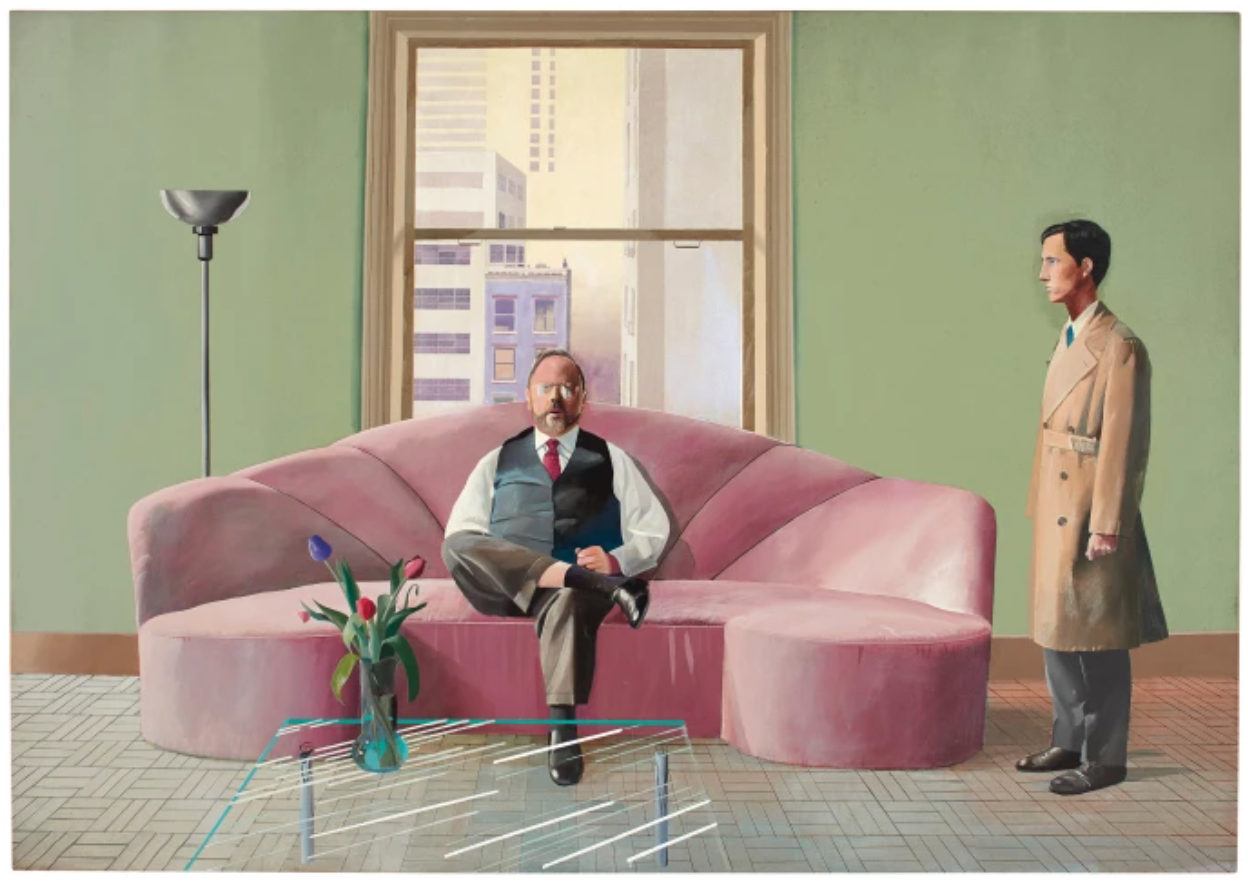
David Hockney, Henry Geldzahler and Christopher Scott, 1969. Private Collection. © David Hockney 2026
The choice of subject is a fitting one. The quotation from Klaus Gallwitz’s influential 1985 study of Picasso’s late years, from which the collaged text in the composition is drawn, refers to the Spanish master’s time in the South of France, when he had acquired a villa called La Californie — a name with an obvious resonance for an artist who had himself decisively relocated to California and whose work had, since the late 1970s, become increasingly preoccupied with questions of perception and representation. Hockney’s engagement with Picasso ran deep: he had studied the artist’s entire output, working page by page through the thirty-three-volume catalogue raisonné compiled largely during Picasso’s lifetime. While Henry Reading draws most directly on the visual language of Picasso’s Cubist period, it is the energy of the artist’s late work that seems to have left the deepest mark, not least Picasso’s own return, in the studio-paintings of his final years, to the theme of the artist’s working space itself.
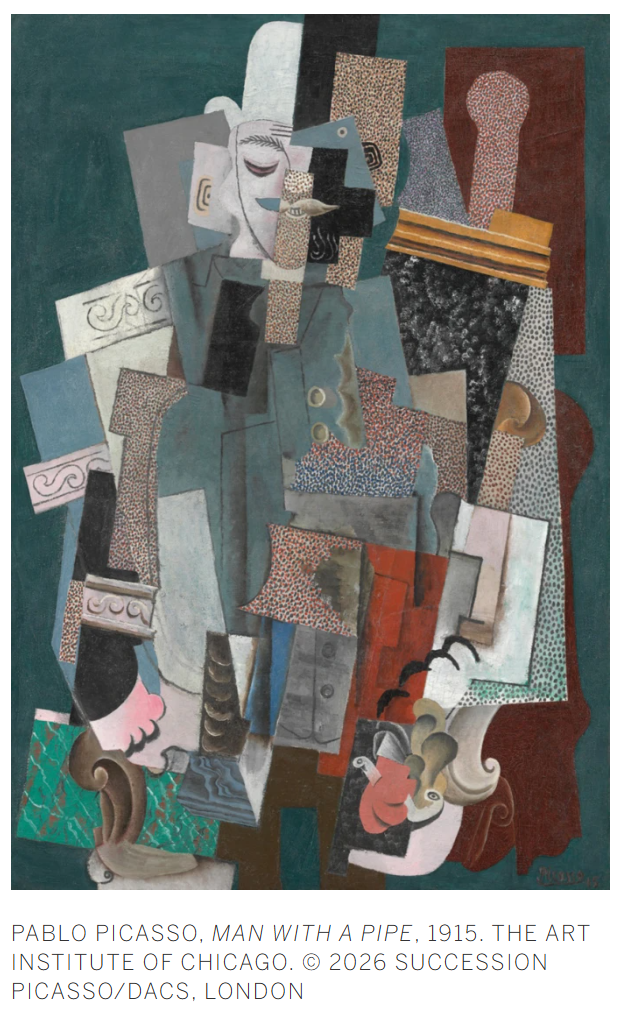
The mid-1980s saw Hockney produce a number of works in overt dialogue with Picasso’s style, among them A Visit with Christopher and Don, Santa Monica Canyon from 1984, a panoramic Cubist landscape painted for his friend Celia Birtwell, made the same year Hockney had visited an exhibition of Picasso’s work in Paris drawn from the collection of the dealer Daniel-Henry Kahnweiler. Henry Reading, produced shortly following these encounters, channels this same interest into portraiture, using Picasso’s own collage-based Cubism as the vehicle through which to represent a friend rather than a landscape or still life.
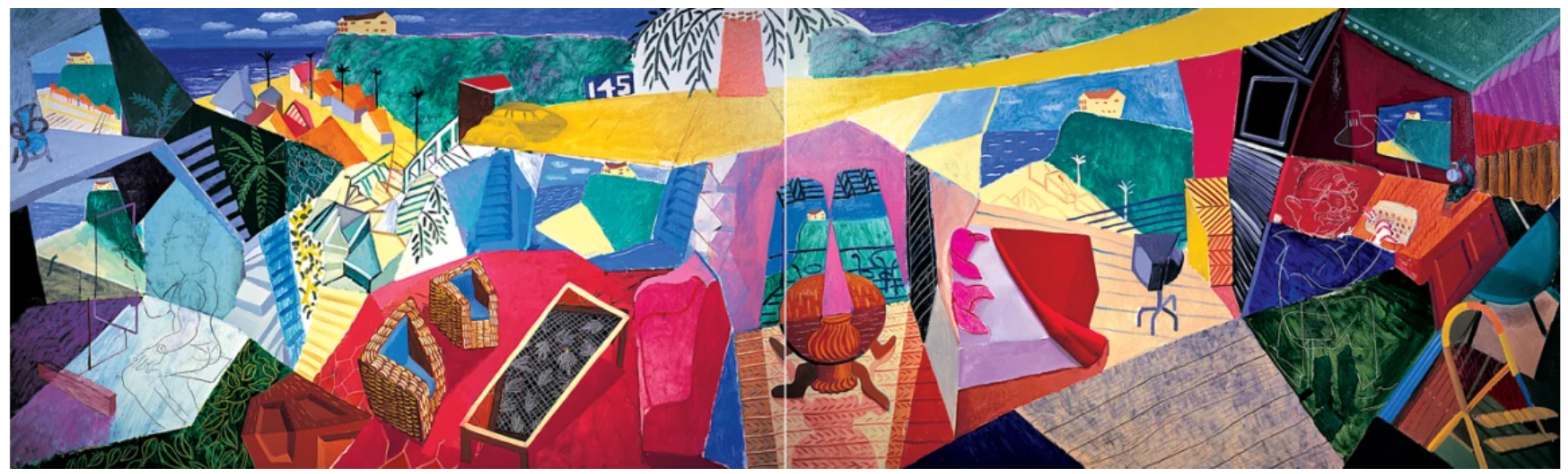
David Hockney, A Visit with Christopher and Don, Santa Monica Canyon, 1984. Museum Ludwig, Cologne. © David Hockney 2026
What distinguishes Henry Reading most, however, is the way its underlying concerns connect to a much longer preoccupation in Hockney’s work: the mechanics of vision itself. As Hockney explained of his engagement with Cubism during this period, the realisation that Picasso worked with an awareness of time as much as space — showing, in effect, “the back of the body as well as the front” — was for him “a very profound experience,” one that revealed naturalism to be not “too real”, but “not real enough” (David Hockney, That’s the way I see it, London 1993, p. 102). This same investigation runs through Hockney’s photomontages of the period, in which multiple photographs taken over time were assembled like fragments of a single experience, conveying more than any single image could alone. Henry Reading, though not itself photographic, shares this same underlying ambition: the compositional planes of bold colour that fracture and reconstitute Geldzahler’s form, the fragment of printed text lifted directly from Gallwitz’s book and pasted into the picture, and the wicker-effect background left deliberately open at the centre of the composition, all work together to build a portrait assembled through accumulation rather than a single fixed vantage point.
Executed on a scale that allows its Cubist planes and collaged fragments to unfold with real theatrical presence, Henry Reading stands as one of the most personal and art-historically resonant works of Hockney’s mid-1980s exploration of collage, a picture in which friendship, curatorship and the enduring example of Picasso are woven into a single, exuberant image.