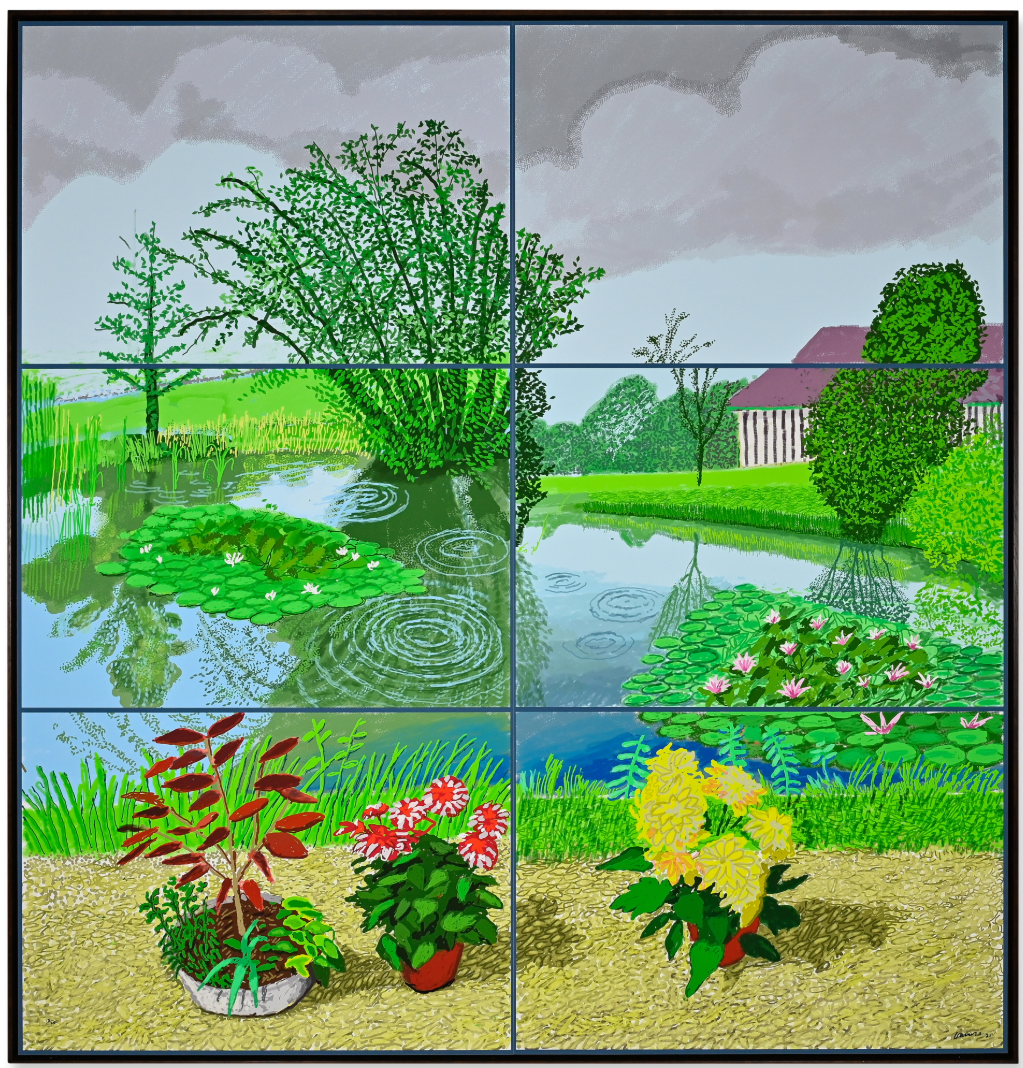
10th – 22nd June 2021, Water Lilies in the Pond with Pots of Flowers
Medium: Six iPad paintings printed on two sheets of paper, mounted on two sheets of Dibond
Year: 2021
Overall: 209.5 x 199.4 cm (82-1/2 x 78-1/2 inches)
Edition: 25
Signed and dated (lower right)
Numbered (lower left)
Beneath a canopy of silver-grey clouds, concentric ripples disturb the mirrored surface of a pond where water lilies drift in floating clusters, their white and pink blossoms echoing the potted flowers that line the foreground. In David Hockney’s 10th–22nd June 2021, Water Lilies in the Pond with Pots of Flowers, the domestic garden becomes a theatre of looking, where sky, foliage, and water are observed, reflected, and reinvented across a six-part composition held together by a slate-blue grid. Combining the intimacy of still life with the encompassing scale of landscape, the work crystallizes the pictorial inventiveness and sustained delight in nature that distinguish his Normandy years.
“Artists thought the optical projection of nature was verisimilitude, which is what they were aiming for, but in the twenty-first century, I know that is not verisimilitude. Once you know that, when you go out to paint you’ve got something else to do. I do not think the world looks like photographs. I think it looks a lot more glorious than that.”
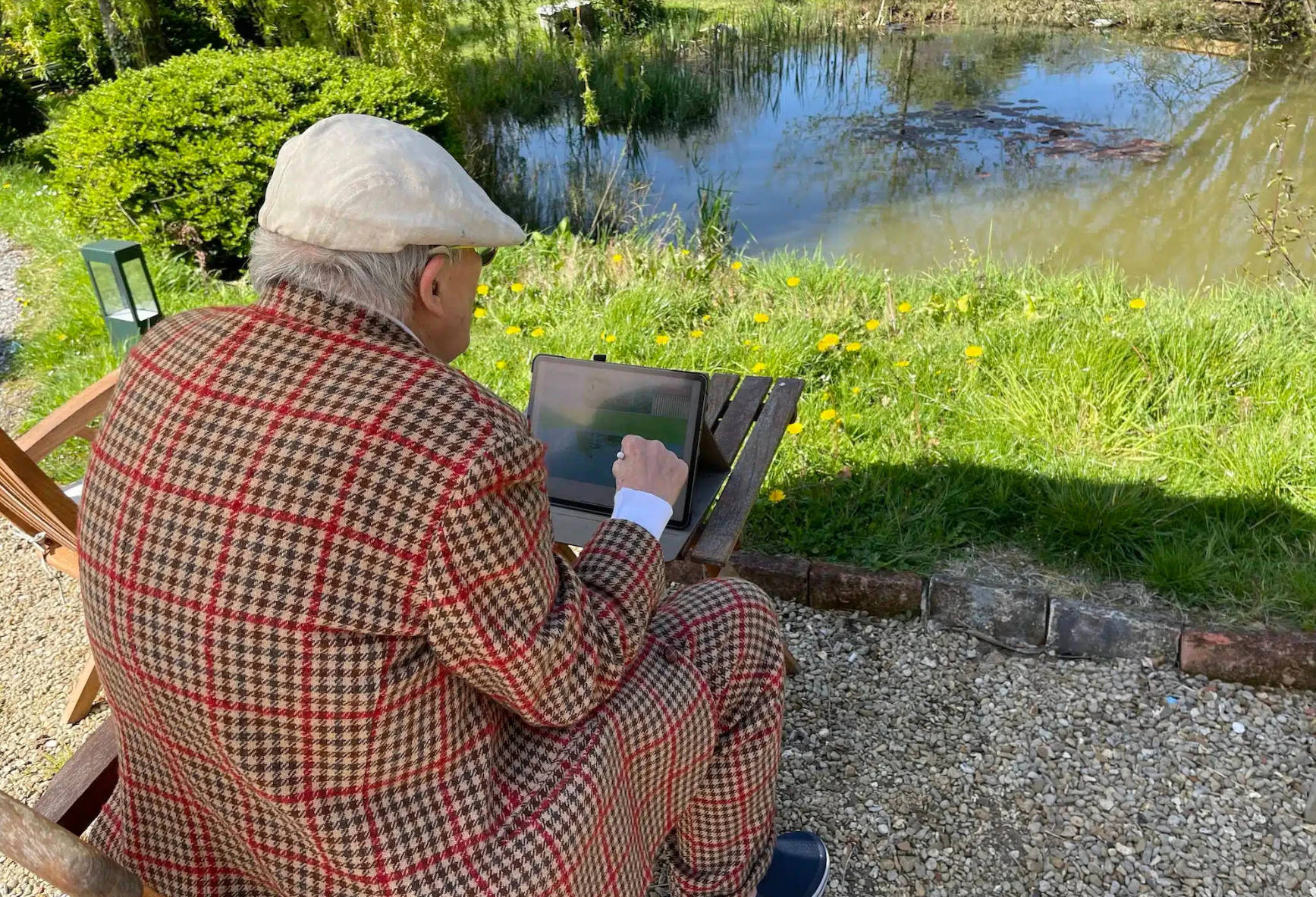
David Hockney working on iPad: David Hockney, Normandy, 2021 © David Hockney Photo: Jonathan Wilkinson
Hockney settled in Normandy’s Pays d’Auge in 2019, shortly before the pandemic transformed his rural retreat into a place of prolonged seclusion. Working through lockdown, he immersed himself in the rhythms of the landscape around his house, paying close attention to its seasonal transformations. The present work emerged from this fertile period, alongside the panoramic A Year in Normandie, whose unfolding cycle of seasons drew inspiration from the Bayeux Tapestry. Exhibited at the Musée de l’Orangerie in Paris in 2021-22 and later at the Serpentine Gallery in London in 2026, that monumental frieze demonstrated the scale of Hockney’s Normandy project, transforming a familiar garden into a vast meditation on time and change.
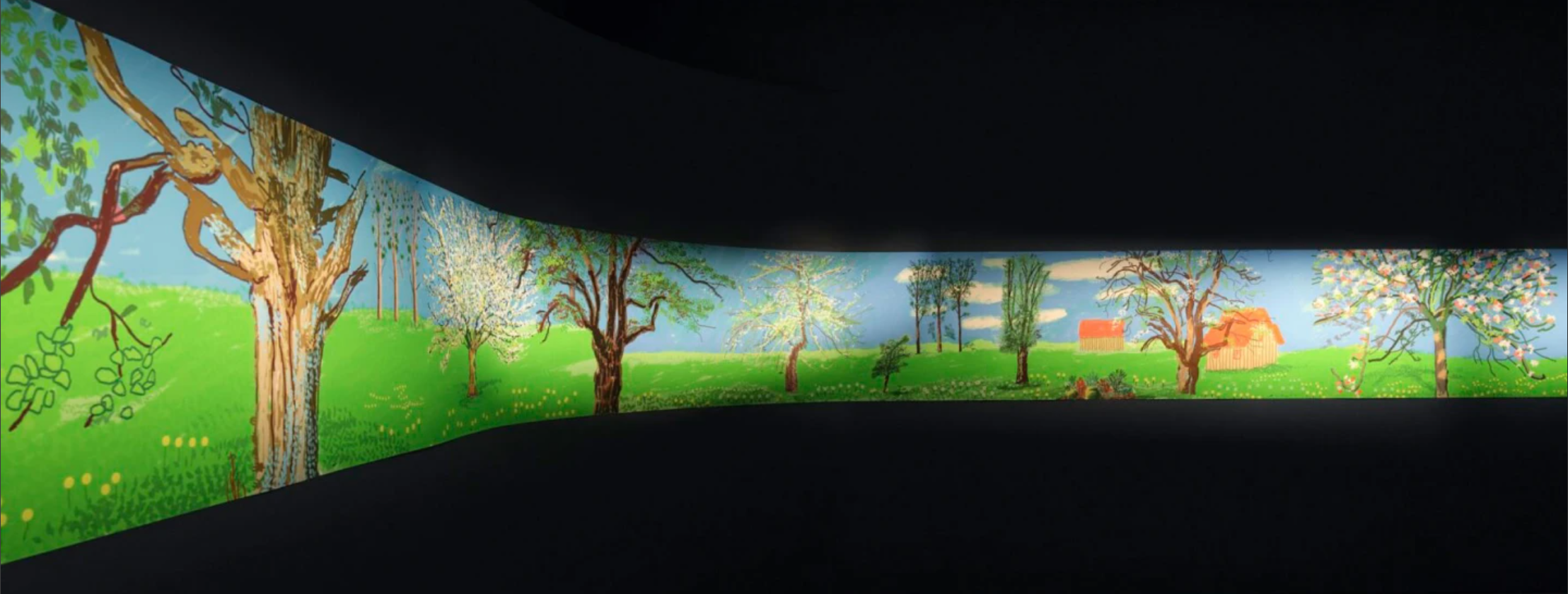
David Hockney: A Year in Normandie and Some Other Thoughts about Painting, installation view, Serpentine North, 2026
© David Hockney. Photo: George Darrell
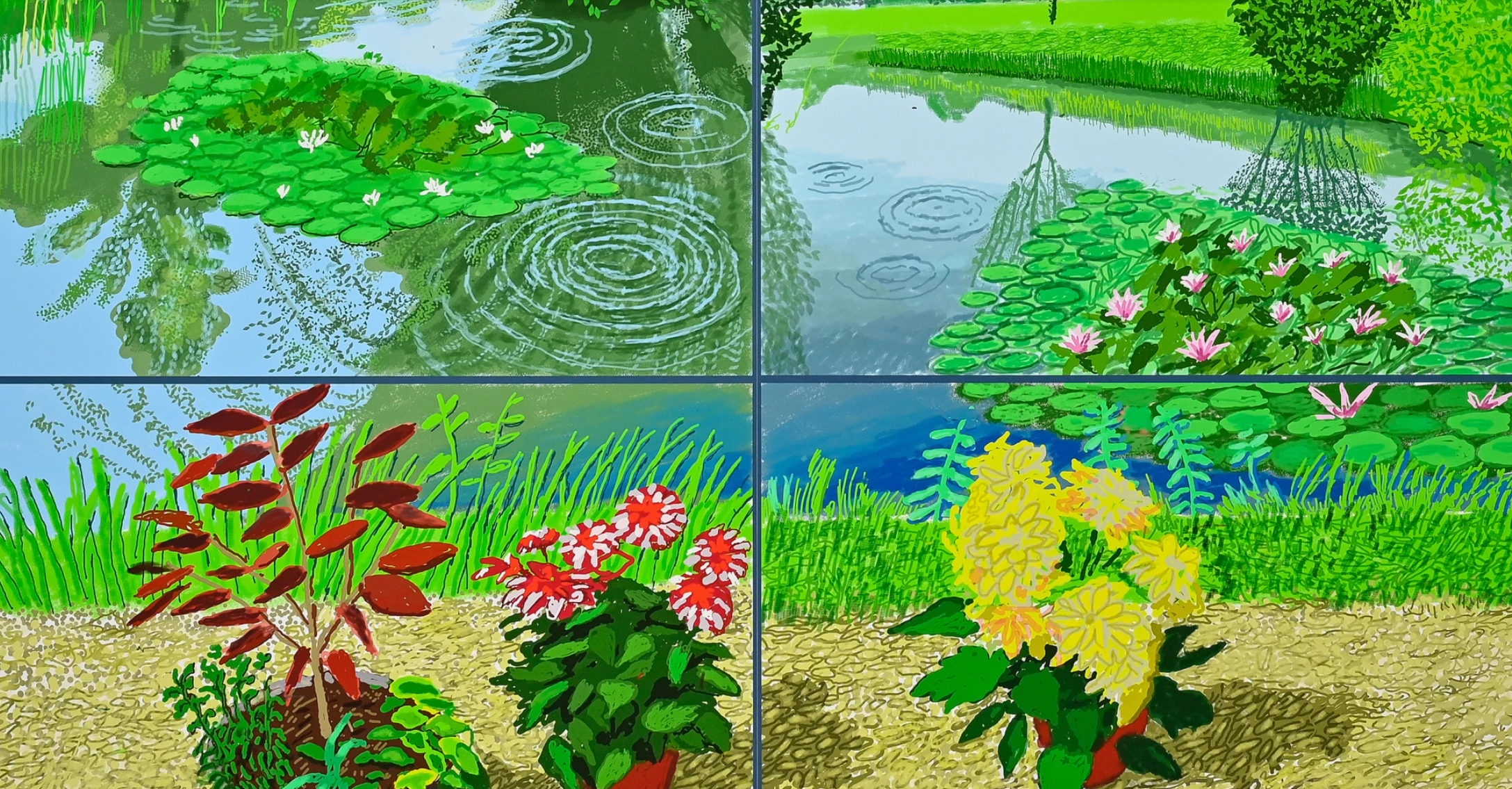
The iPad, which Hockney began using in 2010, was fundamental to this renewed attention. Its portability and immediacy allowed him to register fleeting effects of light, weather, and seasonal change, extending the possibilities of painting en plein air. By the Normandy period, a specially adapted application offered brushes developed to his own requirements. Here, varied digital marks differentiate the stippled foliage, looping ripples, and dense granular texture of the foreground. Enlarged into a print over two meters high, these gestures retain the vitality of the drawing hand. Far from a departure from painting, the iPad works represent a natural extension of Hockney’s practice, giving him a new way to describe the world as it is seen and experienced.
Hockney’s sustained attention to the garden finds one of its most resonant precedents in Monet’s Nymphéas. The affinity extends beyond a shared motif to a sustained engagement with an intimately known landscape, through which reflection, light, and seasonal change become inexhaustible subjects. Monet’s late Nymphéas frequently suppress the horizon, immersing the viewer in a world of water and reflected sky. Hockney, by contrast, retains the far bank, the building, and the shifting canopy of clouds above, situating the pond within a recognizable, inhabited landscape.
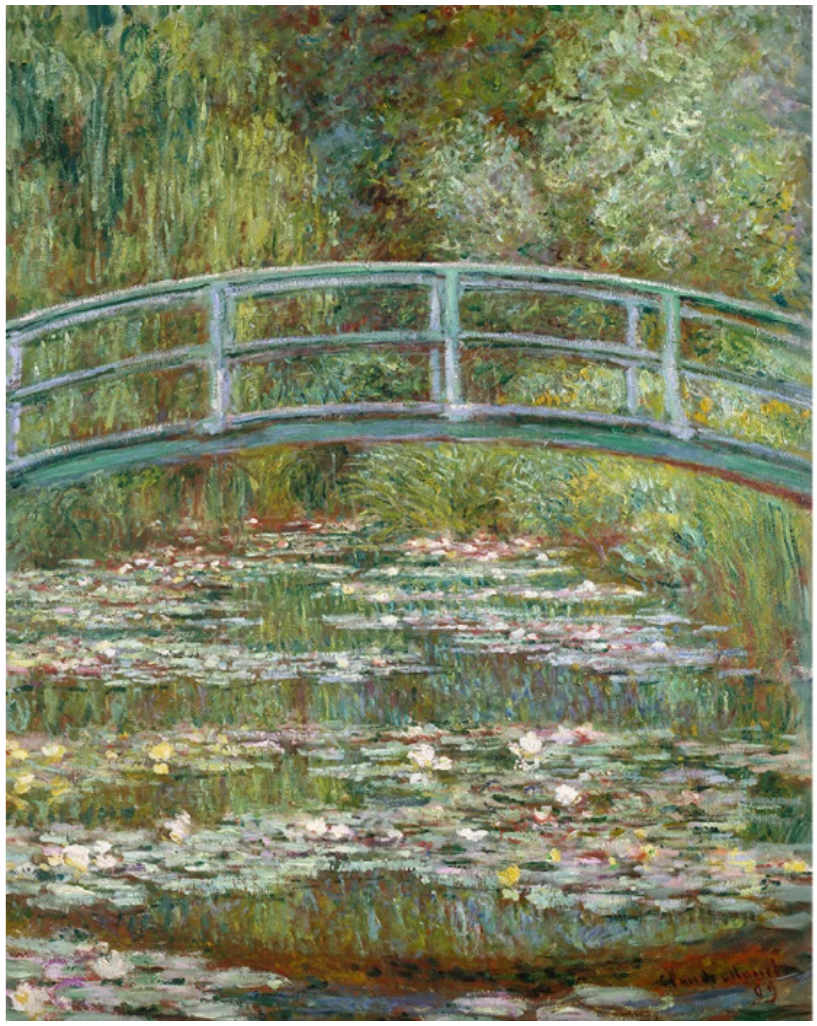
Claude Monet, Bridge over a Pond of Water Lilies, 1899. Metropolitan Museum of Art, New York.
The foreground also recalls Henri Matisse’s Open Window, Collioure of 1905. In Open Window, flowerpots arranged along the windowsill mediate between the viewer and the harbor beyond. Hockney employs a similar device, using pots of vivid yellow and vermilion flowers to frame the pond and draw the eye into the landscape beyond. Hockney long admired this balance in Matisse, observing that while much of his work is discussed in terms of color and form, “to deny the poetry and the sentiment in his painting is to deny some of the art, to diminish it” (David Hockney quoted in C. Simon Sykes, David Hockney. The Biography, 1975-2012: A Pilgrim’s Progress, London, 2014, p. 53). The same balance animates the present work, where compositional order heightens rather than restrains the vitality of nature.
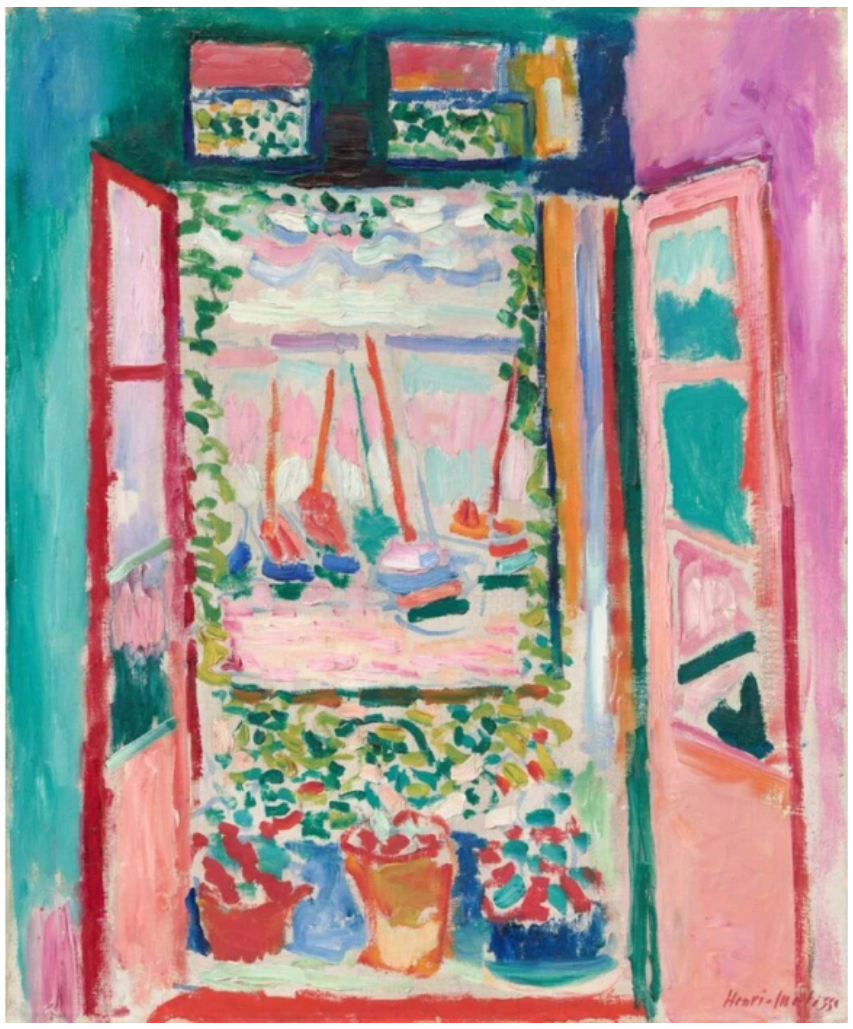
Henri Matisse, Open Window, Collioure, 1905. National Gallery of Art, Washington D.C.
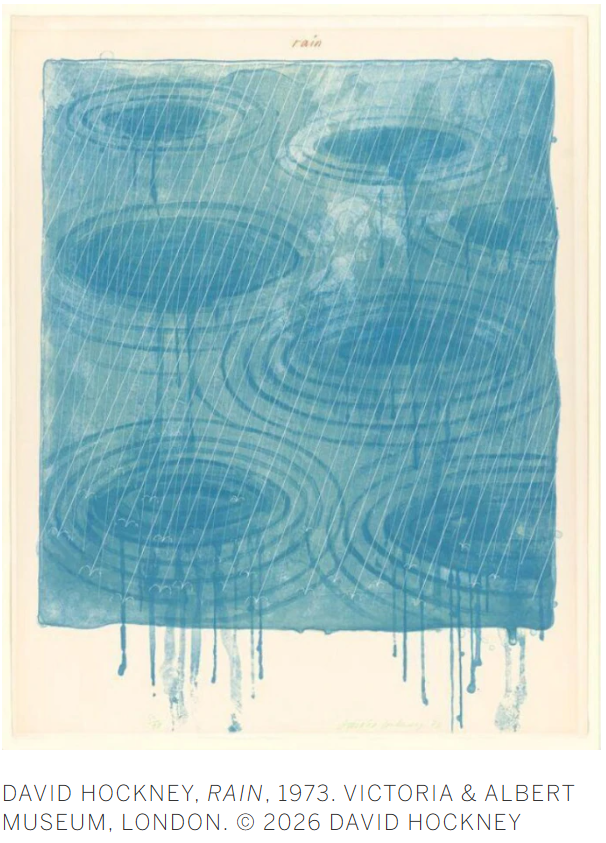
Water itself connects this garden to a preoccupation that runs throughout Hockney’s career, from the Californian pools of the 1960s, through the Weather Series of 1973, to his most recent Rain animations. Again and again, Hockney returned to the challenge of depicting something transparent, reflective, and constantly changing. Here, the pond becomes a shifting field of reflections, carrying images of the sky and surrounding trees while never fully surrendering its own surface. The ripples spreading across the water introduce a more immediate sense of time, fixing fleeting moments that would otherwise vanish almost at once.
Created amid the restrictions of the pandemic, 10th–22nd June 2021, Water Lilies in the Pond with Pots of Flowers belongs to a remarkable period of sustained observation and invention in Hockney’s career. Leaves, flowers, clouds and water are rendered with extraordinary attentiveness, yet continually transformed through color, pattern, and structure. Rooted in the familiar surroundings of his Normandy garden, the work demonstrates Hockney’s enduring ability to find renewal in the act of sustained looking.
Auction Results
Sotheby’s London: 15 October 2026
Estimated: GBP 450,000 – 650,000
GBP 1,920,000 / USD 2,540,350
David Hockney | 10th – 22nd June 2021, Water Lilies in the Pond with
DAVID HOCKNEY (1937 – 2026)
10th – 22nd June 2021, Water Lilies in the Pond with Pots of Flowers, 2021
Six iPad paintings printed on two sheets of paper, mounted on two sheets of Dibond
Overall: 82-1/2 x 78-1/2 inches (209.5 x 199.4 cm)
Numbered 13/25 (lower left)
Signed and dated 21 (lower right)
Executed in 2021, this work is number 13 from an edition of 25