DAVID HOCKNEY (1937 – 2026)
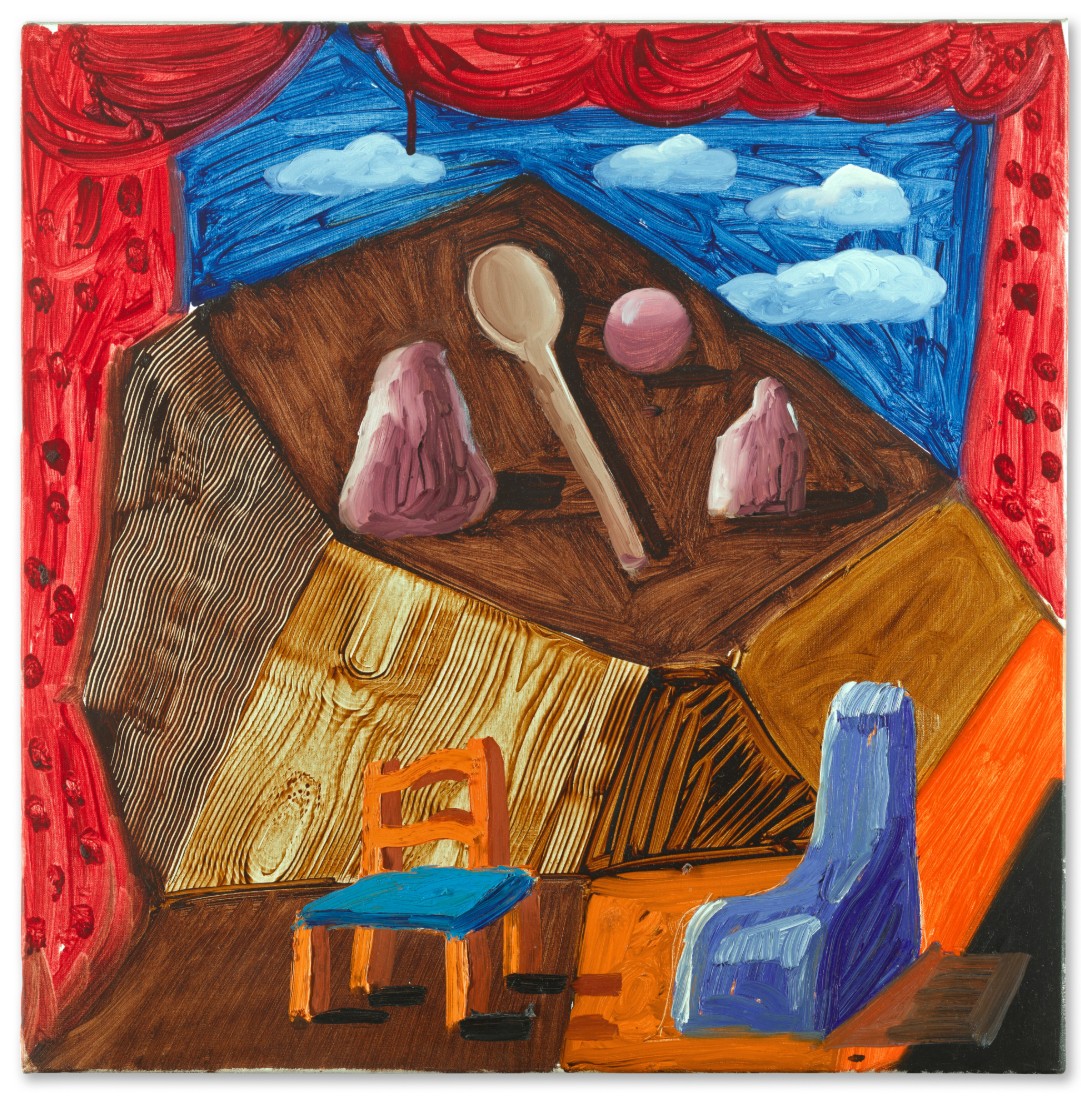
Two Chairs and a Wooden Spoon, July 1988
Oil on canvas
24×24 inches (61×61 cm)
Signed and titled (on the reverse)
Provenance
Knoedler Gallery, London
Acquired from the above in 1988 by the present owner
History
Sotheby’s London: 24 June 2026
Estimated: GBP 1,200,000 – 1,800,000
GBP 2,164,000 / USD 2,856,345
David Hockney | Two Chairs and a Wooden Spoon, July 1988 | Modern &
Never before seen in public, Two Chairs and a Wooden Spoon, July 1988 emerges from a moment in which David Hockney’s practice had come to exert a distinctly generational influence, as he continued to expand and recalibrate the possibilities of pictorial space through a sustained investigation into perception itself. Executed in the summer of 1988, the composition is dominated by a faceted wooden structure populated by two chairs, a wooden spoon and a cluster of enigmatic forms, unfolding within a theatrical setting framed by rich crimson drapery, beyond which stretches a brilliant expanse of blue sky and drifting clouds. 1988 marked a period of extraordinary professional acclaim for the artist. Hockney’s major retrospective opened at the Los Angeles County Museum of Art before travelling to the Metropolitan Museum of Art in New York and Tate Gallery in London, becoming one of the most celebrated exhibitions of his career. That same year, Hockney returned to the medium of painting with full furor, embarking on a series of outstanding works representing the living room and veranda of his Hollywood Hills studio that the artist referred to as “narrative abstractions.” Hockney’s renewed intensity for and love of painting followed the success of his stage designs for Wagner’s Tristan und Isolde; the artist’s operatic design debut with a now legendary 1987 production at the Los Angeles Music Center Opera directed by Jonathan Miller and conducted by Zubin Mehta. Indeed, remaining in the same private collection since it was acquired from Knoedler Gallery in 1988, when it was due to have been shown at Same New Paintings, but sold prior, Two Chairs and a Wooden Spoon, July 1988 has remained effectively suspended within this remarkable moment in the artist’s trajectory, preserving the spirit of enquiry that animated Hockney’s most ambitious paintings of the period.
At the heart of the painting lies a challenge to the fixed conventions of Renaissance perspective. Throughout the 1980s Hockney became increasingly dissatisfied with the notion that a single viewpoint could adequately represent lived experience, arguing instead that vision unfolds through movement, memory and the accumulation of sustained and active looking. In the present work, objects appear simultaneously stable and unstable; planes tilt forwards and recede, viewpoints shift imperceptibly across the picture surface, and spatial relationships resist complete resolution. The angular timber form that anchors the composition functions at once as table, stage and architectural framework, denying any singular orientation within space. The central wooden spoon operates almost as a compositional fulcrum around which the entire arrangement pivots, while the chairs assume a curious anthropomorphic presence, appearing less as items of furniture than protagonists inhabiting an invented pictorial world.
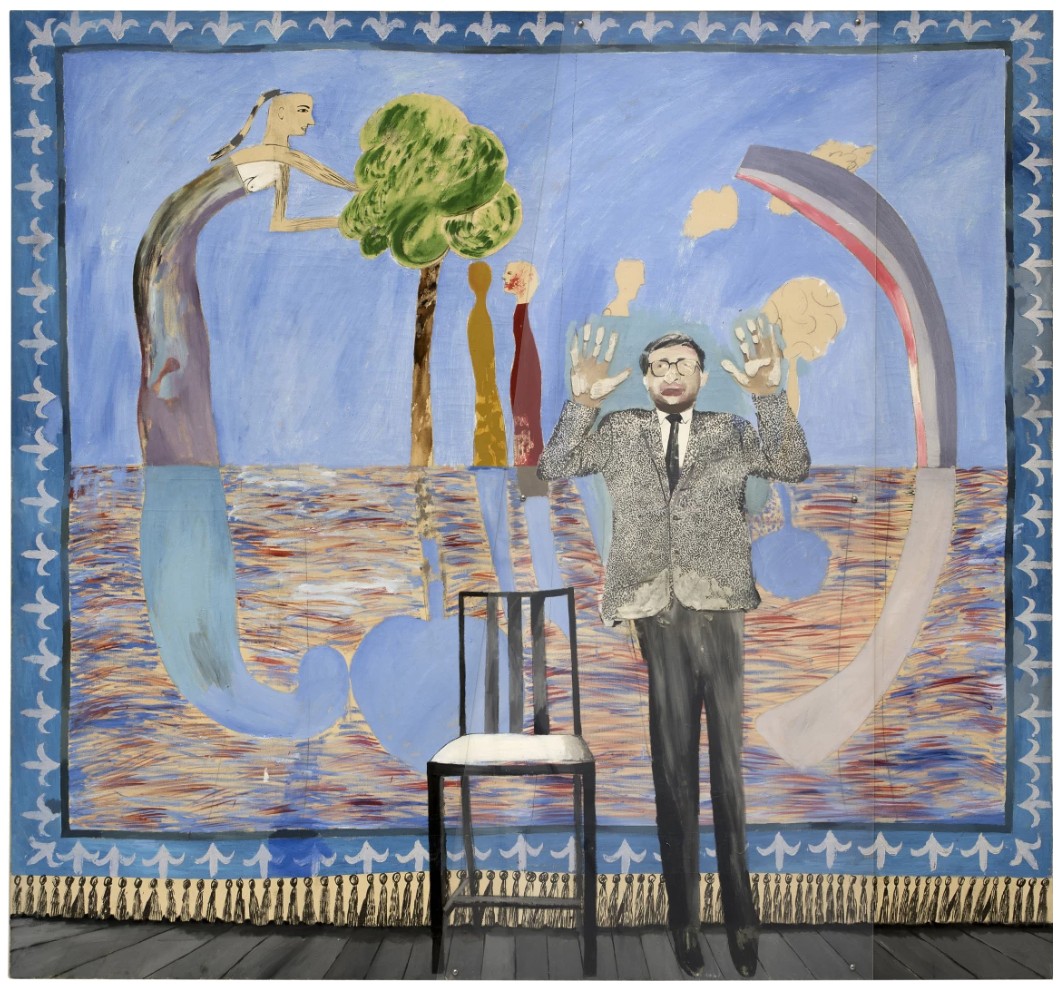
David Hockney, Play Within a Play, 1963. Private Collection. Image/Artwork: © David Hockney 2026 FABRICE.GIBERT
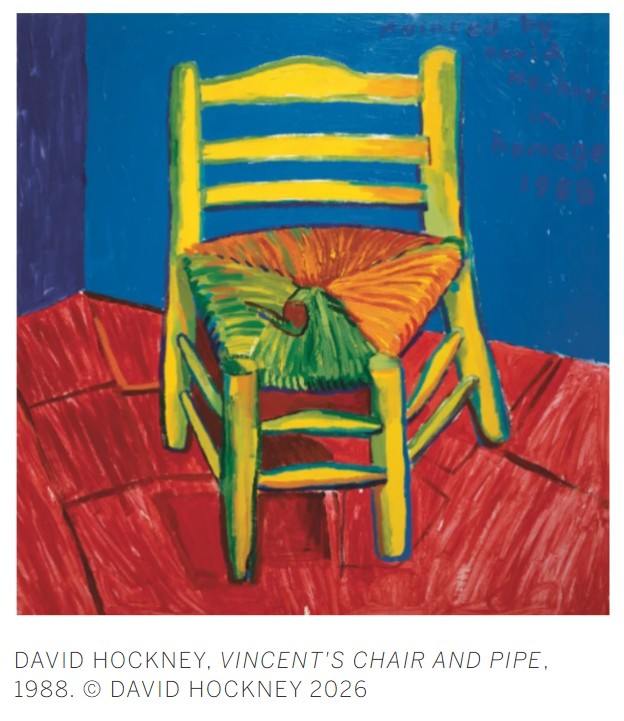
This animation of the everyday object was particularly resonant in 1988. That year, prompted by an invitation from the Fondation Vincent van Gogh to participate in the centenary celebrations of Van Gogh’s arrival in Arles, Hockney embarked upon a series of paintings devoted to chairs, inspired by Van Gogh’s iconic depictions of empty furniture as surrogate portraits. Several of these works became vehicles for his ongoing investigations into reverse perspective, a concern that finds a sophisticated parallel here, where the chairs assume an almost human presence while simultaneously participating in the painting’s shifting and unstable spatial logic. These concerns were further informed by Hockney’s deep engagement with Chinese scroll painting, whose unfolding spatial logic offered a compelling alternative to the fixed viewpoint of Renaissance perspective. Like a handscroll gradually revealed to the eye, the composition encourages the viewer to navigate a sequence of shifting spatial relationships, transforming the act of looking into an active process of discovery. Such concerns were closely connected to Hockney’s broader investigations into photographic collage and so-called ‘joiners’, works that sought to overcome the static limitations of conventional photography by assembling multiple moments of vision within a single image. Painting afforded an even greater latitude. Rather than fixing a scene from a single vantage point, Hockney sought to render the act of looking itself, producing images that reveal themselves incrementally as the eye moves through the architectonics of space.
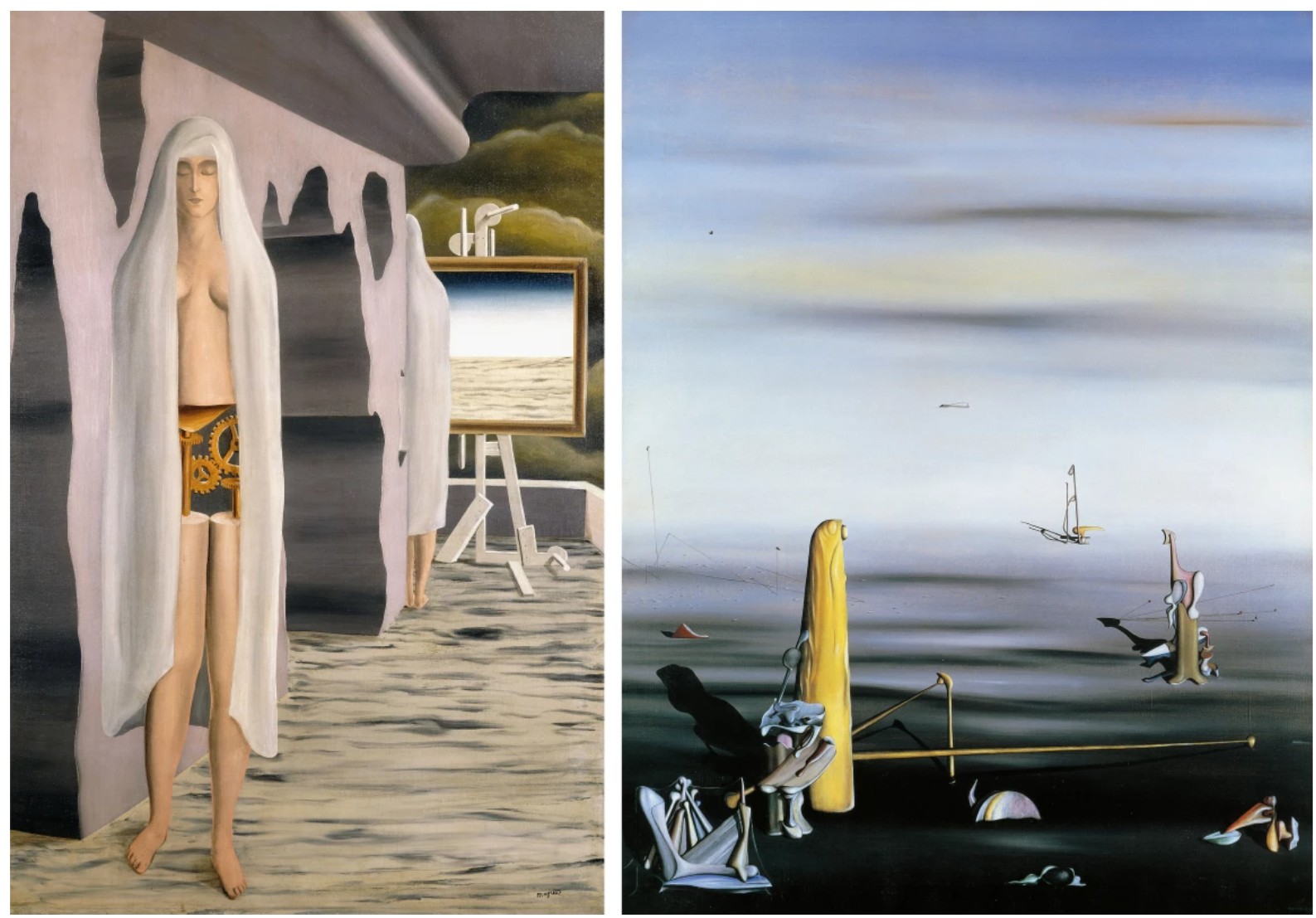
Left: Rene Magritte, Age of Wonders; L’Age des Merveilles, 1926, Private Collection, Image: © 2026 ADAGP, Paris and DACS, London
Right: Yves Tanguy, The Sun in its Jewel Case, 1937, Peggy Guggenheim Foundation, Venice, Image: © NPL – DeA Picture Library / Bridgeman 2026
The painting’s theatrical character further enriches this exploration of perception. The parted crimson curtains immediately evoke the proscenium arch, transforming the composition into a stage upon which objects perform. Here, however, the curtain operates as more than a decorative framing device. It establishes a threshold between interior and exterior, reality and imagination, while simultaneously foregrounding the constructed nature of representation itself. Color plays an equally important role in constructing this visual theatre. Rich ochres, russets and warm timber tones are juxtaposed against passages of saturated blue, creating a dynamic chromatic tension that animates the composition. The sky glimpsed beyond the curtains introduces an almost dreamlike expansiveness, opening the enclosed interior onto an infinite exterior realm. As throughout Hockney’s greatest paintings, color serves not merely descriptive ends but operates structurally, organizing space, directing vision and generating emotional intensity. The result is a scene that oscillates between intimacy and monumentality, between domestic familiarity and imaginative invention.
More than a still life, Two Chairs and a Wooden Spoon, July 1988 belongs to a remarkable group of paintings in which Hockney transformed the familiar motifs of the studio interior into arenas for some of his most searching investigations into perception and pictorial construction. The chairs, spoon and timber framework derive from the ordinary fabric of everyday life, yet through the artist’s extraordinary powers of invention they assume an almost theatrical presence, suspended between object and protagonist, observation and imagination. Informed equally by the lessons of Cubism, the temporal unfolding of Chinese scroll painting, and Hockney’s own experiments with photographic collage, the work rejects the fixed certainties in favor of a more fluid and experiential understanding of vision. What emerges is a painting that does not simply depict a scene but choreographs an act of looking, inviting the viewer to participate in the continual reconstruction of space. Preserved within the same private collection since the year of its creation, the work remains a compelling testament to one of the most intellectually ambitious and formally inventive moments in Hockney’s career.