MAY 2026 NEW-YORK AUCTIONS
Jean Dubuffet
Barbe des Rites, 1959
Barbe des Rites, 1959
Estimated: USD 2,000,000 – 3,000,000
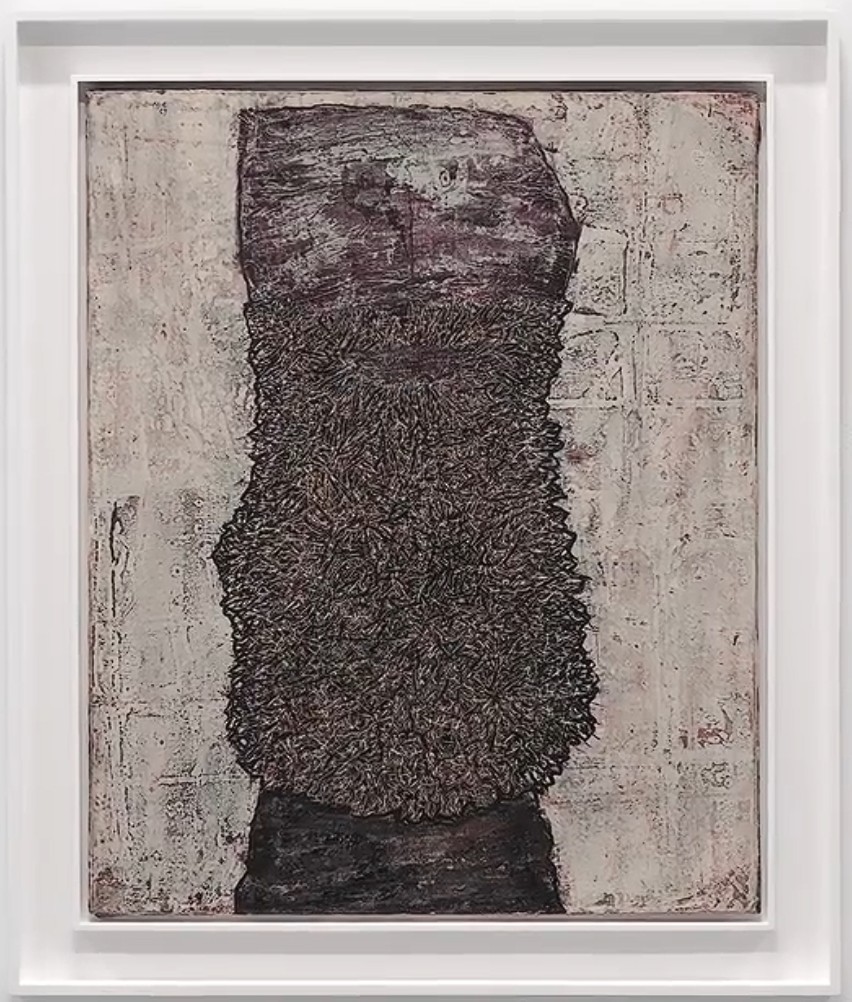
Barbe des Rites, 1959
Oil on canvas
99.7 x 80.6 cm (39-1/4 x 31-3/4 inches)
Signed and dated “J. Dubuffet 59” upper left
Signed, titled and dated “Barbe des rites J. Dubuffet Juillet 59” on the reverse
Painted in July 1959, in France
Painted in July 1959, Barbe des rites belongs to a pivotal moment in Jean Dubuffet’s career, when the artist reintroduced the human figure into his work after several years devoted to the quasi-abstract investigations of the Texturologies. Created only months after the inception of the Barbes, or “Beards,” series and exhibited the following year at Daniel Cordier’s gallery in Paris, the painting marks both an artistic and professional turning point. At this time Dubuffet was distancing himself from his longtime dealer Pierre Matisse and forging a closer relationship with Cordier, the first owner of Barbe des rites. Cordier played a decisive role in promoting the artist internationally as his reputation entered a period of rapid ascent, culminating in a retrospective at the Musée des arts décoratifs in Paris later that same year. Within this context, Barbe des rites stands among the earliest and most fully realized oil paintings of the series, announcing a radical transformation: the abstract language of earth, soil, and mineral surfaces developed in the Texturologies is here transferred onto the human body itself.
“I am trying my hand at painting beards…
I would like to paint a series of vast, cosmic, mystic beards”
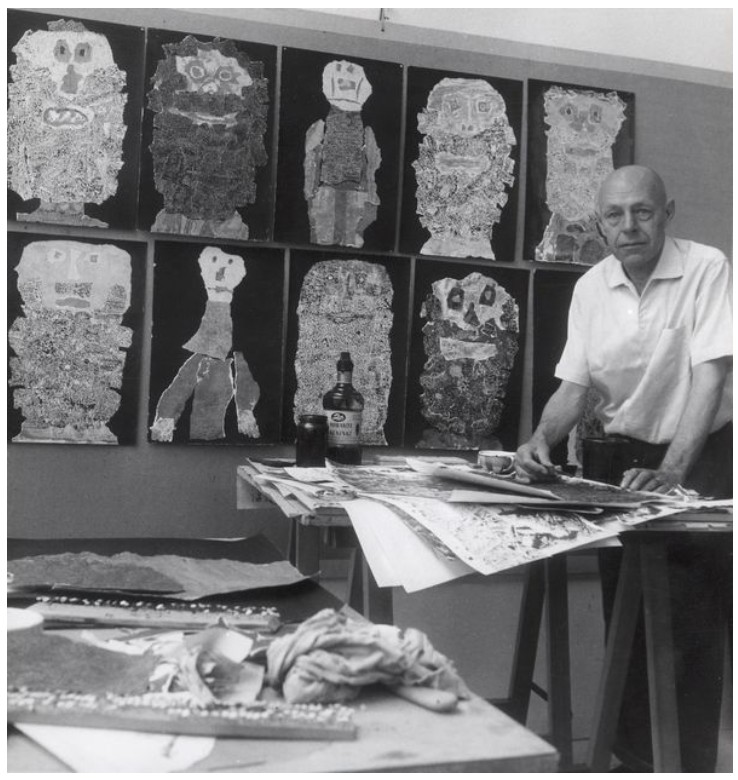
Jean Dubuffet in his studio in Vence, France, 1959. Photograph by John Craven.
Artwork: © 2026 Artists Rights Society (ARS), New York / ADAGP, Paris
The composition is dominated by an immense beard that occupies nearly the entire canvas. Built from a dense lattice of agitated strokes in grey, cream, brown, and black, the surface appears accumulated rather than painted. Dubuffet scratches, incises, and drags pigment so that paint behaves like sediment or organic growth. Above this turbulent mass, two tiny eyes hover within a slab-like head, barely differentiated from the scraped, stone-like background. The disproportion is striking: identity is reduced to a minimal sign while matter proliferates uncontrollably below. The figure seems less depicted than unearthed.
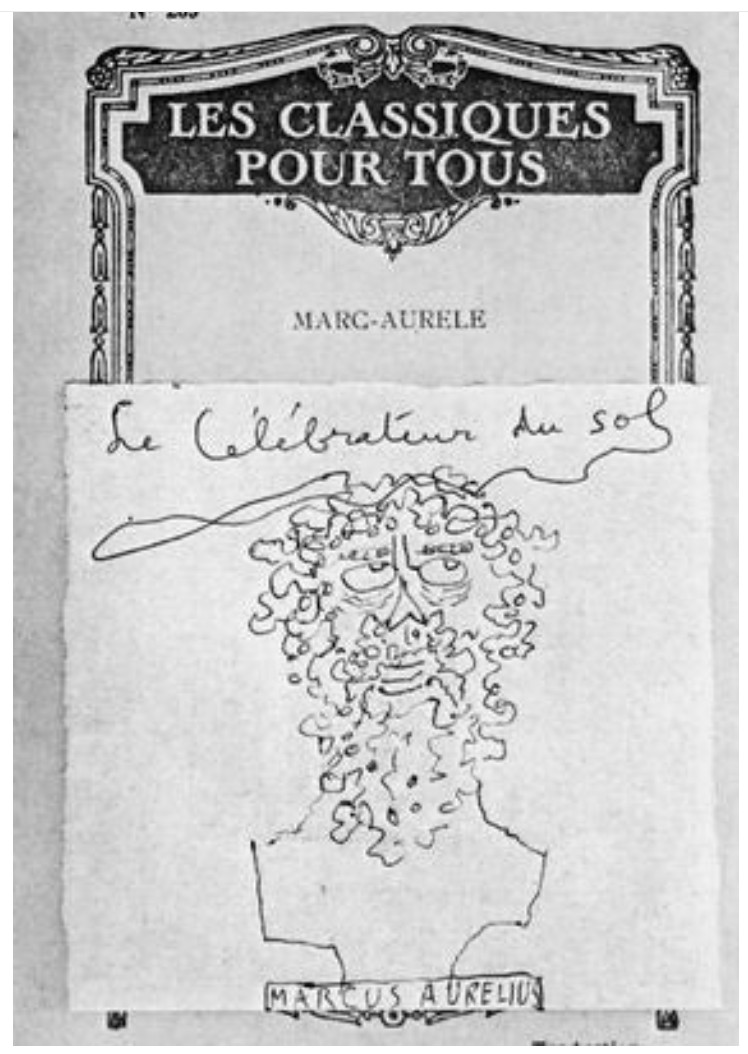
Jean Dubufet, Marcus Aurelius, le célébrateur du sol, 1959. Artwork: © 2026 Artists Rights Society (ARS), New York / ADAGP, Paris
The Barbes originated in an episode characteristic of Dubuffet’s practice, where humor becomes generative method. In May 1959, while in Vence, he received a letter from the poet Georges Limbour likening him to a stoic of antiquity—one of the Hellenistic philosophers for whom intellectual freedom was the gateway to happiness. Amused, Dubuffet replied with a caricature of the bearded emperor Marcus Aurelius. Encouraged by Limbour, he began drawing increasingly exaggerated bearded heads in which the beard overwhelms the face entirely, leaving only the barest trace of features beneath. From this exchange emerged a sustained body of work that absorbed the artist from May to December 1959. Barbe des rites, executed only weeks later, gives material form to this ambition. The beard becomes a field of proliferating marks resembling vegetation, erosion patterns, or constellations. Dubuffet himself described the Barbes as Texturologies hanging from a chin, a phrase that succinctly captures the conceptual shift at stake: landscape becomes anatomy without ceasing to be landscape. The series allowed Dubuffet to pursue a central conviction articulated more than a decade earlier.
“I think portraits and landscapes should resemble each other because they are more or less the same thing. I want portraits in which description makes use of the same mechanisms as those used in a landscape – here wrinkles, there ravines or paths; here a nose, there a tree; here a mouth and there a house.”
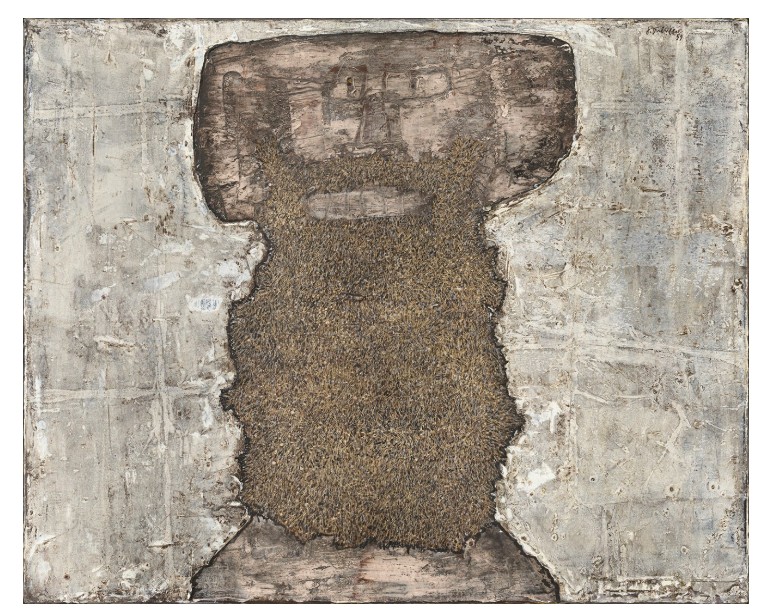
Jean Dubuffet, Barbe des Combats, 1959. National Gallery of Art, Washington D.C. Image: National Gallery of Art, Washington, D.C, Gift of the Stephen Hahn Family Collection, 1995.95.2, Artwork: © 2026 Artists Rights Society (ARS), New York / ADAGP, Paris
The title Barbe des rites introduces a ceremonial dimension that critics quickly perceived. Writing on the series, critic Peter Selz observed that: “Some of the Beards… look like gravel runs and have that geological feeling inherent in so much of Dubuffet’s work. Some resemble great rock formations or age-old boulders predating man’s presence on this planet.” In keeping with Selz’ observations, the hirsute figure in Barbes des rites assumes a totemic presence underscored by the work’s title, which translates to “Ritual Beard.” The rigid head rises like a menhir above the animated beard, suggesting ancient idols or archaic monuments. Dubuffet himself described his aim as carrying the human image “onto a plane of high ceremony, of solemn office of celebration… with what Joseph Conrad calls: ‘a mixture of familiarity and terror,’ out of which the devotion is made which many religious minds offer to their gods.” Here, ritual does not imply reverence alone but ambiguity. The beard, historically a symbol of wisdom and masculinity, overwhelms individuality, transforming identity into archetype. Humor and gravity coexist: the tiny eyes verge on caricature even as the figure assumes mythic scale.
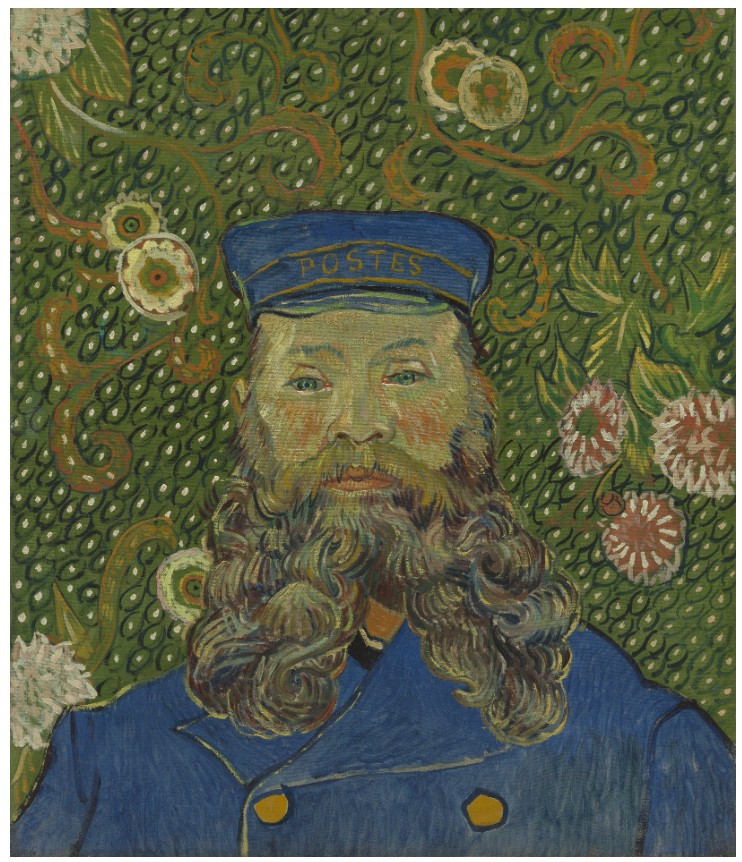
Vincent Van Gogh, Portrait of Joseph Roulin, Arles, early 1889. The Museum of Modern Art, New York.
Image: © The Museum of Modern Art/Licensed by SCALA / Art Resource, NY
When the Barbes were exhibited in 1960 in As-tu cueilli la Fleur de Barbe, critics responded with vivid metaphors. Alexandre Vialatte described encountering “all these beards on the walls, like hunter’s trophies… mythical, cosmic, metaphysical,” comparing them to objects ranging from gothic cathedrals to mountain ranges. Such reactions capture the imaginative elasticity of the series, which oscillates between the comic and the monumental. By reintroducing man into the heart of his practice through the language of matter itself, Dubuffet achieved a crucial synthesis. The Barbes extend the material investigations of the 1950s while reopening the path toward figuration, freeing portraiture from classical ideals of beauty and psychological likeness. In Barbe des rites, the human image emerges not as likeness but as elemental formation: landscape becomes face, matter becomes identity, and the figure stands poised between the earthly and the cosmic.
Liqueurs, musique, chemiserie (avec sept voitures), 1961
Liqueurs, musique, chemiserie (avec sept voitures), 1961
Jean Dubuffet: Works on Paper from 1954-1961
Phillips New-York: 19 May 2026
Estimated: USD 1,200,000 – 1,800,000
Jean Dubuffet Modern & Contemporary Art Evening Sale
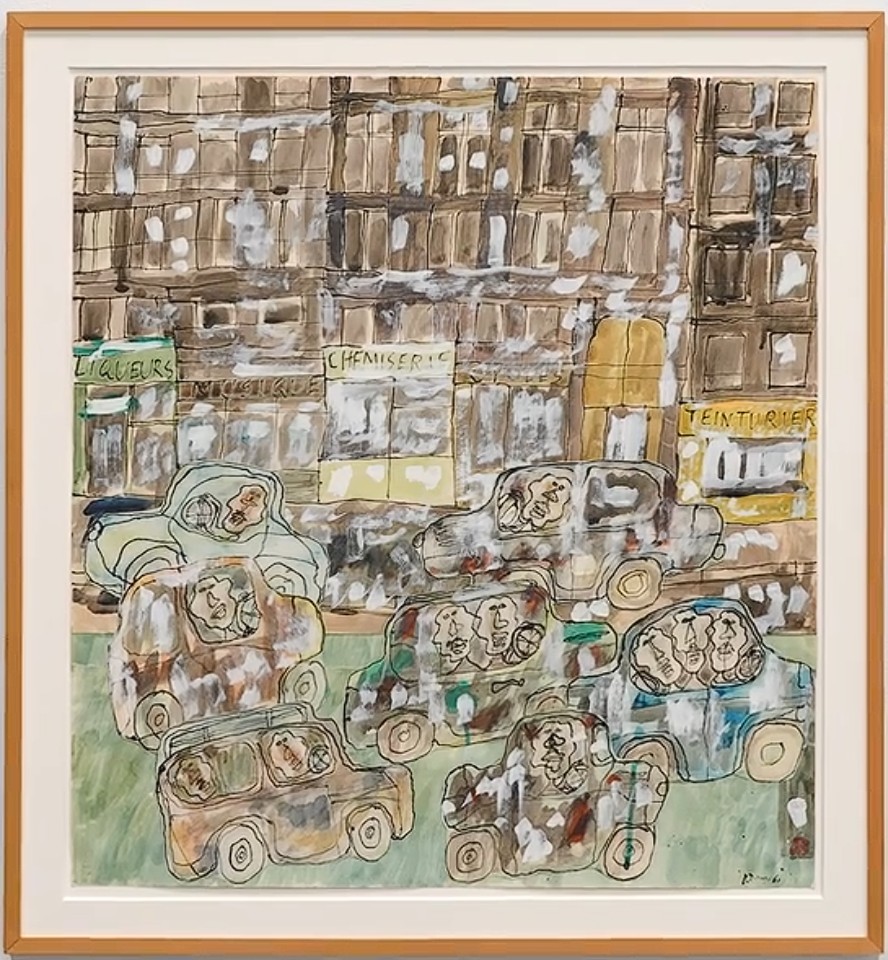
Gouache, watercolor, India ink, pencil, graphite and collage on paper
72.4 x 66.7 cm (28-1/2 x 26-1/4 inches)
Signed with the artist’s initials and dated “J.D. mars 61” lower right
Titled and dated “Liqueurs, musique, chemiserie (avec 7 voitures) début mars 61” on the reverse
Executed in March 1961, in France
Executed in March 1961, Liqueurs, musique, chemiserie (avec sept voitures) belongs to the inaugural moment of Paris Circus, the celebrated series Jean Dubuffet launched in February of that year following his return to the French capital after nearly seven years of relative seclusion in Vence. This homecoming precipitated a decisive rupture with the earthbound austerity of the Texturologies and Matériologies, the matter-paintings that had absorbed him throughout the late 1950s. Writing to curator Peter Selz in December 1961, the artist articulated the stakes of this transformation: “By painting the earth, the painter tended to become the earth and to cease being a man, hence to cease being a painter. As a reaction against this truant tendency, my paintings from the last year materialize in all aspects a very intense involvement […] They teem with characters and this time their cause is taken up enthusiastically.” The present gouache stands as a paradigmatic expression of this renewed engagement—a jubilant reentry into the human theater of the boulevard, charged with the visual riot of postwar Parisian modernity.
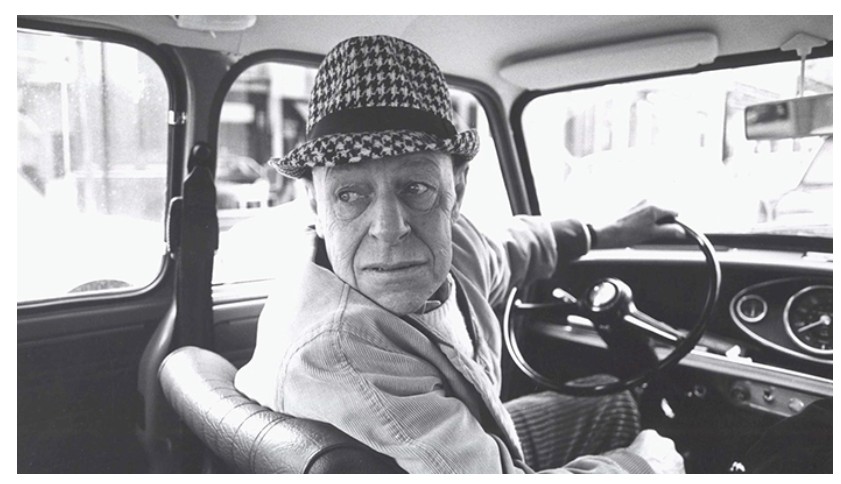
Jean Dubuffet. Photograph by Kurt Wyss. Image: © Kurt Wyss
Following the February 1961 close of his 1942–1960 retrospective at the Musée des Arts Décoratifs in Paris, Dubuffet wrote to his friend Geneviève Bonnefoi that August: “I have reversed steam after closing off the Materiologies and decided to start all over again from the beginning.” Liqueurs, musique, chemiserie is among the earliest declarations of that reversal. The Paris Circus series marked a shift in both technique and subject matter. Where a subtractive method of incision and material imprint had dominated Dubuffet’s practice through 1960, the present work adopts an additive logic: fragments of painted paper collaged into a composition built up from discrete elements. The layered forms and outlines lend the image a cellular, puzzle-like quality that prefigures the interlocking structures of the Hourloupe cycle, initiated in July 1962.
Like many works from the Paris Circus cycle, Liqueurs, musique, chemiserie likely began with sketches made from café terraces, later reworked and synthesized in the studio into a dense orchestration of signs, vehicles, and passersby. In this sense, the work reconnects with Dubuffet’s early engagement with metropolitan life, recalling the 1943 Métro series and the measured grids of the 1946 Façades d’immeubles, yet amplifying them into something more frenetic and chromatically daring. Rather than depict Paris naturalistically, Dubuffet stages it as hallucination.
“My desire is to make the site evoked by the picture something phantasmagoric, I want my street to be crazy, my broad avenues, shops and buildings to join in a crazy dance, and that is why I deform and denature their contours and colors.”
The cityscape’s wobbling architecture and unstable perspective enact precisely this dance.
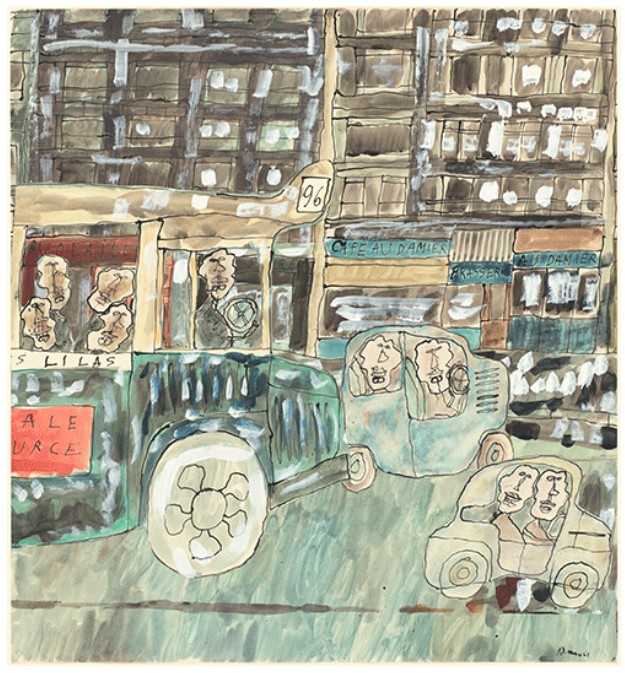
Jean Dubuffet, Café au damier, 1961. National Gallery of Art, Washington, D. C. Image: National Gallery of Art, Washington, D.C, Gift of the Stephen Hahn Family Collection, 1995.29.24, Artwork: © 2026 Artists Rights Society (ARS), New York / ADAGP, Paris
The composition is structured as a shallow, stage-like arena. A grid of Haussmannian façades rises vertically across the upper half of the sheet, its windows sketched in trembling black lines and washed in browns and greys. Dubuffet compresses multiple viewpoints into one flattened field. White scumbles streak across the surface, suggesting glare on glass, atmospheric residue, or rain—an optical interference that unsettles spatial clarity. The lower half is given over to seven small cars, tilted upward as if rearing or lurching forward mid-rev, and packed with mask-like, balloon-headed figures reduced to schematic profiles. The storefront signs “Liqueurs,” “Musique,” “Chemiserie,” “Cycles,” and “Teinturier” anchor the scene in everyday commerce while functioning as rhythmic cues. Their blocky lettering punctuates the surface like percussive beats; words become graphic forms woven into the same nervous circuitry as windows and wheels. This embrace of the ordinary is central to the force of the present tableau. As Max Loreau observed, Dubuffet “based his painting on the evocation of the most commonplace and banal things,” deliberately choosing subjects “not considered to be artistic or banished from the scope of Art due to their lack of nobility.” In Liqueurs, musique, chemiserie, liquor shops and dry cleaners supplant monuments, and traffic supplants heroism. The banal is set in motion, and the city becomes “a kind of jubilant theater, an extraordinary magic.” Spectacle emerges not from grandeur but from accumulation, compression, and exaggeration: Paris as circus, commerce as choreography.
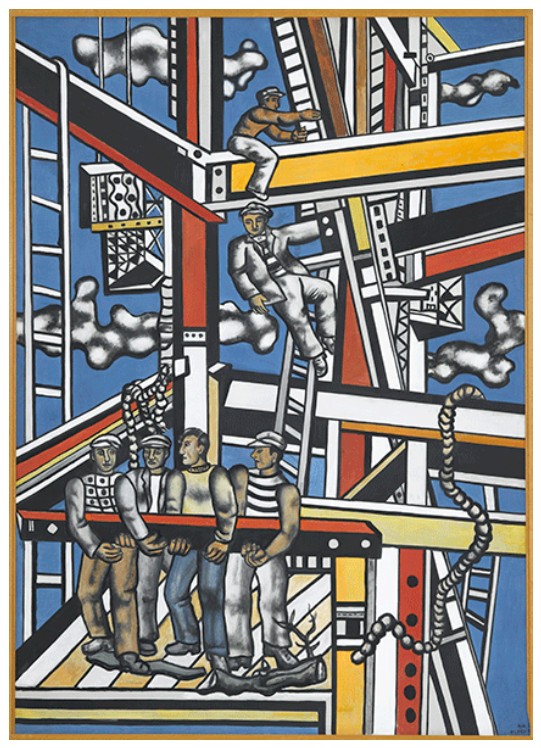
Fernand Léger, The Builders, 1950. Musée National Fernand Léger, Biot, France. Image: © RMN-Grand Palais / Art Resource, NY
The fusion of text and image into a single field anticipates Jean-Michel Basquiat’s later convergence of commercial language, street energy, and painterly gesture. In Liqueurs, musique, chemiserie, the repeated car motif and agitated rhythm of line and color coalesce into a vision of Paris charged with movement and immediacy—a reflection of the city Dubuffet encountered upon his return in 1961, newly released from postwar austerity and rapidly reshaped by economic expansion and urban renewal. This vision of urban confusion unfolded within a broader postwar reimagining of the street as aesthetic and political site. Guy Debord’s psychogeographic maps and the lacerated posters of the Affichistes—François Dufrêne, Raymond Hains, and Jacques Villeglé—alike took shape through intimate readings of the city. For Dubuffet, however, the experience of city space was one of disruption. Here, he translates the street into a pictorial equivalent of lived sensation, demonstrating Dubuffet’s capacity to grasp, in Loreau’s estimation, “how a child would look through an adult’s eyes, a dreamy, wandering gaze, structured by a well-developed mental universe; in other words, the considered and serious world suddenly struck with delirium.”
The automobile—here multiplied sevenfold—serves as both motif and structuring device. In postwar France, the number of cars rose dramatically, emblematic of modernization and consumer growth. Roland Barthes famously likened the Citroën DS to a Gothic cathedral, an object of collective fascination. In popular culture, the car was in equal degrees an object of admiration and of satire, an emblem of individual wealth and a marker of unruly urban growth, as traffic became an increasing problem in large cities and suburbs.
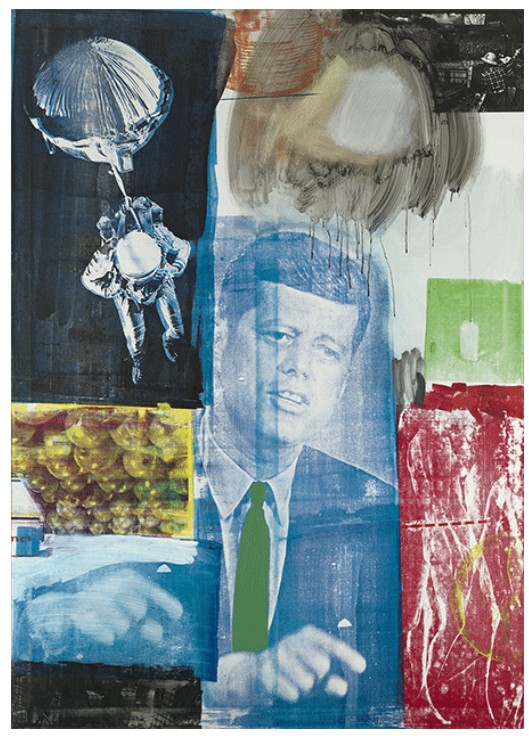
Robert Rauschenberg, Retroactive I, 1964. Wadsworth Atheneum Museum of Art, Hartford, Connecticut. Image: Allen Phillips / Wadsworth Atheneum Museum of Art, Artwork: © 2026 Robert Rauschenberg Foundation / Artists Rights Society (ARS), New York
In Liqueurs, musique, chemiserie, Dubuffet treats the car with ambivalence: it is at once comic and claustrophobic. The oversized heads of the passengers press against the windows, their bodies reduced to cramped silhouettes. The roadway, paradoxically, is crowded while the sidewalks appear empty. More than subject matter, the car shapes pictorial space. The vantage point seems positioned within the flow of traffic, as if Dubuffet himself were seated behind the wheel of one of his small Simcas. Dubuffet’s viewpoint is embedded in the hubbub. This skewed perspective produces what Kristin Ross has described as “perception-in-movement”—a vision shaped by the automobile itself. The city twists and liquefies under the brush, reflecting a Paris seen not from above but from within, at street level, amid glare and congestion. As such, the work does not merely depict urban life; it enacts it—its noise, its compression, its absurdity, and its vitality. Within Dubuffet’s oeuvre, Liqueurs, musique, chemiserie stands as a decisive affirmation that the most trivial spectacles of modern existence can yield an art of radical invention.
Enfin chez soi, 1957
Enfin chez soi, 1957
Sotheby’s New-York: 15 May 2026
Estimated: USD 800,000 – 1,200,000
Jean Dubuffet | Enfin chez soi | Contemporary Day Auction | 2026 |
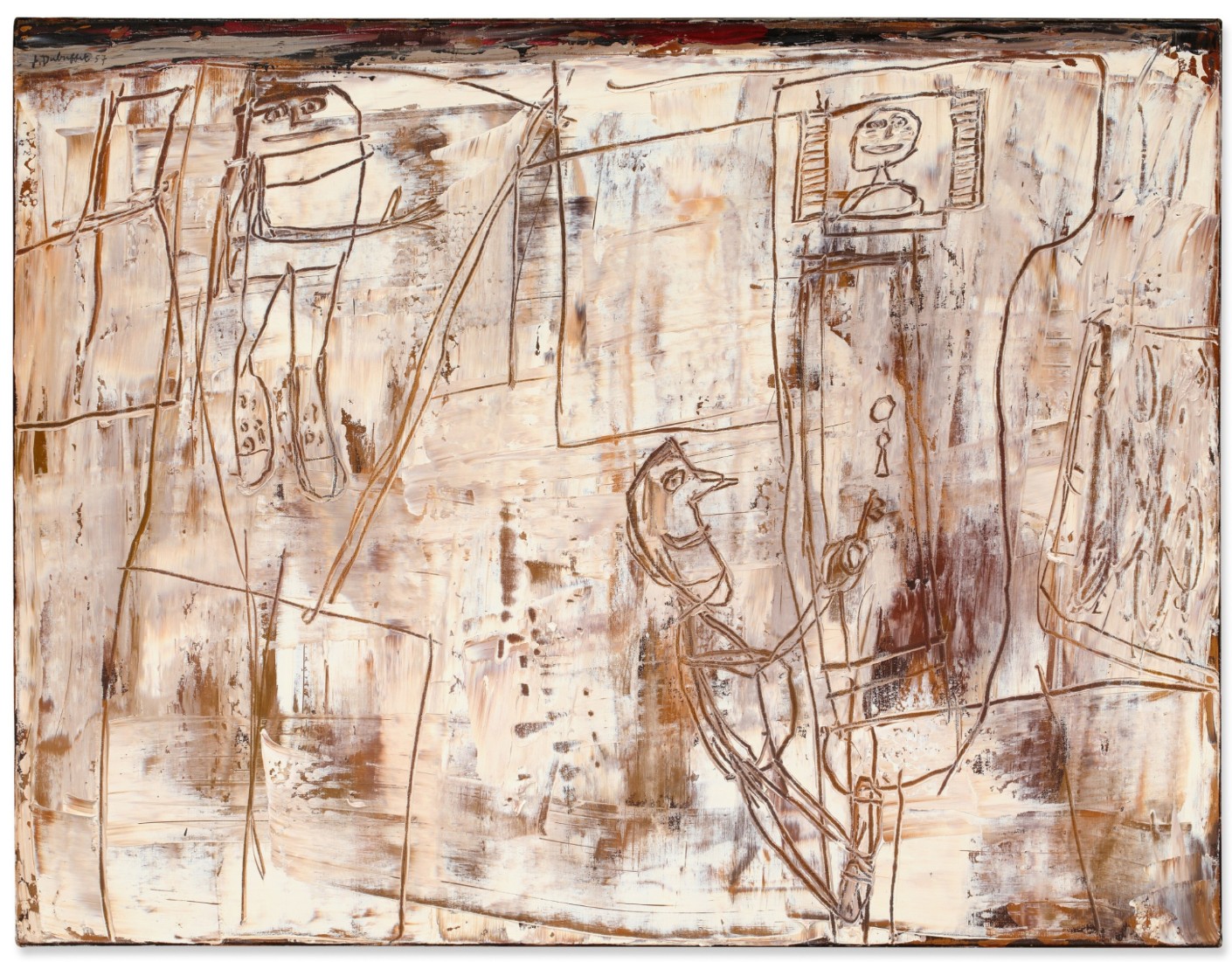
JEAN DUBUFFET (1901 – 1985)
Enfin chez soi, 1957
Oil on canvas
89.5 x 116.8 cm (35-1/4 x 46 inches)
Signed and dated 57 (upper left)
Signed, titled and dated juin 57 (on the reverse)
Executed in 1957, Enfin chez soi belongs to the Lieux cursif, a remarkable group of works created between April and September of that same year. Infused with memory and autobiographical resonance, these paintings occupy a pivotal place within the artist’s oeuvre, revealing how deeply personal experience could be absorbed into his radically anti-academic visual language. By the late 1950s, Dubuffet had firmly established himself as one of the most uncompromising figures of postwar art. As the leading force behind Art Brut, his term for art made outside the accepted structures of culture and refinement, he sought to reject painterly polish in favor of something more instinctive, immediate, and raw. In the present work, those concerns converge with exceptional clarity: home, street, figure, and façade appear not as stable facts, but as fleeting notations, scratched out of memory and sensation.
In Enfin chez soi, there is a poignant autobiographical resonance that directly connects to the moment of the work’s creation. In 1955, Dubuffet relocated to Vence in the south of France in an effort to escape what he felt as the turbulence and isolation of Paris, yet over the following two years he continued to move back and forth between the city and the south. Though the rural corners of southern France had been Dubuffet’s preferred setting since 1955, and had imbued his artistic language with a newly visceral, tactile materiality, he often longed for the chaotic business of Paris and sought to capture parts of this essence in the Lieux cursifs. That oscillation hovers behind the present work, suggesting that home, for Dubuffet in 1957, was not a stable entity but rather a shifting condition. In Enfin chez soi, the environment appears both open and enclosed, public and private; smiling faces, architectural fragments, shutters, and linear notations of doors or furnishings emerge across the surface like remembered traces, imbuing the scene with a warmth that distinguishes it from the more estranged urban subjects of earlier years.
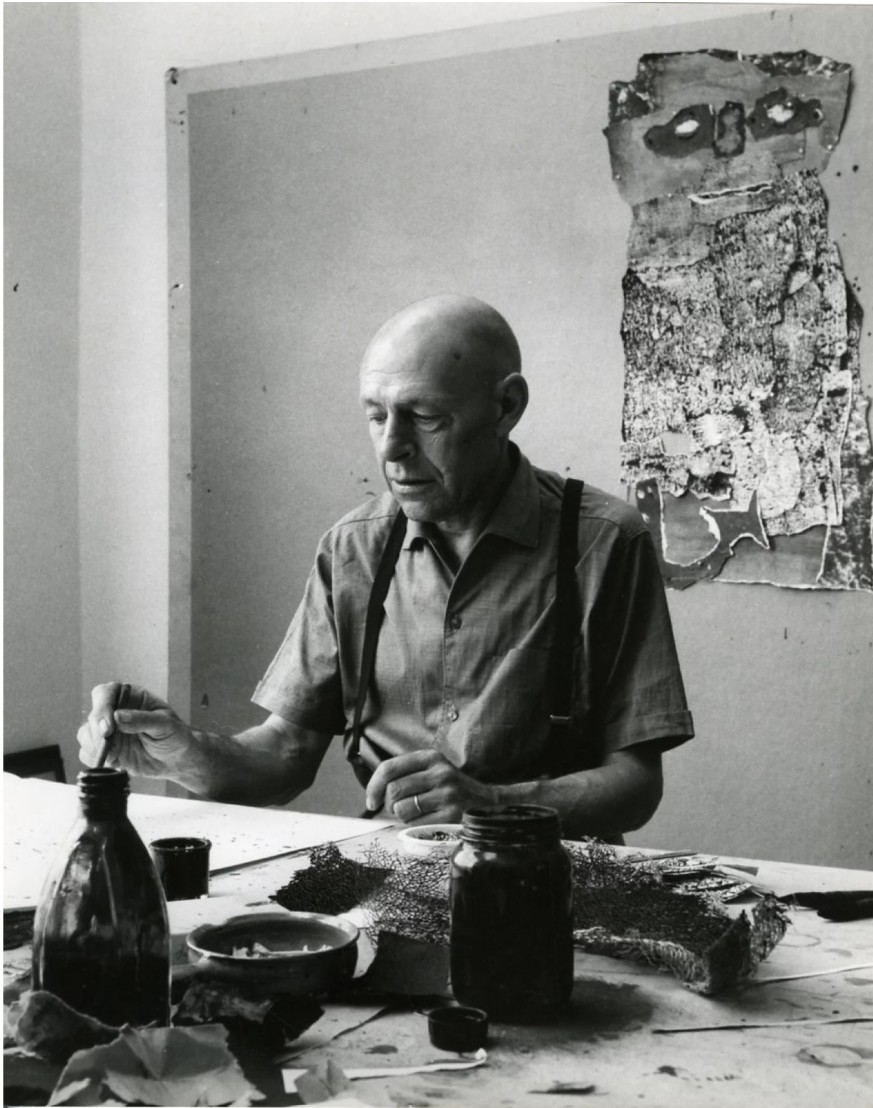
Jean Dubuffet, Italy, 1960.
The present work is a quintessential example of Dubuffet’s precise artistic process. First, he would spread the darker pigment with a spatula, scraping it throughout to flatten the paint before quickly applying other pigments, finally swiftly covering the canvas with an opalescent white from which he would carve out his figures using the tip of a rounded knife. The act of creating his figures through the removal of paint allows them to emerge from the roots of the composition, unearthed rather than painted, their hollow grooves enhancing the built up texture on the canvas. These worked and reworked surfaces recall the obsessive layered strokes, erasures, and dragged passages in Gerhard Richter’s series of ‘Abstraktes Bilder’, where the mere texture and patterns created by chance become the subjects themselves. Enfin chez soi has a luminous texture.
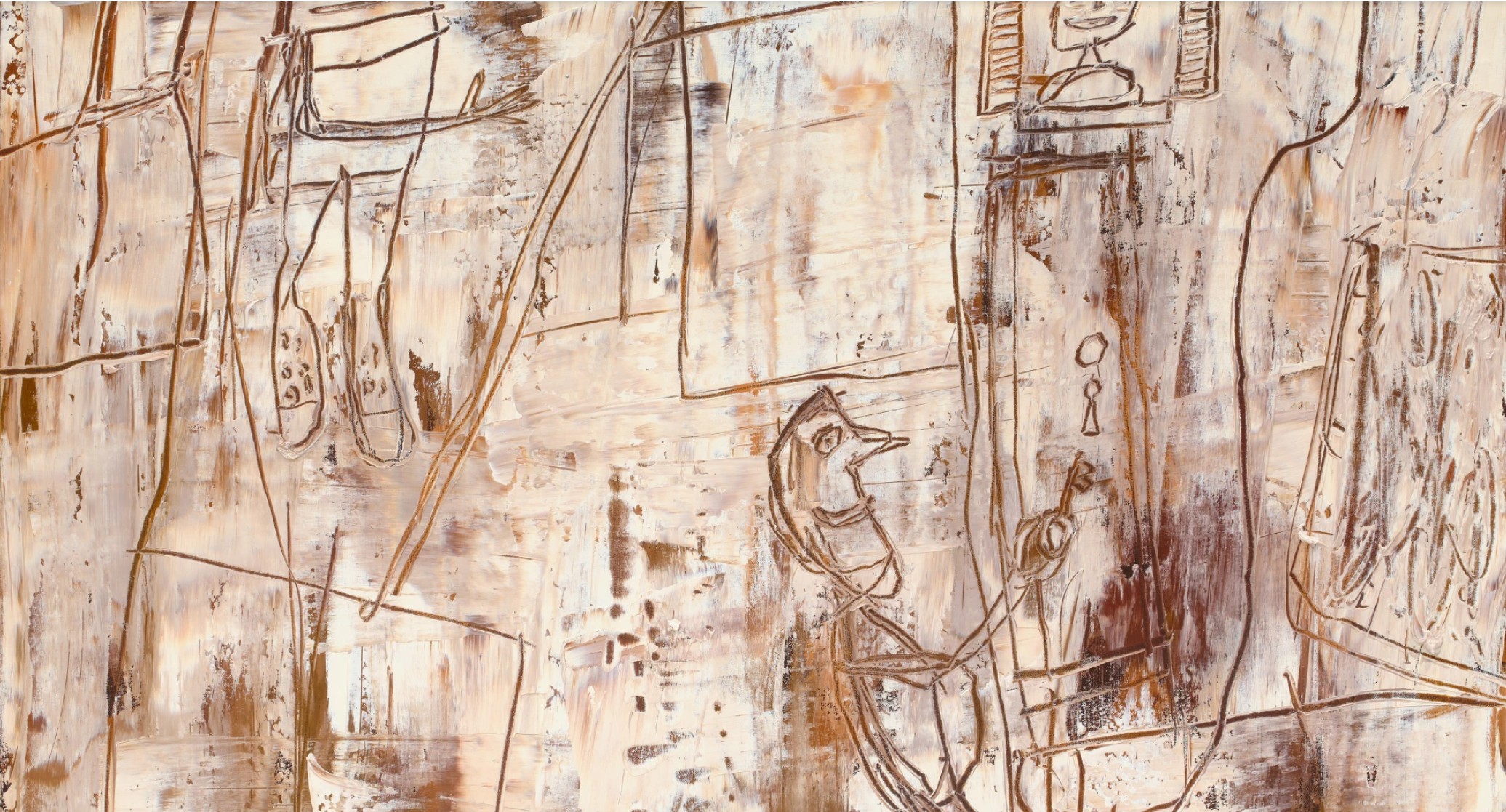
In Enfin chez soi, three figures occupy the marbled surface, each remarkably outlined and afforded individual character. Unlike some of his earlier landscapes which focused on the compressed yet isolating nature of the urban city, with figures marching expressionless across his compositions, the figures in the present work gleam with joyful expressions. Reflecting the partial autobiographical nature of the work, Enfin chez soi radiates an inviting tone and emits an undeniable air of affection into the canvas. Ultimately, the present work offers the viewer an intimate glimpse into the inner sanctum of the artist’s life, elevating the idea of ‘home’ as a further exploration of our perceptual and emotional engagement with our physical environment and how we experience time.
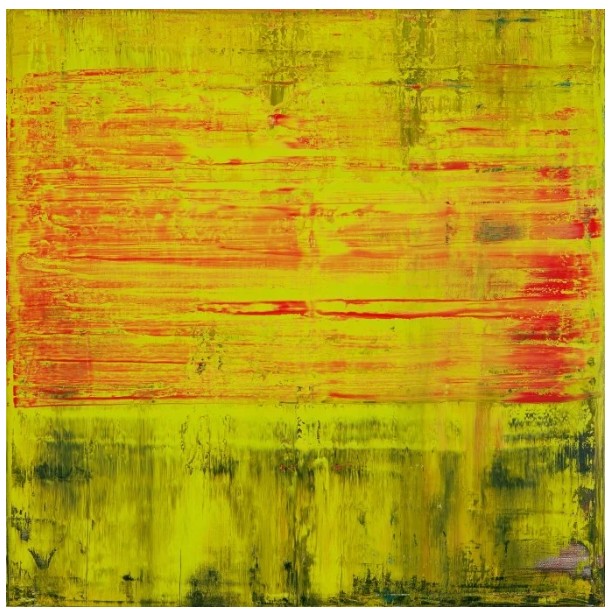
Gerhard Richter, Abstraktes Bild (910-2), 2009
Initially acquired by Pierre Matisse Gallery, the present work is further distinguished by its provenance. Pierre Matisse was instrumental in introducing Dubuffet to American audiences, championing him in New York alongside other giants of European modernism such as Yves Tanguy, Max Ernst and Marc Chagall. His support played a decisive role in securing Dubuffet’s visibility in the United States, and by the early 1960s, Dubuffet’s work was being presented in important gallery and museum contexts, including the landmark 1962 Museum of Modern Art retrospective. Having been exhibited in Osaka, Avignon, and Reno, Enfin chez soi makes evident the sustained institutional recognition accorded to this pivotal moment in his career.
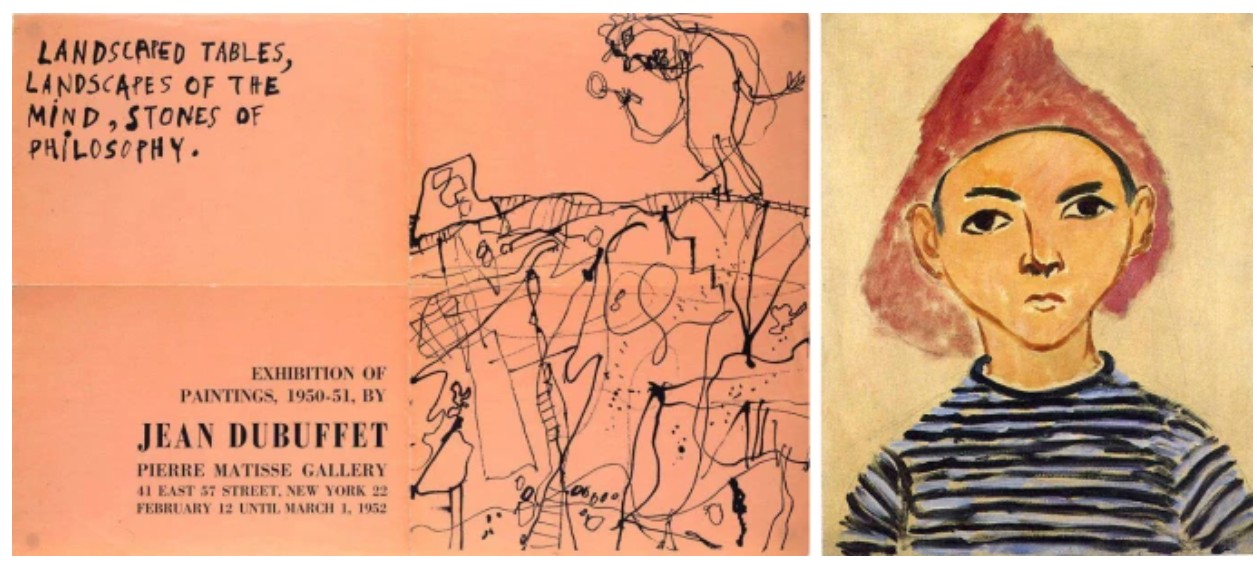
Left: Invitation to the exhibition at Pierre Matisse Gallery, ‘Jean Dubuffet, “Landscaped Tables, Landscapes of the Mind, Stones of Philosophy,”’ (1952)
Right: Henri Matisse, Portrait of Pierre Matisse (1909)
In Enfin chez soi, Dubuffet transforms the most ordinary of subjects into an image of extraordinary force. Home is no longer a stable destination but an unstable accumulation of marks, memories, and impressions, wrested from paint with all the urgency of lived experience itself. At once raw and sophisticated, the present work stands as a superb example of Dubuffet’s 1957 achievement: a painting infused with a palpable sense of memory and nostalgia, allowing the idea of home to emerge as something longed for. It is precisely this tension between raw materiality and remembered experience that elevates the present work, lending Enfin chez soi its singular poignancy and enduring power.