MAY 2026 NEW-YORK AUCTIONS
Pablo Picasso
Arlequin (Buste), 1909
Arlequin (Buste), 1909
A Night in May: The Collection of Adele & Enrico Donati
Sotheby’s New-York: 19 May 2026
Estimate on Request
USD 42,640,000
Pablo Picasso | Arlequin (Buste) | Modern Evening Auction | 2026 |
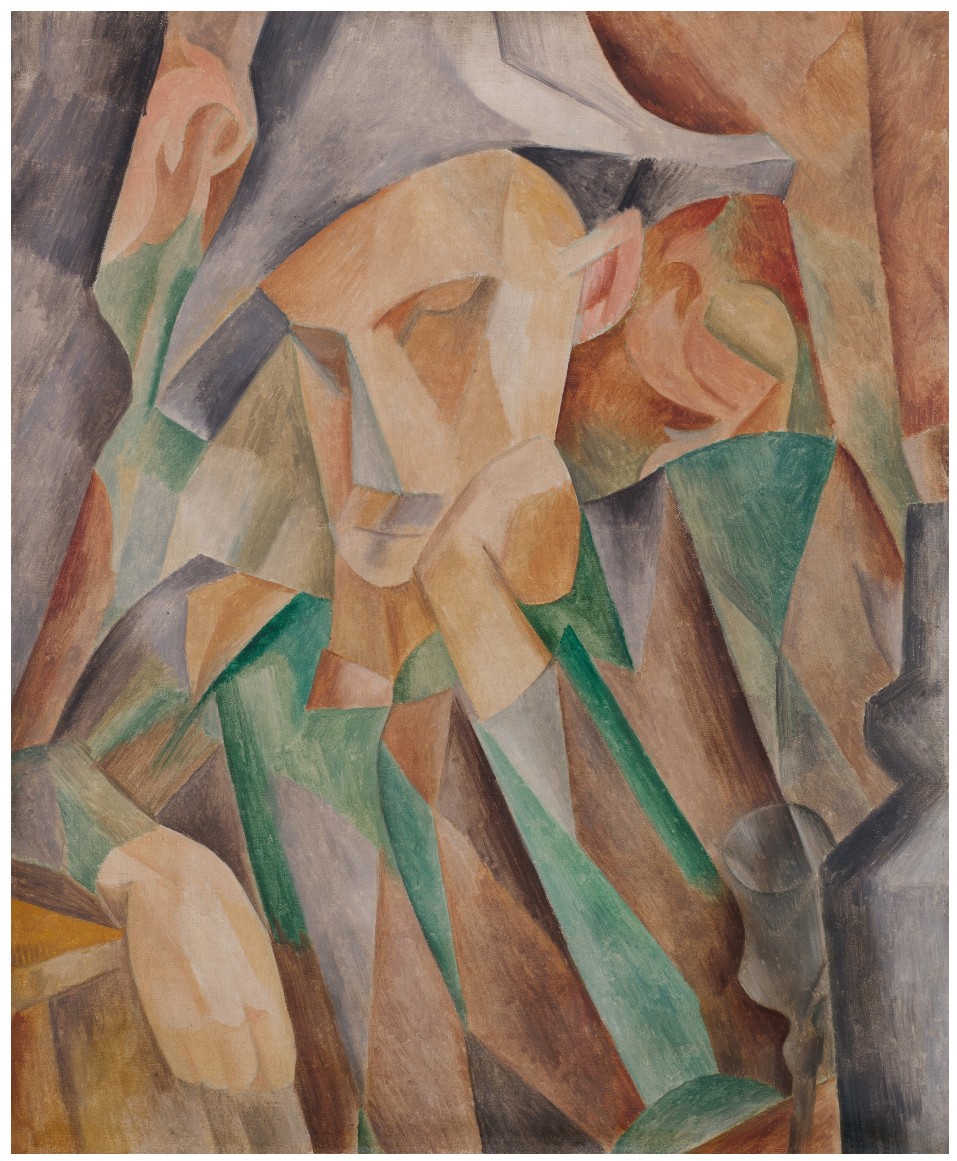
PABLO PICASSO (1881 – 1973)
Arlequin (Buste), 1909
Oil on canvas
73 x 60.3 cm (28-3/4 x 23-3/4 inches)
Signed Picasso (on the reverse)
Executed in spring 1909
In the summer of 1907, Picasso finalized his greatest breakthrough to date: Les Demoiselles d’Avignon, the triumphant declaration of a modern artistic mode that ranks among the most influential paintings created in the twentieth century. In the ensuing two years, Picasso pursued a radical reinterpretation of pictorial form with an intensity unlike that of any other time in his career. Executed in the spring of 1909, Arlequin (Buste) is among the most important portraits to emerge from this time, marking the threshold of one of the most important breakthroughs of modern art: the emergence of Cubism. Portraying one of the artist’s most storied subjects with both profound sensitivity and audacious formal innovation, the present work is an emblem of the epochal period in which Picasso revolutionized the rules of not just portraiture, but of two-dimensional representation itself.
Between late 1908 and early 1909, portraiture served as the primary genre through which Picasso developed a groundbreaking visual idiom. Portraiture served as the means through which he engaged with myriad influences—from African, Oceanic and Iberian artistic traditions to the work of Cézanne—to lay the revolutionary foundation for Cubism. The artist’s famed Bateau-Lavoir studio in Montmartre served as the nexus for a continuous exchange of ideas with Georges Braque.
“Almost every evening, either I went to Braque’s studio or Braque came to mine. Each of us had to see what the other had done during the day. We criticized each other’s work. A canvas wasn’t finished unless both of us felt it was … At that time our work was a kind of research laboratory from which every pretension or individual vanity was excluded.”
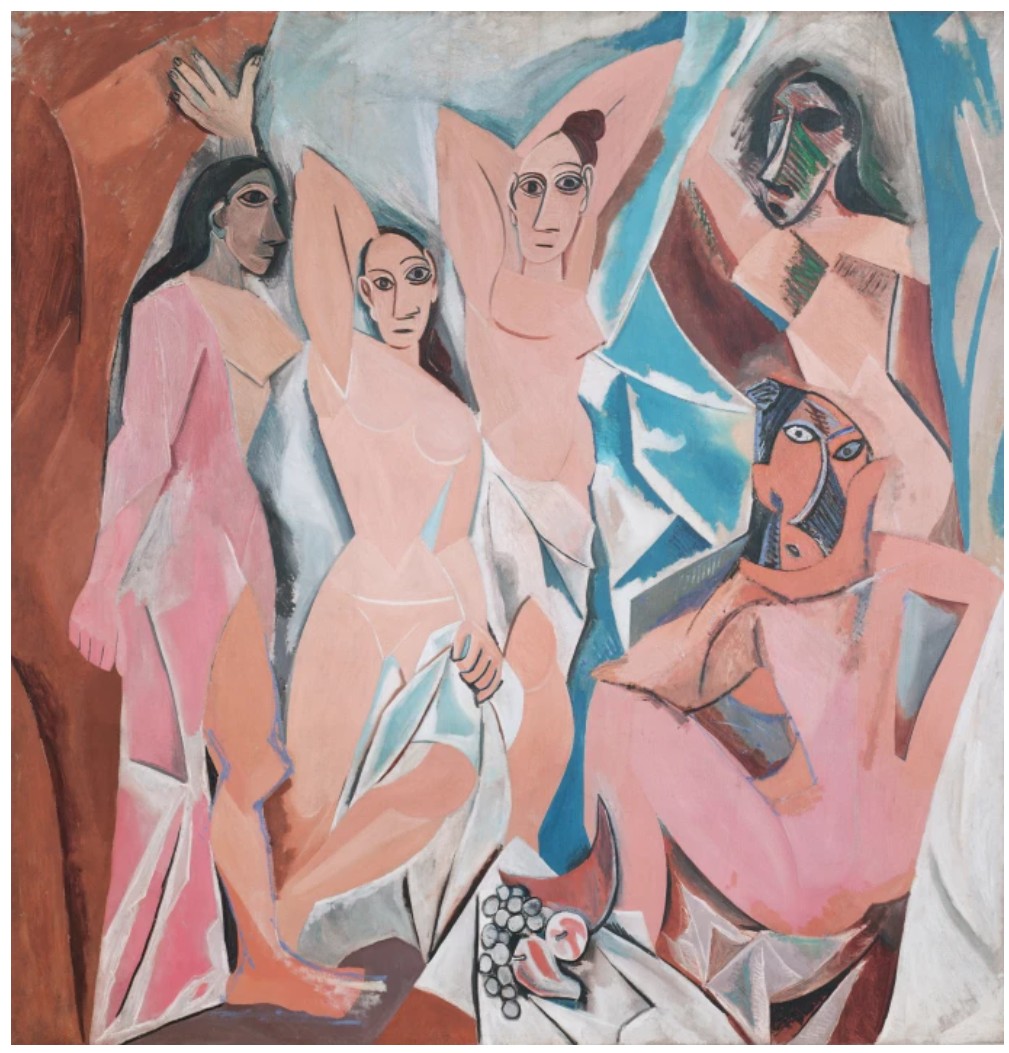
Pablo Picasso, Les Demoiselles d’Avignon, 1907, The Museum of Modern Art, New York.
Art © 2026 Estate of Pablo Picasso / Artists Rights Society (ARS), New York
The character of the harlequin is regarded as one of the most legendary of all personae within Picasso’s oeuvre. These itinerant circus performers, traditionally associated with the seventeenth century Commedia dell’Arte, recurred as central characters throughout the artist’s career. Ceaselessly fascinated with marginal individuals in society, Picasso found resonance with the harlequin’s myriad associations—from theatricality to alienation—and depicted these characters in early masterworks, such as Au Lapin Agile of 1905, as veiled self-portraits. Fernande Olivier wrote of Picasso’s early visits to Montmartre’s Cirque Medrano, “[He] would stay there all evening…talking with the clowns…He admired them and had real sympathy for them” (Fernande Olivier, Picasso and His Friends, London, 1964, p. 127).
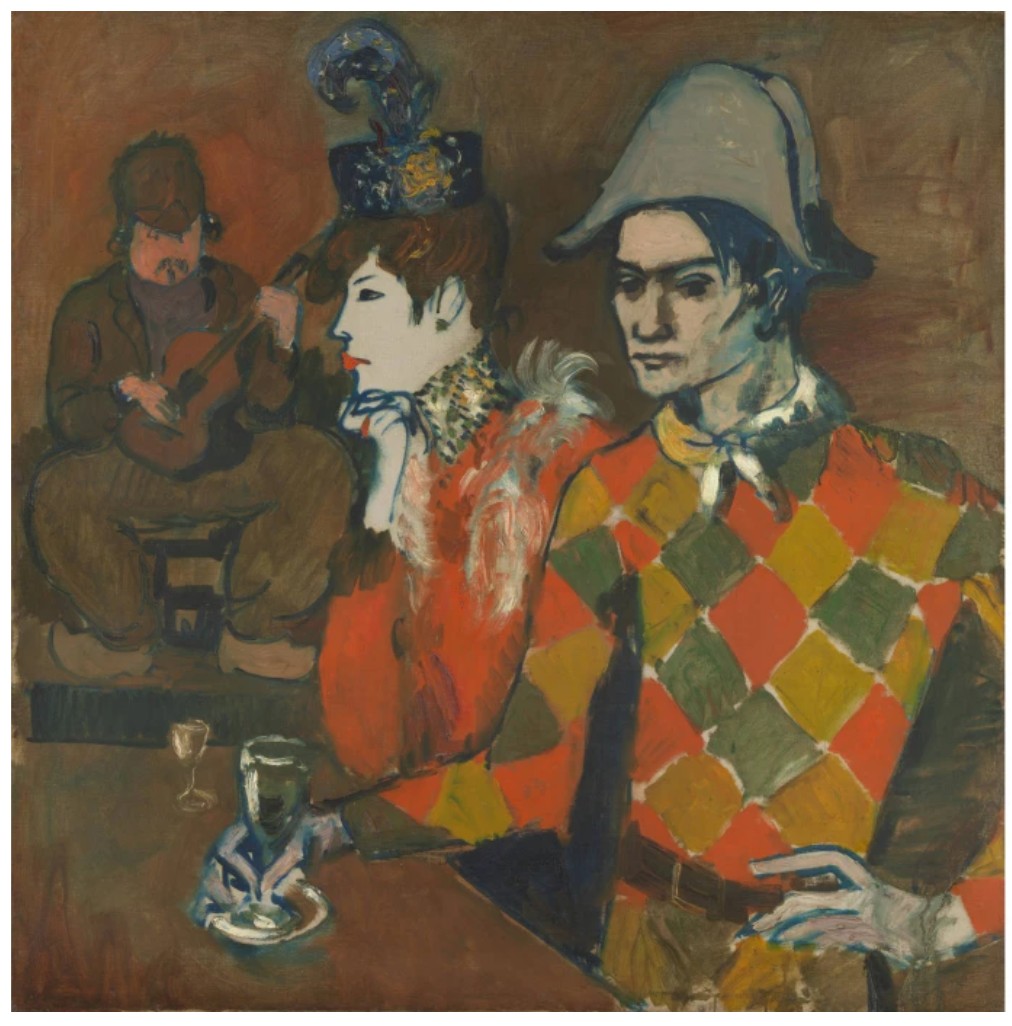
Pablo Picasso, Au Lapin Agile, 1905, The Metropolitan Museum of Art, New York.
Art © 2026 Estate of Pablo Picasso / Artists Rights Society (ARS), New York
Picasso wields the harlequin subject in Arlequin (Buste) as a vessel for his novel pictorial idiom, resulting in not only one of his most sensitive depictions of this legendary persona, but also one of his most revelatory early Cubist portraits. Theodore Reff observes, “More than the other costumed figures in his art, those of the circus and fair, and especially the ubiquitous Harlequins, are intimately related to Picasso’s most important formal invention, Cubism…For like a Cubist composition, the Harlequin’s costume of flat bright colors and strongly marked patterns both fragments and conceals the underlying forms, assimilating them to a surface design of great decorative brilliance. Symbolically, too, this interest in a form of concealment that is also a form of revelation, the familiar aspects of things disappearing while their normally hidden ones emerge, links Harlequin as a type and Cubism as a style.” (Theodore Reff, “Harlequins, Saltimbanques, Clowns, and Fools,” Artforum, October 1971, vol. 10, no. 2, p. 31). The radical modeling and liberties with spatial perspective found in Arlequin (Buste) would engender an entire retinue of groundbreaking harlequin pictures in the years to follow, from Synthetic Cubist compositions to the emphatic portraits of the artist’s final years.
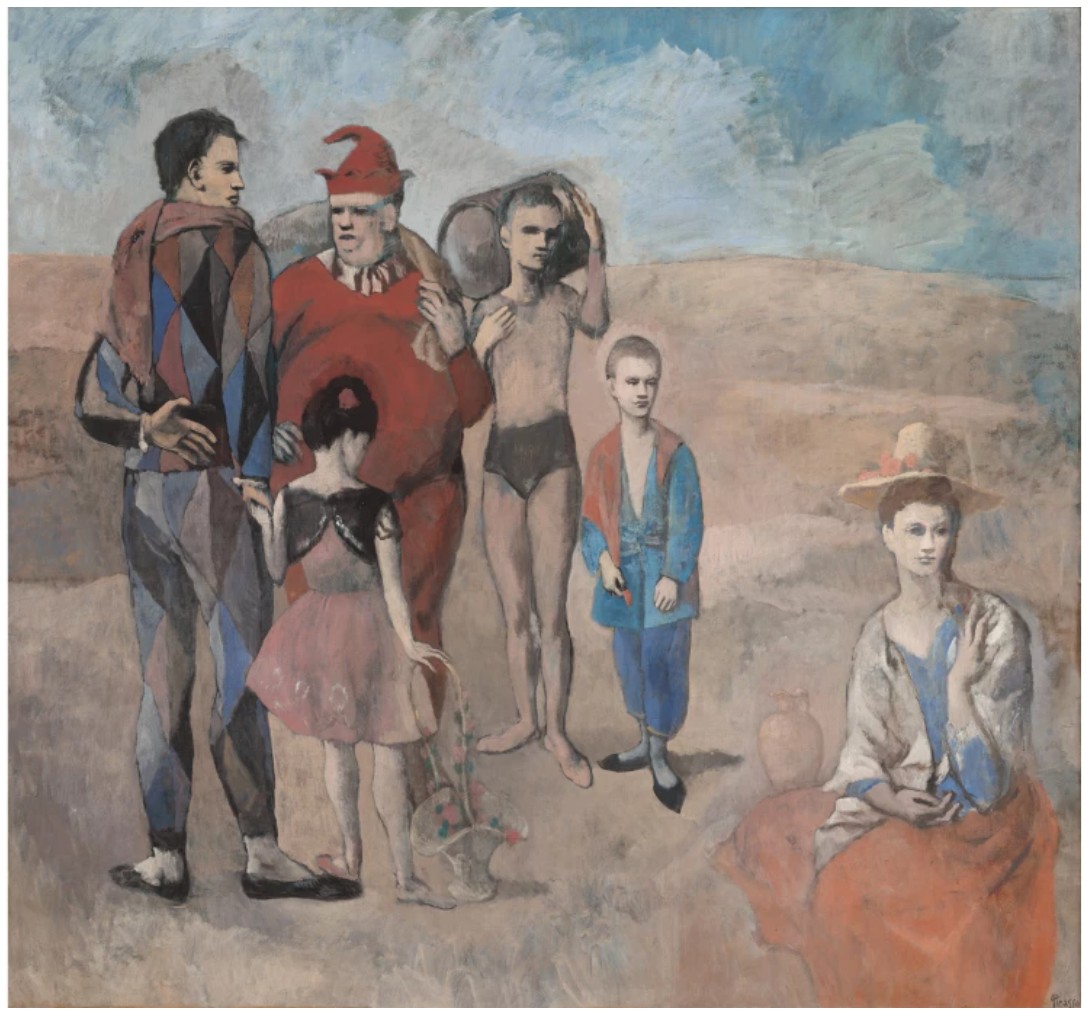
Pablo Picasso, Famille de saltimbanques, 1905, National Gallery of Art, Washington, D.C.
Art © 2026 Estate of Pablo Picasso / Artists Rights Society (ARS), New York
Arlequin (Buste) is among the most powerful testaments to Picasso’s probing dialogue with Paul Cézanne that allowed him to produce art unlike any ever before seen. Although Picasso first encountered the work of Cézanne in 1901, it was not until retrospective exhibitions at Bernheim Jeune and the Salon d’Automne following Cézanne’s death in 1906 that he became fully enthralled with the artist, considering himself heir to his forerunner’s revolutionary defiance of aesthetic mores. John Richardson notes: “Cézanne was the master of palpability… Henceforth, everything had to be tactile and palpable, not least space. Palpability made for reality, and it was the real rather than the realistic that Picasso was out to capture” (John Richardson, A Life of Picasso: The Cubist Rebel: 1907-1916, New York, 1996, pp. 52 and 103).
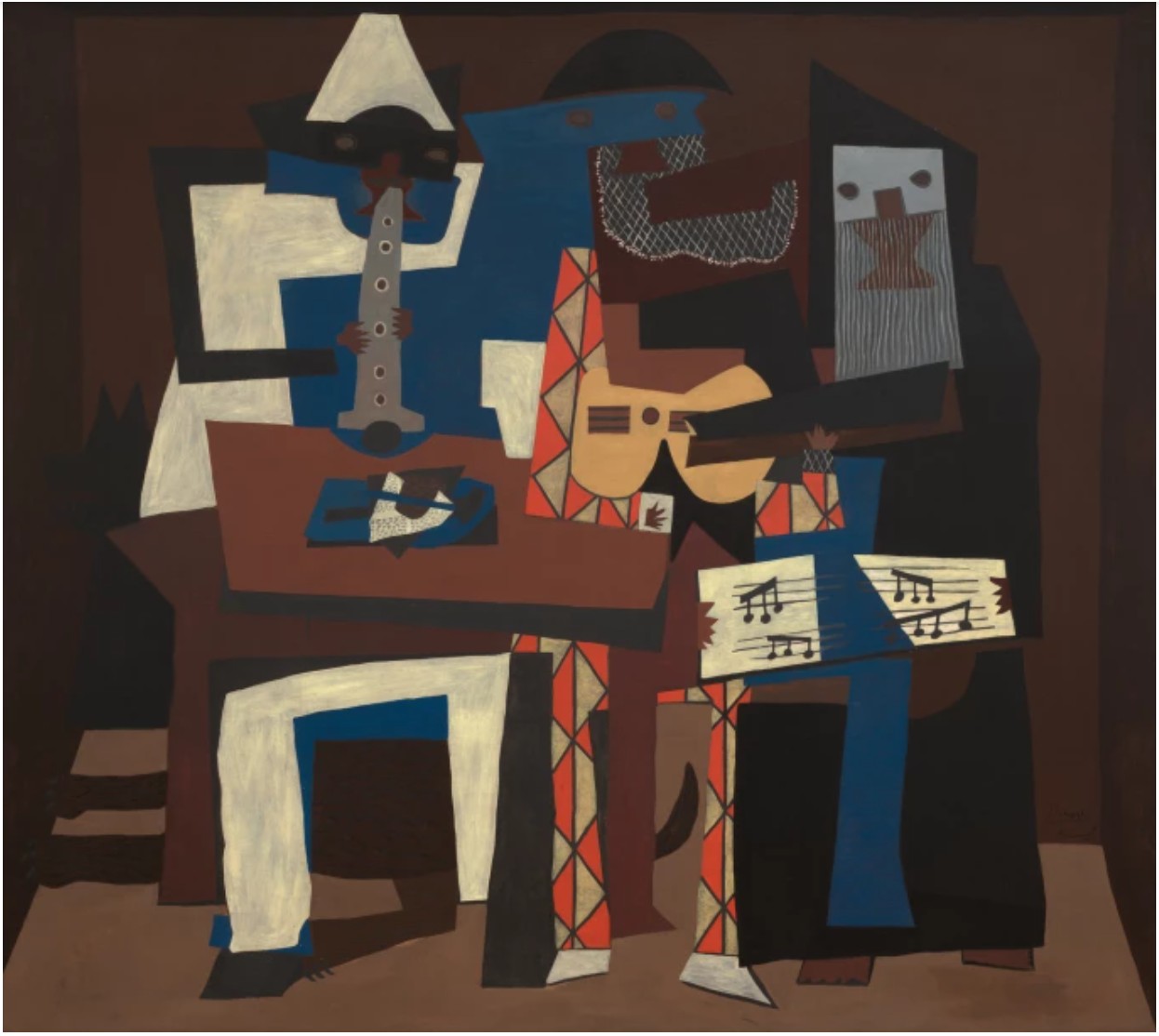
Pablo Picasso, Les Trois musiciens, 1921, The Museum of Modern Art, New York.
© 2026 Estate of Pablo Picasso / Artists Rights Society (ARS), New York
In the present work, Picasso assimilates Cézanne’s formal syntax to completely reinvent portraiture. Each element of the composition is distilled to its essence: the harlequin’s mask-like visage is anonymized as his body and environs are reduced to their most fundamental signifiers. The characteristic diamond-shaped pattern of the harlequin’s costume—rendered in a distinctively Cézannesque palette of grays, ambers and greens—reverberates in the faceted passages of his surroundings, endowing the pictorial surface with remarkable tangibility and sculptural heft. As with his predecessor’s constructive brushstroke, Picasso’s meticulous linear brushwork generates a unified luminosity through delicate interplays of light and shadow, as well as opacity and transparency, anticipating the dematerialized surfaces of his most accomplished Analytic Cubist works.
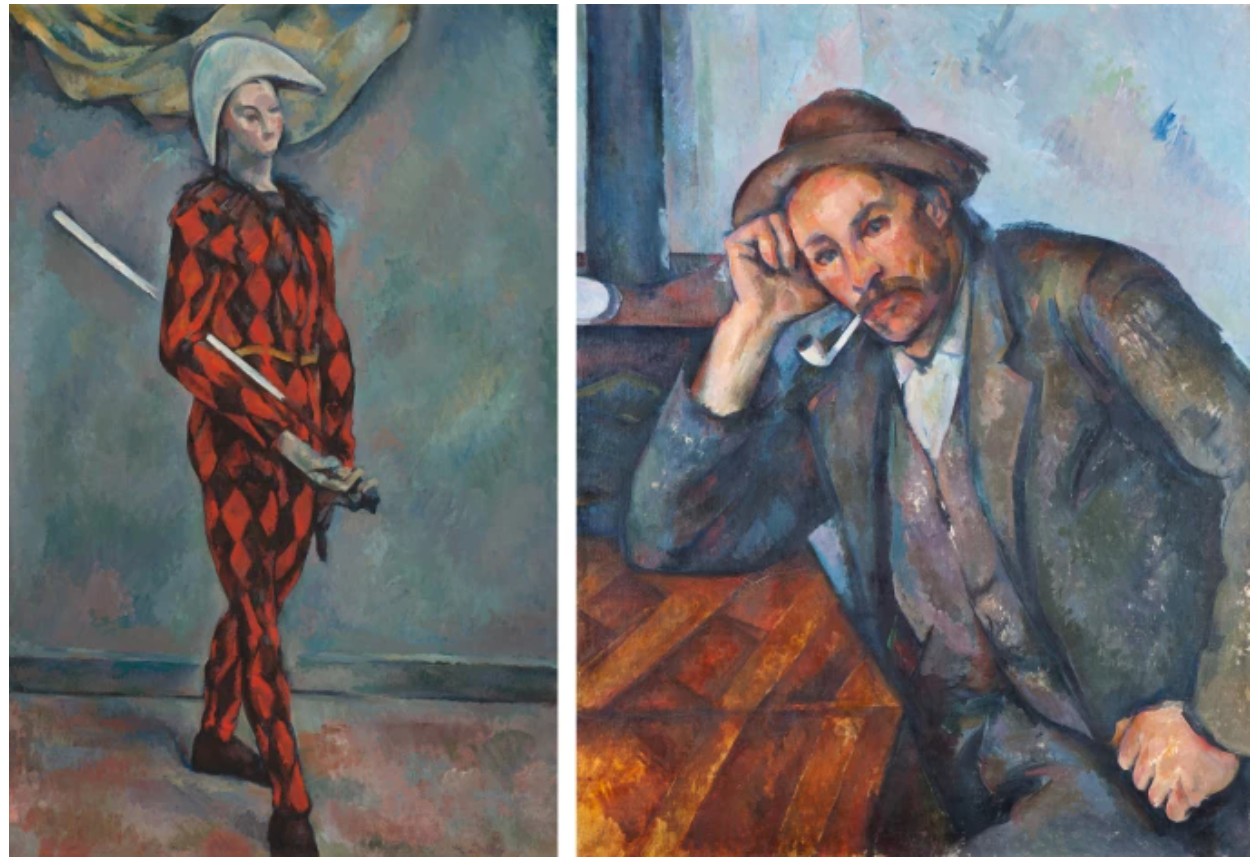
Left: Paul Cézanne, Arlequin, 1888-90, National Gallery of Art, Washington, D.C.
Right: Paul Cézanne, Le fumeur accoudé, 1890, Kunsthalle Mannheim
While evocative of Cézanne’s own engagement with the solitary harlequin character two decades prior, the present work likely derives from Picasso’s early 1909 adaptation in watercolor of Cézanne’s circa 1870 canvas La Tentation de Saint-Antoine, in which the nude figure at right is supplanted by a contemplative harlequin figure. Among Cézanne’s works, however, Arlequin (Buste) bears the closest affinity to his celebrated series of fumeurs, with the frontal pose of the harlequin—his left hand resting upon his chin and right arm leaning on a table—mirroring that of Cézanne’s pensive smokers. Radically rejecting illusionistic perspective, Cézanne tilts, crops and deconstructs the surrounding space, instilling his informal subject with a potent immediacy and presence. Picasso expands upon this defiance of spatial convention in the present work, revealing his early experiments with the multi-viewpoint perspective that would become a pillar of Cubism.
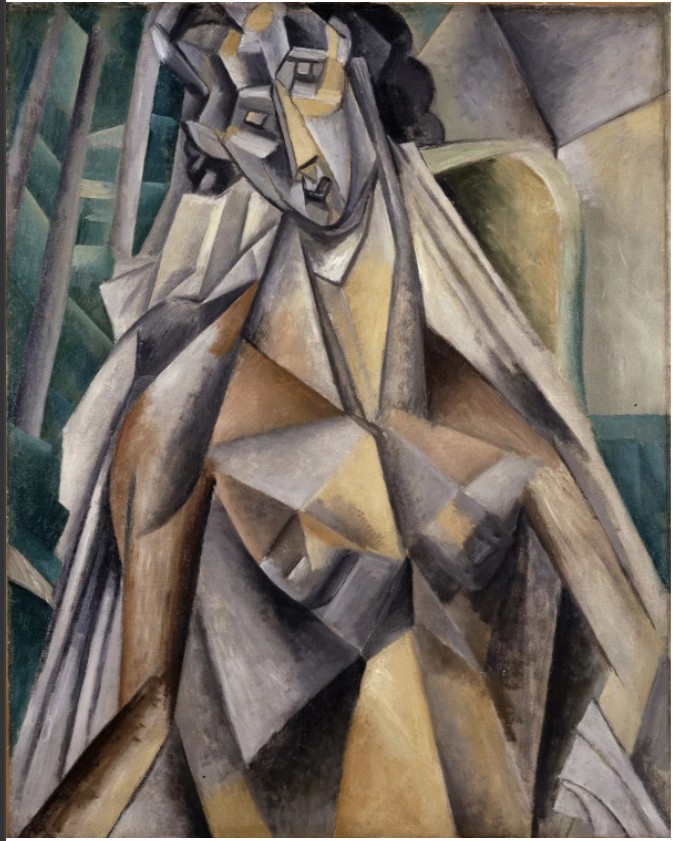
Pablo Picasso, Femme nue dans un fauteuil, 1909, The Metropolitan Museum of Art, New York.
Art © 2026 Estate of Pablo Picasso / Artists Rights Society (ARS), New York
This short yet momentous period of artistic growth in early 1909 propelled Picasso’s work toward its ultimate pre-World War I conclusion: that of an almost complete dissolution of the concrete object–whether in two or three dimensions, or across landscape, still life or body. Josep Palau i Fabre underscores Arlequin (Buste) as a cornerstone in the development of Cubism, declaring, “In all of Picasso’s periods, we find pieces that very smoothly crystallize the latent intentions of the whole. In Cubism, there are already early canvases that are ‘classics’ within the new style, because in this new language Picasso had actually worked unintentionally with one of the concepts found in Classicism: the saturation of intentions…[Arlequin (Buste)] from the spring can [be] placed under this heading” (Joseph Palau i Fabre, Picasso Cubism (1907-1917), New York, 1990, p. 131).
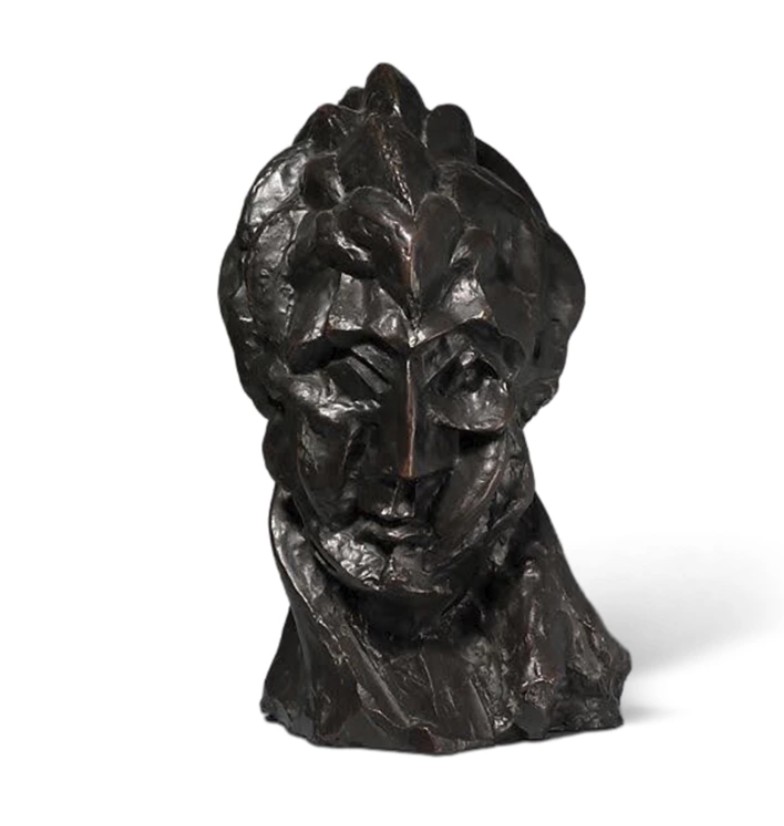
Pablo Picasso, Tête de femme (Fernande), 1909, The Metropolitan Museum of Art, New York.
Art © 2026 Estate of Pablo Picasso / Artists Rights Society (ARS), New York
The rejection of mimetic depiction of the human form seen in Arlequin (Buste) reached its apogee with Picasso’s travels to Horta de Ebro, Spain, in the summer of 1909. The portraits he completed there of his lover, Fernande Olivier, dissolved into fully fragmented pictorial surfaces, are widely recognized as the true beginnings of Cubism. Marking the most important upheaval of Western artistic principles since the Renaissance, this pioneering movement would underpin the development of art in the twentieth century and beyond.
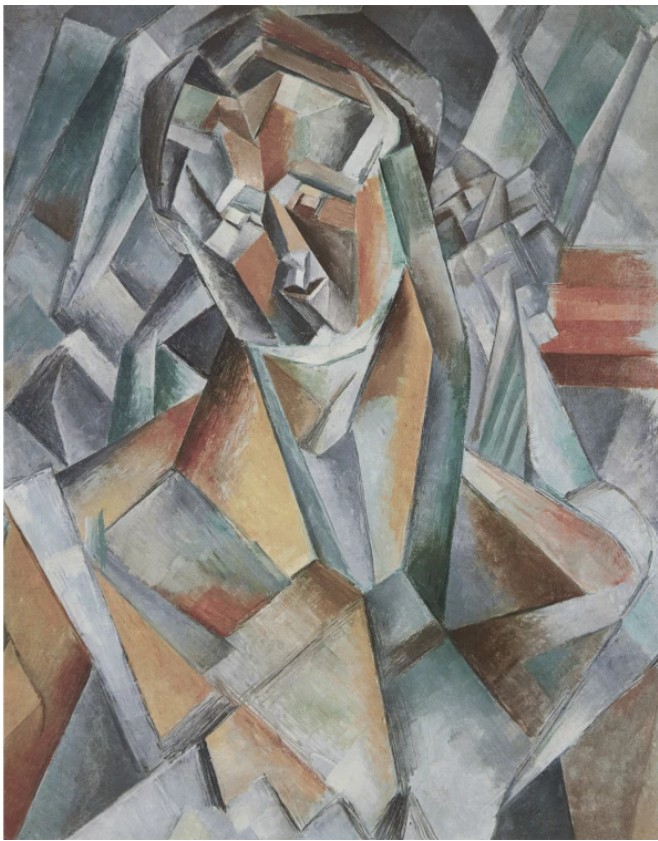
Pablo Picasso, Femme assise, 1909, Private Collection, sold: Sotheby’s, London, 21 June 2016, lot 8 for $63.5 million.
Art © 2026 Estate of Pablo Picasso / Artists Rights Society (ARS), New York
Arlequin (Buste) belonged to the collection of Adele and Enrico Donati for over sixty years. A highly important presence within the Surrealist milieu, Enrico Donati, often referred to as “the last Surrealist”, was at once an artist and trusted confidant to many of the movement’s leading figures, counting Marcel Duchamp, Max Ernst and André Breton among his close friends. Alongside him was his wife Adele Donati, a designer and artist, who viewed the collection with a discerning eye, informed by her work across advertising and fashion.
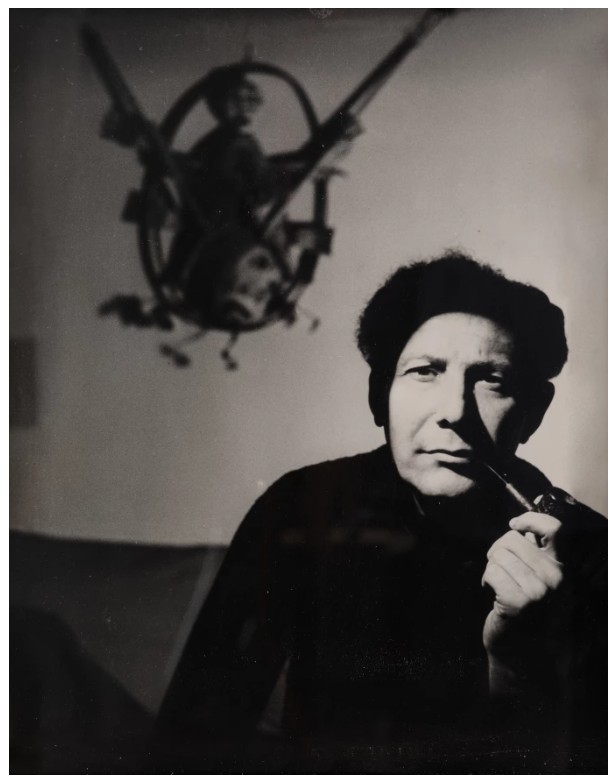
Enrico Donati
Heralded as one of the last members of the Surrealist movement, Donati’s career began in the 1930s in Paris, where he immersed himself in the city’s cultural avant-garde and he first encountered the work of the Surrealists. In 1939, with the threat of war rising in Europe, Donati relocated with his young family to New York, joining the wave of European artists and intellectuals fleeing the continent. In 1942 he held his first solo exhibition in the city at the New School for Social Research. It was seen by André Breton, who immediately proclaimed him to be a Surrealist, and welcomed Donati into the movement. Thereafter Donati became enmeshed with the close circle of European émigré artists and writers in New York, including Marcel Duchamp and Yves Tanguy, contributing to the city’s vibrant artistic life during the war years. Insatiably curious, Donati reinvented his style multiple times over his six-decade career, oscillating between the influences of Surrealism, Constructivism and Abstract Expressionism, yet always maintaining a uniquely Surrealist style.
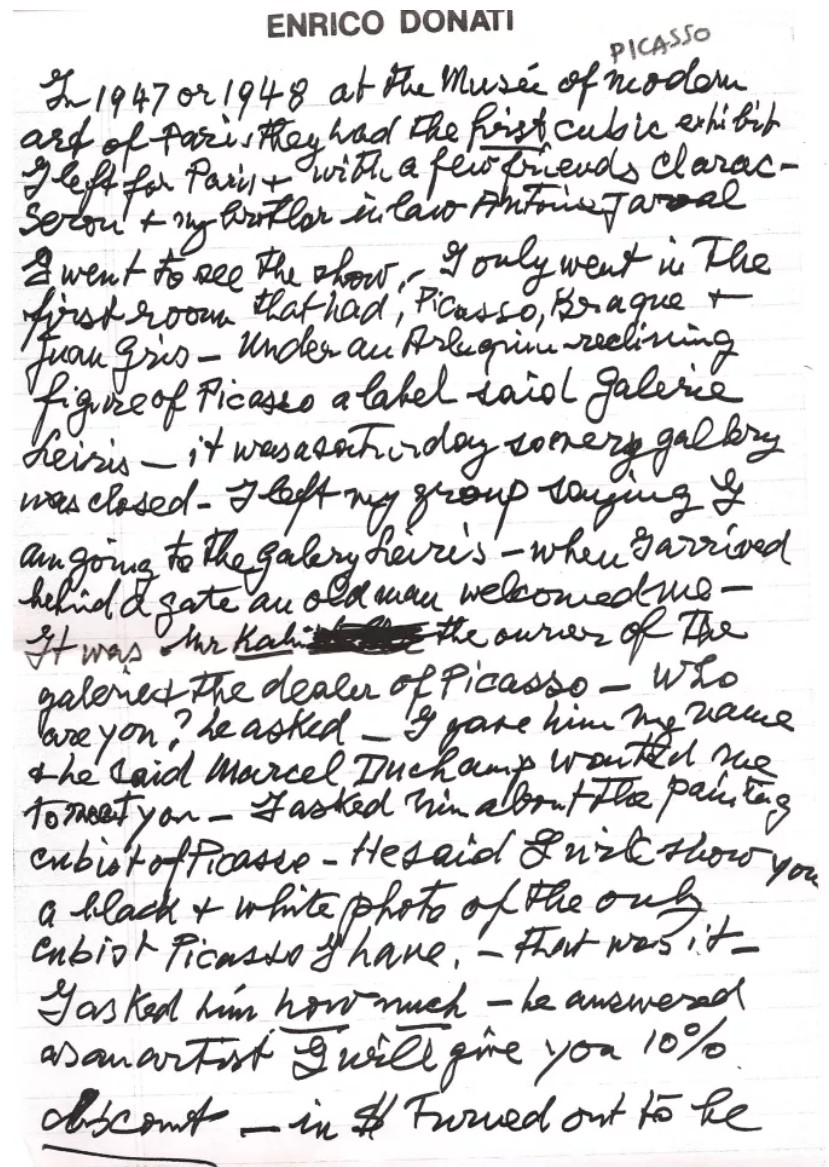
As the present work attests, Donati was a passionate promoter of twentieth-century art, collecting not only the work of friends but that of artists whose work showed the ever-changing landscape of modernism. Donati wrote of being immediately captivated by an encounter with a Picasso harlequin in a Cubist exhibition at the Musée National d’Art Moderne in Paris in 1953. He swiftly made a visit to the Galerie Louise Leiris, where he met the Picasso’s legendary dealer, Daniel-Henry Kahnweiler and promptly bought the the present picture for the money that he had in his pocket: “At the musée of Modern art they had the first Cubist exhibit…I only went in the first room that had Picasso, Braque and Juan Gris—under an Arlequin reclining figure of Picasso a label said Galerie Leiris ….When I arrived [at the Galerie Louise Leiris] an old man welcomed me. It was Mr. Kahnweiler, the owner of the gallery and the dealer of Picasso. “Who are you?” he asked—I gave him my name and he said Marcel Duchamp wanted me to meet you. I asked him about the Cubist painting of Picasso. He said, ‘I will show you a black-and-white photo of the only Cubist Picasso I have.’—that was it.”
Homme à la guitare, 1913
Homme à la guitare, 1913
Masterpieces: The Private Collection of S.I. Newhouse
Christie’s New-York: 18 May 2026
Estimated: USD 35,000,000 – 55,000,000
USD 40,885,000
PABLO PICASSO (1881-1973), Homme à la guitare | Christie’s
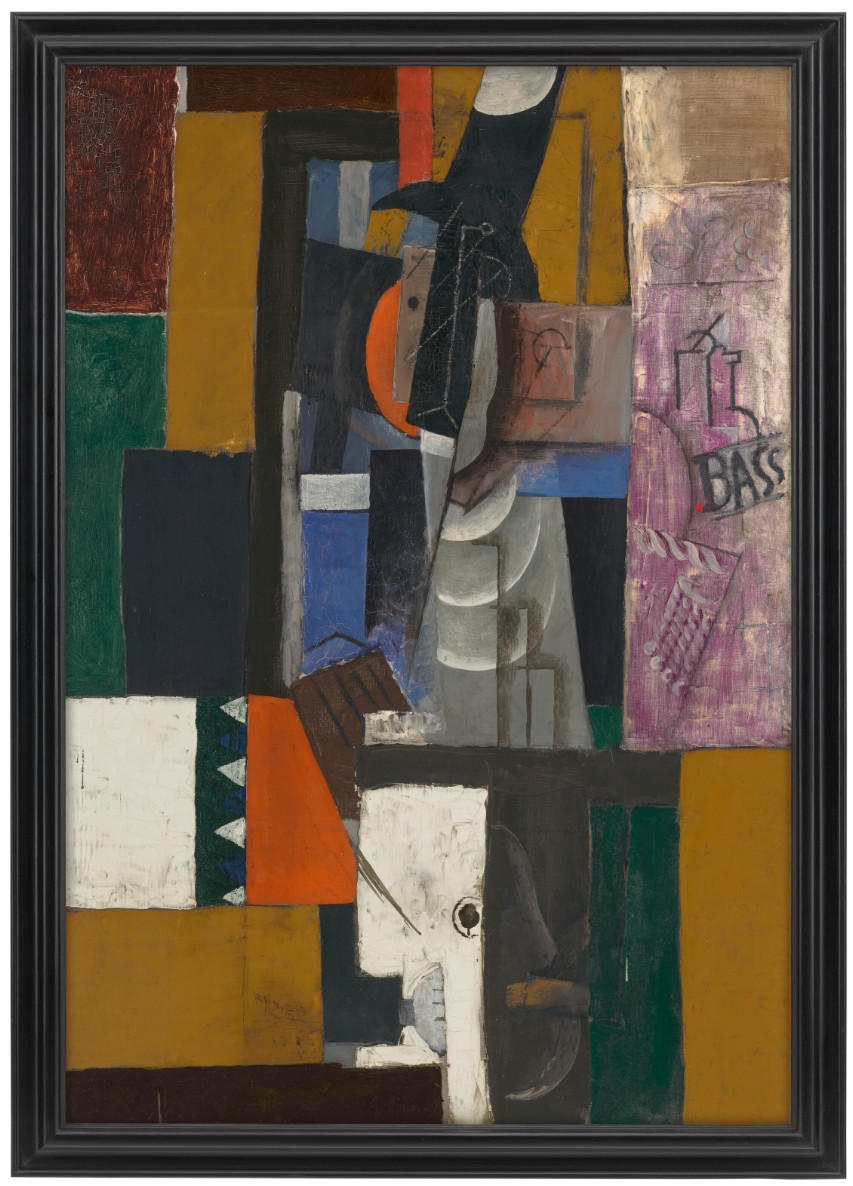
PABLO PICASSO (1881-1973)
Homme à la guitare, 1913
Oil, encaustic and sand on canvas
130.5 x 89.6 cm (51-3/8 x 35-1/4 inches)
Signed, dated and inscribed ‘PICASSO Céret 1913’ (on the reverse)
Painted in Céret in 1913
Pablo Picasso painted Homme à la guitare in Céret in the summer of 1913, an important moment in the midst of the rapid series of pictorial revolutions that define Cubism. Composed of planes of vibrant color, pattern, and letters, combined with passages of highly textured paint, encaustic, and in places, sand, this large-scale portrait, formerly in the legendary collection of Gertrude Stein and subsequently, The Museum of Modern Art, New York, stands as a bold declaration of the new direction that Picasso’s art took at this time. Featuring one of his most beloved and important motifs—the man and the guitar—this work announces the arrival of Synthetic Cubism, the second stage of Picasso’s epoch-defining cubist adventure. “His only large canvas of the period,” John Richardson has described, it is also the last large-scale work from 1913 in private hands (quoted in A Life of Picasso, The Painter of Modern Life, 1907-1917, London, 2009, vol. II, p. 278).
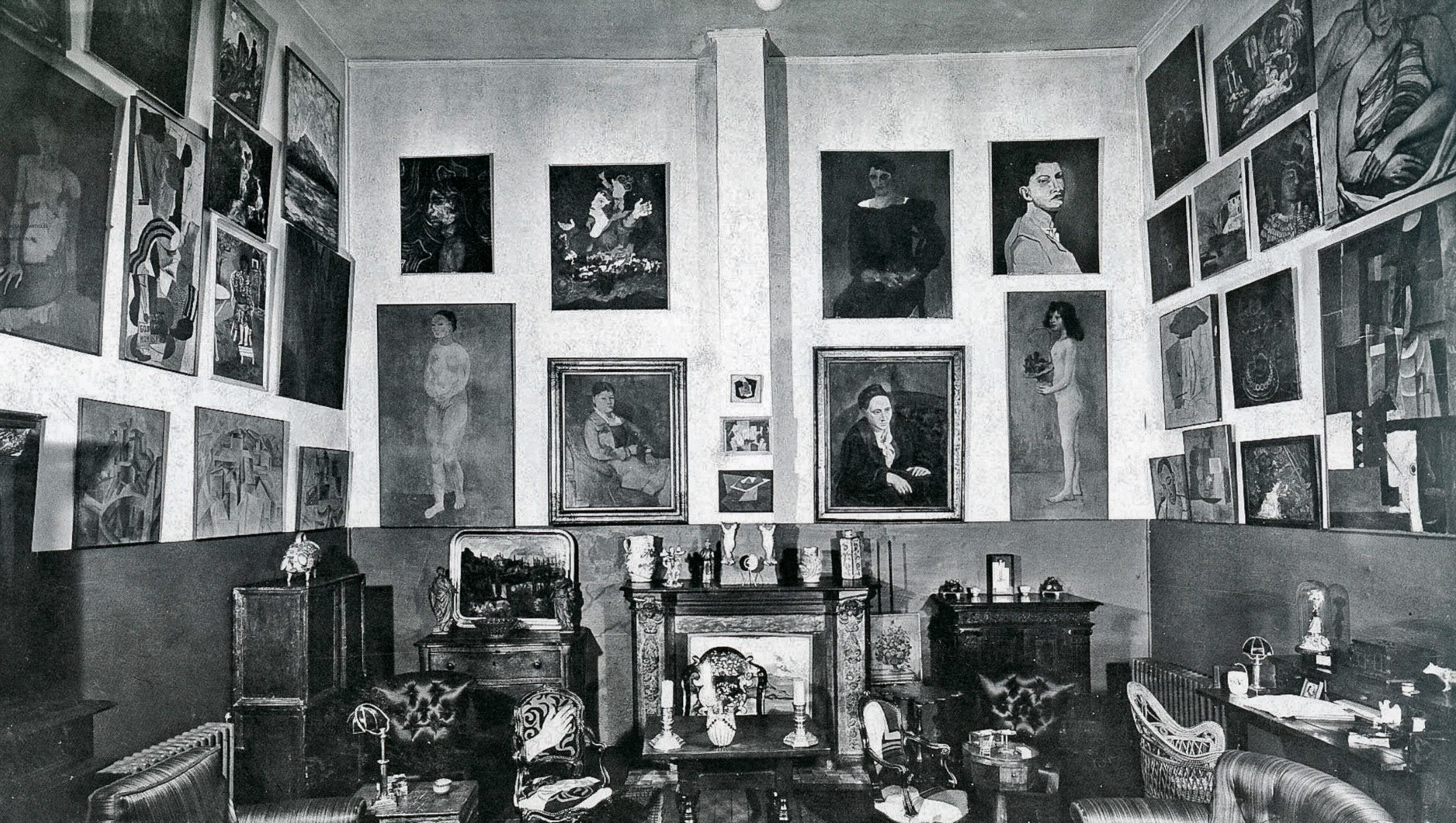
The present work, hanging on the far left, in the home of Gertrude Stein, 27 rue de Fleurus, Paris, winter 1914-1915. Artwork: © 2026 Estate of Pablo Picasso / Artists Rights Society (ARS), New York.
Over the course of the twelve months prior to his creation of this work, Picasso, together with his friend and cubist comrade, Georges Braque, had made a series of artistic leaps, integrating found objects in cubist collages, pasted paper pieces in their papier collés, and latterly, inventing three-dimensional cubist constructions and assemblages that once again radically redefined the parameters of artmaking. During his stay in Céret in the spring and summer of 1913, Picasso was exploring and experimenting with the artistic repercussions of these breakthroughs, scrutinizing form—both pictorial and material—as he moved effortlessly between painting, drawing, collage, and sculpture, each medium informing his work in the other. Homme à la guitare marks the synthesis of these different developments, as well as occupying a deeply personal place in the life of the artist.
Picasso had arrived in Céret, a small town in the French Pyrenees in March 1913. On this, his third stay there, he traveled with his partner of the time, Eva Gouel, the enigmatic “ma jolie,” as he referred to her in his painting. In May 1912, his long-term relationship with Fernande Olivier had come to an explosive end when she left him for another artist. Picasso had already been enjoying a clandestine relationship with Eva, who would after this point, become the artist’s offical muse and lover. Returning to Céret, Picasso and Eva once again rented the ground floor of the Maison Delcros, and were soon joined by painter and poet, Max Jacob. Happy to be away from Paris and its demands, the artist set to work. “I’m behaving very badly towards all my friends,” Picasso wrote to his dealer, Daniel-Henry Kahnweiler on 11 April 1913. “I’m not writing to anyone, but I’m working; I’m working on projects and I’m not forgetting any one of you” (quoted in Picasso and Braque: Pioneering Cubism, exh. cat., The Museum of Modern Art, New York, 1989, p. 416).
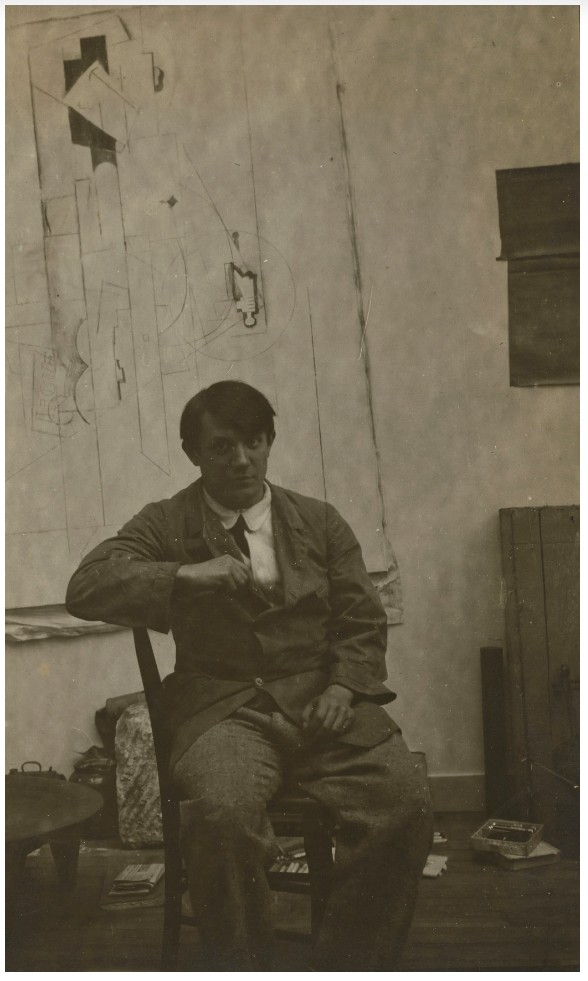
Self-portrait in front of the canvas, Construction with Guitar Player, Paris, winter or summer 1913. Musée national Picasso, Paris. © 2026 Estate of Pablo Picasso / Artists Rights Society (ARS), New York. Image: © RMN-Grand Palais / Art Resource, NY.
Notably for this sojourn, Braque was not present. In contrast to the previous years during which they were, as Braque later described, tethered together like mountain climbers, at this time he was happily ensconced in Sorgues. Though Picasso missed his company—“it’s really too bad that the telephone at your place doesn’t reach Céret,” he wrote to him (quoted in J. Richardson, op. cit., 2009, p. 276)—tellingly, unlike other trips he did not implore him to come and join him. Their art, which had in the past few years, been almost indistinguishable, was beginning to diverge, the pair no longer responding to the each other with the same sense of immediacy and intensity as previous years.
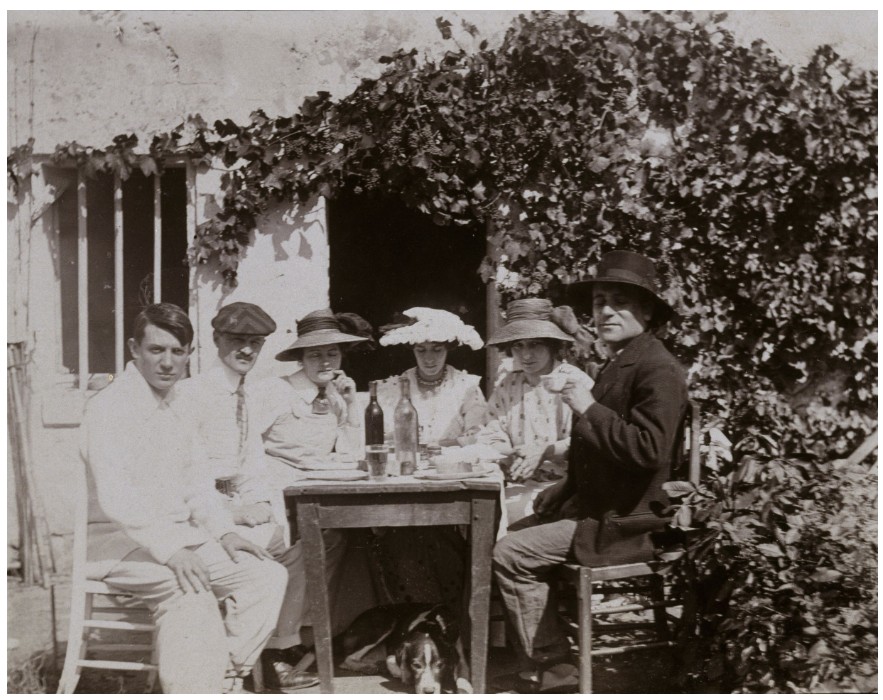
Picasso, Eva Gouel, Max Jacob and other friends on the balcony of Maison Delcros, Céret, 1913.
Musée Picasso, Paris. Photo: © RMN-Grand Palais / Art Resource, NY.
Upon his arrival in Céret, Picasso began a new series of papier collés, expanding and building upon the possibilities of this art form that Braque had pioneered in the autumn of 1912. Already by this point, the artists had found that Analytical Cubism had reached its natural conclusion. As a result, they began to reintroduce life into their work, gradually relaxing the dense webs of lines and facets that had constructed their hermetic compositions, and reintegrating color once more. Stenciled lettering began to appear, before real objects, pieces of wallpaper and faux-bois, and carefully chosen cuttings of newspapers and ephemera. As a result, Cubism was transformed as reality itself was integrated into the two-dimensional confines of the canvas, thereby opening up new directions in the conception not only of a painting, but of art itself.
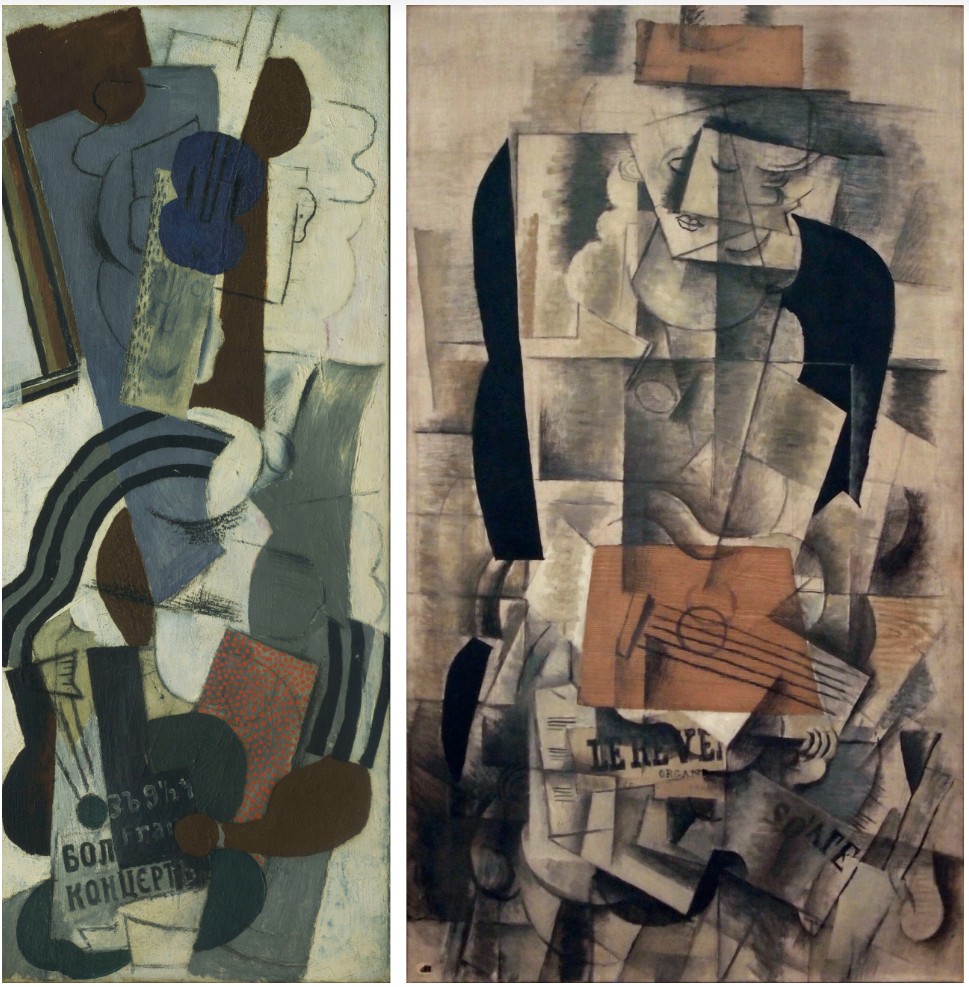
Left: Pablo Picasso, Femme à la guitare, winter 1913-1914. The Museum of Modern Art, New York. © 2026 Estate of Pablo Picasso / Artists Rights Society (ARS), New York. Photo: © The Museum of Modern Art/Licensed by SCALA / Art Resource, NY.
Right: Georges Braque, Femme à la guitare, Sorgues, autumn 1913. Musée National d’Art Moderne, Centre Georges Pompidou.
This clearer, bolder cubist idiom, constructed with larger, flattened planes would become the defining characteristic of Synthetic Cubism, which Picasso explored at pace throughout 1913. The pieces of paper used to construct the compositions fed into his work in oil paint—as seen in the present work, with its interlocking arrangement of painted planes of deep blue and green, together with luminous red and orange. “The changes in structure make [Picasso’s] paintings look simpler, flatter, clearer, bolder—and also less mysterious or metaphysical,” Elizabeth Cowling has described. “Not that they became unambiguous and direct. Far from it. But the strangeness of shadowy, immeasurable spaces and indeterminate forms and the equivocation of Mallarméen ‘suggestion’ were replaced by witty visual metaphors and puns” (Picasso: Style and Meaning, London, 2002, pp. 262-263).
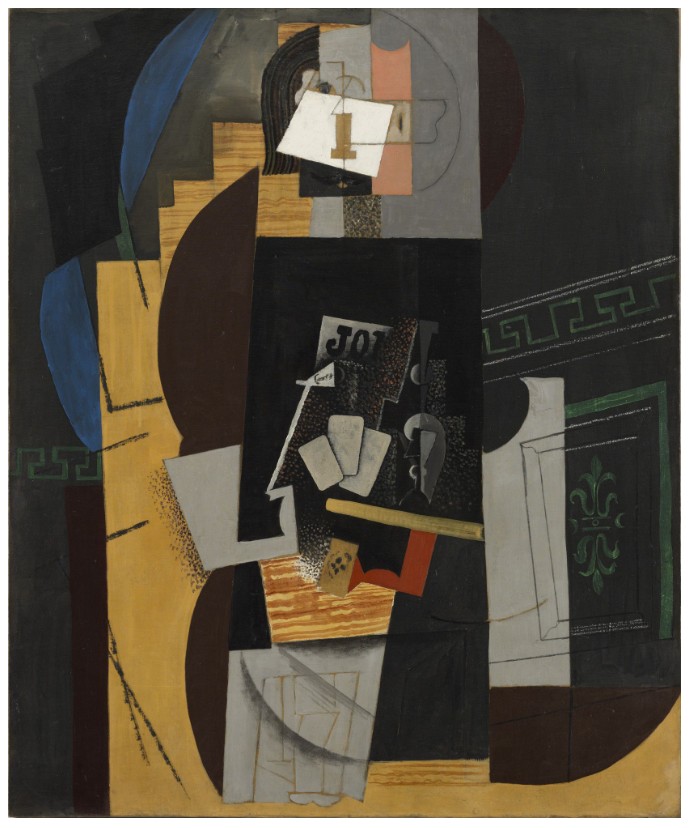
Pablo Picasso, Joueur de cartes, winter 1913-1914. The Museum of Modern Art, New York.
© 2026 Estate of Pablo Picasso / Artists Rights Society (ARS), New York.
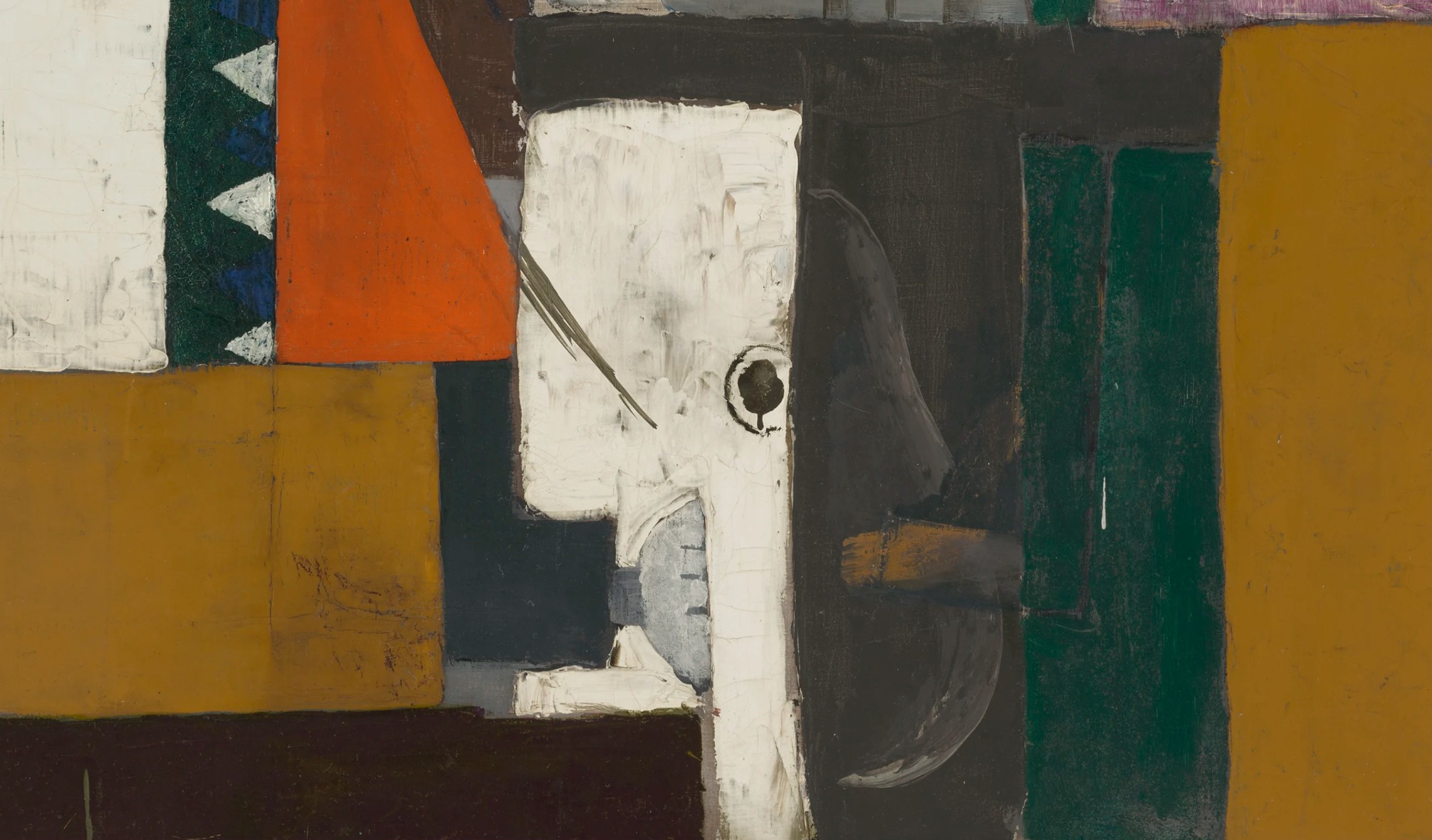
Here, the figure of the man and the guitar are converted into a union of repeating shapes and signs: the curving silhouette of the guitar is echoed in the faceted shape of the man’s head, these semi-circular forms cascading down to convey the volume of his bust and torso, while the black circle of the instrument’s soundhole finds its equivalent in his head, standing as a single eye. A painted still life occupies the right hand side of the canvas, the famous Bass beer label, an integral cubist symbol, emblazoned over the partially painted outlines of two bottles, which themselves mimic the form of the figure’s distinctive black top hat. These playful visual rhythms and equivalences define Synthetic Cubism.
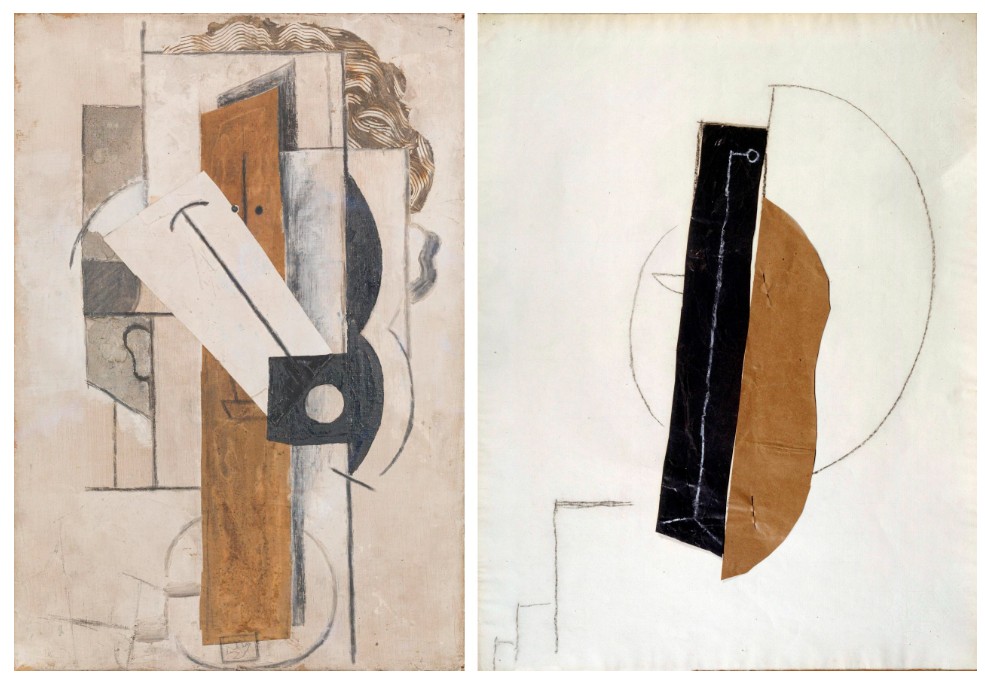
Left: Pablo Picasso, Tête de jeune fille, 1913. Musée National d’Art Moderne, Centre Georges Pompidou, Paris. © 2026 Estate of Pablo Picasso / Artists Rights Society (ARS), New York.
Right: Pablo Picasso, Tête, 1913. Musée national Picasso, Paris. © 2026 Estate of Pablo Picasso / Artists Rights Society (ARS), New York. Photo: © Photo Josse / Bridgeman Images.
Picasso turned to his famed motif of the man playing the guitar to explore these latest developments in the spring of 1913. Earlier in the year, Picasso had created a large assemblage of this subject in his studio on the boulevard Raspail in Paris. In this playful—and highly radical work—Picasso set a real tabletop, with a bottle, cup, pipe, and newspaper, in front of a large canvas with a drawn and painted cubist figure of a man holding, with cut out newspaper arms, an actual guitar. A painted and constructed violin can also be seen hanging on the upper right hand side of the canvas. Once arranged, Picasso then photographed his assemblage—memorializing this ephemeral composition in time, as if he had created a living art work on a pictorial stage.
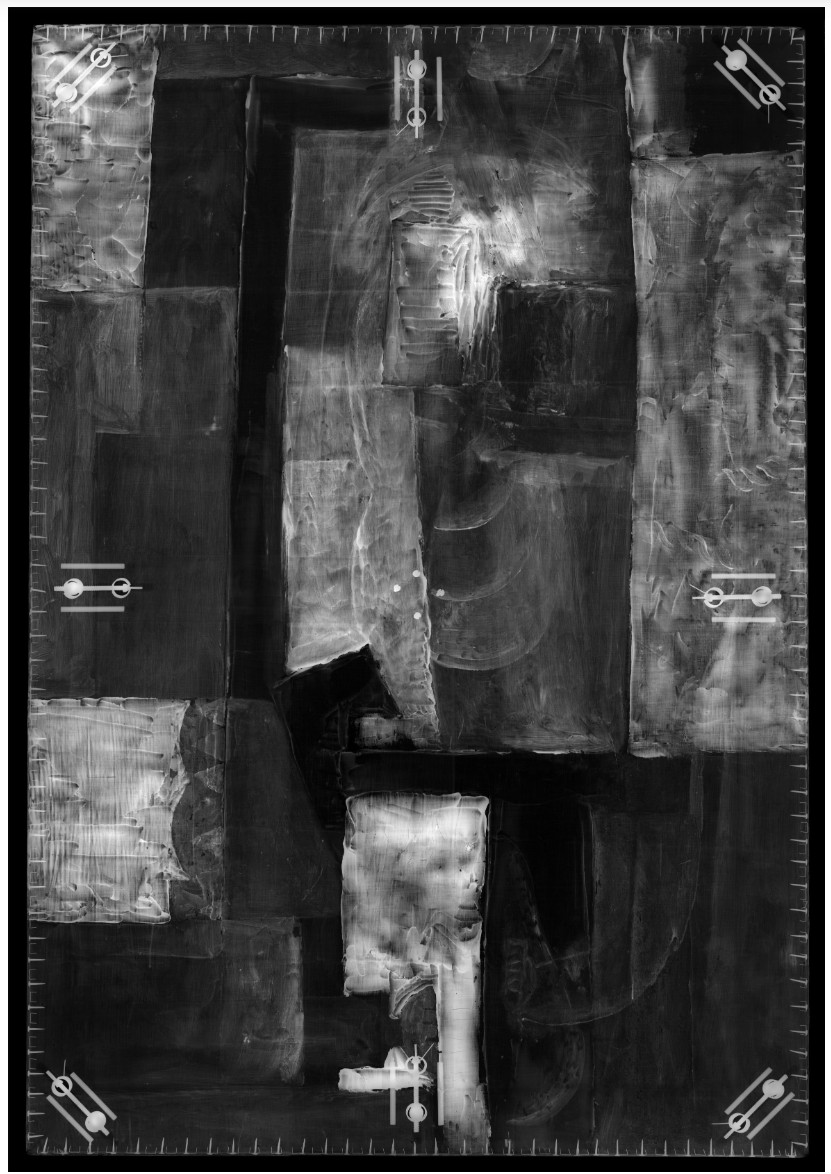
An X-ray of Homme à la guitare (© ArtDiscovery). This image, made by ArtDiscovery, reveals a fascinating insight into Picasso’s working process. The image suggests that he worked with confidence and decisiveness, making only limited adjustments to the composition before arriving at the final result. His approach emphasizes texture and layering, using paint to create a strong sense of depth and luminosity. In many areas, Picasso began with lower layers applied in thick, assertive strokes—using both brushwork and, at times, a palette knife. Over these, he added thinner applications of paint, ranging from semi-translucent to fully opaque, to build complexity and visual richness. The most evident change between the earlier and final stages of painting appears in the area of the figure’s head. The X-ray reveals that Picasso initially painted a circular and a rectangular form in the upper center, constructed with dense, parallel horizontal strokes of a palette knife. He later painted over these shapes to render the guitar player’s face and hat.
Marrying the real and the represented, the three-dimensional and two-dimensional, this assemblage paved the way for Picasso’s artistic production in Céret. There, Picasso’s evident fascination with the man and guitar as the vehicle through which to play with this concept of transformation from idea to form, figure to object, painting to sculpture, materialized in both his sketchbooks from this period, as well as his papier collés, and the present painting. Over the course of his drawings of this period, the form and structure of the guitar player is broken down and reimagined in myriad ways, built from vertical strips and interlocking planes, or conveyed in some of the more diagrammatic drawings in a squared paper carnet, as possible three-dimensional constructions (see for example Carnet des dessins cubistes, nos. MP1865 (25r) and (46r), Musée national Picasso, Paris). Homme à la guitare stands at the heart of this fascinating preoccupation as Picasso transformed the guitar player construction into oil—the painted conclusion of the idea born in the initial assemblage. Where the forms of the figure had been reimagined as solid, interconnecting parts, here, Picasso reimagined this construction in flat planes of bold color and pattern.
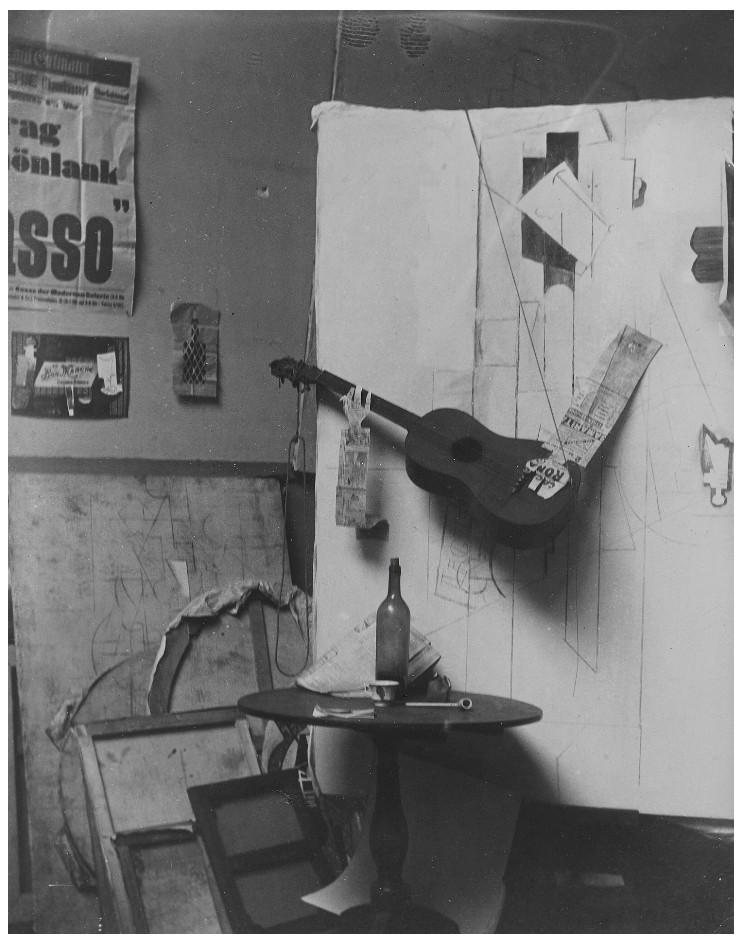
Homme avec guitare, assemblage in Picasso’s studio, boulevard Raspail, Paris. On or after 25 January and before 10 March 1913. No longer extant. Musée national Picasso, Paris. © 2026 Estate of Pablo Picasso / Artists Rights Society (ARS), New York.
Despite being deeply immersed in these exciting material explorations, Picasso was called home to Barcelona at the end of March 1913 as his father José Ruiz y Blasco had taken ill. A few weeks later, at the beginning of May, he heard news that his father had worsened and rushed to Spain to be with him. He died on 3 May; “You can imagine the state I’m in,” Picasso wrote to Kahnweiler (quoted in exh. cat., op. cit., 1989, p. 417). Later in the month, Picasso’s beloved dog, Frika, passed away, while Eva also fell ill, the start of the illness that would ultimately lead to her untimely death in 1915. “I hope that Pablo will get back to work again,” she wrote to Stein, “as that is the only thing that can make him forget his sorrow a little” (quoted in P. Daix and J. Rosselet, Picasso: The Cubist Years, 1907-1916, London, 1979, p. 300).
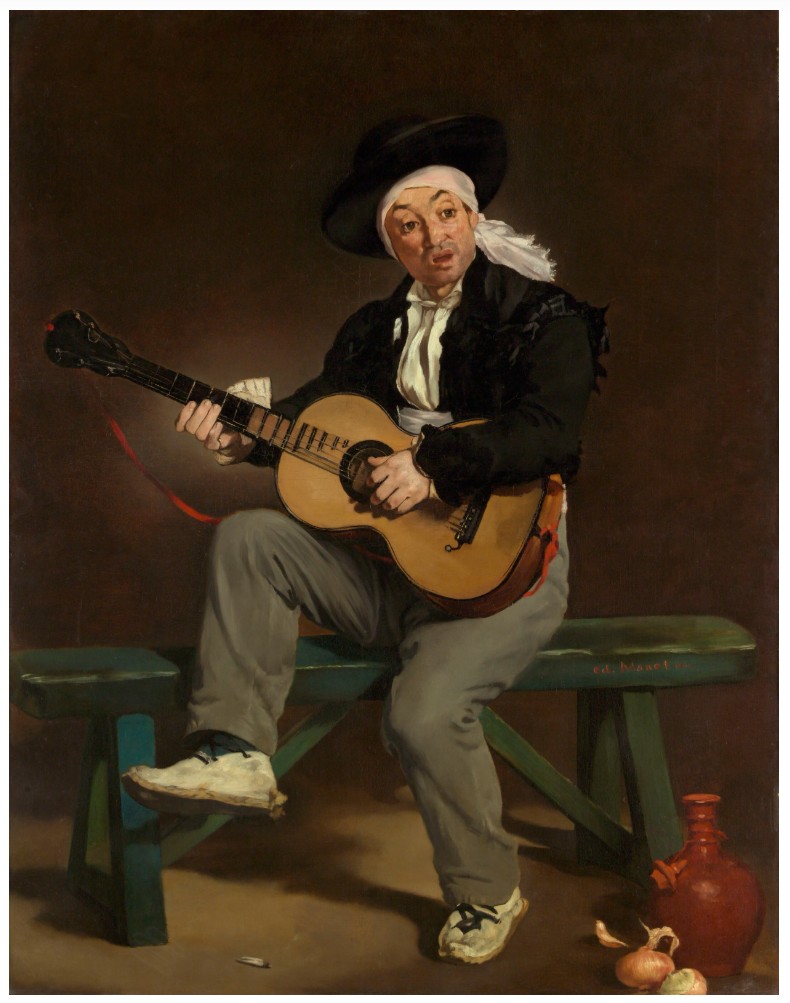
Edouard Manet, Le chanteur espagnol, 1860. Metropolitan Museum of Art, New York.
While there is no overt sign of these bereavements in Picasso’s work of this period, the presence of black planes in a number of his papier collés, as well as the minimal, austere quality of some of them, could be seen to reflect his grief. John Richardson wrote of Homme à la guitare that “the man in a tall Córdoban hat holding a guitar…could well be a memorial to his father… the oddly discordant café still life in half-mourning mauve on the right could refer to don José’s heyday in the cafes of Málaga” (op. cit., 2009, p. 278). In this way, this large and impressive painting is not only a bold example of the artist’s latest pictorial explorations, but can also be seen as a poignant testament to Picasso’s father, himself an artist, who would remain a central presence in his work for the rest of his life. Years later, Picasso told the photographer, Brassaï, “Every time I draw a man, involuntarily I think of my father. For me, man is ‘Don José,’ and that will be true all my life. He wore a beard. All the men I draw have more or less his features” (quoted in Brassaï, Conversations with Picasso, Chicago, 1999, p. 66).