MAY 2026 NEW-YORK AUCTIONS
Jean-Michel Basquiat
Auction Results
#1. Museum Security (Broadway Meltdown), 1983
Property from a Distinguished Collection
Sotheby’s New-York: 14 May 2026
Estimate upon Request
USD 52,717,500
Jean-Michel Basquiat | Museum Security (Broadway Meltdown) | The Now
REPEAT SALE
Christie’s London: 12 February 2013
Estimated: GBP 7,000,000 – 9,000,000
GBP 9,337,250 / USD 14,509,650
Jean-Michel Basquiat (1960-1988) (christies.com)
JEAN-MICHEL BASQUIAT (1960 – 1988)
Museum Security (Broadway Meltdown), 1983
Acrylic, oilstick and collage on canvas
84×84 inches (213.4 x 213.4 cm)
#2. Asbestos, 1982
Christie’s New-York: 20 May 2026
Estimated: USD 3,000,000 – 5,000,000
USD 6,541,000
WORK ON PAPER
JEAN-MICHEL BASQUIAT (1960-1988), Asbestos | Christie’s
JEAN-MICHEL BASQUIAT (1960-1988)
Asbestos, 1982
Oil and oilstick on paper
27-5/8 x 19-3/8 inches (70.2 x 49.2 cm)
Signed and dated ‘BASQUIAT 1982’ (on the reverse)
#3. Untitled, 1985
Christie’s New-York: 21 May 2026
Estimated: USD 1,000,000 – 1,500,000
USD 1,966,000
WORK ON PAPER
JEAN-MICHEL BASQUIAT (1960-1988), Untitled | Christie’s
JEAN-MICHEL BASQUIAT (1960-1988)
Untitled, 1985
Ink, acrylic, marker, colored pencil and graphite on paper
19×26 inches (48.3 x 66 cm)
Signed, inscribed, dedicated and dated ‘’85 TO MICHAEL Jean-Michel Basquiat ST BARTH’ (lower right)
Registered with the Authentication Committee for the Estate of Jean-Michel Basquiat under transaction #60035
#4. Untitled, 1982
Christie’s New-York: 21 May 2026
Estimated: USD 800,000 – 1,200,000
USD 952,500
WORK ON PAPER
JEAN-MICHEL BASQUIAT (1960-1988), Untitled | Christie’s
JEAN-MICHEL BASQUIAT (1960-1988)
Untitled, 1982
Oilstick on paper
14 x 9-3/4 inches (35.5 x 23.6 cm)
#5. Anatomy, 1982
Christie’s New-York: 21 May 2026
Estimated: USD 400,000 – 600,000
USD 762,000
COMPLETE SET
JEAN-MICHEL BASQUIAT (1960-1988), Anatomy | Christie’s
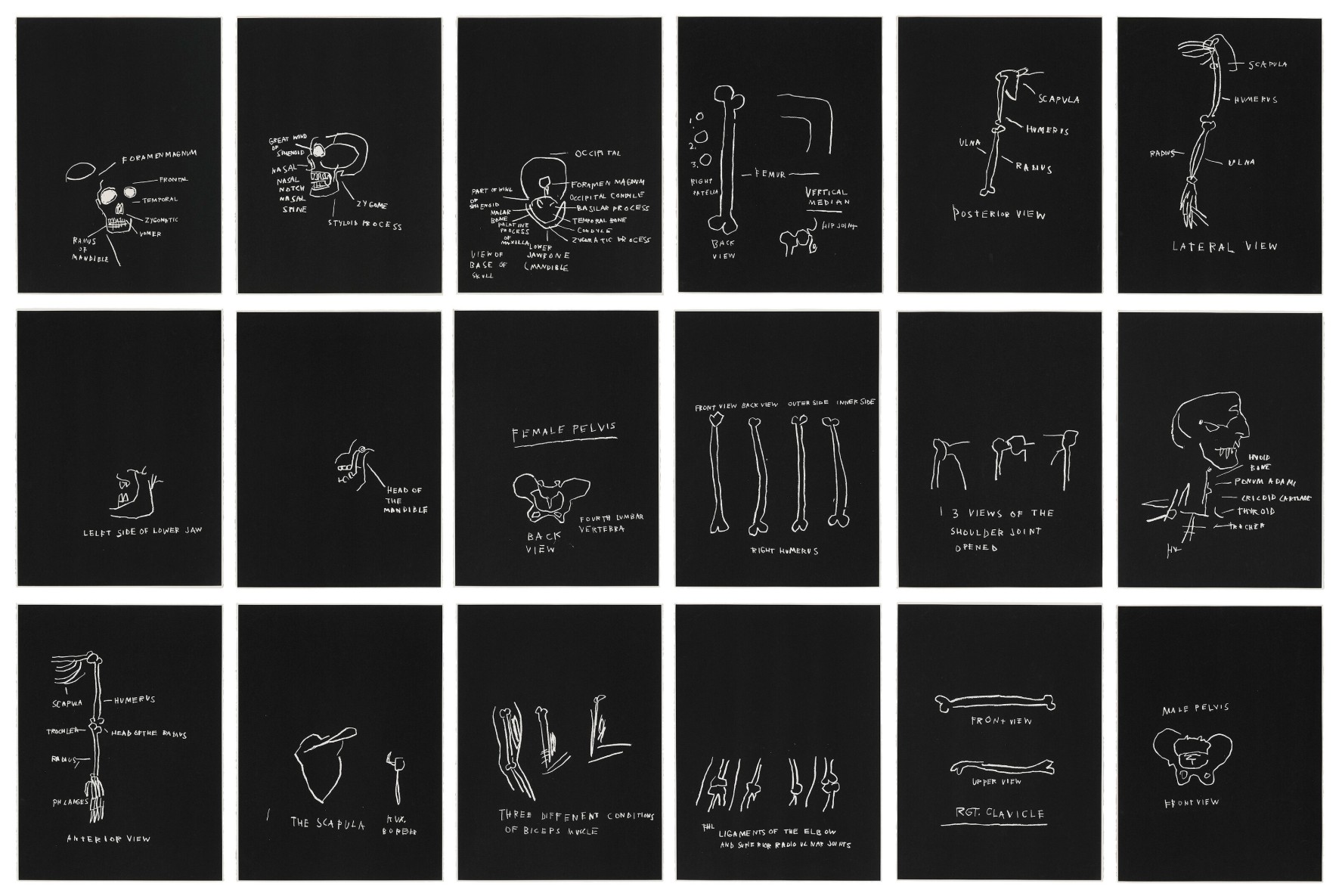
JEAN-MICHEL BASQUIAT (1960-1988)
Anatomy, 1982
Screenprint on Arches 88 paper in 18 parts
Each: 29-3/4 x 22 inches (74.4 x 55.9 cm)
Signed ‘Jean-Michel Basquiat’ (lower right of each sheet)
Numbered respectively ‘AP IV/ [1-18]’ (on the reverse of each sheet)
This work is the fourth artist’s proof from an edition of 18 plus seven artist’s proofs
Museum Security (Broadway Meltdown), 1983
Museum Security (Broadway Meltdown), 1983
Property from a Distinguished Collection
Sotheby’s New-York: 14 May 2026
Estimate upon Request
USD 52,717,500
Jean-Michel Basquiat | Museum Security (Broadway Meltdown) | The Now
REPEAT SALE
Christie’s London: 12 February 2013
Estimated: GBP 7,000,000 – 9,000,000
GBP 9,337,250 / USD 14,509,650
Jean-Michel Basquiat (1960-1988) (christies.com)
JEAN-MICHEL BASQUIAT (1960 – 1988)
Museum Security (Broadway Meltdown), 1983
Acrylic, oilstick and collage on canvas
84×84 inches (213.4 x 213.4 cm)
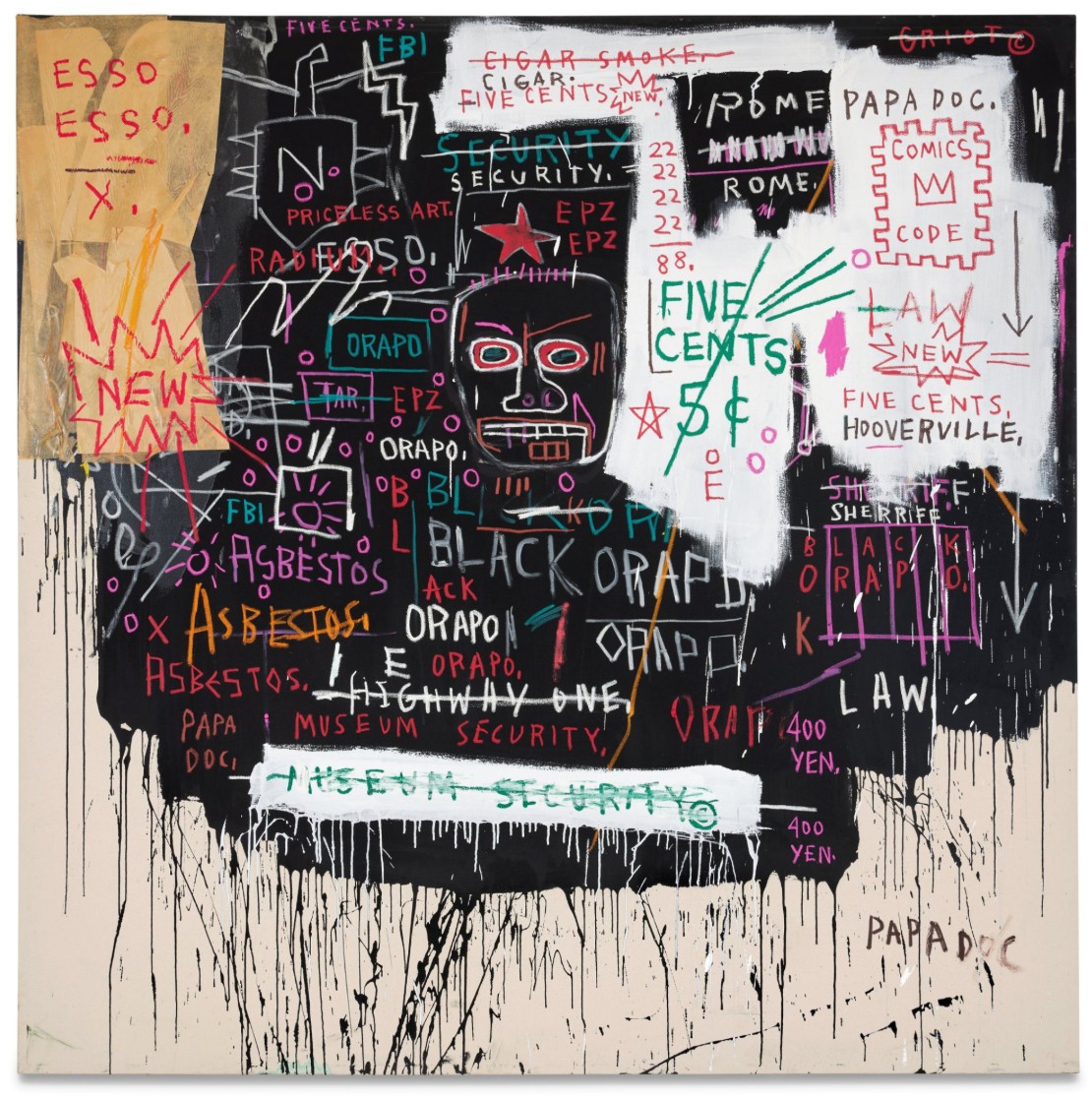
Few masterworks so powerfully capture the extraordinary iconographical infrastructure that anchored the themes, concerns and personal history of Jean-Michel Basquiat’s oeuvre as Museum Security (Broadway Meltdown). The work unfolds as an incendiary index of the irrepressible young mind who painted it: here, success and exploitation, fame and abjection, value and merit, race, class, and colonialism collide in a gestural maelstrom, materializing through the staggeringly lucid vernacular for which Basquiat is best known.
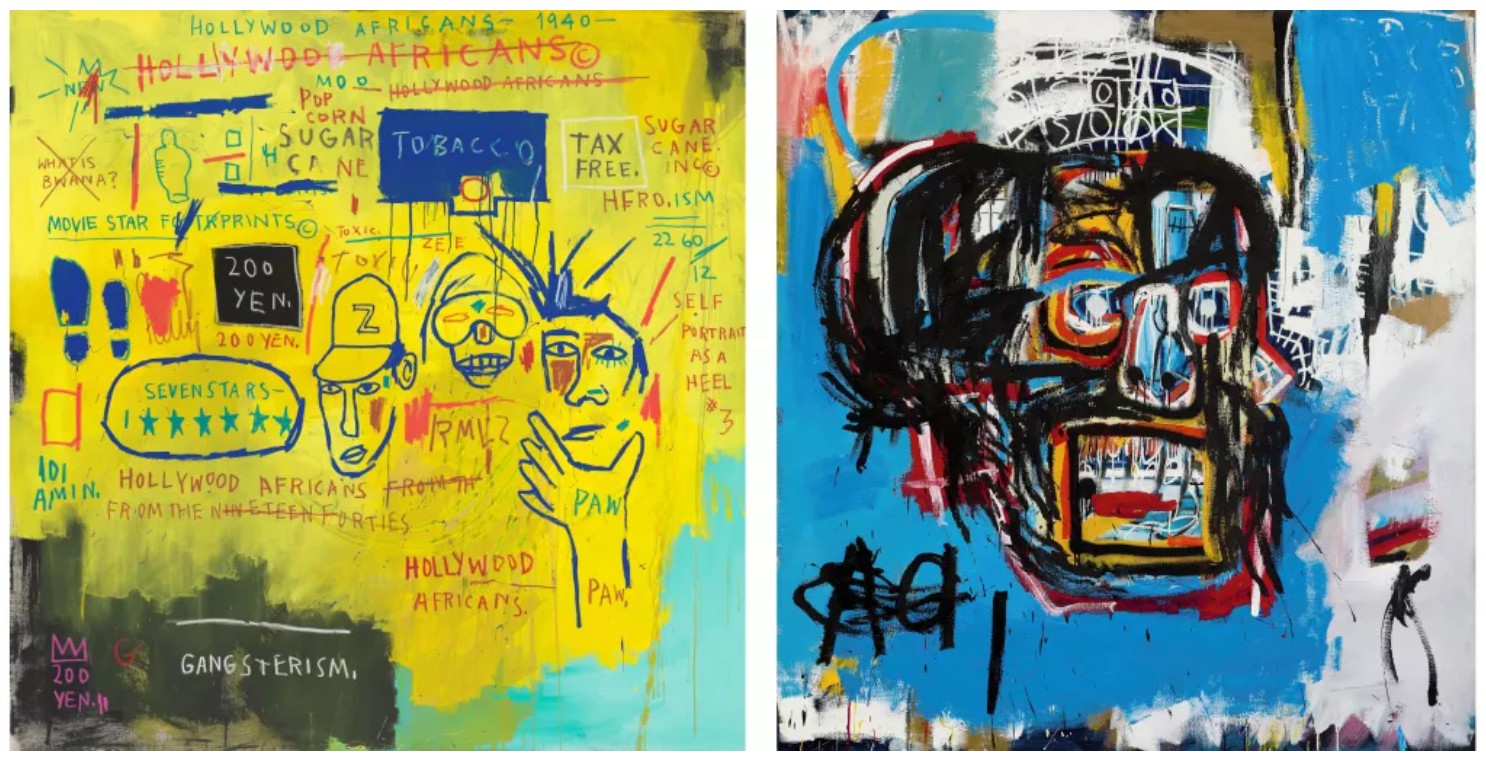
Left: Jean-Michel Basquiat, Hollywood Africans, 1983. Whitney Museum of American Art, New York. Image © Whitney Museum of American Art / Licensed by Scala / Art Resource, NY. Art © 2026 Estate of Jean-Michel Basquiat. Licensed by Artestar, New York. Right: Jean-Michel Basquiat, Untitled, 1982. Private Collection. Sold at Sotheby’s New York in May 2017 for $110.5 million. Art © 2026 Estate of Jean-Michel Basquiat. Licensed by Artestar, New York
Closely related to his triumphant Hollywood Africans, also executed in 1983 and now in the collection of the Whitney Museum of American Art, New York, Museum Security (Broadway Meltdown) ranks among the most significant works ever created by the artist.
Museum Security (Broadway Meltdown) made its debut at the artist’s historic solo exhibition at Larry Gagosian Gallery, Los Angeles in 1983, one in a suite of 12 monumental canvases all created that year. One of the most complex in this seminal group, the work has since graced some of the most distinguished institutions and famous exhibitions around the world, from the seminal 2010-11 retrospective at the Fondation Beyeler in Riehen and Musée d’Art Moderne de Paris, a five year long-term loan to the Fondation Beyeler from 2014-18, an exhibition at the Salon d’Honneur in Basel, the monumental survey exhibition at the Fondation Louis Vuitton in Paris in 2019, the Basquiat presentation at the Brant Foundation, New York in 2019, the acclaimed Jean-Michel Basquiat: Made on Market Street show at Gagosian Los Angeles in 2024, to the recent exhibition at the Zaha Hadid-designed Dongdaemun Design Plaza Museum in Seoul in 2025-26, where this work was reproduced on the front cover of the exhibition catalogue.
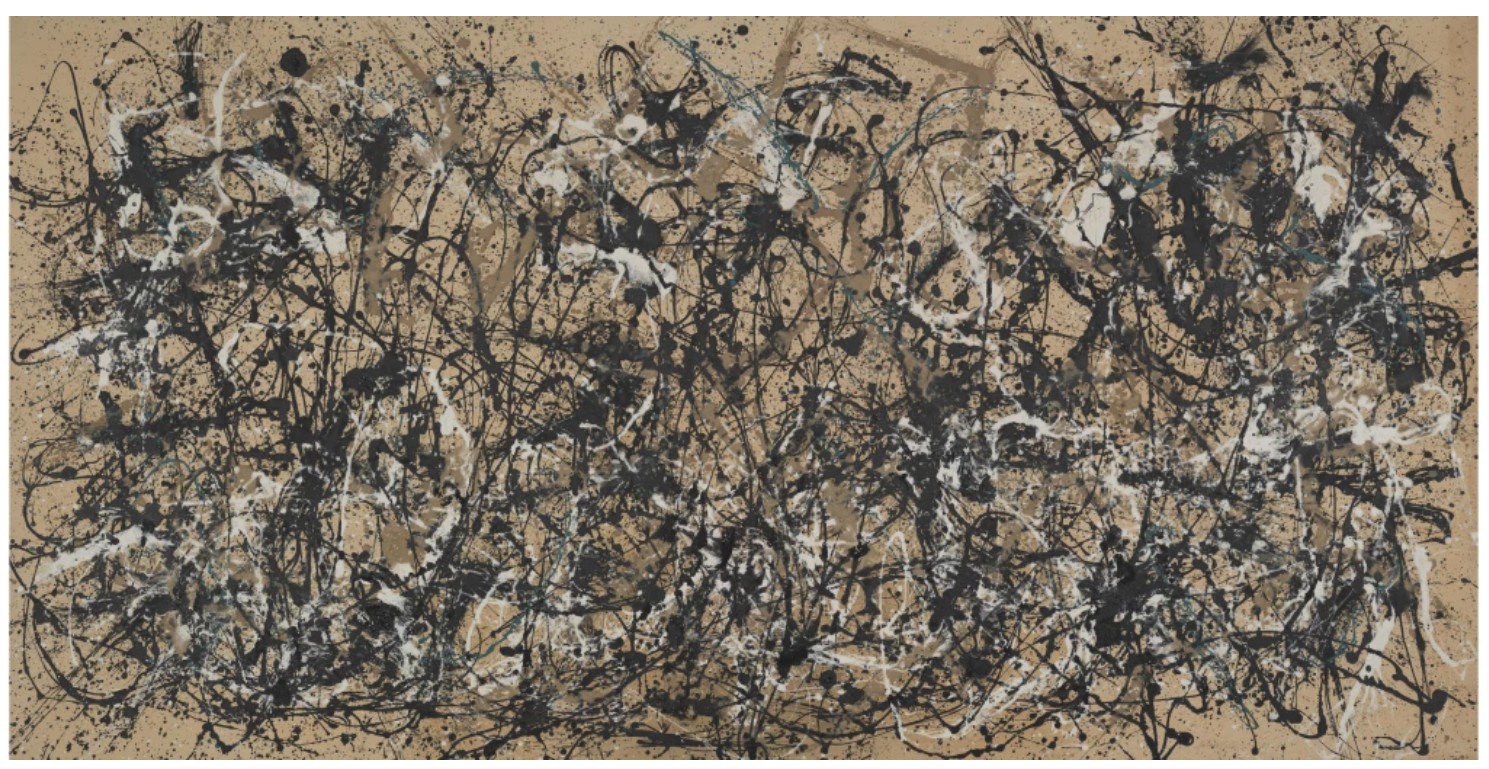
Jackson Pollock, Autumn Rhythm (Number 30), 1950. The Metropolitan Museum of Art, New York. Image © The Metropolitan Museum of Art. Image source: Art Resource, NY. Art © 2026 Pollock-Krasner Foundation / Artists Rights Society (ARS), New York
To only further testify to its institutional caliber, the present work was previously owned by architect Kamran Diba, who designed the Tehran Museum of Contemporary Art in Iran, as well as Lord Edward Spencer-Churchill, and was almost acquired three decades ago by The Museum of Modern Art in New York at the encouragement of legendary curator Kynaston McShine. In addition to Museum Security (Broadway Meltdown)’s decorated exhibition history and illustrious provenance, the present work has been requested for inclusion in the forthcoming exhibition Jean-Michel Basquiat: An Italian Renaissance at the Palazzo Strossi in Milan, to be curated by Dieter Buchhart and Anna Karina Hofbauer and opening in January 2027. Rattling with the graphic power of Basquiat’s legendary dictionary of deeply personal and historically resonant symbols and syntax, the present work unites the imagery that defined not only an artist but an era. The eponymous tagline “Museum Security” thunders across the composition.
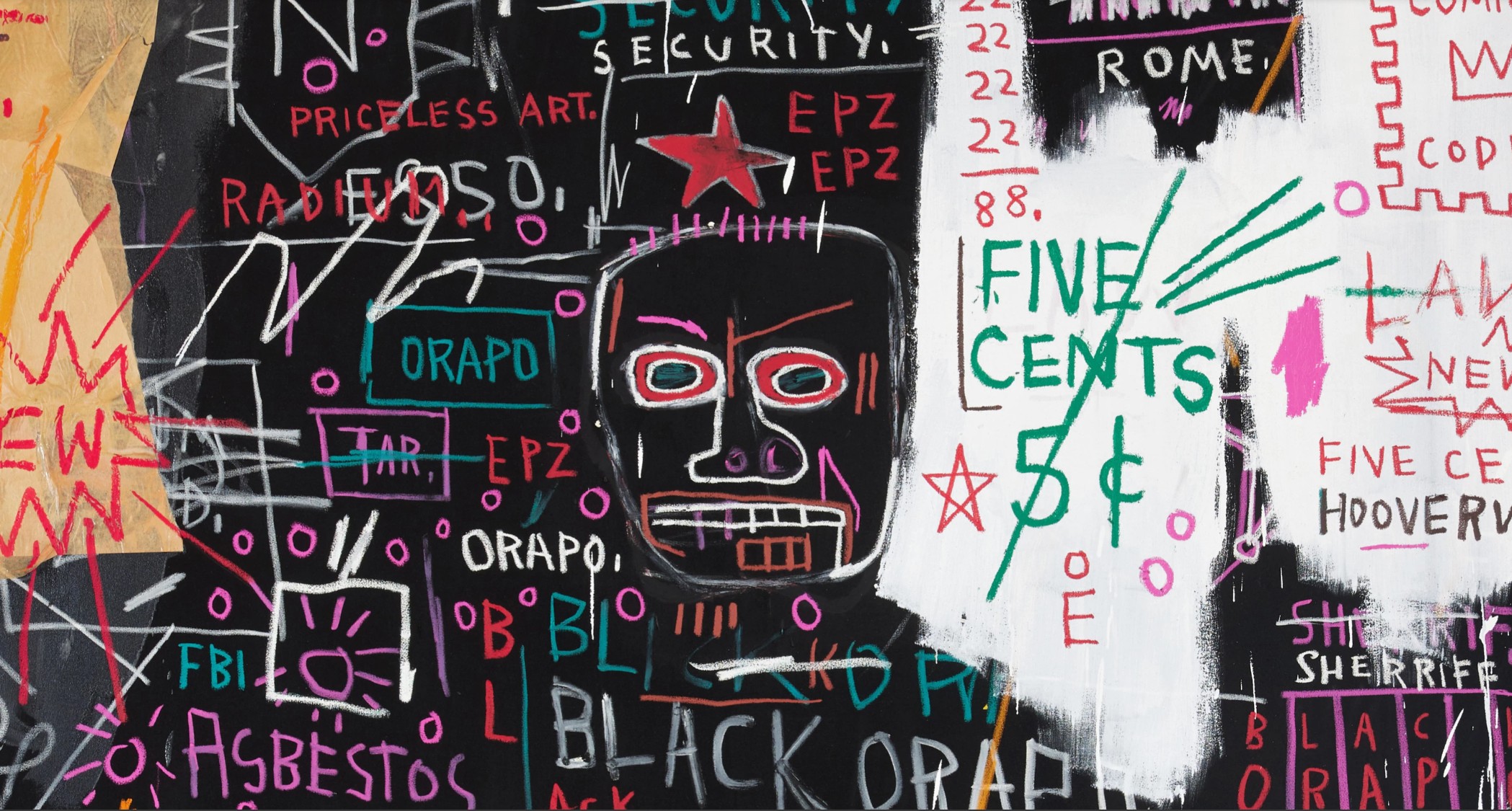
At center reigns an imposing, piercing skull-like head; surrounding it are the three-point crown—a pictograph coined during the earliest stages of Basquiat’s career working behind the pseudonym SAMO ©—and language which confronts notions of commerce, value, and trade such as “Priceless Art,” “New,” “Yen,” and “Five Cents.” Phrases which connote a highly attuned sensitivity to power, law, sovereignty, and governance, among them “FBI” and “Sherriff,” collide with the twice-inscribed “Rome,” the capital of classical antiquity and the veritable birthplace of the Western art historical canon. Looming large in the upper right of the present work is the Comics Code Authority postage stamp, the seal of self-regulation found on comic books, as well as a prominent “5 ¢” inscription that may refer to the United States nickel, which features President Thomas Jefferson and his Virginia plantation, Monticello. “Hooverville” calls out the makeshift homeless settlements built during the Great Depression, juxtaposed against “Papa Doc,” the moniker for Haitian dictator François Duvalier.
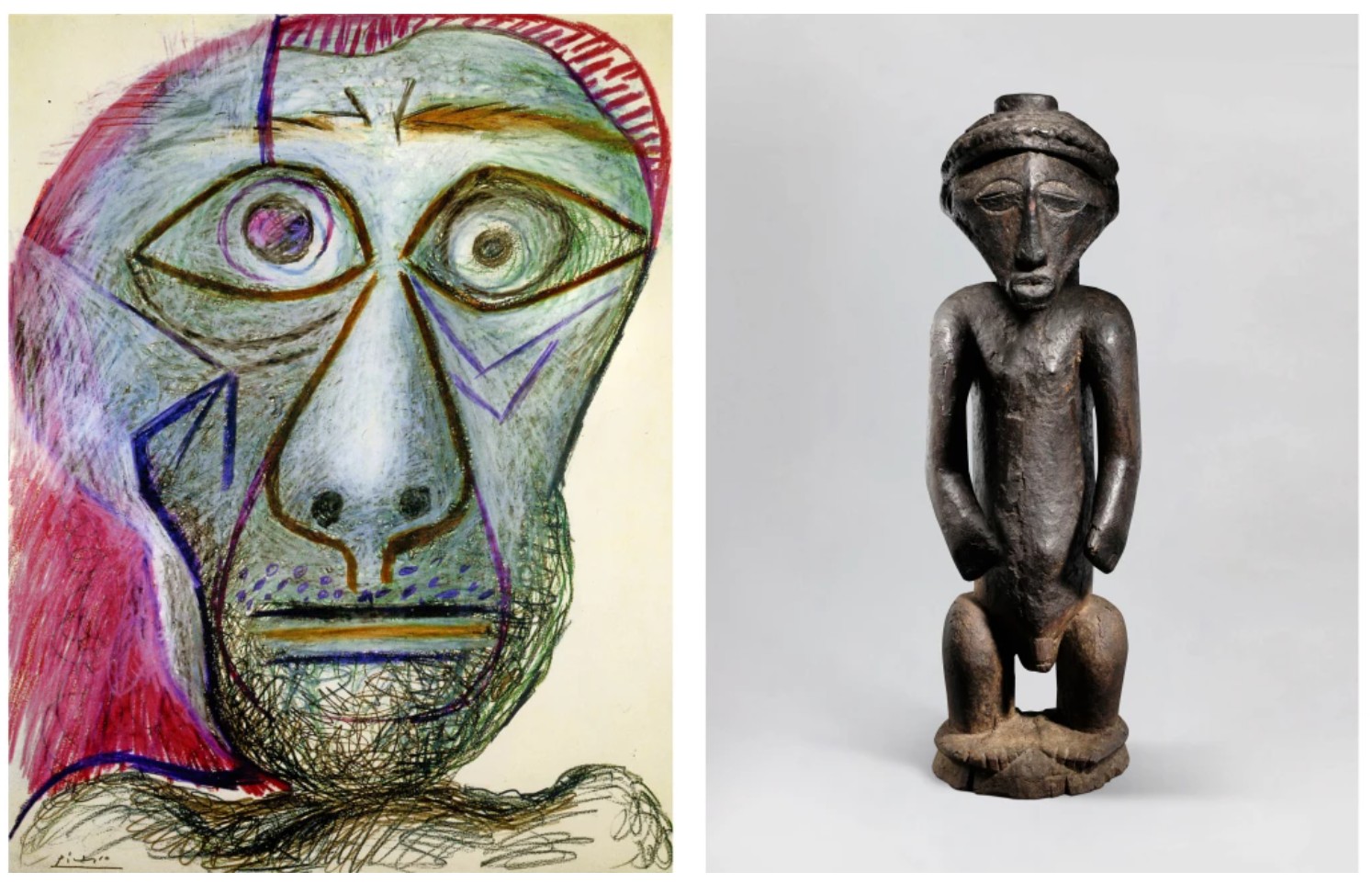
Left: Pablo Picasso, Self Portrait Facing Death, 1972. Fuji Television Gallery, Tokyo. Image © Fine Art Images / Bridgeman Images. Art © 2026 Estate of Pablo Picasso / Artists Rights Society (ARS), New York. Right: Pre-Bembe or Buyu Artist, Figure of an Ancestor. Private Collection
In this cyclone of text, image, and exuberant abstract gesture, Museum Security (Broadway Meltdown) presents the artist’s oblique yet charged indictment of his place in the art world and the broader, far deeper role that history and social politics have imposed. At the very core of Basquiat’s electric yet calamitously brief career was a spectacularly individuated lexicon, one anchored by the visuals and verbiage through which Basquiat communicated his worldview. In this way, Museum Security (Broadway Meltdown) suggests the artist himself suspended in a cacophony of conflicting interests: the disjunction between fame, iconization, celebrity, and wealth, and the limited and unsettlingly surveilled access of Black art, artists, and culture in the very commercial and institutional spaces into which Basquiat was suddenly thrust. Layer upon frenzied layer of emerald, vermilion, fuchsia, and orange oilstick expose where cultural authority abrades personal and political autonomy, uniquely proffering Basquiat’s tormented evaluation of his imposed status as the meteoric darling of an overwhelmingly white, commercially-driven art world.
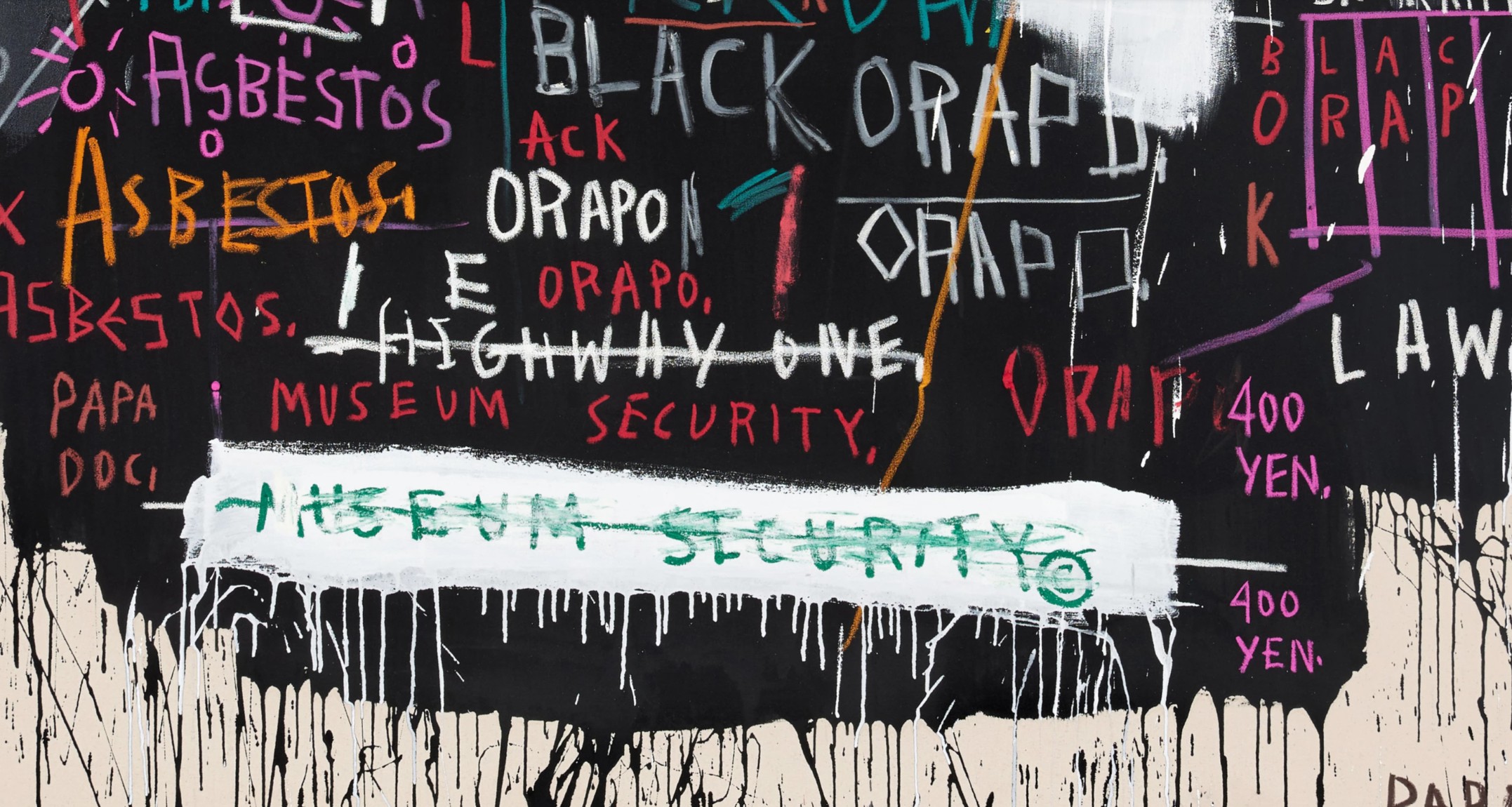
Here, the surface stamped with words challenging the correlation between price and value, art becomes product, painting becomes commerce. Now in the throes of stardom, Basquiat, for whom creativity activity began not as career nor commodity but rather an inquietable, unstoppable instinct, his self-expression had become an asset, one bound by the mechanisms of the market and subject to the opinions of its stakeholders. (Andrea Frohne, “Representing Jean-Michel Basquiat,” in: Isidore Okpewho, Carole Boyce Davies, and Ali A. Mazrui, eds., The African Diaspora: African Origins and New World Identities, 1999, p. 442) In Museum Security (Broadway Meltdown) Basquiat reflects on himself not merely as a rising star, but as a martyr of modernity and the polemics that plague it, from race and class, equity and exploitation, to access and acceptance.
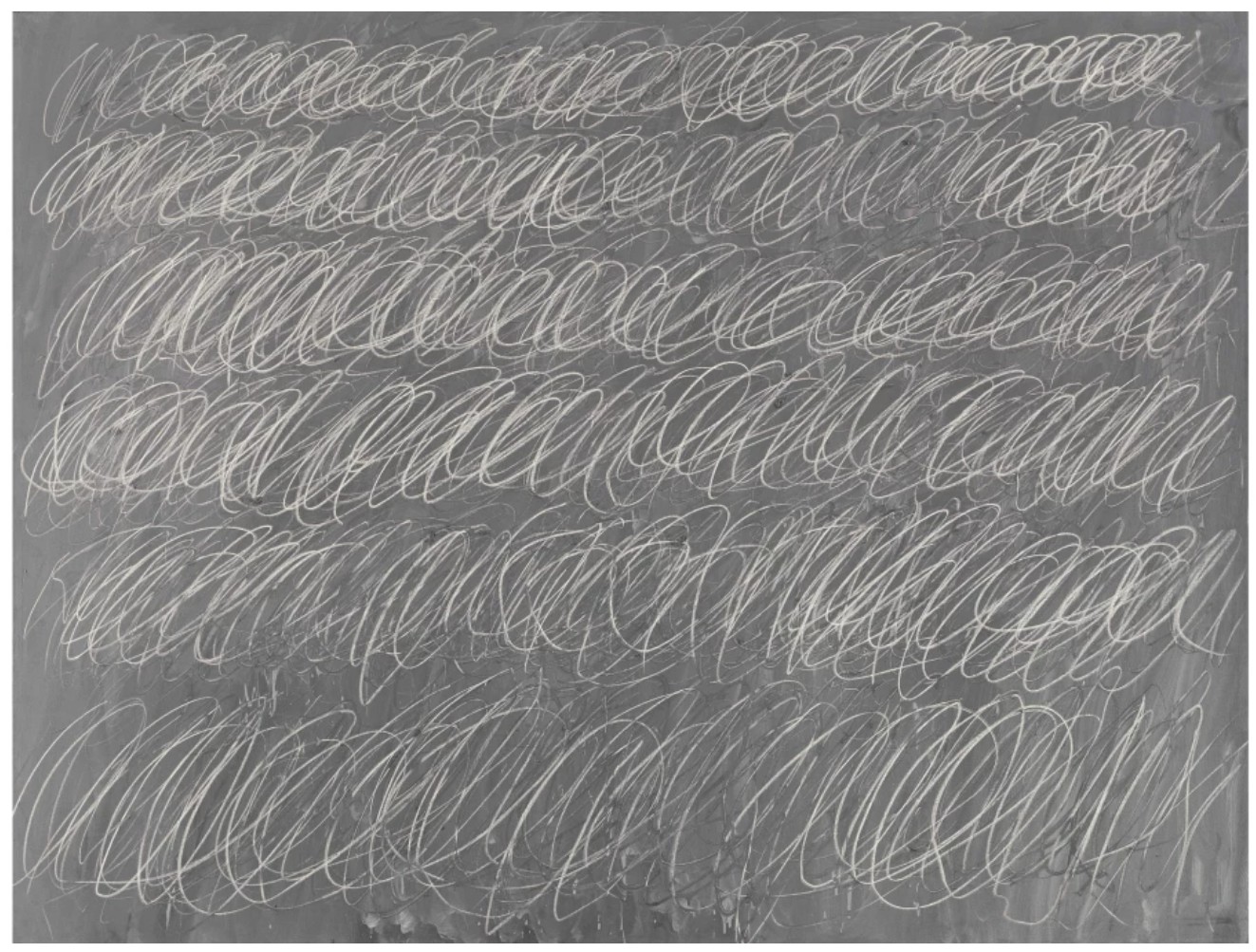
Cy Twombly, Untitled (New York City), 1968. Private Collection. Sold at Sotheby’s New York in November 2015 for $70.5 million. Art © 2026 Cy Twombly Foundation
Palimpsests of comparable art historical masterworks emerge in the present work, from the symbology that aligns it to humanity’s earliest creative expressions—the cave drawings at Lascaux—the skeletal, self-conscious treatment of the head seen in Picasso’s haunting final self-portraits, and, perhaps most prominently, the outcry of immediate gesture in Basquiat’s application of pure black pigment. The sheer activity aligns it with the frenetic, ferocious all-over Drip paintings by Jackson Pollock and the explosive ciphers of Cy Twombly’s masterwork Leda and the Swan, which similarly engages with Italian mythology. The weight of art history evinces itself, too, beyond the formal qualities of Museum Security (Broadway Meltdown)—the canvas itself bears sheets of collaged paper that harkens back to Basquiat’s origins as a graffiti artist, transforming it into a palimpsest of the New York street. (Eric Fretz, Jean-Michel Basquiat: A Biography, Greenwood, 2010, p. 89)
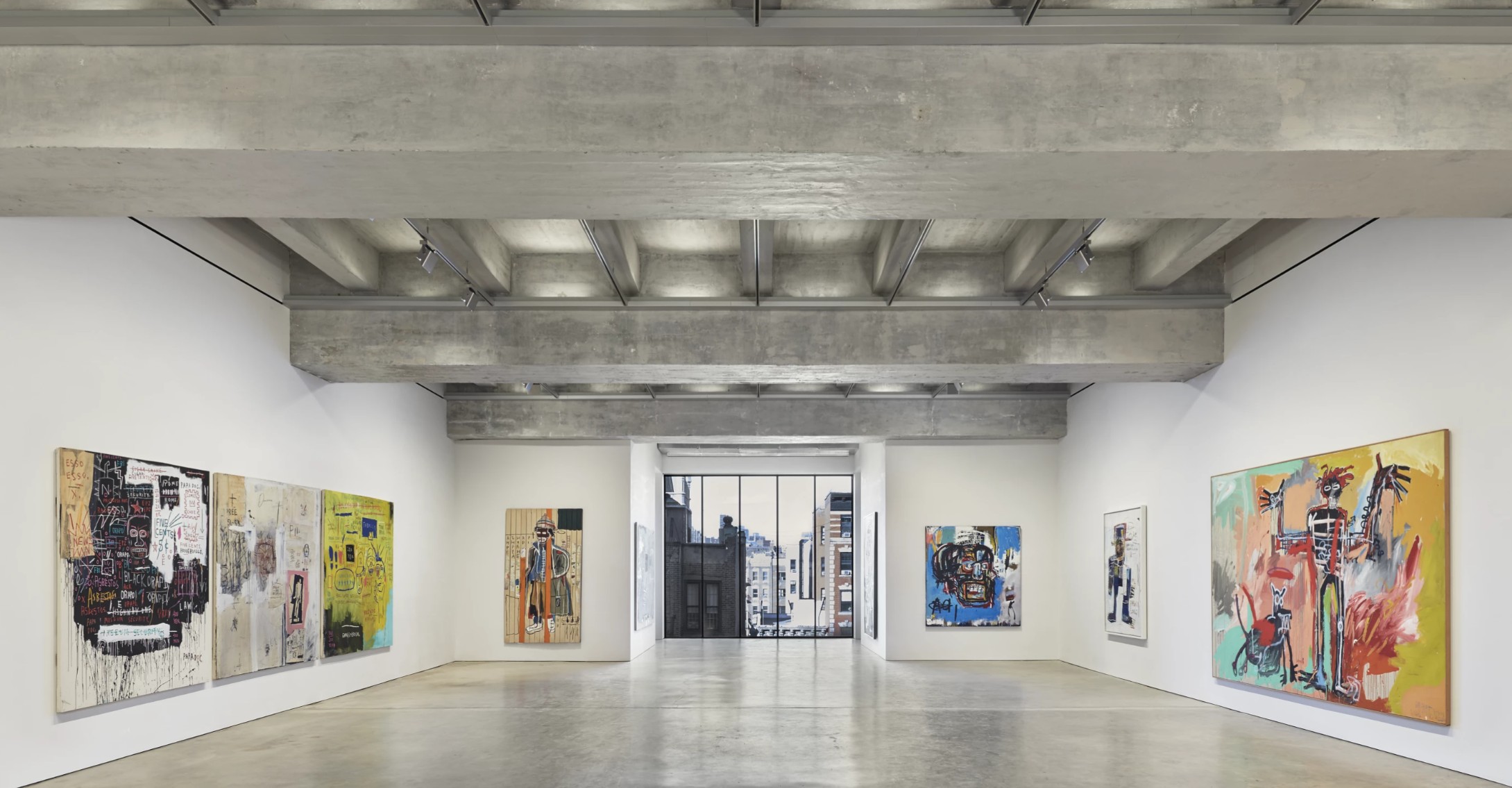
The present work installed in Jean-Michel Basquiat at The Brant Foundation Art Study Center, New York, March 2019 – May 2019. Photo © Tom Powel Imaging. Art © 2026 Estate of Jean-Michel Basquiat. Licensed by Artestar, New York
Indeed, so critical was the present work in crystallizing Basquiat’s most important themes that it graced the Fondation Beyeler in Riehen for half a decade on long-term loan. The Director of the Foundation, Sam Keller, describes the present work:“The Fondation Beyeler had the honour of holding the first major retrospective in Europe of Jean-Michel Basquiat’s work on the anniversary of his 50th birthday in 2010. The exhibition traced the development of this extraordinary, ground-breaking artist in over 150 paintings, drawings and objets d’art. One of the most important paintings was Museum Security (Broadway Meltdown) (1983), which took a prominent place in the comprehensive retrospective. I was able to study the painting on an almost daily basis for the three-month duration of the exhibition and it came to be one of my personal favourites. It is a key work in Jean-Michel Basquiat’s oeuvre, a modern-day ‘writing on the wall’ in the metaphorical and literal sense, and one of the great masterpieces of contemporary art.” (Sam Keller, Director of Fondation Beyeler quoted in: Dieter Buchhart and Anna Karina Hofbauer, eds., Jean-Michel Basquiat, ‘Museum Security – Broadway Meltdown’ 1983 monograph, Munich 2015, p. 10)
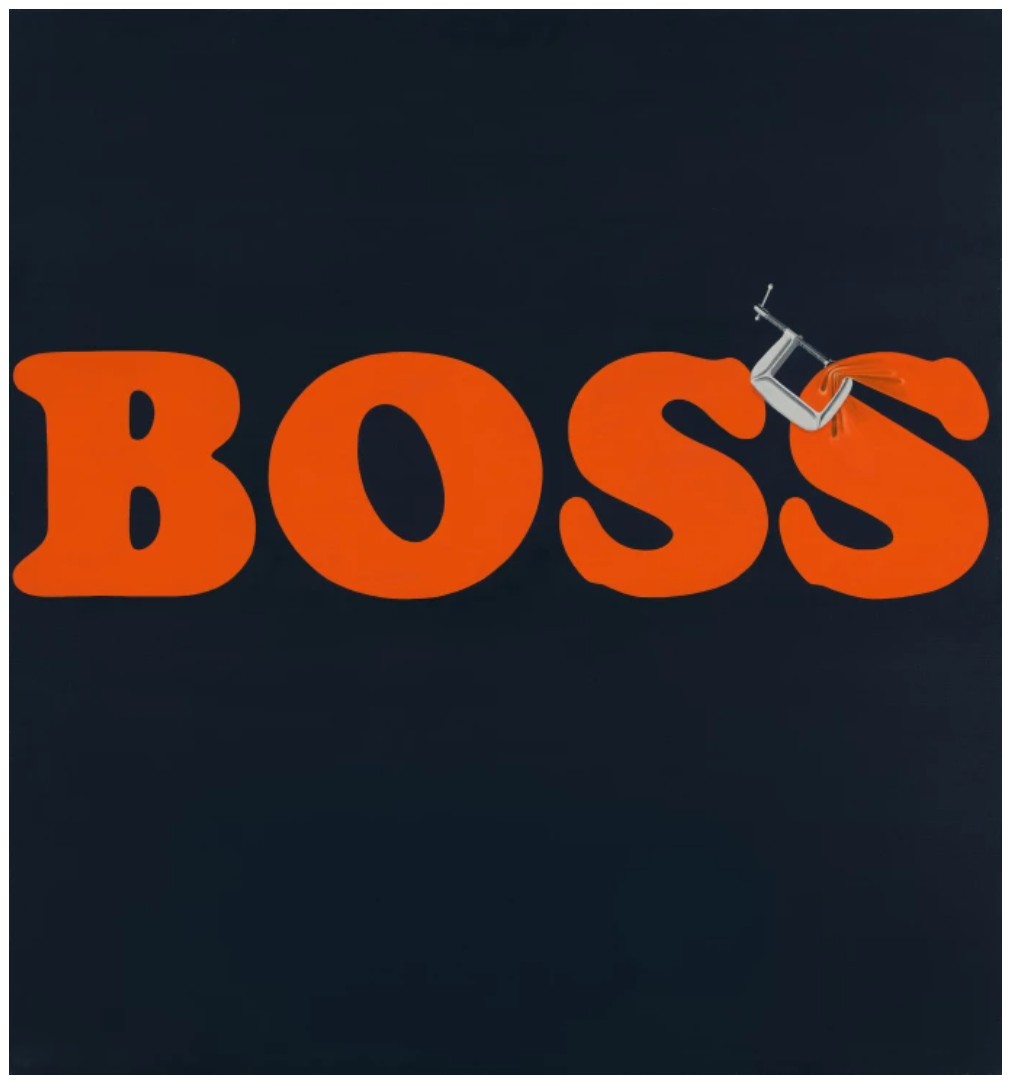
Ed Ruscha, Securing the Last Letter (Boss), 1964. Private Collection. Art © 2026 Ed Ruscha
In Museum Security (Broadway Meltdown), ego, id, and superego subsequently collapse into a raw painterly manifesto of the self and state of the art world, testifying to the transcendental breakthrough that constitutes the artist’s indelible legacy. “I knew he was great—he was electric,” recalls Glenn O’Brienn about the late artist. “A tesla coil with dreadlocks—cool fire emanating wherever he went. Magic.” (Glenn O’Brien, “Basquiat: The Show Must Go On,” 17 September 2013 (online)) Nowhere is this visceral sense of magic best exerted than in Museum Security (Broadway Meltdown), whose seismic interrogation of the Western artistic continuum lays bear the socio-political dynamics of its present moment. In this painterly battleground, Basquiat poignantly reflects upon the precarity of own success, identity, past, and future, thus reifying and manifesting his triumphal self-assessment: “I’m not a real person. I’m a legend” (the artist quoted in Anthony Haden-Guest, “Burning Out”, Vanity Fair, November 1988, p. 197 (online)).
Asbestos, 1982
Asbestos, 1982
Christie’s New-York: 20 May 2026
Estimated: USD 3,000,000 – 5,000,000
USD 6,541,000
WORK ON PAPER
JEAN-MICHEL BASQUIAT (1960-1988), Asbestos | Christie’s
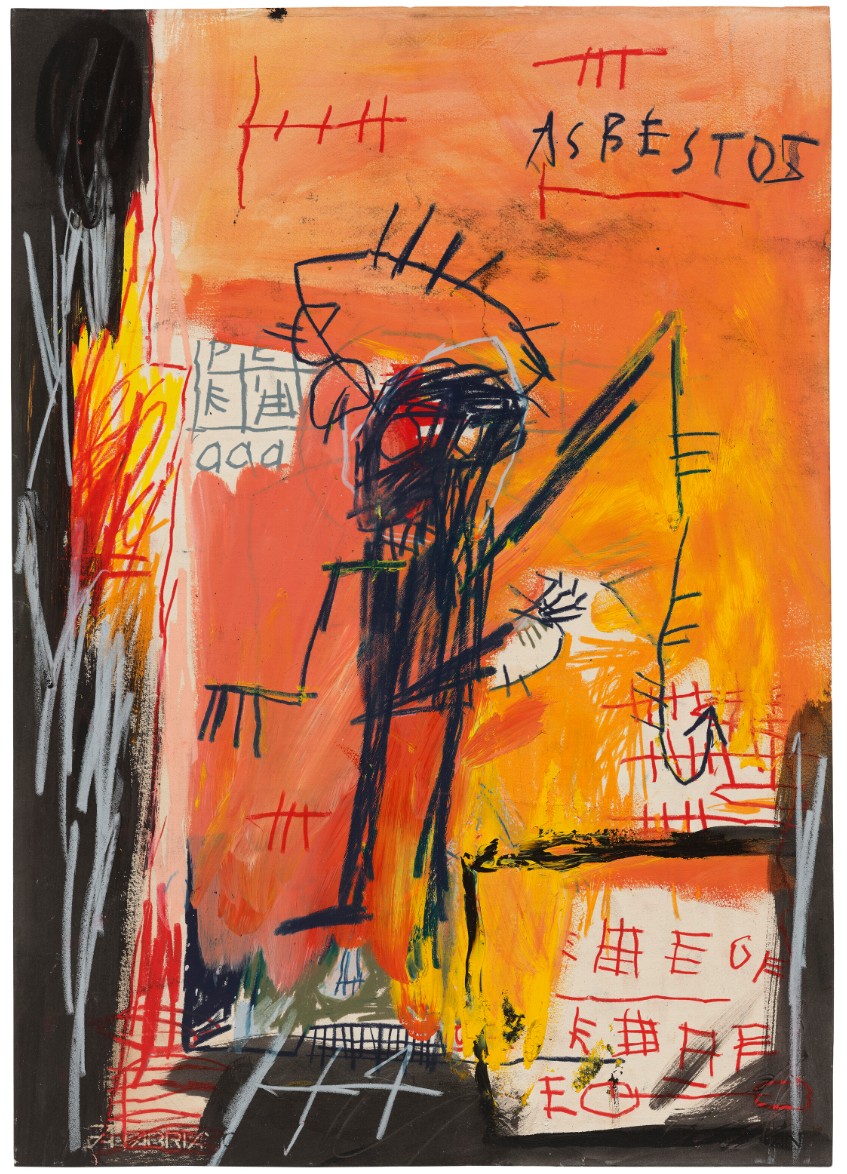
JEAN-MICHEL BASQUIAT (1960-1988)
Asbestos, 1982
Oil and oilstick on paper
27-5/8 x 19-3/8 inches (70.2 x 49.2 cm)
Signed and dated ‘BASQUIAT 1982’ (on the reverse)
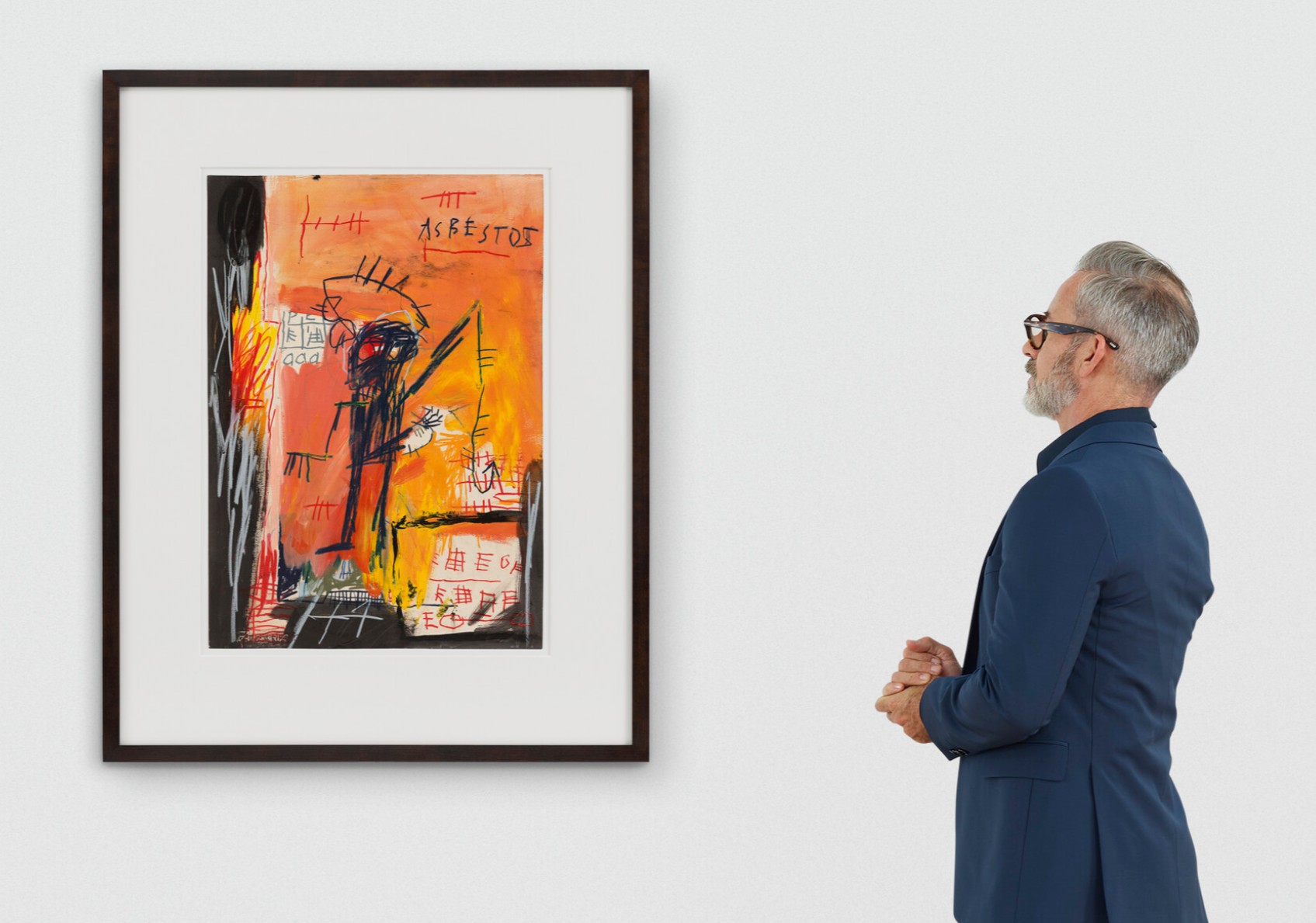
Asbestos is one of Basquiat’s most charged and encompassing explorations of his identity. The fisherman is a figure he returned to throughout his career as both personal totem and autobiographical metaphor: the mediator between worlds, the one who crosses water, and, by implication, the painter himself. Set against a ground of scorched orange and yellow that seems almost to combust, this work carries the full weight of an Atlantic inheritance Basquiat assembled from Brooklyn, Haiti, Puerto Rico and West Africa.
“I’ve never been to Africa. I’m an artist who has been influenced by his New York environment. But I have cultural memory. I don’t need to look for it; it exists. It’s over there, in Africa.”
The painting’s ground is its first argument. Orange and yellow surge across the surface with the intensity of fire or late sun on open water, the warmth so total it reads almost as heat rather than color. Against this Basquiat set a standing figure in dark navy and black, drawn with the kind of compressed line that is somehow both urgent and precise: a torso, limbs, a head marked by a red form at the center that burns like an ember. The figure holds his fishing rod, and its feet are marked with tally lines that appear elsewhere in the composition, scratched in red in the upper corners like notation or count. To the left, a deep black border cuts the composition like a shoreline. Scattered throughout are Basquiat’s characteristic marks and glyphs, grid-like boxes filled with symbols, arrows and repeated strokes, a white rectangle near the lower right that accumulates signs as though it were a ledger. The word “ASBESTOS” is written across the upper right in dark oilstick, frank and declarative. The surface is layered, worked over, revised, alive.
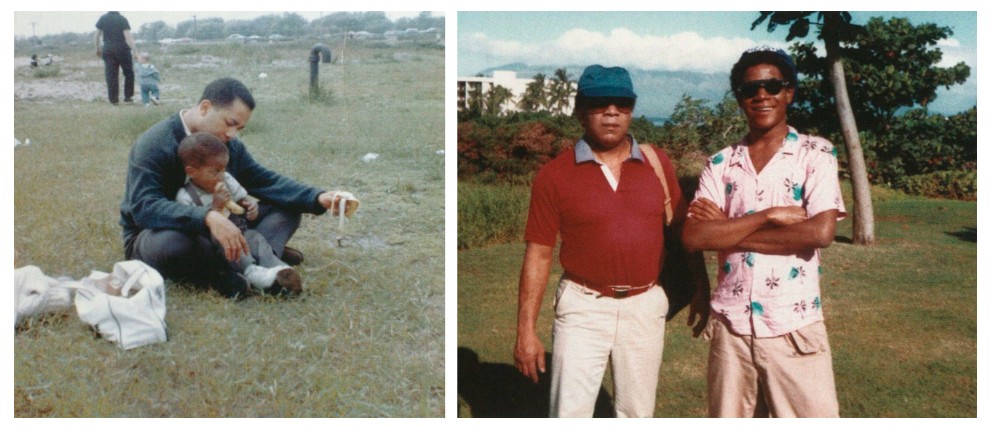
Left: Gerard Basquiat with Jean-Michel at the beach, Jacob Riis Park, Queens, circa 1963. Photographer unknown.
Right: Gerard and Jean-Michel in Hana, Maui, Hawaii, 1984. Photographer unknown.
The fisherman is an established presence in Basquiat’s iconography. To understand why, one must follow his ancestry. He grew up in Brooklyn within reach of the Atlantic. His father was Haitian, his mother Puerto Rican. His racial heritage bore the trace of the Middle Passage and, before that, the West African coastline from which it originated. Across each of these worlds the fisherman was not a picturesque figure but a working one: economically essential, a constant of daily life. Anglers worked beneath the Brooklyn Bridge; pirogues dotted the Senegalese coast; painted canoes defined island life. The image was overdetermined before Basquiat ever put it to paper.
What accumulated on top of that material reality was spiritual weight. In Haitian Vodou theology, the sea was the threshold between the living and their ancestors, and the fisherman who moved across it daily took on a ceremonial function: the mediator between worlds, the one whose passage was itself a ritual act. As the art historian Robert Farris Thompson observed of Basquiat’s deep engagement with Atlantic spiritual traditions, his imagery drew on a reservoir of Kongo and Caribbean visual thinking in which the crossing was a site of profound metaphysical exchange (R.F. Thompson, “Royalty, Heroism, and the Streets: The Art of Jean-Michel Basquiat,” Jean-Michel Basquiat, exh. cat., Whitney Museum of American Art, New York, 1992, p. 32).
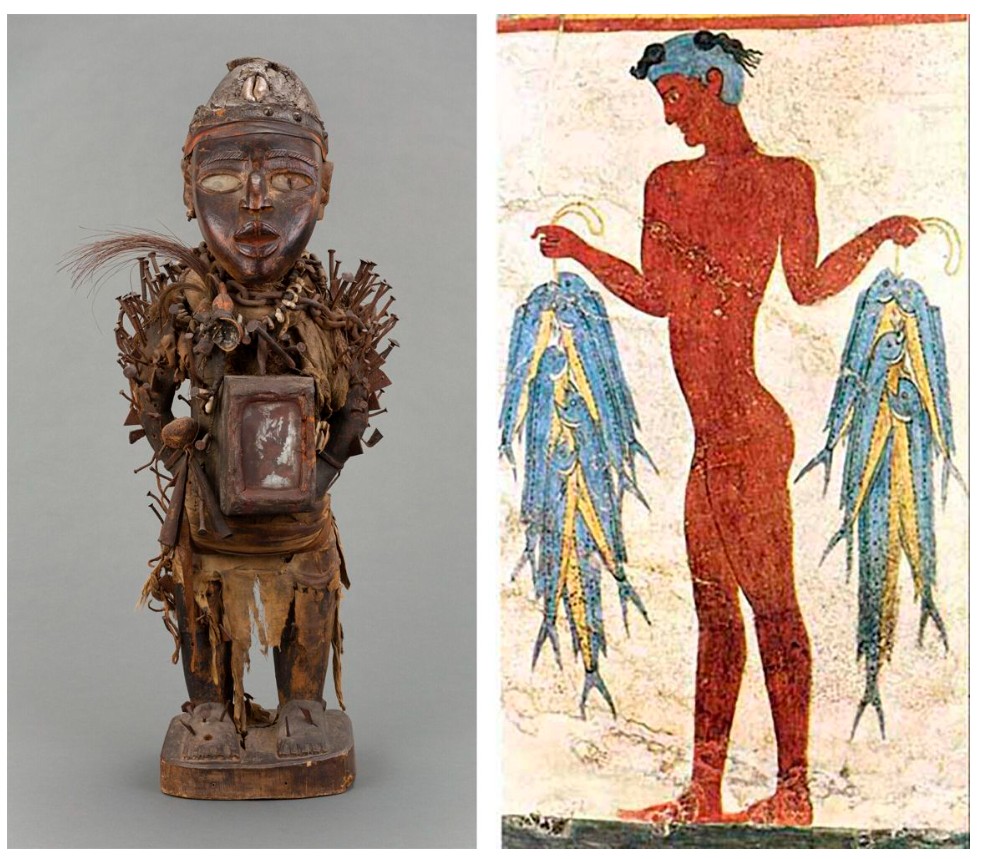
Left: Male Figure (Nkisi Nkondi), 1801-1875. Art Institute of Chicago.
Right: Fisherman Fresco from Akrotiri on the Aegean island of Thera. National Archaeological Museum, Athens.
Catholic iconography added another layer. Basquiat was raised Catholic, and in that tradition the fisherman carries a precise charge: Christ’s call to his disciples — “Come, follow me, and I will make you fishers of men” — transforms a practical occupation into a spiritual vocation, makes the casting of a net a metaphor for something far larger. For Basquiat, fluent in multiple theological registers at once, the figure absorbed all of these meanings without shedding any of them.
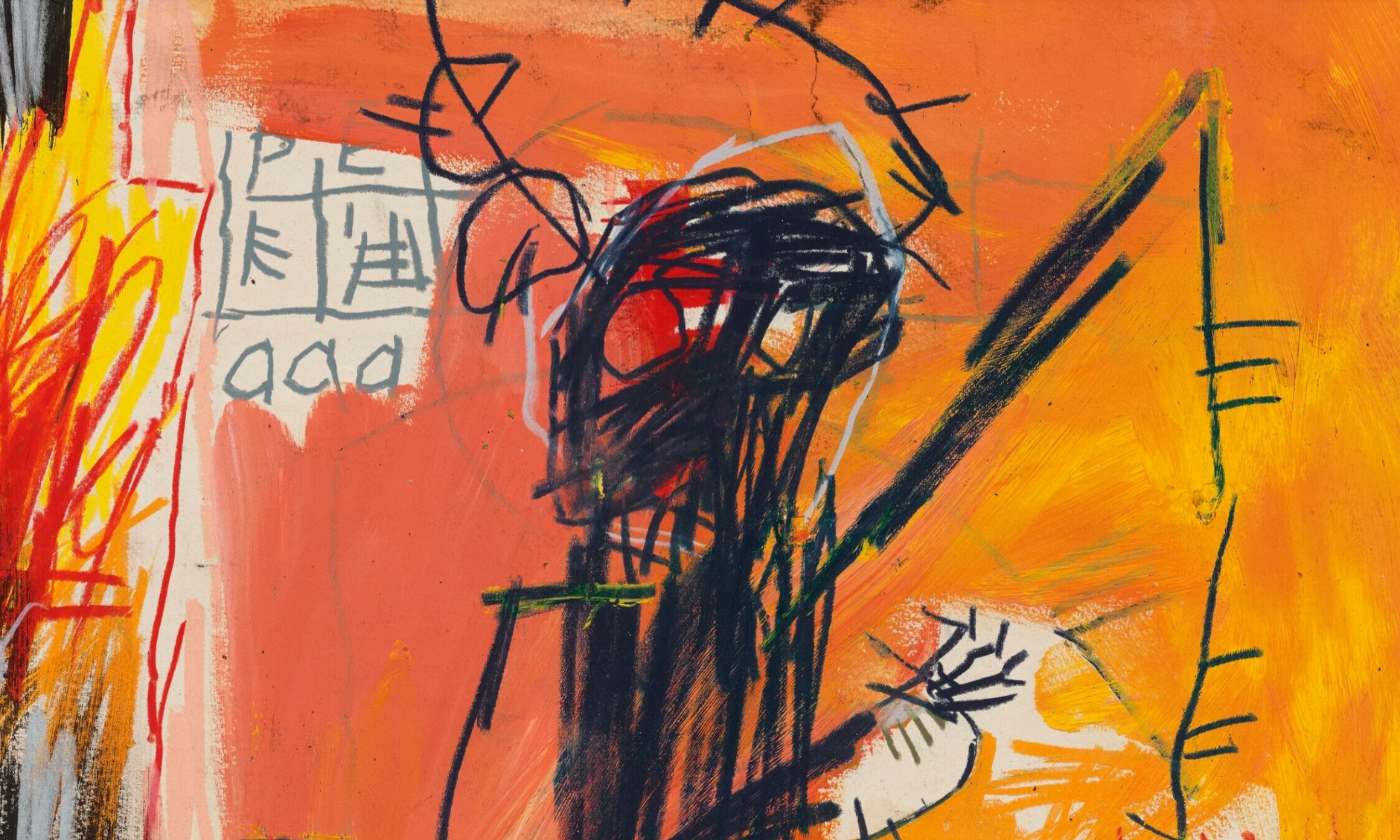
The self-portrait dimension of Asbestos follows directly. The fisherman who moves across the surface of the water, who punctures its membrane and retrieves things from beneath, is also the painter moving across the canvas. Basquiat was explicit about the relationship between his cultural inheritance and his art: “I’ve never been to Africa. I’m an artist who has been influenced by his New York environment. But I have a cultural memory. I don’t need to look for it; it exists. It’s over there, in Africa.” (J. M. Basquiat “Jean-Michel Basquiat.” Interview by Demosthenes Davvetas. New Art International, October–November 1988, p. xiii). Asbestos is the work that figure produces: an image in which the Atlantic world Basquiat carried with him is made visible, through a figure who always already belongs to all of it.
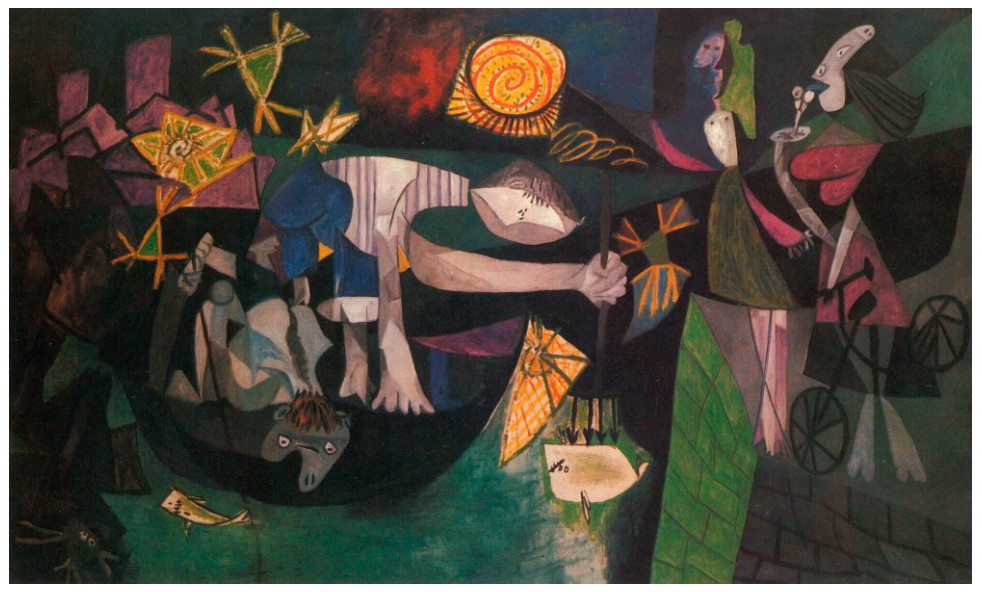
Pablo Picasso, Night Fishing at Antibes, 1939. Museum of Modern Art, New York.
© 2026 Estate of Pablo Picasso / Artists Rights Society (ARS), New York.
Jordana Moore Saggese, in her close reading of Basquiat’s iconographic systems, notes that his recurring figures operate less as representations than as “repositories of accumulated meaning,” absorbing cultural content across multiple contexts simultaneously (J.M. Saggese, Reading Basquiat: Exploring Ambivalence in American Art, Berkeley, 2014, p. 87). The tally marks in Asbestos — those insistent red counts scratched into the upper corners — push this further. They suggest enumeration, inventory, time kept or debt recorded, registers that in Basquiat’s hands carry the specific gravity of histories in which Black bodies were counted rather than named. Asbestos entered the collection of Ethel Scull, whom with her husband Robert maintained some of the sharpest collecting instincts of the Post-War period in America. The Sculls had built relationships with Rauschenberg, Warhol and Johns before those artists achieved canonical standing, and their engagement with Basquiat reflects the same quality of attention: an early, unequivocal recognition of genius. The Louisiana Museum’s current retrospective, Basquiat—Headstrong, has brought renewed critical attention to the genius of Basquiat’s draftsmanship specifically. Its focus on works on paper brilliantly making the case that Basquiat’s line: restless, economic, capable of conjuring a body or a glyph in a single stroke, was totally accomplished. The show’s success confirms what Asbestos demonstrates plainly: that the rawness of his mark-making was never naivety, but control exercised with haste but incredible depth of thought.
Untitled, 1985
Untitled, 1985
Christie’s New-York: 21 May 2026
Estimated: USD 1,000,000 – 1,500,000
USD 1,966,000
WORK ON PAPER
JEAN-MICHEL BASQUIAT (1960-1988), Untitled | Christie’s
JEAN-MICHEL BASQUIAT (1960-1988)
Untitled, 1985
Ink, acrylic, marker, colored pencil and graphite on paper
19×26 inches (48.3 x 66 cm)
Signed, inscribed, dedicated and dated ‘’85 TO MICHAEL Jean-Michel Basquiat ST BARTH’ (lower right)
Registered with the Authentication Committee for the Estate of Jean-Michel Basquiat under transaction #60035
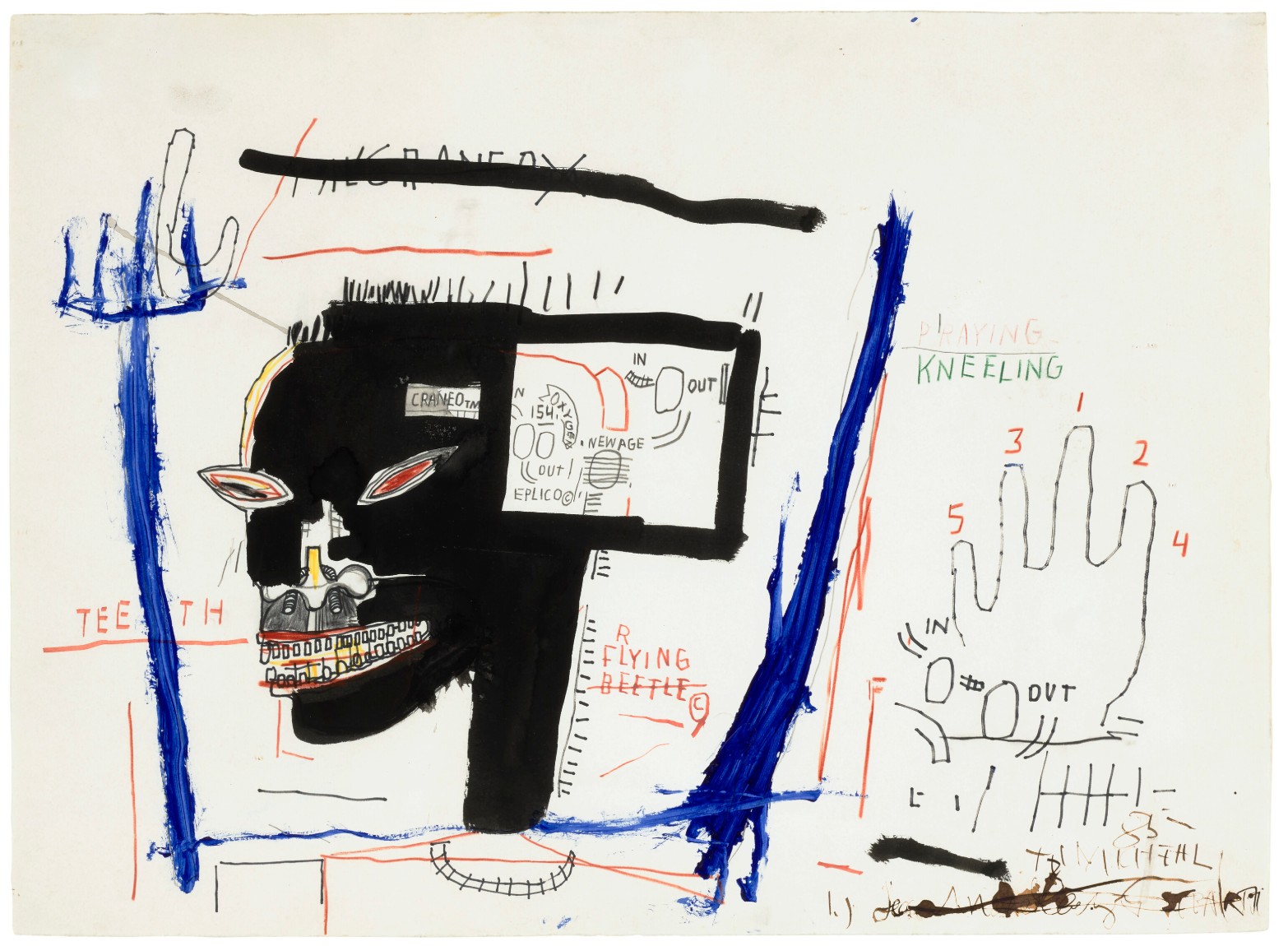
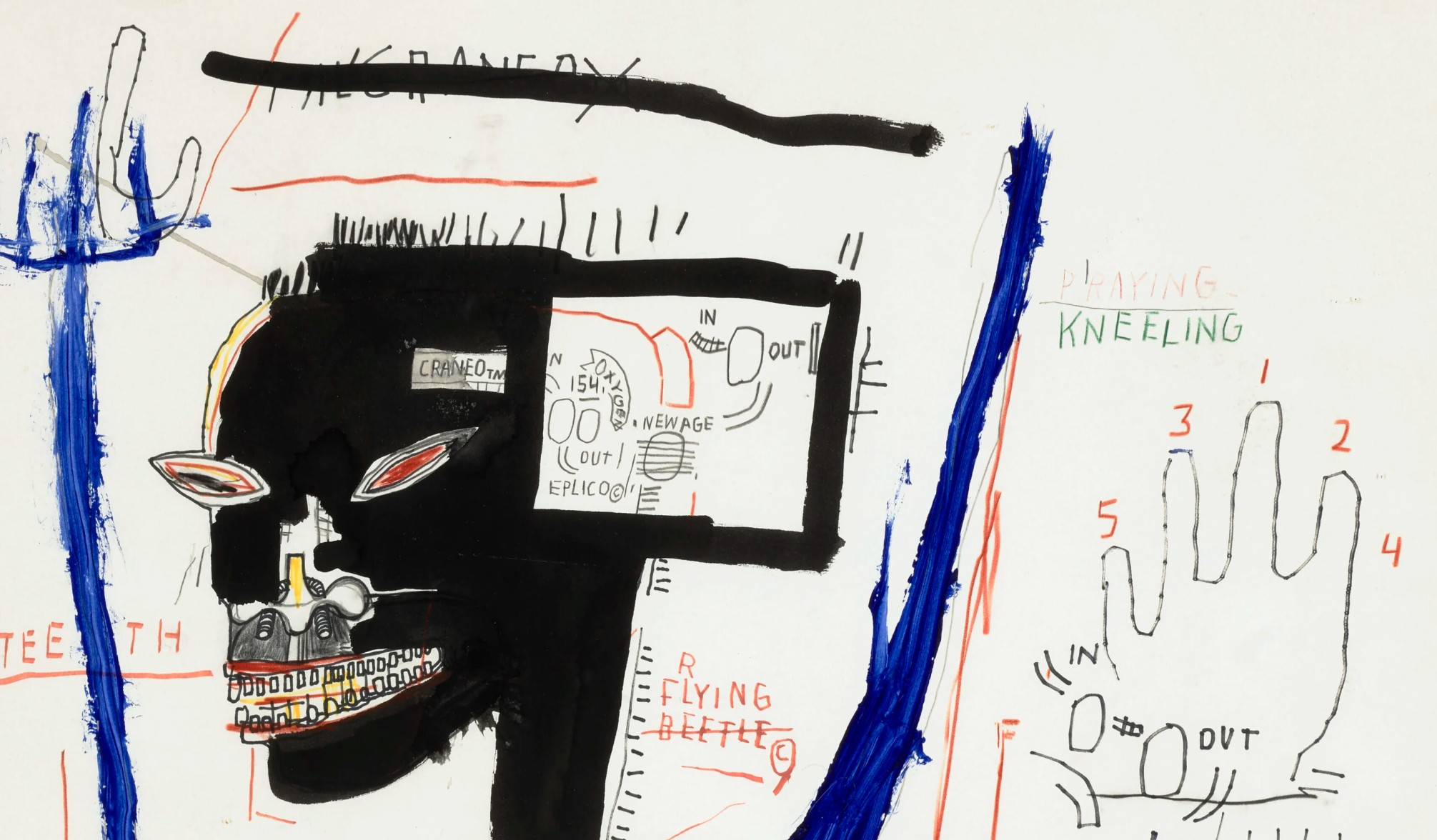
Jean-Michel Basquiat’s Untitled from 1985 is a dynamic and commanding work on paper that compounds the artist’s intellectual proclivities with his iconic gesture and famed visual language. Rendered in ink, acrylic, marker, colored pencil and graphite, the composition presents an exceptionally detailed head that oscillates between figure, diagram, and symbol. Untitled exemplifies Basquiat’s ability to collapse distinctions between anatomy, language, and identity, producing an image that feels both active and deeply coded.
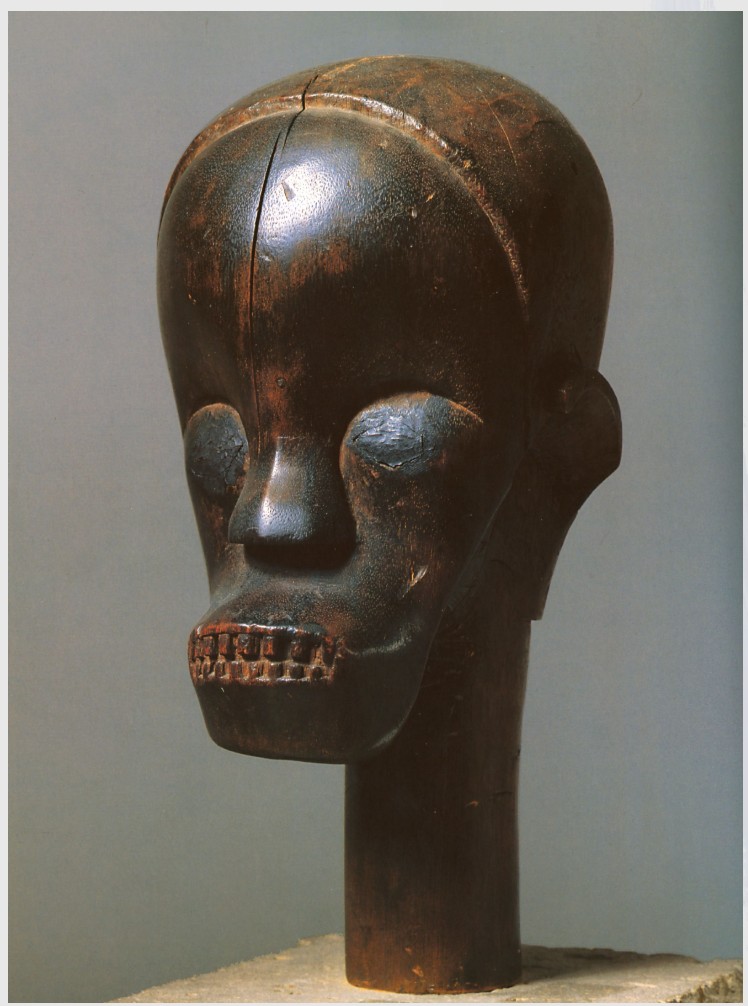
Fang Reliquary Head, Equatorial Guinea. Philadelphia Museum of Art.
Dominating the composition is a stark black head that is at once mask-like and anatomical, recalling the artist’s sustained engagement with both African sculpture and medical text books. This interest, rooted in Basquiat’s early exposure to Gray’s Anatomy, manifests here as an X-ray vision: the head is not merely depicted, but dissected. A square form cuts into the figure’s skull, offering the viewer a glimpse, perhaps, into the innerworkings of his brain, introducing vulnerability to the figure’s fierce gaze. Words such as “CRANEO” and diagrammatic notations embedded within the skull transform the figure into a site of analysis. Fully realized with impeccable detail in the present work, the subject of the human head was a recurring exploration throughout Basquiat’s life and career as an artist, “What drew Basquiat almost obsessively to the depiction of the human head”, writes Fred Hoffman, “was his fascination with the face as a passageway from exterior physical presence into the hidden realities of man’s psychological and mental realms.” (F. Hoffman, ‘Jean-Michel Basquiat Drawing’, in Jean-Michel Basquiat Drawing: Works from the Schorr Family Collection, exh. cat., Acquavella Galleries, New York, 2014, p. 74).
The present work was originally acquired from Basquiat by Michael Zimmer, a prominent New York socialite and thinker who hosted Basquiat in St. Barths in the mid-1980s. Zimmer was the son of a renowned Sanskrit scholar Heinrich Zimmer, and the grandson of a celebrated poet. Raised in the West Village, surrounded by artists and artworks, his upbringing inspired a lifelong commitment to the arts and artistic expression. His family collection included a famous Picasso self-portrait, Yo, Picasso, which Zimmer sold in 1970. The sale partially funded Zimmer’s move to St. Barths, where he built a community of eccentrics, artists, thinkers and likeminded people around him. Brice Marden, Keith Haring, Julian Schnabel, Basquiat and others visited regularly during the 1980s.
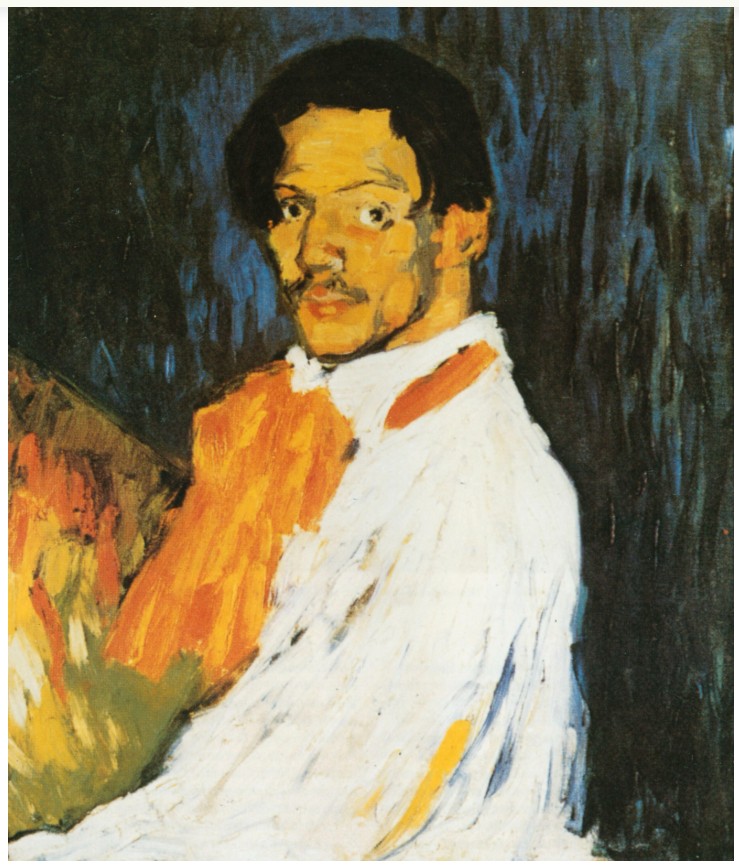
Pablo Picasso, Yo, Picasso, 1901. Private collection. © 2026 Estate of Pablo Picasso / Artists Rights Society (ARS), New York.
It was on St. Barths that Zimmer founded Le Camp, an arts collective that served as a retreat for artists, architects, designers and local personalities, built in the spirit of collaboration, innovation and artistic freedom. In exchange for room and board, artists would gift their works to Michael. Close inspection reveals that in the present work, Basquiat dedicates the work “TO MICHAEL” and inscribes “ST BARTH”. Zimmer was more than a collector, he was a participant in the social and artistic milieu that shaped Basquiat’s career. Their relationship suggests a space of exchange and affection.
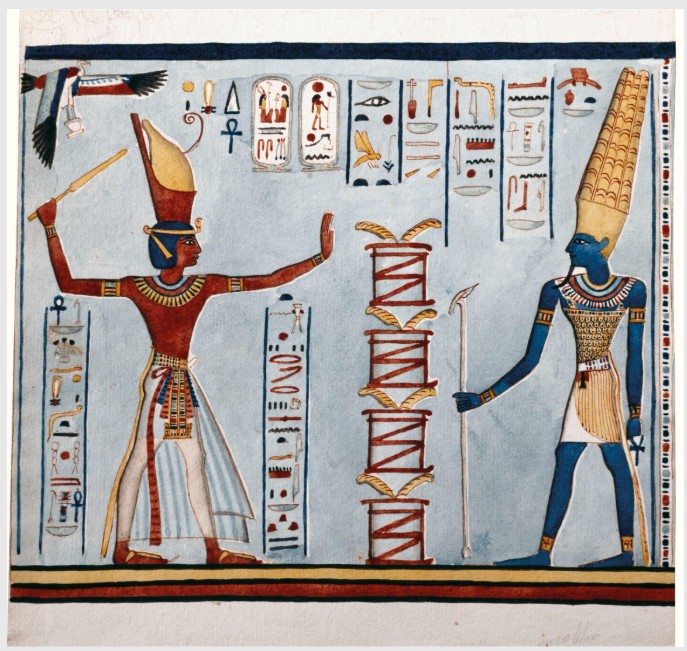
Copy of a wall painting by Linant de Bellefonds, King Rameses II with boxes before Amen-Re, Abu Simbel, Great Temple, Great Hall. Kingston Lacy Estate, Dorset, Great Britain. Photo: © National Trust Photo Library / Art Resource, New York.
Untitled exemplifies Basquiat’s extraordinary ability to synthesize raw expression with intellectual depth. The work’s layered imagery, restless lines, and interplay of text and form create a composition that feels alive, continually shifting between construction and deconstruction. “In Basquiat’s drawings…you are sucked in and carried along an often intricate and complex journey through a maze of references which oftentimes make little rational sense but nonetheless feel like they have a reason to exist” (F. Hoffman, in Jean-Michel Basquiat: Drawing, exh. cat., Acquavella Galleries, New York, 2014, p. 37). In this charged space, the human figure becomes a site of inquiry, at the same time physical, psychological, and symbolic, capturing the urgency and brilliance of Basquiat’s artistic vision at its height.
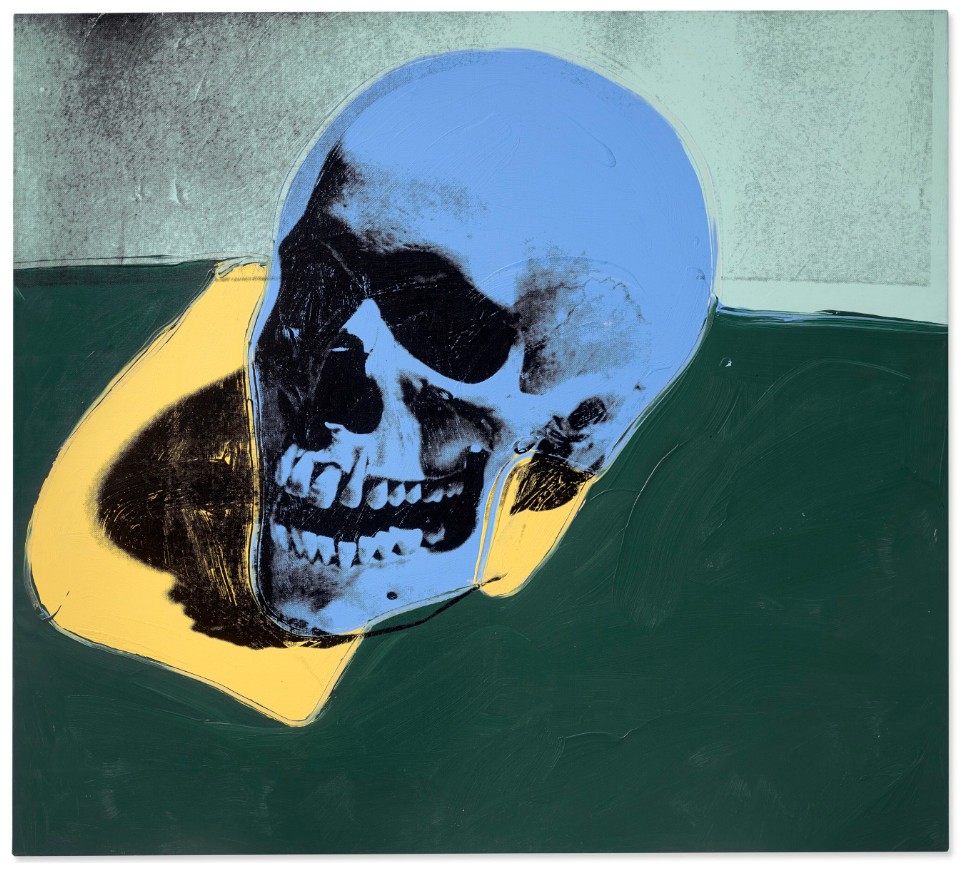
Andy Warhol, Skull, 1976. Private collection.
© 2026 The Andy Warhol Foundation for the Visual Arts, Inc, / Artist Rights Society (ARS), New York.
In the present work, Basquiat’s fascination between external presentation and internal condition is tangible. The figure’s eyes, sharply executed, pierce beyond the painted space with an electric intensity, fueled by a blazing red in place of eyeballs. Yet, there is a keen sense of sensitivity to the figure’s demeanor. The teeth, grimacing on full display, and the exposed musculature and construction of his nose, suggest both a vitality and fragility. Basquiat’s recurring fixation on the head as a locus of identity and knowledge is made explicit here. The cranium is not sealed but rather opened, transformed into a container of signs and possibilities.
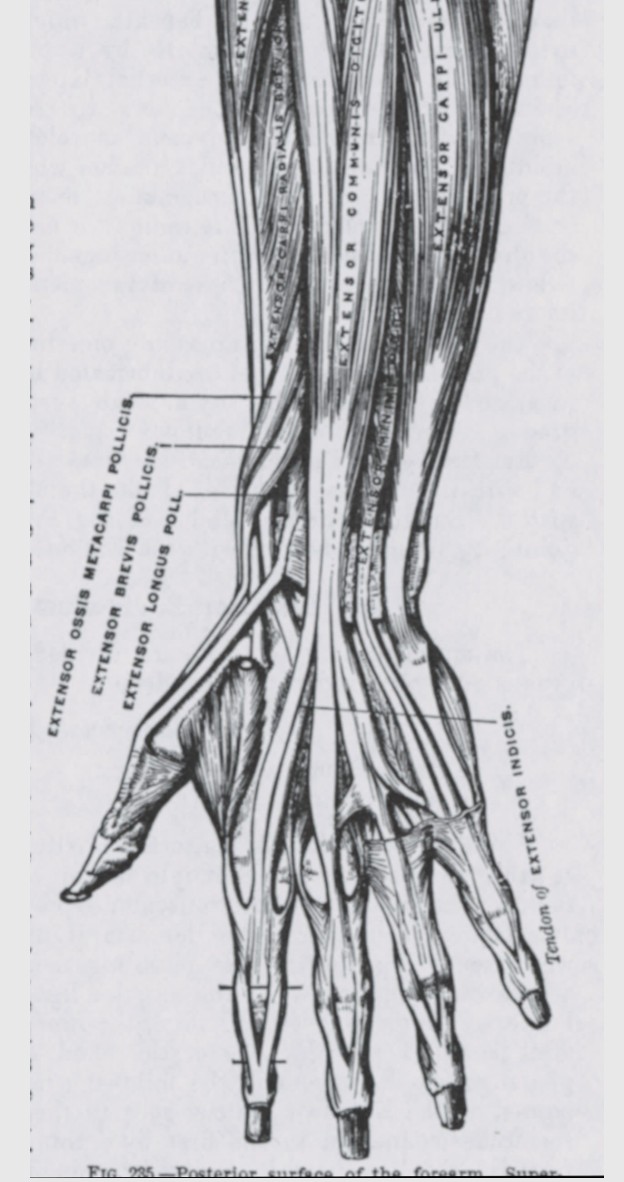
Muscle in the left hand, illustration from Gray’s Anatomy, 1858.
Beyond the figure, the sheet itself is teeming with referents. On the right side of the work, a schematic hand labeled with numbers extends the artist’s inclination for the anatomical. The juxtaposition of a head against a hand evokes the relationship between thought and action, cognition and creation. Furthermore, around the central component of the composition is a scaffolding of gestural marks and textual fragments. Blue vertical strokes frame the head like architectural supports, while orange and black lines intersect and cross out passages of writing. Words such as “TEETH,” “PRAYING,” and “KNEELING” appear in varying degrees of legibility, volleying between clarity and erasure. This layering of language is central to Basquiat’s practice. His inscriptions resist fixed meaning, instead functioning as rhythmic and visual elements that punctuate the composition.
Untitled, 1982
Untitled, 1982
Christie’s New-York: 21 May 2026
Estimated: USD 800,000 – 1,200,000
USD 952,500
WORK ON PAPER
JEAN-MICHEL BASQUIAT (1960-1988), Untitled | Christie’s
JEAN-MICHEL BASQUIAT (1960-1988)
Untitled, 1982
Oilstick on paper
14 x 9-3/4 inches (35.5 x 23.6 cm)
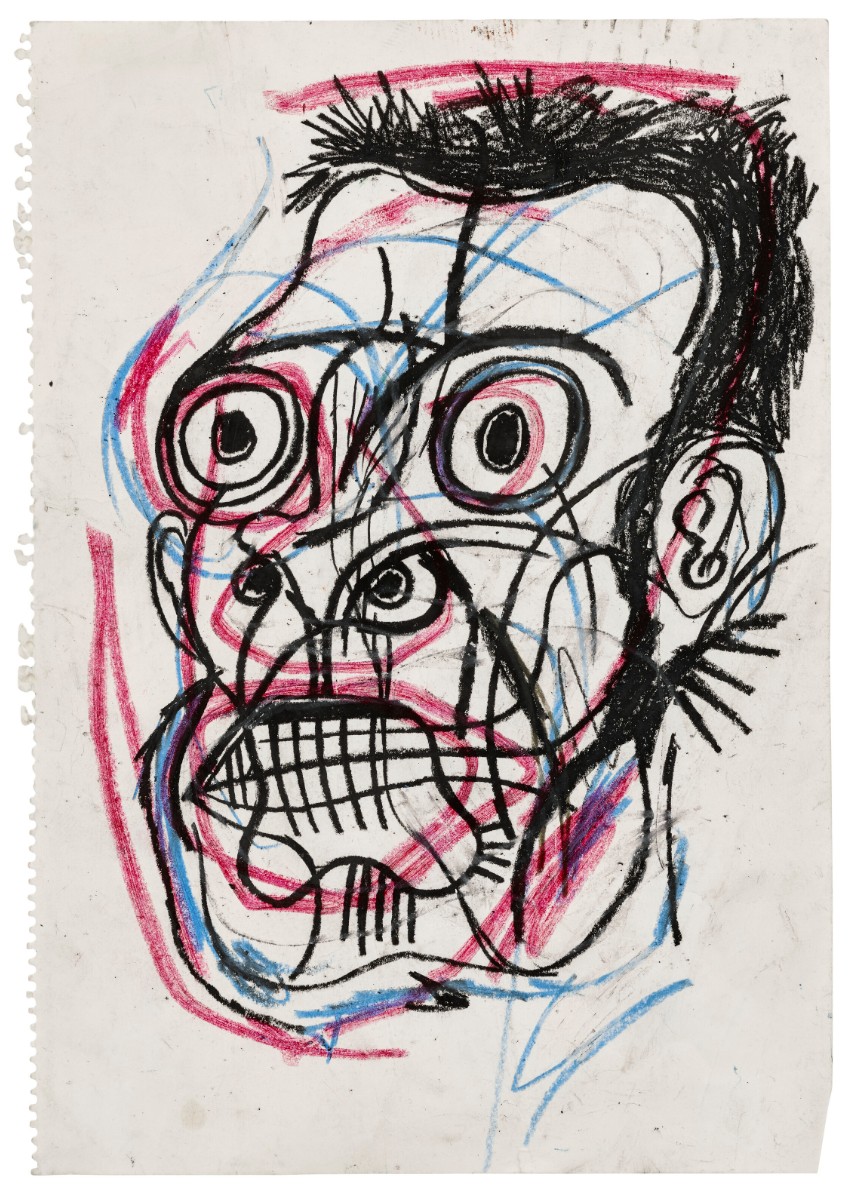
Executed in 1982, Untitled is a powerful example of a motif that would underpin Basquiat’s work for the rest of his career. Executed in oilstick on paper, the present work dates to the apex of Jean-Michel Basquiat’s artistic exploration, a period distinguished by the production of some of his most accomplished and consequential works across both paper and canvas. Dominating the center of the composition, the fiercely expressive head – part skull, part self-image – stares fixedly out of the picture plane, one of the boldest symbols in Basquiat’s iconographic repertoire. The highly stylized face, with glaring eyes, flaring nostrils and bared teeth, evokes both the primitive scribbles of a child and the elaborate iconographies of ancient cultures. These were seminal influences on the young Basquiat, who, like his hero Picasso before him, interrogated long-forgotten artist traditions to interpret contemporary visual culture from a completely new perspective. With its electric presence, Untitled arbors the conceptual depth and the immediacy that propelled Basquiat to the forefront of the contemporary art world.
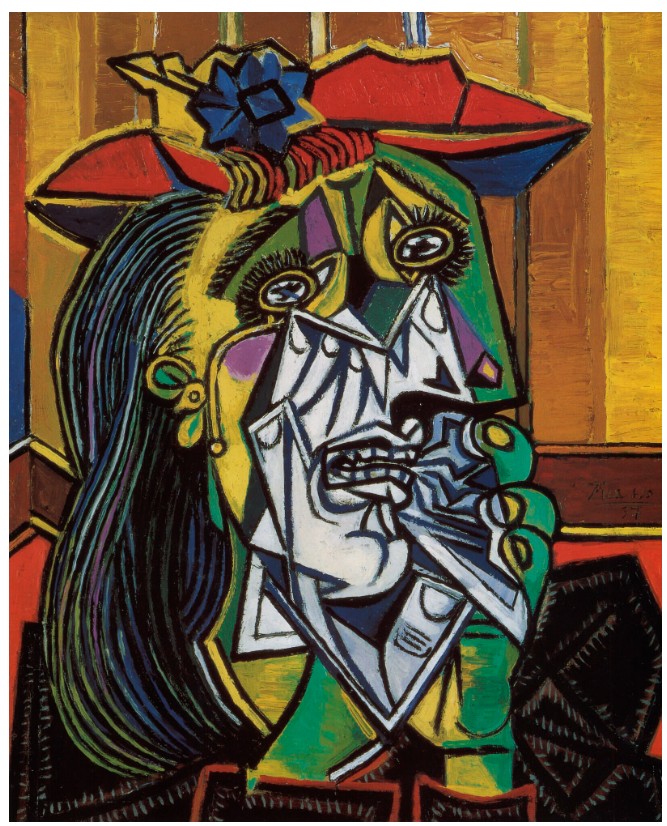
Pablo Picasso, The Weeping Woman, 1937. Tate, London. © 2026 Estate of Pablo Picasso / Artists Rights Society (ARS), New York.
The year 1982 constituted a pivotal turning point in the career of Jean-Michel Basquiat, when the gallerist Annina Nosei granted him access to a basement studio and, for the first time, placed professional materials at his disposal, an intervention that would prove instrumental in catalyzing his rapid artistic ascent. During this pivotal year, Jean-Michel Basquiat created what Fred Hoffman calls “an outpouring of unique and haunting images of heads […] With a few exceptions, each work presents a fully frontal head seeming to float against the white background of the paper. While the works share the physiognomy of overly large, almost bulging eyes as well as an enlarged, wide-open, teeth-bearing mouth, each image is distinct, presenting a completely different and individualized personage” (F. Hoffman, ‘Heads,’ in Jean-Michel Basquiat Drawing: Work from the Schorr Family Collection, exh. cat. Acquavella Galleries, New York 2014, p. 71).
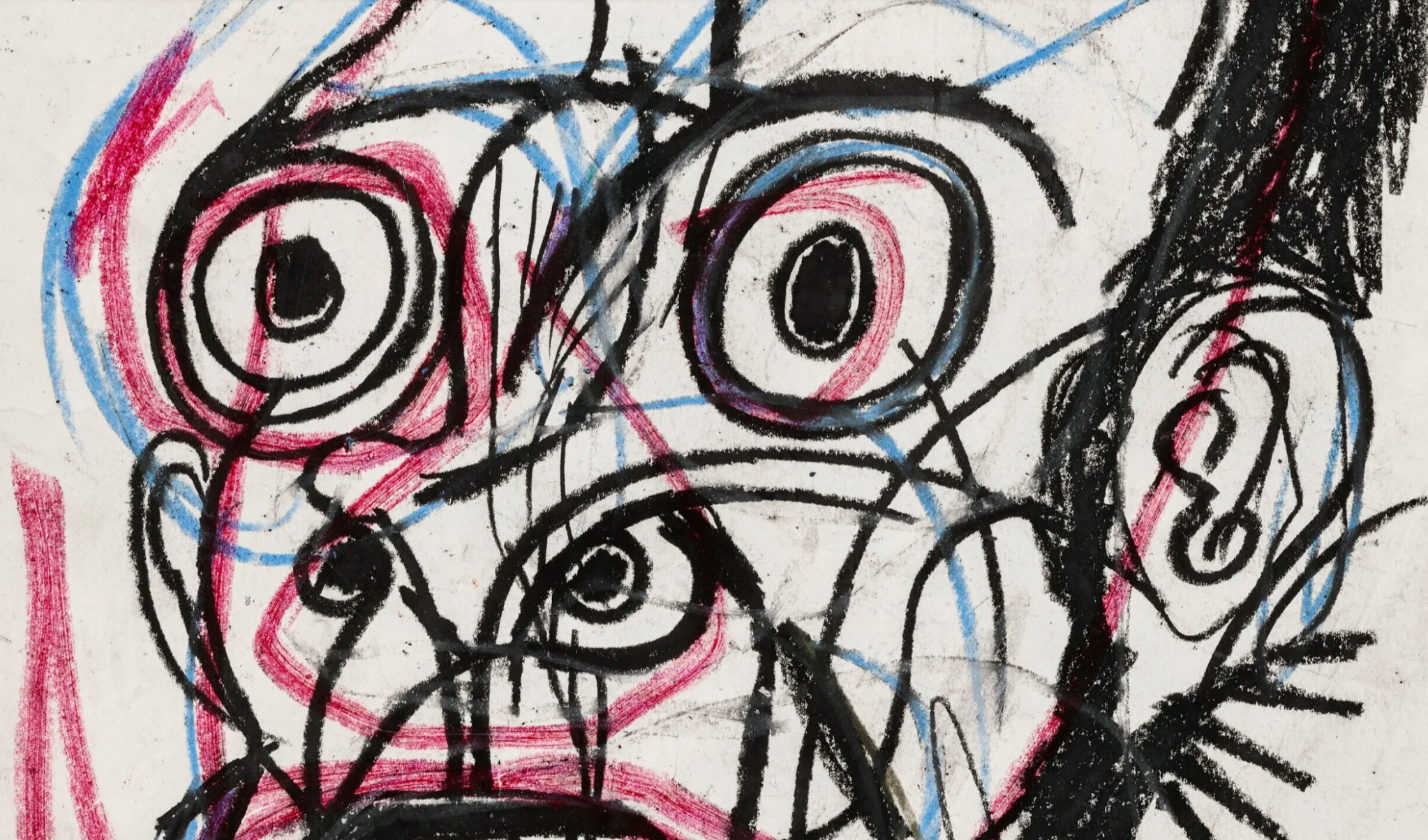
As a testament to the importance of the 1982 head studies, at the time of Basquiat’s death in 1988, no fewer than twenty-seven of the studies remained in the artist’s personal collection. Two years later, these drawings, including the present work, were presented in the seminal exhibition Jean-Michel Basquiat Drawings at Robert Miller Gallery where, hung salon style upon a single wall, they served as irrefutable testament to the gravity and intent with which the artist approached his works on paper.
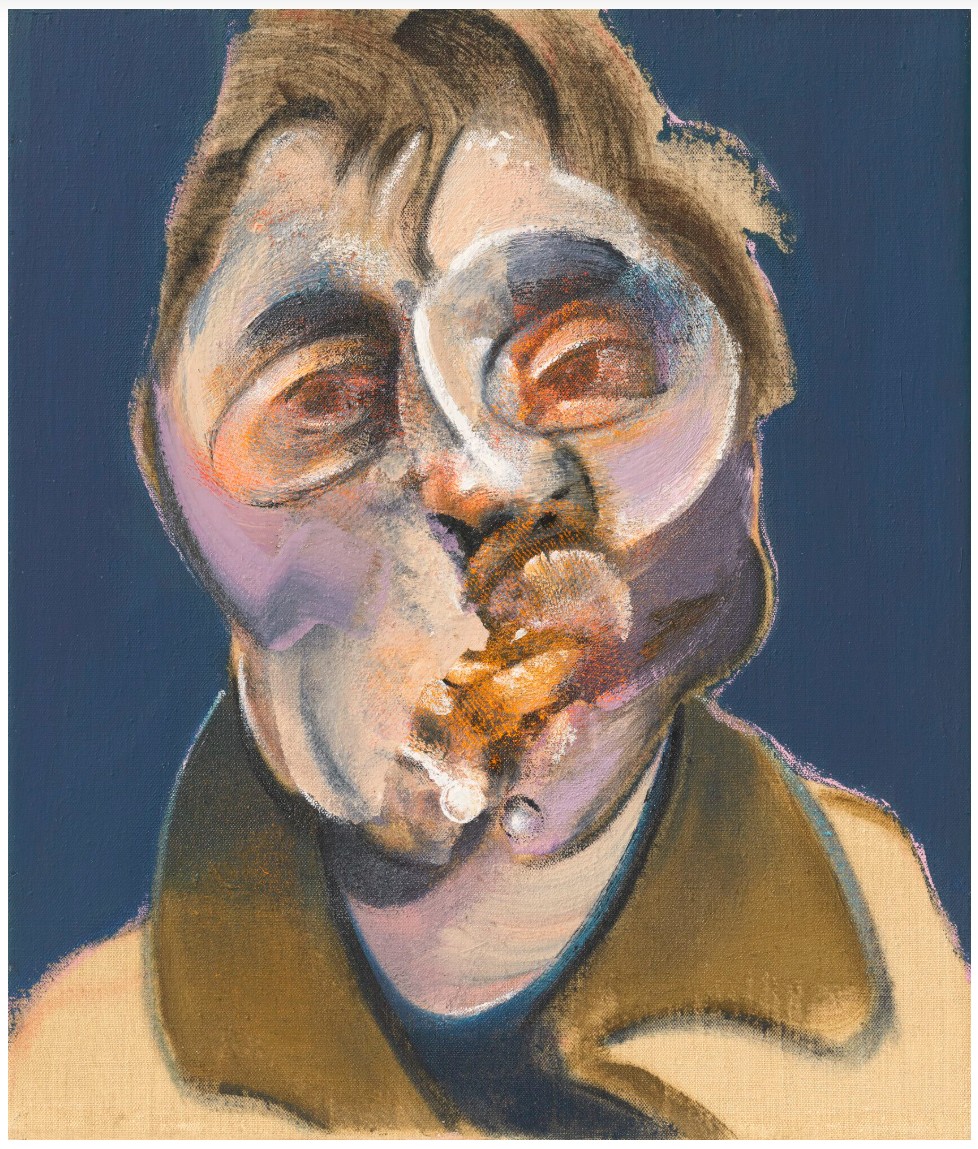
Francis Bacon, Self-Portrait, 1969. Sold at Christie’s, New York, Masterpieces from the S.I. Newhouse Collection, 11 May 2023 for $34,622,500. © The Estate of Francis Bacon. All rights reserved / DACS, London / ARS, New York 2026.
Central to Basquiat’s oeuvre is the human figure, and more specifically, the head as a site of both anatomical inquiry and psychological expression. From an early age, Basquiat was fascinated by the inner workings of the body, a curiosity famously sparked by his exposure to medical texts such as Gray’s Anatomy and a 1966 book of Leonardo’s drawings that he read while hospitalized as a child. As Jeffrey Hoffeld observes, “Basquiat’s repeated use of anatomical imagery – skeletons, musculature, and internal organs – coincides with an ever more widespread tendency in his work to turn things inside out. Inner thoughts are made public in graffiti-like litanies of words and other bursts of expression; distinctions between private spaces and public places are dissolved; past and present are interwoven, and levels of reality are multiplied and scrambled; the imagined realms of paradise, hell and purgatory become indistinguishable” (J. Hoffeld, ‘Basquiat and the inner self’, in Jean Michel Basquiat, Gemälde und Arbeiten auf Papier (Paintings and works on paper), exh. cat. Museum Würth, Künzelsau 2001, p. 27). Basquiat’s anatomical interests appear recurrently in his work through an X-ray-like vision, in which surface appearances are fractured to reveal underlying structures: bones, muscles, and unseen energies. In Untitled, the face becomes a multi-layered construct, oscillating between portrait, symbolic mask, and diagram.
Very much like Untitled (1981), held in the Broad Art Foundation, the present lot challenge conventional modes of representation, but they do so through different means—one through density and saturation, the other through compression and line—ultimately reinforcing Basquiat’s enduring preoccupation with the instability of the self and the expressive potential of the human face.
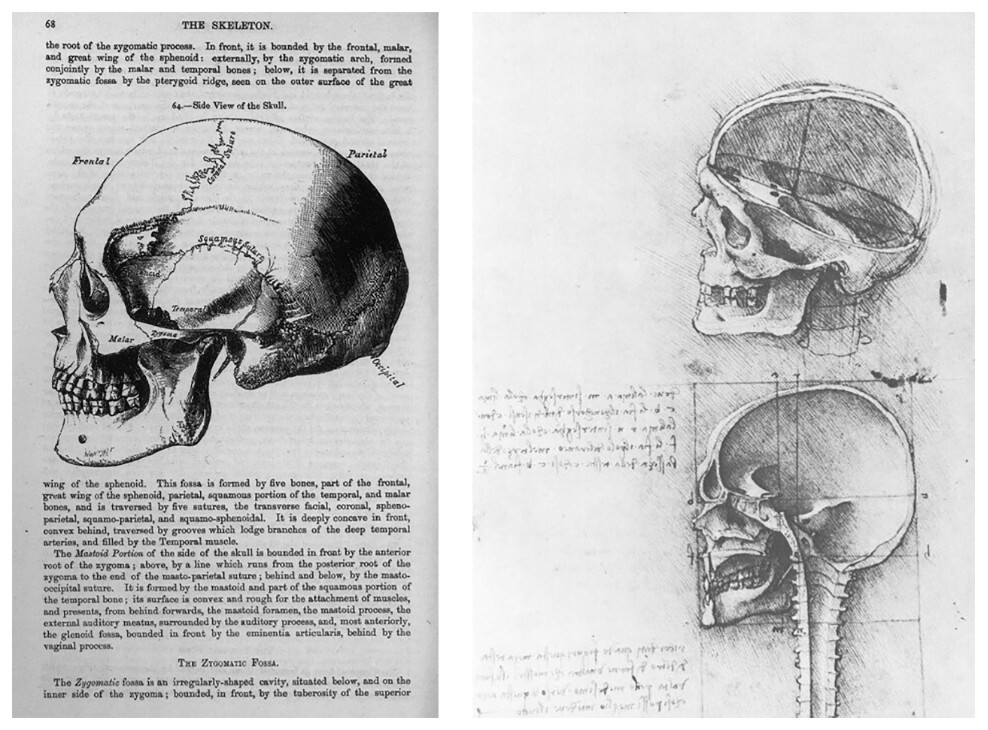
Left: Henry Gray, Gray’s Anatomy, 1858. Private collection.
Right: Leonardo Da Vinci, Two views of the skull, 1489. Royal Collection at Windsor Castle.
With a closer observation of the composition, it is possible to see a dense network of bold lines and colors that energize the surface of the work. Basquiat primarily used black oilstick to create Untitled, as the head is principally defined by interwoven black lines with passages of vivid pink and blue which trace and disrupt the structure of the face all while creating a sense of movement and instability. Rendered as big and bold concentric circles, the eyes dominate the composition, while the mouth fitted with a grid of teeth commands the bottom portion of the image with a grimacing intensity. On the other hand, the hair is drawn in thick and agitated strokes which frames the entirety of the head with a halo of energy. Basquiat’s technique appears to be at the same time instinctive and deliberate as the use of oilstick allows him to apply pigment on the paper directly all while preserving the immediacy of the artist’s hand while enabling an intense layering of lines and contours. The resulting surface almost appears to vibrate out of the paper as if the image were being continually constructed and deconstructed before the viewer’s eyes.
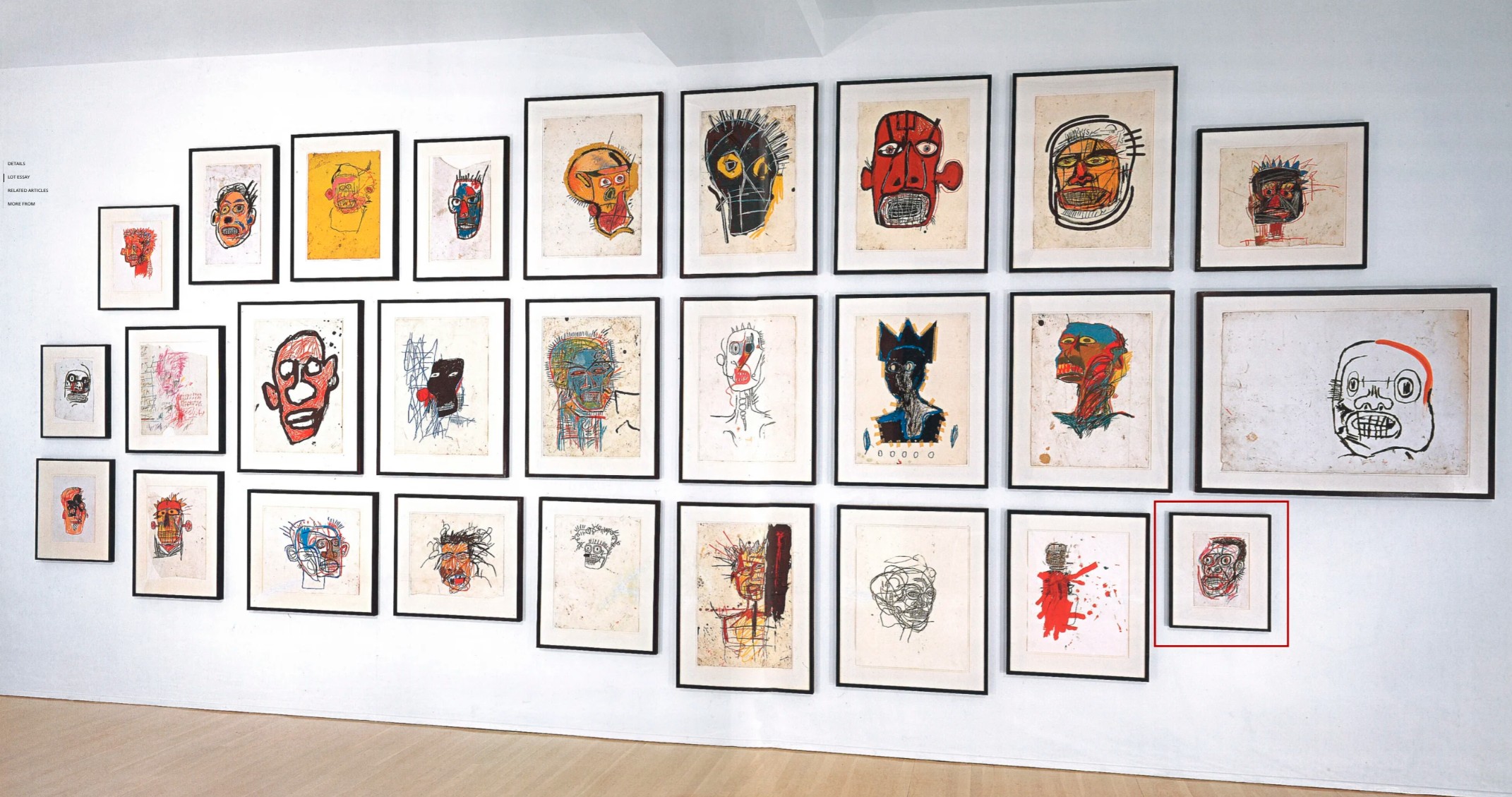
Installation view of Jean-Michel Basquiat: Drawings at Robert Miller Gallery, New York, November 1990.
Artwork: © Estate of Jean-Michel Basquiat. Licensed by Artestar, New York.
In the context of a renewed scholarly and institutional focus on Jean-Michel Basquiat’s works on paper, exemplified by the ongoing major solo exhibition Basquiat – Headstrong at the Louisiana Museum of Modern Art, the present work emerges as an especially timely and compelling opportunity. Untitled is a remarkable example of Basquiat’s celebrated head imagery, as this work fully captures the artist’s ability to combine raw expression with profound conceptual insight. Paramount to this painting is the voracious originality and dynamism resident in each stroke. Untitled unrestrained by convention; through its compositional vigor we sense the artist’s brilliant spirit at the moment that he launched his groundbreaking art practice onto the New York art world.
Anatomy, 1982
Anatomy, 1982
Christie’s New-York: 21 May 2026
Estimated: USD 400,000 – 600,000
USD 762,000
COMPLETE SET
JEAN-MICHEL BASQUIAT (1960-1988), Anatomy | Christie’s
JEAN-MICHEL BASQUIAT (1960-1988)
Anatomy, 1982
Screenprint on Arches 88 paper in 18 parts
Each: 29-3/4 x 22 inches (74.4 x 55.9 cm)
Signed ‘Jean-Michel Basquiat’ (lower right of each sheet)
Numbered respectively ‘AP IV/ [1-18]’ (on the reverse of each sheet)
This work is the fourth artist’s proof from an edition of 18 plus seven artist’s proofs
Jean Michel Basquiat’s Anatomy series, created in 1982, represents one of the earliest and most focused explorations of the human body in his career. Produced shortly after his first solo exhibition at the Annina Nosei Gallery, the series reflects a moment when Basquiat was refining his visual language and experimenting with the relationship between image and text. The pareddown aesthetic of this series stands in deliberate contrast to his established style of vivid colors and frenetic markmaking. Basquiat’s interest in anatomy was deeply personal. As a child, he was hospitalized after being struck by a car, and during his recovery his mother gave him a copy of Gray’s Anatomy. He was captivated by the book’s diagrams, shaping his lifelong engagement with the body’s internal architecture. This early fascination helps explain the clinical precision of the Anatomy series, which resemble textbook illustrations while still bearing the artist’s distinctive graphic approach.
Despite their apparent simplicity, the works carry conceptual weight. Basquiat frequently used anatomical imagery as a way to examine themes of identity, vulnerability, and the historical treatment of Black bodies within Western medical history. The labeled diagrams in this series underscore his interest in the use of language, not just as means of description, but as symbols of deeper social and political concerns.