Yves Klein’s multiples occupy a singular position within postwar art. Far from being secondary objects derived from a primary practice, they are among the most precise articulations of his ambition: to dissolve the boundary between material object and immaterial experience. Klein did not merely invent a color; he constructed a system in which pigment, body, object, and idea could be reconfigured into new states of perception. Within this framework, his sculptural multiples and tables emerge as extensions of a single proposition—one in which art is no longer confined to uniqueness, but expands into controlled repetition without losing its aura.
Introduction
In the final phase of his life, Klein turned toward one of the most unexpected sources: classical sculpture. Working from plaster casts of canonical works—often sourced from the Louvre—he began coating them in International Klein Blue (IKB), transforming these historically saturated forms into monochrome presences.
This gesture is both radical and precise. By applying a uniform, ultramarine surface to sculptures already charged with centuries of meaning, Klein performs a conceptual compression. The narrative, mythology, and historical specificity of these works are not erased, but suspended. What remains is form, volume, and an intense chromatic field that shifts the experience from representation to sensation.
These works are not reinterpretations in a decorative sense. They are acts of absorption. Antiquity is not quoted—it is reconditioned within Klein’s immaterial universe.
Victoire de Samothrace
Monument as Pure Energy
The Victoire de Samothrace stands among the most emblematic of Klein’s sculptural multiples. Based on the Hellenistic masterpiece, itself already fragmented and monumental, Klein’s version amplifies its sense of dynamism while stripping it of historical specificity.
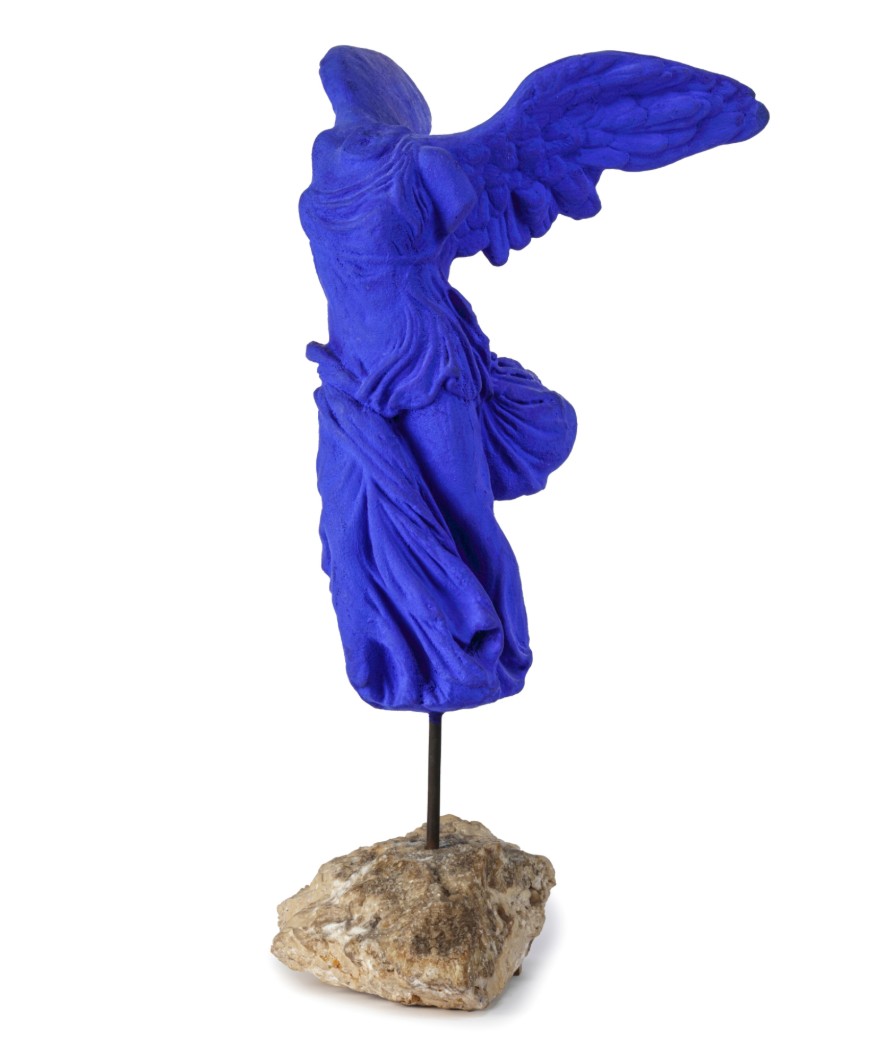
Entirely coated in IKB, the sculpture ceases to function as a relic of antiquity and instead becomes a kind of chromatic apparition. The wings no longer belong to a goddess of victory; they become vectors of movement within a unified field of blue. The absence of polychromy or material variation reinforces this transformation. The sculpture is no longer carved—it appears almost projected.
Importantly, the editions known today were produced after Klein’s death, notably beginning in the early 1970s, based on his 1962 conception. This posthumous casting aligns with Klein’s broader interest in the reproducibility of form as a way to disseminate artistic experience beyond singular ownership.
Vénus d’Alexandrie
The Body Between Sensuality and Abstraction
With the Vénus d’Alexandrie, Klein engages directly with one of the most enduring motifs in Western art: the idealized female form. Yet here again, the intervention is surgical. By saturating the sculpture in IKB, Klein neutralizes the traditional reading of the body as flesh.
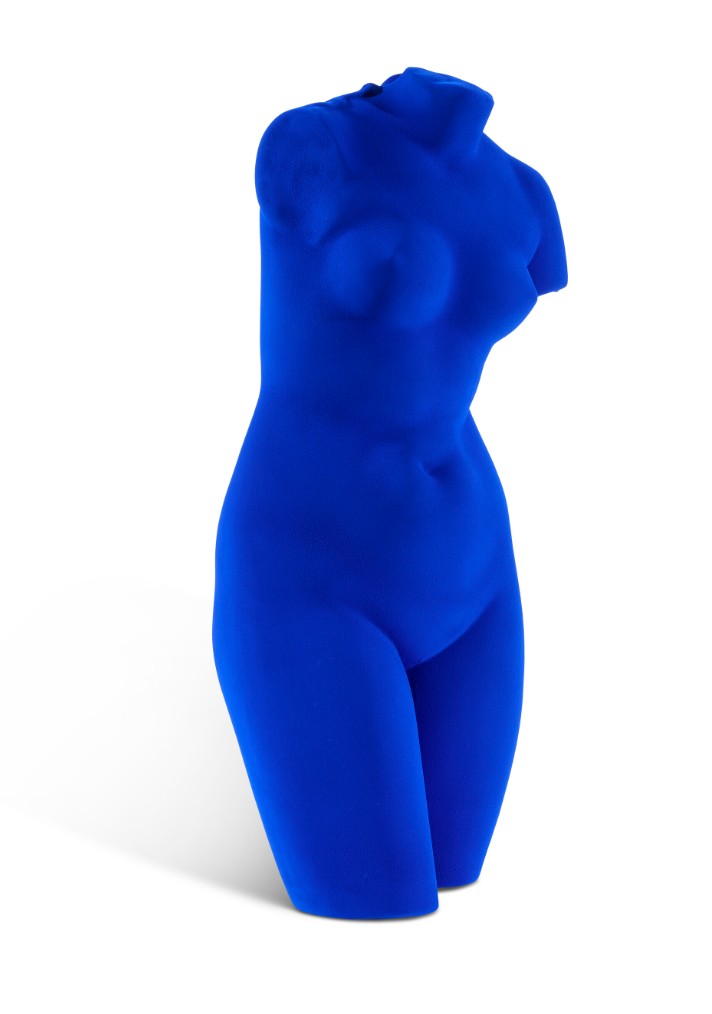
The figure retains its sensual contours, but these are no longer anchored in material realism. Instead, they become abstract volumes, suspended between presence and absence. The erotic dimension is not removed—it is displaced. Desire becomes atmospheric rather than physical.
The widely circulated editions of the Vénus d’Alexandrie were executed posthumously, particularly in the 1980s, under the authority of the Yves Klein Archives. As with the Victoire, these editions do not replicate an existing Klein object; they realize a conceptual framework he had already established.
L’Esclave mourant d’après Michel-Ange
Pathos, Repetition, and the Question of Aura
Among Klein’s appropriations, L’Esclave mourant d’après Michel-Ange is perhaps the most conceptually charged. Michelangelo’s original is one of the most emotionally complex sculptures of the Renaissance, defined by tension, release, and an almost metaphysical stillness.
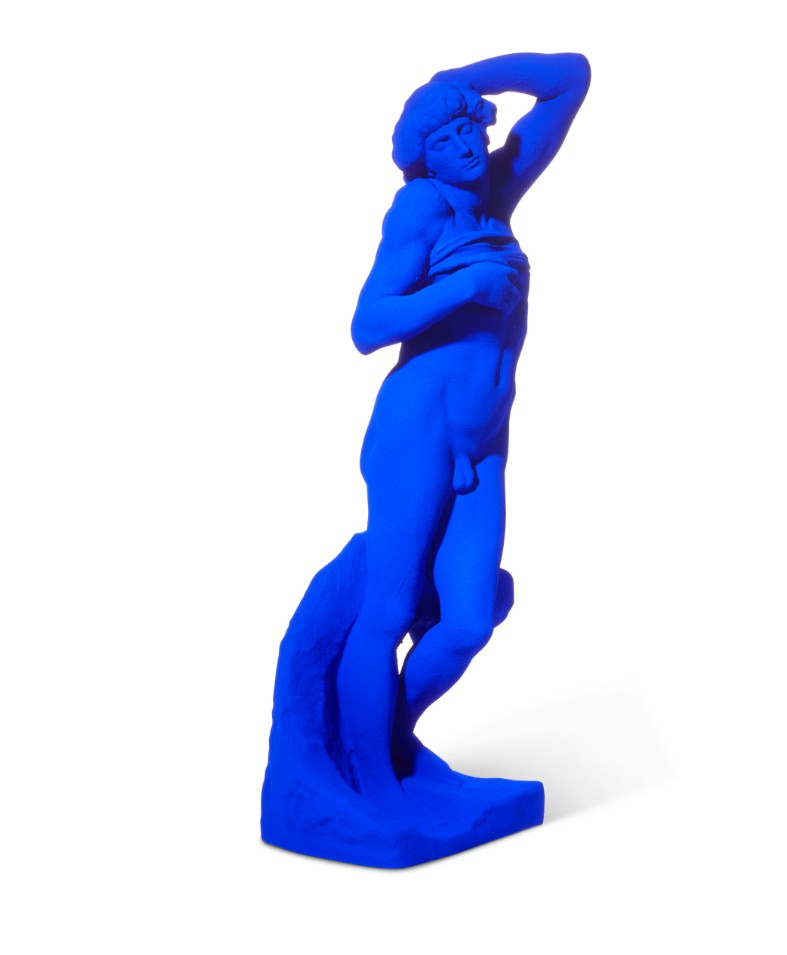
Klein’s intervention intensifies this condition by imposing absolute chromatic unity. The blue surface absorbs the drama of the figure, transforming it into a silent, continuous field. The sculpture no longer communicates through anatomical detail alone, but through its total presence.
Here, the question of the multiple becomes central. The Dying Slave exists in posthumous editions, notably produced in the late 20th century, which directly engage Klein’s interest in challenging the uniqueness of the artwork. By transforming a singular Renaissance masterpiece into a reproducible monochrome object, Klein redefines the relationship between originality and repetition. The aura does not disappear—it migrates.
The Yves Klein Tables
From Object to Environment
If the blue sculptures reinterpret art history, the Yves Klein tables extend his practice into the realm of lived space. Conceived around 1961 and produced posthumously beginning in 1963, these works consist of glass and Plexiglas structures containing loose IKB pigment.
They are at once paintings, sculptures, and functional objects. Yet their function is deliberately destabilized. A table is meant to serve; Klein’s tables resist that role. The pigment, suspended beneath the surface, creates a visual depth that transforms the object into a horizontal monochrome field.
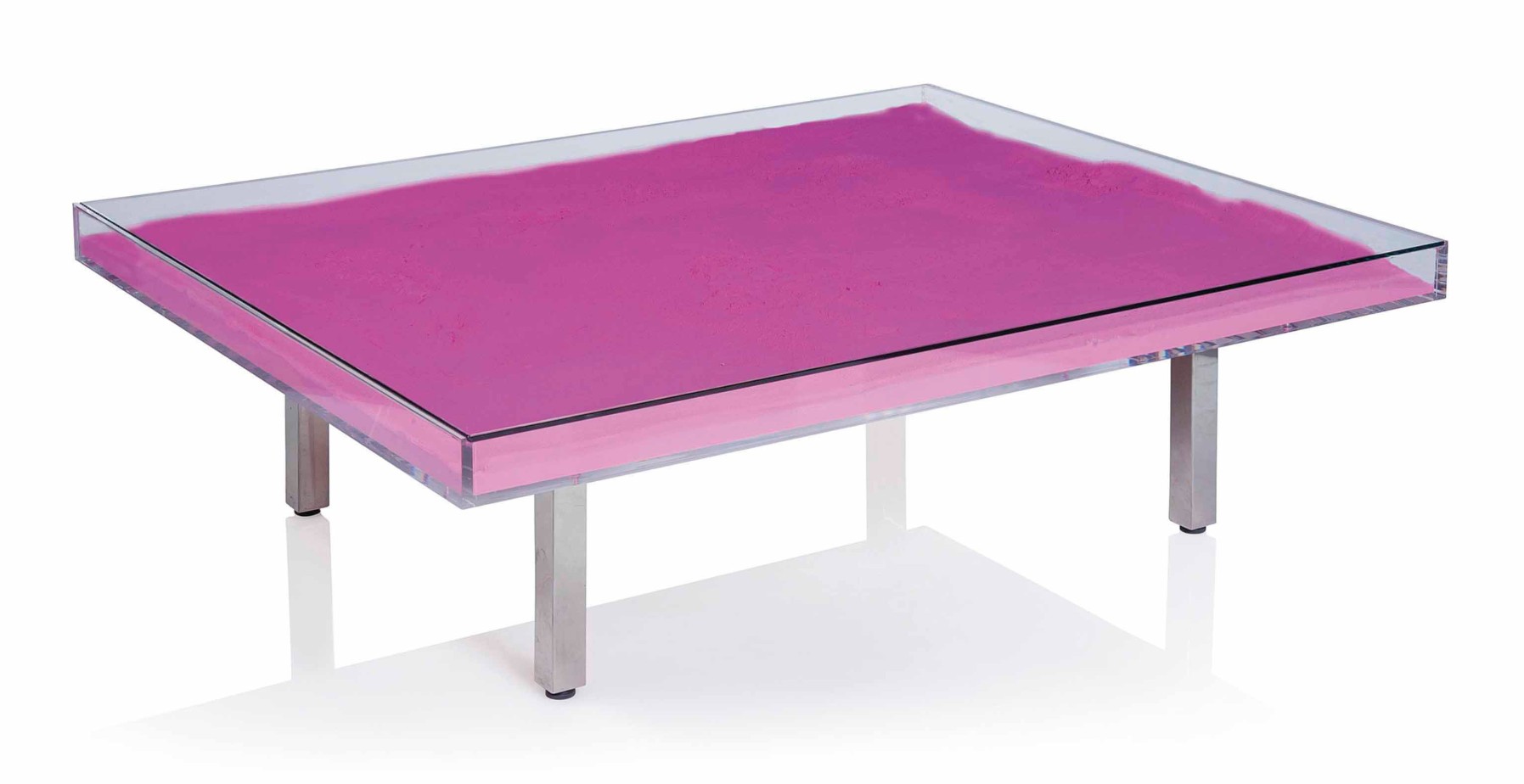
In these works, Klein achieves something particularly refined: the integration of art into everyday life without compromising its conceptual intensity. The table becomes a site of contemplation, a fragment of immaterial space inserted into the domestic environment.
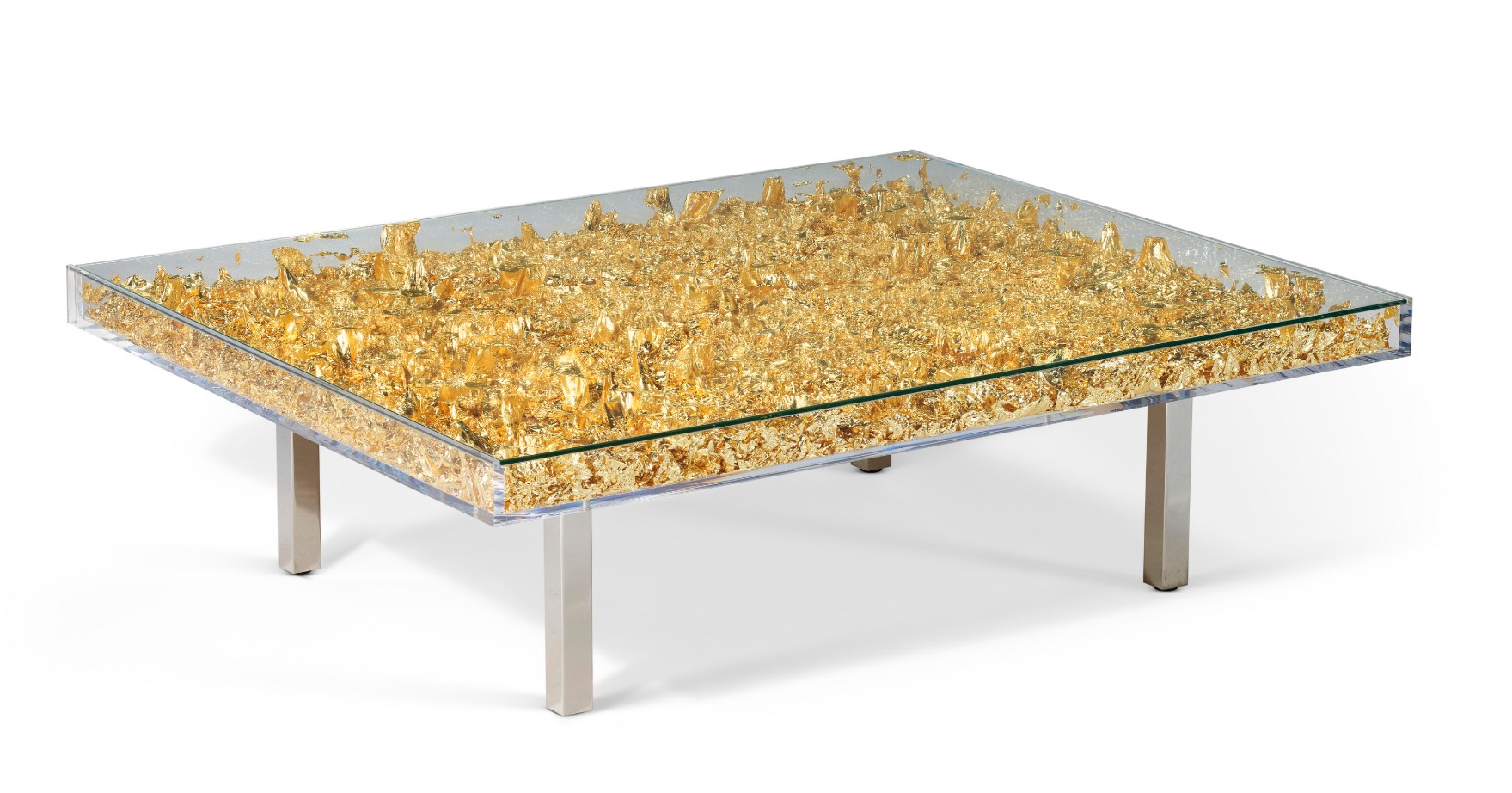
It is also important to note that these tables are estate-produced works, carefully supervised rather than mass-produced. They occupy a space between design object and sculptural edition, reinforcing Klein’s broader challenge to traditional categories.
La Terre Bleue
The World reduced
With La Terre Bleue, Klein completes his trajectory. The focus shifts from the body to the object, and finally to the world itself. The globe, entirely coated in IKB, becomes a total image—one that collapses geography, history, and division into a single chromatic field.
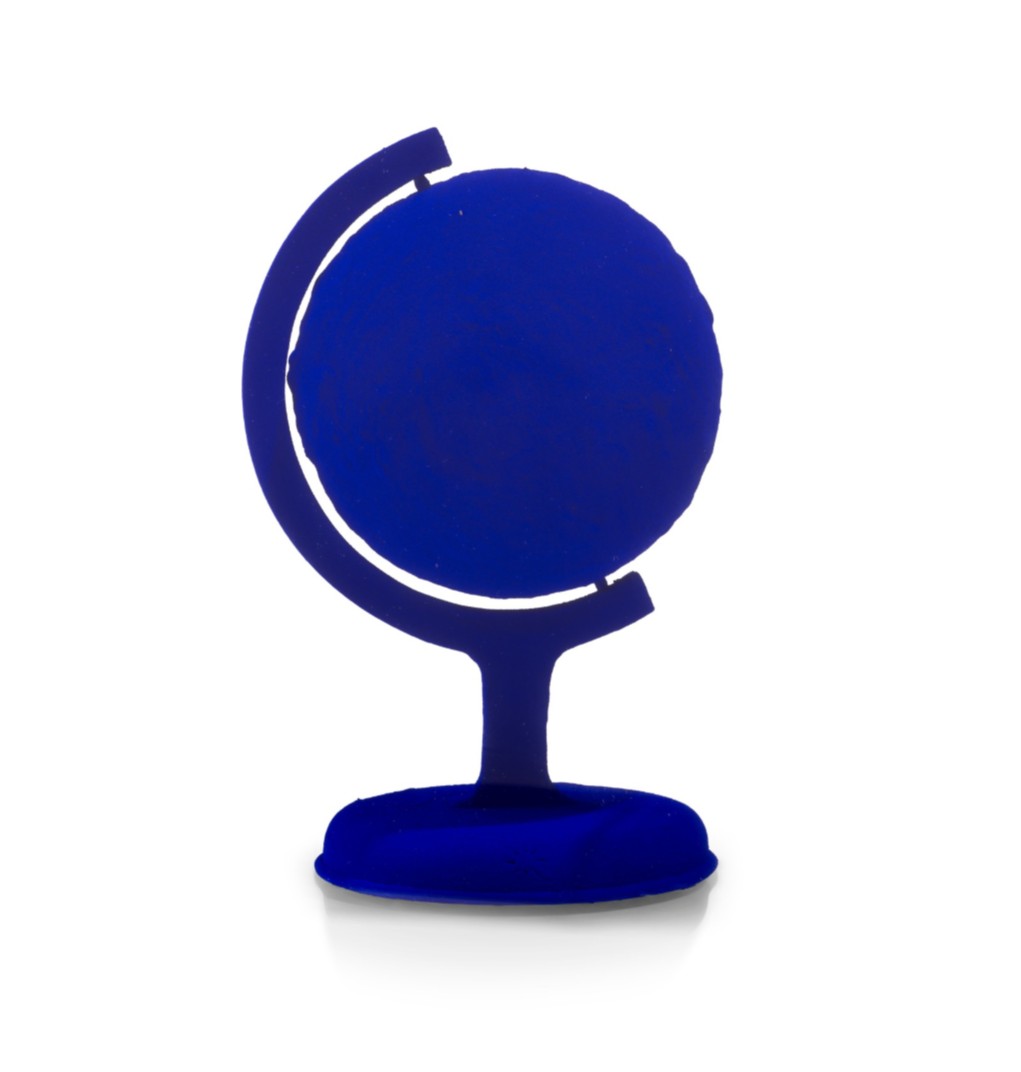
As with the other multiples, these works are produced posthumously, in various formats including pigment-coated globes and versions incorporating sponges. The variations reinforce the idea that the work is not a fixed object but a conceptual system.
The gesture is radical in its simplicity. The Earth is no longer mapped—it is experienced. Representation gives way to presence. In this moment, Klein achieves a profound inversion: art no longer represents the world; the world becomes the artwork.
Posthumous Editions and Conceptual Continuity
The fact that these works were cast and produced after Yves Klein’s death is not a peripheral detail—it is central to their meaning. Klein had already begun to dismantle the hierarchy between unique artwork and multiple. His use of monochrome, his engagement with performance, and his interest in immateriality all point toward an արվեստ that could exist beyond singular objects.
The posthumous editions therefore function not as reproductions, but as authorized continuations of a conceptual system. They are anchored in documented models, ideas, and intentions developed during Klein’s lifetime, and executed under strict archival supervision.
For the collector and the observer alike, this introduces a more nuanced understanding of authenticity. In Klein’s universe, authenticity is not tied exclusively to the artist’s hand. It resides in the fidelity to an idea.
Conclusion
Yves Klein’s multiples are not secondary works. They are, in many ways, his most distilled statements. By appropriating classical forms and embedding them within a monochrome system, he bridges centuries of art history while asserting a radically modern vision. Their posthumous production does not diminish them. On the contrary, it fulfills Klein’s ambition to liberate art from singularity and to allow it to exist as a field of experience—repeatable, transmissible, and enduring. In Klein’s world, the object is never just an object. It is a threshold. And whether in the form of a winged victory, a reclining Venus, a dying slave, or a table filled with blue, that threshold always leads to the same place: an encounter with the immaterial, rendered, quite improbably, in pigment.
From a market standpoint, Yves Klein’s multiples occupy a distinct and increasingly significant segment. Their accessibility relative to unique works, combined with their strong conceptual foundation and institutional validation, has driven sustained demand. Sculptural editions such as the Victoire de Samothrace, Vénus d’Alexandrie, and Esclave mourant have achieved consistent results at auction, while the Tables Bleues remain among the most iconic and sought-after design-related works of the postwar period.
Collectors are drawn not only to their visual impact but to their position within Klein’s broader practice. These works encapsulate his key concerns, immateriality, repetition, and the transformation of perception, within objects that remain physically present and highly legible.
AUCTION RESULTS
2026 Auction Results
RP7 – La Terre Bleue, 1957-1988
Phillips New-York: 28 February 2026
Estimated: USD 20,000 – 30,000
USD 61,920
Yves Klein Modern & Contemporary Art
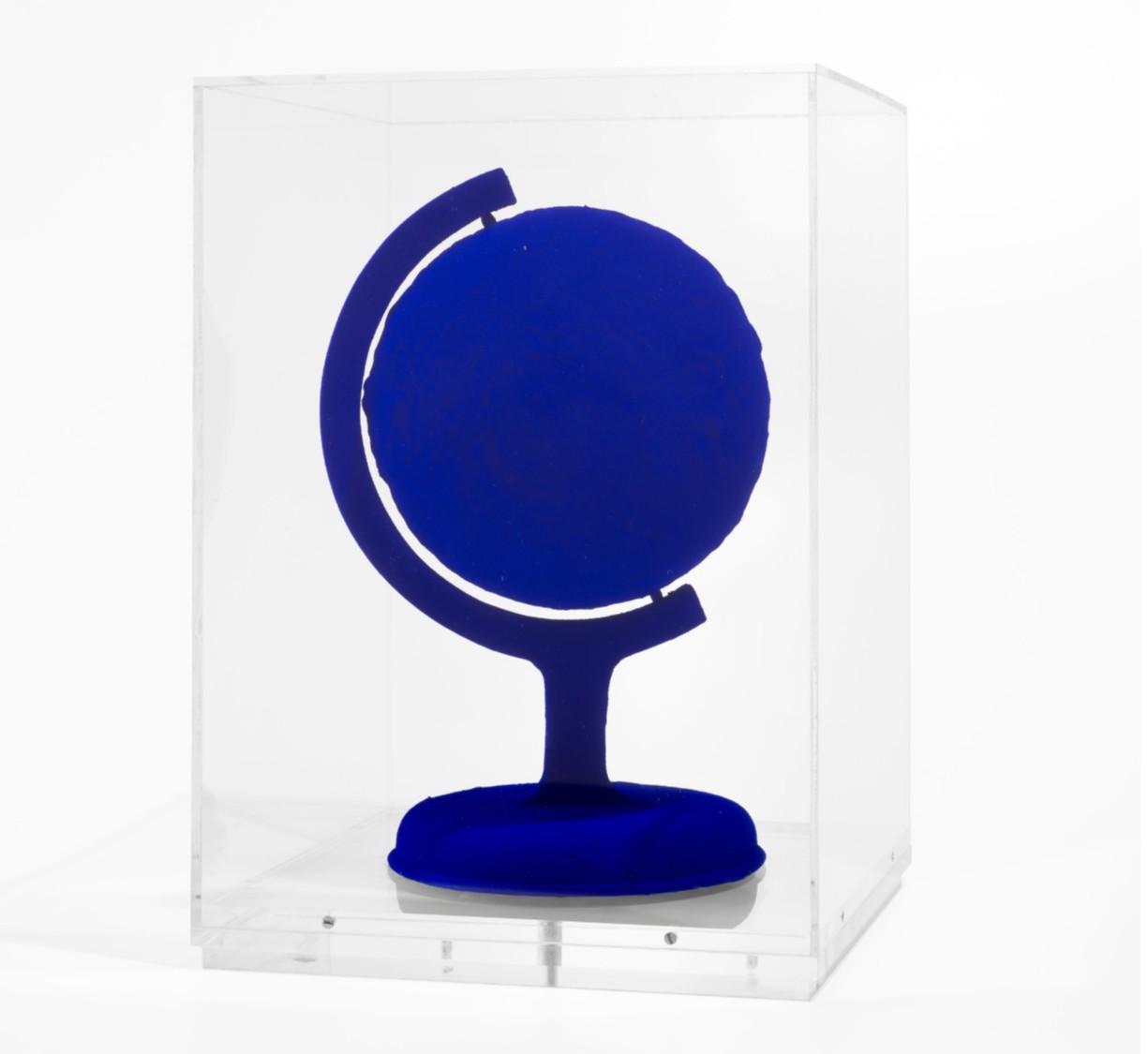
YVES KLEIN
RP7 – La Terre Bleue, 1957-1988
IKB pigment and synthetic resin on plaster molding
Incised with the artist’s monogram on the base
Numbered “279/300” on an artist’s label affixed to the underside of the base
2025 Auction Results
#1. La Victoire de Samothrace, 1962-1973
Property from a Distinguished International Collection
Sotheby’s New-York: 19 November 2025
Estimated: USD 80,000 – 120,000
USD 241,300
Yves Klein | La Victoire de Samothrace | Contemporary Day Auction |
YVES KLEIN (1928 – 1962)
La Victoire de Samothrace, 1962-1973
Dry blue pigment in synthetic resin on plaster with a metal and stone base
Incised with the artist’s initials and date 62 (on the left wing)
Numbered 93/175 (on the reverse of the figure)
#2. La Vénus d’Alexandrie, 1962-1982
Christie’s London: 5 June 2025
Estimated: GBP 50,000 – 70,000
GBP 163,800 / USD 221,965
YVES KLEIN (1928-1962)
La Vénus d’Alexandrie (Vénus Bleue, S 41) (The Venus of Alexandria (Blue Venus, S 41)), 1962-1982
Dry pigment and synthetic resin on plaster
Inscribed with the artist’s monogram and numbered ‘HC XXXVI/L’ (on the reverse of the left leg)
Stamped with the artist’s name, title and number ‘VENUS BLEUE de Yves KLEIN HC XXXVI/L’ (on the underside)
This work is the hors-commerce number thirty six from an edition of three hundred plus fifty hors-commerce and three resin examples
#3. Victoire de Samothrace, 1962-1983
Christie’s Paris: 24 October 2025
Estimated: EUR 80,000 – 120,000
EUR 152,400 / USD 177,045
Yves Klein (1928-1962), Victoire de Samothrace | Christie’s
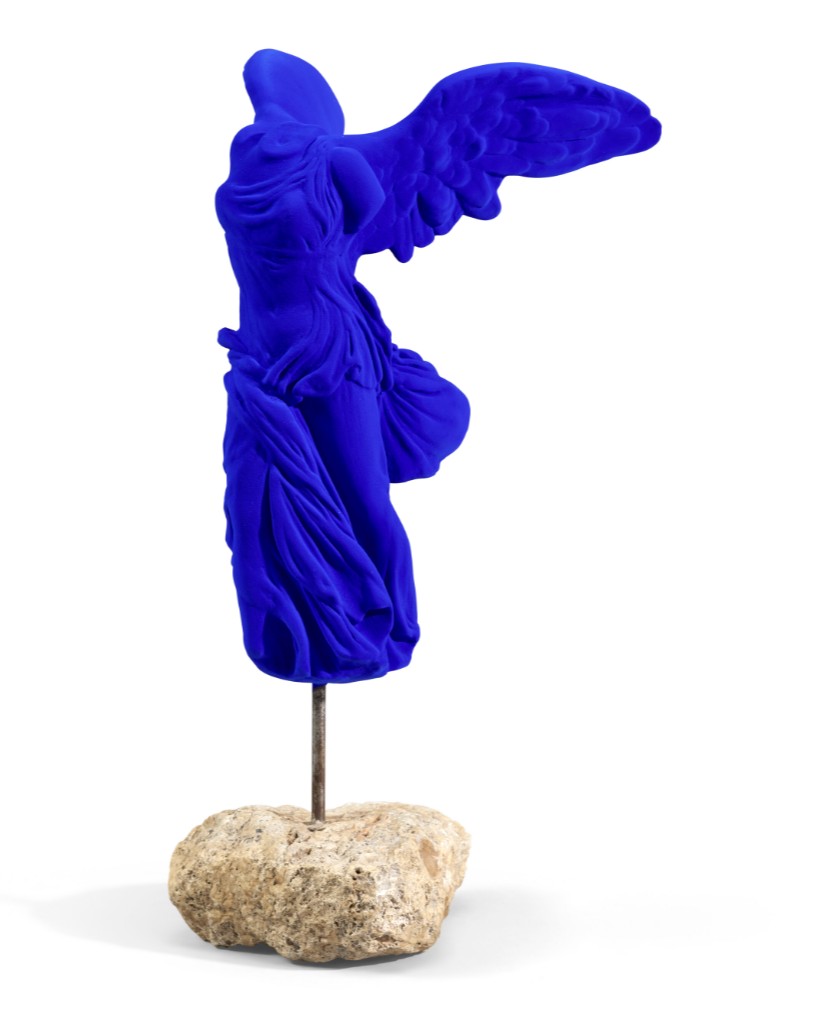
YVES KLEIN (1928-1962)
Victoire de Samothrace, 1962-1983
Dry pigment and synthetic resin on plaster, with metal and stone base
Signed with the initials and dated ‘YK 62′ (on a wing)
Numbered ’20⁄175′ (to the bottom backside)
Numbered ’20⁄175’ (to the underside)
#4. La Victoire de Samothrace, 1962/1973
Phillips New-York: 21 October 2025
Estimated: USD 70,000 – 100,000
USD 167,700
Yves Klein MODERNISM: Editions & Works on Paper
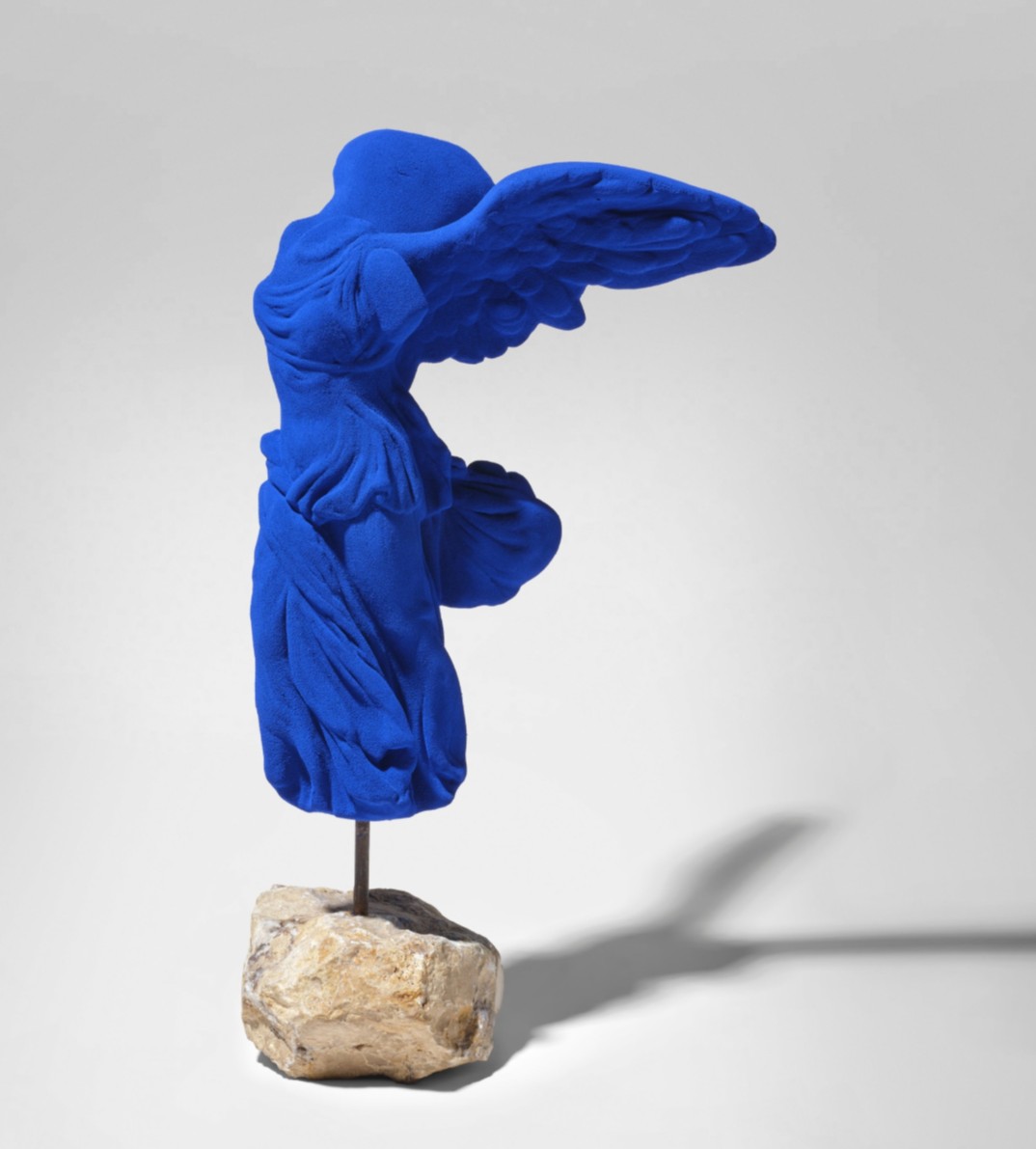
YVES KLEIN
La Victoire de Samothrace (Winged Victory of Samothrace), 1962/1973
Dry blue pigment and synthetic resin on plaster, with a metal rod and stone base
Incised with initials and dated ’62’ on one of the wings
Numbered XXII/XXV in black ink on the underside of the stone base
One of 25 hors commerce in Roman numerals
#4. Vénus d’Alexandrie (S 41), 1962-1982
Christie’s New-York: 15 May 2025
Estimated: USD 70,000 – 100,000
USD 163,800
YVES KLEIN (1928-1962), Vénus d’Alexandrie (S 41) | Christie’s
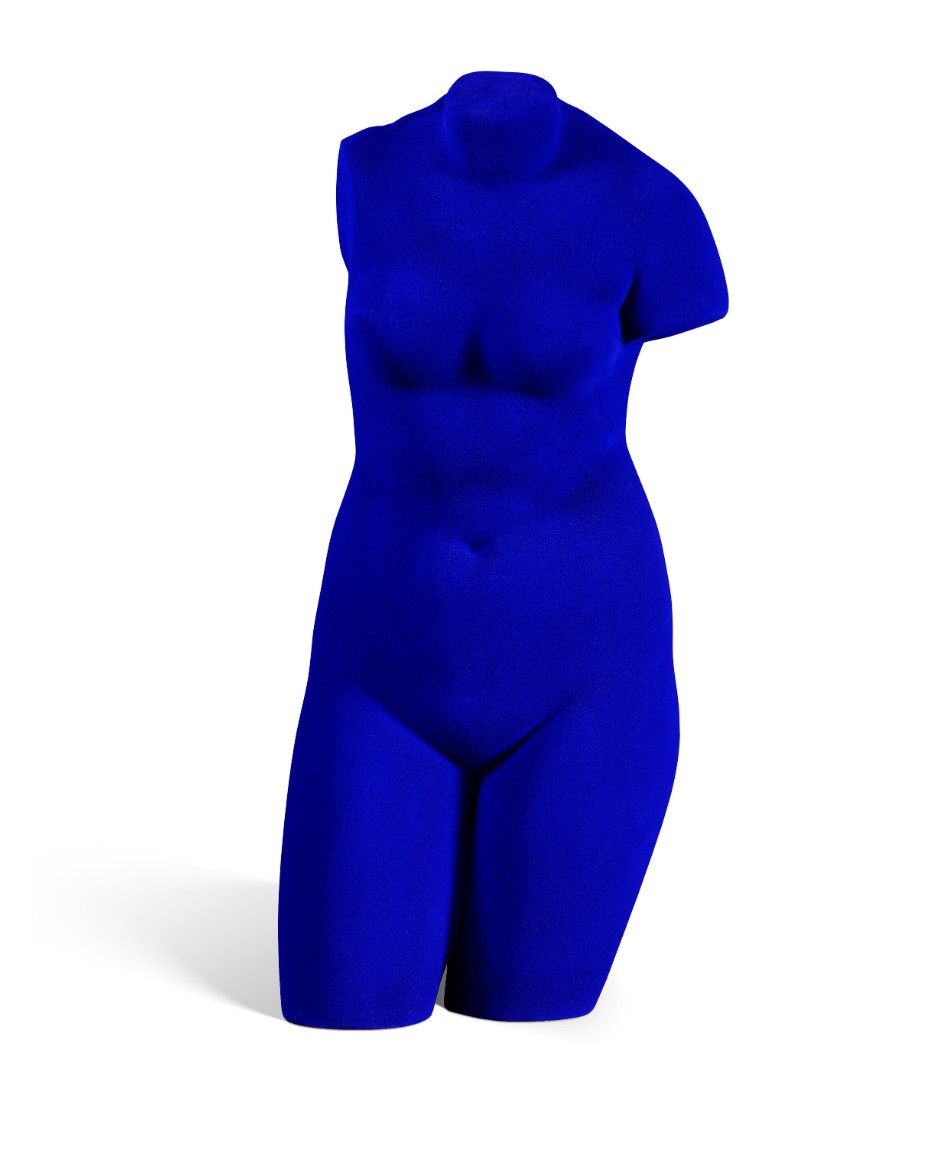
YVES KLEIN (1928-1962)
Vénus d’Alexandrie (S 41), 1962-1982
Dry pigment and synthetic resin on plaster
Stamped with the artist’s monogram and numbered ’51⁄300′ (on the reverse)
Stamped with the editor’s stamp and numbered again ’51⁄300′ (on the underside)
This work is number 51 from an edition of 300 plus 50 hors-commerce numbered I/L to L/L and three copies numbered 001 to 003
#5. La Vénus d’Alexandrie (S41), 1962-1982
Christie’s Paris: 4 December 2025
Estimated: EUR 70,000 – 100,000
EUR 101,600 / USD 118,530
YVES KLEIN (1928-1962), La Vénus d’Alexandrie (S41) | Christie’s
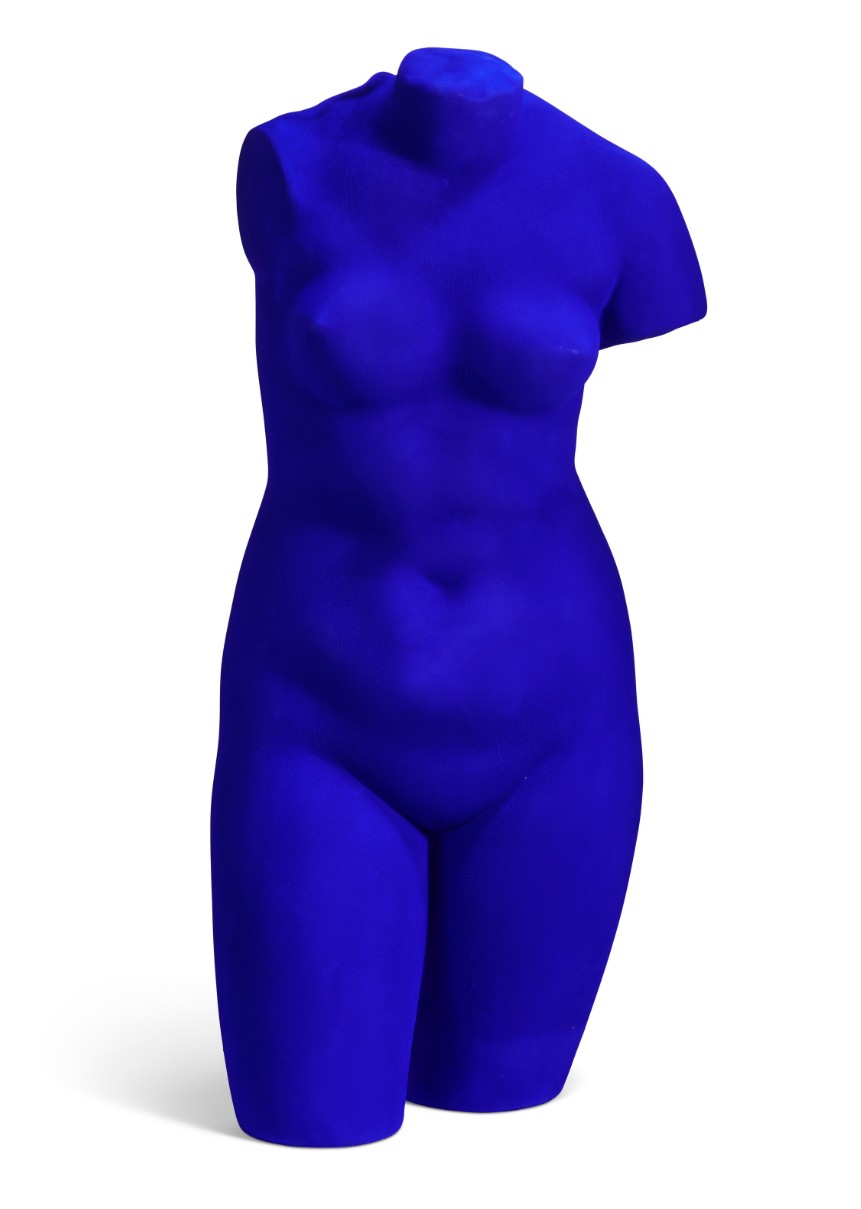
YVES KLEIN (1928-1962)
La Vénus d’Alexandrie (S41), 1962-1982
Dry pigment and synthetic resin on plaster
Numbered ‘259/300’ (to the bottom backside)
With the editor’s stamp and numbered ‘259/300’ (to the underside)
#6. L’Esclave mourant d’après Michel-Ange (S 20), 1962-1992
Christie’s Paris: 11 April 2025
Estimated: EUR 40,000 – 60,000
EUR 75,600 / USD 85,635
Yves Klein (1928-1962), L’Esclave mourant d’après Michel-Ange (S 20) | Christie’s
YVES KLEIN (1928-1962)
L’Esclave mourant d’après Michel-Ange (S 20), 1962-1992
IKB pigment and synthetic resin on plaster cast
Signed, titled, numbered and inscribed
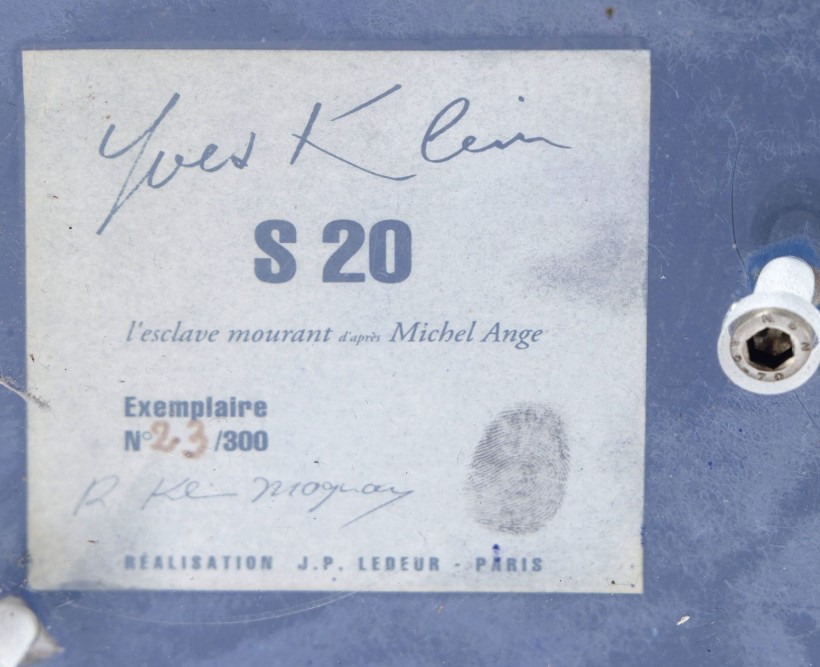
‘Yves Klein S 20 ”l’esclave mourant d’après Michel Ange” 262⁄300 R. Klein Moquay’
(on a label to the underside)
This work is number two hundred and sixty-two from an edition of three hundred and fifty Hors Commerce
#7. L’Esclave mourant d’après Michel Ange, 1962-1992
Monte Carlo Auction House: 20 February 2025
Estimated: EUR 30,000 – 50,000
EUR 45,000 (Hammer)
EUR 56,250 / USD 58,925
YVES KLEIN (1928-1962) | Hôtel Des Ventes De Monte-Carlo
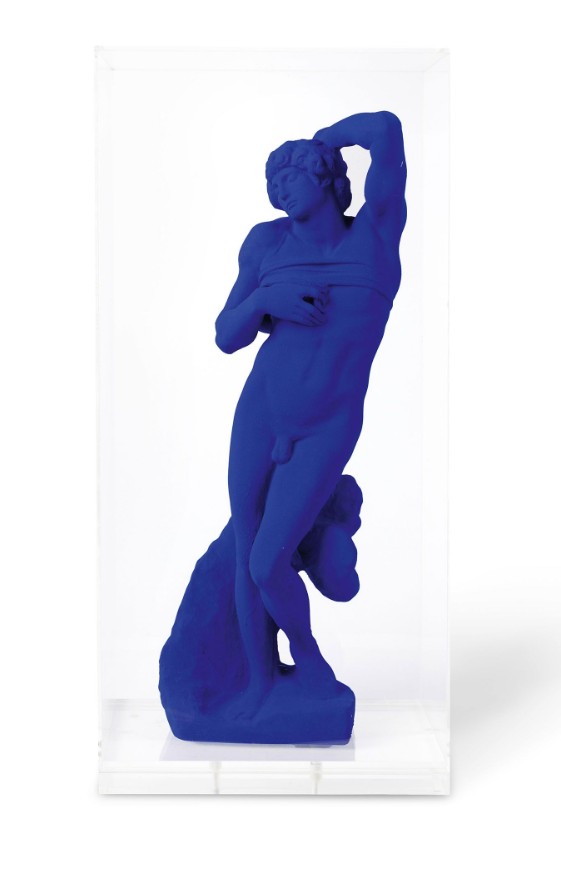
YVES KLEIN (1928 – 1962)
L’Esclave mourant d’après Michel Ange, 1962-1992
IKB pigment and synthetic resin on plaster cast
Stamped with the artist’s signature on a label affixed to the underside
Titled, inscribed S 20 and numbered 23/300
#8. L’Esclave mourant d’après Michel Ange, 1962-1992
Sotheby’s New-York: 15 April 2025
Estimated: USD 50,000 – 70,000
USD 57,150
Yves Klein | L’Esclave mourant d’après Michel Ange (S 20) | Prints &
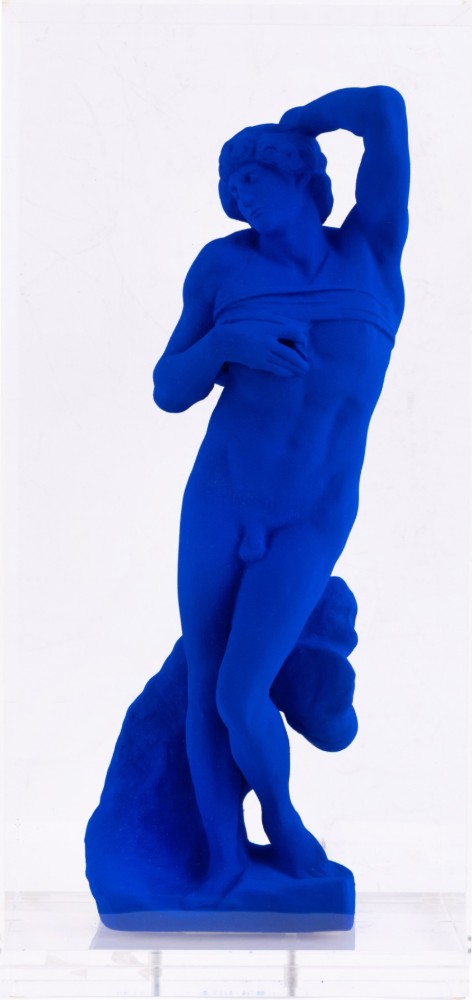
YVES KLEIN (1928 – 1962)
L’Esclave mourant d’après Michel Ange (S 20), 1962-1992
IKB pigment and synthetic resin on plaster cast
Stamped with the artist’s signature on a label affixed to the underside
Titled, inscribed S 20 and HC XLII/L
This example is one of 50 posthumous hors commerce examples aside from the numbered edition of 350
#9. La Terre bleue (RP 7), 1957-1990
Christie’s London: 5 June 2025
Estimated: GBP 20,000 – 30,000
GBP 32,760 / USD 44,495
YVES KLEIN (1928-1962), La Terre bleue (RP 7) (The Blue Earth (RP 7)) | Christie’s

YVES KLEIN (1928-1962)
La Terre bleue (RP 7) (The Blue Earth (RP 7)), 1957-1990
Dry pigment and synthetic resin on plaster
Incised with the artist’s monogram (lower edge)
Numbered ‘184⁄300’ (on a label affixed to the underside)
#10. “La Terre Bleue”, 1957-1990
Bukowskis Stockholm: 13 June 2025
Estimated: SEK 250,000 – 300,000
SEK 250,000 (Hammer)
SEK 337,500 / USD 35,345
Yves Klein, “La Terre Bleue”. – Bukowskis
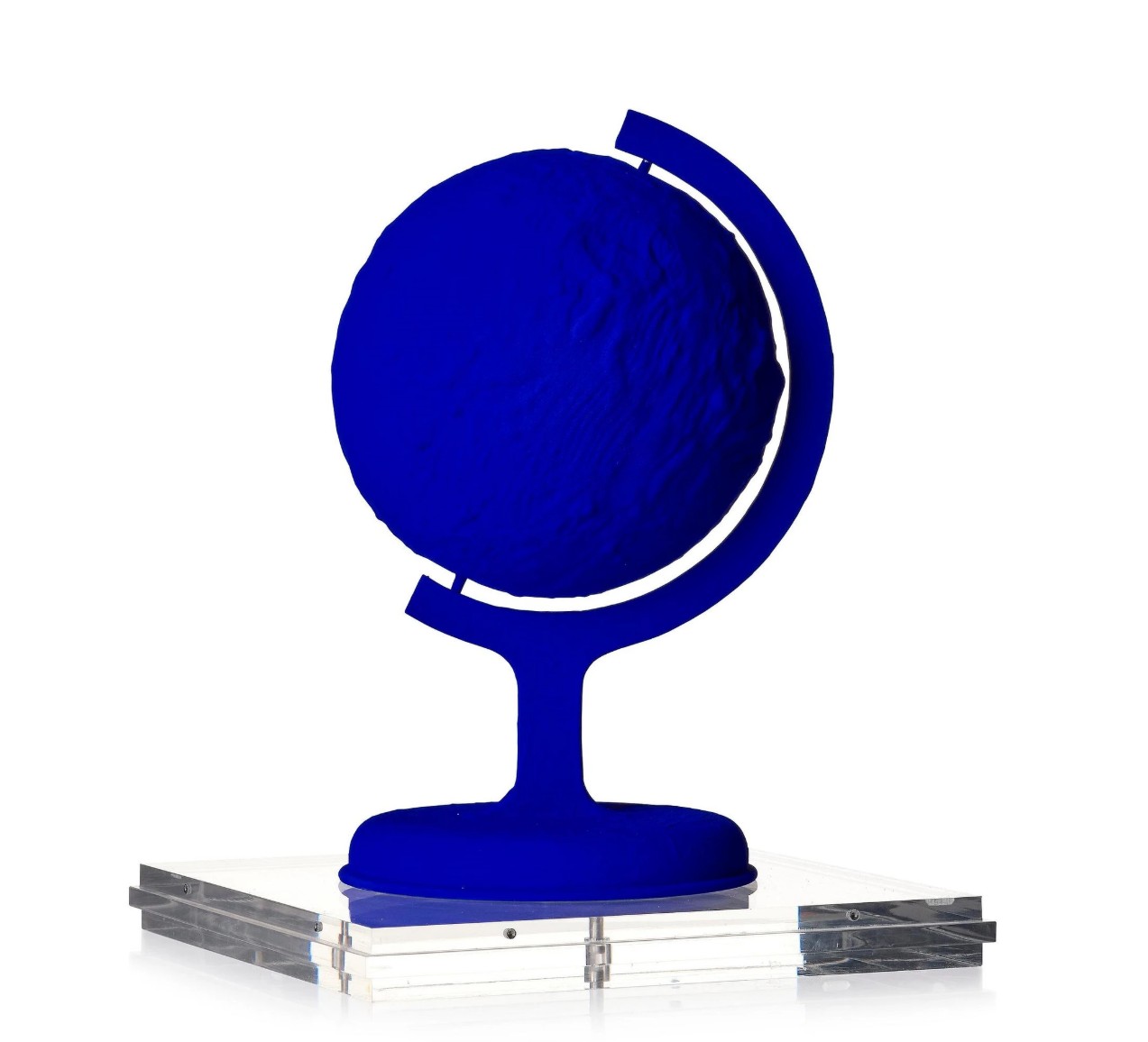
YVES KLEIN (France, 1928-1962)
“La Terre Bleue”, 1957-1990
IKB pigment and synthetic resin on plaster
Edition: 165/300
In a plexiglass box
With a label underneath “Editee par La Galerie Bonnier a Genève. Realisee par Jean-Paul Ledeur a Paris”
Conceived in 1957 by Yves Klein and produced in 1990 by Galerie Bonnier, Geneva
In collaboration with Rotraut Klein-Moquay and Jean-Paul Ledeur
#11. La terre bleue, 1957-90
Martini Studio d’Arte: 11 December 2025
Estimated: EUR 18,000 – 22,000
EUR 23,000 (Hammer)
EUR 28,750 / USD 28,750
Yves Klein work of art at auction: La terre bleue ‑ Martini Studio d’Arte
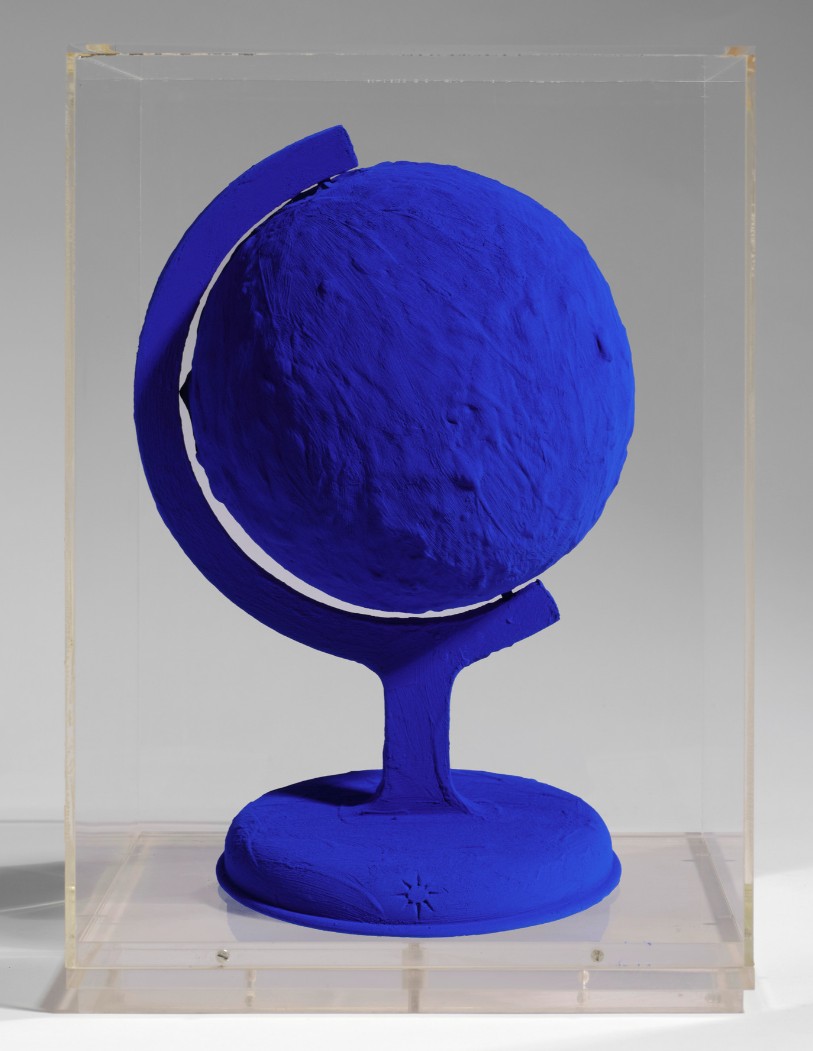
YVES KLEIN
La terre bleue, 1957-90
Pigment IKB and synthetic resin on plaster cast
Conceived in 1957 and created in 1990 by Galerie Bonnier in Geneva
Edition: HC III/L
#12. Table Bleue, 1961-63 / 2022
Wright Chicago: 5 June 2025
Estimated: USD 20,000 – 30,000
USD 25,400
237: YVES KLEIN, Table Bleue < Design, 5 June 2025 < Auctions | Wright: Auctions of Art and Design
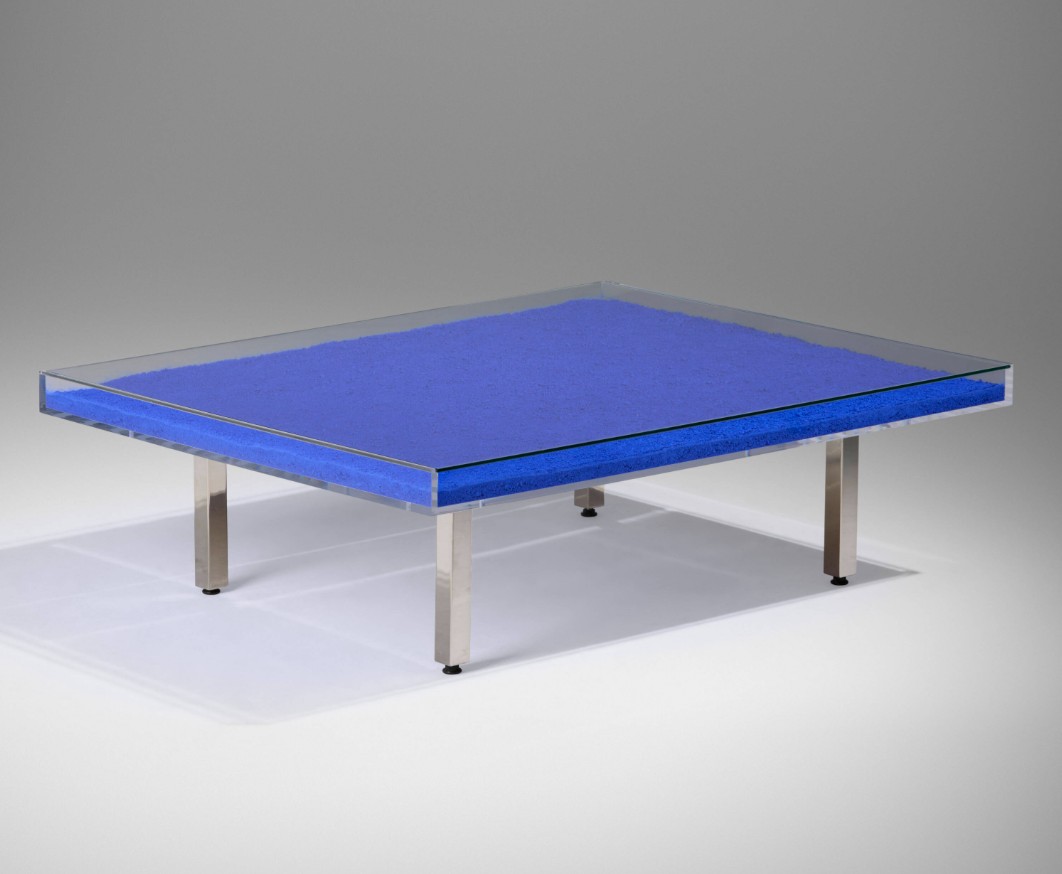
YVES KLEIN (1928–1962)
Table Bleue, 1961-63 / 2022
International Klein Blue pigment, glass, Plexiglas, chrome-plated steel
This work is from the edition started in 1963
Published by Rotraut Klein-Moquay based on a 1961 design by Yves Klein
Applied manufacturer’s plaque to underside
‘This table conforms to Yves Klein’s patent Serial Number: FVUI-POT R. KL. Moquay’
#13. Table d’Or, 1961
Bonhams New-York: 17 December 2025
Estimated: USD 15,000 – 20,000
USD 23,040
Bonhams : YVES KLEIN (1928-1962) Table d’Or
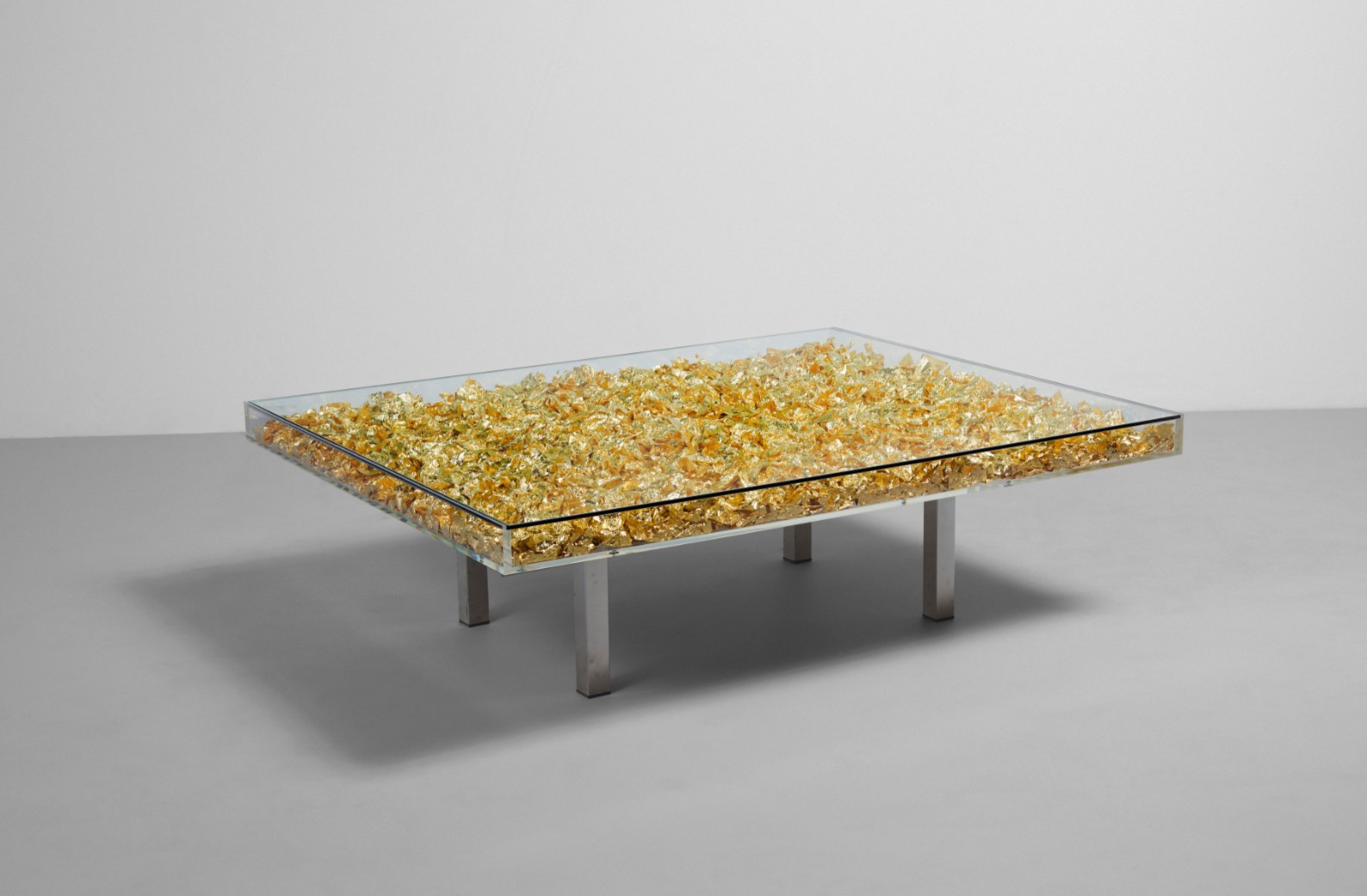
YVES KLEIN (1928-1962)
Table d’Or, 1961
Gold leaf, Plexiglas, glass, steel, wood, chrome-plated metal
With a plastic plaque signed ‘R. Klein-Moquay,’
Printed ‘This table conforms to Yves Klein’s patent SERIAL NUMBER: 97A1131’
Produced under the supervision of Rotraut Klein-Moquay, France
#14. Table IKB ®
Bonhams Cornette Paris: 4 December 2025
Estimated: EUR 10,000 – 15,000
EUR 19,200 / USD 22,385
Bonhams Cornette de Saint Cyr : YVES KLEIN (1928-1962) Table IKB ®
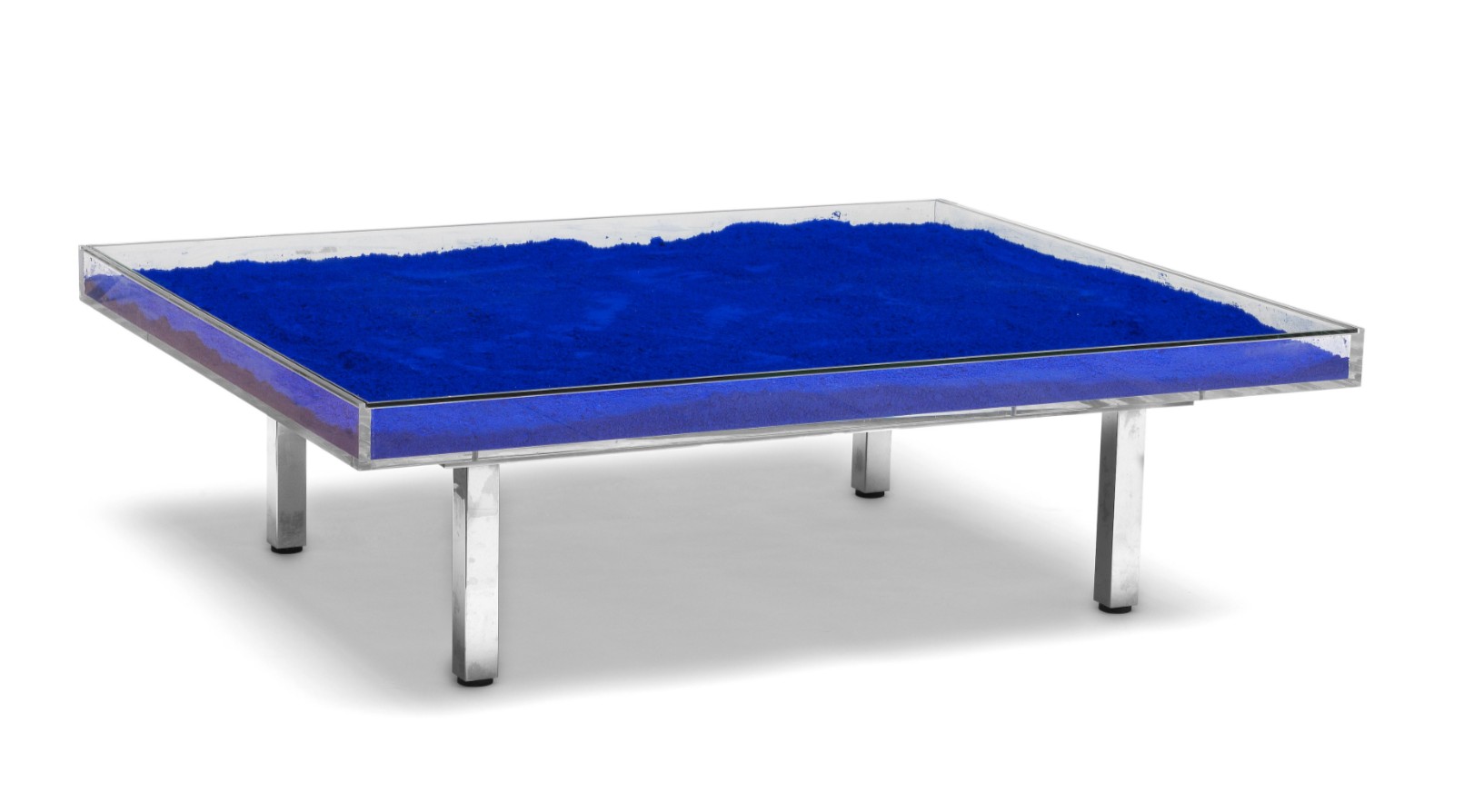
YVES KLEIN (1928-1962)
Table IKB ®
IKB pigment, glass, plexiglass, and metal base
Signed and numbered HG-EDFT- R. Klein Moquay on a label affixed underneath
#15. La terre bleue, 1957-90
Martini Studio d’Arte: 12 June 2025
Estimated: EUR 18,000 – 22,000
EUR 20,000 (Hammer)
EUR 25,000 / USD 21,760
Yves Klein work of art at auction: La terre bleue ‑ Martini Studio d’Arte
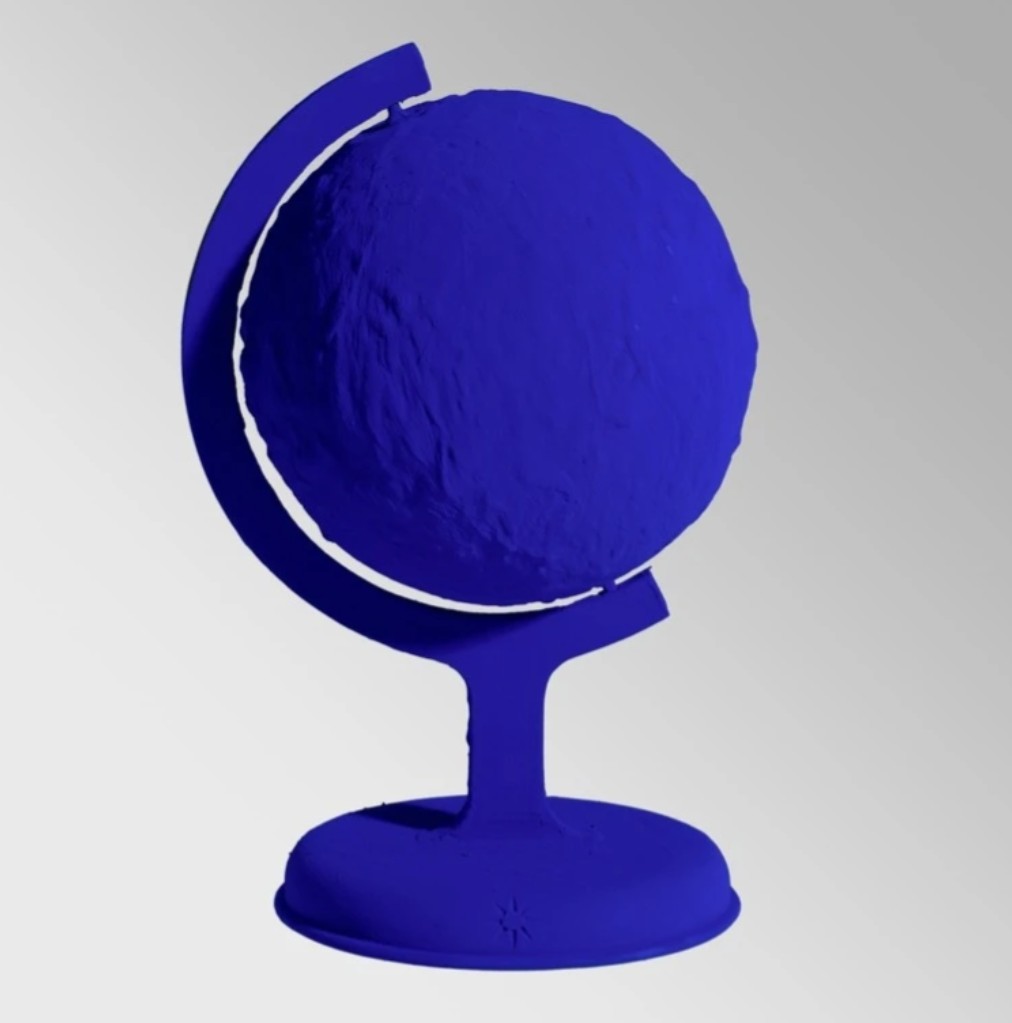
YVES KLEIN
La terre bleue, 1957-90
Pigment IKB and synthetic resin on plaster cast
Conceived in 1957 and created in 1990 by Galerie Bonnier in Geneva
Edition: HC XI/L
Certificate by Rotraut Klein-moquay
#16. Table d’Or, 1961-63 / c. 2010
Wright Chicago: 9 December 2025
Estimated: USD 15,000 – 20,000
USD 21,590
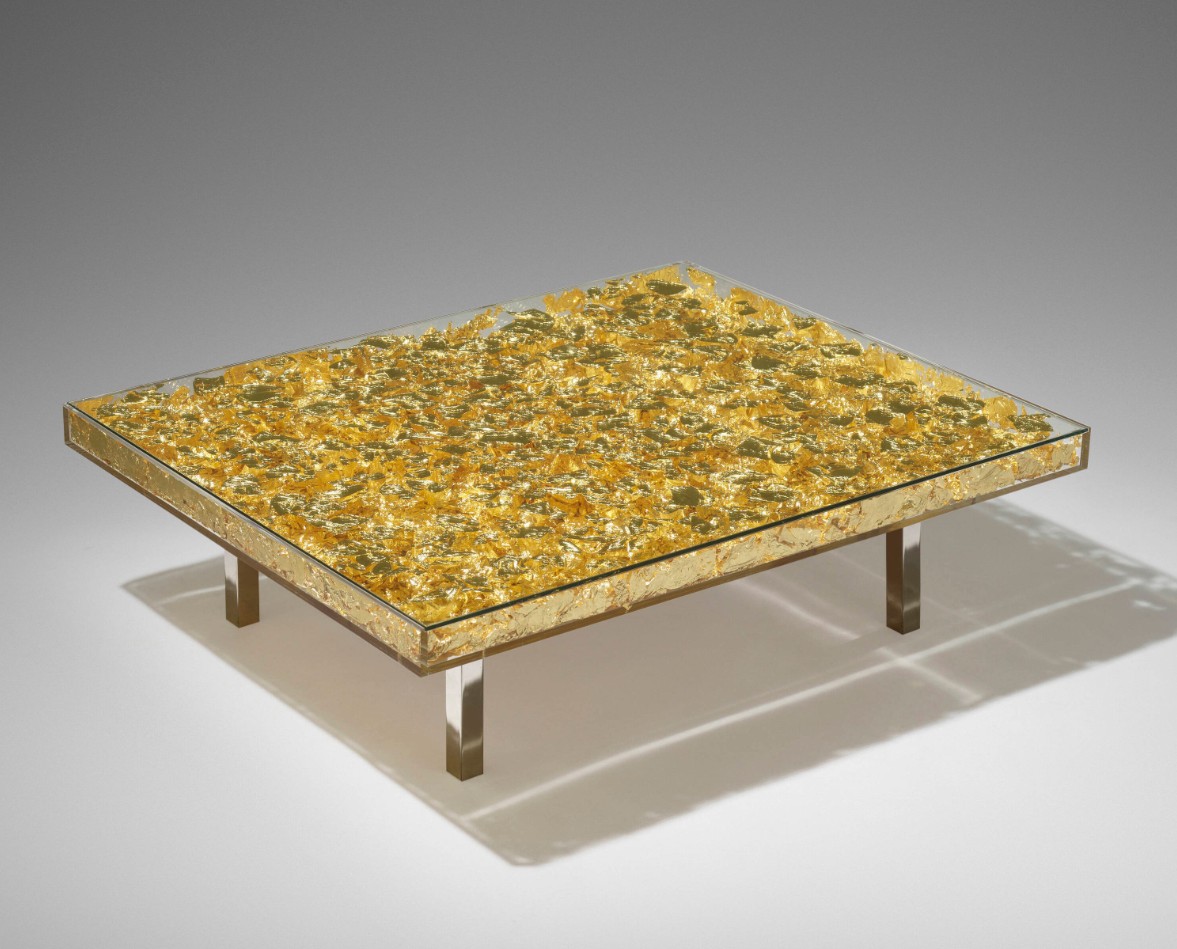
YVES KLEIN (1928–1962)
Table d’Or, 1961-63 / c. 2010
Gold leaf, glass, Plexiglas, chrome-plated steel
This work is from the edition conceived in 1961 based on a model by Yves Klein
The edition was begun in 1963 and supervised by the artist’s widow Rotraut Klein-Moquay
Manufacturer’s plaque to underside
‘This table conforms to Yves Klein’s patent Serial Number: ND-LETE R. KL. Moquay’.
#17. Table Rose, designed 1961
Bonhams New-York: 17 December 2025
Estimated: USD 10,000 – 15,000
USD 20,480
Bonhams : YVES KLEIN (1928-1962) Table Rose
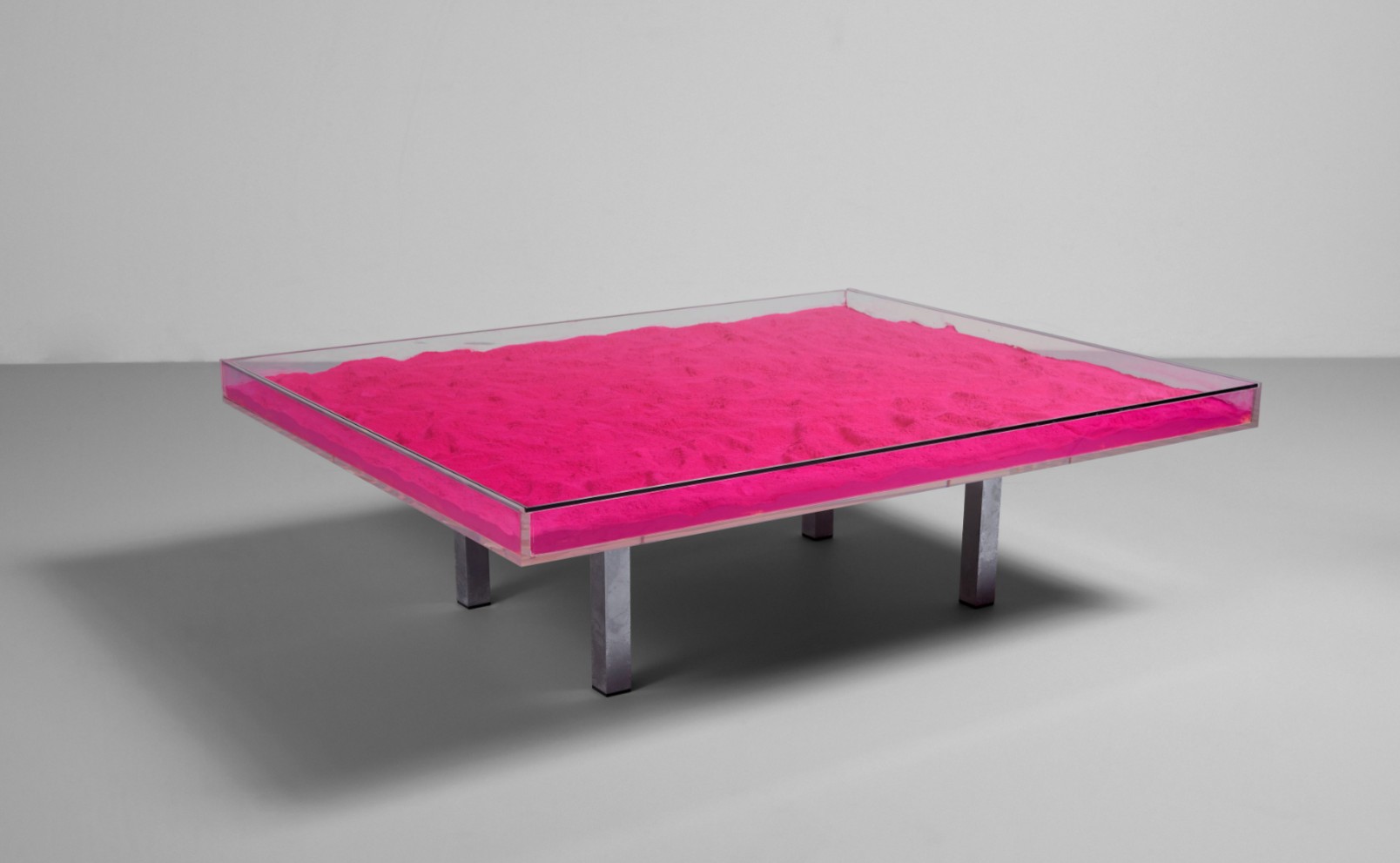
YVES KLEIN (1928-1962)
Table Rose, designed 1961
Rose-colored pigment, Plexiglas, chrome-plated metal
With a plastic plaque signed ‘R. Klein-Moquay,’
Printed ‘This table conforms to Yves Klein’s patent SERIAL NUMBER: 99A172’
Produced under the supervision of Rotraut Klein-Moquay, France
Table Monopink™, designed in 1961
Sotheby’s New-York: 15 July 2025
Estimated: USD 12,000 – 18,000
USD 19,050
Yves Klein | Table Monopink™ | Contemporary Discoveries | 2025 |
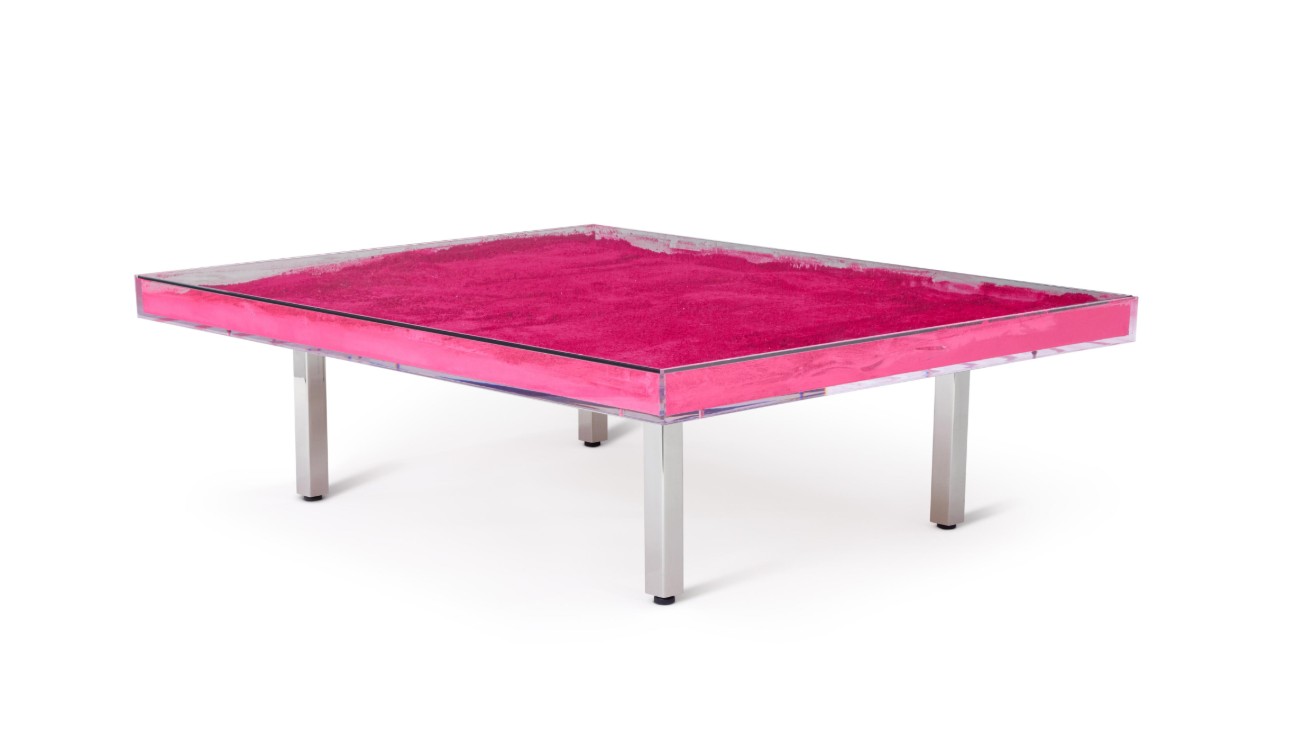
YVES KLEIN
Table Monopink™, designed in 1961
Rose pigment, plexiglass, wood, chrome-plated metal
Produced under the supervision of Rotraut Klein-Moquay, France
With a plastic plaque signed R. Klein-Moquay, printed
This table conforms/to Yves Klein’s patent and numbered 10 ES-REN
2024 Auction Results
#1. Vénus Bleue (S 41), 1962-1982
Christie’s New-York: 13 March 2024
Estimated: USD 80,000 – 120,000
USD 226,800
YVES KLEIN (1928-1962), Vénus Bleue (S 41) | Christie’s
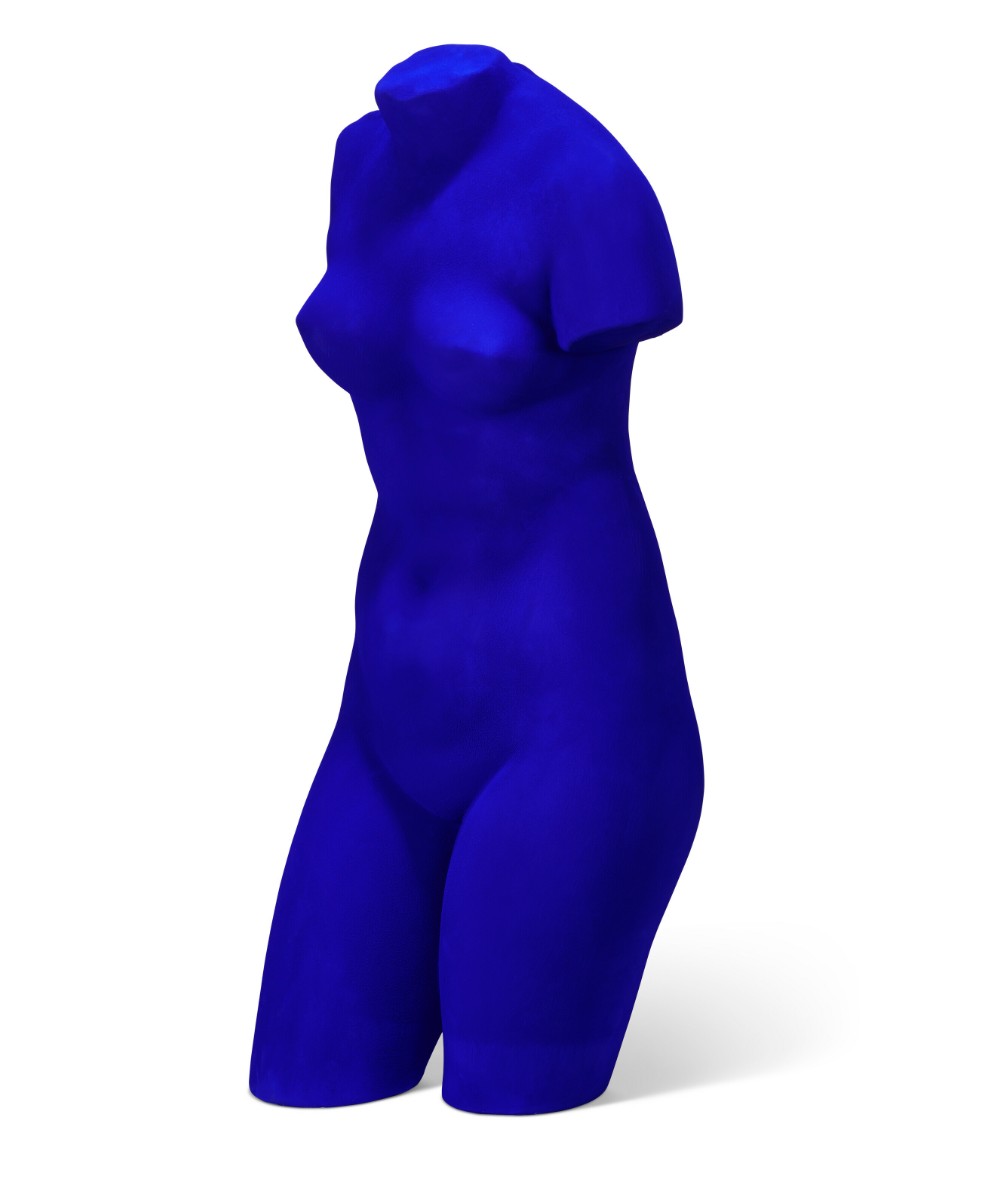
YVES KLEIN (1928-1962)
Vénus Bleue (S 41), 1962-1982
Dry pigment and synthetic resin on plaster
Stamped with the star and numbered ‘228/300’ (on the lower edge)
Stamped with the artist’s name, title and numbered again
‘VENUS BLEUE de Yves KLEIN 228/300’ (on the underside)
#2. Vénus d’Alexandrie (S 41), 1962-1982
MICA: THE COLLECTION OF MICA ERTEGUN
Christie’s New-York: 20 November 2024
Estimated: USD 70,000 – 100,000
USD 151,200
YVES KLEIN (1928-1962), Vénus d’Alexandrie (S 41) | Christie’s
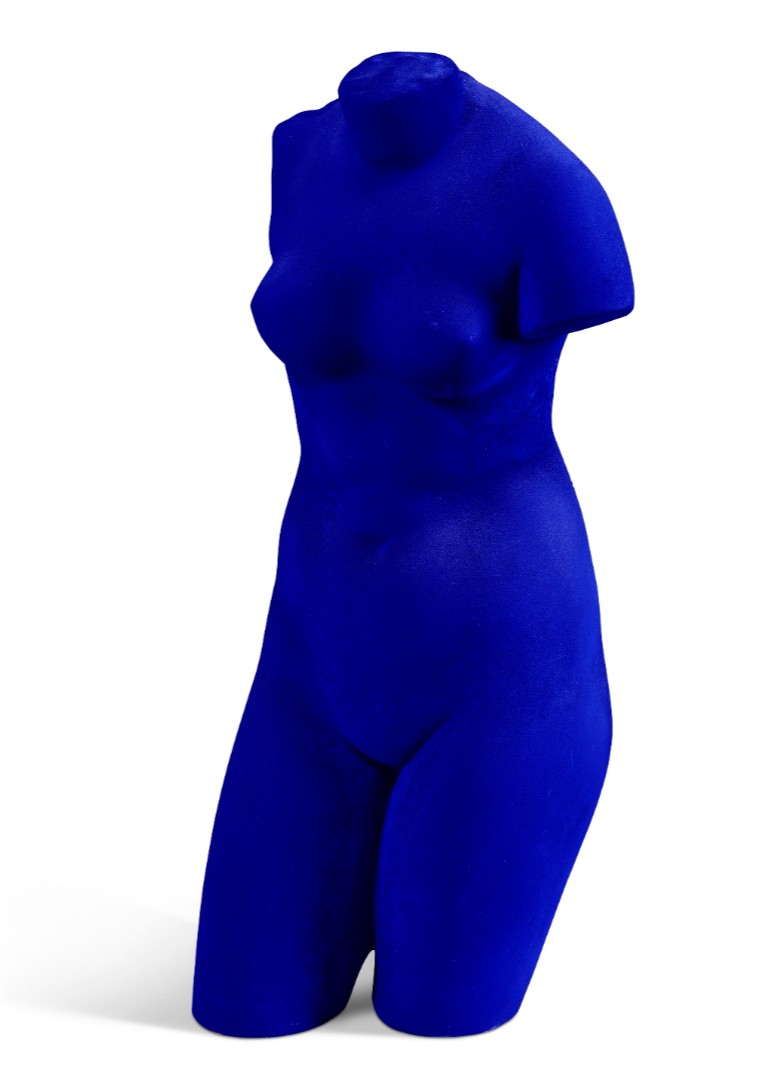
YVES KLEIN (1928-1962)
Vénus d’Alexandrie (S 41), 1962-1982
Dry pigment and synthetic resin on plaster
Stamped with the star and numbered ‘104⁄300’ (on the reverse)
Stamped with the editor’s stamp and numbered again ‘104⁄300’ (on the underside)
#3. Victoire de Samothrace, 1962/1973
Lempertz Cologne: 29 November 2024
Estimated: EUR 80,000 – 120,000
EUR 132,300 / USD 139,710
Victoire de Samothrace – Lot 52
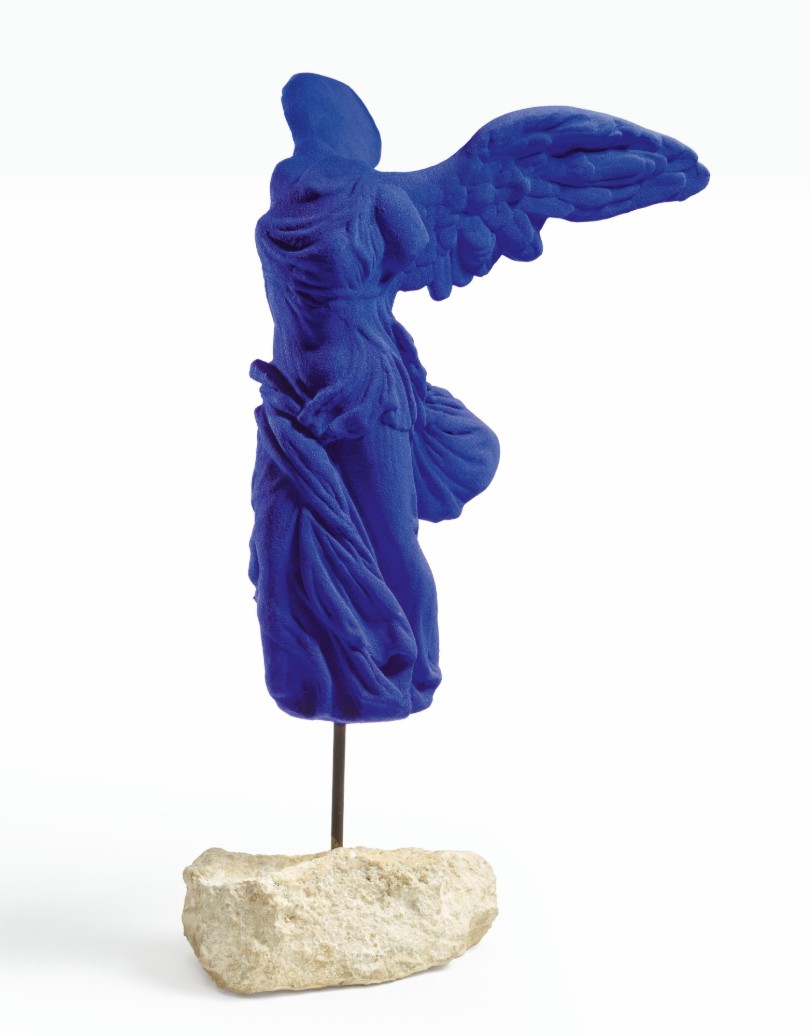
YVES KLEIN
Victoire de Samothrace, 1962/1973
IKB pigment and synthetic resin on plaster, with metal rod and stone base
Mongrammed on right wing
Numbered verso on the figure and on underside of stone base
Cast 111/175 (+25 H.C. +25 E.A. +3)
Edition with different stone plinths
Edition Galerie Karl Flinker, Paris
#4. Vénus bleue (S41), 1962-1982
Sotheby’s Paris: 18 October 2024
Estimated: EUR 80,000 – 120,000
EUR 126,000 / USD 136,450
Yves Klein | Vénus bleue (S41) | Surrealism and its Legacy | 2024 |
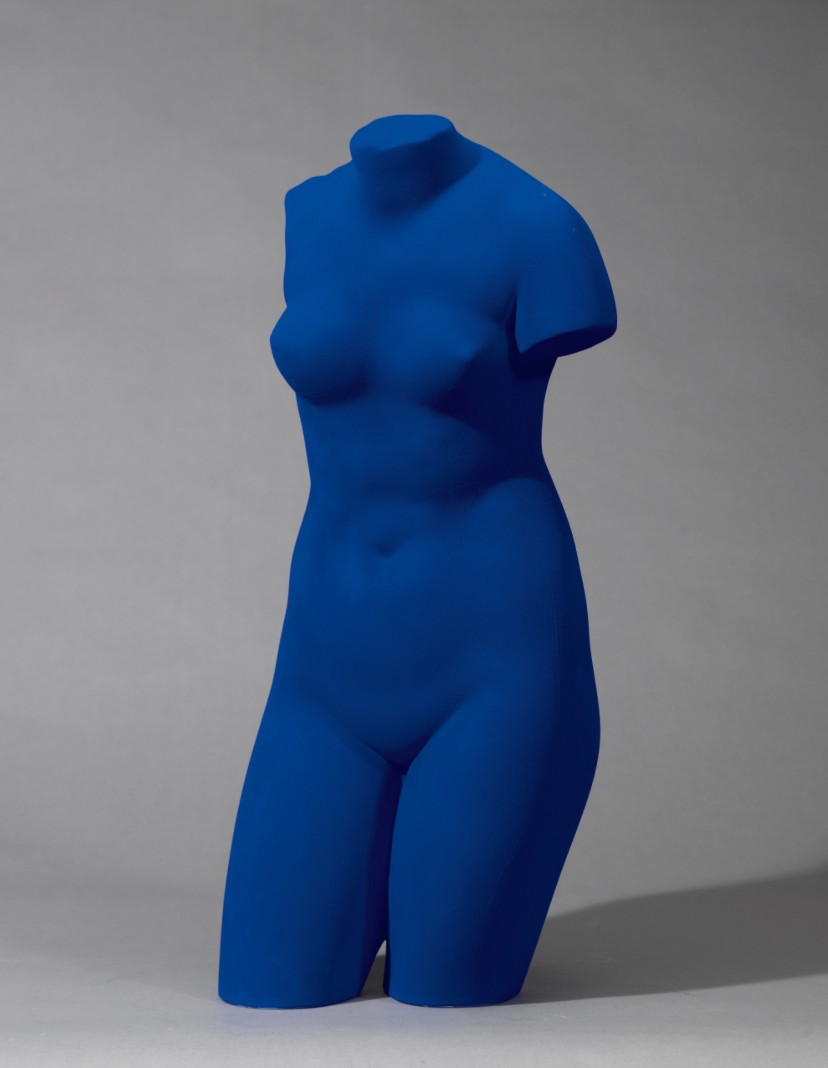
YVES KLEIN (1928 – 1962)
Vénus bleue (S41), 1962-1982
IKB dry pigment and synthetic resin on plaster
stamped with the artist’s name and title VENUS BLEUE de Yves KLEIN
Nmbered 201/300 on the underside
This work is number 201 from an edition of 300, plus 50 hors-commerce proofs and 3 artist’s proofs
FOCUS
La Victoire de Samothrace
La Victoire de Samothrace
Medium: Dry blue pigment in synthetic resin on plaster with a metal and stone base
Year: Conceived in 1962 and executed in 1973
Dimensions: 52.1 x 24.4 x 24.1 cm (20-1/2 x 9-5/8 x 9-1/2 inches)
Edition: 175
Artist’s Proofs: 25 AP
Hors Commerce: 25 HC
Other: 3 in resin executed especially for the Opéra Bastille in Paris
Publisher: Galerie Karl Flinker, Paris
Incised with the artist’s initials and date 62 (on the left wing)
Numbered on the reverse of the figure
Inspired by his studies and travels throughout Europe, Klein executed La Victoire de Samothrace in the final year of his life. Shortly before his death, Klein had embarked on a series of projects in which he reinterpreted major works of the art historical canon with his instantly recognizable, patented International Klein Blue (IKB) pigment. Exacting small-format plaster replicas that would then be coated in the intensely ultramarine hue, Klein transformed major works of classical antiquity including the Hellenistic Greek marble sculpture La Victoire de Samothrace, a crown jewel of the permanent collection of the Louvre, through his radical, monochrome sensibilities.
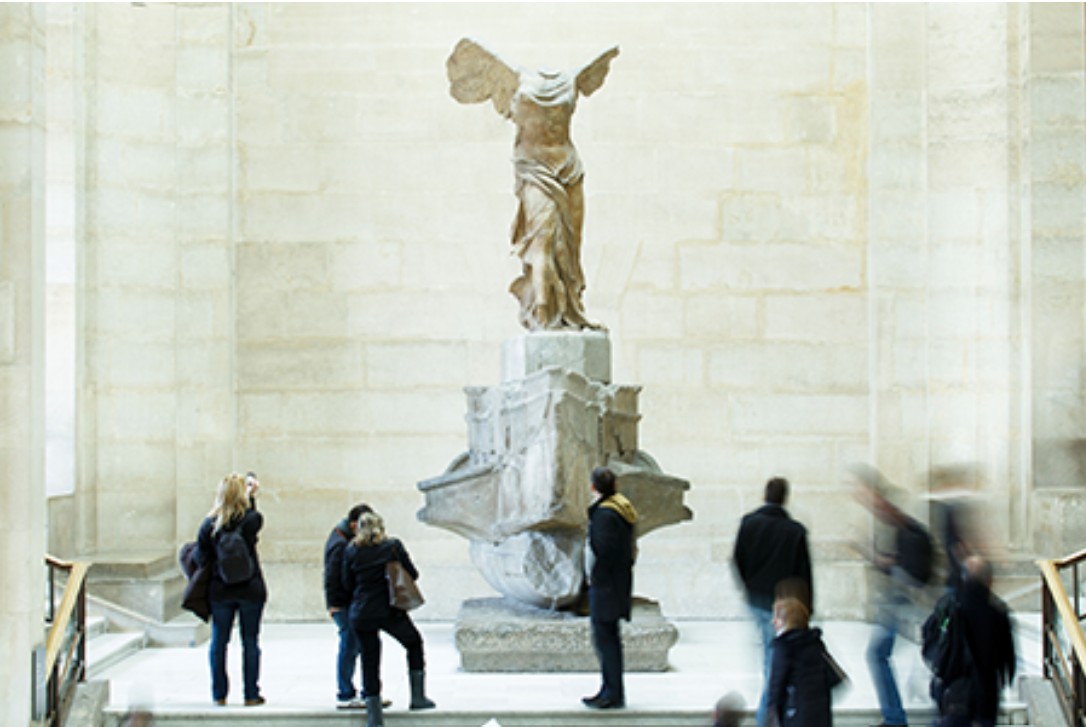
The Winged Victory of Samothrace by unknown Greek sculptor. Louvre Museum, Paris, France. Image: Joan Gil / Alamy Stock Photo
The classical La Victoire de Samothrace commemorates a Greek naval victory in the 2nd century B.C. through the mythological Niké, the winged goddess of victory, her marble drapery dynamically formed as if windswept. Through Klein’s application of IKB pigment, the artist strips the famed sculpture of its historical and cultural specificity, save for the stone base that serves as a trace reminder of the original marble. To the artist, IKB was not just a color, but a portal to the infinite, inspired by an experience in being struck by the immaterial void of the sky as a young man on the beaches of Nice; it symbolized a certain freedom, obliterating the constraints of representationalism and the physical realm. Thus, under Klein’s command, La Victoire de Samothrace becomes not just a mere synthesis of antiquity and experimentalism, but a totem of immateriality, of a spiritual dimension beyond the visible world – a metamorphosis made all the more poignant considering Klein’s untimely death the same year, at the young age of 34.
Auction Results
La Victoire de Samothrace, 1962-1973
Property from a Distinguished International Collection
Sotheby’s New-York: 19 November 2025
Estimated: USD 80,000 – 120,000
USD 241,300
Yves Klein | La Victoire de Samothrace | Contemporary Day Auction |
YVES KLEIN (1928 – 1962)
La Victoire de Samothrace, 1962-1973
Dry blue pigment in synthetic resin on plaster with a metal and stone base
Incised with the artist’s initials and date 62 (on the left wing)
Numbered 93/175 (on the reverse of the figure)
Victoire de Samothrace, 1962-1983
Christie’s Paris: 24 October 2025
Estimated: EUR 80,000 – 120,000
EUR 152,400 / USD 177,045
Yves Klein (1928-1962), Victoire de Samothrace | Christie’s
YVES KLEIN (1928-1962)
Victoire de Samothrace, 1962-1983
Dry pigment and synthetic resin on plaster, with metal and stone base
Signed with the initials and dated ‘YK 62′ (on a wing)
Numbered ’20⁄175′ (to the bottom backside)
Numbered ’20⁄175’ (to the underside)
La Victoire de Samothrace, 1962/1973
Phillips New-York: 21 October 2025
Estimated: USD 70,000 – 100,000
USD 167,700
Yves Klein MODERNISM: Editions & Works on Paper
YVES KLEIN
La Victoire de Samothrace (Winged Victory of Samothrace), 1962/1973
Dry blue pigment and synthetic resin on plaster, with a metal rod and stone base
Incised with initials and dated ’62’ on one of the wings
Numbered XXII/XXV in black ink on the underside of the stone base
One of 25 hors commerce in Roman numerals
Victoire de Samothrace, 1962/1973
Lempertz Cologne: 29 November 2024
Estimated: EUR 80,000 – 120,000
EUR 132,300 / USD 139,710
Victoire de Samothrace – Lot 52
YVES KLEIN
Victoire de Samothrace, 1962/1973
IKB pigment and synthetic resin on plaster, with metal rod and stone base
Mongrammed on right wing
Numbered verso on the figure and on underside of stone base
Cast 111/175 (+25 H.C. +25 E.A. +3)
Edition with different stone plinths
Edition Galerie Karl Flinker, Paris
La Vénus d’Alexandrie
La Vénus d’Alexandrie
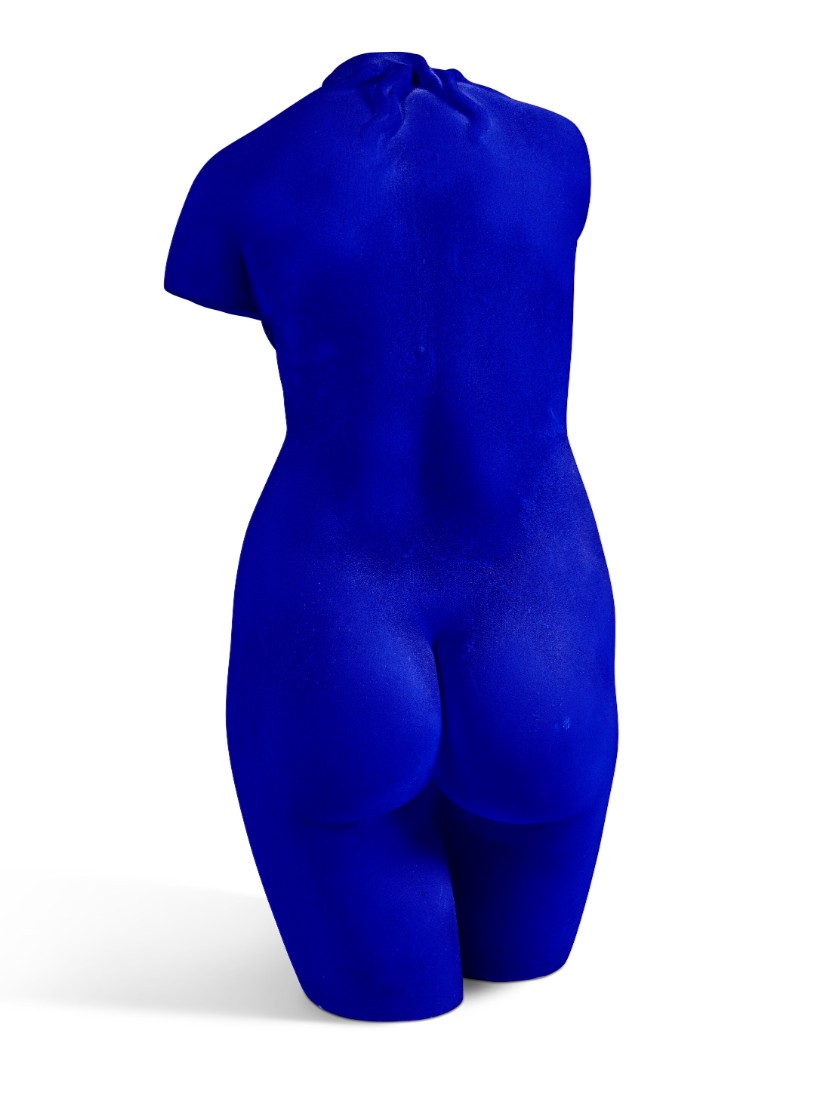
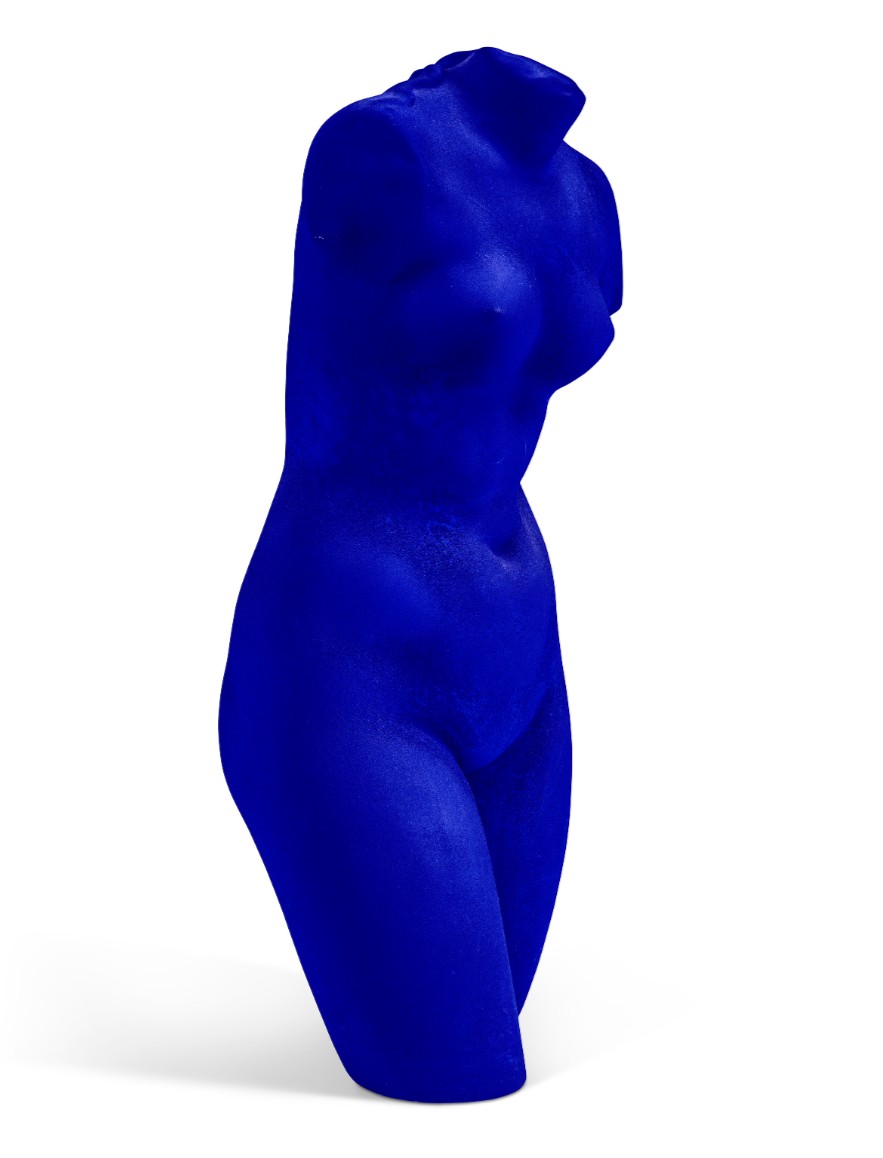
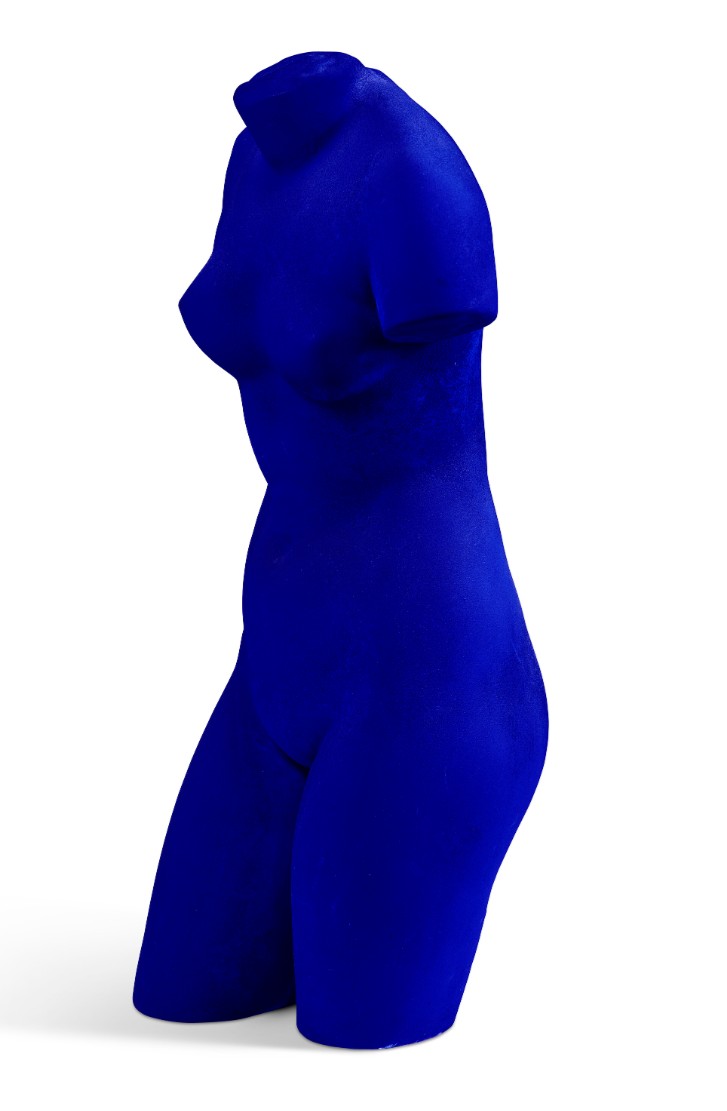
Medium: Dry pigment and synthetic resin on plaster
Year: Conceived in 1962 and executed in 1982
Dimensions: 69x32x24 cm (27-1/8 x 12-5/8 x 9-1/2 inches)
Edition: 300
Hors Commerce: 50 HC, numbered in Roman numerals
Other: 3 copies numbered 001 to 003
Publisher: Bonnier Gallery, Geneva
Literature: S41
Numbered to the bottom backside
With the editor’s stamp and numbered to the underside
In May 1960, following several years of refining his blue pigment, Klein registered his International Klein Blue (IKB) patent. In doing so, Klein aimed for a “Blue Revolution” – a new aesthetic vision in which he would transform the world around him with the application of his patented IKB paint. Through his artistic practice, Klein aspired to “take over the world” and “make it more beautiful.”
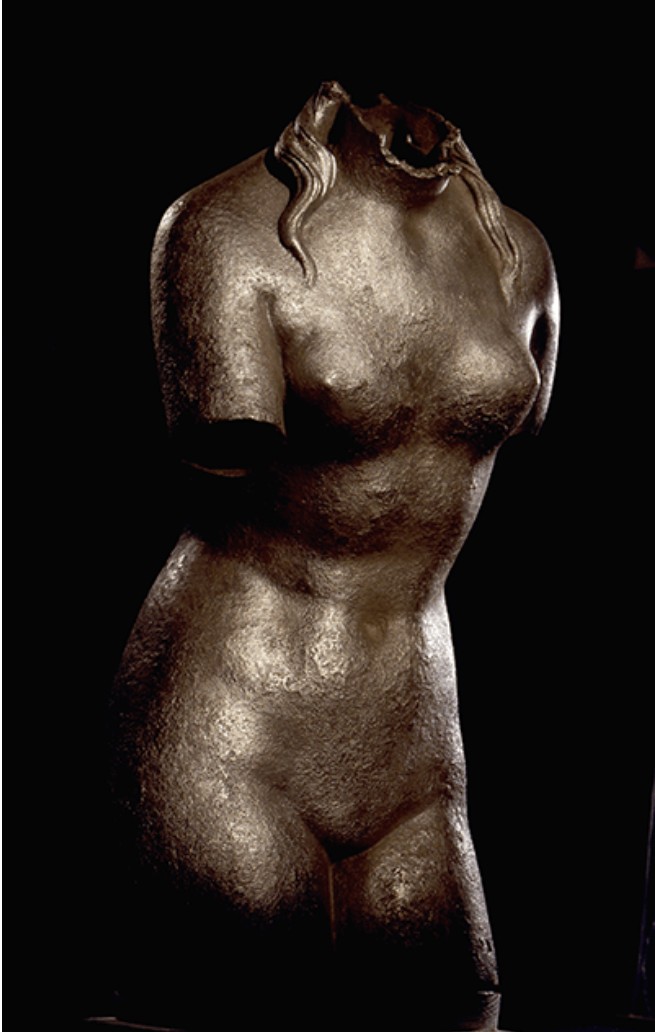
Statue of Aphrodite (Venus), Graeco-Roman, 3rd – 2nd BC, Graeco-Roman Museum, Alexandria, Egypt.
Image: Heritage Image Partnership Ltd / Alamy Stock Photo.
In La Vénus d’Alexandrie (Vénus bleue), Klein transforms the archetypal classical beauty – the Venus d’Alexandrie – into a twentieth century equivalent through the application of his ultramarine blue pigment. With harmonic and perfected proportions, classical sculptures like the Venus d’Alexandrie have been heralded as the epitome of feminine beauty for centuries. Just like the Venus’s form symbolizes idealized and eternal beauty, Klein believed that the ethereal qualities of his blue paint captured the infinite. Klein’s Venus, cloaked in blue, now transcends time, space, and mortality. Following Klein’s premature death in 1962, aged just 34, Klein’s widow Rotraut Klein-Moquay began working with Jan Runnqvist of Galerie Bonnier to bring some of his unrealized designs and concepts to life. Dedicated to upholding the integrity of Klein’s artistic vision, the artist’s estate worked tirelessly to replicate Klein’s techniques and desired mediums. Conceived as a multiple, La Vénus d’Alexandrie (Vénus bleue) helps disseminate Klein’s theories and messages around the world.
Auction Results
La Vénus d’Alexandrie (S41), 1962-1982
Christie’s Paris: 4 December 2025
Estimated: EUR 70,000 – 100,000
EUR 101,600 / USD 118,530
YVES KLEIN (1928-1962), La Vénus d’Alexandrie (S41) | Christie’s
YVES KLEIN (1928-1962)
La Vénus d’Alexandrie (S41), 1962-1982
Dry pigment and synthetic resin on plaster
Numbered ‘259/300’ (to the bottom backside)
With the editor’s stamp and numbered ‘259/300’ (to the underside)
La Vénus d’Alexandrie (Vénus Bleue, S 41), 1962-1982
Christie’s London: 5 June 2025
Estimated: GBP 50,000 – 70,000
GBP 163,800 / USD 221,965
YVES KLEIN (1928-1962)
La Vénus d’Alexandrie (Vénus Bleue, S 41) (The Venus of Alexandria (Blue Venus, S 41)), 1962-1982
Dry pigment and synthetic resin on plaster
Inscribed with the artist’s monogram and numbered ‘HC XXXVI/L’ (on the reverse of the left leg)
Stamped with the artist’s name, title and number ‘VENUS BLEUE de Yves KLEIN HC XXXVI/L’ (on the underside)
This work is the hors-commerce number thirty six from an edition of three hundred plus fifty hors-commerce and three resin examples
Vénus d’Alexandrie (S 41), 1962-1982
Christie’s New-York: 15 May 2025
Estimated: USD 70,000 – 100,000
USD 163,800
YVES KLEIN (1928-1962), Vénus d’Alexandrie (S 41) | Christie’s
YVES KLEIN (1928-1962)
Vénus d’Alexandrie (S 41), 1962-1982
Dry pigment and synthetic resin on plaster
Stamped with the artist’s monogram and numbered ’51⁄300′ (on the reverse)
Stamped with the editor’s stamp and numbered again ’51⁄300′ (on the underside)
This work is number 51 from an edition of 300 plus 50 hors-commerce numbered I/L to L/L and three copies numbered 001 to 003
Vénus d’Alexandrie (S 41), 1962-1982
MICA: THE COLLECTION OF MICA ERTEGUN
Christie’s New-York: 20 November 2024
Estimated: USD 70,000 – 100,000
USD 151,200
YVES KLEIN (1928-1962), Vénus d’Alexandrie (S 41) | Christie’s
YVES KLEIN (1928-1962)
Vénus d’Alexandrie (S 41), 1962-1982
Dry pigment and synthetic resin on plaster
Stamped with the star and numbered ‘104⁄300’ (on the reverse)
Stamped with the editor’s stamp and numbered again ‘104⁄300’ (on the underside)
Vénus bleue (S41), 1962-1982
Sotheby’s Paris: 18 October 2024
Estimated: EUR 80,000 – 120,000
EUR 126,000 / USD 136,450
Yves Klein | Vénus bleue (S41) | Surrealism and its Legacy | 2024 |
YVES KLEIN (1928 – 1962)
Vénus bleue (S41), 1962-1982
IKB dry pigment and synthetic resin on plaster
stamped with the artist’s name and title VENUS BLEUE de Yves KLEIN
Nmbered 201/300 on the underside
This work is number 201 from an edition of 300, plus 50 hors-commerce proofs and 3 artist’s proofs
Vénus Bleue (S 41), 1962-1982
Christie’s New-York: 13 March 2024
Estimated: USD 80,000 – 120,000
USD 226,800
YVES KLEIN (1928-1962), Vénus Bleue (S 41) | Christie’s
YVES KLEIN (1928-1962)
Vénus Bleue (S 41), 1962-1982
Dry pigment and synthetic resin on plaster
Stamped with the star and numbered ‘228/300’ (on the lower edge)
Stamped with the artist’s name, title and numbered again
‘VENUS BLEUE de Yves KLEIN 228/300’ (on the underside)
L’Esclave mourant d’après Michel-Ange
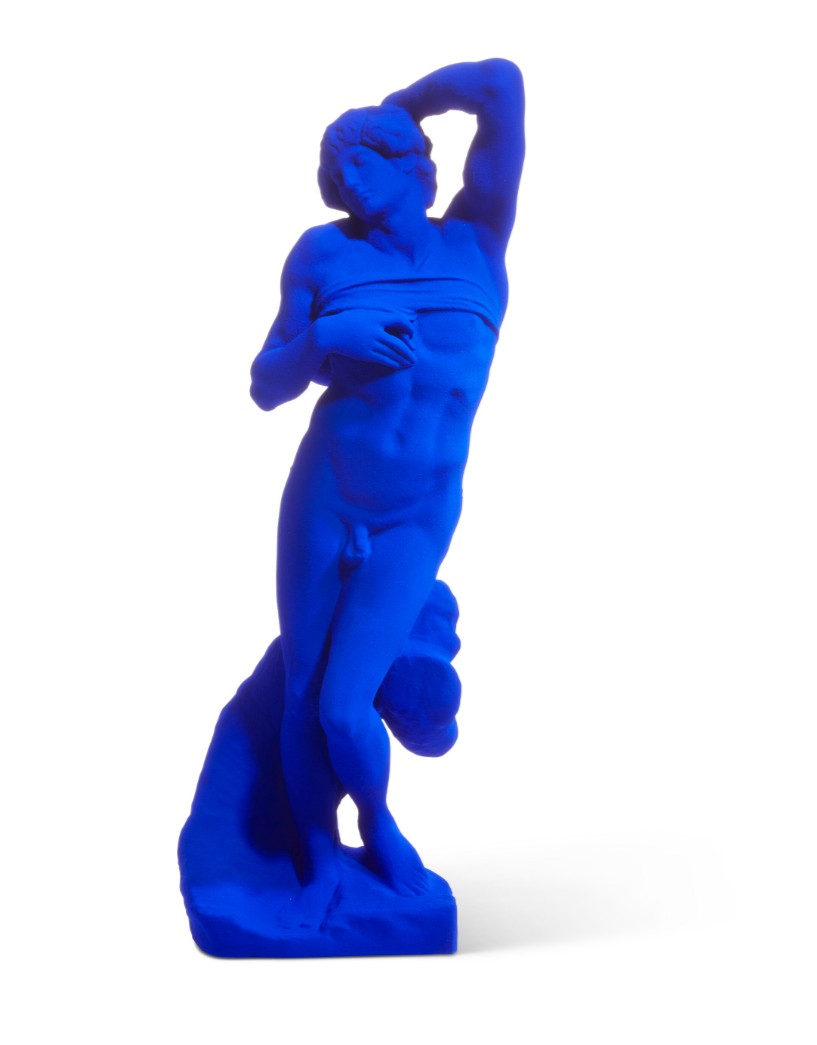
L’Esclave mourant d’après Michel-Ange
Medium: IKB pigment and synthetic resin on plaster cast
Year: Conceived in 1962 and executed in 1992
Dimensions: 59x18x13 cm (23-1/4 x 7-1/8 x 5-1/8 inches)
Edition: 300
Hors Commerce: 50 HC
Publisher: Jean-Paul Ledeur
Signed, titled and numbered on a label to the underside
Yves Klein famously declared the blue sky to be his first artwork and from there continued finding radical new ways to represent the infinite in his works. He is perhaps best known for his use of the distinctive vivid ultramarine pigment which he claimed to have invented and later trademarked as ‘International Klein Blue’ (IKB). With this, Klein kicked off his ‘blue revolution’ and from 1962 began transforming everyday items and antique works from the Louvre by covering them in IKB paint. His aim was for this series to ‘take over the world’ and ‘make it more beautiful’. As multiples, these works were meant to spread Klein’s theories and messages around the world, acting as ambassadors to his monochrome world.
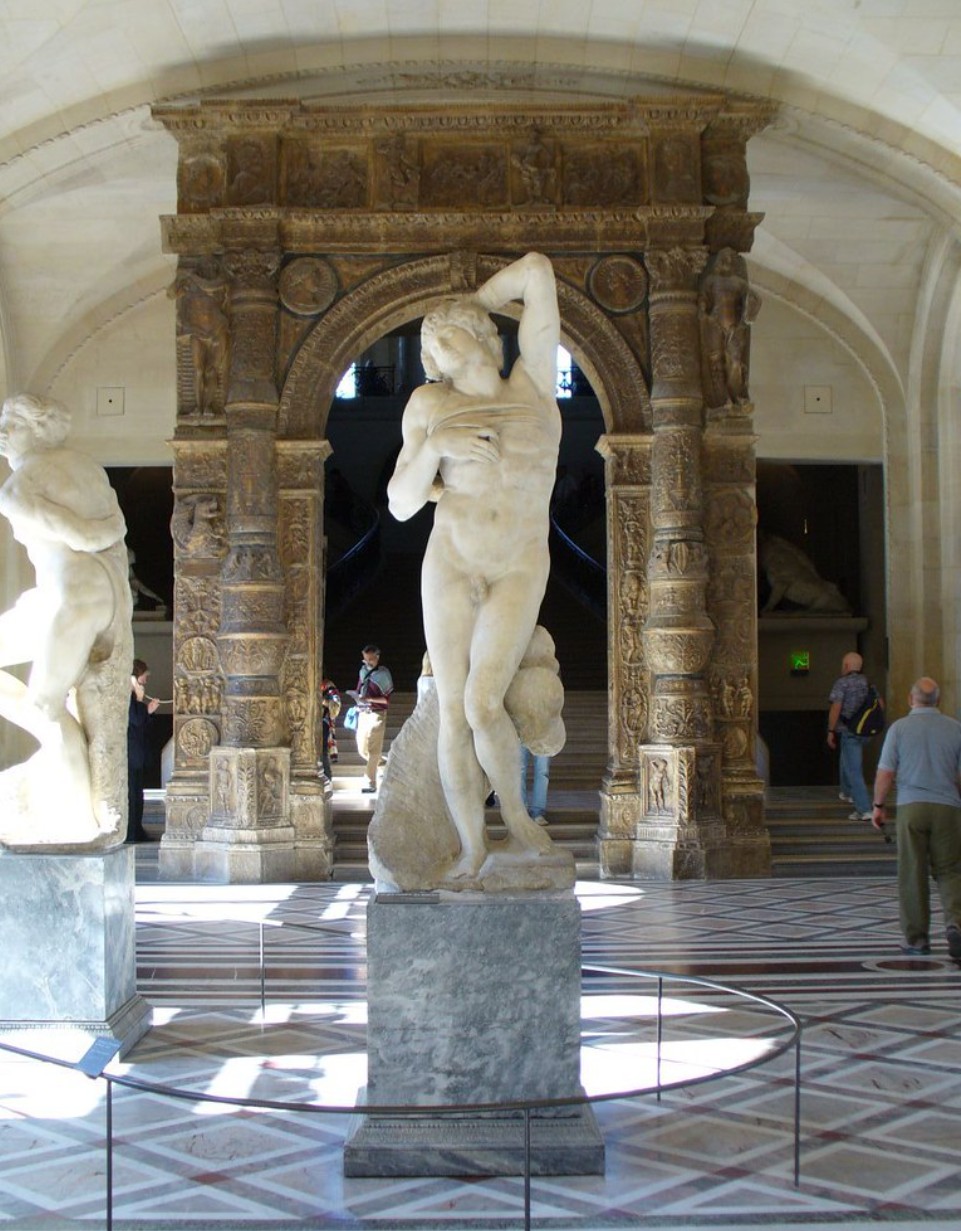
Klein’s early artistic journey was defined by a search for creative freedom, rejecting the conventional representational boundaries of painting. With IKB, Klein immersed himself in the purity of this immaterial space, believing that the colour allows our eyes to penetrate what seems to be a limitless depth. Inspired by the French philosopher Gaston Bachelard, Klein explained, ‘First there is nothing, then a depth of nothingness, then a profundity of blue’. Fascinated with this signature blue monochrome, which resembled the semi-precious lapis lazuli used to paint the Madonna’s robes in Renaissance paintings, Klein applied it in almost every single part of his practice, with performance art and sculpture no exception. In Esclave mourant d’après Michel-Ange, Klein applies IKB to a plaster cast of the famous sculpture by the Renaissance master Michelangelo. Described as capturing ‘that moment when life capitulates before the relentless force of dead matter’ by the art historian Richard Fly, IKB revives Esclave mourant with a boundless universe perceived beyond the frailty of human form.
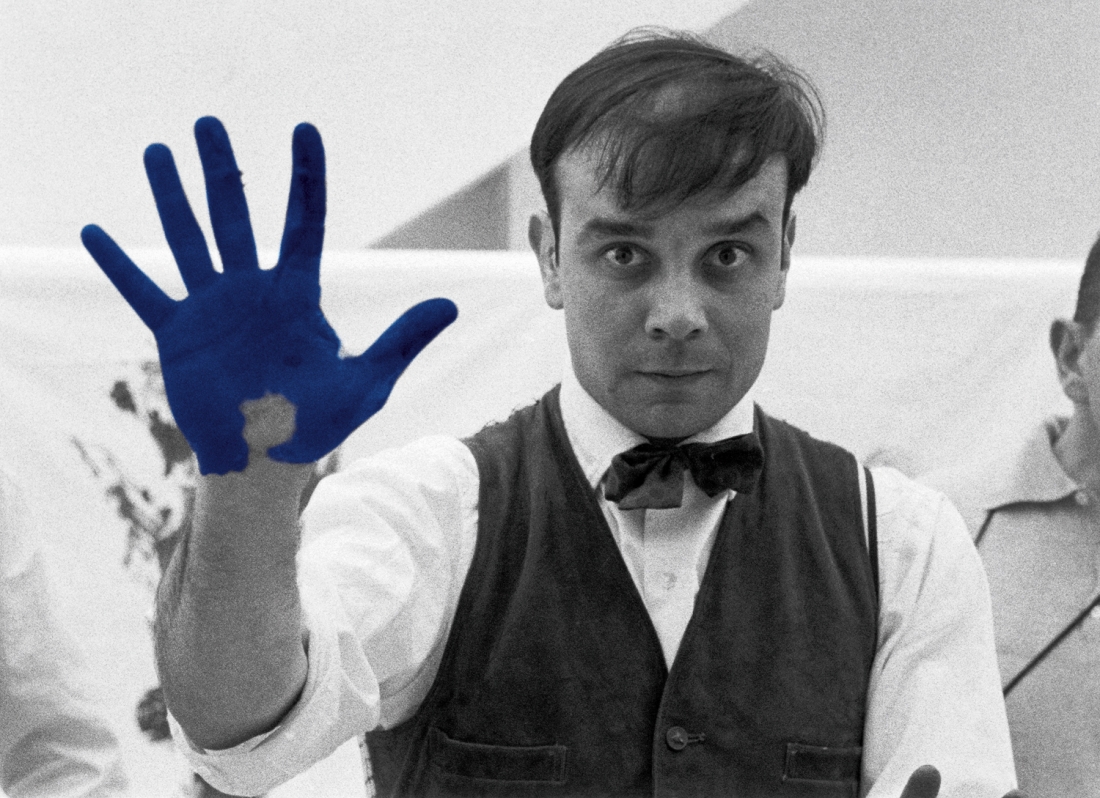
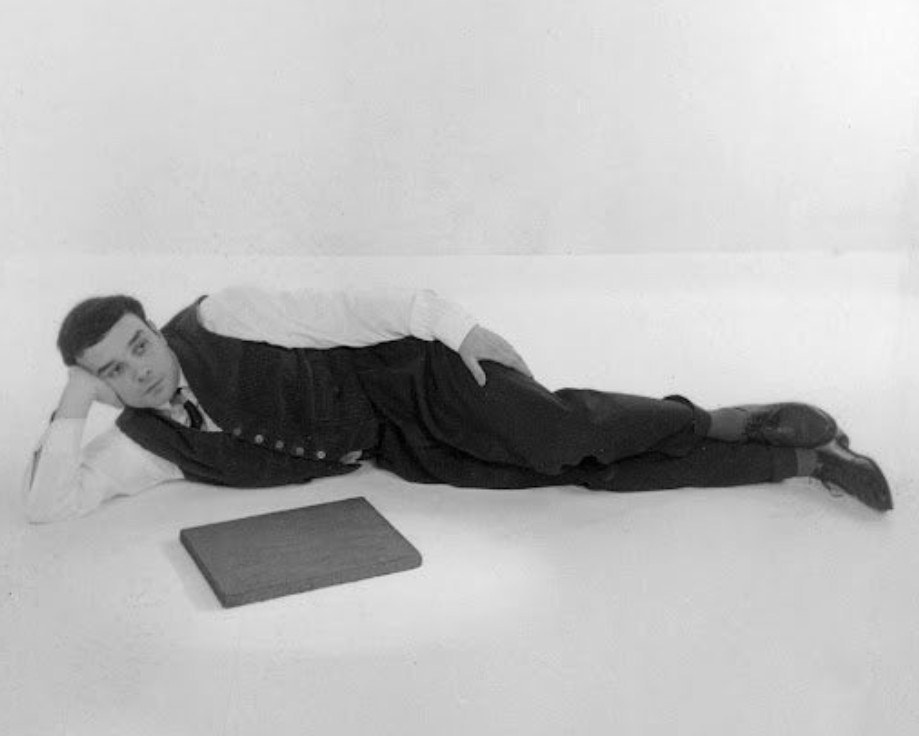 Portrait of Yves Klein / Photograph taken by Willy Maywald
One of the most brilliant artists of his generation, Klein’s untimely death from a heart attack at the age of 34 did not diminish the profound influence of his work on the development of contemporary art. Today, Klein’s work forms part of many prestigious institutions around the world, including the Guggenheim Museum, Bilbao, the Museum of Modern Art, New York, Musée d’art moderne de la Ville de Paris and the Tate Modern, London.
Auction Results
L’Esclave mourant d’après Michel Ange, 1962-1992
Sotheby’s New-York: 15 April 2025
Estimated: USD 50,000 – 70,000
USD 57,150
Yves Klein | L’Esclave mourant d’après Michel Ange (S 20) | Prints &
YVES KLEIN (1928 – 1962)
L’Esclave mourant d’après Michel Ange (S 20), 1962-1992
IKB pigment and synthetic resin on plaster cast
Stamped with the artist’s signature on a label affixed to the underside
Titled, inscribed S 20 and HC XLII/L
This example is one of 50 posthumous hors commerce examples aside from the numbered edition of 350
L’Esclave mourant d’après Michel-Ange (S 20), 1962-1992
Christie’s Paris: 11 April 2025
Estimated: EUR 40,000 – 60,000
EUR 75,600 / USD 85,635
Yves Klein (1928-1962), L’Esclave mourant d’après Michel-Ange (S 20) | Christie’s
YVES KLEIN (1928-1962)
L’Esclave mourant d’après Michel-Ange (S 20), 1962-1992
IKB pigment and synthetic resin on plaster cast
Signed, titled, numbered and inscribed
‘Yves Klein S 20 ”l’esclave mourant d’après Michel Ange” 262⁄300 R. Klein Moquay’
(on a label to the underside)
This work is number two hundred and sixty-two from an edition of three hundred and fifty Hors Commerce
L’Esclave mourant d’après Michel Ange, 1962-1992
Monte Carlo Auction House: 20 February 2025
Estimated: EUR 30,000 – 50,000
EUR 45,000 (Hammer)
EUR 56,250 / USD 58,925
YVES KLEIN (1928-1962) | Hôtel Des Ventes De Monte-Carlo
YVES KLEIN (1928 – 1962)
L’Esclave mourant d’après Michel Ange, 1962-1992
IKB pigment and synthetic resin on plaster cast
Stamped with the artist’s signature on a label affixed to the underside
Titled, inscribed S 20 and numbered 23/300
La Terre Bleue
La Terre Bleue
Year: Conceived in 1957 and executed in 1988/1990
Dimensions: 35x18x18 cm (13-3/4 x 7 x 7 inches)
Edition: 300
Hors Commerce: 50 HC
Produced by: Jean-Paul Ledeur, Paris
Numbered on an artist’s label affixed to the underside of the base
Few artists have managed to reduce the world to a single idea with such clarity as Yves Klein. La Terre Bleue stands among his most striking multiples, a work in which the familiar form of a globe is transformed into a radical proposition: the Earth, stripped of all geography, dissolved into pure sensation. At once object and concept, it encapsulates Klein’s ambition to move beyond representation and into the realm of the immaterial.
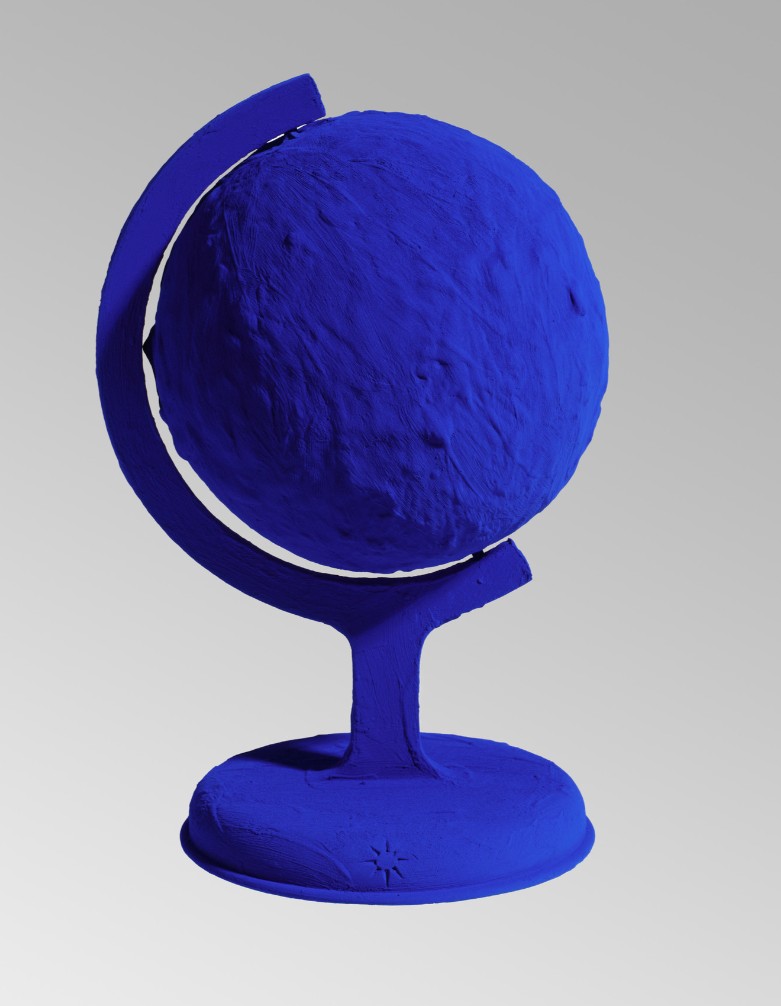
La Terre Bleue presents a classical tabletop globe mounted on a simple stand, yet its surface has been entirely enveloped in Klein’s signature International Klein Blue, an intense ultramarine of almost hypnotic depth. All cartographic detail, borders, names, topographies, has disappeared. What remains is a perfectly unified sphere, saturated in blue, hovering somewhere between scientific instrument and metaphysical object. This chromatic obliteration is not decorative; it is surgical. By removing all informational content, Klein denies the viewer any conventional point of entry. The globe no longer explains the world: it absorbs it.
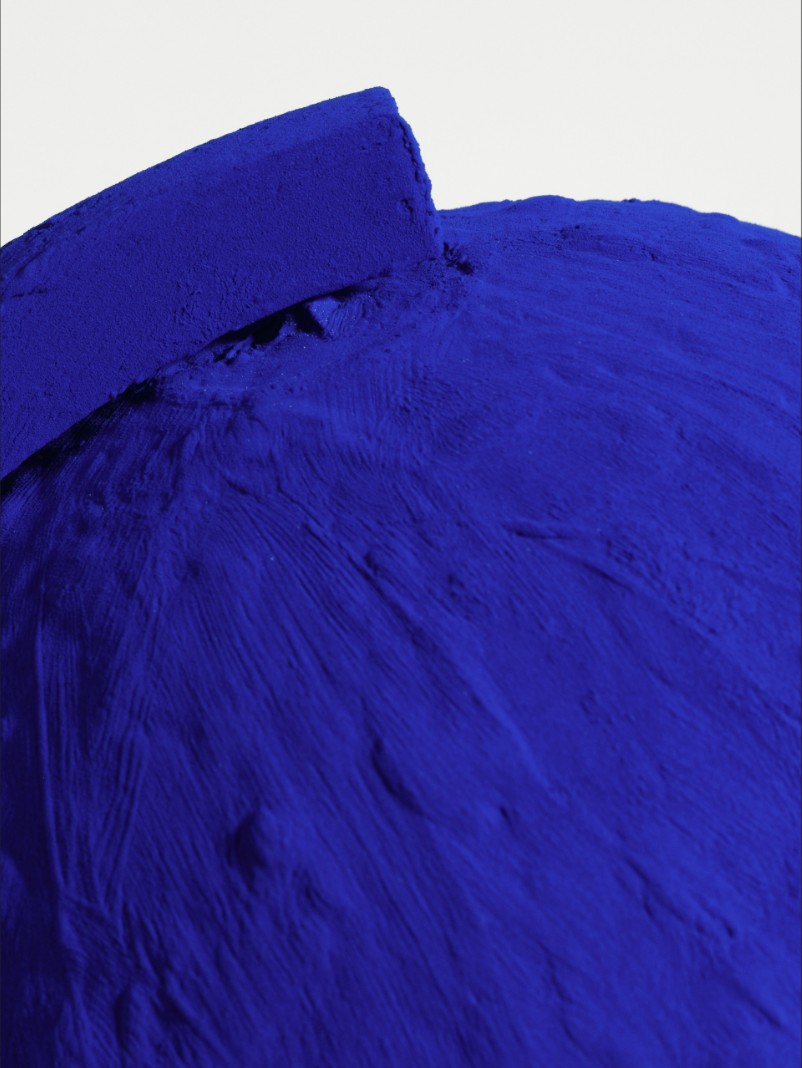
The use of IKB is central. Developed with a specific resin binder to preserve the raw brilliance of pigment, this blue is not merely a color but a medium of experience. Klein considered it a vehicle for immateriality, a way to access what he described as the “void,” or a sensorial space beyond form. Applied to a mass-produced object, the gesture becomes quietly subversive. The globe, arguably one of the most rational, educational tools, is transformed into something irrational, even poetic. It ceases to function and begins to resonate.
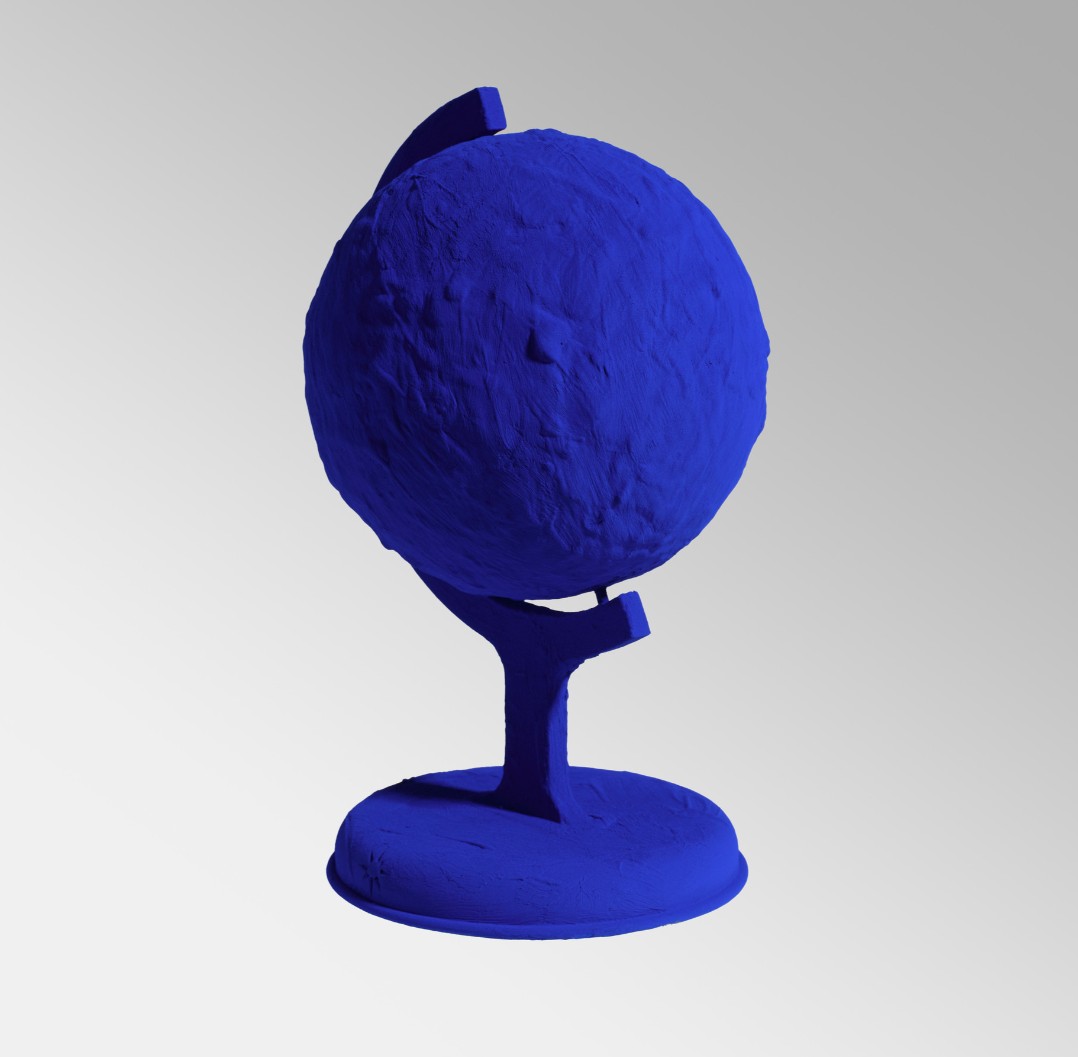
La Terre Bleue is, in essence, a philosophical object. By rendering the Earth as a monochrome entity, Klein proposes a vision of unity that dissolves political, geographical, and cultural divisions. The world is no longer fragmented—it is continuous, infinite, and indivisible. At the same time, the work introduces a subtle tension. A globe traditionally offers control: it allows us to locate, measure, and dominate space. Klein removes that power. In its place, he offers something less comfortable and far more ambitious: a confrontation with the infinite. The viewer is no longer positioned above the world, but rather suspended within it.
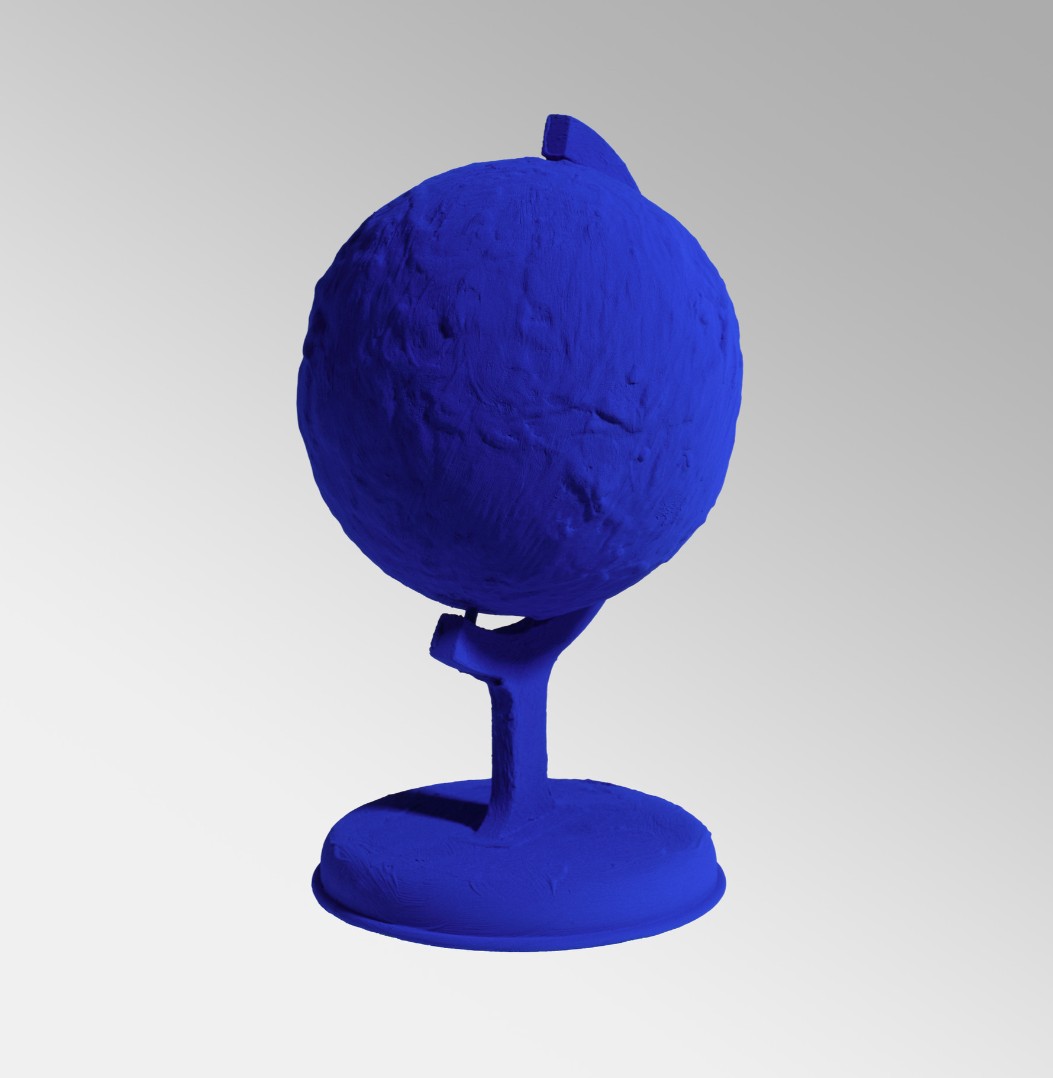
There is also a quiet irony here. In reducing the Earth to a single color, Klein achieves a form of total abstraction that feels, paradoxically, more universal than any detailed map. One might say he did not simplify the world: he expanded it. La Terre Bleue occupies a pivotal position within Klein’s oeuvre and within the broader trajectory of postwar art. It bridges sculpture, readymade, and conceptual practice, prefiguring later explorations by artists concerned with dematerialization and perception.
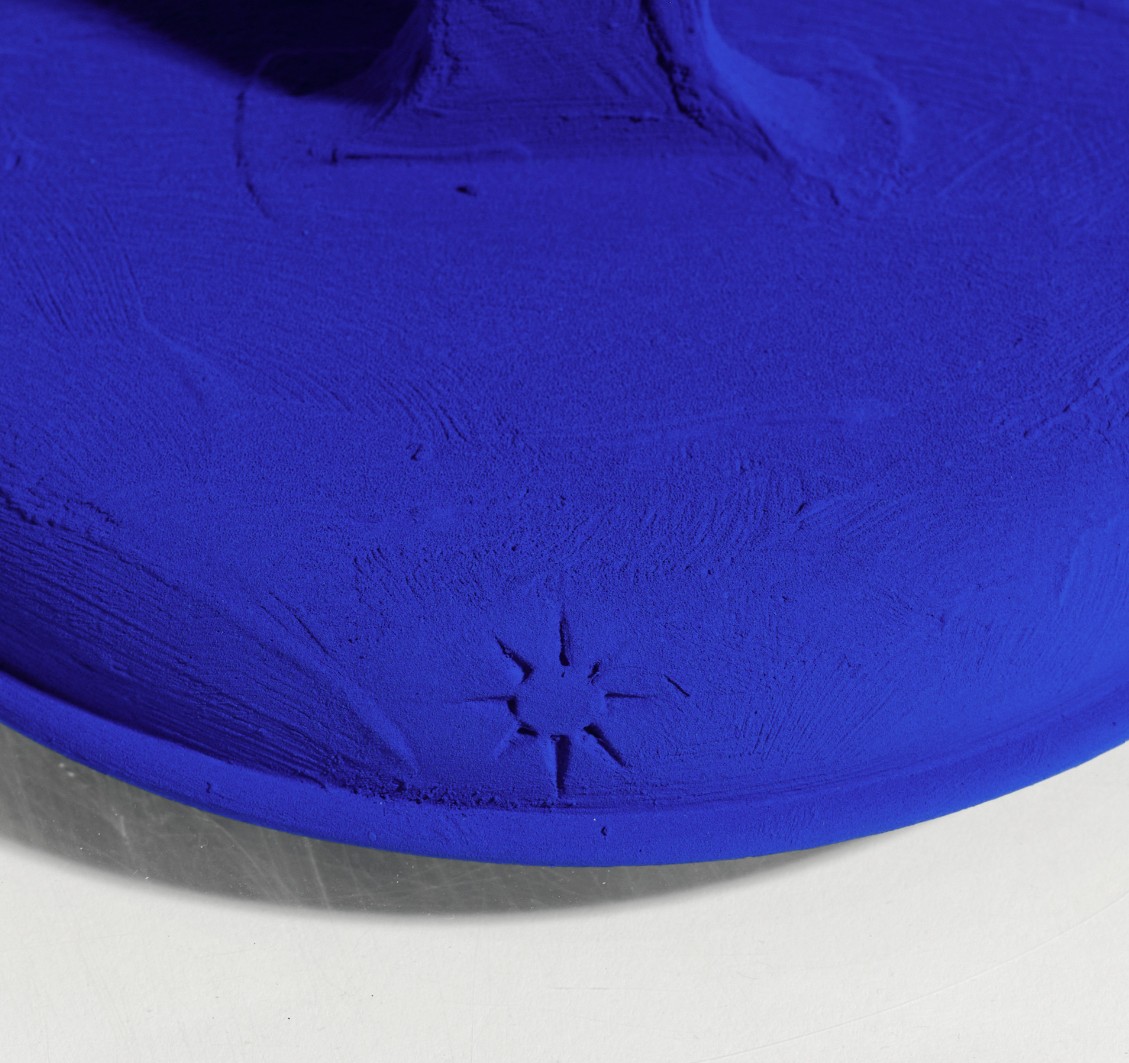
As a multiple, it also reflects Klein’s interest in dissemination: an idea that art, even when conceptually elevated, could exist in reproducible form without losing its aura. This is not a contradiction but a strategy: the infinite, after all, should not be rare. Today, La Terre Bleue remains one of Klein’s most elegant provocations. It is at once simple and uncompromising, an object that refuses explanation while inviting contemplation. A globe that no longer describes the world, but instead asks a more unsettling question: what if the essence of everything could be contained in a single, impossible blue?
Auction Results
RP7 – La Terre Bleue, 1957-1988
Phillips New-York: 28 February 2026
Estimated: USD 20,000 – 30,000
USD 61,920
Yves Klein Modern & Contemporary Art
YVES KLEIN
RP7 – La Terre Bleue, 1957-1988
IKB pigment and synthetic resin on plaster molding
Incised with the artist’s monogram on the base
Numbered “279/300” on an artist’s label affixed to the underside of the base
La terre bleue, 1957-90
Martini Studio d’Arte: 11 December 2025
Estimated: EUR 18,000 – 22,000
EUR 23,000 (Hammer)
EUR 28,750 / USD 28,750
Yves Klein work of art at auction: La terre bleue ‑ Martini Studio d’Arte
YVES KLEIN
La terre bleue, 1957-90
Pigment IKB and synthetic resin on plaster cast
Conceived in 1957 and created in 1990 by Galerie Bonnier in Geneva
Edition: HC III/L
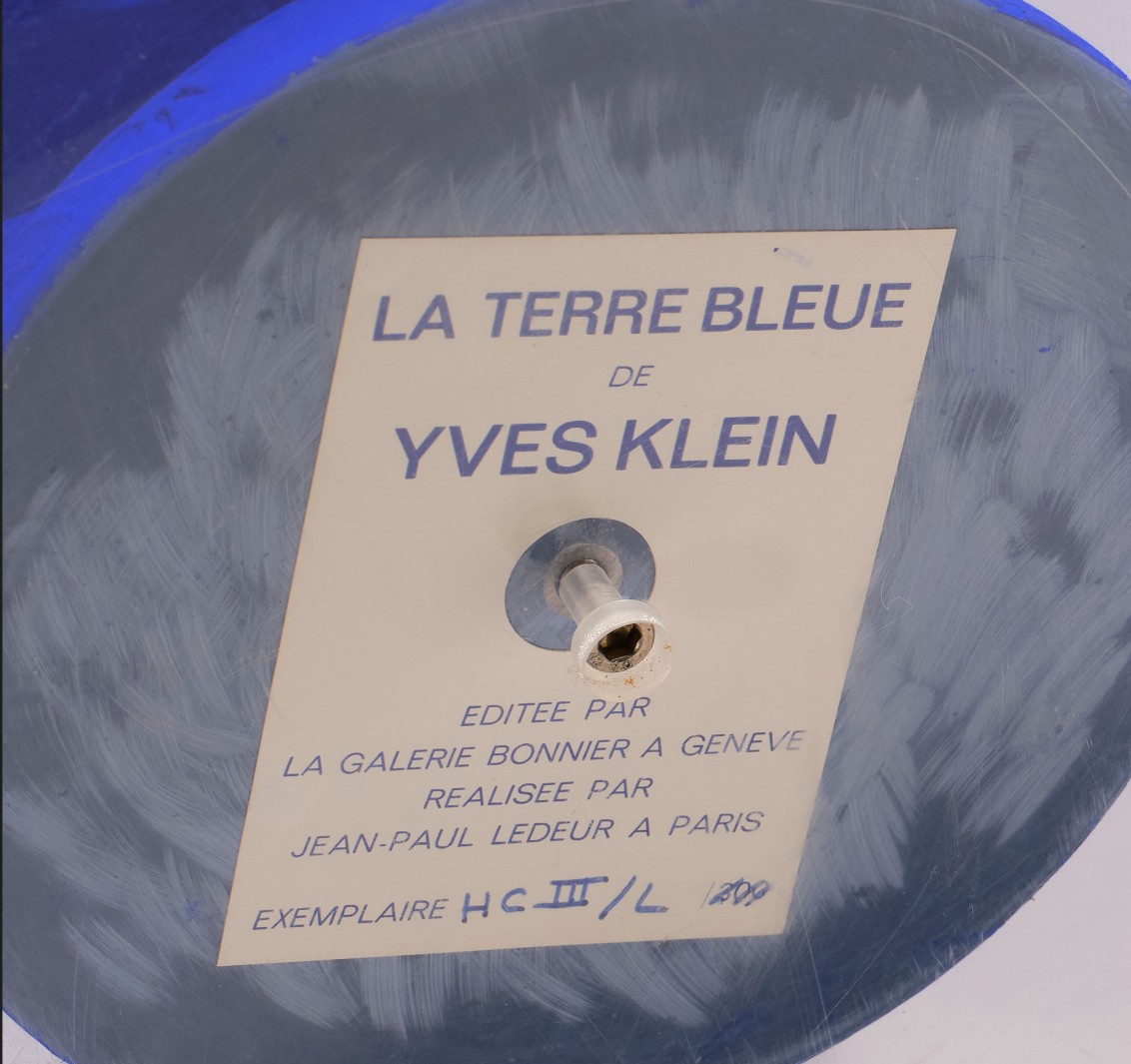
“La Terre Bleue”, 1957-1990
Bukowskis Stockholm: 13 June 2025
Estimated: SEK 250,000 – 300,000
SEK 250,000 (Hammer)
SEK 337,500 / USD 35,345
Yves Klein, “La Terre Bleue”. – Bukowskis
YVES KLEIN (France, 1928-1962)
“La Terre Bleue”, 1957-1990
IKB pigment and synthetic resin on plaster
Edition: 165/300
In a plexiglass box
With a label underneath “Editee par La Galerie Bonnier a Genève. Realisee par Jean-Paul Ledeur a Paris”
Conceived in 1957 by Yves Klein and produced in 1990 by Galerie Bonnier, Geneva
In collaboration with Rotraut Klein-Moquay and Jean-Paul Ledeur
La terre bleue, 1957-90
Martini Studio d’Arte: 12 June 2025
Estimated: EUR 18,000 – 22,000
EUR 20,000 (Hammer)
EUR 25,000 / USD 21,760
Yves Klein work of art at auction: La terre bleue ‑ Martini Studio d’Arte
YVES KLEIN
La terre bleue, 1957-90
Pigment IKB and synthetic resin on plaster cast
Conceived in 1957 and created in 1990 by Galerie Bonnier in Geneva
Edition: HC XI/L
Certificate by Rotraut Klein-moquay
La Terre bleue (RP 7), 1957-1990
Christie’s London: 5 June 2025
Estimated: GBP 20,000 – 30,000
GBP 32,760 / USD 44,495
YVES KLEIN (1928-1962), La Terre bleue (RP 7) (The Blue Earth (RP 7)) | Christie’s
YVES KLEIN (1928-1962)
La Terre bleue (RP 7) (The Blue Earth (RP 7)), 1957-1990
Dry pigment and synthetic resin on plaster
Incised with the artist’s monogram (lower edge)
Numbered ‘184⁄300’ (on a label affixed to the underside)
Klein Tables
A leading member of the Nouveau réalisme movement, French artist Yves Klein is considered as one of the pioneers of performance, minimalism and pop art. Always innovative, Klein’s body of work spanned many mediums and his artistic endeavors took a foray into the world of furniture design in the early 1960s, giving functionality and physicality to his monochrome works.
Filling each Perspex-and-glass tables with the Klein Blue (IKB) pigment (the signature shade of ultramarine blue that he patented in 1960), rose pigment and 22K gold leaf, he formed the trinity of colours that became the foundation of his works. Suspended in space, Klein draws our eyes to these beguilingly rich tones, evoking an ever-enticing sense of depth. The longer you stare at the single base hue, the more shades, tones and tints come to light. Based on two prototypes designed in 1961 and executed just after Klein’s sudden passing in 1963 under the supervision of his widow, Rotraut Klein-Moquay, these iconic tables stand as a testament to his exploration into the ‘infinite presence’ and emotive power of colours.
Table IKB
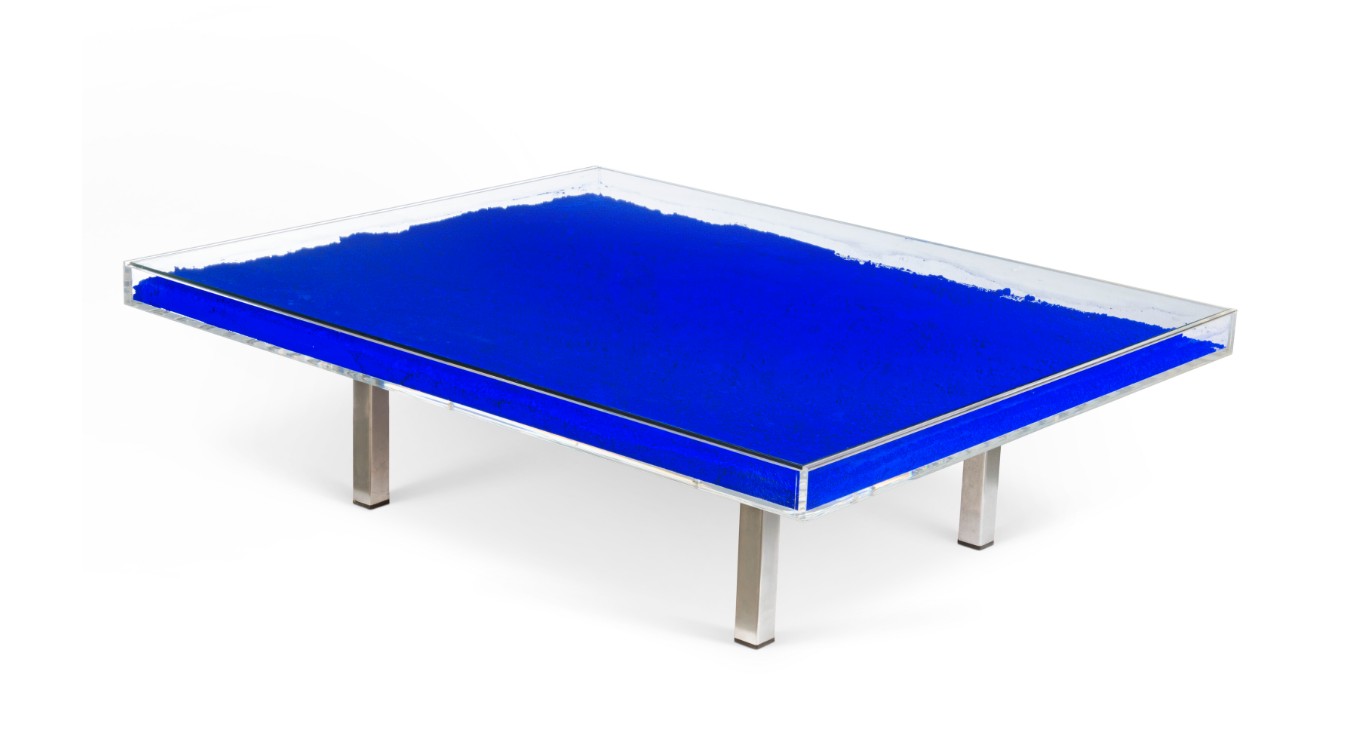 Table IKB, Table Bleue
Medium: Glass, Plexiglas, steel and blue pigment
Year: Designed in 1961 and produced under the supervision of Rotraut Klein-Moquay since 1963
Dimensions: approx. 37x125x100 cm (14-5/8 x 49-1/4 x 39-3/8 inches)
Edition: Open edition
Publisher: Rotraut Klein-Moquay based on a 1961 design by Yves Klein
Signed and numbered on a label affixed to the underside
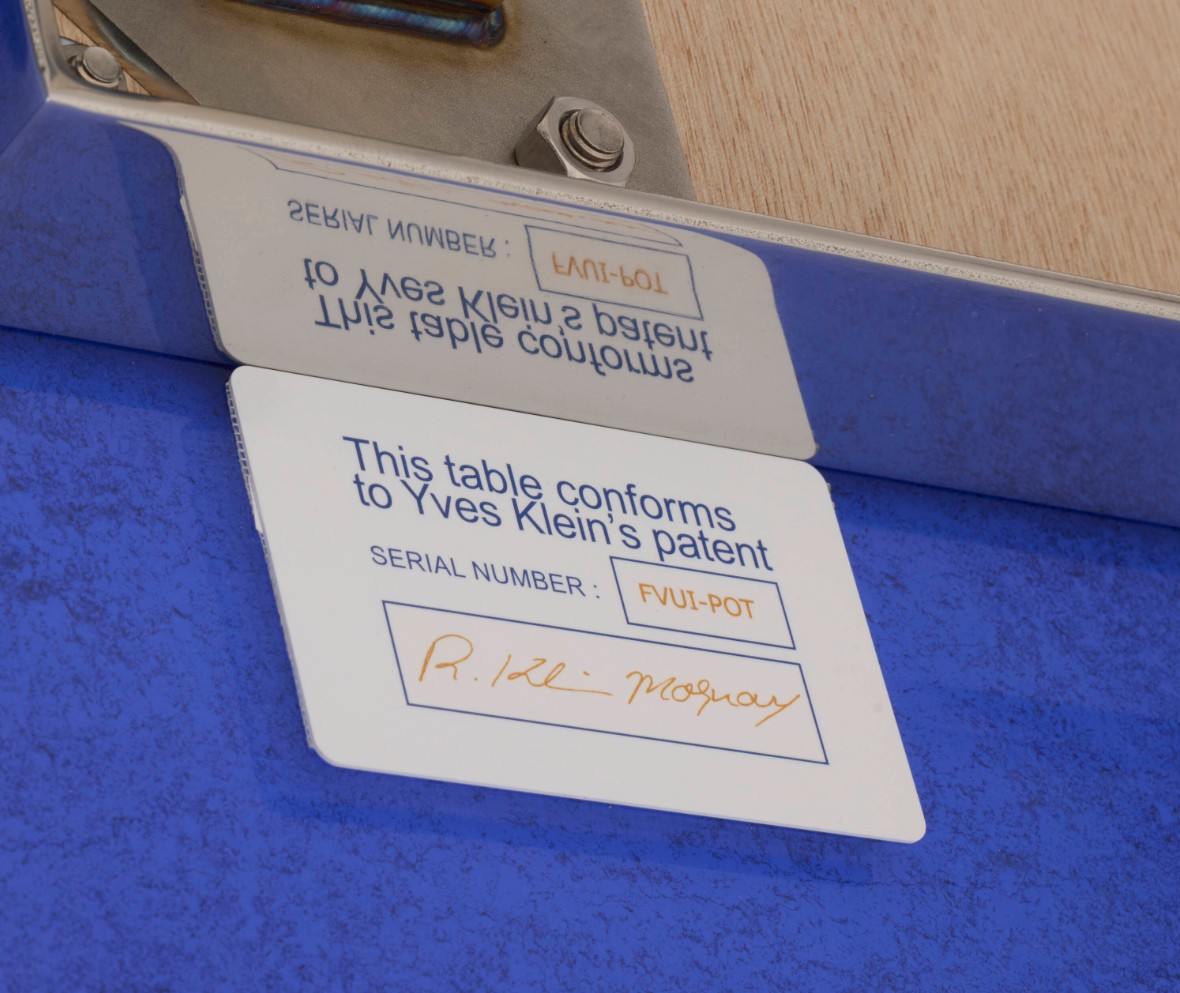
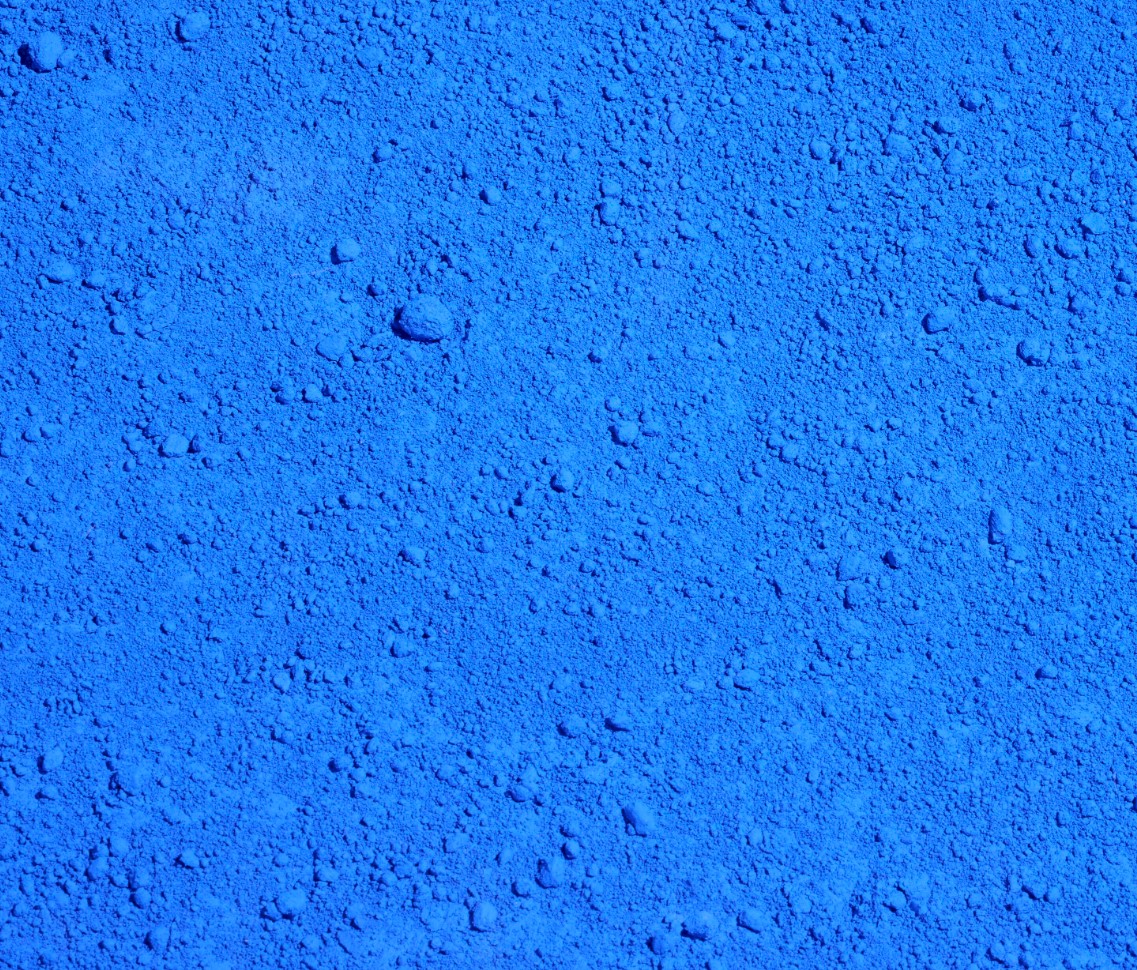
Table Monopink TM
Table Monopink TM
Medium: Plexiglas, wood, glass, chrome-plated legs and dry pigment
Year: Designed in 1961 and produced under the supervision of Rotraut Klein-Moquay since 1963
Dimensions: approx. 37x125x100 cm (14-5/8 x 49-1/4 x 39-3/8 inches)
Edition: Open edition
Signed and numbered on a label affixed to the underside
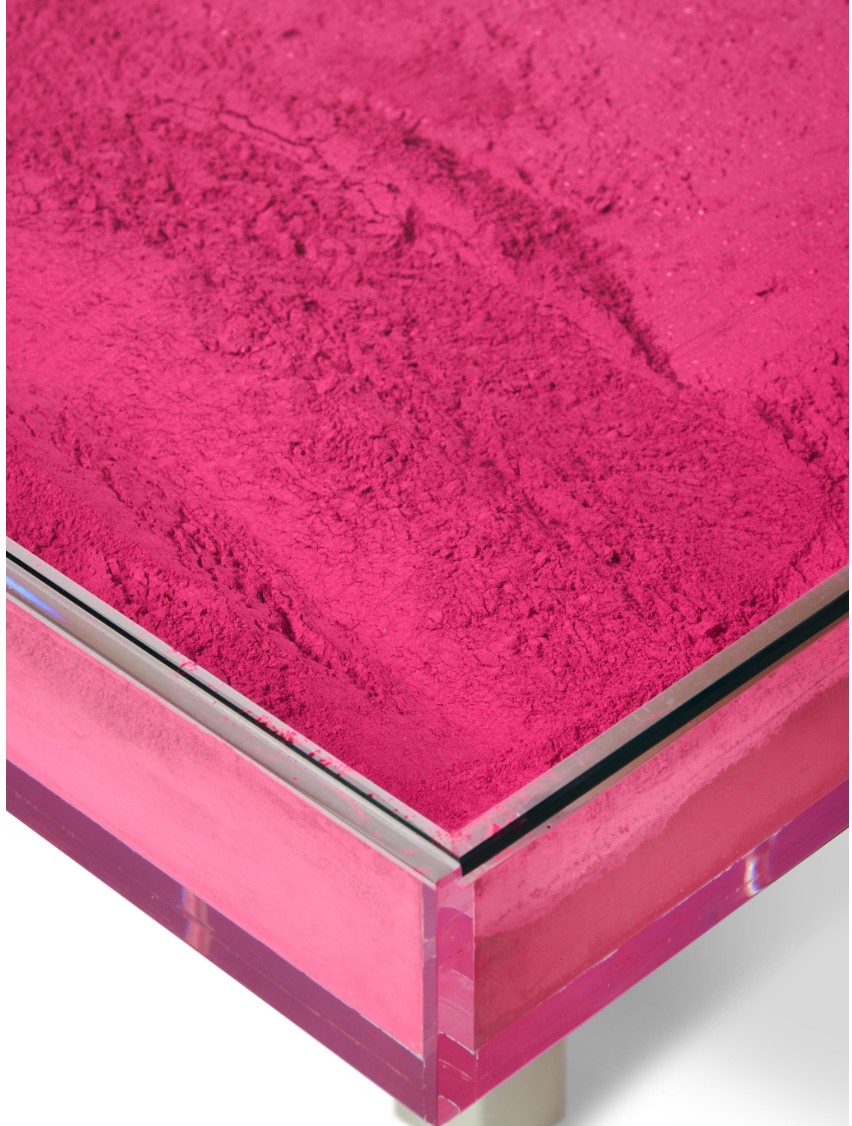
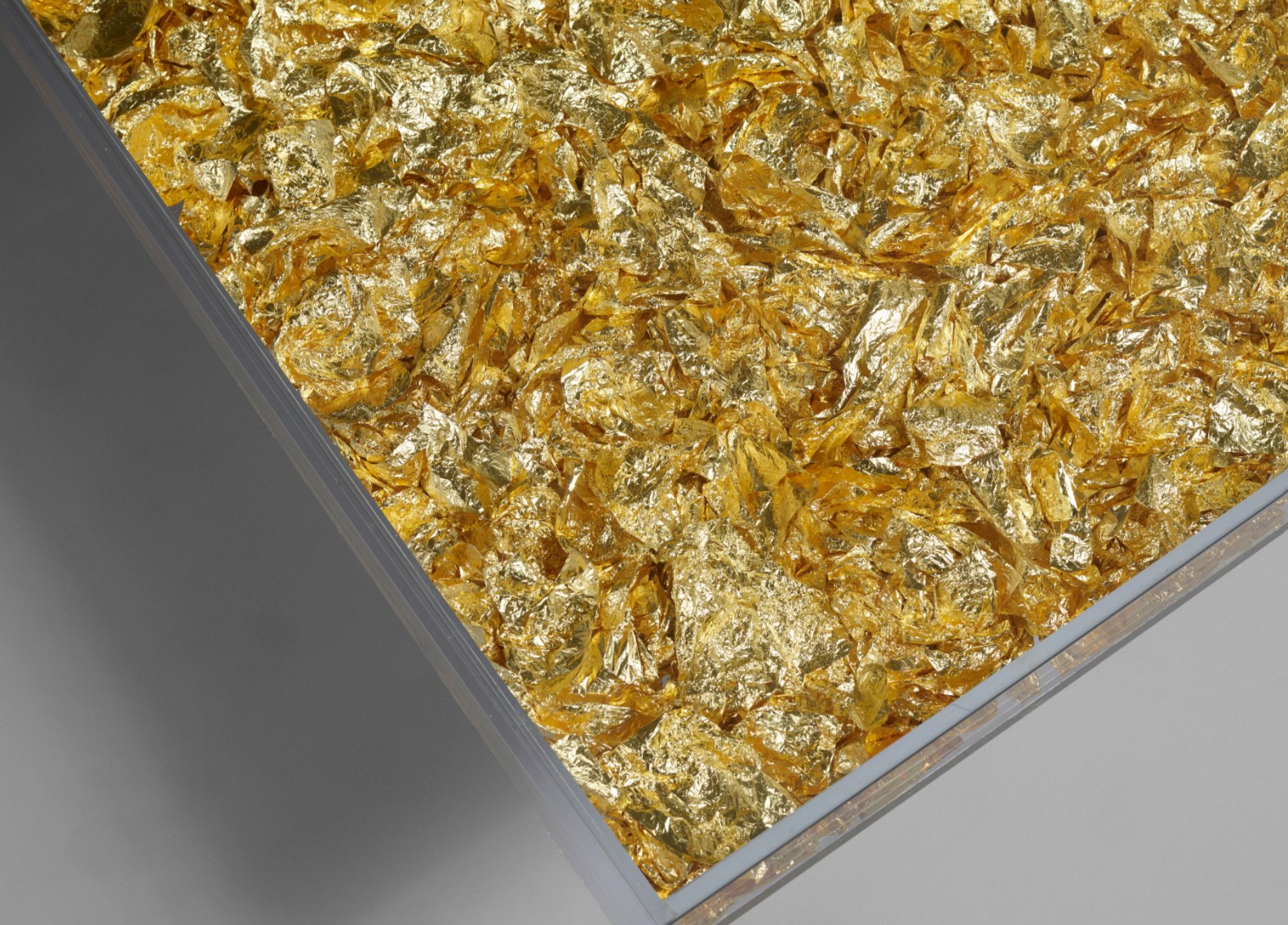
Table Monogold TM
Table Monogold TM, Table d’Or
Medium: 3000 gold leafs, Plexiglass, glass, wood and chrome-plated legs
Year: Designed in 1961 and produced under the supervision of Rotraut Klein-Moquay since 1963
Dimensions: approx. 37x125x100 cm (14-5/8 x 49-1/4 x 39-3/8 inches)
Edition: Open edition
Publisher: Rotraut Klein-Moquay based on a 1961 design by Yves Klein
Signed and numbered on a label affixed to the underside
Auction Results
Table d’Or, 1961
Bonhams New-York: 17 December 2025
Estimated: USD 15,000 – 20,000
USD 23,040
Bonhams : YVES KLEIN (1928-1962) Table d’Or
YVES KLEIN (1928-1962)
Table d’Or, 1961
Gold leaf, Plexiglas, glass, steel, wood, chrome-plated metal
With a plastic plaque signed ‘R. Klein-Moquay,’
Printed ‘This table conforms to Yves Klein’s patent SERIAL NUMBER: 97A1131’
Produced under the supervision of Rotraut Klein-Moquay, France
Table Rose, designed 1961
Bonhams New-York: 17 December 2025
Estimated: USD 10,000 – 15,000
USD 20,480
Bonhams : YVES KLEIN (1928-1962) Table Rose
YVES KLEIN (1928-1962)
Table Rose, designed 1961
Rose-colored pigment, Plexiglas, chrome-plated metal
With a plastic plaque signed ‘R. Klein-Moquay,’
Printed ‘This table conforms to Yves Klein’s patent SERIAL NUMBER: 99A172’
Produced under the supervision of Rotraut Klein-Moquay, France
Table d’Or, 1961-63 / c. 2010
Wright Chicago: 9 December 2025
Estimated: USD 15,000 – 20,000
USD 21,590
YVES KLEIN (1928–1962)
Table d’Or, 1961-63 / c. 2010
Gold leaf, glass, Plexiglas, chrome-plated steel
This work is from the edition conceived in 1961 based on a model by Yves Klein
The edition was begun in 1963 and supervised by the artist’s widow Rotraut Klein-Moquay
Manufacturer’s plaque to underside
‘This table conforms to Yves Klein’s patent Serial Number: ND-LETE R. KL. Moquay’.
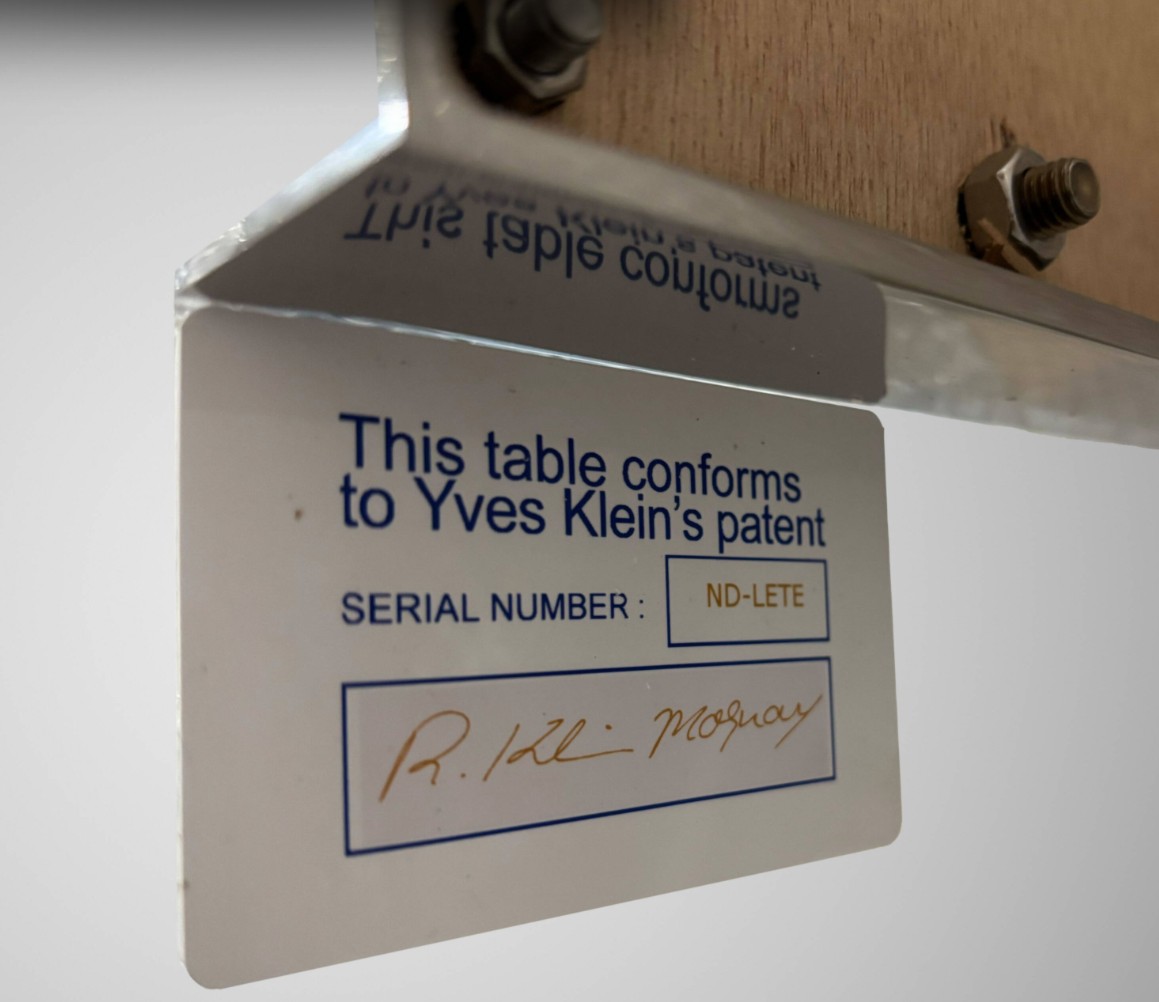
Table IKB ®
Bonhams Cornette Paris: 4 December 2025
Estimated: EUR 10,000 – 15,000
EUR 19,200 / USD 22,885
Bonhams Cornette de Saint Cyr : YVES KLEIN (1928-1962) Table IKB ®
YVES KLEIN (1928-1962)
Table IKB ®
IKB pigment, glass, plexiglass, and metal base
Signed and numbered HG-EDFT- R. Klein Moquay on a label affixed underneath
Table Monopink™, designed in 1961
Sotheby’s New-York: 15 July 2025
Estimated: USD 12,000 – 18,000
USD 19,050
Yves Klein | Table Monopink™ | Contemporary Discoveries | 2025 |
YVES KLEIN
Table Monopink™, designed in 1961
Rose pigment, plexiglass, wood, chrome-plated metal
Produced under the supervision of Rotraut Klein-Moquay, France
With a plastic plaque signed R. Klein-Moquay, printed
This table conforms/to Yves Klein’s patent and numbered 10 ES-REN
Table Bleue, 1961-63 / 2022
Wright Chicago: 5 June 2025
Estimated: USD 20,000 – 30,000
USD 25,400
237: YVES KLEIN, Table Bleue < Design, 5 June 2025 < Auctions | Wright: Auctions of Art and Design
YVES KLEIN (1928–1962)
Table Bleue, 1961-63 / 2022
International Klein Blue pigment, glass, Plexiglas, chrome-plated steel
This work is from the edition started in 1963
Published by Rotraut Klein-Moquay based on a 1961 design by Yves Klein
Applied manufacturer’s plaque to underside
‘This table conforms to Yves Klein’s patent Serial Number: FVUI-POT R. KL. Moquay’