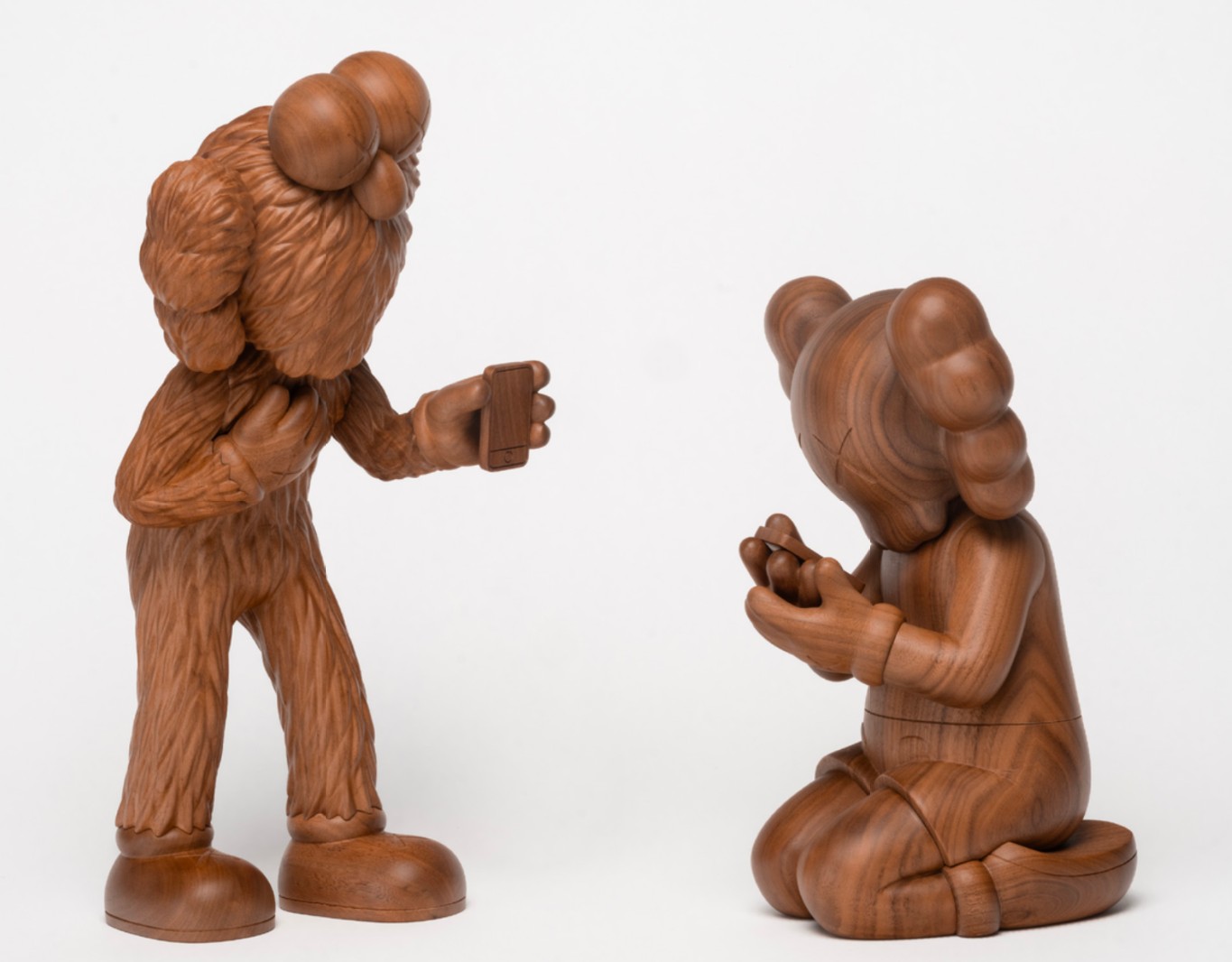
The Message
Medium: Wood
Year: 2025
Dimensions: 14 × 6-2/5 × 7 inches (35.6 x 16.3 x 17.8 cm)
Edition: 100
Artist’s Proofs: 20 AP
With THE MESSAGE, KAWS introduces a rare and deliberate two-figure composition, staging an encounter between COMPANION and BFF that departs from his typically solitary figures. Executed in carved wood, the work presents BFF standing, slightly leaning forward, holding a small rectangular object—suggestive of a phone—while Companion kneels, head bowed, similarly absorbed in a device held between both hands.
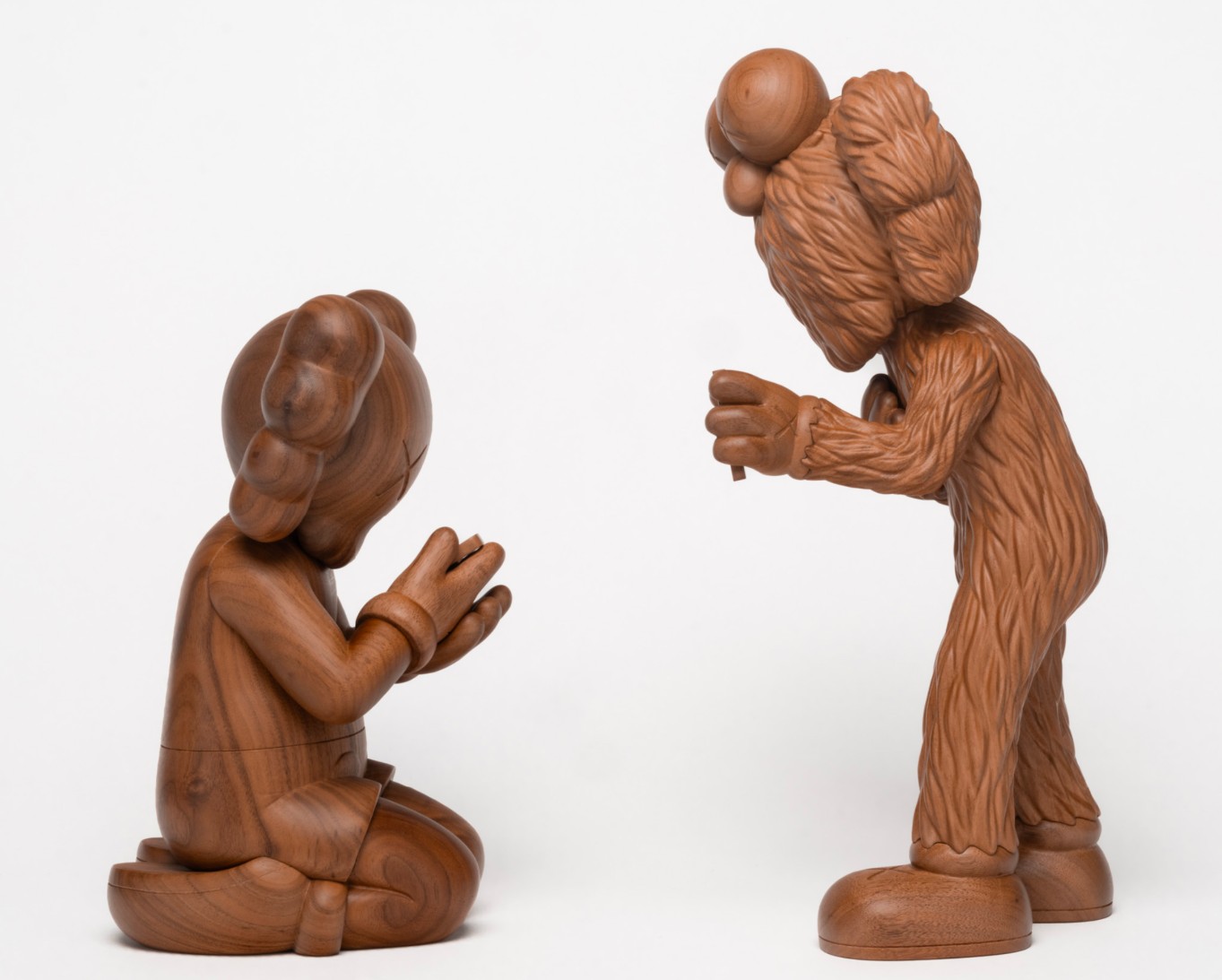
The scene is deceptively simple. Yet the choreography of the bodies is precise: one figure upright, the other lowered; one addressing, the other receiving—or perhaps both equally disengaged. Their postures create a triangular tension, a quiet exchange that never quite resolves. Unlike earlier Companion works defined by introspection or fatigue, here the figures are engaged—but not necessarily with each other.
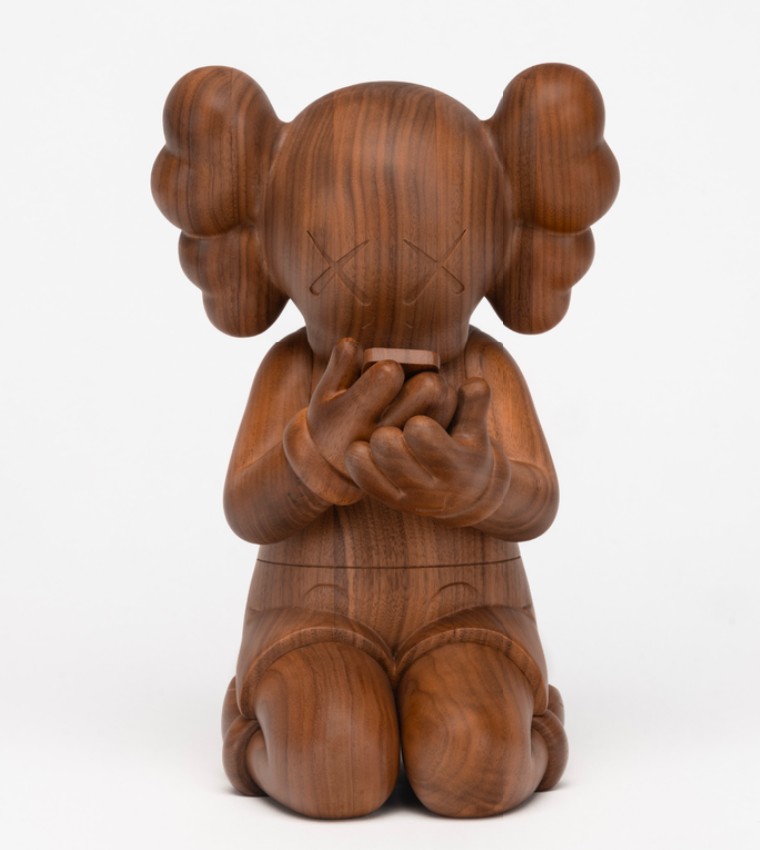
Produced in wood, the work belongs to a more elevated and materially sensitive branch of KAWS’s sculptural practice. The grain is not concealed but emphasized, flowing across the surfaces and subtly animating the figures. This choice introduces a temporal dimension absent from vinyl: wood carries memory, warmth, and a sense of permanence.
The carving is particularly notable in the treatment of BFF, whose fur—typically rendered as soft, almost plush in vinyl—becomes here a meticulously chiseled texture, oscillating between naturalism and stylization. Companion, by contrast, remains smoother, more restrained, reinforcing the duality between the two figures.
Context and Exhibition
The Message was unveiled on 29 October 2025, as a monumental site-specific installation in the courtyard of Palazzo Strozzi in Florence, in dialogue with a concurrent exhibition dedicated to Fra Angelico. The installation features both figures at a scale exceeding six meters, placed within the Renaissance architecture of the courtyard.
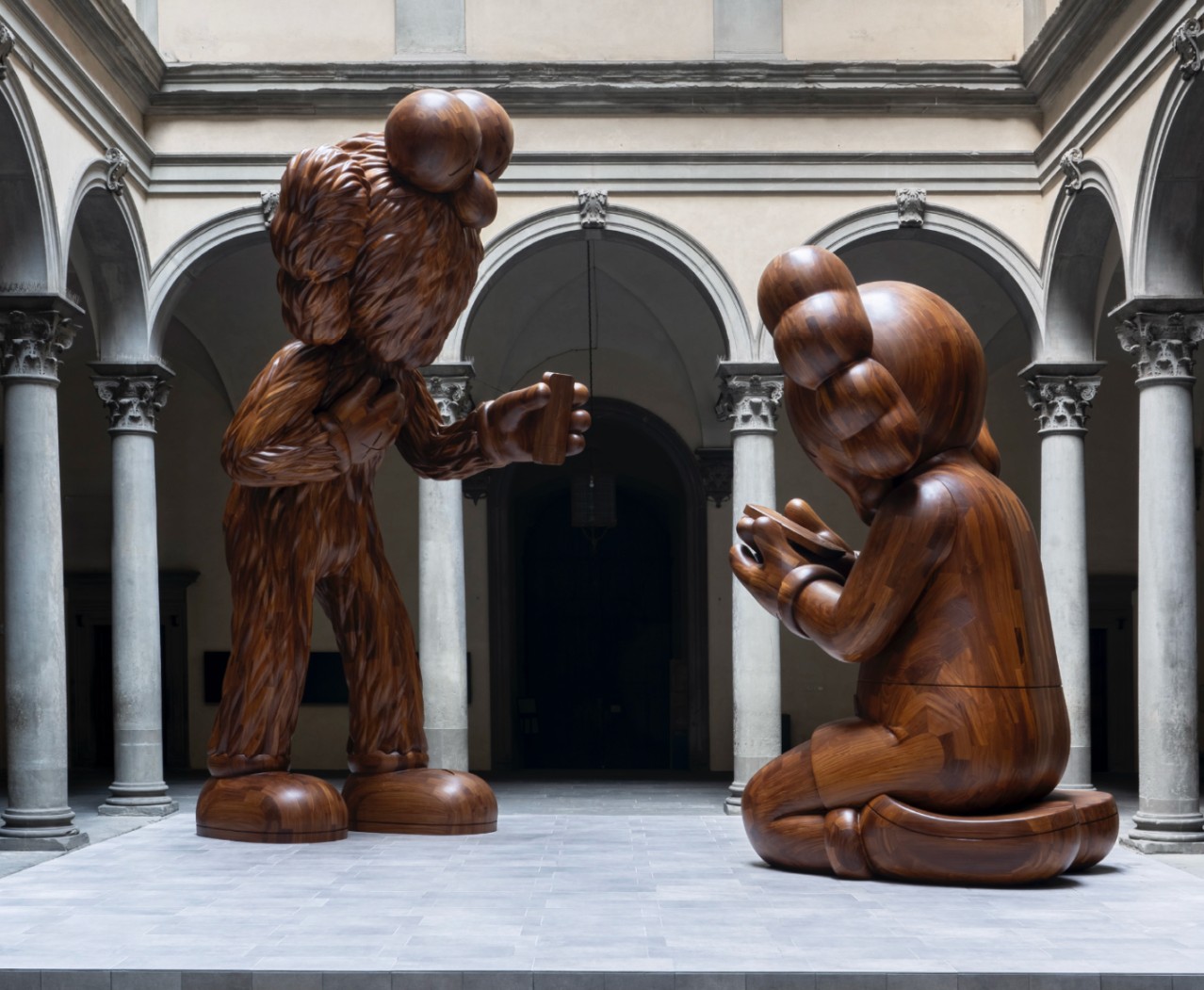
This context is far from incidental. By situating his work within one of Florence’s most historically charged spaces, KAWS enters into a direct—if unexpected—conversation with early Renaissance painting. The reference is explicit: The Message operates as a contemporary reinterpretation of the Annunciation, one of Fra Angelico’s most iconic subjects.
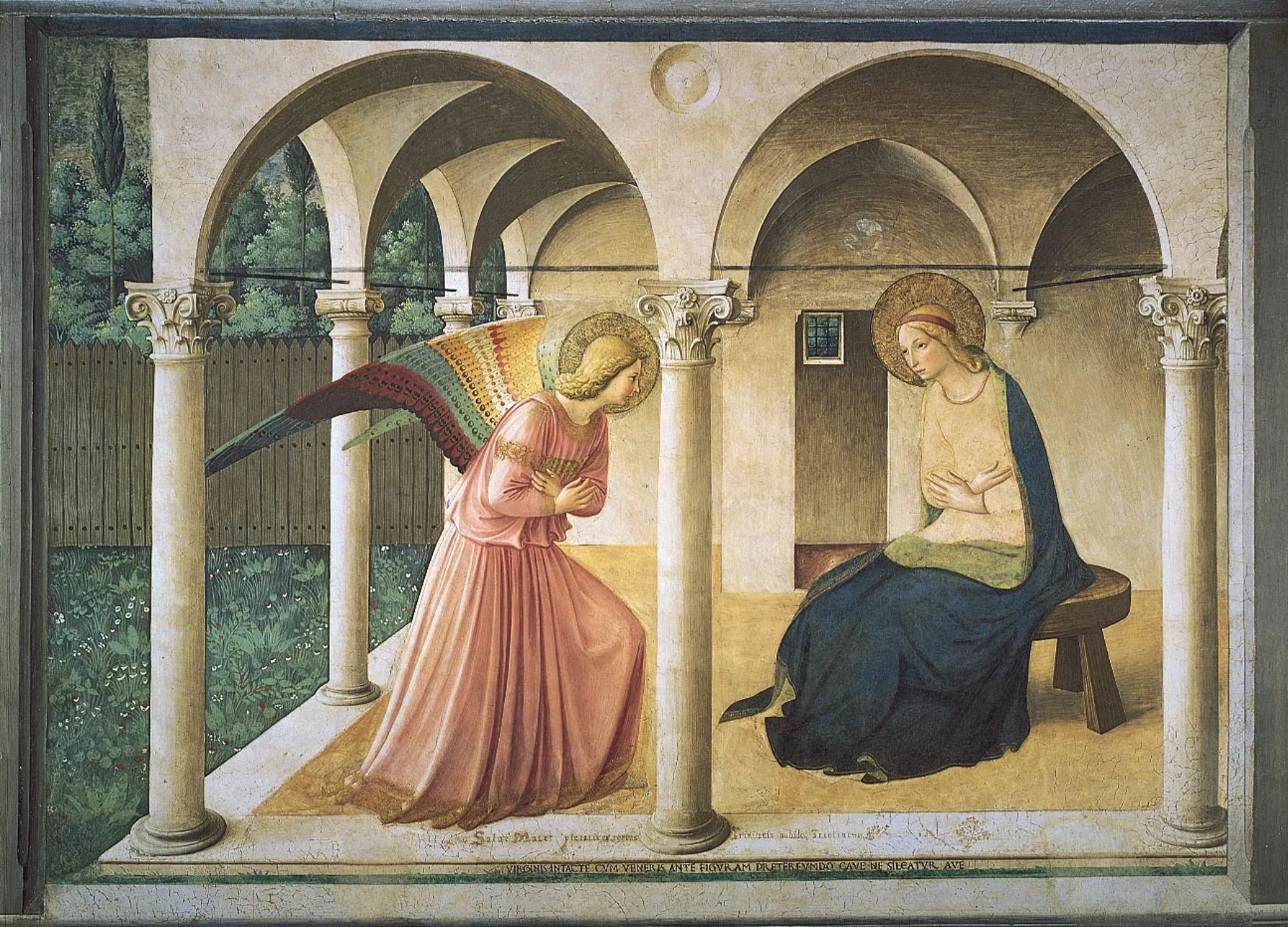
Fra Angelico: The Annunciation, tempera on panel , 1432–34; in the Museo Diocesano, Cortona, Italy
Meaning and Interpretation
Traditionally, the Annunciation depicts a moment of divine communication—an angel delivering a sacred message to the Virgin Mary. KAWS retains the structure of this exchange but empties it of transcendence. The “message” here is ambiguous, mediated through devices, filtered, delayed, perhaps even trivialized.
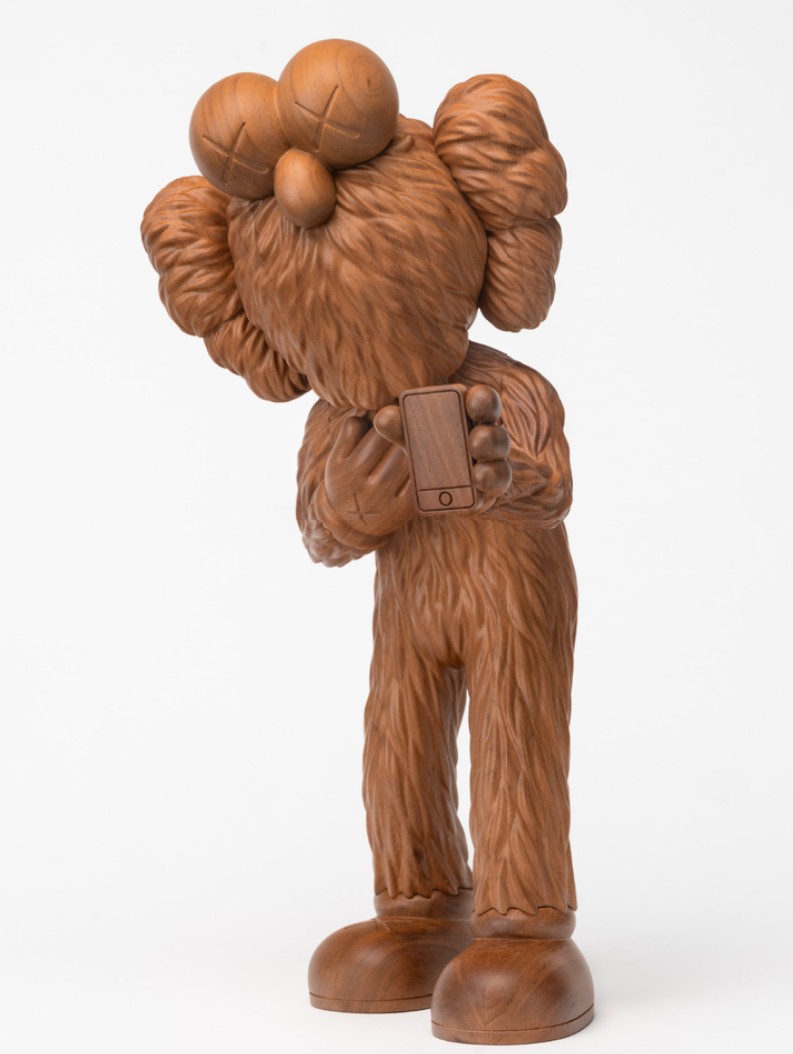
This substitution is both subtle and incisive. Where Angelico’s figures embody grace, attention, and spiritual presence, KAWS’s characters appear absorbed elsewhere, caught in a loop of digital communication. The sacred encounter becomes a contemporary one: constant, ubiquitous, and strangely hollow.
Yet the work resists cynicism. There is no overt critique, only a quiet observation. The kneeling Companion suggests humility or devotion, while BFF’s posture implies transmission. Whether this is a message being delivered, ignored, or simply lost remains unresolved.
Edition and Release
On the occasion of the exhibition, KAWS released a scaled wooden edition of The Message, measuring approximately 14 inches in height. The edition was limited to 100 signed and numbered works, accompanied by 20 artist’s proofs.
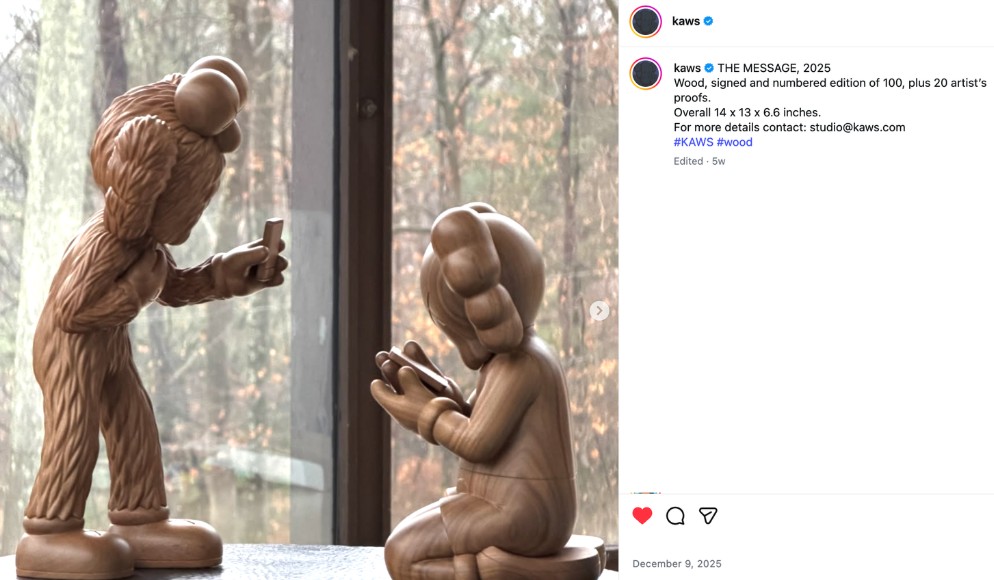
Notably, the release bypassed traditional retail channels. Announced exclusively via the artist’s Instagram, acquisition required direct contact with the studio, reinforcing the work’s positioning at the intersection of collectible design and fine art sculpture.
Position within KAWS’s Practice
The Message marks a significant evolution in KAWS’s oeuvre. While his work has long engaged with appropriation and emotional states—melancholy, fatigue, detachment—this piece introduces dialogue as a central theme. It is no longer about the isolated figure, but about interaction—however fractured or indirect.
It also extends his ongoing exploration of wood as a primary medium, previously exhibited in institutions such as the Brooklyn Museum, the Andy Warhol Museum, and Yorkshire Sculpture Park. In this context, wood becomes more than material—it is a bridge, linking contemporary visual language with the sculptural traditions of the past.
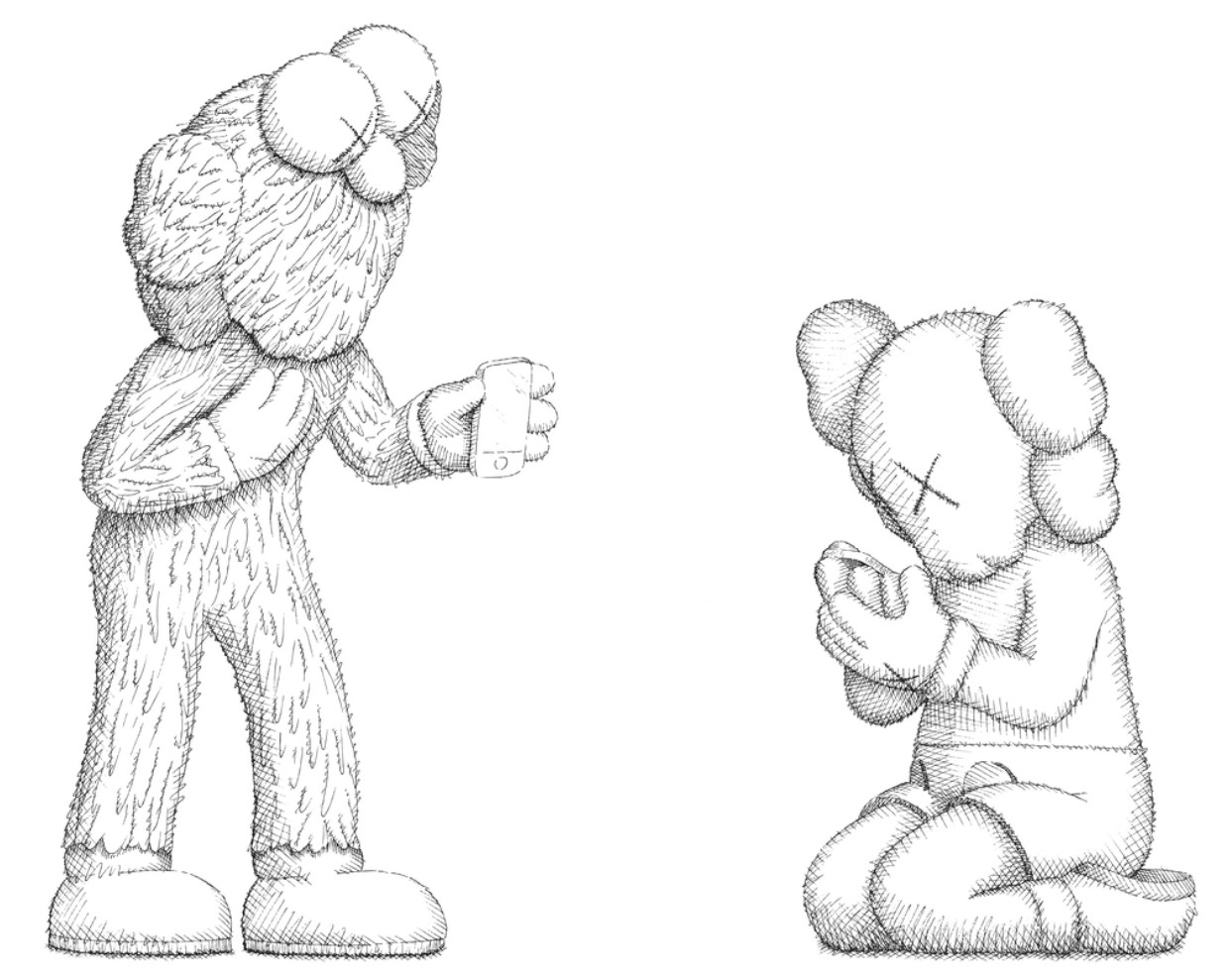
As both a monumental installation and a refined edition, The Message operates on two registers: public spectacle and intimate object. Its conceptual clarity, combined with the historical weight of its Florentine setting, positions it among the more intellectually layered works in KAWS’s recent production.
If Companion once embodied a kind of internal silence, The Message suggests something more complex: a world saturated with communication, yet still searching—quietly, insistently—for meaning.