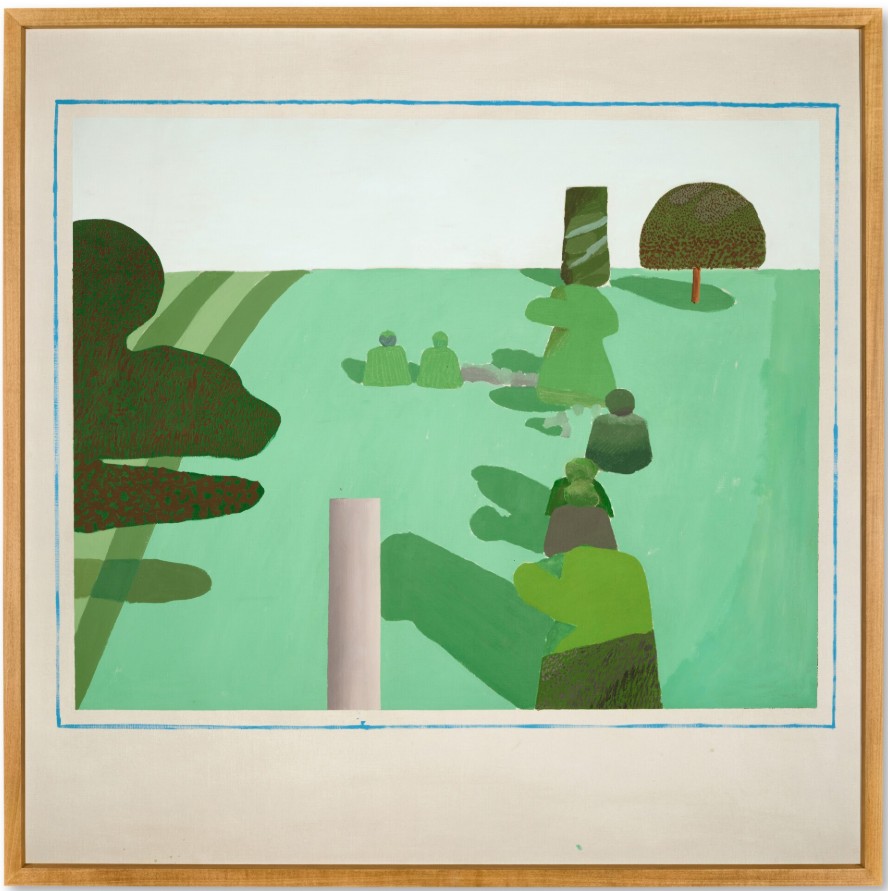
DAVID HOCKNEY (b. 1937)
English Garden, 1965
Acrylic on canvas
48×48 inches (122×122 cm)
Signed with the artist’s initials (behind the lower stretcher)
Titled and dated Boulder 65 (on the reverse)
Provenance
Kasmin Ltd., London
Galleria dell’Ariete, Milan
Private Collection, Europe (acquired from the above in 1966)
Sotheby’s, London, 26 June 1997, lot 15 (consigned by the above)
Acquired from the above sale by the present owner
Auction History
Sotheby’s London: 4 March 2026
Estimated: GBP 2,500,000 – 3,500,000
GBP 1,920,000 / USD 2,564,930
English Garden | Modern & Contemporary Evening Auction | 2026 | Sotheby’s
Executed in the summer of 1965, English Garden stands among David Hockney’s earliest and most assured engagements with the landscape genre. Painted in America, where distance sharpened memory into image, the work is rooted in a photograph of the topiary garden at Haseley Court, Oxfordshire, the celebrated home of Nancy Lancaster. The photograph of the garden, published in American Vogue, was taken by Horst P. Horst, whose camera translated horticulture into haute mise-en-scène. Hockney’s recourse to such a source is revealing, not least because it signals a self-conscious alignment between two image-makers for whom photography functioned as a mode of construction and an instrument through which reality could be refined into arrangement and atmosphere. In embracing the stylized lucidity of magazine photography, and the undeniably cool authority with which it confers glamour and poise, Hockney presents the garden less as private refuge than as cultural sign; its clipped topography, immaculate borders, and exacting geometries staged as an aspirational emblem of status.
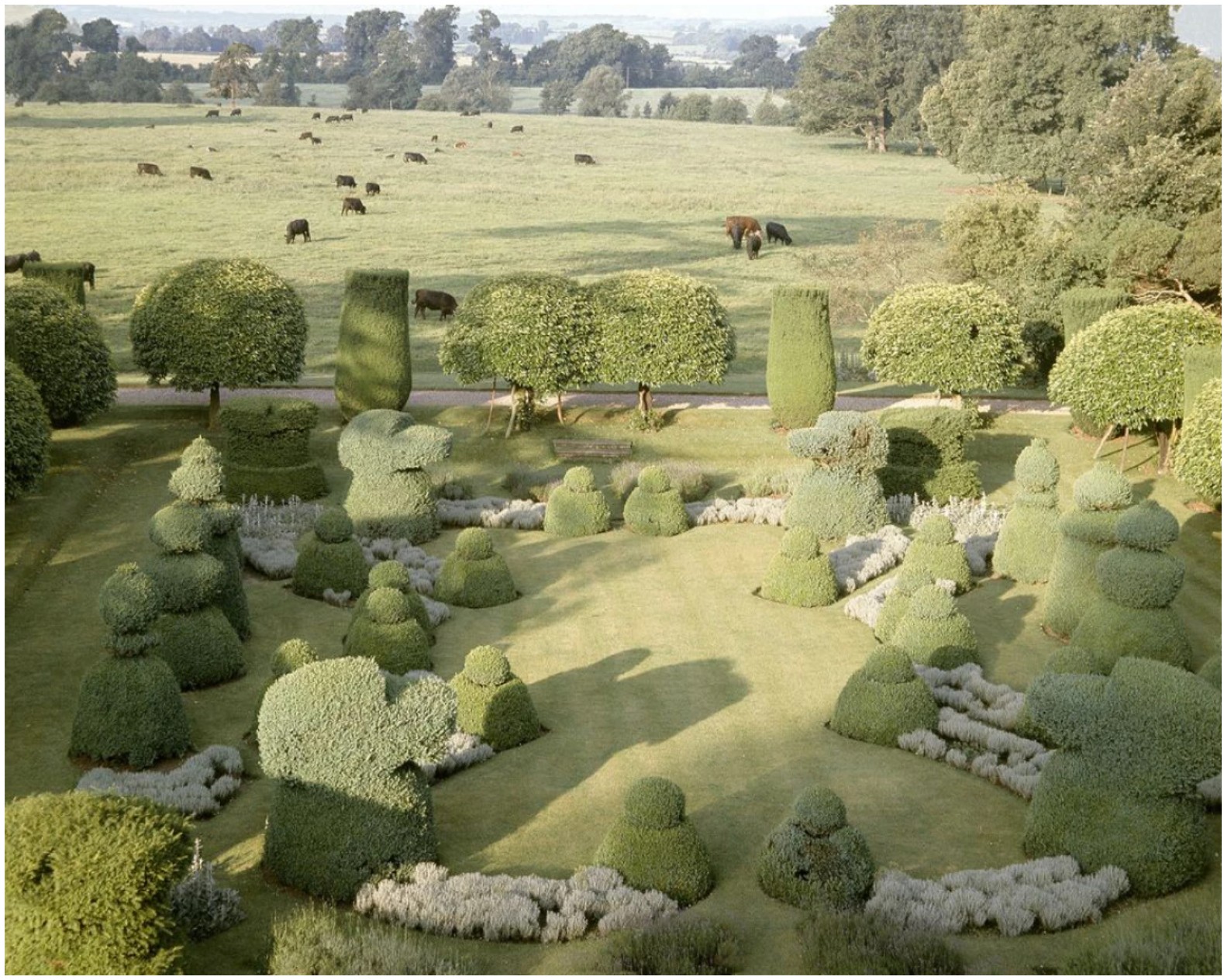
Haseley Garden Photographed by Horst P. Horst, Vogue, July 1965 © 2026 Horst P Horst, London
Long recognized as exemplary of Hockney’s mid-1960s breakthrough, English Garden was shown at Kasmin Gallery in 1965, at Galleria dell’Ariete in Milan in 1966, and then later included in the Whitechapel Art Gallery’s 1970 survey of the artist’s paintings, prints and drawings of the decade. The present work distills a pastoral order, a leafy Eden remembered rather than observed, presenting trees, lawn and sculpted foliage arranged in a schematic, almost disconcertingly precise configuration. Large fields of saturated green unfold in lucid, flattened planes, their clarity lending the composition both immediacy and equilibrium. Shadow operates as a generative force, shaping figures and space with a crisp economy that sidesteps illusionism, in which surrealist hedges and shrubs assume an almost anthropomorphic presence. At once serene and faintly uncanny, the garden reads as a carefully staged tableau, as though nature itself has been choreographed into a performance. Here, the countryside is not simply observed but carefully managed into iconography, a theatre of cultivation and taste that indexes class, leisure, and affluence, signaling the aesthetic codes of privilege. Simultaneously, it announces, with remarkable early confidence, the artist’s singular ability to absorb and resolve the disparate aesthetic and technical concerns of Minimalism, Modernist abstraction, and Pop art, forging a style that is unmistakably his own.
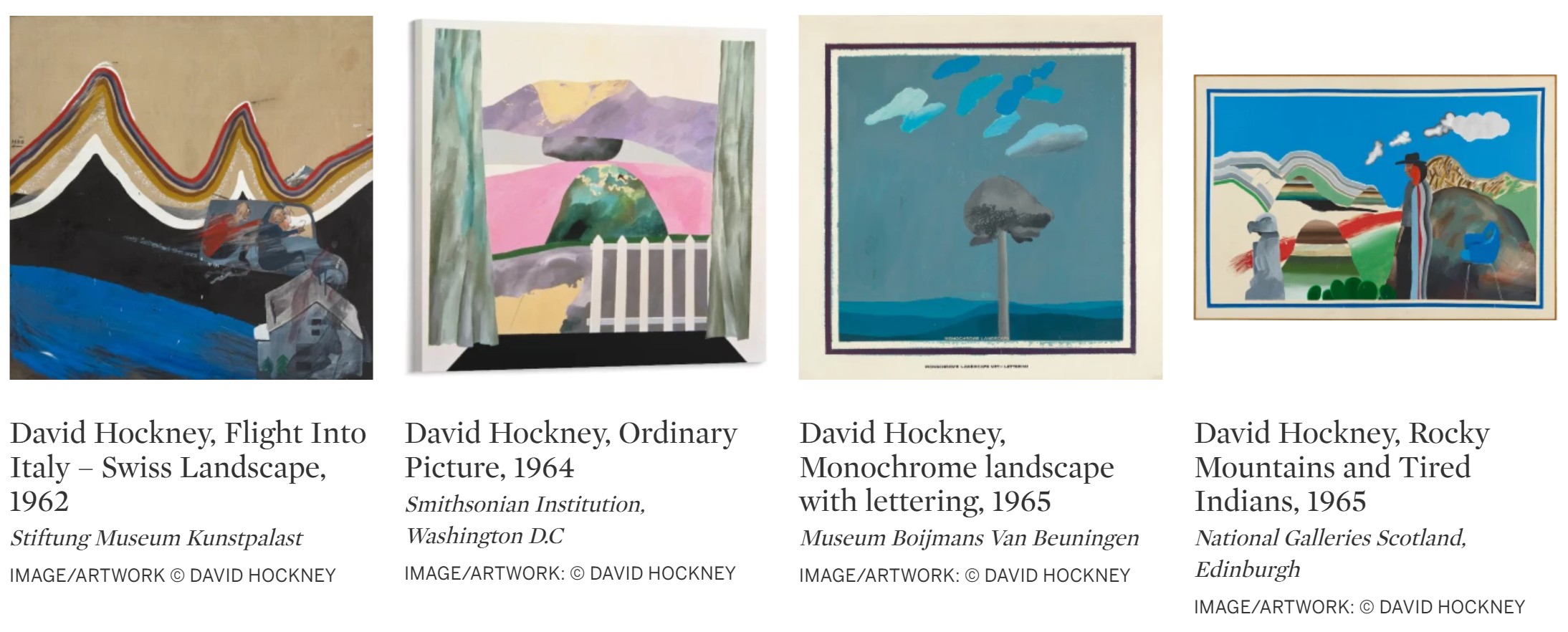
Early Landscapes in Museum Collections
The early exhibition history of English Garden is inseparable from the role played by John Kasmin, whose New Bond Street gallery became a crucial site for the emergence of Hockney’s career in the early 1960s. When Kasmin opened the gallery in 1963, he did so with the explicit ambition of reshaping the London scene, introducing a new generation of artists aligned with the formal clarity and ambition of contemporary American painting. Designed as a radical departure from the plush, traditional gallery interiors of the time, the space offered a stark, light-filled environment ideally suited to the display of large, modern works, quickly establishing itself as one of the most influential venues for contemporary art in London during the 1960s. Kasmin’s support proved decisive for Hockney at a formative stage in his career. In 1963, the gallery hosted Hockney’s first one-man exhibition titled Pictures with People In, making him the only figurative painter represented within a roster otherwise dominated by leading proponents of abstraction including Kenneth Noland, Morris Louis and Frank Stella. Within this ambitiously modern context, Hockney was positioned not as an outlier but as a central figure in an international dialogue that redefined the possibilities of contemporary figurative painting.
“English Garden was also painted in Boulder from a photograph of topiary work in England that I found in American Vogue. As it was painted at the same time as Rocky Mountains and Tired Indians, some students thought it was a picture of Indians squatting on a lawn.”
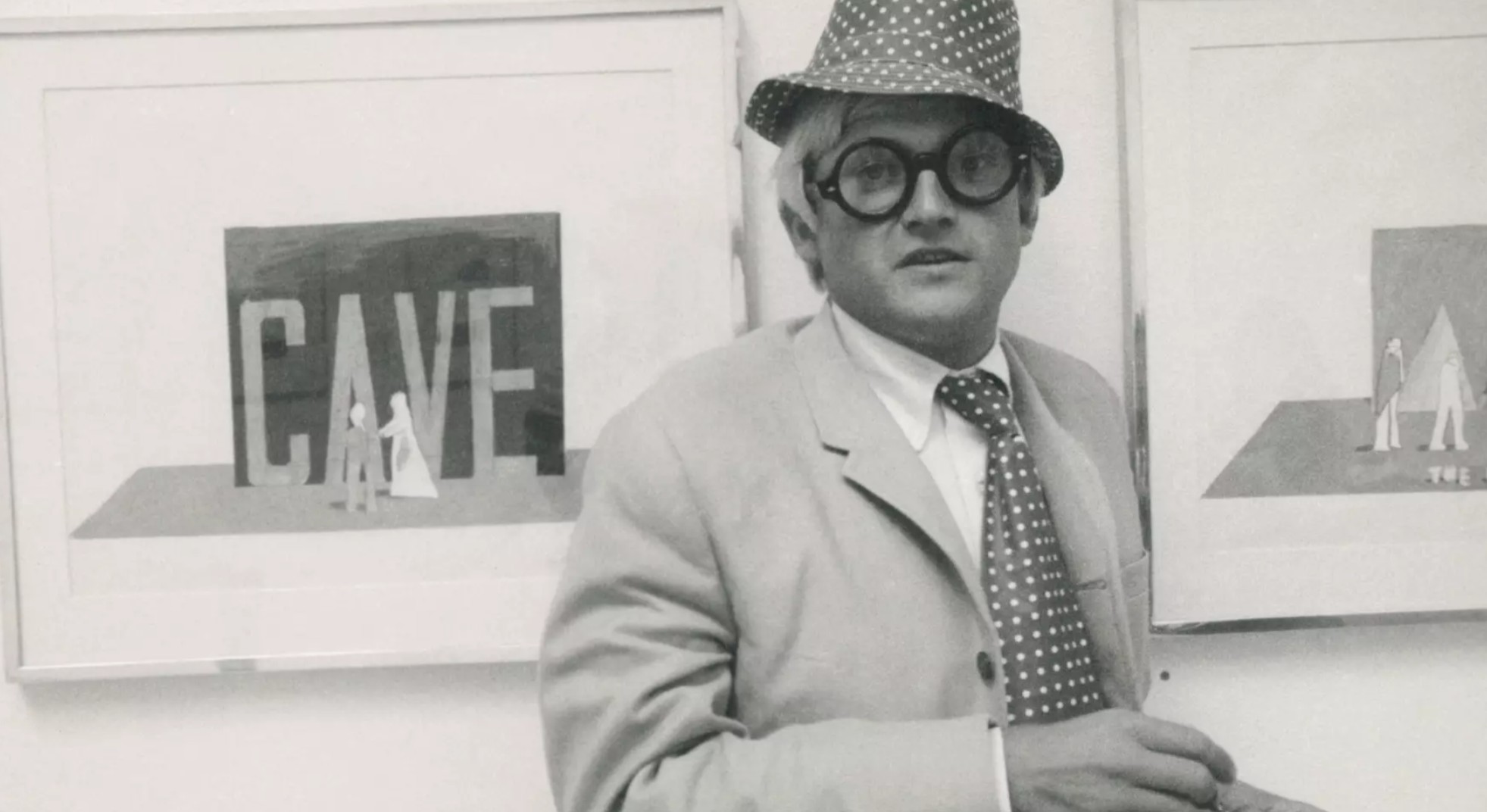
David Hockney at the John Kasmin Gallery in 1966. Image © Science History Images / Alamy. Artwork © David Hockney 2026
Painted while Hockney was teaching at the University of Colorado in Boulder in 1965, English Garden emerged from a condition of displacement. Although Boulder offered grand natural scenery, Hockney famously remarked on the absence of windows in his studio, a deprivation that became unexpectedly fertile. Rather than recording what lay beyond the studio, he turned to distance as his methodology, painting what could be recalled and desired. In doing so, the artist produced not only his first English landscape but the first fully realized statement of the genre within his oeuvre. At this juncture, landscape was reoriented away from lived experience and towards conceptual fabrication, a site through which memory and cultural inheritance could be rigorously re-examined. Here, the immediacy of the American present presses against a selectively imagined Englishness, refined into a vision of immaculate surfaces, heightened palette, and deliberate artifice.
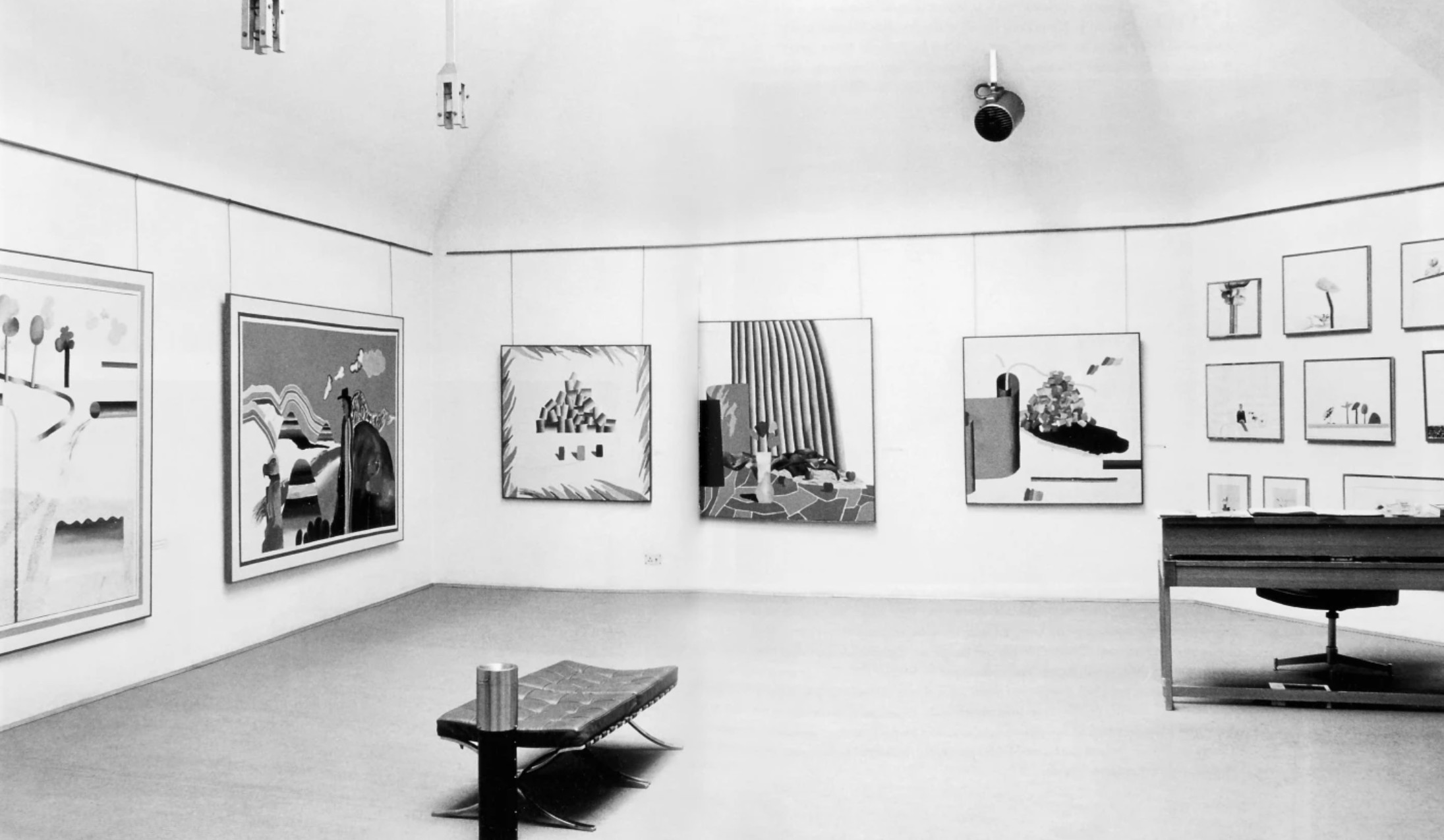
Installation view of David Hockney: Pictures with Frames and Still Life Pictures, Kasmin Ltd., London, 1965.
© 2026 Getty Research Institute, Los Angeles (2001.M.1) © David Hockney
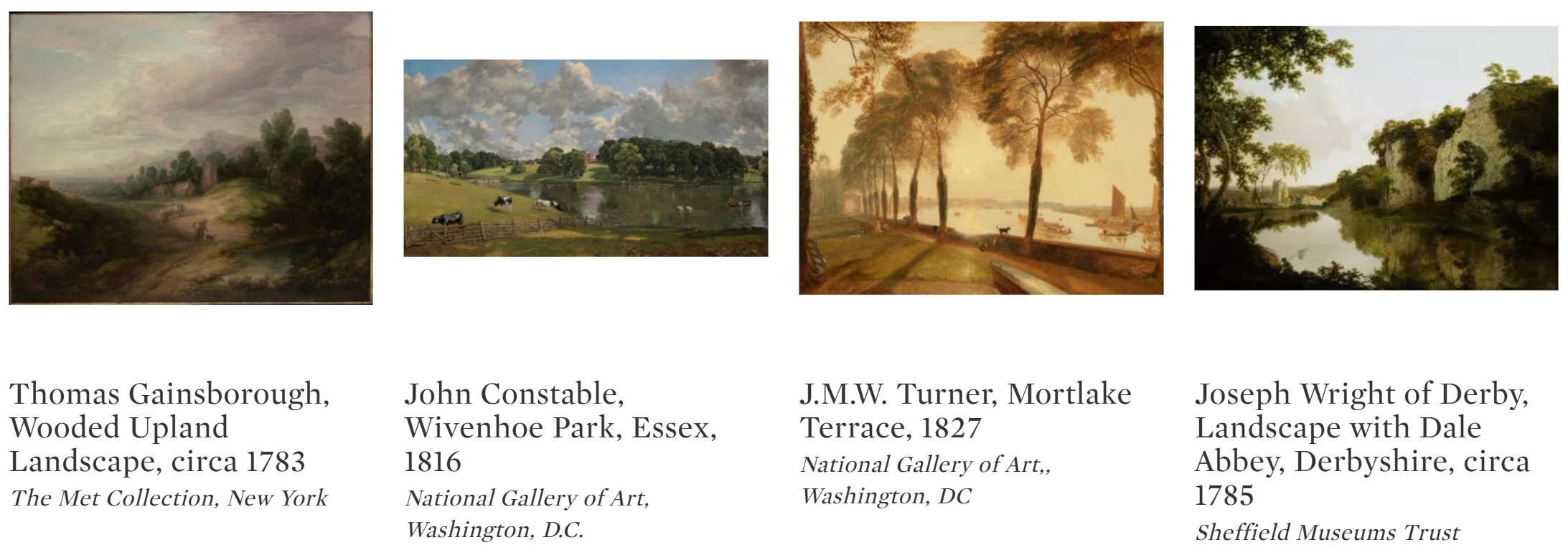
The catalytic role played by the present work is borne out most powerfully in the Yorkshire landscapes that followed in the late 1990s, culminating in Garrowby Hill (1998), now housed in the collection of the Museum of Fine Arts, Boston, and widely regarded as one of the most accomplished compositions of his career. Extending the ambitions first articulated in English Garden, Garrowby Hill transforms remembered terrain into a commanding panoramic vision, exemplifying Hockney’s sustained investigation into the art historical genre of landscape and his conscious placement within the British tradition shaped by Joseph Wright of Derby, Thomas Gainsborough, John Constable, and J. M. W. Turner, while simultaneously absorbing the heightened color and spatial freedom of the Fauves, particularly André Derain and Henri Matisse. From this foundational moment would emerge one of the most ambitious bodies of landscape work in post-war British art, monumental projects such as The Arrival of Spring in Woldgate, East Yorkshire (2011), now in the collection of the Centre Pompidou, confirming English Garden as the conceptual point of origin for Hockney’s lifelong and generative reimagining of landscape.
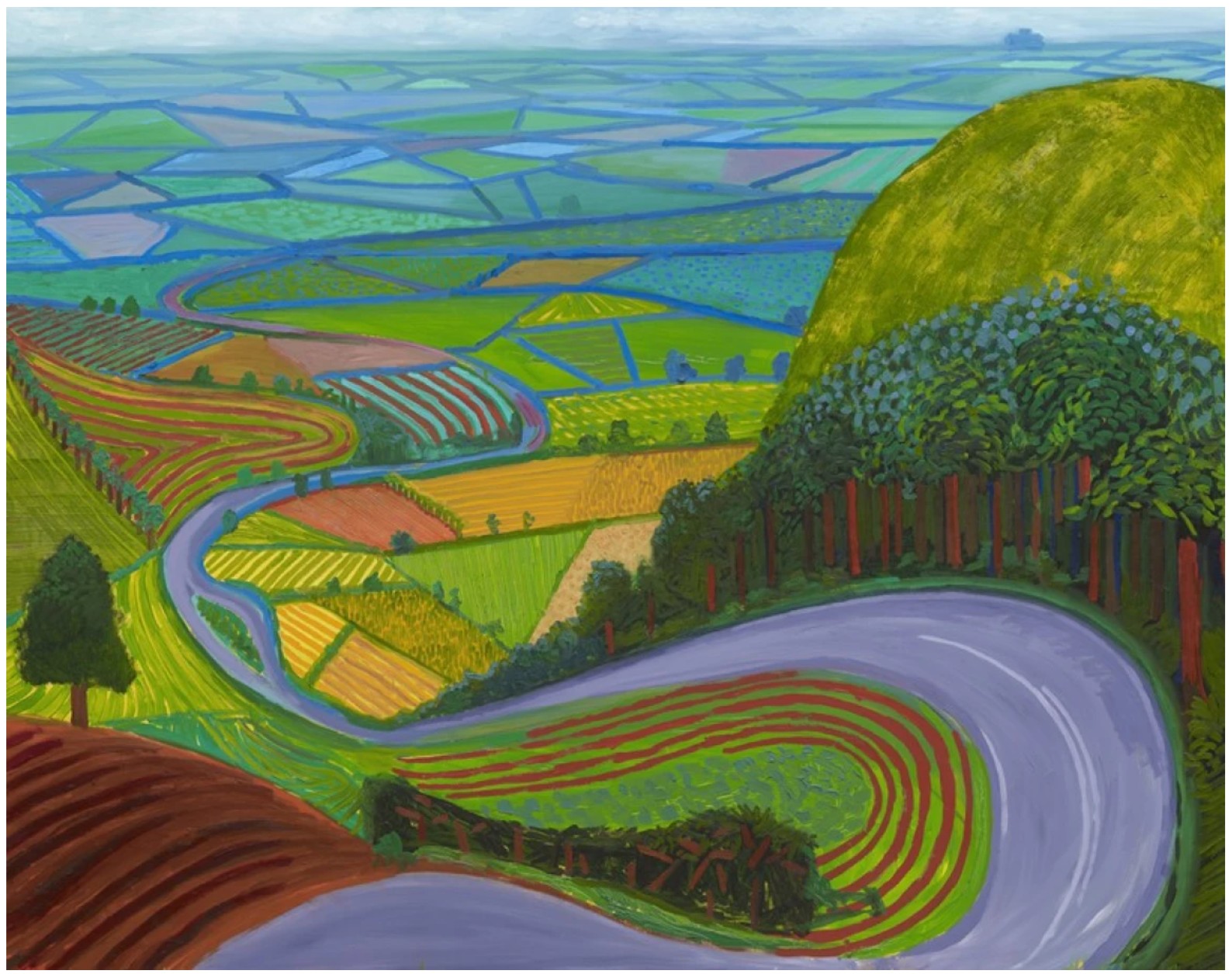
Garrowby Hill, 1998. Museum of Fine Arts, Boston © David Hockney
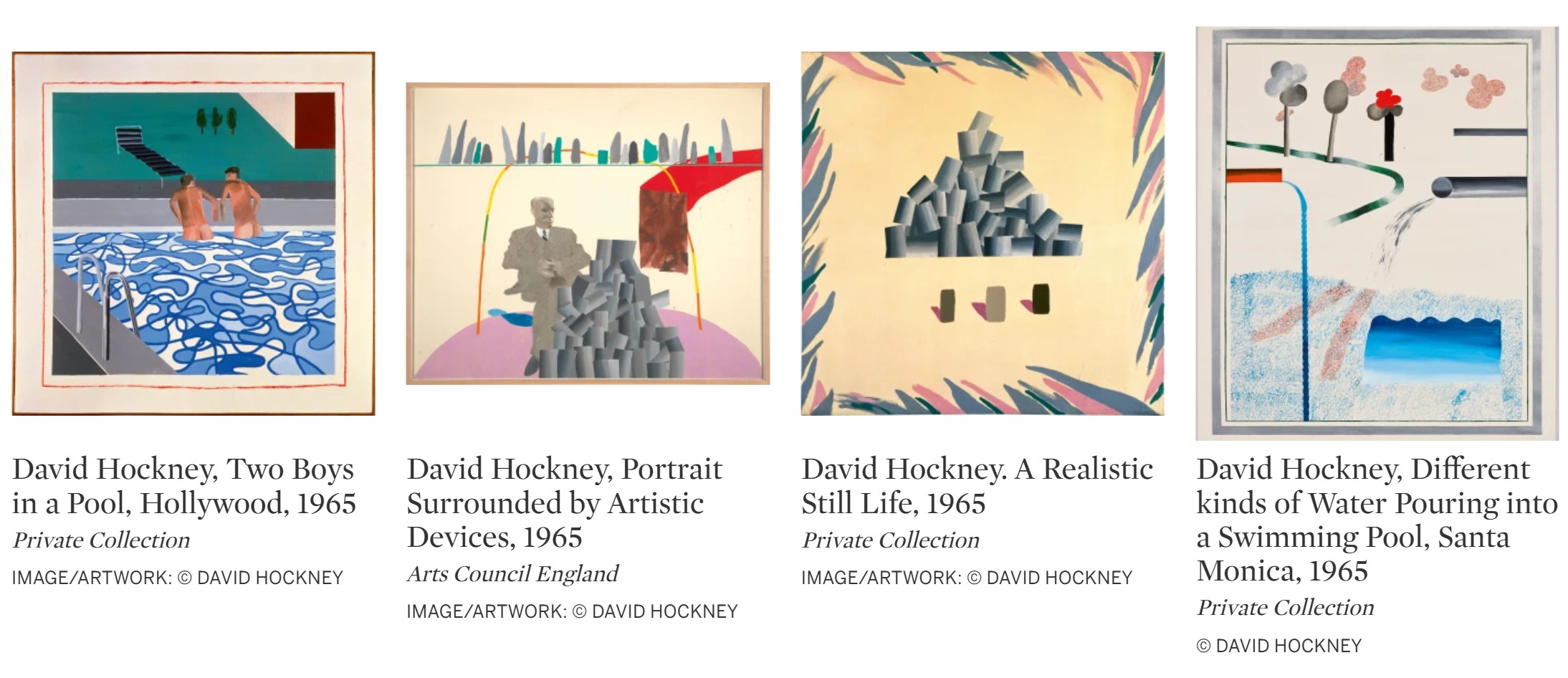
In October 1965, Hockney returned to London ahead of his second solo exhibition at Kasmin’s celebrated gallery. Titled Pictures with Frames and Still Life Pictures, the exhibition brought together ten paintings made that year, including Rocky Mountains and Tired Indians (1965), held in the National Galleries of Scotland, Edinburgh, and Portrait Surrounded by Artistic Devices (1965), housed in the Arts Council Collection in London, situating English Garden within a coherent and conceptually rigorous project. A defining feature of these works is the inclusion of an internal frame, often marked by a band of exposed canvas and a bold exacting border, which establishes a deliberate sense of removal. The viewer is reminded that the scene is not a window onto reality but an image consciously staged and bounded. By presenting a picture within a picture, Hockney emphasized the orchestration of representation while sustaining a productive dialogue with abstraction, prompting the viewer, as critics observed at the time, to question precisely where reality resides within the painted image. John Russell observed, “by including the representation of a frame within the painting itself he gives the work another layer of meaning which causes us to ask exactly where reality lies.” (The Times, 9 December 1965). Materially, this introspective construction was reinforced through Hockney’s embrace of acrylic paint, whose superior American formulations offered both heightened chromatic brilliance and a rapid drying time that enabled him to work with unprecedented clarity and decisiveness. The resulting smooth, luminous surfaces privilege image over facture, aligning with his growing fascination with photography and the mediated, glossy visions of modern life encountered in American magazines.
Paintings exhibited in Pictures with Frames and Still Life Pictures at Kasmin Ltd. in London, 1965
The exhibition proved both a commercial and critical triumph. Writing in The Times, Russell noted that many of Hockney’s newest paintings, emerging from his American experience, ranked among his finest achievements, observing that the artist had discovered one of the few viable paths open to figurative painters at a moment when traditional illusionism seemed spent. The following year, Edward Lucie-Smith, writing in Studio International, similarly emphasized the works’ engagement with America itself, noting that, compared with earlier pictures, Hockney now revealed an astonishing sensitivity to atmosphere. Such critical acclaim sharpened the perception that the young painter from Bradford had found in America not only new motifs but a renewed scale of ambition, enabling him to reconceive landscape as both spectacle and construction, simultaneously seductive in appearance and knowingly artificial in form.
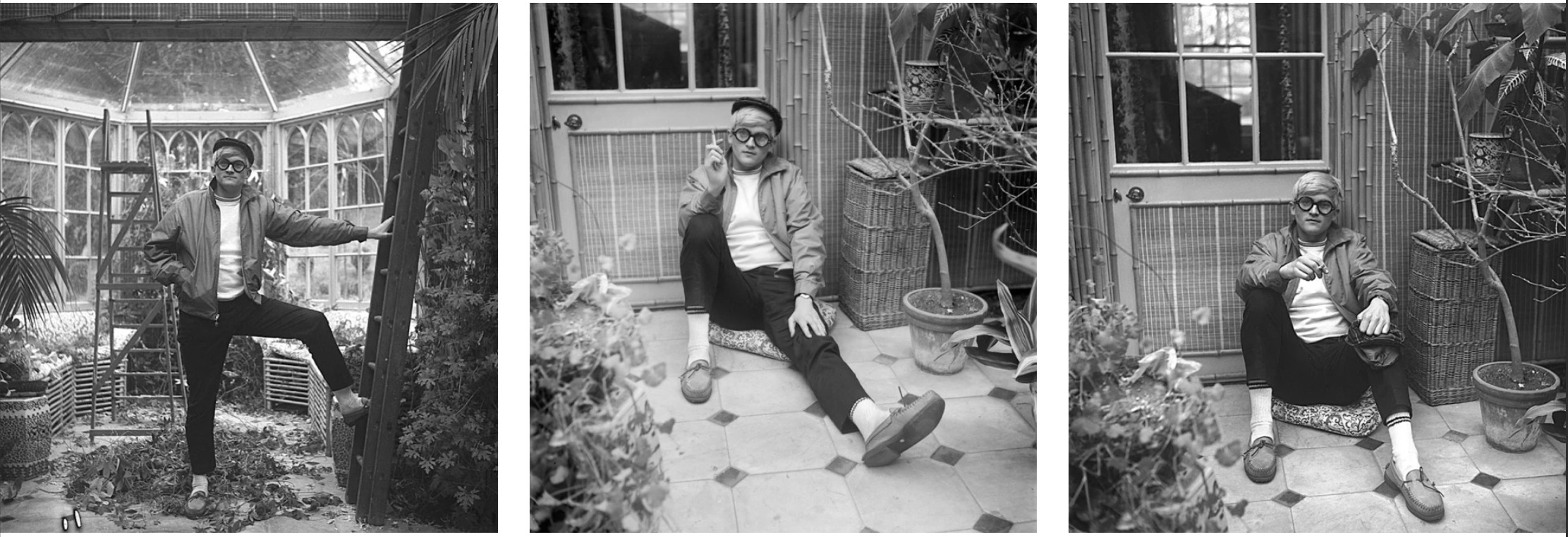
Sir Cecil Beaton, David Hockney, 1965 © Cecil Beaton
It was precisely this American context, so central to the critical reception of the work, that was reshaping Hockney’s imagination at the time. Even as he invented scenery through memory and displacement, his visual language was being decisively recalibrated by California and the heady locale of Los Angeles. By this juncture, his sensibility was firmly attuned to the West Coast, where swimming pools, palm trees, signage and carefully staged domestic spaces became the raw material for a sequence of poised, theatrical scenes. Works such as Two Boys in a Pool, Hollywood (1965) and Sunbather (1966) translate these motifs into intimate, emblematic vignettes, while the more expansive Portrait of Nick Wilder (1966) situates his Los Angeles dealer emerging bust-length from a turquoise pool, encapsulating the cool and cultivated leisure that defined Hockney’s Californian vision. In this respect, English Garden sits in productive dialogue with the swimming pool paintings of the same period, where the pool functions both as a symbol of Californian affluence and a formal device combining boldness of design, grandeur of size, intensely vivid color, and the explosive movement and variegation of water.
Celebrated 18th and 19th Century Landscapes
It is within this broader matrix of displacement, mediation, and construction that English Garden ultimately captures a moment of transition between continents and between modes of representation. The painting offers an elegant vision of cultivated ease, yet its deeper subject is the modern condition of seeing, in which place is often encountered first as a picture and memory is shaped by the surfaces of print, photography and desire. Recasting the classical pastoral through the hard light and constructed environments of the modern world, Hockney transforms the locus amoenus into a contemporary landscape of display and aspiration, aligning his project with a European tradition in which landscape functions not as neutral setting but as an imaginative and ideologically charged stage, from Titian and Rembrandt to Cézanne and Matisse. Less a view than a thought, the painting announces with quiet authority the wit, formal audacity, and conceptual sophistication that would come to define Hockney’s art for decades to come.