In the early 1960s, Lichtenstein began isolating explosive imagery from war comics, abstracting them into self-contained emblems of impact. By 1965, he had begun transferring these compositions from canvas to sculptural materials—transforming ephemeral comic motifs into enduring objects.
Small Wall Explosion, 1965
Small Wall Explosion, 1965
Works from the Collection of Dorothy and Roy Lichtenstein
Sotheby’s New-York: 16 May 2025
Estimated: USD 400,000 – 600,000
USD 812,800
Small Wall Explosion | Contemporary Day Auction | 2025 | Sotheby’s
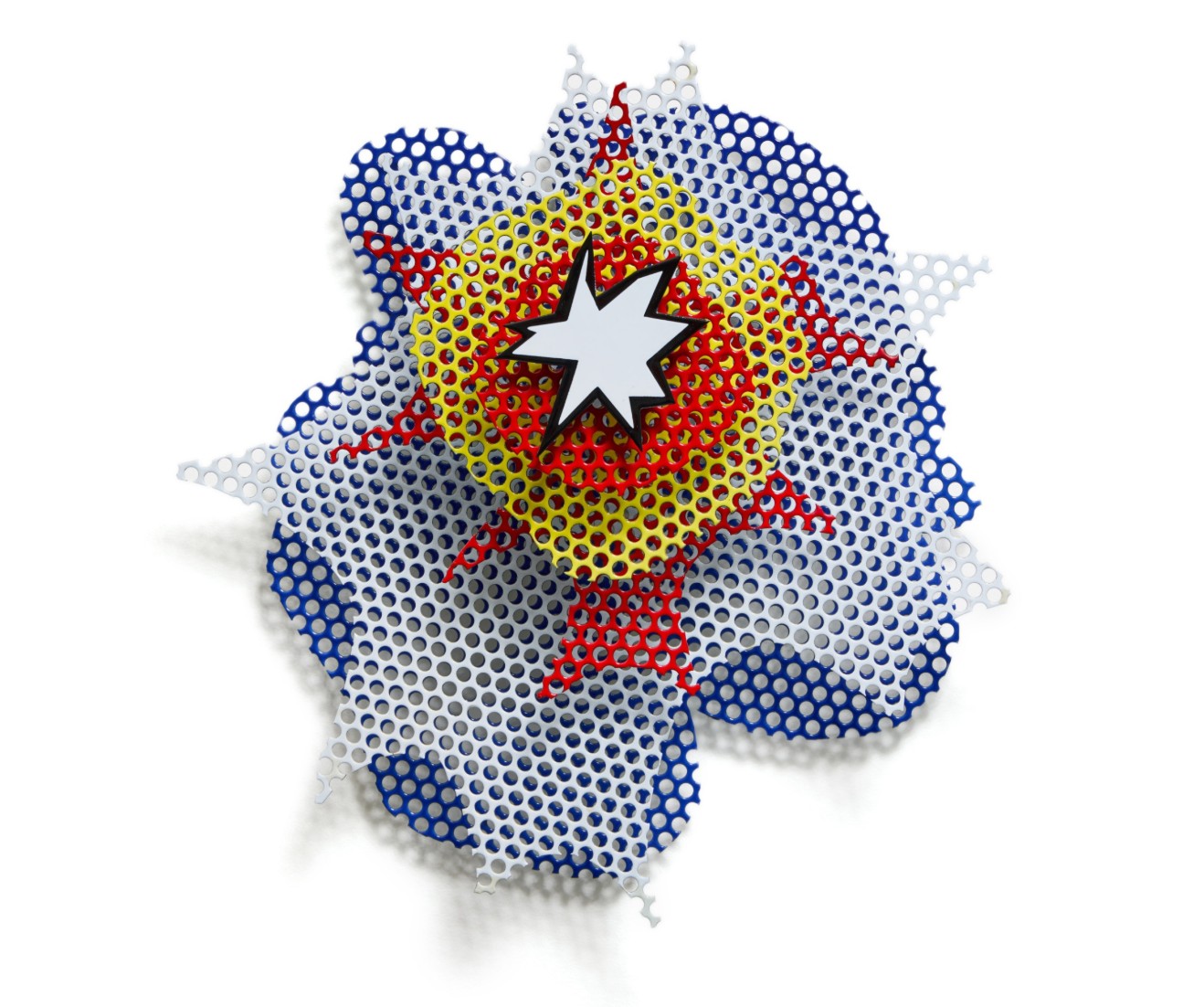
ROY LICHTENSTEIN (1923 – 1997)
Small Wall Explosion, 1965
Porcelain enamel on steel and perforated steel
21 7/8 x 20 1/2 x 7 3/8 inches (55.6 x 52.1 x 18.7 cm)
Signed, dated ’65 and numbered 6/6 (on the reverse)
This work is number 6 from an edition of 6
Bursting from the wall with comic-book bravado, Roy Lichtenstein’s Small Wall Explosion is a visually arresting and conceptually rich object that encapsulates the artist’s pioneering shift from two-dimensional image-making to sculptural form. Executed in 1965, the work brings Lichtenstein’s fascination with mass media, industrial process, and graphic immediacy into vivid three-dimensional life. Coming directly from the artist’s estate, this rare sculpture stands as both Pop icon and sculptural innovation.
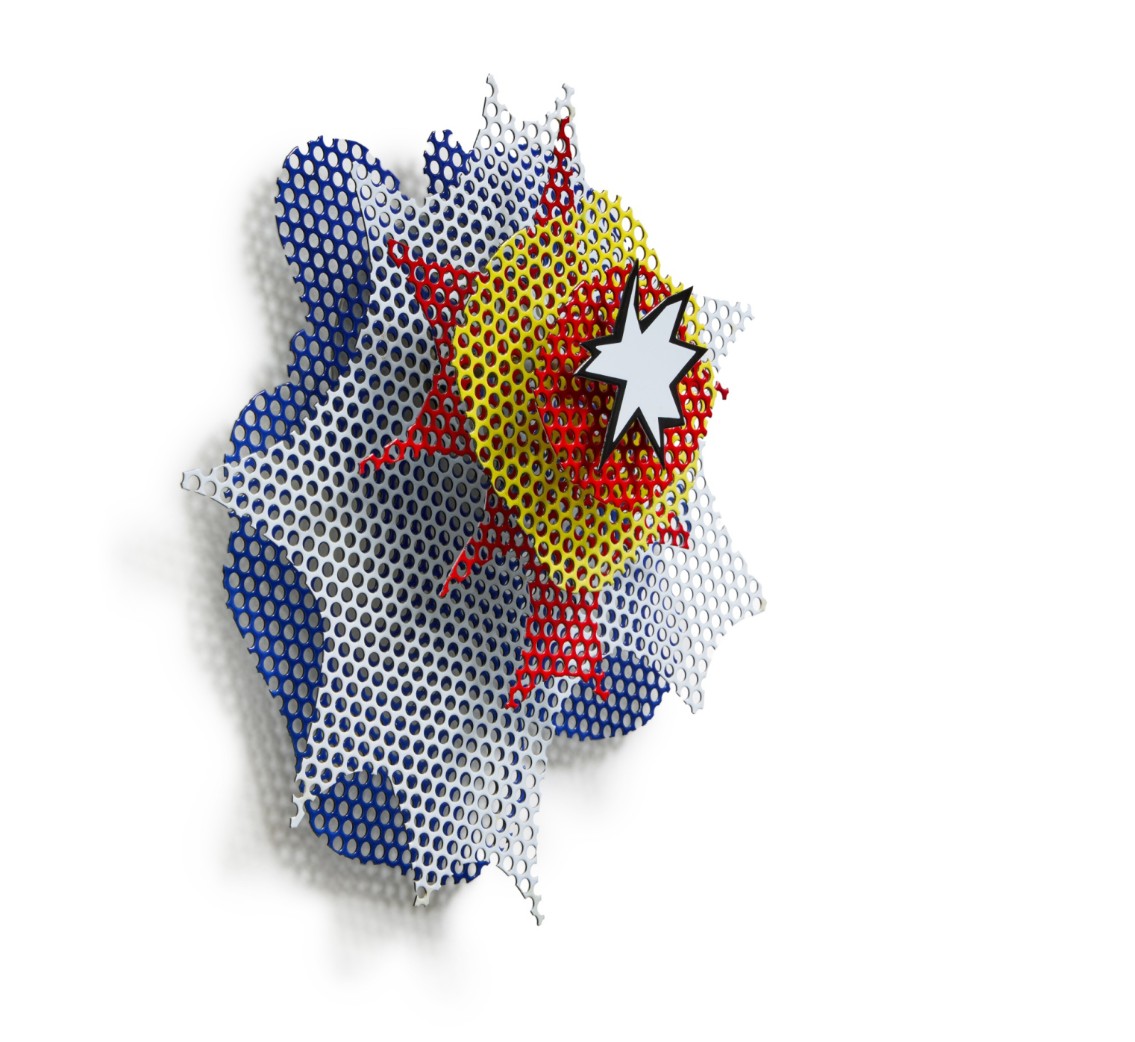
In the early 1960s, Lichtenstein began isolating explosive imagery from war comics, abstracting them into self-contained emblems of impact. By 1965, the year Small Wall Explosion was executed, he had begun transferring these compositions from canvas to sculptural materials—transforming ephemeral comic motifs into enduring objects. This edition of six is among his first forays into fabricated sculpture, translating the immediacy of print into the permanence of enamel and steel. The composition is pure Pop bravura. A jagged red-and-yellow burst radiates from a central point, encased in the bold black outlines and flat fields of color that define Lichtenstein’s visual language. Unlike his painted canvases, here the explosion literally protrudes from the wall. In turning image into object, Lichtenstein makes visible what he once described as the paradox of the comic explosion: a symbol of motion frozen mid-impact, where destruction is rendered harmless through stylization.
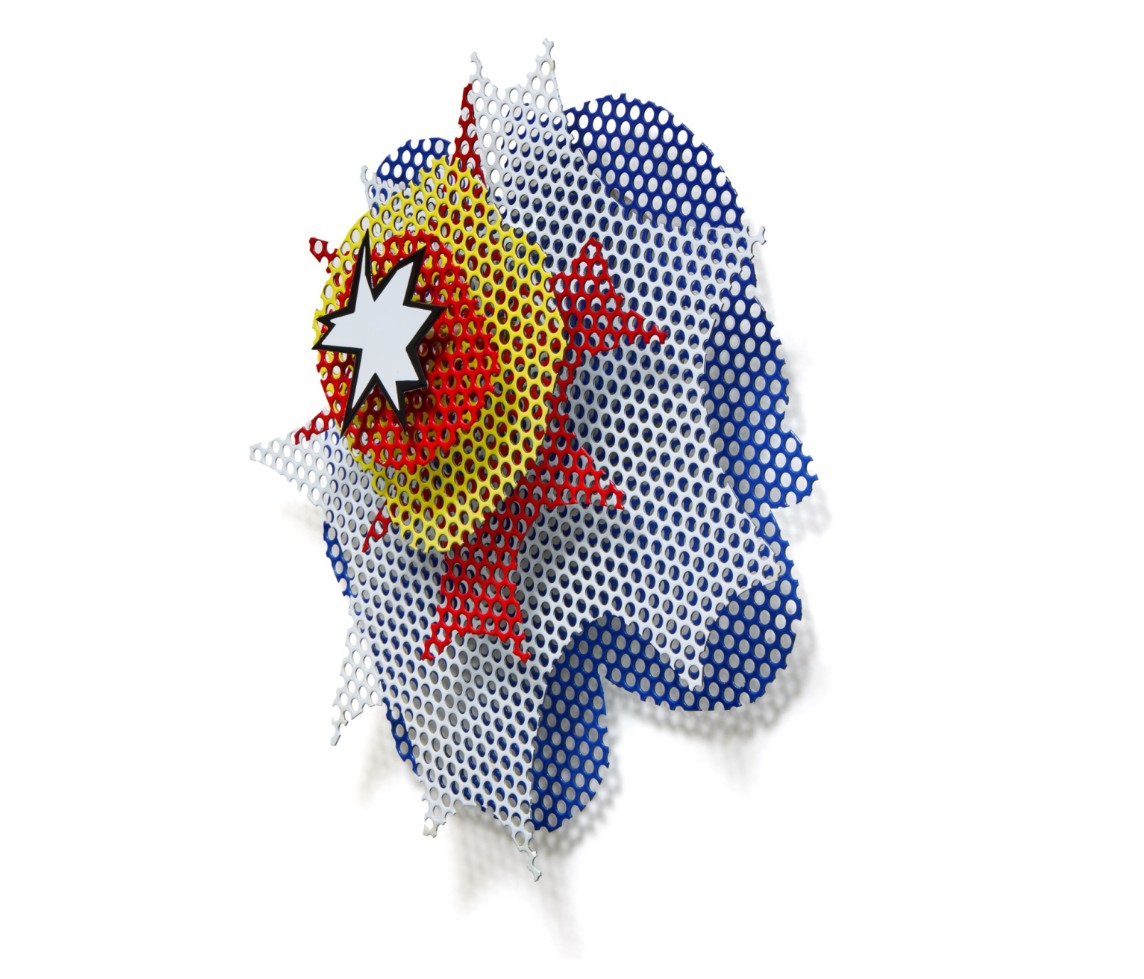
What distinguishes this work, as with all Lichtenstein’s best sculpture, is its friction between content and form. The explosion—traditionally violent, chaotic, and fleeting—is given the cool, clean execution of industrial signage. The use of porcelain enamel, typically associated with commercial displays, reinforces the work’s relationship to advertising, mechanical production, and mid-century Americana. The perforated steel background enhances the illusion of visual vibration, producing a subtle interplay between light and surface that changes as the viewer moves. Small Wall Explosion also represents Lichtenstein’s early and ongoing dialogue with the nature of sculpture itself. Rather than modeling form or mass in the traditional sense, he builds illusion in space—his sculptures are drawings made dimensional. They hover between flatness and volume, icon and object.
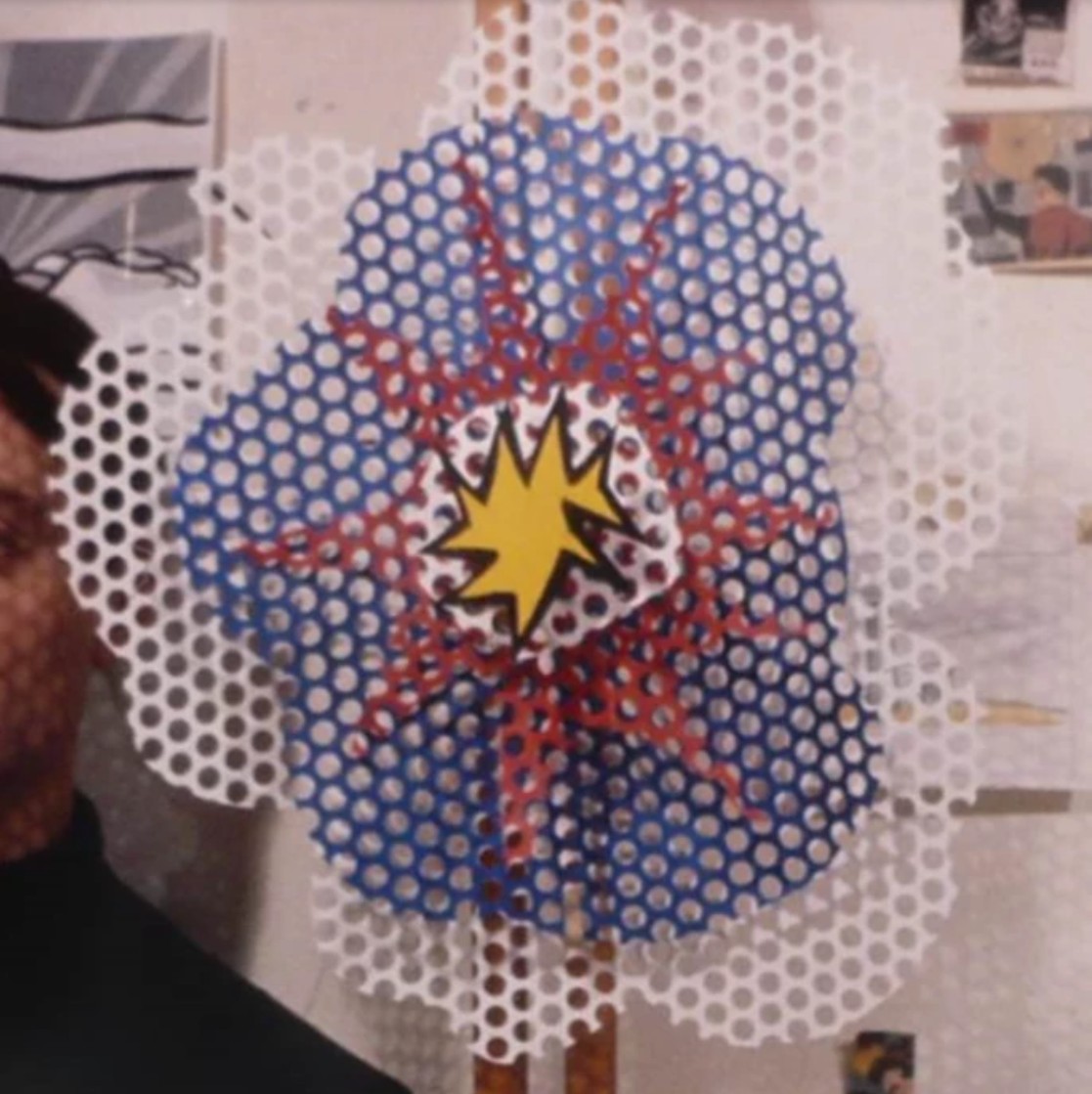
Roy Lichtenstein, Small Wall Explosion (Model), c. 1965. Art © Estate of Roy Lichtenstein.
Throughout its extensive exhibition history—including landmark retrospectives at the Guggenheim, the Corcoran, and the Fondazione Vedova—Small Wall Explosion has been celebrated as a pivotal work in the evolution of Pop sculpture. It is a rare moment where painting, drawing, and sculpture converge into a singular visual statement. With its bold visual language, innovative materials, and seminal status, Small Wall Explosion is a quintessential Lichtenstein object: compact yet powerful, playful yet philosophically resonant. Coming from the artist’s own estate, it offers not just outstanding provenance, but a direct link to the studio innovations that helped define an era of American art.
Wall Explosion III, 1965
Wall Explosion III, 1965
Raising The Bar: Masterworks From The Collection Of Morton And Barbara Mandel
Sotheby’s New-York: 16 May 2018
Estimated: USD 2,000,000 – 3,000,000
USD 4,856,900
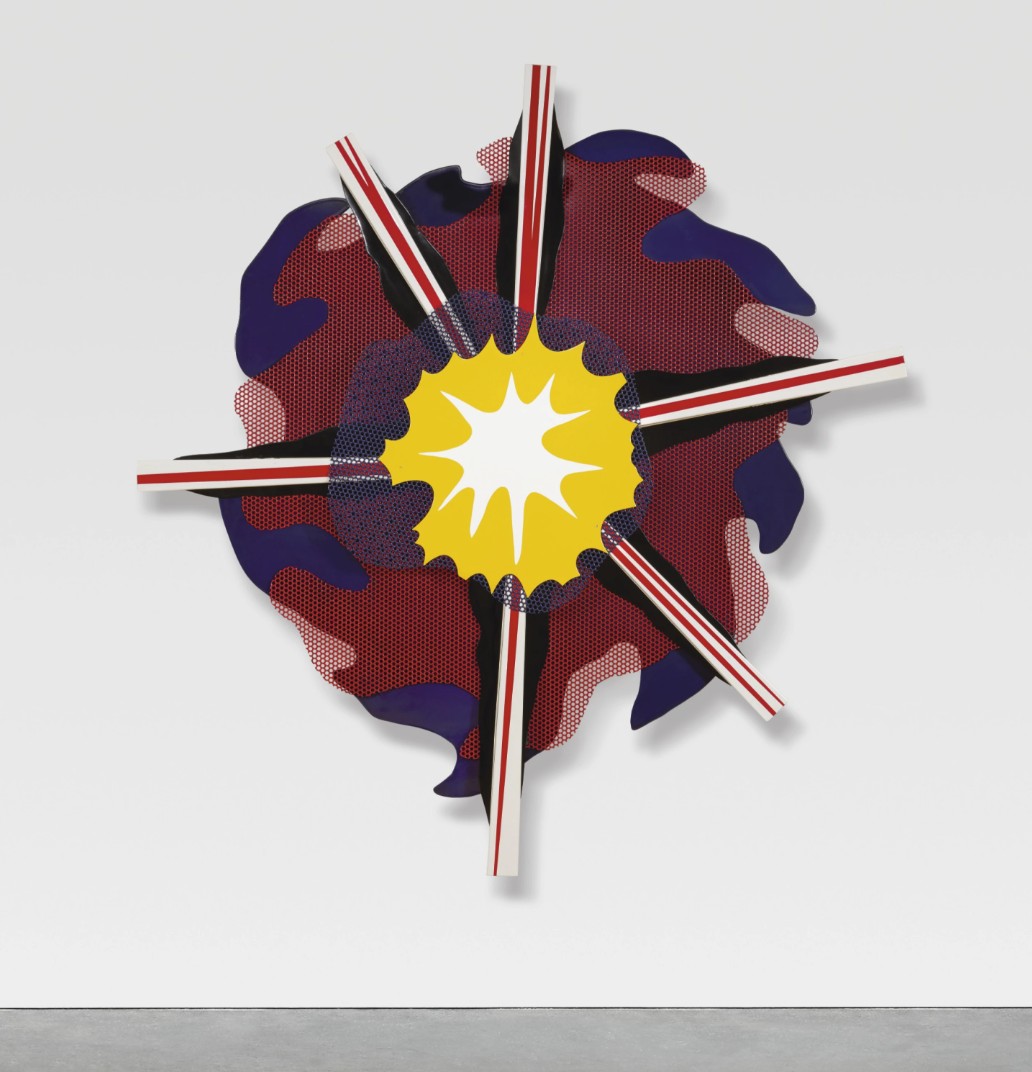
ROY LICHTENSTEIN
Wall Explosion III, 1965
Porcelain enamel on steel
83-1/2 x 80 x 5 inches (212.1 x 203.2 x 12.7 cm)
Erupting in a vibrant cacophony of color and form, Wall Explosion III vehemently exemplifies the juxtaposition of highly charged popular imagery with flawless formal execution which distinguishes the very best of Roy Lichtenstein’s celebrated Pop oeuvre. Radiating outward from the central yellow blast, the swirling clouds of crisply executed Ben-day dots and sleek steel apertures are utterly explosive in their inherent dynamism and elemental force, gripping each viewer in its pictorial exuberance and underlying conceptual gravitas. Executed in 1965, at the very apogee of the Pop era, the present work is an early exemplar of Lichtenstein’s investigations into the medium of sculpture; presenting a fascinating tension between the stability of the steel object and the fleeting nature of an explosion itself, Wall Explosion III realizes the dynamism of Lichtenstein’s iconic comic book paintings in three dimensions. Composed of interlocked sheets of enamel on steel, the present work is one of six unique “Explosion” sculptures from 1965 which, in their sharp focus and clear acuity for such simplified Modernist precepts as line, color, and shape, exemplify the artist’s complete mastery of the mechanics of impact culled from the comic-book-derived iconography. With other works from the limited group held in such collections as the Museum Ludwig, Cologne the Tate Modern, London, Wall Explosion III epitomizes Lichtenstein’s revolutionary appropriation of popular culture as lenses for contemporary society, merely through the simple act of re-presentation. As is archetypal of the artist’s most resonant masterworks, Wall Explosion III harnesses the inherent power of culturally pervasive signs and symbols to reference and evoke elements of contemporary society with striking clarity. Lichtenstein achieved significant critical acclaim in the 1950s and early 1960s when he assertively challenged the preeminent aesthetic priorities and core artistic ambitions which his Abstract Expressionist contemporaries held paramount. Though intentionally universal in their imagery, content, and legibility, Lichtenstein’s comic paintings of the early 1960s—in particular, those that address war through highly idealized narrative structures— represent a pivotal moment in the artist’s practice when he began to tackle new subject matter, leaving behind the mundane to address some of the most pressing issues from the world around him.
Describing this period within the artist’s work, scholar Paul Schimmel explains, “Lichtenstein’s works of the early 1960s exhibit a keen interest in action. He paints about process and not with it…The early cartoon paintings of romance and war are ‘action packed’ with water, wind, and explosions. Seeing these works…provides an insight into this critical period of transition in his work.” (Exh. Cat., Los Angeles, The Museum of Contemporary Art (and travelling), Hand-Painted Pop: American Art in Transition 1955-62, 1993, p. 46) Reflecting upon the particular appeal of imagery sourced from comic-books, Lichtenstein himself noted, “All that time I was interested in anything I could use as a subject that was emotionally strong—usually love, war, or something that was highly-charged and emotional subject matter. Also, I wanted the subject matter to be opposite to the removed and deliberate painting techniques. Cartooning itself usually consists of very highly-charged subject matter carried out in standard, obvious and removed techniques.” (Graham Bader, Hall of Mirrors: Roy Lichtenstein and the Face of Painting in the 1960s, Cambridge, 2010, p. 97) Presented in the context of mid-1960s America, a period defined by heighted anxiety in the wake of the Cuban Missile Crisis and ever-growing tensions in Vietnam, Lichtenstein’s paintings and subsequent sculptures of comic-book based war scenes allowed the artist to consider emotionally charged subject matter within the Pop vernacular, effectively addressing some of the most anxiety-producing associations of his time head-on. In their engagement with issues of international conflict, these works also retain a sly autobiographical undercurrent: initially enlisting in the army in 1943, Lichtenstein began his combat operations in France in 1945, continuing tactical operations in Belgium, Germany, and Switzerland before returning home to Fort Dix in 1946. Informing, if not inspiring, such renowned paintings as Mr. Bellamy, 1961, Live Ammo (Take Cover), 1962, and Whaam!, 1963, these comic-book depictions of war capture a cultural moment particular to the 1960s, subtly infusing the subjective significance of his seemingly objective scenes with charged meaning.
Although Lichtenstein’s signature renderings of comic-book explosions appear as early as Blam from 1962 in the permanent collection of the Yale University Art Gallery, it wasn’t until 1965 that the artist began to explore the aesthetic possibilities of the shape in its own right. As Diane Waldman noted, “Lichtenstein’s sculpture is an extension of his painting. With enamel, Lichtenstein accomplished two objectives: he reinforced the look of mechanical perfection that paint could only simulate but not duplicate and it provided the perfect opportunity to make an ephemeral form concrete.” (Diane Waldman, Roy Lichtenstein, New York 1971, p. 23) Describing the impetus behind his sculptural works, Lichtenstein succinctly noted, “I was interested in putting two-dimensional symbols on a three-dimensional object.” (John Coplans, Roy Lichtenstein, 1967, p. 16) Bold in ambition and scale, in the present work Lichtenstein has extracted a fragment of highly dynamic imagery and brilliantly flattened it with the utmost sophistication, rendering only its most fundamental and basic formal qualities before inviting his blast back into the three-dimensional space it originally inhabited. Rendered in the highly simplified color palette of red, yellow, blue, and white, the bold lines of Lichtenstein’s sculpture are imbued with a distinctly feverish energy, pushing its impact beyond the clean lines, primary colors, and simple shapes which define the present work from a formal perspective. The sharp, simplified clarity of the sculpture, combined with the foreshortened perspectival space, powerfully evoke the two-dimensional nature of the artist’s source material while, simultaneously, introducing his signature motif into an entirely new dimension. In the precision of its crisp steel shapes, thick black outlines, and solid fields of saturated color, Lichtenstein infuses his rendering of a split-second combustion with an air of mechanical perpetuity into; in turn, his eponymous Ben-Day dots, perfectly regimented and crisply delineated, invest the sculpture with a volatile sense of tension. Portrayed so exuberantly and vibrantly that the viewer cannot help but expect a resounding KABOOOM! mere moments later, Wall Explosion III is an entirely captivating crystallization of the themes which fueled, informed, and defined Lichtenstein’s most groundbreaking and iconic masterworks.
Standing Explosion #2 (Yellow), 1966
Standing Explosion #2 (Yellow), 1966
WORKS FROM THE COLLECTION OF ILEANA SONNABEND
AND THE ESTATE OF NINA CASTELLI SUNDELL
Christie’s New-York: 10 November 2015
Estimated: USD 500,000 – 700,000
USD 905,000
Roy Lichtenstein (1923-1997), Standing Explosion #2 (Yellow) | Christie’s
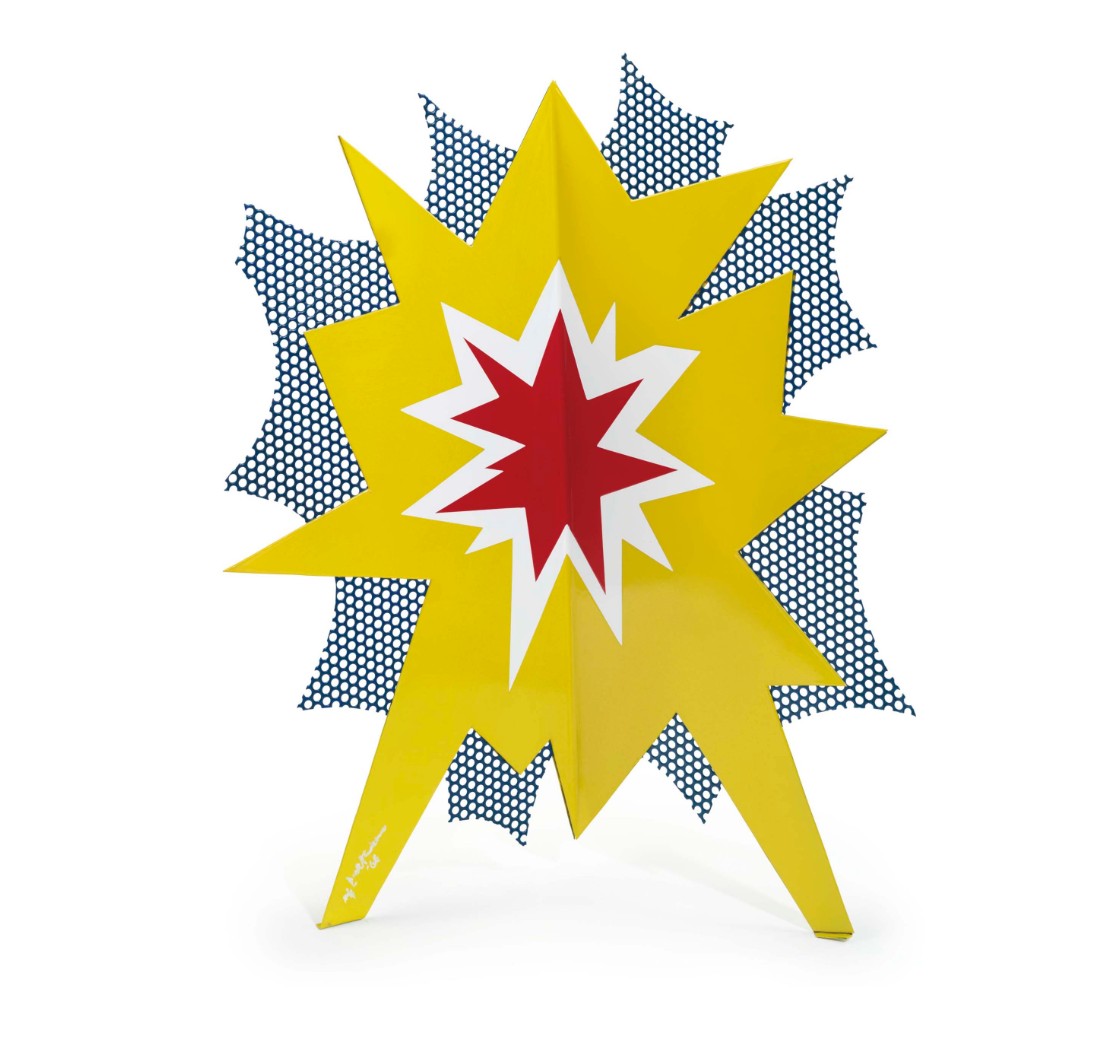
ROY LICHTENSTEIN (1923-1997)
Standing Explosion #2 (Yellow), 1966
Porcelain enamel on steel
36-3/4 x 26-1/4 x 25 inches (93.3 x 66.6 x 63.5 cm)
Signed and dated ‘rf Lichtenstein ’66’ (on the reverse of the yellow element)
This work is a unique variant from a series of six
In Standing Explosion #2 (Yellow), Roy Lichtenstein “blows up” one of his most recognizable Pop motifs, intensifying his flattened explosion iconography in size and color before hurling it into three-dimensional space. The freestanding sculpture is based on an isolated fragment of pulp imagery, a pictographic blast sourced from a popular DC War Comic about the Second World War. The high-impact work constitutes a distillation of the appropriated image into what Lichtenstein referred to as a “crystallized symbol,” a succinct representation of not only an explosion but the pop cultural portrayal of an explosion. In a flash-frozen flurry of enamel and steel, Standing Explosion #2 (Yellow) captures a cultural moment particular to the 1960s, during which the Vietnam War was at the forefront of America’s popular consciousness and the proliferation of “’virtual’ means of communication such as TV and publicity [made] what was concrete and real…increasingly less important” (G. Celant, Roy Lichtenstein: Sculptor, Fondazione Emilio e Annabianca Vedova, Venezia, 2013, p. 19). The ease with which stylized icons like the caricatural explosion could be reproduced across popular print media like comics, newspapers, and billboards and summarily consumed by mass culture rendered them culturally dominant, a slick American semiotics for Lichtenstein to use as artistic material. Treating vision metaphorically, the high-octane Standing Explosion #2 (Yellow) leverages the vernacular of comic books to both ask cerebral questions about the manner in which vision is culturally coded and probe mainstream representations of the military-industrial complex in America.
The present work cannily plays with inverses as it embeds the representational volumetric devices of two-dimensional mass media in a sculptural form and renders representations of potentially devastating violence in sleek shapes and fun, vibrant colors. The potent piece packs an emphatic Pop punch. Colors have been streamlined to a keyed-up, primary palette. Surfaces have been made industrially slick, gleaming with porcelain enamel. As artist Ian Wallace has explained in his writings on the Pop titan, for Roy Lichtenstein “enamel offered the opportunity to depict ephemeral subject matter in a manner that was ‘completely concrete’”: a pleasurable paradox (I. Wallace, “Something to Do: Manufacturing Roy Lichtenstein’s Sculptures,” G. Celant, Roy Lichtenstein: Sculptor, Fondazione Emilio e Annabianca Vedova, Venezia, 2013, p.33). In the ironic fashion characteristic of Lichtenstein’s oeuvre, the work’s denticulate contours freeze the ephemeral moment of the explosion into a sculpture that is resolutely immobile, concrete, and abstract: a “formal reconciliation of lowly contents and high forms” (H. Foster, “Pop Pygmalion,” Roy Lichtenstein Sculpture, exh. cat., Gagosian Gallery, New York, 2005, p. 10).
The ingenious device of Standing Explosion #2 (Yellow)’s perforated metallic screen at once evokes the cloud of smoke or blinding light that might accompany an explosion as it implies Ben-Day dots, the halftone dots used to modulate tone in printing which Lichtenstein appropriated, enlarged, and took as his aesthetic signature (interestingly, the Ben-Day dots were barely visible in the originary comic on which the present sculpture is based). The metallic screen joins the variously colored “layers” of the explosion to imply depth. In Lichtenstein’s sculptures as with his paintings, the artist “evoke[d] volume pictorially far more than he shape[d] it sculpturally” (H. Foster, “Pop Pygmalion,” Roy Lichtenstein Sculpture, exh. cat., Gagosian Gallery, New York, 2005, p. 9); very little about the present work is “in the round,” as most of its depth is wittily pictorially signified. With a gorgeously precise, graphic style, Standing Explosion #2 (Yellow) takes the energy, impact, and aggression of so much commercial art and heightens those elements to the point of a hysterical, bellicose flammability.
The present work is among the artist’s early Pop sculptures. Prior to the 1960s, Lichtenstein had produced small-scale wood and terracotta works inspired by African and South American styles; he then began to sculpt in the Pop style for which he became known, creating glazed busts and figurative works invoking imagery from his paintings. The explosion is among Lichtenstein’s best-known motifs. The artist first employed the explosion image in acrylic in his notable 1962 works Blam and Live Ammo (Blang!). In 1965 and 1966 he explored a three-dimensional rendering of the image with the Explosion series, a small collection of sculptural explosions in colorful enameled steel. In the sculptural process, Lichtenstein enlarged the combustion and rendered it in acrylic. In upstate New York, Lichtenstein cut, assembled, and enameled sheets of metal in accordance with the design. In a Pop fashion, this somewhat industrial process blurred lines between high and low. Playfully ricocheting between mass media illustration and museum-ready sculpture, battle monument and comic strip, and sculpture and painting, Standing Explosion #2 (Yellow) engages with key themes of Roy Lichtenstein’s oeuvre with explosive energy and a knowing wink.
Small Explosion (Desk Explosion), 1965
Small Explosion (Desk Explosion), 1965
Sotheby’s New-York: 10 May 2012
Estimated: USD 500,000 – 700,000
USD 422,500
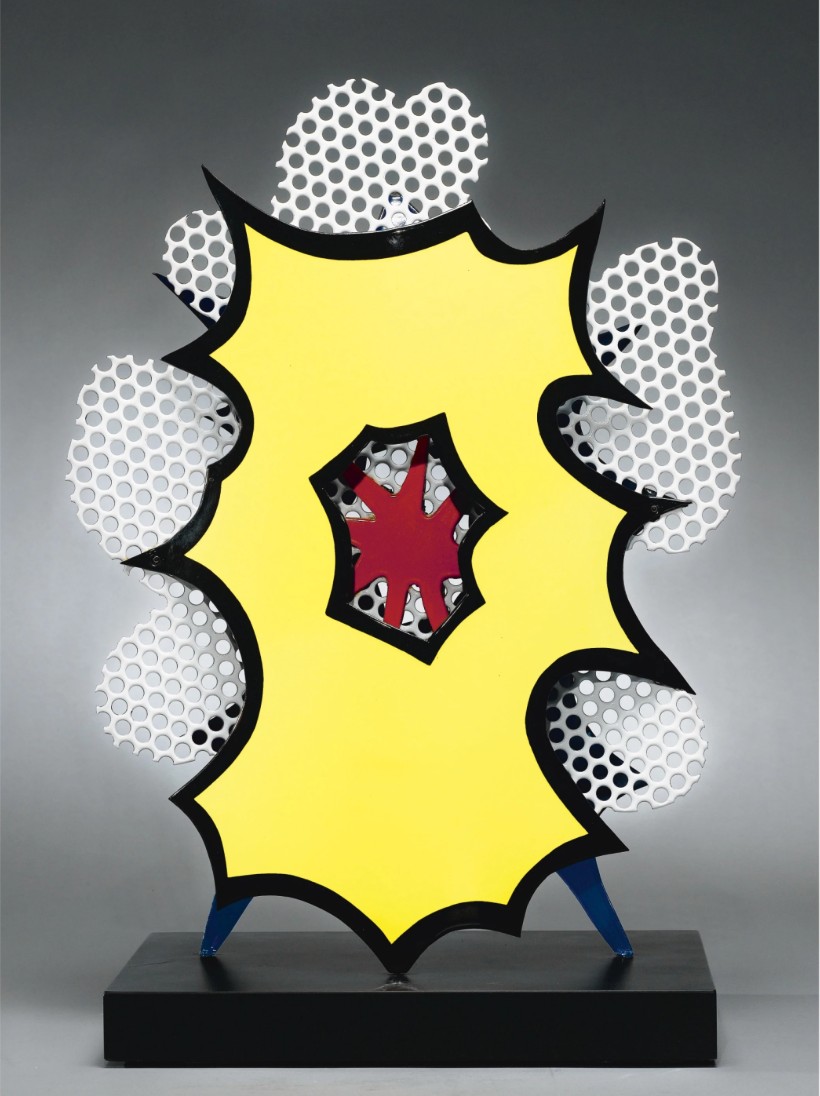
ROY LICHTENSTEIN
Small Explosion (Desk Explosion), 1965
Enamel on steel
21-1/4 x 16 x 6 inches (54 x 40.6 x 15.2 cm)
Signed and numbered 2/8
Roy Lichtenstein’s sculptures are trademarked by their distinctly planar qualities, where the pictorial elements of his paintings are rendered as concrete, freestanding images drawn in space. They appear as direct detachments from their original two-dimensional source compositions, and, although fabricated from painted, patinated metals, are not quite three-dimensional. Rather than being shaped and formed in the round, the perception of volume is created instead by the graphic techniques of his paintings, presenting the viewer with a single viewpoint, as the artist plays with flatness and the illusion of depth and form. The characteristic heavy black lines and bold primary hues presented in Lichtenstein’s Pop paintings outline the borders of the sculptures and appear as broad, diagonal hatch lines and Benday dots evoking a sense of volume, reflection or shadow.
In the same period that Lichtenstein was producing a series of painted ceramic heads of women, the Explosion sculptures of the mid 1960s appeared and were derived from scenes of military combat from war comics of the period. These are among the very first sculptural series that exemplify both the formal elements and Pop ideology representative of Lichtenstein’s sculptures which remained consistent throughout his artistic career. Small Explosion (Desk Explosion), 1965, is composed of multiple flat, primary colored layers of steel repeating outward and suspending a momentary blast in action. He manages to capture both the violence of the eruption with the sharp, star-shaped planes and the subsequent smoke that follows an explosion with the use of the perforated, cloud-like form layered between. Alone, it stands as a formally designed sculptural abstraction, yet indisputably connected to its Pop origin.