JEAN-MICHEL BASQUIAT (1960 – 1988)
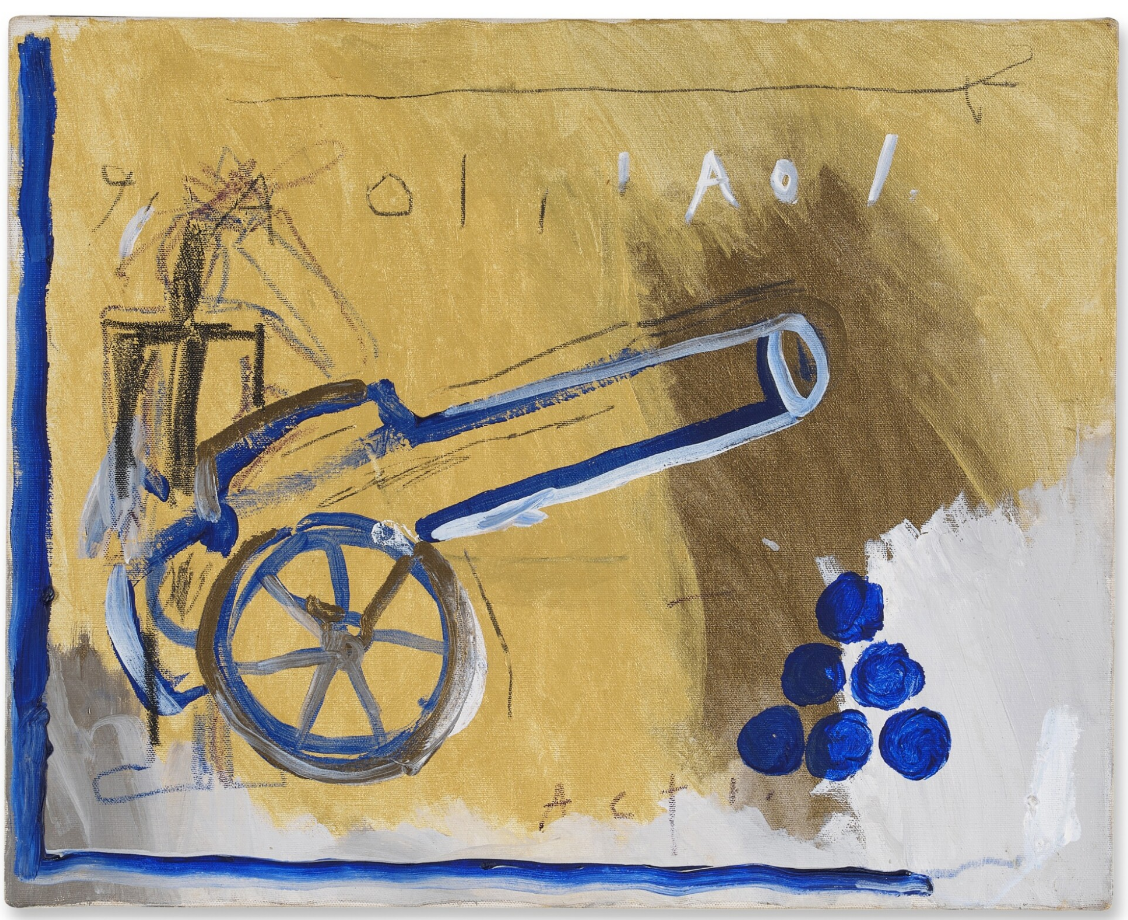
Cannon (Act 1), 1981
Acrylic and oil stick on canvas
16×20 inches (40.6 x 50.8 cm)
Provenance
Barbara Egan and Glenn O’Brien, New York
Private Collection, New York
Private Collection
Cornette de Saint Cyr, Paris, 12 December 2015, lot 38
Private Collection
Acquired at the above in 2021 by the present owner
Auction History
Sotheby’s New-York: 16 November 2023
Estimated: USD 1,000,000 – 1,500,000
USD 1,270,000
Cannon (Act 1) | Contemporary Day Auction | 2023 | Sotheby’s (sothebys.com)
Executed in 1981, Jean-Michel Basquiat’s Cannon (Act 1) chronicles a seminal year within the artist’s illustrious career. Characterized by raw expressionistic force and frenetic fervor, the present work stands as an intimate example of Basquiat’s early style at its very best. The frenzied composition erupts in a cacophony of expressive mark making, teeming with rich color and energy, while harnessing a myriad of references that evoke the language of a city in glorious disarray. The year 1981 marked a pivotal moment for Basquiat’s artistic career, setting the stage for his meteoric rise in art world. Prior to this year, his work was never exhibited or considered in a formal setting. However, in January, he took part in the now infamous multi-disciplinary show New York/New Wave hosted at the alternative gallery space, P.S.1. Even against the eclectic background of this exhibition, which celebrated the hip-hop, graffiti, and break-dancing cultures of New York, Basquiat’s work stood out. That same year, Annina Nosei invited Basquiat to join her gallery, and he subsequently occupied her basement as a studio for the majority of the year. In December, Artforum published Rene Ricard’s landmark essay The Radiant Child, defining Basquiat as one of the most important artists of his generation and shedding light on the East Village gallery scene of the early 1980s. It is against this backdrop that Cannon (Act 1) comes to fruition, taking its place in Basquiat’s narrative, on the cusp of a grandiose paradigm shift: From streets and subway trains to galleries and museums, from spray cans to brushes, and from brickwork to canvas. As its title suggests, the present work indeed symbolizes the opening act of a historic story — one which would chart the most prolific years of the artist’s career until his untimely death in 1988. Radically raw and evocative, Canon (Act 1) is a rare example of the confidence and dynamism with which the young artist, at only twenty-one years old, asserted his entry to the international art world.
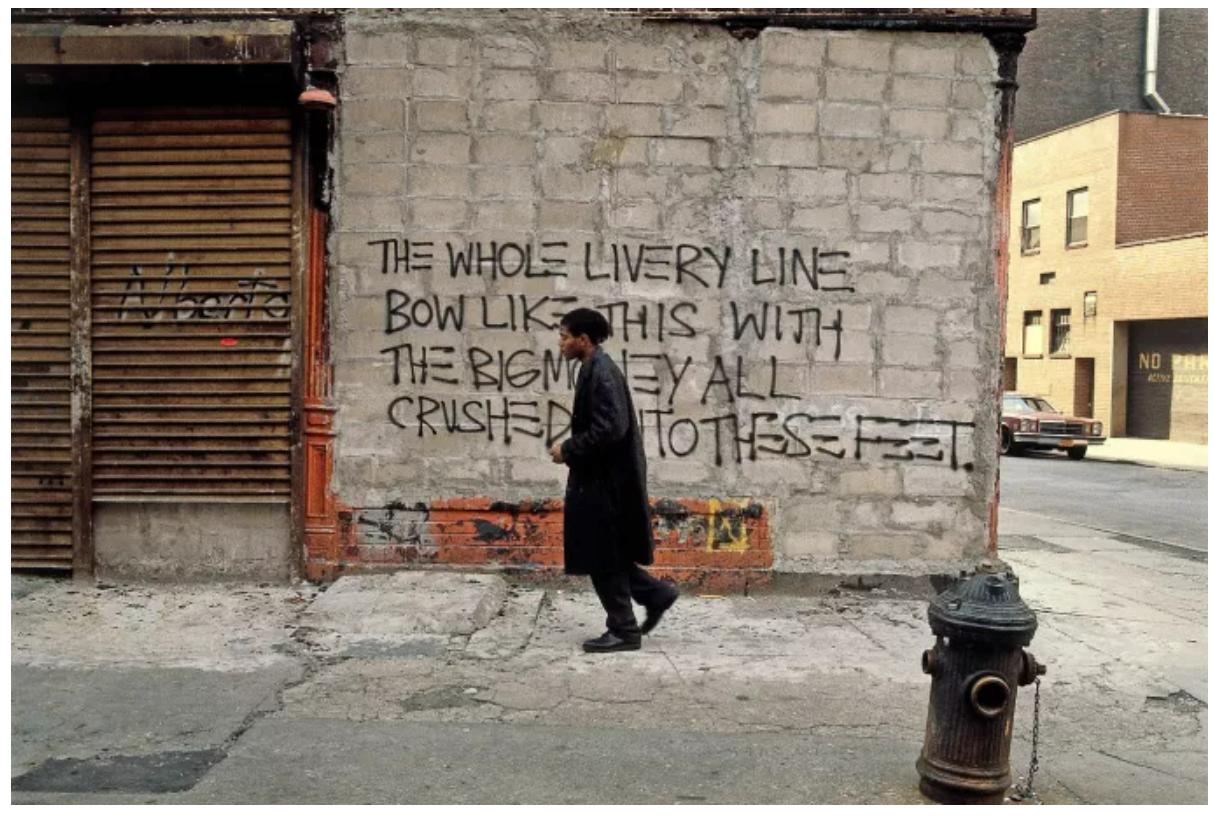
JEAN-MICHEL BASQUIAT ON THE SET OF DOWNTOWN 81, 1980-81. IMAGE: © EDO BERTOGLIO.
Cannon (Act 1) displays a great physicality of brushwork, as waves of gray and earthy brown clash with a rich gold background. As its title suggests, an imposing cannon mounted on a spoked wheel dominates the composition, its barrel pointing upwards and to the right. Crudely rendered in overlapping brushstrokes of cobalt, white, and raw umber, the cannon is primed for use, with six cannonballs neatly stacked in a pyramid nearby, poised to be loaded. Towering behind the cannon is a ghostly abstracted figure; scribbled in black, the scrawled figure teeters on the threshold of legibility, reflecting the near vertiginous speed with which Basquiat rendered his visual lexicon. Arm raised up, the figure’s faint gestures indicate a sense of readiness to operate the artillery when the proper moment arises. Thus, in its crescendo of rich color and painterly gesture, Cannon (Act 1) captures the palpable tension just before explosion, the thrilling moment before the breaking of the sound barrier. Taking an object of great power and clamor as his subject, Basquiat presents a visual counterpart to the perpetual noise, energy, and chaos of New York, offering a reflection of the bustling urban environment that inspired his artistic explorations.