Agenda

Modern & Contemporary Evening Auction
4 March 2026
Modern & Contemporary Evening Auction | 2026 | Sotheby’s
GBP 130,962,024 / USD 174,952,168
53 Lots Sold
Sell-Through Rate: 100%
White Glove Sale
XXXXXXXXXX
The David Hockney Sale: The Arrival of Spring
5 March 2026
The David Hockney Sale: The Arrival of Spring | Prints | Sotheby’s
GBP 4,544,000 / USD 6,070,330
16 Lots Sold
Sell-Through Rate: 100%
White Glove Sale
XXXXXXXXXX
Contemporary Day Auction
5 March 2026
Contemporary Day Auction | 2026 | Sotheby’s
GBP 9,355,520 / USD 12,498,040
83 Lots Sold
Sell-Through Rate: 93.8%
XXXXXXXXXX
Modern & Modern British Day Auction
including Property from the Collection of Erich & Senta Goeritz
5 March 2026
GBP 9,228,928 / USD 12,328,925
114 Lots Sold
Sell-Through Rate: 85.1%

20th / 21st Century: London Evening Sale
5 March 2026
20th / 21st Century: London Evening Sale
GBP 114,175,900 / USD 152,527,585
33 Lots Sold
Sell-Through Rate: 91.7%
XXXXXXXXXX
The Art of the Surreal Evening Sale
5 March 2026
The Art of the Surreal Evening Sale
GBP 42,978,950 / USD 57,415,579
# Lots sold: 26 Lots
Sell-Through Rate: 100%
White Glove Sale
XXXXXXXXXX
Modern Visionaries – The Roger and Josette Vanthournout Collection – Evening Sale
5 March 2026
Modern Visionaries – The Roger and Josette Vanthournout Collection – Evening Sale
GBP 40,317,750 / USD 53,860,482
30 Lots Sold
Sell-Through Rate: 96.8%
XXXXXXXXXX
Modern Visionaries – The Roger and Josette Vanthournout Collection – Day Sale
6 March 2026
Modern Visionaries – The Roger and Josette Vanthournout Collection – Day Sale
GBP 8,595,360 / USD 11,482,541
69 Lots Sold
Sell-Through Rate: 94.5%
XXXXXXXXXX
Impressionist and Modern Art Day and Works on Paper Sale
6 March 2026
Impressionist and Modern Art Day and Works on Paper Sale
GBP 8,595,360 / USD 11,482,541
147 Lots Sold
Sell-Through Rate: 84.5%
XXXXXXXXXX
Post-War and Contemporary Art Day Sale
7 March 2026
Post-War and Contemporary Art Day Sale
GBP 15,428,595 / USD 20,611,060
109 Lots Sold
Sell-Through Rate: 84.5%

Modern & Contemporary Art Evening Sale
5 March 2026
Modern & Contemporary Art Evening Sale Thursday, March 5, 2026
GBP 12,804,950 / USD 17,106,135
22 Lots Sold
Sell-Through Rate: 75.9%
XXXXXXXXXX
Modern & Contemporary Art
7 March 2026
Modern & Contemporary Art Saturday, March 7, 2026
GBP 7,814,175 / USD 10,438,955
102 Lots Sold
Sell-Through Rate: 76.7%
Auction Analysis
The London Auction week totaled GBP 415,439,780 (USD 554,986,002).
GBP 415,439,780 / USD 554,986,002
# Lots: 909 Lots
# Lots sold: 781 Lots
Sell-Through Rate: 85.9%
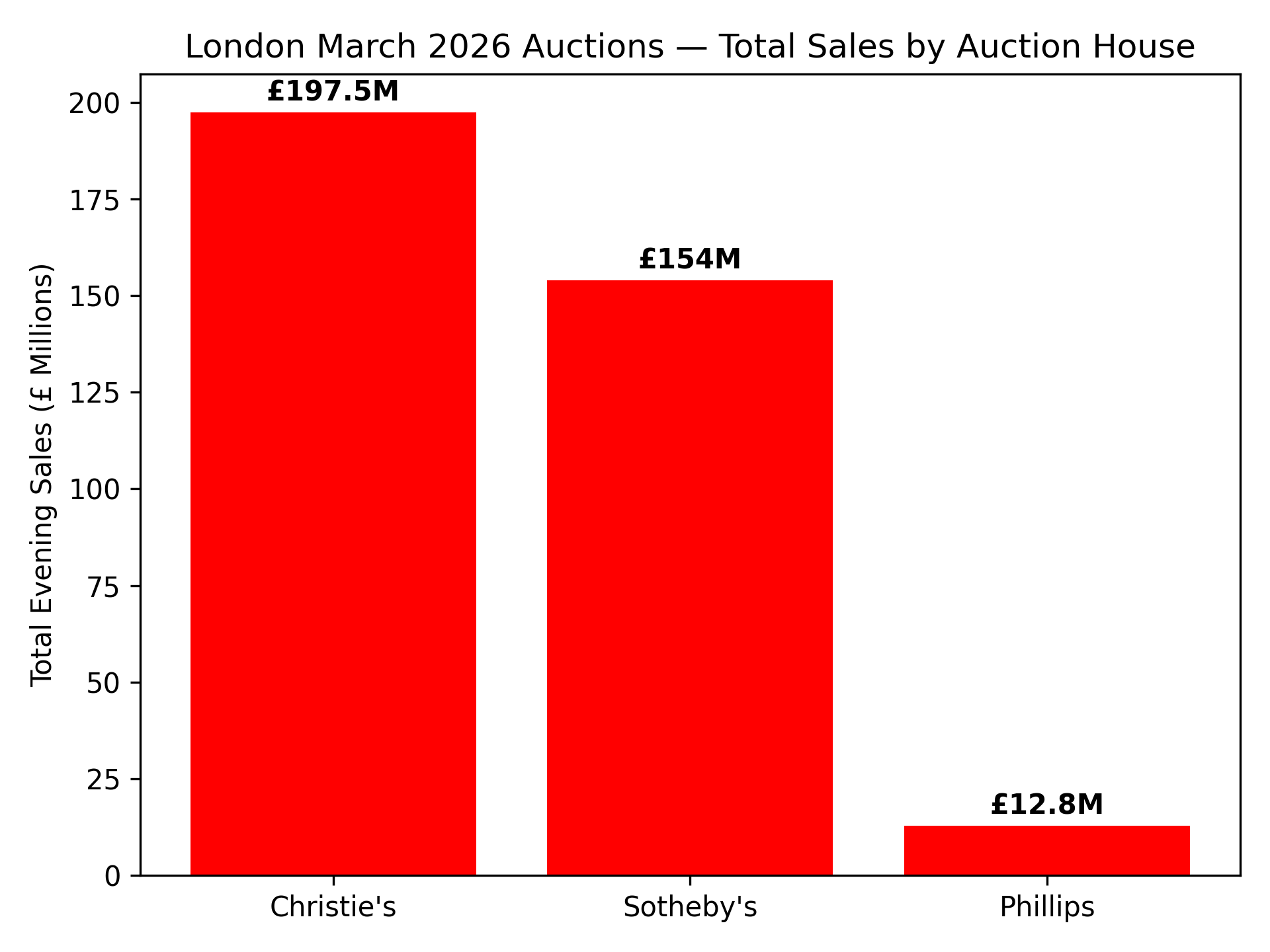
Christie’s led the week by a significant margin, while Sotheby’s delivered the most consistent performance with a white-glove evening sale.
A Market Focused on Quality and Provenance
The March 2026 London auction week, featuring the flagship sales of Christie’s, Sotheby’s and Phillips, delivered a strong and reassuring signal for the global art market. Despite geopolitical uncertainty and a generally cautious economic climate, the week generated solid totals and exceptionally high sell-through rates, confirming London’s continuing role as a key center of the international art market.
Across the major evening sales, collectors demonstrated a clear preference for historically significant works and established artists. While bidding was often measured rather than euphoric, competition remained intense for rare, museum-quality pieces with strong provenance.
Taken together, the results suggest a market that is not overheated but rather disciplined and selective, driven by quality and long-term collecting strategies.
Christie’s: Market Leadership and a Major Auction Record
Christie’s dominated the London auction week with a combined total of GBP 197.5 million across its 20th and 21st Century evening sales, representing a 52% increase compared to the previous year. The sales achieved a 96% sell-through rate by lot and 98% by value, reflecting strong demand across the catalog.
The top lot of the week was Henry Moore’s monumental sculpture King and Queen (1952–53), which sold for GBP 26.3 million, setting a new auction record for the British sculptor. The bronze sculpture, the last cast remaining in private hands, more than doubled its low estimate after a prolonged bidding battle.
Other notable results include Wassily Kandinsky – Le rond rouge (1939), sold for GBP 12.5 million, Pablo Picasso – Le peintre et son modèle (1964) sold for GBP 8.5 million, and René Magritte – Les grâces naturelles sold for GBP 8.5 million. Strong bidding was also observed for works by Gerhard Richter, Sonia Delaunay and Cy Twombly, illustrating continued demand for canonical modern and post-war artists.
Sotheby’s: White-Glove Sale and Strong Institutional Material
Sotheby’s delivered one of the most consistent performances of the week with a white-glove evening sale, meaning every lot offered found a buyer. The house generated approximately GBP 154 million across its London sales, with a particularly strong group of Modern and Contemporary works.
The leading lot was Francis Bacon’s Self-Portrait (1972), which sold for GBP 16 million, doubling its low estimate. Another highlight was Leon Kossoff’s Children’s Swimming Pool, 11 o’clock Saturday Morning, August (1971), which achieved GBP 5.2 million, setting a new auction record for the artist. Works by Alberto Giacometti, Pablo Picasso and David Hockney also attracted strong bidding, reinforcing Sotheby’s strategy of offering highly curated selections of blue-chip material.
Phillips: Smaller Sale but Solid Market Signals
Phillips presented a more focused sale of Modern and Contemporary art, achieving GBP 12.8 million across 23 lots sold. Although the total was smaller compared with the larger houses, the sale maintained solid momentum and confirmed the auction house’s position as a specialist in contemporary material.
One of the highlights was a new auction record for Danish artist Anna Ancher, whose painting Young Girl Reading a Letter (1902) sold for £154,800, far exceeding its estimate. Phillips continues to focus on curated contemporary sales, often introducing rediscovered historical artists alongside emerging names.
Key Takeaways from the London Auctions
Trophy Works Continue to Drive the Market. The strongest results of the week were concentrated around museum-quality works by historically significant artists. Henry Moore, Francis Bacon, Kandinsky and Picasso dominated the top results, confirming the enduring appeal of canonical modern art.
A Selective and Disciplined Market. While the week delivered strong totals, bidding was often cautious and strategic. Many works sold around their low estimates, suggesting collectors are becoming increasingly selective and focused on rarity, provenance and historical importance.
High Sell-Through Rates Reflect Strong Demand. Sell-through rates across the houses remained very strong:, indicating that estimates were carefully calibrated and that demand remains healthy for high-quality works.
The Importance of Provenance and Fresh-to-Market Works. Several of the week’s strongest results involved works that had not appeared on the market for decades or came from notable private collections. The Moore sculpture, for example, had remained in the same family collection since the 1950s, adding to its desirability and driving intense bidding.
The March 2026 London auctions delivered a strong start to the global auction calendar and reaffirmed London’s importance within the international art market. While the mood of the sales was more measured than speculative, the results clearly demonstrate that collectors remain willing to compete aggressively for exceptional works by major artists. In a global environment marked by uncertainty, the art market continues to reward rarity, provenance and historical significance above all else.
Top 10 Lots
#1. King and Queen, 1952-53
Christie’s London: 5 March 2026
Estimated: GBP 10,000,000 – 15,000,000
GBP 26,345,000 / USD 35,194,285
HENRY MOORE (1898-1986), King and Queen | Christie’s
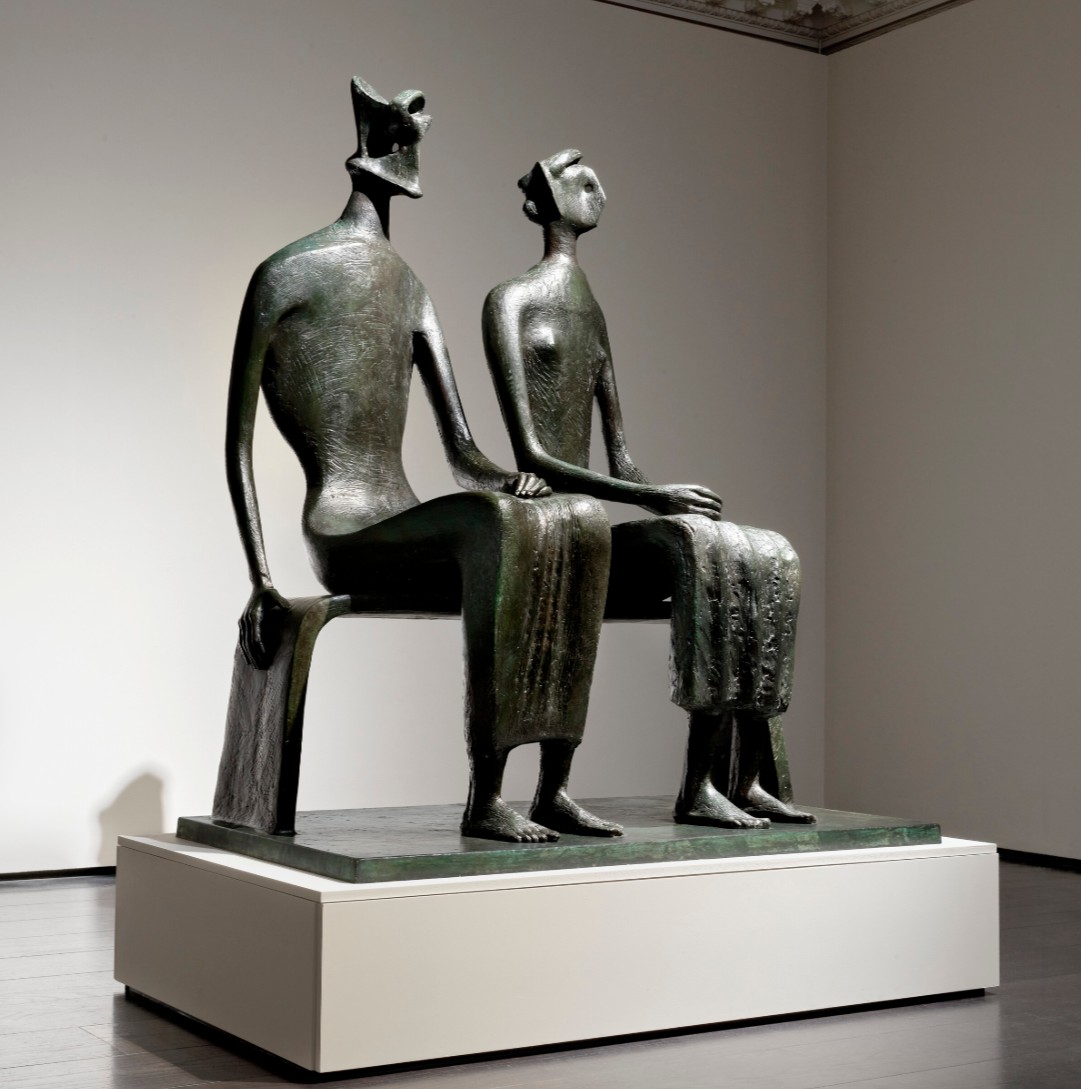
HENRY MOORE (1898-1986)
King and Queen, 1952-53
Bronze with a dark green and brown patina
Height: 64-1/2 inches (164 cm)
Conceived in 1952-53 and cast in 1952-53 by the Galizia Foundry, London
Edition of four plus one artist’s cast
Two subsequent bronzes cast specifically for the collections of the Tate Gallery, London (1957) and the Henry Moore Foundation, Much Hadham (1985)
#2. Self-Portrait, 1972
Masterpieces from the Lewis Collection
Sotheby’s London: 4 March 2026
Estimated: GBP 8,000,000 – 12,000,000
GBP 16,035,000 / USD 21,421,155
Self-Portrait | Modern & Contemporary Evening Auction | 2026 | Sotheby’s
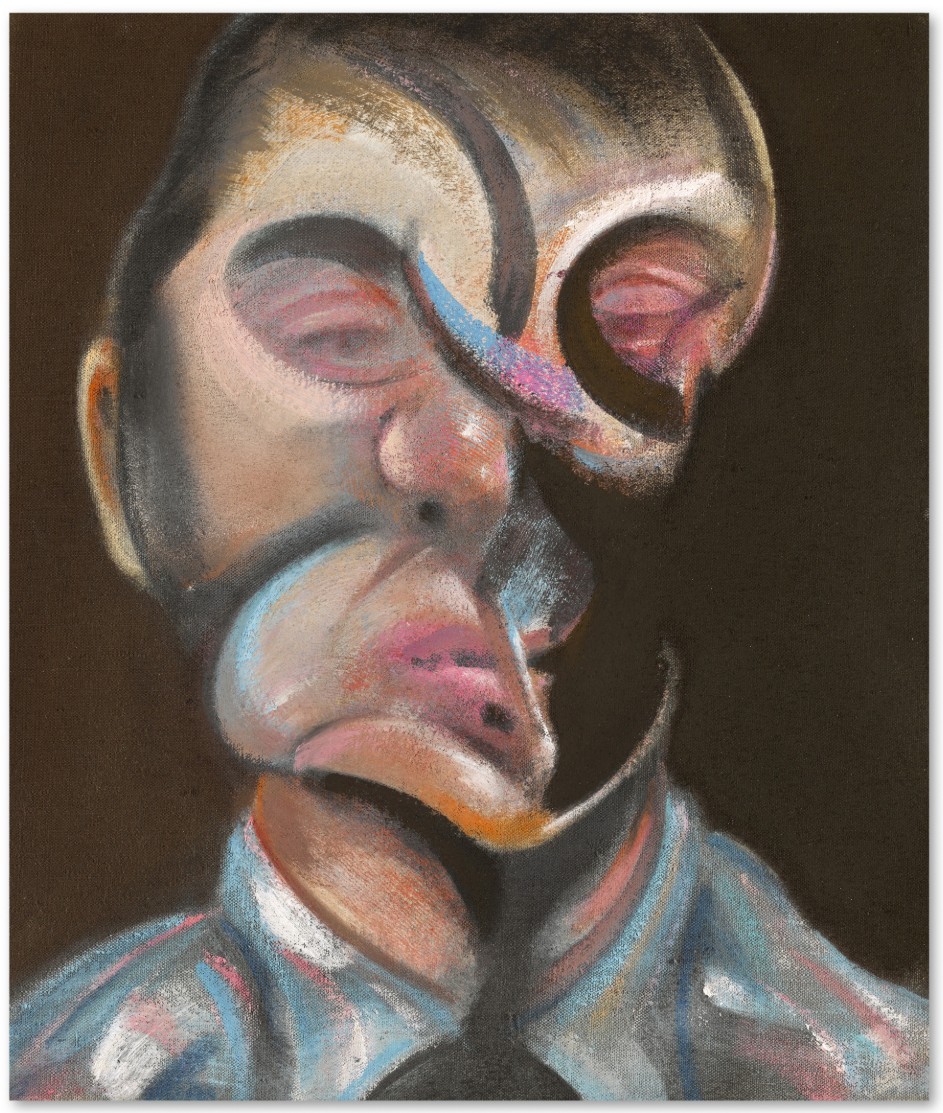
FRANCIS BACON (1909 – 1992)
Self-Portrait, 1972
Oil on canvas
36 x 30.5 cm (14-1/8 x 12 inches)
Signed, titled and dated 1972 (on the reverse)
#3. Le rond rouge, 1939
Christie’s London: 5 March 2026
Estimated: GBP 10,500,000 – 15,500,000
GBP 12,545,000 / USD 16,758,865
WASSILY KANDINSKY (1866-1944), Le rond rouge | Christie’s
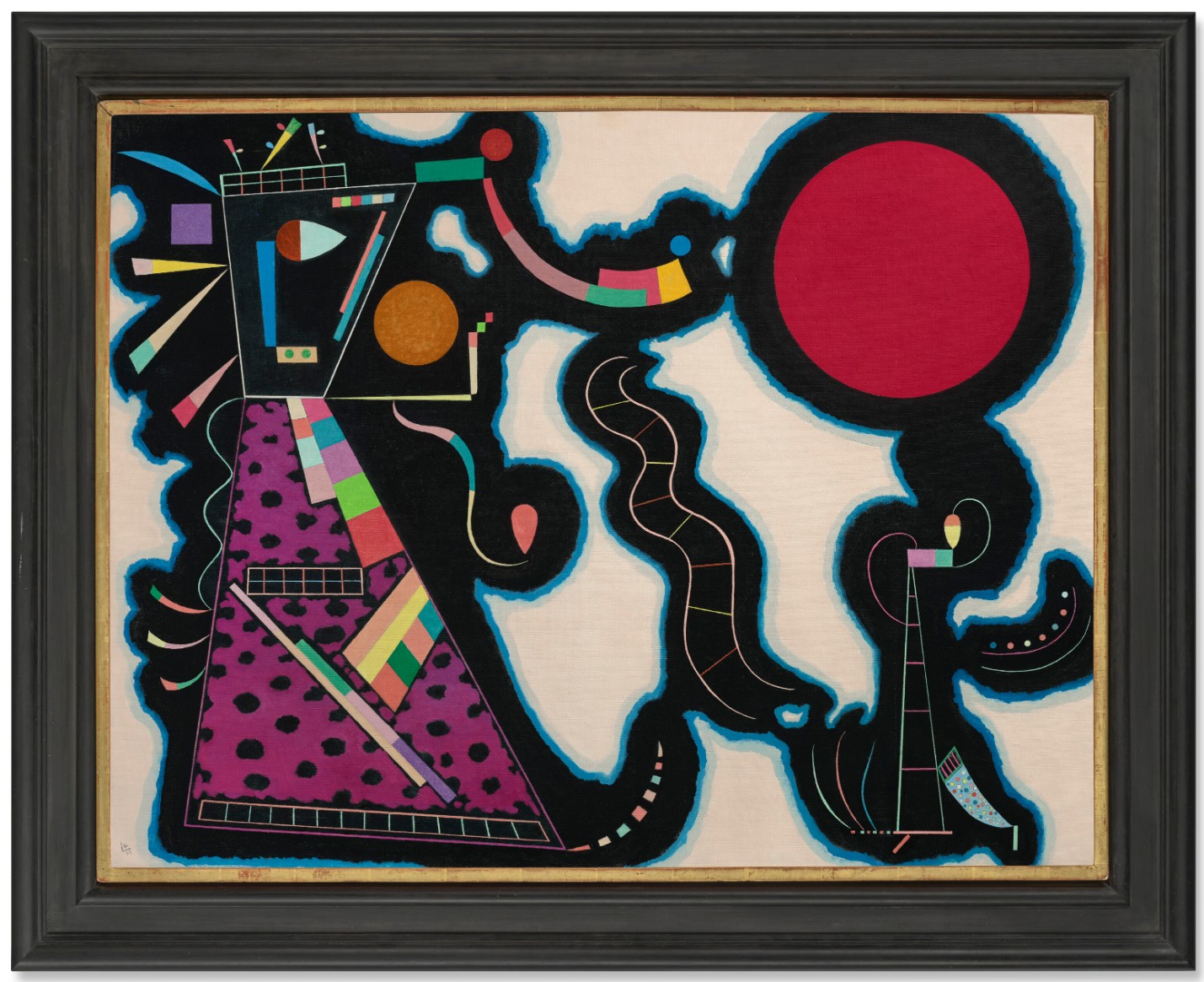
WASSILY KANDINSKY (1866-1944)
Le rond rouge, 1939
Oil on canvas
89.1 x 116.1 cm (35 x 45-3/4 inches)
Signed with the monogram and dated ‘39’ (lower left)
Signed again with the monogram, dated and numbered ‘No. 661 1939’ (on the reverse)
Painted in April 1939
GBP 10 million
#4. Concetto spaziale, 1960
Beyond the Canvas: Masterpieces from a Private German Collection
Sotheby’s London: 4 March 2026
Estimated: GBP 8,500,000 – 12,000,000
GBP 9,825,000 / USD 13,125,215
Concetto spaziale | Modern & Contemporary Evening Auction | 2026 | Sotheby’s
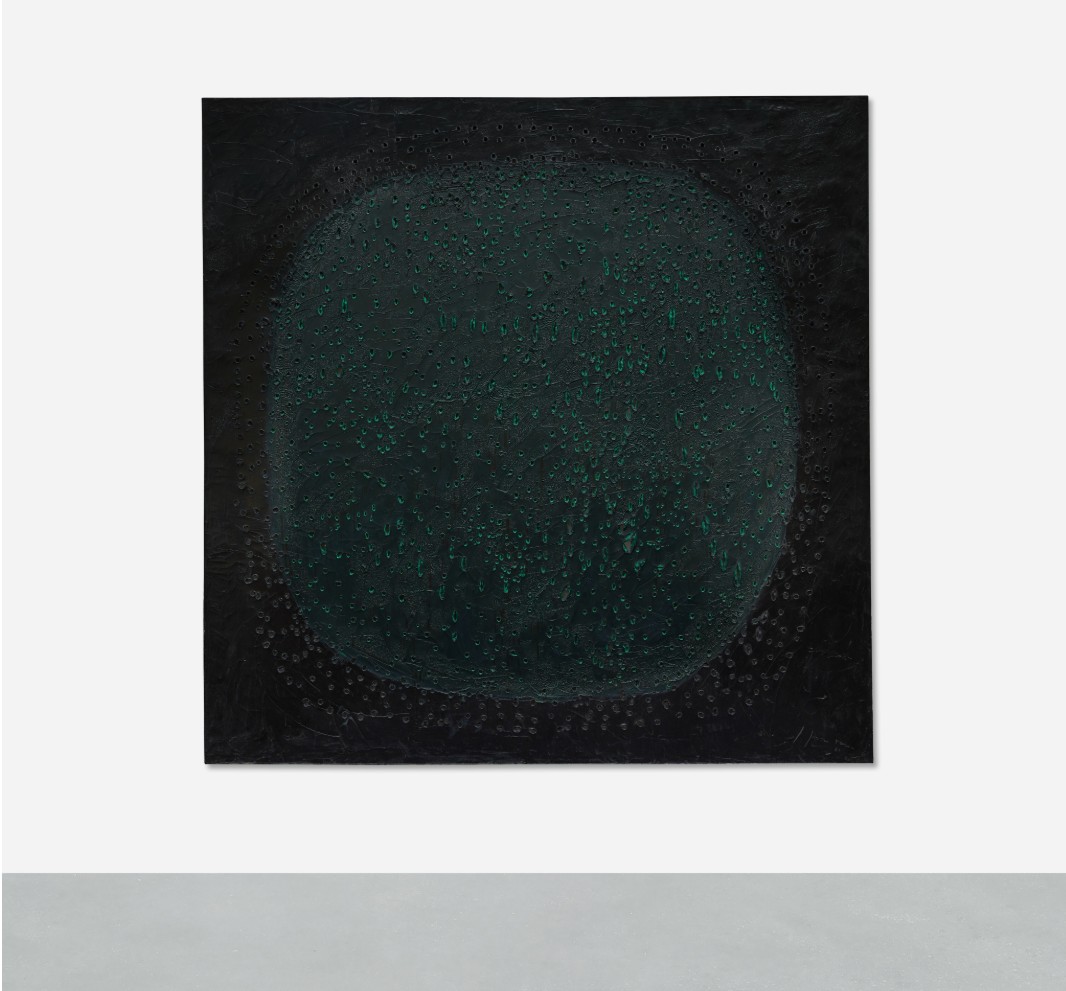
LUCIO FONTANA (1899 – 1968)
Concetto spaziale, 1960
Oil on canvas
200×205 cm (78-3/4 x 80-3/4 inches)
Incised with the artist’s signature and dated 60 (lower right)
Signed, titled and variously inscribed (on the reverse)
#5. Le peintre et son modèle, 1964
THE PROPERTY OF A DISTINGUISHED PRIVATE COLLECTOR
Christie’s London: 5 March 2026
Estimated: GBP 7,000,000 – 10,000,000
GBP 8,520,000 / USD 11,381,870
PABLO PICASSO (1881-1973), Le peintre et son modèle | Christie’s
REPEAT SALE
Christie’s New-York: 19 November 2022
Estimated: USD 8,000,000 – 12,000,000
USD 10,351,500
PABLO PICASSO (1881-1973), Le peintre et son modèle | Christie’s
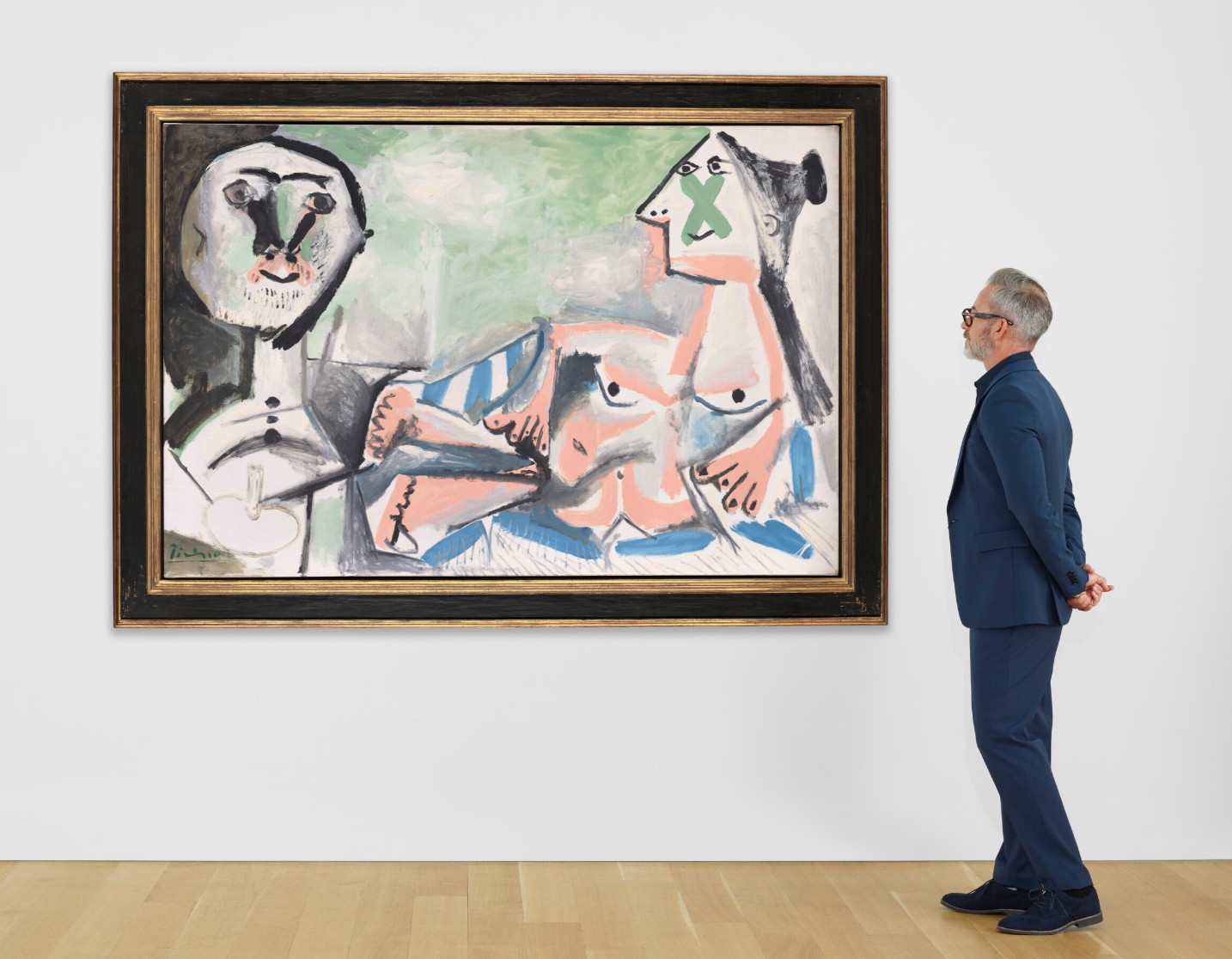
PABLO PICASSO (1881-1973)
Le peintre et son modèle, 1964
Oil and Ripolin on canvas
130×195 cm (51-1/8 x 76-3/4 inches)
Signed ‘Picasso’ (lower left)
Dated ‘8.9.11.64.’ (on the reverse)
Painted in Mougins on 8-9 November 1964
#6. Les grâces naturelles, circa 1961
PROPERTY FROM A PRIVATE SWISS COLLECTION
Christie’s London: 5 March 2026
Estimated: GBP 6,500,000 – 9,500,000
GBP 8,520,000 / USD 11,381,870
RENÉ MAGRITTE (1898-1967), Les grâces naturelles | Christie’s
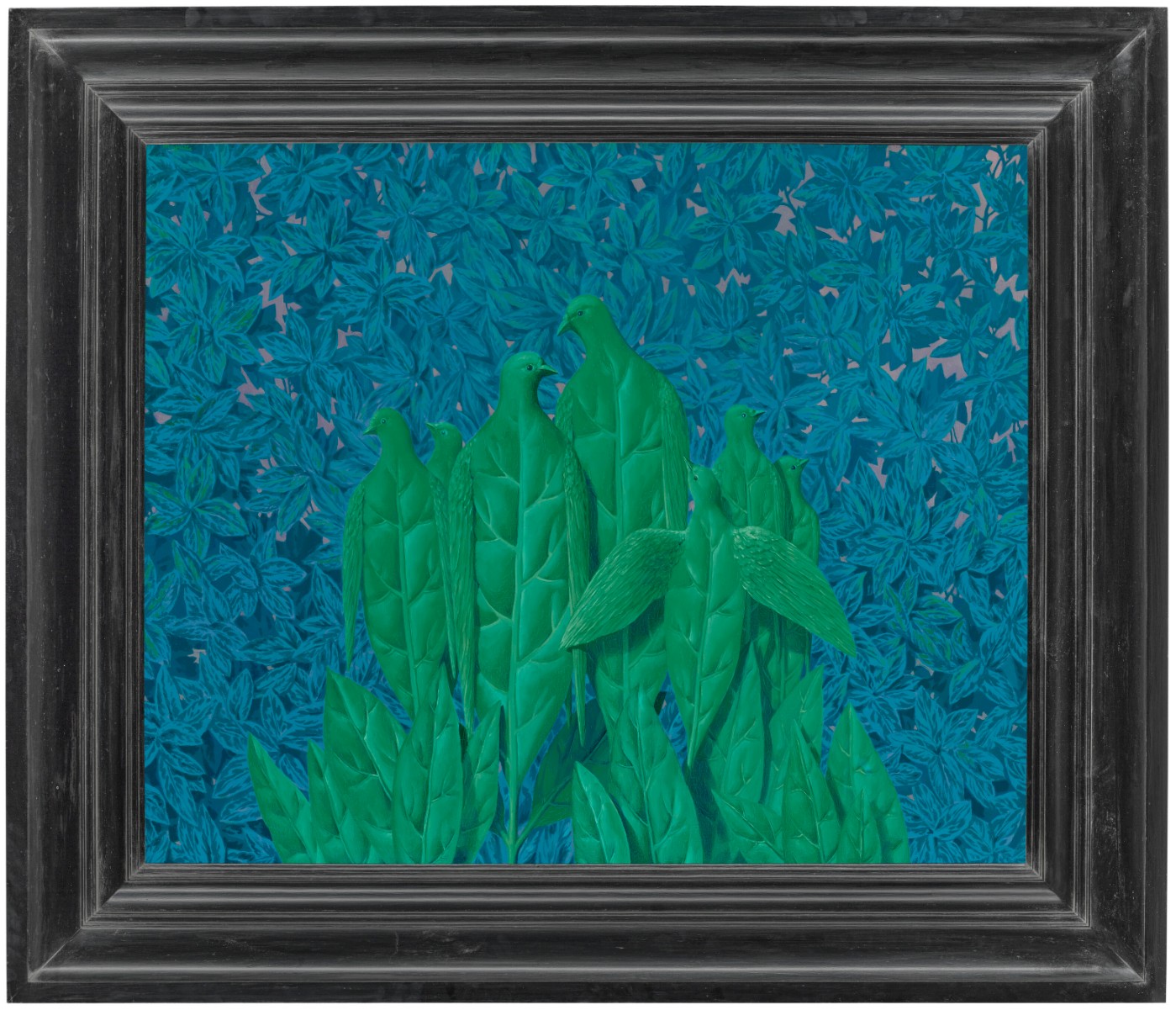
RENÉ MAGRITTE (1898-1967)
Les grâces naturelles, circa 1961
Oil on canvas
81.5 x 100.4 cm (32-1/8 x 39-1/2 inches)
Signed ‘Magritte’ (upper left)
Inscribed ‘”Les Grâces naturelles”’ (on the reverse)
#7. Schober (Haybarn), 1984
PROPERTY FROM AN IMPORTANT PRIVATE COLLECTION
Christie’s London: 5 March 2026
Estimated: GBP 6,000,000 – 9,000,000
GBP 8,405,000 / USD 11,228,240
GERHARD RICHTER (B. 1932), Schober (Haybarn) | Christie’s
REPEAT SALE
VISIONARIES: WORKS FROM THE EMILY AND JERRY SPIEGEL COLLECTION
Christie’s New-York: 17 May 2017
Estimated: USD 5,500,000 – 7,500,000
USD 6,967,500
Gerhard Richter (B. 1932), Schober | Christie’s
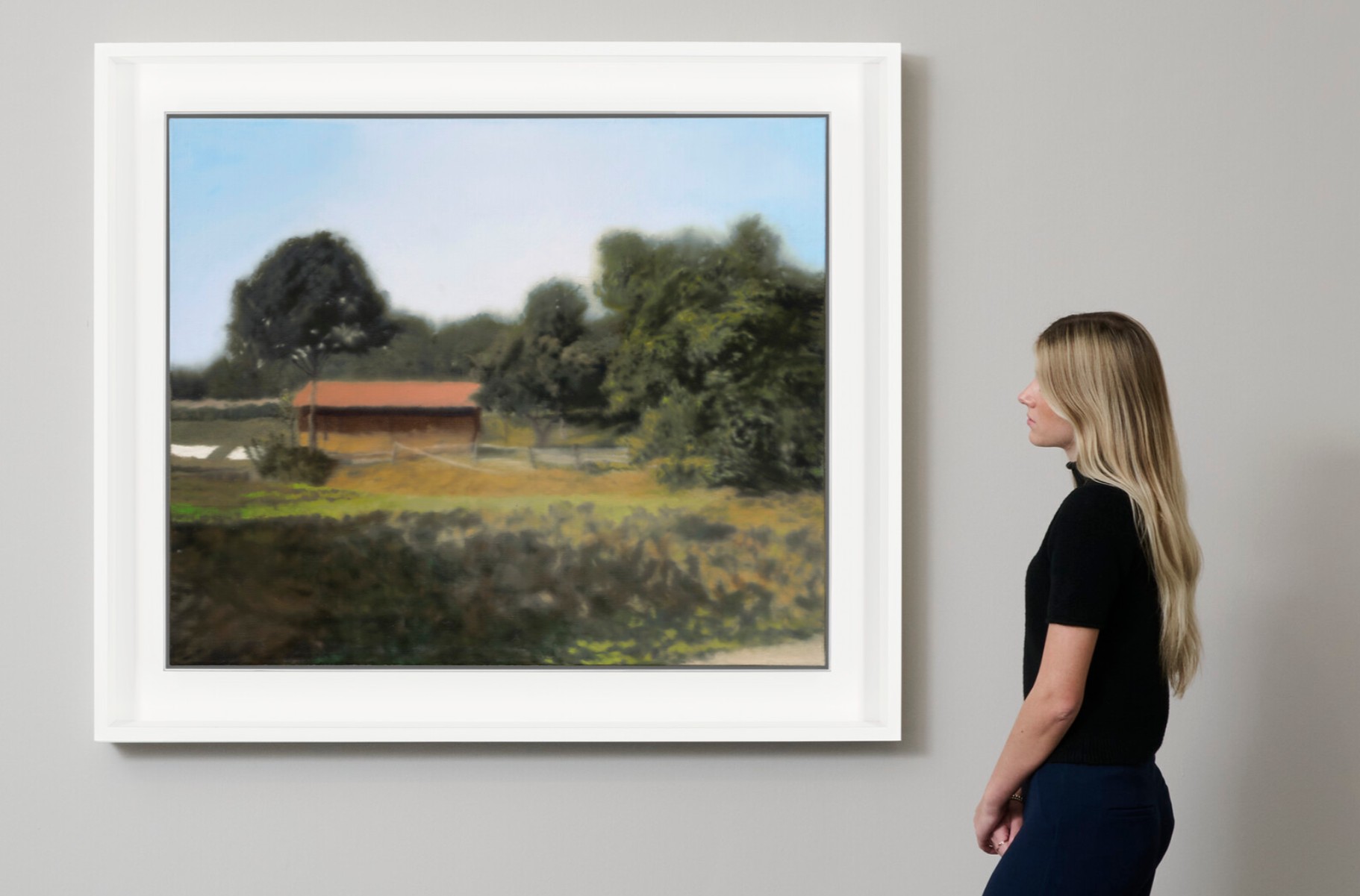
GERHARD RICHTER (B. 1932)
Schober (Haybarn), 1984
Oil on canvas
100.3 x 120 cm (39-1/2 x 47-1/4 inches)
Signed, numbered and dated ‘550-2 Richter 1984’ (on the reverse)
#8. Maison de jardinier, 1884
Sotheby’s London: 4 March 2026
Estimated: GBP 6,500,000 – 8,500,000
GBP 8,215,000 / USD 10,974,420
Maison de jardinier | Modern & Contemporary Evening Auction | 2026 | Sotheby’s
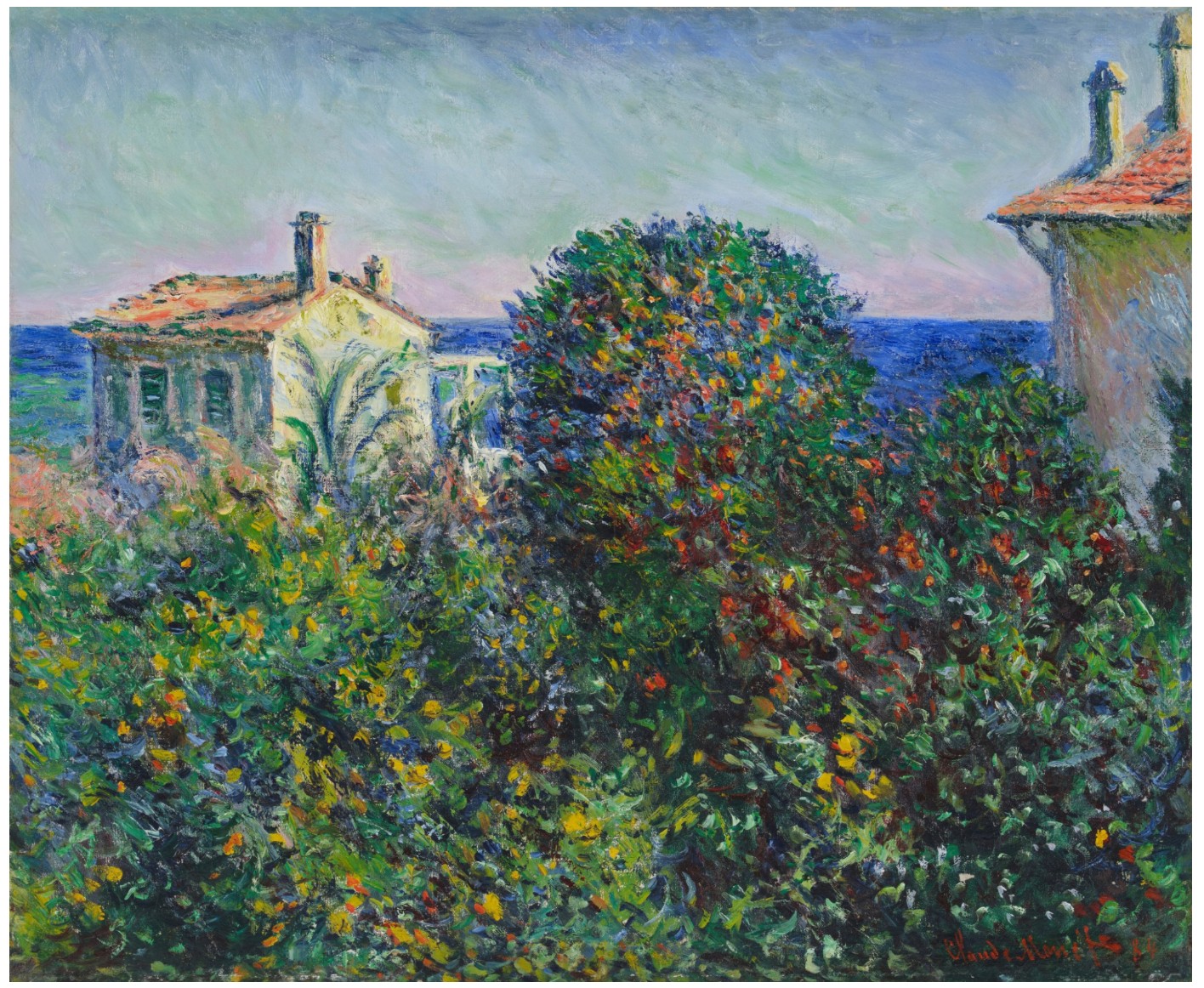
CLAUDE MONET (1840 – 1926)
Maison de jardinier, 1884
Oil on canvas
60.5 x 73 cm (23-5/8 x 28-7/8 inches
Signed Claude Monet and dated 84 (lower right)
Executed in Bordighera in 1884
#9. Abstraktes Bild, 1991
ABSTRACT MASTERWORKS FROM AN IMPORTANT PRIVATE COLLECTION
Christie’s London: 5 March 2026
Estimated: GBP 4,500,000 – 6,500,000
GBP 7,600,000 / USD 10,152,840
GERHARD RICHTER (B. 1932), Abstraktes Bild | Christie’s
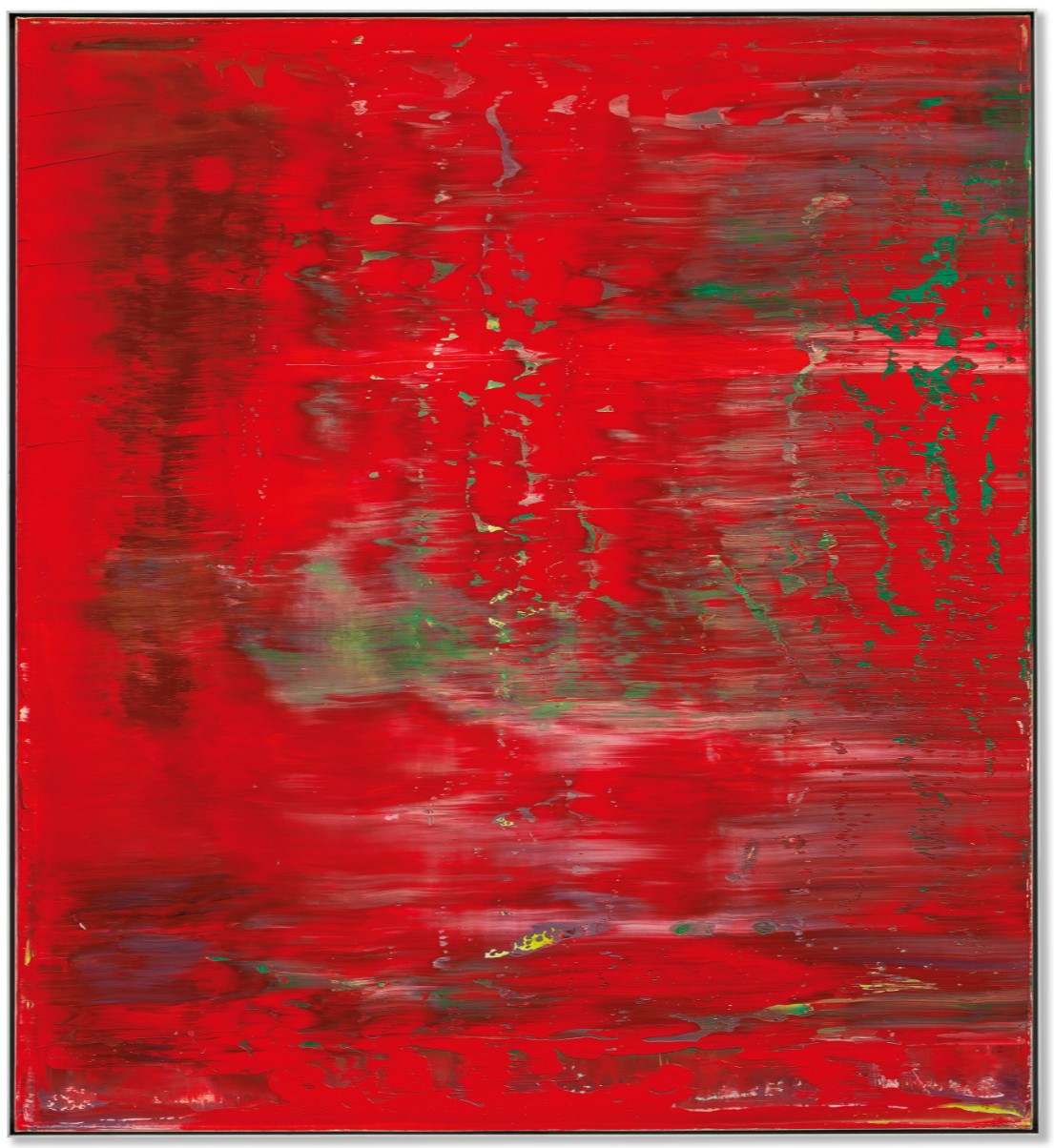
GERHARD RICHTER (B. 1932)
Abstraktes Bild, 1991
Oil on canvas
112×102 cm (44-1/8 x 40-1/8 inches)
Signed, numbered and dated ‘748-5 Richter 1991’ (on the reverse)
Modern & Contemporary Evening Auction
4 March 2026
Modern & Contemporary Evening Auction | 2026 | Sotheby’s
Total:
GBP 130,962,024 / USD 174,952,168
# Lots: 54 Lots
# Lots withdrawn: 1 Lot
# Lots sold: 53 Lots
Sell-Through Rate: 100%
White Glove Sale
Top Lot:
GBP 16,035,000 / USD 21,421,155
XXXXXXXXXX
#1. Self-Portrait, 1972
Masterpieces from the Lewis Collection
Sotheby’s London: 4 March 2026
Estimated: GBP 8,000,000 – 12,000,000
GBP 16,035,000 / USD 21,421,155
Self-Portrait | Modern & Contemporary Evening Auction | 2026 | Sotheby’s
FRANCIS BACON (1909 – 1992)
Self-Portrait, 1972
Oil on canvas
36 x 30.5 cm (14-1/8 x 12 inches)
Signed, titled and dated 1972 (on the reverse)
#2. Concetto spaziale, 1960
Beyond the Canvas: Masterpieces from a Private German Collection
Sotheby’s London: 4 March 2026
Estimated: GBP 8,500,000 – 12,000,000
GBP 9,825,000 / USD 13,125,215
Concetto spaziale | Modern & Contemporary Evening Auction | 2026 | Sotheby’s
LUCIO FONTANA (1899 – 1968)
Concetto spaziale, 1960
Oil on canvas
200×205 cm (78-3/4 x 80-3/4 inches)
Incised with the artist’s signature and dated 60 (lower right)
Signed, titled and variously inscribed (on the reverse)
#3. Maison de jardinier, 1884
Sotheby’s London: 4 March 2026
Estimated: GBP 6,500,000 – 8,500,000
GBP 8,215,000 / USD 10,974,420
Maison de jardinier | Modern & Contemporary Evening Auction | 2026 | Sotheby’s
CLAUDE MONET (1840 – 1926)
Maison de jardinier, 1884
Oil on canvas
60.5 x 73 cm (23-5/8 x 28-7/8 inches
Signed Claude Monet and dated 84 (lower right)
Executed in Bordighera in 1884
#4. Blond Girl on a Bed, 1987
Masterpieces from the Lewis Collection
Sotheby’s London: 4 March 2026
Estimated: GBP 6,000,000 – 8,000,000
GBP 7,410,000 / USD 9,899,020
Blond Girl on a Bed | Modern & Contemporary Evening Auction | 2026 | Sotheby’s
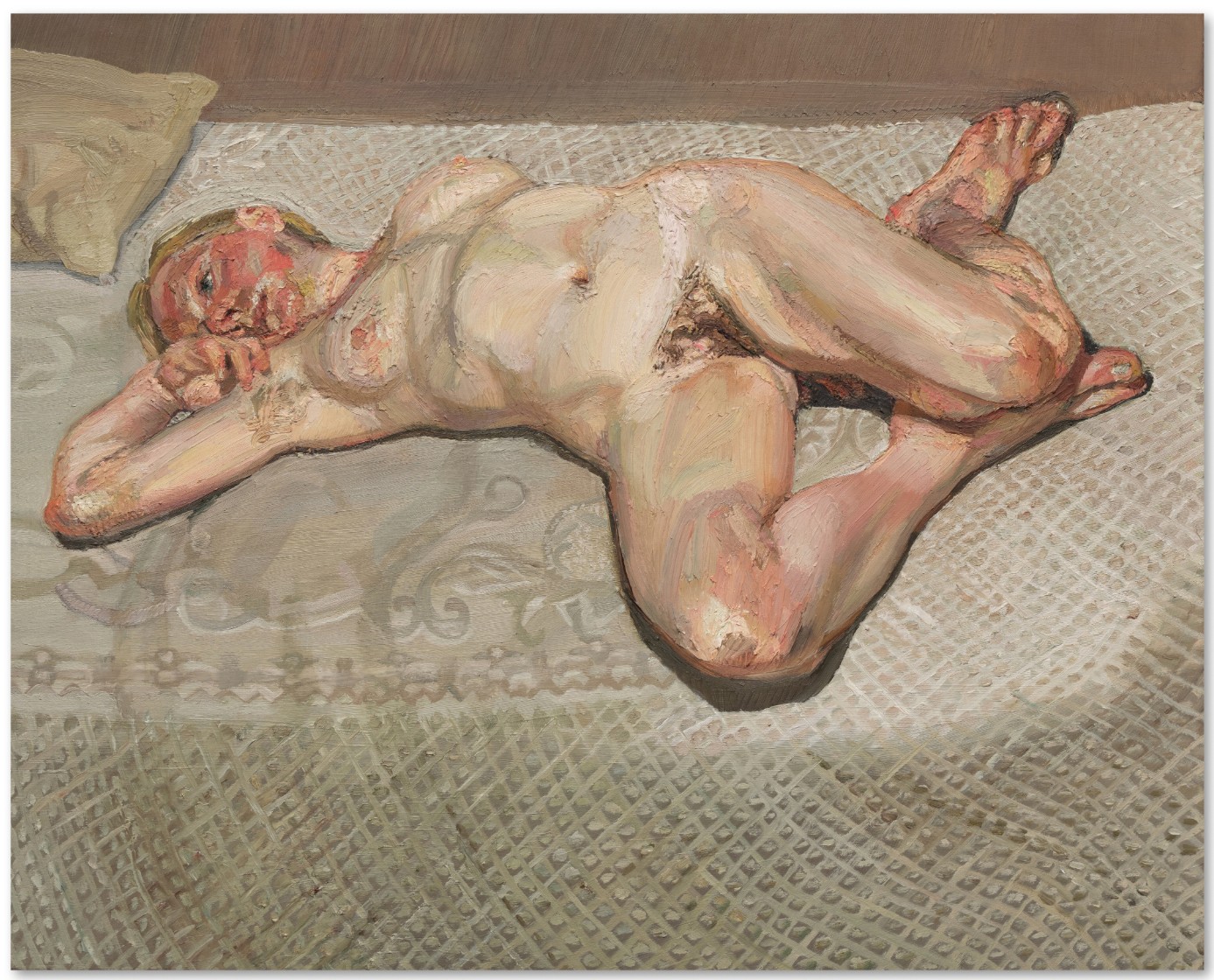
LUCIAN FREUD (1922 – 2011)
Blond Girl on a Bed, 1987
Oil on canvas
16×20 inches (40.6 x 50.8 cm)
#5. A Young Painter, 1957-58
Masterpieces from the Lewis Collection
Sotheby’s London: 4 March 2026
Estimated: GBP 4,000,000 – 6,000,000
GBP 7,166,000 / USD 9,573,060
A Young Painter | Modern & Contemporary Evening Auction | 2026 | Sotheby’s
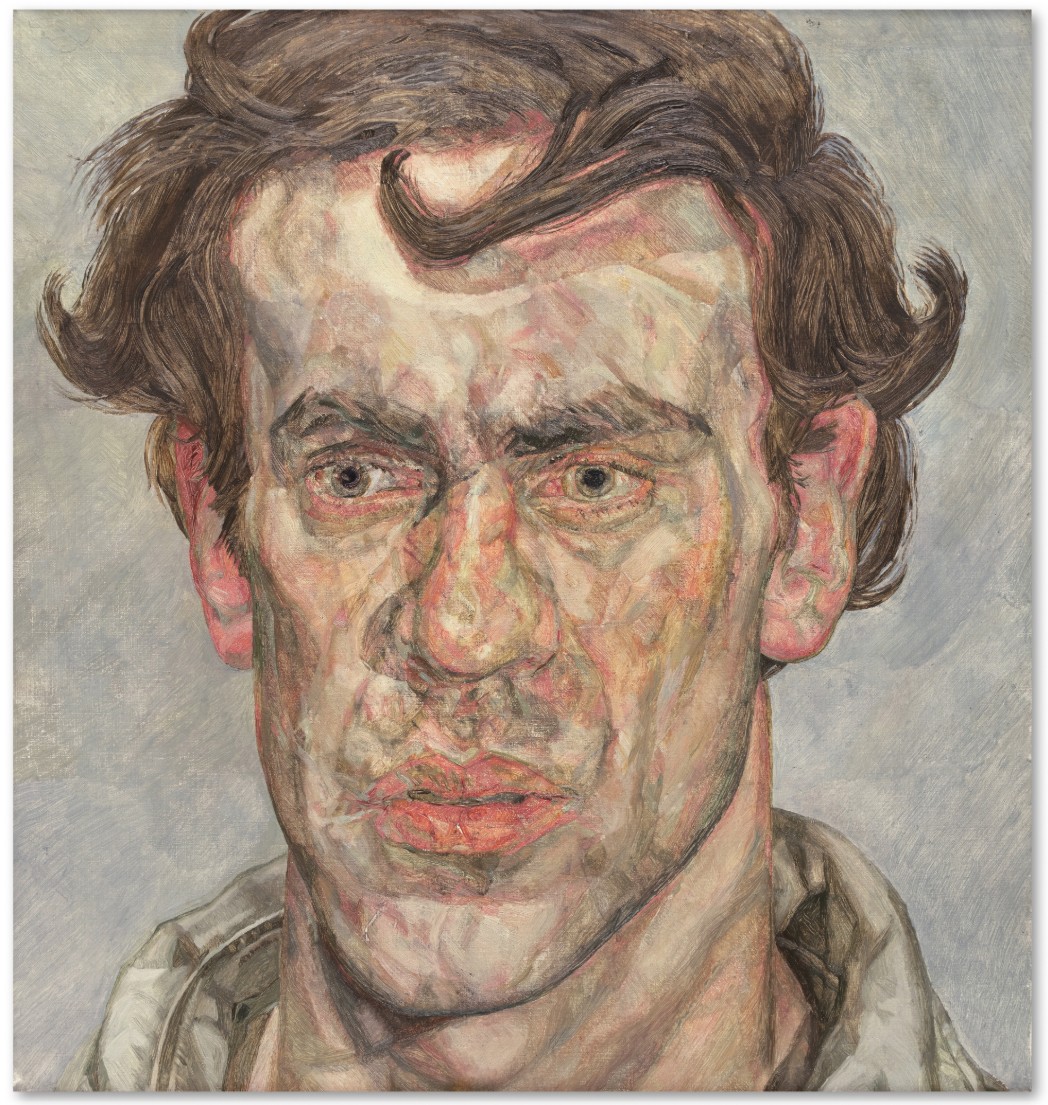
LUCIAN FREUD (1922 – 2011)
A Young Painter, 1957-58
Oil on canvas
41.9 x 39.1 cm (16-1/2 x 15-3/8 inches)
XXXXXXXXXX
#10. Thin in the Old, 1986
Sotheby’s London: 4 March 2026
Estimated: GBP 6,000,000 – 8,000,000
GBP 4,543,000 / USD 6,068,995
Thin in the Old | Modern & Contemporary Evening Auction | 2026 | Sotheby’s
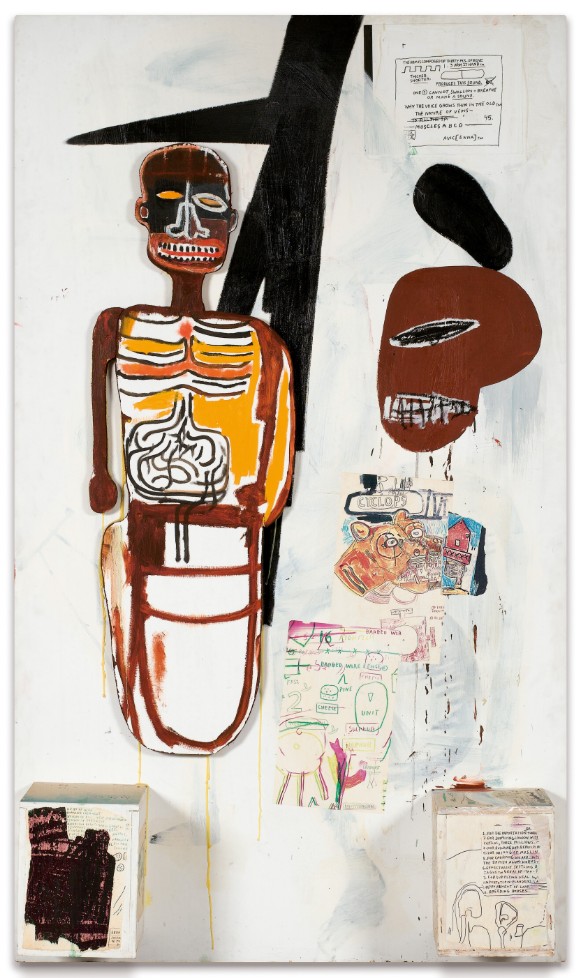
JEAN-MICHEL BASQUIAT (1960 – 1988)
Thin in the Old, 1986
Acrylic, oil and Xerox collage on panel
71-7/8 x 42-1/8 x 9-1/2 inches (182.5 x 107 x 24 cm)
Signed, titled and dated 86 (on the reverse)
#14. Hammer and Sickle, 1976
Sotheby’s London: 4 March 2026
Estimated: GBP 3,000,000 – 5,000,000
GBP 3,506,000 / USD 4,683,665
Hammer and Sickle | Modern & Contemporary Evening Auction | 2026 | Sotheby’s
REPEAT SALE
Sotheby’s New-York: 16 May 2022
Estimated: USD 4,000,000 – 6,000,000
USD 6,414,200
Hammer and Sickle | The Macklowe Collection | 2022 | Sotheby’s
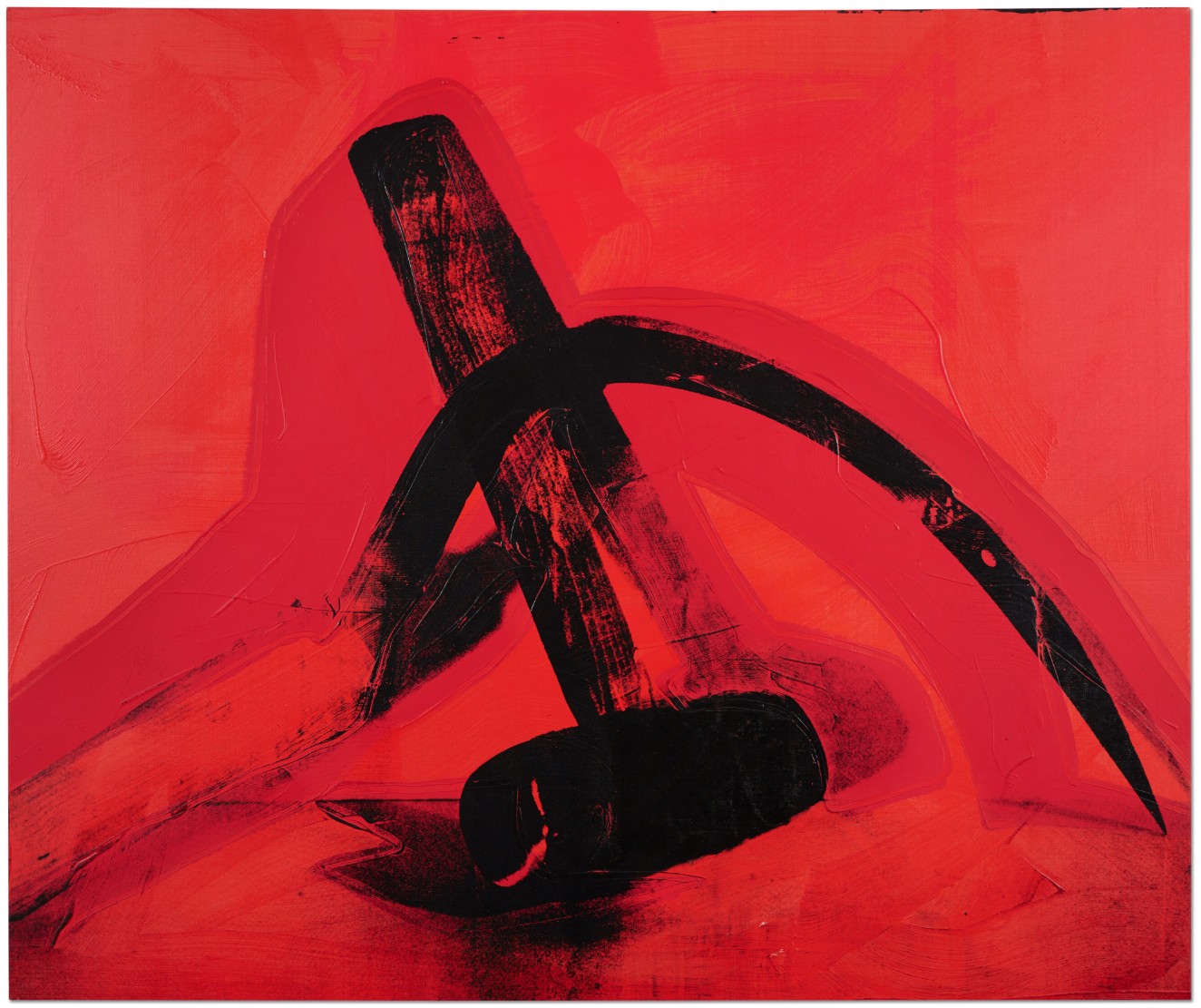
ANDY WARHOL (1928 – 1987)
Hammer and Sickle, 1976
Acrylic and silkscreen ink on canvas
72-1/4 x 86 inches (183.5 x 218.4 cm)
Signed and dedicated to Carlo Bilotti (on the overlap)
#15. Four Marilyns (Reversal Series), 1986
Sotheby’s London: 4 March 2026
Estimated: GBP 1,800,000 – 2,500,000
GBP 3,262,000 / USD 4,357,705
Four Marilyns (Reversal Series) | Modern & Contemporary Evening Auction | 2026 | Sotheby’s
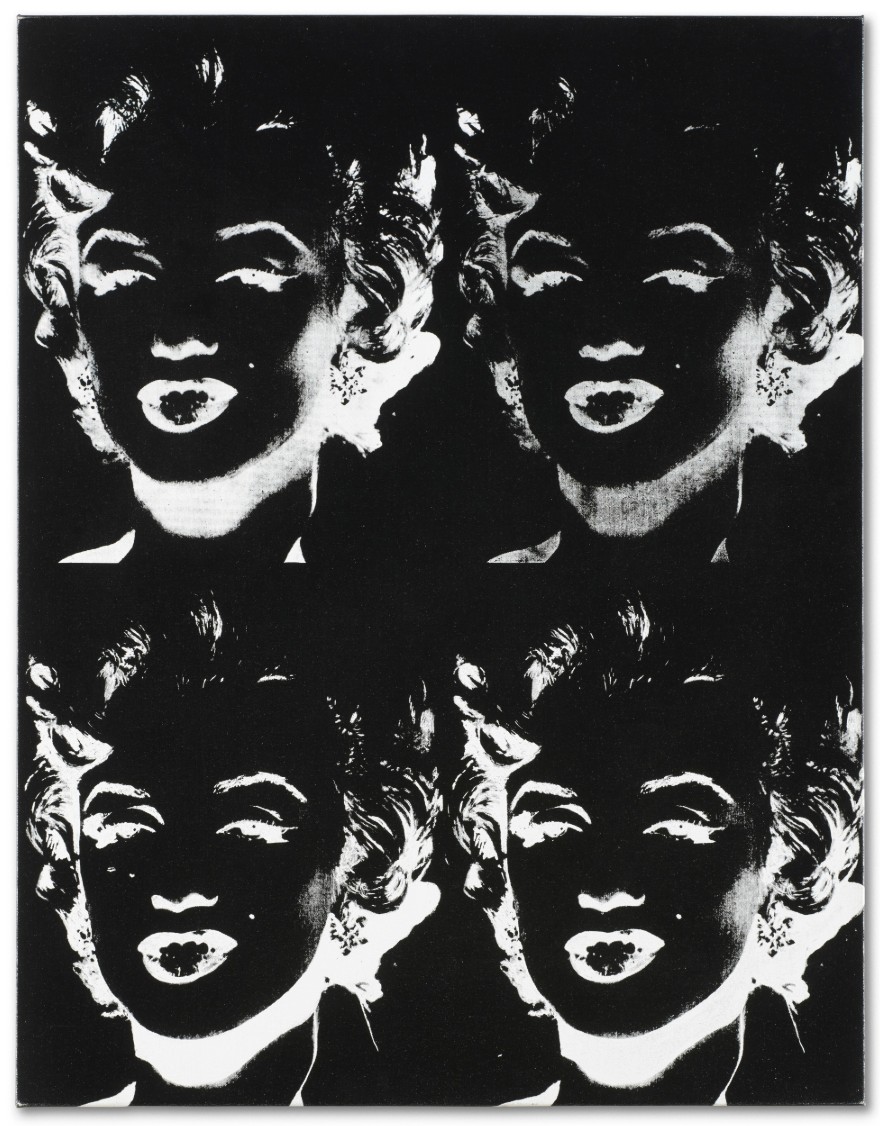
ANDY WARHOL (1928 – 1987)
Four Marilyns (Reversal Series), 1986
Acrylic and silkscreen ink on canvas
36×28 inches (91.5 x 71 cm)
Stamp signed (on the overlap)
Stamped by the Andy Warhol Art Authentication Board, Inc.
Numbered A120.042
Inscribed I certify that this is an original painting by Andy Warhol completed by Andy in 1986 Frederick Hughes
(on the overlap)
XXXXXXXXXX
#17. Infiltration, 2017
Sotheby’s London: 4 March 2026
Estimated: GBP 1,500,000 – 2,000,000
GBP 2,286,000 / USD 3,053,865
Infiltration | Modern & Contemporary Evening Auction | 2026 | Sotheby’s
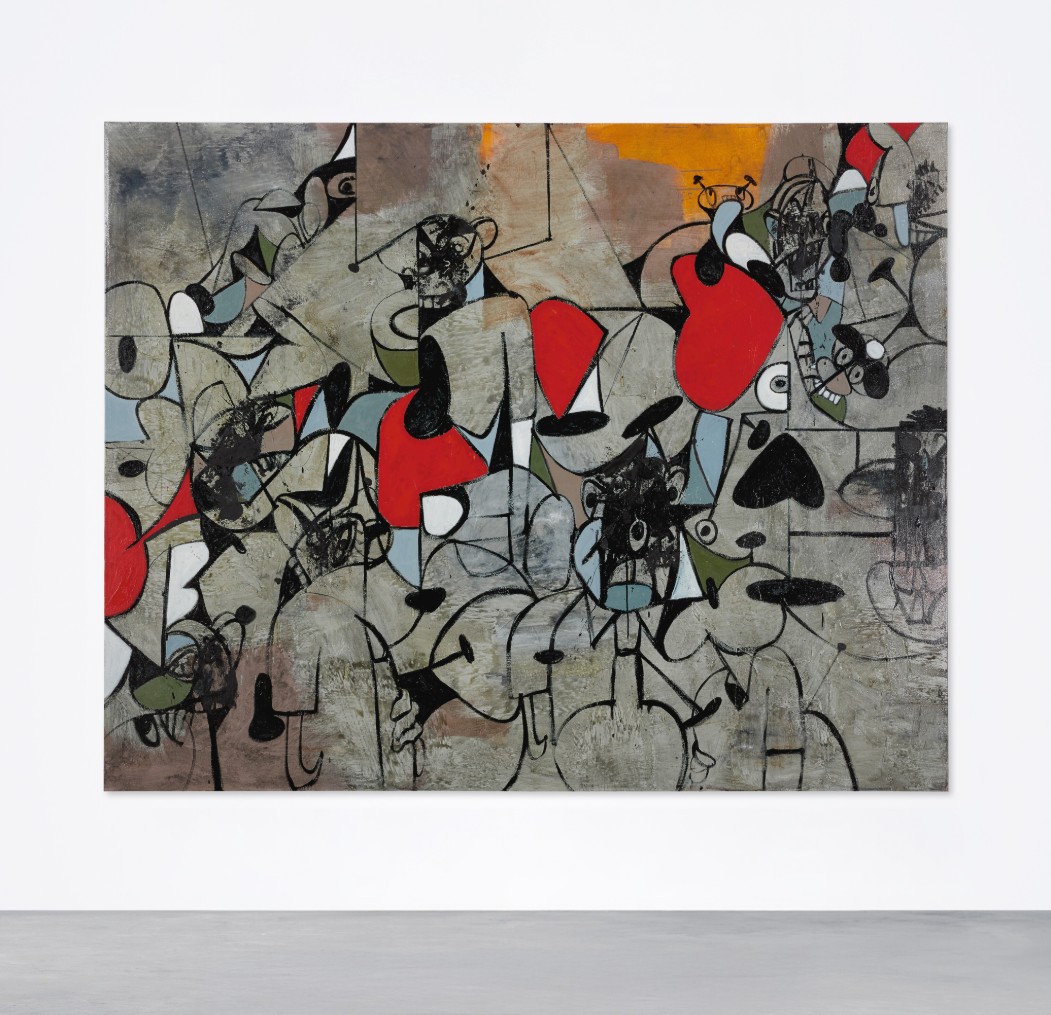
GEORGE CONDO (b. 1957)
Infiltration, 2017
Oil, acrylic and oilstick on canvas
76×96 inches (193 x 243.8 cm)
Signed and dated 2017 (upper left)
#18. Imperfect Painting, 1986
Property from an Esteemed Private Collection
Sotheby’s London: 4 March 2026
Estimated: GBP 1,000,000 – 1,500,000
GBP 1,981,000 / USD 2,646,420
Imperfect Painting | Modern & Contemporary Evening Auction | 2026 | Sotheby’s
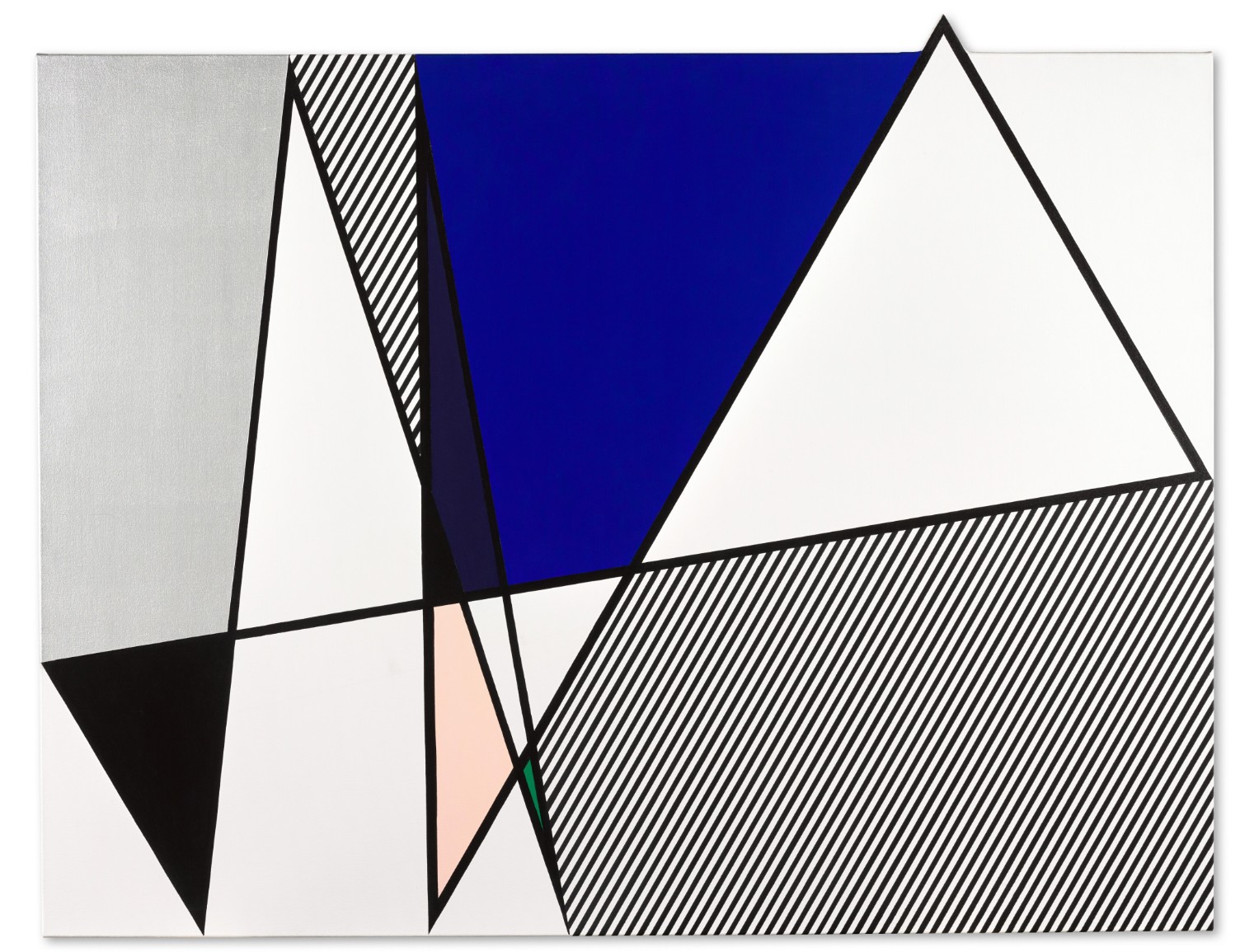
ROY LICHTENSTEIN (1923 – 1997)
Imperfect Painting, 1986
Acrylic, oil and pencil on shaped canvas
62-3/4 x 80 inches (159.5 x 203.2 cm)
Signed and dated ’86 (on the reverse)
#19. English Garden, 1965
Sotheby’s London: 4 March 2026
Estimated: GBP 2,500,000 – 3,500,000
GBP 1,920,000 / USD 2,564,930
English Garden | Modern & Contemporary Evening Auction | 2026 | Sotheby’s
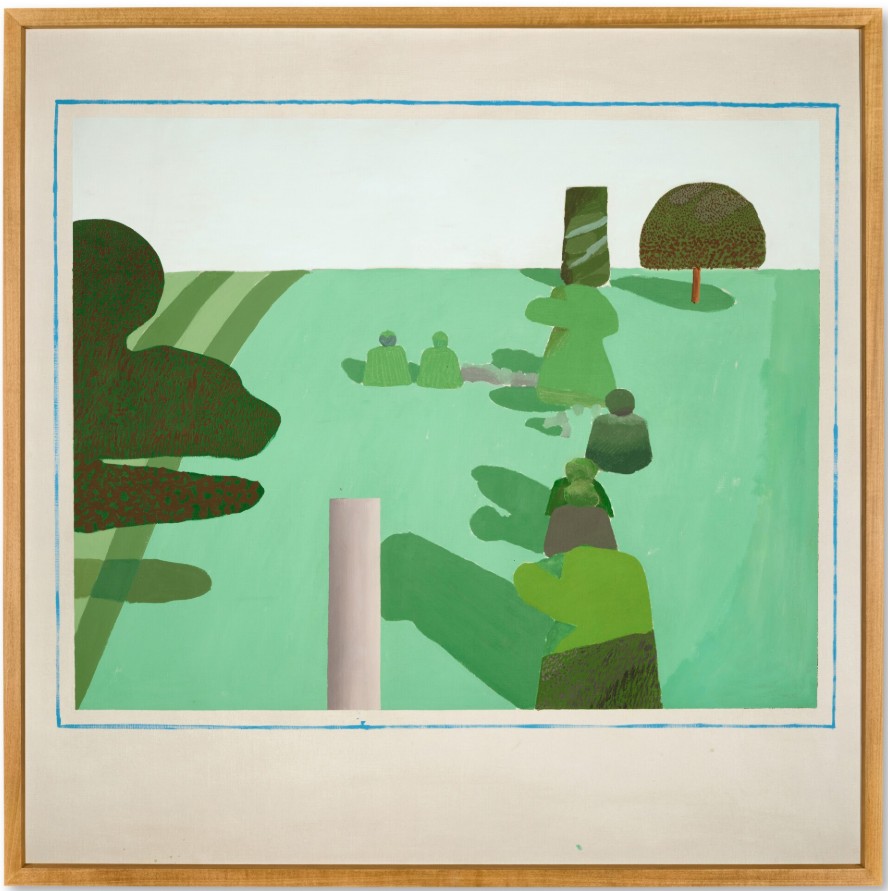
DAVID HOCKNEY (b. 1937)
English Garden, 1965
Acrylic on canvas
48×48 inches (122×122 cm)
Signed with the artist’s initials (behind the lower stretcher)
Titled and dated Boulder 65 (on the reverse)
XXXXXXXXXX
#24. Flowers, 1964
Contours of Modernity | A Private European Collection
Sotheby’s London: 4 March 2026
Estimated: GBP 800,000 – 1,200,000
GBP 1,792,000 / USD 2,393,935
Flowers | Modern & Contemporary Evening Auction | 2026 | Sotheby’s
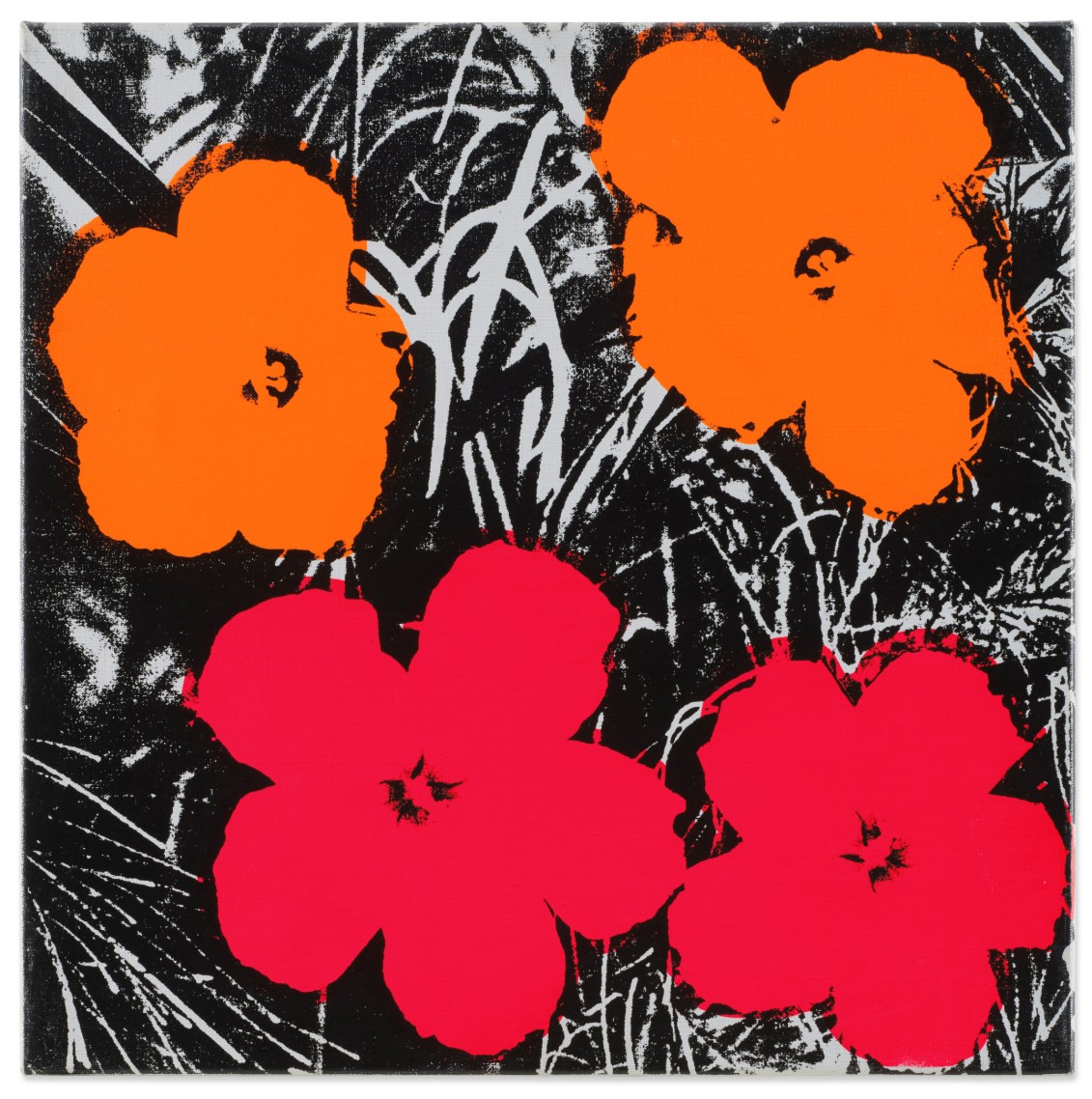
ANDY WARHOL (1928 – 1987)
Flowers, 1964
Acrylic and silkscreen ink on canvas
22×22 inches (56×56 cm)
Signed and dated 64 (on the overlap)
XXXXXXXXXX
#30. Marilyn (Reversal Series), 1986
Property from an Esteemed Private Collection
Sotheby’s London: 4 March 2026
Estimated: GBP 800,000 – 1,200,000
GBP 998,400 / USD 1,333,765
Marilyn (Reversal Series) | Modern & Contemporary Evening Auction | 2026 | Sotheby’s
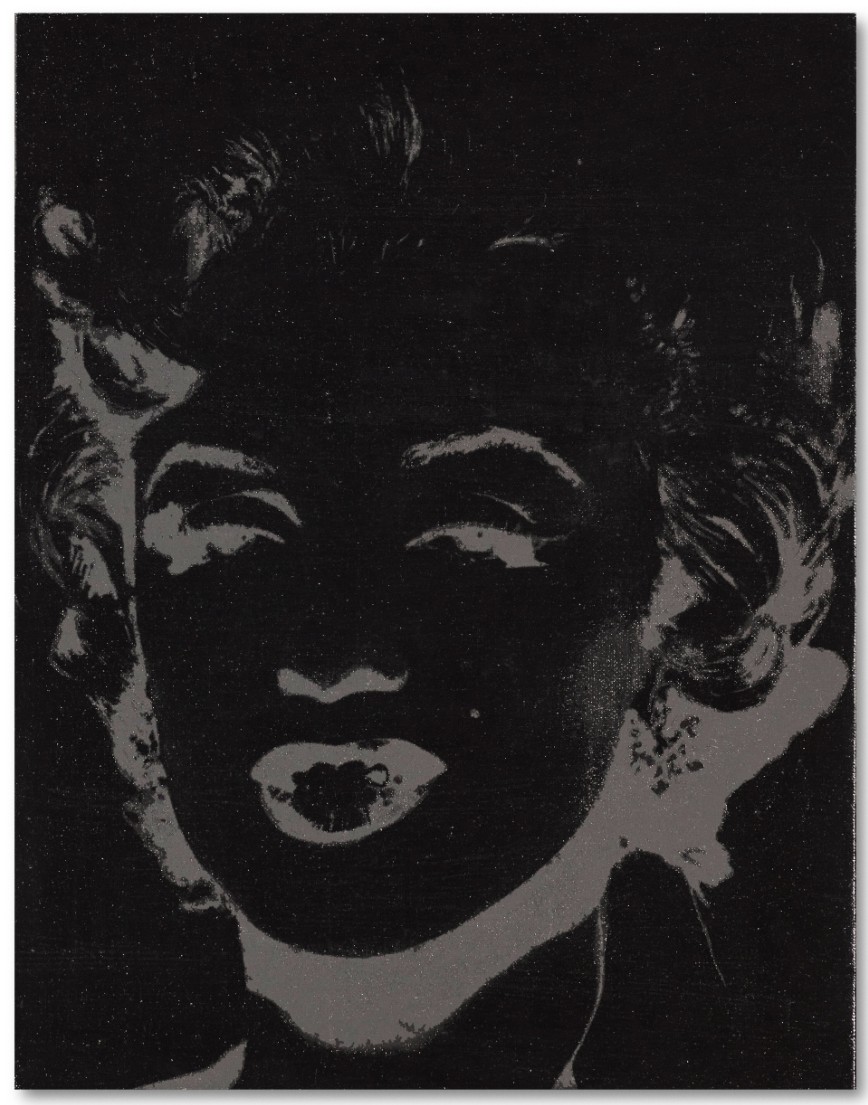
ANDY WARHOL (1928 – 1987)
Marilyn (Reversal Series), 1986
Acrylic and silkscreen ink on canvas
18×14 inches (45.7 x 35.6 cm)
Stamp signed (on the reverse)
Stamped by the Andy Warhol Art Authentication Board, Inc.
Numbered A107.066
Inscribed ‘I verify that this is an original painting by Andy Warhol completed by him in 1986 Frederick Hughes’
on the reverse
XXXXXXXXXX
#35. Tappan Deep Brown Blue, 2025
RA | Artists Supporting Artists
Sotheby’s London: 4 March 2026
Estimated: GBP 600,000 – 800,000
GBP 768,000 / USD 1,025,970
Tappan Deep Brown Blue | Modern & Contemporary Evening Auction | 2026 | Sotheby’s
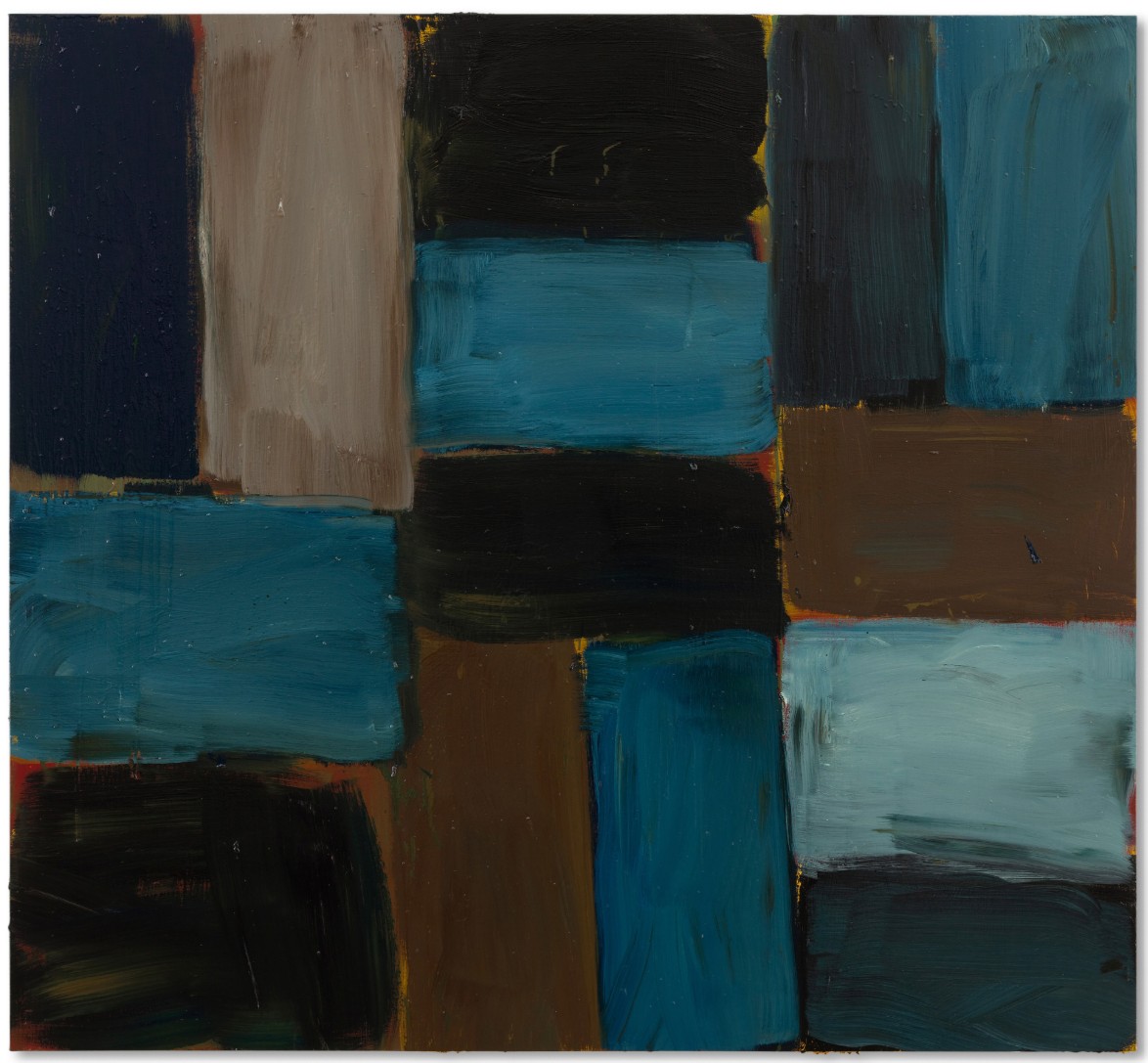
SEAN SCULLY (b. 1945)
Tappan Deep Brown Blue, 2025
Oil on linen
62-1/8 x 67-1/8 inches (157.9 x 172.6 cm)
Signed, titled and dated Aug 10, 2025 (on the reverse)
XXXXXXXXXX
#42. Dollar Sign, 1981
Contours of Modernity | A Private European Collection
Sotheby’s London: 4 March 2026
Estimated: GBP 300,000 – 400,000
GBP 576,000 / USD 769,480
Dollar Sign | Modern & Contemporary Evening Auction | 2026 | Sotheby’s
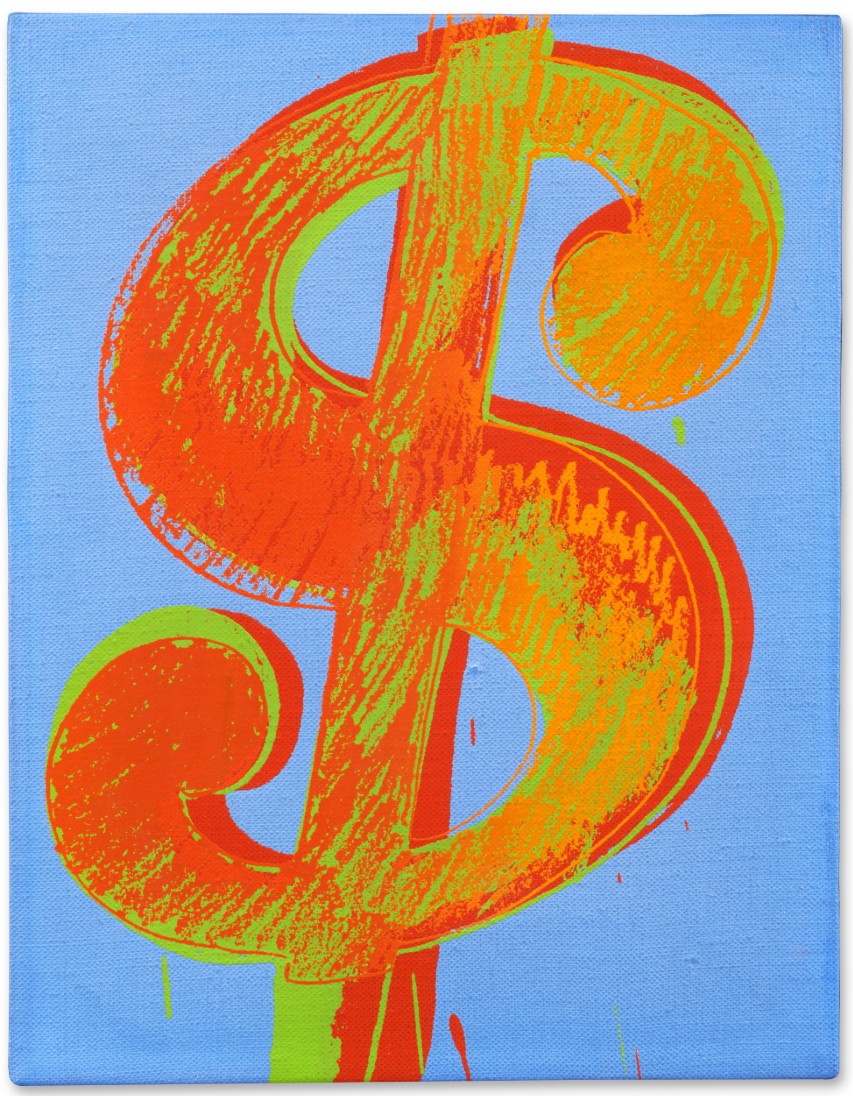
ANDY WARHOL (1928 – 1987)
Dollar Sign, 1981
Acrylic and silkscreen ink on canvas
10×8 inches (25.8 x 20 cm)
Signed, dated 81 and dedicated To Enrico (on the overlap)
XXXXXXXXXX
#46. Peinture 130 x 81 cm, 1er oct 2006
Contours of Modernity | A Private European Collection
Sotheby’s London: 4 March 2026
Estimated: GBP 400,000 – 600,000
GBP 512,000 / USD 683,980
Peinture 130 x 81 cm, 1er oct 2006 | Modern & Contemporary Evening Auction | 2026 | Sotheby’s
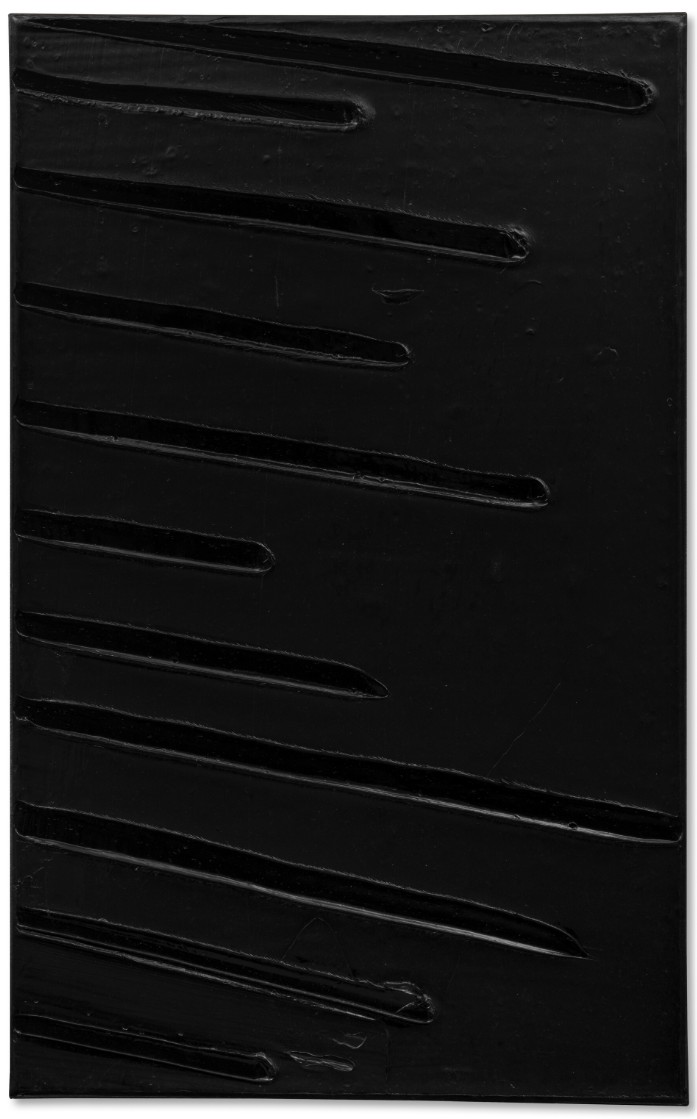
PIERRE SOULAGES (1919 – 2022)
Peinture 130 x 81 cm, 1er oct 2006
Acrylic on canvas
130×81 cm (51-1/8 x 31-7/8 inches)
Signed, titled and dated 1 oct. 2006 (on the reverse)
XXXXXXXXXX
#52. Love Affair, 2001
Property from a Prestigious Collection
Sotheby’s London: 4 March 2026
Estimated: GBP 300,000 – 400,000
GBP 320,000 / USD 427,488
Love Affair | Modern & Contemporary Evening Auction | 2026 | Sotheby’s
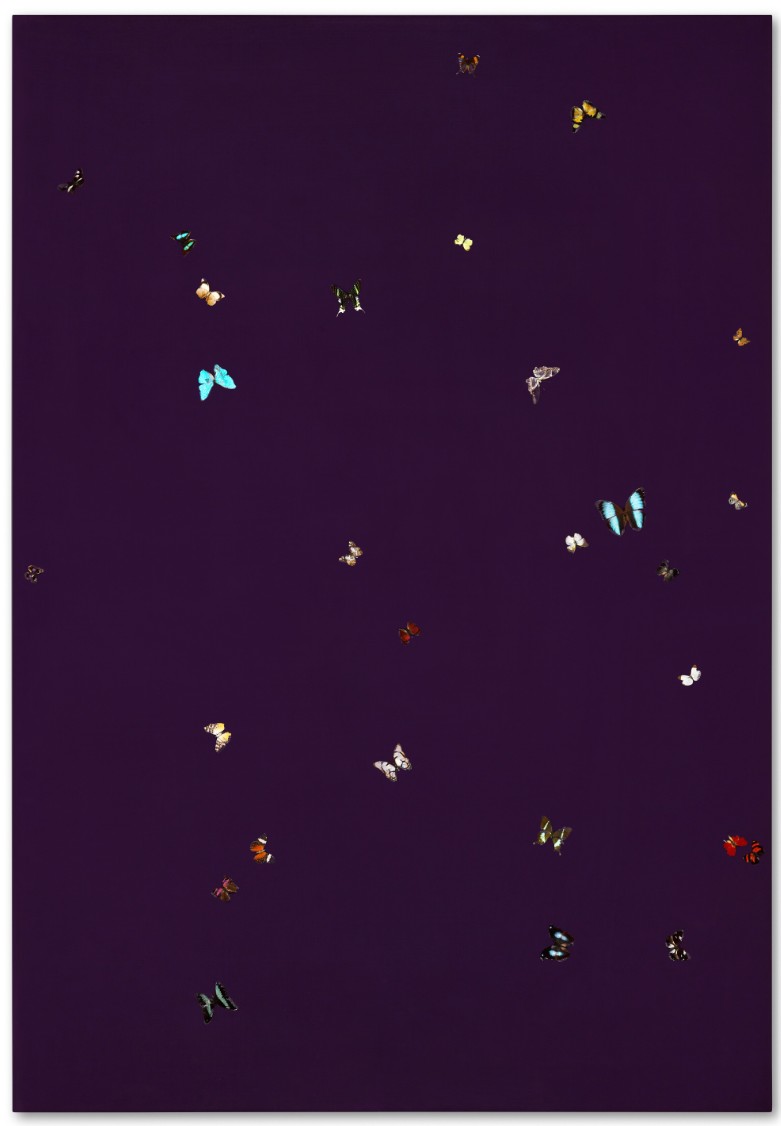
DAMIEN HIRST (b. 1965)
Love Affair, 2001
Household gloss on canvas with butterflies
100-3/8 x 69-3/8 inches (255 x 176.2 cm)
Signed (on a label affixed to the reverse)
The David Hockney Sale: The Arrival of Spring
5 March 2026
The David Hockney Sale: The Arrival of Spring | Prints | Sotheby’s
Total:
GBP 4,544,000 / USD 6,070,330
# Lots: 16 Lots
# Lots sold: 16 Lots
Sell-Through Rate: 100%
White Glove Sale
Top Lot:
GBP 486,400 / USD 649,780
PLEASE CLICK BELOW TO CHECK LOTS AND AUCTION RESULTS
Contemporary Day Auction
5 March 2026
Contemporary Day Auction | 2026 | Sotheby’s
Total:
GBP 9,355,520 / USD 12,498,040
# Lots: 99 Lots
# Lots sold: 83 Lots
Sell-Through Rate: 93.8%
Top Lot:
GBP 512,000 / USD 683,980
XXXXXXXXXX
#1. Cage Grid, 2011
Property from a Distinguished British Collector
Sotheby’s London: 5 March 2026
Estimated: GBP 400,000 – 600,000
GBP 512,000 / USD 683,980
Cage Grid | Contemporary Day Auction | 2026 | Sotheby’s
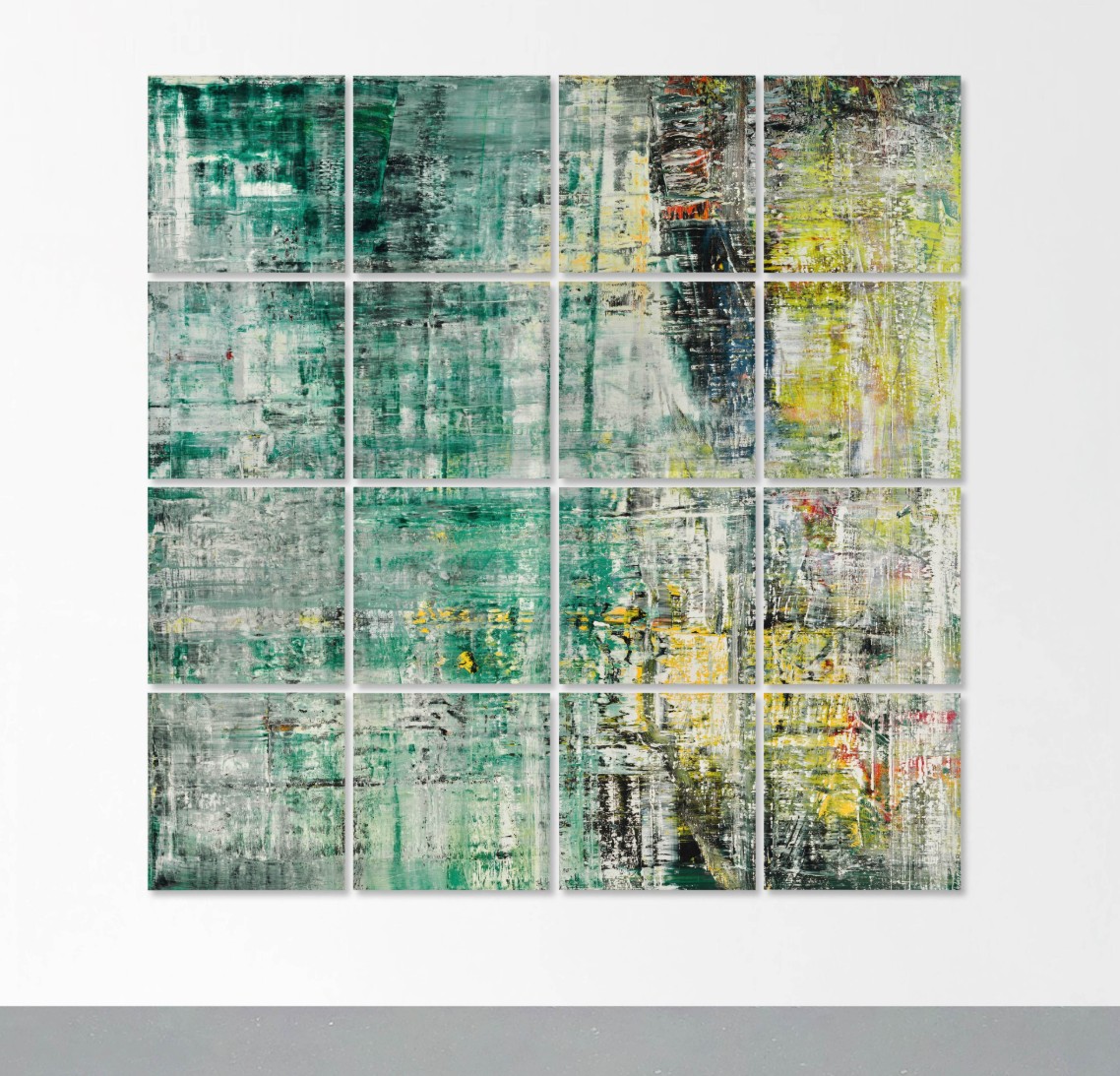
GERHARD RICHTER (b. 1932)
Cage Grid, 2011
Giclée print on paper mounted on aluminum, in sixteen parts
Each: 75×75 cm (29-1/2 x 29- 1/2 inches)
Overall: 300×300 cm (118-1/8 x 118-1/8 inches)
Each: signed with the artist’s initials and numbered 15/16 (on the reverse)
This work is number 15 from an edition of 16, plus 4 artist’s proofs
#2. The Scream (After Munch), 1984
Property from a Distinguished British Collector
Sotheby’s London: 5 March 2026
Estimated: GBP 200,000 – 300,000
GBP 448,000 / USD 598,485
The Scream (After Munch) | Contemporary Day Auction | 2026 | Sotheby’s
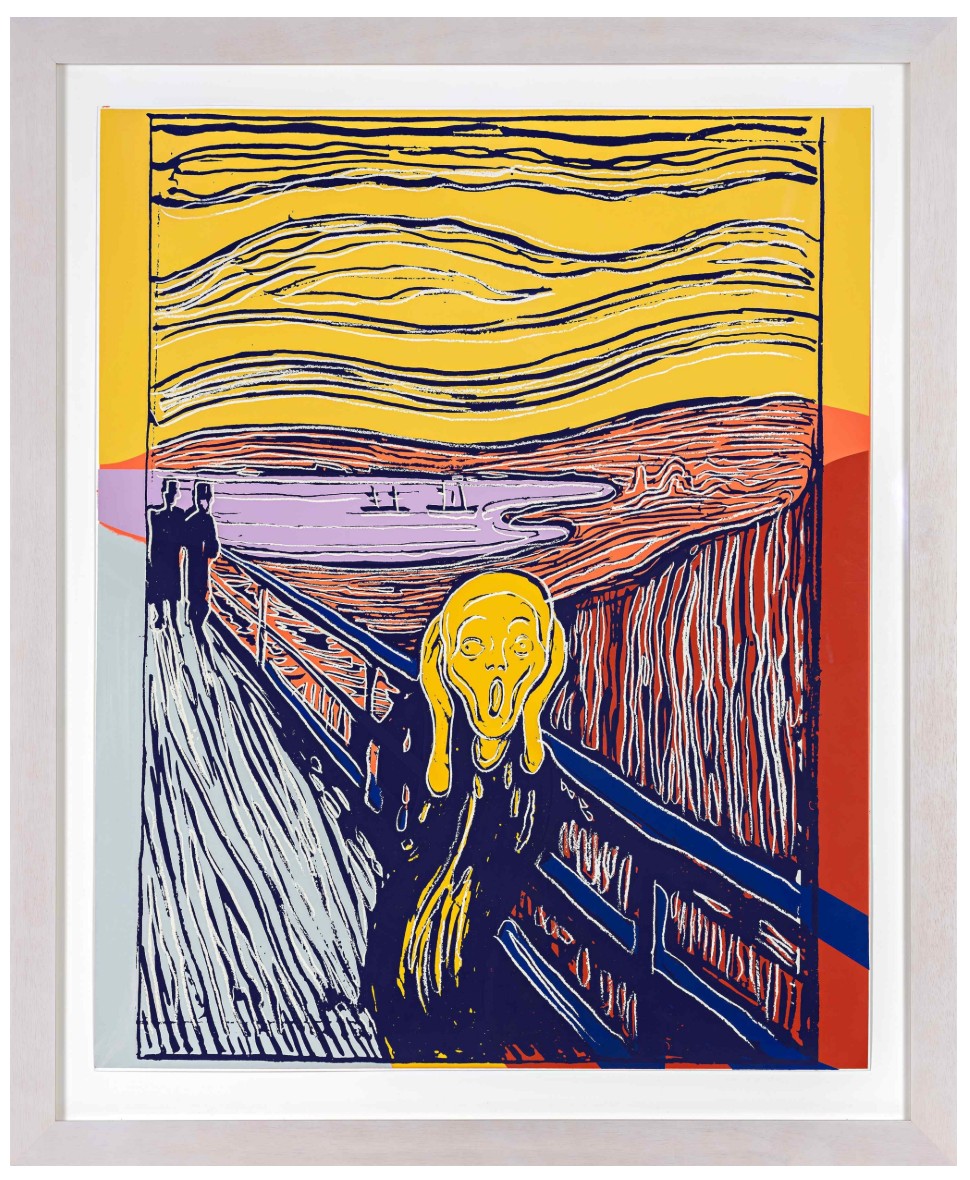
ANDY WARHOL (1928 – 1987)
The Scream (After Munch), 1984
Screenprint in a unique color combination on Lenox Museum Board
39-3/4 x 32 inches (101.2 x 81.2 cm)
With the Estate of Andy Warhol and the Andy Warhol Foundation for the Visual Arts inkstamps verso
Annotated UP34.21 and initialled VF by Vincent Fremont in pencil
This work is from a small unpublished edition of unique color variants
Printed by Rupert Jasen Smith, New York
#3. Grecian Nude, 2013
Sotheby’s London: 5 March 2026
Estimated: GBP 250,000 – 350,000
GBP 435,200 / USD 581,385
Grecian Nude | Contemporary Day Auction | 2026 | Sotheby’s
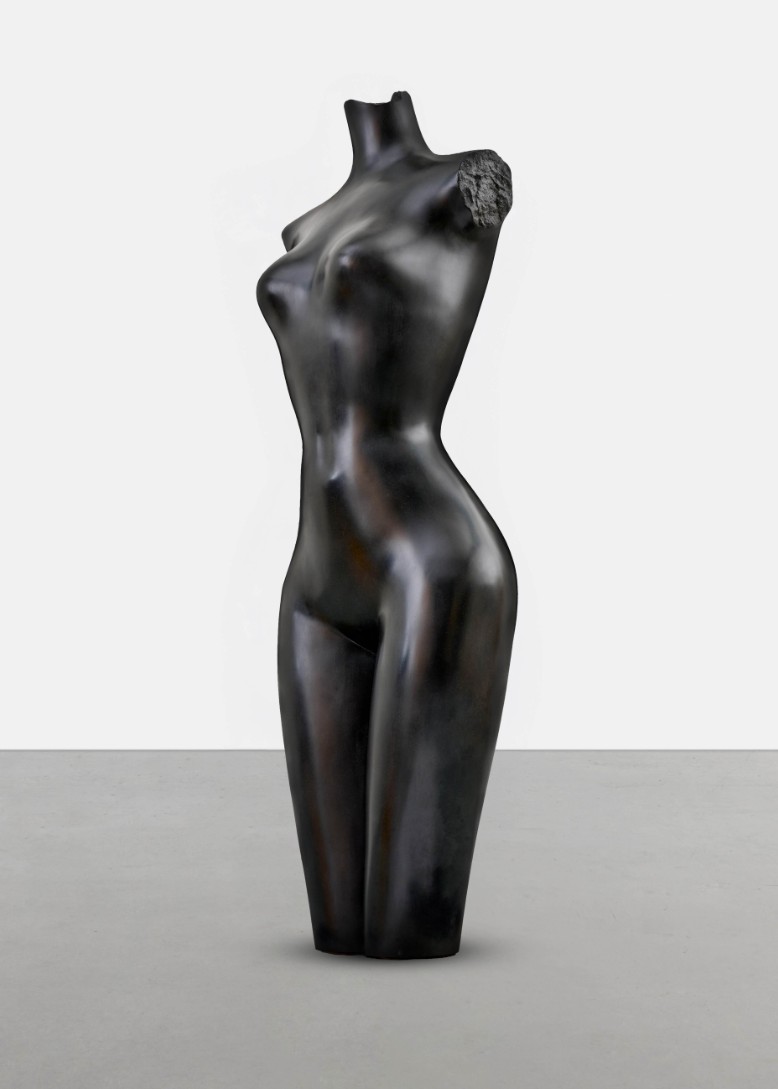
DAMIEN HIRST (b. 1965)
Grecian Nude, 2013
Bronze
73-5/8 x 22-7/8 x 19-3/4 inches (187x58x50 cm)
Incised with the artist’s signature, dated MMXII
Numbered 2/3 and stamped with the foundry mark and Treasures stamp (towards the base)
This work is number 2 from an edition of 3
#4. 20 JUN. 1984, 1984
Sotheby’s London: 5 March 2026
Estimated: GBP 250,000 – 350,000
GBP 422,400 / USD 564,285
20 JUN. 1984 | Contemporary Day Auction | 2026 | Sotheby’s
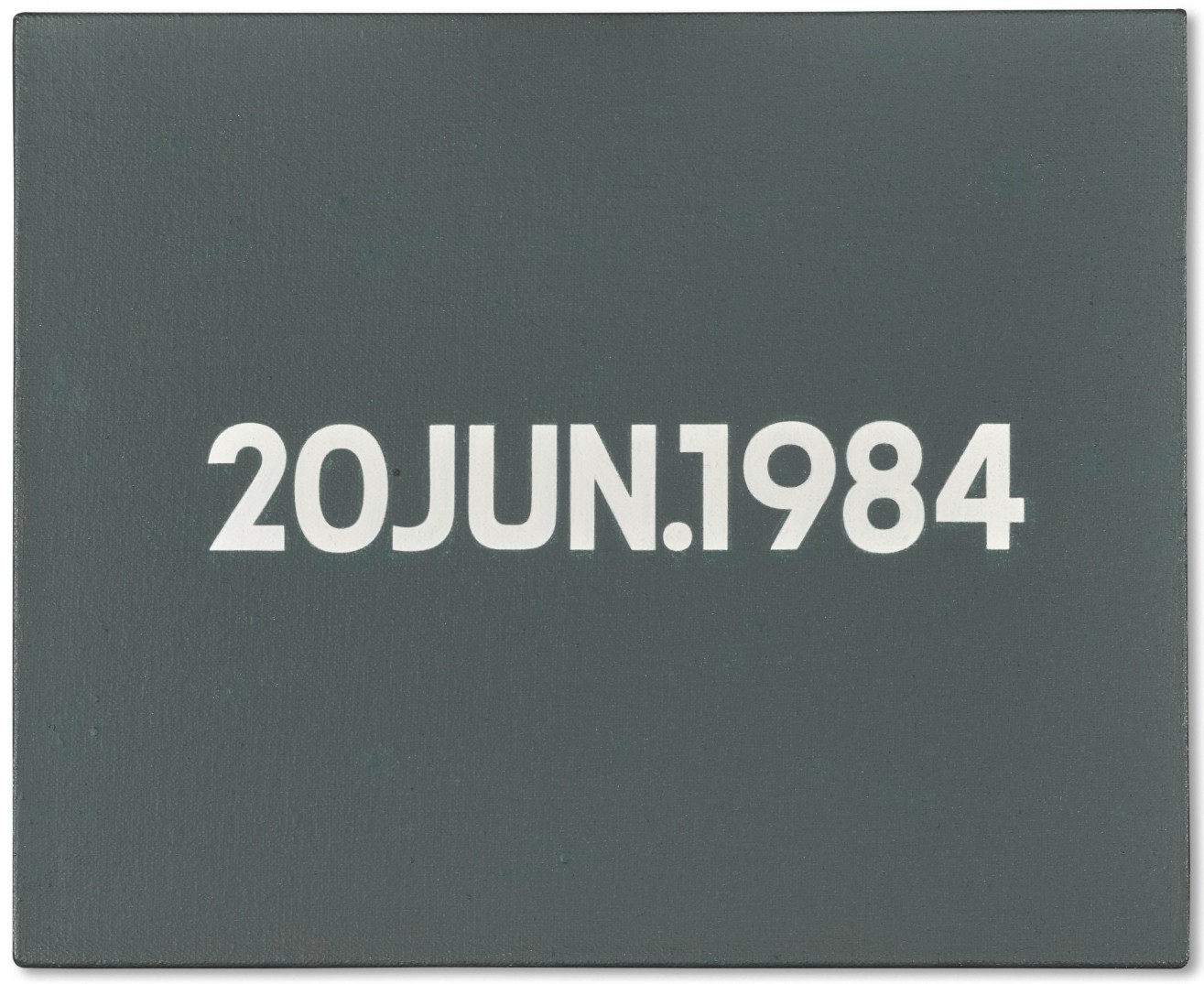
ON KAWARA (1932 – 2014)
20 JUN. 1984, 1984
From “Today,” 1966-2013
Liquitex on canvas with newspaper clipping and artist’s cardboard box
20.6 x 25.4 cm (8-1/8 x 10 inches)
Titled (centre)
Signed (on the reverse)
#5. Ohne Gleisanschluss, 2005
Contours of Modernity | A Private European Collection
Sotheby’s London: 5 March 2026
Estimated: GBP 300,000 – 500,000
GBP 320,000 / USD 427,490
Ohne Gleisanschluss | Contemporary Day Auction | 2026 | Sotheby’s
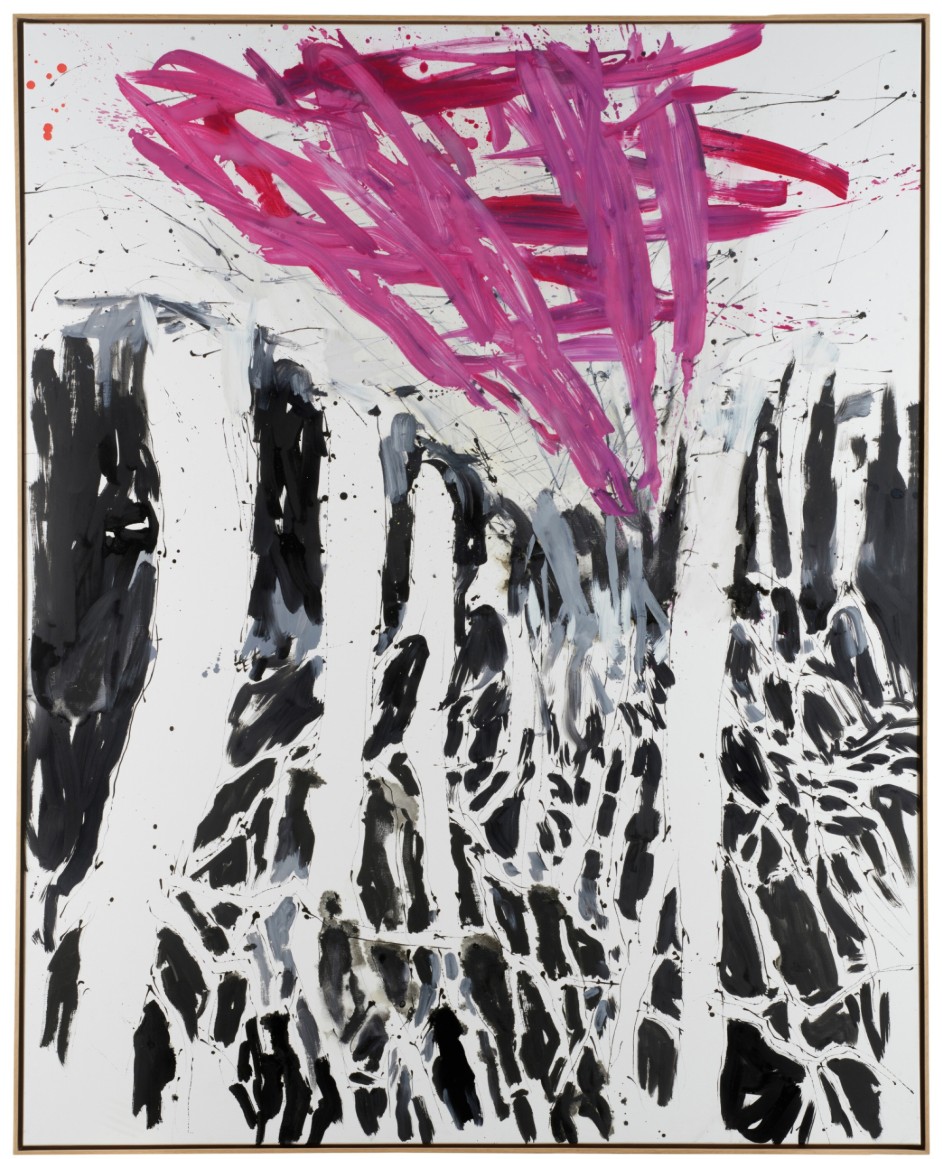
GEORGE BASELITZ (b. 1938)
Ohne Gleisanschluss, 2005
Oil on canvas
249.5 x 200 cm (98-1/4 x 78-3/4 inches)
Signed, titled and dated 15.V.05 (on the reverse)
XXXXXXXXXX
#7. Diethylene Glycol, 2006
Property from a Distinguished British Collector
Sotheby’s London: 5 March 2026
Estimated: GBP 250,000 – 350,000
GBP 307,200 / USD 410,390
Diethylene Glycol | Contemporary Day Auction | 2026 | Sotheby’s
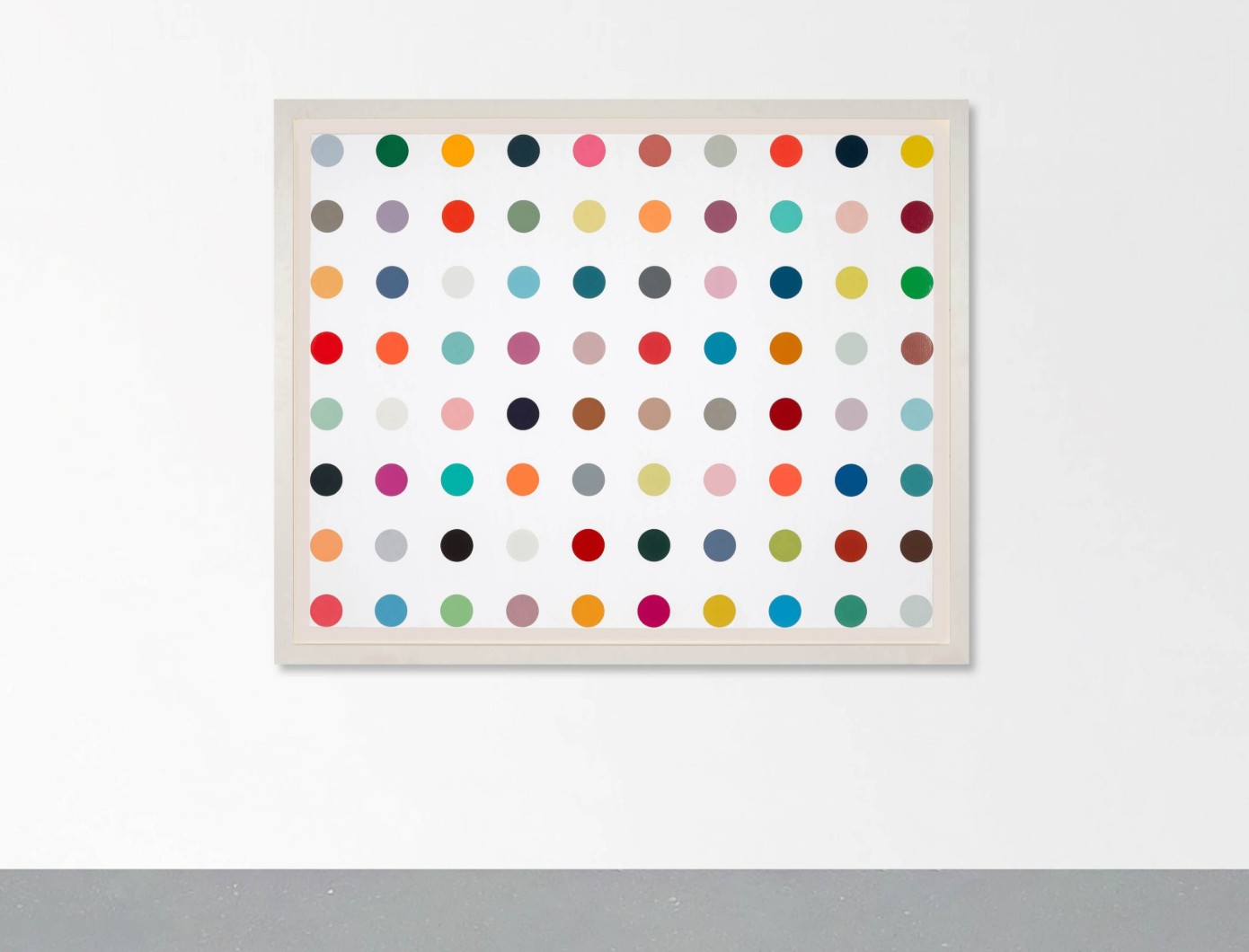
DAMIEN HIRST (b. 1965)
Diethylene Glycol, 2006
Household gloss on canvas
60×76 inches (152.4 x 193 cm)
Signed twice (on the stretcher)
Signed, titled and dated 2006 (on the reverse)
XXXXXXXXXX
#9. Flow, 2013
Sotheby’s London: 5 March 2026
Estimated: GBP 300,000 – 500,000
GBP 281,600 / USD 376,190
Flow | Contemporary Day Auction | 2026 | Sotheby’s
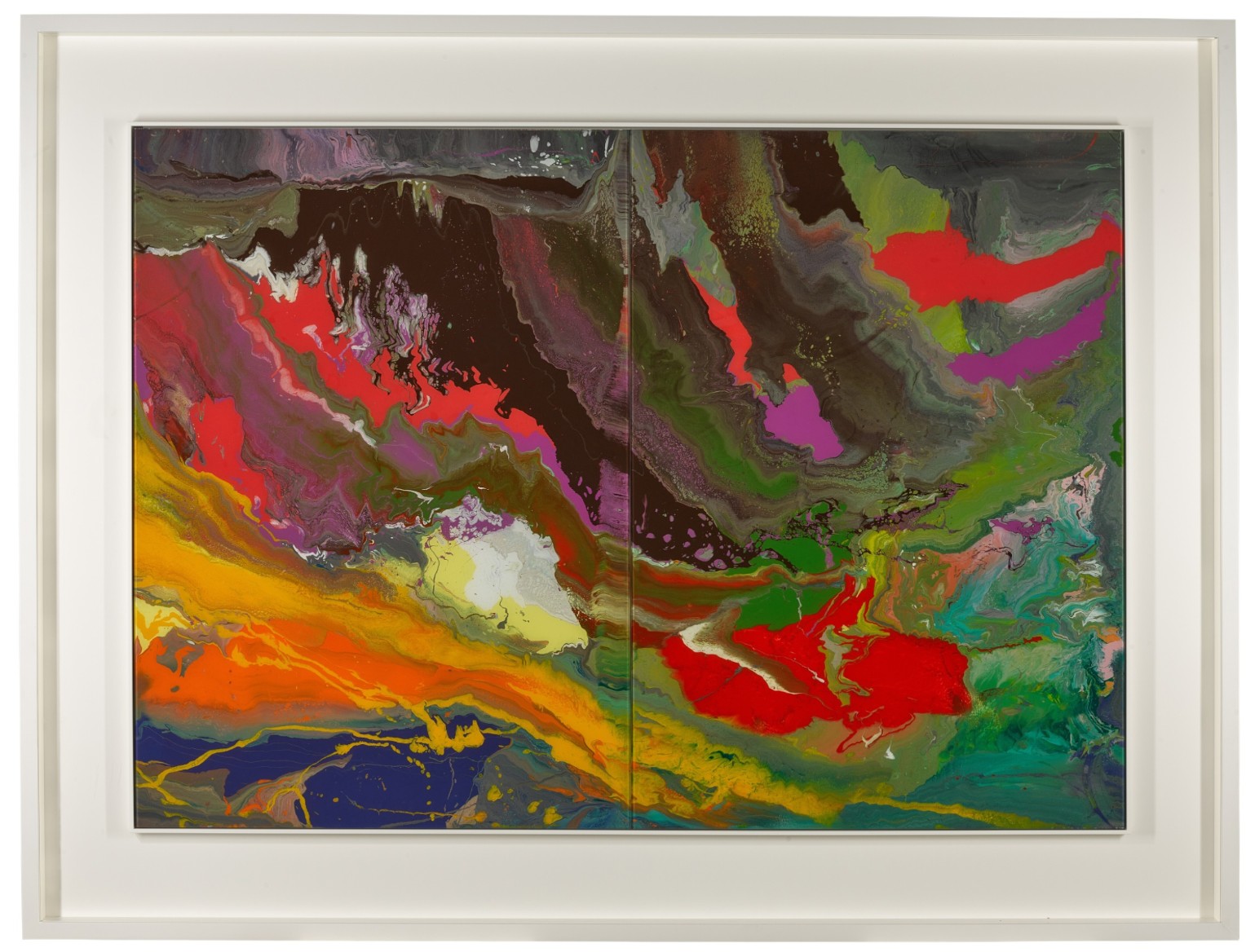
GERHARD RICHTER (b. 1932)
Flow, 2013
Lacquer behind glass mounted on Alu-Dibond
120×170 cm (47-1/4 x 66-7/8 inches)
Signed, dated 2013 and numbered 933-1 (on the reverse)
#10. LOVE (Red Outside Blue Inside), 1966-1999
Sotheby’s London: 5 March 2026
Estimated: GBP 200,000 – 300,000
GBP 256,000 / USD 341,990
LOVE (Red Outside Blue Inside) | Contemporary Day Auction | 2026 | Sotheby’s
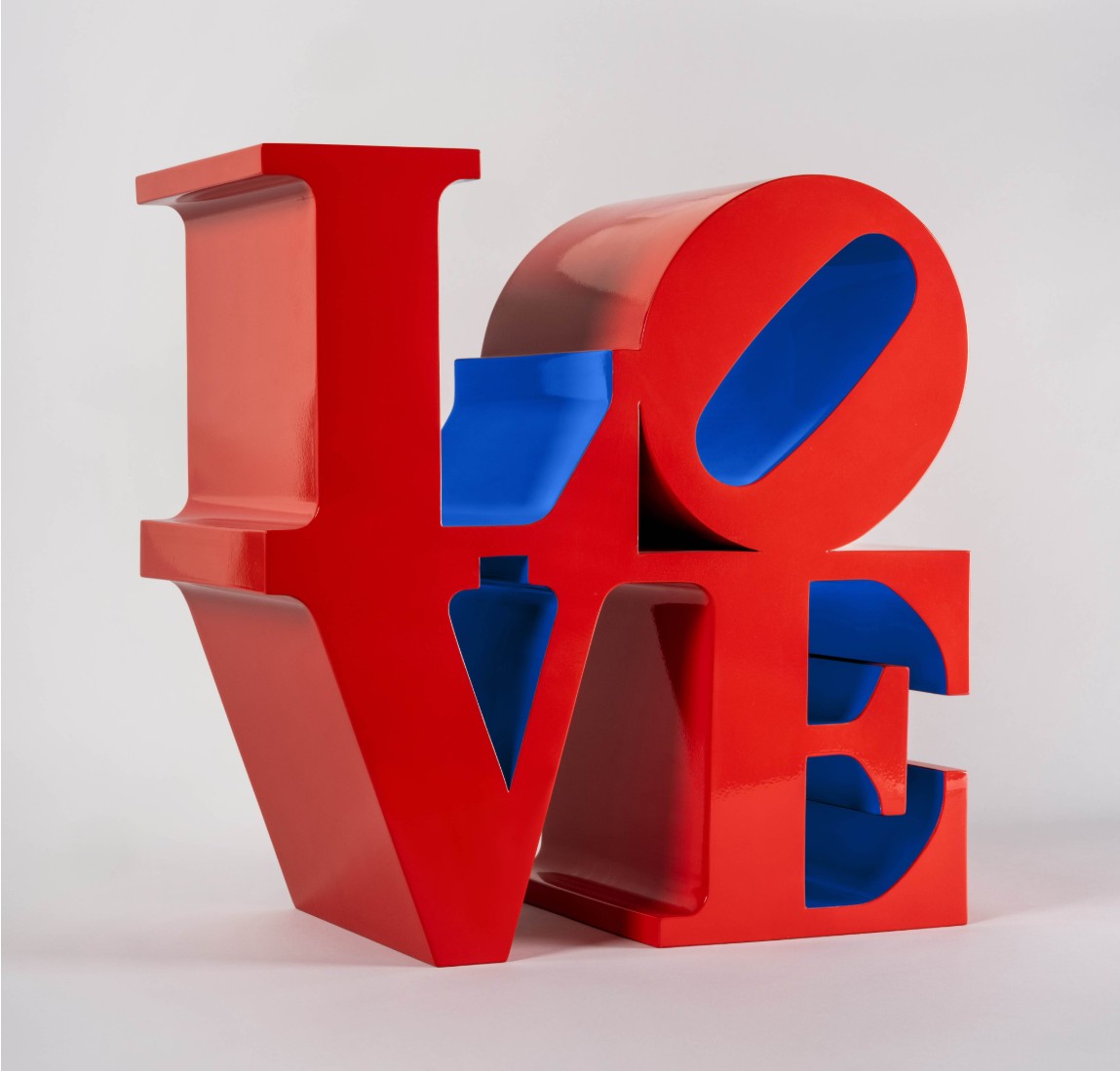
ROBERT INDIANA (1928 – 2018)
LOVE (Red Outside Blue Inside), 1966-1999
Polychromed aluminum
18x18x9 inches (45.6 x 45.3 x 23 cm)
Stamped with the artist’s signature, dated 1966-1999 and numbered 5/8 (on the inside of the ‘V’)
This work is number 5 from an edition of 8, plus 2 artist’s proofs
XXXXXXXXXX
#25. Beautiful Second Exploding Pale Blue Comet Impact Painting, 2001
Property from a Distinguished British Collector
Sotheby’s London: 5 March 2026
Estimated: GBP 120,000 – 180,000
GBP 153,600 / USD 205,195
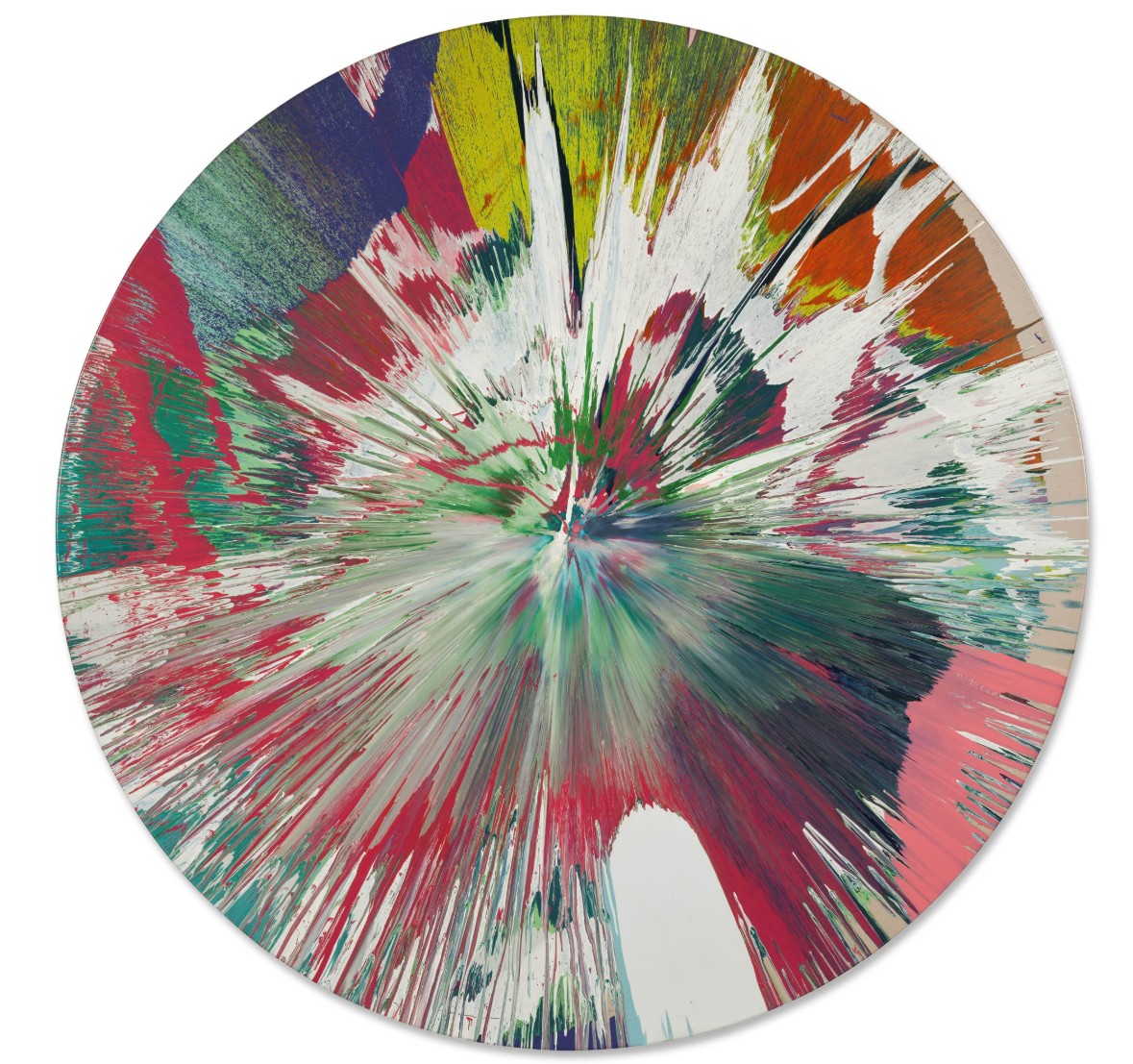
DAMIEN HIRST (b. 1965)
Beautiful Second Exploding Pale Blue Comet Impact Painting, 2001
Household gloss on canvas
Diameter: 72 inches (183 cm)
Signed (on a label affixed to the stretcher)
20th / 21st Century: London Evening Sale
5 March 2026
20th / 21st Century: London Evening Sale
Total:
GBP 114,175,900 / USD 152,527,585
# Lots: 40 Lots
# Lots withdrawn: 4 Lots
# Lots sold: 33 Lots
Sell-Through Rate: 91.7%
Top Lot:
GBP 26,345,000 / USD 35,194,285
XXXXXXXXXX
#1. King and Queen, 1952-53
Christie’s London: 5 March 2026
Estimated: GBP 10,000,000 – 15,000,000
GBP 26,345,000 / USD 35,194,285
HENRY MOORE (1898-1986), King and Queen | Christie’s
HENRY MOORE (1898-1986)
King and Queen, 1952-53
Bronze with a dark green and brown patina
Height: 64-1/2 inches (164 cm)
Conceived in 1952-53 and cast in 1952-53 by the Galizia Foundry, London
Edition of four plus one artist’s cast
Two subsequent bronzes cast specifically for the collections of the Tate Gallery, London (1957) and the Henry Moore Foundation, Much Hadham (1985)
#2. Le rond rouge, 1939
Christie’s London: 5 March 2026
Estimated: GBP 10,500,000 – 15,500,000
GBP 12,545,000 / USD 16,758,865
WASSILY KANDINSKY (1866-1944), Le rond rouge | Christie’s
WASSILY KANDINSKY (1866-1944)
Le rond rouge, 1939
Oil on canvas
89.1 x 116.1 cm (35 x 45-3/4 inches)
Signed with the monogram and dated ‘39’ (lower left)
Signed again with the monogram, dated and numbered ‘No. 661 1939’ (on the reverse)
Painted in April 1939
#3. Le peintre et son modèle, 1964
THE PROPERTY OF A DISTINGUISHED PRIVATE COLLECTOR
Christie’s London: 5 March 2026
Estimated: GBP 7,000,000 – 10,000,000
GBP 8,520,000 / USD 11,381,870
PABLO PICASSO (1881-1973), Le peintre et son modèle | Christie’s
REPEAT SALE
Christie’s New-York: 19 November 2022
Estimated: USD 8,000,000 – 12,000,000
USD 10,351,500
PABLO PICASSO (1881-1973), Le peintre et son modèle | Christie’s
PABLO PICASSO (1881-1973)
Le peintre et son modèle, 1964
Oil and Ripolin on canvas
130×195 cm (51-1/8 x 76-3/4 inches)
Signed ‘Picasso’ (lower left)
Dated ‘8.9.11.64.’ (on the reverse)
Painted in Mougins on 8-9 November 1964
#4. Schober (Haybarn), 1984
PROPERTY FROM AN IMPORTANT PRIVATE COLLECTION
Christie’s London: 5 March 2026
Estimated: GBP 6,000,000 – 9,000,000
GBP 8,405,000 / USD 11,228,240
GERHARD RICHTER (B. 1932), Schober (Haybarn) | Christie’s
REPEAT SALE
VISIONARIES: WORKS FROM THE EMILY AND JERRY SPIEGEL COLLECTION
Christie’s New-York: 17 May 2017
Estimated: USD 5,500,000 – 7,500,000
USD 6,967,500
Gerhard Richter (B. 1932), Schober | Christie’s
GERHARD RICHTER (B. 1932)
Schober (Haybarn), 1984
Oil on canvas
100.3 x 120 cm (39-1/2 x 47-1/4 inches)
Signed, numbered and dated ‘550-2 Richter 1984’ (on the reverse)
#5. Abstraktes Bild, 1991
ABSTRACT MASTERWORKS FROM AN IMPORTANT PRIVATE COLLECTION
Christie’s London: 5 March 2026
Estimated: GBP 4,500,000 – 6,500,000
GBP 7,600,000 / USD 10,152,840
GERHARD RICHTER (B. 1932), Abstraktes Bild | Christie’s
GERHARD RICHTER (B. 1932)
Abstraktes Bild, 1991
Oil on canvas
112×102 cm (44-1/8 x 40-1/8 inches)
Signed, numbered and dated ‘748-5 Richter 1991’ (on the reverse)
#6. Le Parc Monceau, 1878
PROPERTY FROM A DISTINGUISHED PRIVATE COLLECTION
Christie’s London: 5 March 2026
Estimated: GBP 5,500,000 – 8,500,000
GBP 6,760,000 / USD 9,030,685
CLAUDE MONET (1840-1926), Le Parc Monceau | Christie’s
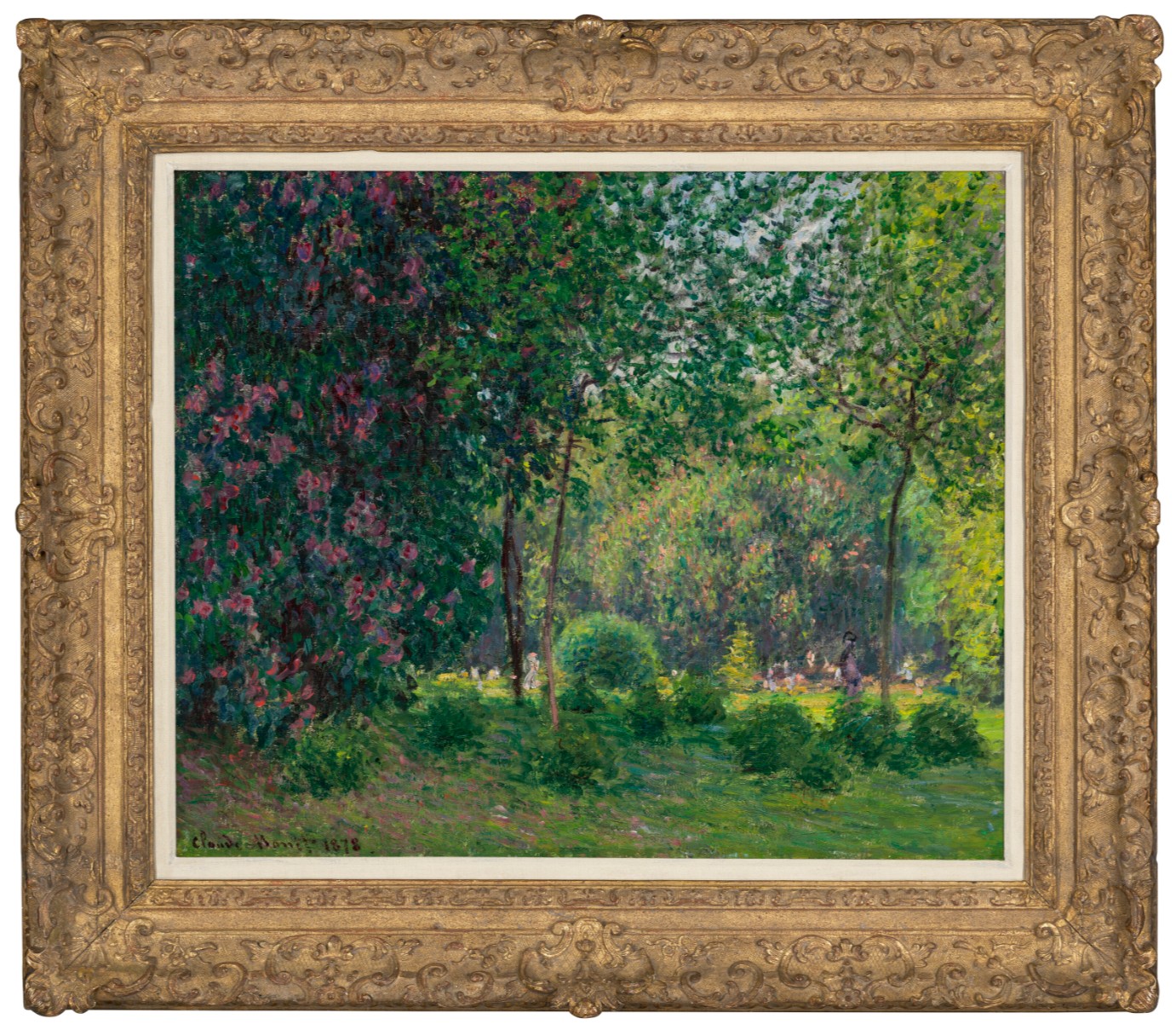
CLAUDE MONET (1840-1926)
Le Parc Monceau, 1878
Oil on canvas
54.1 x 65 cm (21-1/4 x 25-5/8 inches)
Signed and dated ‘Claude Monet 1878.’ (lower left)
#7. Four Mona Lisas, 1978
Christie’s London: 5 March 2026
Estimated: GBP 3,500,000 – 5,500,000
GBP 4,320,000 / USD 5,771,090
ANDY WARHOL (1928-1987), Four Mona Lisas | Christie’s
REPEAT SALE
Christie’s New-York: 12 November 2014
Estimated: USD 2,500,000 – 3,500,000
USD 5,989,000
Andy Warhol (1928-1987), Mona Lisa | Christie’s
REPEAT SALE
Christie’s New-York: 10 November 2010
Estimated: USD 1,800,000 – 2,200,000
USD 3,610,500
Andy Warhol (1928-1987) , Mona Lisa | Christie’s
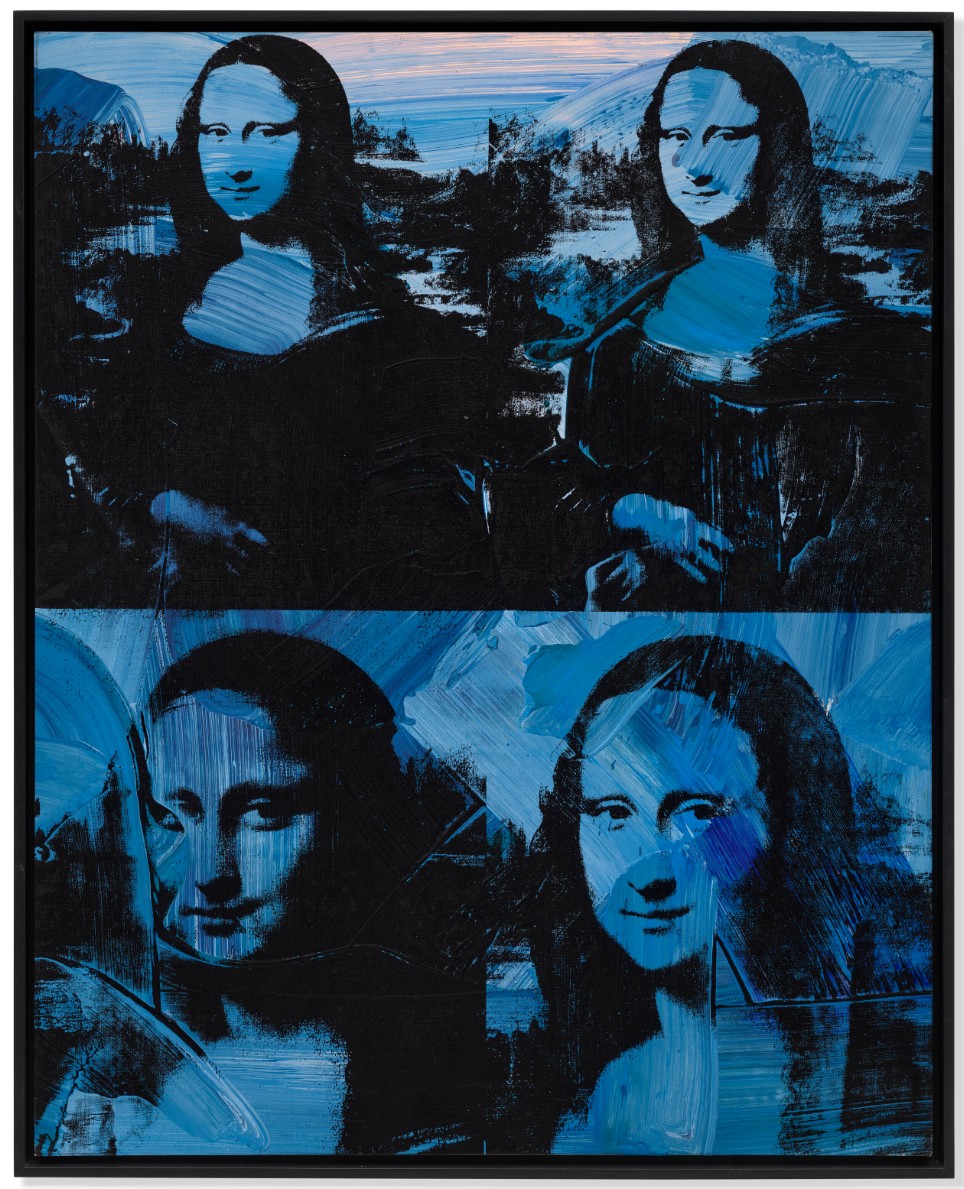
ANDY WARHOL (1928-1987)
Four Mona Lisas, 1978
Acrylic and silkscreen ink on canvas
49-7/8 x 39-7/8 inches (126.7 x 101.3 cm)
Signed and dated ‘Andy Warhol 78’ (on the overlap)
XXXXXXXXXX
Study for Olympic Poster, 1970
Christie’s London: 5 March 2026
Estimated: GBP 500,000 – 700,000
GBP 635,000 / USD 848,295
WORK ON PAPER
DAVID HOCKNEY (B. 1937), Study for Olympic Poster | Christie’s
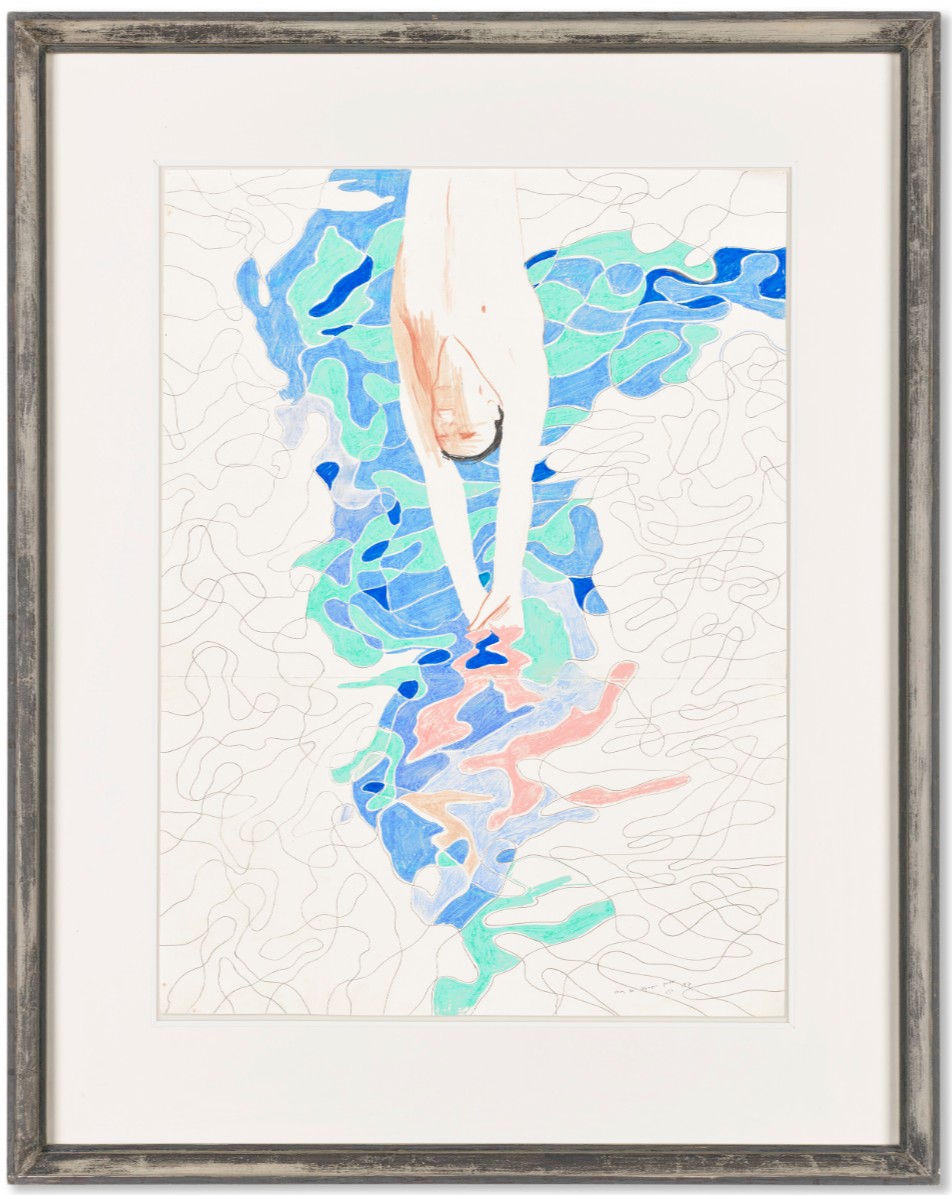
DAVID HOCKNEY (B. 1937)
Study for Olympic Poster, 1970
Colored pencil and graphite on two adjoined sheets of paper
33-5/8 x 24-3/4 inches (85.4 x 63 cm)
Signed with the artist’s initials, titled and dated ‘study for Olympic poster DH. 1970.’ (lower right)
XXXXXXXXXX
Imaginative Play I, 2024
Christie’s London: 5 March 2026
Estimated: GBP 180,000 – 250,000
GBP 215,900 / USD 288,420
CAROLINE WALKER (B. 1982), Imaginative Play I | Christie’s
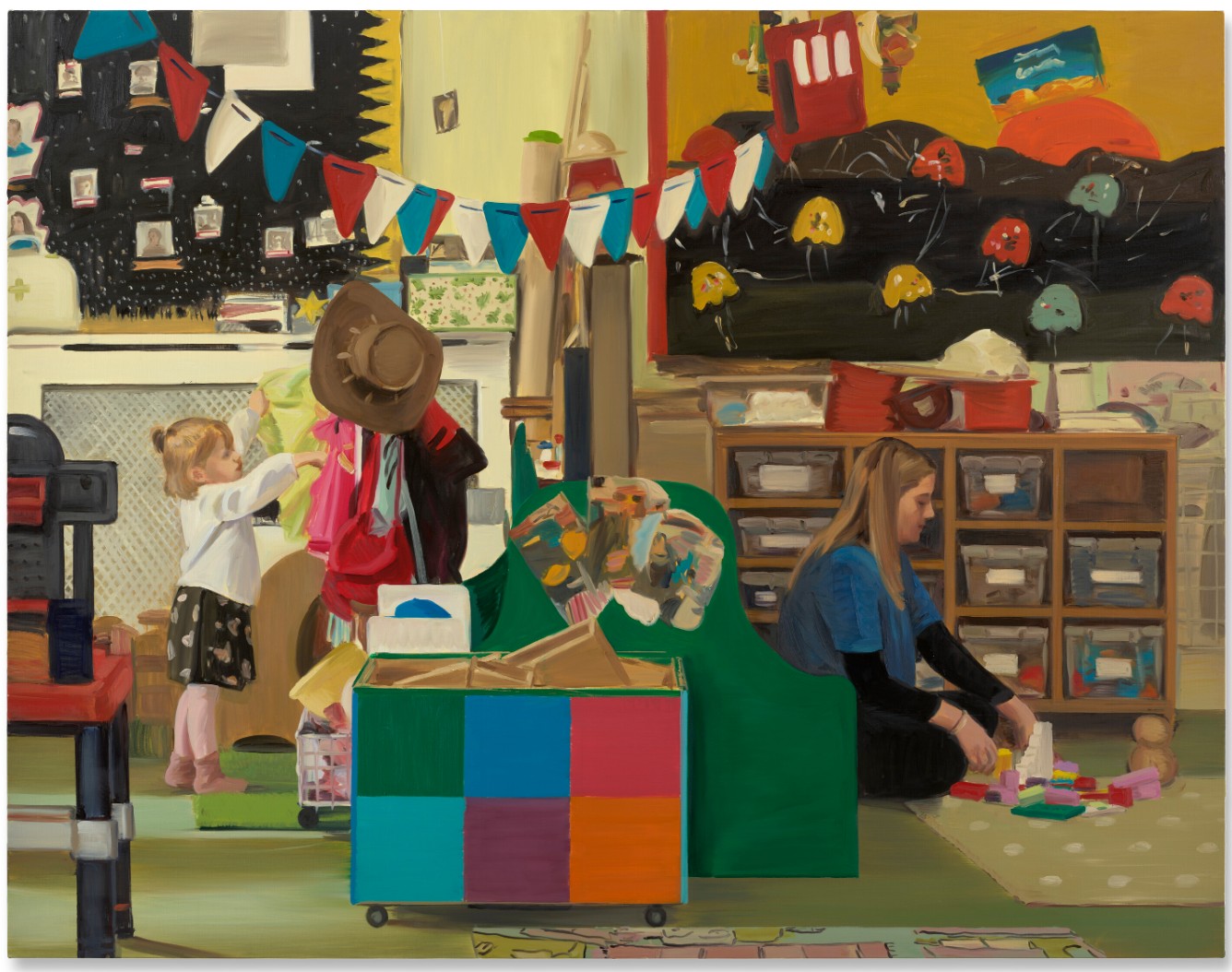
CAROLINE WALKER (B. 1982)
Imaginative Play I, 2024
Oil on linen
74-7/8 x 96-1/2 inches (190.3 x 245.2 cm)
Signed, titled and dated ”IMAGINATIVE PLAY I’ Caroline Walker 2024′ (on the reverse)
XXXXXXXXXX
Shadow Burn, 2005-2006
PROPERTY FROM AN IMPORTANT PRIVATE EUROPEAN COLLECTION
Christie’s London: 5 March 2026
Estimated: GBP 3,000,000 – 5,000,000
WITHDRAWN
CECILY BROWN (B. 1969), Shadow Burn | Christie’s
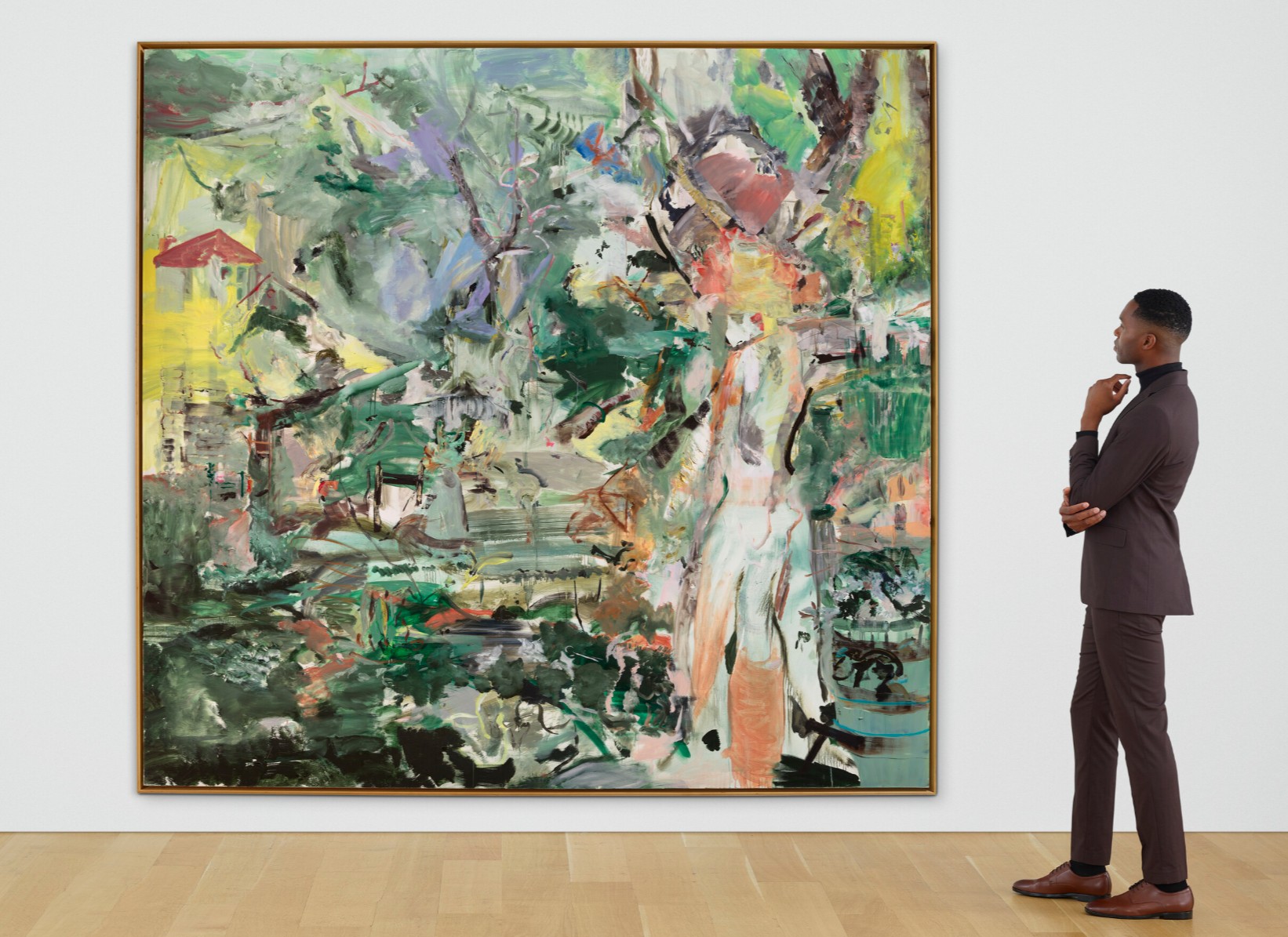
CECILY BROWN (B. 1969)
Shadow Burn, 2005-2006
Oil on linen
97×103 inches (246.2 x 261.7 cm)
Signed twice and dated twice ‘Cecily Brown 2005-2006 Cecily Brown 2005’ (on the reverse)
The Art of the Surreal Evening Sale
5 March 2026
The Art of the Surreal Evening Sale
Total:
GBP 42,978,950 / USD 57,415,579
# Lots: 27 Lots
# Lots withdrawn: 1 Lot
# Lots sold: 26 Lots
Sell-Through Rate: 100%
White Glove Sale
Top Lot:
GBP 8,520,000 / USD 11,381,870
XXXXXXXXXX
#1. Les grâces naturelles, circa 1961
PROPERTY FROM A PRIVATE SWISS COLLECTION
Christie’s London: 5 March 2026
Estimated: GBP 6,500,000 – 9,500,000
GBP 8,520,000 / USD 11,381,870
RENÉ MAGRITTE (1898-1967), Les grâces naturelles | Christie’s
RENÉ MAGRITTE (1898-1967)
Les grâces naturelles, circa 1961
Oil on canvas
81.5 x 100.4 cm (32-1/8 x 39-1/2 inches)
Signed ‘Magritte’ (upper left)
Inscribed ‘”Les Grâces naturelles”’ (on the reverse)
#2. Peinture, 1949
AN EYE FOR THE SUBLIME: THE RENKER COLLECTION
Christie’s London: 5 March 2026
Estimated: GBP 1,500,000 – 2,500,000
GBP 4,808,000 / USD 6,423,005
JOAN MIRÓ (1893-1983), Peinture | Christie’s
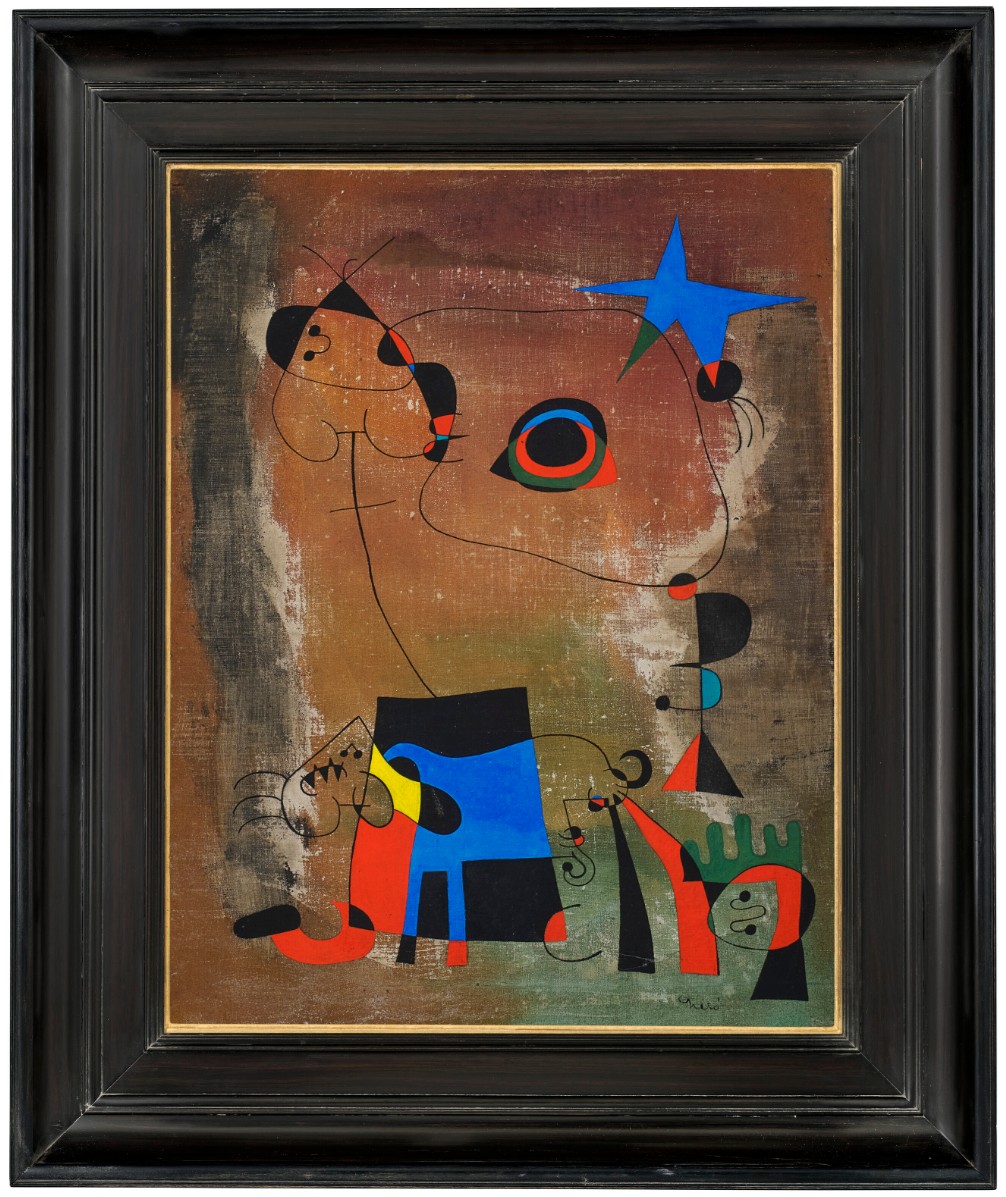
JOAN MIRÓ (1893-1983)
Peinture, 1949
Oil on canvas
65 x 50.5 cm (25-5/8 x 19-7/8 inches)
Signed ‘Miró’ (lower right)
Signed again and dated ‘Miró. 1949’ (on the reverse)
#3. Children’s Games, 1942
PROPERTY FROM A PRIVATE AMERICAN COLLECTION
Christie’s London: 5 March 2026
Estimated: GBP 1,000,000 – 2,000,000
GBP 4,686,000 / USD 6,260,025
DOROTHEA TANNING (1910-2012), Children’s Games | Christie’s
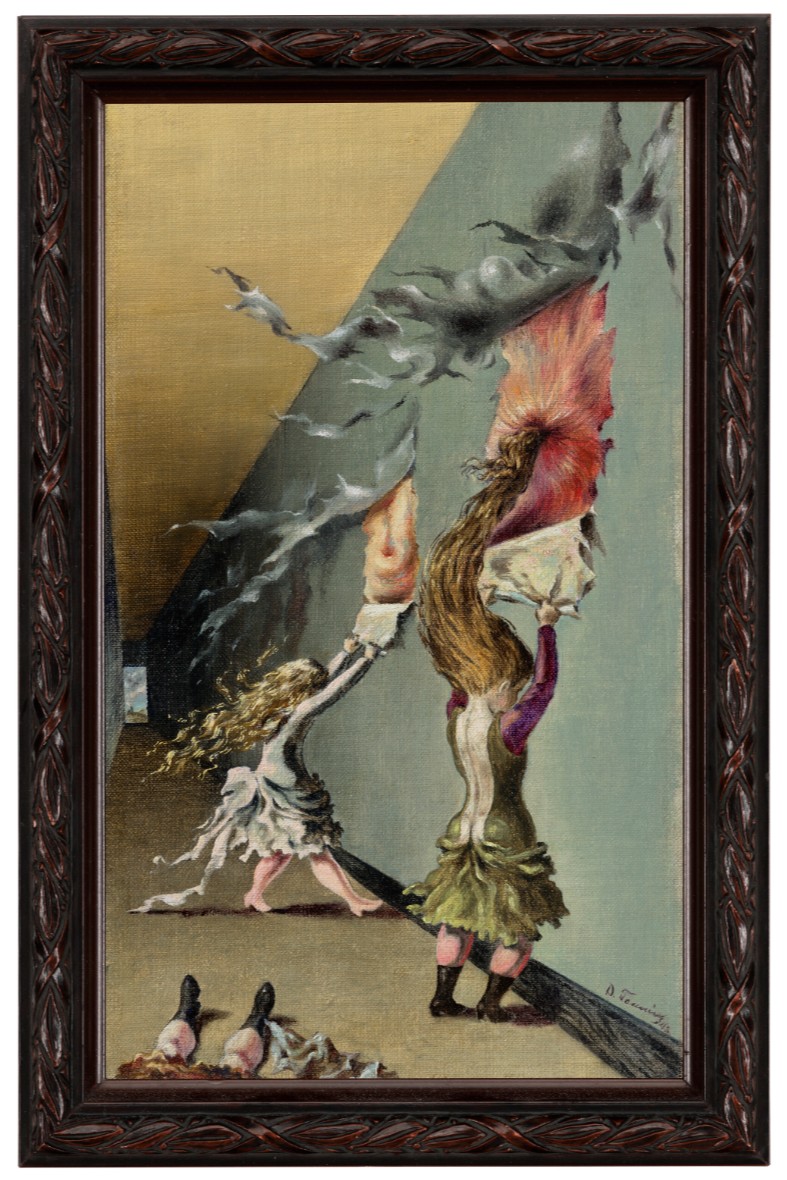
DOROTHEA TANNING (1910-2012)
Children’s Games, 1942
Oil on canvas
9-1/4 x 5-5/8 inches (23.3 x 14.3 cm)
Signed and dated ‘D. Tanning 42’ (lower right)
#4. La Ville lunaire, 1944
PROPERTY FROM A PRIVATE SWISS COLLECTION
Christie’s London: 5 March 2026
Estimated: GBP 2,000,000 – 3,000,000
GBP 4,320,000 / USD 5,771,090
PAUL DELVAUX (1897-1994), La Ville lunaire | Christie’s
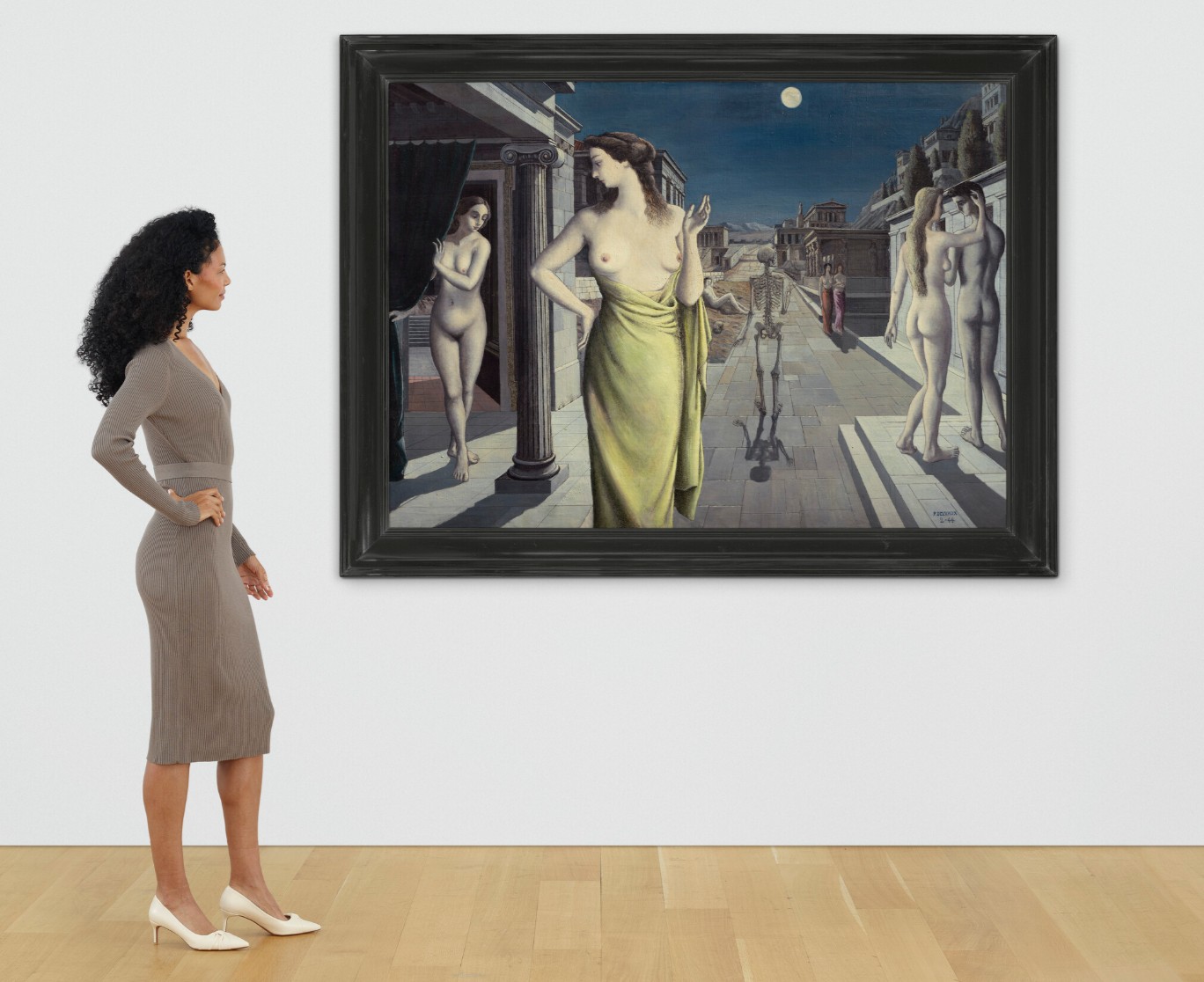
PAUL DELVAUX (1897-1994)
La Ville lunaire, 1944
Oil on canvas
143×200 cm (56-1/4 x 78-3/4 inches)
Signed and dated ‘P.DELVAUX 2-44’ (lower right)
XXXXXXXXXX
Le choeur des sphinges, 1964
PROPERTY FROM A PRIVATE BELGIAN COLLECTION
Christie’s London: 5 March 2026
Estimated: GBP 5,000,000 – 8,000,000
WITHDRAWN
RENÉ MAGRITTE (1898-1967), Le choeur des sphinges | Christie’s
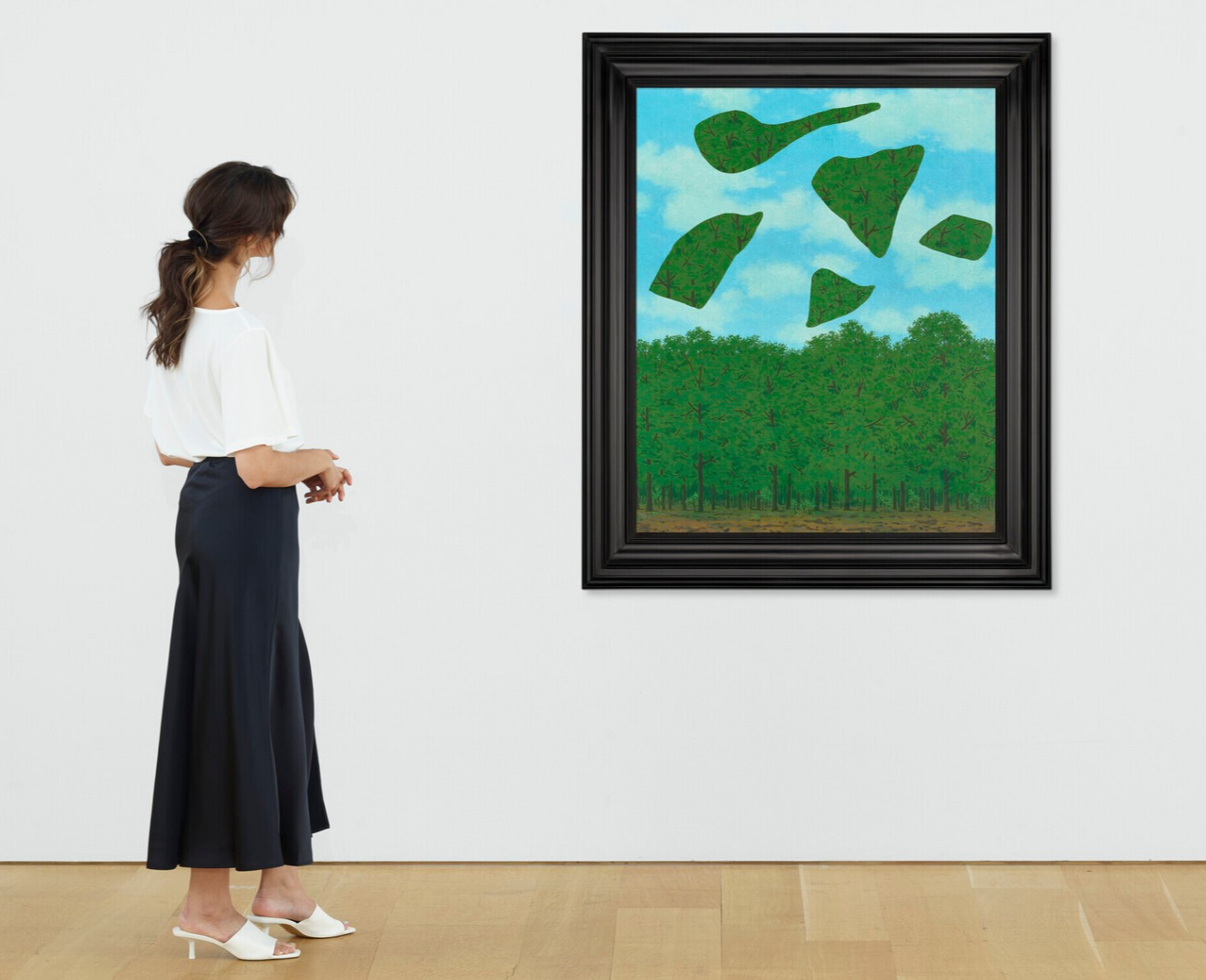
RENÉ MAGRITTE (1898-1967)
Le choeur des sphinges, 1964
Oil on canvas
100.4 x 81 cm (39-1/2 x 31-7/8 inches)
Signed ‘Magritte’ (lower right)
Inscribed ‘Le Chœur des Sphinges’ (on the reverse)
Modern Visionaries – The Roger and Josette Vanthournout Collection – Evening Sale
5 March 2026
Modern Visionaries – The Roger and Josette Vanthournout Collection – Evening Sale
Total:
GBP 40,317,750 / USD 53,860,482
# Lots: 31 Lots
# Lots withdrawn: None
# Lots sold: 30 Lots
Sell-Through Rate: 96.8%
Top Lot:
GBP 7,004,000 / USD 9,356,645
XXXXXXXXXX
#1. Nu debout et femmes assises, 1939
The Roger and Josette Vanthournout Collection
Christie’s London: 5 March 2026
Estimated: GBP 3,500,000 – 5,500,000
GBP 7,004,000 / USD 9,356,645
PABLO PICASSO (1881-1973), Nu debout et femmes assises | Christie’s
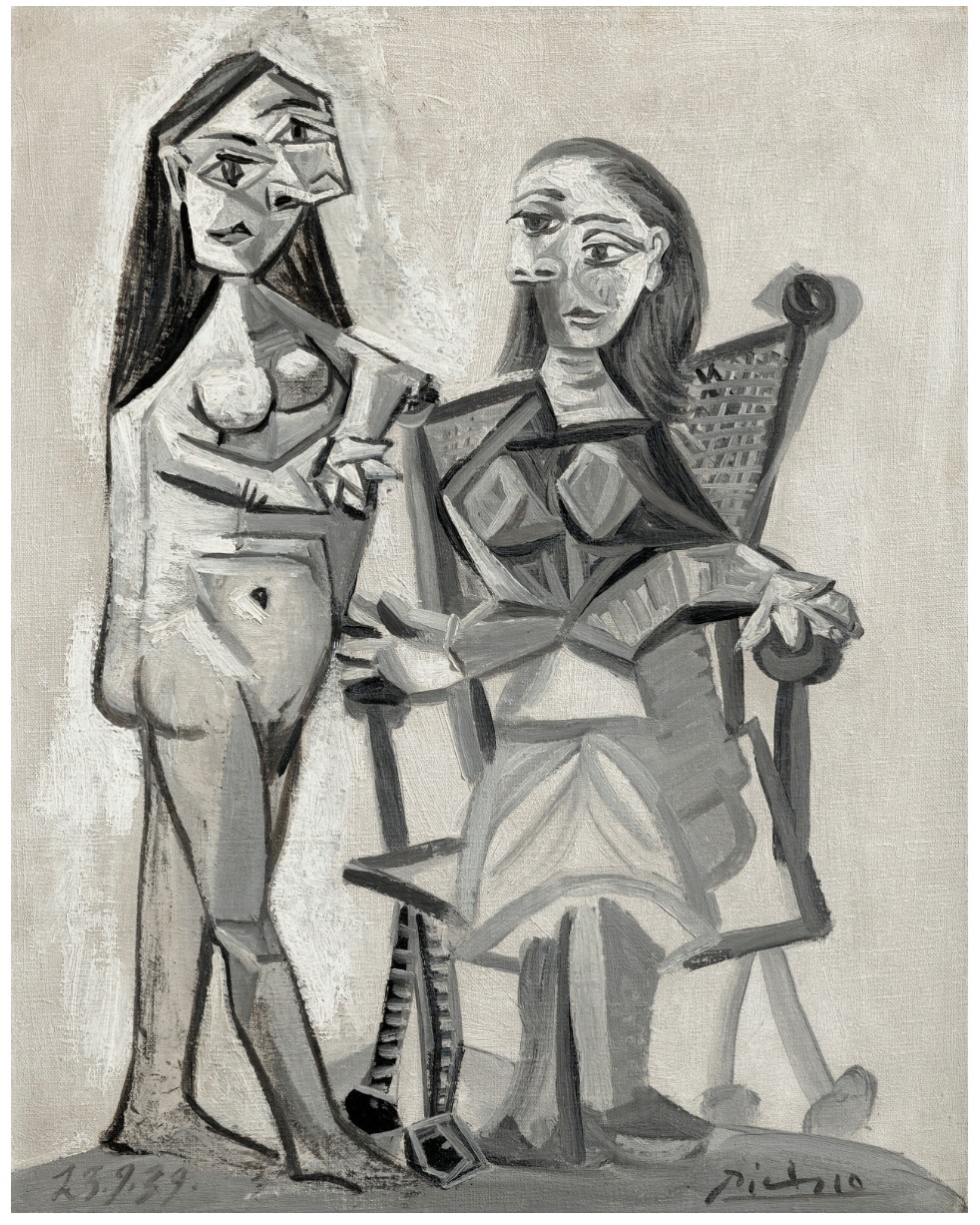
PABLO PICASSO (1881-1973)
Nu debout et femmes assises, 1939
Oil on canvas
41.5 x 33 cm (16-3/8 x 13 inches)
Signed ‘Picasso’ (lower right); dated ‘23.9.39.’ (lower left)
Dated again and inscribed ‘Royan 23 Septe 39.’ (on the reverse)
#2. Goslar Warrior, 1973-74
The Roger and Josette Vanthournout Collection
Christie’s London: 5 March 2026
Estimated: GBP 3,500,000 – 5,500,000
GBP 4,564,000 / USD 6,097,050
HENRY MOORE, O.M., C.H. (1898-1986), Goslar Warrior | Christie’s
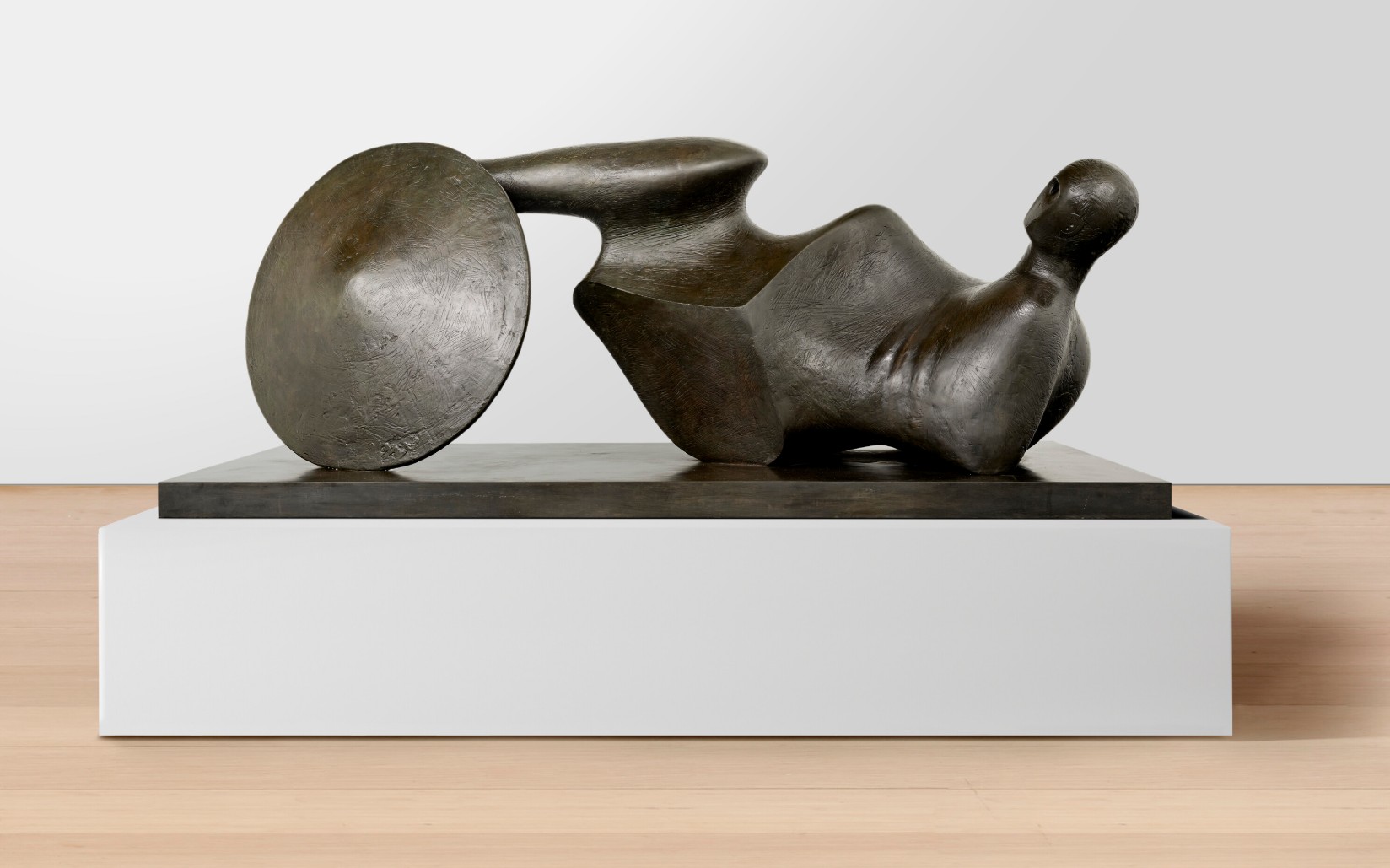
HENRY MOORE, O.M., C.H. (1898-1986)
Goslar Warrior, 1973-74
Bronze with a dark brown patina
118-1/8 inches (300 cm) long
Signed and numbered ‘Moore/ 3⁄7’ and stamped with foundry mark (on the base)
Conceived in 1973-74 and cast in an edition of 7, plus an artist’s cast
Cast by 1974 by Hermann Noack Foundry, Berlin
#3. Le lieu-dit (The spot on the map), 1955
The Roger and Josette Vanthournout Collection
Christie’s London: 5 March 2026
Estimated: GBP 2,000,000 – 3,000,000
GBP 3,466,000 / USD 4,630,230
RENÉ MAGRITTE (1898-1967), Le lieu-dit (The spot on the map) | Christie’s
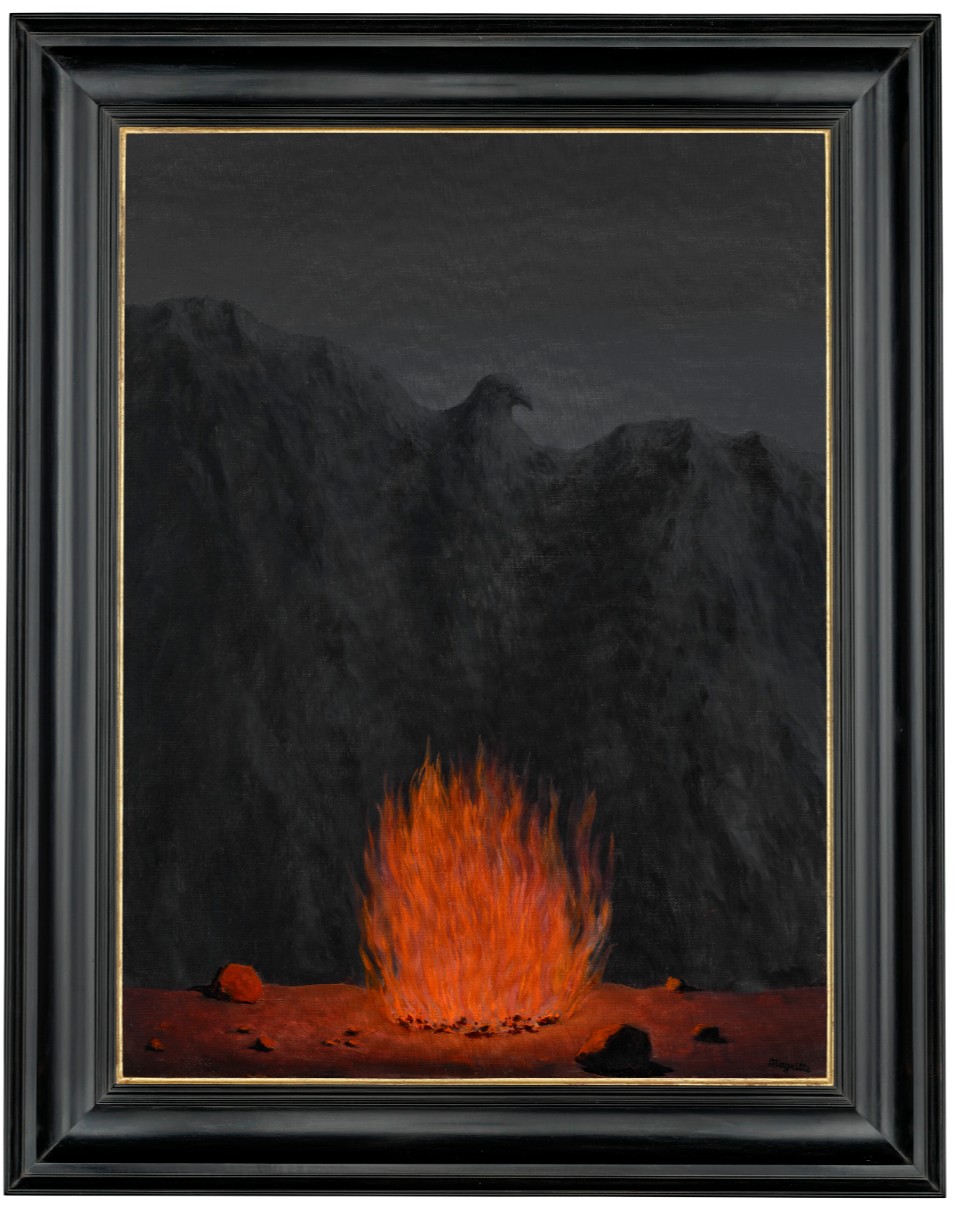
RENÉ MAGRITTE (1898-1967)
Le lieu-dit (The spot on the map), 1955
Oil on canvas
80.2 x 60.4 cm (31-5/8 x 23-3/4 inches)
Signed ‘Magritte’ (lower right)
Dated and inscribed ”’LE LIEU-DIT” 1955′ (on the reverse)
#4. Concetto spaziale, Attese, 1964
The Roger and Josette Vanthournout Collection
Christie’s London: 5 March 2026
Estimated: GBP 2,000,000 – 3,000,000
GBP 3,466,000 / USD 4,630,230
LUCIO FONTANA (1899-1968), Concetto spaziale, Attese | Christie’s
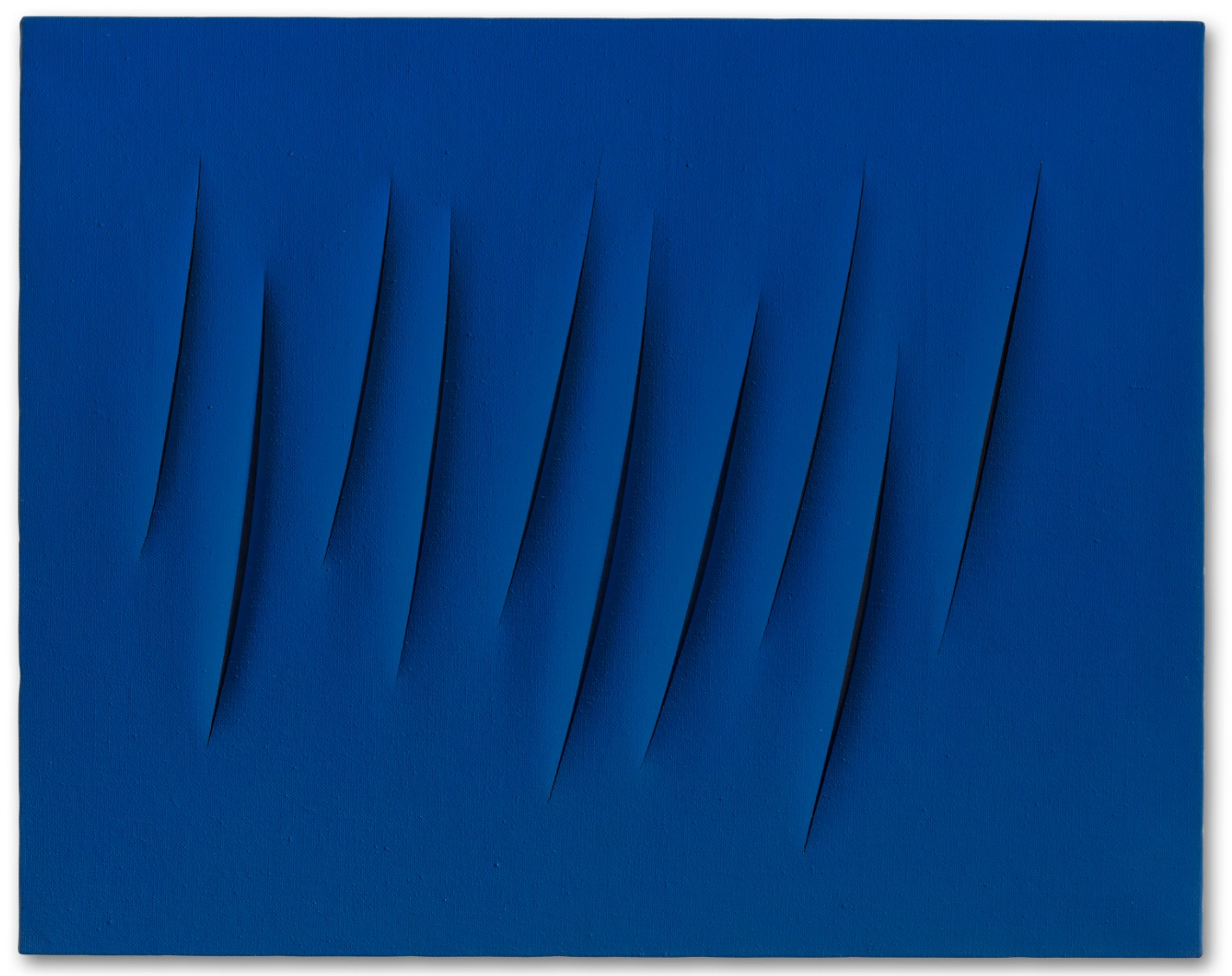
LUCIO FONTANA (1899-1968)
Concetto spaziale, Attese, 1964
Waterpaint on canvas
73 x 92.5 cm (28-3/4 x 36-3/8 inches)
Signed, titled and inscribed ‘Fontana Domani è festa 1+1-HLT3 “Concetto spaziale” “ATTESE”‘ (on the reverse)
#5. J’opterai pour l’erreur (I will choose the mistake), 1963
The Roger and Josette Vanthournout Collection
Christie’s London: 5 March 2026
Estimated: GBP 1,500,000 – 2,000,000
GBP 2,856,000 / USD 3,815,330
JEAN DUBUFFET (1901-1985), J’opterai pour l’erreur (I will choose the mistake) | Christie’s
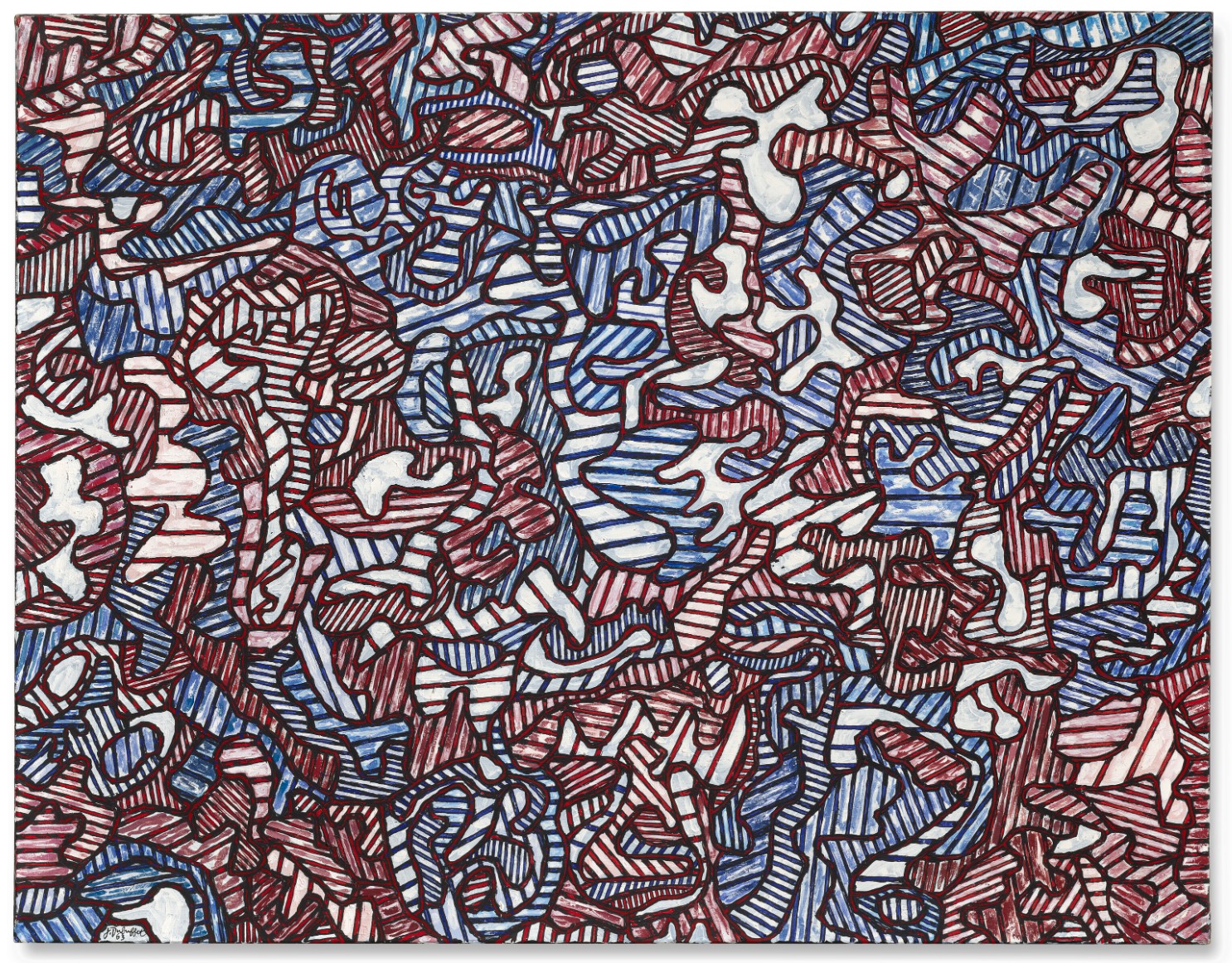
JEAN DUBUFFET (1901-1985)
J’opterai pour l’erreur (I will choose the mistake), 1963
Oil on canvas
113.5 x 145.5 cm (44-3/4 x 57-1/4 inches)
Signed and dated ‘J. Dubuffet 63’ (lower left)
Signed, titled and dated ‘J’opterai pour l’erreur J. Dubuffet 25 mars 1963’ (on the reverse)
#6. Untitled #17, 1996
The Roger and Josette Vanthournout Collection
Christie’s London: 5 March 2026
Estimated: GBP 2,000,000 – 3,000,000
GBP 2,612,000 / USD 3,489,370
AGNES MARTIN (1912-2004), Untitled #17 | Christie’s
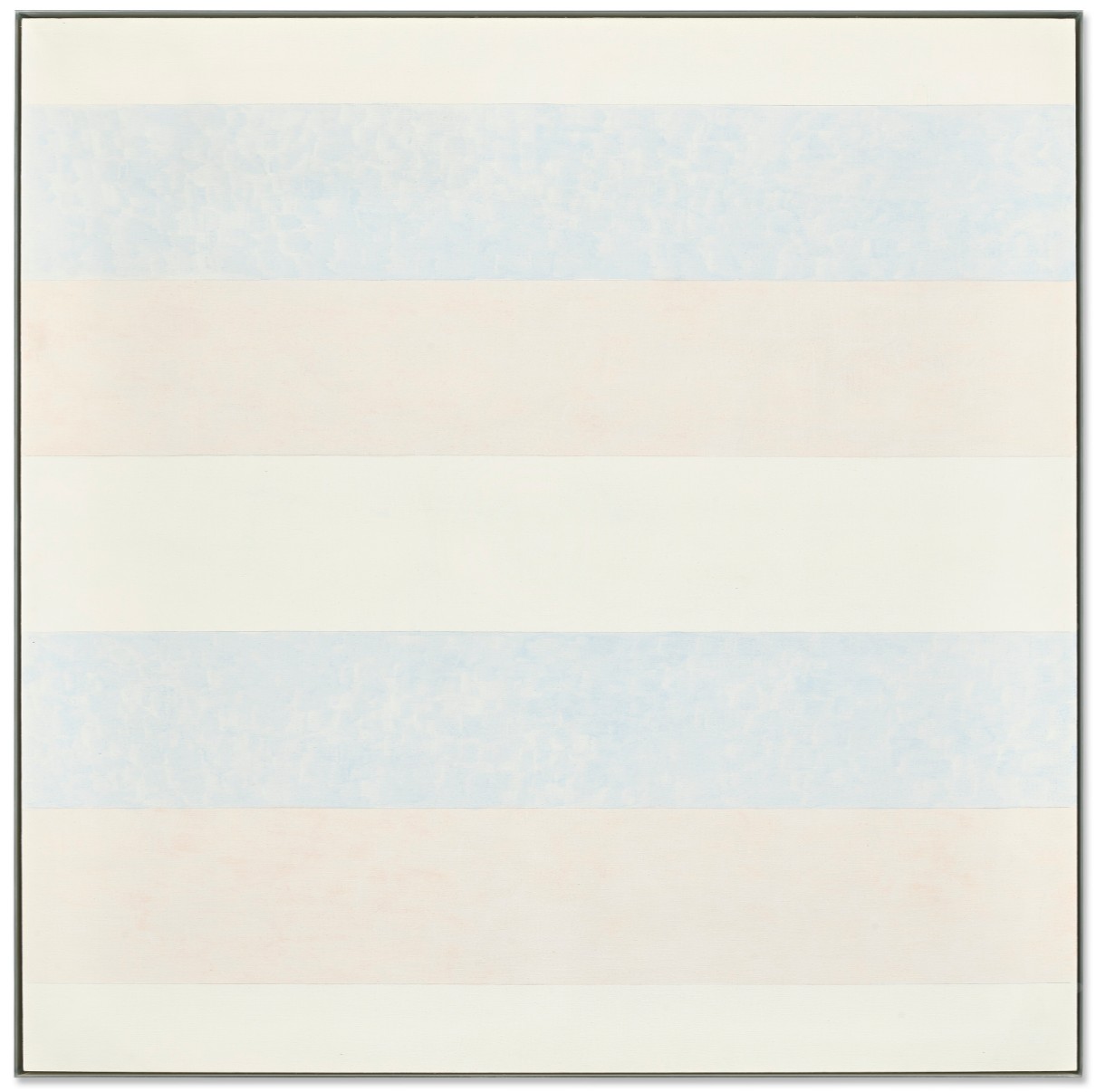
AGNES MARTIN (1912-2004)
Untitled #17, 1996
Acrylic and graphite on canvas
60×60 inches (152.5 x 152.5 cm)
Signed and dated ‘a.martin ’96’ (on the reverse)
#7. Infinity Nets, 1960
The Roger and Josette Vanthournout Collection
Christie’s London: 5 March 2026
Estimated: GBP 2,000,000 – 3,000,000
GBP 2,124,000 / USD 2,837,450
YAYOI KUSAMA (B. 1929), Infinity Nets | Christie’s
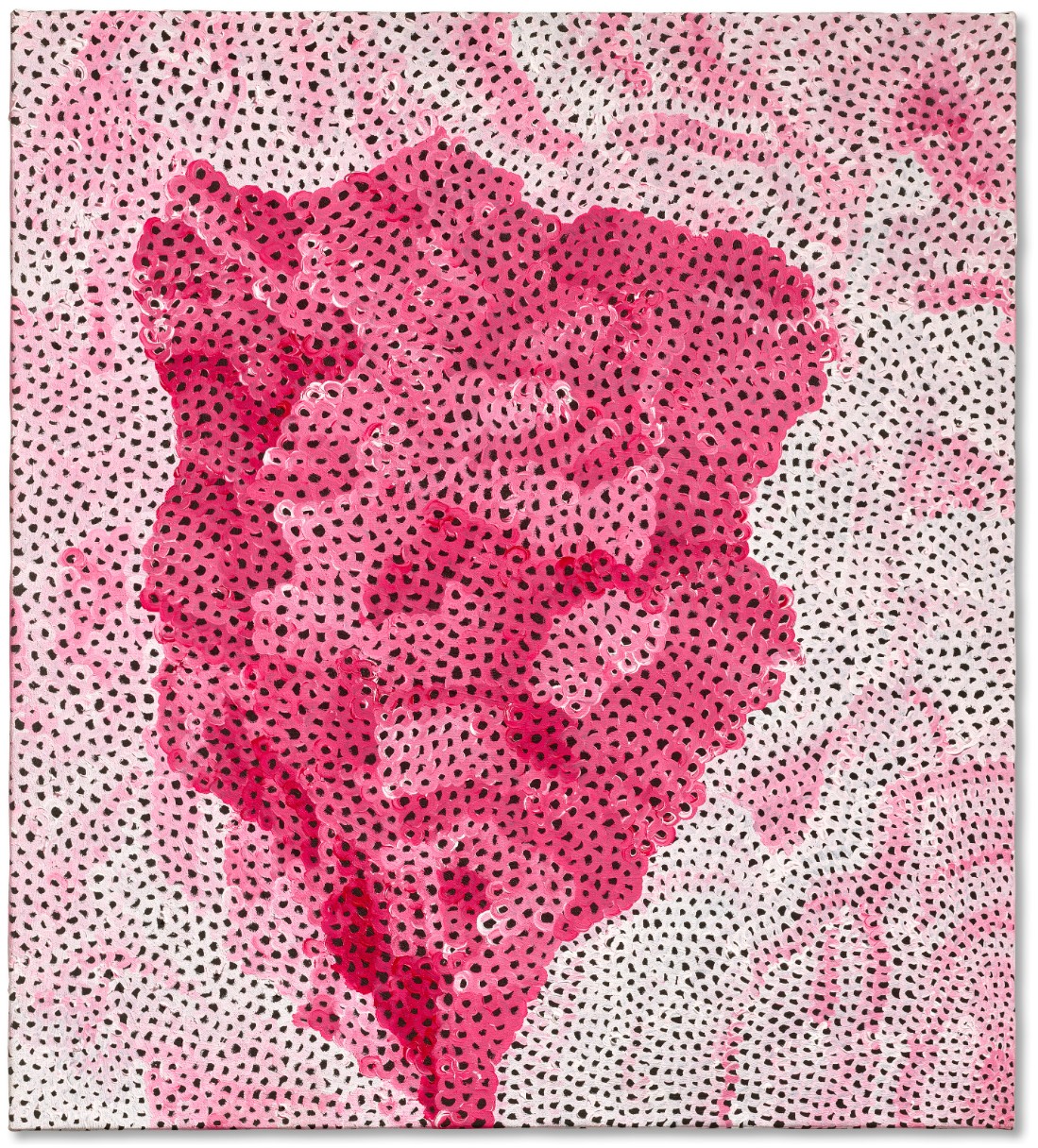
YAYOI KUSAMA (B. 1929)
Infinity Nets, 1960
Oil on canvas
100.2 x 90.3 cm (39-1/2 x 35-1/4 inches)
Signed, titled and dated ‘Yayoi Kusama 1960 Infinity Nets’ (on the reverse)
XXXXXXXXXX
La plaine de l’air (The plain of the air), 1940
The Roger and Josette Vanthournout Collection
Christie’s London: 5 March 2026
Estimated: GBP 3,500,000 – 5,500,000
PASSED
RENÉ MAGRITTE (1898-1967), La plaine de l’air (The plain of the air) | Christie’s
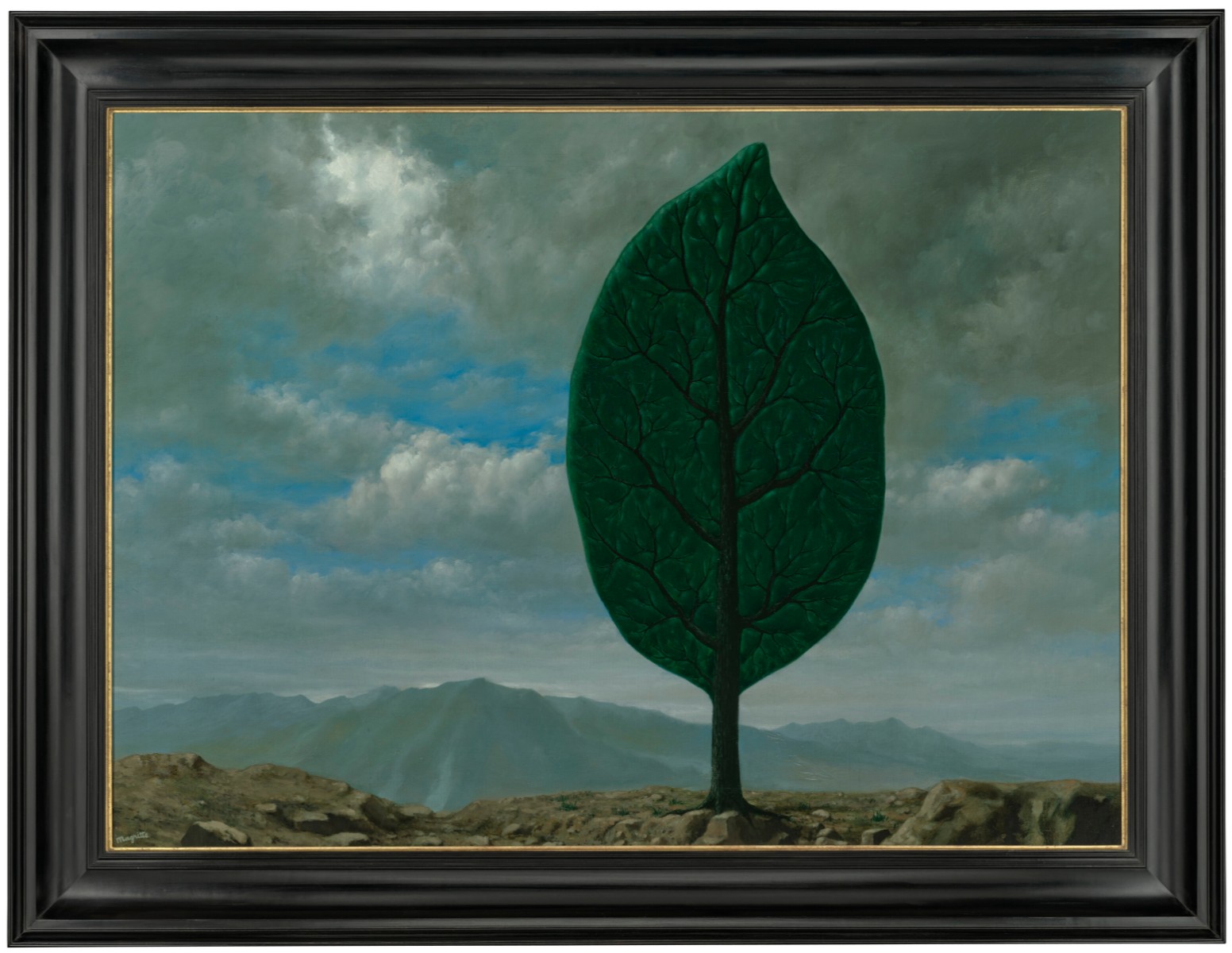
RENÉ MAGRITTE (1898-1967)
La plaine de l’air (The plain of the air), 1940
Oil on canvas
73.4 x 100.2 cm (28-7/8 x 39-1/2 inches)
Signed ‘Magritte’ (lower left)
Post-War and Contemporary Art Day Sale
7 March 2026
Post-War and Contemporary Art Day Sale
Total:
GBP 15,428,595 / USD 20,611,060
# Lots: 129 Lots
# Lots sold: 109 Lots
Sell-Through Rate: 84.5%
Top Lot:
GBP 1,016,000 / USD 1,357,275
XXXXXXXXXX
#1. Mean Eyed Cat, 2012
PROPERTY FROM AN IMPORTANT PRIVATE EUROPEAN COLLECTION
Christie’s London: 7 March 2026
Estimated: GBP 600,000 – 800,000
GBP 1,016,000 / USD 1,357,275
CECILY BROWN (B. 1969), Mean Eyed Cat | Christie’s
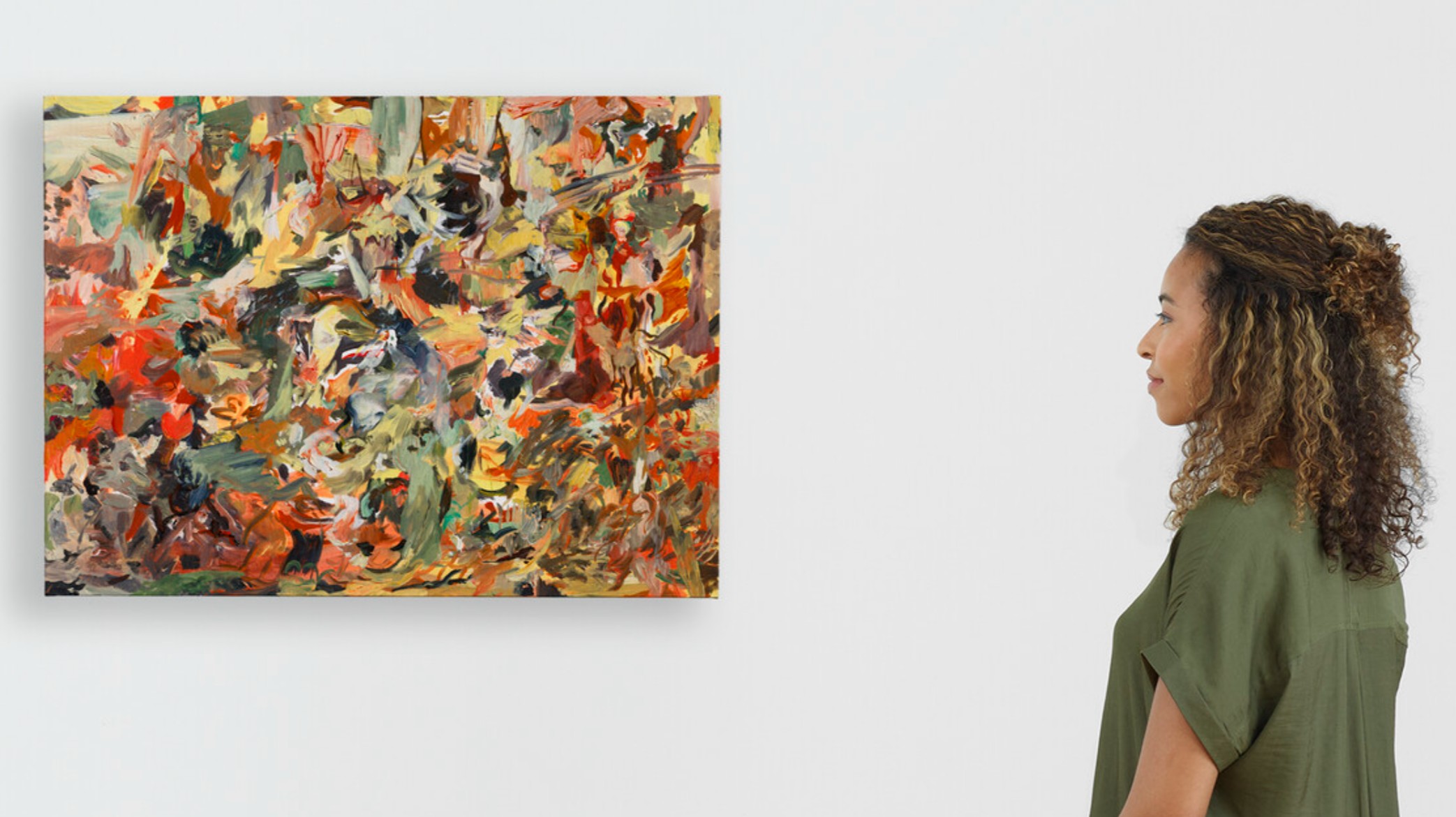
CECILY BROWN (B. 1969)
Mean Eyed Cat, 2012
Oil on linen
22-7/8 x 31-1/8 inches (58×79 cm)
Signed and dated ‘Cecily Brown 2012’ (on the reverse)
#2. Rose and Pink around Ochre and Reds, 1948
Christie’s London: 7 March 2026
Estimated: GBP 120,000 – 180,000
GBP 584,200 / USD 780,435
JOSEF ALBERS (1888-1976), Rose and Pink around Ochre and Reds | Christie’s
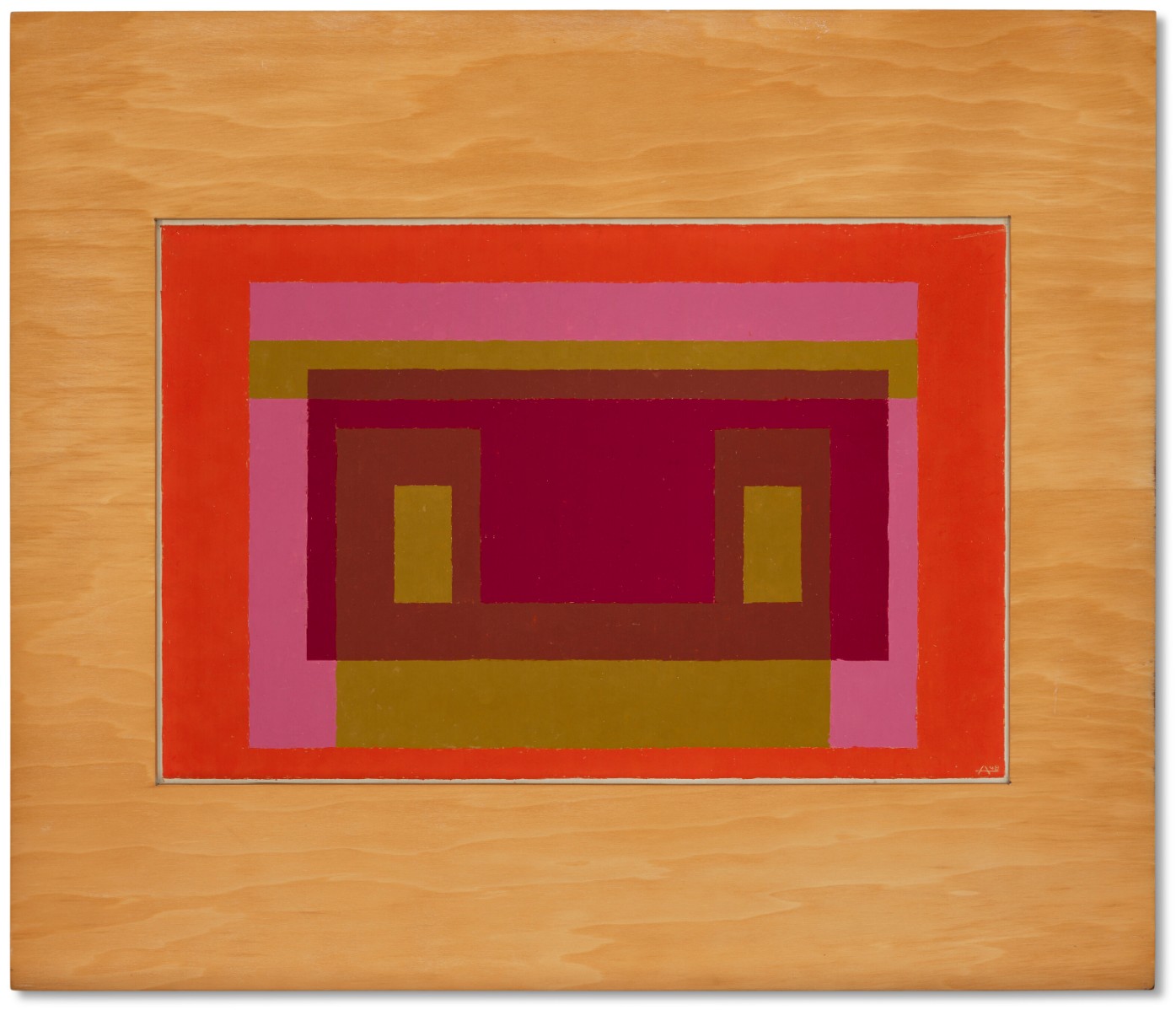
JOSEF ALBERS (1888-1976)
Rose and Pink around Ochre and Reds, 1948
Oil on Masonite, in artist’s frame
Overall: 23-3/4 x 27-3/4 inches (60.4 x 70.6 cm)
Signed with the artist’s monogram and dated ‘A 48’ (lower right)
Signed, titled and dated ‘Rose and Pink around Ochre and Reds Albers ’48’ (on the reverse)
#3. Melty Legs, 2018
Christie’s London: 7 March 2026
Estimated: GBP 250,000 – 350,000
GBP 533,400 / USD 712,570
CAROL BOVE (B. 1971), Melty Legs | Christie’s
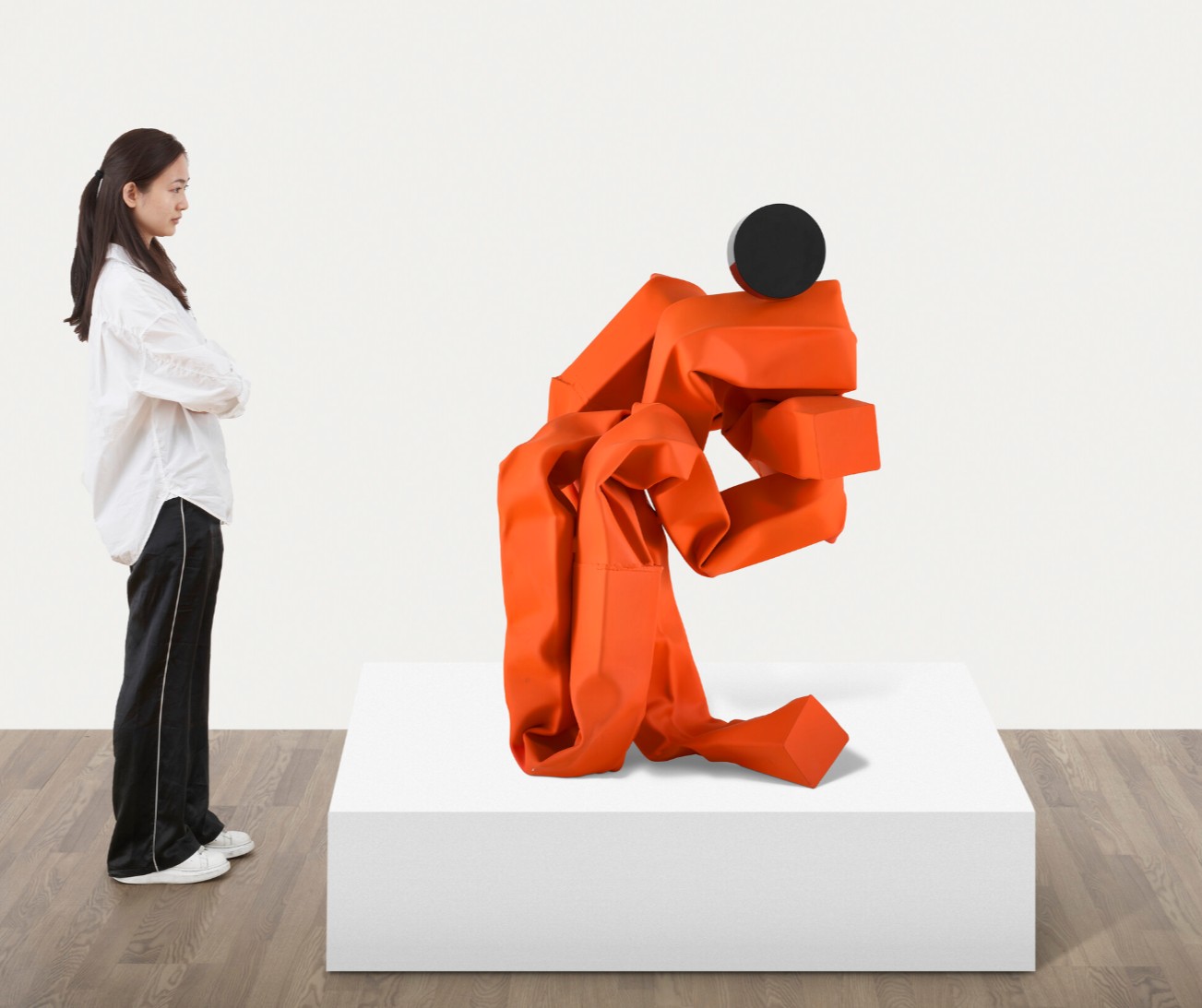
CAROL BOVE (B. 1971)
Melty Legs, 2018
Stainless steel and urethane paint
51 x 34-1/4 x 34-1/2 inches (129.5 x 87 x 87.6 cm)
#4. Untitled (Spoon), 1988
Christie’s London: 7 March 2026
Estimated: GBP 350,000 – 750,000
GBP 508,000 / USD 678,635
JEAN-MICHEL BASQUIAT (1960-1988), Untitled (Spoon) | Christie’s
REPEAT SALE
Christie’s New-York: 27 September 2018
Estimated: USD 120,000 – 180,000
USD 324,500
Jean-Michel Basquiat (1960-1988), Untitled (Spoon) | Christie’s
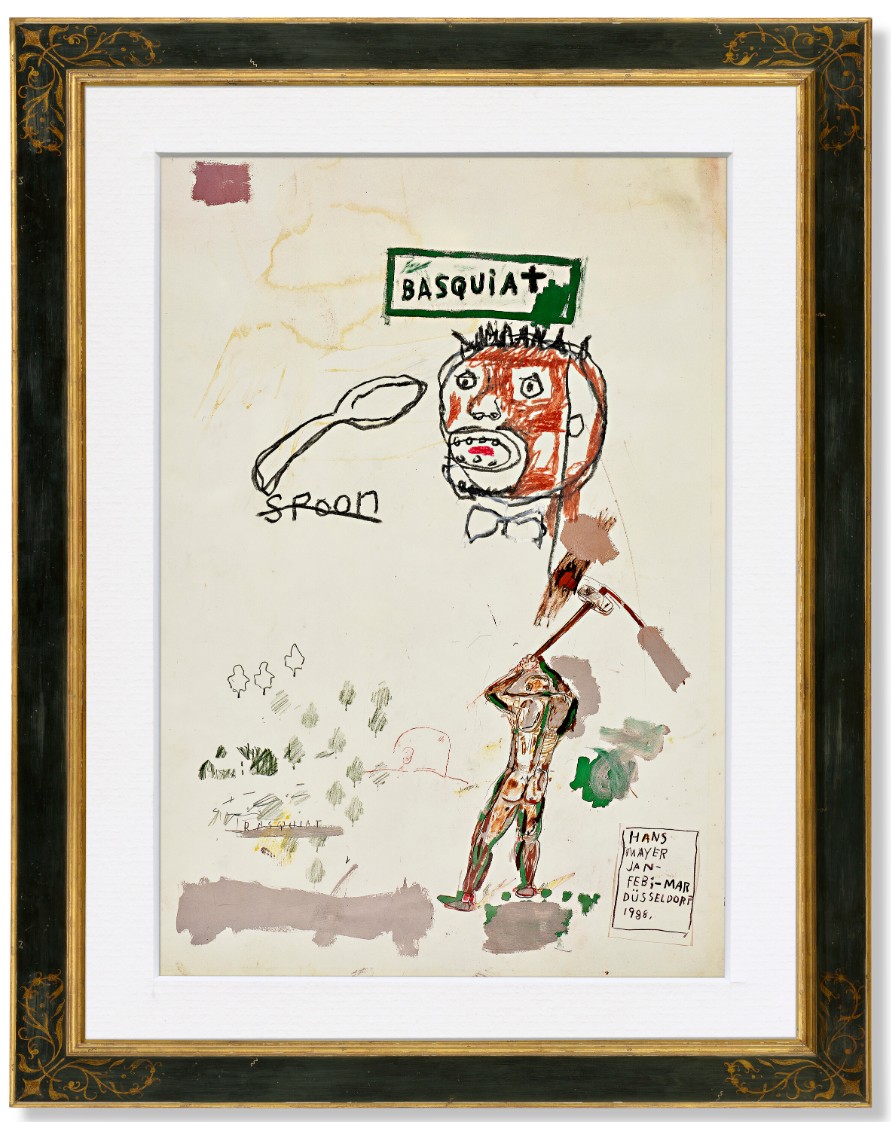
JEAN-MICHEL BASQUIAT (1960-1988)
Untitled (Spoon), 1988
Oilstick on offset lithograph
33-1/8 x 23-3/8 inches (84 x 59.4 cm)
XXXXXXXXXX
#7. The Housekeeper’s Family, 2004
Christie’s London: 7 March 2026
Estimated: GBP 180,000 – 250,000
GBP 444,500 / USD 593,810
GEORGE CONDO (B. 1957), The Housekeeper’s Family | Christie’s
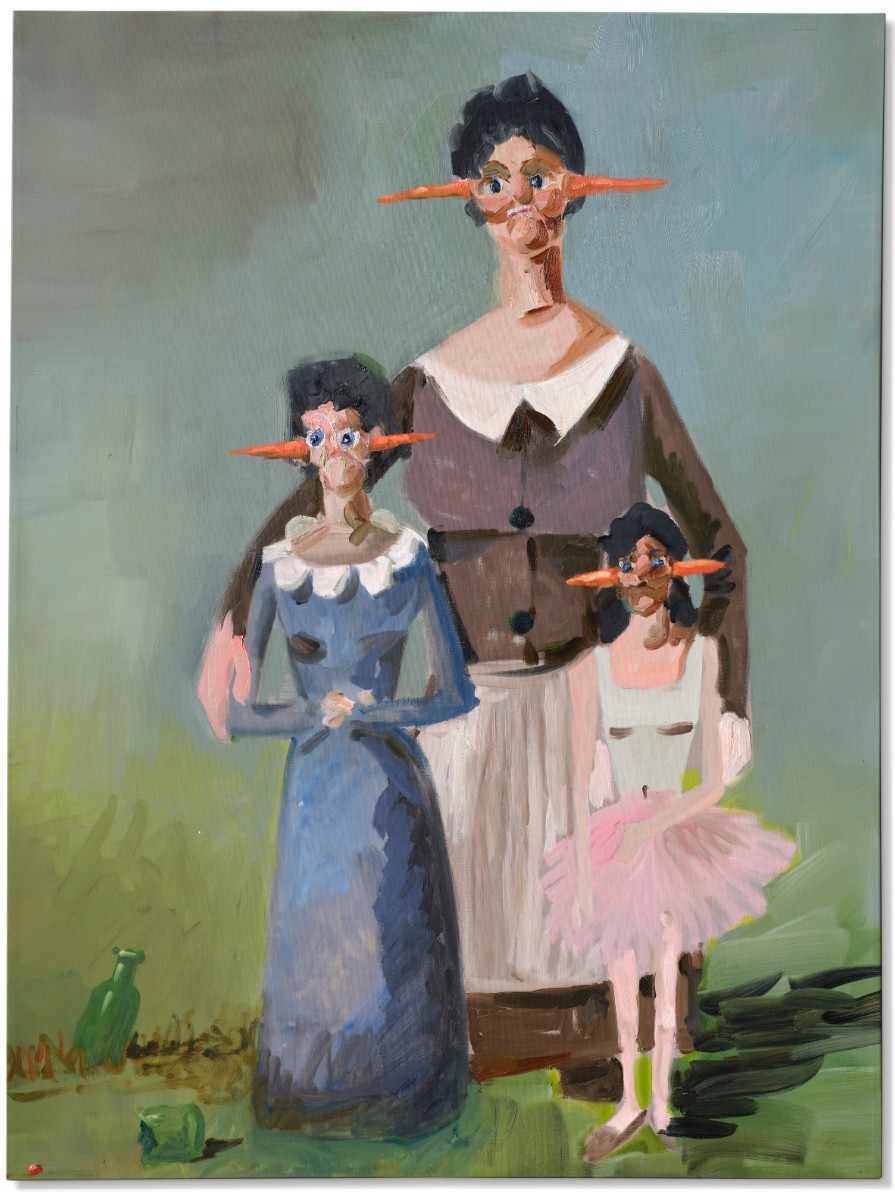
GEORGE CONDO (B. 1957)
The Housekeeper’s Family, 2004
Oil on canvas
48×36 inches (122 x 91.4 cm)
Signed, titled and dated ‘Condo 04 The Housekeeper’s Family’ (on the reverse)
#8. Hitomi (Eye), 1989
AN EYE FOR COLOUR: WORKS FROM A PRIVATE COLLECTION
Christie’s London: 7 March 2026
Estimated: GBP 300,000 – 500,000
GBP 406,400 / USD 542,910
YAYOI KUSAMA (B. 1929), Hitomi (Eye) | Christie’s
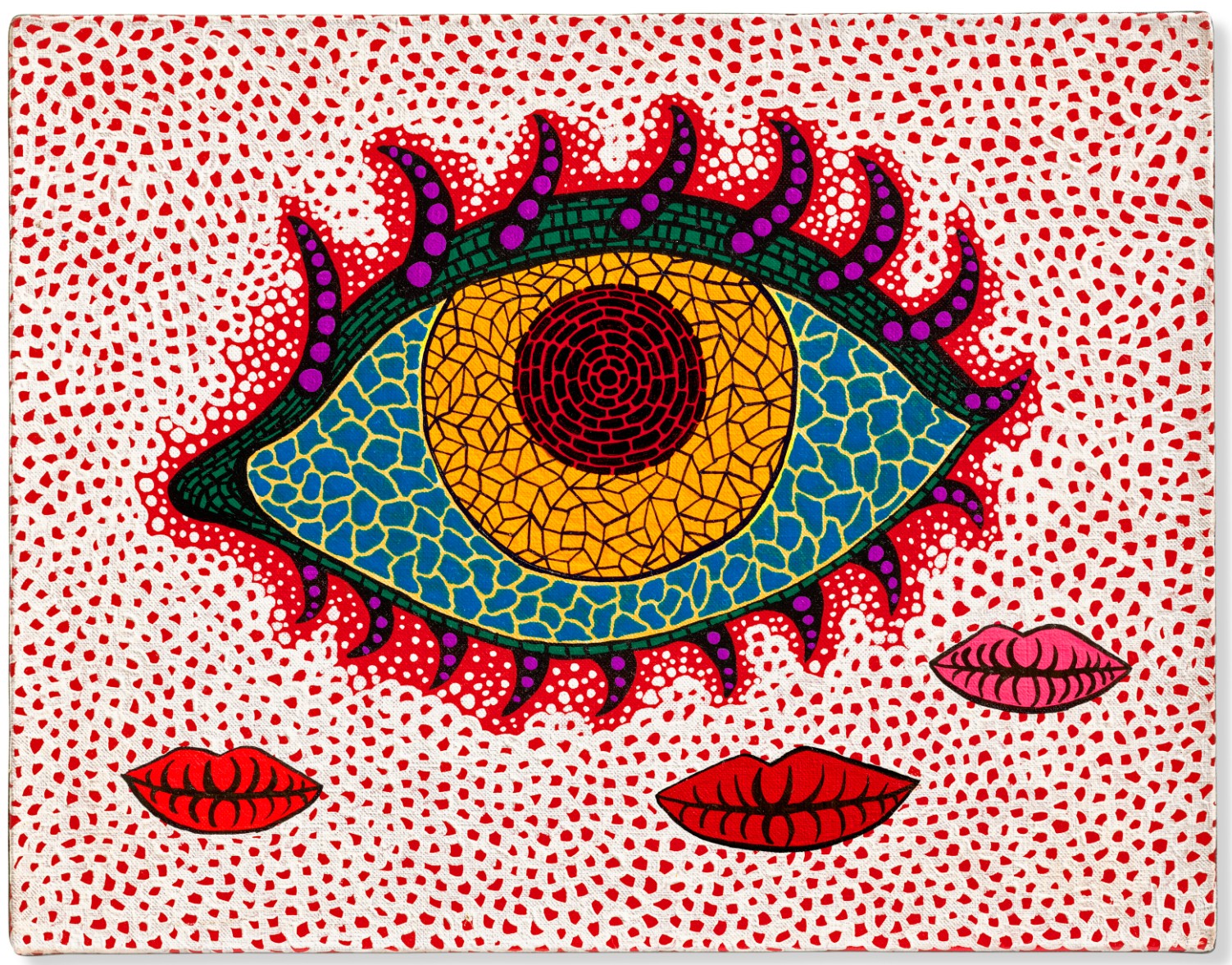
YAYOI KUSAMA (B. 1929)
Hitomi (Eye), 1989
Acrylic on canvas
32×41 cm (12-5/8 x 16-1/8 inches)
Signed, titled in Japanese and dated ‘1989 Yayoi Kusama’ (on the reverse)
XXXXXXXXXX
#11. Pumpkin, 1991
AN EYE FOR COLOUR: WORKS FROM A PRIVATE COLLECTION
Christie’s London: 7 March 2026
Estimated: GBP 250,000 – 350,000
GBP 381,000 / USD 508,980
YAYOI KUSAMA (B. 1929), Pumpkin | Christie’s
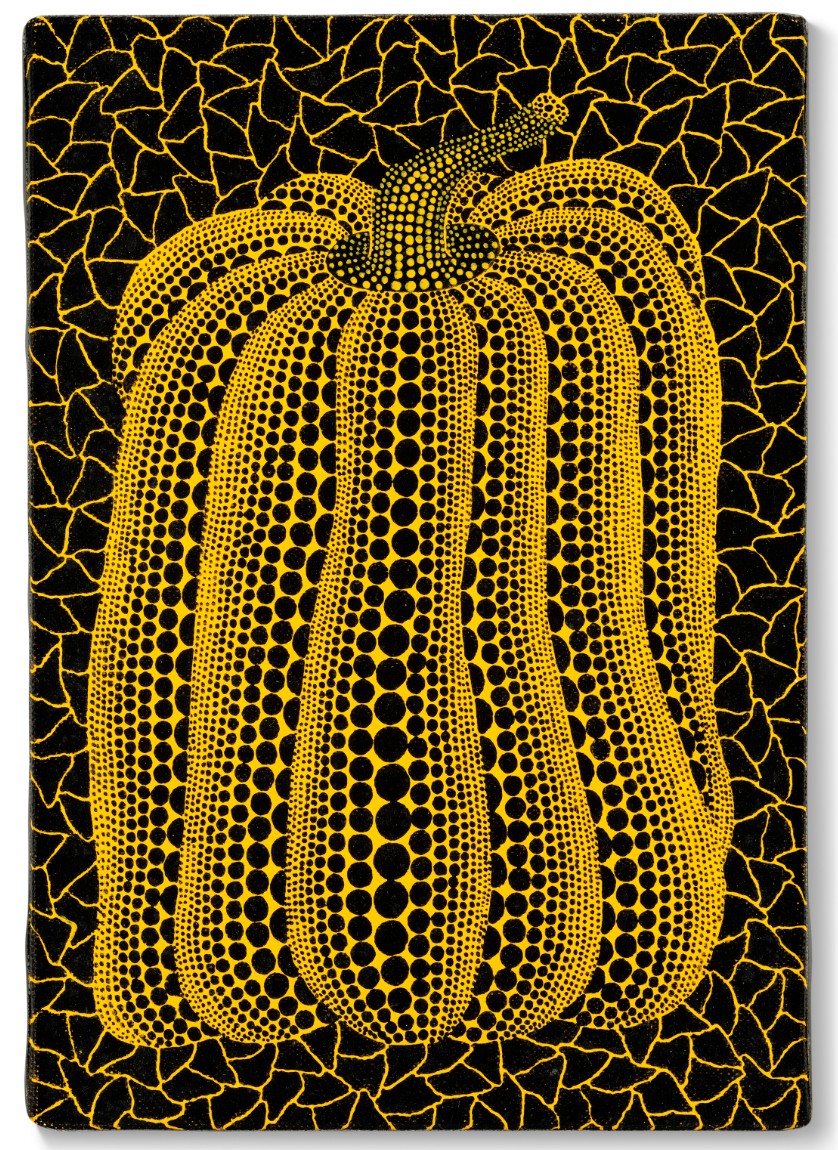
YAYOI KUSAMA (B. 1929)
Pumpkin, 1991
Acrylic on canvas
22.6 x 16 cm (8-7/8 x 6-1/4 inches)
Signed, titled in Japanese and dated ‘YAYOI KUSAMA 1991’ (on the reverse)
#12. Flowers, 1964-1965
AN EYE FOR COLOUR: WORKS FROM A PRIVATE COLLECTION
Christie’s London: 7 March 2026
Estimated: GBP 180,000 – 250,000
GBP 355,600 / USD 475,045
ANDY WARHOL (1928-1987), Flowers | Christie’s
REPEAT SALE
Christie’s New-York: 13 November 2013
Estimated: USD 150,000 – 200,000
USD 341,000
Andy Warhol (1928-1987), Flowers | Christie’s
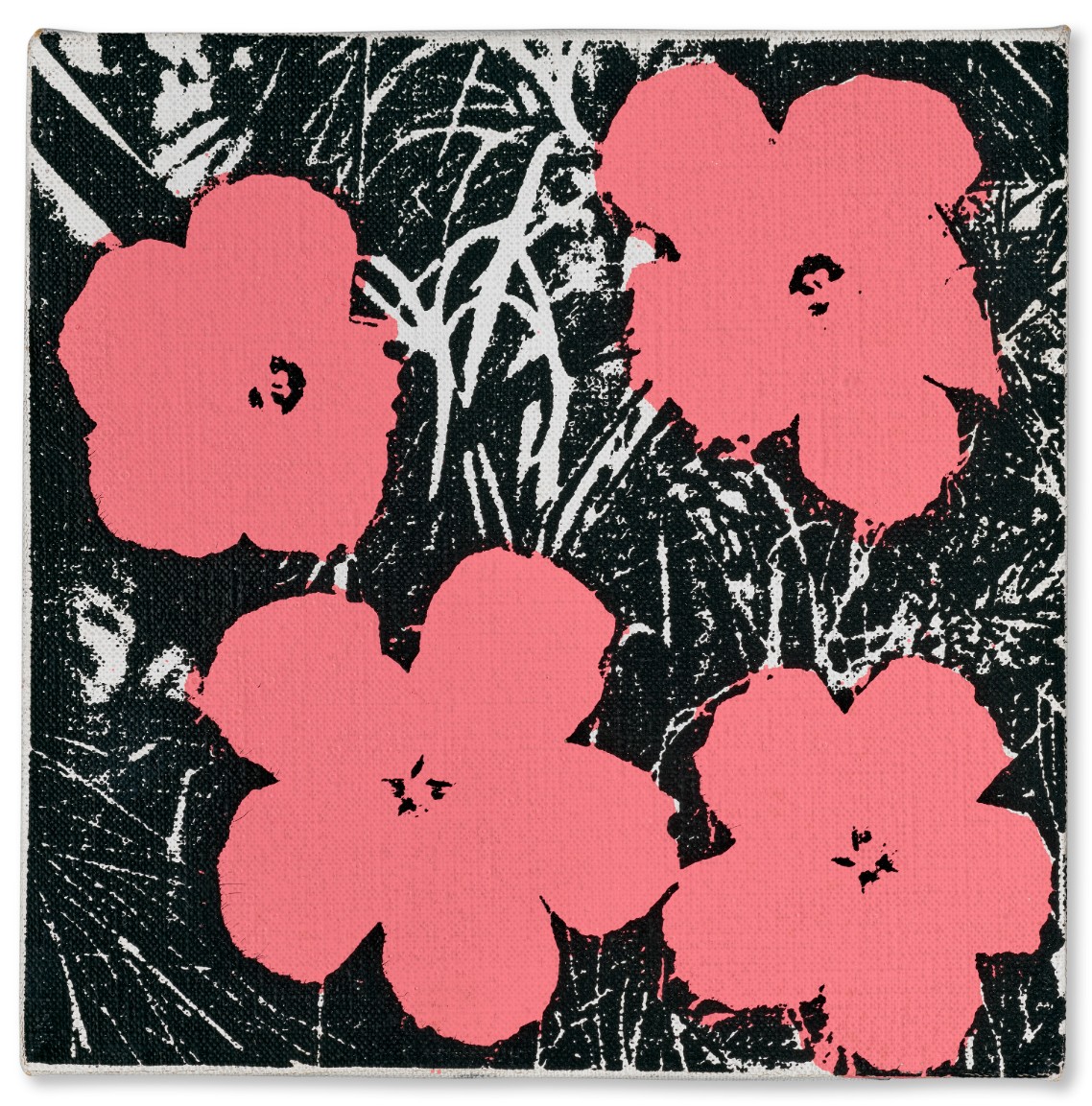
ANDY WARHOL (1928-1987)
Flowers, 1964-1965
(Frei and Printz, The Andy Warhol Catalogue Raisonné: no. 1655)
Acrylic and silkscreen ink on canvas
8-1/8 x 8-1/8 inches (20.5 x 20.5 cm)
Signed and dated ‘Andy Warhol 64’ (on the overlap)
#13. Abstraktes Bild, 1992
Christie’s London: 7 March 2026
Estimated: GBP 300,000 – 500,000
GBP 355,600 / USD 475,045
GERHARD RICHTER (B. 1932), Abstraktes Bild | Christie’s
REPEAT SALE
Christie’s Paris: 30 November 2022
Estimated: EUR 450,000 – 650,000
EUR 567,000
Gerhard Richter (né en 1932), Abstraktes Bild | Christie’s
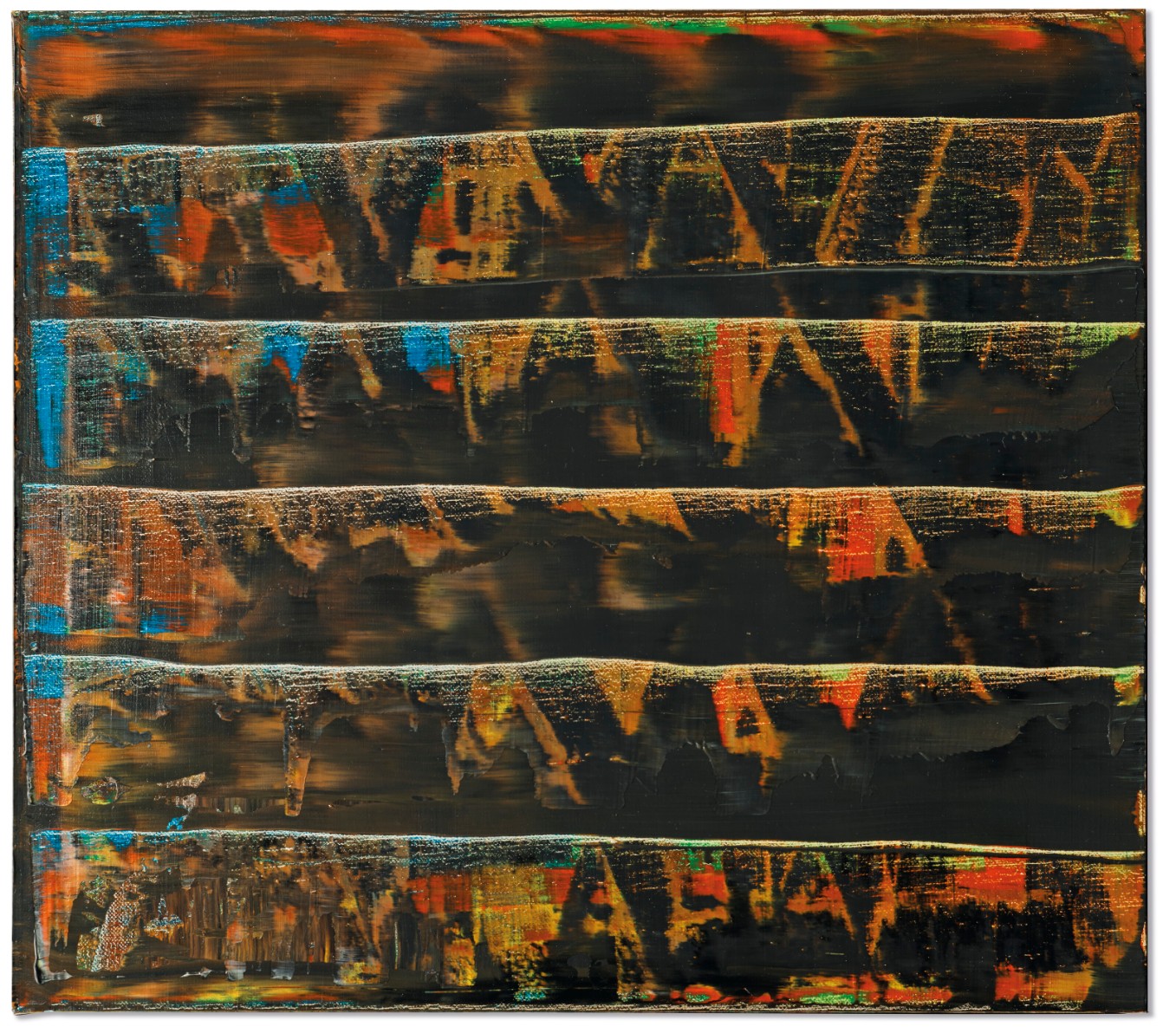
GERHARD RICHTER (B. 1932)
Abstraktes Bild, 1992
Oil on canvas
52×62 cm (20-1/2 x 24-3/8 inches)
Signed, inscribed and dated ‘Richter 92 763-7’ (on the reverse)
#14. Flowers, 1964
AN EYE FOR COLOUR: WORKS FROM A PRIVATE COLLECTION
Christie’s London: 7 March 2026
Estimated: GBP 120,000 – 180,000
GBP 342,900 / USD 458,080
ANDY WARHOL (1928-1987), Flowers | Christie’s
REPEAT SALE
Sotheby’s London: 9 March 2017
Estimated: GBP 120,000 – 180,000
GBP 246,350 / USD 299,650
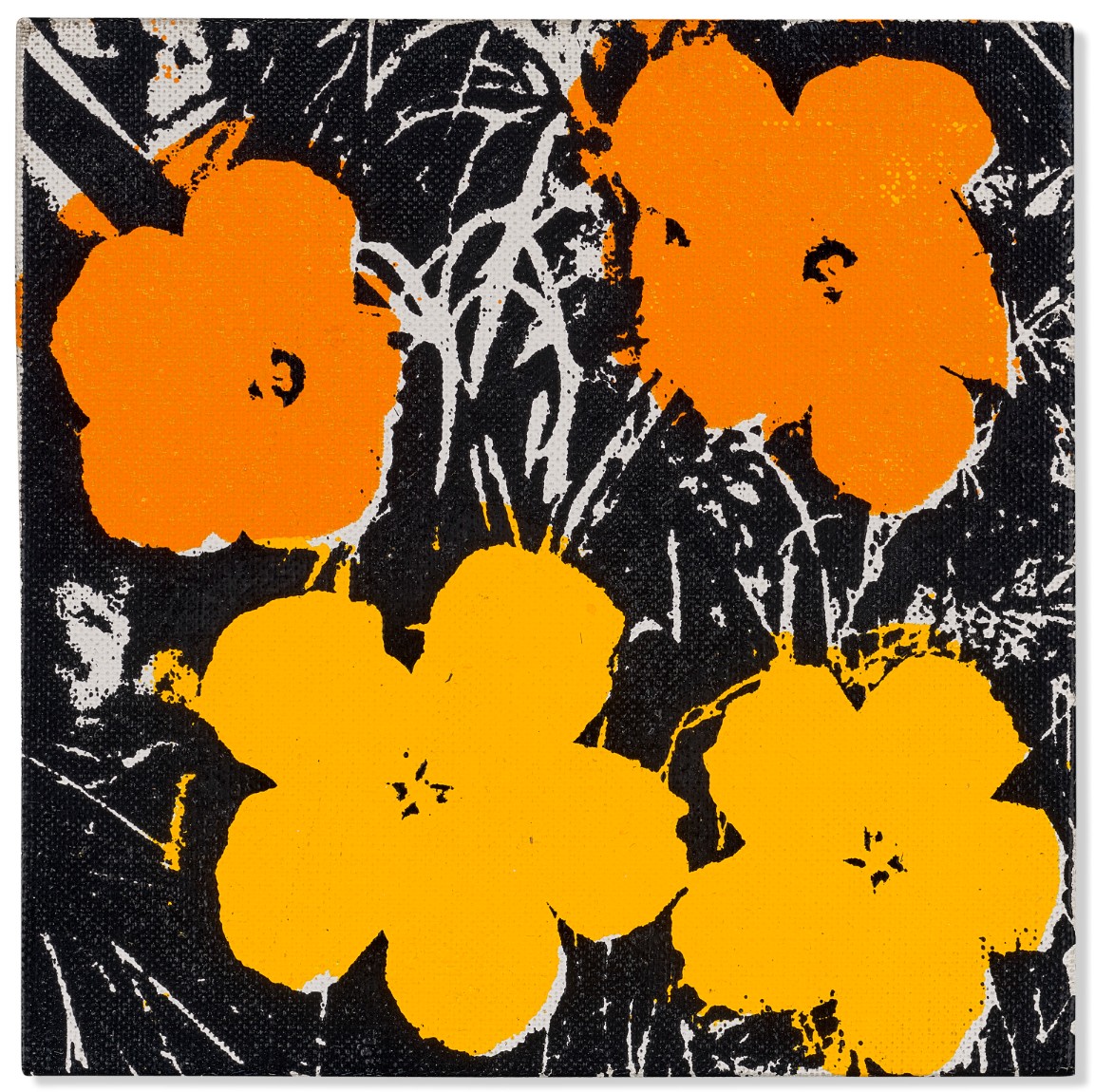
ANDY WARHOL (1928-1987)
Flowers, 1964
Acrylic and silkscreen ink on canvas
5×5 inches (12.8 x 12.8 cm)
Signed and dated ‘Andy Warhol 64’, stamped with the Andy Warhol Art Authentication Board, Inc. stamp
Numbered ‘A100.089’ (on the overlap)
XXXXXXXXXX
#18. Beautiful Scary Clown in a Rockabilly Town Painting, 2006
Christie’s London: 7 March 2026
Estimated: GBP 200,000 – 300,000
GBP 298,450 / USD 398,700
DAMIEN HIRST (B. 1965), Beautiful Scary Clown in a Rockabilly Town Painting | Christie’s
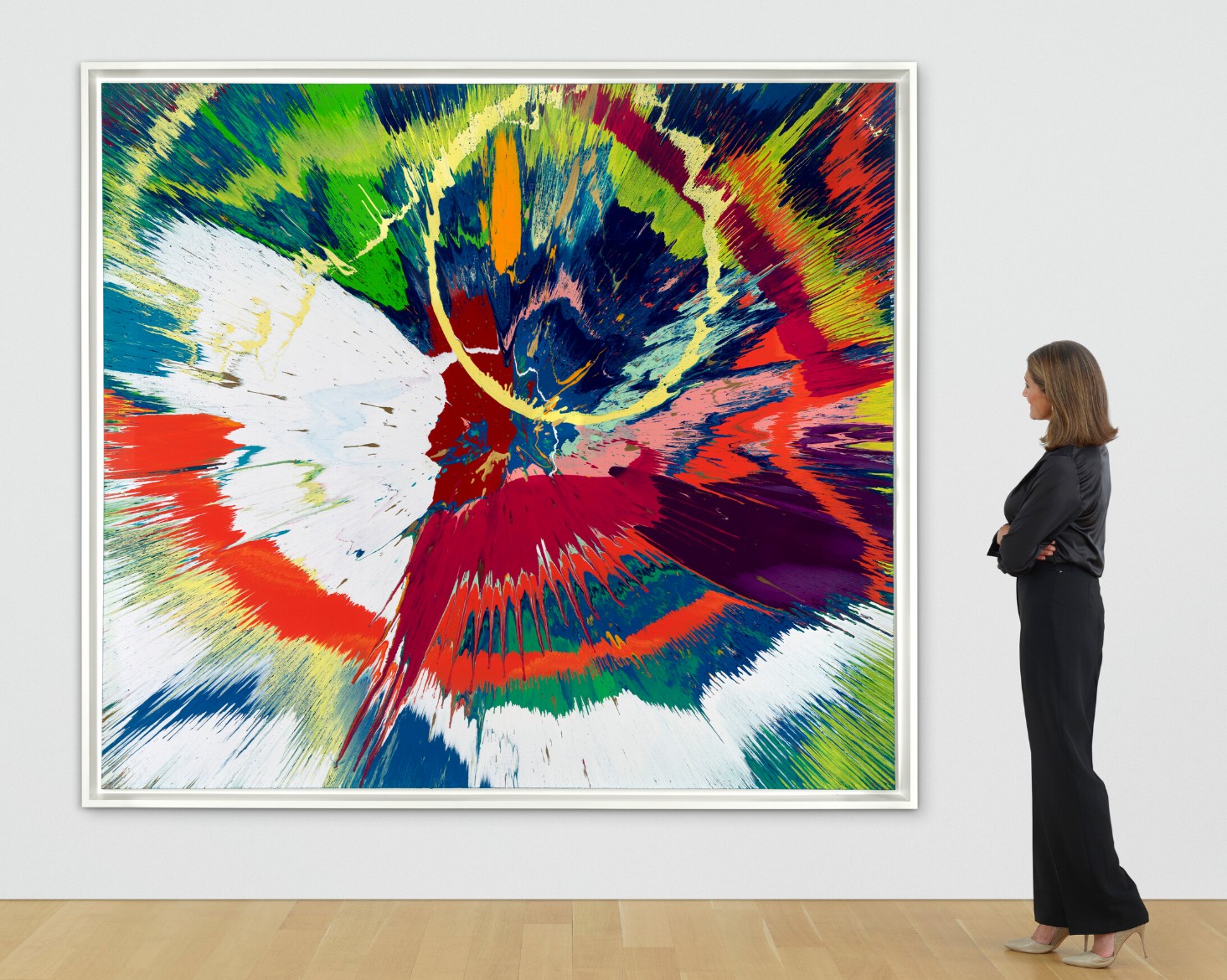
DAMIEN HIRST (B. 1965)
Beautiful Scary Clown in a Rockabilly Town Painting, 2006
Household gloss on canvas
95-1/4 x 107-1/2 inches (242×273 cm)
Stamped with artist’s stamp ‘HIRST’ (on the reverse and stretcher)
XXXXXXXXXX
Paranoid Pictures, 2003
Christie’s London: 7 March 2026
Estimated: GBP 50,000 – 70,000
GBP 266,700 / USD 356,285
BANKSY, Paranoid Pictures | Christie’s
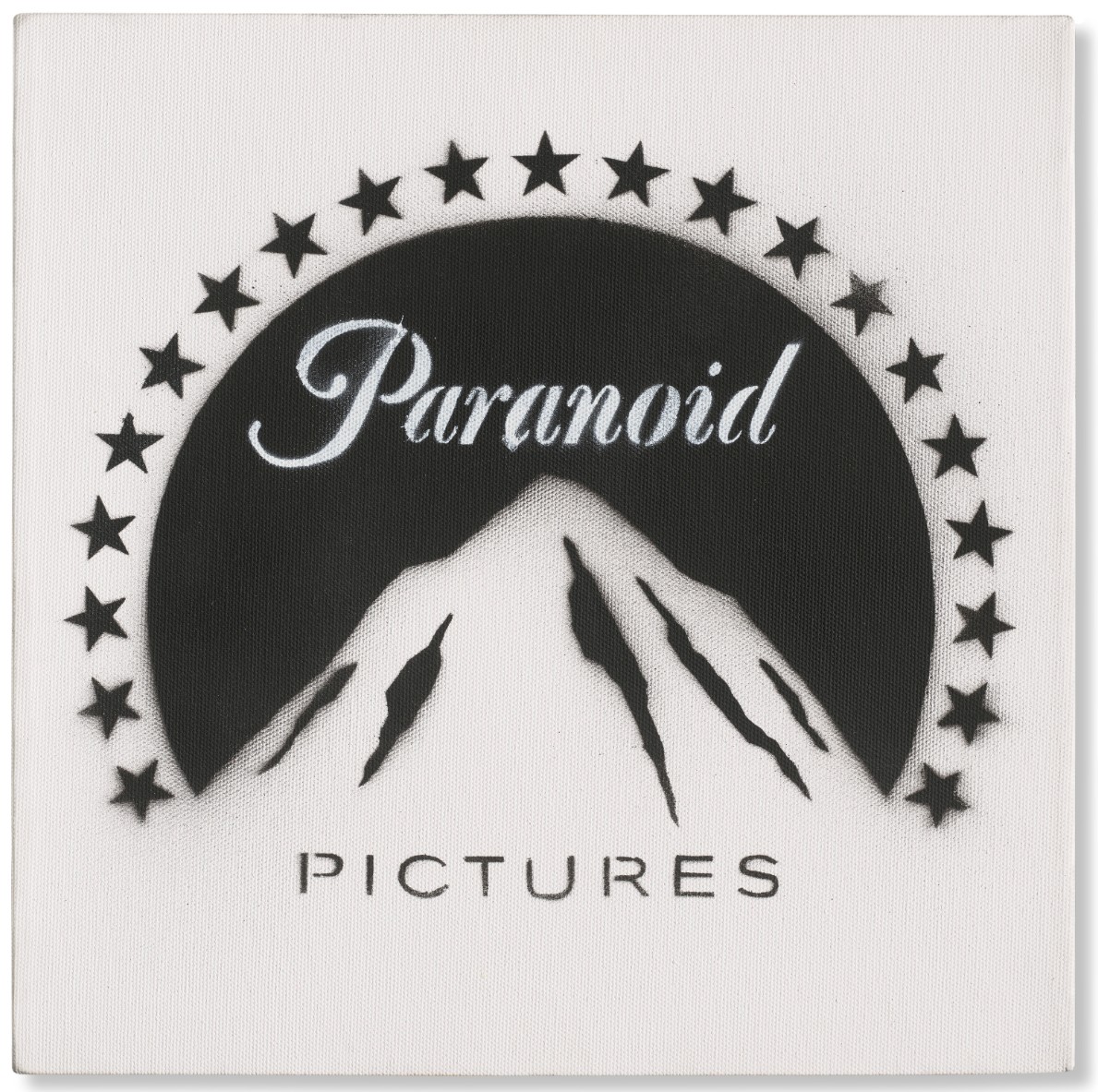
BANKSY
Paranoid Pictures, 2003
Spray paint on canvas
30.5 x 30.5 cm (12×12 inches)
Tagged ‘BANKSY’ (on the turnover edge)
Signed, numbered and dated ‘5⁄25 2003 BANKSY!’ (on the stretcher)
This work is number five from an edition of twenty five plus one artist’s proof
Flowers, 1964
AN EYE FOR COLOUR: WORKS FROM A PRIVATE COLLECTION
Christie’s London: 7 March 2026
Estimated: GBP 120,000 – 180,000
GBP 203,200 / USD 271,455
ANDY WARHOL (1928-1987), Flowers | Christie’s
REPEAT SALE
Sotheby’s New-York: 15 May 2013
Estimated: USD 120,000 – 180,000
USD 197,000
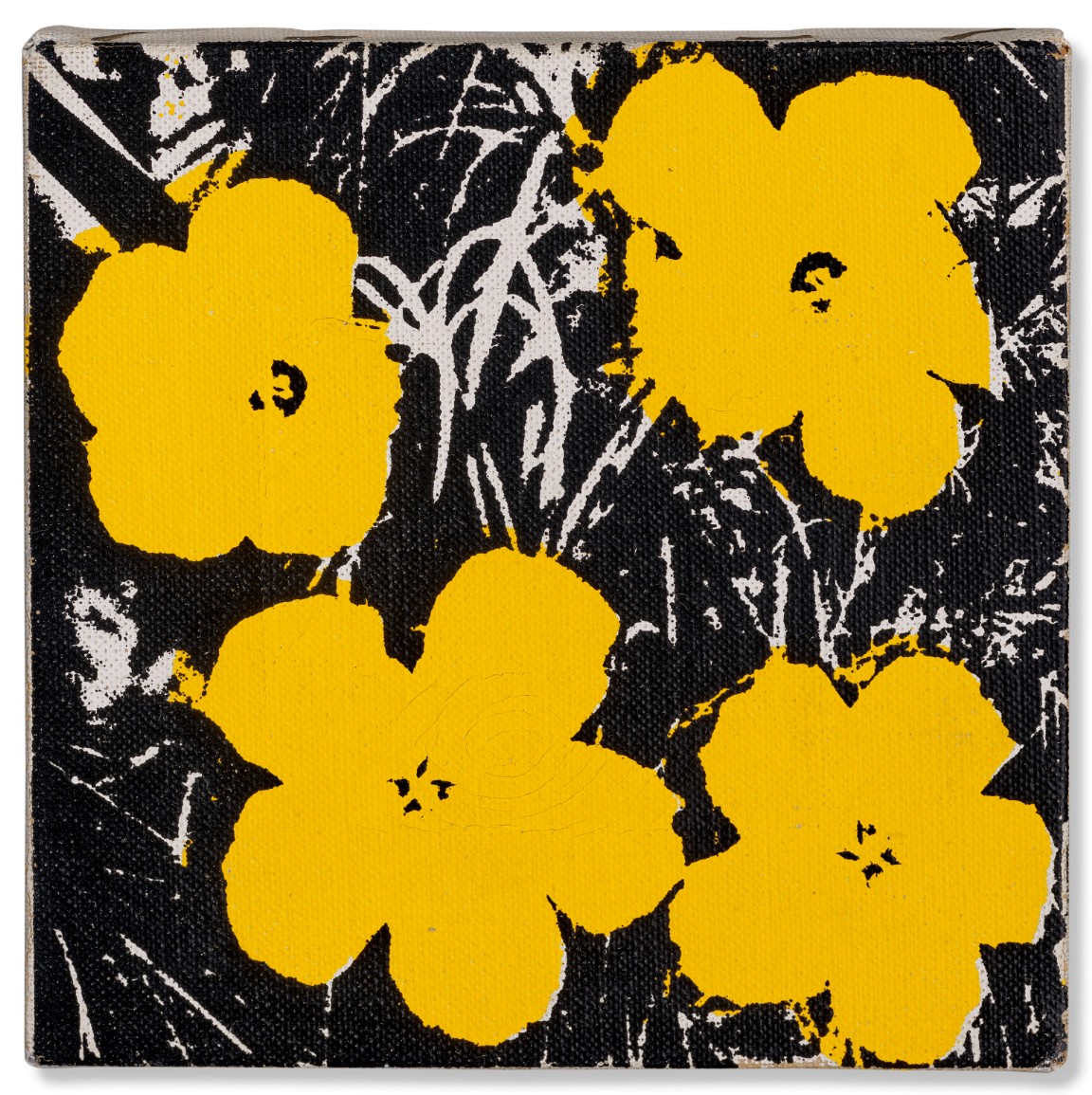
ANDY WARHOL (1928-1987)
Flowers, 1964
(Frei and Printz, The Andy Warhol Catalogue Raisonné: no. LC249)
Acrylic and silkscreen ink on canvas
5×5 inches (12.8 x 12.8 cm)
Signed with the artist’s initials and dated ‘A. W. 64’ (on the overlap)
On the Road to Tarascon 2 (with Navid Nuur), 2013
Christie’s London: 7 March 2026
Estimated: GBP 200,000 – 300,000
ADRIAN GHENIE (B. 1977), On the Road to Tarascon 2 (with Navid Nuur) | Christie’s
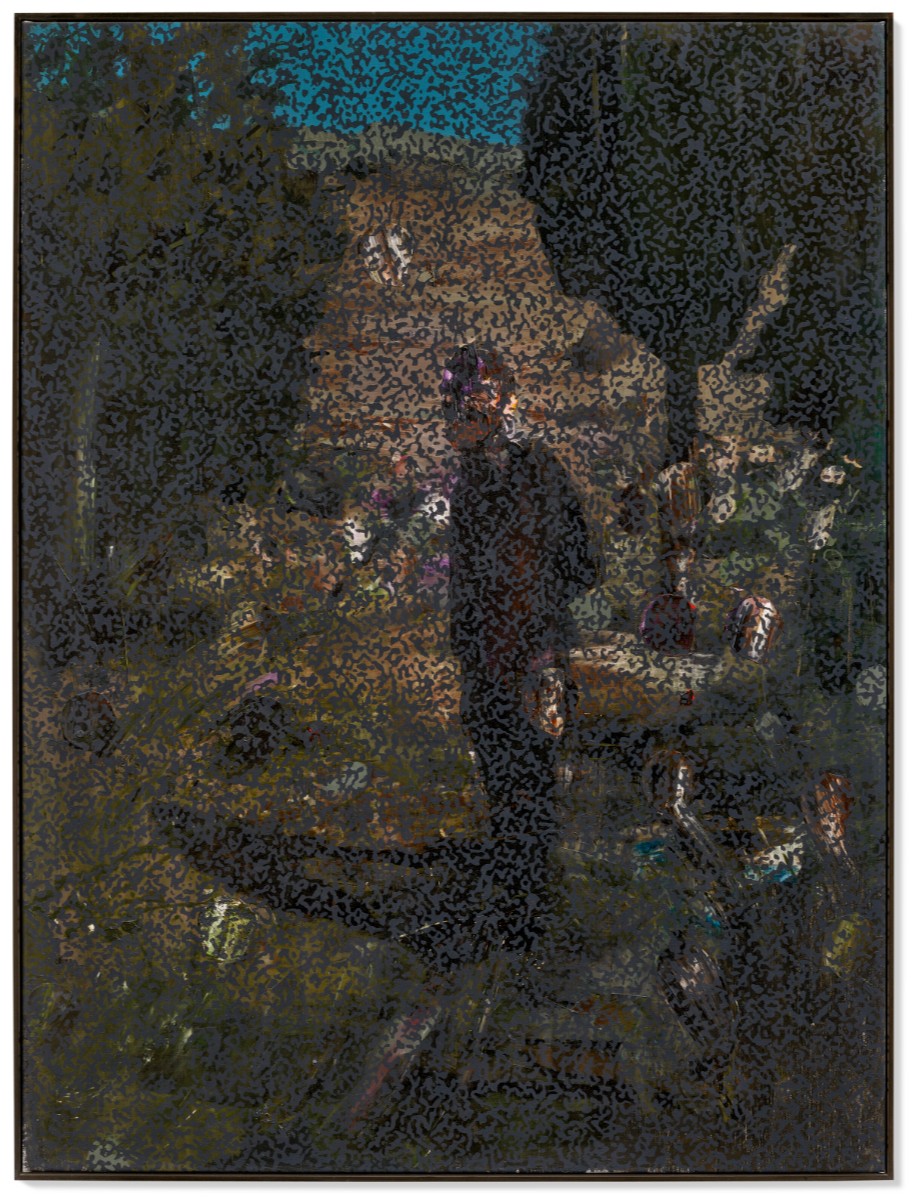
ADRIAN GHENIE (B. 1977)
On the Road to Tarascon 2 (with Navid Nuur), 2013
Oil on canvas
200×150 cm (78-3/4 x 59 inches)
Signed and dated ‘Ghenie 2013’ (on the reverse)
Hydrogen Peroxide, 2007-2011
Christie’s London: 7 March 2026
Estimated: GBP 100,000 – 150,000
DAMIEN HIRST (B. 1965), Hydrogen Peroxide | Christie’s
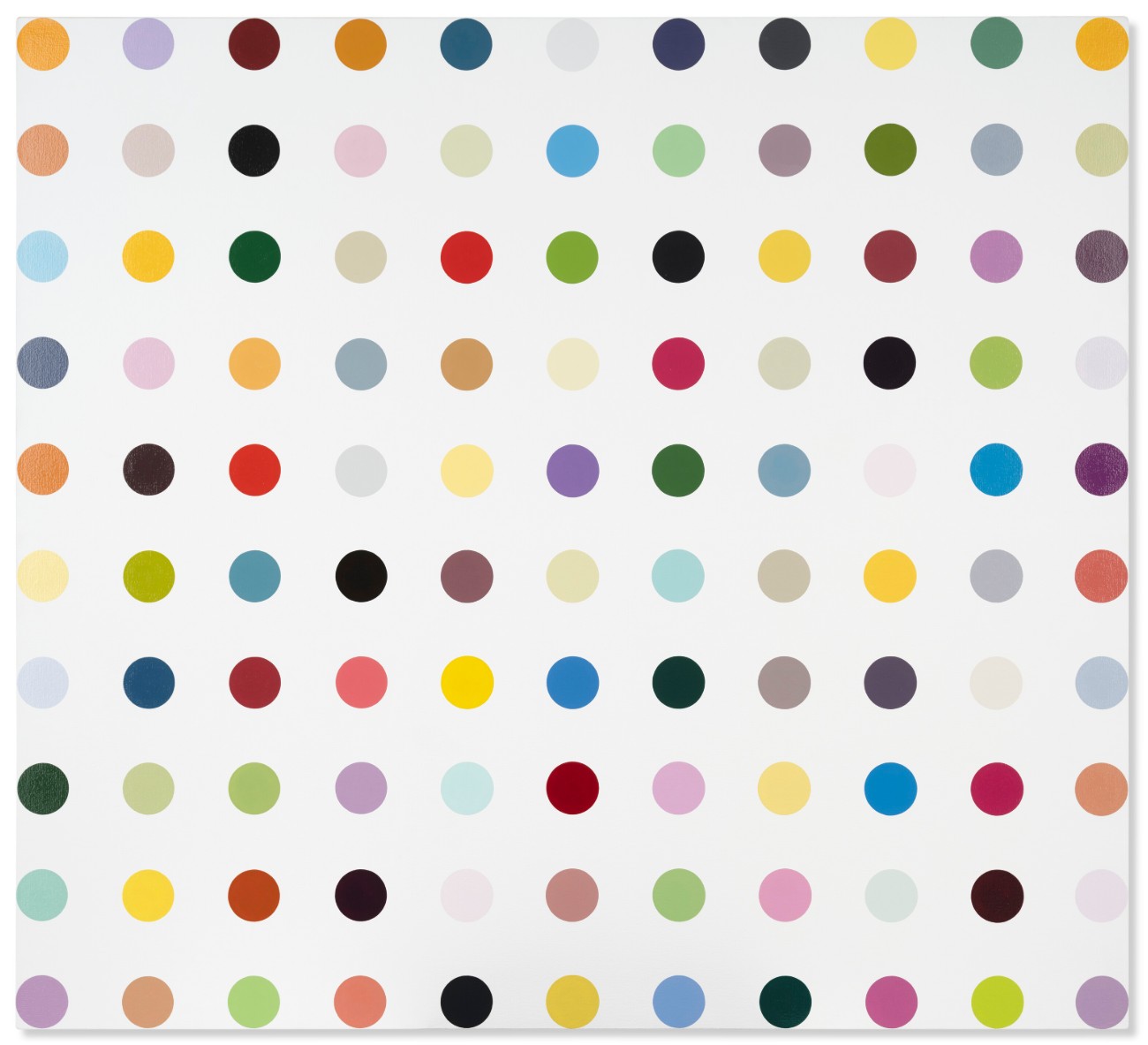
DAMIEN HIRST (B. 1965)
Hydrogen Peroxide, 2007-2011
Household gloss on canvas
38×42 inches (96.5 x 106.9 cm) (2 inch spot)
Signed ‘Damien Hirst’ (on the stretcher)
Signed, titled and dated ‘Hydrogen Peroxide Damien Hirst 2007-2011’ (on the reverse)
XXXXXXXXXX
The World In Agreement With, 2011
PROPERTY FROM A DISTINGUISHED DANISH COLLECTION
Christie’s London: 7 March 2026
Estimated: GBP 300,000 – 500,000
PASSED
LYNETTE YIADOM-BOAKYE (B. 1977), The World In Agreement With | Christie’s
LYNETTE YIADOM-BOAKYE (B. 1977)
The World In Agreement With, 2011
Oil on canvas
63-1/8 x 70-7/8 inches (160.4 x 180 cm)
Signed with the artist’s initials
Titled and dated ‘LYB 2011 The World In Agreement With’ (on the reverse)
Modern & Contemporary Art Evening Sale
5 March 2026
Modern & Contemporary Art Evening Sale Thursday, March 5, 2026
Total:
GBP 12,804,950 / USD 17,106,135
# Lots: 29 Lots
# Lots withdrawn: 2 Lots
# Lots unsold: 5 Lots
# Lots sold: 22 Lots
Sell-Through Rate: 75.9%
Top Lot:
GBP 1,642,000 / USD 2,193,550
XXXXXXXXXX
#1. Interior of Woman Placing Branches in Vase on Table, 1900
The Collection of Ambassador John L. Loeb Jr.
Phillips London: 5 March 2026
Estimated: GBP 1,500,000 – 2,000,000
GBP 1,642,000 / USD 2,193,550
Vilhelm Hammershøi Modern & Contemporary Art Evening Sale
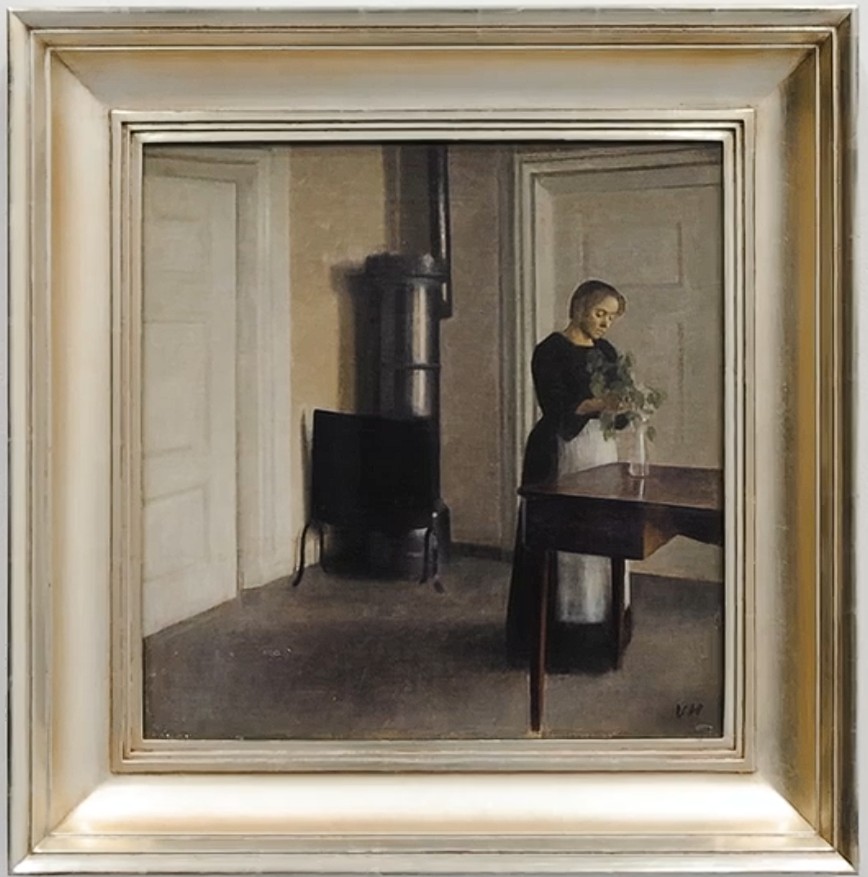
(Interiør med kvinde, der stiller grene i et glas, Strandgade 30)
Oil on canvas
40 x 39.1 cm (15-3/4 x 15-3/8 inches)
Signed with the artist’s initials ‘VH’ lower right
#2. Mao, 1973
Phillips London: 5 March 2026
Estimated: GBP 1,400,000 – 1,800,000
GBP 1,642,000 / USD 2,193,550
Andy Warhol Modern & Contemporary Art Evening Sale

ANDY WARHOL
Mao, 1973
Acrylic and silkscreen ink on canvas
24-1/8 x 20 inches (61.3 x 50.8 cm)
Stamped by the Andy Warhol Art Estate and the Andy Warhol Foundation
Numbered ‘PA 80.013’ on the overlap
#3. Happy Choppers, 2006
Phillips London: 5 March 2026
Estimated: GBP 1,000,000 – 1,500,000
GBP 1,520,000 / USD 2,030,570
Banksy Modern & Contemporary Art Evening Sale
BANKSY
Happy Choppers, 2006
Spray paint and emulsion on canvas
126.9 x 182.9 cm (49-7/8 x 72 inches)
Stencilled ‘BANKSY’ lower right
Signed, numbered and dated ‘BANKSY 12/2/2006 1/3’ on the overlap
This work is number 1 from an edition of 3
Caroline Walker
Imaginative Play I, 2024
Christie’s London: 5 March 2026
Estimated: GBP 180,000 – 250,000
GBP 215,900 / USD 288,420
CAROLINE WALKER (B. 1982), Imaginative Play I | Christie’s
CAROLINE WALKER (B. 1982)
Imaginative Play I, 2024
Oil on linen
74-7/8 x 96-1/2 inches (190.3 x 245.2 cm)
Signed, titled and dated ”IMAGINATIVE PLAY I’ Caroline Walker 2024′ (on the reverse)
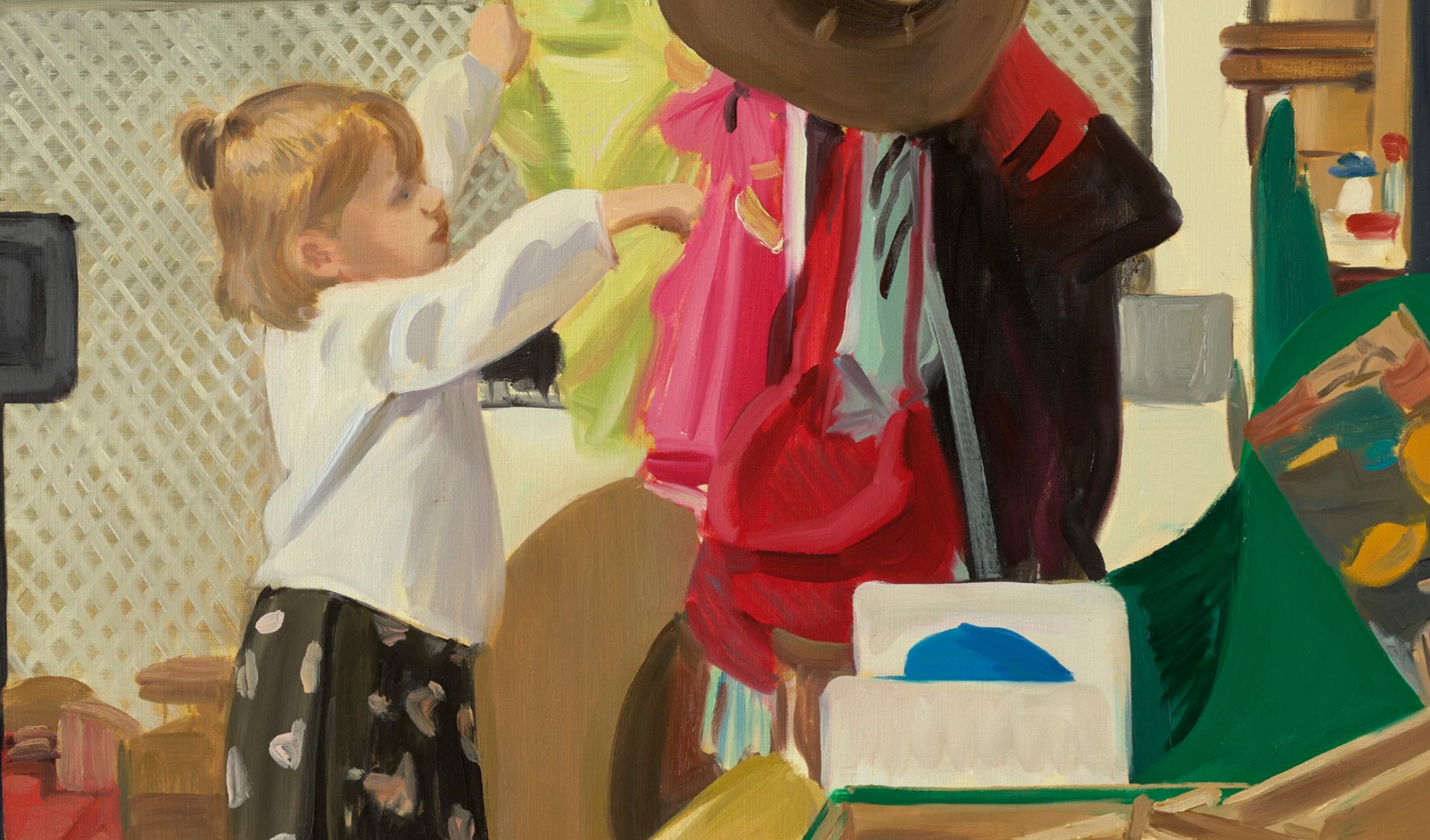
Rendered on dazzling, immersive scale, Caroline Walker’s Imaginative Play I is an intimate portrait of a hidden world. Included in the artist’s acclaimed exhibition Mothering at the Hepworth Wakefield in 2025, it stands among the finest works in her Nurseries series. These paintings represent some of her most deeply personal creations, depicting children and staff at her daughter Daphne’s nursery in London.
“The special relationships formed between nursery worker and child are so important to the series … In these paintings … this moment is frozen in time.”
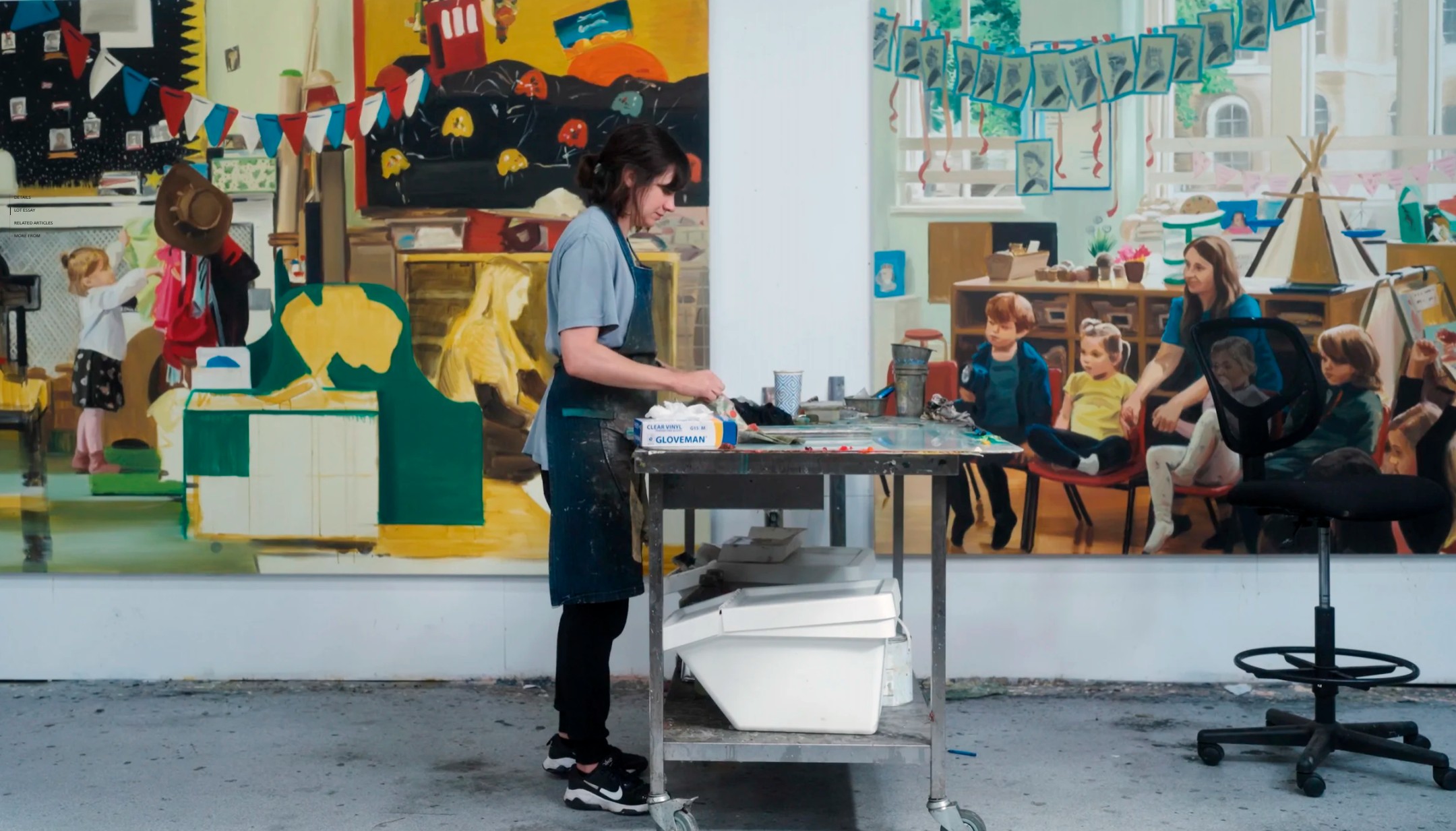
Caroline Walker in her studio with the present lot in progress. Artwork: © 2026 Caroline Walker. Courtesy the artist; Stephen Friedman Gallery, London; GRIMM, New York / Amsterdam / London and Ingleby, Edinburgh. All rights reserved, DACS.
Immortalizing a setting almost entirely unrepresented in art, they continue Walker’s fascination with the unseen work undertaken by women. With its theatrical lighting, cinematic mise-en-scène and painstaking detail, the present work celebrates the colorful, sensory wonder of early childhood. At the same time, however, it is tinged with bittersweet introspection, capturing the vital yet fleeting bond between caregivers and their young charges. Closely related to Walker’s previous Nurture cycle, Imaginative Play I takes its place alongside works held in the Art Gallery of New South Wales, Sydney, the National Museum of Women in the Arts, Washington, D.C. and the Sifang Art Museum, China.
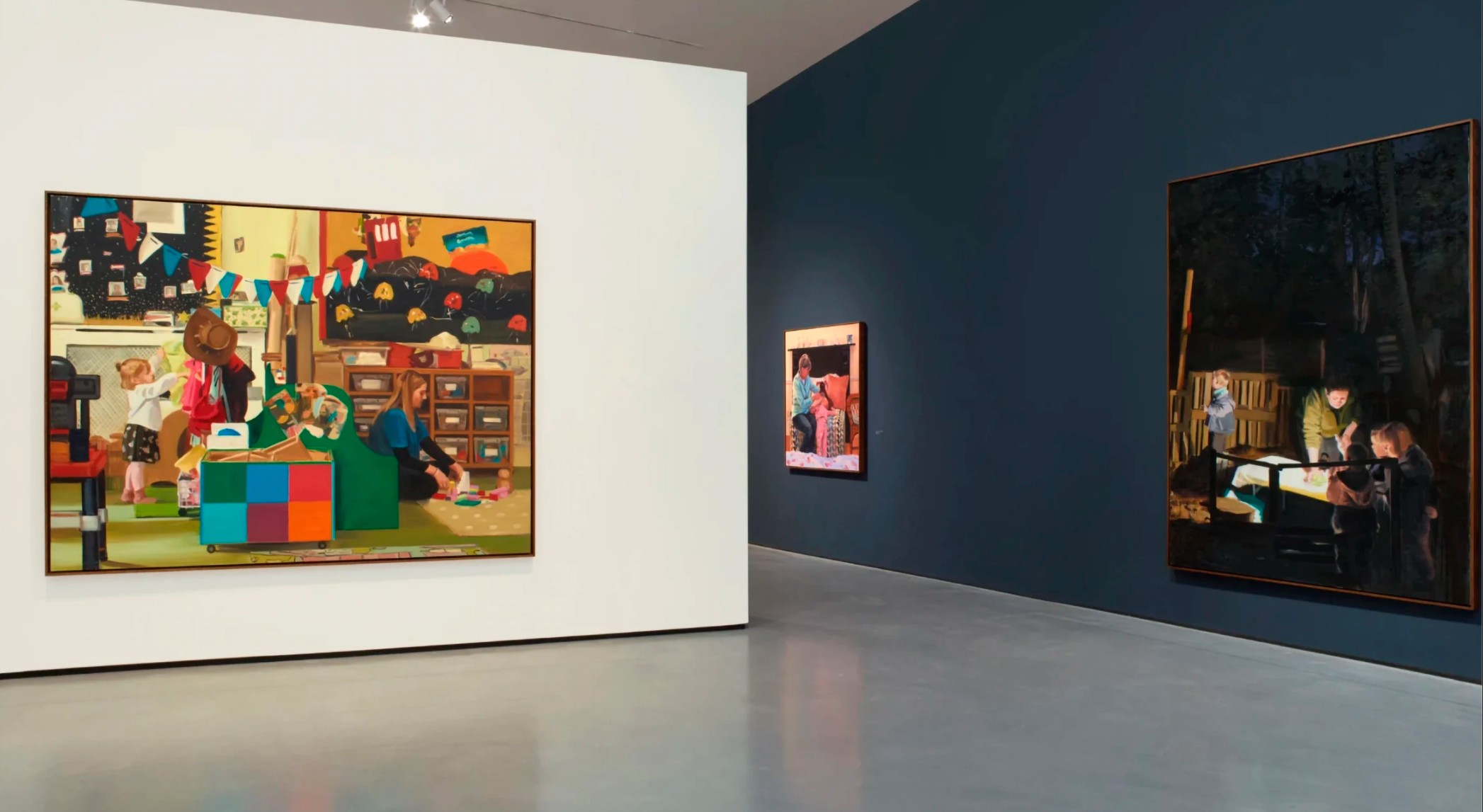
The present lot exhibited as part of Caroline Walker: Mothering, 2025. Hepworth Wakefield. Photograph: Michael Pollard.
Artwork: © 2026 Caroline Walker. Courtesy the artist; Stephen Friedman Gallery, London; GRIMM, New York / Amsterdam / London and Ingleby, Edinburgh. All rights reserved, DACS.
Walker’s interest in notions of ‘mothering’ coincided with the beginnings of her own family, with one-year-old Daphne featuring in her work as early as 2021. Her subsequent Birth Reflections series depicted staff and mothers on a maternity ward, while her cycle Lisa captured her sister-in-law with her new baby. It was not until the Nurture and Nurseries series, however, that Walker’s practice truly began to intersect with her own autobiography. Nurture began after the artist moved back to Scotland from London, and depicted a number of local preschool settings: an outdoor nursery, a toddler science club and Daphne’s swimming lessons, as well as her newborn son Laurie.
Nurseries, however, took a step back in time. For this series, Walker returned to photographs taken two years previously at Daphne’s former nursery in London. Working at distance from her source material in this manner emphasized to her ‘the fleeting nature of this important time in children’s young lives’. The relationship between child and nursery worker, she notes, ‘can be very close’ yet is ultimately ‘short-lived’. In her paintings, she explains, ‘this moment is frozen in time’ (C. Walker, quoted at Stephen Friedman Gallery, online).
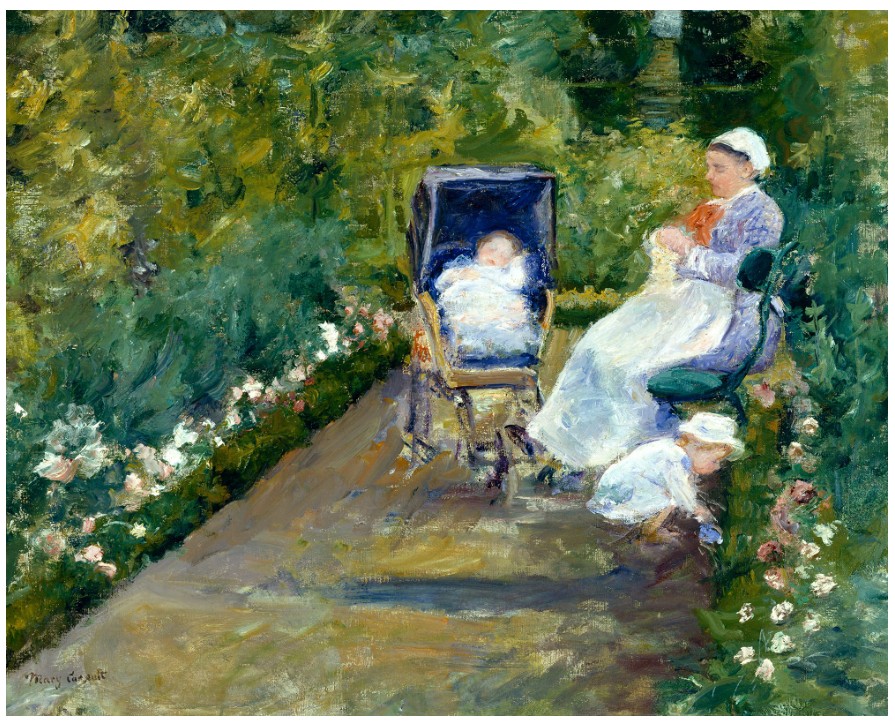
Mary Cassatt, Children in a Garden (The Nurse), 1878. Museum of Fine Arts, Houston.
Digital image: Museum of Fine Arts, Houston / gift of Mr. and Mrs. Meredith Long / Bridgeman Images.
Imaginative Play I engages directly with these ideas. The painting is suffused with the enigmatic sense of poignancy that defines Walker’s best works, offsetting the joy of children’s play with the complex emotions borne by its facilitators. The artist relishes the details of her toddler world: the bright colours of toys and decor, the play of light upon waterproof coats, the tactile surfaces of wood, plastic and carpet, and the energetic freedom of children’s artwork. ‘The world of small children is a very visual one and a very textural one’, she explains (C. Walker, quoted in Caroline Walker: Mothering, exh. cat. Hepworth Wakefield, 2025, p. 27). The child herself is lovingly observed, her stance, clothes and facial expression alive with character. On the other side of the room, however, her caregiver seems lost in her own imaginative space as she arranges toys upon the floor. For all its playful whimsy, this is her place of work: the site of her daily toil. She carries the weight of the child’s happiness upon her shoulders, in the knowledge that she will be gone from her care in just a few short years.
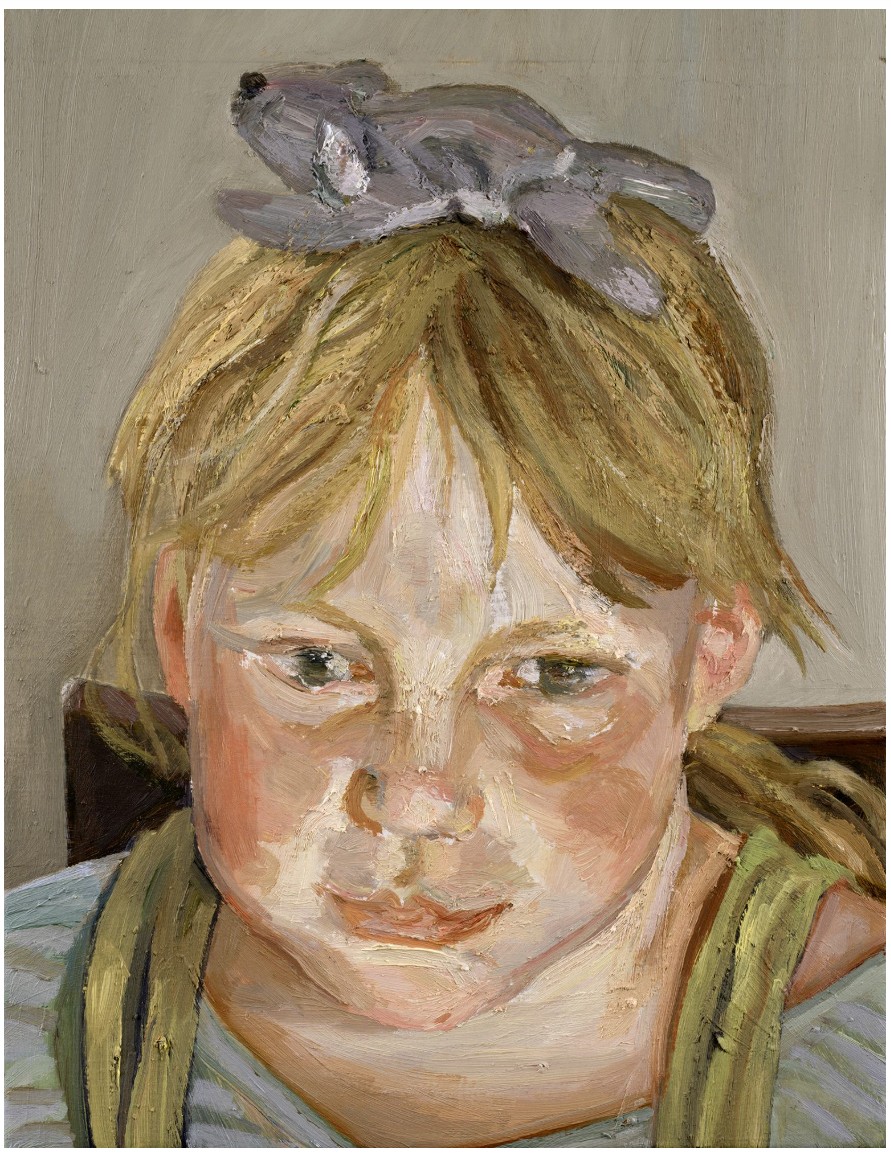
Lucian Freud, Alice and Okie, 1999. Private collection. Artwork and digital image: © The Lucian Freud Archive.
All Rights Reserved 2026 / Bridgeman Images.
Since its inception, Walker’s practice has interrogated the often overlooked roles played by women in society. She depicts them in a variety of personal and professional settings, capturing private moments of reflection as they go about mundane everyday activities. Drawing inspiration from the histories of art and film, she transforms these quotidian scenes into grand, near-religious tableaux, infused with quiet drama and subtle psychological tension. Her engagement with the idea of ‘mothering’ speaks to the complexities at the heart of her practice, interrogating not only the unseen work of parenthood but also the childcare service industry. While artists such as Mary Cassatt and Berthe Morisot had painted mothers and nursemaids, Walker’s depiction of nurseries speaks to a uniquely contemporary phenomenon. During the series, she was conscious that the women she was depicting were the very reason she was able to continue her own work as an artist. The present painting’s protagonist is arguably a reflection of her own conflicted feelings, her thoughts lost in a universal space where life and labor seamlessly intermingle.
Adrian Ghenie
On the Road to Tarascon 2 (with Navid Nuur), 2013
Christie’s London: 7 March 2026
Estimated: GBP 200,000 – 300,000
GBP 190,500 / USD 254,490
ADRIAN GHENIE (B. 1977), On the Road to Tarascon 2 (with Navid Nuur) | Christie’s
ADRIAN GHENIE (B. 1977)
On the Road to Tarascon 2 (with Navid Nuur), 2013
Oil on canvas
200×150 cm (78-3/4 x 59 inches)
Signed and dated ‘Ghenie 2013’ (on the reverse)
Adrian Ghenie’s fascination with Vincent Van Gogh’s The Painter on the Road to Tarascon (1888) has given rise to some of his most important paintings. The original is known only in reproduction: it was destroyed, or possibly looted, during the 1945 Allied bombings of Magdeburg, where it was held in the Kaiser-Friedrich Museum. Following in the footsteps of Francis Bacon, who paid homage to the work in his own series of the mid-1950s, Ghenie has repeatedly grappled with Van Gogh’s lost vision.
“What intrigued me about Van Gogh is this difference between the reality of his actual existence … and Van Gogh the cliché, which is a beautiful fantasy.”
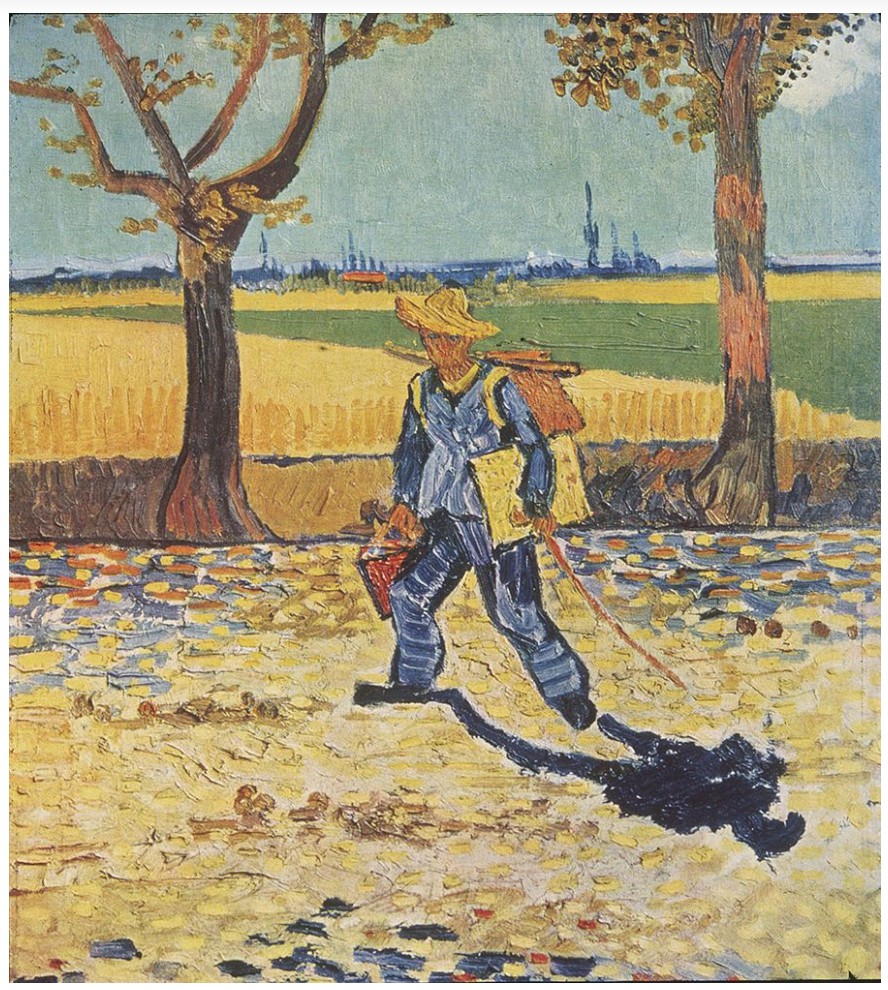
Vincent Van Gogh, The Painter on the Way to Tarascon, 1888. Formerly in the Kaiser Friedrich Museum, Stassfurt.
Within a practice dedicated to exploring the way that the past lives within our collective consciousness, the concept of a self-portrait lost to the ravages of time holds particular fascination. Throughout his oeuvre, Ghenie has sought to rescue key historical moments and figures from the flat, glossy world of print and screen, re-materialising them in paint as living, breathing entities. His vivid responses to The Painter on the Road to Tarascon seek to strip away not only the romanticized fantasies associated with Van Gogh himself, but also to inject the original painting with a sense of its own lived history.
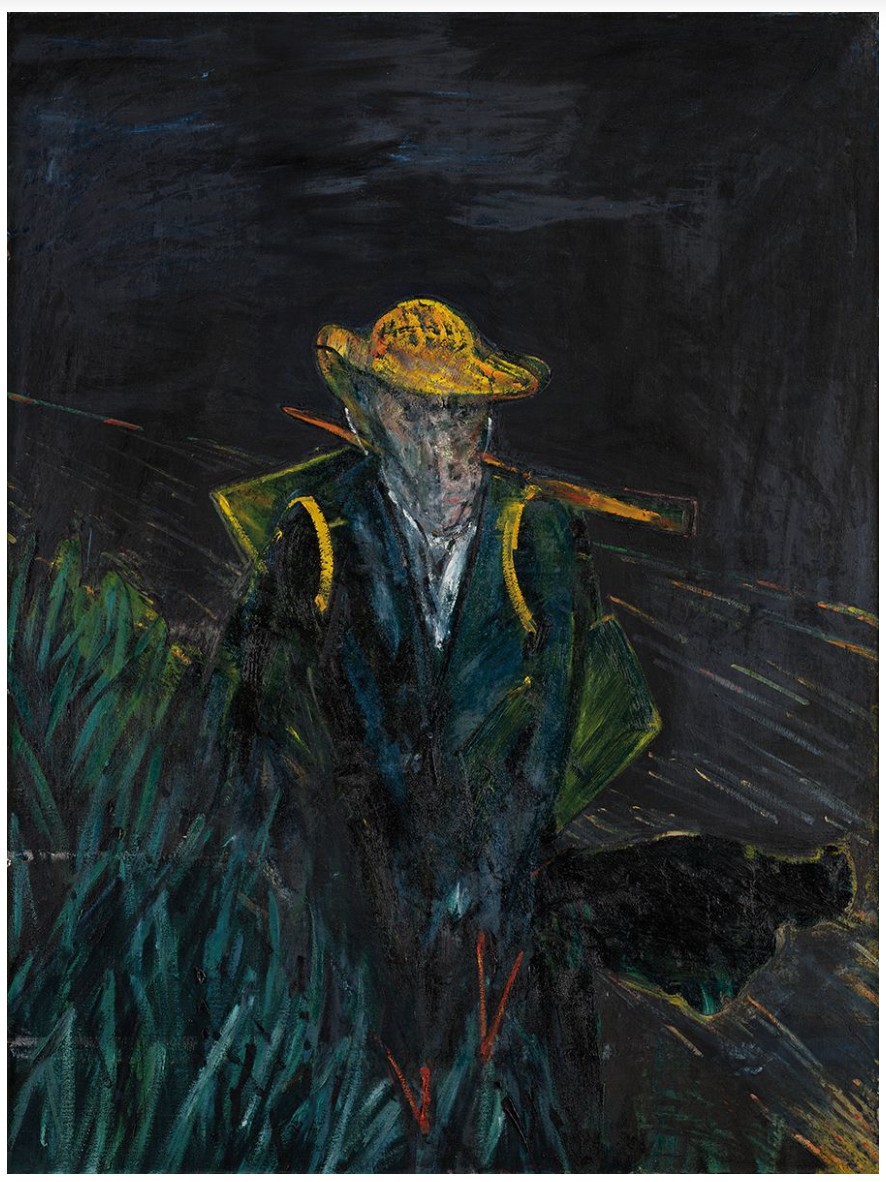
Francis Bacon, Study for Portrait of Van Gogh I, 1956. Sainsbury Centre for Visual Arts, Norwich. Artwork: © 2026 The Estate of Francis Bacon. All rights reserved. DACS. Photo: Prudence Cuming Associates Ltd. Digital image: © The Estate of Francis Bacon. All rights reserved, DACS Images.
Van Gogh is one of a number of recurring subjects—from Charles Darwin to Elvis Presley—whom Ghenie believes to have changed the course of humanity. As a six-year-old, the artist kept a print of Sunflowers (1888) under his pillow. Later, he recalls being overwhelmed by the artist’s 1889 self-portrait in the Musee d’Orsay in Paris, and would go on to paint himself multiple times in the image of his hero. Ghenie—who grew up in Romania under Nicolae Ceaușescu’s Communist regime—was also particularly intrigued by the intersection of Van Gogh’s art with the stories of modern European history. In the 1930s, many of his paintings were seized as ‘degenerate art’ under the Nazi’s campaign to purge modern art from Germany. Ghenie explicitly evoked these events in his large-scale 2014 painting The Sunflowers in 1937, which reimagines the work burnt, warped and ruined by the ideological violence of the 1937 exhibition Entartete Kunst (Degenerate Art). The Painter on the Road to Tarascon, too, found itself wrenched into the machinations of the Second World War, the artist’s haunting self-image consigned once and for all to the pages of history.
“I’m interested in history that’s linked to the human figure. A certain type of deconstruction interests me, the same way it interested Picasso and Bacon.”
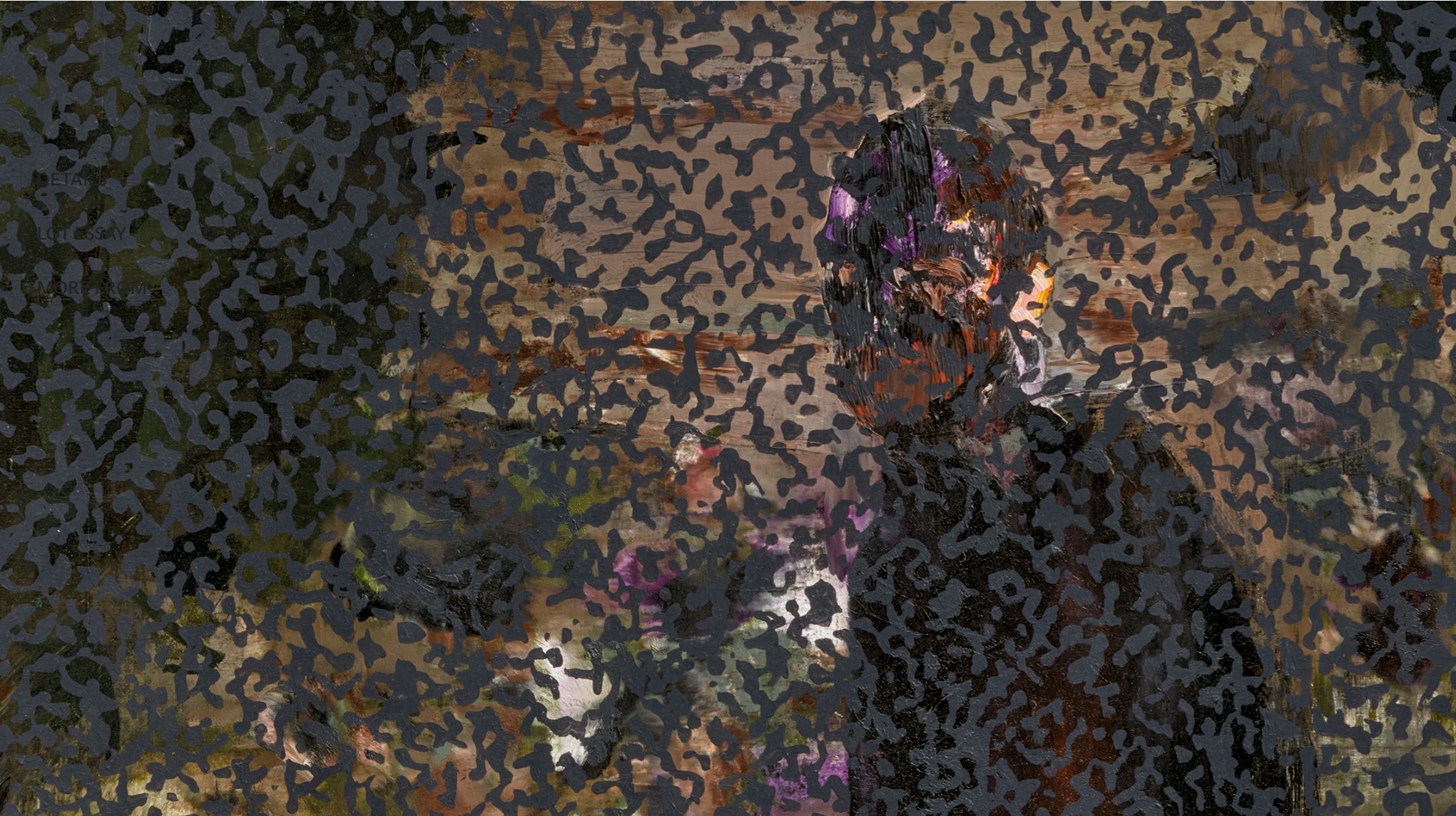
Painted in 2013, and included in Ghenie’s solo exhibition at the Centro de Arte Contemporáneo de Málaga the following year, the present work brings these narratives to life. The sunny yellows of Van Gogh’s original are replaced by visceral swathes of black and piercing blue, marbled with jewel-like tones of purple and green. Paint drips and stutters down the length of the picture plane, every inch of its surface alive with tactile impasto. If Ghenie’s understanding of the painting was filtered through Bacon, here he adds another layer of remove by collaborating with the Iranian-born Dutch artist Navid Nuur. The two met through their mutual involvement with the Romanian gallery Plan B, and together produced a series of works that built upon Ghenie’s engagement with Van Gogh. In the present example, Nuur has added veils of brushwork inspired by the Dutch master over the top of Ghenie’s painting. The results evoke the build-up of distortion and interference that characterizes our relationship with the past. In a powerful meditation on the workings of collective memory, Van Gogh becomes a shadowy, unreachable figure, his identity subsumed by history’s visual noise.
Lynette Yiadom-Boakye
The World In Agreement With, 2011
PROPERTY FROM A DISTINGUISHED DANISH COLLECTION
Christie’s London: 7 March 2026
Estimated: GBP 300,000 – 500,000
LYNETTE YIADOM-BOAKYE (B. 1977), The World In Agreement With | Christie’s
LYNETTE YIADOM-BOAKYE (B. 1977)
The World In Agreement With, 2011
Oil on canvas
63-1/8 x 70-7/8 inches (160.4 x 180 cm)
Signed with the artist’s initials
Titled and dated ‘LYB 2011 The World In Agreement With’ (on the reverse)
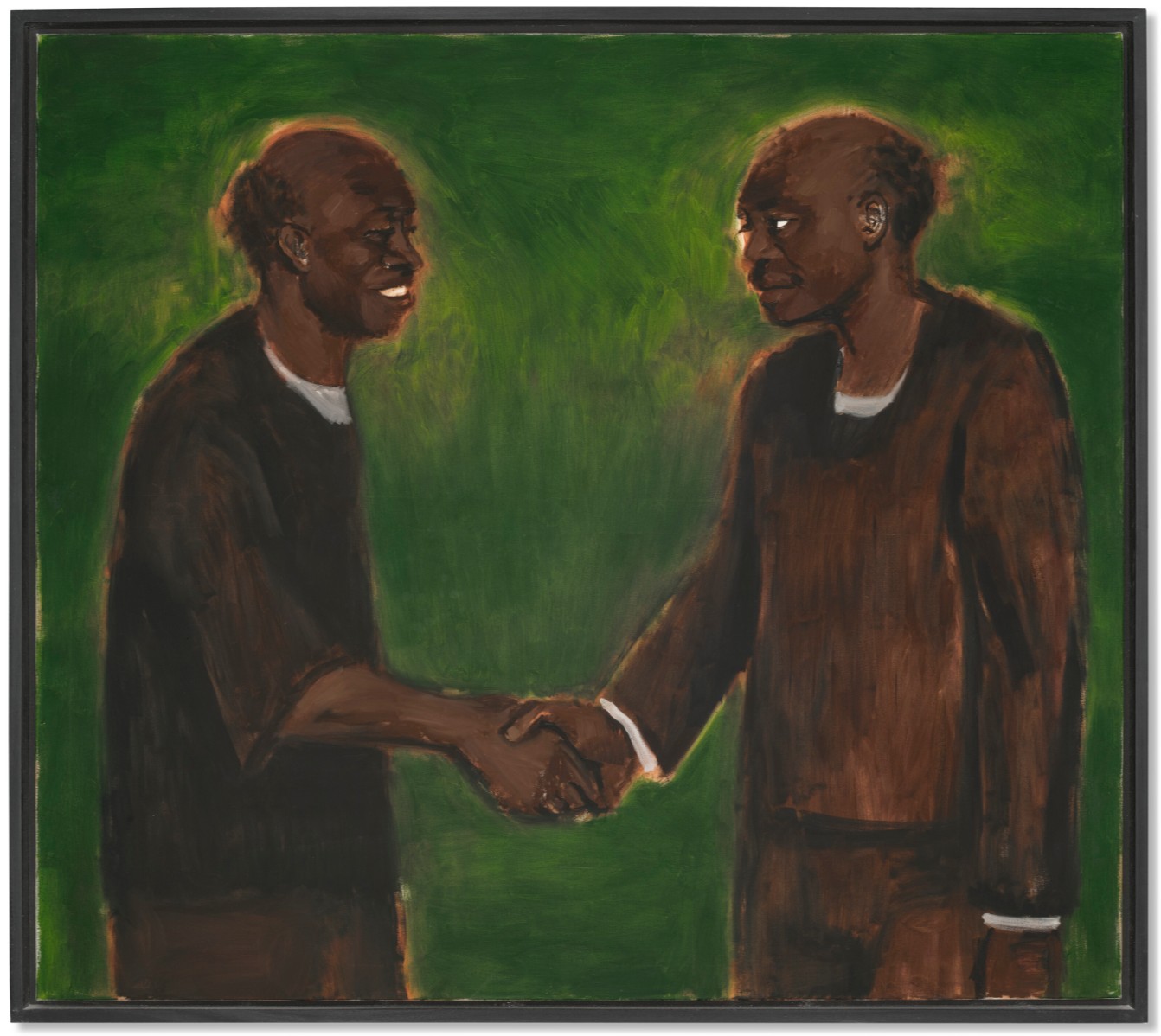
In The World in Agreement With (2011), Lynette Yiadom-Boakye captures an ephemeral and suggestive moment as two men shake hands, transforming a familiar social exchange into an image charged with implication. The scene is pared-back and intimate. The figures occupy the canvas in half-length profile, facing one another against a luminous green ground that offers no narrative cues. Their bodies incline gently inward, creating a quiet symmetry that draws the eye toward their clasped hands. The figure to the left appears to smile faintly, his expression open and animated, while the man opposite meets him with a steadier, more contemplative gaze. This subtle contrast in demeanor introduces an ambiguity to the exchange, leaving the nature of their relationship unresolved. The artist’s characteristically loose yet assured brushwork lends the figures a striking immediacy. Dark garments dissolve into broad passages of brown and black, while quick flashes of light articulate foreheads, sleeves, and hands, allowing form to emerge and recede within the paint surface. The background remains deliberately indeterminate, concentrating our attention on gesture and expression.
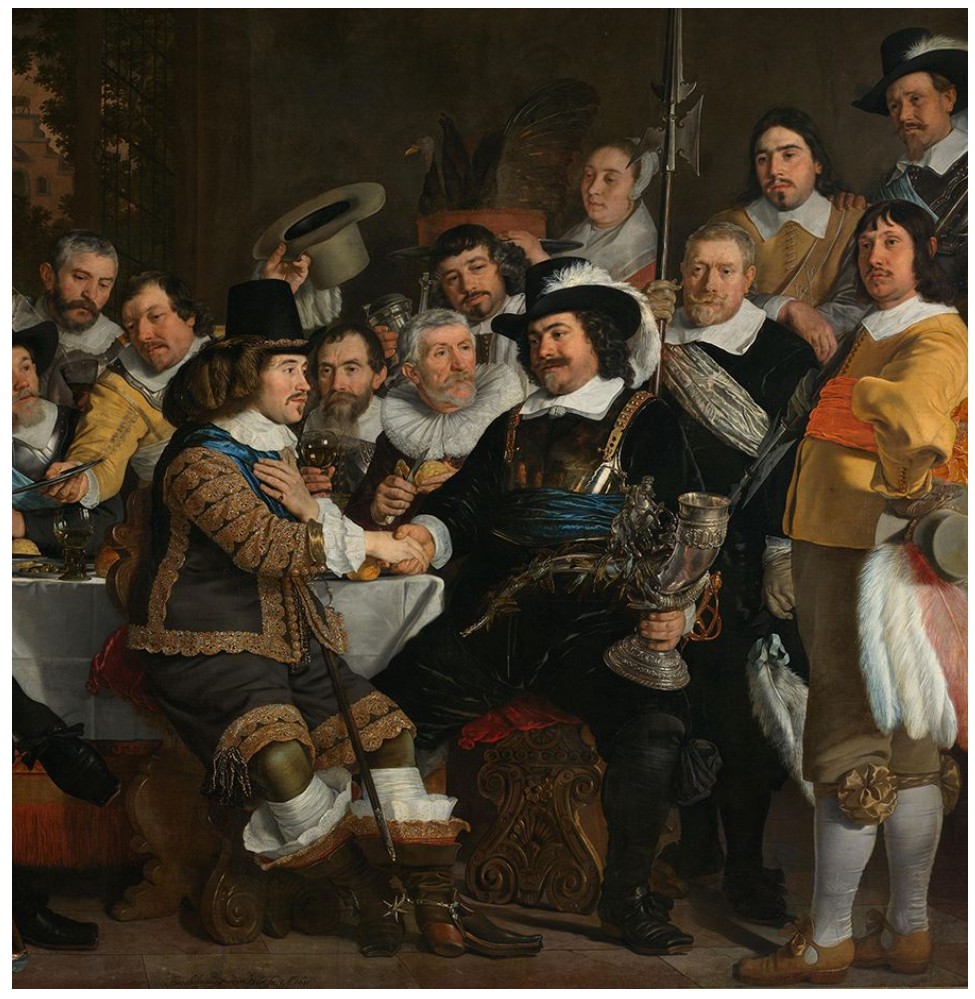
Bartholomeus van der Helst, Banquet of the Amsterdam Civic Guard in Celebration of the Peace of Münster (detail), 1648. Rijksmuseum, Amsterdam.
The World in Agreement With was painted in 2011, shortly before Yiadom-Boakye’s nomination for the prestigious Turner Prize in 2013. In 2012 it was shown as part of the Future Generation Art Prize at the Pinchuk Art Centre, Kyiv—which the artist won—and subsequently at the Palazzo Contarini Polignac during the 2013 Venice Biennale. One of the most distinguished contemporary painters working in Britain, Yiadom-Boakye is renowned for her enigmatic depictions of fictitious Black figures who inhabit indeterminate temporal and spatial realms. Existing outside fixed narratives, her subjects resist biography and specificity.
“They are suggestions of people … They don’t share our concerns or anxieties.
They are somewhere else altogether.”
A writer as much as a painter, Yiadom-Boakye draws inspiration from a wide range of literary and art-historical sources. Her figures appear to live lives beyond the confines of the canvas: viewers are granted access only to a single, unresolved moment. Many of her compositions echo works from the Western canon, reimagined through a contemporary lens and populated by a new cast of characters. In doing so, Yiadom-Boakye both acknowledges and reframes art-historical tradition, introducing figures long absent from its narratives.
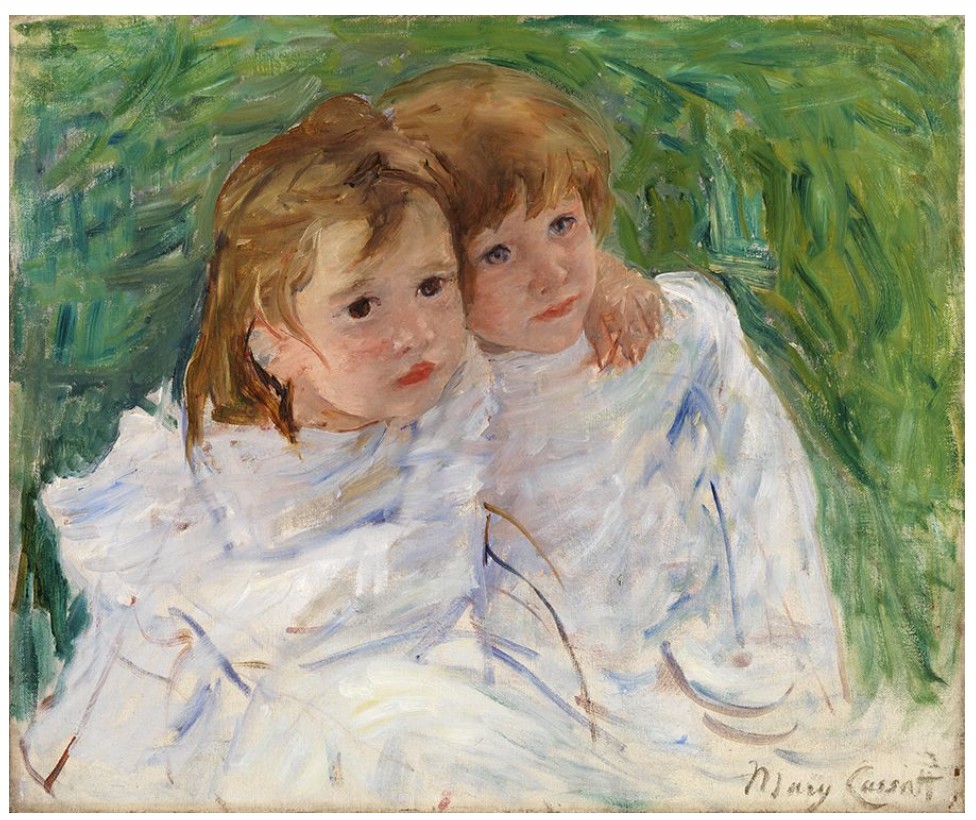
Mary Cassatt, The Sisters, circa 1885. Art Gallery and Museum, Kelvingrove, Glasgow.
Digital image: © CSG CIC Glasgow Museums Collection / Bridgeman Images.
In light of its title and subject matter, the present work can also be understood in dialogue with the artist’s celebrated cycle of Diplomacy paintings, which similarly stage encounters defined by gesture and psychological nuance. Across these multi-figure compositions, meaning resides in small acts of bodily communication—a glance, a stance, a measured distance between bodies—that suggest systems of protocol, tact, and mediation. The handshake at the center of The World in Agreement With echoes this language, hovering between warmth and formality, intimacy and obligation. Stripped of contextual detail and suspended within an indeterminate space, the exchange assumes an almost archetypal quality, transforming a specific social ritual into a broader meditation on the delicate choreography of human relations. The men’s encounter becomes more than a simple greeting or agreement; it suggests an unspoken negotiation, a shared understanding, or a moment of mutual recognition. The painting elevates a familiar social ritual into a site of reflection, inviting the viewer to consider the subtle dynamics of connection, trust, and formality that underpin ordinary encounters.
BANKSY
Happy Choppers, 2006
Phillips London: 5 March 2026
Estimated: GBP 1,000,000 – 1,500,000
GBP 1,520,000 / USD 2,030,570
Banksy Modern & Contemporary Art Evening Sale
BANKSY
Happy Choppers, 2006
Spray paint and emulsion on canvas
126.9 x 182.9 cm (49-7/8 x 72 inches)
Stencilled ‘BANKSY’ lower right
Signed, numbered and dated ‘BANKSY 12/2/2006 1/3’ on the overlap
This work is number 1 from an edition of 3
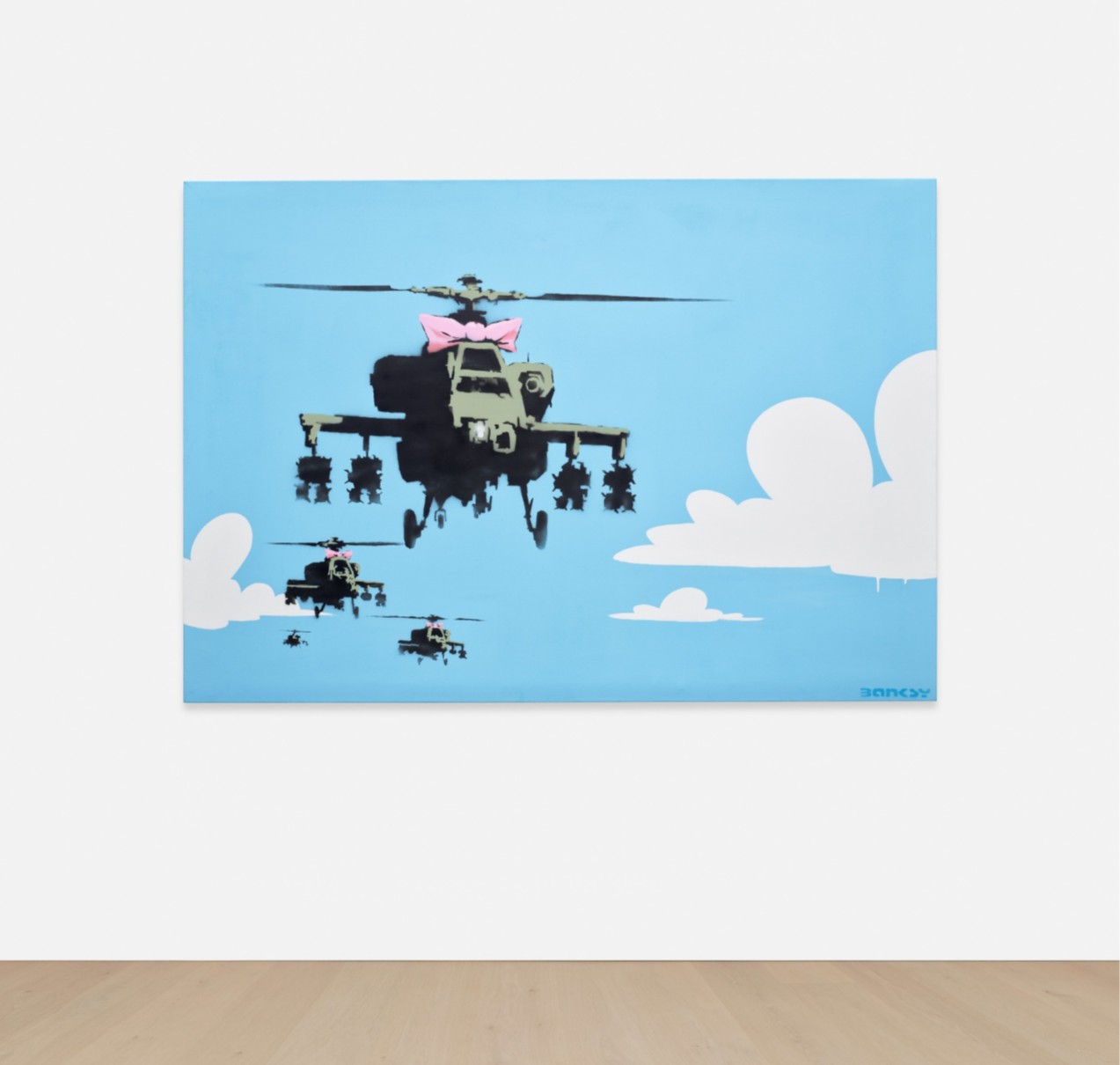
Characteristic of the satire, novelty and gusto that has established Banksy at the centre of street art, politics and popular culture, Happy Choppers is an important early example of the artist’s practice. Depicting Apache helicopters, or ‘Choppers’, pinned with Disney-esque, Minnie Mouse bows, Banksy transforms the military squadron into a symbol of defiance. Among three known variations, the present example was executed in 2006 and previously resided in the collection of the late actor and comedian Robin Williams. With another example included in Banksy’s significant 2006 exhibition Barely Legal that was held in Los Angeles, the present work asserts Banksy’s belief in art’s power: a mode of critiquing institutions and inspiring social change.
“Nobody ever listened to me until they didn’t know who I was.”
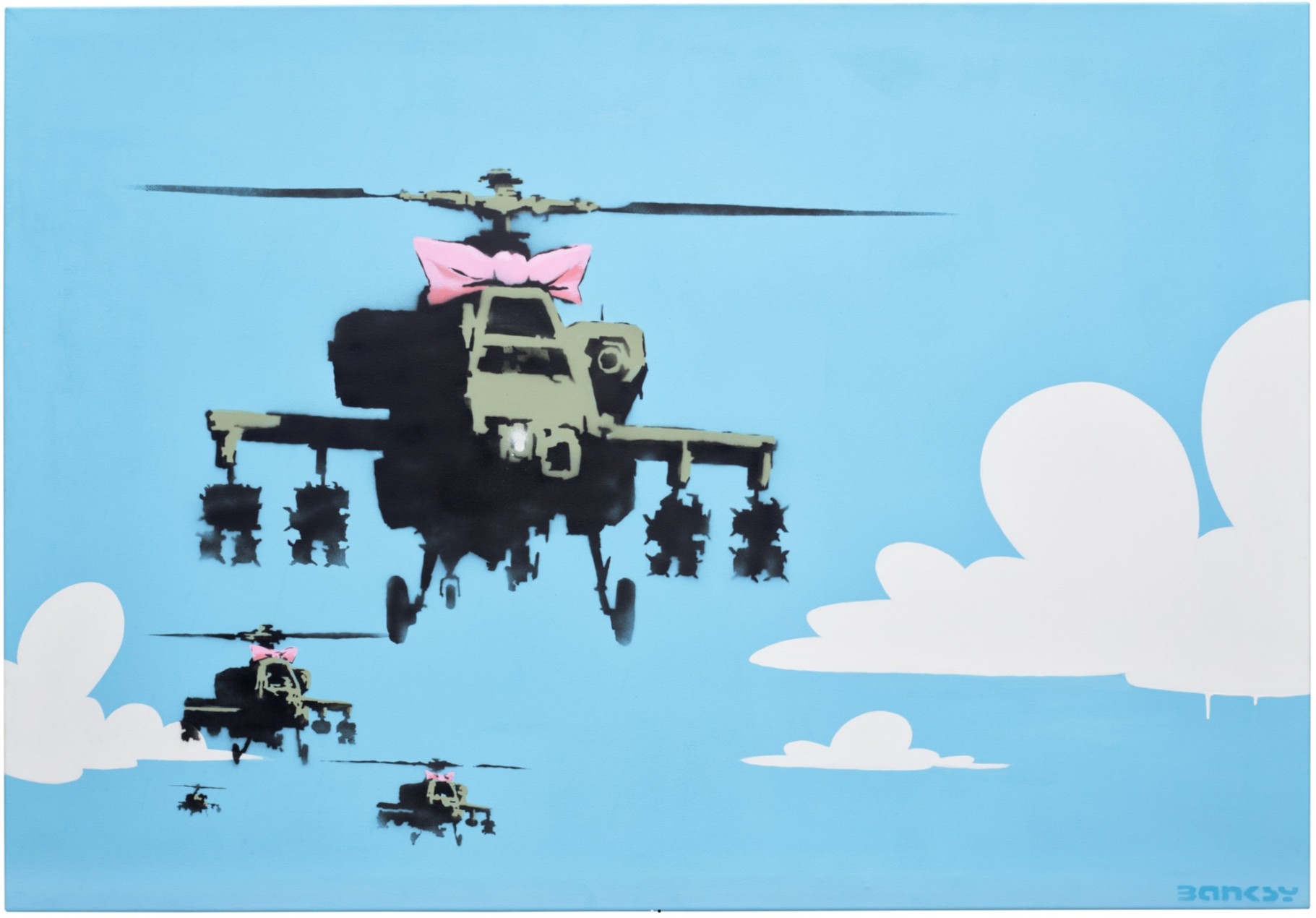
Dramatically rendered mid-flight, ascending from the horizon, Happy Choppers was realized at a pivotal moment in Banksy’s career. Following the success of the London exhibition Crude Oils the previous year, Banksy’s Los Angeles exhibition in 2006 was typical of the comedic happenings that the artist has continued to stage globally and among his most ambitious early solo presentations. Shrouded in mystery, among the sculptures, stencils and live painted elephant during Barely Legal Banksy exhibited one of the three versions of the present work. Crowning each helicopter in Happy Choppers with a candy-pink bow, this motif is first known to have been used by Banksy in 2002, rendered in the artist’s primary medium and setting: graffiti on the street. Originally painted in Whitecross Street Market, Banksy referenced the Apache helicopter, one of the attack helicopter models that was used by the UK and US armed forces, particularly at that time during the war in Afghanistan.
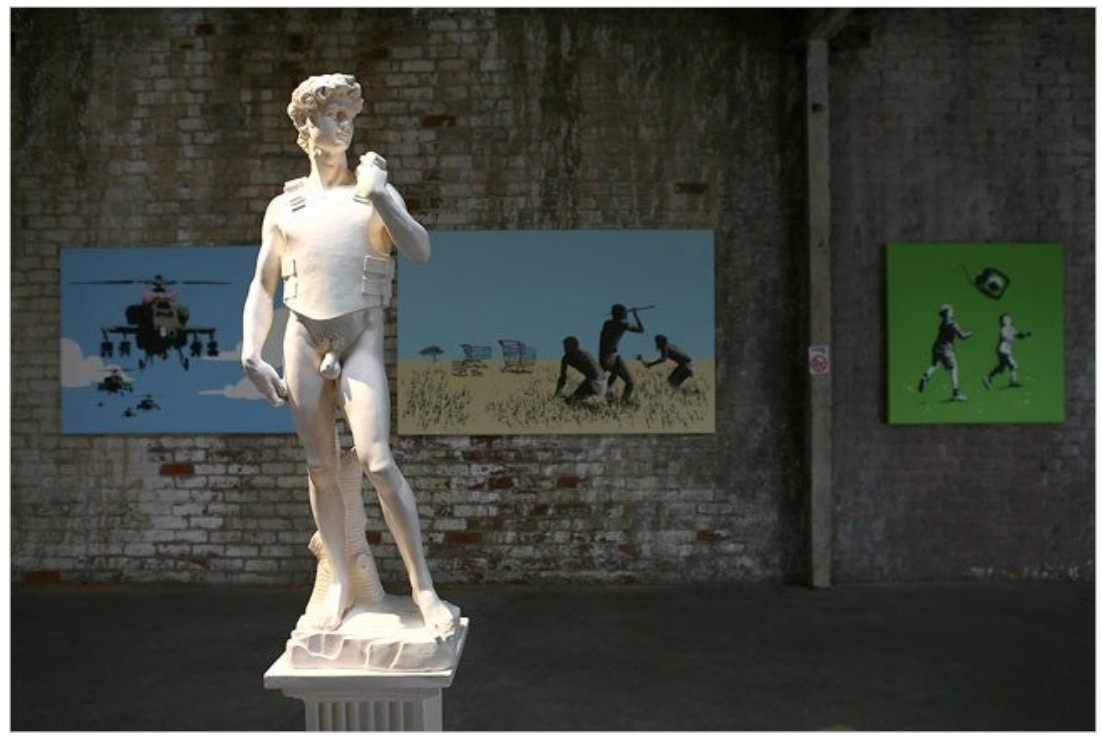
One of the three versions of Happy Choppers, exhibited at Barely Legal in Los Angeles, 2006. Image/Artwork: © Pest Control
In returning to the helicopter motif, Happy Choppers continues Banksy’s dialogue with history, public policy and society. As Eugène Delacroix in his Liberty Leading the People expressed ideals of freedom and victory following the July Revolution of 1830, Banksy is among the long tradition of artists that have used art as a form of social commentary through taking inspiration from the street. Banksy questions shared belief systems and in turn, structures of power. Piloted in disarmingly serene, cartoon-blue skies, the severity and uniformity of the military unit is juxtaposed with the picturesque, larger-than-life natural world. Ostensibly rendered harmless or toy-like with their inoffensive bows, Happy Choppers is a prescient reminder of issues at the center of contemporary discourse on war and peace, liberty and the rule of law. Remaining vocal in rallying against conflict, examples of Banksy’s work that appropriate and re-invent military imagery are among the artist’s most recognized: from depicting a pair of soldiers painting a peace sign, an elephant strapped with a missile to the Mona Lisa brandishing a rocket launcher.
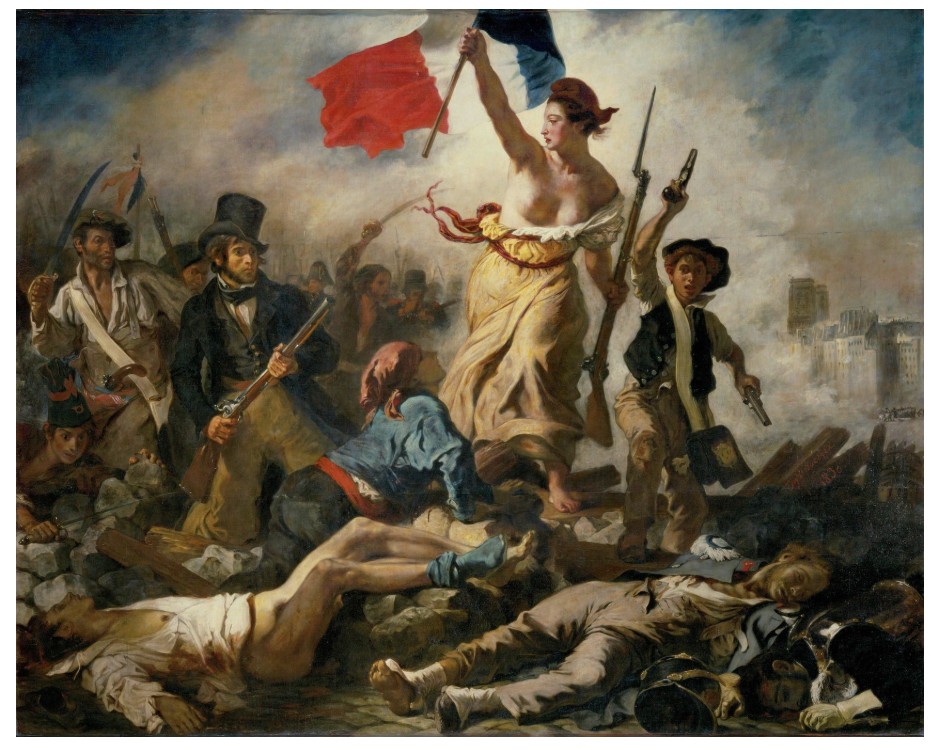
Eugène Delacroix, Liberty Leading the People, 1830, Musée du Louvre, Paris
The use of stencilling in Happy Choppers gives ground to Banksy’s anti-establishment rhetoric, a methodology that was developed during late adolescence by the artist to outwit authorities. Active in Bristol during the late 1980s, Banksy was shaped by the historical port town’s graffiti culture and underground creative scenes informed by hip-hop: counter-cultural impulses that were followed by the rebellious, renewed enthusiasm for British culture and ‘Cool Britannia’. Contemporary to national policies against the uncontainable rise of graffiti, severe crackdowns like Operation Anderson in 1989 left an indelible impression, impacting the artist’s relationship with authority and surveillance. Maintaining anonymity to avoid detection, it was at eighteen during a cat-and-mouse chase with the police that the artist discovered his distinctive stencil technique. While hiding from the British transport police beneath a vehicle, the artist recounted ‘I realized I had to cut my painting time in half or give it up altogether. I was staring straight up at the bottom of a fuel tank when I realized I could just copy that style’. Blending the influences of the street with the canvas, Happy Choppers stands among the most enduring statements of Banksy’s output and a key expression of the artist’s principle that ‘graffiti is not the lowest form of art’ but instead is ‘the most honest artform available’.
Paranoid Pictures, 2003
Christie’s London: 7 March 2026
Estimated: GBP 50,000 – 70,000
GBP 266,700 / USD 356,285
BANKSY, Paranoid Pictures | Christie’s
BANKSY
Paranoid Pictures, 2003
Spray paint on canvas
30.5 x 30.5 cm (12×12 inches)
Tagged ‘BANKSY’ (on the turnover edge)
Signed, numbered and dated ‘5⁄25 2003 BANKSY!’ (on the stretcher)
This work is number five from an edition of twenty five plus one artist’s proof
Cecily Brown
Shadow Burn, 2005-2006
PROPERTY FROM AN IMPORTANT PRIVATE EUROPEAN COLLECTION
Christie’s London: 5 March 2026
Estimated: GBP 3,000,000 – 5,000,000
WITHDRAWN
CECILY BROWN (B. 1969), Shadow Burn | Christie’s
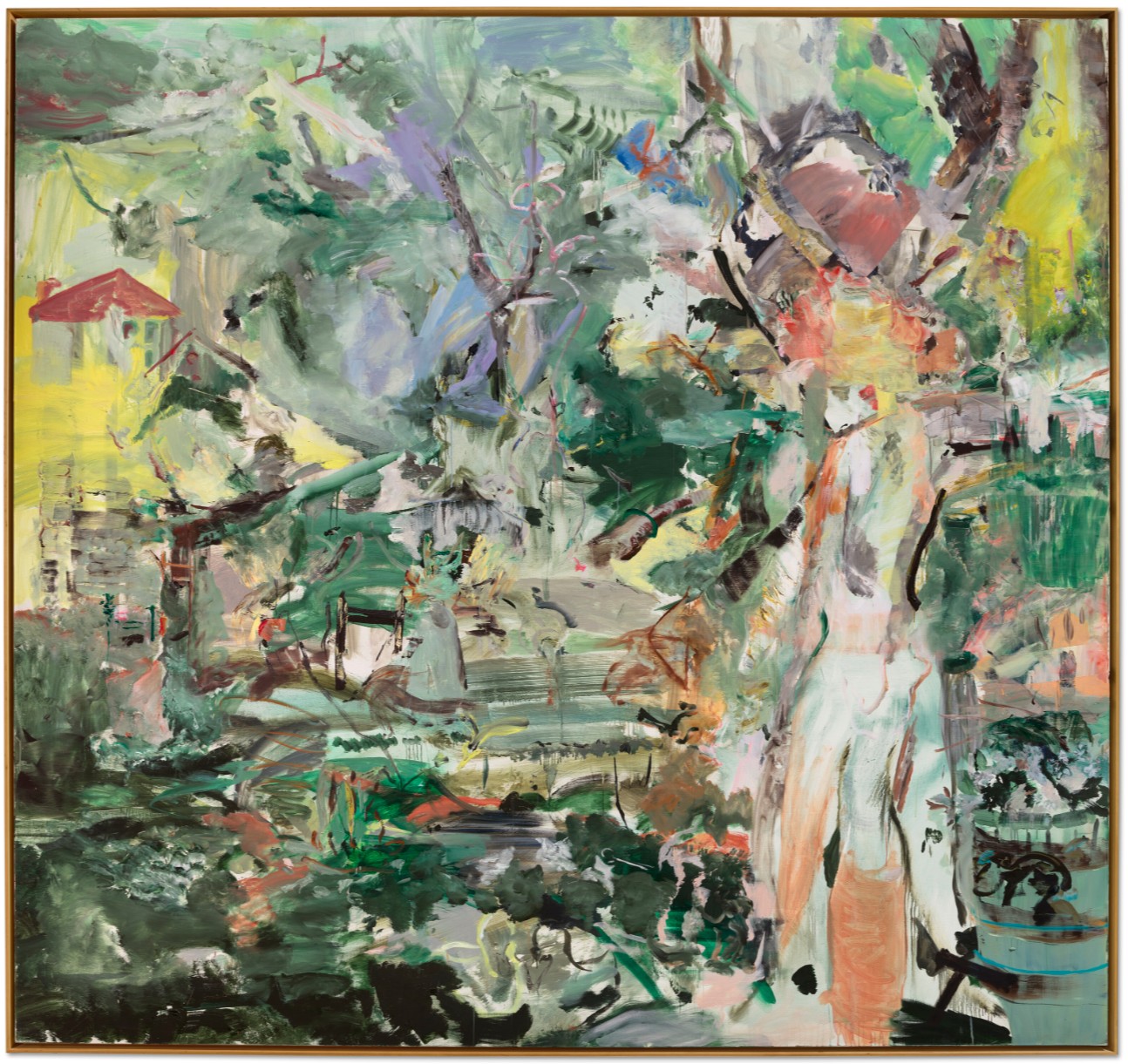
CECILY BROWN (B. 1969)
Shadow Burn, 2005-2006
Oil on linen
97×103 inches (246.2 x 261.7 cm)
Signed twice and dated twice ‘Cecily Brown 2005-2006 Cecily Brown 2005’ (on the reverse)
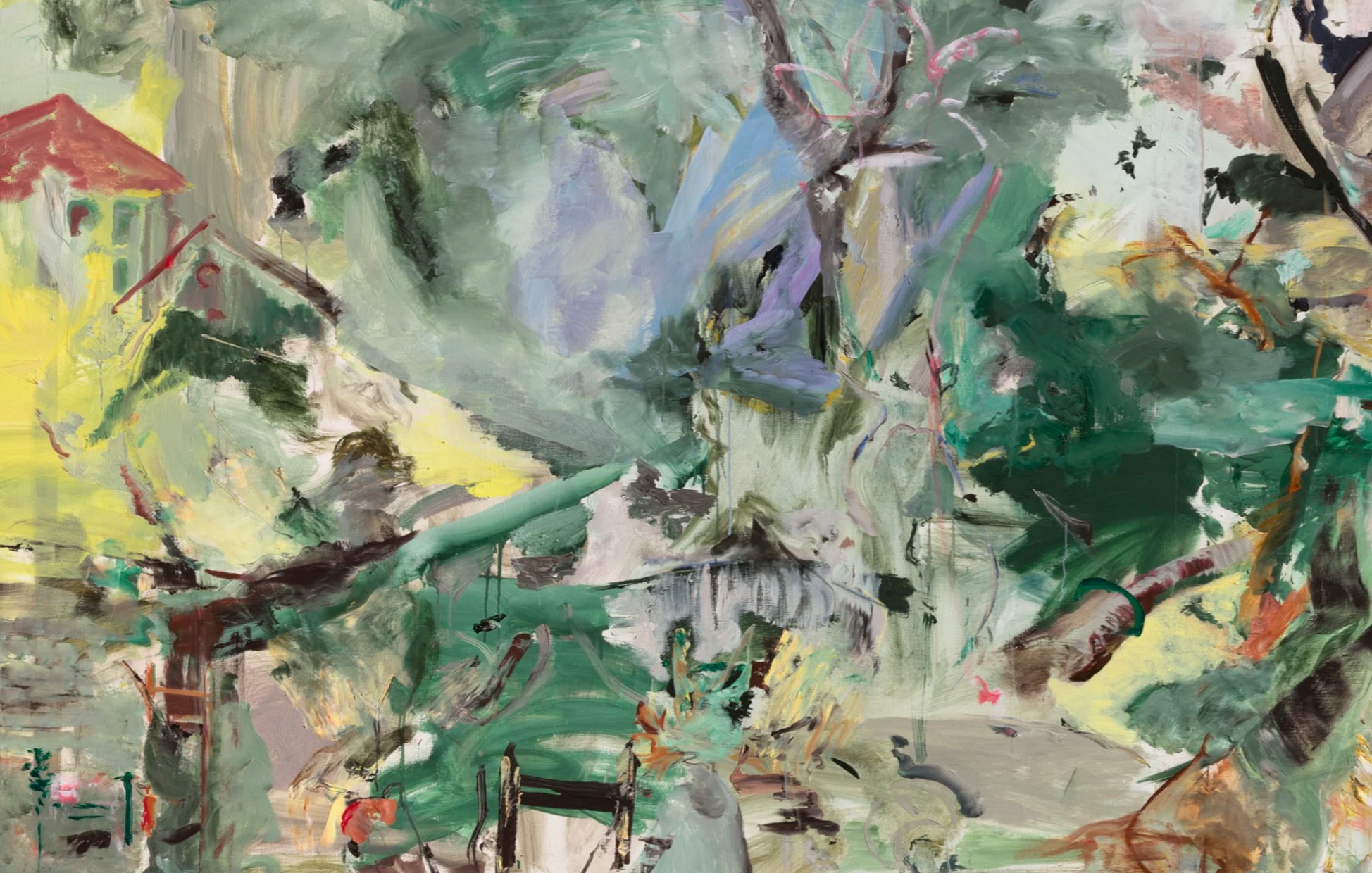
An intoxicating vision spanning over two meters in height and width, Shadow Burn (2005-2006) is an outstanding large-scale work by Cecily Brown. Staging an electrifying dialogue between abstraction and figuration, it stands among the finest works from a period that witnessed her ascent to the international stage. A verdant palette of fresh green, yellow, blue and mauve bursts forth across the canvas, radiant with golden luminosity. Rich swathes of impasto, scraped and caressed across the picture plane, form a lush, tactile canopy. Dark shadows tumble across the ground, hints of flowers and vegetation glimmering like jewels. To the right, a standing male nude shifts in and out of focus, his form subsumed by abstract texture. Included in two of the artist’s most important European retrospectives—at the Deichtorhallen, Hamburg in 2009 and the Louisiana Museum of Modern Art, Humlebæk in 2018—the work is alive with echoes of art history. Its teeming surface quivers with light, depth and movement: a virtuosic hymn to the power of paint.
The work dates from a significant period in Brown’s practice. Over a decade prior she had moved from her native London to New York, disenchanted by the conceptual trends of Britain’s contemporary art scene. There—in a city she described as ‘exhilarating and sympathetic’ to painting’s cause—she began to carve out new pathways for its future, plundering its history and interrogating its long-held dichotomies.
“I have always wanted to make paintings that are impossible to walk past, paintings that grab and hold your attention.”
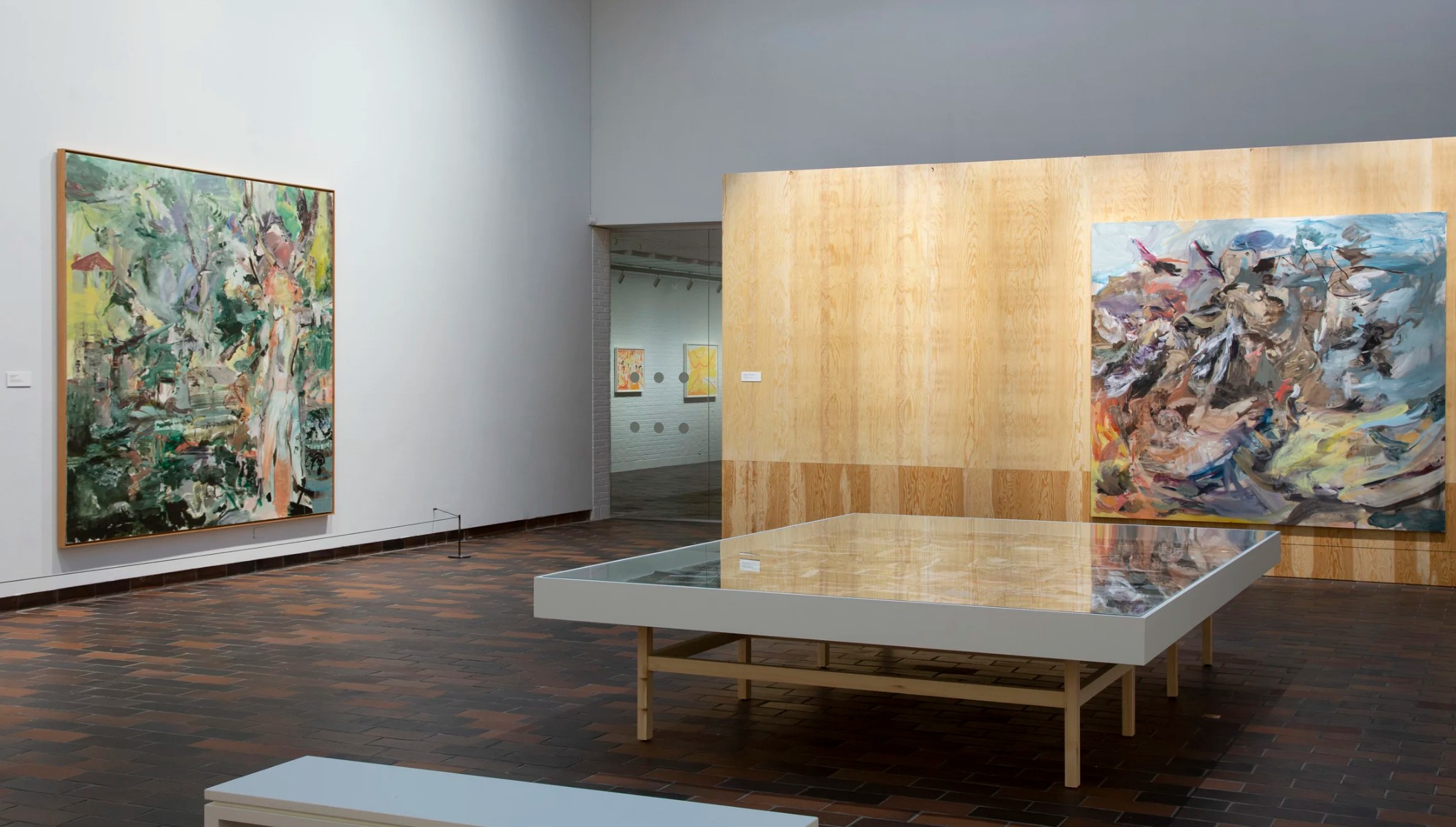
The present work installed in the exhibition Cecily Brown: Where, When, How Often and with Whom at the Louisiana Museum of Modern Art, Humlebæk, 2018. Artwork: © Cecily Brown.
By 2005, her sensuous, expressive language had earnt her widespread critical recognition: aged just thirty-six, her works had already been acquired by major institutional collections, and she had mounted solo exhibitions at the Hirshhorn Museum and Sculpture Garden, Washington, D.C., the Museo d’Arte Contemporanea, Rome and the Museo Nacional Centro de Arte Renia Sofía, Madrid. That year, she presented her UK institutional debut at Modern Art Oxford to outstanding acclaim. The following year Shadow Burn was included in the group exhibition Essential Painting at the National Museum of Art, Osaka, representing an important early showing of her work in Asia.
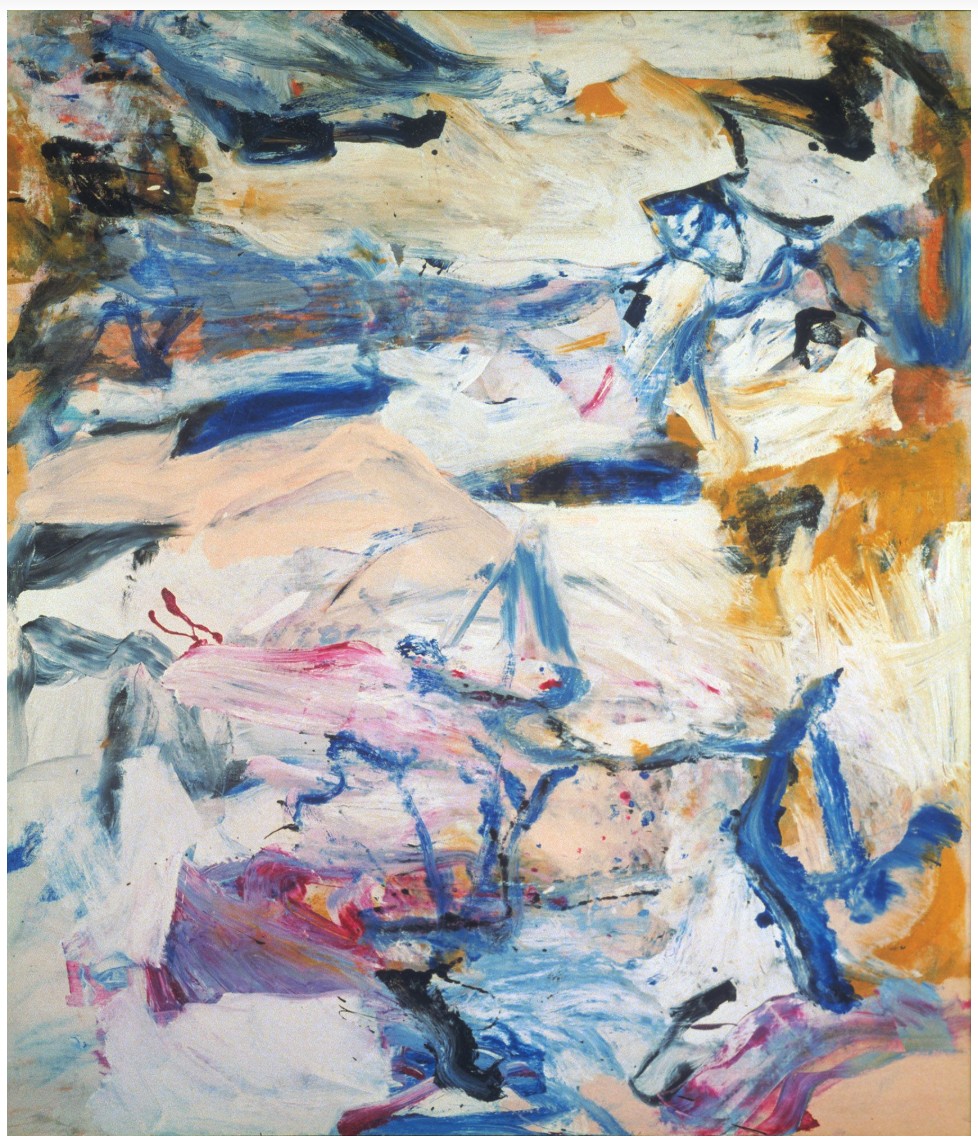
Willem De Kooning, The North Atlantic Light, 1977. Stedelijk Museum, Amsterdam. Artwork: © 2026 The Willem de Kooning Foundation / Artists Rights Society (ARS), New York and DACS, London. Digital image: © 2026 Art Resource/Scala, Florence.
Brown had been immersed in art from a young age. During her studies at the Slade School of Art in London, she cultivated a wide range of interests, admiring the work of the Old Masters, the paintings of Francis Bacon and the achievements of Abstract Expressionism. As her practice evolved, Brown became increasingly fascinated by the relationship between figuration and abstraction, viewing paint as a sensual tool for exploring the melting point between them.
Inspired by Willem de Kooning’s assertion that ‘flesh was the reason oil paint was invented’, she came to understand pigment as a visceral, carnal substance, living and breathing with each stroke. ‘She paints the drama of what it means to have a body,’ writes fellow painter Amy Sillman, ‘and to have desire and to have that body be a surface’ (A. Sillman, quoted in C. Kino, ‘Cecily Brown’s Fearless Approach to Painting’, Wall Street Journal, 2 March 2023).
“I think that painting is a kind of alchemy … I want to catch something in the act of becoming something else.”
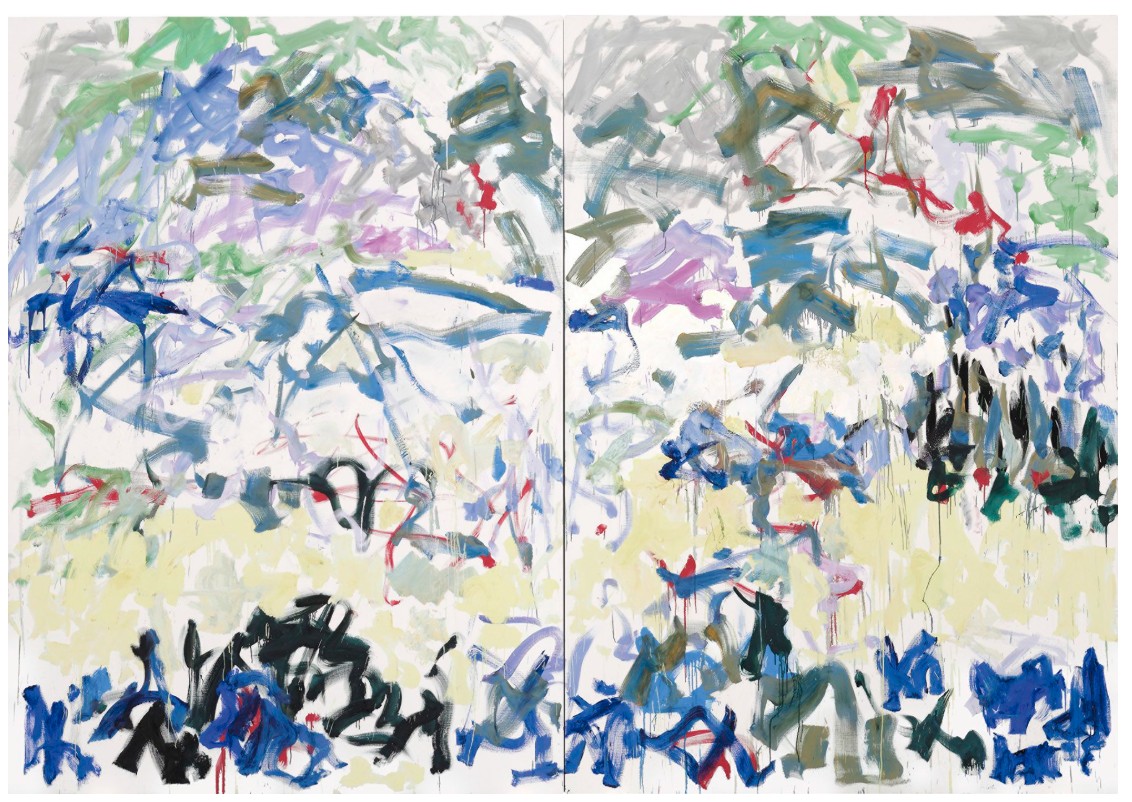
Joan Mitchell, River, 1989. Fondation Louis Vuitton, Paris. Artwork: © Estate of Joan Mitchell.
Shadow Burn is an extraordinary testament to this approach. The figure itself is deeply embedded in the surface of the painting, his form reduced to a spectral conglomeration of brushstrokes. The sense of living flesh, however, is palpable in every corner of the work. Paint undulates across the canvas in seductive waves, with glimpses of peach and ivory tones marbled into the surrounding color. Movement pulses through its veins; light catches the surface of its skin. The artist’s own touch permeates the work, every drip, gesture and swirl of marbled color alive with the trace of her hand. ‘I think that painting is a kind of alchemy’, she said in 2005; ‘… the paint is transformed into image, and hopefully paint and image transform themselves into a third and new thing … I want to catch something in the act of becoming something else’ (C. Brown, quoted in C. Mac Golla Léith, ‘Painting Sensations’, in Cecily Brown: Paintings, exh. cat. Modern Art Oxford, 2005, p. 55).
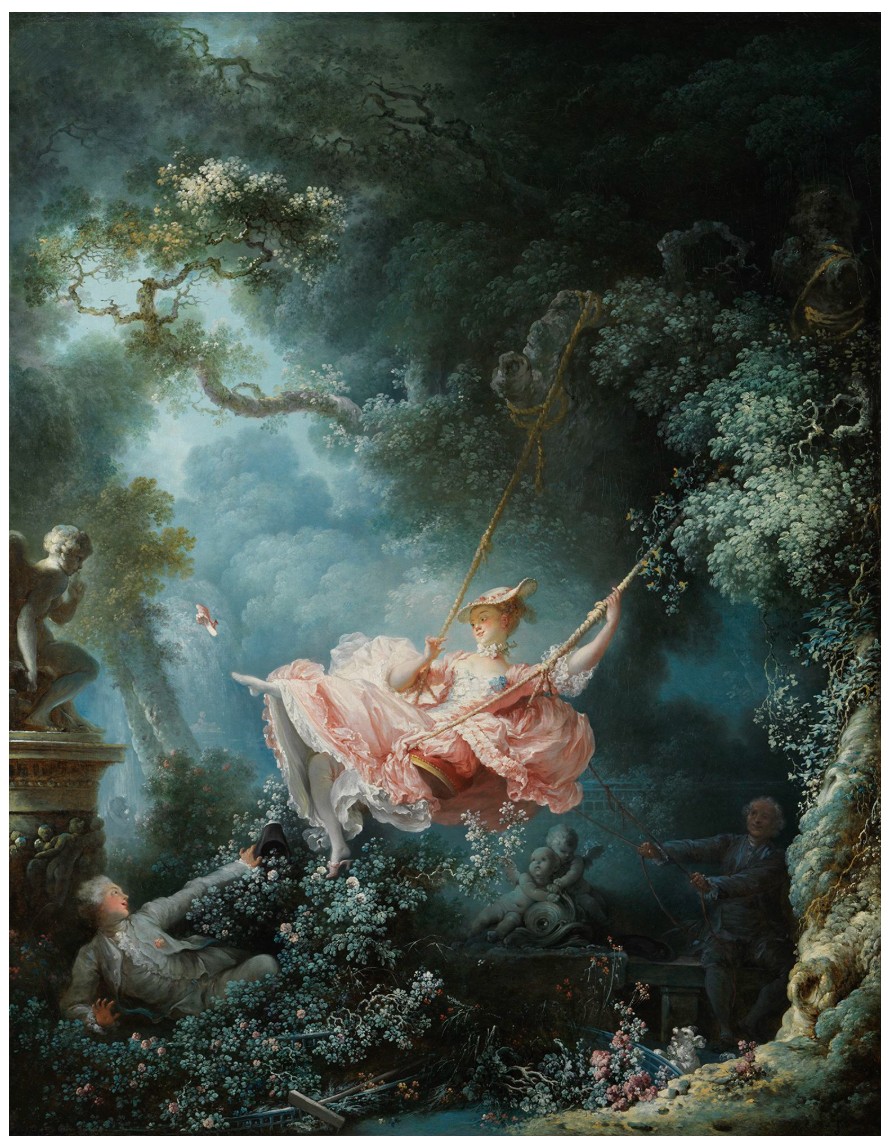
Jean-Honoré Fragonard, The Swing, 1767-1768. The Wallace Collection, London
Many of Brown’s works from this period explored the relationship between figure and landscape: her paintings featured picnics, sensuous nudes in leafy groves and lovers entangled in grass. ‘Their imagery calls forth terms that stream from the antique—gambol and dalliance, virtue and pursuit, bucolic revels and pastoral delights—a kind of visual punning play on scenes of Arcadia’, wrote Johanna Drucker at the time (J. Drucker, ‘Erotic Method’ in Cecily Brown: Paintings 2003-2006, exh. cat. Gagosian Gallery, London 2006, p. 9). Shadow Burn, indeed, calls to mind depictions of the Garden of Eden, as well as the halcyon, sun-kissed world of Cezanne’s bathers. The painting is bathed in golden, glowing light, reminiscent of Poussin and Fragonard. The explicit eroticism of Brown’s early canvases is subtly transformed, manifesting itself as a sublime union between flesh, earth and paint.
“I want there to be a human presence without having to depict it in full.”
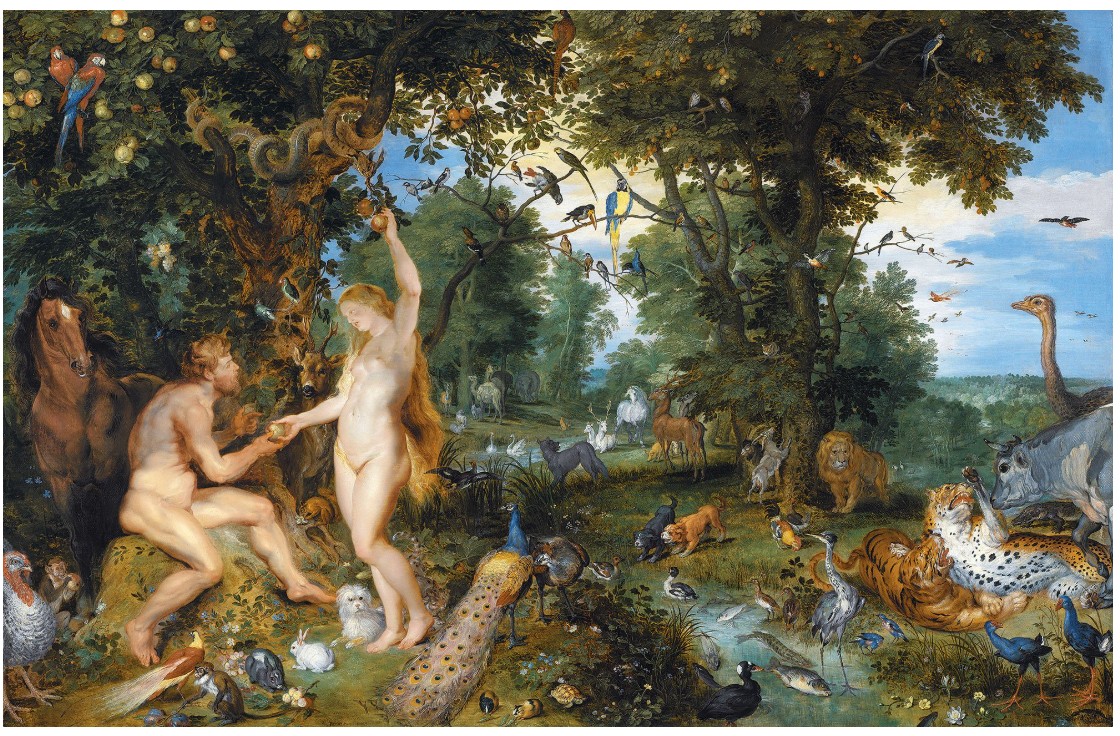
Jan Brueghel the Elder and Peter Paul Rubens, The Garden of Eden with the Fall of Man, circa 1615.
Mauritshuis, The Hague. Digital image: Bridgeman Images.
The work also demonstrates Brown’s exquisite handling of pictorial space. Up close the painting offers a scintillating barrage of color and brushwork, with conflicting abstract forms subsuming the viewer’s field of vision. From a distance, however, it resolves into a thrilling spatial drama: a cinematic spectacle that looms large in three dimensions. Tiny calligraphic details seem to take on a life of their own, calling to mind pots of flowers, houses or bridges over bodies of water. In the blink of an eye, they return to shadowy enigmas. In places, Brown’s paint is liquid and translucent, melting in streaks and rivulets down the length of the canvas. Elsewhere, it is thick and tactile, pushing itself to the foreground. The artist’s titles, too, are fueled by a similar ambiguity, culled from song lyrics, film titles, lines of poetry or simply the depths of her imagination. Here, the words ‘Shadow Burn’ eloquently capture the painting’s shifting states, where darkness gives way to incendiary glow.
Mean Eyed Cat, 2012
PROPERTY FROM AN IMPORTANT PRIVATE EUROPEAN COLLECTION
Christie’s London: 7 March 2026
Estimated: GBP 600,000 – 800,000
GBP 1,016,000 / USD 1,357,275
CECILY BROWN (B. 1969), Mean Eyed Cat | Christie’s
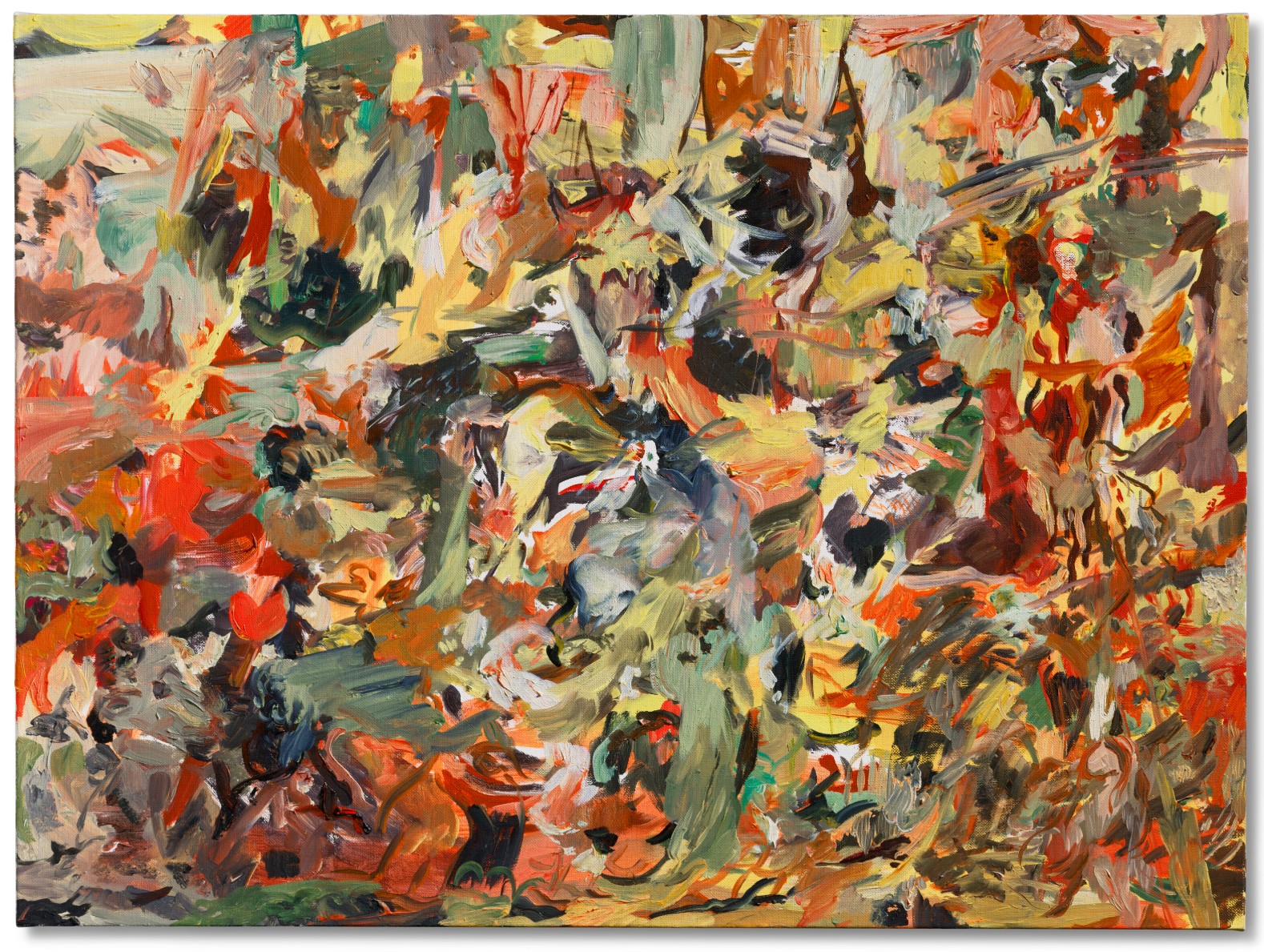
CECILY BROWN (B. 1969)
Mean Eyed Cat, 2012
Oil on linen
22-7/8 x 31-1/8 inches (58×79 cm)
Signed and dated ‘Cecily Brown 2012’ (on the reverse)
Streaks of red, orange, sage green and burnt umber interweave and burst with an explosive force across Cecily Brown’s Mean Eyed Cat. Executed in 2012, and included in the artist’s solo exhibition at the Essl Museum, Vienna that year, the painting teems with energy. Thick impasto converges with diaphanous flashes of pigment. Silhouettes and limbs emerge from this painterly tumult, coalescing then dissolving from one moment to the next. Animated black marks conjure the agile movements of the titular feline: a recurrent motif for the artist.
The subject of major forthcoming exhibition at the Serpentine Gallery, London opening in March 2026, Brown’s art is defined by its exuberant color and texture. Enraptured by paint’s materiality, she aims to incorporate its visceral qualities within the act of image-making itself. At the time she made Mean Eyed Cat, Brown had shifted away from the electric pigments of her earlier work to embrace an earthier, more autumnal palette. Sensual, corporeal and tactile, the work’s voluptuous surface immerses the viewer in the haptic pleasures of paint.
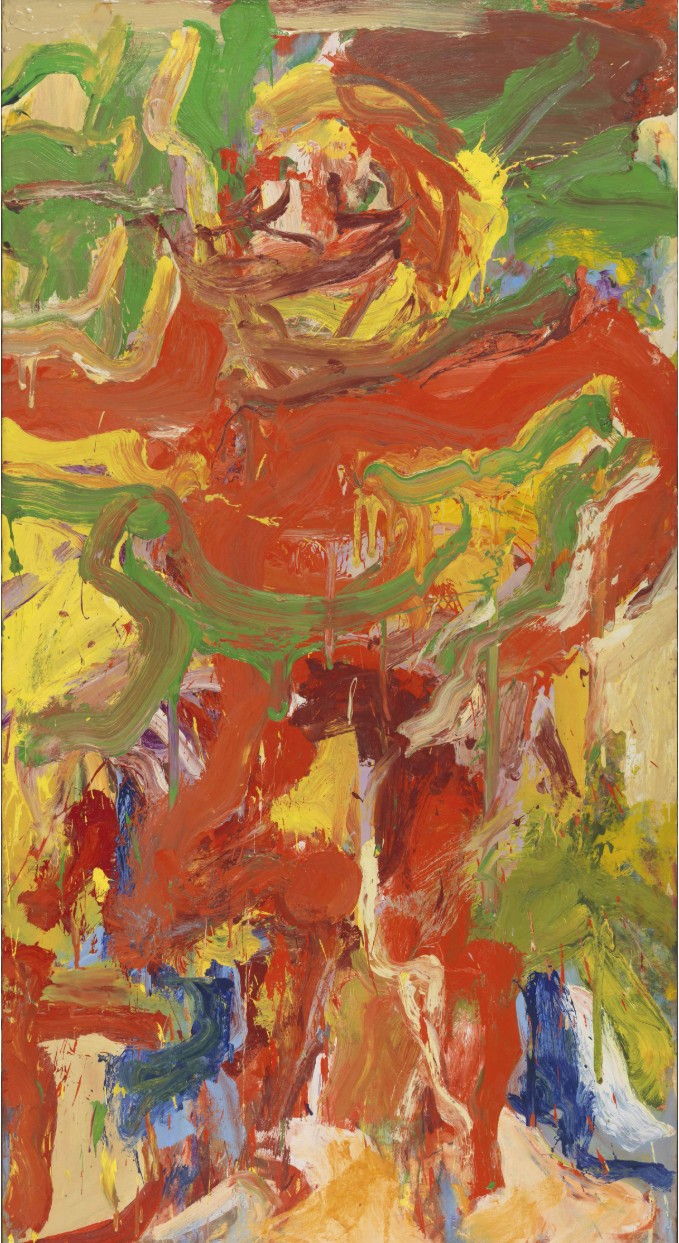
Willem de Kooning, Red Man with Moustache, 1971. Thyssen-Bornemisza National Museum, Madrid. Artwork: © 2026 The Willem de Kooning Foundation / Artists Rights Society (ARS), New York and DACS, London.
Digital image: © Museo Nacional Thyssen-Bornemisza, Madrid / Bridgeman Images.
When Brown came of age as a painter in 1990s London, her practice stood in stark contrast to the more conceptual approaches of her Young British Artist (YBA) contemporaries. She has always viewed painting with a sincerity rooted in profound respect for the medium’s history. Across her oeuvre, Brown draws on a wide range of visual sources, turning to Peter Paul Rubens for a particular flesh tone, or to Francisco Goya for a twist of social satire. Following her education at the Slade School of Art, Brown moved to New York in 1994, and her expanding range of influences—from Eugène Delacroix and Edouard Manet to American Abstract Expressionists such as Willem de Kooning—reveals a transatlantic education.
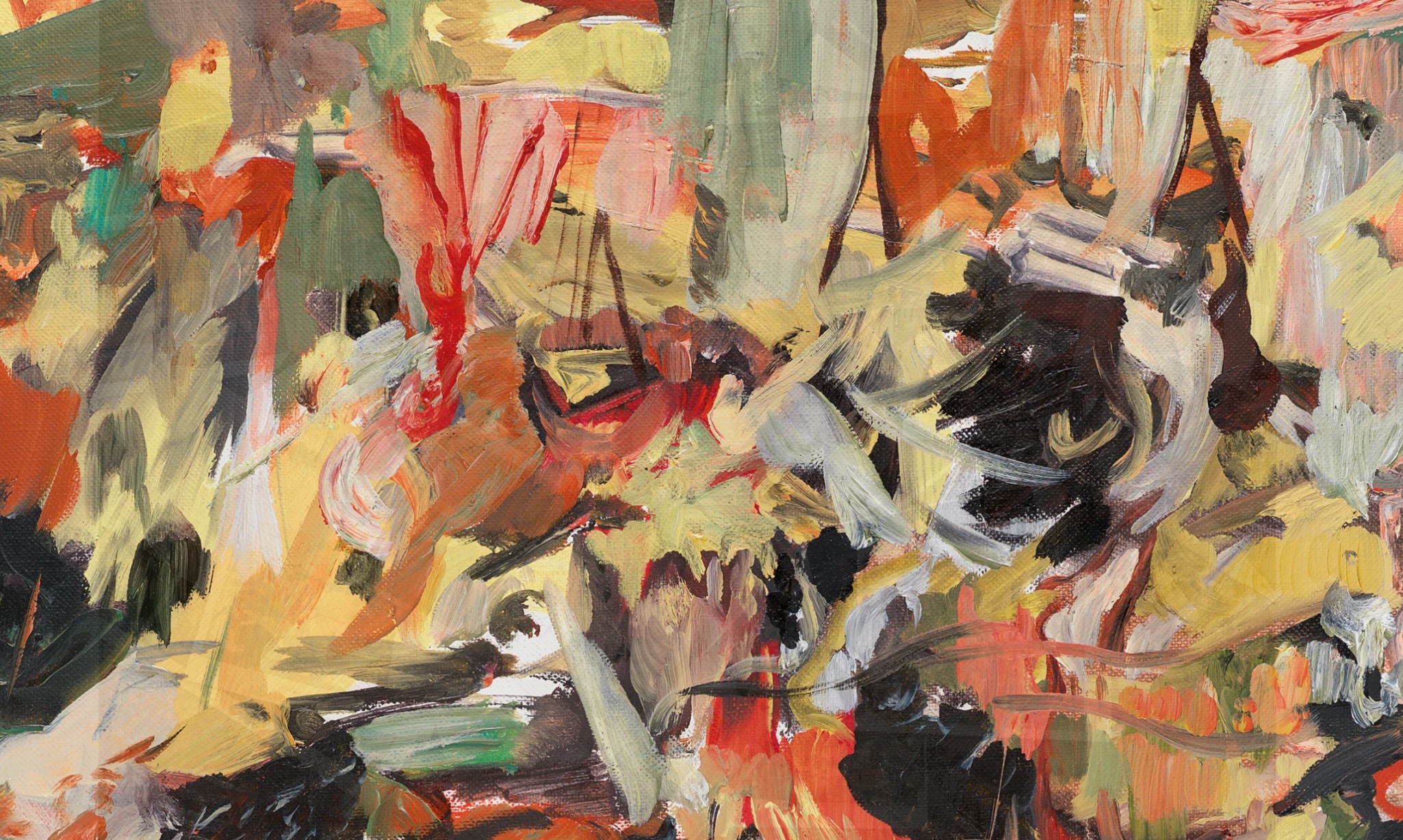
During the period Brown painted Mean Eyed Cat, her muses were as diverse as ever. She has mentioned taking inspiration from, among others, Edgar Degas, Jean-Auguste-Dominique Ingres, pornography, and rock-and-roll album art, particularly Jimi Hendrix’s 1968 Electric Ladyland, whose cover featured a photograph of a harem-like ensemble of naked women. This image brought her back to painting the female nude: ‘Formally I was drawn to it,’ she explained, ‘like a pile of body parts’ (C. Brown, quoted in R. Small, ‘Cecily Brown Shows Her Women Uptown’, Interview, 7 May 2013, online). Insinuations of women’s bodies fill Mean Eyed Cat, all rendered in a variety of poses and configurations. The bending figure apparent in the painting’s foreground, for example, alludes to the traditional motif of the bather as depicted by Degas, Ingres, and Cezanne, among others.
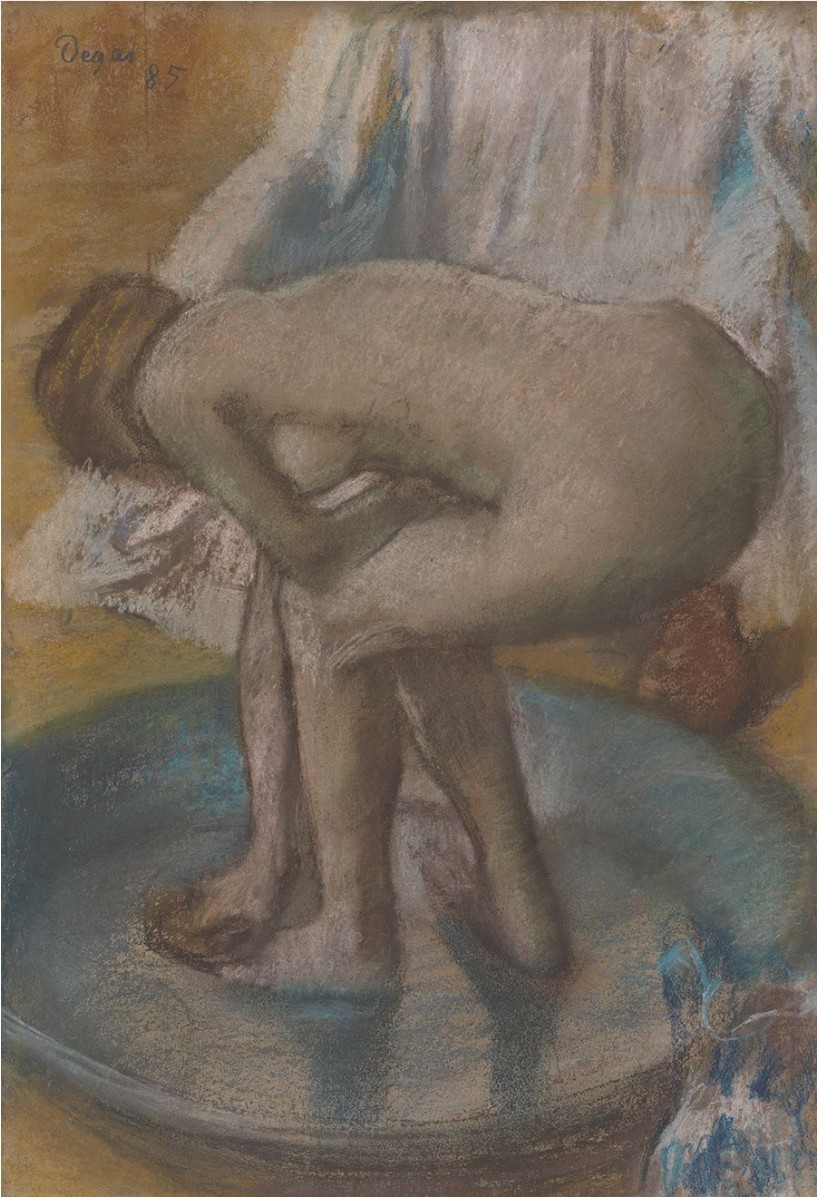
Edgar Degas, Femme se baignant dans une baignoire peu profonde, 1885. The Metropolitan Museum of Art, New York.
Digital image: Courtesy The Metropolitan Museum of Art, New York.
Similarly open-ended are the titles of Brown’s paintings, many of which are taken from lists of catchy phrases culled from perfume bottles, films, pubs, and songs, among countless other sources. Mean Eyed Cat was suggested by the 1955 song written and performed by Johnny Cash. Brown is always seeking multilayered interpretations, and her titles are meant to be suggestive rather than descriptive. This attitude is echoed in her brushwork, which likewise conjures an emotional narrative through indefinable and abstracted means. The artist values the immediacy conjured through her more intimately-scaled works, noting that such works often feel ‘grander’ than larger pictures for their ability to convey an entire ‘sense of a universe’.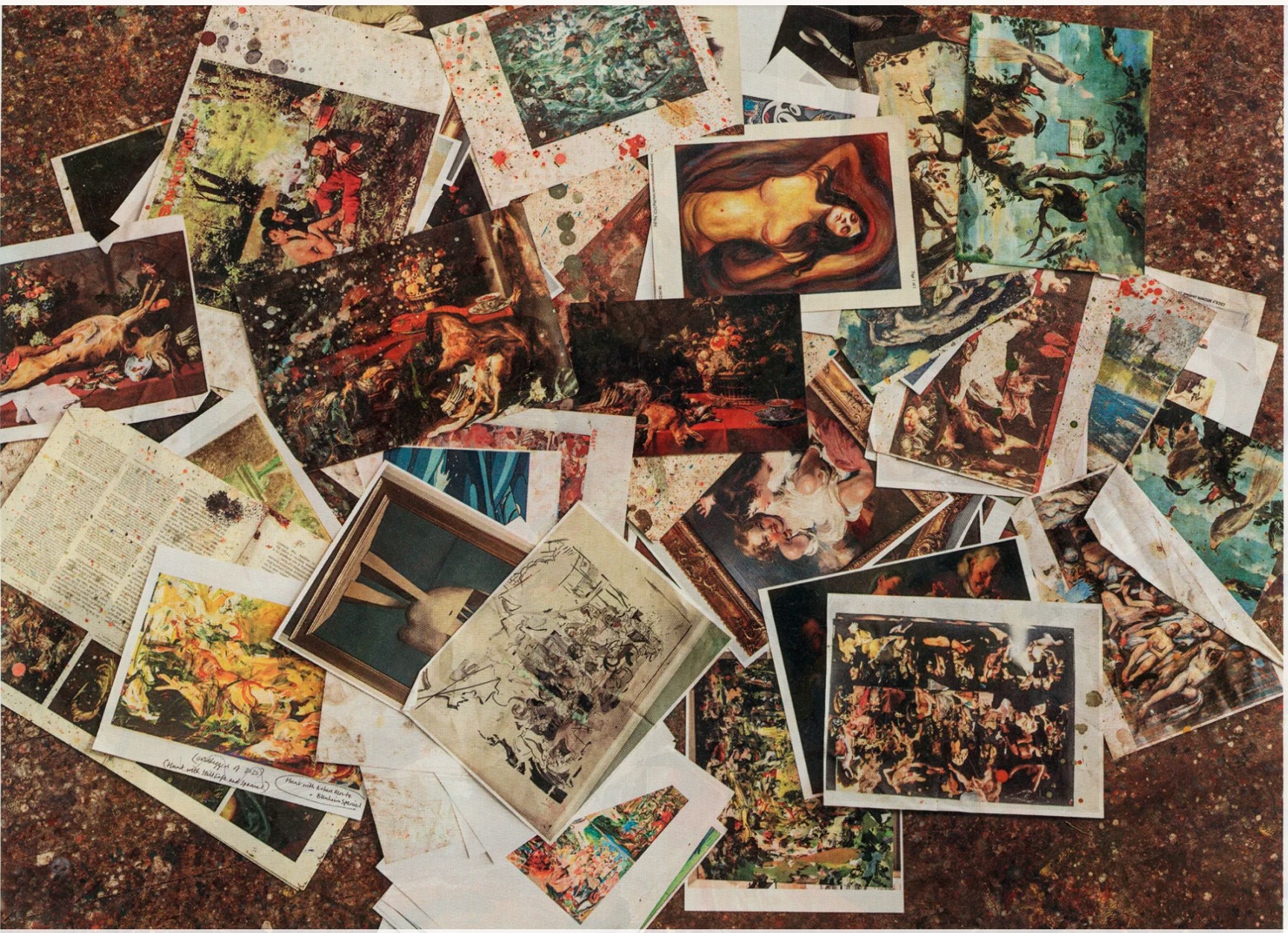
Source materials in Brown’s studio, 2022. Photo: Genevieve Hanson. Artwork: © Cecily Brown
While Brown’s loose, gestural imagery may appear improvised, the paintings are in fact consciously constructed. Each stems from a clear idea that often emerges following an encounter with a distinct piece of visual culture.
“You grope to understand what might be an image, it remains out of reach, you concentrate harder and other readings flood in, something obliterating the first but also enhancing, exaggerating, echoing …’”
Mean Eyed Cat is replete with such layering and a testament to Brown’s uninhibited and generative approach to painting, one that sees the past on equal footing with the present and allows both to produce new meanings.
George Condo
Infiltration, 2017
Sotheby’s London: 4 March 2026
Estimated: GBP 1,500,000 – 2,000,000
GBP 2,286,000 / USD 3,053,865
Infiltration | Modern & Contemporary Evening Auction | 2026 | Sotheby’s
GEORGE CONDO (b. 1957)
Infiltration, 2017
Oil, acrylic and oilstick on canvas
76×96 inches (193 x 243.8 cm)
Signed and dated 2017 (upper left)
A tour de force of chromatic and psychological invention, Infiltration epitomises the restless virtuosity that has made George Condo one of the defining painters of his generation. Executed in 2017, the present work condenses the principal energies of Condo’s practice into a single panoramic field – fractured figuration together with a bravura collision of drawing and painting. Across its monumental surface, a raucous ensemble of characters jostles for attention, each animated by the artist’s unmistakable blend of humor and unease, both inflected with formal sophistication. Condo’s ability to blend contemporary and historical references has placed him as a household name in the annals of contemporary art history, further underscored by his recent major retrospective at the Musée d’Art Moderne in Paris, which closed in February 2026.
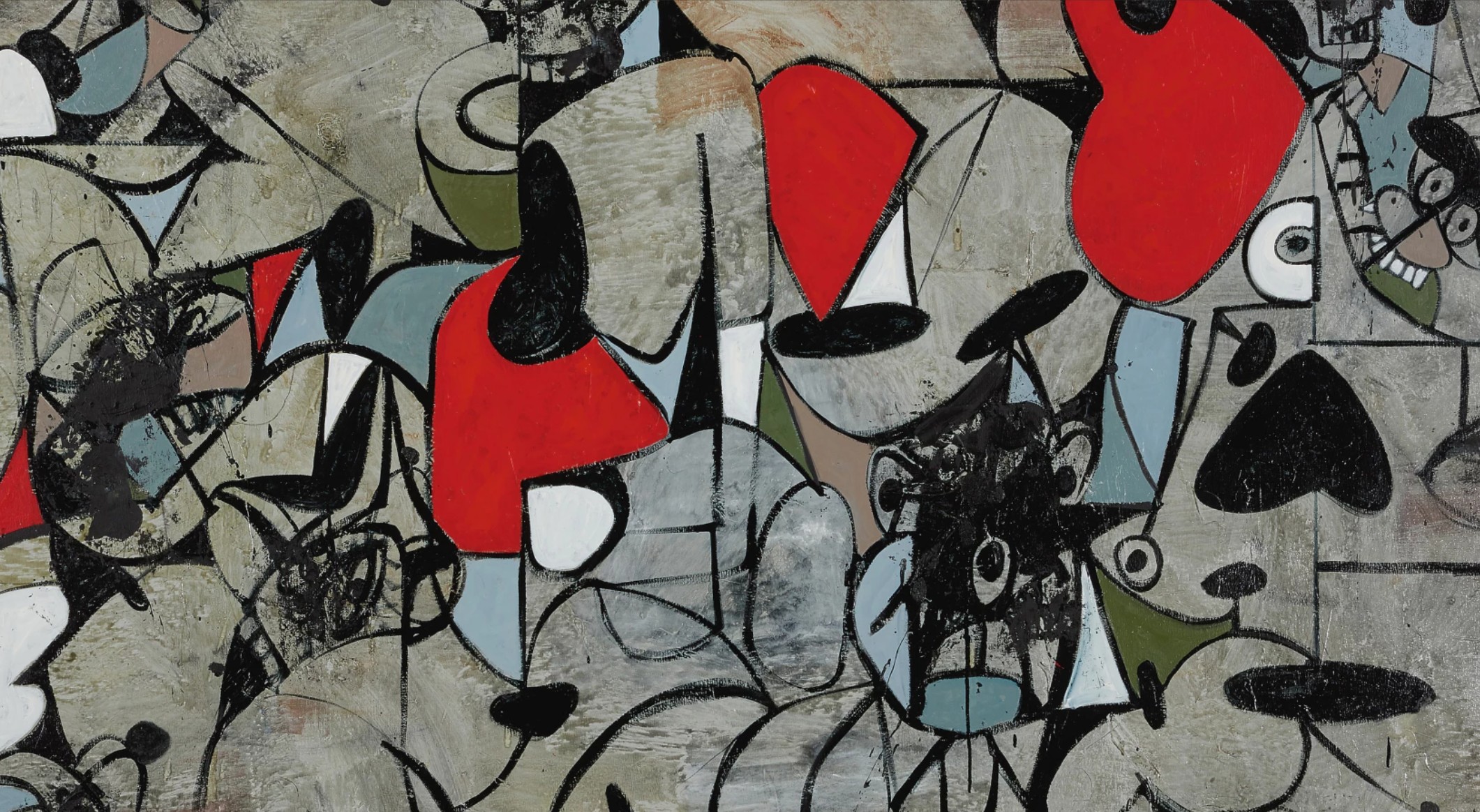
Condo has long described his project as a form of ‘psychological cubism,’ a mode in which the picture plane becomes a stage for simultaneous states of mind. In Infiltration, this principle is realized with exceptional clarity. Faces tilt, overlap, and dissolve into one another; bodies emerge and recede as though caught in perpetual motion. What appears at first glance to be a single crowded scene gradually reveals itself as a constellation of interior dramas. There are clear echoes of Picasso, de Kooning and Guston that become absorbed into Condo’s singular idiom, transformed by an imagination that treats art history as living material. Pablo Picasso has remained referential for Condo throughout his oeuvre, and thus, like Picasso before him, he dismantles conventional perspective, yet he does so not to explore multiple physical viewpoints but in the pursuit to depict the layered complexity of human consciousness. Through this he interrogates form – challenging the viewer’s perception of reality. Just as Picasso broke away from representational art, the present work exemplifies Condo’s turn towards artificial realism and the synonymous reimagining of traditional techniques in a contemporary context.
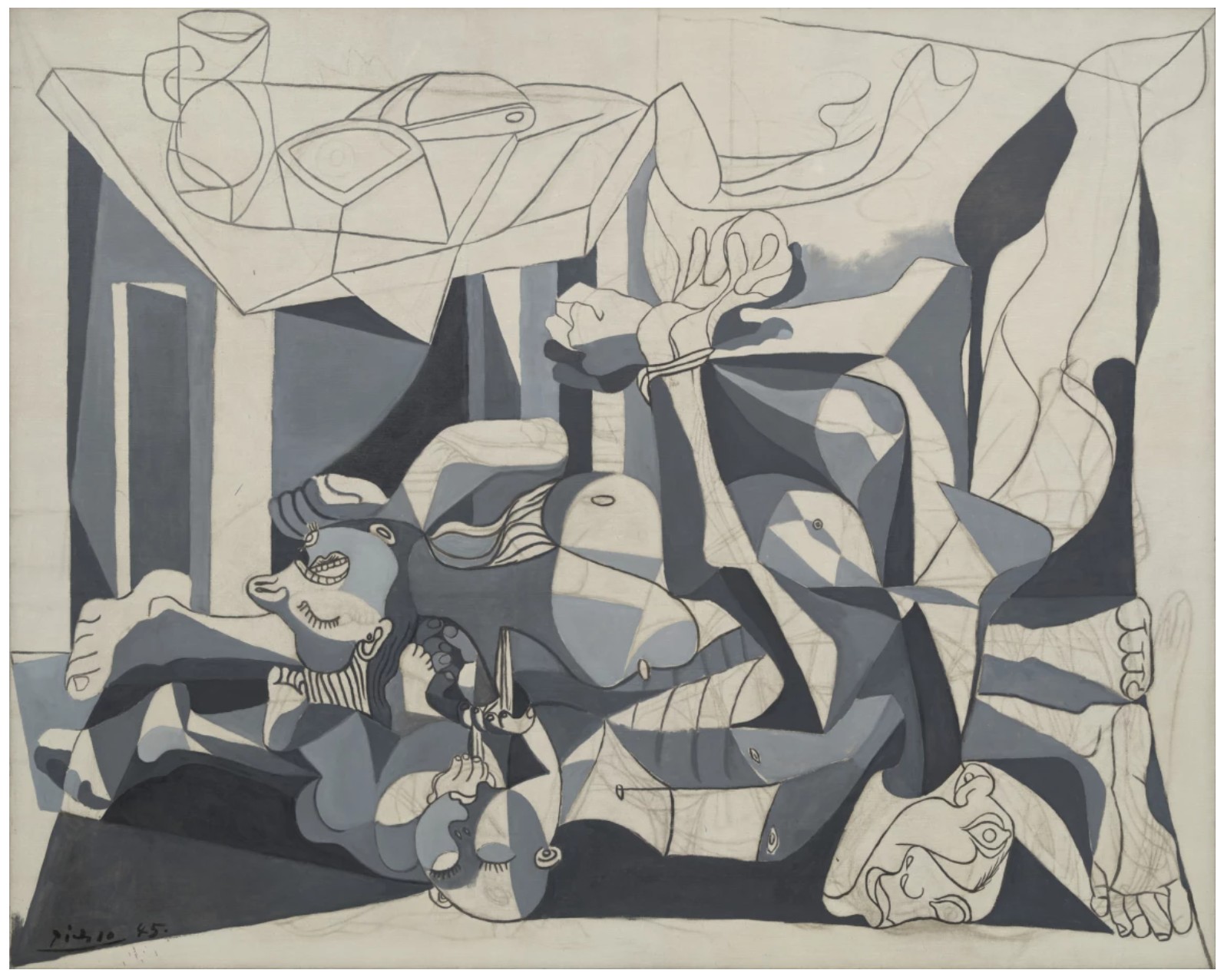
Pablo Picasso, The Charnel House, Paris, 1944-45. The Museum of Modern Art, New York. Art © 2026 Succession Picasso/DACS, London
The material language of the painting mirrors this conceptual ambition. Working across oil, acrylic and oilstick, Condo builds the image through successive strata of color and line, allowing earlier gestures to surface through later passages. The result is a surface alive with revisions and improvisations through a record of decisions made in real time. As the artist has observed, he deliberately chooses difficult tonal relationships in order to discover a path through them – a process that transforms the act of painting into a form of problem-solving performance. Trained in music theory before turning fully to painting, Condo has frequently likened his working method to jazz improvisation, with rhythm and tempo guiding the hand as surely as any formal plan. The present composition unfolds like an intricate musical arrangement: motifs recur and mutate while discordant notes find unexpected harmony, and disparate voices coalesce into a boisterous chorus. Infiltration initially presents itself as a site of visual chaos, though upon closer inspection, reveals itself to be a carefully calibrated orchestration.
Within this teeming arena, Condo collapses distinctions between the comic and the tragic. Cartoonish grins coexist with expressions of palpable anxiety, and classical allusions rub shoulders with Pop-inflected caricature. For Condo, the legacy of past masters becomes a means of self-definition – a vocabulary to be rearranged in the service of new psychological realities. At once exuberant and unsettling, Infiltration captures the essence of Condo’s vision: a world in which the human condition appears fragmented, volatile and irrepressibly alive.
The Housekeeper’s Family, 2004
Christie’s London: 7 March 2026
Estimated: GBP 180,000 – 250,000
GBP 444,500 / USD 593,810
GEORGE CONDO (B. 1957), The Housekeeper’s Family | Christie’s
GEORGE CONDO (B. 1957)
The Housekeeper’s Family, 2004
Oil on canvas
48×36 inches (122 x 91.4 cm)
Signed, titled and dated ‘Condo 04 The Housekeeper’s Family’ (on the reverse)
An arresting example of George Condo’s melding of caricature and pathos, The Housekeeper’s Family (2004) playfully refracts art-historical references through his own absurd symbolic lexicon. The large-scale painting presents three figures, the titular housekeeper and her two children, standing before a blue-green backdrop. With distorted, impastoed faces, they sport carrots growing out of their ears. During the early 2000s, figures working in domestic help began to populate many of Condo’s canvases, including a French maid and the recurring rogues Jean-Louis, a butler, and Rodrigo, a valet. The character of the housekeeper seen here recurred in several compositions. In 2005, the painting was part of the major exhibition George Condo: One Hundred Women, at the Museum der Moderne, Salzburg and the Kunsthalle Bielefeld.
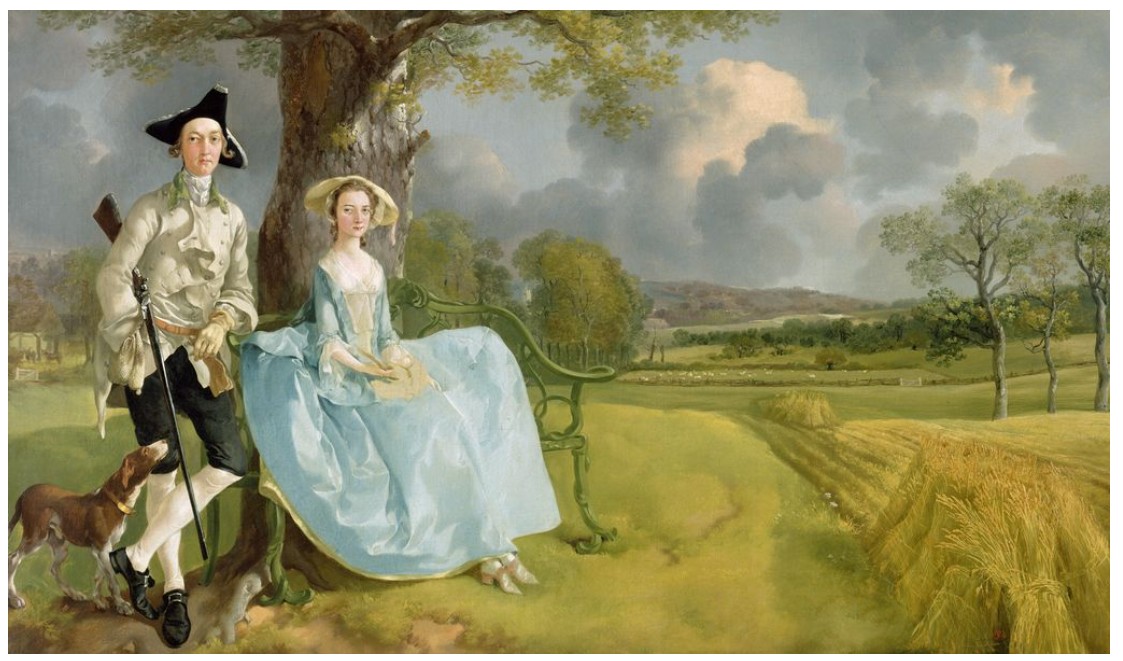
Thomas Gainsborough, Mr and Mrs Andrews, circa 1748-1749. National Gallery, London. Digital image: Bridgeman Images.
The muted palette and moody, broad-brushed background of The Housekeeper’s Family lend the painting an Old Masterly aspect, contrasting with the surreal appearance of the depicted trio. The carrot, intruding in various ways into these carnivalesque portraits, was a recurrent motif within Condo’s oeuvre of this period, and one that the artist understood to be a ‘metaphor for false hope’ that seemingly signifies an artificial existence (G. Condo quoted in R. Rugoff, ‘The Enigma of Jean Louis’, in George Condo: Existential Portraits, exh. cat. Luhring Augustine, New York 2006, p. 12).
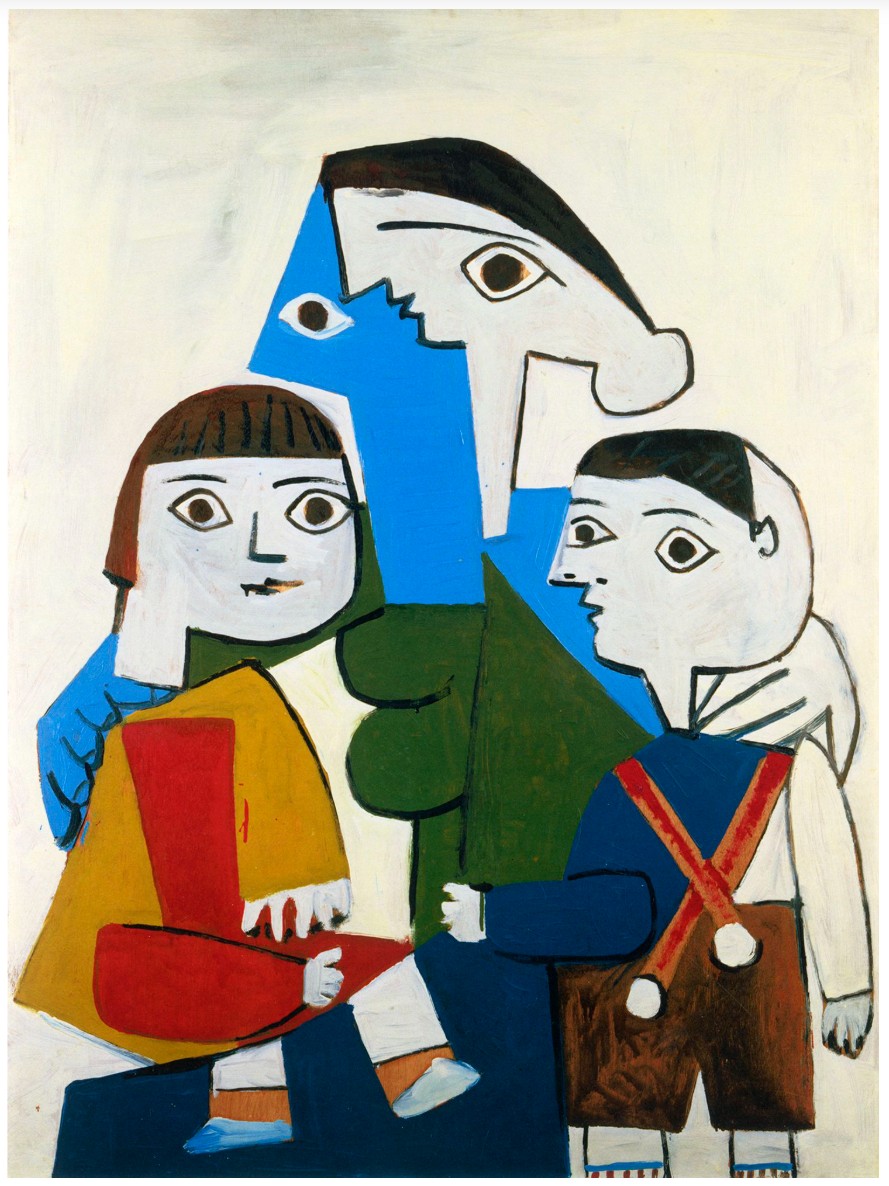
Pablo Picasso, Maternité sur fond blanc, 1953. Private collection. Artwork: © 2026 Succession Picasso/DACS, London.
Condo never modelled his imagery on a single source but drew upon impulses from a diverse range of material. In The Housekeeper’s Family, the little girl dressed in a tutu recalls Edgar Degas’ famous ballerinas, but she also has a more personal significance, tied to Condo’s own memories of the children’s ballet classes that took place directly across from his studio in Paris. During the period that he painted The Housekeeper’s Family, Condo was also interested in paintings by Diego Velázquez and Edouard Manet, whose work had been placed in dialogue in the 2003 exhibition The French Taste for Spanish Painting at The Metropolitan Museum of Art, New York. Like Manet’s studies of absinthe drinkers, singers, and musicians, Condo’s paintings often feature type-figures that, although invented, occupy real positions in society.
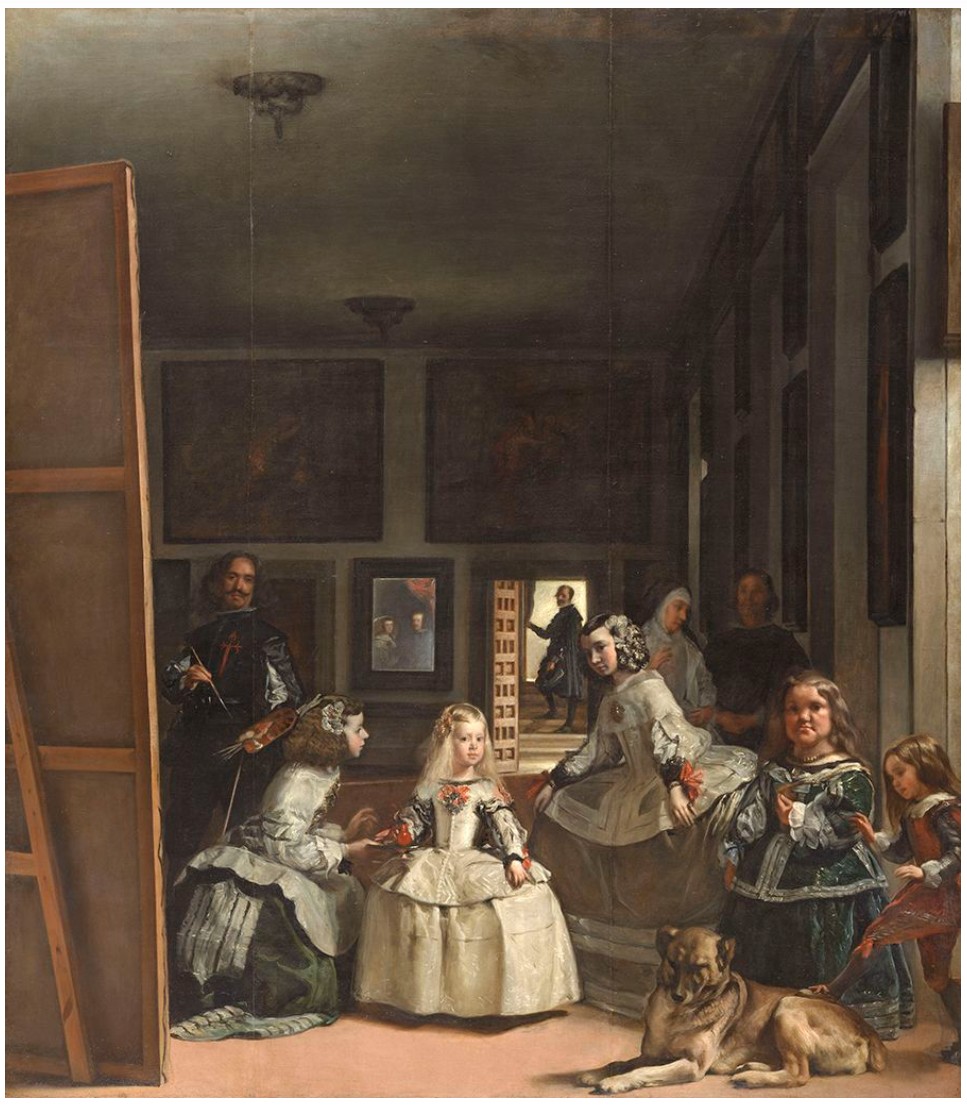
Diego Velázquez, Las Meninas, 1656. Museo Del Prado, Madrid.
Digital image: © 2026 Museo Nacional del Prado © Photo MNP / Scala, Florence.
Condo’s practice has long engaged with a variety of techniques, symbols, and motifs from every art-historical era. He came of age in 1980s New York, befriending Jean-Michel Basquiat and worked for Andy Warhol, before relocating to Paris for ten years, where he immersed himself in French philosophy. It was against this backdrop of wide-ranging influences that he began to study and copy the artists that he loved, from Caravaggio and Cezanne to de Kooning and Picasso, who remains a particular favorite. Condo has described his jarring and forcefully synthetic style as ‘artificial realism’.
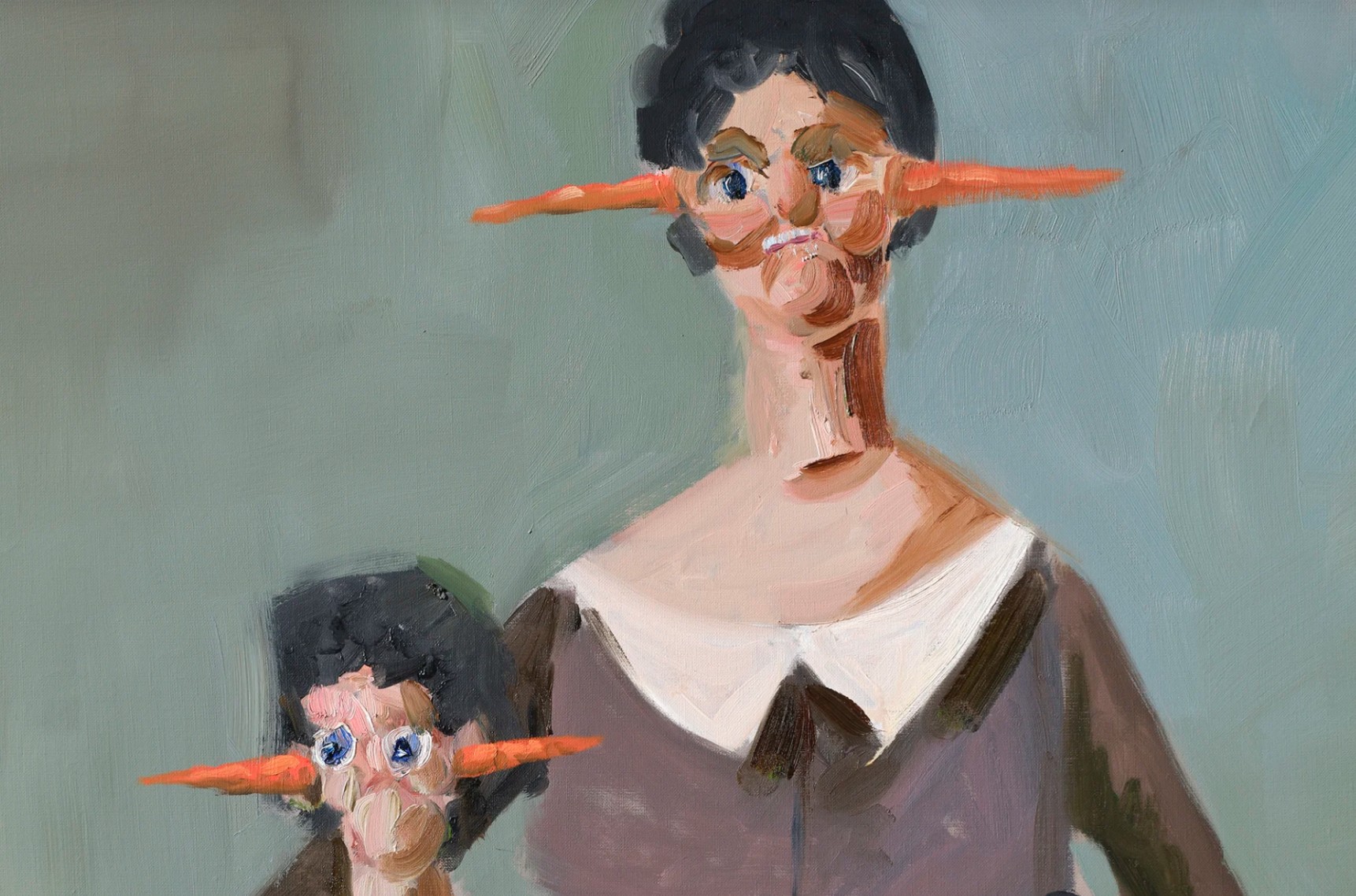
By embracing disorientation as an artistic gesture, his compositions trigger layered and contradictory responses. The tragicomic characters that Condo depicts in The Houskeeper’s Family appear to possess complex psychologies, at once outlandish and sympathetic, vulnerable yet potent.
Damien Hirst
Love Affair, 2001
Property from a Prestigious Collection
Sotheby’s London: 4 March 2026
Estimated: GBP 300,000 – 400,000
GBP 320,000 / USD 427,490
Love Affair | Modern & Contemporary Evening Auction | 2026 | Sotheby’s
DAMIEN HIRST (b. 1965)
Love Affair, 2001
Household gloss on canvas with butterflies
100-3/8 x 69-3/8 inches (255 x 176.2 cm)
Signed (on a label affixed to the reverse)
Executed in 2001, Love Affair is a commanding and monumental example of Damien Hirst’s butterfly paintings, articulating with clarity the enduring tension between beauty and mortality that lies at the core of his practice. Perhaps his most recognizable and iconic motif, Hirst’s butterflies established the artist as a household name in the enveloping canon of contemporary art. Hypnotic and immersive in equal measure, the present work epitomizes Hirst’s ongoing dialogue with art history, recalling Dosso Dossi, Jupiter and Painter: an allegory of boundless imagination. In a further nod to the Victorian pastime of entomology, the present work teeters between tragic poignancy and exultant splendor. Here, set against a lustrous ground of deep violet gloss and arranged in a rhythmic constellation, the butterflies hover between flight and stasis, embodying the philosophical contradictions that define Hirst’s oeuvre.
“I think I’ve got an obsession with death, but I think it’s like a celebration of life rather than something morbid. You can’t have one without the other.”
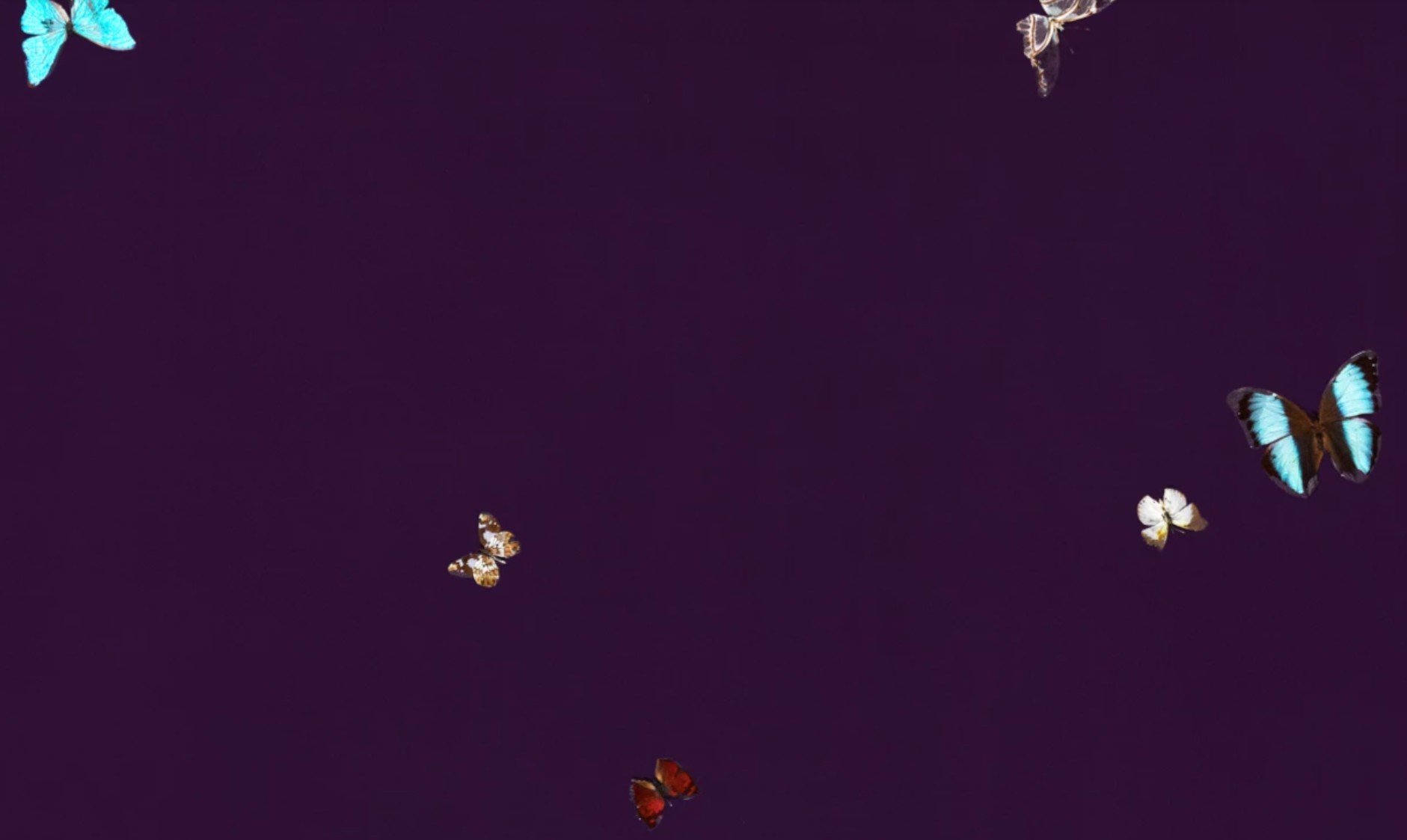
Hirst’s use of exotic butterflies dates back to his first solo exhibition in 1991, In and out of Love, which took place in an empty shop split over two floors. Downstairs, Hirst presented his first series of monochrome butterfly paintings alongside ashtrays containing cigarette butts; the inherent natural beauty of the butterflies juxtaposed by the chemical toxicity of the cigarettes, symbolically tainting the air we breathe. Upstairs, white paintings covered with pupae of Malaysian butterflies were hung about the room. Butterflies would hatch and flutter around the room, feeding on nectar from potted plants before eventually dying in the very same room wherein they were born. In a captivatingly sensationalist manner, Hirst presented life and death for all to witness and experience in a manner fully encapsulated within Love Affair. Hirst’s butterflies have quickly become a potent symbol for both the beauty and fragility of life.
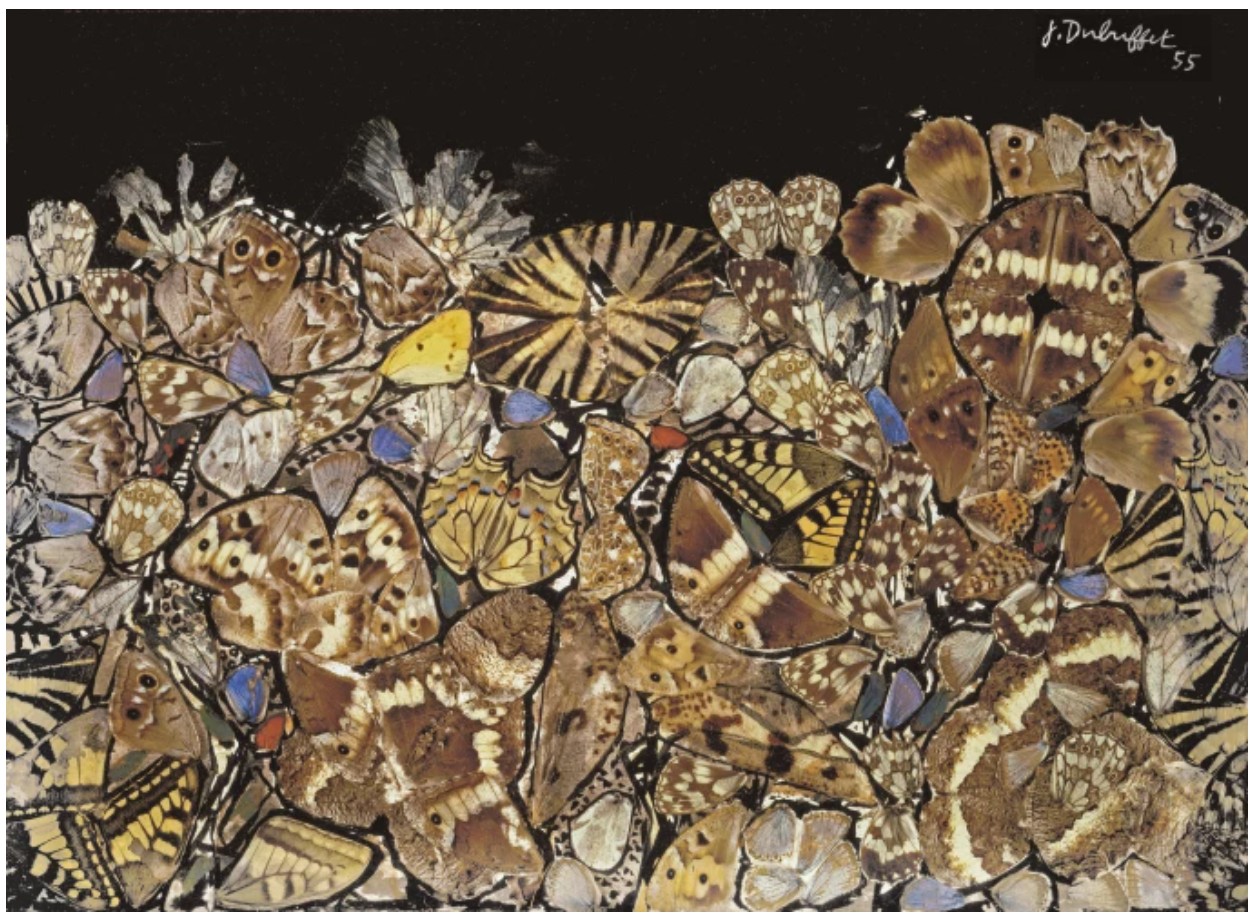
Jean Dubuffet , Jardin Mouvementé, 1955. Private Collection. Image/Art: © 2026 ADAGP, Paris/DACS, London Jean Dubuffet
Butterflies have long been a source of artistic inspiration and fascination; from the sixteenth century still-life painters, including the likes of Jan Brueghel the Elder, whose fine brush strokes captured the intricate patterns of fluttering wings, to Jean Dubuffet who collaged the iridescent species as found objects on his canvases. As a universal symbol of metamorphosis from chrysalis, the butterfly serves as both subject and material in Love Affair, their brief, radiant existence serving as a profound existential metaphor for the human condition. As the work’s title suggests, for Hirst, the very transience of the butterfly: its intense, ephemeral burst of beauty before inevitable disappearance, mirrors the fleeting, intoxicating nature of a love affair.
Dosso Dossi, Jupiter, Mercury and Virtue, 1524. Wawel Royal Castle National Art Collection, Krakow.
When asked to comment on the connection between love in relation to his butterfly paintings, as epitomized by Love Affair, Hirst responded: “Because it seems too difficult to sustain. Love is realistic; desire unrealistic. It’s easier to blindfold yourself, change your girlfriend every six months and not look in the mirror to live with someone forever and see change. Although I’m tired of the word Love, it’s like ‘God’. Instead of saying ‘I love you,’ I want to say, ‘I’m delighted you’re alive.” (the artist quoted in: Exh. Cat., New York, Gagosian Gallery, Damien Hirst: No Sense of Absolute Corruption, 1996, pp. 116-17). The present work, in this sense, offers a profound meditation on desire and loss, articulating the enduring human impulse to hold on to that which is, by its nature, miraculous, though destined to disappear.
Beautiful Scary Clown in a Rockabilly Town Painting, 2006
Christie’s London: 7 March 2026
Estimated: GBP 200,000 – 300,000
GBP 298,450 / USD 398,700
DAMIEN HIRST (B. 1965), Beautiful Scary Clown in a Rockabilly Town Painting | Christie’s
DAMIEN HIRST (B. 1965)
Beautiful Scary Clown in a Rockabilly Town Painting, 2006
Household gloss on canvas
95-1/4 x 107-1/2 inches (242×273 cm)
Stamped with artist’s stamp ‘HIRST’ (on the reverse and stretcher)
Damien Hirst’s Beautiful Scary Clown in a Rockabilly Town Painting is a kaleidoscopic burst of colour. Astral rings of red, yellow, green, and dark blue give way to one another across the mammoth canvas as streaks of metallic gold erupt from the centre and flicker outward in spontaneous flares. Executed in 2006, the work is part of the artist’s Spin Painting series, which he began making more than a decade prior. To create them, Hirst affixed a canvas to a rotating motor and then poured pigments onto the whirling white expanse. This motion, its effects captured in centrifugal explosions of color, was central to the final painting.
“The movement sort of implies life.”
Jackson Pollock, Number 22, 1949. Private collection. Artwork: © 2026 Jackson Pollock, DACS.
Hirst’s inspiration for the Spin Paintings emerged from memories of seeing the technique demonstrated during an episode of the children’s programme Blue Peter. His fascination piqued, he later attempted the method himself at a school fête.
“I queued up all day and I was making them over and over again.”
He produced several examples in his Brixton studio in 1992. The following year, Hirst and the artist Angus Fairhurst organised their own spin stall at Joshua Compston’s legendary street fair A Fête Worse than Death in London’s Hoxton neighbourhood. Visitors were invited to pay 50p to create their own unique spin paintings, which the artists, dressed as clowns, would sign. The present work’s title, Beautiful Scary Clown in a Rockabilly Town Painting, seems to hark back to this event and its carnivalesque costumes.
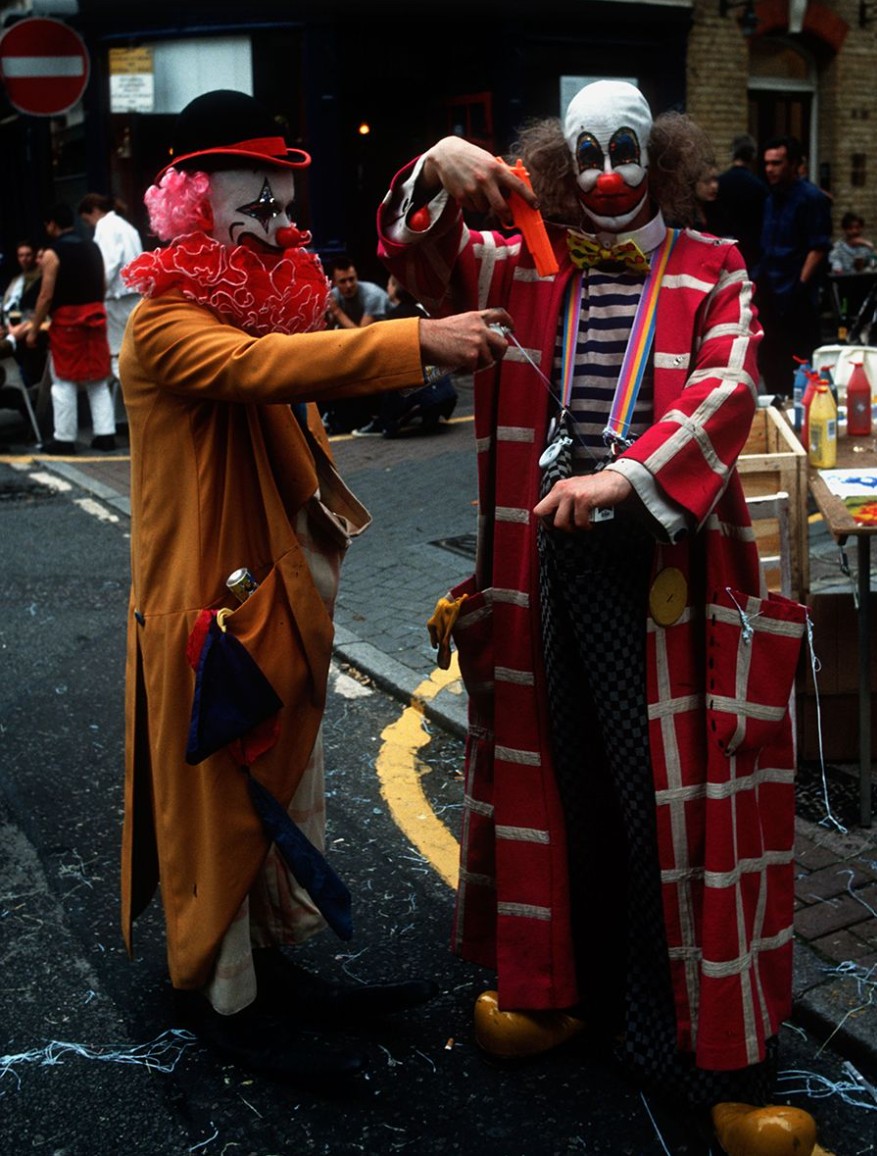
Angus Fairhurst and Damien Hirst at the original A Fête Worse Than Death, Hoxton, London, 1993. Photo: © Guy Moberly via Alamy.
As expressions of chance and vitality, the Spin Paintings represent a departure from the themes of decay and death that had characterized Hirst’s earlier work. They are optimistic visions that revel in the act of painting and all its attendant mythology, and for the artist they conjure the same sense of wonder he experienced as a child.
“I really like making them. And I really like the machine, and I really like the movement. Every time they’re finished, I’m desperate to do another one.”
At the same time, the series reflects Hirst’s emerging interest in automated processes—and the relationship between order and chaos—which has continued to inform his practice. Above all, works such as Beautiful Scary Clown in a Rockabilly Town Painting celebrate the power of paint, and by removing his own hand from the act, Hirst takes great pleasure in the medium’s unpredictable and manifold possibilities.
Hydrogen Peroxide, 2007-2011
PROPERTY FROM AN IMPORTANT AMERICAN COLLECTION
Christie’s London: 7 March 2026
Estimated: GBP 100,000 – 150,000
GBP 203,200 / USD 271,455
DAMIEN HIRST (B. 1965), Hydrogen Peroxide | Christie’s
DAMIEN HIRST (B. 1965)
Hydrogen Peroxide, 2007-2011
Household gloss on canvas
38×42 inches (96.5 x 106.9 cm) (2 inch spot)
Signed ‘Damien Hirst’ (on the stretcher)
Signed, titled and dated ‘Hydrogen Peroxide Damien Hirst 2007-2011’ (on the reverse)
Grecian Nude, 2013
Property from an Important Private Collection
Sotheby’s London: 5 March 2026
Estimated: GBP 250,000 – 350,000
GBP 435,200 / USD 581,385
Grecian Nude | Contemporary Day Auction | 2026 | Sotheby’s
DAMIEN HIRST (b. 1965)
Grecian Nude, 2013
Bronze
73-5/8 x 22-7/8 x 19-3/4 inches (187x58x50 cm)
Incised with the artist’s signature, dated MMXII
Numbered 2/3 and stamped with the foundry mark and Treasures stamp (towards the base)
This work is number 2 from an edition of 3
Grecian Nude belongs to Damien Hirst’s celebrated series of imagined “found treasures,” created for his large-scale 2017 exhibition Treasures from the Wreck of the Unbelievable at Punta della Dogana in Venice. An intricate but fictional narrative accompanies the sculptures, claiming that the sculptures had once formed part of the cargo of a ship named Unbelievable (or Apistos in Greek) that sank near the East African coast. The story claims that the works were recovered in 2008 through an archaeological expedition financed by the artist himself. In Venice, several of these sculptures were displayed in a supposed pre-restoration state, covered in coral and marine accretions that sometimes obscured their original forms almost entirely. They were shown alongside replicas of museum artifacts, reinforcing the illusion of historical context.
“One thing that really excites me about the whole project is how you inhabit the past…It’s unknowable really, but what we have a little glimpse of is in fragments and objects of stories…the collection is about belief, and in a way my belief in art is like a belief in God.”
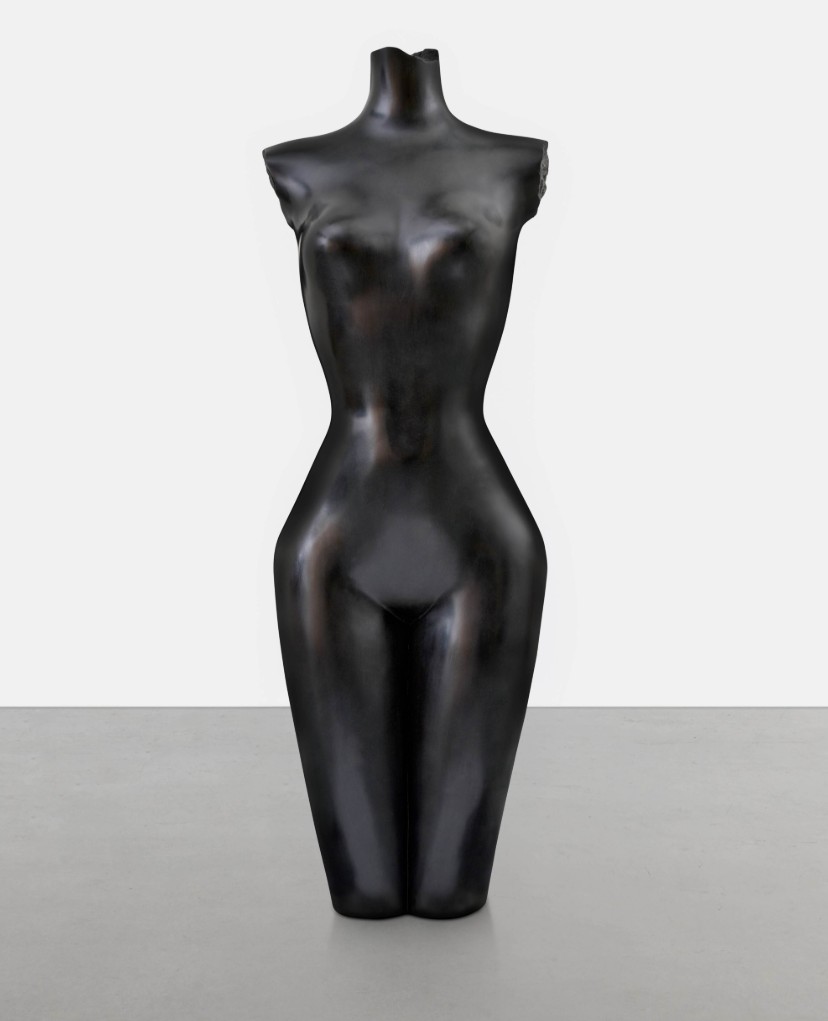
Within Hirst’s mythology, the cargo was said to have belonged to Aulus Calidius Amotan, a freed slave also known as Cif Amotan II, who assembled a vast sculptural collection during the first or second century AD as an offering to the temple of the sun. The name Cif Amotan is an anagram of “I am fiction,” underscoring the fabricated nature of the story. Hirst extended this conceit further by producing a Netflix mockumentary about the supposed recovery, subtly revealing that the sensational discovery was a work of invention.
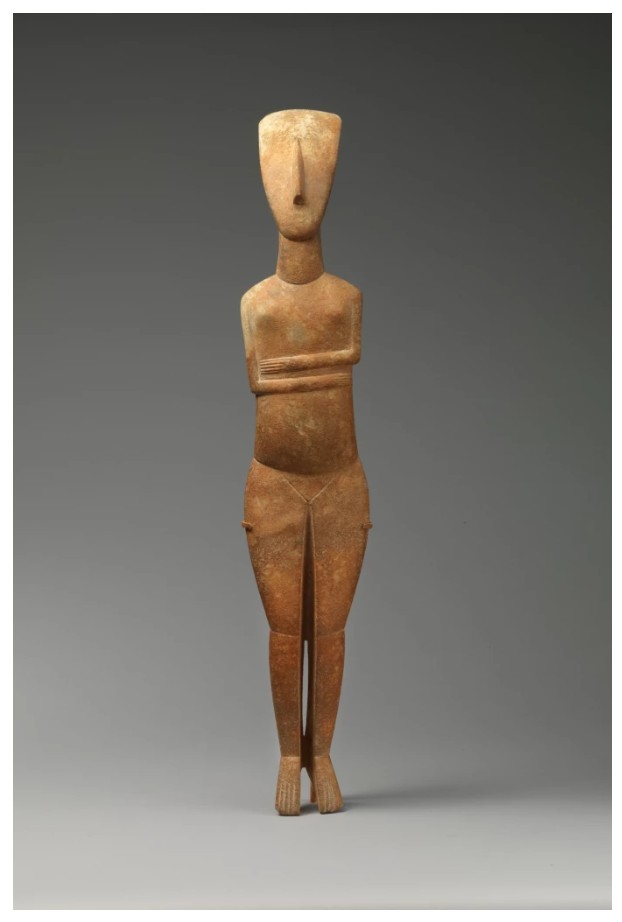
Marble female figure, attributed to Bastis Master, 2600-2400 BCE
The Metropolitan Museum of Art, New York
The exhibition featured multiple variations of the nude torso, all characterized by diminutive waists, accentuated hips, small high breasts and narrow, arched backs. This repetition recalls a classical preference for serial forms, standing in contrast to the modern emphasis on singular originality. Since Marcel Duchamp introduced his first readymades in the early twentieth century, artists have repeatedly examined the role of replication. Grecian Nude, a convincing imitation of a Greek sculpture that may never have existed, aligns with this ongoing dialogue, one also explored by artists such as Andy Warhol and Jeff Koons. As noted in the exhibition guide, the fictional collection of Cif Amotan II comprised “copies, fakes, purchases and plunders,” situating the entire Treasures project within a broader investigation of authenticity. The present work, alongside the other Treasures from the Wreck of the Unbelievable, echoes the themes explored by Damien Hirst throughout his career. Like many of Hirst’s works, this sculpture reflects his enduring interest in belief and truth. By challenging the frameworks through which society interprets reality, he encourages reflection on the intersections of mythology, history, and science. The blurred boundaries between fact and invention, as well as between past and present, ultimately call into question the foundations of our convictions and ethical assumptions.
Diethylene Glycol, 2006
Property from a Distinguished British Collector
Sotheby’s London: 5 March 2026
Estimated: GBP 250,000 – 350,000
GBP 307,200 / USD 410,390
Diethylene Glycol | Contemporary Day Auction | 2026 | Sotheby’s
DAMIEN HIRST (b. 1965)
Diethylene Glycol, 2006
Household gloss on canvas
60×76 inches (152.4 x 193 cm)
Signed twice (on the stretcher)
Signed, titled and dated 2006 (on the reverse)
In Diethylene Glycol, Damien Hirst extends his sustained enquiry into systems of order, chromatic sensation, and the aesthetic language of science. The present work belongs to Hirst’s celebrated Spot Painting series, a body of work initiated in the mid-1990s that foregrounds repetition, neutrality, and serial logic. Executed with the immaculate finish of household gloss paint, the surface bears no trace of the artist’s hand, reinforcing the impression of mechanical precision that has become synonymous with this series.
“I started [the Spot Paintings] as an endless series, a scientific approach to painting in a similar way to the drug companies’ scientific approach to life. Art doesn’t purport to have all the answers; the drug companies do. Hence the title of the series, the Pharmaceutical Paintings, and the individual titles of the paintings themselves… Art is like medicine, it can heal.”
The composition presents a regimented field of evenly spaced, multicolored circles arranged across a pristine white ground. Each spot is identical in size, yet distinct in hue, creating a visual rhythm that balances uniformity with variation. The high-gloss surface produces a subtle reflectivity, heightening the painting’s clinical clarity and evoking associations with laboratory equipment, pharmaceutical packaging, or diagnostic displays. This polished detachment distances the work from expressionist gesture, positioning it instead within a logic of manufacture, regulation, and control.
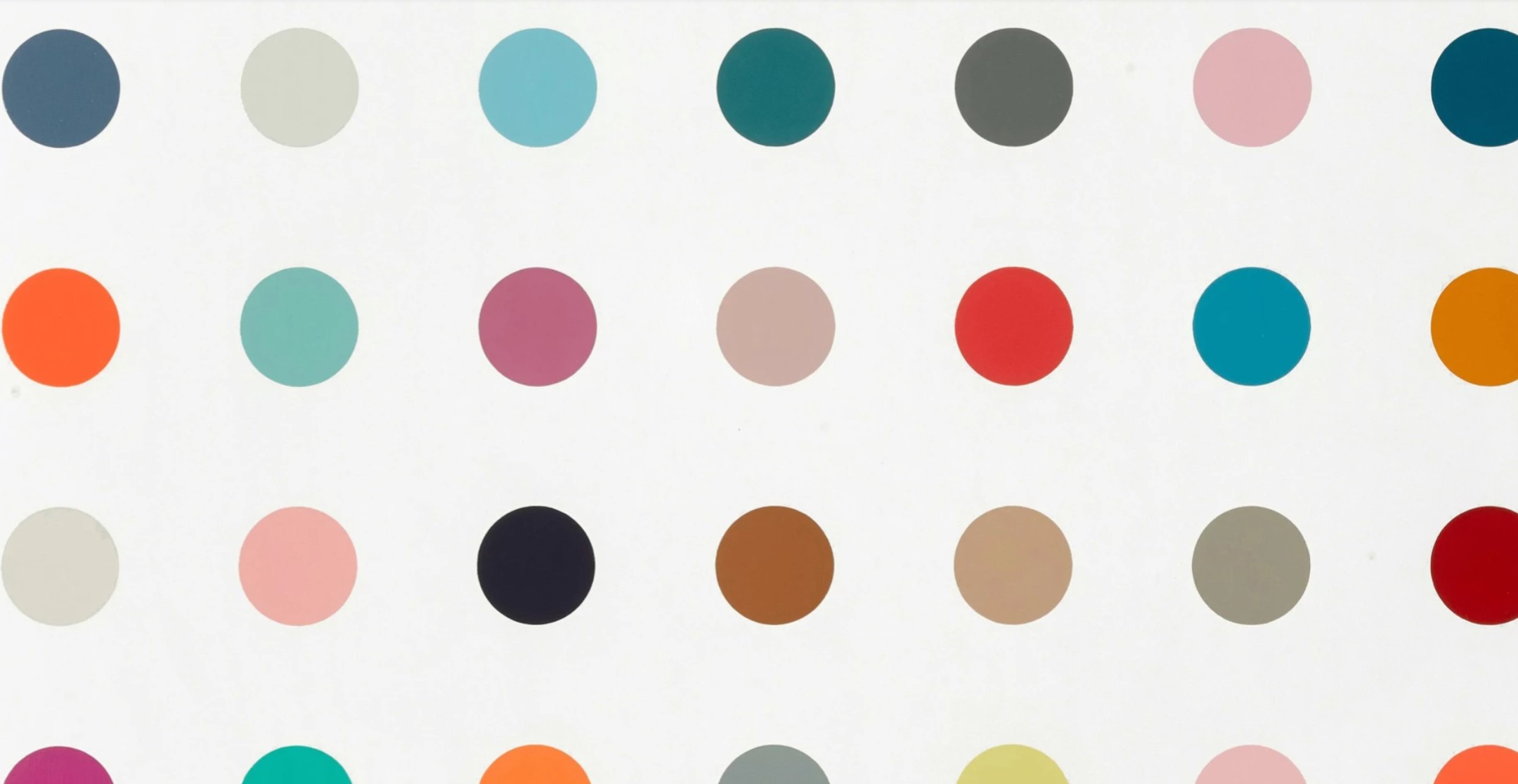
The title, Diethylene Glycol, refers to a synthetic organic compound commonly used as an industrial solvent and antifreeze, as well as in limited pharmaceutical applications. By naming the painting after a chemical substance, Hirst again imports scientific nomenclature into the realm of abstraction, allowing language to operate as both factual descriptor and poetic trigger. The molecular structures and schematic diagrams associated with such compounds find a visual echo in the painting’s ordered grid, where each colored dot might be read as a stylized atom within a larger, stabilized system. Despite its rational framework, the work remains visually buoyant. The palette — encompassing bright reds, blues, yellows, greens, and softer pastel tones — generates an optical liveliness that resists emotional neutrality. Rather than conveying symbolic meaning, the colours function relationally, activating the surface through contrast and repetition. In this way, the painting oscillates between analytical coolness and sensory pleasure. As with much of Hirst’s practice, Diethylene Glycol occupies a productive tension between art and science, where intellectual structure coexists with the immediate, almost euphoric impact of color — a quality Hirst himself has celebrated as fundamental to his engagement with painting.
Beautiful Second Exploding Pale Blue Comet Impact Painting, 2001
Property from a Distinguished British Collector
Sotheby’s London: 5 March 2026
Estimated: GBP 120,000 – 180,000
GBP 153,600 / USD 205,195
DAMIEN HIRST (b. 1965)
Beautiful Second Exploding Pale Blue Comet Impact Painting, 2001
Household gloss on canvas
Diameter: 72 inches (183 cm)
Signed (on a label affixed to the stretcher)
Damien Hirst’s Beautiful Second Exploding Pale Blue Comet Impact Painting belongs to the artist’s iconic Spin Paintings series, which he creates by pouring different colors of household paint onto a rapidly rotating circular canvas. Hirst’s renowned Spin Paintings are visually arresting for their colorful kineticism achieved through the spontaneous effects of chance, as the artist’s own hand is nearly removed from the final product. The artist’s approach to the present work is much like Jackson Pollock’s revolutionary drip paintings in which Pollock pioneered his drip technique by dynamically dripping and pouring paint on canvas below him. Equally filled with dynamism and exploding with color well beyond the limits of the canvas, Hirst’s Spin Paintings draw from the uncertainty intrinsic to the human experience and symbolize the artist’s ongoing quest to push beyond preordained limits of painting.
“The spin paintings gather and amalgamate the individuality of every individual color … to become pure expression of the basic and vital gesture of painting and its mythology.”
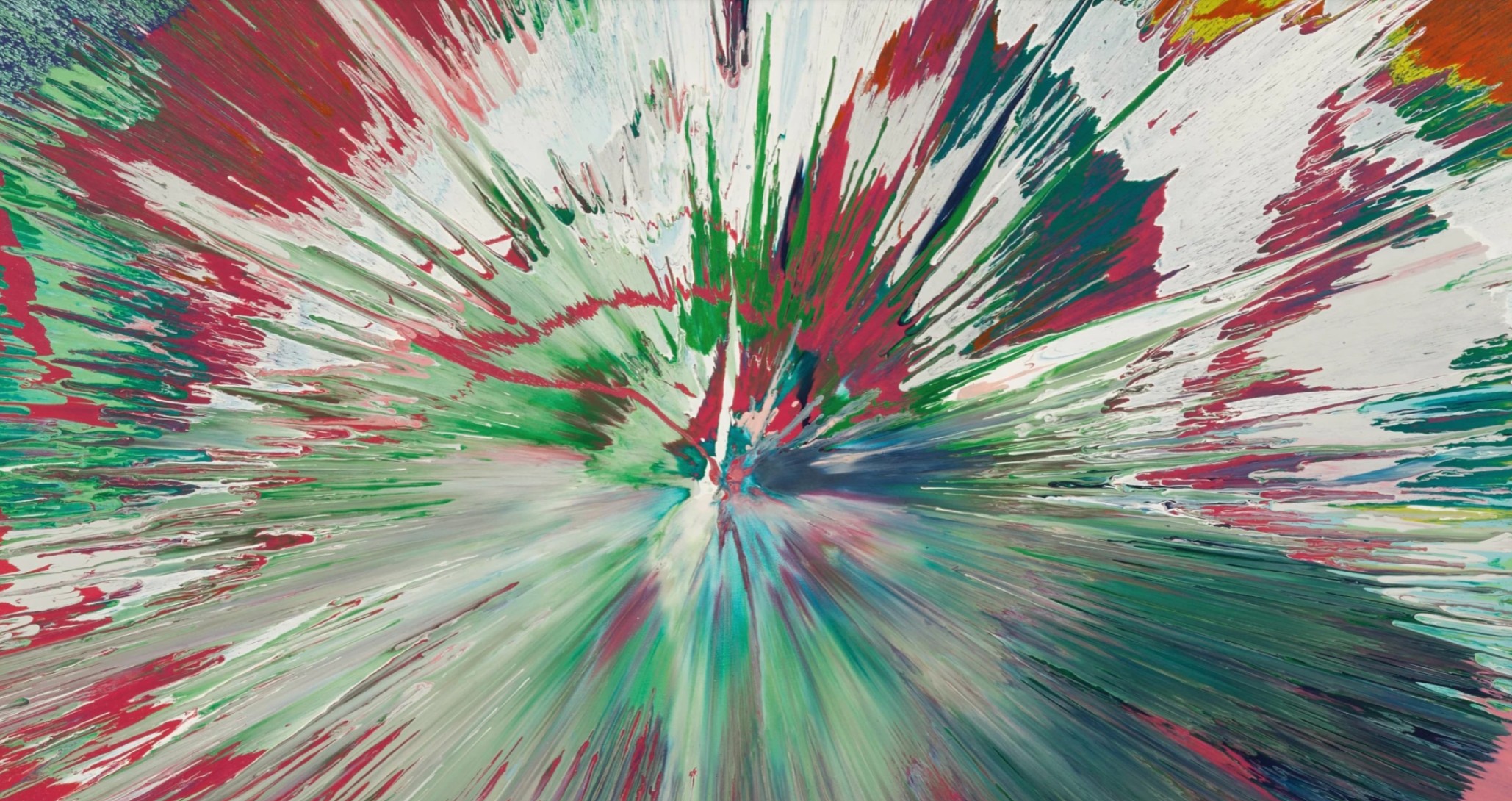
Hirst created his very first Spin Paintings in 1992 in his studio in Brixton, London, titling the works with the amusingly convoluted titles which now distinguish the series, as exemplified by the present work. The elongated title, Beautiful Second Exploding Pale Blue Comet Impact Painting evokes the sensation of a dynamic cosmic burst, reminiscent of Hirst’s moment of creative chance as he stands before his spinning canvas. One year after the series’ inception, Hirst set up a spin painting stall with fellow artist Angus Fairhurst at a street art fair called ‘A Fete Worse than Death’. Dressed-up as clowns by performance artist Leigh Bowery, Fairhurst and Hirst invited visitors to pay £1 to create their own spin paintings, which were later signed by the artists.
Influenced by the postmodern privileging of chance and the aleatory, Hirst’s Spin Paintings stand in stark contrast to his formulaic Spot series yet both explore the idea of an imaginary mechanical artist for which Hirst has always provocatively achieved through his diverse oeuvre. The rich blend of blues, greens, pinks, yellow and red fill the circular piece with motion and excitement and forever preserve the highly performative moment in which Hirst captures the beautiful unpredictability of life. The creation of the present work is controlled purely by Hirst’s choice of color and the dynamism captured by the motion of the rapidly spinning canvas, allowing the variegated surfaces of gravity-informed color to bespeak the centrifugal energy of their execution. Hirst perfectly captures the simplicity of the series’ appeal, saying, “I really like making them. And I really like the machine, and I really like the movement. Every time they’re finished, I’m desperate to do another one” (Damien Hirst, On the Way to Work, 2001, p. 221).
Untitled, 2000
Modern Visionaries – The Roger and Josette Vanthournout Collection
Christie’s London: 6 March 2026
Estimated: GBP 150,000 – 200,000
GBP 127,000 / USD 169,660
DAMIEN HIRST (B. 1965), Untitled | Christie’s
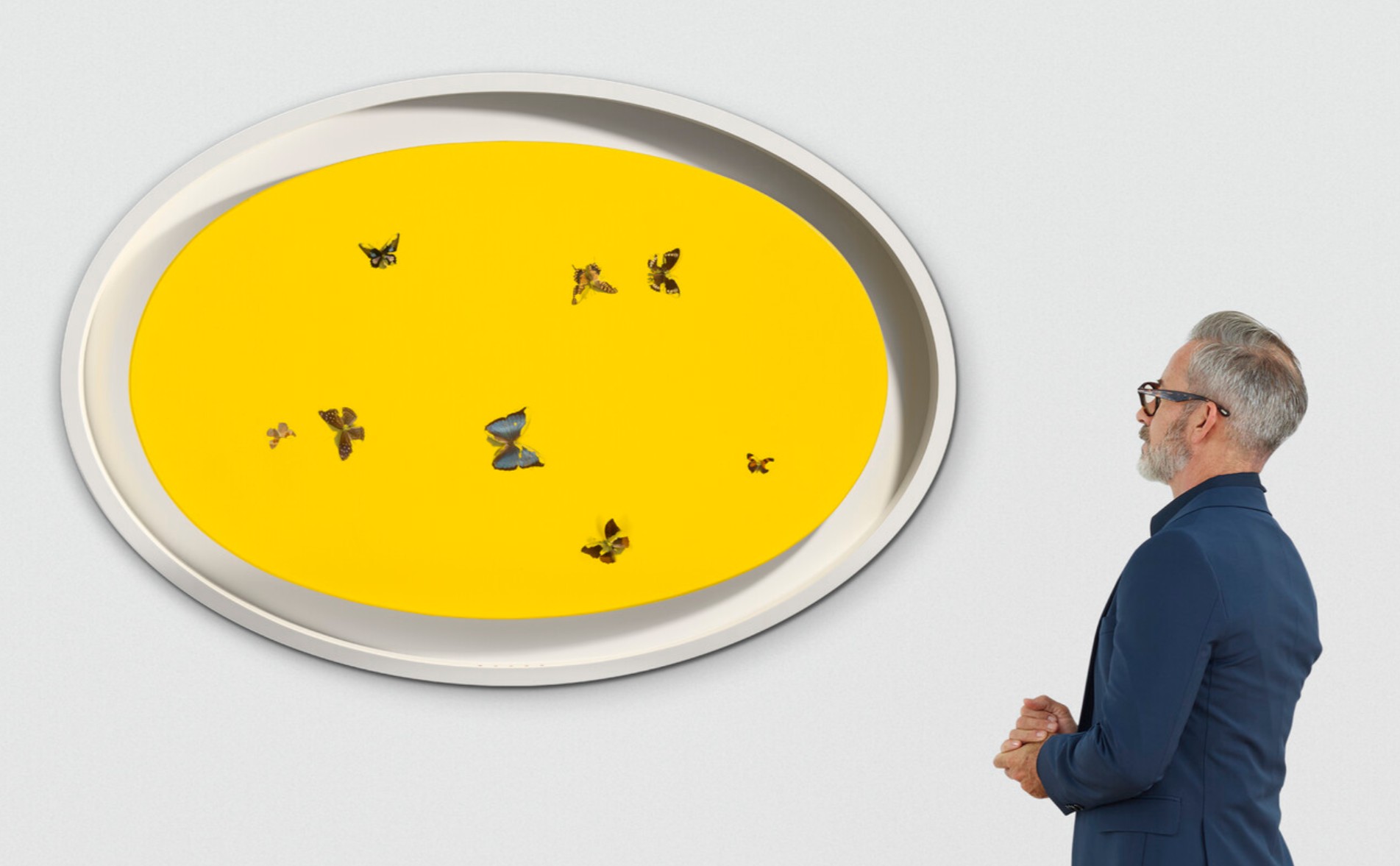
DAMIEN HIRST (B. 1965)
Untitled, 2000
Butterflies and household gloss on canvas
30×48 inches (76.2 x 121.9 cm)
Jean-Michel Basquiat
Thin in the Old, 1986
Sotheby’s London: 4 March 2026
Estimated: GBP 6,000,000 – 8,000,000
GBP 4,543,000 / USD 6,068,995
Thin in the Old | Modern & Contemporary Evening Auction | 2026 | Sotheby’s
JEAN-MICHEL BASQUIAT (1960 – 1988)
Thin in the Old, 1986
Acrylic, oil and Xerox collage on panel
71-7/8 x 42-1/8 x 9-1/2 inches (182.5 x 107 x 24 cm)
Signed, titled and dated 86 (on the reverse)
Monumental in presence and unflinching in spirit, Thin in the Old from 1986 crystallizes the visual and intellectual urgency that defines Jean-Michel Basquiat’s mature practice. Dominated by a skeletal protagonist rendered with stark linearity and raw chromatic contrasts, the composition confronts the viewer with a body reduced to its most essential signs: ribcage, organs, and mask-like visage articulated with a language that oscillates between diagram and effigy. The figure appears both fragile and defiant, suspended within a field of layered marks, painterly erasures, and architectural fragments that embody Basquiat’s singular ability to merge autobiographical reflection with cultural critique.
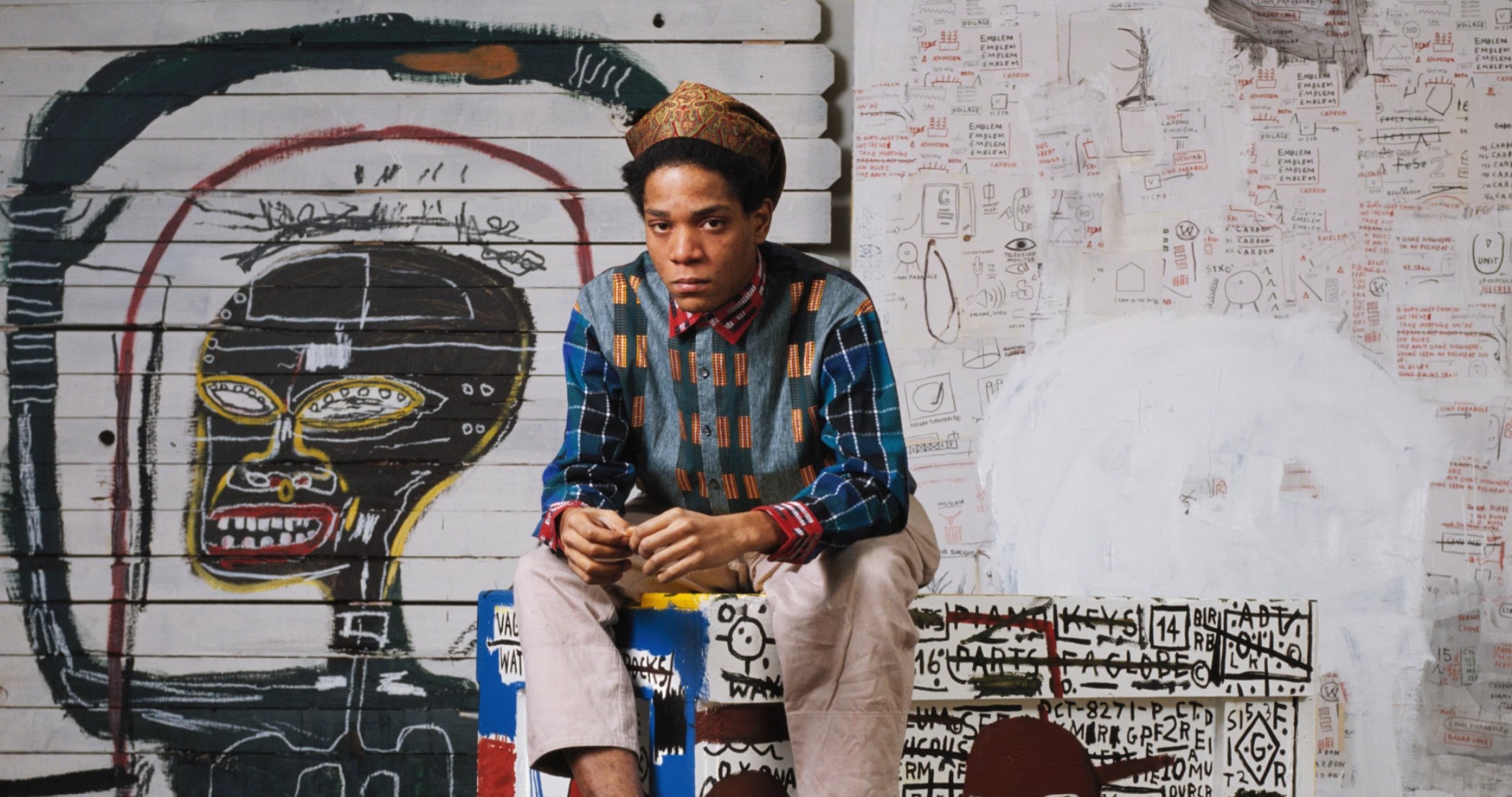
Jean-Michel Basquiat, Great Jones Street studio. © Lizzie Himmel 1985
Thin in the Old unfolds as a carefully orchestrated assemblage in which figure, sign, and object occupy a shallow yet charged pictorial space. A skeletal protagonist — rendered on a cut-out support and affixed to the ground — hovers between painting and relief, its mask-like face articulated in burnt umber, chalk white, and flashes of cadmium yellow that illuminate the ribcage and exposed viscera. The anatomical lines, drawn with graphic immediacy, recall both medical illustration and ritual carving, while drips of diluted pigment descend from the body, suggesting a sense of dissolution. Behind the figure, a sweeping black diagonal interrupts the pale ground like a scythe or architectural beam, introducing a dramatic spatial tension that fractures the composition. To the right, a second disembodied head — flattened and reduced to a single eye and clenched teeth — appears as a spectral echo of the central figure, reinforcing Basquiat’s recurrent dialogue between mask and self-portrait. Collaged drawings and Xeroxed fragments punctuate the surface: a “Cyclops” image, schematic diagrams, and handwritten notations that oscillate between childlike invention and coded reference, embedding language within the pictorial field. At the lower edge, two box-like constructions project outward from the panel, transforming the painting into a hybrid object that blurs the boundary between canvas and assemblage. Their presence anchors the composition physically while evoking reliquaries or talismanic containers, reinforcing the work’s synthesis of ritual, memory, and urban detritus. Together, these disparate elements coalesce into a dynamic visual rhythm, where negative space, gesture, and material layering heighten the sense of a body — and a psyche — held in precarious suspension.
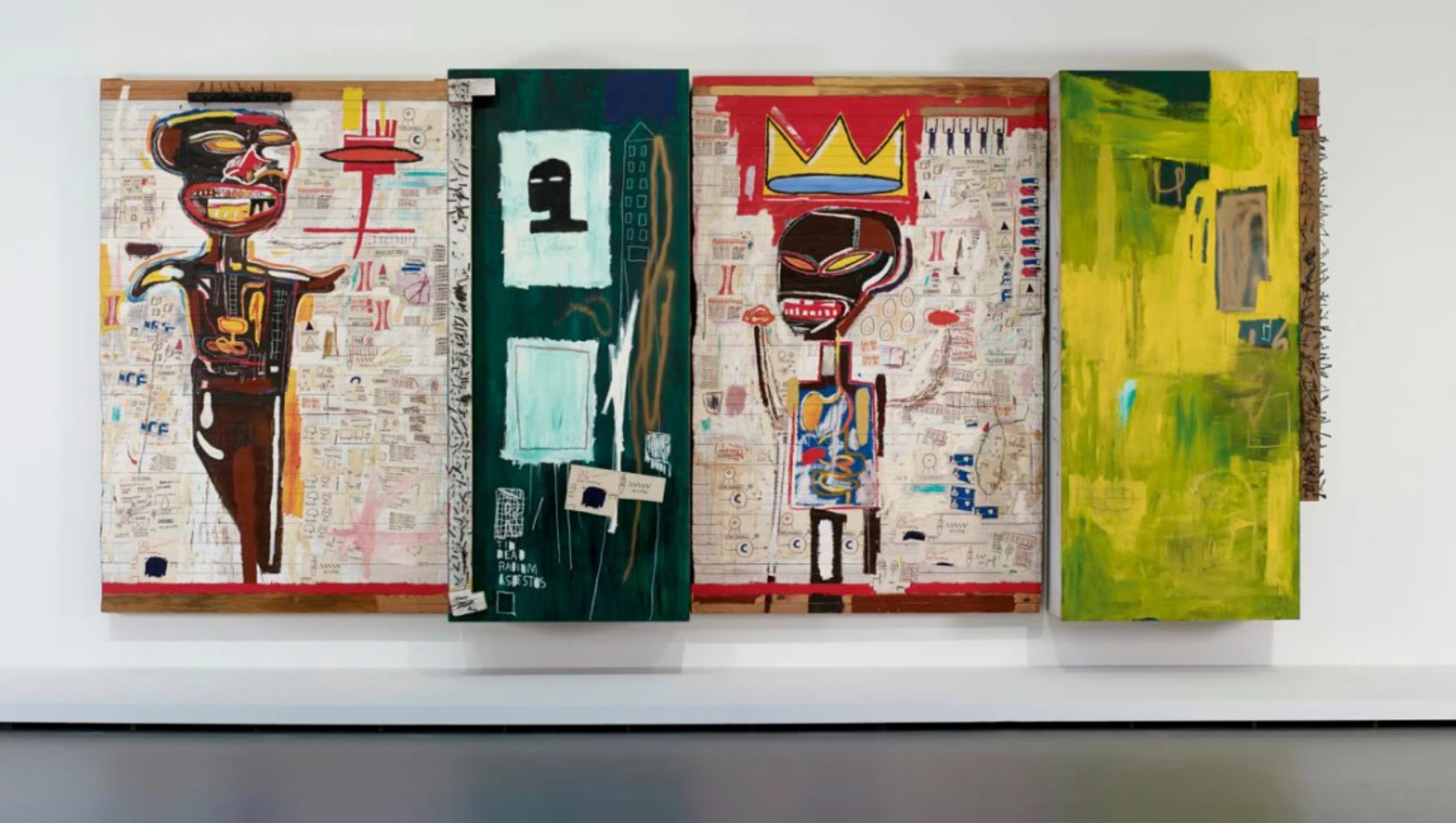
Jean-Michel Basquiat, Grillo, 1984. Fondation Louis Vuitton, Paris. © The Estate of Jean-Michel Basquiat, ADAGP, Paris, 2026
Basquiat’s fixation on anatomy — rooted in his formative encounter with Gray’s Anatomy, the nineteenth-century medical compendium gifted by his mother during childhood convalescence — permeates the painting’s visual logic. Throughout his oeuvre, skeletal limbs and exposed organs function less as clinical illustrations than as metaphors for psychic intensity and lived experience. In Thin in the Old, the body becomes a charged site of vulnerability and agency: an X-ray-like presence that recalls the artist’s enduring fascination with the human form as both instrument and battleground. This anatomical vocabulary situates the work within a broader lineage that extends from the gestural figuration of Willem de Kooning and Jean Dubuffet to the raw immediacy of Neo-Expressionist painting.
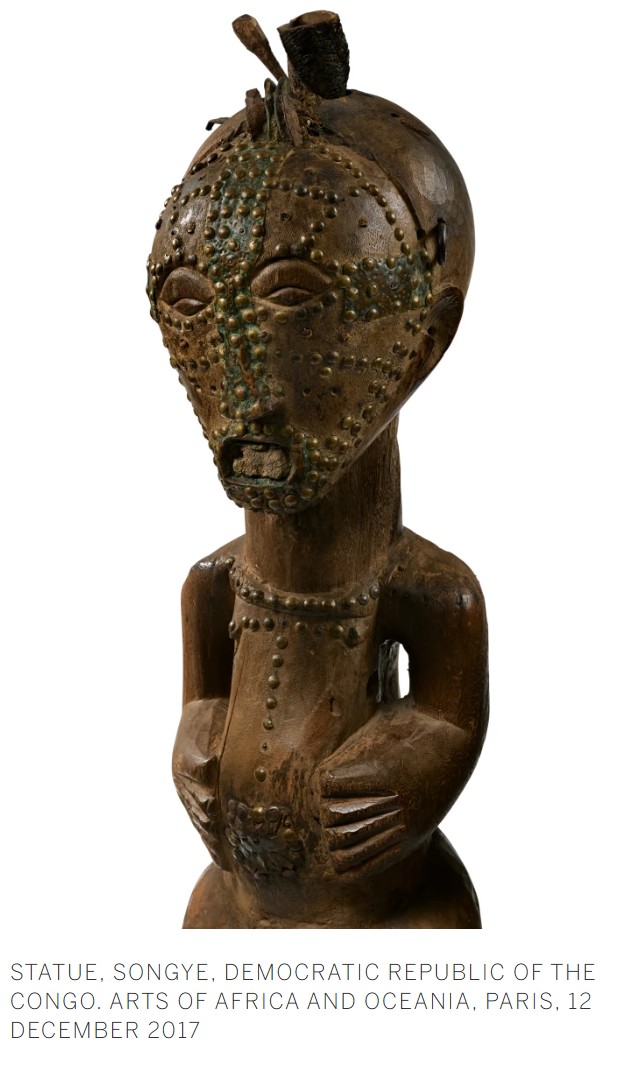
Executed in 1986, shortly after Basquiat’s journey to the Ivory Coast, the painting reflects a renewed engagement with African visual traditions and diasporic identity. The hieratic posture of the skeletal figure evokes ancestral statuary and ceremonial masks, while the flattened frontal presentation recalls both West African sculpture and Byzantine icon painting. Such references reveal the artist’s deep awareness of art history, forged through years of self-directed study and frequent visits to the Metropolitan Museum of Art, where he absorbed the strategies of artists such as Jasper Johns and Cy Twombly — figures who, like Basquiat, collapsed the boundaries between language and image. Within this lineage, the skeletal protagonist emerges as both archetype and self-portrait, a conduit through which Basquiat inscribes himself into a transhistorical dialogue spanning antiquity, Renaissance portraiture, and modernist experimentation.
Themes of mortality and impermanence course through the composition. The skeletal anatomy invokes the long iconographic tradition of the memento mori, linking Basquiat’s urban visual language to medieval danse macabre imagery and the allegorical bodies of early modern painting. Yet death here is neither distant nor allegorical; it is visceral and immediate, embedded within the social realities of race, capitalism, and identity that shaped the artist’s lived experience. The exposed ribs and restless linework convey a sense of existential urgency, transforming the figure into a psychic register of the artist’s internal landscape.
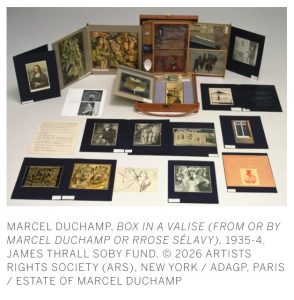
Equally significant is the work’s engagement with the boundaries between high and low culture. Architectural motifs and boxed forms within the composition subtly recall Marcel Duchamp’s Boîte-en-valise and the commodity-based interventions of Andy Warhol, whose influence encouraged Basquiat to interrogate the mechanisms of value and authorship. These elements resonate with African fetish boxes containing protective amulets, fusing spiritual symbolism with the aesthetics of consumer packaging. Such strategies reflect Basquiat’s broader practice of bricolage — a method rooted in his early years in downtown New York, where he moved fluidly between music, poetry, and graffiti under the pseudonym SAMO, translating the energy of the street into a painterly language of exceptional immediacy.
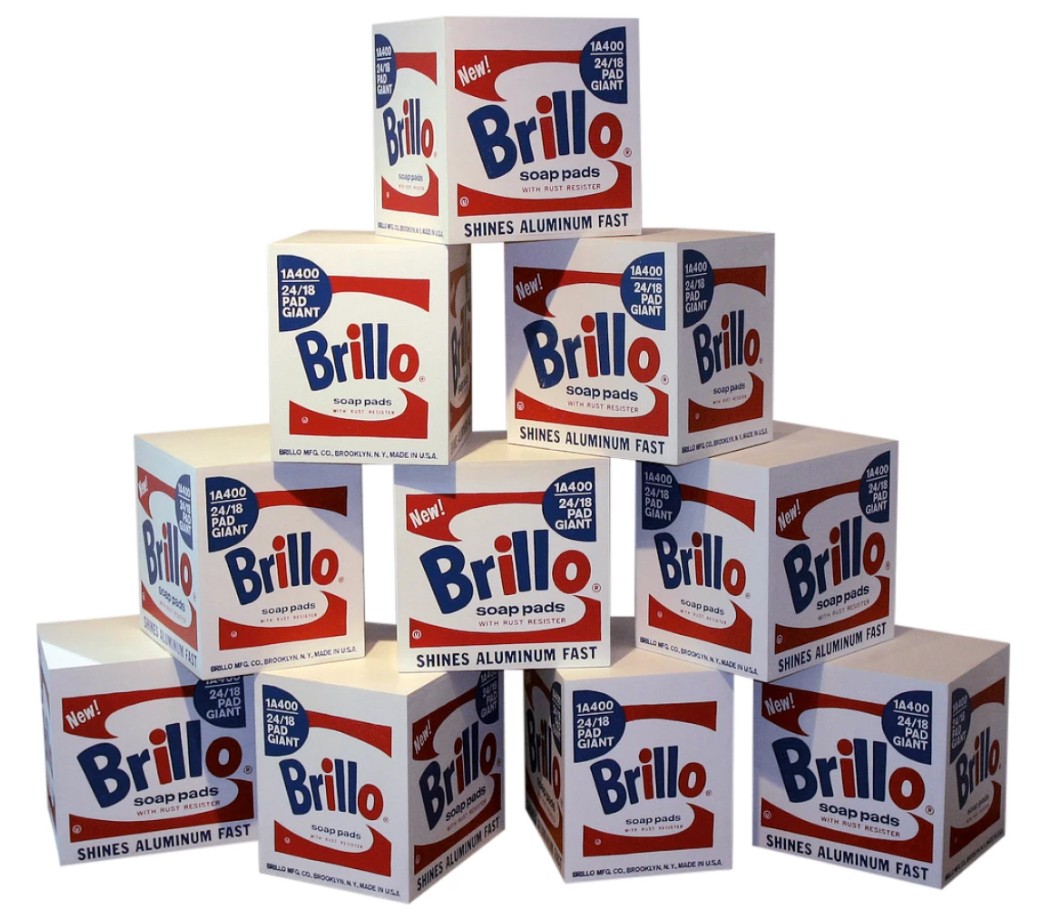
Andy Warhol, Brillo Boxes, 1964. Private Collection. © The Andy Warhol Foundation
Born in Brooklyn in 1960 to a Haitian father and Puerto Rican mother, Basquiat emerged as one of the defining voices of a generation that reshaped the international art market during the early 1980s. By the mid-decade, following landmark exhibitions including Documenta and a succession of critically acclaimed solo shows, his work had achieved a level of recognition unprecedented for an artist of his age. Within this context, Thin in the Old embodies the heightened confidence and intellectual ambition of his later practice, synthesizing diverse sources — from African sculpture and Renaissance anatomy to Pop art and street culture — into a visual language that is at once poetic and confrontational.
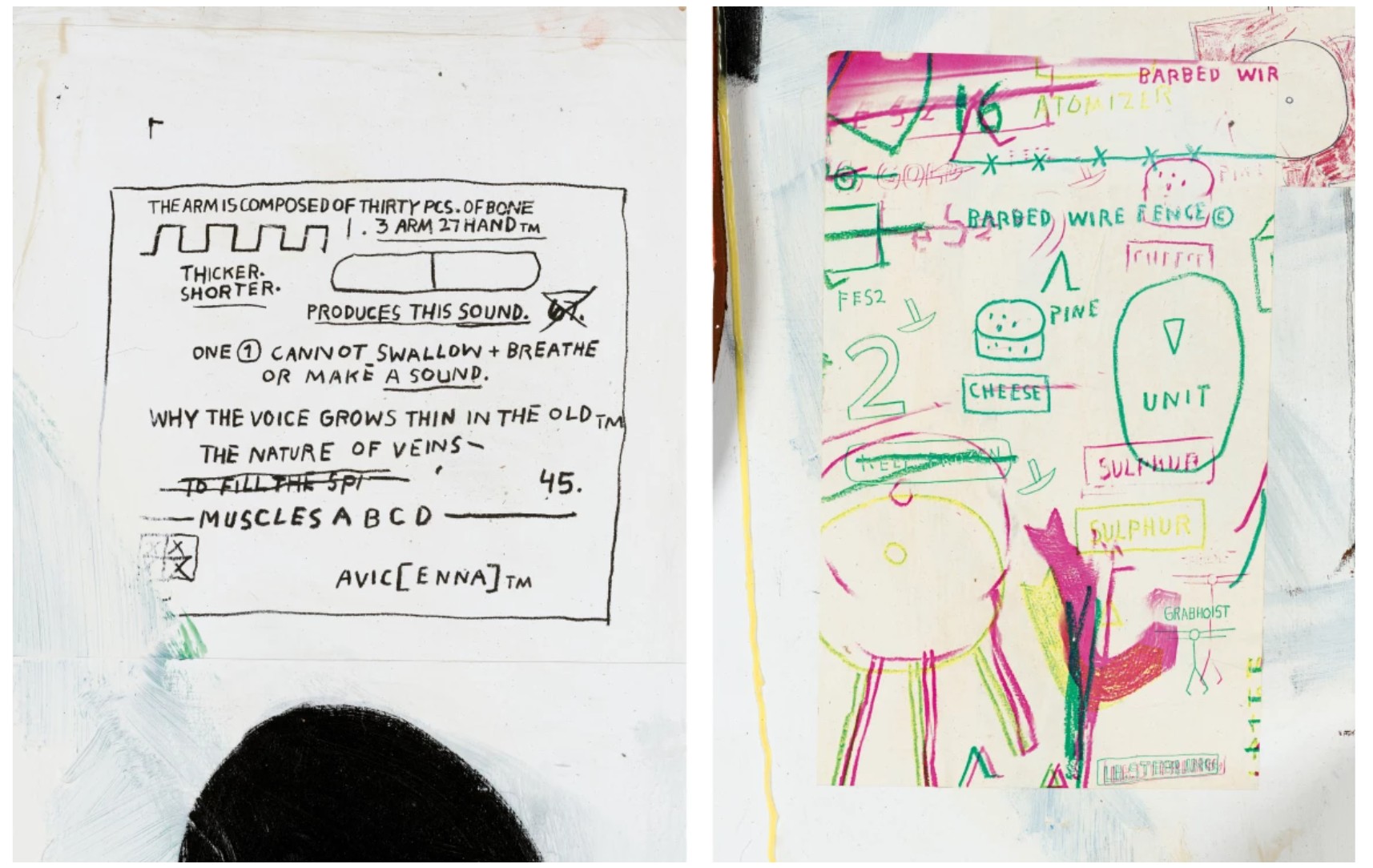
DETAILS OF THE PRESENT WORK
Ultimately, Thin in the Old stands as a powerful testament to Basquiat’s role as both painter and poet. The skeletal protagonist anchors a composition that addresses artistic lineage, mortality, and social struggle with uncompromising clarity, while the layered surface reveals an artist continually negotiating the boundaries between history and contemporaneity. In its fusion of raw immediacy and profound art-historical awareness, the painting exemplifies Basquiat’s enduring capacity to transform the most elemental imagery into a vehicle of cultural memory and expressive force.
Untitled (Spoon), 1988
Christie’s London: 7 March 2026
Estimated: GBP 350,000 – 750,000
GBP 508,000 / USD 678,635
JEAN-MICHEL BASQUIAT (1960-1988), Untitled (Spoon) | Christie’s
REPEAT SALE
Christie’s New-York: 27 September 2018
Estimated: USD 120,000 – 180,000
USD 324,500
Jean-Michel Basquiat (1960-1988), Untitled (Spoon) | Christie’s
JEAN-MICHEL BASQUIAT (1960-1988)
Untitled (Spoon), 1988
Oilstick on offset lithograph
33-1/8 x 23-3/8 inches (84 x 59.4 cm)
Hauntingly prophetic and deeply introspective, the present work stands among Jean-Michel Basquiat’s last self-portraits. Executed in 1988, shortly before his death in August that year, it captures the whirlwind of celebrity and anguish that defined his final days. The work is drawn on a lithograph of the artist’s own poster design for his exhibition at Galerie Hans Mayer, Düsseldorf, which took place in the early months of 1988.
“Most young kings get their heads cut off.”
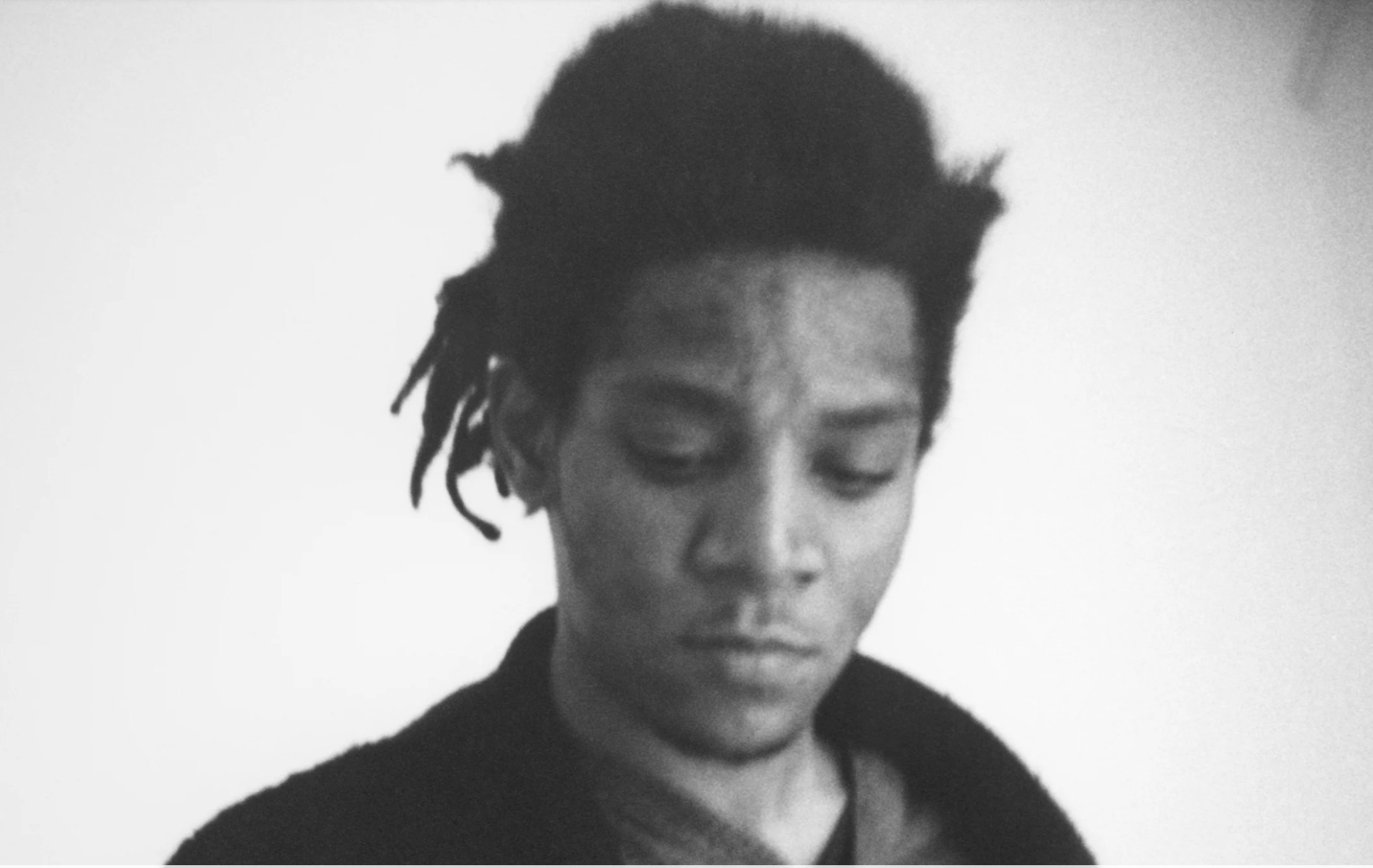
Jean-Michel Basquiat, 1988. Photo: Mark Sink/Getty Images.
Beneath his name, written over by hand, Basquiat has daubed his own image, rendered with visceral vitality of his early oilstick heads. He is clad in a bow tie: an art world star ready to receive his public. At the same time, his head is gaunt and skull-like, eyes glaring and mouth wide open. A spoon, laden with untold meaning, hovers before him, the word struck through in conflicted doubt. Basquiat painted self-portraits throughout his oeuvre, grappling repeatedly with the force of his own legend. In Riding with Death, the Eroica paintings and others of 1988, the twenty-seven-year-old artist began to picture his own mortality. Like the late self-portraits of Picasso, Van Gogh and Warhol, the present work weaves heroism and fatalism into a poignant reminder of life’s fragility.
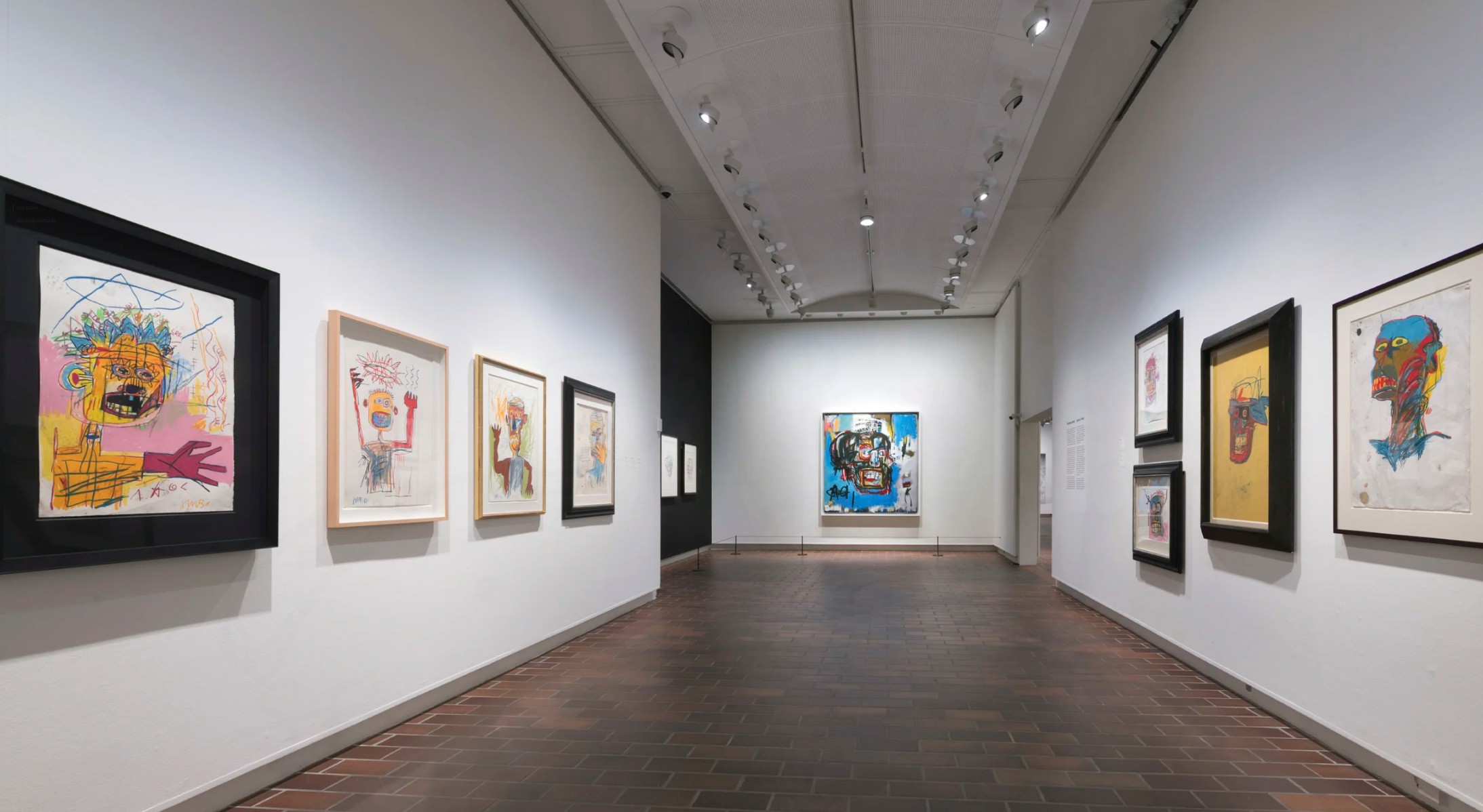
Basquiat – Headstrong, currently presented at the The Louisiana Museum of Modern Art, Humlebæk. Artwork: © Estate of Jean-Michel Basquiat. Licensed by Artestar, New York. Photo: Louisiana Museum of Modern Art, Denmark / Camilla Stephan, 2026.
Currently the subject of a groundbreaking exhibition at the Louisiana Museum of Modern Art, Humlebæk, Basquiat’s oilstick heads represent a key strand of his practice. Begun during the early 1980s, they took on a life of their own, with many only emerging after the artist’s death. These works remain some of his most raw, intimate and instinctive creations, channeling a lifelong fascination with human anatomy. Behind closed doors, and away from the machinations of the marketplace, the artist gave himself over to the fluid properties of oilstick, embracing its rich and expressive immediacy. Heads reigned supreme, their forms alive with electric, neuronal charge. The curator Anders Kold describes them as ‘archive[s] of emotions and spiritual and mental states’: sites where the noise of the outside world imploded (A. Kold, ‘Something Becomes Visible’, in Basquiat: Headstrong, exh. cat. Louisiana Museum of Modern Art, Humlebæk 2026, p. 30). While these works undoubtedly nourished Basquiat’s major skull paintings, they also stood alone, deeply wired into the artist’s hand and mind.
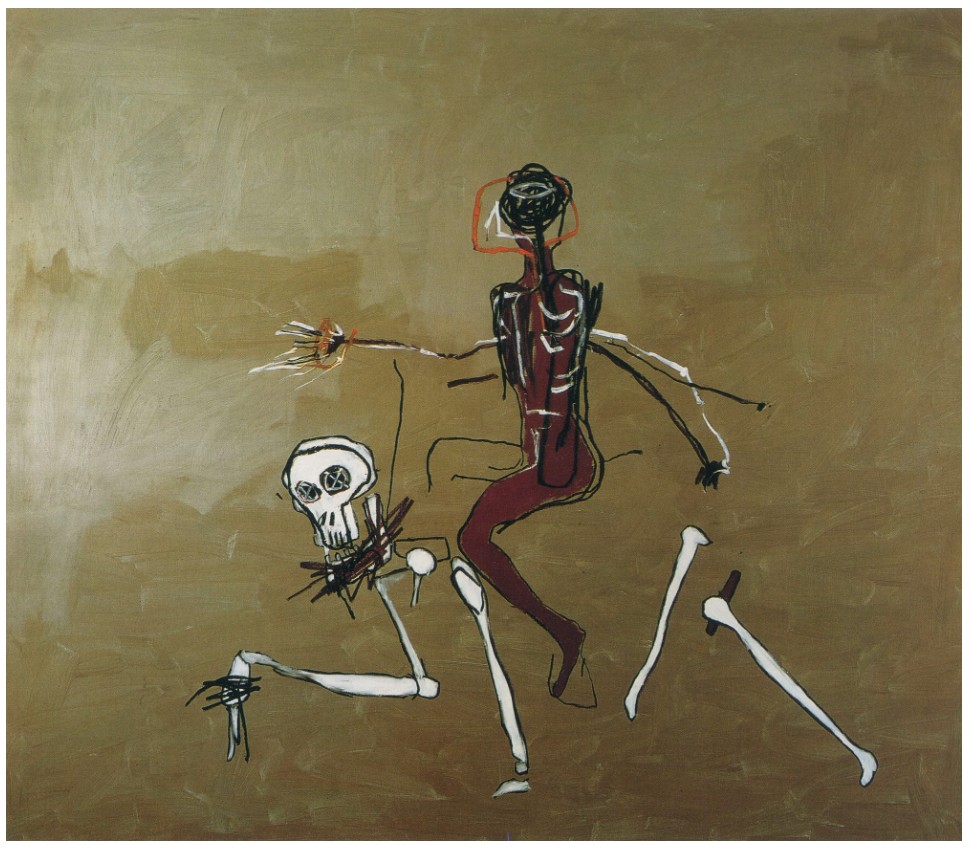
Jean-Michel Basquiat, Riding with Death, 1988. Private collection.
Artwork: © Estate of Jean-Michel Basquiat. Licensed by Artestar, New York.
Basquiat’s complex self-images run like a golden thread through his practice. The artist was just twenty when he shed the pseudonymous street tag ‘SAMO’, and took his place at the forefront of the New York art world. Within a year of his breakout exhibition at MoMA P.S.1, he had rocketed to international acclaim. In 1982 he was the youngest artist to exhibit at Documenta VII in Kassel; in 1985, he was hailed as the face of contemporary art on the cover of The New York Times Magazine. His self-portraits confronted his own spiraling mythology, casting himself by turns as hero and martyr. At times he aligned himself with the greats: the athletes, musicians and other icons he admired. The spoon in the present work might be seen to nod to the centuries-old ‘spoonful’ trope, a metaphor for pleasure, explored by blues songsters from Charley Patton to Howlin’ Wolf, Etta James and others. Elsewhere, Basquiat painted himself in crowns of thorns, riffing on Christian iconography. In one canvas, he famously scrawled the words ‘Most young kings get their heads cut off’.
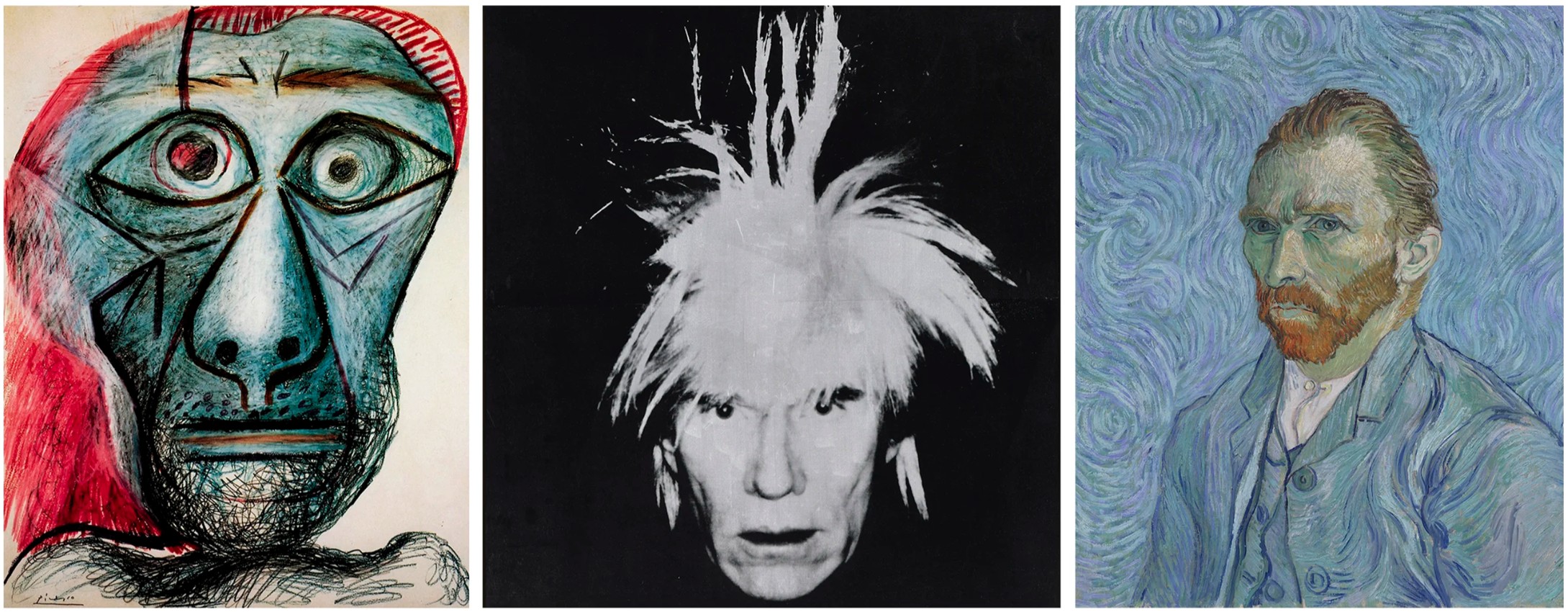
Left: Pablo Picasso, Tête (Autoportrait), 1972. Private collection. Artwork: Artwork: © 2026 Succession Picasso/DACS, London. Digital image: © 2026 Album/Scala, Florence.
Middle: Andy Warhol, Self-Portrait, 1986. Museum Brandhorst, Munich. Artwork: © 2026 The Andy Warhol Foundation for the Visual Arts, Inc. / Licensed by DACS, London. Digital image: © 2026 Scala, Firenze/bpk, Bildagentur fuer Kunst, Kultur und Geschichte, Berlin.
Right: Vincent van Gogh, Self-portrait, 1889. Musée d’Orsay, Paris. Digital image: Bridgeman Images.
By 1988 Basquiat was more conscious than ever of his conflicted status. ‘I’m not a real person. I’m a legend’, he said in one of his final interviews (J-M. Basquiat, quoted in A. Haden-Guest, ‘Burning Out’, Vanity Fair, November 1988, p. 197). The artist had been deeply affected by the death of Warhol the previous year. The two had become close friends as well as collaborators, with the older artist serving as something of a mentor to his young colleague. In his late series of self-portraits, Warhol had held a mirror up to his mercurial identity, seemingly bearing his soul to the viewer through his direct gaze yet ultimately—dressed in a wig—continuing to hide in plain sight. Basquiat’s grief continued to linger as he rode the waves of his own success: in tandem with the Düsseldorf exhibition in early 1988, he mounted shows at Galerie Yvon Lambert and Galerie Beaubourg in Paris, followed by further presentations in Salzburg and New York. A preoccupation with death wrote its way into his works, palpable in the skeletal danse macabre of Riding with Death, and the repeated incantation ‘man dies’ that proliferates across two Eroica paintings. Even his heroes, Basquiat realized, were not immortal.
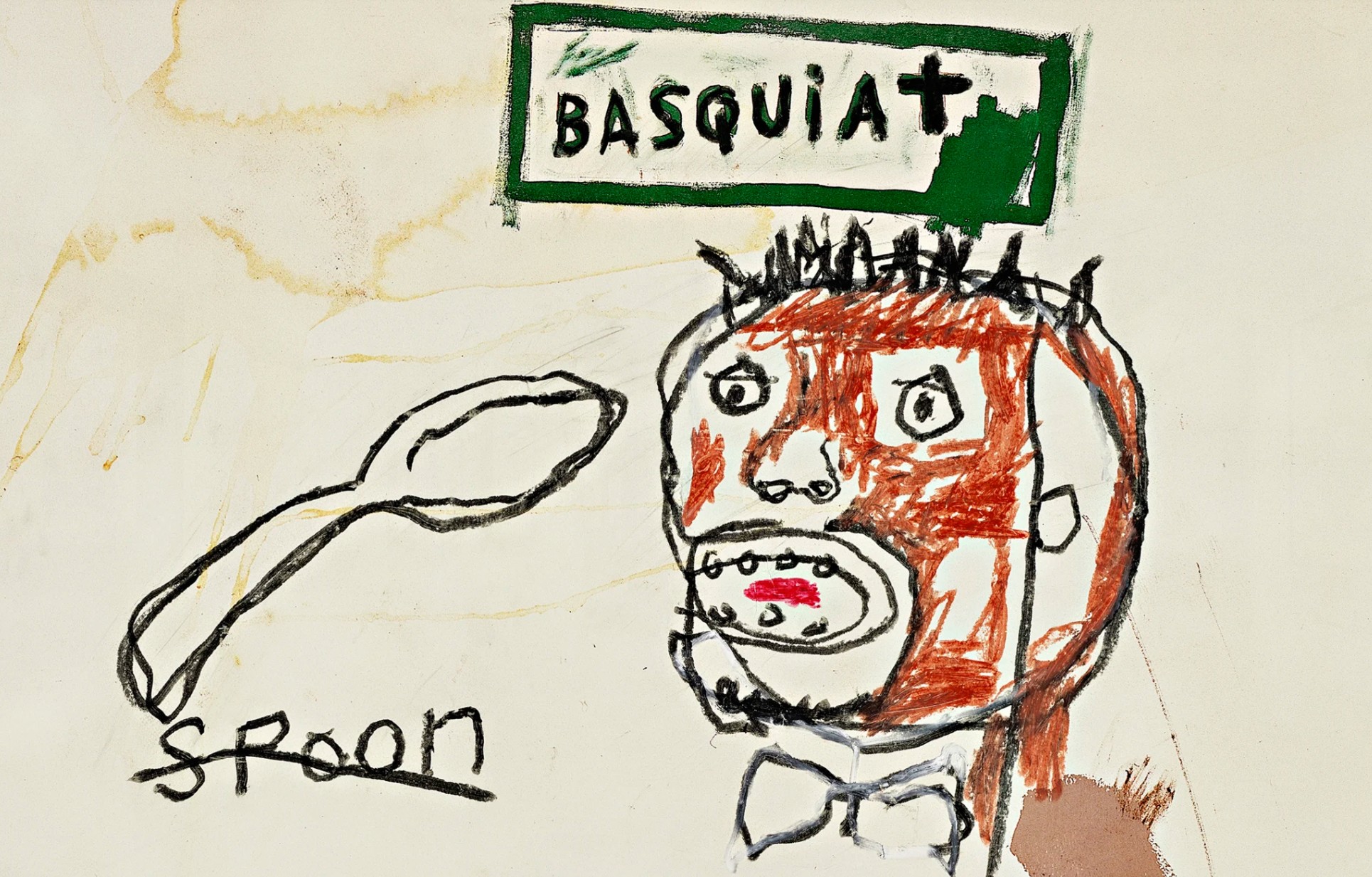
The curator Jeffrey Deitch delivered the eulogy at Basquiat’s funeral. ‘He was a personality unlike any other—a remarkable breadth, intelligence, passion, sympathy, generosity’, he told the congregation. His ‘charisma’ and ‘strength of character’, he went on, was such that even ‘a few lines drawn on paper could communicate so much’ (J. Deitch, quoted in P. Hoban, Basquiat: A Quick Killing in Art, London 1988, p. 311). The present work, ultimately, bears witness to this statement. Within a single oilstick head, Basquiat captures a life lived through art: from the child who pored over Gray’s Anatomy and the drawings of Leonardo da Vinci, to the young man working tirelessly in his studio to the thrum of cartoons and hip-hop music. It tells of days spent in the Brooklyn Museum looking at tribal masks and ancient Egyptian artefacts, and hours spent in front of Picasso’s Guernica at the Museum of Modern Art. His line crackles with energy; the surface quivers with the trace of his hand. It is a moving testament to an artist whose career was all too brief, and one who would live on through his art.
Gerhard Richter
Schober (Haybarn), 1984
PROPERTY FROM AN IMPORTANT PRIVATE COLLECTION
Christie’s London: 5 March 2026
Estimated: GBP 6,000,000 – 9,000,000
GBP 8,405,000 / USD 11,228,240
GERHARD RICHTER (B. 1932), Schober (Haybarn) | Christie’s
REPEAT SALE
VISIONARIES: WORKS FROM THE EMILY AND JERRY SPIEGEL COLLECTION
Christie’s New-York: 17 May 2017
Estimated: USD 5,500,000 – 7,500,000
USD 6,967,500
Gerhard Richter (B. 1932), Schober | Christie’s
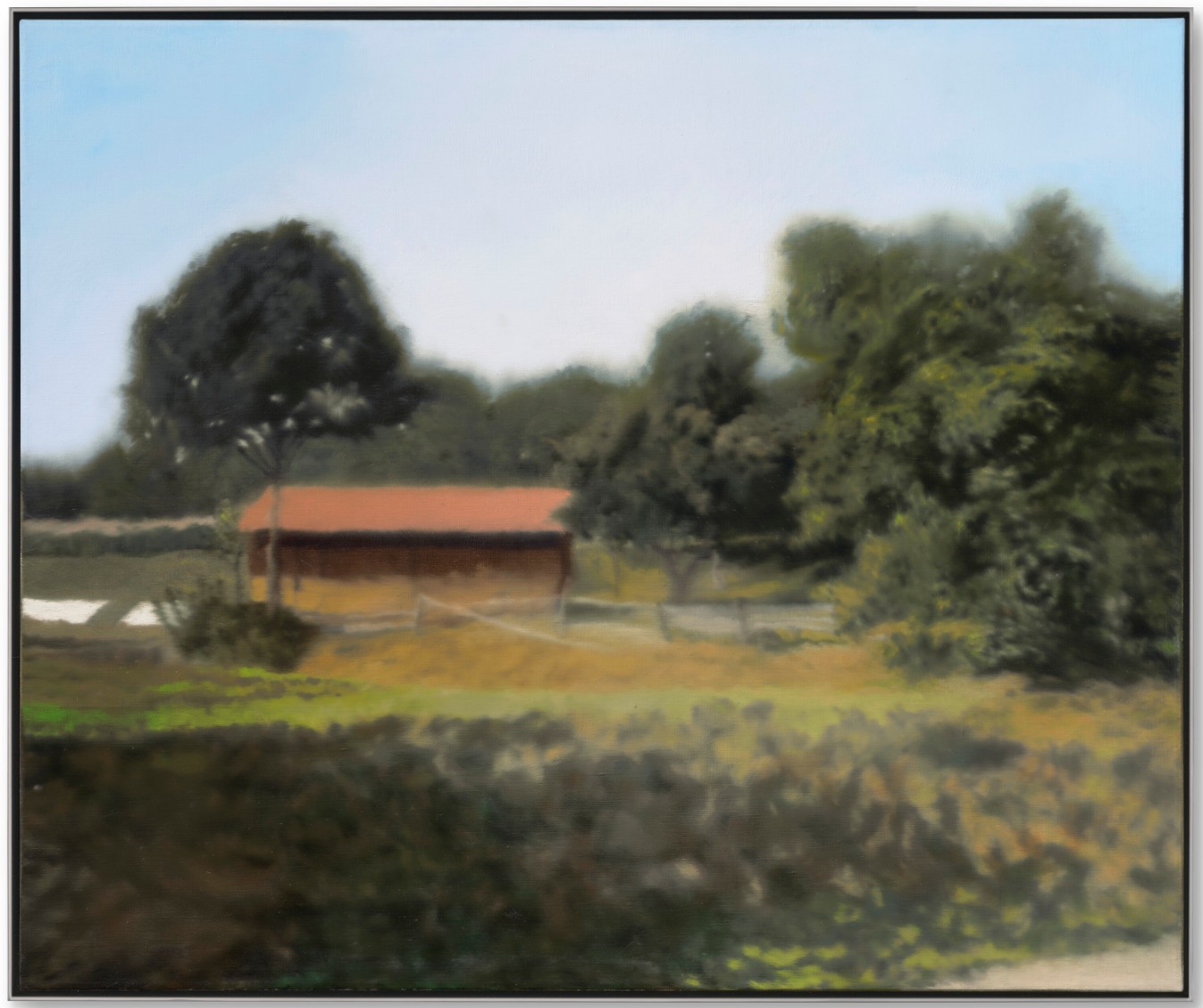
GERHARD RICHTER (B. 1932)
Schober (Haybarn), 1984
Oil on canvas
100.3 x 120 cm (39-1/2 x 47-1/4 inches)
Signed, numbered and dated ‘550-2 Richter 1984’ (on the reverse)
It is high summer in the German countryside. Heat rises from the ground, and trees shimmer against a clear blue sky. Standing on a path, we gaze over a hedgerow towards a low building in the field beyond. Golden haybales are stacked under its roof. A fence and tarpaulins laid nearby are further signs of human presence. Formerly in the collection of Emily and Jerry Spiegel, Schober (Haybarn) (1984) is among the largest and most beautiful of Gerhard Richter’s 1980s landscapes. Begun in the wake of his iconic Kerzen (Candles) and Schädel (Skulls) of 1982-1983, these exquisite, softly blurred pictures stem from a time of romantic bliss and creative ambition for the artist, who had recently married his second wife, Isa Genzken, and moved from Düsseldorf to a large new studio in Cologne. The decade saw major developments in both Richter’s abstract production and his photo-paintings. Beginning with his own camera rather than found black-and-white imagery, and using an array of new painterly techniques, he explored the cultural and physical landscape of his homeland. Schober belongs to the first group of these works to be derived from photographs Richter had taken with Fujifilm, which introduced a fresh palette of pastoral greens, blues and terracotta reds to his work.
After a painful period of conflict and familial breakdown, Richter’s divorce from his first wife, Ema Eufinger, was finalised in 1981. His marriage to Genzken the following year represented a new beginning. ‘The relationship was like nothing he had ever experienced before’, writes Dietmar Elger. ‘It was intense; he was living with another ambitious artist, and he valued Isa’s frank criticism’ (D. Elger, Gerhard Richter: A Life in Painting, Chicago 2009, pp. 242-243). Towards the end of 1983, the couple left Düsseldorf for Cologne. Richter’s studio there, which occupied the entire fifth floor of a former cardboard factory, allowed him greater space and freedom than ever before. Inspired, motivated and in love, he was able to push his practice to sophisticated new heights.
“… I see countless landscapes, photograph barely one in 100,000, and paint barely 1 in 100 of those that I photograph. I am therefore seeking something quite specific.”
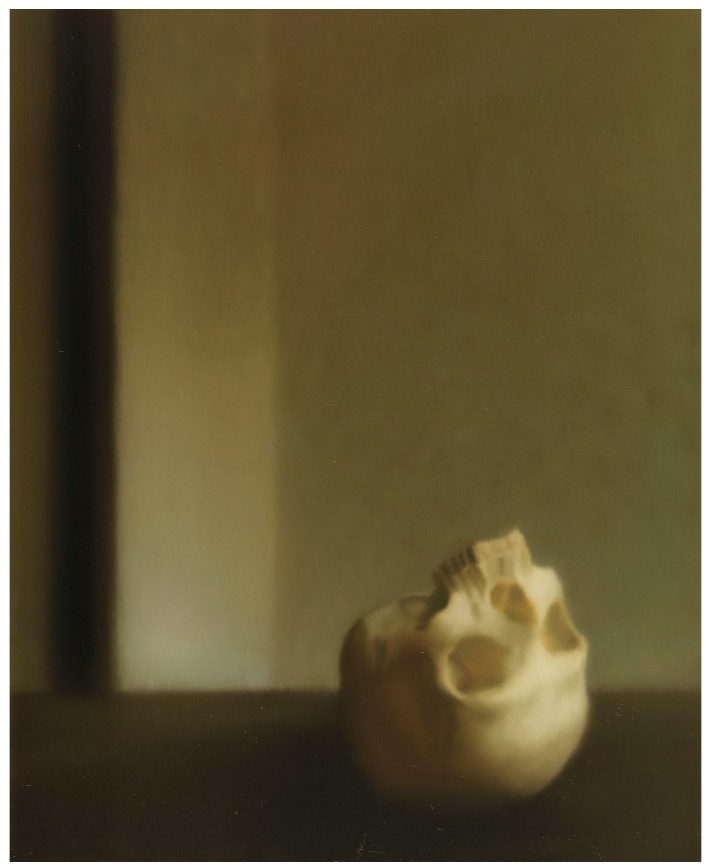
Gerhard Richter, Schädel (Skull), 1983. Musée départemental d’art contemporain, Rochechouart.
Artwork and photo: © Gerhard Richter 2026 (0021).
Richter now began work towards his presentation in the landmark group show Von hier aus: Zwei Monate neue deutsche Kunst in Düsseldorf (From Here Out: Two Months of New German Art in Düsseldorf), which would open in September 1984. This two-month extravaganza came at a time of competition between Cologne and Düsseldorf as artistic centres, and, for Richter, of personal rivalry with another participant: Sigmar Polke. Having worked closely together in the 1960s, the two were now opposing figureheads of the German avant-garde. Richter was determined to prove himself. In a striking installation, he exhibited Schober and one other landscape painting, Scheune (Barn) (1984), opposite nine examples of his new large-format ‘wild abstracts.’ The show was received to huge acclaim, and was a breakthrough moment in Richter’s arrival to the global stage.
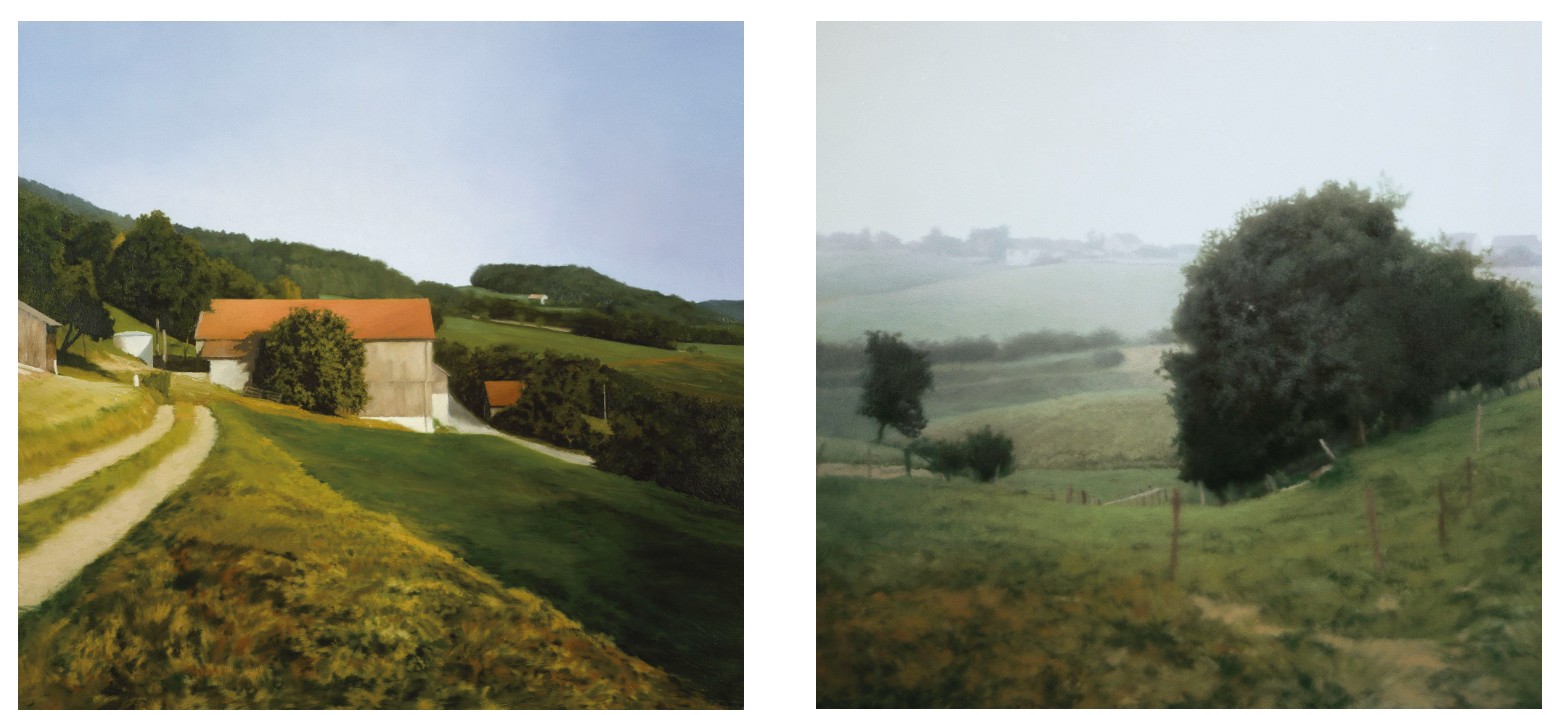
Left: Gerhard Richter, Scheune (Barn), 1984. Private collection. Artwork and photo: © Gerhard Richter 2026 (0021).
Right: Gerhard Richter, Wiesental (Meadowland), 1985. The Museum of Modern Art, New York. Artwork and photo: © Gerhard Richter 2026 (0021).
Following the success of Von hier aus, in 1985 Schober was among several landscapes to travel to galleries in New York. Alongside the abstract works, they caused a rush of critical attention that would culminate in Richter’s first North American retrospective in 1988. Another Scheune (Barn) (1983) was purchased by the Art Gallery of Ontario, Toronto, and Wiesental (Meadowland) (1985) by The Museum of Modern Art, New York. It was at this time that Schober was acquired from Marian Goodman Gallery by the visionary collectors Emily and Jerry Spiegel. The couple were themselves important patrons of MoMA, where Mrs Spiegel served as a trustee and member of the Painting and Sculpture Committee. They would later lend Schober for Richter’s touring European survey of 1993-1994. In their collection for more than three decades, it kept company with such masterpieces as Jean-Michel Basquiat’s Untitled (1982), which broke the world record for the highest price paid for a work by an American artist when it was auctioned in 2017.
“Every beauty that we see in landscape—every enchanting color effect, or tranquil scene, or powerful atmosphere, every gentle linearity or magnificent spatial depth or whatever—is our projection; and we can switch it off at a moment’s notice.”
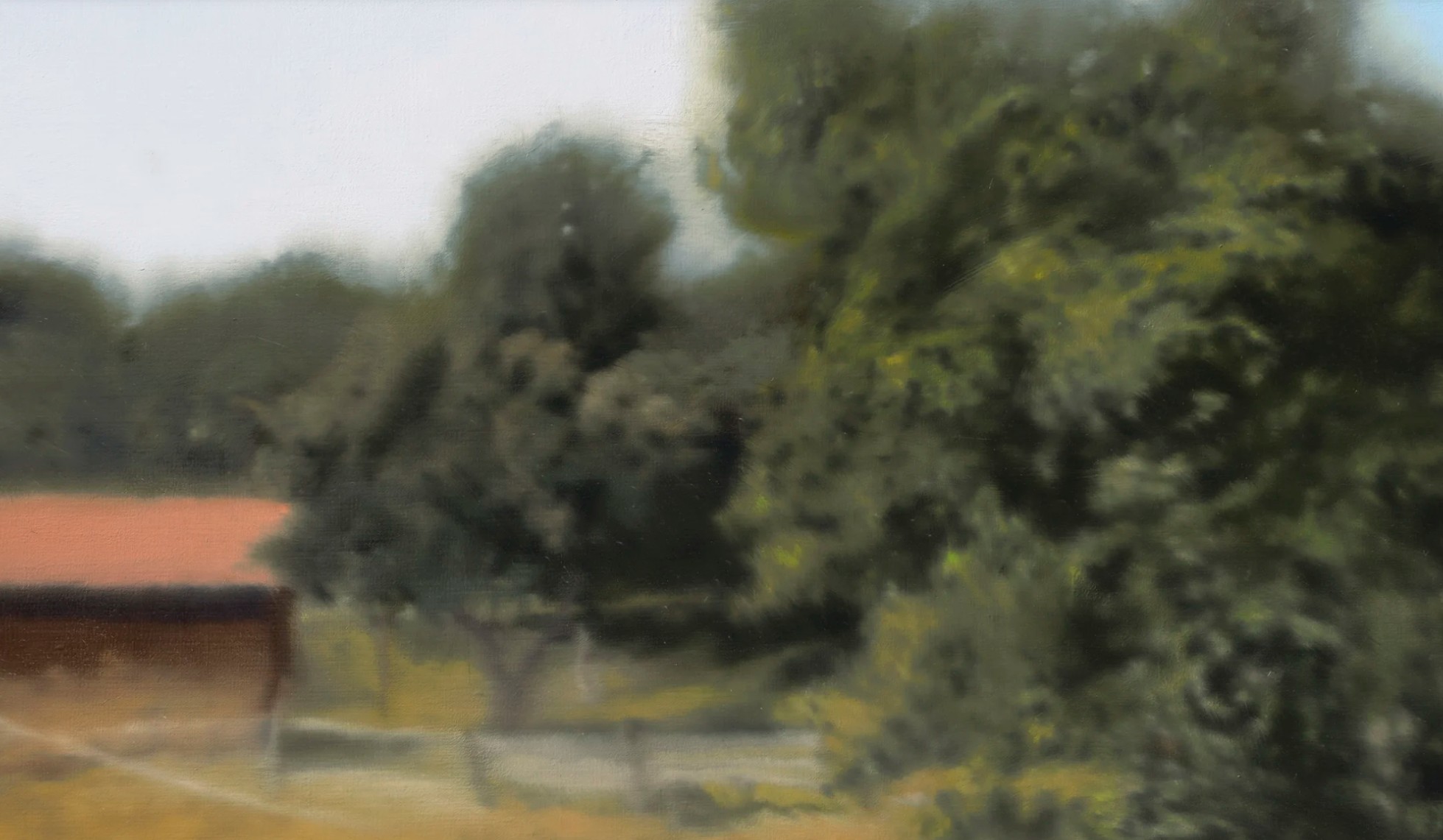
Schober exemplifies the formal complexity of this new phase in Richter’s photo-paintings. He uses a range of techniques across the canvas to blur and enliven the image in different ways, inviting the viewer in only to deflect their gaze. Diagonal strokes feather the foliage in myriad directions, as if capturing the movement of branches in the breeze. A heated haze ripples the fencing and the haybarn’s roof. Look closer, however, and Richter’s mesmerizing brushwork dissolves the image into a field of abstract marks. There are touches of impasto in the sky, reminding us that what we are seeing is paint on a flat surface. The absence of human figures renders the picture silent. The pathway glimpsed at the lower right offers no way in: the idyll is textured with ambiguity and occlusion, disclosing nothing.
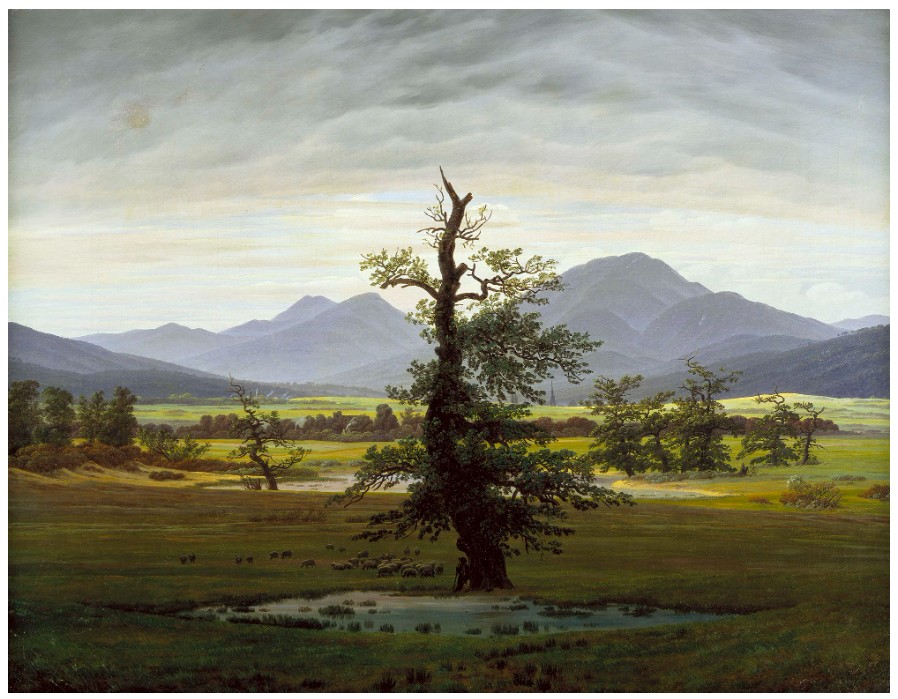
Caspar David Friedrich, The Lonely Tree (Village landscape in morning light), 1822. Nationalgalerie – Staatliche Museen zu Berlin. Digital image: © Photo Scala, Florence/bpk, Bildagentur fuer Kunst, Kultur und Geschichte, Berlin.
Landscapes had been present in Richter’s work since the early 1960s, when he began to create photo-paintings based on newsprint and historical sources. These hazy, largely monochrome pictures set out the terms of a career-long inquiry into the relationship between image and reality, exposing painting and photography as equally ridden with illusion. Early landscapes such as Schloß Neuschwanstein (1963, Museum Frieder Burda, Baden-Baden), derived from a postcard of a Bavarian castle, presented Germany’s self-image as a fabric of clichés. A significant shift came in 1968, when Richter visited Corsica with his young family. He took dozens of photographs which became the basis for a new series of landscape paintings in colour. Initially intending to keep these works private, he soon realised their conceptual potential. With low horizons and wide, dramatic skies, works such as Korsika (Schiff) (Corsica (Ship)) (1968) offered parallels with the Romantic vistas of Caspar David Friedrich. Their haunting grandeur belied their origin as holiday snapshots. From this point onwards Richter would photograph locations across Germany and elsewhere specifically for the purposes of painting.
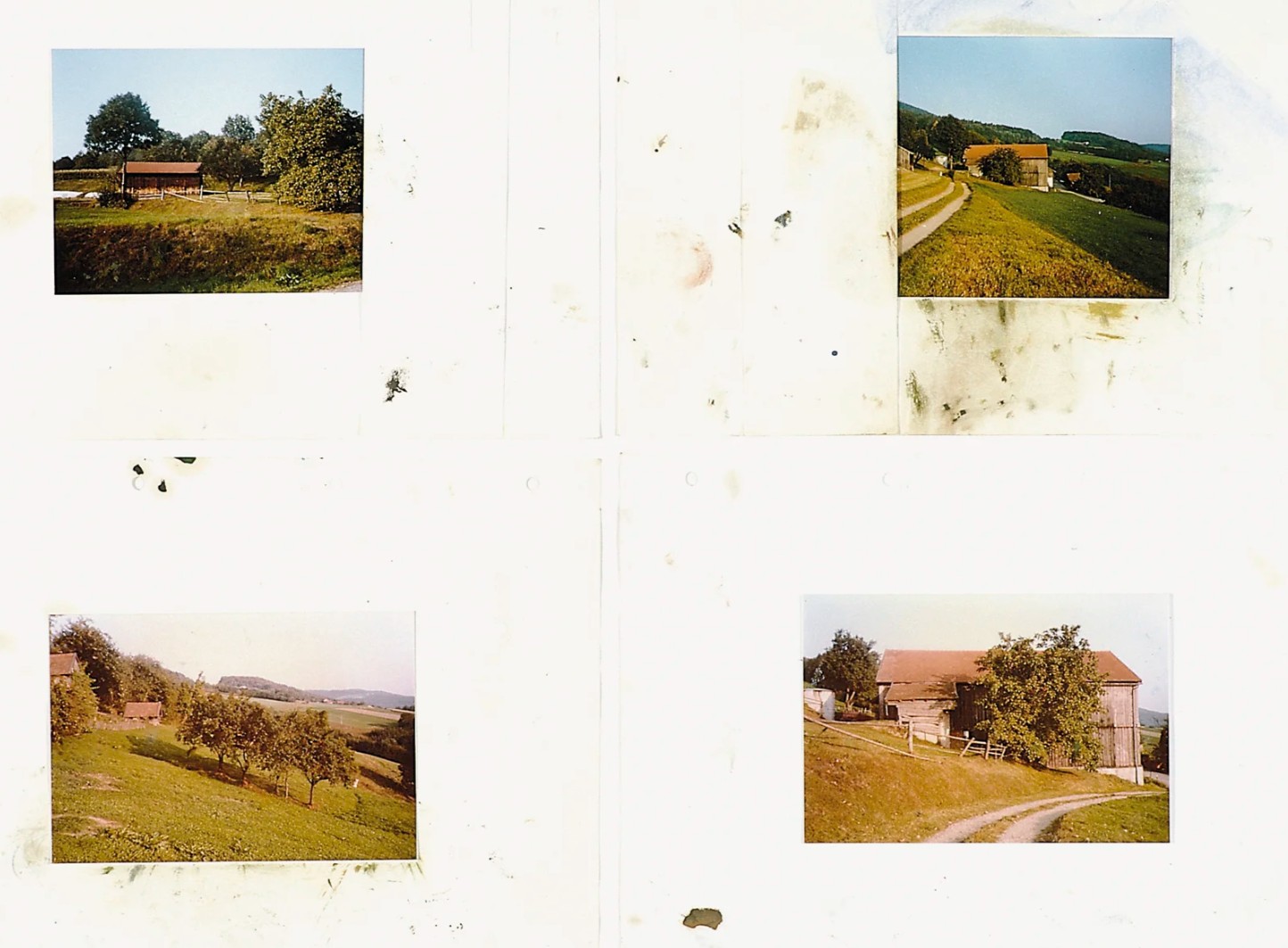
Gerhard Richter, Bayerischer Wald (The Bavarian Forest), 1982 (source image for the present lot).
Artwork and photo: © Gerhard Richter 2026 (0021).
Richter continued to explore echoes of Romanticism through his landscapes, cloudscapes and seascapes of the 1970s, examining a societal and physical environment that had lost its innocence. A chasm separated the nineteenth-century culture and beliefs that had produced Friedrich’s work—which expressed awe at the majesty of Creation, and man’s place within it—from the post-war conditions of his own time. With the 1980s landscapes, however, Richter shifted focus. He moved closer to his motifs, creating images with visual interruptions and strong contrasts between foreground and background. Processed with Fujifilm, the photographs’ hues became richer. The presence of buildings, traffic-signs, cultivated fields and bridges in many of the pictures, notes Dietmar Elger, highlights the fact that they are ‘so-called “cultured landscapes”’ rather than idealised views (D. Elger, ‘Landscape as a Model’, in Gerhard Richter Landscapes, exh. cat. Sprengel Museum, Hanover 1998, p. 11). Now, like artists from Poussin to Monet before him, Richter explored the landscape as a site of human action, with nature and culture interacting in living colour.
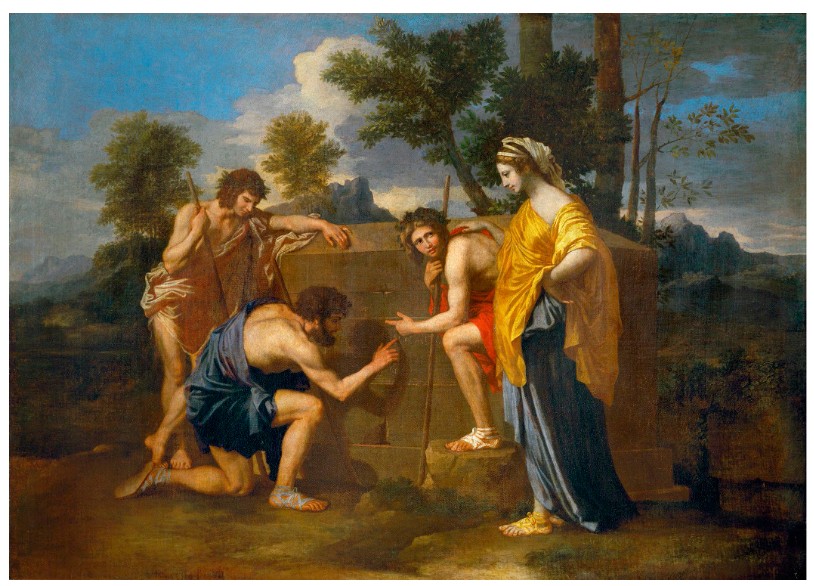
Nicolas Poussin, Les Bergers d’Arcadie, circa 1638. Musée du Louvre, Paris.
The agricultural buildings seen in Schober and its companions—characteristic of rural Bavaria, where the photographs were taken—have an emblematic quality that recalls the ‘red house’ depicted by Edvard Munch, who painted a farmhouse on his property repeatedly throughout the 1920s and 1930s. Unlike Munch’s expressive, emotively-charged motif, however, they keep us at a distance. Schober’s haybarn is a blind strip of color underlined in shadow. For all their allure, Richter understands these images—like any representation of the world—as illusory. ‘Every beauty that we see in landscape—every enchanting color effect, or tranquil scene, or powerful atmosphere, every gentle linearity or magnificent spatial depth or whatever—is our projection; and we can switch it off at a moment’s notice’, he has said (G. Richter, ‘Notes, 1986’, in D. Elger and H. U. Obrist (eds.), Gerhard Richter: Text: Writings, Interviews and Letters 1961-2007, London 2009, p. 158).
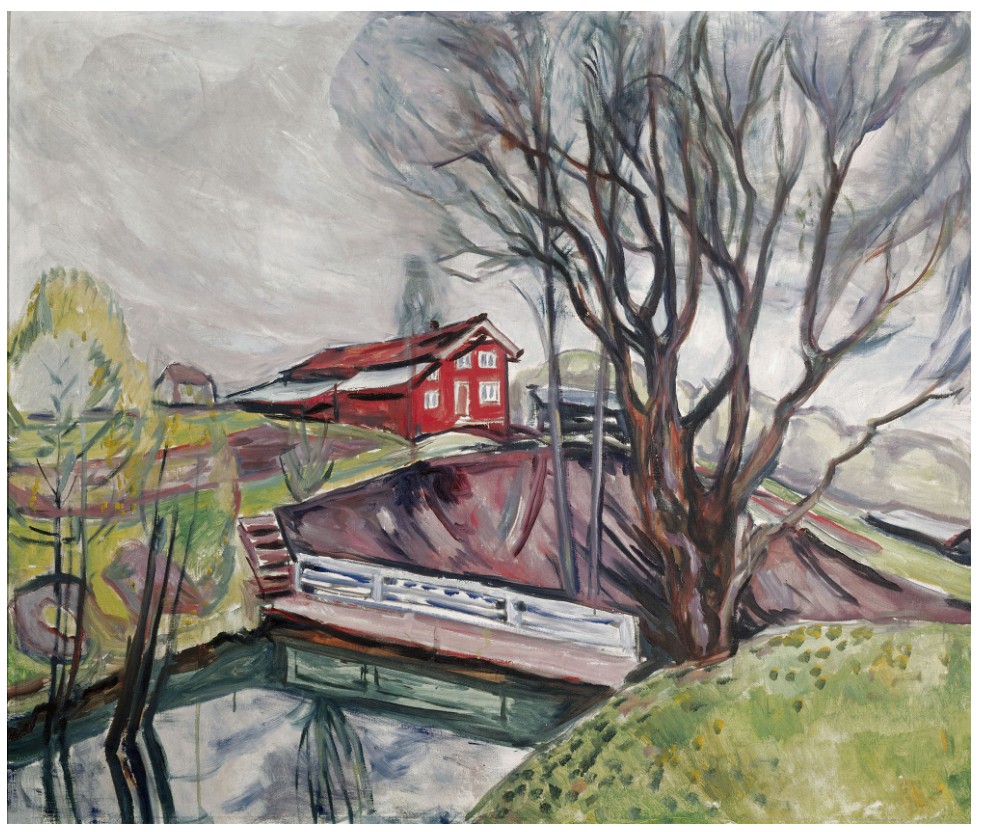
Edvard Munch, The Red House, 1926. Private collection. Digital image: © 2026 Photo Scala, Florence.
Richter’s forays into portraiture, still-life and landscape throughout his career form a critical dialogue with these tropes and the ideas they stand for. They can also be seen to reflect shifts in his outlook and circumstances. His pictures of icebergs—painted in 1982 from photographs taken in Greenland a decade earlier—were not only homages to Friedrich’s Das Eismeer (Sea of Ice) (1823-1824), but related to the collapse of his marriage to Eufinger. The candles and skulls of 1982-1983 were also elegies, reflecting on loss through the lens of the vanitas theme. Schober was born of a more vibrant and joyful period. As Richter began a new life with Genzken, his travels through Germany and beyond—documented in Atlas, his thousands-strong compendium of source images—were expansive, purposeful and exploratory in spirit. ‘… I see countless landscapes, photograph barely one in 100,000, and paint barely 1 in 100 of those that I photograph’, he wrote. ‘I am therefore seeking something quite specific; from this I conclude that I know what I want’ (G. Richter, ibid.). Soon afterwards, he would paint pictures of apples that riffed on the still-lifes of Paul Cezanne.
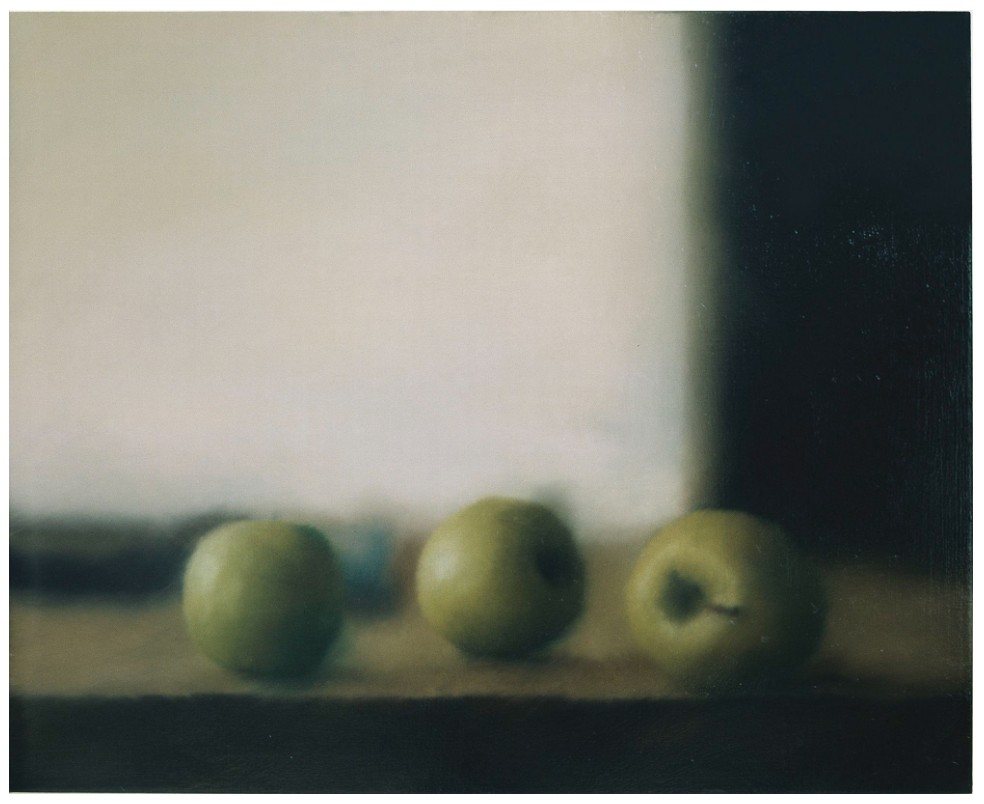
Gerhard Richter, Äpfel (Apples), 1984. Private collection. Artwork and photo: © Gerhard Richter 2026 (0021).
The landscapes evolved in tandem with Richter’s abstract pictures, which developed dramatically with his adoption of the squeegee in the early 1980s. He viewed these Abstrakte Bilder, whose final form was determined by the unpredictable interaction of paint layers dragged across the canvas, as fictive models of reality. Through the open-ended, chance-based struggle of their creation, he confronted the ungraspable complexity of nature itself. The landscapes, in contrast, were wistful models of an irretrievable wholeness. The two bodies of work were different ends of a spectrum: together, they created a balance. ‘If I were to express it somewhat informally, I would say that the landscapes are a type of yearning, a yearning for a whole and simple life’, Richter said. ‘A little nostalgic. The abstract works are my presence, my reality, my problems, my difficulties and contradictions’ (G. Richter in conversation with D. Dietrich, 1985, in ibid., p. 146).
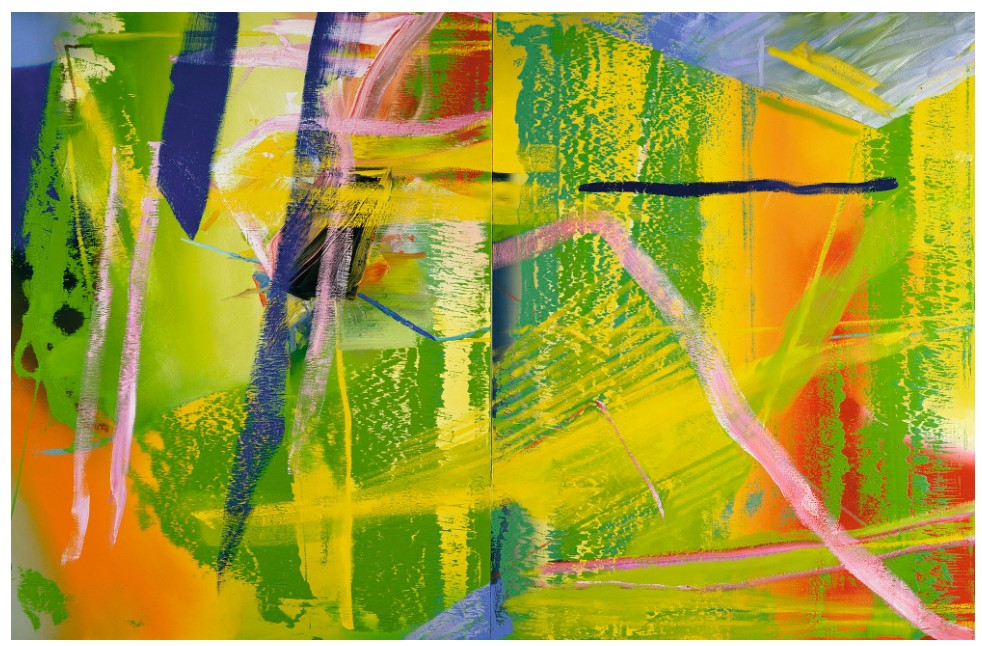
Gerhard Richter, Lilak (Lilac), 1982. Fondation Louis Vuitton, Paris. Artwork and photo: © Gerhard Richter 2026 (0021).
Richter’s photo-paintings were a key focus of his 2025-2026 retrospective at the Fondation Louis Vuitton, Paris. Seen across the decades, they reveal him not merely as a dispassionate observer of second-hand images but as a history painter deeply involved in the visual life of his era. Schober exemplifies the doubt and desire entangled in his position. It lays bare the layered fictions inherent in any image we create for ourselves, whether painting, photograph, national identity or artistic genre. At the same time, the painting takes on its own presence as an object, entirely distinct from the photographic source. It is a marker of a place Richter himself has occupied in time, a product of a happy moment in his life, and—despite everything—a statement of faith in his medium. ‘My works are not just rhetorical, except in the sense that all art is rhetorical,’ he says. ‘I believe in beauty’ (G. Richter quoted in M. Kimmelman, ‘An Artist Beyond Isms’, The New York Times, 27 January 2002, p. 24).
Abstraktes Bild, 1991
ABSTRACT MASTERWORKS FROM AN IMPORTANT PRIVATE COLLECTION
Christie’s London: 5 March 2026
Estimated: GBP 4,500,000 – 6,500,000
GBP 7,600,000 / USD 10,152,840
GERHARD RICHTER (B. 1932), Abstraktes Bild | Christie’s
GERHARD RICHTER (B. 1932)
Abstraktes Bild, 1991
Oil on canvas
112×102 cm (44-1/8 x 40-1/8 inches)
Signed, numbered and dated ‘748-5 Richter 1991’ (on the reverse)
With its blazing red surface and cinematic sense of depth, the present work is an incandescent example of Gerhard Richter’s celebrated Abstrakte Bilder (‘Abstract Paintings’). Painted in 1991, during a period of outstanding professional triumph, it belongs to an extraordinary suite of distinctive red canvases created that year. With examples held in the Israel Museum, Jerusalem and the Institut für Auslandsbeziehungen, Stuttgart, these works take their place at the height of his abstract practice: a further example was illustrated on the cover of the catalogue for his retrospective at the Tate Gallery, London, that year. In the present work, tones of crimson, scarlet and vermilion shimmer and collide, marbled with silken swathes of shadow. The squeegee, Richter’s signature tool since the 1980s, is used to subtle yet dramatic effect, delicately parting the skeins of red to reveal flashes of light beneath. It is an exquisite meditation on the relationship between chance and control, illusion and reality, revelling in the fiery friction between them.
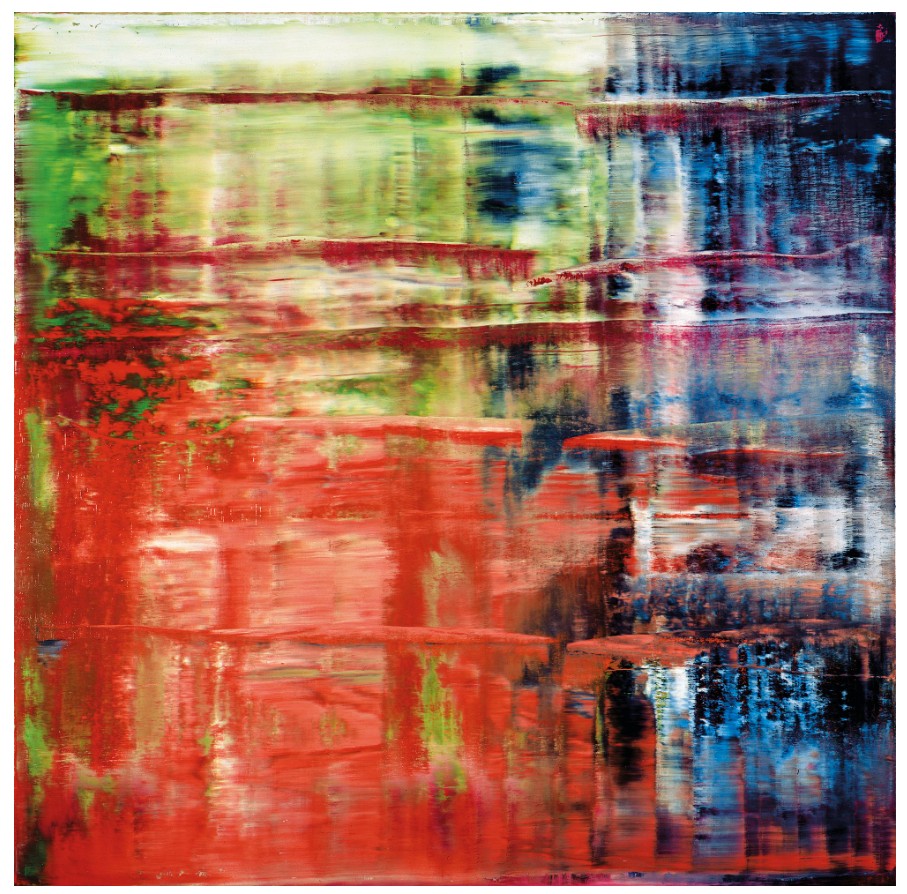
Gerhard Richter, Bach (1), 1992. Moderna Museet, Stockholm. Artwork and photo: © Gerhard Richter 2026 (0029).
The Abstrakte Bilder dating from the late 1980s and early 1990s are widely considered to represent Richter’s finest achievements. Begun in the 1970s, and honed over the course of the following decade, these paintings took on a life of their own during this period, increasing in complexity, scale and ambition. Major series arose, including Eis (Ice) (1989, Art Institute of Chicago), Wald (Forest) (1990) and the celebrated Bach suite (1992, Moderna Museet, Stockholm). The latter, in particular—with their glimmering ruby curtains—may be seen to have their origins in the red paintings of 1991. Concurrently, Richter’s international reputation began to soar. The Tate retrospective was followed by a major presentation at Documenta IX in 1992, while 1993 saw the opening of his career-defining touring retrospective at the Musée d’Art Moderne de la Ville de Paris. This landmark survey of more than 100 paintings, accompanied by a new catalogue raisonné, propelled the artist to global stardom.
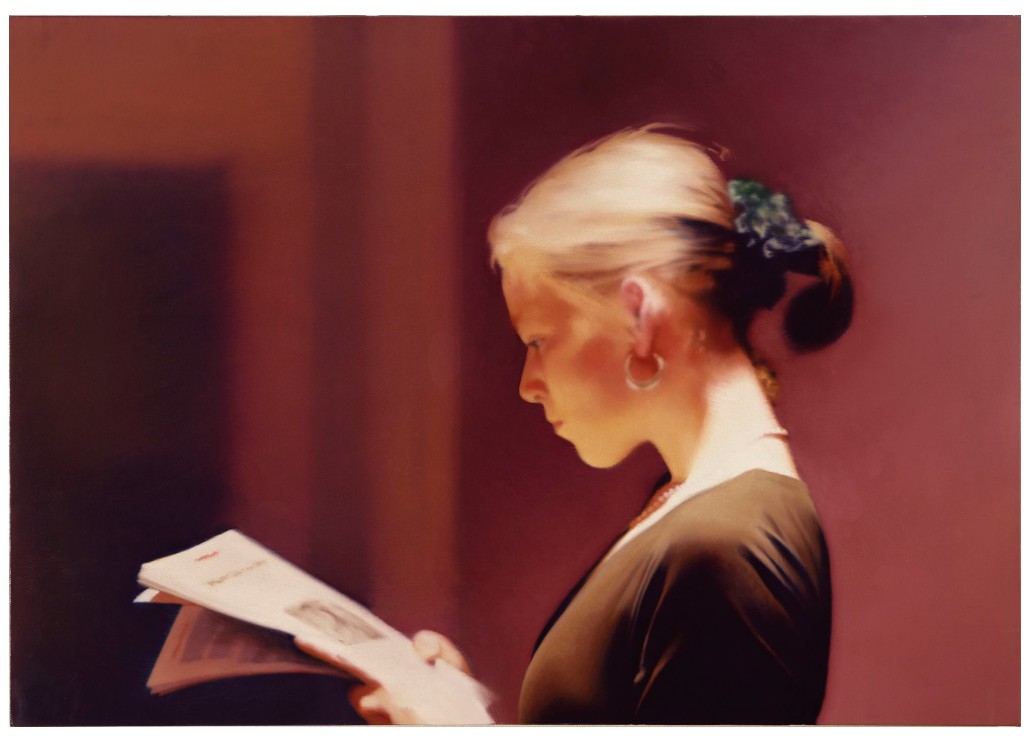
Gerhard Richter, Lesende (Reader), 1994. San Francisco Museum of Modern Art. Artwork and photo: © Gerhard Richter 2026 (0029).
Many of the red abstracts, including the present, were unveiled at Galerie Liliane & Michel Durand-Dessert in September 1991. It was one of the first times in Richter’s abstract practice that he had focused with such sustained intensity upon a single colour. His choice was not without art-historical precedent: Robert Rauschenberg and Ad Reinhardt had both dedicated specific series to red, while artists from Kazimir Malevich and Henri Matisse to Barnett Newman and Cy Twombly had rigorously plumbed its depths. For Richter, too, red was a potent hue, saturating major photo-paintings such as Betty (1988, Saint Louis Art Museum) and later the exquisite Lesende (Reader) (1994, San Francisco Museum of Modern Art). At the time of the present work he had also just completed a series of coloured mirror paintings, including eight ‘blood red’ examples—one of which resides in the San Francisco Museum of Modern Art.
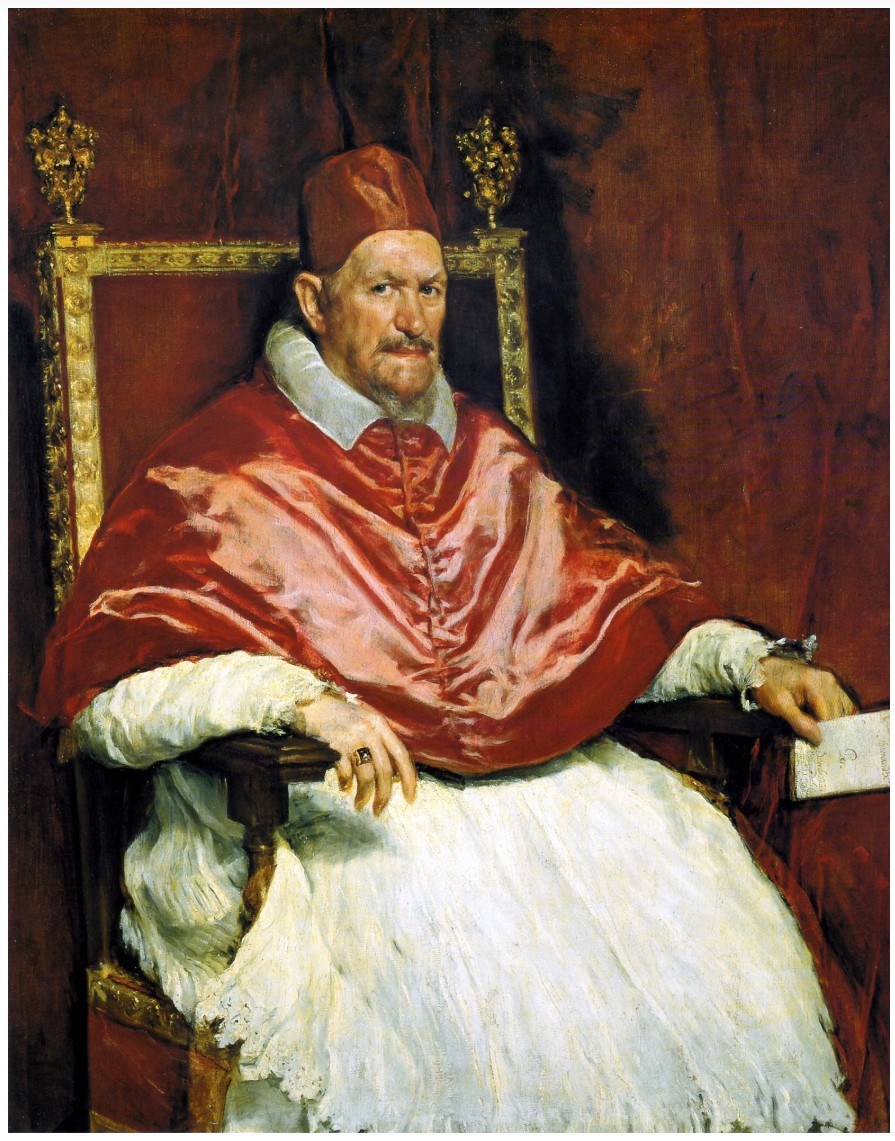
Diego Velázquez, Portrait of Pope Innocent X, circa 1650. Galleria Doria Pamphilj, Rome.
Since the late 1960s, when he moved away from his early greyscale photo-paintings, Richter has repeatedly sought to dissect the chromatic spectrum. His Farbtafeln (Colour Charts) drew upon commercial color samples in the spirit of Pop Art; his Rot-Blau-Gelb (Red-Blue-Yellow) paintings had mixed three tones in endless configurations. Many of his major series of the 1990s would also explore deliberately limited palettes, including the four Grün-Blau abstracts of 1993 (Museo Nacional Centro de Arte Reina Sofía, Madrid), and the five Rot-Blau-Grün paintings of 1994 (Abgeordnetenhaus, Berlin). While the red paintings may be understood within this context, however, they are far from monochrome statements. In Richter’s hands, red fractures into a spectrum of infinite shades: from cherry and rose to brick, burgundy and carmine. In the present work, as in many others from the series, other colours glimmer through the surface like jewels. Red becomes a cloak, veiling tantalizing hints of a world beyond.
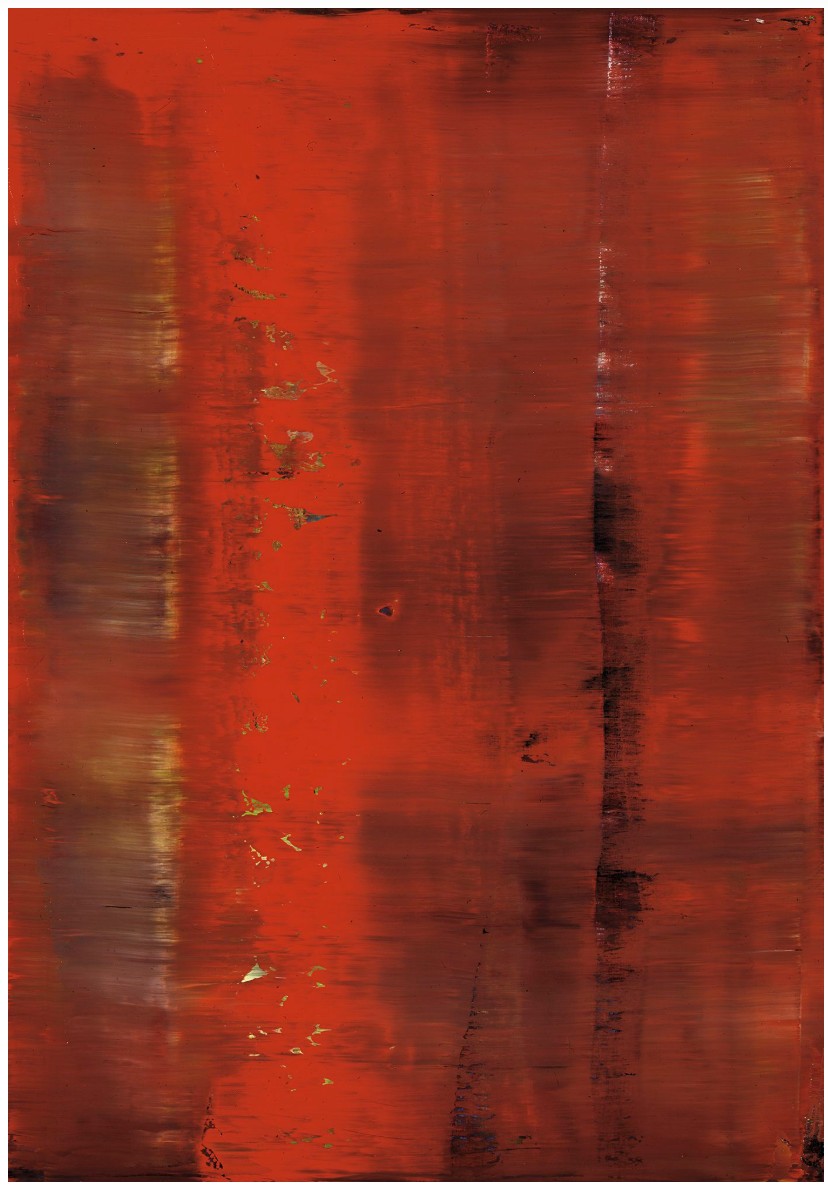
Gerhard Richter, Abstraktes Bild (743-3), 1991. The Israel Museum, Jerusalem. Artwork and photo: © Gerhard Richter 2026 (0029).
Richter’s abstracts emerged and evolved in dialogue with his photorealist paintings. Together these twin bodies of work asked important questions about the nature of art-making, suggesting that all images were inherently deceptive. Richter’s photo-paintings frequently blurred their subjects to the point of ambiguity, reproducing the slippages of the camera lens. His abstracts, conversely, revelled in their unplanned semblance to reality, their surfaces swimming with hints of recognizable phenomena. The present work quivers with the same ethereal beauty as light upon water, or a dazzling sunrise. The closer we get to the surface, however, the more its illusion dissolves. ‘With abstract painting we create a better means of approaching what can be neither seen nor understood’, explained Richter (G. Richter, quoted in R. Nasgaard, ‘Gerhard Richter’, in Gerhard Richter: Paintings, exh. cat. Museum of Contemporary Art, Chicago 1988, p. 107).
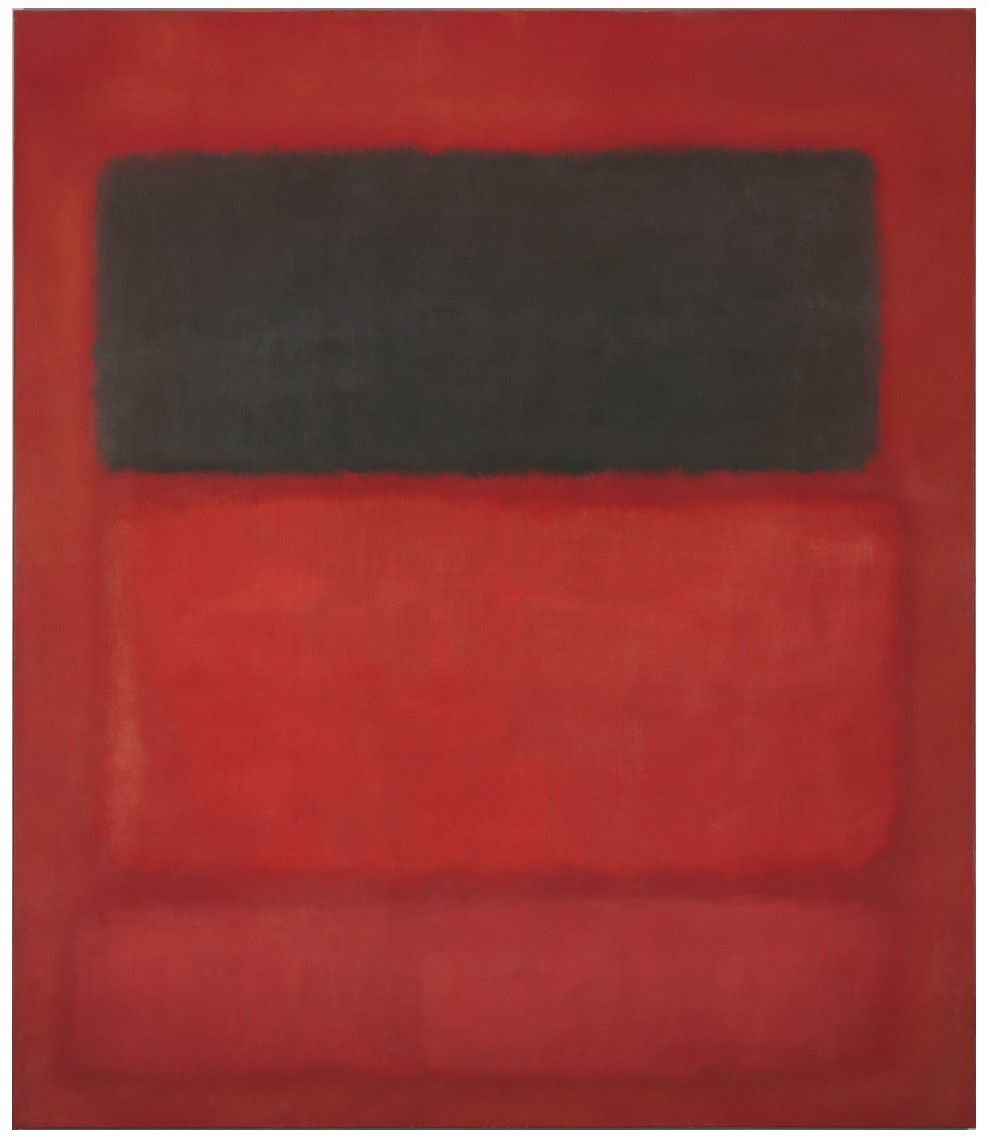
Mark Rothko, Black over Reds (Black on Red), 1957. Baltimore Museum of Art.
Artwork: © 2026 Mark Rothko/DACS. Digital image: Baltimore Museum of Art / Bridgeman Images.
The squeegee, adopted in the early 1980s, became an essential part of this approach. It allowed Richter to move away from his early ‘soft’ abstracts—often based on photographs of enlarged brushstrokes—and to submit himself to the powers of chance. Dragged over layers of wet paint, it became a tool for mixing and excavating, marbling different tonalities together while simultaneously exposing others. The effects recall the vast, shimmering color fields of Mark Rothko, the dappled surfaces of the Impressionists and the rich chiaroscuro of Velázquez and Caravaggio. None, however, were explicit models for Richter: in works such as the present, paint itself remains the sole subject. The squeegee, he writes, ‘is a good technique for switching off thinking. Consciously, I can’t calculate the result. But subconsciously, I can sense it’ (G. Richter, quoted in S. Koldehoff, ‘Gerhard Richter, Die Macht der Malerei’, in Art. Das Kunstmagazin, December 1999, p. 20). Across the surface of the present work, pigment writes its own story, drifting in and out of resemblance to the world we know.
Cage Grid, 2011
Property from a Distinguished British Collector
Sotheby’s London: 5 March 2026
Estimated: GBP 400,000 – 600,000
GBP 512,000 / USD 683,980
Cage Grid | Contemporary Day Auction | 2026 | Sotheby’s
GERHARD RICHTER (b. 1932)
Cage Grid, 2011
Giclée print on paper mounted on aluminum, in sixteen parts
Each: 75×75 cm (29-1/2 x 29- 1/2 inches)
Overall: 300×300 cm (118-1/8 x 118-1/8 inches)
Each: signed with the artist’s initials and numbered 15/16 (on the reverse)
This work is number 15 from an edition of 16, plus 4 artist’s proofs
Gerhard Richter’s Cage Grid represents a bold reinterpretation of his celebrated 2006 painting Cage, part of a group of six works inspired by the pioneering composer John Cage. Responding to Cage’s radical investigations into sound, silence, and indeterminacy, Richter’s Cage series channels chance through abstraction, vivid colour, and the physicality of paint. Produced in 2011 as a limited edition of finely executed giclée prints, Cage Grid reconfigures the original composition by dividing it into sixteen uniformly sized panels. This structural intervention introduces an added layer of geometric order, counterbalancing the fluid, swirling movements of paint that characterize the source image. Each segment operates as a self-contained fragment of the whole, and when viewed together, the panels resemble a series of windows—an association that recalls Richter’s monumental stained-glass installation for Cologne Cathedral.
“That’s roughly how Cage put it: “I have nothing to say and I am saying it.” I have always thought that was a wonderful quote. It’s the best chance we have to be able to keep on going.”
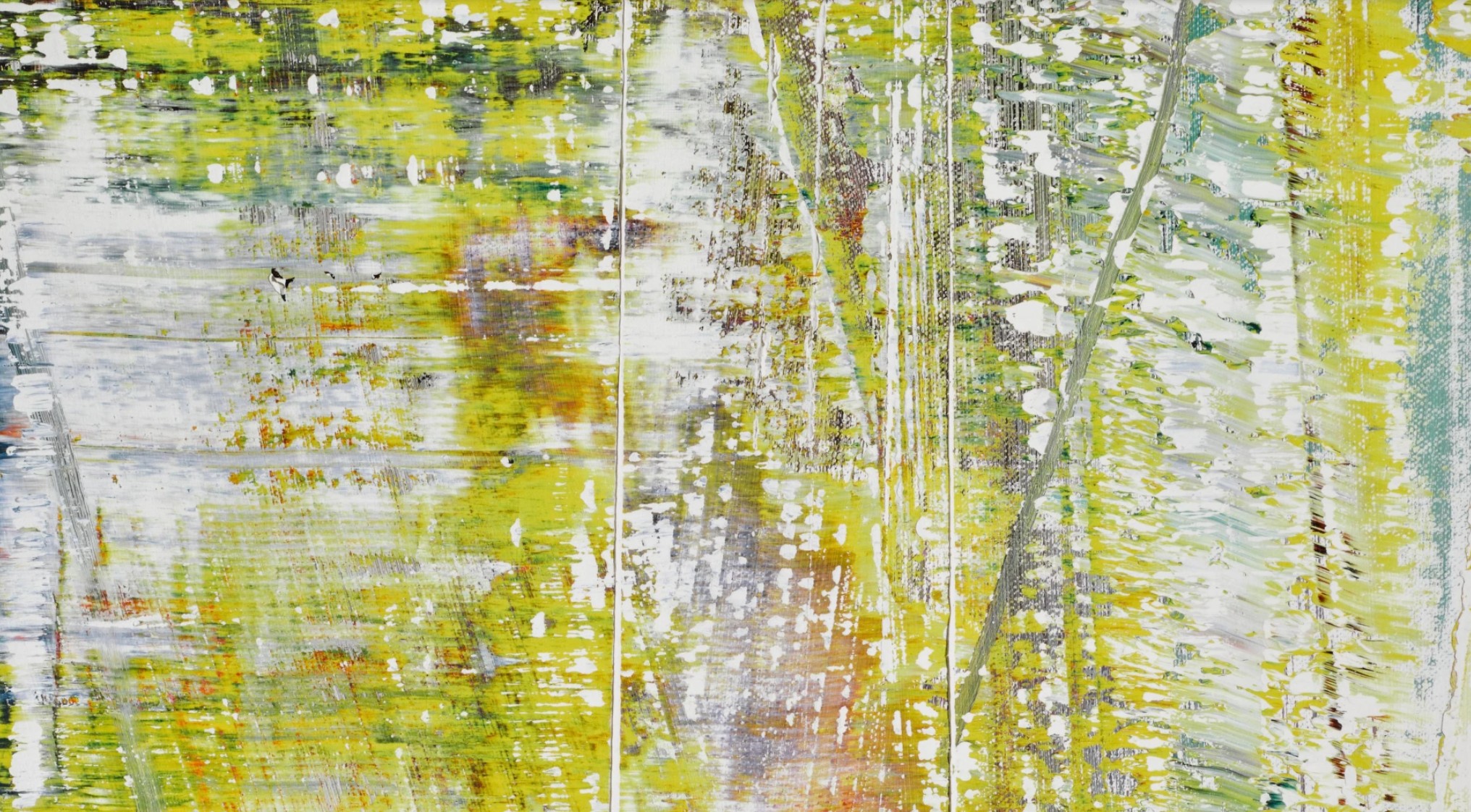
Widely regarded as among the most important achievements in Richter’s abstract practice, the Cage paintings debuted at the German Pavilion of the Venice Biennale in 2007. They later featured prominently in the artist’s major retrospective Panorama at Tate Modern in 2011, before traveling to institutions including the Staatliche Museen in Berlin and the Musée national d’art moderne in Paris. During their presentation at Museum Ludwig in Cologne, the Cage works were installed opposite Richter’s Bach series, another body of work rooted in musical inspiration. This deliberate pairing foregrounded both the shared conceptual foundations and the divergent emotional registers of the two series. The expansive scale, dense surface, layered application, and erasures within Cage 6—achieved through Richter’s iconic squeegee technique—generate a visual analogue to Cage’s irregular, percussive rhythms. By contrast, the Bach paintings suggest the ordered resonance of a classical string ensemble. As Robert Storr observes in his study of the series, the Cage paintings constitute “Richter’s beautiful way of saying nothing,” a gesture that reaffirms the artist’s steadfast commitment to innovation (Robert Storr, Cage: Six Paintings by Gerhard Richter, London 2009, p. 86).
“Abstract paintings are fictive models because they show a reality that we can neither see nor describe, but whose existence we can surmise. This reality we characterize in negative terms: the unknown, the incomprehensible, the infinite, and for thousands of years we have described it with ersatz pictures, with heaven, hell, gods, devils. With abstract painting we created a better possibility to approach that which cannot be grasped or understood, because in the most concrete form it shows ‘nothing.’”
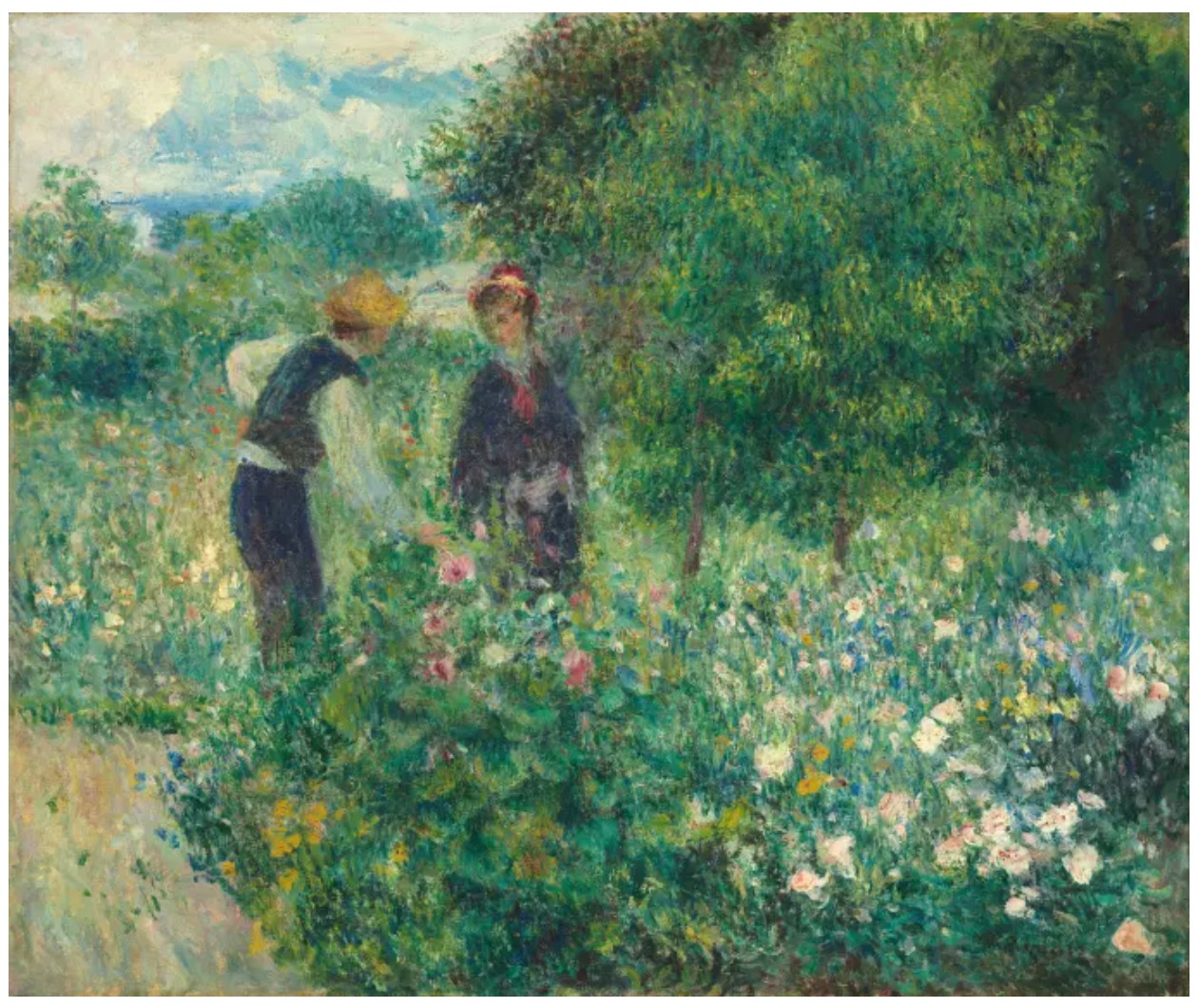
August Renoir, Picking Flowers, 1875 / National Gallery of Art, Washington
While the squeegee process, now inseparable from Richter’s reputation, offers insight into the making of the original Cage 6, Cage Grid compels the viewer to encounter the image anew, as a constellation of fragments that together form a unified whole. Across Richter’s wider body of work, abstraction repeatedly appears animated by chance effects, tactile surfaces, and intense chromatic fields, all stemming from his profound command of paint and willingness to embrace unconventional methods. Here, deep greens, flashes of teal, subdued whites, and accents of bright yellow traverse the surface like reverberating sound waves. The canary yellows and layered greens, in particular, evoke the luminous atmospheres of Impressionist landscape painting, recalling the chromatic vitality with which artists such as Monet or Pissarro translated shifting light into pigment. In Richter’s hands, however, these colours are wrenched from descriptive naturalism and reconstituted as pure sensation: fields of hue that shimmer and dissolve, suggesting remembered light rather than observed terrain. At the same time, the segmentation into sixteen discrete parts functions as a metaphor for musical modulation and digital fragmentation, while also alluding to the “16-bar blues,” often cited as a foundational structure in the evolution of modern music.
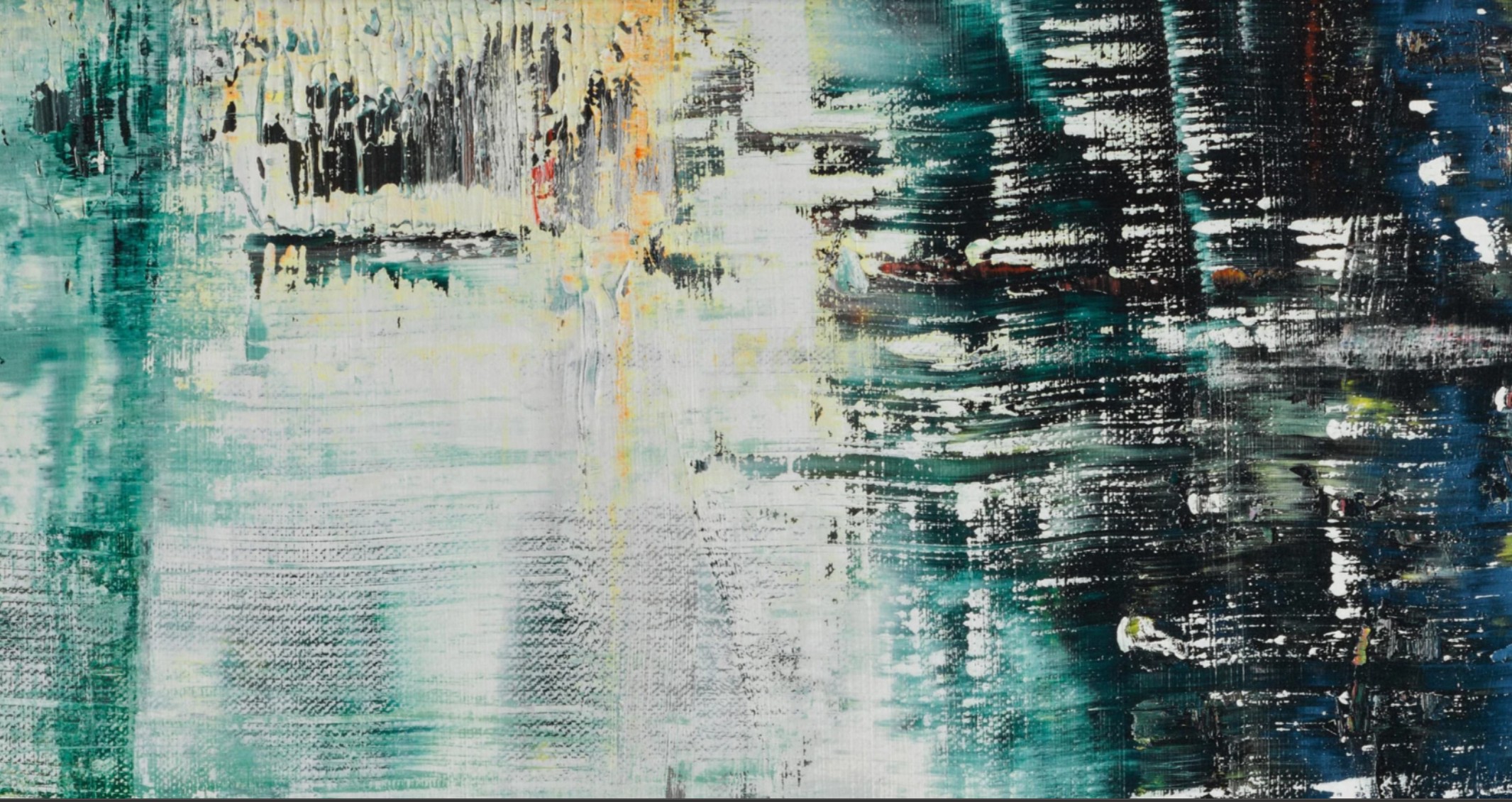
Richter’s achievement lies in his ability to take the raw intensity of a work such as Cage 6 and reimagine it as something unexpectedly cohesive by radically altering its mode of presentation. Contained within a grid that invites countless visual permutations, the sixteen giclée panels encourage prolonged and repeated looking, rewarding attention to subtle variations and intricate detail. The viscous streaks and blurred passages of the original painting are translated into a flat, two-dimensional field, separated by intervals of negative space that prompt reflection on the very conditions of painting and representation. These works stand not only as a landmark in contemporary abstraction, but also as deeply personal statements for the artist. Responding to a question from Nicholas Serota that drew connections between Vermeer, Bach, and Cage, Richter characterized the series as “neither contrived, nor surprising and smart, not baffling, not witty, not interesting, not cynical… It can’t be planned and it probably can’t even be described. It’s just good.” (Gerhard Richter, quoted in Exh. Cat., London, Tate Modern, Gerhard Richter: Panorama. A Retrospective, 2011, p. 17)
Flow, 2013
Sotheby’s London: 5 March 2026
Estimated: GBP 300,000 – 500,000
GBP 281,600 / USD 376,190
Flow | Contemporary Day Auction | 2026 | Sotheby’s
GERHARD RICHTER (b. 1932)
Flow, 2013
Lacquer behind glass mounted on Alu-Dibond
120×170 cm (47-1/4 x 66-7/8 inches)
Signed, dated 2013 and numbered 933-1 (on the reverse)
Flow (933–1) exemplifies Gerhard Richter’s sustained investigation into the tensions between control and chance, form and formlessness, surface and depth. Composed of a multitude of marbled hues, the painting unfolds through organic swirls, bubbles, and meandering currents of lacquer that evoke both geological strata and aerial topographies. Its chromatic intensity and fluid structures situate the work at the threshold between the spontaneous and the deliberate, the natural and the synthetic.
“I don’t work at random but in a more planned way, in the sense that I let a thing happen by chance, then correct it, and so on. The actual work consists in taking what appears, looking at it then deciding whether it’s acceptable or not.”
The Flow series of reverse glass paintings represents a significant development within Richter’s oeuvre, extending his painterly language into an unexpected material and conceptual register. Richter first experimented with reverse glass techniques in small-format diptychs as early as 200 with his Sindbad, Bagdad, Ifrit, and Perizade series and which culminated in the hundred-part work Abdallah in 2010. The titles of these early works, drawn from an Orientalist fairytale vocabulary, underscore the role of unpredictability and illusion that characterizes the process. After a period of withdrawal from what he has described as “controlled coincidence,” Richter returned to the medium in 2013 with the Flow series, now executed in dramatic large-scale diptychs.
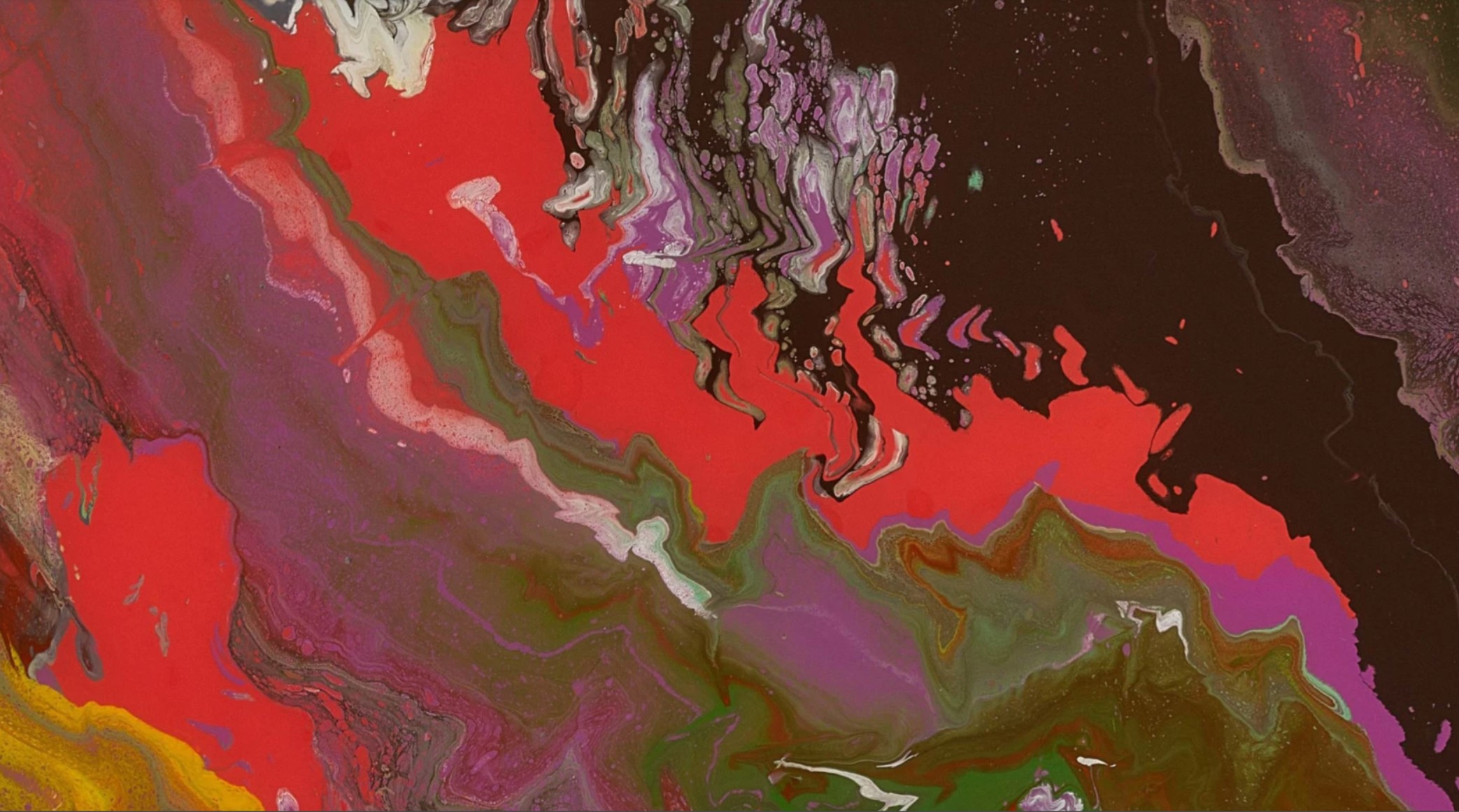
Richer’s making process begins with the pouring of liquid lacquers onto a Plexiglas support, where the pigments are permitted to intermingle freely. Richter then intervenes selectively – tilting the surface or subtly disturbing the paint with brushes or palette knives – guiding the flow without fully determining its outcome. In the Flow series, these compositions are mounted on Alu Dibond, a composite material commonly associated with photographic presentation, consisting of a polyethylene core sandwiched between aluminum layers. This choice reinforces Richter’s ongoing engagement with industrial materials and his persistent challenge to the conventional boundaries of painting. While gravity and chance play a dominant role in shaping the final image, Richter’s authorship is located precisely in the restraint of his intervention. Rather than yielding entirely to randomness or asserting absolute control, he orchestrates a delicate collaboration with chance. In the resulting balance between contingency and intention, Flow (933–1) affirms Richter’s singular capacity to reveal abstraction as both a material process and a philosophical inquiry within contemporary painting.
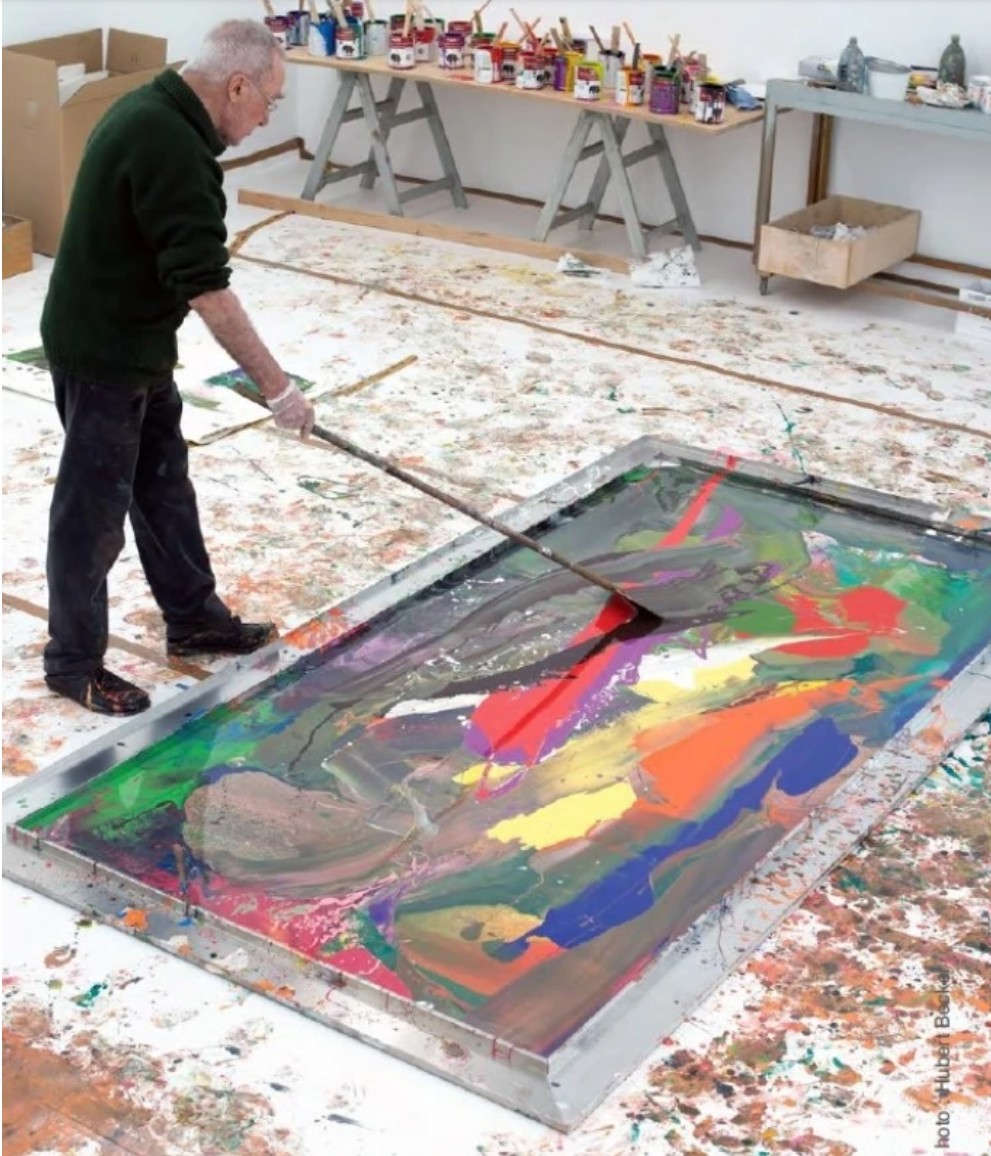
Gerhard Richter at work in his studio. Image © Hubert Becker
In Flow (933–1), the viewer’s eye moves through passages of deep forest green, royal purples and earthen reds, yet the temporal sequence of the painting’s formation remains opaque. This resistance to legibility is intentional. Through layered pours and blended pigments, Richter suspends the work in a state of temporal ambiguity, affirming both the immediacy of a singular event and its dissolution into an unknowable continuum. The painting belongs to a group of twenty Flow works produced by pouring vividly colored enamel into a tray and pressing a glass panel onto the wet surface, effectively arresting the motion of the paint and preserving its fluidity as a fixed image. Unlike Richter’s abstract canvases or photo-based works, the reverse glass paintings are not built through direct application to the picture plane. Instead, color exists as a radiant, sealed surface, with depth arising solely through optical and painterly means. Richter deliberately avoids privileging particular hues, allowing the full chromatic spectrum to operate without hierarchy.
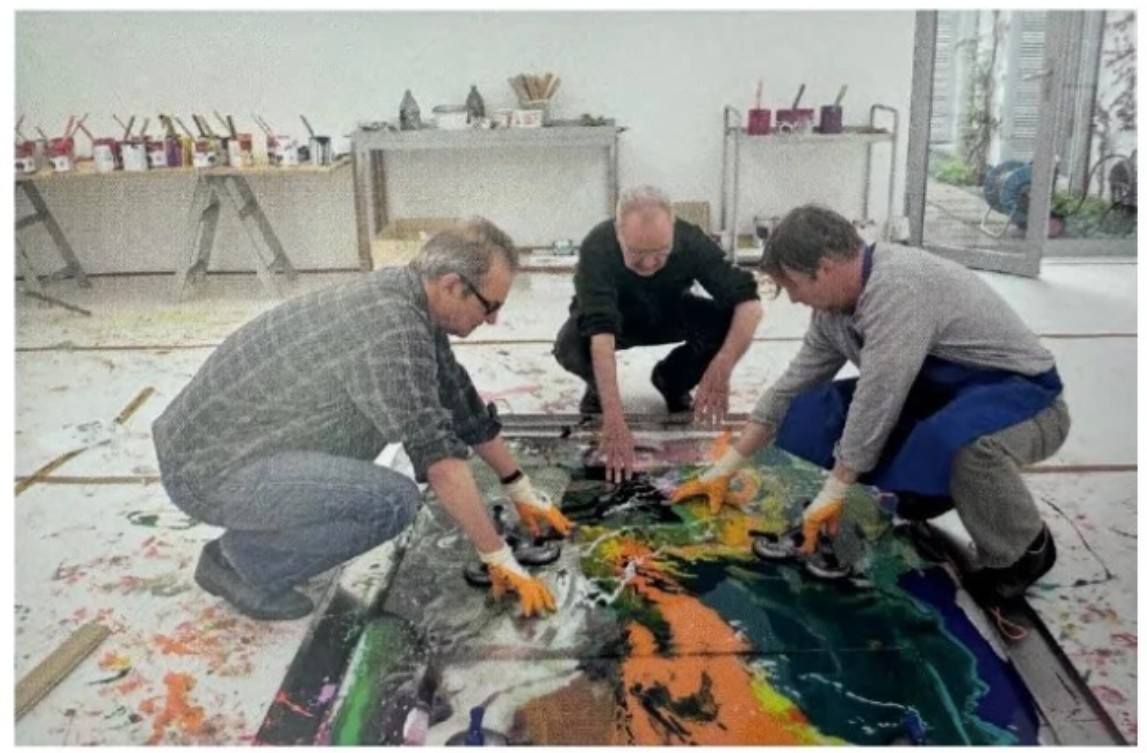
Gerhard Richter at work in his studio
Flow (933–1) stands as a testament to Richter’s enduring exploration of the interplay between materiality, chance, and artistic intention. It exemplifies how abstraction can simultaneously captivate the eye and provoke reflection, offering a visual experience that is both sensorial and conceptual. By harnessing the unpredictable behaviors of lacquer and glass while subtly guiding their interactions, Richter transforms the ephemeral into the permanent, the fleeting into the monumental. In this synthesis of control and coincidence, Flow (933–1) not only expands the formal possibilities of painting but also reaffirms Richter’s position as one of the most inventive and intellectually rigorous figures in contemporary art.
Abstraktes Bild, 1992
Christie’s London: 7 March 2026
Estimated: GBP 300,000 – 500,000
GBP 355,600 / USD 475,045
GERHARD RICHTER (B. 1932), Abstraktes Bild | Christie’s
REPEAT SALE
Christie’s Paris: 30 November 2022
Estimated: EUR 450,000 – 650,000
EUR 567,000
Gerhard Richter (né en 1932), Abstraktes Bild | Christie’s
GERHARD RICHTER (B. 1932)
Abstraktes Bild, 1992
Oil on canvas
52×62 cm (20-1/2 x 24-3/8 inches)
Signed, inscribed and dated ‘Richter 92 763-7’ (on the reverse)
Formerly part of the celebrated Jan Krugier Collection, the present work is a jewel-like example of Gerhard Richter’s Abstrakte Bilder, or ‘Abstract Pictures’. Painted in 1992, it coincides with that year’s showcase of large-scale Abstrakte Bilder at documenta IX in Kassel, which propelled his abstract practice to new international acclaim. Examples from this period—some of them seen in the recent landmark retrospective at the Fondation Louis Vuitton, Paris—are considered among the finest of Richter’s career. Using a squeegee to drag paint across the canvas, he began to stripe, lattice and intercut their layered surfaces, creating a new chromatic and textural intricacy. The present painting builds up a darkly opulent ground, with fiery oranges, blues and greens flashing through a field of black. These pigments are marbled together in broad sweeps and descending diagonal strokes. Five rhythmic, horizontal bands have been scraped through the semi-wet paint, pulling it back to reveal the toothed shimmer of the canvas beneath. Where the Abstract Expressionists had conceived of the canvas as an arena for gestural action, or a receptacle for the painter’s emotions, Richter understood his Abstrakte Bilder in more impersonal terms. He worked slowly and deliberately, wielding his squeegee in a smooth, purposeful motion. He acknowledged that his own ‘inner state’ had an impact on the works, but not in the sense of subjective content or mental imagery. Rather, he saw his disposition as just one of the myriad natural inputs that would lead to the painting’s final form, which—like the shape of a tree in a forest—was ultimately the product of chains of causation too complex to comprehend, predict or analyze. The present work exemplifies the variegated, delicate and mysterious splendor he was able to achieve.
Abstraktes Bild (431-8), 1977
Property from an Important Private European Collection
Phillips London; 7 March 2026
Estimated: GBP 200,000 – 300,000
GBP 199,950 / USD 267,115
Gerhard Richter Modern & Contemporary Art
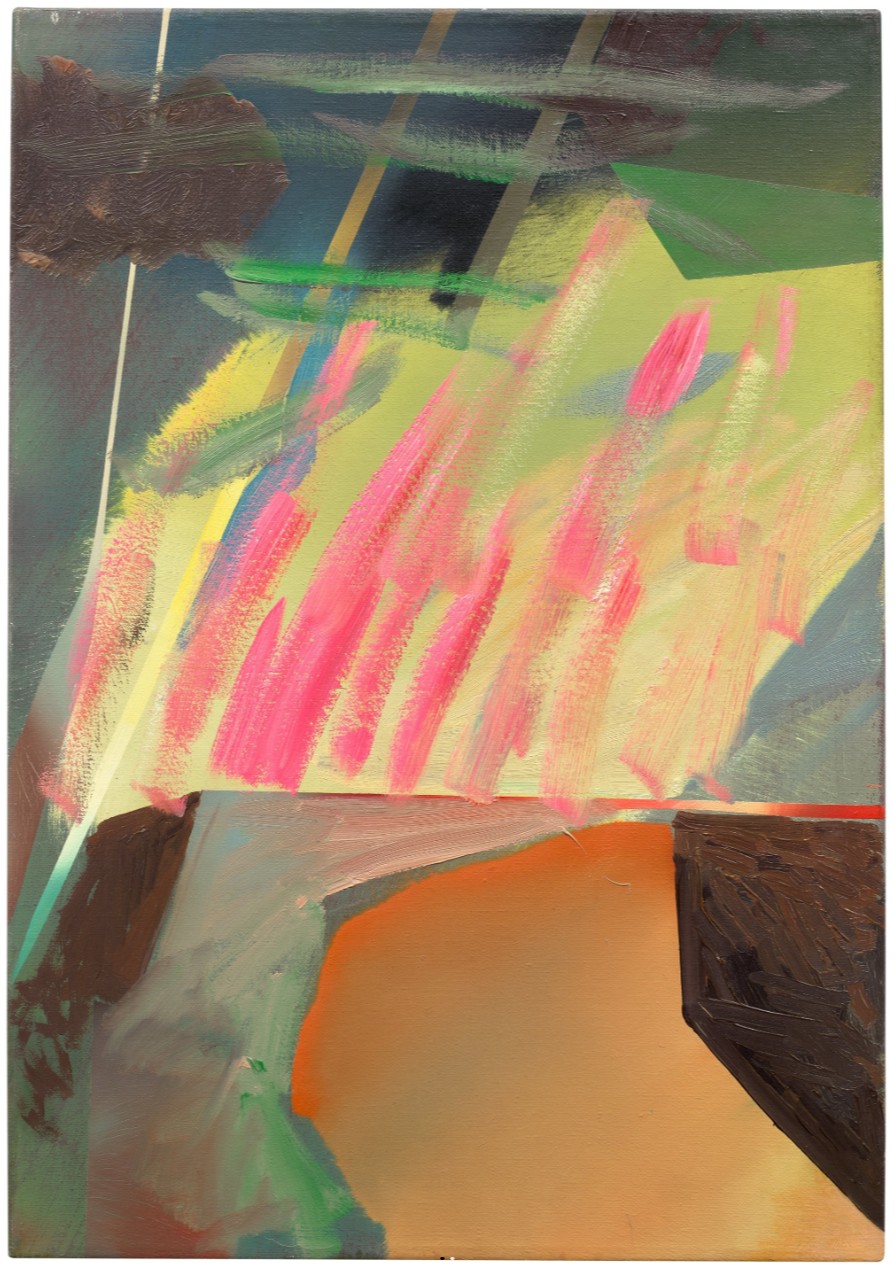
Oil on canvas
60.6 x 42.1 cm (23-7/8 x 16-5/8 inches)
Signed, titled and dated ‘Richter 1977 431-8’ on the reverse
Fuji (839-13), 1996
Phillips London: 5 March 2026
Estimated: GBP 350,000 – 550,000
PASSED
Gerhard Richter Modern & Contemporary Art Evening Sale
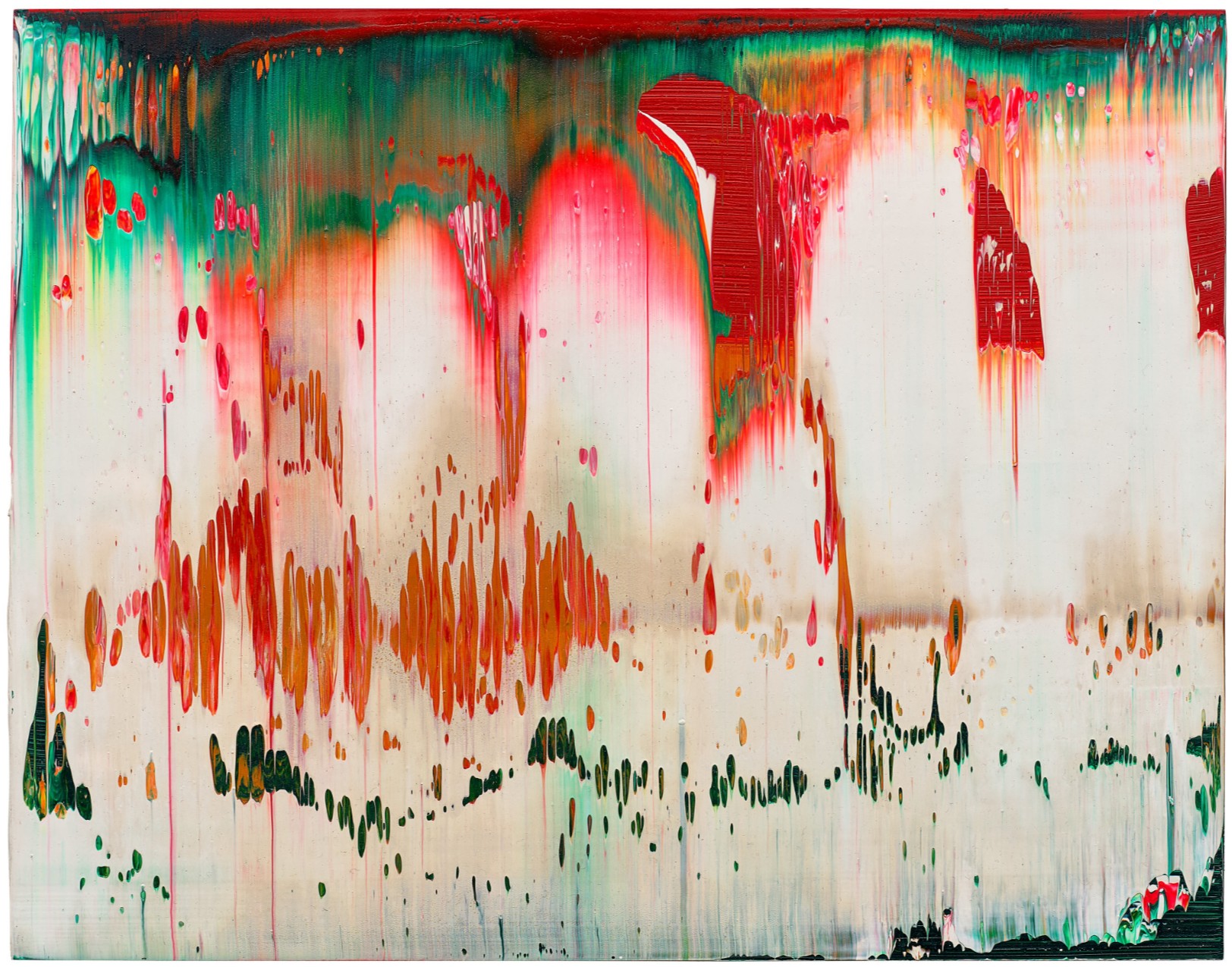
Oil on Alucobond
29.1 x 37.2 cm (11-1/2 x 14-5/8 inches)
Signed ‘Richter’ on the reverse
Numbered ’13’ on an artist label affixed to the reverse
David Hockney
English Garden, 1965
Sotheby’s London: 4 March 2026
Estimated: GBP 2,500,000 – 3,500,000
GBP 1,920,000 / USD 2,564,930
English Garden | Modern & Contemporary Evening Auction | 2026 | Sotheby’s
DAVID HOCKNEY (b. 1937)
English Garden, 1965
Acrylic on canvas
48×48 inches (122×122 cm)
Signed with the artist’s initials (behind the lower stretcher)
Titled and dated Boulder 65 (on the reverse)
Executed in the summer of 1965, English Garden stands among David Hockney’s earliest and most assured engagements with the landscape genre. Painted in America, where distance sharpened memory into image, the work is rooted in a photograph of the topiary garden at Haseley Court, Oxfordshire, the celebrated home of Nancy Lancaster. The photograph of the garden, published in American Vogue, was taken by Horst P. Horst, whose camera translated horticulture into haute mise-en-scène. Hockney’s recourse to such a source is revealing, not least because it signals a self-conscious alignment between two image-makers for whom photography functioned as a mode of construction and an instrument through which reality could be refined into arrangement and atmosphere. In embracing the stylized lucidity of magazine photography, and the undeniably cool authority with which it confers glamour and poise, Hockney presents the garden less as private refuge than as cultural sign; its clipped topography, immaculate borders, and exacting geometries staged as an aspirational emblem of status.
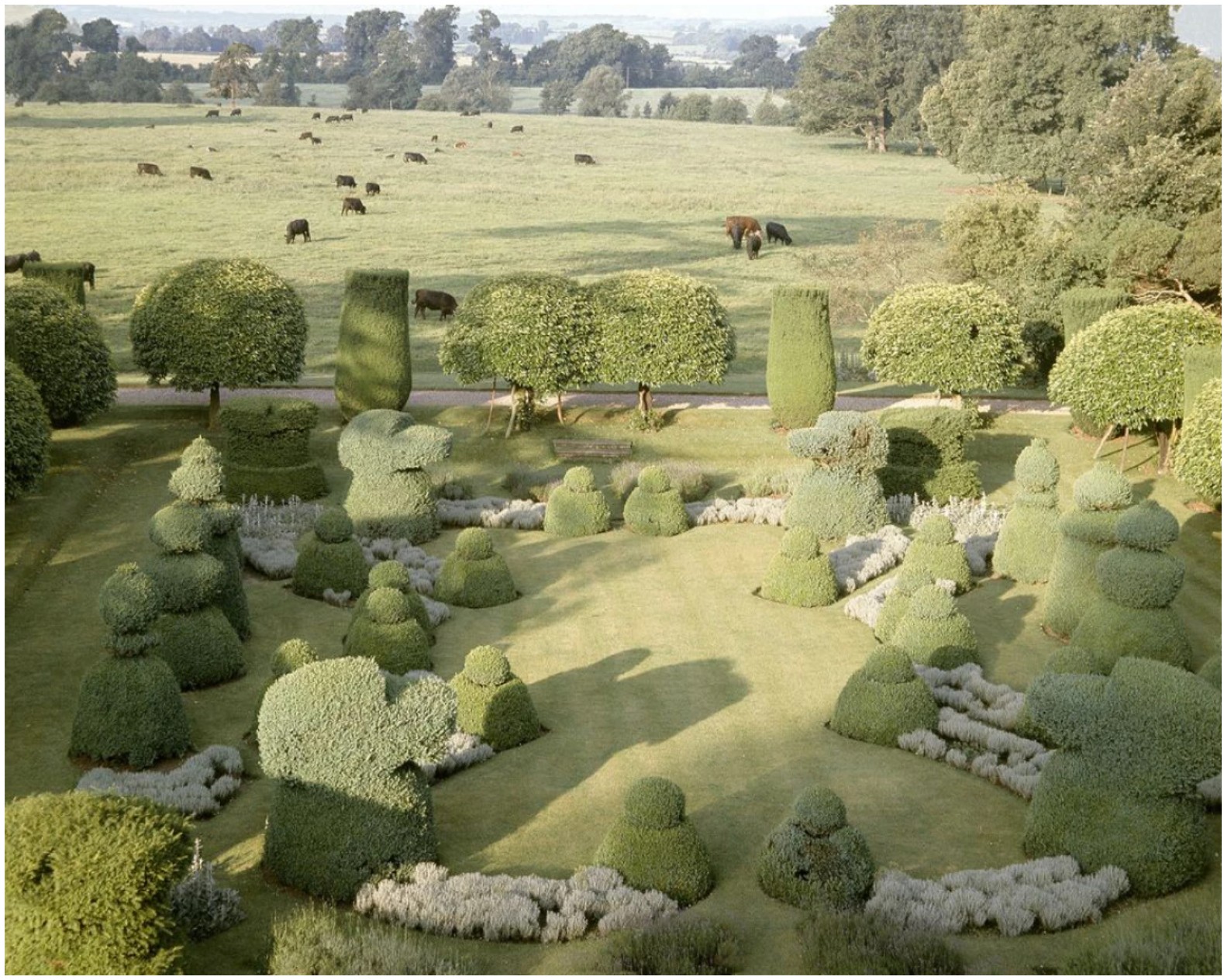
Haseley Garden Photographed by Horst P. Horst, Vogue, July 1965 © 2026 Horst P Horst, London
Long recognized as exemplary of Hockney’s mid-1960s breakthrough, English Garden was shown at Kasmin Gallery in 1965, at Galleria dell’Ariete in Milan in 1966, and then later included in the Whitechapel Art Gallery’s 1970 survey of the artist’s paintings, prints and drawings of the decade. The present work distills a pastoral order, a leafy Eden remembered rather than observed, presenting trees, lawn and sculpted foliage arranged in a schematic, almost disconcertingly precise configuration. Large fields of saturated green unfold in lucid, flattened planes, their clarity lending the composition both immediacy and equilibrium. Shadow operates as a generative force, shaping figures and space with a crisp economy that sidesteps illusionism, in which surrealist hedges and shrubs assume an almost anthropomorphic presence. At once serene and faintly uncanny, the garden reads as a carefully staged tableau, as though nature itself has been choreographed into a performance. Here, the countryside is not simply observed but carefully managed into iconography, a theatre of cultivation and taste that indexes class, leisure, and affluence, signaling the aesthetic codes of privilege. Simultaneously, it announces, with remarkable early confidence, the artist’s singular ability to absorb and resolve the disparate aesthetic and technical concerns of Minimalism, Modernist abstraction, and Pop art, forging a style that is unmistakably his own.
Early Landscapes in Museum Collections
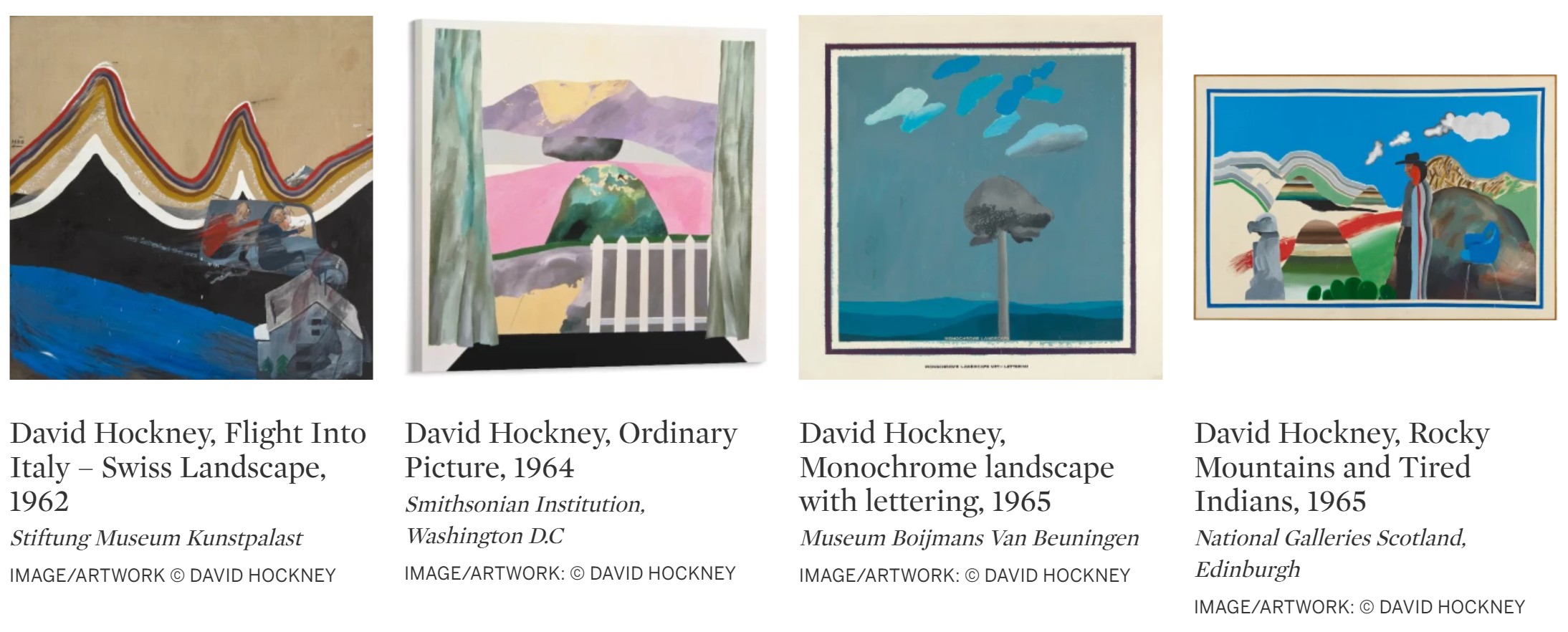
The early exhibition history of English Garden is inseparable from the role played by John Kasmin, whose New Bond Street gallery became a crucial site for the emergence of Hockney’s career in the early 1960s. When Kasmin opened the gallery in 1963, he did so with the explicit ambition of reshaping the London scene, introducing a new generation of artists aligned with the formal clarity and ambition of contemporary American painting. Designed as a radical departure from the plush, traditional gallery interiors of the time, the space offered a stark, light-filled environment ideally suited to the display of large, modern works, quickly establishing itself as one of the most influential venues for contemporary art in London during the 1960s. Kasmin’s support proved decisive for Hockney at a formative stage in his career. In 1963, the gallery hosted Hockney’s first one-man exhibition titled Pictures with People In, making him the only figurative painter represented within a roster otherwise dominated by leading proponents of abstraction including Kenneth Noland, Morris Louis and Frank Stella. Within this ambitiously modern context, Hockney was positioned not as an outlier but as a central figure in an international dialogue that redefined the possibilities of contemporary figurative painting.
“English Garden was also painted in Boulder from a photograph of topiary work in England that I found in American Vogue. As it was painted at the same time as Rocky Mountains and Tired Indians, some students thought it was a picture of Indians squatting on a lawn.”
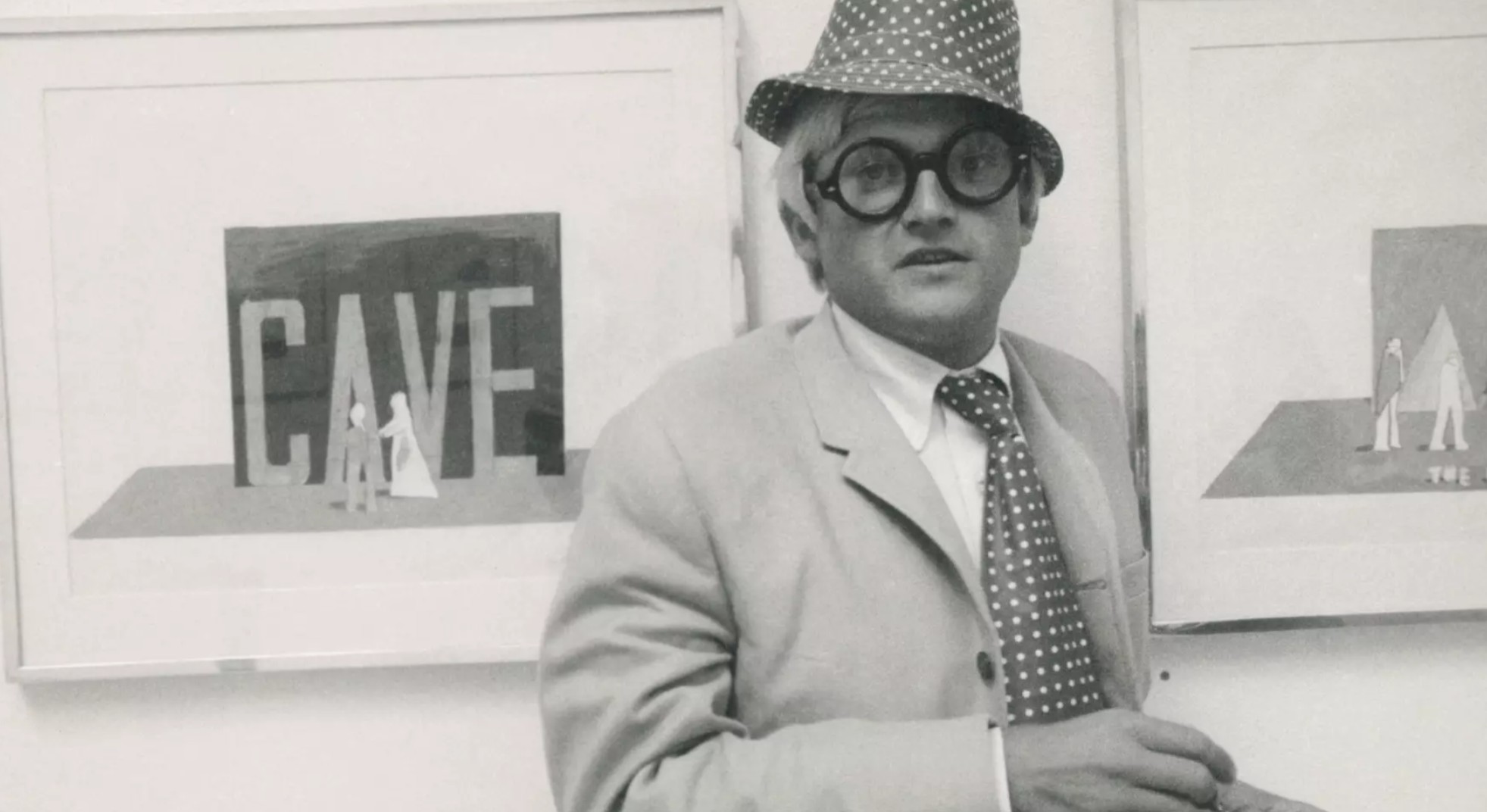
David Hockney at the John Kasmin Gallery in 1966. Image © Science History Images / Alamy. Artwork © David Hockney 2026
Painted while Hockney was teaching at the University of Colorado in Boulder in 1965, English Garden emerged from a condition of displacement. Although Boulder offered grand natural scenery, Hockney famously remarked on the absence of windows in his studio, a deprivation that became unexpectedly fertile. Rather than recording what lay beyond the studio, he turned to distance as his methodology, painting what could be recalled and desired. In doing so, the artist produced not only his first English landscape but the first fully realized statement of the genre within his oeuvre. At this juncture, landscape was reoriented away from lived experience and towards conceptual fabrication, a site through which memory and cultural inheritance could be rigorously re-examined. Here, the immediacy of the American present presses against a selectively imagined Englishness, refined into a vision of immaculate surfaces, heightened palette, and deliberate artifice.
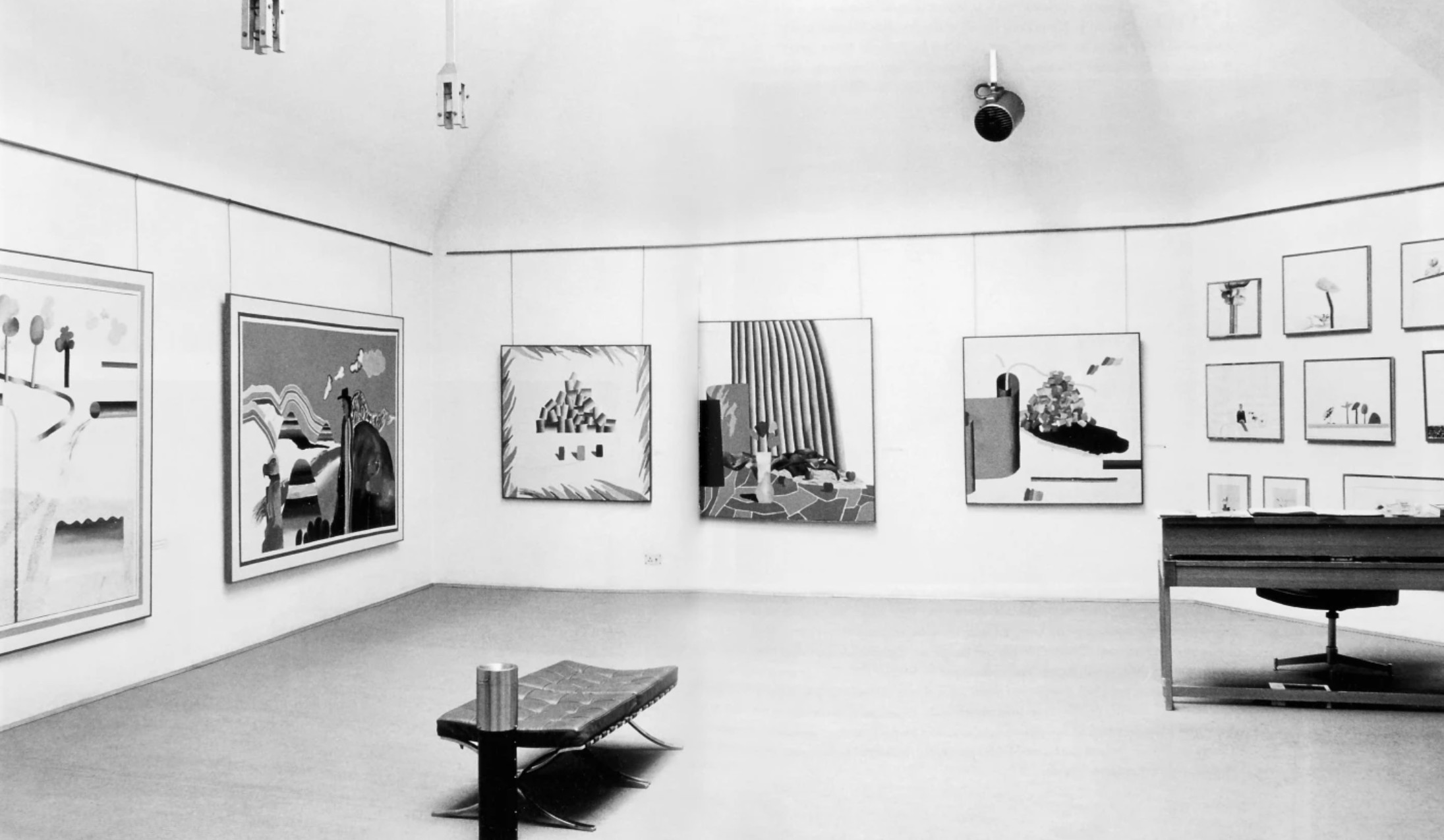
Installation view of David Hockney: Pictures with Frames and Still Life Pictures, Kasmin Ltd., London, 1965.
© 2026 Getty Research Institute, Los Angeles (2001.M.1) © David Hockney
The catalytic role played by the present work is borne out most powerfully in the Yorkshire landscapes that followed in the late 1990s, culminating in Garrowby Hill (1998), now housed in the collection of the Museum of Fine Arts, Boston, and widely regarded as one of the most accomplished compositions of his career. Extending the ambitions first articulated in English Garden, Garrowby Hill transforms remembered terrain into a commanding panoramic vision, exemplifying Hockney’s sustained investigation into the art historical genre of landscape and his conscious placement within the British tradition shaped by Joseph Wright of Derby, Thomas Gainsborough, John Constable, and J. M. W. Turner, while simultaneously absorbing the heightened color and spatial freedom of the Fauves, particularly André Derain and Henri Matisse. From this foundational moment would emerge one of the most ambitious bodies of landscape work in post-war British art, monumental projects such as The Arrival of Spring in Woldgate, East Yorkshire (2011), now in the collection of the Centre Pompidou, confirming English Garden as the conceptual point of origin for Hockney’s lifelong and generative reimagining of landscape.
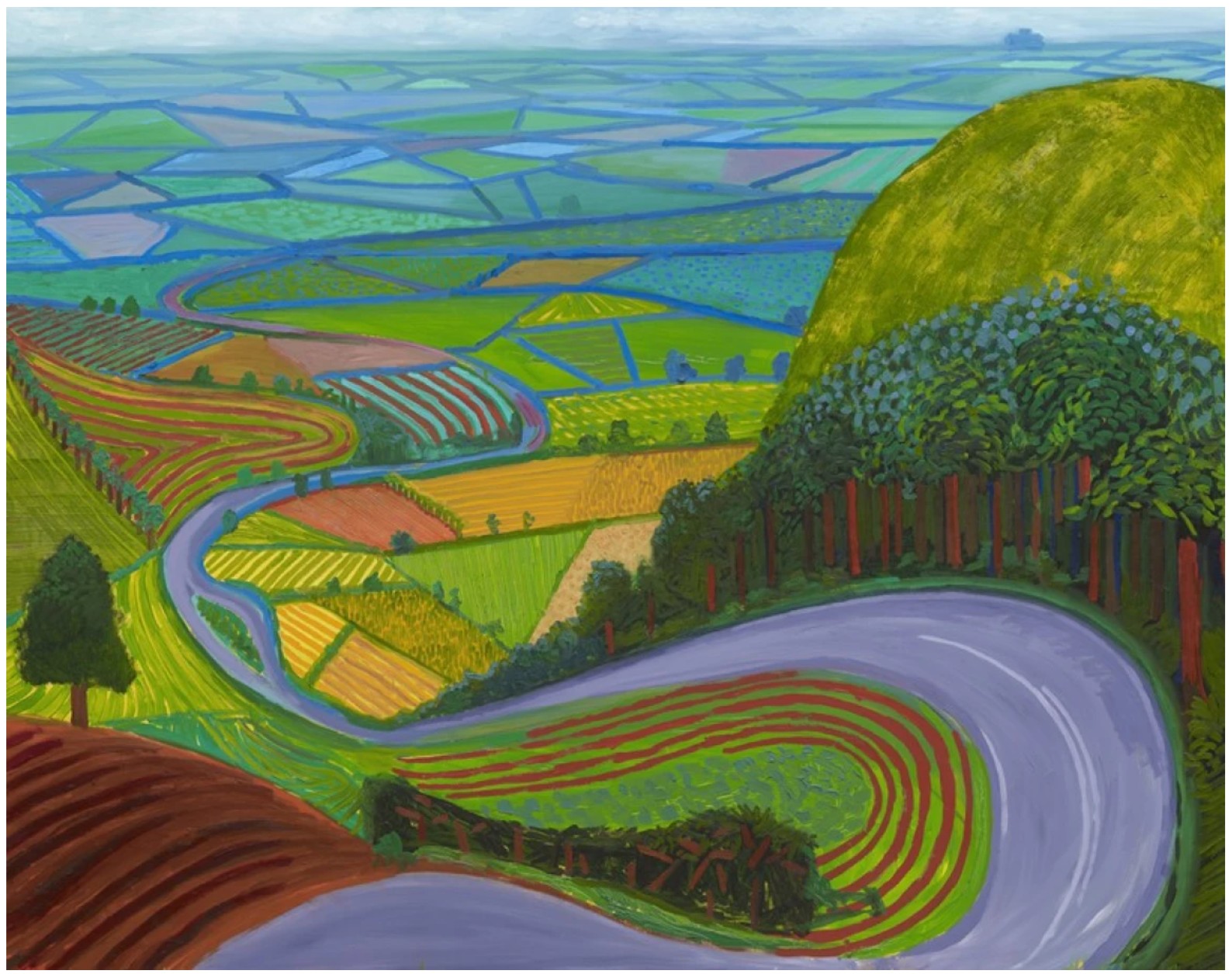
Garrowby Hill, 1998. Museum of Fine Arts, Boston © David Hockney
In October 1965, Hockney returned to London ahead of his second solo exhibition at Kasmin’s celebrated gallery. Titled Pictures with Frames and Still Life Pictures, the exhibition brought together ten paintings made that year, including Rocky Mountains and Tired Indians (1965), held in the National Galleries of Scotland, Edinburgh, and Portrait Surrounded by Artistic Devices (1965), housed in the Arts Council Collection in London, situating English Garden within a coherent and conceptually rigorous project. A defining feature of these works is the inclusion of an internal frame, often marked by a band of exposed canvas and a bold exacting border, which establishes a deliberate sense of removal. The viewer is reminded that the scene is not a window onto reality but an image consciously staged and bounded. By presenting a picture within a picture, Hockney emphasized the orchestration of representation while sustaining a productive dialogue with abstraction, prompting the viewer, as critics observed at the time, to question precisely where reality resides within the painted image. John Russell observed, “by including the representation of a frame within the painting itself he gives the work another layer of meaning which causes us to ask exactly where reality lies.” (The Times, 9 December 1965). Materially, this introspective construction was reinforced through Hockney’s embrace of acrylic paint, whose superior American formulations offered both heightened chromatic brilliance and a rapid drying time that enabled him to work with unprecedented clarity and decisiveness. The resulting smooth, luminous surfaces privilege image over facture, aligning with his growing fascination with photography and the mediated, glossy visions of modern life encountered in American magazines.
Paintings exhibited in Pictures with Frames and Still Life Pictures at Kasmin Ltd. in London, 1965
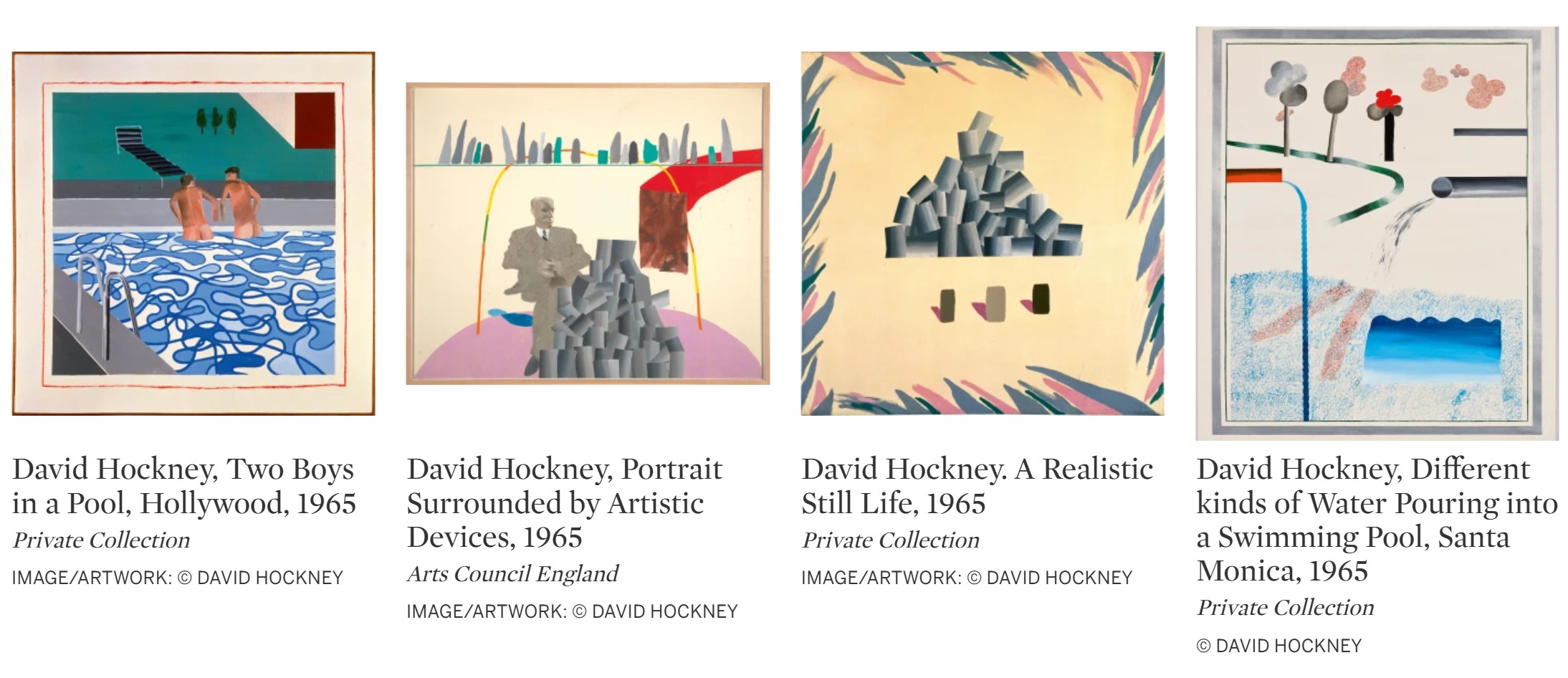
The exhibition proved both a commercial and critical triumph. Writing in The Times, Russell noted that many of Hockney’s newest paintings, emerging from his American experience, ranked among his finest achievements, observing that the artist had discovered one of the few viable paths open to figurative painters at a moment when traditional illusionism seemed spent. The following year, Edward Lucie-Smith, writing in Studio International, similarly emphasized the works’ engagement with America itself, noting that, compared with earlier pictures, Hockney now revealed an astonishing sensitivity to atmosphere. Such critical acclaim sharpened the perception that the young painter from Bradford had found in America not only new motifs but a renewed scale of ambition, enabling him to reconceive landscape as both spectacle and construction, simultaneously seductive in appearance and knowingly artificial in form.
Sir Cecil Beaton, David Hockney, 1965 © Cecil Beaton
It was precisely this American context, so central to the critical reception of the work, that was reshaping Hockney’s imagination at the time. Even as he invented scenery through memory and displacement, his visual language was being decisively recalibrated by California and the heady locale of Los Angeles. By this juncture, his sensibility was firmly attuned to the West Coast, where swimming pools, palm trees, signage and carefully staged domestic spaces became the raw material for a sequence of poised, theatrical scenes. Works such as Two Boys in a Pool, Hollywood (1965) and Sunbather (1966) translate these motifs into intimate, emblematic vignettes, while the more expansive Portrait of Nick Wilder (1966) situates his Los Angeles dealer emerging bust-length from a turquoise pool, encapsulating the cool and cultivated leisure that defined Hockney’s Californian vision. In this respect, English Garden sits in productive dialogue with the swimming pool paintings of the same period, where the pool functions both as a symbol of Californian affluence and a formal device combining boldness of design, grandeur of size, intensely vivid color, and the explosive movement and variegation of water.
Celebrated 18th and 19th Century Landscapes
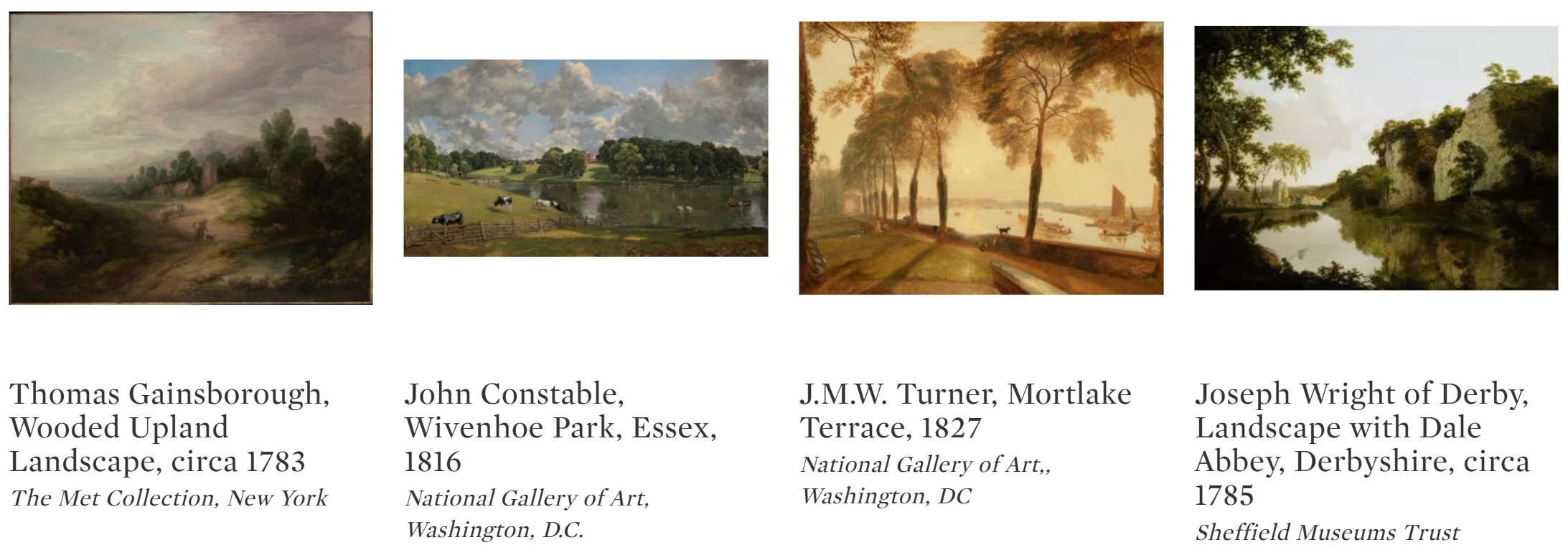
It is within this broader matrix of displacement, mediation, and construction that English Garden ultimately captures a moment of transition between continents and between modes of representation. The painting offers an elegant vision of cultivated ease, yet its deeper subject is the modern condition of seeing, in which place is often encountered first as a picture and memory is shaped by the surfaces of print, photography and desire. Recasting the classical pastoral through the hard light and constructed environments of the modern world, Hockney transforms the locus amoenus into a contemporary landscape of display and aspiration, aligning his project with a European tradition in which landscape functions not as neutral setting but as an imaginative and ideologically charged stage, from Titian and Rembrandt to Cézanne and Matisse. Less a view than a thought, the painting announces with quiet authority the wit, formal audacity, and conceptual sophistication that would come to define Hockney’s art for decades to come.
Study for Olympic Poster, 1970
Christie’s London: 5 March 2026
Estimated: GBP 500,000 – 700,000
GBP 635,000 / USD 848,295
WORK ON PAPER
DAVID HOCKNEY (B. 1937), Study for Olympic Poster | Christie’s
DAVID HOCKNEY (B. 1937)
Study for Olympic Poster, 1970
Colored pencil and graphite on two adjoined sheets of paper
33-5/8 x 24-3/4 inches (85.4 x 63 cm)
Signed with the artist’s initials, titled and dated ‘study for Olympic poster DH. 1970.’ (lower right)
Study for Olympic Poster (1970) is a unique and beautiful work on paper that captures the genesis of one of David Hockney’s most iconic images. In a bold composition, Hockney pictures a diver at the moment he is about to break the surface of a pool. The figure is naturalistically rendered: the water, in contrast, is a kaleidoscopic mosaic of looping lines. It lights up around the diver in cells of cyan, ultramarine and two shades of pale blue. An area of pink captures his reflection, fractured by the water’s rippling motion. Elsewhere the lines are unfilled, revealing the delicacy of Hockney’s draughtsmanship. Related closely to his Californian swimming-pool paintings of the 1960s, the work is a celebration of color, light and movement.
“Water in swimming pools changes its look more than in any other form.”
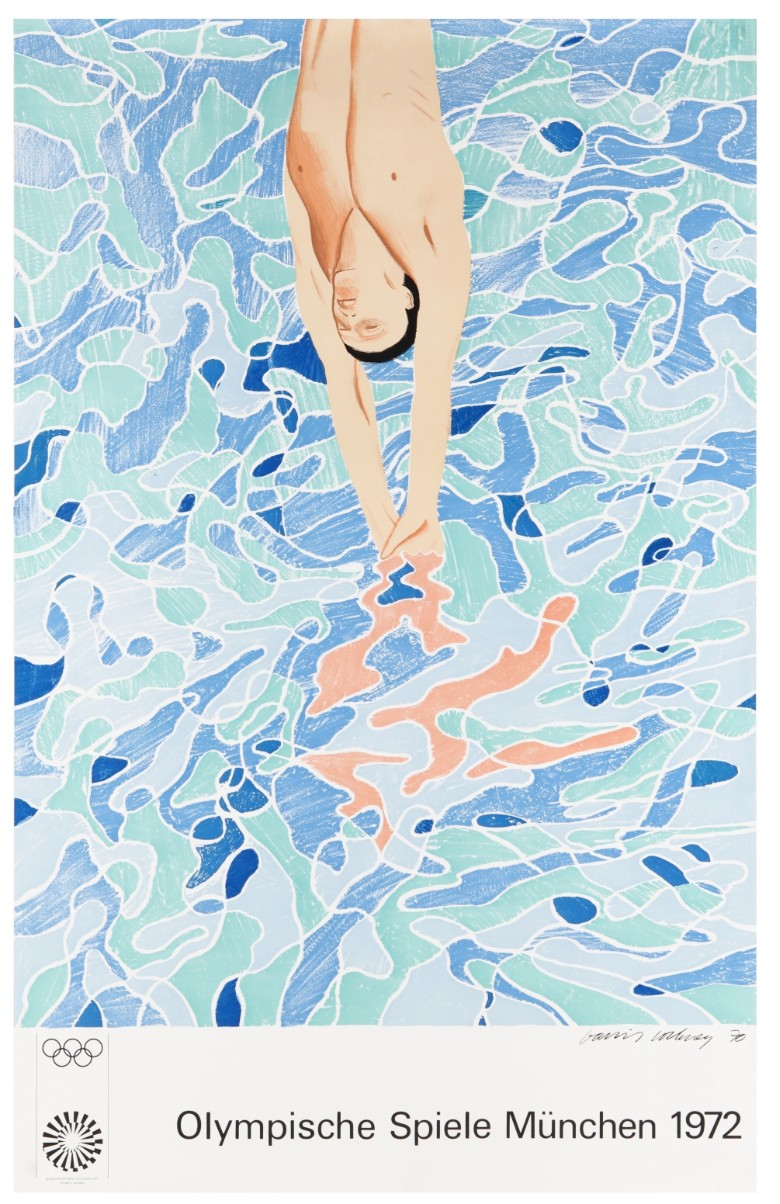
Hockney was among a group of twenty-eight artists tasked with creating posters to promote the 1972 Olympic Games in Munich. Others included Josef Albers, Eduardo Chillida, Victor Vasarely, Pierre Soulages, Tom Wesselmann and Hockney’s friend R. B. Kitaj. Their responses ranged from muscular depictions of athletic prowess to Op-Art visions of the Olympic rings and graphic abstractions that evoked the speed of the racetrack. Hockney, as was typical of his work, merged abstract and figurative languages, combining a stylized depiction of the water with the carefully observed physique of the plunging diver. The Munich project began an Olympic tradition of poster commissions. Joining Robert Rauschenberg, Roy Lichtenstein and others, Hockney would return with a photo-collaged swimming pool for the 1984 Los Angeles Olympics; British artists including Tracey Emin, Chris Ofili and Anthea Hamilton would create posters for the London games in 2012.
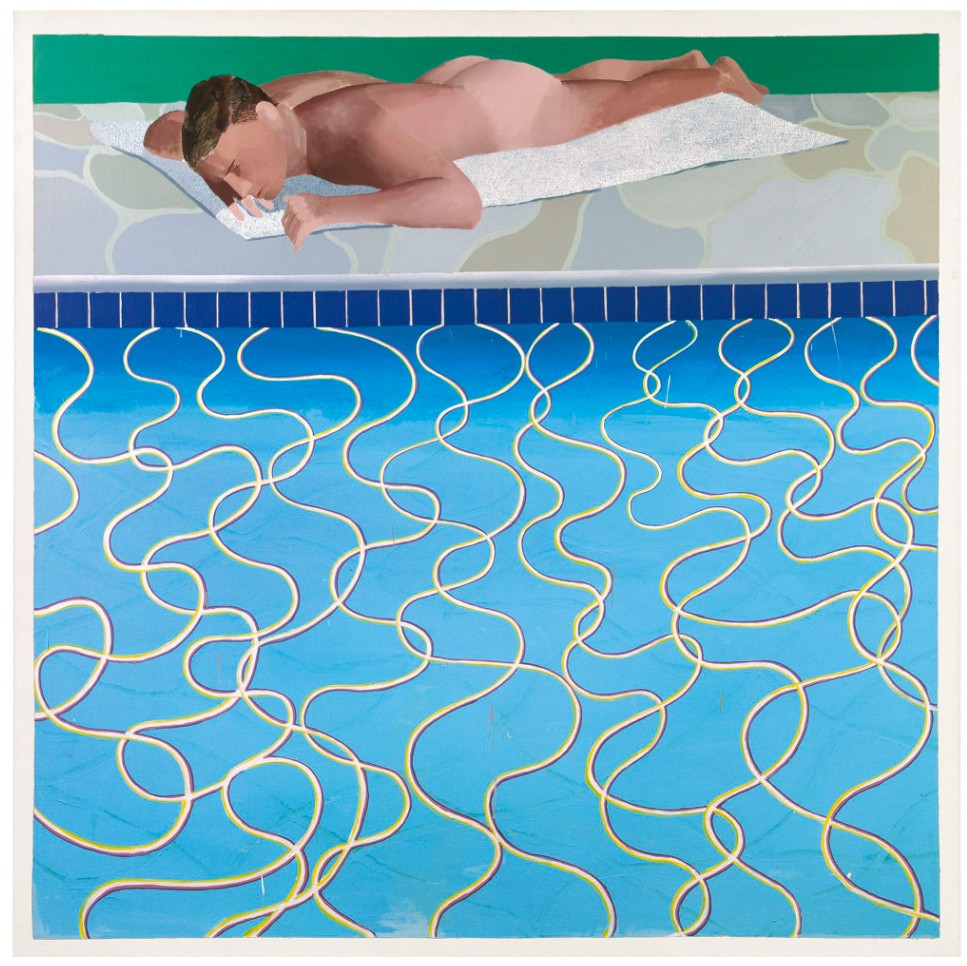
David Hockney, Sunbather, 1966. Museum Ludwig, Cologne. Artwork: © David Hockney.
Hockney had been painting swimming pools since 1964, when he first visited Los Angeles. The water—with its play of transparency, reflection, distortion and endless movement—sparked a career-long fascination with the nature of visual experience.
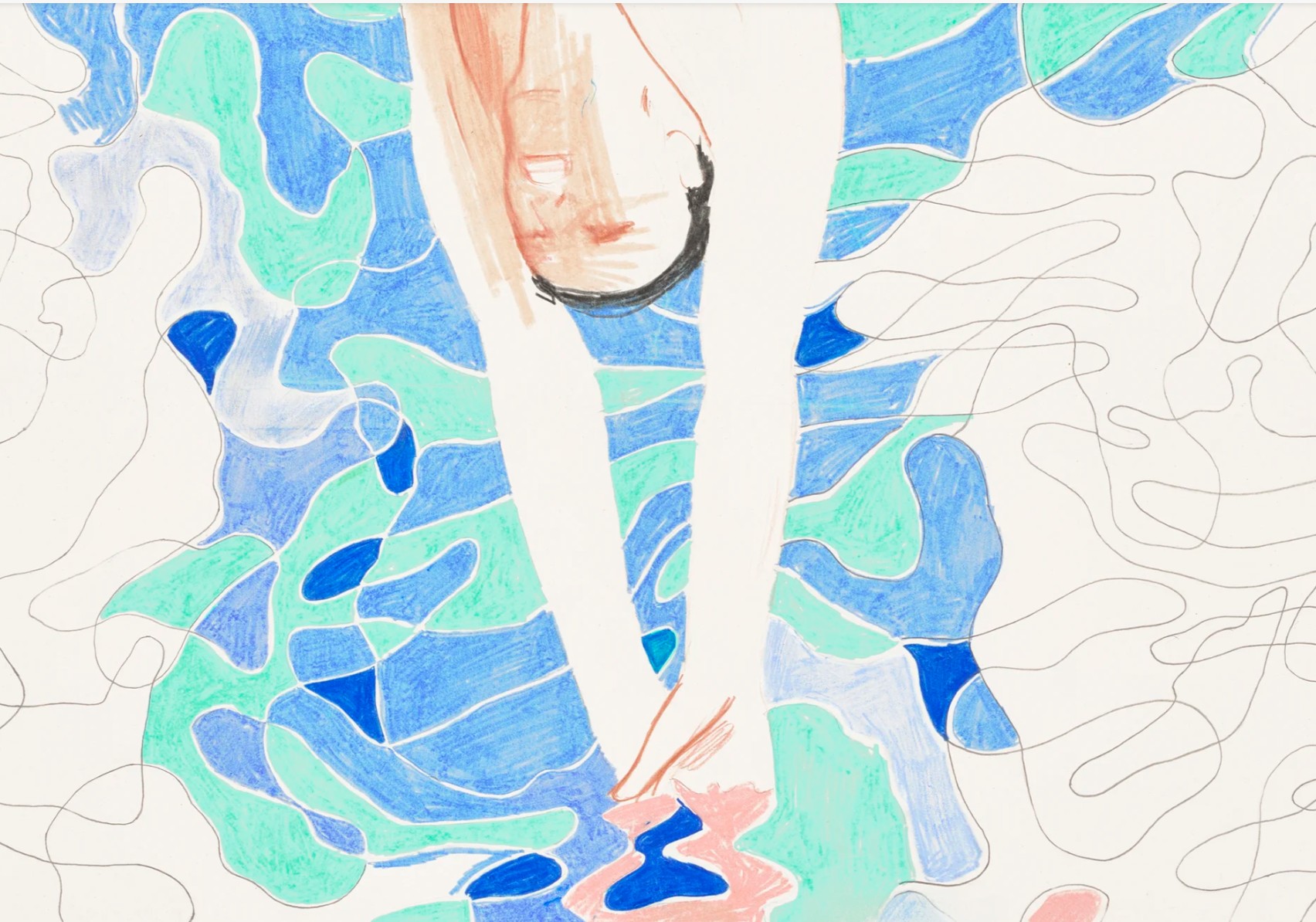
The present work’s meandering, jigsaw-like surface evokes the abstracted idiom of early examples such as California (1965), which were influenced by Jean Dubuffet’s Hourloupe paintings. The diver, meanwhile, echoes the sensuous male nudes of works such as Sunbather (1966, Museum Ludwig, Cologne). Elsewhere, as in A Bigger Splash (1967, Tate, London), Hockney had pictured a dive’s aftermath in exuberant splashes of paint. The present work is typical of this joyfully experimental period, predating the more naturalistic style that would emerge in the early 1970s.
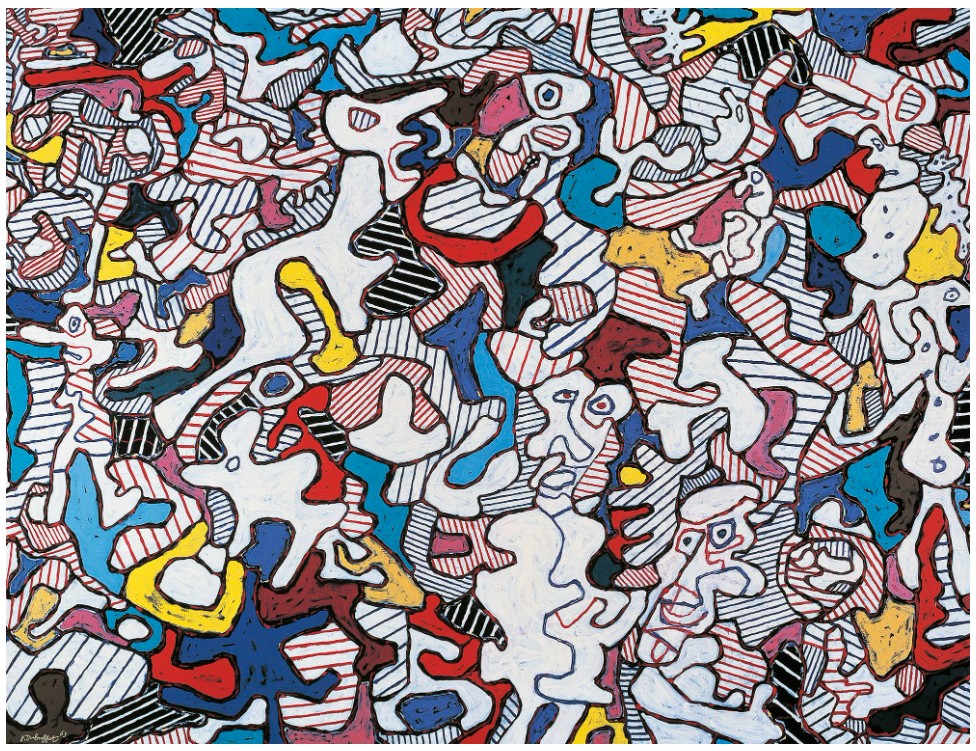
Jean Dubuffet, La Vie de Famille (Family Life), 1963. Musée des Arts Decoratifs, Paris.
Artwork: © 2026 Jean Dubuffet/DACS. Digital image: © 2026 DeAgostini Picture Library/Scala, Florence.
Tragically, the Munich games would be overshadowed by a terror attack at the Olympic Village, when five athletes and six coaches from the Israeli team were taken hostage and killed. The attack also claimed the lives of five of the perpetrators and a German police officer. The games would also be remembered, however, for scenes of sporting triumph, with the American swimmer Mark Spitz famously winning seven gold medals and setting seven world records in a spectacular run. Hockney’s poster has become an emblem of the Olympic spirit.
Yayoi Kusama
Infinity Nets, 1960
The Roger and Josette Vanthournout Collection
Christie’s London: 5 March 2026
Estimated: GBP 2,000,000 – 3,000,000
GBP 2,124,000 / USD 2,837,450
YAYOI KUSAMA (B. 1929), Infinity Nets | Christie’s
YAYOI KUSAMA (B. 1929)
Infinity Nets, 1960
Oil on canvas
100.2 x 90.3 cm (39-1/2 x 35-1/4 inches)
Signed, titled and dated ‘Yayoi Kusama 1960 Infinity Nets’ (on the reverse)
Created soon after the artist’s arrival in New York City, Infinity Nets (1960) is a rare early example of Yayoi Kusama’s career-defining series of the same name. Endless small, looping strokes of white and crimson paint coalesce across the surface, revealing the black ground beneath as if through a scintillating mesh. The initial Infinity Nets, which Kusama made between 1958 and 1962, tend to be monochrome fields of either white or red: the present work uncommonly incorporates both colours. An amorphous crimson pool blooms upwards from the lower edge, framed by a radiant surround of blushing white. Both areas ripple with blended gradations from deep to light pink, which create a scalloped, overlapping sense of depth. The products of an obsessive, hallucinatory process and of fierce creative ambition, the Infinity Nets made Kusama’s name as an artist in the ferment of 1960s New York. They remain among her most iconic works to this day.
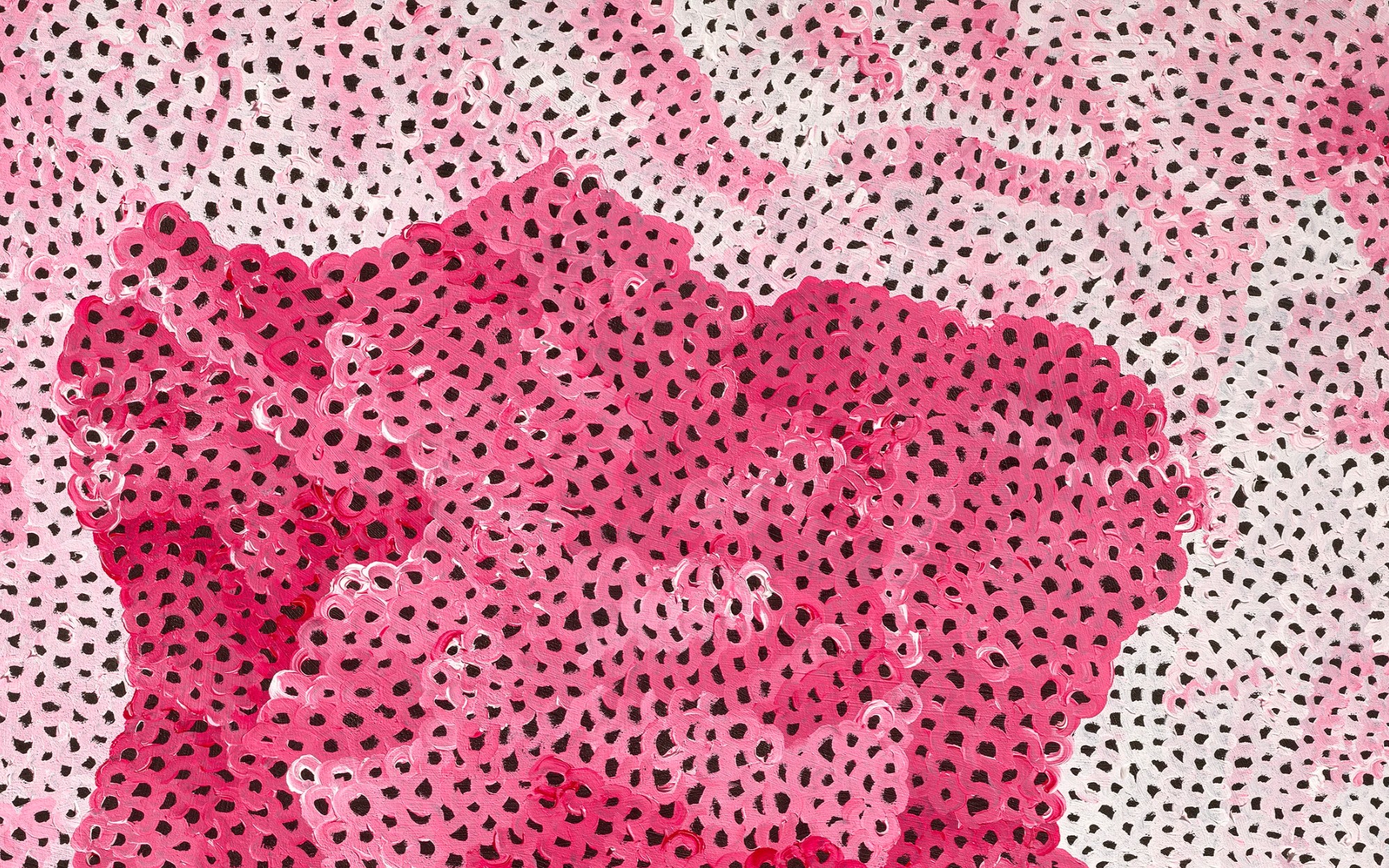
Kusama came to the United States in November 1957 at the age of twenty-eight, staying first in Seattle before settling in New York. It was there that she saw her future. She was determined to break free from her traumatic and restrictive home environment in rural Japan, and to succeed as an artist on her own terms. ‘If I wanted to develop and widen that path, staying in Japan was out of the question’, she later said. ‘My parents, the house, the land, the shackles, the conventions, the prejudice … My art needed a more unlimited freedom, and a wider world’ (Y. Kusama, Infinity Net: The Autobiography of Yayoi Kusama, London 2013, p. 93). Living in a Manhattan studio with broken windows, Kusama began work on the Infinity Nets in 1958. She would paint for forty or fifty hours at a stretch, covering vast canvases in countless, repetitive strokes. She battled cold and hunger, gazing wistfully at the beacon of the Empire State Building. She wanted, she said, ‘to grab everything that went on in the city and become a star’ (Y. Kusama quoted in F. Morris, ‘Introduction’, in Yayoi Kusama, exh. cat. Tate, London 2012, p. 12).
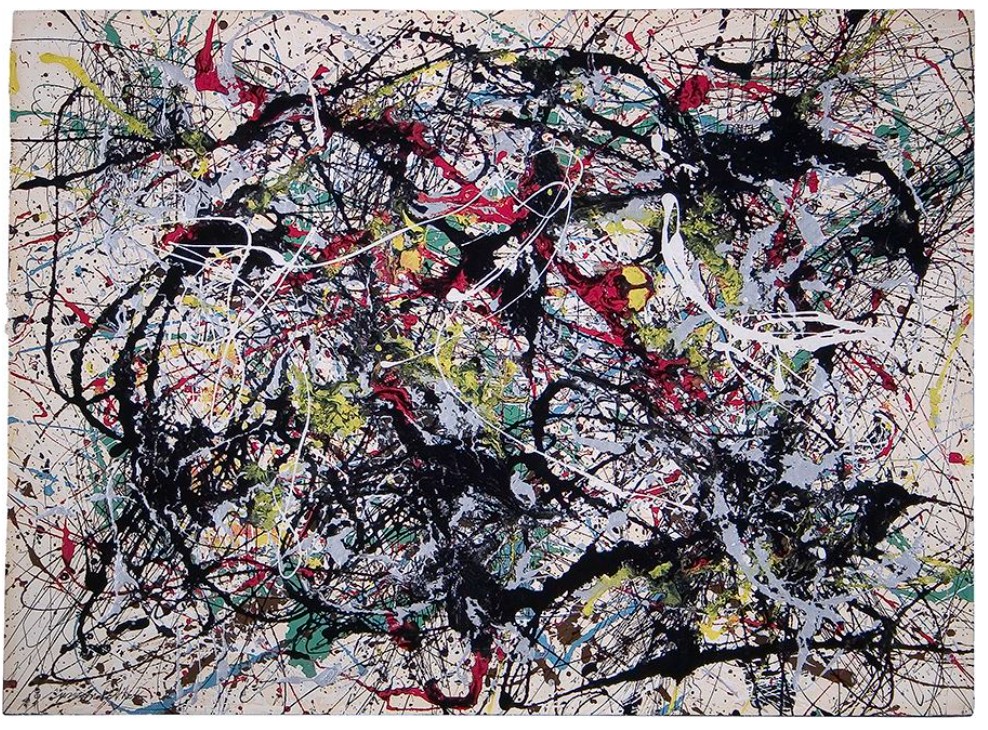
Jackson Pollock, Number 34, 1949, 1949. Munson-Williams-Proctor Arts Institute, Utica. Artwork: © 2026 Jackson Pollock/DACS. Digital image: © 2026 Munson Museum/Art Resource, NY/Scala, Florence.
The Infinity Nets had their origin in hallucinations that Kusama had experienced since childhood, and she had made small-scale works with similar motifs as early as 1948. She described periods of ‘depersonalisation’—becoming detached from a sense of reality—in which she saw proliferating patterns that threatened to consume her, body and soul, along with the entire universe. A response to intense emotional disturbance, these episodes were often so distressing that Kusama had to be hospitalized. Painting the Infinity Nets was a transcendent, therapeutic process, allowing her both to lose and express herself through their endless repetitions. ‘This was my “epic”, summing up all that I was’, she said. ‘And the spell of the dots and the mesh enfolded me in a magical curtain of mysterious, invisible power’ (Y. Kusama, ibid., p. 23).
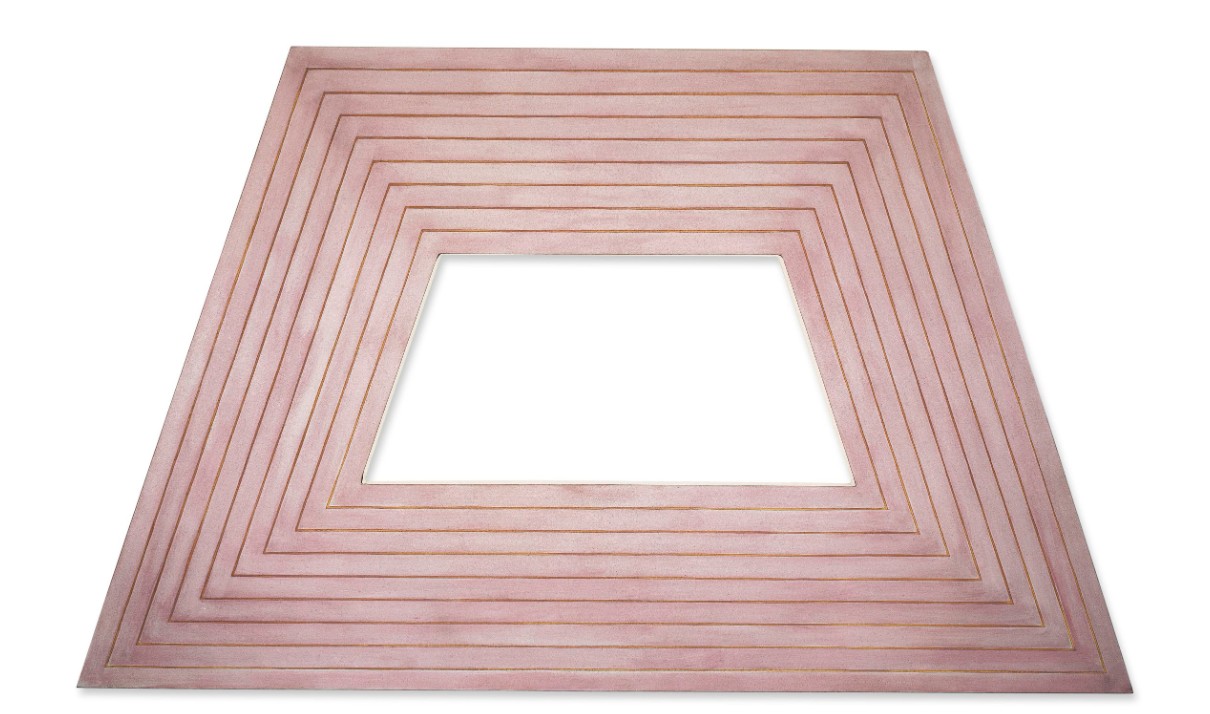
Frank Stella, Ileana Sonnabend, 1963. Private collection.
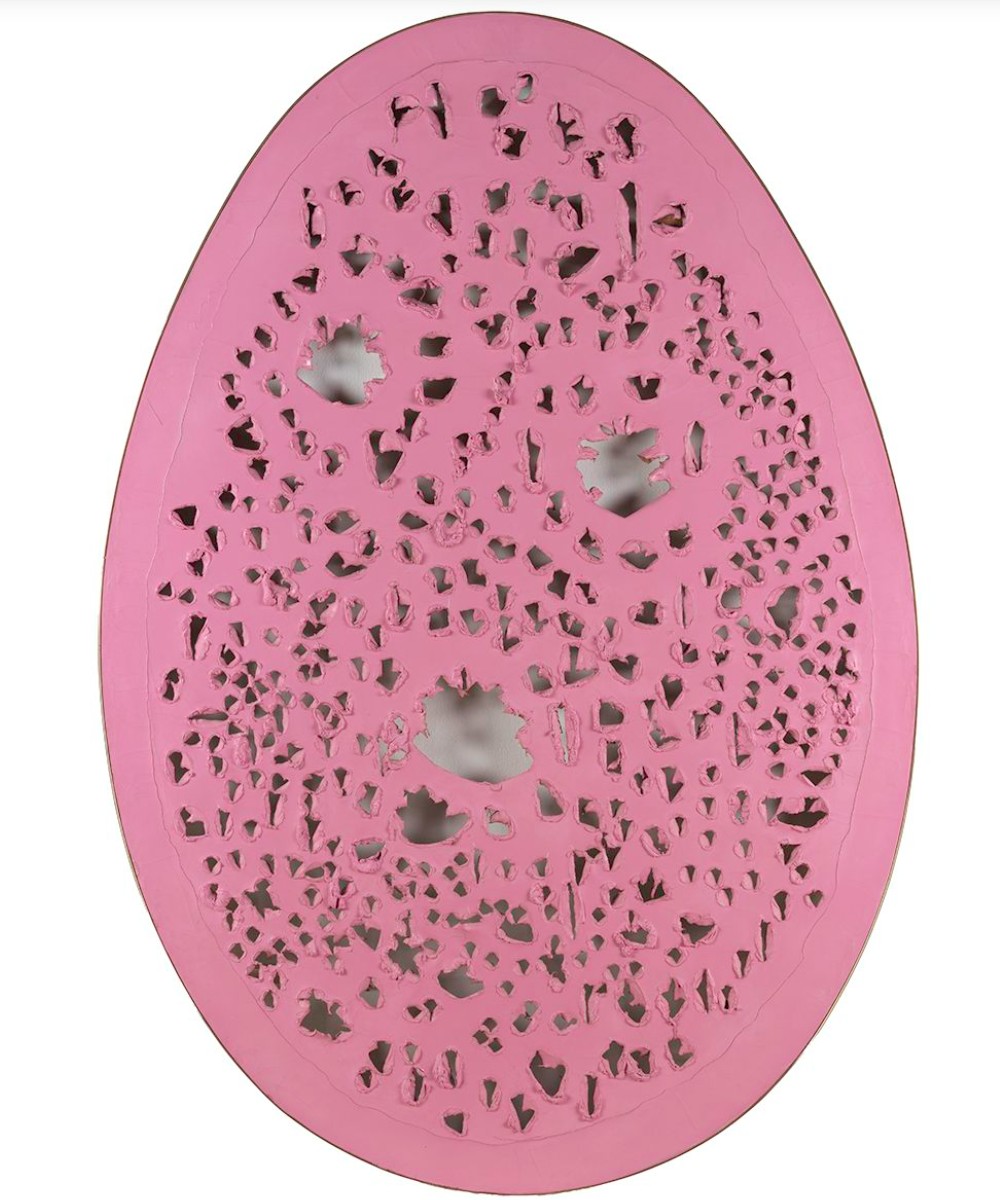
Lucio Fontana, Concetto spaziale, La fine di Dio (63-FD.17), 1963. Musée National d’Art Moderne, Centre Georges Pompidou, Paris. Artwork: © 2026 Lucio Fontana/DACS. Digital image: © Centre Pompidou, MNAM-CCI, Dist. GrandPalaisRmn / Audrey Laurans.
Kusama soon found success in America, receiving further solo exhibitions and participating in numerous group shows, including both the Carnegie International and Whitney Annual in 1961. In Europe, too, she was embraced by Minimalist counterpart movements such as Zero, Azimuth and Nul, whose concerns with monochromy, seriality and repetition were presaged by the Infinity Nets. Alongside Mark Rothko, Kusama was the sole New York representative in the major survey Monochrome Malerei at the Städtische Museum Leverkusen in 1960, and she showed again in Tentoonstelling Nul curated by Henk Peters at the Stedelijk Museum in Amsterdam in 1962. She also became friends with the pioneering ‘Spatialist’ Lucio Fontana, who helped to finance her infamous installation of mirrored spheres at the 1966 Venice Biennale.
Gustav Klimt, Apple Tree I, 1912. Private collection.
The unique, hypnotic appeal of the Infinity Nets lies in their simultaneous complexity and simplicity. While their looping elements might at first seem mechanistic in their repetition, they soon reveal subtle variations in surface, color and texture, with passages of radial impasto, shifting depths, zones of light and shade and, as in the present work, ambiguous, organic forms. Some are gigantic in scale, feats of creative endurance that almost become environments in themselves; others appear like glimpsed sections of an endlessly extensive whole. They shudder, shimmer and oscillate, each bearing a somatic tension between figure and ground. The contrasting palette in the present work foregrounds the biomorphic, bodily quality of the motif, which appears to have emanated from an interior world. Like a cellular membrane or a veil of stars, the surface conjures both the microcosmic and the cosmic.
“I am deeply interested in trying to understand the relationships between people, society, and nature; and my work is forged from accumulations of these frictions.”
Exhausted, Kusama ceased work on her first series of Infinity Nets in 1962. She would soon achieve her dreams of stardom, finding further acclaim for her sculptural accumulations, Infinity Room installations and radical performance works of the later 1960s—which featured similar proliferating forms, including polka-dots applied to nude performers—before eventually returning to Japan the following decade. In recent years Kusama has resumed the Infinity Net paintings, exploring new colours and techniques. Early works such as the present, however, remain perhaps the most raw and compelling products of her vision. They are at once intensely purposeful and expressions of ecstatic, terrifying transcendence. ‘My desire was to predict and measure the infinity of the unbounded universe, from my own position in it’, Kusama said. ‘… How deep was the mystery? Did infinite infinities exist beyond our universe? In exploring these questions I wanted to examine the single dot that was my own life’ (Y. Kusama, ibid., p. 23).
Hitomi (Eye), 1989
AN EYE FOR COLOUR: WORKS FROM A PRIVATE COLLECTION
Christie’s London: 7 March 2026
Estimated: GBP 300,000 – 500,000
GBP 406,400 / USD 542,910
YAYOI KUSAMA (B. 1929), Hitomi (Eye) | Christie’s
YAYOI KUSAMA (B. 1929)
Hitomi (Eye), 1989
Acrylic on canvas
32×41 cm (12-5/8 x 16-1/8 inches)
Signed, titled in Japanese and dated ‘1989 Yayoi Kusama’ (on the reverse)
With its solitary eyeball emblazoned against a field of dazzling red dots, Hitomi (Eye) (1989) is a hypnotic work that draws together some of Yayoi Kusama’s most important motifs. Rendered in luminous tones of neon and gold, the work combines the webbed structures of her celebrated early Infinity Nets with the iconic, Pop-like imagery that came to define her triumphant return to painting during the 1980s. As a child, Kusama experienced vivid hallucinations in which vast swathes of dots subsumed her entire being. In her paintings, she translated these visions into complex, optical fields, whose finely-wrought surfaces provided the artist with a cathartic outlet for her psychological turmoil. The eye became a central subject in Kusama’s art, gazing out at the viewer as if from the very depths of her soul. In the present work, its entire structure is awash with dots and lattices: a portrait, perhaps, of her own perceptual theatre. Three mouths float below, their lips tightly sealed.
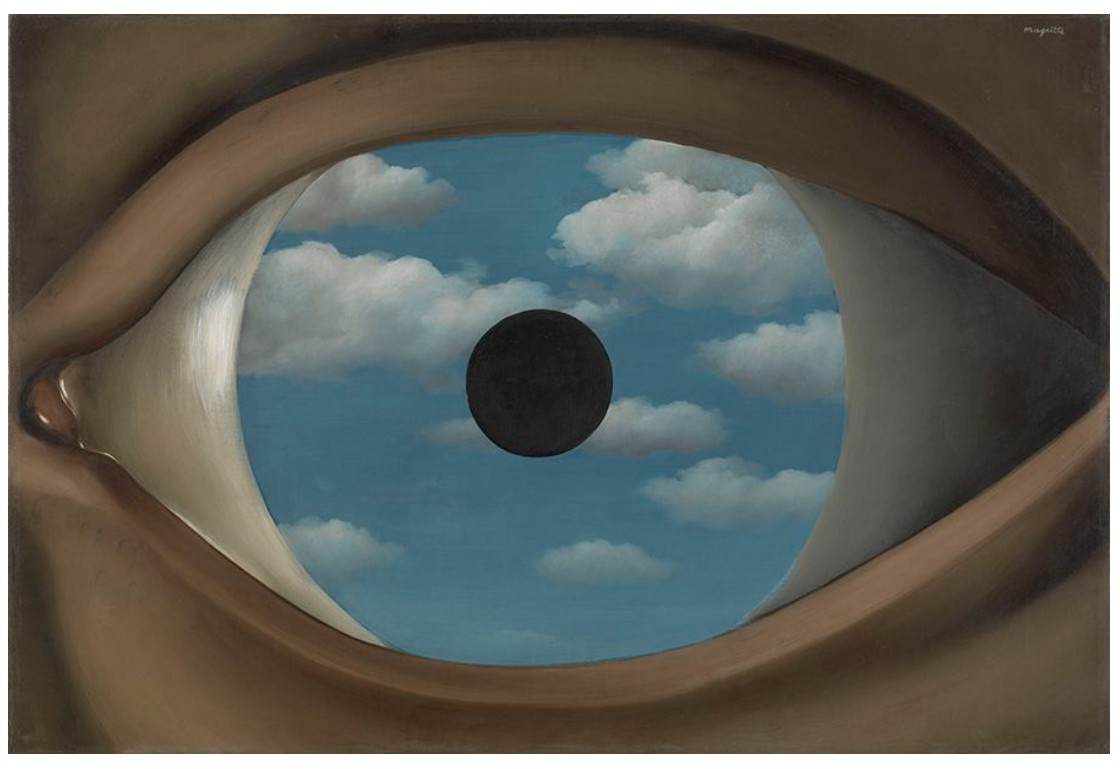
René Magritte, Le faux mirroir, 1928. The Museum of Modern Art, New York. Artwork: © 2026 ADAGP, Paris and DACS, London. Digital image: ©2026 The Museum of Modern Art, New York/Scala, Florence.
Kusama’s practice took flight after she moved to the United States in 1957, arriving in Seattle before moving to New York the following year. Her Infinity Nets, first shown in 1959, propelled her to international acclaim. With their countless repetitive dots set in lacy arcs, these works were direct manifestations of her own interior world.
“The room, my body, the entire universe was filled with [patterns], my self was eliminated, and I had returned and been reduced to the infinity of eternal time and absolute space.”
Meticulous, repetitive and entirely absorbing, the process of making these works allowed Kusama to escape the painful trappings of her own body and mind. They were cosmological in scope, redolent of galaxies and constellations proliferating to infinity. Earth, she wrote, is but ‘one polka-dot among a million stars’.
Tom Wesselmann, Mouth No 8, 1966. Private Collection.
Artwork: © 2026 Estate of Tom Wesselmann/VAGA at ARS, NY and DACS, London. Digital image: Bridgeman Images.
The present work dates from a watershed moment in Kusama’s career. In 1973 she had returned to Japan, and largely withdrew from her studio practice following a period of protracted mental illness. Over the course of the 1980s, however, she returned to painting with renewed energy. Though still bound to the abstract language of her dots, webs and nets, Kusama also began to embrace bold figurative imagery, including plants and animals as well as eyes. She started to use acrylic paint, which lent her canvases a captivating shimmer. During this period the artist began to garner international recognition once more. Her work had not been widely exhibited in the United States until 1989—the year of the present work—when she mounted a retrospective at the Center for International Contemporary Arts, New York. The exhibition helped to reintroduce Kusama to the art world that she had previously left behind, as well as the wider American public.
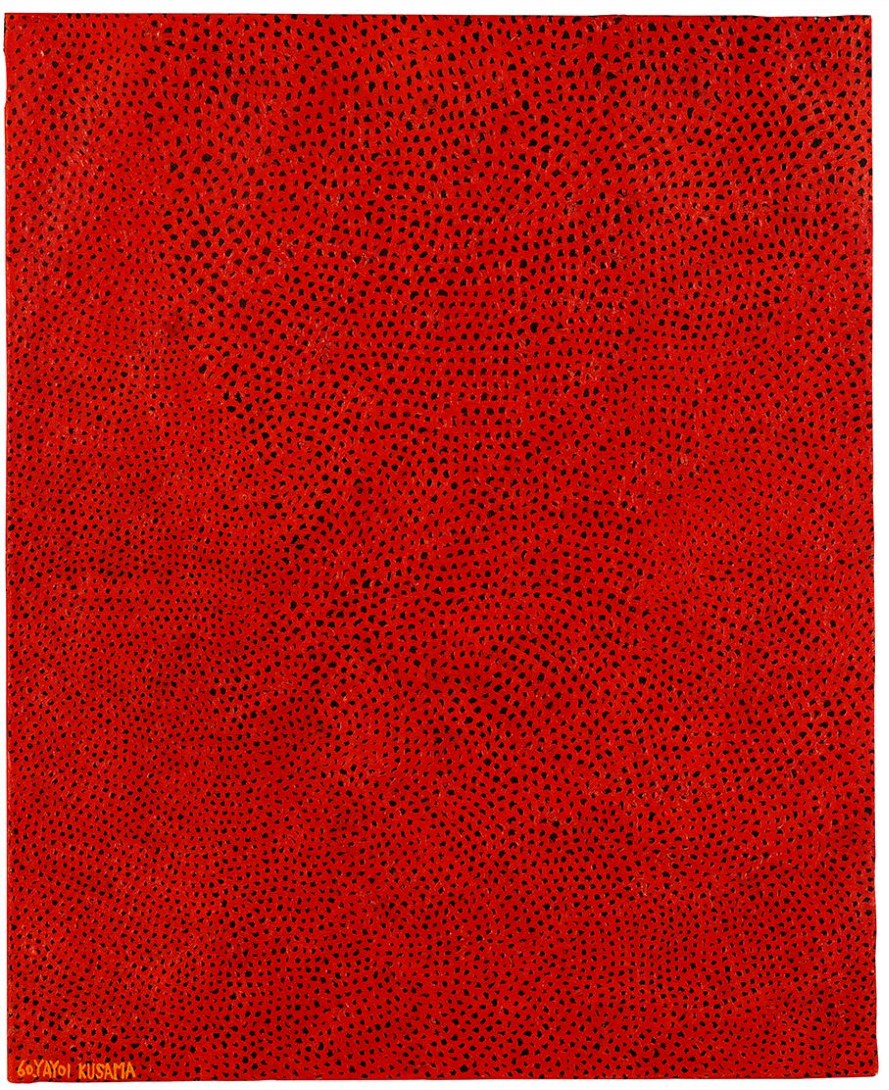
Yayoi Kusama, No. I.Z, 1960, The Art Institute of Chicago. Artwork: © YAYOI KUSAMA.
Digital image: © Art Institute of Chicago / Bridgeman Images.
Hitomi also invokes lessons Kusama had absorbed in New York, namely the ‘all-over’ gestures of her Abstract Expressionist contemporaries and Pop’s deadpan approach to its subjects. Looking back further still, the work is also decidedly surreal in its sensibilities. For the Surrealists, who sought to give image to veiled dreams and desires, eyes served as a window onto the unconscious. In their pictures, as in Hitomi, the eyeball functions both as an object to be looked at as well as a portal for viewing itself: a means of seeing and being seen simultaneously, and a tool for revealing the hidden. Hitomi filters these ideas through Kusama’s deeply personal practice to embrace the healing power of art. ‘By obliterating one’s individual self,’ she explains, ‘one returns to the infinite universe’ (Y. Kusama quoted in G. Turner, ‘Yayoi Kusama’, Bomb, vol. 66, Winter 1999).
Pumpkin, 1991
AN EYE FOR COLOUR: WORKS FROM A PRIVATE COLLECTION
Christie’s London: 7 March 2026
Estimated: GBP 250,000 – 350,000
GBP 381,000 / USD 508,980
YAYOI KUSAMA (B. 1929), Pumpkin | Christie’s
YAYOI KUSAMA (B. 1929)
Pumpkin, 1991
Acrylic on canvas
22.6 x 16 cm (8-7/8 x 6-1/4 inches)
Signed, titled in Japanese and dated ‘YAYOI KUSAMA 1991’ (on the reverse)
Hypnotic and vibrant in its yellow and black palette, Pumpkin represents a dazzling convergence of Yayoi Kusama’s most enduring motifs. The work was painted in 1991: the same year she created the seminal Mirror Room (Pumpkin) and just two years before she represented Japan at the 1993 Venice Biennale, becoming only the first female artist to do so. The pumpkin—Kusama’s most beloved subject—has guided her throughout her life as a grounding, comforting presence amid psychological turmoil. Here, it combines with the artist’s signature polka dots and web-like nets, both deeply linked to hallucinations she suffered as a child. Together, these motifs conspire to form a deeply personal portrait of Kusama’s inner world, alive with luminous vitality.
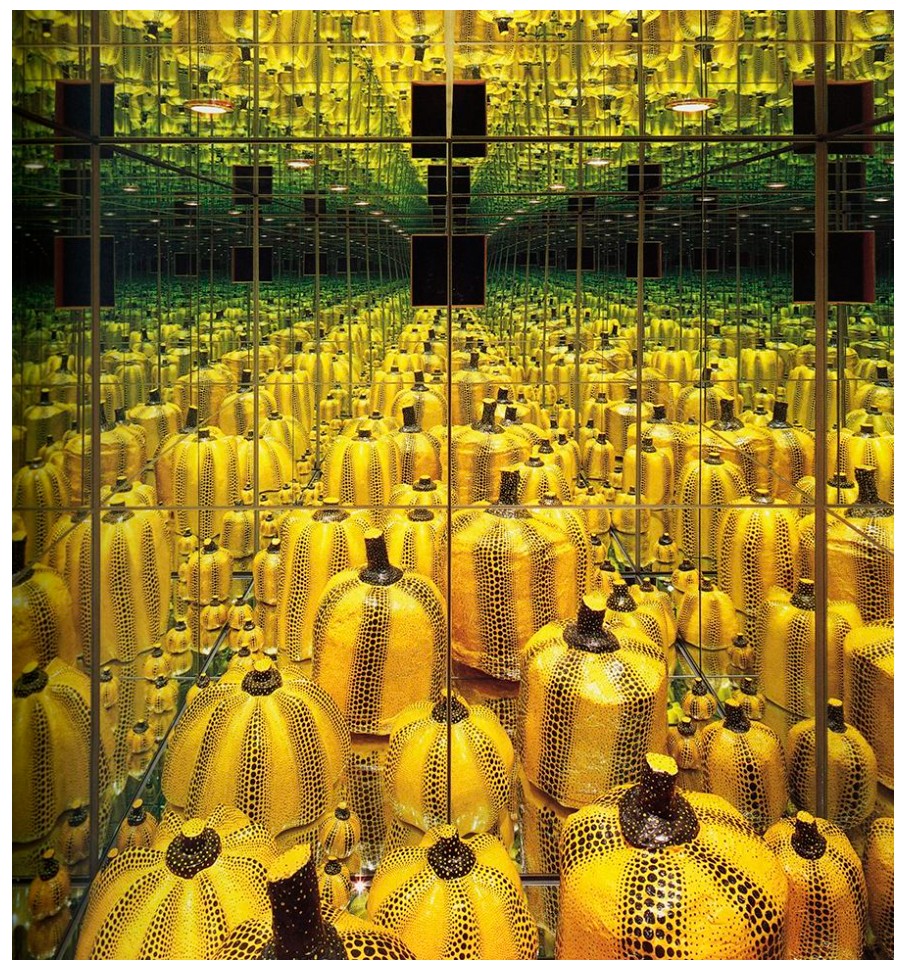
Yayoi Kusama, Mirror Room (Pumpkin), 1991. Hara Museum of Contemporary Art, Tokyo. Artwork: © YAYOI KUSAMA.
By the early 1990s, the pumpkin had become a defining motif within Kusama’s practice. It evolved from her early engagement with flowers and plants, which had informed her work since the early 1950s. As an art student in Kyoto, Kusama drew inspiration from childhood memories. ‘The first time I ever saw a pumpkin was when I was in elementary school and went with my grandfather to visit a big seed-harvesting ground,’ she recalls. Here and there along a path between fields of zinnias, periwinkles, and nasturtiums I caught glimpses of the yellow flowers and baby fruit of pumpkin vines. I stopped to lean in for a closer look, and there it was: a pumpkin the size of a man’s head … It immediately began speaking to me in the most animated manner’ (Y. Kusama, Infinity Net: The Autobiography of Yayoi Kusama, London 2011, p. 75). For Kusama, the pumpkin came to embody a sense humor and warmth, and would take center stage in her practice following her return to Japan from New York. Proliferating across painting, sculpture and installation, it assumed an almost human-like presence in her oeuvre, each iteration imbued with decidedly individual character.
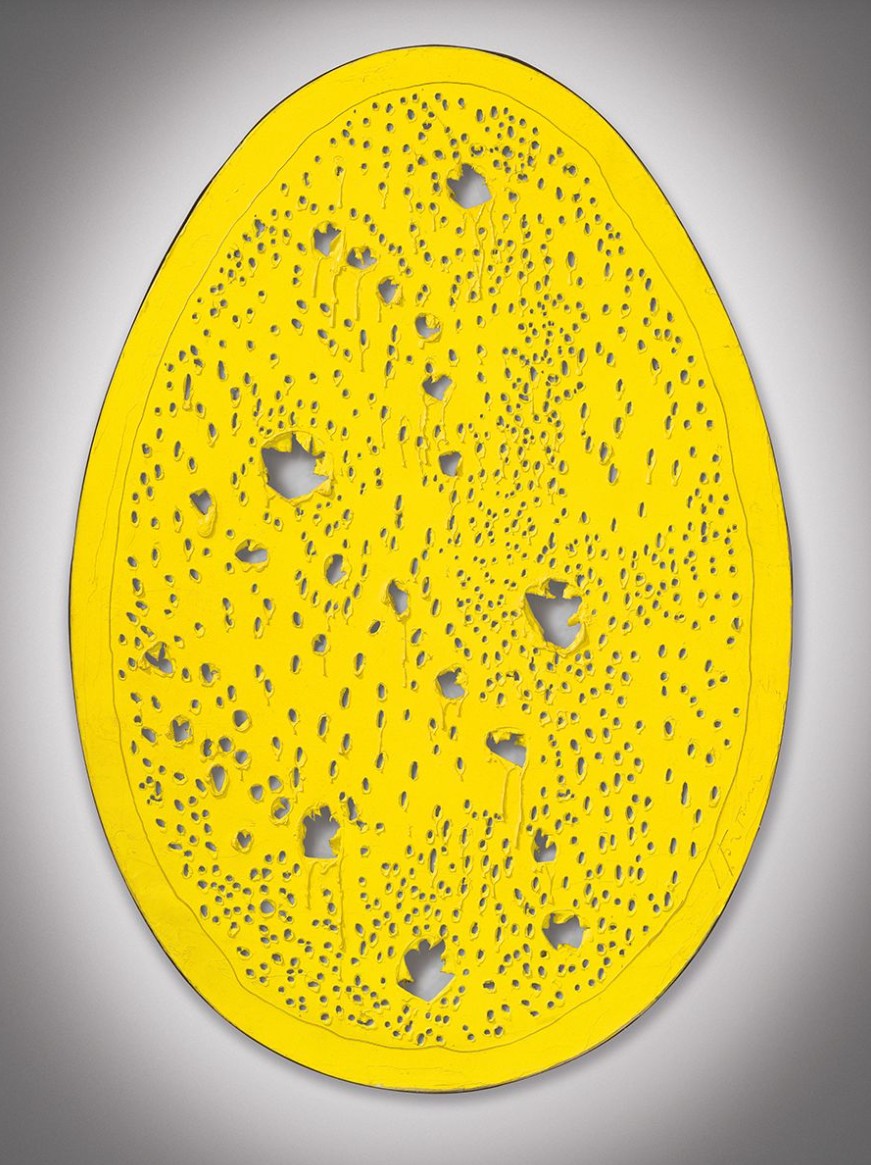
Lucio Fontana, Concetto spaziale, La fine di Dio, 1964. Private Collection. Artwork: © 2026 Lucio Fontana/DACS.
In the present work, the pumpkin’s oblong, ribbed form becomes a site of spiritual equilibrium. It floats atop a patterned background that evokes Kusama’s iconic Infinity Nets. These web-like structures came to define her practice after her arrival in New York in 1958, inextricably tied to her experiences of severe neurosis. They embodied her ‘perpetual labor to create artworks with no beginning and no end; in other words, a truly infinite task to recreate an abiding vision’ (L. Hoptman, Infinity Nets, in Yayoi Kusama, London 2012, p. 62). Within this dense, immersive mesh, the pumpkin emerges as a psychedelic vision, poised on the brink of dissolution. Its surface is covered in polka dots: a motif that originated in Kusama’s earliest hallucinations, and were recorded in her sketchbooks as a young teenager. While rooted in these visions, however, the dots became a powerful uplifting force within her practice, often placed against the ‘negative’ space of the nets in a bid to conjure a sense of infinite proliferation and self-obliteration (Y. Kusama, Infinity Net, ibid., p. 47).
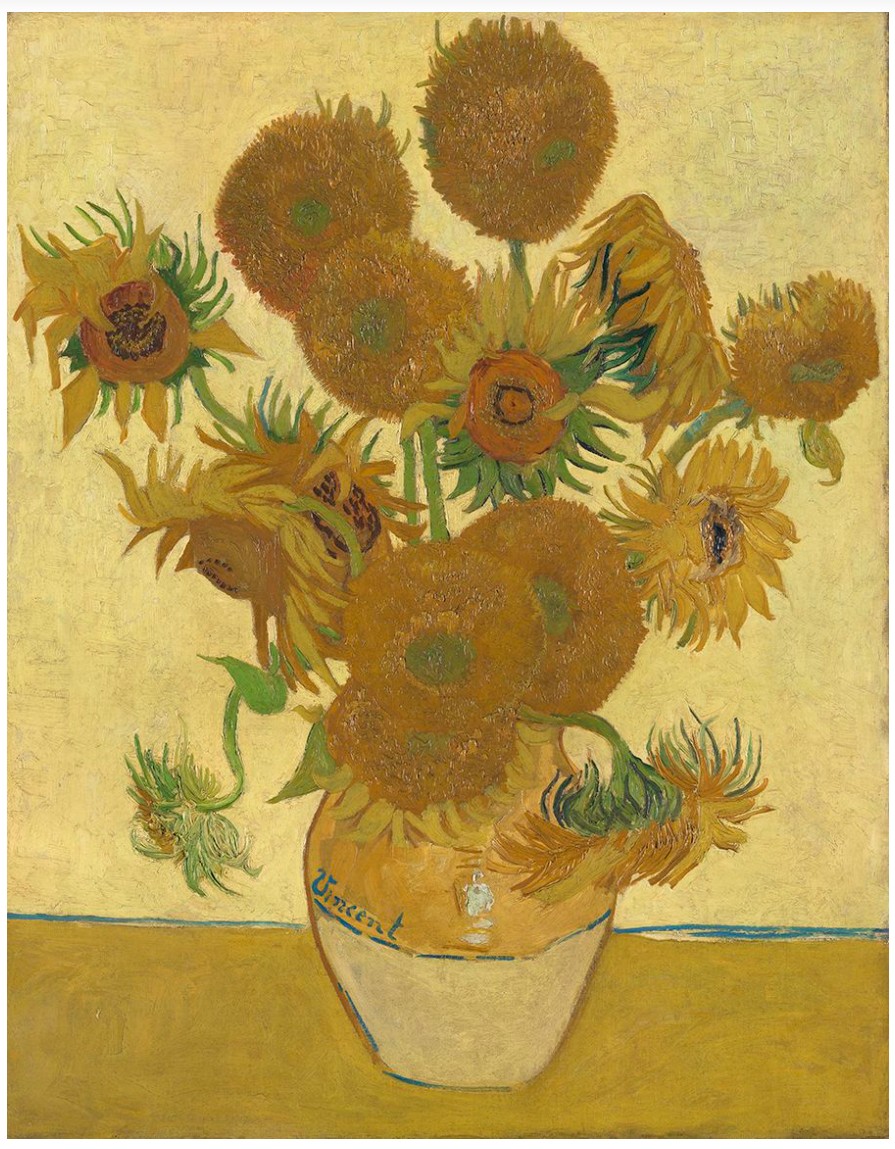
Van Gogh, Sunflowers, 1888. The National Gallery, London. Digital image: © 2026 The National Gallery, London/Scala, Florence.
Kusama’s devotion to pumpkins reflects her broader desire to connect with the natural world—an ambition she shared with Vincent van Gogh. United by mutual suffering, Kusama wrote that his art ‘overflows with humanity, tenacious beauty’, standing as a ‘triumph over the pain of feeling cornered and trapped’ (Y. Kusama, ibid., p. 212). In Pumpkin, the webs and dots become Kusama’s guiding stars in her exploration of the infinite. As she has written, ‘My desire was to predict and measure the infinity of the unbounded universe … How deep was the mystery? Did infinite infinities exist beyond our universe? … One polka dot: a single particle among billions’ (Y. Kusama, ibid., p. 23). Encapsulating the fundamental spirit of Kusama’s practice, Pumpkin stands as both a sanctuary and a shared emblem of endurance and hope.
Hat (OBQ), 2002
Christie’s London: 6 March 2026
Estimated: GBP 180,000 – 250,000
GBP 241,300 / USD 322,355
YAYOI KUSAMA (B. 1929), Hat (OBQ) | Christie’s
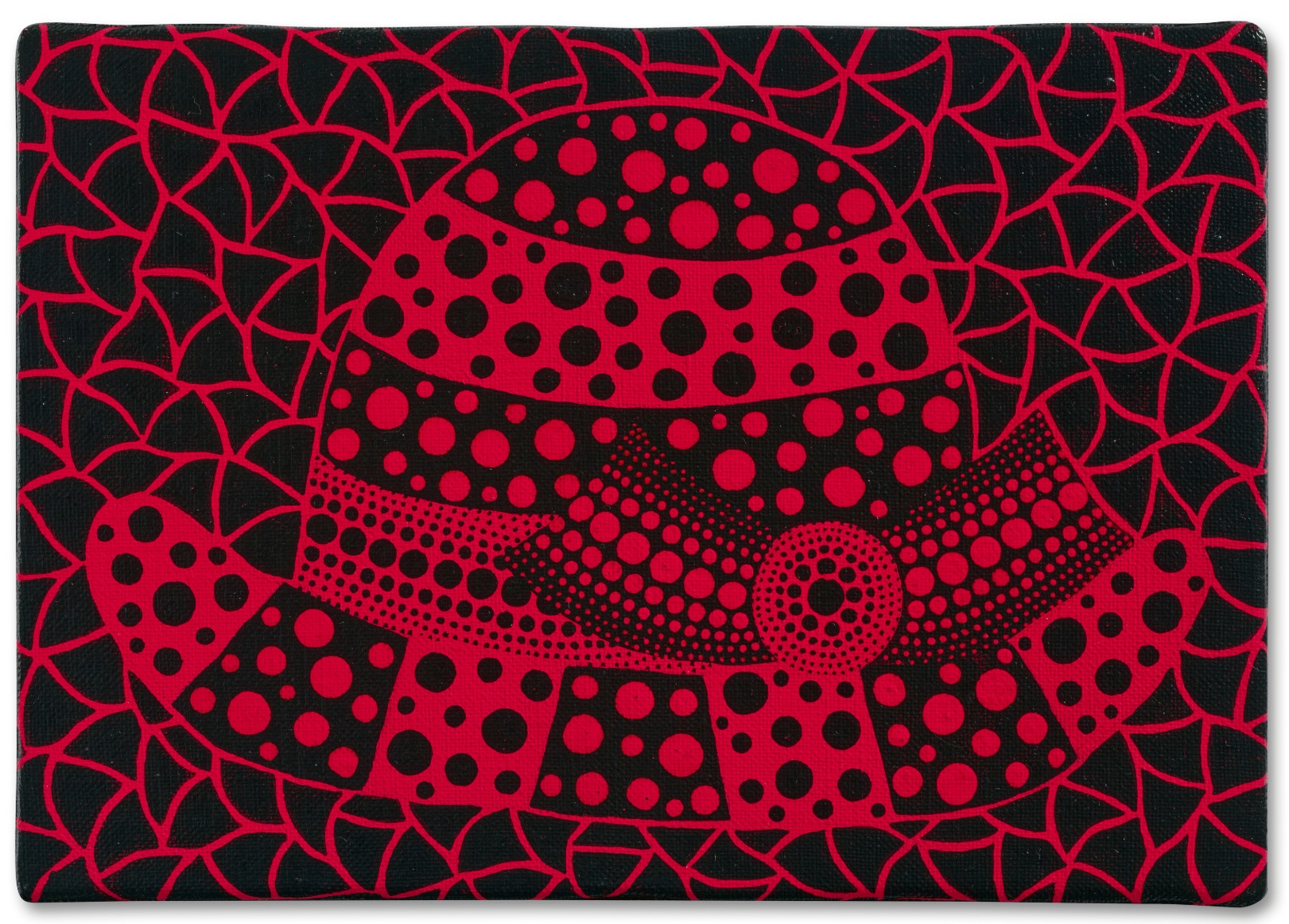
YAYOI KUSAMA (B. 1929)
Hat (OBQ), 2002
Acrylic on canvas
16.1 x 22.8 cm (6-3/8 x 9 inches)
Signed, titled in Japanese and dated ‘YAYOI KUSAMA 2002 (OBQ)’ (on the reverse)
Untitled, 1968
Phillips London: 7 March 2026
Estimated: GBP 200,000 – 300,000
GBP 258,000 / USD 344,660
Yayoi Kusama Modern & Contemporary Art
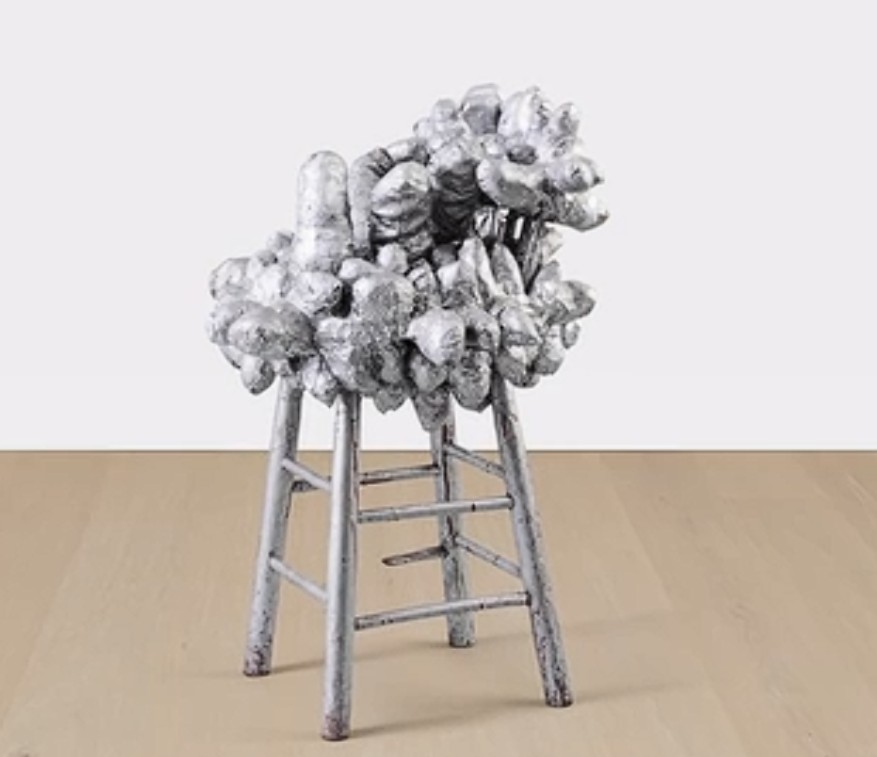
YAYOI KUSAMA
Untitled, 1968
Sewn stuffed fabric, chair and silver paint
76.2 x 61 x 61 cm (30x24x24 inches)
Signed and dated ‘Yayoi Kusama 1968’ on the back of the chair leg
“I have a series of works called Sex Obsession in which I make many stuffed cloth phalluses and sew them onto various things…My family was really conservative, really uptight. I was really afraid of sex. It was a big taboo. I liberated myself from the fear by creating these works…I was truly healed by the art I was making. Art enabled me to open up my heart, to face my own difficult character”
Pierre Soulages
Peinture 130 x 81 cm, 1er oct 2006
Contours of Modernity | A Private European Collection
Sotheby’s London: 4 March 2026
Estimated: GBP 400,000 – 600,000
GBP 512,000 / USD 683,980
OUTRENOIR
Peinture 130 x 81 cm, 1er oct 2006 | Modern & Contemporary Evening Auction | 2026 | Sotheby’s
PIERRE SOULAGES (1919 – 2022)
Peinture 130 x 81 cm, 1er oct 2006
Acrylic on canvas
130×81 cm (51-1/8 x 31-7/8 inches)
Signed, titled and dated 1 oct. 2006 (on the reverse)
A quintessential expression of Pierre Soulages’ emblematic Outrenoir series, Peinture 130 x 81 cm, 1er Octobre 2006 represents the culmination of the celebrated artist’s artistic and aesthetic pursuit. Its tactile surface and architectonic structure foreground the sensory experience derived from the infinite permutations which can be achieved with a single hue: black. Renowned for his preeminent exaltation of the physical qualities of the color black, Soulages applies the pigment onto the surface of the present work in such a way that it simultaneously exudes brilliance and sobriety, transparency and opacity, texture and form.
“Outrenoir refers to a reflected light that is beyond black, transformed by black. Outrenoir is a black that ceases to be black, instead emitting light, a secret light. Outrenoir is a mental space that is beyond mere black.”
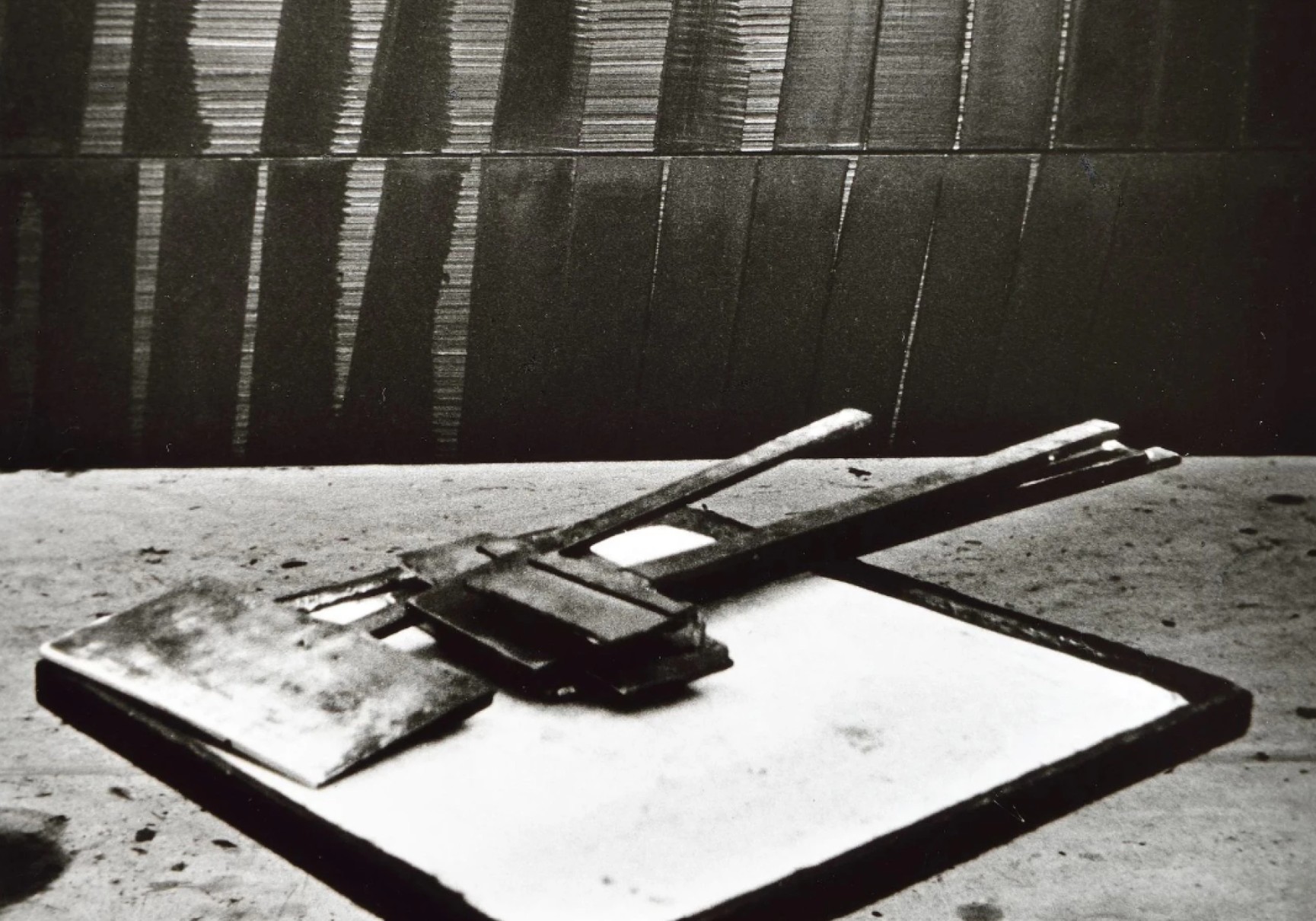
Pierre Soulages’ studio, 1987. Photo © Michel Dieuzaide. Art © ADAGP, Paris and DACS, London 2026
Peinture 130 x 81 cm, 1er Octobre 2006 thus demonstrates Soulages’ mastery of the medium. Through meticulous, repetitive gestures, he creates a complex texture that captures the light and reflects his deep fascination with the paradox of darkness. For him, black was not simply the absence of light, but a source of light itself. From his very earliest work, Soulages explored the multiple nuances and textures of black, seeking to reveal its intrinsic depth and richness through its contrast with other hues. In 1979, in embarking on the series that would become the Outrenoir, he discarded all other colours and concentrated exclusively on black. In doing so, Soulages transcended the limits of color to propose a meditation on the very nature of light.
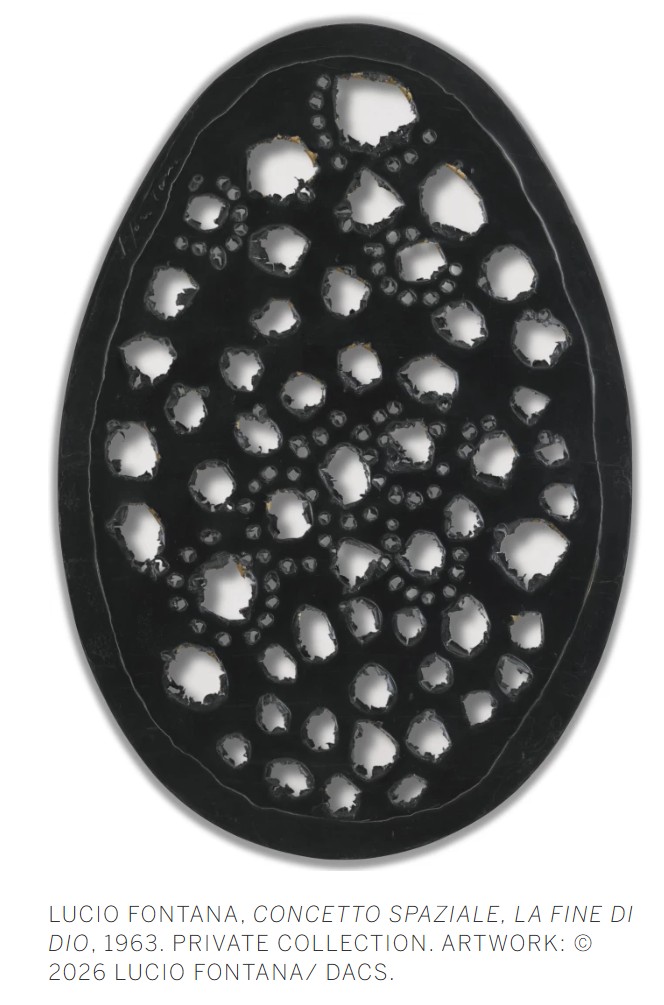
While the surface of this work reveals all the luminous potential of black pigment, it also brings out infinite subtle variations in tone. Soulages thus defies the limits of monochrome: the single pigment covering the entire canvas is belied by a multiplicity of shades created by the interaction with light. Writer and academic Pierre Encrevé describes this as “mono-pigment painting with chromatic versatility;” an intelligence of color that gives rise to a rich palette of shades within a single hue (Pierre Encrevé, “Le noir et l’outrenoir,” in Exh. Cat., Paris, Musée d’Art moderne de la Ville de Paris, Soulages, Noir Lumière, 1996, p. 37). As the artist himself explains, “Some mornings it is grey, silver. At other times, capturing the reflections of the sea, it is blue. At other times, it takes coppery brown tones; in fact, it is always in tune with the light it receives” (the artist quoted in Olivier Pauli, “Le couleurs du noir,” in Eric Chassey, ed., Soulages XXIe Siècle, Paris 2012, p. 154).
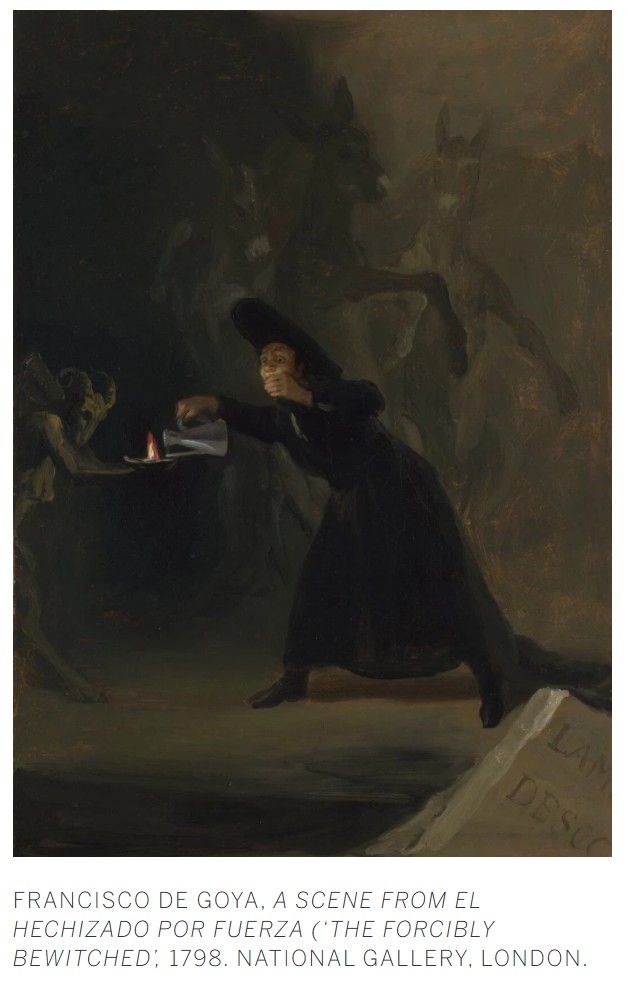
With the late outrenoir such as the present example, Soulages’ technique reaches its formal apogee. Adopting thick acrylics in 2004, he created a sculptural texture that imbues the canvas with a palpable physical presence: each scrape, hollow, and ridge causes the light to interact differently with the surface, and the material absorbs, modulates, catches or reflects light back to us. The contrast between glossy and matte black further emphasises this effect, as we perceive simultaneously the infinite permutations of light and dark. As Encrevé describes works like the present, “Soulages has always paid close attention to the distinction between matte black and glossy black, regularly pointing out that there is not one black, but many different blacks depending on a host of parameters. Matte black, which is the greatest absence of luminosity, has the decisive characteristic for him of presenting an immutable aspect, in stark contrast to the mobility of outrenoir: he likes to evoke Rimbaud’s words “le jour mat produit par ce ciel immuablement gris” (“the matte day produced by this immutably grey sky”). In January 2005, he inaugurated a new type of outrenoir canvas, contrasting matte black and gloss black, both using acrylic binder” (Pierre Encrevé, Soulages, Les peintures 1946-2006, Paris, 2007, p. 359). Although Soulages uses a single pigment, the ways in which he applies it and the ways in which it can be used are unlimited, from uniform repetitions to more spontaneous movements, in regular diagonals or broken rhythms.
“The light that moves me is the light of the night,
the night that we each carry within ourselves.”
In the present work, gesture and form have finally been replaced by an implacable regularity of obliques. Soulages rejected the way in which gestural painting, epitomized by the Abstract Expressionists, traced the painter’s personal states of mind, and also denied any formal element that might introduce a certain language, a narrative, to the detriment of what he considered the very essence of painting: its support, its medium, its format and its dimensions. This conviction is perfectly illustrated by the title: Peinture 130 x 81 cm, 1er Octobre 2006. Such hieratic composition, without image or language, in which the importance of light has eclipsed that of the sign.
Andy Warhol
Hammer and Sickle, 1976
Sotheby’s London: 4 March 2026
Estimated: GBP 3,000,000 – 5,000,000
GBP 3,506,000 / USD 4,683,665
Hammer and Sickle | Modern & Contemporary Evening Auction | 2026 | Sotheby’s
REPEAT SALE
Sotheby’s New-York: 16 May 2022
Estimated: USD 4,000,000 – 6,000,000
USD 6,414,200
Hammer and Sickle | The Macklowe Collection | 2022 | Sotheby’s
ANDY WARHOL (1928 – 1987)
Hammer and Sickle, 1976
Acrylic and silkscreen ink on canvas
72-1/4 x 86 inches (183.5 x 218.4 cm)
Signed and dedicated to Carlo Bilotti (on the overlap)
Hammer and Sickle is among the most historically potent, culturally significant, and viscerally charged paintings from the inimitable oeuvre of Andy Warhol. Bristling with the explosive energy of communism’s universally recognizable motif, Warhol’s emphatic rendering of one of the twentieth century’s most iconic and emblematic symbols confronts the viewer with a provocative bravura that rivals that of the artist’s quintessential Pop images of Campbell’s Soup Cans, Marilyn Monroe, and the like. Remarking upon this tension in the Hammer and Sickle paintings, critic George Frei notes, “The present series takes a less direct and more complex stand by showing the logo of the American manufacturer and thus marking the tools as products of a free market economy. The representation takes a different tack: the once political emblem has been dismantled into its original components. As in a classical still life, the objects have no secrets, no ulterior meaning: a hammer is a hammer, a sickle is a sickle. Created long before glasnost and perestroika, these works seem to us today almost like a prophetic prediction.” (Georg Frei, “Hammer and Sickle – A Painterly Manifesto,” in Exh. Cat., Zurich, Thomas Ammann, Andy Warhol: Hammer and Sickle, 1999, n.p.)
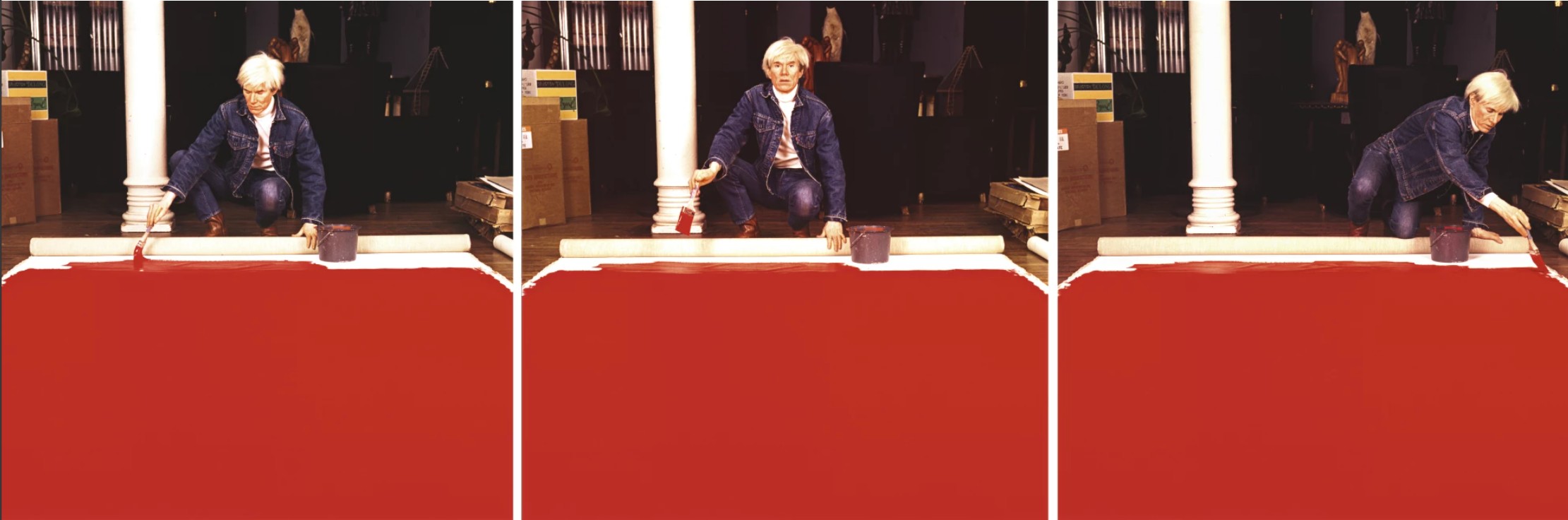
ANDY WARHOL IN HIS STUDIO, NEW YORK, JANUARY, 1983. PHOTO BY CURTIS KNAPP / GETTY IMAGES.
Art © 2026 The Andy Warhol Foundation for the Visual Arts / DACS, London
A superb example from a limited body of large-scale Hammer and Sickle canvases measuring 72 by 86 inches, the present work is one of the only paintings executed in the eruptive red-on-red ground seen here. Further distinguished by its storied provenance, the present work originally belonged to famed patron of the arts Carlo Bilotti. Bilotti, the Italian-American perfumier who would later donate his collection to the city of Rome to form the Museo Carlo Bilotti, often became close friends with artists he commissioned, including Salvador Dalí, Giorgio de Chirico, and Warhol. Indeed, one of Warhol’s rare double portraits was commissioned by Bilotti of his wife and daughter in 1981, and its intimate depiction of the sitters bespeaks their close and lasting relationship with the artist. The present work, executed a few years previously, is inscribed to Bilotti on the reverse. In a searing blaze of incandescent scarlet pigment and crisply delineated shadows, Hammer and Sickle enacts a captivating conflict between the propagandistic fervor of communist Russia and the quintessentially American production of the artist’s Pop oeuvre, transforming the blazing logo into an ironic Warholian emblem.
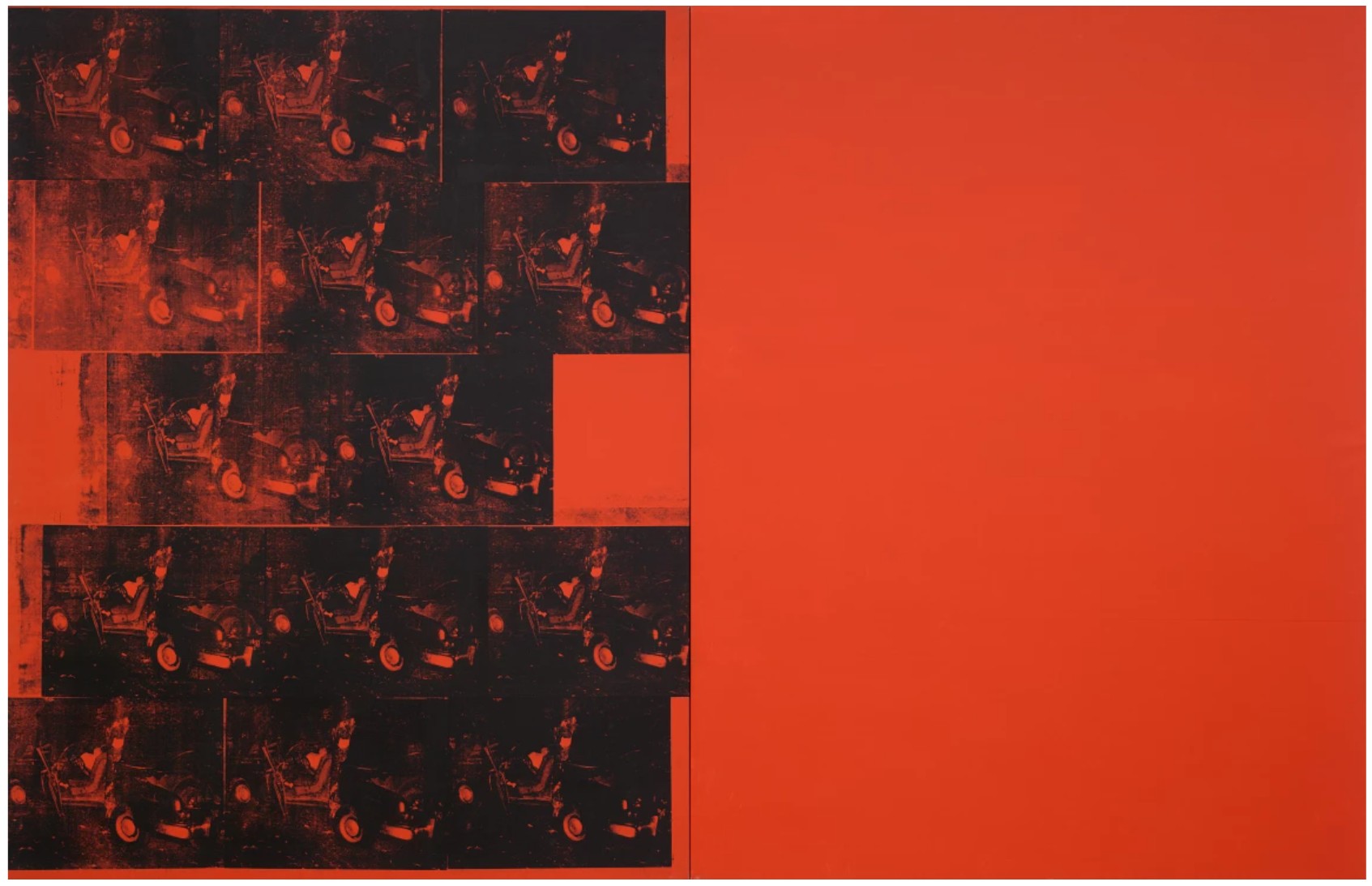
Andy Warhol, Orange Car Crash Fourteen Times, 1963. Museum of Modern Art, New York.
Art © 2026 The Andy Warhol Foundation for the Visual Arts / DACS, London
Warhol’s consumption and subsequent re-appropriation of communist symbolism into his legendary Pop vernacular—both physical, as in Hammer and Sickle, and metaphorical, as in his renderings of Chinese communist leader Mao Zedong and Russian communist revolutionary Vladimir Lenin—profoundly refocused the artist’s ground-breaking aesthetic energies on the political realities of his time. His inspiration for the contentious Hammer and Sickle series came in 1975, as the artist was touring Italy for the opening of his Ladies and Gentlemen exhibition at the Palazzo dei Diamanti in Ferrara. Upon viewing the radical Italian left’s ecstatic embrace of his portraits of African and Latin American transvestites, Warhol wryly remarked, “Maybe I should do real Communist paintings next. They would sell a lot in Italy.” (Bob Colacello, Holy Terror, Andy Warhol Close Up, New York 1990, p. 228) Indeed, in the mid-1970s, the communist emblem of a blunt hammer superimposed on the razor-sharp arc of a sickle was the most conspicuous graffito in the streets of Milan and Rome; despite the establishment of Italy’s democratic government following World War II, the instantly legible symbol still enshrined an anti-establishment fervor and anti-capitalist ideology.
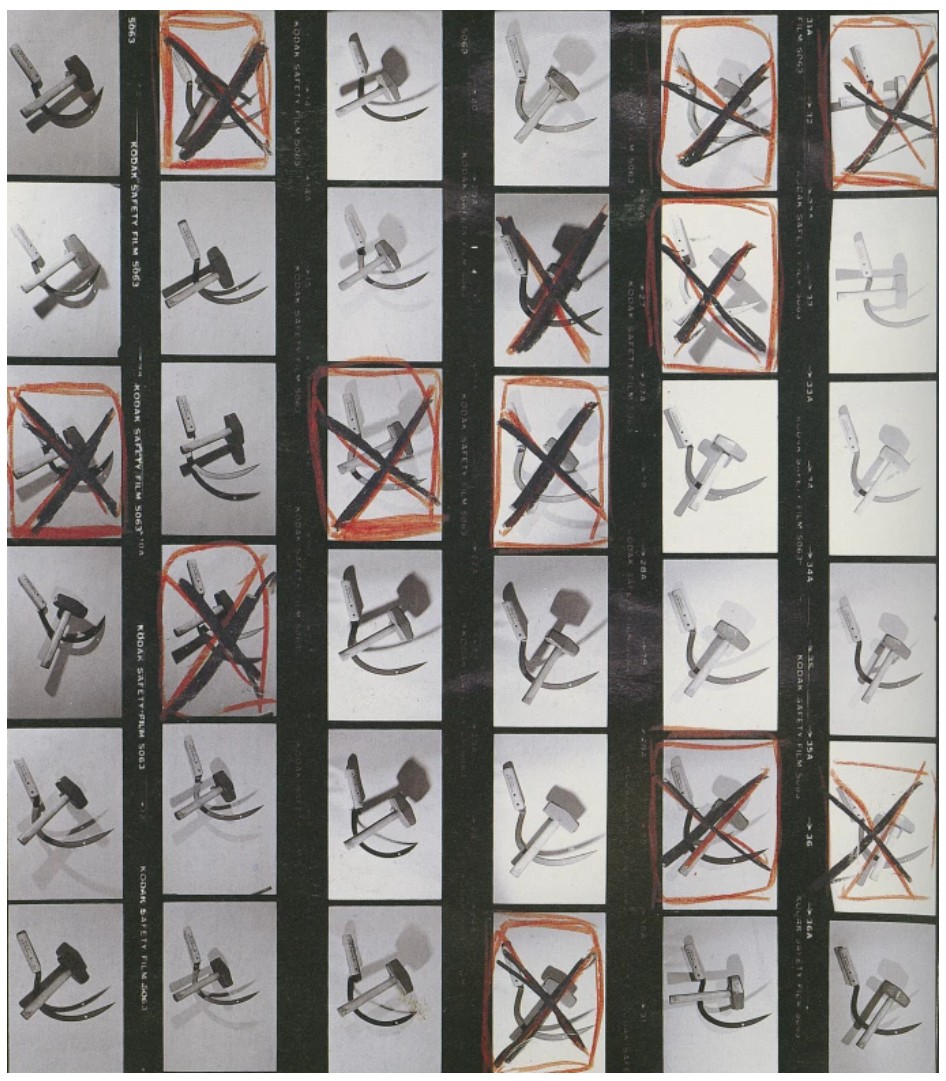
Source material for the present work, a hammer and sickle photographed with Andy Warhol’s markings.
Art © 2026 The Andy Warhol Foundation for the Visual Arts / DACS, London
Upon his return to the Factory, Warhol charged Ronnie Cutrone, a trusted studio assistant, to track down a suitable source image of the motif from Soviet paraphernalia. As the latter recounts, he searched through New York’s “Red” bookshops but could not find anything appropriate: “They were too flat or too graphic. The answer was to go down to Canal Street, into a hardware store, and buy a real hammer and sickle. Then I could shoot them, lit with long, menacing shadows, and add the drama that was missing from the flat-stencilled book versions… It always amused me that Andy, the ultimate Capitalist, and me, the ultimate Libertarian, could be suspected of communist activity.” (Ronnie Cutrone cited in Exh. Cat., New York, C&M Arts, Hammer and Sickle, 2002, n.p.) Cutrone and Warhol then arranged the objects on a horizontal surface, taking photographs in various compositions and lighting arrangements before Warhol, satisfied with their results, selected the twelve best photographs to serve as source images.
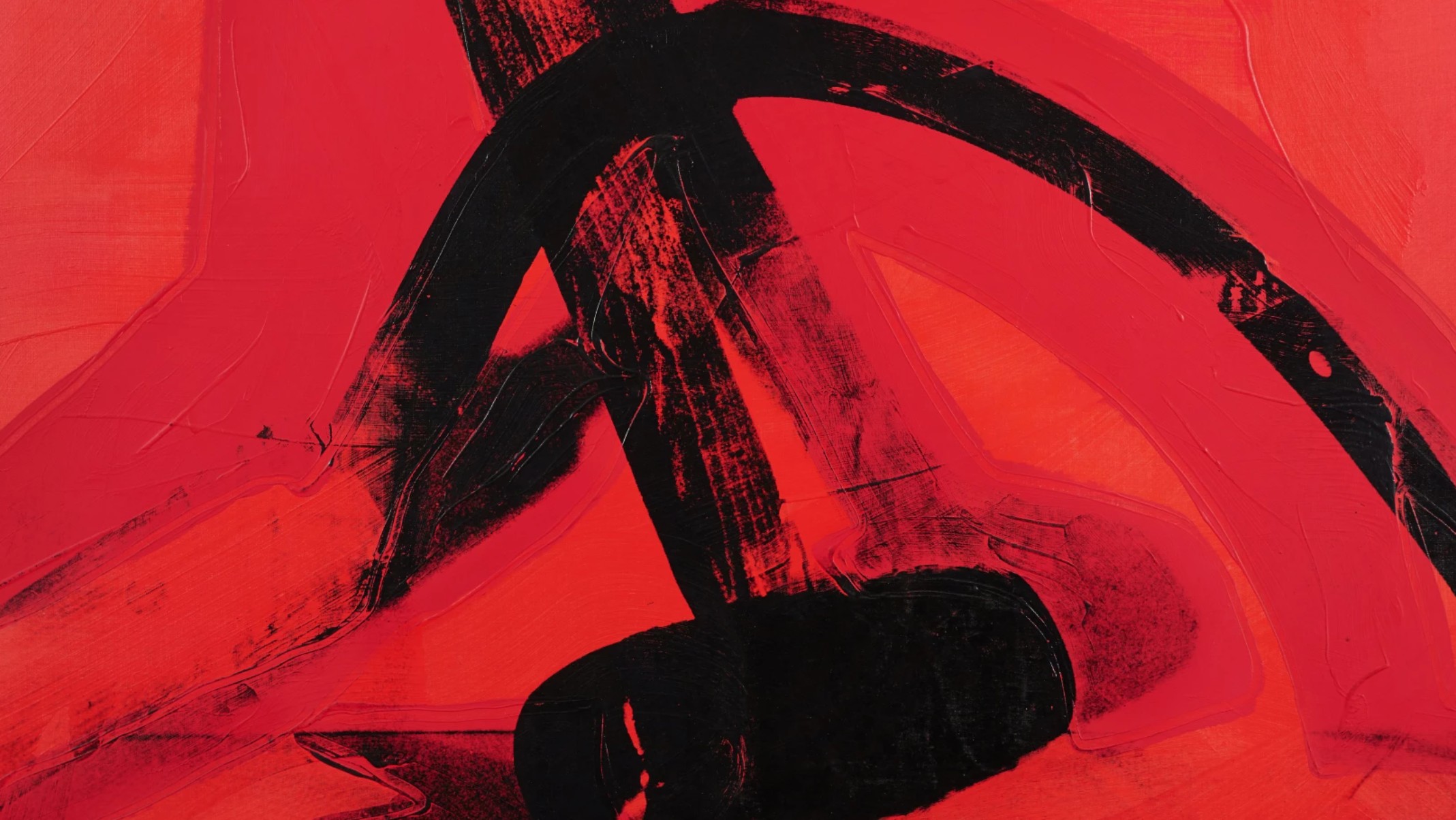
The artist then began his trademark process of projecting the source photograph onto a background and painstakingly tracing its contours in pencil, before returning to render the contours in red acrylic. In a second step, the artist silkscreened the same configuration in black onto the existing picture-plane, therein creating the multi-dimensional shadows and optical illusions dramatically articulated in the present work. Only occasionally would Warhol use additional colors or, even more rarely, render the composition in multiple shades of red. One of only two such paintings of this scale to be executed in two shades of scarlet pigment, the present work is the only example in which Warhol emblazoned the motif upon an entirely saturated ground of blood-red pigment; the unique and impenetrable opacity of the crimson canvas instills the painting with a singular aura of zealous civil fervor and profound visual gravitas.
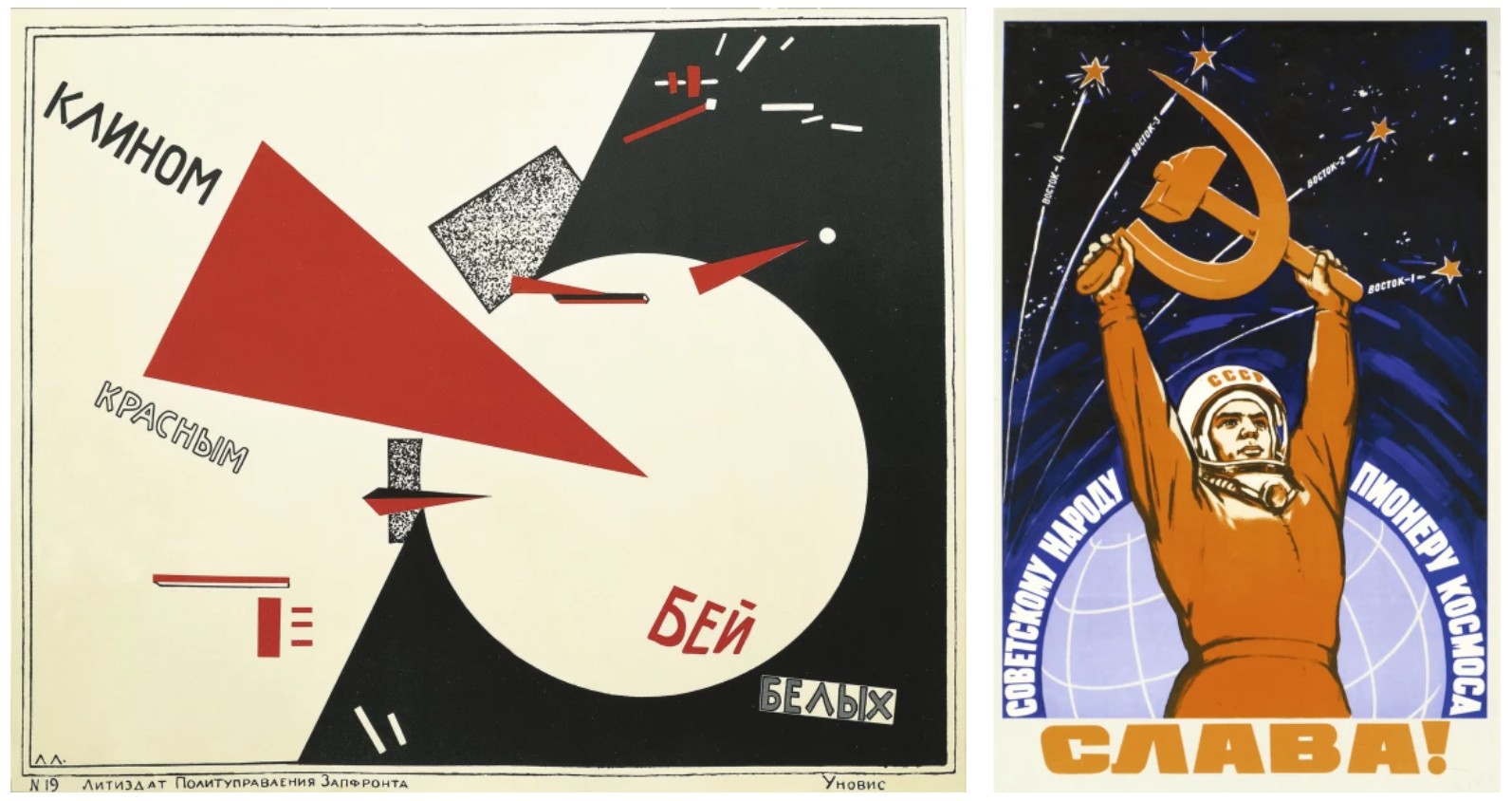
Left: El Lissitzky, Beat the Whites with the Red Wedge, 1919. Russian State Library, Moscow
Right: Russian propaganda poster, “Long Live the Soviet People & Its Pioneers,” circa 1960s. Image © Buyenlarge Archive/UIG / Bridgeman Images
Famous for his droll ambiguity and characteristic preoccupation with artifice, Warhol, in his Hammer and Sickle paintings, once again effortlessly straddles the seemingly antithetical poles of superficiality and penetrating social commentary. Running parallel to the poignant political import of the imagery in the series lies an underlying challenge to canonical art history’s most conventional and traditional genre: the still life. By artfully positioning the purchased hammer and sickle upon a draped white surface, re-arranging and re-lighting with exacting precision, Warhol wryly invokes the precariously balanced compositions and mesmerizing trompe l’oeil of eighteenth-century still life painters. In Warhol’s hands, the hammer and sickle are reduced to a manufactured product that simply reverberates with a highly charged symbolic potency; the most archetypal symbols of socialism are demoted to consumerist objects, dispersing the explosive political charge of the imagery while concomitantly locating it within a broader art-historical and critical framework. A truly magnificent work from Warhol’s most politically potent and indelibly totemic series, Hammer and Sickle is a profound and enduring testament to Warhol’s legacy as the consummate history painter of the modern age.
Four Marilyns (Reversal Series), 1986
Sotheby’s London: 4 March 2026
Estimated: GBP 1,800,000 – 2,500,000
GBP 3,262,000 / USD 4,357,705
Four Marilyns (Reversal Series) | Modern & Contemporary Evening Auction | 2026 | Sotheby’s
ANDY WARHOL (1928 – 1987)
Four Marilyns (Reversal Series), 1986
Acrylic and silkscreen ink on canvas
36×28 inches (91.5 x 71 cm)
Stamp signed (on the overlap)
Stamped by the Andy Warhol Art Authentication Board, Inc.
Numbered A120.042
Inscribed I certify that this is an original painting by Andy Warhol completed by Andy in 1986 Frederick Hughes
(on the overlap)
Executed in 1986, Four Marilyns (Reversal Series) represents one of the most conceptually charged moments in Andy Warhol’s late career. More than two decades after he first cemented Marilyn Monroe’s status as a cult icon in his elegiac 1962 portraits, Warhol revisited her image in the Reversals series, transforming the familiar visage into something newly spectral and uncanny. Repeated four times in negative register, the present work underscores both the enduring power of Monroe’s celebrity and the symbolic weight of Warhol’s own artistic mythology. The Reversals marked a decisive shift in Warhol’s practice at the beginning of the 1980s. Following the relative quietude of the previous decade, he turned towards a re-examination of his own pantheon of 1960s icons, aligning himself with the appropriationist strategies of younger contemporaries such as Cindy Sherman and Richard Prince. In doing so, Warhol effectively appropriated himself as a brand, recasting his formative images of Marilyn, Mao, and Campbell’s Soup into what might be understood as incandescent x-ray visions of his earlier career. As Roberto Marrone has observed, “All the images Warhol used in the Retrospectives and Reversals ranked among his most memorable and commercial icons… In repeating these same images in a new ‘reversed’ and negative form, Warhol bestowed upon them a darker and more sombre mood reflective of the distance in time between their original use and their re-creation” (Roberto Marrone in: Exh. Cat., Zurich, Galerie Bruno Bischofberger, Andy Warhol: Big Retrospective Painting, 2009, p. 32). In this light, Four Marilyns (Reversal Series) can be seen not merely as a return to one of Warhol’s most celebrated inquiries but as a climactic transfiguration of his core concerns – repetition, celebrity, commodification, and mortality – distilled into a late work of haunting resonance.
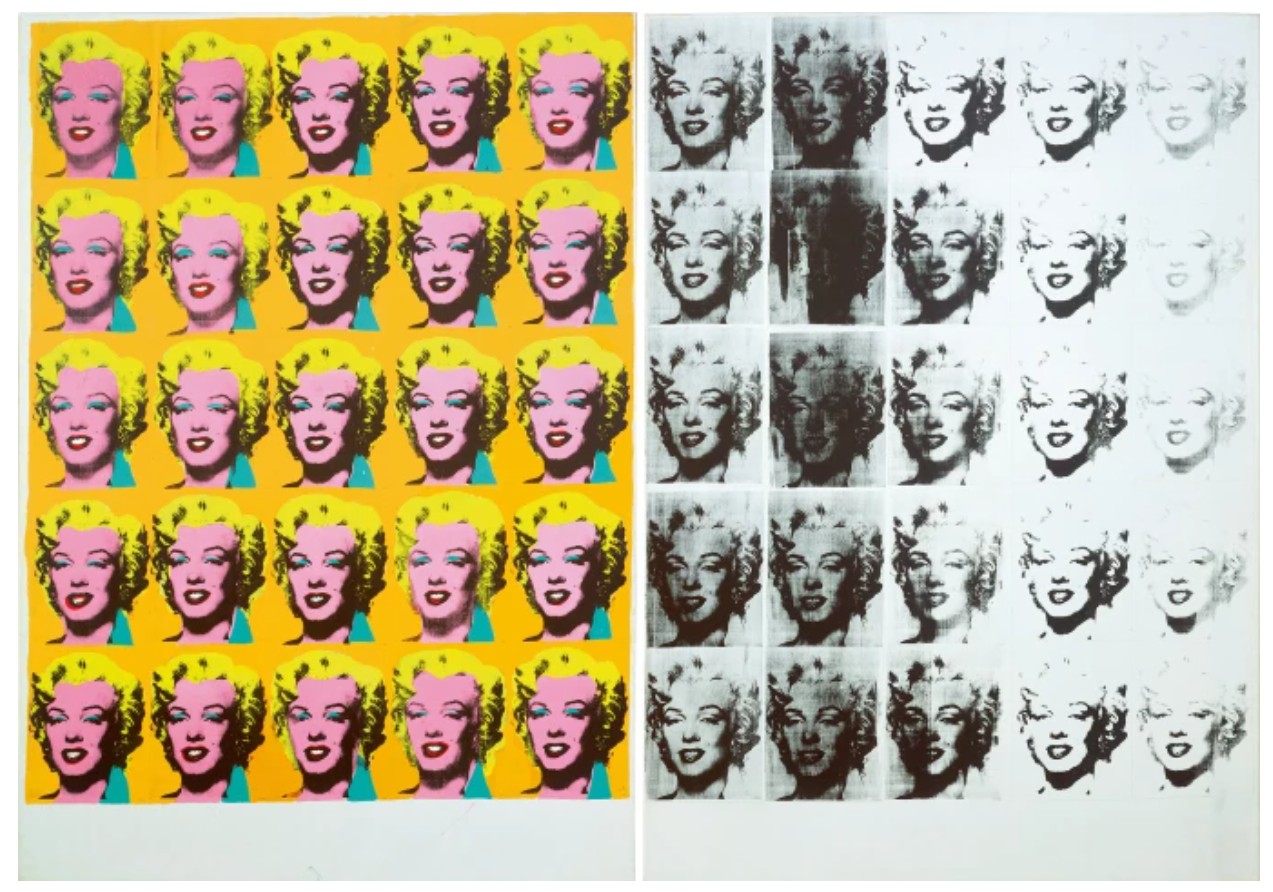
Andy Warhol, Marilyn Diptych, 1962. Tate Modern, London.
Artwork: © 2026 The Andy Warhol Foundation for the Visual Arts, Inc./Licensed by DACS, London
The present work stands at the apex of Warhol’s lifelong project of appropriation. Where, in the years that followed, he would turn to the art historical canon – appropriating motifs from Lucas Cranach, Paolo Uccello, Edvard Munch, and Giorgio de Chirico – here Warhol’s gaze is directed inward, lifting directly from his own repertoire. This act of self-quotation is emblematic of the pervasive mood of self-mythologisation that permeates his late practice. By revisiting Marilyn Monroe, an image that had already secured him enduring fame, Warhol simultaneously reaffirmed and destabilized the very artistic code upon which his reputation was built. In Four Marilyns (Reversal Series), Monroe’s visage is presented not through the familiar registers of heightened glamour, but as a spectral imprint. Rendered in negative, her repeated likeness is suffused with an eerie white luminosity, while shadows deepen and mid tones collapse into darkness. The effect is one of haunting dematerialization: Monroe appears suspended between presence and absence, radiance and erasure. Through this reversal, Warhol foregrounds the duality of celebrity itself – at once dazzlingly visible and destined to fade into memory.
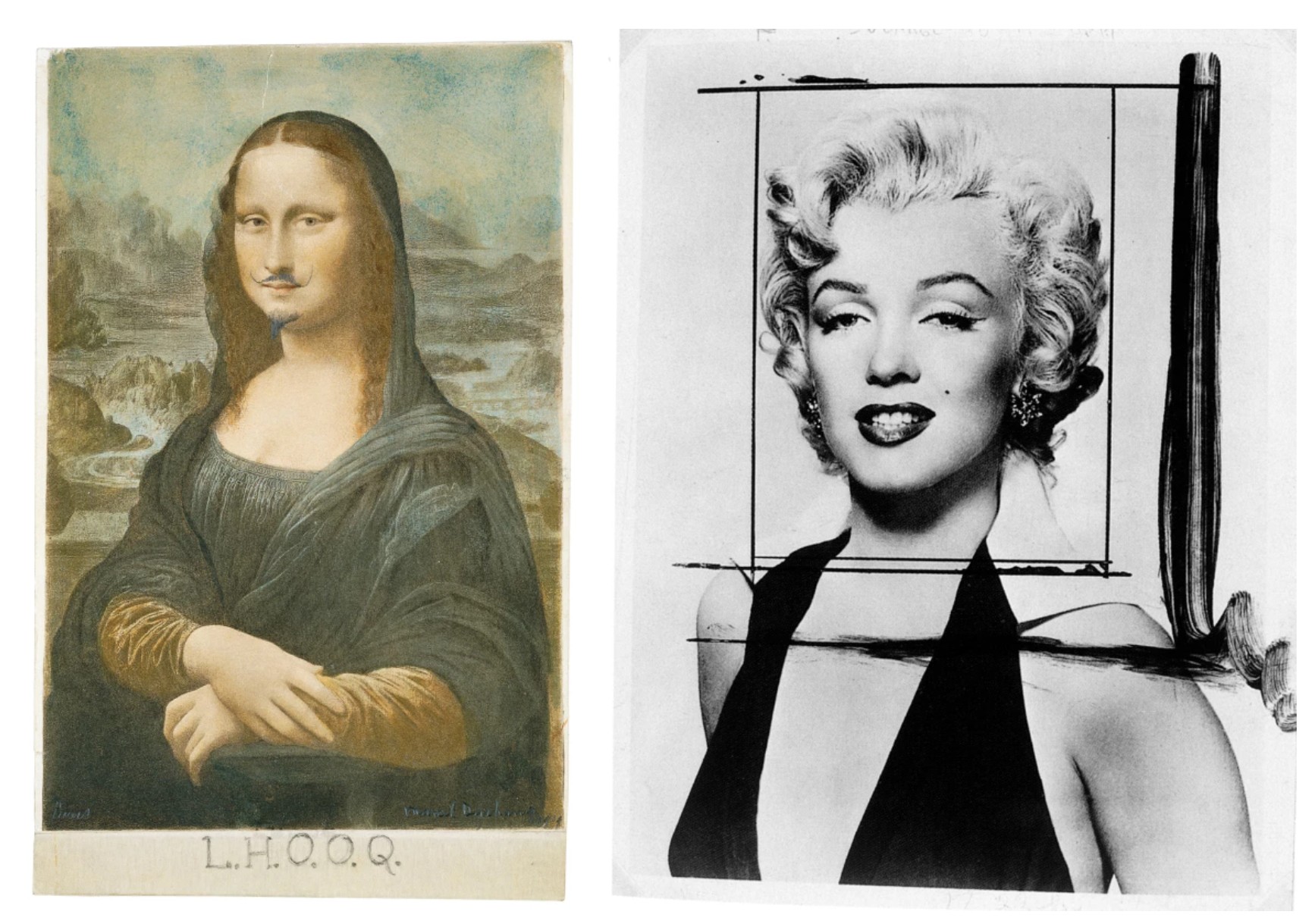
LEFT: Marcel Duchamp, LHOOQ or La Joconde, 1919/1940. Image: University of Southern California. © 2026 Association Marcel Duchamp / ADAGP, Paris and DACS, London
RIGHT: Publicity still of Marilyn Monroe for the film Niagara (1953), showing crop marks made by Andy Warhol. Image: The Andy Warhol Museum, Pittsburgh; Foundling Collection, Contribution The Andy Warhol Foundation for the Visual Arts, Inc © 2026 The Andy Warhol Foundation for the Visual Arts, Inc. / Licensed by DACS, London.
With Marilyn Monroe, Warhol discovered a modern memento mori capable of unifying the central obsessions that drove his career: glamour, beauty, fame, and death. In the present work, these themes coalesce with renewed force. The stark contrast of black silkscreen ink against a luminous white ground evokes both the seductive surface of cinema and the spectral fragility beneath it. Warhol’s deployment of silkscreen, a mechanical process that effaces the artist’s hand, further serves as a metaphor for mass media and its power to reproduce, disseminate, and ultimately flatten individuality into consumable image. As Rainer Crone observed, Warhol gravitated towards movie stars because they functioned as “representatives of mass culture” (Rainer Crone, Andy Warhol, New York 1970, p. 22). Monroe epitomized this paradox more fully than any other: she was at once the most desirable woman in the world and the tragic victim of her own celebrity.
Andy Warhol, Diamond Dust Shadows (Two Works), circa 1979. Private Collection. Sold Sotheby’s London, July 2020.
© 2026 The Andy Warhol Foundation for the Visual Arts, Inc. / Licensed by DACS, London.
In the present example, the hauntingly mesmeric monochrome portrait of Monroe is repeated with a deliberate absence of colour that calls to mind the repetitive printings of black-and-white tabloid papers. Even before Monroe’s highly publicised death, these publications had already rendered Monroe’s portrait an image ubiquitous in popular culture at the time. In some impressions of Monroe’s portrait, black ink pools thickly, nearly obliterating Monroe’s ghostly visage, while in others, her silhouette renders only as a faint trace, a barely visible impression that appears to recede from the canvas before the viewer’s eyes. The serial repetition takes on the sinister quality of the very tabloid papers which both tortured her life and glamorised her death. For Warhol, her image crystallised the unstable balance between personhood and brand, a dialectic he would also explore through Elvis Presley, Elizabeth Taylor, Marlon Brando, and Jackie Kennedy. Warhol himself articulated this insight with characteristic clarity: “You should always have a product that’s not just ‘you’” (Andy Warhol, The Philosophy of Andy Warhol (From A to B and Back Again), London 1977, p. 86).
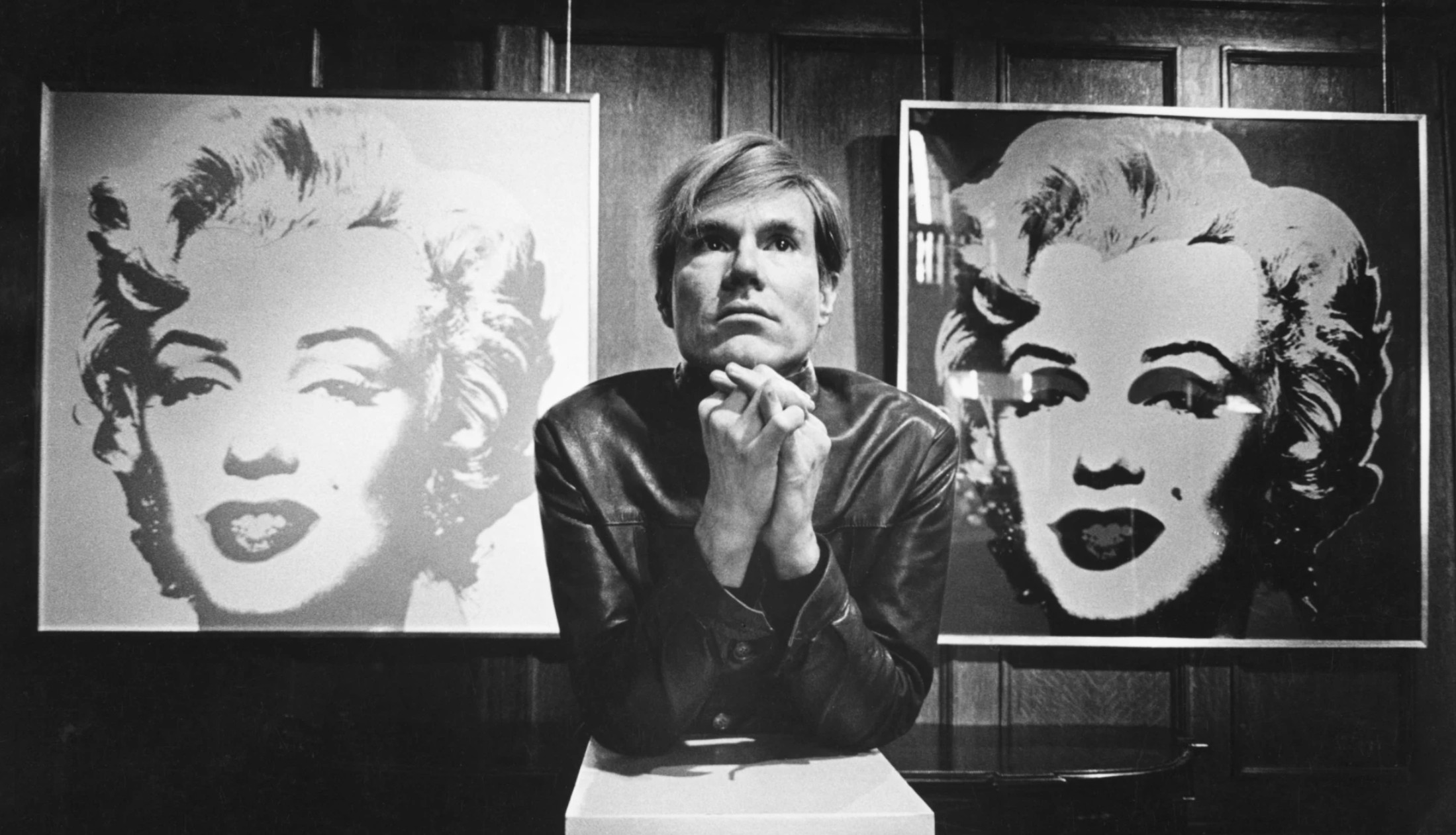
Andy Warhol with two works from the Marilyn series. Photograph: © Donald Getsug.
Art © 2026 The Andy Warhol Foundation for the Visual Arts, Inc. / Licensed by DACS, London.
The negative reversal of Monroe’s image amplifies its ghostliness, transforming the familiar portrait into a haunting memorial that persists beyond lived experience. Even after the terminal reality of her death, the artificial veneer of the projected image remains. As Warhol later reflected, “Everything is sort of artificial… The artificial fascinates me, the bright and shiny” (Exh. Cat., Stockholm, Moderna Museet, Andy Warhol, 1968, p. 25). With the further temporal and formal remove of the reversed image, Warhol underscores the postmodern logic of image production and circulation through Monroe’s endlessly reproduced face. At once homage and elegy, Four Marilyns (Reversal Series) stands among the most resonant meditations on fame and mortality in twentieth century art. Revisiting one of his most enduring icons at a moment of historical and personal reflection, Warhol confronts the afterlife of images and the uneasy permanence of celebrity itself.
Marilyn (Reversal Series), 1986
Property from an Esteemed Private Collection
Sotheby’s London: 4 March 2026
Estimated: GBP 800,000 – 1,200,000
GBP 998,400 / USD 1,333,765
Marilyn (Reversal Series) | Modern & Contemporary Evening Auction | 2026 | Sotheby’s
ANDY WARHOL (1928 – 1987)
Marilyn (Reversal Series), 1986
Acrylic and silkscreen ink on canvas
18×14 inches (45.7 x 35.6 cm)
Stamp signed (on the reverse)
Stamped by the Andy Warhol Art Authentication Board, Inc.
Numbered A107.066
Inscribed ‘I verify that this is an original painting by Andy Warhol completed by him in 1986 Frederick Hughes’
on the reverse
An exquisite example from Andy Warhol’s wide-spanning oeuvre, the present work represents a striking reinvention of his most iconic subject and lifelong muse. Marilyn (Reversal Series) is situated at the apex of Warhol’s artistic development of the 1980s and captures a moment of introspection synonymous with these Warhol years. In an act of post-modern brilliance the present work sees Warhol’s appropriation of material from his repertoire, drawing on the imagery that had shaped his output from the 1960s and secured his celebrity. Just as Warhol engages in conversation with his own familiar artistic lexicon by reversing his previous iconic Marilyn series, so too does the viewer when engaging with the work. From one angle the image appears to be the familiar Warhol icon: up close this illusion breaks down, destabilising the idea of a fixed image as Marilyn hauntingly transforms, bestowing upon it an entirely new meaning. In this reversal the iconic image becomes increasingly spectral and the portrait, tinged with familiarity, is transformed into a lingering eulogy. Through one picture, two iconic images emerge, a dichotomy contained within a single work. The Reversals marked a decisive turn in Warhol’s practice at the beginning of the 1980s as he revisited the iconic images of Marilyn, Mao, and Campbell’s Soup, in this new ‘reversed’ and negative form. Works from this period reframe Warhol’s earlier production and its defining concerns; the focus shifts away from familiar motifs and toward the act of seeing that produced them. Thus, the present work can be understood as a modern memento mori through which the central fascinations that catalyzed his artistic creation – beauty, fame, transience and mortality – coalesce.
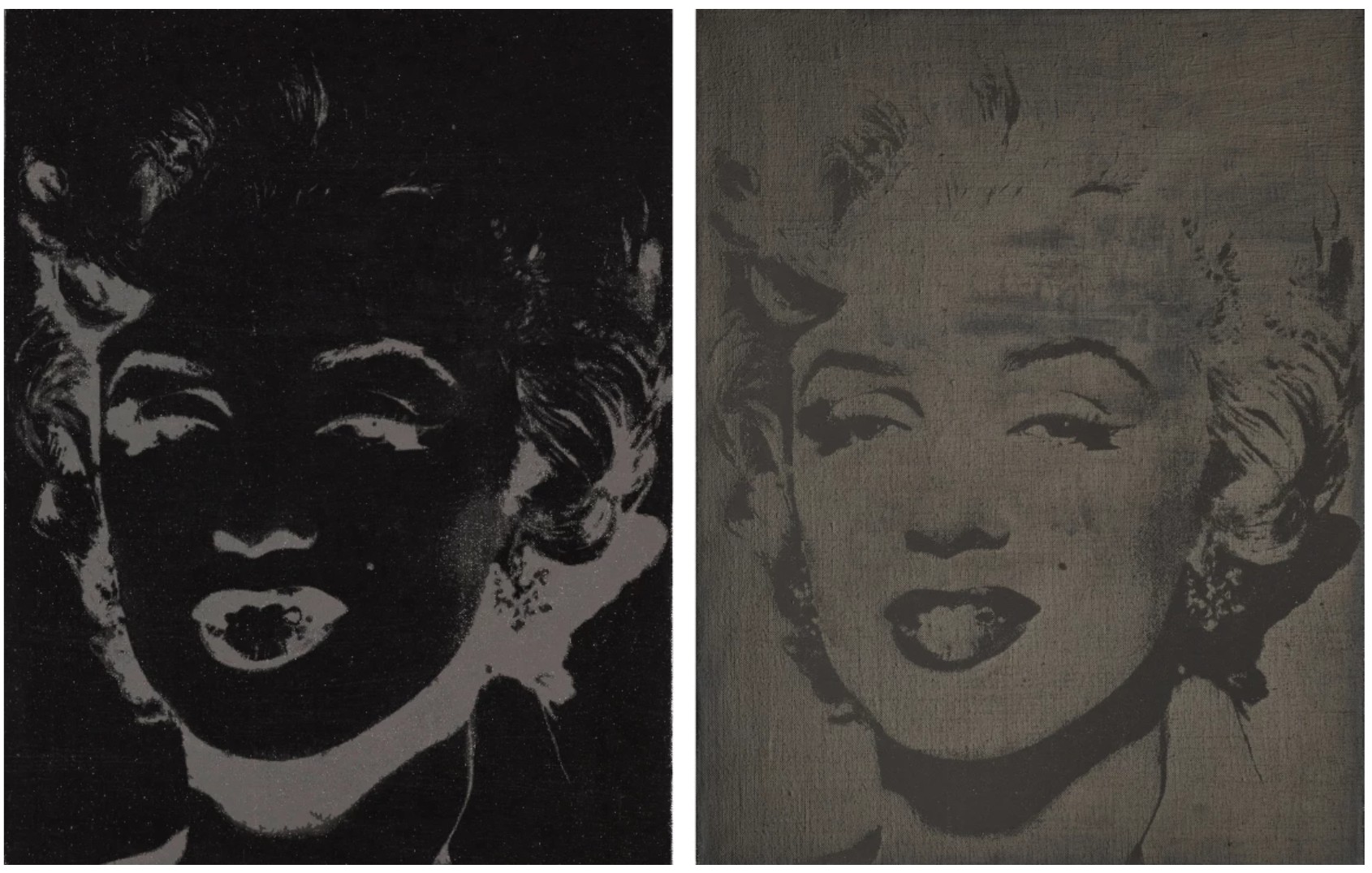
LEFT: THE PRESENT WORK
RIGHT: THE PRESENT WORK UNDER ALTERNATE LIGHTING
In the present work Marilyn’s visage emerges through shadow, recalling her presence on the silver screen that propelled her to global stardom. Yet here, the glamour appears diminished; the silver and black tones possess a delicate fragility, mirroring the transience of both life and fame. Her image was endlessly reproducible and perpetually desirable, yet shadowed by its own transience. Monroe represented the central logic of Pop Art: the conversion of ephemerality into iconography, and private suffering into public spectacle. In Marilyn (Reversal) we see the dematerialization of Munroe, as her image hovers in between absence and presence, suffused with darkness. Warhol identified Monroe as the ultimate artifact of mass culture and as a figure who epitomized this volatility between brand and personhood. Through Warhol’s silkscreen practice he replaced expressive artistic gesture with mechanical reproduction, mirroring the processes by which mass media transforms singular identities into reproducible, exchangeable images. His 1962 Marilyn series marked one of his earliest uses of the technique; thus in the present work we see Warhol call upon both the imagery and practice that defined the 1960s.
Actress Marilyn Monroe, Hollywood, California. Image: Alfred Eisenstaedt/The LIFE Picture Collection/Shutterstock
Few twentieth century artists engaged the power of the icon with Warhol’s intensity, and the present work pushes this engagement further, testing the boundaries of popular visual language and examining how images are collectively perceived in modern culture. Marilyn (Reversal Series) represents one of the most conceptually charged moments in Andy Warhol’s late career, highlighting both the lasting influence of Monroe’s fame and the symbolic significance of Warhol’s artistic mythology. The present work represents the culmination of Warhol’s seminal life long preoccupation, operating on several conceptual levels at once, intertwining the enchantment of film, the mechanisms of celebrity production, and the inevitability of decline.
Mao, 1973
Phillips London: 5 March 2026
Estimated: GBP 1,400,000 – 1,800,000
GBP 1,642,000 / USD 2,193,550
Andy Warhol Modern & Contemporary Art Evening Sale
ANDY WARHOL
Mao, 1973
Acrylic and silkscreen ink on canvas
24-1/8 x 20 inches (61.3 x 50.8 cm)
Stamped by the Andy Warhol Art Estate and the Andy Warhol Foundation
Numbered ‘PA 80.013’ on the overlap
Marking a decisive shift as Andy Warhol realigned his visual language following his triumphant return to painting, Mao was executed at a moment that had historical significance for the world stage as it did for the artist’s career. Representing the cult of fame, the pervasive role of media and the power of the image associated with Warhol’s portraits, for his first new series of non-commissioned paintings since 1968, over an intense and concentrated period between early 1972 and mid 1973, Warhol re-imagined the possibilities of the silkscreen to create his highly evocative and well documented Mao cycle.
“I’ve been reading so much about China […] The only picture they ever have is of Mao Zedong. It’s great. It looks like a silkscreen.”

Distinguished from the graduated sizes of the Mao painted in 1973, the present work belongs to a sub-set of ten within the medium size with their tantalizing phthalo blue background, realised in the 24 by 20 inch format. Mao presents a rare opportunity to acquire a work from this set of 10 as the first time the present canvas has ever been offered at auction with another example from this set having been presented over two decades ago. Closely related to the medium-sized 26 by 22 inch series, of the known total of 34 paintings in both sets executed in 1973, examples are represented in the Whitney Museum of American Art, New York (Mao, Catalogue Raisonné no. 2336); the Metropolitan Museum of Art, New York (Mao, C.R. no. 2340) and The Broad, Los Angeles (Mao, C.R. no. 2321).

Christopher Makos, Andy Warhol in Tiananmen Square, Beijing, 1982. Image: © Christopher Makos
In the conception of the Mao series, though Warhol’s stimulus seems to have been the popular media, a fixed start point is less clear. While Warhol still undertook commissioned portraits after surviving an assassination attempt in 1968, the artist would shift his focus and look increasingly to experiment beyond painting including his Rain Machines or Mylar and Plexiglas Constructions. In one version of events, according to Warhol’s biographer Robert Colacello, it was because of the encouragement of Swiss art dealer Bruno Bischofberger that Warhol once again began painting in full force. Travelling to New York to present his idea in person, Bischofberger proposed Warhol consider the subject of ‘Albert Einstein’ as ‘the most important person of the twentieth century’. Warhol however retorted, ‘That’s a good idea. But I was just reading in Life magazine that the most famous person in the world today is Chairman Mao. Shouldn’t it be the most famous person, Bruno?’. In the second source, David Bourdon dated the creation of the Mao series slightly earlier to late 1971, quoting telephone conversations with Warhol who remarked, ‘I’ve been reading so much about China […] The only picture they have is of Mao Zedong’.
President Nixon meeting Chairman Mao, 1972. Image: Photo 12 / Alamy Stock Photo
As both sources reveal, Mao reflected Warhol’s desire to represent figures at the heart of the cultural zeitgeist and popular press, speaking to the enduring impact of the media in two societal models, to frame the collective conscience at any given moment, ultimately supporting Andy’s belief that ‘No one escapes the media. Media influences everyone’. Warhol used the opportunity to re-launch his painterly practice to engage with the widely publicized de-escalation and tempering of bilateral American and Chinese international relations. On 21 February 1972, Richard Nixon became the first sitting President of the United States to enter the People’s Republic of China since Chairman Mao had ascended to power in 1949.
“I went to China. I didn’t want to go, and I went to see the Great Wall. You know, you read about it for years. And actually it was great. It was really really really great.”
Announced in publications like Life, the enormity of the visit’s impact on geo-politics was recognized by Warhol, who, after the first examples in March at over 6 feet in height, embarked upon on the exponentially grander ‘giant’ Mao paintings in November and December. The largest single-image works produced by Warhol, their dimensions at almost four and a half meters in height, required the experience of printer Alex Heinrici who used seven separate screens to realize the works. The portraits reflected the proportions of the original Mao painting in Tiananmen Square that Warhol would eventually view in person and be photographed with by Christopher Makos during his trip to China in 1982.
Retaining the same source image in each variation of Mao portrait from 1972 to 1973, as in the present work Mao’s image was appropriated from an American edition of the Quotations from Chairman Mao Tse-Ting or ‘The Little Red Book’. As one of the most widely printed books in history, Warhol emphasizes the currency and ubiquity of his frontal visage that became fundamental to Mao’s public projection. The present work therefore connects to each variant from the Mao series and the monumentality of its presence, a device through which Warhol highlights a dichotomy. As he revealed through his earlier images of American icons including Marilyn Monroe, much like the tabloid press and consumerist advertising commodifying figureheads in the Capitalist system, within the Communist state the ever visible and unchanging form of the Chairman’s image was utilized to project political power for mass absorption.

Left: Portrait of Chairman Mao in an English translation of his book ‘Quotations from Chairman Mao’, detail, 1966. Image: GRANGER – Historical Picture Archive
Right: The present work
Realized in close succession to the other graduated variants by 1973, for Mao Warhol’s mark-making becomes more painterly and automatic, animating the ground. Layering impromptu, intense color, the fluid strokes of the brush serve as markers of the artist and ‘a more improvisational approach to gesture and touch’, in contrast to Mao’s clearly defined expression executed in a more Warholian standardized working method. Adding capacious areas of green for the jacket balancing the vibrancy of the blue background, Warhol with freer gestures combines cadmium orange and red for the face. Incorporating unique characteristics into each version, the stateliness of Mao’s photograph used to promote his self-image is transformed into a distinctly Warholian object of Pop.
Four Mona Lisas, 1978
Christie’s London: 5 March 2026
Estimated: GBP 3,500,000 – 5,500,000
GBP 4,320,000 / USD 5,771,090
ANDY WARHOL (1928-1987), Four Mona Lisas | Christie’s
REPEAT SALE
Christie’s New-York: 12 November 2014
Estimated: USD 2,500,000 – 3,500,000
USD 5,989,000
Andy Warhol (1928-1987), Mona Lisa | Christie’s
REPEAT SALE
Christie’s New-York: 10 November 2010
Estimated: USD 1,800,000 – 2,200,000
USD 3,610,500
Andy Warhol (1928-1987) , Mona Lisa | Christie’s
ANDY WARHOL (1928-1987)
Four Mona Lisas, 1978
Acrylic and silkscreen ink on canvas
49-7/8 x 39-7/8 inches (126.7 x 101.3 cm)
Signed and dated ‘Andy Warhol 78’ (on the overlap)
In Andy Warhol’s Four Mona Lisas (1978), the most famous face in art appears four times against a vibrant and painterly blue backdrop. Silkscreened twice in full and twice cropped close to the face, her expression shifts with the shadows of each iteration, alive with timeless mystery. The work is one of six versions of this composition Warhol made in 1978, three of which are in major museum collections. Revisiting a series he had made on the occasion of the Mona Lisa’s visit to the United States in 1963, it offers a dazzling reflection on fame, genius and the eternal life of images. The Renaissance masterpiece becomes a Pop icon, restaged by an artist who was by now an icon himself. The present work was previously owned by the collector and cosmetics magnate Carlo Bilotti, a close friend and patron of Warhol and other artists including Giorgio de Chirico, Roy Lichenstein, Salvador Dalí and Niki de Saint Phalle. In 1998-2000, it toured venues across Europe as part of the large-scale retrospective Andy Warhol: A Factory.
President John F. Kennedy, Madeleine Malraux, André Malraux, First Lady Jacqueline Kennedy and Vice President Lyndon Johnson attend the unveiling of the Mona Lisa at the National Gallery, Washington, D.C., 1963. Photograph by Walter Bennett. Time Magazine, January 18, 1963, Vol LXXXI, No. 3.
Visitors in line to see the Mona Lisa at The Metropolitan Museum of Art, New York, February 1963.
Photo: Bettmann / Contributor / Getty Images.
The Mona Lisa met the American public early in 1963, having travelled three and a half thousand miles from her home in the Musée du Louvre. The request had been made by First Lady Jacqueline Kennedy through the French Minister of Culture André Malraux, and granted as an opportunity to emphasize the bond between the two nations. Nearly two thousand people waited in the cold to witness the unveiling at the National Gallery in Washington, D.C. Photographers paralleled Jacqueline’s enigmatic smile with the Mona Lisa’s own. The painting moved on a month later to The Metropolitan Museum of Art, New York, where it received over one million visitors, causing hours-long queues up Fifth Avenue. Among the admirers was Warhol, who soon began a series of silkscreen paintings based on images in the Met’s exhibition brochure. By that time the Mona Lisa had caused a media storm, appearing on magazine covers and in newspapers across the country: she was, Warhol recognized, a bona fide American celebrity.
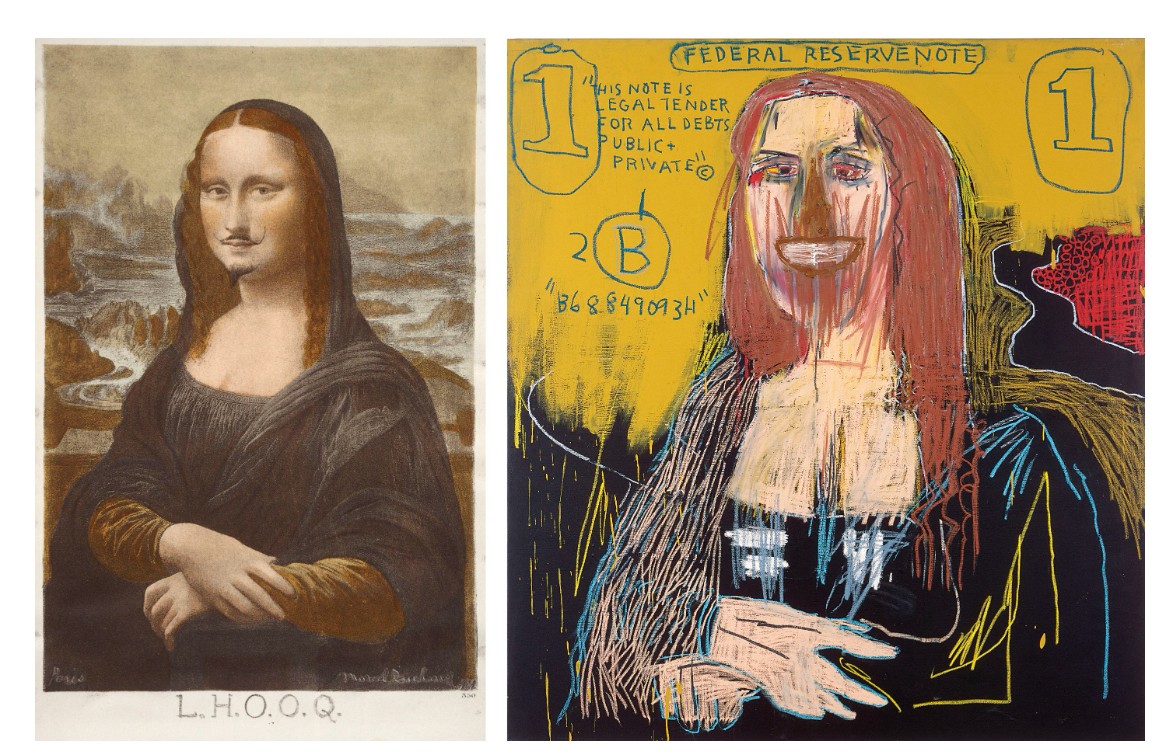
Left: Marcel Duchamp, L.H.O.O.Q. (from Boîte-en-Valise), 1919. Philadelphia Museum of Art, Pennsylvania. Artwork: © 2026 Marcel Duchamp/DACS. Digital image: © 2026 The Philadelphia Museum of Art/Art Resource/Scala, Florence. Right: Jean-Michel Basquiat, Mona Lisa, 1983. © Estate of Jean-Michel Basquiat. Licensed by Artestar, New York.
Warhol was not the first modern artist to riff on the Mona Lisa. She had appeared in paintings by Fernand Léger, Kazimir Malevich and René Magritte. In his famous parody L.H.O.O.Q. (1919), Marcel Duchamp had adorned a postcard-sized copy of the painting with a moustache and goatee. Conflating high art and low commodity, Duchamp’s subversive appropriations inspired Warhol’s own approach to popular culture. As the most reproduced painting in the world, the Mona Lisa was as familiar an icon as the Campbell’s soup cans or Coca Cola bottles he had already enshrined in his paintings.
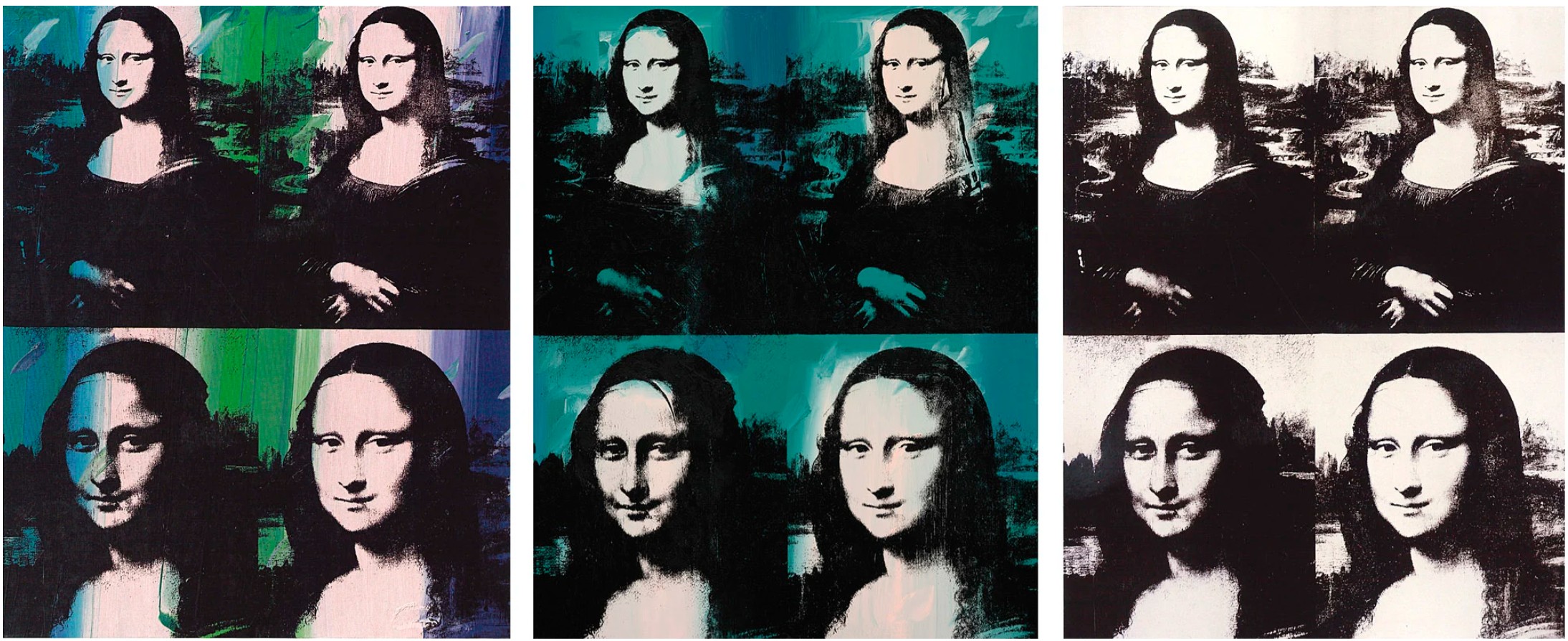
Left: Andy Warhol, Four Mona Lisas, 1978. Museum Barberini, Potsdam. Artwork: © 2026 The Andy Warhol Foundation for the Visual Arts, Inc. / Licensed by DACS, London.
Middle: Andy Warhol, Four Mona Lisas, 1978. Art Institute of Chicago. Digital image: © 2026 The Art Institute of Chicago / Art Resource, NY/ Scala, Florence. Artwork: © 2026 The Andy Warhol Foundation for the Visual Arts, Inc. / Licensed by DACS, London.
Right: Andy Warhol, Four Mona Lisas, 1978. Andy Warhol Museum, Pittsburgh. Artwork: © 2026 The Andy Warhol Foundation for the Visual Arts, Inc. / Licensed by DACS, London.
Warhol understood this as a form of power. Irrespective of the ‘aura’ of the original painting, it was through mass replication that her myth had endured through the twentieth century. Having weathered wartime concealments, a highly publicized theft in 1911 and several attacks of vandalism, she also carried the combination of stardom, beauty and tragedy that drew Warhol to depict the silver-screen sirens Marilyn Monroe and Elizabeth Taylor.
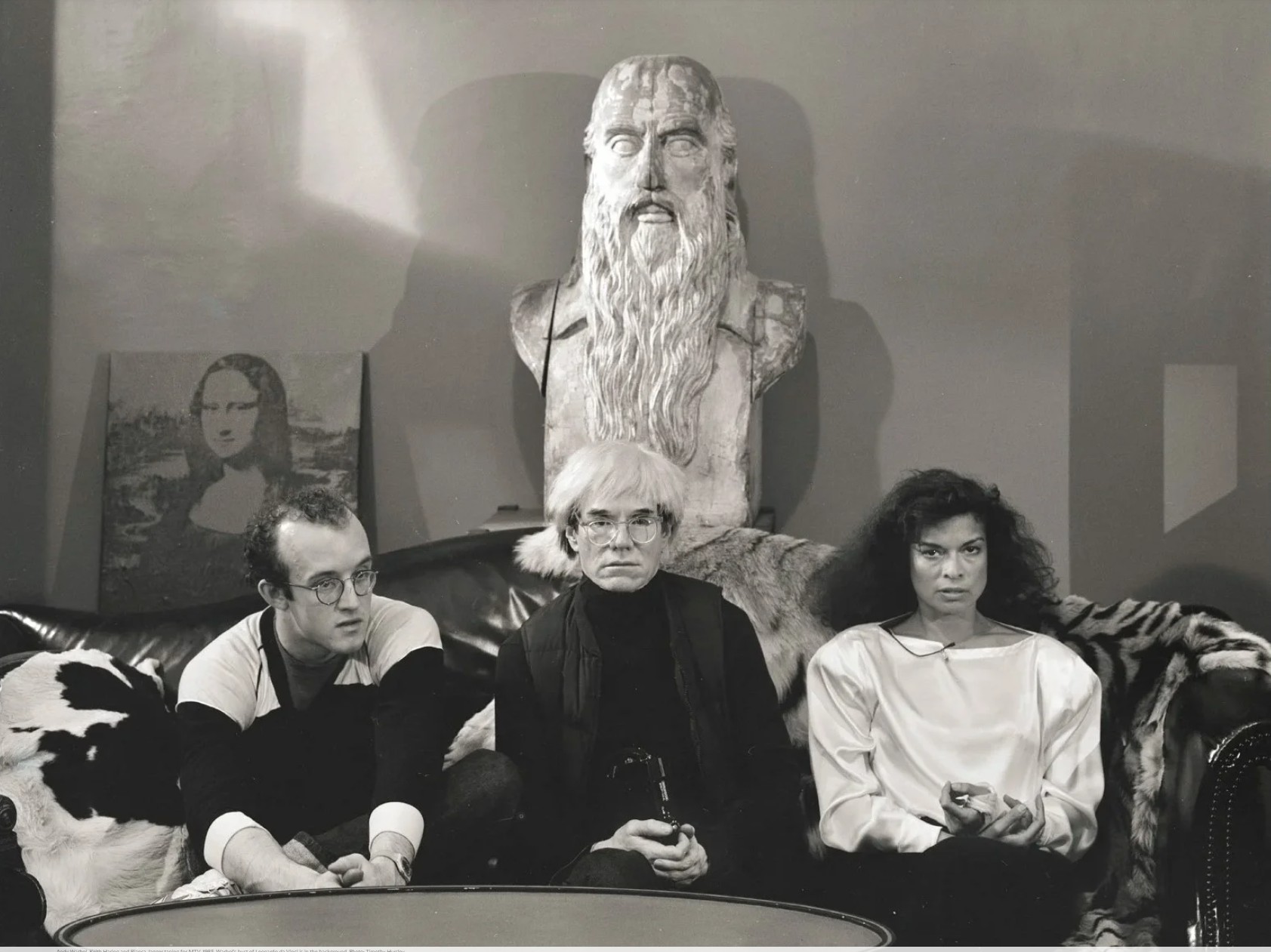
Andy Warhol, Keith Haring and Bianca Jagger taping for MTV, 1985. Warhol’s bust of Leonardo da Vinci is in the background.
Photo: Timothy Hursley.
While he would later turn to other Old Masters in his 1984 Details of Renaissance Paintings series, Warhol was especially fascinated by Leonardo da Vinci. Not only the author of some of art history’s most iconic and spellbinding images, Leonardo was a polymath and brilliant courtier who encompassed the spirit of his era, moving among the elite of Renaissance society. King Francis I was said to have been at his bedside when he died. Warhol aspired to similar status in his own time. He owned a large eighteenth-century wooden bust of Leonardo which is visible in numerous images of the Factory from the 1970s onwards, presiding over studio portraits of Warhol with friends including Jean-Michel Basquiat, Keith Haring and Bianca Jagger. Before Warhol’s death in 1987, Leonardo would serve again as the muse for his final series: an ambitious two-year project centered around The Last Supper, spanning more than a hundred paintings, silkscreens, prints and works on paper.
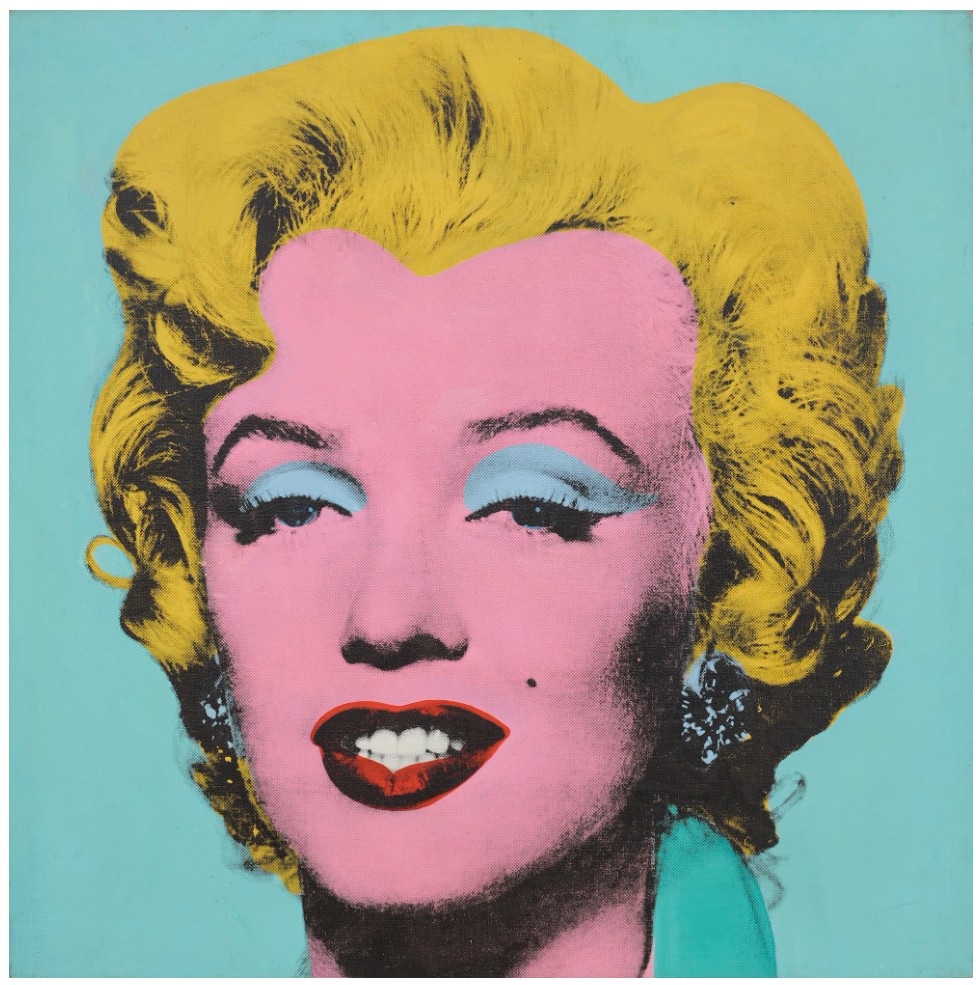
Andy Warhol, Shot Sage Blue Marilyn, 1964. Private collection.
Artwork: © 2026 The Andy Warhol Foundation for the Visual Arts, Inc. / Licensed by DACS, London.
Warhol based his 1963 Mona Lisa silkscreens on the three different images of the painting in the Met pamphlet, showing the full portrait, a cropped headshot and a detail of her hands. In the playfully-titled Thirty Are Better Than One (Brant Foundation, Greenwich), he foregrounded the magic of repetition with a 5 x 6 grid of images. He gave another work, Four Mona Lisas, to his friend Henry Geldzahler, the Met’s Curator of Contemporary Art, who later donated it to the museum’s collection.
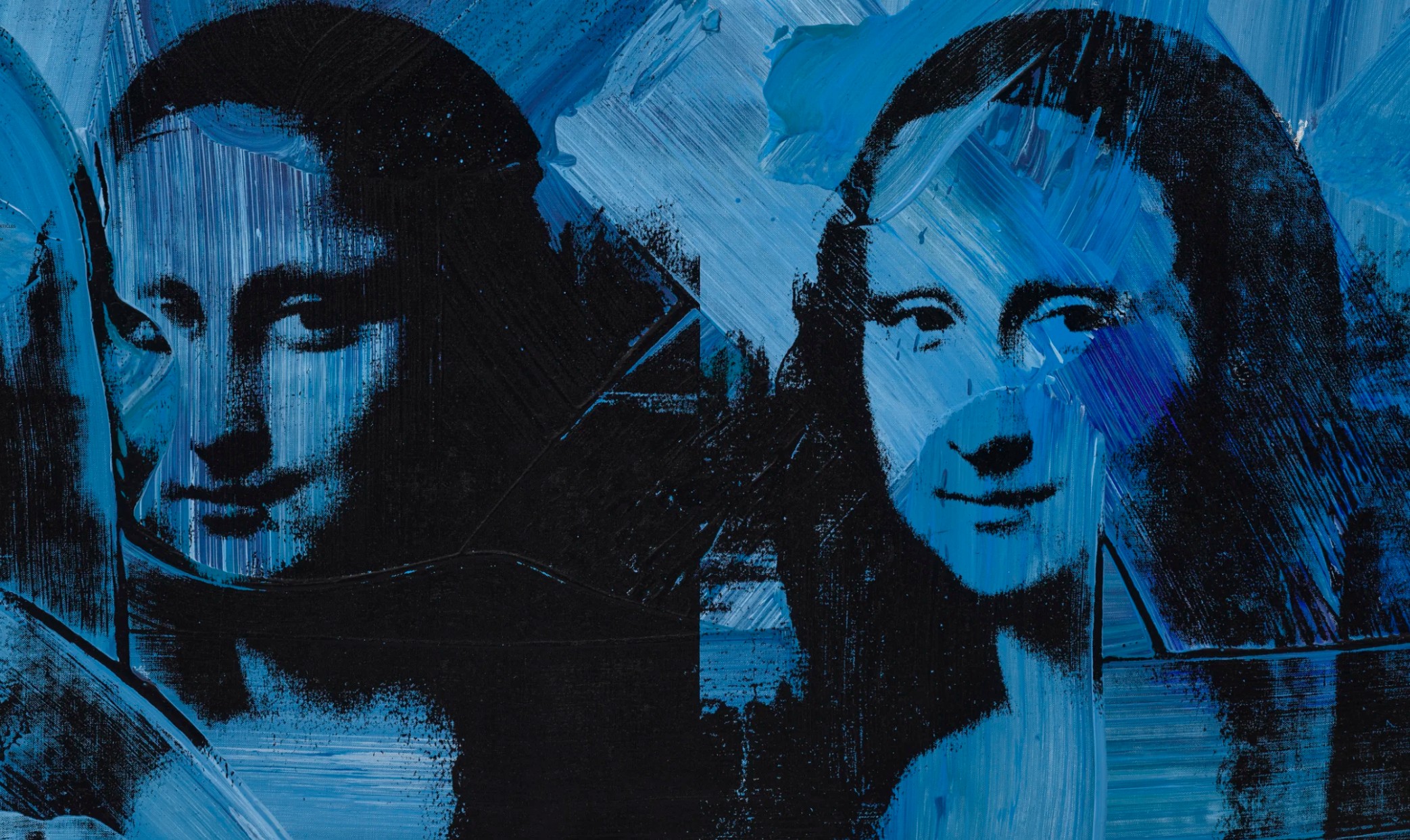
It was this composition that Warhol turned to when he made the present painting in 1978. By that time he himself had entered the pantheon of art history, and he was regarding his body of work in a retrospective mood. The early Mona Lisa works had taken on new shades of meaning. A year after the painting’s American tour, Warhol had gone on to depict Jacqueline Kennedy in the aftermath of her husband John F. Kennedy’s assassination. The moment changed the country forever, and Jackie, who had played so pivotal a role in the Mona Lisa’s story, joined Warhol’s cast of tragic heroines.
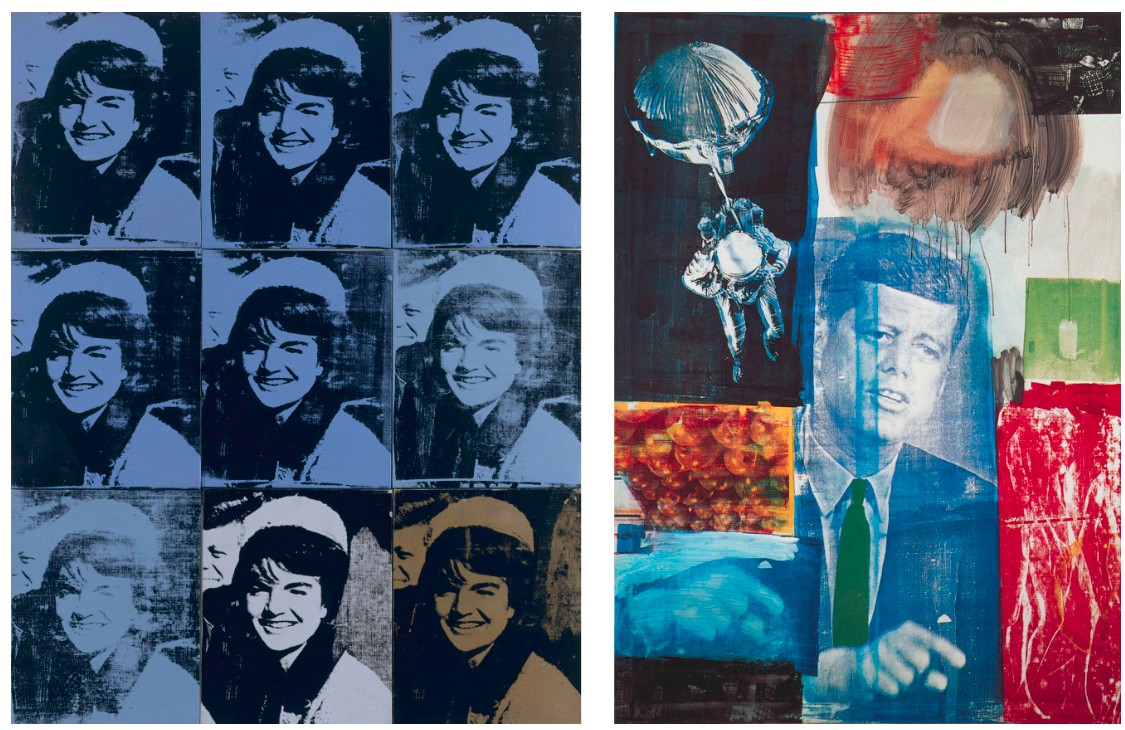
Left: Andy Warhol, Nine Jackies, 1964. The Metropolitan Museum of Art, New York. Artwork: © 2026 The Andy Warhol Foundation for the Visual Arts, Inc. / Licensed by DACS, London. Digital image: © 2026 The Metropolitan Museum of Art/Art Resource/Scala, Florence. Right: Robert Rauschenberg, Retroactive I, 1963. Wadsworth Atheneum, Hartford. Artwork: © 2026 Robert Rauschenberg Foundation/VAGA at ARS, NY and DACS, London.
Where the 1963 paintings had been silkscreened onto bare linen or canvas, Warhol’s new series showcased the gestural, richly colored painted backdrops that he had developed in the intervening years. He applied acrylic pigments mixed with clear binder using a sponge mop, creating vivid, textural grounds that interacted dynamically with the overlaid black ink of the silkscreen. The present work, with its swathes of lapis blue and a glow of light pink towards the upper edge, is in remarkable sympathy with the palette of Leonardo’s original painting. The sweeping strokes introduce varied ridges, striations and interruptions to the four silkscreened images, amplifying the notoriously mercurial quality of the Mona Lisa’s expression.
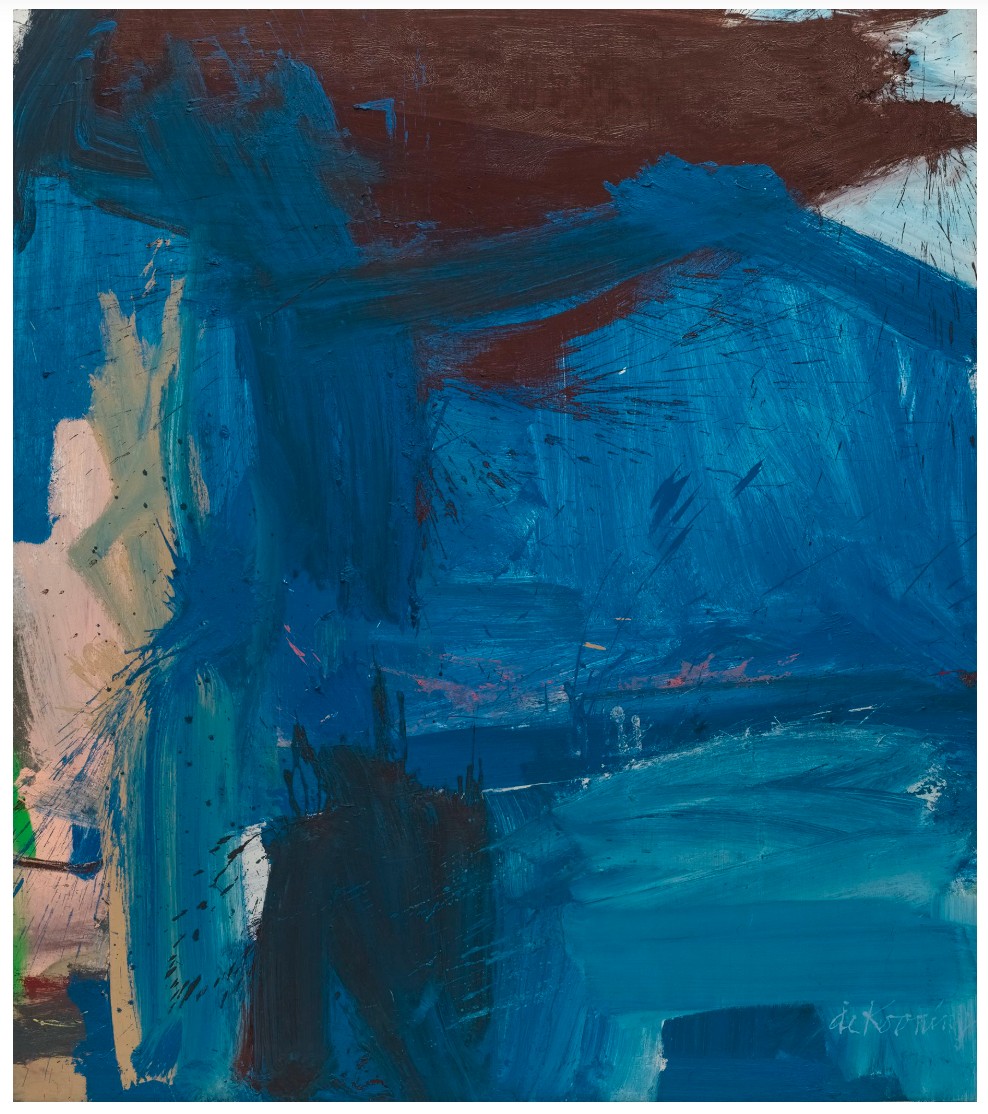
Willem de Kooning, A Tree in Naples, 1960. The Museum of Modern Art, New York. Artwork: © 2026 The Willem de Kooning Foundation / Artists Rights Society (ARS), New York and DACS, London. Digital image: © 2026 The Museum of Modern Art, New York/Scala, Florence.
The painterly chiaroscuro of these works prefigured the near-abstract Shadows series that Warhol began to make towards the end of 1978. They also set the stage for his ensuing series of Retrospectives and Reversals, which combined previous motifs in single canvases or reprised them in photographic negative over flickering, luminous painted grounds. Among the Reversals would be further pictures of the Mona Lisa, rendered ghostly in tones of white and sepia. The painting, with its irresistible trappings of legendary beauty, mass appeal and high culture, seems to have haunted Warhol’s imagination like no other. In Four Mona Lisas, she comes to life again, and again, and again.
Flowers, 1964
Contours of Modernity | A Private European Collection
Sotheby’s London: 4 March 2026
Estimated: GBP 800,000 – 1,200,000
GBP 1,792,000 / USD 2,393,935
Flowers | Modern & Contemporary Evening Auction | 2026 | Sotheby’s
ANDY WARHOL (1928 – 1987)
Flowers, 1964
Acrylic and silkscreen ink on canvas
22×22 inches (56×56 cm)
Signed and dated 64 (on the overlap)
Executed in 1964, at the height of his Pop ascendancy, Andy Warhol’s Flowers series marks a decisive turning point in his practice, crystallizing the formal and conceptual concerns that had come to define his engagement with mass culture. Initially commissioned by New York collectors Ethel and Robert Scull, the intimate twenty-two by twenty-two inch format was conceived for a group of works intended for their residences, yet the scale soon transcended this private origin, becoming an established dimension within the wider Flowers series itself. Earlier that year Warhol produced larger canvases measuring eighty-two by eighty-two, sixty by sixty, forty-eight by forty-eight, and twenty-four by twenty-four inches in advance of the Leo Castelli Gallery exhibition; while the show remained on view, he developed a sequence in diminishing sizes of twenty-two by twenty-two, fourteen by fourteen, eight by eight, and five by five inches. Although the twenty-two inch paintings were originally conceived as a mural for the Sculls, likely inspired by the immersive floral installation at Castelli, their circulation soon aligned them with the broader commercial and institutional expansion of Warhol’s practice.
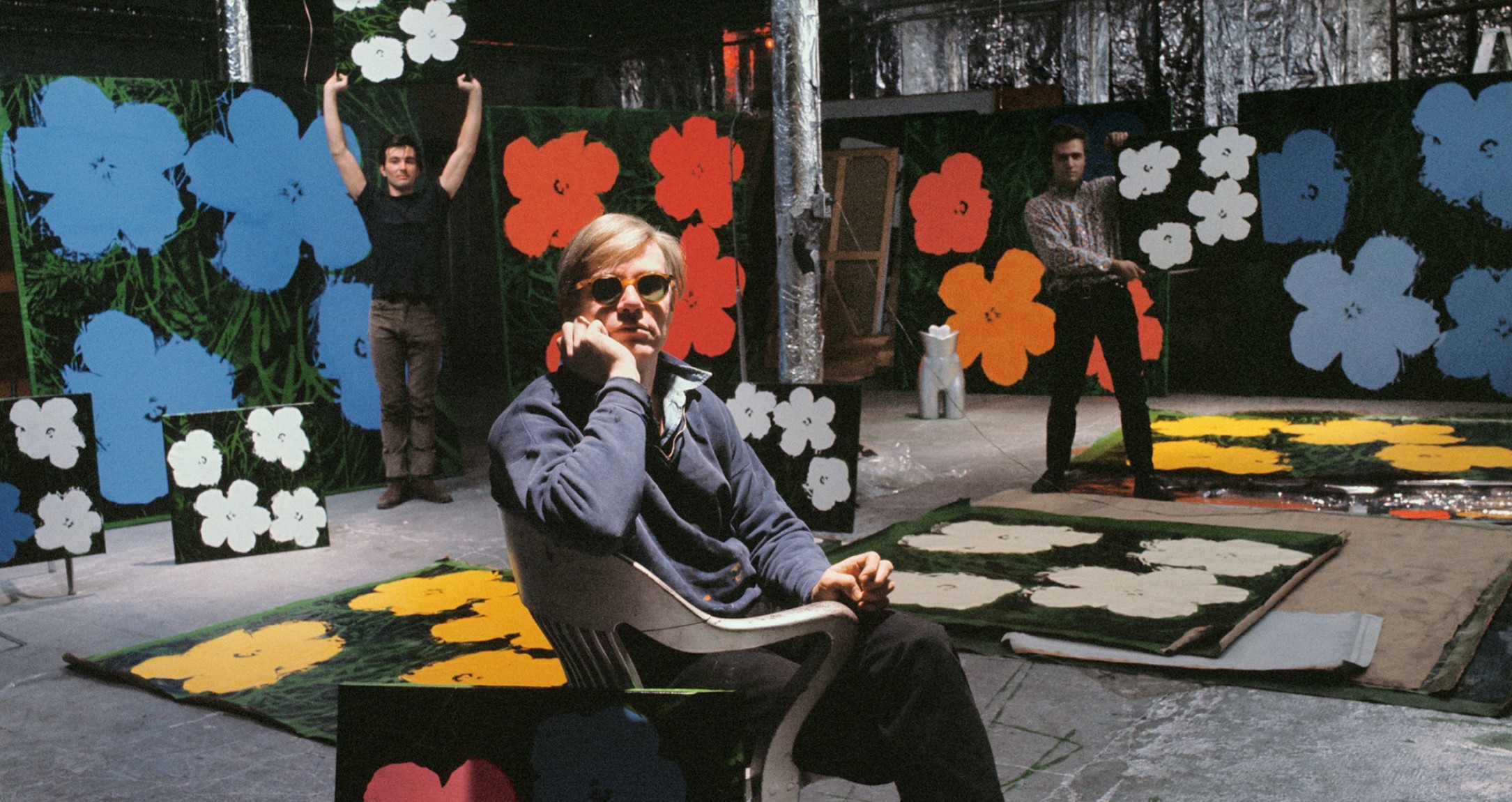
Andy Warhol, Philip Fagan and Gerard Malanga, New York, 1964. Photo Ugo Mulas © Ugo Mulas Heirs. All rights reserved.
Art © 2026 Andy Warhol Foundation for the Visual Arts / Licensed by DACS, London
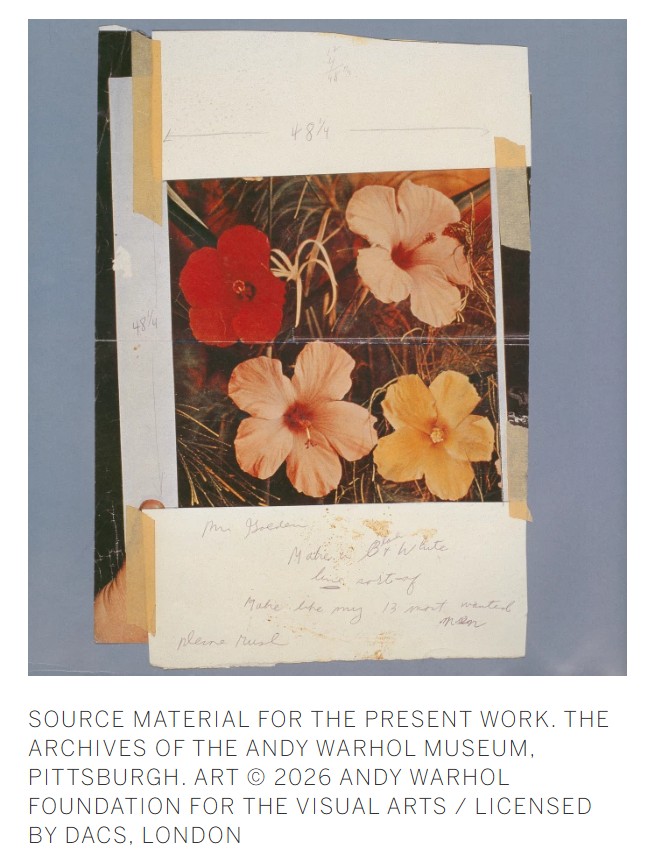
Four blossoms confront the viewer, compressed into a square formation and set against a densely silkscreened black ground animated by jagged white lines that evoke flattened foliage. The petals, rendered in saturated orange and electric fuchsia, are crisply bound and devoid of tonal modelling, hovering upon the surface without spatial recession. This deliberate suppression of depth, combined with abrupt chromatic contrasts, heightens the image’s artificiality, transforming a natural motif into a graphic, almost industrial emblem. Far from a decorative departure, the Flowers are derived from a photograph published in the June 1964 issue of Modern Photography, taken by Patricia Caulfield and reproduced multiple times to demonstrate variations in color-processing techniques. This utilitarian source – anonymous, mass-circulated, and mechanically reproduced – proved ideally suited to Warhol’s sensibility. By cropping the image into a square and isolating a cluster of blossoms, he excised narrative context and illusionistic space, translating photographic description into a flattened and iconographic form. The act of selection and repetition, rather than invention, becomes the primary creative gesture, reinforcing Warhol’s ongoing interrogation of authorship and originality. Produced in multiple scales and an array of colour combinations, the Flowers were executed in large numbers and frequently exhibited in rhythmic, grid-like arrangements. Their square format, without a fixed orientation, denies compositional hierarchy and permits endless reconfiguration. When installed in serial groupings, the canvases function less as discrete objects than as modular units within an expanded field, dissolving the traditional autonomy of the single painting.
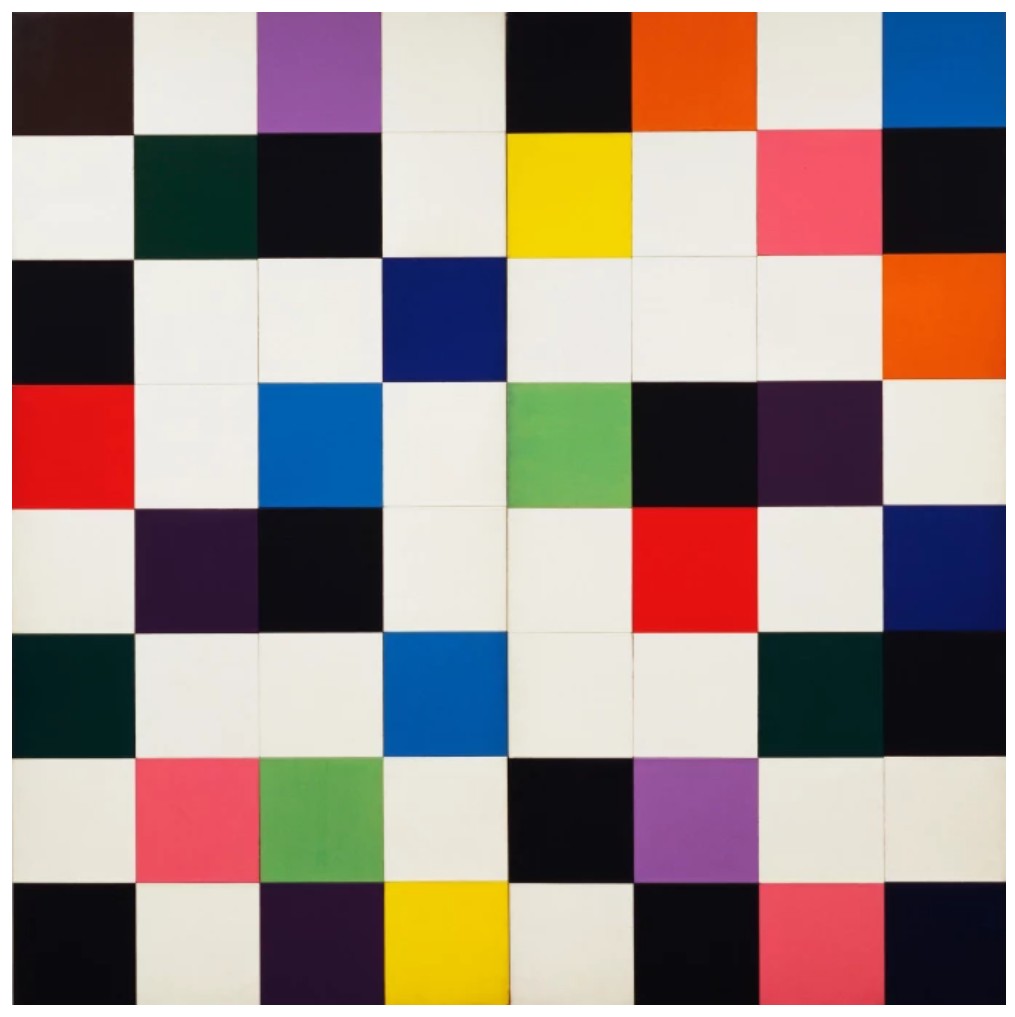
Ellsworth Kelly, Colors for a Large Wall, 1951. The Museum of Modern Art, NewYork.
Image © The Museum of Modern Art/Licensed by SCALA / Art Resource, NY. Art © Ellsworth Kelly Foundation
The series reached its most fully realized articulation in Warhol’s first exhibition at the Leo Castelli Gallery in November 1964, an event now widely regarded as a watershed in post-war American art. Installed across the gallery walls in vivid chromatic permutations, the Flowers enveloped the exhibition space, operating simultaneously as a summative statement and a point of conceptual closure. In the wake of this exhibition, Warhol effectively concluded his sustained engagement with the iconography of consumer culture and fame – Campbell’s Soup Cans, Coca-Cola bottles, and the silkscreened visages of Marilyn Monroe – and soon thereafter announced his withdrawal from painting in favor of filmmaking. As such, the Flowers may be understood as the final, distilled expression of his early Pop project.
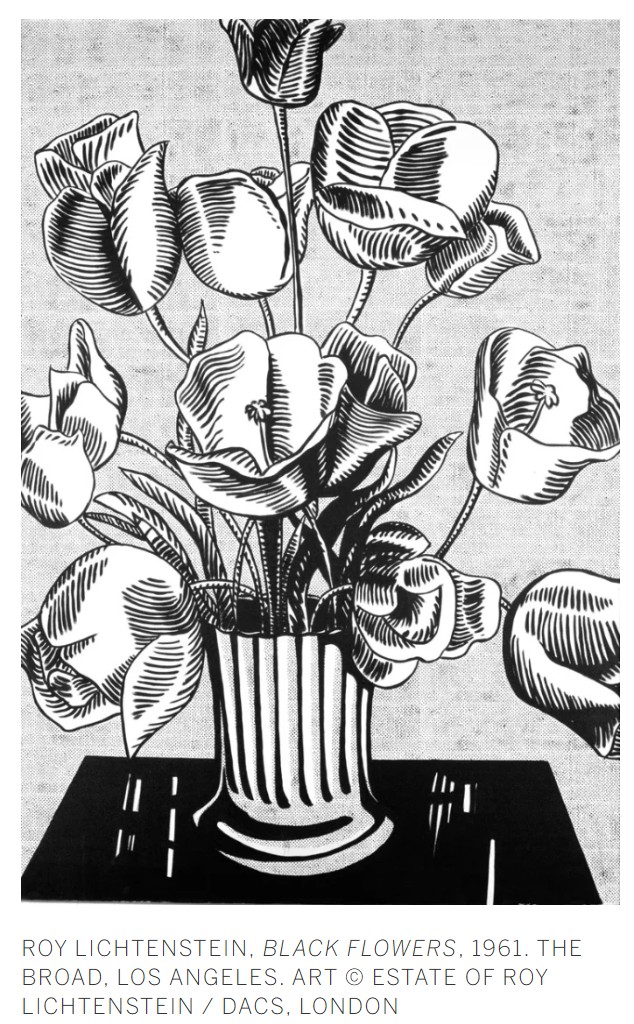
Executed in the immediate aftermath of the Death and Disaster series, the shift from images of fatality to florals coincided with the rise of countercultural idealism and the rhetoric of ‘flower power’. Yet Warhol’s flowers are curiously impersonal and emotionally restrained, retaining an undercurrent of morbidity that aligns them with his earlier confrontations with death and impermanence. Within an art-historical framework, the Flowers are situated in a long lineage of still-life imagery associated with transience and mortality, extending from Dutch vanitas painting to nineteenth-century Impressionism. While comparisons are frequently drawn to Monet’s water lilies, a closer parallel may be found in the vanitas tradition, in which blossoms depicted at the height of their bloom function as emblems of life’s brevity. Warhol’s treatment, however, is resolutely anti-expressive: the flowers are neither personalized nor sentimentalised, but reduced to impersonal signs, stripped of narrative specificity and suspended in a perpetual present.
In translating an image of natural beauty into an emblem of artificial permanence, Flowers articulates a central paradox at the heart of Warhol’s practice; the desire to arrest time while simultaneously exposing the inevitability of loss. Synthesizing themes of repetition, mortality, mass production, and visual seduction, the Flowers transform the still-life tradition into a Pop meditation on ephemerality and endurance, standing today as one of the most incisive and conceptually resolved statements of Warhol’s early maturity.
Dollar Sign, 1981
Contours of Modernity | A Private European Collection
Sotheby’s London: 4 March 2026
Estimated: GBP 300,000 – 400,000
GBP 576,000 / USD 769,480
Dollar Sign | Modern & Contemporary Evening Auction | 2026 | Sotheby’s
ANDY WARHOL (1928 – 1987)
Dollar Sign, 1981
Acrylic and silkscreen ink on canvas
10×8 inches (25.8 x 20 cm)
Signed, dated 81 and dedicated To Enrico (on the overlap)
Andy Warhol’s Dollar Sign from 1981 belongs to one of the most celebrated bodies of work from the artist’s late career. Executed nearly two decades after his first Dollar Bill paintings, this renewed engagement with overtly financial imagery allowed Warhol to probe with characteristic candor the porous boundary between fine art and commerce. Set against a rich lilac-blue ground, the solitary dollar sign is rendered in saturated tones of orange and red, and spans the height of the canvas. Isolated and enlarged, the motif assumes an almost totemic presence that is at once seductive, declarative and unmistakably iconic.
“Money is the MOMENT to me. Money is my MOOD.”
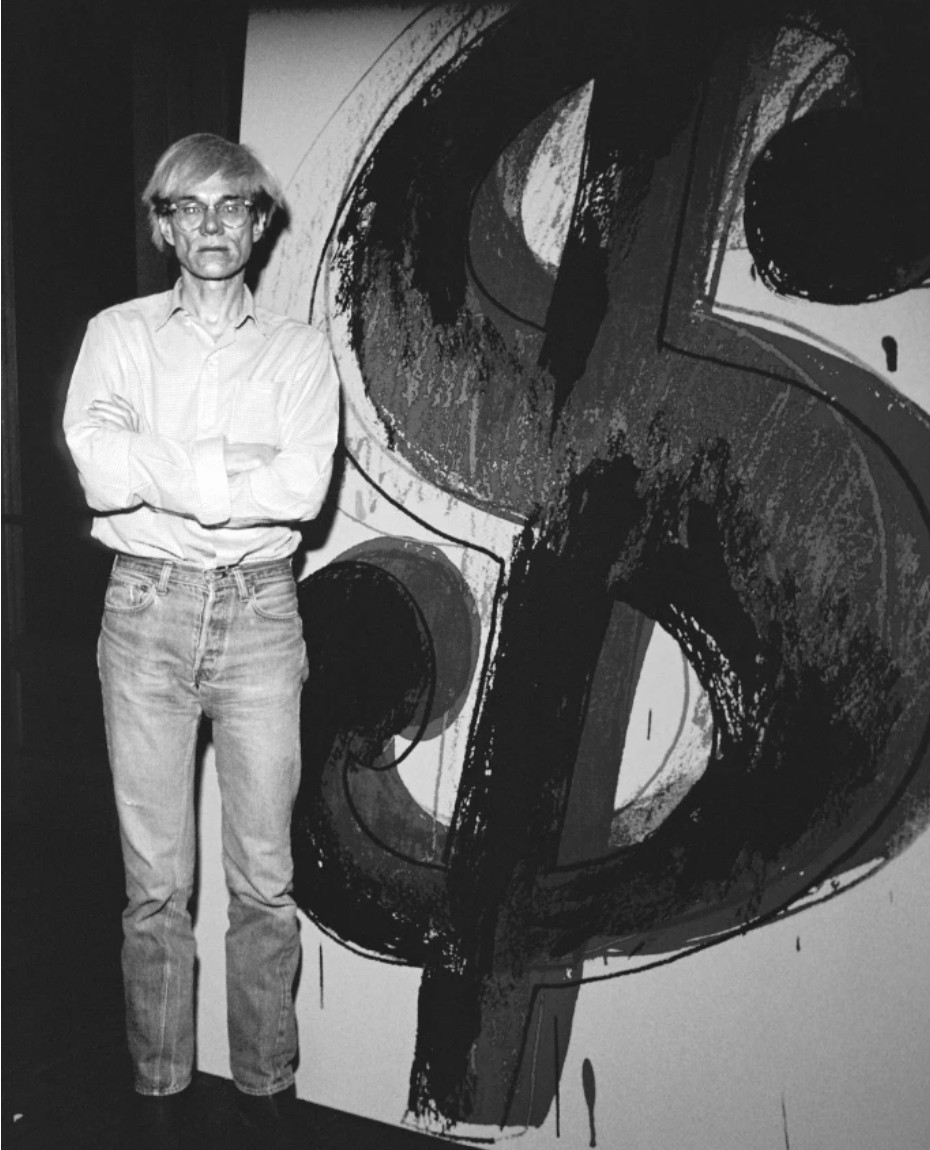
Andy Warhol with a Dollar Sign painting, New York, 1982.
Artwork: © 2026 The Andy Warhol Foundation for the Visual Arts, Inc. / Licensed by DACS, London
The present work belongs to Warhol’s Dollar Sign series, widely regarded as the ultimate distillation of the artist’s lifelong engagement with consumer culture. Where his early Pop works examined mass consumption through familiar commercial imagery such as Coca Cola bottles and Campbell’s Soup cans, Warhol here pares his inquiry back to its most potent symbol. By isolating the emblem itself – the dollar sign – he foregrounds what is arguably the most recognizable logo in the world, operating simultaneously as shorthand for the American Dream and as a universal signifier of wealth, infused with the brazen euphoria synonymous with the 1980s.
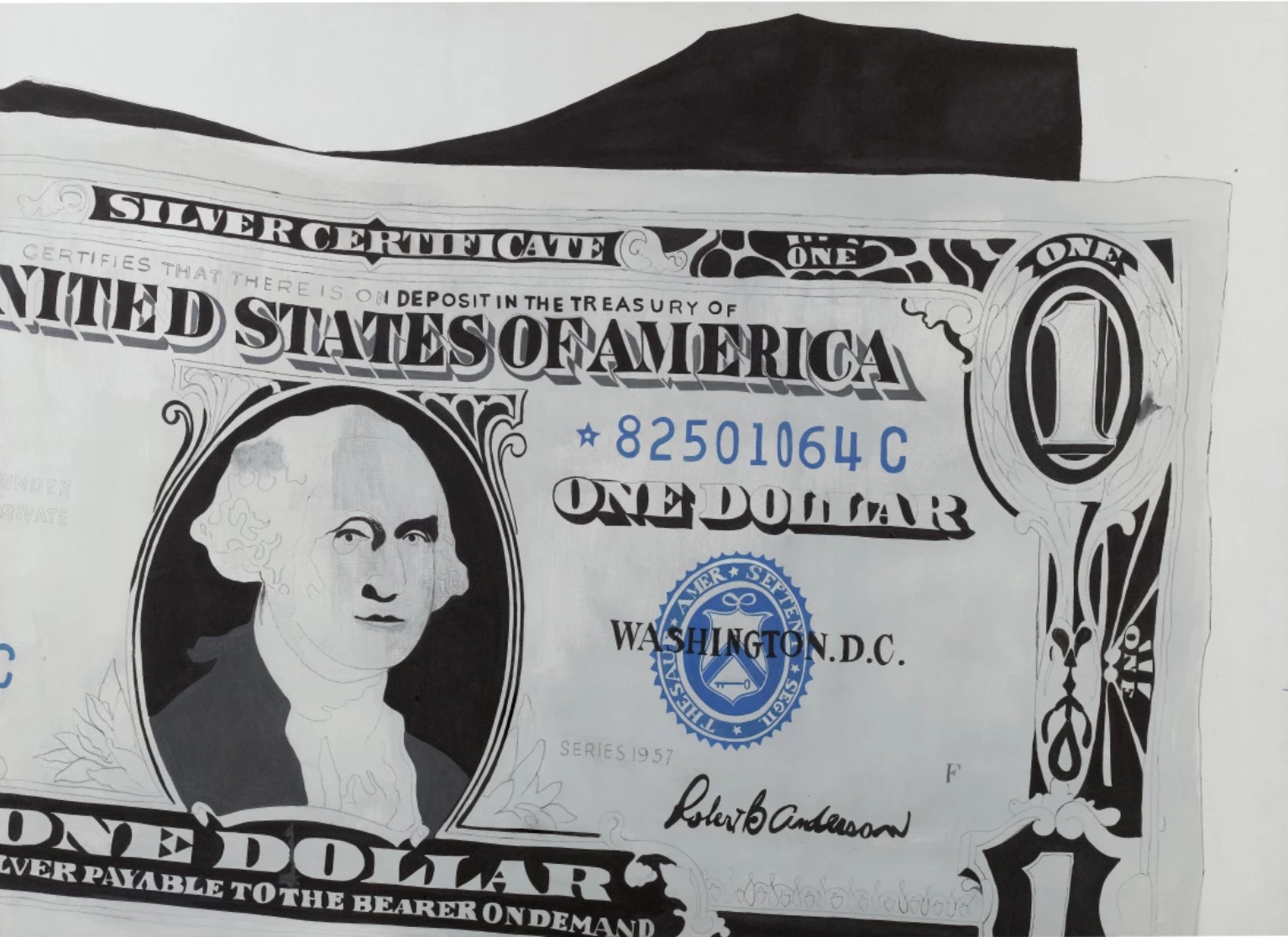
Andy Warhol, One Dollar Bill (Silver Certificate), 1962. Private Collection. Sold Sotheby’s London, July 2015, for £20.9 million. © 2026 The Andy Warhol Foundation for the Visual Arts, Inc. / Licensed by DACS, London
Warhol’s fascination with money was both conceptual and deeply autobiographical. Born into poverty in Depression-era Pittsburgh, he arrived in New York acutely aware of money’s power to confer visibility and agency. By the time he produced Dollar Sign, the cultural and social landscape had shifted dramatically. New York at the turn of the decade had become a glittering epicenter of finance, celebrity, and excess, poised on the cusp of a major economic boom. Warhol, by then a global figure, was no longer an outsider observing systems of power, but a central participant in a society increasingly defined by wealth and spectacle. Combined with his ongoing art historical agenda – to scrutinize and collapse the dichotomy between low and high art – Dollar Sign asserts itself as a quintessentially Warholian work.
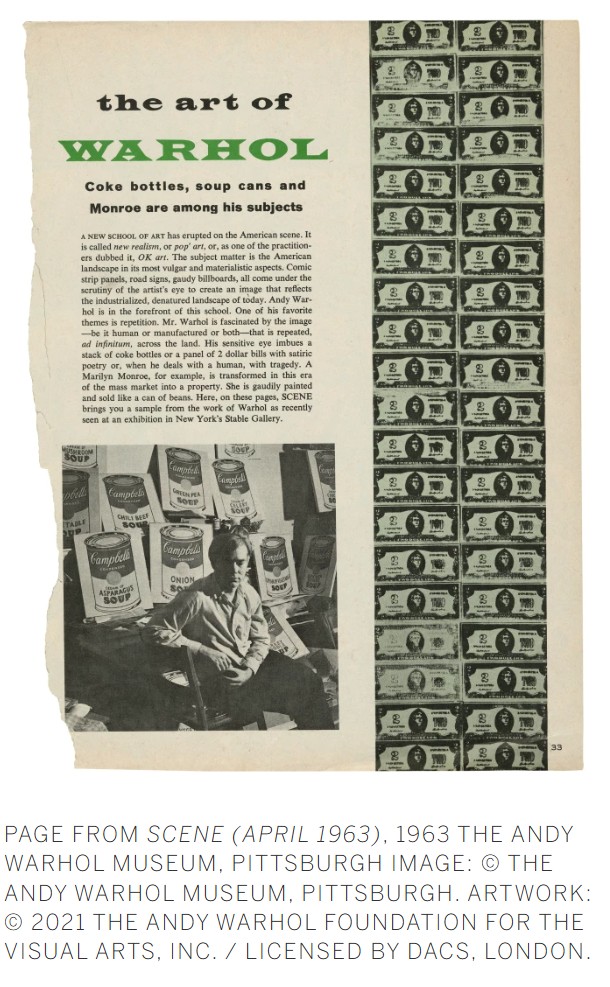
The Dollar Sign paintings debuted at the Leo Castelli Gallery in New York in 1982, their brash confidence mirroring the climate in which they emerged. Warhol’s biographer David Bourdon described the series as “insolent reminders that pictures by brand name artists are metaphors for money” (David Bourdon, Warhol, New York 1989, p. 384). Rather than resist such an interpretation, Warhol embraced it, collapsing distinctions between cultural and economic value and reinforcing his conviction that art and commerce were inseparable. In Dollar Sign, Warhol celebrates a system of exchange in which he willingly participated. The work exemplifies his unparalleled ability to elevate symbols of mass culture into enduring icons, marking a pivotal moment in which the artist’s subject matter and public persona had become inextricably aligned.
Flowers, 1964
AN EYE FOR COLOUR: WORKS FROM A PRIVATE COLLECTION
Christie’s London: 7 March 2026
Estimated: GBP 120,000 – 180,000
GBP 203,200 / USD 271,455
ANDY WARHOL (1928-1987), Flowers | Christie’s
REPEAT SALE
Sotheby’s New-York: 15 May 2013
Estimated: USD 120,000 – 180,000
USD 197,000
ANDY WARHOL (1928-1987)
Flowers, 1964
(Frei and Printz, The Andy Warhol Catalogue Raisonné: no. LC249)
Acrylic and silkscreen ink on canvas
5×5 inches (12.8 x 12.8 cm)
Signed with the artist’s initials and dated ‘A. W. 64’ (on the overlap)
Flowers, 1964
AN EYE FOR COLOUR: WORKS FROM A PRIVATE COLLECTION
Christie’s London: 7 March 2026
Estimated: GBP 120,000 – 180,000
GBP 342,900 / USD 458,080
ANDY WARHOL (1928-1987), Flowers | Christie’s
REPEAT SALE
Sotheby’s London: 9 March 2017
Estimated: GBP 120,000 – 180,000
GBP 246,350 / USD 299,650
ANDY WARHOL (1928-1987)
Flowers, 1964
Acrylic and silkscreen ink on canvas
5×5 inches (12.8 x 12.8 cm)
Signed and dated ‘Andy Warhol 64’, stamped with the Andy Warhol Art Authentication Board, Inc. stamp
Numbered ‘A100.089’ (on the overlap)
Flowers, 1964-1965
AN EYE FOR COLOUR: WORKS FROM A PRIVATE COLLECTION
Christie’s London: 7 March 2026
Estimated: GBP 180,000 – 250,000
GBP 355,600 / USD 475,045
ANDY WARHOL (1928-1987), Flowers | Christie’s
REPEAT SALE
Christie’s New-York: 13 November 2013
Estimated: USD 150,000 – 200,000
USD 341,000
Andy Warhol (1928-1987), Flowers | Christie’s
ANDY WARHOL (1928-1987)
Flowers, 1964-1965
(Frei and Printz, The Andy Warhol Catalogue Raisonné: no. 1655)
Acrylic and silkscreen ink on canvas
8-1/8 x 8-1/8 inches (20.5 x 20.5 cm)
Signed and dated ‘Andy Warhol 64’ (on the overlap)
Against a striking monochromatic ground, vibrant petals bloom across three of Andy Warhol’s celebrated Flowers (lots 603-605). Each with exceptional provenance that includes the collections of David C. Copley and David Pincus, among others, the works were created between 1964 and 1965, when Warhol was at the peak of his celebrity. This vivid series continued his desire to transform quotidian objects into seductive icons. Across the paintings Warhol employed a rich and varied palette, whose tonal opulence can be seen in the three present works. While the Day-Glo colours may suggest an optimistic outlook, the Flowers can in fact be understood as a continuation of the artist’s sharp-eyed vision of consumption and culture, here extended into the natural world. Although Warhol was captivated by the glamour of celebrity and consumer culture, a darkness underpinned his oeuvre, encapsulated here by bright blooms which seem to exist at the nexus of life and death.
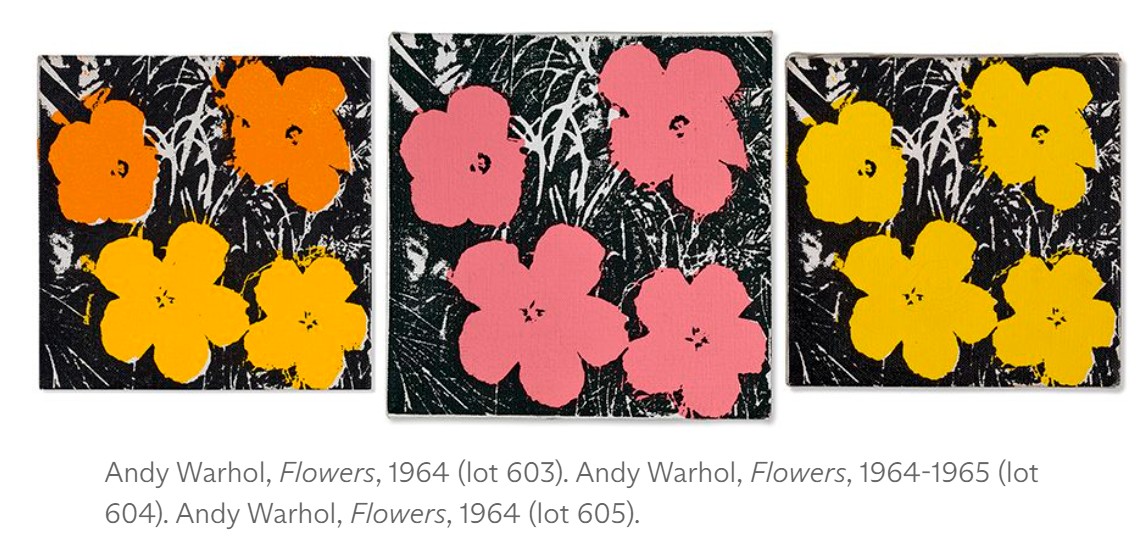
It was Henry Geldzahler, Warhol’s close friend and curator at The Metropolitan Museum of Art, who selected the source image for the Flowers from the June 1964 issue of Modern Photograph, encouraging the artist to leave behind the macabre sentiments of his electric chairs and Death and Disaster paintings. Warhol kept the original photograph’s essential composition but flattened and abstracted what had once been a detailed shot of hibiscus flowers. He then ran the image through a Photostat machine several times to further eliminate superfluous details. The artist’s assistant, Billy Linich, recalled how Warhol ‘just wanted the shape, the basic outline, of the flowers’ (B. Linich quoted in T. Scherman and D. Dalton, Pop: The Genius of Andy Warhol, New York 2009, p. 327). These flat shapes were stencilled in bright synthetic paint onto green or white grounds before the grass and stamens were applied in black ink through the silkscreen. The luminous blossoms stand in stark, slightly off-register contrast to the shadowy stems that surround them.
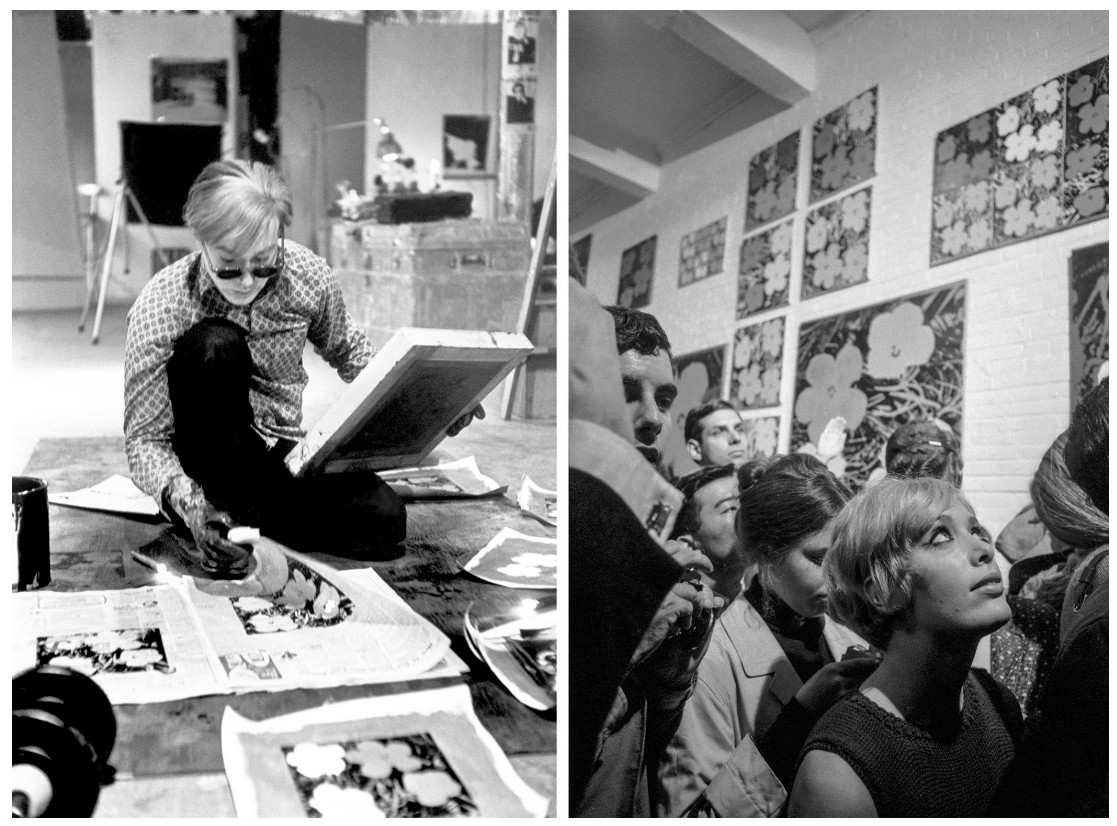
Left: Andy Warhol at The Factory, New York, 1964. Photo: Eve Arnold / Magnum. Artwork: © 2026 The Andy Warhol Foundation for the Visual Arts, Inc. / Licensed by DACS, London. Right: View of a crowd of patrons as they attend a retrospective exhibition of Andy Warhol’s artworks, including his Flowers silkscreens (seen in the background), at the Institute of Contemporary Art, Philadelphia, on October 8, 1965. The exhibition marked Warhol’s first solo show at a museum. Photo by Steve Schapiro/Corbis via Getty Images. Artwork: © 2026 The Andy Warhol Foundation for the Visual Arts, Inc. / Licensed by DACS, London.
Warhol initially developed this body of work in the run-up to his solo exhibition at Leo Castelli Gallery, then the centre of the post-war art world, and the first series comprised two sizes, 48- and 24-inch squares. Over the course of the following year, however, he continued to reduce their scale, to fifteen inches, then eight, and finally five. Lots 603 and 605 are part of the final, five-inch series, while lot 604 belongs to the eight-inch cycle. This painting was included in Warhol’s 1965 exhibition at the Institute of Contemporary Art, Philadelphia: his first museum show in the United States and one which saw celebrity and artwork became forever intertwined. The opening was so mobbed by fans who wanted to see Warhol that the art had to be removed from the walls for its protection.
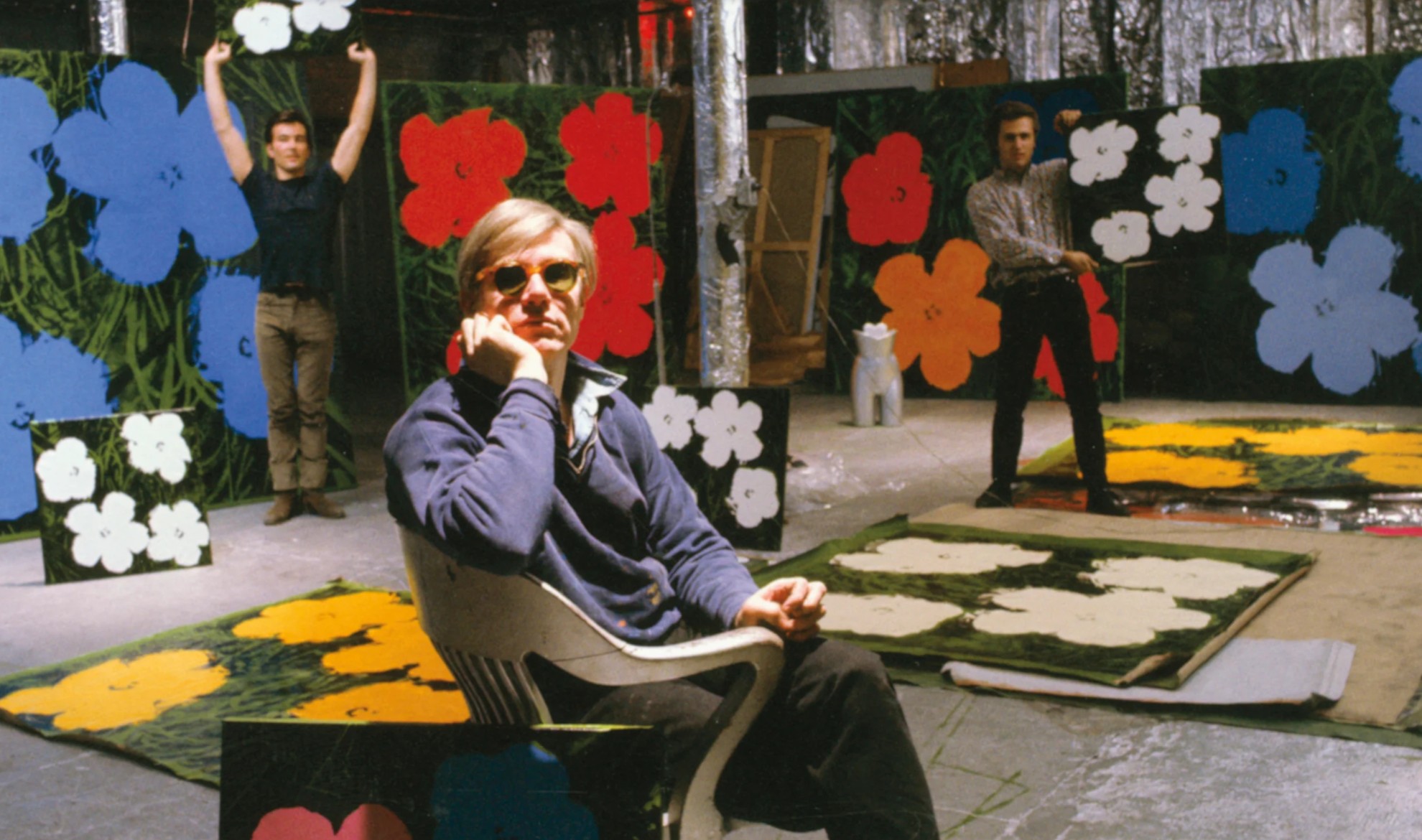
Andy Warhol with his assistants Philip Fagan (left), and poet Gerard Malanga (right). At the Factory, 231 East 47th Street, New York, 1964. Photo Ugo Mulas © Ugo Mulas Heirs. All rights reserved.
Artwork: © 2026 The Andy Warhol Foundation for the Visual Arts, Inc. / Licensed by DACS, London.
With their traditional subject matter, Warhol’s Flowers may appear to represent a departure from his previous work: bouquets have long been used by artists to explore ideas of decay, transience, and death. The blooms here loom almost menacingly large, threatening to overtake the frame and suggestive of a grandiose memento mori. As with his images of celebrities and socialites, the Flowers evince a similar fascination with surface glamour and the ways in which such images become commodified. Far from organic, the hibiscus blossoms have been manipulated and transformed into consumable images that stand in for rather than depict the natural world.
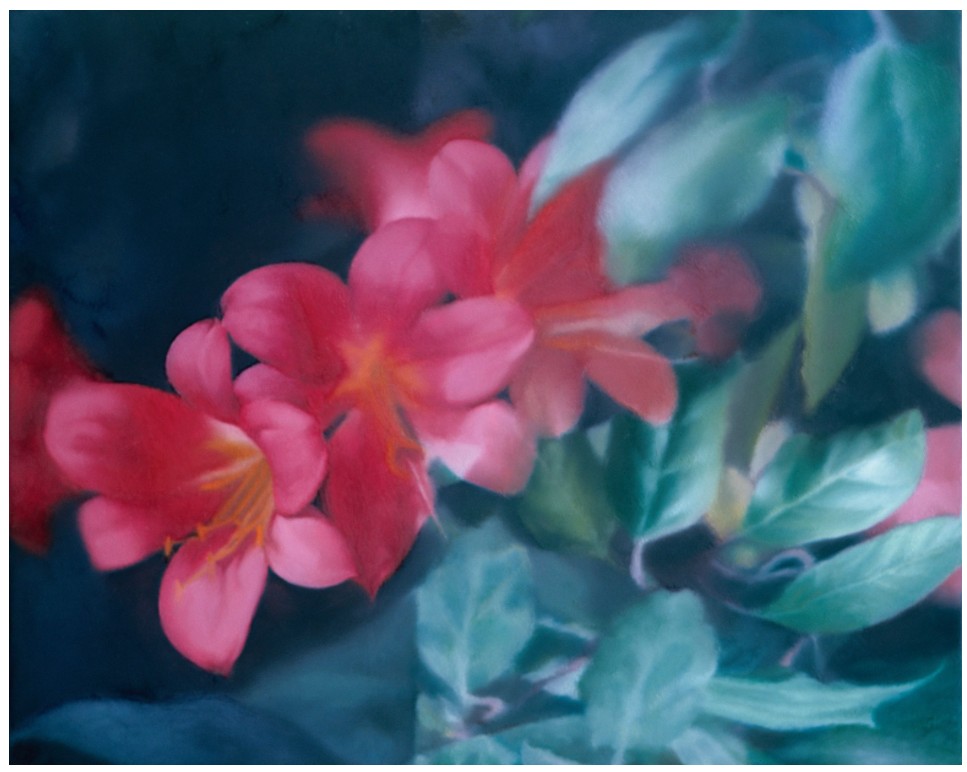
Gerhard Richter, Flowers (Blumen), 1977. Private collection. Artwork: © Gerhard Richter 2026 (0031).
Flowers were among the last paintings that Warhol created during the 1960s. Although formally reductive and thus associated with the artist’s eventual embrace of abstraction, the series also prompts comparison to the floral fabrics popular during the 1960s Flower Power movement. Yet these paintings are far from romantic or even optimistic, and, with their dark backgrounds and charge of commercialization, Flowers also seem to foreshadow the social unease that would dog the 1970s. At once stylized and mediated, real yet constructed, Flowers encapsulate the best of Warhol’s artistic interrogations by bridging the divide between fine art and mass consumption.
Jack Tanzer, 1976
Sotheby’s London: 5 March 2026
Estimated: GBP 100,000 – 150,000
GBP 128,000 / USD 170,995
Jack Tanzer | Contemporary Day Auction | 2026 | Sotheby’s
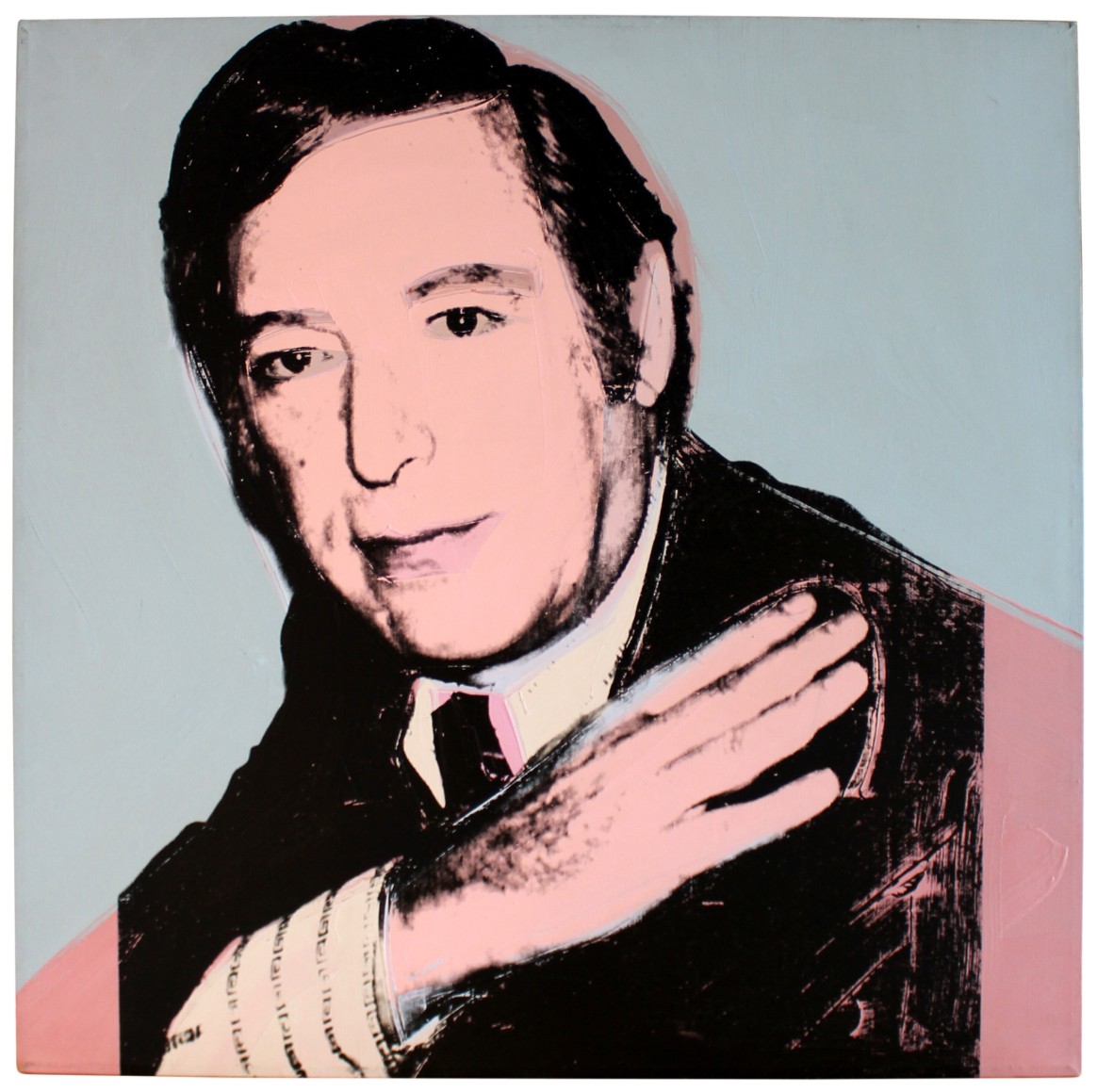
ANDY WARHOL (1928 – 1987)
Jack Tanzer, 1976
Acrylic and silkscreen ink on canvas
40×40 inches (101.6 x 101.6 cm)
Signed, titled J.T. and partially dated (on the overlap)
Stamped by the Andy Warhol Authentication Board and numbered A120.091 on the overlap
FIPS (Wüstenspringmaus), 1983
Sotheby’s London: 5 March 2026
Estimated: GBP 80,000 – 120,000
GBP 102,400 / USD 136,795
FIPS (Wüstenspringmaus) | Contemporary Day Auction | 2026 | Sotheby’s
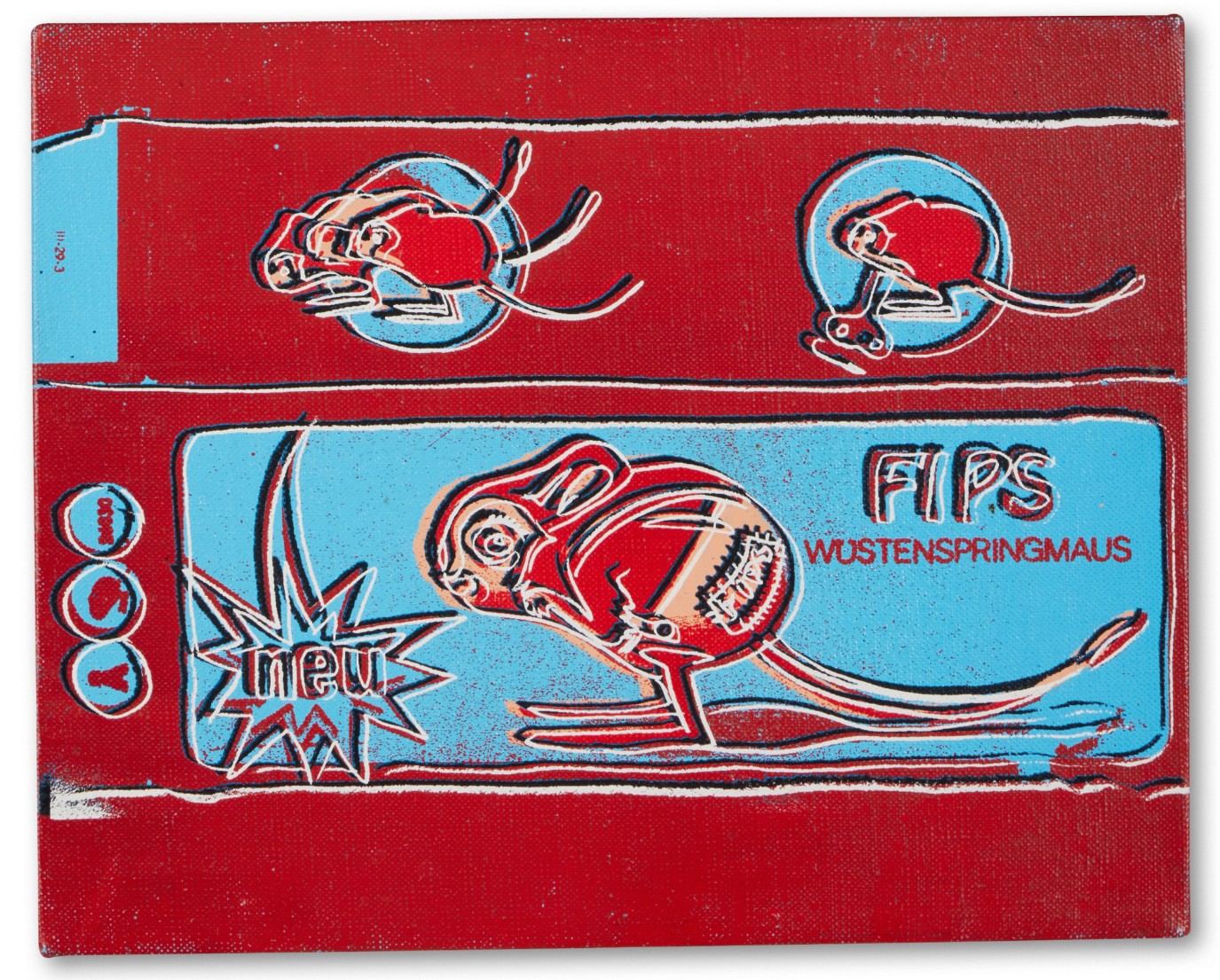
ANDY WARHOL (1928 – 1987)
FIPS (Wüstenspringmaus), 1983
Acrylic and silkscreen ink on canvas
8×10 inches (20.3 x 25.4 cm)
Signed and dated 83 (on the overlap)
Roy Lichtenstein
Imperfect Painting, 1986
Property from an Esteemed Private Collection
Sotheby’s London: 4 March 2026
Estimated: GBP 1,000,000 – 1,500,000
GBP 1,981,000 / USD 2,646,420
Imperfect Painting | Modern & Contemporary Evening Auction | 2026 | Sotheby’s
ROY LICHTENSTEIN (1923 – 1997)
Imperfect Painting, 1986
Acrylic, oil and pencil on shaped canvas
62-3/4 x 80 inches (159.5 x 203.2 cm)
Signed and dated ’86 (on the reverse)
Characterized by its emphatic geometry and deliberate asymmetry, Roy Lichtenstein’s Imperfect Painting stages a sophisticated interplay between optical intensity and ironic self-reflection, underscoring the artist’s sustained engagement with the conventions of painting and his capacity to destabilize them from within. The present work is from Lichtenstein’s Imperfect Series created in the late 1980s – the artist’s most sustained exploration into total abstraction – drawing upon geometric simplicity akin to that of the abstract minimalism of the early twentieth century. In keeping with his broader practice in this series, the present work originated from a pencil sketch of a single line that the artist would fold and manipulate multiple times in order to create interlocking polygons.
“In the Imperfect Paintings the line goes out beyond the rectangle of the painting, as though I missed the edges somehow… The idea is that you can start with the line anywhere, and follow the line along, and draw all shapes in the painting and return to the beginning. I was interested in this idea because it seemed to be the most meaningless way to make an abstraction.”
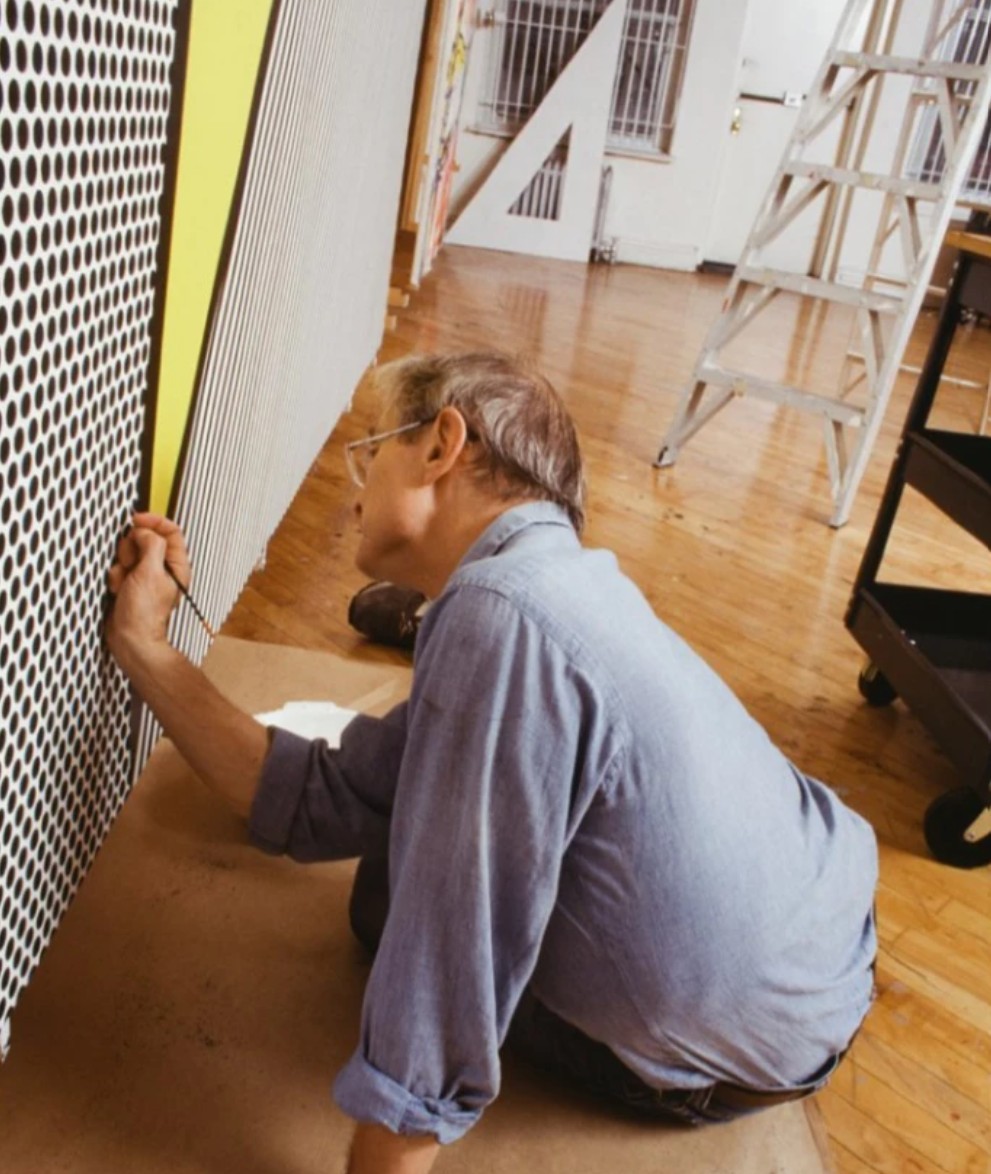
Roy Lichtenstein working on the Perfect and Imperfect Paintings in New York, 1987.
Photo: © Bob Adelman. Art: © Estate of Roy Lichtenstein/DACS 2026
However, while the foundational Perfect series which began in the late 1970s features confined geometric forms that sit neatly within their rectangular frames, the Imperfect paintings that followed, features lines that deliberately challenge this confinement. These ‘mistakes’ become intentional gestures transforming human error into human artistry. The initial sketches undergo a process of deliberate standardization, removing any trace of improvisation, rendering them devoid of influence of the human hand.
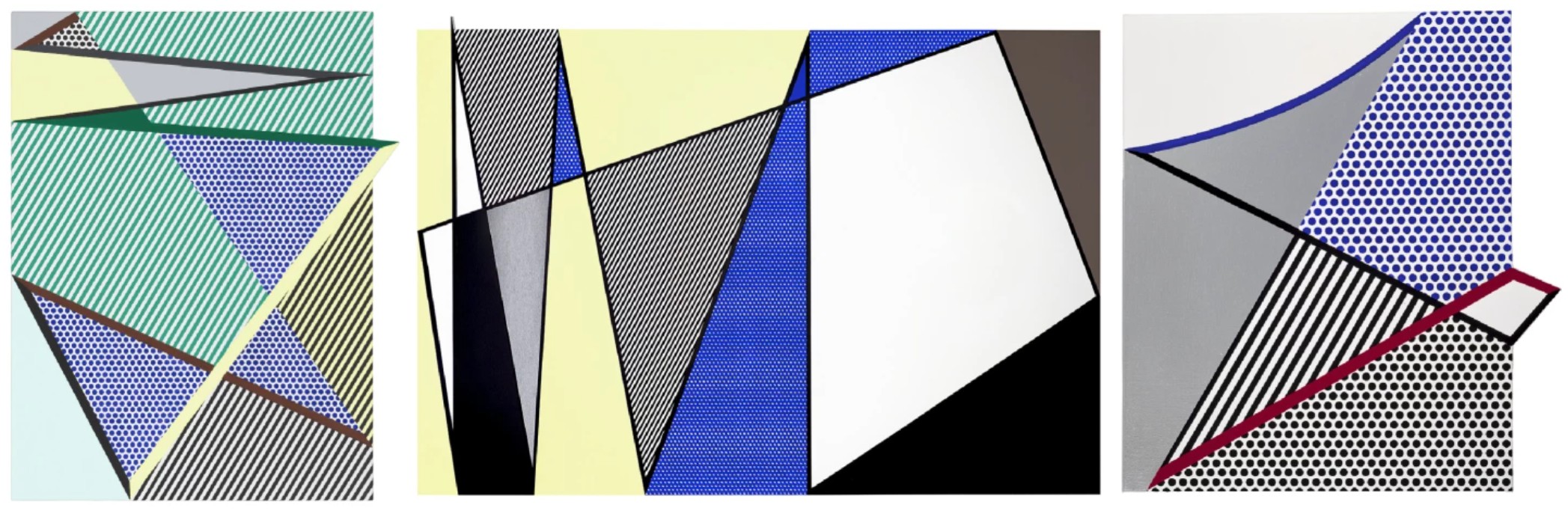
Left: Roy Lichtenstein, Imperfect Painting, 1986. The Broad, Los Angeles. Art: © Estate of Roy Lichtenstein/DACS 2026
Middle: Roy Lichtenstein, Imperfect Painting, 1988. The Whitney Museum of American Art, New York. Art: © Estate of Roy Lichtenstein/DACS 2026
Right: Roy Lichtenstein, Imperfect Painting, 1987. The Museum of Fine Arts, Houston. Art: © Estate of Roy Lichtenstein/DACS 2026
In the present work, Lichtenstein tests the boundaries of drawn and painted form, exploring the possibilities when artistic movements and visual motifs are removed from their conceptual origins and become reclaimed in popular culture as representations of a particular moment in time. Drawing on the forms of Cubist abstraction, the present work combines geometric simplicity with a vibrant chromatic palette. Dynamic lines cut across the composition, intersecting the canvas and ricocheting in a lively, rhythmic interplay as angular shapes coalesce to the left of the painting’s centre. As glossy silver contrasts deep blue, a line protrudes the upper edge, introducing tension as the image is thrust over the boundary, an intentional – but subtle – imperfection and a key facet of Lichtenstein’s critique of modernist painting and authenticity. In his characteristically industrial style, he subverts the purity traditionally associated with abstraction, filtering their influence through his own iconic and instantly recognizable visual language of comic book colours and stripes. Diagonal lines recall the patterns of the Op Art movement and – with its unexpected protrusion of the rectangular confines of the canvas – Imperfect Painting takes inspiration from the punchy starburst sound effects of Lichtenstein’s monumental comic book panel paintings from the 1960s such as Whaam! (1963) and Blam! (1962).
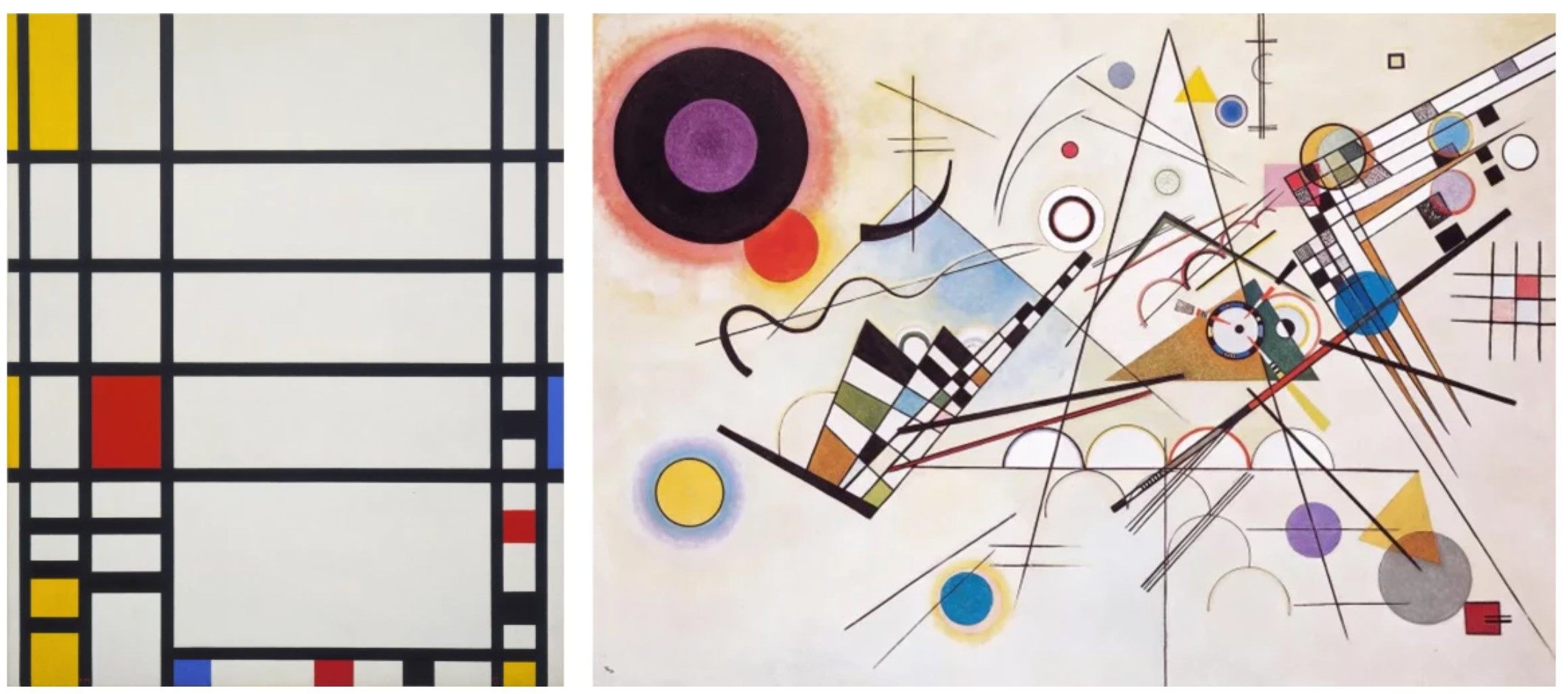
Left: Piet Mondrian, Trafalgar Square, 1939-43. The Museum of Modern Art, New York. Image: © The Museum of Modern Art, New York/Scala, Florence
Right: Wassily Kandinsky, Composition VIII, 1923, The Solomon R. Guggenheim Museum, New York
With its dazzling geometries and lyrical approach to asymmetry, Roy Lichtenstein’s Imperfect Painting represents a striking example from one of Lichtenstein’s most substantial ventures into the realm of abstraction. Having solidified his status as the premier Pop artist of the twentieth century through his canon of Pop art work inspired by cartoon and advertisement, the present work typifies the experimental artistry employed in his maturity, combining pure visual spectacle with a sly tongue-in-cheek humor, exemplifying the artist’s unparalleled ability to disrupt convention and take these innovative impulses in a wholly new direction.
Lucian Freud
Blond Girl on a Bed, 1987
Masterpieces from the Lewis Collection
Sotheby’s London: 4 March 2026
Estimated: GBP 6,000,000 – 8,000,000
GBP 7,410,000 / USD 9,899,020
Blond Girl on a Bed | Modern & Contemporary Evening Auction | 2026 | Sotheby’s
LUCIAN FREUD (1922 – 2011)
Blond Girl on a Bed, 1987
Oil on canvas
16×20 inches (40.6 x 50.8 cm)
Painted in 1987, Blond Girl on a Bed belongs to the most assured phase of Lucian Freud’s late career, when his exploration of the human figure reached an extraordinary synthesis of technical virtuosity and psychological intensity. The sitter, Sophie de Stempel, emerged during the 1980s as one of Freud’s most important models, her repeated sittings enabling the sustained observation through which he achieved some of his most compelling nude portraits. The work forms part of Freud’s enduring engagement with the reclining nude in his so-called ‘naked portraits’ — a subject he continually redefined by stripping away idealisation, narrative convention and decorative allure in favour of uncompromising physical presence. Here the body is rendered with remarkable sculptural conviction: flesh appears weighted, responsive to gravity and palpably alive, while the surrounding studio environment asserts an equal material reality. Freud’s characteristically dense impasto and nuanced tonal modulation create a surface that feels both tactile and immediate, transforming prolonged scrutiny into an image of striking corporeal authority. At once intimate in scale yet monumental in effect, the painting exemplifies Freud’s singular capacity to renew the tradition of the reclining nude, securing its place among the most resonant and technically accomplished nude portraits of his mature oeuvre. Formerly in the Saatchi Collection, the work has featured prominently in many seminal exhibitions, including Freud’s touring retrospectives in 1987 and 1993-94, underscoring its reputation as one of his most dynamic portraits of this period.
Sophie de Stempel occupies a central position within Freud’s late portraiture. The granddaughter of a White Russian aristocrat, she first encountered the artist in a Soho pub in 1981 when she was nineteen. Recalling that meeting, she explained: “He asked me to model for him and I agreed. At first I was a bit nervous – I had never stripped off like that before – but I soon got used to it” (quoted in William Feaver, The Lives of Lucian Freud: Fame 1968-2011, London 2020, p. 170). Over roughly eight years she sat for Freud intermittently, primarily at night, resulting in a sequence of portraits that chart both the evolution of his painterly language and his deepening understanding of her physical presence. Freud valued her precisely because she resisted ease; he approvingly described her as “a very bad model,” meaning that her visible discomfort thwarted theatrical posing (quoted in Martin Gayford, et. al., Lucian Freud, London 2018, vol. 2, p. 13). That resistance was central to his conception of portraiture, which sought friction rather than compliance. Across eight major portraits of de Stempel during the decade – culminating in works such as Blond Girl on a Bed and Standing by the Rags (1988-89, Tate, London) – Freud achieved some of the most probing and psychologically resonant nudes of his later career.
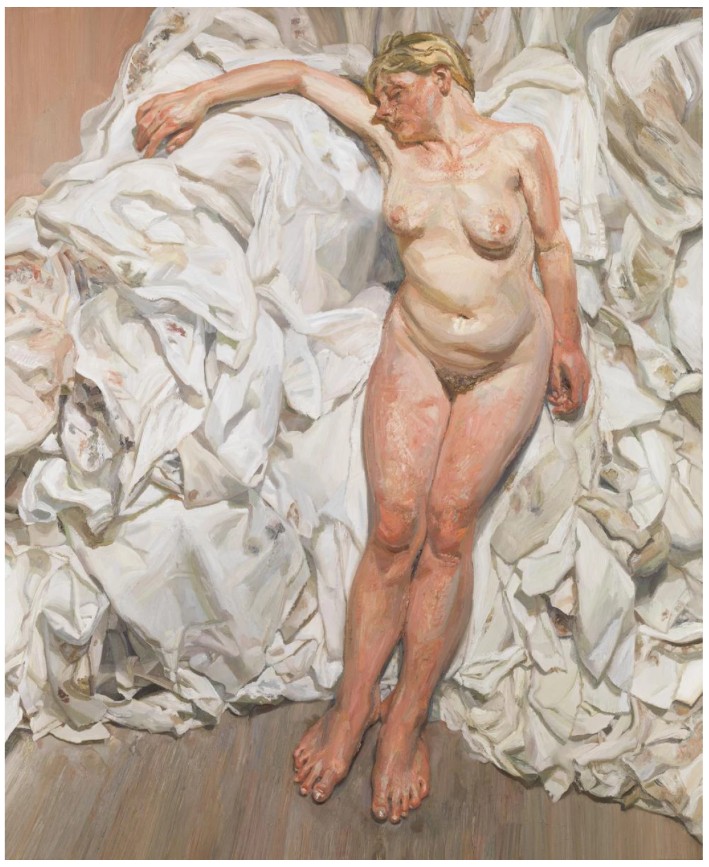
Lucian Freud, Standing by the Rags, 1988-89, Tate Modern, London.
Art/Image: © The Lucian Freud Archive. All Rights Reserved 2026 / Bridgeman Images
Within Freud’s wider oeuvre, the painting occupies a significant place in his prolonged engagement with the reclining nude – a motif that, alongside the self-portrait, constitutes a defining leitmotif of his praxis. From early works such as Girl with a White Dog (1950-51, Tate, London), through Pregnant Girl (1960-61, Private Collection) and the explicitly corporeal nudes of the 1970s, Freud repeatedly returned to the problem of the exposed body. “When someone is naked, there is in effect nothing to be hidden,” acknowledging the responsibility imposed on the painter (the artist quoted in Phoebe Hoban, Lucian Freud: Eyes Wide Open, Boston 2014, p. 100). Unlike the classical tradition, in which the nude often functions as an idealized or allegorical form, Freud advances the genre toward radical particularity. The history of Western art – from Titian and Diego Velázquez to Édouard Manet – established the reclining female nude as a site of beauty, desire and narrative implication. Freud strips away such conventions, refusing allegory or erotic display in favor of physical fact and psychological ambiguity.
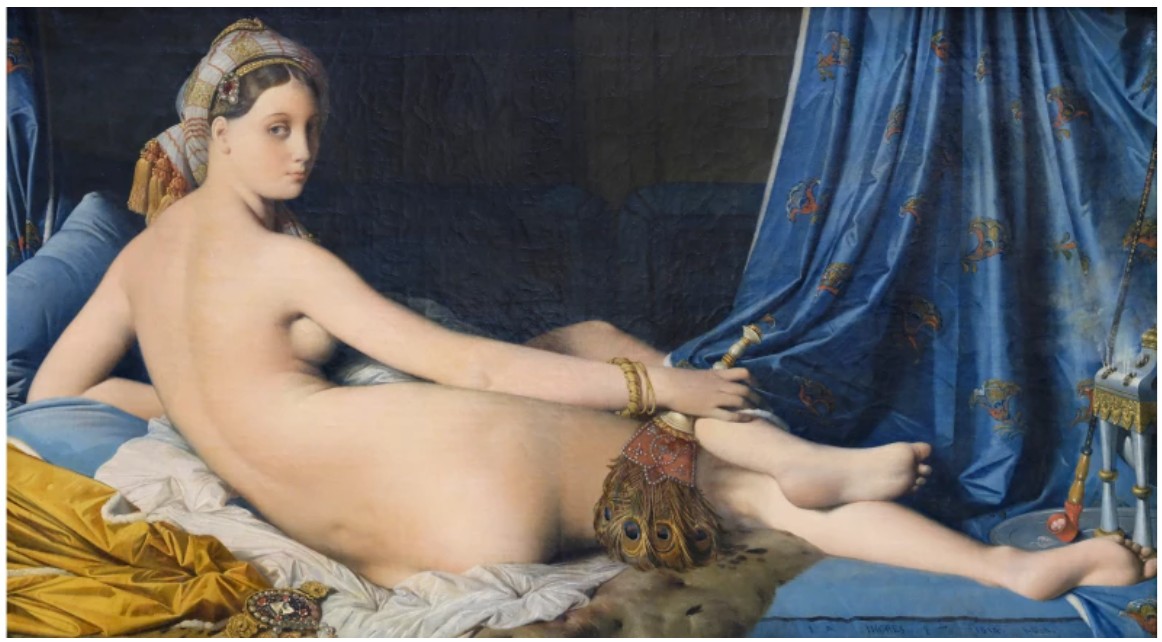
Jean Auguste Dominique Ingres, The Grande Odalisque, 1814. Musée du Louvre, Paris.
Despite its modest dimensions, Blond Girl on a Bed possesses a striking sculptural gravity. De Stempel reclines on one of Freud’s characteristic bedcovers, her body arranged in a twisted, side-lying pose that recalls the contrapposto logic of classical sculpture – and equally that of his portraits of Janey Longman, such as Naked Girl (1985, Private Collection). Freud notably never dictated how his sitters should pose, preferring them to settle naturally; nevertheless, the resulting composition is deeply structured and formally complex, paradoxically shaped by the sitter’s volition. The raised leg, rotated pelvis and subtle torque between shoulders and hips generate an impression of weight and internal tension that anchors the figure within the shallow pictorial space. This sculptural presence has often invited comparison with the sculptural precedent set by Mannerist sculpture, in particular Michelangelo, yet Freud’s affinity with Auguste Rodin is particularly illuminating. Freud had several Rodin sculptures in his studio, including Study for Iris, Messenger of the Gods (c. 1890), which occupied a prominent place in his studio. Like Rodin’s collapsing or reclining figures, de Stempel’s body appears governed by gravity rather than grace: flesh presses insistently into the mattress, limbs weighted rather than arranged for display. The figure is not idealised but subject to physical law, her mass asserting itself against the resistant surface beneath her.
In Blond Girl on a Bed, Lucian Freud advances the tradition of realism while simultaneously testing its limits, drawing deeply on the legacy of the Old Masters yet surpassing them in the unflinching materiality of his nude. His commitment to working directly from life aligns him with predecessors such as Rembrandt, Courbet, Degas and Rodin, artists whose forthright physicality and rejection of idealisation shaped the trajectory of modern realism. As Sebastian Smee has observed, Freud embraced “volumes instead of line; a heightened sense of proximity, a new, emphatic physicality,” situating his work within a lineage that privileges bodily fact over classical ideal (Sebastian Smee in Catherine Lampert and Toby Treves, Lucian Freud: Catalogue Raisonné of the Oil Paintings, Volume 4, London 2025, p. 32). Yet Freud pushes this inheritance further: where earlier painters often balanced truth with aesthetic harmony, Freud pursues immediacy with almost forensic insistence, homing in on “every vein, every subcutaneous bloom of capillaries, every gravity-contending protuberance of fatty flesh” (Ibid., p. 32). The result is a nude that resists classical timelessness in favour of mortal specificity of flesh as weight, warmth and substance.
Left: Édouard Manet, Olympia, 1863, Musée d’Orsay, Paris.
Right: Gustave Courbet, The Origin of the World, 1866. Musée d’Orsay, Paris.
Freud’s affinity with sculpture, particularly Auguste Rodin, is especially instructive here. Rodin famously insisted, “I can only work with a model… when I have nothing to copy, I don’t have an idea in my head” (quoted in Albert E. Elsen, ed., Auguste Rodin: Readings on His Life and Works, New Jersey 1965, p. 63), a credo Freud shared in his insistence on sustained observation from life. The sculptural sensibility of Blond Girl on a Bed – its sequence of hollows and swelling forms, the arching legs, the palpable heat and bulge of flesh – reflects that kinship, as does Freud’s tactile engagement with form. He once remarked of Degas’s sculpture, “Don’t you think that is in the nature of sculpture, the impulse to touch and feel?… I like to run my fingers over them,” underscoring a haptic approach that translated directly into his painting practice (Lampert Treves, Op. cit., p. 56). Access to Rodin works in his studio, often on loan from his friend Lady Jane Willoughby, allowed Freud to study them under shifting light and even physically handle them, reinforcing a conception of the human body as mutable, three-dimensional fact rather than pictorial convention.
Yet where Rodin’s figures often convey charged psychological drama or expressive ‘stuckness,’ Freud’s nude remains more inscrutable, defined less by narrative tension than by sheer physical presence. The awkward contortion of Sophie de Stempel’s pose – neither classical contrapposto nor decorative recline – embodies what Smee describes as Freud’s embrace of “difficulty… an awkwardness, which militates against the false coherence of style” (Ibid., p. 32). This deliberate refusal of elegance situates Freud beyond traditional realism: he does not merely describe the body; he insists upon its stubborn facticity. As Freud himself noted, photographic likeness depends largely on light, whereas his interest lay in what resided “inside their heads,” hence his preference for painting people he knew intimately (Jacob Simon in Ibid., p. 79). In Blond Girl on a Bed, that intimacy manifests not as psychological exposition but as physical truth – a nude that surpasses Old Master precedent by collapsing the distance between observation and presence, achieving a level of corporeal immediacy that feels less represented than palpably, disconcertingly real.
The paint surface intensifies the painting’s corporeal immediacy to striking effect. As Catherine Lampert has noted, Freud’s paint is noticeably thick on the upper edge of the body, towards the sitter’s hips, where the artist constructs flesh through dense impasto that seems almost to weigh the figure down. His oft-stated ambition for paint to ‘work as flesh’ is realised here with extraordinary conviction: venous blues, bruised mauves, ochres and flashes of Cremnitz white map the sitter’s fair skin with a candour that borders on discomfort. The adoption of Cremnitz white was itself a crucial technical development in Freud’s mature practice, its granular, gravelly density enabling the heightened tactile presence of flesh and hair that characterises works of this period. Freud frequently dragged loaded brushes across earlier, dried layers of pigment – often in opposing directions and with subtly shifting tonalities – producing the distinctive grain and resistance evident in the present painting. This slow accretion of marks records not fleeting sensation but prolonged scrutiny. Sophie de Stempel later recalled the intensity of this process, remarking that she felt as though “each of [her] toes was having its portrait painted,” an observation that captures both the forensic attentiveness of Freud’s gaze and the vulnerability it imposed (Gayford, Op. cit., p. 13). Equally Freud was fascinated by Titian’s Diana and Actaeon, their contorted poses, and in particular their toes, leading de Stempel to comment “Toes and Titian – absolutely” (Lampert and Treves, Op. cit., p. 65). The resulting surface across the painting conveys resistance, softness, strain and warmth simultaneously, endowing the figure with an almost tactile vitality that seems less painted than palpably present.
Titian, Diana and Actaeon, 1556-59, National Gallery, London, and National Galleries of Scotland, Edinburgh
This resolute attention to detail is revealed in the bedspread beneath her, rendered with extraordinary care, and which forms a crucial component of this psychological and tactile drama. Freud traced his fascination with such fabrics to paintings of his mother, remarking: “I started painting quilts when I was doing my mother” (the artist quoted in William Feaver, The Lives of Lucian Freud: Fame 1968-2011, London 2020, p. 114 , p. 114), in the mid-1980s. Here the quilt presses back against living flesh, heightening awareness of material fact. Freud resisted the notion of background, preferring to conceive his pictures as integrated environments in which sitter and studio exist in reciprocal tension. Objects – worn furniture, rags, floorboards – possess their own presence, scrutinised as attentively as the human body itself. This theme was developed even greater in other paintings by Freud in the late 1980s, such as Triple Portrait (1986-87, Private Collection) and Standing by Rags; crucially Freud affords the same hierarchy of attention to the sitter as to her environment, or in the case of Triple Portrait, Susannah’s whippet.
A Young Painter, 1957-58
Masterpieces from the Lewis Collection
Sotheby’s London: 4 March 2026
Estimated: GBP 4,000,000 – 6,000,000
GBP 7,166,000 / USD 9,573,060
A Young Painter | Modern & Contemporary Evening Auction | 2026 | Sotheby’s
LUCIAN FREUD (1922 – 2011)
A Young Painter, 1957-58
Oil on canvas
41.9 x 39.1 cm (16-1/2 x 15-3/8 inches)
Charged with a concentrated psychological intensity, A Young Painter stands among the most compelling early portraits in Lucian Freud’s oeuvre, marking a decisive moment in his stylistic and emotional development during the mid-1950s. Painted amid personal upheaval – notably the disintegration of his marriage to Caroline Blackwood – the work reflects Freud’s increasing commitment to portraiture as an arena for probing human presence rather than recording mere likeness. The title itself signals a reflexive dialogue: the sitter, fellow painter Ken Brazier, functions simultaneously as portrait subject, artistic counterpart and as a quiet emblem of artistic struggle. Freud had articulated this ambition only a few years earlier, asserting that “painters who use life itself as their subject-matter do so in order to translate life into art almost literally, as it were. The painter makes real to others his innermost feelings about all that he cares for” (Lucian Freud, “Some Thoughts on Painting”, Encounter, July 1954). In A Young Painter, that credo finds an early but remarkably assured expression. Underscoring its importance, A Young Painter is prominently referenced in several major monographs on Freud, and has been widely exhibited in such important museums as Washington, D.C.’s Hirshhorn Museum; Paris’s Musee National d’Art Moderne; and London’s Hayward Gallery, Barbican Art Gallery, and National Portrait Gallery, among others.
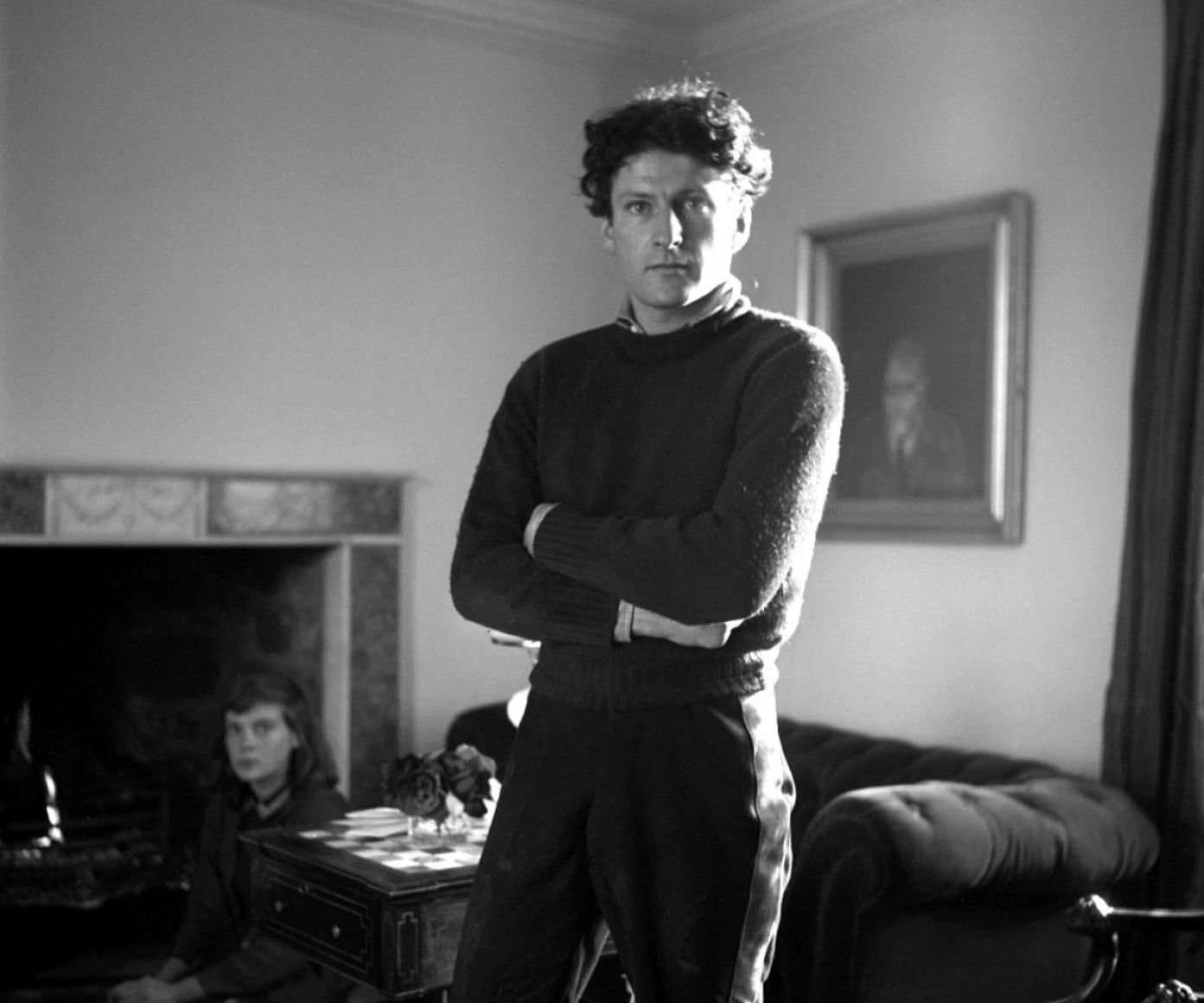
Lucian Freud c. 1956. Art/Image: © The Cecil Beaton Studio Archive
The portrait belongs to the longstanding tradition of artists painting artists, relationships that often combine practical convenience with psychological affinity. Freud frequently turned to close contemporaries – including Francis Bacon, Timothy Behrens and Elinor Bellingham-Smith – sitters whose familiarity allowed the sustained scrutiny he sought. As Lawrence Gowing observed, Freud’s images of the relatively few people he knew intimately became “the theatre of his realisation of what it entails for us to be both physically and imaginatively present to each other” (Lawrence Gowing, Lucian Freud, London 1982, p. 93). Brazier’s appearance here reflects precisely such intimacy: unruly hair, compressed lips and a wary gaze convey vulnerability edged with defiance. The subject’s apparently staring left eye is more bloodshot than the quieter right one, an unsettling detail that signals an acute state of concentration and fatigue, the act of looking elevated to existential scrutiny. Television producer Roger James Elsgood, a student of the sitter at Norwich School of Art, later described Brazier: “He was the epitome of what, to our impressionable regional eyes, a real artist should be. He was small, dishevelled, inarticulate, more than a bit of a drinker and lacking in almost all of the social graces. But he was a painter of blazing energy and integrity” (Catherine Lampert and Toby Treves, Lucian Freud: Catalogue Raisonné of the Oil Paintings, Volume 2, London 2025, p. 260). Here, Brazier’s turbulence, volatility and vulnerability is conveyed with empathy, and even affection, by Freud.
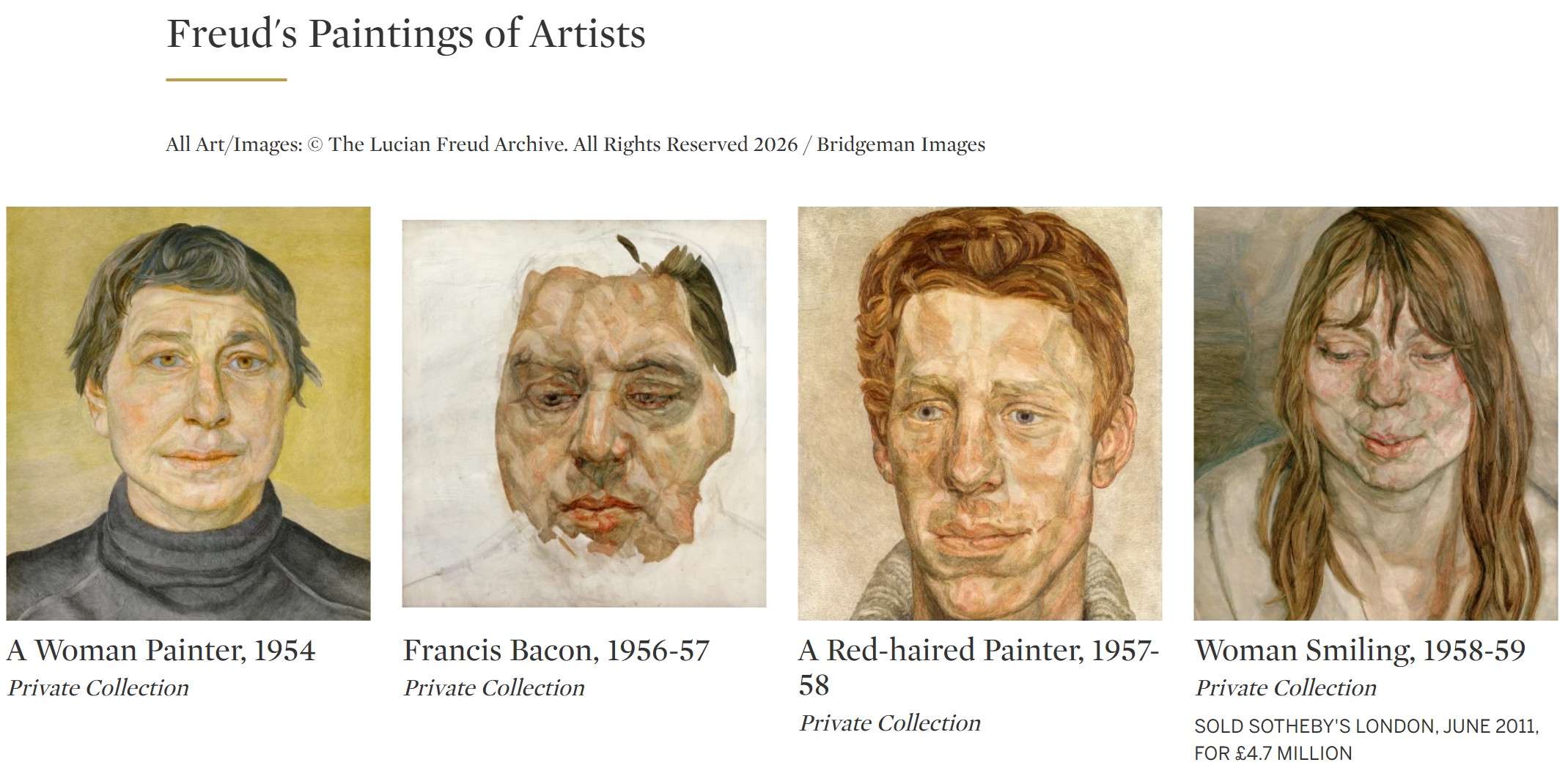
There remains some uncertainty about precisely where A Young Painter was executed. James Kirkman places its execution in Freud’s Delamere Terrace studio, while a fellow Camberwell student of Ken Brazier recalled it being painted in a room on Robert Street, Marylebone, close to where Brazier was then living. Freud himself later reflected on his acquaintance with Brazier in terms that evoke the milieu surrounding the painting: “I liked him and never asked myself why. He was a friend and in a bad way. I met him in Robert Street, a boarding house that belonged to a Pole or Czech where Tim Behrens and Ann Montagu lived as students. I took great trouble with Ian Tregarthen Jenkin – Bill’s deputy – to get him into the Slade. He’d been at an approved school and since that meant supposedly that he’d already been supported by the state we had to make up a new life for him, which worked. He was desperate but he was interesting. Came from a very broken home, mother French, father a violent workman. He was a really good Vorticist: it was as if he worked with shovels and drills to discover something that had been discovered before. It had graffiti-like urgency. Coldstream said there were only two people he took against to do with me… One was Ken” (William Feaver, The Lives of Lucian Freud: Fame 1968-2011, London 2020, p. 484). Portraits from this same period – including Francis Bacon (Unfinished) (1956–57), A Woman Painter (1956–57), A Poet (1957–58) and A Red-haired Painter (1957–58) (all private collections) – reveal Freud’s developing emphasis on sculptural paint handling and psychological immediacy. His sitters were rarely chosen arbitrarily: he often gravitated toward individuals whose personal precarity echoed aspects of his own experience, using portraiture as a means of negotiating his own emotional instability. After his sequence of pictures depicting Blackwood earlier in the 1950s, Freud increasingly turned to friends, fellow artists and even himself, producing a body of work that simultaneously registers biographical turbulence and a decisive stylistic shift toward the intense, materially grounded portraiture for which he became renowned.
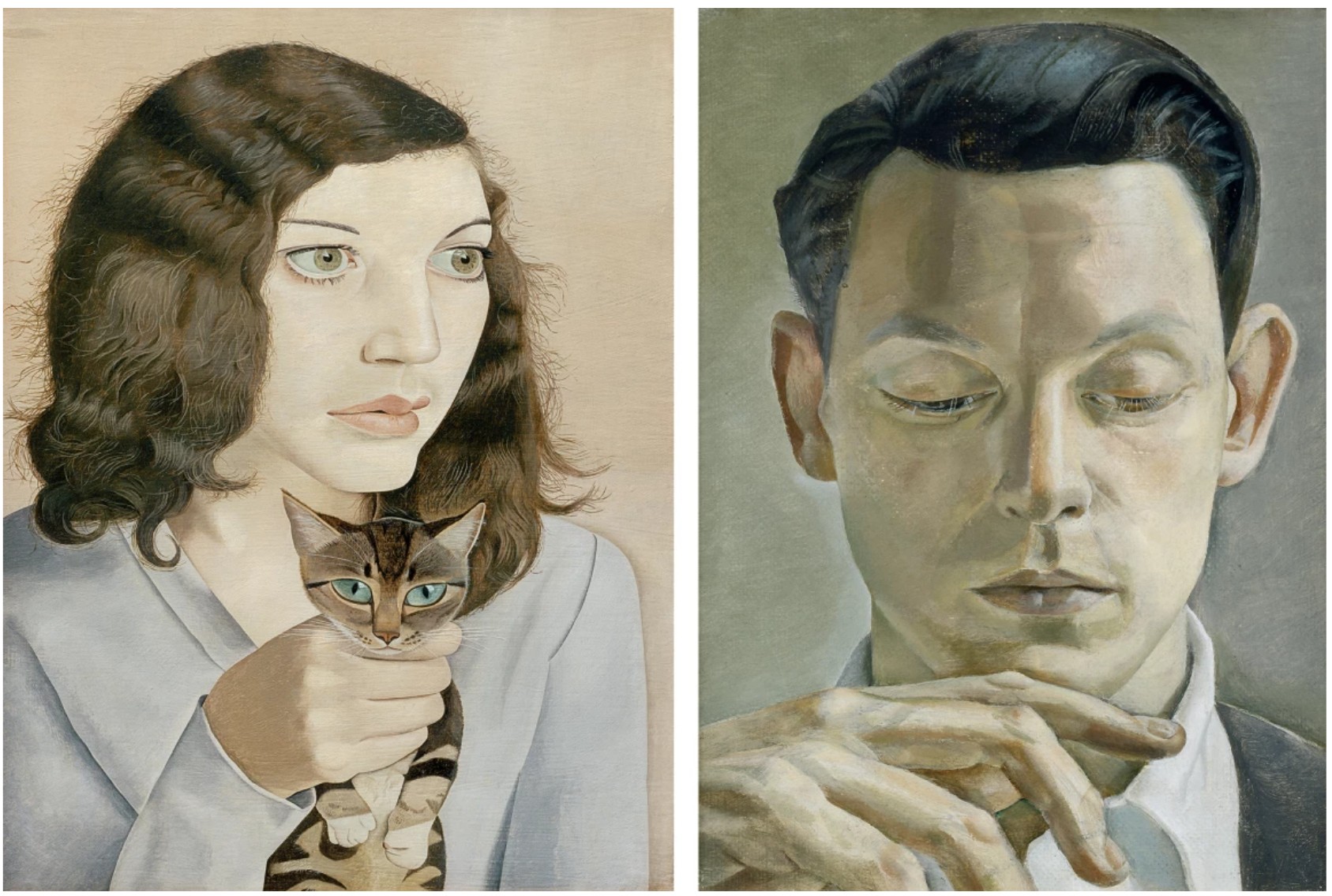
Left: Lucian Freud, Girl with a Kitten, 1947, Tate, London. Art/Image: © The Lucian Freud Archive. All Rights Reserved 2026 / Bridgeman Images
Right: Lucian Freud, A Writer, 1955, Private Collection. Art/Image: © The Lucian Freud Archive. All Rights Reserved 2026 / Bridgeman Images
Freud’s portraits of the late 1950s and early 1960s frequently adopt a tightly cropped head format, a compositional strategy that intensifies psychological presence by directing all attention to the sitter’s face. He deliberately reduced and tightened pictorial space to heighten immediacy, often manipulating scale so that, as Toby Treves notes, “one of the effects of using non-naturalistic scale was to increase the subject’s presence. Another was to make the implied movement and actual rhythm of his revealed brushstrokes obvious, as if in combination they could force a palpable sense of life into the figure and the surrounding space” (Ibid, p. 18). A Young Painter exemplifies this method: “the format was tightened by turning over the painted canvas edge at the bottom,” and documentation records Freud instructing the picture-liner W. G. Hookins in October 1965 to reduce a portrait – “Modern portrait of a Gent. 20 ⅛ x 15 ⅜ in. cut down and strained on to a new stretcher” (Ibid). Painted on fine-weave linen with the image extending about 1½ inches beyond the stretcher, the adjustment concealed the sitter’s neck and shirt, reinforcing the concentrated facial focus Freud sought.
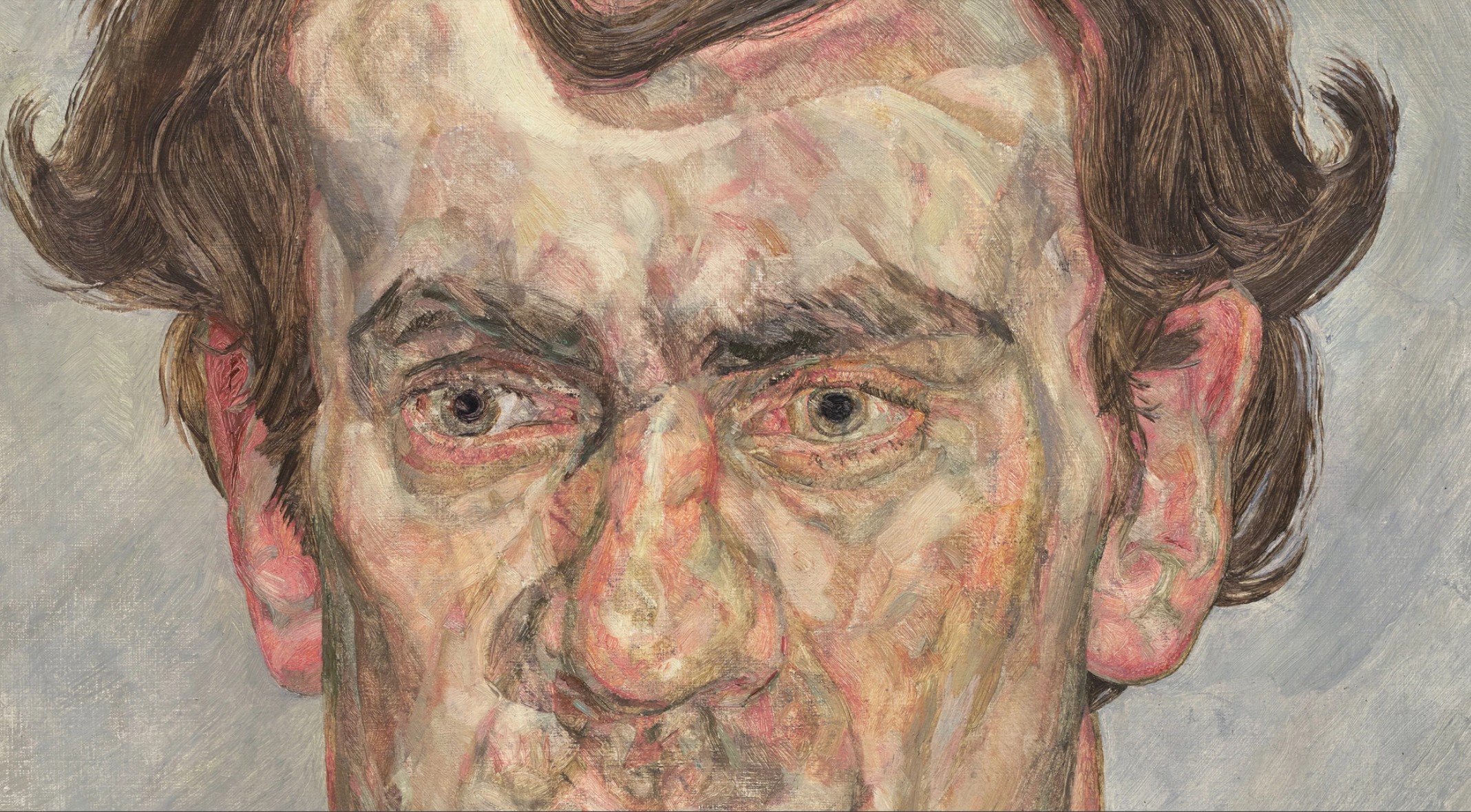
Completed just in advance of Freud’s first Marlborough Gallery exhibition – where major works from the 1950s were shown – the painting was soon acquired by Sir Oliver and Lady Scott, who were important early supporters of Freud’s work; Freud even painted Lady Scott (Portrait of a Woman, 1952 and 1954) and their daughter Hermione in Portrait of a Young Girl (1960). The present work and Head of a Man (1960) were acquired in a somewhat unconventional sense, “most likely as repayment for a loan Scott had made to Freud to settle a gambling debt. In a letter of 5 November 1971 to Freud, Scott wrote off the remaining debt of £300” (quoted in Catherine Lampert and Toby Treves, Lucian Freud: Catalogue Raisonné of the Oil Paintings, Volume 2, London 2025, no. 129, p. 214). The painting later entered the corporate collection of Baring Brothers & Co during the rise of collecting by financial institutions and pension funds, and by early 1990 had passed to Charles Saatchi, where it was exhibited in the Saatchi Gallery alongside Blond Girl on a Bed (lot 18).
“Packing a lot of things into one single brushstroke… The idea of paint having that power was something which made me feel I ought to get to know it in a different way”
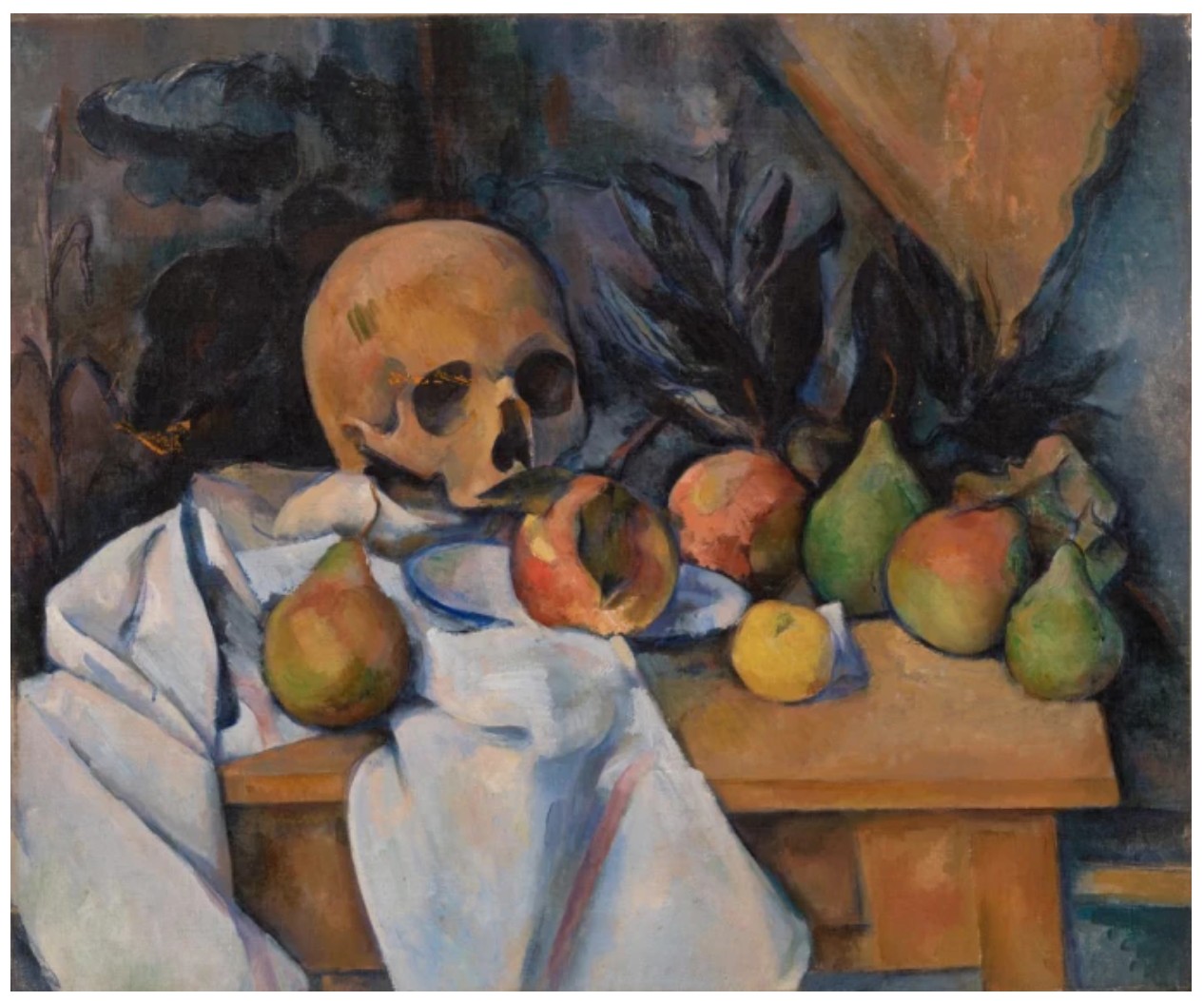
Paul Cézanne, Nature morte au crâne, 1895-1900. The Barnes Foundation, Philadelphia
Stylistically, the mid-1950s marked a decisive turning point in Lucian Freud’s practice, as the fine linear precision of his early portraits gave way to a broader, more tactile handling of paint. This shift was enabled by practical changes – the adoption of coarse hog’s-hair brushes, the abandonment of meticulous underdrawing, and a new habit of standing at the easel rather than working knee-to-knee with sitters, the canvas in his lap. The evolution unfolded amid the charged bohemian atmosphere of Soho, where Freud spent long evenings with Francis Bacon, John Minton and others at Wheeler’s, the Colony Room and the Gargoyle Club, what one contemporary memorably described as a whole kind of Soho life. Bacon’s influence proved catalytic rather than imitative: Freud later recalled being intrigued by Bacon’s idea of “packing a lot of things into one single brushstroke… The idea of paint having that power was something which made me feel I ought to get to know it in a different way” (quoted in: William Feaver, Lucian Freud, New York 2007, p. 321). Rather than embrace Bacon’s theatrical distortions, however, Freud intensified his own austerity, using brushwork simultaneously as description and structure – planes of colour carve the face, while the direct, hazelnut irises set within depthless pupils establish a heightened psychological confrontation with the viewer. The present work appears just before Woman Smiling in the catalogue raisonné which is cited by Robert Hughes as “the turning point in Freud’s work with the human clay, when he moved decisively away from the Ingriste modulation of flatness by contour,” whilst Lawrence Gowing claimed it as “the crucial picture in the unfolding of a greater fullness” (Lawrence Gowing, Lucian Freud, London 1982, p. 77); A Young Painter is equally an assured manifestation of this pivotal shift in Freud’s work. The work signals Freud’s growing confidence in freer handling and a deepened psychological presence, retaining the small scale that allowed rigorous control while pushing toward a new vitality and intensity that would define his mature work.
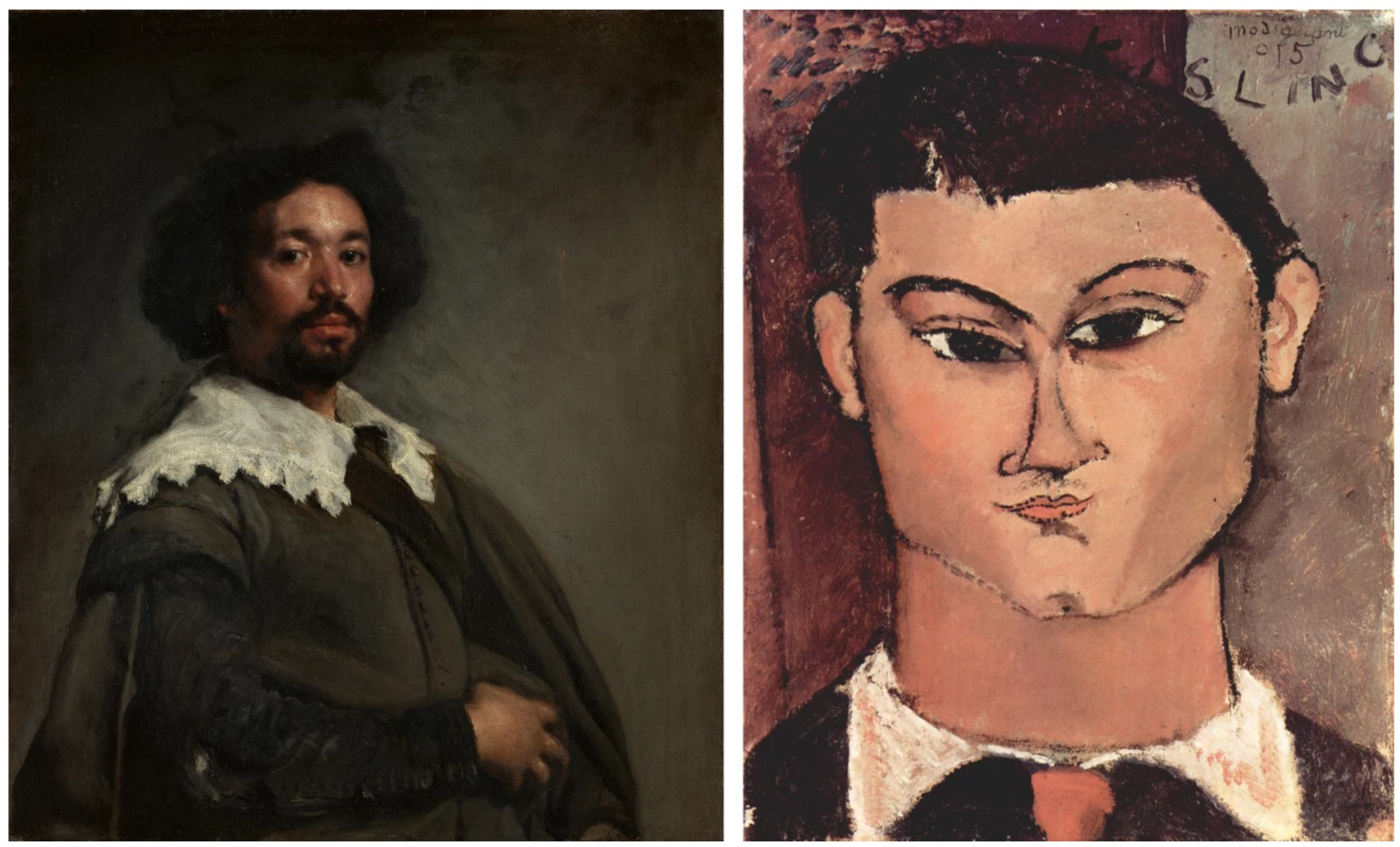
Left: Diego Velázquez, Portrait of Juan de Pareja, c. 1650. Metropolitan Museum of Art, New York
Right: Amedeo Modigliani, Portrait of the Painter Moïse Kisling, 1916. Pinacoteca di Brera, Milan
Ultimately, A Young Painter encapsulates Freud’s early mastery of portraiture as a site of psychological encounter. The painting insists on presence – the uneasy fact of another person observed with sustained attention. Brazier appears at once vulnerable and defiant, poised between fatigue and concentration, individuality and archetype. In capturing this tension, Freud produces not merely a likeness but an image that seems palpably alive, embodying his lifelong ambition to translate lived experience into art with uncompromising honesty. The work stands as a formative statement of his vision that would define Freud’s career: to render human existence with such intensity that the painted image acquires its own independent vitality.
Francis Bacon
Self-Portrait, 1972
Masterpieces from the Lewis Collection
Sotheby’s London: 4 March 2026
Estimated: GBP 8,000,000 – 12,000,000
GBP 16,035,000 / USD 21,421,155
Self-Portrait | Modern & Contemporary Evening Auction | 2026 | Sotheby’s
FRANCIS BACON (1909 – 1992)
Self-Portrait, 1972
Oil on canvas
36 x 30.5 cm (14-1/8 x 12 inches)
Signed, titled and dated 1972 (on the reverse)
Francis Bacon’s Self-Portrait is an unequivocal masterwork from the most inwardly scrutinising year of his life: a small canvas that elicits in all its potent and concentrated form, the full violence and tenderness of his self-regard. The painting belongs to what Martin Harrison identified as Bacon’s most prolific year for small self-portraits – the present work is one of nine self-portrait panels in the 14 by 12-inch format, including a diptych and triptych in this format – as it was painted at a time of personal loss and vulnerability for Bacon, soon after the death of his partner George Dyer. Among the self-portraits produced in this seminal year, “none is more incisively painted than this painting or most closely aligned with Degas’s pastels in its predominantly blue and pink palette” (Martin Harrison, Francis Bacon, Catalogue Raisonné, Volume IV, 1971–92, London 2016, p. 1022). The present work is undoubtedly one of the most striking iterations within Francis Bacon’s acclaimed pantheon of self-images; testament to this, it has been exhibited in major exhibitions globally and widely referenced in literary scholarship on the artist. Its provenance further distinguishes the work: Bacon gifted the work to his long-term physician, Dr Paul Brass, who later sold the work at Sotheby’s before it was acquired by the Lewis Collection in 1994, where it has remained ever since. This body of work is today considered one of the artist’s greatest achievements, sitting him squarely among the ranks of art history’s canonical masters of the discipline: Rembrandt, Van Gogh, and Picasso. Yet Bacon’s distinction lies in his refusal of the consolations that self-portraiture has often offered: coherence, heroism, the assurance of likeness. If anything, his mirror is an arena. As he told David Sylvester, quoting Jean Cocteau, “Each day in the mirror I watch death at work. This is what one does to oneself” (the artist quoted in David Sylvester, The Brutality of Fact, London 1990, pp. 130–133). Bacon’s self-portrait powerfully elicits this statement: the image presents a face in the act of coming undone, yet held, paradoxically by an intelligence of paint so controlled that the very brutality becomes a kind of order. Startling in color, bold in gesture, and unmistakably Baconian in effect, this painting is a masterwork of self-interrogation.
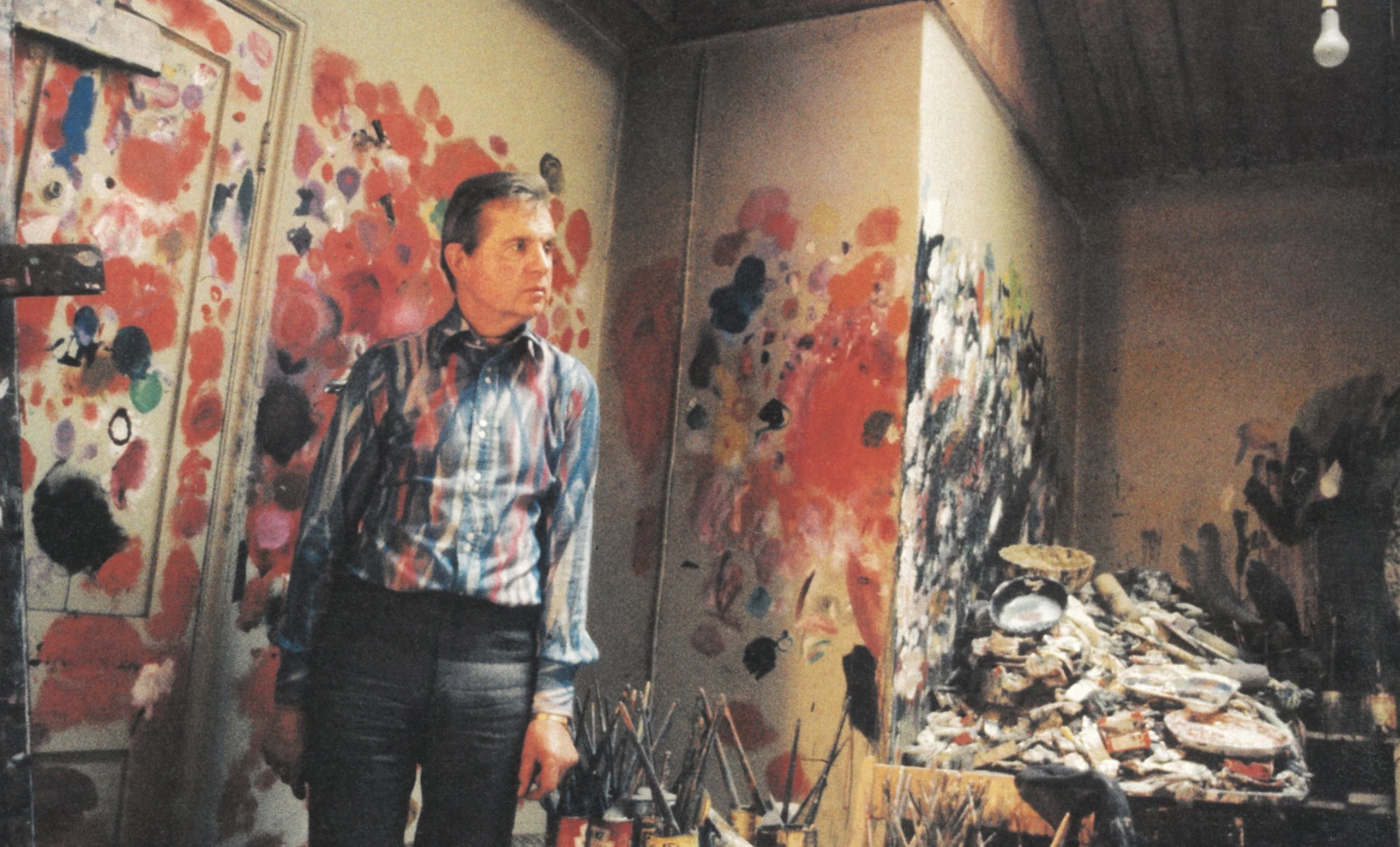
Francis Bacon at his studio, 7 Reece Mews, London, 1974. Photo © Michael Holtz
Formally, the composition stages a confrontation between darkness and illumination. The black ground is almost a sealed atmosphere – velvety, oppressive and airless – against which the head emerges as a striking, luminous injury. Bacon constructs the face through unstable pastel hues: light blues bleeding into mauves, pinks and purples, chromatic delicacy continually undercut by impact. Abrupt black incisions around the brow and eyes operate like surgical, precise gestures while the facial structure seems simultaneously built and violated. In this compact space, Bacon’s handling oscillates between smear and control: passages of scraped and dragged pigment suddenly stabilised by moments of literal description, notably the finely delineated forelock of hair. Bacon’s characteristic diagonal inflection across the brow lends the face a fatal punctuation. Michel Leiris, Surrealist writer and Bacon’s close friend, famously described this motif as “a reckless comma staunchly inscribed across his brow” (Michel Leiris, Francis Bacon: Full Face and in Profile, New York, 1983, p. 12).
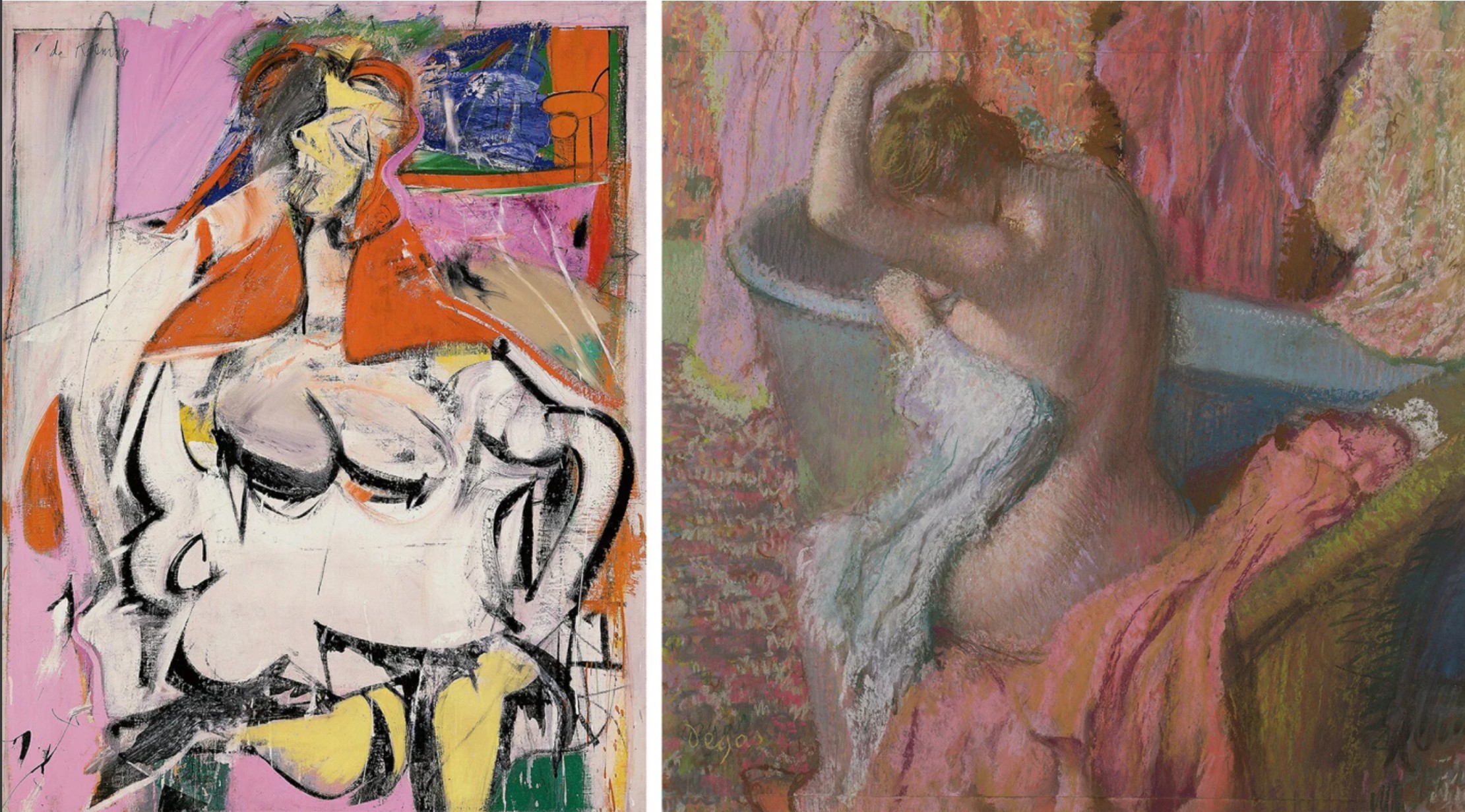
Left: Willem de Kooning, Woman, 1949. Private Collection. Art/Image: © 2026 The Willem de Kooning Foundation
Right: Edgar Degas, Bather, 1899 Private Collection. Image: © Bridgeman Images
What we encounter is not an assured likeness, but an exposed, volatile ‘emanation’ that charged a sense of presence Bacon sought to seize beyond resemblance. The tension between accident and precision was central to his method, and his way of evading what he called ‘illustration.’ The present work epitomises that high-wire balance, in which the image appears to cohere only moment by moment, always threatened by dissolution. As David Sylvester recorded, Bacon insisted: “The living quality is what you have to get. In painting a portrait the problem is to find a technique by which you can give over all the pulsations of a person… The sitter is someone of flesh and blood and what has to be caught is their emanation” (David Sylvester, Looking Back at Francis Bacon, London 2000, p. 98). In this painting, that ‘living quality’ is inseparable from damage: the face seems unable to settle into a fixed identity. Bacon’s twisted, scraped and gushed paint handling conveys arresting intensity and psychological depth, with pastel hues interwoven with electric swathes of mauve, pink and blue applied directly from the tube and punctuated by chalky whites that animate the surface. The constant alternation between abstraction and naturalistic detail gives the impression of the artist wrestling with his own appearance, the portrait registering solitude and melancholy not least through the violence inflicted upon the face itself — a potent cipher for the turbulence and loss surrounding Bacon at this moment in his life.
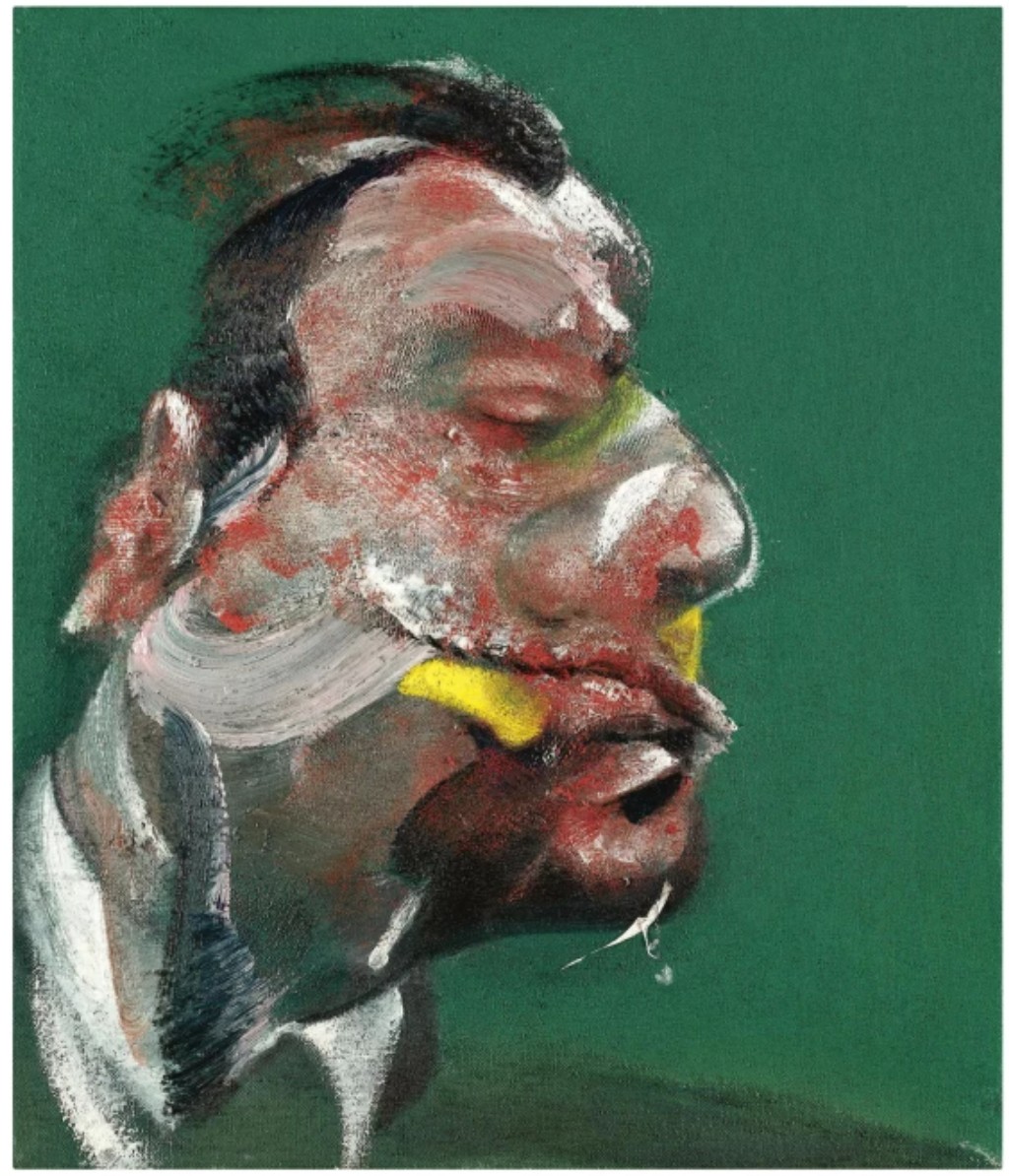
Francis Bacon, Study for Head of George Dyer, 1967. Private Collection. Sold Sotheby’s London, July 2008, for £13.8 million. Art/Image: © 2026 The Estate of Francis Bacon. All rights reserved, DACS
Bacon’s work from the early 1970s is widely regarded as his most introspective phase, shaped by accumulating grief and a corrosive sense of responsibility. Bacon never truly relinquished the guilt and responsibility he felt in fueling Dyer’s tragic juggernaut of a life, and the suite of large-scale ‘black triptychs’ painted between 1971 and 1974 offer exorcising lamentation over his death. Produced in tandem with these works, Bacon’s self-portraits proliferated and became increasingly complex. Across these mournful paintings, both large-scale and in the intimate fourteen-by-twelve-inch scale, the artist appears as a modern-day allegory for melancholia – leaning on a washbasin, with facial features violently mutilated, or with his wristwatch prominently emphasising life’s transience.
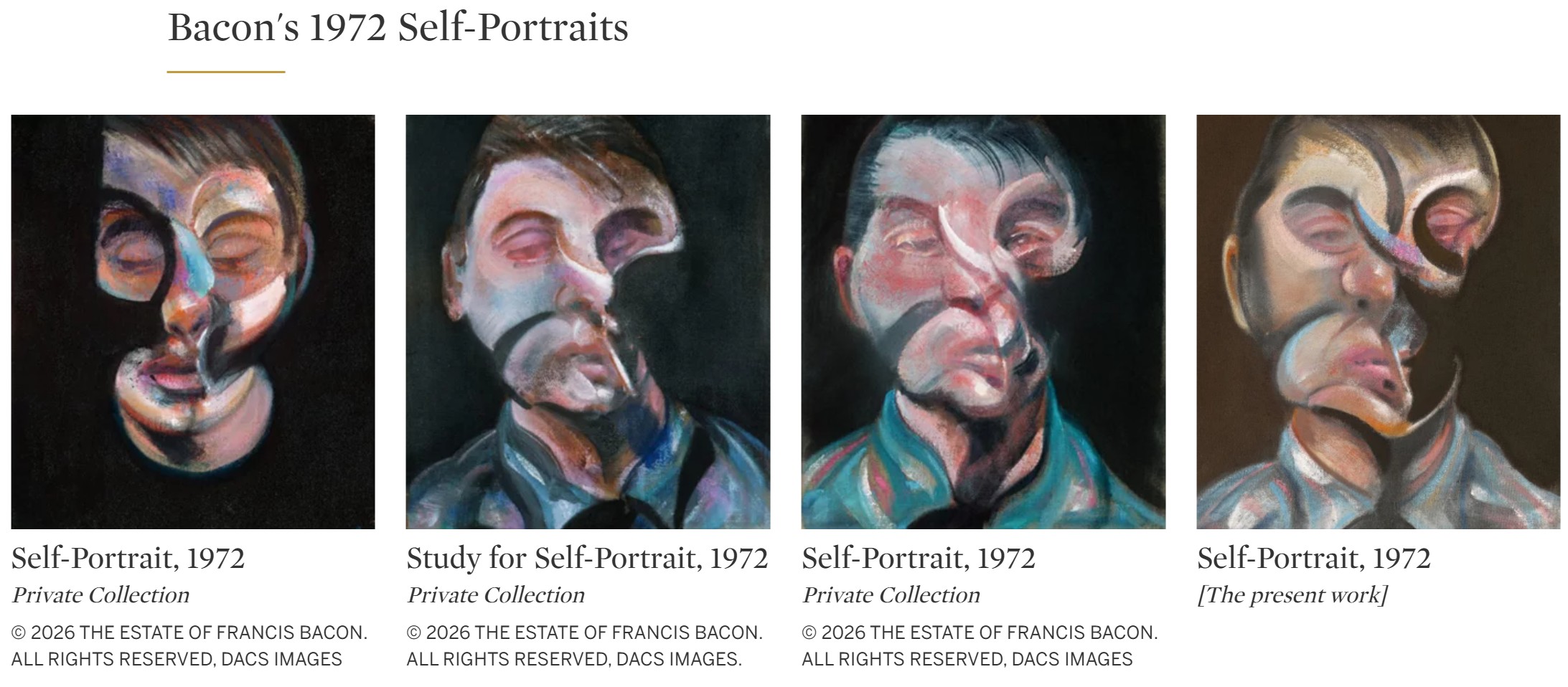
Whether heroically scaled or intimately proportioned, the self-portraits form a link to Oscar Wilde’s Portrait of Dorian Gray: where Bacon’s grief was stoically concealed from life, the canvases became the face of his suffering and pain. Not long after George Dyer’s tragic death in November 1971, the artist’s Soho companion and Vogue photographer John Deakin passed away. And, in an especially stark admission, he explained the proliferation of self-portraiture in the wake of such losses: “I’ve done a lot of self-portraits, really because people have been dying around me like flies and I’ve had nobody else to paint but myself” (the artist quoted in David Sylvester, Ibid., p. 129). Characteristically sharp in his admission, the self-portrait became a vehicle for the artist to express his sheer anguish and loss in the wake of Dyer’s death.
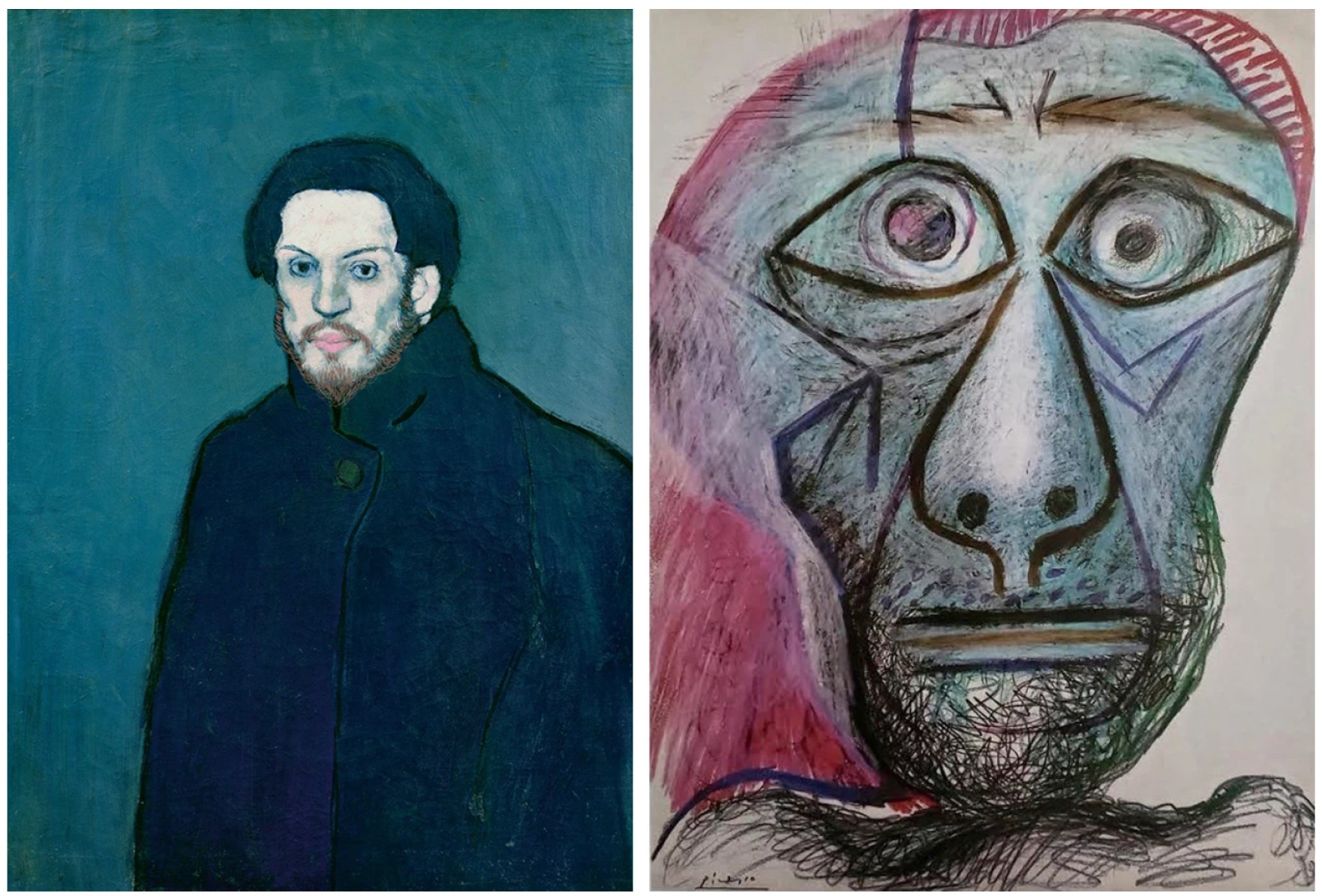
Left: Pablo Picasso, Self-portrait, 1901. Musée national Picasso, Paris. Art: © 2026 Succession Picasso, Image: DACS, London
Right: Pablo Picasso, Self-Portrait Facing Death, 1972. Fuji Television Gallery, Tokyo. Art: © 2026 Succession Picasso. Image: DACS, London
Peppiatt recalled Bacon in 1972 as “almost translucent, with a strange bluish hue as if he were deathly cold” (Mark Stevens and Annalyn Swan, eds., Francis Bacon: Revelations, London 2021, p. 566), an observation that seems to echo the chilled, blue-inflected tonality coursing through the present work, hovering somewhere between the pallor of the man himself and the familiar blue of the denim shirt he so often wore. In fact, the blue striped Turnball & Asser shirt he wears in the present work was the distinctive motif across many of the works from this period. It was, moreover, a period Bacon later framed as one of inward extremity: he spoke to Denis Wirth-Miller of a quasi-religious experience in the South of France, and spent week-long stays in the room at the Hotel des Saints-Pères where the incident had happened in an attempt to exorcise the trauma of Dyer’s death, making 1972 a year of stark self-reflection and contemplation. Bacon did not, however, romanticise bereavement: “Time does not heal. There isn’t an hour of the day that I don’t think about him [George Dyer]” (the artist quoted in Exh. Cat., Lugano, Museo d’Arte Moderna di Lugano, Francis Bacon, 1993, p. 44). This was emphasised by Anne Dunn who commented, “He was shattered by George’s death. He felt tremendously responsible – he hadn’t realised that George was in the state that he was” (Stevens and Swan, Op. cit., p. 565).
Self-Portrait was held in the collection of Bacon’s long-term physician Dr. Paul Brass. Brass had inherited Bacon as a patient from his father Dr. Stanley Brass. The present work was in fact gifted to Brass by the artist in the early 1980s as a token of his gratitude for Brass’ unwavering medical and emotional support during such a turbulent period. The violence of the present image resonates with Bacon’s medical record from 1972. Brass treated Bacon in early 1972 as he had “slipped on the stairs and one of the metal strips hit the right of his eye and put it half out” (Ibid., p. 566). In the doctor’s report from the time, Brass notes that “Fell 10 days ago – knocked out for 20 minutes – injured left side of face – laceration of left cheek and outer end of eyebrow Followed by left facial and frontal headaches” (Martin Harrison and Sophie Pretorius, eds., Revisions: Francis Bacon in the Act of Painting, London 2024, p. 48). However, Brass often used ‘fallen’ as a euphemism for Bacon’s injuries acquired during sex (Ibid, p. 51). These observations sharpen the painting’s emphasis on the orbital zone: the strained eyelid, mauve-shadowed socket, and the sense that the face has been gouged or partially collapsed. The pronounced indentation on one side of the face, warped lips, bruised chromatics, and reddened sclera – a device Bacon repeatedly employed in 1972 – register as painterly equivalents of laceration and swelling, while the dark ground appears to seep into the head, as if the void were consuming the portrait from within. The sustained injury is most apparent in Self-Portrait with Bandaged Eye (1972), in which the injury surfaces with unmistakable literalness.
“Anything I paint, if it comes off at all in my work, I feel it in myself. If I don’t feel it physically, I know it just can’t be working. With all the figures that work, I feel that this is physically right, and this is a thing that I feel within my body”
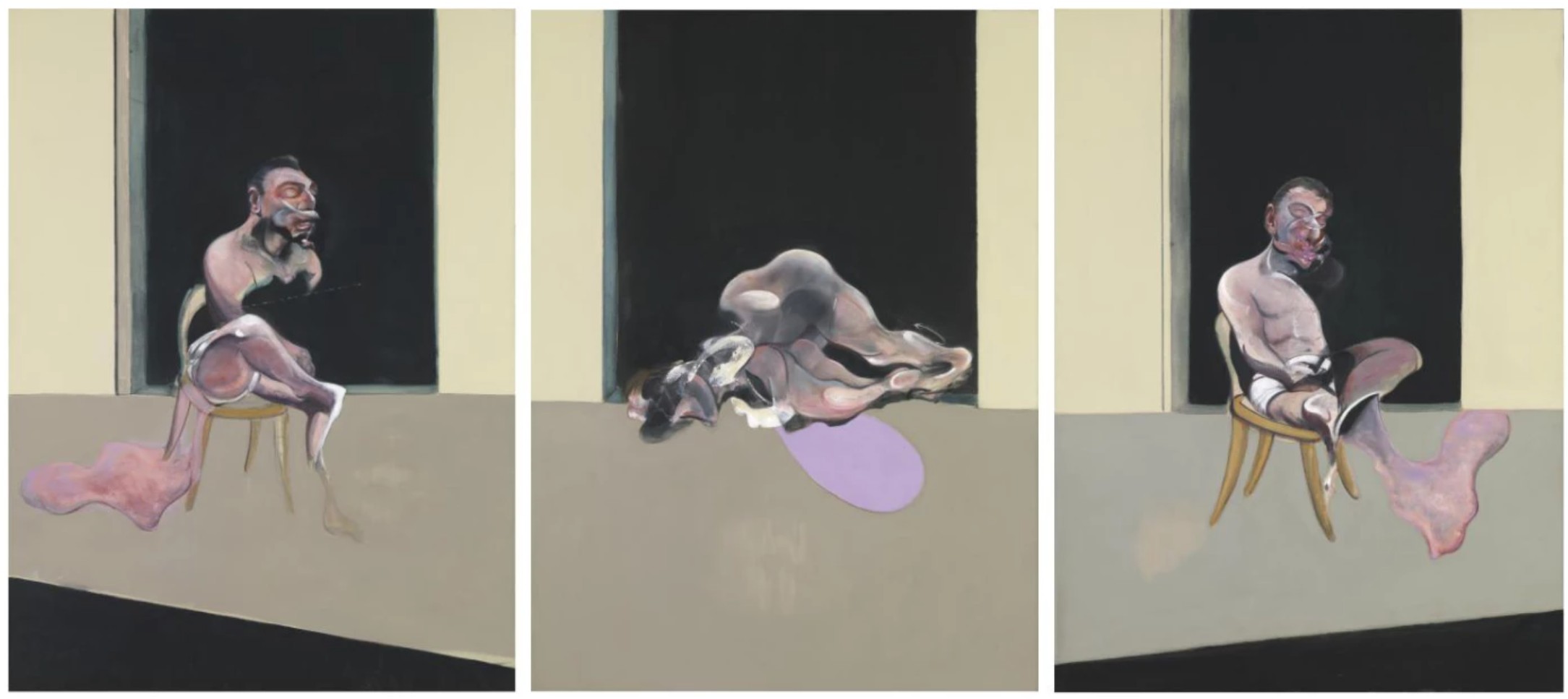
Fancis Bacon, Triptych August 1972, 1972. Tate, London. Art/Image: © 2026 The Estate of Francis Bacon. All rights reserved, DACS Images Francis Bacon/Photo: Tate
The work was first photographed by the Marlborough Gallery in early 1972, although the precise date remains uncertain; it was subsequently photographed again in October of that year in its final state, by which point Bacon had already undertaken further revisions. Such revisions were characteristic of his practice during this period. As Sophie Pretorius notes, “of the ten paintings of his face that Bacon made within two years of this injury, he had five of them returned to his studio to wound some more” (Ibid,, p. 48), often they were returned to him after initially being photographed. These reworkings were deliberate artistic modifications intended to intensify the image’s psychological charge. In the present painting, such revisions included “violating his face, making a dark incision into his cheek, and darkening the black mark surrounding the right-hand eye. In revising this painting […] Bacon darkened and thickened many of the black areas, a mannered kind of chiaroscuro. He also tended to revise the corners of mouths, so they bled into an area of darkness, perhaps an evocation of the abject drool and fluids leaving the body in death” (ibid, p. 51). As in the present work, Bacon often added further strokes of black paint to the hollow of the cheek or the crease of the eye socket, partially erasing and reconstituting the image in the same act. Within this context, the encroaching dark passages assume a distinctly corporeal urgency, transforming the self-portrait into an image of vulnerability in which Bacon appears simultaneously as observer and subject, with grief and guilt inscribed where stable likeness might traditionally reside.
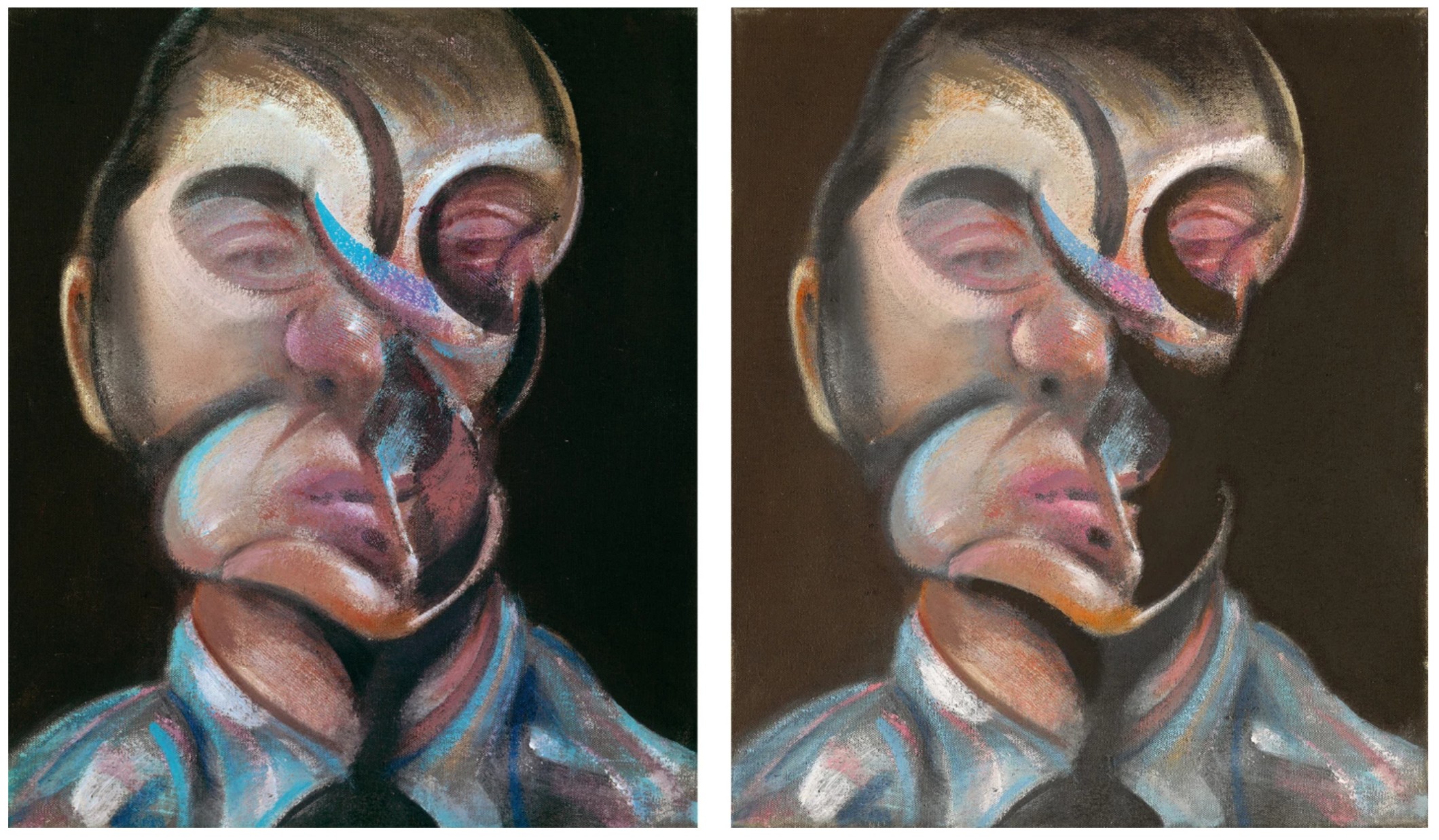
Left: First version of the present work, painted c. 1972. Art/Image: © 2026 The Estate of Francis Bacon. All rights reserved, DACS Images.
Right: The present work, photographed in October 1972
In this way, Bacon revitalized the genre of self-portraiture for the twentieth century with an unprecedented fusion of pictorial invention and psychological candor. As Michael Peppiatt has observed, Bacon’s self-portraits now stand among the “most pictorially inventive and psychologically revealing portraits of the Twentieth Century” (Exh. Cat., Rome, Galleria Borghese, Caravaggio Bacon, 2009, p. 210). The potency of Self-Portrait lies precisely in its refusal of narrative resolution or emotional consolation: the painting does not explain grief so much as embody its distortions, nor does it memorialize death symbolically; instead, it shows death “at work” within the living face (the artist quoted in Sylvester, The Brutality of Fact, pp. 130–133). Likeness is not pursued as an end in itself but as a vehicle for that volatile ‘emanation’ Bacon sought to capture – the unstable sense of human presence that persists even as the image fractures. Crucially, this ferocity is never merely destructive. The small scale intensifies rather than diminishes the painting’s ambition, confirming John Russell’s observation that Bacon’s fourteen-by-twelve-inch heads were “the scene of some of Bacon’s most ferocious investigations,” images that “carry their ghosts within them” (John Russell, Francis Bacon, London 1993, p. 99). In Self-Portrait, the face appears haunted – by previous states of the self, by the absent dead, by bodily vulnerability, and by the mirror’s relentless rehearsal of mortality – producing an intimacy that is less comforting than claustrophobic, as though the viewer were confined within the unyielding scrutiny of a mind unwilling to look away.
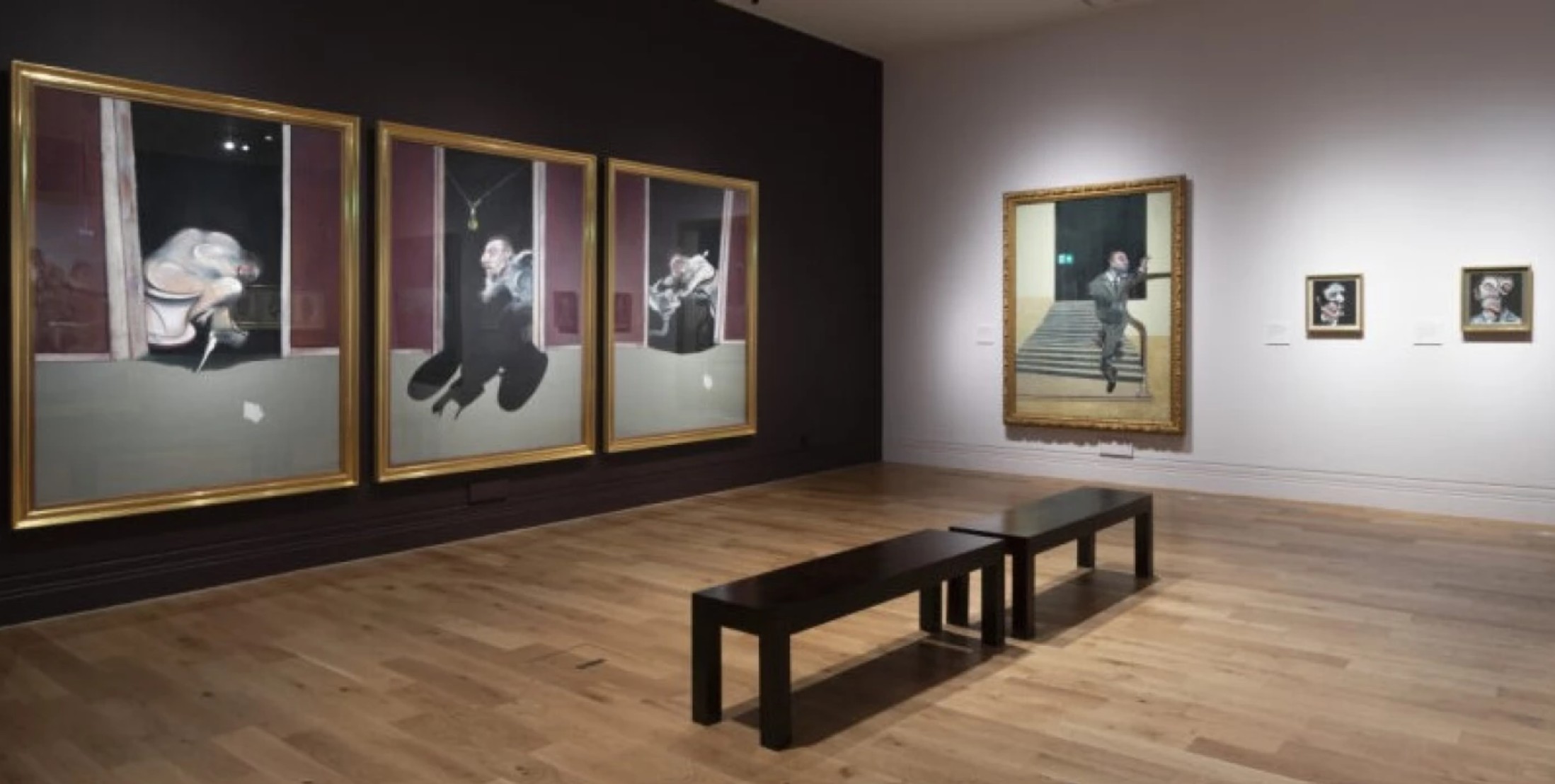
The present work installed in Francis Bacon: Human Presence, National Portrait Gallery, London, 2024. Art: © 2026 The Estate of Francis Bacon. All rights reserved, DACS Images. Image: National Portrait Gallery, London
If Bacon’s art sought the height of painterly expression as a reflection of life, then his self-portraits represented the core of that exploration. Throughout his career, from the first self-portrait of 1956 to the last in 1987, Bacon’s self-portraits register a life marked by extremes, responding directly to periods of exhilaration, loss, and reflection. If the late 1960s provided some of his happiest moments, the early 1970s provided undeniably his most introspective moment. The tension between these emotional poles, so powerfully distilled in Self-Portrait, produces one of the most complex depictions of emotional presence in modern art. The painting’s great achievement lies in its refusal to explain grief; instead, it gives visual form to its distortions. By confronting the viewer with a face that appears simultaneously present and collapsing, it implicates us directly in the act of looking. We witness an ongoing struggle between dissolution and form, grief and endurance, despair and fragile perseverance and one that secures Self-Portrait as a definitive masterwork within the canon of Bacon’s self-portraiture and within the longer tradition it so ruthlessly renews.
Rene Magritte
Les grâces naturelles, circa 1961
PROPERTY FROM A PRIVATE SWISS COLLECTION
Christie’s London: 5 March 2026
Estimated: GBP 6,500,000 – 9,500,000
GBP 8,520,000 / USD 11,381,870
RENÉ MAGRITTE (1898-1967), Les grâces naturelles | Christie’s
RENÉ MAGRITTE (1898-1967)
Les grâces naturelles, circa 1961
Oil on canvas
81.5 x 100.4 cm (32-1/8 x 39-1/2 inches)
Signed ‘Magritte’ (upper left)
Inscribed ‘”Les Grâces naturelles”’ (on the reverse)
Held in the same private collection for the last twenty-three years, and formerly on long-term loan to the Musée Magritte in Brussels, Les grâces naturelles is an evocative and charming example of René Magritte’s iconic Surrealist idiom during the final, valedictory phase of his career. At this time, Magritte was looking back on his life and career with a renewed focus, revisiting certain compositions and subjects that he felt held a particular poetic power that could be further explored in new work. It was this intention that led him to return to one of his most famous and intriguing motifs within his oeuvre, the magical ‘leaf-bird,’ caught in a moment of metamorphosis and change. Investigating concepts of transformation and dislocation, theatricality and mystery, the painting is a direct challenge to our passive understanding of the very nature of reality, posing a strange visual conundrum that forces us to stop and consider anew the world around us.
“There is nothing more graceful, nor more natural: the flora, the fauna and our gaze spring from the same ground.”
The early 1960s was an important period of consolidation in Magritte’s career. As he wrote to his dealer Alexander Iolas in 1959, ‘I ought to start painting fewer pictures soon. The fact is, the paintings to come will take me longer. I have reached a point where painting poses fresh problems for me and I cannot devote myself to easy things… The new paintings will not be worth looking at unless they bring us ideas that are indispensable’ (letter to Alexander Iolas, 1959; quoted in J. Meuris, Magritte, trans. J.A. Underwood, New York, 1990, p. 170). Through the ensuing years, Magritte deliberately restricted himself to motifs and subjects that he felt were emblematic of this way of thinking, exploring ideas that were not just visually stimulating, but profoundly thought-provoking. He explored chains of images across several canvases, studying different variations and permutations of a given motif, with each successive work representing an evolution of the pictorial concept.
Double portrait of René Magritte, 1962. Photograph by Duane Michals. Photo: © Duane Michals. Courtesy of DC Moore Gallery, New York.
Executed circa 1961, Les grâces naturelles is a striking example of this shifting approach in Magritte’s painterly practice. One of only around a dozen oil paintings he completed that year, the work offers an unusual variation on the leaf-bird motif, in which these otherworldly, hybrid creatures are set against a densely packed, decorative carpet of leaves. In doing so, Magritte conjoins two different strands of pictorial thought in a single image, making a vivid connection with other paintings from his oeuvre, to create a new angle from which to consider the beauty and mystery of the natural world.
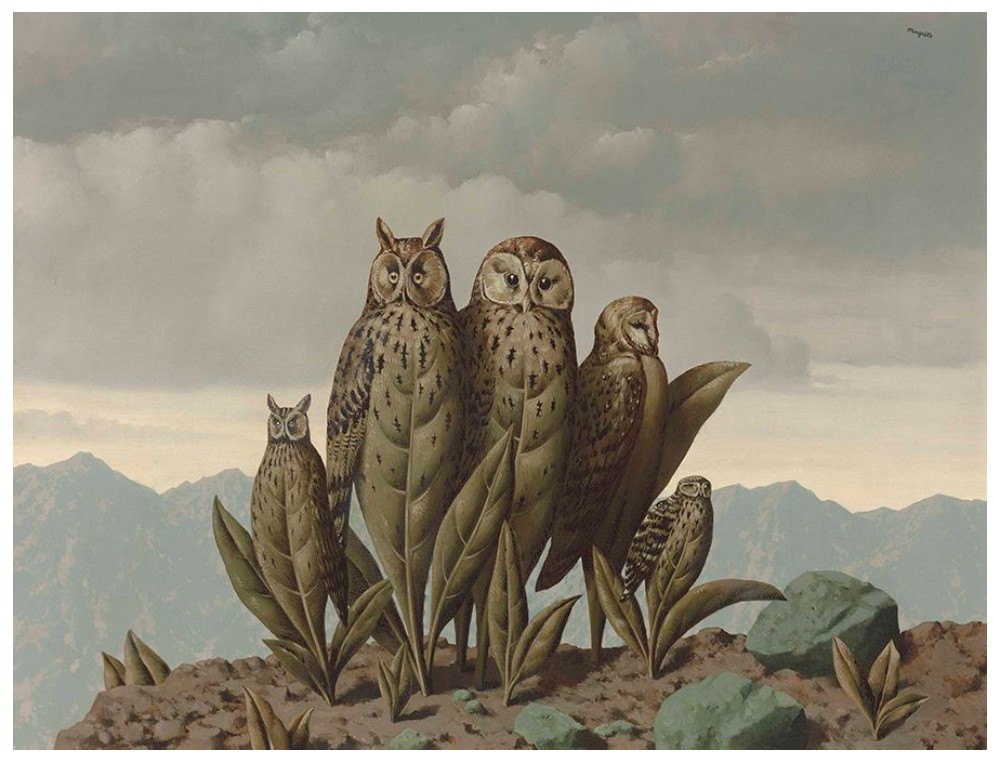
René Magritte, Les compagnons de la peur, 1942. Private collection. Artwork: © 2026 ADAGP, Paris and DACS, London.
The leaf birds had first emerged in Magritte’s paintings in the early 1940s, appearing in L’île au trésor (Sylvester, no. 498; Musées Royaux des Beaux-Arts de Belgique, Brussels) and Les compagnons de la peur (Sylvester, no. 499). Dating from the same year, both of these paintings present a bushel of these magical creatures perched atop a rocky outcropping, with a backdrop of mountains in the distance. However, while there is a lightness and dynamism to L’île au trésor, the leaf birds modelled after doves that appear to jostle one another as they attempt to take flight, in Les compagnons de la peur the mood is distinctly more sombre. Here, a small flock, or parliament, of owls appear from the leaves, their forms strikingly still as their watchful eyes monitor their surroundings. The leaf birds swiftly became a recurring subject in Magritte’s compositions through the War years, on occasion moving to an indoor setting, as in L’équateur (Sylvester, no. 502) and Le trait d’union (Sylvester, no. 514), though the majority remained rooted in the outdoors, most frequently the edge of a promontory or cliff, overlooking a picturesque vista or seascape.
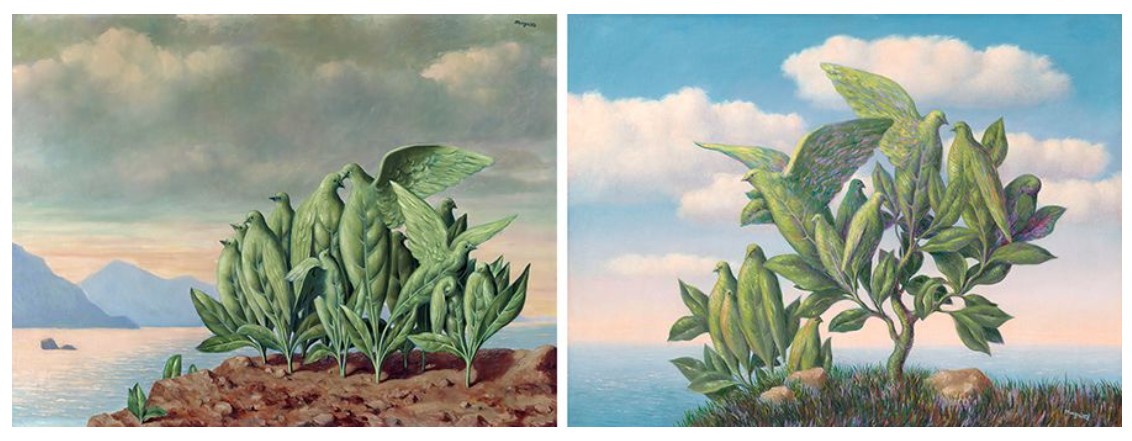
Left: René Magritte, L’Ile au Trésor, 1942. Musées Royaux des Beaux-Arts, Brussels. Artwork: © 2026 ADAGP, Paris and DACS, London. Digital image: akg-images. Right: René Magritte, L’Ile au Trésor, 1945. Private Collection. Sold Christie’s New York, November 2023, $13,247,500. Artwork: © 2026 ADAGP, Paris and DACS, London.
In one strange variation, seen in La saveur des larmes (Sylvester, nos. 664 and 665; Musées Royaux des Beaux-Arts de Belgique, Brussels and The Barber Institute of Fine Arts, Birmingham), the leaf bird is consumed by a small caterpillar, the insect’s feast leaving a trail of holes that puncture the creature’s body. The leaf bird in turn appears to droop despondently at the turn of events, perhaps lamenting their inability to escape this attack, and fly through the window beyond. The importance of the leaf-bird subject was reaffirmed on a monumental scale when it became one of the motifs Magritte included in his mural programme for the Casino Communal at Knokke-Le-Zoute in 1953. Writing about the project, the poet Paul Colinet vividly described the powerful, atmospheric effect conjured by the presence of the leaf birds: ‘L’île au trésor, where the trees have no foliage other than their songs’ (“Le domaine enchanté”: Panorama Surréaliste de René Magritte, Knokke, 1953, n.p.).
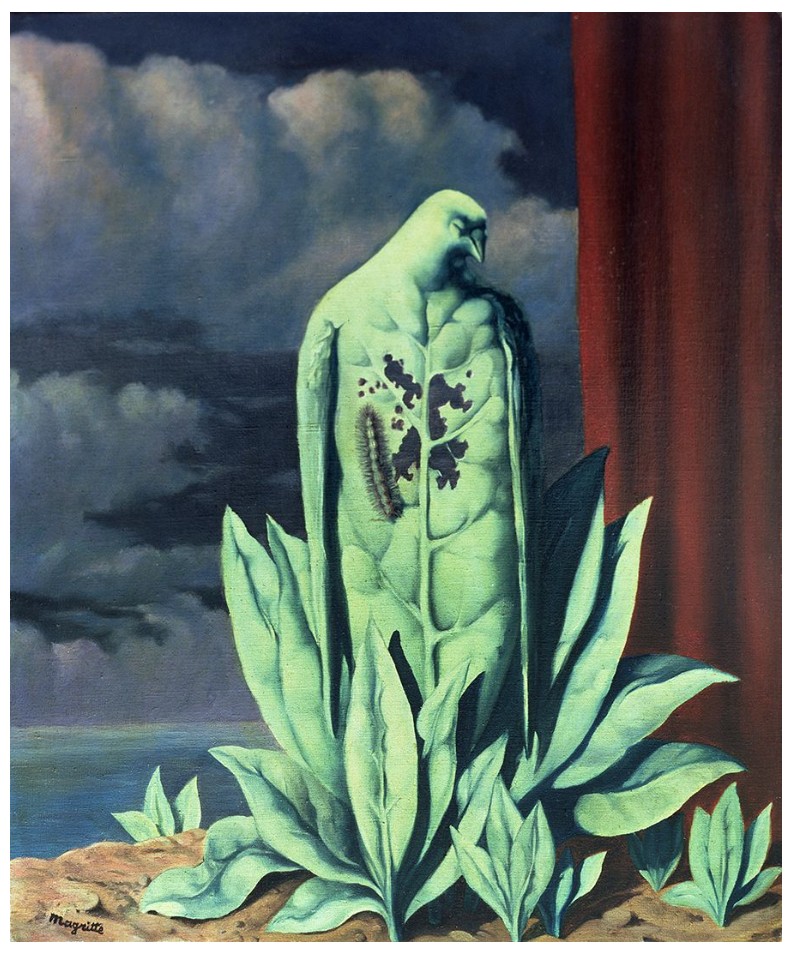
René Magritte, La saveur des larmes, 1948. The Barber Institute of Fine Art, Birmingham. Artwork: © 2026 ADAGP, Paris and DACS, London. Digital image: © Barber Institute of Fine Arts / © The Henry Barber Trust, The Barber Institute of Fine Arts, University of Birmingham / Bridgeman Images.
In Les grâces naturelles, Magritte travels along another avenue of thought. Here, seven leaf birds are executed with clarity and precision, their forms picked out in a palette of vibrant greens, with subtle nuances in tone suggesting the play of light across their forms. Part fauna and part flora, they present a striking, seemingly impossible, incongruity that plays on the viewer’s understanding of the two separate elements of this hybrid character. The elegant doves appear primed for flight, ready to take to the air at any moment, the delicate feathers of their wings picked out in clear, linear strokes of pigment. Yet, they are essentially grounded, held firmly in place by the roots that anchor them to the land. By this stage of his career, Magritte had become adept at converting his vision of the mysteries of the world into pictures that, through their iconic simplicity, conveyed their messages all the more strikingly. It is in its simplicity that Les grâces naturelles gains its strange, distinctive, revelatory power.
“I do not juxtapose strange elements to shock. I describe my thoughts of mystery which is the union of everything and anything we know.”
The concept of metamorphosis had long fascinated Magritte. Rather than simply marrying two different elements together, however, the artist found it particularly stimulating to render his subjects in an in-between state, picturing them in a moment of transition or flux. ‘I have found a new potential inherent in things,’ the artist wrote to his friend, the poet Paul Nougé in 1927, ‘their ability to become gradually something else, an object merging into an object other than itself… This seems to me to be something quite different from a composite object, since there is no break between the two substances, and no limit’ (in D. Sylvester, ed., René Magritte, Catalogue raisonné, London, 1993, vol. I, pp. 245-246). It is this type of partial transformation that gives the leaf birds their strange, surreal drama – capturing the creatures in the middle of their transformation, the artist handles the transition from vegetation to bird with extreme delicacy, allowing the green, waxy surface of the plant to gradually shift into the soft, plush plumage of the doves, emphasizing the shift in texture through light, flickering brushstrokes that convey a sense of the texture of their plumage.
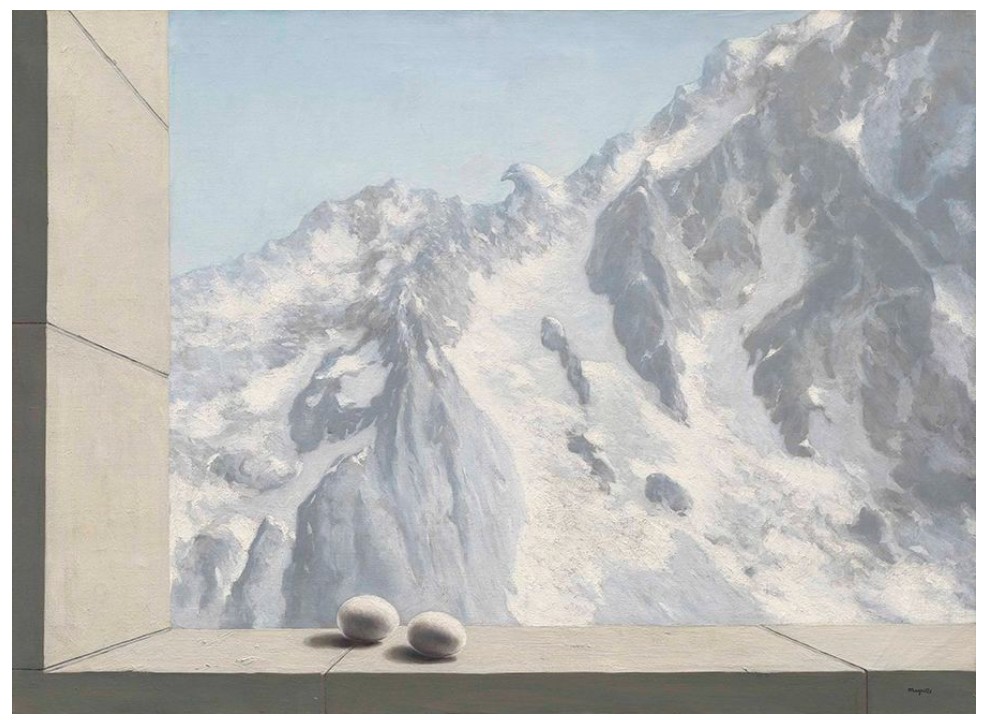
René Magritte, Le domaine d’Arnheim, 1938. Private collection. Sold Christie’s London, The Art of the Surreal Sale, 28 February 2017, £10,245,000 ($12,729,871). Artwork: © 2026 ADAGP, Paris and DACS, London.
Unexpectedly, the leaf birds in Les grâces naturelles are not placed in the settings typically associated with this motif. Eschewing the picturesque island vista or classical interior seen in previous works, Magritte instead chooses to position the creatures against a flat backdrop of dense foliage that he repetitively, painstakingly painted with exacting detail. In contrast to the tall, slender individual leaves of the hybrid bird-plant at the centre, the ground features layers of blue-toned, star-shaped leaves, each stem sprouting between five and seven leaflets in a pattern that suggests they originate from a horse chestnut tree. This highly detailed background, which Magritte used in several other compositions from the opening years of the 1960s including La cascade (Sylvester, no. 934), appears to have appealed to the artist not only for its decorative qualities, but also the manner in which it disrupts the sense of space within the picture.
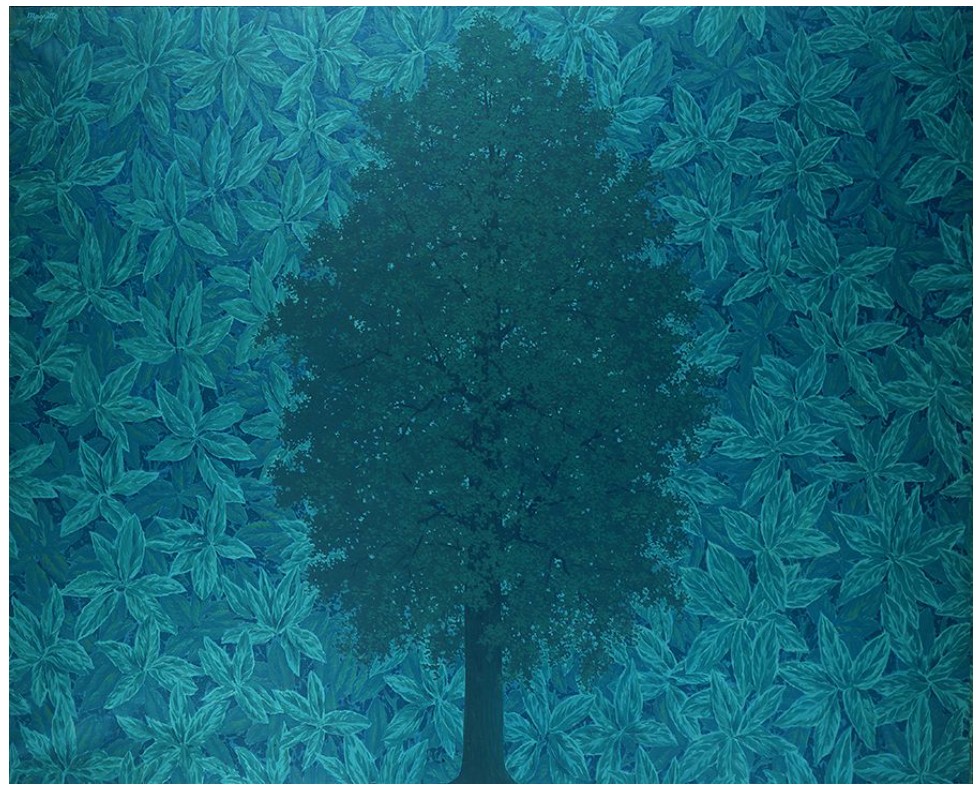
René Magritte, L’Arc de Triomphe, 1962. Private collection. Sold Christie’s London, July 2020, £17,798,750 ($22,518,662). Artwork: © 2026 ADAGP, Paris and DACS, London. Digital image: © Photothèque R. Magritte / ADAGP / DACS Images.
Here, the tightly woven verdure almost threatens to subsume the leaf birds in the dense layers of foliage, framing them in such a way as to focus our attention squarely on the magical, mysterious nature of their metamorphosis. While later, Magritte would paint close-ups of a smaller group of leaf birds against a small segment of the tree’s foliage (Sylvester, no. 976), in Les grâces naturelles he presents a more expansive view, allowing the leaves to fill the entire picture plane, with small glimpses of a lavender-hued sky just visible between the leaves. The contrast between the different types of foliage adds a further note of complexity to the scene – the star-like configurations of the background, seen en masse in this way, combined with their distinctive blue hue, renders the appearance of the leaf bird all the more strange, their taller, broader leaves and waxy texture suggesting they are an alien interloper within this natural environment.
While his earliest meditations on metamorphosis had focused on nude women in the midst of turning into wood or the sky, with the leaf bird paintings Magritte presents a subtler approach to the theme, invoking the many processes within the natural world in which one thing evolves into another, such as a caterpillar transforming into a butterfly. In this way, Magritte hoped to prompt his viewer to reconsider the inherent mystery and magic of everyday reality. ‘My images are not substitutes for either sleeping or waking dreams,’ he explained. ‘They do not give us the illusion of escaping from reality… I conceive painting as the art of juxtaposing colours in such a way that their effective aspect disappears and allows a poetic image to become visible. This image is the total description of a thought that unites – in a poetic order – familiar figures of the visible: skies, people, trees, mountains, furniture, stars, solids, inscriptions, etc. The poetic order evokes mystery, it responds to our natural interest in the unknown’ (quoted in H. Torczyner, Magritte: Ideas and Images, trans. by R. Miller, New York, 1977, p. 224).
“Our secret desire is for a change in the order of things, and it is appeased by the vision of a new order… The fate of an object in which we had no interest suddenly begins to disturb us.”
The result was a visual language laced with duality and contradiction, rife with juxtapositions and congruences that were intended to provoke and challenge the viewer. By confronting us with such discreet interplays, contrasts and comparisons, Magritte hoped to push us towards a more awe-filled appreciation of the world around us. As Harry Torczyner eloquently explained: ‘The magic of René Magritte is lucid. A Surrealist, he is unique in his deliberate approach and enchants with reality. He is surprising and disconcerting because, to use his own words, “I see to it that I paint only images which evoke the mystery of the universe”’ (‘The Magic of Magritte,’ 1964, in The Collection of Harry Torczyner, Esq., Christie’s New York, 1998, p. 27). In the present work, the natural order of the world has seemingly been upturned. The bird stretching its wings in the foreground prompts us to consider the next moment in the scene, as the transformation continues – will the dove break free from the bounds of its plant-form, soaring through the air, or forever remain stuck, rooted to the earth and bound by gravity.
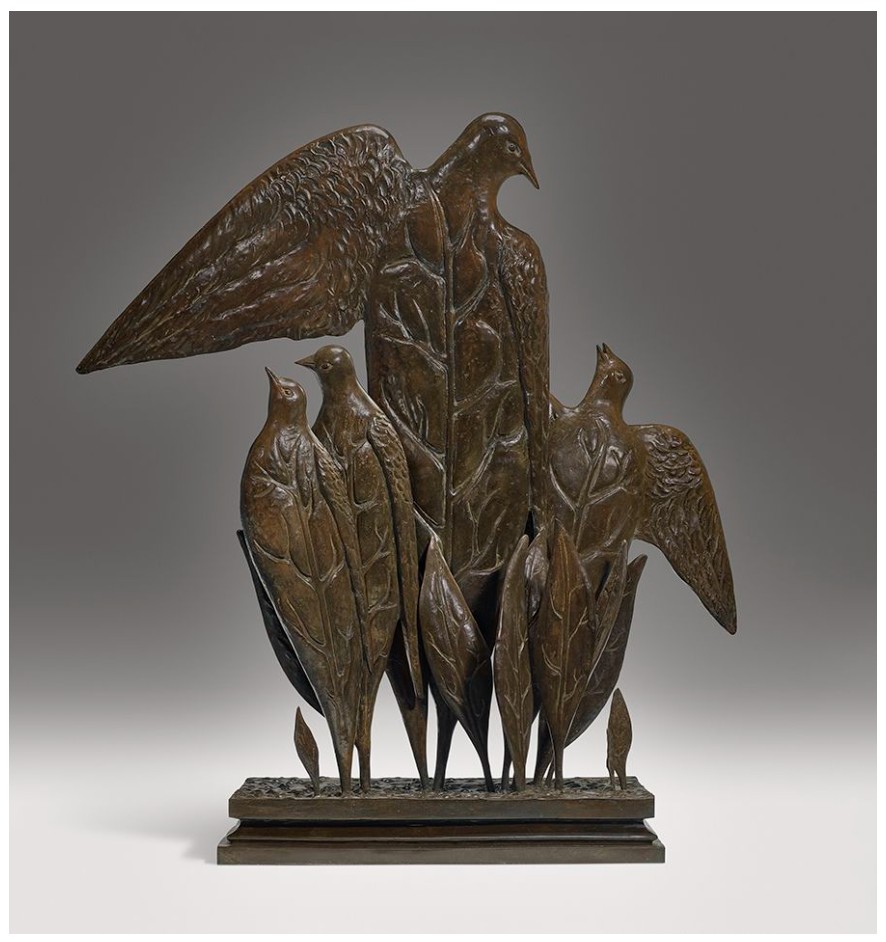
Artwork: © 2026 ADAGP, Paris and DACS, London.
The motif of the leaf bird continued to inspire Magritte at various intervals through the remainder of the decade, captivating his imagination. At the beginning of 1967, he began an ambitious project to transform a selection of his painted motifs into three-dimensional form, creating a total of eight large bronze sculptures (Sylvester, nos. 1087-1094), each of which brought to life the illusionistically rendered images of his painting. By translating one medium to another, Magritte masterfully expanded his upon the poetic potential of his vision. Transforming his fantastical imagery from the canvas into tangible form, he made a final great leap in his artmaking. Among the most successful motifs to be translated to bronze in this way, the leaf bird attained a powerful new potency, their hybrid forms now permanently fixed in this moment of metamorphosis.
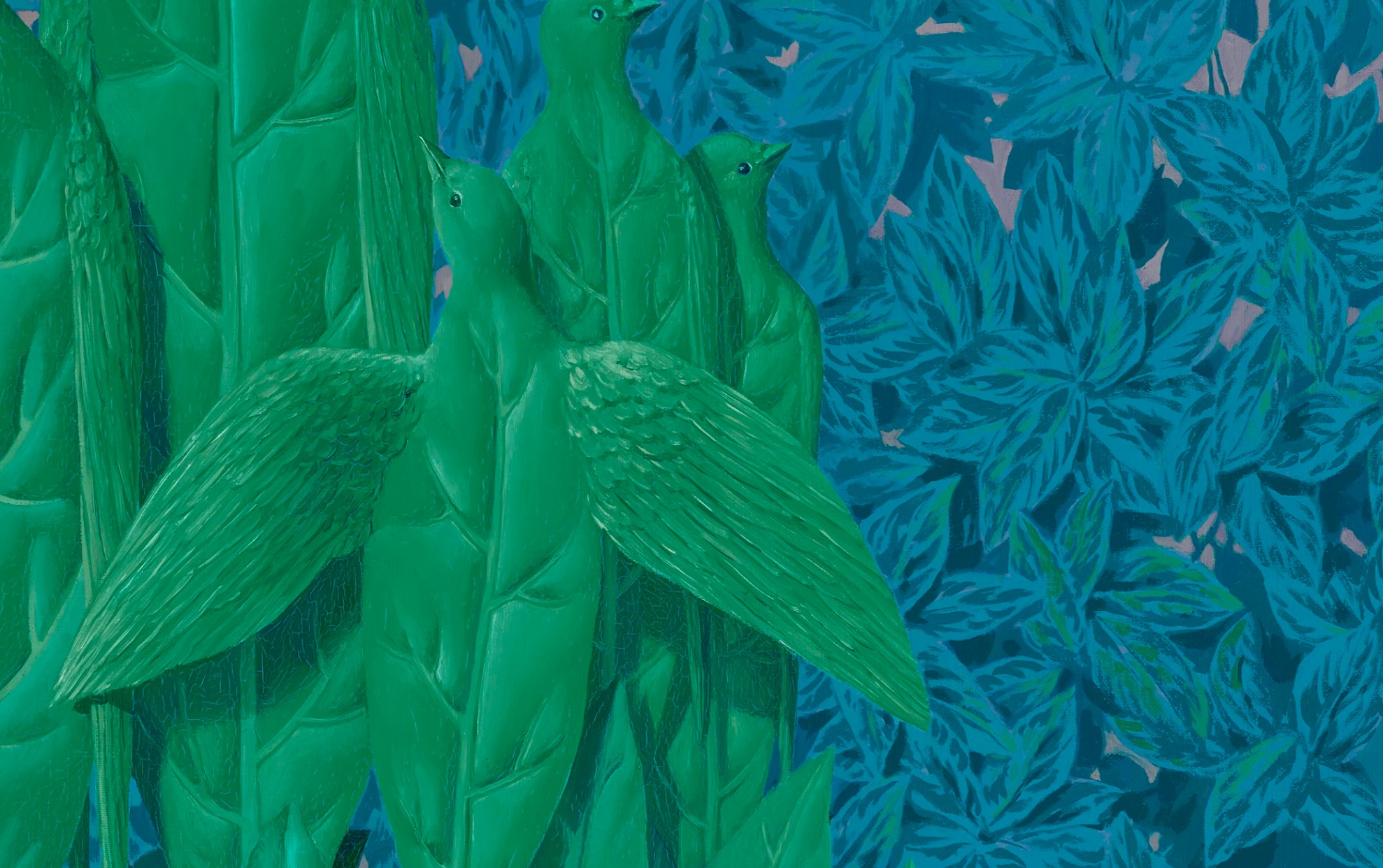
According to Marcel Mariëns, the title Les grâces naturelles, which recurred across several variations of the leaf-bird motif, including the present work, had been suggested to the artist by Paul Nougé. Magritte assigned great importance to the naming of his paintings, relying on a trusted network of friends and colleagues to suggest and debate potential titles for a finished work. In 1948, Magritte put pen to paper and across a series of handwritten manuscripts – now preserved in the Archives of Contemporary Art in Belgium and collectively known as “On Titles” – compiled his thoughts and musings the various solutions that had been reached in this way. For Les grâces naturelles, Magritte wrote: ‘Everything offered to our gaze on this canvas is distinguished in the highest degree by natural grace’ (quoted in D. Sylvester, ed., op. cit., 1993, vol. II, p. 378).
Le lieu-dit (The spot on the map), 1955
The Roger and Josette Vanthournout Collection
Christie’s London: 5 March 2026
Estimated: GBP 2,000,000 – 3,000,000
GBP 3,466,000 / USD 4,630,230
RENÉ MAGRITTE (1898-1967), Le lieu-dit (The spot on the map) | Christie’s
RENÉ MAGRITTE (1898-1967)
Le lieu-dit (The spot on the map), 1955
Oil on canvas
80.2 x 60.4 cm (31-5/8 x 23-3/4 inches)
Signed ‘Magritte’ (lower right)
Dated and inscribed ”’LE LIEU-DIT” 1955′ (on the reverse)
Dating to the first half of 1955, Le lieu-dit is a powerful illustration of René Magritte’s iconic painterly style during the mature period of his career, as he challenged and tested the boundaries of his viewers’ expectations and imaginations. Following the end of the Second World War, the artist had returned to a more precise mode of painting, and began to re-examine certain motifs, subjects and ideas that he felt remained ripe for further exploration, resulting in new variations and evolutions of earlier concepts and compositions. Magritte clearly felt that the present work was a highly successful example of this new approach, and chose to reproduce it almost immediately upon its completion in La carte d’après nature, the Surrealist review he had founded several years prior and published sporadically through the following decade. Across the twelve issues and two special editions, the review featured poetry and hand-coloured illustrations, short stories and Surrealist questionnaires, with contributions from the artist’s circle of close friends in Brussels, and variously appeared in the form of a simple postcard or a small booklet. Le lieu-dit was included in issue no. 9, and illustrated Magritte’s renewed fascination with an intriguing leitmotif that had first emerged in his work almost two decades prior – the majestic form of an eagle-shaped mountain.
A mysterious and unexpected landmark within a range of picturesque peaks, the eagle-mountain had initially appeared in 1937 in a pair of paintings titled Le précurseur (Sylvester, no. 417 and 418; 1936), and may have been partially inspired by a colour photograph featured on a travel brochure that Magritte had found and saved among his papers. A year later, Magritte solidified the subject in his now iconic Le domaine d’Arnheim (Sylvester, no. 456; Private collection), which invoked the writings of Edgar Allen Poe and played with the contrast and connection between a simple still life of eggs in the foreground and the grandeur of the eagle-shaped promontory in the distance. In Le lieu-dit, Magritte’s imagination moves in another direction, expanding on the central concept of Le domaine d’Arnheim and combining it with memories of alchemical imagery and his recent explorations on the theme of petrification, to create a beguiling, poetic image.
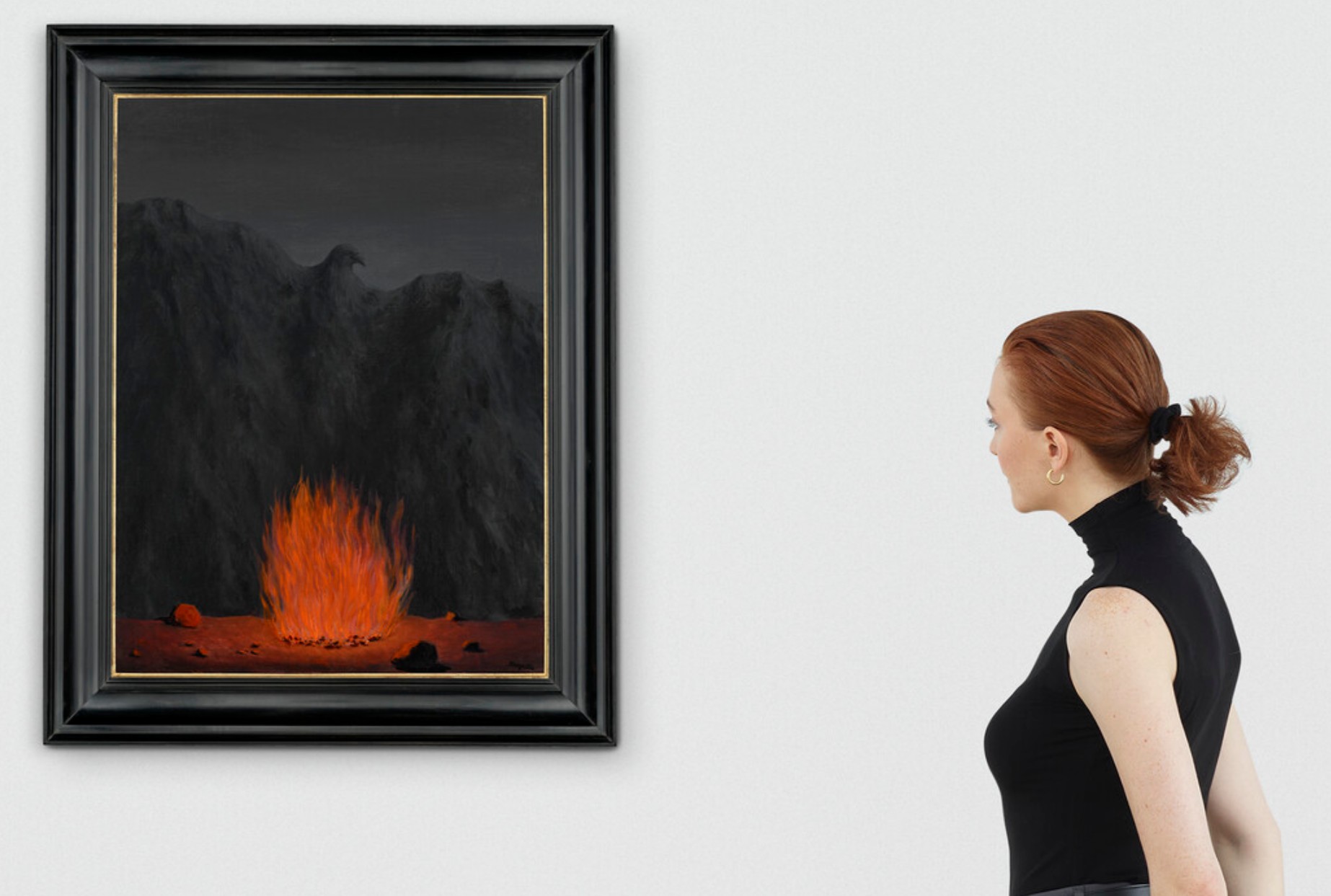
Here, the romantic grandeur of this magical scenery is accentuated by the nocturnal setting, the rocky mountain range cast in deep shadow as the sky darkens overhead and nighttime falls. In the foreground, the rippling flames of a blazing fire lick upwards into the air, its vivid energy and vibrant hue offering a stark contrast to the subtly variegated grisaille palette that characterises the rest of the landscape. There is an intense silence to the scene, the mystery of the situation heightened by the lack of a human presence around the camp fire. Despite the power of the flames, which casts a warm glow upon the surrounding ground, the eagle-mountain remains in darkness, suggesting there is a great distance between the viewer and the peaks, the cliff-edge visible beyond the fire perhaps indicating the presence of a deep canyon or gorge just out of view. As such, the profile of the bird in Le lieu-dit appears as if it may be a trick of the light, an illusion conjured by the flickering flames or tired eyes gazing into the shadowy darkness, that should right itself upon a second glance.
Le choeur des sphinges, 1964
PROPERTY FROM A PRIVATE BELGIAN COLLECTION
Christie’s London: 5 March 2026
Estimated: GBP 5,000,000 – 8,000,000
WITHDRAWN
RENÉ MAGRITTE (1898-1967), Le choeur des sphinges | Christie’s
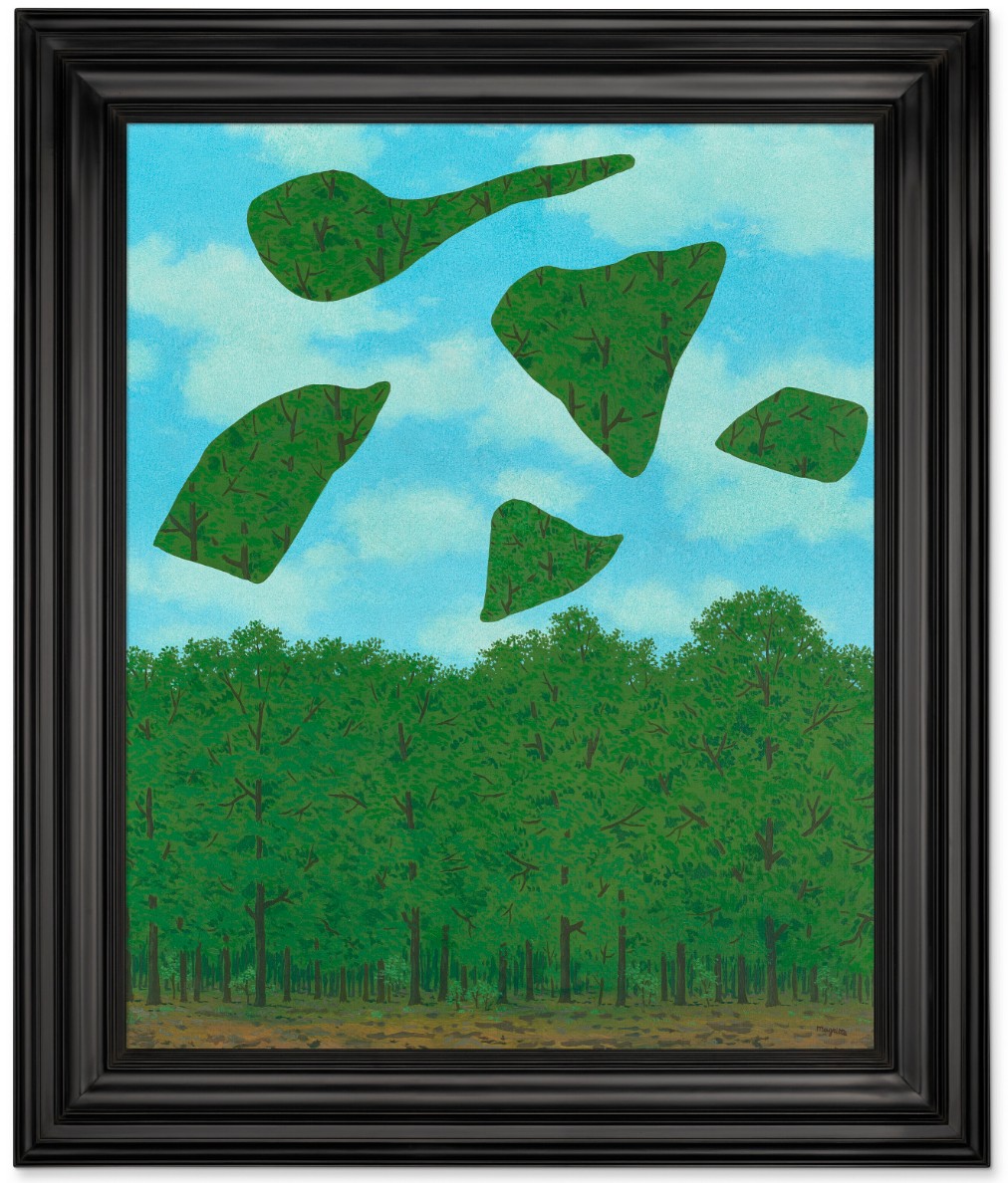
RENÉ MAGRITTE (1898-1967)
Le choeur des sphinges, 1964
Oil on canvas
100.4 x 81 cm (39-1/2 x 31-7/8 inches)
Signed ‘Magritte’ (lower right)
Inscribed ‘Le Chœur des Sphinges’ (on the reverse)
With its luminous sky and lush foliage, René Magritte’s Le choeur des sphinges presents a playful vision of the world. This landscape has been altered through Magritte’s signature transformations: above a forest float five shapes, one resembling his iconic pipe, each of them made with the same woodland frieze as the trees below them. Executed in 1964, this painting perfectly demonstrates the elegant simplicity that drove Magritte’s most successful compositions, allowing him to pry open the viewer’s appreciation of the mysteries of the world around us, which remain hidden in plain sight. As Herbert Read had written only a few years earlier, ‘by shuffling the cards, so to speak, [Magritte] produces an effect of super-reality – a reality intensified by a dislocation of the images. The distinction between fantasy and imagination has never been a precise one, but I would always cite Magritte as an example of a truly imaginative artist’ (quoted in P. M. Laski, ed., Magritte: Paintings, Drawings, Gouaches, exh. cat., London, 1961, p. 33).
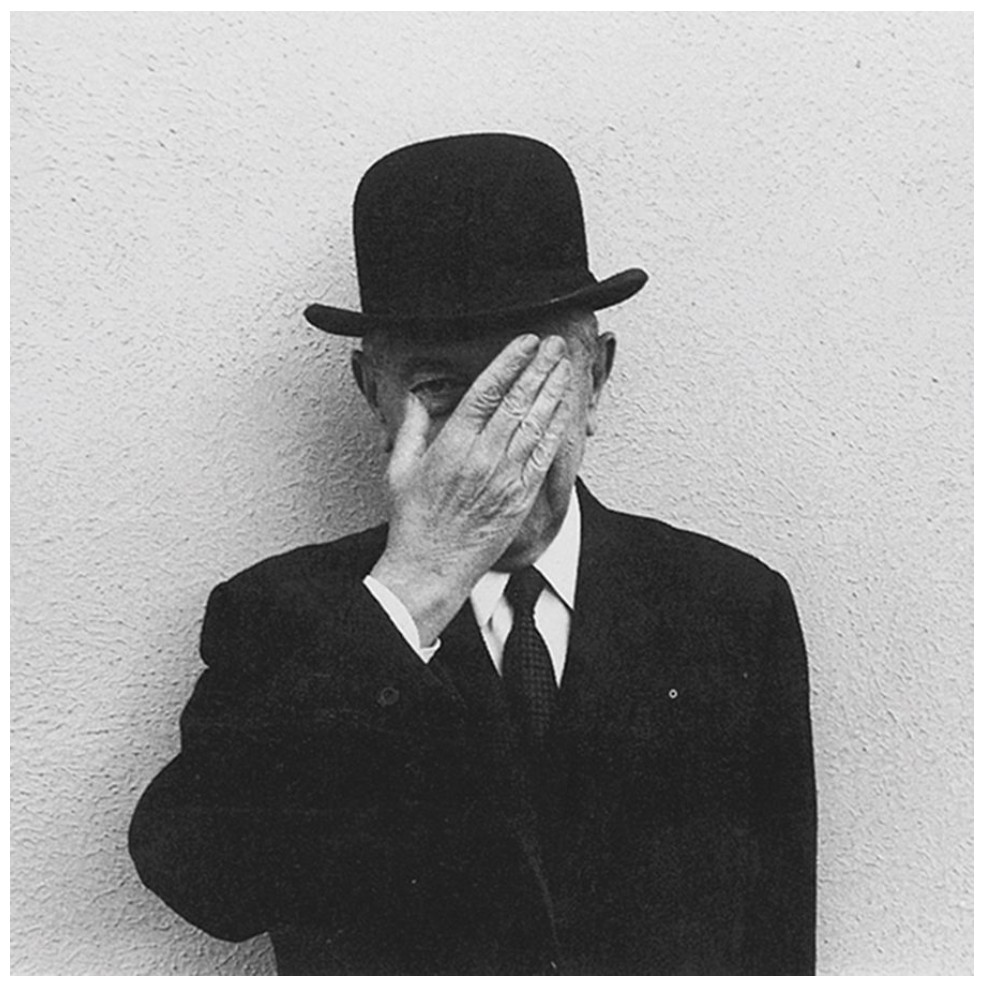
Magritte, 1962. Photograph by Duane Michals. Photo: © Duane Michals. Courtesy of DC Moore Gallery, New York.
The eloquent quality of Le choeur des sphinges is made all the more impactful by its significant scale in relative terms compared to many of Magritte’s paintings, and it is a reflection of its success that it has enjoyed a distinguished history. As well as featuring in a number of international exhibitions, including both group and monograph shows, Le choeur des sphinges has a distinguished provenance: it was acquired directly from Magritte by one of his most important post-war patrons, Gustave Nellens. Between 2016 and 2022 it was also on long-term loan to the Musée Magritte in Brussels.
Magritte’s pictures often play with the mechanics of sight and representation. In Le choeur des sphinges, this is evident not only in the interplay between the objects floating in the sky and their tree-like appearance, but also in the shape of the main element, which recalls the silhouette of a pipe. Over the years, the pipe had become one of Magritte’s most recognised emblems, in part thanks to his early masterpiece, La trahison des images of 1929, now in the Los Angeles County Museum of Art. In that work, a highly literal painting of a pipe hovers above the words: Ceci n’est pas une pipe, or ‘This is not a pipe.’ In that picture, Magritte was declaring that likeness is only that, and begging his viewer to interrogate the entire nature of pictorial representation. After all, his statement was correct: it was not a pipe, but a two-dimensional image of one. In Le choeur des sphinges, Magritte’s illumination of the rupture between an object and its representation is pushed further by the pipe appearing as a silhouette filled with trees.
The largely amorphous shapes that are shown in the upper half of Le choeur des sphinges are, with the exception of the pipe, evocative without being illustrative. In this, they recall some of Magritte’s earlier paintings exploring meaning, such as L’espoir rapide of 1927. In that ‘word-painting’, similar shapes are juxtaposed with words and phrases – ‘tree’, ‘cloud’, ‘village on the horizon’, which have only the faintest relationship to their supposed meanings. In Le choeur des sphinges, the nebulous associations provided by words in that earlier painting are eschewed, leaving the viewer to interpret the forms.
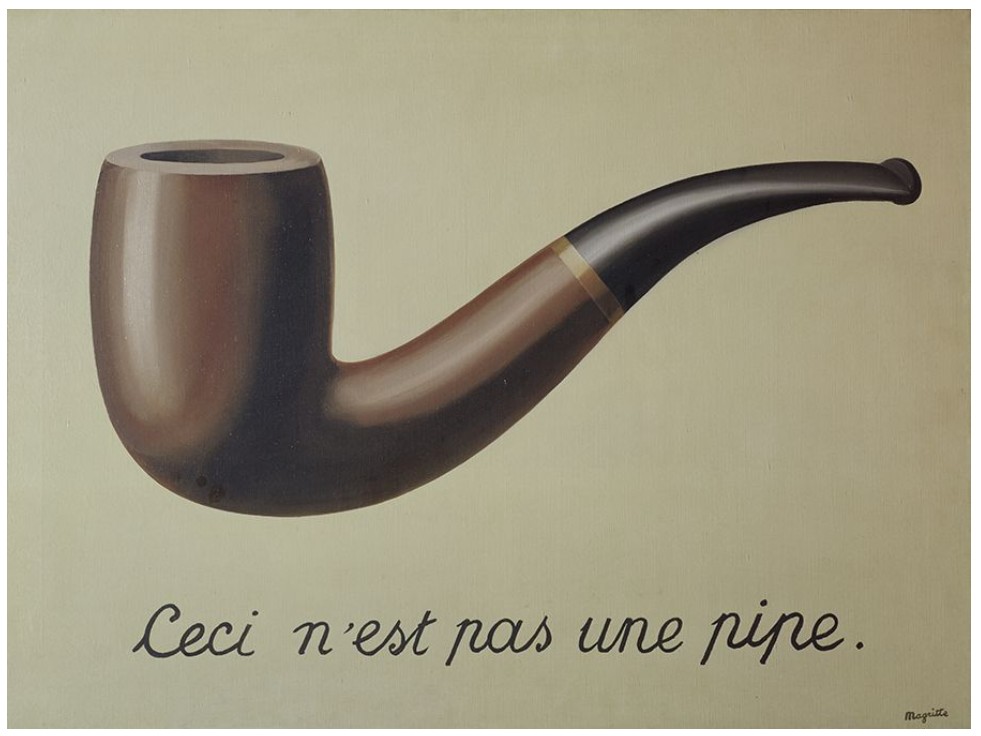
René Magritte, La trahison des images (Ceci n’est pas une pipe), 1929. Los Angeles County Museum of Art, currently on view at the Board Contemporary Art Museum, Los Angeles. Artwork: © 2026 ADAGP, Paris and DACS, London. Digital image: Bridgeman Images.
During the 1960s, Magritte often turned to themes from the earlier part of his career, sometimes infusing them with a levity that had been absent earlier. For some time, he had been selling works, mainly on paper, to the Chicago collectors Barnet and Eleanor Hodes, who often acquired gouache variations of some of Magritte’s most celebrated themes. This meant that there was a retrospective air to some of Magritte’s works of the period. In the case of Le choeur des sphinges, this is encapsulated not only by the pipe and other forms, but also their resemblance to collage elements.
During the 1920s, Magritte had begun to create collages, often cutting shapes from sheet music and incorporating them within his compositions, a technique he returned to again and again over the decades. In his earliest collages, influenced in part by those of Max Ernst, Magritte also included other picture elements and shapes. These tended to exploit the disconnect between the materials that he inserted into his compositions and the forms that they assumed, for instance with the sheet music becoming curtains, birds or figures. Soon, the collage forms seeped into Magritte’s paintings too. In L’esprit comique, for example, a 1928 painting now in the Neue Nationalgalerie, Berlin, Magritte showed a figure stalking across a near-lunar landscape, the silhouette resembling a geometric paper cut-out. In a sense, it is true both of that early painting and Le choeur des sphinges that, as Max Ernst observed, Magritte created, ‘collages painted entirely by hand’ (quoted in D. Sylvester, Magritte, Brussels, 2009, p. 140).
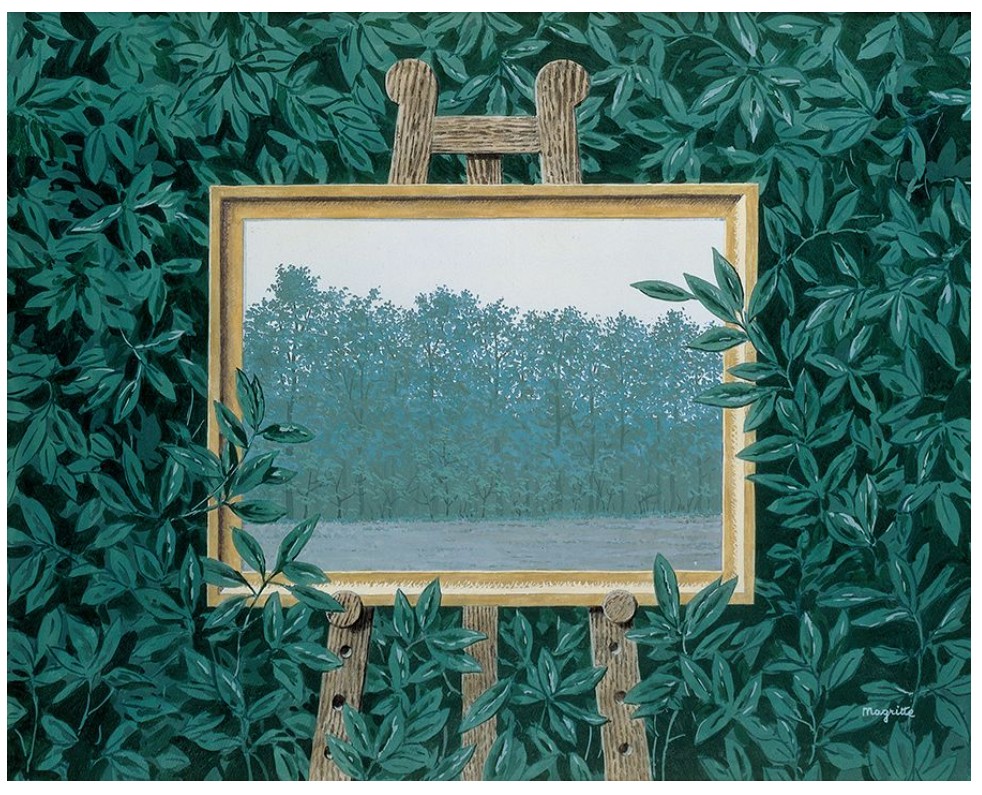
René Magritte, La cascade, 1961. Private collection. Artwork: © 2026 ADAGP, Paris and DACS, London.
Ernst’s observation expresses in a few words the driving force behind Magritte’s pictures. As Magritte himself explained in the year that Le choeur des sphinges was painted: ‘I have a very limited vocabulary: nothing but ordinary, familiar things. What is “extraordinary” is the connection between them… These strange unions, it’s inspiration that provokes them. Suddenly, an image arises in me. My role is to describe it, without being fanciful, on my canvas’ (quoted in K. Rooney and E. Plattner, René Magritte: Selected Writings, Richmond, 2016, p. 214).
This is the process at play in Le choeur des sphinges, where there is no truly impossible element. Instead, his manner of presenting woodland, sky, pipe and other forms prompts the viewer to look afresh at the world through his idiosyncratic transformations, or as Read termed them, ‘dislocations.’ Magritte thus coaxes out of our everyday existence a sense of wonder. ‘I conceive painting as the art of juxtaposing colours in such a way that their effective aspect disappears and allows a poetic image to become visible,’ he explained elsewhere. ‘This image is the total description of a thought that unites – in a poetic order – familiar figures of the visible: skies, people, trees, mountains, furniture, stars, solids, inscriptions, etc. The poetic order evokes mystery, it responds to our natural interest in the unknown’ (quoted in H. Torczyner, Magritte: Ideas and Images, trans. R. Miller, New York, 1977, p. 224).
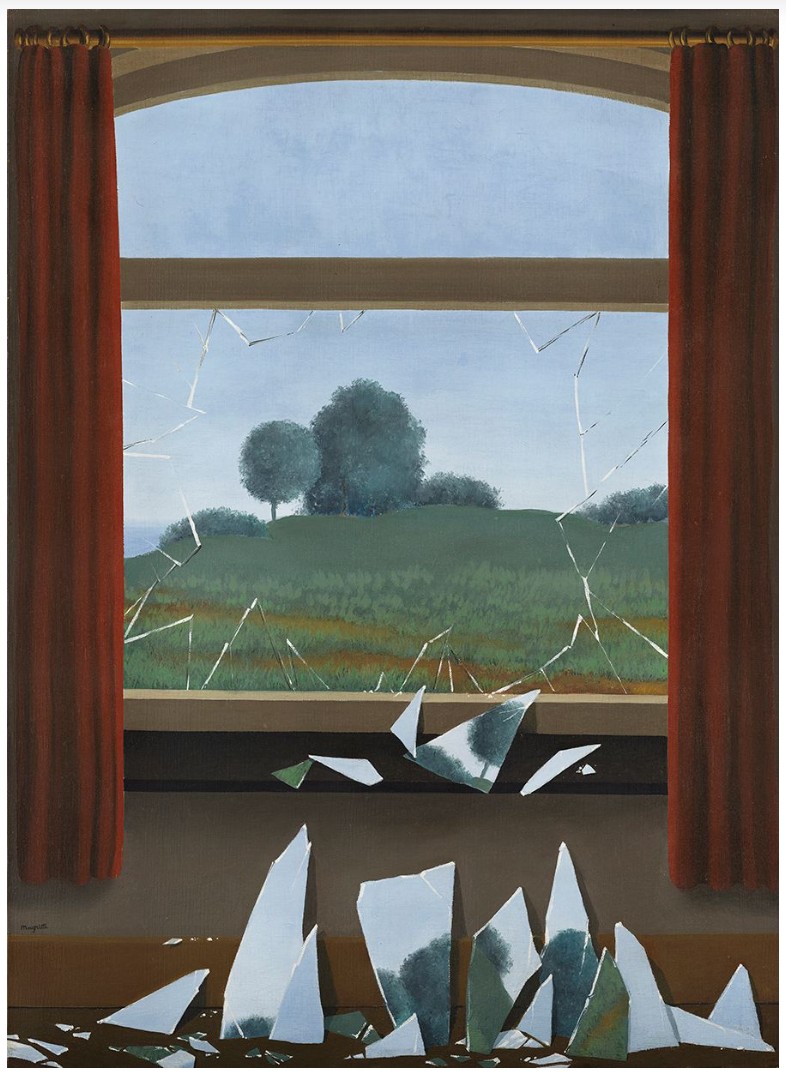
René Magritte, La clef des champs, 1936. Museo Nacional Thyssen-Bornemisza, Madrid. Artwork: © 2026 ADAGP, Paris and DACS, London. Digital image: © Museo Nacional Thyssen-Bornemisza, Madrid / Bridgeman Images.
In many ways, Magritte’s works of the post-War period streamlined the aesthetic concepts that he had honed earlier. When he had still been under the direct influence of Ernst and of Giorgio de Chirico, the sense of mystery that he had sought to express sometimes had a sinister edge. However, the Second World War and the Occupation of his native Belgium changed all that. Magritte had initially fled from the German advance but ended up living under the Occupation. It may seem counterintuitive, considering the responses of some of Magritte’s contemporaries to the war, but at this point he saw it as his duty to bring joy and sunlight into his pictures, and the world. Although he was discussing the paintings he created in a faux-Impressionist idiom, the following words remain to some extent true of much of his work from the 1940s onwards: ‘The German occupation marked the turning point in my art. Before the war, my paintings expressed anxiety, but the experiences of war have taught me that what matters in art is to express charm. I live in a very disagreeable world, and my work is meant as a counter-offensive’ (quoted in S. Gablik, Magritte, London, 1992, p. 146).
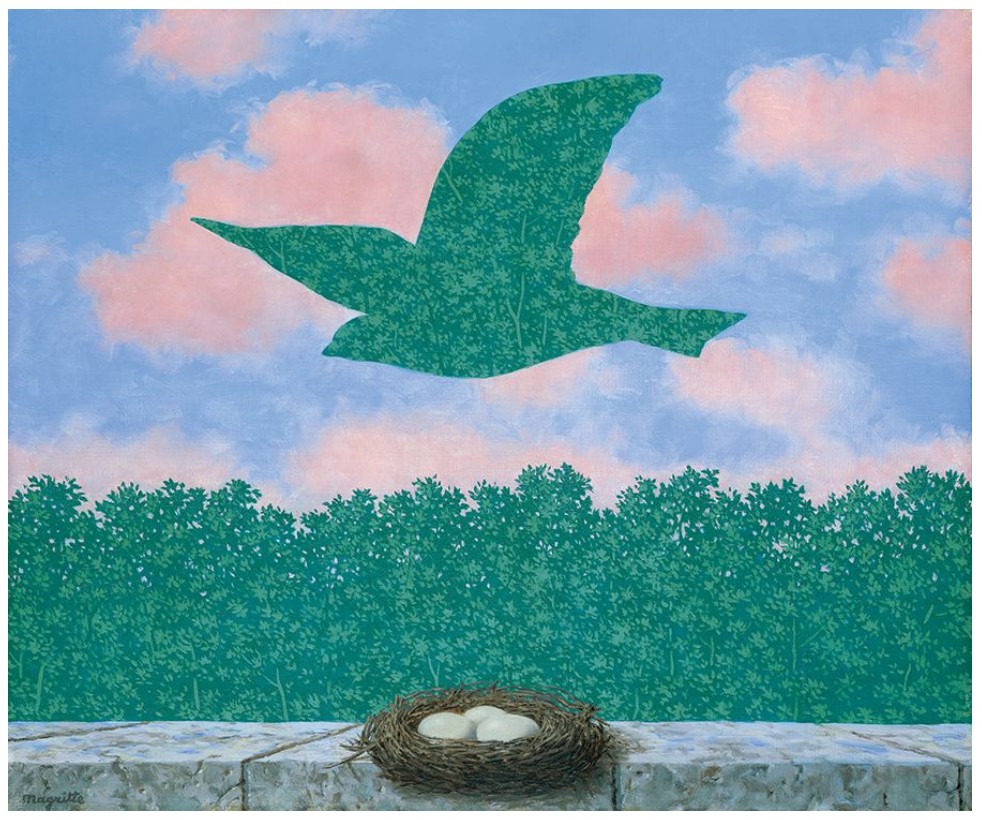
René Magritte, Le printemps, circa 1965. Private collection. Artwork: © 2026 ADAGP, Paris and DACS, London.
In Le choeur des sphinges, while there may not be any Impressionist or Fauve stylisation, the dense woodland gives it a sense of rich greenery that might be seen to recall the works of ‘Le Douanier’ Rousseau, an artist from the earlier part of the Twentieth Century whose works were often denigrated as much as they were celebrated. In this, Magritte identified a snobbery that was itself opposed to joy, and he sought to criticize and counter it where possible. The greenery of Le choeur des sphinges invokes the jungle-scapes, forests and other verdant settings that were almost characters in their own rights in Rousseau’s pictures. Certainly the vibrant greens and the glowing, azure sky insistently usher in light and joy.
In the post-war years, the same shift that saw Magritte expunge some of the darker tensions from his works also resulted in his simplifying many of his compositions. Harking back to some of his earliest masterpieces of the 1920s and 1930s, he often focussed on creating works that appeared streamlined, even if the concepts that underpinned them remained multifaceted and complex. It was unsurprising that Magritte had an eye for an image that would work, as in the earlier part of his career, he had created advertisements. In the 1960s, that training saw him creating works such as Le choeur des sphinges that shared their foundations with successful ads. Voided of distracting, extraneous details, Magritte’s works therefore struck with a visual immediacy akin to the contemporaneous Pop Art.
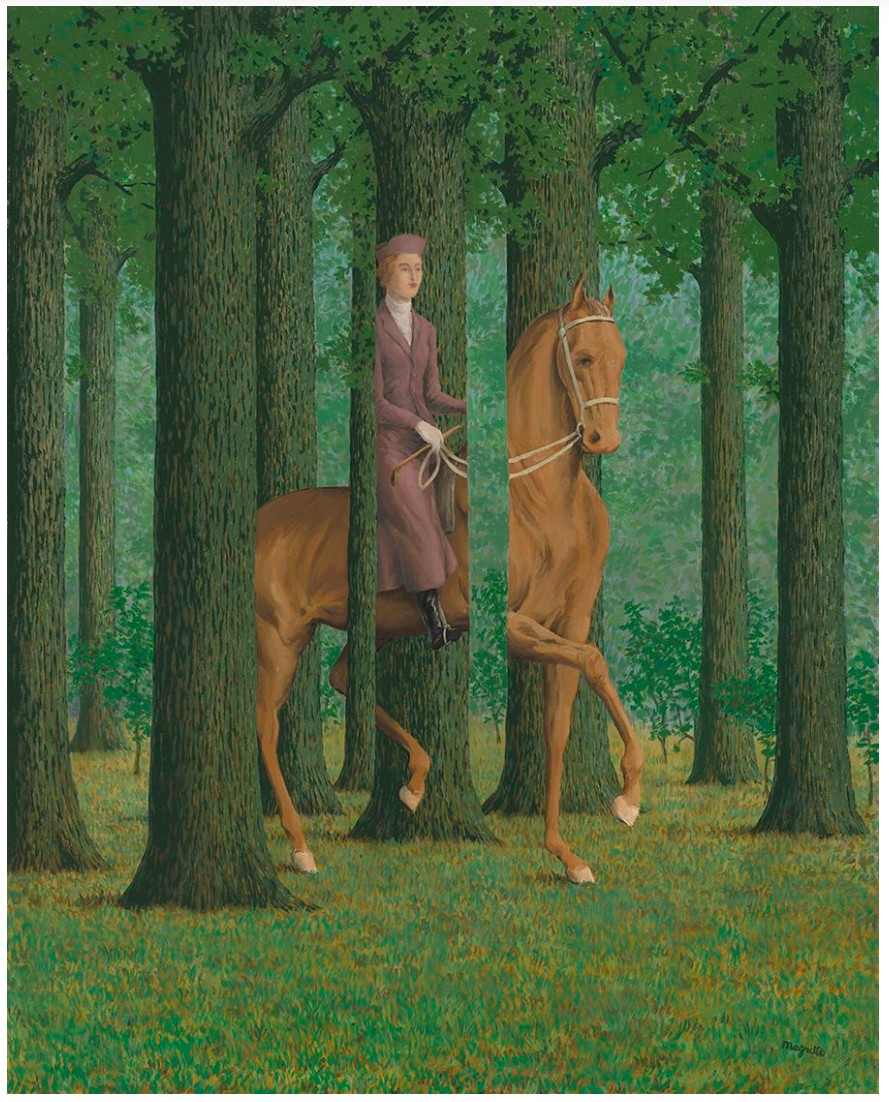
René Magritte, Le blanc-seing, 1965. National Gallery of Art, Washington, D.C. Artwork: © 2026 ADAGP, Paris and DACS, London.
Digital image: Courtesy National Gallery of Art.
In a sense, Le choeur des sphinges shares some of the mechanics of works that were being created across the Atlantic at the time. In particular, Magritte’s toying with the concept of the depth (or lack thereof) of a two-dimensional composition were explored by Roy Lichtenstein, for instance in his Desert Landscape II, a painting from 1964 now in the Yale University Art Gallery. There, Lichtenstein used dots of blue of varying densities to give a sense of the sky that is emphatically artificial, only accentuated by the ribbons of white and yellow that denote the clouds above and sand below. While Lichtenstein was exploring the entire mechanics of vision, tapping into the aesthetic language of print in order to create an image that somehow transcended its constituent parts when viewed, Magritte was carrying out a similar process in order to eke out the very poetry of existence. Lichtenstein has disrupted the process of painting in order to create quasi-Platonic ideal images of landscapes, while Magritte has done so in order to convey mystery.
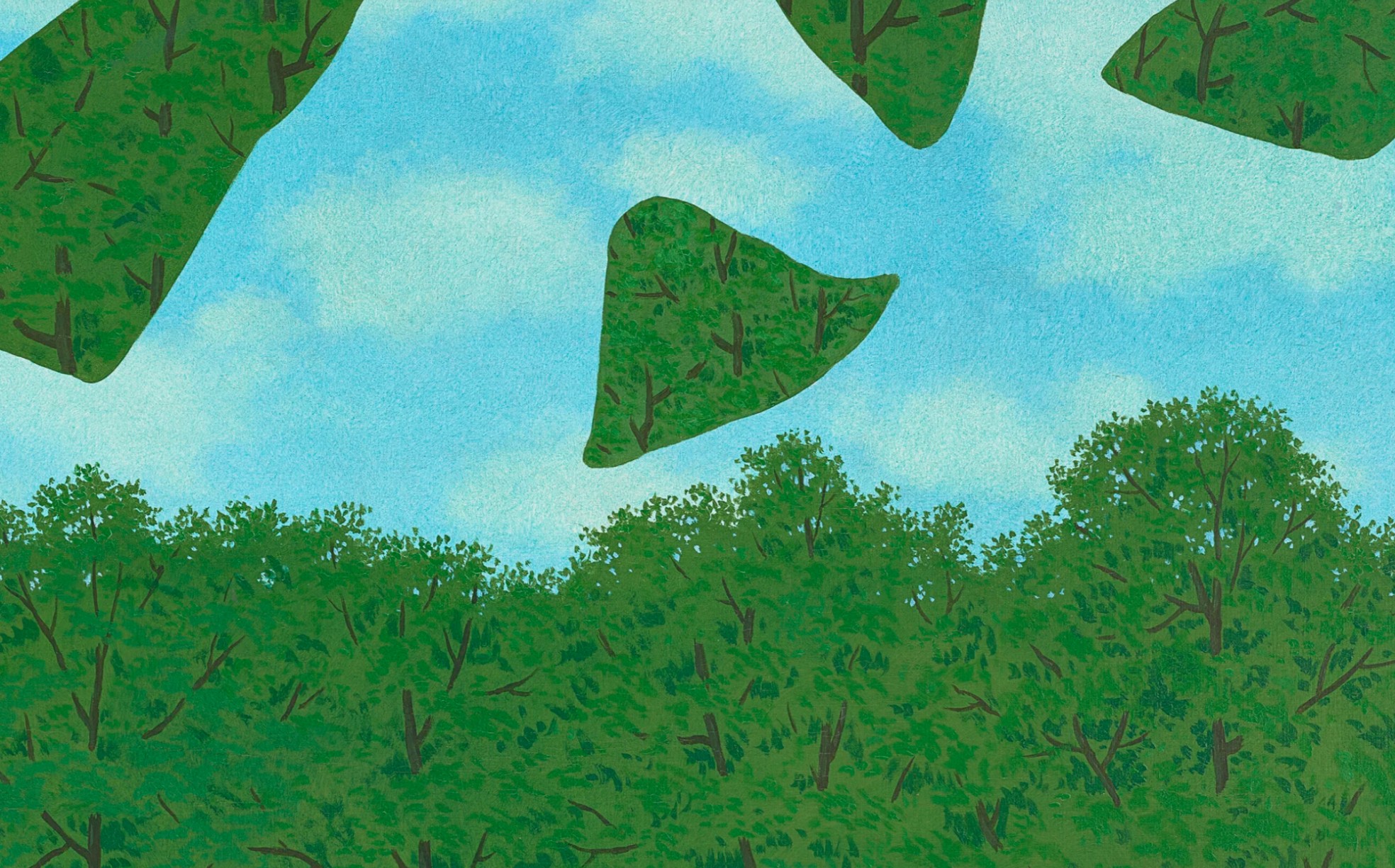
In that aspect, Le choeur des sphinges explores similar yet different territory to a related painting, Galatée, which dates from the same time (see Magritte, quoted in D. Sylvester, ed., René Magritte, Catalogue raisonné, London, 1993, vol. III, p. 395). In that work, a landscape is dominated by the sky: what Magritte described as a single ‘normal’ cloud dominates the centre, while surrounded by others that teeter on the brink of recognition to varying degrees. In the use of these allusive yet uncertain shapes, Galatée has clearly emerged from a similar wellspring as Le choeur des sphinges. However, in Galatée, the shapes are formed from clouds, which appear naturally in the sky. By contrast, in Le choeur des sphinges, they comprise spaces of woodland, as though they were chopped out and collaged from the greenery below.
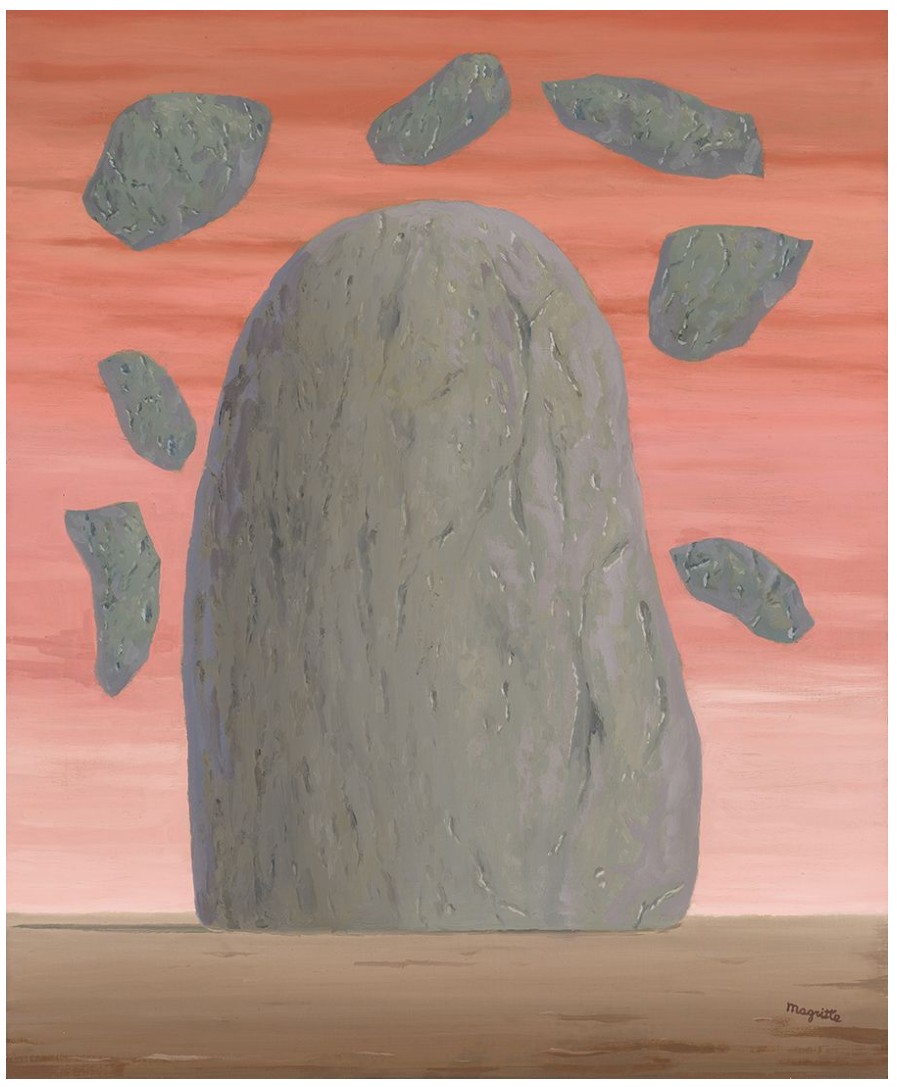
It is illustrative of Magritte’s own sense of the success of the approach adopted in Le choeur des sphinges that, in a letter from the year it was painted, he explained to André Bosmans that he had two further ideas that were variations on the theme, between which he was hesitating (although he appears to have progressed neither; see Sylvester, ibid., p. 397). One involved a low horizon, like in Galatée, above which floated cut-out style fragments of fire, the façade of a building, trees and so forth; in the other, a townscape featured, above which shapes hovered that were continuations of the masonry below.
The latter concept, with its mock-fragments of brick walls and windows, was clearly closer to Le choeur des sphinges. These ideas allowed Magritte to explore the very nature of painting. After all, the forms floating in the sky in Le choeur des sphinges can be seen either as additions, or subtractions – areas where the sky has been removed to reveal more trees behind it. In this play of surface treatments, Magritte continues to probe the notions that had been explored in earlier works such as La clef des champs of 1936 (Museo Nacional Thyssen-Bornemisza, Madrid), where the shards of glass from a smashed window still contain the landscape that had ostensibly been visible behind them, or Le séducteur of 1950 (Virginia Museum of Fine Arts), in which a ship appears as a silhouette that continues the waves of the sea. In all of these works, as in Le choeur des sphinges, Magritte suggests a hidden bond underpinning the entire fabric of existence. It is only by looking afresh through the prism of his paintings that some of the obfuscation caused by our reliance on understanding the visual phenomena around us can be short-circuited, allowing us to open our minds to infinite possibility and wonderment.
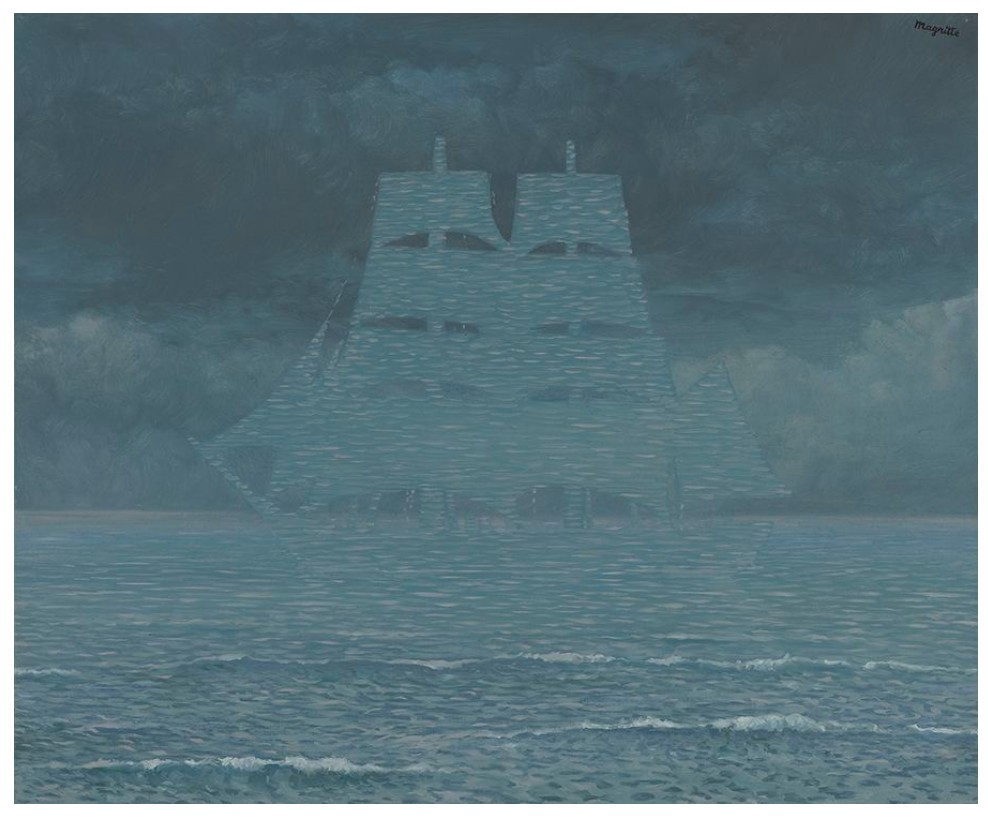
Magritte painted Le choeur des sphinges for the casino and hotel owner Gustave Nellens, whom he had known for over a decade by this time. In 1952, through E.L.T. Mesens and P.-G. Van Hecke, Magritte had enjoyed a monograph exhibition at Nellens’ Casino Communal in Knokke-Le Zoute. The following year, Nellens commissioned Magritte to create a monumental frieze of paintings, Le domaine enchanté, for the Salle du Lustre in the casino. This was a vast space with, at its centre, a colossal chandelier that gave the room its name. Magritte created a series of paintings that were then reproduced by artisans under his direction for the casino. Nellens remained an enthusiastic collector of Magritte’s works over the coming years.
At some point after Nellens’ death in 1971, the picture was acquired by the Belgian art dealer Margareth Krebs, who owned it for over a decade. Krebs was a friend of Magritte and a formidable character. She acquired the Maison Gilbert Périer in Brussels. This was a large home which had been lavishly decorated by its eponymous owner, the president of the Belgian airline, Sabena, including with extensive murals by Paul Delvaux. Périer also collected Magritte’s works, including a collage acquired as early as 1930, while in later life, shortly after Le choeur des sphinges, he was also instrumental in commissioning the artist to create his famous ‘sky-bird’, which became one of the airline’s emblems.
La plaine de l’air (The plain of the air), 1940
The Roger and Josette Vanthournout Collection
Christie’s London: 5 March 2026
Estimated: GBP 3,500,000 – 5,500,000
PASSED
RENÉ MAGRITTE (1898-1967), La plaine de l’air (The plain of the air) | Christie’s
RENÉ MAGRITTE (1898-1967)
La plaine de l’air (The plain of the air), 1940
Oil on canvas
73.4 x 100.2 cm (28-7/8 x 39-1/2 inches)
Signed ‘Magritte’ (lower left)
Digital image: © Photothèque R. Magritte / ADAGP / DACS Images.
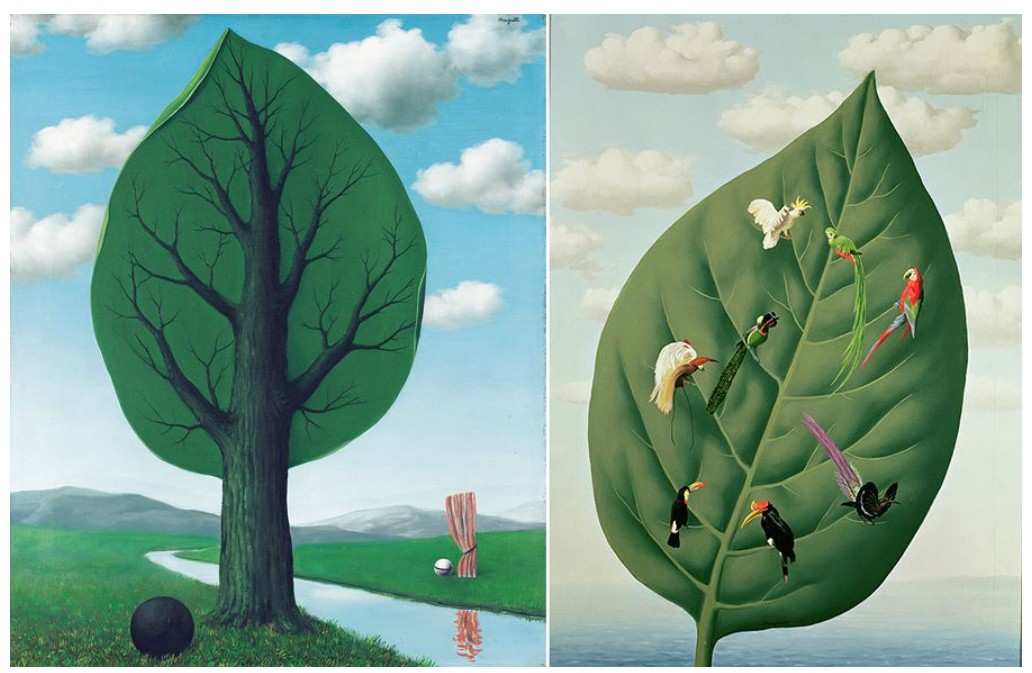
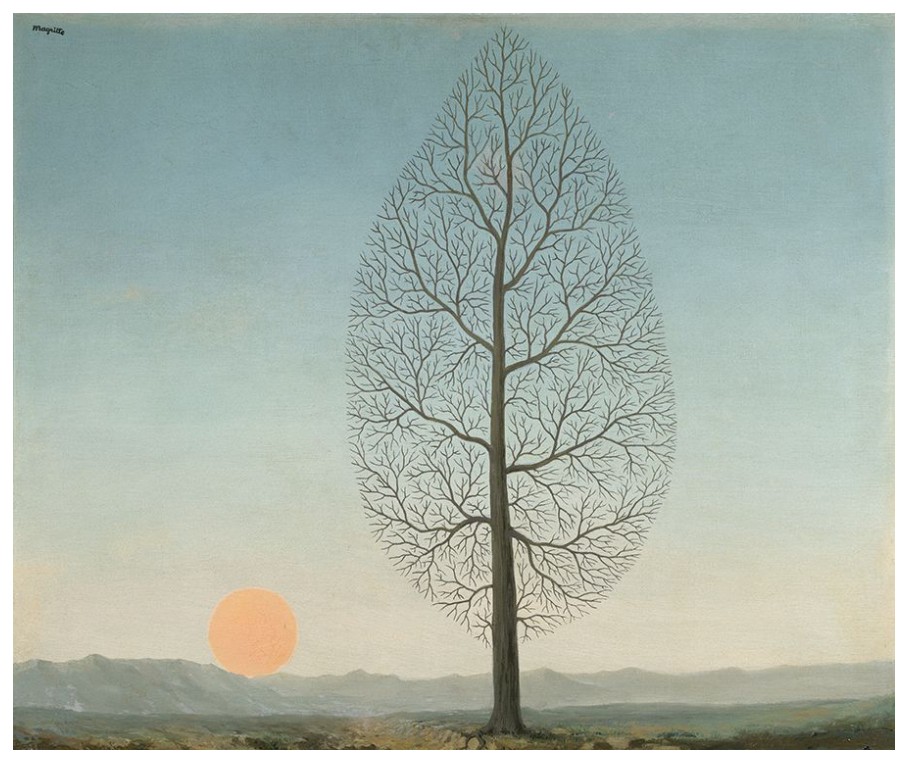
“Growing from the earth and towards the sun, a tree is a picture of secure happiness. In order to perceive this picture, we must be as immobile as the tree. If we move, it is the tree that becomes the observer.”
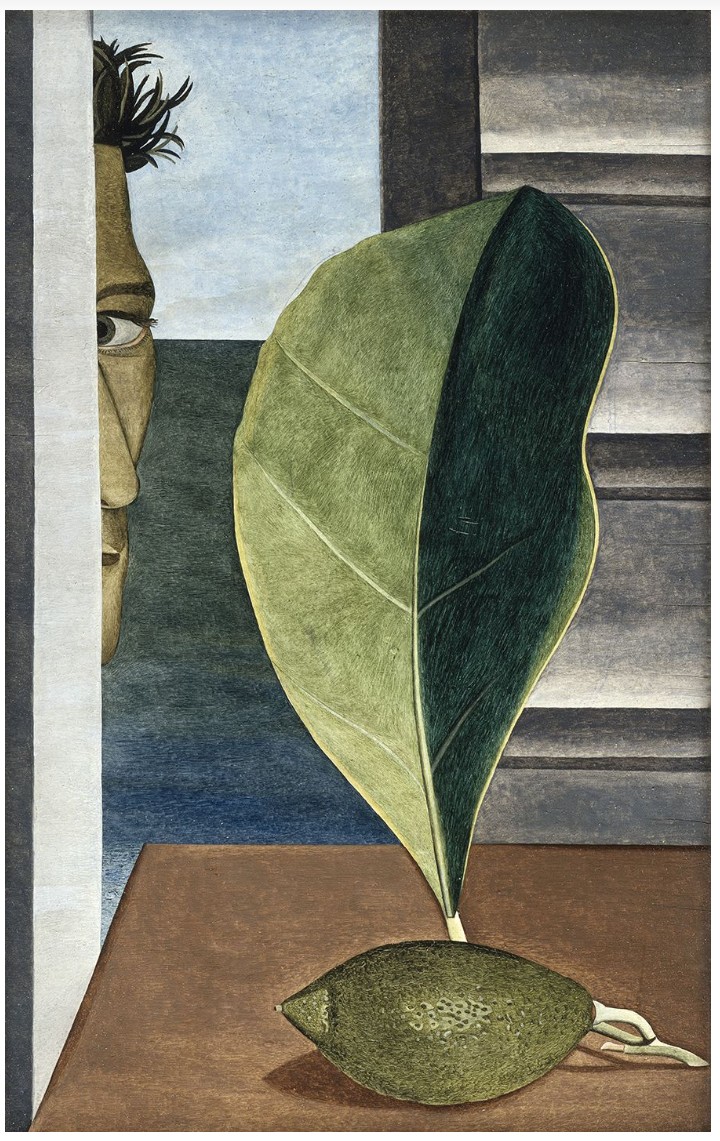
Artwork and digital image: © The Lucian Freud Archive. All Rights Reserved 2026 / Bridgeman Images.
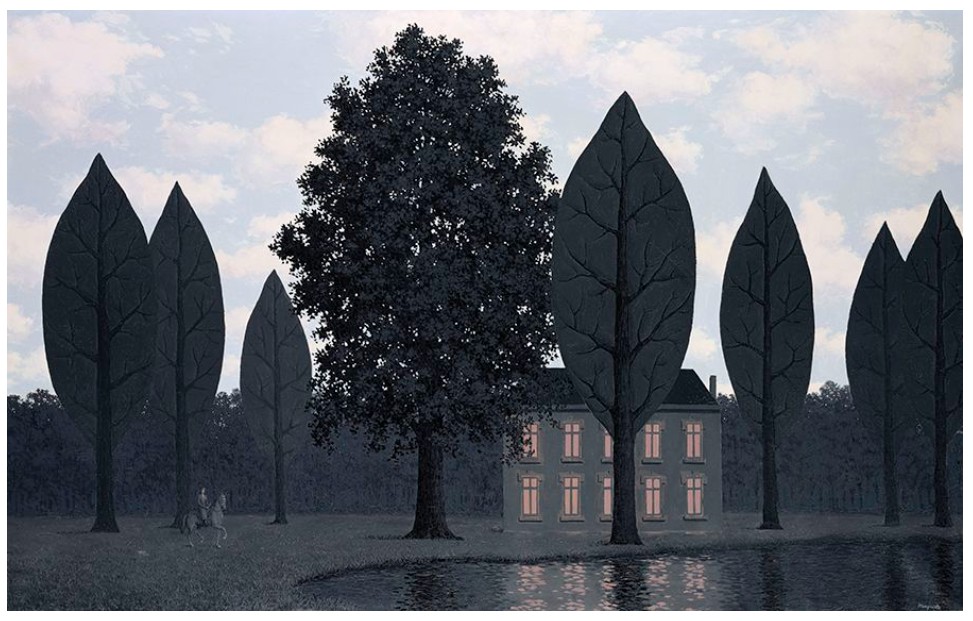
Artwork: © 2026 ADAGP, Paris and DACS, London.
Pablo Picasso
Le peintre et son modèle, 1964
THE PROPERTY OF A DISTINGUISHED PRIVATE COLLECTOR
Christie’s London: 5 March 2026
Estimated: GBP 7,000,000 – 10,000,000
GBP 8,520,000 / USD 11,381,870
PABLO PICASSO (1881-1973), Le peintre et son modèle | Christie’s
REPEAT SALE
Christie’s New-York: 19 November 2022
Estimated: USD 8,000,000 – 12,000,000
USD 10,351,500
PABLO PICASSO (1881-1973), Le peintre et son modèle | Christie’s
PABLO PICASSO (1881-1973)
Le peintre et son modèle, 1964
Oil and Ripolin on canvas
130×195 cm (51-1/8 x 76-3/4 inches)
Signed ‘Picasso’ (lower left)
Dated ‘8.9.11.64.’ (on the reverse)
Painted in Mougins on 8-9 November 1964
For Pablo Picasso, there was no subject as fundamental and immediately relevant to the daily travail of a painter as that of the vital exchange between the artist and his model. Between 1963-1965, Picasso devoted himself almost exclusively to this theme in his art, producing an extended sequence of oil paintings that offered intriguing variations and evolutions of the subject, each delving into this stimulating relationship and the way that it informed and underpinned the creative process. Though the theme of the artist and model had woven its way through the various strands of Picasso’s multi-faceted oeuvre through the years, never before had the artist explored the subject so closely and with such intensity. Le peintre et son modèle is a quintessential example of this great series, executed on an unusually large scale in the late autumn of 1964. Painted in bold, gestural strokes of pigment, the composition captures the energy and immediacy of Picasso’s painterly style during these years, as he sought to record the flow of ideas and images that poured forth from his imagination.
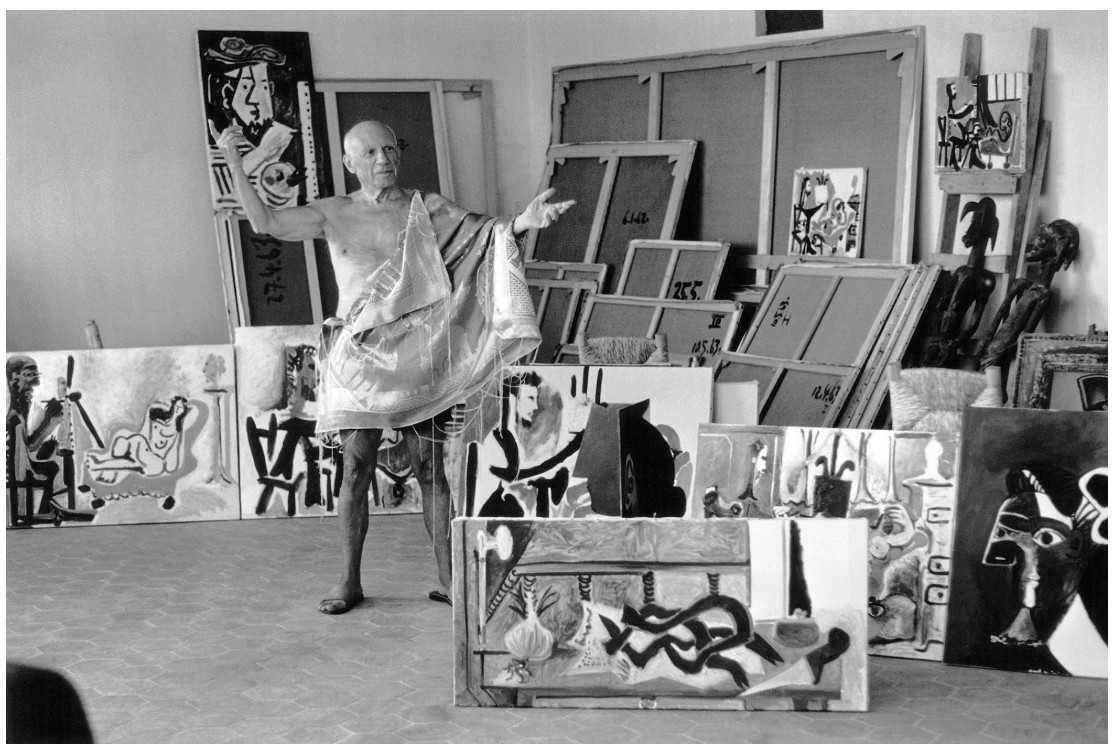
Pablo Picasso in his workshop in Antibes, France, in 1963. Photograph by Robert Doisneau. Photo by Robert DOISNEAU/Gamma-Rapho via Getty Images. Artwork: © 2026 Succession Picasso/DACS, London.
For Picasso, the return of the artist and model subject in his work, and the associated atelier scenes, often signaled an important change or transition in his art. In the 1960s, they marked the end of a decade long engagement with the legacy of his artistic predecessors, in which Picasso analyzed and reconsidered some of the most renowned compositions by a coterie of great masters, from Eugène Delacroix and Diego Velázquez, to Edouard Manet and Nicolas Poussin. Turning away from the art of the past, Picasso began to hone in on the very nature of art making itself, examining the essential artistic relationship of the painter and his subject. As if trying to find the key to his own innate abilities as a painter, he focused entirely on the realm of the studio, the private, haloed sanctum of artistic inspiration and creativity. Here, as Marie-Laure Bernadac described, he captured in his canvases ‘the impossible, the secret alchemy that takes place between the real model, the artist’s vision and feeling, and the reality of paint’ (Late Picasso, exh. cat., The Tate Gallery, London, 1988, p. 76).
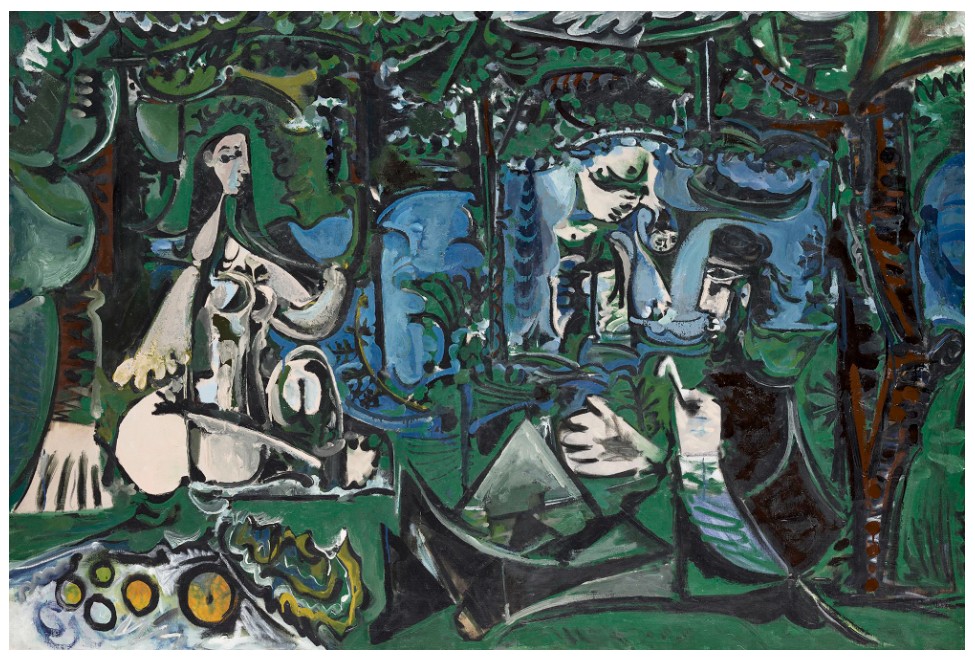
Pablo Picasso, Le Déjeuner sur l’herbe d’après Manet, 1960. Musée national Picasso-Paris. Artwork: © 2026 Succession Picasso/DACS, London. Digital image: © GrandPalaisRmn (musée national Picasso-Paris) / Mathieu Rabeau.
Over the course of two weeks in February 1963, Picasso filled the pages of a small carnet with more than two dozen sketches of a studio interior, in which a painter is seen working at his easel in the presence of a reclining nude model (Musée Picasso, Carnet no. 59). On 2 March, he began to explore the subject in oils (Zervos, vol. 23, no. 154; Kunstmuseum St. Gallen), marking the beginning of this dynamic series of works that would grip his imagination for two years. Hélène Parmelin, the wife of painter Edouard Pignon, both of whom were close friends of the artist, recounted the excitement surrounding the inception of these works: ‘Picasso lets loose. He paints “The Painter and his Model.” And from that moment on he paints like a madman, perhaps never before with such frenzy’ (Picasso: The Artist and His Model, New York, 1965, p. 10). ‘And now he says he is turning his back on everything,’ Parmelin recorded. ‘He says he is embarking upon an incredible adventure. He says that everything is changed; it is over and done with; painting is completely different from what one had thought – perhaps it is even the opposite. It is a time that he declares himself ready to kill modern “art” – and hence art itself – in order to rediscover painting…’ (ibid., pp. 9-10).
“Paintings are but research and experiment. I never do a painting as a work of art. I search incessantly, and there is a logical sequence in all this research… It’s an experiment in time.”
Residing in almost complete seclusion with his wife Jacqueline at Notre-Dame-de-Vie in Mougins during these years, Picasso was able to immerse himself entirely in his work, painting without disturbance for long hours each day. The result was an exuberant burst of creativity that belied the artist’s age, as he produced an astounding body of work that valiantly proclaimed his undiminished powers of creation. Taking great pleasure in the act of painting itself, he allowed process to take prominence over the finished image. ‘It’s the movement of painting that interests me,’ he once explained, ‘the dramatic movement from one effort to the next, even if those efforts are perhaps not pushed to their ultimate end… I’ve reached the moment, you see, when the movement of my thought interests me more than the thought itself’ (quoted in E. Cowling, Picasso: Style and Meaning, London, 2002, p. 640). The resulting works delve into the fundamental connection between the artist and his muse, revelling in the very act of looking itself, and the ways in which the figure could be translated through the artist’s subjective vision, into a paean of the female form.
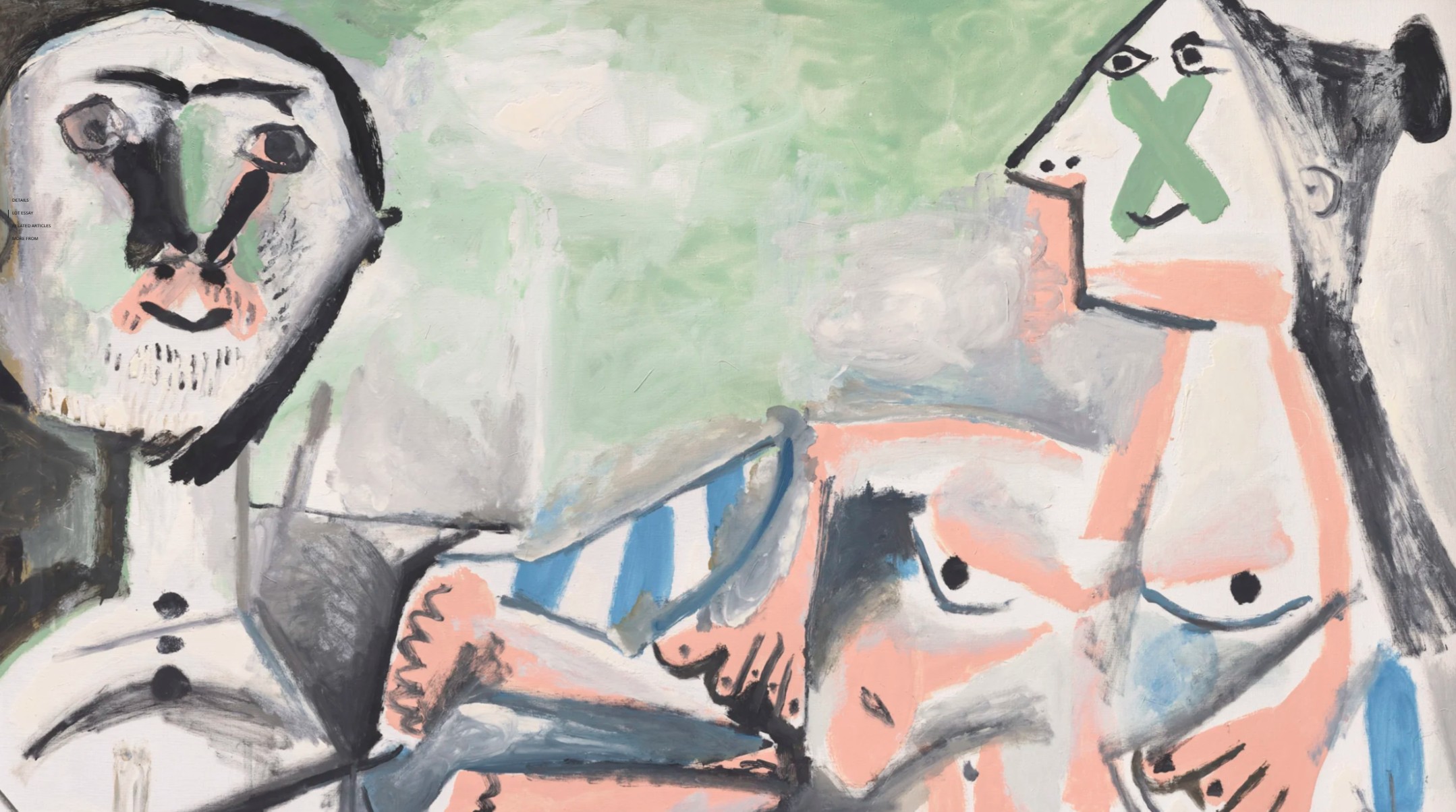
As the series developed through 1963-1965, Picasso explored different compositional ideas and variations on the central pairing. In many of the works, the artist and model appear together, as in Le peintre et son modèle, highlighting the interaction between the two figures. Here, their gazes connect, their expressions smiling and serene, as they both watch one another. A minimally described brush, palette and the barest suggestion of an easel are discernible in the bottom left corner of the composition, while the artist himself appears to be turning away from his tools to speak to his female companion, who is gently enveloped in folds of blue and white fabric that recall the striped sailor’s shirt the artist was renowned for wearing.
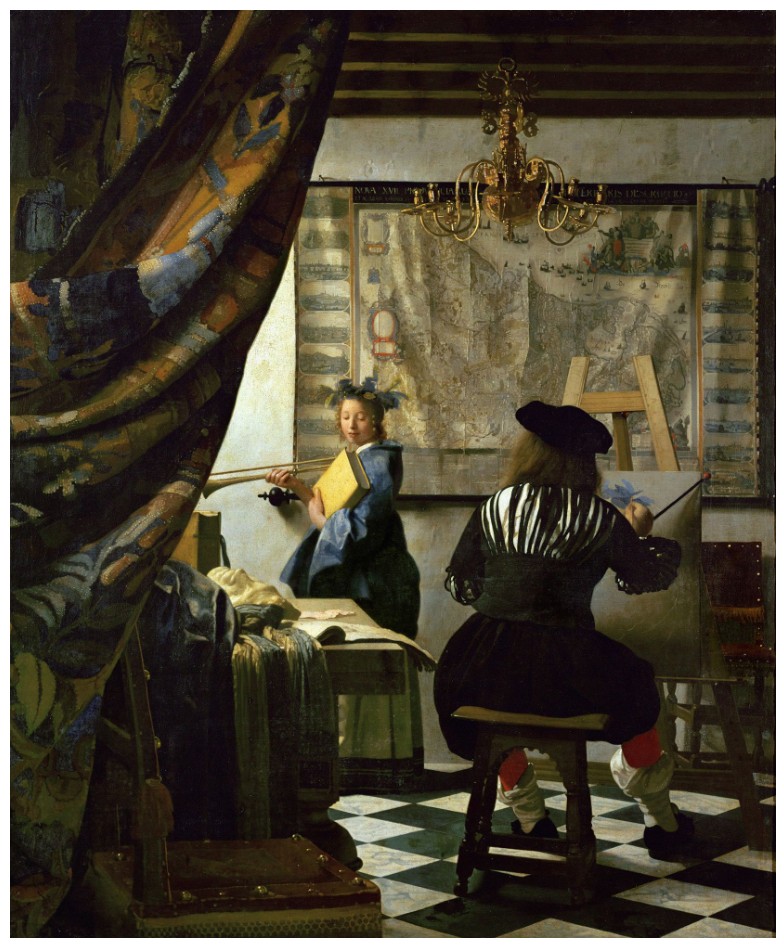
Johannes Vermeer, The Art of Painting, circa 1666-1668. Kunsthistorisches Museum, Vienna. Digital image: © 2026 Photo Austrian Archives/Scala Florence.
In some works devoted to the theme, the painter is seen alone, quietly contemplating his easel, as he wrestles with translating his vision onto canvas. Other paintings from this period showcase the nude female figure alone, while simultaneously leaving the presence of the artist implied, as if the viewer has been transported into his place and granted the privileged position that he enjoys, looking straight at his model’s sensuous form. Throughout the series, the male subjects are almost invariably stand-ins for Picasso himself, while the models appear to pay homage to the artist’s wife, Jacqueline, whom he had met in the early 1950s, and subsequently married in 1961. Though she never modelled for him in the traditional sense, Jacqueline’s presence permeated every aspect of Picasso’s work, her petite, yet voluptuous, form captivating his imagination and inspiring a myriad of sculptures, drawings, etchings and paintings in her likeness.
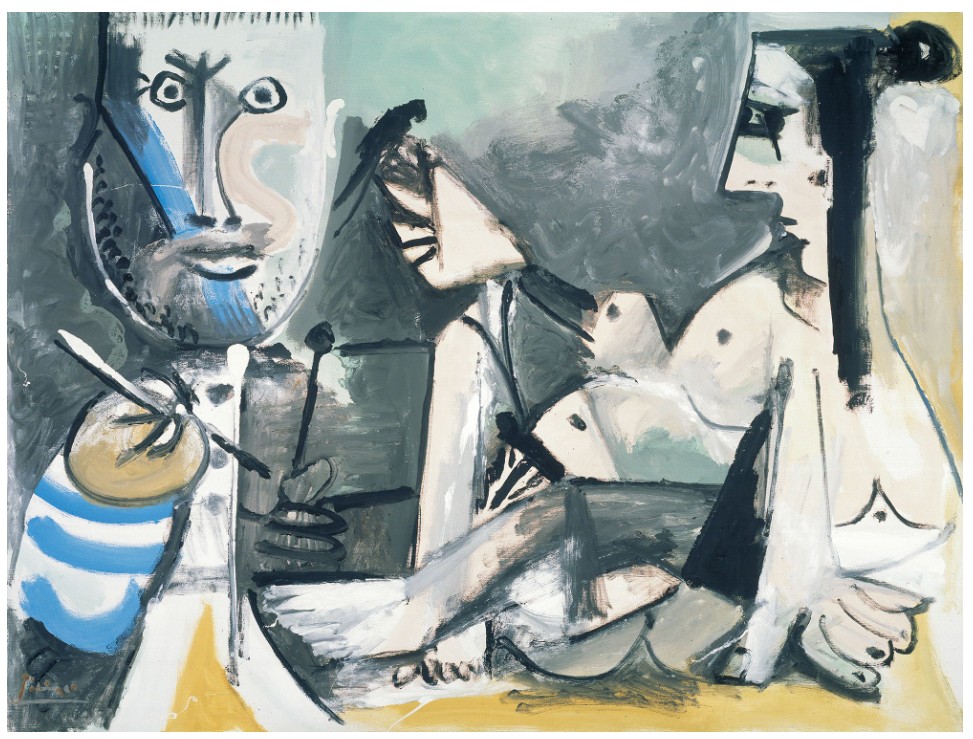
Pablo Picasso, Le peintre et son modèle, 1964. Buffalo AKG Art Museum. Artwork: © 2026 Succession Picasso/DACS, London. Digital image: © 2026 Buffalo AKG Art Museum/Art Resource, NY/Scala, Florence.
Dating to late 1964, Le peintre et son modèle reveals the distinctive shifts that were occurring in Picasso’s painterly style at this moment in time, as his brushstroke became increasingly freer and more gestural, describing his forms through simple, graphic signs. Using large canvases executed in both vertical and horizontal format, his works from these months are marked by a lighter, pastel palette of delicate pale greens and pink or lavender tones, as if painted with the silvery winter Mediterranean light flooding through the windows into the studio. Picasso applies his colours with a heavily loaded brush, modelling his figures’ forms in long, sinuous strokes of pigment, the paintbrush zig-zagging and sweeping across the canvas in broad passages of paint that trace the movement of the artist’s hand. Laid over these hues is a series of black lines that define the essential features of the male painter and female nude, their bodies appearing from an almost cryptogram-like arrangement of lines and shapes that delineate the essential structures of their faces and bodies.
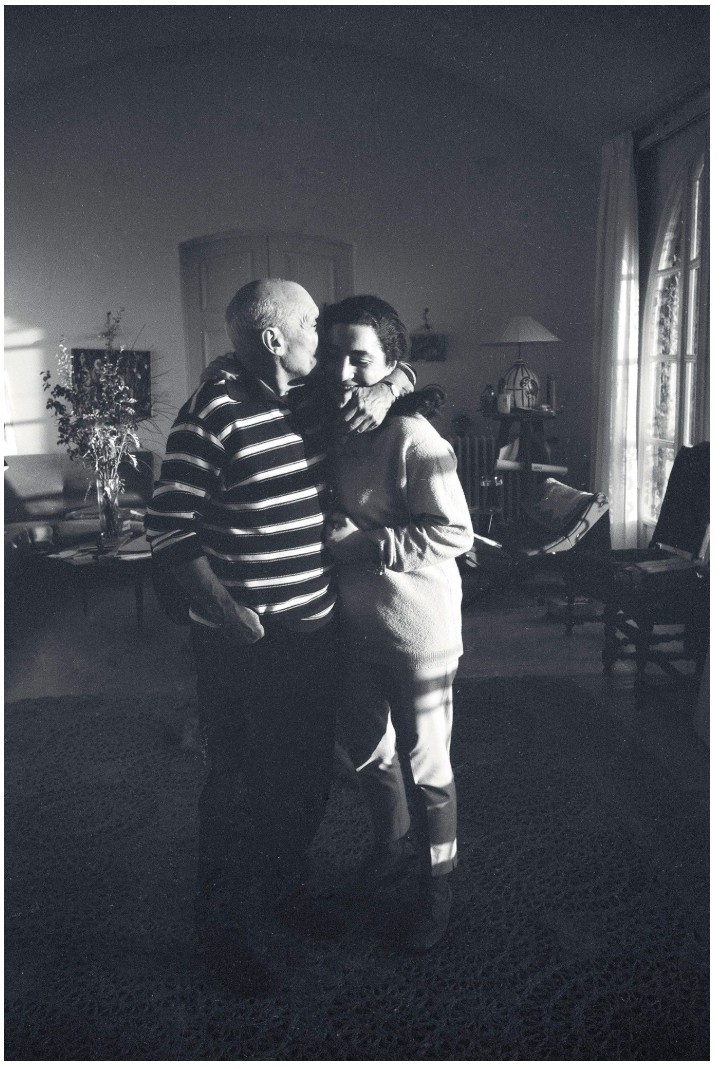
Picasso and Jacqueline at Notre-Dame-de-Vie, Mougins, 14 February 1962. Photograph by Edward Quinn. Photo: Edward Quinn, © edwardquinn.com. © 2026 Succession Picasso/DACS, London.
This abbreviated style of painting, which the artist described as écriture-peinture, allowed Picasso to convey the essence of his figures quickly, and with a bold directness. Describing this approach, Marie-Laure Bernadac has explained it was ‘characterised by the juxtaposition of two ways of painting: one elliptical and stenographic, made up of ideograms, codified signs which can be inventoried; the other thick and flowing … Picasso thus combines a painterly form of writing with a painterly form of painting, a material literalism that lays bare and sets free the substance of paint…’ (exh. cat., op. cit., 1988, p. 85).
This technique brought his figures back to their essential elements, allowing Picasso to communicate to the viewer through a visual shorthand that prompted them to fill in the rest of the artist and model’s form in their mind’s eye. As Parmelin recalled, ‘Every time [Picasso] shows a canvas in which a dot is enough for a breast, a dash for the painter, five spots of colour for a foot, a few pink or green strokes… he says: “That’s enough, don’t you think? What more do I need to do? What can I add to that? I’ve said it all…’ (Picasso Says, trans. C. Trollope, London, 1966, p. 21).
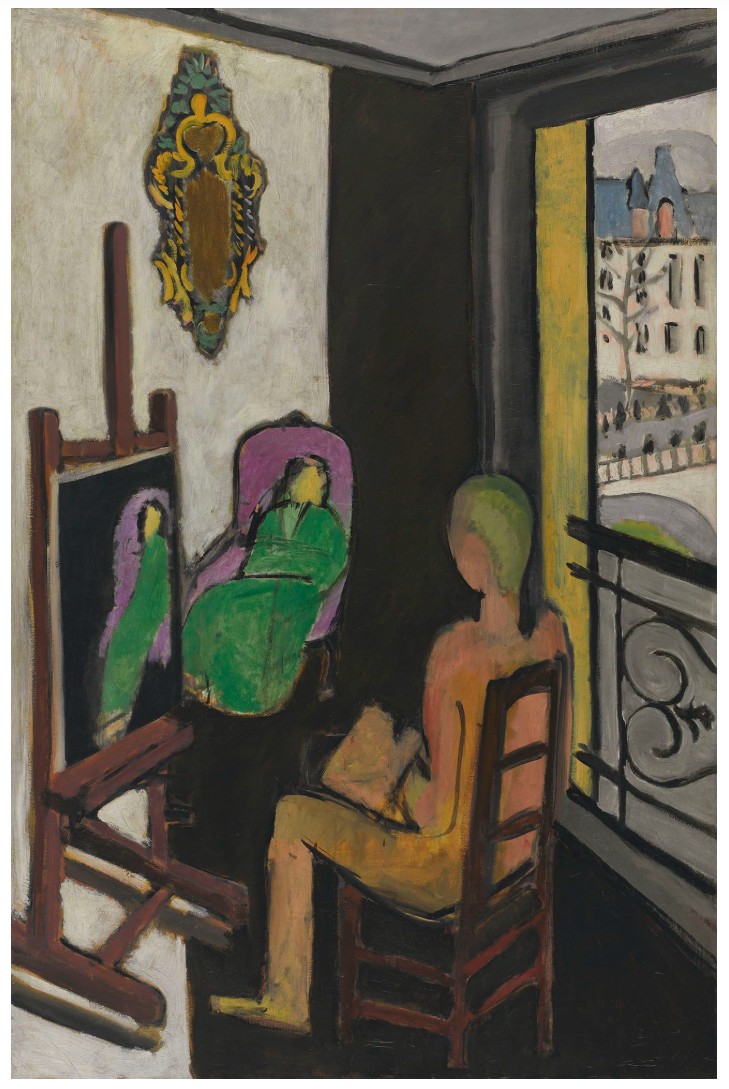
Henri Matisse, Le peintre dans son atelier, 1916-1917. Musée National d’Art Moderne, Centre Pompidou, Paris. Digital image: © Centre Pompidou, MNAM-CCI, Dist. GrandPalaisRmn / Philippe Migeat, Christian Bahier.
When considered within the wider artistic moment of the 1960s, Le peintre et son modèle and the rest of this series once again show Picasso as an artist who remained at the very forefront of the avant-garde, continuing to subvert expectations. At this time, abstraction reigned supreme, with Pop art and Minimalism coming increasingly to the fore as dynamic new facets of post-war art. Traditional easel painting, many were suggesting, was redundant and outmoded, its future questionable in a time when industrial materials and mechanical techniques dominated artistic production. Yet, just as he had in the early twentieth century, Picasso defied expectation by remaining resolutely bound to the essential, time-honoured elements and processes of art.
“An artist should observe nature but never confuse it with painting. It is only translatable into painting by signs.”
His large canvases painted with gestural, lavish strokes of thick color and strident lines that depict, through timeless subjects of the artist or the model, the very act of painting itself, showed that the medium was far from dead. Indeed, as Picasso argued, it was thriving. ‘There is no abstract art,’ the artist had declared in 1935. ‘You must always start with something. Afterward you can remove all traces of reality. There’s no danger then, anyway, because the idea of the object will have left an indelible mark’ (quoted in K.L. Kleinfelder, The Artist, His Model, Her Image, His Gaze: Picasso’s Pursuit of the Model, Chicago and London, 1993, p. 137).
Nu debout et femmes assises, 1939
The Roger and Josette Vanthournout Collection
Christie’s London: 5 March 2026
Estimated: GBP 3,500,000 – 5,500,000
GBP 7,004,000 / USD 9,356,645
PABLO PICASSO (1881-1973), Nu debout et femmes assises | Christie’s
PABLO PICASSO (1881-1973)
Nu debout et femmes assises, 1939
Oil on canvas
41.5 x 33 cm (16-3/8 x 13 inches)
Signed ‘Picasso’ (lower right); dated ‘23.9.39.’ (lower left)
Dated again and inscribed ‘Royan 23 Septe 39.’ (on the reverse)
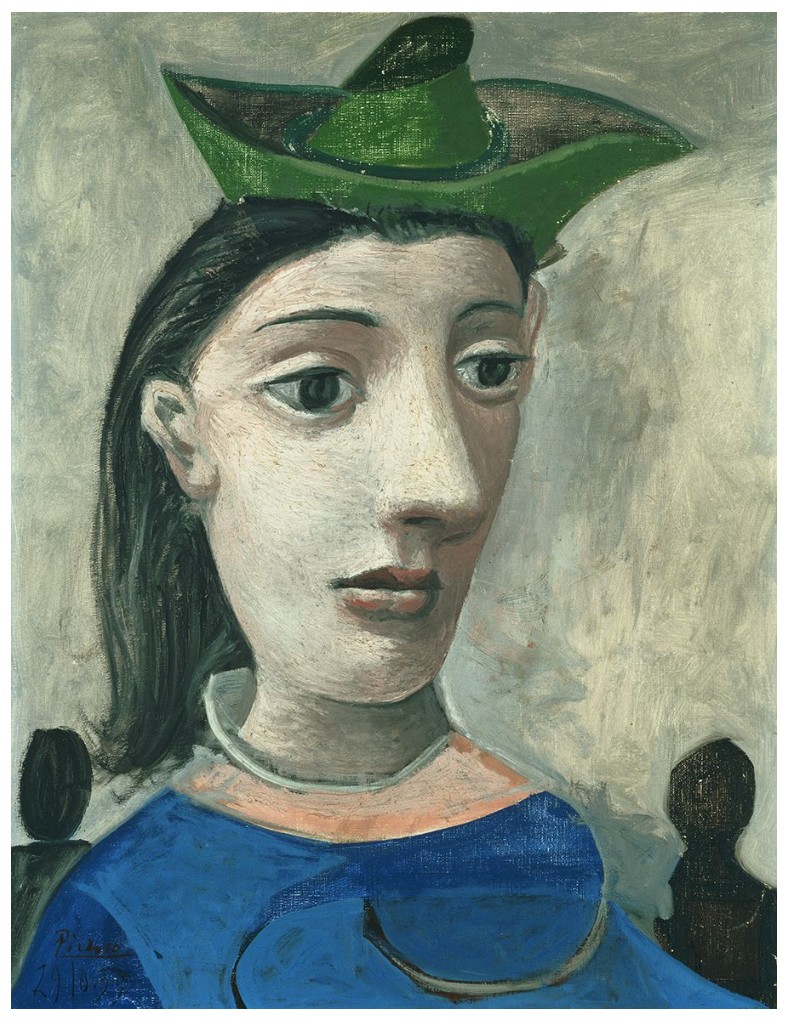
In a car driven by his loyal chauffeur Marcel, Picasso and Maar, along with Jaime Sabartés and his wife, and Picasso’s Afghan hound Kazbek, had all hurriedly left Paris together on 1 September 1939, driving overnight in a panic straight for Royan. There, barring a few short bureaucratic return trips to Paris, Picasso was to live and work until August 1940.
Picasso had chosen Royan because it was a place sufficiently remote and yet also near enough to keep in touch with Paris, and because, since July, it was there that he had ensconced his other mistress, Marie-Thérèse Walter. On arrival, Picasso, Maar and Sabartés moved into the small Hôtel du Tigre in the centre of town. As Roland Penrose, who was close to Picasso around this time, recalled, ‘the rooms in which he lived for the next few months were cramped and badly lit. The town itself apart from its harbour had few attractions. Accepting the situation, however, he settled down to a regular routine in which the main factor, work, was punctuated with meals and walks around the town, accompanied by Dora Maar, Sabartès and the docile Kasbec’ (Picasso: His Life and Work, London, 1958, p. 292).
Jacqueline Lamba and Dora Maar, Antibes, August 1939. Photograph by Pablo Picasso. Musée national Picasso-Paris. Artwork: © 2026 Succession Picasso/DACS, London. Digital image: © GrandPalaisRmn (musée national Picasso-Paris) / image GrandPalaisRmn
Picasso’s life was, in fact, a little more complex than this due to the continuing balancing act he was performing between Dora Maar and Marie-Thérèse, to whom he had explained away his separate rooms in the Hôtel du Tigre as ‘a necessary studio.’ In reality, it was Maar who was using their room at the Hôtel du Tigre to paint while Picasso had set up a studio for himself in a small dining room at the Villa Gerbier de Jonc where Marie-Therese, her mother, sister, and her daughter with Picasso, Maya, had been living since July. As John Richardson has written, ‘Dora remembered Royan as hell…she was miserable from nearly the moment they arrived. [She] soon realised why Picasso was always disappearing to the nearby Villa Gerbier de Jonc…[Picasso’s studio there] was a small and dark, shaded by trees that lined the street, hence the smallish size of most of his canvases for the next six months’ (A Life of Picasso, The Minotaur Years 1933-1943, New York, 2021, volume IV, p. 195).
It was there, between 21 September and 1 October, hunched over a chair in the dining room of the Villa Gerbier de Jonc that Picasso painted Nu debout et femmes assises and the series of pictures to which it belongs. In his memoirs of this period, Jaime Sabartés has reported that he repeatedly encouraged the artist to acquire an easel to aid his working practice at this time. For a long time, Picasso resisted, choosing deliberately to work in this cramped fashion hunched over the small canvases that he had set up on a chair.
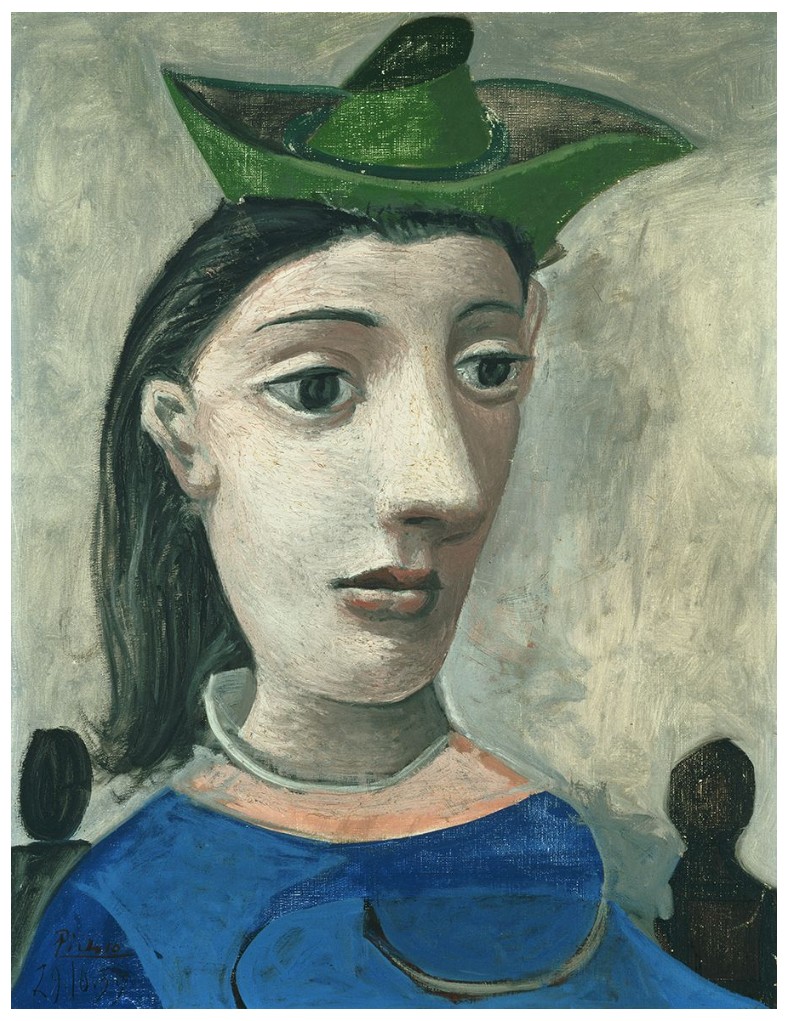
Left: Pablo Picasso, Nu debout et femme assise, 1 October 1939. Moderna Museet, Stockholm. Artwork: © 2026 Succession Picasso/DACS, London. Digital image: Moderna Museet/Stockholm. Right: Pablo Picasso, Nu debout et femme assise, 22 September 1939. Musée Picasso, Paris. Artwork: © 2026 Succession Picasso/DACS, London. Digital image: © GrandPalaisRmn (musée national Picasso-Paris) / Mathieu Rabeau.
The very first pictures that Picasso had painted in Royan were a small series of grisaille horses inspired by those he had seen being rounded up for military enlistment on his journey down from Paris with Sabartés. Reminiscent in some respects of his frightened horse in Guernica, these horses, ‘with their submissive air… as if on their way to the slaughterhouse,’ (op. cit., 2002, p. 617), had evidently struck Picasso as symbolic of the awful tragedy he was powerless to avert, and must also have reminded him vividly of the First World War, in which horses had played such an instrumental and sacrificial role. Picasso followed these pictures with the sequence of eight or nine double portraits of women (predominantly Maar), to which Nu debout et femmes assises belongs, and then by a very Goya-esque sequence of pictures of sheep’s skulls based on those he was buying to feed Kazbek. ‘It is natural,’ as Cowling has written, ‘to read [these works] as stand-ins for mankind and for the suffering and sacrifice of the innocent’ (ibid., p. 617).
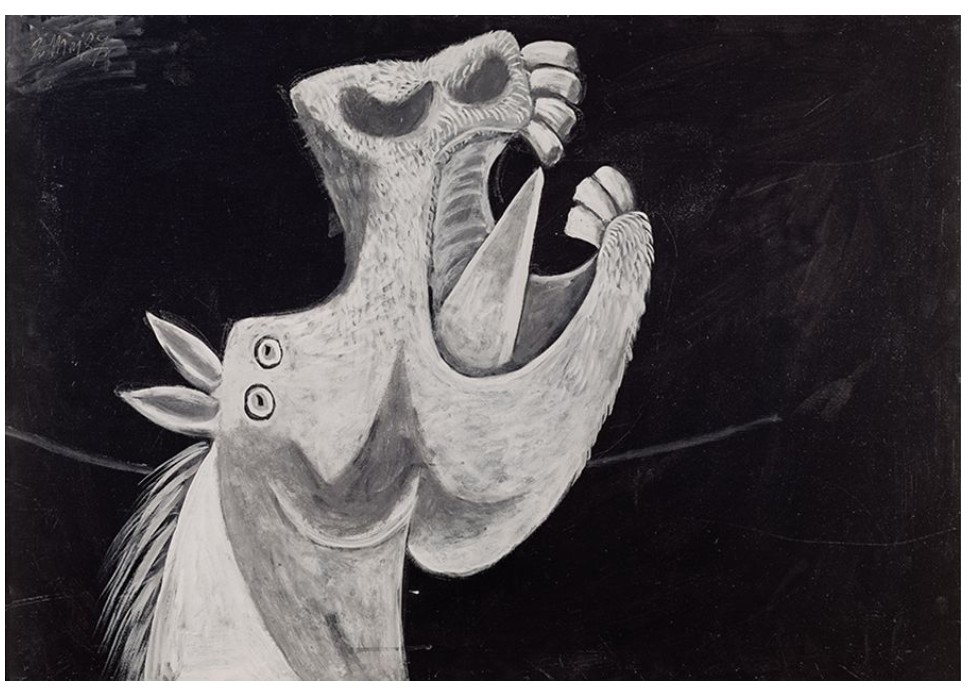
Pablo Picasso, Étude pour Guernica, May 1937. Museo Nacional Centro de Arte Reina Sofia, Madrid. Artwork: © 2026 Succession Picasso/DACS, London. Digital image: © Bridgeman Images.
These motifs subsequently developed into an ultimately failed series of attempts to paint a portentous picture of a woman holding a skull before, ultimately, in 1940, giving rise to his greatest masterpiece of the Royan period, his Grand nu assis (Femme se coiffant) of 1940, (now in The Museum of Modern Art, New York). The roots of this famous painting of a monstrous, naked, Dora Maar sitting squirming and twisting in a sinister confined space derive from a series of sketches Picasso made during his first months in Royan when he was working on Nu debout et femmes assises, and from the series of double portraits of seated and standing depictions of Maar to which it belongs.
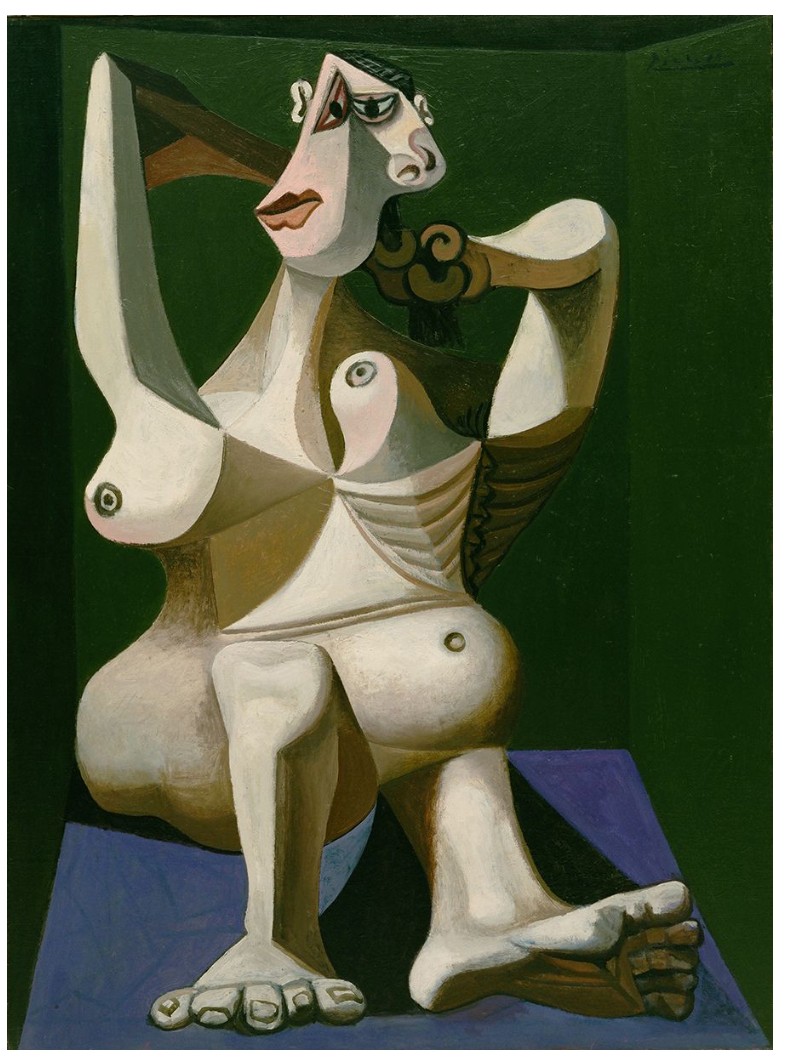
Pablo Picasso, Grand nu assis (Femme se coiffant), 1940. The Museum of Modern Art, New York. Artwork: © 2026 Succession Picasso/DACS, London. Digital image: © 2026 The Museum of Modern Art, New York/Scala, Florence.
In Nu debout et femmes assises, Picasso depicts a standing nude Maar alongside a clothed portrait of her seated in the kind of chair to which he would confine her throughout much of the wartime period. For Picasso, the chair could often become an instrument of confinement and even torture. As he would later confess about his pictures of Maar, ‘for years I’ve painted her in tortured forms, not through sadism, and not with pleasure either; just obeying a vision that forced itself on me. It was the deep reality, not the superficial one’ (quoted in B. Léal, ‘“For Charming Dora”: Portraits of Dora Maar,’ in Picasso and Portraiture, exh. cat., The Museum of Modern Art, New York, 1996, p. 395). Maar was, he said, ‘for me… always a weeping woman. And it’s important, because women are suffering machines… When I paint a woman in an armchair, the armchair implies old age or death, right? So, too bad for her’ (quoted in A. Malraux, Picasso’s Mask, New York, 1976, p. 138).
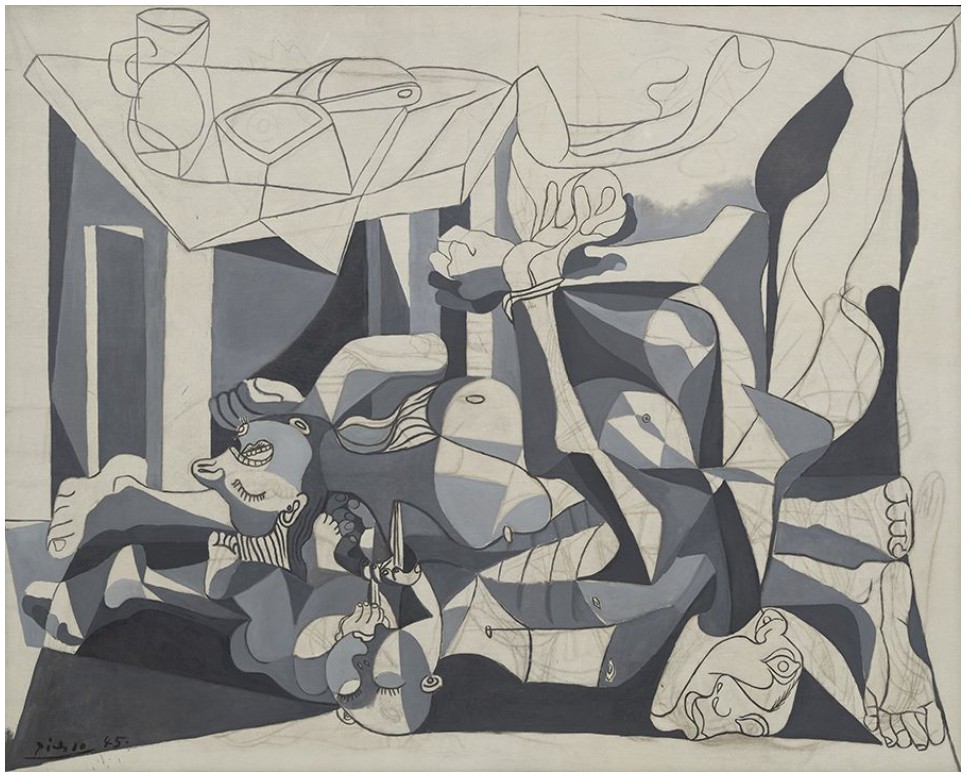
Pablo Picasso, Le charnier, 1944-1945. The Museum of Modern Art, New York. Artwork: © 2026 Succession Picasso/DACS, London. Digital image: © 2026 The Museum of Modern Art, New York/Scala, Florence.
Given this context, Nu debout et femmes assises, like many of the works in the series, such as Nu debout et femme assise of 22 September 1939 (now in the Musée national Picasso, Paris), presents a deliberate play of polarities which in its stark contrasting of a standing nude against a clothed, seated figure, assumes an existential dimension. Indeed, the ultimate effect of this elegant but also grisaille, portrayal of physical opposites is one that appears also to speak of the schizophrenic nature of the time in which it was made. Removed from his life in Paris like an exile in his own adoptive home, awaiting the result of a war in which he could play no part and living between two lovers in a small seaside town, Picasso’s life was, for the moment, also split in two. The polarized theme of the two women that manifested briefly in these works was, however, short-lived. As Elizabeth Cowling has pointed out, the doubling theme of these works was ‘not pursued further after [a] grisaille version of 29 September. The motif now breaks down into its components: into the pictorial themes of a [single] naked seated and a naked standing female figure. The first sketchy notes of a naked woman combing her hair can already be found in a carnet used in Royan between 30 September and 29 October, 1939. All sketches depict a repulsively alienated, standing female nude arranging her hair’ (op cit., 2002, p. 617). These sketches were the ones that ultimately gave rise in the summer of 1940 to the definitive naked portrait of Maar tormented and twisting in many different directions in Grand nu assis (Femme se coiffant).
Claude Monet
Maison de jardinier, 1884
Sotheby’s London: 4 March 2026
Estimated: GBP 6,500,000 – 8,500,000
GBP 8,215,000 / USD 10,974,420
Maison de jardinier | Modern & Contemporary Evening Auction | 2026 | Sotheby’s
CLAUDE MONET (1840 – 1926)
Maison de jardinier, 1884
Oil on canvas
60.5 x 73 cm (23-5/8 x 28-7/8 inches
Signed Claude Monet and dated 84 (lower right)
Executed in Bordighera in 1884
Writing to his dealer Paul Durand-Ruel on 12 January 1884, Monet announced: “[…] I’ve decided to leave for Italy straight away. I want to spend a month in Bordighera, one of the most beautiful places we saw on our trip. From there I have great hopes of bringing you a whole new series of things. But I would ask you not to mention this trip to anyone, not because I want to make a secret of it, but because I insist upon doing it alone. Much as I enjoyed making the trip there with Renoir as a tourist, I’d find it hard to work there together. I have always worked better alone and from my own impressions. So keep the secret until otherwise instructed” (artist quoted in Richard Kendall, ed., Monet by Himself: Paintings, Drawings, Pastels, Letters, London, 1989, p. 108).
The trip Monet referred to in this letter was the one he had undertaken just a month prior, in December 1883, with his close friend and fellow Impressionist painter Pierre-Auguste Renoir (fig. 1). The brilliant colours and the radiant Mediterranean light left a tremendous impression on Monet, yet, in that instance, he only produced two paintings, clearly focused on scouting out locations for a subsequent solo expedition (fig. 2). As the letter to Durand-Ruel suggests, Monet was eager to return to the region alone, to focus his efforts and attention on attempting to capture – for the first time in his life – a landscape that was completely unfamiliar to him.
As Angelica Daneo remarks, “Even abroad, during his visit to London and the Netherlands in 1870-71, he could still relate to the cool light of Northern landscapes or the calm, reflective qualities of rivers and canals, not dissimilar to the familiar Seine and its tributaries. Bordighera and its environs, however, were ‘féerique,’ magical, and, to some extent overwhelming for Monet” (Exh. Cat., Denver Museum of Art and Potsdam, Museum Barberini, Monet: Places, 2019-20, p. 43).
Initially planning to stay for just three weeks, Monet ended up staying at Bordighera, a small village on the Ligurian coast about twelve miles east of the French town of Menton, for over three months, from 17 January to 6 April. The resulting works – the dazzling, sun-drenched Maison de jardinier among them – rank as some of “the most powerful, resonant, and innovative painting he had ever produced” (Exh. Cat., Kimbell Art Museum, Fort Worth and The Brooklyn Museum of Art, Monet and the Mediterranean, 1997-98, p. 19).
Despite his initial complains, however, the present work makes it clear that, in Daneo’s words, Monet “seemed to like visual obstacles” (ibid., p. 46). Their presence created an environment in which Monet could challenge himself and advance his painting both formally and compositionally. In the present work, the dazzling citrus trees painted with vigorous, dynamic brushstrokes, occupy almost three quarters of the composition, deliberately taking away from and obstructing what should presumably be – at least from the title of the work – the main focus of the composition, the gardener’s house on the far left. While Daneo points this method out as something Monet first tested in his works from the 1870s (figs. 3-4), it is clear that it was the boisterous nature Monet found at Bordighera that allowed him to further experiment with this compositional device to particularly innovative and visually powerful results.
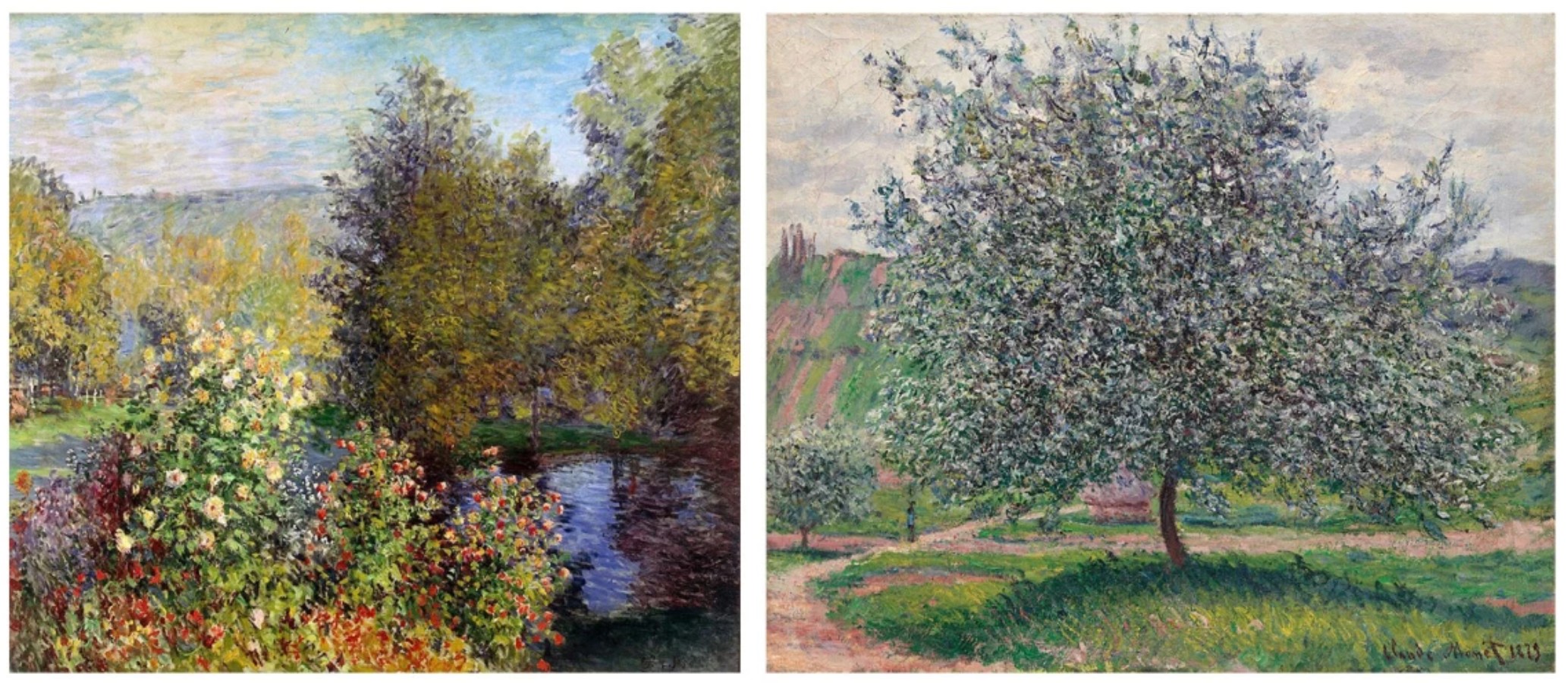
Left: Fig. 3, Claude Monet, Coin de jardin à Montgeron, 1876, The State Hermitage Museum, St Petersburg
Right: Fig. 4, Claude Monet, Le Pommier, 1879, oil on canvas, Museum Barberini, Potsdam
The present work is further notable for Monet’s deliberate incorporation of architecture. The bright red clay roofs and white walls of the gardener’s house and Francesco Moreno’s villa, set against the luminous blue sea and partially obstructed by the lush greenery in the foreground, serve as important anchoring points within the composition. Incorporating architecture into his canvases was an important compositional device that Monet turned to time and time again throughout his oeuvre and one that achieves an exceptionally powerful effect in Maison de jardinier.
Describing Monet’s Bordighera canvases, Paul Tucker highlighted their prominence as a “reaffirming proof of his ability to capture effects that were radically different from what existed in Normandy and the Ile de France. While attesting to his dexterity and the sensitivity of his eye, these pictures also underscored his ability to reinvent himself and demonstrated the flexibility of his Impressionist style” (P. Tucker, Claude Monet: Life and Art, New Haven, 1995, p. 120). Joachim Pissarro has likewise outlined the works created on the Italian Riviera as a critical testing ground for seriality, an approach that would find its first full-fledged resolution in Monet’s Haystack series of the 1890s, followed by the series of depictions of the Rouen Cathedral, canvases depicting the Thames in London and beyond.
Maison de jardinier boasts a remarkable provenance. In 1891, the present work was acquired by the celebrated American painter John Singer Sargent. From a letter preserved at the Museum of Fine Arts, Boston (fig. 5), it transpires that the painter acquired the painting from Monet’s dealer Paul Durand-Ruel in exchange for an artwork by Alexandre Falguière. The same letter contains a fascinating sketch of the present work, Sargent describing his acquisition to Monet as a “great joy”:
Maison de jardinier was included in the sale of the Sargent estate which took place in London on 24 and 27 July 1925, where it was jointly acquired by Emile Bernheim, Galerie Durand-Ruel and Galerie Bernheim-Jeune, Paris. As documented in a letter preserved in the Claude Monet archives at the Wildenstein Plattner Institute, shortly after the sale the artist asked the dealers to bring the painting over to Giverny so he could view it in person once again, the historic reunion of the artist and artwork commemorated in a photograph dated autumn 1925.
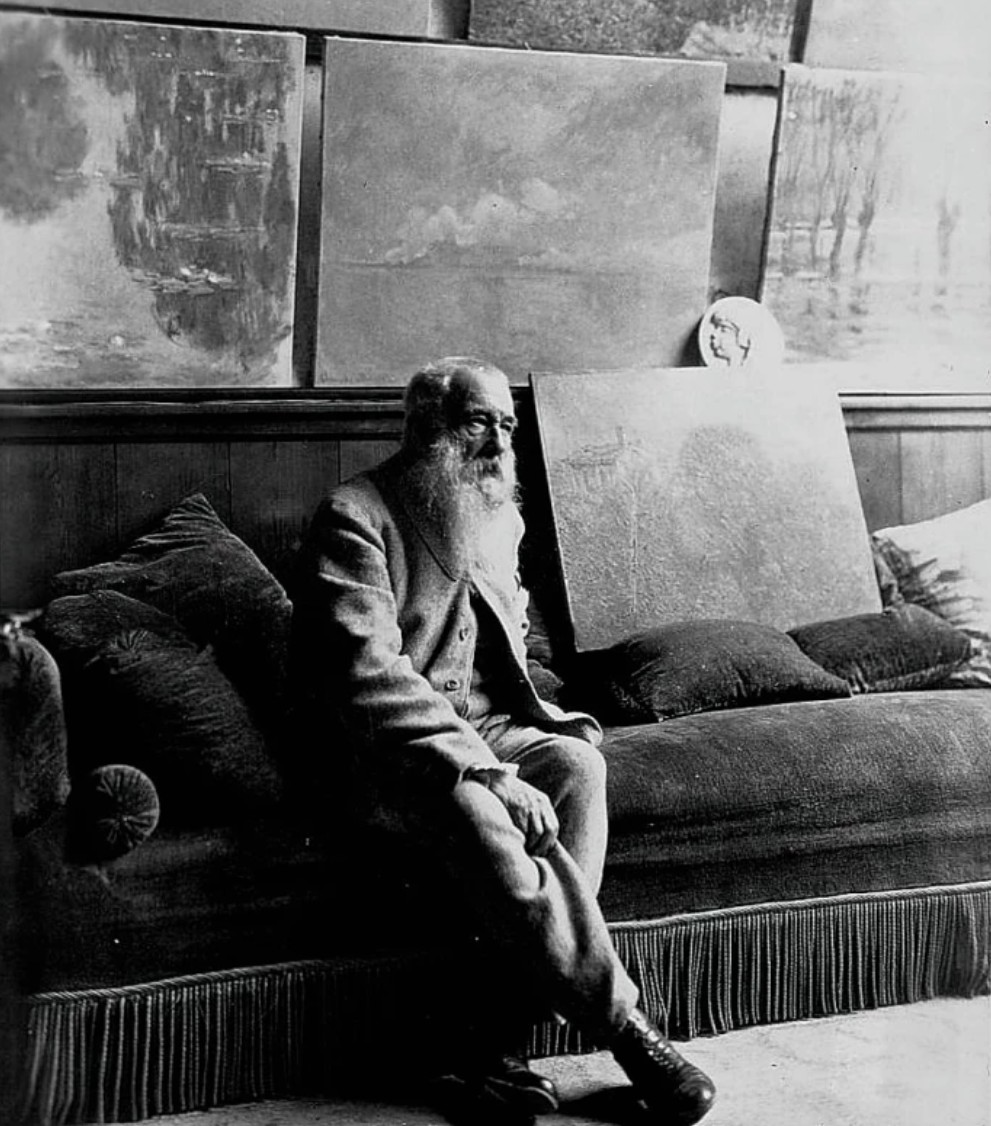
Claude Monet with the present work, Giverny, autumn 1925. Photograph by Thérèse Bonney
In the subsequent years, Maison de jardinier was owned by three female collectors, including Boston-based philanthropists Sarah Choate Sears and Amelia Peabody, and later on, Domenica Walter-Guillaume, widow of art dealer Paul Guillaume and architect and industrialist Jean Walter. Maison de jardinier stands as an exquisite example from Monet’s critical first solo trip to the Mediterranean, the region that challenged the artist and forever transformed his painting through its radiant colours and incomparable light.
Le Parc Monceau, 1878
PROPERTY FROM A DISTINGUISHED PRIVATE COLLECTION
Christie’s London: 5 March 2026
Estimated: GBP 5,500,000 – 8,500,000
CLAUDE MONET (1840-1926), Le Parc Monceau | Christie’s
CLAUDE MONET (1840-1926)
Le Parc Monceau, 1878
Oil on canvas
54.1 x 65 cm (21-1/4 x 25-5/8 inches)
Signed and dated ‘Claude Monet 1878.’ (lower left)
Suffused by warm sunlight and soft shadows, Claude Monet’s Le Parc Monceau is a masterful study of the play of natural light within the landscape. Showcasing the sophistication of the artist’s Impressionist technique, it is one of a trio of compositions depicting the verdant Parc Monceau in Paris that Monet painted during the first half of 1878, offering intriguing views of the lush greenery, bustling promenades, and secluded corners of this carefully cultivated public garden. Filled with a richly nuanced play of color, each stroke of pigment picking out details within the foliage, the painting provides a window into the changing urban environment of Paris during these years, a subject that captivated Monet and his fellow Impressionists throughout the period.
Postcard of the Parc Monceau, Paris, circa 1900. Digital image: Collection Bourgeron / Bridgeman Images.
The urban landscape of Paris had been utterly transformed in the 1860s from a medieval city of winding streets and historic buildings, to a paragon of modernity and elegance, as part of the ambitious reforms of Napoleon III. Led by Baron Georges-Eugène Haussmann, the rebuilding project saw vast sections of the congested city demolished to provide space for expansive new thoroughfares, grand public buildings, apartment blocks of a uniform architectural style, as well as new sewer and water systems. Perhaps most notably, Haussmann was charged with adding a wealth of new public gardens to the capital, reportedly drawing inspiration from the network of large parks and squares that permeated London. To this end, more than thirty new green spaces were opened for the denizens of Paris to enjoy, while a selection of existing gardens and neighborhood squares throughout the city were sensitively renovated and restored by a team of dedicated specialists.
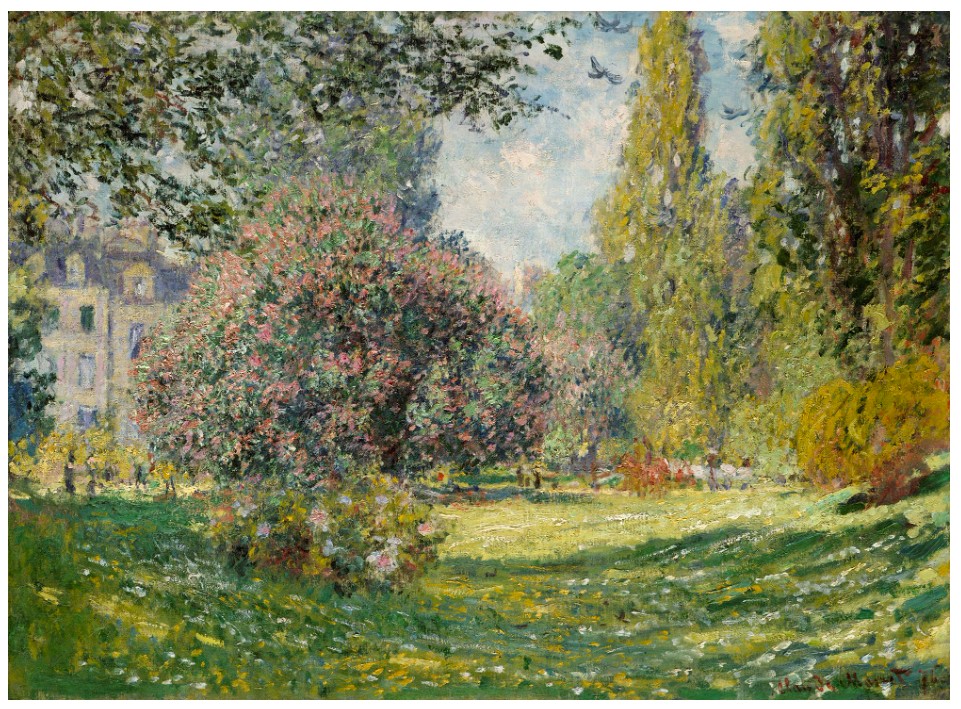
Claude Monet, Paysage : Le Parc Monceau, 1876. The Metropolitan Museum of Art, New York. Digital image: © 2026 The Metropolitan Museum of Art/Art Resource/Scala, Florence.
Situated on the boulevard de Courcelles, in the fashionable eighth arrondissement of Paris, the Parc Monceau was among these revitalised gardens, having originally been established by Phillippe d’Orléans, Duc de Chartres, in the late eighteenth century. Inspired by the gardens at Stowe House in Buckinghamshire, the Duc commissioned Louis Carrogis Carmontelle to design a free-form garden in the English tradition, replete with a collection of follies and water features. The Parc Monceau quickly became renowned for its innovative planting scheme and whimsical, picturesque architecture, and was among the first and most influential gardens in France designed à l’anglais. While the park underwent certain renovations after the French Revolution, it had remained largely untouched through the ensuing decades, before being boldly reshaped by Haussmann’s renovation plans. Acquired by the city circa 1860, a portion of the land was sold off for the development of lavish town houses, and the remaining space reworked into a dynamic, intriguing garden. New lawns were laid, sweeping promenades and picturesque pathways established, the existing grottoes updated and embellished, and a variety of tropical plants added to the flowering beds, from tree ferns and banana plants, to yucas, agaves and caladiums.
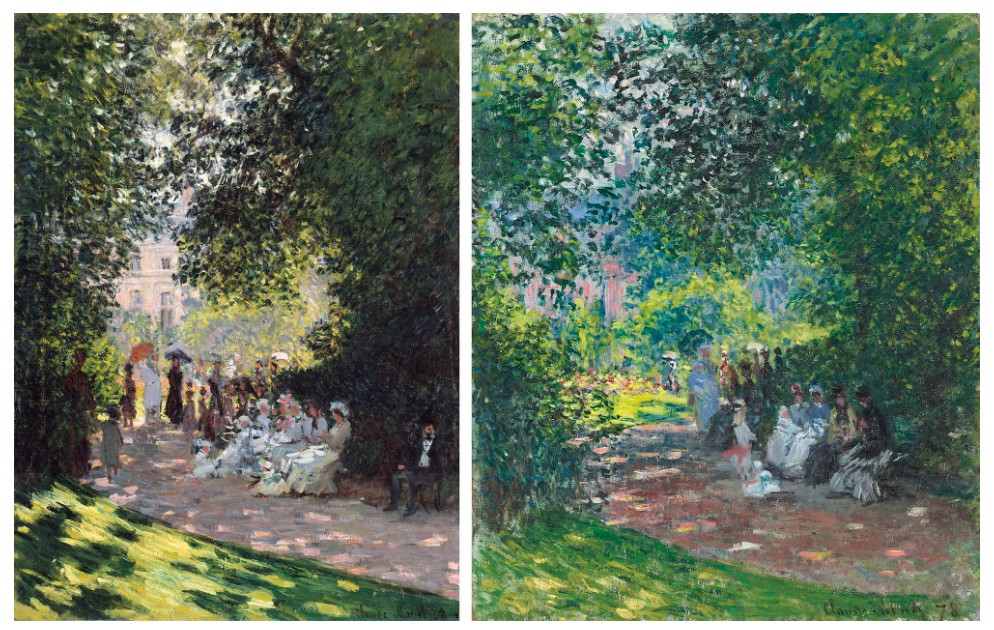
Left: Claude Monet, Le Parc Monceau, 1878. The Metropolitan Museum of Art, New York. Digital image: © 2026 The Metropolitan Museum of Art/Art Resource/Scala, Florence. Right: Claude Monet, Au Parc Monceau, 1878. Sold, Christie’s London, 23 June 2009, £6,313,250 ($10,298,940).
A keen gardener, Monet would no doubt have been intrigued by these changes, and the wealth of unusual plant specimens on view. He had first been drawn to this urban oasis in 1876, most likely through the encouragement of his patron Ernest Hoschedé, where he executed a concentrated series of three canvases (Wildenstein, nos. 398, 399 and 400), the newly finished elegant townhouses along the periphery glimpsed through the foliage. Returning two years later, the artist undertook another trio of paintings devoted to the Parc Monceau, this time drawing the viewer further into the heart of the garden, immersing them in its quiet, secluded atmosphere. In 1878, Monet was living just a short walk away on the Rue d’Edimbourg in the Quartier de l’Europe, with his young family. The artist had settled there in January of that year, and would have been able to closely observe the beautifully maintained park as it entered its springtime bloom and progressed into its full summer growth.
Intriguingly, in the present Le Parc Monceau, Monet does not focus on the large-leafed, exotic plants that had been recently introduced to the gardens, instead training his eye on the dense flowering shrubbery, lush grass and full trees that make up the essential fabric of the park, each rendered in subtly variegated shades of green. Situating himself in the midst of the foliage, in what seems to be a painter’s blind, set at a distance from the principal pathways and thoroughfares, Monet is able to observe the play of life within the garden, while he himself remained partially hidden from view. The artist often favoured compositional devices that allowed him to view distant objects through a screen or a frame. Here, the silhouettes of a group of fashionable figures are just glimpsed through the bushes and trees in the middle ground, the tones of their elegant, modish outfits standing-out among the verdure.
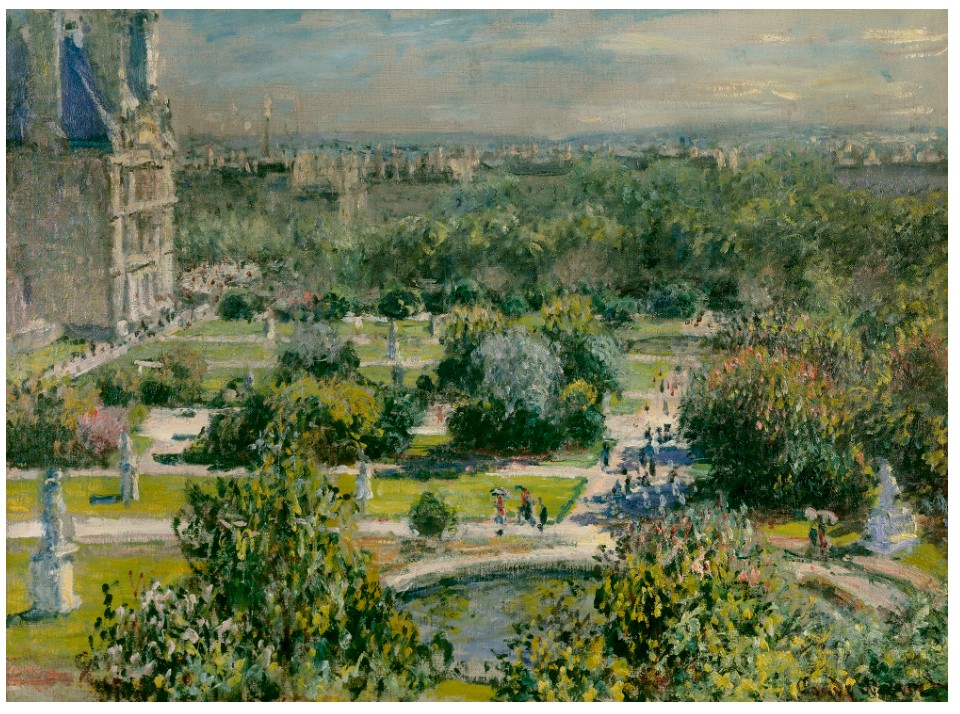
Claude Monet, Vue des Tuileries et des jardins à Paris, 1875. Musée Marmottan Monet, Paris.
Digital image: © 2026 Photo Josse/Scala, Florence.
Unlike his paintings of the Tuileries Gardens (Wildenstein, nos. 401-404) – which presented an expansive aerial view of the strictly formal gardens, seen from the balcony of Victor Chocquet’s fourth floor apartment – Monet’s visions of the Parc Monceau fully immerse the viewer in the vibrant vitality of the park, allowing the vegetation to envelope them. While the majority of this concentrated series showcase the social side of the garden, depicting it as a site for recreation and promenading, with an array of well-to-do figures circulating along the pathways or resting on a park bench in the shade, the present view eschews such details, and instead revels in the verdant beauty and fecundity of nature. Using flickering, quick brushwork to describe the texture of the foliage and the dappled play of light, Monet imbues the composition with a vivid sense of spontaneity and energy, forms coalescing and dissipating as the eye moves through the scene, mimicking the sensation of being in the garden and absorbing the richness of the setting.
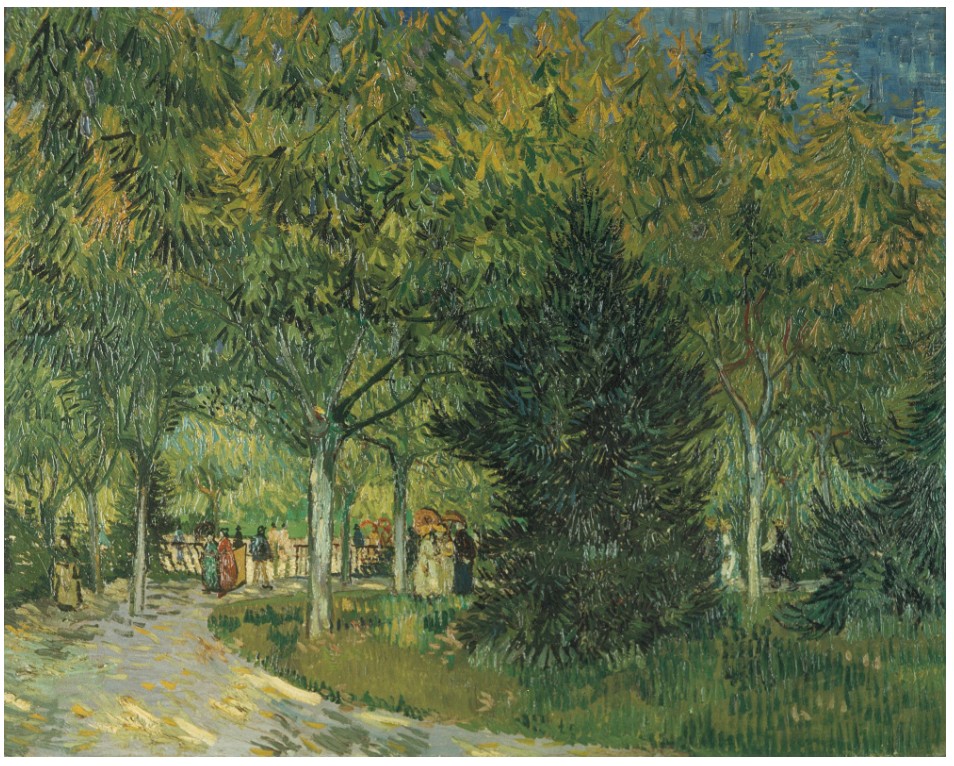
Vincent van Gogh, Path in the Park, 1888. Kröller Müller Museum, Otterlo. Digital image: Artothek / Bridgeman Images.
Shortly after its completion, the present Le Parc Monceau was acquired directly from Monet by one of the earliest and most ardent supporters of Impressionism – Georges de Bellio, a Romanian-born physician with a considerable family fortune behind him. An innately curious figure with an abiding passion for art, De Bellio appears to have first come across the Impressionists in late 1873 or early 1874, just prior to the opening of the inaugural Impressionist exhibition that spring. Through the ensuing years, he cultivated close friendships with many of the leading figures of the movement, regularly providing essential financial support to different members of the group. As Renoir recalled, ‘Every time one of us had a pressing need for 200 francs, he ran to the Café Riche at the lunch hour. There one was sure to find Mr. De Bellio, who would buy, without even looking at it, the painting one brought him’ (quoted in A. Vollard, Renoir, 1919, p. 71).
Georges de Bellio, 1865. Photographer unknown.
De Bellio acquired his first Monet painting at auction in January 1874, marking the beginning of a decades-long journey that would see him develop an extraordinary collection of contemporary avant-garde art. On the walls of his apartment, works by Manet, Renoir, Degas, and Morisot were hung side by side with important canvases by Sisley, Pissarro, Cezanne, and Gauguin. Monet was among the best represented painters in the collection, with almost sixty works by the artist recorded in De Bellio’s possession at one time or another, including his famed early masterpiece, Impression, soleil levant (Wildenstein, no. 263; Musée Marmottan Monet, Paris). An abundance of letters and correspondence between Monet and De Bellio also reveal their close and enduring friendship, which provided the artist with an important source of solace and support during some of the most difficult years of his personal life.
Left: Claude Monet, Impression au soleil levant, 1872. Musée Marmottan Monet, Paris. Formerly in the collection of Georges de Bellio. Digital image: © 2026 Photo Scala, Florence.
Right: Claude Monet, La Gare Saint-Lazare, le train de Normandie, 1877. The Art Institute of Chicago. Formerly in the collection of Georges de Bellio. Digital image: Courtesy Art Institute Chicago.
In 1876, De Bellio had chosen another of Monet’s paintings of the Parc Monceau directly from the artist’s studio (Wildenstein, no. 398; The Metropolitan Museum of Art in New York). Considered in this light, the present view of the gardens may have been painted by Monet to complement the earlier canvas in his friend’s collection. De Bellio most likely loaned the present Le Parc Monceau to the Fourth Impressionist exhibition, which opened on 10 April 1879 at 28, avenue de l’Opéra, Paris. The event included twenty-nine paintings by Monet in a mini-retrospective of his career thus far, with works dating from 1867 right up to his most recently finished canvases. Among the group were a selection of the artist’s views of the newly renovated Paris, together showcasing the inherent modernity of Monet’s vision.