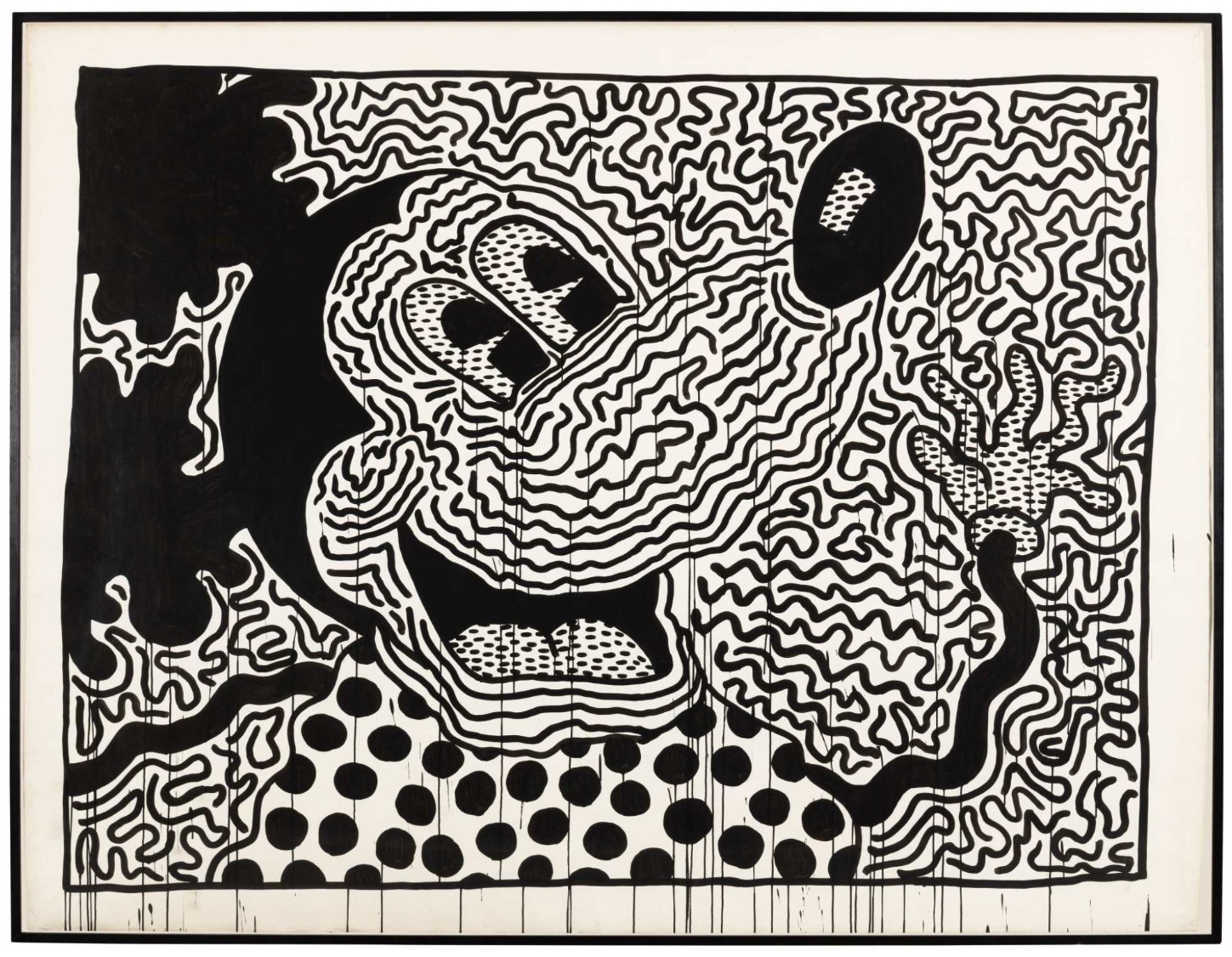
KEITH HARING (1958 – 1990)
Untitled, 1982
Ink on paper
71×94 inches (180.3 x 238.8 cm)
Provenance
Estate of the Artist
Tony Shafrazi Gallery, New York
Private Collection, Greenwich (acquired from the above in June 1992)
Private Collection, New York (acquired from the above in January 1994)
Gil Traub, New York (acquired from the above in August 1999)
Private Collection, New York (acquired from the above)
Christie’s New York, 16 November 2006, lot 442 (consigned by the above)
Acquired at the above sale by the present owner
Auction History
Property from a Private European Collection
Sotheby’s New-York: 18 November 2025
Estimated: USD 800,000 – 1,200,000
USD 1,514,000
Untitled | The Now & Contemporary Evening Auction | 2025 | Sotheby’s
Serpentine lines, polka dots and dashes coalesce in an utterly entrancing manifestation of a comic icon, Untitled is a vivacious testament of Keith Haring’s signature Pop vernacular and dialogue with contemporary visual symbols. A captivating tribute and reconstitution of Walt Disney’s legendary character, Mickey Mouse, Untitled explores an instantly recognizable symbol of mass media through Haring’s original lens.
“I was letting some of the cartoon stuff from my childhood come back into these drawings because I felt freed up and opened up that I could do that.
Some were just drawings of Mickey Mouse, which was something that I had drawn a lot when I was a kid.”
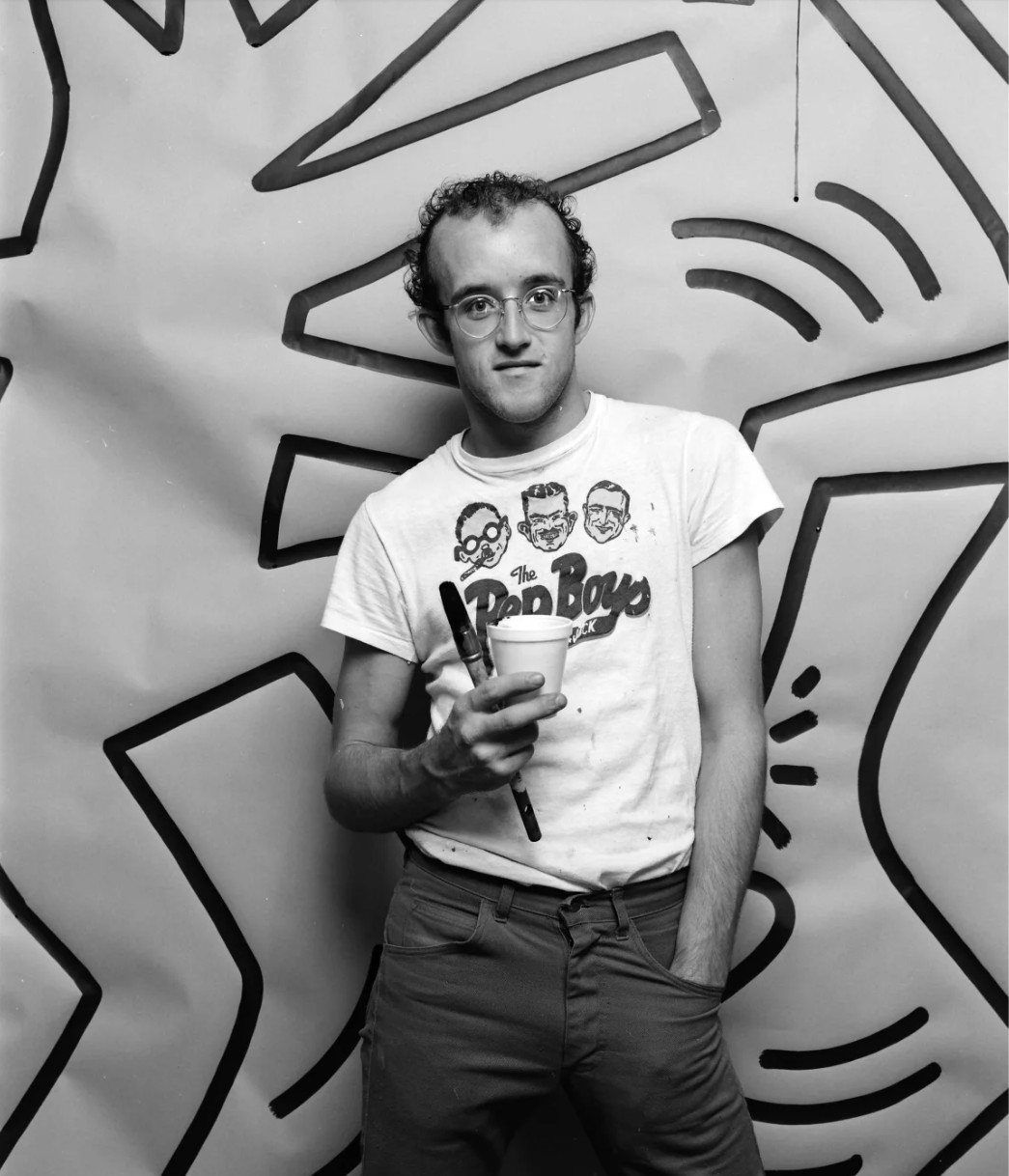
Keith Haring in April 1984. Photo by Jack Mitchell/Getty Images
Emerging from fluid lines of sumi ink, Disney’s central protagonist appears in perpetual movement, oscillating before the viewer’s eyes in a joyful dance. At over seven feet in width, Untitled is a prodigious exemplar of the labyrinthian compositional formations for which the artist is best known. Untitled made its exhibition premier at Haring’s iconic first solo exhibition, Keith Haring One Man Show, at Tony Shafrazi Gallery in the fall of 1982—a groundbreaking event in Haring’s career, crystallizing his place at the center of Contemporary art. In the two decades that followed, the present work appeared in the most important exhibitions of Haring’s work, including the 1997 retrospective at the Whitney Museum of American Art, New York (and traveling).
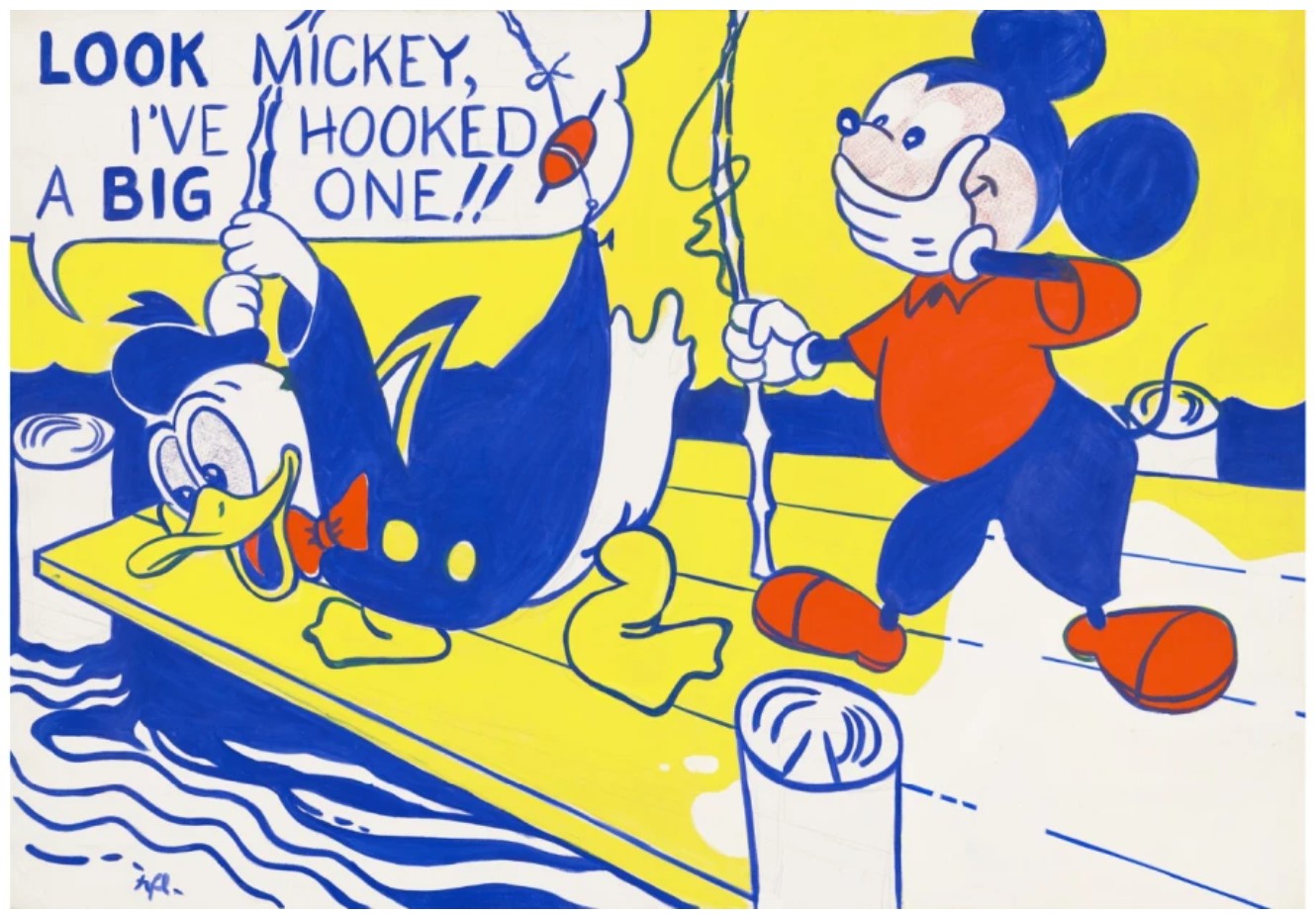
Roy Lichtenstein, Look Mickey, 1961. National Gallery of Art, Washington, D.C. Art © Board of Trustees, National Gallery of Art
Executed in 1982, Untitled is a pivotal early example of Haring’s distinct graphic language, which at its core was driven by the artist’s unrivaled skills as a draftsman. Dozens of idiosyncratic, densely packed black lines form a beguiling, maze-like composition—each element reverberating of another in a dazzling symphony. In scattered areas throughout the composition, pools of sumi ink stream down the surface to the edge of the sheet, revealing an element of the artist’s process that is often concealed. Haring’s graphic lines and dynamic, self-assured forms encapsulated the visceral creative energy and sense of possibility that emboldened the New York cultural scene at the beginning of the 1980s.
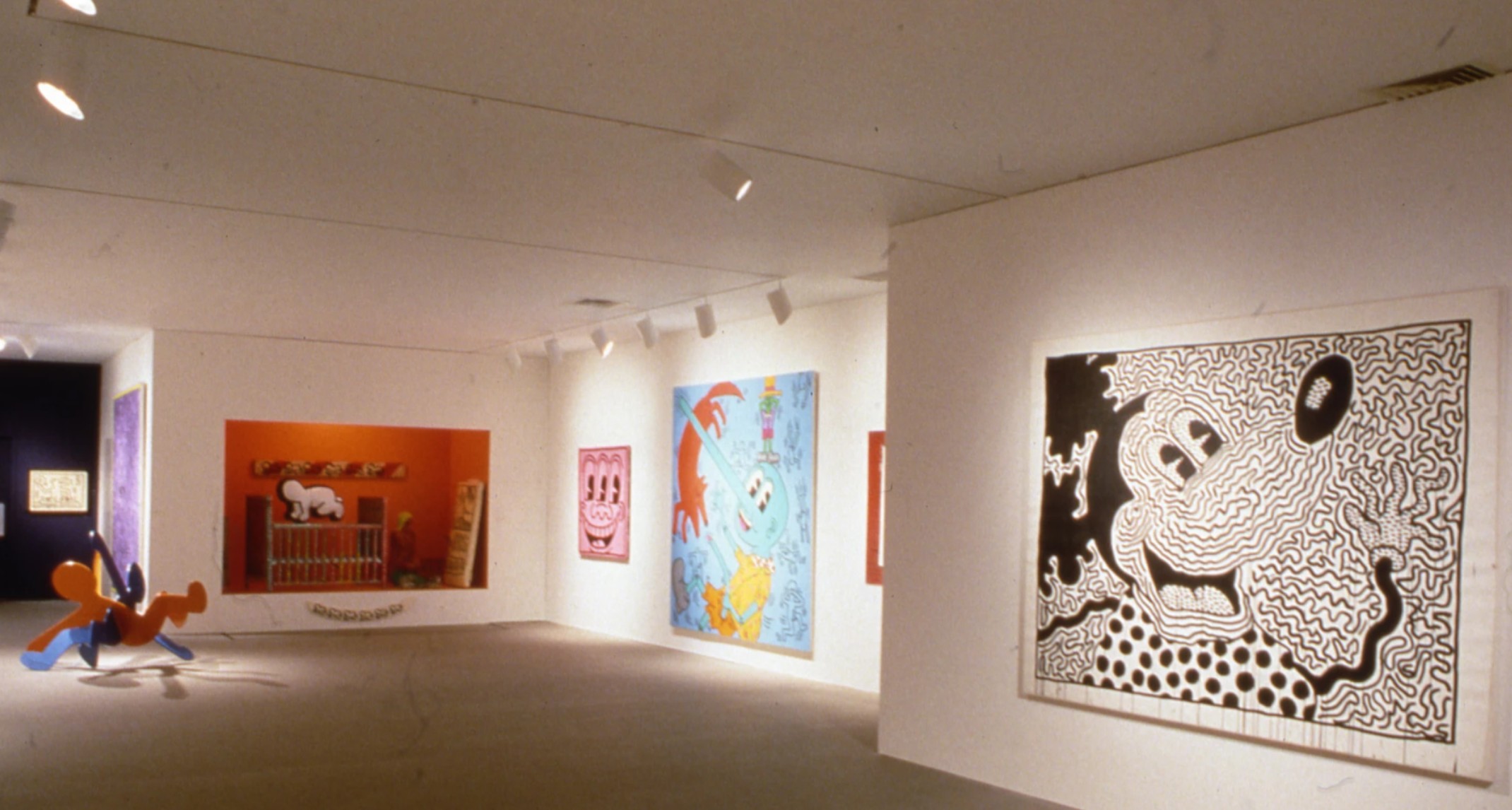
The present work installed in Keith Haring at the Whitney Museum of American Art, New York, June – September 1997.
Art © 2025 The Keith Haring Foundation
Arriving in New York City in 1978, Haring was immediately drawn to the urban music and graffiti scene, exploring the graphic potential of line as the central principle of his practice. After years of filling the city subways with his artworks, in 1982, Haring mounted his breakthrough solo exhibition at Tony Shafrazi Gallery. In his foreword for this seminal exhibition, Shafrazi wrote of his motivation to embark on the project: “It is this abundant creative force and the underlying mastery of drawing, as if each living line were finding its rightful place.” (Tony Shfrazi in: Exh. Cat., New York, Tony Shafrazi Gallery, Keith Haring One Man Show, 1982, p. 7)
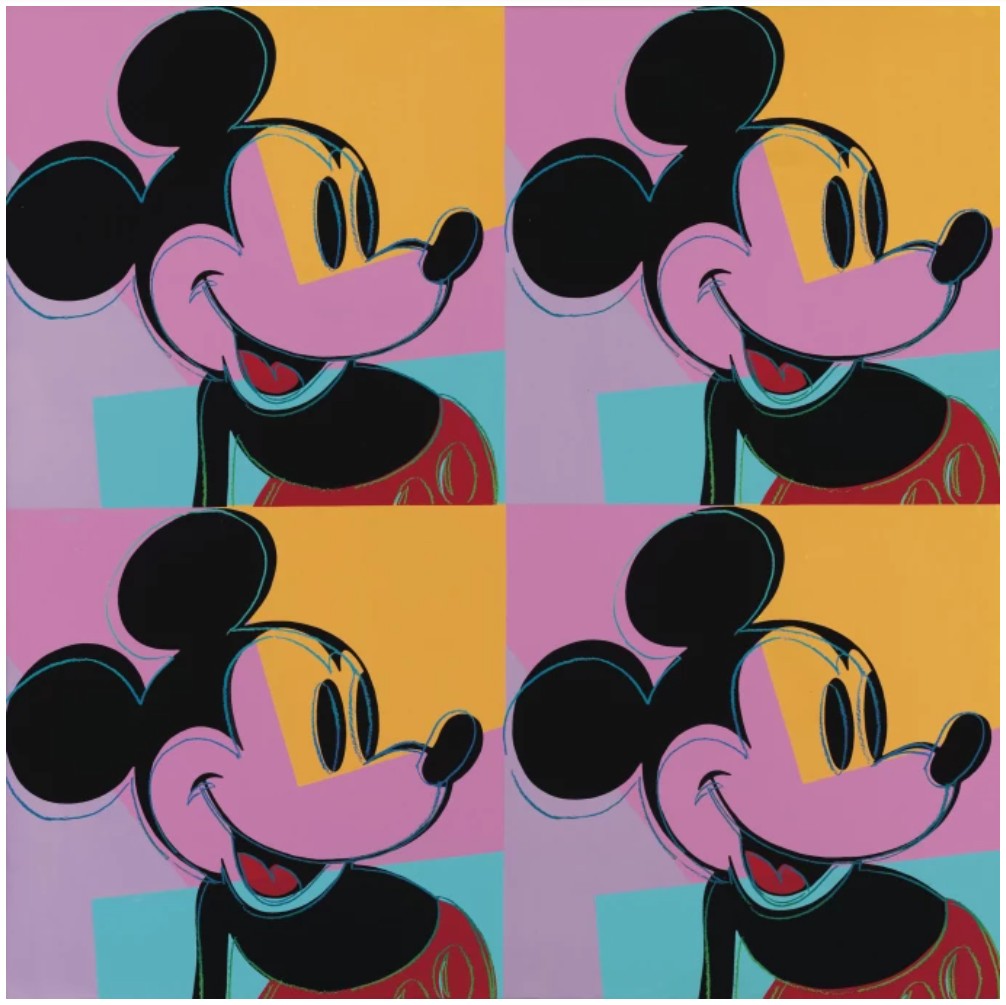
Andy Warhol, Quadrant Mickey Mouse, 1981. Private Collection.
Art © 2025 Andy Warhol Foundation for the Visual Arts / Artists Rights Society (ARS), New York
Like his contemporaries, such as Jean-Michel Basquiat and Andy Warhol, Haring through his visual lexicon served as a narrator of the modern age. Appropriating and reinventing pervasive commercial iconography in his practice, Haring provided incisive commentary on Contemporary pop culture. Created in 1928, Mickey Mouse has long reigned at the center of American pop culture as the animated mascot of the Walt Disney Company and contemporary consumer culture more broadly. The curved ears and elongated nose of Disney’s ubiquitous character form an instantly recognizable silhouette, synonymous with the power and ubiquity of mass media. Decades prior, Mickey Mouse was the subject of Roy Lichtenstein’s iconic, Look Mickey (1961), an iconic example of the artist’s dismantling of the boundaries between high and low art. Here, two decades later, Haring has appropriated the same image yet transformed it through his own visual lexicon. Calligraphic, sinuous lines and swirling forms meet in a masterful and playful dialogue; figure of Mickey dissolves and materializes before the viewer, as if it perpetual motion.
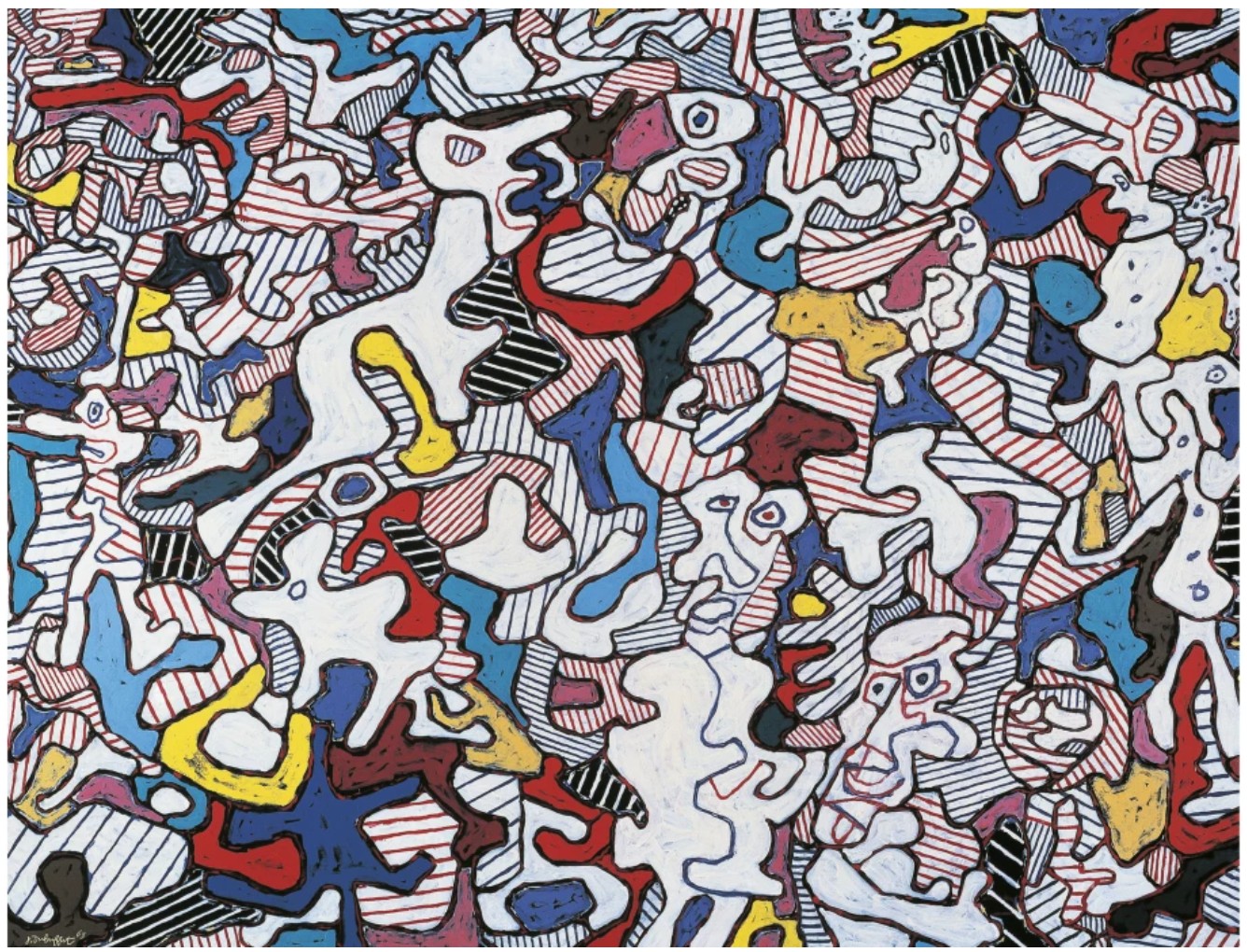
Jean Dubuffet, La Vie de Familie (Family Life), 1963. Musée des Arts Décoratifs, Paris. Image © DeA Picture Library / Art Resource, NY.
Art © 2025 Artists Rights Society (ARS), New York / ADAGP, Paris
Exuding the gestural dynamism of Haring’s best works, Untitled epitomizes the artist’s inimitable aptitude to conveying pulsating energy through an economy of line and form. The expanse of serpentine lines in rich sumi ink is at once frenetic and balanced, untamed and exacting. Forgoing a pre-conceived composition, Haring renders his forms with confidence and spontaneity, amplifying the visceral power of his mark-making.