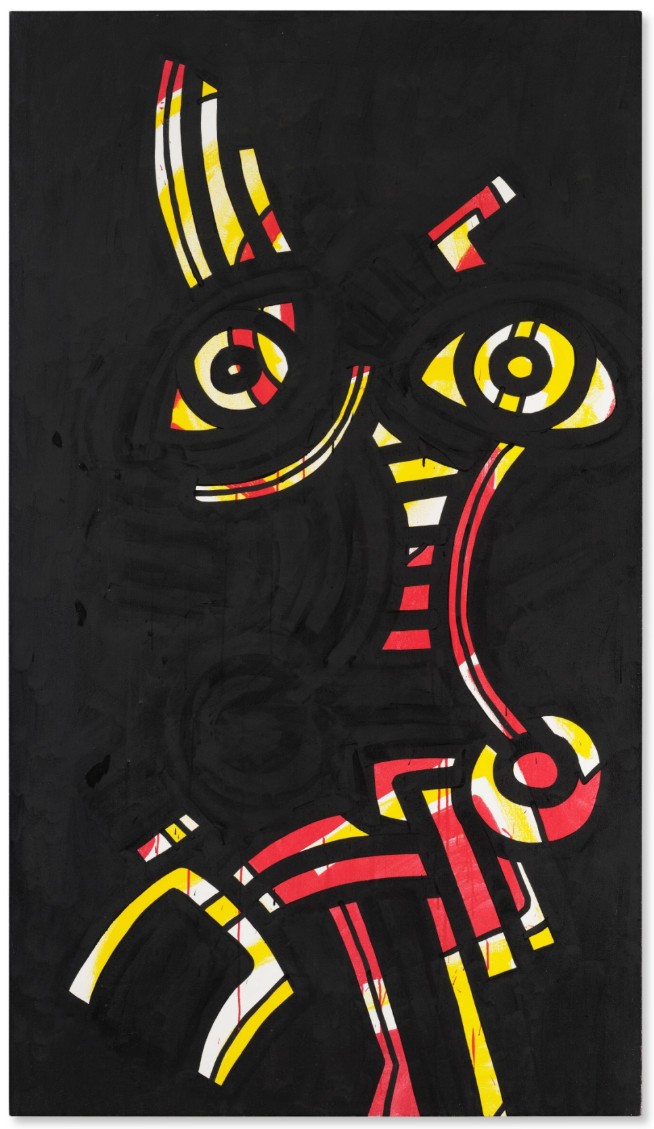
KEITH HARING (1958 – 1990)
Untitled, 1987
Acrylic on canvas
84 x 48 1/8 inches (213.3 x 122.6 cm)
Signed, titled and dated Jan 11-1987 (on the overlap)
Provenance
Tony Shafrazi Gallery, New York
Galerie Hans Mayer, Düsseldorf
Private Collection, New York (acquired from the above circa 1988)
Christie’s New York, 28 September 2017, lot 277 (consigned by the above)
Acquired at the above sale by the present owner
Auction History
Sotheby’s New-York: 19 November 2025
Estimated: USD 400,000 – 600,000
USD 482,600
Untitled | Contemporary Day Auction | 2025 | Sotheby’s
REPEAT SALE
Christie’s New-York: 28 September 2017
Estimated: USD 200,000 – 300,000
USD 250,000
Keith Haring (1958-1990), Red-Yellow-Blue #2 | Christie’s
In 1987 Keith Haring paid homage in a series of works to the recognized 20th Century master of line, Pablo Picasso. Specifically, Haring references Picasso’s assimilation of African tribal art in a grouping of paintings and three-dimensional large-scale masks created for his show at the Shafrazi Gallery in 1987. In these pictures, Haring limits his palate to primary colors and black. In the present painting, Haring incorporates allusions to Maori tattoos. The simplicity, playfulness and whimsy of his compositions prevail to make this example quintessentially Keith Haring.
Executed in 1987, at the peak of Keith Haring’s international acclaim, Untitled exemplifies the artist’s command of form, color, and rhythm, translating the artist’s singular visual language into a dynamic, energetic composition. Across a deep black ground, flashes of yellow, red, and white carve the outline of a face, its features emerging from the interplay of positive and negative space. The figure’s gaze, composed of concentric circles and geometric arcs, seems to vibrate with an inner pulse. The black field recalls Haring’s early chalk drawings in the New York subway, where his imagery first took shape against dark panels of public space. Here, that same sense of immediacy and contrast transforms the surface into a stage for radiant, pulsating energy.
“[Art] is a product of a moment and a state of mind at that moment and a record of a state of being or a moment of living, a point in time in which all your energies and all your forces and the environment is coming together in that one action of making, of creating, of … usually in my case, a drawing. Even when I’m painting I’m usually, I’m drawing when I’m painting, really … When you’re drawing, it’s completely separate because drawing is making a mark and cutting into space and just finding something that didn’t exist before. It’s pure creation in its simplest form …”
The present work was included in Haring’s landmark 1987 exhibition titled Sculpture and Paintings at Tony Shafrazi Gallery in New York, which marked a turning point in his oeuvre. The artist’s vocabulary, once populated by bustling crowds of figures, had become more refined, as did his artistic practice. As shown by Untitled, he now centered his practice around the elemental language of line and symbol. In Untitled, the dynamic precision of red, yellow, and white segments evokes the visual clarity of street art that deeply interested Haring.
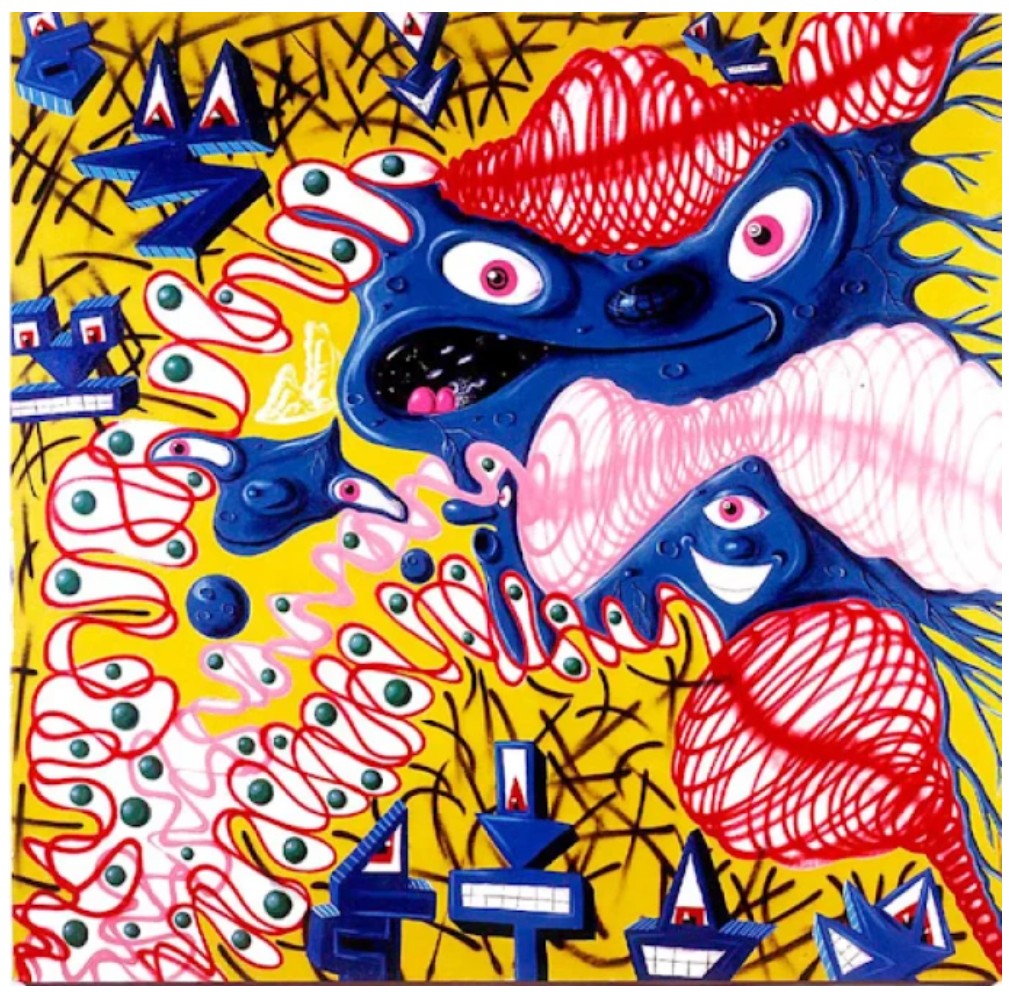
Kenny Scharf, Inside Out, 1984. The Broad, Los Angeles. Art © Kenny Scharf.
The composition’s formal restraint links it to the broader lineage of modern abstraction, while its urban immediacy remains unmistakably Haring’s own. Like Piet Mondrian or Joan Miró before him, he deploys primary color and rhythm to create movement across the surface. Yet, the energy is rooted in the beat of downtown New York. The lines seem to hum with the city’s pulse: graffiti, hip-hop, and club culture are translated into pure visual rhythm. Beneath Untitled’s graphic brilliance lies a poignant emotional register. By 1987, Haring was creating with increasing urgency, aware of the AIDS crisis that had already begun to devastate his community. The radiant color contrasts can be interpreted as conduits of life and vitality, while the black background lends the work a sense of gravity and introspection. With its commanding scale and refined composition, Untitled encapsulates the essence of Haring’s late style: bold, immediate, and profoundly human. This work stands as a testament to an artist who transformed the language of the street into a universal symbol of hope, defiance, and enduring creative spirit.