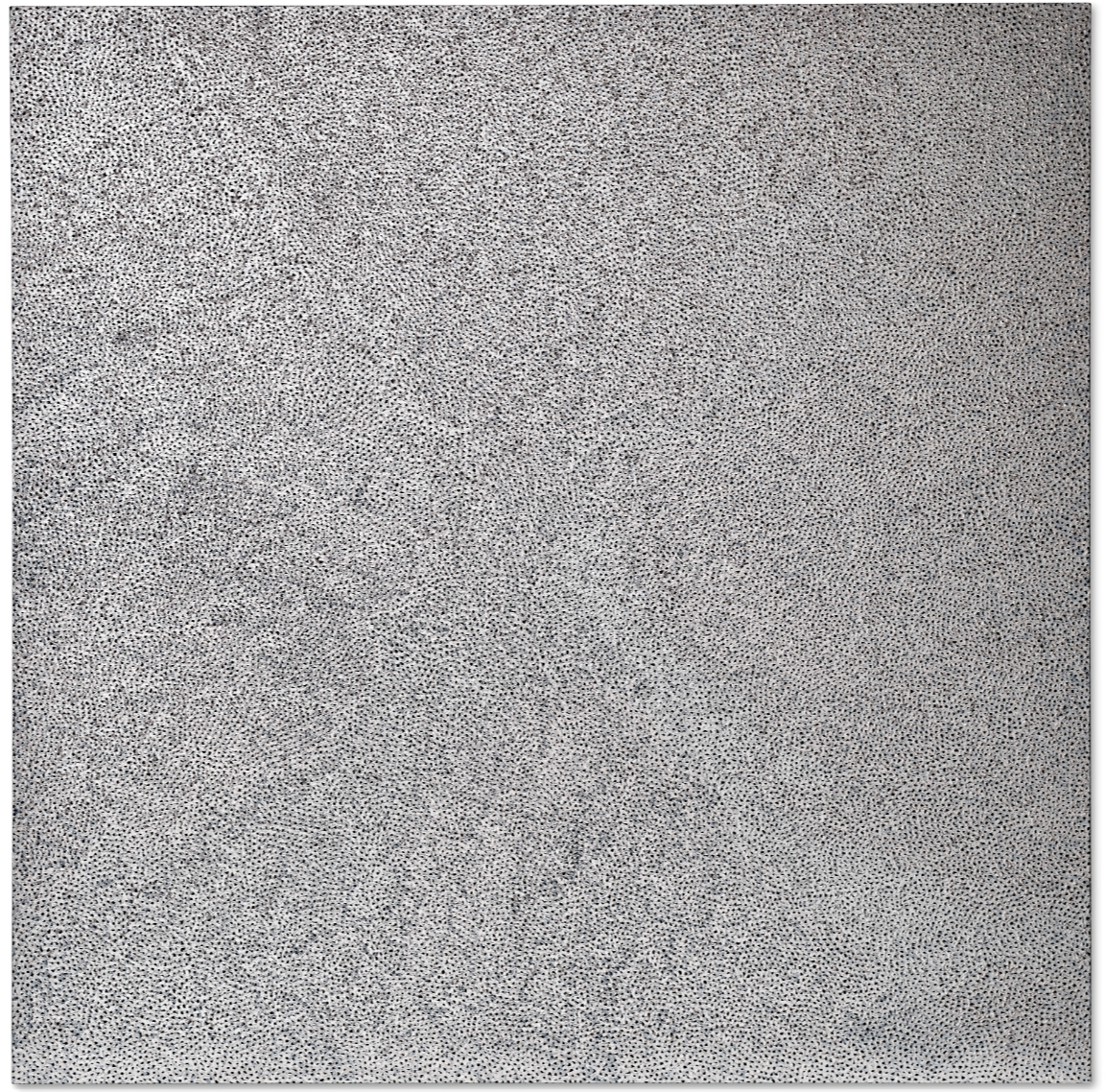
YAYOI KUSAMA (B. 1929)
INFINITY-NETS (OTWTTS), 2007
Acrylic on canvas
194×194 cm (76 3/8 x 76 3/8 inches)
Signed twice, titled and dated ‘OTWTTS INIFINTY-NETS Yayoi Kusama 2007 YAYOI KUSAMA’ (on the reverse)
Provenance
Ota Fine Arts, Tokyo
Acquired from the above by the present owner, 2007
Auction History
Christie’s New-York: 22 November 2024
Estimated: USD 1,800,000 – 2,500,000
USD 2,107,000
YAYOI KUSAMA (B. 1929), INFINITY-NETS (OTWTTS) | Christie’s
Vast and all-encompassing, INFINITY NETS (OTWTTS) commands a monumental presence that hypnotizes the viewer in an expansive field of gleaming metallic patterns. The canvas is meticulously adorned with Kusama’s characteristic semi-circular brushstrokes, each shimmering loop fluidly interlocking with the next to form an undulating, net-like lattice. Applied in thick metallic impasto, the brushstrokes rise fervently from the surface, imbuing the work with a tactile quality where silvery textures become tangible, three-dimensional forms, transforming the painting into a shiny, almost sculptural expanse.
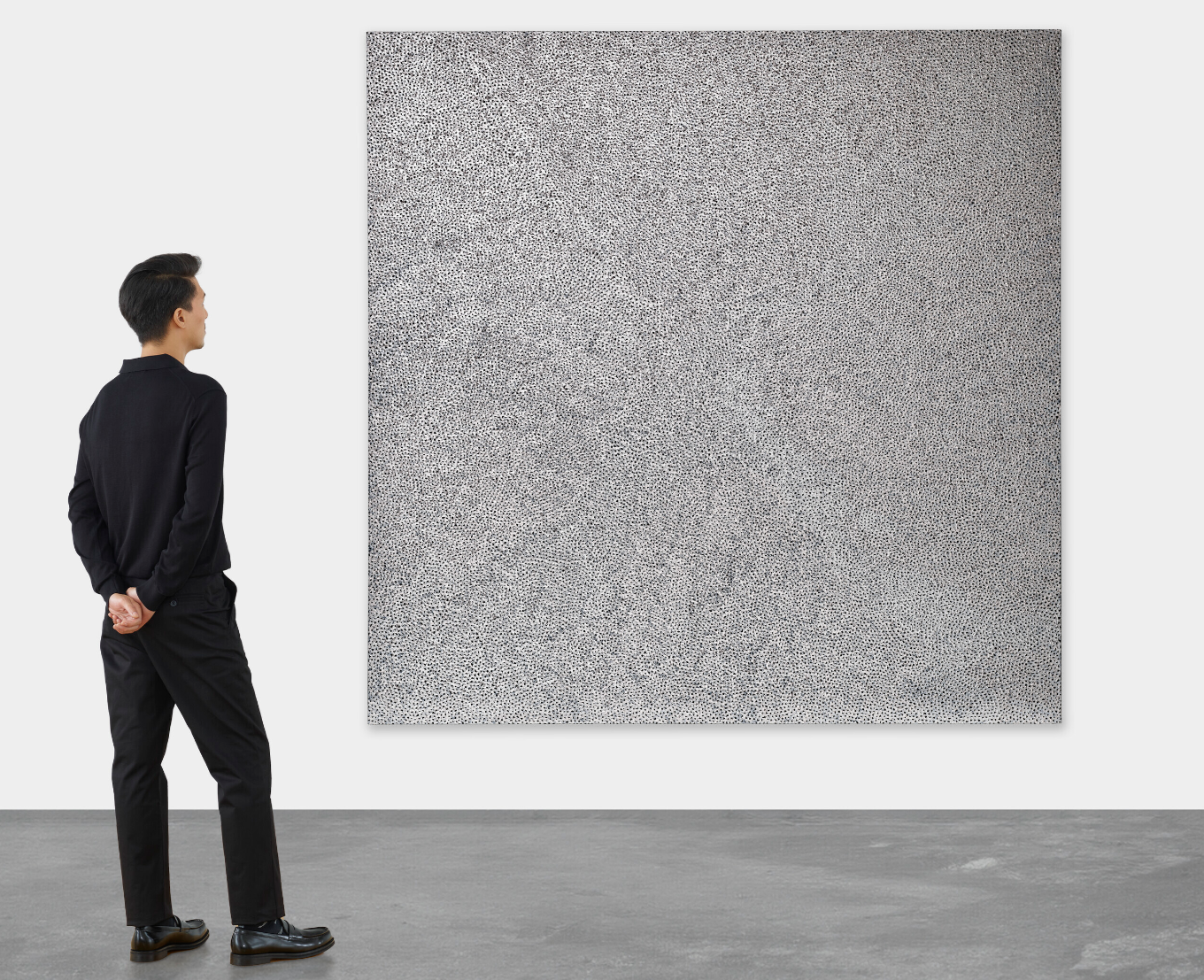
Painted in 2007, INFINITY NETS (OTWTTS) forms part of Kusama’s celebrated Infinity Nets series, which she began soon after arriving in New York City in the late 1950s. Nearly five decades after her earliest iterations of Infinity Nets, the present lot builds upon the dynamism of her earlier groundbreaking works, incorporating metallic paint to seamlessly bridge decades of artistic evolution and innovation.
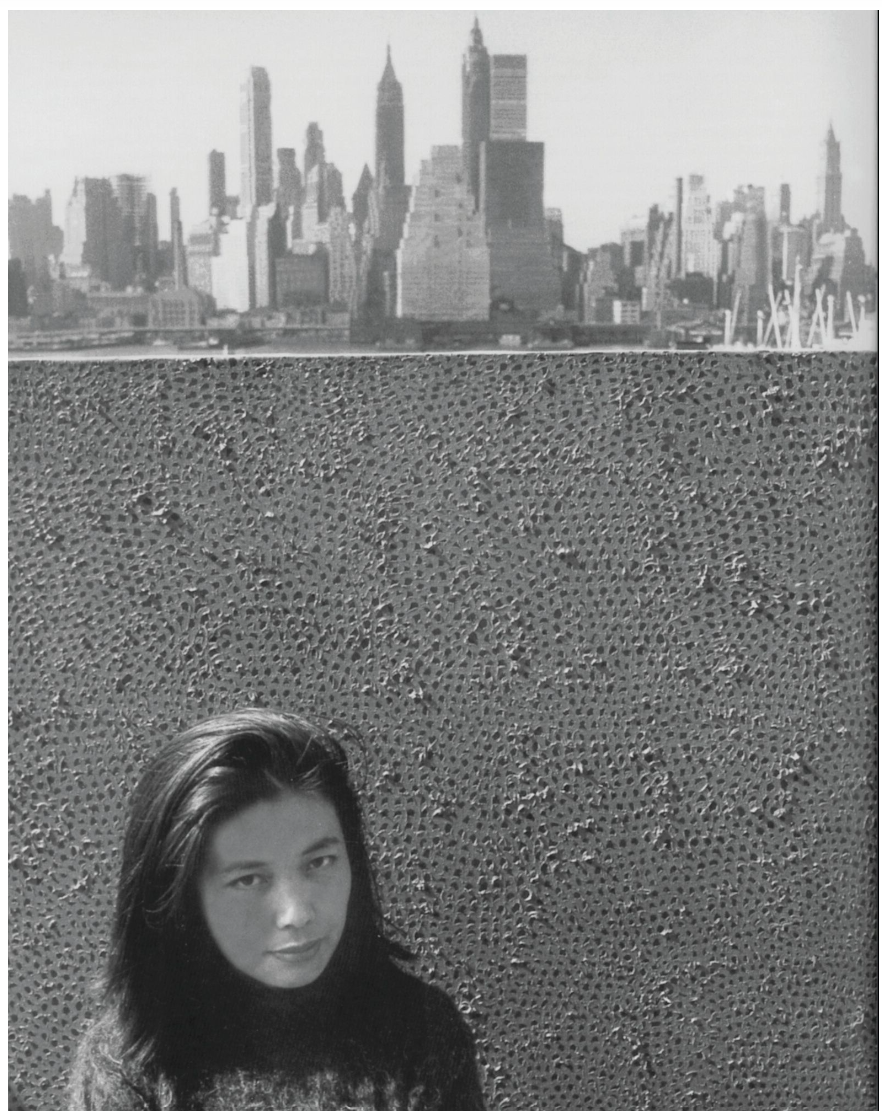
Yayoi Kusama, New York, circa 1961. Photo: Yayoi Kusama Studio, Tokyo. Artwork: © Yayoi Kusama.
Driven by an insatiable desire to make art, Kusama arrived in New York City in 1958. Isolated from her native Japan, she worked tirelessly in her modest, cluttered studio, laboring for hours on end on her now-renowned Infinity Nets.
“I wanted to start a revolution, using art to build the sort of society I myself envisioned.”
In 1959, her efforts culminated in her first solo exhibition at the Brata Gallery, an artist-run space in the heart of the East Village. The exhibition unveiled her monumental Infinity Net paintings to the public for the first time, composed exclusively of white semi-circular forms over black backgrounds. Unsurprisingly, her rhythmic and meditative canvases quickly captivated the New York avant-garde, including Donald Judd, who praised her works.
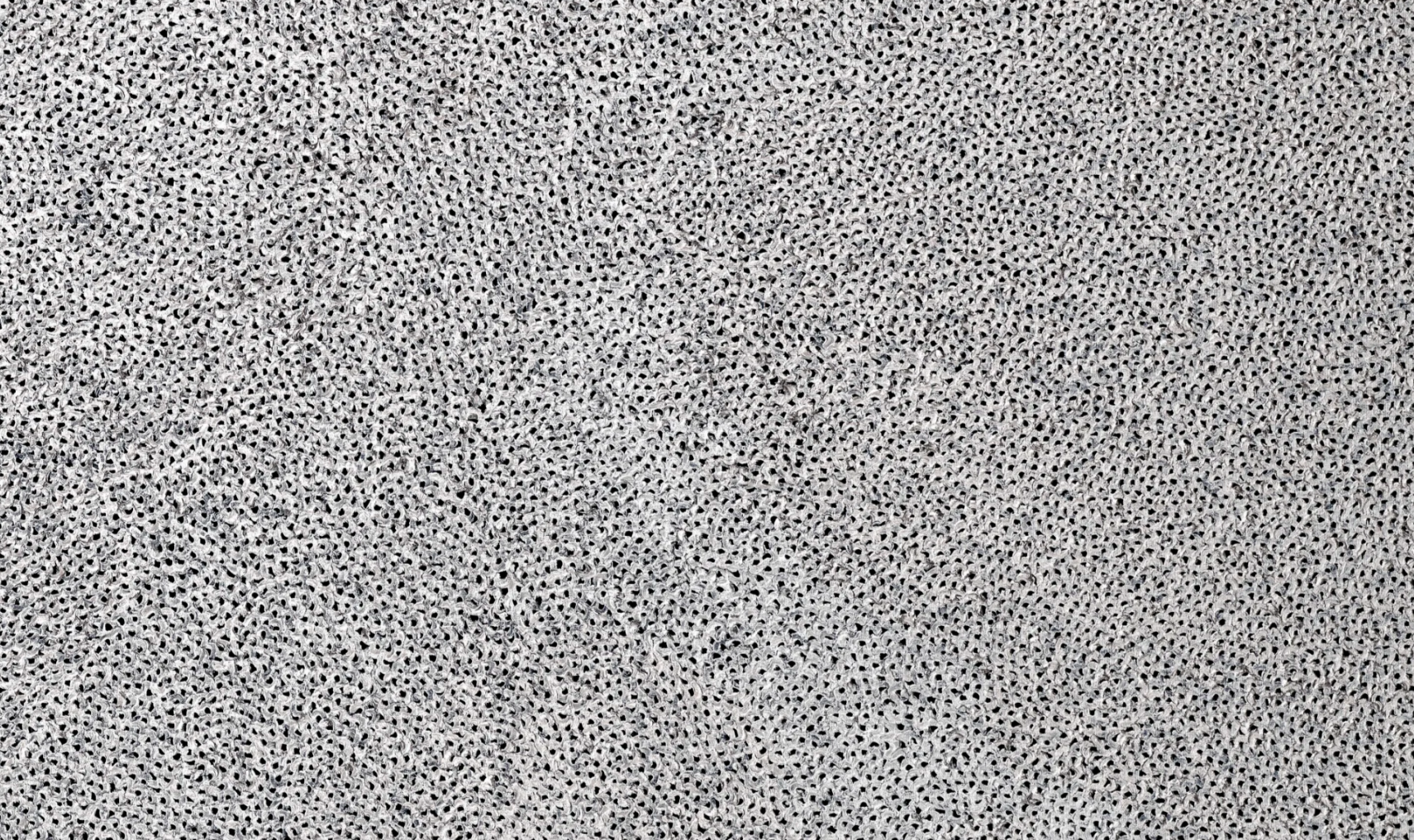
Indeed, her process was both meticulous and obsessive. Each semicircular brushstroke was a highly calculated act, contributing to an expansive network of brushstrokes that seemed to extend far beyond the canvas’s physical edges. The repetitive motion became a form of meditation, a way to channel her psychological turmoil into tangible form. Kusama had suffered from vivid hallucinations since childhood, visions where patterns and dots consumed her surroundings.
“I often suffered episodes of severe neurosis. I would cover a canvas with nets, then continue painting them on the table, on the floor, and finally on my own body. As I repeated this process over and over again, the nets began to expand to infinity. I forgot about myself as they enveloped me, clinging to my arms and legs and clothes and filling the entire room.”
The laborious application of paint, layer upon layer, loop after loop, was thus not a mere artistic technique but a necessary compulsion, materializing her inner cosmos of hallucinations onto the canvas and enveloping the viewer within them. Amidst the fervor of the New York avant-garde scene in the late 1950s, where Abstract Expressionism dominated the artistic landscape with its explosive gestures and raw emotional intensity, Kusama’s Infinity Nets presented a stark contrast. Artists like Jackson Pollock, in works such as Number 28, 1950, unleashed torrents of swirling aluminum, gray, and olive-green paint across the canvas, a turbulent blend of color and movement that captured the New York School’s signature spontaneity and painterly chaos. In sharp contrast, Kusama’s methodical and introspective approach manifested in meticulously applied semi-circular brushstrokes, forming tightly woven geometric grids, a composition both measured and controlled. While Pollock’s Number 28 celebrates the physical act of painting through energetic dripping and gestural abstraction, Kusama’s Infinity Nets invite serene contemplation; where Pollock’s silvery hues add to the intensity and chaos of his work, Kusama’s shimmering metallic impasto in the present lotfosters a meditative expanse, its hypnotic repetition evoking an infinite, rhythmic stillness.
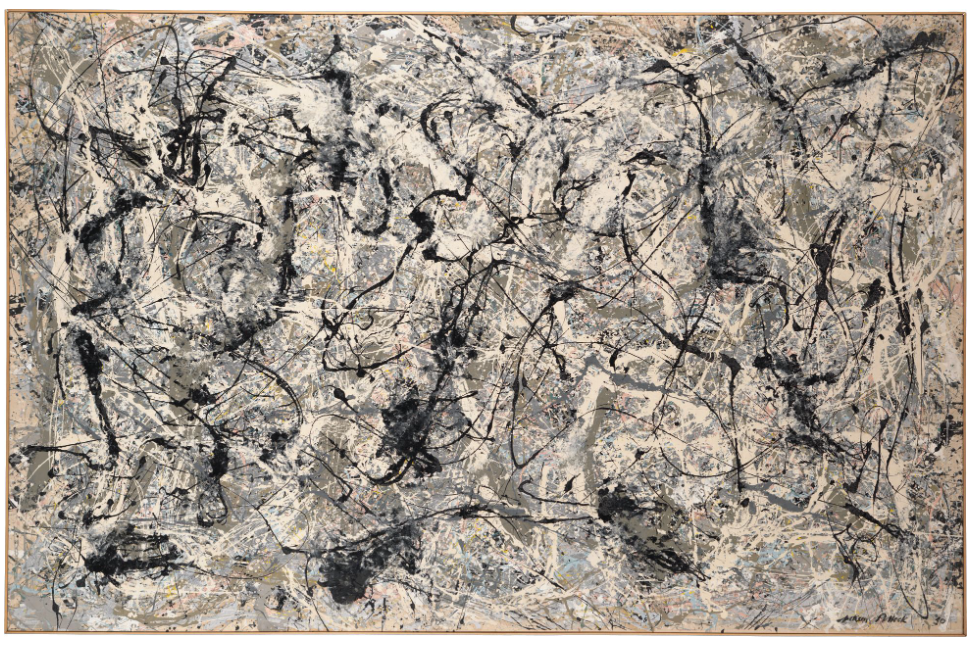
Jackson Pollock, Number 28, 1950. Metropolitan Museum of Art, New York. © 2024 The Pollock-Krasner Foundation / Artists Rights Society (ARS), New York. Photo: © The Metropolitan Museum of Art / Art Resource, New York.
Despite the commercial dominance of Abstract Expressionism throughout her career, Kusama remained steadfast in her meticulous, obsessive mark-making, acutely aware of her divergence from the mainstream.
“Action Painting was all the rage then, and everybody was adopting this style and selling the stuff at outrageous prices. My paintings were the polar opposite in terms of intention, but I believed that producing the unique art that came from within myself was the most important thing I could do to build my life as an artist.”
Impressively, Kusama’s bold departure from mainstream artistic conventions did not merely distinguish her from her contemporaries—it placed her at the forefront of emerging movements that would redefine contemporary art. Her emphasis on repetition and introspection prefigured the Minimalist movement of the 1960s and 1970s and gestured towards the emergence of Pop Art, particularly resonating with artists like Andy Warhol whose fascination with mass production, seriality, and infinite multiplicity paralleled her own. This early exploration into the infinite later culminated in Kusama’s Infinity Dot paintings and Infinity Mirror Rooms of the late 1960s through present day. Continuously returning to the infinity motif, INFINITY NETS (OTWTTS) thus forges a vital connection between the radical experimentations with the infinite Kusama pioneered throughout the 1950s and 1960s and a renewed, 21st century lens.
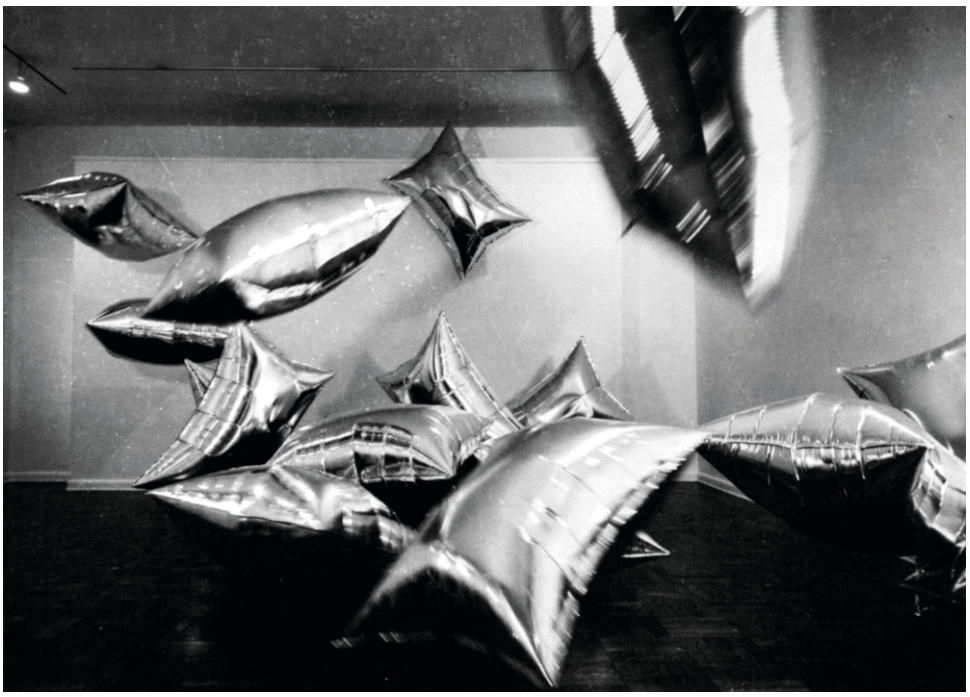
Rudy Burckhardt, Andy Warhol Silver Clouds at Leo Castelli, 1966. Archives of American Art, Smithsonian Institution, Washington, D.C. Photo: Estate of Rudy Burckhardt / Artists Rights Society (ARS), New York.
Artwork: © 2024 The Andy Warhol Foundation for the Visual Arts, Inc. / Licensed by Artists Rights Society (ARS).
Revisiting her seminal Infinity Nets series in 2007 with INFINITY NETS (OTWTTS), Kusama pays homage to the minimalist color palette of her earliest works while introducing a metallic sheen that breathes new life into her now lauded motif. This reimagining not only reaffirms the enduring relevance of her pioneering series, but also underscores her persistent desire to adapt and re-invent within her own visual lexicon in the 21st century. Importantly, the significance of this work lies not only in the commercial and institutional success of her Infinity Nets, but also in the uncompromising character of Kusama’s singular practice.