YAYOI KUSAMA (b. 1929)
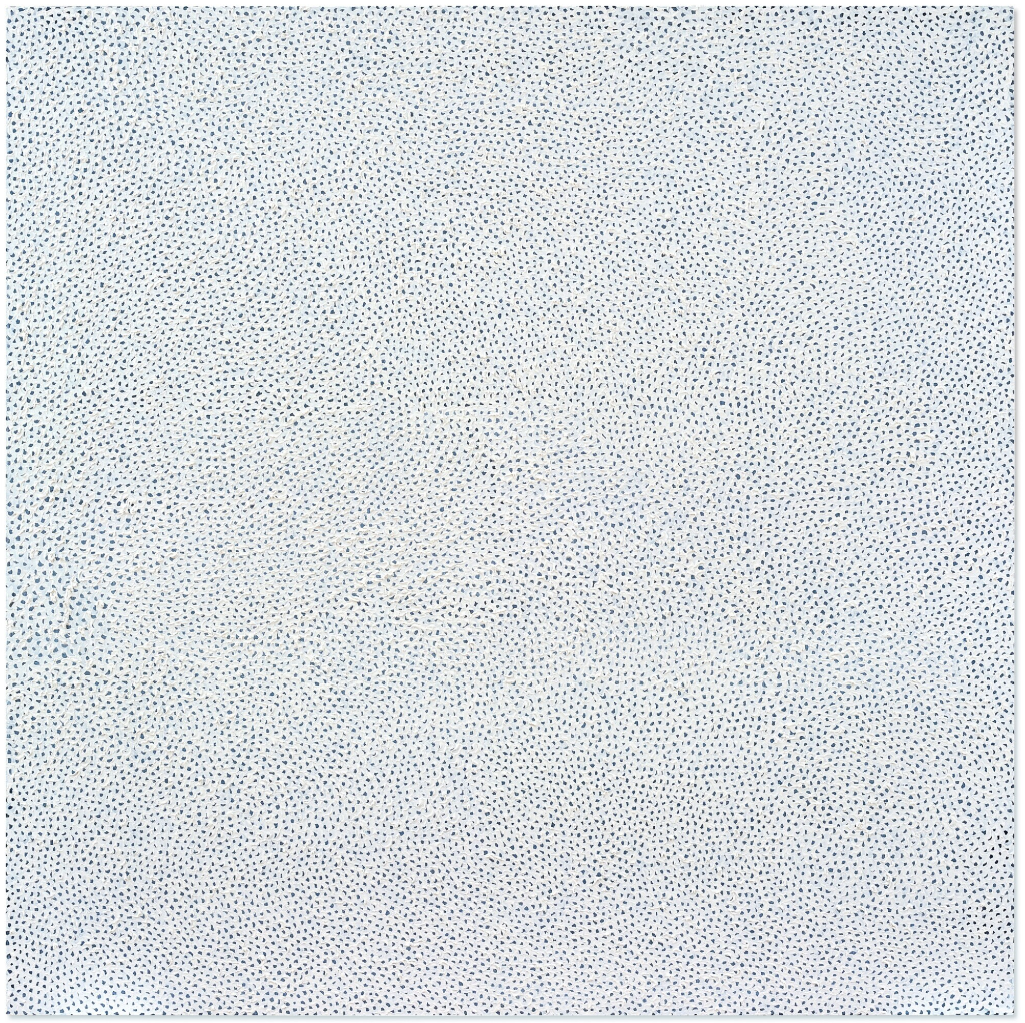
Infinity-Nets (RAZX), 2011
Acrylic on canvas
162×162 cm (63 3/4 x 63 3/4 inches)
Signed, titled in English and Japanese and dated 2011 on the reverse
Provenance
Ota Fine Arts, Tokyo
Acquired from the above by the present owner
Auction History
Sotheby’s Hong-Kong: 5 October 2023
Estimated: HKD 20,000,000 – 30,000,000
HKD 18,600,000 / USD 2,375,257
The stark monochrome gravity of the snow-white Infinity-Nets (RAZX) from 2011 evinces a singularly breath-taking visual and visceral dynamism – a quaking shudder that ripped through the New York and European art scenes when the artist’s white nets first appeared over five decades ago. A testament to Yayoi Kusama’s most celebrated corpus of paintings, the present work is captivating in its level of detail; an endless maze of oscillating, kaleidoscopic white lines floating atop a luminous grey-blue background.
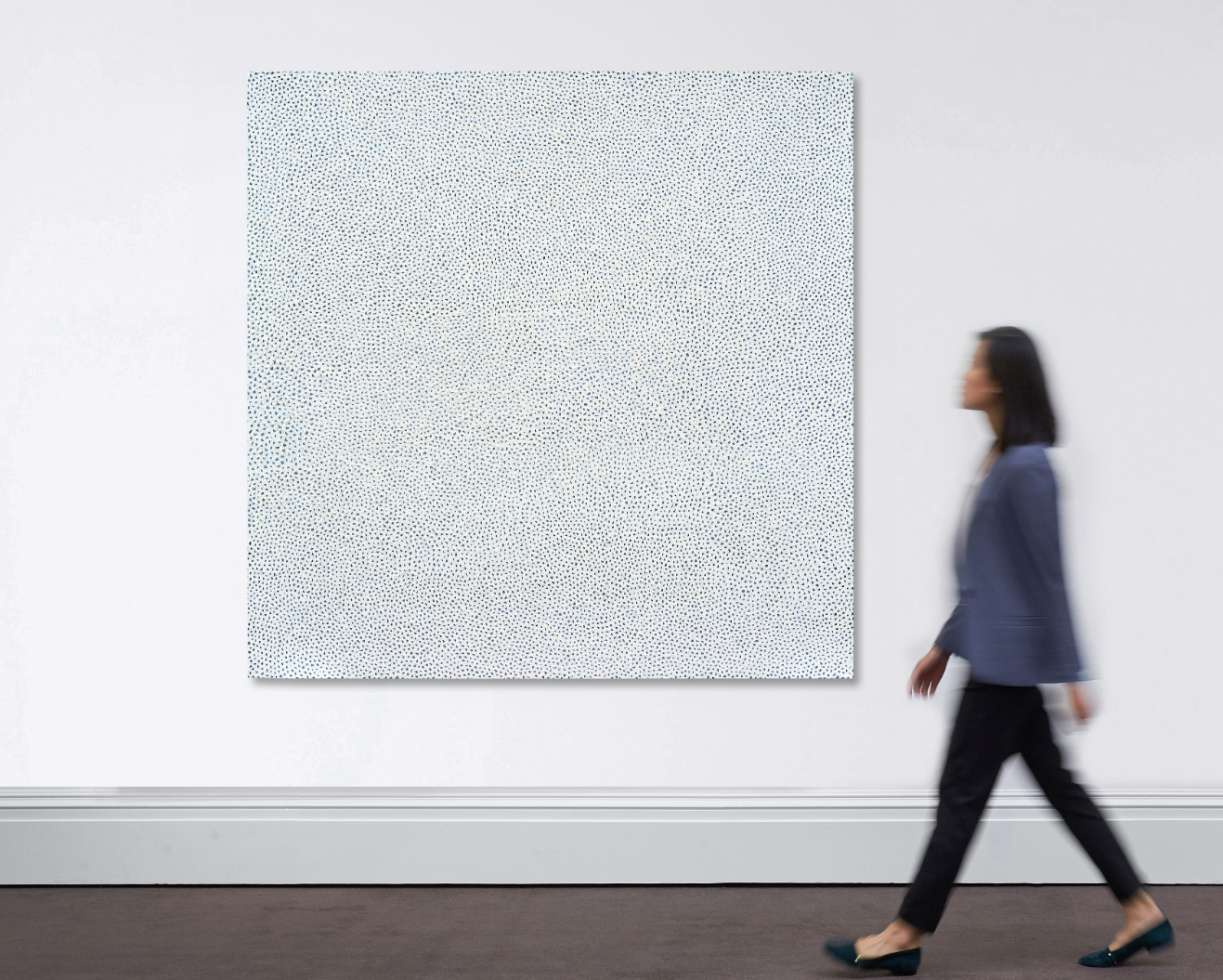
While many of her later Infinity Nets paintings have taken on a change in color palette, white is the ultimate emblem to signify Kusama’s original success. As the millennium embarked, Kusama would pay an increasingly large amount of time to installation and sculptural works, making the Infinity Nets fewer in numbers. Measuring around 160 by 160 centimeters, the square shaped Infinity-Nets (RAZX) is without a doubt a signatory work to evoke the spiritual presence of the original series. Filling up our entire field of vision, the apparent uniformity of the over-a-meter net belies minute differences in the size of the individual loops and the quantity of paint utilized in every stroke. Rendered in acrylic, the textural surface of the present work reflects an aesthetic refinement seen upon the artist’s move away from the use of oil paint upon her return to Japan in the 1980s.
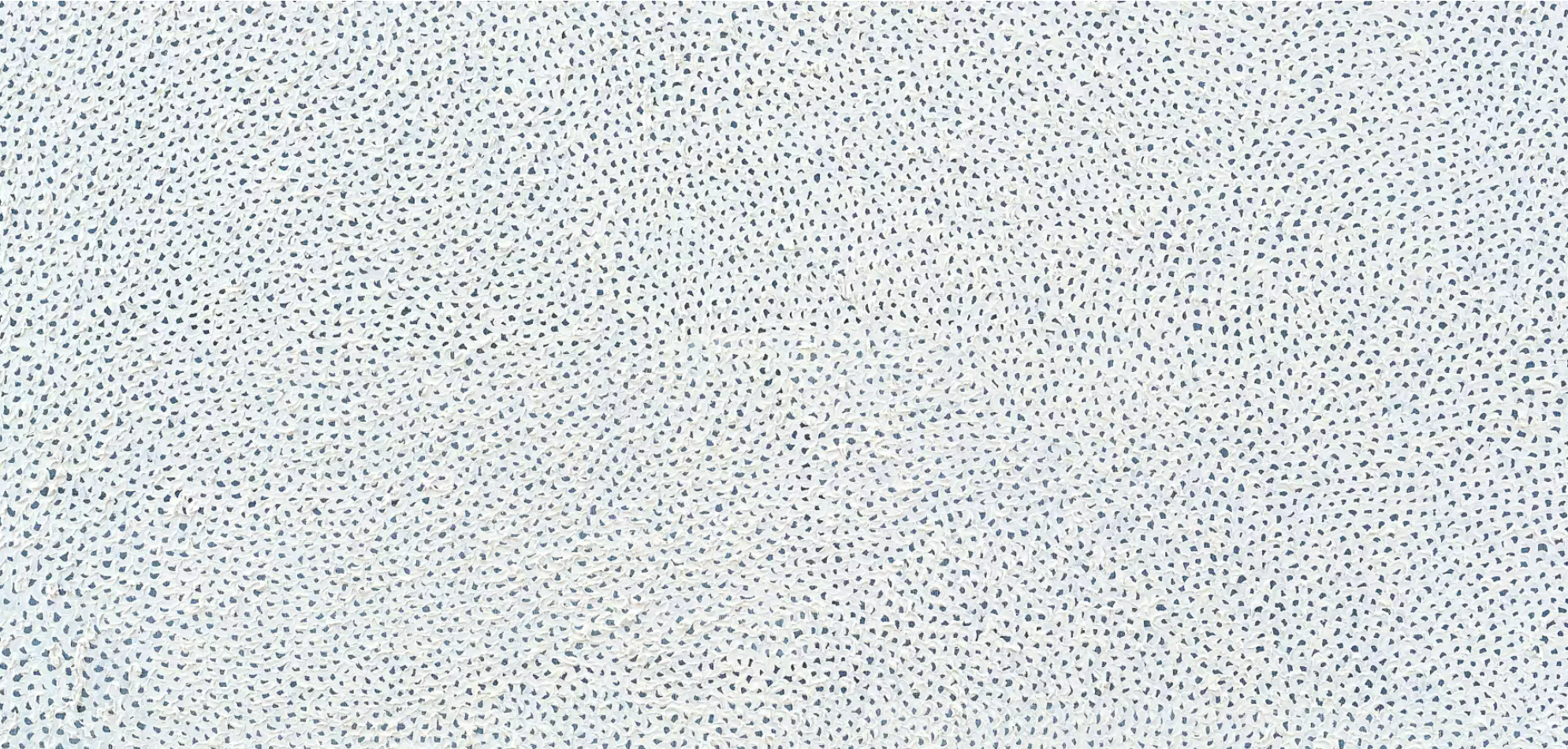
Full of reflected light and the artist’s labyrinthine web of mesmeric pigment loops, Infinity Nets (RAZX) exudes an irrepressible and hypnotically irresistible force. Drawing the viewer towards the shimmering spaces contained within the tightly woven blanket of paint, the present work’s almost topographical surface meanders across the extent of the picture plane, mirroring the painterly process by which it was created. Kusama’s innumerable brushstrokes pile onto one another, culminating in some parts of the canvas in mounds of expressive impasto, and solidifying into radiating planes of white pigment in others. Each dab of paint is laid with a painstaking devotion to the act of mark-making, consuming the canvas in a field of texture.
When Kusama first arrived in New York City in June 1958, she recalls climbing to the top of the Empire State Building and looking down at the grided city below in complete awe. At 29 years old, the young artist realized that in order to succeed in the city she would have to do something spectacular.
“I aspired to grab everything that went on in the city and become a star.”
According to art historian Mignon Nixon, Kusama set out to “replace the expressive gesture with an exhaustive one, pushing painting to its limits of spatial extent and ‘monotony;’ and to obliterate the self, reconceiving contemporary painting from a subjective statement of individual consciousness to ‘nothingness’ on an epic scale” (Mignon Nixon, “Infinity Politics,” in Francis Morris, Ed., Yayoi Kusama, London 2012, p. 180). Shortly after, Kusama began work on what would become her most rarefied and renowned series of white Infinity Nets canvases, a prized body of early paintings of which examples reside in some of the most renowned museums and institutions in the world. After leaving Japan, Kusama abstracted the naturalistic themes of her early works into large-scale canvases with dense repetitive patterns. Inspired by microscopic and macroscopic imagery of nature, these breath-taking extractions became physical manifestations of the artist herself, extending out from her very body.
“My nets grew beyond myself and beyond the canvases I was covering them with. They began to cover the walls, the ceiling, and finally the whole universe. I was always standing at the centre of the obsession, over the passionate accretion and repetition inside of me.”
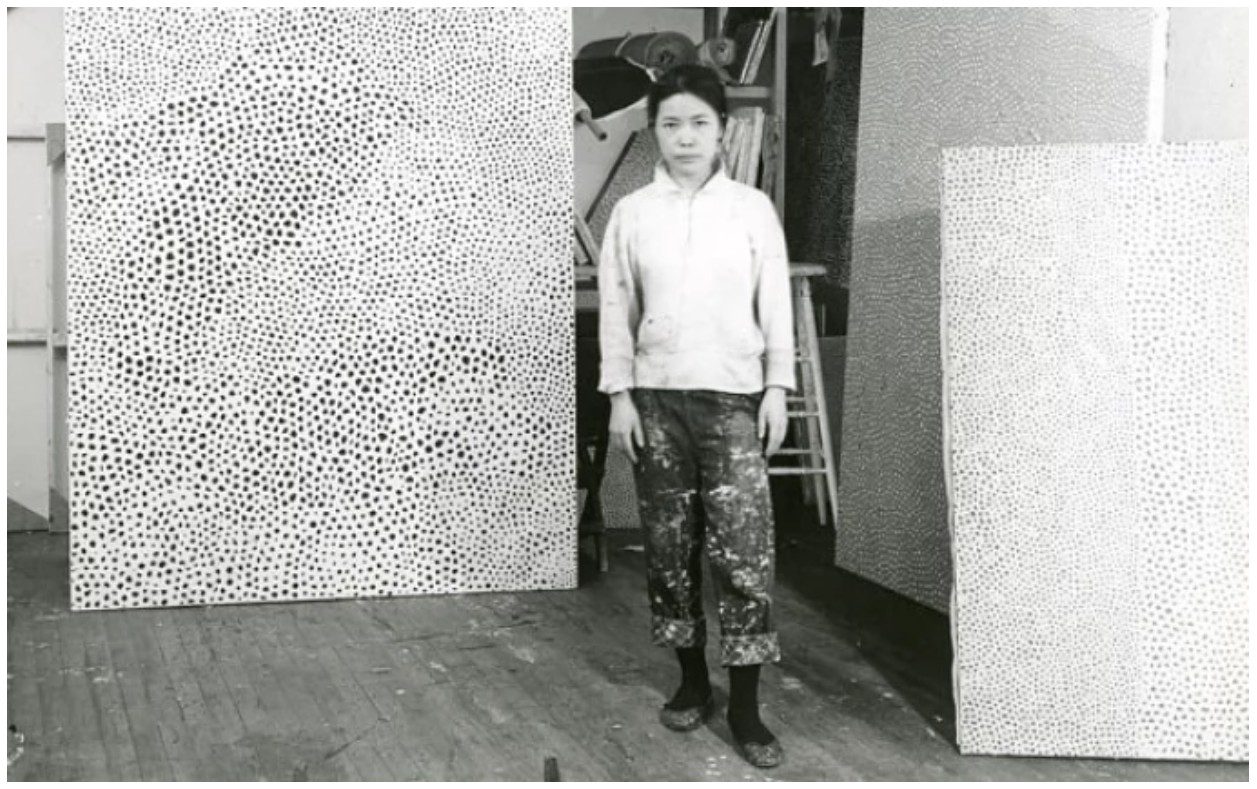
The artist in her studio with Infinity Nets paintings ca. 1960 © Yayoi Kusama
It was in 1959 that Kusama exhibited her first Infinity Nets paintings in New York, radically transforming the monochrome genre championed by contemporary Abstract Expressionists into a complex vehicle of self-expression. Responding to the emotionally charged brushwork of the likes of Jackson Pollock and Willem de Kooning, Kusama’s repetitive monochromatic patterns ripple with psychological intensity, a uniquely realized manifestation of the artist herself. The impact of this series cannot be understated, in America as well as abroad. The following year in 1960, it was Kusama and Mark Rothko who were featured as the only American artists in a seminal exhibition of Monochrome paintings at the Städtisches Museum in Leverkusen in Germany. Disappearing into the “monotonous, solitary act” (Laura Hoptman, Ed., Yayoi Kusama, London 2000, p. 10) of these paintings, the Infinity Nets series is widely regarded as the most archetypical representative of all of Kusama’s celebrated creations. Extensively considered Japan’s greatest living artist today, Kusama reveals her singular vision through various forms and media, exploring infinity net patterns in sculptures, paintings, happenings and films. As a consummate example of the artist’s exploration of the eternal and infinite, Infinity Nets (RAZX) radiates with the essence of the series which is inextricably linked to the artist herself.