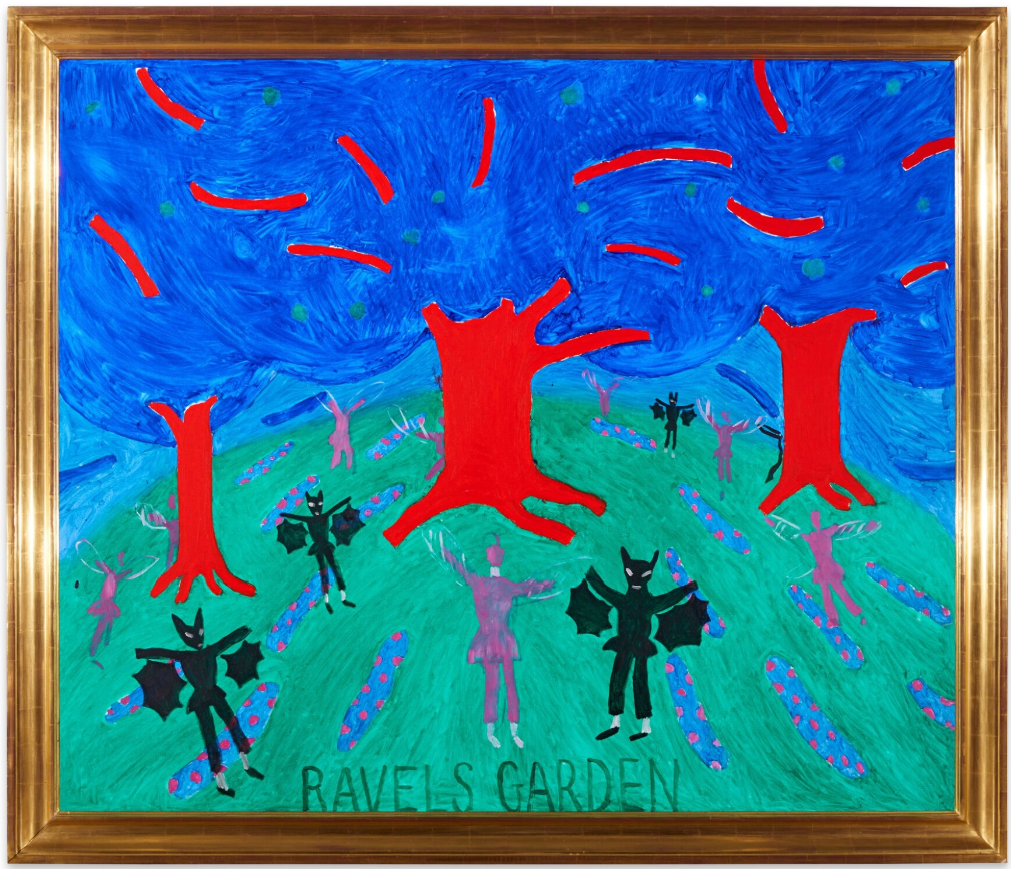
DAVID HOCKNEY (b. 1937)
Ravel’s Garden with Night Glow, 1980
Oil on canvas, with red and blue lights
60×72 inches (152.4 x 182.9 cm)
Partially titled; signed and dated 1980 on the reverse
Provenance
André Emmerich Gallery, New York
Acquired from the above by the present owner
Auction History
Sotheby’s New-York: 13 May 2021
Estimated: USD 800,000 – 1,200,000
USD 1,774,500
Ravel’s Garden with Night Glow | Contemporary Art Day Auction | 2021 | Sotheby’s (sothebys.com)
Ravel’s Garden with Night Glow from 1980 is one of David Hockney’s most transcendent and deeply meaningful works depicting the jubilant final scene from Maurice Ravel’s 1925 opera L’enfant et les sortilèges. Through his iconic technique and the interplay of the colored lights, Hockney brings to life the fantastical world of his personal favorite opera, in which a rude child is reprimanded by the once inanimate objects in his room and then transported to a tree filled garden that comes alive with singing animals and plants once tortured by the child. Known for his mastery across a number of mediums, Hockney’s immersive theater designs and their correlating paintings, including the present work, mark the artist’s ability to create entirely encompassing visual experiences within the confines of an otherwise two-dimensional canvas. The present work invites a multitude of senses to interact well beyond the canvas which ultimately creates an incredibly rich viewing experience. Hockney began losing his hearing in the 1980s and oftentimes has since said that his hearing loss has had an integral impact on his skill as an artist—”If you lose one sense, you gain other senses.” It is through this highly personal experience and his lifelong love of the opera that the present work stands as a truly emblematic example of Hockey’s ability to tap into the senses of his viewers. Throughout his oeuvre, Hockney uses vibrant color as a tool to express emotion, which adds new meaning to the visual intensity created between the canvas itself and the atmospheric glow created by the specially selected red and blue lights that truly set this work apart as one of Hockney’s most impactful paintings. Ravel’s Garden with Night Glow marks the pinnacle of Hockney’s theater paintings given his commitment elevating the all-encompassing visual experience in order to create a truly thrilling sensory experience for the viewer.
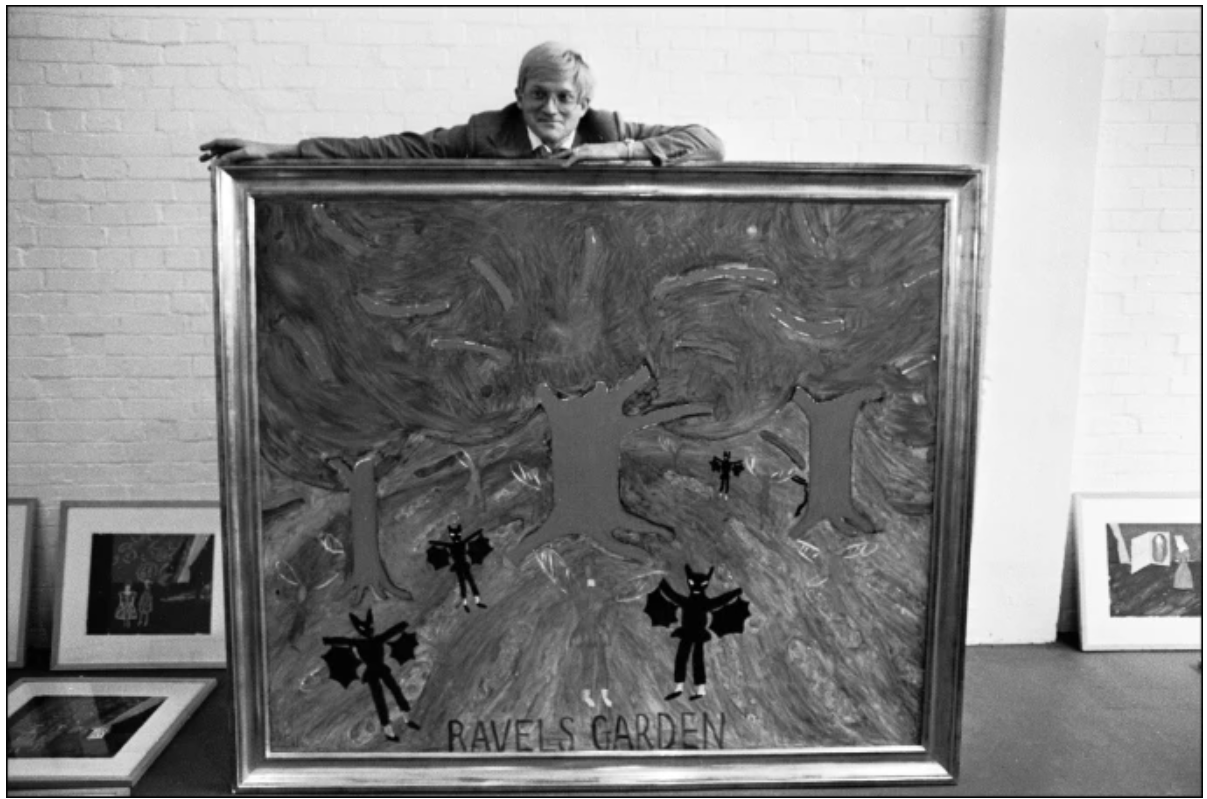
BRITISH ARTIST DAVID HOCKNEY HOLDING HIS PAINTING RAVELS GARDEN, 1980. PHOTO BY MICHAEL WARD/GETTY IMAGES.
The present work is a vibrant revival of the opera that Colette was asked to write for a fairy ballet during World War I. In 1916, Colette carefully chose the French composer Maurice Ravel to set her text to music. In the years that followed, Ravel was met with extreme bouts of poor health only to receive the inspirational spark he needed to complete his composition after following American composer George Gershwin’s musical successes. By 1925, Colette feared that her text would never be brought to life and was overjoyed that L’enfant et les sortilèges was finally to be performed in Monte Carlo on March 21, 1925. Ravel remarked, “Our work requires an extraordinary production: the roles are numerous, and the phantasmagoria is constant. Following the principles of American operetta, dancing is continually and intimately intermingled with the action.” Ravel’s Garden with Night Glow is the summation of Hockney’s love for and transformative powers over the stage as reflected by a lifelong interest in music and theater.
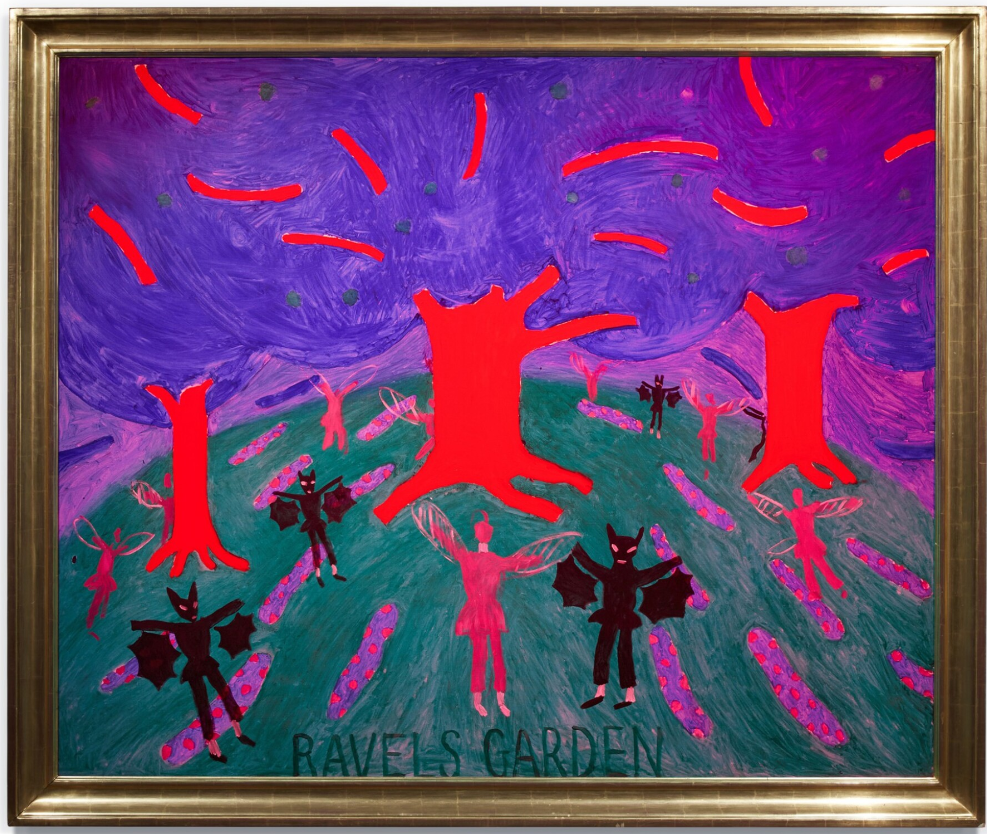
To stand before Ravel’s Garden with Night Glow and experience the way in which Hockney’s vibrant use of color and vivid brushstrokes intermingle with the atmosphere created by the colored lights is an invitation into the world so fantastically created by Collete and Maurice Ravel nearly a century ago. Hockney’s handling of space and depth together possess the visual equivalent of a magnetic force of their ability to bring the viewer deeper and deeper into the canvas and thus into the garden brought to life through Ravel’s timeless compositions. As a viewer, one almost imagines him or herself as an actor onstage during the final scene in which the animals help to reunite the child with his mother. David Hockney’s ability to create such an immersive viewing experience through the sensory experience created in dialogue between the painting itself and the aura of the lights is a summation of Hockney’s decades-long artistic genius in which he brings new worlds to life through the magic of his brush. To see this work illuminated as Hockney intended and as the Pynoos family enjoyed the work for so many years is like a trip to the Metropolitan Opera—exactly how Hockney envisioned it following years spent listening to the operettas on his Sony Walkman.