DAVID HOCKNEY (b.1937)
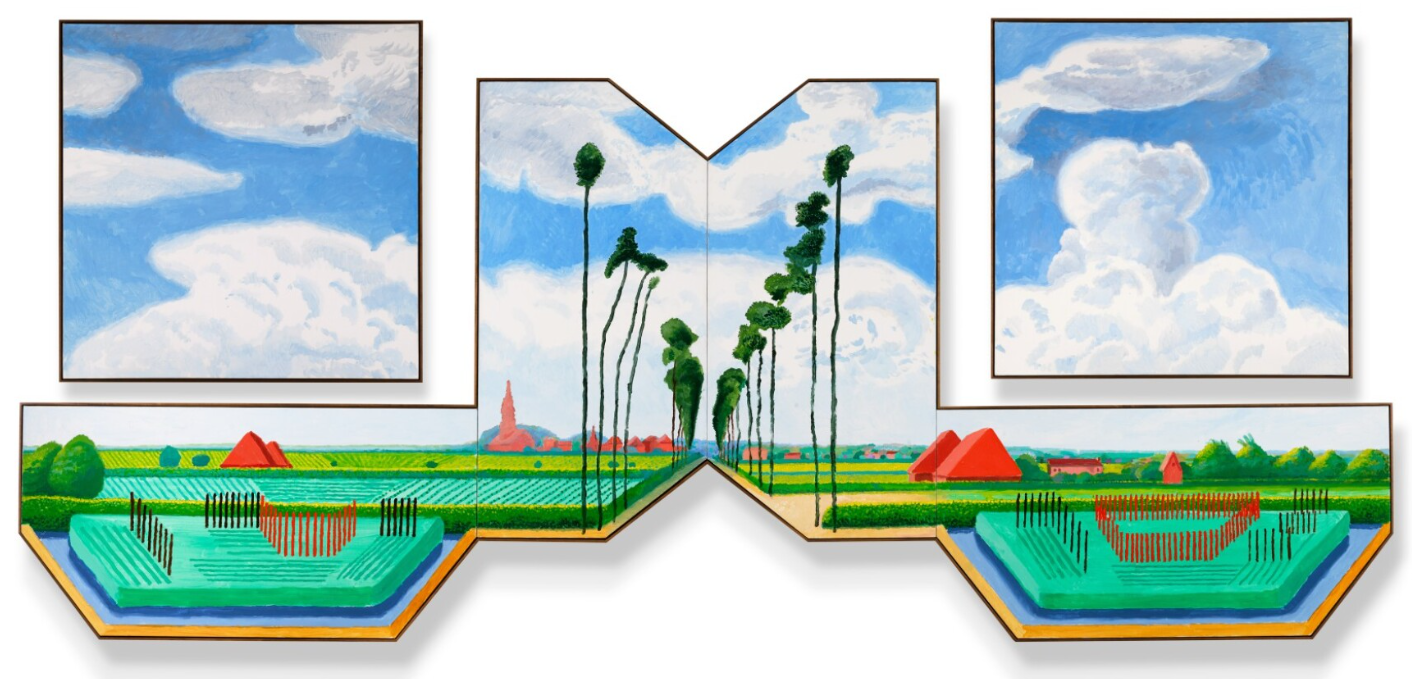
Tall Dutch Trees After Hobbema (Useful Knowledge), 2017
Acrylic on canvas, in 6 parts
Overall: 65×145 inches (165.1 x 368.3 cm)
Signed, titled and dated 2017 on the reverse of the centre panel
Provenance
Pace Gallery, New York
Acquired from the above by the present owner in 2018
Auction History
Sotheby’s London: 25 March 2021
Estimated: GBP 6,500,000 – 8,500,000
GBP 6,753,634 / USD 9,265,145
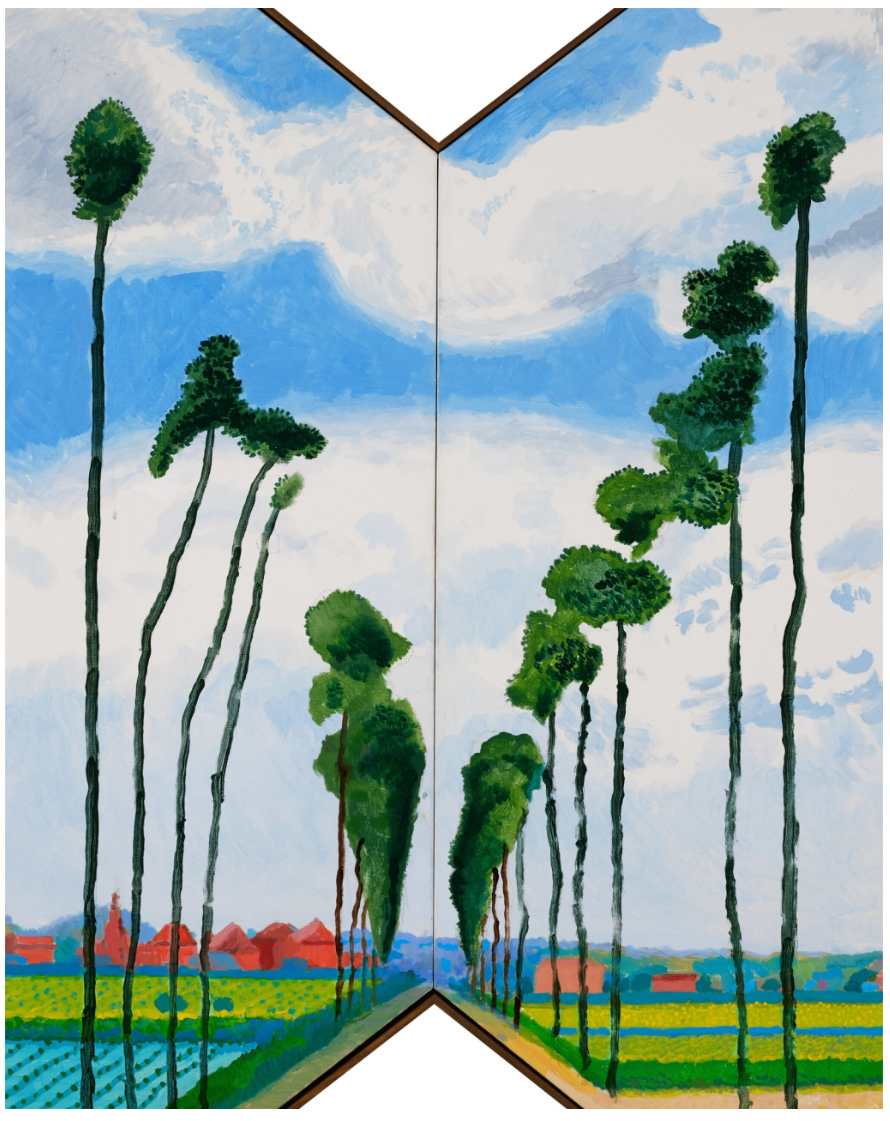
Imbued with a sense of dynamism and sublime vastness, Tall Dutch Trees After Hobbema (Useful Knowledge) 2017 exemplifies David Hockney’s unique, multi-perspectival approach to painting and his visual investigation into a masterpiece of the art historical canon. Executed in 2017, the present work takes its composition from Meindert Hobbema’s celebrated seventeenth-century painting The Avenue at Middelharnis (1689) housed in the National Gallery, London as part of its permanent collection. Here, Hockney translates Hobbema’s conventional European landscape into a saturated, euphoric Californian vista, paying homage to the illustrious original, while radically re-imagining it for a decidedly contemporary audience. Depicted in Hockney’s quintessential graphic vernacular and bold, high-key colour palette, this landscape could be a tree-lined avenue in Beverley Hills, or the sun-drenched slopes of Santa Monica or the Hollywood Hills. Wonderfully reimagined for the 23rd April 2018 cover of The New Yorker, and featured in a large-scale photo-mural Hockney created the same year using an inventive combination of photography and 3D printing, the present work is testament to the artist’s enduring ingenuity and cultural significance in the eighth decade of his life. Executed during Hockney’s renowned 2017-18 retrospective at Tate Britain, London, Centre Georges Pompidou, Paris, and The Metropolitan Museum of Art, New York, Tall Dutch Trees After Hobbema (Useful Knowledge) 2017 transcends the limitations of traditional representation and disrupts the rigor of conventional perspective via an expansive, bucolic panorama.
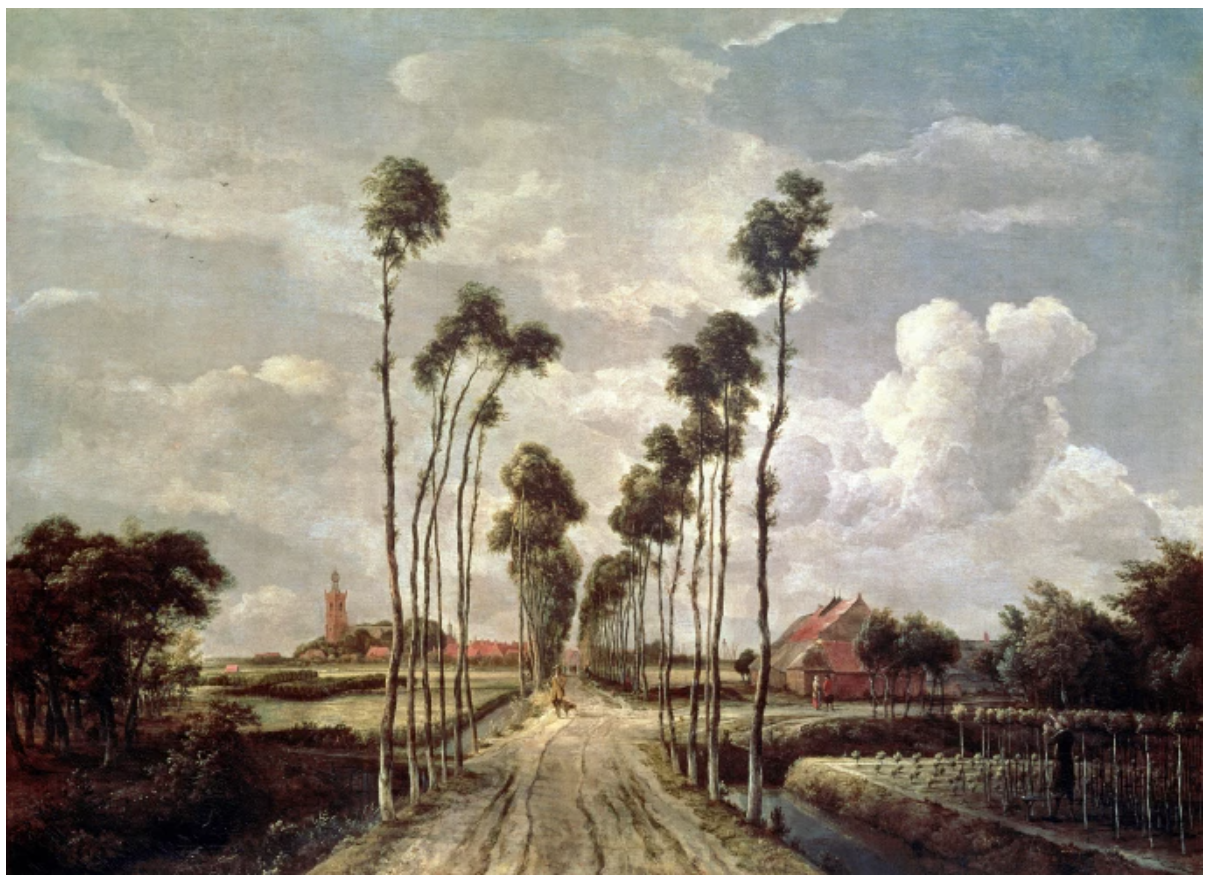
MEINDERT HOBBEMA, THE AVENUE AT MIDDELHARNIS, 1689
THE NATIONAL GALLERY, LONDON / IMAGE: © BRIDGEMAN IMAGES
Hockney’s rendition of Hobbema’s painting is the largest and most exquisite work within a series of twenty late paintings executed in 2017 and 2018, the majority of which are painted on hexagonal or shaped canvases. Throughout the series, Hockney either returned to the subject matter central to his early practice – such as the landscapes of the Hollywood Hills and the Grand Canyon – or he reimagined celebrated compositions of art historical masters, such as Hobbema and Fra Angelico. Indeed, in its reinterpretation of a renowned seventeenth-century landscape, Tall Dutch Trees After Hobbema (Useful Knowledge) 2017 represents the apotheosis of Hockney’s career-long investigation into masterworks of the art historical canon, among them paintings by Vermeer, Hogarth, Monet, Van Gogh, and Picasso. In his profound appreciation of such works, Hockney has executed paintings inspired by – or, less often, directly based on – instantly recognizable historical masterpieces. The present work can thus be compared to a much earlier painting by Hockney of a similar title, Kerby (After Hogarth) Useful Knowledge, executed in 1975. This earlier painting signifies Hockney’s first schematic experiment with perspective, and similarly draws upon art historical source material; the composition is based on a frontispiece illustration by Hogarth to a pamphlet on perspective produced by his friend and artist Joshua Kirby. Like Hobbema before him, Hogarth, too, toyed with perspective, in turn manifesting unique visual effects that would allow the viewer to become an active participant in the scene. Hockney’s 1975 painting now resides in The Museum of Modern Art, New York, in turn solidifying the importance of his art historical investigations.
Hockney’s tendency to draw upon sources from the canon of art history follows a long tradition of contemporary artists looking to the aesthetic language of their predecessors. The present work is reminiscent of Francis Bacon’s Study for ‘Portrait of Van Gogh’ (1957) in the collection of Tate, London; Frank Auerbach’s frenetic interpretation of Ruben’s Samson and Delilah, the original held in the collection of the National Gallery, London, alongside Hobbema’s landscape; or Gerhard Richter’s Verkündigung nach Tizian (Annunciation after Titian), now in the collection of the Hirshhorn Museum and Sculpture Garden, Washington D.C.. Roy Lichtenstein and Andy Warhol’s appropriationist ‘art after art’ style is also of note, yet in the case of the present work, Hockney’s approach radically differs from his Pop art contemporaries in his sincere and intrinsic love of the instructive value of Hobbema’s picture:
“I’ve always loved it. It’s a beautiful painting, the original. It’s in the National Gallery, and I saw it when I was eighteen, when I first went to London. I told JP [Hockney’s companion] – just look up Hobbema. He’d never heard of him, we found the painting and made a proof (it was quite good!), and then I painted it. Van Gogh also wrote about the work. What’s fascinating is that, in the painting, there are two vanishing points. One is in the centre of the painting, with the disappearing road. But the other is in the sky. You’re always looking up, because the trees are so tall”
Hockney’s exploration of art historical masterworks underscores his theoretical conception of pictorial space in painting – the ultimate expression of which is made manifest on the surface of the present work. Depicting an idyllic view of a village road in southern Holland, Hobbema’s 1689 painting is comprised of a regimented landscape punctuated by strong vertical lines; tall, lush Alder trees frame the avenue as the viewer’s eye is drawn towards the heart of the composition. The painting illustrates Hobbema’s use of ground-breaking visual devices, and the artist’s early, innovative experiments with perspective.