DAVID HOCKNEY (b. 1937)
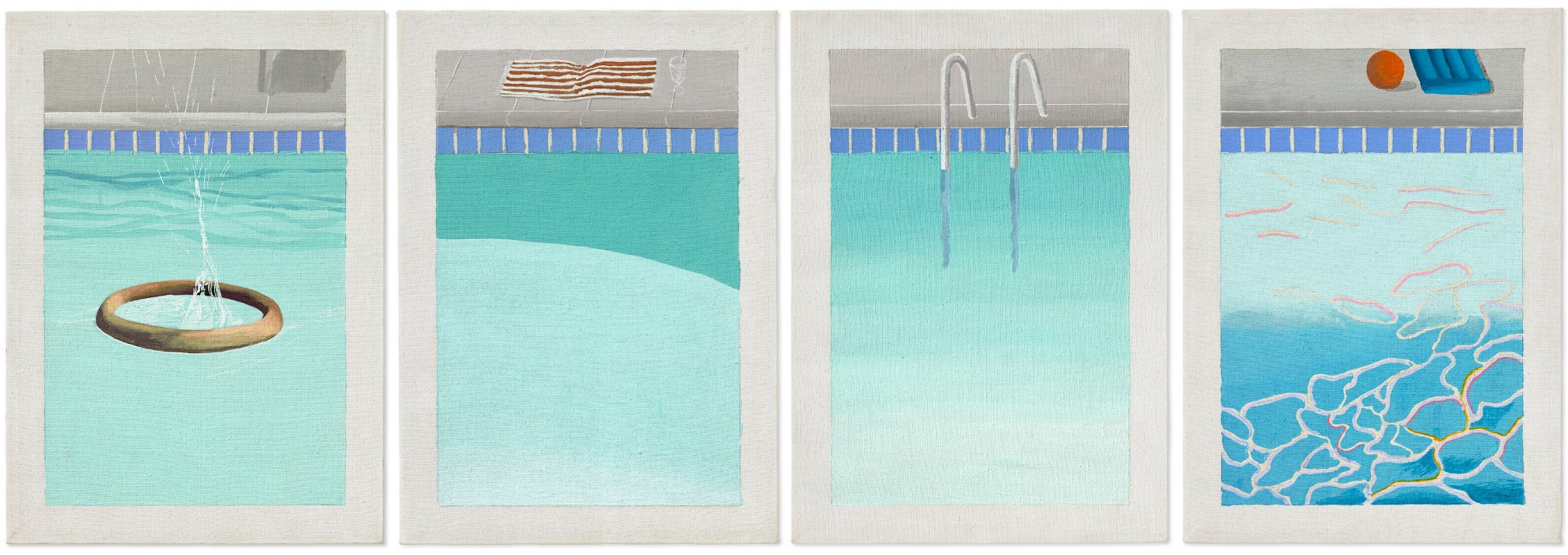
Four Different Kinds of Water, 1967
Acrylic on canvas, in four parts
Each: 14×10 inches (35.6 x 25.4 cm)
Signed ‘Hockney’ (on the reverse of the left canvas)
Signed again ‘Hockney’ (on the reverse of the second canvas from left)
Provenance
Kasmin, Ltd., London
Tony Richardson, London (acquired from the above, by 1969)
Private collection, Los Angeles (acquired from the above)
Acquired from the above by the late owner, 1999
Auction History
Visionary: The Paul G. Allen Collection
Christie’s New-York: 9 November 2022
Estimated: USD 3,000,000 – 5,000,000
USD 6,060,000
DAVID HOCKNEY (b. 1937) (christies.com)
David Hockney’s paintings of swimming pools are among the most iconic works of the post-war canon. Along with Andy Warhol’s Campbell’s Soup Cans and Roy Lichtenstein’s comic book-inspired canvases, they capture the exuberance of the age when Pop Art was born. Yet, as much as they are a celebration of pop culture, Hockney’s California inspired paintings are also a response to one of the most difficult technical challenges faced by artists: that of how to paint water. Executed the same year as A Bigger Splash (1967, Tate Gallery, London), Four Different Kinds of Water is comprised of four elements, each of which responds directly to that challenge. Ripples, shadows, reflections, and even the mass of the body of water itself are all reflected here in new and bold ways, they are Hockney’s solutions to the challenges that he relishes, and a triumph of both visual aesthetics and painterly technique.
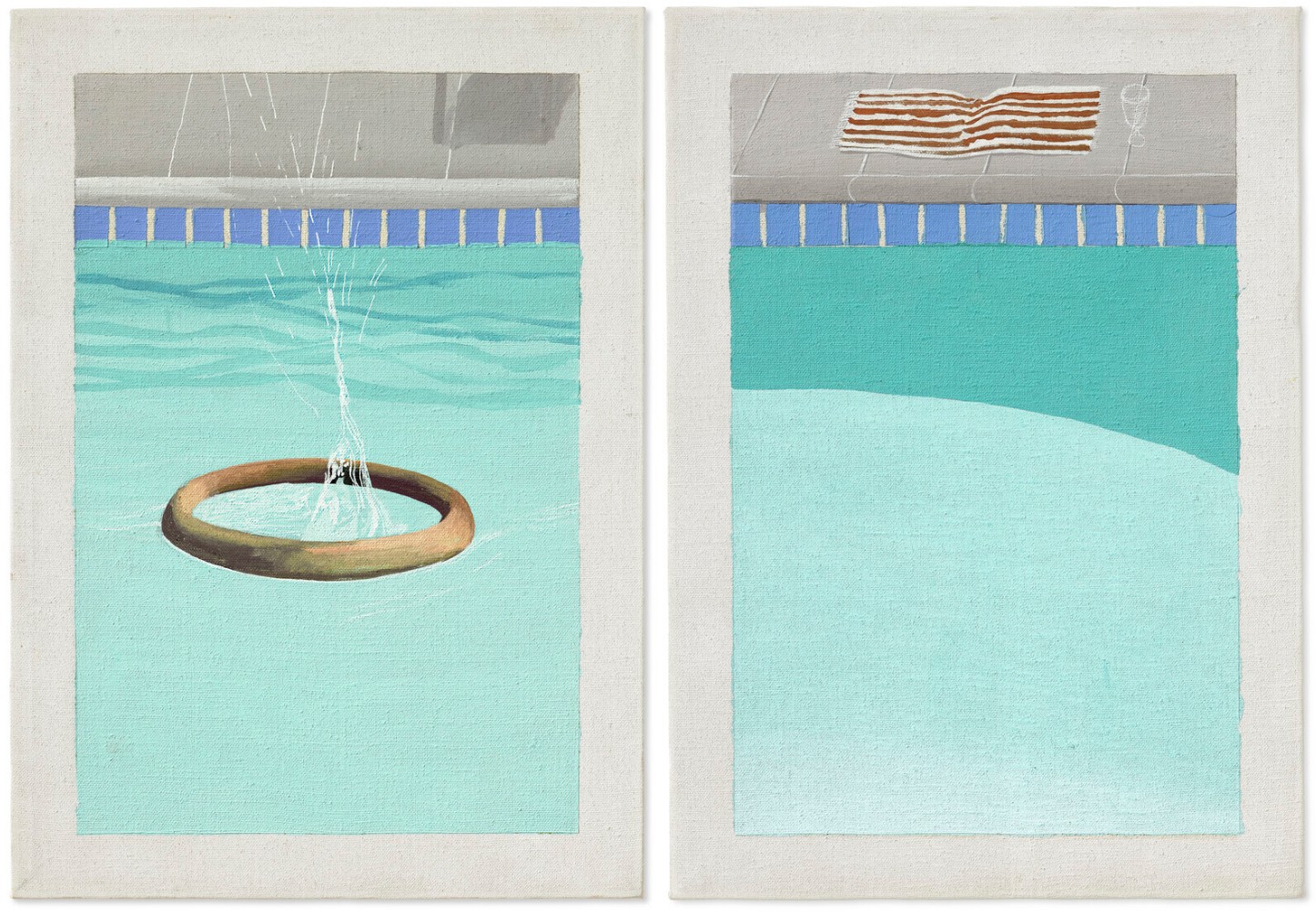
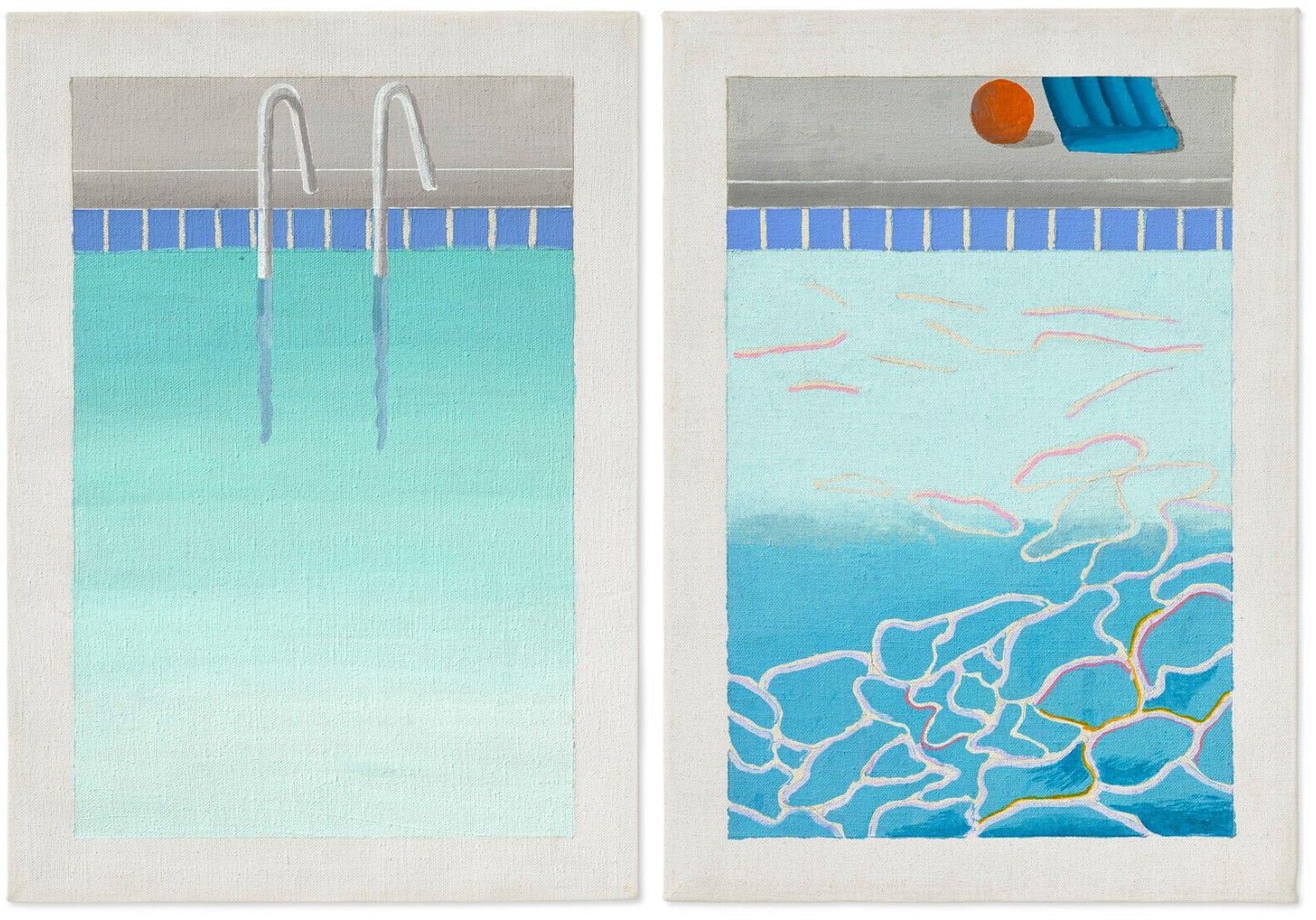
Each of the four intimately scaled canvases depicts fundamentally the same scene: an almost abstract view of a swimming pool complete with the accoutrements needed for a fun day in the water. Yet each presents a radically different view of that subject and of the qualities and characteristics of what is essentially a colorless and amorphous form. In order to meet the challenge, Hockney depicts the play of light and the reflections on both the surface of the pool and on the body of water below. Thus we see the undulating ripples of the water as they lap against the edge of the pool, the dark shadows cast by the sides, and the edge of the pool in the water below, the fading sunlight as it tries to penetrate the depths of the water, and, finally, the shadows that dance across the bottom of the pool caused by the ripples on the surface. While Hockney has ostensibly painted a swimming pool, he has also painted something so much more.
“The swimming pool paintings I did were about transparency: how would you paint water… The swimming pool, unlike the pond, reflects light. Those dancing lines I used to paint on the pools are really on the surface of the water. It was a graphic challenge.”
The origins of Hockney’s iconic subject can be found in 1964, when he made his first trip to California. At the age of just 26 he had traveled from the UK, and as his plane descended into LAX airport he was overwhelmed by a sense of anticipation and excitement.
“I remember flying in on an afternoon, and as we flew in over Los Angeles I looked down to see blue swimming pools all over, and I realized that a swimming pool in England would have been a luxury, whereas here they are not…”
He had reached what he regarded as the promised land. Hockney’s paintings of swimming pools have become some of the most loved canvases of his career. Four Different Kinds of Water takes the level of technical achievement of these paintings and builds on it a step further and in the process, introduces a whole new level of interest to these works. They are a demonstration of Hockney’s constant desire to innovate and invigorate the medium of painting, and prove once again why he is one of the most important painters of his generation.