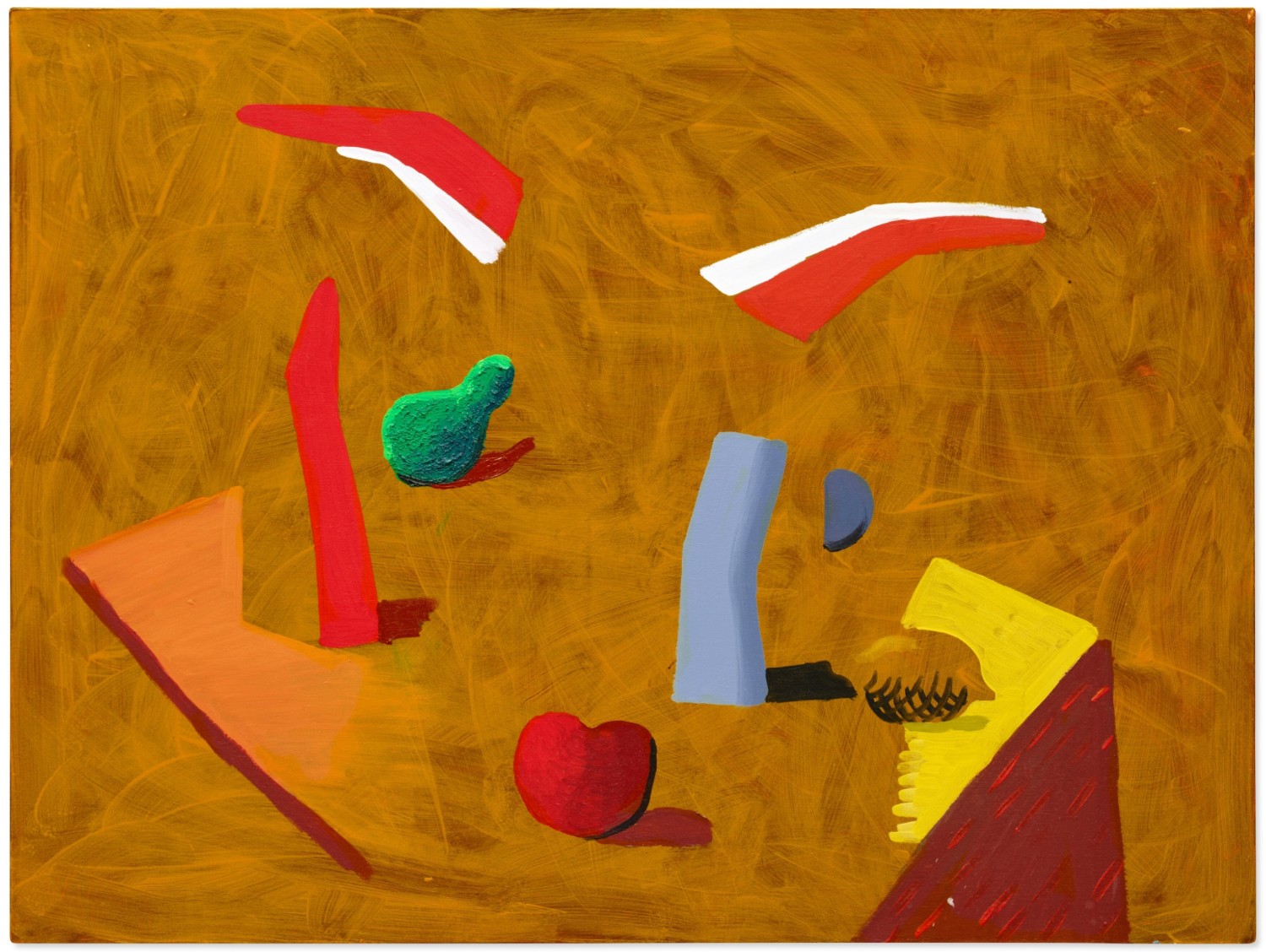
DAVID HOCKNEY (b. 1937)
Golden Still Life, 1987
Acrylic on canvas
36×48 inches (91.4 x 121.9 cm)
Provenance
André Emmerich Gallery, New York
Acquired from the above in November 1991 by the present owner
Auction History
The Geri Brawerman Collection: A Tribute to Los Angeles and A Legacy of Giving
Sotheby’s New-York: 19 November 2025
Estimated: USD 800,000 – 1,200,000
USD 2,734,000
Golden Still Life | Contemporary Day Auction | 2025 | Sotheby’s
Executed in 1987, Golden Still Life stands as a radiant example of David Hockney’s exploration of perception and pictorial space at the height of his technical virtuosity. Painted in sumptuous tones of yellow, orange, and gold, the painting belongs to the artist’s late-1980s group of still lifes, where traditional subject matter is reimagined through the lens of modernity and light. Exhibited in the artist’s landmark retrospective at the Los Angeles County Museum of Art, the Metropolitan Museum of Art, New York and the Tate London in 1988-89, Golden Still Life bridges the boundary between representation and abstraction, demonstrating Hockney’s ability to infuse familiar forms with vivid psychological resonance.
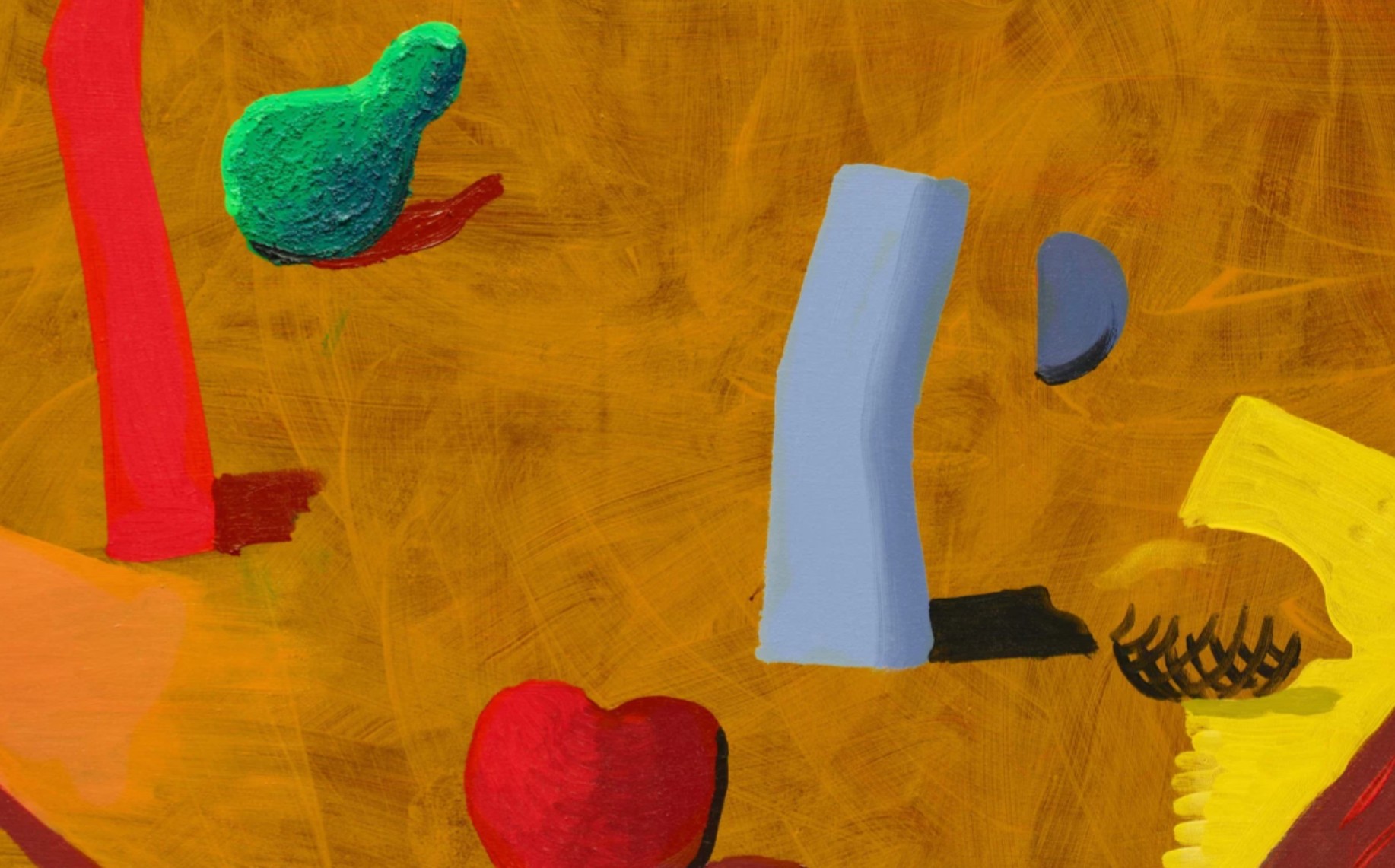
Set against a textured field of shimmering ochre, Golden Still Life transforms the domestic genre into a dynamic theater of color and geometry. The fruits—pear, apple, and lemon—float within a space defined less by physical depth than by the interplay of shadow and light. Hockney anchors the composition with angular corners of a table rendered in bold yellow and orange segments, while deliberately omitting its center, creating the illusion that the objects hover weightlessly. The result is a still life of remarkable vitality, at once grounded in the tradition of the Dutch masters and animated by the spatial inventiveness of twentieth-century modernism.
“Painting still lifes can be as exciting as anything can be in painting.
I remember once saying to Francis Bacon in Paris, that I knew a painting in California of tulips in a vase that was as profound as any painting he’d made.
I think at first he almost thought I was referring to my own, but I was referring to the Cézanne in the Norton Simon Museum. It’s the most beautiful painting, and it is as profound as anything he did. Just some tulips in a vase.
The profundity is not in the subject, it is the way it’s dealt with.”
The artist’s handling of shadow and reflection in Golden Still Life is particularly evocative, demonstrating the clarity and precision that define his mature acrylic technique. The luminous palette recalls his California paintings of the 1970s, while the compositional balance and restrained geometry prefigure the spatial experiments of the 1990s and early 2000s. As in works such as Fruit in a Chinese Bowl from 1988 and Two Red Pots from 1987, Hockney treats everyday subjects as opportunities for formal inquiry, exploring how vision is constructed and how painting can reveal that process. In reimagining the still life, Hockney engages a lineage that stretches from Henri Matisse to Paul Cézanne and Giorgio Morandi. Yet his sensibility remains unmistakably contemporary: color operates as both form and emotion, while the abstraction of space challenges conventional perspective. The title Golden Still Life underscores Hockney’s fascination with light as a metaphor for perception, the gold of illumination rather than mere opulence. In this sense, the work encapsulates the artist’s lifelong pursuit of depicting not the world as it appears, but as it is seen and felt.
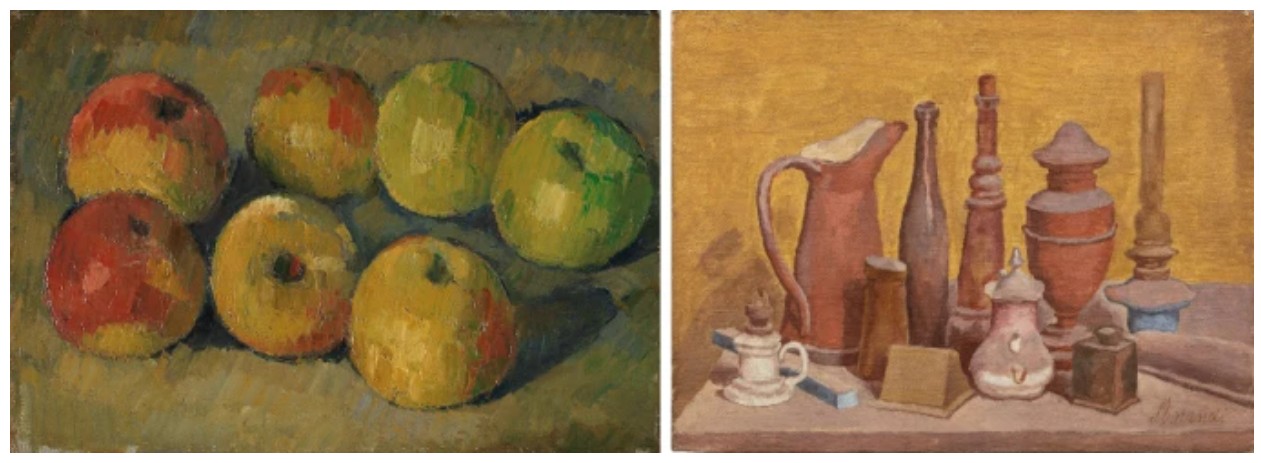
Left: Paul Cézanne, Still Life with Apples, c. 1877-1878. The Fitzwilliam Museum, Cambridge University.
Right: Giorgio Morandi, Natura morta (V. 117), 1927. Private Collection.
Golden Still Life also embodies the deep cultural ties between Hockney and Los Angeles, the city that shaped his vision and the collection from which this painting emerges. Acquired by philanthropist Geri Brawerman from André Emmerich Gallery in 1991, the work has remained in the same collection for more than three decades, a reflection of her discerning taste and enduring support for the visual arts in Los Angeles. In Golden Still Life, Hockney reaffirms painting’s capacity to transform the ordinary into the sublime. The work’s radiant palette and architectural precision encapsulate the artist’s lifelong fascination with how we see and remember, a still life not of things, but of light itself.