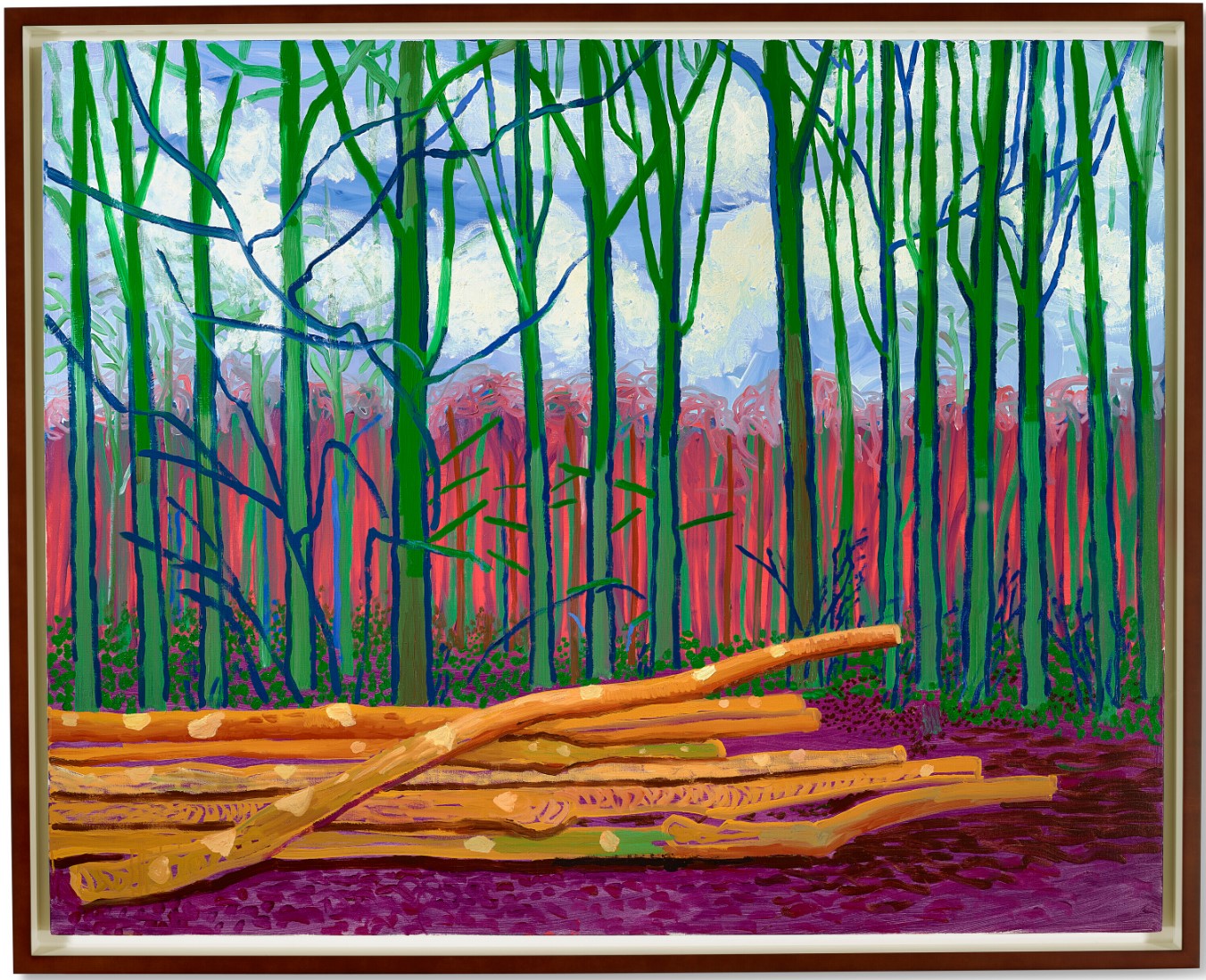
DAVID HOCKNEY (B. 1937)
Felled Trees, 2008
Oil on canvas
48×60 inches (121.9 x 152.4 cm)
Signed, titled and dated ‘Felled Trees April 2008 David Hockney’ (on the reverse)
Provenance
PaceWildenstein, New York
Acquired from the above by the late owner, 2009
Auction History
Visionary: The Paul G. Allen Collection
Christie’s New-York: 11 May 2023
Estimated: USD 4,000,000 – 6,000,000
USD 10,760,000
DAVID HOCKNEY (B. 1937) (christies.com)
Widely known for his groundbreaking canvases that drew their power from the lustrous glamour of the Hollywood hills and the picturesque vistas of Los Angeles, David Hockney’s career has been highly influential to generations of artists. Still working today, he continues to investigate new modes and styles. Shifting focus in the early 2000s, he became enamored with landscape painting as he returned to the United Kingdom and fell in love with the countryside of his youth. Felled Trees is a stunning example of Hockney’s new approach to painting where English landscape traditions careened into his Pop-inflected California sentiments. In 2008, a year before this painting was realized, he moved into a new, larger studio that afforded him more freedom and allowed for continued exploration of monumental-scale pictures.
“I felt twenty years younger. I stopped feeling frail and started feeling energetic,” he exclaimed, “I think it will make a difference to the work and to me being in a bigger space”
The exhilaration and lust for innovation are palpable in Felled Trees as vivid colors glow with a neon splendor that elevates what might otherwise be taken for granted to new heights.
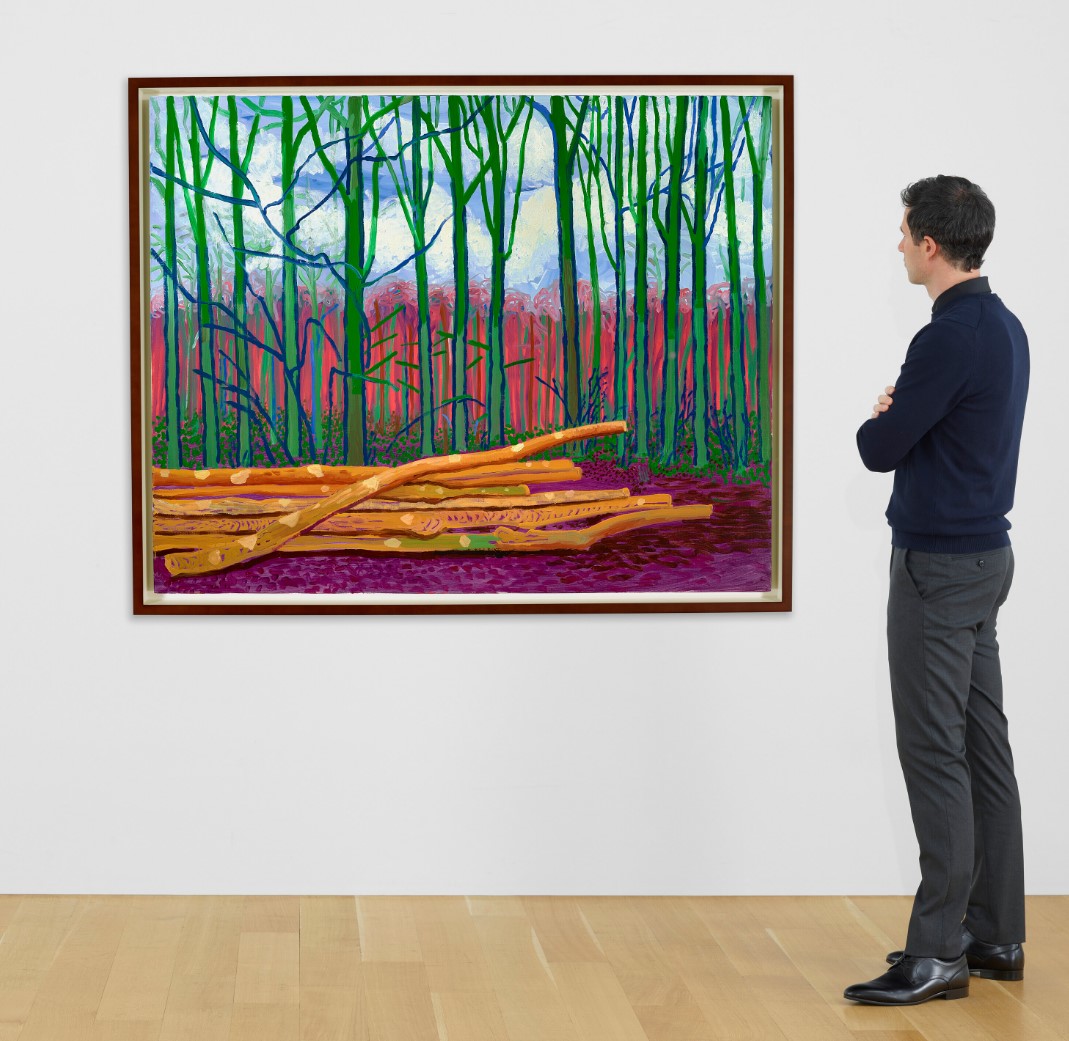
Painted in otherworldly tones, Felled Trees elevates the commonplace to something more surreal. Atop a bedding of deep purple undergrowth, a stack of brightly colored logs fills much of the foreground. The bold style in which Hockney renders this lumber detaches it from the rest of the scene, causing it to float visually atop the rest of the composition. The thick brushstrokes and energetic color create a stylistic amalgam that is as much related to the late work of Philip Guston as it might be to the dashing Fauves of the early twentieth century. About his predilection for mixing references and modes in service of a larger understanding of painting, Hockney has noted, “I want to use different styles, or a vocabulary of different styles, the same way a writer uses different words. I think it is part of a technique of painting to be able to adapt yourself to different styles… In a way I would like to paint a picture that was completely anonymous, that no one could tell was by me. Not in the style of another individual, but in the anonymous style of a school, like the Egyptian or byzantine style” (D. Hockney, quoted in P. Melia and U. Luchardt, David Hockney Paintings, London, 2009, p. 39).
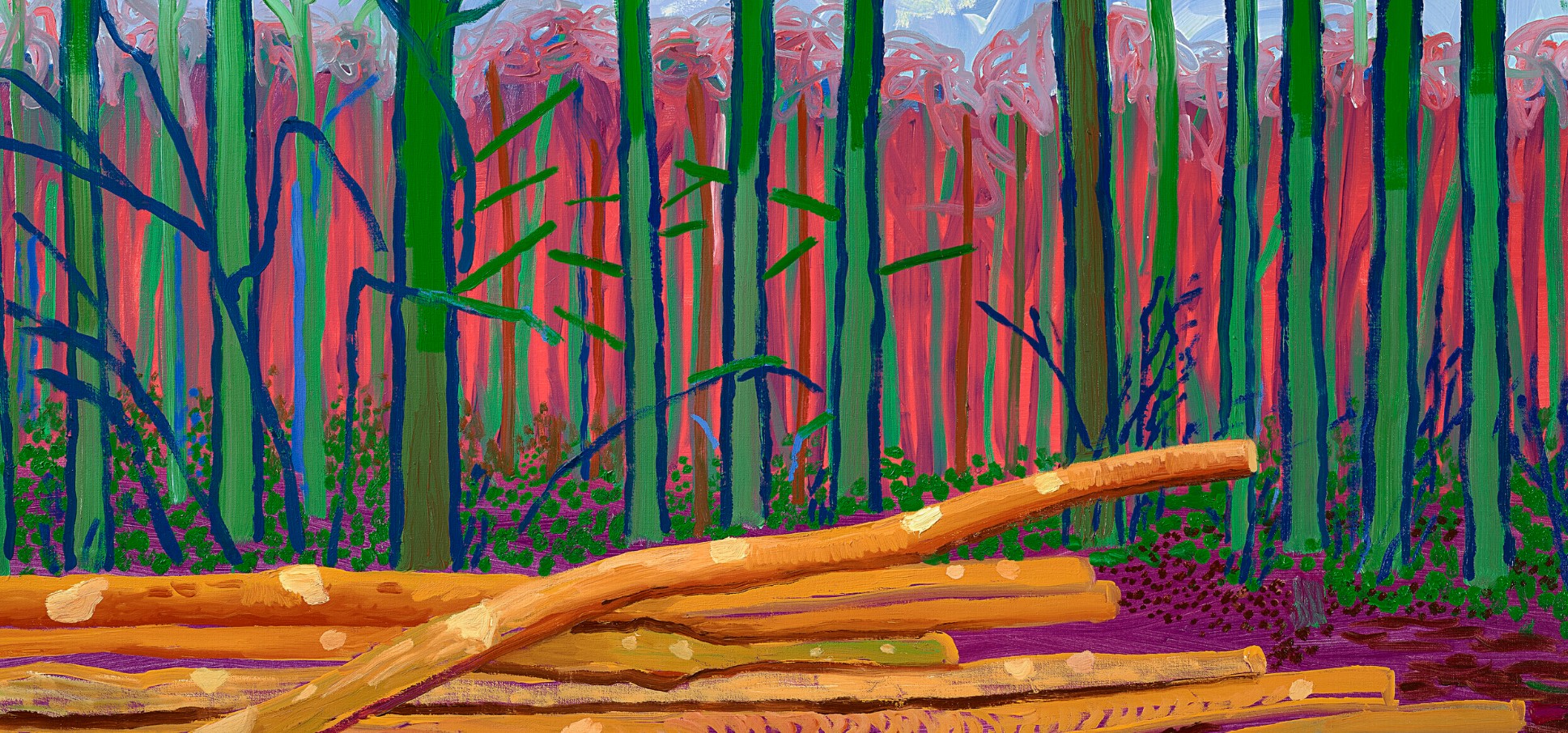
n Felled Trees, one sees this convergence in full effect as the more traditional blue and white of the cloudy sky above contrasts with the vibrant red of distant alien forests and the stand of shocking emerald trees in the midground. The latter oscillates between flatly applied paint and an illusionistic layer as the viewer notices and then looks past the thick blue outlines on each trunk and branch that Hockney weaves sinuously into the frame.